Title: Collected papers, Volume III
Author: Sigmund Freud
Editor: Ernest Jones
Translator: Alix Strachey
James Strachey
Release date: November 1, 2026 [eBook #79893]
Language: English
Original publication: London: Hogarth Press, 1925
Other information and formats: www.gutenberg.org/ebooks/79893
Credits: Stephen M. Kraus at https://readfreud.org/ (This file was produced from images generously made available by The Internet Archive)
The translations in this volume are based upon the revised text prepared by the author for the German Collected Edition of his works (now in course of publication by the Internationaler Psychoanalytischer Verlag in Vienna), of which the present five papers constitute the eighth volume. A comparison with earlier German editions will reveal some trifling corrections in the text and a few additional footnotes. To avoid burdening the footnotes with unnecessary details, we have added at the end of the book a list giving bibliographical particulars of the works referred to in it (other than those actually translated in the present volumes).
We owe our thanks to Fräulein Anna Freud and to the General Editor (Dr. Ernest Jones) for reading through the whole of our manuscript and making many important corrections and suggestions. We have also had the advantage of being able to refer a large number of doubtful points to Professor Freud’s own decision.
| PAGE | ||||
|---|---|---|---|---|
| TRANSLATORS’ NOTE | 7 | |||
| I. | FRAGMENT OF AN ANALYSIS OF A CASE OF HYSTERIA (1905) | |||
| Prefatory Remarks | 13 | |||
| I. | The Clinical Picture | 22 | ||
| II. | The First Dream | 78 | ||
| III. | The Second Dream | 114 | ||
| IV. | Postscript | 134 | ||
| II. | ANALYSIS OF A PHOBIA IN A FIVE-YEAR-OLD BOY (1909) | |||
| I. | Introduction | 149 | ||
| II. | Case History and Analysis | 165 | ||
| III. | Epicrisis | 243 | ||
| Postscript | 288 | |||
| III. | NOTES UPON A CASE OF OBSESSIONAL NEUROSIS (1909) | |||
| I. | Extracts from the Case History | 296 | ||
| (a) | The Beginning of the Treatment | 297 | ||
| (b) | Infantile Sexuality | 298 | ||
| (c) | The Great Obsessive Fear | 303 | ||
| (d) | Initiation into the Nature of the Treatment | 312 | ||
| (e) | Some Obsessional Ideas and their Explanation | 324 | ||
| (f) | The Exciting Cause of the Illness | 333 | ||
| (g) | The Father Complex and the Solution of the Rat Idea | 33810 | ||
| II. | Theoretical | 357 | ||
| (a) | Some General Characteristics of Obsessional Formations | 357 | ||
| (b) | Some Psychological Peculiarities of Obsessional Neurotics: their Attitude towards Reality, Superstition and Death | 365 | ||
| (c) | The Instinctual Life of Obsessional Neurotics, and the Origins of Compulsion and Doubt | 372 | ||
| IV. | PSYCHO-ANALYTIC NOTES UPON AN AUTO-BIOGRAPHICAL ACCOUNT OF A CASE OF PARANOIA (DEMENTIA PARANOIDES) (1911) | |||
| I. | Case History | 390 | ||
| II. | Attempts at Interpretation | 417 | ||
| III. | On the Mechanism of Paranoia | 444 | ||
| Postscript | 467 | |||
| V. | FROM THE HISTORY OF AN INFANTILE NEUROSIS (1918) | |||
| I. | Introductory Remarks | 473 | ||
| II. | Survey of the Patient’s Environment and of the History of the Case | 480 | ||
| III. | The Seduction and its Immediate Consequences | 486 | ||
| IV. | The Dream and the Primal Scene | 498 | ||
| V. | A few Discussions | 520 | ||
| VI. | The Obsessional Neurosis | 535 | ||
| VII. | Anal Erotism and the Castration Complex | 548 | ||
| VIII. | Fresh Material from the Primal Period—Solution | 568 | ||
| IX. | Recapitulations and Problems | 585 | ||
| LIST OF BOOKS AND PAPERS REFERRED TO IN THE TEXT | 606 | |||
In 1895 and 1896 I put forward certain views upon the pathogenesis of hysterical symptoms and upon the mental processes occurring in hysteria. Since that time several years have passed. In now proposing, therefore, to substantiate those views by giving a detailed report of the history of a case and its treatment, I cannot avoid making a few introductory remarks, for the purpose partly of justifying from various points of view the step I am taking, and partly of diminishing the expectations to which it will give rise.
Certainly it was awkward that I was obliged to publish the results of my inquiries without there being any possibility of other specialists testing and checking them, particularly as those results were of a surprising and by no means gratifying character. But it will be scarcely less awkward now that I am beginning to bring forward some of the material upon which my conclusions were based and make it accessible to the judgement of the world. I shall not escape blame by this means. Only, whereas before I was accused of giving no information about my patients, now I shall be accused of giving information about my patients which ought not to be given. I can only hope that in both cases the critics will be the same, and that they will merely have shifted the pretext for their reproaches; 14if so, I can resign in advance any possibility of ever removing their objections.
Even if I ignore the ill-will of narrow-minded critics such as these, the presentation of my case histories remains a problem which is hard for me to solve. The difficulties are partly of a technical kind, but are partly due to the nature of the circumstances themselves. If it is true that the causes of hysterical disorders are to be found in the intimacies of the patients’ psycho-sexual life, and that hysterical symptoms are the expression of their most secret and repressed wishes, then the complete exposition of a case of hysteria is bound to involve the revelation of those intimacies and the betrayal of those secrets. It is certain that the patients would never have spoken if it had occurred to them that their admissions might possibly be put to scientific uses; and it is equally certain that to ask them themselves for leave to publish their case would be quite unavailing. In such circumstances persons of delicacy, as well as those who were merely timid, would give first place to the duty of medical discretion and would declare with regret that the matter was one upon which they could offer science no enlightenment. But in my opinion the physician has taken upon himself duties not only towards the individual patient but towards science as well; and his duties towards science mean ultimately nothing else than his duties towards the many other patients who are suffering or will some day suffer from the same disorder. Thus it becomes the physician’s duty to publish what he believes he knows of the causes and structure of hysteria, and it becomes a disgraceful piece of cowardice on his part to neglect doing so, as long as he can avoid causing direct personal injury to the single patient concerned. I think I have taken every precaution to prevent my patient from suffering any such injury. I have picked out a person the scenes of whose life were laid not in Vienna but in a remote provincial town, and whose personal 15circumstances must therefore be practically unknown in Vienna. I have from the very beginning kept the fact of her being under my treatment such a careful secret that only one other physician—and one in whose discretion I have complete confidence—can be aware that the girl was a patient of mine. I have waited for four whole years since the end of the treatment and have postponed publication till hearing that a change has taken place in the patient’s life of such a character as allows me to suppose that her own interest in the occurrences and psychological events which are to be related here may now have grown faint. Needless to say, I have allowed no name to stand which could put a non-medical reader upon the scent; and the publication of the case in a purely scientific and technical periodical should, further, afford a guarantee against unauthorized readers of this sort. I naturally cannot prevent the patient herself from being pained if her own case history should accidentally fall into her hands. But she will learn nothing from it that she does not already know; and she may ask herself who besides her could discover from it that she is the subject of this paper.
I am aware that—in this town, at least—there are many physicians who (revolting though it may seem) choose to read a case history of this kind not as a contribution to the psychopathology of neuroses, but as a roman à clef designed for their private delectation. I can assure readers of this species that every case history which I may have occasion to publish in the future will be secured against their perspicacity by similar guarantees of secrecy, even though this resolution is bound to put quite extraordinary restrictions upon my choice of material.
Now in this case history—the only one which I have hitherto succeeded in forcing through the limitations imposed by medical discretion and unfavourable circumstances—sexual questions will be discussed with all possible frankness, the organs and functions of 16sexual life will be called by their proper names, and the pure-minded reader can convince himself from my description that I have not hesitated to converse upon such subjects in such language even with a young woman. Am I, then, to defend myself upon this score as well? I will simply claim for myself the rights of the gynaecologist—or rather much more modest ones—and add that it would be the mark of a singular and perverse prurience to suppose that conversations of this kind are a good means of exciting or of gratifying sexual desires. For the rest, I feel inclined to express my opinion on this subject in a few borrowed words:
‘It is deplorable to have to make room for protestations and declarations of this sort in a scientific work; but let no one reproach me on this account but rather accuse the spirit of the age, owing to which we have reached a happy state of things in which no serious book can any longer be sure of its existence.’[2]
I will now describe the way in which I have overcome the technical difficulties of drawing up the report of this case history. The difficulties are very considerable when the physician has to conduct six or eight psychotherapeutic treatments of the sort in a day, and cannot make notes during the actual sitting with the patient for fear of shaking the patient’s confidence and of disturbing his own view of the material under observation. Indeed, I have not yet succeeded in solving the problem of how to record for publication the history of a treatment of long duration. As regards the present case, two circumstances have come to my assistance. In the first place the treatment did not last for more than three months; and in the second place the material which elucidated the case was grouped around two dreams (one related in the middle of the treatment and one at the end). The wording of these dreams was recorded immediately after the sitting, and they thus afforded a secure point 17of attachment for the chain of interpretations and recollections which proceeded from them. The case history itself was only committed to writing from memory, after the treatment was at an end, but while my recollection of the case was still fresh and was heightened by my interest in its publication. Thus the record is not absolutely—phonographically—exact, but it can claim to possess a high degree of trustworthiness. Nothing of any importance has been altered in it except in several places the order in which the explanations are given; and this has been done for the sake of presenting the case in a more connected form.
I next proceed to mention more particularly what is to be found in this paper and what is not to be found in it. The title of the work was originally ‘Dreams and Hysteria’, for it seemed to me peculiarly well-adapted for showing how dream-interpretation is woven into the history of a treatment and how it can become the means of filling in amnesias and elucidating symptoms. It was not without good reasons that in the year 1900 I gave precedence to a laborious and thorough study of dreams[3] over the publications upon the psychology of neuroses which I had in view. And incidentally I was able to judge from its reception with what an inadequate degree of comprehension such efforts are met by other specialists at the present time. In this instance there was no validity in the objection that the material upon which I had based my assertions had been withheld and that it was therefore impossible to become convinced of their truth by testing and checking them. For every one can submit his own dreams to analytic examination, and the technique of interpreting dreams may be easily learnt from the instructions and examples which I have given. I must once more insist, just as I did at that time, that a thorough investigation of the problems of dreams is an indispensable pre-requisite 18for any comprehension of the mental processes in hysteria and the other psychoneuroses, and that no one who wishes to shirk that preparatory labour has the smallest prospect of advancing even a few steps into this region of knowledge. Since, therefore, this case history presupposes a knowledge of the interpretation of dreams, it will seem highly unsatisfactory to any reader to whom this presupposition does not apply. Such a reader will find only bewilderment in these pages instead of the enlightenment he is in search of, and he will certainly be inclined to project the cause of his bewilderment on to the author and to pronounce his views fantastic. But in reality this bewildering character attaches to the phenomena of the neurosis itself; its presence there is only concealed by the physician’s familiarity with the facts, and it comes to light again with every attempt at explaining them. It could only be completely banished if we could succeed in tracing back every single element of a neurosis to factors with which we were already familiar. But everything tends to show that, on the contrary, we shall be driven by the study of neuroses to assume the existence of many new things which will later on gradually become the subject of more certain knowledge. What is new has always aroused bewilderment and resistance.
Nevertheless, it would be wrong to suppose that dreams and their interpretation occupy such a prominent position in all psycho-analyses as they do in this example.
While the case history before us seems particularly favoured as regards the utilization of dreams, in other respects it has turned out poorer than I could have wished. But its shortcomings are connected with the very circumstances which have made its publication possible. As I have already said, I should not have known how to deal with the material involved in the history of a treatment which had lasted, perhaps, for a whole year. The present history, which covers only 19three months, could be recollected and reviewed; but its results remain incomplete in more than one respect. The treatment was not carried through to its appointed end, but was broken off at the patient’s own wish when it had reached a certain point. At that time some of the problems of the case had not even been attacked and others had only been imperfectly elucidated; whereas, if the work had been continued, we should no doubt have obtained the fullest possible enlightenment upon every particular of the case. In the following pages, therefore, I can present only a fragment of an analysis.
Readers who are familiar with the technique of analysis as it was expounded in the Studien über Hysterie will perhaps be surprised that it should not have been possible in three months to find a complete solution at least for those of the symptoms which were taken in hand. This will become intelligible when I explain that since the date of the Studien psycho-analytic technique has been completely revolutionized. At that time the work of analysis started out from the symptoms, and aimed at clearing them up one after the other. Since then I have abandoned that technique, because I found it totally inadequate for dealing with the finer structure of a neurosis. I now let the patient himself choose the subject of the day’s work, and in that way I start out from whatever surface his unconscious happens to be presenting to his notice at the moment. But on this plan everything that has to do with the clearing-up of a particular symptom emerges piecemeal, woven into various contexts, and distributed over widely separated periods of time. In spite of this apparent disadvantage, the new technique is far superior to the old, and indeed there can be no doubt that it is the only possible one.
In the face of the incompleteness of my analytic results, I had no choice but to follow the example of those discoverers whose good fortune it is to bring to the light of day after their long burial the priceless 20though mutilated relics of antiquity. I have restored what is missing, taking the best models known to me from other analyses; but like a conscientious archaeologist I have not omitted to mention in each case where the authentic parts end and my constructions begin.
There is another kind of incompleteness which I myself have intentionally introduced. I have as a rule not reproduced the process of interpretation to which the patient’s associations and communications had to be subjected, but only the results of that process. Apart from the dreams, therefore, the technique of the analytic work has been revealed in only a very few places. My object in this case history was to demonstrate the intimate structure of a neurotic disorder and the determination of its symptoms; and it would have led to nothing but hopeless confusion if I had tried to complete the other task at the same time. Before the technical rules, most of which have been arrived at empirically, could be properly laid down, it would be necessary to collect material from the histories of a large number of treatments. Nevertheless, the degree of shortening produced by the omission of the technique is not to be exaggerated in this particular case. Precisely that portion of the technical work which is the most difficult never came into question with this patient; for the factor of ‘transference’, which is discussed at the end of the case history, did not succeed in developing during the short treatment.
For a third kind of incompleteness in this report neither the patient nor the author is responsible. It is, on the contrary, obvious that a single case history, even if it were complete and open to no doubt, cannot provide an answer to all the questions arising out of the problem of hysteria. It cannot give an insight into all the types of this disorder, into all the forms of internal structure of the neurosis, into all the possible kinds of relation between the mental and the 21somatic which are to be found in hysteria. It is not fair to expect from a single case more than it can offer. And any one who has hitherto been unwilling to believe that a psycho-sexual aetiology holds good generally and without exception for hysteria is scarcely likely to be convinced of the fact by taking stock of a single case history. He would do better to suspend his judgement until his own work has earned him the right to be convinced.[4]
In my Traumdeutung, published in 1900, I showed that dreams in general can be interpreted, and that after the work of interpretation has been completed they can be replaced by perfectly correctly constructed thoughts which find a recognizable position in the texture of the mind. I wish to give an example in the following pages of the only practical application of which the art of interpreting dreams seems to admit. I have already mentioned in my book[5] how it was that I came upon the problem of dreams. The problem crossed my path as I was endeavouring to cure psychoneuroses by means of a particular psychotherapeutic method. For besides the other events of their mental life, my patients told me their dreams, and these dreams seemed to require insertion in the long thread of connections which spun itself out between a symptom of the disease and a pathogenic idea. At that time I learnt how to translate the language of dreams into the forms of expression of our own thought-language, which can be understood without further help. And I may add that this knowledge is essential for the psycho-analyst; for the dream is one of the roads along which consciousness can be reached by the mental material which, on account of the opposition aroused by its content, has been cut off from consciousness and repressed, and has thus become pathogenic. The dream, in short, is one of the détours by which repression can be evaded; it is one of the principal means employed by what is known as the indirect method of representation in the mind. The 23following fragment from the history of the treatment of a hysterical girl is intended to show the way in which the interpretation of dreams plays a part in the work of analysis. It will at the same time give me a first opportunity of publishing at sufficient length to prevent further misunderstanding some of my views upon the mental processes of hysteria and upon its organic determinants. I need no longer apologize on the score of length, since it is now agreed that the exacting demands which hysteria makes upon physician and investigator can be met only by the most sympathetic spirit of inquiry and not by an attitude of superiority and contempt. For,
‘Nicht Kunst und Wissenschaft allein,
Geduld will bei dem Werke sein!’[6]
If I were to begin by giving a full and consistent case history, it would place the reader in a very different situation from that of the medical observer. The reports of the patient’s relatives—in the present case I was given one by the eighteen-year-old girl’s father—usually give a very indistinct picture of the course of the illness. I begin the treatment, indeed, by asking the patient to give me the whole story of his life and illness, but even so the information I receive is never enough to let me see my way about the case. This first account may be compared to an unnavigable river whose stream is at one moment choked by masses of rock and at another divided and lost among shallows and sandbanks. I cannot help wondering how it is that the authorities can produce such smooth and exact histories in cases of hysteria. As a matter of fact the patients are incapable of giving such reports about themselves. They can, indeed, give the physician 24plenty of coherent information about this or that period of their lives; but it is sure to be followed by another period in which their communications run dry, leaving gaps unfilled, and riddles unanswered; and then again will come yet another period which will remain totally obscure and unilluminated by even a single piece of serviceable information. The connections—even the ostensible ones—are for the most part incoherent, and the sequence of different events is uncertain. Even during the course of their story patients will repeatedly correct a particular or a date, and then perhaps, after wavering for some time, return to their first version. The patients’ inability to give an ordered history of their life in so far as it coincides with the history of their illness is not merely characteristic of the neurosis.[7] It also possesses great theoretical significance. For this inability has the following grounds. In the first place, patients consciously and intentionally keep back part of what they ought to tell—things that are perfectly well known to them—because they have not got over their feelings of timidity and shame (or discretion, where what they say concerns other people); this is the share taken by conscious disingenuousness. In the second place, part of the anamnestic knowledge, which the patients have at their disposal at other times, disappears while they are actually telling their story, but without their making any deliberate reservations: the share taken by unconscious disingenuousness. In the third place, there are invariably true amnesias—gaps in the memory into which not only old recollections but even quite recent ones have fallen—and paramnesias, 25formed secondarily so as to fill in those gaps.[8] When the events themselves have been kept in mind, the purpose underlying the amnesias can be fulfilled just as surely by destroying a connection, and a connection is most surely broken by altering the chronological order of events. This last function always proves to be the most vulnerable element in the stores of memory and the one which is most easily subject to repression. We meet with many recollections that are in what might be described as the first stage of repression, and these we find surrounded with doubts. At a later period the doubts would be replaced by a loss or a falsification of memory.[9]
That this state of affairs should exist in regard to the memories relating to the history of the illness is a necessary correlate of the symptoms and one which is theoretically requisite. In the further course of the treatment the patient supplies the facts which, though he had known them all along, had been kept back by him or had not occurred to his mind. The paramnesias prove untenable, and the gaps in his memory are filled in. It is only towards the end of the treatment that we have before us an intelligible, consistent, and unbroken case history. Whereas the practical aim of the treatment is to remove all possible symptoms and to replace them by conscious thoughts, we may regard it as a second and theoretical aim to repair all the damages to the patient’s memory. These two aims are coincident. When one is reached, so is the other; and the same path leads to them both.
It follows from the nature of the facts which form the material of psycho-analysis that we are obliged to pay as much attention in our case histories to the purely 26human and social circumstances of our patients as to the somatic data and the symptoms of the disorder. Above all, our interest will be directed towards their family circumstances—and not only, as will be seen later, for the purpose of inquiring into their heredity.
The family circle of the eighteen-year-old girl who is the subject of this paper included, besides herself, her two parents and a brother who was one and a half years her senior. Her father was the dominating figure in this circle, owing to his intelligence and his character as much as to the circumstances of his life. It was those circumstances which provided the framework for the history of the patient’s childhood and illness. At the time at which I began the girl’s treatment her father was in the late forties, a man of rather unusual activity and talents, a large manufacturer in very comfortable circumstances. His daughter was most tenderly attached to him, and for that reason her critical powers, which developed early, took all the more offence at many of his actions and peculiarities.
Her affection for him was still further increased by the many severe illnesses which he had been through since her sixth year. At that time he had fallen ill with tuberculosis and the family had consequently moved to a small town in a good climate, situated in one of our southern provinces. There his lung trouble rapidly improved; but, on account of the precautions which were still considered necessary, both parents and children continued for the next ten years or so to reside chiefly in this spot, which I shall call B⸺. When her father’s health was good, he used at times to be away, on visits to his factories. During the hottest part of the summer the family used to move to a health-resort in the hills.
When the girl was about ten years old, her father had to go through a course of treatment in a darkened room on account of a detached retina. As a result of this misfortune his vision was permanently impaired. His gravest illness occurred some two years later. It took the form of a confusional attack, followed by 27symptoms of paralysis and slight mental disturbances. A friend of his (who plays a part in the story with which we shall be concerned later on) persuaded him, while his condition had scarcely improved, to travel to Vienna with his physician and come to me for advice. I hesitated for some time as to whether I ought not to regard the case as one of tabo-paralysis, but I finally decided upon a diagnosis of a diffuse vascular affection; and since the patient admitted having had a specific infection before his marriage, I prescribed an energetic course of anti-luetic treatment, as a result of which all the remaining disturbances passed off. It is no doubt owing to this fortunate intervention of mine that four years later he brought his daughter, who had meanwhile grown unmistakably neurotic, and introduced her to me, and that after another two years he handed her over to me for psychotherapeutic treatment.
I had in the meantime also made the acquaintance in Vienna of a sister of his, who was a little older than himself. She gave clear evidence of a severe form of psychoneurosis without any characteristically hysterical symptoms. After a life which had been weighed down by an unhappy marriage, she died of a marasmus which made rapid advances and the symptoms of which were, as a matter of fact, never fully cleared up. An elder brother of the girl’s father, whom I once happened to meet, was a hypochondriacal bachelor.
The sympathies of the girl herself, who, as I have said, became my patient at the age of eighteen, had always been with the father’s side of the family, and ever since she had fallen ill she had taken as her model the aunt who has just been mentioned. There could be no doubt, too, that it was from her father’s family that she had derived not only her natural gifts and her intellectual precocity but also the predisposition to her illness. I never made her mother’s acquaintance. From the accounts given me by the girl and her father I was led to imagine her as an uncultivated woman and above all as a foolish one, who had concentrated all 28her interests upon domestic affairs, especially since her husband’s illness and the estrangement to which it led. She presented the picture, in fact, of what might be called the ‘housewife’s psychosis’. She had no understanding for her children’s more active interests, and was occupied all day long in cleaning the house with its furniture and utensils and in keeping them clean—to such an extent as to make it almost impossible to use or enjoy them. This condition, traces of which are to be found often enough in normal housewives, inevitably reminds one of forms of obsessional washing and other kinds of obsessional cleanliness. But such women (and this applied to the patient’s mother) are entirely without insight into their illness, so that one essential characteristic of an ‘obsessional neurosis’ is lacking. The relations between the girl and her mother had been unfriendly for years. The daughter looked down on her mother and used to criticize her mercilessly, and she had withdrawn completely from her influence.[10]29
During the girl’s earlier years, her only brother (her elder brother by a year and a half) had been the model which her ambitions had striven to follow. But in the last few years the relations between the brother and sister had grown more distant. The young man used to try so far as he could to keep out of the family disputes; but when he was obliged to take sides he would support his mother. So that the usual sexual attraction had drawn together the father and daughter on the one side and the mother and son on the other.
The patient, to whom I shall in future give the name of Dora, had even at the age of eight begun to develop neurotic symptoms. She became subject at that time to chronic dyspnoea with occasional accesses during which the symptom was very much aggravated. The first onset occurred after a short expedition in the mountains and was accordingly put down to over-exertion. In the course of six months, during which she was made to rest and was carefully looked after, this condition gradually passed off. The family doctor seems to have had not a moment’s hesitation in diagnosing the disorder as purely nervous and in excluding any organic cause for the dyspnoea; but he evidently considered this diagnosis compatible with the aetiology of over-exertion.[11]
The little girl went through the usual infectious diseases of childhood without suffering any permanent damage. As she herself told me—and her words were intended to convey a deeper meaning—her brother was as a rule the first to start the illness and used to have it very slightly, and she would then follow suit with a severe form of it. When she was about twelve she began to suffer from hemicranial headaches in the nature of a migraine, and from attacks of nervous coughing. At first these two symptoms always appeared 30together, but they became separated later on and ran different courses. The migraine grew rarer, and by the time she was sixteen she had quite got over it. But attacks of tussis nervosa, which had no doubt been started by a common catarrh, continued to occur over the whole period. When, at the age of eighteen, she came to me for treatment, she was again coughing in a characteristic manner. The number of these attacks could not be determined; but they lasted from three to five weeks, and on one occasion for several months. The most troublesome symptom during the first half of an attack of this kind, at all events in the last few years, used to be a complete loss of voice. The diagnosis that this was once more a nervous complaint had been established long since; but the various methods of treatment which are usual, including hydrotherapy and the local application of electricity, had produced no result. It was in such circumstances as these that the child had developed into a mature young woman of very independent judgement, who had grown accustomed to laugh at the efforts of doctors, and in the end to renounce their help entirely. Moreover, she had always been against calling in medical advice, though she had no personal objection to her family doctor. Every proposal to consult a new physician aroused her resistance, and it was only her father’s authority which induced her to come to me at all.
I first saw her when she was sixteen, in the early summer. She was suffering from a cough and from hoarseness, and even at that time I proposed giving her psychological treatment. My proposal was not adopted, since the attack in question, like the others, passed off spontaneously, though it had lasted unusually long. During the winter of the next year she came and stayed in Vienna with her uncle and his daughters after the death of the aunt of whom she had been so fond. There she fell ill of a feverish disorder which was diagnosed at the time as appendicitis.[12] In the 31following autumn, since her father’s health seemed to justify the step, the family left the health-resort of B⸺ for good and all. They first moved to the town where her father’s factory was situated, and then, scarcely a year later, settled permanently in Vienna.
Dora was by that time in the first bloom of youth—a girl of intelligent and engaging looks. But she was a source of heavy trials for her parents. Low spirits and an alteration in her character had now become the main features of her illness. She was clearly satisfied neither with herself nor with her family; her attitude towards her father was unfriendly, and she was on very bad terms with her mother, who was bent upon drawing her into taking a share in the work of the house. She tried to avoid social intercourse, and employed herself—so far as she was allowed to by the fatigue and lack of concentration of which she complained—with attending lectures for women and with carrying on more or less serious studies. One day her parents were thrown into a state of great alarm by finding upon the girl’s writing-desk, or inside it, a letter in which she took leave of them because, as she said, she could no longer endure her life.[13] Her father, indeed, being a man of some perspicacity, guessed that the girl had no serious suicidal intentions. But he was none the less very much shaken; and when one day, after a slight passage of words between him and his daughter, she had a first attack of loss of consciousness[14]—an event which was subsequently covered by an 32amnesia—it was determined, in spite of her reluctance, that she should come to me for treatment.
No doubt this case history, as I have so far outlined it, does not upon the whole seem worth recording. It is merely a case of ‘petite hystérie’ with the commonest of all somatic and mental symptoms: dyspnoea, tussis nervosa, aphonia, and possibly migraines, together with depression, hysterical unsociability, and a taedium vitae which was probably not entirely genuine. More interesting cases of hysteria have no doubt been published, and they have very often been more carefully described; for nothing will be found in the following pages on the subject of stigmata of cutaneous sensibility, limitation of the visual field, or similar matters. I may venture to remark, however, that all such collections of the strange and wonderful phenomena of hysteria have but slightly advanced our knowledge of a disease which still remains as great a puzzle as ever. What is wanted is precisely an elucidation of the commonest cases and of their most frequent and typical symptoms. I should have been very well satisfied if the circumstances had allowed me to give a complete elucidation of this case of petite hystérie. And my experiences with other patients leave me no doubt that my analytic method would have enabled me to do so.
In 1896, shortly after the appearance of my Studien über Hysterie (written in conjunction with Dr. J. Breuer), I asked an eminent fellow-specialist for his opinion upon the psychological theory of hysteria put forward in that work. He bluntly replied that he considered it an unjustifiable generalization of conclusions which might hold good for a few cases. Since then I have seen an abundance of cases of hysteria, and I have been occupied with each case for a number of days, weeks, or years. In not a single one of them have I failed to discover the psychological determinants which were postulated in the Studien, namely, a psychic trauma, a conflict of affects, and—an additional factor 33which I brought forward in later publications—a disturbance in the sphere of sexuality. It is of course not to be expected that the patient will come to meet the physician half-way with material which has become pathogenic for the very reason of its efforts to lie concealed; nor must the inquirer rest content with the first ‘No’ that crosses his path.[15]
In Dora’s case, thanks to her father’s shrewdness, which I have remarked upon more than once already, there was no need for me to look about for the points of contact between the circumstances of the patient’s life and her illness, at all events in its most recent form. Her father told me that he and his family while they were at B⸺ had formed an intimate friendship with a married couple who had been settled there for several years. Frau K. had nursed him during his long illness, and had in that way, he said, earned a title to his undying gratitude. Herr K. had always been most kind to Dora. He had gone walks with her when he was there, and had made her small presents; but no one had thought any harm of that. Dora had taken the greatest care of the K.’s two little children, and been almost a mother to them. When Dora and her 34father had come to see me two years before in the summer, they had been just on their way to stop with Herr and Frau K., who were spending the summer on one of our lakes in the Alps. Dora was to have spent several weeks at the K.’s, while her father had intended to return after a few days. During that time Herr K. had been living there as well. As her father was preparing for his departure the girl had suddenly declared with the greatest determination that she was going with him, and she had in fact put her decision into effect. It was not until some days later that she had thrown any light upon her strange behaviour. She had then told her mother—intending that what she said should be passed on to her father—that Herr K. had had the audacity to make her a proposal while they were on a walk after a trip upon the lake. Herr K. had been called to account by her father and uncle on the next occasion of their meeting, but he had denied in the most emphatic terms having on his side made any advances which could have been open to such a construction. He had then proceeded to throw suspicion upon the girl, saying that he had heard from Frau K. that she took no interest in anything but sexual matters, and that she used to read Mantegazza’s Physiology of Love and books of that sort in their house on the lake. It was most likely, he had added, that she had been over-excited by such reading and had merely ‘fancied’ the whole scene she had described.
‘I have no doubt’, continued her father, ‘that this incident is responsible for Dora’s depression and irritability and suicidal ideas. She keeps pressing me to break off relations with Herr K. and more particularly with Frau K., whom she used positively to worship formerly. But that I cannot do. For, to begin with, I myself believe that Dora’s tale of the man’s immoral suggestions is a phantasy that has forced its way into her mind; and besides, I am bound to Frau K. by ties of honourable friendship and I do not wish to cause her pain. The poor woman is most unhappy with her 35husband, of whom, by the by, I have no very high opinion. She herself has suffered a great deal with her nerves, and I am her only support. With my state of health I need scarcely assure you that there is nothing wrong in our relations. We are just two poor wretches who give one another what comfort we can by an exchange of friendly sympathy. You know already that I get nothing out of my own wife. But Dora, who inherits my obstinacy, cannot be moved from her hatred of the K.’s. She had her last attack after a conversation in which she had again pressed me to break with them. Please try and bring her to reason.’
Her father’s words did not always quite tally with this pronouncement; for on other occasions he tried to put the chief blame for Dora’s impossible behaviour upon her mother—whose peculiarities made the house unbearable for every one. But I had resolved from the first to suspend my judgement of the true state of affairs till I had heard the other side as well.
The experience with Herr K.—his making love to her and the insult to her honour which was involved—seems to provide in Dora’s case the psychic trauma which Breuer and I declared long ago to be the indispensable prerequisite for the production of a hysterical disorder. But this new case also presents all the difficulties which have since led me to go beyond that theory,[16] besides an additional difficulty of a special kind. For, as so often happens in histories of cases of 36hysteria, the trauma that we know of as having occurred in the patient’s past life is insufficient to explain or to determine the particular character of the symptoms; we should understand just as much or just as little of the whole business if the result of the trauma had been symptoms quite other than tussis nervosa, aphonia, depression, and taedium vitae. But there is the further consideration that some of these symptoms (the cough and the loss of voice) had been produced by the patient years before the time of the trauma, and that their earliest appearances belong to her childhood, since they occurred in her eighth year. If, therefore, the trauma theory is not to be abandoned, we must go back to her childhood and look about there for any influences or impressions which might have had an effect analogous to that of a trauma. Moreover, it deserves to be remarked that in the investigation even of cases in which the first symptoms had not already set in in childhood I have been driven to trace back the patients’ life history to their earliest years.[17]
When the first difficulties of the treatment had been overcome, Dora told me of an earlier episode with Herr K., which was even better calculated to act as a sexual trauma. She was fourteen years old at the time. Herr K. had made an arrangement with her and his wife that they should meet him one afternoon at his place of business in the principal square of B⸺ so as to have a view of a church festival. He persuaded his wife, however, to stay at home, and sent away his clerks, so that he was alone when the girl arrived. When the time for the procession approached, he asked the girl to wait for him at the door which opened upon the staircase leading to the upper story, while he pulled down the outside shutters. He then came back, and, instead of going out by the open door, suddenly clasped the girl to him and pressed a kiss upon her lips. This was surely just the situation to call up a distinct 37feeling of sexual excitement in a girl of fourteen who had never before been approached. But Dora had at that moment a violent feeling of disgust, tore herself free from the man, and hurried past him to the staircase and from there to the street door. She nevertheless continued to meet Herr K. Neither of them ever mentioned the little scene; and according to her account Dora kept it a secret till her confession during the treatment. For some time afterwards, however, she avoided being alone with Herr K. The K.’s had just made plans for an expedition which was to last for some days and on which Dora was to have accompanied them. After the scene of the kiss she refused to join the party, without giving any reason.
In this scene—second in order of mention, but first in order of time—the behaviour of this child of fourteen was already entirely and completely hysterical. I should without question consider a person hysterical in whom an occasion for sexual excitement elicited feelings that were preponderantly or exclusively unpleasurable; and I should do so whether or no the person were capable of producing somatic symptoms. The elucidation of the mechanism of this reversal of affect is one of the most important and at the same time one of the most difficult problems in the psychology of the neuroses. In my own judgement I am still some way from having achieved this end; and I may add that within the limits of the present paper I shall be able to bring forward only a part of such knowledge as I do possess.
In order to particularize Dora’s case it is not enough merely to draw attention to the reversal of affect; there has also been a displacement of sensation. Instead of the genital sensation which would certainly have been felt by a healthy girl in such circumstances,[18] Dora was overcome by the unpleasurable feeling which is proper to the tract of mucous membrane at the entrance to 38the alimentary canal—that is by disgust. The stimulation of her lips by the kiss was no doubt of importance in localizing the feeling at that particular place; but I think I can also recognize another factor in operation.[19]
The disgust which Dora felt on that occasion did not become a permanent symptom, and even at the time of the treatment it was only, as it were, potentially present. She was a poor eater and confessed to some disinclination for food. On the other hand, the scene had left another consequence behind it in the shape of a sensory hallucination which occurred from time to time and even made its appearance while she was telling me her story. She declared that she could still feel upon the upper part of her body the pressure of Herr K.’s embrace. In accordance with certain rules of symptom-formation which I have come to know, and at the same time taking into account certain other of the patient’s peculiarities, which were otherwise inexplicable,—such as her unwillingness to walk past any man whom she saw engaged in eager or affectionate conversation with a lady,—I have formed in my own mind the following reconstruction of the scene. I believe that during the man’s passionate embrace she felt not merely his kiss upon her lips but also the pressure of his erect member against her body. This perception was revolting to her; it was dismissed from her memory, repressed, and replaced by the innocent sensation of pressure upon her thorax, which in turn derived an excessive intensity from its repressed source. Once more, therefore, we find a displacement from the lower part of the body to the upper.[20] On the other hand, 39the obsession which she exhibited in her behaviour was formed as though it were derived from the undistorted recollection of the scene. She did not like walking past any man who she thought was in a state of sexual excitement, because she wanted to avoid seeing for a second time the somatic sign which accompanies it.
It is worth remarking that we have here three symptoms—the disgust, the sensation of pressure on the upper part of the body, and the avoidance of men engaged in affectionate conversation—all of them derived from a single experience, and that it is only by taking into account the interrelation of these three phenomena that we can understand the way in which the formation of the symptoms came about. The disgust is the symptom of repression in the erotogenic oral zone, which, as we shall hear, had been overindulged in Dora’s infancy by the habit of sucking for pleasure. The pressure of the erect member probably led to an analogous change in the corresponding female organ, the clitoris; and the excitation of this second erotogenic zone was referred by a process of displacement to the simultaneous pressure against the thorax and became fixed there. Her avoidance of men who might possibly be in a state of sexual excitement follows the mechanism of a phobia, its purpose being to safeguard her against any revival of the repressed perception.
In order to show that such a supplement to the story was possible, I questioned the patient very cautiously as to whether she knew anything of the physical signs of excitement in a man’s body. Her answer, as touching the present, was ‘Yes’, but as touching the time of the episode, ‘I think not’. From 40the very beginning I took the greatest pains with this patient not to introduce her to any fresh facts in the region of sexual knowledge; and I did this, not from any conscientious motives, but because I was anxious to subject my assumptions to a rigorous test in this case. Accordingly, I did not call a thing by its name until her allusions to it had become so unambiguous that there seemed very slight risk in translating them into direct speech. Her answer was always prompt and frank: she knew about it already. But the question of where her knowledge came from was a riddle which her memories were unable to solve. She had forgotten the source of all her information upon this subject.[21]
If I may suppose that the scene of the kiss took place in this way, I can arrive at the following derivation for the feelings of disgust.[22] Such feelings seem originally to be a reaction to the smell (and afterwards also to the sight) of excrement. But the genitals can act as a reminder of the excremental functions; and this applies especially to the male member, for that organ performs the function of micturition as well as the sexual function. Indeed, the function of micturition is the earlier known of the two, and the only one known during the pre-sexual period. Thus it happens that disgust becomes one of the means of affective expression in the sphere of sexual life. The Early Christian Father’s ‘inter urinas et faeces nascimur’ clings to sexual life and cannot be detached from it in spite of every effort at idealization. I should like, however, expressly to emphasize my opinion that the problem is not solved by the mere pointing out of this path of association. The fact that this association can be called up does not show that it actually will be called up. And indeed in normal circumstances it will not be. A knowledge of the paths does not render less 41necessary a knowledge of the forces which travel along them.[23]
I did not find it easy, however, to direct the patient’s attention to her relations with Herr K. She declared that she had done with him. The uppermost layer of all her associations during the sittings, and everything of which she was easily conscious and of which she remembered having been conscious the day before was always connected with her father. It was quite true that she could not forgive her father for continuing his relations with Herr K. and more particularly with Frau K. But she viewed those relations in a very different light from that in which her father wished them to appear. In her mind there was no doubt that what bound her father to this young and beautiful woman was a common love-affair. Nothing that could help to confirm this view had escaped her perception, which in this connection was pitilessly sharp; here there were no gaps to be found in her memory. Their acquaintance with the K.’s had begun before her father’s serious illness; but it had not become intimate until the young woman had officially taken on the position of nurse during that illness, while Dora’s mother had kept away from the sick-room. During the first summer holidays after his recovery things had happened which must have opened every one’s eyes to the true character of this ‘friendship’. The two families had taken a suite of rooms in common at the hotel. One day Frau K. had announced that she could not keep the bedroom which she had up till then shared with one of her children. A few days later Dora’s father had given up his bedroom, and they had both 42moved into new rooms—the end rooms, which were only separated by the passage, while the rooms they had given up had not offered any such security against interruption. Later on, whenever she had reproached her father about Frau K., he had been in the habit of saying that he could not understand her hostility and that, on the contrary, his children had every reason for being grateful to Frau K. Her mother, whom she had asked for an explanation of this mysterious remark, had told her that her father had been so unhappy at that time that he had made up his mind to go into the wood and kill himself, and that Frau K., suspecting as much, had gone after him and had persuaded him by her entreaties to preserve his life for the sake of his family. Of course, Dora went on, she herself did not believe this story; no doubt the two of them had been seen together in the wood, and her father had thereupon invented this fairy tale of his suicide so as to account for their rendezvous.[24]
When they had returned to B⸺, her father had visited Frau K. every day at definite hours, while her husband was at his business. Everybody had talked about it and had questioned her about it pointedly. Herr K. himself had often complained bitterly to her mother, though he had spared her herself any allusions to the subject—which she seemed to attribute to the delicacy of his feelings. When they had all gone for walks together, her father and Frau K. had always known how to manage things so as to be alone with each other. There could be no doubt that she had taken money from him, for she spent more than she could possibly have afforded out of her own purse or her husband’s. Dora added that her father had begun to make handsome presents to Frau K., and in order to make these less conspicuous had at the same time become especially liberal towards her mother and 43herself. And, while previously Frau K. had been an invalid and had even been obliged to spend months in a sanatorium for nervous disorders because she had been unable to walk, she had now become a healthy and lively woman.
Even after they had left B⸺ for the manufacturing town, these relations, already of many years’ standing, had been continued. From time to time her father used to declare that he could not endure the rawness of the climate, and that he must do something for himself; he would begin to cough and complain, until suddenly he would start off to B⸺, and from there write the most cheerful letters home. All these illnesses had only been pretexts for seeing his friend again. Then one day it had been decided that they were to move to Vienna, and Dora began to suspect a hidden connection. And sure enough, they had scarcely been three weeks in Vienna when she heard that the K.’s had moved there as well. They were in Vienna, so she told me, at that very moment, and she frequently met her father with Frau K. in the street. She also met Herr K. very often, and he always used to turn round and look after her; and once when he had met her out by herself he had followed her for a long way, so as to make sure where she was going and whether she might not have a rendezvous.
On one occasion during the course of the treatment her father again felt worse, and went off to B⸺ for several weeks; and the sharp-sighted Dora had soon unearthed the fact that Frau K. had started off to the same place on a visit to her relatives there. It was at this time that Dora’s criticisms of her father were the most frequent: he was insincere, he had a strain of falseness in his character, he only thought of his own enjoyment, and he had a gift for seeing things in the light which suited him best.
I could not in general dispute Dora’s characterization of her father; and there was one particular respect in which it was easy to see that her reproaches were 44justified. When she was feeling embittered she used to be overcome by the idea that she had been handed over to Herr K. as the price of his tolerating the relations between her father and his wife; and her rage at her father’s making such a use of her was visible behind her affection for him. At other times she was quite well aware that she had been guilty of exaggeration in talking like this. The two men had of course never made a formal agreement in which she was treated as an object for barter; her father in particular would have been horrified at any such suggestion. But he was one of those men who know how to evade a dilemma by falsifying their judgement upon one of the conflicting alternatives. If it had been pointed out to him that there might be danger for a growing girl in the constant and uncontrolled companionship of a man who had no satisfaction from his own wife, he would have been certain to answer that he could rely upon his daughter, that a man like K. could never be dangerous to her, and that his friend was himself incapable of such intentions, or that Dora was still a child and was treated as a child by K. But as a matter of fact things were in a position in which each of the two men avoided drawing any conclusions from the other’s behaviour which would have been awkward for his own plans. It was possible for Herr K. to send Dora flowers every day for a whole year while he was in the neighbourhood, to take every opportunity of giving her valuable presents, and to spend all his spare time in her company, without her parents noticing anything in his behaviour that was characteristic of love-making.
When the patient brings forward a sound and incontestable train of argument during psycho-analytic treatment, the physician is liable to feel a moment’s embarrassment, and the patient may take advantage of it by asking: ‘This is all perfectly correct and true, isn’t it? What do you want to change in it now that I’ve told it you?’ But it soon becomes evident that the patient uses thoughts of this kind, which the 45analysis cannot attack, for the purpose of cloaking others which are anxious to escape from criticism and from consciousness. A string of reproaches against other people leads one to suspect the existence of a string of self-reproaches with the same content. All that need be done is to turn back each single reproach on to the speaker himself. There is something undeniably automatic about this method of defending oneself against a self-reproach by making the same reproach against some one else. A model of it is to be found in the tu quoque arguments of children; if one of them is accused of being a liar, he will reply without an instant’s hesitation: ‘You’re another’. A grown-up person who wanted to throw back abuse would look for some really exposed spot in his antagonist and would not lay the chief stress upon the same content being repeated. In paranoia the projection of a reproach on to another person without any alteration in its content and therefore without any consideration for reality becomes manifest as the process of delusion-formation.
Dora’s reproaches against her father also had a ‘lining’ or ‘backing’ of self-reproaches with a corresponding content in every case, as I shall show in detail. She was right in thinking that her father did not wish to look too closely into Herr K.’s behaviour to his daughter, for fear of being disturbed in his own love-affair with Frau K. But Dora herself had done precisely the same thing. She had made herself an accomplice in the affair, and had dismissed from her mind every sign which tended to show its true character. It was not until after her adventure by the lake that her eyes were opened and that she began to apply such a severe standard to her father. During all the previous years she had given every possible assistance to her father’s relations with Frau K. She would never go to see her if she thought her father was there; but, knowing that in that case the children would have been sent out, she would turn her steps in a direction where she would be sure to meet them, and would go for a walk with 46them. There had been some one in the house who had been anxious at an early stage to open her eyes to the nature of her father’s relations with Frau K., and to induce her to take sides against her. This was her last governess, an unmarried woman, no longer young, who was well-read and of advanced views.[25] The teacher and her pupil were for a while upon excellent terms, until suddenly Dora became hostile to her and insisted upon her dismissal. So long as the governess had any influence she used it for stirring up feeling against Frau K. She explained to Dora’s mother that it was incompatible with her dignity to tolerate such an intimacy between her husband and another woman; and she drew Dora’s attention to all the striking features of their relations. But her efforts were vain. Dora remained devoted to Frau K. and would hear of nothing that might make her think ill of her relations with her father. On the other hand she very easily fathomed the motives by which her governess was actuated. She might be blind in one direction, but she was sharp-sighted enough in the other. She saw that the governess was in love with her father. When he was there, she seemed to be quite another person: at such times she could be amusing and obliging. While the family were living in the manufacturing town and Frau K. was not on the horizon, her hostility was directed against Dora’s mother, who was then her more immediate rival. Up to this point Dora bore her no ill-will. She did not become angry until she observed that she herself was a subject of complete indifference to the governess, whose pretended affection for her was really meant for her father. While her father was away from the manufacturing town the governess had no time to spare for her, would not go 47for walks with her, and took no interest in her studies. No sooner had her father returned from B⸺ than she was once more ready with every sort of service and assistance. Thereupon Dora dropped her.
The poor woman had thrown a most unwelcome light upon a part of Dora’s own behaviour. What the governess had from time to time been to Dora, Dora had been to Herr K.’s children. She had been a mother to them, she had taught them, she had gone for walks with them, she had offered them a complete substitute for the slight interest which their own mother showed in them. Herr K. and his wife had often talked of getting a divorce; but it never took place, because Herr K., who was an affectionate father, would not give up either of the two children. A common interest in the children had from the first been a bond between Herr K. and Dora. Her preoccupation with his children was evidently a cloak for something else that Dora was anxious to hide from herself and from other people.
The same inference was to be drawn both from her behaviour towards the children, regarded in the light of the governess’s behaviour towards herself, and from her silent acquiescence in her father’s relations with Frau K.—namely, that she had all these years been in love with Herr K. When I informed her of this conclusion she did not assent to it. It is true that she at once told me that other people besides (one of her cousins, for instance—a girl who had stopped with them for some time at B⸺) had said to her: ‘Why, you’re simply wild about that man!’ But she herself could not be got to recollect any feelings of the kind. Later on, when the quantity of material that had come up had made it difficult for her to persist in her denial, she admitted that she might have been in love with Herr K. at B⸺, but declared that since the scene by the lake it had all been over.[26] In any case it was quite certain that the reproaches which she made against her 48father of having been deaf to the most imperative calls of duty and of having seen things in the light which was most convenient from the point of view of his own passions—these reproaches recoiled upon her own head.[27] Her other reproach against her father was that his ill-health was only a pretext and that he exploited it for his own purposes. This reproach, too, concealed a whole section of her own secret history. One day she complained of a professedly new symptom, which consisted of piercing gastric pains. ‘Whom are you copying now?’ I asked her, and found I had hit the mark. The day before she had visited her cousins, the daughters of the aunt who had died. The younger one had become engaged, and this had given occasion to the elder one for falling ill with gastric pains, and she was to be sent off to Semmering.[28] Dora thought it was all just envy on the part of the elder sister; she always got ill when she wanted something, and what she wanted now was to be away from home so as not to have to look on at her sister’s happiness.[29] But Dora’s own gastric pains proclaimed the fact that she identified herself with her cousin, who, according to her, was a malingerer. Her grounds for this identification were either that she too envied the luckier girl her love, or that she saw her own story reflected in that of the elder sister, who had recently had a love-affair which had ended unhappily.[30] But she had also learned from observing Frau K. what useful things illnesses could become. Herr K. spent part of the year in travelling. Whenever he came back, he used to find his wife in bad health, although, as 49Dora knew, she had been quite well only the day before. Dora realized that the presence of the husband had the effect of making his wife ill, and that she was glad to be ill so as to be able to escape the conjugal duties which she so much detested. At this point in the discussion Dora suddenly brought in an allusion to her own alternations between good and bad health during the first years of her girlhood at B⸺; and I was thus driven to suspect that her states of health were to be regarded as depending upon something else, in the same way as Frau K.’s. (It is a rule of psycho-analytic technique that an internal connection which is still undisclosed will announce its presence by means of a contiguity—a temporal proximity—of associations; just as in writing, if ‘a’ and ‘b’ are put side by side, it means that the syllable ‘ab’ is to be formed out of them.) Dora had had a very large number of attacks of coughing accompanied by loss of voice. Could it be that the presence or absence of the man she loved had had an influence upon the appearance and disappearance of the symptoms of her illness? If this were so, it must be possible to discover some coincidence or other which would betray the fact. I asked her what the average length of these attacks had been. ‘From three to six weeks, perhaps.’ How long had Herr K.’s absences lasted? ‘Three to six weeks, too’, she was obliged to admit. Her illness was therefore a demonstration of her love for K., just as his wife’s was a demonstration of her dislike. It was only necessary to suppose that she had behaved in the opposite way from Frau K., and had been ill when he was absent and well when he had come back. And this really seemed to have been so, at least during the first period of the attacks. Later on it no doubt became necessary to obscure the coincidence between her attacks of illness and the absence of the man she secretly loved, lest its regularity should betray her secret. The length of the attacks would then remain as a trace of their original significance.50
I remembered that long before, while I was working at Charcot’s clinic, I had seen and heard how in cases of hysterical mutism writing operated vicariously in the place of speech. Such patients were able to write more fluently, quicker, and better than others did or than they themselves had done previously. The same thing had happened with Dora. In the first days of her attacks of aphonia ‘writing had always come specially easy to her’. No psychological elucidation was really required for this peculiarity, which was the expression of a physiological substitutive function enforced by necessity; it was noticeable, however, that such an elucidation was easily to be found. Herr K. used to write to her at length while he was travelling and to send her picture post-cards. It used to happen that she alone was informed as to the date of his return, and that his arrival took his wife by surprise. Moreover, that a person will correspond with an absent friend whom he cannot talk to is scarcely less obvious than that if he has lost his voice he will try to make himself understood in writing. Dora’s aphonia, then, allowed of the following symbolic interpretation. When the person she loved was away she gave up speaking; speech had lost its value since she could not speak to him. On the other hand, writing gained in importance, as being the only means of communication with the absent person.
Am I now going on to assert that in every instance in which there are periodical attacks of aphonia we are to diagnose the existence of a loved person who is at times away from the patient? Nothing could be further from my intention. The determination of Dora’s symptoms is far too specific for it to be possible to expect a frequent recurrence of the same accidental aetiology. But, if so, what is the value of our elucidation of the aphonia in the present case? Have we not merely allowed ourselves to become the victims of a jeu d’esprit? I think not. In this connection we must recall the question which has so often been raised 51whether the symptoms of hysteria are of psychical or of somatic origin, or whether, if the former is granted, they are necessarily all of them psychically determined. Like so many other questions to which we find investigators returning again and again without success, this question is not adequately framed. The alternatives stated in it do not cover the real essence of the matter. As far as I can see, every hysterical symptom involves the participation of both sides. It cannot occur without the presence of a certain degree of somatic compliance offered by some normal or pathological process in or connected with one of the bodily organs. And it cannot occur more than once—and the capacity for repeating itself is one of the characteristics of a hysterical symptom—unless it has a psychical significance, a meaning. The hysterical symptom does not carry this meaning with it, but the meaning is lent to it, welded on to it, as it were; and in every instance the meaning can be a different one, according to the nature of the suppressed thoughts which are struggling for expression. However, there are a number of factors at work which tend to make less arbitrary the relations between the unconscious thoughts and the somatic processes which are at their disposal as a means of expression, and which tend to make those relations approximate to a few typical forms. For therapeutic purposes the most important determinants are those given by the contingent psychical material; the clearing-up of the symptoms is achieved by looking for their psychical significance. When everything that can be got rid of by psycho-analysis has been cleared away, we are in a position to form all kinds of conjectures, which probably meet the facts, as regards the somatic basis of the symptoms—a basis which is as a rule constitutional and organic. Thus in Dora’s case we shall not content ourselves with a psycho-analytic interpretation of her attacks of coughing and aphonia; but we shall also indicate the organic factor which was the source of the ‘somatic compliance’ that enabled 52her to express her love for a man who was periodically absent. And if the connection between the symptomatic expression and the unconscious mental content should strike us as being in this case a clever tour de force, we shall be glad to hear that it succeeds in creating the same impression in every other case and in every other instance.
I am prepared to be told at this point that there is no very great advantage in having been taught by psycho-analysis that the clue to the problem of hysteria is to be found not in ‘a peculiar instability of the molecules of the nerves’ or in a liability to ‘hypnoid states’—but in a ‘somatic compliance’. But in reply to the objection I may remark that this new view has not only to some extent pushed the problem further back, but has also to some extent diminished it. We have no longer to deal with the whole problem, but only with the portion of it involving that particular characteristic of hysteria which differentiates it from other psychoneuroses. The mental events in all psychoneuroses proceed for a considerable distance along the same lines before any question arises of the ‘somatic compliance’ which may afford the unconscious mental processes a physical outlet. When this factor is not forthcoming, something other than a hysterical symptom will arise out of the total situation; yet it will still be something of an allied nature, a phobia, perhaps, or an obsession—in short, a mental symptom.
I now return to the reproach of malingering which Dora brought against her father. It soon became evident that this reproach corresponded to self-reproaches not only concerning her earlier states of ill-health but also concerning the present time. At such a moment the physician is usually faced by the task of guessing and filling in what the analysis offers him in the shape only of hints and allusions. I was obliged to point out to the patient that her present ill-health was just as much actuated by motives and 53was just as tendentious as had been Frau K.’s illness, which she had understood so well. There could be no doubt, I said, that she had an object in view which she hoped to gain by her illness. That object could be none other than to detach her father from Frau K. She had been unable to achieve this by prayers or arguments; perhaps she hoped to succeed by frightening her father (there was her farewell letter), or by awakening his pity (there were her fainting-fits); or if all this was in vain, at least she would be taking her revenge on him. She knew very well, I went on, how much he was attached to her, and that tears used to come into his eyes whenever he was asked after his daughter’s health. I felt quite convinced that she would recover at once if only her father were to tell her that he had sacrificed Frau K. for the sake of her health. But, I added, I hoped he would not let himself be persuaded to do this, for then she would have learned what a powerful weapon she had in her hands, and she would certainly not fail on every future occasion to make use once more of her liability to ill-health. Yet if her father refused to give way to her, I was quite sure she would not let herself be deprived of her illness so easily.
I will pass over the details which showed how entirely correct all of this was, and I will instead add a few general remarks upon the part played in hysteria by the motives of illness. A motive for being ill is sharply to be distinguished as a concept from a liability to being ill,—from the material out of which symptoms are formed. The motives have no share in the formation of symptoms, and indeed are not present at the beginning of the illness. They only appear secondarily to it; but it is not until they have appeared that the disease is fully constituted.[31] Their presence 54can be reckoned upon in every case in which there is real suffering and which is of fairly long standing. A symptom comes into the patient’s mental life at first as an unwelcome guest; it has everything against it; and that is why it may vanish so easily, apparently of its own accord, under the influence of time. To begin with, there is no use to which it can be put in the domestic economy of the mind; but very often it succeeds in finding one secondarily. Some psychical current or other finds it convenient to make use of it, and in that way the symptom manages to obtain a secondary function and remains, as it were, anchored fast in the patient’s mental life. And so it happens that any one who tries to make him well is to his astonishment brought up against a powerful resistance, which teaches him that the patient’s intention of getting rid of his complaint is not so entirely and completely serious as it seemed.[32] Let us imagine a workman, a bricklayer, let us say, who has fallen off a house and been crippled, and now earns his livelihood by begging at the street-corner. Let us then suppose that a miracle-worker comes along and promises him to make his crooked leg straight and capable of walking. It would be unwise, I think, to look forward 55to seeing an expression of peculiar bliss upon the man’s features. No doubt at the time of the accident he felt he was extremely unlucky, when he realized that he would never be able to do any more work and would have to starve or live upon charity. But since then the very thing which in the first instance threw him out of employment has become his source of income: he lives by his disablement. If that is taken from him he may become totally helpless. He has in the meantime forgotten his trade and lost his habits of industry; he has grown accustomed to idleness, and perhaps to drink as well.
The motives for being ill often begin to be active even in childhood. A child in its greed for love does not enjoy having to share the affection of its parents with its brothers and sisters; and it notices that the whole of their affection is lavished upon it once more whenever it arouses their anxiety by falling ill. It has now discovered a means of enticing out its parents’ love, and will make use of that means as soon as it has the necessary psychical material at its disposal for producing an illness. When such a child has grown up to be a woman she may find all the demands she used to make in her childhood countered owing to her marriage with an inconsiderate husband, who may subjugate her will, mercilessly exploit her capacity for work, and lavish neither his affection nor his money upon her. In that case ill-health will be her one weapon for maintaining her position. It will procure her the care she longs for; it will force her husband to make pecuniary sacrifices for her and to show her consideration, as he would never have done while she was well; and it will compel him to treat her with solicitude if she recovers, for otherwise a relapse will threaten. Her state of ill-health will have every appearance of being objective and involuntary—the very doctor who treats her will bear witness to the fact; and for that reason she will not need to feel any conscious self-reproaches at making such successful 56use of a means which she had found effective in her years of childhood.
And yet illnesses of this kind are the result of intention. They are as a rule levelled at a particular person, and consequently vanish with that person’s departure. The crudest and most commonplace views upon the character of hysterical disorders—such as are to be heard from uneducated relatives or nurses—are in a certain sense right. It is true that the paralysed and bed-ridden woman would spring to her feet if a fire were to break out in her room, and that the spoiled wife would forget all her sufferings if her child were to fall dangerously ill or if some catastrophe were to threaten the family circumstances. People who speak of the patients in this way are right except upon a single point: they overlook the psychological distinction between what is conscious and what is unconscious. This may be permissible where children are concerned, but with adults it is no longer possible. That is why all these asseverations that it is ‘only a question of willing’ and all the encouragements and abuse that are addressed to the patient are of no avail. An attempt must first be made by the roundabout methods of analysis to convince the patient herself of the existence in her of an intention to be ill.
It is in combating the motives of illness that the weak point in every kind of therapeutic treatment of hysteria lies. This is quite generally true, and it applies equally to psycho-analysis. Destiny has an easier time of it in this respect: it need not concern itself either with the patient’s constitution or with his pathogenic material; it has only to take away a motive for being ill, and the patient is temporarily or perhaps even permanently freed from his illness. How many fewer miraculous cures and spontaneous disappearances of symptoms should we physicians have to register in cases of hysteria, if we were more often given a sight of the human interests which the patient keeps hidden from us! In one case, some stated period of time 57has elapsed; in a second, consideration for some other person has ceased to operate; in a third, the situation has been fundamentally changed by some external event—and the whole disorder, which up till then had shown the greatest obstinacy, vanishes at a single blow, apparently of its own accord, but really because it has been deprived of its most powerful motive, one of the uses to which it has been put in the patient’s life.
Motives that support the patient in being ill are probably to be found in all fully developed cases. But there are cases in which the motives are purely internal—such as desire for self-punishment, that is, penitence and remorse. It will be found much easier to solve the therapeutical problem in such cases than in those in which the illness is related to the attainment of some external aim. In Dora’s case that aim was clearly to touch her father’s heart and to detach him from Frau K.
None of her father’s actions seemed to have embittered her so much as his readiness to consider the scene by the lake as a product of her imagination. She was almost beside herself at the idea of its being supposed that she had merely fancied something on that occasion. For a long time I was in perplexity as to what the self-reproach could be which lay behind her passionate repudiation of this explanation of the episode. It was justifiable to suspect that there was something concealed, for a reproach which misses the mark gives no lasting offence. On the other hand, I came to the conclusion that Dora’s story must correspond to the facts in every respect. No sooner had she grasped Herr K.’s intention than, without letting him finish what he had to say, she had given him a slap in the face and hurried away. Her behaviour must have seemed as incomprehensible to the man after she had left him as to us, for he must long before have gathered from innumerable small signs that he was secure of the girl’s affections. In our discussion of Dora’s second dream we shall come upon 58the solution of this riddle as well as upon the self-reproach which we have hitherto failed to discover.
As she kept on repeating her complaints against her father with a wearisome monotony, and as at the same time her cough continued, I was led to think that this symptom might have some meaning in connection with her father. And apart from this, the explanation of the symptom which I had hitherto obtained was far from fulfilling the requirements which I am accustomed to make of such explanations. According to a rule which I had found confirmed over and over again by experience, though I had not yet ventured to erect it into a general principle, a symptom signifies the representation—the realization—of a phantasy with a sexual content, that is to say, it signifies a sexual situation. It would be better to say that at least one of the meanings of a symptom is the representation of a sexual phantasy, but that no such limitation is imposed upon the content of its other meanings. Any one who takes up psycho-analytic work will quickly discover that a symptom has more than one meaning and serves to represent several unconscious mental processes simultaneously. And I should like to add that in my estimation a single unconscious mental process or phantasy will scarcely ever suffice for the production of a symptom.
An opportunity very soon occurred for interpreting Dora’s nervous cough in this way by means of an imagined sexual situation. She had once again been insisting that Frau K. only loved her father because he was ‘ein vermögender Mann’ [‘a man of means’]. Certain details of the way in which she expressed herself (which I pass over here, like most other purely technical parts of the analysis) led me to see that behind this phrase its opposite lay concealed, namely, that her father was ‘ein unvermögender Mann’ [‘a man without means’].[33] This could only be meant in a 59sexual sense—that her father, as a man, was without means, was impotent. Dora confirmed this interpretation from her conscious knowledge; whereupon I pointed out the contradiction she was involved in if on the one hand she continued to insist that her father’s relation with Frau K. was a common love-affair, and on the other hand maintained that her father was impotent, or in other words incapable of carrying on an affair of such a kind. Her answer showed that she had no need to admit the contradiction. She knew very well, she said, that there was more than one way of obtaining sexual gratification. (The source of this piece of knowledge, however, was once more untraceable.) I questioned her further, whether she referred to the use of organs other than the genitals for the purpose of sexual intercourse, and she replied in the affirmative. I could then go on to say that in that case she must be thinking of precisely those parts of the body which in her case were in a state of irritation,—the throat and the oral cavity. To be sure, she would not hear of going so far as this in recognizing her own thoughts; and indeed, if the occurrence of the symptom was to be made possible at all, it was essential that she should not be completely clear on the subject. But the conclusion was inevitable that with her spasmodic cough, which, as is usual, was referred for its exciting cause to a tickling in her throat, she pictured to herself a scene of sexual gratification per os between the two people whose love-affair occupied her mind so incessantly. A very short time after she had tacitly accepted this explanation her cough vanished—which fitted in very well with my view; but I do not wish to lay too much stress upon this development, since her cough had so often before spontaneously disappeared.
This short piece of the analysis may perhaps have excited in the medical reader—apart from the scepticism to which he is entitled—feelings of astonishment and horror; and I am prepared at this point to look 60into these two reactions so as to discover whether they are justifiable. The astonishment is probably caused by my daring to talk about such delicate and unpleasant subjects to a young girl—or, for that matter, to any woman who is still sexually active. The horror is aroused, no doubt, by the possibility that an inexperienced girl could know about practices of such a kind and could occupy her imagination with them. I would advise recourse to moderation and reasonableness upon both points. There is no cause for indignation either in the one case or in the other. It is possible for a man to talk to girls and women upon sexual matters of every kind without doing them harm and without bringing suspicion upon himself, so long as, in the first place, he adopts a particular way of doing it, and, in the second place, can make them feel convinced that it is unavoidable. A gynaecologist, after all, under the same conditions, does not hesitate to make them submit to uncovering every possible part of their body. The best way of speaking about such things is to be dry and direct; and that is at the same time the method furthest removed from the prurience with which the same subjects are handled in ‘society’, and to which girls and women alike are so thoroughly accustomed. I call bodily organs and processes by their technical names, and I tell these to the patient if they—the names, I mean—happen to be unknown to her. J’appelle un chat un chat. I have certainly heard of some persons—doctors and laymen—who are scandalized by a therapeutic method in which conversations of this sort occur, and who appear to envy either me or my patients the titillation which, according to their notions, such a method must afford. But I am too well acquainted with the respectability of these gentry to excite myself over them. I shall avoid the temptation of writing a satire upon them. But there is one thing that I will mention: often, after I have for some time treated a patient who had not at first found it easy to be open about sexual matters, I have had the 61satisfaction of hearing her exclaim: ‘Why, after all, your treatment is far more respectable than Mr. X.’s conversation!’
No one can undertake the treatment of a case of hysteria until he is convinced of the impossibility of avoiding the mention of sexual subjects, or unless he is prepared to allow himself to be convinced by experience. The right attitude is: ‘pour faire une omelette il faut casser des œufs’. The patients themselves are easy to convince; and there are only too many opportunities of doing so in the course of the treatment. There is no necessity for feeling any compunction at discussing the facts of normal or abnormal sexual life with them. With the exercise of a little caution all that is done is to translate into conscious ideas what was already known in the unconscious; and, after all, the whole effectiveness of the treatment is based upon our knowledge that the affect attached to an unconscious idea operates more strongly and, since it cannot be inhibited, more injuriously than the affect attached to a conscious one. There is never any danger of corrupting an inexperienced girl. For where there is no knowledge of sexual processes even in the unconscious, no hysterical symptom will arise; and where hysteria is found there can no longer be any question of ‘innocence of mind’ in the sense in which parents and educators use the phrase. With children of ten, of twelve, or of fourteen, with boys and girls alike, I have satisfied myself that the truth of this statement can invariably be relied upon.
As regards the second kind of emotional reaction, which is not directed against me this time, but against my patient—supposing that my view of her is correct—and which regards the perverse nature of her phantasies as horrible, I should like to say emphatically that a medical man has no business to indulge in such passionate condemnation. I may also remark in passing that it seems to me superfluous for a physician who is writing upon the aberrations of the sexual instincts to seize 62every opportunity of inserting into the text expressions of his personal repugnance at such revolting things. We are faced by a fact; and it is to be hoped that we shall grow accustomed to it, when we have put our own tastes on one side. We must learn to speak without indignation of what we call the sexual perversions—instances in which the sexual function has transgressed its limits in respect either to the part of the body concerned or to the sexual object chosen. The uncertainty in regard to the boundaries of what is to be called normal sexual life, when we take different races and different epochs into account, should in itself be enough to cool the zealot’s ardour. We surely ought not to forget that the perversion which is the most repellent to us, the sensual love of a man for a man, was not only tolerated by a people so far our superiors in cultivation as were the Greeks, but was actually entrusted by them with important social functions. Each one of us in his own sexual life transgresses to a slight extent—now in this direction, now in that—the narrow lines imposed upon him as the standard of normality. The perversions are neither bestial nor degenerate in the emotional sense of the word. They are a development of germs all of which are contained in the undifferentiated sexual predisposition of the child, and which, by being suppressed or by being diverted to higher, asexual aims—by being sublimated—are destined to provide the energy for a great number of our cultural achievements. When, therefore, any one has become a gross and manifest pervert, it would be more correct to say that he has remained one, for he exhibits a certain stage of inhibited development. All psychoneurotics are persons with strongly marked perverse tendencies, which have been repressed in the course of their development and have become unconscious. Consequently their unconscious phantasies show precisely the same content as the documentarily recorded actions of perverts—even though they have not read v. Krafft-Ebing’s Psycho63pathia Sexualis, to which simple-minded people attribute such a large share of the responsibility for the production of perverse tendencies. Psychoneuroses are, so to speak, the negative of perversions. In neurotics their sexual constitution, under which the effects of heredity are included, operates in combination with any accidental influences in their life which may disturb the development of normal sexuality. A stream of water which meets with an obstacle in the river-bed is dammed up and flows back into old channels which had formerly seemed fated to run dry. The motive forces leading to the formation of hysterical symptoms draw their strength not only from repressed normal sexuality but also from unconscious perverse activities.[34]
The less repellent of the so-called sexual perversions are very widely diffused among the whole population, as every one knows except medical writers upon the subject. Or, I should rather say, they know it too; only they take care to forget it at the moment when they take up their pens to write about it. So it is not to be wondered at that this hysterical girl of nineteen, who had heard of the occurrence of such a method of sexual intercourse (sucking at the male organ), should have developed an unconscious phantasy of this sort and should have given it expression by an irritation in her throat and by coughing. Nor would it have been very extraordinary if she had arrived at such a phantasy even without having had any enlightenment from external sources—an occurrence which I have quite certainly observed in other patients. For in her case a noteworthy fact afforded the necessary somatic prerequisite for this independent creation of a phantasy which would coincide with the practices of perverts. She remembered very well that in her childhood she had been a ‘suck-a-thumbs’. Her father, too, 64recollected breaking her of the habit after it had persisted into her fourth or fifth year. Dora herself had a clear picture of a scene from her early childhood in which she was sitting on the floor in a corner sucking her left thumb and at the same time tugging with her right hand at the lobe of her brother’s ear as he sat quietly beside her. Here we have an instance of the complete form of self-gratification by sucking, such as it has also been described to me by other patients, who had subsequently become anaesthetic and hysterical. One of these patients gave me a piece of information which sheds a clear light upon the origin of this curious habit. This young woman had never broken herself of the habit of sucking. She retained a memory of her childhood, dating back, according to her, to the first half of her second year, in which she saw herself sucking at her nurse’s breast and at the same time pulling rhythmically at the lobe of her nurse’s ear. No one will feel inclined to dispute, I think, that the mucous membrane of the lips and mouth is to be regarded as a primary erotogenic zone, since it preserves this earlier significance in the act of kissing, which is looked upon as normal. An intense activity of this erotogenic zone at an early age thus determines the subsequent presence of a somatic compliance on the part of the tract of mucous membrane which begins at the lips. Thus, at a time when the true sexual object, that is, the male organ, has already become known, circumstances may arise which once more increase the excitation of the oral zone, whose erotogenic character has, as we have seen, been retained. It then needs very little creative power to substitute the sexual object of the moment (the penis) for the original object (the nipple) or for the finger which did duty for it later on, and to place the current sexual object in the situation in which gratification was originally obtained. So we see that this excessively repulsive and perverted phantasy of sucking at a penis has the most innocent origin. It is a new version of 65what may be described as a prehistoric impression of sucking at the mother’s or nurse’s breast—an impression which has usually been revived by contact with children who are being nursed. In most instances the udder of a cow has aptly played the part of an image intermediate between a nipple and a penis.
The interpretation we have just been discussing of Dora’s throat symptoms may also give rise to a further remark. It may be asked how this sexual situation imagined by her can be compatible with our other explanation of the symptoms. That explanation, it will be remembered, was to the effect that the coming and going of the symptoms reflected the presence and absence of the man she was in love with, and, as regards his wife’s behaviour, expressed the following thought: ‘If I were his wife, I should love him in quite a different way; I should be ill (from longing, let us say) when he was away, and well (from joy) when he was home again’. To this objection I must reply that my experience in the clearing-up of hysterical symptoms has shown that it is not necessary for the various meanings of a symptom to be compatible with one another, that is, to fit together into a connected whole. It is enough that the unity should be constituted by the subject-matter which has given rise to all the various phantasies. In the present case, moreover, compatibility even of the first kind is not out of the question. One of the two meanings is related more to the cough, and the other to the aphonia and the periodicity of the disorder. A closer analysis would probably have disclosed a far greater number of mental elements in relation to the details of the illness. We have already learnt that a single symptom corresponds quite regularly to several meanings simultaneously. We may now add that it can express several meanings in succession. In the course of years a symptom can change its meaning or its chief meaning, or the leading rôle can pass from one meaning to another. It is as though there were a conservative 66trait in the character of the neurosis which ensures that a symptom that has once been formed shall if possible be retained, even though the unconscious thought to which it gave expression has lost its meaning. But there is no difficulty in explaining this tendency towards the retention of a symptom upon a mechanical basis. The production of a symptom of this kind is so difficult, the translation of a purely psychical excitation into physical terms—the process which I have called conversion—depends on the concurrence of so many favourable conditions, the somatic compliance necessary for conversion is so seldom forthcoming, that an impulsion towards the discharge of an unconscious excitation will so far as possible make use of any channel for discharge which may already be in existence. It appears to be far more difficult to create a fresh conversion than to form paths of association between a new thought which is in need of discharge and the old one which is no longer in need of it. The current flows along these paths from the new source of excitation to the old point of discharge—pouring into the symptom, in the words of the Gospel, like new wine into an old bottle. These remarks would make it seem that the somatic side of a hysterical symptom is the more stable of the two and the harder to replace, while the psychical side is a variable element for which a substitute can more easily be found. Yet we should not try to infer anything from this comparison as regards the relative importance of the two elements. From the point of view of mental therapeutics the mental side must always be the more significant.
Dora’s incessant repetition of the same thoughts about her father’s relations with Frau K. made it possible to derive still further important material from the analysis.
A train of thought such as this may be described as exaggerated, or better re-inforced, or ‘supervalent’, in Wernicke’s sense of the word. It shows its pathological character, in spite of its apparently reasonable 67content, by the single peculiarity that no amount of conscious and voluntary effort of thought on the patient’s part is able to dissipate or remove it. A normal train of thought, however intense it may be, can eventually be disposed of. Dora felt quite rightly that her thoughts about her father required to be judged in a special way. ‘I can think of nothing else’, she complained again and again. ‘I know my brother says we children have no right to criticize this behaviour of father’s. He declares that we ought not to trouble ourselves about it, and ought even to be glad, perhaps, that he has found a woman he can love, since mother understands him so little. I can quite see that, and I should like to think the same as my brother, but I can’t. I can’t forgive him for it.’[35]
Now what is one to do in the face of a supervalent thought like this, after one has heard what its conscious grounds are and listened to the ineffectual protests made against it? Reflection will suggest that this exaggerated train of thought must owe its reinforcement to the unconscious. It cannot be resolved by any effort of thought, either because it itself reaches with its root down into unconscious, repressed material, or because another unconscious thought lies concealed behind it. In the latter case, the concealed thought is usually the direct contrary of the supervalent one. Contrary thoughts are always closely connected with each other and are often paired off in such a way that the one thought is exaggeratedly conscious while its counterpart is repressed and unconscious. This relation between the two thoughts is an effect of the process of repression. For repression is often achieved by means of an excessive reinforcement of the thought contrary to the one which is to be repressed. This process I call reactive reinforcement, and the thought 68which asserts itself exaggeratedly in consciousness and (in the same way as a prejudice) cannot be removed I call a reactive thought. The two thoughts then act towards each other much like the two needles of an astatic galvanometer. The reactive thought keeps the objectionable one under repression by means of a certain surplusage of intensity; but for that reason it itself is ‘damped’ and proof against conscious efforts of thought. So that the way to deprive the exaggerated thought of its reinforcement is by bringing its repressed contrary into consciousness.
We must also be prepared to meet with instances in which the supervalency of a thought is due not to the presence of one only of these two causes but to a concurrence of both of them. Other complications, too, may arise, but they can easily be fitted into the general scheme.
Let us now apply our theory to the instance provided by Dora’s case. We will begin with the first hypothesis, namely, that her preoccupation with her father’s relations to Frau K. owed its obsessive character to the fact that its root was unknown to her and lay in the unconscious. It is not difficult to divine the nature of that root from her circumstances and her conduct. Her behaviour obviously went far beyond what would have been appropriate to filial concern. She felt and acted more like a jealous wife—in a way which would have been comprehensible in her mother. By her ultimatum to her father (‘either her or me’), by the scenes she used to make, by the suicidal intentions she allowed to transpire,—by all this she was clearly putting herself in her mother’s place. If we have rightly guessed the nature of the imaginary sexual situation which underlay her cough, in that phantasy she must have been putting herself in Frau K.’s place. She was therefore identifying herself both with the woman her father had once loved and with the woman he loved now. The inference is obvious that her affection for her father was a much stronger one than 69she knew or than she would have cared to admit: in fact, that she was in love with him.
I have learnt to look upon unconscious love relations like this (which may be recognized by their abnormal consequences)—between a father and a daughter, or between a mother and a son—as a revival of germs of feeling in infancy. I have shown at length elsewhere[36] at what an early age sexual attraction makes itself felt between parents and children, and I have explained that the myth of Oedipus is probably to be regarded as a poetical rendering of what is typical in these relations. Distinct traces are probably to be found in most people of an early partiality of this kind—on the part of a daughter for her father, or on the part of a son for his mother; but it must be assumed to be more intense from the very first in the case of those children whose constitution marks them down for a neurosis, who develop prematurely and have a craving for love. At this point certain other influences, which need not be discussed here, come into play, and lead to a fixation of this rudimentary feeling of love or to a reinforcement of it; so that it turns into something (either while the child is still young or not until it has reached the age of puberty) which must be put on a par with a sexual inclination and which, like the latter, has the forces of the libido at its command.[37] The external circumstances of our patient were by no means unfavourable to such an assumption. The nature of her disposition had always drawn her towards her father, and his numerous illnesses were bound to have increased her affection for him. In many of these illnesses he would allow no one but her to discharge the lighter duties of nursing. He had been so proud of the early growth of her intelligence that he had made her his confidante while she was still a child. It was really she and not 70her mother whom Frau K.’s appearance had driven out of more than one position.
When I told Dora that I could not avoid supposing that her affection for her father must at a very early moment have amounted to her being completely in love with him, she of course gave me her usual reply: ‘I don’t remember that’. But she immediately went on to tell me something analogous about a seven-year-old girl who was her cousin (on her mother’s side) and in whom she often thought she saw a kind of reflection of her own childhood. This little girl had (not for the first time) been the witness of a heated dispute between her parents, and, when Dora happened to come in on a visit soon afterwards, whispered in her ear: ‘You can’t think how I hate that person!’ (pointing to her mother), ‘and when she’s dead I shall marry papa’. I am in the habit of regarding associations such as this, which bring forward something that agrees with the content of an assertion of mine, as a confirmation from the unconscious of what I have said. No other kind of ‘Yes’ can be extracted from the unconscious; there is no such thing at all as an unconscious ‘No’.[38]
For years on end she had given no expression to this passion for her father. On the contrary, she had for a long time been on the closest terms with the woman who had supplanted her with her father, and she had actually, as we know from her self-reproaches, facilitated this woman’s relations with her father. Her own love for her father had therefore been recently revived; and, if so, the question arises to what end this had happened. Clearly as a reactive symptom, so as to suppress something else—something, that is, that still exercised power in the unconscious. Considering how things stood, I could not help supposing in the 71first instance that what was suppressed was her love of Herr K. I could not avoid the assumption that she was still in love with him, but that, for unknown reasons, since the scene by the lake her love had aroused in her violent feelings of opposition, and that the girl had brought forward and reinforced her old affection for her father in order to avoid any further necessity for paying conscious attention to the love which she had felt in the first years of her girlhood and which had now become painful to her. In this way I gained an insight into a conflict which was well calculated to unhinge the girl’s mind. On the one hand she was filled with regret at having rejected the man’s proposal, and with longing for his company and all the little signs of his affection; while on the other hand these feelings of tenderness and longing were combated by powerful forces, amongst which her pride was one of the most obvious. Thus she had succeeded in persuading herself that she had done with Herr K.—that was the advantage she derived from this typical process of repression; and yet she was obliged to summon up her infantile affection for her father and to exaggerate it, in order to protect herself against the feelings of love which were constantly pressing forward into consciousness. The further fact that she was almost incessantly a prey to the most embittered jealousy seemed to admit of still another determination.[39]
My expectations were by no means disappointed when this explanation of mine was met by Dora with a most emphatic negative. The ‘No’ uttered by a patient after a repressed thought has been presented to his conscious perception for the first time does no more than register the existence of a repression and its severity; it acts, as it were, as a gauge of the repression’s strength. If this ‘No’, instead of being regarded as the expression of an impartial judgement (of which, indeed, the patient is incapable), is ignored, and if work is continued, the first evidence soon begins to 72appear that in such a case ‘No’ signifies the desired ‘Yes’. Dora admitted that she found it impossible to be as angry with Herr K. as he had deserved. She told me that one day she had met Herr K. in the street while she was walking with a cousin of hers who did not know him. The other girl had exclaimed all at once: ‘Why, Dora, what’s wrong with you? You’ve gone as white as a sheet!’ She herself had felt nothing of this change of colour; but I explained to her that the expression of emotion and the play of features obey the unconscious rather than the conscious, and are a means of betraying the former.[40] Another time Dora came to me in the worst of tempers after having been uniformly cheerful for several days. She could give no explanation of this. She felt so contrary to-day, she said; it was her uncle’s birthday, and she could not bring herself to congratulate him, she did not know why. My powers of interpretation had run dry that day; I let her go on talking, and she suddenly recollected that it was Herr K.’s birthday too—a fact which I did not neglect to use against her. And it was then no longer hard to explain why the handsome presents she had had on her own birthday a few days before had given her no pleasure. One gift was missing, and that was Herr K.’s, the gift which had plainly once been the most prized of all.
Nevertheless Dora persisted in denying my contention for some time longer, until, towards the end of the analysis, the conclusive proof of its correctness came to light.
I must now turn to consider a further complication, to which I should certainly give no space if I were a man of letters engaged upon the creation of a mental 73state like this for a short story, instead of being a medical man engaged upon its dissection. The element to which I must now allude can only serve to obscure and efface the outlines of the fine poetic conflict which we have been able to ascribe to Dora. This element would rightly fall a sacrifice to the censorship of a writer, for he, after all, simplifies and abstracts when he appears in the character of a psychologist. But in the world of reality, which I am trying to depict here, a complication of motives, an accumulation and conjunction of mental activities—in a word, over-determination—is the rule. For behind Dora’s supervalent train of thought which was concerned with her father’s relations with Frau K. there lay concealed a feeling of jealousy which had that lady as its object—a feeling, that is, which could only be based upon an affection on Dora’s part for one of her own sex. It has long been known and often been pointed out that at the age of puberty boys and girls show clear signs, even in normal cases, of the existence of an affection for people of their own sex. A romantic and sentimental friendship with one of her school-friends, accompanied by vows, kisses, promises of eternal correspondence, and all the sensibility of jealousy, is the common precursor of a girl’s first serious passion for a man. Thenceforward, in favourable circumstances, the homosexual current of feeling often runs completely dry. But if a girl is not happy in her love for a man, the current is often set flowing again by the libido in later years and is increased up to a greater or lesser degree of intensity. If this much can be established without difficulty of healthy persons, and if we take into account what has already been said upon the fuller development in neurotics of the normal germs of perversion, we shall expect to find in these latter too a fairly strong homosexual predisposition. It must, indeed, be so; for I have never yet come through a single psycho-analysis of a man or a woman without having to take into account a very considerable current of homosexuality. When, in a 74hysterical woman or girl, the sexual libido which is directed towards men has been energetically suppressed, it will regularly be found that the libido which is directed towards women has become vicariously reinforced and even to some extent conscious.
I shall not in this place go any further into this important subject, which is especially indispensable to an understanding of hysteria in men, because Dora’s analysis came to an end before it could throw any light upon this side of her mental life. But I should like to recall the governess, whom I have already mentioned, and with whom Dora had at first enjoyed the closest interchange of thought, until she discovered that she was being admired and fondly treated not for her own sake but for her father’s; whereupon she had obliged the governess to leave. She used also to dwell with noticeable frequency and a peculiar emphasis upon the story of another estrangement which appeared inexplicable even to herself. She had always been on particularly good terms with the younger of her two cousins—the girl who had later on become engaged—and had shared all sorts of secrets with her. When, for the first time after Dora had broken off her stay by the lake, her father was going back to B⸺, she had naturally refused to go with him. This cousin had then been asked to travel with him instead, and she had accepted the invitation. From that time forward Dora had felt a coldness towards her, and she herself was surprised to find how indifferent she had become, although, as she admitted, she had very little ground for complaint against her. These instances of sensitiveness led me to inquire what her relations with Frau K. had been up till the time of the breach. I then found that the young woman and the scarcely grown girl had lived for years on a footing of the closest intimacy. When Dora stayed with the K.’s she used to share a bedroom with Frau K., and the husband used to be quartered elsewhere. She had been the wife’s confidante and 75adviser in all the difficulties of her married life. There was nothing they had not talked about. Medea had been quite content that Creusa should make friends with her two children; and she certainly did nothing to interfere with the relations between the girl and the children’s father. How Dora managed to fall in love with the man about whom her beloved friend had so many bad things to say is an interesting psychological problem. We shall not be far from solving it when we realize that thoughts in the unconscious live very comfortably side by side, and even contraries get on together without disputes—a state of things which persists often enough even in the conscious.
When Dora talked about Frau K., she used to praise her ‘adorable white body’ in accents more appropriate to a lover than to a defeated rival. Another time she told me, more in sorrow than in anger, that she was convinced the presents her father had brought her had been chosen by Frau K., for she recognized her taste. Another time, again, she pointed out that, evidently through the agency of Frau K., she had been given a present of some jewellery which was exactly like some that she had seen in Frau K.’s possession and had wished for aloud at the time. Indeed, I can say in general that I never heard her speak a harsh or angry word against the lady, although from the point of view of her supervalent thought she should have regarded her as the prime author of her misfortunes. She seemed to behave inconsequently; but her apparent inconsequence was precisely the manifestation of a complicating current of feeling. For how had this woman to whom Dora was so enthusiastically devoted behaved to her? After Dora had brought forward her accusation against Herr K., and her father had written to him demanding an explanation, Herr K. had replied in the first instance by protesting sentiments of the highest esteem for her and by proposing that he should come to the manufacturing town to clear up every misunderstanding. 76A few weeks later, when her father spoke to him at B⸺, there was no longer any question of esteem. On the contrary, Herr K. spoke of her with disparagement, and produced as his trump card the reflection that no girl who read such books and was interested in such things could have any title to a man’s respect. Frau K., therefore, had betrayed her and had calumniated her; for it had only been with her that she had read Mantegazza and discussed forbidden topics. It was a repetition of what had happened with the governess: Frau K. had not loved her for her own sake but on account of her father. Frau K. had sacrificed her without a moment’s hesitation so that her relations with her father might not be disturbed. This mortification touched her, perhaps, more nearly and had a greater pathogenic effect than the other one, which she tried to use as a screen for it,—the fact that she had been sacrificed by her father. Did not the obstinacy with which she retained the particular amnesia concerning the sources of her forbidden knowledge point directly to the great emotional importance for her of the accusation against her upon that score, and consequently to her betrayal by her friend?
I believe, therefore, that I am not mistaken in supposing that Dora’s supervalent train of thought, which was concerned with her father’s relations with Frau K., was designed not only for the purpose of suppressing her love for Herr K., which had once been conscious, but also to conceal her love for Frau K., which was in a deeper sense unconscious. The train of thought was directly contrary to the latter current of feeling. She told herself incessantly that her father had sacrificed her to this woman, and made noisy demonstrations to show that she grudged her the possession of her father; and in this way she concealed from herself the contrary fact, which was that she grudged her father Frau K.’s love, and had not forgiven the woman she loved for the disillusionment she had 77been caused by her betrayal. The jealous emotions of a woman were linked in the unconscious with a jealousy such as might have been felt by a man. These masculine or, more properly speaking, gynaecophilic currents of feeling are to be regarded as typical of the unconscious erotic life of hysterical girls.
Just at a moment when there was a prospect that the material that was coming up for analysis would throw light upon an obscure point in Dora’s childhood, she reported that a few nights earlier she had once again had a dream which she had already dreamt in exactly the same way on many previous occasions. A periodically recurrent dream was by its very nature particularly well calculated to arouse my curiosity; and in any case it was justifiable in the interests of the treatment to consider the way in which the dream worked into the analysis as a whole. I therefore determined to make an especially careful investigation of it.
Here is the dream as related by Dora: ‘A house was on fire.[41] My father was standing beside my bed and woke me up. I dressed myself quickly. Mother wanted to stop and save her jewel-case; but Father said: “I refuse to let myself and my two children be burnt for the sake of your jewel-case.” We hurried downstairs, and as soon as I was outside I woke up.’
As the dream was a recurrent one, I naturally asked her when she had first dreamt it. She told me she did not know. But she remembered having had the dream three nights in succession at L⸺ (the place on the lake where the scene with Herr K. had taken place), and it had now come back again a few nights earlier, here in Vienna.[42] My expectations from the clearing-up of the dream were naturally heightened 79when I heard of its connection with the events at L⸺. But I wanted to discover first what had been the exciting cause of its recent recurrence, and I therefore asked Dora to take the dream bit by bit and tell me what occurred to her in connection with it. She had already had some training in dream interpretation from having previously analysed a few minor specimens.
‘Something occurs to me,’ she said, ‘but it cannot belong to the dream, for it is quite recent, whereas I have certainly had the dream before.’
‘That makes no difference,’ I replied. ‘Start away! It will simply turn out to be the most recent thing that fits in with the dream.’
‘Very well, then. Father has been having a dispute with Mother in the last few days, because she locks the dining-room door at night. My brother’s room, you see, has no separate entrance, but can only be reached through the dining-room. Father does not want my brother to be locked in like that at night. He says it will not do: something might happen in the night so that it might be necessary to leave the room.’
‘And that made you think of the risk of fire?’
‘Yes.’
‘Now, I should like you to pay close attention to the exact words you used. We may have to make use of them. You said that “something might happen in the night so that it might be necessary to leave the room.”’[43]
But Dora had now discovered the connecting link between the recent exciting cause of the dream and the original one, for she continued:80
‘When we arrived at L⸺ that time, Father and I, he openly said he was afraid of fire. We arrived in a violent thunderstorm, and saw the small wooden house without any lightning-conductor. So his anxiety was quite natural.’
What I now had to do was to establish the relation between the events at L⸺ and the recurrent dreams which she had had there. I therefore said: ‘Did you have the dream during your first nights at L⸺ or during your last ones? in other words, before or after the scene in the wood by the lake of which we have heard so much?’ (I must explain that I knew that the scene had not occurred on the very first day, and that she had remained at L⸺ for a few days after it without giving any hint of the incident.)
Her first reply was that she did not know, but after a while she added: ‘Yes. I think it was after the scene.’
So now I knew that the dream was a reaction to that experience. But why had it recurred there three times? I continued my questions: ‘How long did you stop on at L⸺ after the scene?’
‘Four days more. On the fifth I went away with Father.’
‘Now I am certain that the dream was an immediate effect of your experience with Herr K. It was at L⸺ that you dreamed it for the first time, and not before. You have only introduced this uncertainty in your memory so as to obliterate the connection in your mind.[44] But the figures do not quite fit in to my satisfaction yet. If you stayed at L⸺ for four nights longer, the dream might have occurred four times over. Perhaps this was so?’
She no longer disputed my contention; but instead of answering my question she proceeded[45]: ‘In the 81afternoon after our trip on the lake, from which we (Herr K. and I) returned at midday, I had gone to lie down as usual on the sofa in the bedroom to have a short sleep. I suddenly awoke and saw Herr K. standing beside me…’
‘In fact, just as you saw your father standing beside your bed in the dream?’
‘Yes. I asked him sharply what it was he wanted there. By way of reply he said he was not going to be prevented from coming into his own bedroom when he wanted; besides, there was something he wanted to fetch. This episode put me on my guard, and I asked Frau K. whether there was not a key to the bedroom door. The next morning (on the second day) I locked myself in while I was dressing. In the afternoon, when I wanted to lock myself in so as to lie down again on the sofa, the key was gone. I am convinced that Herr K. had removed it.’
‘Then here we have the theme of locking or not locking a room which appeared in the first association to the dream and also happened to occur in the exciting cause of the recent recurrence of the dream.[46] I wonder whether the phrase “I dressed myself quickly” may not also belong to this context?’
‘It was then that I made up my mind not to stay with Herr K. without Father. On the subsequent mornings I could not help feeling afraid that Herr K. would surprise me while I was dressing: so I always dressed myself very quickly. You see, Father lived at the hotel, and Frau K. used always to go out early so as to go on expeditions with him. But Herr K. did not annoy me again.’
‘I understand. On the afternoon of the second 82day after the scene in the wood you resolved to escape from his persecution, and during the second, third, and fourth nights you had time to repeat that resolution in your sleep. (You already knew on the second afternoon—before the dream, therefore—that you would not have the key on the following—the third—morning to lock yourself in with while you were dressing; and you could then form the design of dressing as quickly as possible.) But your dream recurred each night, for the very reason that it corresponded to a resolution. A resolution remains in existence until it has been carried out. You said to yourself, as it were: “I shall have no rest and I can get no quiet sleep until I am out of this house.” In your account of the dream you turned it the other way and said: “As soon as I was outside I woke up.”’
At this point I shall interrupt my report of the analysis in order to compare this small piece of dream interpretation with the general statements I have made upon the mechanism of the formation of dreams. I argued in my book[47] that every dream is a wish which is represented as fulfilled, that the representation acts as a disguise if the wish is a repressed one, belonging to the unconscious, and that except in the case of children’s dreams only an unconscious wish or one which reaches down into the unconscious has the force necessary for the formation of a dream. I fancy my theory would have been more certain of general acceptance if I had contented myself with maintaining that every dream had a meaning, which could be discovered by means of a certain process of interpretation; and that when the interpretation had been completed the dream could be replaced by thoughts which would fall into place at an easily recognizable point in the waking mental life of the dreamer. I might then have 83gone on to say that the meaning of a dream turned out to be of as many different sorts as the processes of waking thought; that in one case it would be a fulfilled wish, in another a realized fear, or again a reflection persisting on into sleep, or a resolution (as in the instance of Dora’s dream), or a piece of creative thought during sleep, and so on. Such a theory would no doubt have proved attractive from its very simplicity, and it might have been supported by a great many examples of dreams that had been satisfactorily interpreted, as for instance by the one which has been analysed in these pages.
But instead of this I formulated a generalization according to which the meaning of dreams is limited to a single form, to the representation of wishes, and by so doing I aroused a universal inclination to dissent. I must, however, observe that I did not consider it either my right or my duty to simplify a psychological process so as to make it more acceptable to my readers, when my researches had shown me that it presented a complication which could not be reduced to uniformity until the inquiry had been carried into another field. It is therefore of special importance to me to show that apparent exceptions—such as this dream of Dora’s, which has shown itself in the first instance to be the continuation into sleep of a resolution formed during the day—nevertheless lend fresh support to the rule which is in dispute.
Much of the dream, however, still remained to be interpreted, and I proceeded with my questions: ‘What is this about the jewel-case that your mother wanted to save?’
‘Mother is very fond of jewellery and had had a lot given her by Father.’
‘And you?’
‘I used to be very fond of jewellery too, once; 84but I have not worn any since my illness.—Once, four years ago’ (a year before the dream), ‘Father and Mother had a great dispute about a piece of jewellery. Mother wanted to be given a particular thing—pearl drops to wear in her ears. But Father does not like that kind of thing, and he brought her a bracelet instead of the drops. She was furious, and told him that as he had spent so much money on a present she did not like he had better just give it to some one else.’
‘I dare say you thought to yourself you would accept it with pleasure.’
‘I don’t know.[48] I don’t in the least know how Mother comes into the dream; she was not with us at L⸺ at the time.’[49]
‘I will explain that to you later. Does nothing else occur to you in connection with the jewel-case? So far you have only talked about jewellery and have said nothing about a case.’
‘Yes, Herr K. had made me a present of an expensive jewel-case a little time before.’
‘Then a return-present would have been very appropriate. Perhaps you do not know that “jewel-case” [“Schmuckkästchen”] is a favourite expression for the same thing that you alluded to not long ago by means of the reticule you were wearing[50]—for the female genitals, I mean.’
‘I knew you would say that.’[51]
‘That is to say, you knew that it was so.—The meaning of the dream is now becoming even clearer. You said to yourself: “This man is persecuting me; 85he wants to force his way into my room. My ‘jewel-case’ is in danger, and if anything happens it will be Father’s fault.” For that reason in the dream you chose a situation which expresses the opposite—a danger from which your father is saving you. In this part of the dream everything is turned into its opposite; you will soon discover why. As you say, the mystery turns upon your mother. You ask how she comes into the dream? She is, as you know, your former rival in your father’s affections. In the incident of the bracelet, you would have been glad to accept what your mother had rejected. Now let us just put “give” instead of “accept” and “withhold” instead of “reject”. Then it means that you were ready to give your father what your mother withheld from him; and the thing in question was connected with jewellery.[52] Now bring your mind back to the jewel-case which Herr K. gave you. You have there the starting-point for a parallel line of thoughts, in which Herr K. is to be put in the place of your father just as he was in the matter of standing beside your bed. He gave you a jewel-case; so you are to give him your jewel-case. That was why I spoke just now of a “return-present”. In this line of thoughts your mother must be replaced by Frau K. (You will not deny that she, at any rate, was present at the time.) So you are ready to give Herr K. what his wife withholds from him. That is the thought which has had to be repressed with so much energy, and which has made it necessary for every one of its elements to be turned into its opposite. The dream confirms once more what I had already told you before you dreamed it—that you are summoning up your old love for your father in order to protect yourself against your love for Herr K. But what do all these efforts show? Not only that you are afraid of Herr K., but that you are still more afraid of yourself, and of the temptation you feel to yield to 86him. In short, these efforts prove once more how deeply you loved him.’[53]
Naturally Dora would not follow me in this part of the interpretation. I myself, however, had been able to arrive at a further step in the interpretation, which seemed to me indispensable both for the anamnesis of the case and for the theory of dreams. I promised to communicate this to Dora at the next sitting.
The fact was that I could not forget the hint which seemed to be conveyed by the ambiguous words already noticed—that it might be necessary to leave the room; that an accident might happen in the night. Added to this was the fact that the elucidation of the dream seemed to me incomplete so long as a particular requirement remained unsatisfied; for, though I do not wish to insist that this requirement is a universal one, I have a predilection for discovering a means of satisfying it. A regularly formed dream stands, as it were, upon two legs, one of which is in contact with the main and current exciting cause, and the other with some momentous occurrence in the years of childhood. The dream sets up a connection between those two factors—the event during childhood and the event of the present day—and it endeavours to re-shape the present upon the model of the remote past. For the wish which creates the dream always springs from the period of childhood; and it is continually trying to summon childhood back into reality and to correct the present day by the measure of childhood. I believed that I could already clearly detect the elements of Dora’s dream, which could be pieced together into an allusion to an event in childhood.87
I opened the discussion of the subject with a little experiment, which was, as usual, successful. There happened to be a large match-stand on the table. I asked Dora to look round and see whether she noticed anything special on the table, something that was not there as a rule. She noticed nothing. I then asked her if she knew why children were forbidden to play with matches.
‘Yes; on account of the risk of fire. My uncle’s children are very fond of playing with matches.’
‘Not only on that account. They are warned not to “play with fire”, and a particular belief is associated with the warning.’
She knew nothing about it.—‘Very well, then; the fear is that if they do they will wet their bed. The antithesis of “water” and “fire” must be at the bottom of this. Perhaps it is believed that they will dream of fire and then try and put it out with water. I cannot say exactly. But I notice that the antithesis of water and fire has been extremely useful to you in the dream. Your mother wanted to save the jewel-case so that it should not be burnt; while in the dream-thoughts it is a question of the “jewel-case” not being wetted. But fire is not only used as the contrary of water, it also serves directly to represent love (as in the phrase “to be consumed with love”). So that from “fire” one set of rails runs by way of this symbolic meaning to thoughts of love; while the other set runs by way of the contrary “water”, and, after sending off a branch line which provides another connection with “love” (for love also makes things wet), leads in a different direction. And what direction can that be? Think of the expressions you used: that an accident might happen in the night, and that it might be necessary to leave the room. Surely the allusion must be to a physical exigency? And if you transpose the accident into childhood what can it be but bed-wetting? But what is usually done to prevent children from wetting their bed? Are they not woken up in the 88night out of their sleep, exactly as your father woke you up in the dream? This, then, must be the actual occurrence which enabled you to substitute your father for Herr K., who really woke you up out of your sleep. I am accordingly driven to conclude that you were addicted to bed-wetting up to a later age than is usual with children. The same must also have been true of your brother; for your father said: “I refuse to let my two children go to destruction…” Your brother has no other sort of connection with the real situation at the K.’s; he had not gone with you to L⸺. And now, what have your recollections to say to this?’
‘I know nothing about myself,’ was her reply, ‘but my brother used to wet his bed up till his sixth or seventh year; and it used sometimes to happen to him in the daytime too.’
I was on the point of remarking to her how much easier it is to remember things of that kind about one’s brother than about oneself, when she continued the train of recollections which had been revived: ‘Yes. I used to do it too, for some time, but not until my seventh or eighth year. It must have been serious, because I remember now that the doctor was called in. It lasted till a short time before my nervous asthma.’
‘And what did the doctor say to it?’
‘He explained it as nervous weakness; it would soon pass off, he thought; and he prescribed a tonic.’[54]
The interpretation of the dream now seemed to me to be complete.[55] But Dora brought me an addendum to the dream on the very next day. She had forgotten to relate, she said, that each time after waking up she had smelt smoke. Smoke, of course, fitted in well with 89fire, but it also showed that the dream had a special relation to myself; for when she used to assert that there was nothing concealed behind this or that, I would often say by way of rejoinder: ‘There can be no smoke without fire!’ Dora objected, however, to such a purely personal interpretation, saying that Herr K. and her father were passionate smokers—as I am too, for the matter of that. She herself had smoked during her stay by the lake, and Herr K. had rolled a cigarette for her before he began his unlucky proposal. She thought, too, that she clearly remembered noticing the smell of smoke on the three occasions of the dream’s occurrence at L⸺, and not for the first time at its recent reappearance. As she would give me no further information, it was left to me to determine how this addendum was to be introduced into the texture of the dream-thoughts. One thing which I had to go upon was the fact that the smell of smoke had only come up as an addendum to the dream, and must therefore have had to overcome a particularly strong effort on the part of repression. Accordingly it was probably related to the thoughts which were the most obscurely presented and the most successfully repressed in the dream, to the thoughts, that is, concerned with the temptation to show herself willing to yield to the man. If that were so, the addendum to the dream could scarcely mean anything else than the longing for a kiss, which, with a smoker, would necessarily smell of smoke. But a kiss had passed between Herr K. and Dora some two years earlier, and it would certainly have been repeated more than once if she had given way to him. So the thoughts of temptation seemed in this way to have harked back to the earlier scene, and to have revived the memory of the kiss against whose seductive influence the little ‘suck-a-thumbs’ had defended herself at the time by the feeling of disgust. Taking into consideration, finally, the indications which seemed to point to there having been a transference on to me—since I am a smoker too—I 90came to the conclusion that the idea had probably occurred to her one day during a sitting that she would like to have a kiss from me. This would have been the exciting cause which led her to repeat the warning dream and to form her resolution of stopping the treatment. Everything fits together very satisfactorily upon this view; but owing to the characteristics of ‘transference’ its validity is not susceptible of definite proof.
I might at this point hesitate whether I should first consider the light thrown by this dream upon the history of the case, or whether I should rather begin by dealing with the objection to my theory of dreams which may be based upon it. I shall take the former course.
The significance of bed-wetting in the early history of neurotics is worth going into thoroughly. For the sake of clearness I will confine myself to remarking that Dora’s case of bed-wetting was not the usual one. The disorder was not simply that the habit had persisted beyond what is considered the normal period, but, according to her explicit account, it had begun by disappearing and had then returned at a relatively late age—after her sixth year. Bed-wetting of this kind has, to the best of my knowledge, no more likely cause than masturbation, a habit whose importance in the aetiology of bed-wetting in general is still insufficiently appreciated. In my experience, the children concerned have themselves at one time been very well aware of this connection, and all its psychological consequences follow from it as though they had never forgotten it. Now, at the time when Dora reported the dream, we were engaged upon a line of inquiry which led straight towards an admission that she had masturbated in childhood. A short while before, she had raised the question of why it was precisely she that had fallen ill, and, before I could answer, had put the blame on her father. The justification for this was forthcoming not out of her unconscious thoughts but from her conscious 91knowledge. It turned out, to my astonishment, that the girl knew what the nature of her father’s illness had been. After his return from consulting me she had overheard a conversation in which the name of the disease had been mentioned. At a still earlier period—at the time of the detached retina—an oculist who was called in must have hinted at a luetic aetiology; for the inquisitive and anxious girl overheard an old aunt of hers saying to her mother: ‘He was ill before his marriage, you know’, and adding something which she could not understand, but which she subsequently connected in her mind with improper subjects.
Her father, then, had fallen ill through leading a loose life, and she assumed that he had handed on his bad health to her by heredity. I was careful not to tell her that, as I have already mentioned (see p. 28), I was of opinion, too, that the offspring of luetics were very specially predisposed to severe neuro-psychoses. The line of thought in which she brought this accusation against her father was continued in her unconscious material. For several days on end she identified herself with her mother by means of slight symptoms and peculiarities of manner, which gave her an opportunity for some really remarkable achievements in the direction of intolerable behaviour. She then allowed it to transpire that she was thinking of a stay she had made at Franzensbad, which she had visited with her mother—I forget in what year. Her mother was suffering from abdominal pains and from a discharge (a catarrh) which necessitated a cure at Franzensbad. It was Dora’s view—and here again she was probably right—that this illness was due to her father, who had thus handed on his venereal disease to her mother. It was quite natural that in drawing this conclusion she should, like the majority of laymen, have confused gonorrhoea and syphilis—what is contagious and what is hereditary. The persistence with which she held to this identification with her mother forced me almost to ask her whether she too was 92suffering from a venereal disease; and I then learnt that she was afflicted with a catarrh (leucorrhoea) whose beginning, she said, she could not remember.
I then understood that behind the train of thought in which she brought these open accusations against her father there lay concealed as usual a self-accusation. I met her half-way by assuring her that in my view the occurrence of leucorrhoea in young girls pointed primarily to masturbation, and I considered that all the other causes which were commonly assigned to that complaint were put in the background by masturbation.[56] I added that she was now on the way to finding an answer to her own question of why it was precisely she that had fallen ill—by confessing that she had masturbated, probably in childhood. Dora denied flatly that she could remember any such thing. But a few days later she did something which I could not help regarding as a further step towards the confession. For on that day she wore at her waist—a thing she never did on any other occasion before or after—a small reticule of a shape which had just come into fashion; and, as she lay on the sofa and talked, she kept playing with it—opening it, putting a finger into it, shutting it again, and so on. I looked on for some time, and then explained to her the nature of a symptomatic act.[57] I give the name of symptomatic acts to those acts which people perform, as we say, automatically, unconsciously, without attending to them, or as if in a moment of distraction. They are actions to which people would like to deny any significance, and which, if questioned about them, they would explain as being indifferent and accidental. Closer observation, however, will show that these actions, about which consciousness knows nothing or wishes to know nothing, in fact give expression to 93unconscious thoughts and impulses, and are therefore most valuable and instructive as being manifestations of the unconscious which have been able to come to the surface. There are two sorts of conscious attitudes possible towards these symptomatic acts. If we can ascribe inconspicuous motives to them we recognize their existence; but if no such pretext can be found for conscious use we usually fail altogether to notice that we have performed them. Dora found no difficulty in producing a motive: ‘Why should I not wear a reticule like this, as it is now the fashion to do?’ But a justification of this kind does not dismiss the possibility of the action in question having an unconscious origin. Though on the other hand the existence of such an origin and the meaning attributed to the act cannot be conclusively established. We must content ourselves with recording the fact that such a meaning fits in quite extraordinarily well with the situation as a whole and with the order of the day as laid down by the unconscious.
On some other occasion I will publish a collection of these symptomatic acts as they are to be observed in the healthy and in neurotics. They are sometimes very easy to interpret. Dora’s reticule, which came apart at the top in the usual way, was nothing but a representation of the genitals, and her playing with it, her opening it and putting her finger in it, was an entirely unembarrassed yet unmistakable pantomimic announcement of what she would like to do with them—namely, to masturbate. A very entertaining episode of a similar kind occurred to me a short time ago. In the middle of a sitting the patient—a lady who was no longer young—brought out a small ivory box, ostensibly in order to refresh herself with a sweet. She made some efforts to open it, and then handed it to me so that I might convince myself how hard it was to open. I expressed my suspicion that the box must mean something special, for this was the very first time I had seen it, although its owner had been coming to me 94for more than a year. To this the lady eagerly replied: ‘I always have this box about me; I take it with me wherever I go’. She did not calm down until I had pointed out to her with a laugh how well her words were adapted to quite another meaning. The box—Dose, πύξις—like the reticule and the jewel-case, was once again only a substitute for the shell of Venus, for the female genitals.
There is a great deal of symbolism of this kind in life, but as a rule we pass it by without heeding it. When I set myself the task of bringing to light what human beings keep hidden within them, not by the compelling power of hypnosis, but by observing what they say and what they show, I thought the task was a harder one than it really is. He that has eyes to see and ears to hear may convince himself that no mortal can keep a secret. If his lips are silent, he chatters with his finger-tips; betrayal oozes out of him at every pore. And thus the task of making conscious the most hidden recesses of the mind is one which it is quite possible to accomplish.
Dora’s symptomatic act with the reticule did not immediately precede the dream. She started the sitting which brought us the narrative of the dream with another symptomatic act. As I came into the room in which she was waiting she hurriedly concealed a letter which she was reading. I naturally asked her whom the letter was from, and at first she refused to tell me. Something then came out which was a matter of complete indifference and had no relation to the treatment. It was a letter from her grandmother, in which she begged Dora to write to her more often. I believe that Dora only wanted to play ‘secrets’ with me, and to hint that she was on the point of allowing her secret to be torn from her by the physician. I was then in a position to explain her antipathy to every new physician. She was afraid lest he might arrive at the foundation of her illness, either by examining her and discovering her catarrh, or by 95questioning her and eliciting the fact of her addiction to bed-wetting—lest he might guess, in short, that she had masturbated. And afterwards she would speak very contemptuously of the physicians whose perspicacity she had evidently over-estimated beforehand.
The reproaches against her father for having made her ill, together with the self-reproach underlying them, the leucorrhoea, the playing with the reticule, the bed-wetting after her sixth year, the secret which she would not allow the physicians to tear from her—the circumstantial evidence of her having masturbated in childhood seems to me complete and without a flaw. In the present case I had begun to suspect the masturbation when she had told me of her cousin’s gastric pains (see p. 48), and had then identified herself with her by complaining for days together of similar painful sensations. It is well known that gastric pains occur especially often in those who masturbate. According to a personal communication made to me by W. Fliess, it is precisely gastralgias of this character which can be interpreted by an application of cocaine to the ‘gastric spot’ discovered by him in the nose, and which can be cured by the cauterization of the same spot. In confirmation of my suspicion Dora gave me two facts from her conscious knowledge: she herself had frequently suffered from gastric pains, and she had good reasons for believing that her cousin was a masturbator. It is a very common thing for patients to recognize in other people a connection which, on account of their emotional resistances, they cannot perceive in themselves. And, indeed, Dora no longer denied my supposition, although she still remembered nothing. Even the date which she assigned to the bed-wetting, when she said that it lasted ‘till a short time before the appearance of the nervous asthma’, appears to me to be of clinical significance. Hysterical symptoms hardly ever appear so long as children are masturbating, but only afterwards, when a period of 96abstinence has set in;[58] they form a substitute for masturbatory satisfaction, the desire for which continues to persist in the unconscious until another and more normal kind of satisfaction appears—where that is still attainable. For upon whether it is still attainable or not depends the possibility of a hysteria being cured by marriage and normal sexual intercourse. But if the satisfaction afforded in marriage is again removed—as it may be owing to coitus interruptus, psychological estrangement, or other causes—then the libido flows back again into its old channel and manifests itself once more in hysterical symptoms.
I should like to be able to add some definite information as to when and under what particular influence Dora gave up masturbating; but owing to the incompleteness of the analysis I have only fragmentary material to present. We have heard that the bed-wetting lasted until shortly before she first fell ill with dyspnoea. Now the only light she was able to throw upon this first attack was that at the time of its occurrence her father was away from home for the first time since his health had improved. In this small recollection there must be a trace of an allusion to the aetiology of the dyspnoea. Dora’s symptomatic acts and certain other signs gave me good reasons for supposing that the child, whose bedroom had been next door to her parents’, had overheard her father in his wife’s room at night and had heard him (for he was always short of breath) breathing hard during their coitus. Children, in such circumstances, divine something sexual in the uncanny sounds that reach their ears. Indeed, the movements expressive of sexual excitement lie within them ready to hand, as innate pieces of mechanism. I maintained years ago that the dyspnoea and palpitations that occur in hysteria and anxiety-neurosis are only detached frag97ments of the act of copulation; and in many cases, as in Dora’s, I have been able to trace back the symptom of dyspnoea or nervous asthma to the same exciting cause—to the patient’s having overheard sexual intercourse taking place between adults. The sympathetic excitement which may be supposed to have occurred in Dora on such an occasion may very easily have made the child’s sexuality veer round and have replaced her inclination to masturbation by an inclination to morbid anxiety. A little while later, when her father was away and the child, devotedly in love with him, was wishing him back, she must have reproduced in the form of an attack of asthma the impression she had received. She had preserved in her memory the event which had occasioned the first onset of the symptom, and we can conjecture from it the nature of the train of thought, charged with anxiety, which had accompanied the attack. The first attack had come on after she had over-exerted herself on an expedition in the mountains, so that she had probably been really a little out of breath. To this was added the thought that her father was forbidden to climb mountains and was not allowed to over-exert himself, because he suffered from shortness of breath; then came the recollection of how much he had exerted himself with her mother that night, and the question whether it might not have done him harm; next came concern whether she might not have over-exerted herself in masturbating—an act which, like the other, led to a sexual orgasm accompanied by slight dyspnoea—and finally came a return of the dyspnoea in an intensified form as a symptom. Part of this material I was able to obtain directly from the analysis, but the rest required supplementing. And, indeed, the method by which the occurrence of masturbation in Dora’s case has been verified has shown us that material belonging to a single subject can only be collected piece by piece at various times and in different connections.[59]98
There now arise a whole series of questions of the greatest importance concerning the aetiology of hysteria: is Dora’s case to be regarded as aetiologically typical? does it represent the only type of causation? and so on. Nevertheless, I am sure that I am taking the right course in postponing my answer to such questions until a considerable number of other cases have been similarly analysed and published. Moreover, I should have to begin by criticizing the way in which the questions are framed. Instead of answering ‘Yes’ or ‘No’ to the question whether the aetiology of this case is to be looked for in masturbation during childhood, I should first have to discuss the concept of aetiology as applied to the psychoneuroses. It would then become evident that the standpoint from which I should be able to answer the question would be very widely removed from the standpoint from which it was put. Let it suffice if we can reach the conviction that in this case the occurrence of masturbation in childhood is established, and that its occurrence 99cannot be an accidental element nor an immaterial one in the conformation of the clinical picture.[60]
A consideration of the significance of the leucorrhoea to which Dora admitted promises to give us a still better understanding of her symptoms. She had learnt to call her affection a ‘catarrh’ at the time when her mother had had to visit Franzensbad on account of a similar complaint; and the word ‘catarrh’ acted once again as a ‘switch-word’, and enabled the whole set of thoughts upon her father’s responsibility for her illness to manifest themselves in the symptom of the cough. The cough, which no doubt originated in the first instance from a slight actual catarrh, was, moreover, an imitation of her father (whose lungs were affected), and could serve as an expression of her sympathy and concern for him. But besides this, it proclaimed aloud, as it were, something of which she may then have been still unconscious: ‘I am my father’s daughter. I have a catarrh, just as he has. He has made me ill, just as he has made Mother ill. It is from him that I have got my evil passions, which are punished by illness.’[61]100
We will now attempt to put together the various determinants that we have found for Dora’s attacks of coughing and hoarseness. In the lowest stratum we must assume the presence of a real and organically determined irritation of the throat—which acted like the grain of sand around which an oyster forms its pearl. This irritation was susceptible to fixation, because it concerned a part of the body which in Dora had to a high degree retained its significance as an erotogenic zone. And the irritation was consequently well fitted to give expression to excited states of the libido. It was brought to fixation by what was probably its first psychological wrapping—her sympathetic imitation of her father—and by her subsequent self-reproaches on account of her ‘catarrh’. The same group of symptoms, moreover, showed itself capable of representing her relations with Herr K.; it could express her regret at his absence and her wish to make him a better wife. After a part of her libido had once more turned towards her father, the symptom obtained what was perhaps its last meaning; it came to represent sexual intercourse with her father by means of Dora’s identifying herself with Frau K. I can guarantee that this series is by no means complete. Unfortunately, an incomplete analysis cannot enable us to follow the temporal sequence of the changes in a symptom’s meaning, or to display clearly the succession and coexistence of its various meanings. It may legitimately be expected of a complete analysis that it should fulfil these demands.
I must now proceed to touch upon some further relations existing between Dora’s genital catarrh and her hysterical symptoms. At a time when any psychological elucidation of hysteria was still very remote, I 101used to hear experienced fellow-doctors who were my seniors maintain that in the case of hysterical patients suffering from leucorrhoea any increase in the catarrh was regularly followed by an intensification of the hysterical troubles, and especially of anorexia and vomiting. No one was very clear about the nature of the connection, but I fancy the general inclination was towards the opinion held by gynaecologists. According to their hypothesis, as is well known, disorders of the genitals exercise upon the nervous functions a direct and far-reaching influence in the nature of an organic disturbance—though a therapeutic test of this theory is apt to leave one in the lurch. In the light of our present knowledge we cannot exclude the possibility of the existence of a direct organic influence of this sort; but it is at all events easier to determine its psychological wrappings. The pride taken by women in the appearance of their genitals is quite a special feature of their vanity; and disorders of the genitals which they think calculated to inspire feelings of repugnance or even disgust have an incredible power of humiliating them, of lowering their self-esteem, and of making them irritable, sensitive, and distrustful. An abnormal secretion of the mucous membrane of the vagina is looked upon as a source of disgust.
It will be remembered that Dora had a lively feeling of disgust after being kissed by Herr K., and that we saw grounds for completing her story of the scene of the kiss by supposing that, while she was being embraced, she noticed the pressure of the man’s erect member against her body. We now learn further that the same governess whom Dora cast off on account of her faithlessness had, from her own experience of life, propounded to Dora the view that all men were frivolous and untrustworthy. To Dora that must mean that all men were like her father. But she thought her father suffered from venereal disease—for had he not handed it on to her and her mother? 102She might therefore have imagined to herself that all men suffered from venereal disease, and naturally her conception of venereal disease was modelled upon her one experience of it—a personal one at that. To suffer from venereal disease, therefore, meant for her to be afflicted with a disgusting discharge. So may we not have here a further motive for the disgust she felt at the moment of the embrace? Thus the disgust which was transferred on to the contact of the man would be a feeling which had been projected according to the primitive mechanism I have already mentioned (see p. 45), and would be related ultimately to her own leucorrhoea.
I suspect that we are here concerned with unconscious processes of thought which are twined around a pre-existing structure of organic connections, much as festoons of flowers are twined around a wire; so that on another occasion one might find other lines of thought inserted between the same points of departure and termination. Yet a knowledge of the thought-connections which have been effective in the individual case is of a value which cannot be exaggerated for clearing up the symptoms. It is only because the analysis was prematurely broken off that we have been obliged in Dora’s case to resort to framing conjectures and filling in deficiencies. What I have brought forward for filling up the gaps is invariably supported by other cases which have been more thoroughly analysed.
The dream from the analysis of which we have derived this information corresponded, as we have seen, to a resolution which Dora carried with her into her sleep. It was therefore repeated each night until the resolution had been carried out; and it reappeared years later when an occasion arose for forming an analogous resolution. The resolution might have been 103consciously expressed in some such words as these: ‘I must fly from this house, for I see that my virginity is threatened here; I shall go away with my father, and I shall take precautions not to be surprised while I am dressing in the morning.’ These thoughts are clearly expressed in the dream; they form part of a mental current which has achieved consciousness and a dominating position in waking life. Behind them can be discerned obscure traces of a train of thought which forms part of a contrary current and has consequently been suppressed. This other train of thought culminated in the temptation to yield to the man, out of gratitude for the love and tenderness he had shown her during the last few years, and it may perhaps have revived the memory of the only kiss she had so far had from him. But according to the theory which I developed in my Traumdeutung such elements as these are not enough for the formation of a dream. On that theory a dream is not a resolution represented as having been carried out, but a wish represented as having been fulfilled, and, moreover, in most cases a wish dating from childhood. It is our business now to discover whether this principle may not be contradicted by the present dream.
The dream does in fact contain infantile material, though it is impossible at a first glance to discover any connection between that material and Dora’s resolution to fly from Herr K.’s house and the temptation of his presence. Why should a recollection have emerged of her bed-wetting when she was a child and of the trouble her father used to take to teach the child clean habits? We may answer this by saying that it was only by the help of this train of thought that it was possible to suppress the other thoughts which were so intensely occupied with the temptation to yield, or that it was possible to secure the domination of the resolution which had been formed to combat those other thoughts. The child decided to fly with her father; in reality she fled to her father because 104she was afraid of the man who was pursuing her; she summoned up an infantile affection for her father so that it might protect her against her present affection for a stranger. Her father was himself partly responsible for her present danger, for he had handed her over to this strange man in the interests of his own love-affair. And how much better it had been when that same father of hers had loved no one more than her, and had exerted all his strength to save her from the dangers that had then threatened her. The infantile, and now unconscious, wish to put her father in the strange man’s place had the potency necessary for the formation of a dream. If there had been a past situation similar to a present one, and differing from it only in being concerned with one instead of with the other of the two persons mentioned in the wish, that situation would become the main one in the dream. But there had been such a situation. Her father had once stood beside her bed, just as Herr K. had the day before, and had woken her up, with a kiss perhaps, as Herr K. may have intended to do. Thus her resolution to fly from the house was not in itself capable of producing a dream; but it became so by being associated with another resolution which was founded upon infantile wishes. The wish to replace Herr K. by her father provided the necessary motive power for the dream. Let me recall the interpretation I was led to adopt of Dora’s intensified train of thought about her father’s relations with Frau K. My interpretation was that she had at that point summoned up an infantile affection for her father so as to be able to keep her repressed love for Herr K. in its state of repression. This same sudden revulsion in the patient’s mental life was reflected in the dream.
I have made one or two observations in my Traumdeutung[62] upon the relation between the waking thoughts (day’s residues) which are continued into 105sleep and the unconscious wish which forms the dream. I will quote them here as they stand, for I have nothing to add to them, and the analysis of this dream of Dora’s proves afresh that the facts are as I have supposed.
‘I admit that there is a whole class of dreams the instigation to which comes mainly or even exclusively from the residues of waking life; and I think that even my wish to become—at length and at last—a Professor Extraordinarius[63] might have allowed me a quiet night’s sleep, if the concern I had felt during the day about my friend’s health had not continued to be active. But the concern by itself would not have produced a dream; the motive power required for a dream had to be contributed by a wish; and it lay with the concern to provide itself with a wish which would act as the motive power for the dream. To use a simile: it is quite possible for a thought from waking life to play the part of an entrepreneur for a dream. But the entrepreneur, who, as they say, has an idea and thirsts to put it into effect, can nevertheless do nothing without capital. He needs a capitalist to meet the expenses; and this capitalist, who can supply the psychological outlay for the dream, is invariably and inevitably, whatever the thought from waking life may be, a wish from the unconscious.’
Any one who has learnt to appreciate the delicacy of the fabric of structures such as dreams will not be surprised to find that Dora’s wish that her father might take the place of the man who was her tempter called up in her memory not merely a casual collection of material from her childhood, but precisely such material as was most intimately bound up with the suppression of her temptation. For if Dora felt unable to yield to her love for the man, if in the end she repressed that love instead of surrendering to it, there was no factor upon which her decision depended more directly than upon her premature sexual enjoy106ment and its consequences—her bed-wetting, her catarrh, and her disgust. An early history of this kind can afford a basis for two kinds of behaviour in response to the demands of love in maturity—which of the two will depend upon the summation of constitutional determinants in the individual. He will either exhibit an abandonment to sexuality which is entirely without resistances and borders upon perversity; or there will be a reaction—he will repudiate sexuality, and will at the same time fall ill of a neurosis. In the case of our present patient, her constitution and the high level of her intellectual and moral education decided in favour of the latter course.
I should like, further, to draw special attention to the fact that the analysis of this dream has given us access to certain details of the pathogenically operative events which had otherwise been inaccessible to memory, or at all events to reproduction. The recollection of the bed-wetting in childhood had, as we have seen, already been repressed. And Dora had never mentioned the details of her persecution by Herr K.; they had never occurred to her mind.
I add a few remarks which may help towards the synthesis of this dream. The dream-work began on the afternoon of the second day after the scene in the wood, after Dora had noticed that she was no longer able to lock the door of her room. She then said to herself: ‘I am threatened by a serious danger here,’ and formed her resolution not to stop on in the house alone but to go off with her father. This resolution became capable of forming a dream, because it succeeded in finding a continuation in the unconscious. What corresponded to it there was her summoning up her infantile love for her father as a protection against the present temptation. The change which thus took place in her became fixed and brought her into the 107attitude shown by her supervalent train of thought—jealousy of Frau K. on her father’s account, as though she herself were in love with him. There was a conflict within her between a temptation to yield to the man’s proposal and a composite force rebelling against that feeling. This latter force was made up of motives of respectability and good sense, of hostile feelings caused by the governess’s disclosures (jealousy and wounded pride, as we shall see later), and of a neurotic element, namely, the tendency to a repudiation of sexuality which was already present in her and was based upon the story of her childhood. Her love for her father, which she summoned up to protect her against the temptation, had its origin in this same story of her childhood.
Her resolution of flying to her father, which, as we have seen, reached down into the unconscious, was transformed by the dream into a situation which presented as fulfilled the wish that her father should save her from the danger. In this process it was necessary to put on one side a certain thought which stood in the way; for it was her father himself who had brought her into the danger. The hostile feeling against her father (her desire for revenge), which was here suppressed, was, as we shall discover, one of the motive forces of the second dream.
According to the conditions of dream formation the imagined situation must be chosen so as to reproduce a situation in infancy. A special triumph is achieved if a recent situation, perhaps even the very situation which is the exciting cause of the dream, can be transformed into an infantile one. This has actually been achieved in the present case, by a purely chance disposition of the material. Just as Herr K. had stood beside her sofa and woken her up, so her father had often done in her childhood. The whole trend of her thoughts could be most aptly symbolized by her substitution of her father for Herr K. in that situation.
But the reason for which her father used to wake 108her up long ago had been to prevent her from making her bed wet.
This ‘wet’ had a decisive influence upon the further content of the dream; though it was represented in it only by a distant allusion and by its opposite.
The opposite of ‘wet’ and ‘water’ can easily be ‘fire’ and ‘burning’. The chance that, when they arrived at the place, her father had expressed his anxiety at the risk of fire, helped to decide that the danger from which her father was to rescue her should be a fire. The situation chosen for the dream-picture was based upon this chance, and upon the opposition to ‘wet’: ‘There was a fire. Her father was standing beside her bed to wake her.’ Her father’s chance utterance would, no doubt, not have obtained such an important position in the dream if it had not fitted in so excellently with the dominating current of feeling, which was determined to regard him at any cost as a protector and saviour. ‘He foresaw the danger from the very moment of our arrival! He was in the right!’ (As a matter of fact, it was he who had brought the girl into danger.)
In consequence of certain connections which can easily be made from it, the word ‘wet’ served in the dream-thoughts as a point of junction between several groups of ideas. ‘Wet’ was connected not only with the bed-wetting, but also with the group of ideas relating to sexual temptation which lay suppressed behind the content of the dream. Dora knew that there was a kind of getting wet involved in sexual intercourse, and that during the act of copulation the man presented the woman with something liquid in the form of drops. She also knew that the danger lay precisely in that, and that it was her business to protect her genitals from being moistened.
‘Wet’ and ‘drops’ at the same time opened the way to the other group of associations—the group relating to the disgusting catarrh, which in her later 109years had no doubt possessed the same mortifying significance for her as the bed-wetting had in her childhood. ‘Wet’ in this connection had the same meaning as ‘dirtied’. Her genitals, which ought to have been kept clean, had really been dirtied already by the catarrh—and this applied to her mother no less than to herself (see p. 91). She seemed to understand that her mother’s mania for cleanliness was a reaction against this dirtying.
The two groups of ideas met in this one thought: ‘Mother got both things from father: the sexual wetness and the dirtying discharge.’ Dora’s jealousy of her mother was inseparable from the group of thoughts relating to her infantile love for her father which she summoned up for her protection. But this material was not yet capable of representation. If, however, a recollection could be found which was equally closely connected with both the groups related to the word ‘wet’, but which avoided any offensiveness, then such a recollection would be able to take over the representation in the dream of the material in question.
A recollection of this sort was furnished by the episode of the ‘drops’—the jewellery [‘Schmuck’] that Dora’s mother wanted to have. In appearance the connection between this reminiscence and the two groups of thoughts relating to sexual wetness and to being dirtied was a purely external and superficial one, of a verbal character. For ‘drops’ was used ambiguously as a ‘switch-word’, while ‘jewellery’ [‘Schmuck’] was taken as an equivalent to ‘clean’, and thus as a rather forced contrary of ‘dirtied’.[64] But in reality the most substantial connections can be shown to have existed between the things denoted themselves. The recollection originated from the 110material connected with Dora’s jealousy of her mother, which, though its roots were infantile, had persisted far beyond that period. By means of these two word-bridges it was possible to transfer on to the single reminiscence of the ‘jewel-drops’ the whole of the significance attaching to the ideas of her parents’ sexual intercourse, and of her mother’s gonorrhoea and tormenting passion for cleanliness.
But a still further displacement had to be effected before this material appeared in the dream. Though ‘drops’ is nearer to the original ‘wet’, it was the more distant ‘jewellery’ that found a place in the dream. When, therefore, this element had been inserted into the dream situation which had already been determined, the account might have run: ‘Mother wanted to stop and save her jewellery’. But a subsequent influence now made itself felt, and led to the further alteration of ‘jewellery’ into ‘jewel-case’. This influence came from elements in the underlying group relating to the temptation offered by Herr K. Herr K. had never given her jewellery, but he had given her a ‘case’ for it, which represented for Dora all the marks of preference and all the tenderness for which she felt she ought now to have been grateful. And the composite word thus formed, ‘jewel-case’, had beyond this a special claim to be used as a representative element in the dream. Is not ‘jewel-case’ [‘Schmuckkästchen’] a term commonly used to describe female genitals that are immaculate and intact? And is it not, on the other hand, an innocent word? Is it not, in short, admirably calculated both to betray and to conceal the sexual thoughts that lie behind the dream?
‘Mother’s jewel-case’ was therefore introduced in two places in the dream; and this element replaced all mention of Dora’s infantile jealousy, of the drops (that is, of the sexual wetness), of being dirtied by the discharge, and, on the other hand, of her present thoughts connected with the temptation—the thoughts which were urging her to reciprocate the man’s love, 111and which depicted the sexual situation (alike desirable and menacing) that lay before her. The element of ‘jewel-case’ was more than any other a product of condensation and displacement, and a compromise between contrary mental currents. The multiplicity of its origin—both from infantile and contemporary sources—is no doubt pointed to by its double appearance in the content of the dream.
The dream was a reaction to a fresh experience of an exciting nature; and this experience must inevitably have revived the memory of the only previous experience which was at all analogous to it. The latter was the scene of the kiss in Herr K.’s place of business, when she had been seized with disgust. But this same scene was associatively accessible from other directions too, namely, from the group of thoughts relating to the catarrh (see p. 100), and from her present temptation. The scene therefore brought to the dream a contribution of its own, which had to be made to fit in with the dream situation that had already been determined: ‘There was a fire’… no doubt the kiss smelt of smoke; so she smelt smoke in the dream, and the smell persisted till after she was awake.
By inadvertence, I unfortunately left a gap in the analysis of the dream. Dora’s father was made to say, ‘I refuse to let my two children go to destruction…’ (‘as a result of masturbation’ should no doubt be added from the dream-thoughts). Such speeches in dreams are regularly constructed out of pieces of actual speeches which have either been made or heard. I ought to have made inquiries as to the actual source of this speech. The results of my inquiry would have shown that the structure of the dream was more complicated, but would at the same time have made it easier to penetrate.
Are we to suppose that when this dream occurred at L⸺ it had precisely the same content as when it recurred during the treatment? It does not seem necessary to do so. Experience shows that people 112often assert that they have had the same dream, when as a matter of fact the separate appearances of the recurrent dream have differed from one another in numerous details and in other respects that were of no small importance. Thus one of my patients told me that she had had her favourite dream again the night before, and that it always recurred in the same form: she had dreamed of swimming in the blue sea, of joyfully parting the waves, and so on. On closer investigation it turned out that upon a common background now one detail and now another was brought out; on one occasion, even, she was swimming in a frozen sea and was surrounded by icebergs. This patient had other dreams, which turned out to be closely connected with the recurrent one, though even she made no attempt to claim that they were identical with it. Once, for instance, she was looking at a view (based on a photograph, but life-size) which showed the Upper Town and the Lower Town in Heligoland simultaneously; on the sea was a ship, in which were two people whom she had known in her youth, and so on.
What is certain is that in Dora’s case the dream which occurred during the treatment had gained a new significance connected with the present time, though perhaps its manifest content had not changed. The dream-thoughts behind it included a reference to my treatment, and it corresponded to a renewal of the old resolution to withdraw from a danger. If her memory was not deceiving her when she declared that even at L⸺ she had noticed the smoke after she woke up, it must be acknowledged that she had brought my proverb, ‘There can be no smoke without fire’, very ingeniously into the completed form of the dream, in which it seemed to serve as an over-determination of the last element. It was undeniably a mere matter of chance that the most recent exciting cause—her mother’s locking the dining-room door so that her brother was shut into his bedroom—had provided a 113connection with her persecution by Herr K. at L⸺, where her resolution had been formed when she found she could not lock her bedroom door. It is possible that her brother did not appear in the dream on the earlier occasions, so that the words ‘my two children’ did not form part of its content until after the occurrence of its latest exciting cause.
A few weeks after the first dream the second occurred, and when it had been dealt with the analysis was broken off. It cannot be made as completely intelligible as the first, but it afforded a desirable confirmation of an assumption which had become necessary about the patient’s mental state, it filled up a gap in her memory, and it made it possible to obtain a deep insight into the origin of another of her symptoms.
Dora described the dream as follows: ‘I was walking about in a town which I did not know. I saw streets and squares which were strange to me.[65] Then I came into a house where I lived, went to my room, and found a letter from Mother lying there. She wrote saying that as I had left home without my parents’ knowledge she had not wished to write to me to say that Father was ill. “Now he is dead, and if you like[66] you can come.” I then went to the station [“Bahnhof”] and asked about a hundred times: “Where is the station?” I always got the answer: “Five minutes.” I then saw a thick wood before me which I went into, and there I asked a man whom I met. He said to me: “Two and a half hours more.”[67] He offered to accompany me. But I refused and went alone. I saw the station in front of me and could not reach it. At the same time I had the usual feeling of anxiety that one has in dreams when one cannot move forward. Then I was at home. I must have been 115travelling in the meantime, but I know nothing about that. I walked into the porter’s lodge, and inquired for our flat. The maidservant opened the door to me and replied that Mother and the others were already at the cemetery [“Friedhof”].’[68]
It was not without some difficulty that the interpretation of this dream proceeded. In consequence of the peculiar circumstances in which the analysis was broken off—circumstances connected with the content of the dream—the whole of it was not cleared up. And for this reason, too, I am not equally certain at every point of the order in which my conclusions were reached. I will begin by mentioning the subject-matter with which the current analysis was dealing at the time when the dream intervened. For some time Dora herself had been raising a number of questions about the connection between some of her actions and the motives which presumably underlay them. One of these questions was: ‘Why did I say nothing about the scene by the lake for some days after it had happened?’ Her second question was: ‘Why did I then suddenly tell my parents about it?’ Moreover, her having felt so deeply injured by Herr K.’s proposal seemed to me in general to need explanation, especially as I was beginning to realize that Herr K. himself had not regarded his proposal to Dora as a mere frivolous attempt at seduction. I looked upon her having told her parents of the episode as an action which she had taken when she was already under the influence of a morbid craving for revenge. A normal girl, I am inclined to think, will deal with a situation of this kind by herself. I shall thus present the material produced during the analysis of this dream in the somewhat haphazard order in which it recurs to my mind.
She was wandering about alone in a strange town, and 116saw streets and squares. Dora assured me that it was certainly not B——, which I had first hit upon, but a town in which she had never been. It was natural to suggest that she might have seen some pictures or photographs and have taken the dream-pictures from them. After this remark of mine came the addendum about the monument in one of the squares and immediately afterwards her recognition of its source. At Christmas she had been sent an album from a German health-resort, containing views of the town; and the very day before the dream she had looked this out to show it to some relatives who were stopping with them. It had been put in a box for keeping pictures in, and she could not lay her hands on it at once. She had therefore said to her mother: ‘Where is the box?’[69] One of the pictures was of a square with a monument in it. The present had been sent to her by a young engineer, with whom she had once had a passing acquaintance in the manufacturing town. The young man had accepted a post in Germany, so as to become sooner self-supporting; and he took every opportunity of reminding Dora of his existence. It was easy to guess that he intended to come forward as a suitor one day, when his position had improved. But that would take time, and it meant waiting.
The wandering about in a strange town was over-determined. It led back to one of the exciting causes from the day before. A young cousin of Dora’s had come to stay with them for the holidays, and Dora had had to show him round Vienna. This cause was, it is true, a matter of complete indifference to her. But her cousin’s visit reminded her of her own first brief visit to Dresden. On that occasion she had been a stranger and had wandered about, not failing, of course, to visit the famous picture gallery. Another cousin of hers, who was with them and knew Dresden, 117had wanted to act as a guide and take her round the gallery. But she declined, and went alone, and stopped in front of the pictures that appealed to her. She remained two hours in front of the Sistine Madonna, rapt in silent admiration. When I asked her what had pleased her so much about the picture she could find no clear answer to make. At last she said: ‘The Madonna’.
There could be no doubt that these associations really belonged to the material concerned in forming the dream. They contained portions which reappeared in the dream unchanged (‘she declined, and went alone’ and ‘two hours’). I may remark at once that ‘pictures’ was a point of junction in the network of her dream-thoughts (the pictures in the album, the pictures at Dresden). I should also like to single out, with a view to subsequent investigation, the theme of the ‘Madonna’, of the virgin mother. But what was most evident was that in this first part of the dream she was identifying herself with a young man. This young man was wandering about in a strange place, he was striving to reach a goal, but he was being kept back, he needed patience and must wait. If in all this she had been thinking of the engineer, it would have been appropriate for the goal to have been the possession of a woman, of herself. But instead of this it was—a station. Nevertheless, the relation of the question in the dream to the question which had actually been put allows us to substitute ‘box’ for ‘station’.[70] A box and a woman: the notions begin to agree better.
She asked quite a hundred times… This led to another exciting cause of the dream, and this time to one that was less indifferent. On the previous evening they had had company, and afterwards her father had asked her to fetch him the brandy: he could not get to sleep unless he had taken some brandy. She had asked her mother for the key of the sideboard; but 118the latter had been deep in conversation, and had not answered her, until Dora had exclaimed with the exaggeration of impatience: ‘I’ve asked you a hundred times already where the key is.’ As a matter of fact, she had of course only repeated the question about five times.[71]
‘Where is the key?’ seems to me to be the masculine counterpart to the question ‘Where is the box?’[72] They are therefore questions referring to—the genitals.
Dora went on to say that during this same family gathering some one had toasted her father and had expressed the hope that he might continue to enjoy the best of health for many years to come, etc. At this a strange quiver had passed over her father’s tired face, and she had understood what thoughts he was having to keep down. Poor sick man! Who could tell what span of life was still to be his?
This brings us to the contents of the letter in the dream. Her father was dead, and she had left home by her own choice. In connection with this letter I at once reminded Dora of the farewell letter which she had written to her parents or had at least composed for their benefit. This letter had been intended to give her father a fright, so that he should give up Frau K.; or at any rate to take revenge on him if he could not be induced to do that. We are here concerned with the subject of her death and of her father’s death. (Cf. ‘cemetery’ later on in the dream.) Shall we be going astray if we suppose that the situation which formed the façade of the dream was a phantasy of revenge directed against her father? The feelings of pity for him which she remembered from the day before would be quite in keeping with this. According to the phantasy she had left home and gone among 119strangers, and her father’s heart had broken with grief and with longing for her. Then she would be revenged. She understood very clearly what it was that her father needed when he could not get to sleep without a drink of brandy.[73] We will make a note of Dora’s craving for revenge as a new element to be taken into account in any subsequent synthesis of her dream-thoughts.
But the contents of the letter must be capable of further determination. What was the source of the words ‘if you like’? It was at this point that the addendum of there having been a question-mark after the word ‘like’ occurred to Dora, and she then recognized these words as a quotation out of the letter from Frau K. which had contained the invitation to L⸺, the place by the lake. In that letter there had been a question-mark placed, in a most unusual fashion, in the very middle of a sentence, after the intercalated words ‘if you would like to come’.
So here we were back again at the scene by the lake and at the problems connected with it. I asked Dora to describe the scene to me in detail. At first she produced little that was new. Herr K.’s exordium had been somewhat serious; but she had not let him finish what he had to say. No sooner had she grasped the purport of his words than she had slapped him in the face and hurried away. I inquired what his actual words had been. Dora could only remember one of his pleas: ‘You know I get nothing out of my wife.’[74] In order to avoid meeting him again she had wanted to get back to L⸺ on foot, by walking round the lake, and she had asked a man whom she met how far it was. On his replying that it was ‘Two and a half hours’, she had given up her intention and had after 120all gone back to the ship, which left soon afterwards. Herr K. had been there too, and had come up to her and begged her to forgive him and not to mention the incident. But she had made no reply.—Yes. The wood in the dream had been just like the wood by the shore of the lake, the wood in which the scene she had just described once more had taken place. But she had seen precisely the same thick wood the day before, in a picture at the Secessionist exhibition. In the background of the picture there were nymphs.[75]
At this point a certain suspicion of mine became a certainty. The use of ‘Bahnhof’ [‘station’; literally, ‘railway-court’][76] and ‘Friedhof’ [‘cemetery’; literally, ‘peace-court’] to represent the female genitals was striking enough in itself, but it also served to direct my awakened curiosity to the similarly formed ‘Vorhof’ [‘vestibulum’; literally, ‘fore-court’]—an anatomical term for a particular region of the female genitals. This might have been no more than a misleading joke. But now, with the addition of ‘nymphs’ visible in the background of a ‘thick wood’, no further doubts could be entertained. Here was a symbolic geography of sex! ‘Nymphae’,[77] as is known to physicians though not to laymen (and even by the former the term is not very commonly used), is the name given to the labia minora, which lie in the background of the ‘thick wood’ of the pubic hair. But any one who employed such technical names as ‘vestibulum’ and ‘nymphae’ must have derived his knowledge from books, and not from popular ones either, but from anatomical text-books or from an 121encyclopaedia—the common refuge of youth when it is devoured by sexual curiosity. If this interpretation were correct, therefore, there lay concealed behind the first situation in the dream a phantasy of defloration, the phantasy of a man seeking to force an entrance into the female genitals.[78]
I informed Dora of the conclusions I had reached. The impression made upon her must have been forcible, for there immediately appeared a piece of the dream which had been forgotten: ‘she went calmly to her room, and began reading a big book that lay on her writing-table’.[79] The emphasis here was upon the two details ‘calmly’ and ‘big’ in connection with ‘book’. I asked whether the book was in encyclopaedia format, and she said it was. Now children never read about forbidden subjects in an encyclopaedia calmly. They do it in fear and trembling, with an uneasy look over their shoulder to see if some one may not be coming. Parents are very much in the way while reading of this kind is going on. But this uncomfortable situation had been radically improved, thanks to the dream’s power of fulfilling wishes. Dora’s father was dead, and the others had already gone to the cemetery. She might calmly read whatever she chose. Did not this 122mean that one of her motives for revenge was a revolt against her parents’ constraint? If her father was dead she could read or love as she pleased.
At first she would not remember ever having read anything in an encyclopaedia; but she then admitted that a recollection of an occasion of the kind did occur to her, though it was of an innocent enough nature. At the time when the aunt she was so fond of had been so seriously ill and it had already been settled that Dora was to go to Vienna, a letter had come from another uncle, to say that they could not go to Vienna, as a boy of his, a cousin of Dora’s therefore, had fallen dangerously ill with appendicitis. Dora had thereupon looked up in the encyclopaedia to see what the symptoms of appendicitis were. From what she had then read she still recollected the characteristic localization of the abdominal pain.
I then remembered that shortly after her aunt’s death Dora had had an attack of what had been alleged to be appendicitis. Up till then I had not ventured to count that illness among her hysterical productions. She told me that during the first few days she had had high fever and had felt the pain in her abdomen that she had read about in the encyclopaedia. She had been given cold fomentations but had not been able to bear them. On the second day her period had set in, accompanied by violent pains. (Since her health had been bad, the periods had been very irregular.) At that time she used to suffer continually from constipation.
It was not really possible to regard this state as a purely hysterical one. Although hysterical fever does undoubtedly occur, yet it seemed too arbitrary to put down the fever accompanying this questionable illness to hysteria instead of to some organic cause operative at the time. I was on the point of abandoning the track, when she herself helped me along it by producing her last addendum to the dream: ‘she saw herself particularly distinctly going up the stairs.’123
I naturally required a special determinant for this. Dora objected that she would anyhow have had to go upstairs if she had wanted to get to her flat, which was on an upper floor. It was easy to brush aside this objection (which was probably not very seriously intended) by pointing out that if she had been able to travel in her dream from the unknown town to Vienna without making a railway journey she ought also to have been able to leave out a flight of stairs. She then proceeded to relate that after the appendicitis she had not been able to walk properly and had dragged her right foot. This state of things had continued for a long time, and on that account she had been particularly glad to avoid stairs. Even now her foot sometimes dragged. The doctors whom she had consulted at her father’s desire had been very much astonished at this most unusual after-effect of an appendicitis, especially as the abdominal pains had not recurred and did not in any way accompany the dragging of the foot.[80]
Here, then, we have a true hysterical symptom. The fever may have been organically determined—perhaps by one of those very frequent attacks of influenza that are not localized in any particular part of the body. Nevertheless it was now established that the neurosis had seized upon this chance event and made use of it for an utterance of its own. Dora had therefore given herself an illness which she had read up about in the encyclopaedia, and she had punished herself for dipping into its pages. But she was forced to recognize that the punishment could not possibly apply to her reading the innocent article in question. 124It must have been inflicted as the result of a process of displacement, after another occasion of more guilty reading had become associated with this one; and the guilty occasion must lie concealed in her memory behind the contemporaneous innocent one.[81] It might still be possible, perhaps, to discover the nature of the subjects she had read about on that other occasion.
What, then, was the meaning of this condition, of this attempted simulation of a perityphlitis? The remainder of the disorder, the dragging of one leg, was entirely out of keeping with perityphlitis. It must, no doubt, fit in better with the secret and possibly sexual meaning of the clinical picture; and if it were elucidated might in its turn throw light upon the meaning which we were in search of. I looked about for a means of approaching the puzzle. Periods of time had been mentioned in the dream; and time is assuredly never a matter of indifference in any biological event. I therefore asked Dora when this attack of appendicitis had taken place; whether it had been before or after the scene by the lake. Every difficulty was resolved at a single blow by her prompt reply: ‘Nine months later.’ The period of time is sufficiently characteristic. Her supposed attack of appendicitis had thus enabled the patient with the modest means at her disposal (the pains and the menstrual flow) to realize a phantasy of childbirth.[82] Dora was naturally aware of the significance of this period of time, and could not dispute the probability of her having, on the occasion under discussion, read up in the encyclopaedia about pregnancy and childbirth. But what was all this about her dragging her leg? I could now hazard a guess. That is how people walk when they have 125twisted a foot. So she had made a ‘false step’: which was true indeed if she could give birth to a child nine months after the scene by the lake. But there was still another requirement upon the fulfilment of which I had to insist. I am convinced that a symptom of this kind can only arise where it has an infantile prototype. All my experience hitherto has led me to hold firmly to the view that recollections derived from the impressions of later years do not possess sufficient force to enable them to establish themselves as symptoms. I scarcely dared hope that Dora would provide me with the material that I wanted from her childhood, for the fact is that I am not yet in a position to assert the general validity of this rule, much as I should like to be able to do so. But in this case there came an immediate confirmation of it. Yes, said Dora, once when she was a child she had twisted the same foot; she had slipped on one of the steps as she was going downstairs. The foot—and it was actually the same one that she afterwards dragged—had swelled up and had to be bandaged and she had had to lie up for some weeks. This had been a short time before the attack of nervous asthma in her eighth year.
The next thing to do was to turn to account our knowledge of the existence of this phantasy: ‘If it is true that you were delivered of a child nine months after the scene by the lake, and that you are going about to this very day carrying the consequences of your false step with you, then it follows that in your unconscious you must have regretted the upshot of the scene. In your unconscious thoughts, that is to say, you have made an emendation in it. The assumption that underlies your phantasy of childbirth is that on that occasion something took place,[83] that on that occasion you experienced and went through everything that 126you were in fact obliged to pick up later on from the encyclopaedia. So you see that your love for Herr K. did not come to an end with the scene, but that (as I maintained) it has persisted down to the present day—though it is true that you are unconscious of it.’—And Dora disputed the fact no longer.[84]
The labour of elucidating the second dream had so 127far occupied two hours. At the end of the second sitting, when I expressed my satisfaction at the result, Dora replied in a depreciatory tone: ‘Why, has anything so very remarkable come out?’ These words prepared me for the advent of fresh revelations.
She opened the third sitting with these words: ‘Do you know that I am here for the last time to-day?’ — ‘How can I know, as you have said nothing to me about it?’ — ‘Yes. I made up my mind to put up with it till the New Year.[85] But I shall wait no longer than that to be cured.’ — ‘You know that you are free to stop the treatment at any time. But for to-day we will go on with our work. When did you come to this decision?’ — ‘A fortnight ago, I think.’ — ‘That sounds just like a maidservant or a governess—a fortnight’s warning.’ — ‘There was a governess who gave warning with the K.’s, when I was on my visit to them that time at L⸺, by the lake.’ — ‘Really? You have never told me about her. Tell me.’
‘Well, there was a young girl in the house, who was the children’s governess; and she behaved in the most extraordinary way to Herr K. She never said good morning to him, never answered his remarks, never handed him anything at table when he asked for it, and in short treated him like thin air. For that matter he was hardly any politer to her. A day or two before the scene by the lake, the girl took me aside and said she had something to tell me. She then told me that Herr K. had made advances to her at a time when his wife was away for several weeks; he had made violent love to her and had implored her to yield to his entreaties, saying that he got nothing from his wife, and so on.’ — ‘Why, those are the very words he used afterwards, when he made his proposal to you and you gave him the slap in his face.’ — ‘Yes. She had given way to him, but after a little while he had ceased to care for her, and since then she hated him.’ — ‘And this governess had given warning?’ — ‘No. 128She meant to give warning. She told me that as soon as she felt she was thrown over she had told her parents what had happened. They were respectable people living in Germany somewhere. Her parents said that she must leave the house instantly; and, as she failed to do so, they wrote to her saying that they would have nothing more to do with her, and that she was never to come home again.’ — ‘And why had she not gone away?’ — ‘She said she meant to wait a little longer, to see if there might not be some change in Herr K. She could not bear living like that any more, she said, and if she saw no change she should give warning and go away.’ — ‘And what became of the girl?’ — ‘I only know that she went away.’ — ‘And she did not have a child as a result of the adventure?’ — ‘No.’
Here, therefore (and quite in accordance with the rules), was a piece of material information coming to light in the middle of the analysis and helping to solve problems which had previously been raised. I was able to say to Dora: ‘Now I know your motive for the slap in the face with which you answered Herr K.’s proposal. It was not that you were offended at his suggestions; you were actuated by jealousy and revenge. At the time when the governess was telling you her story you were still able to make use of your gift for putting on one side everything that is not agreeable to your feelings. But at the moment when Herr K. used the words “I get nothing out of my wife”—which were the same words he had used to the governess—fresh emotions were aroused in you and tipped the balance. “Does he dare”, you said to yourself, “to treat me like a governess, like a servant?” Wounded pride added to jealousy and to the conscious motives of common sense—it was too much.[86] To 129prove to you how deeply impressed you were by the governess’s story, let me draw your attention to the repeated occasions upon which you have identified yourself with her both in your dream and in your conduct. You told your parents what happened—a fact which we have hitherto been unable to account for—just as the governess wrote and told her parents. You give me a fortnight’s warning, just like a governess. The letter in the dream which gave you leave to go home is the counterpart of the governess’s letter from her parents forbidding her to do so.’
‘Then why did I not tell my parents at once?’
‘How much time did you allow to elapse?’
‘The scene took place on the last day of June; I told my mother about it on July 14th.’
‘Again a fortnight, then—the time characteristic for a person in service. Now I can answer your question. You understood the poor girl very well. She did not want to go away at once, because she still had hopes, because she expected that Herr K.’s affections would return to her again. So that must have been your motive too. You waited for that length of time so as to see whether he would repeat his proposals; if he had, you would have concluded that he was in earnest, and did not mean to play with you as he had done with the governess.’
‘A few days after I had left he sent me a picture post-card.’[87]
‘Yes, but when after that nothing more came, you gave free rein to your feelings of revenge. I can even imagine that at that time you were still able to find room for a subsidiary intention, and thought that your accusation might be a means of inducing him to travel to the place where you were living.’ — ‘As he actually offered to do at first,’ Dora threw in.—‘In that way your longing for him would have been appeased’—here she nodded assent, a thing which I had not expected—130‘and he might have made you the amends you desired.’
‘What amends?’
‘The fact is, I am beginning to suspect that you took the affair with Herr K. much more seriously than you have been willing to admit so far. Had not the K.’s often talked of getting a divorce?’
‘Yes, certainly. At first she did not want to, on account of the children. And now she wants to, but he no longer does.’
‘May you not have thought that he wanted to get divorced from his wife so as to marry you? And that now he no longer wants to because he has no one to replace her? It is true that two years ago you were very young. But you told me yourself that your mother was engaged at seventeen and then waited two years for her husband. A daughter usually takes her mother’s love-story as her model. So you too wanted to wait for him, and you took it that he was only waiting till you were grown up enough to be his wife.[88] I imagine that this was a perfectly serious plan for the future in your eyes. You have not even got the right to assert that it was out of the question for Herr K. to have had any such intention; you have told me enough about him that points directly towards his having such an intention.[89] Nor does his behaviour at L⸺ contradict this view. After all, you did not let him finish his speech and do not know what he meant to say to you. Incidentally, the scheme would by no means have been so impracticable. Your father’s relations with Frau K.—and it was probably only for this reason that you lent them your support for so long—made it certain that her consent to a divorce could 131be obtained; and you can get anything you like out of your father. Indeed, if your temptation at L⸺ had had a different upshot, this would have been the only possible solution for all the parties concerned. And I think that is why you regretted the actual event so deeply and emended it in the phantasy which made its appearance in the shape of the appendicitis. So it must have been a bitter piece of disillusionment for you when the effect of your charges against Herr K. was not that he renewed his proposals but that he replied instead with denials and slanders. You will agree that nothing makes you so angry as having it thought that you merely fancied the scene by the lake. I know now—and this is what you do not want to be reminded of—that you did fancy that Herr K.’s proposals were serious, and that he would not leave off until you had married him.’
Dora had listened to me without any of her usual contradictions. She seemed to be moved; she said good-bye to me very warmly, with the heartiest wishes for the New Year, and—came no more. Her father, who called on me two or three times afterwards, assured me that she would come back again, and said it was easy to see that she was eager for the treatment to continue. But it must be confessed that Dora’s father was never entirely straightforward. He had given his support to the treatment so long as he could hope that I should ‘talk’ Dora out of her belief that there was something more than a friendship between him and Frau K. His interest faded when he observed that it was not my intention to bring about that result. I knew Dora would not come back again. Her breaking off so unexpectedly, just when my hopes of a successful termination of the treatment were at their highest, and her thus bringing those hopes to nothing—this was an unmistakable act of vengeance on her part. Her purpose of self-injury also profited by this action. No one who, like me, conjures up the most evil of those half-tamed demons that inhabit the 132human breast, and seeks to wrestle with them, can expect to come through the struggle unscathed. Might I perhaps have kept the girl under my treatment if I myself had acted a part, if I had exaggerated the importance to me of her staying on, and had shown a warm personal interest in her—a course which, even after allowing for my position as her physician, would have been tantamount to providing her with a substitute for the affection she longed for? I do not know. Since in every case a part of the factors that are encountered under the form of resistance remains unknown, I have always avoided acting a part, and have contented myself with practising the humbler arts of psychology. In spite of every theoretical interest and of every endeavour to be of assistance as a physician, I keep the fact in mind that there must be some limits set to the extent to which psychological influence may be used, and I respect as one of these limits the patient’s own will and understanding.
Nor do I know whether Herr K. would have done any better if it had been revealed to him that the slap Dora gave him by no means signified a final ‘No’ on her part, but that it expressed the jealousy which had lately been roused in her, while her strongest feelings were still on his side. If he had disregarded that first ‘No’, and had continued to press his suit with a passion which left room for no doubts, the result might very well have been a triumph of the girl’s affection for him over all her internal difficulties. But I think she might just as well have been merely provoked into satisfying her craving for revenge upon him all the more thoroughly. It is never possible to calculate towards which side the decision will incline in such a conflict of motives: whether towards the removal of the repression or towards its reinforcement. Incapacity for meeting a real erotic demand is one of the most essential features of a neurosis. Neurotics are dominated by the opposition between reality and phantasy. If what they long for the most intensely 133in their phantasies is presented to them in reality, they none the less flee from it; and they abandon themselves to their phantasies the most readily where they need no longer fear to see them realized. Nevertheless, the barrier erected by repression can fall before the onslaught of a violent emotional excitement produced by a real cause; it is possible for a neurosis to be overcome by reality. But we have no general means of calculating through what person or what event such a cure can be effected.[90]
It is true that I have introduced this paper as a fragment of an analysis; but the reader will have discovered that it is incomplete to a far greater degree than its title might have led him to expect. It is therefore only proper that I should attempt to give a reason for the omissions—which are by no means accidental.
A number of the results of the analysis have been omitted, because at the time when work was broken off they had either not been established with sufficient certainty or they required further study before any general statement could be made about them. At other points, where it seemed to be permissible, I have indicated the direction along which some particular solution would probably have been found to lie. I have in this paper entirely left out of account the technique, which does not at all follow as a matter of course, but by whose means alone the pure metal of valuable unconscious thoughts can be extracted from the raw material of the patient’s associations. This brings with it the disadvantage of the reader being given no opportunity of testing the correctness of my procedure in the course of this exposition of the case. I found it quite impracticable, however, to deal simultaneously with the technique of analysis and with the internal structure of a case of hysteria: I could scarcely have accomplished such a task, and if I had, the result would have been almost unreadable. The technique of analysis demands an entirely separate exposition, which would have to be illustrated by numerous examples chosen from a very great variety of cases 135and which would not have to take the results obtained in each particular case into account. Nor have I attempted in this paper to substantiate the psychological postulates which will be seen to underlie my descriptions of mental phenomena. A cursory attempt to do so would have effected nothing; an exhaustive one would have been a volume in itself. I can only assure the reader that I approached the study of the phenomena revealed by observation of the psycho-neuroses without being pledged to any particular psychological system, and that I then proceeded to adjust my views until they seemed adapted for giving an account of the collection of facts which had been observed. I take no pride in having avoided speculation; the material for my hypotheses was collected by the most extensive and laborious series of observations. The decidedness of my attitude on the subject of the unconscious is perhaps specially likely to cause offence, for I handle unconscious ideas, unconscious trains of thought, and unconscious emotional tendencies as though they were no less valid and unimpeachable psychological data than conscious ones. But of this I am certain—that any one who sets out to investigate the same region of phenomena and employs the same method will find himself compelled to take up the same position, however much philosophers may expostulate.
Some of my medical colleagues have looked upon my theory of hysteria as a purely psychological one, and have for that reason pronounced it ipso facto incapable of solving a pathological problem. They will no doubt discover from this paper that their objection was based upon their having unjustifiably transferred what is a characteristic of the technique on to the theory itself. It is the therapeutic technique alone that is purely psychological; the theory does not by any means fail to point out that neuroses have an organic basis—though it is true that it does not look for that basis in any pathological-anatomical 136changes, and provisionally substitutes the conception of organic functions for the chemical changes which we should expect to find but which we are at present unable to apprehend. No one, probably, will be inclined to deny the sexual function the character of an organic factor, and it is the sexual function that I look upon as the foundation of hysteria and of the psychoneuroses in general. No theory of sexual life will, I suspect, be able to avoid assuming the existence of some definite sexual substances having an excitant action. Indeed, of all the clinical pictures which we meet with in clinical medicine, it is the phenomena of intoxication and abstinence in connection with the use of certain chronic poisons that most closely resemble the genuine psychoneuroses.
But, once again, in the present paper I have not gone fully into all that might be said to-day about ‘somatic compliance’, about the infantile germs of perversion, about the erotogenic zones, and about our predisposition towards bisexuality; I have merely drawn attention to the points at which the analysis comes into contact with these organic bases of the symptoms. More than this could not be done with a single case. And I had the same reasons that I have already mentioned for wishing to avoid a cursory discussion of these factors. There is a rich opportunity here for further works, based upon the study of a large number of analyses.
Nevertheless, in publishing this paper, incomplete though it is, I had two objects in view. In the first place, I wished to supplement my book on the interpretation of dreams by showing how an art, which would otherwise be useless, can be turned to account for the discovery of the hidden and repressed parts of mental life. (Incidentally, in the process of analysing the two dreams dealt with in the paper, the technique of dream interpretation, which is similar to that of psycho-analysis, has come under consideration.) In the second place, I wished to stimulate interest in a 137whole group of phenomena of which science is still in complete ignorance to-day because they can only be brought to light by the use of this particular method. No one, I believe, can have had any true conception of the complexity of the psychological events in a case of hysteria—the juxtaposition of the most dissimilar tendencies, the mutual dependence of contrary ideas, the repressions and displacements, and so on. The emphasis laid by Janet upon the ‘idée fixe’ which becomes transformed into a symptom amounts to no more than an extremely meagre attempt at schematization. Moreover, it is impossible to avoid the suspicion that, when the ideas attaching to certain excitations are incapable of becoming conscious, those excitations must act upon one another differently, run a different course, and manifest themselves differently from those other excitations which we describe as ‘normal’ and which have ideas attaching to them of which we become conscious. When once things have been made clear up to this point, no obstacle can remain in the way of an understanding of a therapeutic method which removes neurotic symptoms by transforming ideas of the former kind into normal ones.
I was further anxious to show that sexuality does not simply intervene, like a deus ex machina, on one single occasion, at some point in the working of the processes which characterize hysteria, but that it provides the motive power for every single symptom, and for every single manifestation of a symptom. The symptoms of the disease are nothing else than the patient’s sexual activity. A single case can never be capable of proving a theorem so general as this one; but I can only repeat over and over again—for I never find it otherwise—that sexuality is the key to the problem of the psychoneuroses and of the neuroses in general. No one who disdains the key will ever be able to unlock the door. I still await news of the investigations which are to make it possible to contradict this theorem or to limit its scope. What I 138have hitherto heard against it have been expressions of personal dislike or disbelief. To these it is enough to reply in the words of Charcot: ‘Ça n’empêche pas d’exister’.
Nor is the case of whose history and treatment I have published a fragment in these pages well calculated to put the value of psycho-analytic therapy in its true light. Not only the briefness of the treatment (which hardly lasted three months), but another factor inherent in the nature of the case, prevented an improvement from being effected such as is attainable in other instances, where the improvement will be admitted by the patient and his relatives and will approximate more or less closely to a complete recovery. Satisfactory results of this kind are reached when the symptoms are maintained solely by the internal conflict between the tendencies concerned with sexuality. In such cases the patient’s condition will be seen improving in proportion as he is helped towards a solution of his mental problems by the translation of pathogenic into normal material. The course of events is very different when the symptoms have become enlisted in the service of external motives, as had happened with Dora during the last two years. It is surprising, and might easily be misleading, to find that the patient’s condition shows no noticeable alteration even though considerable progress has been made with the work of analysis. But in reality things are not as bad as they seem. It is true that the symptoms do not disappear while the work is proceeding; but they disappear a little while later, when the relations between patient and physician have been dissolved. The postponement of recovery or improvement is really only caused by the physician’s own person.
I must go back a little, in order to make the matter intelligible. It may be safely said that during psycho-analytic treatment the formation of new symptoms is invariably stopped. But the productive powers of the neurosis are by no means extinguished; they are 139occupied in the creation of a special class of mental structures, for the most part unconscious, to which the name of ‘transferences’ may be given.
What are transferences? They are new editions or facsimiles of the tendencies and phantasies which are aroused and made conscious during the progress of the analysis; but they have this peculiarity, which is characteristic for their species, that they replace some earlier person by the person of the physician. To put it another way: a whole series of psychological experiences are revived, not as belonging to the past, but as applying to the person of the physician at the present moment. Some of these transferences have a content which differs from that of their model in no respect whatever except for the substitution. These, then—to keep to the same metaphor—are merely new impressions or reprints. Others are more ingeniously constructed; their content has been subjected to a moderating influence—to sublimation, as I call it—and they may even become conscious, by cleverly taking advantage of some real peculiarity in the physician’s person or circumstances and attaching themselves to that. These, then, will no longer be new impressions, but revised editions.
If the theory of analytic technique is gone into, it becomes evident that transference is an inevitable necessity. Practical experience, at all events, shows conclusively that there is no means of avoiding it, and that this latest creation of the disease must be combated like all the earlier ones. This happens, however, to be by far the hardest part of the whole task. It is easy to learn how to interpret dreams, to extract from the patient’s associations his unconscious thoughts and memories, and to practise similar explanatory arts: for these the patient himself will always provide the text. Transference is the one thing the presence of which has to be detected almost without assistance and with only the slightest clues to go upon, while at the same time the risk of making arbitrary inferences has to be 140avoided. Nevertheless, transference cannot be evaded, since use is made of it in setting up all the obstacles that make the material inaccessible to treatment, and since it is only after the transference has been resolved that a patient arrives at a sense of conviction of the validity of the connections which have been constructed during the analysis.
Some people may feel inclined to look upon it as a serious objection to a method which is in any case troublesome enough that it itself should multiply the labours of the physician by creating a new species of pathological mental products. They may even be tempted to infer from the existence of transferences that the patient will be injured by analytic treatment. Both these suppositions would be mistaken. The physician’s labours are not multiplied by transference; it need make no difference to him whether he has to overcome any particular tendency of the patient’s in connection with himself or with some one else. Nor does the treatment force upon the patient, in the shape of transference, any new task which he would not otherwise have performed. It is true that neuroses may be cured in institutions from which psycho-analytic treatment is excluded, that hysteria may be said to be cured not by the method but by the physician, and that there is usually a sort of blind dependence and a permanent bond between a patient and the physician who has removed his symptoms by hypnotic suggestion; but the scientific explanation of all these facts is to be found in the existence of ‘transferences’ such as are regularly directed by patients on to their physicians. Psycho-analytic treatment does not create transferences, it merely brings them to light, like so many other hidden psychical factors. The only difference is this—that spontaneously a patient will only call up affectionate and friendly transferences to help towards his recovery; if they cannot be called up, he feels the physician is ‘antipathetic’ to him, and breaks away from him as fast 141as possible and without having been influenced by him. In psycho-analysis, on the other hand, since the play of motives is different, all the patient’s tendencies, including hostile ones, are aroused; they are then turned to account for the purposes of the analysis by being made conscious, and in this way the transference is constantly being destroyed. Transference, which seems ordained to be the greatest obstacle to psycho-analysis, becomes its most powerful ally, if its presence can be detected each time and explained to the patient.[91]
I have been obliged to speak of transference, for it is only by means of this factor that I can elucidate the peculiarities of Dora’s analysis. Its great merit, namely, the unusual clarity which makes it seem so suitable as a first introductory publication, is closely bound up with its great defect, which led to its being broken off prematurely. I did not succeed in mastering the transference in good time. Owing to the readiness with which Dora put one part of the pathogenic material at my disposal during the treatment, I neglected the precaution of looking out for the first signs of transference, which was being prepared in connection with another part of the same material—a part of which I was in ignorance. At the beginning it was clear that I was replacing her father in her imagination, which was not unlikely, in view of the difference between our ages. She was even constantly comparing me with him consciously, and kept anxiously trying to make sure whether I was being quite straightforward with her, for her father ‘always preferred secrecy and roundabout ways’. But when the first dream came, in which she gave herself the warning that she had better leave my treatment just as she had formerly left Herr K.’s house, I ought to have listened to the warning myself. ‘Now,’ I ought to have said to her, 142‘it is from Herr K. that you have made a transference on to me. Have you noticed anything that leads you to suspect me of evil intentions similar (whether openly or in some sublimated form) to Herr K.’s? Or have you been struck by anything about me or got to know anything about me which has caught your fancy, as happened previously with Herr K.?’ Her attention would then have been turned to some detail in our relations, or in my person or circumstances, behind which there lay concealed something analogous but immeasurably more important concerning Herr K. And when this transference had been cleared up, the analysis would have obtained access to new memories, dealing, probably, with actual events. But I was deaf to this first note of warning, thinking I had ample time before me, since no further stages of transference developed and the material for the analysis had not yet run dry. In this way the transference took me unawares, and, because of the unknown quantity in me which reminded Dora of Herr K., she took her revenge on me as she wanted to take her revenge on him, and deserted me as she believed herself to have been deceived and deserted by him. Thus she acted an essential part of her recollections and phantasies instead of reproducing it in the treatment. What this unknown quantity was I naturally cannot tell. I suspect that it had to do with money, or with jealousy of another patient who had kept up relations with my family after her recovery. When it is possible to work transferences into the analysis at an early stage, the course of the analysis is retarded and obscured, but its existence is better guaranteed against sudden and overwhelming resistances.
In Dora’s second dream there are several clear allusions to transference. At the time she was telling me the dream I was still unaware (and did not learn until two days later) that we had only two hours more work before us. This was the same length of time which she had spent in front of the Sistine Madonna, 143and which (by making a correction and putting ‘two hours’ instead of ‘two and a half hours’) she had taken as the length of the walk which she had not made around the lake. The striving and waiting in the dream, which related to the young man in Germany, and had their origin in her waiting till Herr K. could marry her, had been expressed in the transference a few days before. The treatment, she had thought, was too long for her; she would never have the patience to wait so long. And yet in the first few weeks she had had discernment enough to listen without making any such objections when I informed her that her complete recovery would require perhaps a year. Her refusing in the dream to be accompanied, and preferring to go alone, also originated from her visit to the gallery at Dresden, and I was myself to experience them on the appointed day. What they meant was, no doubt: ‘Men are all so detestable that I would rather not marry. This is my revenge.’[92]
If cruel impulses and revengeful motives, which have already been used in the patient’s ordinary life for maintaining her symptoms, become transferred on to the physician during treatment, before he has had time 144to detach them from himself by tracing them back to their sources, then it is not to be wondered at if the patient’s condition is unaffected by his therapeutic efforts. For how could the patient take a more effective revenge than by demonstrating upon her own person the helplessness and incapacity of the physician? Nevertheless, I am not inclined to put too low a value upon the therapeutic results even of such a fragmentary treatment as Dora’s.
It was not until fifteen months after the case was over and this paper drafted that I had news of my patient’s condition and the effects of my treatment. On a date which is not a matter of complete indifference, on the first of April (times and dates, as we know, were never without significance for her), Dora came to see me again: to finish her story and to ask for help once more. One glance at her face, however, was enough to tell me that she was not in earnest over her request. For four or five weeks after stopping the treatment she had been ‘all in a muddle’, as she said. A great improvement had then set in; her attacks had become less frequent and her spirits had risen. In the May of that year one of the K.’s two children (it had always been delicate) had died. She took the opportunity of their loss to pay them a visit of condolence, and they received her as though nothing had happened in the last three years. She made it up with them, she took her revenge on them, and she brought her own business to a satisfactory conclusion. To the wife she said: ‘I know you have an affair with my father’; and the other did not deny it. From the husband she drew an admission of the scene by the lake which he had disputed, and brought the news of her vindication home to her father. Since then she had not resumed her relations with the family.
After this she had gone on quite well till the middle 145of October, when she had had another attack of aphonia which had lasted for six weeks. I was surprised at this news, and, on my asking her whether there had been any exciting cause, she told me that the attack had followed upon a violent fright. She had seen some one run over by a cart. Finally she came out with the fact that the accident had occurred to no less a person than Herr K. himself. She had come across him in the street one day; they had met in a place where there was a great deal of traffic; he had stopped in front of her as though in bewilderment, and in his abstraction he had allowed himself to be knocked down by a cart.[93] She had been able to convince herself, however, that he escaped without serious injury. She still felt some slight emotion if she heard any one speak of her father’s affair with Frau K., but otherwise she had no further concern with the matter. She was absorbed in her work, and had no thoughts of marrying.
She went on to tell me that she had come for help on account of a right-sided facial neuralgia, from which she was now suffering day and night. ‘How long has it been going on?’ ‘Exactly a fortnight.’[94] I could not help smiling; for I was able to show her that exactly a fortnight earlier she had read a piece of news that concerned me in the newspaper. (This was in 1902.) And this she confirmed.
Her alleged facial neuralgia was thus a self-punishment—remorse at having once given Herr K. a box on the ear, and at having transferred her feelings of revenge on to me. I do not know what kind of help she wanted from me, but I promised to forgive her for having deprived me of the satisfaction of affording her a far more radical cure for her troubles.
Years have again gone by since her visit. In the meantime the girl has married, and indeed—unless all 146the signs mislead me—she has married the young man who came into her associations at the beginning of the analysis of the second dream. Just as the first dream represented her turning away from the man she loved to her father—that is to say, her flight from life into disease—so the second dream announced that she was about to tear herself free from her father and had been reclaimed once more by the realities of life.
In the following pages I propose to describe the course of the illness and recovery of a very youthful patient. The case history is not, strictly speaking, derived from my observation. It is true that I laid down the general lines of the treatment, and that on one single occasion, when I had a conversation with the boy, I took a direct share in it; but the treatment itself was carried out by the child’s father, and it is to him that I owe my sincerest thanks for allowing me to publish his notes upon the case. But his services go further than this. No one else, in my opinion, could possibly have prevailed on the child to make any such avowals; the special knowledge by means of which he was able to interpret the remarks made by his five-year-old son was indispensable, and without it the technical difficulties in the way of conducting a psycho-analysis upon so young a child would have been insuperable. It was only because the authority of a father and of a physician were united in a single person, and because in him both affectionate care and scientific interest were combined, that it was possible in this one instance to apply the method to a use to which it would not otherwise have lent itself.
But the peculiar value of this observation lies in the considerations which follow. When a physician 150treats an adult neurotic by psycho-analysis, the process he goes through of uncovering the psychical formations, layer by layer, eventually enables him to frame certain hypotheses as to the patient’s infantile sexuality; and it is in the components of the latter that he believes he has discovered the motive forces of all the neurotic symptoms of later life. I have set out these hypotheses in my Drei Abhandlungen zur Sexualtheorie (published in 1905), and I am aware that they seem as strange to an outside reader as they seem inevitable to a psycho-analyst. But even a psycho-analyst may confess to the wish for a more direct and less roundabout proof of these fundamental theorems. Surely there must be a possibility of observing upon the child at first hand and in all the freshness of life the sexual impulses and conative tendencies which we dig out so laboriously in the adult from among their own débris—especially as it is also our belief that they are the common property of all men, a part of the human constitution, and merely exaggerated or distorted in the case of neurotics.
With this end in view I have for many years been urging my pupils and my friends to collect observations on the sexual life of children—the existence of which has as a rule been cleverly overlooked or deliberately denied. Among the material which came into my possession as a result of these requests, the reports which I received at regular intervals about little Hans soon began to take a prominent place. His parents were both among my closest adherents, and they had agreed that in bringing up their first child they would use no more coercion than might be absolutely necessary for maintaining good behaviour. And, as the child developed into a cheerful, good-natured, and lively little boy, the experiment of letting him grow up and express himself without being intimidated went on satisfactorily. I shall now proceed to reproduce his father’s records of little Hans just as I received them; and I shall of course 151refrain from any attempt at spoiling the naïveté and directness of the nursery by making any conventional emendations.
The first reports of Hans date from a period when he was not quite three years old. At that time, by means of various remarks and questions, he was showing a quite peculiarly lively interest in that portion of his body which he used to describe as his ‘widdler’.[96] Thus he once asked his mother this question:
Hans: ‘Mamma, have you got a widdler too?’
Mother: ‘Of course. Why?’
Hans: ‘I was only just thinking.’
At the same age he went into a cow-shed once and saw a cow being milked. ‘Oh, look!’ he said, ‘there’s milk coming out of its widdler!’
Even these first observations begin to rouse an expectation that much, if not most, of what little Hans shows us will turn out to be typical for the sexual development of children in general. I once put forward the view[97] that there was no need to be too much horrified at finding in a woman the idea of sucking at the male organ. This repulsive propensity, I argued, had a most innocent origin, since it was derived from sucking at the mother’s breast; and in this connection, I went on, the udder of a cow plays an apt part as an intermediate image, being in its nature a mamma and in its shape and position a penis. Little Hans’s discovery confirms the latter part of my contention.
Meanwhile his interest in widdlers was by no means a purely theoretical one; as might have been expected, it impelled him to touch his member. When he was three and a half his mother found him with his hand to his penis. She threatened him in these words: ‘If you do that, I shall send for Dr. A. to cut off your widdler. And then what’ll you widdle with?’152
Hans: ‘With my bottom.’
He made this reply without having any sense of guilt as yet. But this was the occasion of his acquiring the ‘castration complex’, the presence of which we are so often obliged to infer in analysing neurotics, though they one and all struggle violently against recognizing it. There is much of importance to be said upon the significance of this element in the life of a child. The ‘castration complex’ has left marked traces behind it in myths (and not only in Greek myths); in a passage in my Traumdeutung,[98] and elsewhere, I have touched upon the part it plays.[99]
At about the same age (three and a half), standing in front of the lions’ cage at Schönbrunn,[100] little Hans called out in a joyful and excited voice: ‘I saw the lion’s widdler’.
Animals owe a good deal of their importance in myths and fairy tales to the openness with which they display their genitals and their sexual functions to the 153inquisitive little human child. There can be no doubt as to the existence of Hans’s sexual curiosity; but it roused the spirit of inquiry in him and enabled him to arrive at genuine abstract knowledge.
When he was at the station once (at three and three-quarters) he saw some water being let out of an engine. ‘Oh, look,’ he said, ‘the engine’s widdling. Where’s it got its widdler?’
After a little he added in reflective tones: ‘A dog and a horse have widdlers; a table and a chair haven’t.’ He had thus got hold of an essential characteristic for differentiating between animate and inanimate objects.
Thirst for knowledge seems to be inseparable from sexual curiosity. Hans’s curiosity was particularly directed towards his parents.
Hans (aged three and three-quarters): ‘Papa, have you got a widdler too?’
Father: ‘Yes, of course.’
Hans: ‘But I’ve never seen it when you were undressing.’
Another time he was looking on intently while his mother undressed before going to bed. ‘What are you staring like that for?’ she asked.
Hans: ‘I was only looking to see if you’d got a widdler too.’
Mother: ‘Of course. Didn’t you know that?’
Hans: ‘No. I thought you were so big you’d have a widdler like a horse.’
This expectation of little Hans’s deserves to be noted; it will become important later on.
But the great event of Hans’s life was the birth of his little sister Hanna when he was exactly three and a half.[101] His behaviour on that occasion was noted down by his father on the spot: ‘At five in the morning’, he writes, ‘labour began, and Hans’s bed was moved into the next room. He woke up there at seven, and hearing his mother groaning, asked: “Why’s 154mamma coughing?” Then, after a pause, “The stork’s coming to-day for certain.”
‘Naturally he has often been told during the last few days that the stork is going to bring a little girl or a little boy; and he quite rightly connected the unusual sounds of groaning with the stork’s arrival.
‘Later on he was taken into the kitchen. He saw the doctor’s bag in the front hall and asked: “What’s that?” “A bag,” was the reply. Upon which he declared with conviction: “The stork’s coming to-day.” After the delivery of the child the midwife came into the kitchen and Hans heard her ordering some tea to be made. At this he said: “I know! Mummy’s to have some tea because she’s coughing.” He was then called into the bedroom. He did not look at his mother, however, but at the basins and other vessels, filled with blood and water, that were still standing about the room. Pointing to the blood-stained bedpan, he observed in a surprised voice: “But blood doesn’t come out of my widdler.”
‘Everything he says shows that he connects what is strange in the situation with the arrival of the stork. He meets everything he sees with a very suspicious and intent look, and there can be no doubt that his first suspicions about the stork have made their appearance.
‘Hans is very jealous of the new arrival, and whenever any one praises her, says she is a lovely baby, and so on, he at once declares scornfully: “But she hasn’t got any teeth yet.”[102] And in fact when he saw her for the first time he was very much surprised that she could not speak, and decided that this was because she had no teeth. During the first few days he was naturally put very much in the background. He was suddenly taken ill with a sore throat. In his fever he was heard saying: “But I don’t want a little sister!”155
‘Some six months later he had got over his jealousy, and his brotherly affection for the baby was only equalled by his sense of his own superiority over her.[103]
‘A week later Hans was watching his seven-day-old sister being given a bath. “But her widdler’s still quite small,” he remarked; and then added, as though by way of consolation: “When she grows up it’ll get bigger all right.”[104]
‘At the same age (when he was three and three-quarters) Hans produced his first account of a dream: 156“To-day when I was asleep I thought I was at Gmunden[105] with Mariedl.”
‘Mariedl was the thirteen-year-old daughter of our landlord and used often to play with him.’
As Hans’s father was telling his mother the dream in his presence, he corrected him, saying: ‘Not with Mariedl, but quite alone with Mariedl.’
In this connection we learn: ‘In the summer of 1906 Hans was at Gmunden, and used to run about all day long with our landlord’s children. When we left Gmunden we thought he would be very much upset by having to come away and move into town. To our surprise this was not so. He seemed glad at the change, and for several weeks he talked very little about Gmunden. It was not until after some weeks had passed that there began to emerge reminiscences—often vividly coloured—of the time he had spent at Gmunden. During the last four weeks or so he has been working these reminiscences up into phantasies. He imagines that he is playing with the other children, with Berta, Olga, and Fritzl; he talks to them as though they were really with him, and he is capable of amusing himself in this way for hours at a time. Now that he has got a sister and is obviously taken up with the problem of the origin of children, he always calls Berta and Olga “his children”; and once he added: “my children Berta and Olga were brought by the stork too.” The dream, occurring now, after six months’ absence from Gmunden, is evidently to be read as an expression of a longing to go back there.’
Thus far his father. I will anticipate what is to come by adding that when Hans made this last remark about his children having been brought by the stork, he was contradicting aloud a doubt that was lurking within him.
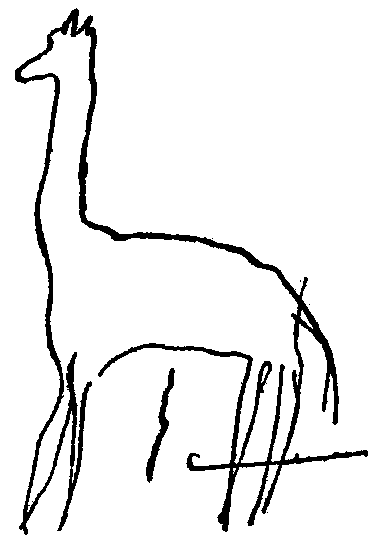
His father luckily made a note of many things 157which turned out later on to be of unexpected value. ‘I drew a giraffe for Hans, who has been to Schönbrunn several times lately. He said to me: “Draw its widdler too.” “Draw it yourself”, I answered; whereupon he added this line to my picture (see Fig. 1). He began by drawing a short stroke, and then added a bit on to it, remarking: “Its widdler’s longer.”
‘Hans and I walked past a horse that was urinating, and he said: “The horse has got its widdler underneath like me.”
‘He was watching his three-months-old sister being given a bath, and said in pitying tones: “She has got a tiny little widdler.”
‘He was given a doll to play with and undressed it. He examined it carefully and said: “Her widdler’s ever so tiny.”’
As we already know, this formula made it possible for him to go on believing in his discovery (see p. 155).
Every investigator runs the risk of falling into an occasional error. It is some consolation for him if, like little Hans in the next example, he does not err alone but can quote a common usage of language in his support. For Hans saw a monkey in his picture-book one day, and pointing to its up-curled tail, said: ‘Daddy, look at its widdler!’
His interest in widdlers led him to invent a special game of his own. ‘Leading out of the front hall there is a lavatory and also a dark storeroom for keeping wood in. For some time past Hans has been going into this wood-cupboard and saying: “I’m going to my W.C.” I once looked in to see what he was doing in the dark storeroom. He showed me his parts and said: “I’m widdling.” That is to say, he has been “playing” at W.C. That it is in the nature of a game is shown not merely by the fact that he was only pretending 158to widdle, but also by the fact that he does not go into the W.C., which would after all be far simpler, but prefers the wood-cupboard and calls it “his W.C.”’
We should be doing Hans an injustice if we were to trace only the auto-erotic features of his sexual life. His father has detailed information to give us on the subject of his love relationships with other children. From these we can discern the existence of an ‘object-choice’ just as in the case of an adult; and also, it must be confessed, a very striking degree of inconstancy and a disposition to polygamy.
‘In the winter (at the age of three and three-quarters) I took Hans to the Skating Rink and introduced him to my friend N.’s two little daughters, who were about ten years old. Hans sat down beside them, while they, in the consciousness of their mature age, looked down on the little urchin with a good deal of contempt; he gazed at them with admiration, though this proceeding made no great impression on them. In spite of this Hans always spoke of them afterwards as “my little girls”. “Where are my little girls? When are my little girls coming?” And for some weeks he kept tormenting me with the question: “When am I going to the Rink again to see my little girls?”’
A five-year-old boy cousin came to visit Hans, who had by then reached the age of four. Hans was constantly putting his arms round him, and once, as he was giving him one of these tender embraces, said: ‘I am so fond of you.’
This is the first trace of homosexuality that we have come across in him, but it will not be the last. Little Hans seems to be a positive paragon of all the vices.
‘When Hans was four years old we moved into a new flat. A door led out of the kitchen on to a balcony, from which one could see into a flat on the opposite side of the courtyard. In this flat Hans discovered a little girl of about seven or eight. He would sit on the step leading on to the balcony so as 159to admire her, and would stop there for hours on end. At four o’clock in the afternoon in particular, when the little girl came home from school, he was not to be kept in the room, and nothing could induce him to abandon his post of observation. Once, when the little girl failed to make her appearance at the window at her usual hour, Hans grew quite restless, and kept pestering the servants with questions—“When’s the little girl coming? Where’s the little girl?” and so on. When she did appear at last, he was quite blissful and never took his eyes off the flat opposite. The violence with which this “long-range love”[106] came over him is to be explained by his having no playfellows of either sex. Spending a great deal of time with other children clearly enters into a child’s normal development.
‘Hans obtained some companionship of this kind when, shortly afterwards (he was by then four and a half), we moved to Gmunden for the summer holidays. In our house there his playmates were our landlord’s children: Franzl (about twelve years old), Fritzl (eight), Olga (seven), and Berta (five). Besides these there were the neighbour’s children, Anna (ten), and two other little girls of nine and seven whose names I have forgotten. Hans’s favourite was Fritzl; he often hugged him and made protestations of his love. Once when he was asked: “Which of the girls are you fondest of?” he answered: “Fritzl!” At the same time he treated the girls in a most aggressive, masculine and arrogant way, embracing them and kissing them heartily—a process to which Berta in particular offered no objection. When Berta was coming out of the room one evening he put his arm round her neck and said in the fondest tones: “Berta, 160you are a dear!” This, by the way, did not prevent his kissing the others as well and assuring them of his love. He was fond, too, of the fourteen-year-old Mariedl—another of our landlord’s daughters—who used to play with him. One evening as he was being put to bed he said: “I want Mariedl to sleep with me.” On being told that would not do, he said: “Then she shall sleep with Mummy or with Daddy.” He was told that would not do either, but that Mariedl must sleep with her own father and mother. Upon which the following dialogue took place:
‘Hans: “Oh, then I’ll just go downstairs and sleep with Mariedl.”
‘Mother: “You really want to go away from Mummy and sleep downstairs?”
‘Hans: “Oh, I’ll come up again in the morning to have breakfast and do number one.”
‘Mother: “Well, if you really want to go away from Daddy and Mummy, then take your coat and knickers and—good-bye!”
‘Hans did in fact take his clothes and go towards the staircase, to go and sleep with Mariedl, but, it need hardly be said, he was fetched back.’
‘(Behind his wish, “I want Mariedl to sleep with us,” there lay another one: “I want Mariedl” (with whom he liked to be so much) “to become one of our family.” But Hans’s father and mother were in the habit of taking him into their bed, though only occasionally, and there can be no doubt that lying beside them had aroused erotic feelings in him; so that his wish to sleep with Mariedl had an erotic sense as well. Lying in bed with his father or mother was a source of erotic feelings in Hans just as it is in every other child.)’
In spite of his accesses of homosexuality, little Hans bore himself like a true man in the face of his mother’s challenge.
‘In the next instance, too, Hans said to his mother: “I say, I should so like to sleep with the little girl.” 161This episode has given us a great deal of entertainment, for Hans has really behaved like a grown-up person in love. For the last few days a pretty little girl of about eight has been coming to the restaurant where we have lunch. Of course Hans fell in love with her on the spot. He keeps constantly turning round in his chair to take furtive looks at her; when he has finished eating he stations himself in her vicinity so as to flirt with her, but if he finds he is being observed, he blushes scarlet. If his glances are returned by the little girl, he at once looks shamefacedly the other way. His behaviour is naturally a great joy to every one lunching at the restaurant. Every day as he is taken there he says: “Do you think the little girl will be there to-day?” And when at last she appears, he goes quite red, just as a grown-up person would in such a case. One day he came to me with a beaming face and whispered in my ear: “Daddy, I know where the little girl lives. I saw her going up the steps in such-and-such a place.” Whereas he treats the little girls at home aggressively, in this other affair he appears in the part of a platonic and languishing admirer. Perhaps this has to do with the little girls at home being village children, while the other is a young lady of refinement. As I have already mentioned, he once said he would like to sleep with her.
‘Not wanting Hans to be left in the overwrought state to which he had been brought by his passion for the little girl, I managed to make them acquainted, and invited the little girl to come and see him in the garden after he had finished his afternoon sleep. Hans was so much excited at the prospect of the little girl coming, that for the first time he could not get off to sleep in the afternoon, but tossed about restlessly on his bed. When his mother asked, “Why aren’t you asleep? Are you thinking about the little girl?” he said “Yes” with a happy look. And when he came home from the restaurant he said to every one in the house: “I say, my little girl’s coming to see me 162to-day.” The fourteen-year-old Mariedl reported that he had repeatedly kept asking her: “I say, do you think she’ll be nice to me? Do you think she’ll kiss me if I kiss her?” and so on.
‘But in the afternoon it rained, so that the visit did not come off, and Hans consoled himself with Berta and Olga.’
Other observations, also made at the time of the summer holidays, suggest that all sorts of new developments were going on in the little boy.
‘Hans, four and a quarter. This morning Hans was given his usual daily bath by his mother and afterwards dried and powdered. As his mother was powdering round his penis and taking care not to touch it, Hans said: “Why don’t you put your finger there?”
‘Mother: “Because that’d be piggish.”
‘Hans: “What’s that? Piggish? Why?”
‘Mother: “Because it’s not proper.”
‘Hans (laughing): “But it’s great fun.”’[107]
At about the same period Hans had a dream which was in striking contrast with the boldness he had shown towards his mother. It was the first dream of his that was made unrecognizable by distortion. His father’s penetration, however, succeeded in clearing it up.
‘Hans, four and a quarter. Dream. This morning Hans woke up and said: “I say, last night I thought: Some one said: ‘Who wants to come to me?’ Then some one said: ‘I do.’ Then he had to make him widdle.”
‘Further questions made it clear that there was no visual content whatever in this dream, and that it was of the purely auditory type. During the last few 163days Hans has been playing parlour games and forfeits with our landlord’s children, amongst whom are his friends Olga (aged seven) and Berta (aged five). (The game of forfeits is played in this way: A: “Whose is this forfeit in my hand?” B: “Mine.” Then it is decided what B must do.) The dream is modelled upon this game; only Hans wishes that the person to whom the forfeit belonged shall be condemned, not to give the usual kiss or be given the usual box on the ear, but to widdle, or rather to make some one else widdle.
‘I got him to tell me the dream again. He told it in the same words, except that instead of “then some one said” this time he said “then she said”. This “she” is obviously Berta or Olga, one of the girls he had been playing with. Translated, the dream runs as follows: “I was playing forfeits with the little girls. I asked: ‘Who wants to come to me?’ She (Berta or Olga) replied: ‘I do.’ Then she had to make me widdle.” (That is, she had to assist him in urinating, which is evidently agreeable for Hans.)
‘It is clear that being made to widdle—having his knickers unbuttoned and his penis taken out—is a pleasurable process for Hans. On walks it is mostly his father who assists Hans in this way; and this gives the child an opportunity for the fixation of homosexual inclinations upon him.
‘Two days ago, as I have already reported, while his mother was washing and powdering his genital region, he asked her: “Why don’t you put your finger there?” Yesterday, when I was helping Hans to do number one, he asked me for the first time to take him to the back of the house so that no one should see him. He added: “Last year when I widdled, Berta and Olga watched me.” This meant, I think, that last year he had enjoyed being watched by the girls, but that this was no longer so. His exhibitionism has now succumbed to repression. The fact that the wish that Berta and Olga should watch him widdling (or make him widdle) is now repressed in 164real life is the explanation of its appearance in the dream, where it was prettily disguised under the game of forfeits.—I have repeatedly observed since then that he does not like to be seen widdling.’
I will only add that this dream obeys the rule I have given in Traumdeutung[108] to the effect that speeches occurring in dreams are derived from speeches heard or spoken by the dreamer during the preceding days.
Hans’s father has noted down one other observation, dating from the period immediately after their return to Vienna: ‘Hans (aged four and a half) was again watching his little sister being given her bath, when he began laughing. On being asked why he was laughing, he replied: “I’m laughing at Hanna’s widdler.” “Why?” “Because her widdler’s so lovely.”
‘Of course his answer was a disingenuous one. In reality her widdler had seemed to him funny. Moreover, this is the first time he has recognized in this way the distinction between male and female genitals instead of denying it.’
‘My dear Professor, I am sending you a little more about Hans—but this time, I am sorry to say, material for a case history. As you will see, during the last few days he has developed a nervous disorder, which has made my wife and me most uneasy, because we have not been able to find any means of dissipating it. I shall venture to call upon you to-morrow, … but in the meantime… I enclose a written record of the material available.
‘No doubt the ground was prepared by sexual over-excitation due to his mother’s tenderness; but I am not able to specify the actual exciting cause. He is afraid that a horse will bite him in the street, and this fear seems somehow to be connected with his having been frightened by a large penis. As you know from a former report, he had noticed at a very early age what large penises horses have, and at that time he inferred that as his mother was so large she must have a widdler like a horse.
‘I cannot see what to make of it. Has he seen an exhibitionist somewhere? Or is the whole thing simply connected with his mother? It is not very pleasant for us that he should begin setting us problems so early. Apart from his being afraid of going into the street and from his being depressed in the evening, he is in other respects the same Hans, as bright and cheerful as ever.’
We will not follow Hans’s father either in his easily comprehensible anxieties or in his first attempts at finding an explanation; we will begin by examining the material before us. It is not in the least our 166business to ‘understand’ a case at once; this is only possible at a later stage, when we have received enough impressions of it. For the present we will suspend our judgement and give our impartial attention to everything that there is to observe.
The earliest accounts, dating from the first days in January of the present year (1908), run as follows:
‘Hans (aged four and three-quarters) woke up one morning in tears. Asked why he was crying, he said to his mother: “When I was asleep I thought you were gone and I had no Mummy to coax with.”[109]
‘An anxiety dream, therefore.
‘I had already noticed something similar at Gmunden in the summer. When he was in bed in the evening he was usually in a very sentimental state. Once he made a remark to this effect: “Suppose I was to have no Mummy”, or “Suppose you were to go away”, or something of the sort; I cannot remember the exact words. Unfortunately, when he got into an elegiac mood of that kind, his mother used always to take him into bed with her.
‘On about January 5th he came into his mother’s bed in the morning, and said: “Do you know what Aunt M. said? She said: ‘He has got a dear little thingummy.’”[110] (Aunt M. was stopping with us four weeks ago. Once while she was watching my wife giving the boy a bath she did in fact say these words to her in a low voice. Hans had overheard them and was now trying to put them to his own uses.)
‘On January 7th he went to the Stadtpark[111] with his nursemaid as usual. In the street he began to cry and asked to be taken home, saying that he wanted to “coax” with his Mummy. At home he was asked why he had refused to go any farther and had cried, 167but he would not say. Till the evening he was cheerful, as usual. But in the evening he grew visibly frightened; he cried and could not be separated from his mother, and wanted to “coax” with her again. Then he grew cheerful again, and slept well.
‘On January 8th my wife decided to go out with him herself, so as to see what was wrong with him. They went to Schönbrunn, where he always likes going. Again he began to cry, did not want to start, and was frightened. In the end he did go; but was visibly frightened in the street. On the way back from Schönbrunn he said to his mother, after much internal struggling: “I was afraid a horse would bite me.” (He had, in fact, become uneasy at Schönbrunn when he saw a horse.) In the evening he seems to have had another attack similar to that of the previous evening, and to have wanted to be “coaxed” with. He was calmed down. He said, crying: “I know I shall have to go for a walk again to-morrow.” And later: “The horse’ll come into the room.”
‘On the same day his mother asked: “Do you put your hand to your widdler?” and he answered: “Yes. Every evening, when I’m in bed.” The next day, January 9th, he was warned, before his afternoon sleep, not to put his hand to his widdler. When he woke up he was asked about it, and said he had put it there for a short while all the same.’
Here, then, we have the beginning of Hans’s morbid anxiety as well as of his phobia. As we see, there is good reason for keeping the two separate. Moreover, the material seems to be amply sufficient for giving us our bearings; and no moment of time is so favourable for the understanding of a case as its initial stage, such as we have here, though unluckily that stage is as a rule neglected or passed over in silence. The disorder set in with thoughts that were at the same time fearful and sentimental, and then followed an anxiety dream on the subject of losing his mother and so not being able to coax with her any more. His affection for his 168mother must therefore have become enormously intensified. This was the fundamental phenomenon in his condition. In support of this, we may recall his two attempts at seducing his mother, the first of which dated back to the summer, while the second (a simple commendation of his penis) occurred immediately before the outbreak of his street-phobia. It was this increased affection for his mother which turned suddenly into anxiety—which, as we should say, succumbed to repression. We do not yet know from what quarter the impetus towards repression may have come. Perhaps it was merely the result of the intensity of the child’s emotions, which had become greater than it could control; or perhaps other forces which we have not yet recognized were also at work. This we shall learn as we go on. Hans’s anxiety, which thus corresponded to a repressed erotic longing, was, like every infantile anxiety, without an object to begin with: it was still anxiety and not yet fear. The child cannot tell what it is afraid of; and when Hans, on the first walk with the nursemaid, would not say what he was afraid of, it was simply that he himself did not yet know. He said all that he knew, which was that in the street he missed his mother, whom he could coax with, and that he did not want to be away from her. In saying this he quite straightforwardly confessed the primary meaning of his dislike of streets.
Then again, there were the states into which he fell on two consecutive evenings before going to sleep, and which were characterized by anxiety mingled with clear traces of tenderness. These states show that at the beginning of his illness there was as yet no phobia whatever present, whether of streets or of walking or even of horses. If there had been, his evening states would be inexplicable; for who bothers at bedtime about streets and walking? On the other hand it becomes quite clear why he was so fearful in the evening, if we suppose that at bedtime he was overwhelmed by an intensification of his libido—for 169its object was his mother, and its aim may perhaps have been to sleep with her. He had besides learnt from his experience that at Gmunden his mother could be prevailed upon, when he got into such moods, to take him into her bed, and he wanted to gain the same ends here in Vienna. Nor must we forget that for part of the time at Gmunden he had been alone with his mother, as his father had not been able to spend the whole of the holidays there; and further, that in the country his affections had been divided among a number of playmates and friends of both sexes, while in Vienna he had none, so that his libido was in a position to return undivided to his mother.
His morbid anxiety, then, corresponded to repressed longing. But it was not the same thing as the longing: the repression must be taken into account too. Longing can be completely transformed into satisfaction if it is presented with the object longed for. Therapy of that kind is no longer effective in dealing with anxiety. The anxiety remains even when the longing can be satisfied. It can no longer be completely retransformed into libido; there is something that keeps the libido back under repression.[112] This was shown to be so in the case of Hans on the occasion of his next walk, when his mother went with him. He was with his mother, and yet he still suffered from anxiety—that is to say, from an unsatisfied longing for her. It is true that the anxiety was less; for he did allow himself to be induced to go for the walk, whereas he had obliged the nursemaid to turn back. Nor is a street quite the right place for ‘coaxing’, or whatever else this young lover may have wanted. But his anxiety had stood the test; and the next thing for it to do was to find an object. It was on this walk that he first expressed a fear that a horse would bite him. 170Where did the material for this phobia come from? Probably from the complexes, as yet unknown to us, which had contributed to the repression and were keeping under repression his libidinal feelings towards his mother. That is an unsolved problem, and we shall now have to follow the development of the case in order to arrive at its solution. Hans’s father has already given us certain clues, probably trustworthy ones, such as that Hans had always observed horses with interest on account of their large widdlers, that he had supposed that his mother must have a widdler like a horse, and so on. We might thus be led to think that the horse was merely a substitute for his mother. But if so, what would be the meaning of his being afraid in the evening that a horse would come into the room? A small boy’s foolish fears, it will be said. But a neurosis never says foolish things, any more than a dream. When we cannot understand something, we always fall back on abuse. An excellent way of making a task lighter.
There is another point in regard to which we must avoid giving way to this temptation. Hans admitted that every night before going to sleep he amused himself with playing with his penis. ‘Ah!’ the family doctor will be inclined to say, ‘now we have it. The child masturbated: hence its pathological anxiety.’ But gently. That the child was getting pleasure for itself by masturbating does not by any means explain its anxiety; on the contrary, it makes it more problematical than ever. States of anxiety are not produced by masturbation or by getting satisfaction in any shape. Moreover, we may presume that Hans, who was now four and three-quarters, had been indulging in this pleasure every evening for at least a year (see p. 151). And we shall find that at this moment he was actually engaged in a struggle to break himself of the habit—a state of things which fits in much better with repression and anxiety-formation.
We must say a word, too, on behalf of Hans’s 171excellent and devoted mother. His father accuses her, not without some show of justice, of being responsible for the outbreak of the child’s neurosis, on account of her excessive display of affection for him and her too frequent readiness to take him into her bed. We might as easily blame her for having precipitated the process of repression by her energetic rejection of his advances (‘that’d be piggish’). But she had a predestined part to play, and her position was a hard one.
I arranged with Hans’s father that he should tell the boy that all this business about horses was a piece of nonsense and nothing more. The truth was, his father was to say, that he was very fond of his mother and wanted to be taken into her bed. The reason he was afraid of horses now was that he had taken so much interest in their widdlers. He himself had noticed that it was not right to be so very much preoccupied with widdlers, even with his own, and he was quite right in thinking this. I further suggested to his father that he should begin giving Hans some enlightenment in the matter of sex knowledge. The child’s past behaviour justified us in assuming that his libido was attached to a wish to see his mother’s widdler; so I proposed to his father that he should take away this aim from Hans by informing him that his mother and all other female beings (as he could see from Hanna) had no widdler at all. This last piece of enlightenment was to be given him on a suitable occasion when it had been led up to by some question or some chance remark on Hans’s part.
The next batch of news about Hans covers the period from March 1st to March 17th. The interval of more than a month will be accounted for directly.
‘After Hans had been enlightened,[113] there followed 172a fairly quiet period, during which he could be induced without any particular difficulty to go for his daily walk in the Stadtpark. His fear of horses became transformed more and more into an obsession for looking at them. He said: “I have to look at horses, and then I’m frightened.”
‘After an attack of influenza, which kept him in bed for two weeks, his phobia increased again so much that he could not be induced to go out, or at most on to the balcony. Every Sunday he went with me to Lainz,[114] because on that day there is not much traffic in the streets, and it is only a short way to the station. On that occasion in Lainz he refused to go for a walk outside the garden because there was a carriage standing in front of it. After another week which he has had to spend indoors because he has had his tonsils cut, the phobia has grown very much worse again. He goes out on to the balcony, it is true, but not for a walk. As soon as he gets to the street door he hurriedly turns round.
‘On Sunday, March 1st, the following conversation took place on the way to the station. I was once more trying to explain to him that horses do not bite. He: “But white horses bite. There’s a white horse at Gmunden that bites. If you hold your finger to it it bites.” (I was struck by his saying “finger” instead of “hand”.) He then told me the following story, which I give here in a connected form: “When Lizzi had to go away, there was a cart with a white horse in front of her house, to take her luggage to the station.” (Lizzi, he tells me, was a little girl who lived in a neighbouring house.) “Her father was standing near the horse, and the horse turned its head round (to touch him), and he said to Lizzi: ‘Don’t put your finger to the white horse or it’ll bite you.’” Upon this I said: “I say, it strikes me that it isn’t a horse you mean, but a widdler, that one mustn’t put one’s hand to.”173
‘He: “But a widdler doesn’t bite.”
‘I: “Perhaps it does, though.” He then went on eagerly to try and prove to me that it really was a white horse.[115]
‘On March 2nd, as he again showed signs of being afraid, I said to him: “Do you know what? This nonsense of yours” (that is how he speaks of his phobia) “will get better if you go for more walks. It’s so bad now because you haven’t been able to go out because you were ill.”
‘He: “Oh no, it’s so bad because I still put my hand to my widdler every night.”’
Doctor and patient, father and son, were therefore at one in ascribing the chief share in the pathogenesis of Hans’s present condition to his habit of onanism. Signs were not wanting, however, of the presence of other significant factors.
‘On March 3rd we got in a new maid, whom he is particularly pleased with. She lets him ride on her back while she cleans the floor, and so he always calls her “my horse”, and holds on to her dress with cries of “Gee-up”. On about March 10th he said to this new nursemaid: “If you do such-and-such a thing you’ll have to undress altogether, and take off your chemise even.”’ (He meant this as a punishment, but it is easy to recognize the wish behind it.)
‘She: “And what’d be the harm? I’d just say to myself I haven’t got any money to spend on clothes.”
‘He: “Why, it’d be shameful. People’d see your widdler.”’
Here we have the same curiosity again, but directed on to a new object, and (appropriately to a time of repression) cloaked under a moralizing purpose.
‘On March 13th in the morning I said to Hans: “You know, if you don’t put your hand to your 174widdler any more, this nonsense of yours’ll soon get better.”
‘Hans: “But I don’t put my hand to my widdler any more.”
‘I: “But you still want to.”
‘Hans: “Yes, I do. But wanting’s not doing, and doing’s not wanting.” (!!)
‘I: “Well, but to prevent your wanting to, this evening you’re going to have a sack to sleep in.”
‘After this we went out in front of the house. Hans was still afraid, but his spirits were visibly raised by the prospect of having his struggles made easier for him, and he said: “Oh, if I have a sack to sleep in my nonsense’ll have gone to-morrow.” And, in fact, he was much less afraid of horses, and was fairly calm when vehicles drove past.
‘Hans had promised to go with me to Lainz the next Sunday, March 15th. He resisted at first, but finally went with me all the same. He obviously felt all right in the street, as there was not much traffic, and said: “How sensible! God’s done away with horses now.” On the way I explained to him that his sister has not got a widdler like him. Little girls and women, I said, have no widdlers: Mummy has none, Anna has none, and so on.
‘Hans: “Have you got a widdler?”
‘I: “Of course. Why, what do you suppose?”
‘Hans (after a pause): “But how do little girls widdle, if they have no widdlers?”
‘I: “They don’t have widdlers like yours. Haven’t you noticed already, when Hanna was being given her bath?”
‘All day long he was in very high spirits, went tobogganing, and so on. It was only towards evening that he became depressed again and seemed to be afraid of horses.
‘That evening the nervous attack and the need for being coaxed with was less pronounced than on former days. Next day his mother took him with her into 175town and he was very much frightened in the streets. The day after, he stopped at home and was very cheerful. Next morning he woke up in a fright at about six o’clock. When he was asked what was the matter he said: “I put my finger to my widdler just a very little. I saw Mummy quite naked in her chemise, and she let me see her widdler. I showed Grete,[116] my Grete, what Mamma was doing, and showed her my widdler. Then I took my hand away from my widdler quick.” When I objected that he could only mean “in her chemise” or “quite naked”, Hans said: “She was in her chemise, but the chemise was so short that I saw her widdler.”
This was none of it a dream, but an onanistic phantasy, which was, however, equivalent to a dream. What he made his mother do was evidently intended as a piece of self-justification: ‘If Mummy shows her widdler, I may too.’
We can gather two things from this phantasy: first, that his mother’s reproof had exercised a powerful effect upon him at the time it was made, and secondly, that the enlightenment he had been given to the effect that women have no widdlers was not accepted by him at first. He regretted that it should be so, and stuck to his former view in his phantasy. He may also perhaps have had his reasons for refusing to believe his father at first.
Weekly Report from Hans’s Father: ‘My dear Professor, I enclose the continuation of Hans’s story—quite an interesting instalment. I shall perhaps take the liberty of calling upon you during your consulting hours on Monday and if possible of bringing Hans with me—assuming that he will come. I said to him to-day: “Will you come with me on Monday to see 176the Professor, who can take away your nonsense for you?”
‘He: “No.”
‘I: “But he’s got a very pretty little girl.”—Upon which he willingly and gladly consented.
‘Sunday, March 22nd. With a view to extending the Sunday programme, I proposed to Hans that we should go first to Schönbrunn, and only go on from there to Lainz at midday. He had, therefore, to make his way not only from our house to the Hauptzollamt station on the Stadtbahn,[117] but also from the Hietzing station to Schönbrunn, and again from there to the Hietzing steam tramway station. And he managed all this, looking hurriedly away whenever any horses came along, for he was evidently feeling nervous. In looking away he was following a piece of advice given him by his mother.
‘At Schönbrunn he showed signs of fear at animals which on other occasions he had looked at without any alarm. Thus he absolutely refused to go into the house in which the giraffe is kept, nor would he visit the elephant, which used formerly to amuse him a great deal. He was afraid of all the large animals, whereas he was very much entertained by the small ones. Among the birds, he was also afraid of the pelican this time—which had never happened before—evidently because of its size again.
‘I therefore said to him: “Do you know why you’re afraid of big animals? Big animals have big widdlers, and you’re really afraid of big widdlers.”
‘Hans: “But I’ve never seen the big animals’ widdlers yet.”[118]
‘I: “But you have seen a horse’s, and a horse is a big animal.”177
‘Hans: “Oh, a horse’s often. Once at Gmunden when the cart was standing at the door, and once in front of the Head Customs House.”
‘I: “When you were small, you most likely went into a stable at Gmunden…”
‘Hans (interrupting): “Yes, I went into the stable every day at Gmunden when the horses had come home.”
‘I: “…and you were most likely frightened when you saw the horse’s big widdler one time. But there’s no need for you to be frightened of it. Big animals have big widdlers, and little animals have little widdlers.”
‘Hans: “And every one has a widdler. And my widdler will get bigger as I get bigger, because it does grow on to me.”
‘Here the talk came to an end. During the next few days it seemed as though his fears had again somewhat increased. He hardly ventured out of the front door, to which he was taken after luncheon.’
Hans’s last words of comfort throw a light upon the situation and allow us to make some small corrections in his father’s assertions. It is true that he was afraid of big animals because he was obliged to think of their big widdlers; but it cannot really be said that he was afraid of big widdlers themselves. Formerly the idea of them had been decidedly pleasurable to him, and he used to make every effort to get a glimpse of one. Since that time this enjoyment had been spoiled for him, owing to the general reversal of pleasure into pain which had come over the whole of his sexual inquiries—in a way which has not yet been explained—and also owing to something which is clearer to us, namely, to certain experiences and reflections which had led to painful conclusions. We may conclude from his self-consolatory words (‘my widdler will get bigger as I get bigger’) that during his observations he had constantly been making comparisons, and that he had remained extremely dissatisfied with the size of his 178own widdler. Big animals reminded him of this defect, and were for that reason disagreeable to him. But since the whole train of thought was probably incapable of becoming clearly conscious, this painful feeling, too, was turned into morbid anxiety, so that his present anxiety was erected both upon his former pleasure and his present pain. When once a state of anxiety establishes itself, the anxiety swallows up all other feelings; with the progress of repression, and the more those ideas which are charged with affect and which have been conscious move down into the unconscious, all affects are capable of being changed into anxiety.
Hans’s singular remark, ‘because it does grow on to me’, makes it possible to guess many things in connection with his consolatory speech which he could not express in words and did not express during the course of the analysis. I shall bridge the gap for a little distance by means of my experiences in the analyses of grown-up people; but I hope the interpolation will not be considered arbitrary or capricious. ‘It does grow on to me’: if the motives of the thought were solace and defiance, we are reminded of his mother’s old threat that she should have his widdler cut off if he went on playing with it. At the time it was made, when he was three and a half, this threat had no effect. He calmly replied that then he should widdle with his bottom. It would be the most completely typical procedure if the threat of castration were to have a deferred effect, and if he were now, a year and a quarter later, oppressed by the fear of having to lose this precious piece of his ego. In other cases of illness we can observe a similar deferred operation of commands and threats made in childhood, where the interval covers as many decades or more. I even know cases in which a ‘deferred obedience’ on the part of the repression has had a principal share in determining the symptoms of the disease.
The piece of enlightenment which Hans had been 179given a short time before to the effect that women really do not possess a widdler was bound to have had a shattering effect upon his self-confidence and to have aroused his castration complex. For this reason he resisted the information, and for this reason it had no therapeutic results. Could it be that living beings really did exist which did not possess widdlers? If so, it would no longer be so incredible that they could take his own widdler away, and, as it were, make him into a woman![119]
‘During the night of 27th-28th Hans surprised us by getting out of bed while it was quite dark and coming into our bed. His room is separated from our bedroom by another small room. We asked him why: whether he had been afraid, perhaps. “No,” he said; “I’ll tell you to-morrow.” He went to sleep in our bed and was then carried back to his own.
‘Next day I questioned him closely to discover why he had come in to us during the night; and after some reluctance the following dialogue took place, which I immediately took down in shorthand:
‘He: “In the night there was a big giraffe in the room and a crumpled one; and the big one called out because I took the crumpled one away from it. Then it stopped calling out; and then I sat down on the top of the crumpled one.”180
‘I (puzzled): “What? A crumpled giraffe? How was that?”
‘He: “Yes.” (He quickly fetched a piece of paper, crumpled it up, and said:) “It was crumpled like that.”
‘I: “And you sat down on the top of the crumpled giraffe? How?”
‘He again showed me, by sitting down on the ground.
‘I: “Why did you come into our room?”
‘He: “I don’t know myself.”
‘I: “Were you afraid?”
‘He: “No. Of course not.”
‘I: “Did you dream about the giraffe?”
‘He: “No. I didn’t dream. I thought it. I thought it all. I’d woken up earlier.”
‘I: “What can it mean: a crumpled giraffe? You know you can’t squash a giraffe together like a piece of paper.”
‘He: “Of course I know. I just thought it. Of course there aren’t any really and truly.[120] The crumpled one was all lying on the floor, and I took it away—took hold of it with my hands.”
‘I: “What? Can you take hold of a big giraffe like that with your hands?”
‘He: “I took hold of the crumpled one with my hand.”
‘I: “Where was the big one in the meantime?”
‘He: “The big one just stood farther off.”
‘I: “What did you do with the crumpled one?”
‘He: “I held it in my hand for a bit, till the big one had stopped calling out. And when the big one had stopped calling out, I sat down on top of it.”
‘I: “Why did the big one call out?”
‘He: “Because I’d taken away the little one from it.” (He noticed that I was taking everything down, and asked:) “Why are you writing that down?”181
‘I: “Because I shall send it to a Professor, who can take away your ‘nonsense’ for you.”
‘He: “Oho! So you’ve written down as well that Mummy took off her chemise, and you’ll give that to the Professor too.”
‘I: “Yes. But he won’t understand how you can think that a giraffe can be crumpled up.”
‘He: “Just tell him I don’t know myself, and then he won’t ask. But if he asks what the crumpled giraffe is, then he can write to us, and we can write back, or let’s write at once that I don’t know myself.”
‘I: “But why did you come in in the night?”
‘He: “I don’t know.”
‘I: “Just tell me quickly what you’re thinking of.”
| ‘He (jokingly): “Of raspberry syrup.” |
His wishes.
|
| ‘I: “What else?” | |
| ‘He: “A gun for shooting people dead with.”[121] |
‘I: “You’re sure you didn’t dream it?”
‘He: “Quite sure; no, I’m quite certain of it.”
‘He proceeded: “Mummy begged me so long to tell her why I came in in the night. But I didn’t want to say, because I felt ashamed with Mummy at first.”
‘I: “Why?”
‘He: “I didn’t know.”
‘My wife had in fact examined him all the morning, till he had told her the giraffe story.’
That same day his father discovered the solution of the giraffe phantasy.
‘The big giraffe is myself, or rather my big penis (the long neck), and the crumpled giraffe is my wife, or rather her genital organ. It is therefore the result of the enlightenment he has had.
‘Giraffe: see the expedition to Schönbrunn. More182over, he has a picture of a giraffe and an elephant hanging over his bed.
‘The whole thing is a reproduction of a scene which has been gone through almost every morning for the last few days. Hans always comes in to us in the early morning, and my wife cannot resist taking him into bed with her for a few minutes. Thereupon I always begin to warn her not to take him in bed with her (“the big one called out because I’d taken the crumpled one away from it”); and she answers now and then, rather irritated, no doubt, that it’s all nonsense, that one minute is after all of no importance, and so on. Then Hans stays with her a little while. (“Then the big giraffe stopped calling out; and then I sat down on top of the crumpled one.”)
‘Thus the solution of this matrimonial scene transposed into giraffe life is this: he was seized in the night with a longing for his mother, for her caresses, for her genital organ, and came into our bedroom for that reason. The whole thing is a continuation of his fear of horses.’
I have only this to add to his father’s penetrating interpretation. The ‘sitting down on top of’ was probably Hans’s representation of taking possession.[122] But the whole thing was a phantasy of defiance connected with his satisfaction at the triumph over his father’s resistance. ‘Call out as much as you like! but Mummy takes me into bed all the same, and Mummy belongs to me!’ It is therefore justifiable, as his father suspected, to divine behind the phantasy a fear that his mother did not like him, because his widdler was not comparable to his father’s.
Next morning his father was able to get his interpretation confirmed.
‘On Sunday, March 29th, I went with Hans to Lainz. I jokingly took leave of my wife at the door 183with the words: “Good-bye, big giraffe!” “Why giraffe?” asked Hans. “Mummy’s the big giraffe,” I replied; to which Hans rejoined: “Oh yes! And Hanna’s the crumpled giraffe, isn’t she?”
‘In the train I explained the giraffe phantasy to him, upon which he said: “Yes, that’s right.” And when I said to him that I was the big giraffe, and that its long neck had reminded him of a widdler, he said: “Mummy has a neck like a giraffe, too. I saw, when she was washing her white neck.”[123]
‘On Monday, March 30th, in the morning, Hans came to me and said: “I say! I thought two things this morning!” “What was the first?” “I was with you at Schönbrunn where the sheep are; and then we crawled through under the ropes, and then we told the policeman at the end of the garden, and he grabbed hold of us.” He had forgotten the second thing.
‘I add the following remark upon this. When we wanted to visit the sheep on Sunday, we found that a space in the gardens was shut off by a rope, so that we were unable to get to them. Hans was very much astonished that the space should be shut off only with a rope, which it would be quite easy to slip under. I told him that respectable people didn’t crawl under the rope. He said it would be quite easy; whereupon I replied that a policeman might come along and take one off. There is a life-guardsman on duty at the entrance of Schönbrunn; and I once told Hans that he arrested naughty children.
‘After we returned from our visit to you, which took place the same day, Hans confessed to yet another little bit of craving to do something forbidden: “I say, I thought something this morning again.” “What?” “I went with you in the train, and we smashed a window, and the policeman took us off with him.”’184
A most suitable continuation of the giraffe phantasy. He had a suspicion that to take possession of his mother was forbidden; he had come up against the incest-barrier. But he regarded it as forbidden in itself. His father was with him each time in the forbidden exploits which he carried out in his imagination, and was locked up with him. His father, he thought, also did that enigmatic forbidden something with his mother which he replaced by an act of violence such as smashing a window-pane or forcing a way into an enclosed space.
That afternoon the father and son visited me during my consulting hours. I already knew the queer little chap, and with all his self-assurance he was yet so amiable that I had always been glad to see him. I do not know whether he remembered me, but he behaved irreproachably and like a perfectly reasonable member of human society. The consultation was a short one. His father opened it by remarking that, in spite of all the pieces of enlightenment we had given Hans, his fear of horses had not yet diminished. We were also forced to confess that the connections between the horses he was afraid of and the affectionate feelings towards his mother which had been revealed were by no means abundant. Certain details which I now learnt—to the effect that he was particularly bothered by what horses wear in front of their eyes and by the black round their mouths—were certainly not to be explained from what we knew. But as I saw the two of them sitting in front of me and at the same time heard Hans’s description of his anxiety-horses, a further piece of the solution shot through my mind, and a piece which I could well understand might escape his father. I asked Hans jokingly whether his horses wore eyeglasses, to which he replied that they did not. I then asked him whether his father wore eyeglasses, to which, against all the evidence, he once more said no. Finally I asked him whether by ‘the black round the mouth’ he meant a moustache; and I then dis185closed to him that he was afraid of his father, precisely because he was so fond of his mother. It must be, I told him, that he thought his father was angry with him on that account; but this was not so, his father was fond of him in spite of it, and he might admit everything to him without any fear. Long before he was in the world, I went on, I had known that a little Hans would come who would be so fond of his mother that he would be bound to feel afraid of his father because of it; and I had told his father this. ‘But why do you think I’m angry with you?’ his father interrupted me at this point; ‘have I ever scolded you or hit you?’ Hans corrected him: ‘Oh yes! You have hit me.’ ‘That’s not true. When was it, anyhow?’ ‘This morning,’ answered the little boy; and his father recollected that Hans had quite unexpectedly butted his head into his stomach, so that he had given him as it were a reflex blow with his hand. It was remarkable that he had not brought this detail into connection with the neurosis; but he now recognized it as an expression of the little boy’s hostile disposition towards him, and perhaps also as a manifestation of a need for getting punished for it.[124]
‘Does the Professor talk to God,’ Hans asked his father on the way home, ‘as he can tell all that beforehand?’ I should be extraordinarily proud of this recognition out of the mouth of a child, if I had not myself provoked it by my joking boastfulness. From the date of this consultation I received almost daily reports of the alterations in the little patient’s condition. It was not to be expected that he should be freed from his anxiety at a single blow by the information I gave him; but it became apparent that a possibility had now been offered him of bringing forward his unconscious productions and of unfolding his phobia. From that time forward he carried out a 186programme which I was able to announce to his father in advance.
‘April 2nd. The first real improvement is to be noted. While formerly he could never be induced to go out of the street-door for very long, and always ran back into the house with every sign of fright if horses came along, this time he stayed in front of the street-door for an hour—even while carts were driving past, which happens fairly often in our street. Every now and then he ran into the house when he saw a cart approaching in the distance, but he turned round at once as though he were changing his mind. In any case there is only a trace of the anxiety left, and the progress since his enlightenment is unmistakable.
‘In the evening he said: “We get as far as the street-door now, so we’ll go into the Stadtpark too.”
‘On April 3rd, in the morning he came into bed with me, whereas for the last few days he had not been coming any more and had even seemed to be proud of not doing so. “And why have you come to-day?” I asked.
‘Hans: “When I’m not frightened I shan’t come any more.”
‘I: “So you come in to me because you’re frightened?”
‘Hans: “When I’m not with you I’m frightened; when I’m not in bed with you, then I’m frightened. When I’m not frightened any more I shan’t come any more.”
‘I: “So you’re fond of me and you feel anxious when you’re in your bed in the morning? and that’s why you come in to me?”
‘Hans: “Yes. Why did you tell me I’m fond of Mummy and that’s why I’m frightened, when I’m fond of you?”’
Here the little boy was displaying a really unusual degree of clarity. He was bringing to notice the fact that his love for his father was wrestling with his hostility towards him in his capacity of rival with his 187mother; and he was reproaching his father with not having yet drawn his attention to this interplay of forces, which was bound to end in anxiety. His father did not entirely understand him as yet, for during this conversation he only succeeded in convincing himself of the little boy’s hostility towards him, the existence of which I had asserted during our consultation. The following dialogue, which I nevertheless give without alteration, is really of more importance in connection with the progress of the father’s enlightenment than with the little patient.
‘Unfortunately I did not immediately grasp the meaning of this reproach. Because Hans is fond of his mother he evidently wants to get me out of the way, and he would then be in his father’s place. This suppressed hostile wish is turned into anxiety about his father, and he comes in to me in the morning to see if I have gone away. Unfortunately at the moment I did not understand this, and said to him:
‘“When you’re alone, you’re just anxious for me and come in to me.”
‘Hans: “When you’re away, I’m afraid you’re not coming home.”
‘I: “And have I ever threatened you that I shan’t come home?”
‘Hans: “Not you, but Mummy. Mummy’s told me she won’t come back.” (He had probably been naughty, and she had threatened to go away.)
‘I: “She said that because you were naughty.”
‘Hans: “Yes.”
‘I: “So you’re afraid I’m going away because you were naughty; that’s why you come in to me.”
‘When I got up from table after breakfast Hans said: “Daddy, don’t trot away from me!” I was struck by his saying “trot” instead of “run”, and replied: “Oho! So you’re afraid of the horse trotting away from you.” Upon which he laughed.’
We know that this part of Hans’s morbid anxiety had two constituents: there was fear of his father and 188fear for his father. The former was derived from his hostility towards his father, and the latter from the conflict between his affection, which was exaggerated at this point by way of compensation, and his hostility.
His father proceeds: ‘This is no doubt the beginning of an important phase. His motive for at the most just venturing outside the house but not going away from it, and for turning round at the first attack of anxiety when he is half-way, is his fear of not finding his parents at home because they have gone away. He sticks to the house from love of his mother, and he is afraid of my going away because of the hostile wishes that he nourishes against me—for then he would be the father.
‘In the summer I used to be constantly leaving Gmunden for Vienna on business, and he was then the father. You will remember that his fear of horses is connected with the episode at Gmunden when a horse was to take Lizzi’s luggage to the station. The repressed wish that I should drive to the station, for then he would be alone with his mother (the wish that “the horse should drive off”), is turned into fear of the horse’s driving off; and in fact nothing throws him into greater alarm than when a cart drives off from the courtyard of the Head Customs House (which is just opposite our flat) and the horses start moving.
‘This new phase (hostile sentiments towards his father) could only come out after he knew that I was not angry because he was so fond of his mother.
‘In the afternoon I went out in front of the street-door with him again; he again went out in front of the house, and stayed there even when carts went past. In the case of a few carts only he was afraid, and ran into the entrance-hall. He also said to me in explanation: “Not all white horses bite.” That is to say: owing to the analysis some white horses have already been recognized as “Daddy”, and they no longer bite; but there are others still left over which do bite.
‘The position of our street-door is as follows: 189Opposite it is the warehouse of the Office for the Taxation of Food-Stuffs, with a loading dock at which carts are driving up all day long to fetch away boxes, packing-cases, etc. This courtyard is cut off from the street by railings; and the entrance gates to the courtyard are opposite our house (Fig. 2).
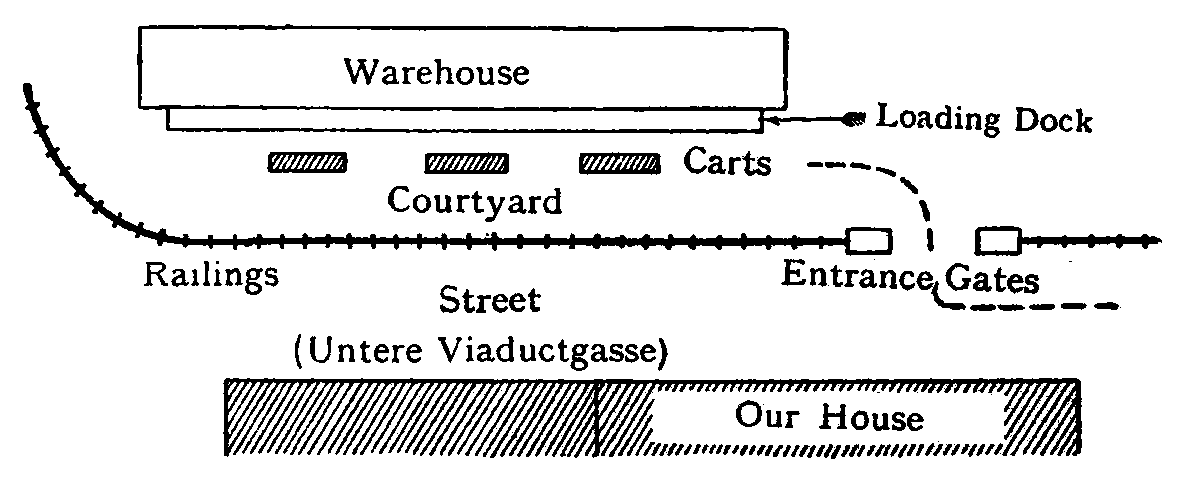
I have noticed for some days that Hans is specially frightened when carts drive into or out of the yard, a process which involves their taking a corner. I asked at the time why he was so much afraid, and he replied: “I’m afraid the horses will fall down when the cart turns (A).” He is equally frightened when carts standing at the loading dock start moving in order to drive off (B). Further (C), he is more frightened of large dray-horses than of small horses, and of rough farm-horses than of smart horses (such as those in a carriage and pair). He is also more frightened when a vehicle drives past quickly (D) than when the horses trot up slowly. These differentiations have, of course, only come to light clearly during the last few days.’
I should be inclined to say that, in consequence of the analysis, not only the patient but his phobia too had plucked up courage and was venturing to show itself.
‘On April 5th Hans came in to our bedroom again, and was sent back to his own bed. I said to him: “As long as you come into our room in the 190mornings, your fear of horses won’t get better.” He was defiant, however, and replied: “I shall come in all the same, even if I am afraid.” So he will not let himself be forbidden to visit his mother.
‘After breakfast we were to go downstairs. Hans was delighted, and planned that, instead of stopping in front of the street-door as usual, he should go across the street into the yard, where he had often enough seen street-boys playing. I told him I should be pleased if he were to go across, and took the opportunity of asking him why he is so much afraid when the loaded carts at the loading dock start moving (B).
‘Hans: “I’m afraid of standing by the cart and the cart driving off quick, and of my standing on it and wanting to get on to the board (the loading dock), and my driving off in the cart.”
‘I: “And if the cart stands still? Aren’t you afraid then? Why not?”
‘Hans: “If the cart stands still, then I can get on to the cart quick and get on to the board.”
‘(Hans was planning, therefore, to climb over a cart on to the loading dock, and is afraid of the cart driving away while he is on it.)
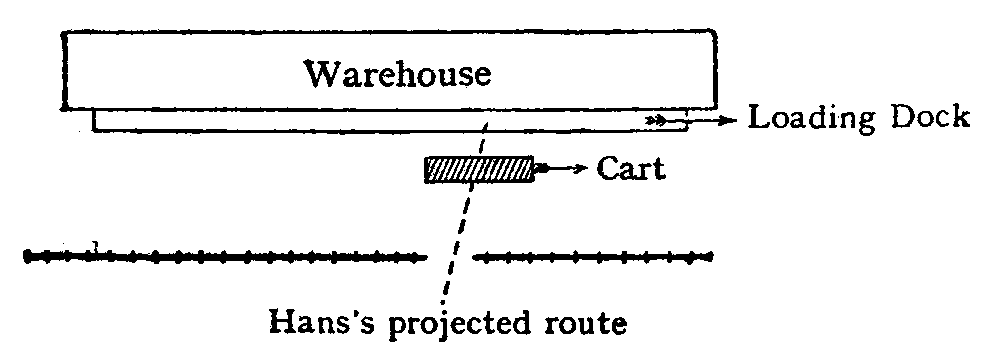
‘I: “Perhaps you’re afraid you won’t come home any more if you drive away in the cart?”
‘Hans: “Oh no! I can always come back to Mamma, in the cart or in a cab. I can tell him the number of the house too.”
‘I: “Then why are you afraid?”191
‘Hans: “I don’t know. But the Professor’ll know. D’you think he’ll know?”
‘I: “And why do you want to get over on to the board?”
‘Hans: “Because I’ve never been up there, and I should so much like to be there; and d’you know why I should like to go there? Because I should like to load and unload the packages, and I should like to climb about on the packages there. I should so like to climb about there. D’you know who I learnt the climbing about from? Some boys climbed on the packages, and I saw them, and I want to do it too.”
‘His wish was not fulfilled. For when Hans ventured once more in front of the street-door, the few steps across the street and into the courtyard awoke too great resistances in him, because carts were constantly driving into the yard.’
The Professor only knows that the game which Hans intended to play with the loaded carts must have stood in the relation of a symbolic substitute to some other wish as to which he had so far uttered no word. But, if it did not seem too daring, this wish might already, even at this stage, be constructed.
‘In the afternoon we again went out in front of the street-door, and when I returned I asked Hans:
‘“Which horses are you actually most afraid of?”
‘Hans: “All of them.”
‘I: “That’s not true.”
‘Hans: “I’m most afraid of horses with a thing on their mouths.”
‘I: “What do you mean? The piece of iron they have in their mouths?”
‘Hans: “No. They have something black on their mouths.” (He covered his mouth with his hand.)
‘I: “What? A moustache, perhaps?”
‘Hans (laughing): “Oh no!”
‘I: “Have they all got it?”
‘Hans: “No, only a few of them.”192
‘I: “What is it that they’ve got on their mouths?”
‘Hans: “A black thing.” (I think in reality it must be the thick piece of harness that dray-horses wear over their noses.)
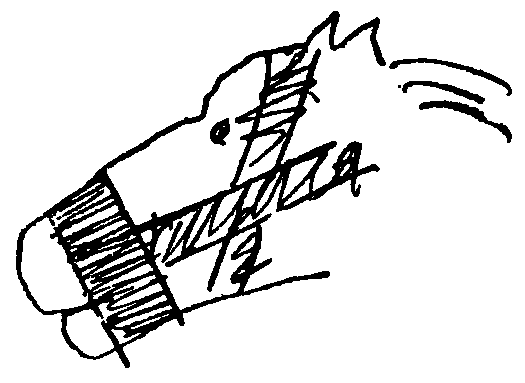
‘“And I’m most afraid of furniture-vans, too.”
‘I: “Why?”
‘Hans: “I think when furniture-horses are dragging a heavy van they’ll fall down.”
‘I: “So you’re not afraid with a small cart?”
‘Hans: “No. I’m not afraid with a small cart or with a post-office van. I’m most afraid too when a bus comes along.”
‘I: “Why? Because it’s so big?”
‘Hans: “No. Because once a horse in a bus fell down.”
‘I: “When?”
‘Hans: “Once when I went out with Mummy in spite of my ‘nonsense’, when I bought the waistcoat.” (This was subsequently confirmed by his mother.)
‘I: “What did you think when the horse fell down?”
‘Hans: “Now it’ll always be like this. All horses in buses’ll fall down.”
‘I: “In all buses?”
‘Hans: “Yes. And in furniture-vans too. Not often in furniture-vans.”
‘I: “You had your nonsense already at that time?”
‘Hans: “No. I only got it then. When the horse in the bus fell down, it gave me such a fright, really! That was when I got the nonsense.”
‘I: “But the nonsense was that you thought a horse would bite you. And now you say you were afraid a horse would fall down.”193
‘Hans: “Fall down and bite.”[125]
‘I: “Why did it give you such a fright?”
‘Hans: “Because the horse went like this with its feet.” (He lay down on the ground and showed me how it kicked about.) “It gave me a fright because it made a row with its feet.”
‘I: “Where did you go with Mummy that day?”
‘Hans: “First to the Skating Rink, then to a café, then to buy a waistcoat, then to the pastry-cook’s with Mummy, and then home in the evening; we went back through the Stadtpark.” (All of this was confirmed by my wife, as well as the fact that the anxiety broke out immediately afterwards.)
‘I: “Was the horse dead when it fell down?”
‘Hans: “Yes!”
‘I: “How do you know that?”
‘Hans: “Because I saw it.” (He laughed.) “No, it wasn’t a bit dead.”
‘I: “Perhaps you thought it was dead?”
‘Hans: “No. Certainly not. I only said it as a joke.” (His expression at the moment, however, had been serious.)
‘As he was tired, I let him run off. He only told me besides this that he had first been afraid of bus-horses, then of all others, and only in the end of furniture-van horses.
‘On the way back from Lainz there were a few more questions:
‘I: “When the bus-horse fell down, what colour was it? White, red, brown, grey?”
‘Hans: “Black. Both horses were black.”
‘I: “Was it big or little?”
‘Hans: “Big.”
‘I: “Fat or thin?”
‘Hans: “Fat. Very big and fat.”194
‘I: “When the horse fell down, did you think of your daddy?”
‘Hans: “Perhaps. Yes. It’s possible.”’
His father’s investigations may have been without success at many points; but it does no harm to make acquaintance at close quarters with a phobia of this sort—which one is apt to name after its new objects. In this way we get to see how diffuse it really is. It goes on to horses and on to carts, on to the fact that horses fall down and that they bite, on to horses of a particular character, on to carts that are heavily loaded. We may at once explain that all of these characteristics are derived from the circumstance that the anxiety had originally no reference at all to horses but was transposed on to them secondarily and had now become fixed upon those elements of the horse-complex which showed themselves well adapted for certain transferences. We must specially acknowledge one most important result of the boy’s examination by his father. We have learned the immediate exciting cause after which the phobia broke out. This was when the boy saw a big heavy horse fall down; and one at least of the interpretations of this impression seems to be that emphasized by his father, namely, that Hans at that moment perceived a wish that his father might in the same way fall down—and be dead. His serious expression as he was telling the story no doubt referred to this unconscious meaning. May there not have been yet another meaning concealed behind all this? And what can have been the significance of the making a row with its legs?
‘For some time Hans has been playing horses in the room; he trots about, falls down, kicks about with his feet, and neighs. Once he tied a small bag on like a nose-bag. He has repeatedly run up to me and bitten me.’195
In this way he was accepting the last interpretations more decidedly than he could in words, but naturally with a change of parts, for the game was in the service of a wish-phantasy. Thus he was the horse, he bit his father, and in this way he was identifying himself with his father.
‘I have noticed for the last two days that Hans has been defying me in the most decided manner, not impudently, but in the highest spirits. Is it because he is no longer afraid of me—the horse?
‘April 6th. Went out with Hans in front of the house in the afternoon. At every horse that passed I asked him if he saw the “black on its mouth”; he said “no” every time. I asked him what the black really looked like; he said it was black iron. My first idea, that he meant the thick leather straps that are part of the harness of dray-horses, is therefore unconfirmed. I asked him if the “black” reminded him of a moustache, and he said: “Only by its colour.” So I do not yet know what it really is.
‘The fear has diminished; this time he ventured as far as the next-door house, but turned round quickly when he heard the sound of horses’ hoofs in the distance. When a cart drew up at our door and came to a stop, he became frightened and ran into the house, because the horse began pawing with its foot. I asked him why he was afraid, and whether perhaps he was nervous because the horse had done like this (and I stamped with my foot). He said: “Don’t make such a row with your feet!” Compare his remark upon the fallen bus-horse.
‘He was particularly terrified by a furniture-van passing by. At that he ran right inside the house. “Doesn’t a furniture-van like that,” I asked him unconcernedly, “really look like a bus?” He said nothing. I repeated the question, and he then said: “Why, of course! Otherwise I shouldn’t be so afraid of a furniture-van.”
‘April 7th. I asked again to-day what the “black 196on the horses’ mouths” looked like. Hans said: “Like a muzzle.” The curious thing is that for the last three days not a single horse has passed on which he could point out this “muzzle”. I myself have seen no such horse on any of my walks, although Hans asseverates that such horses do exist. I suspect that some sort of horses’ bridle—the thick piece of harness round their mouths, perhaps—really reminded him of a moustache, and that after I alluded to this this fear disappeared as well.
‘Hans’s improvement is constant. The radius of his circle of activity with the street-door as its centre is ever wider. He has even accomplished the feat, which has hitherto been impossible for him, of running across to the pavement opposite. All the fear that remains is connected with the bus scene, the meaning of which is not yet clear to me.
‘April 9th. This morning Hans came in to me while I was washing and bare to the waist.
‘Hans: “Daddy, you are lovely! You’re so white.”
‘I: “Yes. Like a white horse.”
‘Hans: “The only black thing’s your moustache.” (Continuing) “Or perhaps it’s a black muzzle?”
‘I told him then that I had been to see the Professor the evening before, and said: “There’s one thing he wants to know.” “I am curious,” remarked Hans.
‘I told him I knew on what occasions it was that he made a row with his feet. “Oh, yes!” he interrupted me, “when I’m cross, or when I have to do ‘lumf’ and would rather play.” (He has a habit, it is true, of making a row with his feet, i.e. of stamping, when he is angry.—“Doing lumf” means doing number two. When Hans was small he said one day when he got off the chamber: “Look at the lumf [German: ‘lumpf’].” He meant “stocking” [German: “strumpf”], with reference to its shape and colour. This designation has been preserved to this day.—In very early days, when he had to be put on the chamber, 197and refused to leave off playing, he used to stamp his feet in a rage, and kick about, and sometimes throw himself on the ground.)
‘“And you kick about with your feet as well, when you have to widdle and don’t want to go, because you’d rather go on playing.”
‘He: “Oh, I must widdle.” And he went out of the room—by way of confirmation, no doubt.’
In the course of his visit his father had asked me what Hans could have been reminded of by the fallen horse kicking about with its feet. I had suggested that that may have been his own reaction when he retained his urine. Hans now confirmed this by means of the re-emergence during the conversation of a desire to urinate; and he added some other significations of the making a row with the feet.
‘We then went out in front of the street-door. When a coal-cart came along, he said to me: “Daddy, I’m very much afraid of coal-carts, too.”
‘I: “Perhaps that’s because they’re as big as buses, too.”
‘Hans: “Yes; and because they’re so heavily loaded, and the horses have so much to drag and might easily fall down. If a cart’s empty, I’m not afraid.” It is a fact, as I have already remarked, that only heavy vehicles throw him into a state of anxiety.’
Nevertheless, the situation was decidedly obscure. The analysis was making little progress; and I am afraid the reader will soon begin to find this description of it tedious. Every analysis, however, has dark periods of this kind. But Hans was now on the point of leading us into an unexpected region.
‘I came home and was speaking to my wife, who had made various purchases which she was showing me. Among them was a pair of yellow ladies’ drawers. Hans exclaimed “Ugh!” two or three times, threw 198himself on the ground, and spat. My wife said he had done this two or three times already when he had seen the drawers.
‘“Why do you say ‘Ugh’?” I asked.
‘Hans: “Because of the drawers.”
‘I: “Why? Because of their colour? Because they’re yellow, and remind you of lumf or widdle?”
‘Hans: “Lumf isn’t yellow. It’s white or black.”—Immediately afterwards: “I say, is it easy to do lumf if you eat cheese?” (I had once told him so, when he asked me why I ate cheese.)
‘I: “Yes.”
‘Hans: “That’s why you go straight off every morning and do lumf? I should so much like to eat cheese with my bread-and-butter.”
‘He had already asked me yesterday as he was jumping about in the street: “I say, it’s true, isn’t it, if you jump about a lot you can do lumf easily?”—There has been trouble with his stools from the very first; and aperients and enemas have frequently been necessary. At one time his habitual constipation was so great that my wife called in Dr. L. He was of opinion that Hans was overfed, which was in fact the case, and recommended a more moderate diet—and the condition was at once brought to an end. Recently the constipation has again made its appearance more frequently.
‘After luncheon I said to him: “We’ll write to the Professor again,” and he dictated to me: “When I saw the yellow drawers I said ‘Ugh! that makes me spit!’ and threw myself down and shut my eyes and didn’t look.”
‘I: “Why?”
‘Hans: “Because I saw the yellow drawers; and I did the same sort of thing with the black drawers too.[126] The black ones are the same sort of drawers, only they were black.” (Interrupting himself) “I say, I am 199glad. I’m always so glad when I can write to the Professor.”
‘I: “Why did you say ‘Ugh’? Were you disgusted?”
‘Hans: “Yes, because I saw that. I thought I should have to do lumf.”
‘I: “Why?”
‘Hans: “I don’t know.”
‘I: “When did you see the black drawers?”
‘Hans: “Once, when Anna (our maid) had been here a long time—with Mamma—she brought them home just after she’d bought them.” (This statement was confirmed by my wife.)
‘I: “Were you disgusted then, too?”
‘Hans: “Yes.”
‘I: “Have you seen Mummy in drawers like that?”
‘Hans: “No.”
‘I: “When she was dressing?”
‘Hans: “When she bought the yellow ones I’d seen them once before already.” (This is contradicted. He saw the yellow ones for the first time when his mother bought them.) “She’s got the black ones on to-day too” (correct), “because I saw her take them off in the morning.”
‘I: “What? She took off the black drawers in the morning?”
‘Hans: “In the morning when she went out she took off the black drawers, and when she came back she put the black ones on again.”
‘I asked my wife about this, as it seemed to me absurd. She said it was entirely untrue. Of course she had not changed her drawers when she went out.
‘I at once asked Hans about it: “You told me that Mummy had put on some black drawers, and that when she went out she took them off, and that when she came back she put them on again. But Mummy says it’s not true.”200
‘Hans: “I think perhaps I may have forgotten she didn’t take them off.” (Impatiently) “Oh, do let me alone.”’
I have a few comments to make at this point on the business of the drawers. It was obviously mere hypocrisy on Hans’s part to pretend to be so glad of the opportunity of giving an account of the affair. In the end he threw the mask aside and was rude to his father. It was a question of things which had once afforded him a great deal of pleasure, but of which, now that repression had set in, he was very much ashamed, and at which he professed to be disgusted. He told some downright lies so as to disguise the circumstances in which he had seen his mother change her drawers. In reality, the putting on and taking off of her drawers belonged to the ‘lumf’ context. His father was perfectly aware of what it was all about and of what Hans was trying to conceal.
‘I asked my wife whether Hans was often with her when she went to the W.C. “Yes,” she said, “often. He goes on pestering me till I let him. Children are all like that.”’
Nevertheless, it is worth bearing carefully in mind the desire, which Hans had already repressed, for seeing his mother doing lumf.
‘We went out in front of the house. He was in very good spirits and was prancing about all the time like a horse. So I said: “Now, who is it that’s the bus-horse? Me, you, or Mummy?”
‘Hans (promptly): “I am; I’m a young horse.”
‘During the period when his anxiety was at its height, and he was frightened at seeing horses frisking, he asked me why they did it; and to reassure him I said: “Those are young horses, you see, and they frisk about like little boys. You frisk about too, and you’re a little boy.” Since then, whenever he has seen horses frisking, he has said: “That’s right; those are young horses!”
‘As we were going upstairs I asked him almost 201without thinking: “Used you to play at horses with the children at Gmunden?”
‘He: “Yes.” (Thoughtfully) “I think that was how I got the nonsense.”
‘I: “Who was the horse?”
‘He: “I was; and Berta was the coachman.”
‘I: “Did you fall down by any chance, when you were a horse?”
‘Hans: “No. When Berta said ‘Gee-up’, I ran ever so quick; I just raced along.”[127]
‘I: “You never played at buses?”
‘Hans: “No. At ordinary carts, and horses without carts. When a horse has a cart, it can go without a cart just as well, and the cart can stay at home.”
‘I: “Used you often to play at horses?”
‘Hans: “Very often. Fritzl[128] was the horse once, too, and Franzl the coachman; and Fritzl ran ever so fast and all at once he hit his foot on a stone and bled.”
‘I: “Perhaps he fell down?”
‘Hans: “No. He put his foot in some water and then wrapped it up.”[129]
‘I: “Were you often the horse?”
‘Hans: “Oh, yes.”
‘I: “And that was how you got the nonsense?”
‘Hans: “Because they kept on saying ‘’cos of the horse,’ ‘’cos of the horse’” (he put a stress on the ‘’cos’); “so perhaps I got the nonsense because they talked like that; ‘’cos of the horse.’”’[130]202
For a while Hans’s father pursued his inquiry fruitlessly along other paths.
‘I: “Did they tell you anything about horses?”
‘Hans: “Yes.”
‘I: “What?”
‘Hans: “I’ve forgotten.”
‘I: “Perhaps they told you about their widdlers?”
‘Hans: “Oh, no.”
‘I: “Were you frightened of horses already then?”
‘Hans: “Oh, no. I wasn’t frightened at all.”
‘I: “Perhaps Berta told you that horses⸺”
‘Hans (interrupting): “⸺widdle? No.”
‘On April 10th I took up our conversation of the day before, and tried to discover what his “’cos of the horse” meant. Hans could not remember; he only knew that some children had stood outside the front door one morning and had said, “’cos of the horse, ’cos of the horse!” He had been there himself. When I pressed him more closely, he declared that they had not said “’cos of the horse” at all, but that he had remembered wrong.
‘I: “But you and the others were often in the stables. You must surely have talked about horses there.” — “We didn’t.” — “What did you talk about?” — “Nothing.” — “Such a lot of children, and nothing to talk about?” — “We did talk about something, but not about horses.” — “Well, what was it?” — “I don’t remember any more.”
‘I allowed the matter to drop, as the resistances were evidently too great,[131] and went on to the following question: “Did you like playing with Berta?”
‘He: “Yes, very much; but not with Olga. 203D’you know what Olga did? I was given a paper ball once by Grete up there at Gmunden, and Olga tore it all to pieces. Berta would never have torn my ball. I liked playing with Berta very much.”
‘I: “Did you see what Berta’s widdler looked like?”
‘He: “No, but I saw the horses’; because I was always in the stables, and so I saw the horses’ widdlers.”
‘I: “And so you were curious and wanted to know what Berta’s and Mummy’s widdlers looked like?”
‘He: “Yes.”
‘I reminded him of how he had once complained to me that the little girls always wanted to look on while he was widdling.
‘He: “Berta always looked on at me too” (he spoke with great satisfaction and not at all resentfully); “often she did. I used to widdle in the little garden where the radishes were, and she stood outside the front door and looked on at me.”
‘I: “And when she widdled, did you look on?”
‘He: “She used to go to the W.C.”
‘I: “And you were curious?”
‘He: “I was inside the W.C. when she was in it.”
‘(This was a fact. The servants told us about it once, and I recollect that we forbade Hans to do it.)
‘I: “Did you tell her you wanted to go in?”
‘He: “I went in alone and because Berta let me. There’s nothing shameful in that.”
‘I: “And you’d have liked to see her widdler?”
‘He: “Yes, but I didn’t see it.”
‘I then reminded him of the dream about playing forfeits that he had had at Gmunden, and said: “When you were at Gmunden did you want Berta to make you widdle?”
‘He: “I never said so to her.”
‘I: “Why didn’t you ever say so to her?”
‘He: “Because I didn’t think of it.” (Interrupt204ing himself) “If I write everything to the Professor, my nonsense’ll soon be over, won’t it?”
‘I: “Why did you want Berta to make you widdle?”
‘He: “I don’t know. Because she looked on at me.”
‘I: “Did you think to yourself she should put her hand to your widdler?”
‘He: “Yes.” (Changing the subject) “It was such fun at Gmunden. In the little garden where the radishes were there was a little sand-heap, and I used to play there with my spade.”
‘(This was the garden where he used always to widdle.)
‘I: “Did you put your hand to your widdler at Gmunden, when you were in bed?”
‘He: “No. Not then; I slept so well at Gmunden that I never thought of it at all. The only times I did it was at ⸻ Street[132] and now.”
‘I: “But Berta never put her hand to your widdler?”
‘He: “She never did, no; because I never told her to.”
‘I: “Well, and when was it you wanted her to?”
‘He: “Oh, at Gmunden once.”
‘I: “Only once?”
‘He: “Well, now and then.”
‘I: “She used always to look on at you when you widdled; perhaps she was curious to know how you did it?”
‘He: “Perhaps she was curious to know what my widdler looked like.”
‘I: “But you were curious too. Only about Berta?”
‘He: “About Berta, and about Olga.”
‘I: “About who else?”
‘He: “About no one else.”205
‘I: “You know that’s not true. About Mummy too.”
‘He: “Oh, yes, about Mummy.”
‘I: “But now you’re not curious any more. You know what Hanna’s widdler looks like, don’t you?”
‘He: “It’ll grow, though, won’t it?”[133]
‘I: “Yes, of course. But when it’s grown it won’t look like yours.”
‘He: “I know that. It’ll be the same” (sc. as it now is) “only bigger.”
‘I: “When we were at Gmunden, were you curious when your Mamma undressed?”
‘He: “Yes. And then when Hanna was in her bath I saw her widdler.”
‘I: “And Mummy’s too?”
‘He: “No.”
‘I: “You were disgusted when you saw Mummy’s drawers?”
‘He: “Only when I saw the black ones—when she bought them—then I spat. But I don’t spit when she puts her drawers on or takes them off. I spit because the black drawers are black like a lumf and the yellow ones like widdle, and then I think I’ve got to widdle. When Mummy has her drawers on I don’t see them; she’s got her clothes on over them.”
‘I: “And when she takes off her clothes?”
‘He: “I don’t spit then either. But when her drawers are new they look like a lumf. When they’re old, the colour goes away and they get dirty. When you buy them they’re quite clean, but at home they’ve been made dirty. When they’re bought they’re new, and when they’re not bought they’re old.”
‘I: “Then you aren’t disgusted by old ones?”
‘He: “When they’re old they’re much blacker than a lumf, aren’t they? They’re just a bit blacker.”[134]206
‘I: “Have you often been into the W.C. with Mummy?”
‘He: “Very often.”
‘I: “And were you disgusted?”
‘He: “Yes… No.”
‘I: “You like being there when Mummy widdles or does lumf?”
‘He: “Yes, very much.”
‘I: “Why do you like it so much?”
‘He: “I don’t know.”
‘I: “Because you think you’ll see her widdler.”
‘He: “Yes, I do think that.”
‘I: “But why won’t you ever go into the W.C. at Lainz?”
‘(At Lainz he always begs me not to take him into the W.C.; he was frightened once by the noise of the flush.)
‘He: “Perhaps it’s because it makes a row when you pull the plug.”
‘I: “And then you’re afraid.”
‘He: “Yes.”
‘I: “And what about our W.C. here?”
‘He: “Here I’m not. At Lainz it gives me a fright when you pull the plug. And when I’m inside and the water rushes down, then it gives me a fright too.”
‘And, “just to show me that he wasn’t frightened in our flat,” he made me go into the W.C. and set the flush in motion. He then explained to me:
‘“First there’s a loud row, and then a loose one.” (This is when the water comes down.) “When there’s a loud row I’d rather stay inside, and when there’s a soft one I’d rather go out.”
‘I: “Because you’re afraid?”
‘He: “Because if there’s a loud row I always so 207much like to see it”—(correcting himself) “to hear it; so I’d rather stay inside and hear it properly.”
‘I: “What does a loud row remind you of?”
‘He: “That I’ve got to do lumf in the W.C.” (The same thing, that is, that the black drawers reminded him of.)
‘I: “Why?”
‘He: “I don’t know. A loud row sounds as though you were doing lumf. A big row reminds me of lumf, and a little one of widdle.” (Cf. the black and the yellow drawers.)
‘I: “I say, wasn’t the bus-horse the same colour as a lumf?” (According to his account it had been black.)
‘He (very much struck): “Yes.”’
At this point I must put in a few words. Hans’s father was asking too many questions, and was pressing the inquiry along his own lines instead of allowing the little boy to express his thoughts. For this reason the analysis began to be obscure and uncertain. Hans went his own way and would produce nothing if attempts were made to draw him off it. For the moment his interest was evidently centred upon lumf and widdle, but we cannot tell why. Just as little satisfactory light was thrown upon the business of the row as upon that of the yellow and black drawers. I suspect that the boy’s sharp ears had clearly detected the difference between the sounds made by a man urinating and a woman. The analysis succeeded in forcing the material somewhat artificially into an expression of the distinction between the two different calls of nature. I can only advise those of my readers who have not as yet themselves conducted an analysis not to try to understand everything at once, but to give a kind of unbiassed attention to every point that arises and to await further developments.
‘April 11th. This morning Hans came into our room again and was sent away, as he always has been for the last few days.
‘Later on, he began: “Daddy, I thought something: I was in the bath,[135] and then the plumber came and unscrewed it.[136] Then he took a big borer and stuck it into my stomach.”’
Hans’s father translated this phantasy as follows: ‘“I was in bed with Mamma. Then Papa came and drove me away. With his big penis he pushed me out of my place by Mamma.”’
Let us suspend our judgement for the present.
‘He went on to relate a second idea that he had had: “We were travelling in the train to Gmunden. In the station we put on our clothes; but we couldn’t get it done in time, and the train carried us on.”
‘Later on, I asked: “Have you ever seen a horse doing lumf?”
‘Hans: “Yes, very often.”
‘I: “Does it make a loud row when it does lumf?”
‘Hans: “Yes.”
‘I: “What does the row remind you of?”
‘Hans: “Like when lumf falls into the chamber.”
‘The bus-horse that falls down and makes a row with its feet is no doubt—a lumf falling and making a noise. His fear of defaecation and his fear of heavily loaded carts is equivalent to the fear of a heavily loaded stomach.’
In this roundabout way Hans’s father was beginning to get a glimmering of the true state of affairs.
‘April 11th. At luncheon Hans said: “If only we had a bath at Gmunden, so that I didn’t have to go to the public baths!” It is a fact that at Gmunden he was always taken to the neighbouring public baths 209to be given his warm bath—a proceeding against which he used to protest with passionate tears. And in Vienna, too, he always screams if he is made to sit or lie in the big bath. He must be given his bath kneeling or standing.’
Hans was now beginning to bring fuel to the analysis in the shape of spontaneous utterances of his own. This remark of his established the connection between his two last phantasies—that of the plumber who unscrewed the bath and that of the unsuccessful journey to Gmunden. His father had correctly inferred from the latter that Hans had some aversion to Gmunden. This, by the way, is another good reminder of the fact that what emerges from the unconscious is to be understood in the light not of what goes before but of what comes after.
‘I asked him whether he was afraid, and if so of what.
‘Hans: “Because of falling in.”
‘I: “But why were you never afraid when you had your bath in the little bath?”
‘Hans: “Why, I sat in that one. I couldn’t lie down in it, it was too small.”
‘I: “When you went in a boat at Gmunden weren’t you afraid of falling into the water?”
‘Hans: “No, because I held on, so I couldn’t fall in. It’s only in the big bath that I’m afraid of falling in.”
‘I: “But Mamma baths you in it. Are you afraid of Mummy dropping you in the water?”
‘Hans: “I’m afraid of her letting go and my head going in.”
‘I: “But you know Mummy’s fond of you and won’t let go of you.”
‘Hans: “I only just thought it.”
‘I: “Why?”
‘Hans: “I don’t know at all.”
‘I: “Perhaps it was because you’d been naughty and thought she didn’t love you any more?”210
‘Hans: “Yes.”
‘I: “When you were watching Mummy giving Hanna her bath, perhaps you wished she would let go of her so that Hanna should fall in?”
‘Hans: “Yes.”’
Hans’s father, we cannot help thinking, had made a very good guess.
‘April 12th. As we were coming back from Lainz in a second-class carriage, Hans looked at the black leather upholstery of the seats, and said: “Ugh! that makes me spit! Black drawers and black horses make me spit too, because I have to do lumf.”
‘I: “Perhaps you saw something of Mummy’s that was black, and it frightened you?”
‘Hans: “Yes.”
‘I: “Well, what was it?”
‘Hans: “I don’t know. A black blouse or black stockings.”
‘I: “Perhaps it was black hair near her widdler, when you were curious and looked.”
‘Hans (defending himself): “But I didn’t see her widdler.”
‘Another time, he was once more frightened at a cart driving out of the yard gates opposite. “Don’t the gates look like a behind?” I asked.
‘He: “And the horses are the lumfs!” Since then, whenever he sees a cart driving out, he says: “Look, there’s a ‘lumfy’ coming!” This form of the word (“lumfy”) is quite a new one to him; it sounds like a term of endearment. My sister-in-law always calls her child “Wumfy”.
‘On April 13th he saw a piece of liver in the soup and exclaimed: “Ugh! A lumf!” Meat croquettes, too, he eats with evident reluctance, because their form and colour remind him of lumf.
‘In the evening my wife told me that Hans had 211been put out on the balcony and had said: “I thought to myself Hanna was on the balcony and fell down off it.” I had once or twice told him to be careful that Hanna did not get too near the balustrade when she was out on the balcony; for the railing was designed in the most unpractical way (by a Secessionist craftsman) and had big gaps in it which I had to have filled in with wire netting. Hans’s repressed wish was very transparent. His mother asked him if he would rather Hanna were not there, to which he said “Yes”.
‘April 14th. The theme of Hanna is uppermost. As you may remember from earlier records, Hans felt a strong aversion to the new-born baby that robbed him of a part of his parents’ love. This dislike has not entirely disappeared and is only partly over-compensated by an exaggerated affection.[137] He has already several times expressed a wish that the stork should bring no more babies and that we should pay him money not to bring any more out of the big box where babies are. (Compare his fear of furniture-vans. Does not a bus look like a big box?) Hanna screams such a lot, he says, and that’s a nuisance to him.
‘Once he suddenly said: “Can you remember when Hanna came? She lay beside Mummy in bed, so nice and good.” (His praise rang suspiciously hollow.)
‘And then as regards downstairs, outside the house. There is again great progress to be reported. Even drays cause him less alarm. Once he called out, almost with joy: “Here comes a horse with something black on its mouth!” And I was at last able to establish the fact that it was a horse with a leather muzzle. But Hans was not in the least afraid of this horse.
‘Once he knocked on the pavement with his stick and said: “I say, is there a man underneath?—some one buried?—or is that only in the cemetery?” So 212he is occupied not only with the riddle of life but with the riddle of death.
‘When we got indoors again I saw a box standing in the front hall, and Hans said: “Hanna travelled with us to Gmunden in a box like that. Whenever we travelled to Gmunden she travelled with us in the box. You don’t believe me again? Really, Daddy. Do believe me. We got a big box and it was full of babies; they sat in the bath.” (A small bath had been packed inside the box.) “I put them in it. Really and truly. I can remember quite well.”[138]
‘I: “What can you remember?”
‘Hans: “That Hanna travelled in the box; because I haven’t forgotten about it. My word of honour!”
‘I: “But last year Hanna travelled with us in the railway carriage.”
‘Hans: “But before that she always travelled with us in the box.”
‘I: “Didn’t Mummy have the box?”
‘Hans: “Yes. Mummy had it.”
‘I: “Where?”
‘Hans: “At home in the attic.”
‘I: “Perhaps she carried it about with her?”[139]
‘Hans: “No. And when we travel to Gmunden this time Hanna’ll travel in the box again.”
‘I: “And how did she get out of the box, then?”
‘Hans: “She was taken out.”
‘I: “By Mummy?”
‘Hans: “Mummy and me. Then we got into the carriage, and Hanna rode on the horse, and the coachman said ‘Gee-up’. The coachman sat up in front. 213Were you there too? Mummy knows all about it. Mummy doesn’t know; she’s forgotten about it already, but don’t tell her anything!”
‘I made him repeat the whole of this.
‘Hans: “Then Hanna got out.”
‘I: “Why, she couldn’t walk at all then.”
‘Hans: “Well then, we lifted her down.”
‘I: “But how could she have sat on the horse? She couldn’t sit up at all last year.”
‘Hans: “Oh yes, she sat up all right, and called out ‘Gee-up’, and whipped with her whip—‘Gee-up! Gee-up!’—the whip I used to have. The horse hadn’t any stirrups, but Hanna rode it. I’m not joking, you know, Daddy.”’
What can be the meaning of the boy’s obstinate persistence in all this nonsense? Oh no, it was no nonsense: it was parody, it was Hans’s revenge upon his father. It was as much as to say: ‘If you really expect me to believe that the stork brought Hanna in October, when even in the summer, while we were travelling to Gmunden, I’d noticed how big mother’s stomach was,—then I expect you to believe my lies.’ What can be the meaning of the assertion that even the previous summer Hanna had travelled with them to Gmunden ‘in the box’, except that he knew about his mother’s pregnancy? His holding out the prospect of a repetition of this journey in the box in each successive year exemplifies a common way in which unconscious thoughts from the past emerge into consciousness; or it may have special reasons and express his dread of seeing a similar pregnancy repeated on their next summer holiday. We now see, moreover, what the circumstances were that had made him take a dislike to the journey to Gmunden, as his second phantasy had indicated.
‘Later on, I asked him how Hanna had actually come into his mother’s bed after she was born.’
This gave Hans a chance of letting himself go and fairly ‘stuffing’ his father.214
‘Hans: “Hanna just came. Frau Kraus” (the midwife) “put her in the bed. She couldn’t walk, of course. But the stork carried her in his beak. Of course she couldn’t walk.” (He went on without a pause.) “The stork came up the stairs up to the landing, and then he knocked and everybody was asleep, and he had the right key and unlocked the door and put Hanna in your[140] bed, and Mummy was asleep—no, the stork put her in her bed. It was the middle of the night, and then the stork put her in the bed very quietly, he didn’t trample about at all, and then he took his hat and went away again. No, he hadn’t got a hat.”
‘I: “Who took his hat? The doctor, perhaps?”
‘Hans: “Then the stork went away; he went home, and then he rang at the door, and every one in the house stopped sleeping. But don’t tell this to Mummy or Tini” (the cook). “It’s a secret.”
‘I: “Are you fond of Hanna?”
‘Hans: “Oh yes, very fond.”
‘I: “Would you rather that Hanna weren’t alive or that she were?”
‘Hans: “I’d rather she weren’t alive.”
‘I: “Why?”
‘Hans: “At any rate she wouldn’t scream so, and I can’t bear her screaming.”
‘I: “Why, you scream yourself.”
‘Hans: “But Hanna screams too.”
‘I: “Why can’t you bear it?”
‘Hans: “Because she screams so loud.”
‘I: “Why, she doesn’t scream at all.”
‘Hans: “When she’s whacked on her bare bottom, then she screams.”
‘I: “Have you ever whacked her?”
‘Hans: “When Mummy whacks her on her bottom, then she screams.”
‘I: “And you don’t like that?”215
‘Hans: “No… Why? Because she makes such a row with her screaming.”
‘I: “If you’d rather she weren’t alive, you can’t be fond of her at all.”
‘Hans (assenting): “H’m, well.”
‘I: “That was why you thought when Mummy was giving her her bath, if only she’d let go, Hanna would fall into the water…”
‘Hans (taking me up) “…and die.”
‘I: “And then you’d be alone with Mummy. A good boy doesn’t wish that sort of thing, though.”
‘Hans: “But he may think it.”
‘I: “But that isn’t good.”
‘Hans: “If he thinks it, it is good all the same, because you can write it to the Professor.”[141]
‘Later on I said to him: “You know, when Hanna gets bigger and can talk, you’ll be fonder of her.”
‘Hans: “Oh no. I am fond of her. In the autumn, when she’s big, I shall go with her to the Stadtpark quite alone, and explain everything to her.”
‘As I was beginning to give him some further enlightenment, he interrupted me, probably with the intention of explaining to me that it was not so wicked of him to wish that Hanna was dead.
‘Hans: “You know, all the same, she’d been alive a long time even before she was here. When she was with the stork she was alive too.”
‘I: “No. Perhaps she wasn’t with the stork after all.”
‘Hans: “Who brought her, then? The stork had got her.”
‘I: “Where did he bring her from, then?”
‘Hans: “Oh—from him.”
‘I: “Where had he got her, then?”
‘Hans: “In the box; in the stork-box.”
‘I: “Well, and what does the box look like?”216
‘Hans: “Red. Painted red.” (Blood?)
‘I: “Who told you that?”
‘Hans: “Mummy… I thought it to myself… it’s in the book.”
‘I: “In what book?”
‘Hans: “In the picture-book.” (I made him fetch his first picture-book. In it was a picture of a stork’s nest with storks, on a red chimney. This was the box. Curiously enough, on the same page there was also a picture of a horse being shod.[142] Hans had transferred the babies into the box, as they were not to be seen in the nest.)
‘I: “And what did the stork do with her?”
‘Hans: “Then the stork brought Hanna here. In his beak. You know, the stork that’s at Schönbrunn, and that bit the umbrella.” (A reminiscence of an episode at Schönbrunn.)
‘I: “Did you see how the stork brought Hanna?”
‘Hans: “Why, I was still asleep, you know. A stork can never bring a little girl or a little boy in the morning.”
‘I: “Why?”
‘Hans: “He can’t. A stork can’t do it. Do you know why? So that people shan’t see. And then, all at once, in the morning, there’s a little girl there.”[143]
‘I: “But, all the same, you were curious at the time to know how the stork did it?”
‘Hans: “Oh yes.”
‘I: “What did Hanna look like when she came?”
‘Hans (hypocritically): “All white and lovely. So pretty.”217
‘I: “But when you saw her the first time you didn’t like her.”
‘Hans: “Oh, I did; very much!”
‘I: “You were surprised that she was so small, though.”
‘Hans: “Yes.”
‘I: “How small was she?”
‘Hans: “Like a baby stork.”
‘I: “Like what else? Like a lumf, perhaps?”
‘Hans: “Oh no. A lumf’s much bigger… a bit smaller than Hanna, really.”’
I had predicted to his father that it would be possible to trace back Hans’s phobia to thoughts and wishes occasioned by the birth of his baby sister. But I had omitted to point out that according to the sexual theory of children a baby is a ‘lumf’, so that Hans’s path would lie through the excremental complex. It was owing to this neglect on my part that the progress of the case became temporarily obscured. Now that the matter had been cleared up, Hans’s father attempted to examine the boy a second time upon this important point.
The next day, ‘I got Hans to repeat what he had told me yesterday. He said: “Hanna travelled to Gmunden in the big box, and Mummy travelled in the railway carriage, and Hanna travelled in the luggage train with the box; and then when we got to Gmunden Mummy and I lifted Hanna out and put her on the horse. The coachman sat up in front, and Hanna had the old whip” (the whip he had last year) “and whipped the horse and kept on saying ‘Gee-up’, and it was such fun, and the coachman whipped too.—The coachman didn’t whip at all, because Hanna had the whip.—The coachman had the reins—Hanna had the reins too.” (On each occasion we drove in a carriage from the station to the house. Hans was here trying to reconcile fact and fancy.) “At Gmunden we lifted Hanna down from the horse, and she walked up the steps by herself.” (Last year, when Hanna 218was at Gmunden, she was eight months old. The year before that—and Hans’s phantasy evidently relates to that time—his mother had been five months gone with child when we arrived at Gmunden.)
‘I: “Last year Hanna was there.”
‘Hans: “Last year she drove in the carriage; but the year before that, when she was living with us…”
‘I: “Was she with us already then?”
‘Hans: “Yes. You were always there; you used always to go in the boat with me, and Anna was our servant.”
‘I: “But that wasn’t last year. Hanna wasn’t alive then.”
‘Hans: “Yes, she was alive then. Even while she was still travelling in the box she could run about and she could say ‘Anna’.” (She has only been able to do so for the last four months.)
‘I: “But she wasn’t with us at all then.”
‘Hans: “Oh yes, she was; she was with the stork.”
‘I: “How old is she, then?”
‘Hans: “She’ll be two years old in the autumn. Hanna was there, you know she was.”
‘I: “And when was she with the stork in the stork-box?”
‘Hans: “A long time before she travelled in the box, a very long time.”
‘I: “How long has Hanna been able to walk, then? When she was at Gmunden she couldn’t walk yet.”
‘Hans: “Not last year; but else she could.”
‘I: “But Hanna’s only been at Gmunden once.”
‘Hans: “No. She’s been twice. Yes, that’s it. I can remember quite well. Ask Mummy, she’ll tell you soon enough.”
‘I: “It’s not true, all the same.”
‘Hans: “Yes, it is true. When she was at Gmunden the first time she could walk and ride, and later on she had to be carried.—No. It was only later on that she rode, and last year she had to be carried.”219
‘I: “But it’s only quite a short time that she’s been walking. At Gmunden she couldn’t walk.”
‘Hans: “Yes. Just you write it down. I can remember quite well.—Why are you laughing?”
‘I: “Because you’re a fraud; because you know quite well that Hanna’s only been at Gmunden once.”
‘Hans: “No, that isn’t true. The first time she rode on the horse… and the second time…” (He showed signs of evident uncertainty.)
‘I: “Perhaps the horse was Mummy?”
‘Hans: “No, a real horse in a fly.”
‘I: “But we used always to have a carriage with two horses.”
‘Hans: “Well, then, it was a carriage and pair.”
‘I: “What did Hanna eat inside the box?”
‘Hans: “They put in bread-and-butter for her, and herring, and radishes” (the sort of things we used to have for supper at Gmunden), “and as Hanna went along she buttered her bread-and-butter and ate fifty meals.”
‘I: “Didn’t Hanna scream?”
‘Hans: “No.”
‘I: “What did she do, then?”
‘Hans: “Sat quite still inside.”
‘I: “Didn’t she push about?”
‘Hans: “No, she kept on eating all the time and didn’t stir once. She drank up two big mugs of coffee—by the morning it was all gone, and she left the bits behind in the box, the leaves of the two radishes and a knife for cutting the radishes. She gobbled everything up like a hare: one minute and it was all finished. It was a joke. Hanna and I really travelled together in the box; I slept the whole night in the box.” (We did in fact, two years ago, make the journey to Gmunden by night.) “And Mummy travelled in the railway carriage. And we kept on eating all the time when we were driving in the carriage, too; it was ripping.—She didn’t ride on a horse at all…” (he now became undecided, for he knew that we had 220driven with two horses) “…she sat in the carriage. Yes, that’s how it was, but Hanna and I drove quite by ourselves … Mummy rode on the horse, and Karoline” (our maid last year) “on the other … I say, what I’m telling you isn’t a bit true.”
‘I: “What isn’t true?”
‘Hans: “None of it is. I say, let’s put Hanna and me in the box[144] and I’ll widdle into the box. I’ll just widdle into my knickers; I don’t care a bit; there’s nothing at all shameful in it. I say, that isn’t a joke, you know; but it’s great fun, though.”
‘Then he told me the story of how the stork came—the same story as yesterday, except that he left out the part about the stork taking his hat when he went away.
‘I: “Where did the stork keep his latch-key?”
‘Hans: “In his pocket.”
‘I: “And where’s the stork’s pocket?”
‘Hans: “In his beak.”
‘I: “It’s in his beak! I’ve never seen a stork yet with a key in his beak.”
‘Hans: “How else could he have got in? How did the stork come in at the door, then? No, it isn’t true; I just made a mistake. The stork rang at the front door and some one let him in.”
‘I: “And how did he ring?”
‘Hans: “He rang the bell.”
‘I: “How did he do that?”
‘Hans: “He took his beak and pressed on it with his beak.”
‘I: “And did he shut the door again?”
‘Hans: “No, a maid shut it. She was up already, you see, and opened the door for him and shut it.”
‘I: “Where does the stork live?”
‘Hans: “Where? In the box where he keeps the little girls. At Schönbrunn, perhaps.”
‘I: “I’ve never seen a box at Schönbrunn.”221
‘Hans: “It must be farther off, then.—Do you know how the stork opens the box? He takes his beak—the box has got a key, too—he takes his beak, lifts up one” (i.e. one-half of the beak) “and unlocks it like this.” (He demonstrated the process on the lock of the writing-table.) “This is a handle too.”
‘I: “Isn’t a little girl like that too heavy for him?”
‘Hans: “Oh no.”
‘I: “I say, doesn’t a bus look like a stork-box?”
‘Hans: “Yes.”
‘I: “And a furniture-waggon?”
‘Hans: “And a scallywaggon” (“scallywag”—a term of abuse for naughty children) “too.”
‘April 17th. Yesterday Hans carried out his long premeditated scheme of going across into the courtyard opposite. He would not do it to-day, as there was a cart standing at the loading dock exactly opposite the entrance gates. “When a cart stands there,” he said to me, “I’m afraid I shall tease the horses and they’ll fall down and make a row with their feet.”
‘I: “How does one tease horses?”
‘Hans: “When you’re cross with them you tease them, and when you shout ‘Gee-up’.”[145]
‘I: “Have you ever teased horses?”
‘Hans: “Yes, quite often. I’m afraid I shall do it, but I don’t really.”
‘I: “Did you ever tease horses at Gmunden?”
‘Hans: “No.”
‘I: “But you like teasing them?”
‘Hans: “Oh yes, very much.”
‘I: “Would you like to whip them?”
‘Hans: “Yes.”
‘I: “Would you like to beat the horses as Mummy beats Hanna? You like that too, you know.”222
‘Hans: “It doesn’t do the horses any harm when they’re beaten.” (I said this to him once to mitigate his fear of seeing horses whipped.) “Once I really did it. Once I had the whip and whipped the horse, and it fell down and made a row with its feet.”
‘I: “When?”
‘Hans: “At Gmunden.”
‘I: “A real horse? Harnessed to a cart?”
‘Hans: “It wasn’t in the cart.”
‘I: “Where was it, then?”
‘Hans: “I just held it so that it shouldn’t run away.” (Of course all this sounded most improbable.)
‘I: “Where was that?”
‘Hans: “Near the trough.”
‘I: “Who let you? Had the coachman left the horse standing there?”
‘Hans: “It was just a horse from the stables.”
‘I: “How did it get to the trough?”
‘Hans: “I took it there.”
‘I: “Where from? Out of the stables?”
‘Hans: “I took it out because I wanted to beat it.”
‘I: “Was there no one in the stables?”
‘Hans: “Oh yes, Loisl.” (The coachman at Gmunden.)
‘I: “Did he let you?”
‘Hans: “I talked nicely to him, and he said I might do it.”
‘I: “What did you say to him?”
‘Hans: “Could I take the horse and whip it and shout at it. And he said ‘Yes’.”
‘I: “Did you whip it a lot?”
‘Hans: “What I’ve told you isn’t the least true.”
‘I: “How much of it’s true?”
‘Hans: “None of it’s true; I only told it you for fun.”
‘I: “You never took a horse out of the stables?”
‘Hans: “Oh no.”
‘I: “But you wanted to.”223
‘Hans: “Oh yes, wanted to. I’ve thought it to myself.”
‘I: “At Gmunden?”
‘Hans: “No, only here. I thought it in the morning when I was quite undressed; no, in the morning in bed.”
‘I: “Why did you never tell me about it?”
‘Hans: “I didn’t think of it.”
‘I: “You thought it to yourself because you saw it in the street.”
‘Hans: “Yes.”
‘I: “Which would you really like to beat? Mummy, Hanna, or me?”
‘Hans: “Mummy.”
‘I: “Why?”
‘Hans: “I should just like to beat her.”
‘I: “When did you ever see any one beating their Mummy?”
‘Hans: “I’ve never seen any one do it, never in all my life.”
‘I: “And yet you’d just like to do it. How would you like to set about it?”
‘Hans: “With a carpet-beater.” (His mother often threatens to beat him with the carpet-beater.)
‘I was obliged to break off the conversation for to-day.
‘In the street Hans explained to me that buses, furniture-vans, and coal-carts were stork-box carts.’
That is to say, pregnant women. Hans’s access of sadism immediately before cannot be unconnected with the present theme.
‘April 21st. This morning Hans said that he had thought as follows: “There was a train at Lainz and I travelled with my Lainz Grandmamma to the Hauptzollamt station. You hadn’t got down from the bridge yet, and the second train was already at 224St. Veit.[146] When you came down, the train was there already, and we got in.”
‘(Hans was at Lainz yesterday. In order to get on to the departure platform one has to cross a bridge. From the platform one can see along the line as far as St. Veit station. The whole thing is a trifle obscure. Hans’s original thought had no doubt been that he had gone off by the first train, which I had missed, and that then a second train had come in from Unter St. Veit and that I had gone after him in it. But he had distorted a part of this runaway phantasy, so that he said finally: “Both of us only got away by the second train.”
‘This phantasy is related to the last one, which was not interpreted, and according to which we took too long to put on our clothes in the station at Gmunden, so that the train carried us on.)
‘Afternoon, in front of the house. Hans suddenly ran indoors as a carriage with two horses came along. I could see nothing unusual about it, and asked him what was wrong. “The horses are so proud,” he said, “that I’m afraid they’ll fall down.” (The coachman was reining the horses in tight, so that they were trotting with short steps and holding their heads high. In fact their action was “proud”.)
‘I asked him who it really was that was so proud.
‘He: “You are, when I come into bed with Mummy.”
‘I: “So you want me to fall down?”
‘Hans: “Yes. You’ve got to be naked” (meaning “barefoot”, as Fritzl had been) “and knock up against a stone, and blood must flow, and then I’ll be able to be alone with Mummy for a little bit at all events. When you come up into our flat I’ll be able to run away quick so that you don’t see.”
‘I: “Can you remember who it was that knocked up against the stone?”225
‘He: “Yes, Fritzl.”
‘I: “When Fritzl fell down, what did you think?”[147]
‘He: “That you should hit the stone and tumble down.”
‘I: “So you’d like to go to Mummy?”
‘He: “Yes.”
‘I: “What do I really scold you for?”
‘He: “I don’t know.” (!!)
‘I: “Why?”
‘He: “Because you’re cross.”
‘I: “But that’s not true.”
‘Hans: “Yes, it is true. You’re cross. I know you are. It must be true.”
‘Evidently, therefore, my explanation that only little boys come into bed with their Mummies and that big ones sleep in their own beds had not impressed him very much.
‘I suspect that his desire to “tease” the horse, i.e. to beat it and shout at it, does not apply to his mother, as he pretended, but to me. No doubt he only put her forward because he was unwilling to admit the alternative to me. For the last few days he has been particularly affectionate to me.’
Speaking with the air of superiority which is so easily acquired after the event, we may correct Hans’s father, and explain that the boy’s wish to ‘tease’ the horse had two constituents; it was compounded of an obscure sadistic desire for his mother and of a clear impulse for revenge against his father. The latter could not be reproduced until the former’s turn had come to emerge in connection with the pregnancy complex. In the process of the formation of a phobia from the unconscious thoughts underlying it condensation takes place; and for that reason the course of the analysis can never follow that of the development of the neurosis.226
‘April 22nd. This morning Hans again thought something to himself: “A street-boy was riding on a truck, and the guard came and undressed the boy quite naked and made him stand there till next morning, and in the morning the boy gave the guard 50,000 florins so that he could go on riding on the truck.”
‘(The Nordbahn[148] runs past opposite our house. In a siding there stood a trolley on which Hans once saw a street-boy riding. He wanted to do so too; but I told him it was not allowed, and that if he did the guard would be after him. A second element in this phantasy is Hans’s repressed wish to be naked.)’
It has been noticeable for some time that Hans’s imagination was being coloured by images derived from traffic,[149] and was advancing systematically from horses, which draw vehicles, to railways. In the same way a railway-phobia eventually becomes associated with every street-phobia.
‘At lunch-time I was told that Hans had been playing all the morning with an india-rubber doll which he called Grete. He had pushed a small penknife in through the opening to which the little tin squeaker had originally been attached, and had then torn the doll’s legs apart so as to let the knife drop out. He had said to the nurse-maid, pointing between the doll’s legs: “Look, there’s its widdler!”
‘I: “What was it you were playing at with your doll to-day?”
‘Hans: “I tore its legs apart. Do you know why? Because there was a knife inside it belonging to Mummy. I put it in at the place where its head squeaks, and then I tore apart its legs and it came out there.”
‘I: “Why did you tear its legs apart? So that you could see its widdler?”227
‘He: “Its widdler was there before; I could have seen it anyhow.”
‘I: “What did you put the knife in for?”
‘He: “I don’t know.”
‘I: “Well, what does the knife look like?”
‘He brought it to me.
‘I: “Did you think it was a baby, perhaps?”
‘He: “No, I didn’t think anything at all; but I believe the stork got a baby once—or some one.”
‘I: “When?”
‘He: “Once. I heard so—or didn’t I hear it at all?—or did I say it wrong?”
‘I: “What does ‘say it wrong’ mean?”
‘He: “That it’s not true.”
‘I: “Everything one says is a bit true.”
‘He: “Well, yes, a little bit.”
‘I (after changing the subject): “How do you think chickens are born?”
‘He: “The stork just makes them grow; the stork makes chickens grow—no, God does.”
‘I explained to him that chickens lay eggs, and that out of the eggs there come other chickens.
‘Hans laughed.
‘I: “Why do you laugh?”
‘He: “Because I like what you’ve told me.”
‘He said he had seen it happen already.
‘I: “Where?”
‘Hans: “You did it.”
‘I: “Where did I lay an egg?”
‘Hans: “At Gmunden; you laid an egg in the grass, and all at once a chicken came hopping out. You laid an egg once; I know you did, I know it for certain. Because Mummy said so.”
‘I: “I’ll ask Mummy if that’s true.”
‘Hans: “It isn’t true a bit. But I once laid an egg, and a chicken came hopping out.”
‘I: “Where?”
‘Hans: “At Gmunden I lay down in the grass—no, I knelt down—and the children didn’t look on at 228me, and all at once in the morning I said: ‘Look for it, children; I laid an egg yesterday.’ And all at once they looked, and all at once they saw an egg, and out of it there came a little Hans. Well, what are you laughing for? Mummy didn’t know about it, and Karoline didn’t know, because no one was looking on, and all at once I laid an egg, and all at once it was there. Really and truly. Daddy, when does a chicken grow out of an egg? When it’s left alone? Must it be eaten?”
‘I explained the matter to him.
‘Hans: “All right, let’s leave it with the hen; then a chicken’ll grow. Let’s pack it up in the box and let’s take it to Gmunden.”’
As his parents still hesitated to give him the information which was already long overdue, little Hans had by a bold stroke taken the conduct of the analysis into his own hands. By means of a brilliant symptomatic act, ‘Look!’ he had said to them, ‘this is how I imagine that a birth takes place.’ What he had told the maid-servant about the meaning of his game with the doll had been insincere; to his father he explicitly denied that he had only wanted to see its widdler. After his father had told him, as a kind of payment on account, how chickens come out of eggs, Hans gave a combined expression to his dissatisfaction, his mistrust, and his superior knowledge in a charming piece of persiflage, which culminated with his last words in an unmistakable allusion to his sister’s birth.
‘I: “What were you playing at with your doll?”
‘Hans: “I said ‘Grete’ to her.”
‘I: “Why?”
‘Hans: “Because I said ‘Grete’ to her.”
‘I: “How did you play?”
‘Hans: “I just looked after her like a real baby.”
‘I: “Would you like to have a little girl?”
‘Hans: “Oh yes. Why not? I should like to have one, but Mummy mustn’t have one; I don’t like that.”229
‘(He has often expressed this view before. He is afraid of losing still more of his position if a third child arrives.)
‘I: “But only women have children.”
‘Hans: “I’m going to have a little girl.”
‘I: “Where will you get her, then?”
‘Hans: “Why, from the stork. He takes the little girl out, and all at once the little girl lays an egg, and out of the egg there comes another Hanna—another Hanna. Out of Hanna there comes another Hanna. No, one Hanna comes out.”
‘I: “You’d like to have a little girl.”
‘Hans: “Yes, next year I’m going to have one, and she’ll be called Hanna too.”
‘I: “But why isn’t Mummy to have a little girl?”
‘Hans: “Because I want to have a little girl for once.”
‘I: “But you can’t have a little girl.”
‘Hans: “Oh yes, boys have girls and girls have boys.”[150]
‘I: “Boys don’t have children. Only women, only Mummies have children.”
‘Hans: “But why shouldn’t I?”
‘I: “Because God’s arranged it like that.”
‘Hans: “But why don’t you have one? Oh yes, you’ll have one all right. Just you wait.”
‘I: “I shall have to wait some time.”
‘Hans: “But I belong to you.”
‘I: “But Mummy brought you into the world. So you belong to Mummy and me.”
‘Hans: “Does Hanna belong to me or to Mummy?”
‘I: “To Mummy.”
‘Hans: “No, to me. Why not to me and Mummy?”
‘I: “Hanna belongs to me, Mummy, and you.”
‘Hans: “There you are, you see.”’230
So long as the child is in ignorance of the female genitals, there is naturally a vital gap in his comprehension of sexual matters.
‘On April 24th my wife and I enlightened Hans up to a certain point: we told him that children grow inside their Mummy, and are then brought into the world by being pressed out of her like a “lumf”, and that this involves a great deal of pain.
‘In the afternoon we went out in front of the house. There was a visible improvement in his state. He ran after carts, and the only thing that betrayed a remaining trace of his anxiety was the fact that he did not venture away from the neighbourhood of the street-door and could not be induced to go for any considerable walk.
‘On April 25th Hans butted me in the stomach with his head, as he has already done once before. I asked him if he was a goat.
‘“Yes,” he said, “a ram.” I inquired where he had seen a ram.
‘He: “At Gmunden: Fritzl had one.” (Fritzl had a real lamb to play with.)
‘I: “You must tell me about the lamb. What did it do?”
‘Hans: “You know, Fräulein Mizzi” (a school-mistress who lived in the house) “used always to put Hanna on the lamb, but it couldn’t stand up then and it couldn’t butt. If you went up to it it used to butt, because it had horns. Fritzl used to lead it on a string and tie it to a tree. He always tied it to a tree.”
‘I: “Did the lamb butt you?”
‘Hans: “It jumped up at me; Fritzl took me up to it once… I went up to it once and didn’t know, and all at once it jumped up at me. It was such fun—I wasn’t frightened.”
‘This was certainly untrue.
‘I: “Are you fond of Daddy?”231
‘Hans: “Oh yes.”
‘I: “Or perhaps not.”
‘Hans was playing with a little toy horse. At that moment the horse fell down, and Hans shouted out: “The horse has fallen down! Look what a row it’s making!”
‘I: “You’re a little vexed with Daddy because Mummy’s fond of him.”
‘Hans: “No.”
‘I: “Then why do you always cry whenever Mummy gives me a kiss? It’s because you’re jealous.”
‘Hans: “Jealous, yes.”
‘I: “You’d like to be Daddy yourself.”
‘Hans: “Oh yes.”
‘I: “What would you like to do if you were Daddy?”
‘Hans: “And you were Hans? I’d like to take you to Lainz every Sunday—no, every week-day too. If I were Daddy I’d be ever so nice and good.”
‘I: “But what would you like to do with Mummy?”
‘Hans: “Take her to Lainz, too.”
‘I: “And what besides?”
‘Hans: “Nothing.”
‘I: “Then why were you jealous?”
‘Hans: “I don’t know.”
‘I: “Were you jealous at Gmunden, too?”
‘Hans: “Not at Gmunden.” (This is not true.) “At Gmunden I had my own things. I had a garden at Gmunden and children too.”
‘I: “Can you remember how the cow got a calf?”
‘Hans: “Oh yes. It came in a cart.” (No doubt he had been told this at Gmunden; another sally against the stork theory.) “And another cow pressed it out of its behind.” (This was already the fruit of his enlightenment, which he was trying to bring into harmony with the cart theory.)
‘I: “It isn’t true that it came in a cart; it came out of the cow in the cow-shed.”232
‘Hans disputed this, saying that he had seen the cart in the morning. I pointed out to him that he had probably been told this about the calf having come in a cart. In the end he admitted this, and said: “Most likely Berta told me, or not—or perhaps it was the landlord. He was there and it was at night, so it is true after all, what I’ve been telling you—or it seems to me nobody told me; I thought it to myself in the night.”
‘Unless I am mistaken, the calf was taken away in a cart; hence the confusion.
‘I: “Why didn’t you think it was the stork that brought it?”
‘Hans: “I didn’t want to think that.”
‘I: “But you thought the stork brought Hanna?”
‘Hans: “In the morning” (of the confinement) “I thought so.—I say, Daddy, was Herr Reisenbichler” (our landlord) “there when the calf came out of the cow?”[151]
‘I: “I don’t know. Do you think he was?”
‘Hans: “I think so… Daddy, have you noticed now and then that horses have something black on their mouths?”
‘I: “I’ve noticed it now and then in the street at Gmunden.”[152]
‘I: “Did you often get into bed with Mummy at Gmunden?”
‘Hans: “Yes.”
‘I: “And you used to think to yourself you were Daddy?”
‘Hans: “Yes.”
‘I: “And then you felt afraid of Daddy?”
‘Hans: “You know everything; I didn’t know anything.”233
‘I: “When Fritzl fell down you thought: ‘If only Daddy would fall down like that!’ And when the lamb butted you you thought: ‘If only it would butt Daddy!’ Can you remember the funeral at Gmunden?” (The first funeral that Hans had seen. He often recalls it, and it is no doubt a screen-memory.)
‘Hans: “Yes. What about it?”
‘I: “You thought then that if only Daddy were to die you’d be Daddy.”
‘Hans: “Yes.”
‘I: “What carts are you still afraid of?”
‘Hans: “All of them.”
‘I: “You know that’s not true.”
‘Hans: “I’m not afraid of carriages and pair or cabs with one horse. I’m afraid of buses and luggage-carts, but only when they’re loaded up, not when they’re empty. When there’s one horse and the cart’s loaded full up, then I’m afraid; but when there are two horses and it’s loaded full up, then I’m not afraid.”
‘I: “Are you afraid of buses because there are so many people inside?”
‘Hans: “Because there’s so much luggage on the top.”
‘I: “When Mummy was having Hanna, was she loaded full up too?”
‘Hans: “Mummy’ll be loaded full up again when she has another one, when another one begins to grow, when another one’s inside her.”
‘I: “And you’d like that?”
‘Hans: “Yes.”
‘I: “You said you didn’t want Mummy to have another baby.”
‘Hans: “Well, then she won’t be loaded up again. Mummy said if Mummy didn’t want one, God didn’t want one either. If Mummy doesn’t want one she won’t have one.” (Hans naturally asked yesterday if there were any more babies inside Mummy. I told him not, and said that if God did not wish it none would grow inside her.)234
‘Hans: “But Mummy told me if she didn’t want it no more’d grow, and you say if God doesn’t want it.”
‘So I told him it was as I had said, upon which he observed: “You were there, though, weren’t you? You know better, for certain.” He then proceeded to cross-question his mother, and she reconciled the two statements by declaring that if she didn’t want it God didn’t want it either.[153]
‘I: “It seems to me that, all the same, you do wish Mummy would have a baby.”
‘Hans: “But I don’t want it to happen.”
‘I: “But you wish for it?”
‘Hans: “Oh yes, wish.”
‘I: “Do you know why you wish for it? It’s because you’d like to be Daddy.”
‘Hans: “Yes… How does it work?”
‘I: “How does what work?”
‘Hans: “You say Daddies don’t have babies; so how does it work, my wanting to be Daddy?”
‘I: “You’d like to be Daddy and married to Mummy; you’d like to be as big as me and have a moustache; and you’d like Mummy to have a baby.”
‘Hans: “And, Daddy, when I’m married I’ll only have one if I want to, when I’m married to Mummy, and if I don’t want a baby, God won’t want it either, when I’m married.”
‘I: “Would you like to be married to Mummy?”
‘Hans: “Oh yes.”’
It is easy to see that Hans’s enjoyment of his phantasy was interfered with by his uncertainty as to the part played by fathers and by his doubts as to whether the begetting of children would be under his control.
‘On the evening of the same day, as Hans was being put to bed, he said to me: “I say, d’you know 235what I’m going to do now? Now I’m going to talk to Grete till ten o’clock; she’s in bed with me. My children are always in bed with me. Can you tell me why that is?”—As he was very sleepy already, I promised him that we should write it down next day, and he went to sleep.
‘I have already noticed in earlier records that since Hans’s return from Gmunden he has constantly been having phantasies about “his children”, has carried on conversations with them, and so on.[154]
‘So on April 26th I asked him why he was always thinking of his children.
‘Hans: “Why? Because I should so like to have children; but I don’t ever want it; I shouldn’t like to have them.”[155]
‘I: “Have you always imagined that Berta and Olga and the rest were your children?”
‘Hans: “Yes. Franzl, and Fritzl, and Paul too” (his playmates at Lainz), “and Lodi.” This is an invented girl’s name, that of his favourite child, whom he speaks of most often.—I may here emphasize the fact that the figure of Lodi is not an invention of the last few days, but existed before the date of his receiving the latest piece of enlightenment (April 24th).
‘I: “Who is Lodi? Is she at Gmunden?”
‘Hans: “No.”
‘I: “Is there a Lodi?”
‘Hans: “Yes, I know her.”
‘I: “Who is she, then?”
‘Hans: “The one I’ve got here.”
‘I: “What does she look like?”236
‘Hans: “Look like? Black eyes, black hair… I met her once with Mariedl” (at Gmunden) “as I was going into the town.”
‘When I went into the matter it turned out that this was an invention.[156]
‘I: “So you thought you were their Mummy?”
‘Hans: “And so I was their Mummy.”
‘I: “What did you do with your children?”
‘Hans: “I had them to sleep with me, the girls and the boys.”
‘I: “Every day?”
‘Hans: “Why, of course.”
‘I: “Did you talk to them?”
‘Hans: “When I couldn’t get all the children into the bed, I put some of the children on the sofa, and some in the pram, and if there were still some left over I took them up to the attic and put them in the box, and if there were any more I put them in the other box.”
‘I: “So the stork-baby-boxes were in the attic?”
‘Hans: “Yes.”
‘I: “When did you get your children? Was Hanna alive already?”
‘Hans: “Yes, she had been a long time.”
‘I: “But who did you think you’d got the children from?”
‘Hans: “Why, from me.”[157]
‘I: “But at that time you hadn’t any idea that children came from some one.”
‘Hans: “I thought the stork had brought them.” (Clearly a lie and an evasion.)[158]
‘I: “You had Grete in bed with you yesterday, but you know quite well that boys can’t have children.”237
‘Hans: “Well, yes. But I believe they can, all the same.”
‘I: “How did you hit upon the name Lodi? No girl’s called that. Lotti, perhaps?”
‘Hans: “Oh no, Lodi. I don’t know; but it’s a beautiful name, all the same.”
‘I (jokingly): “Perhaps you mean a Schokolodi?”[159]
‘Hans (promptly): “No, a Saffalodi,[160] …because I like eating sausages so much, and salami[161] too.”
‘I: “I say, doesn’t a Saffalodi look like a lumf?”
‘Hans: “Yes.”
‘I: “Well, what does a lumf look like?”
‘Hans: “Black. You know” (pointing at my eyebrows and moustache), “like this and like this.”
‘I: “And what else? Round like a Saffaladi?”
‘Hans: “Yes.”
‘I: “When you sat on the chamber and a lumf came, did you think to yourself you were having a baby?”
‘Hans (laughing): “Yes. Even at ⸻ Street, and here as well.”
‘I: “You know when the bus-horses fell down? The bus looked like a baby-box, and when the black horse fell down it was just like…”
‘Hans (taking me up): “…like having a baby.”
‘I: “And what did you think when it made a row with its feet?”
‘Hans: “Oh, when I don’t want to sit on the chamber and would rather play, then I make a row like this with my feet.” (He stamped his feet.)
‘This was why he was so much interested in the question whether people liked or did not like having children.
‘All day long to-day Hans has been playing at 238loading and unloading packing-cases; he said he wished he could have a toy waggon and boxes of that kind to play with. What used most to interest him in the courtyard of the Customs House opposite was the loading and unloading of the carts. And he used to be frightened most when a cart had been loaded up and was on the point of driving off. “The horses’ll fall down,”[162] he used to say. He used to call the doors of the Head Customs House shed “holes” (thus, the first hole, second hole, third hole, etc.). But now, instead of “hole”, he says “behind-hole”.
‘The anxiety has almost completely disappeared, except that he likes to remain in the neighbourhood of the house, so as to have a line of retreat in case he is frightened. But he never takes flight into the house now, but stops in the street all the time. As we know, his illness began with his turning back in tears while he was out for a walk; and when he was obliged to go for a second walk he only went as far as the Hauptzollamt station on the Stadtbahn, from which our house can still be seen. At the time of my wife’s confinement he was of course kept away from her; and his present anxiety, which prevents him from leaving the neighbourhood of the house, is in reality the longing for her which he felt then.
‘April 30th. Seeing Hans playing with his imaginary children again, “Hullo,” I said to him, “are your children still alive? You know quite well a boy can’t have any children.”
‘Hans: “I know. I was their Mummy before, now I’m their Daddy.”
‘I: “And who’s the children’s Mummy?”
‘Hans: “Why, Mummy, and you’re their Grandaddy.”239
‘I: “So then you’d like to be as big as me, and be married to Mummy, and then you’d like her to have children.”
‘Hans: “Yes, that’s what I’d like, and then my Lainz Grandmamma” (my mother) “will be their Grannie.”’
Things were moving towards a satisfactory conclusion. The little Oedipus had found a happier solution than that prescribed by destiny. Instead of putting his father out of the way, he had granted him the same happiness that he desired himself: he made him a grandfather and let him too marry his own mother.
‘On May 1st Hans came to me at lunch-time and said: “D’you know what? Let’s write something down for the Professor.”
‘I: “Well, and what shall it be?”
‘Hans: “This morning I was in the W.C. with all my children. First I did lumf and widdled, and they looked on. Then I put them on the seat and they widdled and did lumf, and I wiped their behinds with paper. D’you know why? Because I’d so much like to have children; then I’d do everything for them—take them to the W.C., clean their behinds, and do everything one does with children.”’
After the admission afforded by this phantasy, it will scarcely be possible to dispute the fact that in Hans’s mind there was pleasure attached to the excremental functions.
‘In the afternoon he ventured into the Stadtpark for the first time. As it is the First of May, no doubt there was less traffic than usual, but still quite enough to have frightened him up to now. He was very proud of his achievement, and after tea I was obliged to go with him to the Stadtpark once again. On the way we met a bus; Hans pointed it out to me, saying: 240“Look! a stork-box cart!” If he goes with me to the Stadtpark again to-morrow, as we have planned, we shall really be able to regard his illness as cured.
‘On May 2nd Hans came to me in the morning. “I say,” he said, “I thought something to-day.” At first he had forgotten it; but later on he related what follows, though with signs of considerable resistance: “The plumber came; and first he took away my behind with a pair of pincers, and then gave me another, and then the same with my widdler. He said: ‘Let me see your behind!’ and I had to turn round, and he took it away; and then he said: ‘Let me see your widdler!’”’
Hans’s father grasped the nature of this wish-phantasy, and did not hesitate a moment as to the only interpretation it could bear.
‘I: “He gave you a bigger widdler and a bigger behind.”
‘Hans: “Yes.”
‘I: “Like Daddy’s; because you’d like to be Daddy.”
‘Hans: “Yes, and I’d like to have a moustache like yours and hairs like yours.” (He pointed to the hairs on my chest.)
‘In the light of this, we may review the interpretation of Hans’s earlier phantasy to the effect that the plumber had come and unscrewed the bath and had stuck a borer into his stomach. The big bath meant a “behind”, the borer or screwdriver was (as was explained at the time) a widdler.[163] The two phantasies are identical. Moreover, a new light is thrown upon Hans’s fear of the big bath. (This, by the way, has 241already diminished.) He dislikes his “behind” being too small for the big bath.’
In the course of the next few days Hans’s mother wrote to me several times to express her joy at the little boy’s recovery.
A week later came a postscript from Hans’s father.
‘My dear Professor, I should like to make the following additions to Hans’s case history:
‘(1) The remission after he had been given his first piece of enlightenment was not so complete as I may have represented it. It is true that Hans went for walks; but only under compulsion and in a state of great anxiety. Once he went with me as far as the Hauptzollamt station, from which our house can still be seen, but could not be induced to go any farther.
‘(2) As regards “raspberry syrup” and “a gun for shooting with”. Hans is given raspberry syrup when he is constipated. He also frequently confuses the words “shooting” and “shitting”.[164]
‘(3) Hans was about four years old when he was moved out of our bedroom into a room of his own.
‘(4) A trace of his disorder still persists, though it is no longer in the shape of fear but only in that of the normal instinct for asking questions. The questions are mostly concerned with what things are made of (trams, machines, etc.), who makes things, etc. Most of his questions are characterized by the fact that Hans asks them although he has already answered them himself. He only wants to make sure. Once when he had tired me out with his questions and I had said to him: “Do you think I can answer every question you ask?” he replied: “Well, I thought as you knew that about the horse you’d know this too.”
‘(5) Hans only refers to his illness now as a matter of past history—“at the time when I had my nonsense”.242
‘(6) An unsolved residue remains behind; for Hans keeps cudgelling his brains to discover what a father has to do with his child, since it is the mother who brings it into the world. This can be seen from his questions, as, for instance: “I belong to you, too, don’t I?” (meaning, not only to his mother). It is not clear to him in what way he belongs to me. On the other hand, I have no direct evidence of his having, as you suppose, overheard his parents in the act of coitus.
‘(7) In presenting the case one ought perhaps to insist upon the violence of his anxiety. Otherwise it might be said that the boy would have gone out for walks soon enough if he had been given a sound thrashing.’
In conclusion let me add these words. With Hans’s last phantasy the anxiety which arose from his castration complex was also overcome, and his painful expectations were given a happier turn. Yes, the Doctor (the plumber) did come, he did take away his penis,—but only to give him a bigger one in exchange for it. For the rest, our young investigator has merely come somewhat early upon the discovery that all knowledge is patchwork, and that each step forward leaves an unsolved residue behind.
I shall now proceed to examine this observation of the development and resolution of a phobia in a boy under five years of age, and I shall have to do so from three points of view. In the first place I shall consider how far it supports the assertions which I put forward in my Drei Abhandlungen zur Sexualtheorie (published in 1905). Secondly, I shall consider to what extent it can contribute towards our understanding of this very frequent form of disorder. And thirdly, I shall consider whether it can be made to shed any light upon the mental life of children or to afford any criticism of our educational aims.
My impression is that the picture of a child’s sexual life presented in this observation of little Hans agrees very well with the account I gave of it (basing my views upon psycho-analytic examinations of adults) in my Sexualtheorie. But before going into the details of this agreement I must deal with two objections which will be raised against my making use of the present analysis for this purpose. The first objection is to the effect that Hans was not a normal child, but (as events—the illness itself, in fact—showed) had a predisposition to neurosis, and was a little ‘degenerate’; it would be illegitimate, therefore, to apply to other, normal children conclusions which might perhaps be true of him. I shall postpone consideration of this objection, since it only limits 244the value of the observation, and does not completely nullify it. According to the second and more uncompromising objection, an analysis of a child conducted by its father, who went to work instilled with my theoretical views and infected with my prejudices, must be entirely devoid of any objective worth. A child, it will be said, is necessarily highly suggestible, and in regard to no one, perhaps, more than to its own father; it will allow anything to be forced upon it, out of gratitude to its father for taking so much notice of it; none of its assertions can have any evidential value, and everything it produces in the way of associations, phantasies, and dreams will naturally take the direction into which they are being urged by every possible means. Once more, in short, the whole thing is simply ‘suggestion’—the only difference being that in the case of a child it can be unmasked much more easily than in that of an adult.
A singular thing. I can remember, when I first began to meddle in the conflict of scientific opinions twenty-two years ago, with what derision the older generation of neurologists and psychiatrists of those days received assertions about suggestion and its effects. Since then the situation has fundamentally changed. The former aversion has been converted into an only too ready acceptance; and this has happened not only as a consequence of the impression which the work of Liébault and Bernheim and their pupils could not fail to create in the course of these two decades, but also because it has since been discovered how great an economy of thought can be effected by the use of the catchword ‘suggestion’. Nobody knows and nobody cares what suggestion is, where it comes from, or when it arises,—it is enough that everything awkward in the region of psychology can be labelled ‘suggestion’. I do not share the view which is at present fashionable that assertions made by children are invariably arbitrary and untrustworthy. The arbitrary has no existence in mental life. The 245untrustworthiness of the assertions of children is due to the predominance of their imagination, just as the untrustworthiness of the assertions of grown-up people is due to the predominance of their prejudices. For the rest, even children do not lie without a reason, and on the whole they are more inclined to a love of truth than are their elders. If we were to reject little Hans’s statements root and branch we should certainly be doing him a grave injustice. On the contrary, we can quite clearly distinguish from one another the occasions on which he was falsifying the facts or keeping them back under the compelling force of a resistance, the occasions on which, being undecided himself, he agreed with his father (so that what he said must not be taken as evidence), and the occasions on which, freed from every pressure, he burst into a flood of information about what was really going on inside him and about things which until then no one but he himself had known. Statements made by adults offer no greater certainty. It is a regrettable fact that no account of a psycho-analysis can reproduce the impressions received by the analyst as he conducts it, and that a final sense of conviction can never be obtained from reading about it but only from directly experiencing it. But this disability attaches in an equal degree to analyses made upon adults.
Little Hans is described by his parents as a cheerful, straightforward child, and so he should have been, considering the education given him by his parents, which consisted essentially in the omission of our usual educational sins. So long as he was able to carry on his researches in a state of happy naïveté, without a suspicion of the conflicts which were soon to arise out of them, he kept nothing back; and the observations made during the period before the phobia admit of no doubt or demur. It was with the outbreak of the illness and during the analysis that discrepancies began to make their appearance between what he said and what he thought; and this was partly because uncon246scious material, which he was unable to master all at once, was forcing itself upon him, and partly because the content of his thoughts provoked reservations on account of his relation to his parents. It is my unbiassed opinion that these difficulties, too, turned out no greater than in many analyses made upon adults.
It is true that during the analysis Hans had to be told many things that he could not say himself, that he had to be presented with thoughts which he had so far shown no signs of possessing, and that his attention had to be turned in the direction from which his father was expecting something to come. This detracts from the evidential value of the analysis; but the procedure is the same in every case. For a psycho-analysis is not an impartial scientific investigation, but a therapeutic measure. Its essence is not to prove anything, but merely to alter something. In a psycho-analysis the physician always gives his patient (sometimes to a greater and sometimes to a less extent) the conscious anticipatory images by the help of which he is put in a position to recognize and to grasp the unconscious material. For there are some patients who need more of such assistance and some who need less; but there are none who get through without some of it. Slight disorders may perhaps be brought to an end by a person’s unaided efforts, but never a neurosis—a thing which has set itself up against the ego as an element foreign to it. To get the better of such an element another person must be brought in, and in so far as that other person can be of assistance the neurosis will be curable. If it is in the very nature of any neurosis to turn away from the ‘other person’—and this seems to be one of the characteristics of the states grouped together under the name of dementia praecox—then for that very reason such a state will be incurable by any efforts of ours. Admittedly, then, a child, on account of the small development of its intellectual systems, requires especially energetic assistance. But, after all, the information which the physician gives his 247patient is itself derived in its turn from analytical experience; and indeed it is sufficiently convincing if, at the cost of this intervention by the physician, we are enabled to discover the structure of the pathogenic material and simultaneously to dissipate it.
And yet, even during the analysis, the small patient gave evidence of enough independence to acquit him upon the charge of ‘suggestion’. Like all other children, he applied his childish sexual theories to the material before him without having received any encouragement to do so. These theories are extremely remote from the adult mind. Indeed, in this instance I actually omitted to warn Hans’s father that the boy would be bound to approach the subject of childbirth by way of the excretory complex. This negligence on my part, though it led to an obscure phase in the analysis, was nevertheless the means of producing a good piece of evidence of the genuineness and independence of Hans’s mental processes. He suddenly became occupied with ‘lumf’, without his father, who is supposed to have been practising suggestion upon him, having the least idea how he had arrived at that subject or what was going to come of it. Nor can his father be saddled with any responsibility for the production of the two plumber phantasies, which arose out of Hans’s early acquired ‘castration complex’. And I must here confess that, out of theoretical interest, I entirely concealed from Hans’s father my expectation that there would turn out to be some such connection, so as not to interfere with the value of a piece of evidence such as does not often come within one’s grasp.
If I went more deeply into the details of the analysis I could produce plenty more evidence of Hans’s independence of ‘suggestion’; but I shall break off the discussion of the first objection at this point. I am aware that even with this analysis I shall not succeed in convincing any one who will not let himself be convinced, and I shall proceed with my discussion of the case for the benefit of those readers who are already 248convinced of the objective reality of unconscious pathogenic material. And I do this with the agreeable assurance that the number of such readers is steadily increasing.
The first trait in little Hans which can be regarded as part of his sexual life was a quite peculiarly lively interest in his ‘widdler’—an organ deriving its name from that one of its two functions which, scarcely the less important of the two, is not to be eluded in the nursery. This interest aroused in him the spirit of inquiry, and he thus discovered that the presence or absence of a widdler made it possible to differentiate between animate and inanimate objects. He assumed that all animate objects were like himself, and possessed this important bodily organ; he observed that it was present in the larger animals, suspected that this was so too in both his parents, and was not deterred by the evidence of his own eyes from authenticating the fact in his new-born sister. One might almost say that it would have been too shattering a blow to his ‘Weltanschauung’ if he had had to make up his mind to forgo the presence of this organ in a being similar to him; it would have been as though it were being torn away from himself. It was probably on this account that a threat of his mother’s, which was concerned precisely with the loss of his widdler, was hastily dismissed from his thoughts and only succeeded in making its effects apparent at a later period. The reason for his mother’s intervention had been that he used to like giving himself feelings of pleasure by touching his member: the little boy had begun to practise the commonest—and most normal—form of auto-erotic sexual activity.
The pleasure which a person takes in his own sexual organ may become associated with scoptophilia (or sexual pleasure in looking) in its active and passive 249forms, in a manner which has been very aptly described by Alfred Adler as ‘confluence of instincts’.[165] So little Hans began to try to get a sight of other people’s widdlers; his sexual curiosity developed, and at the same time he liked to exhibit his own widdler. One of his dreams, dating from the beginning of his repression period, expressed a wish that one of his little girl friends should assist him in widdling, that is, that she should share the spectacle. The dream shows, therefore, that up till then this wish had subsisted unrepressed, and later information confirmed the fact that he had been in the habit of gratifying it. The active side of his sexual scoptophilia soon became associated in him with a definite motive. He repeatedly expressed both to his father and his mother his regret that he had never yet seen their widdlers; and it was probably the need for making a comparison which impelled him to do this. The ego is always the standard by which one measures the outer world; one learns to understand it by means of a constant comparison with oneself. Hans had observed that large animals had widdlers that were correspondingly larger than his; he consequently suspected that the same was true of his parents, and was anxious to make sure of this. His mother, he thought, must certainly have a widdler ‘like a horse’. He was then prepared with the comforting reflection that his widdler would grow with him. It was as though the child’s wish to be bigger had been concentrated on his genitals.
Thus in little Hans’s sexual constitution the genital zone was from the outset the one among his erotogenic zones which afforded him the most intense pleasure. The only other similar pleasure of which he gave evidence was excremental pleasure, the pleasure attached to the orifices through which urination and evacuation of the bowels are effected. In his final phantasy of bliss, with which his illness was overcome, he imagined he had children, whom he took to the 250W.C., whom he made to widdle, whose behinds he wiped, for whom, in short, he did ‘everything one can do with children’; it therefore seems impossible to avoid the assumption that during the period when he himself had been looked after as an infant these same performances had been the source of pleasurable sensations for him. He had obtained this pleasure from his erotogenic zones with the help of the person who had looked after him—his mother, in fact; and thus the pleasure already pointed the way to object-choice. But it is just possible that at a still earlier date he had been in the habit of giving himself this pleasure auto-erotically—that he had been one of those children who like retaining their excreta till they can derive a voluptuous sensation from their evacuation. I say no more than that it is possible, because the matter was not cleared up in the analysis; the ‘making a row with the legs’ (kicking about), of which he was so much frightened later on, points in that direction. But in any case these sources of pleasure had no particularly striking importance with Hans, as they so often have with other children. He early became clean in his habits, and neither bed-wetting nor diurnal incontinence played any part during his first years; no trace was observed in him of any inclination to play with his excrement, a propensity which is so revolting in adults, and which commonly makes its reappearance at the termination of processes of mental involution.
At this juncture it is as well to emphasize at once the fact that during his phobia there was an unmistakable repression of these two well-developed components of his sexual activity. He was ashamed of urinating before other people, accused himself of putting his finger to his widdler, made efforts to give up masturbating, and showed disgust at ‘lumf’ and ‘widdle’ and everything that reminded him of them. In his phantasy of looking after his children he did away again with this latter repression.
A sexual constitution like that of little Hans does 251not appear to carry with it a predisposition to the development either of perversions or of their negative (we will limit ourselves to a consideration of hysteria). As far as my experience goes (and there is still a real need for speaking with caution on this point) the innate constitution of hysterics—that this is also true of perverts is almost self-evident—is marked by the genital zone being relatively less prominent than the other erotogenic zones. But we must expressly except from this rule one particular ‘aberration’ of sexual life. In those who later become homosexuals we meet with the same predominance in infancy of the genital zone (and especially of the penis) as in normal persons.[166] Indeed it is the high esteem felt by the homosexual for the male organ which decides his fate. In his childhood he chooses women as his sexual object, so long as he assumes that they too possess what in his eyes is an indispensable part of the body; when he becomes convinced that women have deceived him in this particular, they cease to be acceptable to him as a sexual object. He cannot forgo a penis in any one who is to attract him to sexual intercourse; and if circumstances are favourable he will fix his libido upon the ‘woman with a penis’, a youth of feminine appearance. Homosexuals, then, are persons who, owing to the erotogenic importance of their own genitals, cannot do without a similar feature in their sexual object. In the course of their development from auto-erotism to object-love, they have remained at a point of fixation between the two.
There is absolutely no justification for distinguishing a special homosexual instinct. What constitutes a homosexual is a peculiarity not in his instinctual life but in his object-choice. Let me recall what I have said in my Sexualtheorie to the effect that we have mistakenly imagined the union between instinct 252and object in sexual life as being more intimate than it really is. A homosexual may have normal instincts, but he is unable to disengage them from a class of objects defined by a particular determinant. And in his childhood, since at that period it is taken for granted that this determinant is of universal application, he is able to behave like little Hans, who showed his affection to little boys and girls indiscriminately, and once described his friend Fritzl as ‘the girl he was fondest of’. Hans was a homosexual (as all children may very well be), quite consistently with the fact, which must always be kept in mind, that he was acquainted with only one kind of genital organ—a genital organ like his own.[167]
In his subsequent development, however, it was not to homosexuality that our young libertine proceeded, but to an energetic masculinity with traits of polygamy; he knew how to vary his behaviour, too, with his varying feminine objects—audaciously aggressive in one case, languishing and bashful in another. His affection had moved from his mother on to other objects of love, but at a time when there was a scarcity in these it returned to her, only to break down in a neurosis. It was not until this happened that it became evident to what a pitch of intensity his love for his mother had developed and through what vicissitudes it had passed. The sexual aim which he pursued with his girl playmates, of sleeping with them, had originated in relation to his mother. It was expressed in words which might be retained in maturity, though they would then bear a richer connotation.[168] The boy had found his way to object-253love in the usual manner from having been looked after when he was an infant; and a new pleasure had now become the most important for him—that of sleeping beside his mother. We should like to emphasize the importance of pleasure derived from cutaneous contact as a component in this new aim of Hans’s, which, according to the nomenclature (artificial to our mind) of Moll, would have to be described as a satisfaction of the instinct of contrectation.
In his attitude towards his father and mother Hans confirms in the most concrete and uncompromising manner what I have said in my Traumdeutung and in my Sexualtheorie with regard to the sexual relations of a child to its parents. Hans was really a little Oedipus who wanted to have his father ‘out of the way’, to get rid of him, so that he might be alone with his handsome mother and sleep with her. This wish had originated during his summer holidays, when the alternating presence and absence of his father had drawn Hans’s attention to the condition upon which depended the intimacy with his mother which he longed for. At that time the form taken by the wish had been merely that his father should ‘go away’; and at a later stage it became possible for his fear of being bitten by a white horse to attach itself directly on to this form of the wish, owing to a chance impression which he received at the moment of some one else’s departure. But subsequently (probably not until they had moved back to Vienna, where his father’s absences were no longer to be reckoned on) the wish had taken the form that his father should be permanently away—that he should be ‘dead’. The fear which sprang from this death-wish against his father, and which may thus be said to have had a normal motive, formed the chief obstacle to the analysis until it was removed during the conversation in my consulting-room.[169]254
But Hans was not by any means a young blackguard; he was not even one of those children in whom at his age the propensity towards cruelty and violence which is part of human nature still has free play. On the contrary, he had an unusually kind-hearted and affectionate disposition; his father reported that the transformation of aggressive tendencies into feelings of pity took place in him at a very early age. Long before the phobia he had become uneasy on seeing the horses in a merry-go-round being beaten; and he was never unmoved if any one wept in his presence. At one stage in the analysis a piece of suppressed sadism made its appearance in a certain context:[170] but it was suppressed sadism, and we shall presently have to discover from the context what it stood for and what it was meant to replace. And Hans deeply loved the father against whom he cherished these death-wishes; and while his intellect demurred to such a contradiction,[171] he could not help demonstrating the fact of its existence, by hitting his father and immediately afterwards kissing the place he had hit. We ourselves, too, must guard against making a difficulty of such a contradiction. The emotional life of man is in general made up of pairs of contraries such as these.[172] Indeed, if it were not so, repressions and neuroses would perhaps never come about. In the adult these pairs of contrary emotions do not as a rule become simultaneously conscious except at the climaxes of passionate love; at other times they usually go on suppressing each other until one of them succeeds in keeping the other 255altogether out of sight. But in children they can exist peaceably side by side for quite a considerable time.
The most important influence upon the course of Hans’s psycho-sexual development was the birth of a baby sister when he was three and a half years old. That event accentuated his relations to his parents and gave him some insoluble problems to think about; and later, as he watched the way in which the infant was looked after, the memory-traces of his own earliest experiences of pleasure were revived in him. This influence, too, is a typical one: in an unexpectedly large number of life-histories, normal as well as pathological, we find ourselves obliged to take as our starting-point an outburst of sexual pleasure and sexual curiosity connected, like this one, with the birth of the next child. Hans’s behaviour towards the new arrival was just what I have described in Traumdeutung.[173] In his fever a few days later he betrayed how little he liked the addition to the family. Affection for his sister might come later,[174] but his first attitude was hostility. From that time forward fear that yet another baby might arrive found a place among his conscious thoughts. In the neurosis, his hostility, already suppressed, was represented by a special fear—a fear of the bath. In the analysis he gave undisguised expression to his death-wish against his sister, and was not content with allusions which required supplementing by his father. His inner conscience did not consider this wish so wicked as the analogous one against his father; but it is clear that in his unconscious he treated both persons in the same way, because they both took his mummy away from him, and interfered with his being alone with her.
Moreover, this event and the feelings that were revived by it gave a new direction to his wishes. In his triumphant final phantasy he summed up all of his 256erotic wishes, both those derived from his auto-erotic phase and those connected with his object-love. In that phantasy he was married to his handsome mother and had innumerable children whom he could look after in his own way.
One day while Hans was in the street he was seized with an attack of morbid anxiety. He could not yet say what it was he was afraid of; but at the very beginning of this anxiety-state he betrayed to his father his motive for being ill, the advantage he derived from it (the paranosic gain). He wanted to stay with his mother and to coax with her; his recollection that he had also been separated from her at the time of the baby’s birth may also, as his father suggests, have contributed to his longing. It soon became evident that his anxiety was no longer reconvertible into longing; he was afraid even when his mother went with him. In the meantime indications appeared of what it was to which his libido (now changed into anxiety) had become attached. He gave expression to an entirely specific fear that a white horse would bite him.
Disorders of this kind are called ‘phobias’, and we might classify Hans’s case as an agoraphobia if it were not for the fact that it is a characteristic of that complaint that the locomotion of which the patient is otherwise incapable can always be easily performed when he is accompanied by some specially selected person—in the last resort, by the physician. Hans’s phobia did not fulfil this condition; it soon ceased having any relation to the question of locomotion and became more and more clearly concentrated upon horses. In the early days of his illness, when the anxiety was at its highest pitch, he expressed a fear that ‘the horse’ll come into the room’, and it was this 257that helped me so much towards understanding his condition.
In the classificatory system of the neuroses no definite position has hitherto been assigned to ‘phobias’. It seems certain that they should only be regarded as syndromes which may form part of various neuroses and that we need not rank them as an independent disease entity. For phobias of the kind to which little Hans’s belongs, and which are in fact the most common, the name of ‘anxiety-hysteria’ seems to me not inappropriate; I suggested the term to Dr. W. Stekel when he was undertaking a description of neurotic anxiety-states,[175] and I hope it will come into general use. It finds its justification in the similarity between the psychological structure of these phobias and that of hysteria—a similarity which is complete except upon a single point. That point, however, is a decisive one and well adapted for purposes of differentiation. For in anxiety-hysteria the libido which has been liberated from the pathogenic material by repression is not converted (that is, diverted from the mental sphere into a somatic innervation), but is set free in the shape of anxiety. In the clinical cases that we meet with, this ‘anxiety-hysteria’ may be combined with ‘conversion-hysteria’ in any proportion. There exist cases of pure conversion-hysteria without any trace of anxiety, just as there are cases of simple anxiety-hysteria, which exhibit feelings of anxiety and phobias, but have no admixture of conversion. The case of little Hans is one of the latter sort.
Anxiety-hysterias are the most common of all psychoneurotic disorders. But, above all, they are those which make their appearance earliest in life; they are par excellence the neuroses of childhood. When a mother uses such phrases as that her child’s ‘nerves’ are in a bad state, we can be certain that in nine cases out of ten the child is suffering from some kind of 258morbid anxiety or from many kinds at once. Unfortunately the finer mechanism of these highly significant disorders has not yet been sufficiently studied. It has not yet been established whether anxiety-hysteria is determined, in contradistinction to conversion-hysteria and other neuroses, solely by constitutional factors or by accidental experiences, or by what combination of the two.[176] It seems to me that of all neurotic disorders it is the least dependent upon a special constitutional predisposition and that it is consequently the most easily acquired at any time of life.
One essential characteristic of anxiety-hysterias is very easily pointed out. An anxiety-hysteria tends to develop more and more into a ‘phobia’. In the end the patient may have got rid of all his anxiety, but only at the price of subjecting himself to all kinds of inhibitions and restrictions. From the outset in anxiety-hysteria there is a constant effort of mind at work with the object of psychically binding the anxiety that has become liberated; but this work can neither effect a retransformation of the anxiety into libido, nor can it find a point of attachment in the same complexes which were the source of the libido. Nothing is left for it but to cut off access to every possible occasion that might lead to the development of anxiety, by erecting mental barriers in the nature of precautions, inhibitions, or prohibitions; and it is these defensive structures that appear to us in the form of phobias and that constitute to our eyes the essence of the disease.
The treatment of anxiety-hysteria may be said hitherto to have been a purely negative one. Experience has shown that it is impossible to effect the cure 259of a phobia (and even in certain circumstances dangerous to attempt to do so) by violent means, that is, by first depriving the patient of his defences and then putting him in a situation in which he cannot escape the liberation of his anxiety. The result is that nothing can be done but to leave the patient to look for protection wherever he thinks he may find it; and he is merely regarded with a not very helpful contempt, on account of his ‘incomprehensible cowardice’.
Little Hans’s parents were determined from the very beginning of his illness that he was neither to be laughed at nor bullied, but that access must be obtained to his repressed wishes by means of psycho-analysis. The extraordinary pains taken by Hans’s father were rewarded by success, and his reports will give us an opportunity of penetrating into the fabric of this type of phobia and of following the course of its analysis.
I think it is not unlikely that the extensive and detailed character of the analysis may have made it somewhat obscure to the reader. I shall therefore begin by giving a brief résumé of it, in which I shall omit all distracting side-issues and shall draw attention to the results as they came to light one after the other.
The first thing we learn is that the outbreak of the anxiety-state was by no means so sudden as appeared at first sight. A few days earlier the child had woken from an anxiety-dream to the effect that his mother had gone away, and that now he had no mother to coax with. This dream alone points to the presence of a repressive process of ominous intensity. We cannot explain it, as we can so many other anxiety-dreams, by supposing that the child had in his dream felt anxiety arising from some somatic cause and had made use of the anxiety for the purpose of fulfilling an unconscious wish which would otherwise have been 260deeply repressed.[177] We must regard it rather as a genuine punishment and repression dream, and, moreover, as a dream which failed in its function, since the child woke from his sleep in a state of anxiety. We can easily reconstruct what actually occurred in the unconscious. The child dreamed of exchanging endearments with his mother and of sleeping with her; but all the pleasure was transformed into anxiety, and all the ideational content into its opposite. Repression had defeated the purpose of the dream-mechanism.
But the beginnings of this psychological situation go back further still. During the preceding summer Hans had had similar moods of mingled longing and apprehension, in which he had said similar things; and at that time they had secured him the advantage of being taken by his mother into her bed. We may assume that since then Hans had been in a state of intensified sexual excitement, the object of which was his mother. The intensity of this excitement was shown by his two attempts at seducing his mother (the second of which occurred just before the outbreak of his anxiety); and he found an incidental channel of discharge for it by masturbating every evening and in that way obtaining gratification. Whether the sudden exchange of this excitement into anxiety took place spontaneously, or as a result of his mother’s rejection of his advances, or owing to the accidental revival of earlier impressions by the ‘exciting cause’ of his illness (about which we shall hear presently)—this we cannot decide; and, indeed, it is a matter of indifference, for these three alternative possibilities cannot be regarded as mutually incompatible. The fact remains that his sexual excitement suddenly changed into anxiety.
We have already described the child’s behaviour at the beginning of his anxiety, as well as the first content which he assigned to it, namely, that a horse would 261bite him. It was at this point that the first piece of therapy was interposed. His parents represented to him that his anxiety was the result of masturbation, and encouraged him to break himself of the habit. I took care that when they spoke to him great stress was laid upon his affection for his mother, for that was what he was trying to replace by his fear of horses. This first intervention brought a slight improvement, but the ground was soon lost again during a period of physical illness. Hans’s condition remained unchanged. Soon afterwards he traced back his fear of being bitten by a horse to an impression he had received at Gmunden. A father had addressed his child on her departure with these words of warning: ‘Don’t put your finger to the horse; if you do, it’ll bite you.’ The words, ‘don’t put your finger to’, which Hans used in reporting this warning, resembled the form of words in which the warning against onanism had been framed. It seemed at first, therefore, as though Hans’s parents were right in supposing that what he was frightened of was his own onanistic indulgence. But the whole nexus remained loose, and it seemed to be merely by chance that horses had become his bugbear.
I had expressed a suspicion that Hans’s repressed wish might now be that he wanted at all costs to see his mother’s widdler. As his behaviour to a new maid fitted in with this hypothesis, his father gave him his first piece of enlightenment, namely, that women have no widdlers. He reacted to this first effort at helping him by producing a phantasy that he had seen his mother showing her widdler.[178] This phantasy, and a remark made by him in conversation, to the effect that his widdler did grow on to him, allow us our first glimpse into the patient’s unconscious mental processes. The fact was that the threat of castration made to him by his mother some fifteen months earlier was now having a deferred effect upon him. For his phantasy 262that his mother was doing the same as he had done (the familiar tu quoque repartee of inculpated children) was intended to serve as a piece of self-justification; it was a protective or defensive phantasy. At the same time we must remark that it was Hans’s parents who had extracted from the pathogenic material operating in him the particular theme of his interest in widdlers. Hans followed their lead in this matter, but he had not yet taken any line of his own in the analysis. And no therapeutic success was to be observed. The analysis had passed far away from the subject of horses; and the information that women have no widdlers was calculated, if anything, to increase his concern for the preservation of his own.
Therapeutic success, however, is not our primary aim; we endeavour rather to enable the patient to obtain a conscious grasp of his unconscious wishes. And this we can achieve by working upon the basis of the hints he throws out, and so, with the help of our interpretative technique, presenting the unconscious complex to his consciousness in our own words. There will be a certain degree of similarity between that which he hears from us and that which he is looking for, and which, in spite of all resistances, is trying to force its way through to consciousness; and it is this similarity that will enable him to discover the unconscious material. The physician is a step in front of him in knowledge; and the patient follows along his own road, until the two meet at the appointed goal. Beginners in psycho-analysis are apt to assimilate these two events, and to suppose that the moment at which one of the patient’s unconscious complexes has become known to them is also the moment at which the patient himself recognizes it. They are expecting too much when they think that they will cure the patient by informing him of this piece of knowledge; for he can do no more with the information than make use of it to help himself in discovering the unconscious complex where it is anchored in his unconscious. A first success 263of this sort had now been achieved with Hans. Having partly mastered his castration complex, he was now able to communicate his wishes in regard to his mother. He did so, in what was still a distorted form, by means of the phantasy of the two giraffes, one of which was calling out in vain because Hans had taken possession of the other. He represented the ‘taking possession of’ pictorially as ‘sitting down on’. His father recognized the phantasy as a reproduction of a bedroom scene which used to take place in the morning between the boy and his parents; and he quickly stripped the underlying wish of the disguise which it still wore. The boy’s father and mother were the two giraffes. The reason for the choice of a giraffe-phantasy for the purposes of disguise was fully explained by a visit that the boy had paid to those same large beasts at Schönbrunn a few days earlier, by the giraffe-drawing, belonging to an earlier period, which had been preserved by his father, and also, perhaps, by an unconscious comparison based upon the giraffe’s long, stiff neck.[179] It may be remarked that the giraffe, as being a large animal and interesting on account of its widdler, was a possible competitor with the horse for the rôle of bugbear; moreover, the fact that both his father and his mother appeared as giraffes offered a hint which had not yet been followed up, as regards the interpretation of the anxiety-horses.
Immediately after the giraffe story Hans produced two minor phantasies: one of his forcing his way into a forbidden space at Schönbrunn, and the other of his smashing a railway-carriage window on the Stadtbahn. In each case the punishable nature of the action was emphasized, and in each his father appeared as an accomplice. Unluckily his father failed to interpret either of these phantasies, so that Hans himself gained nothing from telling them. In an analysis, however, a thing which has not been understood inevitably 264reappears; like an unlaid ghost, it cannot rest until the mystery has been solved and the spell broken.
There are no difficulties in the way of our understanding these two criminal phantasies. They belonged to Hans’s complex of taking possession of his mother. Some kind of vague notion was struggling in the child’s mind of something that he might do with his mother by means of which his taking possession of her would be consummated; for this elusive thought he found certain pictorial representations, which had in common the qualities of being violent and forbidden, and the content of which strikes us as fitting in most remarkably well with the hidden truth. We can only say that they were symbolic phantasies of coitus, and it was no irrelevant detail that his father was represented as sharing in his actions: ‘I should like’, he seems to have been saying, ‘to be doing something with my mother, something forbidden; I do not know what it is, but I do know that you are doing it too.’
The giraffe phantasy strengthened a conviction which had already begun to form in my mind when Hans expressed his fear that ‘the horse’ll come into the room’; and I thought the right moment had now arrived for informing him that he was afraid of his father because he himself nourished jealous and hostile wishes against him—for it was essential to postulate this much with regard to his unconscious impulses. In telling him this, I had partly interpreted his fear of horses for him: the horse must be his father—whom he had good internal reasons for fearing. Certain details of which Hans had shown he was afraid, the black on horses’ mouths and the things in front of their eyes (the moustaches and eyeglasses which are the privilege of a grown-up man), seemed to me to have been directly transposed from his father on to the horses.
By enlightening Hans on this subject I had cleared away his most powerful resistance against allowing his unconscious thoughts to be made conscious; for his 265father was himself acting as his physician. The worst of the attack was now over; there was a plentiful flow of material; the little patient summoned up courage to describe the details of his phobia, and soon began to take an active share in the conduct of the analysis.[180]
It was only then that we learnt what the objects and impressions were of which Hans was afraid. He was not only afraid of horses biting him—he was soon silent upon that point—but also of carts, of furniture-vans, and of buses (their common quality being, as presently became clear, that they were all heavily loaded), of horses that started moving, of horses that looked big and heavy, and of horses that drove quickly. The meaning of these specifications was explained by Hans himself: he was afraid of horses falling down, and consequently incorporated in his phobia everything that seemed likely to facilitate their falling down.
It not at all infrequently happens that it is only after doing a certain amount of psycho-analytic work with a patient that an analyst can succeed in learning the actual content of a phobia, the precise form of words of an obsessional impulse, and so on. Repression has not only descended upon the unconscious complexes, but it is continually attacking their derivatives as well, and even prevents the patient from becoming aware of the products of the disease itself. The analyst thus finds himself in the position, curious for a doctor, of coming to the help of a disease, and of procuring it its due of attention. But only those who entirely misunderstand the nature of psycho-analysis will lay stress upon this phase of the work and suppose that on its account harm is likely to be done by analysis. The fact is that you must catch your thief 266before you can hang him, and that it requires some expenditure of labour to get securely hold of the pathological structures at the destruction of which the treatment is aimed.
I have already remarked in the course of my running commentary upon the case history that it is most instructive to plunge in this way into the details of a phobia, and thus arrive at a conviction of the secondary nature of the relation between the anxiety and its objects. It is this that accounts for phobias being at once so curiously diffuse and so strictly conditioned. Hans evidently collected the material for the particular disguises adopted by his fear from the impressions to which he was all day long exposed owing to the Head Customs House being situated on the opposite side of the street. In this connection, too, he showed signs of an impulse—though it was now inhibited by his anxiety—to play with the loads on the carts, with the packages, casks and boxes, like the street-boys.
It was at this stage of the analysis that he recalled the event, insignificant in itself, which immediately preceded the outbreak of the illness and may no doubt be regarded as the exciting cause of the outbreak. He went for a walk with his mother, and saw a bus-horse fall down and kick about with its feet. This made a great impression on him. He was terrified, and thought the horse was dead; and from that time on he thought that all horses would fall down. His father pointed out to him that when he saw the horse fall down he must have thought of him, his father, and have wished that he might fall down in the same way and be dead. Hans did not dispute this interpretation; and a little while later he played a game consisting of biting his father, and so showed that he accepted the theory of his having identified his father with the horse he was afraid of. From that time forward his behaviour to his father was unconstrained and fearless, and in fact a trifle overbearing. Nevertheless his fear of horses 267persisted; nor was it yet clear through what chain of associations the horse’s falling down had stirred up his unconscious wishes.
Let us summarize the results that had so far been reached. Behind the fear to which Hans first gave expression, the fear of a horse biting him, we had discovered a more deeply seated fear, the fear of horses falling down; and both kinds of horses, the biting horse and the falling horse, had been shown to represent his father, who was going to punish him for the evil wishes he was nourishing against him. Meanwhile the analysis had moved away from the subject of his mother.
Quite unexpectedly, and certainly without any prompting from his father, Hans now began to be occupied with the ‘lumf’ complex, and to show disgust at things that reminded him of evacuating his bowels. His father, who was reluctant to go with him along that line, pushed on with the analysis through thick and thin in the direction in which he wanted to go. He elicited from Hans the recollection of an event at Gmunden, the impression of which lay concealed behind that of the falling bus-horse. While they were playing at horses, Fritzl, the playmate of whom he was so fond, but at the same time, perhaps, his rival with his many girl friends, had hit his foot against a stone and had fallen down, and his foot had bled. Seeing the bus-horse fall had reminded him of this accident. It deserves to be noticed that Hans, who was at the moment concerned with other things, began by denying that Fritzl had fallen down (though this was the event which formed the connection between the two scenes) and only admitted it at a later stage of the analysis. It is especially interesting, however, to observe the way in which the transformation of Hans’s libido into anxiety was projected on to the principal object of his phobia, on to horses. Horses interested him the most of all the large animals; playing at horses was his favourite game with the other children. 268I had a suspicion—and this was confirmed by Hans’s father when I asked him—that the first person who had served Hans as a horse must have been his father; and it was this that had enabled him to regard Fritzl as a substitute for his father when the accident happened at Gmunden. When repression had set in and brought a revulsion of feeling along with it, horses, which had till then been associated with so much pleasure, were necessarily turned into objects of fear.
But, as we have already said, it was owing to the intervention of Hans’s father that this last important discovery was made of the way in which the exciting cause of the illness had operated. Hans himself was occupied with his lumf interests, and thither at last we must follow him. We learn that formerly Hans had been in the habit of insisting upon accompanying his mother to the W.C., and that he had revived this custom with his friend Berta at a time when she was filling his mother’s place, until the fact became known and he was forbidden to do so. Pleasure taken in looking on while some one one loves performs the natural functions is once more a ‘confluence of instincts’, a phenomenon of which we have already noticed an instance in Hans. In the end his father went into the lumf symbolism, and recognized that there was an analogy between a heavily loaded cart and a body loaded with faeces, between the way in which a cart drives out through a gateway and the way in which faeces leave the body, and so on.
By this time, however, the position occupied by Hans in the analysis had become very different from what it had been at an earlier stage. Previously, his father had been able to tell him in advance what was coming, while Hans had merely followed his lead and come trotting after; but now it was Hans who was forging ahead, so rapidly and steadily that his father found it difficult to keep up with him. Without any warning, as it were, Hans produced a new phantasy: the plumber unscrewed the bath in which Hans was, 269and then stuck him in the stomach with his big borer. Henceforward the material brought up in the analysis far outstripped our powers of understanding it. It was not until later that it was possible to guess that this was a remoulding of a phantasy of procreation, distorted by anxiety. The big bath of water, in which Hans imagined himself, was his mother’s womb; the ‘borer’, which his father had from the first recognized as a penis, owed its mention to its connection with ‘being born’. The interpretation that we are obliged to give to the phantasy will of course sound very curious: ‘With your big penis you “bored” me’ (i.e. ‘gave birth to me’) ‘and put me in my mother’s womb’. For the moment, however, the phantasy eluded interpretation, and merely served Hans as a point of connection from which to continue giving his information.
Hans showed fear of being given his bath in the big bath; and this fear was once more a composite one. One part of it escaped us as yet, but the other part could at once be elucidated in connection with his baby sister having her bath. Hans confessed to having wished that his mother might drop the child while it was being given its bath, so that it should die. His own anxiety while he was having his bath was a fear of retribution for this evil wish and of being punished by the same thing happening to him. Hans now left the subject of lumf and passed on directly to that of his baby sister. We may well imagine what this juxtaposition signified: nothing less, in fact, than that little Hanna was a lumf herself—that all babies were lumfs and were born like lumfs. We can now understand that all furniture-vans and drays and buses were only stork-box carts, and were only of interest to Hans as being symbolic representations of pregnancy; and that when a heavy or heavily loaded horse fell down he can have seen in it only one thing—a childbirth, a delivery [‘ein Niederkommen’].[181] Thus the 270falling horse was not only his dying father but also his mother in childbirth.
And at this point Hans gave us a surprise, for which we were not in the very least prepared. He had noticed his mother’s pregnancy, which had ended with the birth of his little sister when he was three and a half years old, and had, at any rate after the confinement, pieced the facts of the case together—without telling any one, it is true, and perhaps without being able to tell any one. All that could be seen at the time was that immediately after the delivery he had taken up an extremely sceptical attitude towards everything that might be supposed to point to the presence of the stork. But that—in complete contradiction to his official speeches—he knew in his unconscious where the baby came from and where it had been before, is proved beyond a shadow of doubt by the present analysis; indeed, this is perhaps its most unassailable feature.
The most cogent evidence of this is furnished by the phantasy (which he persisted in with so much obstinacy, and embellished with such a wealth of detail) of how Hanna had been with them at Gmunden the summer before her birth, of how she had travelled there with them, and of how she had been able to do far more then than she had a year later, after she had been born. The effrontery with which Hans related this phantasy and the countless extravagant lies with which he interwove it were anything but meaningless. All of this was intended as a revenge upon his father, against whom he harboured a grudge for having misled him with the stork fable. It was just as though he had meant to say: ‘If you really thought I was as stupid as all that, and expected me to believe that the stork brought Hanna, then in return I expect you to accept my inventions as the truth.’ This act of revenge on the part of our young inquirer upon his father was succeeded by the clearly correlated phantasy of teasing and beating horses. This phantasy, again, had two 271constituents. On the one hand, it was based upon the teasing to which he had submitted his father just before; and, on the other hand, it reproduced the obscure sadistic desires directed towards his mother, which had already found expression (though they had not at first been understood) in his phantasies of doing something forbidden. Hans even confessed consciously to a desire to beat his mother.
There are not many more mysteries ahead of us now. An obscure phantasy of missing a train seems to have been a forerunner of the later notion of handing over Hans’s father to his grandmother at Lainz, for the phantasy dealt with a visit to Lainz, and his grandmother appeared in it. Another phantasy, in which a boy gave the guard 50,000 florins to let him ride on the truck, almost sounds like a plan of buying his mother from his father, part of whose power, of course, lay in his wealth. At about this time, too, he confessed, with a degree of openness which he had never before reached, that he wished to get rid of his father, and that the reason he wished it was that his father interfered with his own intimacy with his mother. We must not be surprised to find the same wishes constantly reappearing in the course of the analysis. The monotony only arises because the process of interpretation has been completed. For Hans they were not mere repetitions, but steps in a progressive development from timid hinting to fully conscious, undistorted perspicuity.
What remains are just such confirmations on Hans’s part of analytical conclusions which our interpretations had already established. In an entirely unequivocal symptomatic act, which he disguised slightly from the maid but not at all from his father, he showed how he imagined a birth took place; but if we look into it more closely we can see that he showed something else, that he was hinting at something which was not alluded to again in the analysis. He pushed a small penknife which belonged to his mother in through a 272round hole in an india-rubber doll, and then let it drop out again by tearing apart the doll’s legs. The enlightenment which he received from his parents soon afterwards, to the effect that children do in fact grow inside their mother’s body and are pushed out of it like a lumf, came too late; it could tell him nothing new. Another symptomatic act, happening as though by accident, involved a confession that he had wished his father dead; for, just at the moment his father was talking of this death-wish, Hans let a horse that he was playing with fall down—knocked it over in fact. Further, he confirmed in so many words the hypothesis that heavily loaded carts represented his mother’s pregnancy to him, and the horse’s falling down was like having a baby. The most delightful piece of confirmation in this connection was his proving that, in his view, children were ‘lumfs’ by inventing the name of ‘Lodi’ for his favourite child. There was some delay in reporting this fact, for it then appeared that he had been playing with this sausage child of his for a long time past.[182]
We have already considered Hans’s two concluding phantasies, with which his recovery was rounded off. One of them, that of the plumber giving him a new and, as his father guessed, a bigger widdler, was not merely a repetition of the earlier phantasy concerning the plumber and the bath. The new one was a triumphant wish-phantasy, and with it he overcame his fear of castration. His other phantasy, which confessed to the wish to be married to his mother and to have many children by her, did not merely exhaust the content of the unconscious complexes which had been stirred up by the sight of the falling horse and which 273had generated his anxiety. It also corrected that portion of those thoughts which was entirely unacceptable; for, instead of killing his father, it made him innocuous by promoting him to a marriage with Hans’s grandmother. With this phantasy both the illness and the analysis came to an appropriate end.
While the analysis of a case is in progress it is impossible to obtain any clear impression of the structure and development of the neurosis. That is the business of a synthetic process which must be performed subsequently. In attempting to carry out such a synthesis of little Hans’s phobia we shall take as our basis the account of his mental constitution, of his governing sexual wishes, and of his experiences up to the time of his sister’s birth, which we have given in an earlier part of this paper.
The arrival of his sister brought into Hans’s life many new elements, which from that time on gave him no rest. In the first place he was obliged to submit to a certain degree of privation: to begin with, a temporary separation from his mother, and later a permanent diminution in the amount of care and attention which he had received from her and which thenceforward he had to grow accustomed to sharing with his sister. In the second place, he experienced a revival of the pleasures he had enjoyed when he was looked after as an infant; for they were called up by all that he saw his mother doing for the baby. As a result of these two influences his erotic needs became intensified, while at the same time they began to obtain insufficient satisfaction. He made up for the loss which his sister’s arrival had entailed on him by imagining that he had children of his own; and so long as he was at Gmunden—on his second visit there—and could really play with these children he found a sufficient outlet for his affections. But after 274his return to Vienna he was once more alone, and set all his hopes upon his mother. He had meanwhile suffered another privation, having been exiled from his mother’s bedroom at the age of four. His intensified erotic excitability now found expression in phantasies, by which in his loneliness he conjured up his playmates of the past summer, and in regular auto-erotic satisfaction obtained by a masturbatory stimulation of his genitals.
But in the third place his sister’s birth stimulated him to an effort of thought which, on the one hand, it was impossible to bring to a conclusion, and which, on the other hand, involved him in emotional conflicts. He was faced with the great riddle of where babies come from, which is perhaps the first problem to engage a child’s mental powers, and of which the riddle of the Theban Sphinx is probably no more than a distorted version. He rejected the proffered solution of the stork having brought Hanna. For he had noticed that months before the baby’s birth his mother’s body had grown big, that then she had gone to bed, and had groaned while the birth was taking place, and that when she got up she was thin again. He therefore inferred that Hanna had been inside his mother’s body, and had then come out like a ‘lumf’. He was able to imagine the act of giving birth as a pleasurable one by relating it to his own first feelings of pleasure in passing stool; and he was thus able to find a double motive for wishing to have children of his own: the pleasure of giving birth to them and the pleasure (the compensatory pleasure, as it were) of looking after them. There was nothing in all of this that could have led him into doubts or conflicts.
But there was something else, which could not fail to make him uneasy. His father must have had something to do with little Hanna’s birth, for he had declared that Hanna and Hans himself were his children. Yet it was certainly not his father who had brought them into the world, but his mother. This father of his 275came between him and his mother. When he was there Hans could not sleep with his mother, and when his mother wanted to take Hans into bed with her, his father used to call out. Hans had learnt from experience how well off he could be in his father’s absence, and it was only justifiable that he should wish to get rid of him. And then Hans’s hostility had received a fresh reinforcement. His father had told him the lie about the stork and so made it impossible for him to ask for enlightenment upon these things. He not only prevented his being in bed with his mother, but also kept from him the knowledge he was thirsting for. He was putting Hans at a disadvantage in both directions, and was obviously doing so for his own benefit.
But this father, whom he could not help hating as a rival, was the same father whom he had always loved and was bound to go on loving, who had been his model, had been his first playmate, and had looked after him from his earliest infancy: and this it was that gave rise to the first conflict. Nor could this conflict find an immediate solution. For Hans’s nature had so developed that for the moment his love could not but keep the upper hand and suppress his hate—though it could not kill it, for his hate was perpetually kept alive by his love for his mother.
But his father not only knew where children came from, he actually performed it—the thing that Hans could only obscurely divine. The widdler must have something to do with it, for his own grew excited whenever he thought of these things—and it must be a big widdler too, bigger than Hans’s own. If he listened to these premonitory sensations he could only suppose that it was a question of some act of violence performed upon his mother, of smashing something, of making an opening into something, of forcing a way into an enclosed space—such were the impulses that he felt stirring within him. But although the sensations in his penis had put him on the road to postulating a vagina, yet he could not solve the problem, for within 276his experience no such thing existed as his widdler required. On the contrary, his conviction that his mother possessed a penis just as he did stood in the way of any solution. His attempt at discovering what it was that had to be done with his mother in order that she might have children sank down into his unconscious; and his two active impulses—the hostile one against his father and the sadistic-tender one towards his mother—could be put to no use, the first because of the love that existed side by side with the hatred, and the second because of the perplexity in which his infantile sexual theories left him.
This is how, basing my conclusions upon the results of the analysis, I am obliged to reconstruct the unconscious complexes and wishes, the repression and reawakening of which produced little Hans’s phobia. I am aware that in so doing I am attributing a great deal to the mental capacity of a child between four and five years of age; but I have let myself be guided by what we have recently learned, and I do not consider myself bound by the prejudices of our ignorance. It might perhaps have been possible to make use of Hans’s fear of the ‘making a row with the legs’ for filling up a few more gaps in our adjudication upon the evidence. Hans, it is true, declared that it reminded him of his kicking about with his legs when he was compelled to leave off playing so as to do lumf; so that this element of the neurosis becomes connected with the problem whether his mother liked having children or was compelled to have them. But I have an impression that this is not the whole explanation of the ‘making a row with the legs’. Hans’s father was unable to confirm my suspicion that there was some recollection stirring in the child’s mind of having observed a scene of sexual intercourse between his parents in their bedroom. So let us be content with what we have discovered.
It is hard to say what the influence was which, in the situation we have just sketched, led to the sudden 277change in Hans and to the transformation of his libidinal longing into anxiety—to say from which side it was that repression set in. The question could probably only be decided by making a comparison between this analysis and a number of similar ones. Whether the scales were turned by the child’s intellectual inability to solve the difficult problem of the begetting of children and to cope with the aggressive impulses that were liberated by his approaching its solution, or whether the effect was produced by a somatic incapacity, a constitutional intolerance of the masturbatory gratification in which he regularly indulged (whether, that is, the mere persistence of sexual excitement at such a high pitch of intensity was bound to bring about a revulsion)—this question must be left open until fresh experience can come to our assistance.
Chronological considerations make it impossible for us to attach any great importance to the actual exciting cause of the outbreak of Hans’s illness, for he had shown signs of apprehensiveness long before he saw the bus-horse fall down in the street.
Nevertheless, the neurosis attached itself directly on to this chance event and preserved a trace of it in the circumstance of the horse being exalted into the object of the anxiety. In itself the impression of the accident which he happened to witness carried no ‘traumatic force’; it acquired its great effectiveness only from the fact that horses had formerly been of importance to him as objects of his predilection and interest, from the fact that he associated the event in his mind with an earlier event at Gmunden which had more claim to be regarded as traumatic, namely, with Fritzl’s falling down while he was playing at horses, and lastly from the fact that there was an easy path of association from Fritzl to his father. Indeed, even these connections would probably not have been sufficient if it had not been that, thanks to the pliability and ambiguity of associative chains, the same event showed itself capable of stirring the second 278of the complexes that lurked in Hans’s unconscious, the complex of his pregnant mother’s confinement. From that moment the way was clear for the return of the repressed; and it returned, in such a manner that the pathogenic material was remodelled and transposed on to the horse-complex, while the accompanying affects were uniformly turned into anxiety.
It deserves to be noticed that the ideational content of Hans’s phobia as it then stood had to be submitted to one further process of distortion and substitution before his consciousness took cognizance of it. Hans’s first formulation of his anxiety was: ‘the horse will bite me’; and this was derived from another episode at Gmunden, which was on the one hand related to his hostile wishes against his father and on the other hand was reminiscent of the warning he had been given against onanism. Some distracting influence, emanating from his parents perhaps, had made itself felt. I am not certain whether the reports upon Hans were at that time drawn up with sufficient care to enable us to decide whether he expressed his anxiety in this form before or not until after his mother had taken him to task on the subject of masturbating. I should be inclined to suspect that it was not until afterwards, though this would contradict the account given in the case history. At any rate, it is evident that at every point Hans’s hostile complex against his father screened his lustful one about his mother, just as it was the first to be disclosed and dealt with in the analysis.
In other cases of this kind there would be a great deal more to be said upon the structure, the development, and the diffusion of the neurosis. But the history of little Hans’s attack was very short; almost as soon as it had begun, its place was taken by the history of its treatment. And although during the treatment the phobia appeared to develop further and to extend over new objects and to lay down new conditions, his father, since he was himself treating the case, naturally had sufficient penetration to see that it 279was merely a question of the emergence of material that was already in existence, and not of fresh productions for which the treatment might be held responsible. In the treatment of other cases it would not always be possible to count upon so much penetration.
Before I can regard this synthesis as completed I must turn to yet another aspect of the case, which will take us into the very heart of the difficulties that lie in the way of our understanding of neurotic states. We have seen how our little patient was overtaken by a great wave of repression and that it caught precisely those of his sexual components that were dominant.[183] He gave up onanism, and turned away in disgust from everything that reminded him of excrement and of looking on at other people performing their natural functions. But these were not the components which were stirred up by the exciting cause of the illness (his seeing the horse falling down) or which provided the material for the symptoms, that is, the content of the phobia.
This allows us, therefore, to make a radical distinction. We shall probably come to understand the case more deeply if we turn to those other components which do fulfil the two conditions that have just been mentioned. These were tendencies in Hans which had already been suppressed and which, so far as we can tell, had never been able to find uninhibited expression: hostile and jealous feelings against his father, and sadistic impulses (premonitions, as it were, of copulation) towards his mother. These early suppressions may perhaps have gone to form the predisposition for his subsequent illness. These aggressive propensities of Hans’s found no outlet, and as soon as there came a time of privation and of intensified sexual excitement, 280they tried to break their way out with reinforced strength. It was then that the battle which we call his ‘phobia’ burst out. During the course of it a part of the repressed ideas, in a distorted form and transformed on to another complex, forced their way into consciousness as the content of the phobia. But it was a decidedly paltry success. Victory lay with the forces of repression; and they made use of the opportunity to extend their dominion over components other than those that had rebelled. This last circumstance, however, does not in the least alter the fact that the essence of Hans’s illness was entirely dependent upon the nature of the instinctual components that had to be repulsed. The content of his phobia was such as to impose a very great measure of restriction upon his freedom of movement, and that was its purpose. It was therefore a powerful reaction against the obscure impulses to movement which were especially directed against his mother. For Hans horses had always typified pleasure in movement (‘I’m a young horse’, he had said as he jumped about); but since this pleasure in movement included the impulse to copulate, the neurosis imposed a restriction on it and exalted the horse into an emblem of terror. Thus it would seem as though all that the repressed instincts got from the neurosis was the honour of providing pretexts for the appearance of the anxiety in consciousness. But however clear may have been the victory in Hans’s phobia of the forces that were opposed to sexuality, nevertheless, since such an illness is in its very nature a compromise, this cannot have been all that the repressed instincts obtained. After all, Hans’s phobia of horses was an obstacle to his going into the street, and could serve as a means of allowing him to stay at home with his beloved mother. In this way, therefore, his affection for his mother triumphantly achieved its aim. In consequence of his phobia, the lover clung to the object of his love—though, to be sure, steps had been taken to make him innocuous. 281The true character of a neurotic disorder is exhibited in this twofold result.
Alfred Adler, in a suggestive paper,[184] has recently developed the view that anxiety arises from the suppression of what he calls the ‘aggressive instinct’, and by a very sweeping synthetic process he ascribes to that instinct the chief part in human events, ‘in real life and in the neuroses’. As we have come to the conclusion that in our present case of phobia the anxiety is to be explained as being due to the repression of Hans’s aggressive propensities (the hostile ones against his father and the sadistic ones against his mother), we seem to have produced a most striking piece of confirmation of Adler’s view. I am nevertheless unable to assent to it, and indeed I regard it as a misleading generalization. I cannot bring myself to assume the existence of a special aggressive instinct alongside of the familiar instincts of self-preservation and of sex, and on an equal footing with them.[185] It appears to me that Adler has mistakenly hypostatized into a special instinct what is in reality a universal and indispensable attribute of all instincts and impulses—their ‘impulsive’ and dynamic character, what might be described as their capacity for initiating motion. Nothing would then remain of the other instincts but their relation to an aim, for their relation to the means of reaching that aim would have been taken over from them by the ‘aggressive instinct’. In spite of all the 282uncertainty and obscurity of our theory of instincts I should prefer for the present to adhere to the usual view, which leaves each instinct its own power of becoming aggressive; and I should be inclined to recognize the two instincts which became repressed in Hans as familiar components of the sexual libido.
I shall now proceed to what I hope will be a brief discussion of how far little Hans’s phobia offers any contribution of general importance to our views upon the life and education of children. But before doing so I must return to the objection which has so long been held over, and according to which Hans was a neurotic, a ‘degenerate’ with a bad heredity, and not a normal child, knowledge about whom could be applied to other children. I have for some time been thinking with pain of the way in which the adherents of ‘the normal person’ will fall upon poor little Hans as soon as they are told that he can in fact be shown to have had a hereditary taint. His handsome mother fell ill with a neurosis as a result of a conflict during her girlhood. I was able to be of assistance to her at the time, and this had in fact been the beginning of my connection with Hans’s parents. It is only with the greatest diffidence that I venture to bring forward one or two considerations in his favour.
In the first place Hans was not what one would understand, strictly speaking, by a degenerate child, condemned by his heredity to be a neurotic. On the contrary, he was well formed physically, and was a cheerful, amiable, active-minded young fellow who might give pleasure to more people than his own father. There can be no question, of course, as to his sexual precocity; but on that point there is very little material upon which a fair comparison can be based. I gather, for instance, from a piece of collective 283research conducted in America, that it is by no means such a rare thing to find object-choice and feelings of love in boys at a similarly early age; and the same may be learnt from studying the records of the childhood of men who have later come to be recognized as ‘great’. I should therefore be inclined to believe that sexual precocity is a correlate of intellectual precocity, which is seldom absent, and that it is therefore to be met with in gifted children more often than might be expected.
Furthermore, let me say in Hans’s favour (and I frankly admit my partisan attitude) that he is not the only child who has been overtaken by a phobia at some time or other in his childhood. Troubles of that kind are well known to be quite extraordinarily frequent, even in children the strictness of whose up-bringing has left nothing to be desired. In later life these children either become neurotic or remain healthy. Their phobias are shouted down in the nursery because they are inaccessible to treatment and are decidedly inconvenient. In the course of months or years they diminish, and the child seems to recover; but no one can tell what psychological changes are necessitated by such a recovery, or what alterations in character are involved in it. When, however, an adult neurotic patient comes to us for psycho-analytic treatment (and let us assume that his illness has only become manifest after he has reached maturity), we find regularly that his neurosis is connected on to an infantile anxiety such as we have been discussing, and is in fact a continuation of it; so that, as it were, a continuous and undisturbed thread of mental activity, taking its start from the conflicts of his childhood, has been spun through his life—irrespective of whether the first symptom of those conflicts has persisted or has retreated under the pressure of circumstances. I think, therefore, that Hans’s illness may perhaps have been no more serious than that of many other children who are not branded 284as ‘degenerates’; but since he was brought up without being intimidated, and with as much consideration and as little coercion as possible, his anxiety dared to show itself more boldly. With him there was no place for such motives as a bad conscience or a fear of punishment, which with other children must no doubt contribute to making the anxiety less. It seems to me that we concentrate too much upon symptoms and concern ourselves too little with their causes. In bringing up children we aim only at being left in peace and having no difficulties, in short, at training up a model child, and we pay very little attention to whether such a course of development is for the child’s good as well. I can therefore well imagine that it may have been to Hans’s advantage to have produced this phobia; for it directed his parents’ attention to the unavoidable difficulties by which a child is confronted when in the course of his cultural training he is called upon to overcome the innate instinctual components of his mind, and his trouble brought his father to his assistance. It may be that Hans now enjoys an advantage over other children, in that he no longer carries within him that seed in the shape of repressed complexes which must always be of some significance for a child’s later life, and which undoubtedly brings with it a certain degree of deformity of character if not a predisposition to a subsequent neurosis. I am inclined to think that this is so, but I do not know if many others will share my opinion; nor do I know whether experience will prove me right.
But I must now inquire what harm was done to Hans by dragging to light in him complexes such as are not only repressed by children but dreaded by their parents. Did the little boy proceed to take some serious action as regards what he wanted from his mother? or did his evil intentions against his father give place to evil deeds? Such misgivings will no doubt have occurred to many doctors, who misunderstand the nature of psycho-analysis and think that wicked 285instincts are strengthened by being made conscious. Wise men like these are being no more than consistent when they implore us for heaven’s sake not to meddle with the evil things that lurk behind a neurosis. In so doing they forget, it is true, that they are physicians, and their words bear a fatal resemblance to Dogberry’s, when he advised the watch to avoid all contact with any thieves they might happen to meet: ‘for such kind of men, the less you meddle or make with them, why, the more is for your honesty.’[186]
On the contrary, the only results of the analysis were that Hans recovered, that he ceased to be afraid of horses, and that he got on to rather familiar terms with his father, as the latter reported with some amusement. But whatever his father may have lost in the boy’s respect he won back in his confidence: ‘I thought’, said Hans, ‘you knew everything, as you knew that about the horse’. For analysis does not undo the effects of repression. The instincts which were formerly suppressed remain suppressed; but the same effect is produced in a different way. Analysis replaces the process of repression, which is an automatic and excessive one, by a temperate and purposeful control on the part of the highest mental faculties. In a word, analysis replaces repression by condemnation. This seems to bring us the long-looked-for evidence that consciousness has a biological function, and that with its entrance upon the scene an important advantage is secured.[187]286
If matters had lain entirely in my hands, I should have ventured to give the child the one remaining piece of enlightenment which his parents withheld from him. I should have confirmed his instinctive premonitions, by telling him of the existence of the vagina and of copulation; thus I should have still further diminished his unsolved residue, and put an end to his stream of questions. I am convinced that this new piece of enlightenment would have made him lose neither his love for his mother nor his own childish nature, and that he would have understood that his preoccupation with these important, these momentous things must rest for the present—until his wish to be big had been fulfilled. But the pedagogic experiment was not carried so far.
That no sharp line can be drawn between ‘neurotic’ and ‘normal’ people—whether children or adults,—that our conception of ‘disease’ is a purely practical one and a matter of degree, that predisposition and the eventualities of life must combine before the requisite degree can be reached, and that consequently a number of individuals are constantly passing from the class of healthy people into that of neurotic patients, while a far smaller number also make the journey in the opposite direction,—all of these are things which have been said so often and have met with so much agreement that I am certainly not alone in maintaining their truth. It is, to say the least of it, extremely probable that a child’s education can exercise a powerful influence for good or for evil upon that predisposition which we have just mentioned as being one of the factors in the occurrence of ‘disease’; but what that education is to aim at and at what point it is to be brought to bear seem at present to be very doubtful questions. Hitherto education has only set 287itself the task of controlling, or, it would often be more proper to say, of suppressing, the instincts. The results have been by no means gratifying, and where the process has succeeded it has only been to the advantage of a small number of favoured individuals who have not been required to suppress their instincts. Nor has any one inquired by what means and at what cost the suppression of the inconvenient instincts has been achieved. Supposing now that we substitute another task for this one, and aim instead at making the individual capable of becoming a civilized and useful member of society with the least possible sacrifice of his own activity; in that case the information gained by psycho-analysis, upon the origin of pathogenic complexes and upon the nucleus of every nervous affection, can claim with justice that it deserves to be regarded by educators as an invaluable guide in their conduct towards children. What practical conclusions may follow from this, and how far experience may justify the application of those conclusions within our present social system, are matters which I leave to the examination and decision of others.
I cannot take leave of our small patient’s phobia without giving expression to a notion which has made its analysis, leading as it did to a recovery, seem of especial value to me. Strictly speaking, I learnt nothing new from this analysis, nothing that I had not already been able to discover (though often less distinctly and more indirectly) from other patients analysed at a more advanced age. But the neuroses of these other patients could in every instance be traced back to the same infantile complexes that were revealed behind Hans’s phobia. I am therefore tempted to claim for this neurosis of childhood the significance of being a type and a model, and to suppose that the multiplicity of the phenomena of repression exhibited by neuroses and the abundance of their pathogenic material do not prevent their being derived from a very limited number of processes concerned with identical ideational complexes.
A few months ago—in the spring of 1922—a young man introduced himself to me and informed me that he was the ‘little Hans’ whose infantile neurosis had been the subject of the paper which I published in 1909. I was very glad to see him again, for about two years after the end of his analysis I had lost sight of him and had heard nothing of him for more than ten years. The publication of this first analysis of a child had caused a great stir and even greater indignation, and a most evil future had been foretold for the poor little boy, because he had been ‘robbed of his innocence’ at such a tender age and had been made the victim of a psycho-analysis.
But none of these apprehensions had come true. Little Hans was now a strapping youth of nineteen. He declared that he was perfectly well, and suffered from no troubles or inhibitions. Not only had he come through his puberty without any damage, but his emotional life had successfully undergone one of the severest of ordeals. His parents had been divorced and each of them had married again. In consequence of this he lived by himself; but he was on good terms with both of his parents, and only regretted that as a result of the breaking-up of the family he had been separated from the younger sister he was so fond of.
One piece of information given me by little Hans struck me as particularly remarkable; nor do I venture to give any explanation of it. When he read his case history, he told me, the whole of it came to him as something unknown; he did not recognize himself; he could remember nothing; and it was only when he 289came upon the journey to Gmunden that there dawned on him a kind of glimmering recollection that it might have been he himself that it happened to. So the analysis had not preserved the events from amnesia, but had been overtaken by amnesia itself. Any one who is familiar with psycho-analysis may occasionally experience something similar in sleep. He will be woken up by a dream, and will decide to analyse it then and there; he will then go to sleep again feeling quite satisfied with the result of his efforts; and next morning dream and analysis will alike be forgotten.
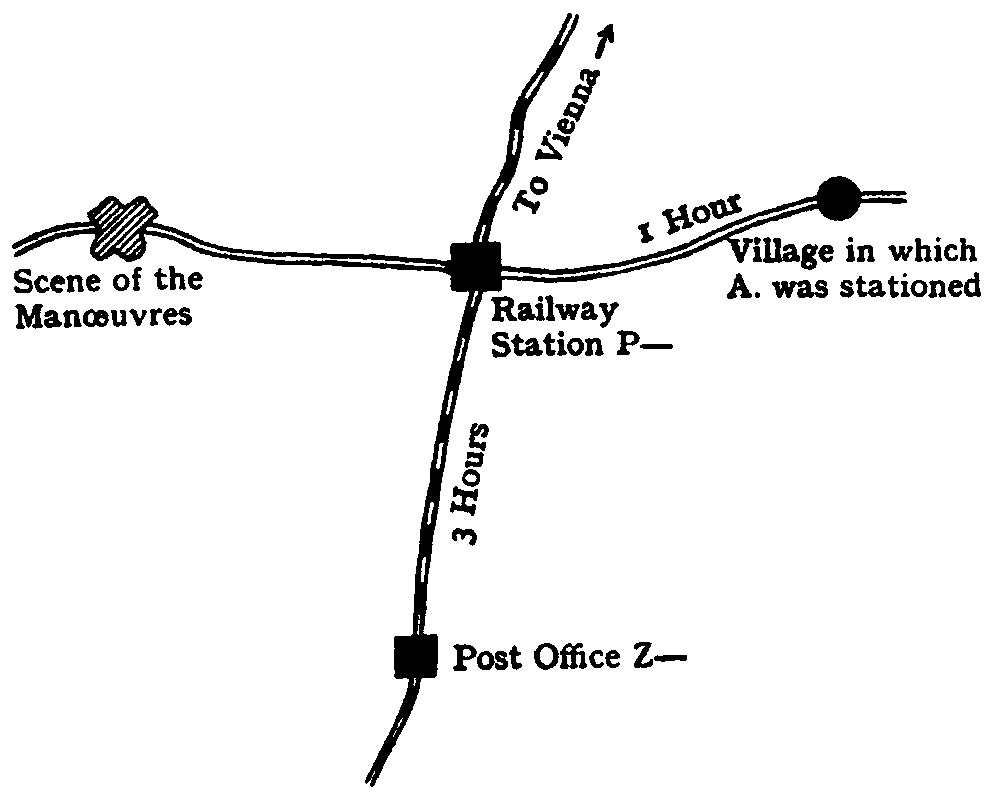
The matter contained in the following pages will be of two kinds. In the first place I shall give some fragmentary extracts from the history of a case of obsessional neurosis. This case, judged by its length, the injuriousness of its effects, and the patient’s own view of it, deserves to be classed as a fairly severe one; the treatment, which lasted for about a year, led to the complete restoration of the patient’s personality, and to the removal of his inhibitions. In the second place, starting out from this case, and also taking other cases into account which I have previously analysed, I shall make some disconnected statements of an aphoristic character upon the genesis and finer psychological mechanism of obsessional processes, and I shall thus hope to develop my first observations on the subject, published in 1896.[190]
A programme of this kind seems to me to require some justification. For it might otherwise be thought that I regard this method of making a communication as perfectly correct and as one to be imitated; whereas in reality I am only accommodating myself to obstacles, some external and others inherent in the subject, and I should gladly have communicated more if it had been right or possible for me to do so. I cannot give a complete history of the treatment, because that would 294involve my entering in detail into the circumstances of my patient’s life. The importunate interest of a capital city, focussed with particular attention upon my medical activities, forbids my giving a faithful picture of the case. On the other hand I have come more and more to regard the distortions usually resorted to in such circumstances as useless and objectionable. If the distortions are slight, they fail in their object of protecting the patient from indiscreet curiosity; while if they go beyond this they require too great a sacrifice, for they destroy the intelligibility of the material, which depends for its coherence precisely upon the small details of real life. And from this latter circumstance follows the paradoxical truth that it is far easier to divulge the patient’s most intimate secrets than the most innocent and trivial facts about him, for, whereas the former would not throw any light on his identity, the latter, by which he is generally recognized, would make it obvious to every one.
Such is my excuse for having curtailed so drastically the history of this case and of its treatment. And I can offer still more cogent reasons for having confined myself to the statement only of some disconnected results of the psycho-analytic investigation of obsessional neuroses. I must confess that I have not yet succeeded in completely penetrating the complicated texture of a severe case of obsessional neurosis, and that, if I were to reproduce the analysis, it would be impossible for me to make the structure, such as by the help of analysis we know or suspect it to be, visible to others through the mass of therapeutic work superimposed upon it. What adds so greatly to the difficulty of doing this is the patients’ resistances and the forms in which they are expressed. But even apart from this it must be admitted that an obsessional neurosis is in itself not an easy thing to understand—much less so than a case of hysteria. As a matter of fact we should have expected to find the contrary. 295The language of an obsessional neurosis—the means by which it expresses its secret thoughts—is, as it were, only a dialect of the language of hysteria; but it is a dialect in which we ought to be able to find our way about more easily, since it is more nearly related to the forms of expression adopted by our conscious thought than is the language of hysteria. Above all, it does not involve the leap from a mental process to a somatic innervation—hysterical conversion—which can never be fully comprehensible to us.
Perhaps it is only because we are less familiar with obsessional neuroses that we do not find these expectations confirmed by the facts. Persons suffering from a severe degree of obsessional neurosis present themselves far less frequently for analytic treatment than hysterical patients. They dissimulate their condition in daily life, too, as long as they possibly can, and often call in a physician only when their complaint has reached such an advanced stage as, had they been suffering, for instance, from tuberculosis of the lungs, would have led to their being refused admission to a sanatorium. I make this comparison, moreover, because, as with the chronic infectious disease which I have just mentioned, we can point to a number of brilliant therapeutic successes in severe no less than in light cases of obsessional neurosis, where these have been taken in hand at an early stage.
In these circumstances there is no alternative but to report the facts in the imperfect and incomplete fashion in which they are known and in which it is legitimate to communicate them. The crumbs of knowledge offered in these pages, though they have been laboriously enough collected, may not in themselves prove very satisfying; but they may serve as a starting-point for the work of other investigators, and common endeavour may bring the success which is perhaps beyond the reach of individual effort.
A youngish man of university education introduced himself to me with the statement that he had suffered from obsessions ever since his childhood, but with particular intensity for the last four years. The chief features of his disorder were fears that something might happen to two people of whom he was very fond—his father and a lady whom he admired. Besides this he was aware of compulsive impulses—such as an impulse, for instance, to cut his throat with a razor; and further he produced prohibitions, sometimes in connection with quite unimportant things. He had wasted years, he told me, in fighting against these ideas of his, and in this way had lost much ground in the course of his life. He had tried various treatments, but none had been of any use to him except a course of hydrotherapy at a sanatorium near ⸻; and this, he thought, had probably only been because he had made an acquaintance there which had led to regular sexual intercourse. Here he had no opportunities of the sort, and he seldom had intercourse and only at irregular intervals. He felt disgust at prostitutes. Altogether, he said, his sexual life had been stunted; onanism had played only a small part in it, in his sixteenth or seventeenth year. His potency was normal; he had first performed coitus at the age of twenty-six.
He gave me the impression of being a clear-headed and shrewd person. When I asked him what it was that made him lay such stress upon telling me about his sexual life, he replied that that was what he knew about my theories. Actually, however, he had read 297none of my writings, except that a short time before he had been turning over the pages of one of my books and had come across the explanation of some curious verbal associations[191] which had so much reminded him of some of his own ‘efforts of thought’ in connection with his ideas that he had decided to put himself in my hands.
The next day I made him pledge himself to submit to the one and only condition of the treatment—namely, to say everything that came into his head, even if it was unpleasant to him, or seemed unimportant or irrelevant or senseless. I then gave him leave to start his communications with any subject he pleased, and he began as follows:[192]
He had a friend, he told me, of whom he had an extraordinarily high opinion. He used always to go to him when he was tormented by some criminal impulse, and ask him whether he despised him as a criminal. His friend used then to give him moral support by assuring him that he was a man of irreproachable conduct, and had probably been in the habit, from his youth onwards, of taking a dark view of his own life. At an earlier date, he went on, another person had exercised a similar influence over him. This was a nineteen-year-old student (he himself had been fourteen or fifteen at the time) who had taken a liking to him, and had raised his self-esteem to an extraordinary degree, so that he appeared to 298himself to be a genius. This student had subsequently become his tutor, and had suddenly altered his behaviour and begun treating him as though he were an idiot. At length he had noticed that the student was interested in one of his sisters, and had realized that he had only taken him up in order to gain admission into the house. This had been the first great blow of his life.
He then proceeded without any apparent transition:
‘My sexual life began very early. I can remember a scene out of my fourth or fifth year. (From my sixth year onwards I can remember everything.) This scene came into my head quite distinctly, years later. We had a very pretty young governess called Fräulein Peter.[193] One evening she was lying on the sofa lightly dressed, and reading. I was lying beside her, and begged her to let me creep under her skirt. She told me I might, so long as I said nothing to any one about it. She had very little on, and I fingered her genitals and the lower part of her body, which struck me as very queer. After this I was left with a burning and tormenting curiosity to see the female body. I can still remember the intense excitement with which I waited at the Baths (which I was still allowed to go to 299with the governess and my sisters) for the governess to undress and get into the water. I can remember more things from my sixth year onwards. At that time we had another governess, who was also young and good-looking. She had abscesses on her buttocks which she was in the habit of expressing at night. I used to wait eagerly for that moment, to appease my curiosity. It was just the same at the Baths—though Fräulein Lina was more reserved than her predecessor.’ (In reply to a question which I threw in, ‘As a rule,’ the patient told me, ‘I did not sleep in her room, but mostly with my parents.’) ‘I remember a scene which must have taken place when I was seven years old.[194] We were sitting together one evening—the governess, the cook, another servant-girl, myself and my brother, who was eighteen months younger than me. The young women were talking, and I suddenly became aware of Fräulein Lina saying: “It could be done with the little one; but Paul” (that was I) “is too clumsy, he would be sure to miss it.” I did not understand clearly what was meant, but I felt the slight and began to cry. Lina comforted me, and told me how a girl, who had done something of the kind with a little boy she was in charge of, had been put in prison for several months. I do not believe she actually did anything wrong with me, but I took a great many liberties with her. When I got into her bed I used to uncover her and touch her, and she made no objections. She was not very intelligent, and clearly had very strong sexual cravings. At twenty-three she had already had a child. She afterwards married its father, so that to-day she is a Frau Hofrat.[195] Even now I often see her in the street.
‘When I was six years old I already suffered from erections, and I know that once I went to my mother 300to complain about them. I know too that in doing so I had some misgivings to get over, for I had a feeling that there was some connection between this subject and my ideas and inquisitiveness, and at that time I used to have a morbid idea that my parents knew my thoughts; I explained this to myself by supposing that I had spoken them out loud, without having heard myself do it. I look on this as the beginning of my illness. There were certain people, girls, who pleased me very much, and I had a very strong wish to see them naked. But in wishing this I had an uncanny feeling, as though something must happen if I thought such things, and as though I must do all sorts of things to prevent it.’
(In reply to a question he gave an example of these fears: ‘For instance, that my father might die.’) ‘Thoughts about my father’s death occupied my mind from a very early age and for a long period of time, and greatly depressed me.’
At this point I learnt with astonishment that the patient’s father, with whom his obsessional fears were still occupied at that actual time, had died several years previously.
The events in his sixth or seventh year which the patient described in the first hour of his treatment were not merely, as he supposed, the beginning of his illness, but were already the illness itself. It was a complete obsessional neurosis, wanting in no essential element, at once the nucleus and the prototype of the later disorder,—an elementary organism, as it were, the study of which could alone enable us to obtain a grasp of the complicated organization of his subsequent illness. The child, as we have seen, was under the domination of a component of the sexual instinct, scoptophilia (the instinct of looking), as a result of which there was a constant recurrence in him of a very intense wish connected with persons of the female sex who pleased him—the wish, that is, to see them naked. This wish corresponds to the later obsessional or com301pulsive idea; and if the quality of compulsion was not yet present in it, this was because the ego had not yet placed itself in complete opposition to it and did not yet regard it as something foreign to itself. Nevertheless, opposition to this wish from some source or other was already in activity, for its occurrence was regularly accompanied by a painful affect.[196] A conflict was evidently in progress in the mind of this young libertine. Side by side with the obsessive wish, and intimately associated with it, was an obsessive fear: every time he had a wish of this kind he could not help fearing that something dreadful would happen. This something dreadful was already clothed in a characteristic indeterminateness which was thenceforward to be an invariable feature of every manifestation of the neurosis. But in a child it is not hard to discover what it is that is veiled behind an indeterminateness of this kind. If the patient can once be induced to give a particular instance in place of the vague generalities which characterize an obsessional neurosis, it may be confidently assumed that the instance is the original and actual thing which has tried to hide itself behind the generalization. Our present patient’s obsessive fear, therefore, when restored to its original meaning, would run as follows: ‘If I have this wish to see a woman naked, my father will have to die.’ The painful affect was distinctly coloured with a tinge of uncanniness and superstition, and was already beginning to give rise to impulses to do something to ward off the impending evil. These impulses were subsequently to develop into the protective measures which the patient adopted.
We find, therefore: an erotic instinct and a revolt against it; a wish which has not yet become compulsive and, struggling against it, a fear which is already compulsive; a painful affect and an impulsion towards the performance of defensive acts. The 302inventory of the neurosis has reached its full muster. Indeed, something more is present, namely, a kind of delusional formation or delirium[197] with the strange content that his parents knew his thoughts because he spoke them out loud without his hearing himself do it. We shall not go far astray if we suppose that in making this attempt at an explanation the child had some inkling of those remarkable mental processes which we describe as unconscious and which we cannot dispense with if we are to throw any scientific light upon this obscure subject. ‘I speak my thoughts out loud, without hearing them’ sounds like a projection into the outer world of our own hypothesis that he had thoughts without knowing anything about them; it sounds like an endopsychic perception of the repressed.
For the situation is clear. This elementary neurosis of childhood already involved a problem and an apparent absurdity, like any complicated neurosis of maturity. What can have been the meaning of the child’s idea that if he had this lascivious wish his father would have to die? Was it sheer nonsense? Or are there means of understanding the words and of looking upon them as a necessary consequence of earlier events and premises?
If we apply knowledge gained elsewhere to this case of childhood neurosis, we shall not be able to avoid the suspicion that in this instance as in others, that is to say, before the child had reached his sixth year, there had been conflicts and repressions, which had themselves been overtaken by amnesia, but had left behind them as a residuum the particular content of this obsessive fear. Later on we shall learn how far it is possible for us to rediscover those forgotten experiences or to reconstruct them with some degree of certainty. In the meantime stress may be laid on the fact, which is probably more than a mere coincidence, 303that the patient’s infantile amnesia ended precisely with his sixth year.
To find a chronic obsessional neurosis beginning like this in early childhood, with lascivious wishes of this sort connected with uncanny apprehensions and an inclination to the performance of defensive acts, is no new thing to me. I have come across it in a number of other cases. It is absolutely typical, although probably not the only possible type. Before proceeding to the events of the second sitting, I should like to add one more word on the subject of the patient’s early sexual experiences. It will hardly be disputed that they may be described as having been considerable both in themselves and in their consequences. But it has been the same with the other cases of obsessional neurosis that I have had the opportunity of analysing. Such cases, unlike those of hysteria, invariably possess the characteristic of premature sexual activity. Obsessional neuroses make it much more obvious than hysterias that the factors which go to form a psychoneurosis are to be found in the patient’s infantile sexual life and not in his present one. The current sexual life of an obsessional neurotic may often appear perfectly normal to a superficial observer; indeed, it frequently offers to the eye far fewer pathogenic elements and abnormalities than in the instance we are now considering.
‘I think I shall begin to-day with the experience which was the direct occasion of my coming to you. It was in August during the manœuvres at ⸻. I had been suffering before, and tormenting myself with all kinds of obsessional thoughts, but they had quickly passed off during the manœuvres. I was keen to show the regular officers that people like me had not only learnt a good deal but could stand a good deal too. 304One day we started from ⸻ on a short march. During a halt I lost my pince-nez, and, although I could easily have found them, I did not want to delay our start, so I gave them up. But I wired to my opticians in Vienna to send me another pair by the next post. During that same halt I sat between two officers, one of whom, a captain with a Czech name, was to be of no small importance to me. I had a kind of dread of him, for he was obviously fond of cruelty. I do not say he was a bad man, but at the officers’ mess he had repeatedly defended the introduction of corporal punishment, so that I had been obliged to disagree with him very sharply. Well, during this halt we got into conversation, and the captain told me he had read of a specially horrible punishment used in the East…’
Here the patient broke off, got up from the sofa, and begged me to spare him the recital of the details. I assured him that I myself had no taste whatever for cruelty, and certainly had no desire to torment him, but that naturally I could not grant him something which was beyond my power. He might just as well ask me to give him the moon. The overcoming of resistances was a law of the treatment, and on no consideration could it be dispensed with. (I had explained the idea of ‘resistance’ to him at the beginning of the hour, when he told me there was much in himself which he would have to overcome if he was to relate this experience of his.) I went on to say that I would do all I could, nevertheless, to guess the full meaning of any hints he gave me. Was he perhaps thinking of impalement? — ‘No, not that; …the criminal was tied up…’ —he expressed himself so indistinctly that I could not immediately guess in what position— ‘…a pot was turned upside down on his buttocks… some rats were put into it… and they…’ —he had again got up, and was showing every sign of horror and resistance— ‘…bored their way in…’ —Into his anus, I helped him out.305
At all the more important moments while he was telling his story his face took on a very strange, composite expression. I could only interpret it as one of horror at pleasure of his own of which he himself was unaware. He proceeded with the greatest difficulty: ‘At that moment the idea flashed through my mind that this was happening to a person who was very dear to me.’[198] In answer to a direct question he said that it was not he himself who was carrying out the punishment, but that it was being carried out as it were impersonally. After a little prompting I learnt that the person to whom this ‘idea’ of his related was the lady whom he admired.
He broke off his story in order to assure me that these thoughts were entirely foreign and repugnant to him, and to tell me that everything which had followed in their train had passed through his mind with the most extraordinary rapidity. Simultaneously with the idea there always appeared a ‘sanction’, that is to say, the defensive measure which he was obliged to adopt in order to prevent the phantasy from being fulfilled. When the captain had spoken of this ghastly punishment, he went on, and these ideas had come into his head, by employing his usual formulas (a ‘But’ accompanied by a gesture of repudiation, and the phrase ‘Whatever are you thinking of?’) he had just succeeded in warding off both of them.
This ‘both’ took me aback, and it has no doubt also mystified the reader. For so far we have heard only of one idea—of the rat punishment being carried out upon the lady. He was now obliged to admit that a second idea had occurred to him simultaneously, namely, the idea of the punishment also being applied to his father. As his father had died many years previously, this obsessive fear was much more nonsensical even than the first, and accordingly it had 306attempted to escape being confessed to for a little while longer.
That evening, he continued, the same captain had handed him a packet that had arrived by the post and had said: ‘Lieutenant A.[199] has paid the charges[200] for you. You must pay him back.’ The packet had contained the pince-nez that he had wired for. At that instant, however, a ‘sanction’ had taken shape in his mind, namely, that he was not to pay back the money or it would happen—(that is, the phantasy about the rats would come true as regards his father and the lady). And immediately, in accordance with a type of procedure with which he was familiar, to combat this sanction there had arisen a command in the shape of a vow: ‘You must pay back the 3.80 crowns[201] to Lieutenant A.’ He had said these words to himself almost half aloud.
Two days later the manœuvres had come to an end. He had spent the whole of the intervening time in efforts at repaying Lieutenant A. the small amount in question; but a succession of difficulties of an apparently external nature had arisen to prevent it. First he had tried to effect the payment through another officer who had been going to the post office. But he had been much relieved when this officer brought him back the money, saying that he had not met Lieutenant A. there, for this method of fulfilling his vow had not satisfied him, as it did not correspond with the wording, which ran: ‘You must pay back the money to Lieutenant A.’ Finally, he had met Lieutenant A., the person he was looking for; but he had refused to accept the money, declaring that he had not paid anything for him, and had nothing whatever to do with the post, which was the business of Lieutenant B. This had thrown my patient into great perplexity, 307for it meant that he was unable to keep his vow, since it had been based upon false premises. He had excogitated a very curious means of getting out of his difficulty, namely, that he should go to the post office with both the men, A. and B., that A. should give the young lady there the 3.80 crowns, that the young lady should give them to B., and that then he himself should pay back the 3.80 crowns to A. according to the wording of his vow.
It would not surprise me to hear that at this point the reader had ceased to be able to follow. For even the detailed account which the patient gave me of the external events of these days and of his reactions to them was full of self-contradictions and sounded hopelessly confused. It was only when he told the story for the third time that I could get him to realize its obscurities and could lay bare the errors of memory and the displacements in which he had become involved. I shall spare myself the trouble of reproducing these details, the essentials of which we shall easily be able to pick up later on, and I will only add that at the end of this second sitting the patient behaved as though he were dazed and bewildered. He repeatedly addressed me as ‘Captain’, probably because at the beginning of the hour I had told him that I myself was not fond of cruelty like Captain M., and that I had no intention of tormenting him unnecessarily.
The only other piece of information that I obtained from him during this hour was that from the very first, on all the previous occasions on which he had had a fear that something would happen to people he loved no less than on the present one, he had referred the punishments not only to our present life but also to eternity—to the next world. Up to his fourteenth or fifteenth year he had been devoutly religious, but from that time on he had gradually developed into the free-thinker that he was to-day. He reconciled the contradiction between his beliefs and his obsessions by saying to himself: ‘What do you know about the 308next world? Nothing can be known about it. You’re not risking anything—so do it.’ This form of argument seemed unobjectionable to a man who was in other respects particularly clear-headed, and in this way he exploited the uncertainty of reason in the face of these questions to the benefit of the religious attitude which he had outgrown.
At the third sitting he completed his very characteristic story of his efforts at fulfilling his obsessional vow. That evening the last gathering of officers had taken place before the end of the manœuvres. It had fallen to him to reply to the toast of ‘The Gentlemen of the Reserve’. He had spoken well, but as if he were in a dream, for at the back of his mind he was being incessantly tormented by his vow. He had spent a terrible night. Arguments and counter-arguments had struggled with one another. The chief argument, of course, had been that the premise upon which his vow had been based—that Lieutenant A. had paid the money for him—had proved to be false. However, he had consoled himself with the thought that the business was not yet finished, as A. would be riding with him next morning part of the way to the railway station at P⸺, so that he would still have time to ask him the necessary favour. As a matter of fact he had not done this, and had allowed A. to go off without him; but he had given instructions to his orderly to let A. know that he intended to pay him a visit that afternoon. He himself had reached the station at half-past nine in the morning. He had deposited his luggage there and had seen to various things he had to do in the small town, with the intention of afterwards paying his visit to A. The village in which A. was stationed was about an hour’s drive from the town of P⸺. The railway journey to the place where the post office was would take three hours. He had calculated, therefore, that the execution of his complicated plan would just leave him time to catch the evening train from P⸺ to Vienna. The ideas 309that were struggling within him had been, on the one hand, that he was simply being cowardly and was obviously only trying to save himself the unpleasantness of asking A. to make the sacrifice in question and of cutting a foolish figure before him, and that that was why he was disregarding his vow; and, on the other hand, that it would, on the contrary, be cowardly of him to fulfil his vow, since he only wanted to do so in order to be left in peace by his obsessions. When in the course of his deliberations, the patient added, he found the arguments so evenly balanced as these, it was his custom to allow his actions to be decided by chance events as though by the hand of God. When, therefore, a porter at the station had addressed him with the words, ‘Ten o’clock train, sir?’ he had answered ‘Yes’, and in fact had gone off by the ten o’clock train. In this way he had produced a fait accompli and felt greatly relieved. He had proceeded to book a seat for luncheon in the restaurant car. At the first station they had stopped at it had suddenly struck him that he still had time to get out, wait for the next down train, travel back in it to P⸺, drive to the place where Lieutenant A. was quartered, from there make the three hours’ train journey with him to the post office, and so forth. It had only been the consideration that he had booked his seat for luncheon with the steward of the restaurant car that had prevented his carrying out this design. He had not abandoned it, however; he had only put off getting out until a later stop. In this way he had struggled through from station to station, till he had reached one at which it had seemed to him impossible to get out because he had relatives living there. He had then determined to travel through to Vienna, to look up his friend there and lay the whole matter before him, and then, after his friend had made his decision, to catch the night train back to P⸺. When I expressed a doubt whether this would have been feasible, he assured me that he would have had half 310an hour to spare between the arrival of the one train and the departure of the other. When he had arrived in Vienna, however, he had failed to find his friend at the restaurant at which he had counted on meeting him, and had not reached his friend’s house till eleven o’clock at night. He told him the whole story that very night. His friend had held up his hands in amazement to think that he could still be in doubt whether he was suffering from an obsession, and had calmed him down for the night, so that he had slept excellently. Next morning they had gone together to the post office, to dispatch the 3.80 crowns to ⸻, the post office at which the packet containing the pince-nez had arrived.
It was this last statement which provided me with a starting-point from which I could begin straightening out the various distortions involved in his story. After his friend had brought him to his senses he had dispatched the small sum of money in question neither to Lieutenant A. nor to Lieutenant B., but direct to the post office. He must therefore have known that he owed the amount of the charges due upon the packet to no one but the official at the post office, and he must have known this before he started on his journey. It turned out that in fact he had known it before the captain made his request and before he himself made his vow; for he now remembered that a few hours before meeting the cruel captain he had had occasion to introduce himself to another captain, who had told him how matters actually stood. This officer, on hearing his name, had told him that he had been at the post office a short time before, and that the young lady there had asked him whether he knew a Lieutenant H. (the patient, in fact), for whom a packet had arrived, to be paid for on delivery. The officer had replied that he did not, but the young lady had been of opinion that she could trust the unknown lieutenant and had said that in the meantime she would pay the charges herself. It had been in this way that the patient had 311come into possession of the pince-nez he had ordered. The cruel captain had made a mistake when, as he handed him over the packet, he had asked him to pay back the 3.80 crowns to A., and the patient must have known it was a mistake. In spite of this he had made a vow founded upon this mistake, a vow that was bound to be a torment to him. In so doing he had suppressed to himself, just as in telling the story he had suppressed to me, the episode of the other captain and the existence of the trusting young lady at the post office. I must admit that when this correction has been made his behaviour becomes even more senseless and unintelligible than before.
After he had left his friend and returned to his family his doubts had overtaken him afresh. His friend’s arguments, he saw, had been no different from his own, and he was under no delusion that his temporary relief was attributable to anything more than his friend’s personal influence. His determination to consult a doctor was woven into his delirium[202] in the following ingenious manner. He thought he would get a doctor to give him a certificate to the effect that it was necessary for him, in order to recover his health, to perform some such action as he had planned in connection with Lieutenant A.; and the lieutenant would no doubt let himself be persuaded by the certificate into accepting the 3.80 crowns from him. The chance that one of my books happened to fall into his hands just at that moment directed his choice to me. There was no question of getting a certificate from me, however; all that he asked of me was, very reasonably, to be freed of his obsessions. Many months later, when his resistance was at its height, he once more felt a temptation to travel to P⸺ after all, to look up Lieutenant A. and to go through the farce of returning him the money.
The reader must not expect to hear at once what light I have to throw upon the patient’s strange and senseless obsessions about the rats. The true technique of psycho-analysis requires the physician to suppress his curiosity and leaves the patient complete freedom in choosing the order in which topics shall succeed each other during the treatment. At the fourth sitting, accordingly, I received the patient with the question: ‘And how do you intend to proceed to-day?’
‘I have decided to tell you something which I consider most important and which has tormented me from the very first.’ He then told me at great length the story of the last illness of his father, who had died of emphysema nine years previously. One evening, thinking that the condition was one which would come to a crisis, he had asked the doctor when the danger could be regarded as over. ‘The evening of the day after to-morrow’, had been the reply. It had never entered his head that his father might not survive that limit. At half-past eleven at night he had lain down for an hour’s rest. He had woken up at one o’clock, and had been told by a medical friend that his father had died. He had reproached himself with not having been present at his death; and the reproach had been intensified when the nurse told him that his father had spoken his name once during the last days, and had said to her as she came up to the bed: ‘Is that Paul?’ He had thought he noticed that his mother and sisters had been inclined to reproach themselves in a similar way; but they had never spoken about it. At first, however, the reproach had not tormented him. For a long time he had not realized the fact of his father’s death. It had constantly happened that, when he heard a good joke, he would say to himself: ‘I must tell Father that.’ His imagination, too, had been occupied with his father, so that often, when there was a knock at the door, he 313would think: ‘Here comes Father’, and when he walked into a room he would expect to find his father in it. And although he had never forgotten that his father was dead, the prospect of seeing a ghostly apparition of this kind had had no terrors for him; on the contrary, he had greatly desired it. It had not been until eighteen months later that the recollection of his neglect had recurred to him and begun to torment him terribly, so that he had come to treat himself as a criminal. The occasion of this happening had been the death of an aunt by marriage and of a visit of condolence that he had paid at her house. From that time forward he had extended the structure of his obsessional thoughts so as to include the next world. The immediate consequence of this development had been that he became seriously incapacitated from working.[203] He told me that the only thing that had kept him going at that time had been the consolation given him by his friend, who had always brushed his self-reproaches aside on the ground that they were grossly exaggerated. Hearing this, I took the opportunity of giving him a first glance at the underlying principles of psycho-analytic therapy. When there is a mésalliance, I began, between an affect and its ideational content (in this instance, between the intensity of the self-reproach and the occasion for it), a layman will say that the affect is too great for the occasion—that it is exaggerated—and that consequently the inference following from the self-reproach (the inference, that is, that the patient is a criminal) is false. On the contrary, the physician says: ‘No. The affect is justified. The sense of guilt cannot in itself be further criticized. But it belongs to another 314content, which is unknown (unconscious), and which requires to be looked for. The known ideational content has only got into its actual position owing to a mistaken association. We are not used to feeling strong affects without their having any ideational content, and therefore, if the content is missing, we seize as a substitute upon another content which is in some way or other suitable, much as our police, when they cannot catch the right murderer, arrest a wrong one instead. Moreover, this fact of there being a mistaken association is the only way of accounting for the powerlessness of logical processes in combating the tormenting idea.’ I concluded by admitting that this new way of looking at the matter gave immediate rise to some hard problems; for how could he admit that his self-reproach of being a criminal towards his father was justified, when he must know that as a matter of fact he had never committed any crime against him?
At the next sitting the patient showed great interest in what I had said, but ventured, so he told me, to bring forward a few doubts.—How, he asked, could the information that the self-reproach, the sense of guilt, was justified have a therapeutic effect?—I explained that it was not the information that had this effect, but the discovery of the unknown content to which the self-reproach was really attached.—Yes, he said, that was the precise point to which his question had been directed.—I then made some short observations upon the psychological differences between the conscious and the unconscious, and upon the fact that everything conscious was subject to a process of wearing-away, while what was unconscious was relatively unchangeable; and I illustrated my remarks by pointing to the antiques standing about in my room. They were, in fact, I said, only objects found in a tomb, and their burial had been their preservation: the destruction of Pompeii was only beginning now that it had been dug up.—Was there any guarantee, he next inquired, of what one’s attitude would be towards what 315was discovered? One man, he thought, would no doubt behave in such a way as to get the better of his self-reproach, but another would not.—No, I said, it followed from the nature of the circumstances that in every case the affect would for the most part be overcome during the progress of the work itself. Every effort was made to preserve Pompeii, whereas people were anxious to be rid of tormenting ideas like his.—He had said to himself, he went on, that a self-reproach could only arise from a breach of a person’s own inner moral principles and not from that of any external ones.—I agreed, and said that the man who merely breaks an external law often regards himself as a hero.—Such an occurrence, he continued, was thus only possible where a disintegration of the personality was already present. Was there a possibility of his effecting a reintegration of his personality? If this could be done, he thought he would be able to make a success of his life, perhaps a better one than most people.—I replied that I was in complete agreement with this notion of a splitting of his personality. He had only to assimilate this new contrast, between a moral self and an evil one, with the contrast I had already mentioned, between the conscious and the unconscious. The moral self was the conscious, the evil self was the unconscious.[204]—He then said that, though he considered himself a moral person, he could quite definitely remember having done things in his childhood which came from his other self.—I remarked that here he had incidentally hit upon one of the chief characteristics of the unconscious, namely, its relation to the infantile. The unconscious, I explained, was the infantile; it was that part of the self which had become separated off from it in infancy, which had not shared the later stages of its development, and which had in consequence become repressed. It was the derivatives of this repressed unconscious that were responsible for 316the involuntary thoughts which constituted his illness. He might now, I added, discover yet another characteristic of the unconscious; it was a discovery which I should be glad to let him make for himself.—He found nothing more to say in this immediate connection, but instead he expressed a doubt whether it was possible to undo modifications of such long standing. What, in particular, could be done against his idea about the next world, for it could not be refuted by logic?—I told him I did not dispute the gravity of his case nor the significance of his pathological constructions; but at the same time his youth was very much in his favour as well as the intactness of his personality. In this connection I said a word or two upon the good opinion I had formed of him, and this gave him visible pleasure.
At the next sitting he began by saying that he must tell me an event in his childhood. From the age of seven, as he had already told me, he had had a fear that his parents guessed his thoughts, and this fear had in fact persisted all through his life. When he was twelve years old he had been in love with a little girl, the sister of a friend of his. (In answer to a question he said that his love had not been sensual; he had not wanted to see her naked for she was too small.) But she had not shown him as much affection as he had desired. And thereupon the idea had come to him that she would be kind to him if some misfortune were to befall him; and as an instance of such a misfortune his father’s death had forced itself upon his mind. He had at once rejected the idea with energy. And even now he could not admit the possibility that what had arisen in this way could have been a ‘wish’; it had clearly been no more than a ‘connection of thought’.[205]—By way of objection I asked him why, if it had not been a wish, he had repudiated it.—Merely, he replied, on account of the 317content of the idea, the notion that his father might die.—I remarked that he was treating the phrase as though it were one that involved lèse-majesté; it was well known, of course, that it was equally punishable to say ‘The Emperor is an ass’ or to disguise the forbidden words by saying ‘If any one says, etc., …then he will have me to reckon with.’ I added that I could easily insert the idea which he had so energetically repudiated into a context which would exclude the possibility of any such repudiation: for instance, ‘If my father dies, I shall kill myself upon his grave.’—He was shaken, but did not abandon his objection. I therefore broke off the argument with the remark that I felt sure this had not been the first occurrence of his idea of his father’s dying; it had evidently originated at an earlier date, and some day we should have to trace back its history.—He then proceeded to tell me that a precisely similar thought had flashed through his mind a second time, six months before his father’s death. At that time[206] he had already been in love with his lady, but financial obstacles made it impossible to think of an alliance with her. The idea had then occurred to him that his father’s death might make him rich enough to marry her. In defending himself against this idea he had gone to the length of wishing that his father might leave him nothing at all, so that he might have no compensation for his terrible loss. The same idea, though in a much milder form, had come to him for a third time, on the day before his father’s death. He had then thought: ‘Now I may be going to lose what I love most’; and then had come the contradiction: ‘No, there is some one else whose loss would be even more painful to you.’[207] These thoughts surprised him very much, for he was quite certain that his father’s death could never have been an object of his desire but only of his fear.—After his forcible 318enunciation of these words I thought it advisable to bring a fresh piece of theory to his notice. According to psycho-analytical theory, I told him, every fear corresponded to a former wish which was now repressed; we were therefore obliged to believe the exact contrary of what he had asserted. This would also fit in with another theoretical requirement, namely, that the unconscious must be the precise contrary of the conscious.—He was much agitated at this and very incredulous. He wondered how he could possibly have had such a wish, considering that he loved his father more than any one else in the world; there could be no doubt that he would have renounced all his own prospects of happiness if by so doing he could have saved his father’s life.—I answered that it was precisely such intense love as his that was the condition of the repressed hatred. In the case of people to whom he felt indifferent he would certainly have no difficulty in maintaining side by side inclinations to a moderate liking and to an equally moderate dislike: supposing, for instance, that he were an official, he might think that his chief was agreeable as a superior, but at the same time pettifogging as a lawyer and inhuman as a judge. Shakespeare makes Brutus speak in a similar way of Julius Caesar: ‘As Caesar loved me, I weep for him; as he was fortunate, I rejoice at it; as he was valiant, I honour him; but as he was ambitious, I slew him.’ But these words already strike us as rather strange, and for the very reason that we had imagined Brutus’s feeling for Caesar as something deeper. In the case of some one who was closer to him, of his wife for instance, he would wish his feelings to be unmixed, and consequently, as was only human, he would overlook her faults, since they might make him dislike her—he would ignore them as though he were blind to them. So it was precisely the intensity of his love that would not allow his hatred—though to give it such a name was to caricature the feeling—to remain conscious. To be sure, the hatred must have a source, and to 319discover that source was certainly a problem; his own statements pointed to the time when he was afraid that his parents guessed his thoughts. On the other hand, too, it might be asked why this intense love of his had not succeeded in extinguishing his hatred, as usually happened where there were two opposing impulses. We could only presume that the hatred must flow from some source, must be connected with some particular cause, which made it indestructible. On the one hand, then, some connection of this sort must be keeping his hatred for his father alive, while on the other hand, his intense love prevented it from becoming conscious. Therefore nothing remained for it but to exist in the unconscious, though it was able from time to time to flash out for a moment into consciousness.
He admitted that all of this sounded quite plausible, but he was naturally not in the very least convinced by it.[208] He would venture to ask, he said, how it was that an idea of this kind could have remissions, how it could appear for a moment when he was twelve years old, and again when he was twenty, and then once more two years later, this time for good. He could not believe that his hostility had been extinguished in the intervals, and yet during them there had been no sign of self-reproaches.—To this I replied that whenever any one asked a question like that, he was already prepared with an answer; he needed only to be encouraged to go on talking.—He then proceeded, somewhat disconnectedly as it seemed, to say that he had been his father’s best friend, and that his father had been his. Except on a few subjects, upon which fathers and sons usually hold aloof from one another—320(What could he mean by that?)—there had been a greater intimacy between them than there now was between him and his best friend. As regards the lady on whose account he had slighted his father in that idea of his, it was true that he had loved her very much, but he had never felt really sensual wishes towards her, such as he had constantly had in his childhood. Altogether, in his childhood his sensual impulses had been much stronger than during his puberty.—At this I told him I thought he had now produced the answer we were waiting for, and had at the same time discovered the third great characteristic of the unconscious. The source from which his hostility to his father derived its indestructibility was evidently something in the nature of sensual desires, and in that connection he must have felt his father as in some way or other an interference. A conflict of this kind, I added, between sensuality and childish love was entirely typical. The remissions he had spoken of had occurred because the premature explosion of his sensual feelings had had as its immediate consequence a considerable diminution of their violence. It was not until he was once more seized with intense erotic desires that his hostility reappeared again owing to the revival of the old situation. I then got him to agree that I had not led him on to the subject either of childhood or of sex, but that he had raised them both of his own free will.—He then went on to ask why he had not simply come to a decision, at the time he was in love with the lady, that his father’s interference with that love could not for a moment weigh against his love of his father.—I replied that it was scarcely possible to destroy a person in absentia. Such a decision would only have been possible if the wish that he took objection to had made its first appearance on that occasion; whereas, as a matter of fact, it was a long-repressed wish, towards which he could not behave otherwise than he had formerly done, and which was consequently immune from destruction. 321This wish (to get rid of his father as being an interference) must have originated at a time when circumstances had been very different—at a time, perhaps, when he had not loved his father more than the person whom he desired sensually, or when he was incapable of making a clear decision. It must have been in his very early childhood, therefore, before he had reached the age of six, and before the date at which his memory became continuous; and things must have remained in the same state ever since.—With this piece of construction our discussion was broken off for the time being.
At the next sitting, which was the seventh, he took up the same subject once more. He could not believe, he said, that he had ever entertained such a wish against his father. He remembered a story of Sudermann’s, he went on, that had made a deep impression upon him. In this story there was a woman who, as she sat by her sister’s sick-bed, felt a wish that her sister should die so that she herself might marry her husband. The woman thereupon committed suicide, thinking she was not fit to live after being guilty of such baseness. He could understand this, he said, and it would be only right if his thoughts were the death of him, for he deserved nothing less.[209]—I remarked that it was well known to us that patients derived a certain satisfaction from their sufferings, so that in reality they all resisted their own recovery to some extent. He must never lose sight of the fact that a treatment like ours proceeded to the accompaniment of a constant resistance; I should be repeatedly reminding him of this fact.
He then went on to say that he would like to speak of a criminal act, in the author of which he did not 322recognize himself, though he quite clearly recollected doing it. He quoted a saying of Nietzsche’s:[210] ‘“I did this,” says my Memory. “I cannot have done this,” says my Pride and remains inexorable. In the end—Memory yields.’ ‘Well,’ he continued, ‘my memory has not yielded on this point.’ — ‘That is because you derive pleasure from your reproaches as being a means of self-punishment.’ — ‘My younger brother—I am really very fond of him now, and he is causing me a great deal of worry just at present, for he wants to make what I consider a preposterous match; I have thought before now of going and killing the person so as to prevent his marrying her—well, my younger brother and I used to fight a lot when we were children. We were very fond of one another at the same time, and were inseparable; but I was plainly filled with jealousy, as he was the stronger and better-looking of the two and consequently the favourite.’ — ‘Yes. You have already given me a description of a scene of jealousy in connection with Fräulein Lina.’ — ‘Very well then, on some such occasion (it was certainly before I was eight years old, for I was not going to school yet, which I began to do when I was eight)—on some such occasion, this is what I did. We both had toy guns of the usual make. I loaded mine with the ramrod and told him that if he looked up the barrel he would see something. Then, while he was looking in, I pulled the trigger. He was hit on the forehead and not hurt; but I had meant to hurt him very much indeed. Afterwards I was quite beside myself, and threw myself on the ground and asked myself how ever I could have done such a thing. But I did do it.’—I took the opportunity of urging my case. If he had preserved the recollection of an action so foreign to him as this, he could not, I maintained, deny the possibility of something similar, which he had now forgotten entirely, having happened at a still earlier age in relation to his father.—He then told me he was 323aware of having felt other vindictive impulses, this time towards the lady he admired so much, of whose character he painted a glowing picture. It might be true, he said, that she could not love easily; but she was reserving her whole self for the one man to whom she would some day belong. She did not love him. When he had become certain of that, a conscious phantasy had taken shape in his mind of how he should grow very rich and marry some one else, and should then take her to call on the lady in order to hurt her feelings. But at that point the phantasy had broken down, for he had been obliged to own to himself that the other woman, his wife, was completely indifferent to him; then his thoughts had become confused, till finally it had been clearly borne in upon him that this other woman would have to die. In this phantasy, just as in his attempt upon his brother, he recognized the quality of cowardice which was so particularly horrible to him.[211]—In the further course of our conversation I pointed out to him that he ought logically to consider himself as in no way responsible for any of these traits in his character; for all of these reprehensible impulses originated from his infancy, and were only derivatives of his infantile character surviving in his unconscious; and he must know that moral responsibility could not be applied to children. It was only by a process of development, I added, that a man, with his moral responsibility, grew up out of the sum of his infantile predispositions.[212] He expressed a doubt, however, whether all his evil impulses had originated from that source. But I promised to prove it to him in the course of the treatment.
He went on to adduce the fact of his illness having become so enormously intensified since his father’s death; and I said I agreed with him in so far as I 324regarded his sorrow at his father’s death as the chief source of the intensity of his illness. His sorrow had found, as it were, a pathological expression in his illness. Whereas, I told him, a normal period of mourning would last from one to two years, a pathological one like his would last indefinitely.
This is as much of the present case history as I am able to report in a detailed and consecutive manner. It coincides roughly with the expository portion of the treatment; this lasted in all for more than eleven months.
Obsessional ideas, as is well known, have an appearance of being either without motive or without meaning, just as dreams do. The first problem is how to give them a sense and a status in the mental life of the individual, so as to make them comprehensible and even obvious. The problem of translating them may seem insoluble; but we must never let ourselves be misled by that illusion. The wildest and most eccentric obsessional or compulsive ideas can be cleared up if they are investigated deeply enough. The solution is effected by bringing the obsessional ideas into temporal relationship with the patient’s experiences, that is to say, by inquiring when a particular obsessional idea made its first appearance and in what external circumstances it is apt to recur. When, as so often happens, an obsessional idea has not succeeded in establishing itself permanently, the task of clearing it up is correspondingly simplified. We can easily convince ourselves that, when once the interconnections between an obsessional idea and the patient’s experiences have been discovered, there will be no difficulty in obtaining access to whatever else may be puzzling or worth knowing in the pathological structure we are dealing with—its meaning, the mechanism of its origin, and its 325derivation from the preponderant motive forces of the patient’s mind.
As a particularly clear example I will begin with one of the suicidal impulses which appeared so frequently in our patient. This instance almost analysed itself in the telling. He had once, he told me, lost some weeks of study owing to his lady’s absence: she had gone away to nurse her grandmother, who was seriously ill. Just as he was in the middle of a very hard piece of work the idea had occurred to him: ‘If you received a command to take your examination this term at the first possible opportunity, you might manage to obey it. But if you were commanded to cut your throat with a razor, what then?’ He had at once become aware that this command had already been given, and was hurrying to the cupboard to fetch his razor when he thought: ‘No, it’s not so simple as that. You must[213] go and kill the old woman.’ Upon that, he had fallen to the ground, beside himself with horror.
In this instance the connection between the compulsive idea and the patient’s life is contained in the opening words of his story. His lady was absent, while he was working very hard for an examination so as to bring the possibility of an alliance with her nearer. While he was working he was overcome by a longing for his absent lady, and he thought of the cause of her absence. And now there came over him something which, if he had been a normal man, would probably have been some kind of feeling of annoyance against her grandmother: ‘Why must the old woman get ill just at the very moment when I’m longing for her so frightfully?’ We must suppose that something similar but far more intense passed through our patient’s mind—an unconscious fit of rage which could combine with his longing and find expression in the exclamation: ‘Oh, I should like to go and kill 326that old woman for robbing me of my love!’ Thereupon followed the command: ‘Kill yourself, as a punishment for these savage and murderous passions!’ The whole process then passed into the obsessional patient’s consciousness accompanied by the most violent affect and in a reverse order—the punitive command coming first, and the mention of the guilty outburst afterwards. I cannot think that this attempt at an explanation will seem forced or that it involves many hypothetical elements.
Another impulse, which might be described as indirectly suicidal and which was of longer duration, was not so easily explicable. For its relation to the patient’s experiences succeeded in concealing itself behind one of those purely external associations which are so repellent to our consciousness. One day while he was away on his summer holidays the idea suddenly occurred to him that he was too fat [German ‘dick’] and that he must make himself thinner. So he began getting up from table before the pudding came round and tearing along the road without a hat in the blazing heat of an August sun. Then he would dash up a mountain at the double, till, dripping with perspiration, he was forced to come to a stop. On one occasion his suicidal intentions actually emerged without any disguise from behind this mania for getting thinner: as he was standing on the edge of a steep precipice he suddenly received a command to jump over, which would have been certain death. Our patient could think of no explanation of this senseless obsessional behaviour until it suddenly occurred to him that at that time his lady had also been stopping at the same resort; but she had been in the company of an English cousin, who was very attentive to her and of whom the patient had been very jealous. This cousin’s name was Richard, and, according to the usual practice in England, he was known as Dick. Our patient, then, had wanted to kill this Dick; he had been far more jealous of him and enraged with him than he could 327admit to himself, and that was why he had imposed on himself this course of banting by way of a punishment. This obsessional impulse may seem very different from the directly suicidal command which was discussed above, but they have nevertheless one important feature in common. For they both arose as reactions to a tremendous feeling of rage, which was inaccessible to the patient’s consciousness and was directed against some one who had cropped up as an interference with the course of his love.[214]
Some other of the patient’s obsessions, however, though they too were centred upon his lady, exhibited a different mechanism and owed their origin to a different instinct. Besides his banting mania he produced a whole series of other obsessional activities at the period during which the lady was stopping at his summer resort; and, in part at least, these directly related to her. One day, when he was out with her in a boat and there was a stiff breeze blowing, he was obliged to make her put on his cap, because a command had been formulated in his mind that nothing must happen to her.[215] This was a kind of obsession for protecting, and it bore other fruit besides this. Another time, as they were sitting together during a thunderstorm, he was obsessed, he could not tell why, with the necessity for counting up to forty or fifty between each flash of lightning and its accompanying thunder-clap. On the day of her departure he knocked his foot against a stone lying in the road, and was obliged to put it out of the way by the side of the road, because the idea 328struck him that her carriage would be driving along the same road in a few hours’ time and might come to grief against this stone. But a few minutes later it occurred to him that this was absurd, and he was obliged to go back and replace the stone in its original position in the middle of the road. After her departure he became a prey to an obsession for understanding, which made him a curse to all his companions. He forced himself to understand the precise meaning of every syllable that was addressed to him, as though he might otherwise be missing some priceless treasure. Accordingly he kept asking: ‘What was it you said just then?’ And after it had been repeated to him he could not help thinking it had sounded different the first time, so he remained dissatisfied.
All of these products of his illness depended upon a certain circumstance which at that time dominated his relations to his lady. When he had been taking leave of her in Vienna before the summer holidays, she had said something which he had construed into a desire on her part to disown him before the rest of the company; and this had made him very unhappy. During her stay at the holiday resort there had been an opportunity for discussing the question, and the lady had been able to prove to him that these words of hers which he had misunderstood had on the contrary been intended to save him from being laughed at. This made him very happy again. The clearest allusion to this incident was contained in the obsession for understanding. It was constructed as though he were saying to himself: ‘After such an experience you must never misunderstand any one again, if you want to spare yourself unnecessary pain.’ This resolution was not merely a generalization from a single occasion, but it was also displaced—perhaps on account of the lady’s absence—from a single highly valued individual on to all the remaining inferior ones. And the obsession cannot have arisen solely from his satisfaction at the explanation she had given him; it must have 329expressed something else besides, for it ended in an unsatisfying doubt as to whether what he had heard had been correctly repeated.
The other compulsive commands that have been mentioned put us upon the track of this other element. His obsession for protecting can only have been a reaction—as an expression of remorse and penitence—to a contrary, that is a hostile, impulse which he must have felt towards his lady before they had their éclaircissement. His obsession for counting during the thunderstorm can be interpreted, with the help of some material which he produced, as having been a defensive measure against fears that some one was in danger of death. The analysis of the obsessions which we first considered has already warned us to regard our patient’s hostile impulses as particularly violent and as being in the nature of senseless rage; and now we find that even after their reconciliation his rage against the lady continued to play a part in the formation of his obsessions. His doubting mania as to whether he had heard correctly was an expression of the doubt still lurking in his mind as to whether he had really understood his lady correctly this time and as to whether he had been justified in taking her words as a proof of her affection for him. The doubt implied in his obsession for understanding was a doubt of her love. A battle between love and hate was raging in the lover’s breast, and the object of both these feelings was one and the same person. The battle was represented in a plastic form by his compulsive and symbolic act of removing the stone from the road along which she was to drive, and then of undoing this deed of love by replacing the stone where it had lain, so that her carriage might come to grief against it and she herself be hurt. We shall not be forming a correct judgement of this second part of the compulsive act if we take it at its face value as having merely been a critical repudiation of a pathological action. The fact that it was accompanied by a sense of compulsion betrays it 330as having itself been a part of the pathological action, though a part which was determined by a motive contrary to that which produced the first part.
Compulsive acts like this, in two successive stages, of which the second neutralizes the first, are a typical occurrence in obsessional neuroses. The patient’s consciousness naturally misunderstands them and puts forward a set of secondary motives to account for them—rationalizes them, in short.[216] But their true significance lies in their being a representation of a conflict between two opposing impulses of approximately equal strength: and hitherto I have invariably found that this opposition has been one between love and hate. Compulsive acts of this sort are theoretically of special interest, for they show us a new type of symptom-formation. What regularly occurs in hysteria is that a compromise is arrived at which enables both the opposing tendencies to find expression simultaneously—which kills two birds with one stone;[217] whereas here each of the two opposing tendencies finds satisfaction singly, first one and then the other, though naturally an attempt is made to establish some sort of logical connection (often in defiance of all logic) between the antagonists.[218]
The conflict between love and hatred showed itself in our patient by other signs as well. At the time of 331the revival of his piety he used to make up prayers for himself, which took up more and more time and eventually lasted for an hour and a half. The reason for this was that he found, like an inverted Balaam, that something always inserted itself into his pious phrases and turned them into their opposite. For instance, if he said, ‘May God protect him’, an evil spirit would hurriedly insinuate a ‘not’.[219] On one such occasion the idea occurred to him of cursing instead, for in that case, he thought, the contrary words would be sure to creep in. His original intention, which had been repressed by his praying, was forcing its way through in this last idea of his. In the end he found his way out of his embarrassment by giving up the prayers and replacing them by a short formula concocted out of the initial letters or syllables of various prayers. He then recited this formula so quickly that nothing could slip into it.
He once brought me a dream which represented the same conflict in relation to his transference on to the physician. He dreamed that my mother was dead; he was anxious to offer me his condolences, but was afraid that in doing so he might break into an impertinent laugh, as he had repeatedly done on similar occasions in the past. He preferred, therefore, to leave a card on me with ‘p.c.’ written on it; but as he was writing them the letters turned into ‘p.f.’[220]
The mutual antagonism between his feelings for his lady was too marked to have escaped his conscious perception entirely, although we may conclude from the obsessions in which it was manifested that he did not rightly appreciate the depth of his negative impulses. The lady had refused his first proposal, ten years earlier. Since then he had to his own knowledge 332passed through alternating periods, in which he either believed that he loved her intensely, or felt indifferent to her. Whenever in the course of the treatment he was faced by the necessity of taking some step which would bring him nearer the successful end of his courtship, his resistance usually began by taking the form of a conviction that after all he did not very much care for her—though this resistance, it is true, used soon to break down. Once when she was lying seriously ill in bed and he was most deeply concerned about her, there crossed his mind as he looked at her a wish that she might lie like that for ever. He explained this idea by an ingenious piece of sophistry: maintaining that he had only wished her to be permanently ill so that he might be relieved of his intolerable fear that she would have a repeated succession of attacks![221] Now and then he used to occupy his imagination with day-dreams, which he himself recognized as ‘phantasies of revenge’ and felt ashamed of. Believing, for instance, that the lady set great store by the social standing of a suitor, he made up a phantasy in which she was married to a man of that kind, who was in some government office. He himself then entered the same department, and rose much more rapidly than her husband, who eventually became his subordinate. One day, his phantasy proceeded, this man committed some act of dishonesty. The lady threw herself at his feet and implored him to save her husband. He promised to do so; but at the same time informed her that it had only been for love of her that he had entered the service, because he had foreseen that such a moment would occur; and now that her husband was saved, his own mission was fulfilled and he would resign his post.
He produced other phantasies in which he did the lady some great service without her knowing that it 333was he who was doing it. In these he only recognized his affection, without sufficiently appreciating the origin and aim of his magnanimity, which was designed to repress his thirst for revenge, after the manner of Dumas’ Count of Monte-Cristo. Moreover he admitted that occasionally he was overcome by quite distinct impulses to do some mischief to the lady he admired. These impulses were mostly in abeyance when she was there, and only appeared in her absence.
One day the patient mentioned quite casually an event which I could not fail to recognize as the exciting cause of his illness, or at least as the immediate occasion of the attack which had begun some six years previously and had persisted to that day. He himself had no notion that he had brought forward anything of importance; he could not remember that he had ever attached any importance to the event; and moreover he had never forgotten it. Such an attitude on his part calls for some theoretical consideration.
In hysteria it is the rule that the exciting causes of the illness are overtaken by amnesia no less than the infantile experiences by whose help the exciting causes are able to transform their affective energy into symptoms. And where the amnesia cannot be complete, it nevertheless subjects the recent traumatic exciting cause to a process of erosion and robs it at least of its most important components. In this amnesia we see the evidence of the repression which has taken place. The case is different in obsessional neuroses. The infantile preconditions of the neurosis may be overtaken by amnesia, though this is often an incomplete one; but the immediate occasions of the illness are, on the contrary, retained in the memory. Repression makes use of another, and in reality a simpler, mechanism. The trauma, instead of being 334forgotten, is deprived of its affective cathexis;[222] so that what remains in consciousness is nothing but its ideational content, which is perfectly colourless and is judged to be unimportant. The distinction between what occurs in hysteria and in an obsessional neurosis lies in the psychological processes which we can reconstruct behind the phenomena; the result is almost always the same, for the colourless mnemonic content is rarely reproduced and plays no part in the patient’s mental activity. In order to differentiate between the two kinds of repression we have on the surface nothing to rely upon but the patient’s assurance that he has a feeling in the one case of having always known the thing and in the other of having long ago forgotten it.[223]
For this reason it not uncommonly happens that obsessional neurotics, who are troubled with self-reproaches but have connected their affects with the wrong causes, will also tell the physician the true causes, without any suspicion that their self-reproaches have simply become detached from them. In relating such an incident they will sometimes add with astonishment or even with an air of pride: ‘But I think nothing of that.’ This happened in the first case of obsessional neurosis which gave me an insight many years ago into the nature of the malady. The patient, who was a government official, was troubled by innumerable scruples. He was the man whose compulsive act in connection with the branch in the park at Schönbrunn I have already described. I was struck by the fact that the florin notes with which he paid his consultation 335fees were invariably clean and smooth. (This was before we had a silver coinage in Austria.) I once remarked to him that one could always tell a government official by the brand-new florins that he drew from the State treasury, and he then informed me that his florins were by no means new, but that he had them ironed out at home. It was a matter of conscience with him, he explained, not to hand any one dirty paper florins; for they harboured all sorts of dangerous bacteria and might do some harm to the recipient. At that time I already had a vague suspicion of the connection between neuroses and sexual life, so on another occasion I ventured to ask the patient how he stood in regard to that matter. ‘Oh, that’s quite all right,’ he answered airily, ‘I’m not at all badly off in that respect. I play the part of a dear old uncle in a number of respectable families, and now and then I make use of my position to invite some young girl to go out with me for a day’s excursion in the country. Then I arrange that we shall miss the train home and be obliged to spend the night out of town. I always engage two rooms—I do things most handsomely; but when the girl has gone to bed I go in to her and masturbate her with my fingers.’ — ‘But aren’t you afraid of doing her some harm, fiddling about in her genitals with your dirty hand?’—At this he flared up: ‘Harm? Why, what harm should it do her? It hasn’t done a single one of them any harm yet, and they’ve all of them enjoyed it. Some of them are married now, and it hasn’t done them any harm at all.’—He took my remonstrance in very bad part, and never appeared again. But I could only account for the contrast between his fastidiousness with the paper florins and his unscrupulousness in abusing the girls entrusted to him by supposing that the self-reproachful affect had become displaced. The aim of this displacement was obvious enough: if his self-reproaches had been allowed to remain where they belonged he would have had to abandon a form of sexual gratification to which 336he was probably impelled by some powerful infantile determinants. The displacement therefore ensured his deriving a considerable advantage from his illness [paranosic gain].
But I must now return to a more detailed examination of the exciting cause of our patient’s illness. His mother had been brought up in a wealthy family with which she was distantly connected. This family carried on a large industrial concern. His father, at the time of his marriage, had been taken into the business, and had thus by his marriage made himself a fairly comfortable position. The patient had learnt from some chaff exchanged between his parents (whose marriage was an extremely happy one) that his father, some time before making his mother’s acquaintance, had made advances to a pretty but penniless girl of humble birth. So much by way of introduction. After his father’s death the patient’s mother told him one day that she had been discussing his future with her rich relations, and that one of her cousins had declared himself ready to let him marry one of his daughters when his education was completed; a business connection with the firm would offer him a brilliant opening in his profession. This family plan stirred up in him a conflict as to whether he should remain faithful to the lady he loved in spite of her poverty, or whether he should follow in his father’s footsteps and marry the lovely, rich, and well-connected girl who had been assigned to him. And he resolved this conflict, which was in fact one between his love and the persisting influence of his father’s wishes, by falling ill; or, to put it more correctly, by falling ill he avoided the task of resolving it in real life.[224]
The proof that this view was correct lies in the fact that the chief result of his illness was an obstinate incapacity for work, which allowed him to postpone 337the completion of his education for years. But the results of such an illness are never unintentional; what appears to be the consequence of the illness is in reality the cause or motive of falling ill.
As was to be expected, the patient did not, to begin with, accept my elucidation of the matter. He could not imagine, he said, that the plan of marriage could have had any such effects: it had not made the slightest impression on him at the time. But in the further course of treatment he was forcibly brought to believe in the truth of my suspicion, and in a most singular manner. With the help of a transference phantasy, he experienced, as though it were new and belonged to the present, the very episode from the past which he had forgotten, or which had only passed through his mind unconsciously. There came an obscure and difficult period in the treatment; eventually it turned out that he had once met a young girl on the stairs in my house and had on the spot promoted her into being my daughter. She had pleased him, and he pictured to himself that the only reason I was so kind and incredibly patient with him was that I wanted to have him for a son-in-law. At the same time he raised the wealth and position of my family to a level which agreed with the model he had in mind. But his undying love for his lady fought against the temptation. After we had gone through a series of the severest resistances and bitterest vituperations on his part, he could no longer remain blind to the overwhelming effect of the perfect analogy between the transference phantasy and the actual state of affairs in the past. I will repeat one of the dreams which he had at this period, so as to give an example of his manner of treating the subject. He dreamed that he saw my daughter in front of him with two patches of dung instead of eyes. No one who understands the language of dreams will find much difficulty in translating this one: it declared that he was marrying my daughter not for her ‘beaux yeux’ but for her money.
From the exciting cause of the patient’s illness in his adult years there was a thread leading back to his childhood. He had found himself in a situation similar to that in which, as he knew or suspected, his father had been before his marriage; and he had thus been able to identify himself with his father. But his dead father was involved in his recent attack in yet another way. The conflict at the root of his illness was in essentials a struggle between the persisting influence of his father’s wishes and his own amatory predilections. If we take into consideration what the patient reported in the course of the first hours of his treatment, we shall not be able to avoid a suspicion that this struggle was a very ancient one and had arisen as far back as in his childhood.
By all accounts our patient’s father was a most excellent man. Before his marriage he had been a non-commissioned officer, and, as relics of that period of his life, he had retained a straightforward soldierly manner and a penchant for using downright language. Apart from those virtues which are celebrated upon every tombstone, he was distinguished by a hearty sense of humour and a kindly tolerance towards his fellow-men. That he could be hasty and violent was certainly not inconsistent with his other qualities, but was rather a necessary complement to them; but it occasionally brought down the most severe castigations upon the children, while they were young and naughty. When they grew up, however, he differed from other fathers in not attempting to exalt himself into a sacrosanct authority, but in sharing with them a knowledge of the little failures and misfortunes of his life with good-natured candour. His son was certainly not exaggerating when he declared that they had lived together like the best of friends, except upon a single point (see p. 320). And it must no doubt have been in 339connection with that very point that thoughts about his father’s death had occupied his mind when he was a small boy with unusual and undue intensity (see p. 300), and that those thoughts made their appearance in the wording of the obsessional ideas of his childhood; and it can only have been in that same connection that he was able to wish for his father’s death, in order that a certain little girl’s sympathy might be aroused and that she might become kinder towards him (see p. 316).
There can be no question that there was something in the sphere of sexuality that stood between the father and son, and that the father had come into some sort of opposition to the son’s prematurely developed erotic life. Several years after his father’s death, the first time he experienced the pleasurable sensations of copulation, an idea sprang into his mind: ‘This is glorious! One might murder one’s father for this!’ This was at once an echo and an elucidation of the obsessional ideas of his childhood. Moreover, his father, shortly before his death, had directly opposed what later became our patient’s dominating passion. He had noticed that his son was always in the lady’s company, and had advised him to keep away from her, saying that it was imprudent of him and that he would only make a fool of himself.
To this unimpeachable body of evidence we shall be able to add fresh material, if we turn to the history of the onanistic side of our patient’s sexual activities. There is a conflict between the opinions of doctors and patients on this subject which has not hitherto been properly appreciated. The patients are unanimous in their belief that onanism, by which they mean masturbation during puberty, is the root and origin of all their troubles. The doctors are, upon the whole, unable to decide what line to take; but, influenced by the knowledge that not only neurotics but most normal persons pass through a period of onanism during their puberty, the majority of them are inclined to dismiss the patients’ assertions as gross exaggera340tions. In my opinion the patients are once again nearer to a correct view than the doctors; for the patients have some glimmering notion of the truth, while the doctors are in danger of overlooking an essential point. The thesis propounded by the patients certainly does not correspond to the facts in the sense in which they themselves construe it, namely, that onanism during puberty (which may almost be described as a typical occurrence) is responsible for all neurotic disturbances. Their thesis requires interpretation. The onanism of puberty is in fact no more than a revival of the onanism of infancy, a subject which has hitherto invariably been neglected. Infantile onanism reaches a kind of climax, as a rule, between the ages of three and four or five; and it is the clearest expression of a child’s sexual constitution, in which the aetiology of subsequent neuroses must be sought. In this disguised way, therefore, the patients are putting the blame for their illnesses upon their infantile sexuality; and they are perfectly right in doing so. On the other hand, the problem of onanism becomes insoluble if we attempt to treat it as a clinical unit, and forget that it can represent the discharge of every variety of sexual component and of every sort of phantasy to which such components can give rise. The injurious effects of onanism are only in a very small degree autonomous—that is to say, determined by its own nature. They are in substance merely part and parcel of the pathogenic significance of the sexual life as a whole. The fact that so many people can tolerate onanism—that is, a certain amount of it—without injury merely shows that their sexual constitution and the course of development of their sexual life have been such as to allow them to exercise the sexual function within the limits of what is culturally permissible;[225] whereas other people, because their sexual constitution has been less favourable or their development has been disturbed, fall ill as a result of 341their sexuality,—they cannot, that is, achieve the necessary suppression or sublimation of their sexual components without having recourse to inhibitions or substitute-formations.
Our present patient’s behaviour in the matter of onanism was most remarkable. He did not indulge in it during puberty to any extent worth mentioning, and therefore, according to one set of views, he might have expected to be exempt from neurosis. On the other hand, an impulsion towards onanistic practices came over him in his twenty-first year, shortly after his father’s death. He felt very much ashamed of himself each time he gave way to this kind of gratification, and soon foreswore the habit. From that time onwards it reappeared only upon rare and extraordinary occasions. It was provoked, he told me, when he experienced especially fine moments, or when he read especially fine passages. It occurred once, for instance, on a lovely summer’s afternoon when, in the middle of Vienna, he heard a postilion blowing his horn in the most wonderful way, until a policeman stopped him, because blowing horns is not allowed in the centre of the town. And another time it happened, when he read in Dichtung und Wahrheit how the young Goethe had freed himself in a burst of tenderness from the effects of a curse which a jealous mistress had pronounced upon the next woman who should kiss his lips after her; he had long, almost superstitiously, suffered the curse to hold him back, but now he broke his bonds and kissed his love joyfully again and again.
It seemed to the patient not a little strange that he should be impelled to masturbate precisely upon such beautiful and uplifting occasions as these. But I could not help pointing out that these two occasions had something in common—a prohibition, and the defiance of a command.
We must also consider in the same connection his curious behaviour at a time when he was working for an examination and toying with his favourite phantasy 342that his father was still alive and might at any moment reappear. He used to arrange that his working hours should be as late as possible in the night. Between twelve and one o’clock at night he would interrupt his work, and open the front door of the flat as though his father were standing outside it; then, coming back into the hall, he would take out his penis and look at it in the looking-glass. This crazy conduct becomes intelligible if we suppose that he was acting as though he expected a visit from his father at the hour when ghosts are abroad. He had on the whole been idle at his work during his father’s lifetime, and this had often been a cause of annoyance to his father. And now that he was returning as a ghost, he was to be delighted at finding his son hard at work. But it was impossible that his father should be delighted at the other part of his behaviour; in this therefore he must be defying him. Thus, in a single unintelligible obsessional act, he gave expression to the two sides of his relation with his father, just as he did subsequently with regard to his lady by means of his obsessional act with the stone.
Starting from these indications and from other data of a similar kind, I ventured to put forward a construction to the effect that when he was a child of under six he had been guilty of some sexual misdemeanour connected with onanism and had been soundly castigated for it by his father. This punishment, according to my hypothesis, had, it was true, put an end to his onanism, but on the other hand it had left behind it an ineradicable grudge against his father and had established him for all time in his rôle of an interferer with the patient’s sexual enjoyment.[226] To my great astonishment the patient then informed me that his mother had repeatedly described to him an occurrence of this kind which dated from his earliest childhood and had evidently escaped being forgotten by her on account of its remarkable consequences. He himself, 343however, had no recollection of it whatever. The tale was as follows. When he was very small—it became possible to establish the date more exactly owing to its having coincided with the fatal illness of an elder sister—he had done something naughty, for which his father had given him a beating. The little boy had flown into a terrible rage and had hurled abuse at his father even while he was under his blows. But as he knew no bad language, he had called him all the names of common objects that he could think of, and had screamed: ‘You lamp! You towel! You plate!’ and so on. His father, shaken by such an outburst of elemental fury, had stopped beating him, and had declared: ‘The child will be either a great man or a great criminal!’[227] The patient believed that the scene made a permanent impression upon himself as well as upon his father. His father, he said, never beat him again; and he also attributed to this experience a part of the change which came over his own character. From that time forward he was a coward—out of fear of the violence of his own rage. His whole life long, moreover, he was terribly afraid of blows, and used to creep away and hide, filled with terror and indignation, when one of his brothers or sisters was beaten.
The patient subsequently questioned his mother again. She confirmed the story, adding that at the time he had been between three and four years old and that he had been given the punishment because he had bitten some one. She could remember no further details, except for a very uncertain idea that the person the little boy had hurt might have been his nurse. In her account there was no suggestion of his misdeed having been of a sexual nature.[228]344
A discussion of this childhood scene will be found in a footnote, and here I will only remark that its 345emergence shook the patient for the first time in his refusal to believe that at some prehistoric period in his childhood he had been seized with fury (which had subsequently become latent) against the father whom he loved so much. I must confess that I had expected it to have a greater effect, for the incident had been described to him so often—even by his father himself—that there could be no doubt of its objective reality. But, with that capacity for being illogical which never fails to bewilder one in such highly intelligent people as obsessional neurotics, he kept urging against the evidential value of the story the fact that he himself could not remember the scene. And so it was only along the painful road of transference that he was able to reach a conviction that his relation to his father really necessitated the postulation of this unconscious complement. Things soon reached a point at which, in his dreams, his waking phantasies, and his associa346tions, he began heaping the grossest and filthiest abuse upon me and my family, though in his deliberate actions he never treated me with anything but the greatest respect. His demeanour as he repeated these insults to me was that of a man in despair. ‘How can a gentleman like you, sir,’ he used to ask, ‘let yourself be abused in this way by a low, good-for-nothing wretch like me? You ought to turn me out: that’s all I deserve.’ While he talked like this, he would get up from the sofa and roam about the room,—a habit which he explained at first as being due to delicacy of feeling: he could not bring himself, he said, to utter such horrible things while he was lying there so comfortably. But soon he himself found a more cogent explanation, namely, that he was avoiding my proximity for fear of my giving him a beating. If he stayed on the sofa he behaved like some one in desperate terror trying to save himself from castigations of boundless dimensions; he would bury his head in his hands, cover his face with his arm, jump up suddenly and rush away, his features distorted with pain, and so on. He recalled that his father had had a passionate temper, and sometimes in his violence had not known where to stop. Thus, little by little, in this school of suffering, the patient won the sense of conviction which he had lacked—though to any disinterested mind the truth would have been almost self-evident. And now the path was clear to the solution of his rat idea. The treatment had reached its turning-point, and a quantity of material information which had hitherto been withheld became available, and so made possible a reconstruction of the whole concatenation of events.
In my description I shall, as I have already said, content myself with the briefest possible summary of the circumstances. Obviously the first problem to be solved was why the two speeches of the Czech captain—his rat story, and his request to the patient that he should pay back the money to Lieutenant A.—should 347have had such an agitating effect on him and should have provoked such violently pathological reactions. The presumption was that it was a question of ‘complexive sensitiveness’, and that the speeches had jarred upon certain hyperaesthetic spots in his unconscious. And so it proved to be. As always happened with the patient in connection with military matters, he had been in a state of unconscious identification with his father, who had seen many years’ service and had been full of stories of his soldiering days. Now it happened by chance—for chance may play a part in the formation of a symptom, just as the wording may help in the making of a joke—that one of his father’s little adventures had an important element in common with the captain’s request. His father, in his capacity as non-commissioned officer, had control over a small sum of money and had on one occasion lost it at cards. (Thus he had been a ‘Spielratte’[229]). He would have found himself in a serious position if one of his comrades had not advanced him the amount. After he had left the army and become well-off, he had tried to find this friend in need so as to pay him back the money, but had not managed to trace him. The patient was uncertain whether he had ever succeeded in returning the money. The recollection of this sin of his father’s youth was painful to him, for, in spite of appearances, his unconscious was filled with hostile strictures upon his father’s character. The captain’s words, ‘You must pay back the 3.80 crowns to Lieutenant A.’, had sounded to his ears like an allusion to this unpaid debt of his father’s.
But the information that the young lady at the post office at Z⸺ had herself paid the charges due upon the packet, with a complimentary remark about himself,[230] had intensified his identification with his 348father in quite another direction. At this stage in the analysis he brought out some new information, to the effect that the landlord of the inn at the little place where the post office was had had a pretty daughter. She had been decidedly encouraging to the smart young officer, so that he had thought of returning there after the manœuvres were over and of trying his luck with her. Now, however, she had a rival in the shape of the young lady at the post office. Like his father in the tale of his marriage, he could afford now to hesitate upon which of the two he should bestow his favours when he had finished his military service. We can see at once that his singular indecision whether he should travel to Vienna or go back to the place where the post office was, and the constant temptation he felt to turn back while he was on the journey (see p. 309), were not so senseless as they seemed to us at first. To his conscious mind, the attraction exercised upon him by Z⸺, the place where the post office was, was explained by the necessity for seeing Lieutenant A. and fulfilling the vow with his assistance. But in reality what was attracting him was the young lady at the post office, and the lieutenant was merely a good substitute for her, since he lived at the same place and had himself been in charge of the military postal service. And when subsequently he heard that it was not Lieutenant A. but another officer, B., who had been on duty at the post office that day, he drew him into his combination as well; and he was then able to reproduce in his deliria[231] in connection with the two officers the hesitation he felt between the two girls who were so kindly disposed towards him.[232]349
In elucidating the effects produced by the captain’s rat story we must follow the course of the analysis more closely. The patient began by producing an enormous mass of associative material, which at first, however, threw no light upon the circumstances in which the formation of his obsession had taken place. The idea of the punishment carried out by means of rats had acted as a stimulus to a number of his instincts and had called up a whole quantity of recollections; so that, in the short interval between the captain’s story and his request to him to pay back the money, rats had acquired a series of symbolical meanings, to which, during the period which followed, fresh ones were continually being added. I must confess that I 350can only give a very incomplete account of the whole business. What the rat punishment stirred up more than anything else was his anal erotism, which had played an important part in his childhood and had been kept in activity for many years by a constant irritation due to worms. In this way rats came to have the meaning of ‘money’.[233] The patient gave an indication of this connection by reacting to the word ‘Ratten’ [‘rats’] with the association ‘Raten’ [‘instalments’]. In his obsessional deliria he had coined himself a regular rat currency. When, for instance, in reply to a question, I told him the amount of my fee for an hour’s treatment, he said to himself (as I learned six months later), ‘So many florins, so many rats’. Little by little he translated into this language the whole complex of money interests which centred round his father’s legacy to him; that is to say, all his ideas connected with that subject were, by way of the verbal bridge ‘Raten—Ratten’, carried over into his obsessional life and became subjected to his unconscious. Moreover, the captain’s request to him to pay back the charges due upon the packet served to strengthen the money significance of rats, by way of another verbal bridge ‘Spielratte’, which led back to his father’s gambling debt.
But the patient was also familiar with the fact that rats are carriers of dangerous infectious diseases; he could therefore employ them as symbols of his dread (justifiable enough in the army) of syphilitic infection. This dread concealed all sorts of doubts as to the kind of life his father had led during his term of military service. Again, in another sense, the penis itself is a carrier of syphilitic infection; and in this way he could consider the rat as a male organ of sex. It had a further title to be so regarded; for a penis (especially a child’s penis) can easily be compared to a worm, and the captain’s story had been about rats burrowing in 351some one’s anus, just as the large round-worms had in his when he was a child. Thus the penis significance of rats was based, once more, upon anal erotism. And apart from this, the rat is a dirty animal, feeding upon excrement and living in sewers.[234] It is perhaps unnecessary to point out how great an extension of the rat delirium became possible owing to this new meaning. For instance, ‘So many rats, so many florins’, could serve as an excellent characterization of a certain female profession which he particularly detested. On the other hand, it is certainly not a matter of indifference that the substitution of a penis for a rat in the captain’s story resulted in a situation of intercourse per anum, which could not fail to be especially revolting to him when brought into connection with his father and the woman he loved. And when we consider that the same situation was reproduced in the compulsive threat which had formed in his mind after the captain had made his request, we shall be forcibly reminded of certain curses in use among the Southern Slavs.[235] Moreover, all of this material, and more besides, was woven into the fabric of the rat discussions behind the screen-association ‘heiraten’ [‘to marry’].
The story of the rat punishment, as was shown by the patient’s own account of the matter and by his facial expression as he repeated the story to me, had fanned into a flame all of his prematurely suppressed impulses of cruelty, egoistic and sexual alike. Yet, in spite of all this wealth of material, no light was thrown upon the meaning of his obsessional idea until one day the Rat-Wife in Ibsen’s Little Eyolf came up in the analysis, and it became impossible to escape the inference that in many of the shapes assumed by his obsessional deliria rats had another meaning still—namely, 352that of children.[236] Inquiry into the origin of this new meaning at once brought me up against some of the earliest and most important roots. Once when the patient was visiting his father’s grave he had seen a big beast, which he had taken to be a rat, gliding along over the grave.[237] He assumed that it had actually come out of his father’s grave, and had just been having a meal off his corpse. The notion of a rat is inseparably bound up with the fact that it has sharp teeth with which it gnaws and bites.[238] But rats cannot be sharp-toothed, greedy and dirty with impunity: they are cruelly persecuted and mercilessly put to death by man, as the patient had often observed with horror. He had often pitied the poor creatures. But he himself had been just such a nasty, dirty little wretch, who was apt to bite people when he was in a rage, and had been fearfully punished for doing so (see p. 343). He could truly be said to find ‘a living likeness of himself’ in the rat.[239] It was almost as 353though Fate, when the captain told him his story, had been putting him through an association test: she had called out a ‘complex stimulus-word’, and he had reacted to it with his obsessional idea.
According, then, to his earliest and most momentous experiences, rats were children. And at this point he brought out a piece of information which he had kept away from its context long enough, but which now fully explained the interest he was bound to feel in children. The lady, whose admirer he had been for so many years, but whom he had nevertheless not been able to make up his mind to marry, was condemned to childlessness by reason of a gynaecological operation which had involved the removal of both ovaries. This indeed—for he was extraordinarily fond of children—had been the chief reason for his hesitation.
It was only then that it became possible to understand the inexplicable process by which his obsessional idea had been formed. With the assistance of our knowledge of infantile sexual theories and of symbolism (as learnt from the interpretation of dreams) the whole thing could be translated and given a meaning. When, during the afternoon halt (upon which he had lost his pince-nez), the captain had told him about the rat punishment, the patient had only been struck at first by the combined cruelty and lasciviousness of the situation depicted. But immediately afterwards a connection had been set up with the scene from his childhood in which he himself had bitten some one. The captain—a man who could defend such punishments—had been substituted by him for his father, and had thus drawn down upon himself a part of the reviving exasperation which had burst out, upon the original occasion, against his cruel father. The idea which came into his consciousness for a moment, to the effect that something of the sort might happen to some one he was fond of, is probably to be translated into a wish such as ‘You ought to have the same thing done to you!’ aimed at the teller of the story, but 354through him at his father. A day and a half later,[240] when the captain had handed him the packet upon which the charges were due and had requested him to pay back the 3.80 crowns to Lieutenant A., he had already been aware that his ‘cruel superior’ was making a mistake, and that the only person he owed anything to was the young lady at the post office. It might easily, therefore, have occurred to him to think of some derisive reply, such as, ‘Will I, though?’ or ‘Pay your grandmother!’ or ‘Yes! You bet I’ll pay him back the money!’—answers which would have been subject to no compulsive force. But instead, out of the stirrings of his father-complex and out of his memory of the scene from his childhood, there formed in his mind some such answer as: ‘Yes! I’ll pay back the money to A. when my father or the lady have children!’ or ‘As sure as my father or the lady can have children, I’ll pay him back the money!’ In short, a derisive asseveration coupled with an absurd condition which could never be fulfilled.[241]
But now the crime had been committed; he had insulted the two persons who were dearest to him—his father and his lady. The deed had called for punishment, and the penalty had consisted in his binding himself by a vow which it was impossible for him to fulfil and which entailed literal obedience to his superior’s ill-founded request. The vow ran as follows: ‘Now you must really pay back the money to A.’ In his convulsive obedience he had repressed his better knowledge that the captain’s request had been based upon erroneous premises: ‘Yes, you must pay back 355the money to A., as your father’s surrogate has required. Your father cannot be mistaken.’ So too the king cannot be mistaken; if he addresses one of his subjects by a title which is not his, the subject bears that title ever afterwards.
Only vague intelligence of these events reached the patient’s consciousness. But his revolt against the captain’s order and the sudden transformation of that revolt into its opposite were both represented there. First had come the idea that he was not to pay back the money, or it (that is, the rat punishment) would happen; and then had come the transformation of this idea into a vow to the opposite effect, as a punishment for his revolt.
Let us, further, picture to ourselves the general conditions under which the formation of the patient’s great obsessional idea occurred. His libido had been increased by a long period of abstinence coupled with the friendly welcome which a young officer can always reckon upon receiving when he goes among women. Moreover, at the time when he had started for the manœuvres, there had been a certain coolness between himself and his lady. This intensification of his libido had inclined him to a renewal of his ancient struggle against his father’s authority, and he had dared to think of having sexual intercourse with other women. His loyalty to his father’s memory had grown weaker, his doubts as to his lady’s merits had increased; and in that frame of mind he let himself be dragged into insulting the two of them, and had then punished himself for it. In doing so he had copied an old model. And when at the end of the manœuvres he had hesitated so long whether he should travel to Vienna or whether he should stop and fulfil his vow, he had represented in a single picture the two conflicts by which he had from the very first been torn—whether or no he should remain obedient to his father and whether or no he should remain faithful to his beloved.[242]356
I may add a word upon the interpretation of the ‘sanction’ which, it will be remembered, was to the effect that ‘otherwise the rat punishment will be carried out on both of them’. It was based upon the influence of two infantile sexual theories, which I have discussed elsewhere.[243] The first of these theories is that babies come out of the anus; and the second, which follows logically from the first, is that men can have babies just as well as women. According to the technical rules for interpreting dreams, the notion of coming out of the rectum can be represented by the opposite notion of creeping into the rectum (as in the rat punishment), and vice versa.
We should not be justified in expecting such severe obsessional ideas as were present in this case to be cleared up in any simpler manner or by any other means. When we reached the solution that has been described above, the patient’s rat delirium disappeared.
In the year 1896 I defined obsessional or compulsive ideas as ‘reproaches re-emerging in a transmuted form from under repression—reproaches which invariably relate to a sexual deed performed with pleasure in childhood’.[245] This definition now seems to me to be open to criticism upon formal grounds, though its component elements are unobjectionable. It was aiming too much at unification, and took as its model the practice of obsessional neurotics themselves, when, with their characteristic liking for indeterminateness, they heap together under the name of ‘obsessional ideas’ the most heterogeneous psychological formations.[246] In point of fact, it would be more correct to speak of ‘obsessive thinking’, and to make it clear that obsessional structures can correspond to every sort of mental act. They can be distinctively classed 358as wishes, temptations, impulses, reflections, doubts, commands, or prohibitions. Patients endeavour in general to tone down such distinctions and to regard what remains of these mental acts after they have been deprived of their affective index simply as ‘obsessional ideas’. Our present patient gave an example of this type of behaviour in one of his first sittings, when he attempted to reduce a wish to the level of a mere ‘connection of thought’ (see p. 316).
It must be confessed, moreover, that even the phenomenology of obsessional thinking has not yet had sufficient attention paid to it. During the secondary defensive struggle, which the patient carries on against the ‘obsessional ideas’ that have forced their way into his consciousness, psychological formations make their appearance which deserve to be given a special name. (Such, for example, were the sequences of thoughts that occupied our patient’s mind on his journey back from the manœuvres.) They are not purely reasonable considerations which arise in opposition to the obsessional thoughts, but, as it were, hybrids between the two species of thinking; they accept certain of the premises of the obsession they are combating, and thus, while using the weapons of reason, are established upon a basis of pathological thought. I think such formations as these deserve to be given the name of ‘deliria’. To make the distinction clear, I will give an instance, which should be inserted into its proper context in the patient’s case history. I have already described the crazy conduct to which he gave way at one time when he was preparing for an examination—how, after working till far into the night, he used to go and open the front door to his father’s ghost, and then look at his genitals in the looking-glass (see p. 342). He tried to bring himself to his senses by asking himself what his father would say to it all if he were really still alive. But the argument had no effect so long as it was put forward in this rational shape. The 359spectre was not laid until he had transformed the same idea into a ‘delirious’ threat to the effect that if he ever went through this nonsense again some evil would befall his father in the next world.
The distinction between a primary and a secondary defensive struggle is no doubt well founded, but we find its value unexpectedly diminished when we discover that the patients themselves do not know the wording of their own obsessional ideas. This may sound paradoxical, but it is perfectly good sense. During the progress of a psycho-analysis it is not only the patient who plucks up courage, but his disease as well; it grows bold enough to speak more plainly than before. To drop the metaphor, what happens is that the patient, who has hitherto turned his eyes away in terror from his own pathological productions, begins to attend to them and obtains a clearer and more detailed view of them.[247]
There are, besides, two particular ways in which a more precise knowledge of obsessional formations can be gained. In the first place, experience shows that an obsessional command (or whatever it may be), which in waking life is known only in a truncated and distorted form, like a mutilated telegraph message, may have its actual text brought to light in a dream. Such texts appear in dreams in the shape of speeches, and are thus an exception to the rule that speeches in dreams are derived from speeches in real life.[248] Secondly, in the course of the analytic examination of a case history, one becomes convinced that if a number of obsessions succeed one another they are often—even though their wording is not identical—ultimately one and the same. The obsession may have been successfully shaken off on its first appearance, but it comes back a second time in a distorted form and without 360being recognized, and may then perhaps be able to hold its own in the defensive struggle more effectively, precisely because of its distortion. But the original form is the correct one, and it often displays its meaning quite openly. When we have at great pains elucidated an unintelligible obsessional idea, it often happens that the patient informs us that just such a notion, wish, or temptation as the one we have constructed did in fact make its appearance on one occasion before the obsessional idea had arisen, but that it did not persist. It would unfortunately involve us in too lengthy a digression if we were to give instances of this from the history of our present patient.
What is officially described as an ‘obsessional idea’ exhibits, therefore, in its distortion from its original wording, traces of the primary defensive struggle. Its distortion enables it to persist, since conscious thought is thus compelled to misapprehend it, just as though it were a dream; for dreams also are a product of compromise and distortion, and are also misapprehended by waking thought.
This misapprehension on the part of consciousness can be seen at work not only in reference to the obsessional ideas themselves, but also in reference to the products of the secondary defensive struggle, such, for instance, as the protective formulas. I can produce two good examples of this. Our patient used to employ as a defensive formula a rapidly pronounced ‘aber’ [‘but’] accompanied by a gesture of repudiation. He told me on one occasion that this formula had become altered recently; he now no longer said ‘áber’ but ‘abér’. When he was asked to give the reason for this new departure, he declared that the mute ‘e’ of the second syllable gave him no sense of security against the intrusion, which he so much dreaded, of some foreign and contradictory element, and that he had therefore decided to accent the ‘e’. This explanation (an excellent sample of the obsessional neurotic style) was, however, clearly inadequate; the most 361that it could claim to be was a rationalization. The truth was that ‘abér’ was an approximation towards the similar-sounding ‘Abwéhr’ [‘defence’], a term which he had learnt in the course of our theoretical discussions of psycho-analysis. He had thus put the treatment to an illegitimate and ‘delirious’ use in order to strengthen a defensive formula. Another time he told me about his principal magic word, which was an apotropaic against every evil; he had put it together out of the initial letters of the most powerfully beneficent of his prayers and had clapped on an ‘amen’ at the end of it. I cannot reproduce the word itself, for reasons which will become apparent immediately. For, when he told it me, I could not help noticing that the word was in fact an anagram upon the name of his lady. Her name contained an ‘s’, and this he had put last, that is, immediately before the ‘amen’ at the end. We may say, therefore, that by this process he had brought his ‘Samen’ [‘semen’] into contact with the woman he loved; in imagination, that is to say, he had masturbated with her. He himself, however, had never noticed this very obvious connection; his defensive forces had allowed themselves to be fooled by the repressed ones. This is also a good example of the rule that in time the thing which is meant to be warded off invariably finds its way into the very means which is being used for warding it off.
I have already asserted that obsessional thoughts have undergone a distortion similar to that undergone by dream thoughts before they become the manifest content of a dream. The technique of this distortion may therefore be of interest to us, and there should be nothing to prevent our exhibiting its various modes by means of a series of obsessions which have been translated and made clear. But here again the conditions governing the publication of this case make it impossible for me to give more than a few specimens. Not all of the patient’s obsessions were so complicated in their structure and so difficult to solve as the great 362rat idea. In some of the others a very simple technique was employed—namely, that of distortion by omission or ellipsis. This technique is pre-eminently applicable to jokes, but in our present case it also did useful work as a means of protecting things from being understood.
For instance, one of the patient’s oldest and favourite obsessions (which corresponded to an admonition or warning) ran as follows: ‘If I marry the lady, some misfortune will befall my father (in the next world).’ If we insert the intermediate steps, which had been skipped but were known to us from the analysis, we get the following train of thought: ‘If my father were alive, he would be as furious over my design of marrying the lady as he was in the scene in my childhood; so that I should fly into a rage with him once more and wish him every possible evil; and thanks to the omnipotence of my wishes[249] these evils would be bound to come upon him.’
Here is another instance in which a solution can be reached by filling out an ellipsis. It is once more in the nature of a warning or an ascetic prohibition. The patient had a charming little niece of whom he was very fond. One day this idea came into his head: ‘If you indulge in a coitus, something will happen to Ella’ (i.e. she will die). When the omissions have been made good, we have: ‘Every time you copulate, even with a stranger, you will not be able to avoid the reflection that in your married life sexual intercourse can never bring you a child (on account of the lady’s sterility). This will grieve you so much that you will become envious of your sister on account of little Ella, and you will grudge her the child. These envious impulses will inevitably lead to the child’s death.’[250]363
The technique of distortion by ellipsis seems to be typical of obsessional neuroses; I have come across it in the obsessional thoughts of other patients as well. One example, a particularly transparent one, is of especial interest on account of a certain structural similarity with the rat idea. It was a case of doubting, and occurred in a lady who suffered principally from obsessional acts. This lady was going for a walk with her husband in Nuremberg, and made him take her into a shop, where she purchased various objects for her child and amongst them a comb. Her husband, finding that the shopping was too long a business for his taste, said that he had noticed some coins in an old curiosity shop on the way which he was anxious to secure, adding that after he had made his purchase he would come and fetch her in the shop in which they at present were. But he stayed away, as she thought, far too long. When he came back she accordingly asked him where he had been. ‘Why,’ he replied, ‘at the old curiosity shop I told you about.’ At the same instant she was seized by a tormenting doubt whether she had not as a matter of fact always possessed the comb which she had just bought for her child. She was naturally quite unable to discover the simple mental link that was involved. There is nothing for it but to regard the doubt as having become displaced, and to reconstruct the complete chain of unconscious thoughts as follows: ‘If it is true that you were only at the old curiosity shop, if I am really to believe that, then I may just as well believe that this comb that I bought a moment ago has been in my possession for years.’ Here, therefore, the lady was drawing a derisive and ironical parallel, just as when 364our patient thought: ‘Oh yes, as sure as those two’ (his father and the lady) ‘will have children, I shall pay back the money to A.’ In the lady’s case the doubt was dependent upon her unconscious jealousy, which led her to suppose that her husband had spent the interval of his absence in paying a visit of gallantry.
I shall not in the present paper attempt any discussion of the psychological significance of obsessional thinking. Such a discussion would be of extraordinary value in its results, and would do more to clarify our ideas upon the nature of the conscious and the unconscious than any study of hysteria or the phenomena of hypnosis. It would be a most desirable thing if the philosophers and psychologists who develop brilliant theoretical views on the unconscious upon a basis of hearsay knowledge or from their own conventional definitions would first submit to the convincing impressions which may be gained from a first-hand study of the phenomena of obsessional thinking. We might almost go to the length of requiring it of them, if the task were not so far more laborious than the methods of work to which they are accustomed. I will only add here that in obsessional neuroses the unconscious mental processes occasionally break through into consciousness in their pure and undistorted form, that such incursions may take place at every possible stage of the unconscious process of thought, and that at the moment of the incursion the obsessional ideas can, for the most part, be recognized as formations of very long standing. This accounts for the striking circumstance that, when the analyst tries, with the patient’s help, to discover the date of the first occurrence of an obsessional idea, the patient is obliged to place it further and further back as the analysis proceeds, and is constantly finding fresh ‘first’ occasions for the appearance of the obsession.
In this section I intend to deal with a few mental characteristics of obsessional neurotics which, though they do not seem important in themselves, nevertheless lie upon the road to a comprehension of more important things. They were strongly marked in our present patient; but I know that they are not attributable to his individual character, but to his disorder, and that they are to be met with quite typically in other obsessional patients.
Our patient was to a high degree superstitious, and this although he was a highly educated and enlightened man of considerable acumen, and although he was able at times to assure me that he did not believe a word of all this rubbish. Thus he was at once superstitious and not superstitious; and there was a clear distinction between his attitude and the superstition of uneducated people who feel themselves at one with their belief. He seemed to understand that his superstition was dependent upon his obsessional thinking, although at times he gave way to it completely. The meaning of this inconsistent and vacillating behaviour can be most easily grasped if it is regarded in the light of a hypothesis which I shall now proceed to mention. I did not hesitate to assume that the truth was not that the patient still had an open mind upon this subject, but that he had two separate and contradictory convictions upon it. His oscillation between these two views quite obviously depended upon his momentary attitude towards his obsessional disorder. As soon as he had got the better of one of these obsessions, he used to smile in a superior way at his own credulity, and no events occurred that were calculated to shake his firmness; but the moment he came under the sway of another obsession which had not been cleared up—366or, what amounts to the same thing, of a resistance—the strangest coincidences would happen to support him in his credulous belief.
His superstition was nevertheless that of an educated man, and he avoided such vulgar prejudices as being afraid of Friday or of the number thirteen, and so on. But he believed in premonitions and in prophetic dreams; he would constantly meet the very person of whom, for some inexplicable reason, he had just been thinking; or he would receive a letter from some one who had suddenly come into his mind after being forgotten for many years. At the same time he was honest enough—or rather, he was loyal enough to his official conviction—not to have forgotten instances in which the strangest forebodings had come to nothing. On one occasion, for instance, when he went away for his summer holidays, he had felt morally certain that he would never return to Vienna alive. He also admitted that the great majority of his premonitions related to things which had no special personal importance to him, and that, when he met an acquaintance of whom, until a few moments previously, he had not thought for a very long time, nothing further took place between himself and the miraculous apparition. And he naturally could not deny that all the important events of his life had occurred without his having had any premonition of them, and that, for instance, his father’s death had taken him entirely by surprise. But arguments such as these had no effect upon the discrepancy in his convictions. They merely served to prove the obsessional nature of his superstitions, and that could already be inferred from the way in which they came and went with the increase and decrease of his resistance.
I was not in a position, of course, to give a rational explanation of all the miraculous stories of his remoter past. But as regards the similar things that happened during the time of his treatment, I was able to prove to him that he himself invariably had a hand in the 367manufacture of these miracles, and I was able to point out to him the methods that he employed. He worked by means of indirect vision and reading, forgetting, and, above all, errors of memory. In the end he used himself to help me in discovering the little sleight-of-hand tricks by which these wonders were performed. I may mention one interesting infantile root of his belief that forebodings and premonitions came true. It was brought to light by his recollection that very often, when a date was being fixed for something, his mother used to say: ‘I sha’n’t be able to on such-and-such a day. I shall have to stop in bed then.’ And in fact when the day in question arrived she had invariably stayed in bed!
There can be no doubt that the patient felt a need for finding experiences of this kind to act as props for his superstition, and that it was for that reason that he occupied himself so much with the inexplicable coincidences of everyday life with which we are all familiar, and helped out their shortcomings with unconscious activity of his own. I have come across a similar need in many other obsessional patients and have suspected its presence in many more besides. It seems to me easily explicable in view of the psychological characteristics of the obsessional neurosis. In this disorder, as I have already explained (see p. 333), repression is effected not by means of amnesia but by a severance of causal connections brought about by a withdrawal of affect. These repressed connections appear to persist in some kind of shadowy form (which I have elsewhere compared to an entoptic perception),[251] and they are thus transferred, by a process of projection, into the external world, where they bear witness to what has been effaced from consciousness.
Another mental need, which is also shared by obsessional neurotics and which is in some respects related to the one just mentioned, is the need for uncertainty in their life, or for doubt. An inquiry into 368this characteristic leads deep into the investigation of instinct. The creation of uncertainty is one of the methods employed by the neurosis for drawing the patient away from reality and isolating him from the world—which is among the objects of every psycho-neurotic disorder. Again, it is only too obvious what efforts are made by the patients themselves in order to be able to avoid certainty and remain in doubt. Some of them, indeed, give a vivid expression to this tendency in a dislike of—clocks and watches (for they at least make the time of day certain), and in the unconscious artifices which they employ in order to render these doubt-removing instruments innocuous. Our present patient had developed a peculiar talent for avoiding a knowledge of any facts which would have helped him in deciding his conflict. Thus he was in ignorance upon those matters relating to his lady which were the most relevant to the question of his marriage: he was ostensibly unable to say who had operated upon her and whether the operation had been unilateral or bilateral. He had to be forced into remembering what he had forgotten and into finding out what he had overlooked.
The predilection felt by obsessional neurotics for uncertainty and doubt leads them to turn their thoughts by preference to those subjects upon which all mankind are uncertain and upon which our knowledge and judgements must necessarily remain open to doubt. The chief subjects of this kind are paternity, length of life, life after death, and memory—in the last of which we are all in the habit of believing, without having the slightest guarantee of its trustworthiness.[252]369
In obsessional neuroses the uncertainty of memory is used to the fullest extent as a help in the formation of symptoms; and we shall learn directly the part played in the actual content of the patients’ thoughts by the questions of length of life and life after death. But as an appropriate transition I will first consider one particular superstitious trait in our patient to which I have already alluded (see p. 362) and which will no doubt have puzzled more than one of my readers.
I refer to the omnipotence which he ascribed to his thoughts and feelings, and to his wishes, whether good or evil. It is, I must admit, decidedly tempting to declare that this idea was a delusion and that it oversteps the limits of obsessional neurosis. I have, however, come across the same conviction in another obsessional patient; and he was long ago restored to health and is leading a normal life. Indeed, all obsessional neurotics behave as though they shared this conviction. It will be our business to throw some light upon these patients’ over-estimation of their powers. Assuming, without more ado, that this belief is a frank acknowledgement of a relic of the old megalomania of infancy, we will proceed to ask the patient for the grounds of his conviction. In reply, he adduces two experiences. When he returned for a second visit to the hydropathic establishment at which his disorder had been relieved for the first and only time, he asked to be given his old room, for its position had facilitated his relations with one of the nurses. He was told that the room was already taken and that it was occupied by an old professor. This piece of news considerably diminished his prospects of successful treatment, and he reacted to it with the unamiable thought: ‘I wish he may be struck dead for it!’ A fortnight later he was woken up from his 370sleep by the disturbing idea of a corpse; and in the morning he heard that the professor had really had a stroke, and that he had been carried up into his room at about the time he himself had woken up. The second experience related to an unmarried woman, no longer young, though with a great desire to be loved, who had paid him a great deal of attention and had once asked him point-blank whether he could not love her. He had given her an evasive answer. A few days afterwards he heard that she had thrown herself out of window. He then began to reproach himself, and said to himself that it would have been in his power to save her life by giving her his love. In this way he became convinced of the omnipotence of his love and of his hatred. Without denying the omnipotence of love we may point out that both of these instances were concerned with death, and we may adopt the obvious explanation that, like other obsessional neurotics, our patient was compelled to overestimate the effects of his hostile feelings upon the external world, because a large part of their internal, mental effects escaped his conscious knowledge. His love—or rather his hatred—was in truth overpowering; it was precisely they that created the obsessional thoughts, of which he could not understand the origin and against which he strove in vain to defend himself.[253]
Our patient had a quite peculiar attitude towards the question of death. He showed the deepest sympathy whenever any one died, and religiously attended the funeral; so that among his brothers and sisters he earned the nickname of ‘bird of ill omen’.[254] In his imagination, too, he was constantly making away with people so as to show his heartfelt sympathy for their bereaved relatives. The death of an elder sister, which took place when he was between three and 371four years old, played a great part in his phantasies, and was brought into intimate connection with his childish misdemeanours during the same period. We know, moreover, at what an early age thoughts about his father’s death had occupied his mind, and we may regard his illness itself as a reaction to that event, for which he had felt an obsessional wish fifteen years earlier. The strange extension of his obsessional fears to the ‘next world’ was nothing else than a compensation for these death-wishes which he had felt against his father. It was introduced eighteen months after his father had died, at a time when there had been a revival of his sorrow at the loss, and it was designed—in defiance of reality, and in deference to the wish which had previously been showing itself in phantasies of every kind—to undo the fact of his father’s death. We have had occasion in several places (see pp. 358 and 362) to translate the phrase ‘in the next world’ by the words ‘if my father were still alive’.
But the behaviour of other obsessional neurotics does not differ greatly from that of our present patient, even though it has not been their fate to come face to face with the phenomenon of death at such an early age. Their thoughts are unceasingly occupied with other people’s length of life and possibility of death; their superstitious propensities have, to begin with, had no other content and have perhaps no other source whatever. But these neurotics need the help of the possibility of death chiefly in order that it may act as a solution of conflicts they have left unsolved. Their essential characteristic is that they are incapable of coming to a decision, especially in matters of love; they endeavour to postpone every decision, and, in their doubt which person they shall decide for or what measures they shall take against a person, they are obliged to choose as their model the old German courts of justice, in which the suits were usually brought to an end, before judgement had been given, by the death of the parties to the dispute. Thus in every conflict 372which enters their lives they are on the look out for the death of some one who is of importance to them, usually of some one they love—such as one of their parents, or a rival, or one of the objects of their love between which their inclinations are wavering. But at this point our discussion of the death-complex in obsessional neuroses touches upon the problem of the instinctual life of obsessional neurotics. And to this problem we must now turn.
If we wish to obtain a grasp of the psychical forces whose interplay built up this neurosis, we must turn back to what we have learnt from the patient on the subject of the exciting causes of his falling ill as a grown-up man and as a child. He fell ill when he was in his twenties on being faced with a temptation to marry another woman instead of the one whom he had loved so long; and he avoided a decision of this conflict by postponing all the necessary preliminary actions. The means for doing this was given him by his neurosis. His hesitation between the lady he loved and the other girl can be reduced to a conflict between his father’s influence and his love for his lady, or, in other words, to a conflicting choice between his father and his sexual object, such as had already subsisted (judging from his recollections and obsessional ideas) in his remote childhood. All through his life, moreover, he was unmistakably victim to a conflict between love and hatred, in regard both to his lady and to his father. His phantasies of revenge and such obsessional phenomena as his obsession for understanding and his exploit with the stone in the road bore witness to his discordant feelings; and they were to a certain degree comprehensible and normal, for the lady by her original refusal and subsequently by her 373coolness had given him some excuse for hostility. But his relations with his father were dominated by a similar discordance of feeling, as we have seen from our translation of his obsessional thoughts; and his father too must have given him an excuse for hostility in his childhood, as indeed we have been able to establish almost beyond question. His attitude towards the lady—a compound of tenderness and hostility—came to a great extent within the scope of his conscious knowledge; at most he deceived himself over the degree and strength of his negative feelings. But his hostility towards his father, on the contrary, though he had once been acutely conscious of it, had long since vanished from his ken, and it was only in the teeth of the most violent resistance that it could be brought back into his consciousness. We may regard the repression of his infantile hatred of his father as the event which brought his whole subsequent career under the dominion of the neurosis.
The conflicts of feeling in our patient which we have here enumerated separately were not independent of each other, but were bound together in pairs. His hatred of his lady was inevitably coupled with his attachment to his father, and inversely his hatred of his father with his attachment to his lady. But the two conflicts of feeling which result from this simplification—namely, the opposition between his relation to his father and to his lady, and the contradiction between his love and his hatred within each of these relations—had no connection whatever with each other, either in their content or in their origin. The first of these two conflicts corresponds to the normal vacillation between male and female which characterizes every one’s choice of a love-object. It is first brought to the child’s notice by the time-honoured question: ‘Which do you love most, Papa or Mamma?’ and it accompanies him through his whole life, whatever may be the relative intensity of his feelings to the two sexes or whatever may be the sexual aim upon which 374he finally becomes fixed. But normally this opposition soon loses the character of a hard-and-fast contradiction, of an inexorable ‘either’—‘or’. Room is found for satisfying the unequal demands of both sides, although even in a normal person the higher estimation of one sex is always thrown into relief by a depreciation of the other.
The other conflict, that between love and hatred, strikes us more strangely. We know that incipient love is often perceived as hatred, and that love, if it is denied satisfaction, may easily be partly converted into hatred, and poets tell us that in the more tempestuous stages of love the two opposed feelings may subsist side by side for a while as though in rivalry with each other. But the chronic coexistence of love and hatred, both directed towards the same person and both of the highest degree of intensity, cannot fail to astonish us. We should have expected that the passionate love would long ago have conquered the hatred or been devoured by it. And in fact such a protracted survival of two opposites is only possible under quite peculiar psychological conditions and with the co-operation of the state of affairs in the unconscious. The love has not succeeded in extinguishing the hatred but only in driving it down into the unconscious; and in the unconscious the hatred, safe from the danger of being destroyed by the operations of consciousness, is able to persist and even to grow. In such circumstances the conscious love attains as a rule, by way of reaction, an especially high degree of intensity, so as to be strong enough for the perpetual task of keeping its opponent under repression. The necessary condition for the occurrence of such a strange state of affairs in a person’s erotic life appears to be that at a very early age, somewhere in the prehistoric period of his infancy, the two opposites should have been split apart and one of them, usually the hatred, have been repressed.[255]375
If we consider a number of analyses of obsessional neurotics we shall find it impossible to escape the impression that a relation between love and hatred such as we have found in our present patient is among the most frequent, the most marked, and probably, therefore, the most important characteristics of the obsessional neurosis. But however tempting it may be to bring the problem of the ‘choice of neurosis’ into relation with the instinctual life, there are reasons enough for avoiding such a course. For we must remember that in every neurosis we come upon the same suppressed instincts behind the symptoms. After all, hatred, kept suppressed in the unconscious by love, plays a great part in the pathogenesis of hysteria and paranoia. We know too little of the nature of love to be able to arrive at any definite conclusion here; and, in particular, the relation between the negative factor[256] in love and the sadistic components of the libido remains completely obscure. What follows is therefore to be regarded as no more than a provisional explanation. We may suppose, then, that in the cases of unconscious hatred with which we are concerned the sadistic components of love have, from constitutional causes, been exceptionally strongly developed, and have consequently undergone a premature and all too thorough suppression, and that the neurotic phenomena we have observed arise on the one hand from conscious feelings of affection which have become exaggerated as a reaction, and on the other hand from sadism persisting in the unconscious in the form of hatred.
But in whatever way this remarkable relation of love and hatred is to be explained, its occurrence is established beyond any possibility of doubt by the 376observations made in the present case; and it is gratifying to find how easily we can now follow the puzzling processes of an obsessional neurosis by bringing them into relation with this one factor. If an intense love is opposed by an almost equally powerful hatred, and is at the same time inseparably bound up with it, the immediate consequence is certain to be a partial paralysis of the will and an incapacity for coming to a decision upon any of those actions for which love ought to provide the motive power. But this indecision will not confine itself for long to a single group of actions. For, in the first place, what actions of a lover are not brought into relation with his one principal motive? And secondly, a man’s attitude in sexual things has the force of a model to which the rest of his reactions tend to conform. And thirdly, it is an inherent characteristic in the psychology of an obsessional neurotic to make the fullest possible use of the mechanism of displacement. So the paralysis of his powers of decision gradually extends itself over the entire field of the patient’s behaviour.
And here we have the domination of compulsion and doubt such as we meet with in the mental life of obsessional neurotics. The doubt corresponds to the patient’s internal perception of his own indecision, which, in consequence of the inhibition of his love by his hatred, takes possession of him in the face of every intended action. The doubt is in reality a doubt of his own love—which ought to be the most certain thing in his whole mind; and it becomes diffused over everything else, and is especially apt to become displaced on to what is most insignificant and trivial.[257] A man who doubts his own love may, or rather must, doubt every lesser thing.[258]377
It is this same doubt that leads the patient to uncertainty about his protective measures, and to his continual repetition of them in order to banish that uncertainty; and it is this doubt, too, that eventually brings it about that the patient’s protective acts themselves become as impossible to carry out as his original inhibited decision in connection with his love. At the beginning of my investigations I was led to assume another and more general origin for the uncertainty of obsessional neurotics and one which seemed to be nearer the normal. If, for instance, while I am writing a letter some one interrupts me with questions, I afterwards feel a quite justifiable uncertainty as to what I may not have written under the influence of the disturbance, and, to make sure, I am obliged to read the letter over after I have finished it. In the same way I might suppose that the uncertainty of obsessional neurotics, when they are praying, for instance, is due to unconscious phantasies constantly mingling with their prayers and disturbing them. This hypothesis is correct, but it may be easily reconciled with our earlier statement. It is true that the patient’s uncertainty whether he has carried through a protective measure is due to the disturbing effect of unconscious phantasies; but the content of these phantasies is precisely the contrary impulse—which it was the very aim of the prayer to ward off. This became clearly evident in our patient on one occasion, for the disturbing element did not remain unconscious but made its appearance openly. The words he wanted to use in his prayer were, ‘May God protect her’, but a hostile ‘not’ suddenly darted out of his unconscious and inserted itself into the sentence; and he understood that this was an attempt at a curse (see p. 331). If the ‘not’ had remained mute, he would have found himself in a state of uncertainty, and would have kept on prolonging his prayers indefinitely. But since it became articulate he eventually gave up praying. Before doing so, however, he, like other obsessional 378patients, tried every kind of method for preventing the opposite feeling from insinuating itself. He shortened his prayers, for instance, or said them more rapidly. And similarly other patients will endeavour to ‘isolate’ all such protective acts from other things. But none of these technical procedures are of any avail in the long run. If the impulse of love achieves any success by displacing itself on to some trivial act, the impulse of hostility will very soon follow it on to its new ground and once more proceed to undo all that it has done.
And when the obsessional patient lays his finger on the weak spot in the security of our mental life—on the untrustworthiness of our memory—the discovery enables him to extend his doubt over everything, even over actions which have already been performed and which have so far had no connection with the love-hatred complex, and over the entire past. I may recall the instance of the woman who had just bought a comb for her little daughter in a shop, and, becoming suspicious of her husband, began to doubt whether she had not as a matter of fact been in possession of the comb for a long time. Was not this woman saying point-blank: ‘If I can doubt your love’ (and this was only a projection of her doubt of her own love for him), ‘then I can doubt this too, then I can doubt everything’—thus revealing to us the hidden meaning of neurotic doubt?
The compulsion on the other hand is an attempt at a compensation for the doubt and at a correction of the intolerable conditions of inhibition to which the doubt bears witness. If the patient, by the help of displacement, succeeds at last in bringing one of his inhibited intentions to a decision, then the intention must be carried out. It is true that this intention is not his original one, but the energy dammed up in the latter cannot let slip the opportunity of finding an outlet for its discharge in the substitutive act. Thus this energy makes itself felt now in commands and 379now in prohibitions, according as the affectionate impulse or the hostile one snatches control of the pathway leading to discharge. If it happens that a compulsive command cannot be obeyed, the tension becomes intolerable and is perceived by the patient in the form of extreme anxiety. But the pathway leading to a substitutive act, even where the displacement has been on to a triviality, is so hotly contested, that such an act can as a rule be carried out only in the shape of a protective measure intimately associated with the very impulse which it is designed to ward off.
Furthermore, by a sort of regression, preparatory acts become substituted for the final decision, thinking replaces acting, and, instead of the substitutive act, some thought preliminary to it asserts itself with all the force of compulsion. According as this regression from acting to thinking is more or less marked, a case of obsessional neurosis will exhibit the characteristics of obsessive thinking (that is, of obsessional ideas) or of obsessive acting in the narrower sense of the word. True obsessional acts such as these, however, are only made possible because they constitute a kind of reconciliation, in the shape of a compromise formation, between the two antagonistic impulses. For obsessional acts tend to approximate more and more—and the longer the disorder lasts the more evident does this become—to infantile sexual acts of an onanistic character. Thus in this form of the neurosis acts of love are carried out in spite of everything, but only by the aid of a new kind of regression; for such acts no longer relate to another person, the object of love and hatred, but are auto-erotic acts such as occur in infancy.
The first kind of regression, that from acting to thinking, is facilitated by another factor concerned in the production of the neurosis. The histories of obsessional patients almost invariably reveal an early development and premature repression of the sexual instinct of looking and knowing (the scoptophilic and 380epistemophilic instinct); and, as we know, a part of the infantile sexual activity of our present patient was governed by that instinct.[259]
We have already mentioned the important part played by the sadistic instinctual components in the genesis of obsessional neuroses. Where the epistemophilic instinct is a preponderating feature in the constitution of an obsessional patient, brooding becomes the principal symptom of the neurosis. The thought process itself becomes sexualized, for the sexual pleasure which is normally attached to the content of thought becomes shifted on to the act of thinking itself, and the gratification derived from reaching the conclusion of a line of thought is experienced as a sexual gratification. In the various forms of obsessional neurosis in which the epistemophilic instinct plays a part, its relation to thought processes makes it particularly well adapted to attract the energy which is vainly endeavouring to make its way forward into action, and divert it into the sphere of thought, where there is a possibility of its obtaining pleasurable gratification of another sort. In this way, with the help of the epistemophilic instinct, the substitutive act may in its turn be replaced by preparatory acts of thought. But procrastination in action is soon replaced by dilatoriness in thought, and eventually the whole process, together with all its peculiarities, is transferred into the new sphere, just as in America an entire house will sometimes be moved from one site to another.
I may now venture, upon the basis of the preceding discussion, to determine the psychological characteristic, so long sought after, which lends to the products of an obsessional neurosis their ‘obsessive’ or compulsive quality. A thought process is obsessive or compulsive when, in consequence of an inhibition (due to a conflict of opposing impulses) at the motor end of the psychical system, it is undertaken with an expenditure of energy 381which (as regards both quality and quantity) is normally reserved for actions alone; or, in other words, an obsessive or compulsive thought is one whose function it is to represent an act regressively. No one, I think, will question my assumption that processes of thought are ordinarily conducted (on grounds of economy) with smaller displacements of energy, probably at a higher level, than are acts intended to discharge an affect or to modify the external world.
The obsessive thought which has forced its way into consciousness with such excessive violence has next to be secured against the efforts made by conscious thought to resolve it. As we already know, this protection is afforded by the distortion which the obsessive thought has undergone before becoming conscious. But this is not the only means employed. In addition, each separate obsessional idea is almost invariably removed from the situation in which it originated and in which, in spite of its distortion, it would be most easily comprehensible. With this end in view, in the first place an interval of time is inserted between the pathogenic situation and the obsession that arises from it, so as to lead astray any conscious investigation of its causal connections; and in the second place the content of the obsession is taken out of its particular setting by being generalized. Our patient’s ‘obsession for understanding’ is an example of this (see p. 328). But perhaps a better one is afforded by another patient. This was a woman who prohibited herself from wearing any sort of personal adornment, though the exciting cause of the prohibition related only to one particular piece of jewellery: she had envied her mother the possession of it and had had hopes that one day she would inherit it. Finally, if we care to distinguish verbal distortion from distortion of content, there is yet another means by which the obsession is protected against conscious attempts at solution. And that is the choice of an indefinite or ambiguous wording. After being misunderstood, the wording may find its 382way into the patient’s ‘deliria’, and whatever further processes of development or substitution his obsession undergoes will then be based upon the misunderstanding and not upon the proper sense of the text. Observation will show, however, that the deliria constantly tend to form new connections with that part of the matter and wording of the obsession which is not present in consciousness.
I should like to go back once more to the instinctual life of obsessional neurotics and add one more remark upon it. It turned out that our patient, besides all his other characteristics, was a renifleur (or osphresiolagniac). By his own account, when he was a child he had recognized every one by their smell, like a dog; and even when he was grown up he was more susceptible to sensations of smell than most people.[260] I have met with the same characteristic in other neurotics, both in hysterical and in obsessional patients, and I have come to recognize that a tendency to osphresiolagnia, which has become extinct since childhood, may play a part in the genesis of neurosis.[261] And here I should like to raise the general question whether the atrophy of the sense of smell (which was an inevitable result of man’s assumption of an erect posture) and the consequent organic repression of his osphresiolagnia may not have had a considerable share in the origin of his susceptibility to nervous disease. This would afford us some explanation of why, with the advance of civilization, it is precisely the sexual life that must fall a victim to repression. For we have long known the intimate connection in the animal organization between the sexual instinct and the function of the olfactory organ.
In bringing this paper to a close I may express a hope that, though my communication is incomplete in every sense, it may at least stimulate other workers 383to throw more light upon the obsessional neurosis by a deeper investigation of the subject. What is characteristic of this neurosis—what differentiates it from hysteria—is not, in my opinion, to be found in instinctual life but in psychological relations. I cannot take leave of my patient without putting on paper my impression that he had, as it were, disintegrated into three personalities: into one unconscious personality, that is to say, and into two preconscious ones between which his consciousness could oscillate. His unconscious comprised those of his impulses which had been suppressed at an early age and which might be described as passionate and evil impulses. In his normal state he was kind, cheerful, and sensible—an enlightened and superior kind of person, while in his third psychological organization he paid homage to superstition and asceticism. Thus he was able to have two different creeds and two different outlooks upon life. This second preconscious personality comprised chiefly the reaction-formations against his repressed wishes, and it was easy to foresee that it would have swallowed up the normal personality if the illness had lasted much longer. I have at present an opportunity of studying a lady suffering severely from obsessional acts. She has become similarly disintegrated into an easy-going and lively personality and into an exceedingly gloomy and ascetic one. She puts forward the first of them as her official ego, while in fact she is dominated by the second. Both of these psychical organizations have access to her consciousness, but behind her ascetic personality may be discerned the unconscious part of her being—quite unknown to her and composed of ancient and long-repressed conative impulses.[262]
The analytic investigation of paranoia presents difficulties of a peculiar nature to physicians who, like myself, are not attached to public institutions. We cannot accept patients suffering from this complaint, or, at all events, we cannot keep them for long, since we cannot offer treatment unless there is some prospect of therapeutic success. It is only in exceptional circumstances, therefore, that I succeed in getting more than a superficial view of the structure of paranoia—when, for instance, the diagnosis (which is not always an easy matter) is uncertain enough to justify an attempt at influencing the patient, or when, in spite of an assured diagnosis, I yield to the entreaties of the patient’s relatives and undertake to treat him for a time. Apart from this, of course, I see plenty of cases of paranoia and of dementia praecox, and I learn as much about them as other psychiatrists do about their cases; but that is not enough, as a rule, to lead to any analytic conclusions.
The psycho-analytic investigation of paranoia would be altogether impossible if the patients themselves did not possess the peculiarity of betraying (in a distorted form, it is true) precisely those things which other neurotics keep hidden as a secret. Since paranoiacs cannot be compelled to overcome their internal resistances, and since in any case they only say what they 388choose to say, it follows that this is precisely a disorder in which a written report or a printed case history can take the place of personal acquaintance with the patient. For this reason I think it is legitimate to base analytic interpretations upon the case history of a patient suffering from paranoia (or, more precisely, from dementia paranoides) whom I have never seen, but who has written his own case history and brought it before the public in print.
I refer to Dr. jur. Daniel Paul Schreber, formerly Senatspräsident in Dresden,[264] whose book, Denkwürdigkeiten eines Nervenkranken [Memoirs of a Neurotic], was published in 1903, and, if I am not mistaken, aroused considerable interest among psychiatrists. It is possible that Dr. Schreber may still be living to-day and that he may have dissociated himself so far from the delusional system which he put forward in 1903 as to be pained by these notes upon his book. In so far, however, as he still retains his identity with his former personality, I can rely upon the arguments with which he himself—‘a man of superior mental gifts and endowed with an unusual keenness alike of intellect and of observation’[265]—countered the efforts that were made to restrain him from publishing his memoirs: ‘I have been at no pains’, he writes, ‘to close my eyes to the difficulties that would appear to lie in the path of publication, and in particular to the problem of paying due regard to the susceptibilities of certain persons still living. On the other hand, I am of opinion that it might well be to the advantage both of science and of the recognition of religious truths if, during my lifetime, qualified authorities were enabled to undertake some examination of my body and to hold some inquiry into my personal experiences. To this consideration all feelings of a personal character must 389yield’.[266] He declares in another passage that he has decided to keep to his intention of publishing the book, even if the consequence were to be that his physician, Geheimrat Dr. Flechsig of Leipsic, brought an action against him. He urges upon Dr. Flechsig, however, the same considerations that I am now urging upon him. ‘I trust’, he says, ‘that even in the case of Geheimrat Prof. Dr. Flechsig any personal susceptibilities that he may feel will be outweighed by a scientific interest in the subject-matter of my memoirs’ (p. 446).
Though all the passages from the Denkwürdigkeiten upon which my interpretations are based will be quoted verbatim in the following pages, I would ask my readers to make themselves acquainted with the book by reading it through at least once beforehand.
‘I have suffered twice from nervous disorders,’ writes Dr. Schreber, ‘and each time as a result of mental overstrain. This was due on the first occasion to my standing as a candidate for election to the Reichstag while I was Landgerichtsdirektor[267] at Chemnitz, and on the second occasion to the very heavy burden of work that fell upon my shoulders when I entered on my new duties as Senatspräsident in the Oberlandesgericht in Dresden’ (p. 34).
Dr. Schreber’s first illness began in the autumn of 1884, and by the end of 1885 he had completely recovered. During this period he spent six months in Flechsig’s clinic, and the latter, in a formal report which he drew up at a later date, described the disorder as an attack of severe hypochondria (p. 379). Dr. Schreber assures us that this illness ran its course ‘without the occurrence of any incidents bordering upon the sphere of the supernatural’ (p. 35).
Neither the patient’s own account, nor the reports of the physicians which are reprinted at the end of his book, tell us enough about his previous history or his personal circumstances. They do not even give the patient’s age at the time of his illness, though the high judicial position which he had attained before his second illness establishes some sort of lower limit. We learn that Dr. Schreber had been married long before the time of his ‘hypochondria’. ‘The gratitude of my wife’, he writes, ‘was perhaps even more heartfelt; for she revered Professor Flechsig as the man who had restored her husband to her, and hence 391it was that for years she kept his portrait standing upon her writing-table’ (p. 36). And in the same place: ‘After my recovery from my first illness I spent eight years with my wife—years, upon the whole, of great happiness, rich in outward honours, and only clouded from time to time by the oft-repeated disappointment of our hope that we might be blessed with children’.
In June 1893 he was notified of his prospective appointment as Senatspräsident, and he took up his duties on the first of October of the same year. Between these two dates[268] he had some dreams, though it was not until later that he came to attach any importance to them. He dreamed two or three times that his old nervous disorder had come back; and this made him as miserable in the dream as the discovery that it was only a dream made him happy when he woke up. One morning, moreover, while he was in a state between sleeping and waking, the idea occurred to him ‘that after all it really must be very nice to be a woman submitting to the act of copulation’ (p. 36). This idea was one which he would have rejected with the greatest indignation if he had been fully conscious.
The second illness set in at the end of October 1893 with a torturing bout of sleeplessness. This forced him to return to Prof. Flechsig’s clinic, where, however, his condition grew rapidly worse. The further course of the illness is described in a report drawn up subsequently by the director of the Sonnenstein Sanatorium: ‘At the commencement of his residence there[269] he was chiefly troubled by hypochondriacal ideas, complained that he had softening of the brain, that he would soon be dead, etc. But ideas of persecution were already finding their way into the clinical picture, based upon sensorial illusions which, however, seemed only to appear sporadically at first, while simultane392ously a high degree of hyperaesthesia was observable—great sensitiveness to light and noise. Later, the visual and auditory illusions became much more frequent, and, in conjunction with coenaesthesic disturbances, dominated the whole of his feeling and thought. He believed that he was dead and decomposing, that he was suffering from the plague; he asserted that his body was being handled in all kinds of revolting ways; and, as he himself declares to this day, he went through worse horrors than any one could have imagined, and all on behalf of a sacred cause. The patient was so much occupied with these pathological phenomena that he was inaccessible to any other impression and would sit perfectly rigid and motionless for hours (hallucinatory stupor). On the other hand, they tortured him to such a degree that he longed for death. He made repeated attempts at drowning himself in his bath, and asked to be given the “cyanide of potassium that was intended for him”. His delusional ideas gradually assumed a mystical and religious character; he was in direct communication with God, he was the plaything of devils, he saw “miraculous apparitions”, he heard “holy music”, and in the end he even came to believe that he was living in another world’ (p. 380).
It may be added that there were certain people by whom he thought he was being persecuted and injured, and upon whom he poured abuse. The most prominent of these was his former physician, Flechsig, whom he called a ‘soul-murderer’; and he used to call out over and over again: ‘Little Flechsig!’ putting a sharp stress upon the first word (p. 383). He was moved from Leipsic, and, after a short interval spent in another institution, was brought in June 1894 to the Sonnenstein Sanatorium, near Pirna, where he remained until his disorder assumed its final shape. In the course of the next few years the clinical picture altered in a manner which can best be described in the words of Dr. Weber, the director of the sanatorium.
‘I need not enter any further into the details of the 393course of the disease. I must, however, draw attention to the manner in which, as time went on, the paranoic clinical picture that we have before us to-day developed more and more clearly (one might almost say crystallized out) from the initial acute psychosis, which had directly involved the patient’s entire mental life and deserved the name of “hallucinatory insanity”’ (p. 385). The fact was that, on the one hand, he had developed an ingenious delusional structure, in which we have every reason to be interested, while, on the other hand, his personality had been reconstructed and now showed itself, except for a few isolated disturbances, capable of meeting the demands of everyday life.
Dr. Weber, in the report drawn up by him in 1899, makes the following remarks: ‘It thus appears that at the present time, apart from certain psycho-motor symptoms which cannot fail to strike even the most superficial observer as being obviously pathological, Herr Senatspräsident Dr. Schreber shows no signs of confusion or of psychical inhibition, nor is his intelligence noticeably impaired. His mind is collected, his memory is excellent, he has at his disposal a very considerable store of knowledge (not merely upon legal questions, but in many other fields), and he is able to reproduce it in a connected train of thought. He takes an interest in following events in the world of politics, of science, and of art, and is constantly occupied with such matters… and an observer who was uninstructed upon his general condition would scarcely notice anything peculiar in this direction. In spite of all this, however, the patient is full of ideas of pathological origin, which have formed themselves into a complete system; they are now more or less fixed, and seem to be inaccessible to correction by means of any objective valuation of the actual external facts’ (p. 386).
Thus the patient’s condition had undergone a great change, and he now considered himself capable of carrying on an independent existence. He accordingly 394took the necessary steps with a view to regaining control over his own affairs and to securing his discharge from the sanatorium. Dr. Weber set himself to prevent the fulfilment of these intentions and drew up reports in a contrary sense. Nevertheless, in his report dated 1900, he felt obliged to give this appreciative account of the patient’s character and conduct: ‘Since for the last nine months Herr Präsident Schreber has taken his meals daily at my family board, I have had the most ample opportunities of conversing with him upon every imaginable topic. Whatever the subject was that came up for discussion (apart, of course, from his delusional ideas), whether it concerned events in the field of administration and law, or of politics, or of art, or of literature, or of social life—in short, whatever the topic, Dr. Schreber gave evidence of a lively interest, a well-informed mind, a good memory, and a sound judgement; his ethical outlook, moreover, was one which it was impossible not to endorse. So, too, in his lighter talk with the ladies of the party, he was both courteous and affable, and if he touched upon matters in a more humorous vein he invariably displayed tact and decorum. Never once, during these innocent talks round the dining-table, did he introduce subjects which should more properly have been raised at a medical consultation’ (p. 397). Indeed, on one occasion during this period, when a business question arose which involved the interests of his whole family, he entered into it in a manner which showed both his technical knowledge and his common sense (pp. 401 and 510).
In the numerous applications to the courts, by which Dr. Schreber endeavoured to regain his liberty, he did not in the least disavow his delusion or make any secret of his intention of publishing the Denkwürdigkeiten. On the contrary, he dwelt upon the importance of his ideas to religious thought, and upon their invulnerability to the attacks of modern science; but at the same time he laid stress upon the absolute harm395lessness of the actions which, as he was aware, his delusions obliged him to perform (p. 430). Such, indeed, were his acumen and the cogency of his logic that finally, and in spite of his being an acknowledged paranoiac, his efforts were crowned with success. In July 1902 Dr. Schreber’s civil rights were restored, and in the following year his Denkwürdigkeiten eines Nervenkranken were issued, though in a censored form and with many valuable portions omitted.
In the judgement that gave Dr. Schreber back his liberty will be found a few sentences which summarize his delusional system: ‘He believed that he had a mission to redeem the world and to restore it to its lost state of bliss. This, however, he could only bring about if he were first transformed from a man into a woman’ (p. 475).
For a more detailed account of his delusions as they appeared in their final shape we may turn to the report drawn up in 1899 by Dr. Weber, the physician in charge of the sanatorium: ‘The culminating point of the patient’s delusional system is his belief that he has a mission to redeem the world, and to restore mankind to their lost state of bliss. He was called to this task, so he asserts, by direct inspiration from God, just as we are taught that the Prophets were; for nerves in a condition of great excitement, as his were for a long time, have precisely the property of exerting an attraction upon God—though this is touching upon matters which human speech is scarcely, if at all, capable of expressing, since they lie entirely outside the scope of human experience and, indeed, have been revealed to him alone. The most essential feature of his mission of redemption is that it must be preceded by his transformation into a woman. It is not to be supposed that he wishes to be transformed into a woman; it is rather a question of a “must” based upon the order of things, which there is no possibility of his evading, much as he would personally prefer to remain in his own honourable and masculine station in 396life. But neither he nor the rest of mankind can win back their immortality except by his being transformed into a woman (a process which may occupy many years or even decades) by means of divine miracles. He himself, of this he is convinced, is the only object upon which divine miracles are worked, and he is thus the most remarkable man who has ever lived upon earth. Every hour and every minute for years he has experienced these miracles in his body, and he has had them confirmed by the voices that have conversed with him. During the first years of his illness certain of his bodily organs suffered such destructive injuries as would inevitably have led to the death of any other man: he lived for a long time without a stomach, without intestines, almost without lungs, with a torn oesophagus, without a bladder, and with shattered ribs, he used sometimes to swallow part of his own larynx with his food, etc. But divine miracles (“rays”) always restored what had been destroyed, and therefore, as long as he remains a man, he is not in any way mortal. These alarming phenomena have ceased long ago, and his “femaleness” has become prominent instead. This involves a process of development which will probably require decades, if not centuries, for its completion, and it is unlikely that any one now living will survive to see the end of it. He has a feeling that great numbers of “female nerves” have already passed over into his body, and out of them a new race of men will proceed, through a process of direct impregnation by God. Not until then, it seems, will he be able to die a natural death, and, like the rest of mankind, have regained a state of bliss. In the meantime not only the sun, but trees and birds, which are in the nature of “bemiracled relics of former human souls”, speak to him in human accents, and miraculous things happen everywhere around him’ (p. 386).
The interest felt by the practical psychiatrist in such delusional formations as these is, as a rule, exhausted when once he has ascertained the character of the 397products of the delusion and has formed an estimate of their influence upon the patient’s general behaviour: in his case astonishment is not the birth of comprehension. The psycho-analyst, in the light of his knowledge of the psychoneuroses, approaches the subject with a suspicion that even mental structures so extraordinary as these and so remote from our common modes of thought are nevertheless derived from the most general and comprehensible of human impulses; and he would be glad to discover the motives of such a transformation as well as the manner in which it has been accomplished. With this aim in view, he will be eager to go more deeply into the details of the delusion and into the history of its development.
(a) The medical report laid stress upon two points as being of chief importance: the patient’s assumption of the rôle of Redeemer, and his transformation into a woman. The Redeemer delusion is a phantasy that is familiar to us through the frequency with which it forms the nucleus of religious paranoia. The additional factor, which makes the redemption dependent upon the patient’s being previously transformed into a woman, is unusual and in itself bewildering, since it shows such a wide divergence from the historical myth which the patient’s phantasy is setting out to reproduce. It is natural to follow the medical report in assuming that the motive force of this delusional complex was the patient’s ambition to play the part of Redeemer, and that his emasculation was only entitled to be regarded as a means for achieving that end. Although this may be true of his delusion in its final form, a study of the Denkwürdigkeiten compels us to take a very different view of the matter. For we learn that the idea of being transformed into a woman (that is, of being emasculated) was the primary delusion, that he began by regarding that act as a piece of persecution and a serious injury, and that it only became related to his playing the part of Redeemer in a secondary way. There can be no doubt, moreover, 398that originally he believed that the emasculation was to be effected for the purpose of sexual abuse and not so as to serve some higher design. To express the matter in more formal language, a sexual delusion of persecution was later on converted, in the patient’s mind, into a religious delusion of grandeur. The part of persecutor was at first assigned to Prof. Flechsig, the physician in whose charge he was; subsequently, however, the place was occupied by God himself.
I will quote the relevant passages from the Denkwürdigkeiten in full: ‘In this way a conspiracy against me was brought to a head (in about March or April 1894). Its object was to contrive that, when once my nervous complaint had been recognized as incurable or assumed to be so, I should be handed over to a certain person in a particular manner. Thus my soul was to be delivered up to him, but my body—owing to a misapprehension of what I have described above as a purpose underlying the order of things—was to be transformed into a female body, and as such surrendered to the person in question[270] with a view to sexual abuse, and was then simply to be “left where it was”—that is to say, no doubt, abandoned to corruption’ (p. 56).
‘It was, moreover, perfectly natural that from the human standpoint (which was the one by which at that time I was still chiefly governed) I should regard Professor Flechsig or his soul as my only true enemy—at a later date there was also the von W. soul, about which I shall have more to say presently—and that I should look upon God Almighty as my ally. I merely fancied that he was in great straits as regards Professor Flechsig, and consequently felt myself bound to support him by every conceivable means, even to the length of sacrificing myself. It was not until very much later that the idea forced itself upon my mind 399that God himself had played the part of accomplice, if not of instigator, in the plot whereby my soul was to be murdered and my body used like a strumpet. I may say, in fact, that this idea has in part become clearly conscious to me only in the course of my writing the present work’ (p. 59).
‘Every attempt at murdering my soul, or at emasculating me for purposes contrary to the order of things³⁴ (that is, for the gratification of the sexual appetites of a human individual), or later at destroying my understanding—every such attempt has come to nothing. From this apparently unequal struggle between one weak man and God himself, I have emerged triumphant—though not without undergoing much bitter suffering and privation—because the order of things stands upon my side’ (p. 61).
In footnote ³⁴, referring to the above passage, the author foreshadows the subsequent transformation in his delusion of emasculation and in his relation to God: ‘I shall show later on that emasculation for quite another purpose—a purpose in consonance with the order of things—is within the bounds of possibility, and, indeed, that it may quite probably afford a solution of the conflict.’
These statements are of decisive importance in determining the view we are to take of the delusion of emasculation and in thus giving us a general understanding of the case. It may be added that the ‘voices’ which the patient heard never treated his transformation into a woman as anything but a sexual disgrace, which gave them an excuse for jeering at him. ‘Rays of God[271] not infrequently thought themselves entitled to mock at me by calling me “Miss[272] Schreber”, in allusion to the emasculation which, it was alleged, I was about to undergo’ (p. 127). Or they would say: ‘So this sets up to have been a Senatspräsident, this 400person who lets himself be f⸺d!’[273] (p. 177). Or again: ‘Don’t you feel ashamed in front of your wife?’ (p. 177).
That the emasculation phantasy was of a primary nature and originally independent of the Redeemer idea becomes still more probable when we recollect the ‘idea’ which, as I mentioned on an earlier page, occurred to him while he was half-asleep, to the effect that it must be nice to be a woman submitting to the act of copulation (p. 36). This phantasy appeared during the incubation period of his illness, and before he had begun to feel the effects of being overworked in Dresden.
Schreber himself gives the month of November 1895 as the date at which the connection was established between the emasculation phantasy and the Redeemer idea and the way thus paved for his becoming reconciled to the former. ‘Now, however,’ he writes, ‘I became clearly aware that the order of things imperatively demanded my emasculation, whether I personally liked it or no, and that no reasonable course lay open to me but to reconcile myself to the thought of being transformed into a woman. The further consequence of my emasculation could, of course, only be my impregnation by divine rays to the end that a new race of men might be created’ (p. 177).
The idea of being transformed into a woman was the salient feature and the earliest germ of his delusional system. It also proved to be the one part of it that survived his recovery and was afterwards able to retain a place in his practical life. ‘The only thing which could appear unreasonable in the eyes of other people is the fact, already touched upon in the expert’s report, that I am sometimes to be found, standing before the mirror or elsewhere, with the upper portion of my body partly bared, and wearing sundry feminine 401adornments, such as ribbons, trumpery necklaces, and the like. This only occurs, I may add, when I am by myself, and never, at least so far as I am able to avoid it, in the presence of other people’ (p. 429). The Herr Senatspräsident confesses to this frivolity at a date (July 1901) at which he was already in a position to express very aptly the completeness of his recovery in the region of practical life: ‘I have now long been aware that the persons I see about me are not “cursory contraptions” but real people, and that I must therefore behave towards them as a reasonable man is used to behave towards his fellows’ (p. 409). In contrast to the way in which he put his emasculation phantasy into action, the patient never took any steps towards inducing people to recognize his mission as Redeemer, beyond the publication of his Denkwürdigkeiten.
(b) The attitude of our patient towards God is so singular and so full of internal contradictions that it requires more than a little faith to persist in the belief that there is nevertheless ‘method’ in his ‘madness’. With the help of what Dr. Schreber tells us in the Denkwürdigkeiten, we must now endeavour to arrive at a more exact view of his theologico-psychological system, and we must expound his opinions concerning nerves, the state of bliss, the divine hierarchy, and the attributes of God, as they occur in his delusional system. At every point in his theory we shall be struck by the astonishing mixture of the platitudinous and the clever, of what has been borrowed and what is original.
The human soul is comprised in the nerves of the body. These are to be conceived of as structures of extraordinary fineness, comparable to the finest thread. Some of these nerves are designed only for the reception of sensory impressions, while others (the nerves of understanding) carry out all the functions of the mind; and in this connection it is to be noticed that each single nerve of understanding represents a person’s entire mental individuality, and that the presence of a greater or lesser number of nerves of understanding has no 402influence except upon the length of time during which the mind can retain its impressions.[274]
Whereas men consist of bodies and nerves, God is from his very nature nothing but nerve. But the nerves of God are not, as is the case with human bodies, present in limited numbers, but are infinite or eternal. They possess all the properties of human nerves to an enormously intensified degree. In their creative capacity, that is their power of turning themselves into every imaginable object in the created world, they are known as rays. There is an intimate relation between God and the starry heaven and the sun.[275]
When the work of creation was finished, God withdrew to an immense distance (pp. 11 and 252) and, in general, resigned the world to its own laws. He limited his activities to drawing up to himself the souls of the dead. It was only in exceptional instances that he would enter into relations with particular, highly gifted persons,[276] or would intervene by means of a miracle in the destinies of the world. God does not have any regular intercourse with human souls, according to the order of things, until after death.[277] When a man dies, his spiritual parts (that is, his nerves) undergo a process of purification before being finally reunited with 403God himself as ‘fore-courts of Heaven’. Thus it comes about that everything moves in an eternal round, which lies at the basis of the order of things (p. 19). In creating anything, God is parting with a portion of himself, or is clothing a portion of his nerves in a new shape. The apparent loss which he thus sustains is made good when, after hundreds and thousands of years, the nerves of dead men, that have entered the state of bliss, once more accrue to him as ‘fore-courts of Heaven’.
Souls that have passed through the process of purification enter into the enjoyment of a state of bliss.[278] In the meantime they have lost some of their individual consciousness, and have become fused together with other souls into higher unities. Important souls, such as those of men like Goethe, Bismarck, etc., may have to retain their sense of identity for hundreds of years to come, before they too can become resolved into higher soul-complexes, such as ‘Jehovah rays’ in the case of ancient Jewry, or ‘Zoroaster rays’ in the case of ancient Persia. In the course of their purification souls learn the language which is spoken by God himself, the so-called ‘root-language’. This is ‘a vigorous though somewhat antiquated German, which is especially characterized by its great wealth of euphemisms’[279] (p. 13).
God himself is not a simple entity. ‘Above the “fore-courts of Heaven” floated God himself, who, in contradistinction to these “anterior realms of God”, was also described as the “posterior realms of God”. The posterior realms of God were, and still are, divided in a strange manner into two parts, so that a lower God (Ahriman) was differentiated from an upper God (Ormuzd)’ (p. 19). As regards the significance of this 404division Schreber can tell us no more than that the lower God was more especially attached to the peoples of a dark race (the Semites) and the upper God to those of a fair race (the Aryans); nor would it be reasonable, in such sublime matters, to expect human knowledge to carry us further. Nevertheless, we are also told that ‘in spite of the fact that in certain respects God Almighty forms a unity, the lower and the upper God must be regarded as separate beings, each of which possesses its own particular egoism and its own particular instinct of self-preservation, even in relation to the other, and each of which in turn is therefore constantly endeavouring to thrust the other forward’ (p. 140). Moreover, the two divine beings behaved in quite different ways towards the unlucky Schreber during the acute stage of his illness.[280]
In the days before his illness Senatspräsident Schreber had been a doubter in religious matters (pp. 29 and 64); he had never been able to persuade himself into a firm belief in the existence of a personal God. Indeed, he adduces this fact about his earlier life as an argument in favour of the objective reality of his delusions.[281] But any one who reads the account which follows of the characteristics of Schreber’s God will have to allow that the transformation effected by the paranoic disorder was no very fundamental one, and that in the Redeemer of to-day much remains of the doubter of yesterday.
For there is a flaw in the order of things, as a result of which the existence of God himself seems to be 405endangered. Owing to circumstances which are incapable of further explanation, the nerves of living men, especially when in a condition of intense excitement, may exercise such a powerful attraction upon the nerves of God that he cannot get free from them again, and thus his own existence may be threatened (p. 11). This exceedingly rare occurrence took place in Schreber’s case and involved him in the greatest sufferings. The instinct of self-preservation was aroused in God (p. 30), and it then became evident that God was far removed from the perfection ascribed to him by religions. Through the whole of Schreber’s book there runs the bitter complaint that God, being only accustomed to intercourse with the dead, does not understand living men.
‘In this connection, however, a fundamental misunderstanding prevails, which has since run through my whole life like a scarlet thread. It is based precisely upon the fact that, in accordance with the order of things, God was not really acquainted with living men and did not need to be; consonantly with the order of things, he needed only to have intercourse with corpses’ (p. 55).—‘This state of things… I am convinced, is once more to be ascribed to the fact that God was, if I may so express it, quite incapable of dealing with living men, and was only accustomed to intercourse with corpses, or at most with men as they lay asleep (that is, in their dreams)’ (p. 141).—‘I myself feel inclined to exclaim: “Incredibile scriptu!” Yet it is all literally true, however difficult it may be for other people to grasp the idea of God’s complete inability to judge living men correctly, and however long I myself took to accustom myself to this idea after my innumerable observations upon the subject’ (p. 246).
It was solely as a result of God’s misunderstanding of living men that it was possible for him himself to become the instigator of the plot against Schreber, to take him for a dement, and to subject him to such exhausting ordeals (p. 264). To avoid being set down as a dement, he submitted himself to an extremely 406burdensome system of ‘enforced thinking’. For ‘every time that my intellectual activities ceased, God jumped to the conclusion that my mental faculties were extinct and that the destruction of my understanding (the dementia), for which he was hoping, had actually set in, and that a withdrawal had now become possible’ (p. 206).
The behaviour of God in the matter of the ‘call to sh⸺’ (the need for evacuating the bowels) rouses him to a specially high pitch of indignation. The passage is so characteristic that I will quote it in full. But to make it clear I must first explain that both the miracles and the voices proceed from God, that is, from the divine rays.
‘Although it will necessitate my touching upon an unsavoury subject, I must devote a few more words to the question that I have just quoted (“Why don’t you sh⸺?”) on account of the typical character of the whole business. The need for evacuation, like all else that has to do with my body, is evoked miraculously. It is brought about by my faeces being forced forward (and sometimes back again) in my intestines; and if, owing to there having already been an evacuation, enough material is not present, then such small remains as there may still be of the contents of my intestines are smeared over my anal orifice. This occurrence is a miracle performed by the upper God, and it is repeated several dozens of times at the least every day. It is associated with an idea which is utterly incomprehensible to human beings and can only be accounted for by God’s complete ignorance of man as a living organism. According to this idea “sh⸺ing” is in a certain sense the final act; that is to say, when once the call to sh⸺ has been miracled up, the aim of destroying my understanding is achieved and a final withdrawal of the rays become possible. To get to the bottom of the origin of this idea, we must suppose, as it seems to me, that there is a misapprehension in connection with the symbolic meaning of the act of 407evacuation, a notion, in fact, that any one who has been in such a relation as I have with divine rays is to some extent entitled to sh⸺ upon the whole world.
‘But now what follows reveals the full perfidy[282] of the policy that has been pursued towards me. Almost every time the need for evacuation was miracled up in me, some other person in my vicinity was sent (by having his nerves stimulated for that purpose) to the lavatory, in order to prevent my evacuating. This is a phenomenon which I have observed for years and upon such countless occasions—thousands of them—and with such regularity, as to exclude any possibility of its being attributable to chance. And thereupon comes the question: “Why don’t you sh⸺?” to which this brilliant repartee is made on my behalf: “Because I’m so stupid or something”. The pen well-nigh shrinks from recording so monumental a piece of absurdity as that God, blinded by his ignorance of human nature, can positively go to such lengths as to suppose that there can exist a man too stupid to do what every animal can do—too stupid to be able to sh⸺. When, upon the occasion of such a call, I actually succeed in evacuating—and as a rule, since I nearly always find the lavatory engaged, I use a pail for the purpose—the process is always accompanied by the generation of an exceedingly strong feeling of spiritual voluptuousness. For the relief from the pressure caused by the presence of the faeces in the intestines produces a sense of intense well-being in the nerves of voluptuousness; and the same is equally true of making water. For this reason, even down to the present day, while I am passing stool or making water, all the rays are invariably and without exception united; and for this same reason, too, whenever I address myself to these natural functions, an attempt is invariably made, though as a rule in vain, to miracle 408back again the call to pass stool and to make water’[283] (p. 225).
Furthermore, this singular God of Schreber’s is incapable of learning anything by experience: ‘Owing to some quality or other inherent in his nature, it seems to be impossible for God to derive any lessons for the future from the experience thus gained’ (p. 186). He can therefore go on repeating the same tormenting ordeals and miracles and voices, without alteration, year after year, until he inevitably becomes a laughing-stock to the victim of his persecutions.
‘The consequence is that, now that the miracles have to a great extent lost the power which they formerly possessed of producing terrifying effects, God strikes me above all, in almost everything that he does in relation to me, as being ridiculous or childish. As regards my own behaviour, this often results in my being obliged in self-defence to assume the part of a scoffer at God, and even, on occasion, to mock at him aloud’[284] (p. 333).
This critical and rebellious attitude towards God is, however, opposed in Schreber’s mind by an energetic counter-current, which finds expression in many places: ‘But here again I must most emphatically declare that this is nothing more than an episode, which will, I hope, terminate at the latest with my decease, and that the right of scoffing at God belongs in consequence to me alone and not to other men. For them he remains the almighty creator of Heaven and earth, the first author of all things, and the rock of their salvation, to whom—notwithstanding that a few of the conventional religious ideas may require revision—worship and the deepest reverence are due’ (p. 333).409
Repeated attempts are therefore made to find a justification for God’s behaviour to the patient. In these attempts, which display as much ingenuity as every other theodicy, the explanation is based now upon the general nature of souls, and now upon the necessity for self-preservation which was forced upon God, and upon the misleading influence of the Flechsig soul (pp. 60 et seq. and 160). In general, however, the illness is looked upon as a struggle between the man Schreber and God, in which victory lies with the man, weak though he is, because the order of things is on his side (p. 61).
The medical reports might easily lead us to suppose that Schreber exhibited the everyday form of Redeemer phantasy, in which the patient believes he is the son of God, destined to save the world from its misery or from the destruction that is threatening it, and so on. It is for this reason that I have been careful to present in detail the peculiarities of Schreber’s relations with God. The significance of these relations for the rest of mankind is only rarely alluded to in the Denkwürdigkeiten and not until the last phase of his delusional formation. It consists essentially in the fact that no one who dies can enter the state of bliss so long as the greater part of the rays of God are absorbed in Schreber owing to his powers of attraction (p. 32). It is only at a very late stage, too, that his identification with Jesus Christ makes an undisguised appearance (pp. 338 and 431).
No attempt at explaining Schreber’s case will have any chance of being correct which does not take into account these peculiarities in his conception of God, this mixture of reverence and rebelliousness in his attitude towards him.
I will now turn to another subject, which is closely related to God, namely, the state of bliss. This is also spoken of by Schreber as ‘the life in the next world’ to which the human soul is raised after death by the process of purification. He describes it as a state of 410uninterrupted enjoyment, associated with the contemplation of God. This is not very original, but on the other hand it is surprising to learn that Schreber makes a distinction between a male and a female state of bliss.[285] ‘The male state of bliss was superior to the female, which seems to have consisted chiefly in an uninterrupted feeling of voluptuousness’ (p. 18). In other passages this coincidence between the state of bliss and voluptuousness is expressed in plainer language and without reference to sex-distinction; whereas that element of the state of bliss which consists in the contemplation of God is not further discussed. Thus, for instance: ‘…with the nature of the nerves of God, in virtue of which the state of bliss… is accompanied by a very intense sensation of voluptuousness, even though it does not consist exclusively of it’ (p. 51). And again: ‘Voluptuousness may be regarded as a fragment of the state of bliss given in advance, as it were, to men and other living creatures’ (p. 281). So that the state of heavenly bliss is to be understood as being in its essence an intensified continuation of sensual pleasure upon earth!
It must not be supposed that this view of the state of bliss was an element in Schreber’s delusion that originated in the first stages of his illness and was later eliminated as being incompatible with the rest. So late as in the Statement of his Case, drawn up by the patient for the Appeal Court in July 1901, he emphasizes as one of his greatest discoveries the fact ‘that voluptuousness stands in a close relationship (not hitherto perceptible to the rest of mankind) to 411the state of bliss enjoyed by departed spirits’[286] (p. 442).
We shall find, indeed, that this ‘close relationship’ is the rock upon which the patient builds his hopes of an eventual reconciliation with God and of his sufferings being brought to an end. The rays of God abandon their hostility as soon as they are certain that in becoming absorbed into his body they will experience spiritual voluptuousness (p. 133); God himself demands that he shall be able to find voluptuousness in him (p. 283), and threatens him with the withdrawal of his rays if he neglects to cultivate voluptuousness and cannot offer God what he demands (p. 320).
This surprising sexualization of the state of heavenly bliss suggests the possibility that Schreber’s concept of the state of bliss[287] is derived from a condensation of the two principal meanings of the German word ‘selig’ [‘blest’], namely, ‘dead’ and ‘sensually happy’.[288] But this instance of sexualization will also give us occasion to examine the patient’s general attitude to the erotic side of life and to questions of sexual indulgence. For we psycho-analysts have hitherto supported the view that the roots of every nervous and mental disorder are chiefly to be found in the patient’s sexual life; but whereas some of us have done so merely upon empirical grounds, others have been influenced in addition by theoretical considerations.
The samples of Schreber’s delusions that have already been given enable us without more ado to 412dismiss the suspicion that it might precisely be this paranoid disorder which would turn out to be the ‘negative case’ which has so long been sought for—a case in which sexuality plays only a very minor part. Schreber speaks again and again as though he himself shared our prejudices. He is constantly talking in the same breath of ‘neurotic states’ and sexual lapses, as though the two things were inseparable.[289]
Before his illness Senatspräsident Schreber had been a man of strict morals: ‘Few people’, he declares, and I see no reason to doubt his assertion, ‘can have been brought up upon such strict moral principles as I was, and few people, all through their lives, can have exercised (especially in sexual matters) a self-restraint conforming so closely to those principles as I may say of myself that I have done’ (p. 281). After the severe mental struggle, of which the phenomena of his illness were the outward signs, his attitude towards the erotic side of life had altered. He had come to see that the cultivation of voluptuousness was incumbent upon him as a duty, and that it was only by discharging it that he could end the grave conflict which had broken out within him—or, as he thought, regarding him. Voluptuousness, so the voices assured him, had become ‘God-fearing’ (p. 285), and he could only regret that he was not able to devote himself to its cultivation the whole day long[290] (p. 285).413
Such, then, was the result of the changes produced in Schreber by his illness, as we find them expressed in the two main features of his delusion. Before it he had been inclined to sexual asceticism and had been a doubter in regard to God; while after it he was a believer in God and a devotee to sensual pleasure. But just as his re-conquered belief in God was of a peculiar kind, so too the sexual enjoyment which he had won for himself was of a most unusual character. It was not the sexual liberty of a man, but the sexual feelings of a woman. He took up a feminine attitude towards God; he felt that he was God’s wife.[291]
No other part of his delusion is treated by the patient so exhaustively, one might almost say so insistently, as his alleged transformation into a woman. The nerves absorbed by him have, so he says, assumed in his body the character of female nerves of voluptuousness, and have given to his body a more or less female stamp, and more particularly to his skin a softness peculiar to the female sex (p. 87). If he presses lightly with his fingers upon any part of his body, he can feel these nerves, under the surface of the skin, as a tissue of a thread-like or stringy texture; they are especially present in the region of the chest, where, in a woman, her breasts would be. ‘By applying pressure to this tissue, I am able to evoke a sensation of voluptuousness such as women experience, and especially if I think of something feminine at the same time’ (p. 277). He knows with certainty that this tissue was originally nothing else than nerves of God, which could hardly 414have lost the character of nerves merely through having passed over into his body (p. 279). By means of what he calls ‘drawing’ (that is, by calling up visual images) he is able to give both himself and the rays an impression that his body is fitted out with female breasts and genitals: ‘It has become so much a habit with me to draw female buttocks on to my body—honi soit qui mal y pense—that I do it almost involuntarily every time I stoop’ (p. 233). He is ‘bold enough to assert that any one who should happen to see me before the mirror with the upper portion of my torso bared—especially if the illusion were assisted by my wearing a little feminine finery—would receive an unmistakable impression of a female bust’ (p. 280). He calls for a medical examination, in order to establish the fact that his whole body has nerves of voluptuousness dispersed over it from head to foot, a state of things which is only to be found, in his opinion, in the female body, whereas, in the male, to the best of his knowledge, nerves of voluptuousness exist only in the sexual organs and their immediate vicinity (p. 274). The spiritual voluptuousness which has been developed owing to this accumulation of nerves in his body is so intense that it only requires a slight effort of his imagination (especially when he is lying in bed) to procure him a feeling of sensual well-being that affords a tolerably distinct foretaste of the sexual pleasure enjoyed by a woman during copulation (p. 269).
If we now recall the dream which the patient had during the incubation period of his illness, before he had moved to Dresden, it will become clear beyond a doubt that his delusion of being transformed into a woman was nothing else than a realization of that dream. At that time he had rebelled against the dream with masculine indignation, and in the same way he began by striving against its fulfilment in his illness and looked upon his transformation into a woman as a disgrace with which he was threatened from a hostile source. But there came a time (it was in November 4151895) when he began to reconcile himself to the transformation and bring it into harmony with the higher purposes of God: ‘Since then, and with a full consciousness of what I did, I have inscribed upon my banner the cultivation of femaleness’ (pp. 177 and 178).
He then arrived at the firm conviction that it was God himself who, for his own satisfaction, was demanding femaleness from him.
‘No sooner, however (if I may so express it), am I alone with God than it becomes a necessity for me to employ every imaginable device and to summon up the whole of my mental faculties, and especially my imagination, in order to bring it about that the divine rays may have the impression as continuously as possible (or, since this is beyond mortal power, at least at certain times of day) that I am a woman luxuriating in voluptuous sensations’ (p. 281).
‘On the other hand, God demands a constant state of enjoyment, such as would be in keeping with the conditions of existence imposed upon souls by the order of things; and it is my duty to provide him with this… in the shape of the greatest possible output of spiritual voluptuousness. And if, in this process, a little sensual pleasure falls to my share, I feel justified in accepting it as some slight compensation for the inordinate measure of suffering and privation that has been mine for so many past years…’ (p. 283).
‘… I think I may even venture to advance the view, based upon impressions I have received, that God would never take any steps towards effecting a withdrawal—the first result of which is invariably to alter my physical condition markedly for the worse—but would quietly and permanently yield to my powers of attraction, if it were possible for me always to be playing the part of a woman lying in my own amorous embraces, always to be casting my looks upon female forms, always to be gazing at pictures of women, and so on’ (p. 24).416
In Schreber’s system the two principal elements of his delusion (his transformation into a woman and his favoured relation to God) are united in his assumption of a feminine attitude towards God. It will be a necessary part of our task to show that there is an essential genetic relation between these two elements. Or else our attempts at elucidating Schreber’s delusions will leave us in the absurd position described in Kant’s famous simile in the Critique of Pure Reason:—we shall be like a man holding a sieve under a he-goat while some one else milks it.
The problem now lies before us of endeavouring to penetrate the meaning of this history of a case of paranoia and to lay bare in it the familiar complexes and motive forces of mental life; and it is a task which might be approached from two different angles. We might start either from the patient’s own delusional utterances or from the exciting causes of his illness.
The former method cannot fail to seem enticing since the brilliant example given us by Jung in his interpretation of a case of dementia praecox which was far severer than this one and which exhibited symptoms far more remote from the normal.[292] The high level of our present patient’s intelligence, too, and his communicativeness, would seem likely to facilitate the accomplishment of our task, if we approached it along these lines. By no means infrequently he himself presses the key into our hands, by adding a gloss to some delusional proposition in an apparently incidental manner, or by making a quotation or producing an example in connection with it, or even by expressly denying some parallel to it that has arisen in his own mind. For when this happens, we have only to follow our usual psycho-analytic technique (to strip his sentence of its negative form, to take his example as being the actual thing, or his quotation or gloss as being the original source) and we find ourselves in possession of what we are looking for—a translation of the paranoic mode of expression into the normal one. It is perhaps worth giving a more detailed illustration 418of the correctness of this procedure. Schreber complains of the nuisance created by the so-called ‘miracled birds’ or ‘talking birds’, to which he ascribes a number of very remarkable qualities (pp. 208-214). It is his belief that they are composed of relics of former ‘fore-courts of Heaven’, that is, of human souls once in a state of bliss, and that they are charged with ptomaine[293] poison and let loose upon him. They have been brought to the condition of repeating ‘meaningless phrases that they have learnt by heart’ and that have been ‘crammed into them’. Each time that they have discharged their load of ptomaine poison on to him—that is, each time that they have ‘reeled off the phrases with which they have been crammed, as it were’—they become to some extent absorbed into his soul, with the words ‘What a deuced fellow!’ or ‘Deuce take it!’ which are the only words they are still capable of using to express a genuine feeling. They cannot understand the meaning of the words they speak, but they are by nature susceptible to similarity of sounds, though the similarity need not necessarily be a complete one. Thus it is immaterial to them whether one says:
‘Santiago’ or ‘Karthago’,
‘Chinesentum’ or ‘Jesum Christum’,
‘Abendrot’ or ‘Atemnot’,
‘Ariman’ or ‘Ackermann’, etc.[294] (p. 210).
As we read this description, the idea forces itself upon us that what it really refers to must be young girls. In a carping mood people often compare them to geese, ungallantly accuse them of having ‘the brains of a bird’, declare that they can say nothing but phrases learnt by rote, and that they betray their lack of education by confusing foreign words that sound alike. The 419phrase ‘What a deuced fellow!’ which is the only thing that they are serious about, would in that case be an allusion to the triumph of the young man who has succeeded in impressing them. And, sure enough, a few pages later we come upon a passage in which Schreber confirms this interpretation: ‘For purposes of distinction, I have as a joke given girls’ names to a great number of the remaining bird-souls; since by their inquisitiveness, their voluptuous bent, etc., they one and all most readily suggest a comparison with little girls. Some of these girls’ names have since been adopted by the rays of God and have been retained as a designation of the bird-souls in question’ (p. 214). This easy method of interpreting the ‘miracled birds’ gives us a hint which may help us towards understanding the enigmatic ‘fore-courts of Heaven’.
I am quite aware that a psycho-analyst needs no small amount of tact and restraint whenever in the course of his work he goes beyond the standard lines of interpretation, and that his listeners or readers will only follow him as far as their own familiarity with analytic technique will allow them. He has every reason, therefore, to guard against the risk that an increased display of acumen on his part may be accompanied by a diminution in the certainty and trustworthiness of his results. It is thus only natural that one analyst will tend too much in the direction of caution and another too much in the direction of boldness. It will not be possible to define the proper limits of justifiable interpretation until many experiments have been made and until the subject has become more familiar. In working upon the case of Schreber I have had a policy of restraint forced upon me by the circumstance that the opposition to his publishing the Denkwürdigkeiten was so far effective as to withhold a considerable portion of the material from our knowledge, the portion, too, which would in all probability have thrown the most important light upon the case.[295] Thus, 420for instance, the third chapter of the book opens with this promising announcement: ‘I shall now proceed to describe certain events which occurred to other members of my family and which may conceivably have been connected with the soul-murder which I have postulated. There is at any rate something more or less problematical about all of them, something not easily explicable upon the lines of ordinary human experience’ (p. 33). But the next sentence, which is also the last of the chapter, is as follows: ‘The remainder of this chapter has been withheld from print as being unsuitable for publication’. I shall therefore have to be satisfied if I can succeed in tracing back at any rate the nucleus of the delusional structure with some degree of certainty to familiar human motives.
With this object in view I shall now mention a further element in the case history to which sufficient weight is not given in the reports, although the patient himself has done all he can to put it in the foreground. I refer to Schreber’s relations to his first physician, Geheimrat Prof. Flechsig of Leipsic.
As we already know, Schreber’s case at first took the form of delusions of persecution, and did not begin to lose it until the turning-point of his illness (the time of his ‘reconciliation’). From that time onwards the persecutions became less and less intolerable, and the disgraceful purpose which at first underlay his threatened emasculation began to be superseded by a purpose in consonance with the order of things. But the first 421author of all these acts of persecution was Flechsig, and he remains their instigator throughout the whole course of the illness.[296]
Of the actual nature of Flechsig’s enormity and of the motives with which he perpetrated it the patient speaks indefinitely and unintelligibly. Such characteristic vagueness and obscurity, if it is legitimate to judge paranoia upon the model of a far more familiar mental phenomenon—the dream—, may be regarded as signs of an especially intense activity on the part of the forces engaged upon the construction of the delusion. Flechsig, according to the patient, committed, or attempted to commit, ‘soul-murder’ upon him—an act which may perhaps be compared with the efforts made by the devil or by demons to gain possession of a soul, and which may have had its prototype in events which occurred between members of the Flechsig and Schreber families long since deceased (pp. 22 et seq.). We should be glad to learn more of the meaning of this ‘soul-murder’, but at this point our sources relapse once more into a tendentious silence: ‘As to what constitutes the true essence of soul-murder, and as to its technique, if I may so describe it, I am able to say nothing beyond what has already been indicated. There is only this, perhaps, to be added… (The passage which follows is unsuitable for publication)’ (p. 28). As a result of this omission we are left in the dark on the question of what is meant by ‘soul-murder’. We shall refer later on to the only hint upon the subject which has evaded censorship.
However this may be, a further development of 422Schreber’s delusions soon took place, which affected his relations to God without altering his relations to Flechsig. Hitherto he had regarded Flechsig (or rather his soul) as his only true enemy and had looked upon God Almighty as his ally; but now he could not avoid the thought that God himself had played the part of accomplice, if not of instigator, in the plot against him (p. 59). Flechsig, however, remained the first seducer, to whose influence God had yielded (p. 60). He had succeeded in making his way up to Heaven with his whole soul or a part of it and in becoming a ‘captain of rays’, without dying or undergoing any preliminary purification (p. 56).[297] The Flechsig soul continued to play this rôle even after the patient had been moved from the Leipsic clinic to Dr. Pierson’s sanatorium. The effect of the new environment was shown by the emergence of another soul, known as the von W. soul, which was that of the chief attendant, whom the patient recognized as a person who had formerly lived in the same block of flats as himself.[298] The Flechsig soul then introduced the system of ‘soul-division’, which assumed very considerable proportions. At one time there were as many as forty to sixty sub-divisions of the Flechsig soul; two of its larger divisions were known as the ‘upper Flechsig’ and the ‘middle Flechsig’ (p. 111). The von W. soul behaved in just the same fashion. It was sometimes most entertaining to notice the way in which these two souls, in spite of 423their alliance, carried on a feud with one another, the aristocratic pride of the one pitted against the professorial vanity of the other (p. 113). During his first weeks at Sonnenstein (to which he was finally moved in the summer of 1894) the soul of his new physician, Dr. Weber, came into play; and shortly afterwards the revulsion took place in the development of his delusions which we have come to know as his ‘reconciliation’.
During the later part of his stay at Sonnenstein, when God had begun to appreciate him better, a raid was made upon the souls, which had become multiplied into a nuisance. As a result of this, the Flechsig soul survived in only one or two shapes, and the von W. soul in only a single one. The latter soon disappeared altogether. The divisions of the Flechsig soul, which slowly lost both their intelligence and their power, then came to be described as the ‘posterior Flechsig’ and the ‘Ah well! Party’. That the Flechsig soul retained its importance to the last, is made clear by Schreber’s preface, his ‘Open Letter to Herr Geheimrat Prof. Dr. Flechsig’.
In this remarkable document Schreber expresses his firm conviction that the physician who influenced him must have had the same visions and have received the same disclosures upon supernatural things as he himself. He protests on the very first page that the author of the Denkwürdigkeiten has not the remotest intention of making an attack upon the physician’s honour, and the same point is earnestly and emphatically repeated in the patient’s Statements of his Case (pp. 343, 445). It is evident that he is endeavouring to distinguish the ‘soul Flechsig’ from the living man of the same name, the real Flechsig from the Flechsig of his delusions.[299]
The study of a number of cases of delusions of 424persecution have led me as well as other investigators to the view that the relation between the patient and his persecutor can be reduced to quite a simple formula.[300] It appears that the person to whom the delusion ascribes so much power and influence, in whose hands all the threads of the conspiracy converge, is either, if he is definitely named, identical with some one who played an equally important part in the patient’s emotional life before his illness, or else is easily recognizable as a substitute for him. The intensity of the emotion is projected outwards in the shape of external power, while its quality is changed into the opposite. The person who is now hated and feared as a persecutor was at one time loved and honoured. The main purpose of the persecution constructed by the patient’s delusion is to serve as a justification for the change in his emotional attitude.
Bearing this point of view in mind, let us now examine the relations which had formerly existed between Schreber and his physician and persecutor, Flechsig. We have already heard that, in the years 1884 and 1885, Schreber suffered from a first attack of nervous disorder, which ran its course ‘without the occurrence of any incidents bordering upon the sphere of the supernatural’ (p. 35). While he was in this condition, which was described as ‘hypochondria’ and seems not to have overstepped the limits of a neurosis, Flechsig acted as his physician. At that time Schreber spent six months in the University Clinic at Leipsic. We learn that after his discovery he had grateful feelings towards his physician. ‘The main thing was that, after a fairly long period of convalescence which I spent in travelling, I was finally cured; and it was therefore impossible that I should feel anything at that time but the liveliest gratitude towards Prof. Flechsig. 425I gave a marked expression to this feeling both in a personal visit which I subsequently paid him and in what I deemed to be an appropriate honorarium’ (p. 35). It is true that Schreber’s encomium in the Denkwürdigkeiten upon this first treatment of Flechsig’s is not entirely without reservations; but that can easily be understood if we consider that his attitude had in the meantime been reversed. The passage immediately following the one that has just been quoted bears witness to the original cordiality of his feelings towards the physician who had treated him so successfully: ‘The gratitude of my wife was perhaps even more heartfelt; for she revered Professor Flechsig as the man who had restored her husband to her, and hence it was that for years she kept his portrait standing upon her writing-table’ (p. 36).
Since we cannot obtain any insight into the causes of the first illness (a knowledge of which is no doubt indispensable for properly elucidating the second and severer illness) we must now plunge at random into an unknown concatenation of circumstances. During the incubation period of his illness, as we are aware, (that is, between June 1893, when he was appointed to his new post, and the following October, when he took up his duties) he repeatedly dreamed that his old nervous disorder had returned. Once, moreover, when he was half-asleep, he had a feeling that after all it must be nice to be a woman submitting to the act of copulation. The dreams and the phantasy are reported by Schreber in immediate succession; and if we also bring together their subject-matter, we shall be able to infer that, at the same time as his recollection of his illness, a recollection of his physician was also aroused in his mind, and that the feminine attitude which he assumed in the phantasy was primarily directed towards the physician. Or it may be that the dream of his illness having returned simply expressed some such longing as: ‘I wish I could see Flechsig again!’ Our ignorance of the mental content of the first illness bars 426our way in this direction. Perhaps that illness had left behind in him a feeling of affectionate dependence upon his physician, which had now, for some unknown reason, become intensified to the pitch of an erotic desire. This feminine phantasy, which was still kept apart from his personality, was met at once by an indignant repudiation—a true ‘masculine protest’, to use Adler’s expression, but in a sense different from his.[301] But in the grave psychosis which broke out soon afterwards the feminine phantasy carried everything before it; and it only requires a slight correction of the characteristic paranoic indefiniteness of Schreber’s mode of expression to enable us to divine the fact that the patient was in fear of sexual abuse at the hands of his physician himself. The exciting cause of his illness, then, was an outburst of homosexual libido; the object of this libido was probably from the very first his physician, Flechsig; and his struggles against this libidinal impulse produced the conflict which gave rise to the pathological phenomena.
I will pause here for a moment to meet a storm of remonstrances and objections. Any one acquainted with the present state of psychiatry must be prepared to face the worst.
‘Is it not an act of irresponsible levity, an indiscretion and a calumny to charge a man of such high ethical standing as the former Senatspräsident Schreber with homosexuality?’—No. The patient has himself informed the world at large of his phantasy of being transformed into a woman, and he has allowed all personal considerations to be outweighed by interests of a higher nature. Thus he has himself given us the right to occupy ourselves with his phantasy, and by translating it into the technical terminology of medicine we have not made the slightest addition to its content.427—‘But he was not in his right mind when he did it. His delusion that he was being transformed into a woman was a pathological idea.’—We have not forgotten that. Indeed our only concern is with the meaning and origin of this pathological idea. We will appeal to the distinction he himself draws between the man Flechsig and the ‘Flechsig soul’. We are not making reproaches of any kind against him—whether for having had homosexual impulses or for having endeavoured to suppress them. Psychiatrists should take a lesson from this patient, when they see him trying, in spite of his delusions, not to confuse the world of the unconscious with the world of reality.
‘But it is nowhere expressly stated that the transformation into a woman which he so much dreaded was to be carried out for the benefit of Flechsig.’—That is true; and it is not difficult to understand why, in preparing his memoirs for publication, since he was anxious not to insult the ‘man Flechsig’, he should have avoided so gross an accusation. His consideration for other people’s feelings did not, however, lead him to tone down his language sufficiently to conceal the true meaning of his accusation. Indeed, it may be maintained that after all it is expressed openly in such a passage as the following: ‘In this way a conspiracy against me was brought to a head (in about March or April 1894). Its object was to contrive that, when once my nervous complaint had been recognized as incurable or assumed to be so, I should be handed over to a certain person in a particular manner. Thus, my soul was to be delivered up to him, but my body… was to be transformed into a female body, and as such surrendered to the person in question with a view to sexual abuse…’[302] (p. 56). It is unnecessary to remark that no other individual is ever named in the book who could be put in Flechsig’s place. Towards the end of Schreber’s stay in the clinic at Leipsic, a fear occurred to his mind that he ‘was to be thrown to 428the attendants’ for the purpose of sexual abuse (p. 98). Any remaining doubts that we have upon the nature of the part originally attributed to the physician are dispelled when, in the later stages of his delusion, we find Schreber outspokenly admitting his feminine attitude towards God. The other accusation against Flechsig resounds noisily through the book. Flechsig, he says, tried to commit soul-murder upon him. As we already know, the patient was himself not clear upon the actual nature of that crime, but it was connected with matters of such a delicate character as to preclude their publication (as we see from the suppressed third chapter). From this point a single thread takes us a little way further. Schreber illustrates the nature of soul-murder by referring to the legends embodied in Goethe’s Faust, Byron’s Manfred, Weber’s Freischütz, etc. (p. 22), and one of these instances is further cited in another passage. In discussing the division of God into two persons, Schreber identifies his ‘lower God’ and ‘upper God’ with Ahriman and Ormuzd respectively (p. 19); and a little later a casual footnote occurs: ‘Moreover, the name of Ahriman also appears in connection with a soul-murder in, for example, Lord Byron’s Manfred’ (p. 20). In the play which is thus referred to there is scarcely anything comparable to the bartering of Faust’s soul, and I have searched it in vain for the expression ‘soul-murder’. But the essence and the secret of the whole work lies in—an incestuous relation between a brother and a sister. And here our thread breaks off short.[303]429
At a later stage in this paper I intend to return to a discussion of some further objections; but in the meantime I shall consider myself justified in maintaining the view that the basis of Schreber’s illness was an outburst of homosexual feeling. This hypothesis harmonizes with a noteworthy detail of the case history, which remains otherwise inexplicable. While his wife was taking a short holiday on account of her own health, the patient had a fresh ‘nervous collapse’ which exercised a decisive effect upon the course of his illness. Up till then she had spent several hours with him every day and had taken her mid-day meal with him. But when she returned after an absence of four days, she found him most sadly altered: so much so, indeed, that he himself no longer wished to see her. ‘What especially determined my mental break-down was a particular night, during which I had a quite extraordinary number of emissions—quite half a dozen, all in that one night’ (p. 44). It is easy to understand that the mere presence of his wife must have acted as a protection against the attractive power of the men about him; and if we are prepared to admit that an emission cannot occur in an adult without some mental concomitant, we shall be able to supplement the patient’s emissions that night by assuming that they were accompanied by homosexual phantasies which remained unconscious.
The question of why this outburst of homosexual libido overtook the patient precisely at this period (that is, between the dates of his appointment and of his move to Dresden) cannot be answered in the absence of more precise knowledge of the story of his life. Generally speaking, every human being oscillates all through his life between heterosexual and homosexual 430feelings, and any frustration or disappointment in the one direction is apt to drive him over into the other. We know nothing of these factors in Schreber’s case, but we must not omit to draw attention to a somatic factor which may very well have been relevant. At the time of this illness Dr. Schreber was fifty-one years of age, and he had therefore reached a time of life which is of critical importance in sexual development. It is a period at which in women the sexual function, after a phase of intensified activity, enters upon a process of far-reaching involution; nor do men appear to be exempt from its influence, for men as well as women are subject to a ‘climacteric’ and to the special susceptibility to disease which goes along with it.[304]
I can well imagine what a dubious hypothesis it must appear to be that a man’s friendly feeling towards his physician can suddenly break out in an intensified form after a lapse of eight years[305] and become the occasion of such a severe mental disorder. But I do not think we should be justified in dismissing such a hypothesis merely on account of its inherent improbability, if it recommends itself to us upon other grounds; we ought rather to inquire how far we shall be helped by adopting it and following it up. For the improbability may be of a passing kind and may be due to the fact that the doubtful hypothesis has not as yet been brought into relation with any other pieces of knowledge and that it is the first hypothesis with which the problem has been approached. But for the benefit of those who are unable to hold their judgement in suspense and who regard our hypothesis as altogether untenable, it is easy to suggest a possibility which would rob it of its bewildering character. The patient’s friendly feeling 431towards his physician may very well have been due to a process of ‘transference’, by means of which an emotional cathexis[306] became transposed from some person who was important to him on to the physician who was in reality indifferent to him; so that the physician will have been chosen as a deputy or surrogate for some one much closer to the patient. To put the matter in a more concrete form: the patient having been reminded by the physician of his brother or of his father, having rediscovered them in him, there will be nothing to wonder at if, in certain circumstances, a longing for the surrogate figure reappears in him and operates with a violence that is only to be explained in the light of its origin and primary significance.
With a view to following up this attempt at an explanation, I naturally thought it worth while discovering whether the patient’s father was still alive at the time of his illness, whether he had had a brother, and if so whether he was then living or among the ‘blest’. I was delighted, therefore, when, after a prolonged search through the pages of the Denkwürdigkeiten, I came at last upon a passage in which the patient sets these doubts at rest: ‘The memory of my father and my brother… is as sacred to me as…’ etc. (p. 442). So that both of them were dead at the time of his second illness (and, it may be, at the time of his first illness as well).
We shall therefore raise no further objections to the hypothesis that the exciting cause of the illness was the appearance in him of a feminine (that is, a passive homosexual) wish-phantasy, which took as its object the figure of his physician. An intense resistance to this phantasy arose on the part of Schreber’s personality, and the ensuing defensive struggle, which might perhaps just as well have assumed some other shape, took on, for reasons unknown to us, that of a delusion of persecution. The person he longed for now became his persecutor, and the content of his wish-phantasy 432became the content of his persecution. It is to be presumed that the same schematic outline may turn out to be applicable to other cases of delusions of persecution. What distinguishes Schreber’s case from others, however, is its further development and the transformation it underwent in the course of it.
One such change was the replacement of Flechsig by the superior figure of God. This seems at first as though it were a sign of aggravation of the conflict, an intensification of the unbearable persecution, but it soon becomes evident that it was preparing the way for the second change and, with it, the solution of the conflict. It was impossible for Schreber to become reconciled to playing the part of a female prostitute towards his physician; but the task of providing God himself with the voluptuous sensations that he required called up no such resistance on the part of his ego. Emasculation was now no longer a disgrace; it became ‘consonant with the order of things’, it took its place in a great cosmic chain of events, and was instrumental in the re-creation of humanity after its extinction. ‘A new race of men, born from the spirit of Schreber,’ would, so he thought, revere as their ancestor this man who believed himself the victim of persecution. By this means an outlet was provided which would satisfy both of the contending forces. His ego found compensation in his megalomania, while his feminine wish-phantasy gained its ascendancy and became acceptable. The struggle and the illness could cease. The patient’s sense of reality, however, which had in the meantime become stronger, compelled him to postpone the solution from the present to the remote future, and to content himself with what might be described as an asymptotic wish-fulfilment.[307] Some time or other, he anticipated, his transformation into a woman would 433come about; until then the personality of Dr. Schreber would remain indestructible.
In textbooks of psychiatry we frequently come across statements to the effect that megalomania is developed out of delusions of persecution. The process is supposed to be as follows. The patient is primarily the victim of a delusion that he is being persecuted by the most powerful influences. He then feels the need of accounting to himself for this persecution, and in that way hits upon the idea that he himself is a very exalted personage and worthy of such attentions. The development of megalomania is thus attributed by the textbooks to a process which (borrowing a useful word from Ernest Jones) we may describe as ‘rationalization’. But to ascribe such important affective consequences to a rationalization is, as it seems to us, an entirely unpsychological proceeding; and we would consequently draw a sharp distinction between our opinion and the one which we have just quoted. We are making no claim, for the moment, to knowing the origin of the megalomania.
Turning once more to the case of Schreber, we are bound to admit that any attempt at throwing light upon the transformation in his delusion brings us up against extraordinary difficulties. In what manner and by what means was the ascent from Flechsig to God brought about? From what source did he derive the megalomania which so fortunately enabled him to become reconciled to his persecution, or, in analytical phraseology, to accept the wish-phantasy which had had to be repressed? The Denkwürdigkeiten give us a first clue; for they show us that in the patient’s mind ‘Flechsig’ and ‘God’ were ideas belonging to the same class. In one of his phantasies he overheard a conversation between Flechsig and his wife, in which the former asserted that he was ‘God Flechsig’, so that his wife thought he had gone mad (p. 82). But there is another feature in the development of Schreber’s delusions which claims our attention. If we take a 434survey of the delusions as a whole we see that the persecutor is divided into Flechsig and God; in just the same way Flechsig himself subsequently splits up into two personalities, the ‘upper’ and the ‘middle’ Flechsig, and God into the ‘lower’ and the ‘upper’ God. In the later stages of the illness the decomposition of Flechsig goes further still (p. 193). A process of decomposition of this kind is very characteristic of paranoia. Paranoia decomposes just as hysteria condenses. Or rather, paranoia resolves once more into their elements the products of the condensations and identifications which are effected in the unconscious. The constant repetition of the decomposing process in Schreber’s case would, according to Jung, be an expression of the importance which the person in question possessed for him.[308] All of this dividing up of Flechsig and God into a number of persons would have the same meaning as the splitting of the persecutor into Flechsig and God. They would all be duplications of one and the same important relationship.[309] But the interpretation of all these details may also be assisted, if we bear in mind the decomposition of the persecutor into Flechsig and God and the explanation we have already given of this decomposition as being a paranoid reaction to a previously established identification of the two figures or to the fact of their belonging to the same class. If the persecutor Flechsig was originally a person whom Schreber loved, then God must also simply be the reappearance of some one else whom he loved, and probably of some one of greater importance.435
If we pursue this train of thought, which seems to be a legitimate one, we shall be driven to the conclusion that this other person must have been his father; in which case it will become all the clearer that Flechsig must have stood for his brother—who, let us hope, may have been older than himself.[310] The feminine phantasy, which aroused such violent opposition in the patient, thus had its root in a longing, intensified to an erotic pitch, for his father and brother. This feeling, so far as it referred to his brother, passed, by a process of transference, on to his physician Flechsig; and when it was carried back on to his father a settlement of the conflict was reached.
We shall not feel that we have been justified in thus introducing Schreber’s father into his delusions, until the new hypothesis has shown itself of some use to us in understanding the case and in elucidating details of the delusions which are as yet unintelligible. It will be recalled that Schreber’s God and his relations to him exhibited the most curious features: how they showed the strangest mixture of blasphemous criticism and mutinous insubordination on the one hand and of reverent devotion on the other. God, according to him, had succumbed to the misleading influence of Flechsig; he was incapable of learning anything by experience, and did not understand living men because he only knew how to deal with corpses; and he manifested his power in a succession of miracles which, striking though they might be, were none the less futile and silly.
Now the father of Senatspräsident Dr. Schreber was no insignificant person. He was the Dr. Daniel Gottlieb Moritz Schreber whose memory is kept green to this day by the numerous Schreber Associations which flourish especially in Saxony; and, moreover, he was a physician. His activities in favour of promoting the harmonious upbringing of the young, of securing 436co-ordination between education in the home and in the school, of introducing physical culture and manual work with a view to raising the standards of hygiene—all of these activities exerted a lasting influence upon his contemporaries.[311] His great reputation as the founder of therapeutic gymnastics in Germany is still shown by the wide circulation of his Ärztliche Zimmergymnastik [Medical Indoor Gymnastics] in medical circles and the numerous editions through which it has passed.
Such a father as this was by no means unsuitable for transfiguration into a God in the affectionate memory of the son from whom he had been so early separated by death. We ourselves cannot help feeling that there is an impassable gulf between the personality of God and that of any human being, however eminent he may be. But we must remember that this has not always been so. The gods of the nations of antiquity stood in a closer human relationship to them. The Romans used to deify their dead emperors as a matter of routine; and Vespasian, a sensible and competent man, exclaimed when he was first taken ill: ‘Alas! Methinks I am about to become a God!’[312]
We are perfectly familiar with the infantile attitude of boys towards their father; it is composed of the same mixture of reverent submission and mutinous insubordination that we have found in Schreber’s relation with his God, and is the unmistakable prototype of that relation, which is faithfully copied from it. But the circumstance that Schreber’s father was a physician, and a most eminent physician, and one who was no 437doubt highly respected by his patients, is what explains the most striking characteristics of his God and those upon which he dwells in such a critical fashion. Could more bitter scorn be shown for a physician such as this than by declaring that he understands nothing about living men and only knows how to deal with corpses? No doubt it is an attribute of God to perform miracles; but a physician performs miracles too, effects miraculous cures—or so his enthusiastic clients proclaim. So that when we see that these very miracles (the material for which was provided by the patient’s hypochondria) turn out to be incredible, absurd, and to some extent positively silly, we are reminded of the assertion in my Traumdeutung that absurdity in dreams expresses scorn and derision.[313] Evidently, therefore, it is used for the same purposes in paranoia. As regards some of the other reproaches which he levelled against God, such, for instance, as that he learned nothing by experience, it is natural to suppose that they are examples of the same mechanism as the tu quoque argument so often used by children,[314] who, when they receive a reproof, are inclined to fling it back unchanged upon the person who originated it. Similarly, the voices give us grounds for suspecting that the accusation of soul-murder brought against Flechsig was in the first instance a self-accusation.[315]
Emboldened by the discovery that his father’s profession helps to explain the peculiarities of Schreber’s God, we shall now venture upon an interpretation which may throw some light upon the remarkable structure of that Being. The heavenly world consisted, as we know, of the ‘anterior realms of God’, which were also called the ‘fore-courts of Heaven’ and 438which contained the souls of the dead, and of the ‘lower’ and the ‘upper’ God, who together constituted the ‘posterior realms of God’ (p. 19). Although we must be prepared to find that there is a condensation here which we shall not be able to resolve, it is nevertheless worth while referring to a clue that is already in our hands. If the ‘miracled’ birds, which have been shown to be girls, were originally fore-courts of Heaven, may it not be that the anterior realms of God and the fore-courts[316] of Heaven are to be regarded as a symbol of what is female, and the posterior realms of God as a symbol of what is male? If we knew for certain that Schreber’s dead brother was older than himself, we might suppose that the decomposition of God into the lower and the upper God gave expression to the patient’s recollection that after his father’s early death his elder brother had stepped into his place.
In this connection, finally, I should like to draw attention to the subject of the sun, which, through its ‘rays’, came to have so much importance in the manifestation of his delusions. Schreber has a quite peculiar relation to the sun. It speaks to him in human language, and thus reveals itself to him as a living being, or as the organ of a yet higher being lying behind it (p. 9). We learn from a medical report that at one time he ‘used to shout threats and abuse at it and positively bellow at it’[317] (p. 382), and used to call out to it that it must crawl away from him and hide. He himself tells us that the sun turns pale before him.[318] The manner in which it is bound up with his fate is shown by the important alterations it undergoes as 439soon as changes begin to occur in him, as, for instance, during his first weeks at Sonnenstein (p. 135). Schreber makes it easy for us to interpret this solar myth of his. He identifies the sun directly with God, sometimes with the lower God (Ahriman),[319] and sometimes with the upper.[320] It is therefore no more than consistent of him to treat it in the same way as he treats God himself.
The sun, therefore, is nothing but another sublimated symbol for the father; and in pointing this out I must disclaim all responsibility for the monotony of the solutions provided by psycho-analysis. In this instance symbolism overrides grammatical gender—at least so far as German goes, for in most other languages the sun is masculine. The other parent is represented in this picture by the complementary conception which is found everywhere, of ‘Mother Earth’. We frequently come upon confirmations of this assertion during the process of psycho-analysing the pathogenic phantasies of neurotics. I can make no more than the barest allusion to the light which all of this throws upon the origin of cosmic myths. One of my patients, who had lost his father at a very early age, was always seeking to rediscover him in what was grand and sublime in Nature. Since I have known this it has seemed to me probable that Nietzsche’s hymn ‘Vor Sonnenaufgang’ [‘Before Sunrise’] is an expression of the same longing.[321] Another patient, who became neurotic after his father’s death, was seized with his first attack of anxiety and giddiness while the sun shone upon him as he was working in the garden with a spade. He spontaneously put forward as an interpretation that he had become frightened because his father had looked at him while he was at work upon his mother with a sharp 440instrument. When I ventured upon a mild remonstrance he gave an air of greater plausibility to his view by telling me that even in his father’s lifetime he had compared him with the sun, though then it had been in a satirical sense. Whenever he had been asked where his father was going to spend the summer he had replied in these sonorous words from the ‘Prologue in Heaven’:
‘Und seine vorgeschrieb’ne Reise
Vollendet er mit Donnergang.’[322]
His father, acting upon medical advice, had been in the habit of paying an annual visit to Marienbad. This patient’s infantile attitude towards his father took effect in two successive phases. As long as his father was alive it showed itself in unmitigated rebelliousness and open discord, but immediately after his death it took the form of a neurosis based upon abject submission to him and deferred obedience.
Thus in the case of Schreber we find ourselves once again upon the familiar ground of the father-complex.[323] Just as to the patient his struggle with Flechsig becomes revealed as a conflict with God, so we must construe the latter as an infantile conflict with the father whom he loved; the details of that conflict (of which we know nothing) are what determined the content of his delusions. None of the material which in other cases of the sort is brought to light by analysis is absent in the present one: every element is indicated in one way or another. In infantile experiences such as this the father appears as an interferer with the gratification which the child is trying to obtain; this is usually of an auto-erotic character, though at a later date it is often replaced in phantasy by some other gratification of a less inglorious kind.[324] In the final stage of 441Schreber’s delusion a glorious victory was scored by the infantile sexual tendencies; for voluptuousness became God-fearing, and God himself (his father) never tired of demanding it from him. His father’s most dreaded threat, castration, actually provided the material for his wish-phantasy (at first resisted but later accepted) of being transformed into a woman. His allusion to an offence underlying the substitute-formation of ‘soul-murder’ could not be more transparent. The chief attendant was discovered to be identical with his neighbour von W., who, according to the voices, had falsely accused him of onanism (p. 108). The voices said, as though giving grounds for the threat of castration: ‘For you are to be represented as being given over to voluptuous excesses’[325] (p. 127). Finally, we come to the enforced thinking (p. 47) to which the patient submitted himself because he supposed that God would believe he had become a dement and would withdraw from him if he ceased thinking for a moment. This is a reaction (with which we are also familiar in other connections) to the threat or fear of losing one’s reason[326] as a result of indulging in sexual practices and especially in onanism. Considering the enormous number of delusional ideas of a hypochondriacal nature[327] which the patient developed, no great importance should perhaps be attached to the fact that some of them coincide word for word with the hypochondriacal fears of onanists.[328]442
Any one who was more daring than I am in making interpretations, or who was in touch with Schreber’s family and consequently better acquainted with the society in which he moved and the small events of his life, would find it an easy matter to trace back innumerable details of his delusions to their sources and so discover their meaning, and this in spite of the censorship to which the Denkwürdigkeiten have been subjected. But as it is we must necessarily content ourselves with this shadowy sketch of the infantile material which was used by the paranoic disorder in portraying the current conflict.
Perhaps I may be allowed to add a few words with a view to establishing the causes of that conflict. It broke out in relation to the feminine wish-phantasy; and, as we know, when a wish-phantasy makes its appearance, our business is to bring it into connection with some frustration, some privation in real life. Now Schreber admits having suffered a privation of this kind. His marriage, which he describes as being in other respects a happy one, brought him no children; and in particular it brought him no son to console him for the loss of his father and brother—to drain off his unsatisfied homosexual affections.[329] His family line threatened to die out, and it seems that he felt no little pride in his birth and lineage. ‘Both the Flechsigs and the Schrebers were members of “the highest aristocracy of Heaven”, as the phrase went. The 443Schrebers in particular bore the title of “Margraves of Tuscany and Tasmania”; for souls, urged by some sort of personal vanity, have a custom of adorning themselves with somewhat high-sounding titles borrowed from this world’[330] (p. 24). The great Napoleon obtained a divorce from Josephine (though only after severe internal struggles) because she could not propagate the dynasty.[331] Dr. Schreber may have formed a phantasy that if he had been a woman he would have managed the business of having children more successfully; and he may thus have found his way back into the feminine attitude towards his father which he had exhibited in the earliest years of his childhood. If that were so, then his delusion that as a result of his emasculation the world was to be peopled with ‘a new race of men, born from the spirit of Schreber’ (p. 288)—a delusion the realization of which he was continually postponing to a more and more remote future—would be designed to offer him an escape from his childlessness. If the ‘little men’ whom Schreber himself finds so puzzling were children, then we should have no difficulty in understanding why they were collected in such great numbers upon his head (p. 158): they were in truth the ‘children of his spirit.’[332]
We have hitherto been dealing with the father complex, which was the dominant element in Schreber’s case and with the wish-phantasy round which the illness centred. But in all of this there is nothing characteristic of the form of disease known as paranoia, nothing that might not be found (and that has not in fact been found) in other kinds of neuroses. The distinctive character of paranoia (or of dementia paranoides) must be sought for elsewhere, namely, in the particular form assumed by the symptoms; and we shall expect to find that this is determined, not by the nature of the complexes themselves, but by the mechanism by which the symptoms are formed or by which repression is brought about. We should be inclined to say that what was characteristically paranoic about the illness was the fact that the patient, as a means of warding off a homosexual wish-phantasy, reacted precisely with delusions of persecution of this kind.
These considerations therefore lend an added weight to the circumstance that we are in point of fact driven by experience to attribute to the homosexual wish-phantasy an intimate (perhaps an invariable) relation to this particular form of disease. Distrusting my own experience on the subject, I have during the last few years joined with my friends C. G. Jung of Zurich and S. Ferenczi of Budapest in investigating upon this single point a number of cases of paranoid disorder which have come under observation. The patients whose histories provided the material for this inquiry 445included both men and women, and varied in race, occupation, and social standing. Yet we were astonished to find that in all of these cases a defence against a homosexual wish was clearly recognizable at the very centre of the conflict which underlay the disease, and that it was in an attempt to master an unconsciously reinforced current of homosexuality that they had all of them come to grief.[333] This was certainly not what we had expected. Paranoia is a disorder in which a sexual aetiology is by no means obvious; on the contrary, the strikingly prominent features in the causation of paranoia, especially among males, are social humiliations and slights. But if we go into the matter only a little more deeply, we shall be able to see that the really operative factor in these social injuries lies in the part played in them by the homosexual components of affective life. So long as the individual is functioning normally and it is consequently impossible to see into the depths of his mental life, there is justification for doubting whether his emotional relations to his neighbours in society have anything to do with sexuality, either actually or genetically. But the development of delusions never fails to unmask these relations and to trace back the social feelings to their roots in a purely sensual erotic wish. So long as he was healthy, even Dr. Schreber, whose delusions culminated in a wish-phantasy of an unmistakably homosexual nature, had, by all accounts, shown no signs of homosexuality in the ordinary sense of the word.
I shall now endeavour (and I think the attempt is neither unnecessary nor unjustifiable) to show that the knowledge of psychological processes which, thanks to psycho-analysis, we now possess already enables us to understand the part played by a homosexual wish in 446the development of paranoia. Recent investigations[334] have directed our attention to a stage in the development of the libido which it passes through on the way from auto-erotism to object-love.[335] This stage has been given the name of narcissism.[336] Its nature is as follows. There comes a time in the development of the individual at which he unifies his sexual instincts (which have hitherto been engaged in auto-erotic activities) in order to obtain a love-object; and he begins by taking himself, his own body, as his love-object, and only subsequently proceeds from this to the choice of some person other than himself as his object. This half-way phase between auto-erotism and object-love may perhaps be indispensable to the normal course of life; but it appears that many people linger unusually long in this condition, and that many of its features are carried over by them into the later stages of their development. The point of central interest in the self which is thus chosen as a love-object may already be the genitals. The line of development then leads on to the choice of an outer object with similar genitals—that is, to homosexual object-choice—and thence to heterosexuality. Persons who are manifest homosexuals in later life have, it may be presumed, never emancipated themselves from the binding condition that the object of their choice must possess genitals like their own; and in this connection the infantile sexual theories which attribute the same kind of genitals to both sexes exert a considerable influence.
After the stage of heterosexual object-choice has been reached, the homosexual tendencies are not, as might be supposed, done away with or brought to a stop; they are merely deflected from their sexual aim 447and applied to fresh uses. They now combine with portions of the ego-instincts and, as ‘anaclitic’ components,[337] help to constitute the social instincts, thus contributing an erotic factor to friendship and comradeship, to esprit de corps and to the love of mankind in general. How large a contribution is in fact derived from erotic sources (though with the sexual aim inhibited) could scarcely be guessed from the normal social relations of mankind. But it is not irrelevant to note that it is precisely manifest homosexuals, and among them again precisely those that struggle against an indulgence in sensual acts, who distinguish themselves by taking a particularly active share in the general interests of humanity—interests which have themselves sprung from a sublimation of erotic instincts.
In my Drei Abhandlungen zur Sexualtheorie I have expressed the opinion that each stage in the development of psycho-sexuality affords a possibility for the occurrence of a ‘fixation’ and thus for the laying down of a disposition to illness in later life. Persons who have not freed themselves completely from the stage of narcissism, who, that is to say, have at that point a fixation which may operate as a disposing factor for a later illness, are exposed to the danger that some unusually intense wave of libido, finding no other outlet, may lead to a sexualization of their social instincts and so undo the work of sublimation which they had achieved in the course of their development. This result may be produced by anything that causes the libido to flow backwards (i.e. that causes a ‘regression’): whether, on the one hand, for instance, the libido becomes collaterally reinforced owing to some disappointment over a woman, or is directly dammed up owing to a mishap in social relations with other men—both of these would be instances of ‘frustration’; or whether, on the other hand, there is a general intensification of the libido, so that it becomes too 448powerful to find an outlet along the channels which are already open to it, and consequently bursts through its banks at the weakest spot. Since our analyses show that paranoiacs endeavour to protect themselves against any such sexualization of their social instinctual cathexes, we are driven to suppose that the weak spot in their development is to be looked for somewhere between the stages of auto-erotism, narcissism and homosexuality, and that their disposition to illness (which may perhaps be susceptible of more precise definition) must be located in that region. A similar disposition would have to be assigned to patients suffering from Kraepelin’s dementia praecox or (as Bleuler has named it) schizophrenia; and we shall hope later on to find clues which will enable us to trace back the differences between the two disorders (as regards both the form they take and the course they run) to corresponding differences in the patients’ dispositional fixations.
We consider, then, that what lies at the core of the conflict in cases of paranoia among males is a homosexual wish-phantasy of loving a man. But we have not in the least forgotten that the confirmation of such an important hypothesis can only follow upon the investigation of a large number of instances of every variety of paranoic disorder. We must therefore be prepared, if need be, to limit our assertion to a single type of paranoia. Nevertheless, it is a remarkable fact that the familiar principal forms of paranoia can all be represented as contradictions of the single proposition: ‘I (a man) love him (a man)’, and indeed that they exhaust all the possible ways in which such contradictions could be formulated.
The proposition ‘I (a man) love him’ is contradicted by:
(a) Delusions of persecution; for it loudly asserts: ‘I do not love him—I hate him.’
This contradiction, which could be expressed in no other way in the unconscious,[338] cannot, however, become 449conscious to a paranoiac in this form. The mechanism of symptom-formation in paranoia requires that internal perceptions, or feelings, shall be replaced by external perceptions. Consequently the proposition ‘I hate him’ becomes transformed by projection into another one: ‘He hates (persecutes) me, which will justify me in hating him’. And thus the unconscious feeling, which is in fact the motive force, makes its appearance as though it were the consequence of an external perception:
‘I do not love him—I hate him, because he persecutes me.’
Observation leaves room for no doubt that the persecutor is some one who was once loved.
(b) Another element is chosen for contradiction in erotomania, which remains totally unintelligible on any other view:
‘I do not love him—I love her.’
And in obedience to the same need for projection, the proposition is transformed into: ‘I notice that she loves me’.
‘I do not love him—I love her, because she loves me.’ Many cases of erotomania might give an impression that they could be satisfactorily explained as being exaggerated or distorted heterosexual fixations, if our attention were not attracted by the circumstance that these infatuations invariably begin, not with any internal perception of loving, but with an external perception of being loved. But in this form of paranoia the intermediate proposition ‘I love her’ can also become conscious, because the contradiction between it and the original proposition is not such a diametrical one as that between love and hate: it is, after all, possible to love both her and him. It can thus come about that the proposition which has been substituted by projection (‘she loves me’) may make way again for the ‘root-language’ proposition ‘I love her’.
(c) The third way in which the original proposition can be contradicted leads us to delusions of jealousy, 450which we can study in the characteristic forms in which they appear in each sex.
(α) Let us first consider alcoholic delusions of jealousy. The part played by alcohol in this disorder is thoroughly intelligible. We know that drink removes inhibitions and undoes the work of sublimation. It is not infrequently disappointment over a woman that drives a man to drink—which means, as a rule, that he resorts to the public-house and to the company of men, who afford him the emotional satisfaction which he has failed to get from his wife at home. If now these men become the objects of a strong libidinal cathexis in his unconscious, he will ward it off with the third kind of contradiction:
‘It is not I who love the man—she loves him’, and he suspects the woman in relation to all the men whom he himself is tempted to love.
Distortion by means of projection is necessarily absent in this instance, since, with the change of the subject who loves, the whole process is anyhow thrown outside the ego. The fact that the woman loves the men is a matter of external perception to him; whereas the facts that he himself does not love but hates, or that he himself loves not this but that person, are matters of internal perception.
(β) Delusions of jealousy in women are exactly analogous.
‘It is not I who love the women—but he loves them.’ The jealous woman suspects her husband in relation to all the women by whom she is herself attracted owing to her homosexuality and the dispositional effect of her excessive narcissism. The influence of the time of life at which her fixation occurred is clearly shown by the selection of the love-objects which she imputes to her husband; they are often old and quite inappropriate for a real love relation—revivals of the nurses and servants and girl friends of her childhood, or actually of sisters who were her rivals.451
Now it might be supposed that a proposition consisting of three terms, such as ‘I love him’, could only be contradicted in three different ways. The delusion of jealousy contradicts the subject, delusions of persecution contradict the verb, and erotomania contradicts the object. But in fact a fourth kind of contradiction is possible, namely, one which rejects the proposition as a whole:
‘I do not love at all—I do not love any one.’ And since, after all, one’s libido must go somewhere, this proposition seems to be the psychological equivalent of the proposition: ‘I love only myself’. So that this kind of contradiction would give us megalomania, which we may regard as a sexual over-estimation of the ego and may thus set beside the over-estimation of the love-object with which we are already familiar.[339]
It is of some importance in connection with other parts of the theory of paranoia to notice that we can detect an element of megalomania in most other forms of paranoic disorder. We are justified in assuming that megalomania is essentially of an infantile nature and that, as development proceeds, it is sacrificed to social considerations. Similarly, an individual’s megalomania is never so vehemently suppressed as when he is in the grip of an overpowering love:
‘Denn wo die Lieb’ erwachet, stirbt
das Ich, der finstere Despot.’[340]
After this discussion of the unexpectedly important part played by homosexual wish-phantasies in paranoia, let us return to the two factors in which, from the nature of things, we originally expected to find the distinguishing marks of paranoia, namely, the mechanism 452by which the symptoms are formed and the mechanism by which repression is brought about.
We certainly have no right to begin by assuming that these two mechanisms are identical, and that symptom-formation follows the same path as repression, each proceeding along it, perhaps, in an opposite direction. Nor does there seem to be any great probability that such an identity exists. Nevertheless, we shall refrain from expressing any opinion on the subject until we have completed our investigation.
The most striking characteristic of symptom-formation in paranoia is the process which deserves the name of projection. An internal perception is suppressed, and, instead, its content, after undergoing a certain degree of distortion, enters consciousness in the form of an external perception. In delusions of persecution the distortion consists in a transformation of affect; what should have been felt internally as love is perceived externally as hate. We should feel tempted to regard this remarkable process as the most important element in paranoia and as being absolutely pathognomonic for it, if we were not opportunely reminded of two things. For, in the first place, projection does not play the same part in all forms of paranoia; and, in the second place, it makes its appearance not only in paranoia but under other psychological conditions as well, and in fact it has a regular share assigned to it in our attitude towards the external world. For when we refer the causes of certain sensations to the external world, instead of looking for them (as we do in the case of the others) inside ourselves, this normal proceeding also deserves to be called projection. Having thus been made aware that more general psychological problems are involved in the question of the nature of projection, let us make up our minds to postpone the investigation of it (and with it that of the mechanism of paranoic symptom-formation in general) until some other occasion; and let us now turn to consider what ideas we can collect on the subject of the mechanism 453of repression in paranoia. I should like to say at once, however, that this temporary renunciation will turn out to be well justified; for we shall find that the manner in which the process of repression occurs is far more intimately connected with the developmental history of the libido and with the disposition to which it gives rise than is the manner in which the symptoms are formed.
In psycho-analysis we have been accustomed to look upon pathological phenomena as being derived in a general way from repression. If we examine what is spoken of as ‘repression’ more closely, we shall find reason to split the process up into three phases which are easily distinguishable from one another conceptually.
(1) The first phase consists in fixation, which is the precursor and necessary condition of every ‘repression’. Fixation can be described in this way. One instinct or instinctual component fails to accompany the rest along the anticipated normal path of development, and, in consequence of this inhibition in its development, it is left behind at a more infantile stage. The libidinal current in question then behaves in regard to later psychological structures as though it belonged to the system of the unconscious, as though it were repressed. We have already pointed out that these instinctual fixations constitute the basis for the disposition to subsequent illness, and we may now add that they constitute above all the basis for the determination of the outcome of the third phase of repression.
(2) The second phase of repression is that of repression proper—the phase to which most attention has hitherto been given. It emanates from the more highly developed systems of the ego—systems which are capable of being conscious—and may in fact be described as a process of ‘after-expulsion’. It gives an impression of being an essentially active process, while fixation appears rather to be a passive lagging behind. What undergo repression may either be the 454psychical derivatives of the original lagging instincts, when these have become reinforced and so come into conflict with the ego (or ego-syntonic instincts), or they may be psychical trends which have for other reasons aroused strong aversion. But this aversion would not in itself lead to repression, unless some connection had been established between the unwelcome trends about to be repressed and those which have been repressed already. Where this is so, the repulsion exercised by the conscious system and the attraction exercised by the unconscious one tend in the same sense, namely, towards bringing about repression. The two possibilities which are here treated separately may in practice, perhaps, be less sharply differentiated, and the distinction between them may merely depend upon the greater or lesser degree in which the primarily repressed instincts contribute to the result.
(3) The third phase, and the most important as regards pathological phenomena, is that of miscarriage of repression, of irruption, of return of the repressed. This irruption takes its start from the point of fixation, and it involves a regression of the libidinal development to that point.
We have already alluded to the multiplicity of the possible points of fixation; there are, in fact, as many as there are stages in the development of the libido. We must be prepared to find a similar multiplicity of the mechanisms of repression proper and of the mechanisms of irruption (or of symptom-formation), and we may already begin to suspect that it will not be possible to trace back all of these multiplicities to the developmental history of the libido alone.
It is easy to see that this discussion is beginning to trench upon the problem of ‘choice of neurosis’, which, however, cannot be taken in hand until preliminary work of another kind has been accomplished. Let us bear in mind for the present that we have already dealt with fixation, and that we have postponed the subject 455of symptom-formation; and let us restrict ourselves to the question of whether the analysis of Schreber’s case throws any light upon the mechanism employed in paranoia for the purpose of repression proper.
At the climax of his illness, under the influence of visions which were ‘partly of a terrifying character, but partly, too, of an indescribable grandeur’ (p. 73), Schreber became convinced of the imminence of a great catastrophe, of the end of the world. Voices told him that the work of the past 14,000 years had now come to nothing, and that the earth’s allotted span was only 212 years more (p. 71); and during the last part of his stay in Prof. Flechsig’s sanatorium he believed that that period had already elapsed. He himself was ‘the only real man still surviving’, and the few human shapes that he still saw—the physician, the attendants, the other patients—he explained as being ‘men miracled up, cursory contraptions’. Occasionally the converse current of feeling also made itself apparent; a newspaper was put into his hands in which there was a report of his own death (p. 81), he himself existed in a second, inferior shape, and in this second shape he one day quietly passed away (p. 73). But the form of his delusion in which his ego was retained and the world sacrificed proved itself by far the more powerful. He had various theories of the cause of the catastrophe. At one time he had in mind a process of glaciation owing to the withdrawal of the sun; at another it was to be destruction by an earthquake, in the occurrence of which he, in his capacity of ‘seer’, was to act a leading part, just as another seer was alleged to have done in the earthquake of Lisbon in 1755 (p. 91). Or again, Flechsig was the culprit, since he had sown fear and terror among men, had wrecked the foundations of religion, and spread abroad neurotic states and general immorality, so that devastating pestilences had descended upon mankind (p. 91). In any case the end of the world was the consequence of the conflict which had broken out between him and Flechsig, or, according 456to the aetiology adopted in the second phase of his delusion, of the indissoluble bond which had been formed between him and God; it was, in fact, the inevitable result of his illness. Years afterwards, when Dr. Schreber had returned to human society, he could find no trace in the books, the musical scores, or the other articles of daily use, which fell into his hands once more, of anything to bear out his theory that there had been a gap of vast duration in the history of mankind; he was therefore forced to admit that his view was untenable: ‘…I can no longer avoid recognizing that, externally considered, everything is as it used to be. Whether, nevertheless, there may not have been a profound internal change is a question to which I shall recur later’ (p. 85). He could not bring himself to doubt that during his illness the world had come to an end and that, in spite of everything, the one that he now saw before him was a different one.
Ideas of this kind about a world-catastrophe are not infrequently reported as occurring during the agitated stage in other cases of paranoia.[341] If we take our stand upon the theory of libidinal cathexis, and if we follow the hint given by Schreber’s view of other people as being ‘cursory contraptions’, we shall not find it difficult to explain these catastrophes.[342] The patient has withdrawn from the persons in his environment and from the external world generally the libidinal cathexis which he has hitherto directed on to them. Thus all things have become indifferent and irrelevant to him, and have to be explained by means of a secondary rationalization as being ‘miracled up, cursory contraptions’. The end of the world is the projection of this 457internal catastrophe; for his subjective world has come to an end since he has withdrawn his love from it.[343]
After Faust has uttered the curses which free him from the world, the Chorus of Spirits sings:
‘Weh! Weh!
Du hast sie zerstört,
die schöne Welt,
mit mächtiger Faust!
sie stürzt, sie zerfällt!
Ein Halbgott hat sie zerschlagen!
. . . .
Mächtiger
der Erdensöhne,
Prächtiger
baue sie wieder,
in deinem Busen baue sie auf!’[344]
And the paranoiac builds it up again, not more splendid, it is true, but at least so that he can once more live in it. He builds it up by the work of his delusions. The delusion-formation, which we take to be a pathological product, is in reality an attempt at recovery, a process of reconstruction. Such a reconstruction after the catastrophe is more or less successful, but never wholly so; in Schreber’s words, there has been a ‘profound internal change’ in the world. But the man has recaptured a relation, and often a very intense one, to the people and things in the world, although the relation may be a hostile one now, where formerly 458it was sympathetic and affectionate. We may conclude, then, that the process of repression proper consists in a detachment of the libido from people—and things—that were previously loved. It happens silently; we receive no intelligence of it, but can only infer it from subsequent events. What forces itself so noisily upon our attention is the process of recovery, which undoes the work of repression and brings back the libido again on to the people it had abandoned. In paranoia this process is carried out by the method of projection. It was incorrect of us to say that the perception which was suppressed internally was projected outwards; the truth is rather, as we now see, that what was abolished internally returns from without. The thorough examination of the process of projection which we have postponed to another occasion will clear up our remaining doubts on this subject.
In the meantime, however, it is a source of some satisfaction to find that our newly acquired knowledge involves us in a number of further discussions.
(1) Our first reflection will tell us that this detachment of the libido cannot occur in paranoia only; nor, on the other hand, where it does occur elsewhere, can it have such disastrous consequences. It is quite possible that a detachment of the libido is the essential and regular mechanism of every repression. We can have no positive knowledge on that point until the other disorders that are based upon repression have been similarly examined. But it is certain that in normal mental life (and not only in periods of mourning) we are constantly detaching our libido in this way from people or from other objects without falling ill. When Faust freed himself from the world by uttering his curses, the result was not a paranoia or any other neurosis but simply a particular frame of mind. The detachment of the libido, therefore, cannot in itself be the pathogenic factor in paranoia; there must be some special characteristic which distinguishes a paranoic detachment of the libido from other kinds. And it is not difficult 459to suggest what that characteristic may be. What use is made of the libido after it has been set free by the process of detachment? A normal person will at once begin looking about for a substitute for the lost attachment; and until that substitute has been found the liberated libido will be kept in suspension within his mind, and will there give rise to tensions and colour all his moods. In hysteria the liberated libido becomes transformed into somatic innervations or into anxiety. But in paranoia the clinical evidence goes to show that the libido, after it has been withdrawn from the object, is put to a special use. It will be remembered that the majority of cases of paranoia exhibit traces of megalomania, and that megalomania can by itself constitute a paranoia. From this it may be concluded that in paranoia the liberated libido becomes fixed on to the ego, and is used for the aggrandizement of the ego. A return is thus made to the stage of narcissism (familiar to us in the development of the libido), in which a person’s only sexual object is his own ego. On the basis of this clinical evidence we can suppose that paranoiacs are endowed with a fixation at the stage of narcissism, and we can assert that the amount of regression characteristic of paranoia is indicated by the length of the step back from sublimated homosexuality to narcissism.
(2) An equally obvious objection can be based upon Schreber’s case history, as well as upon many others. For it can be urged that the delusions of persecution (which were directed against Flechsig) unquestionably made their appearance at an earlier date than the phantasy of the end of the world; so that what is supposed to have been a return of the repressed actually preceded the repression itself—which is patent nonsense. In order to meet this objection we must leave the high ground of generalization and descend to the detailed consideration of actual circumstances—which are undoubtedly very much more complicated. We must admit the possibility that a detachment of the 460libido such as we are discussing might just as easily be a partial one, a drawing back from some single complex, as a general one. A partial detachment should be by far the commoner of the two, and should precede a general one, since to begin with it is only for a partial detachment that the influences of life provide a motive. The process may stop at the stage of a partial detachment or it may spread to a general one, which will loudly proclaim its presence by means of the symptoms of megalomania. Thus, in spite of the objection raised above, the detachment of the libido from the figure of Flechsig may have been the primary process in the case of Schreber; it was immediately followed by the appearance of the delusion, which brought back the libido on to Flechsig again (though with a negative sign to mark the fact that repression had taken place) and thus annulled the work of repression. And now the battle of repression broke out anew, but this time with more powerful weapons. In proportion as the object of contention became the most important thing in the external world, trying on the one hand to draw the whole of the libido on to itself, and on the other hand mobilizing all the resistances against itself, so the struggle raging around this single object became more and more comparable to a general engagement; till at length a victory for the forces of repression could find expression in a conviction that the world had come to an end and that the self alone survived. If we review the ingenious constructions which were raised by Schreber’s delusion in the domain of religion—the hierarchy of God, the qualified souls, the fore-courts of Heaven, the lower and the upper God—we can gauge in retrospect the wealth of sublimations which were brought down in ruin by the catastrophe of the general detachment of his libido.
(3) A third consideration which arises from the views that have been developed in these pages is as follows. Are we to suppose that a general detachment of the libido from the external world would be an 461effective enough agent to account for the idea of the ‘end of the world’? Or would not the egoistic cathexes which still remained in existence have been sufficient to maintain rapport with the external world? To meet this difficulty we should either have to assume that what we call libidinal cathexis (that is, interest emanating from erotic sources) coincides with interest in general, or we should have to consider the possibility that a very widespread disturbance in the distribution of the libido may bring about a corresponding disturbance in the egoistic cathexes. But these are problems with which we are still quite unaccustomed to deal, and before which we stand helpless. It would be otherwise if we could start out from some well-grounded theory of instincts; but in fact we have nothing of the kind at our disposal. We regard instinct as being a term situated on the frontier-line between the somatic and the mental, and consider it as denoting the mental representative of organic forces. Further, we accept the popular distinction between egoistic instincts and a sexual instinct; for such a distinction seems to agree with the biological conception that the individual has a double orientation, aiming on the one hand at self-preservation and on the other at the preservation of the species. But beyond this are only hypotheses, which we have taken up—and are quite ready to drop again—in order to help us to find our bearings in the chaos of the obscurer processes of the mind. What we expect from psycho-analytic investigations of pathological mental processes is precisely that they shall drive us to some conclusions on questions involving the theory of instincts. These investigations, however, are in their infancy and are only being carried out by isolated workers, so that the hopes we place in them must still remain unfulfilled. We can no more dismiss the possibility that disturbances of the libido may react upon the egoistic cathexes than we can overlook the converse possibility—namely, that a secondary or induced disturbance of the libidinal 462processes may result from abnormal changes in the ego. Indeed, it is probable that processes of this kind constitute the distinctive characteristic of psychoses. How much of all this may apply to paranoia it is impossible at present to say. There is one consideration, however, on which I should like to lay stress. It cannot be asserted that a paranoiac, even at the height of the repressive process, withdraws his interest from the external world so completely as must be considered to occur in certain other kinds of hallucinatory psychosis (such as Meynert’s amentia). The paranoiac perceives the external world and takes into account any alterations that may happen in it, and the effect it makes upon him stimulates him to invent explanatory theories (such as Schreber’s description of men as ‘cursory contraptions’). It therefore appears to me far more probable that the paranoiac’s altered relation to the world is to be explained entirely or in the main by the loss of his libidinal interest.
(4) It is impossible to avoid asking (in view of the close connection between the two disorders) how far this conception of paranoia will affect our conception of dementia praecox. I am of opinion that Kraepelin was entirely justified in taking the step of separating off a large part of what had hitherto been called paranoia and merging it, together with catatonia and certain other varieties of disease, into a new clinical unit—though ‘dementia praecox’ was a particularly unhappy name to choose for it. The designation chosen by Bleuler for the same group of varieties—‘schizophrenia’—is also open to the objection that the name appears appropriate only so long as we forget its literal meaning. For otherwise it prejudices the issue, since the name connotes a theoretically postulated characteristic of the disease—a characteristic, moreover, which does not belong exclusively to it, and which, in the light of other considerations, cannot be regarded as the essential one. However, it is not on the whole of very great importance what names we give to clinical 463pictures. What seems to me more essential is that paranoia should be maintained as an independent clinical type, however frequently the picture it presents may be complicated by the presence of schizophrenic features. For, from the standpoint of the libido theory, while it would resemble dementia praecox in so far as the repression proper would in both disorders have the same principal feature—detachment of the libido, together with its regression on to the ego—it would be distinguished from dementia praecox by having its dispositional point of fixation differently located and by having a different mechanism for the return of the repressed (that is, for the formation of symptoms). It would seem to me the most convenient plan to give dementia praecox the name of paraphrenia. This term has no special connotation, and it would serve to indicate a relationship with paranoia (a name which may be regarded as fixed) and would further recall hebephrenia, an entity which is now merged in dementia praecox. It is true that the name has already been proposed for other purposes; but this need not concern us, since the alternative applications have not passed into general use.
Abraham has very convincingly shown[345] that the turning away of the libido from the external world is a particularly clearly-marked feature in dementia praecox. It is from this feature that we infer the fact that the repression is effected by means of detachment of the libido. Here we may regard the phase of agitated hallucinations as a struggle between repression and an attempt at recovery (an endeavour to bring the libido back again on to its objects). Jung, with extraordinary analytic acumen, has perceived that the ‘flight of ideas’ and motor stereotypies occurring in this disorder are the relics of former object-cathexes, clung to with convulsive energy. This attempt at recovery (which observers mistake for the disease itself) does not, as in paranoia, make use of projection, but employs a 464hallucinatory (hysterical) mechanism. This is one of the great distinctions between dementia praecox and paranoia; and light can be thrown upon its genesis from another quarter. The second distinction is shown by the issue of the disease in those cases where the process has become sufficiently general. The prognosis is on the whole more unfavourable than in paranoia; the victory lies with the forces of repression and not, as in the former, with those of reconstruction. Regression travels back not merely to the stage of narcissism (manifesting itself in the shape of megalomania) but to a complete abandonment of object-love and to a restoration of infantile auto-erotism. The dispositional point of fixation must therefore be situated further back than in paranoia, and must lie somewhere at the beginning of the course of development from auto-erotism to object-love. Moreover, it is not at all likely that homosexual impulses, which are so frequently (perhaps invariably) to be found in paranoia, play an equally important part in the aetiology of that far more comprehensive disorder, dementia praecox.
Our hypotheses as to the dispositional fixations in paranoia and paraphrenia make it easy to see that a case may begin with paranoic symptoms and may yet develop into a dementia praecox, and that paranoid and schizophrenic phenomena may be combined in any proportion. And we can understand how a clinical picture such as Schreber’s can come about, and merit the name of a paranoid dementia, from the fact that in its production of a wish-phantasy and of hallucinations it shows paraphrenic traits, while in its exciting cause, in its use of the mechanism of projection, and in its final issue it exhibits a paranoid character. For it is possible for several fixations to be left behind in the course of development, and each of these in succession may allow an irruption of the ousted libido—beginning, presumably, with the later acquired fixations, and then, as the illness develops, affecting the original ones that lie nearer the starting-point. We should be glad to 465know to what conditions the relatively favourable issue of the present case is due; for we cannot willingly attribute the whole responsibility for the outcome to anything so casual as the ‘improvement due to change of residence’,[346] which set in after the patient’s removal from Prof. Flechsig’s sanatorium. But our insufficient acquaintance with the intimate circumstances of the history of the case makes it impossible to give an answer to this interesting question. It may be suspected, however, that what enabled Schreber to reconcile himself to his homosexual phantasy, and so made it possible for his illness to terminate in something approximating to a recovery, may have been the fact that his father-complex was in the main positively toned and that in real life the later years of his relationship with an excellent father had probably been unclouded.
Since I neither fear the criticism of others nor shrink from criticizing myself, I have no motive for avoiding the mention of a similarity which may possibly damage our libido theory in the estimation of many of my readers. Schreber’s ‘rays of God’, which are made up of a condensation of the sun’s rays, of nerve-fibres, and of spermatozoa, are in reality nothing else than a concrete representation and external projection of libidinal cathexes; and they thus lend his delusions a striking similarity with our theory. His belief that the world must come to an end because his ego was attracting all the rays to itself, his anxious concern at a later period, during the process of reconstruction, lest God should sever his ray-connection with him,—these and many other details of Schreber’s delusional formation sound almost like endopsychic perceptions of the processes whose existence I have assumed in these pages as the basis of our explanation of paranoia. I can nevertheless call a friend and fellow-specialist to witness that I had developed my theory of paranoia before I became acquainted with the contents of Schreber’s book. It remains for the future to decide 466whether there is more delusion in my theory than I should like to admit, or whether there is more truth in Schreber’s delusion than other people are as yet prepared to believe.
Lastly, I cannot conclude the present work, which is once again only a fragment of a larger whole, without foreshadowing the two chief theses towards the establishment of which the libido theory of the neuroses and psychoses is advancing, namely, that the neuroses arise in the main from a conflict between the ego and the sexual instinct, and that the forms which the neuroses assume bear the imprint of the course of development followed by the libido—and by the ego.
In dealing with the case history of Senatspräsident Schreber I purposely restricted myself to a minimum of interpretation; and I feel confident that every reader with a knowledge of psycho-analysis will have learned from the material which I presented more than was explicitly stated by me, and that he will have found no difficulty in drawing the threads closer and in reaching conclusions at which I no more than hinted. By a happy chance the same issue of this periodical as that in which my own paper appeared showed that the attention of some other contributors had been directed to Schreber’s autobiography, and made it easy to guess how much more material remains to be gathered from the symbolic content of the phantasies and delusions of this gifted paranoiac.[348]
Since I published my work upon Schreber, a chance acquisition of knowledge has put me in a position to appreciate one of his delusional beliefs more adequately, and to recognize its wealth of associations with mythology. I mentioned on p. 438 the patient’s peculiar relation to the sun, and I felt obliged to explain the sun as a sublimated ‘father-symbol’. The sun used to speak to him in human language and thus revealed itself to him as a living being. Schreber was in the habit of abusing it and shouting threats at it; he declares, moreover, that when he stood facing it and spoke aloud its rays would turn pale before him. After his ‘recovery’ he boasts that he can gaze at it without any difficulty and without being more than 468slightly dazzled by it, a thing which had naturally been impossible for him formerly.[349]
It is out of this delusional privilege of being able to gaze at the sun without being dazzled that the mythological interest arises. We read in Reinach[350] that the natural historians of antiquity attributed this power only to the eagle, who, as a dweller in the highest regions of the air, was brought into especially intimate relation with the heavens, with the sun, and with lightning.[351] We learn from the same sources, moreover, that the eagle puts his young to a test before recognizing them as his legitimate offspring. Unless they can succeed in looking into the sun without blinking, they are cast out from the eyrie.
There can be no doubt about the meaning of this animal myth. It is certain that what is here ascribed to animals is nothing more than a hallowed custom among men. The procedure gone through by the eagle with his young is an ordeal, a test of lineage, such as is reported of the most various races of antiquity. Thus the Celts living upon the banks of the Rhine used to entrust their new-born babies to the waters of the river, in order to ascertain whether they were truly of their own blood. The clan of Psylli, who inhabited what is now Tripoli, boasted that they were descended from snakes, and used to expose their infants to contact with them; those who were true-born children of the clan were either not bitten or recovered rapidly from the effects of the bite.[352] The assumption underlying these trials leads us deep into the totemistic habits of thought of primitive peoples. The totem—an animal, or a natural force animistically conceived, to which the tribe traces back its origin—spares the members of the 469tribe as its own children, just as it itself is honoured by them as their ancestor and, if need be, spared by them. We have here arrived at the consideration of matters which, as it seems to me, may make it possible to arrive at a psycho-analytic explanation of the origins of religion.
The eagle, then, who makes his young look into the sun and requires of them that they shall not be dazzled by its light, is behaving as though he were himself a descendant of the sun and were submitting his children to a test of their ancestry. And when Schreber boasts that he can look into the sun without being punished and without being dazzled, he has rediscovered the mythological method of expressing his filial relation to the sun, and has confirmed us once again in our view that the sun is a symbol of the father. It will be remembered that during his illness Schreber gave free expression to his family pride,[353] and that we discovered in the fact of his childlessness a human motive for his illness having been brought on by a feminine wish-phantasy. Thus the connection between his delusional privilege and the basis of his illness becomes evident.
This short postscript to my analysis of a paranoid patient may serve to show that Jung had excellent grounds for his assertion that the mythopoeic forces of mankind are not extinct, but that to this very day they give rise in the neuroses to the same psychological products as in the remotest past ages. I should like to take up a suggestion that I myself made some time ago,[354] and add that the same holds good of the forces that work for the formation of religions. And I am of opinion that the time will soon be ripe for us to make an extension of a principle of which the truth has long been recognized by psycho-analysts, and to complete what has hitherto had only an individual and 470ontogenetic application by the addition of its anthropological and phylogenetically conceived counterpart. ‘In dreams and in neuroses,’ so our principle has run, ‘we come once more upon the child and the peculiarities which characterize his modes of thought and his emotional life.’ ‘And we come upon the savage too,’ thus we may complete our proposition, ‘upon the primitive man, as he stands revealed to us in the light of the researches of archaeology and of ethnology.’
The case upon which I propose to report in the following pages (once again only in a fragmentary manner) is characterized by a number of peculiarities which require to be emphasized before I proceed to a description of the facts themselves. It is concerned with a young man whose health had broken down in his eighteenth year after a gonorrhoeal infection, and who was entirely incapacitated and completely dependent upon other people when he began his psycho-analytic treatment several years later. He had lived an approximately normal life during the ten 474years of his boyhood that preceded the date of his illness, and got through his studies at his secondary school without much trouble. But his earlier years were dominated by a severe neurotic disturbance, which began immediately before his fourth birthday in the shape of anxiety-hysteria (animal phobia), then changed into an obsessional neurosis with a religious content, and lasted with its offshoots as far as into his tenth year.
Only this infantile neurosis will be the subject of my communication. In spite of the patient’s direct request, I have abstained from writing a complete history of his illness, of his treatment, and of his recovery, because I recognized that such a task was technically impracticable and socially impermissible. This at the same time removes the possibility of demonstrating the connection between his illness in infancy and his later and permanent one. As regards the latter I can only say that on account of it the patient spent a long time in German sanatoriums, and was at that period classified in the most authoritative quarters as a case of ‘manic-depressive insanity’. This diagnosis was certainly applicable to the patient’s father, whose life, with its wealth of activity and interests, was disturbed by repeated attacks of severe depression. But in the son, I was never able, during an observation which lasted several years, to detect any changes of mood which were disproportionate to the apparent psychological situation either in their intensity or in the circumstances of their appearance. I have formed the opinion that this case, like many others which clinical psychiatry has labelled with the most multifarious and shifting diagnoses, is to be regarded as a condition following upon an obsessional neurosis which has come to an end spontaneously, but has left a defect behind it after recovery.
My description will therefore deal with an infantile neurosis which was analysed not while it actually existed, but only fifteen years after its termination. 475This state of things has its advantages as well as its disadvantages in comparison with the alternative. An analysis which is conducted upon a neurotic child itself must, as a matter of course, appear to be more trustworthy, but it cannot be very rich in material; too many words and thoughts have to be lent to the child, and even so the deepest strata may turn out to be impenetrable to consciousness. An analysis of a childhood disorder through the medium of recollection in an intellectually mature adult is free from these limitations; but it necessitates our taking into account the distortion and refurbishing to which a person’s own past is subjected when it is looked back upon from a later period. The first alternative perhaps gives the more convincing results; the second is by far the more instructive.
In any case it may be maintained that analyses of children’s neuroses can claim to possess a specially high theoretical interest. They afford us, roughly speaking, as much help towards a proper understanding of the neuroses of adults as do children’s dreams in respect to the dreams of adults. Not, indeed, that they are more perspicuous or poorer in elements; in fact, the difficulty of feeling one’s way into the mental life of a child makes them a particularly difficult piece of work for the physician. But nevertheless, so many of the later deposits are wanting in them that the essence of the neurosis springs to the eyes with unmistakable distinctness. In the present phase of the battle which is raging round psycho-analysis the resistance to its findings has, as we know, taken on a new form. People were content formerly to dispute the reality of the facts which are asserted by analysis; and for this purpose the best technique seemed to be to avoid examining them. That procedure appears to be slowly exhausting itself; and people are now adopting another plan—of recognizing the facts, but of eliminating, by means of twisted interpretations, the consequences that follow from them, so that the critics are defended against the 476objectionable novelties as efficiently as ever. The study of children’s neuroses exposes the complete inadequacy of these shallow or high-handed attempts at re-interpretation. It shows the predominant part that is played in the formation of neuroses by those libidinal motive forces which are so eagerly disavowed, and reveals the absence of any aspirations towards remote cultural aims, of which the child still knows nothing, and which cannot therefore be of any significance for him.
Another characteristic which makes the present analysis noteworthy is connected with the severity of the illness and the duration of the treatment. Analyses which lead to a favourable conclusion in a short time are of value in ministering to the therapeutist’s self-sufficiency and substantiate the medical importance of psycho-analysis; but they remain for the most part insignificant as regards the advancement of scientific knowledge. Nothing new is learnt from them. In fact they only succeed so quickly because everything that was necessary for their accomplishment was already known. Something new can only be gained from analyses that present special difficulties, and to the overcoming of these a great deal of time has to be devoted. Only in such cases do we succeed in descending into the deepest and most primitive strata of mental development and in gaining from there solutions for the problems of the later formations. And we feel afterwards that, strictly speaking, only an analysis which has penetrated so far deserves the name. Naturally a single case does not give us all the information that we should like to have. Or, to put it more correctly, it might teach us everything, if we were only in a position to make everything out, and if we were not compelled by the inexperience of our own perception to content ourselves with a little.
As regards these fertile difficulties the case I am about to discuss left nothing to be desired. The first years of the treatment produced scarcely any change. 477Owing to a fortunate concatenation, all of the external circumstances nevertheless combined to make it possible to proceed with the therapeutic experiment. I can easily believe that in less favourable circumstances the treatment would have been given up after a short time. Of the physician’s point of view I can only declare that in a case of this kind he must behave as ‘timelessly’ as the unconscious itself, if he wishes to learn anything or to achieve anything. And in the end he will succeed in doing so, if he has the strength to renounce any short-sighted therapeutical ambition. It is not to be expected that the amount of patience, adaptability, insight, and confidence demanded of the patient and his relatives will be forthcoming in many other cases. But the analyst has a right to feel that the results which he has attained from such lengthy work in one case will help substantially to reduce the length of the treatment in a subsequent case of equal severity, and that by submitting on a single occasion to the timelessness of the unconscious he will be brought nearer to vanquishing it in the end.
The patient with whom I am here concerned remained for a long time unassailably intrenched behind an attitude of obliging apathy. He listened, understood, and remained unapproachable. His unimpeachable intelligence was, as it were, cut off from the instinctual forces which governed his behaviour in the few relations of life that remained to him. It required a long education to induce him to take an independent share in the work; and when as a result of this exertion he began for the first time to feel relief, he immediately knocked off the work in order to avoid any further changes, and in order to remain comfortably in the situation which had been thus established. His shrinking from an independent existence was so great as to outweigh all the vexations of his illness. Only one way was to be found of overcoming it. I was obliged to wait until his attachment to myself had become strong enough to counterbalance this shrinking, 478and then played off this one factor against the other. I determined—but not until trustworthy signs had led me to judge that the right moment had come—that the treatment must be brought to an end at a particular fixed date, no matter how far it had advanced. I was resolved to keep to the date; and eventually the patient came to see that I was in earnest. Under the inexorable pressure of this fixed limit his resistance and his fixation to the illness gave way, and now in a disproportionately short time the analysis produced all the material which made it possible to clear up his inhibitions and remove his symptoms. All the information, too, which enabled me to understand his infantile neurosis is derived from this last period of the work, during which resistance temporarily disappeared and the patient gave an impression of lucidity which is usually attainable only in hypnosis.
Thus the course of this treatment illustrates a maxim whose truth has long been appreciated in the technique of analysis. The length of the road over which an analysis must travel with the patient, and the quantity of material which must be mastered on the way, are of no importance in comparison with the resistance which is met with in the course of the work, and are only of importance at all in so far as they are necessarily proportional to the resistance. The situation is the same as when to-day an enemy army needs weeks and months to make its way across a stretch of country which in times of peace was traversed by an express train in a few hours and which only a short time before had been passed over by the defending army in a few days.
A third peculiarity of the analysis which is to be described in these pages has only increased my difficulty in deciding to make a report upon it. On the whole its results have coincided in the most satisfactory manner with our previous knowledge, or have been easily embodied into it. Many details, however, seemed to me myself to be so extraordinary and 479incredible that I felt some hesitation in asking other people to believe in them. I requested the patient to make the strictest criticism of his recollections, but he found nothing improbable in his statements and adhered closely to them. Readers may at all events rest assured that I myself am only reporting what I came upon as an independent experience, uninfluenced by my expectation. So that there was nothing left for me but to remember the wise saying that there are more things in heaven and earth than are dreamed of in our philosophy. Any one who could succeed in eliminating his pre-existing convictions even more thoroughly could no doubt discover even more such things.
I am unable to give either a purely historical or a purely thematic account of my patient’s story; I can write a consecutive history neither of the treatment nor of the disease, but I shall find myself obliged to combine the two methods of presentation. It is well known that no means has been found of in any way introducing into the reproduction of an analysis the sense of conviction which results from the analysis itself. Exhaustive verbatim reports of the proceedings during the hours of analysis would certainly be of no help at all; and in any case the technique of the treatment makes it impossible to draw them up. So analyses such as this are not published in order to produce conviction in the minds of those whose attitude has hitherto been recusant and sceptical. The intention is only to bring forward some new facts for investigators who have already been convinced by their own clinical experiences.
I shall begin, then, by giving a picture of the child’s world, and by telling as much of the story of his childhood as could be learnt without any exertion; it was not, indeed, for several years that the story became any less incomplete and obscure.
His parents had been married young, and were still leading a happy married life, upon which their ill-health was soon to throw the first shadows. His mother began to suffer from abdominal disorders, and his father from his first attacks of depression, which led to his absence from home. Naturally the patient 481only came to understand his father’s illness very much later on, but he was aware of his mother’s weak health even in his early childhood. As a consequence of it she had relatively little to do with the children. One day, not later than his fourth year, while his mother was seeing off the doctor to the station and he himself was walking beside her, holding her hand, he overheard her lamenting her condition. Her words made a deep impression upon him, and later on he applied them to himself. He was not the only child; he had a sister, about two years his elder, lively, gifted, and precociously naughty, who was to play an important part in his life.
As far back as he could remember he was looked after by a nurse, an uneducated old woman of peasant birth, with an untiring affection for him. He served her as a substitute for a son of her own who had died young. The family lived on a country estate, from which they used to move to another for the summer. The two estates were not far from a large town. There was a break in his childhood when his parents sold the estates and moved into the town. Near relatives used often to pay them long visits upon one estate or the other—brothers of his father, sisters of his mother and their children, his grandparents on his mother’s side. During the summer his parents used to be away for a few weeks. In a screen-memory he saw himself with his nurse looking after the carriage which was driving off with his father, mother, and sister, and then going peaceably back into the house. He must have been very small at that time.[356] Next summer his sister was left at home, and an English governess was engaged, who became responsible for the supervision of the children.
In his later years he was told many stories about his childhood.[357] He knew a great deal himself, but it 482was naturally disconnected both as regards date and subject-matter. One of these traditions, which was repeated over and over again in front of him on the occasion of his later illness, introduces us to the problem with whose solution we shall be occupied. He seems at first to have been a very good-natured, tractable, and even quiet child, so that they used to say of him that he ought to have been the girl and his elder sister the boy. But once, when his parents came back from their summer holiday, they found him transformed. He had become discontented, irritable, and violent, took offence at every possible occasion, and then flew into a rage and screamed like a savage; so that, when this state of things continued, his parents expressed their misgivings as to whether it would be possible to send him to school later on. This happened during the summer while the English governess was with them. She turned out to be an eccentric and quarrelsome person, and, moreover, to be addicted to drink. The boy’s mother was therefore inclined to ascribe the alteration in his character to the influence of this Englishwoman, and assumed that she had irritated him by her treatment. His sharp-sighted grandmother, who had spent the summer with the children, was of opinion that the boy’s irritability had been provoked by the dissensions between the Englishwoman and the nurse. The Englishwoman had repeatedly called the nurse a witch, and had obliged her to leave the room; the little boy had openly taken the side of his beloved ‘Nanya’ and let the governess see his hatred. However it may have been, the Englishwoman was sent away soon after the parents’ return, without there 483being any consequent change in the child’s unbearable behaviour.
The patient had preserved his memory of this naughty period. According to his belief he made the first of his scenes one Christmas, when he was not given a double quantity of presents—which were his due, because Christmas Day was at the same time his birthday. He did not spare even his beloved Nanya with his importunities and sensibilities, and even tormented her more remorselessly perhaps than any one. But the phase which brought with it his change in character was inextricably connected in his memory with many other strange and pathological phenomena which he was unable to arrange in a temporal sequence. He threw all the incidents that I am now about to relate (which cannot possibly have been contemporaneous, and which are full of internal contradictions) into one and the same period of time, to which he gave the name ‘still upon the first estate’. He thought they must have left that estate by the time he was five years old. He could recollect, then, how he had suffered from a fear, which his sister exploited for the purpose of tormenting him. There was a particular picture-book, in which a wolf was represented, standing upright and striding along. Whenever he caught sight of this picture he began to scream like a lunatic that he was afraid of the wolf coming and eating him up. His sister, however, always succeeded in arranging so that he was obliged to see this picture, and was delighted at his terror. Meanwhile he was also frightened at other animals as well, big and little. Once he was running after a beautiful big butterfly, with striped yellow wings which ended in points, in the hope of catching it. (It was no doubt a ‘swallow-tail’.) He was suddenly seized with a terrible fear of the creature, and, screaming, gave up the chase. He also felt fear and loathing of beetles and caterpillars. Yet he could also remember that at this very time he used to torment beetles and cut caterpillars to pieces. Horses, too, 484gave him an uncanny feeling. If a horse was beaten he began to scream, and he was once obliged to leave a circus on that account. On other occasions he himself enjoyed beating horses. Whether these contradictory sorts of attitudes towards animals were really in operation simultaneously, or whether they did not more probably replace one another, but if so in what order and when—to all these questions his memory could offer no decisive reply. He was also unable to say whether his naughty period was replaced by a phase of illness or whether it persisted right through the latter. But, in any case, the statements of his that follow justified the assumption that during these years of his childhood he went through an easily recognizable attack of obsessional neurosis. He related how during a long period he was very pious. Before he went to sleep he was obliged to pray for a long time and to make an endless series of signs of the cross. In the evening, too, he used to make the round of all the holy pictures that hung in the room, taking a chair with him, upon which he climbed, and used to kiss each one of them devoutly. There was another fact that was utterly inconsistent with this pious ceremonial—but perhaps it was, nevertheless, quite consistent with it—for he recollected some blasphemous thoughts which used to come into his head like an inspiration from the devil. He was obliged to think ‘God—swine’ or ‘God—shit’. Once while he was on a journey to a health-resort in Germany he was tormented by the obsession of having to think of the Holy Trinity whenever he saw three heaps of horse-dung or other excrement lying in the road. At that time he used to carry out another peculiar ceremonial when he saw people that he felt sorry for, such as beggars, cripples, or very old men. He had to breathe out noisily, so as not to become like them; and under certain other conditions he had to draw in his breath vigorously. I naturally assumed that these obvious symptoms of an obsessional neurosis belonged to a somewhat later time and stage 485of development than the signs of anxiety and the cruel treatment of animals.
The patient’s maturer years were marked by a very unsatisfactory relation to his father, who, after repeated attacks of depression, was no longer able to conceal the pathological features of his character. In the earliest years of the patient’s childhood this relation had been a very affectionate one, and the recollection of it had remained in his memory. His father was very fond of him, and liked playing with him. From an early age he was proud of his father, and was always declaring that he would like to be a gentleman like him. His Nanya told him that his sister was his mother’s child, but that he was his father’s—which had very much pleased him. Towards the end of his childhood there was an estrangement between him and his father. His father had an unmistakable preference for his sister, and he felt very much slighted by this. Later on fear of his father became the dominating factor.
All of the phenomena which the patient associated with the phase of his life that began with his naughtiness disappeared in about his eighth year. They did not disappear at a single blow, and made occasional reappearances, but finally gave way, in the patient’s opinion, before the influence of the masters and tutors, who then took the place of the women who had hitherto looked after him. Here, then, in the briefest outline, are the riddles for which the analysis had to find a solution. What was the origin of the sudden change in the boy’s character? What was the significance of his phobia and of his perversities? How did he arrive at his obsessive piety? And how are all these phenomena inter-related? I will once more recall the fact that our therapeutic work was concerned with a subsequent and recent neurotic illness, and that light could only be thrown upon these earlier problems when the course of the analysis led away for a time from the present, and forced us to make a détour through the prehistoric period of childhood.
It is easy to understand that the first suspicion fell upon the English governess, for the change in the boy made its appearance while she was there. Two screen-memories had persisted, which were incomprehensible in themselves, and which related to her. Once, as she was walking on in front, she had said to the people coming behind her: ‘Do look at my little tail!’ Another time, on a drive, her hat flew away, to the two children’s great satisfaction. This pointed to the castration complex, and might permit of a construction being made to the effect that a threat uttered by her against the boy had been largely responsible for originating his abnormal conduct. There is no danger at all in communicating constructions of this kind to the person under analysis; they never do any damage to the analysis if they are mistaken; but at the same time they are not put forward unless there is some prospect of reaching a nearer approximation to the truth by means of them. The first effect of this supposition was the appearance of some dreams, which it was not possible to interpret completely, but all of which seemed to centre around the same material. As far as they could be understood, they were concerned with aggressive actions on the boy’s part against his sister or against the governess and with energetic reproofs and punishments on account of them. It was as though… after her bath… he had tried… to strip his sister… to tear off her coverings… or veils—and so on. But it was not possible to get at the content with certainty from the interpretation; 487and since these dreams gave an impression of always working over the same material in various different ways, the correct reading of these ostensible reminiscences became assured. It could only be a question of phantasies, which the dreamer had made on the subject of his childhood at some time or other, probably at the age of puberty, and which had now come to the surface again in this unrecognizable form.
The explanation came at a single blow, when the patient suddenly called to mind the fact that, when he was still very small, ‘upon the first estate’, his sister had seduced him into sexual practices. First came a recollection that in the water-closet, which the children used frequently to visit together, she had made this proposal: ‘Let’s show one another our bottoms’, and had proceeded from words to deeds. Subsequently the more essential part of the seduction came to light, with full particulars as to time and locality. It was in spring, at a time when his father was away; the children were in one room playing on the floor, while their mother was working in the next. His sister had taken hold of his member and played with it, at the same time telling him incomprehensible stories about his Nanya, as though by way of explanation. His Nanya, she said, used to do the same thing with all kinds of people—for instance, with the gardener: she used to stand him on his head, and then take hold of his genitals.
Here, then, was the explanation of the phantasies whose existence had already been divined. They were meant to efface the memory of an event which later on seemed offensive to the patient’s masculine self-esteem, and they reached this end by putting an imaginary and desirable converse in the place of the historical truth. According to these phantasies it was not he who had played the passive part towards his sister, but, on the contrary, he had been aggressive, had tried to see his sister stripped, had been rejected and punished, and had for that reason got into the rage which the 488family tradition talked of so much. It was also appropriate to weave the governess into this imaginative composition, since the chief responsibility for his fits of rage had been ascribed to her by his mother and grandmother. These phantasies, therefore, corresponded exactly to the legends by means of which a nation that has become great and proud tries to conceal the insignificance and failure of its beginnings.
The governess can actually have had only a very remote share in the seduction and its consequences. The scenes with his sister took place in the early part of the same year in which, at the height of the summer, the Englishwoman arrived to take the place of his absent parents. The boy’s hostility to the governess came about, rather, in another way. By abusing the nurse and slandering her as a witch, she was in his eyes following in the footsteps of his sister, who had first told him such monstrous stories about the nurse; and in this way she enabled him to express openly against herself the aversion which, as we shall hear, he had developed against his sister as a result of his seduction.
But his seduction by his sister was certainly not a phantasy. Its credibility was increased by some information which had never been forgotten and which dated from a later part of his life, when he was grown up. A cousin who was more than ten years his elder told him in a conversation about his sister that he very well remembered what a forward and sensual little thing she had been: once, when she was a child of four or five, she had sat on his lap and opened his trousers to take hold of his member.
I should like at this point to break off the story of my patient’s childhood and say something of this sister, of her development and later fortunes, and of the influence she had upon him. She was two years older than he was, and had always remained ahead of him. As a child she was boyish and unmanageable, but she then entered upon a brilliant intellectual 489development and distinguished herself by her acute and realistic powers of mind; she inclined in her studies to the natural sciences, but also produced imaginative writings of which her father had a high opinion. She was mentally far superior to her numerous early admirers, and used to make jokes at their expense. In her early twenties, however, she began to be depressed, complained that she was not good-looking enough, and withdrew from all society. She was sent to travel in the company of an acquaintance, an elderly lady, and after her return told a number of most improbable stories of how she had been ill-treated by her companion, but remained with her affections obviously fixed upon her alleged tormentor. While she was on a second journey, soon afterwards, she poisoned herself and died far away from her home. Her disorder is probably to be regarded as the beginning of a dementia praecox. She was one of the proofs of the conspicuously neuropathic heredity in her family, but by no means the only one. An uncle, her father’s brother, died after long years of life as an eccentric, with indications pointing to the presence of a severe obsessional neurosis; while a good number of collateral relatives were and are afflicted with less serious nervous complaints.
Leaving the seduction on one side for the moment—during his childhood our patient found in his sister an inconvenient competitor for the good opinion of his parents, and he felt very much oppressed by her merciless display of superiority. Later on he especially envied her the respect which his father showed for her mental capacity and intellectual achievements, while he, intellectually inhibited as he was since his obsessional neurosis, had to be content with a lower estimation. From his fourteenth year onwards the relations between the brother and sister began to improve; a similar disposition of mind and a common opposition to their parents brought them so close together that they got on with each other like the best of friends. During the tempestuous sexual excite490ment of his puberty he ventured upon an attempt at an intimate physical approach. She rejected him with equal decision and dexterity, and he at once turned away from her to a little peasant girl who was a servant in the house and had the same name as his sister. In doing so he was taking a step which had a determinant influence upon his heterosexual object-choice, for all the girls with whom he subsequently fell in love—often with the clearest indications of compulsion—were also servants, whose education and intelligence were necessarily far inferior to his own. If all of these objects of his love were substitutes for the figure of the sister whom he had to forgo, then it could not be denied that an intention of debasing his sister and of putting an end to her intellectual superiority, which he had formerly found so oppressive, had obtained the decisive control over his object-choice.
The sexual conduct of men, as well as everything else, has been subordinated by Alfred Adler to motive forces of this kind, which spring from the will to power, from the individual’s self-assertive instinct. Without ever denying the importance of these motives of power and prerogative, I have never been convinced that they play the dominating and exclusive part that has been ascribed to them. If I had not pursued my patient’s analysis to the end, I should have been obliged, on account of my observation of this case, to correct my preconceived opinion in a direction favourable to Adler. The conclusion of the analysis unexpectedly brought up new material which, on the contrary, showed that these motives of power (in this case the intention to debase) had determined the object-choice only in the sense of serving as a contributory cause and as a rationalization, whereas the true underlying determination enabled me to maintain my former convictions.[358]
When the news of his sister’s death arrived, so the patient told me, he felt hardly a trace of grief. He had to force himself to show signs of sorrow, and was 491able quite coolly to rejoice at having now become the sole heir to the property. He had already been suffering from his recent illness for several years when this occurred. But I must confess that this one piece of information made me for a long time uncertain in my diagnostic judgement of the case. It was to be assumed, no doubt, that his grief over the loss of the most dearly loved member of his family would meet with an inhibition in its expression, as a result of the continued operation of his jealousy of her and as a result of the interference of his incestuous love for her which had now become unconscious. But I could not do without some substitute for the missing outburst of grief. And this was at last found in another expression of feeling which had remained inexplicable to the patient. A few months after his sister’s death he himself made a journey in the neighbourhood in which she had died. There he sought out the burial-place of a great poet, who was at that time his ideal, and shed bitter tears upon his grave. This reaction seemed strange to him himself, for he knew that more than two generations had passed by since the death of the poet he admired. He only understood it when he remembered that his father had been in the habit of comparing his dead sister’s works with the great poet’s. He gave me another indication of the correct way of interpreting the homage which he ostensibly paid to the poet, by a mistake in his story which I was able to detect at this point. He had repeatedly specified before that his sister had shot herself; but he was now obliged to make a correction and say that she had taken poison. The poet, however, had been shot in a duel.
I now return to the brother’s story, but from this point I must proceed for a little upon thematic lines. The boy’s age at the time at which his sister began her seductions turned out to be three and a quarter years. It happened, as has been mentioned, in the spring of the same year in whose summer the English governess arrived, and in whose autumn his parents, 492on their return, found him so fundamentally altered. It is very natural, then, to connect this transformation with the awakening of his sexual activity that had meanwhile taken place.
How did the boy react to the allurements of his elder sister? By a refusal, is the answer, but by a refusal which applied to the person and not to the thing. His sister was not agreeable to him as a sexual object, probably because his relation to her had already been determined in a hostile direction owing to their rivalry for their parents’ love. He held aloof from her, and, moreover, her solicitations soon ceased. But he tried to win, instead of her, another person of whom he was fonder; and the information which his sister herself had given him, and in which she had claimed his Nanya as a model, directed his choice in that direction. He therefore began to play with his member in his Nanya’s presence, and this, like so many other instances in which children do not conceal their onanism, must be regarded as an attempt at seduction. His Nanya disillusioned him; she made a serious face, and explained that that wasn’t good: children who did that, she added, got a ‘wound’ in the place.
The effect of this intelligence, which amounted to a threat, is to be traced in various directions. His dependence upon his Nanya was diminished in consequence. He might well have been angry with her; and later on, when his fits of rage set in, it became clear that he really was embittered against her. But it was characteristic of him that every position of the libido which he found himself obliged to abandon was at first obstinately defended by him against the new development. When the governess came upon the scene and abused his Nanya, drove her out of the room, and tried to destroy her authority, he, on the contrary, exaggerated his love for the victim of these attacks and assumed a brusque and defiant attitude towards the aggressive governess. Nevertheless, in secret he began to look about for another sexual object. His 493seduction had given him the passive sexual aim of being touched on the genitals; we shall presently hear in connection with whom it was that he tried to achieve this aim, and what paths led him to this choice.
It agrees entirely with our anticipations when we learn that, after his first genital excitations, his sexual inquiries began, and that he soon came upon the problem of castration. At this time he succeeded in observing two girls—his sister and a friend of hers—while they were micturating. His acumen might well have enabled him to gather the true facts from this spectacle, but he behaved as we know other male children behave in these circumstances. He rejected the idea that he saw before him a confirmation of the wound with which his Nanya had threatened him, and he explained to himself that this was the girls’ ‘front bottom’. The theme of castration was not settled by this decision; he found new allusions to it in everything that he heard. Once when the children were given some coloured sugar-sticks, the governess, who was inclined to disordered fancies, pronounced that they were pieces of chopped-up snakes. He remembered afterwards that his father had once met a snake while he was walking along a footpath, and had beaten it to pieces with his stick. He heard the story (out of Reynard the Fox) read aloud, of how the wolf wanted to go fishing in the winter, and used his tail as a bait, and how in that way his tail was broken off in the ice. He learned the different names by which horses are distinguished, according to the intactness of their sex. Thus he was occupied with thoughts about castration, but as yet he had no belief in it and no dread of it. Other sexual problems arose for him out of the fairy tales with which he became familiar at this time. In ‘Little Red Riding-Hood’ and ‘The Seven Little Goats’ the children were taken out of the wolf’s body. Was the wolf a female creature, then, or could men have children in their bodies as well? At this time the 494question was not yet settled. Moreover, at the time of these inquiries he had as yet no fear of wolves.
One of the patient’s pieces of information will make it easier for us to understand the alteration in his character which appeared during his parents’ absence as a somewhat indirect consequence of his seduction. He said that he gave up onanism very soon after his Nanya’s refusal and threat. His sexual life, therefore, which was beginning to come under the sway of the genital zone, gave way before an external obstacle, and was thrown back by its influence into an earlier phase of pre-genital organization. As a result of the suppression of his onanism, the boy’s sexual life took on a sadistic-anal character. He became irritable and a tormentor, and gratified himself in this way at the expense of animals and men. His principal object was his beloved Nanya, and he knew how to cause her enough pain to make her burst into tears. In this way he revenged himself on her for the refusal he had met with, and at the same time gratified his sexual lust in the form which corresponded to his present regressive phase. He began to be cruel to small animals, to catch flies and pull out their wings, to crush beetles underfoot; in his imagination he liked beating large animals (horses) as well. All of these, then, were active and sadistic proceedings; we shall discuss his anal impulses at this period in a later connection.
It is a most important fact that some contemporary phantasies of quite another kind came up as well in the patient’s memory. The content of these was of boys being chastised and beaten, and especially being beaten on the penis. And from other phantasies, which represented the heir to the throne being shut up in a narrow room and beaten, it was easy to guess for whom it was that the anonymous figures served as whipping-boys. The heir to the throne was evidently he himself; his sadism had therefore turned round in phantasy against himself, and had been converted into masochism. The detail of the sexual member itself 495receiving the beating justified the conclusion that a sense of guilt, which related to his onanism, was already concerned in this transformation.
No doubt was left in the analysis that these passive trends had made their appearance at the same time as the active-sadistic ones, or very soon after them.[359] This is in accordance with the unusually clear, intense, and constant ambivalence of the patient, which was shown here for the first time in the even development of both members of the pairs of contrary component instincts. Such behaviour was also characteristic of his later life, and so was this further trait: no position of the libido which had once been established was ever completely replaced by a later one. It was rather left in existence side by side with all the others, and this allowed him to maintain an incessant vacillation which proved to be incompatible with the acquisition of a fixed character.
The boy’s masochistic trends lead on to another point, which I have so far avoided mentioning, because it can only be confirmed by means of the analysis of the subsequent phase of his development. I have already mentioned that after his refusal by his Nanya his libidinal expectation detached itself from her and began to contemplate another person as a sexual object. This person was his father, at that time away from home. He was no doubt led to this choice by a number of convergent factors, including such fortuitous ones as the recollection of the snake being cut to pieces; but above all he was in this way able to renew his first and most primitive object-choice, which, in conformity with a small child’s narcissism, had taken place along the path of identification. We have heard already that his father had been his admired model, and that when he was asked what he wanted to be he used to reply: a gentleman like his father. This object of 496identification of his active current became the sexual object of a passive current in his present anal-sadistic phase. It looks as though his seduction by his sister had forced him into a passive rôle, and had given him a passive sexual aim. Under the persisting influence of this experience he pursued a path from his sister by way of his Nanya to his father—from a passive attitude towards women to the same attitude towards men—and had, nevertheless, by this means found a link with his earlier and spontaneous phase of development. His father was now his object once more; in conformity with his higher stage of development, identification was replaced by object-choice; while the transformation of his active attitude into a passive one was the consequence and the record of the seduction which had occurred meanwhile. It would naturally not have been so easy to achieve an active attitude in the sadistic phase towards his all-powerful father. When his father came home in the late summer or autumn his fits of rage and scenes of fury were put to a new use. They had served for active-sadistic ends in relation to his Nanya; in relation to his father their purpose was masochistic. By bringing his naughtiness forward he was trying to force punishments and beatings out of his father, and in that way to obtain from him the masochistic sexual satisfaction that he desired. His screaming fits were therefore simply attempts at seduction. In accordance, moreover, with the motives which underlie masochism, this beating would also have satisfied his sense of guilt. He had preserved a memory of how, during one of these scenes of naughtiness, he had redoubled his screams as soon as his father came towards him. His father did not beat him, however, but tried to pacify him by playing ball in front of him with the pillows of his cot.
I do not know how often parents and educators, faced with inexplicable naughtiness on the part of a child, might not have occasion to bear this typical state of affairs in mind. A child that behaves in this 497unmanageable way is making a confession and trying to provoke punishment. It hopes for a beating as a simultaneous means of setting its sense of guilt at rest and of satisfying its masochistic sexual trend.
For the further explanation of the case we have to thank a recollection which came up with the greatest distinctness to the effect that none of the patient’s symptoms of anxiety were added to the indications of an alteration in his character until after the occurrence of a certain event. Previously, it seems, there was no anxiety, while directly after the event the anxiety expressed itself in the most tormenting shape. The date of this transformation can be stated with certainty; it was immediately before his fourth birthday. Taking this as a fixed point, we are able to divide the period of his childhood with which we are concerned into two phases: a first phase of naughtiness and perversity from his seduction at the age of three and a quarter up to his fourth birthday, and a longer subsequent phase in which the signs of neurosis predominated. But the event which makes this division possible was not an external trauma, but a dream, from which he awoke in a state of anxiety.
I have already published this dream elsewhere,[360] on account of the quantity of material in it which is derived from fairy tales; and I will begin by repeating what I wrote on that occasion: ‘“I dreamt that it was night and that I was lying in my bed. (My bed stood with its foot towards the window; in front of the window there was a row of old walnut trees. I know it was winter when I had the dream, and night-time.) Suddenly the window opened of its own accord, and I was terrified to see that some white wolves were sitting on the big walnut tree in front of the window. There were six or seven of them. The wolves were quite white, and looked more like foxes or sheep-dogs, for they had big tails like foxes and they had their ears pricked like dogs when they are attending to something. In great terror, evidently of being eaten up by the wolves, I screamed and woke up. My nurse hurried to my bed, to see what had happened to me. It took quite a long while before I was convinced that it had only been a dream; I had had such a clear and life-like picture of the window opening and the wolves sitting on the tree. At last I grew quieter, felt as though I had escaped from some danger, and went to sleep again.
‘“The only piece of action in the dream was the opening of the window; for the wolves sat quite still and without any movement on the branches of the tree, to the right and left of the trunk, and looked at me. It seemed as though they had riveted their whole attention upon me.—I think this was my first 499anxiety dream. I was three, four, or at most five years old at the time. From then until my eleventh or twelfth year I was always afraid of seeing something terrible in my dreams.”
‘He added a drawing of the tree with the wolves, which confirmed his description (Fig. 6). The analysis of the dream brought the following material to light.
‘He had always connected this dream with the recollection that during these years of his childhood he was most tremendously afraid of the picture of a wolf in a book of fairy tales. His elder sister, who was very much his superior, used to tease him by holding up this particular picture in front of him on some excuse or other, so that he was terrified and began to scream. In this picture the wolf was standing upright, striding out with one foot, with its claws stretched out and its ears pricked. He thought this picture must 500have been an illustration to the story of “Little Red Riding-Hood”.
‘Why were the wolves white? This made him think of the sheep, large flocks of which were kept in the neighbourhood of the estate. His father occasionally took him with him to visit these flocks, and every time this happened he felt very proud and blissful. Later on—according to inquiries that were made it may easily have been shortly before the time of the dream—an epidemic broke out among the sheep. His father sent for a follower of Pasteur’s, who inoculated the animals, but after the inoculation even more of them died than before.
‘How did the wolves come to be on the tree? This reminded him of a story that he had heard his grandfather tell. He could not remember whether it was before or after the dream, but its subject is a decisive argument in favour of the former view. The story ran as follows. A tailor was sitting at work in his room, when the window opened and a wolf leapt in. The tailor hit after him with his yard—no (he corrected himself), caught him by his tail and pulled it off, so that the wolf ran away in terror. Some time later the tailor went into the forest, and suddenly saw a pack of wolves coming towards him; so he climbed up a tree to escape from them. At first the wolves were in perplexity; but the maimed one, which was among them and wanted to revenge himself upon the tailor, proposed that they should climb one upon another till the last one could reach him. He himself—he was a vigorous old fellow—would be the base of the pyramid. The wolves did as he suggested, but the tailor had recognized the visitor whom he had punished, and suddenly called out as he had before: “Catch the grey one by his tail!” The tailless wolf, terrified by the recollection, ran away, and all the others tumbled down.
‘In this story the tree appears, upon which the wolves were sitting in the dream. But it also contains 501an unmistakable allusion to the castration complex. The old wolf was docked of his tail by the tailor. The fox-tails of the wolves in the dream were probably compensations for this taillessness.
‘Why were there six or seven wolves? There seemed to be no answer to this question, until I raised a doubt whether the picture that had frightened him could be connected with the story of “Little Red Riding-Hood”. This fairy tale only offers an opportunity for two illustrations—Little Red Riding-Hood’s meeting with the wolf in the wood, and the scene in which the wolf lies in bed in the grandmother’s nightcap. There must therefore be some other fairy tale behind his recollection of the picture. He soon discovered that it could only be the story of “The Wolf and the Seven Little Goats”. Here the number seven occurs, and also the number six, for the wolf only ate up six of the little goats, while the seventh hid itself in the clock-case. The white, too, comes into this story, for the wolf had his paw made white at the baker’s after the little goats had recognized him on his first visit by his grey paw. Moreover, the two fairy tales have much in common. In both there is the eating up, the cutting open of the belly, the taking out of the people who have been eaten and their replacement by heavy stones, and finally in both of them the wicked wolf perishes. Besides all this, in the story of the little goats the tree appears. The wolf lay down under a tree after his meal and snored.
‘I shall have, for a special reason, to deal with this dream again elsewhere, and interpret it and consider its significance in greater detail. For it is the earliest anxiety dream that the dreamer remembered from his childhood, and its content, taken in connection with other dreams that followed it soon afterwards and with certain events in his earliest years, is of quite peculiar interest. We must confine ourselves here to the relation of the dream to the two fairy tales which have so much in common with each other, “Little Red Riding-Hood” 502and “The Wolf and the Seven Little Goats”. The effect produced by these stories was shown in the little dreamer by a regular animal phobia. This phobia was only distinguished from other similar cases by the fact that the anxiety-animal was not an object easily accessible to observation (such as a horse or a dog), but was known to him only from stories and picture-books.
‘I shall discuss on another occasion the explanation of these animal phobias and the significance attaching to them. I will only remark in anticipation that this explanation is in complete harmony with the principal characteristic shown by the neurosis from which the present dreamer suffered in the later part of his life. His fear of his father was the strongest motive for his falling ill, and his ambivalent attitude towards every father-surrogate was the dominating feature of his life as well as of his behaviour during the treatment.
‘If in my patient’s case the wolf was merely a first father-surrogate, the question arises whether the hidden content in the fairy tales of the wolf that ate up the little goats and of “Little Red Riding-Hood” may not simply be infantile fear of the father.[361] Moreover, my patient’s father had the characteristic, shown by so many people in relation to their children, of indulging in “affectionate abuse”; and it is possible that during the patient’s earlier years his father (though he grew severe later on) may more than once, as he caressed the little boy or played with him, have threatened in fun to “gobble him up”. One of my patients told me that her two children could never get to be fond of their grandfather, because in the course of his affectionate romping with them he used to frighten them by saying he would cut open their tummies.’
Leaving on one side everything in this quotation that anticipates the dream’s remoter implications, let 503us return to its immediate interpretation. I may remark that this interpretation was a task that dragged on over several years. The patient related the dream at a very early stage of the analysis and very soon came to share my conviction that the causes of his infantile neurosis lay concealed behind it. In the course of the treatment we often came back to the dream, but it was only during the last months of the analysis that it became possible to understand it completely, and only then thanks to spontaneous work on the patient’s part. He had always emphasized the fact that two factors in the dream had made the greatest impression upon him: first, the perfect stillness and immobility of the wolves, and secondly, the strained attention with which they all looked at him. The lasting sense of reality, too, which the dream left behind it, seemed to him to deserve notice.
Let us take this last remark as a starting-point. We know from our experience in interpreting dreams, that this sense of reality carries a particular significance along with it. It assures us that some part of the latent material of the dream is claiming in the dreamer’s memory to possess the quality of reality, that is, that the dream relates to an occurrence that really took place and was not merely imagined. It can naturally only be a question of the reality of something unknown; for instance, the conviction that his grandfather really told him the story of the tailor and the wolf, or that the stories of ‘Little Red Riding-Hood’ and of ‘The Seven Little Goats’ were really read aloud to him, would not be of a nature to be replaced by this sense of reality that outlasted the dream. The dream seemed to point to an occurrence the reality of which was in this way emphasized as being in marked contrast to the unreality of the fairy tales.
If we were led to assume that behind the content of the dream there lay some such unknown scene—one, that is, which had already been forgotten at the time of the dream—then it must have taken place very 504early. The dreamer, it will be recalled, said: ‘I was three, four, or at most five years old at the time I had the dream.’ And we can add: ‘And I was reminded by the dream of something that must have belonged to an even earlier period.’
The parts of the manifest content of the dream which were emphasized by the dreamer, the factors of attentive looking and of motionlessness, must lead to the content of this scene. We must naturally expect to find that this material reproduces the unknown material of the scene in some distorted form, perhaps even distorted into its opposite.
There were several conclusions, too, to be drawn from the raw material which had been produced by the patient’s first analysis of the dream, and these had to be fitted into the collocation of which we were in search. Behind the mention of the sheep-breeding, evidence was to be expected of his sexual inquiries, his interest in which he was able to gratify during his visits with his father; but there must also have been allusions to a fear of death, since the greater part of the sheep had died of the epidemic. The most obtrusive thing in the dream, the wolves on the tree, led straight to his grandfather’s story; and what was fascinating about this story and capable of provoking the dream can scarcely have been anything but its connection with the theme of castration.
We also concluded from the first incomplete analysis of the dream that the wolf may have been a father-surrogate; so that, in that case, this first anxiety-dream would have brought to light the fear of his father which from that time forward was to dominate his life. This conclusion, indeed, was in itself not yet binding. But if we put together as the result of the provisional analysis what can be derived from the material produced by the dreamer, we then find before us for reconstruction some such fragments as these:
A real occurrence — dating from a very early period — 505looking — immobility — sexual problems — castration — his father — something terrible.
One day the patient began to proceed with the interpretation of the dream. He thought that the part of the dream which said that ‘suddenly the window opened of its own accord’ was not completely explained by its connection with the window at which the tailor was sitting and through which the wolf came into the room. ‘It must mean: “My eyes suddenly open.” I am asleep, therefore, and suddenly wake up, and as I wake I see something: the tree with the wolves.’ No objection could be made to this; but the point could be developed further. He had woken up and had seen something. The attentive looking, which in the dream is ascribed to the wolves, should rather be shifted on to him. At a decisive point, therefore, a transposition has taken place; and moreover this is indicated by another transposition in the manifest content of the dream. For the fact that the wolves were sitting on the tree was also a transposition, since in his grandfather’s story they were underneath, and were unable to climb on to the tree.
What, then, if the other factor emphasized by the dreamer were also distorted by means of a transposition or reversal? In that case instead of immobility (the wolves sat there motionless; they looked at him, but did not move) the meaning would have to be: the most violent motion. That is to say, he suddenly woke up, and saw in front of him a scene of violent movement at which he looked with strained attention. In the one case the distortion would consist in an interchange of subject and object, of activity and passivity: being looked at instead of looking. In the other case it would consist in a transformation into the opposite: rest instead of motion.
On another occasion an association which suddenly occurred to him carried us another step forward in our understanding of the dream: ‘The tree was a Christmas-tree.’ He now knew that he had dreamed the 506dream shortly before Christmas and in expectation of it. Since Christmas Day was also his birthday, it now became possible to establish with certainty the date of the dream and of the transformation which proceeded from it. It was immediately before his fourth birthday. He had gone to sleep, then, in tense expectation of the day which ought to bring him a double quantity of presents. We know that in such circumstances a child may easily anticipate the fulfilment of his wishes. So it was already Christmas in his dream; the content of the dream showed him his Christmas box, the presents which were to be his were hanging on the tree. But instead of presents they had turned into—wolves, and the dream ended by his being overcome by fear of being eaten by the wolf (probably his father), and by his flying for refuge to his nurse. Our knowledge of his sexual development before the dream makes it possible for us to fill in the gaps in the dream and to explain the transformation of his satisfaction into anxiety. Of the wishes concerned in the formation of the dream the most powerful must have been the wish for the sexual satisfaction which he was at that time longing to obtain from his father. The strength of this wish made it possible to revive the long-forgotten traces in his memory of a scene which was able to show him what sexual satisfaction from his father was like; and the result was terror, horror of the fulfilment of the wish, the repression of the impulse which had manifested itself by means of the wish, and consequently a flight from his father to his less dangerous nurse.
The importance of this Christmas Day as a turning-point had been preserved in his supposed recollection of having had his first fit of rage because he was dissatisfied with his Christmas presents. The recollection combined elements of truth and of falsehood. It could not be entirely right, since according to the repeated declarations of his parents his naughtiness had already begun on their return in the autumn and it was not a 507fact that they had come on only at Christmas. But he had preserved the essential connection between his unsatisfied love, his rage, and Christmas.
But what picture can the nightly workings of his sexual desire have conjured up that could frighten him away so violently from the fulfilment for which he longed? The material of the analysis shows that there is one condition which this picture must satisfy. It must have been calculated to create a conviction of the reality of the existence of castration. Fear of castration could then become the motive power for the transformation of the affect.
I have now reached the point at which I must abandon the support I have hitherto had from the course of the analysis. I am afraid it will also be the point at which the reader’s belief will abandon me.
What sprang into activity that night out of the chaos of the dreamer’s unconscious memory-traces was the picture of a coitus between his parents, a coitus in circumstances which were not entirely usual and were especially favourable for observation. It gradually became possible to find satisfactory answers to all the questions that arose in connection with this scene; for in the course of the treatment the first dream returned in innumerable variations and new editions, the analysis of which produced the information that was required. Thus in the first place the child’s age at the date of the observation was established as being about one and a half years.[362] He was suffering at the time from malaria, an attack of which used to come on every day at a particular hour.[363] From his tenth year onwards he was from time to time subject to moods of depression, which used to come on in the afternoon and reached their height at about five o’clock. This symptom still existed at the time of the analytic 508treatment. The recurring fits of depression took the place of the earlier attacks of fever or languor; five o’clock was either the time of the highest fever or of the observation of the coitus, unless the two times coincided.[364] Probably for the very reason of this illness, he was in his parents’ bedroom. The illness, the occurrence of which is also corroborated by direct tradition, makes it reasonable to refer the event to the summer, and, since the child was born on Christmas Day, to assume that his age was n + 1½ years. He had been sleeping in his cot, then, in his parents’ bedroom, and woke up, perhaps because of his rising fever, in the afternoon, possibly at five o’clock, the hour which was later marked out by depression. It harmonizes with our assumption that it was a hot summer’s day, if we suppose that his parents had retired, half undressed,[365] for an afternoon siesta. When he woke up, he witnessed a coitus a tergo, three times repeated;[366] he was able to see his mother’s genitals as well as his father’s member; and he understood the process as well as its significance.[367] Lastly he interrupted his parents’ intercourse in a manner which will be discussed later.
There is at bottom nothing extraordinary, nothing to give the impression of being the product of an extravagant imagination, in the fact that a young couple who had only been married a few years should have ended a siesta on a hot summer’s afternoon with a love-scene, and should have disregarded the presence 509of their little boy of one and a half, asleep in his cot. On the contrary, such an event would, I think, be something entirely commonplace and banal; and even the position in which we have inferred that the coitus took place cannot in the least alter this judgement—especially as the evidence does not require that the coitus should have been performed from behind each time. A single time would have been enough to give the spectator an opportunity for making observations which would have been rendered difficult or impossible by any other attitude of the lovers. The content of the scene cannot therefore in itself be an argument against its credibility. Doubts as to its probability will turn upon three minor points: whether a child at the tender age of one and a half could be in a position to take in the perceptions of such a complicated process and to preserve them so accurately in its unconscious; secondly, whether it could be possible for a deferred elaboration of the impressions thus received to force its way into comprehension at the age of four; and finally, whether any procedure could have succeeded in bringing into consciousness coherently and convincingly the details of a scene of this kind which had been experienced and understood in such circumstances.[368]
Later on I shall carefully examine these and other doubts; but I can assure the reader that I am no less critically inclined than he towards an acceptance of this observation of the child’s, and I will only ask him to join me in adopting a provisional belief in the reality of the scene. We will first proceed with the study of 510the relations between this ‘primal scene’ and the patient’s dream, his symptoms, and the history of his life; and we will trace separately the effects that followed from the essential content of the scene and from one of its visual impressions.
By the latter I mean the attitudes which he saw his parents adopt—the man upright, and the woman bent down like an animal. We have already heard that during his anxiety period his sister used to terrify him with a picture from the fairy-book, in which the wolf was shown standing upright, with one foot forward, with its claws stretched out and its ears pricked. He devoted himself with tireless perseverance during the treatment to the task of hunting in the second-hand bookshops till he had found the illustrated fairy-book of his childhood, and had recognized his bogy in an illustration to the story of ‘The Wolf and the Seven Little Goats’. He thought that the attitude of the wolf in this picture might have reminded him of that of his father during the constructed primal scene. At all events the picture became the point of departure for further manifestations of anxiety. Once when he was in his seventh or eighth year he was informed that next day a new tutor was coming for him. That night he dreamt of this tutor in the shape of a lion that came towards his bed roaring loudly and in the attitude of the wolf in the picture; and once again he awoke in a state of anxiety. The wolf phobia had been overcome by that time, so he was free to choose himself a new anxiety-animal, and in this late dream he was recognizing the tutor as a father-surrogate. In the later years of his childhood each of his tutors and masters played the part of his father, and was endowed with his father’s influence both for good and for evil.
While he was at his secondary school the Fates provided him with a remarkable opportunity of reviving his wolf phobia, and of using the relation which lay behind it as an occasion for severe inhibitions. The master who taught his form Latin was called Wolf. 511From the very first he felt cowed by him, and he was once taken severely to task by him for having made a stupid mistake in a piece of Latin translation. From that time on he could not get free from a paralysing fear of this master, and it was soon extended to other masters besides. But the occasion on which he made his blunder in the translation was also to the purpose. He had to translate the Latin word ‘filius’, and he did it with the French word ‘fils’ instead of with the corresponding word from his own language. The wolf, in fact, was still his father.[369]
The first ‘transitory symptom’[370] which the patient produced during the treatment went back once more to the wolf phobia and to the fairy tale of ‘The Seven Little Goats’. In the room in which the first sittings were held there was a large grandfather clock opposite the patient, who lay upon a sofa facing away from me. I was struck by the fact that from time to time he turned his face towards me, looked at me in a very friendly way as though to propitiate me, and then turned his look away from me to the clock. I thought at the time that he was in this way showing his eagerness for the end of the hour. A long time afterwards the patient reminded me of this piece of dumb show, and gave me an explanation of it; for he recalled that the youngest of the seven little goats hid himself in the case of the grandfather clock while his six brothers were eaten up by the wolf. So what he had meant 512was: ‘Be kind to me! Must I be frightened of you? Are you going to eat me up? Shall I hide myself from you in the clock-case like the youngest little goat?’
The wolf that he was afraid of was undoubtedly his father; but his fear of the wolf was conditional upon the creature being in an upright attitude. His recollection asserted most definitely that he had not been terrified by pictures of wolves going on all fours or, as in the story of ‘Little Red Riding-Hood’, lying in bed. The attitude which, according to our construction of the primal scene, he had seen the woman assume, was of no less significance; though in this case the significance was limited to the sexual sphere. The most striking phenomenon of his erotic life after maturity was his liability to compulsive attacks of falling physically in love which came on and disappeared again in the most puzzling succession. These attacks released a tremendous energy in him even at times when he was otherwise inhibited, and they were quite beyond his control. I must for a specially important reason postpone a full consideration of this compulsive love; but I may mention here that it depended upon a definite condition, which was concealed from his consciousness, and was discovered only during the treatment. It was necessary that the woman should have assumed the attitude which we have ascribed to his mother in the primal scene. From his puberty he had felt large and conspicuous buttocks as the most powerful attraction in a woman; to copulate except from behind gave him scarcely any enjoyment. At this point a criticism may justly be raised: it may be objected that a sexual preference of this kind for the hind parts of the body is a general characteristic of people who are inclined to an obsessional neurosis, and that its presence does not justify us in referring it back to a special impression in childhood. It is part of the fabric of the anal-erotic disposition and is one of the archaic traits which distinguish that constitution. Indeed, copulation from behind—more ferarum—may, 513after all, be regarded as phylogenetically the older form. We shall return to this point too in a later discussion, when we have brought forward the supplementary material which showed the basis of the unconscious condition upon which his falling in love depended.
Let us now proceed with our discussion of the relations between his dream and the primal scene. We should so far have expected the dream to present the child (who was rejoicing at Christmas in the prospect of the fulfilment of his wishes) with this picture of sexual satisfaction afforded through his father’s agency, just as he had seen it in the primal scene, as a model of the satisfaction that he himself was longing to obtain from his father. Instead of this picture, however, there appeared the material of the story which he had been told by his grandfather shortly before: the tree, the wolves, and the taillessness (in the over-compensated form of the bushy tails of the alleged wolves). At this point some connection is missing, some associative bridge to lead from the content of the primal scene to that of the wolf story. This connection is provided once again by the attitudes and only by the attitudes. In his grandfather’s story the tailless wolf asked the others to climb upon him. It was this detail that called up the recollection of the picture of the primal scene; and it was in this way that it became possible for the material of the primal scene to be represented by that of the wolf story, and at the same time for the two parents to be replaced, as was desirable, by several wolves. The content of the dream met with a further transformation, and the material of the wolf story was made to fit in with the content of the fairy tale of ‘The Seven Little Goats’, by borrowing from it the number seven.[371]
The steps in the transformation of the material, 514‘primal scene—wolf story—fairy tale of “The Seven Little Goats”’, are a reflection of the progress of the dreamer’s thoughts during the construction of the dream, ‘longing for sexual satisfaction from his father—realization that castration is a necessary condition of it—fear of his father’. It is only at this point, I think, that we can regard the anxiety dream of this four-year-old boy as being exhaustively explained.[372]515
After what has already been said I need only deal 516shortly with the pathogenic effect of the primal scene and the alteration which its revival produced in his sexual development. We will only trace that one of its effects to which the dream gave expression. Later on we shall have to make it clear that it was not only a single sexual current that started from the primal scene but a whole series of them, that his sexual life was positively splintered up by it. We shall further bear in mind that the activation of this scene (I purposely avoid the word ‘recollection’) had the same effect as though it were a recent experience. The effects of the scene were deferred, but meanwhile it had lost none of its freshness in the interval between the ages of one and a half and four years. We shall perhaps find in what follows reason to suppose that it produced certain effects even at the time of its perception, that is, from the age of one and a half onwards.
When the patient entered more deeply into the situation of the primal scene, he brought to light the following pieces of self-observation. He seems to have assumed to begin with that the event of which he was a witness was an act of violence, but the expression of enjoyment which he saw upon his mother’s face did not fit in with this; he was obliged to recognize that what he was faced by was a process of gratification.[373] 517What was essentially new for him in his observation of his parents’ intercourse was the conviction of the reality of castration—a possibility with which his thoughts had already been occupied previously. (The sight of the two girls micturating, his Nanya’s threat, the governess’s interpretation of the sugar-sticks, the recollection of his father having beaten a snake to pieces.) For now he saw with his own eyes the wound of which his Nanya had spoken, and understood that its presence was a necessary condition of intercourse with his father. He could no longer confound it with the bottom, as he had in his observation of the little girls.[374]
The dream ended in a state of anxiety, from which he did not recover until he had his Nanya with him. He fled, therefore, from his father to her. His anxiety was a repudiation of the wish for sexual satisfaction from his father—the trend which had put the dream into his head. The form taken by the anxiety, the fear of ‘being eaten by the wolf’, was only the (as we shall hear, regressive) transposition of the wish to be copulated with by his father, that is, to be given sexual satisfaction in the same way as his mother. His last sexual aim, the passive attitude towards his father, succumbed to repression, and fear of his father appeared in its place in the shape of the wolf phobia.
And the driving force of this repression? The circumstances of the case show that it can only have been his narcissistic genital libido, which, in the form of concern for his male organ, was fighting against a satisfaction whose attainment seemed to involve the renunciation of that organ. And it was from his 518threatened narcissism that he derived the masculinity with which he defended himself against his passive attitude towards his father.
We now observe that at this point in our narrative we must make an alteration in our terminology. During the dream he had reached a new phase in his sexual organization. Up to then the sexual opposites had been for him active and passive. Since his seduction his sexual aim had been a passive one, of being touched on the genitals; it was then transformed, by regression to the earlier stage of sadistic-anal organization, into the masochistic aim of being beaten or punished. It was a matter of indifference to him whether he reached this aim with a man or with a woman. He had wandered, without considering the difference of sex, from his Nanya to his father; he had longed to have his member touched by his Nanya, and had tried to provoke a beating from his father. In the process of this change his genitals were left out of account; though the connection which had been concealed by the regression was still expressed in his phantasy of being beaten on the penis. The activation of the primal scene in the dream now brought him back to the genital organization. He discovered the vagina and the biological significance of masculine and feminine. He understood now that active was the same as masculine, while passive was the same as feminine. His passive sexual aim should now have been transformed into a feminine one, and have expressed itself as ‘being copulated with by his father’ instead of ‘being beaten by him on the genitals or on the bottom’. This feminine aim, however, underwent repression and was obliged to let itself be replaced by fear of the wolf.
We must here break off the discussion of his sexual development until new light is thrown from the later stages of his history upon these earlier ones. For the proper appreciation of the wolf phobia we will only add that both his father and mother became wolves. His mother took the part of the castrated wolf, who let 519the others climb upon it; his father took the part of the wolf that climbed. But his fear, as we have heard him assure us, related only to the standing wolf, that is, to his father. It must further strike us that the fear with which the dream ended had a model in his grandfather’s story. For in this the castrated wolf, who had let the others climb upon it, was seized with fear as soon as he was reminded of the fact of his taillessness. It seems, therefore, as though he had identified himself with his castrated mother during the dream, and was now fighting against that fact. ‘If you want to be sexually satisfied by Father’, we may perhaps represent him as saying to himself, ‘you must allow yourself to be castrated like Mother; but I won’t have that.’ In short, a clear protest on the part of his masculinity! Let us, however, clearly understand that the sexual development of the case that we are now examining has a great disadvantage from the point of view of research, for it was by no means undisturbed. It was first decisively influenced by the seduction, and was then diverted by the scene of observation of the coitus, which in its deferred action operated like a second seduction.
The whale and the polar bear, it has been said, cannot wage war upon each other, for since each is confined to his own element they cannot come together. It is just as impossible for me to argue with workers in the field of psychology or of the neuroses who do not recognize the postulates of psycho-analysis and who look upon its results as artefacts. But during the last few years there has also grown up another kind of opposition, among people who, in their own opinion at all events, take their stand upon the ground of analysis, who do not dispute its technique or results, but who merely think themselves justified in drawing other conclusions from the same material and in submitting it to other interpretations.
As a rule, however, theoretical controversy is unfruitful. No sooner has one begun to depart from the material upon which one ought to be relying, than one runs the risk of becoming intoxicated with one’s own assertions and, in the end, of representing opinions which any observation would have contradicted. For this reason it seems to me to be incomparably more useful to combat dissentient interpretations by testing them upon particular cases and problems.
I have remarked above (see p. 509) that it will certainly be considered improbable that ‘a child at the tender age of one and a half could be in a position to take in the perceptions of such a complicated process and to preserve them so accurately in its unconscious; secondly, that it could be possible for a deferred elaboration of this material to force its way into comprehension at the age of four; and finally, that any 521procedure could have succeeded in bringing into consciousness coherently and convincingly the details of a scene of this kind which had been experienced and understood in such circumstances’.
The last question is purely one of fact. Any one who will take the trouble of pursuing an analysis into these depths by means of the prescribed technique will convince himself that it is decidedly possible. Any one who neglects this, and breaks off the analysis in some higher stratum, has waived his right of forming a judgement on the matter. But the interpretation of what is arrived at in depth-analysis is not decided by this.
The two other doubts are based upon a low estimate of the importance of early infantile impressions and an unwillingness to ascribe such enduring effects to them. The supporters of this view look for the causes of neuroses almost exclusively in the grave conflicts of later life; they assume that the importance of childhood is only held up before our eyes in analysis on account of the inclination of neurotics for expressing their present interests in reminiscences and symbols from the remote past. Such an estimate of the importance of the infantile factor would involve the disappearance of much that has formed part of the most intimate characteristics of analysis, though also, no doubt, of much that raises resistance to it and alienates the confidence of the outsider.
This, then, is the interpretation that we are bringing forward for discussion. It maintains that scenes from early infancy, such as are brought up by an exhaustive analysis of neuroses (as, for instance, in the present case), are not reproductions of real occurrences, to which it is possible to ascribe an influence over the course of the patient’s later life and over the formation of his symptoms. It considers them rather as products of the imagination, which find their instigation in mature life, which are intended to serve as some kind of symbolic representation of real wishes and interests, 522and which owe their origin to a regressive tendency, to an aversion from the problems of the present. If that is so, we can of course spare ourselves the necessity of making such bewildering demands upon the mental life and intellectual capacity of children of the tenderest age.
Besides the desire which we all share for the rationalization and simplification of our difficult problem, there are all sorts of facts that speak in favour of this interpretation. It is also possible to eliminate beforehand one objection to it which may arise, particularly in the mind of a practical analyst. It must be admitted that, if this interpretation of these scenes from infancy were the right one, the practice of analysis would not in the first instance be altered in any respect. If neurotics are endowed with the evil characteristic of diverting their interest from the present and of attaching it to these regressive substitutes, the products of their imagination, then there is absolutely nothing for it but to follow upon their tracks and bring these unconscious productions into consciousness; for, if we disregard their objective unimportance, they are of the utmost importance from our point of view, since they are for the moment the bearers and possessors of the interest which we want to set free so as to be able to direct it on to the problems of the present. The analysis would have to run precisely the same course as one which had a naïf faith in the truth of the phantasies. The difference would only come at the end of the analysis, after the phantasies had been laid bare. We should then say to the patient: ‘Very well, then; your neurosis proceeded as though you had received these impressions and spun them out in your childhood. You will see, of course, that that is out of the question. They were products of your imagination, and were intended to divert you from the real problems that lay before you. Let us now inquire what these problems were, and what lines of communication ran between them and your phan523tasies.’ After the infantile phantasies had been disposed of in this way, it would be possible to begin a second portion of the treatment, which would be concerned with the patient’s real life.
Any shortening of this course, any alteration, that is, in psycho-analytic treatment as it has hitherto been practised, would be technically inadmissible. Unless the patient is made conscious of these phantasies to their fullest extent, he cannot obtain command of the interest which is attached to them. If his attention is diverted from them as soon as their existence and their general outlines are divined, support is simply being given to the work of repression, thanks to which they have been put beyond the patient’s reach in spite of all his pains. If he is given a premature sense of their unimportance, by being informed, for instance, that it will only be a question of phantasies, which, of course, have no real significance, his co-operation will never be secured for the task of bringing them into consciousness. A correct procedure, therefore, would make no alteration in the technique of analysis, whatever estimate might be formed of these scenes from infancy.
I have already mentioned that there are a number of facts which can be brought up in support of the interpretation of these scenes as being regressive phantasies. And above all there is this one: so far as my experience hitherto goes, these scenes from infancy are not reproduced during the treatment as recollections, they are the products of construction. Many people will certainly think that this single admission decides the whole dispute.
I am anxious not to be misunderstood. Every analyst knows—and he has met with the experience on countless occasions—that in the course of a successful treatment the patient brings up a large number of spontaneous recollections from his childhood, for the appearance of which (a first appearance, perhaps) the physician feels himself entirely blameless, since he has 524not made any attempt at a construction which could have put any material of the sort into the patient’s head. It does not necessarily follow that these previously unconscious recollections are always true. They may be; but they are often distorted from the truth, and interspersed with imaginary elements, just like the so-called screen-memories which are spontaneously preserved. All that I mean to say is this: scenes, like this one in my present patient’s case, which date from such an early period and exhibit such a content, and which further lay claim to such an extraordinary significance for the history of the case, are as a rule not reproduced as recollections, but have to be divined—constructed—gradually and laboriously from an aggregate of indications. Moreover, it would be sufficient for the purposes of the argument if my admission that scenes of this kind do not become conscious in the shape of recollections applied only to cases of obsessional neurosis, or even if I were to limit my assertion to the case which we are studying here.
I am not of opinion, however, that such scenes must necessarily be phantasies because they do not reappear in the shape of recollections. It seems to me absolutely equivalent to a recollection if the memories are replaced (as in the present case) by dreams, the analysis of which invariably leads back to the same scene, and which reproduce every portion of its content in an indefatigable variety of new shapes. Indeed, dreaming is another kind of remembering, though one that is subject to the conditions that rule at night and to the laws of dream formation. It is this recurrence in dreams that I regard as the explanation of the fact that the patients themselves gradually acquire a profound conviction of the reality of these primal scenes, a conviction which is in no respect inferior to one based upon recollection.[375]525
There is naturally no need for those who take the opposite view to abandon as hopeless their fight against such arguments. It is well known that dreams can be guided.[376] And the sense of conviction felt by the person analysed may be the result of suggestion, which is always having new parts assigned to it in the play of forces involved in analytic treatment. The old-fashioned psycho-therapeutist, it might be maintained, used to suggest to his patient that he was cured, that he had overcome his inhibitions, and so on; while the psycho-analyst, on this view, suggests to him that when he was a child he had some experience or other, which he must now recollect in order to be cured. This would be the difference between the two.
Let it be clearly understood that this last attempt at an explanation on the part of those who take the opposite view results in the scenes from infancy being disposed of far more fundamentally than was given out beforehand. What was argued at first was that they were not realities but phantasies. But what is argued now is evidently that they are phantasies not of the patient but of the analyst himself, who forces them upon the person under analysis on account of some complexes of his own. An analyst, indeed, who hears this reproach, will comfort himself by recalling how gradually the construction of this phantasy which he is supposed to have originated came about, and, when all is said and done, how independently of the physician’s incentive many points in its development proceeded; how, after a certain phase of the treatment, everything seemed to converge upon it, and how later, in the synthesis, the most various and remarkable results radiated out from it; how not only the large problems but the smallest peculiarities in the history of the case were cleared up by this single assumption. 526And he will disclaim the possession of the amount of ingenuity necessary for the concoction of an occurrence which can fulfil all these demands. But even this plea will be without an effect upon an adversary who has not experienced the analysis himself. On the one side there will be a charge of refined self-deception, and on the other of obtuseness of judgement; it will be impossible to arrive at a decision.
Let us turn to another factor which supports the adverse interpretation of these constructed scenes from infancy. It is as follows: all the processes which have been brought forward in order to explain these dubious formations as phantasies really exist, and their importance must be recognized. The diversion of interest from the problems of real life,[377] the existence of phantasies in the capacity of substitute-formations for unperformed actions, the regressive tendency which is expressed in these productions—regressive in more than one sense, in so far as there is involved simultaneously a shrinking-back from life and a harking-back to the past—all of this holds good, and is regularly confirmed by analysis. One would have thought that it would also suffice to explain the supposed reminiscences from early infancy which are under discussion; and in accordance with the economical principles of science such an explanation would have the advantage over another which is inadequate without the support of new and surprising assumptions.
I may here venture to point out that the repudiations which are to be found in the psycho-analytical literature of to-day are usually arrived at upon the principle of pars pro toto. From a highly composite unity one part of the operative factors is singled out and proclaimed as the truth; and for the sake of this one part, the other part, as well as the whole, is repudiated. If we look a little closer, to see which group of factors it is that has been given the preference, we 527shall find that it is the one that contains what is already known from other sources or what can be most easily related to it. Thus, with Jung, what is selected is actuality and regression, and with Adler, egoistic motives. What is left over, however, and rejected as false, is precisely what is new in psycho-analysis and peculiar to it. This is the easiest method by which to repel the revolutionary and embarrassing advance of psycho-analysis.
It is worth while remarking that none of the factors which are adduced by the adverse interpreters for their explanation of scenes from infancy required to wait for recognition until Jung brought them forward as novelties. The notion of a current conflict, of a turning away from reality, of a substitutive satisfaction obtained in phantasy, of a regression to material from the past—all of this (used, moreover, in the same connection, though perhaps with a slightly different terminology) had for years formed an integral part of my own theory. It was not the whole of it, however. It was only that part of the causation of neurosis-formation which, starting from reality, operates in a regressive direction. Side by side with this I left room for another influence which, starting from the impressions of childhood, operates in a forward direction, which points out a path for the libido that is shrinking back from life, and which makes it possible to understand the otherwise inexplicable regression to childhood. Thus according to my interpretation the two factors operate together in the formation of symptoms, but an earlier co-operation seems to me to be of equal importance. I am of opinion that the influence of childhood makes itself felt even in the situation at the beginning of the formation of a neurosis, since it plays a decisive part in determining whether and at what point the individual shall fail to master the real problems of life.
What is in dispute, therefore, is the significance of the infantile factor. The problem is to find a case which can establish that significance beyond any doubt. 528Such, however, is the case which is being dealt with so exhaustively in these pages and which is distinguished by the characteristic that the neurosis in later life was preceded by a neurosis in early childhood. It is for that very reason, indeed, that I have chosen this case to report upon. In case any one should feel inclined to reject it because the animal phobia strikes him as not sufficiently serious to be recognized as an independent neurosis, I may mention that the phobia was succeeded without any interval by an obsessional ceremonial, and by obsessional acts and thoughts, which will be discussed in the following sections of this paper.
The occurrence of a neurotic disorder in the fourth and fifth years of childhood proves, first and foremost, that infantile experiences are by themselves in a position to produce a neurosis, without there being any need for the addition of a flight from some problem which has to be met in real life. It may be objected that even a child is constantly being confronted with problems, which it would perhaps be glad to evade. That is so; but the life of a child under school age is easily observable, and we can examine it to see whether any ‘problems’ are to be found in it capable of determining the causation of a neurosis. But we discover nothing but instinctual trends which the child cannot satisfy and which it is not old enough to master, and the sources from which these trends arise.
As was to be expected, the enormous shortening of the interval between the outbreak of the neurosis and the date of the childhood experiences which are under discussion reduces to the narrowest limits the regressive part of the causation, while it brings into full view the portion of it which operates in a forward direction, the influence of earlier impressions. The present case history will, I hope, give a clear picture of this position of things. But there are other reasons why neuroses of childhood give a decisive answer to the question of the nature of primal scenes—the earliest experiences of childhood that are brought to light in analysis.529
Let us assume as an uncontradicted premise that a primal scene of this kind has been correctly evolved technically, that it is indispensable to a comprehensive solution of all the conundrums that are set us by the symptoms of the infantile disorder, that all the consequences radiate out from it, just as all the threads of the analysis have led up to it. Then, in view of its content, it is impossible that it can be anything else than the reproduction of a reality experienced by the child. For a child, like an adult, can produce phantasies only from material which has been acquired from some source or other; and with children some of the means of acquiring it (by reading, for instance) are cut off, while the space of time at their disposal for acquiring it is short and can easily be searched with a view to the discovery of any such sources.
In the present case the content of the primal scene is a picture of sexual intercourse between the boy’s parents in an attitude especially favourable for certain observations. Now it would be no evidence whatever of the reality of such a scene if we were to find it in a patient whose symptoms (the effects of the scene, that is) had appeared at some time or other in the later part of his life. A person in such a position might have acquired the impressions, the ideas, and the knowledge on a great number of different occasions in the course of the long interval; he might then have transformed them into an imaginary picture, have projected them back into his childhood, and have attached them to his parents. If, however, the effects of a scene of this sort appear in the child’s fourth or fifth year, then he must have witnessed the scene at an even earlier age. But in that case we are still faced with all the bewildering consequences which have arisen from the analysis of this infantile neurosis. Some people may thus feel inclined to assume that the patient not only unconsciously imagined the primal scene, but also concocted the alteration in his character, his fear of the wolf, and his religious obsession; but 530such an expedient would be contradicted by his otherwise sober nature and by the direct tradition in his family. It must therefore be left at this—I can see no other possibility—: either the analysis based upon the neurosis in his childhood is all a piece of nonsense from start to finish, or everything took place just as I have described it above.
At an earlier stage in the discussion we were brought up against an ambiguity in regard to the patient’s predilection for female nates and for coitus in the attitude in which they are especially prominent. It seemed necessary to trace this predilection back to the coitus which he had observed between his parents, while at the same time a preference of this kind is a general characteristic of archaic constitutions which are predisposed to an obsessional neurosis. But there is an easy way out of the difficulty in the solution of the contradiction as an over-determination. The person who was the subject of his observation of this position during coitus was, after all, his father in the flesh, and it may also have been from him that he had inherited this constitutional predilection. Neither his father’s subsequent illness nor his family history contradicts this; as has been mentioned already, a brother of his father’s died in a condition which must be regarded as the outcome of a severe obsessional disorder.
In this connection we may recall that, at the time of his seduction as a boy of three and a quarter, his sister had uttered a remarkable calumny against his good old nurse, to the effect that she stood all kinds of people on their heads and then took hold of them by their genitals (see p. 487). We cannot fail to be struck by the idea that perhaps the sister, at a similar tender age, also witnessed the same scene as was observed by her brother later on, and that it was this that had suggested to her her notion about ‘standing people on their heads’ during the sexual act. This hypothesis would also give us a hint of the reason for her own sexual precocity.531
[Originally[378] I had no intention of pursuing the discussion of the reality of ‘primal scenes’ any further in this place. Since, however, I have meanwhile had occasion in my Introductory Lectures on Psycho-Analysis to treat the subject on more general lines and with no polemical aim in view, it would be misleading if I omitted to apply the considerations which determined my other discussion of the matter to the case that is now before us. I therefore proceed as follows by way of supplement and rectification.—There remains the possibility of yet another interpretation of the primal scene underlying the dream,—of an interpretation, moreover, which obviates to a large extent the decision that has been arrived at above and relieves us of many of our difficulties. But the theory which seeks to reduce scenes from infancy to the level of regressive symbols will gain nothing even by this modification; and indeed that theory seems to me to be finally disposed of by this (as it would be by any other) analysis of an infantile neurosis.
I am of opinion, that is to say, that the state of affairs can also be explained in the following manner. It is true that we cannot dispense with the assumption that the child observed a coitus, the sight of which gave him a conviction that castration might be more than an empty threat. Moreover, the significance which he subsequently came to attach to the attitudes of men and women, in connection with the development of anxiety on the one hand, and as a condition upon which his falling in love depended on the other hand, leaves us no choice but to conclude that it must have been a coitus a tergo, more ferarum. But there is another factor which is not so irreplaceable and which may be dropped. Perhaps what the child observed was not a coitus between his parents but an animal coitus, which he then displaced on to his parents, as though he had inferred that his parents did things in the same way.
Colour is lent to this interpretation above all by the 532fact that the wolves of the dream were actually sheep-dogs and, moreover, appear as such in the drawing. Shortly before the dream the boy was repeatedly taken to visit the flocks of sheep, and there he might see just such large white dogs and probably also observe them copulating. I should also like to bring into this connection the number three, which the dreamer introduced without adducing any further motive, and I would suggest that he had kept in his memory the fact that he had made three such observations with the sheep-dogs. What supervened during the expectant excitement of the night of his dream was the transference on to his parents of his recently acquired memory-picture, with all its details, and it was only thus that the powerful emotional effects which followed were made possible. He now arrived at a deferred understanding of the impressions which he may have received a few weeks or months earlier—a process such as all of us perhaps have been through in our own experiences. The transference from the copulating dogs on to his parents was accomplished not by means of his making an inference accompanied by words but by his searching out in his memory a real scene in which his parents had been together and which could be coalesced with the situation of the coitus. All of the details of the scene which were established in the analysis of the dream may have been accurately reproduced. It was really on a summer’s afternoon while the child was suffering from malaria, the parents were both present, dressed in white, when the child woke up from its sleep, but—the scene was innocent. The rest had been added by the inquisitive child’s subsequent wish, based upon his experiences with the dogs, to witness his parents as well in their love-making; and the scene which was thus imagined now produced all the effects that we have catalogued, just as though it had been entirely real and not fused together out of two components, the one earlier and indifferent, the other later and profoundly impressive.533
It is at once obvious how greatly the demands upon our credulity are reduced. We need no longer suppose that the parents performed a coitus in the presence of their child (a very young one, it is true)—which was a disagreeable idea for many of us. The period of time during which the effects were deferred is very greatly diminished; it now covers only a few months of the child’s fourth year and does not stretch back at all into the first dark years of childhood. There remains scarcely anything strange in the child’s conduct in making the transference from the dogs on to his parents and in being afraid of the wolf instead of his father. He was in that phase of the development of his attitude towards the world which I have described in Totem und Tabu as the return of totemism. The theory which endeavours to explain the primal scenes found in neuroses as retrospective phantasies of a later date seems to obtain powerful support from the present observation, in spite of our patient being of the tender age of four years. Young though he was, he was yet able to succeed in replacing an impression of his fourth year by an imaginary trauma at the age of one and a half. This regression, however, seems neither mysterious nor tendentious. The scene which was to be made up had to fulfil certain conditions which, in consequence of the circumstances of the dreamer’s life, could only be found in precisely this early period; such, for instance, was the condition that he should be in bed in his parents’ bedroom.
But something that I am able to adduce from the analytic findings in other cases will seem to most readers to be the decisive factor in favour of the correctness of the interpretation here proposed. Scenes of observing sexual intercourse between parents at a very early age (whether they be real memories or phantasies) are as a matter of fact by no means rarities in the analyses of neurotic mortals. Possibly they are no less frequent among those who are not neurotics. Possibly they are part of the regular store in the—conscious or uncon534scious—treasury of their memories. But as often as I have been able by means of analysis to bring out a scene of this sort, it has shown the same peculiarity which startled us with our present patient too: it has related to coitus a tergo, which alone offers the spectator a possibility of inspecting the genitals. There is surely no need any longer to doubt that what we are dealing with is only a phantasy, which is invariably aroused, perhaps, by an observation of the sexual intercourse of animals. And yet more: I have hinted that my description of the ‘primal scene’ has remained incomplete because I have reserved for a later moment my account of the way in which the child interrupted his parents’ intercourse. I must now add that this method of interruption is also the same in every case.
I can well believe that I have now laid myself open to grave aspersions on the part of the readers of this case history. If these arguments in favour of such an interpretation of the ‘primal scene’ were at my disposal, how could I possibly have taken it upon myself to begin by advocating one which seemed so absurd? Or have I made these new observations, which have obliged me to alter my original interpretation, in the interval between the first draft of the case history and this addition, and am I for some reason or other unwilling to admit the fact? I will admit something else instead: I intend on this occasion to close the discussion of the reality of the primal scene with a non liquet. This case history is not yet at an end; in its further course a factor will emerge which will shake the certainty which we seem at present to enjoy. Nothing, I think, will then be left but to refer my readers to the passages in my Introductory Lectures in which I have treated the problem of primal phantasies or primal scenes.]
Now for the third time the patient came under a new influence that gave a decisive turn to his development. When he was four and a half years old, and as his state of irritability and apprehensiveness had still not improved, his mother determined to make him acquainted with the Bible story in the hope of distracting and elevating him. Moreover, she succeeded; his initiation into religion brought the previous phase to an end, but at the same time it led to the anxiety symptoms being replaced by obsessional symptoms. Up to then he had not been able to get to sleep easily because he had been afraid of having bad dreams like the one he had had that night before Christmas; now he was obliged before he went to bed to kiss all of the holy pictures in the room, to recite prayers, and to make innumerable signs of the cross upon himself and upon his bed.
His childhood now falls clearly into the following epochs: first, the earliest period up to the seduction when he was three and a quarter years old, during which the primal scene took place; secondly, the period of the alteration in his character up to the anxiety dream (four years old); thirdly, the period of the animal phobia up to his initiation into religion (four and a half years old); and from then onwards the period of the obsessional neurosis up to a time later than his tenth year. That there should be an instantaneous and clear-cut displacement of one phase by the next was not in the nature of things or of our patient; on the contrary, the preservation of all that had gone before and the coexistence of the most 536different sorts of currents were characteristic of him. His naughtiness did not disappear when the anxiety set in, and persisted with slowly diminishing force during the period of piety. But there was no longer any question of a wolf phobia during this last phase. The obsessional neurosis ran its course discontinuously; the first attack was the longest and most intense, and others came on when he was eight and ten, following each time upon exciting causes which stood in a clear relationship to the content of the neurosis. His mother told him the sacred story herself, and besides this made his Nanya read aloud to him about it out of a book which was adorned with illustrations. The chief emphasis in the narrative was naturally laid upon the story of the Passion. His Nanya, who was very pious and superstitious, added her own commentary upon it, but was also obliged to listen to all the little critic’s objections and doubts. If the battles which now began to convulse his mind finally ended in a victory for faith, his Nanya’s influence was not without its share in this result.
What he related to me as his recollection of his reactions to this initiation was met by me at first with complete disbelief. It was impossible, I thought, that these could have been the thoughts of a child of four and a half or five; he had probably referred back to this remote past the thoughts which had arisen from the reflections of a grown man of thirty.[379] But the patient would not hear of this correction; I could not succeed, as in so many other differences of opinion between us, in convincing him; and in the end the correspondence between the thoughts which he had 537recollected and the symptoms of which he gave particulars, as well as the way in which the thoughts fitted into his sexual development, compelled me on the contrary to come to believe him. And I then said to myself that this very criticism of the doctrines of religion, which I was unwilling to ascribe to the child, was only effected by an infinitesimal minority of adults.
I shall now bring forward the material of his recollections, and not until afterwards try to find some path that may lead to an explanation of them.
The impression which he received from the sacred story was, to begin with, as he reported, by no means an agreeable one. He set his face, in the first place, against the feature of suffering in the figure of Christ, and then against his story as a whole. He turned his critical dissatisfaction against God the Father. If he were almighty, then it was his fault that men were wicked and tormented others and were sent to Hell for it. He ought to have made them good; he was responsible himself for all wickedness and all torments. He took objection to the command that we should turn the other cheek if our right cheek is smitten, and to the fact that Christ had wished on the Mount of Olives that the cup might be taken away from him, as well as to the fact that no miracle had taken place to prove that he was the Son of God. Thus his acuteness was on the alert, and was able to search out with remorseless severity the weak points of the sacred poem.
But to this rationalistic criticism there were very soon added ruminations and doubts, which betray to us that hidden impulses were also at work. One of the first questions which he addressed to his Nanya was whether Christ had had a behind too. His Nanya informed him that he had been a god and also a man. As a man he had had and done all the same things as other men. Now this did not satisfy him at all, but he succeeded in finding his own consolation by saying to himself that the behind is really only a continuation of the legs. But hardly had he pacified his dread of 538having to humiliate the sacred figure, when it flared up again as the further question arose whether Christ used to shit too. He did not venture to put this question to his pious Nanya, but he himself found a way out, and she could not have shown him a better. Since Christ had made wine out of nothing, he could also have made food into nothing and in this way have avoided defaecating.
We shall be in a better position to understand these ruminations if we return to a piece of his sexual development which we have already mentioned. We know that, after his refusal by his Nanya and the consequent suppression of the beginnings of genital activity, his sexual life developed in the direction of sadism and masochism. He tormented and ill-treated small animals, imagined himself beating horses, and on the other hand imagined the heir to the throne being beaten.[380] In his sadism he maintained his ancient identification with his father; but in his masochism he chose him as a sexual object. He was deep in a phase of the pre-genital organization which I regard as the predisposition to obsessional neurosis. Through the operation of the dream, which brought him under the influence of the primal scene, he might have made the advance to the genital organization, and have transformed his masochism towards his father into a feminine attitude towards him—into homosexuality. But the dream did not bring about this advance; it ended in a state of anxiety. His relation to his father might have proceeded from the sexual aim of being beaten by him to the next aim, namely, that of being copulated with by him like a woman; but in fact, owing to the opposition of his narcissistic masculinity, this relation was thrown back to an even more primitive stage. It was displaced on to a father-surrogate, in the shape of fear of being eaten by the wolf, and was so split off; but this by no means disposed of it. On the contrary, we can only do justice to the apparent 539complexity of the state of affairs by bearing firmly in mind the coexistence of the three sexual trends which were directed by the boy towards his father. From the time of the dream onwards, in his unconscious he was homosexual, and in his neurosis he was at the level of cannibalism; while the earlier masochistic attitude remained the dominant one. All three currents had passive sexual aims; there was the same object, and the same sexual impulse, but they had become split up at three different levels.
His knowledge of the sacred story now gave him a chance of sublimating his predominant masochistic attitude towards his father. He became Christ—which was made specially easy for him on account of their having the same birthday. Thus he became something great and also (a fact upon which enough stress was not laid for the moment) a man. We catch a glimpse of his repressed homosexual attitude in his doubting whether Christ could have a behind, for these ruminations can have had no other meaning but the question whether he himself could be used by his father like a woman—like his mother in the primal scene. When we come to the solution of the other obsessional ideas, we shall find this interpretation confirmed. His reflection that it was insulting to bring the sacred figure into relation with such insinuations corresponded with the repression of his passive homosexuality. It will be noticed that he was endeavouring to keep his new sublimation free from the admixture which it derived from sources in the repressed. But he was unsuccessful.
We do not as yet understand why he also rebelled against the passive character of Christ and against his ill-treatment by his Father, and in this way began also to renounce his previous masochistic ideal, even in its sublimation. We may assume that this second conflict was especially favourable to the emergence of the humiliating obsessional thoughts from the first conflict (between the dominant masochistic and the repressed 540homosexual currents), for it is only natural that in a mental conflict all the currents upon one side or the other should combine with one another, even though they have the most diverse origins. We must await some fresh information which will tell us the motive of this rebelling and at the same time of the criticisms which he levelled at religion.
His sexual inquiries also gained something out of the information he was given upon the sacred story. So far he had had no reason for supposing that children only came from women. On the contrary, his Nanya had given him to believe that he was his father’s child, while his sister was his mother’s; and this closer connection with his father had been very precious to him. He now heard that Mary was called the Mother of God. So all children came from women, and what his Nanya had said to him was no longer tenable. Moreover, as a result of what he was told, he was bewildered as to who Christ’s father really was. He was inclined to think it was Joseph, as he heard that he and Mary had always lived together, but his Nanya said that Joseph was only like his father and that his real father was God. He could make nothing of that. He only understood this much: if the question was one that could be argued about at all, then the relation between father and son could not be such an intimate one as he had always imagined it to be.
The boy had some kind of inkling of the ambivalent feelings towards the father which are an underlying factor in all religions, and attacked his religion on account of the slackening which it implied in the relation between son and father. Naturally his opposition soon ceased to take the form of doubting the truth of the doctrine, and turned instead directly against the figure of God. God had treated his son harshly and cruelly, but he was no better towards men; he had sacrificed his own son and had ordered Abraham to do the same. He began to fear God.
If he was Christ, then his father was God. But 541the God which religion forced upon him was not a true substitute for the father whom he had loved and whom he did not want to have stolen from him. His love for this father of his gave him his critical acuteness. He resisted God in order to be able to cling to his father; and in doing this he was really upholding the old father against the new. He was faced by a trying part of the process of detaching himself from his father.
His old love for his father, which had been manifest in his earliest period, was therefore the source of his energy in struggling against God and of his acuteness in criticizing religion. But on the other hand this hostility to the new God was not an original reaction either; it had its prototype in a hostile impulse against his father, which had come into existence under the influence of the anxiety-dream, and it was at bottom only a revival of that impulse. The two opposing currents of feeling, which were to rule the whole of his later life, met here in the ambivalent struggle over the question of religion. It followed, moreover, that what this struggle produced in the shape of symptoms, the blasphemous ideas, the obsession which came over him of thinking ‘God—shit’, ‘God—swine’, were genuine compromise-products, as we shall see from the analysis of these ideas in connection with his anal-erotism.
Some other obsessional symptoms of a less typical sort pointed with equal certainty to his father, but at the same time showed the connection between the obsessional neurosis and the earlier occurrences.
A part of the pious ritual by means of which he eventually atoned for his blasphemies was the command to breathe in a ceremonious manner under certain conditions. Each time he made the sign of the cross he was obliged to breathe in deeply or to exhale forcibly. In his native tongue ‘breath’ is the same word as ‘spirit’, so that here the Holy Ghost came in. He was obliged to breathe in the Holy Spirit, or to breathe out the evil spirits which he had heard and 542read about.[381] He ascribed too to these evil spirits the blasphemous thoughts for which he had to inflict such heavy penance upon himself. He was, however, also obliged to exhale when he saw beggars, or cripples, or ugly, old, or wretched-looking people; but he could think of no way of connecting this obsession with the spirits. The only account he could give to himself was that he did it so as not to become like them.
Eventually, in connection with a dream, the analysis elicited the information that the breathing out at the sight of pitiable-looking people had begun only after his sixth year and was related to his father. He had not seen his father for many months, when one day his mother said she was going to take the children with her to the town and show them something that would very much please them. She then took them to a sanatorium, where they saw their father again; he looked ill, and the boy felt very sorry for him. His father was thus the prototype of all the cripples, beggars, and poor people in whose presence he was obliged to breathe out; just as a father is the prototype of the bogies that people see in anxiety-states, and of the caricatures that are drawn to bring derision upon some one. We shall learn elsewhere that this attitude of pity was derived from a particular detail of the primal scene, a detail which only became operative in the obsessional neurosis at this late moment.
Thus his determination (which was the motive of his breathing out in the presence of cripples) not to become like them was his old identification with his father transformed into the negative. But in so doing he was also copying his father in the positive sense, for the heavy breathing was an imitation of the noise which he had heard coming from his father during the coitus.[382] He had derived the Holy Ghost from this 543manifestation of male sensual excitement. Repression had turned this breathing into an evil spirit, which had another genealogy as well: namely, the malaria from which he had been suffering at the time of the primal scene.
His repudiation of these evil spirits corresponded to an unmistakable strain of asceticism in him which also found expression in other reactions. When he heard that Christ had once cast out some evil spirits into a herd of swine which then rushed down a precipice, he thought of how his sister in the earliest years of her childhood, before he could remember, had rolled down on to the beach from the cliff-path above the harbour. She too was an evil spirit and a swine. It was a short road from here to ‘God—swine’. His father himself had shown that he was no less of a slave to sensuality. When he was told the story of the first of mankind he was struck by the similarity of his lot to Adam’s. In conversation with his Nanya he professed hypocritical surprise that Adam should have allowed himself to be dragged into misfortune by a woman, and promised her that he would never marry. A hostility towards women, due to his seduction by his sister, found strong expression at this time. And it was destined to disturb him often enough in his later erotic life. His sister came to be the permanent embodiment for him of temptation and sin. After he had been to confession he seemed to himself pure and free from sin. But then it appeared to him as though his sister were lying in wait to drag him again into sin, and in a moment he had provoked a quarrel with her which made him sinful once more. Thus he was obliged to keep on reproducing the fact of his seduction over and over again. Moreover, he had never given away his blasphemous thoughts at confession, in spite of their being such a weight on his mind.
We have been led unawares into a consideration of the symptoms of the later years of the obsessional neurosis; and we shall therefore pass over the events 544of the intervening period and shall proceed to describe its termination. We already know that, apart from its permanent strength, it underwent occasional intensifications: once—though the episode must for the present remain obscure to us—at the time of the death of a boy living in the same street with whom he was able to identify himself. When he was ten years old he had a German tutor, who very soon obtained a great influence over him. It is most instructive to observe that the whole of his strict piety dwindled away, never to be revived, after he had noticed and had learnt from enlightening conversations with his tutor that this father-surrogate attached no importance to piety and set no store by the truth of religion. His piety sank away with his dependence upon his father, who was now replaced by a new and more sociable father. This did not take place, however, without one last flicker of the obsessional neurosis; and from this he particularly remembered the obsession of having to think of the Holy Trinity whenever he saw three heaps of dung lying together in the road. In fact he never gave way to a new instigation without making one last attempt at clinging to what had lost its value for him. When his tutor discouraged him from his cruelties to small animals he also put an end to those misdeeds, but not until he had again cut up caterpillars for a last time to his thorough satisfaction. Once more he behaved in just the same way during the analytic treatment, for he showed a habit of producing a transitory ‘negative reaction’; every time something had been conclusively cleared up he attempted to contradict the effect for a short while by an aggravation of the symptom which had been cleared up. It is quite the rule, as we know, for children to treat prohibitions in the same kind of way. When they have been rebuked for something (for instance, because they are making an unbearable din), they repeat it once more after the prohibition before stopping it. In this way they gain the point of 545apparently stopping of their own accord and of disobeying the prohibition.
Under the German tutor’s influence there arose a new and better sublimation of the patient’s sadism, which, with the approach of puberty, had then gained the upper hand over his masochism. He developed an enthusiasm for military affairs, for uniforms, arms, and horses, and used them as food for continual day-dreams. Thus, under a man’s influence, he had got free from his passive attitudes, and found himself for the time being on fairly normal lines. It was as an after-effect of his affection for the tutor, who left him soon afterwards, that in his later life he preferred German things (as, for instance, physicians, sanatoriums, women) to those belonging to his native country (representing his father)—a fact which was incidentally of great advantage to the transference during the treatment.
There was another dream, which belongs to the period before his emancipation by the tutor, and which I mention because it was forgotten until its appearance during the treatment. He saw himself riding on a horse and pursued by a gigantic caterpillar. He recognized in this dream an allusion to an earlier one from the period before the tutor, which we had interpreted long before. In this earlier dream he saw the Devil dressed in black and in the upright attitude with which the wolf and the lion had terrified him so much in their day. He was pointing with his outstretched finger at a gigantic snail. The patient had soon guessed that this Devil was the Demon out of a well-known poem, and that the dream itself was a version of a very popular picture representing the Demon in a love-scene with a girl. The snail was in the woman’s place, as being a perfect female sexual symbol. Guided by the Demon’s pointing gesture, we were soon able to give as the dream’s meaning that the patient was longing for some one who should give him the last pieces of information that were still missing 546upon the riddle of sexual intercourse, just as his father had given him the first in the primal scene long before.
In connection with the later dream, in which the female symbol was replaced by the male one, he remembered a particular event which had occurred a short time before the dream. Riding on the estate one day, he passed a peasant who was lying asleep with his little boy beside him. The latter woke his father and said something to him, whereupon the father began to abuse the rider and to pursue him till he rode off hastily. There was also a second recollection, that on the same estate there were trees that were quite white, spun all over by caterpillars. We can see that he took flight from the realization of the phantasy of the son lying with his father, and that he brought in the white trees in order to make an allusion to the anxiety-dream of the white wolves on the walnut tree. It was thus a direct outbreak of dread of the feminine attitude towards men against which he had at first protected himself by his religious sublimation and was soon to protect himself still more effectively by the military one.
It would, however, be a great mistake to suppose that after the obsessional symptoms had been removed no permanent effects of the obsessional neurosis remained behind. The process had led to a victory for the faith of piety over the rebelliousness of critical research, and had presupposed the repression of the homosexual attitude. Lasting disadvantages resulted from both these factors. His intellectual activity remained seriously impaired after this first great defeat. He developed no zeal for learning, he showed no more of the acuteness with which at the tender age of five he had criticized and dissected the doctrines of religion. The repression of his over-powerful homosexuality, which was accomplished during the anxiety-dream, reserved that important impulse for the unconscious, kept it directed towards its original aim, and withdrew it from all the sublimations to which it is susceptible 547in other circumstances. For this reason the patient was without all those social interests which give a content to life. It was only when, during the analytic treatment, it became possible to liberate his shackled homosexuality that this state of affairs showed any improvement; and it was a most remarkable experience to see how (without any direct advice from the physician) each piece of the homosexual libido which was set free sought out some application in life and some attachment to the great common concerns of mankind.
I must beg the reader to bear in mind that I obtained this history of an infantile neurosis as a by-product, so to speak, during the analysis of an illness in mature years. I was therefore obliged to put it together from even smaller fragments than are usually at one’s disposal for purposes of synthesis. This task, which is not difficult in other respects, finds a natural limit when it is a question of forcing a structure which is itself in many dimensions on to the two-dimensional descriptive plane. I must therefore content myself with bringing forward fragmentary portions, which the reader can then put together into a living whole. The obsessional neurosis that has been described grew up, as has been repeatedly emphasized, upon the basis of a sadistic-anal constitution. But we have hitherto discussed only one of the two chief factors—the patient’s sadism and its transformations. Everything that concerns his anal erotism has intentionally been left on one side so that it might be brought together and discussed at this later stage.
Analysts have long been agreed that the multifarious instinctual trends which are comprised under the name of anal erotism play an extraordinarily important part, which it would be quite impossible to overestimate, in building up sexual life and mental activity in general. It is equally agreed that one of the most important manifestations of the transformed erotism derived from this source is to be found in the treatment of money; for in the course of life this precious material attracts on to itself the psychical 549interest which was originally proper to faeces, the product of the anal zone. We have accustomed ourselves to trace back interest in money, in so far as it is of a libidinal and not of a rational character, to excremental pleasure, and to require a normal man to keep his relations to money entirely free from libidinal influences and to regulate them according to the demands of reality.
In our patient, at the time of his later illness, these relations were disturbed to a particularly severe degree, and this fact was not the least considerable element in his lack of independence and his incapacity for dealing with life. He had become very rich through legacies from his father and uncle; it was obvious that he attached great importance to being taken for rich, and he was liable to feel very much hurt if he was undervalued in this respect. But he had no idea how much he possessed, what his expenditure was, or what balance was left over. It was hard to say whether he ought to be called a miser or a spendthrift. He behaved now in this way and now in that, but never in a way that seemed to show any consistent intention. Some striking traits, which I shall further discuss below, might have led one to regard him as a hardened plutocrat, who considered his wealth as his greatest personal advantage, and who would never for a moment allow emotional interests to weigh against pecuniary ones. Yet he did not value other people by their wealth, and, on the contrary, showed himself upon many occasions unassuming, helpful, and charitable. Money, in fact, had been withdrawn from his conscious control, and meant for him something quite different.
I have already mentioned (on p. 491) that I viewed with grave suspicion the way in which he consoled himself for the loss of his sister, who had become his closest companion during her latter years, with the reflection that now he would not have to share his parents’ inheritance with her. But what was perhaps 550even more striking was the calmness with which he was able to relate this, as though he had no comprehension of the coarseness of feeling to which he was thus confessing. It is true that analysis rehabilitated him by showing that his grief for his sister had merely undergone a displacement; but only then did it become quite inexplicable why he should have tried to find a substitute for his sister in an increase of wealth.
He himself was puzzled by his behaviour in another connection. After his father’s death the property that was left was divided between him and his mother. His mother administered it, and, as he himself admitted, met his pecuniary claims irreproachably and liberally. Yet every discussion of money matters that took place between them used to end with the most violent reproaches on his side, to the effect that she did not love him, that she was trying to economize at his expense, and that she would probably rather see him dead so as to have sole control over the money. His mother used then to protest her disinterestedness with tears, and he would thereupon grow ashamed of himself and declare with justice that he thought nothing of the sort of her; but he was sure to repeat the same scene at the first opportunity.
Many incidents, of which I will relate two, show that, for a long time before the analysis, faeces had had the significance of money for him. At a time when his bowel as yet played no part in his complaint, he once paid a visit to a poor cousin of his in a large town. As he left him he reproached himself for not giving this relative financial support, and immediately afterwards had what was ‘perhaps the most urgent need for relieving his bowels that he had experienced in his life’. Two years later he really settled an annuity upon this cousin. Here is the other case. At the age of eighteen, while he was preparing for his leaving-examination at school, he visited a friend and came to an agreement with him upon a plan which seemed advisable on account of the dread which they 551shared of failing in the examination.[383] It had been decided to corrupt the school servant, and the patient’s share of the sum to be provided was naturally the largest. On the way home he thought to himself that he should be glad to give even more if only he could succeed in getting through, if only he could be sure that nothing would happen to him in the examination—and an accident of another sort really did happen to him[384] before he reached his own front door.
We shall be prepared to hear that during his later illness he suffered from disturbances of his intestinal function which were very obstinate, though various circumstances caused them to fluctuate in intensity. When he came under my treatment he had become accustomed to enemas, which were given him by an attendant; spontaneous evacuations did not occur for months at a time, unless a sudden excitement from some definite direction intervened, as a result of which normal activity of the bowels might set in for a few days. His principal subject of complaint was that for him the world was hidden in a veil, or that he was cut off from the world by a veil. This veil was torn only at one moment—when, after an enema, the contents of the bowel left the intestinal canal; and he then felt well and normal again.[385]
The colleague to whom I referred the patient for a report upon his intestinal condition was perspicacious enough to explain it as being a functional one, or even psychically determined, and to abstain from any active medicinal treatment. Moreover, neither this nor dieting were of any use. During the years of analytic 552treatment there was no spontaneous motion—apart from the sudden influences that I have mentioned. The patient allowed himself to be convinced that if the intractable organ received more intensive treatment things would only be made worse, and contented himself with bringing on an evacuation once or twice a week by means of an enema or a purgative.
In discussing these intestinal troubles I have given more space to the patient’s later illness than has been my plan elsewhere in this work, which is concerned with his infantile neurosis. I have done so for two reasons: first, because the intestinal symptoms were in point of fact carried forward from the infantile neurosis into the later one with little alteration, and secondly, because they played a principal part in the conclusion of the treatment.
We know how important doubt is to the physician who is analysing an obsessional neurosis. It is the patient’s strongest weapon, the favourite expedient of his resistance. This same doubt enabled our patient to lie entrenched behind a respectful indifference and to allow the efforts of the treatment to slip past him for years together. Nothing changed, and there was no way of convincing him. At last I recognized the importance of the intestinal trouble for my purposes; it represented the small trait of hysteria which is regularly to be found at the root of an obsessional neurosis. I promised the patient a complete recovery of his intestinal activity, and by means of this promise made his incredulity manifest. I then had the satisfaction of seeing his doubt dwindle away, as in the course of the work his bowel began, like a hysterically affected organ, to ‘join in the conversation’, and in a few weeks time recovered its normal functions after their long impairment.
I now turn back to the patient’s childhood—to a time at which it was impossible that faeces could have had the significance of money for him.
Intestinal disorders set in very early with him, and 553especially in the form which is the most frequent and, among children, the most normal—namely, incontinence. We shall certainly be right, however, in rejecting a pathological explanation of these earliest occurrences, and in regarding them only as evidence of the patient’s intention not to let himself be disturbed or checked in the pleasure attached to the function of evacuation. He found a great deal of enjoyment (such as would tally with the natural coarseness of many classes of society, though not of his) in anal jokes and exhibitions, and this enjoyment had been retained by him until after the beginning of his later illness.
During the time of the English governess it repeatedly happened that he and his Nanya had to share that obnoxious lady’s bedroom. His Nanya noticed with comprehension the fact that precisely on those nights he made a mess in his bed, though otherwise this had ceased to happen a long time before. He was not in the least ashamed of it; it was an expression of defiance against the governess.
A year later (when he was four and a half), during the anxiety period, he happened to make a mess in his knickerbockers in the daytime. He was terribly ashamed of himself, and as he was being cleaned he moaned that he could not go on living like that. So that in the meantime something had changed; and by following up his lament we came upon the traces of this something. It turned out that the words ‘he could not go on living like that’ were repeated from some one else. His mother had once[386] taken him with her when she was walking down to the station with the doctor who had come to visit her. During this walk she had lamented over her pains and haemorrhages and had broken out in the same words, ‘I cannot go on living like this’, without imagining that the child whose hand she was holding would keep them in his 554memory. Thus his lament (which, moreover, he was to repeat on innumerable occasions during his later illness) had the significance of—an identification with his mother.
There soon appeared in his recollection what was evidently, in respect both of its date and of its content, a missing middle term between these two events. It once happened at the beginning of his anxiety period that his apprehensive mother gave orders that precautions were to be taken to protect the children from dysentery, which had made its appearance in the neighbourhood of the estate. He made inquiries as to what that might be; and after hearing that when you have dysentery you find blood in your stool he became very nervous and declared that there was blood in his own stool; he was afraid he would die of dysentery, but allowed himself to be convinced by an examination that he had made a mistake and had no need to be frightened. We can see that in this dread he was trying to put into effect an identification with his mother, whose haemorrhages he had heard about in the conversation with her doctor. In his later attempt at identification (when he was four and a half) he had dropped any mention of the blood; he no longer understood himself, for he imagined that he was ashamed of himself and was not aware that he was being shaken by a dread of death, though this was unmistakably revealed in his lament.
At that time his mother, suffering as she was from an abdominal affection, was in general nervous, both about herself and the children; it is most probable that his own nervousness, besides its other motives, was based upon an identification with his mother.
Now what can have been the meaning of this identification with his mother?
Between the impudent use he made of his incontinence when he was three and a half, and the horror with which he viewed it when he was four and a half, 555there lies the dream with which his anxiety period began—the dream which gave him a deferred comprehension of the scene he had experienced when he was one and a half (see p. 517), and an explanation of the part played by women in the sexual act. It is only another step to connect the change in his attitude towards defaecation with this same great revulsion. Dysentery was evidently his name for the illness which he had heard his mother lamenting about, and which it was impossible to go on living with; he did not regard his mother’s disease as being abdominal but as being intestinal. Under the influence of the primal scene he came to the conclusion that his mother had been made ill by what his father had done to her;[387] and his dread of having blood in his stool, of being as ill as his mother, was his repudiation of being identified with his mother in this sexual scene—the same repudiation with which he awoke from the dream. But the dread was also a proof that in his later elaboration of the primal scene he had put himself in his mother’s place and had envied her this relation with his father. The organ by which his identification with women and his passive homosexual attitude to men was able to express itself was the anal zone. The disorders in the function of this zone had acquired the significance of feminine impulses of tenderness, and they retained it during the later illness as well.
At this point we must consider an objection, the discussion of which may contribute much to the elucidation of the apparent confusion of the circumstances. We have been driven to assume that during the process of the dream he understood that women are castrated, that instead of a male organ they have a wound which serves for sexual intercourse, and that castration is the necessary condition of femininity; we have been driven to assume that the threat of this loss induced him to repress his feminine attitude towards men, and that he awoke from his homosexual senti556mentalizing in dread. Now how can this comprehension of sexual intercourse, this recognition of the vagina, be brought into harmony with the selection of the bowel for the purpose of identification with women? Are not the intestinal symptoms based upon what is probably an older notion, and one which in any case completely contradicts the dread of castration—the notion, namely, that sexual intercourse takes place at the anus?
To be sure, this contradiction is present; and the two views are entirely inconsistent with each other. The only question is whether they need be consistent. Our bewilderment arises only because we are always inclined to treat unconscious mental processes like conscious ones and to forget the profound differences between the two psychical systems.
When his Christmas dream, with its excitement and expectancy, conjured up before him the picture of the sexual intercourse of his parents as it had once been observed (or constructed) by him, there can be no doubt that the first view of it to come up was the old one, according to which the part of the female body which received the male organ was the anus. And, indeed, what else could he have supposed when at the age of one and a half he was a spectator of the scene?[388] But now came a new event, now that he was four years old. What he had learnt in the meantime, the allusions which he had heard to castration, awoke and cast a doubt upon the ‘cloacal theory’; they suggested to him a recognition of the difference between the sexes and of the sexual part played by women. In this contingency he behaved as children in general behave when they are given an unwished-for piece of information—whether sexual or of any other kind. He rejected what was new (in our case from motives connected with his fear of castration) and clung fast to what was old. He decided in favour of the intestine and against the vagina in the same way as he later on 557took his father’s side against God, and in both cases his motives were similar. He rejected the new information and clung to the old theory; it fell to the latter to provide the material for his identification with women, which made its appearance later as a dread of death in connection with the bowels, and for his first religious scruples, about whether Christ had had a behind, and so on. It is not as though his new insight remained without any effect; quite the reverse. It developed an extraordinarily powerful effect, for it became a motive for maintaining the whole process of the dream in repression and for excluding it from later conscious elaboration. But with that its effect was exhausted; it had no influence upon the decision of the sexual problem. That it should have been possible from that time onwards for a fear of castration to exist side by side with an identification with women by means of the bowel admittedly involved a contradiction. But it was only a logical contradiction—which is not saying much. On the contrary, the whole process is characteristic of the way in which the unconscious works. A repression is something very different from a condemning judgement.
When we were studying the genesis of the wolf phobia, we followed the effect of his new insight into the sexual act; but now that we are investigating the disturbances of the intestinal function, we find ourselves working on the basis of the old cloacal theory. The two points of view remained separated from each other by a stage of repression. His feminine attitude towards men, which had been repudiated by means of the act of repression, drew itself back, as it were, into the intestinal symptoms, and expressed itself in the attacks of diarrhoea, constipation, and intestinal pain, which were so frequent during the patient’s childhood. His later sexual phantasies, which were based upon a correct sexual knowledge, were thus able to express themselves regressively as intestinal troubles. But we cannot understand them until we have explained the 558modifications which take place in the significance of faeces from the first years of childhood onward.[389]
I have already hinted at an earlier point in my story that one portion of the content of the primal scene has been kept back. I am now in a position to produce this missing portion. The child finally interrupted his parents’ intercourse by passing a stool, which gave him an excuse for screaming. All the considerations which I have raised above in discussing the rest of the content of the same scene apply equally to the criticism of this additional piece. The patient accepted this concluding act when I had constructed it, and appeared to confirm it by producing ‘transitory symptoms’. A further additional piece which I had proposed, to the effect that his father was annoyed at the interruption and gave vent to his ill-humour by scolding him, had to be dropped. The material of the analysis did not react to it.
The additional detail which I have now brought forward cannot of course be put on a level with the rest of the content of the scene. Here it is not a question of an impression from outside, which must be expected to re-emerge in a number of later indications, but of a reaction on the part of the child himself. It would make no difference to the story as a whole if this demonstration had not occurred, or if it had been taken from a later period and inserted into the course of the scene. But there can be no question of how we are to regard it. It is the sign of an excitement of the anal zone (in the widest sense of the words). In other similar cases an observation like this of sexual intercourse has ended with a discharge of urine; a grown-up man in the same circumstances would feel an erection. The fact that our little boy passed a stool as a sign of his sexual excitement is to be regarded as a characteristic of his congenital sexual constitution. He at once assumed a passive attitude; and showed more 559inclination towards a subsequent identification with women than with men.
At the same time, like every other child, he was making use of the content of the intestines in one of its earliest and most primitive meanings. Faeces are the child’s first gift, the first sacrifice of his affection, a portion of his own body which he is ready to part with, but only for the sake of some one he loves.[390] To use faeces as an expression of defiance, as our patient did against the governess when he was three and a half, is merely to turn this earlier ‘gift’ meaning into the negative. The ‘grumus merdae’ left behind by criminals upon the scene of their misdeeds seems to have both these meanings: contumacy, and a regressive expression of amends. It is always possible, when a higher stage has been reached, for use still to be made of the lower one in its negative and debased sense. The contrariety is a manifestation of repression.[391]
At a later stage of sexual development faeces take on the meaning of a child. For children, like faeces, are born through the anus. The ‘gift’ meaning of faeces readily admits of this transformation. It is a common usage to speak of a child as a ‘gift’. The more frequent expression is that the woman has ‘presented’ the man with a child; but in the usage of the unconscious equal attention is justly paid to the 560other aspect of the relation, namely, to the woman having ‘received’[392] the child as a gift from the man.
The ‘money’ meaning of faeces branches off from the ‘gift’ meaning in another direction.
The deeper meaning of our patient’s early screen-memory, to the effect that he had his first fit of rage because he was not given enough presents one Christmas, is now revealed to us. What he was feeling the want of was sexual satisfaction, which he had taken as being anal. His sexual inquiries discovered definitely during the course of the dream what they had been prepared for finding before the dream, namely, that the sexual act solved the problem of the origin of babies. Even before the dream he had disliked babies. Once, when he had come upon a small unfledged bird that had fallen out of its nest, he had taken it for a human baby and been horrified at it. The analysis showed that all small animals, such as caterpillars and insects, that he had been so enraged with, had had the meaning of babies to him.[393] His position in regard to his elder sister had given him every opportunity for reflecting upon the relation between elder and younger children. His Nanya had once told him that his mother was so fond of him because he was the youngest, and this gave him good grounds for wishing that no younger child might come after him. His dread of this youngest child was revived under the influence of the dream, for it brought up before him his parents’ intercourse.
To the sexual currents that are already known to us we must therefore add a further one, which, like the rest, started from the primal scene reproduced in the dream. In his identification with women (that is, with his mother) he was ready to present his father with a child, and was jealous of his mother, who had already done so and would perhaps do so again.
In a roundabout way, then, through their common 561relation to the ‘gift’ meaning of faeces, money can come to have the meaning ‘child’, and can thus become the means of expressing feminine (homosexual) satisfaction. This was what occurred with our patient when—he and his sister were staying at a German sanatorium at the time—he saw his father give his sister two large bank-notes. In imagination he had always had suspicions of his father’s relations with his sister; and at this his jealousy awoke. He rushed at his sister as soon as they were alone, and demanded a share of the money with so much vehemence and such reproaches that his sister, in tears, threw him the whole of it. What had excited him was not merely the actual money, but rather the child—anal sexual satisfaction from his father. And he was able to console himself with this when, in his father’s lifetime, his sister died. The revolting thought which occurred to him when he heard the news of her death in fact meant no more than this: ‘Now I am the only child. Now Father will have to love me only.’ But though this reflection was in itself perfectly capable of becoming conscious, yet its homosexual background was so intolerable that it was possible for its disguise in the shape of the most sordid avarice to come as a great relief.
Similarly, too, when after his father’s death he reproached his mother so unjustifiably with wanting to cheat him out of the money and of being fonder of the money than of him. His old jealousy of her for having loved another child besides him, the possibility of her having wanted another child after him, drove him into making charges which he himself knew were unwarranted.
This analysis of the meaning of faeces makes it clear that the obsessive thoughts which obliged him to connect God with faeces had a further significance beyond the disparagement which he saw in them himself. They were in fact true compromise-products, in which a part was played no less by a tender current of devotion than by a hostile current of abuse. ‘God562—shit’ was probably an abbreviation for an offering that one occasionally hears mentioned in its unabbreviated form. ‘Shitting to God’ [‘auf Gott scheissen’], or ‘shitting something to God’ [‘Gott etwas scheissen’], also means presenting him with a child or getting him to present one with a child. The old ‘gift’ meaning in its negative and debased form and the ‘child’ meaning that was later developed from it are combined with each other in the obsessional phrase. In the latter of these meanings a feminine tenderness finds expression: a readiness to give up one’s masculinity if in exchange for it one can be loved like a woman. Here, then, we have precisely the same impulse towards God which was expressed in unambiguous words in the delusional system of the paranoic Senatspräsident Schreber.[394]
When later on I come to describing the final clearing up of my patient’s symptoms, the way in which the intestinal disorder had put itself at the service of the homosexual current and had given expression to his feminine attitude towards his father will once again become evident. Meanwhile we shall mention a further meaning of faeces, which will lead us on to a discussion of the castration complex.
Since the column of faeces stimulates the erotogenic mucous membrane of the intestine, it plays the part of an active organ in regard to it; it behaves just as the penis does to the vaginal mucous membrane, and acts as it were as its precursor during the cloacal epoch. The handing over of faeces for the sake of (out of love for) some one else becomes a prototype of castration; it is the first occasion upon which an individual gives up a piece of his own body[395] in order to gain the favour of some other person whom he loves. So that a person’s love of his own penis, which is in other respects narcissistic, is not without an element of anal erotism. ‘Faeces’, ‘child’, and ‘penis’ thus 563form a unity, an unconscious concept (sit venia verbo)—the concept, namely, of a little thing that can become separated from one’s body. Along these paths of association the libidinal cathexis[396] may become displaced or intensified in ways which are pathologically important and which are revealed by analysis.
We are already acquainted with the attitude which our patient first adopted to the problem of castration. He rejected castration, and held to his theory of intercourse by the anus. When I speak of his having rejected it, the first meaning of the phrase is that he would have nothing to do with it, in the sense of having repressed it. This really involved no judgement upon the question of its existence, but it was just as though it did not exist. Such an attitude, however, could not have been his final one, even at the time of his infantile neurosis. We find good subsequent evidence of his having recognized castration as a fact. In this connection, once again, he behaved in the manner which was so characteristic of him, but which makes it so difficult to give a clear account of his mental processes or to feel one’s way into them. First he resisted and then he yielded; but the one reaction was not supplanted by the other. In the end there were to be found in him two contrary currents side by side, of which one abominated the idea of castration, while the other was prepared to accept it and console itself with femininity as a compensation. But beyond any doubt a third current, the oldest and deepest, which did not as yet even raise the question of the reality of castration, was still capable of coming into activity. I have elsewhere[397] reported a hallucination which this same patient had at the age of five and upon which I need only add a brief commentary here.
‘“When I was five years old I was playing in the garden near my nurse, and was carving with my pocket-564knife in the bark of one of the walnut trees that also come into my dream.[398] Suddenly, to my unspeakable terror, I noticed that I had cut through the little finger of my (right or left?) hand, so that it was only hanging on by its skin. I felt no pain, but great fear. I did not venture to say anything to my nurse, who was only a few paces distant, but I sank down on the nearest seat and sat there incapable of casting another glance at my finger. At last I grew calm, took a look at the finger, and saw that it was entirely uninjured.”’
After he had received his instruction in the Bible story at the age of four and a half he began, as we know, to make the intense effort of thought which ended in his obsessional piety. We may therefore assume that this hallucination belongs to the period in which he brought himself to recognize the reality of castration, and it is perhaps to be regarded as actually marking this step. Even the small correction made by the patient is not without interest. If he had a hallucination of the same dreadful experience which Tasso, in his Gerusalemme Liberata, tells of his hero Tancred, we shall perhaps be justified in reaching the interpretation that the tree meant a woman to my little patient as well. Here, then, he was playing the part of his father, and was connecting his mother’s familiar haemorrhages with the castration of women, which he now recognized,—with the ‘wound’.
His hallucination of the severed finger was instigated, as he reported later on, by the story that a female relation of his had been born with six toes and that the extra one had immediately afterwards been chopped off with an axe. Women, then, had no penis because it was taken away from them at birth. In this manner he came, at the period of the obsessional 565neurosis, to accept what he had already learned during the dream but had at the time rejected by means of repression. He must also have become acquainted, during the readings and discussions of the sacred story, with the ritual circumcision of Christ and of the Jews in general.
There is no doubt whatever that at this time his father was turning into the terrifying figure that threatened him with castration. The cruel God with whom he was then struggling—who made men sinful, only to punish them afterwards, who sacrificed his own son and the sons of men—this God threw back his character on to the patient’s father, though, on the other hand, the boy was at the same time trying to defend his father against the God. At this point the boy had to fit himself into a phylogenetic schema, and he did so, although his personal experiences may not have agreed with it. The threats or hints of castration which he had come across had, on the contrary, emanated from women,[399] but this could not hold up the final result for long. In spite of everything it was his father from whom in the end he came to fear castration. In this respect heredity triumphed over accidental experience; in man’s prehistory it was unquestionably the father who practised castration as a punishment and who later softened it down into circumcision. The further the patient went in repressing sensuality during the course of the development of the obsessional neurosis,[400] the more natural it must have become to him to attribute these evil intentions to his father, who was the true representative of sensual activity.
His identification of his father with the castrator[401] 566became important as being the source of an intense unconscious hostility towards him (which reached the extent of a death-wish) and of a sense of guilt which reacted against it. Up to this point, however, he was behaving normally—that is to say, like every neurotic who is possessed by a positive Oedipus complex. But the astonishing thing was that even against this there was a counter-current working in him, which, on the contrary, regarded his father as the person castrated and as calling, therefore, for his sympathy.
When I analysed his ceremonial of breathing out whenever he saw cripples, beggars, and such people, I was able to show that that symptom could also be traced back to his father, whom he had felt sorry for when he visited him as a patient in the sanatorium. The analysis made it possible to follow this thread even further back. At a very early period, probably before his seduction (at the age of three and a quarter), there had been upon the estate an old day-labourer whose business it was to carry the water into the house. He could not speak, ostensibly because his tongue had been cut out. (He was probably a deaf mute.) The little boy was very fond of him and pitied him deeply. When he died, he looked for him in the sky.[402] Here, then, was the first of the cripples for whom he had felt sympathy, and, as was shown by the context and the point at which the episode came out in the analysis, an undoubted father-surrogate.
In the analysis this man was associated with the recollection of other servants whom the patient had liked and of whom he emphasized the fact that they had been either sickly or Jews (which implied circumcision). The footman, too, who had helped to clean 567him after his accident when he was four and a half, had been a Jew and a consumptive and had been an object of his compassion. All of these figures belong to the period before his visit to his father at the sanatorium, that is, before the formation of the symptom; the latter must therefore rather have been intended to ward off (by means of the breathing out) any identification with the object of the patient’s pity. Then suddenly, in connection with a dream, the analysis plunged back into the prehistoric period, and led him to assert that during the coitus in the primal scene he had observed the penis disappear, that he had felt sympathy with his father on that account, and had rejoiced at the reappearance of what he thought had been lost. So here was a fresh emotional trend, starting once again from the primal scene. Moreover, the narcissistic origin of sympathy (which is confirmed by the word itself) is here quite unmistakably revealed.
It happens in many analyses that as one approaches their end new recollections emerge which have hitherto been kept carefully concealed. Or it may be that on one occasion some unpretentious remark is thrown out in an indifferent tone of voice as though it were superfluous; that then, on another occasion, something further is added, which begins to make the physician prick his ears; and that at last he comes to recognize this despised fragment of a memory as the key to the weightiest secrets that the patient’s neurosis has screened.
Early in the analysis my patient had told me of a memory of the period in which his naughtiness had been in the habit of suddenly turning into anxiety. He was chasing a beautiful big butterfly with yellow stripes and large wings which ended in pointed projections—a swallow-tail, in fact. Suddenly, when the butterfly had settled on a flower, he was seized with a dreadful fear of the creature, and ran away screaming.
This memory recurred occasionally during the analysis, and required an explanation; but for a long time none was to be found. Nevertheless it was to be assumed as a matter of course that a detail like this had not kept its place in his recollection on its own account, but that it was a screen-memory, representing something of more importance with which it was in some way connected. One day he told me that in his language a butterfly was called ‘babushka’, ‘granny’. He added that in general butterflies had seemed to him like women and girls, and beetles and caterpillars 569like boys. So there could be little doubt that in this anxiety scene a recollection of some female person had been aroused. I will not conceal the fact that at that time I put forward the possibility that the yellow stripes on the butterfly had reminded him of similar stripes upon a piece of clothing worn by some woman. I only mention this as an illustration to show how inadequate the physician’s constructive efforts usually are for clearing up questions that arise, and how unjust it is to attribute the results of analysis to the physician’s imagination and suggestion.
Many months later, in quite another connection, the patient remarked that the opening and shutting of the butterfly’s wings while it was settled on the flower had given him an uncanny feeling. It had looked, so he said, like a woman opening her legs, and the legs then made the shape of a Roman V, which, as we know, was the hour at which, in his boyhood, and even up to the time of the treatment, he used to fall into a depressed state of mind.
This was an association which I could never have arrived at myself, and which gained importance from a consideration of the thoroughly infantile nature of the train of association which it revealed. The attention of children, as I have often noticed, is attracted far more readily by movements than by forms at rest; and they frequently base associations upon a similarity of movement which is overlooked or neglected by adults.
After this the little problem was once more left untouched for a long time; but I may mention the facile suspicion that the points or stick-like projections of the butterfly’s wings might have had the meaning of genital symbols.
One day there emerged, timidly and indistinctly, a kind of recollection that at a very early age, even before the time of the nurse, he must have had a nursery-maid who was very fond of him. Her name had been the same as his mother’s. He had no doubt 570returned her affection. It was, in fact, a first love that had faded into oblivion. But we agreed that something must have occurred at that time that became of importance later on.
Then on another occasion he emended this recollection. She could not have had the same name as his mother; that had been a mistake on his part, and it showed, of course, that in his memory she had become fused with his mother. Her real name, he went on, had occurred to him in a roundabout way. He had suddenly thought of a store-room, on the first estate, in which fruit was kept after it had been picked, and of a particular sort of pear with a most delicious taste—a big pear with yellow stripes on its skin. The word for ‘pear’ in his language was ‘grusha’, and that had also been the name of the nursery-maid.
It thus became clear that behind the screen-memory of the hunted butterfly the memory of the nursery-maid lay concealed. But the yellow stripes were not upon her dress, but upon the pear whose name was the same as hers. What, however, was the origin of the anxiety which had arisen when the memory of her had been activated? The obvious answer to this might have been the crude hypothesis that it had been this girl whom, when he was a small child, he had first seen making the movements with her legs which he had fixed in his mind with the Roman V,—movements which allow access to the genitals. We spared ourselves such theorizing as this and waited for more material.
Very soon after this there came the recollection of a scene, incomplete, but, so far as it was preserved, definite. Grusha was kneeling on the floor, and beside her a pail and a short broom made of a bundle of twigs; he was also there, and she was teazing him or scolding him.
The missing elements could easily be supplied from other directions. During the first months of the treatment he had told me of how he had suddenly fallen in 571love in a compulsive manner with a peasant girl from whom he had contracted the exciting cause of his later illness (at the age of eighteen). When he told me this he had displayed a most extraordinary unwillingness to give me the girl’s name. It was an entirely isolated instance of resistance, for apart from it he obeyed the fundamental rule of analysis unreservedly. He asserted, however, that the reason for his being so much ashamed of mentioning the name was that it was a purely peasant name and that no girl of gentle birth could possibly be called by it. When eventually the name was produced, it turned out to be Matrona, which has a motherly ring about it. The shame was evidently displaced. He was not ashamed of the fact that these love-affairs were invariably concerned with girls of the humblest origin; he was ashamed only of the name. If it should turn out that the affair with Matrona had something in common with the Grusha scene, then the shame would have to be transferred back to that early episode.
He had told me another time that when he heard the story of John Huss he had been greatly moved, and that his attention had been held by the bundles of firewood that were dragged up when he was burnt at the stake. Now his sympathy for Huss created a perfectly definite suspicion in my mind, for I have often come upon this sympathy in youthful patients and I have always been able to explain it in the same way. One such patient even went so far as to produce a dramatized version of Huss’s career; he began to write his play on the day upon which he lost the object with whom he was secretly in love. Huss perished by fire, and (like others who possess the same qualification) he becomes the hero of people who have at one time suffered from enuresis. My patient himself connected the bundles of firewood used for the execution of Huss with the nursery-maid’s broom or bundle of twigs.
This material fitted together spontaneously and served to fill in the gaps in the patient’s memory of 572the scene with Grusha. When he saw the girl scrubbing the floor he had urinated in the room and she had rejoined, no doubt jokingly, with a threat of castration.[403]
I do not know if my readers will have already guessed why it is that I have given such a detailed account of this episode from the patient’s early childhood.[404] It provides an important link between the primal scene and the later love-compulsion which came to be of such decisive significance in his subsequent career, and it further shows us a condition upon which his falling in love depended and which elucidates that compulsion.
When he saw the girl upon the floor engaged in scrubbing it, and kneeling down, with her buttocks projecting and her back horizontal, he was faced once again with the attitude which his mother had assumed in the coitus scene. She became his mother to him; he was seized with sexual excitement owing to the activation of this picture;[405] and, like his father (whose action he can only have regarded at the time as urination), he behaved in a masculine way towards her. His urinating on the floor was in reality an attempt at a seduction, and the girl replied to it with a threat of castration, just as though she had understood what he meant.
The compulsion, which took its origin from the primal scene, was transferred on to the scene with Grusha and was carried forward by it. But the condition upon which his falling in love depended 573underwent a change which showed the influence of the second scene: it was transferred from the woman’s attitude to the occupation upon which she was engaged while in that attitude. This was clear, for instance, in the episode of Matrona. He was walking through the village which formed part of the (second) estate, when he saw a peasant girl kneeling by the pond and employed in washing clothes in it. He fell in love with the girl instantly and with irresistible violence, although he had not yet been able to get even a glimpse of her face. By her posture and occupation she had taken the place of Grusha for him. We can now see how it was that the shame which properly related to the content of the scene with Grusha could become attached to the name of Matrona.
Another attack of falling in love, dating from a few years earlier, shows even more clearly the compelling influence of the Grusha scene. A young peasant girl, who was a servant in the house, had long attracted him, but he succeeded in keeping himself from approaching her. One day, when he came upon her in a room by herself, he was overwhelmed by his love. He found her kneeling on the floor and engaged in scrubbing it, with a pail and a broom beside her—in fact, exactly as he had seen the girl in his childhood.
Even his final object-choice, which played such an important part in his life, is shown by its details (though they cannot be adduced here) to have been dependent upon the same condition and to have been an offshoot of the compulsion which, starting from the primal scene and going on to the scene with Grusha, had dominated his love-choice. I have remarked on an earlier page that I recognize in the patient an endeavour to debase his love-object. This is to be explained as a reaction against pressure from the sister who was so much his superior. But I promised at the same time (see p. 490) to show that this self-assertive motive was not the only determinant, but that it concealed another and deeper one based upon purely 574erotic motives. These were brought to light by the patient’s memory of the nursery-maid scrubbing the floor—physically debased too, by the by. All his later love-objects were surrogates for this one person, who through the accident of her attitude had herself become his first mother-surrogate. The patient’s first association in connection with the problem of his fear of the butterfly can now easily be explained retrospectively as a distant allusion to the primal scene (the hour of five). He confirmed the connection between the Grusha scene and the threat of castration by a particularly ingenious dream, which he himself succeeded in deciphering. ‘I had a dream,’ he said, ‘of a man tearing off the wings of an Espe.’ — ‘Espe?’ I asked; ‘what do you mean by that?’ — ‘You know; that insect with yellow stripes on its body, that stings.’ —I could now put him right: ‘So what you mean is a Wespe [wasp].’ — ‘Is it called a Wespe? I really thought it was called an Espe.’ (Like so many other people, he used his difficulties with a foreign language as a screen for symptomatic acts.) ‘But Espe, why, that’s myself: S. P.’ (which were his initials). The Espe was of course a mutilated Wespe. The dream said clearly that he was avenging himself on Grusha for her threat of castration.
The action of the two-and-a-half-year-old boy in the scene with Grusha is the earliest effect of the primal scene which has come to our knowledge. It represents him as copying his father, and shows us a tendency towards development in a direction which would later deserve the name of masculine. His seduction drove him into passivity—for which, in any case, the way was prepared by his behaviour when he was a witness of his parents’ intercourse.
I must here turn for a moment to the history of the treatment. When once the Grusha scene had been assimilated—the first experience that he could really remember, and one which he had remembered without any conjectures or intervention on my part—the prob575lem of the treatment had every appearance of having been solved. From that time forward there were no more resistances; all that remained to be done was to collect and to co-ordinate. The old trauma theory, which was after all built up upon impressions gained from psycho-analytic practice, had suddenly come to the front once more. Out of critical interest I made one more attempt to force upon the patient another view of his story, which might commend itself more to sober common sense. It was true that there could be no doubt about the scene with Grusha, but, I suggested, in itself that scene meant nothing; it had been emphasized ex post facto by a regression from the circumstances of his object-choice, which, as a result of his intention to debase, had been diverted from his sister on to servant girls. On the other hand, his observation of coitus, I argued, was a phantasy of his later years; its historical nucleus may perhaps have been an observation or an experience by the patient of the administration of an innocent enema. Some of my readers will possibly be inclined to think that with such hypotheses as these I was for the first time beginning to approach an understanding of the case; but the patient looked at me uncomprehendingly and a little contemptuously when I put this view before him, and he never reacted to it again. I have already stated my own arguments against any such rationalization at their proper point in the discussion.
[Thus[406] the Grusha scene, by explaining the conditions governing the patient’s object-choice—conditions which were of decisive importance in his life—prevents our over-estimating the significance of his intention to debase women. But it does more than this. It affords me a justification for having refused on an earlier page (see p. 534) to adopt unhesitatingly, as the only tenable explanation, the view that the primal scene was derived from an observation made upon animals shortly before the dream. The Grusha 576scene emerged in the patient’s memory spontaneously and through no effort of mine. His fear of the yellow-striped butterfly, which went back to that scene, proved that it had had a significant content, or that it had been possible to attach this significance to its content subsequently. By means of the accompanying associations and the inferences that followed from them, it was possible with certainty to supply this significant element which was lacking in the patient’s memory. It then appeared that his fear of the butterfly was in every respect analogous to his fear of the wolf; in both cases it was a fear of castration, which was, to begin with, referred to the person who had first uttered the threat of castration, but was then transposed on to another person to whom it was bound to become attached in accordance with phylogenetic precedent. The scene with Grusha had occurred when the patient was two and a half, but the anxiety-episode with the yellow butterfly was certainly subsequent to the anxiety-dream. It was easy to understand how the patient’s later comprehension of the possibility of castration had retrospectively brought out the anxiety in the scene with Grusha. But that scene in itself contained nothing objectionable or improbable; on the contrary, it consisted entirely of commonplace details which gave no grounds for scepticism. There was nothing in it which could lead one to attribute its origin to the child’s imagination; such a supposition, indeed, seemed scarcely possible.
The question now arises whether we are justified in regarding the fact that the boy urinated, while he stood looking at the girl on her knees scrubbing the floor, as a proof of sexual excitement on his part. If so, the excitement would be evidence of the influence of an earlier impression, which might equally have been the actual occurrence of the primal scene or an observation made upon animals before the age of two and a half. Or are we to conclude that the situation as regards Grusha was entirely innocent, that the child’s emptying 577his bladder was purely accidental, and that it was not until later that the whole scene became sexualized in his memory, after he had come to recognize the importance of similar situations?
On these issues I can venture upon no decision. I must confess, however, that I regard it as greatly to the credit of psycho-analysis that it should even have reached the stage of raising such questions as these. Nevertheless, I cannot deny that the scene with Grusha, the part it played in the analysis, and the effects that followed from it in the patient’s life can be most naturally and completely explained if we consider that the primal scene, which may in other cases be a phantasy, was a reality in the present one. After all, there is nothing impossible about it; and the hypothesis of its reality is entirely compatible with the instigating action of the observations upon animals which are suggested by the sheep-dogs in the dream-picture.
I will now turn from this unsatisfactory conclusion to a consideration of the problem which I have attempted in my Introductory Lectures on Psycho-Analysis. I should myself be glad to know whether the primal scene in my present patient’s case was a phantasy or a real experience; but, taking other similar cases into account, I must admit that the answer to this question is not in reality a matter of very great importance. These scenes of observing parental intercourse, of being seduced in childhood, and of being threatened with castration are unquestionably an inherited endowment, a phylogenetic inheritance, but they may just as easily be acquired by personal experience. With my patient, his seduction by his elder sister was an indisputable reality; why should not the same have been true of his observation of his parents’ intercourse?
All that we find in the prehistory of neuroses is that a child catches hold of this phylogenetic experience where his own experience fails him. He fills in the gaps in individual truth with prehistoric truth; he 578replaces occurrences in his own life by occurrences in the life of his ancestors. I fully agree with Jung[407] in recognizing the existence of this phylogenetic inheritance; but I regard it as a methodological error to seize upon a phylogenetic explanation before the ontogenetic possibilities have been exhausted. I cannot see any reason for obstinately disputing the importance of infantile prehistory while at the same time freely acknowledging the importance of ancestral prehistory. Nor can I overlook the fact that phylogenetic motives and productions themselves stand in need of elucidation, and that in quite a number of instances this is afforded by factors in the childhood of the individual. And, finally, I cannot feel surprised that what was originally produced by certain circumstances in prehistoric times and was then transmitted in the shape of a predisposition to its re-acquirement should, since the same circumstances persist, emerge once more as a concrete event in the experience of the individual.]
Room must also be found in the interval between the primal scene and the seduction (from the age of one and a half to the age of three and a quarter) for the dumb water-carrier. He served the patient as a father-surrogate just as Grusha served him as a mother-surrogate. I do not think there is any justification for regarding this as an example of the intention to debase, even though it is true that both parents have come to be represented by servants. A child pays no regard to social distinctions, which have little meaning for it as yet; and it classes people of inferior rank with its parents if they love it as its parents do. Nor is the intention to debase any more responsible for the substitution of animals for a child’s parents, for children are very far indeed from taking a disparaging view of animals. Uncles and aunts are used as parent-surrogates without any regard to the question of debasing, 579and this was in fact done by our present patient, as many of his recollections showed.
There also belongs in this period a phase, which was obscurely remembered, in which he would not eat anything except sweet things, until alarm was felt on the score of his health. He was told about one of his uncles who had refused to eat in the same way and had wasted away to death while he was still young. He was also informed that when he himself was three months old he had been so seriously ill (with pneumonia?) that his winding-sheet had been got ready for him. In this way they succeeded in alarming him, so that he began eating again; and in the later years of his childhood he used actually to overdo this duty, as though to guard himself against the threat of death. The fear of death, which was evoked at that time for his own protection, made its reappearance later when his mother warned him of the danger of dysentery; later still, it brought on an attack of his obsessional neurosis (see p. 544). We shall attempt further on to go into its origins and meanings.
I am inclined to the opinion that this disturbance of appetite should be regarded as the very first of the patient’s neurotic illnesses. If so, the disturbance of appetite, the wolf phobia, and the obsessional piety would constitute the complete series of infantile disorders which laid down the predisposition for his neurotic collapse after he had passed the age of puberty. It will be objected that few children escape such disorders as a temporary loss of appetite or an animal phobia. But this argument is exactly what I should wish for. I am ready to assert that every neurosis in an adult is built upon a neurosis which has occurred in his childhood but has not invariably been severe enough to strike the eye and be recognized as such. This objection only serves to emphasize the theoretical importance of the part which infantile neuroses must play in our view of those later disorders which we treat as neuroses and endeavour to attribute entirely to the 580effects of adult life. If our present patient had not suffered from obsessional piety in addition to his disturbance of appetite and his animal phobia, his story would not have been noticeably different from that of other children, and we should have been the poorer by the loss of precious material which may guard us against certain plausible errors.
The analysis would be unsatisfactory if it failed to explain the phrase used by the patient for summing up the troubles of which he complained. The world, he said, was hidden from him by a veil; and our psycho-analytic training forbids our assuming that these words can have been without significance or have been chosen at haphazard. The veil was torn, strange to say, in one situation only; and that was at the moment when, as a result of an enema, he passed a motion through his anus. He then felt well again, and for a very short while he saw the world clearly. The interpretation of this ‘veil’ progressed with as much difficulty as we met with in clearing up his fear of the butterfly. Nor did he keep to the veil. It evaporated into a sense of twilight, into ‘ténèbres’, and into other impalpable things.
It was not until just before taking leave of the treatment that he remembered having been told that he was born with a caul.[408] He had for that reason always looked on himself as a special child of fortune whom no ill could befall. He did not lose that conviction until he was forced to realize that his gonorrhoeal infection constituted a serious injury to his body. The blow to his narcissism was too much for him and he collapsed. It may be said that in so doing he was repeating a mechanism that he had already brought into play once before. For his wolf phobia had broken out when he found himself faced by the fact that such a thing as castration was possible; and he clearly classed his gonorrhoea as castration.
Thus the caul was the veil which hid him from the 581world and hid the world from him. The complaint that he made was in reality a fulfilled wish-phantasy: it exhibited him as back once more in the womb, and was, in fact, a wish-phantasy of flight from the world. It can be translated as follows: ‘Life makes me so unhappy! I must get back into the womb!’
But what can have been the meaning of the fact that this veil, which was now symbolic but had once been real, was torn at the moment at which he evacuated his bowels after an enema, and that under this condition his illness left him? The context enables us to reply. If this birth-veil was torn, then he saw the world and was re-born. The stool was the child, as which he was born a second time, to a happier life. Here, then, we have the phantasy of re-birth, to which Jung has recently drawn attention and to which he has assigned such a dominating position in the imaginative life of neurotics.
This would be very agreeable, if it were all. But certain details of the situation, and a due regard for the connection between it and this particular patient’s life-history, compel us to pursue the interpretation further. The necessary condition of his re-birth was that he should have an enema administered to him by a man. (It was not until later on that he was driven by necessity to take this man’s place himself.) This can only have meant that he had identified himself with his mother, that the man was acting as his father, and that the enema was repeating the act of copulation, as the fruit of which the excrement-baby (which was once again himself) would be born. The phantasy of re-birth was therefore bound up closely with the necessary condition of sexual satisfaction from a man. So that the translation now runs to this effect: only on condition that he took the woman’s place and substituted himself for his mother, and thus let himself be sexually satisfied by his father and bore him a child—only on that condition would his illness leave him. Here, therefore, the phantasy of re-birth was simply a mutilated and censored version of the homosexual wish-phantasy.582
If we look into the matter more closely we cannot help remarking that in this condition which he laid down for his recovery the patient was simply repeating the state of affairs at the time of the so-called primal scene. At that moment he had wanted to substitute himself for his mother; and, as we assumed long ago, it was he himself who, in the scene in question, had produced the excrement-baby. He still remained fixed as though by a spell to the scene which had such a decisive effect upon his sexual life, and the return of which during the night of the dream brought the onset of his illness. The tearing of the veil was analogous to the opening of his eyes and to the opening of the window. The primal scene had become transformed into the necessary condition for his recovery.
It is easy to make a unified statement of what was expressed on the one hand by the complaint he made and on the other hand by the single exceptional condition under which the complaint no longer held good, and thus to make clear the whole meaning that underlay the two factors. He wished he could be back in the womb, not simply in order that he might then be re-born, but in order that he might be copulated with there by his father, might obtain sexual satisfaction from him, and might bear him a child.
The wish to be born of his father (as he had at first believed was the case), the wish to be sexually satisfied by him, the wish to present him with a child—and all of this at the price of his own masculinity, and expressed in the language of anal erotism—these wishes complete the circle of his fixation upon his father: in them homosexuality has found its furthest and most intimate expression.[409]
This instance, I think, throws light upon the meaning and origin of the womb-phantasy as well as 583that of re-birth. The former, the womb-phantasy, is frequently derived (as it was in the present case) from an attachment to the father. There is a wish to be inside the mother’s womb in order to replace her during coitus—in order to take her place in regard to the father. The phantasy of re-birth, on the other hand, is in all probability regularly a softened substitute (a euphemism, one might say) for the phantasy of incestuous intercourse with the mother; to make use of Silberer’s expression, it is an anagogic abbreviation of it. There is a wish to be back in a situation in which one was in the mother’s genitals; and in this connection the man is identifying himself with his own penis and is using it to represent himself. Thus the two phantasies are revealed as one another’s counterparts: they give expression, according as the subject’s attitude is feminine or masculine, to his wish for sexual intercourse with his father or with his mother. We cannot dismiss the possibility that in the complaint made by our present patient and in the necessary condition laid down for his recovery the two phantasies, that is to say the two incestuous wishes, were united.
I will make a final attempt at re-interpreting the last findings of this analysis in accordance with the scheme of my opponents. The patient lamented his flight from the world in a typical womb-phantasy and viewed his recovery as a typically conceived re-birth. In accordance with the predominant side of his disposition, he expressed the latter in anal symptoms. He next concocted, upon the model of his anal phantasy of re-birth, a childhood scene which repeated his wishes in an archaic-symbolic medium of expression. His symptoms were then strung together as though they had been derived from a primal scene of this kind. He was driven to embark upon this long backward course either because he had come up against some problem in life which he was too lazy to solve, or because he had every reason to be aware of his own inferiority and thought he could best protect himself 584from being slighted by elaborating such arrangements as these.
All this would be very nice and pretty, if only the unlucky wretch had not had a dream when he was no more than four years old, which brought the beginning of his neurosis, which was instigated by his grandfather’s story of the tailor and the wolf, and the interpretation of which necessitates the assumption of this primal scene. But all the alleviations which the theories of Jung and Adler seek to afford us come to grief, alas, upon such paltry but unimpeachable facts as these. As things stand, it seems to me that the phantasy of re-birth was a derivative of the primal scene rather than that the primal scene was, on the contrary, a reflection of the phantasy of re-birth. And we may perhaps even suppose that the patient, at a time only four years after his birth, may still have been too young to be already wishing to be born again. But no, I must take this last argument back; for my own observations show that we have rated the powers of children too low and that there is no knowing what they cannot be given credit for.[410]
I do not know if the reader of this report of an analysis will have succeeded in forming a clear picture of the origin and development of the patient’s illness. I fear that, on the contrary, this will not have been the case. But though on other occasions I have said very little on behalf of my powers in the art of exposition, I should like in the present instance to plead mitigating circumstances. The description of such early phases and of such deep strata of mental life has been a problem which has never before been attacked; and it is better to solve that problem badly than to take flight before it—a proceeding which would moreover (or so we are told) involve the coward in risks of a particular kind. I prefer, therefore, to put a bold face on it and show that I have not allowed myself to be held back by a sense of my own inferiority.
The case itself was not a particularly favourable one. The advantage of having a wealth of information about the patient’s childhood (an advantage which was made possible by the fact that the child could be studied through the medium of the adult) had to be purchased at the expense of the analysis being most terribly disjointed and of the exposition showing corresponding gaps. Personal peculiarities in the patient and a national character that was foreign to ours made the task of feeling one’s way into his mind a laborious one. The contrast between the patient’s agreeable and affable personality, his acute intelligence and his nice-mindedness on the one hand, and his completely unbridled instinctual life on the other, necessitated an excessively long process of preparatory education, and 586this made a general perspective more difficult. But the patient himself has no responsibility for that feature of the case which put the severest obstacles in the way of any description of it. In the psychology of adults we have fortunately reached the point of being able to divide mental processes into conscious and unconscious and of being able to give a clearly worded description of both. With children this distinction leaves us almost completely in the lurch. It is often embarrassing to decide what one would choose to call conscious and what unconscious. Processes which have become the dominant ones, and which from their subsequent behaviour must be equated with conscious ones, have nevertheless not been conscious in the child. It is easy to understand why. In children the conscious has not yet acquired all its characteristics; it is still in process of development, and it does not as yet fully possess the capacity for transposing itself into verbal images. We are constantly guilty of making a confusion between the phenomenon of emergence as a perception in consciousness and the fact of belonging to a hypothetical psychical system to which we ought to assign some conventional name, but which we in fact also call ‘consciousness’ (the system Cs.). This confusion does no harm when we are giving a psychological description of an adult, but it is misleading when we are dealing with that of a young child. Nor should we be much assisted here if we introduced the ‘preconscious’, for a child’s preconscious may, in just the same way, fail to coincide with an adult’s. We must be content, therefore, with having clearly recognized the obscurity.
It is obvious that a case such as that which is described in these pages might be made an excuse for dragging into the discussion every one of the findings and problems of psycho-analysis. But this would be an endless and unjustifiable labour. It must be recognized that everything cannot be learnt from a single case and that everything cannot be decided by it; we must content ourselves with exploiting whatever it may 587happen to show most clearly. There are in any case narrow limits to what a psycho-analysis is called upon to explain. For, while it is its business to explain the striking symptom-formations by revealing their origin, the psychical mechanisms and instinctual processes to which one is led by that means do not require to be explained but merely to be described. In order to derive fresh generalizations from what has thus been established with regard to the mechanisms and instincts, it would be essential to have at one’s disposal numerous cases as thoroughly and deeply analysed as the present one. But they are not easily to be had, and each one of them requires years of labour. So that advances in these spheres of knowledge must necessarily be slow. There is no doubt a great temptation to content oneself with ‘scratching’ the mental surface of a number of people and of replacing what is left undone by speculation—the latter being put under the patronage of some school or other of philosophy. Practical requirements may also be adduced in favour of this procedure; but no substitute can satisfy the requirements of science.
I shall now attempt to sketch out a synthetic survey of my patient’s sexual development, beginning from its earliest indications. The first that we hear of it is in the disturbance of his appetite; for, taking other observations into account, I am inclined, though with due reservations, to regard this as a result of some process in the sphere of sexuality. I have been driven to regard as the earliest recognizable sexual organization the so-called ‘cannibalistic’ or ‘oral’ phase, during which the original attachment of sexual excitation to the nutritional instinct still dominates the scene. It is not to be expected that we should come upon direct manifestations of this phase, but only upon indications of it where disturbances have been set up. Impairment of the nutritional instinct (though this can of course have other causes) draws our attention to a failure on the part of the organism to master its sexual excitation. In this phase the sexual aim could only 588be cannibalism—eating; it makes its appearance with our present patient by means of regression from a higher stage, in the form of fear of ‘being eaten by the wolf’. We were, indeed, obliged to translate this into a fear of being copulated with by his father. It is well known that there is a neurosis which occurs at a much later age, in girls at the time of puberty or soon afterwards, and which expresses aversion to sexuality by means of anorexia. This neurosis will have to be brought into relation with the oral phase of sexual life. The erotic aim of the oral organization further makes its appearance at the height of a lover’s paroxysm (in such phrases as ‘I could devour you with love’) and in affectionate intercourse with children, when the grown-up person is pretending to be a child himself. I have elsewhere given voice to a suspicion that the father of our present patient used himself to indulge in ‘affectionate abuse’, and may have played at wolf or dog with the little boy and have threatened as a joke to gobble him up (see p. 502). The patient confirmed this suspicion by his curious behaviour in the transference. Whenever he shrank back on to the transference from the difficulties of the treatment, he used to threaten me with eating me up and later with all kinds of other ill-treatment—all of which was merely an expression of affection.
Permanent marks have been left by this oral phase of sexuality upon the usages of language. People commonly speak, for instance, of an ‘appetizing’ love-object, and describe persons they are fond of as ‘sweet’. It will be remembered, too, that our little patient would only eat sweet things. In dreams sweet things and sweetmeats stand regularly for caresses or sexual gratifications.
It appears, moreover, that there is an anxiety belonging to this phase (only, of course, where some disturbance has arisen) which manifests itself as a fear of death and may be attached to anything that is pointed out to the child as being suitable for the 589purpose. With our patient it was employed to induce him to overcome his loss of appetite and indeed to overcompensate for it. A way will be pointed in the direction of the possible origin of this disturbance of his appetite, if we bear in mind (basing ourselves upon the hypothesis that we have so often discussed) that his observation of coitus at the age of one and a half, which produced so many deferred effects, certainly occurred before the time of these difficulties in his eating. So we may perhaps suppose that it accelerated the processes of sexual maturing and consequently did in fact also produce direct effects, though these were insignificant-looking.
I am of course aware that it is possible to explain the symptoms of this period (the wolf-anxiety and the disturbance of appetite) in another and simpler manner, without any reference to sexuality or to a pregenital stage of its organization. Those who like to neglect the indications of neurosis and the interconnections between events will prefer this other explanation, and I shall not be able to prevent their doing so. It is hard to discover any cogent evidence in regard to these beginnings of sexual life except by such roundabout paths as I have indicated.
In the scene with Grusha (at the age of two and a half) we see the little boy at the beginning of a development which, except perhaps for its prematureness, deserves to be considered normal; thus we find in it identification with his father, and urethral erotism representing masculinity. It was also completely under the sway of the primal scene. We have hitherto regarded his identification with his father as being narcissistic; but if we take the content of the primal scene into account we cannot deny that it had already reached the stage of genital organization. His male genital organ had begun to play its part and it continued to do so under the influence of his seduction by his sister.
But his seduction gives the impression not merely 590of having encouraged his sexual development but of having, to an even greater extent, disturbed and diverted it. It offered him a passive sexual aim, which was ultimately incompatible with the action of his male genital organ. At the first external obstacle, the threat of castration from his Nanya (at the age of three and a half), his genital organization, half-hearted as it still was, broke down and regressed to the stage which had preceded it, namely to that of the sadistic-anal organization, which he might otherwise have passed through, perhaps, with as slight indications as other children.
The sadistic-anal organization can easily be regarded as a continuation and development of the oral one. The violent muscular activity, directed upon the object, by which it is characterized, is to be explained as an action preparatory to eating. The eating then ceases to be a sexual aim, and the preparatory action becomes a sufficient aim in itself. The essential novelty, as compared with the previous stage, is that the receptive passive function becomes disengaged from the oral zone and attached to the anal zone. In this connection we can hardly fail to think of biological parallels or of the theory that the pregenital organizations in man should be regarded as vestiges of conditions which have been permanently retained in several classes of animals. The building up of the instinct of inquiry out of its various components is another characteristic feature of this stage of development.
The boy’s anal erotism was not particularly noticeable. Under the influence of his sadism the affectionate significance of faeces gave place to an offensive one. A sense of guilt, the presence of which points to developmental processes in spheres other than the sexual one, played a part in the transformation of his sadism into masochism.
His seduction continued to make its influence felt, by maintaining the passivity of his sexual aim. It transformed his sadism to a great extent into its 591passive counterpart, masochism. But it is questionable whether the seduction can be made entirely responsible for this characteristic of passivity, for the child’s reaction to his observation of coitus at the age of one and a half was already preponderantly a passive one. His sympathetic sexual excitement expressed itself by his passing a stool, though it is true that in this behaviour an active element is also to be distinguished. Side by side with the masochism which dominated his sexual tendencies and also found expression in phantasies, his sadism, too, persisted and was directed against small animals. His sexual inquiries had set in from the time of the seduction and had been concerned, in essence, with two problems: the origin of children and the possibility of losing the genitals. These inquiries wove themselves into the manifestations of his instinctual activities, and directed his sadistic propensities on to small animals as being representatives of small children.
We have now carried our account down to about the time of the boy’s fourth birthday, and it was at that point that the dream brought into deferred operation his observation of coitus at the age of one and a half. The processes which now ensued can neither be completely grasped nor adequately described. The activation of the picture, which, thanks to the advance in his intellectual development, he was now able to understand, operated like a fresh event, but also like a new trauma, like an interference from outside analogous to the seduction. The genital organization which had been broken off was re-established at a single blow; but the advance that was achieved in the dream could not be maintained. On the contrary, there came about, by means of a process that can only be likened to a repression, a repudiation of the new element and its replacement by a phobia.
Thus the sadistic-anal organization continued to exist during the phase of the animal phobia which now set in, only it suffered an admixture of anxiety-pheno592mena. The child persisted in his sadistic as well as in his masochistic activities, but he reacted with anxiety to a portion of them; the conversion of his sadism into its opposite probably made further progress.
The analysis of the anxiety-dream shows us that the repression was connected with his recognition of the existence of castration. The new element was rejected because its acceptance would have cost him his penis. Closer consideration leads us to some such conclusion as the following. What was repressed was the homosexual attitude understood in the genital sense, an attitude which had been formed under the influence of this recognition of castration. But that attitude was retained as regards the unconscious and constituted into a dissociated and deeper stratum. The motive force of the repression seems to have been the narcissistic masculinity which attached to the boy’s genitals, and which had come into a long-prepared conflict with the passivity of his homosexual sexual aim. The repression was thus a result of his masculinity.
One might be tempted at this point to introduce a slight alteration into psycho-analytical theory. It would seem palpably obvious that the repression and the formation of the neurosis must have originated out of the conflict between masculine and feminine tendencies, that is out of bisexuality. This view of the situation, however, is incomplete. Of the two conflicting sexual impulses one was ego-syntonic, while the other offended the boy’s narcissistic interest and for that reason underwent repression. So that in this case, no less than in others, it was the ego that put the repression into operation, for the benefit of one of the sexual tendencies. In other cases there is no such conflict between masculinity and femininity; there is only a single sexual tendency present, which seeks for admission, but offends against certain forces of the ego and is consequently expelled. Conflicts between sexuality and the moral ego-tendencies are indeed far more common than such as take place within the sphere of sexuality, 593though a moral conflict of the former kind is lacking in our present case. To assert that bisexuality is the motive force leading to repression is to make an insufficiently wide generalization; whereas if we assert the same of the conflict between the ego and the sexual tendencies (that is, the libido) we shall have covered all possible cases.
The theory of the ‘masculine protest’, as it has been developed by Adler, is faced by the difficulty that repression by no means always takes the side of masculinity against femininity; there are quite large classes of cases in which it is masculinity that has to submit to repression by the ego.
Moreover, a juster appreciation of the process of repression in our present case would lead us to deny that narcissistic masculinity was the sole motive force. The homosexual attitude which came into being during the dream was of such overwhelming intensity that the little boy’s ego found itself unable to cope with it and so defended itself against it by the process of repression. The narcissistic masculinity which attached to his genitals, being opposed to the homosexual attitude, was drawn in, in order to assist the ego in carrying out the task. Merely to avoid misunderstandings, I will add that all narcissistic impulses operate from the ego and have their permanent seat in the ego, and that repressions are directed against libidinal object-cathexes.
Let us now leave the process of repression, though we have perhaps not succeeded in dealing with it exhaustively, and let us turn to the boy’s state when he awoke from the dream. If it had really been his masculinity that had triumphed over his homosexuality (or femininity) during the dream-process, then we should necessarily find that the dominant tendency was an active sexual tendency of a character already explicitly masculine. But there is no question of this having happened. The essentials of the sexual organization had not been changed; the sadistic-anal phase persisted, and remained the dominant one. The 594triumph of his masculinity was shown only in this: that thenceforward he reacted with anxiety to the passive sexual aims of the dominant organization—aims which were masochistic but not feminine. We are not confronted by a triumphant masculine sexual tendency, but only by a passive one and a struggle against it.
I can well imagine the difficulties that the reader must find in the sharp distinction (unfamiliar but essential) which I have drawn between ‘active’ and ‘masculine’ and between ‘passive’ and ‘feminine’. I shall therefore not hesitate to repeat myself. The state of affairs, then, after the dream, may be described as follows. The sexual tendencies had been split up; in the unconscious the stage of the genital organization had been reached, and a very intense homosexuality set up; on the top of this (virtually in the conscious) there persisted the earlier sadistic and predominantly masochistic sexual current; the ego had upon the whole changed its attitude towards sexuality, for it now repudiated sexuality and rejected the dominant masochistic aims with anxiety, just as it had reacted to the deeper homosexual aims with the formation of a phobia. Thus the result of the dream was not so much the triumph of a masculine current, as a reaction against a feminine and passive one. It would be very forced to ascribe the quality of masculinity to this reaction. The truth is that the ego has no sexual currents, but only an interest in its own self-protection and in the preservation of its narcissism.
Let us now consider the phobia. It came into existence on the level of the genital organization, and shows us the relatively simple mechanism of an anxiety-hysteria. The ego, by developing anxiety, was protecting itself against what it regarded as an overwhelming danger, namely, homosexual gratification. But the process of repression left behind it a trace which cannot be overlooked. The object to which the dangerous sexual aim had been attached had to have 595its place taken in consciousness by another one. What became conscious was fear not of the father but of the wolf. Nor did the process stop at the formation of a phobia with a single content. A considerable time afterwards the wolf was replaced by the lion. Simultaneously with sadistic impulses against small animals there was a phobia directed towards them, in their capacity of representatives of the boy’s rivals, the possible small children. The origin of the butterfly phobia is of especial interest. It was like a repetition of the mechanism that produced the wolf phobia in the dream. Owing to a chance stimulus an old experience, the scene with Grusha, was activated; her threat of castration thus produced deferred effects, though at the time it was uttered it had made no impression.[411]
It may truly be said that the anxiety that was concerned in the formation of these phobias was a fear of castration. This statement involves no contradiction of the view that the anxiety originated from the repression of homosexual libido. Both modes of 596expression refer to the same process: namely, the withdrawal of libido by the ego from the homosexual conative tendency, the libido having then become converted into free anxiety and subsequently bound in phobias. The first method of statement merely mentions in addition the motive power by which the ego was actuated.
If we look into the matter more closely we shall see that our patient’s first illness (leaving the disturbance of appetite out of account) is not exhausted when we have extracted the phobia from it. It must be regarded as a true hysteria showing not merely anxiety-symptoms but also conversion-phenomena. A portion of the homosexual impulse was retained by the organ concerned in it; from that time forward, and equally during his adult life, his bowel behaved like a hysterically affected organ. The unconscious repressed homosexuality withdrew into his bowel. It was precisely this trait of hysteria which was of such great service in helping to clear up his later illness.
We must now summon up our courage to attack the still more complicated structure of the obsessional neurosis. Let us once more bear the situation in mind: a dominant masochistic sexual current and a repressed homosexual one, and an ego deep in hysterical repudiation of them. What processes transformed this condition into one of obsessional neurosis?
The transformation did not occur spontaneously, through internal development, but through an outside influence. Its visible effect was that the patient’s relation to his father, which stood in the foreground, and which had so far found expression in the wolf phobia, was now manifested in obsessional piety. I cannot refrain from pointing out that the course of events in this part of the patient’s history affords an unmistakable confirmation of an assertion which I made in Totem und Tabu upon the relation of the totem animal to the deity.[412] I there decided in favour 597of the view that the idea of God was not a development from the totem, but replaced it after arising independently from a root common to both ideas. The totem, I maintained, was the first father-surrogate, and God was a later one, in which the father had regained his human form. And we find the same thing with our patient. In his wolf phobia he had gone through the stage of the totemistic father-surrogate; but that stage was now broken off, and, as a result of new relations between him and his father, was replaced by a phase of religious piety.
The influence that provoked this transformation was the acquaintance which he obtained through his mother’s agency with the doctrines of religion and with the Bible story. This educational measure had the desired effect. The sadistic-masochistic sexual organization came slowly to an end, the wolf phobia quickly vanished, and, instead of sexuality being repudiated with anxiety, a higher method of suppressing it made its appearance. Piety became the dominant force in the child’s life. These victories, however, were not won without struggles, of which his blasphemous thoughts were an indication, and of which the establishment of an obsessive exaggeration of religious ceremonial was the result.
Apart from these pathological phenomena, it may be said that in the present case religion achieved all the aims for the sake of which it is included in the education of the individual. It put a restraint upon his sexual tendencies by affording them a sublimation and a safe mooring; it lowered the importance of his family relationships, and thus protected him from the threat of isolation by giving him access to the great community of mankind. The untamed and fear-ridden child became social, well-behaved, and amenable to education.
The chief motive force of the influence which religion had upon him was his identification with the figure of Christ, which came particularly easily to him 598owing to the accident of the date of his birth. Along this path his extravagant love of his father, which had made the repression necessary, found its way at length to an ideal sublimation. As Christ, he could love his father, who was now called God, with a fervour which had sought in vain to discharge itself so long as his father had been a mortal. The means by which he could bear witness to this love were laid down by religion, and they were not haunted by that sense of guilt from which his individual feelings of love could not set themselves free. In this way it was still possible for him to drain off his deepest sexual current, which had already been precipitated in the form of unconscious homosexuality; and at the same time his more superficial masochistic tendency found an incomparable sublimation, without much renunciation, in the story of the Passion of Christ, who, at the behest of his divine Father and for his honour, had let himself be ill-treated and sacrificed. So it was that religion did its work for the hard-pressed child—by the combination which it afforded the believer of satisfaction, of sublimation, of diversion from sensual processes to purely spiritual ones, and of access to social relationships.
The opposition which he at first offered to religion had three different points of origin. To begin with, there was, in general, his characteristic (which we have seen exemplified already) of fending off all novelties. Any position of the libido which he had once taken up was obstinately defended by him from fear of what he would lose by giving it up and from distrust of the probability of a complete substitute being afforded by the new position that was in view. This is an important and fundamental psychological peculiarity, which I described in my Drei Abhandlungen zur Sexualtheorie as capacity for ‘fixation’. Under the name of psychical ‘inertia’ Jung has attempted to erect it into the principal cause of all the failures of neurotics. I think he is wrong in this; for this factor has a far more 599general application and plays an important part in the lives of the non-neurotic as well. Instability and inertness of the libidinal cathexes (as well as of other kinds of energic cathexes) are special characteristics which attach to many normal persons and by no means to all neurotics, and which have hitherto not been brought into relation with other qualities. They are, as it were, like prime numbers, not further divisible. We only know one thing about them, and that is that mobility of the mental cathexes is a quality which shows striking diminution with the advance of age. This has given us one of the indications of the limits within which psycho-analytic treatment is effective. There are some people, however, who retain this mental plasticity far beyond the usual age-limit, and others who lose it very prematurely. If the latter are neurotics, we make the unwelcome discovery that it is impossible to undo developments in them which, in apparently similar circumstances, have been easily dealt with in other people. So that in considering the conversion of psychical energy no less than of physical, we must make use of the concept of an entropy, which opposes the undoing of what has already occurred.
A second point of attack was afforded by the circumstance that religious doctrine is itself based upon a by no means unambiguous relation to God the Father, and in fact bears the stamp of the ambivalent attitude which presided over its origin. The patient’s own ambivalence, which he possessed in a high degree of development, helped him to detect the same quality in religion, and he associated with it those acute powers of criticism whose presence could not fail to astonish us in a child of four and a half. But there was a third factor at work, which was certainly the most important of all, and to the operation of which we must ascribe the pathological products of his struggle against religion. The truth was that the mental current which impelled him to turn to men as sexual objects and which should have been sublimated by religion was no longer free; 600a portion of it was cut off by repression and so withdrawn from the possibility of sublimation and attached to its original sexual aim. In virtue of this state of things, the repressed portion kept struggling to forge its way through to the sublimated portion or to drag down the latter to itself. The first ruminations which he wove round the figure of Christ already involved the question whether that sublime son could also fulfil the sexual relationship to his father which the patient had retained in his unconscious. The only result of his attempts at repudiating this tendency was the production of apparently blasphemous obsessive thoughts, in which his physical affection for God asserted itself in the form of disparagement. A violent defensive struggle against these compromise-formations then inevitably led to an obsessive exaggeration of all the activities which are prescribed for giving expression to piety and a pure love of God. Religion won in the end, but its instinctual foundations proved themselves to be incomparably stronger than the durability of the products of their sublimation. As soon as the course of events presented him with a new father-surrogate, who threw his weight into the scale against religion, it was dropped and replaced by something else. Let us further bear in mind, as an interesting complication, that his piety originated under the influence of women (his mother and his nurse), while it was a masculine influence that set him free from it.
The origin of this obsessional neurosis upon the basis of the sadistic-anal organization confirms on the whole what I have said elsewhere upon the predisposition to obsessional neurosis.[413] The previous existence, however, of a severe hysteria in the present case makes it more obscure in this respect. I will conclude my survey of the patient’s sexual development by giving some brief glimpses of its later vicissitudes. During the years of puberty a markedly sensual, masculine 601current, with a sexual aim suitable to the genital organization, made its appearance in him; it must be regarded as normal, and its history occupied the period up to the time of his later illness. It was connected directly with the Grusha scene, from which it borrowed its characteristic feature—a compulsive falling in love that came on and passed off by sudden fits. This current had to struggle against the inhibitions that were derived from his infantile neurosis. There had been a violent revulsion in the direction of women, and he had thus won his way to complete masculinity. From that time forward he retained women as his sexual object; but he did not enjoy this possession, for a powerful, and now entirely unconscious, inclination towards men, in which were united all the forces of the earlier phases of his development, was constantly drawing him away from his female objects and compelling him in the intervals to exaggerate his dependence upon women. He kept complaining during the treatment that he could not bear having to do with women, and all our labours were directed towards disclosing to him his unconscious relation to men. The whole situation might be summarized in the shape of a formula. His childhood had been marked by a wavering between activity and passivity, his puberty by a struggle for masculinity, and the period after he had fallen ill by a fight for the object of his masculine desires. The exciting cause of his illness was not one of the types of neurotic nosogenesis which I have been able to put together as special cases of ‘frustration’,[414] and it thus draws attention to a gap in that classification. He broke down after an organic affection of the genitals had revived his fear of castration, shattered his narcissism, and compelled him to abandon his hope of being personally favoured by destiny. He fell ill, therefore, as the result of a narcissistic ‘frustration’. This excessive strength of his narcissism was in complete harmony with the other indications of an 602inhibited sexual development: with the fact that so few of his psychical tendencies were concentrated in his heterosexual object-choice, in spite of all its energy, and that his homosexual attitude, standing so much nearer to narcissism, persisted in him as an unconscious force with such very great tenacity. Naturally, where disturbances like these are present, psycho-analytic treatment cannot bring about any instantaneous revolution or put matters upon a level with a normal development; it can only get rid of the obstacles and clear the path, so that the influences of life may be able to further development along better lines.
I shall now bring together some peculiarities of the patient’s mentality which were revealed by the psycho-analytic treatment but were not further elucidated and were accordingly not susceptible to direct influence. Such were his tenacity of fixation, which has already been discussed, his extraordinary propensity to ambivalence, and (as a third trait in a constitution which deserves the name of archaic) his power of maintaining simultaneously the most various and contradictory libidinal cathexes, all of them capable of functioning side by side. His constant wavering between these (a characteristic which for a long time seemed to block the way to recovery and progress in the treatment) dominated the clinical picture during his adult illness, which I have scarcely been able to touch upon in these pages. This was undoubtedly a trait belonging to the general character of the unconscious, which in his case had persisted into processes that had become conscious. But it showed itself only in the products of affective impulses; in the region of pure logic he betrayed, on the contrary, a peculiar skill in unearthing contradictions and inconsistencies. So it was that his mental life impressed one in much the same way as the religion of ancient Egypt, which is so unintelligible to us because it preserves the earlier stages of its development side by side with the end-products, retains the most ancient 603gods and their significations along with the most modern ones, and thus, as it were, spreads out upon a two-dimensional surface what other instances of evolution show us in the solid.
I have now come to the end of what I had to say upon this case. There remain two problems, of the many that it raises, which seem to me to deserve special emphasis. The first relates to the phylogenetically inherited schemata, which, like the categories of philosophy, are concerned with the business of ‘placing’ the impressions derived from actual experience. I am inclined to take the view that they are precipitates from the history of human civilization. The Oedipus complex, which comprises a child’s relation to its parents, is one of them—is, in fact, the best known member of the class. Wherever experiences fail to fit in with the hereditary schema, they become remodelled in the imagination—a process which might very profitably be followed out in detail. It is precisely such cases that are calculated to convince us of the independent existence of the schema. We are often able to see the schema triumphing over the experience of the individual; as when in our present case the boy’s father became the castrator and the menace to his infantile sexuality in spite of what was in other respects an inverted Oedipus complex. A similar process is at work where a nurse comes to play the mother’s part or where the two become fused together. The contradictions between experience and the schema seem to introduce an abundance of material into the conflicts of childhood.
The second problem is not far removed from the first, but it is incomparably more important. If one considers the behaviour of the four-year-old child towards the re-activated primal scene,[415] or even if one 604thinks of the far simpler reactions of the one-and-a-half-year-old child when the scene was actually experienced, it is hard to dismiss the view that some sort of hardly definable knowledge, something, as it were, preparatory to an understanding, was at work in the child at the time.[416] What this may have consisted in we can form no conception; we have nothing at our disposal but the single analogy—and it is an excellent one—of the far-reaching instinctive knowledge of animals.
If human beings too possessed an instinctive endowment such as this, it would not be surprising that it should be very particularly concerned with the processes of sexual life, even though it could not be by any means confined to them. This instinctive factor would then be the nucleus of the unconscious, a primitive kind of mental activity, which would later be dethroned and overlaid by human reason, when that faculty came to be acquired, but which in some people, perhaps in every one, would retain the power of drawing down to it the higher mental processes. Repression would be the return to this instinctive stage, and man would thus be paying for his great new acquisition with his liability to neurosis, and would be bearing witness by the possibility of the neuroses to the existence of those earlier, instinct-like, preliminary stages. But the significance of the traumas of early childhood would lie in the fact that to this unconscious they would contribute material which would save it from being worn away by the subsequent course of development.
I am aware that expression has been given in many quarters to thoughts like these, which emphasize the hereditary, phylogenetically acquired factor in mental life. In fact, I am of opinion that people have been far too ready to find room for them and ascribe importance to them in psycho-analysis. I consider that 605they are only admissible when psycho-analysis strictly observes the correct order of precedence, and, after forcing its way through the strata of what has been acquired by the individual, comes at last upon traces of what has been inherited.[417]
[First published in Monatsschrift für Psychiatrie und Neurologie, Bd. xxviii., Heft 4, 1905. Reprinted in Freud, Sammlung kleiner Schriften, ii., 1909.]↩︎
Schmidt, Beiträge zur indischen Erotik, 1902. (Preface.)↩︎
Die Traumdeutung, 1900.↩︎
(Additional Note, 1923).—The treatment described in this paper was broken off on December 31st, 1899. My account of it was written during the two weeks immediately following, but was not published until 1905. It is not to be expected that after more than twenty years of uninterrupted work I should see nothing to alter in my view of such a case and in my presentment of it; but it would obviously be absurd to bring the case history ‘up to date’ by means of emendations and additions. In all essentials, therefore, I have left it as it was, and in the text I have merely corrected a few oversights and inaccuracies to which my excellent English translators, Mr. and Mrs. James Strachey, have directed my attention. Such critical remarks as I have thought it permissible to add I have incorporated in these additional notes: so that the reader will be justified in assuming that I still hold to the opinions expressed in the text unless he finds them contradicted in the footnotes. The problem of medical discretion which I have discussed in this preface does not touch the remaining case histories contained in this volume; for three of them were published with the express assent of the patients (or rather, as regards little Hans, with that of his father), while in the fourth case (that of Schreber) the subject of the analysis was not actually a person but a book produced by him. In Dora’s case the secret was kept until this year. I had long been out of touch with her, but a short while ago I heard that she had recently fallen ill again from other causes, and had confided to her physician that she had been analysed by me when she was a girl. This disclosure made it easy for my well-informed colleague to recognize her as the Dora of 1899. No fair judge of analytic therapy will make it a reproach that the three months’ treatment she received at that time effected no more than the relief of her current conflict and was unable to give her protection against subsequent illnesses.↩︎
Die Traumdeutung (1900), Seventh Edition, 1922, p. 70.↩︎
[‘Science will not suffice, nor Art,
But Patience, too, must play her part.’
Another physician once sent his sister to me for psychotherapeutic treatment, telling me that she had for years been treated without success for hysteria (pains and defective gait). The short account which he gave me seemed quite consistent with the diagnosis. In my first hour with the patient I got her to tell me her history herself. When the story came out perfectly clearly and connectedly in spite of the remarkable events it dealt with, I told myself that the case could not be one of hysteria, and immediately instituted a careful physical examination. This led to the diagnosis of a fairly advanced stage of tabes, which was later on treated with Hg injections (Ol. cinereum) by Professor Lang with markedly beneficial results.↩︎
Amnesias and paramnesias stand in a complementary relation to each other. When there are large gaps in the memory there will be few mistakes in it. And conversely, the latter can at a first glance completely conceal the presence of amnesias.↩︎
If a patient exhibits doubts in the course of his narrative, an empirical rule teaches us to disregard such expressions of his judgement entirely. If the narrative wavers between two versions, we should incline to regard the first one as correct and the second as a product of repression.↩︎
I do not, it is true, adopt the position that heredity is the only aetiological factor in hysteria. But, on the other hand—and I say this with particular reference to some of my earlier publications (‘Heredity and the Aetiology of the Neuroses’ (1896), Collected Papers, vol. i.), in which I combated that view—I do not wish to give an impression of underestimating the importance of heredity in the aetiology of hysteria or of asserting that it can be dispensed with. In the case of the present patient the information I have given about her father and his brother and sister indicates a sufficiently heavy taint; and, indeed, if the view is taken that pathological conditions such as her mother’s must also imply a hereditary predisposition, the patient’s heredity may be regarded as a convergent one. To my mind, however, there is another factor which is of more significance in the girl’s hereditary or, properly speaking, constitutional predisposition. I have mentioned that her father had contracted syphilis before his marriage. Now a strikingly high percentage of the patients whom I have treated psycho-analytically come of fathers who have suffered from tabes or general paralysis. In consequence of the novelty of my therapeutic method, I see only the severest cases, which have already been under treatment for years without any success. In accordance with the Erb-Fournier theory, tabes or general paralysis in the male parent may be regarded as evidence of an earlier luetic infection; and indeed I was able to obtain direct confirmation of such an infection in a number of cases. In the most recent discussion upon the offspring of syphilitic parents (Thirteenth International Medical Congress, held in Paris, August 2nd to 9th, 1900: papers by Finger, Tarnowsky, Jullien, etc.), I find no mention of the conclusion to which I have been driven by my experience as a neuro-pathologist—namely, that syphilis in the male parent is a very relevant factor in the aetiology of the neuropathic constitution of children.↩︎
The probable exciting cause of this first illness will be discussed later on.↩︎
On this point see the analysis of the second dream.↩︎
As I have already explained, the treatment of the case, and consequently my insight into the complex of events composing it, remained fragmentary. There are therefore many questions to which I have no solution to offer, or in which I can only rely upon hints and conjectures. This affair of the letter came up in the course of one of our sittings, and the girl showed signs of astonishment. ‘How on earth’, she asked, ‘did they find the letter? It was shut up in my desk.’ But since she knew that her parents had read this draft of a farewell letter, I conclude that she had herself arranged for it to fall into their hands.↩︎
The attack was, I believe, accompanied by convulsions and delirious states. But since this event was not reached by the analysis either, I have no trustworthy recollections on the subject to fall back upon.↩︎
Here is an instance of this. Another physician in Vienna, whose conviction of the unimportance of sexual factors in hysteria has probably been very much strengthened by such experiences as this, was consulted in the case of a fourteen-year-old girl who suffered from dangerous hysterical vomiting. He made up his mind to ask her the painful question whether by any chance she had ever had a love-affair with a man. ‘No!’ answered the child, no doubt with well-affected astonishment; and then repeated to her mother in her irreverent way: ‘Only fancy! the old stupid asked me if I was in love!’ She afterwards came to me for treatment, and proved—though not during our very first conversation, to be sure—to have been a masturbator for many years, with a considerable leucorrhoeal discharge (which had a close bearing upon her vomiting). She had finally broken herself of the habit, but was tormented in her abstinence by the most acute sense of guilt, so that she looked upon every misfortune that befell her family as a divine punishment for her transgression. Besides this, she was under the influence of the romance of an unmarried aunt, whose pregnancy (a second determinant for her vomiting) was supposed to have been happily hidden from her. The girl was looked upon as a ‘mere child,’ but she turned out to be initiated into all the essentials of sexual relations.↩︎
I have gone beyond that theory, but I have not abandoned it; that is to say, I do not to-day consider the theory incorrect, but incomplete. All that I have abandoned is the emphasis laid upon the so-called ‘hypnoid state,’ which was supposed to be occasioned in the patient by the trauma, and to be the foundation for all the psychologically abnormal events which followed. If, where a piece of joint work is in question, it is legitimate to make a subsequent division of property, I should like to take this opportunity of stating that the hypothesis of ‘hypnoid states’—which many reviewers were inclined to regard as the central portion of our work—sprang entirely from the initiative of Breuer. I regard the use of such a term as superfluous and misleading, because it interrupts the continuity of the problem as to the nature of the psychological process accompanying the formation of hysterical symptoms.↩︎
Cf. my paper, ‘The Aetiology of Hysteria’ (1896), Collected Papers, vol. i.↩︎
Our appreciation of these circumstances will be facilitated when more light has been thrown upon them.↩︎
The causes of Dora’s disgust at the kiss were certainly not adventitious, for in that case she could not have failed to remember and mention them. I happen to know Herr K., for he was the same person who had visited me with the patient’s father, and he was still quite young and of prepossessing appearance.↩︎
The occurrence of displacements of this kind has not been assumed for the purpose of this single explanation; the assumption has proved indispensable for the explanation of a large class of symptoms. Since treating Dora I have come across another instance of an embrace (this time without a kiss) causing a fright. It was a case of a young woman who had previously been devotedly fond of the man she was engaged to, but had suddenly begun to feel a coldness towards him, accompanied by severe depression, and on that account came to me for treatment. There was no difficulty in tracing the fright back to an erection on the man’s part, which she had perceived but had dismissed from her consciousness.↩︎
Compare the second dream.↩︎
Here, as in all similar cases, the reader must be prepared to be met not by one but by several causes—by over-determination.↩︎
All these discussions contain much that is typical and valid for hysteria in general. The subject of erection solves some of the most interesting hysterical symptoms. The attention that women pay to the outlines of men’s genitals as seen through their clothing becomes, when it has been repressed, a source of the very frequent cases of avoiding company and of dreading society.—It is scarcely possible to exaggerate the pathogenic significance of the comprehensive tie uniting the sexual and the excremental, a tie which is at the basis of a very large number of hysterical phobias.↩︎
This is the point of connection with her own pretence at suicide, which may thus be regarded as the expression of a longing for a love of the same kind.↩︎
This governess used to read every sort of book on sexual life and similar subjects, and talked to the girl about them, at the same time asking her quite frankly not to mention their conversations to her parents, as one could never tell what line they might take about them. For some time I looked upon this woman as the source of all Dora’s secret knowledge, and perhaps I was not entirely wrong in this.↩︎
Compare the second dream.↩︎
The question then arises: If Dora loved Herr K., what was the reason for her refusing him in the scene by the lake? Or at any rate, why did her refusal take such a brutal form, as though she were embittered against him? And how could a girl who was in love feel insulted by a proposal which was made in a manner neither tactless nor offensive?↩︎
[A fashionable health resort in the mountains, about fifty miles south of Vienna.—Trans.]↩︎
An event of everyday occurrence between sisters.↩︎
I shall discuss later on what further conclusion I drew from these gastric pains.↩︎
(Additional Note, 1923).—This is not quite right. The statement that the motives of illness are not present at the beginning of the illness, but only appear secondarily to it, cannot be maintained. In the very next paragraph motives for being ill are mentioned which were in existence before the outbreak of illness, and were partly responsible for that outbreak. I subsequently found a better way of meeting the facts, by introducing a distinction between the primary advantage derived from the illness (the paranosic gain) and the secondary one (the epinosic gain). The motive for being ill is, of course, invariably the gaining of some advantage. What follows in the later sentences of this paragraph applies to the epinosic gain. But in every neurotic illness a paranosic gain is also to be discerned. In the first place, falling ill involves a saving of psychical effort; it emerges as being economically the most convenient solution when there is a mental conflict (we speak of a ‘flight into illness’), even though in most cases the ineffectiveness of such an escape becomes manifest at a later stage. This element in the paranosic gain may be described as the internal or psychological one, and it is, so to say, a constant one. But beyond this, external factors (such as in the instance given above of the situation of a woman subjugated by her husband) may contribute motives for falling ill; and these will constitute the external element in the paranosic gain.↩︎
A man of letters, who, by the way, is also a physician—Arthur Schnitzler—has expressed this piece of knowledge very correctly in his Paracelsus.↩︎
[‘Unvermögend’ means literally ‘unable’, and is commonly used in the sense of both ‘not rich’ and ‘impotent’.—Trans.]↩︎
These remarks upon the sexual perversions had been written some years before the appearance of Bloch’s excellent book (Beiträge zur Ätiologie der Psychopathia sexualis, 1902 and 1903). See also my Drei Abhandlungen zur Sexualtheorie, published this year (1905).↩︎
A supervalent thought of this kind is often the only symptom, beyond deep depression, of a pathological condition which is usually described as ‘melancholia’, but which can be cleared up by psycho-analysis like a hysteria.↩︎
In my Traumdeutung (1900), Seventh Edition, p. 181, and in the Third of my Drei Abhandlungen zur Sexualtheorie (1905).↩︎
The decisive factor in this connection is no doubt the early appearance of true genital sensations, either spontaneously or as a result of seduction or masturbation.↩︎
(Additional Note, 1923).—There is another very remarkable and entirely trustworthy form of confirmation from the unconscious, which I had not recognized at the time this was written: namely, an exclamation on the part of the patient of ‘I didn’t think that’, or ‘I didn’t think of that’. This can be translated point-blank into: ‘Yes, I was unconscious of that’.↩︎
We shall come upon this later on.↩︎
Compare the lines:
‘Ruhig mag ich euch erscheinen,
Ruhig gehen sehn.’
[‘Quiet can I watch thy coming,
Quiet watch thee go.’
In answer to an inquiry Dora told me that there had never really been a fire at their house.↩︎
The content of the dream makes it possible to establish that it in fact occurred for the first time at L⸺.↩︎
I laid stress upon these words because they took me aback. They seemed to have an ambiguous ring about them. Are not certain physical exigencies referred to in the same words? Now, in a line of associations ambiguous words (or, as we may call them, ‘switch-words’) act like points at a junction. If the points are switched across from the position in which they appear to lie in the dream, then we find ourselves upon another set of rails; and along this second track run the thoughts which we are in search of and which still lie concealed behind the dream.↩︎
Compare what was said on p. 25 on the subject of doubt accompanying a recollection.↩︎
This was because a fresh piece of material had to emerge from her memory before the question I had put could be answered.↩︎
I suspected, though I did not as yet say so to Dora, that she had seized upon this element on account of a symbolic meaning which it possessed. ‘Zimmer’ [‘room’] in dreams stands very frequently for ‘Frauenzimmer’ [a slightly derogatory word for ‘woman’; literally, ‘women’s apartments’]. The question whether a woman is ‘open’ or ‘shut’ can naturally not be a matter of indifference. It is well known, too, what sort of ‘key’ effects the opening in such a case.↩︎
Die Traumdeutung, 1900.↩︎
The regular formula with which she confessed to anything that had been repressed.↩︎
This remark gave evidence of a complete misunderstanding of the rules of dream interpretation, though on other occasions Dora was perfectly familiar with them. This fact, coupled with the hesitancy and meagreness of her associations with the jewel-case, showed me that we were here dealing with material which had been very intensely repressed.↩︎
This reference to the reticule will be explained further on.↩︎
A very common way of putting aside a piece of knowledge that emerges from the repressed.↩︎
We shall be able later on to interpret even the drops in a way which will fit in with the context.↩︎
I added: ‘Moreover, the re-appearance of the dream in the last few days forces me to the conclusion that you consider that the same situation has arisen once again, and that you have decided to give up the treatment—to which, after all, it is only your father who makes you come.’ The sequel showed how correct my guess had been. At this point my interpretation touches for a moment upon the subject of ‘transference’—a theme which is of the highest practical and theoretical importance, but into which I shall not have much further opportunity of entering in the present paper.↩︎
This physician was the only one in whom she showed any confidence, because this episode showed her that he had not penetrated her secret. She felt afraid of any other physician about whom she had not yet been able to form a judgement; and we can now see that the motive of her fear was the possibility that he might guess her secret.↩︎
The essence of the dream might perhaps be translated into words such as these: ‘The temptation is so strong. Dear Father, protect me again as you used to in my childhood, and prevent my bed from being wetted!’↩︎
(Additional Note, 1923).—This is an extreme view which I should no longer maintain to-day.↩︎
See my paper upon the psycho-pathology of everyday life in the Monatsschrift für Psychiatrie und Neurologie, 1901 (published in book form in 1904).↩︎
This is also true in principle of adults; but in their case a relative abstinence, a diminution in the amount of masturbation, is a sufficient cause, so that, if the libido is very strong, hysteria and masturbation may be simultaneously present.↩︎
The proof of infantile masturbation in other cases is established in a precisely similar way. The evidence for it is mostly of a similar nature: indications of the presence of leucorrhoea, bed-wetting, hand-ceremonials (obsessional washing), and such things. It is always possible to discover with certainty from the nature of the symptoms of the case whether the habit was discovered by the person in charge of the child or not, or whether this sexual activity was brought to an end by long efforts on the child’s part to break itself of the habit, or by a sudden change. In Dora’s case the masturbation had remained undiscovered, and had come to an end at a single blow (cf. her secret, her fear of doctors, and the replacement by dyspnoea). The patients, it is true, invariably dispute the conclusiveness of circumstantial evidence such as this, and they do so even when they have retained a conscious recollection of the catarrh or of their mother’s warning (e.g. ‘That makes people stupid; it’s dangerous’). But some time later the memory, which has been so long repressed, of this piece of infantile sexual life emerges with certainty, and it does so in every instance. I am reminded of the case of a patient of mine suffering from obsessions, which are direct derivatives of infantile masturbation. Her peculiarities, such as self-prohibitions and self-punishments, the feeling that if she has done this she must not do that, the idea that she must not be interrupted, the introduction of pauses between one procedure (with her hands) and the next, her hand-washing, etc.—all of these turned out to be unaltered fragments of her nurse’s efforts to break her of the habit. The only thing which had remained permanently in her memory were the words of warning: ‘Ugh! That’s dangerous!’ Compare also in this connection my Drei Abhandlungen zur Sexualtheorie, 1905.↩︎
Dora’s brother must have been concerned in some way with her having acquired the habit of masturbation; for in this connection she told me, with all the emphasis which betrays the presence of a ‘screen-memory’, that her brother used regularly to pass on all his infectious illnesses to her, and that while he used to have them lightly she used, on the contrary, to have them severely. In the dream her brother as well as she was saved from ‘destruction’; he, too, had been subject to bed-wetting, but had got over the habit before his sister. Her declaration that she had been able to keep abreast with her brother up to the time of her first illness, but that after that she had fallen behind him in her studies, was in a certain sense also a ‘screen-memory’. It was as though she had been a boy up till that moment, and had then become girlish for the first time. She had in truth been a wild creature; but after the ‘asthma’ she became quiet and well-behaved. That illness formed the boundary between two phases of her sexual life, of which the first was masculine in character, and the second feminine.↩︎
This word (‘catarrh’) played the same part with the twelve-year-old girl whose case history I have compressed into a few lines on p. 33. I had established the child in a pension with an intelligent lady, who took charge of her for me. The lady reported that the little girl could not bear her to be in the room while she was going to bed, and that when she was in bed she had a marked cough, of which there was no trace in the daytime. When the girl was questioned about these symptoms, the only thing that occurred to her was that her grandmother coughed in the same way, and that she was said to have a catarrh. It was clear from this that the child herself had a catarrh, and that she did not want to be observed while she performed her evening ablutions. This catarrh, which, thanks to its name, had been displaced from below upwards, even exhibited an unusual degree of intensity.↩︎
Seventh Edition, p. 416.↩︎
This refers to the analysis of a dream quoted in the book as an example.↩︎
[The German word ‘Schmuck’ has a much wider meaning than the English ‘jewellery’, though that is the sense in which it occurs in the compound ‘Schmuckkästchen’, ‘jewel-case’. As a substantive, ‘Schmuck’ denotes ‘finery’ of all kinds, not only personal adornments, but embellishments of objects and decorations in general. As an adjective, it can mean ‘smart’, ‘tidy’, or ‘neat’.—Trans.]↩︎
To this she subsequently made an important addendum: ‘I saw a monument in one of the squares.’↩︎
To this came the addendum: ‘There was a question-mark after this word, thus: “like?”.’↩︎
In repeating the dream she said: ‘Two hours.’↩︎
In the next sitting Dora brought me two addenda to this: ‘I saw myself particularly distinctly going up the stairs,’ and ‘After she had answered I went to my room, but not the least sadly, and began reading a big book that lay on my writing-table.’↩︎
In the dream she said: ‘Where is the station?’ The resemblance between the two questions led me to make an inference which I shall go into presently.↩︎
[‘Schachtel’, the word which was used for ‘box’ by Dora in her question, is a depreciatory term for ‘woman’.—Trans.]↩︎
In the dream the number five occurs in the mention of the period of ‘five minutes’. In my book on the interpretation of dreams I have given several examples of the way in which numbers occurring in the dream-thoughts are treated by the dream. We frequently find them torn out of their true context and inserted into a new one.↩︎
There can be no doubt that sexual satisfaction is the best soporific, just as sleeplessness is almost always the consequence of lack of satisfaction. Her father could not sleep because he was debarred from sexual intercourse with the woman he loved. (Compare in this connection the phrase discussed below: ‘I get nothing out of my wife.’)↩︎
These words will enable us to solve one of our problems.↩︎
Here for the third time we come upon ‘picture’ (views of towns, the Dresden gallery), but in a much more significant connection. Because of what appears in the picture (the wood, the nymphs), the ‘Bild’ [‘picture’] is turned into a ‘Weibsbild’ [literally, ‘picture of a woman’ —a derogatory expression for ‘woman’].↩︎
Moreover, a ‘station’ is used for purposes of ‘Verkehr’ [‘traffic’, ‘intercourse’, ‘sexual intercourse’]: this affords the psychological wrapping in many cases of railway phobia.↩︎
[In German the same word, ‘Nymphen’, represents both ‘nymphs’ and ‘nymphae’.—Trans.]↩︎
The phantasy of defloration formed the second component of the situation. The emphasis upon the difficulty of getting forward and the anxiety felt in the dream indicated the stress which the dreamer was so ready to lay upon her virginity—a point alluded to in another place by means of the Sistine Madonna. These sexual thoughts gave an unconscious ground-colouring to the wishes (which were perhaps merely kept secret) concerned with the suitor who was waiting for her in Germany. We have already recognized the phantasy of revenge as the first component of the same situation in the dream. The two components do not coincide completely, but only in part. We shall subsequently come upon the traces of a third and still more important train of thought.↩︎
On another occasion, instead of ‘calmly’ she said ‘not the least sadly’. (See footnote, p. 115.)—I can quote this dream as fresh evidence for the correctness of an assertion which I made in my Traumdeutung (Seventh Edition, pp. 387 ff.) to the effect that those pieces of a dream which are at first forgotten and are only subsequently remembered are invariably the most important from the point of view of understanding the dream. In the same place I went on to the conclusion that the forgetting of dreams must also be explained as an effect of endopsychic resistance.↩︎
We must assume the existence of some somatic connection between the painful abdominal sensations known as ‘ovarian neuralgia’ and locomotor disturbances in the leg on the same side; and we must suppose that in Dora’s case the somatic connection had been given an interpretation of a particularly specialized sort, that is to say, that it had been overlaid with and brought into the service of a particular psychological meaning. The reader is referred to my analogous remarks in connection with the analysis of Dora’s symptom of coughing and with the relation between catarrh and anorexia.↩︎
This is quite a typical example of the way in which symptoms arise from exciting causes which appear to be entirely unconnected with sexuality.↩︎
I have already indicated that the majority of hysterical symptoms, when they have attained their full pitch of development, represent an imagined situation of sexual life—such as a scene of sexual intercourse, pregnancy, childbirth, confinement, etc.↩︎
The phantasy of defloration is thus found to have an application to Herr K., and we begin to see why this part of the dream contained material taken from the scene by the lake—the refusal, two and a half hours, the wood, the invitation to L⸺.↩︎
I may here add a few supplementary interpretations to those that have already been given: The ‘Madonna’ was obviously Dora herself; in the first place because of the ‘adorer’ who had sent her the pictures, in the second place because she had won Herr K.’s love chiefly by the motherliness she had shown towards his children, and lastly because she had had a child though she was still a girl (this being a direct allusion to the phantasy of childbirth). Moreover, the notion of the ‘Madonna’ is a favourite counter-idea in the mind of girls who feel themselves oppressed by imputations of sexual guilt,—which was the case with Dora. A first suspicion of this connection came to me while I was working as a physician at the Psychiatric Clinic of the University. I there came across a case of confusional insanity with hallucinations, in which the attack, which ran a rapid course, turned out to be a reaction to a reproach made against the patient by her fiancé.—If the analysis had been continued, Dora’s maternal longing for a child would probably have been revealed as an obscure though powerful motive in her behaviour.—The numerous questions which she had been raising latterly seem to have been belated derivatives of questions inspired by the sexual curiosity which she had tried to gratify with the encyclopaedia. The subjects which she read up in it were presumably pregnancy, childbirth, virginity, and so on.—In reproducing the dream Dora had forgotten one of the questions which need to be inserted into the course of the second situation in the dream. This question could only be: ‘Does Herr ⸻ live here?’ or ‘Where does Herr ⸻ live?’ There must have been some reason for her having forgotten this apparently innocent question, especially as she need not have brought it into the dream at all. This reason, it seems to me, lay in her surname itself, which also denoted an object and in fact more than one kind of object, and which could therefore be regarded as an ‘ambiguous’ word. Unluckily I cannot give the name and show how well designed it was to indicate something ‘ambiguous’ and ‘improper’. This interpretation was supported by the discovery of a similar play upon words in another part of the dream, where the material was derived from Dora’s recollections of her aunt’s death (‘they have already gone to the cemetery’) and where there was similarly a play upon her aunt’s name. These improper words seemed to point to a second and oral source of information, since the encyclopaedia would not cover them. I should not have been surprised to hear that this source had been Frau K. herself, Dora’s calumniator. In that case she would have been the one person whom Dora generously spared, while she pursued the others with an almost malignant vindictiveness. Behind the almost limitless series of displacements which were thus brought to light, it was possible to divine the operation of a single simple factor—Dora’s deep-rooted homosexual love for Frau K.↩︎
It was December 31st.↩︎
It is not a matter of indifference, perhaps, that Dora may have heard her father make the same complaint about his wife, just as I myself did from his own lips. She was perfectly well aware of its meaning.↩︎
Here is the point of contact with the engineer, who was concealed behind the figure of Dora herself in the first situation in the dream.↩︎
The theme of waiting till the goal is reached occurs in the content of the first situation in the dream. I recognize in this phantasy of waiting for a fiancée a portion of the third component of that situation. I have already alluded to the existence of this third component.↩︎
In particular there was a speech which he had made in presenting Dora with a letter-case for Christmas in the last year in which they lived together at B⸺.↩︎
I will add a few remarks upon the structure of this dream, though it is not possible to understand it thoroughly enough to allow of a synthesis being attempted. A prominent piece of the dream is to be seen in the phantasy of revenge against her father, which stands out like a façade in front of the rest. (She had gone away from home by her own choice; her father was ill, and then dead… Then she went home; all the others were already at the cemetery. She went to her room, not the least sadly, and calmly began reading the encyclopaedia.) This part of the material also contained two allusions to her other act of revenge, which she had actually carried out, when she let her parents discover a farewell letter from her. (The letter—from her mother, in the dream—and the mention of the funeral of the aunt who had always been her model.)—Behind this phantasy lie concealed her thoughts of revenge against Herr K., for which she found an outlet in her behaviour to me. (The maidservant, the invitation, the wood, the two and a half hours—all these came from material connected with the events at L⸺.) Her recollection of the governess and of the latter’s exchange of letters with her parents, is related, no less than her farewell letter, to the letter in the dream allowing her to come home. Her refusal to let herself be accompanied and her decision to go alone may perhaps be translated into these words: ‘Since you have treated me like a maidservant, I shall take no more notice of you, I shall go my own way by myself, and not marry.’—Screened by these thoughts of revenge, glimpses can be caught in other places of material derived from tender phantasies based upon the love for Herr K. which still persisted unconsciously in Dora. (‘I would have waited for you till I could be your wife’—defloration—childbirth.)—Finally, we can see the action of the fourth and most deeply buried group of thoughts—those relating to her love for Frau K.—in the fact that the phantasy of defloration is represented from the man’s point of view (her identification of herself with her admirer who lived abroad) and in the fact that in two places there are the clearest allusions to ambiguous speeches (‘Does Herr ⸻ live here?’) and to that source of her sexual knowledge which had not been oral (the encyclopaedia).—Cruel and sadistic tendencies find satisfaction in this dream.↩︎
(Additional Note, 1923.)—A continuation of these remarks upon transference is contained in my technical essay upon ‘transference-love’. (Collected Papers, vol. ii.)↩︎
The longer the interval of time that separates me from the end of this analysis, the more probable it seems to me that the fault in my technique lay in this omission: I failed to discover in time and to inform the patient that her homosexual (gynaecophilic) love for Frau K. was the strongest unconscious current in her mental life. I ought to have guessed that the main source of her knowledge of sexual matters could have been no one but Frau K.—the very person who later on charged her with being interested in those same subjects. Her knowing all about such things and, at the same time, her always pretending not to know where her knowledge came from was really too remarkable. I ought to have attacked this riddle and looked for the motive of such an extraordinary piece of repression. If I had done this, the second dream would have given me my answer. The remorseless craving for revenge expressed in that dream was suited as nothing else was to conceal the current of feeling that ran contrary to it—the magnanimity with which she forgave the treachery of the friend she loved and concealed from every one the fact that it was this friend who had herself revealed to her the knowledge which had later been the ground of the accusations against her. Before I had learnt the importance of the homosexual current of feeling in psychoneurotics, I was often brought to a standstill in the treatment of my cases or found myself in complete perplexity.↩︎
We have here an interesting contribution to the problem of indirect attempts at suicide, which I have discussed in my Psychopathologie des Alltagslebens.↩︎
For the significance of this period of time and its relation to the theme of revenge, see the analysis of the second dream.↩︎
[First published in Jahrbuch für psychoanalytische und psychopathologische Forschungen, Bd. i., 1909. Reprinted in Freud, Sammlung kleiner Schriften, ii., 1913.]↩︎
[‘Wiwimacher’ in the original.—Trans.]↩︎
‘Fragment of an Analysis of a Case of Hysteria’ (1905). (See p. 64 of this volume.)↩︎
Seventh Edition, p. 456.↩︎
(Additional Note, 1923.)—Since this was written, the study of the castration complex has been further developed in contributions to the subject by Lou Andreas, A. Stärcke, F. Alexander, and others. It has been urged that every time his mother’s breast is withdrawn from a baby he is bound to feel it as castration (that is to say, as the loss of what he regards as an important part of his own body); that, further, he cannot fail to be similarly affected by the regular loss of his faeces; and, finally, that the act of birth itself (consisting as it does of the separation of the child from his mother, with whom he has hitherto been united) is the prototype of all castration. While recognizing all of these roots of the complex, I have nevertheless put forward the view that the term ‘castration complex’ ought to be confined to those excitations and effects which are bound up with the loss of the penis. Any one who, in analysing adults, has become convinced of the invariable presence of the castration complex, will of course find difficulty in ascribing its origin to a chance threat—of a kind which is not, after all, of such universal occurrence; he will be driven to assume that the child constructs this danger for itself out of the slightest hints, which will never be wanting. This circumstance is also the motive, indeed, that has stimulated the search for those deeper roots of the complex which are universally forthcoming. But this makes it all the more valuable that in the case of little Hans the threat of castration is reported by his parents themselves, and moreover at a date before there was any question of his phobia.↩︎
[The imperial palace on the outskirts of Vienna. There is a zoological collection in the park.—Trans.]↩︎
April 1903 to October 1906.↩︎
This again is a typical mode of behaviour. Another little boy, only two years his sister’s senior, used to parry similar remarks with an angry cry of ‘Too ’ickle! too ’ickle!’↩︎
Another child, rather older than Hans, welcomed his younger brother with the words: ‘The stork must take him away again.’ Compare with this my remarks in Traumdeutung upon the dreams of the death of dear relatives (Seventh Edition, pp. 171 ff.).↩︎
Two other boys were reported to me as having made the same judgement, expressed in identical words and followed by the same anticipation, when they were allowed to satisfy their curiosity and look at their baby sister’s body for the first time. One might well feel horrified at such signs of the premature ruin of a child’s intellect. Why did not these young inquirers state what they really saw, namely, that there was no widdler there? In little Hans’s case, at all events, we can account completely for the faulty perception. We are aware that by a process of careful induction he had arrived at the general proposition that every animate object, in contradistinction to inanimate ones, possesses a widdler. His mother had confirmed him in this conviction by giving him corroborative information in regard to persons inaccessible to his own observation. He was now utterly incapable of surrendering what he had achieved merely on the strength of this single observation made upon his little sister. He therefore made a judgement that in that instance also there was a widdler present, only that it was still very small, but that it would grow till it was as big as a horse’s.
We can go a step further in vindicating little Hans’s honour. As a matter of fact, he behaved no worse than a philosopher of the school of Wundt. In the view of that school, consciousness is the invariable characteristic of what is mental, just as in the view of little Hans a widdler is the indispensable criterion of what is animate. If now the philosopher comes across mental processes, the existence of which has to be inferred, but about which there is not a trace of consciousness to be detected—for the subject, in fact, knows nothing of them, although it is impossible to avoid inferring their existence—then, instead of saying that they are unconscious mental processes, he calls them semi-conscious. The widdler is still very small! And in this comparison the advantage is in favour of little Hans. For, as is so often the case with the sexual inquiries of children, behind the mistake a piece of genuine knowledge lies concealed. Little girls do possess a small widdler, which we call a clitoris, though it does not grow any larger but remains permanently stunted. (Compare my short paper on ‘The Sexual Theories of Children’ (1908), Collected Papers, vol. ii.)↩︎
[A summer resort on one of the Austrian lakes.—Mariedl, Franzl, Fritzl, and similar forms are the characteristically Austrian affectionate diminutives of Marie, Franz, Fritz, etc.—Trans.]↩︎
‘Und die Liebe per Distanz,
Kurzgesagt, missfällt mir ganz.’
[‘Long-range love, I must admit,
Does not suit my taste a bit.’]↩︎
Another mother, a neurotic, who would not believe in infantile masturbation, told me of a similar attempt at seduction on the part of her three-and-a-half-year-old daughter. She had had a pair of drawers made for the little girl, and was trying them on her to see whether they were not too tight for walking. To do this she passed her hand upwards along the inner surface of the child’s thigh. Suddenly the little girl shut her legs together on her mother’s hand, saying: ‘Oh, Mummy, do leave your hand there. It feels so lovely.’↩︎
Seventh Edition, pp. 283 et seq.↩︎
‘Hans’s expression for “to caress”.’↩︎
Meaning his penis. It is one of the commonest things—psycho-analyses are full of such incidents—for children’s genitals to be caressed, not only in word but in deed, by fond relations, including even parents themselves.↩︎
[Public gardens near the centre of Vienna.—Trans.]↩︎
To speak quite frankly, this is actually the criterion according to which we decide whether such feelings of mingled apprehension and longing are normal or not: we begin to call them ‘pathological anxiety’ from the moment at which they can no longer be relieved by the attainment of the object longed for.↩︎
As to the meaning of his anxiety; not yet as to women having no widdlers.↩︎
A suburb of Vienna [not far from Schönbrunn] where Hans’s grandparents lived.↩︎
Hans’s father had no reason to doubt that it was a real event that the boy was describing.—I may also mention that the sensations of itching in the glans penis, which lead children to touch their genitals, are usually described by them in the phrase ‘Es beisst mich’ [‘I’m itching’, literally ‘it bites me’].↩︎
‘Grete is one of the little girls at Gmunden about whom Hans is having phantasies just now; he talks and plays with her.’↩︎
[The Head Customs House station on the Vienna local and suburban railway. Hietzing is a suburb which adjoins the palace of Schönbrunn.—Trans.]↩︎
This was untrue. See his exclamation in front of the lions’ cage on p. 152. It was probably the beginning of amnesia resulting from repression.↩︎
I cannot so far interrupt the discussion as to demonstrate the typical character of the unconscious train of thought which I think there is here reason for attributing to little Hans. The castration complex is the deepest unconscious root of anti-semitism; for even in the nursery little boys hear that a Jew has something cut off his penis—a piece of his penis, they think—and this gives them a right to despise Jews. And there is no stronger unconscious root for the sense of superiority over women. Weininger (the young philosopher who, highly gifted but sexually deranged, committed suicide after producing his remarkable book, Geschlecht und Charakter), in a chapter that has attracted much attention, treated Jews and women with equal hostility and overwhelmed them with the same insults. Being a neurotic, Weininger was completely under the sway of his infantile complexes; and from that standpoint what is common to Jews and women is their relation to the castration complex.↩︎
In his own language Hans was saying quite definitely that it was a phantasy.↩︎
At this point his father in his perplexity was trying to practise the classical technique of psycho-analysis. This did not lead to much; but the result, such as it was, can be given a meaning in the light of later disclosures.↩︎
[The German word for ‘possession’ (‘Besitz’) shows its etymological connection with the phrase used by little Hans (‘sich draufsetzen’) more obviously than the English.—Trans.]↩︎
Hans only confirmed the interpretation of the two giraffes as his father and mother, and not the sexual symbolism, according to which the giraffe itself represented the penis. This symbolism was probably correct, but we really cannot ask more of Hans.↩︎
Later on the boy repeated his reaction towards his father in a clearer and more complete manner, by first hitting his father on the hand and then affectionately kissing the same hand.↩︎
Hans was right, however improbable this collocation may sound. The train of thought, as we shall see, was that the horse (his father) would bite him because of his wish that it (his father) should fall down.↩︎
‘For the last few weeks my wife has possessed a pair of black bloomers for wearing on cycling tours.’↩︎
‘Hans had a set of toy harness with bells.’↩︎
Another of the landlord’s children, as we are already aware.↩︎
See below. His father was quite right in suspecting that Fritzl fell down.↩︎
I may explain that Hans was not maintaining that he had got the nonsense at that time but in that connection. Indeed, it must have been so, for theoretical considerations require that what is to-day the object of a phobia must at one time in the past have been the source of a high degree of pleasure. I may at the same time complete what the child was unable to express, and add that the little word ‘wegen’ [‘because of’, ‘’cos of’] was the means of enabling the phobia to extend from horses on to ‘Wagen’ [‘vehicles’] or, as Hans was accustomed to pronounce the word and hear it pronounced, ‘Wägen’ [pronounced exactly like ‘wegen’]. It must never be forgotten how much more concretely children treat words than grown-up people do, and consequently how much more significant for them are similarities of sound in words.↩︎
In point of fact there was nothing more to be got out of it than Hans’s verbal association, and this had escaped his father. Here is a good instance of conditions under which an analyst’s efforts are wasted.↩︎
The flat they were in before the move.↩︎
Hans wishes to be assured that his own widdler will grow.↩︎
Our young man was here wrestling with a subject of which he was not equal to giving a clear exposition; so that there is some difficulty in understanding him. He may perhaps have meant that the drawers only recalled his feelings of disgust when he saw them on their own account; as soon as his mother had them on, he ceased to connect them with lumf or widdle, and they then interested him in a different way.↩︎
‘Hans’s mother gives him his bath.’↩︎
‘To take it away to be repaired.’↩︎
The ‘Hanna’ theme immediately succeeded the ‘lumf’ theme, and the explanation of this at length begins to dawn upon us: Hanna was a lumf herself—babies were lumfs.↩︎
Hans was now going off into a phantasy. We see that a box and a bath have the same meaning for him, that they both represent the space which contains the babies. Let us bear in mind Hans’s repeated assurances on this point.↩︎
The box was of course the womb. Hans’s father was trying to let him know that he understood this. And the same is true of the caskets in which so many of the heroes of mythology were exposed, from the time of King Sargon of Agade onwards.—(Additional Note, 1923.) Cf. Rank’s study, Der Mythus von der Geburt des Helden, 1909.↩︎
Ironical, of course. Like his subsequent request that none of the secret should be betrayed to his mother.↩︎
Well done, little Hans! I could wish for no better understanding of psycho-analysis from any grown-up.↩︎
[In view of what follows presently it may be worth remarking that the German word for ‘shod’ (‘beschlagen’) differs in only a single letter from that for ‘beaten’ (‘geschlagen’).—Trans.]↩︎
There is no need to find fault with Hans’s inconsistencies. In the previous conversation his disbelief in the stork had emerged from his unconscious and had been coupled with the exasperation he felt against his father for making so many mysteries. But he had now become calmer and was answering his father’s questions with official thoughts in which he had worked out glosses upon the many difficulties involved in the stork hypothesis.↩︎
‘The box standing in the front hall which we had taken as luggage to Gmunden.’↩︎
‘Hans has often been very much terrified when drivers beat their horses and shout “Gee-up”.’↩︎
[Unter St. Veit is the next station to Lainz in the direction away from Vienna.—Trans.]↩︎
‘So that in fact Fritzl did fall down—which he at one time denied.’↩︎
[Northern Railway.]↩︎
Here is another bit of infantile sexual theory with an unsuspected meaning.↩︎
Hans, having good reason to mistrust information given him by grown-up people, was considering whether the landlord might not be more trustworthy than his father.↩︎
The connection of thought is as follows. For a long time his father had refused to believe what he said about there being something black on horses’ mouths, but finally it had been verified.↩︎
Ce que femme veut Dieu veut. But Hans, with his usual acumen, had once more put his finger upon a most serious problem.↩︎
There is no necessity on this account to assume in Hans the presence of a feminine strain of desire for having children. It was with his mother that Hans had had his most blissful experiences as a child, and he was now repeating them, and himself playing the active part, which was thus necessarily that of mother.↩︎
This startling contradiction was one between phantasy and reality, between wishing and having. Hans knew that in reality he was a child and that the other children would only be in his way; but in phantasy he was a mother and wanted children with whom he could repeat the endearments that he had himself experienced.↩︎
It is possible, however, that Hans had exalted into his ideal some one whom he had met casually at Gmunden. The colour of this ideal’s eyes and hair, by the way, was copied from his mother.↩︎
Hans could not help answering from the auto-erotic point of view.↩︎
They were the children of his phantasy, that is to say, of his onanism.↩︎
[‘Schokolade’ is the German for ‘chocolate’.—Trans.]↩︎
‘“Saffaladi” means “Zervelatwurst” [“saveloy”, a kind of sausage]. My wife is fond of relating how her aunt always calls it “Soffilodi.” Hans may have heard this.’↩︎
[Another kind of sausage.—Trans.]↩︎
Do we not use the word ‘niederkommen’ [literally, ‘to come down’] when a woman is delivered?↩︎
We may perhaps add that the word ‘borer’ was not chosen without regard for its connection with the words ‘born’ and ‘birth’. If so, the child could have made no distinction between ‘bored’ and ‘born’. I accept this suggestion, which comes from an experienced fellow-worker, but I am not in a position to say whether we have before us here a deep and universal connection between the two ideas or merely the employment of a verbal coincidence peculiar to German [and English]. Prometheus (Pramantha), the creator of man, is also etymologically ‘the borer’. (Cf. Abraham, Traum und Mythus, 1908.)↩︎
[In German ‘schiessen’ and ‘scheissen’.—Trans.]↩︎
‘Der Aggressionsbetrieb im Leben und in der Neurose’ (1908).↩︎
As my expectations led me to suppose, and as Sadger’s observations have shown, all homosexuals pass through an amphigenic phase in childhood.↩︎
(Additional Note, 1923.)—I have subsequently (1923) drawn attention to the fact that the period of sexual development which our little patient was passing through is universally characterized by acquaintance with only one sort of genital organ, namely, the male one. In contrast to the later period of maturity, this period is marked not by a genital primacy but by a primacy of the phallus.↩︎
[The German ‘bei jemandem schlafen’, literally ‘to sleep with some one’, is used (like the English ‘to lie with’) in the sense of ‘to copulate with’.—Trans.]↩︎
It is quite certain that Hans’s two associations, ‘raspberry syrup’ and ‘a gun for shooting people dead with’, must have had more than one set of determinants. They probably had just as much to do with his hatred of his father as with his constipation complex. His father, who himself guessed the latter connection, also suggested that ‘raspberry syrup’ might be related to ‘blood’.↩︎
His wanting to beat and tease horses.↩︎
See the critical question he addressed to his father (p. 186).↩︎
‘Das macht, ich bin kein ausgeklügelt Buch.
Ich bin ein Mensch mit seinem Widerspruch.’
[‘In fact, I am no clever work of fiction;
I am a man, with all his contradiction.’]↩︎
Seventh Edition, p. 174.↩︎
Compare his plans of what he would do when his sister was old enough to speak (p. 215).↩︎
Nervöse Angstzustände und ihre Behandlung, 1908.↩︎
(Additional Note, 1923.)—The question which is raised here has not been pursued further. But there is no reason to suppose that anxiety-hysteria is an exception to the rule that both predisposition and experience must co-operate in the aetiology of a neurosis. Rank’s view of the effects of the trauma of birth seems to throw special light upon the predisposition to anxiety-hysteria which is so strong in childhood.↩︎
See my Traumdeutung (1900), Seventh Edition, p. 433.↩︎
The context enables us to add: ‘and touching it’ (p. 175). After all, he himself could not show his widdler without touching it.↩︎
Hans’s admiration of his father’s neck later on would fit in with this.↩︎
Even in analyses in which the physician and the patient are strangers, the fear of the father plays one of the most important parts as a resistance against the reproduction of the unconscious pathogenic material.↩︎
I remember a set of drawings by T. T. Heine in a number of Simplicissimus, in which that brilliant illustrator depicted the fate of the pork-butcher’s child, who fell into the sausage machine, and then, in the shape of a small sausage, was mourned over by his parents, received the Church’s blessing, and flew up to Heaven. The artist’s idea seems a puzzling one at first, but the Lodi episode in this analysis enables us to trace it back to its infantile root.↩︎
Hans’s father even observed that simultaneously with this repression a certain amount of sublimation set in. From the time of the beginning of his anxiety Hans began to show an increased interest in music and to develop his inherited musical gift.↩︎
‘Der Aggressionsbetrieb im Leben und in der Neurose’ (1908). This is the same paper from which I have borrowed the term ‘confluence of instincts’.↩︎
(Additional Note, 1923.)—The above passage was written at a time when Adler seemed still to be taking his stand upon the ground of psycho-analysis, and before he had put forward the masculine protest and disavowed repression. Since then I have myself been obliged to assert the existence of an ‘aggressive instinct’, but it is different from Adler’s. I prefer to call it the ‘destructive’ or ‘death instinct’. See Beyond the Pleasure Principle (1920), and Das Ich und das Es (1923). Its opposition to the libidinal instincts finds an expression in the familiar polarity of love and hate. My disagreement with Adler’s view, which results in a general characteristic of all instincts being encroached upon for the benefit of a single one of them, remains unaltered.↩︎
At this point I cannot keep back an astonished question. Where do my opponents obtain their knowledge, which they produce with so much confidence, on the question whether the repressed sexual instincts play a part, and if so what part, in the aetiology of the neuroses, if they shut their patients’ mouths as soon as they begin to talk about their complexes or their derivatives? For the only alternative source of knowledge remaining open to them are my own papers and those of my adherents.↩︎
(Additional Note, 1923).—I am here using the word ‘consciousness’ in a sense which I have since avoided, namely, to describe our normal processes of thought—such, that is, as are capable of entering consciousness. We know that thought processes of this kind may also take place preconsciously; and it is wiser to regard their actual ‘consciousness’ from a purely phenomenological standpoint. By this I do not, of course, mean to contradict the expectation that consciousness in this more limited sense of the word must also fulfil some biological function.↩︎
[First published in Internationale Zeitschrift für Psychoanalyse, Bd. viii., 1922.]↩︎
[First published in Jahrbuch für psychoanalytische und psychopathologische Forschungen, Bd. i., 1909. Reprinted in Freud, Sammlung kleiner Schriften, iii., 1913.]↩︎
‘Further Remarks on the Defence Neuro-Psychoses’ (II. ‘The Nature and Mechanism of the Obsessional Neurosis’) (1896), Collected Papers, vol. i.↩︎
Zur Psychopathologie des Alltagslebens, 1904.↩︎
What follows is based upon notes made on the evening of the day of treatment, and adheres as closely as possible to my recollection of the patient’s words.—I feel obliged to offer a warning against the practice of noting down what the patient says during the actual time of treatment. The consequent withdrawal of the physician’s attention does the patient more harm than can be made up for by any increase in accuracy that may be achieved in the reproduction of his case history.↩︎
Dr. Alfred Adler, who was formerly an analyst, once drew attention in a privately delivered paper to the peculiar importance which attaches to the very first communications made by patients. Here is an instance of this. The patient’s opening words laid stress upon the influence exercised over him by men, that is to say, upon the part played in his life by homosexual object-choice; but immediately afterwards they touched upon a second motif, which was to become of great importance later on, namely, the conflict between man and woman and the opposition of their interests. Even the fact that he remembered his first pretty governess by her surname, which happened to be a man’s Christian name, must be taken into account in this connection. In middle-class circles in Vienna it is more usual to call a governess by her Christian name, and it is by that name that she is more commonly remembered.↩︎
The patient subsequently admitted that this scene probably occurred one or two years later.↩︎
[The Austrian title of ‘Hofrat’ is awarded to prominent physicians, lawyers, university professors, civil servants, etc. It is perhaps equivalent to a knighthood in modern England.—Trans.]↩︎
Yet attempts have been made to explain obsessions without taking affectivity into account!↩︎
[‘Delirium’ is here used in a technical sense which is explained below on p. 358.—Trans.]↩︎
He said ‘idea’—the stronger and more significant term ‘wish’, or rather ‘fear’, having evidently been censored. Unfortunately I am not able to reproduce the peculiar indeterminateness of all his remarks.↩︎
The names are of little consequence here.↩︎
[The charges in question were for the cost of the new pince-nez. In Austria a system of ‘payment on delivery’ operates through the post office.—Trans.]↩︎
[At that time equal to about 3s. 2d.—Trans.]↩︎
A more detailed description of the event, which the patient gave me later on, made it possible to understand the effect that it produced on him. His uncle, lamenting the loss of his wife, had exclaimed: ‘Other men allow themselves every possible indulgence, but I lived for this woman alone!’ The patient had assumed that his uncle was alluding to his father and was casting doubts upon his conjugal fidelity; and although his uncle had denied this construction of his words most positively, it was no longer possible to counteract their effect.↩︎
All of this is of course only true in the roughest way, but it serves as a first introduction to the subject.↩︎
Obsessional neurotics are not the only people who are satisfied with euphemisms of this kind.↩︎
That is, ten years ago.↩︎
There is here an unmistakable indication of an opposition between the two objects of his love, his father and the ‘lady’.↩︎
It is never the aim of discussions like this to create conviction. They are only intended to bring the repressed complexes into consciousness, to set the conflict going in the field of conscious mental activity, and to facilitate the emergence of fresh material from the unconscious. A sense of conviction is only attained after the patient has himself worked over the reclaimed material, and so long as he is not fully convinced the material must be considered as unexhausted.↩︎
This sense of guilt involves the most glaring contradiction of his opening denial that he had ever entertained such an evil wish against his father. This is a common type of reaction to repressed material which has become conscious: the ‘No’ with which the fact is first denied is immediately followed by a confirmation of it, though, to begin with, only an indirect one.↩︎
Jenseits von Gut und Böse, iv. 68.↩︎
This quality of his will find an explanation later on.↩︎
I only produced these arguments so as once more to demonstrate to myself their inefficacy. I cannot understand how other psychotherapists can assert that they successfully combat neuroses with such weapons as these.↩︎
The sense requires that the word ‘first’ should be interpolated here.↩︎
Names and words are not nearly so frequently or so recklessly employed in obsessional neuroses as in hysteria for the purpose of establishing a connection between unconscious thoughts (whether they are impulses or phantasies) and symptoms. I happen, however, to recollect another instance in which the very same name, Richard, was similarly used by a patient whom I analysed a long time since. After a quarrel with his brother he began brooding over the best means of getting rid of his fortune, and declaring that he did not want to have anything more to do with money, and so on. His brother was called Richard, and ‘richard’ is the French for ‘a rich man’.↩︎
The words ‘for which he might be to blame’ must be added to complete the sense.↩︎
Cf. Ernest Jones, ‘Rationalization in Every-day Life’ (1908).↩︎
Cf. ‘Hysterical Phantasies and their Relation to Bisexuality’ (1908), Collected Papers, vol. ii.↩︎
Another obsessional patient once told me the following story. He was walking one day in the park at Schönbrunn [see footnote, p. 152] when he kicked his foot against a branch that was lying on the ground. He picked it up and flung it into the hedge that bordered the path. On his way home he was suddenly seized with uneasiness that the branch in its new position might perhaps be projecting a little from the hedge and might cause an injury to some one passing by the same place after him. He was obliged to jump off his tram, hurry back to the park, find the place again, and put the branch back in its former position—although any one else but the patient would have seen that, on the contrary, it was bound to be more dangerous to passers-by in its original position than where he had put it in the hedge. The second and hostile act, which he carried out under compulsion, had clothed itself to his conscious view with the motives that really belonged to the first and philanthropic one.↩︎
Compare the similar mechanism in the familiar case of sacrilegious thoughts entering the minds of devout persons.↩︎
[The customary abbreviations for ‘pour condoler’ and ‘pour féliciter’ respectively.] This dream provides the explanation of the compulsive laughter which so often occurs on mournful occasions and which is regarded as such an unaccountable phenomenon.↩︎
It cannot be doubted that another contributory motive to this compulsive idea was a wish to know that she was powerless against his designs.↩︎
[German ‘Besetzung’, used on the analogy of an electric charge.—Trans.]↩︎
It must therefore be admitted that in an obsessional neurosis there are two kinds of knowledge, and it is just as reasonable to hold that the patient ‘knows’ his traumas as that he does not ‘know’ them. For he knows them in that he has not forgotten them, and he does not know them in that he is unaware of their significance. It is often the same in ordinary life. The waiters who used to serve Schopenhauer at his regular restaurant ‘knew’ him in a certain sense, at a time when, apart from that, he was not known either in Frankfort or outside it; but they did not ‘know’ him in the sense in which we speak to-day of ‘knowing’ Schopenhauer.↩︎
It is worth emphasizing that his flight into disease was made possible by his identifying himself with his father. The identification enabled his affects to regress on to the residues of his childhood.↩︎
Cf. Freud, Drei Abhandlungen zur Sexualtheorie, 1905.↩︎
Compare my suspicions to a similar effect in one of the first sittings (p. 302).↩︎
These alternatives did not exhaust the possibilities. His father had overlooked the commonest outcome of such premature passions—a neurosis.↩︎
In psycho-analyses we frequently come across occurrences of this kind, dating back to the earliest years of the patient’s childhood, in which his infantile sexual activity appears to reach its climax and often comes to a catastrophic end owing to some misfortune or punishment. Such occurrences are apt to appear in a shadowy way in dreams. Often they will become so clear that the analyst thinks he has a firm hold of them, and will nevertheless evade any final elucidation; and unless he proceeds with the greatest skill and caution he may be compelled to leave it undecided whether the scene in question actually took place or not. It will help to put us upon the right track in interpreting it, if we recognize that more than one version of the scene (each often differing greatly from the other) may be detected in the patient’s unconscious phantasies. If we do not wish to go astray in our judgement of their historical reality, we must above all bear in mind that people’s ‘childhood memories’ are only consolidated at a later period, usually at the age of puberty; and that this involves a complicated process of remodelling, analogous in every way to the process by which a nation constructs legends about its early history. It at once becomes evident that in his phantasies about his infancy the individual as he grows up endeavours to efface the recollection of his auto-erotic activities; and this he does by exalting their memory-traces to the level of object-love, just as a real historian will view the past in the light of the present. This explains why these phantasies abound in seductions and assaults, where the facts will have been confined to auto-erotic activities and the caresses or punishments that stimulated them. Furthermore, it becomes clear that in constructing phantasies about his childhood the individual sexualizes his memories; that is, he brings commonplace experiences into relation with his sexual activity, and extends his sexual interest to them—though in doing this he is probably following upon the traces of a really existing connection. No one who remembers my ‘Analysis of a Phobia in a Five-year-old Boy’ [Paper II. in this volume] will need to be told that it is not my intention in these remarks to detract from the importance which I have hitherto attached to infantile sexuality by reducing it to nothing more than sexual interest at the age of puberty. I merely wish to give some technical advice that may help to clear up a class of phantasy which is calculated to falsify the picture of infantile sexual activity.
It is seldom that we are in the fortunate position of being able, as in the present instance, to establish the facts upon which these tales of the individual’s prehistoric past are based, by recourse to the unimpeachable testimony of a grown-up person. Even so, the statement made by our patient’s mother leaves the way open to various possibilities. That she did not proclaim the sexual character of the offence for which the child was punished may have been due to the activity of her own censorship; for with all parents it is precisely this sexual element in their children’s past that their own censorship is most anxious to eliminate. But it is just as possible that the child was reproved by his nurse or by his mother herself for some commonplace piece of naughtiness of a non-sexual nature, and that his reaction was so violent that he was castigated by his father. In phantasies of this kind nurses and servants are regularly replaced by the superior figure of the mother. A deeper interpretation of the patient’s dreams in relation to this episode revealed the clearest traces of the presence in his mind of an imaginative production of a positively epic character. In this his sexual desires for his mother and sister and his sister’s premature death were linked up with the young hero’s chastisement at his father’s hands. It was impossible to unravel this tissue of phantasy thread by thread; the therapeutic success of the treatment was precisely what stood in the way of this. The patient recovered, and his ordinary life began to assert its claims: there were many tasks before him, which he had already neglected far too long, and which were incompatible with a continuation of the treatment. I am not to be blamed, therefore, for this gap in the analysis. The scientific results of psycho-analysis are at present only a by-product of its therapeutic aims, and for that reason it is often just in those cases where treatment fails that most discoveries are made.
The content of the sexual life of infancy consists in auto-erotic activity on the part of the dominant sexual components, in traces of object-love, and in the formation of that complex which deserves to be called the nuclear complex of the neuroses. It is the complex which comprises the child’s earliest impulses, alike tender and hostile, towards its parents and brothers and sisters, after its curiosity has been awakened—usually by the arrival of a new baby brother or sister. The uniformity of the content of the sexual life of children, together with the unvarying character of the modifying tendencies which are later brought to bear upon it, will easily account for the constant sameness which as a rule characterizes the phantasies that are constructed around the period of childhood, irrespective of how greatly or how little real experiences have contributed towards them. It is entirely characteristic of the nuclear complex of infancy that the child’s father should be assigned the part of a sexual opponent and of an interferer with auto-erotic sexual activities; and real events are usually to a large extent responsible for bringing this about.↩︎
[Literally, ‘play-rat’. Colloquial German for ‘gambler’.—Trans.]↩︎
It must not be forgotten that he had learnt this before the captain, owing to a misapprehension, requested him to pay back the money to Lieutenant A. This circumstance was the vital point of the story, and by suppressing it the patient reduced himself to a state of the most hopeless muddle and for some time prevented me from getting any idea of the meaning of it all.↩︎
(Additional Note, 1923).—My patient did his very best to throw confusion over the little episode of the repayment of the charges for his pince-nez, so that perhaps my own account of it may also have failed to clear it up entirely. I therefore reproduce here a little map (Fig. 5), by means of which Mr. and Mrs. Strachey have endeavoured to make the situation at the end of the manoeuvres plainer. My translators have justly observed that the patient’s behaviour remains unintelligible so long as a further circumstance is not expressly stated, namely, that Lieutenant A. had formerly lived at the place Z⸺ where the post office was situated and had been in charge of the military post office there, but that during the last few days he had handed over this billet to Lieutenant B. and had been transferred to another village. The ‘cruel’ captain had been in ignorance of this transfer, and this was the explanation of his mistake in supposing that the charges had to be paid back to Lieutenant A.↩︎
See ‘Character and Anal Erotism’ (1908), Freud, Collected Papers, vol. ii.↩︎
If the reader feels tempted to shake his head at the possibility of such leaps of imagination in the neurotic mind, I may remind him that artists have sometimes indulged in similar freaks of fancy. Such, for instance, are Le Poitevin’s Diableries érotiques.↩︎
The exact terms of these curses will be found in the periodical Anthropophyteia, edited by F. S. Krauss.↩︎
Ibsen’s Rat-Wife must certainly be derived from the legendary Pied Piper of Hamelin, who first enticed away the rats into the water, and then, by the same means, lured the children out of the town, never to return. So too, Little Eyolf threw himself into the water under the spell of the Rat-Wife. In legends generally the rat appears not so much as a disgusting creature but as something uncanny—as a chthonic animal, one might almost say; and it is used to represent the souls of the dead.↩︎
It was no doubt a weasel, of which there are great numbers in the Zentralfriedhof [the principal cemetery] in Vienna.↩︎
Compare the words of Mephistopheles [when he wishes to make his way through a door that is guarded by a magic pentagram]:
‘Doch dieser Schwelle Zauber zu zerspalten
Bedarf ich eines Rattenzahns.
. . . . . . .
Noch einen Biss, so ist’s geschehn!’
[‘But to break through the magic of this threshold
I need a rat’s tooth. (He conjures up a rat.)
. . . . . . .
Another bite, and it is done!’
‘Er sieht in der geschwollnen Ratte
Sein ganz natürlich Ebenbild.’
[‘For in the bloated rat he sees
A living likeness of himself.’
Not that evening, as he first told me. It is quite impossible that the pince-nez he had ordered can have arrived the same day. The patient shortened the interval of time retrospectively, because it was the period during which the decisive mental connections had been set up, and during which the repressed episode had taken place—the episode of his interview with the officer who told him of the friendly conduct of the young lady at the post office.↩︎
Thus absurdity signifies derision in the language of obsessional thought, just as it does in dreams. See Freud, Die Traumdeutung (1900), Seventh Edition, p. 295.↩︎
It is perhaps not uninteresting to observe that once again obedience to his father coincided with abandoning the lady. If he had stopped and paid back the money to A., he would have made atonement to his father, and at the same time he would have deserted his lady in favour of some one else more attractive. In this conflict the lady had been victorious—with the assistance, to be sure, of the patient’s own normal good sense.↩︎
‘On the Sexual Theories of Children’ (1908), Collected Papers, vol. ii.↩︎
Several of the points dealt with in this and the following section have already been mentioned in the literature of obsessional neuroses, as may be gathered from Löwenfeld’s exhaustive study, Die psychischen Zwangserscheinungen, 1904, which is the standard work upon this form of disease.↩︎
‘Further Remarks on the Defence Neuro-Psychoses’ (1896), Collected Papers, vol. i., p. 162.↩︎
This fault in my definition is to some extent corrected in the paper itself. The following passage will be found on p. 163: ‘The reanimated memories and the self-reproach which is built up on them, however, never appear in consciousness unchanged. The obsessional idea and the obsessive affects which appear in consciousness and take the place of the pathogenic memory in conscious life are compromise-formations between the repressed and the repressing ideas.’ In the definition, that is to say, especial stress is to be laid upon the words ‘in a transmuted form’.↩︎
Many patients carry the diversion of their attention to such lengths that they are totally unable to give the content of an obsessional idea or to describe an obsessional act though they have performed it over and over again.↩︎
Cf. Freud, Die Traumdeutung (1900), Seventh Edition, p. 283.↩︎
This omnipotence is discussed further on.↩︎
An example from another of my works, Der Witz (1905), Fourth Edition, p. 63, will recall to the reader the manner in which this elliptical technique is employed in making jokes: ‘There is a witty and pugnacious journalist in Vienna, whose biting invective has repeatedly led to his being physically maltreated by the subjects of his attacks. On one occasion, when a fresh misdeed on the part of one of his habitual opponents was being discussed, somebody exclaimed: “If X. hears of this, he’ll get his ears boxed again.” … The apparent absurdity of this remark disappears if between the two clauses we insert the words: “he’ll write such a scathing article upon the man, that, etc.”’—This elliptical joke, we may note, is similar in its content, as well as in its form, to the first example quoted in the text.↩︎
Zur Psychopathologie des Alltagslebens (1905), Tenth Edition, p. 287.↩︎
As Lichtenberg says, ‘An astronomer knows whether the moon is inhabited or not with about as much certainty as he knows who was his father, but not with so much certainty as he knows who was his mother’. A great advance was made in civilization when men decided to put their inferences upon a level with the testimony of their senses and to make the step from matriarchy to patriarchy.—The prehistoric figures which show a smaller person sitting upon the head of a larger one are representations of patrilineal descent; Athena had no mother, but sprang from the head of Zeus. A witness who testifies to something before a court of law is still called ‘Zeuge’ [literally, ‘begetter’] in German, after the part played by the male in the act of procreation; so too in hieroglyphics a ‘witness’ is represented pictorially by the male genitals.↩︎
(Additional Note, 1923.)—The omnipotence of thoughts, or, more accurately speaking, of wishes, has since been recognized as an essential element in the mental life of primitive people. (See Totem und Tabu.)↩︎
[In the original ‘Leichenvogel’, literally ‘corpse-bird’.—Trans.]↩︎
Compare the discussion on this point during one of the first sittings (p. 318.)—(Additional Note, 1923). Bleuler subsequently introduced the appropriate term ‘ambivalence’ to describe this emotional constellation. See also a further development of this line of thought in my paper ‘The Predisposition to Obsessional Neurosis’ (1913), Collected Papers, vol. ii.↩︎
Alcibiades says of Socrates in the Symposium: ‘Many a time have I wished that he were dead, and yet I know that I should be much more sorry than glad if he were to die: so that I am at my wits’ end’ [Jowett’s Translation].↩︎
Compare the use of ‘representation by a triviality’ as a technique in making jokes. Freud, Der Witz (1905), Fourth Edition, p. 65.↩︎
So in the love-verses addressed by Hamlet to Ophelia:
‘Doubt thou the stars are fire;
Doubt that the sun doth move;
Doubt truth to be a liar;
But never doubt I love.’↩︎
The very high average of intellectual capacity among obsessional patients is probably also connected with this fact.↩︎
I may add that in his childhood he had been subject to strong coprophilic propensities. In this connection his anal erotism has already been noticed (see p. 350).↩︎
For instance, in certain forms of fetishism.↩︎
(Additional Note, 1923.)—The patient’s mental health was restored to him by the analysis which I have reported upon in these pages. Like so many other young men of value and promise, he perished in the Great War.↩︎
[First published in Jahrbuch für psychoanalytische und psychopathologische Forschungen, Bd. iii., 1911. Reprinted in Freud, Sammlung kleiner Schriften, iii., 1913.]↩︎
[A Senatspräsident in an Oberlandesgericht is the Judge presiding over a Division of an Appeal Court.—Trans.]↩︎
This piece of self-portraiture, which is very far from being unjustified, will be found on p. 35 of his book.↩︎
Preface, p. iii. [All page references in this paper relate, unless the contrary is stated, to Schreber’s Denkwürdigkeiten.—Trans.]↩︎
[Judge presiding over an inferior Court.—Trans.]↩︎
And therefore before he could have been affected by the overwork caused by his new post, which he himself blames for his illness.↩︎
In Prof. Flechsig’s clinic at Leipsic.↩︎
It appears from the context in this and other passages that ‘the person in question’, who was to practise this abuse, was none other than Flechsig. (See below.)↩︎
The ‘rays of God’, as we shall see, are identical with the voices which talked the ‘root-language’.↩︎
[In English in the original.—Trans.]↩︎
The omission is copied from the Denkwürdigkeiten, like every other peculiarity in their author’s style. I myself should have found no reason for being so shame-faced over a serious matter.↩︎
The words in which Schreber states this theory are italicized by him, and he adds a footnote, in which he insists that it can be used as an explanation of heredity: ‘The male semen’, he declares, ‘contains a nerve belonging to the father, and it unites with a nerve taken from the mother to form a new entity’ (p. 7). Here, therefore, we find a quality properly belonging to the spermatozoon transferred on to the nerves, which makes it probable that Schreber’s ‘nerves’ are derived from the sphere of ideas connected with sexuality. It not infrequently happens in the Denkwürdigkeiten that an incidental note upon some piece of delusional theory gives us the desired indication of the genesis of the delusion and so of its meaning.↩︎
In this connection see my discussion below upon the significance of the sun.—The comparison between (or rather the condensation of) nerves and rays may well have been based upon the linear extension which they have in common.—The ray-nerves, by the way, are no less creative than the spermatozoon-nerves.↩︎
In the root-language (see below) this is described as ‘forming a nerve-connection with them’.↩︎
We shall find later that certain criticisms against God are based on this fact.↩︎
This consists essentially in feelings of voluptuousness (see below).↩︎
On one single occasion during his illness the patient was vouchsafed the privilege of seeing, with his spiritual eyes, God Almighty clear and undisguised before him. On that occasion God uttered what was a very current word in the root-language, and a forcible though not an amiable one—the word ‘Scoundrel!’ (p. 136).↩︎
A footnote upon p. 20 leads us to suppose that a passage in Byron’s Manfred may have determined Schreber’s choice of the names of Persian divinities. We shall later come upon further evidence of the influence of this poem upon his mind.↩︎
‘That it was simply a matter of illusions seems to me to be in my case, from the very nature of things, psychologically unthinkable. For illusions of holding intercourse with God or with departed souls can properly only arise in the minds of persons who, before falling into their condition of pathological nervous excitement, already have a firm belief in God and in the immortality of the soul. This was not by any means so, however, in my case, as has been explained at the beginning of this chapter’ (p. 79).↩︎
In a footnote at this point the author endeavours to mitigate the harshness of the word ‘perfidy’ by a reference to one of his arguments in justification of God. These will be discussed presently.↩︎
This confession to a pleasure in the excretory processes, which we have learnt to recognize as one of the auto-erotic components of infantile sexuality, may be compared with the remarks made by little Hans in my ‘Analysis of a Phobia in a Five-year-old Boy’. (See p. 239 of this volume.)↩︎
Even in the root-language it occasionally happened that God was not the abuser but the abused. For instance: ‘Deuce take it! What a thing to have to say—that God lets himself be f⸺d!’ (p. 194).↩︎
For surely the expectation that in the next world we shall at last be free from differences of sex is in complete harmony with the view that the future life is a wish-fulfilment.
‘Und jene himmlischen Gestalten
sie fragen nicht nach Mann und Weib.’
[‘And those calm shining sons of morn
They ask not who is maid or boy.’
The possibility of this discovery of Schreber’s having a deeper meaning is discussed below.↩︎
[‘Seligkeit’ in the original; literally, ‘blessedness’.—Trans.]↩︎
Extreme instances of the two uses of the word are to be found in the phrase ‘mein seliger Vater’ [‘my late father’] and in these lines from the German text of the duet in Don Giovanni:
‘Ja, dein zu sein auf ewig,
wie selig werd’ ich sein’.
[‘Ah, to be thine for ever—
What rapture that would be!’]
But the fact that the same word should be used in our language in two such different situations cannot be without significance.↩︎
‘When moral corruption (“voluptuous excesses”) or perhaps neurotic states had taken a strong enough hold upon the whole population of a terrestrial body,’ then, thinks Schreber, bearing in mind the Biblical stories of Sodom and Gomorrah, the Deluge, etc., the world in question might come to a catastrophic end (p. 52). — ‘…sowed fear and terror among men, wrecked the foundations of religion, and spread abroad neurotic states and general immorality, so that devastating pestilences have descended upon mankind’ (p. 91). — ‘Thus it seems probable that by a “Prince of Hell” the souls meant the mysterious force that was able to develop in a sense hostile to God as a result of moral depravity among men or of a general state of nervous super-excitement following upon over-civilization’ (p. 163).↩︎
The following passage shows how this fitted into his delusion: ‘This attraction, however, lost its terrors for the nerves in question, if, and in so far as, upon entering my body, they encountered a feeling of spiritual voluptuousness in which they themselves shared. For, if this happened, they found an equivalent or approximately equivalent substitute in my body for the state of heavenly bliss which they had lost, and which itself consisted in a kind of voluptuous enjoyment’ (p. 179).↩︎
‘Something occurred in my own body similar to the conception of Jesus Christ in an immaculate virgin, that is, in a woman who had never had intercourse with a man. On two separate occasions (both while I was in Professor Flechsig’s sanatorium) I have possessed female genitals, though somewhat imperfectly developed ones, and have felt a stirring in my body, such as would arise from the quickening of a human embryo. Nerves of God corresponding to male semen had, by a divine miracle, been projected into my body, and impregnation had thus taken place.’ (Footnote to p. 4 of the Introduction.)↩︎
Jung, Über die Psychologie der Dementia praecox, 1907.↩︎
[German ‘Leichengift’, literally ‘corpse poison’.—Trans.]↩︎
[‘Santiago’ or ‘Carthage’,
‘Chinese-dom’ or ‘Jesus Christ’,
‘Sunset’ or ‘Breathlessness’,
‘Ahriman’ or ‘Farmer’.—Trans.]↩︎
‘When we survey the contents of this document’, writes Dr. Weber in his report, ‘and consider the mass of indiscretions in regard to himself and other persons which it contains, when we observe the unblushing manner in which he describes situations and events which are of the most delicate nature and indeed, in an aesthetic sense, utterly impossible, when we reflect upon his use of strong language of the most offensive kind, and so forth, we shall find it quite impossible to understand how a man, distinguished apart from this by his tact and refinement, could contemplate taking a step so compromising to himself in the public eye, unless we bear in mind the fact that…’ etc. etc. (p. 402). Surely the last qualities that we have a right to demand from a case history which sets out to give a picture of deranged humanity and of its struggles to rehabilitate itself are ‘discretion’ and ‘aesthetic’ charm.↩︎
Thus Schreber writes as follows in the Open Letter to Prof. Flechsig with which he prefaces his volume: ‘Even now the voices that talk with me call out your name to me hundreds of times each day. They name you in certain constantly recurring connections, and especially as being the first author of the injuries I have suffered. And yet the personal relations which existed between us for a time, have, so far as I am concerned, long since faded into the background; so that I myself could have little enough reason to be for ever recalling you to my mind, and still less for doing so with any feelings of resentment’ (p. viii.).↩︎
According to another and very significant version, which, however, was soon rejected, Prof. Flechsig had shot himself, either at Weissenburg in Alsace or in a police cell at Leipsic. The patient saw his funeral go past, though not in the direction that was to be expected, in view of the relative positions of the University Clinic and the cemetery. On other occasions Flechsig appeared to him in the company of a policeman, or in conversation with his (Flechsig’s) wife. Schreber was present at this conversation by the method of ‘nerve-connection’, and in the course of it Prof. Flechsig called himself ‘God Flechsig’ to his wife, so that she was half inclined to think he had gone mad (p. 82).↩︎
The voices informed him that in the course of an official inquiry this von W. had made some untrue statements about him, either deliberately or out of carelessness, and in particular had accused him of onanism. As a punishment for this he was now obliged to wait upon the patient (p. 108).↩︎
‘I am accordingly obliged to admit as a possibility that everything in the first chapters of my Denkwürdigkeiten which is connected with the name of Flechsig may only refer to the soul Flechsig as distinguished from the living man. For that his soul has a separate existence is a certain fact, though it cannot be explained upon any natural basis’ (p. 342).↩︎
Cf. Abraham, ‘Die psychosexuellen Differenzen der Hysterie und der Dementia praecox’, 1908. In the course of this paper its author, referring to a correspondence between us, scrupulously attributes to myself an influence upon the development of his views.↩︎
Adler, ‘Der psychische Hermaphroditismus im Leben und in der Neurose’, 1910. According to Adler the masculine protest has a share in the production of the symptom, whereas in the present instance the patient’s self is protesting against a symptom that is already fully fledged.↩︎
The italics in this passage are mine.↩︎
By way of substantiating the above assertion I will quote a passage from the last scene of the play, in which Manfred says to the demon who has come to fetch him away:
‘… my past powerWas purchased by no compact with thy crew.’
There is thus a direct contradiction of a soul having been bartered. This mistake on Schreber’s part was probably not without its purpose.—It is tempting, by the way, to connect the plot of Manfred with the incestuous relations which have repeatedly been asserted to exist between the poet and his half-sister. And it is not a little striking that the action of Byron’s other play, his celebrated Cain, should be laid in the primal family, where no objections could exist to incest between brother and sister.—Finally, we cannot leave the subject of soul-murder without quoting one more passage from the Denkwürdigkeiten: ‘in this connection Flechsig used formerly to be named as the first author of the soul-murder, whereas for some time past the facts have been deliberately inverted and an attempt has been made to “represent” me as being the perpetrator of the soul-murder…’ (p. 23).↩︎
I owe my knowledge of Schreber’s age at the time of his illness to some information which was kindly given me by one of his relatives, through the agency of Dr. Stegmann of Dresden. Apart from this one fact, however, I have made use of no material in this paper that is not derived from the actual text of the Denkwürdigkeiten.↩︎
This was the length of the interval between Schreber’s first and second illnesses.↩︎
‘It is only’, he writes towards the end of the book, ‘as possibilities which must be taken into account, that I mention that my emasculation may even yet be accomplished and may result in a new generation issuing from my womb by divine impregnation’ (p. 293).↩︎
Jung, ‘Ein Beitrag zur Psychologie des Gerüchtes’, 1910. Jung is probably right when he goes on to say that this decomposition follows the general lines taken by schizophrenia in that it uses a process of analysis in order to produce a watering-down effect, and is thus designed to prevent the occurrence of unduly powerful impressions. When, however, one of his patients said to him: ‘Oh, are you Dr. J. too? There was some one here this morning who said he was Dr. J.’, we must interpret it as being an admission to this effect: ‘You remind me now of a different member of the class of my transferences from the one you reminded me of when you visited me last.’↩︎
Otto Rank has found the same process at work in myth-formations (Rank, Der Mythus von der Geburt des Helden, 1909).↩︎
No information upon this point is to be found in the Denkwürdigkeiten.↩︎
I have to thank my colleague Dr. Stegmann of Dresden for his kindness in letting me see a copy of a journal entitled Der Freund der Schreber-Vereine [The Friend of the Schreber Associations]. This number (Vol. ii. No. 10) celebrates the centenary of Dr. Schreber’s birth, and some biographical data are contained in it. Dr. Schreber senior was born in 1808 and died in 1861, at the age of only fifty-three. From the source which I have already mentioned I know that our patient was at that time nineteen years old.↩︎
Suetonius, Lives of the Caesars, book viii. chapter xxiii. This practice of deification began with Julius Caesar. Augustus styled himself ‘Divi filius’ in his inscriptions.↩︎
Traumdeutung (1900), Seventh Edition, p. 295.↩︎
It looks remarkably like a revanche of this sort when we find the patient writing out the following memorandum one day on the subject of God: ‘All attempts at exercising an educative influence upon him must be abandoned as hopeless’ (p. 188).↩︎
‘Whereas for some time past the facts have been deliberately inverted and an attempt has been made to “represent” me as being the perpetrator of the soul murder…’ etc. (p. 23).↩︎
[The German word ‘Vorhof’ besides having the literal meaning of ‘fore-court’, is used in anatomy as a synonym for the ‘vestibulum’, a region of the female genitals.—Trans.]↩︎
‘The sun is a whore’, he used to exclaim (p. 384).↩︎
‘To some extent, moreover, even to this day the sun presents a different picture to my eyes from what it did before my illness. When I stand facing it and speak aloud its rays turn pale before me. I can gaze at it without any difficulty and without being more than slightly dazzled by it; whereas in my healthy days it would have been as impossible for me as for any one else to gaze at it for minutes at a time’ (p. 139, footnote).↩︎
‘Since July 1894 the voices that talk to me have identified him [Ahriman] directly with the sun’ (p. 88).↩︎
‘On the following day… I saw the upper God (Ormuzd), and this time not with my spiritual eyes but with my bodily ones. It was the sun, but not the sun in its ordinary aspect, as it is known to all men; it was…’ etc. (p. 137).↩︎
Also Sprach Zarathustra, Part III. Nietzsche too only knew his father as a child.↩︎
[Literally: ‘And with a tread of thunder he accomplishes his prescribed journey.’ Goethe, Faust, Part I.—Trans.]↩︎
In the same way, Schreber’s ‘feminine wish-phantasy’ is simply one of the typical forms taken by the infantile nuclear complex.↩︎
See some remarks on this subject in my analysis of the ‘Rat Man’ (p. 344 of this volume).↩︎
The systems of ‘representing’ and of ‘noting down’ (p. 126), taken in conjunction with the ‘qualified souls’, point back to experiences in the patient’s school days.↩︎
‘This was the end in view, as was quite frankly admitted at an earlier date in the phrase “We want to destroy your reason”, which I have heard proceeding from the upper God upon countless occasions’ (p. 206).↩︎
I must not omit to remark at this point that I shall not consider any theory of paranoia trustworthy unless it also covers the hypochondriacal symptoms by which that disorder is almost invariably accompanied. It seems to me that hypochondria stands in the same relation to paranoia as anxiety neurosis does to hysteria.↩︎
‘For this reason attempts were made to pump out my spinal cord. This was done by means of so-called “little men” who were placed in my feet. I shall have more to say presently on the subject of these “little men”, who showed some resemblance to the phenomena of the same name which I have already discussed in Chapter VI. There used always as a rule to be two of them—a “little Flechsig” and a “little von W.”—and I used to hear their voices in my feet’ (p. 154). Von W. was the man who was supposed to have accused Schreber of onanism. The ‘little men’ are described by Schreber himself as being among the most remarkable and, in some respects, the most puzzling phenomena of his illness (p. 157). It looks as though they were the product of a condensation of children and—spermatozoa.↩︎
‘After my recovery from my first illness I spent eight years with my wife—years, upon the whole, of great happiness, rich in outward honours, and only clouded from time to time by the oft-repeated disappointment of our hope that we might be blessed with children’ (p. 36).↩︎
He goes on from this remark (which shows, by the way, that even in his delusions he preserved the good-natured irony of his saner days) to trace back through former centuries the relations between the Flechsig and Schreber families. In just the same way a young man who is newly engaged, and cannot understand how he can have lived so many years without knowing the girl he is now in love with, will insist that he really made her acquaintance at some former time.↩︎
In this connection it is worth mentioning a protest entered by the patient against some statements made in the medical report: ‘I have never trifled with the idea of obtaining a divorce, nor have I displayed any indifference to the maintenance of our marriage tie, such as might be inferred from the expression used in the report to the effect that “I am always ready with the rejoinder that my wife can get a divorce if she likes”’ (p. 436).↩︎
Compare what I have said upon the method of representing patrilineal descent and upon the birth of Athena in my analysis of the ‘Rat Man’ (p. 368 of this volume).↩︎
Further confirmation is afforded by A. Maeder’s analysis of a paranoid patient J. B. (‘Psychologische Untersuchungen an Dementia praecox-Kranken’, 1910). The present paper, I regret to say, was completed before I had an opportunity of reading Maeder’s work.↩︎
I. Sadger, ‘Ein Fall von multipler Perversion mit hysterischen Absenzen’, 1910. Freud, Eine Kindheitserinnerung des Leonardo da Vinci, 1910.↩︎
Freud, Drei Abhandlungen zur Sexualtheorie, Second Edition, 1910.↩︎
[In the original this sentence reads: ‘This stage has been described as “Narzissismus”; I prefer to give it the name of “Narzissmus”, which may not be so correct, but is shorter and less cacophonous.’—Trans.]↩︎
[That is, as libidinal components ‘leaning up against’ or supporting themselves upon the ego-instincts.—Trans.]↩︎
Or in the ‘root-language’, as Schreber would say.↩︎
Drei Abhandlungen zur Sexualtheorie (1905), Sixth Edition, 1925, p. 23. The same view and the same formulation will be found in the papers by Abraham and Maeder to which I have already referred.↩︎
Jelaleddin Rumi, translated by Rückert.
[‘For when the flames of Love arise,
Then Self, the gloomy tyrant, dies.’]↩︎
An ‘end of the world’ based upon other motives is to be found at the climax of a lovers’ ecstasy (cf. Wagner’s Tristan und Isolde); in this case it is not the ego but the single love-object which absorbs all the cathexes directed upon the external world.↩︎
Cf. Abraham, ‘Die psychosexuellen Differenzen der Hysterie und der Dementia praecox,’ 1908, and Jung, Über die Psychologie der Dementia Praecox, 1907. Abraham’s short paper contains almost all the essential views put forward in the present study of the case of Schreber.↩︎
He has perhaps withdrawn from it not only his libidinal cathexis, but his interest in general—that is the cathexes that proceed from his ego as well. This question is discussed below.↩︎
‘Woe! Woe!
Thou hast destroyed it,
The beautiful world,
With mighty fist!
It tumbles, it falls in pieces!
A demigod has shattered it!
. . . .
Mighty
Among the sons of earth,
More splendid
Build it again,
Build it up in thy bosom!’
In the paper already quoted.↩︎
Cf. Riklin, ‘Über Versetzungsbesserungen’, 1905.↩︎
[First published in the second half of the same volume of the Jahrbuch as that in which the main part of the paper appeared.—Trans.]↩︎
Cf. Jung, ‘Wandlungen und Symbole der Libido’ (1911), pp. 164 and 207; and Spielrein, ‘Über den psychischen Inhalt eines Falles von Schizophrenie (Dementia Praecox)’ (1911), p. 350.↩︎
See the footnote to p. 139 of Schreber’s book.↩︎
Cultes, Mythes et Religions, 1908, tome iii. p. 80. (Quoting Keller, Tiere des Altertums.)↩︎
Images of eagles were set up at the highest points of temples, so as to serve as ‘magical’ lightning-conductors. (Cf. Reinach, loc. cit.)↩︎
For list of references see Reinach, op. cit., tome iii. p. 80, and tome i. p. 74.↩︎
‘The Schrebers are members of the highest aristocracy of Heaven’ (p. 24).—‘Aristocracy’ [‘Adel’] forms a connection with ‘eagle’ [‘Adler’, lit. ‘noble bird’].↩︎
‘Obsessive Acts and Religious Practices’ (1907). (Collected Papers, vol. ii.)↩︎
[First published in Sammlung kleiner Schriften, iv., 1918; omitted from subsequent editions of Sammlung, iv., and included in Sammlung, v., 1922.] This case history was written down shortly after the termination of the treatment, in the winter of 1914-15. At that time I was still freshly under the impression of the twisted re-interpretations which C. G. Jung and Alfred Adler were endeavouring to give to the findings of psycho-analysis. This paper is therefore connected with my essay ‘On the History of the Psycho-Analytic Movement’ which was published in the Jahrbuch der Psychoanalyse in 1914. [Collected Papers, vol. i.] It supplements the polemic contained in that essay, which is in its essence of a personal character, by an objective estimation of the analytical material. It was originally intended for the next volume of the Jahrbuch, the appearance of which was, however, postponed indefinitely owing to the obstacles raised by the Great War. I therefore decided to add it to the present collection of papers, which was being issued by a new publisher. Meanwhile I had been obliged to deal in my Introductory Lectures on Psycho-Analysis (which I delivered in 1916 and 1917) with many points which should have been raised for the first time in this paper. No alterations of any importance have been made in the text of the first draft; additions are indicated by means of square brackets. [There are only two such additional passages, occurring on pp. 531 and 575. Elsewhere in this paper, as in the rest of the volume, square brackets indicate additions by the translators.]↩︎
Two and a half years old. It was possible later on to determine almost all the dates with certainty.↩︎
Information of this kind may, as a rule, be employed as absolutely authentic material. It may seem tempting to take the easy course of filling up the gaps in a patient’s memory by making inquiries from the older members of his family; but I cannot advise too strongly against such a technique. Any stories that may be told by relatives in reply to inquiries and requests are at the mercy of every critical misgiving that can come into play. One invariably regrets having made oneself dependent upon such information; at the same time confidence in the analysis is shaken and a court of appeal is set up over it. Whatever can be remembered at all will anyhow come to light in the further course of analysis.↩︎
By passive trends I mean trends that have a passive sexual aim; but in saying this I have in mind a transformation not of the instinct but only of its aim.↩︎
‘The Occurrence in Dreams of Material from Fairy Tales’ (1913), Collected Papers, vol. iv.↩︎
Compare the similarity between these two fairy tales and the myth of Cronos, which was pointed out by Rank in his paper, ‘Völkerpsychologische Parallelen zu den infantilen Sexualtheorien’ (1912).↩︎
The age of six months came under consideration as a far less probable, and indeed scarcely tenable, alternative.↩︎
Compare the subsequent metamorphoses of this factor during the obsessional neurosis. In the patient’s dreams during the treatment it was replaced by a violent wind. (‘Aria’ = ‘air’.)↩︎
We may remark in this connection that the patient drew only five wolves in his illustration to the dream, although the text mentioned six or seven.↩︎
In white underclothes: the white wolves.↩︎
Why three times? He suddenly one day produced the statement that I had discovered this detail by interpretation. This was not the case. It was a spontaneous association, exempt from further criticism; in his usual way he pressed it off on to me, and by this projection tried to make it seem more trustworthy.↩︎
I mean that he understood it at the time of the dream when he was four years old, not at the time of the observation. He received the impressions when he was one and a half; his understanding of them was deferred, but became possible at the time of the dream owing to his development, his sexual excitations, and his sexual inquiries.↩︎
The first of these difficulties cannot be reduced by assuming that the child at the time of its observation was after all probably a year older, that is to say two and a half, an age at which it may perhaps have been perfectly capable of talking. All the minor details of my patient’s case almost excluded the possibility of shifting the date in this way. Moreover, the fact should be taken into account that these scenes of observing a parental coitus are by no means rarely brought to light in analysis. The condition of their occurrence, however, is precisely that it should be in the earliest period of childhood. The older the child is, the more carefully, with parents above a certain social level, will the child be deprived of the opportunity for this kind of observation.↩︎
After this reprimand from the schoolmaster-wolf he learnt that it was the general opinion of his companions that, in order to be pacified, the master—expected some money from him. We shall return to this later.—I can see that it would greatly facilitate a rationalistic view of such a history of a child’s development as this if it could be supposed that his whole fear of the wolf had really originated from the Latin master of that name, that it had been projected back into his childhood, and, supported by the illustration to the fairy tale, had caused the phantasy of the primal scene. But this is untenable; the temporal priority of the wolf phobia and its reference to the period of his childhood spent upon the first estate is far too securely attested. And his dream at the age of four?↩︎
Ferenczi, ‘Transitory Symptom-Formations during Analysis’ (1912).↩︎
It says ‘six or seven’ in the dream. Six is the number of the children that were eaten; the seventh escaped into the clock-case. It is always a strict law of dream interpretation that an explanation must be found for every detail.↩︎
Now that we have succeeded in making a synthesis of the dream, I will try to give a comprehensive account of the relations between the manifest content of the dream and the latent dream thoughts.
It was night, I was lying in my bed. The latter is the beginning of the reproduction of the primal scene. ‘It was night’ is a distortion of ‘I had been asleep’. The remark, ‘I know it was winter when I had the dream, and night-time’, refers to the patient’s recollection of the dream and is not part of its content. It is correct, for it was one of the nights before his birthday, that is, Christmas Day.
Suddenly the window opened of its own accord. That is to be translated: ‘Suddenly I woke up of my own accord’, a recollection of the primal scene. The influence of the wolf story, in which the wolf leapt in through the window, is making itself felt as a modifying factor, and transforms a direct expression into a plastic one. At the same time the introduction of the window serves the purpose of providing a contemporary reference for the subsequent content of the dream. On Christmas Eve the door opens suddenly and one sees before one the tree with the presents. Here therefore the influence of the actual expectation of Christmas (which comprises the wish for sexual satisfaction) is making itself felt.
The big walnut tree. The representative of the Christmas tree, and therefore belonging to the current situation. But also the tree out of the wolf story, upon which the tailor took refuge from pursuit, and under which the wolves were on the watch. Moreover, as I have often been able to satisfy myself, a high tree is a symbol of observing, of scoptophilia. A person sitting on a tree can see everything that is going on below him and cannot himself be seen. Compare Boccaccio’s well-known story, and similar facetiae.
The wolves. Their number: six or seven. In the wolf story there was a pack, and no number was given. The fixing of the number shows the influence of the fairy tale of ‘The Seven Little Goats’, six of whom were eaten up. The fact that the number two in the primal scene is replaced by a larger number, which would be absurd in the primal scene, is welcomed by the resistance as a means of distortion. In the illustration to the dream the dreamer brings forward the number five, which is probably meant to correct the statement ‘It was night’.
They were sitting on the tree. In the first place they replace the Christmas presents hanging on the tree. But they are also transposed on to the tree because that can mean that they are looking. In his grandfather’s story they were posted underneath the tree. Their relation to the tree has therefore been reversed in the dream; and from this it may be concluded that there are further reversals of the latent material to be found in the content of the dream.
They were looking at him with strained attention. This feature comes entirely from the primal scene, and has got into the dream at the price of being twisted completely round.
They were quite white. This feature is unessential in itself, but is strongly emphasized in the dreamer’s narrative. It owes its intensity to a copious fusion of elements from all the strata of the material, and it combines unimportant details from the other sources of the dream with a fragment of the primal scene which is more significant. This last part of its determination goes back to the white of his parents’ bedclothes and underclothes, and to this is added the white of the flocks of sheep, and of the sheep-dogs, as an allusion to his sexual inquiries among animals, and the white in the fairy tale of ‘The Seven Little Goats’, in which the mother is recognized by the white of her hand. Later on we shall see that the white clothes are also an allusion to death.
They sat there motionless. This contradicts the most striking feature of the observed scene, namely, its agitated movement, which, in virtue of the attitudes to which it led, constitutes the connection between the primal scene and the wolf story.
They had tails like foxes. This must be the contradiction of a conclusion which was derived from the action of the primal scene upon the wolf story, and which must be recognized as the most important result of the dreamer’s sexual inquiries: ‘So there really is such a thing as castration’. The terror with which this conclusion is received finally breaks out in the dream and brings it to an end.
The fear of being eaten up by the wolves. It seemed to the dreamer as though the motive force of this fear was not derived from the content of the dream. He said he need not have been afraid, for the wolves looked more like foxes or dogs, and they did not rush at him as though to bite him, but were very still and not at all terrible. We observe that the dream-work tries for some time to make the painful content harmless by transforming it into its opposite. (‘They aren’t moving, and, only look, they have the loveliest tails!’) Until at last this expedient fails, and the fear breaks out. It expresses itself by the help of the fairy tale, in which the goat-children are eaten up by the wolf-father. This part of the fairy tale may perhaps have acted as a reminder of threats made by the child’s father in fun when he was playing with him; so that the fear of being eaten up by the wolf may be a reminiscence as well as a substitute by displacement.
The wishes which act as motive forces in this dream are obvious; first there are the superficial wishes of the day, that Christmas with its presents may already be here (a dream of impatience), and accompanying these is the deeper wish, now permanently present, for sexual satisfaction from the dreamer’s father. This is immediately replaced by the wish to see once more what was then so fascinating. The mental process then continues its course from the fulfilment of this last wish by the conjuring up of the primal scene to what has now become inevitable—the repudiation of the wish and its repression.
The diffuseness and elaboration of this commentary have been forced upon me by the effort to present the reader with some sort of equivalent for the convincing power of an analysis carried through by oneself; perhaps they may also serve to discourage him from asking for the publication of analyses which have stretched over several years.↩︎
The easiest way of meeting the patient’s statement is perhaps to assume that the object of his observation was in the first instance a coitus in the normal attitude, which cannot fail to produce the impression of being a sadistic act. Only after this, we may suppose, was the attitude altered, so that he had an opportunity for making other observations and judgements. This hypothesis, however, was not confirmed with certainty, and moreover does not seem to me indispensable. We must not forget the actual situation which lies behind the abbreviated description given in the text: the patient under analysis, at an age of over twenty-five years, was lending words to the impressions and impulses of his fourth year which he would never have found at that time. If we fail to notice this, it may easily seem comic and incredible that a child of four should be capable of such technical judgements and learned notions. This is simply another instance of deferred action. At the age of one and a half the child receives an impression to which he is unable to react adequately; he is only able to understand it and to be moved by it when the impression is revived in him at the age of four; and only twenty years later, during the analysis, is he able to grasp with his conscious mental processes what was then going on in him. The patient justifiably disregards the three periods of time, and puts his present ego into the situation which is so long past. And in this we follow him, since with correct self-observation and interpretation the effect must be the same as though the distance between the second and third periods of time could be neglected. Moreover, we have no other means of describing the events of the second period.↩︎
We shall learn later on, when we come to trace out his anal-erotism, how he further dealt with this portion of the problem.↩︎
A passage from the first edition of my Traumdeutung (1900) will show at what an early stage I was occupied with this problem. On p. 126 of that work there is an analysis of a remark occurring in a dream: ‘that is no longer obtainable’. It is explained that the phrase originated from myself; a few days before, I had explained to the patient ‘that the earliest experiences of childhood are no longer obtainable as such, but are replaced in analysis by “transferences” and dreams’.↩︎
The mechanism of dreaming cannot be influenced; but dream material is to some extent subject to orders.↩︎
I have good reasons for preferring to say ‘the diversion of the libido from current conflicts’.↩︎
I also repeatedly attempted to throw the patient’s whole story forward by one year at all events, and in that way to refer the seduction to an age of four and a quarter, the dream to his fifth birthday, etc. As regards the intervals between the events there was no possibility of gaining anything. But the patient remained obdurate on the point, though he did not succeed entirely in removing my doubts. A postponement like this for one year would obviously be of no importance as regards the impression made by the story and as regards the discussions and implications attached to it.↩︎
This symptom, as we shall hear, had developed after he had reached his sixth year and could already read.↩︎
Assuming the reality of the primal scene.↩︎
[The German word ‘Durchfall’ means literally ‘falling through’; it is used in the sense of ‘failing’, as in an examination, and also of ‘diarrhoea’.] The patient informed me that his native tongue has no parallel to the familiar German use of ‘Durchfall’ as a description for disturbances of the bowels.↩︎
This expression has the same meaning in the patient’s native tongue as in German. [The German idiom refers euphemistically to the excretory processes. Compare the analysis of Dora, p. 79 of this volume.]↩︎
The effect was the same whether he had the enema given him by some one else or whether he managed it himself.↩︎
When this happened was not exactly fixed; but in any case before the anxiety-dream when he was four, and probably before his parents’ absence from home.↩︎
A conclusion which was probably not far from the truth.↩︎
Or so long as he did not understand the copulation of the dogs.↩︎
Cf. ‘On the Transformation of Instincts with Special Reference to Anal Erotism’ (1917), Collected Papers, vol. ii.↩︎
I believe there can be no difficulty in substantiating the statement that infants only soil with their excrement people whom they know and are fond of; they do not consider strangers worthy of this distinction. In my Drei Abhandlungen zur Sexualtheorie I mentioned the very first purpose to which faeces are put—namely, the auto-erotic stimulation of the intestinal mucous membrane. We now reach a further stage, at which a decisive part in the process of defaecation is played by the child’s attitude to some object to whom it thus shows itself obedient or agreeable. This relation is one that persists; for even older children will only allow themselves to be assisted in defaecating and urinating by particular privileged persons, though in this connection the prospect of other forms of gratification is also involved.↩︎
In the unconscious, as we are aware, ‘No’ does not exist, and there is no distinction between contraries. Negation is only introduced by the process of repression.↩︎
[The word ‘empfangen’ in the German means both ‘received’ and ‘conceived’.—Trans.]↩︎
Just as vermin often stand for babies in dreams and phobias.↩︎
See the fourth paper in this volume.↩︎
It is as such that faeces are invariably treated by children.↩︎
‘Fausse Reconnaissance (“Déjà Raconté”) in Psycho-Analytic Treatment’ (1913), Collected Papers, vol. ii.↩︎
‘Cf. “The Occurrence in Dreams of Material from Fairy Tales” (1913), Collected Papers, vol. iv. In telling the story again on a later occasion he made the following correction: “I don’t believe I was cutting the tree. That was a confusion with another recollection, which must also have been hallucinatorily falsified, of having made a cut upon a tree with my knife and of blood having come out of the tree.”’↩︎
We already know this as regards his Nanya, and we shall hear of it again as coming from another woman.↩︎
Among the most tormenting, though at the same time the most grotesque, symptoms of his later illness was his relation to every tailor from whom he ordered a suit of clothes: his deference and timidity in the presence of this high functionary, his attempts to get into his good books by giving him extravagant tips, and his despair over the results of the work however it might in fact have turned out. [The German word for ‘tailor’ is ‘Schneider’, from the verb ‘schneiden’ (‘to cut’), a compound of which, ‘beschneiden’, means ‘to circumcise’.—Trans.]↩︎
In this connection I may mention some dreams which he had, later than the anxiety-dream, but while he was still upon the first estate. These dreams represented the coitus scene as an event taking place between heavenly bodies.↩︎
It is very remarkable that the reaction of shame should be so intimately connected with involuntary emptying of the bladder (whether in the daytime or at night) and not equally so, as one would have expected, with incontinence of the bowels. Experience leaves no room for doubt upon the point. The regular relation that is found to exist between incontinence of the bladder and fire also provides food for reflection. It is possible that these reactions and relations represent precipitates from the history of human civilization derived from a lower stratum than anything that is preserved for us in the traces surviving in myths or folk-lore.↩︎
It may be assigned to a time at which he was about two and a half: between his supposed observation of coitus and his seduction.↩︎
This was before the dream.↩︎
Die Psychologie der unbewussten Prozesse, 1917. This was published too late for it to have influenced my Introductory Lectures.↩︎
[The German ‘Glückshaube’, like the corresponding Scots expression ‘sely how’, means literally ‘lucky hood’.—Trans.]↩︎
A possible subsidiary explanation, namely that the veil represented the hymen which is torn at the moment of intercourse with a man, does not harmonize completely with the necessary condition of his recovery. Moreover it has no bearing upon the life of the patient, for whom virginity carried no significance.↩︎
I admit that this is the most ticklish question in the whole domain of psycho-analysis. I did not require the contributions of Adler or Jung to induce me to consider the matter with a critical eye, and to bear in mind the possibility that what analysis puts forward as being forgotten experiences of childhood (and of an improbably early childhood) may on the contrary be based upon phantasies brought about upon occasions occurring late in life. According to this view, wherever we seemed in analyses to see traces of the after-effects of an infantile impression of the kind in question, we should rather have to assume that we were faced by the manifestation of some constitutional factor or of some predisposition that had been phylogenetically maintained. On the contrary, no doubt has troubled me more; no other uncertainty has been more decisive in holding me back from publishing my conclusions. I was the first—a point to which none of my opponents have referred—to recognize both the part played by phantasies in symptom-formation and also the ‘phantasying back’ of late impressions into childhood and their sexualization after the event. (See Traumdeutung, First Edition, 1900, p. 49, and ‘Notes upon a Case of Obsessional Neurosis’, 1908 [p. 344 of this volume].) If, in spite of this, I have held to the more difficult and more improbable view, it has been as a result of arguments such as are forced upon the investigator by the case described in these pages or by any other infantile neurosis. These arguments I once again lay before my readers for their decision.↩︎
The Grusha scene was, as I have said, a spontaneous product of the patient’s memory, and no construction or stimulation on the part of the physician played any part in evoking it. The gaps in it were filled up by the analysis in a fashion which must be regarded as unexceptionable, if any value at all is attached to the analytic method of work. The only possible rationalistic explanation of the phobia would be the following. There is nothing extraordinary, it might be said, in a child that was inclined to be nervous having had an anxiety attack in connection with a yellow-striped butterfly, probably as a result of some inherited tendency to anxiety. (See Stanley Hall, ‘A Synthetic Genetic Study of Fear’, 1914.) In ignorance of the true causation of his fear, this explanation would proceed, the patient looked about for something in his childhood on to which he could connect it; he made use of the chance similarity of names and the recurrence of the stripes as a ground for the construction of an imaginary adventure with the nursery-maid whom he still remembered. When, however, we observe that the trivial details of this event (which, according to this view, was in itself an innocent one)—the scrubbing, the pail and the broom—had enough power over the patient’s later life to determine his object-choice permanently and compulsively, then the butterfly phobia seems to have acquired an inexplicable importance. The state of things upon this hypothesis is thus seen to be at least as remarkable as upon mine, and any advantage that might be claimed for a rationalistic reading of the scene has melted away. The Grusha scene is of particular value to us, since in relation to it we can prepare our judgement upon the less certain primal scene.↩︎
Totem und Tabu (1913), Third Edition, 1922, p. 137.↩︎
‘The Predisposition to Obsessional Neurosis’ (1913), Collected Papers, vol. ii.↩︎
‘Types of Neurotic Nosogenesis’ (1912), Collected Papers, vol. ii.↩︎
I may disregard the fact that it was not possible to put this behaviour into words until twenty years afterwards; for all the effects that we traced back to the scene had already been manifested in the form of symptoms, obsessions, etc., in the patient’s childhood and long before the analysis. It is also a matter of indifference in this connection whether we choose to regard it as a primal scene or as a primal phantasy.↩︎
I must once more emphasize the fact that these reflections would be vain if the dream and the neurosis had not themselves occurred in infancy.↩︎
(Additional Note, 1923).—I will once more set out here the chronology of the events mentioned in this case history.
Born on Christmas Day.
1½ years old: Malaria. Observation of his parents’ coitus or of the interview between them into which he later introduced his coitus phantasy.
Just before 2½: Scene with Grusha.
2½: Screen memory of his parents’ departure with his sister. This showed him alone with his Nanya and so disowned Grusha and his sister.
Before 3¼: His mother’s laments to the doctor.
3¼: Beginning of his seduction by his sister. Soon afterwards the threat of castration from his Nanya.
3½: The English governess. Beginning of the change in his character.
4: The wolf dream. Origin of the phobia.
4½: Influence of the Bible story. Appearance of the obsessional symptoms.
Just before 5: Hallucination of the loss of his finger.
5: Departure from the first estate.
After 6: Visit to his sick father.
| 8: |
Final outbreaks of the obsessional neurosis.
|
| 10: |
It will have been easy to guess from my account that the patient was a Russian. I parted from him, regarding him as cured, a few weeks before the unexpected outbreak of the Great War; and I did not see him again until the shifting chances of the war had given the Central European Powers access to South Russia. He then came to Vienna and reported that immediately after the end of the treatment he had been seized with a longing to tear himself free from my influence. After a few months’ work a piece of the transference which had not hitherto been overcome was successfully dealt with. Since then the patient has felt normal and has behaved unexceptionably, in spite of the war having robbed him of his home, his possessions, and all his family relationships. It may be that his very misery, by gratifying his sense of guilt, contributed to the consolidation of his recovery.↩︎