
Transcribed from Weird Tales, September 1926 (vol. 8, No. 3).
Title: The bracelet
Author: Talbert Josselyn
Illustrator: G. O. Olinick
E. M. Stevenson
Release date: November 1, 2026 [eBook #79892]
Language: English
Original publication: Indianapolis: Popular Fiction Publishing Company, 1926
Other information and formats: www.gutenberg.org/ebooks/79892
Credits: Tom Trussel - Stories of Futures Past (This file was produced from images generously made available by The Internet Archive)
Transcribed from Weird Tales, September 1926 (vol. 8, No. 3).
by Talbert Josselyn
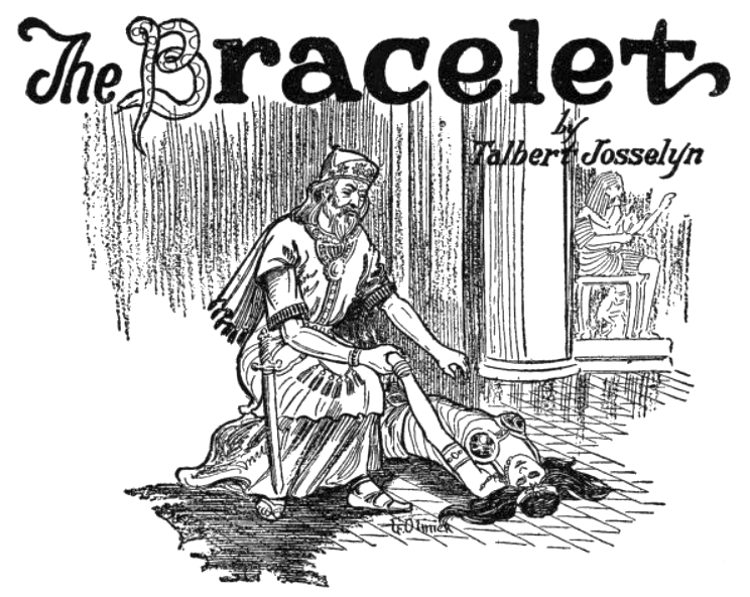
“He raised the limp arm and scrutinized it. Set close together on the smooth skin were two tiny, dark punctures.”
As they ascended the steps of the Colonel Chase home, Mrs. A. Radborne turned to her husband.
“I hope,” she said dispassionately, as though merely repeating a time-worn phrase, “that you will remember yourself this evening. You know how little wine it takes to make you silly, and”—she paused—“how that silliness reflects on me. Even though you have been long known as ‘that Jack Radbourne’, please remember that I still have a name and position of my own to maintain.”
Radbourne made no reply; none was expected. So the two entered the house.
During dinner, he caught her meaning glance across the table, shot between phrases of an animated conversation she was having with the colonel. Radbourne lowered his glass, pushed it away, and frowned at himself. What a fool he was to have to be warned and watched at five-and-forty! He looked sidewise at his table partner, the young widow Grayson. The corners of her mouth were drawn down as though from a suppressed smile. Confound her!—she had seen the glance and divined its meaning.
Radbourne bit his lip. She was always looking for such things, and telling of them. A week before, at his house, when he had been forced to cut down the size of his highball, it was she of all the guests who had seen, and understood; and the next day he had been greeted by a friend as “Two-Finger Jack.”
Radbourne found himself fast losing his temper. He could tell a few things on his own account about the widow Grayson, if it came to that. Yes, and she wasn’t the only one. He glowered about the table. There were half a dozen of that group—of the “social elect,” he sneered—whose past wouldn’t bear too close scrutiny. Wouldn’t he like to show some of them up, though! Expose them right there at the table. Hypocrites. Whited sepulchers. That was what they were—whited sepulchers. He’d show their real color if he got a chance.
He looked at his wife and felt a warm glow of pride. He himself might be a no-account, feather-blown-by-the-wind sort of man; even the gibe that he was too weak to be bad was more than half true; but, by heaven—and his fists tightened—the most prying had never been able to lay a finger on anything his wife had ever done. There she sat, their acknowledged leader—the city’s social leader—Mrs. John Radbourne. The old saying that she had married him for his bank account had come from spite. He knew ’em! Whited sepulchers.
Who was it that had put him into this train of thought? Oh, yes, the widow Grayson. Damn the widow! He reached for his glass.
On went dinner with increasing flow of animated conversation. Gradually this talk turned toward reminiscence, toward adventure in far corners of the world, and this brought a silence so that all might listen to each tale in turn.
“Come,” said the colonel at length, nodding toward the florid-featured man who had just finished speaking. “Come, I can tell a story worth two of that. Yes, and I’ll leave it to the others whether or not I’m right.”
The dinner was over, and the florid man had been telling an East Indian experience. On the colonel’s words there was a clapping of hands and a rearranging of chairs; the colonel was a famous story teller.
“The best of it is,” went on the colonel, “that I have the very object on which the story, or rather legend, is based. Oh, Adams. Go into my study and get the small wooden box lying on the writing table.” When the box had been placed in his hands, he continued. “All of you know my keen interest in Egyptian antiques. Well, several years ago I chanced to do Professor Ramsgate, the celebrated archeologist, a small favor, and thought no more about it. Yesterday I received this box from him. In his series of excavations near the site of ancient Thebes he came upon a marvelous rock tomb containing the mummified body of a king of one of the earlier dynasties. Among the many other objects of art that had been buried with the king was, as the professor puts it in his accompanying letter, ‘this little thing which I send as a slight token of remembrance.’”
The colonel opened the box and took out a bracelet. He held it up. “The bracelet itself is of bronze,” he explained, “and the coiled serpent attached to it, of turquoise. If you look closely you will see that the serpent is a species of cobra, that it is furiously angry, and is in the act of striking.” He slipped the bracelet on his wrist. “See, when it is worn, how the cobra’s bared fangs almost touch the flesh of the arm. By the least pressure they actually will touch—in fact, will readily sink in.”
He handed the bracelet to Mrs. Radbourne for closer inspection; she in turn passed it to the gentleman on her left, and so on around the table. When it came to the young widow Grayson, she started to slip it on her wrist.
“Hold on!” cried the colonel. “Don’t do that! Wait until you have heard its story. Then you can put it on—if you still want to.”
Mrs. Grayson, catching the new tone in the colonel’s voice, dropped the bracelet with a little shudder. “Oh,” she exclaimed, “I don’t want to touch it again! I know there must be something awful about it from the way you spoke, I wouldn’t put it on for worlds.”
Radbourne, face a-flush, leered at her with a grin. “What are you ’fraid of? Think it might bite?” He chuckled, picked up the bracelet, and studied it closely. “I’m not afraid of it—not at all. What’s there to be afraid of?” And he laughed noisily as he handed it along.
“I had known for a number of years,” said the colonel when the ornament had been returned to him, “that there was a legend concerning just such a bracelet, but I had never dreamt of seeing that bracelet itself, much less of owning it. You can readily imagine how keen my delight is. And now for the legend itself:
“Some forty odd centuries ago the powerful king of Upper Egypt took to himself as wife a princess from a neighboring kingdom. During the week that preceded the wedding the capital resounded to shouts and laughter of revelling throngs. Guests, coming not only from the far corners of Egypt but also from lands more remote, flocked through the palace corridors; feasts and games on a scale never before known continued throughout day and night; countless minstrels and poets sang of the matchless beauty of the fair princess; while in the guarded treasure room lay heaped gifts of surpassing richness.
“Then, in a twinkling, all was changed. The brazen-voiced war trumpet supplanted the wedding lute. No sooner was the marriage ceremony concluded than messengers arrived in hot haste, bringing news that the savage and warlike tribes lying many days up the Nile, to the south, had again broken into rebellion.
“The king was furious. To be torn from the arms of his bride of but a moment drove him into frenzy. He ordered that the bearers of ill tidings be put to death. But he was too well-trained a soldier to overlook the value of time. Leaving the capital in control of a trusted young lieutenant, he set forth with a huge army before sundown of that day, determined to exact a terrible reparation.
“The enemy, however, was better prepared than he had thought; the warfare was long and sanguinary. Not until several desperate months had passed was he able to sit before his tent and look upon the ghastly heads of the last of the rebellious chiefs. Then, for the first time, did he count the days that separated him from his capital and his bride.
“He was lost in pleasant reverie when two guards appeared, dragging between them an abject creature that begged for mercy at every step.
“‘Sire,’ said one of the guards, ‘we found this man hiding in a well. He claims to be the soothsayer of the enemy.’
“The king had been rudely brought back to the present. ‘Behead him,’ he commanded. The soothsayer fell upon his knees.
“‘Mercy!’ he cried. ‘Have mercy, oh most puissant monarch! You who are acclaimed the most powerful and wise of all mankind; who at a word can make bend the necks of the most haughty; whose smile causes the universe to smile in return. Have mercy and hear my story.’
“The king was touched, flattered, by the man’s words.
“‘Tell it briefly,’ he said.
“‘He grants me mercy!’ cried the soothsayer. ‘I was against this war from the beginning, and thereby incurred the enmity of all. For months I have been forced to flee not only from your army but from that of the rebels as well.’ He paused and critically scanned the king’s face. ‘We had news that you were betrothed to the most perfect of all women.’
“The king frowned and gripped the hilt of his sword.
“‘Hear me to the end,’ begged the soothsayer. ‘Knowing that if I sent a gift it must be both rare and beautiful, I scoured the upper country in patient search. I had barely succeeded in finding what I sought when the plotting of the chiefs drove me into hiding; the privilege of journeying to your capital and presenting it to you on your wedding day was denied me. But in all the perilous days that followed I did not allow it beyond my reach.’
“He fumbled in his tunic and brought forth a bracelet of bronze, mounted on which was a turquoise cobra in the act of striking.
“‘Sire,’ he resumed, ‘the man from whom I obtained this was very old, and learned, yet so long ago was this bracelet fashioned that he knew not its age; but he told me the charm that it possessed. Whosoever places this bracelet on the wrist of his wife places thereupon not only a bracelet but a watch-dog as well. For if the wife has been unfaithful, or becomes unfaithful in the future, this striking cobra will plunge its fangs into her arm and kill her!’
“The king leaped from the divan, snatched his sword from its scabbard and whirled it high above the head of the kneeling soothsayer.
“‘Wretch!’ he cried. ‘Dare you hint with the slightest breath that this bracelet should be put on the arm of my bride?’
“The sword, however did not descend. It wavered; then was slowly lowered. The king’s brow darkened. Jealousy and suspicion had entered his soul.
“‘Take this man,’ he ordered, ‘and see that he is conducted back to our capital with the army. If you lose sight of him for an instant your lives are forfeit. Place that bracelet here before me.’
“The soothsayer was led away. The camp buzzed and hummed in preparation for the morrow’s homeward march. Afternoon became evening; evening, night. Still the king sat on the divan, staring at the turquoise serpent with its bared fangs; and his hands shook, and his lips twitched, and his eyes became narrow and glowing....
“When day broke the king was far on his return journey. In the dead of night he had risen—a tense, smoldering fury of a man—had called for his swiftest charger, ordered his bodyguard about him, turned over the command of the army to another, and departed in furious haste. Inured to a life in the saddle as the bodyguard was, it had never been forced to keep such a pace as the king set. Day after day he sped northward toward his capital, stopping only to change mounts or to snatch a few hours of sleep, growing more gaunt of cheek, more flaming of eye, urging the bodyguard on, on, on. And always, from where it lay in the folds of his sash, the turquoise cobra mounted on the bronze bracelet seemed to whisper, ‘Speed, more speed.’
“A guard on the wall at the southern gate of the capital, dozing on his spear in the small hours of the night, was suddenly awakened by the thunder of hoofs and loud voices demanding entrance. The man, brushing sleep from his eyes, peered over the edge of the wall and descried a score of horsemen beside the gate. He was about to raise the alarm that the enemy was upon the city, so wild and fierce was the clamor, when a voice, rising above the others, clove him like a sword.
“‘Open! Open! It is I, the king.’
“The guard all but fell to the ground in his haste to respond.
“‘Sire, sire,’ he babbled as he swung open the gates, ‘had I but known——’
“‘Stand aside!’ cried the king. ‘Fool, out of my way!’
“And he cut at the man with his whip as he dashed by.”
“King and bodyguard swept through the dark and narrow streets without drawing rein; arrived at the palace, the king flung himself from the saddle and dashed up the steps. Once inside the royal building, his manner underwent swift and subtle change. The queen would be loth to accept so sinister-looking a gift as the bracelet from one who came with all the bearing of a madman; even less willing to put it on. His noisy sandals took on a decorous quiet; a smile grew into being on his lips; the fierce glow in his eyes died out. His manner became that of a weary, travel-worn man cheered by the thought of greeting the wife of his heart.
“So he came to the outer doorway of the queen’s bedchamber. The guard, lying across the threshold, sprang up to prevent his entrance.
“‘Deny me entrance?’ demanded the king in a low voice, thrusting his face close to that of the guard. The man recoiled as though blasted by lightning, and prostrated himself upon the floor.
“The king entered the bedchamber. At the same moment the curtains that hung across the opposite doorway were drawn aside, and the queen entered the room. In the instant before their eyes met, the king felt surge within him all his one-time love for this, his wife, his bride. Never had she looked more beautiful. Then their eyes met, and love became hate.
“The queen’s face went chalk-white. She swayed, clutched at the curtain for support, staring the while at him as though he were risen from the dead. Twice she strove to speak, and failed.
“In that age-long instant the king felt suspicion leap into conviction. Now he knew, and his smile burst into a laugh.
“The queen recovered herself with a mighty effort.
“‘My lord! My lord!’ She uttered a glad cry and flung herself into his arms. ‘You live ... you are alive! You are not come from the dead! Your pallor—your sunken cheeks—the hour—your sudden appearance—can you wonder that I all but swooned? But speak! You are travel-stained—you have ridden far and hard. The army—have you been defeated?’
“The king drew her the tighter to him, while his laughter grew.
“‘The army is safe. It is you who are in danger.’
“The queen again turned deathly pale. ‘I—I do not understand,’ she faltered.
“The king released her, fumbled in his belt with hands that he could not wholly keep from shaking, and drew forth the bracelet. At the sight of it the queen stepped back, a great fear in her eyes.
“‘Afraid?’ said the king, a smile on his lips and death in his heart. ‘Afraid of a stone serpent? Afraid of that which I have brought so many miles? Of that which will protect your life?’
“‘Protect my life?’ repeated the queen. ‘Protect—’
“‘Hark you,’ adjured the king. ‘The night after our last great battle with the enemy I dreamed a dream: Death hovered over you and would not go away. Straightway when I awoke I hastened to a soothsayer; a man as wise as the hills. “Take you this bracelet,” said he, giving me that which I now hold here, “and speed to your queen’s side. Let not time, nor distance, nor fatigue halt you in your going. Do you but place it on her wrist and all mortal ills will be as not. Harm will never come her way.” I sped—day and night have I sped. I am here.’
“The king held out the bracelet. The queen hesitated, and the king laughed.
“‘Can it be,’ he asked, ‘that you fear your husband?’ He held his head to one side, making the pretense of listening. ‘Hark! Was that a footstep?’
“The queen stifled a cry. ‘No, no! Impossible! ... You are dreaming! Give me the bracelet.’
“‘It is for me to put it on your wrist,’ said the king. He snapped it on her arm, and all his suppressed passion boiled into life. His staring eyes, riveted on the bracelet, glowed like coals of fire. His breath came in great gusts; his body shook as with an ague. The queen, who had turned as though to listen while the king bent over her, cried aloud as she turned back and caught sight of his demoniacal face. She reached for the bracelet. As she did so a tremor ran through her body.
“‘The fangs! The fangs!’ she shrieked, and strove to tear the bracelet free; but even as her fingers touched it they stiffened. She swayed, fell to the floor, and lay still.
“For a long time the king stood regarding the body. At length he stooped, raised the limp, bracelet-encircled arm, and scrutinized it. Set close together on the smooth skin were two tiny, dark blue punctures. Of a sudden he dropped the arm and listened. He rose to his feet with catlike swiftness, stepped to the curtain, cautiously lifted it aside and looked out. The lieutenant to whom he had entrusted the capital was stealthily approaching, a smile of expectation on his face. The king whipped his sword from its scabbard, stepped noiselessly to one side of the curtain, and waited.”
Radbourne was the first to speak at the conclusion of the legend. He rang his half-filled glass on the table, spilling its contents over the cloth, and shouted, “Tha’s some story! Say, tha’s some story!” Then his voice was supplemented by a dozen others, and high-pitched comment went up and down and back and forth across the table. Mrs. Radbourne alone remained silent. She did not even attempt to check Radbourne’s outburst, but sat staring at the cloth.
Someone asked to see the bracelet. “Oh,” exclaimed the young widow Grayson, “I don’t see how you dare touch it. I wouldn’t handle it for anything!”
Radbourne burst into a guffaw, and thrust his wine-flushed face close to the widow’s.
“You’re not afraid of it, are you? You’re not—not”—he snickered—“not afraid of a stone serpent?” He thumped his glass and gave way to unsuppressed shouts of mirth.
“Say,” he said, suddenly checking himself, “how’d you like to have it put on your arm?”
The widow started. Radbourne, seeing her confusion, pushed his advantage home. “Have it snapped on your arm all suddenlike, you know. Have somebody come up and say, ‘Hold out your arm!’ Or slip up behind you and——”
“Keep still!” cried the widow, half hysterically. “Don’t talk about it any more!”
The colonel’s voice was heard again. He was keenly pleased with the success of the legend.
“Come, come, let’s all go into the collection room. There’s a certain scarab, and a mummified cat that I had the devil’s own time getting from a one-eyed thief of a fellow in Assiut, and a dozen other antiques; all of them have histories. Shall we go?”
There was a general pushing back of chairs and rising from the table. Radbourne rose with the others, but did not immediately leave the room. Although he continued to smile, a new look had come into his face; one of eagerness and cunning; a look that grew as he glanced from the widow Grayson to where the man Adams was replacing the bracelet in its box, and then back at the widow again. As Adams left the room in the wake of the guests to replace the bracelet box in the study for Colonel Chase, Radbourne hastened to the doorway and peered out. A moment later he was tiptoeing back in the direction that Adams had taken....
The colonel on entering the collection room stepped to one of the glass cases set against the wall, and took from it a tray filled with scarabs.
“Now, the scarab that I want to tell you about,” he said to the guests as they encircled him, “is a rare one. I—” He ran his finger up and down the rows of beetles. “I—h’m, that’s strange, where can that have disappeared to? Thought it was right here where I could put my finger on it.... Wait a minute. What an old dullard I’m getting to be! It’s in the annex—my extra collection room—I took it in there this morning to examine it. I’ll be right back.”
The colonel reached the annex and was in the act of picking up the scarab when a scream came from the room he had just left; a cry so piercing, so intense, so downright horrible that he dropped the little stone beetle and leaped back like one evading a knife thrust.
A second cry followed. “The fangs! The fangs!” wailed a voice, and a body fell to the floor.
Back to the collection room raced the colonel. A white-gowned woman lay at full length in front of one of the cases. Radbourne, his face distorted almost beyond recognition, knelt beside her. He was shouting and clamoring as though suddenly demented. Two of the other men were bending over Radbourne; one of them—the florid-faced man who had told the East Indian experience—clutched him by the shoulder. The rest of the party stood as if fixed to the floor, white-faced, horror-stricken.
Radbourne shook himself free. He bent lower, clasped his hands together, unclasped them, beat them against his head.
“Jane!” he cried. “Jane! I didn’t mean it for you! No—not for you! Jane!”
The florid-faced man pulled Radbourne to his feet. The colonel now saw that the prostrate figure was that of Mrs. Radbourne. On her left wrist was the bronze bracelet with the turquoise cobra.
“The fool!” shouted the colonel, and darted to the florid-faced man’s side. “That’s right, Abercrombie, get the driveling idiot away. Adams! Quick, run for Dr. Jameson next door. Now some of you help me carry her over to the couch. Lower her head ... that’s it, and put a pillow under her feet. Now a little whisky. There, she’ll come to in a minute.”
Colonel Chase turned to Radbourne, who had been thrust into a chair. “Radbourne, what the devil did you do a thing like that for? Thought it would be smart to scare her, eh?”
Radbourne strove to rise from the chair, but the florid man restrained him.
“I tell you I didn’t mean it for my wife!” he cried. “I meant it for Mrs. Grayson. I wanted to put it on her arm, just for fun. I—she was standing with her back to me. I thought it was Mrs. Grayson—they both had on the same kind of gown. I put it on the arm—she gave one look, and oh—”
Hurrying feet sounded. An elderly man in bath-robe and slippers, and carrying a medical case, hastened into the room, closely followed by the man.
“Jameson!” said the colonel. “Over here, on the couch.”
“Mrs. Radbourne?” exclaimed the doctor. “Bless me! I heard the screams while reading in bed—who in the neighborhood didn’t hear them? I was half-way over here before I met your man.”
Colonel Chase swiftly narrated the events of the evening as Dr. Jameson worked over Mrs. Radbourne. The guests added a word here and there. The florid man came to the colonel and spoke in an aside.
“Just as she fell she cried out something about fangs. Do you think—could it be possible—?”
The colonel read the rest of the question in the speaker’s eyes.
“No, no!” he snapped out; then found himself brushing cold sweat from his forehead. He shuddered. Dr. Jameson turned from the couch and straightened himself. Something in his manner caused those grouped about him to grow tense. The room became heavy with dread silence. He started to speak, but the colonel cut in ahead of him.
“You don’t mean”—the colonel fought for articulation—“you can’t mean—”
“I can get no response,” said the doctor.
Radbourne’s face went gray-white. He crumpled to the floor like a twisted paper napkin. One of the women swayed into a chair and began to sob. The florid-faced man touched the colonel on the arm. He pointed. The colonel saw that the bracelet still encircled Mrs. Radbourne’s left wrist. In the excitement and confusion of the moment no one had thought of removing it.
Both men spoke their thoughts with their eyes. They stepped to the couch, and while one raised the shapely arm, the other drew the bracelet free. They bent down and closely, searchingly, examined the wrist and forearm. At length they raised their heads and exchanged glances. No longer were horror and unnamed fear in their eyes; into them had come something, indescribable as yet, but swiftly growing.
There were no fang marks on that shapely white arm; no marks of any kind. Yet Mrs. Radbourne was dead.
This etext was produced from Weird Tales, September 1926 (vol. 8, No. 3).
Obvious errors have been silently corrected in this version, but minor inconsistencies and archaic forms have been retained as printed.
New original cover art included with this eBook is granted to the public domain.