The Project Gutenberg eBook of The Century illustrated monthly magazine
This eBook is for the use of anyone anywhere in the United States and
most other parts of the world at no cost and with almost no restrictions
whatsoever. You may copy it, give it away or re-use it under the terms
of the Project Gutenberg License included with this eBook or online
at www.gutenberg.org. If you are not located in the United States,
you will have to check the laws of the country where you are located
before using this eBook.
Title: The Century illustrated monthly magazine
May 1882 to October 1882
Author: Various
Release date: October 31, 2026 [eBook #79889]
Language: English
Original publication: New York: The Century Co., 1882
Credits: Lisa Corcoran, Jane Robins and the Online Distributed Proofreading Team at https://www.pgdp.net (This file was produced from images generously made available by The Internet Archive)
*** START OF THE PROJECT GUTENBERG EBOOK THE CENTURY ILLUSTRATED MONTHLY MAGAZINE ***
Transcriber’s Notes
This e-text is based on ‘The Century Illustrated Monthly
Magazine,’ from May, 1882. Inconsistent spelling and hyphenation have been
retained, but punctuation and typographical errors have been corrected.
Passages in English vernacular and in languages other than English
have not been altered. Footnotes have been moved to the end of the
corresponding article.
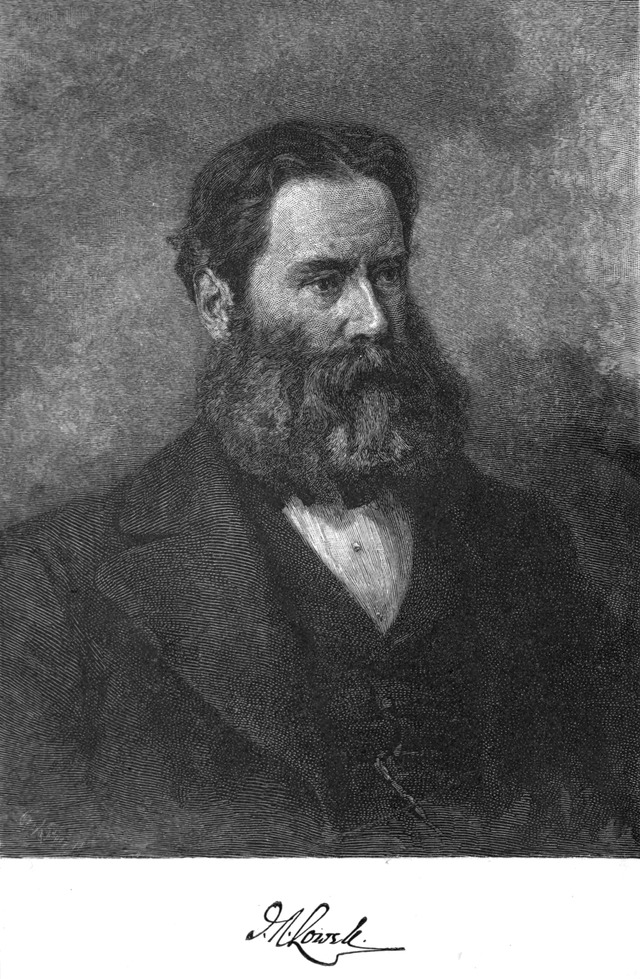
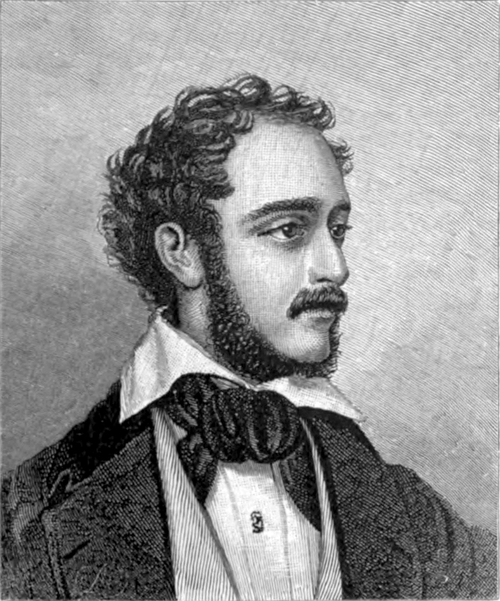
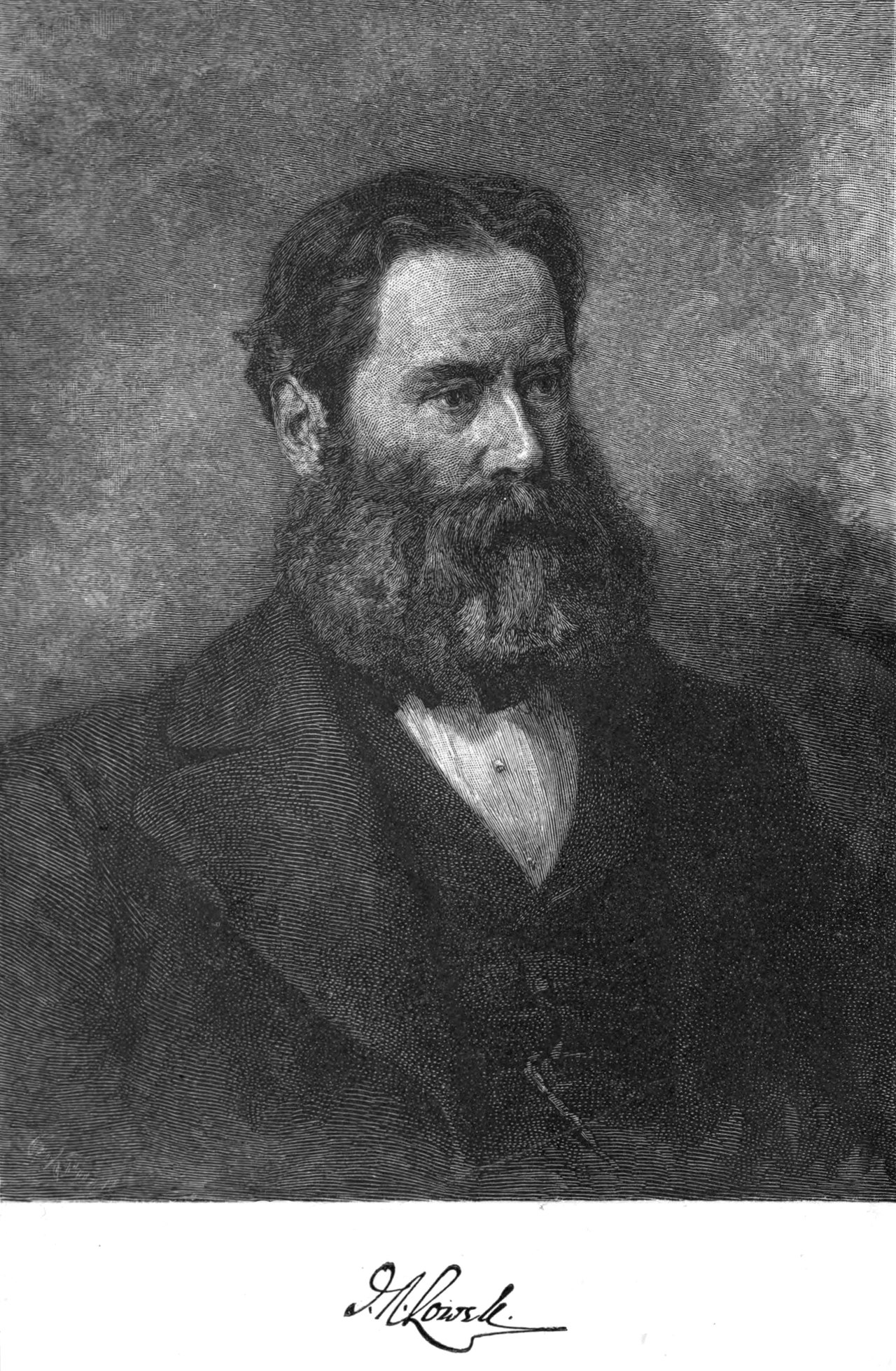
The frontispiece shows Mr.
James Russell Lowell, whose signature might be hard to decipher.
The article about Mr. Lowell, by Edmund
Clarence Stedman, has been assigned a wrong page number in the index—it
has been corrected to page 97.
In the index, links have only been included if they relate to articles
in this issue.
New original cover art included with this eBook is
granted to the public domain.
Had you been a pagan Iroquois on the war-path from Onondaga[1] in the
summer of 1661, standing on the Isle of Orleans, below Quebec, with
the scalps of your Huron and French foes at your belt, you would have
seen the remnant of the hated Christian Indians paddling in their bark
canoes across the St. Lawrence to the northern shore. From the bluff
of land where the picturesque church of St. François has stood for
over a century and a half, you would have seen your enemies who had
sold their ancient birthright for a mess of French rum and trinkets,
steering for havens of refuge amid a rich panorama of forest and
mountain—some of them up stream, where they found shelter under the
guns of Quebec; most of them toward a great peak of the Laurentian
chain of hills, where, close to the shore, a small stone chapel and a
few houses marked the site of Petit Cap,—one of the oldest settlements
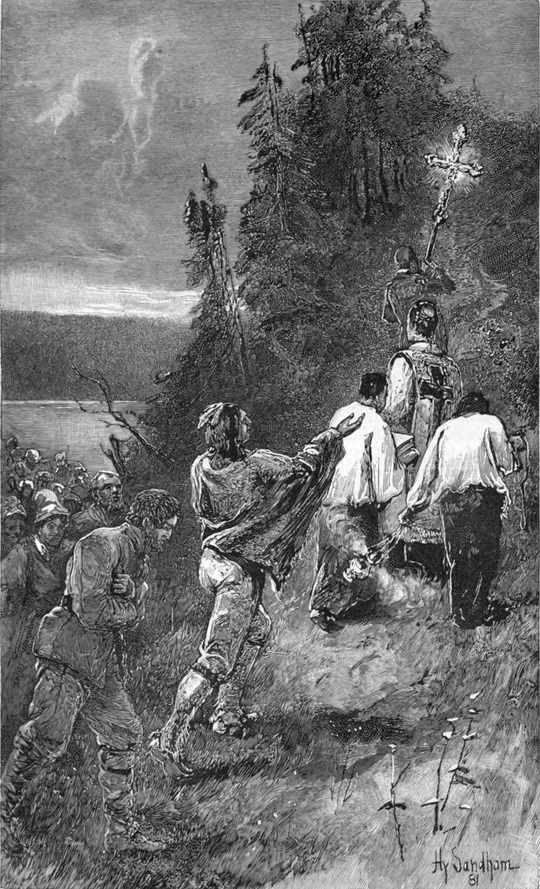
on one of the oldest roads in Canada. Had you stolen before day-break
at low tide across the water, and paddled through the marsh, you might
have listened until you heard the bell for morning vespers, and then
gliding ashore, you might have crept behind the brush and watched a
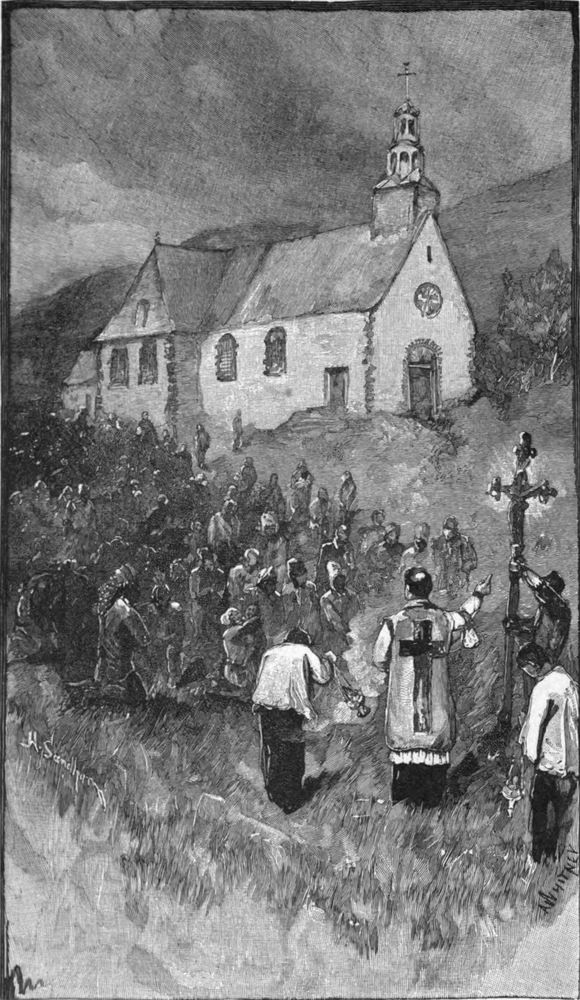
procession of French and their Huron allies, headed by the priests,
slowly marching to the chapel, and repeating the invocation: “Jésus,
Marie, Joseph, Joachim, et Anne, secourez-nous,” while your blood
boiled with hate, and your fingers tingled to get at their hair. About
a century later, had you been a loyal English colonist of New York,
you might have followed the Highlanders in their attack on the French
and Hurons along this same road, and in this same little village, then
named Sainte Anne. And if tradition be true,—and a possible fable is
as good for a gobemouche as a positive fact,—you might have seen
the same little chapel delivered by the mysterious interposition of the
saint herself, when the troops tried three times in succession to set
it on fire, after the rest of the village had been burned. And now,
one hundred and twenty-two years later, you may quietly run down on a
holiday trip from Donnacona’s ancient throne, the peaceful citadel of
Quebec, to this same little village, now called “Ste. Anne de Beaupré,”
or more affectionately, “La Bonne Ste. Anne,” and known as the most
venerated shrine of the Roman Catholic Church in Canada—the soul and
center of reputed miracles as wonderful as any that stirred the heart
of mediæval Europe. Though not accepted without reserve by the more
educated classes, they are as sacred to the superstitious habitant
along the St. Lawrence as is the mother-shrine of Ste. Anne d’Auray, in
Brittany, to the credulous sailors in the Morbihan.
A PILGRIMAGE TWO HUNDRED YEARS AGO.
The heathen red-skin of Onondaga has long since been Christianized, and
is passing away. The English colonies, which had a sworn foe in the
New France at the north, have become a great and independent nation.
The old French colony, with its brilliant story, has disappeared in
the Dominion of Canada, and Richelieu’s grand scheme of a French
transatlantic empire has its mockery in the small fishing-islands of
Miquelon and St. Pierre, off the south coast of Newfoundland. Little
did Richelieu imagine, when he excluded the Huguenots from France
and her colonies, that he was doing as much as possible to add to
the wealth of the Protestants of Europe and to the prosperity of the
Puritans of New England, and that one of the results of his policy was
to be the perpetuation of the very heresy he hated. Persecution often
makes a [Pg 2]barren cause prolific. It has been the mother of great men
and great nations. Little did Champlain imagine, when he prohibited
the psalms of the Huguenots on the St. Lawrence, that a few more years
would see the fleur-de-lis lowered forever from the city he
founded; and France, once the mistress of the whole American continent
north of Mexico, reduced to a few fishing-islands, equal to a square of
fifteen miles! There that little remnant of French-American territory
lies, as if to remind us of the past glory of a noble nation. Amid all
these vicissitudes, our little Canadian shrine has slept its Rip van
Winkle sleep; until to-day, with the revival in Europe of the mediæval
trust in miracles, and in the efficacy of pilgrimages, an effort is
here being made to waken the Canadian mind to the belief that La Bonne[Pg 3]Ste. Anne is as advantageous to faith as Michael Angelo believed
the climate of Arezzo was favorable to genius. There was no obstacle
at any time in Canada to the full development of the Gallican church
of France; and it is no wonder that pilgrimages should become an
institution of the old French province, and that it should be claimed
that more miracles have been wrought through the relics of a dead saint
than are known to have been performed by Christ. Though Quebec city,
with its sixty dioceses, is mentioned in a bull of Pius IX. as the
metropolis of the church in America, you will need to rub your eyes to
make sure that you are not in Belgium. Under the French régime
it was the heart of the colony, and was a spiritual as well as a
material fortress. Ste. Anne de Beaupré was one of its outposts.
VILLAGE OF LA BONNE STE. ANNE.
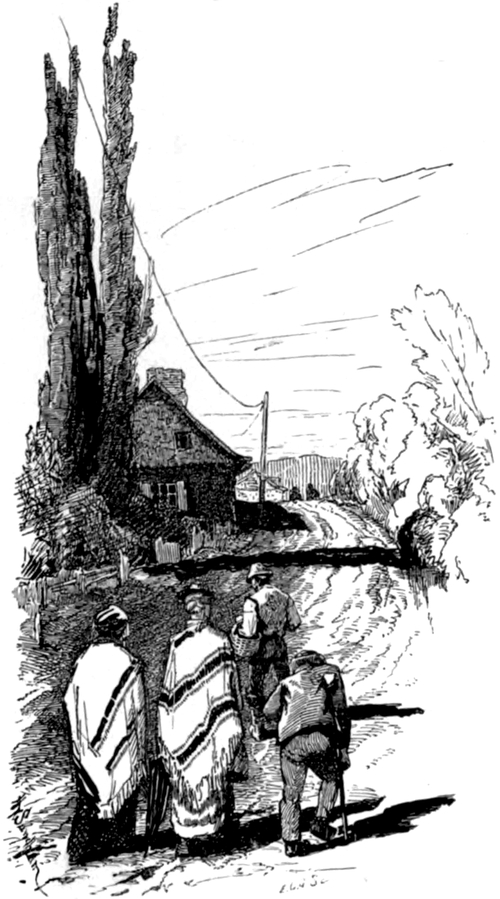
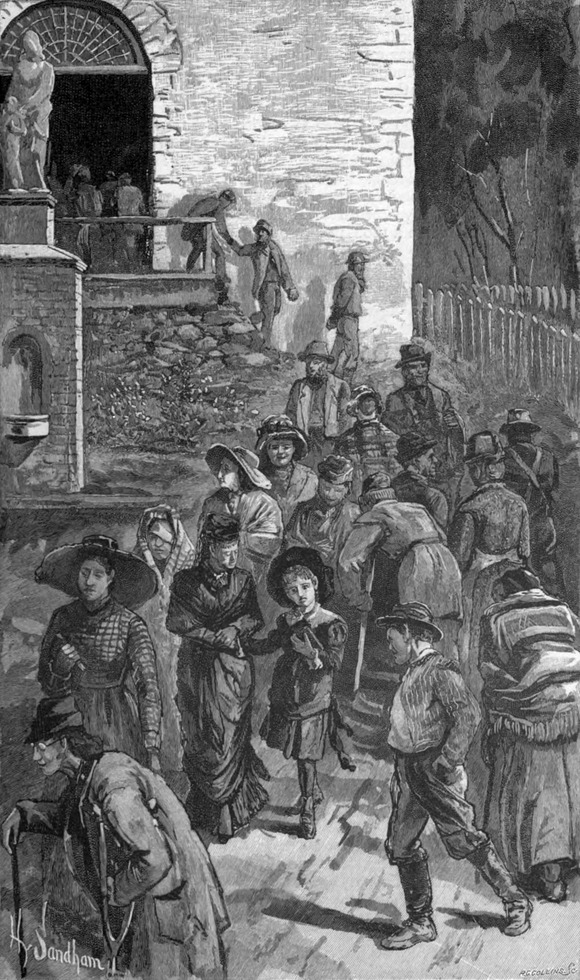
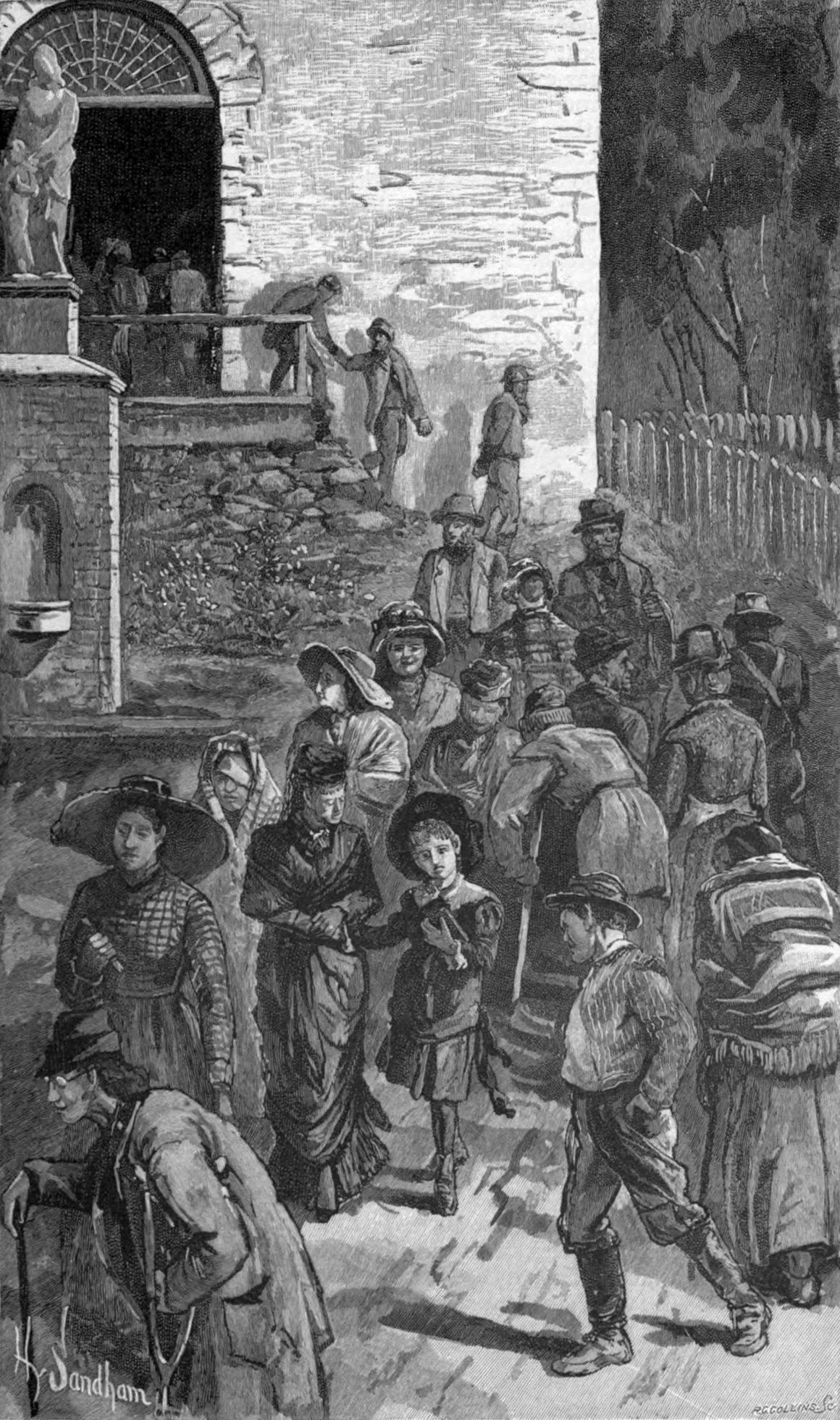
PILGRIMS ON THE CÔTE DE BEAUPRÉ.
But who was this saint so revered long ago by the Canadian
voyageur and habitant, and whose intercession, all the world
over, now seems to be supplanting that of all other saints? It might
be enough to know that, in 1876, the Pope declared Ste. Anne to be
patroness of the Province of Quebec, though it is not stated how this
affects the claim of St. Joseph, who has long been the patron of all
Canada. But who was Ste. Anne? Tradition says she was the mother of
the Virgin Mary, born of one of the family of David, and that her
mother had predicted the birth through her of the Saviour. Having died
at Jerusalem, she was buried in the family vault. When you are at our
Canadian shrine you may see, in a little glass case, a confused mass
of dried, broken bones, which you are told are those of the saint. You
will naturally be curious to know how they got out of the family vault
in Jerusalem into a little hamlet in Canada. In the time of Marcus
Aurelius, the infidels destroyed all the monuments in the Holy Land,
but, “according to tradition,” one coffin could be [Pg 4]neither burned nor
opened, and being thrown into the sea, floated off to the town of Apt,
in Provence, where it lay for a long time buried in the sand. One day
some fishermen caught in their net an enormous fish, which clearly by
its actions showed that fishes have instinct and reason, and that St.
Anthony knew more than we give him credit for, when he preached to
them. This fish struggled so hard that it made a deep hole in the sand
on the shore, and when the fishermen dragged it out, the coffin of Ste.
Anne appeared in the hole. No one in Apt could open the coffin. The
bishop Aurelius placed it in a crypt, put a burning lamp before it, and
had it hermetically walled up. Seven hundred years later, Charlemagne,
moved by the appeal of a deaf and dumb boy, caused a certain wall to be
destroyed, in which the coffin was found.
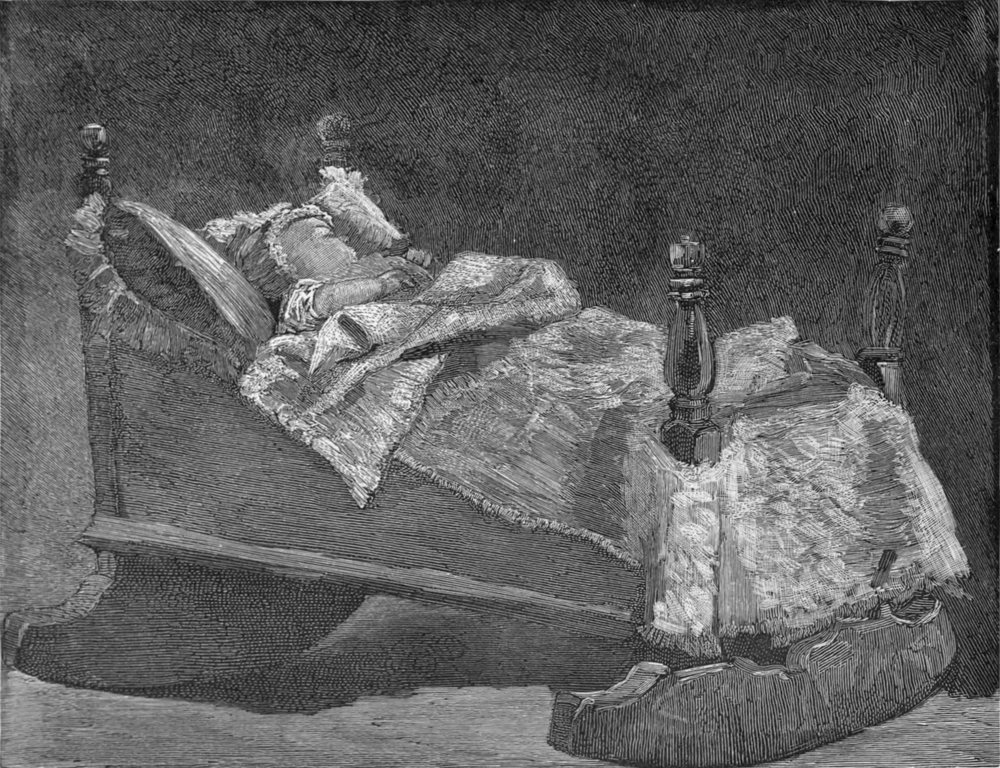
A YOUNG PILGRIM IN AN OLD CRADLE.
I remember visiting a beautiful cathedral in Apt, on the bank of the
Calavon, said to have been erected on the exact spot where the fish
leaped and the coffin was found. A short journey from the Celtic
monuments of Carnac, in Brittany, is the little hamlet of Ste. Anne
d’Auray, the most famous shrine of the saint in the world. On a
fête-day, a few years ago, I saw the special pilgrimage, and its
associations with our Canadian shrine made the visit one of much
interest. I must say, however, that the Canadian pilgrimages are never
the scene of such debauchery as those in Brittany, for the devil seemed
to have made it his holiday at the two Old-World pilgrimages witnessed
by me. Religious ceremonies clashed with vulgar open-air dancing, and
peasants who had just kissed the saintly relics, came out of church and
boastingly swallowed brandy, glass after glass, in a deliberate effort
to make themselves drunk.
Our Canadian Mecca has an authentic date back to 1658. A habitant of
Petit Cap gave the parish priest of Quebec a portion of land, upon
condition that in that year a church should be begun on the spot. The
site was accepted, duly consecrated, and dedicated to Ste. Anne, the
patroness of sailors. The foundation-stone was laid by the French
governor. It is said that a peasant of Beaupré, who had “pains in his
loins,” went, out of devotion, to lay three stones of the foundation,
and was suddenly cured; and that a woman who had been bent double for
eight months by some affliction began to invoke the saint as soon as
she heard of the miracle, and was “instantly [Pg 6]able to stand on her
feet, and as well able to move all her limbs as she had ever been.”
Miracle after miracle followed, until the sleepy little hollow was
the talk of all New France. Soldiers, as they paced their beat on the
fort, looked down the river as if they expected to see a vision. The
peasantry grouped together in large family circles, just as they love
to do to-day, and as the big logs crackled in the great fire-place,
some one who had been to the shrine recounted his experience and gave
reins to his imagination, and all piously crossed themselves when he
had concluded. Pilgrims flocked to the New-World wonder on the St.
Lawrence, and during the seventeenth century there were never less than
a thousand on the feast-day of Ste. Anne. At all seasons of the year,
individual pilgrims were seen going afoot along the Côte de Beaupré,
and in winter in their sleighs on the frozen river. The Micmac Indians
came regularly from New Brunswick for trade, and before feast-days
their canoes were seen coming up stream to the shrine, where they built
birch-bark huts to shelter the pilgrims. In fact, the whole country was
excited by the mystery, and many churches were built in honor of the
saint. It was a regular custom of vessels ascending the St. Lawrence to
fire a broadside salute when passing the place. We who live in this age
of electricity, and who affect to be beyond astonishment, but gape at
every new sensation as if the world was yet in its teens, may imagine
the thrill of wonder which would run through the minds of the simple
peasantry, and the superstitious voyageurs, when the miracles
were told.
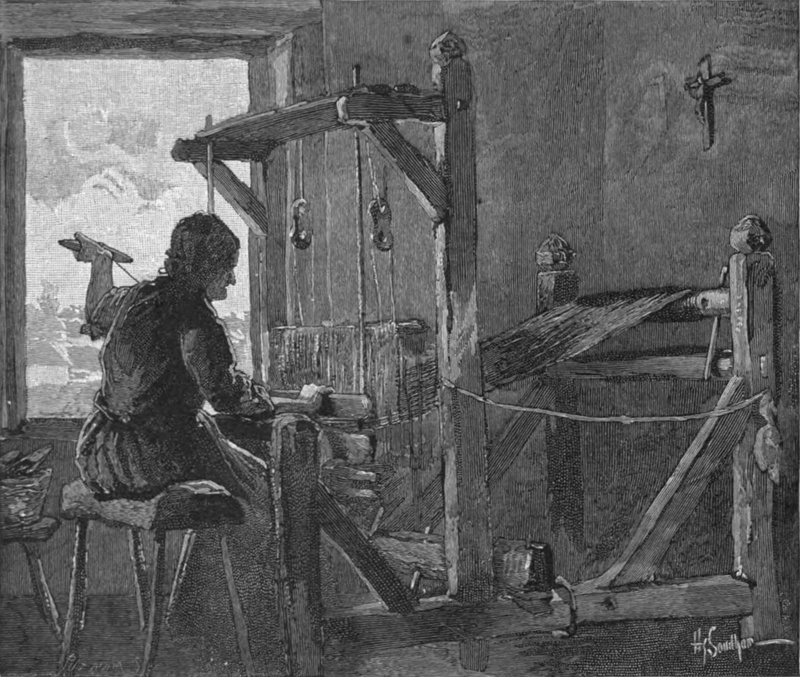
A CANADIAN INTERIOR.
It was not with the touching and simple spirit which led many to flock
to the holy place in Jerusalem, in the time of the old Jewish law,
that I went to La Bonne Ste. Anne. Nor was it with the unquestioning
devotion of the Canadian peasant. I was simply a holiday lounger in
search of the picturesque, with no more faith in La Bonne Ste. Anne
than in the dozens of other shrines I had seen in Europe, and with a
strong belief in the statements that, after the Crusades, innumerable
relics were sold to the Latins by the cunning Greeks and Syrians, and
that several skulls of the same saint were found within a hundred
miles of each other. What I had seen of the pilgrimages in Brittany
and Belgium did not raise them in my estimation. The picturesque
in Brittany could not conceal the dirt and mental degradation. I
remembered, too, an incident upon the arrival of our train, when little
Breton boys and girls met us with offers, for a sou, to say prayers for
us. One who is familiar with the many genial and admirable traits of
the French-Canadian peasantry, the superior moral and spiritual tone,
and the respectability, cleanliness, and sobriety which put them above
the same class of Continental people, would have no thought of seeing
here the vice and licentiousness [Pg 7]common to the Breton gatherings.
The French-Canadian peasant may not know how to read; he may fear the
spiritual threats of his priest more than the punishment of the civil
law; but as a rule he is a peaceful Christian according to his light.
Ste. Anne, to many of them, is as sacred as was Jerusalem to the Jews,
and no doubt our good countryman pities and prays for me and my heresy;
and, had he been born a Mohammedan, would no doubt have believed that
he who died without making a pilgrimage to Mecca might as well die a
Jew or a Christian.
Almost any morning in summer you may get the early boat just below
Dufferin Terrace, and see dozens of quiet people muttering their
devotions to themselves, each carrying his or her burden of trouble
to Ste. Anne. The crowded pilgrimages which are undertaken by whole
parishes en masse have much the appearance of an ordinary
picnic, and most of the pilgrims suggest the idea that they come “more
for the green way than for devotion.” But you cannot mistake the
sincerity and superstition of those individual pilgrims who go down to
the shrine without ostentation. They are mostly women, many widows,
and nearly all dressed in the conventional black dress, with black
bonnet and long crape veil. You may go down by steamer or by road. If
you go by water you can study these people better; but when you see
the rich landscape you will wish you had taken the road; from the Côte
de Beaupré you see the lovely water-scape, and then you will wish you
had gone by steamer; so I will indulge you in both. We need no scrip,
staff, or scallop-shell; no unshod feet—though once I saw a bare-footed
pilgrimage below Cacouna; no gray gabardine girt with cincture; no
asceticism, but a comfortable steamer or a double carriage, with every
modern comfort cheek-by-jowl with much mediæval usage.
The river was alive with boats, steamers, barges. Half a dozen
steam-yachts, used as tugs, were puffing consequentially, and scudding
between Quebec and Pointe Levi. One little David had steamed up to a
Goliath of a ship which had just crossed the Atlantic, and had taken
the conceit out of the monster by lashing itself in some way to its
side and puffing up the river with it, like a dwarf arresting a giant.
After the usual jargon we were off, and had time to look about among
our passengers. They were mostly pilgrims, and all French of the poorer
class. But, no matter how poor, the French-Canadian is a model of
tidiness. Like a sunflower amid ivy, there was the traditional young
man from the country, arrayed, on a hot day, in black kid gloves, a
flower in his coat, and a feather in his cap. Beside him—very much
beside him—his “own sweet Genevieve,” blushing in colors enough to make
the rainbow pale, and every part of her jacket and the white veil over
her face covered with little bits of red glass balls; a poor mother,
holding a sick child in her arms, walking up and down the deck in a
sort of penitential agony, and refusing any help, though many of the
kind-hearted women proffered their aid; several very desolate-looking
widows. I had been told that few, if any, ever went to Ste. Anne’s to
return thanks for blessings received, but the uncharitable statement
was here refuted, for several poor women were en route
especially to express gratitude for the recovery of personal health.
One dear old lady, rheumatic and almost blind, was led about tenderly
by her son. As I saw her thin gray hair and bended frame, and watched
the affection of her boy, my heretical spirit found a feeling that made
us kin, and, while refusing to believe in Ste. Anne, I prayed inwardly
for her recovery. I would have sung my pæans of praise had the dear old
soul found the fountain of youth in the waters of Ste. Anne, and had
she been able to leave her crutch among those on the pyramid in the
church. Alas! I saw her returning in the afternoon more feeble than
when she came. One pale, thin girl had fasted for five days, having
read that, like Moses and Elias, Ste. Anne and her husband fasted
entirely for forty days, “and wept perpetually.” A girl with inflamed
and bandaged eyes was going with her father to perform a novena,
or nine days’ religious exercise. Two nuns were chatting together;
a solemn servant of some convent held in one hand a five-minute
sand-glass, which she turned as the sand ran out, saying her prayers at
the same time. Two rubicund priests promenaded the deck. The rest of
the pilgrims were fair types of the ordinary peasant, and were either
ignorant or weak-minded.
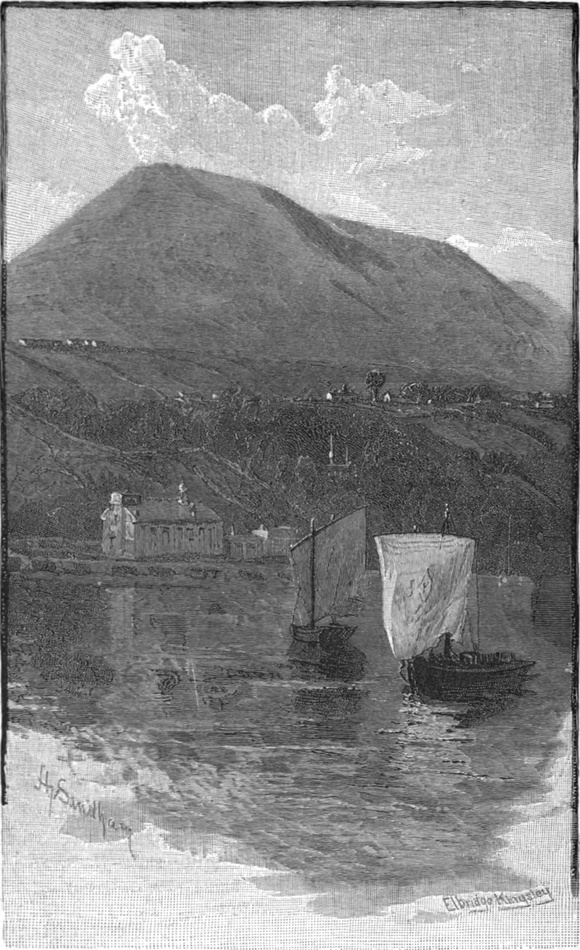
MOUNT STE. ANNE.
Look at the splendid scenery before, behind, on either side. The Isle
of Orleans, with its broad brow, is in front. The ships for England
sail off to the southern channel. One fancies he can smell the sea
here, and it may not be mere fancy, for the tide rises ninety miles
above Quebec, and the water is brackish. It is out this morning, and
there along the shore and up among the shiny rocks, the bateaux
and wood-boats lie waiting for the flow. Just below us, as we keep to
the left of Orleans, we meet two steamers tugging two great rafts,
and the hardy Indian and French voyageurs wave their hats to
us. There lies the Church of St. Pierre, upon the hill of Minigo, as
the Indians called Orleans, built one hundred and twelve years [Pg 8]ago,
on the site of a chapel erected in 1651. Looking to the left now, we
see Montmorenci Falls, shining in the morning sun like a broad ribbon
of molten silver, the dark shadows of the right bank casting long
lines of gloom into the glen. As we pass the falls, we are wedging in
between Orleans on the right, and gaps and grooves on the main-land
to the left, eaten by ice and rains. Zigzag footpaths run up to
the hill-tops from the river and road-side; narrow strips of land,
fenced into all sorts of geometrical figures, straggle up over the
hills into the horizon; clumps of pines are seen along the shore; and
above and about the trees are the picturesque white farm-houses, with
their gray, brown, and red roofs—a perfect chain, long drawn out, of
quaint hamlets set in frames of mountain and river; peeps of the blue
Laurentian Mountains far behind; the white houses of Château Richer
hugging the shore; and behind them the hills rolling up into waves
of land, until they run to a peak of two thousand six hundred and
eighty-seven feet to form Mount Ste. Anne, then droop into the valleys,
and again run up against the blue sky to form the home of the bear
and the blue-berry—Cape Tourmente. Here and there you see the stone
churches and bright spires, both on the main-land and on the island.
Look back now from the stern. I once heard a world-wide traveler say he
had [Pg 9]never anywhere seen such a picture as this view back at the city.
Quebec and Pointe Levi seem to be blended in one semicircular bay of
bright water, lapping a dazzling array of glittering gems. The citadel
looks clear cut, as if its masonry had been run into a mold. We see
barges, with loads of hay or wood, and with only two hands on board,
trusting to a rough sail and a stout oar to get to their destination;
fresh-water sailors in heavy boats, pushing their oars before them as
they face the bow, as one sees so often on Continental rivers and as
often elsewhere on the St. Lawrence, about Quebec. The Isle of Orleans
reposes like an emerald in the water at the point where the fate of a
continent was decided. There on its bosom St. François sleeps, as if
the dread Iroquois had never yelled their war-whoop on its hills; and
if history has no echoes to stir you, come with me from that quiet
little hamlet some autumn, with gun and rod, on the broad meadows of
Argentenay, or among the marshes of the Château Richer, and I will
promise you as fine a bag of snipe and duck as you can get anywhere
within sight of civilization on this side of New Brunswick. What feasts
of wild fowl, what epicurean relishes with Parisian cookery, they must
have had in the way of game when peace reigned in the old château of
St. Louis on the rock, the castle of the French governor, and life
in this part of New France, brilliant with the wit and song of the
nobility of Louis XIV., was more feasting than fasting; when Orleans
was called the Isle of Bacchus, because of its great grape-vines,
and of the fish, honey, and melons with which the red-skins regaled
Jacques Cartier. I wonder Parisian wit did not try upon the Indian
the civilizing influence of Parisian cookery; for it is related of a
convert who lay at the point of death that he anxiously inquired if, in
the pale-face heaven to which he was going, he would get pies to equal
those which the French had given him. All about here—on mountain, in
valley, on island, on river—you can trace the richest pages of Canadian
and much of American history. Memories of Jacques Cartier, Sir William
Phipps, Champlain, Frontenac, Wolfe, Montcalm, Carleton, Arnold,
Montgomery, Murray, rise from the surroundings. And then you may come
down from your imagining and see Huron and Iroquois merging into French
and English, and the queer jumble of Indian, Norman, Breton, English,
in name, in face, in speech, in religion, slowly but surely blending,
as the centuries roll away, to form one people. Is it not a bit of
early British history—the story of the Norman, Dane, and Saxon—being
repeated in the New World?
BY THE ROAD-SIDE.
But now we see the sun playing on the convent-spire of Ste. Anne; Cape
Tourmente and Orleans seem to meet, and the river has the appearance
of a great bay. Long ribbons of the characteristic Canadian fence run
crookedly up to the crest of pines; a fringe of houses lies along the
shore. And now the main-land and the island divide; the open river
shows the line of the hazy shore downstream, and we are approaching the
long wharf and the toll-gatherer of our Mecca. But come back with me to
Quebec, and drive through the romantic hamlets of the Côte de Beaupré,
with its endless interest in life, character, [Pg 10]and scenery. This is
by far the most charming way to visit Ste. Anne’s, especially if you
have good company, if you like walking, and can talk the patois.
If, too, you ever have walked through Normandy and Brittany, you can
find no more fascinating trip for its associations than this Côte de
Beaupré. If you are fresh from the story of “Evangeline,” you will
enjoy it doubly, for though the people are losing a good deal of their
picturesque character, and you will rarely see the toque bleu
of the habitant, yet in the same room you may often see grandmother at
her spinning-wheel and granddaughter at her sewing-machine; you may cut
into by-ways, and even get peeps into the low-roofed and high-peaked
houses as you pass, that will bring back the poet’s words and carry
you into the eighteenth century. There are old men and old women,
old houses and old habits, old agricultural and domestic implements
and furniture, and old china enough to gladden the heart of any
antiquarian. I fear, though, that the province is being stripped of its
old clocks.
This trip by land is delightful. Early one morning we left the St.
Louis Hotel in Quebec. If you are going ten miles into the country
here, you are sure to receive “bon voyage!” as often as if you
were going to Hong-Kong. Passing through St. Roche’s and crossing
the bridge over the St. Charles River, we were soon out in the open
country. We were at once struck with the fondness of the people
for flowers. Little squares and bits of land are devoted to their
culture. They hang from gallery and window, around wall and well,
and grow in wooden boxes, old jars, and miniature birch-bark canoes.
Big and beautiful dahlias of all colors nod their full heads to us;
the marigold, whose seeds were brought from France by the early
explorers; the holly-hock, fox-glove, China-aster, and Normandy’s
flaming favorite, the sunflower, and other old-fashioned flowers of
old-fashioned people, beautify and brighten the surroundings. Little
houses, like stables, often just big enough to shelter a cow or a
horse, and little gardens, are characteristic of this truly Canadian
road. Springs of crystal water run down the hill into troughs for the
horses, as in Swiss villages. All along for miles from Beaupré, the
hill-side is luxuriant with wild plums, which are gathered and sent to
the city market.
Along this road you will see some of the choicest specimens of the
early French farmhouses, built of rough stone and mortar, with
high-peaked roof and big chimney, often built out beyond the level of
the gable, and with projecting eaves and dormer-windows. Some of these
old houses are contemporaneous with the conquest of Canada. Most of
them are close to the road, and the fences on each side are as a rule
very ragged, except among the best farmers. Little picket-fences, some
of them over a century old, are characteristic—many of them so tattered
that they remind you of the broken hedges of Tipperary, where, when a
pig goes through a hole, he finds he is still on the same side of the
hedge. The tall Lombardy poplar is an old-time favorite of the Canadian
farmer. Some of the stables and barns have thatched roofs and a
peculiar projection, at the gable or at the sides, several feet beyond
the line of the foundation. At the same time you can see here as fine
modern farm-houses and barns as in any other part of the province.
Montmorenci Falls is the first rest. Then you have a charming drive
over the hills until you come to the quaint hamlet of Ange Gardien,
where there is a small oratory at the entrance and another at the
exit, and in the middle of the village the old church. As our carriage
rolls on, little boys and girls with bare head and feet chase beside
us, holding out bouquets in the hope that we will buy. They do not
turn hand-springs like the waifs who follow the traveler’s carriage
in England. Sometimes children offer you a glass of spring-water,
or raspberries or strawberries in cones of birch-bark. They are an
improvement upon the way-side beggars of Savoi in Switzerland; for
our Canadians have not arrived at the high art of mendicancy—singing
songs in groups, chanting ballads in honor of Ste. Anne, or blowing
Laurentian horns in lieu of Alpine. The children one meets on this road
are most interesting. The Côte de Beaupré is historically prolific in
babies, and you may see many charming children, such as one diminutive
artist in mud-pies, or the little vagabond who roosts on the fence
and sings out his “Bon jour, Monsieur,” as you pass; or the
three little graces whom we meet coming out of school, in their pretty
Canadian hats and aprons. And here are two genuine rustic boys from the
hill-tops, going to Ste. Anne’s to sell bottles at the holy fountain.
You will never forget the native courtesy of these little men and
women, as they doff their hats or curtsey to you. The grace, the look
of the eye, and the movement of the body—surely it is nature’s own, and
la belle France can show none lovelier.
One of the institutions of this road is the healthy beggar, who is
usually a good pedestrian, and with no such show of feigned affliction
as the fraternity of the south and west of Ireland. Generally they are
masterpieces of patchwork. Invariably they are as dirty as Bretons.
Every village has its tolerated staff of these creatures, who go about
as if they [Pg 11]had some sort of succession from the beggars of scriptural
times. If the apostles had lived in our day and traveled on the road to
Ste. Anne, they would not have had to go out into the lanes to bring in
the beggars. The beggars would have swarmed on the road to welcome the
apostles.
If you have seen the dogs used in small carts in Belgium by the
market-peddlers, either tandem or abreast, you will recognize their
lineal descendants along the Côte de Beaupré. Even the women who
drive them will remind you of Ghent and Bruges. These dogs are to the
peasant here what the pig is to the peasant of Münster. They lie on the
galleries or sun themselves undisturbed at the door, and are allowed
the run of the house. They are large black mastiffs, patient beasts of
burden, without enterprise enough to bark. They do a great deal of hard
work, are more domesticated than the coolie, and a sort of aid-de-camp
to the horse at whose heels, or under whose cart, they trot. Near them
sits an old lady on a bench knitting socks, wearing a cap the fashion
of which her great-grandmother brought from St. Malo.
In a few moments we trot into the heart of our Mecca and pull up at
“The Retreat,” a cozy and clean hotel, kept by an English family who
are as intelligent as they are hospitable. Mine host has a telegraphic
instrument in the house. It was regarded with superstition by the
habitant, whereas it is one of superstition’s worst foes. We had
arrived several hours before an expected grand pilgrimage coming down
the river in chartered steamers, like the traines de piété at
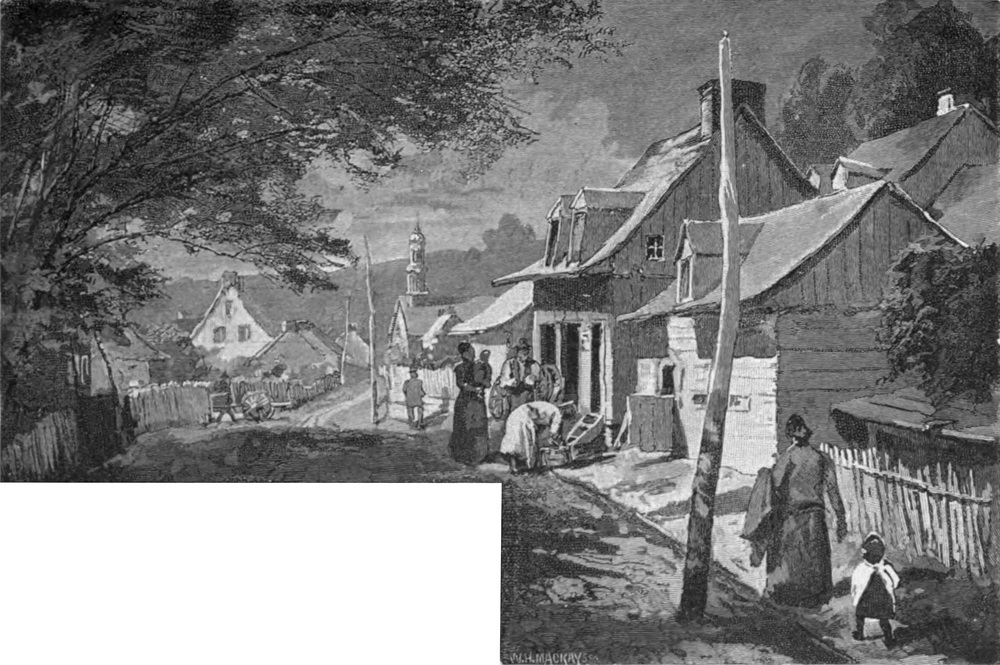
Lourdes. The village consists of one long street, and, were it paved
with stone, would bear a strong resemblance to village streets in
Switzerland, with the projecting signs, gables, and galleries of the
many little auberges. Every house is an improvised inn, and all
the fishermen are amateur inn-keepers. The street lies at the foot of
the hill, and, as you go through it, you will see faces and figures
that constantly remind you of the coarse women seen in similar streets
in Swiss villages. Most French-Canadian country-women become stout and
wrinkled in middle life, owing to the excessive heat of the houses in
winter, badly cooked food, and hard work; but those who have to go up
and down these steep hills become especially clumsy. It is wonderful to
see these heavy women going up the zigzag hill-roads, swinging their
arms at right angles from their shoulders, and climbing fences like a
man.
One of the characters of Ste. Anne is our jolly harness and shoe
maker—a woman on the shady side of sixty. If her deportment has been
neglected, she is thoroughly honest and happy, as she smokes her clay
pipe and shoves her spectacles up on her forehead to take a better look
at her visitors. You may laugh at her ancient cap, but if you could
find out why she laughs at you, you would learn that she laughs at your
modern bonnet. Just over the way we saw, through an open window, a real
live Evangeline, in her pretty Norman cap, at a spinning-wheel.
Let us walk down to the other end of the village: what has become of
the ancient church built in 1660? To the right of the road stands a
large structure a few years old, disagreeable in its ostentatious
modernness. What right had they ruthlessly to destroy the old one? We
are told that the walls were cracking. So much the better. To the left
stands a small chapel, also modern, yet wearing a genial aged look.
This was built out of the stones of the ancient chapel. The picturesque
double bell-tower of the old building surmounts this chapel, and a part
of the old interior was utilized, but one misses the plain façade, with
its rose-window and its Norman doors; gone altogether is the atmosphere
of antiquity which hovered about the old interior.
Look down the road toward “The Retreat.” Is it not as if you were
transported to a Swiss village? Painted on the gable-end of one
house, you read: “Ici Bonne Maison de Pension.” And there,
fastened to a stable, is the sign: “Bureu de Poste Ofcie,”
in very unclassical French. And what is this huge sign projecting out
into the street? “E. Lachance, Epoux de Dlle. Mercier. Maison de
Pension” (E. Lachance, husband of Miss Mercier. Boarding-house).
And next door has another, surmounted by a fish: “Maison de
Pension. Dlle. Mercier.” Thereby hangs a tale: The house of
Mercier had two daughters, one of them “fair, fat, and forty,” who was
the belle of the parish. Many a pilgrim from Quebec went to Ste. Anne
more to see this maiden than to pray. An enterprising rival, who kept
the hotel next door, cast sheep’s-eyes upon the goddess; she succumbed,
and became his wife, and transferred her interest in the hotel business
to her liege lord. The old house still kept up the old sign of “Miss
Mercier,” and the ingenious benedict took down his old one and had it
repainted, so as to announce to the world that he had married, and was
in possession of the great attraction of the rival house.
THE OLD CHURCH.
But there the steamers come, and soon two thousand pilgrims land on
the wharf. A brass band leads the way, and the people file up in long
procession, dusty but devoted, many, no doubt, with mingled hopes and
fears. Over [Pg 12]forty cripples limp along on crutches, or supported by
friends, and a pitiable sight it is. The procession enters the new
church, where, at the high altar and at the sides, a number of priests
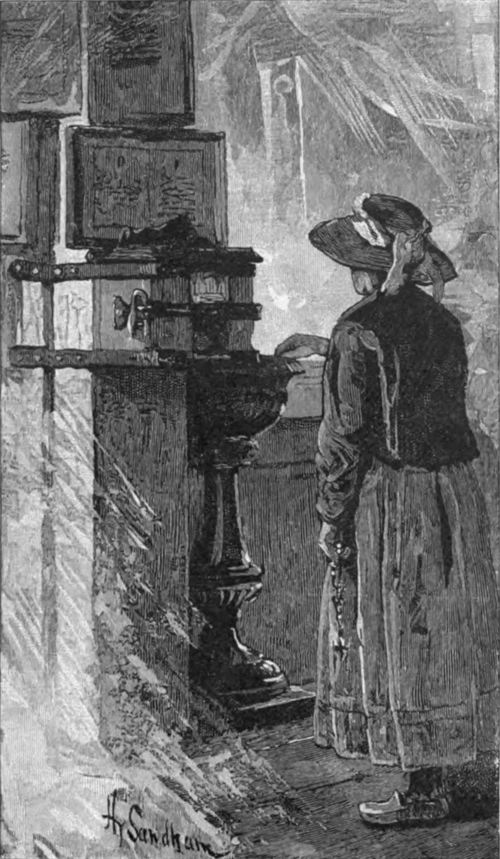
preside. As you enter, you see a large money-box, of ancient date and
curious construction, fastened to a pillar by iron stanchions. The
quaint padlock is opened by an old-fashioned bed-key. Over the side
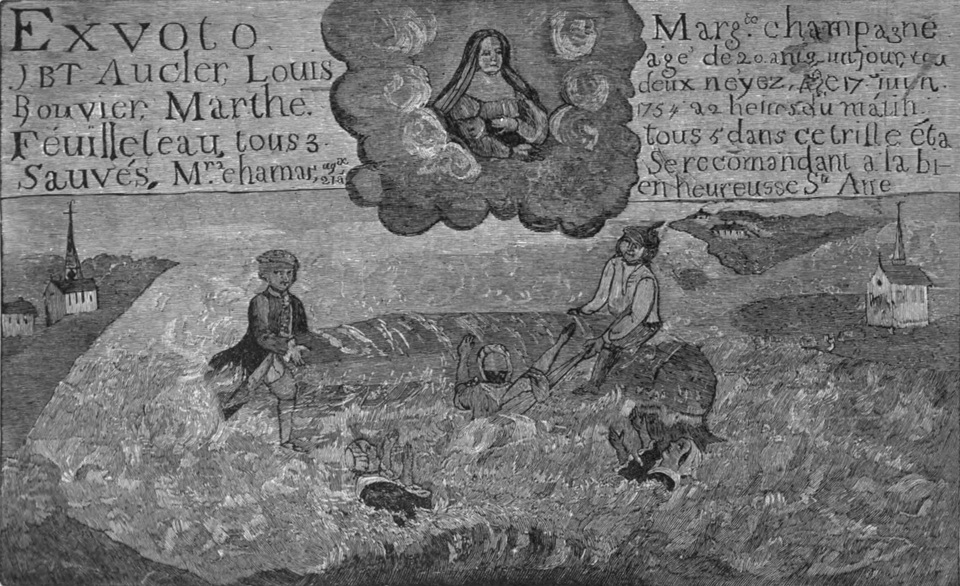
doors are rude ex voto paintings, representing wonderful rescues
from peril by water through intercession to Ste. Anne. Over the altar
is a picture of the saint by Le Brun, the eminent French artist, and
the side altars contain paintings by the Franciscan monk Lefrançois,
who died in 1685. Hung upon a decorated pedestal is a handsome oval
frame or reliquary like a large locket, surrounded with garnets, and
having in its center a rich cross of pearls. Besides this, you see the
collection of bones said to be the relics of the saint, consisting of
a piece of one finger-bone, obtained in 1663, by Bishop Laval, from
the chapter of Carcassonne, and which was first exposed to view on the
12th of March, 1670. In another case there is a piece of bone of the
saint, obtained in 1877, but the Redemptorist Fathers, who have charge
of the mission, [Pg 13]do not know to what part of the body it belongs. The
dry bones of the saint do not appear to differ in glory from those of
a sinner. The church also claims to own a piece of the true cross upon
which our Saviour died, and a piece of stone from the foundation of
the house in which Ste. Anne lived, brought from France in 1879. Also
there may be seen a superb chasuble, given by Anne of Austria, mother
of Louis XIV., and some silver crucifixes.
IN THE NEW CHURCH, ON THE SITE OF THE OLD.
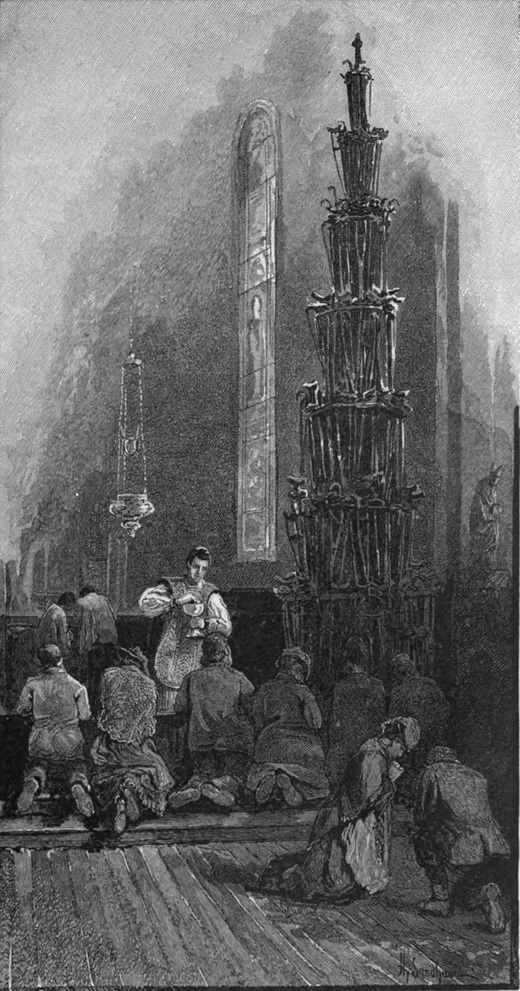
Nothing, however, will excite more curiosity than the great pyramid
of crutches, and aids to the sick and the crippled, twenty-two feet
high, divided into six tiers, and crowned by a very old gilt statue of
the saint. The collection is very curious and principally home-made,
comprising plain walking-sticks, odd knobbed fancies of sexagenarians,
queer handles, and padded arm and shoulder rests, made of pine, oak,
birch, ash, hickory, rock-elm—of all common and many novel designs. A
half-leg support testifies to a reputed removal of anchylosis of the
knee-joint by intercession to the saint. I have no desire to sneer,
but that there is some imposition and much imagination about these
“miracles” no impartial mind can doubt. One may carry his charity to
the verge of believing that implicit faith in intercession to a saint,
with mingled hope and fear and a strong determination to force a cure,
may in some cases really throw off disease; but the power of mind and
will over the body without any such intercession is familiar to every
student, and is no doubt an undeveloped branch of medical science.
A coincidence is not a miracle, neither is this power of the will
over the body a miracle. Among the long list of reputed miracles, the
following from a manual of devotion will be sufficiently suggestive:
“In the year 1664, a woman broke her leg. As the bone was fractured
in four places, it was impossible to set it. For eight months she
was unable to walk, and the doctors gave up all hope of a cure. She
made a novena, in honor of the saint, and vowed that if she
was cured she would visit the shrine every year. She was carried to
the church, and during the communion she put aside her crutches and
was cured at once.” Sworn testimony is given as to instant recovery
in diseases said by physicians to be incurable by ordinary means, and
among the particular favors accorded to the parish, the temporal as
well as spiritual is not forgotten. The Bishop of Montreal says that
it is Ste. Anne who obtains for it “rain in the time of drought.” “For
it is a pious tradition among you,” says he, “that a little picture
representing Ste. Anne, with her august [Pg 14]daughter, is the instrument of
God’s mercy towards you.”
HOLY-WATER FOUNT AND POOR-BOX.
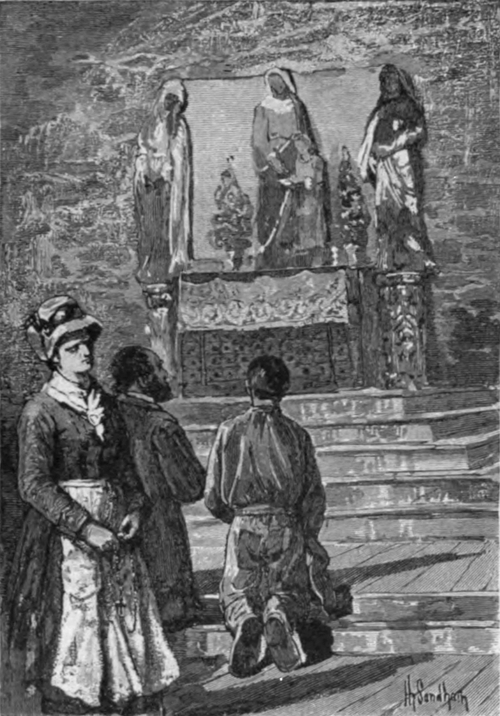
During the service in the church, the pilgrims crowd up to the altar
and kneel in long rows in front of the balustrade. The officiating
priests carry the relics in one hand and a handkerchief in the other,
and touch the glass cover to the lips of the worshipers, wiping it
after each kiss.
EX VOTO PAINTING, 1754.
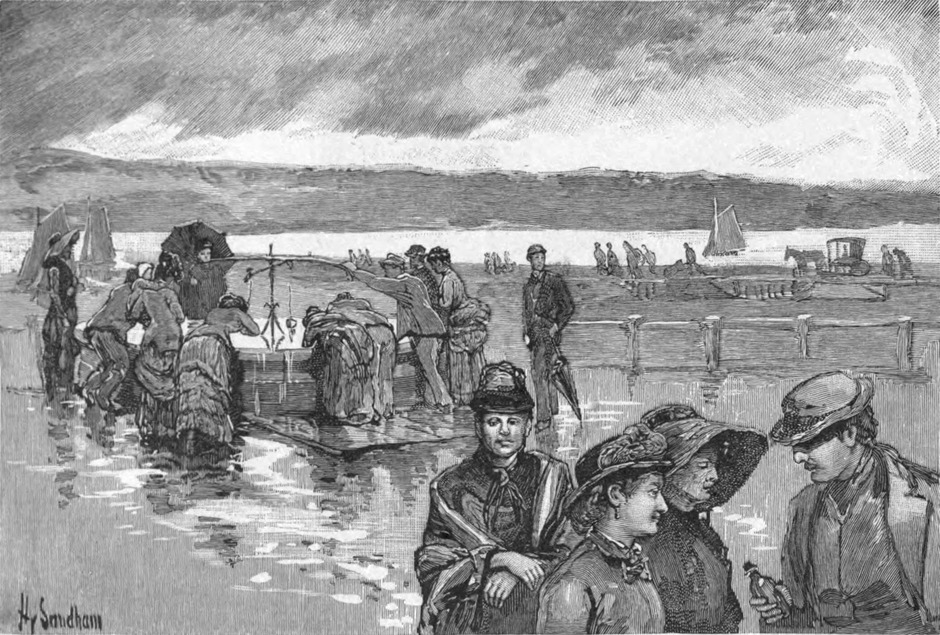
As you come out, you see pilgrims around the fountain, drinking its
water and filling bottles to carry home. It is not the original well,
which is said to have been the scene of cures as miraculous as those
performed at Lourdes; but if it was justifiable to move the church, why
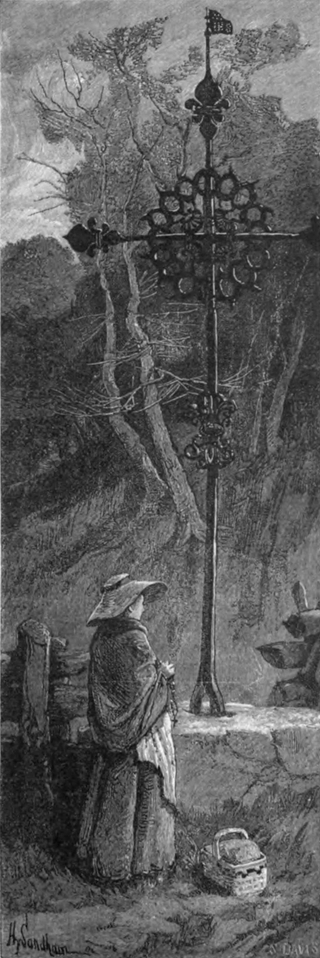
not the well? As you turn to the left, you see a picturesque way-side
oratory, built of rough stones and mortar, from which a stream of water
comes from the hill. A walk along this road is very interesting. You
may see the black cross against the wall of every house. The heraldic
emblem of Berne is not more revered in that city than the statue of
Ste. Anne here, and in every house you see it in plaster, brass, or
picture. An old cemetery here has been used so much that the beadle
told me he had himself laid three long rows of people, burying them
indiscriminately side by side, and on top of each other—“first come,
first served.” Those who pay from twenty-five to a hundred dollars
may be buried under the new church, the vaults of which are specially
reserved for this purpose.
Little rustic booths do an active business in memorials of the saint,
in the shape of medals, which the pilgrims pin on their coats and
dresses, like the shells worn by the pilgrims who have visited the
shrine of Ste. Anne in Brittany. Heaps of little brass and plaster
statues, photographs, beads, and other trinkets, attract the visitor.
The air is full of babble from the crowds of tired yet talkative people
sitting on the grass or the benches, eating their luncheon out of huge
carpet-bags. Two girls, who had heard from me of the wonderful well
in Brittany, were throwing pins into the fountain to find out their
matrimonial prospects, and laughing heartily over their efforts. When
the pins fell head foremost, hope grew sick; when the points first
touched the water, the prospect of marriage within a year was certain.
I noticed that, like the Chinese praying to his favorite idol for “more
money,” they both persisted until the test turned the right way.
Coming back to our hospitable “Retreat,” we saw a fascinating study
of life and character. A tidy, handsome village girl had a boy seated
on a stool on the sidewalk in front of her house, and was vigorously
clipping his shaggy locks, catching the débris in her apron,
which she had tucked around the lad’s neck. “Surely some pilgrim
to Ste. Anne will lose his heart if he risk his hair to the pretty
barber,” thought I. It turned out that some pilgrim had, and that she
was a fisherman’s wife.
Every house seems to share in the profits of the pilgrimages, for
though the older habitants hardly ever spend a sou, youth and beauty
must have its fling. You see barrels of root [Pg 15]or spruce beer, huge
slices of brown bread and butter, berries, gingerbread, boiled corn
on the cob, and other Canadian luxuries, on the sills of the windows,
or on rough deal tables at the doors. Inside you see long rows of
solemn white cups and saucers, and piles of plates. In one little
auberge there is a queer character, with a monstrous hump on her
back and another on her nose. She has been living at Ste. Anne’s for
seven years, interceding every day for the reduction of her deformity,
but it increases with her age.
THE COLLECTION OF CRUTCHES.
AT THE FOUNTAIN OF BLESSED WATER.
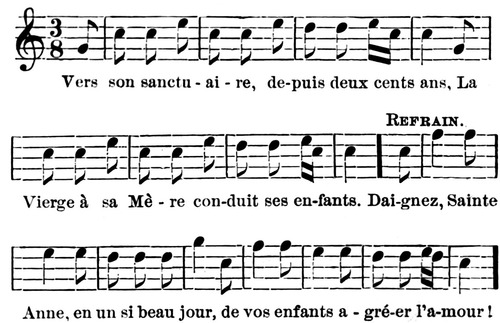
But what song is that stealing over the water, like a Canadian
voyageur’s refrain? [Pg 16]A boat laden with pilgrims from the Isle of
Orleans is making for our shore, and the voices rise and fall with the
dip of the oars in the true rhythm of the canotier:
Chelsea, .—I will now, my long confused wayfarings
of the summer being ended, endeavour to write down with all despatch
what I can remember of them. After much sorting of paper-rubbish,
reading over of all the Irish letters to my wife and kindred, and in
some measure clearing the decks (not for “action” yet, alas, no, no!)
set about this, which I partly consider a clearing of my own mind, as
some kind of “preparation for action.” Faxit.
REMINISCENCES OF MY IRISH JOURNEY.
.—After endless “agonies of
preparation,” natural to a poor stationary, sedentary, biliary, and
otherwise much bewildered mortal, about eight in the morning I got on
board the Chelsea steamer here, at the Cadogan Pier; left my poor wife
gazing sorrowfully after me, and, in a close, damp-sunny morning, was
wafted swiftly down the river. Memory now is a blank nightmare till
I reach the wooden platform swinging on the river just above London
Bridge, north side, and call earnestly for some boatman to take my
luggage and me “to the Athlone, at Alderman Stairs.” Boatman
comes, a ragged, lean greasy and sooty creature, with hurried toilsome
eyes and shallow shelf chin—“a wholesome small nature, terribly
beaten upon and stunted”—who cheerfully takes me in; zealously descends
the river with me, tide against him; whisks his way like a needle thro’
innumerable impediments of ships, rafts, barges; sweating, panting,
eyes looking still more toilsome, jacket doffed, shelf-chin still
more protruded; and at half-past nine, reaches the Athlone, a
dingy dirty-looking Dublin steamer (but a steamer and mode of travel
I had chosen against my lazy wishes, and in obedience
to my insights and determinations); and, after rowing round (steward
or third-mate at first refusing to let down the steps) puts me on
board—takes 1s. 6d. with protest, the double his fare, and splashes
away again about his business. There am I on board.
Steamer lying all, to an unexpected degree, as if in a kind of greasy
sleep. £2 fare demanded by some landsman interested seems the liveliest
fact. Canaille of various kinds, Irish by look, getting itself located
in the fore-deck; one yellow-faced, roughish, very slight-made Irish
figure in cap half-drunk fixes my attention, by his endless talk to
stewards etc., seemingly about nothing at all or next to nothing: a
sorrowful phenomenon often confirmed afterwards. Half-pay Serjeant
looking figure,—clean old Lancashire physiognomy of fifty (old
Indian soldier, now at Falmouth, as I learned afterwards) is talking
insipidities about the news from the papers, I forget what. Other
figures—the more spectral in my memory, somewhat like spectral flies in
a spectral gluepot! I was very sick in body, perhaps still more so in
soul; and had, by no means, a lively mirror of attention to hold up to
them. At ten o’clock, nevertheless, with unexpected precision, a bell
rang, the steam mechanism began growling, and we jumbled forth on our
way.
To the river-mouth I remember little with distinctness; the day had
settled into grey; with more than enough of east-wind now that our
own velocity was added to it. The brick-chaos and ship-and-boat-chaos
of big London till after Greenwich lies across my remembrance like an
ugly indistinct smear, full of noise and confusion, no figure
distinct in it. Passengers, one after one, came on board; at Greenwich
a great many soldiers “recruits and invalids” Irish both, the latter
from India, and “bad subjects” mostly, as I learned afterwards,—these
came on board at Gravesend in great number, drunk many of them, with
or without officers (without it afterwards turned out); a nasty
sight rather. Pilot-boats hooked themselves astern of us, and went
shoving thro’ the foam; sometimes as many as 4 boats at once: “pilots
looking out for a job,”—favored by the steamers. A tall antelope or
panther figure in red coat (about Gravesend, I think) misses the proper
boarding-place from his boat; steps into one of these pilot-boats,
cool he amid the tumult of noises and splashing of spray; and twists
gallantly aloft over the stern; dashes the spray from self and papers,
and with a brisk calmness which I could not but admire, stept smiling
forwards to his place, the foredeck: a corporal of foot; commander he,
as I found, of the broken military there. An exceedingly tall lank
simple-looking Irish gentleman came on board thereabouts too, whom I
afterwards named to myself the “Irish Toots” (see Dickens). A
very short well-conditioned cockney-looking gentleman had likewise
come. I took him for the captain of these Majesty’s forces of ours;
but found afterwards he was a tourist, “looking [Pg 18]at all the capital
Cities,” Paris last year, Dublin this; he had a small tear-store (from
which I guessed a wife too); his big blue eyes, silly as he was, had
at times a beautiful sorrow in them while he sat silent in the evening
on deck for a while; a rough pug-face—tamed into perfect peaceable
politeness, had in it an air of limited rationality, veracity and
English wholesomeness, which pleased me. But I must get on! Somewhere
on the river a big fat Englishman of fifty stept on board, burly,
black, pock-marked, one eye shut (seemingly out, but it proved to be
in too, on occasion): some trader (one would have hoped, in
bacon and edibles) to the Plymouth region, I afterwards
found. Our other cabin passenger, where entering I noticed
not, was an elderly Lancashire or Cumberland man, you could not say
of what quality below a gentn.; feeble-minded, good-humoured, his old
wrinkly face grew quite blown-out at last, the eyes almost shut up,
by inflammatory regimen of whiskey &c. and want of sleep before the
voyage ended. I did not in the least hate, yet how little either, did
I pity this poor old man. Alas, wrapt up in our own black cares (which
we ought to conquer, and keep moderately conquered, if we stood to our
post), shut up the soul of man from feeling for his brother,—surely
an ignoble state! let this suffice for our ship’s loading. I remember
very vaguely Erith, much more so Southend or rather the name
of “Southend and its long Pier” (a cockney bathing-place). I have a
dim tint of grey-green country and spectral objects enough
there rushing past me all that day and afternoon. Our Captain, an
excellent, civil, able, old Welshman, kept aloft on the platform; very
obliging when you spoke to him. I went twice there with a cigar, looked
down into the sea of Irish rabble, and began to decipher type-faces
of the Irish. The “light boats,” we passed near to two or three of
them; the dreariest objects I ever in this world saw; the Girdler
Tongue &c. on their several shoals of those names; must keep a
light burning at night; the two men have no function else whatever; I
suppose they can eat terribly, and sleep nearly the whole day.
Their boats were bobbing and capering in the wild surf; narrow was the
share otherwise these poor fellows had of this Universe. It is a wild
expanse of shoals and channels, this Thames mouth. I had never been on
that side of it, at least never in daylight, having usually in former
voyages passed by the Nore. Of Broadstairs and Ramsgate, nothing but a
tremulous cloudy shadow remains. Ditto of Deal. I saw Walmer Castle,
Duke of Wellington’s, looking down on us with wings of planted wood;
less memorably some big Hotel, perhaps more than one, its windows
glittering in the bleared windy sunset,—not beautiful to me they, or
anything, in that sad mood. Dover (lived at twenty-four years before,
one autumn) looked grim enough in the twilight; I could recognise
almost nothing of my old localities, the new “entrance of the tunnel”
was not recogniseable except as a small blotch. How I took tea &c. and
went to bed is quite abolished from recollection; too well can
I recollect the snoring of my one-eyed provision friend,—whose
eating at tea, whole chickens and plates of ham vanishing before
him, I do now recollect! Also that I got up, probably about midnight;
was told we were opposite Brighton, but could see no token of
that or of anything but a dim flat coast with some kind of luminous
gleam all along where sea met land; whereupon I had to smoke a pipe,
and descend to my lair again. Cyclops snoring still more effectively
now—seldom or never heard such snoring, which was not a stream,
diastole and systole, but a whirlpool rather, or system of
whirlpools, bottomless maelstroms and sandy systis conjoined (ah me!),
for the man was nearly suffocated by cloud curtains and by vanished
plates of ham. I have a dim but certain recollection of jumping out
of my bed or drawer at last, indignantly dashing his curtains open,
with some passionate demand to “cease that beastly gurgling and
gluddering, in the name of all the devils!” Whereby at least my heavy
provisional friend did awake; and I fell asleep and heard no more of
him for that night. Poor fellow; not a bad creature, after all; there
seemed a kind of healthy banter in him, a merry vivid eye; probably an
excellent dealer in bacon, praiseworthy as a British citizen of
1849; but he did eat excessively, and his snoring was to me at once
hateful and terrible,—poor fellow after all!
Sunday morning (1 July) at seven came on deck: beautifully sunny
morning, Isle of Wight, Ventnor region lying close at hand, and the
ship motionless waiting for the turn of the tide—wind had gone round
from east to west in the night: we hung for about an hour with little,
at first with next to no motion, opposite that southwest region of the
little Island. The special localities, none of which were known to me
beforehand, I did not get committed to memory. A straggling hamlet
(perhaps about Dunnose, I can’t now find on the map any name that
fixes itself as the name then given me) with a kind of bay and clayey
unbeautiful coasts, this stood distinct; less so other struggling
human objects; and now only Ventnor itself figures as absorbing the
whole vivid past of the scene. A steepish slope, very green but rather
treeless; houses and little gardens [Pg 19]sprinkled over a good part of it,
connected by oblique paths; grass-surface very beautiful everywhere,
shrubberies apparently flourishing; a pleasant group of dwellings hung
out there against the morning sun,—and one of them, I know not which,
had been John Sterling’s last dwelling! I looked intently, with many
thoughts. Bonchurch not visible now—had it been? I knew also (what
was curious to think of) that John Forster, little dreaming of my
whereabout, was in one White’s at Bonchurch, down from London that very
morning. Far elsewhither was I bound. With eye or with glass, looking
never so intently I could discover no human or even living figure;
which proves perhaps that our distance was greater than the short
distance it appeared to be. “Toots” very loquacious when he could get
a chance, came talking about Dr. McHale of Tuam (“Chuam” he called it)
and Nangles of Achil Island; and how John had “cursed them all with
bell, book, and candle” etc. which I shook off, not believing it at all
literally in spite of Toots’s evident bona fides, and wishing
indeed to see Ventnor rather than it. After Ventnor, talk with
the half-pay Serjt. Major; Wight now flitting faster by us, the ship
being under full movement again. Of Indian soldiering; mainly about the
economics, difficulties, etc., of locomotion for armies; but above all
things the prices of articles in the various markets, allowances
of grog—what you could get, and pocket or swallow, by your
soldiering in India—this was the theme of my half-pay Serjt. A most
healthy practical man; simplicity itself, and yet savoir-faire
enough, tough as leather, and a stroke in him (I could see) like
that of a quarter staff of oak. Man worth remembering, told me
of his pensions, promotions, appointment now (to some military charge
of a district, I think) at Falmouth: “as good as one hundred pounds
in all, sir, which is very well, you see”; more total absence
of bragging, nay of self consciousness or of any unwholesome
element it was impossible to see or figure. Soldiering like working, in
such men; strong both ways, as native oak: the strongest kind
of men. After Wight, Needles &c. (terribly worn, almost dilapidated
and ruinous ugly-looking) had rapidly flowed past,—perhaps before ten
o’clock,—the coast left us; Southampton &c. far in the distance, passed
unnoticed, and I think I must have taken to read Quaker Pim’s book
on Ireland which else passed unnoticed. Or perhaps I went to sleep?
Probably that was it? Yes, in my notebook (pencil) it is marked
so “fell asleep on deck a little in the sun towards noon.”
N. B. After three days more there is not even a pencil scrap, nothing
but the letters to help me to decipher what was the exact day of this
or that occurrence still remembered by me.
It turned out now there had a man been lost last night. The
good old Captain so reported it. On Saturday evening, most of the poor
Irish wretches of “invalids” got more or less completely drunk; some of
them even on entering, had needed no completing. One of them, a lean,
angry, misguided, entirely worthless looking creature, age perhaps
forty, came staggering upon the quarter-deck, and made a turn there:
turn nearly completed, he came right upon the captain who of course
ordered him off,—which order, tho’ given mildly enough, the poor drunk
wretch felt to be insulting to his honour, and swore fiercely not to
comply with. A scuffle had ensued (Captain’s hand got “twisted”): all
of us started up to conjure the poor wretch &c.; he did then turn off,
abashed, perhaps repentant, had taken more drink for consolation; was
“last seen about midnight”: it was now he that was never to be seen
more! The Irish physiognomies I studied often from the upper platform:
besides my yellow friend with the cap, I had made out some five or
six type-physiognomies, which I could recognize as specimens of Irish
classes of faces: there was the angry-bewildered, for instance
the poor wretch that went overboard, or a still better yet left on
board, a lean withered show of a creature with hanging brows, droop
nose, mouth-corners drooping, chin narrow, narrow eyes full of sorrow
and rage; “I have a right to be here, sir, I want my ration!” said he
once. There was there a blonde big tiger-face (to whom I lent a light
for his pipe); this is of mixed breed, I think a north-country face:
noble possibility quite marred. Irish sailor at the helm in wig and
storm hat; bulky, with acquiline face and closed mouth, wild cunning
little eye: like Jock McDonald of my early years. Ah me! These faces
are still very clear to me; and were I a painter, I could draw them;
others, one or two, not thought of again till now, have got erased;
I was struck in general with the air of faculty misbred, and
gone to waste, or more or less “excellent possibility much marred,”
in almost all these faces. The man had found himself so enveloped in
conditions which he deemed unfair, which he had revolted against, but
had not been able to conquer, that he had so to speak, lost his
wa; a sorry sight, the tragedy of each of these poor men;
but here too surely is a “possibility”; if the Irish faculty be good,
you can breed it, put it among conditions which are fair
or at least fairer.
[Pg 20]
“Portland Bill”: it was on awakening from one of my deck sleeps, well
on in the afternoon that this object: a muddy-beached little Island,
I found,—perhaps an Island only at high tide:—shaped rather like a
battle bill: was that the origin of the name? From this point
the Coast continued our neighbour again; by degrees Dorsetshire passed,
and then Devonshire with its gnarled rocks (as if they were whinstone
or limestone, and Scotch rocks) winded rapidly off, as the evening
sank—viewless now, damp, and rather windy, as we were running into the
teeth of the breeze. Many caves, gnarled promontories, rock islets;
trim houses and fields, no human creature visible; a silent English
sabbath country,—like the dream of a sabbath. Mate, of whom anon,
points out Plymouth light in the thickening dusk; past ten we make
the light: Breakwater with its red lamp with its sudden calm
of sea, and tumult of boats;—we were in some most dark, strait place,
with rain beginning, and they called it Plymouth Harbour. Toots’s talk
to me, while the bustle went on, about an Irish lord (just dead?) and
his brother, transcendent blackguards, beautiful once, dance or dinner
of innumerable improper-females in London once—pity rather that I
have forgotten that: but of Toots who could do anything but forget?
Smooth-flowing shallow shameless river of talk; always in one or two
minutes, when I could not bodily get away from him, my thoughts slid
far away. These transcendent Irish lords were connected, somehow by
marriage with the late Duke of Gordon. Of my night in this harbour
there remains yet sad memorial; in a scrawl of a letter begun about
midnight to my wife! Enough here to record the stages or chief epochs:
1. To bed very sleepy. Toots and the Lancashire Non-significant,
talking serious jargon for about an hour in the cabin, wouldn’t let
me; I remember, the poor cockney tourist had been asking “for a pen,”
remembered Post Office here, and started up to write, by
way of deliverance from that ear-torment:—2. Writing with ear-torment
still worn near at hand, my Provisional friend (O Heaven I
thought he had been gone, never to snore more) stept in,
evidently full of food and porter; at sight of him I start, can write
no farther; lock up my writing case, wait impatiently that Toots and
Non-significant would end. 3. Try bed again; can’t at all. Toots and
Non-significant stumble in, rain patters on the deck, Provisional
friend takes to snoring—“blubber—gurgle—gludder!” I start up and
don my clothes; find in the cabin too a poor under-steward snoring,
loudly but humanly, and have not the heart to awaken him. Uncertain
what to do, fly on deck, smoke (under my umbrella), try not to
despair; find at last a side cabin with nothing in it but rubbish of
clothes, a sofa and an open window; fling myself down there, thanking
Heaven, and fall sound asleep—till eight next morning.
Monday, .—All busy when I came on deck; sunny morning,
boxes, bales, persons getting or got on board; soon sail; have seen
nothing of Plymouth, see little even of the harbour except confusion of
ropes and ships;—size of it guessable at less than I expected. Tract
of town (Cutwater they called it?) stretching back on the right as
we sailed out; buildings like public storehouses, or official
houses farther down; two neat women step hurriedly on board there.
Misventurous Irishwomen, giving up their plan of emigration
to Australia, and cowering back to Ennis in Clare, as I afterwards
learned; sisters, Misses Hewit by name. Breakwater a stone glacis, with
light-tower (perhaps Cannon-tower too) and small esplanade at the end,
some frigates scattered about; it was Plymouth Sound; pretty enough
in the summer morning after such a night. Various new figures now on
board; new prey to Toots. I spoke to none; hoped they would leave at
Falmouth where we were to call. Sick gentleman in big wicker cradle lay
on the deck; poor fellow! “paralytic in the lower extremities,” going
to Dublin for surgery, attended only by a rough clown of a servant;
his eyes look mild and patient, tho’ sad; intelligent white face; age
probably about thirty-five; they shifted him round out of the sun; not
to embarrass him, we had to forbear looking at his cradle or him.
Cornish coast, as that of Devonshire had been, gnarled rocky; indented
all along, harbour and sound (when once you had “opened” it) at the
bottom of each little bay “Pol”—something or other, when you asked
the name. An interesting event to me. Looe: “that is Looe,” that
strait hardly perceptible crack or notch in the rocks there.—Poor C.
Buller, poor old years of his and mine! Fowey-harbour entrance was
marked by white spots, a couple, painted on the rocks; not
find it otherwise. Toots preying on the newcomers. “Hum-m-m.
Drum-m-m!” with a strong Irish intonation in it. Many trim sloops of
one pattern, with red sails and conspicuous label (“P. H. No. 1,” etc.?
something like that) were nimbly cutting about: “Pilchard-boats, sir!”
All busy here, crowded steamer crossed us on the left; pleasure-trip,
Falmouth—to the Eddystone probably. Half-pay Serjeant did the honours
of the Coast as we approached his new home; has liberty [Pg 21]seemingly of
the quarter-deck, but feeds and sleeps in some region of his own. About
noon or after, past St. Mawes and on the left past Pendennis,—Falmouth;
and moor there “for about an hour”—which proved two hours and more.
I might, had I foreseen that latter fact, have gone ashore to see
“Barclay Fox” and Co., if nothing better; nay, I was near going, had my
foot on the ladder towards a boat, but in the scrambling tumult gave it
up again, and decided to stay and look about me and pensively smoke and
consider. John Sterling’s house was there too; but nobody could tell
me which; tho’ one, a brisk young damsel did point out the warehouse
of the Foxes, a big house near the sea. Falmouth might contain three
or four thousand souls (as the look suggested to guess); it hung,
pleasantly enough, tho’ much too bare-looking, on the slope of the
acclivity and down close to the Sea; reminded me a little of Kirkcaldy,
except that this was squarish in shape, not “a long town” rather a
“loose town,” as I judged; one street near the sea, main street I
suppose, on the level; the sloping thoroughfares I judged to
be mostly lanes. The country looked bare; the harbour land-locked is
beautiful, and if deep must be excellent. Assisted clown to screen the
poor invalid gentleman in his cradle from the hot windless sun; fixed
up my own umbrella over him, which the clown afterwards told me, in
confidential gratitude, was “a graat suppoart”—Sent a card ashore to
Fox; admired the clean, sturdy, clear-looking boatmen; watched their
long dangerous loading and disloading. Toots had gone, Provisional
friend (O joy!) had gone; hoped we should now have a stiller time.
About two the steam growled again, and we got under way, close to the
little pleasant Castle of Pendennis this time, a trim castellated
height with trim paths &c. (one company in it, Serjt. Halfpay had
said); and so again out to the open deep.
Our 2 Irishwomen “from Ennis in Clare” with their clean summer bonnets
(mere clean calico, folded full over paste board, with a tack or two;
much admired by me) had come to the quarter-deck; wished evidently
to be spoken to; were by me after others of us. Father had been a
Lieutenant of foot with pension, mother too with pension; both being
dead, resources were all out: parson had advised emigration, “free
passage to Australia” was certain if we would deposit £12 in advance;
deposited, sold off, came to Plymouth, found the “free passage” a
passage among parish paupers, and shrinked (of course) at the notion of
it! Officers had been extremely helpful and polite; got us back, with
difficulty, our £12 and here we are, wending our sad way home again!
A more distressing story I had not lately heard. For both the women,
“ladies” you could not have hesitated even in the poor-house to call
them, were clearly of superior faculty and quality: the elder some
forty-five perhaps, a ruggid brave-looking woman; the younger delicate,
graceful, and even still beautiful, tho’ verging towards middle-age
also. The two unfortunates, was there nothing other for them by way of
career in the world but this! The younger was quite pleasant company;
but at “the Lizard” or earlier began to grow sick, grew ever sick, and
I had to lead her to her place, a horrible den called “Second Cabin,”
and there leave her sister and her. Ill-nature of the stewardess, tiff
between the good old captain and her because of these poor Miss Hewits.
“Bring me our basket, pray sir! Stewardess will give it you!” were the
last words of the elder from her dark den. Stewardess knew nothing of
their basket, not she; old captain awoke from his after dinner nap,
reproached the woman for her greedy hard character, ordered her
to “know” the basket, which, with very angry tears, assisted by me and
my soothing eloquence, the creature at last did. Base, in many cases,
under certain aspects, is the mind of man!
The “Lizard point” we would pass before dinner; stormy place of cliffs,
high cliffs, rough water; I found that in shape it did resemble
somewhat the head of a lizard,—at least on the western sides it does.
We were past the “southern” most land of Britain then; but the tossing
of the water did not abate as promised; the evening light glared
wild and sad upon the solitary sea, to the Land’s-end, that was the
word now. Coast still high and all rock; Land’s-end stretching out
black ahead; it was towards sunset when we actually reached it; passed
it round the lighthouse at the distance perhaps of a mile. The wildest
most impressive place I ever saw on the coasts of Britain. A lighthouse
rises on a detached rock some considerable space ahead; many detached
rocks, of a haggard skeleton character, worn haggard by the wild sea,
are scattered about between the lighthouse and end of the firm cliff;
that cluster, where the lighthouse is, had seemed to me like the ruins
of a cathedral for some time. Very wild and grim, impressive in itself
and as the notablest of British capes. A farmhouse called by sailors
“First and last” stands very near to the extremity; farther round to
the west are villages and many houses visible, “mining village” you are
told; the promontory itself is among [Pg 22]the highest I have seen (much
higher than St. Bees I thought); sheer and black. A boat or two, poor
specks of piscatory human art, were seen rocking and paddling among
the angry skeleton rocks in these ever-vexed waters; where they were
to land, or how get up to “First and last” one didn’t well see. But
here at last is the spectre of the mixed cathedral,—a lighthouse among
haggard sea-beat rocks, namely; and we are round the Land’s-end,
getting round towards the western side of it, and had better look well
our last. The sunshine now went out, angry breeze blew
colder from dark cloudy skies,—baddish night, probably? Some poor
laboring ship, with patched sails and not otherwise of prosperous
aspect met us just past the lighthouse, borne into the grim evening, it
on its way, we on ours; and the Land’s-end was among the things that
had been; “standing for the Tuscar, sir!”—Tuscar light on the coast of
Wexford, one hundred and thirty miles off. And so the evening and the
morning had been a new day.
As there was nothing to be seen on deck but the dim tumult of sea and
sky, I suppose I must have gone early to bed: I can remember shutting
my little cabin door, (for the harsh stewardess, in hope probably of
a shilling, had volunteered to make a bed for me in the place where
I had found refuge the night before) with a satisfied feeling, and
turning in with great hope: but, alas, it proved far otherwise. My
first experience in the new bed was a jolt that nearly threw me out:
the wind had risen, was still rising; the steamer pitched, rolled,
tumbled, creaked and growled: doors banging, men’s feet and voices
sounding, and the big sea booming and roaring: not a wink of sleep
could be had all night, hardly could one’s place in bed be maintained.
Some time, perhaps between three and four I went on deck to smoke; a
wild wet stormy dimness everywhere; the mate dripping from every angle
of his face and person—with thin wet shoes on, I remember—approached
my shelter, talking, sea stoicisms to me, admitting that it was a
roughish night: noticeable fellow this; very civil, very good-humoured,
sliding about (for he trailed his limbs and feet with thin
shoes) to put this and that detail in order always; voice thin, creaky,
querulous—hesitatory, and as if it couldn’t be troubled to speak; a
rocking, sliding, innocent-hearted “sea-pedant” (as such I had classed
him); with lips drawn in, puckered brow, and good-humoured eyes
pretending to be wearier than they were; came from the Medway,
had been wrecked, traded to Aberdeen, was now puddling about in these
seas;—may he prosper, poor fellow! I flung myself next on the sofa,
under miscellaneous wrappage, and did then get some stony sleep till
the morning fairly broke.
Tuesday, .—On deck between eight and nine, all hands
looking out for “the Tuskar” when doing nothing else; old captain and
a wretched passenger or two trying to walk the quarter-deck
(impossible for any two-footed land animal); big sheets of
spray dashing over them from time to time. A wild grey tumult; sight
and sound everywhere of the rather dismal sort in sea and in sky. One
ship or perhaps two at various times visible; elsewhere no Tuskar, no
motion that was not of the chaotic powers. Sailors made a wave
or motion or sound of some sort from the platform, captain too looked;
Tuskar at last! In a few instants more I also could see it; white
pillar or tower rising steady amid the tumult of the waters, strange
and welcome; some twelve miles off, they said. We turned now gradually
to the right: for Arklow head, for Wicklow do., then was Dublin itself
to come. Wind, as we turned from it on our new course, grew
softer somewhat and water smoother, but all day it was gusty, very
uncomfortable and too cold. The poor sick gentleman had passed the
night on deck, his cradle well screened under tarpaulins; and didn’t
seem much hurt by the rough weather. Lancashire Non-significant, who
took a little punch perhaps too often, seemed greatly out of sorts; his
poor face, red as vermilion in parts, and swollen as if you had blown
up all its old wrinkles with wind;—poor devil; yet he ate again at
breakfast, and made no complaint, took nothing amiss.
“Wexford Harbour,” visible only as a blank on the line of coast, was
a mere tradition to us. Wexford and Wicklow hills (I supposed about
Eniscorthy and Ferns) many commonplace looking hills of moderate height
and complex arrangement now visible. Vinegar Hill, a peaked flat cone,
conspicuous enough among the others. Thought of the “Battle of Vinegar
Hill,” but not with interest, with sorrow rather and contempt; one of
the ten times ten thousand futile fruitless “battles” this brawling
unreasonable people has fought,—the saddest of distinctions to them
among peoples! In heaven’s name learn that “revolting” is not the
trade which will profit you. The unprofitablest of all trades, if you
exceed in it! In heaven’s name either be at peace, or else try
to fight with some chance of success! “Hill of Tarah” visible too, of
conical shape; but not the historical-illustrious Tara,—that is in
Meath, I think; tho’ that too is but moderately “illustrious” to me.
Arklow Town I didn’t see at all; understood there was next to no
town, but remembered [Pg 23]“Wooden Ludlow’s” adventure there, and could
have liked to take some picture of the ground with me. Wicklow
head, beautiful trim establishment of a light-house there, properly
three towers (one or else two of them having proved wrong
built), accurately whitewashed, walled in, with paths &c., a pleasure
to look at upon the brown way. These generally like that of Devonshire
or the lower forms of Scotch coast; interior not ill-cultivated;
houses trim enough from the distance, fields fenced and some small
stragglings of plantation even. Behind Wicklow Head, in a broad
shallow bay looking rather bleared, found Wicklow Town, kept
looking at it as we sailed northward right away from it; lies in a
hollow on the southern side of the bay screened by Wicklow head
from the east winds—rather a feeblish kind of County Town; chapels,
a steeple, slate roofs, thin cloud of smoke; perhaps 2 or towards 3
thousand inhabitants, as I judged. In all these seas we saw no ship.
Absolutely none at all but one Wicklow Fishing-sloop, of the same
form but quite rusty and out of repair as the Cornish Pilchard-sloops
of yesterday;—alas one, & in this state of ineffectuality. A big
steamer farther on, making from Dublin towards “Bristol” (I think
our captain said); this and a pilot boat not employed by us;
except these three we saw no other ships at all in those Irish seas
that day. Wonderful & lamentable! chorus all my Irish friends; and
grope for their pikes to try and mend it! Bray Head I had seen before;
and Bray, but couldn’t make my recollections correspond. Beautiful
suburban country by the shores there, on the Dublin side. Works of
Wicklow Railway, hanging over the sea, I remember, probably about Bray
Head. Afternoon sinking lower, wind cold, bleary, loud; no dinner
till one got to Dublin: wish we were there. Dublin Bay at last;
Kingston with its small exotic rows of Villas hanging over the
saltwater; Dalkey Islet, with ruined church, close on the other side
of us; Kingstown Harbour, huge square basin within granite moles,
few ships, small business in it, wild wind was tossing some filament
of steam about (mail steamer, getting ready I suppose for Holyhead),
and the rest was idle vacancy. Long lines of granite embankment, a
noble channel with docks, miles of it (there seemed to me),
and no ship in it, no human figure on it, the genius of vacancy alone
possessing it! Will “be useful some day” I suppose? The look of it, in
one’s own cold wretched humour, was rather sad.—Dublin Harbour at last;
a few ships actually moored here, along the keys nearest to the City.
Tumult, as usual; our key was on the north bank. Miss Hewits came up,
specially begged me not to leave their luggage once on shore
till they themselves came with the remainder of it: did so, tho’ little
able to wait; was hardly ever in a more deplorable state of
body than even now. Despatched the Miss Hewits; got into a cab myself
escaping from the unutterable hurlyburly. “Imperial Hotel, Sackville
street!”—and was safely set down there, in wind and dust, myself a mass
of dust and inflammatory ruin, about 6 or 7 in this evening of Tuesday,
July 3.—What a pleasure to get fairly washed, and into clean linen and
clothes, once more! small wholesome dinner in the ground storey; fine
roomy well-ordered place: but, alas, at the Post Office there was no
admittance, “all shut at seven.” I had to take that disappointment, and
instead of receiving letters write letters.
Imperial-Hotel people, warned I suppose by Fitzgerald (Miss Purcell
the proprietress’s nephew) had brightened up into enthusiastic smiles
of welcome at sound of my name: all was done for me then that human
waiterage in the circumstances could do; I had a brisk-eyed deft Irish
youth by way of special attendant, really a clever, active, punctual
youth, who seemed as if he would have run to the world’s end for me
at lifting of my finger: he got me cloakpins (my little bed-room the
“quietest” they had, wanted such); bath tubs, attended to my letters,
clothes, messages, waited on me like a familiar fairy. Could they have
got me into a room really “quiet,” where I might have really slept,
all had been well there. But that was not possible; not there,
nor anywhere else in Inns. One’s “powers of observation” act under
sad conditions, if the nerves are to be continually in a shatter with
want of sleep and what it brings! Under that sad condition, as of a
gloomy pressure of waking nightmare, were all my Irish operations, of
observation or other, transacted; no escape from it; take it silently
therefore, say nothing more of it, but do the best you may under
it as under a law of fate.
About 10 at night, still writing letters, I received “John O’Hagan’s”
visit; a note from Duffy, who was dining there, had lain waiting for
me before—brisk innocent modest young barrister, this John O’Hagan;
Duffy’s sister-in-law did by no manner of means let rooms;
so her offer of one, indicated in Duffy’s note, had to be at once
declined: Duffy himself “would be here in half an hour.” Wrote on
to my mother or to Jane: Duffy came soon after the time set. Drank
a “glass of lemonade” from me, I a glass of punch; took my letters
of introduction home with him to scheme out a route, gave me a
road series “drive here first, then there, &c.” for Dublin
[Pg 24]introductions on the morrow; and after a silent pipe I tumbled into
bed.
Wednesday, .—Breakfast in the Public room: considerable
company; polite all, and less of noise among them than when I was
formerly there: arrangements all perfect; “toasted bacon,” coffee,
toast, all right and well served—No letters for me at the Post-Office!
strange, but no help. Car (“a shilling an hour”) about noon (I think)
to go and deliver my introductions; got a body of letters just
as I was stepping out on this errand: all right, I hope, Postmaster
mistaken before! M’Donnel of the National Schools, “engaged,” very
well; to Board of Works, Poor-law Power not come; Larcom just coming,
read my letters in his room, go away then as he has not
yet got his business done. In Merrion Square Doctor Stokes in:
clever, energetic, but squinting, rather fierce, sinister-looking
man,—at least some dash of that suspectible in him: to dine there,
nevertheless, to-morrow evening—Doctor Kennedy not at home, Sir R.
Kane do. (out of town); Sir Duncan Macgregor, found him, an excellent
old Scotchman, soldierly, open, genial, sagacious: Friday night to
dine with him; left my other military letters there, and drove to Mrs.
Callan’s (Duffy’s sister-in-law);—had missed Pim the Quaker before;
“in London”; left Forster’s letter, declining to see the other members
of the firm just now. Long talk with Mrs. Callan, Dr. C., and Mrs.
Duffy; Duffy in his room ill of slight cold. Home to Imperial again;
with a notice that I will go and bathe at Howth;—find Dr. Evory
Kennedy at the door as I am inquiring about that; go in with him,
talk; he carries me in his vehicle to the Howth Station, not possible
for this night; can do it at Kingston, drives off for the
station thither, with repeated invitations that I will dine
with him,—finds on the road that Kingston also will not do, and renews
his entreaties to dine, which seeing now no prospect for the evening,
I comply with Ky.; drives me all about; streets beautiful, but idle,
empty; charming little country house (name irrecoverable now),
beyond some iron-foundry or forge-works, beyond “Rev. Dr. Todd’s,” on
the Dundrum or Ranelagh side: wife and sisters all out to receive us:
sisters, especially elder sister, expected to be charmed at sight of
“Thomas Carloil!” tho’ whether they adequately were or not, I cannot
say.—Pleasant enough little dinner there; much talk of Pitt Kennedy,
a brother now with Napier in India; vivid inventive patriotic man,
it would appear, of whose pamphlets they promised me several (since
read, not without some real esteem of the headlong Pitt Kennedy);
other brother is Lord Bath’s agent in Monaghan,—hence chiefly
those attentions to me. Ladies gone,—pale, elderly earnest-eyed lean
couple of sisters, insipid-beautiful little wife.—“Dr. Cooke Taylor” is
announced, a snuffy, babbling, baddish fellow, whom I had not wished
at all specially to see.—Strange dialect of this man, a Youghal
native, London had little altered that; immense lazy gurgling about the
throat and palate regions, speech coming out at last not so much in
distinct pieces and vocables, as in continuous erudition,
semi-masticated speech. A peculiar smile too dwelt on the face of
poor snuffy Taylor; I pitied, but could not love him—with his lazy
gurgling, semi-masticated, semi-deceitful (and self-deceiving) speech,
thought and action. Poor fellow, one of his books that I read “On the
Manufacturing regions in 1843,” was not so bad; Lord Clarendon, a great
Patron of his, had got him a pension, brought him over to Ireland:—and
now (about a fortnight ago, end of Septr.) I learn that he is dead of
cholera, that, better or not so good, I shall never see him again! We
drove home together that night, in Dr. Kennedy’s car; I set him out
at his house (in some modest clear street, near Merrion Square); two
days after, I saw him at the Zoölogical breakfast; gurgle-snuffle,
Cockney-and-Youghal wit again in semi-masticated dialect, with great
expressions of regard for me, as well as with other half or
whole untruths;—and so poor Taylor was to vanish, and the curtains
rush down between us impenetrable for evermore. Allah akbar, Allah
Kerim!
Thursday, .—What people called, what bustle there was of
cards, and people, and appointments, and invitations in my little room,
I have quite forgotten the details of (letters indicate more of
it perhaps): what I can remember is mainly what I did, and not
quite definitely (except with effort) all or the most of that.
Notes and visitors, hospitable messages and persons, Macdonnel, Colonel
Foster, Dr. Kennedy—in real truth I have forgotten all the
particulars; of Thursday I can remember only a dim hurly-burly, and
whirlpool of assiduous hospitable calls and proposals, till about four
o’clock when a “Sir Philip Crampton,” by no means the most notable
of my callers, yet now the most noted in my memory, an aged, rather
vain and not very deep-looking Doctor of Physic, came personally to
“drive me out,”—drive me to the Phoenix Park and Lord Lieutenant’s, as
it proved. Vapid-inane looking streets in this Dublin, along
the quays and everywhere; sad defect of waggons, real business
vehicles or even gentleman’s carriages; [Pg 25]nothing but an empty whirl of
street cars, huckster carts and other such “trashery.” Sir P’s. talk,
Twistleton mainly—Phoenix Park, gates, mostly in grass, monument, a
pyramid, I really don’t remember in “admonition” of what,—some victory
perhaps? Frazer’s “Guide-book” would tell. Hay going on, in pikes,
coils, perhaps swaths too; patches of potatoes even: a rather dimmish
wearisome look. House with wings (at right angles to the body of the
building) with esplanade, two sentries, and utter solitude, looked
decidedly dull. Sir P., some business inside, tho’ Ldship. out,
leaves me till that end; I write my name, with date merely, not with
address, in his Lordship’s book (“haven’t the honor to know
her Ladyship,”) am conducted through empty galleries, into an empty
room in the western (or is it northern?) wing, am there to
wait. Tire soon of waiting; walk off leaving message. Sir P. overtakes
me before we reach the gate; sets me down at my hôtel again, after
much celebration of his place in the Wicklow Hills, etc., after
saluting an elderly roué Prince or Graf something, a very unbeautiful
old boiled-looking foreign, dignitary (Swede, I think) married to
somebody’s sister;—and with salutations, takes himself away, muttering
about “Zoölogical society breakfast on Saturday,” and I, barely in time
now for Stokes’s dinner, behold no more.
Stokes’s dinner was well replenished both with persons and other
material, but it proved rather unsuccessful. Foolish Mrs. Stokes, a dim
Glasgow lady, with her I made the reverse of progress,—owing chiefly
to ill-luck. She did bore me to excess, but I did not give way to
that; had difficulty however in resisting it; and at length once, when
dinner was over, I answering somebody about something chanced to quote
Johnson’s, “Did I say anything that you understood, Sir?” the
poor foolish lady took it to herself; bridled, tossed her head with
some kind of indignant-polite ineptitude of a reply; and before long
flounced out of the room (with her other ladies, not remembered now),
and became, I fear, my enemy for ever! Petrie, a Painter of Landscapes,
notable antiquarian, enthusiastic for Brian Boru and all that province
of affairs; an excellent simple, affectionate lovable soul, “dear
old Petrie,” he was our chief figure for me: called for punch
instead of wine, he, and was gradually imitated; a thin, wrinkly,
half-ridiculous, yet mildly dignified man; old bachelor, you could
see; speaks with a panting manner, difficult to find the word;
shews real knowledge, tho’ with sad credulity on Irish antiquarian
matters; not knowledge that I saw on anything else. Burton, a young
Portrait-Painter; thin-acquiline man, with long thin locks scattered
about, with a look of real Painter-talent, but thin, proud-vain; not a
pleasant “man of genius.” Todd, antiquarian parson (Dean or something),
whose house I had seen the night before: little round-faced,
dark-complexioned, squat, good humored and knowing man; learned in
Irish Antiquities he too; not without good instruction on other matters
too.—These and a mute or two were the dinner; Stokes, who has a son
that carves, sitting at the side; after dinner there came in many other
mutes who remained such to me. Talk, in spite of my endeavours,
took an Irish-versus-English character; wherein, as I really have no
respect for Ireland as it now is and has been it was impossible for me
to be popular! Good humor in general, tho’ not without effort always,
did maintain itself. But Stokes, “the son of a United Irishman” as I
heard, grew more and more gloomy, emphatic, contradictory: after eleven
I was glad to get away. Petrie and others in kindly mood going with me
so far as our roads coincided; and about twelve (I suppose) I got to
bed,—and do not suppose, also, but know, that there was
a wretched wakeful night appointed me: some neighbouring guest taken
suddenly ill, as I afterwards heard. (I must get on faster, be
infinitely briefer in regard to all this!)
Friday, .—Still in the bath-tub, when my waiter knocked
at the door, towards 9; and so soon as let in, gave me a letter with
notice that some orderly, or heiduc, or I know not what the term
is, was waiting in some vehicle for an answer. Invitation from Lord
Clarendon to dine with him on Saturday: here was a nodus! For not
having slept, I had resolved to be out of Dublin and the noise without
delay; Kennedy had pressed me to his country-house for a dinner on
Saturday, and that, tho’ not yet in words I had resolved to do, his
hospitality being really urgent and his place quiet;—and now has the
Lord Lieutenant come, whose invitation abolished by law of
etiquette all others! Out of the cold bath, on the spur of the moment,
thou shalt decide, and the heiduc waits! Polite answer (well enough
really) that I am to quit Dublin that evening, and cannot come. Well so
far; so much is tolerably ended. New very polite note came from Lord
Clarendon offering me introductions &c. an hour or two after; for which
I wrote a 2nd note, “not needed, thousand thanks.” This morning I had
to breakfast with O’Hagan, where were two young “Fellows of Trinity”
great admirers &c. and others to be.
Fellows of Trinity, breakfast and the rest of it accordingly took
effect: Talbot Street—I [Pg 26]think they called the place,—lodgings,
respectable young barrister’s. Hancock the Political-Economy Professor,
whom I had seen the day before; he and one Ingram, author of the
Repeal Song “True man like you man,” were the two Fellows; to whom
as a mute brother one Hutton was added, with “invitation to me” from
the parental circle, “beautiful place somewhere out near Howth,”—very
well as it afterwards proved. “Dr. Murray,” Theology-Professor of
Maynooth, a big burly mass of Catholic Irishism; he and Duffy, with
a certain vinaigrous pale shrill logician figure who came in after
breakfast, made up the party—Talk again England versus Ireland;
a sad unreasonable humour pervading all the Irish population on this
matter—“England does not hate you at all, nor love you at all; merely
values and will pay you according to the work you can do!” No teaching
of that unhappy people to understand so much. Dr. Murray, head cropt
like stubble, red-skinned face, harsh grey Irish eyes; full of fiery
Irish zeal too, and rage, which however he had the art to keep down
under buttery-vocables: man of considerable strength, man not to be
“loved” by any manner of means! Hancock, and now Ingram too,
were wholly English (that is to say, Irish-rational) in sentiment.
Duffy very plaintive with a strain of rage audible in it.
Vinaigrous logician, intolerable in that vein, drove me out to smoke.
Not a pleasant breakfast in the humour I was then in!
University after, along with these two fellows: Library and busts;
Museum, with big dark Curator Ball in it; many knick-knacks,—Skull
of Swift’s Stella, and plaster-cast of Swift: couldn’t write
my name, except all in a tremulous scratchy shiver, in such a state
of nerves was I. Todd had, by appointment, been waiting for me; was
gone again. Right glad I to get home, and smoke a pipe in peace, till
Macdonnel (or somebody) should come for me!—Think it was this day I saw
among others, Councillor Butt, brought up to me by Duffy: a terrible
black burly son of earth: talent visible in him, but still more
animalism; big bison-head, black, not quite unbrutal: glad when
he went off “to the Galway Circuit” or whithersoever.
Sad reflexions upon Dublin, and the animosities that reign in its
hungry existence—Not now the “Capital” of Ireland; has Ireland
any Capital, or where is its future capital to be? Perhaps
Glasgow or Liverpool is its real “capital city” just now! Here are
no longer lords of any kind; not even the sham-lords with their
land-revenues come hither now. The place has no manufactures to speak
of; except of ale and whisky, and a little poplin-work, none that I
could hear of. All the “litigation” of Ireland, whatever the wretched
Irish people will still pay for the voiding of their quarrels, comes
hither; that and the sham of Government about the Castle and Phoenix
Park,—which could as well go anywhither if it were so appointed. Where
will the future capital of Ireland be! Alas, when will there
any real aristocracy arise (here or elsewhere) to need a Capital for
residing in!—
About four p. m. as appointed, Macdonnell with his car came. “Son of
a United Irishman,” he too. Florid handsome man of 45 with grey hair,
keen hazel eyes, not of the very best expression: active, quick,
intelligent, energetic, with something smelling of the Hypocrite in
him, disagreeably limiting all other respect one might willingly pay
him. Talis qualis, with him through the Streets. Glassnevin
tollbar, woman has not her groat of change ready; streaks
of irregularity, streaks of squalor noticeable in all streets and
departments of things. Glassnevin Church; woody, with high enclosures,
frail-looking old edifice, roof mainly visible:—at length Glassnevin
model-farm—nearly the best thing, to appearance, I have yet seen
in Ireland. Modest slated buildings, house, school and offices, for
real use, and fit for that. Slow-spoken heavy-browed, schoolmaster,
croaks out sensible pertinent speech about his affairs: an Ulster
man (from Larne, I think; name forgotten), has forty-five pupils,
from seventeen to twenty-one years; they are working about, dibbling,
sorting dungheaps, sweeping yards. Mac. speaks to several: coarse
rough-haired lads, from all sides of Ireland, intelligent well-doing
looks thro’ them all. Schooling alternates with this husbandry work.
Will become National Schoolmasters,—probably factors of estates, if
they excel and have luck. Clearly, wherever they go they will be
practical missionaries of good order and wise husbandry, these poor
lads; anti chaos missionaries these: good luck go with them,
more power to their elbow! Such were my reflections, expressed partly
in some such words. Our heavy-browed croaking-voiced friend had some
thirty Cows; immense pains to preserve all manure, it is upon this that
his husbandry turns. A few pigs, firstrate health in their air. Some
thirty acres of ground in all; wholly like a garden for cultivation:
best hay, best barley; best everything. I left him and his rough boys,
wishing there were 1000 such establishments in Ireland: alas, I saw
no other in the least equal to it; doubt if there is another. Mac.
talking confidentially and with good insight too of Archbishop Whately
[Pg 27]& C., set me down at the Hôtel, to meet again at dinner. Hasty enough
toilette, then Sir Dn. McGregor’s close Car, and I am whisked out to
Drumcoudra where the brave Sir Dn. himself with wife and son, and a
party including Larcom and two ancient Irish Gentlemen &c. are waiting.
Pleasant old country-house; excellent quietly genial and hospitable
landlord: dinner pleasant enough really. McDonnell sat by me, somewhat
flashy; Larcom opposite, perhaps do. but it was in the English style.
Ancient Irish gentn. were of really excellent breeding, yet Irish
altogether: these names quite gone (if ever known, according to the
underbreath method of introduction), their figures still
perfectly distinct to me. In white neck cloth, opposite side, a lean
figure of sixty; wrinkly, like a washed blacksmith in face, yet like a
gentn. too,—elaborately washed and dressed, yet still dirty-looking;
talks of ancient experiences, in hunting, claret drinking, experiences
of others his acquaintances, all dead and gone now, which I have
entirely forgotten; high Irish accent; clean dirty-face wrinkled into
stereotype, of smile or of stoical frown you couldn’t say which: that
was one of the ancient Irishmen; who perhaps had a wife there? The
other, a more florid man with face not only clean but clean-looking,
and experiences somewhat similar; a truly polite man in the Irish
style: he took me home in his car. Sir Dn. had handed me a general
missive to the Police Stations “Be serviceable, if you ever can, to
this traveller,”—which did avail me once. At home lies Kennedy’s
letter, enjoining me to accept the Lord Lieutenant’s dinner,
whither he too is going; which I have already refused! What to
do to-morrow night? Duffy is to be off to Kilkenny; to lodge with “Dr.
Cane the Mayor”; who invites me too (Duffy, on the road to O’Hagan’s
breakfast, shewed me that), which I accept.
Saturday, .—Wet morning; wait for Kennedy’s promised
Car,—to breakfast in the Zoölogical gardens. Smoking at the door,
buy a newspaper, old hawker pockets my groat, then comes back saying
“Yer Hanar has given me by mistake a three-penny!” Old knave, I gave
him back his newspaper, ran upstairs for a penny,—discover that the
threepenny has a hole drilled in it, that it is his,—and that I am
done! He is off when I come down—Petrie under an umbrella, but no
Kennedy still. We call a car, we two; I give him my “Note to Chambers
Walker, Barrister,” whom he knows, who will take me up at Sligo, when
he (P) will join us, and we shall be happy. Well;—we shall see—Muddy
Street, rain about done; Carboy coming over one of the bridges, drives
against the side of our car, seemed to me to see clearly for some
instants that he must do such a thing, but to feel all the while
that it would be so convenient to him if he didn’t,—a reckless
humour, ignoring of the inevitable, which I saw often enough
in Ireland. Even the mild Petrie swore, and brandished his umbrella.
“How could I help it?; could I stop, and I goin’ so rapid!” At the
gate of Zoölogical which is in Phoenix Park, were Hancock, Ball of the
Museum, another Ball of the Poor-law, Cook Taylor (for the last time,
poor soul!), and others strolling under the wet boscage: breakfast now
got served in a dim very damp kind of place (like some small rotundo,
for limited public-meetings),—unpleasant enough wholly; and we got out
into the gardens, and walked smoking, with freer talk (of mine mainly)
good for little. Animals &c.,—public subscription scanty—Government
helps:—adieu to it. In Kennedy’s car to Sackville Street; Poor-law
Ball and a whole set of us; pause at Sackville street, part go on,
part will take me to Royal Irish Academy, after I have got my letters
of this morning’s post. With Hancock I settle that Hutton
this night shall lodge me at Howth; that he and Ingram shall escort
me out thither, when I will bathe. Nerves and health—ach Gott, be
silent of them!
Royal Irish Academy really has an interesting museum: Petrie does the
honours with enthusiasm. Big old iron cross (Smith’s name on it in
Irish, and date about 1100 or so, ingenious old smith really); Second
Book of Clogher (tremendously old, said Petrie), torques, copper razor,
porridge-pots, bog butter (tastes like wax), bog-cheese (didn’t taste
that, or even see); stone mallets (with cattle-bones copious where
they are found,—“old savage feasting-places”): really an interesting
museum, for everything has a certain authenticity, as well as
national or other significance, too often wanting in such places. Next
to Petrie, my most assiduous expositor was the Secy., whom I had seen
at Stokes’s; a mute, but who spoke now and civilly and to the purpose.
Bustle-bustle. Evory Kennedy and others making up a route for me in the
library room; at length, in a kind of paroxysm, I bid adieu to them
all, and get away,—to the hotel to pack and settle.
Larcom next comes: for an hour and half in Board of Works with him.
Sir W. Petty’s old survey of Irish lands (in another office
from L’s); Larcom’s new one,—very ingenious; coloured map, with dots,
figures referring you to tables, where is a complete account of all
estates, with their pauperisms, liabilities, [Pg 28]rents, resources: for
behoof of the Poor-law Commrs. and their “electoral divisions”; a
really meritorious and as I fancy most valuable work. Kirwan a western
squire accidentally there; astonished at me, poor fellow, but does not
hate me, invites me even. Larcom to hotel door with me: adieu, adieu!
to the hotel people too, who have done all things zealously for me, and
even schemed me out a route for the morrow (wrong, as it proved,
alas!) I bid affecting adieus; and Ingram and Hancock bowl me off to
the Howth Railway. Second-class, say they, but gentn. tho’ crowded:
Dublin cockneys on a Saturday.
The Hutton house, that evening amid “Josinian” really well-conditioned
people: much should not be said of it. Hospitality’s self: tall
silent-looking Father Hutton (for they live at Ballydoyle, this side
of Howth) meets me with “hopes” &c. at the Station there: car is to
follow us to Howth, where I am to bathe, whither we now roll on. Bathe,
bad bathing-ground, tide being out, wound heel in the stones (slippers
were in the Bathing Machine, but people didn’t tell me);
Cornish Pilchard-sloops fishing here; dirty village; big old
Abbey over-grown with thistles, nettles, burdocks and the extremity
of squalor, to which we get access thro’ dark cabins by the back
windows,—leaving a few coppers amid hallelujahs of thanks. Car, get
wrapped, and drive to Lord Howth’s gate: admittance there, to those
of us on foot, not without difficulty: beautiful avenue, beautiful
still house looking out over the still sea at eventide; among the
beautifullest places I ever saw. Lord Howth a racer, away now,
with all his turf-equipments; Cornish people obliged to come
and fish his Bay,—his mainly for 500 years back, I believe. Call in
by a Cousin Hutton (poor George Darley’s class-fellow, a barrister,
I afterwards find) who is to go with us; twilight getting darker and
darker,—I still without dinner, and growing cold, reduced to tobacco
merely! Arrive at last; succedaneum for dinner is readily provided,
consumed along with coffee; night passes, not intolerably, tho’ silence
for me was none; alas, on reflecting, I had not come there for silence!
Cousin Hutton and Ingram off; a clever indignant kind of little fellow
the latter. Mrs. Hutton, big black eyes struggling to be in
earnest; four young ladies sewing,—schöne kinder truly.—At last
do get to bed; sleep sound till 6, bemoaned by the everlasting main.
“No train (Sunday) at the hour given by Imperial Hotel people,” so it
appears! The good Huttons have decided to send me by their carriage.
Excellent people; poor little streetkin of Ballydoyle fronting a wide
waste of sea-sands (fisher people, I suppose): peace and good be with
you!
Sunday, .—Escorted by Hancock and young Hutton, am
set down at Imperial Hotel, and thence my assiduous Familiar brings
out luggage, in a Car to Kildare Railway Station, (in the extreme
west,—King’s or Temple-bridge, do they call it?): three-quarters of
an hour too soon; rather wearisome the waiting. Fields all about have
a weedy look, ditches rather dirty; houses in view, extensive some of
them, have a patched dilapidated air—lime-pointing on roofs (as
I gradually found) is uncommonly frequent in Ireland; do. white-washing
to cover a multitude of sins: grey time-worn look in consequence—lime
is everywhere abundant in Ireland; few bogs themselves but are close in
the neighborhood of lime.
Start at last: second class but not quite Gentn. this time;
plenty of room however. Irish traveller alone in my compartment;
big horse-faced elderly; not a bad fellow (a Wexforder?),—for
Limerick I suppose. Two Irish gents (if not gentn.) in the next
compartment (for we were all visible to one another); mixed rusticity
or cockneity, not remembered, in the other. Gents had both of them
their tickets stuck in hatband; good, and often seen since in Scotland
and there: talked to one another, loud but empty: first gent beaming
black animal eyes, florid, ostentatious, voracious-looking: a sensual
gent; neighbour had his back towards me, and he is lost: both went out
awhile before me.—Kildare Station between twelve and one (I think):
indifferent porterage—Country with hay and crops, in spite of
occasional bogs, had been good,—waving champaign with Wicklow Hills
in the distance; railway well enough, tho’ sometimes at Stations
or the like some little thing was wrong.—Letter of the Inscription
knocked off, or the like. This then is Kildare:—but alas I nowhere
see the City; above all, see no Peter Fitzgerald, whom I expected
here to receive me. In the open space, which lies behind the station,
get a view of Kildare, round tower, black and high, with old ruin of
cathedral, on a height half a mile off; poor enough “City” to all
appearance! Ask for St. Bridget’s “Fire Tower-house” that once was;
nobody knows it; one young fellow pretends (and only pretends I think)
to know it. Two gentlemen, fat fellows, out of the train seemingly
had seen the label on my luggage; rush round to ask me eagerly, “Are
you Mr. Thomas Carloil?” I thought they had been Fitzgerald, and
joyfully answered and enquired: alas, no they were Mr. Something
else altogether, and had to roll away again next instant. Seeing no
Fitzgerald [Pg 29]I had to bargain with a car-man (I think there was but
one), and roll away towards Halverstown—up a steepish narrow road to
Kildare first.
Kildare, as I entered it looked worse and worse: one of the wretchedest
wild villages I ever saw; and full of ragged beggars this day
(Sunday),—exotic altogether, “like a Village in Dahomey.” Man and
Church both, knots of worshipping people hung about the streets, and
every-where round them hovered a harpy-swarm of clamorous mendicants,
men, women, children:—a village winged, as if a flight of
harpies had alighted in it! In Dublin I had seen winged groups, but not
much worse than some Irish groups in London that year: here for
the first time was “Irish beggary” itself!—From the centre or top of
the village I was speeding thro’, when the Cathedral and Round Tower
disclose, or properly had disclosed, themselves on my right: I turn a
little to survey them; and here Fitzgerald and lady, hospitable pair,
turn up and make themselves known to me à la bonne heure.
Beggars, beggars; walk through the wretched streets, Nunneries here,
big chapel here, my hosts are Catholics: I went smoking in their
carriage till they make a call; won’t give beggars anything who depart,
all but 2 young fellows, cowering nearly naked on opposite sides of me
20 yards off “Take this groat and divide it between you!” Explosion of
thanks; exeunt round the corner—resented one: “Ach, yer honor! He won’t
give me the two pence”—“Then why don’t you lick him, you blockhead,
till he either die or give it you?” Two citizens, within hearing, burst
into a laugh.—Home to Halverstown, pleasant rough-cultivated Country,
ragged hedges, fertile weedy fields, one good farmstead or two:
Mrs. Purcell welcomes us with genial smiles.
Monday, .—Went from Halverstown to Glendalough,
wonderful passage, especially after Holywood a desolate hamlet among
the hills. Scarecrow figures all busy among their peats, ragged all,
old straw hats, old grey loose coats in tatters, vernacular aspect
all. Horse unwilling to perform uphill, at length down hill too; we
mostly walk. Young shepherd, very young gossoon (had been herding with
somebody for no wages), was now sent home to “the Churches,” where he
had a brother (minor) and sister left,—fibbed to me (as I found in the
begging line), otherwise good and pitiable, I made him mount downhill.
Resemblance to Galloway, in the hills, or to the pass beyond Drevien;
hills all black and boggy some very craggy too; cattle kylors,
sheep mongrels: wild stony huts, patches of corn few yards in area.
[Woman near Kilcullen milking a goat in the morning—goats frequent
enough here, pick living in the ditches] Wicklow Gap; Lead Mines;
stones on the road. Guide (a sulky stupid creature) drives over it
eyes open.—Like much here, like potato-culture. Cottages mostly cabins
to the right hand under the road, and more frequent all the way down.
Some mine-works (water wheel going), many mine shafts all the
way down. At bottom inn, shop, swift river steps; beggars, churches,
churchyard, wreck of grey antiquity grown black; round
tower—“Cathedral,” small Church with arch roof still entire, and
little round belfry (? windows in it) at one end. Third church there;
then lower and upper lake opening. Strait cul-de-sac of a glen, a
spoke (or radius) making an angle with Wicklow Gap Glen: fit
pot among the black mountains for St. Kevin to macerate himself
in. Scarecrow, boatman; big mouth, rags, hunger and good humour, has
his “chance” (of this best with strangers) by way of wages. Woman
squirrel clambering on the rocks to shew St. Kevin’s Bed; which needed
no “shewing” at all; husband had deserted her, children all dead in
workhouse but one; shed under a cliff; food as the ravens. New carman,
rapid, good-humoured and loquacious; miner hurt among the hills; man
galloping for doctor and priest; howl of woman’s lamentation heard
among the twilight mountains; very miserable to hear. No whiskey at
Twainer’s; handsome gift of milk by pretty daughter brought sixpence
all the same. Home about ten; expense enormous, 30/ or more to
me.
Tuesday .—Lane, the Scotch farmer; excellent farming;
Gentn. (Burrowes) that wouldn’t allow draining. 800 people took
the Common; priest had petitioned Peel 10 years ago, but took no
notice; peasant vagaries did, and here their cabins and grottos all
are. Fitz’s brother (a useful good servant) has a cabin and
field there, with wife in it; good ground if it were drained. All
Commons have been settled that way; once they were put away from,
and the ditches levelled twice (so said our first Carman, a
fine active lad) the third time it held, and so they stay.
O’Connor (Mrs. Purcell’s brother) a smart dandyish landlord, complained
dreadfully of these “Commoners” now mostly paupers; nobody’s
property once, now his (to bed). All creatures, Love among the
rest, cling to the potatoe, as the one hope or possibility they have
or ever dream of; look upon the chance of failure, as our Sulky did
upon the stone “perhaps I’ll get over it.” In the afternoon Curragh
of Kildare, best of race-courses, a sea of beautiful green land, with
[Pg 30]fine cropt furze on it here and there, a fine race-stand (like the
best parish church) at one end, saddling house, &c.; racing apparatus
enough; and work for about 10,000 people if they were set to
it instead of left to beg, (circle of 3 miles, 4,000 acres, look?)
Newbridge village and big barrack; Liffey both at Kilcullen and it;
Monastery Mrs. P. saluted priest; people all lounging, village
idle, silent, many houses down.—Railway, whirl of dust, smoke
and screaming uproar, past Kildare again, past Athy (A-thigh)
old walls, now a village, Wexford hills on this hand, Q’s County hills
on that: good green waving country alternating with detestable bogs
to Carlow—saw into the grey old hungry-looking stones as we whirled
past in the evening sun—Railway Station, broken windows there (done
by mischievous boys), letters knocked off, &c., now and then all the
way from Dublin. Car at Bagnalstown, eloquent beggar. “More power to
you wherever you go! The Lord Almighty preserve your honor from all
sickness and hurt and the dangers of the year!” &c., &c. Never saw such
begging in this world; often get into a rage at it. On to Kilkenny
(over the Barrow &c.); noisy vulgar fellow, talks, seems to know me.
Castle Inn door; Dr. Cane’s, where I now am [writing in dressing gown]
7 a. m. not having slept; morning the flower of summer; town old
decayed and grey.
(To be continued.)
Thomas Carlyle.
THE DREAMER.
Oh, I have sailed
Where others failed;
Found polar seas and Happy Isles,
And gone a million million miles,
Through summer and through snowing!
And I have seen
Old Pan between
The oaken vistas, as I passed
Low banks Lycæus overcast,
His oaten pipe a-blowing.
Sometimes, on seas,
Sweet melodies
Of phantom voices fill the sky,
And fairy barges pass me by,
Bound out for El Dorado.
Through frozen noons
And torrid moons,
Toward stranger noons and moons I steer;
Through wood and waste I journey near,
The Valley of the Shadow.
In crowded throngs,
I hear strange songs,
And blare of trumpets sounding by
Old villages and castles high,
And pied and daisied hollows;
Or see, between
The spring’s young green,
The gleaming shoulder, pearly white,
Of laughing dryad, in swift flight,
The gay faun hotly follows.
Sometimes the night
Is filled with light,
And all the sweet myrrh-thickets glow
With softened yellow, when below
Ten thousand lanterns quiver.
Through outer glooms,
And trailing blooms,
I sweep into enchanted lands,
Fast skimming o’er the golden sands
Of Bagdad’s storied river.
And dancing girls,
In dreamy whirls,
By palace-doors that brightly gleam,
Float through like visions in a dream,
The sweet thought follows after.
And eyes meet eyes,
In love’s surprise;
Hearts beat, and loud the wailing flute.
And murmur of the drowsy lute,
Do mimic happy laughter.
The grace that gleams
In poets’ dreams
And lovers’ thoughts I still pursue;
For me the sunlight paints the dew,
And lilies perfume-laden.
To me bird-song
And joy belong,
And poles come near, and stars draw nigh;
For me doth droop the laughing eye
Of arch and tender maiden.
L. Frank Tooker.
[Pg 31]
OPERA IN NEW YORK. III.
A single season brought the operatic adventurers in Astor Place
to bankruptcy. Following upon two splendid performances (one of
Romeo by the veteran prima-donna, Catarina Barili-Patti,
in which, notwithstanding the lack of freshness in her voice, she
delighted the most appreciative part of her audience by her splendid
and truly imposing display of the grand style in the old Italian school
of singing, and one by Truffi of the Jewess in Verdi’s “Nabucco,” in
which, by her nobility of person and of action, and no less by her
fine musical declamation, she made an impression never to be effaced
from the memories of those who received it), the doors of the new and
beautiful lyric theater were closed, with great uncertainty as to when
and by whom they would be re-opened.
New York was not, however, left without Italian opera, and that of no
mean order. The Havana company returned in the spring of 1848, and
appeared at Niblo’s Theater. Their visits to New York were regular
for a few years, and were events of musical importance. Not only was
the number of the principal artists large, and their merit great, but
such a chorus, and an orchestra so well filled and so ably directed
(always by Arditi), American audiences were not accustomed to; nor
were operatic performances of such completeness common even in
Europe, except in some two or three of the great capitals. And these
performances were given at a very low price; the object of the manager,
Señor Marty, of Havana, being less to make money by the visits of his
company to America, than to keep them together and preserve their
health, and diminish his expenses during the sickly season in Cuba.
Their visit this season was made remarkable by the appearance of a
tenor, Salvi, who, as a vocalist, among the eminent tenors who have
been heard in New York, was second only to Mario, the greatest of his
time, and since whose retirement the world has heard none worthy even
to be called his successor. Although Salvi was past his youth when he
first sang in New York, his voice was yet in perfect preservation. It
lacked nothing that is to be expected in a tenor voice of the first
class: and it had that mingling of manliness and tenderness, of human
sympathy and seraphic loftiness, which, for lack of any other or better
word, we call divine. As a vocalist, he was not in the first rank; but
he [Pg 32]stood foremost in the second. His presence was manly and dignified,
and he was a good actor. But it was as a vocalist pure and simple that
he captivated and moved his audiences. He was heard in America at
brief intervals during a few years, and his influence upon the taste
of the general music-loving public was very considerable and wholly
good. Singing at Niblo’s, at Castle Garden, and other like places, at
which the price of admission was never more than one dollar, and was
generally fifty cents, he gave to multitudes who would otherwise have
had no such opportunity, that education in art which is to be had only
from the performances of a great artist. In purity of style he was
unexceptionable. He lacked only a little higher finish, a little more
brilliancy of voice and impressiveness of manner, to take a position
among tenors of the very first rank. Of these, however, there are never
two in the world at the same time, scarcely two in the same generation;
and so Salvi prepared the public for the coming Mario. His forte was
the cantabile, and his finest effects were those in mezza voce,
expressive of intense suppressed feeling. More than once, when he sang
“Spirto gentil,” as he rose to the crescendo of the second
phrase, and then let his cry pass suddenly away in a dying fall, I have
heard a whole house draw suspended breath, as if in pain; so nearly
alike in their outward manifestations are pain and fine, keen pleasure.
With the Havana company came also at this time Signora Steffanone, a
soprano, without some mention of whom these sketches would be thought
ungratefully imperfect by all those who remember her satisfying voice,
her admirable style, and her pleasing although notably ample person.
It seemed as if she might and should have been a great prima-donna;
and, always pleasing to the most exacting hearers, at certain moments,
on certain nights, she rose to grandeur, and aroused her audiences to
enthusiasm. But as time went on she deteriorated rather than improved;
and it was said—truly, I believe—that she was addicted to habits of
self-indulgence, which in the end are ruinous to a man and are swiftly
destructive to a woman.
In this year, 1848, Max Maretzek made his appearance in the New York
musical world, in which he was destined to fill the place both of
musical director and operatic manager, sometimes [Pg 33]one, sometimes the
other, sometimes both, for more than a decade, with distinction, and
not without success. He was a clever and well-instructed musician,
but was inclined to seek success by the art of management rather than
by the management of his art. He cannot be said to have done anything
to educate or to elevate the public taste; but it would be unjust
not to say that he appears never to have done anything willingly to
degrade it. Under his baton, sometimes under his management, there were
unseasonable seasons and disjointed performances of many old operas and
some new ones, by companies made up of a jumble of all or some of the
materials—disjecta membra—of companies which had gone to pieces;
most of this leading only to insolvency, and nothing of it being here
worthy of special mention. But Maretzek himself always showed ability.
He merely could not do what was impossible.
In the summer of 1850, Señor Marty’s company came again from Havana to
New York, and this time with an array of musical force that had in it
something of grandeur. The chorus was large, and rich in well-trained
voices; the orchestra was filled in like manner, Bottesini being the
first contra-basso and Arditi the musical director and conductor; and
the leading vocal artists were Tadesco, Steffanone, Salvi, Badiali,
Marini, and others second only to them. The Park Theater had been
burned to the ground in 1848, just half a century after it was first
opened, and this noble opera company went almost perforce to Castle
Garden, having gone first for a short time to Niblo’s, and afterward
to Astor Place. Castle Garden, which has been given over for many
years to the invading hordes from Europe, was at one time (and to the
present elder generation of New-Yorkers it must seem not long ago) the
most widely known and generally frequented place of popular amusement
in the city. It began to be so used in the days when the lower part
of Broadway and Greenwich street were “fashionable,” and when the
Battery was the favorite promenade; the great walk being thronged, on
fair afternoons, by elegant folk who took there their daily needed
“constitutional” of air and gossip.[2] At Castle Garden were the
grand exhibitions of fire-works; from Castle Garden balloons went
up in the days when that peril supplied the craving for excitement
now afforded by the flying trapeze; at Castle Garden the American
Institute had its first fairs; at Castle Garden there were concerts
and theatrical performances and operas; and there Beethoven’s Ninth
Symphony was performed, and well performed, at a time whereof those
who went with large eyes and long ears to hear it at Steinway Hall,
big with a consciousness of first discovery of its greatness, have
no memory. There, or at Niblo’s, in the summer of 1850, this great
company performed “Norma,” Verdi’s “Attila,” “La Favorita,” “Lucia,”
“L’Elisir d’Amore,” “I Puritani,” “Lucrezia Borgia,” and, of course,
“Ernani,”—no opera season then without “Ernani,” if there were a
soprano in the company equal to it, and generally, also, if there were
not. And the Havana troupe had in Steffanone and Tadesco two admirable
Elviras, the former always singing with intelligence and
dramatic power, and the voice of the latter gushing out in great floods
of limpid sound that drowned the ear in sensuous delight.
CASTLE GARDEN, 1850.
LORENZO SALVI. (FROM A PRINT BELONGING TO THE COLLECTION
OF THOMAS J. MCKEE, ESQ.)
In the Havana company at this time, however, there was an artist who
gave New York a fresh and fine sensation of musical pleasure, such
as it had not had for years. This was Angiolina Bosio. She appeared
without any heralding; and, indeed, she was then entirely without
reputation. But it was one admirable trait in the management of this
noble company that there was never any preliminary puffing, either of
its individual members or of it as a whole. There was the company.
It would perform “Norma,” or “Ernani,” or “Lucia” to the best of
its ability; come and hear it. Bosio’s name had never been heard or
seen in New York, until it appeared on the play-bills. When she came
upon the stage her audience saw a woman not very young, slender and
not tall, with little beauty of feature, except a pair of luminous
and expressive dark eyes,—a person, indeed, quite insignificant,
except for those eyes and for a certain distinction and elegance of
manner. When she sang she displayed a voice not remarkable for either
power or compass; nor could her style be called either impressive or
brilliant. But ere long,—in the course of a few evenings,—she was
recognized as an artist of a very high grade of merit, and became—this
entirely unknown and not beautiful woman—the prime favorite of the
company. Angiolina Bosio, born at Turin, in 1824, and educated in
music at Milan, had sung in Italy, in Spain, and in Denmark with some
success, but not enough to attract any attention in London, or Paris,
or St. [Pg 34]Petersburg, or at New York. She, however, appeared in Paris
at the Théatre Italien, in 1848, but obtained no recognition of her
talent, “not even,” as her biographer records, “a passing remark.” Her
immediate engagement for Havana by Marty brought her to New York,
where a different reception awaited her; and I believe that I myself
had the pleasure of writing the first criticisms in which her vocal
talent was recognized. I remember, too, that as I was writing one
night (after her performance of Lucrezia Borgia, I believe), I
thought of the charm that was in her face, notwithstanding its lack of
beauty, and of her lustrous eyes, and I wrote her name Lady Beaux yeux;
and she must have forgiven me for spelling it wrong, for she took the
blunder with her to Europe, where she was known by it afterward. Like
Malibran, and like Bottesini, Bosio, soon after her great success in
New York, attained a great reputation in Europe. Soon; not immediately,
however. She was engaged at the Royal Italian Opera, at London, where
she appeared in June, 1852, as Norina in “L’Elisir d’Amore,”
one of the parts in which she was most admired in New York. But, as
her biographer says, “she did not create by any means a favorable
impression; her voice appeared ‘worn,’ and her intonation sharp; * * *
and she was pronounced ‘a good second-rate singer, nothing more.’” At
the end of the season, however, Madame Grisi having declined to sing
in “I Puritani,” Bosio was asked to undertake Elvira. She did
so; and all at once Philistia woke up to the perception that Bosio
was a great artist. She became the talk of musical London. Mr. [Pg 35]Gye
engaged her immediately for three years. She went to Paris, and there
had like success—she who only a year or two before, and after she had
completed her studies, and was in the first freshness of her voice,
had sung there without exciting a passing remark. From this time she
was recognized as one of the great prima-donnas of her day. Her voice
was a pure, silvery soprano, remarkable alike for its penetrating
quality and for a charm so fine and delicate that it seemed almost
intellectual. But she was not a remarkably dramatic singer, even in
light comedy parts, which best suited her; and her style was not at
all declamatory. She sang; and in her vocalization she showed
the results of intelligent study in the old Italian school. Her
phrasing was incomparably fine, and the delicacy of her articulation
has been surpassed by no modern prima-donna, not even by Alboni. Thus
much of her as a vocal artist; but her charm was greatly personal.
Although her acting was always appropriate and in good taste, and
at times—as, for example, in the saucy widow of “Don Pasquale”—very
captivating, she never seemed to throw herself wholly into her part.
She was always Angiolina Bosio, and appeared on the stage like a lady
performing admirably in private theatricals. Her bearing was a delight
to her audience, and seemed to be a performance, whereas it was only
herself. She sang the music of all the great operatic composers to
the admiration of the public and the critics of the most exacting
disposition; but she was greatest in Rossini’s operas, and in Bellini’s
and Donizetti’s. Yet her exquisitely charming and finished performance
of Zerlina should not be passed over unmentioned. In 1856 she
went to St. Petersburg, where she got gain and glory, which tempted
her to return there again and yet again; and there, after having been
nominated by the Emperor première cantatrice to the imperial
court (she being the first who ever had that honor), she suddenly died
in April, 1859, in the prime of her life and of her powers; for she was
not yet quite thirty-five years old. This was the career of the woman
of whom her biographer says, after recording the indifference with
which she had been received in Paris, and before recounting the details
of her slow recognition in London, that between these two non-eventful
and semi-eventful periods, being in New York, Philadelphia, and Boston,
“she was ardently admired by the Americans.” Possibly if the writer
had known more, or had known anything of “the Americans,” and of the
capacity for the recognition of musical talent which they have never
failed to show, she might have given more importance to their ardent
admiration of the unknown Bosio.
Such recognition as Bosio received in New York is always more or less
reciprocal in its benefit, and her performances here for two seasons
were an education of the public taste in the appreciation of all the
most delicate refinements of the art of vocalization. In this respect
we owe her hardly less than we owe to any one of the greatest among her
predecessors and successors, although they were Malibran, Caradori,
Jenny Lind, and Alboni.
And yet another vocal artist of distinction belonging to this company,
being, indeed, its musical manager, received at this time in New
York his first recognition. This was the baritone Badiali—the great
baritone, as he was afterward called in Europe. Signor Badiali, too,
brought no reputation to New York, simply because he had none to bring.
He had never before been heard of anywhere. But his noble voice, his
fine style, and his remarkable powers as a dramatic vocalist were at
once appreciated by the critics and the public of New York, and he
became a prime favorite, and so continued for some years. Afterward he
went to London, where he was so much admired that he said, “I wonder
that I never thought of coming to London before.”
In this year, 1851, New York enjoyed a performance of Norma by
Caterina Barili-Patti. It was the last time that the grand old Italian
style of singing was heard in America. I am inclined to think that it
has never since been heard even in Europe;—that large simplicity of
manner, severe and yet not hard; that thoroughness, that constantly
present sense of the decorum of art, died out before we, who were
brought up on Donizetti and on Verdi, came to the enjoyment of operatic
delights. Catarina Barili-Patti, the eminent mother of a still more
eminent daughter, uttered the last notes of an expiring school, and
closed her own career in the town in which Adelina Patti, her child
but not her pupil, began her splendid course of triumph as the most
brilliant vocalist of her day.
Perhaps it should be remarked that about this time Signorina Teresa
Parodi appeared in New York as a prima-donna, and won great and
well-deserved favor. She was an excellent Norma, a part which
she much affected. She did not, however, produce any appreciable effect
upon public taste, and was soon forgotten.
ALBONI. (FROM PHOTOGRAPH BY LE JEUNE.)
The two great musical events of the second half of the nineteenth
century in America, as before in Europe, were now impending; I mean,
it is hardly necessary to say, the appearance of Jenny Lind and of
Marietta Alboni. Jenny Lind’s career has no claim upon our attention
here; and, indeed, any remarks upon it would be out of place; for
before she crossed the Atlantic she had abjured the stage, and
[Pg 36]during her long sojourn in the United States she was heard only in
the concert-room. Moreover, there has recently appeared in the pages
of this magazine a full and appreciative account of her American
experiences.[3] There remains to be remarked upon her only the fact
that so closely and exclusively did she rivet the attention of the
musical public upon herself that, prudent although she was, she was in
this unlike Prudence—that when she was present all the other divinities
were absent. Little interest was manifested by New-Yorkers in operatic
or concert music of a high order, other than hers, during her
performances. When she left the city for other places, fashion would
assemble at the opera, if there were one; and, indeed, mere fashion did
this at all times; but the true music-lovers of the most cultivated
society did not thus quickly and rudely disturb their memories of
the great artist. Perhaps Mlle. Parodi might have made a stronger
impression upon the public of New York had she not had the ill-fortune
to make her American début in the first flush and fury of the
Lind excitement.[4] She sang, during the next few months, with good
acceptance in “Norma,” “Lucrezia,” “Gemma di Vergy,” “Giovanna di
Napoli,” “Il Barbiere,” “Semiramide.” About the same time, Truffi
appeared in “Parisina” and “Il Giuramento,” and Mr. Maurice Strakosch
brought out at Astor Place his very clever opera, “Giovanna di Napoli,”
which, however, did not obtain more than a succès d’estime, that
most unsuccessful of all so-called successes.
In 1851, Jenny Lind was singing in New York, from the first week in
May until the 6th of June; and then came the Havana company again, and
with it the enchanting Bosio. I find in my scrap-book an article which
I wrote on the 9th of June, 1851, which is noticeable because of its
laudation of her, and because her biographer says that she returned
to Europe in 1851, and was engaged by Mr. Gye for the season of 1852,
for the Royal Italian Opera of London, where she obtained her first
European success. She was, therefore, in the summer of 1851 on the eve
of departure from the scene of her triumphs.
TRIPLER’S HALL, OR METROPOLITAN HALL, 1854. (FROM AN OLD
PRINT IN THE COLLECTION OF GEORGE P. ELDER, ESQ.)
From this time, although there was opera at Astor Place in the spring
of 1852, and Jenny Lind returned as Madame Goldschmidt to give a
series of concerts, there was no musical event of any note until the
appearance of Alboni at Metropolitan (or Tripler) Hall, on the 23d
of June in that year. Her coming had been announced, of course, and
something of her reputation was known to all musical people; but
nothing had been done to get up an excitement or even to awaken an
interest in her movements in the general unmusical public. Thus it
was, too, when she came before the public in London and in Paris. In
London she had appeared, “almost unknown” in the midst of the Jenny
Lind craze (April, 1847), with Grisi and Tamburini, [Pg 37]in “Semiramide.”
Her success was assured before the end of the first act. Nevertheless,
when she sang, the following October, in Paris for the first time,
many of the Parisians asked, “Who is this Alboni?” They found out who
she was on the next morning. It was because of this neglect to blow
her own trumpet that the audience at her first concert here, although
large enough to be respectable, even in relation to her merits, was not
crowded, not a throng, and that she never had what the newspapers call
“ovations.” Her audiences were always large; and they were composed
almost exclusively of the most earnest and most cultivated lovers of
music.
ANGIOLINA BOSIO.E. FREZZOLINI.
Alboni was probably the greatest singer the world has seen since
Malibran. She was not, in all respects, fitted to be a great operatic
prima-donna; but as a vocalist, pure and simple, she was, both by
her natural gifts and by her art, first among the foremost of her
generation. When she came to New York, in 1852, she was thirty years
old, and was, like Jenny Lind, in the full maturity of her marvelous
powers. She had been taught the elements of vocalization by Bagioli,
but to his schooling she had the incomparable good fortune to add
instructions from Rossini, who saw her talent, and at a time when, in
his own words, she sang “like an itinerant ballad-singer,” predicted
her success. To his teaching may probably be attributed her love of his
music and her mastery of it. She sang his great contralto parts as they
had not been sung since the time of Pisaroni, the greatest contralto
and the ugliest woman that ever trod the Italian stage. Alboni had
appeared at Vienna, at Dresden, and at St. Petersburg before making her
great success at London and at Paris, which was in 1847, five years
before her visit to America. All that was known of her was that she was
much thought [Pg 38]of in Europe, and that she was very stout; so that there
was a poor joke current at the time that “she was not all bony, but all
fatty.” There was not even the first spark of such a raging blaze of
excitement as there had been about Jenny Lind. As to what she was, and
how she sang, and the impression she produced, I do not know that I can
do better than to quote from the article I wrote on the night of her
first appearance in New York, and from its two immediate successors,
the following passages:[5]
“Madame Alboni herself then appeared for the grand cavatina in
‘Semiramide.’ As we saw her before we heard her, our first thought
was that she had been unjustly and ungallantly treated on the
point of her personal attractions. Although her amplitude exceeds
even the most accommodating standard of symmetry, her features are
unquestionably fine, and her face needs only a little attenuation
to be decidedly handsome. [In fact, Alboni’s face was a noble one
of the pure Italian type, and very charming in its expression. Her
hair grew around her broad, low, white brow in that arched outline
which is found in the finest antique statues, and her mouth was
beautiful. Her smile was charming, and not only because it revealed
the whitest of coral-set teeth; and her laugh infected the air around
her with hilarity. It was impossible not to laugh with her. But to
resume my next morning’s criticism.] Madame Alboni’s voice impresses
the ear at once with its sumptuous quality. There is not a moment’s
question as to the imperial rank of this gift of nature to her. Its
powers are instantly manifest, and not only so, but in a moment
they are all displayed. Its supremacy was as completely asserted
at the close of the recitation of the first air as at the end of
the concert. The impression was reiterated. It could not have been
deepened. In this voice is the chief power of the singer. It is what
we hear that we enjoy, not the thought that what we hear brings up.
And it is in the quality, the calibre, and the copiousness of the
voice, rather than in its extent or its flexibility, that its charm
is found. It has a cool lusciousness which is peculiar. It comes
bubbling, gurgling, gushing from that full throat and those gently
parted lips, and reminds us of draughts of which poets have sung, but
of which Bacchantes have only dreamed. Perfect equality throughout
it has not; its rather thin, plaintive, and hautbois-like tone in
the upper register being somewhat inconsistent with the large and
pompous character of the lower portion; but this is an inequality of
quantity only. The quality is throughout an extensive range (from F
in the bass clef to C in alt of the G clef) identical. In all [Pg 39]other
respects it seems to us, on a single hearing, to be unimpeachable.
Her style is not peculiar in any particular, save in the ease and
freedom by which it is marked. Many hearers will be charmed by the
carelessness of her manner. She seems to give no thought to what
she does, but merely to let the flood of song pour itself forth.
There are some who will regard this as the perfection of art. Her
recitative in the cavatina from ‘Semiramide’ was large, simple,
and grand, and her execution of the aria admirable, but the most
charming performance of the evening would have been the duet from
‘Don Pasquale,’ were it not for the ‘wanton heed and giddy cunning’
with which she threaded the mazes of Non piu mesta. The
duettino was so exquisitely sung, expressed so fully the fair, serene
loveliness of the composition, that those who are curious in pretty
sayings might well have called it moonlight made audible. As to the
rondo from ‘Cenerentola,’ was there ever anything heard like it,
or will there ever be again? Milton’s charming paradoxical phrase,
which we have already applied to it, alone helps us to express the
quiet recklessness with which she thridded the intricate mazes of
this lovely rondo. Every group of notes was a cluster of gems; every
note was perfectly beautiful in itself, and beautiful in its place;
and with these vocal jewels she played with a seeming pleased and
unconscious carelessness, as if an infant sought a moment’s sport in
unstringing and scattering priceless pearls.”
BROADWAY THEATER. (FROM OLD PRINT IN COLLECTION OF GEO.
P. ELDER.)
“That which is perfectly beautiful in its kind seems the more
beautiful the more its beauties are scanned; and whatever may be the
relative rank which æsthetic criticism may hereafter assign to the
style of Madame Alboni, there can be no doubt, we think, in the mind
of any one gifted with the ability to judge, that, in her style,
her singing is as purely and absolutely beautiful as it is possible
for anything earthly to be. There seems to be nothing wanting in
the concurrence of voice, style, and method to make every phrase
she utters complete in its expression of richness of resource, and
of elegance, and in its sensuous charm. Added to this there is an
indefinable something, more delicate than expression, yet akin to
it, which makes her song float like a seductive aroma around her
hearer, penetrating to the most delicate fibers of his being, and
pervading him with a dreamy delight. This was manifest even in Di
piacer, which, by the way, seems more suited to her style than
Una voce. It is in the music of Rossini that the peculiar
character of Madame Alboni’s talent finds its best expression.
The geniality, the fullness of life, the impressible gayety of
soul and conscious animal enjoyment which pervaded his music, even
in its most dignified passages, in detail and in their union suit
her. Their union, indeed, is her nature. She and Rossini have souls
akin; and she is, to use a phrase of the day, but his ‘medium.’ Yet,
last evening, Bellini had in her such an interpreter of one of his
loveliest and most pathetic compositions as is rare even among great
prima-donnas. Ah non credea as sung by her will be a treasured
memory with all the devotees of music who were fortunate enough to
hear it. How grandly was it phrased! how delicately accentuated!”
Yes, indeed; now, after almost thirty years, I can hear with my mind’s
ear the marvelously, almost miraculously, beautiful way in which she
uttered the few notes of this simple phrase
with which she closed this movement, and which, passing in an instant,
almost in the twinkling of an eye, yet had in every note, and in this
relation, of each note to its predecessor and its successor, and in its
conception as a whole, and in its execution, an enchanting, subduing
charm which produced a feeling of mingled transport and humiliation.
One was tempted to go and kneel down before her and do something abject
in grateful acknowledgment of this manifestation of supreme musical
divinity.
My readers will probably observe in these paragraphs a varied and
gradually enhanced appreciation of the great contralto. Yet it is
difficult to explain how it was that with her unique voice,—a voice
to which no other that has been heard for fifty years can be compared
either in volume or in quality,—and with a method absolutely perfect,
and a style the charm of which can hardly be expressed in words, she
failed to stir her audiences as deeply as other singers did, who
were less gifted and less accomplished. This negative trait of her
performances became more apparent when she appeared in opera, which she
did on the 27th of December, 1852, at the Broadway Theater, a large
house then standing in Broadway, nearly opposite the old Hospital, in
which, during its short existence,—of about ten years,—there was much
good acting and singing. There Alboni went through a brief operatic
season, beginning with “La Cenerentola” and including “La Figlia
del Reggimento” and “La Sonnambula.” The stage did not increase her
attractions. She was not an actress; she was not a great operatic
prima-donna; she was a singer simply and absolutely—the greatest
singer of her half-century; [Pg 40]nothing more. Not that she was awkward
on the stage, or that her acting was without intelligence; but that
it was matter-of-course acting; she did pretty well what she had seen
others do better, and, at times, pleased her audience by the personal
expression of her own gayety of heart and rich animal nature. Nor
was her figure at all suited to Cinderella, to Amina,
or to the Daughter of the Regiment. As she appeared with her
képi and her canteen, one could not but think of a young
Falstaff in short petticoats, and of the old Falstaff’s death being “a
march of twelve score.” Yet this woman had in her heart a yearning to
perform the grandest dramatic part known to the modern lyric stage.
One day I was with her in her own apartments, she avowed to me her
disappointment with the degree of her success in America, where Mlle.
Lind had gained a fortune, and she “hardly enough to buy wine with.”
Presently, nodding her handsome head to me, she said:
“Un segreto!” and then drew back, and looked at me with an arch
smile, like a child.
“Per esser felice!” I rejoined, luckily thinking of the Brindisi
which she sang so splendidly.
“Si, si!” she merrily cried, clapping her fat hands, and
breaking into a soft peal of laughter, so charming and so infectious
that a Grand Inquisitor, Torquemada himself, much more a young man
fanatico per la musica, must have joined in it. Then, with mock
gravity, she said: “Quando io sarò stata buon’ ragazza per lungo
tempo, voglio mi fare una presenta” [When I have been a good little
girl for a long time I mean to make myself a present], adding, in reply
to my look of inquiry, “La Norma. Lo canterò per piacere solo”
[Norma. I shall sing it only for pleasure].
“Why not sing it now?” I asked.
“Ah,” she replied, “one must scream a little to sing Norma, and I do
not yet know how to scream.”
Yes, this queen of contraltos, not content with all the triumph she
had achieved, hankered after Norma, the part of all parts for
which she was most unfitted both in voice and in person, and to which
her style was not less unsuited. Nor was she able to restrain her
impatience for the long time which she had at first proposed; for on
the 28th of January, 1853, she appeared at the Broadway Theater for the
first time as Norma. To my surprise, she not only sang the music
with passion and with fervor, but in her action showed intuitions of
dramatic power which I had never before remarked in her. In the second
act she was even fiercely impetuous. She must have brooded over the
part until it took complete possession of her. It was a very great
performance, regarded from a certain point of view; but Norma-ly it was
open to objection. Much of the music was transposed; and, on the other
hand, her figure was composed of such a connected system of globes and
ellipses that it was impossible to accept her as the Grand Priestess of
the Druids, although we had not yet seen Grisi. I have not discovered
any record of her performance of this part in Europe; and New York has
at least the distinction of Alboni’s first appearance, if not that of
her only appearance, as Norma, as an incident in its operatic
annals. Excepting Malibran, no singer, not even Jenny Lind, did so
much as Alboni did to elevate and purify the taste of the higher class
of music-lovers. She became the model, the standard by which others
were to be tried. In the summer of 1853, she returned to Europe, and
in July was married to the Conte di Pepoli. She was wealthy, but did
not withdraw entirely from her prima-donna life until some years had
passed. She is now not heard of, even in her retirement.
We must turn back a little from our continued companionship with the
great contralto to give our attention to a soprano of hardly less
eminence and of a more splendid career—Sontag, who made her first
appearance in America at Metropolitan (Tripler) Hall, on the 27th of
September, 1852. This was a very remarkable event; for Sontag was born
in 1805; and she, who had sung with Malibran, and had been her rival,
and then her reconciled friend (as we have already seen in the first
of these sketches), was here in New York, where Malibran had more than
a quarter of a century before taken her first step to glory, and had
given America its first operatic sensation, opening the rich and varied
musical spectacle of which I have been able to give but a sketch made
up of outlines and of dots; and Malibran’s rival was here in all her
early beauty of person and of voice.
HENRIETTA SONTAG AS DONNA ANNA IN DON JUAN. (FROM THE
ENGRAVING BY GIRARD AFTER THE PAINTING BY P. DELAROCHE.)
The occasion was briefly this. Henrietta Sontag, after a musical career
in which all the possible experiences of a prima-donna of the first
class were ideally combined,—after enchanting all Europe by her voice,
her singing, her acting, and her beauty,—was married in 1828 to Count
Rossi, a Sardinian nobleman. The marriage was secret on account of the
opposition of the Count’s family, although Mlle. Sontag, whose position
among artists was exceptional, had been ennobled by the King of
Prussia, under the title of Mlle. de Lauenstein. The marriage, however,
transpired in 1829, under circumstances painful to the beautiful and
unimpeachable young matron. [Pg 41]Ere long she retired from the stage, and
lived in such privacy as was possible to one who was not only the wife
of a noble diplomat but herself a distinguished person. The revolution
of 1848 ruined what there was to ruin in Count Rossi; and the Countess,
laying aside her title and resuming the name under which she had
acquired a reputation still remembered all over Europe, returned to
her public artist-life. To the surprise and delight of Europe, she was
still the enchanting Henrietta Sontag of twenty years before. After two
or three years of renewed European success, she came to New York. The
end of my article on her first concert is the following paragraph:
“Madame Sontag began last evening a strange and brilliant phase
of her eventful career. When she gathered her first laurels, the
metropolis of China might as soon have tempted her seaward as the
metropolis of this Republic, which then held no such position. But
since that lovely woman who last evening charmed thousands by the
mere grace of her presence, first awoke the enthusiasm of Europe, we
have become a mighty nation, and this has become a great city, one of
the great centers of art and civilization on the globe. We have been
growing old; and in our wearying, wearing struggles onward, the whole
nation has become haggard and care-worn, even to making us a proverb
and a by-word; but she seems to have drunk of the fabled spring which
bestowed eternal youth and loveliness; and now to our faded youth
comes this blooming matron, with all the bright gifts that were ever
hers only mellowed by the gentle touch of enamored Time. It seems as
if she might go on singing and charming the world forever; and as
if our children might be enchanted, as we are now, by her who, save
for the unimpeachable purity of her life, might then, if not now, be
called, for her unfading youth and grace, the Ninon de l’Enclos of
song.”
Sontag, however, was only forty-seven when she came to New York. But
she looked, in the concert-room at least, not more than twenty-seven:
and a middle-aged musical connoisseur, a French gentleman, who had
heard her in Paris in her youth, said to me that he found no change in
her voice, except perhaps a little, a very little, loss of fullness
and strength in the lower notes. Her singing was just what it had been
before. A more remarkable preservation is not known in the annals
of art. Hardly less astonishing had been her vocal precocity. It is
told of her that at eight years of age she stood upon a table and
there sang the grand aria of the Queen of Night in the “Zauberflöte,”
doing this in childish simplicity, “her arms hanging beside her, and
her eye following the flight of a butterfly, while her voice, pure,
penetrating, and of angelic tone, flowed as unconsciously as a limpid
rill from a mountainside.” Afterward she had the advantage of singing
children’s parts under the direction of Von Weber, then director of
the orchestra at the Prague theater.
Sontag’s voice was an absolute soprano, of full but not of
extraordinary compass or remarkable power. Its peculiar beauty lay in
its quality, that angelic tone which, as we have seen, it had even
in her childhood, and in its union of flexibility with firmness.
She rivaled the most skillful violin-players in the rapidity, the
exactness, and the solidity of tone with which she ran scales,
diatonic and chromatic, and with which she executed fioriture,
and trills singly and in succession, and even staccato scales of two
octaves. But she never sank into an accurate musical machine. There
was always the inexplicable enchantment of quality, the angelic tone,
in whatever she sang; and her style, although never grand, impressive,
or deeply pathetic, was always charming. In person she was like her
voice, not grandly beautiful, but very pretty, bewitching in her ways,
and always elegant,—probably the most lady-like prima-donna that ever
trod the stage; unless we must except that captivating embodiment of
stately elegance, Mlle. Frezzolini, who came here in 1857, when her
personal and vocal attractions were on the wane, but who preserved
in the expression of her face and in her bearing a beauty that could
never fade. She was the ideal of a beautiful great lady of the olden
time. Sontag was always graceful, always seemed to express a certain
daintiness of soul and body; she was personally reserved and retiring;
and kept herself as aloof from the borders of Bohemia as if she had
been a crown princess. Twenty years of life in courts, where, from the
position of her husband, she sometimes had precedence of all other
embassadors’ wives, had developed and perfected in the ennobled Mlle.
de Lauenstein a social sentiment in this regard which was innate, and
which was part of the charm that had made kings and princes of the
finer sort her ardent and respectful admirers. Her figure was pretty;
but she was celebrated for no beauty but that of her hands and feet.
Her complexion was fair; her large eyes were a soft, pale blue; her
hair a light auburn, in which, when she was here, she did not attempt
to conceal a few streaks of gray, just perceptible in society, but
invisible on the stage.
At her first concerts here, the wonderful young violinist, Paul
Jullien, appeared with her. He was then a mere boy, hardly more than a
child, for he was but ten years old; but his performance was already
that of a virtuoso, and his tone and style were nearly those of a great
master of the instrument. One evening, after Madame Sontag had been
[Pg 42]here about a month, I went, at one of her concerts, to her private
room, where she had been kind enough to receive me before, for she was
one of the very few prima-donnas with whom I was on familiar terms.
“Entrez!” said a male voice when I knocked at the half-open
door. I entered, and what should I see but Count Rossi and Paul Jullien
sitting together over a basin of water, which was between them on the
sofa. Count Rossi looked up and smiled as he held out his hand without
rising, and then blew into the bowl. He was engaged with Paul (who a
few minutes before had astonished a delighted and cultivated audience)
in sailing paper-boats, which the little fellow had begged the Count to
make for him from concert programmes. The basin from Madame Sontag’s
wash-stand furnished the sea on which the fragile fleet was launched.
The boy continued his amusement until Madame Sontag entered, and then
hastily drying his hands upon another concert bill, took up his violin,
and while I was yet musing in wonder at the strangeness of the scene,
my rumination was disturbed by the outburst of applause which greeted
the entrance of the little boat-sailer upon the stage.
Madame Sontag soon appeared in opera at Niblo’s Theater, where
she performed Rosina in “Il Barbiere,” Marie in “La
Figlia del Reggimento,” Amina in “La Sonnambula,” Lucia di
Lammermoor, Lucrezia Borgia, Adina in “L’Elisir
d’Amore,” and Zerlina in “Don Giovanni.” Her dramatic success
was not great. As Rosina she was captivating; as Marie
she was pleasing; but in the serious parts of even “La Sonnambula” and
“Lucia” she failed to impress her audience, except by her exquisitely
finished singing, and as Lucrezia Borgia she failed wholly,
except in rendering the tender and delicate beauty of “Quanto e
bello.” I felt obliged to say this very plainly, and at last, owing
to a perversion of what I had said, to declare that “every tragic
opera, and every act of every tragic opera, and every scene of every
act of every tragic opera, in which she has appeared, have plainly
shown to close observation that whatever knowledge, and taste, and
hard work may have done for her, she is wholly deficient in tragic
power.” Nor, indeed, had she much dramatic power of even the comic
sort. She was arch and elegant—she never could be other than elegant—as
Rosina; but in “La Figlia del Reggimento” she was entirely
lacking in that comic power, which, for example, we have all admired
so much in Minnie Hauk’s performance of Carmen. Moreover, she
looked older on the stage than in the concert-room. In her ordinary
dress no one ever thought of her age, only of her charm; but when she
was tricked out and touched up as the daughter of the regiment, it
put ten years upon her face, and she looked like a middle-aged woman
playing young.
I found her most youthful and most charming in private, and in
particular on one occasion when I dined with her and her husband just
before she left New York for the South and Mexico.[6] Even in the
concert-room she lost somewhat of that seductive personal charm, partly
intellectual, partly physical, which had made her, next to Malibran,
the most idolized prima-donna of modern days. She was very intelligent,
talked with spirit, with wit, and sometimes even with humor. And at
table she showed the wondrous beauty of her hands. I have known no
woman, except Mrs. J. S., with such hands. Of her conversation, I
chiefly remember her lively but rueful description of the boredom of
high society in England, which she underwent as the Countess Rossi,
wife of the Sardinian diplomat. Her visit to America was fatal to her.
She died in Mexico, on the , of cholera.
[Pg 43]
One artist’s manager, a little German Hebrew, was so incensed at my
severe criticisms that he gave me notice that I should not be admitted
to his concerts, even with my bought ticket; but in the end he thought
better of this. Furious at his inability to modify my criticisms, or
to approach me in any way, he went to the editor of the paper in which
they were published (with which I had then no connection), and accused
me of being paid by a rival artist to injure his business. He was
detained and a messenger dispatched for me, the office in which I was
a student being near by. To his evident surprise I soon came in; and
he was then invited to repeat his accusation. He could not refuse. I
stepped up to him and said:
“You know that you are lying, and if you don’t confess it, I’ll ——” and
I stretched out my hand.
He fled precipitately, but soon returned with a lawyer, and said
that he would have me arrested and bound over to keep the peace,
unless I would give him my word, in the presence of the lawyer and
the editor, that I would not harm him. I, laughing, told him he might
do as he pleased, but assured those gentlemen that I would not touch
him. His accusation was utterly disregarded, and he was sent about
his business; for the editor—the late Charles King—knew me well, as
his junior, Mr. Henry J. Raymond, also did, and I went on my way
unquestioned. This fellow, however, who was a shrewd, able business
man, and as unscrupulous as an adder, threatened me with vengeance,
and fulfilled his threat by scattering abroad his insinuations, sowing
them in willing and often in fruitful ears. The fact that, from my
strict adherence to my prescribed course, they could not possibly be
true, was my consolation; but it did not help me with the writers for
the other papers, who, with one exception,—Mr. Curtis,—pursued quite
a contrary course. It was under these circumstances that Count Rossi
called upon me, and said that his wife would like to know me. I told
him frankly my rule, and the reason for it.
“Dame,” he replied, “vous avez raison. Mais, ne soyez pas
trop difficile. Venez nous voir, je vous prie, sans façon. Nous ne
sommes pas comme les autres.”
I accepted the invitation, but not until I had written two or three
more articles. And it was some time after I had written my partly
adverse articles that I received a dinner invitation from the “Count
and Countess Rossi”; for I remarked that in her private relations
she took her rank. Jenny Lind was not so magnanimous. When she first
appeared, my criticisms withheld from her an acknowledgment of eminence
in the Italian dramatic school of singing. At this she took offense;
which not all my praise of her singing in what is sometimes called the
classical school could do away. I was among the most enthusiastic of
her admirers, and the journal in which my articles appeared gave her
more attention than any other singer that ever came to New York, and
did more for her than any other journal at that time could do. But she
never forgave my first qualification of my praise, and she showed her
pique in various ways. And thus it was that I never spoke with Jenny
Lind, or saw her except upon the platform of a concert-room. Nor did I
ever meet Grisi and Mario, who soon followed her to New York, and who
will next engage our attention.
Richard Grant White.
[2] Thus described by an already forgotten New York writer,
Frederick Cozzens, in his exquisite imitation of Spenser, “Sir Clod his
Undoinge”:
“With Placket lin’d, with joyous heart he hies
To where the Battery’s Alleys, cool and greene,
Amid disparted Rivers daintie lies,
With Fortresse brown and spacious Bridge betweene
Two Baths, which there like panniers huge are seen:
In shadie paths fair Dames and Maides there be
With stalking Lovers basking in their eene,
And solitary ones who scan the sea,
Or list to vesper chimes of slumberous Trinity.”
[3] “Jenny Lind,” by Sir Julius Benedict, accompanied by a
full-page portrait, appeared in this magazine for May, 1881.
[4] It is, perhaps, just worth while to say that Mlle. Parodi
is mentioned above a little before her place in the course of musical
events. Jenny Lind preceded her a few weeks; the Swede having appeared
at Castle Garden on the 12th September, 1850, and Mlle. Parodi at Astor
Place on the 4th November following. Minute accuracy on unessential
points is not professed nor sought in these sketches. I am not writing
a book of reference.
[5] It may be worth while to say, and it is not foreign to
our subject to say, that I wrote the musical criticisms which appeared
in the New York “Courier and Enquirer” at this time, while Mr. George
William Curtis performed the same office for the “Tribune.”
[6] I desire to remark here upon a matter somewhat personal,
and yet not foreign to a sketch of the history of opera in New York.
My personal intercourse with Madame Sontag was not at all affected
by my strong adverse criticisms upon her serious acting, as I feared
it would be. In regard to such matters I had a somewhat peculiar
experience. I had been brought up in such a secluded way that I was
entirely ignorant, as ignorant as a little child, of the manner in
which theatrical and operatic and journalistic matters were managed,
having, indeed, never been half a dozen times in a theater when I was
called upon to write criticisms upon operatic performances. Absolutely
unacquainted with the machinery of puffing, I had never even suspected
that the laudatory articles that I saw in newspapers could be paid
for, or that there could be an interested motive for the expression of
adverse opinion. But I soon found out the true state of the case, to my
sorrow. For my articles did much to spoil and break up the business of
musical criticism, so called, in New York, which then was in the hands
of a few old hack newspaper writers, men equally incompetent and venal.
Whatever the value of my criticisms, they were absolutely independent;
equally regardless of the interests of artists, managers, and of the
journal in which they were published—“The Courier and Enquirer,” then
the leading newspaper of the city. And I made myself inaccessible
to artists and their agents. I had stipulated at first that my name
should be concealed, as I (then a law student) had no desire to go into
journalism. But after about one year my identity was discovered, and I
was approached on all sides. I then laid down for myself an absolute
rule, from which I never swerved, not in a single instance, during the
ten years in which I wrote musical and dramatic criticisms—this was not
to make the acquaintance of an artist, either singer or actor, until
after I had fully expressed my opinion in regard to him or her, so that
there was nothing to be gained even by being civil to me; also never
to ask a favor of any kind, however slight, from a manager or from the
agent of an artist; so that I never even asked a seat or a ticket from
one. Without a dollar to spare, I yet subscribed for my seat at the
opera for the season.
THE TRANSFERRED GHOST.
The country residence of Mr. John Hinckman was a delightful place to
me, for many reasons. It was the abode of a genial, though somewhat
impulsive, hospitality. It had broad, smooth-shaven lawns and towering
oaks and elms; there were bosky shades at several points, and not far
from the house there was a little rill spanned by a rustic bridge with
the bark on; there were fruits and flowers, pleasant people, chess,
billiards, rides, walks, and fishing. These were great attractions,
but none of them, nor all of them together, would have been sufficient
to hold me to the place very long. I had been invited for the trout
season, but should, probably, have finished my visit early in the
summer had it not been that upon fair days, when the grass was dry, and
the sun was not too hot, and there was but little wind, there strolled
beneath the lofty elms, or passed lightly through the bosky shades, the
form of my Madeline.
This lady was not, in very truth, my Madeline. She had never given
herself to me, nor had I, in any way, acquired possession of her. But
as I considered her possession the only sufficient reason for the
continuance of my existence, I called her, in my reveries, mine. It
may have been that I would not have been obliged to confine the use of
this possessive pronoun to my reveries had I confessed the state of my
feelings to the lady.
But this was an unusually difficult thing to do. Not only did I
dread, as almost all lovers dread, taking the step which would in an
instant put an end to that delightful season which may be termed the
ante-interrogatory period of love, and which might at the same time
terminate all intercourse or connection with the object of my passion;
but I was, also, dreadfully afraid of John Hinckman. This gentleman was
a good friend of mine, but it would have required a bolder man than I
was at that time to ask him for the gift of his niece, who was the head
of his household, and, according to his own frequent statement, the
main prop of his declining years. Had Madeline acquiesced in my general
views on the subject, I might have felt encouraged to open the matter
to Mr. Hinckman, but, as I said before, I had never asked her whether
or not she would be mine. I thought of these things at all hours of the
day and night, particularly the latter.
I was lying awake one night, in the great bed in my spacious chamber,
when, by the [Pg 44]dim light of the new moon, which partially filled the
room, I saw John Hinckman standing by a large chair near the door. I
was very much surprised at this for two reasons. In the first place,
my host had never before come into my room, and, in the second place,
he had gone from home that morning, and had not expected to return for
several days. It was for this reason that I had been able that evening
to sit much later than usual with Madeline on the moonlit porch. The
figure was certainly that of John Hinckman in his ordinary dress, but
there was a vagueness and indistinctness about it which presently
assured me that it was a ghost. Had the good old man been murdered? and
had his spirit come to tell me of the deed, and to confide to me the
protection of his dear ——? My heart fluttered at what I was about to
think, but at this instant the figure spoke.
“Do you know,” he said, with a countenance that indicated anxiety, “if
Mr. Hinckman will return to-night?”
I thought it well to maintain a calm exterior, and I answered:
“We do not expect him.”
“I am glad of that,” said he, sinking into the chair by which he stood.
“During the two years and a half that I have inhabited this house, that
man has never before been away for a single night. You can’t imagine
the relief it gives me.”
And as he spoke he stretched out his legs and leaned back in the
chair. His form became less vague, and the colors of his garments more
distinct and evident, while an expression of gratified relief succeeded
to the anxiety of his countenance.
“Two years and a half!” I exclaimed. “I don’t understand you.”
“It is fully that length of time,” said the ghost, “since I first came
here. Mine is not an ordinary case. But before I say anything more
about it, let me ask you again if you are sure Mr. Hinckman will not
return to-night?”
“I am as sure of it as I can be of anything,” I answered. “He left
to-day for Bristol, two hundred miles away.”
“Then I will go on,” said the ghost, “for I am glad to have the
opportunity of talking to some one who will listen to me; but if John
Hinckman should come in and catch me here, I should be frightened out
of my wits.”
“This is all very strange,” I said, greatly puzzled by what I had
heard. “Are you the ghost of Mr. Hinckman?”
This was a bold question, but my mind was so full of other emotions
that there seemed to be no room for that of fear.
“Yes, I am his ghost,” my companion replied, “and yet I have no right
to be. And this is what makes me so uneasy, and so much afraid of him.
It is a strange story, and, I truly believe, without precedent. Two
years and a half ago, John Hinckman was dangerously ill in this very
room. At one time he was so far gone that he was really believed to
be dead. It was in consequence of too precipitate a report in regard
to this matter that I was, at that time, appointed to be his ghost.
Imagine my surprise and horror, sir, when, after I had accepted the
position and assumed its responsibilities, that old man revived, became
convalescent, and eventually regained his usual health. My situation
was now one of extreme delicacy and embarrassment. I had no power to
return to my original unembodiment, and I had no right to be the ghost
of a man who was not dead. I was advised by my friends to quietly
maintain my position, and was assured that, as John Hinckman was an
elderly man, it could not be long before I could rightfully assume
the position for which I had been selected. But I tell you, sir,” he
continued, with animation, “the old fellow seems as vigorous as ever,
and I have no idea how much longer this annoying state of things will
continue. I spend my time trying to get out of that old man’s way. I
must not leave this house, and he seems to follow me everywhere. I tell
you, sir, he haunts me.”
“That is truly a queer state of things,” I remarked. “But why are you
afraid of him? He couldn’t hurt you.”
“Of course he couldn’t,” said the ghost. “But his very presence is a
shock and terror to me. Imagine, sir, how you would feel if my case
were yours.”
I could not imagine such a thing at all. I simply shuddered.
“And if one must be a wrongful ghost at all,” the apparition continued,
“it would be much pleasanter to be the ghost of some man other than
John Hinckman. There is in him an irascibility of temper, accompanied
by a facility of invective, which is seldom met with. And what would
happen if he were to see me, and find out, as I am sure he would, how
long and why I had inhabited his house, I can scarcely conceive. I have
seen him in his bursts of passion, and, although he did not hurt the
people he stormed at any more than he would hurt me, they seemed to
shrink before him.”
All this I knew to be very true. Had it not been for this peculiarity
of Mr. Hinckman, I might have been more willing to talk to him about
his niece.
“I feel sorry for you,” I said, for I really began to have a
sympathetic feeling toward this unfortunate apparition. “Your case
is [Pg 45]indeed a hard one. It reminds me of those persons who have had
doubles, and I suppose a man would often be very angry indeed when he
found that there was another being who was personating himself.”
“Oh, the cases are not similar at all,” said the ghost. “A double or
doppelganger lives on the earth with a man, and, being exactly like
him, he makes all sorts of trouble, of course. It is very different
with me. I am not here to live with Mr. Hinckman. I am here to take his
place. Now, it would make John Hinckman very angry if he knew that.
Don’t you know it would?”
I assented promptly.
“Now that he is away I can be easy for a little while,” continued the
ghost, “and I am so glad to have an opportunity of talking to you. I
have frequently come into your room, and watched you while you slept,
but did not dare to speak to you for fear that if you talked with me
Mr. Hinckman would hear you, and come into the room to know why you
were talking to yourself.”
“But would he not hear you?” I asked.
“Oh, no,” said the other, “there are times when any one may see me, but
no one hears me except the person to whom I address myself.”
“But why did you wish to speak to me?” I asked.
“Because,” replied the ghost, “I like occasionally to talk to people,
and especially to some one like yourself, whose mind is so troubled and
perturbed that you are not likely to be frightened by a visit from one
of us. But I particularly wanted to ask you to do me a favor. There is
every probability, so far as I can see, that John Hinckman will live a
long time, and my situation is becoming insupportable. My great object
at present is to get myself transferred, and I think that you may,
perhaps, be of use to me.”
“Transferred!” I exclaimed. “What do you mean by that?”
“What I mean,” said the other, “is this: Now that I have started on my
career I have got to be the ghost of somebody; and I want to be the
ghost of a man who is really dead.”
“I should think that would be easy enough,” I said. “Opportunities must
continually occur.”
“Not at all! not at all!” said my companion, quickly. “You have no idea
what a rush and pressure there is for situations of this kind. Whenever
a vacancy occurs, if I may express myself in that way, there are crowds
of applications for the ghostship.”
“I had no idea that such a state of things existed,” I said, becoming
quite interested in the matter. “There ought to be some regular
system, or order of precedence, by which you could all take your turns
like customers in a barber’s shop.”
“Oh dear, that would never do at all!” said the other. “Some of us
would have to wait forever. There is always a great rush whenever
a good ghostship offers itself—while, as you know, there are some
positions that no one would care for. And it was in consequence of my
being in too great a hurry on an occasion of the kind that I got myself
into my present disagreeable predicament, and I have thought that it
might be possible that you would help me out of it. You might know of a
case where an opportunity for a ghostship was not generally expected,
but which might present itself at any moment. If you would give me a
short notice, I know I could arrange for a transfer.”
“What do you mean?” I exclaimed. “Do you want me to commit suicide? Or
to undertake a murder for your benefit?”
“Oh, no, no, no!” said the other, with a vapory smile. “I mean nothing
of that kind. To be sure, there are lovers who are watched with
considerable interest, such persons having been known, in moments of
depression, to offer very desirable ghostships, but I did not think
of anything of that kind in connection with you. You were the only
person I cared to speak to, and I hoped that you might give me some
information that would be of use; and, in return, I shall be very glad
to help you in your love affair.”
“You seem to know that I have such an affair,” I said.
“Oh, yes,” replied the other, with a little yawn. “I could not be here
so much as I have been without knowing all about that.”
There was something horrible in the idea of Madeline and myself having
been watched by a ghost, even, perhaps, when we wandered together in
the most delightful and bosky places. But, then, this was quite an
exceptional ghost, and I could not have the objections to him which
would ordinarily arise in regard to beings of his class.
“I must go now,” said the ghost, rising, “but I will see you somewhere
to-morrow night. And remember—you help me, and I’ll help you.”
I had doubts the next morning as to the propriety of telling Madeline
anything about this interview, and soon convinced myself that I must
keep silent on the subject. If she knew there was a ghost about the
house she would probably leave the place instantly. I did not mention
the matter, and so regulated my demeanor that I am quite sure Madeline
never suspected what had taken place. For some time I had wished that
Mr. [Pg 46]Hinckman would absent himself, for a day at least, from the
premises. In such case I thought I might more easily nerve myself up
to the point of speaking to Madeline on the subject of our future
collateral existence, and, now that the opportunity for such speech had
really occurred, I did not feel ready to avail myself of it. What would
become of me if she refused me?
I had an idea, however, that the lady thought that, if I were going
to speak at all, this was the time. She must have known that certain
sentiments were afloat within me, and she was not unreasonable in her
wish to see the matter settled one way or the other. But I did not feel
like taking a bold step in the dark. If she wished me to ask her to
give herself to me, she ought to offer me some reason to suppose that
she would make the gift. If I saw no probability of such generosity, I
would prefer that things should remain as they were.
That evening I was sitting with Madeline in the moonlit porch. It was
nearly ten o’clock, and ever since supper-time I had been working
myself up to the point of making an avowal of my sentiments. I had not
positively determined to do this, but wished gradually to reach the
proper point, when, if the prospect looked bright, I might speak. My
companion appeared to understand the situation—at least, I imagined
that the nearer I came to a proposal the more she seemed to expect it.
It was certainly a very critical and important epoch in my life. If I
spoke, I should make myself happy or miserable forever, and if I did
not speak I had every reason to believe that the lady would not give me
another chance to do so.
Sitting thus with Madeline, talking a little, and thinking very hard
over these momentous matters, I looked up and saw the ghost, not a
dozen feet away from us. He was sitting on the railing of the porch,
one leg thrown up before him, the other dangling down as he leaned
against a post. He was behind Madeline, but almost in front of me, as
I sat facing the lady. It was fortunate that Madeline was looking out
over the landscape, for I must have appeared very much startled. The
ghost had told me that he would see me some time this night, but I did
not think he would make his appearance when I was in the company of
Madeline. If she should see the spirit of her uncle, I could not answer
for the consequences. I made no exclamation, but the ghost evidently
saw that I was troubled.
“Don’t be afraid,” he said—“I shall not let her see me; and she cannot
hear me speak unless I address myself to her, which I do not intend to
do.”
I suppose I looked grateful.
“So you need not trouble yourself about that,” the ghost continued;
“but it seems to me that you are not getting along very well with
your affair. If I were you, I should speak out without waiting any
longer. You will never have a better chance. You are not likely to be
interrupted; and, so far as I can judge, the lady seems disposed to
listen to you favorably; that is, if she ever intends to do so. There
is no knowing when John Hinckman will go away again; certainly not
this summer. If I were in your place, I should never dare to make love
to Hinckman’s niece if he were anywhere about the place. If he should
catch any one offering himself to Miss Madeline, he would then be a
terrible man to encounter.”
I agreed perfectly to all this.
“I cannot bear to think of him!” I ejaculated aloud.
“Think of whom?” asked Madeline, turning quickly toward me.
Here was an awkward situation. The long speech of the ghost, to
which Madeline paid no attention, but which I heard with perfect
distinctness, had made me forget myself.
It was necessary to explain quickly. Of course, it would not do to
admit that it was of her dear uncle that I was speaking; and so I
mentioned hastily the first name I thought of.
“Mr. Vilars,” I said.
This statement was entirely correct, for I never could bear to think of
Mr. Vilars, who was a gentleman who had, at various times, paid much
attention to Madeline.
“It is wrong for you to speak in that way of Mr. Vilars,” she said.
“He is a remarkably well educated and sensible young man, and has very
pleasant manners. He expects to be elected to the legislature this
fall, and I should not be surprised if he made his mark. He will do
well in a legislative body, for whenever Mr. Vilars has anything to say
he knows just how and when to say it.”
This was spoken very quietly, and without any show of resentment, which
was all very natural, for if Madeline thought at all favorably of me
she could not feel displeased that I should have disagreeable emotions
in regard to a possible rival. The concluding words contained a hint
which I was not slow to understand. I felt very sure that if Mr. Vilars
were in my present position he would speak quickly enough.
“I know it is wrong to have such ideas about a person,” I said, “but I
cannot help it.”
The lady did not chide me, and after this [Pg 47]she seemed even in a softer
mood. As for me, I felt considerably annoyed, for I had not wished to
admit that any thought of Mr. Vilars had ever occupied my mind.
“You should not speak aloud that way,” said the ghost, “or you may
get yourself into trouble. I want to see everything go well with you,
because then you may be disposed to help me, especially if I should
chance to be of any assistance to you, which I hope I shall be.”
I longed to tell him that there was no way in which he could help me
so much as by taking his instant departure. To make love to a young
lady with a ghost sitting on the railing near by, and that ghost the
apparition of a much-dreaded uncle, the very idea of whom in such a
position and at such a time made me tremble, was a difficult, if not an
impossible, thing to do; but I forbore to speak, although I may have
looked my mind.
“I suppose,” continued the ghost, “that you have not heard anything
that might be of advantage to me. Of course, I am very anxious to hear,
but if you have anything to tell me, I can wait until you are alone. I
will come to you to-night in your room, or I will stay here until the
lady goes away.”
“You need not wait here,” I said; “I have nothing at all to say to you.”
Madeline sprang to her feet, her face flushed and her eyes ablaze.
“Wait here!” she cried. “What do you suppose I am waiting for? Nothing
to say to me indeed!—I should think so! What should you have to say to
me?”
“Madeline,” I exclaimed, stepping toward her, “let me explain.”
But she had gone.
Here was the end of the world for me! I turned fiercely to the ghost.
“Wretched existence!” I cried. “You have ruined everything. You have
blackened my whole life. Had it not been for you——”
But here my voice faltered. I could say no more.
“You wrong me,” said the ghost. “I have not injured you. I have tried
only to encourage and assist you, and it is your own folly that has
done this mischief. But do not despair. Such mistakes as these can be
explained. Keep up a brave heart. Good-by.”
And he vanished from the railing like a bursting soap-bubble.
I went gloomily to bed, but I saw no apparitions that night except
those of despair and misery which my wretched thoughts called up. The
words I had uttered had sounded to Madeline like the basest insult. Of
course, there was only one interpretation she could put upon them.
As to explaining my ejaculations, that was impossible. I thought the
matter over and over again as I lay awake that night, and I determined
that I would never tell Madeline the facts of the case. It would be
better for me to suffer all my life than for her to know that the ghost
of her uncle haunted the house. Mr. Hinckman was away, and if she knew
of his ghost she could not be made to believe that he was not dead.
She might not survive the shock! No, my heart could bleed, but I would
never tell her.
The next day was fine, neither too cool nor too warm; the breezes
were gentle, and nature smiled. But there were no walks or rides with
Madeline. She seemed to be much engaged during the day, and I saw but
little of her. When we met at meals she was polite, but very quiet and
reserved. She had evidently determined on a course of conduct, and had
resolved to assume that, although I had been very rude to her, she did
not understand the import of my words. It would be quite proper, of
course, for her not to know what I meant by my expressions of the night
before.
I was downcast and wretched, and said but little, and the only bright
streak across the black horizon of my woe was the fact that she did
not appear to be happy, although she affected an air of unconcern. The
moonlit porch was deserted that evening, but wandering about the house
I found Madeline in the library alone. She was reading, but I went in
and sat down near her. I felt that, although I could not do so fully, I
must in a measure explain my conduct of the night before. She listened
quietly to a somewhat labored apology I made for the words I had used.
“I have not the slightest idea what you meant,” she said, “but you were
very rude.”
I earnestly disclaimed any intention of rudeness, and assured her, with
a warmth of speech that must have made some impression upon her, that
rudeness to her would be an action impossible to me. I said a great
deal upon the subject, and implored her to believe that if it were not
for a certain obstacle I could speak to her so plainly that she would
understand everything.
She was silent for a time, and then she said, rather more kindly, I
thought, than she had spoken before:
“Is that obstacle in any way connected with my uncle?”
“Yes,” I answered, after a little hesitation, “it is, in a measure,
connected with him.”
She made no answer to this, and sat looking at her book, but not
reading. From the expression of her face, I thought she was somewhat
softened toward me. She knew [Pg 48]her uncle as well as I did, and she may
have been thinking that, if he were the obstacle that prevented my
speaking (and there were many ways in which he might be that obstacle),
my position would be such a hard one that it would excuse some wildness
of speech and eccentricity of manner. I saw, too, that the warmth of my
partial explanations had had some effect on her, and I began to believe
that it might be a good thing for me to speak my mind without delay.
No matter how she should receive my proposition, my relations with her
could not be worse than they had been the previous night and day, and
there was something in her face which encouraged me to hope that she
might forget my foolish exclamations of the evening before if I began
to tell her my tale of love.
I drew my chair a little nearer to her, and as I did so the ghost burst
into the room from the door-way behind her. I say burst, although no
door flew open and he made no noise. He was wildly excited, and waved
his arms above his head. The moment I saw him, my heart fell within me.
With the entrance of that impertinent apparition, every hope fled from
me. I could not speak while he was in the room.
I must have turned pale, and I gazed steadfastly at the ghost, almost
without seeing Madeline, who sat between us.
“Do you know,” he cried, “that John Hinckman is coming up the hill? He
will be here in fifteen minutes, and if you are doing anything in the
way of love-making, you had better hurry it up. But this is not what I
came to tell you. I have glorious news! At last I am transferred! Not
forty minutes ago a Russian nobleman was murdered by the Nihilists.
Nobody ever thought of him in connection with an immediate ghostship.
My friends instantly applied for the situation for me, and obtained my
transfer. I am off before that horrid Hinckman comes up the hill. The
moment I reach my new position, I shall put off this hated semblance.
Good-by. You can’t imagine how glad I am to be, at last, the real ghost
of somebody.”
“Oh!” I cried, rising to my feet and stretching out my arms in utter
wretchedness, “I would to Heaven you were mine!”
“I am yours,” said Madeline, raising to me her tearful eyes.
Frank R. Stockton.
RUSSIAN CHRISTIANITY VERSUS MODERN JUDAISM.
“Let us go thank the Lord, who made us those
To suffer, not to do this deed.”
—Old Play.
The spontaneous action of the prominent citizens of London and New
York, without distinction of creed, in protest against the Russian
atrocities committed upon the Jews, happily renders unnecessary any
denunciation on the part of a Jewess. In the April number of The
Century Mme. Ragozin set forth the “Russian side” of the question,
which appears to her sufficient explanation of a state of affairs
characterized by the London “Times” as “a scene of horrors that have
hitherto only been perpetrated in mediæval days during times of war.”
Murder, rape, arson, one hundred thousand families reduced to homeless
beggary, and the destruction of eighty million dollars’ worth of
property,—such, in fewest words, are the acts for which an excuse is
sought. The perusal of a single book—the work of Mr. Jacob Brafmann,
a Jewish apostate in the pay of the Russian Government—has forever
demolished, in her mind, the fallacy that the Christians have been
persecuting the Jews, and has established in its stead the conspicuous
fact that the Jews have been always, and still are, persecuting the
Christians, especially in Russia. This great truth—that a handful of
wretched Jews are “undermining the well-being” of the largest empire
of the globe—Mme. Ragozin is confident will commend itself to the
acceptance of all unprejudiced minds.
Let us first disabuse our readers of the sophistical distinction
made by Mme. Ragozin, in common with many other writers, between the
“two kinds of Jews,” and the idea that “a vast dualism essentially
characterizes this extraordinary race.” Behind this subtle error lurk
all the dangers that have threatened the existence of the people, for
whatever calumnies be refuted by a Jewish spokesman, the answer is ever
ready: “These charges do not apply to you, and such as you. But how
can you be sure that such outrages are not committed by some barbarous
sect of your tribe?” Now, we can be sure of the Jews—more
so, perhaps, than of any other [Pg 49]people in the world, their history
being the oldest among civilized nations, their social and moral code
having remained unaltered through all time, and the vicissitudes of
their fate having exposed them to almost every test which can affect
individual or national character. The dualism of the Jews is the
dualism of humanity; they are made up of the good and the bad. May
not Christendom be divided into those Christians who denounce such
outrages as we are considering, and those who commit or apologize for
them? Immortal genius and moral purity, as exemplified by Moses and
Spinoza, constitute a minority among the Jews, as they do among the
Gentiles, but here ends the truth of the matter. Facts disprove even
the plausible theory that, where Judeaphobia has longest prevailed,
there has been a corresponding fundamental degeneracy in the race, for
their suppleness and elasticity seem almost without bounds. From the
identical conditions which Mme. Ragozin describes in Russia as fatal
to the moral and intellectual development of the Jews (the internal
restrictions of the kahal and the cramping tyranny of external
laws) sprang in Germany, as soon as a breathing-place was opened,
the generation of Moses Mendelssohn and his gifted family, including
Felix, Fanny Hensel, and Dorothea Schlegel, Heine the poet, Edward
Gans, Ludwig Börne, Doctor Zunz, Rahel von Ense, Henrietta Herz, and
others. And to-day, after little more than fifty years of Jewish
enfranchisement, the German Christians are making a piteous outcry
that the Jews are usurping the intellectual, political, and financial
control of the state.
“It is not the Jews of the Bible, but the Jews of the Talmud, to
whom we object,” assert the Russians, and the uninitiated Gentile is
willing to believe that the Talmud is but a compendium of barbarous
laws and puerile catch-words; consequently that its votaries must be
a peculiarly degraded, narrow, and obnoxious set. The truth is that
all (orthodox) Jews with whom Americans and Europeans are acquainted
are Talmudists. The Talmud is, in great part, a modification of the
barbarous injunctions contained in the Bible, which continues to be
also one of the text-books of Christendom. Many of the most ridiculous,
hair-splitting subtleties of the Talmud are simply introduced for the
purpose of rendering impossible the fulfillment of harsh Scriptural
commandments. As for the intrinsic merits of the book, the life and
precepts of the Rabbi Hillel, therein narrated, anticipate those
of Jesus; even the “golden rule” is formulated in its pages, while
the literary beauty of its purely poetical passages is occasionally
of the highest order. In Southern Russia and the Crimea lives a
certain small sect of dissenting Jews, said to be fast dying out,
called the Karaïtes, who reject the Talmud, and who have always
been ostentatiously favored by the Government. In the midst of the
prevailing Jewish reign of terror, they have lately been accorded full
rights of citizenship. They number less than five thousand among the
three million Jews of the Russian empire. When, therefore, the Czar
and his apologists exclaim: “How can you accuse us of persecuting the
Jews? It is not the Jews but the Talmudists whom we abhor: consider our
kindness to the Karaïtes,”—it is just as if a savage race, bent upon
exterminating the Christians, were to make an exception in favor of the
Quakers, or as if the Turks were to say: “We bear no grudge against
Europeans. True, we oppress and kill Montenegrins, Roumanians, and
Bulgarians, but who ever heard of our touching an American missionary!”
Mme. Ragozin dilates upon Mr. Brafmann’s heroic act of conversion
to Christianity, and explains the “tremendous obstacles” and dire
penalties that lie in the way of such a feat on the part of a Jew.
What can be more natural than that one who has safely defied, as Mr.
Brafmann has done, the withering curse of the kherem, which Mme.
Ragozin quotes in full, should reveal the secrets of the prison-house
whence he has escaped? Now, be it submitted to the common sense of
any reasonable being: Is it an advantage to-day, socially, civilly,
or politically, to be a Jew? Is not every bribe, both spiritual and
secular, held out by modern society to persuade the Jew to become a
proselyte? Naturally, the Jewish church itself does not offer reward
to renegades, but it is not to be supposed that the emancipated Jew
stands greatly in awe of a malediction in which he no longer believes.
Mme. Ragozin, as a Russian, cannot be ignorant of the fact that if, in
a single instance, the anathema which she transcribes were pronounced
over the head of a baptized Jew, the priest who had uttered it would be
denounced without delay to the authorities, and the midnight arrest,
condemnation without trial, and the mines of Siberia would be his
portion. There are hundreds of converted Jews in Russia, going about
freely and transacting business among their own people as well as among
Christians. Such a thing as an indignity, much less an injury, offered
to them at the hands of their former co-religionists, has never been
heard of.
The path from Judaism to Christianity, so far from being encompassed
with terrors, is in reality made smooth and easy by every device which
can be invented by missionary societies on the part of the Christians,
and [Pg 50]every temptation that can be suggested by practical convenience
and worldly ambition in the mind of the Jew.[7] Mme. Ragozin, then,
bases her entire arraignment of Jewish character and institutions
upon the documents supplied by a Jewish convert, at the request of
the Russian Government. What would Christendom have thought of a
statement put forward by the Turks after the Bulgarian massacres, drawn
up by a renegade Christian who had entered the service of the Ottoman
court? Yet it is precisely such a document as this which we are asked
to accept in extenuation of the outrages committed by Russian mobs.
There is but one answer to the charges against the Jews, which Brafmann
professes to base upon quotations from the Talmud: they are singly
and collectively false. They have not even the doubtful merit of
originality, being simply a revamping of the wearisome old perversions,
garblings, distortions, mistranslations of the spirit and letter of
the text, which have been fully refuted by documents familiar to the
whole reading public. For the subtle meaning of the Talmud we need not
go to a bribed renegade and thief, who had the documents “abstracted”
for him (“convey the wise it call!”), “not without danger, by a
friend from the Jewish archives.” Charges of a similar nature to Mr.
Brafmann’s, but incomparably worse, were satisfactorily refuted two
hundred years ago by Manasseh ben-Israel, in his famous petition to
Oliver Cromwell.
If a Moslem were to print an expurgated copy of the Bible, citing all
the barbarous passages and omitting all the humane and noble features,
what would Islam think of the corner-stone of Christianity? Yet this
is precisely what the Jew-haters have done with the Talmud. Modern
philosophical criticism, no less than a study of Jewish history, and a
dawning appreciation of the nobility of the Jewish type of character,
have dispelled among all thinking and cultivated minds the web of
calumny spun by bigotry and folly around these remarkable volumes.
For a general reply to such libels as Brafmann’s, I refer such of my
readers as are disposed to credit them to the writings of Emmanuel
Deutsch, the Jewish scholar, said to be the original of George Eliot’s
“Mordecai,” and to the works of the orthodox Christian clergyman, Dr.
Franz Delitzsch, one of the greatest living Orientalists. “The Talmud”
(says the latter in his “Talmud Jews,” published in 1881, in answer to
the attacks of a Jew-baiter) “is a parliament in which the voices of
five centuries hold converse. It can easily be believed that nonsense
by the side of sense, absurdity by the side of wit, cordial humanity
beside harsh intolerance, ludicrous superstition beside true faith,
are to be found therein, especially when we remember the character of
the age in which it was produced, and whose testimony it is. Obscure
phrases, and sentences in the spirit of the New Testament, flourish
side by side.” The malicious trick of picking out the evil of the book,
to build up a monumental protest against Jewish character, has been
performed again and again. Jews who have been driven into the obscure
recesses of noisome Ghettos have been invariably accused of
practicing all these degrading customs which Mr. Brafmann has exposed.
How does it happen that, whenever the full light of civilization has
been allowed to stream upon the Jews, these shadowy horrors vanish
without leaving a trace? Has the Jew changed his code? No, not since
the days of Moses. But the Christian has granted him the freedom of the
sunshine, and the mere light of day has revealed the unreality of the
nightmares of darkness.
The mysterious clew to the Jewish question which Mme. Ragozin has
discovered is no secret document, but a book called “Le Livre du
Kahal,” published at St. Petersburg in French and Russian in 1869.
“Surely no government could tolerate for a single moment so monstrous
an anomaly” as the community therein described. “Certainly not with its
eyes open!” And yet here, on her own showing, the “hundred Argus-eyes”
of the Russian Government, the most absolute of modern despotisms, have
been opened for twelve consecutive years, and the kahal still exists
with the sanction of the law. If half—nay, if a single one of these
allegations could have been substantiated—could not the three million
Jews of the empire have been transported en masse to Siberia for
felony and treason?
Stripped of all circumlocution, the kahal is simply a Jewish
congregation under the spiritual direction of the minister and
the temporal direction of wardens and trustees. Mme. Ragozin’s
representation of its powers and functions would lead one to suppose
that she was describing the court of the Russian autocrat himself. Are
we actually to believe that Christendom is a watery lake, and that the
Gentiles are silly fish, to be baited, hooked, and devoured by a race
of miserable pariahs? A tolerable acquaintance with history would have
taught Mme. Ragozin, on the contrary, that the property of Jews has
been always [Pg 51]considered the “natural patrimony” of Christian potentates
and people, who found means to despoil their victims without even
making a pretense of being “snugly sheltered by the law.” Here is her
account of the unholy processes of the Jews: “The proposed victim is
tempted into borrowing, and enticed on and on by proffered facilities
as long as it is supposed he still has a chance of rescue. When he has
become entangled in the meshes of renewed bills and compound interest,
wholly beyond the range of his resources, the blow descends, and
the fortunate purchaser enters into open possession of his secretly
long-cherished property.”
Ridicule, not argument, is the only possible reply. What mystic powers
are inherent in the Jew to enable him to “entice into borrowing” any
sane man who does not wish to avail himself of the convenience of
modern commercial exchange? Would not a man ignorant of the rules
of “renewed bills and compound interest” be held responsible by all
rational people for his own recklessness and stupidity, not to say
unscrupulousness, if he borrowed money wholly beyond the range of his
resources to repay? With what words would Mme. Ragozin characterize a
Jew who borrowed money of a Christian on such terms, and when “the blow
descended” (i. e., when the bill came in), protested that he was
innocent of the debt, and had been abused by a Christian sharper? Mme.
Ragozin does not even represent (as, indeed, she could not truthfully
do) that the Jew speculates in this manner upon the ignorant peasant.
“Jews do not live in villages—there is nothing for them to do there;
they prefer more populous and wealthier centers.” Thus, it is the rich,
experienced merchants of Warsaw and Moscow whom we are to imagine as
falling a helpless prey into the meshes of a band of wretched outcasts,
who are watched with untiring vigilance and suspicion by the officers
of the law. Whoever wishes to know what “exploitation” really means may
turn to Wallace’s “Russia,” page 464:
“The peasant who accepted land from a proprietor rarely brought with
him the necessary implements. * * * He was obliged, therefore, to
borrow from his landlord, and the debt thus contracted was easily
converted into a means of preventing his departure if he wished to
change his domicile. * * * The proprietors were the capitalists of
the time. The muzhik was probably then, as now, only too
ready to accept a loan without taking the necessary precautions for
repaying it. The laws relating to debt were terribly severe, and
there was no powerful judicial organization to protect the weak.”
Now, who is guilty of “sucking out the blood of the people”? The
Russian Christian who “exploits” the benighted peasant, or the
persecuted Jew who lends money, on well-established conditions, to
wealthy business men?
That the Jews should ever form a hostile “state within the state” is
rendered impossible by a solemn Biblical injunction commanding fidelity
to the ruling government: “And seek the welfare of the city whither I
have banished you, and pray in its behalf unto the Lord, for in its
welfare shall ye fare well.”[8] There is no such thing, therefore, as
an independent disloyal Jewish community, in Russia or out of Russia.
Mme. Ragozin tells us that the Jews “trade upon the weakness” of
the innocent creatures around them, by entering largely into the
liquor business. “All the public-houses in Russia,” she says, “are
kept by Jews.” She seems to forget that drunkenness is notoriously
the national vice of Russia, and is spread over the whole empire of
which the Jews inhabit one seventh part. Recent statistics prove that
drunkenness in Russia increases in inverse ratio to the proportion of
Jews in the population, being worst in those provinces whence they are
excluded, while the old kingdom of Poland, where they swarm, is less
affected by the national vice than any other part of the empire. Mme.
Ragozin excuses the weakness of her compatriots by explaining that the
vodka, or whisky, is, in moderation, a necessity of existence
to the poor, half-starved peasant—“warmth in the inhuman winter cold,
mirth in his rare hours of rest, * * * medicine in sickness. * * * But
how easy the slip into excess!” The impartial observer will, of course,
agree with Mme. Ragozin that, when the fatal “slip into excess” occurs,
the responsibility lies, not with the self-indulgent peasant, but with
the inn-keeper who offers for sale that which, “in moderation,” is the
staff of life! A credible eye-witness informs me that he saw a Jewish
inn-keeper threatened with violence for refusing to sell any
more liquor to peasants already stupefied with intoxication. If the
Russian Christian would imitate the virtue of his fellow-countryman,
the Moslem Tartar, who contrives to resist the “inhuman winter cold”
notwithstanding the fact that his religion exacts a rigid sobriety, the
trade of the Jewish inn-keeper would be curtailed in a more humane and
legitimate manner than any yet suggested by Russian legislators.
Mme. Ragozin accuses the Jews of monopolizing the butcher trade,
and feeding whole districts upon meat which is little better than
carrion—selling the refuse of their market to Christians, in accordance
with the [Pg 52]injunction of the Mosaic law: “Ye shall not eat of anything
that dieth of itself; thou shalt give it unto the stranger that is in
thy gates, that he may eat it, or thou mayest sell it unto an alien,
for thou art an holy people unto the Lord thy God.” (Deut. xiv. 21.)
(“The Devil can cite Scripture for his purpose.”) The above verse
alludes to meat which Christians do not object to use, but which is
forbidden by Jewish law. According to the latter many maladies, such
as perforation of internal organs, hardening of tissues, etc., render
unfit for food meat which no Gentile would reject. Every Jew knows that
to sell diseased or tainted meat to Christians is as unorthodox as it
is immoral, and would lead, moreover, directly to the penitentiary. If
any one believes that Mme. Ragozin’s construction of the text be true,
let him look over the fourteenth chapter of Deuteronomy, breathing,
as it does, the broadest spirit of hospitality, humanity, and what is
called nowadays “Christian” charity. Moses specifies the food from
which his people must abstain, and enjoins them, after collecting the
tithe of their increase, to turn this into money and spend it according
to their hearts’ desire, and enjoy it with their households, and with
the Levite that is within their gates. “Thou shalt not forsake him, for
he hath no part or inheritance with thee. And the Levite, * * * and the
stranger, and the fatherless, and the widow which are within thy gates,
shall come and shall eat, and shall be satisfied, that the Lord thy God
may bless thee in all the work of thine hand which thou doest.” (Deut.
xiv. 27–29.)
Such is the spirit of this barbarous Mosaic code, which has been
superseded in Russia by the law of love! Moreover, even on Mme.
Ragozin’s own showing, the Christians who are willing to pay the same
price as the Jews can have the best meat! We know that, in the Middle
Ages, numberless people were willing to swear at the stake that the
Jews had poisoned all the wells of Europe; the old foe simply wears a
new face, and the Jews are at their old tricks of wholesale murder.
We learn from Mme. Ragozin that the Jews, while “equally sheltered
by the laws with all their fellow-subjects” (which is false),
“scrupulously perform every year a public religious ceremony [the
Kol-Nidreh], which offers a loop-hole of release from the
obligation of keeping any oath or promise made to the Government, or
to individuals belonging to the state religion.” Here is the truth
about the Kol-Nidreh: On the Day of Atonement, which is a solemn
fast for the Jews, the hasty vows that have been forgotten during the
previous year are remitted by means of a special prayer, called the
Kol-Nidreh. Lest there should be any misunderstanding concerning
this prayer, a note appears in all Jewish rituals (Russian as well as
American), to the effect that the formula “has been contrived in order
to remit to the public their hasty vows, but not to absolve any one
from an obligation or a judicial oath.” The prayer is responded to
by the entire congregation in these words: “They shall all be null and
void, without power or confirmation. And it shall be forgiven to the
whole congregation of Israel, and to the stranger who sojourneth
among them; for all the people did it ignorantly.” How little of a
conspiracy against the ruling government is intended by this innocent
form is evinced additionally by the fact that, directly after this,
comes the prayer for the Government. The Gentile, whose promises are
forgiven, gains fully as much indulgence from the formula as the Jew.
The high commercial standing of the Jews in America (not to speak of
their record in all other civilized countries where they have been
treated like human beings) proves this people to be scrupulously
observant of promises, oaths, and business engagements. “In the great
financial scandals of our day, notably in Belgium,” says Emile de
Laveleye, “only Christians have figured.”[9]
As for the Jews being “equally sheltered before the Russian law with
their Christian fellow-subjects,” if any further proof be needed than
the recent unpunished outrages upon their lives and property, I will
cite the latest authority upon the subject, M. A. Leroy-Beaulieu, whose
magnificent work “L’Empire des Tsars,” now in course of publication,
affords the fullest and clearest exposition yet made of the actual
condition of Russia: “Even since the latest reforms, the Israelites
still remain in regard to their domicile, their property, and their
elective functions, subject to certain restrictions, which make them a
separate class even in the midst of the classes to which they belong.
This inferior position entailed upon the Jews has, doubtless, much to
do with the participation of a certain number of them in the political
crimes of recent years, while the rigors demanded against them from
time to time, by the patriots of Moscow, Kiev, and Petersburg, are
little calculated to inspire them with love and respect for the
imperial laws.” (Page 283.)
It is false that the Jews are “kept aloof by their own rulers” from
modern culture. Witness the disproportionate number of Jews and
Jewesses thronging the universities, to which [Pg 53]they have only recently
been granted admission. More than fifty per cent. of the students at
Kiev University are said to be Jews. They are not allowed, except in
specially privileged cases, to live in Kiev proper; they live outside,
and walk in and out of the town morning and night. There is but one
limit fixed to the tyranny of Russian laws against Jews, and that is
the caprice of absolutism. Over and above the law is enthroned the
Czar. Hence, although until the year 1861 the Jews were literally
reduced to the level of pariahs by the stereotyped phrase “to all
people, with the exception of the Jews,” which followed every clause
of the Russian code, the Czar reserves the arbitrary right to confer
whatever honor he please upon any individual Jew.
If Russian Jews be as Mme. Ragozin represents them, they are what
Russian Christians have made them. Was it not Heine who said: “Every
country has the Jews it deserves”? Mme. Ragozin says the Jews are
hated not because of different race, religion, dress, peculiar
customs, etc., but because of their “servility, their abjectness,
their want of manliness, their failure to stand up for themselves and
resent injuries.” Any one who aims at being as strictly logical as
Mme. Ragozin might know that it is in vain to expect the virtues of
freemen from a community of slaves. Of this same people, a prominent
American Christian clergyman (Rev. Dr. Howard Crosby) publicly
declared a few weeks ago: “It is the glory of America that she finds
among the Israelites the purest and strongest elements of republican
liberty.” The Hon. J. W. Foster, late United States minister at St.
Petersburg, writes: “I do not mean to convey the impression that the
Jews of Russia are equal in intelligence and social standing with
their co-religionists of the most enlightened countries of Europe and
America. Far from it. But they are superior in education and thrift to
the same class among whom they belong.” The cry against the Jews, in
most countries where they have had protection from the law, is not that
they are servile, but that they are arrogant.
According to Mme. Ragozin’s statement, the Jews, “herding together in
unutterable filth and squalor, are a loathsome and really dangerous
element—a standing institution for the propagation of all kinds of
horrible and contagious diseases.” We know how rigidly the sanitary
and hygienic laws of the Mosaic code have been obeyed by Jews in all
countries, and how frequently the almost miraculous vitality of this
people has been ascribed to such obedience. On the other hand, we have
authoritative testimony concerning the unclean habits of the poorer
classes of Russia. I quote again from M. Leroy-Beaulieu:
“The very precautions necessitated by the cold are far from
wholesome. In order to resist the winter, Russians have to live in a
heavy, thick atmosphere of vitiated air, which is seldom renewed. In
his wooden izba, often surrounded with an embankment of dung,
the peasant huddles with his whole family around the enormous stove,
on which they all sleep at night. The climate is as unfavorable to
cleanliness as to health. * * * The peasant is condemned to live in
a stifling atmosphere, impregnated with miasma. The hot, infected
air of his cabin germinates myriads of insects, and all kinds of
parasites swarm around. The ordures thrown out of the house disappear
in the snow, and recover all their fetidness in the spring. Nothing
can exceed the stench of a Russian thaw. Even in the towns, the filth
cannot always flow freely through the sewers, which are stopped up by
the ice. The snow, which resembled sand or pounded glass under the
sleighs, is transformed into a thick, nauseous mud, from which one’s
boots carry the emanations indoors. Under such sanitary conditions,
it is no wonder to see this people a prey to all sorts of epidemics,
and even the plague itself make its appearance still in European
Russia, as it did at Vetlianka in 1879. * * * The necessity for being
well muffled up is for the people an obstacle to cleanliness as well
as to health. The peasant sleeps in his clothes, and passes night and
day in the same sheepskin touloup. It is true that he takes a
vapor-bath once a week, but unfortunately he is obliged to put his
clothes on again, which are infested with vermin.” (“L’Empire des
Tsars,” pp. 129, 130.)
Mme. Ragozin will have difficulty in convincing those who are
conversant with such facts as the above that the Jews are the
cause of Russian pestilence. It must be borne in mind that Russia
forcibly retains this canker in her body politic. Emigration as well
as immigration is prohibited to the Jews. When General Ignatieff
proclaimed, a short time ago, that he “confidently expected the Western
frontiers to be soon opened to the Israelites,” probably very few
Americans realized that this generous extension of privilege meant
freedom to leave, not to enter, the empire. The present
emigration is effected by means of wholesale and public bribery of
Government officials, in which the Jews have to squander thousands
of rubles. Mme. Ragozin seems to think that, in acts of official
corruption, the criminal is he who offers, not he who accepts, a bribe,
and she wishes to guard her country against the evil effects of “the
unlawful favors shown to the Jews.” Let it be remembered, too, that
the Jew offers a bribe to protect his property and life, the Christian
accepts it to enrich himself surreptitiously at the expense of others.
Mme. Ragozin melts with compassion to think of the “long line of
exiles emigrating across the Amoor, driven out by the extortion of
the Jews.” It has been popularly supposed that the mines of Siberia,
the notorious Third Section of the late Czar’s Imperial Chancellerie,
[Pg 54]and several articles of the Russian code, had some connection with
the restlessness of the Russians. But Mme. Ragozin assures us it is a
petty tribe of clever Jewish traders, gagged, bound, and restricted
in every way by the tyranny of unjust laws, who are “sucking out the
blood” of all the Russians.[10] A companion-picture to Mme. Ragozin’s
fancy-sketch of the melancholy procession of moujiks may be actually
seen by any American who crosses the ferry to Ward’s Island, New
York, where are huddled together hundreds of homeless refugees, among
whom are not a few men of brilliant talents and accomplishments,—the
graduates of Russian universities, scholars of Greek as well as of
Hebrew, and familiar with all the principal European tongues,—engaged
in menial drudgery and burning with zeal in the cause of their wretched
co-religionists. There are the results of every kind of atrocity, which
impelled these despoiled exiles, not from one district to another of
their own country, but across the wide Atlantic to an unfamiliar land.
No American who has seen them, and heard from their own lips the simple
narration of their sufferings, will have much compassion left to spare
for the whisky-ruined peasants described by Mme. Ragozin. Of these
horrors, no one in whose veins flows a drop of Jewish blood can speak
with becoming composure.[11] The position of the Jews in Russia has
been likened to that of the Chinese in the United States, but the two
cases bear no analogy. The Jews have not emigrated to Russia: they are
in the land of their forefathers. Says ex-Minister Foster: “It is true
that for centuries past Russia has had laws prohibiting the immigration
of the Jews; but the conquest of the provinces in the South-west
brought in more than two million Jews as subjects of the empire.”
Mme. Ragozin points with dignified complacency to Russia’s “millions of
Mohammedan subjects living peaceably amidst the Christians. Who ever
heard of an outbreak against them?” Let us not be deceived by this
specious plea. Russia is only semi-European; fully two-thirds of her
enormous bulk lies in Asia. While the Mohammedans of European Russia
bear about the same numerical relation as the Jews do to the Christian
population, yet she is bounded on the south by the Ottoman Empire
itself; at her eastern gate lies Persia, a Mohammedan power which
she is ever anxious to conciliate, and a large part of her territory
embraces provinces which are wholly Mohammedan. “In Asiatic Russia,”
says M. Leroy-Beaulieu, “the Tartars have for congeners as well as
co-religionists the Khirgiz, the most extensive of all the Turkish
branches; in Turkestan the Turcomans and the Osbegs; in the Caucasus
the Kumuks and other small tribes, and even in Siberia Mohammedans who
have more or less claim to the title of Tartars.” (Pp. 88, 89.) India,
with her population of fifty million Mohammedans, generally supposed to
be the ulterior aim of all Russia’s policy, lies not far distant.
Now, if we imagine a huge Jewish sovereignty intrenched on the borders
of the Russian Empire, and powerful allies scattered about in every
direction, it is not difficult to believe that the outbreaks against
the Russian Jews would be as infrequent as are those against the
Mohammedans. The latter have their mosques, their schools in which
the Koran is the basis of instruction, and their mollahs, or umpires,
just as the Jews have their synagogues, their beth-din, and their
kahal. But the Russians have not yet found it necessary to see in such
institutions a standing menace to the existence of the Russian Empire.
That the Jews are as a rule shrewd, astute, and sharp at a bargain
no one will deny; that a rapacious envy of their gains is at the
bottom of all the religious and political outbreaks against them,
I am as firmly convinced as is Mme. Ragozin herself. But none the
less is it a fact that this envy, ashamed to appear under its proper
name, seeks to disguise itself under the mask of any and every [Pg 55]other
sentiment—patriotism, self-preservation, religious zeal, righteous
indignation in a thousand forms. But is it not as puerile as it is
monstrous to assert that the Christians, who outnumber the Jews by
millions, who have the whole power of the law and the throne to back
them, not to speak of the prejudice of the whole civilized world in
their favor, can find no other weapons than tyranny, violence, and
murder to preserve them against the Jew, who has nothing but his wits?
When Peter the Great was petitioned to grant the right of settling
in Russia to a colony of Jewish merchants, he replied, jestingly,
“Why, they would starve to death among the Russians.” Concerning
Russian business habits, Bielinski, one of the most distinguished of
their contemporary authors, writes: “When I go shopping in the city,
while my ears are deafened and my human dignity is insulted by the
vulgar policy of our national business community, advertising its own
wares and almost forcibly dragging purchasers into the shops, then
do I realize that I have fallen among the greatest swindlers in the
world! What is to be done? The Russian is born so! We condemn this
Asiatic ostentation, this cringing politeness bordering on servility,
this shameless boasting, and can only say, like the fish to the
angling-line, it has always been thus in Russia.”[12] “Down with
the Jews!” say the Loyalists; “they are at the bottom of Nihilism!”
“Down with the Jews and all the property-holding classes!” yell the
Nihilists. “When the pitcher falls upon the stone,” says the Talmud,
“woe unto the pitcher! When the stone falls upon the pitcher, woe unto
the pitcher! Whatever befalls, woe unto the pitcher!”
Mme. Ragozin tells us that “in all cases Jewish riots begin
spontaneously”! In other words, we are to accept them as natural
phenomena, like volcanic eruptions or earthquakes, for which only the
inscrutable laws of Providence are responsible. According to her,
race-animosity or religious intolerance has never been at work in
connection with them, and she continues, with truly feminine logic:
“The difference between the Middle Ages and now, apart from the mild
form of the recent paroxysms consequent on the general softening of
men’s natures, is chiefly this: then, religious feeling was actively
mixed up with economical grievances, while now it is totally absent,
and never could this mediæval specter be dragged forth to the light
of our very sober, unfanatical age. Let us once and forever drop this
sentimental Liberal slang, invented by the Liberal press of Germany,
which is controlled by emancipated Jews.” To a Russian mind and
heart, the recent paroxysms may seem to have assumed a very mild form
indeed, “consequent on the general softening,” etc. To an American,
they do not appear in such a rosy light. Here is the picture the Hon.
W. M. Evarts draws of them—not from accounts of German Hebrews, but of
English journals, such as the London “Times,” which have sent a thrill
of horror through all civilized Christendom. “These persecutions, these
oppressions, these cruelties, these outrages, have taken every form
of atrocity in the experience of mankind, or which the resources of
the human tongue can describe. Men have been cruelly murdered, women
brutally outraged, children dashed to pieces, or burnt alive in their
homes,” etc., etc. Is this what Mme. Ragozin calls the “sentimental
Liberal slang of a Hebrew journalist, inflamed by a mistaken national
zeal”?[13]
“Amid the vast amount of savage prejudice still existing against the
Jews,” says the “Pall Mall Gazette,” “cultivated dislike had better
hold its tongue.” The Russian persecution of the Jews, of which we
are only now receiving the horrible details, has been going on for
fully three years. The outbreak at Ielizavetgrad, which furnishes
Mme. Ragozin with a “convenient introduction,” was by no means the
beginning of the trouble. In March, 1879, nine Jews were brought up
for trial in the Caucasus, on the charge of having slain a Christian
child and tapped its blood for Passover; and the same hideous fiction,
the identical “mediæval specter,” was revived simultaneously in
several districts, invariably leading to riot, pillage, and murder.
The cold-blooded tone in which Mme. Ragozin relates “the disturbance”
at Ielizavetgrad enables us to realize, as we could not otherwise
have done, the spirit in which such outrages are perpetrated. “The
mob behaved with remarkable coolness and discrimination.” What did
they do? Why, they simply sacked, gutted, and ruthlessly destroyed the
homes of hundreds of innocent people, made a bonfire of their effects,
tore up like waste paper bank-notes to the amount of thousands of
rubles, offered in ransom by the wretched victims, and not being able
to resist their only weakness, they drank themselves into a
state of hopeless intoxication, and were in some cases almost drowned
in the liquor that had bestialized them. Is not this a pleasant
picture of humanity? That the riot was prompted by no love of gain [Pg 56]is
proved in Mme. Ragozin’s eyes by the fact that the rioters retained
nothing, and their object was simply to despoil and cripple, not to
enrich themselves. Some simpletons who came in from the country, and
took possession by the wagon-load of the valuables piled up in the
market-place, actually did not know they were committing a blamable
act! Sancta simplicitas! what precious innocents these Russians
must be! Mme. Ragozin is obliged to confess that such extenuation,
however, cannot be admitted of the conduct of some “well-dressed women
in carriages,” who carried off jewels which they were afterward obliged
by the officers of the law to relinquish. Of course, the consideration
that the law was bound to interfere, at some time or other, to protect
even Jewish subjects had no connection whatever with the “extraordinary
moderation” the rioters evinced in destroying, rather than retaining,
their spoils! No lives were lost, owing to the “prudence” of the Jews.
The poor creatures at bay shut themselves up in their houses, and only
when they were occasionally so foolish as to fire a pistol in defense
of their hearths and homes did this “good-natured mob” show “manifest
signs of irritation.” “Hebrew lawyers and physicians were not molested,
they being considered useful members of society”! At Odessa, Kiev,
and Warsaw, Mme. Ragozin cannot say as much for her countrymen. She
is obliged to confess that blood was shed, and even, by a lamentable
mistake, some innocent Christians were sacrified who happened to be
passing through the streets.
Mme. Ragozin, in her account of the outrages, so far from exculpating
her compatriots, has taken from them the one human excuse (not
justification) which even a mob may plead in self-defense—the influence
of unbridled passion. She simply reduces them to the level of fiends,
as calculating and cunning as they are merciless. But it were an insult
to our readers to fancy that any extenuation, however plausible,
of such horrors could have a moment’s weight with them. Were Mme.
Ragozin’s (or Brafmann’s) statements ten times true, rather than the
stale and flimsy libels which they are, they would bear no relation
whatever to the deeds she attempts to explain. Mr. Evarts has put the
question upon the only ground which Americans need consider or act
upon: “It is not that it is the oppression of Jews by Russians—it is
that it is the oppression of men and women by men and women: and we are
men and women!”
Emma Lazarus.
[7] As soon as Brafmann had taken this perilous step, Mme.
Ragozin tells us he received a “comfortable and honorable position” in
an ecclesiastical seminary.
[10] Among five hundred refugees at Brody there was not a
single money-lender. They were all artisans and traders.
[11] The problem of the Amoor and other Russian emigrants is a
simple one. A thrifty, sober people like the Jews, side by side with a
class of besotted idlers like the majority of the moujiks, is bound to
win material prosperity. Tourguéneff, in his last novel, “Virgin Soil,”
gives us a tragic picture of deserted Russian villages, and the real
key to their misery, in a poem supposed to be written by the hero:
“SLEEP.
“It was a long time since I had seen my birthplace, but I did not
find the slightest change in it. Deathly torpor, absence of thought,
roofless houses, ruined walls, filth and stench, poverty and misery,
insolent or melancholy eyes of slaves,—everything has remained the same.
“Our people is emancipated, and its hand rests as before, inert
by its side. Nothing, nothing has changed. In one single point we
have outstripped Europe, Asia, the whole world. No, never have my
dear compatriots slept so terrible a sleep. Everything is asleep;
everywhere,—in the village, the city, the telèga, the
sleigh,—by day and night, standing and sitting, the merchant, the
tchinovnik, sleep; in his tower sleeps the watchman, in the cold
snow and beneath the burning sun; the prisoner sleeps, and the judge
dozes. The peasants sleep a death-like slumber; they reap, they plow,
they sleep; they thresh the wheat, they continue sleeping; father,
mother, children, all sleep. He who strikes and he who is struck sleep
equally. Only the tavern is awake, with its eye always open! And
pressing between his five fingers a jug of brandy, with his brow on the
North Pole and his feet in the Caucasus, sleeps in an eternal slumber
our fatherland, holy Russia!”
[13] How tenderly soft must be the natures of men who, in
one case authentically reported in all the leading journals, poured
kerosene oil over a human being and set it on fire!
ROMANCE.
My Love dwelt in a Northern land,
A dim tower in a forest green
Was his, and far away the sand
And gray wash of the waves was seen
The woven forest-boughs between:
And through the Northern summer night
The sunset slowly died away,
And herds of strange deer, silver-white,
Came gleaming through the forest gray,
And fled like ghosts before the day.
And oft, that month, we watched the moon
Wax great and white o’er wood and lawn,
And wane, with waning of the June,
Till, like a brand for battle drawn,
She fell, and flamed in a wild dawn.
I know not if the forest green
Still girdles round that castle gray,
I know not if the boughs between
The white deer vanish ere the day:
The grass above my Love is green;
His heart is colder than the clay.
Andrew Lang.
[Pg 57]
GEORGE INNESS.
UNDER THE GREENWOOD.
It is little short of impertinent to write of a painter who, in his
own work, has already expressed himself a thousand times better. But
there are many who never see his pictures, and many who, seeing them,
lack the habit of judging and do not understand. The natural refuge of
the writer on art is the commonplace of praise, extracted either from
the comments of the artist on his own productions, or from utterances,
private or public, on the part of his friends. For who cares to be
dogmatic in the analysis of work which the painter alone understands,
and he not always thoroughly? By much more is the hazard greater
when one comes to consider the subtler processes which go before the
work—namely, the mental and moral processes which give that work its
value. We meet with a picture that gives us a pleasant feeling; it
is a graceful figure that one would like to have in one’s home; or a
landscape that recalls memories of happy days. Having become possessed
of it, there [Pg 58]is a period of enjoyment which ends either pleasurably or
ill. In one case, it fits into place and becomes a spiritual comrade;
in the other tedium sets in, and one feels that its absence would be
a relief. But now and then we come upon a picture that may not be
certainly and at once pleasurable in its effect, but it arrests the
attention with a shock. We may be troubled before it; but if we are not
hampered by prejudices or schooled learning,—if we have resolved not
to take opinions at second-hand, but to be brave enough to admire what
gives us sensations of pleasure, or akin thereto,—we may be sure that,
to us at least, the work of art is a masterpiece. Our taste may change.
Ten years hence we may have come to other conclusions, sounder or less
sound. But, for the time being, this is the picture that reveals to us
a glimpse of that shadowy paradise of which the gate-keeper is genius.
PINE-GROVES OF BARBARINI VILLA.
Some such shock has befallen the writer while looking at more than
one—yes, more than ten—of the landscapes of George Inness. A private
opinion, to be sure, and perhaps worth no more and no less than that of
anybody else. But when one has such a sensation, it is interesting to
follow it back and see if there is not good reason for its existence.
Are the technical processes by which the artist reaches these effects
marked by the freedom and variety, the grasp and certainty, which
characterize a master of his profession? And behind the technical work
does there lie a mental labor which will explain to some extent the
excitement produced in the mind of the observer? These few pages are
scant space in which to make the trial, but possibly a more pretentious
medium would only serve to show more plainly how threadbare is the
attempt.
Looking at the life of Inness from the outside, it is merely that of a
thousand other artists. He had few advantages of education; became an
engraver; was overtaken by ill health. He had his days of enthusiasm
and hope. He married and brought up children—one a painter of promise,
with children of his own. When fortune smiled he enjoyed three stays
in Europe—the last, and most fruitful of beautiful work, being of four
years’ duration. He shared the struggles of American art before the
war—its well-meant but not always wise encouragements after the war,
its period of dejection and loss of prestige. There have been years in
his life when he sold pictures quickly at very high prices, succeeded
by more years when he made nothing. He has felt the fallacious stimulus
of our “good times,” and endured the wholesome discipline of our “hard
times.” And what is the upshot of it all? Well, for one thing, the
lack of pettiness seen in his work might reasonably be attributed to
this varied experience. As devoted to his studio as J. J., the painter
drawn by Thackeray, and as careless of the [Pg 59]business portion of his
profession, nevertheless, Inness has not been able to escape the usual
lot of men. Black Care has peeped over his shoulder and insisted on
having a hand in his work. Another thing is the absence of early
paintings. What has become of all the pictures painted before 1860,
when the pre-Raphaelite movement was beginning to have its echoes on
this side of the water? Sold to all sorts of people, at all sorts of
prices, in all sorts of ways; destroyed, many of them, painted over
by their maker, scattered to the four quarters of the earth. There
would have been no chance for this artist to coddle his pictures
and concentrate his art upon itself, even if it had been strongly
in his nature to do so. Another result: no possibility of becoming
self-conscious and affected, like too many of his English cousins in
art. Severely as the social fabric of New York handled him, there was
breadth in its treatment. If it did not buy his pictures, it was either
because it was honestly ignorant of their value, or because it thought
it could not afford the money. But there was no social caste to drive
artists and writers into one of two fatal paths—either into revolt at
the fretting and pervasive tyranny, or into those grimaces which often
prove a passport to success.
CLOSE OF A STORMY DAY.
Inness has suffered; but there has never been a necessity here, as
there was in England, that painters of genius should band themselves
together into a Pre-Raphaelite Brotherhood, which answered scorn for
scorn, and social snubbing by artistic snubbing. Elastic, like our
government, the social atmosphere in which he found himself was full of
crudities, but full of life; if there was no great support in it, there
was no demoralizing influence exerted by it upon his art. He fought his
way along by his own methods, without the depressing feeling that, let
his genius be ever so great, ninnies were being born every day whom a
large body of his fellow-citizens would rank above him. The acid that
bit into the soul of Carlyle was present in America in such a feeble,
dilute condition that the painter need never feel its presence.
AN AUTUMN MORNING.
Inness seems never to have had even so much of social ambition as to
make him wish to knock at those doors in his city which are least
ready to open to men neither rich nor well-accredited. Sufficient
for him were his own family, his studio, and his private circle of
friends. A steady workman at his profession, he would go to nature
for impressions, simply, neither with boast nor with too much hope.
Sometimes it is plain that he has labored hard at his sketches; hours
and days pass while struggling at one scene. In such cases the work is
minute, painstaking, almost painful. For his nature is most excitable,
and can only be made to apply itself by the strongest exercise of
will. But then the benefit of self-restraint shows unerringly in the
sketch. On other occasions, he has been an impressionist in the fullest
sense of the term. [Pg 60]Overwhelmed by the beauty of a scene, the play
of light and shade, the balance of clouds, distant hills and nearer
masses of forest, he has dashed his paint on with hardly a line of
pencil or charcoal to guide him, working in that rapt condition of
mind during which the lapse of time is not felt, in which the mind
seems to extend itself through the fingers to the tip of the brush,
and the latter, as it moves on the prepared surface, seems to obey
the general laws of nature which fashioned the very landscape that is
being counterfeited at the instant. These were moments of the painter’s
ecstasy, rare enough in comparison with cooler moods, but leaving their
mark with equal unerringness. From sketches taken under such varying
circumstances have arisen in the quiet of his studio the procession of
landscapes issuing from his hand during the past thirty years. Grave
landscapes and gay, landscapes noble and plain, expressive landscapes
and those that told of indifferent moods. Some touch a height of
magnificence that gives one cause to remember the great men of former
days—Claude, Poussin, Rosa, Ruysdael, Constable, Turner. Others have
the sturdy look of Rousseau. But Inness is not an imitator or follower
of any of these; if he had one merit only, it would be originality.
Genius more varied is not unknown and genius that has broader limits.
But in his own lines as a landscapist and colorist he is like no one
else. Consider his “Stone Pines at Monte Mario,” and “Hickory Grove at
Medfield, Mass.,” his “Coming Storm,” and “Light Triumphant.”
It is only at a distance that the work of Inness seems to be unvaried.
It is always landscape, and always one feels the individual manner
which has not been allowed to degenerate into mannerism. But the moods
in which the different pictures have been conceived are often varied,
and then another key-note of color is struck. Sometimes that note
is laid down on the canvas at the start; its complementary color is
added; then follow the other colors and their shades of color, all
with reference to the first. Again, it may seem better to reverse
the order somewhat: the key color is washed over later. Inness has
learned to subordinate his materials; they flow plastic under his
brush or thumb. A disciple of the older school, he seldom uses the
palette-knife or brushes of extraordinary character, yet, if he thought
better effects could be gained through them, he would not hesitate a
moment to use them. This may seem trivial; it is only mentioned to show
that, notwithstanding the intensity of certain of his convictions,
which will presently be mentioned, he has no narrowness regarding the
methods of his work or the tools employed. When the right mood is on
he becomes dramatic, [Pg 61]although always as a landscapist, and reaches
closely to the borders of the sublime. There is a moorland piece which
shows this trait well. Heavy bowlders encumber the moor; one almost
hides a farm-house, whose gray roof, were it not for the smoke at its
chimney, might be taken for another mass of rock. A figure is detected
in the open central space. The sky is magnificent with heavy, black
rain-clouds, that reflect the ruggedness of the moor; in the center,
and as a counterpart of the farm-house roof, is a brilliant white
cloud that has caught the sunlight. There is a fine glowing effect in
the heavens and in the distant moor that is aided by the smoke and
the little curling white clouds above the heavier masses. This is not
direct work from nature—it is pure dramatic imagination. It is based on
a very different scene. The original is a comparatively sober copy of
a real landscape, in which thickets and woods stand for the bowlders,
a peaceful train of cattle fills a green meadow in the center, and in
which the bed of the wild stream, that seems at one time to have spun
the bowlders about like curling-stones, is a placid river. The narrow
realist will be likely to object to a picture which he will say is one
of chic. But what then? Suppose it is. Chic is a great
thing—if you are great enough in art to use and not abuse it!
SUNSET.
[Pg 62]
LOITERING.
It has become almost hackneyed to divide the works of a painter into so
many “styles,” more or less representative of varying periods of his
development. The habit is convenient as affording a method of obtaining
a comprehensive view; it is also the natural method, for artists often
do materially change their styles. With Inness, distinctions of the
kind are not sharply defined, yet they exist all the same. His art has
been very slow in development. He does not accept philosophical ideas
suddenly, nor without great stress of thought—a veritable spiritual
combat. Three epochs may be distinguished in his work, but their
borders overlap, and it would be rash to affirm absolutely in every
case to which of the three a picture belongs. With due deference,
therefore, to the possibility of mistake, these three styles may be
postulated: An ante-war style, consisting of painstaking, rather stiff,
analytical work, similar to that of many of his comrades in the “Hudson
River School,” etc. Secondly, a war style, which we may consider the
result of the agitation produced by the four years of tumult and
national anguish, and which shows itself in fluidity of outlines, a
breaking-up of the old rigidity, a new grasp of what is magnificent in
landscape breadth, a throwing overboard of the pettiness of the former
style. This may also be called the “Italian” style of Inness, not so
much because he learned from the Italian masters,—his influences were
rather French, Flemish, and Dutch,—but because he painted Italian
scenes. Finally, a post-war style, in which he now works without loss
of the good in his previous efforts, but with complete control of his
art. If big words are not out of place, the present may be called his
synthetic style as opposed to the analytic of the days before the war.
In the figure he was never grounded, partly because of an overwhelming
tendency to landscape, but also because of illness in youth and the
lack of sound instruction to be had in New York when he was a boy. It
is heresy to suggest that in the end the omission has served him. But
is it not imaginable that the lack of early training, such as artists
get easily to-day, kept him poor and humble and forced him to greater
efforts in the only branch of painting he could follow?
There remains the personality behind the artistic product. A painter
deserving the name of artist works, consciously or unconsciously, from
inner rules which he has, as it were, invented for himself. It is
easily conceivable that he may be a great artist, and yet unequal in
his work; a genius, and surpassed by lesser men in deftness of hand.
But behind his pictures he must have intellectual and moral forces more
potent than those of the ordinary craftsman of his profession, and also
possess naturally either a fair share of facility [Pg 63]in the expression of
his ideas, or else such indomitable will that he overcomes that lack
in his temperament by hard labor. Now, Inness piques himself on the
logic displayed in the management of his landscapes. His methods are
the result of much observation of nature and the pictures of modern and
ancient masters. Particulars are reasoned out with a rigidity of logic
that sounds dry. His groping after truth has been as constant as it was
earnest. Yet there is plenty of imagination and poetry in the scenes.
Back of the landscapes, in whose confection rules founded on logic that
can be expressed in the mathematical terms have been strictly followed,
lies the whole world of immaterial spirits, of whom Swedenborg
was the latest prophet. Not for Inness the wild extravagances of
technique belonging to the later pictures of Turner. The so-called
“Slave-ship” is a bugbear. He has a horror of the illogical presence
of floating iron chains and of marine monsters unknown to the merely
human eye—neither fish, flesh, nor good red herring. His contempt
for the “Slave-ship” is so great that one is half persuaded that
there is self-illusion at the bottom, and that some day Inness will
awake to the fact that the picture which shocked him so much is just
the picture he would prefer out of all the other eccentricities of
Turner. He regards as unmanly, if not positively ignorant, the fashion
Turner had of placing the vanishing point—that point to which all the
parallel lines seem to tend—to the left or the right of the picture,
instead of near the center, thus disturbing its repose. But—paradox
as it may seem—along with such dry and technical axioms, such
Philisterschaft, in a true artist goes the fact that to Inness
the whole cosmogony of inner spirits superintends the creation of the
pictures. He is nothing if not an idealist.
He is, in fact, without being of a complicated nature, an artist with
more than one side to his character. Alternately one might take him
for a poet or a Philistine; an idealist or a hide-bound realist; an
impressionist or a pre-Raphaelite. Beginning under the influence of
Durand, he saw the limitations of that good but restricted painter.
From Thomas Cole he had the same repulsion that shows in his criticism
of Turner. The pre-Raphaelite influences in their English shape were
strong enough to make him try more than one study in that direction.
But good sense—or, shall we say, the intuition of genius?—saved him
from exhibiting much that smacked strongly of a movement wholesome as
a preparation but misleading when taken literally. The impressionists
also leave him cold, for has he not been, on many occasions, an
impressionist? Some of his studies are faithful imitations of nature
pursued for weeks at a time. Others, as we have said, are dashed in
during the heat of imaginative creation.
Like some of the great Dutchmen, like their reverential followers
Constable, Corot, Rousseau, landscape is to this artist the highest
walk of art. It not only represents the nature that we see and the
human feelings that move us when we look on nature, but something
that includes both. It is an expression—feeble enough, to be sure,
but still an expression—of the Godhead. In the mind of Inness,
religion, landscape, and human nature mingle so thoroughly that there
is no separating the several ideas. You may learn from him how the
symbolization of the Divine Trinity is reflected in the mathematical
relations of perspective and aërial distance. That such ideas are
not mere whims with him is attested by various papers published in
the magazines where he has given some of his thoughts. He not only
believes what he says, but tries to carry out in his pictures this
interrelation of art and religion. He is too much of an artist to make
the result hard and absolute, as, to choose an extreme example in the
opposite direction, Holman Hunt did in “The Shadow of the Cross.”
Holman Hunt seeks to return to the simplicity of the Van Eycks in
treating religious questions, and would like to make himself a pious
burgher of the tenth century in order to accomplish it. Inness is a
modern to the last degree, and, thrown in upon himself by a scoffing
world, tries to express his religious opinions under the veil of
landscape. Perhaps even that is saying too much. Do his landscapes hint
of religion? Does he try to express religion? We should say no. It is
rather the methods by which he does them that are governed in his own
mind by religious ideas. The result is fine, but, to the world, too far
removed to be understood as religious in motive. Let us, then, rather
say of his religion that he does not express, but hides it, in his art.
Holman Hunt uses religious scenes to point a moral. Inness uses his
convictions of a “world religion” in order to “adorn a tale.” Out of
all the landscape-painters stimulated and over-stimulated by the civil
war, a few are emerging here and there into the position of masters. A
rough and unideal schooling has been theirs: the public ignorant and
uncritical; the press ignorant and hypercritical, or else fulsome in
praise. Here an artist would be ruined by the injudicious support of
friends and followers; there another was starved mentally and pinched
actually by lack of notice. The survivors in the struggle are such
landscape-painters [Pg 64]as Homer Martin, George Fuller, and others. Inness
belongs to the scanty band.
He is often compared to Rousseau. No doubt Rousseau had some effect
in crystallizing the ideas of Inness in landscape art, but the latter
is in no sense his follower. The limitations of Rousseau have not
been maintained—who knows whether wisely or not? Truly American in
this, Inness has demanded more elbow-room than his great Parisian
contemporary. Inside his own wider field he is also more versatile.
Strangely enough, he approaches in temperament and physique a type
that is considered Gallic. Black, slender, agile, not tall, vivacious
of gesture, rapid in talk, easily moved, imaginative within sharply
defined bounds, he is more of a Gaul than the average Frenchman. The
name Inness means “island” in the Irish and Highland Scotch dialects of
the Celtic. Mr. Inness is probably of comparatively pure Celtic blood,
and may, for that reason, be dowered with ideality, opinionativeness,
enthusiasm. In talk he becomes so carried away by the subject that
he forgets how time is flying. What pleases him best is to have
many pictures in process of making at one time. Then, having them
arranged about his room, he likes to attack one or the other, as
the mood strikes him. It is the insatiable craving for movement and
variety which makes him picturesque even while at work on what are
often considered sober landscapes. No painter labors harder; but the
intensity of his work must find relief in change of mood and method.
Habit has made him love the chains that bind him in his studio, but
his excitable mind must have vent. For that reason one can see in his
studio, side by side on different easels, a careful wood interior that
has just escaped the commonplace by a happy flood of light which he has
poured into a blue patch of sky, caught again on a trickling stream and
reflected off on the nodding heads of blackberry vines; a wild stretch
of desolation on a moor, with an accompanying drama of cloud-forms; or
a railway embankment with laborers and supply-train on the long sweep
of red clay, and, beyond them, the steeples of a New Jersey town.
There are even genre pictures—small groups of girls at play, and such
attempts at work foreign to his best vein. But in these the landscape
is always the valuable part.
Inness paints Nature as the Ossian of the Highlands sang of it—in its
great outer, rather than in its little inner, form.
Author of “That Lass o’ Lowrie’s,” “Haworth’s,” “Louisiana,”
“A Fair Barbarian,” etc., etc.
CHAPTER XIV.
During the hot days and nights of the next few weeks, Tredennis found
life rather a dreary affair. Gradually the familiar faces he met on the
avenue became fewer and fewer, the houses he knew one after another
assumed their air of summer desertion, offering as their only evidences
of life an occasional colored servant sunning him or herself on the
steps; the crowds of nursery-maids with their charges thinned out in
the parks, and the freshness of the leaves was lost under a coating of
dust, while the countenances of those for whom there was no prospect of
relief expressed either a languid sense of injury or the patience of
despair.
“But after all,” Tredennis said, on two or three occasions, as he sat
in one of the parks in the evening,—“after all, I suppose most of them
have—an object,” adding the last two words with a faint smile.
He was obliged to confess to himself that of late he found that the
work which he had regarded as his object had ceased to satisfy him.
He gave his attention to it with stern persistence, and refused to
spare himself when he found his attention wandering; he even undertook
additional labor, writing in his moments of leisure several notable
articles upon various important questions of the day, and yet he had
time left to hang heavy on his hands and fill him with weariness; and
at last there came an evening when, after sitting in one of the parks
until the lamps were lighted, he rose suddenly from his seat, and spoke
as if to the silence and shadow about him.
“Why should I try to hide the truth from myself?” he said. “It is too
late for that. I may as well face it like a man, and bear it like one.
Many a brave fellow has carried a bullet in his body down to his grave,
and seldom winced. This is something like that, I suppose, only that
pain——” And he drew a sharp, hard breath, and walked away down the
deserted path without ending the sentence.
He made many a struggle after this to resist one poor temptation
which beset him daily—the temptation to pass through the street in
which stood the familiar house, with its drawn blinds and closed
doors. Sometimes, when he rose in the morning, he was so filled with
an unreasoning yearning for a sight of its blankness that he was
overwhelmed by it, and went out before he breakfasted.
“It is weakness and self-indulgence,” he would say, “but it is a very
little thing, and it can hurt no one—it is only a little thing, after
all.” And he found a piteous pleasure—at which at first he tried to
smile, but at which before long he ceased even to try to smile—in
the slow walk down the street, on which he could see this window or
that, and remember some day when he had caught a glimpse of Bertha
through it, or some night he had spent in the room within when she
had been gayer than usual, or quieter—when she had given him some new
wound, perhaps, or when she had half-healed an old one in some mood of
relenting he had not understood.
“There is no reason why I should understand any woman,” was his simple
thought. “And why should I understand her unless she chose to let me?
She is like no other woman.”
He was quite sure of this. In his thoughts of her he found every word
and act of hers worth remembering and even repeating mentally again
and again for the sake of the magnetic grace which belonged only to
herself, and it never once occurred to him that his own deep sympathy
and tender fancy might brighten all she did.
“When she speaks,” he thought, “how the dullest of them stir and
listen! When she moves across a room, how natural it is to turn and
look at her, and be interested in what she is going to do! What life I
have seen her put in some poor, awkward wretch by only seating herself
near him and speaking to him of some common thing! One does not know
what her gift is, and whether it is well for her or ill that it was
given her, but one sees it in the simplest thing she does.”
It was hard to avoid giving himself up to such thoughts as these,
and when he most needed [Pg 66]refuge from them he always sought it in the
society of the professor; so there were few evenings when he did not
spend an hour or so with him, and their friendship grew and waxed
strong until there could scarcely have been a closer bond between them.
About two weeks after Richard Amory’s departure, making his call later
than usual one evening, he met, coming down the steps, Mr. Arbuthnot,
who stopped, with his usual civility, to shake hands with him.
“It is some weeks since we have crossed each other’s paths, Colonel,”
he said, scrutinizing him rather closely. “And, in the meantime, I am
afraid you have not been well.”
“Amory called my attention to the fact a short time ago,” responded
Tredennis, “and so did the professor. So, perhaps, there is some truth
in it. I hadn’t noticed it myself.”
“You will presently, I assure you,” said Arbuthnot, still regarding
him with an air of interest. “Perhaps Washington doesn’t agree with
you. I have heard of people who couldn’t stand it. They usually called
it malaria, but I think there was generally something——” He checked
himself somewhat abruptly, which was a rather unusual demonstration on
his part, as it was his habit to weigh his speech with laudable care
and deliberation. “You are going to see the professor?” he inquired.
“Yes,” answered Tredennis.
The idea was presenting itself to his mind that there was a suggestion
of something unusual in the questioner’s manner—that it was not so
entirely serene as was customary, that there was even a hint of some
inward excitement strong enough to be repressed only by an effort. And
the consciousness of this impressed itself upon him even while a flow
of light talk went on, and Arbuthnot smiled at him from his upper step.
“I have been to see the professor, too,” he was saying, “and I felt it
was something of an audacity. His invitations to me have always been
of the most general nature, but I thought I would take the liberty
of pretending that I fancied he regarded them seriously. He was very
good to me, and exhibited wonderful presence of mind in not revealing
that he was surprised to see me. I tried not to stay long enough to
tire him, and he was sufficiently amiable to ask me to come again. He
evidently appreciated the desolation of my circumstances.”
“You are finding it dull?” said Tredennis.
“Dull!” repeated Arbuthnot. “Yes, I think you might call it dull. The
people who kindly condescend to notice me in the winter have gone away,
and my dress-coat is packed in camphor. I have ceased to be useful, and
even if Fate had permitted me to be ornamental, where should I air my
charms? There seems really no reason why I should exist, until next
winter, when I may be useful again, and receive, in return, my modicum
of entertainment. To be merely a superior young man in a Department is
not remunerative in summer, as one ceases to glean the results of one’s
superiority. At present I might as well be inferior, and neither dance,
nor talk, nor sing, and be utterly incapacitated by nature for either
carrying wraps or picking up handkerchiefs—and you cannot disport
yourself at the watering-places of the rich and great on a salary of a
hundred dollars a month, and you could only get your sordid ‘month’s
leave,’ if such a thing were possible.”
“I—have been dull myself,” said Tredennis, hesitantly.
“If it should ever occur to you to drop in and see a fellow-sufferer,”
said Arbuthnot, “it would relieve the monotony of my lot, at
least, and might awaken in me some generous emotions.”
Tredennis looked up at him.
“It never has occurred to you so far, I see,” was Arbuthnot’s light
reply to the look, “but if it should, don’t resist the impulse. I
can assure you it is a laudable one. And my humble apartment has the
advantage of comparative coolness.”
When Tredennis entered the library, he found the professor sitting in
his usual summer seat near the window. A newspaper lay open on his
knee, but he was not reading it—he seemed, indeed, to have fallen into
a reverie of a rather puzzling kind.
“Did you meet any one as you came in?” he asked of Tredennis, as soon
as they had exchanged greetings.
“I met Mr. Arbuthnot,” Tredennis answered, “and stopped a few moments
on the steps to talk to him.”
“He has been entertaining me for the last hour,” said the professor,
taking off his glasses and beginning to polish them. “Now, will you
tell me,” he asked, with his quiet air of reflective inquiry into
an interesting subject,—“will you tell me why he comes to entertain
me?”
“He gave me the impression,” answered Tredennis, “that his object in
coming was that you might entertain him, and he added that you were
very good to him, and he appeared to have enjoyed his call very much.”
“That is his way,” responded the professor, impartially. “And a most
agreeable way it is. To be born with such a way as a natural heritage
is to be a social millionaire. And the worst of it is, that it may be a
gift entirely apart from all morals and substantial virtues. Bertha has
it. I don’t know where she got it. [Pg 67]Not from me, and not from her poor
mother. I say it may be apart from all morals and substantial
virtues. I don’t say it always is. I haven’t at all made up my mind
what attributes go along with it in Arbuthnot’s case. I should like to
decide. But it would be an agreeable way in a criminal of the deepest
dye. It is certainly agreeable that he should in some subtle manner
be able to place me in the picturesque attitude of a dignified and
entertaining host. I didn’t entertain him at all,” he added, simply. “I
sat and listened to him.”
“He is frequently well worth listening to,” commented Tredennis.
“He was well worth listening to this evening,” said the professor. “And
yet he was light enough. He had two or three English periodicals under
his arm, one of them was ‘Punch,’ and—and I found myself laughing quite
heartily over it. And then there was something about a new comic opera,
and he seemed to know the libretto by heart, and ran over an air or so
on the piano. And he had been reading a new book and was rather clever
about it—in his way, of course, but still it was cleverness. And then
he went to the piano again and sang a captivating little love-song
very well, and after it, got up and said good-night—and on the whole I
regretted it. I liked his pictures, I liked his opera, I liked his talk
of the book, and I liked his little love-song. And how should he know
that an old dry-bones would like a tender little ballad and be touched
by it, and pleased because his sentiment was discovered and pandered
to. Oh, it is the old story. It’s his way—it’s the way.”
“I am beginning to think,” said Tredennis, slowly, “that ‘his way’
might be called sympathy and good feeling and fine tact, if one wanted
to be specially fair to him.”
The professor looked up rather quickly.
“I thought you did not like him,” he said.
Tredennis paused a moment, looking down at the carpet as if
deliberating.
“I don’t think I do,” he said at length, “but it’s no fault of his—the
fault lies in me. I haven’t the way, and I am at a disadvantage
with him. He is never at a loss, and I am; he is ready-witted and
self-possessed, I am slow and rigid, and I suppose it is human that I
should try to imagine at times that I am at a disadvantage only because
my virtues are more solid than his. They are not more solid; they are
only more clumsy and less available.”
“You don’t spare yourself,” said the professor.
“Why should I spare myself?” said Tredennis, knitting his brows. “After
all, he never spares himself. He knows better. He would be just
to me. Why should I let him place me at a disadvantage again by being
unjust to him? And why should we insist that the only good qualities
are those which are unornamental? It is a popular fallacy. We like to
believe it. It is very easy to suspect a man of being shallow because
we are sure we are deep and he is unlike us. This Arbuthnot—”
“This Arbuthnot,” interposed the professor, with a smile. “It is
curious enough to hear you entering upon a defense of ‘this Arbuthnot.’
You don’t like him, Philip. You don’t like him.”
“I don’t like myself,” said Tredennis, “when I am compared with
him—and I don’t like the tendency I discover in myself—the tendency
to disparage him. I should like to be fair to him, and I find it
difficult.”
“Upon my word,” said the professor, “it is rather fine in you to make
the effort, but”—giving him one of the old admiring looks—“you were
always rather fine, Philip.”
“It would be finer, sir,” said Tredennis, coloring, “if it were not an
effort.”
“No,” said the professor, quietly, “it would not be half so fine.” And
he put out his hand and let it rest upon the arm of the chair in which
Tredennis sat, and so it rested as long as their talk went on.
In the meantime, Arbuthnot walked rather slowly down the street, quite
conscious of finding it necessary to make something of an effort to
compose himself. It was his recognition of this necessity which had
caused him to change his first intention of returning to his bachelor
apartment after having made his call upon Professor Herrick. And he
felt the necessity all the more strongly after his brief encounter with
Colonel Tredennis.
“I will go into the park and think it over,” he said to himself. “I’ll
give myself time.”
He turned into Lafayette Park, found a quiet seat, and took out a very
excellent cigar. He was not entirely surprised to see that, as he held
the match to it, his hand was not as steady as usual. Tredennis had
thought him a little pale.
The subject of his reflections, as he smoked his cigar, was a
comparatively trivial incident taken by itself, but he had not taken it
by itself, because in a flash it had connected itself with a score of
others, which at the times of their occurring had borne no significance
whatever to him.
His visit to the professor had not been made without reasons, but
they had been such reasons as, simply stated to the majority of his
ordinary acquaintance, would have been received with open amazement or
polite discredit, and this principally because they [Pg 68]were such very
simple reasons indeed. If such persons had been told that, finding
himself without any vestige of entertainment, he had wandered in upon
the professor as a last resource, or that he had wished to ask of him
some trivial favor—or that he had made his call without any reason
whatever—they would have felt such a state of affairs probable enough,
but being informed that while sitting in the easiest of chairs, in
the coolest possible negligee, reading an agreeable piece of
light literature, and smoking a cigar, before his open window, he
had caught sight of the professor at his window, sitting with
his head resting on his hand, and being struck vaguely by some air
of desolateness and lassitude in the solitary old figure, had calmly
laid aside book and cigar, had put himself into conventional attire,
and had walked across the street with no other intention than that of
making the best of gifts of entertainment it was certainly not his
habit to overvalue—those to whom the explanation had been made would
have taken the liberty of feeling it somewhat insufficient, and would
in nine cases out of ten privately have provided themselves with a more
complicated one, cautiously insuring themselves against imposture by
rejecting at the outset the simple and unvarnished truth.
Upon the whole, the visit had been a success. On entering, it is true,
he found himself called upon to admire the rapidity with which the
professor recovered from his surprise at seeing him, but as he had
not been deluded by any hope that his first appearance would awaken
unmistakable delight, he managed to make the best of the situation. His
opening remarks upon the subject of the weather were not altogether
infelicitous, and then he produced his late number of “Punch,” and the
professor laughed, and, the ice being broken, conversation flourished,
and there was no further difficulty. He discovered, somewhat to his
surprise, that he was in better conversational trim than usual.
“It is a delusive condition to be in,” he explained to the professor,
“but experience has taught me not to be taken in by it and expect
future development. It wont continue—as you no doubt suspect. It is
the result of entire social stagnation for several weeks. I am merely
letting off all my fireworks at once—inspired to the improvidence
by your presence. I am a poor creature, as you know, but even a
poor creature is likely to suffer from an idea a day. The mental
accumulations of this summer, carefully economized, will support me
in penury during the entire ensuing season. I only conjure you not to
betray me when you hear me repeat the same things by installments at
Mrs. Amory’s evenings.”
And saying it, he saw the professor’s face change in some subtle way as
he looked at him. What there was in this look and change to make him
conscious of an inward start, he could not have told. It was the merest
lifting of the lids, combined with an almost imperceptible movement of
the muscles about the mouth, and yet he found it difficult to avoid
pausing for a moment. But he accomplished the feat, and felt he had
reason to be rather proud of it. “Though what there is to startle
him in my mention of Mrs. Amory’s evenings,” he reflected, “it would
require an intellect to explain.”
Being somewhat given to finding entertainment in quiet speculation upon
passing events, he would doubtless have given some attention to the
incident even if it had remained a solitary unexplained and mystifying
trifle. But it was not left to stand alone in his mind.
It was not fifteen minutes before, in drawing his handkerchief from his
breast-pocket, he accidentally drew forth with it a letter, which fell
upon the newspaper lying upon the professor’s lap, and for a moment
rested there with the address upward.
And the instant he glanced from the pretty feminine envelope to
the professor’s face, Arbuthnot recognized the fact that something
altogether unexpected had occurred again.
As he had looked from the envelope to the professor, so the professor
looked from the envelope to him. Then he picked the letter up and
returned it.
“It is a letter,” Arbuthnot began,—“a letter——” and paused
ignominiously.
“Yes,” said the professor, as if he had lost something of his own
gentle self-possession. “I see it is a letter.”
It was not a happy remark, nor did Arbuthnot feel his own next effort a
particularly successful one.
“It is a letter from Mrs. Amory,” he said. “She is kind enough to write
to me occasionally.”
“Yes,” responded the professor. “I saw that it was from Bertha. Her
hand is easily recognized.”
“It is an unusual hand,” said Arbuthnot. “And her letters are very like
herself. When it occurs to her to remember me—which doesn’t happen as
frequently as I could wish—I consider myself fortunate. She writes as
she talks, and very few people do that.”
He ended with a greater degree of composure than he had begun with, but
to his surprise he felt that his pulses had quickened and that there
had risen to his face a touch of warmth suggestive of some increase of
[Pg 69]color, and he did not enjoy the sensation. He began to open the letter.
“Shall I——” he said, and then suddenly stopped.
He knew why he had stopped, but the professor did not, and to make the
pause and return the letter to its envelope and its place in his pocket
without an explanation required something like hardihood.
“She is well, and seems to be taking advantage of the opportunity to
rest,” he said, and picked up his “Punch” again, returning to his
half-finished comment upon its cartoon as if no interruption had taken
place.
As he sat on his seat in the park, apparently given up to undivided
enjoyment of his cigar, his mind was filled with a tumult of thought.
He had not been under the influence of such mental excitement for
years. Suddenly he found himself confronting a revelation perfectly
astounding to him.
“And so I am the man!” he said, at last. “I am the man!”
He took his cigar out of his mouth and looked at the end of it with an
air of deliberate reflection, as is the masculine habit.
“It doesn’t say much for me,” he added, “that I never once suspected
it—not once.”
Then he replaced his cigar, with something like a sigh.
“We are a blind lot,” he said.
He did not feel the situation a pleasant one; there were circumstances
under which he would have resented it with a vigor and happy ingenuity
of resource which would have stood him in good stead, but there was no
resentment in his present mood. From the moment the truth had dawned
upon him, he had treated it without even the most indirect reference
to his own very natural feelings, and there had been more sacrifice of
himself and his own peculiarities in his action when he had returned
the letter to his pocket than even he himself realized.
“It was not the letter to show him,” was his thought. “She does not
know how much she tells me. He would have understood it as I do.”
He went over a good deal of ground mentally as he sat in the deepening
dusk, and he thought clearly and dispassionately, as was his habit when
he allowed himself to think at all. By the time he had arrived at his
conclusions, it was quite dark. Then he threw the end of his last cigar
away and rose, and there was no denying that he was pale still, and
wore a curiously intense expression.
“If there is one thing neither man nor devil can put a stop to,” he
said, “it is an experience such as that. It will go on to one of two
ends—it will kill her or she will kill it. The wider of the mark they
shoot, the easier for her, and as for me,” he added, with a rather
faint and dreary smile, “perhaps it suits me well enough to be merely
an alleviating circumstance. It’s all I’m good for. Let them think as
they please.”
And he brushed an atom of cigar-ash from his sleeve with his rather too
finely feminine hand, and walked away.
CHAPTER XV.
He paid the professor another visit a few days later, and afterward
another and another.
“What,” said the professor, at the end of his second visit, “is it
ten o’clock? I assure you it is usually much later than this when it
strikes ten.”
“Thank you,” said Arbuthnot. “I never heard that civility accomplished
so dexterously before. It is perfectly easy to explain the
preternatural adroitness of speech on which Mrs. Amory prides herself.
But don’t be too kind to me, Professor, and weaken my resolution
not to present myself unless I have just appropriated an idea from
somewhere. If I should appear some day au naturel, not having
taken the precaution to attire myself in the mature reflections of my
acquaintance, I shouldn’t pay you for the wear and tear of seeing me,
I’ll confess beforehand.”
“I once told you,” said the professor to Tredennis, after the fourth
visit, “that I was not fond of him, but there had been times when I had
been threatened with it. This is one of the times. Ah!” with a sigh of
fatigue, “I understand the attraction—I understand it.”
The following week, Tredennis arrived at the house one evening to find
it in some confusion. The coupé of a prominent medical man
stood before the pavement, and the servant who opened the door looked
agitated.
“The professor, sir,” he said, “has had a fall. We hope he ain’t much
hurt, and Mr. Arbuthnot and the doctor is with him.”
“Ask if I may go upstairs,” said Tredennis, and, as he said it,
Arbuthnot appeared on the landing above, and, seeing who was below,
came down at once.
“There is no real cause for alarm,” he said, “though he has had a
shock. He had been out, and the heat must have been too much for him.
As he was coming up the steps he felt giddy, and lost his footing and
fell. Doctor Malcolm is with him, and says he needs nothing but entire
quiet. I am glad you have come. Did you receive my message?”
“No,” answered Tredennis. “I have not been to my room.”
[Pg 70]
“Come into the library,” said Arbuthnot. “I have something to say to
you.”
He led the way into the room, and Tredennis followed him, wondering.
When they got inside, Arbuthnot turned and closed the door.
“I suppose,” he said, “you know no more certainly than I do where Mr.
Amory is to be found.” And as he spoke he took a telegram from his
pocket.
“What is the matter?” demanded Tredennis. “What has——”
“This came almost immediately after the professor’s accident,” said
Arbuthnot. “It is from Mrs. Amory, asking him to come to her. Janey is
very ill.”
“What!” exclaimed Tredennis. “And she alone, and probably without any
physician she relies on!”
“Some one must go to her,” said Arbuthnot, “and the professor must know
nothing of it. If we knew of any woman friend of hers we might appeal
to her, but everybody is out of town.”
He paused a second, his eyes fixed on Tredennis’s changing face.
“If you will remain with the professor,” he said, “I will go myself,
and take Doctor Wentworth with me.”
“You!” said Tredennis.
“I shall be better than nothing,” replied Arbuthnot, quietly. “I can do
what I am told to do, and she mustn’t be left alone. If her mother had
been alive, she would have gone,—if her father had been well, he would
have gone,—if her husband had been here——”
“But he is not here,” said Tredennis, with a bitterness not strictly
just. “Heaven only knows where he is.”
“It would be rather hazardous to trust to a telegram reaching him at
Merrittsville,” said Arbuthnot. “We are not going to leave her alone
even until we have tried Merrittsville. What must be done must be done
now. I will go and see Doctor Wentworth at once, and we can leave in an
hour if I find him. You can tell the professor I was called away.”
He made a step toward the door, and as he did so Tredennis turned
suddenly.
“Wait a moment,” he said.
Arbuthnot came back.
“What is it?” he asked.
There was a curious pause, which, though it lasted scarcely longer than
a second, was still a pause.
“If I go,” said Tredennis, “it will be easier to explain my
absence to the professor.” And then there was a pause again, and each
man looked at the other and each was a trifle pale.
It was Arbuthnot who spoke first.
“I think,” he said, without moving a muscle, “that you had better let
me go.”
“Why?” said Tredennis, and the unnatural quality of his voice startled
himself.
“Because,” said Arbuthnot, as calmly as before, “you will be conferring
a favor on me, if you do. I want an excuse for getting out of town
and—I want an opportunity to be of some slight service to Mrs. Amory.”
Before the dignity of the stalwart figure towering above his slighter
proportions, he knew he appeared to no advantage as he said the words,
but to have made the best of himself he must have relinquished his
point at the outset, and this he had no intention of doing, though he
was not enjoying himself.
A certain cold-blooded pertinacity which he had acquired after many
battles with himself was very useful to him at the moment.
“The worst thing that could happen to her just now,” he had said to
himself, ten minutes before, “would be that he should go to her in her
trouble.” And upon this conviction he took his stand.
In placing himself in the breach, he knew that he had no means of
defense whatever—that any reasons for his course he might offer must
appear, by their flimsiness, to betray in him entire inadequacy to
the situation in which he seemed to stand, and that he must present
himself in the character of a victim to his own bold but shallow
devices, and simply brazen the matter out; and when one reflects upon
human weakness, it is certainly not to his discredit that he had
calmly resigned himself to this before entering the room. There was no
triviality in Tredennis’s mood, and he made no pretense of any. The
half-darkness of the room, which had been shaded from the sun during
the day, added to the significance of every line in his face. As he
stood with folded arms, the shadows seemed to make him look larger, to
mark his pallor, and deepen the intensity of his expression.
“Give me a better reason,” he said.
Arbuthnot paused. What he saw in the man moved him strongly. In the
light of that past of his, which was a mystery to his friends, he often
saw with terrible clearness much he was not suspected of seeing at all,
and here he recognized what awakened in him both pity and respect.
“I have no better one,” he answered. “I tell you I miss the
exhilaration of Mrs. Amory’s society, and want to see her, and hope
she will not be sorry to see me.” And having said it, he paused again
before making his coup d’état. Then he spoke deliberately,
looking Tredennis in the eyes. “That you should think anything
detrimental to Mrs. [Pg 71]Amory, even in the most shadowy way, is out of the
question,” he said. “Think of me what you please.”
“I shall think nothing that is detrimental to any man who is her
friend,” said Tredennis, and there was passion in the words, though he
had tried to repress it.
“Her friendship would be a good defense for a man against any wrong
that was in him,” said Arbuthnot, and this time the sudden stir of
feeling in him was not altogether concealed. “Let me have my way,” he
ended. “It will do no harm.”
“It will do no good,” said Tredennis.
“No,” answered Arbuthnot, recovering his impervious air, “it will do no
good, but one has to be sanguine to expect good. Perhaps I need pity,”
he added. “Suppose you are generous and show it me.”
He could not help seeing the dramatic side of the situation, and with
half-conscious irony abandoning himself to it. All at once he seemed to
have deserted the well-regulated and decently arranged commonplaces of
his ordinary life, and to be taking part in a theatrical performance of
rather fine and subtle quality, and he waited with intense interest to
see what Tredennis would do.
What he did was characteristic of him. He had unconsciously taken two
or three hurried steps across the room, and he turned and stood still.
“It is I who must go,” he said.
“You are sure of that?” said Arbuthnot.
“We have never found it easy to understand each other,” Tredennis
answered, “though perhaps you have understood me better than I have
understood you. You are quicker and more subtle than I am. I only seem
able to see one thing at a time, and do one thing. I only see one thing
now. It is better that I should go.”
“You mean,” said Arbuthnot, “better for me?”
Tredennis looked down at the floor.
“Yes,” he answered.
A second or so of silence followed, in which Arbuthnot simply stood
and looked at him. The utter uselessness of the effort he had made was
borne in upon him in a manner which overpowered him.
“Then,” he remarked at length, “if you are considering me, there seems
nothing more to be said. Will you go and tell the professor that you
are called away, or shall I?”
“I will go myself,” replied Tredennis.
He turned to leave the room, and Arbuthnot walked slowly toward the
window. The next moment Tredennis turned from the door and followed him.
“If I have ever done you injustice,” he said, “the time is past for
it, and I ask your pardon.”
“Perhaps it is not justice I need,” said Arbuthnot, “but mercy—and I
don’t think you have ever been unjust to me. It wouldn’t have been
easy.”
“In my place,” said Tredennis, with a visible effort, “you would find
it easier than I do to say what you wished. I——”
“You mean that you pity me,” Arbuthnot interposed. “As I said before,
perhaps I need pity. Sometimes I think I do,” and the slight touch of
dreariness in his tone echoed in Tredennis’s ear long after he had left
him and gone on his way.
CHAPTER XVI.
It was ten o’clock and bright moonlight when Tredennis reached his
destination—the train having brought him to a way-side station two
miles distant, where he had hired a horse and struck out into the
county road. In those good old days when the dwelling of every Virginia
gentleman was his “mansion,” the substantial pile of red brick before
whose gate-way he dismounted had been a mansion too, and had not been
disposed to trifle with its title, but had insisted upon it with a
dignified squareness which scorned all architectural devices to attract
attention. Its first owner had chosen its site with a view to the young
“shade-trees” upon it, and while he had lived upon his property had
been almost as proud of his trees as of his “mansion”; and when, long
afterward, changes had taken place, and the objects of his pride fell
into degenerate hands, as the glories of the mansion faded, its old
friends the trees grew and flourished, and seemed to close kindly in
about it, as if to soften and shadow its decay.
On each side of the drive which led down to the gate-way, grew an
irregular line of these trees, here and there shading the way from side
to side, and again leaving a space for the moonlight to stream upon. As
he tied his horse, Tredennis glanced up this drive-way toward the house.
“There is a light burning in one of the rooms,” he said. “It must be
there that——” He broke off in the midst of a sentence, his attention
suddenly attracted by a figure which flitted across one of the patches
of moonlight.
He knew it at once, though he had had no thought of seeing it before
entering the house. It was Bertha, in a white dress and with two large
dogs following her, leaping and panting when she spoke in a hushed
voice, as if to quiet them.
She came down toward the gate with a [Pg 72]light, hurried tread, and, when
she was within a few feet of it, spoke.
“Doctor,” she said, “oh, how glad I am—how glad!” and, as she said it,
came out into the broad moonlight again and found herself face to face
with Tredennis.
She fell back from him as if a blow had been struck her—fell back
trembling, and as white as the moonlight itself.
“What!” she cried, “is it you—you?”
He looked at her, bewildered by the shock his presence seemed to her.
“I did not think I should frighten you,” he said. “I came to-night
because the professor was not well enough to make the journey. Doctor
Wentworth will be here in the morning. He would have come with me, but
he had an important case to attend.”
“I did not think you would come,” she said, breathlessly, and
put out her hand, groping for the support of the swinging gate, which
she caught and held.
“There was no one else,” he answered.
He felt as if he were part of some strange dream. The stillness, the
moonlight, the heavy shadows of the great trees, all added to the
unreality of the moment; but most unreal of all was Bertha herself,
clinging with one trembling hand to the gate, and looking up at him
with dilated eyes.
“I did not think you would come,” she said again, “and it
startled me—and——” She paused with a poor little effort at a smile,
which the next instant died away. “Don’t—don’t look at me!” she said,
and, turning away from him, laid her face on the hand clinging to the
gate.
He looked down at her slight white figure and bent head, and a great
tremor passed over him. The next instant she felt him standing close at
her side.
“You must not—do that,” he said, and put out his hand and touched her
shoulder.
His voice was almost a whisper—he was scarcely conscious of what his
words were—he had scarcely any consciousness of his touch. The feeling
which swept over him needed no sense of touch or sound—the one thing
which overpowered him was his sudden sense of a nearness to her which
was not physical nearness at all.
“Perhaps I was wrong to come,” he went on; “but I could not leave you
alone—I could not leave you alone. I knew that you were suffering, and
I could not bear that.”
She did not speak or lift her head.
“Has it been desolate?” he asked.
“Yes,” she answered, in a hushed voice.
“I was afraid so,” he said. “You have been alone so long—I have thought
of it almost every hour of the day; you are not used to being alone.
Perhaps it was a mistake. Why do you tremble so?”
“I don’t know,” she answered.
“My poor child!” he said. “My poor child!” And then there was a pause
which seemed to hold a life-time of utter silence.
It was Bertha who ended it. She stirred a little, and then lifted her
face. She looked as he remembered her looking when he had first known
her—only that she was paler, and there was a wearied softness in her
eyes. She made no attempt at hiding the traces of tears in them, and
she spoke as simply as a child.
“I thought it was the doctor, when I heard the horse’s feet,” she said;
“and I was afraid the dogs would bark and waken Janey. She has just
fallen asleep, and she has slept so little. She has been very ill.”
“You have not slept,” he said.
“No,” she replied. “This is the first time I have left her.”
He took her hand and drew it gently through his arm.
“I will take you up to the house,” he said, “so that you can hear every
sound; but you must stay outside for a little while. The fresh air will
do you good, and we can walk up and down while I tell you the reason
the professor did not come.”
All the ordinary conventional barriers had fallen away from between
them. He did not know why or how, and he did not ask. Suddenly he found
himself once again side by side with the Bertha he had fancied lost
forever. All that had bewildered him was gone. The brilliant little
figure with its tinkling ornaments, the unemotional little smile, the
light laugh, were only parts of a feverish dream. It was Bertha whose
hand rested on his arm—whose fair young face was pale with watching
over her child—whose soft voice was tremulous and tender with innocent,
natural tears. She spoke very little. When they had walked to and fro
before the house for a short time, she said:
“Let us go and sit down on the steps of the porch,” and they went and
sat there together—he upon a lower step and she a few steps above, her
hands clasped on her knee, her face turned half away from him. She
rarely looked at him, he noticed, even when he spoke to her or she
spoke to him; her eyes rested oftener than not upon some far-away point
under the trees.
“You are no better than you were when you went away,” he said, looking
at her cheek where the moonlight whitened it.
“No,” she answered.
“I did not think to find you looking like this,” he said.
“Perhaps,” she said, still with her eyes [Pg 73]fixed on the far-away
shadows, “perhaps I have not had time enough. You must give me time.”
“You have had two months,” he returned.
“Two months,” she said, “is not so long as it seems.” And between the
words there came a curious little catch of the breath.
“It has seemed long to you?” he asked.
“Yes.”
She turned her face slowly and looked at him.
“Has it seemed long to you?” she said.
“Yes,” he replied, “long and dreary.”
She swayed a little toward him with a sort of unconscious movement; her
eyes were fixed upon his face with a wistful questioning; he had seen
her look at her children so.
“Was it very hot?” she said. “Were you tired? Why did you not go away?”
“I did not want to go away,” he answered.
“But you ought to have gone away,” she said. “You were not used to the
heat, and——Let the light fall on your face so that I can see it!”
He came a little nearer to her, and as she looked at him the
wistfulness in her eyes changed to something else.
“Oh,” she cried, “it has done you harm. Your face is quite changed. Why
didn’t I see it before? What have you been doing?”
“Nothing,” he answered.
He did not stir, or want to stir, but sat almost breathlessly still,
watching her, the sudden soft anxiousness in her eyes setting every
pulse in his body throbbing.
“Oh,” she said, “you are ill—you are ill! How could you be so careless?
Why did not papa——”
She faltered—her voice fell and broke. She even drew back a little,
though her eyes still rested upon his.
“You were angry with me when you thought I did not take care of
myself,” she said; “and you have been as bad as I was, and worse. You
had not so many temptations.” And she turned away, and he found himself
looking only at her cheek again, and the soft side-curve of her mouth.
“There is less reason why I should take care of myself,” he said.
“You mean”—she asked, without moving—“that there are fewer people who
would miss you?”
“I do not know of any one who would miss me.”
Her hands stirred slightly, as they lay in her lap.
“That is underrating your friends,” she said, slowly. “But”—altering
her tone—“it is true, I have the children and Richard.”
“Where is Richard?” he asked.
“I don’t know.”
“When you heard from him last,” he began.
“He is a bad correspondent,” she said. “He always finds so much to fill
his time when he is away. There is an understanding between us that he
shall write very few letters. I am responsible for it myself, because
I know it spoils everything for him when he has an unwritten letter on
his conscience. I haven’t heard from him first yet since he went West.”
She rose from her seat on the step.
“I will go in now,” she said. “I must speak to Mrs. Lucas about giving
you a room, and then I will go to Janey. She is sleeping very well.”
He rose, too, and stood below her, looking up.
“You must promise not to think of me,” he said. “I did not come here
to be considered. Do you think an old soldier, who has slept under the
open sky many a night, cannot provide for himself?”
“Have you slept so often?” she asked, the very triviality of the
question giving it a strange sweetness to his ears.
“Yes,” he answered. “And often with no surety of wakening with my scalp
on.”
“Oh!” she exclaimed, and made an involuntary movement toward him.
He barely restrained his impulse to put out his hands, but hers fell at
her sides the next instant.
“I am a great coward,” she said. “It fills me with terror to hear of
things like that. Is it at all likely that you will be ordered back?”
“I don’t know,” he replied, his uplifted eyes devouring all the
sweetness of her face. “Would that——”
The very madness of the question forming itself on his lips was its own
check.
“I don’t want to think of it,” he said. Then he added, “As I stand here
I look up at you. I never looked up at you before.”
“Nor I down at you,” she returned. “You are always so high above me. It
seems strange to look down at you.”
It was all so simple and inconsequent, but every word seemed full of
the mystery and emotion of the hour. When he tried afterward to recall
what they had said, he was bewildered by the slightness of what had
been uttered, even though the thrill of it had not passed away.
He went up the steps and stood beside her.
“Yes,” he said, speaking as gently as he might have spoken to a child.
“You make me feel what a heavy-limbed, clumsy fellow I am. All women
make me feel it, but you more than all the rest. You look almost like a
child.”
“But I am not very little,” she said; “it is only because I am standing
near you.”
[Pg 74]
“I always think of you as a small creature,” he said. “I used to think,
long ago, that some one should care for you.”
“You were very good, long ago,” she answered softly. “And you are very
good now to have come to try to help me. Will you come in?”
“No,” he said, “not now. It might only excite the child to-night if
she saw me, and so long as she is quiet, I will not run the risk of
disturbing her. I will tell you what I am going to do. I am not going
to leave you alone. I shall walk up and down beneath your window, and
if you need me you will know I am there, and you have only to speak in
your lowest voice. If she should be worse, my horse is at the gate, and
I can go for the doctor at once.”
She looked up at him with a kind of wonder.
“Do you mean that you intend to stand sentinel all night?” she said.
“I have stood sentinel before,” was his reply. “I came to stand
sentinel. All that I can do is to be ready if I am wanted.”
“But I cannot let you stay up all night,” she began.
“You said it had been desolate,” he answered. “Won’t it be less
desolate to know that—that some one is near you?”
“Oh, yes! Oh, yes!” she said. “But——”
“Go upstairs,” he said, “and promise me that, if she still sleeps, you
will lie down and let your nurse watch her.”
The gentle authority of his manner seemed to impress her curiously. She
hesitated as if she scarcely understood it.
“I—don’t—know,” she faltered.
“You will be better for it to-morrow,” he persisted, “and so will she.”
“I never did such a thing before,” she said, slowly.
“I shall be beneath the open window,” he said, “and I have the ears of
an Indian. I shall know if she stirs.”
She drew a soft, troubled breath.
“Well,” she said, “I will—go.”
And, without another word, she turned away. He stood and watched her
as she moved slowly across the wide porch. At the door she stopped and
turned toward him.
“But,” she said, faint lines showing themselves on her forehead, “I
shall be remembering that you—are not asleep.”
“You must not remember me at all,” he answered.
And then he stood still and watched her again until she had entered the
house and noiselessly ascended the staircase, which was a few yards
from the open door, and then, when he could see her white figure in the
darkness no more, he went out to his place beneath the window, and
strode silently to and fro, keeping watch and listening until after the
moon had gone down and the birds were beginning to stir in the trees.
CHAPTER XVII.
At six o’clock in the morning, Bertha came down the stairs again. Her
simple white gown was a fresh one, and there was a tinge of color in
her cheeks.
“She slept nearly all night,” she said to Tredennis, when he joined
her, “and so did I. I am sure she is better.” Then she put out her hand
for him to take. “It is all because you are here,” she said. “When
I wakened for a moment, once or twice, and heard your footsteps, it
seemed to give me courage and make everything quieter. Are you very
tired?”
“No,” he answered, “I am not tired at all.”
“I am afraid you would not tell me if you were,” she said. “You must
come with me now and let me give you some breakfast.”
She led him into a room at the side of the hall. When the house had
been a “mansion,” it had been considered a very imposing apartment,
and, with the assistance of a few Washingtonian luxuries which she had
dexterously grafted upon its bareness, it was by no means unpicturesque
even now.
“I think I should know that you had lived here,” he said, as he glanced
around.
“Have I made it so personal?” she replied. “I did not mean to do that.
It was so bare at first, and, as I had nothing to do, it amused me to
arrange it. Richard sent me the rugs and odds and ends, and I found the
spindle-legged furniture in the neighborhood. I am afraid it won’t be
safe for you to sit down too suddenly in the chairs, or to lean heavily
on the table. I think you had better choose that leathern arm-chair and
abide by it. It is quite substantial.”
He took the seat, and gave himself up to the pleasure of watching her
as she moved to and fro between the table and an antique sideboard,
from whose recesses she produced some pretty cups and saucers.
“What are you going to do?” he asked.
“I am going to set the table for your breakfast,” she said, “because
Maria is busy with the children, and the other nurse is with Janey, and
the woman of the house is making your coffee and rolls.”
“You are going to set the table!” he exclaimed.
“It doesn’t require preternatural intelligence,” she answered. “It is
rather a simple thing, on the whole.”
It seemed a very simple thing as she did it, [Pg 75]and a very pretty thing.
As he leaned against the leathern back of his chair, beginning vaguely
to realize by a dawning sense of weariness that he had been up all
night, he felt that he had not awakened from his dream yet, or that the
visions of the past months were too far away and too unreal to move him.
The early morning sunlight made its way through the vines embowering
the window, and cast lace-like shadows of their swaying leaves upon
the floor, and upon Bertha’s dress when she passed near. The softness
of the light mellowed everything, and intensified the touches of color
in the fans and ornaments on the walls and mantel, and in the bits of
drapery thrown here and there as if by accident, and in the midst of
this color and mellowed light Bertha moved before him, a slender, quiet
figure, making the picture complete.
It was her quietness which impressed itself upon him more than all
else. After the first moments, when she had uttered her cry on seeing
him and had given way in her momentary agitation, he had noticed that
a curious change fell upon her. When she lifted her face from the gate
all emotion seemed to have died out of it; her voice was quiet. One of
the things he remembered of their talk was that they had both spoken in
voices so low as to be scarcely above a whisper.
When the breakfast was brought in, she took a seat at the table to pour
out his coffee and attend to his wants. She ate very little herself,
but he rarely looked up without finding her eyes resting upon him with
wistful interest.
“At least,” she said once, “I must see that you have a good breakfast.
The kindest thing you can do this morning is to be hungry. Please be
hungry, if you can.”
The consciousness that she was caring for him was a wonderful and
touching thing to him. The little housewifely acts with which most
men are familiar were bewilderingly new to him. He had never been on
sufficiently intimate social terms with women to receive many of these
pretty services at their hands. His unsophisticated reverence for
everything feminine had worked against him, with the reserve which was
one of its results. It had been his habit to feel that there was no
reason why he should be singled out for the bestowal of favors, and
he had perhaps ignored many through the sheer ignorance of simple and
somewhat exaggerated humility.
To find himself sitting at the table, alone with Bertha in her new
mood,—Bertha quiet and beautiful,—was a moving experience to him. It
was as if they two must have sat there every day for years, and had
the prospect of sitting so together indefinitely. It was the very
simplicity and naturalness of it all which stirred him most. Her old
vivid gayety was missing: she did not laugh once, but her smile was
very sweet. They talked principally of the children, and of the common
things about them, but there was never a word which did not seem a
thing to be cherished and remembered. After a while, the children were
brought down, and she took Meg upon her knee, and Jack leaned against
her while she told Tredennis what they had been doing, and the sun
creeping through the vines touched her hair and the child’s, and made
a picture of them. When she went upstairs, she took Meg with her,
holding her little hand and talking to her in pretty maternal fashion,
and after the two had vanished, Tredennis found it necessary to pull
himself together with a strong effort, that he might prove himself
equal to the conversational demands made upon him by Master Jack, who
had remained behind.
“I will go and see Janey again,” she had said. “And then, perhaps, you
will pay her a visit.”
When he went up, a quarter of an hour later, he found his small
favorite touchingly glad to see him. The fever from which she had been
suffering for several days had left her languid and perishable-looking,
but she roused wonderfully at the sight of him, and when he seated
himself at her bedside, regarded him with adoring admiration, finally
expressing her innocent conviction that he had grown very much since
their last meeting.
“But it doesn’t matter,” she hastened to assure him, “because I don’t
mind it and mamma doesn’t, either.”
When in the course of the morning Doctor Wentworth arrived, he
discovered him still sitting by the bedside, only Janey had crept close
to him and fallen asleep, clasping both her small hands about his large
one, and laying her face upon his palm.
“What!” said the doctor. “Can you do that sort of thing?”
“I don’t know,” answered Tredennis, slowly. “I never did it before.”
He looked down at the small, frail creature, and the color showed
itself under his bronzed skin.
“I think she’s rather fond of me—or something,” he added with
naïveté, “and I like it.”
“She likes it, that’s evident,” said the doctor.
He turned away to have an interview with Bertha, whom he took to the
window at the opposite end of the room, and after it was over they came
back together.
[Pg 76]
“She is not so ill as she was yesterday,” he said, “and she was not so
ill then as you thought her.” He turned and looked at Bertha herself.
“She doesn’t need as much care now as you do,” he said, “that’s my
impression. What have you been doing with yourself?”
“Taking care of her,” she answered, “since she began to complain of not
feeling well.”
He was a bluff, kindly fellow, with a bluff, kindly way, and he shook a
big forefinger at her.
“You have been carrying her up and down in your arms,” he said. “Don’t
deny it.”
“No,” she answered, “I won’t deny it.”
“Of course,” he said. “I know you—carrying her up and down in your
arms, and singing to her and telling her stories, and holding her on
your knee when you weren’t doing anything worse. You’d do it if she
were three times the size.”
She blushed guiltily, and looked at Janey.
“Good heaven!” he said. “You women will drive me mad! Don’t let me hear
any more about fashionable mothers who kill their children! I find my
difficulty in fashionable children who kill their mothers—and in little
simpletons who break down under the sheer weight of their maternal
nonsense. Who was it who nearly died of the measles?”
“But—but,” she faltered, deprecatingly, “I don’t think I ever had the
measles.”
“They weren’t your measles,” he said, with amiable sternness. “They
were Jack’s, and Janey’s, and Meg’s, and so much the worse.”
“But,” she interposed, with a very pretty eagerness, “they got through
them beautifully, and there wasn’t a cold among them.”
“There wouldn’t have been a cold among them if you’d let a couple of
sensible nurses take care of them. Do you suppose I’m not equal to
bringing three children through the measles? It’s all nonsense, and
sentiment, and self-indulgence. You like to do it, and you do it, and,
as a natural consequence, you die of somebody else’s measles—or come as
near it as possible.”
She blushed as guiltily as before, and looked at Janey again.
“I think she is very much better,” she said.
“Yes,” he answered, “she is better, and I want to see you better. Who
is going to help you to take care of her?”
“I came to try to do that,” said Tredennis.
Bertha turned to look at him.
“You?” she exclaimed. “Oh, no! You are very good, but now the worst is
over, I couldn’t——”
“Should I be in the way?” he asked.
She drew back a little. For a moment she had changed again, and
returned to the ordinary conventional atmosphere.
“No,” she said, “you know that you would not be in the way, but I
should scarcely be likely to encroach upon your time in such a manner.”
The doctor laughed.
“He is exactly what you need,” he said. “And he would be of more use to
you than a dozen nurses. He wont stand any of your maternal weakness,
and he will see that my orders are carried out. He’ll domineer over
you, and you’ll be afraid of him. You had better let him stay. But you
must settle it between you after I am gone.”
Bertha went down-stairs with him to receive a few final directions, and
when she returned, Tredennis had gently released himself from Janey,
and had gone to the window, where he stood evidently awaiting her.
“Do you know,” he said, with his disproportionately stern air, when she
joined him,—“do you know why I came here?”
“You came,” she answered, “because I alarmed you unnecessarily and it
seemed that some one must come, and you were kind enough to assume the
responsibility.”
“I came because there was no one else——” he began.
She stopped him with a question she had not asked before, and he felt
that she asked it inadvertently.
“Where was Laurence Arbuthnot?” she said.
“That is true,” he replied, grimly. “Laurence Arbuthnot would have been
better.”
“No,” she said, “he would not have been better.”
She looked up at him with a curious mixture of questioning and defiance
in her eyes.
“I don’t know why it is that I always manage to make you angry,” she
said; “I must be very stupid. I always know you will be angry before
you have done with me. When we were down-stairs——”
“When we were down-stairs,” he put in hotly, “we were two honest human
beings, without any barriers of conventional pretense between us,
and you allowed me to think you meant to take what I had to offer,
and then, suddenly, all is changed, and the barrier is between us
again—because you choose to place it there, and profess that you must
regard me, in your pretty, civil way, as a creature to be considered
and treated with form and ceremony.”
“Thank you for calling it a pretty way,” she said.
And yet there was a tone in her low voice which softened his wrath
somehow—a rather helpless tone, which suggested that she had [Pg 77]said the
words only because she had no other resource, and still must utter her
faint protest.
“Is it for me,” he went on, “to come to you with a civil
pretense instead of an honest intention? I am not sufficiently used to
conventionalities to make myself bearable. I am always blundering and
stumbling. No one can feel that more bitterly than I do, but you have
no right to ignore my claim to do what I can when I might be of use.
I might be of use because the child is fond of me, and in my awkward
fashion I can quiet and amuse her as you say no one but yourself can.”
“Will you tell me?” she asked, frigidly, “what right I have to permit
you to make of yourself a—a nursemaid to my child?”
“Call it what you like,” he answered. “Speak of it as you like. What
right does it need? I came because——”
His recollection of her desolateness checked him. It was not for him to
remind her again by his recklessness of speech that her husband had not
felt it necessary to provide against contingencies. But she filled up
the sentence.
“Yes, you are right,” she said. “As you said before, there was no one
else—no one.”
“It chanced to be so,” he said; “and why should I not be allowed to
fill up the breach for the time being?”
“Because it is almost absurd,” she said, inconsequently. “Don’t you see
that?”
“No,” he answered, obstinately.
Their eyes met, and rested upon each other.
“You don’t care?” she said.
“No.”
“I knew you wouldn’t,” she said. “You never care for anything. That is
what I like in you,—and dread.”
“Dread?” he said; and in the instant he saw that she had changed
again. Her cheeks had flushed, and there was upon her lips a smile,
half-bitter, half-sweet.
“I knew you would not go,” she said, “as well as I knew that it was
only civil in me to suggest that you should. You are generous enough to
care for me in a way I am not quite used to—and you always have your
own way. Have it now—have it as long as you are here. Until you go away
I shall do everything you tell me to do, and never once oppose you
again—and—perhaps I shall enjoy the novelty.”
There was a chair near her, and she put her hand against it as if to
steady herself, and the color in her face died out as quickly as it had
risen.
“I did not want you to go,” she said.
“You did not want me to go?”
“No,” she answered, in a manner more baffling than all the rest. “More
than anything in the world I wanted you to stay. There, Janey is
awakening!”
And she went to the bed and kneeled down beside it, and drew the child
into her arms against her bosom.
(To be continued.)
[14] Copyright, 1881, by Frances Hodgson Burnett. All rights
reserved.
THE SONS OF CYDIPPE.
By sacred Argos Polycleitus carved,
In Indian ivory and Persian gold,
To Hera, mother of all, dreadful, benign,
A glorious statue in his darkened house.
Straight from her throat ran the pure folds, and fell
In seemly curves about her unseen feet:
The fillets of her lifted head were bound
With broidered stories of the Fates and Hours;
Scepter and ripe pomegranate, as was meet,
Her queenly hands sustained, and by her side
The rustling peacock spread his gorgeous train.
[Pg 78]
For ancient Chrysis, from her wrinkled hands
Letting the torch down fall in obscure sleep,
Careless, not breathed on by the serious gods,
Had touched the old Heræum with white flame,
And like a dream the fabric, full of prayers,
Vows of forgotten athletes, maidens’ gifts,
Robes of dead priests, echoes of hymns and odes,
Had glared against the noonday, and was not.
So, nigher to Canathus, on lower ground,
Nearer the bright sea, myriad-islanded,
Argos had built her outraged deity
A nobler fane among those holy trees—
Platans and elms—that drank her virgin spring;
And all was done, and on this certain day,
From the dark house, shrouded and swathed in cloths,
The dread majestic goddess passed in state
To be unveiled within her own abode.
Then while the people, clustered in the sun,
Shouted and pressed, and babes were held aloft,
At one shrill summons of the sacred flute,
In all her gold-and-white magnificence,
The austere god smiled on her worshipers,
Who suddenly fell silent in their awe.
Then came a shout, and from the woodland road,
Craving a passage through the whispering throng,
Two youths appeared, under a shameful yoke,
Flushed with the sun, and soiled with dust, and bowed,
Who dragged a chariot with laborious arms,
Bleeding and chafed; and on the chariot sate—
With a thin bay-leaf in her aged hair—
A matron with uplifted eyes elate.
Then while all wondered, and the young men sank,
Breathless and glad, before the glorious god,
The high-priest lifted up his voice, and said:
“Blessed art thou, Cydippe, blessed be
Thy sons who shamed themselves to bring thee here!
Oh, not in vain for Biton, not in vain
For Cleobis, the unfruitful toil, the sweat,
The groaning axles, and the grinding yoke!
Unoiled their limbs, unfilleted their hair,
Unbathed their feet, hateful to maids and harsh,
But to the gods sweeter than amber drops
That gush from fattest olives of the press,
Fairer than leaves of their own bay, more fresh
Than rosy coldness of young skin, their stains,
Since like a sacrifice of nard and myrrh
Their filial virtue sanctifies the winds.”
Then slowly old Cydippe rose and cried:
“Hera, whose priestess I have been and am,
Virgin and matron, at whose angry eyes
Zeus trembles, and the windless plain of heaven
With hyperborean echoes rings and roars,
Remembering thy dread nuptials, a wise god,
Golden and white in thy new-carven shape,
Hear me! and grant for these my pious sons,
Who saw my tears, and wound their tender arms
Around me, and kissed me calm, and since no steer
[Pg 79]
Staid in the byre, dragged out the chariot old,
And wore themselves the galling yoke, and brought
Their mother to the feast of her desire,
Grant them, O Hera, thy best gift of gifts!”
Whereat the statue from its jeweled eyes
Lightened, and thunder ran from cloud to cloud
In heaven, and the vast company was hushed.
But when they sought for Cleobis, behold
He lay there still, and by his brother’s side
Lay Biton, smiling through ambrosial curls,
And when the people touched them they were dead.
Edmund W. Gosse.
THE HELLENIC AGE OF
SCULPTURE.
With Alexander the Great begins a new era in the history of Greece and
in the history of the world. Like a tornado, bearing all before it,
we see this Greek conqueror sweeping over the East, overturning vast
empires, and shaking the hoary civilizations of Asia to their very
center. But in his wake follow the clarifying influences of Hellenic
culture. Spreading, now, far beyond the narrow limits of Greece, it
leaves its impress on that great period which, extending down to the
prevalence of Roman dominion throughout the ancient world, is generally
called the Hellenic age.
The kingdoms of the Ptolemies, of the Seleucidæ, of Thrace, and
of Macedon now occupy the foreground of history; and the smaller
Greek states of old are bandied back and forth between the jealous
sovereigns, or, as in the case of Rhodes, preserve an almost
uninterrupted neutrality. The once proud republics of Greece thus
became dependent on the favor of the most powerful. The old historic
rights were gone. Should we add to this picture the terrible crimes
of most of the ruling houses, their breaches of faith, their cruel
selfishness in disregarding the rights of others, we should have some
idea of what the historian has recorded of these troublous times. But,
besides these distresses within, barbarians, wild, devastating hordes
of Gauls, or Galatians, as the ancient Greeks called them, overran
Greece from the north, and, passing the Hellespont, spread terror,
also, among the flourishing cities and states of Asia Minor.
Following Alexander, in his course, to the shores of the Nile and far
into the heart of Asia, we may trace the life-giving influence of Greek
civilization, and watch its growth. We see, springing up all over the
vast region he conquered, numberless Greek cities, not the monotonous
conglomerates of the Orient, but corporations, having vigorous internal
life, and calling into play the powers of the individual citizen.
The story that Alexander founded sixty cities among the barbarians,
Droysen declares, is not exaggerated, and the fact that this great
Greek colonizer only began the work, is abundantly proved by what is
recorded of his successors. But how brief are the accounts given of the
way in which these cities were laid out; of their temples, palaces,
and theaters, and of the wealth of statuary and relief which adorned
them! The stories of the splendor of Alexandria and of Antioch, of
the palaces and [Pg 80]triumphal arches there to be seen, of the sacred
images in the groves, the costly pictures and statues in the private
apartments, are tantalizing in their meagerness. And yet, by gleanings
from the poets and inferences from the imitative art of the ensuing
age, many features in the activity of these Hellenic times have
already been traced. Thus, looking through a thick veil, the practiced
eye has read backward, as it were, from the familiar ruins of Roman
times up to greater Hellenic originals behind them. So Helbig, in his
“Untersuchungen über die Campanische Wandmalerei,” has most skillfully
traced the paintings of Pompeii back to the decorations of the Greek
houses in this post-Alexandrian age, and has shown, as well, that much
of the sculpture of the Roman time is only the echo of stronger, more
original, art that had gone before.
Of late, excavations have happily come to the rescue in disclosing
the treasures of that obscured age. The discovery in Samothrace of a
number of temples, with their sculptural decoration, and the glorious
figure of victory-bringing Niké, is followed by astounding revelations
at Pergamon. How much more remains hidden for us beneath the soil
of Asia Minor, where numberless beautiful Greek cities flourished,
it would be hazardous to conjecture; and one need but question the
topographer of Asia Minor, to find how many ancient sites are, as yet,
untouched, and how sanguine are his hopes for a rich harvest, in the
future, from this virgin soil. The Greeks, who, in an earlier age,
had been confined to the narrow limits of their native land, now had
the world opened up to them, and, indeed, were driven out into this
greater world, by those highly wrought and varied activities which
burst the bonds of soil, seeking a freer outlet. Sometimes as thrifty
tradesmen or bold adventurers, again as travelers or physicians, and
often as hireling soldiery, Greeks were met with everywhere, from the
Indies in the East to Massilia (modern Marseilles) in the West. This
wider field and intenser life brought with it, among other features
of the time, an increased pursuit of knowledge. The stirring tempests
and ever-changing scenes through which the age passed, stimulated
to thought and reflection. The history of literature, the sciences
of archæology, philosophy, grammar, and astronomy, now flourished
as never before. Anatomy was raised by men like Erasistratus to the
rank of an independent study, wielding, as monuments show, a powerful
influence on artists and art. Asiatics, in their turn, now visited
Greece, and everywhere, as the nations were thrown together and became
better acquainted, a feeling of brotherhood was awakened. The sharp
distinction between Greek and barbarian now disappeared; the Greeks
recognized many admirable traits in those they had once despised,
and even at the courts of Demetrius Poliorcetes a semi-Hellenic,
semi-oriental, etiquette was introduced. The products of oriental art
were, also, eagerly sought after, as we learn from literary notices,
and from oriental remains in Greek graves, such as those discovered in
the tomb of a Greek lady, in Southern Russia. Although oriental art
exercised much influence on Greek drapery and the minor decoration of
the time, as appears from the paintings on vases, it seems to have
little affected sculpture, except, perhaps, in rousing it to use of
more fantastic combinations, as well as to more splendid undertakings,
as we see in new marbles from Pergamon.
Hand in hand with Greeks, wherever they emigrated, went their love of
art. Alexander tarried long at Ephesus, in the society of the painter
Apelles, before launching out upon the sea of Asiatic conquest; he
enjoyed, likewise, the intimate friendship of the gifted sculptor,
Lysippus. The eagerness with which people in high position, as well
as in private life, collected art treasures, and the large sums they
paid, testify to a general appreciation of the beautiful. Mnason, of
Elatea, we learn from Pliny, paid to Aristides a sum equal to twenty
thousand dollars for a picture of the battle with the Persians, and
to Asclepiodorus seven thousand dollars for a picture of the twelve
gods, and for each hero painted for him by Theomnestus he gave three
hundred and ninety dollars. King Attalus, of Pergamon, is said to
have bid one hundred and seventeen thousand eight hundred and eighty
dollars for a picture by Aristides, at the sale of the Corinthian
booty, after Mummius’s conquest; and Aristotle tells us that, even in
his time, statues and paintings formed an indispensable part of the
furniture in rich houses. Indeed, so highly were works of art prized,
that through them political favor was sometimes sought. Aratus, of the
Achæan League, says Plutarch, sent pictures of the old Sicyon school to
Alexandria, to win the aid of the Egyptian King Ptolemy III. for his
imperiled cause. Nicomedes, of Bithynia, so longed to own Praxiteles’s
Aphrodite, that he offered to pay off the entire debt of the city of
Cnidus; his offer, however, was declined. Besides thus encouraging
art, by making generous purchases, building temples, laying out new
cities, and the like, some of these rulers, as Plutarch tells us, even
tried their hand as practical artists. Attalus III., the last king of
Pergamon, modeled in wax and cast and chiseled [Pg 82]in bronze. Antiochus
Epiphanes sought recreation in the studios of artists in metal. A
familiarity with art processes seems to have been shared by private
citizens as well.
The prevalence of monarchical institutions doubtless produced changes
in society which affected art. Hitherto, the individual had been
greatly influenced by his participation in public affairs. Now, as
the guidance of state affairs became concentrated in the hands of the
monarch, this essential groundwork of the old Hellenic civilization was
gone. From motives of self-interest, or preference, men now developed
in a single direction. They became, in a word, specialists, and the
professions were sharply sundered, as they had not been in older
Greece. Protogenes, who was living in Rhodes, during the siege of that
city, painted quietly in his garden, which stood in the midst of the
enemy’s camp; and when asked by the hostile leader, Demetrius, how he
ventured to remain outside the walls, replied that he knew Demetrius
warred against Rhodes, and not against art. Here Protogenes frequently
received the besieger, who proved his appreciation of the painter’s
work by sparing a certain quarter of the city, for fear of injuring his
picture of “Ialysus and the Dog.” Men of each calling—poets, learned
men, and actors—naturally clubbed together, and the professional
classes became sharply defined. It is not strange that these new
classes, each bearing its peculiar and characteristic stamp, should
have offered a fruitful and attractive field for art. So comedy, we
find, caught the unique features of city life, developing to great
perfection the type of the adventurous soldier, the wealthy citizen,
the artist, the artisan, the parasite, etc.; idyllic verse busied
itself with the rural classes, shepherds, hunters, and fisher-folk;
and sculpture and painting did not fall behind the sister art of
poetry. So the fisherman, as sung in verse,—weather-beaten and
tough-skinned,—appeared in statues, doubtless, like the one in the
Vatican, where the humble costermonger is crying the fish he carefully
holds in a basket. So the actor was represented as wearing the mask and
other curious paraphernalia of his calling, such as the false stomach,
etc., as seen in many statues in the Villa Albani. One, for instance,
has taken off his mask, as if in answer to the applause of the public.
The social position of woman was also greatly changed. Issuing from
the almost oriental seclusion of former times, she took a more
prominent part in public affairs; and there was, besides, far greater
freedom of intercourse between the sexes. Ladies appear, moreover,
to have had an intriguing influence in the affairs of government. A
species of gallantry began to show itself. An astronomer called a
comet “Berenice’s Hair,” and a poet makes the warlike hero of old
Achilles cover the hand of Deidamia with kisses, doubtless reflecting
the customs of the day in his verse. On the one hand, the ladies of
the court seem to have become more stately, and on the other, there
was a tendency to coquettishness which, perhaps, is reflected for us
in the more elaborate and ambitious toilets, as represented on the
monuments. In spite of the social and political fermentation of this
age, mercantile activity was great, and material prosperity developed
extensively, under the patronage of wise rulers. As a striking
instance, the vigorous republic of Rhodes, a noted center of ancient
trade, succeeded in amassing great wealth, which was devoted largely to
the patronage of art. Here, towering above the harbor, was to be seen
that renowned colossus of the sun-god, one of the seven wonders of the
world. But Rhodes boasted more than a hundred colossi, any one of which
would have made any other city celebrated. Her artists seem to have
formed a new and independent school, whose ramifications extended into
Asia Minor.
With this general increase in wealth came a wide-spread luxuriousness.
The size and magnificence of enduring works, such as the Samothrace
Niké, the Pergamon altar, etc., as well as the lavishness with
which art was applied to beautify ephemeral public festivals, are
characteristic of this time. The fashion was set by Alexander’s
unbounded extravagance in piling up a mountain of precious treasure to
be burned on the funeral pyre of his beloved Hephæstion. Ten thousand
talents were set apart for this purpose, and an additional two thousand
were contributed by friends, high dignitaries, and the Babylonians. A
part of the wall of Babylon was torn down to furnish material for the
structure, which arose, in five divisions, to a height of two hundred
feet. The whole gleamed with gold, purple cloth, decorative paintings,
and statuary. On its summit stood sirens of costly workmanship,
out of which sounded the funeral dirge. Amid sacrifices, mourning
processions, and songs of lament, this gorgeous pyre was given to
the flames. Offerings now followed in honor of the hero Hephæstion,
Alexander himself consecrating the first gifts. Ten thousand bullocks
were slain as sacrifices to the glorified friend, and the whole army
was invited to a grand repast, still other festivities following on the
ensuing days. Alexander’s successors vied with one another in gorgeous
pageantry and lavish public ceremonies.
VOTIVE RELIEF TO PAN AND THE NYMPHS. FOUND AT GALLIPOLI.
(VIENNA.)
Great but silent revolutions were taking place in the old modes of
thought and feeling. [Pg 83]In older times, the conception of the gods,
their working and overruling providence, had expressed itself in
sacred stories and incidents, analogous to human deeds and sufferings.
These the exuberant Greek fancy had multiplied indefinitely, each
tribe, each locality indeed, modifying them, and adapting them to
their peculiar circumstances and local beliefs. Out of this very
profusion grew the necessity of order and arrangement. Once these
myths were the expression of what mankind, in its childhood, had seen
and felt; but could they suffice to solve the problems of a thinking
age? Stretching their hands out beyond the old cosmogonies, men
sought to grasp the eternal principles of the world, and of the very
gods themselves. They found a spiritual power over all, which molded
existing matter, and striding forward, they arrived at a rational
philosophy, which recognized, and at last embraced, a pure and noble
deism. And yet, although affected by this new atmosphere, the people
still clung to the religious traditions of old. The Athenians might
laugh at impious jokes in comedy, and admire the bold infidelity of
a Diagoras, yet they continued to celebrate their festival in honor
of Athene in the old way, and punished with great severity those who
made light of the sacred mysteries. It is not strange, then, that we
do not hear in this period of the development in plastic art of new
ideals of the great gods, but only of the repetition and variation of
that perfect array created by the genius of the centuries gone before.
Nor is it strange that, when representing inferior mythical beings,
the artist’s fancy, like that of the poets, seems to break loose from
the more sober ancient myths, and to riot in new fantastic creations
of tremendous power, as we see in the great frieze of the Pergamon
altar, recently discovered,—or that it finds vent in a garrulous,
story-telling language, as in the representation of the Telephus myth,
in the small frieze of the same altar, which will be considered later.
This straining after higher satisfaction than the old gods and myths
could give, was, moreover, greatly stimulated by external conquest,
with its widened fields of vision. The opportunities for studying and
observing the religions and worship of conquered nations confirmed
the dissatisfaction with local worship. Hence, it was possible for
Alexander to worship the deities of Babylon and Egypt, as well as
his own, and to honor, in the God of the Jews, that highest power in
which Aristotle had recognized the eternal, creating reason. With
such a widened religious horizon, the Greek god Hades could wander
to Alexandria, there to be honored with statues, temples, and altars
as the Græco-Egyptian Serapis; and, on the other hand, the Egyptian
deities Isis, Anubis, and Harpocrates, in Hellenic form, could find
worshipers in the Greek states of Asia Minor, as well as in Athens,
Corinth, and the interior of the Peloponnesus.
But this very acceptance of so much that was foreign was fraught
with many dangers to the Greek world. Turning to strange and unknown
superstitions, the mysteries of Isis, of Mithras, and of the Cabiri
gained importance. Astrology, witchcraft, and the dreaded influence of
the sibyls worked like a species of intoxication.
SMALL MARBLE HEAD FOUND AT PATRAS. (BERLIN MUSEUM.)
If we may judge from existing remains, sculpture seems now to have
well-nigh deserted its old home in Athens and the Peloponnesus, and
to have found a regal welcome in the rich kingdoms of Asia Minor,
and in the island republic of Rhodes. The few monuments in Athens
which may be traced to the third century B. C., compared
with the same class in the preceding century, show great sinking in
ability and conception. The beautiful large tombstones of careful
workmanship are supplanted by monuments very small and carelessly
executed. A law made by Demetrius, of Phalerus, in the latter part of
the fourth century B. C., limited the size of tombstones.
Doubtless, the troublous times, [Pg 84]and the insecurity of property at
Athens, had much to do with this falling off. The story that the
Athenians raised three hundred and sixty statues to Demetrius, of
Phalerus, in thirty days, and then destroyed them, to raise new ones
to his successful enemy, though hard to believe in detail, suggests
that there must have been much activity of a servile kind. Moreover,
we cannot doubt that sculptors continued to be employed to a certain
extent, since Demosthenes’ nephew succeeded in having a statue of the
great orator put up in Athens in the midst of those trying times, and
many votive reliefs bear the marks of this age. These are, however,
mainly interesting on account of their mythological information and
inscriptions. Like these Athenian reliefs in composition, but superior
in workmanship, is that graceful tablet from Gallipoli, now in Vienna.
It represents a grotto sacred to the nymphs and to Pan. This small
semi-goat, semi-human god, sits in the corner, with legs crossed, and
is blowing his rustic syrinx. Toward an altar below him, Hermes, with
staff—the kerykeion or Latin caduceus—in hand, leads three nymphs, a
sisterly group of gracefully moving figures, their drapery blown by
the wind. In feature and elaborate coiffure they resemble strongly a
beautiful little marble head recently found in Patras, as well as that
larger head of the same type which is one of the great treasures of the
Munich Glyptothek, and which, doubtless, came originally from Greece.
We know, alas, very little of the art of the third century
B. C., but such heads as these, and the terra cottas from
Tanagra and Corinth, seem to indicate that taste and artistic ability
were still at no low ebb in Greece itself.
The direct channels by which the influence of the richly developed
art of the Phidian and the following age passed over to new fields
of activity, are only partially known. We know that the influence of
Alexander’s court sculptor, Lysippus, passed over to Rhodes through his
pupil Chares, of Lindus. The recent German excavations on the summit of
Pergamon have brought to our knowledge still another skillful master
of the school of Lysippus in Asia Minor, one Xenocrates, who executed
bronze statues, and was also a celebrated writer on art. Xenocrates’
name may still be read on a slab belonging to one of the pedestals
which stood near the temple of Athene, on its ancient piazza. Here
were once to be seen bronze figures, which we may now believe were
originals of such celebrated works as the statue popularly known as the
“Dying Gladiator.” R. Bohn’s view of this beautiful ancient square,
restored from accurate study of the site, and from fragments there
discovered, may give us, even to-day, a distinct idea of the spot where
Xenocrates’ work was to be seen. On still another pedestal, from this
beautiful site, may be read the fragmentary name ραξιτελης (raxiteles),
doubtless a part of the word Praxiteles, and, perhaps, pointing to a
descendant of the renowned Athenian master of the same name, since it
was customary among the Greeks to pass on the same name in a family for
many generations. If this Praxiteles was, then, really a grandson of
the older master, [Pg 85]the fact would indicate the influence of Athenian
as well as Peloponnesian art in Asia Minor. But the extent of this
relationship with the older Greek art-centers is still uncertain. We do
not yet know to what degree art developed independently in these new
fields, since safe comparisons are only beginning to be made on the
basis of the excavations which are still unearthing new treasures in
Asia Minor.
HEAD OF DEMOSTHENES. (ATHENS.)
And yet, in the monuments from the Hellenic age, different streams of
artistic expression are already evident. An intensified realism in
detail and tremendous action are found, combined with ideal form of
great power, as seen in the colossal Niké of Samothrace, who sweeps
down with lightning speed,—the powerful form, with its rushing drapery,
seeming to force us to make way for the imposing goddess of victory
as she passes. This great statue, now in the Louvre, was erected in
the sacred shrine at Samothrace by Demetrius Poliorcetes, early in
the third century B. C., in thanks for a naval victory, as
is shown by comparison with his coins. The goddess, towering above
the green of the holy place, appeared on the prow of a marble ship,
discovered, also, on this now wasted site. She seemed rushing by, with
raised wings and trumpet, heralding victory. As fragments recently
adjusted to the bosom show, both arms were raised. With one hand she
held the trumpet to the mouth, and with the other, probably, held high
the wreath of victory. Before long, the statue, with its magnificent
drapery and intense life, will be raised again on its ancient prow,
forming one of the greatest attractions of the Louvre; a worthy sister
of the Venus of Melos, and a speaking witness to the power of the
sculptor of the third century before our era. There are, moreover, in
the Hellenic age, signs of a going back to the excessive simplicity of
archaic work, as illustrated in a head from Pergamon, now in Berlin, in
which the lack of detail and the stiff severity seem a protest against
the luxurious forms of the other monuments there found, calling to mind
the preraphaelite tendency of to-day.
But a great striving of that age, starting in [Pg 86]science with Aristotle,
seems to have been to grasp the reality of things. So, in history, not
merely the great main facts were given, but every particular. When
Xenophon, of an elder day, described a historical person, he mentioned
only what was essential to his character; but now, descriptions of
appearances, clothing, and habits were added, making the picture more
vivid. The same tendency appears, also, in marble and bronze portraits
of this time, some of which have recently been excavated; others are
preserved to us in Roman imitations. The sculptors represented men
just as they lived and walked among them, and grasped characteristics
of form and face with startling force and naturalness, quite different
from the ideal generalization of the earlier age. Let us but compare
the portrait of Pericles, now in the Vatican, with that of Demosthenes
in the Royal Gardens at Athens. Although the former is only a feeble
copy from an original of the fifth century B. C., it is
evident that the artist has shown us the great Pericles through the
veil of ideality. Demosthenes, on the other hand, we seem to see
bodily before us. His furrowed brow, knitted eyebrows, closely pressed
lips, we feel confident, show us the noble patriot as he appeared to
the Athenians daily, and make us regret that the speaking head is so
fragmentary.
HEAD OF PERICLES. COPY OF AN ORIGINAL OF THE FIFTH
CENTURY B. C. (VATICAN.)
PORTRAIT-HEAD, IN BRONZE, OF A VICTOR IN THE OLYMPIC
GAMES. (OLYMPIA.)
An original of this time is the magnificent life-size bronze
portrait-head recently brought to light by the excavations at Olympia.
It was found in a part of the sacred grove, far removed from the great
temple where the statue to which it belonged doubtless stood. The neck
shows signs of having been roughly cut away from the trunk, and its
site and mode of concealment indicate that this head had been hidden by
the plunderer, whose intention was to dispose of it, as he had already
done with the metal body. In this head we see a powerful athlete, as
the wreath in his hair indicates; so brutal are his features that we
are tempted to associate him with professional prize-fighters. That
he had won the Olympic victor’s wreath of wild olive, appears from
a single leaf of sheet-bronze still above the right temple, showing
that other leaves had, also, been fastened on to the shaggy hair after
the head was cast. The swollen ears mark him as a combatant in the
boxing-game, and his portrait-features may indicate that he was one
of those thrice victorious, to whom the honor of a portrait-statue,
in the sacred grove, was allowed. What a contrast this profile to the
ideal faces with which we are familiar in earlier Greek art! Gone is
the line of beauty in forehead and chin—a brush-like beard making more
pronounced the projection of the brutal chin far beyond the upper
part of the face. In contrast to portrait-heads of an earlier time,
each detail of skin and hair is brought out by the most skillful use
of the burin, the locks being made more natural by strong furrows,
graven parallel with their general flow. The same care in chiseling
is seen also in the skin, and not only in parts in tension over [Pg 87]the
forehead, but also in the wrinkled folds about the eyes, especially
in the uninjured right side of the face. Indeed, the characteristics
of this ancient athlete have been so admirably caught, that we do not
wonder that his great strength and determined will won the prize on the
ancient boxing-ground.
By comparing this head with those of the fourth century B. C.,
and with the Pergamon marbles, and remembering that with Lysippus a
strongly realistic style of portraiture was encouraged, we gain a clew
to its age. Placed alongside the so-called Mausolos of the British
Museum, from the Mausoleum at Halicarnassus, this bronze athlete seems
much more realistic in its conception. The Mausoleum was erected
about the middle of the fourth century B. C., and hence we
may conclude that this athlete, with its more developed portraiture,
belongs to a later date. Contrasted, on the other hand, with any
one of the giants of the Pergamon frieze, which are from the second
century B. C., this head seems reserved in style. Compare, for
instance, the bold modeling of the disheveled eyebrows of the Pergamon
giants with the careful regularity with which those of this athlete’s
head are graven. Such characteristics in treatment make it probable
that this bronze head is somewhat older than the giant’s, and belongs
to the third century B. C.
But, besides such accurate and admirable portraits of living persons,
of which other examples are found on coins of this time, the poets and
sages of the past received similar life-like forms. This tendency was
pronounced in Alexander’s great sculptor, Lysippus, and the efforts
to portray persons of whom no iconical statues existed continued
after him. So old Æsop, the poet of fable, and the seven wise men,
who had lived in the sixth century B. C., came in for a
share in plastic portraiture. Among the recently discovered Pergamon
inscriptions is one showing that the monument once supported a portrait
of the ancient lyric poet Alcæus, Sappho’s admirer. Fortunately, among
existing monuments there are a few masterpieces of this kind, showing
how out of the sayings of these old men the character had been read and
brought to marvelous expression. In heads of Homer, the blind old man
and divinely inspired singer of Greek imagination seems represented to
us bodily. Æsop almost speaks to us in that marble in the Villa Albani
which Burckhardt calls “the concentrated ideal of a witty cripple.”
In the head of Hippocrates we see the kindly and genial physician.
So, probably, the idea of Socrates developed, in this age, under
the immediate influence of Plato’s vivid description of the great
philosopher.
FISHERMAN. (VATICAN.)
But this fondness for reality, as seen in the portraits of that
time, did not stop with them. Many other subjects which occupied
the attention of poets and artists were treated in a like realistic
manner. Life, after Alexander, as we have seen, had greatly changed
in many respects. The multiplication of large cities throughout the
civilized world, with their dense populations, the more intense and
excited life, the over-refinement which pervaded some ranks, and the
sharp isolation of the different classes, were influences which tended
to introduce artificiality and shut men out from direct communion
with nature. The idyl deals, by preference, with the children of
nature, untainted by civilization, and living in unclouded union with
fountain, forest, field, and flock, and the sculptor’s fancy busies
itself with fishermen, shepherds, or merry, rollicking childhood. In
consequence of this spirit, many walks in life which had been hitherto
well-nigh unheeded in art are now represented in all their attractive
and many of their forbidding features: the fisherman, already alluded
to, appears with his excessively plain face and horny skin, as well
as the plump form of the baby, in all its roundness and presumptuous
strength; wrestling, perhaps, with an animal, or playing with a huge
mask, or carrying a vase. Such statues, we learn, were often used as
significant [Pg 88]decorations of fountains; those of children being, also,
not infrequently found as tombstone monuments.
MARBLE STATUE OF BOY EXTRACTING A THORN FROM HIS FOOT.
(BRITISH MUSEUM.)
The Boy Extracting a Thorn from his Foot, a marble statue of rare
workmanship in the British Museum, and, in general composition, but
not in detail, like the Bronze Boy of the Capitol, is a speaking
witness to this spirit of the Hellenic age. Volumes have been written
on the severer bronze figures at Rome, discussing the probability of
the Bronze Boy’s being an original of the archaic period of Greek
art. Furtwängler, in a masterly argument, has shown, however, that
its spirit can only be that of an early naïve time, and the discovery
of the fine naturalistic marble of the British Museum seems clearly
to confirm his brilliant theory. This marble boy, bending over his
raised foot, with open mouth and intent gaze, is so deeply absorbed
in extracting the offending brier that our sympathy with the rustic
lad is at once enlisted, and we hope that he may succeed. How true the
vigorous form and homely peasant face, and how charming the workmanship
of the marble! Although not ideal, the features appeal to us, and were
we asked to choose to-day some pleasing ornament for garden or shady
fountain, we could not do better than select this rustic, with his
wounded foot, who in ancient times, likewise, decorated a fountain,
as may be inferred from the holes in his rocky seat. This fondness
for homely scenes at this time passed out beyond every-day life, and
invaded the realms of mythology as well. In Hellenic poetry, even the
Olympic gods engage in trivialities like every-day people. Thus, Hermes
is made to blacken his face with ashes, in order to scare the naughty
children of the gods. Little Artemis, three years old, as she visits
Hephæstus’s workshop, climbs upon Briareus’s knee, and plucks out of
his shaggy breast a handful of hair. Aphrodite offers a reward to any
one who will bring [Pg 89]back her runaway child, Eros, or she takes the
infant god to learn music of a shepherd, to whom, however, the little
mischief-maker teaches love. In plastic art, like any human child, Eros
plays with the weapons of the mighty heroes. It is this merry, roguish
child of later myth who has become the pet figure among the Greek gods
in modern times. How different this chubby busybody is from the youth
of earlier art,—the dreamy, love-whispering god, personifying a world
of soul-influence, who has been shown by Furtwängler, in an article
entitled “Eros in der Vasen Malerei.” No less interesting is the
transformation among the followers of Dionysus, that changes the almost
sentimental, graceful satyrs of the fourth century B. C. into
homely forms suggested by the peasantry, and overflowing with roguish
fun and mischief. This is admirably illustrated by a male satyr, six
inches high, recently discovered in Pergamon, now one of the choice
treasures of the Berlin Museum. Here the sylvan sprite has become a
thorough rustic in character and form. Drawing back, he raises his
right hand, which once doubtless held his short shepherd’s crook, and
parries a blow. So brimming full of mischievous glee is his homely,
almost bestial face, that we seem to hear his boisterous laugh, and
are tempted to join in his contagious merriment. In his left hand he
carries the syrinx, an attribute which seems to have been borrowed from
the god Pan. The merry, pleasure-loving satyr of an older art took
life too easy to be at enmity with any being. But this satyr expresses
fully the changed ideas of the new times, even though in pose he
reëchoes that of Myron’s Marsyas, a master-work of a previous century,
transmitted to us in a marble copy in the Lateran Museum. Thus, the
Pergamon satyr fights in earnest, like any young mortal, although the
old, roguish satyr-look lights up his face, and his large mouth, low
nose, and pointed ears tell us of his animal nature.
BRONZE HEAD OF SATYR. (GLYPTOTHEK, MUNICH.)
An admirable head in the Munich Glyptothek, [Pg 90]about life-size, and
originally from the Villa Albani, is so like in spirit and workmanship
to the works of this age after Alexander that we may give it a glance.
It shows us another of these merry followers of Dionysus, his face
alive with smiles, and his features so much like those of a simple
peasant lad, that, were it not for his large, pointed ears, we might
be tempted to consider him a genuine shepherd. Unfortunately, the
modern neck and bust, on which the head rests, do not correspond well
with the features. We naturally expect a face so merrily laughing to
be roguishly tipped, but it has been restored as most primly erect. By
covering the neck and bust while looking at this head, the expression
of fun and hilarity in the face, now seeming to verge toward a grimace,
now toward the merriest sport, will be astonishingly enhanced.
Although somewhat nobler in feature than the Pergamon bronze, there
is no mistaking the same rustic character and naïve boorishness here
also given to one of Dionysus’s suite, and rendered with a startling
naturalness in the minutest detail.
THE SATYR MARSYAS, AFTER MYRON. (LATERAN MUSEUM, ROME.)
Not the least of the attainments of sculpture, during this age, was the
noble rendering of race peculiarities. This is well illustrated by the
fragment of a statue in the British Museum—a rare bronze head, which
was discovered at a depth of eleven feet under the mosaic pavement
of the cella in the temple of Apollo at Cyrene, in Northern
Africa. Here we see the curly hair, thick lips, and other features of
the negro given, in striking contrast to the Greek and Roman types. The
eye-sockets, once doubtless filled to imitate life, are now empty, but
the marvelous details of hair and beard are still perfect. So vigorous
is the conception of this head, and, in workmanship, so like the head
of the bronze athlete found at Olympia, that we may safely believe it
to belong to the same age, that is, the third century B. C.
It was then that the Greek colonies of Cyrenaica were in a flourishing
condition, and it would have been most natural that some African king
from a neighboring province should there have dedicated a statue of
himself in the temple of the Greek god Apollo. In this matter of
race-portraiture, however, Pergamon stands at the front, offering us
celebrated works of great power, representing the sturdy form and face
of the ancient Galatians. Most widely known among these statues is,
doubtless, that fallen figure of the Capitol, which is commonly called
the “Dying Gladiator.”
Wandering back in imagination to the time of the Apocalypse, we find
that Pergamon was then the seat of one of the seven churches in Asia,
but, passing on, still farther back, to two centuries B. C.,
we find it the capital of a powerful Greek kingdom. To-day, traveling
due north from Smyrna, and following up the river Caicus twenty miles
inland, we should come upon this ancient site, now called Bergama, a
flourishing Turkish town. From the blue sea, even, we may descry, at
the base of mountain ranges in the background, the craggy summit of the
Acropolis, from which, in those ancient times, there went out great
power into the surrounding world, shattering and hurling back hordes
of barbarian Galatian invaders. And here it is that modern excavations
have discovered great art-treasures, throwing untold light on the
sculpture of that remote age.
The origin of the Pergamon dynasty was as follows: Lysimachus, one
of Alexander’s generals, and an aspirant to regal power, being hard
pressed, left a vast treasure, $14,000,000, in Pergamon’s impregnable
fortress, in the keeping of a faithful servant, Philetærus. But
Lysimachus, having killed his own son, incurred the just indignation of
many of his followers. Among these was Philetærus, who was so outspoken
in the condemnation of his master as to incur the enmity of the ruling
house. Driven, in self-defense, 280 B. C., to take possession
of the fortress and treasure, he declared himself [Pg 91]independent, and
thus founded a dynasty, which was to become one of the richest and
most attractive of the age. From the time of its foundation by the
obscure Philetærus, the character of this Pergamon house compared most
favorably with that of the other ruling houses of the day. Public and
private virtue was a marked feature of its rulers. Elsewhere we find
brother turned against brother, and father even against son; here the
members of the family were devoted to each other. The devotion of the
royal sons of Attalus I. to their mother, a woman of humble birth but
noble character, expressed itself in temples dedicated to her, one of
which, it is recorded, was sculptured with mythic and other scenes
illustrating the devotion of sons to mothers. An inscription just
discovered at Pergamon, on a pedestal which occupied the beautiful
piazza about Athene’s temple on the Acropolis, makes still more vivid
this family affection, the stone letters telling us that Attalus II.
put up this statue “to his mother, Queen Apollonis, because of her love
to him.”
BRONZE HEAD WITH NEGRO FEATURES, FROM CYRENE. (BRITISH
MUSEUM.)
Moreover, the Pergamon princes were not oriental despots, but desired
the good opinion of their subjects and allies, to whom, even though
Romans, they were always true. They manifested a great regard for
Greece itself, and the intercourse was lively between this rising city
and the old seats of culture in Hellas. In Sicyon, Attalus I. raised
a heavy mortgage on an Apollo temple, and restored it to free use. In
197 B. C., he made a present of ten talents of silver and ten
thousand measures of wheat to the same city. For the former favor the
citizens had erected to him a colossal statue on the market-place, near
Apollo’s statue, but now they honored him with a golden statue, and a
yearly festival. After the earthquake at Rhodes, in the third century
B. C., that city also experienced the munificence of this
monarch. These Pergamon princes encouraged the sciences and arts most
liberally. As memorials of their large-minded wisdom in these matters,
were the royal library at Pergamon and their sculptural monuments,
recently discovered, which were the admiration of the ancient world,
and give to us astonished moderns a glimpse of those days of departed
glory. These princes were, moreover, Greek rulers of a Greek people,
thus forming a happy union which did not exist in all the other empires
of the day, and which was, doubtless, [Pg 92]most favorable to awakening
those capabilities which still lay dormant in Greek art.
FIGHTING PERSIAN, VOTIVE GIFT OF ATTALUS TO ATHENS.
(VATICAN.)
But for the achievement of anything great and noble in this art, there
was needed the inspiration and impulse of a heroic spirit and glorious
deeds, just as much as in the old days of Phidias. Fortunately, once
more the Greeks were privileged to win glorious victory, not over the
Greeks or jealous rivals alone, but such as the Athenians had once
won at Marathon over invading barbarians. As Miltiades and his braves
had conquered the Persians on the plain of Marathon, so now Attalus
and his people overwhelmed the barbarian Galatians who threatened
their homes. The Galatians of Christian times are well known to us,
through the Apostle Paul’s epistle, but we are less familiar with the
deeds of their fierce forefathers who, about the third century before
the apostle’s time, were tempted away from their northern homes by
stories of marvelous treasure piled up in Greek temples and shrines.
Pouring down into Macedonia and Hellas, plundering, burning, and
massacring wherever they went, they even attacked Apollo’s sacred
shrine at Delphi. Passing over into Asia Minor, they levied heavy
tribute everywhere, and spread panic and terror before them. Pausanias,
in describing their deeds in Greece, cannot find words strong enough
to depict their atrocities. He also tells us how they raged against
the weak of their own number, killing those who could not follow in
the flight. Suffice it that we have some idea of the anguish and
distress they left behind them, and of the formidableness of the foe
Attalus had to meet. To appreciate this fully, however, we must hear
what Pausanias relates of the fierce bravery and fearless scorn of
death of these half-naked barbarians. The only protection they had in
[Pg 93]battle, he tells us, was their shields, and they had little knowledge
of the science of war. Like wild beasts they attacked the enemy, with
a vehemence and courage which is almost unparalleled. Nor did their
fury cease so long as breath was in their bodies, even when felled by
the battle-ax or sword, or when pierced by arrow or spear. Some even
drew the spear out of their wounds and hurled it at the enemy, or used
it in close hand-to-hand fight. The giant-like stature and the power
of these barbarians are also described by Diodorus, who makes the
picture more vivid still, by telling of their tough skin and bristling
hair, made still stiffer by the use of a peculiar salve, and by being
brushed off from the forehead down toward the neck, as is seen in the
heads of Pan and satyrs, by which treatment it became thick, and much
resembled horses’ manes. A few had the beard entirely shaven; others,
and especially those of rank, left only the mustache, but so long and
full as to cover the mouth. They carried into battle a bent horn and
a large shield. Their favorite adornment, he adds, was the twisted
neck-band of metal, called the torque, still found in Celtic graves.
From inscriptions recently discovered in Pergamon, it seems that
Attalus and Eumenes did not have to contend with the Galatians alone,
but also with their ally, Antiochus Hierax, whom, also, the Pergamon
princes finally overcame. When those barbarians, some time before,
had swarmed about Apollo’s sacred shrine at Delphi, it was piously
believed the god himself had appeared, descending from the high heavens
in light supernal, and, shaking the glittering eyes, had wrought
deliverance from their mad attacks. In accordance with a time-honored
custom, the Greeks then consecrated statues to the delivering deities,
as thank-offerings, among which were bronze statues, one of them,
doubtless, being the original of the Apollo Belvidere and its numerous
copies of later times. Pliny, in a tantalizingly short sentence, tells
us that several artists represented the battles of Attalus and Eumenes
against the Galatians, mentioning Isigonus, Pyromachus, Stratonicus,
and Antigonus.
THE DYING GALATIAN, FALSELY CALLED THE DYING GLADIATOR.
(CAPITOL MUSEUM, ROME.)
One of the discoveries recently made at Pergamon throws unexpected
light on these works, showing us where they stood, telling us what
victories they celebrated and the gods they honored, as well as the
names of a few of the artists; two of which, although mutilated,
correspond with Pliny’s record. The fragments containing this
information go by the name of the “battle monument,” and consist
of inscribed slabs of dark gray marble, which made up different
pedestals, as R. Bohn has shown after careful study of the subject.
On the top slabs, traces of the feet of statues are to be seen, of
such a character that we may be sure they were of bronze; bits of
bronze fingers and drapery have also been found, but, as might be
expected, the valuable metal statues themselves have long since
[Pg 94]disappeared. Wandering, to-day, over the ancient pavement of the
lofty terrace of the Acropolis of Pergamon, cleared at last of rubbish
and grass, we look upon a glorious view spread out at our feet; we
trace the beautiful Caicus valley out into the plain and see the blue
Mediterranean beyond. Gazing immediately around us, we behold to our
right the fragments of the ancient temple of Athene Polias, the revered
goddess of this height. Turning to the north and east, the eye falls
upon the spot where the columns of Attalus II.’s stoa, rising in two
stories, form a stately colonnade, inclosing two sides of the holy
square. Filling out the picture, we would delight to dwell upon the
balustrade of the upper gallery, sculptured all over with trophies of
war, shields (like that on which falls the Dying Gladiator), helmets,
chariots, spears, etc., so suggestive in their composition that, as we
study them in beautiful fragments, preserved in Berlin, we almost see
the confusion of battle, and hear the din of clanging armor.
DYING GALATIAN. (BACK VIEW.)
Besides decorating their own Acropolis, the Pergamon rulers remembered
also Athens, the ancient seat of Greek glory. There Attalus II.
likewise built a stoa, and Attalus I. sent thither votive offerings of
sculpture, which were seen in the ancient citadel by Pausanias, who
tells us that these figures stood on the south wall, and measured about
four feet in length. Here were represented (1) the historic victory of
Marathon over the Persians, and (2) its mystic prototype, the battle of
the Athenians with the Amazons; two other groups, the counterparts of
these, as it were, completing the offering. In one, Attalus’s victory
over the Galatians was represented, and, in the other, a speaking
mythic parallel, the combat of the gods with the giants. One of the
statues of these gods, Dionysus, Plutarch informs us, was precipitated,
in a great storm, from the lofty Athenian Acropolis into the theater
below, but the fate of the remainder is recorded by no ancient writer.
The rough mass of the long pedestal was discovered a few years since
by Böttcher, on the south wall of the Acropolis, but no statues
were found. The keen eye of Brunn, however, has detected, scattered
through the galleries of Europe, marble statues corresponding in size
and subjects to those mentioned by Pausanias. Awakened by Brunn’s
observation, others have identified additional statues sent by Attalus
to Athens, of which ten are now known to us, there being three in
Venice, four in Naples, one in the Vatican, one in the Louvre, and one
at Aix. Nine of these admirable little marble statues may be traced to
their discovery in the neighborhood of the baths of Alexander Severus
at Rome, early in the sixteenth century, proving that they are not,
as some have conjectured from their realistic character, the work of
the contemporaries of Michael Angelo. They were, no doubt, brought
from Athens, at the time when Greek works were imported on a wholesale
scale, to the capital of the Roman state. All the statues represent
warriors from the conquered side: one a beautiful Amazon; another,
a muscular, shaggy-haired [Pg 95]giant; another, a youthful Persian. How
powerfully the passions of war and the peculiar features of races not
Greek were represented, will appear from a glance at the bristly-haired
and sinking, but still fighting, Galatian of the Venice Museum, or at
the cowering Persian of the Vatican. We are impressed by the striking
similarity in the attitude of one other of these little statues to
that of the so-called “Dying Gladiator.” That greater marble works,
similar in character to those described, were also executed by the
ancient sculptors of Pergamon is evident from the statues of finer
workmanship, but similar in subject, in the museums of Rome. One of
these is the so-called “Dying Gladiator” of the Capitol, the other,
that less celebrated but equally powerful work in the Villa Ludovici,
representing a despairing warrior, standing on his long, oval shield.
With one hand he plunges a dagger into his own neck, with the other
he holds, in his relaxed grasp, the arm of his wife, dying at his
side. The sight of this victim of the warrior’s mad despair, and the
pathos of her sinking, alone alleviate the painfulness of this terrible
scene. So great is the resemblance between this upright figure of the
Villa Ludovici and the so-called Gladiator of the Capitol, that we
could easily believe them to be brothers. Notice, besides, how all the
characteristics of the Galatians of old, as known from history, are
expressed in both these forms: the giant frame, tough, leathery skin,
bristling hair, long, overhanging mustache, circling torque, large
shield, bent horn, and nudity in battle, as well as the wild, unbridled
passion of the barbarian.
Comparing the dying figure of the Capitol and the Ludovici group with
the small statues of Galatians, Attalus’s votive gifts to Athens, above
described, we find, moreover, a striking similarity, which makes it
clear that these two greater statues, likewise, represent Pergamon’s
fierce northern enemies. That they once decorated Pergamon’s summit
seems confirmed by the recent discovery there of a marble torso of a
similar fallen warrior, of beautiful workmanship. The Dying Galatian
and the Ludovici group were, moreover, discovered together, in the
sixteenth century, in the gardens of Sallust, in Rome, and are of a
kind of marble found only in Asia Minor. This discovery in Rome, and
not Pergamon, is explained by the well-known mania of the Romans for
pirating Greek art, and since the last ruler of Pergamon left by will
his treasures to that greedy people, it would be natural for them to
remove many statues they found in his city to the Tiber.
GALATIAN WARRIOR AND HIS DYING WIFE. (VILLA LUDOVICI,
ROME.)
How admirably the sculptor in Pergamon caught the strongly pronounced
physique of the barbarian foe! Not only the general features, giant
size, powerful build, and ruggedness of that people, who terrified even
warlike Romans as well as more peaceable Greeks, are given in these
statues, but the details of their firmly knit muscles, callous skin
(toughened by exposure), the broad skull, pointed chin, low-bridged
nose, high cheek-bones, overhanging eyebrows, and bristling, thick
hair,—peculiarities still met in some branches of the Teutonic race.
The difference in the treatment of the skin, with its leathery folds,
in these barbarians, especially at the waist, appears in contrast
to the Hermes of Praxiteles, with its soft skin of the ideal Greek
race. The partial polish of the statue of the Dying Galatian seems to
be a most successful imitation of the smooth surface of bronze, the
peculiarities of which are even more closely followed in the treatment
and minute details of the short, stiff hair. On the supposition that
these statues once stood in the Acropolis of Pergamon, Bohn, in his
restored view of the open square about the temple of Athene, has put
the Ludovici [Pg 96]group and the Dying Galatian on the long pedestal in the
front of the picture.
SARCOPHAGUS. (CAPITOL, ROME.)
In these statues, the innermost being of the Galatians is, moreover,
powerfully portrayed. The fury of wild beasts, we are told, seemed to
seize them as they rushed naked into battle. If they lost the day,
they gave way to a frenzy of despair, taking their own lives as well
as those of the wounded and feeble among them. On a relief in Rome
we see a barbarian plunging a dagger into his own breast, under the
very hoofs of his victor’s horse. Brennus, the Galatian chieftain who
had dared to storm Apollo’s shrine, we are told, took his life when
vanquished. So, also, the Ludovici Galatian, having slain his wife,
now destroys himself. The dying warrior of the Capitol no longer shows
brave defiance. Death has stricken him, too, probably in consequence of
a fatal stab received at the enemy’s hand. It has often been supposed
that, like the Ludovici Galatian, he had taken his own life, but his
manner of falling, the one fact that the wound is on the side away from
the heart, and the other that some one has withdrawn the weapon from
the gash, seem to prove that a victorious enemy has robbed him of his
life. The sword in this statue is a later addition.
How different these intensely tragic and realistic monuments from the
Greek sculptures preserved to us from earlier times. The Pergamon
artist, in common with the spirit of his time, could not have
represented otherwise the barbarian who had just overrun his land and
caused him so much distress. Prince and people had seen and fought the
dreaded enemy too recently, and knew his uncouth face and powerful
frame too well, and had suffered too much at his hand, to be satisfied
with only ideal or symbolic representation of him. The sculptor did
not then hold on to the older, colorless type of the barbarian,
characterizing him by mere accessories of national costume or armor,
while giving him ideal beauty of form and soul, but represented him
just as he saw him in nature. The square and rugged forms do not,
therefore, impress by symmetry and exquisite grace of proportion, but
by fullness and overflow of power; their very divergence from the Greek
bringing out more strongly such wild force.
But let us not imagine that the ancient sculptor in Pergamon was
content with expressing thanks for victory to the gods. His fancy took
still higher flights in ideal creations of great power and absolute
beauty, as revealed in the sculptures of the “Greek Altar” recently
discovered at Pergamon, and now in the Berlin Museum,—the tragedy of
the ruthless Galatians being mirrored in the tremendous conflicts of
gods with giants. But this topic must be reserved for a final paper.
Lucy M. Mitchell.
[Pg 97]
JAMES RUSSELL LOWELL.
In a liberal sense, and somewhat as Emerson stands for American
thought, the poet Lowell has become our representative man of letters.
Not as our most exact scholar, though of a rich scholarship, and
soundly versed in branches which he has chosen to follow. Not as an
indomitable writer, yet, when he writes, from whom are we surer to
receive what is brilliant and original? Nor yet chiefly as a poet,
in spite of the ideality, the feeling, the purpose, and the wit that
belong to his verse and that first brought him into reputation. But,
whatsoever the conjunction that has enabled Mr. Lowell to reach and
maintain his typical position, we feel that he holds it, and, on the
whole, ought to hold it. His acquirements and versatile writings, the
conditions of his life, the mold of the man, and the spirit of his
whole work, have given him a peculiar distinction, and this largely
without his thought or seeking. Such a nimbus does not form around one
who summons it: it glows and gathers almost without his knowledge,—and
not at once, but, like the expression of a noble face, after long
experience and service.
I have spoken of one poet as excelling others in the adroitness of a
man of the world. Mr. Lowell’s qualities secure him honor and allies
without the need of adroitness. He is regarded not only as a man
of letters, but as a fine exemplar of culture, and of a culture so
generous as to be thought supra-American by those observers who, while
pronouncing him a citizen of the world, are careful to exclude this
country from his range. Professor Dowden, for instance, says: “Taken as
a whole, the works of Lowell do not mirror the life, the thoughts, and
passions of the nation. They are works, as it were, of an English poet
who has become a naturalized citizen of the United States; who admires
the institutions and has faith in the ideas of America, but who cannot
throw off his allegiance to the old country and its authorities.” But
here is a manifest assumption. Doubtless, Lowell’s mirror does not
reflect Dr. Dowden’s conception of the life, the thoughts, and passions
of this nation, but the critic might revise his conception if better
informed. In the poet’s writings we find the life and passion of New
England, to a verity, and the best thought of our people at large. For,
when I say that he is a type of American culture, I mean of republican
culture, and nothing more or less. Those who hold to the republican
idea believe that its value is to be found in its leveling tendency;
by which I do not mean a general reduction to the lowest caste, but
the gradual elevation of a multitude to the standard which individuals
have reached,—among them so many of the writing craft, from Franklin’s
generation to our own. In this respect I do not, of course, mention
Mr. Lowell’s position as distinctive,—the names of other scholars
and writers instantly come to mind,—nor have our men of culture been
confined to any guild or profession. Marshall and Story, Pinkney, Wirt,
Winthrop, Sumner and Bayard, jurists, orators, and statesmen,—soldiers,
merchants, artisans, Americans of every class,—have shown that culture
is a plant that thrives in a republic no less than under royal care.
Their number is increasing; the average grade is advanced. If this were
not so, republicanism would be a failure: in this matter it is on trial
no less than in its ability to promote the establishment of first-class
museums, libraries, academies, even without governmental aid.
We count Mr. Lowell, among others, as a specimen of home-culture, not
of foreign, and especially of our Eastern type. His life shows what
the New England culture, not always so fortunate, can do for a man
of genius. And thus, even aside from his writings, he is a person of
note. The tributes frequently paid him would of themselves keep his
name before us. But it is natural for him to shun publicity, and the
movements of authors greatly beneath him are more zealously chronicled
than his own; nor is he, I think, so commonly read as a few other poets
of his standing. Yet many of his sayings, like those of Emerson, are
a portion of our usual discourse and reference, and the people have
taken some of his lyrics faithfully to heart. He has written one work
which bids fair to become a classic. Whether as a poet and critic, or
as a man of affairs, of rare breeding and the healthiest moral tone,
Mr. Lowell is one of whom it may be affirmed, in the words applied to
another, that a thing derives more weight from the fact that he has
said it. Are we conscious, then, of having in view a man better than
his best writings? But this may be said of many authors, and there must
be, at all events, a live personality behind good work.
Lowell’s sense of this, and of the strength and fullness of existence,
keep him void of [Pg 98]conceit. He often has seemed impatient of his art,
half-ready to cry out upon it, lest it lead him from green fields and
forests, from the delight of life itself. He is not swift to magnify
his office above the heroic action of other men. This catholicity
is rare among poets and artists, whose dearest failing is a lack of
concern for people or things not associated with their own pursuits. On
the other hand, poetry is the choicest expression of human life, and
the poet who does not revere his art and believe in its sovereignty
is not born to wear the purple. Lowell, in fortunate seasons, goes
back from life to song with new vigor and wisdom, and with a loyalty
strengthened by experiences. After all, the man dies, while his
imaginative works may survive even the record of his name. Therefore
the work is the essential thing; and Mr. Lowell’s work, above all, is
so imbued with his individuality, that none can overlook the relations
of the one to the other, or fail, in comprehending his poetry, to enter
into the make and spirit of the poet himself.
II.
Mr. Underwood has given some account of Lowell’s ancestry, and of the
conditions which led to the birth and breeding of a poet. We have a
picture of the Cambridge manor, Elmwood,—a home not wanting in the
relics of an old-time family,—portraits, books, and things of art. Mr.
Lowell’s father, and his father’s father, were clergymen, orthodox,
well-read, bearing honored names; his mother, a gifted woman, the
mistress of various languages, and loving the old English songs and
ballads,—no wonder that three of her children came to be authors, and
this one, the youngest, a famous citizen and poet. It is not hard to
fill in these outlines with something of the circumstance that, as I
pointed out in the case of Mrs. Browning, fore-ordains the training
of a genius; that supplies, I repeat, the means of its self-training,
since the imagination derives its sustenance like a plant, selecting
and assimilating for itself. All it needs is food, atmosphere, a place
to grow. In these Lowell was exceptionally favored, under the influence
of local and family traditions, the home-culture, the method of his
father, and the taste of the mother from whom he inherited his bent
toward letters and song.
His college course made little change in this way of growth. He might
fail of advantages to be gained from drill and drudgery; but was sure
to extend his reading in the direction of his natural tastes, until
acquainted with many literatures. His subsequent study of the law
probably added the logical discipline that enables one to formulate
ideas. But any voice that would restrict him to his profession must
have fallen “vainlier than the hen’s to her false chickens in the
pool.” Instinct, judgment, everything, pointed to letters as his
calling. The period of his start, and his father’s literary tastes,
are indicated by his avowal that he was brought up “in the old
superstition” that Pope “was the greatest poet that ever lived.” This
would account for his escape to the renaissance of beauty and romance;
just as the repression of an orthodox training may have had much to do
with his early liberalism in politics and theology.
It seems that the light-hearted Cambridge student was eager for all
books except those of the curriculum, and troubled himself little as to
mathematics and other prosaic branches. This was quite in accordance
with precedent, teste Landor or Shelley, yet I doubt not that he
was more than once sorry for it in after years. And I suspect that he
passed for what he was, or promised to be, with the Faculty, and became
something of an oracle among his mates. There was more eagerness then,
at Harvard, than now; the young fellows were not ashamed to wear their
hearts upon their sleeves. The gospel of indifferentism had not been
preached. The words “clever” and “well-equipped” now seem to express
our highest good; we avoid sentimentalism, but nourish less that genius
which thrives in youth upon hopefully garnished food.
Lowell wrote the Class Poem, and took leave to print it, being under
discipline at the time appointed for its delivery. Mr. Sanborn neatly
points out that it abounded in conventional satire of the new-fangled
reformers whom the poet was soon to join. As a law graduate, he
shortly clouded his professional chances by writing for the Boston
“Miscellany,” and issuing a little book of verse. A writer’s first
venture is apt to be a novel or poem. Should he grow in station, it
becomes rare, or valued for its indications. The thin, pretty volume,
“A Year’s Life,” does show traits of its author’s after-work, but not
so distinctly as many books of the kind. Three years later he termed
its contents,
“the firstlings of my muse,
Poor windfalls of unripe experience.”
But three years are a long time in the twenties. There are a few ideal
passages in this book, and some that suggest his forming tendencies. It
was inscribed to “Una,” whom he aptly might have called Egeria, for she
was already both the inspirer and the sharer of his best imaginings.
A few well-chosen pieces are [Pg 99]retained in the opening division of Mr.
Lowell’s standard collection. Of these, “Threnodia” is a good specimen
of his early manner. The simple and natural lines “With a Pressed
Flower” are in contrast with vaguer portions of the first book, and
have a characteristic thought in the closing stanza, where he says of
flowers, that
“Nature, ever kind to love,
Hath granted them the same sweet tongue,
Whether with German skies above,
Or here our granite rocks among.”
The cullings from “A Year’s Life,” with various and riper odes, lyrics,
and sonnets, make up the “Early Poems” of his latest edition, showing
his range at the date of their production.
Some of the longer pieces lack compactness, and betray an imagination
still somewhat nebulous. “The Sirens,” “Irené,” “My Love,” “Rosaline,”
are like the first poems of Tennyson, then a risen star. There is
a trace of Shelley in the lines “To Perdita, Singing,” and “The
Moon.” “Allegra” is sweet, direct, original. The sonnets upon
reading Wordsworth, a sonnet to Spenser (in “A Year’s Life”), and
one to Keats, afford hints of the poet’s healthy tastes. Those to
Phillips and Giddings prove that he was no laggard in the unpopular
antislavery movement. As to other reforms, it is plain that he began
to have convictions,—or, at least, to have a conviction that he had
convictions. “The Heritage” and “A Rich Man’s Son” were taken up by
the press, and are still found in our school-readers. Lowell’s voice
was for independence, human rights, the dignity of labor. Some of the
love-poetry is exquisite. Its serenity declares that no other word than
happiness is needed for the history of the time between the dates of
his first and second books. To be sure, he set himself to edit “The
Pioneer,” the conditions being so adverse that poets and essayists who
now should make the fortune of a magazine could not prolong its short
existence. But we think of Lowell as enjoying to the full those three
zestful years,—a briefless barrister, perhaps, yet guarded by the Muse,
and having the refined companionship of the girl whose love he sought
and won. In the year of his marriage to Maria White, he published a
second volume, whose contents, with other verse composed before “Sir
Launfal,” exhibit his poetic genius in its fresh maturity.
“The Legend of Brittany,” an artistic and legendary poem, was, for
that time, quite a significant production, so much so that Poe said it
was “the noblest poem yet written by an American.” It commended itself
to him because, unlike some of Lowell’s verse, it was designed for
poetry and nothing else—it is not in the least didactic. And that Poe
said this, and meant it, shows how few were the longer poems of merit
we then had produced. The Legend is a sweet, flowing tale, in the
ottava rima, after the mode of Keats and up to the standard of
Leigh Hunt. It needs dramatic force in the climax, but is simple and
delicately finished. A still better piece of artwork is “Rhœcus,”
that Greek legend of the wood-nymph and the bee. The poet by chance
subjected himself, and not discreditably, to the test of a comparison
with the most bewitching of Landor’s Hellenics, “The Hamadryad.” Much
might be said, in view of these two idyls, upon the antique and modern
handlings of a theme. Landor worked as a Grecian might, giving the tale
in chiseled verse, with no curious regard for its teachings. Its beauty
is enough for him, and there it stands—a Periclean vase. His instinct
became a conscious method. In a letter to Forster he begs him to amend
the poem by striking out a bit of “reflection” which a true hamadryad
should “cut across”:
“Why should the beautiful
(And thou art beautiful) disturb the source
Whence springs all beauty?”
Mr. Lowell’s “Rhœcus” is an example of the modern feeling. Passages
such as that beginning:
“A youth named Rhœcus, wandering in the wood,”
are simple and lovely; the scene where Rhœcus, playing dice, rudely
treats the winged messenger, is a picture equaling the best of
Landor’s. But the story itself is preceded by a moralizing commentary,
and other glosses of the same kind are here and there. The whole is
treated as an allegory conveying a lesson. The wood-nymph herself draws
one, tenderly and sadly, at the close:
“‘Alas!’ the voice returned, ‘’tis thou art blind,
Not I unmerciful. I can forgive,
But have no skill to heal thy spirit’s eyes;
Only the soul hath power o’er itself.’”
This method confuses the beauty of the poem, though distinct enough in
purpose, and characteristic of the New England school.
The poet, in truth, felt himself called upon for secular work. With all
his love of beauty, he had a greater dread of dilettanteism. The air
was full of “progress,” and he made a general assay of the new thoughts
and enthusiasms. Reform-verse came naturally from the young idealist
portrayed by his friend Page. The broad collar and high-parted, flowing
hair set off a handsome, eager face, with the [Pg 100]look of Keats and the
resolve of a Brook-Farmer. But he was wholly himself, incapable of
the affectation which—in a time when poetry is not the first choice
of readers—markets its wares by posing for the jest and zest of
fashion, and brings into contempt the grand old name of poet among
those who know poetry only as a name. Affectation and self-seeking
in art, as elsewhere, are detestable. Only the genius of Byron, in a
romantic period, atoned for his trace of the former. So far as Byron
was an actor, he was a great one. It makes no difference whether the
affectation be one of virility or of refinement; the self-seeking is
apt to be that of the author or artist who devotes one day in the
month to work, and all the rest to advertising it. You may see his
outward type in the water-fly Osric, of whom Hamlet
says that “’tis a vice to know him.” Such creatures and their habits
are the breed of special times—men with some bit of talent, gaining
their paltry ends, and sure to be duly classified at last. And so
Osric, as Hamlet disdainfully perceives, with “many more
of the same breed that the drossy age dotes on,” has “only got the
tune of the time * * * a kind of yesty collection, which carries them
through and through the most fond and winnowed opinions.” But Lowell, I
say, was himself alone, wearing his Arcadian garb, yet hasting to throw
aside his crook at the sound of the trumpet. His “progressive” verse
often was fuller of opinion than beauty, of eloquence than passion.
Some of it is in a measure which reformers have seemed to hit upon by
an exasperating instinct—the much-abused verse shown at its best in
“Locksley Hall.” With the typical radical, it is enough to make a thing
wrong that it is accepted by a majority. Lowell found himself with the
minority, but the minority then chanced to be the party of a future,
and, in essentials, wholly right. If Whittier and himself, like the
Lake Poets before them, became didactic through moral earnestness,
it none the less aided to inspire them. Their verse advanced a great
cause, and, as years went by, grew in quality—perhaps as surely as that
of poets who, in youth, reject all but artistic considerations.
Before Lowell’s thought and imagination had gained their richness, he
had to contend with a disproportionate flow of language, if using forms
that did not of themselves restrict it. “Prometheus,” “Columbus,” “A
Glance Behind the Curtain,” are studies upon massive themes, weakened
because their matter is not compactly molded. Yet the poet had a terse
art of saying things, as when he made Cromwell declare that
“New times demand new measures and new men;”
and himself said:
“They are slaves who dare not be
In the right with two or three,”
or, similarly, spoke up for
“One faith against a whole earth’s unbelief,
One soul against the flesh of all mankind.”
His manner often was fine:
“All other glories are as falling stars,
But universal Nature watches theirs,
Such strength is won by love of human kind.”
“The moon will come and go
With her monotonous vicissitude.”
“The melancholy wash of endless waves.”
His analytic turn early cropped out in the “Studies for Two Heads,”
which is all Lowell—as one now would say. The poem “To the Past” is
written with more circumstance than Bryant’s, but the latter, in simple
grandeur and diction, is the more imaginative. To indicate, finally,
the chief reservation of Mr. Lowell’s admirers, I must own that these
poems often are marked with technical blemishes, from which even his
later verse is not exempt. In trying both to express his conviction
and to find a method of his own, he betrayed an irregular ear, and a
voice rare in quality, but not wholly to be relied upon. He had a way,
moreover, of “dropping” like his own bobolink, of letting down his
fine passages with odd conceits, mixed metaphors, and licenses which
as a critic he would not overlook in another. To all this add a knack
of coining uncouth words for special tints of meaning, when there are
good enough counters in the language for any poet’s need. Space can be
more agreeably used than by citing examples of these failings, which
a reader soon discovers for himself. They have perplexed the poet’s
friends and teased his reviewers. Although such defects sometimes bring
a man’s work nearer to us, the question is as to their influence upon
its permanent value. Verse may be faultily faultless, or may go to the
other extreme. We are indebted, as usual, to Mr. Lowell himself for
our critical test. Writing of Wordsworth, he says that “the work must
surpass the material,” and refers to “that shaping imagination which is
the highest criterion of a poet.”
It is a labor that physics pain to recall the verse by which he gained
that hold upon his countrymen which strengthens through lengthening
years. The public was right in its liking for “The Changeling,” “She
Came and Went,” “The First Snow-fall,” than which there are few more
touching lyrics of [Pg 101]the affections. “The Shepherd of Admetus” and
“An Incident in a Railway Car” are on themes which moved the poet to
harmonize his taste and thought. When called upon, as he supposed, to
make a choice between Taste and his conception of Duty, Taste sometimes
went to the wall. Doubtless, he grew to see that the line of Beauty
does not always follow Duty’s follower, and that the surrender of the
former itself may be in the nature of a crime. His sense never was more
subtle, his taste never more delightful, than in the flawless stanzas
on the “Phœbe,” recently printed in this magazine. The public keeps in
store for him the adage of the willful songster. That he “can” sing was
discovered at the outset. One such piece as “Hebe” decided that point:
“I saw the twinkle of white feet,
I saw the flash of robes descending;
Before her ran an influence fleet
That bowed my heart like barley bending.”
It also included his theory of song, and a sound one:
“Coy Hebe flies from those that woo,
And shuns the hands would seize upon her;
Follow thy life, and she will sue
To pour for thee the cup of honor.”
To this lesson of his own experience he recurs again and again:
“Whither? Albeit I follow fast,
In all life’s circuit I but find,
Not where thou art, but where thou wast,
Sweet beckoner, more fleet than wind!
All of thee but thyself I grasp;
I seem to fold thy luring shape,
And vague air to my bosom clasp,
Thou lithe, perpetual Escape!”
Like other poets of quality, Mr. Lowell has found the Muse, between her
inspirations, a coquette and evader. He forms his rule accordingly:
“Now, I’ve a notion, if a poet
Beat up for themes, his verse will show it;
I wait for subjects that hunt me,
By day or night won’t let me be,
And hang about me like a curse,
Till they have made me into verse.”
From a poet who does this, we shall get flavor, and, in any event, the
best of himself. Lowell’s career, telling equally of use and song, has
proved the wisdom of his admonitions:
“Harass her not; thy heat and stir
But greater coyness breed in her;
The Muse is womanish, nor deigns
Her love to him that pules and plains;
The epic of a man rehearse,
Be something better than thy verse;
Make thyself rich, and then the Muse
Shall court thy precious interviews,
Shall take thy head upon her knee,
And such enchantment lilt to thee,
That thou shalt hear the life-blood flow
From farthest stars to grass-blades low.”
To which one may add, without malice, that Mr. Lowell can give even the
Muse lessons in the art of flirting; knowing from long practice that,
when she once has yielded her heart, she forgives even the infidelities
of a favored lover.
There is a beautiful feeling in Lowell’s poems of Nature. Wordsworth
has dwelt upon the contrast between the youthful regard for Nature,—the
feeling of a healthy and impassioned child,—and that of the philosopher
who finds in her a sense “of something far more deeply interfused.”
The latter is a gift that makes us grave. It led Bryant to worship and
invocation; and now, in the new light of science, we seek for, rather
than feel, the soul of things. The charm of Lowell’s outdoor verse lies
in its spontaneity; he loves Nature with a child-like joy, her boon
companion, finding even in her illusions welcome and relief,—just as
one gives himself up to a story or a play, and will not be a doubter.
Here he never ages, and he beguiles you and me to share his joy. It
does me good to see a poet who knows a bird or flower as one friend
knows another, yet loves it for itself alone. He sings among the
woods, as Boone hunted, refusing to be edified, and with no wish for
improvements. This one section he reserves for life itself:
“Away, my poets, whose sweet spell
Can make a garden of a cell!
I need ye not, for I to-day
Will make one long sweet verse of play.”
His manhood shall not make him lose his boyhood; the whiff of the
woods, the brook’s voice, the spangle of spring-flowers,—these never
fail to stir the old-time thrill; our hearts leap with his, and for
once forget to ask the reason why.
Outside the “Pictures from Appledore” there is little of the ocean
in his verse: the sea-breeze brings fewer messages to him than to
Longfellow and Whittier. His sense of inland nature is all the more
alert,—for him the sweet security of meadow-paths and orchard-closes.
He has the pioneer heart, to which a homestead farm is dear and
familiar, and native woods and waters are an intoxication. The
American, impressed at first by the oaks and reaches of an Old-World
park, soon wearies of them, and takes like a partridge to the bush.
What Lowell loves most in nature [Pg 102]are the trees and their winged
habitants, and the flowers that grow untended. “The Indian Summer
Reverie” is an early and delightful avowal of his pastoral tastes. His
favorite birds and trees, the meadows, river, and marshes, all are
there, put in with strokes no modern descriptive poet has excelled.
Browning’s capture of the thrush’s song is rivaled by such a touch as
this:
“Meanwhile that devil-may-care, the bobolink,
Remembering duty, in mid-quaver stops
Just ere he sweeps o’er rapture’s tremulous brink,
And ’twixt the winrows most demurely drops.”
The poems “To a Pine-Tree” and “The Birch-Tree,” with their suggestive
measures, are companion-pieces that will last. The poet shares the
stormy reign of the monarch of Katahdin; yet loves the whisper of the
birch in the vale:
“Thou art the go-between of rustic loves;
Thy white bark has their secrets in its keeping;
Reuben writes here the happy name of Patience,
And thy lithe boughs hang murmuring and weeping
Above her, as she steals the mystery from thy keeping.”
Of Lowell’s earlier pieces, the one which shows the finest sense of
the poetry of Nature is that addressed “To the Dandelion.” The opening
phrase ranks with the selectest of Wordsworth and Keats, to whom
imaginative diction came intuitively,—
“Dear common flower, that grow’st beside the way,
Fringing the dusty road with harmless gold,”
and both thought and language are felicitous throughout:
“Thou art my tropics and mine Italy;
To look at thee unlocks a warmer clime;
The eyes thou givest me
Are in the heart, and heed not space or time:
Not in mid June the golden-cuirassed bee
Feels a more summer-like warm ravishment
In the white lily’s breezy tent,
His fragrant Sybaris, than I, when first
From the dark green thy yellow circles burst.”
This poem contains many of its author’s peculiar beauties and none
of his faults; it was the outcome of the mood that can summon a rare
spirit of art to express the gladdest thought and most elusive feeling.
I think, also, that “The Vision of Sir Launfal” owed its success quite
as much to a presentation of Nature as to its misty legend. It really
is a landscape-poem, of which the lovely passage, “And what is so
rare as a day in June?” and the wintry prelude to Part Second, are
the specific features. Like the Legend of Brittany, it was a return
to poetry as poetry, and a sign that the author was groping for a
theme equal to his reserved strength. The Vinland fragment hints at a
wider range of experiment. Thus far, in fact, no positively new
notes. Lowell had shown his art and insight, a brave purpose, absolute
sympathy with Nature. The ferment of his youth had worked itself clear.
“Occasional” pieces, the stanzas to Kossuth, the poem on the English
graves at Concord, came from definite convictions and a strong hand.
He was a man, well girded, who had not found his best occasion; who
needed the pressure of imminent events to bring out his resources and
make his work enduring. The question, “How can I make a real addition
to literature?” often must have come to one so penetrative. Possibly he
was hampered, also, by his own culture. The Dervish’s ointment may be
too freely applied to the eyes; too close a knowledge of the verities
may check ideal effort,—too just a balance of faculties produces
indecision. Practical success in art must come from every-day ambition
and experiment.
But creative results are apt to follow upon the gift to look at things
from without. If Lowell had not utilized his surroundings, he was none
the less aware of them. The solution of his problem came when least
expected, and as a confirmation of his theory of the Unsought. The clew
was not in ancestral or Arthurian legends, but in his own time and
at his door-stone. It was woven of the homeliest, the most ungainly,
material. It led to something so fresh and unique that its value, like
that of other positively new work, at first hardly could have been
manifest, even to the poet himself.
III.
The “Biglow Papers” ended all question of Mr. Lowell’s originality.
They are a master-work, in which his ripe genius fastened the spirit
of its region and period. Their strength lies in qualities which, as
here combined, were no man’s save his own. They declare the faith
of a sincere and intelligent party with respect to war,—a sentiment
called out by the invasion of Mexico, unjust in itself, but now seen
to be a historical factor in the world’s progress. This was a minority
faith, held in vulgar contempt, and there was boldness in declaring
it. Again, the “Biglow Papers” were the first, and are the best,
metrical presentation of Yankee character in its thought, dialect,
manners, and singular mixture of coarseness and shrewdness with the
fundamental sense of beauty and right. Never sprang the flower of art
from a more unpromising soil; yet these are eclogues as true [Pg 103]as those
of Theocritus or Burns. Finally, they are not merely objective studies,
but charged with the poet’s own passion, and bearing the marks of a
scholar’s hand.
The work plainly shows its manner of growth. The first lyric struck the
vein, the poet’s mind took fire by its own friction, and one effort
inspired another. The “Papers” made an immediate “hit”; the public
instinctively passed a judgment upon them, in which critics were able
to concur after the poet had made an opus of the collected
series. Here was now seen that maturity of genius, of which Humor is a
flower revealing the sound kind man within the poet. Such a work is,
also, an illustration and defense of the tenure of Wit in the field of
art. Verse made only as satire belongs to a lower order. Of such there
are various didactic specimens. But Wit has an imaginative side, and
Humor springs like Iris—all smiles and tears. The wit of poets often
has been the faculty that ripened last, the overflow of their strength
and experience. In the “Biglow Papers,” wit and humor are united as
in a composition of high grade. The jesting is far removed from that
clownish gabble which, if it still increases, will shortly add another
to the list of offenses that make killing no murder.
Mr. Lowell was under thirty at this time, and fairly may be reckoned
among poets who have done great work in youth. His leap from
provincialism is seen in the accessory divisions of his completed
satire. The “Notices of an Independent Press” are a polygonal mirror in
which journalism saw all its sins reflected, and wherewith he scanned
not others’ follies only, but his own, mocking our spread-eagleism,
anglophobia, and the weaker phases of movements in which himself
had joined. He burlesqued in mock Latin the venerable pomp of
college-catalogues and Down-East genealogies. Then followed a clever
analysis of the Yankee dialect, extended and made authoritative in a
prefix to his second series. In the very first contribution of Mr.
Biglow, the native Yankee is immortally portrayed. The ludicrous
realism of the transcript is without parallel:
“Jest go home an’ ask our Nancy
Wether I’d be sech a goose
Ez to jine ye,—guess you’d fancy
The etarnal bung wuz loose!
She wants me fer home consumption,
Let alone the hay’s to mow,—
Ef you’re arter folks o’ gumption,
You’ve a darned long row to hoe.”
How the poet must have enjoyed that stanza! What rollicking delight!
But he quickly recalls the inborn pride and patriotism, the sacred
wrath, of the true New England, and cries out from a wounded spirit:
“Massachusetts, God forgive her,
She’s a-kneelin’ with the rest,
She, thet ough’ to ha’ clung ferever
In her grand old eagle-nest!”
His rejection of the popular ideal of Webster, his branding ridicule
of Robinson, Cushing, Palfrey, and his scorn of trimmers, vitalized
the “Biglow Papers” and make their hits proverbial. The first series
was a protest not only against the slave-holders’ invasion of Mexico,
but against war itself. Twenty-five years later a greater war arose,
a mortal struggle to repress the wrong that caused the first. To such
a conflict even Lowell could not say nay; his kinsmen freely gave
their blood, and bereavement after bereavement came fast upon him. In
the second series of the “Biglow Papers” the humor is more grim, the
general feeling more intense. Still they are not Tyrtæan strains, but
chiefly called out by political episodes,—like the Mason and Slidell
affair,—and constantly the poet seeks a relief from the tension of the
hour. One feels this in reading the dialogue, between the Bridge and
Monument at Concord, suggested by Burns’s “Twa Briggs,”—the return to
“Sunthin’ in the Pastoral Line,” or, most of all, “The Courtin’.” This
bucolic idyl is without a counterpart; no richer juice can be pressed
from the wild-grape of the Yankee soil. Of the epistles, the tenth has
the most pathetic under-tone. It was composed, seemingly at a heat, in
answer to a request for
“Sunthin’ light an’ cute,
Rattlin’ an’ shrewd an’ kin’ o’ jingleish.”
Mr. Biglow justifies the tone of his new series by avowing the
immeasurable anguish and perplexity of the time:
“Where’s Peace? I start, some clear-blown night,
When gaunt stone walls grow numb an’ number,
An’, creakin’ ’cross the snow-crus’ white,
Walk the col’ starlight into summer.”
His heart is full with its own sorrows; he half-despises himself “for
rhymin’,” when his young kinsmen have fallen in the fray:
“Why, haint I held them on my knee?
Didn’t I love to see ’em growin’,
Three likely lads ez wal could be,
Hahnsome an’ brave, an’ not too knowin’?
’Taint right to hev the young go fust,
All throbbin’ full o’ gifts an’ graces,
Leavin’ life’s paupers dry ez dust
To try an’ make b’lieve fill their places!”
[Pg 104]
He longs for Peace, but invokes her to come,
“Not like a mourner, bowed
For honor lost and dear ones wasted,
But proud, to meet a people proud,
With eyes that tell o’ triumph tasted!
Come, with han’ grippin’ on the hilt,
An’ step that proves ye Victory’s daughter!
Longin’ fer you, our sperits wilt
Like shipwrecked men’s on raf’s for water.”
These final lyrics, less varied and sparkling than their predecessors,
are, in not unfrequent passages, more poetical. The author’s statement
of the causes and method of his work is more suggestive than Poe’s
whimsical analysis of “The Raven,” and not open to the suspicion of
being written for effect.
The “Biglow Papers,” as we now have them, form a strongly proportioned
work, and are a positive addition to the serio-comic literature of the
world. They are almost apart from criticism; there is no prototype by
which to test them. Lowell has been compared to Butler, but “Hudibras,”
whether as poetry or historical satire, is vastly below the master-work
of the New England idyllist. The titles of a few great books, each of
which has no fellow, come to mind as we think of its possible rank and
duration, and I observe that Mr. Sanborn does not fear to mention the
highest. It is a point in favor of transatlantic judgment that the
“Biglow Papers” first gave Mr. Lowell the standing, with those who make
opinion in England, which his choicest poems of art and nature had
failed to procure for him. From that time their interest in himself and
his work has been apparent. Their university degrees, their estimates
of his genius and character, declare him to be one whom the mother-land
delights to honor, and have made more distinct the position which, as I
have said, he holds among our men of letters.
His literary satire, “A Fable for Critics,” was a good-natured tilt at
the bards of Griswold’s “Parnassus,”—a piece of uneven merit, but far
from being open to the charge—that of malevolence—which Poe brought
against it. The estimate of Poe is not unfair, and other sketches—such
as those of Bryant, Hawthorne, and Dwight—are deftly made. Nor could
one put a surer finger upon Lowell’s short-comings than his own in the
lines upon himself. The allegory of the fable is trite. Its sections
are loosely united, the language and rhythm are at hap-hazard, and,
on the whole, it is a careless production, however true to the time
and tribe it celebrates. It is hard to conceive why Mr. Lowell should
permit his editions to retain the extravaganza of “Dr. Knott,” so
little above the grade of the hackney verse in which poor Hood punned
and rhymed, not as the poet he was, but under grim compulsion.
IV.
A poet of intellectual scope will not content himself with verse, as
the sole outlet of his thought and feeling. Mr. Lowell’s essays display
his genius in free activity, and have added greatly, and justly, to his
authority and standing. I could not select better illustrations of the
union of the critical and artistic faculties, or of the distinctions
and analogies between the verse and prose of a poet.
It is to be noted that Lowell’s political and moral convictions
appear chiefly in his verse. His prose appertains to literature, and,
with the exception of some graceful sketch-work, bits of travel and
reminiscence, has been restricted to criticism. His earliest prose
volume was of this kind, in the form of “Conversations” on the old
poets and dramatists. These are the ardent generalizations of a young
poet, appreciative rather than searching. They are superseded by his
maturer survey of their field, but had a stimulating influence in their
time. Many who were students then remember the glow which they felt
when Lowell’s early lectures and essays directed them to a sense of
what is best in English song. Young enthusiasts, at Cambridge, found
him an ideal teacher and professor of belles-lettres. As years went
on, his critical pen was rarely idle. A good fate determined that he
should be subjected to the demands of journalistic routine—that he
should carry the “Atlantic Monthly” to a sure foot-hold, advancing the
standard of our magazine literature; and that he should afterward hold
for nine years the editorship of the “North American Review.” Such a
charge overcomes a writer’s vis inertiæ. He naturally becomes
his own best contributor, and it was, in a measure, to the spur of his
engagements that we owe a notable series of literary essays, many of
which first appeared in the review I have named. Publishers have not
found his study a reservoir into which they might insert their taps
at pleasure. But one must spend time in gathering knowledge to give
it out richly, and few comprehend what goes to a page of Lowell’s
manuscript. The page itself, were it a letter or press-report, could be
written in a quarter-hour; but suppose it represents, as in one of his
greater essays, the result of prolonged studies—the reading, indexing,
formulating works in many languages, upon his shelves or in the Harvard
library? Of all this he gives the ultimate quintessence, a distillation
fragrant with his own genius. Who can estimate the toil of such work?
What can adequately [Pg 105]pay for it? There are two guerdons that raise
the spirit to scorn delights and live laborious days: Milton sings of
one—but the surer is the “exceeding great reward” of the work itself.
Mr. Lowell’s important reviews and studies, selected with excellent
discretion, are contained in “My Study Windows,” and in the first and
second series of “Among My Books.” These, with the “Fireside Travels,”
make up the collection, in four volumes, of his prose works. His
style is marked by individuality. Mr. Underwood suggests that “the
distinctive prose of a poet is necessarily quite removed from general
apprehension.” The word “distinctive” seems the one qualification that
justifies the remark. And how is a poet’s prose distinctive? Not in
rhythmic undulations, if he be a true poet and artist. Such a writer
does not lend the semblance of verse to his prose. To do this, he must
produce something inferior to either. Few metrical cadences in the
prose of Milton, Goldsmith, Coleridge, Byron, Landor, or Bryant. Its
strength and beauty are of another kind. Many of Dickens’s passages, we
know, can be assorted into lengths of semi-metrical verse; but Dickens,
when he tried to make poems, had no great success. Thackeray, whose
prose is prose, was, within his range, a charming poet. Longfellow’s
“Hyperion” is exceptional—written as a “prose-poem” by a young artist
fresh from the sentiment of German mystics and romances. As for
Carlyle, he was a poet, as Lowell says, “without the gift of song.”
He invented a special kind of prose as his form of poetic expression.
I infer that a poet’s prose is not removed from general apprehension
by its technique; all things considered, I expect to find it as clear
and unadulterate as that of any layman—not more illogical, not more
dependent on the reader’s intuition to fill out its lapses. A poet’s
instinct is constructive, little given to omissions in prose syntax.
If his prose is hard to understand, it may be that he is a learned
thinker, whose thoughts and references do not come at once within
popular apprehension.
It is because a poet is more original, not more erratic, than many
laymen, that his prose often is so individual. Mr. Lowell’s is clear
enough to those familiar with the choicest literature. In critical
exploits that bring out his resources, he is not a writer for dullards,
and to read him enjoyably is a point in evidence of a liberal
education. His manner, in fact, is Protean, adjusted to his topic,
and has a flexibility that well expresses his racy wit and freshness:
combined with this, peculiarities that irritate the most catholic
minds. Outspoken reviewers have subjected it to minute analysis, and
declared their sense of its short-comings. Their statement that it
is not creative, but critical, is true in the ordinary meaning; yet I
doubt if “creative” criticism and that which is truly critical differ
like the experimental and analytic chemistries. Certainly Lowell is a
most suggestive essayist. He sets us a-thinking, and, after a stretch
of comment, halts in by-paths, or enlivens us with his sudden wit.
He has the intellect, held to be a mark of greatness, that “puts in
motion the intellect of others.” But he is charged with querulousness,
inconsistency of judgment, contempt for unity, and with the habit
of becoming entangled in expression. Attention is directed to the
conceits, the whimsical diction and recondite instances, to be found in
these essays. Verse, not prose, is declared by a few to be his proper
vehicle. The indictment has some foundation, but to what extent does
it affect his general merits? Things bad in themselves are often part
of an author’s essential quality. It seems to me that there is a close
analogy between the styles of Mr. Lowell’s verse and prose, distinct as
the two forms are,—an analogy to be observed, if I had space to point
it out, in the verse and prose of other poets, and inevitable from
an author’s habits of mind. I cannot better state the matter than by
saying that the beauties and faults of the one are those of the other;
both are open to the criticisms already made, and to which I may refer
again; but each is sustained by a spirit which makes the reader forgive
and forget. Under the drift and stubble that float on the surface is
the strong, deep current which bears them along, or throws them to the
side, and keeps a central channel clear.
Mr. Lowell’s lighter touches have the grace that is always modern.
The “Fireside Travels” make his censors withhold their arrows of the
chase, pleased with the landscape and the guide. However exquisite the
art of our latest sketch-writers, who is better company than Lowell
in Old-World loiterings or more deft in wood-craft and garden-craft
at home? His other prose volumes have sturdier characteristics. Here
are the companion-pieces on Lessing and Rousseau; the series—a labor
of years—upon the great English masters, from Chaucer to Keats and
Carlyle; the elaborate study of Dante; the off-hand portraits of Josiah
Quincy, Lincoln, Thoreau; no common subjects these,—who grapples them
must do his best, or suffer a fall. Other essays, too, that are not
soon forgotten: “Witchcraft in New England,” the famous treatise “On
a Certain Condescension in Foreigners,” and two papers—“My Garden
Acquaintance,” and “A Good Word for Winter,”—outdoor studies that
would have delighted [Pg 106]the man of Selborne. The style of the critical
prose certainly is not modeled upon Addison and his school; it is
scarcely what Lowell himself describes as “that exquisite something
called Style, which makes itself felt by the skill with which it
effaces itself, and masters us at last with a sense of indefinable
completeness.” To some it may seem a stumbling-block; but to most, I
fancy, it is the self-expression of a versatile, learned, original
man. When over-freighted with words from other languages, new and old,
the polyglotism implies so close a familiarity with many literatures
that he cannot avoid drawing on them for his purpose. A pedant quotes
for the sake of a display of learning; Lowell, because he has mastered
everything connected with his theme. His style, as I have hinted,
sometimes is quaintly influenced by his topic and its associations.
“Witchcraft” revives here and there the manner of more than one
seventeenth-century homilist. The English proper of this curious and
learned essay, with all its auroral qualities, is less simple and
strong than that of the critic’s noble discourse of Dryden, whose very
Latinism seems to befit the spirit of its hero. It should be noted that
Lowell’s polysyllables—and few writers have more—do not weigh down
the page; they are accelerative, galloping, even charging, in leap on
leap, from section to section. His word-coining is less venial, for
he does not lack taste, and at times exercises it rigidly. But his
humor, learning, and caprice audaciously put it by, with a “Go thy
ways till I need thee!” His comments on Spenser’s innovations should
be self-applied, and especially the words culled from Bellay, who bids
his poet “Fear not to innovate somewhat * * * with modesty, however,
with analogy, and judgment of ear.” His linguistic arsenal serves him
well: nor does he fail of fine exordiums and perorations, and sentences
whose “beauty and majesty,” as he says of Spenser’s, he refuses to
endanger by “experiments of this kind.” But we should miss something if
we held him to his own formula of the best writing, that in which the
“component parts” of English “are most exquisitely proportioned one to
the other.”
Authors who do lay-work for a living, and pursue their art in hours
which are the breathing-time of other men, are permitted few of the
common pleasures for which they needs must crave. Their manuscripts are
written in their blood, and the ink grows pale apace. Even the delight
of reading, that at once stimulates and draws upon the brain, is
forbidden to one who is harnessed in the van of a professional career.
But Lowell, I suspect, has been shy of any harness from which he could
not bolt at will. His book-feeding has been unstinted, omnivorous: he
was born among books, reared upon them, and has taken from them that
which enriches him yet leaves them none the poorer. Of all writing-men,
he who can read without stint is to be envied. Take the essay on
Chaucer; it is the result of perfect equipment for a literary task. It
is a spring-time brew of philological comment and poetic induction: it
reeks with fact, flavored by originality. Here is a rare elucidation
of both the letter and the spirit of Chaucer’s song; no mere scholar
could so illumine the process, and no poet who was not a scholar would
venture upon it. Lowell is the contratype of Poe, who made a flourish
of scholarship, and was sure of little for which he did not cram.
Poe’s humor, moreover, was a heavy lance, awkwardly and maliciously
couched; Lowell holds his weapon with grace and courtesy, and has a
sword of wit in reserve, should affairs grow serious. His faculty of
scholarly assimilation and reproduction resembles Montaigne’s. What
he thoroughly enjoys is work like his review of the “Library of Old
Authors.” This paper opens with a talk upon books, pleasant as Lamb’s
gossip and with latter-day thought and criticism beneath the winning
style; then follow swift but searching etymological tests of early
authors and modern editors, from which the latter come out with some
loss of luster. Lowell’s idea of translation is free reproduction by
a man of genius. He values Chapman, and declares that Keats, of all
men, was the one to have translated Homer. One would like to see a
translation from his own hand, say of Aristophanes: should the text
halt, the commentary alone would repay us, and the freest versions by
Lowell might be something “more original than his originals.” His wit
inclines him to condense professional truths in expressions that stick
in the memory. The monograph on Spenser sparkles with clever, pointed
sayings: “Chaucer had been in his grave one hundred and fifty years ere
England had secreted choice material enough for the making of another
great poet.” Of ancient poetasters, it cannot be said “that their works
have perished because they were written in an obsolete dialect; for
it is the poem that keeps the language alive, and not the language
that buoys up the poem.” * * * “The complaints one sometimes hears of
the neglect of our older literature are the regrets of archæologists
rather than of critics. One does not need to advertise the squirrels”
(this sentence is like Landor) “where the nut-trees are, nor could any
amount of lecturing persuade them to spend their teeth on a [Pg 107]hollow
nut.” * * * “Any verse that makes you and me foreigners is not only not
great poetry, but no poetry at all.” Speaking of Dunbar’s works, “Whoso
is national enough to like thistles may browse there to his heart’s
content. I am inclined for other pasture, having long ago satisfied
myself by a good deal of dogged reading that every generation is sure
of its own share of bores without borrowing from the past.” And in
“Witchcraft” he says that Sidney “seems to have divined the fact that
there is but one kind of English that is always appropriate and never
obsolete, namely, the very best.” With all this point and wisdom,
he often cannot refrain from unleashing conceits that fly without
“stamping” their imagery. In a single page he compares Chaucer’s style
to a river and a precious vintage, and contrasts it with the froth of
champagne and the folly of Milo. In relation to Shakspere’s birth, we
have astrology, vinous processes, and alembic projection, following
upon one another as illustrations of the coming nativity. Afterward,
while censuring language that is “literary, so that there is a gap
between the speech of books and that of life,” Mr. Lowell tells us
that “a mind in itself essentially original becomes in the use of such
a medium of utterance unconsciously reminiscential and reflective,
lunar and not solar, in expression and even in thought!” Passages of
this sort not unnaturally move other critics, in their turn, to fling
a de te fabula at the writer. An author, in truth, “should
consider how largely the art of writing consists in knowing what to
leave in the inkstand.” But Mr. Lowell is not unconscious of these
things: he toys with licenses, as if to prove that, next to Chapman,
“he has the longest wind * * * without being long-winded,” of all
authors. Nor have we any writer whose imagery is oftener strong and
exquisite: as in the description of a snowy winter landscape, or at
the close of his “Milton,” or where, in “Spenser,” he glorifies the
handiwork of “the witch, Imagination.”
Lowell’s scrutiny is sure, and his tests are apt and instant. He is
a detective to be dreaded by pretenders. He wastes no reverence upon
traditional errors, but no man is more impatient of sham-reform, less
afraid of odia, whether theological, scientific, or æsthetic.
As a comparative critic, there are few so well served by memory and
reading. In the essay on Milton he treats with novel discrimination
the respective modes of Shakspere, Milton, and Tasso. Writing of
Wordsworth, Swinburne, and others, he uses the comparative method
to good purpose. No one is a better judge of what is original. Most
things have been said more than once, and he knows by whom. His
standard is the manner of saying. “In the parliament of the present,”
he declares, “every man represents a constituency of the past”; and
again, “Writers who have no past are pretty sure of having no future”;
and “It is the man behind the words that gives them value.” He names
Chaucer, Shakspere, Dryden, in evidence of the truth that “It is not
the finding of a thing, but the making something of it after it is
found, that is of consequence.” In his paper on Wordsworth, he draws a
distinction between originality and eccentricity which, I fear, will
not soon become obsolete for want of cases in illustration. Striking
points are frequent in his critical prose. It is Lowell who says, of
Shakspere, that the manner of a first-class poet is incommunicable, and
therefore he never can found a school. His essay on Carlyle, undertaken
at a time when few ventured to dispute the old Norseman’s autocracy,
is, on the whole, as just as it is independent; that on Lincoln could
only have been written by one whose convictions rendered him prophetic.
Lowell’s analogical gift is seen in his comparison of Lincoln to
Henry IV.—made before the President’s assassination had completed the
parallel. His declaration, in “Spenser,” of the qualities of voice that
“define a man as a poet,” is not to be gainsaid, and he also gives us a
clever test of the worth of allegory,—it must be that which the reader
“helps to make out of his own experience.” It is true that his verdicts
are not always such as we agree with, nor do they always agree among
themselves. Being a poet, he is prone to express his immediate feeling
without submitting it to the principles that, in fact, govern his final
judgment. This imparts life to a writer, but subjects him to the charge
of inconsistency, especially if it is not his habit to revise past
work. Mr. Lowell scarcely does justice to Wordsworth’s imagination,
though keenly alive to the bard’s puerilities and want of humor. His
essay on Dryden, as a presentation of the man and poet, is the best of
its length, and contains some of the writer’s finest apothegms; that
on Pope is inferior,—the critic being so out of personal liking for
the figure-head of his youth, as to treat him—not without fairness and
discrimination, but I think inadequately. He possibly overrates Clough,
as a signal representative of modern feeling, yet may be forgiven
for this, as he knew and loved him, and was joined with him in the
freemasonry of comrades and poets. He has touched very lightly, once
and again, on Emerson, but with precision and truth. His analysis of
Thoreau is sharply criticised as being narrow, but it did expose the
defective [Pg 108]side of a unique character, and, all things considered, is
the subtlest of his minor reviews.
Mr. Lowell rightly holds the highest imagination to be, not so much
that which “gathers into the intense focus of passionate phrase,”
as “the faculty that shapes and gives unity of design and balanced
gravitation of parts.” His work, as we have seen, at times displays
the former kind, rather than the latter. It is in dwelling on special
traits, with praise or censure, that he seems discursive. Thus, while
his “Shakspere Once More” includes a masterly exposition of the
dramatist’s style, it is fragmentary—even more than need be—in the
special touches that follow. Other papers fall short in construction;
they are not sustained upon the scales indicated at commencement. This
lack of balance, I am sure, is due quite as much to circumstances as to
the critic’s temperament, and largely to the limits of the periodicals
for which he has written. His mind seizes upon a great theme, in mass
and in detail, and he begins as if to cover it thoroughly. “Lessing”
opens with a broad view of the German intellect and literature;
“Chaucer” with a survey of the Troubadour period; and the analogous
introductions to Spenser, Dryden, Pope, are of the utmost value. But to
complete an essay upon this plan a book must be written. We are none
the less grateful for Lowell’s noble vestibules, even though we find
them too large for the structures. Surplusage is a regal fault. We see
that he can be an artist at will, though constantly setting the law of
his nature above all laws. Some of the greater essays are both various
and complete. That upon Dante is a superb example; one need not be a
Dantean scholar to comprehend the scope and strength of this prolonged,
cumulative, coherent analysis of the Florentine’s career—fortified
by citations, and enriched with a knowledge of Italian history,
literature, atmosphere, at the close of the thirteenth century, such as
few living men possess.
Have I not indicated that the unfailing value of Mr. Lowell’s prose
work consists in freedom and variety that are the true reflex of the
man himself? His resources make him prodigal, and he has the brave
impatience of a skilled performer who trusts his ear and is none
too careful of the written score. We seem to have his first notes,
and find them better than the revised drafts of other men. It is a
fellow-feeling which leads him to say of Dryden, that “one of the
charms of his best writing is that everything seems struck off at
a heat, as by a superior man in the best mood of his talk.” This
transfer of his own nature is delightful. He will be free, and
his censors should rate his freedom at its worth, and not hold him
too rigidly to conventionalities which he understands, yet chooses to
forego. Even the arrangement of his essays seems to be a chance one,
but there is an art in the chance. He has given us a series of literary
monographs in which Americans may take just pride, for his genius has
imparted new light and freshness to the greatest themes. To these he
might add equally notable studies of Cervantes, Molière, and Goethe. No
living man could venture with less presumption to summon up once more
the spirits of those masters. But already the wealth of his critical
product is surprising. I think that a selection of apothegms and maxims
could be made from it, which, for original thoughts and wise teaching
of the author’s art, would be worth more to the literary neophyte,
and afford more satisfaction to veteran readers, than a digest of the
English prose of any other writer since Landor in his prime.
V.
Mr. Lowell’s prose diversions, so wide in range, could not have been
made without some lapse of fealty to the Muse of Song. When, in 1868,
the volume “Under the Willows” appeared, a note stated that the poems
mostly had been written at intervals during many years. There is, none
the less, an air of afternoon about them. They are the songs of a man
who in truth has gelebt und geliebet—to revive the motto of
his juvenile book—and who has lived to love again. Their thought is
subtler, their subjectivity that of one who reads the hearts of others
in his own. The title-piece is a most refreshing stretch of pastoral
verse. Here and elsewhere his sympathy with birds and trees continues,
and much resembles Landor’s:
“But I in June am midway to believe
A tree among my far progenitors,
And I have many a life-long leafy friend,
Never estranged nor careful of my soul,
That knows I hate the axe.”
The close recalls the very feeling of the “Thalysia” of Theocritus,
yet escapes the parallel displayed in certain idyls of Tennyson. The
opening gives us a finer rhapsody of June, though less apt to catch
the popular ear, than the one in “Sir Launfal.” No common musician can
touch so variously a well-worn theme.
I do not read these later poems without remembering the moods to which
Arthur Clough was subject, and which also affect the verse of another
with whom his too brief life was associated. “Auf Wiedersehen” and
its [Pg 109]“Palinode”—delicate, brooding, dithyrambic—might seem the work
of either Clough or Matthew Arnold, and “A Mood” and “The Fountain
of Youth” are quite in sympathy with that of the last-named poet.
Mr. Arnold, like Lowell, delights in “accidentals” and in haunting
measures, often admirably rendered. But I think few of his lines are
both so suggestive and so vibratory as these from Lowell’s exquisite
fantasy, “In the Twilight”:
“Sometimes a breath floats by me,
An odor from Dreamland sent,
That makes the ghost seem nigh me
Of a splendor that came and went,
Of a life lived somewhere, I know not
In what diviner sphere,
Of memories that stay not and go not,
Like music once heard by an ear
That cannot forget or reclaim it,—
A something so shy, it would shame it
To make it a show,
A something too vague, could I name it,
For others to know,
As if I had lived it or dreamed it,
As if I had acted or schemed it,
Long ago!
“And yet, could I live it over,
This life that stirs in my brain,
Could I be both maiden and lover,
Moon and tide, bee and clover,
As I seem to have been, once again,
Could I but speak and show it,
This pleasure, more sharp than pain,
That baffles and lures me so,
The world should not lack a poet,
Such as it had
In the ages glad
Long ago!”
Between verse like this, and that of Mr. Hosea Biglow, each definite
in flavor, the range is phenomenal. To extend a comparison made for
the sole purpose of illustrating Lowell’s bent, I will say that in
a former review I extolled the beauty of Arnold’s objective verse—a
kind to which his early preface would restrict the modern poet. But
with reference to his occasional hardness of touch, and to the mental
conflicts revealed by Clough and himself, I scarcely did full justice
to a suggestive class of his poems, in a form peculiarly his own,—poems
which grow upon the reader and stand the test of years,—and of these I
will name, as good examples, “The Buried Life” and “A Summer Night.”
Lowell and Arnold, poets nearly equal in years, both scholars, both
original thinkers, occupy representative positions,—the one in Old
England and the other in the New,—which are singularly correspondent.
Two things, however, are to be noted. The American has the freer hand
and wider range as a poet. Humor, dialect-verse, and familiar epistles
come from him as naturally as his stateliest odes. Again, while both
poets feel the perplexities of the time, Arnold’s difficulties are
the more restrictive of his poetic glow; with him the impediments
are spiritual, with Lowell they are material and to be overcome. Mr.
Lowell at times has found himself restricted by our local conditions,
set forth in my recent articles. Like Mr. Arnold, he also feels the
questioning spirit of our age of Unrest; but his nature is too various
and healthy to be depressed by it. The cloud rests more durably on
Arnold. Lowell always has one refuge,—to which, also, the poet of the
Highland “Bothie” did not resort in vain. Give him a touch of Mother
Earth, a breath of free air, one flash of sunshine, and he is no
longer a bookman and a brooder; his blood runs riot with the Spring;
this inborn, poetic elasticity is the best gift of the gods. Faith and
joy are the ascensive forces of song. Lowell trusts in Nature and she
gladdens him. How free and unjaded the spirit of “Al Fresco,” and of
the sprayey “Pictures from Appledore”! At times he places you
“So nigh to the * * heart of God,
You almost seem to feel it beat
Down from the sunshine and up from the sod.”
Men are no less near to him. Like Thoreau,—who knew the world, having
“traveled” many years in Concord,—he believes that
“Whatever molds of various brain
E’er shaped the world to weal or woe,
Whatever empires wax and wane,
To him that hath not eyes in vain
Our village-microcosm can show.”
His rustics act and speak for themselves. Some of his lyrics are as
dramatic, in their way, as those of Browning,—a poet whose erratic
temper, also, is not unlike his own.
It is worth the consideration of those who deplore the effect of
“over-culture” upon our poets, that the verse of Lowell and Emerson
seems the product of their instant moods. The highest culture has
learned to unlearn, and Mr. Lowell, when he wrote “A Winter Hymn to
my Fire,” had surely reached its freehold. A masterly, unstinted
improvisation—the freshness of youth, with the off-hand ease of an
accomplished workman—the mellow thought and rich imagination of a poet
in his prime. Lowell’s culture has not bred in him an undue respect for
polish, and for established ways and forms. Precisely the opposite.
Much learning and a fertile mind incline him to express minute shades
of his fancy by a most iconoclastic use of words and prefixes. This
trait lessened the dignity of his blank-verse poem, “The Cathedral,”
admired for its noble passages and justly censured for things that jar
and seem out of place. It is not so much [Pg 110]a stately pile, conforming
to itself, that has risen “like an exhalation,” as a structure builded
part by part, and at different periods of grandeur or grotesqueness.
Contrast the imposing finale—the dome of the edifice—with the whimsical
by-play of the tourists airing their French. A sensitive reader,
himself a poet and critic, not long ago said to me that he never
could wholly forgive Mr. Lowell for using the word “undisprivacied”
in this elevated poem. But I do not know in what other production the
changeful thoughts of a mind swiftly considering the most complex
modern problems, are caught so naturally, and as if on the instant
by some phrenographic process. “A Familiar Epistle,” without the
extreme finish of Mr. Dobson’s work, adds no less to the raciness of
Swift or Gay a poet’s blood and fire. It has been said that Lowell’s
verse and prose are marked by a manner, rather than by style, in the
modern sense,—which latter I take to be an airy, elusive perfection of
language and syntax, that of itself wins the reader, and upon which
writers of a new school have built up reputations. The thought, the
purpose,—these are the main ends with Lowell, though prose or meter
suffer for it, and there is no doubt that his manner exactly repeats
his habit of mind; and so in this case, as ever, the style is again
the man. My own explanation of things which annoy us in his loftier
pieces, is that his every-day genius is that of wit and humor. His
familiar and satiric writings are consistent works of art. It is upon
his serious and exalted moods that these things seem to intrude, like
the whisperings of the Black Man in the ears of a Puritan at prayers.
Where he has bravely exorcised his annoyer is in the lyric efforts that
hold a poet responsible, not only to himself, but also to the needs
of great occasions. In these there is nothing erratic or perverse.
The handiwork is unequal, but not seldom the vigorous intellect and
throbbing heart of the man lift him to the airiest heights of a
nation’s song. I refer, of course, to his odes, delivered since the
close of our civil war.
Of these the first, and strongest, is the “Ode Recited at the Harvard
Commemoration.” The poet was fresh from the woes and exaltations of the
war. He had an occasion that comes but once in a life-time. The day,
the place, the memories of inexorable events, his heart wrung with its
own losses and sharing the proud grief of his Alma Mater,—these all
united to call forth Mr. Lowell’s highest powers. Another poet would
have composed a less unequal ode; no American could have glorified it
with braver passages, with whiter heat, with language and imagery so
befitting impassioned thought. Tried by the rule that a true poet is
at his best with the greatest theme, Lowell’s strength is indisputable.
The ode is no smooth-cut block from Pentelicus, but a mass of rugged
quartz, beautified with prismatic crystals, and deep-veined here and
there with virgin gold. The early strophes, though opening with a fine
abrupt line, “Weak-winged is song,” are scarcely firm and incisive.
Lowell had to work up to his theme. In the third division, “Many loved
Truth, and lavished life’s best oil,” he struck upon a new and musical
intonation of the tenderest thoughts. The quaver of this melodious
interlude carries the ode along, until the great strophe is reached,
“Such was he, our Martyr-Chief,”
in which the man, Abraham Lincoln, whose death had but just closed the
national tragedy, is delineated in a manner that gives this poet a
preëminence, among those who capture likeness in enduring verse, that
we award to Velasquez among those who fasten it upon the canvas. “One
of Plutarch’s men” is before us, face to face: an historic character
whom Lowell fully comprehended, and to whose height he reached in this
great strophe. Scarcely less fine is his tearful, yet transfiguring,
Avete to the sacred dead of the Commemoration. The weaker divisions of
the production furnish a background to these passages, and at the close
the poet rises with the invocation,
“Bow down, dear Land, for thou hast found release!”
—a strain which shows that when Lowell determinedly sets his mouth to
the trumpet, the blast is that of Roncesvalles. Three other heroic odes
were composed, it is just to repeat, “after he had precluded himself,”
by the Harvard poem, “from many of the natural outlets of thought and
feeling.” That upon Washington, delivered “Under the Old Elm,” is the
longest and most imposing. Despite its form, it is too long for an ode,
and Mr. Lowell has more fitly entitled it a poem. The characterization
of Washington is less bold and sympathetic than that of Lincoln. Better
the superb tribute to the Mother of Presidents,
“Virginia gave us this imperial man,”
which ends the poem with forty unbroken lines that again bring us to
the height of Lowell’s power. The closing strophes of the Centennial
Ode—“Flawless his hand,” and “They steered by stars the elder shipmen
[Pg 111]knew”—are quite as notable. Mr. Underwood has well called the three
odes an Alpine group,—yet each in its length and unevenness brings to
mind a Rocky Mountain chain, in which snow-clad, sunlit peaks arise,
connected by vaguely outlined ridges of the Sierra.
In a passage of the last-named ode there is food for thought between
the lines:
“Poets, as their heads grow gray,
Look from too far behind the eyes,
Too long-experienced to be wise
In guileless youth’s diviner way;
Life sings not now, but prophesies.”
But the second-sight of age has been always, I have said, a portion
of Lowell’s strength and disability. One thing, perhaps, is needed to
make his career ideal: some adequate theme, and mode of treatment, for
a work of pure poetry, that shall be, through its imaginative beauty,
the rival and contratype of his serio-comic masterpiece. “Fitz-Adam’s
Story,” a portion of the long-projected “Nooning,” indicates one
direction in which he has felt his way; but he has not followed up
the clew with the unhasting, unresting purpose that distinguishes
Longfellow. Even now, and after his more heroic flights, it might be a
diversion to his later years, and certainly would revive an interest in
American verse, if he would go back and complete “The Nooning,” making
it, as he can, the most charming of New England’s idyllic poems.
VI.
Lowell, then, is a poet who seems to represent New England more
variously than either of his comrades. We find in his work, as in
theirs, her loyalty and moral purpose. She has been at cost for his
training, and he, in turn, has read her whole heart, honoring her
as a mother before the world, and seeing beauty in her common garb
and speech. To him, the Eastern States are what the fathers, as he
has said, desired to found,—no New Jerusalem, but a new England,
and, if it might be, a better one. His poetry has the strength, the
tenderness, and the defects of the Down-East temper. His doctrines and
reflections, in the midst of an ethereal distillation, betimes act like
the single drop of prose which, as he reports a saying of Landor to
Wordsworth, precipitates the whole. But again he is all poet, and the
blithest, most unstudied songster on the old Bay Shore. He is, just
as truly, an American of the Americans, alive to the idea and movement
of the whole country, singularly independent in his tests of its men
and products—from whatever section, or in however unpromising form,
they chance to appear. Many have found him the surest to detect and
welcome, at the time when welcome was needed and lesser men held back,
what there might be in them of worth. He is an artist who recognizes
things outside of art, and would not rate the knack of writing lines
to a lady’s girdle above all other wonders of the age. In default
of the motive for a sustained and purely ideal work, he has awaited
the visits of the Muse, and acted on the moment at her bidding; none
of our poets, indeed, has so thrown the responsibility on a monitor
whom no industry can placate, who is deaf to entreaty, but gives
without stint at her own will. He will sing when she bids him, or
not at all. But this is in the nature of genius, and thus brings me
to a conclusion. The world readily perceives the genius that is set
off by an eccentric or turbid life. Taking advantage of this, false
Amphitryons often vaunt themselves for a while. But let a true poet
be born to culture and position, and have a share of things which
constitute good fortune, and his rarer gift has no romantic aid to
bring it into notice: its recognition comes solely through its product,
and not fully until “after some time be past.” And if Lowell be not,
first of all, an original genius, I know not where to look for one.
Judged by his personal bearing, who is brighter, more persuasive, more
equal to the occasion and himself,—less open to Doudan’s stricture
upon writers who hoard and store up their thoughts for the betterment
of their printed works? Lowell’s treasury can stand the drafts of both
speech and composition. Judged by his works, as a poet in the end must
be, he is one who might gain by revision and compression. But think,
as is his due, upon the high-water marks of his abundant tide, and
see how enviable the record of a poet who is our most brilliant and
learned critic, and who has given us our best native idyl, our best
and most complete work in dialectic verse, and the noblest heroic ode
that America has produced,—each and all ranking with the first of their
kinds in English literature of the modern time.
Edmund Clarence Stedman.
[Pg 112]
NEW ENGLAND’S CHEVY-CHASE.
’Twas the dead of the night. By the pine-knot’s red light
Brooks lay, half-asleep, when he heard the alarm—
Only this, and no more, from a voice at the door:
“The Red-Coats are out and have passed Phipps’s Farm!”
Brooks was booted and spurred; he said never a word;
Took his horn from its peg, and his gun from the rack;
To the cold midnight air he led out his white mare,
Strapped the girths and the bridle and sprang to her back.
Up the North County Road at her full pace she strode,
Till Brooks reined her up at John Tarbell’s to say:
“We have got the alarm—they have left Phipps’s Farm;
You rouse the East Precinct and I’ll go this way.”
John called his hired man, and they harnessed the span;
They roused Abram Garfield, and Garfield called me.
“Turn out right away, let no minute-man stay—
The Red-Coats have landed at Phipps’s!” says he.
By the Powder-House Green seven others fell in;
At Nahum’s the Men from the Saw-Mill came down;
So that when Jabez Bland gave the word of command,
And said “Forward, March!” there marched forward The Town.
Parson Wilderspin stood by the side of the road,
And he took off his hat, and he said, “Let us pray!
O Lord, God of Might, let Thine Angels of Light
Lead Thy Children to-night to the Glories of Day!
And let Thy Stars fight all the Foes of the Right,
As the Stars fought of old against Sisera.”
And from heaven’s high Arch those Stars blessed our March
Till the last of them faded in twilight away,
And with Morning’s bright beam, by the bank of the stream,
Half the County marched in, and we heard Davis say:
“On the King’s own Highway I may travel all day,
And no man hath warrant to stop me,” says he,
“I’ve no man that’s afraid, and I’ll march at their head.”
Then he turned to the boys—“Forward, march! Follow me.”
And we marched as he said, and the Fifer, he played
The old “White Cockade,” and he played it right well.
We saw Davis fall dead, but no man was afraid—
That Bridge we’d have had, though a Thousand Men fell.
[Pg 113]
This opened the Play, and it lasted all Day.
We made Concord too hot for the Red-Coats to stay;
Down the Lexington Way we stormed—Black, White, and Gray:
We were first at the Feast, and were last in the Fray.
They would turn in dismay, as Red Wolves turn at bay.
They leveled, they fired, they charged up the Road:
Cephas Willard fell dead; he was shot in the head
As he knelt by Aunt Prudence’s well-sweep to load.
John Danforth was hit just in Lexington street,
John Bridge at that lane where you cross Beaver Falls;
And Winch and the Snows just above John Munroe’s—
Swept away by one swoop of the big cannon balls.
I took Bridge on my knee, but he said: “Don’t mind me:
Fill your horn from mine—let me lie where I be.
Our Fathers,” says he, “that their Sons might be free,
Left their King on his Throne and came over the Sea;
And that man is a Knave or a Fool who, to save
His life, for a Minute would live like a Slave.”
Well! all would not do. There were men good as new,—
From Rumford, from Saugus, from towns far away,—
Who filled up quick and well for each soldier that fell,
And we drove them, and drove them, and drove them all Day.
We knew, every one, it was War that begun
When that morning’s marching was only half-done.
In the hazy twilight, at the coming of Night,
I crowded three buck-shot and one bullet down.
’Twas my last charge of lead, and I aimed her and said:
“Good luck to you, Lobsters, in old Boston Town.”
In a barn at Milk Row, Ephraim Bates and Thoreau,
And Baker and Abram and I made a bed;
We had mighty sore feet, and we’d nothing to eat,
But we’d driven the Red-Coats, and Amos, he said:
“It’s the first time,” says he, “that it’s happened to me
To march to the sea by this road where we’ve come;
But confound this whole day but we’d all of us say
Author of “Venetian Life,” “A Chance Acquaintance,” “The
Undiscovered Country,” etc.
XVI.
Bartley stood for a moment, and then went out and wandered aimlessly
about till night-fall. He went out shocked and frightened at what he
had done, and ready for any reparation. But this mood wore away, and
he came back sullenly determined to let her make the advances toward
reconciliation, if there was to be one. Her love had already made his
peace, and she met him in the dimly lighted little hall with a kiss of
silent penitence and forgiveness. She had on her hat and shawl, as if
she had been waiting for him to come and take her out to tea; and on
their way to the restaurant, she asked him of his adventure among the
newspapers. He told her briefly, and when they sat down at their table
he took out the precious order and showed it to her. But its magic was
gone; it was only an order for twenty-five dollars, now; and two hours
ago it had been success, rapture, a common hope and a common joy. They
scarcely spoke of it, but talked soberly of indifferent things.
She could not recur to her father’s visit at once, and he would not
be the first to mention it. He did nothing to betray his knowledge of
her intention, as she approached the subject through those feints that
women use, and when they stood again in their little attic room she was
obliged to be explicit.
“What hurt me, Bartley,” she said, “was that you should think for
an instant that I would let father ask me to leave you, or that he
would ask such a thing. He only came to tell me to be good to you,
and help you, and trust you; and not worry you with my silliness
and—and—jealousy. And I don’t ever mean to. And I know he will be good
friends with you yet. He praised you for working so hard;”—she pushed
it a little beyond the bare fact;—“he always did that; and I know he’s
only waiting for a good chance to make it up with you.”
She lifted her eyes, glistening with tears, and it touched his peculiar
sense of humor to find her offering him reparation, when he had felt
himself so outrageously to blame; but he would not be outdone in
magnanimity, if it came to that.
“It’s all right, Marsh. I was a furious idiot, or I should have let
you explain at once. But you see I had only one thought in my mind,
and that was my luck, which I wanted to share with you; and when your
father seemed to have come in between us again——”
“Oh, yes, yes!” she answered. “I understand.” And she clung to him in
the joy of this perfect intelligence, which she was sure could never be
obscured again.
When Bartley’s article came out, she read it with a fond admiration
which all her praises seemed to leave unsaid. She bought a scrapbook,
and pasted the article into it, and said that she was going to keep
everything he wrote.
“What are you going to write the next thing?” she asked.
“Well, that’s what I don’t know,” he answered. “I can’t find another
subject like that, so easily.”
“Why, if people care to read about a logging-camp, I should think they
would read about almost anything. Nothing could be too common for them.
You might even write about the trouble of getting cheap enough rooms in
Boston.”
“Marcia,” cried Bartley, “you’re a treasure! I’ll write about that very
thing! I know the ‘Chronicle-Abstract’ will be glad to get it.”
She thought he was joking till he came to her after a while for some
figures which he did not remember. He had the true newspaper instinct,
and went to work with a motive that was as different as possible from
the literary motive. He wrote for the effect which he was to make, and
not from any artistic pleasure in the treatment. He did not attempt
to give it form, to imagine a young couple like himself and Marcia
coming down from the country to place themselves in the city; he made
no effort to throw about it the poetry of their ignorance and their
poverty, or the pathetic humor of their dismay at the disproportion of
the prices to their means. He set about getting all the facts he could,
and he priced a great many lodgings in different parts of the city;
then he went to a number of real-estate agents, and, giving himself out
as a reporter of the [Pg 115]“Chronicle-Abstract,” he interviewed them as to
house-rents, past and present. Upon these bottom facts, as he called
them, he based a “spicy” sketch, which had also largely the character
of an exposé. There is nothing the public enjoys so much as
an exposé; it seems to be made in the reader’s own interest;
it somehow constitutes him a party to the attack upon the abuse,
and its effectiveness redounds to the credit of all the newspaper’s
subscribers. After a week’s stay in Boston, Bartley was able to assume
the feelings of a native who sees his city falling into decay through
the rapacity of its landladies. In the heading of ten or fifteen lines
which he gave his sketch, the greater number were devoted to this
feature of it; though the space actually allotted to it in the text was
comparatively small. He called his report “Boston’s Boarding-Houses,”
and he spent a paragraph upon the relation of boarding-houses to
civilization, before detailing his own experience and observation. This
part had many of those strokes of crude picturesqueness and humor which
he knew how to give, and was really entertaining; but it was when he
came to contrast the rates of house-rent and the cost of provisions
with the landladies’
“PERPENDICULAR PRICES”
that Bartley showed all the virtue of a born reporter. The sentences
were vivid and telling; the ensemble was very alarming; and the
conclusion was inevitable that, unless this abuse could somehow be
reached, we should lose a large and valuable portion of our population;
especially those young married people of small means with whom the
city’s future prosperity so largely rested, and who must drift away to
find homes in rival communities if the present exorbitant demands were
maintained.
As Bartley had foretold, he had not the least trouble in selling this
sketch to the “Chronicle-Abstract.” The editor probably understood its
essential cheapness perfectly well; but he also saw how thoroughly
readable it was. He did not grumble at the increased price which
Bartley put upon his work; it was still very far from dear; and he
liked the young Downeaster’s enterprise. He gave him as cordial a
welcome as an overworked man may venture to offer when Bartley came in
with his copy, and he felt like doing him a pleasure. Some things out
of the logging-camp sketch had been copied, and people had spoken to
the editor about it, which was a still better sign that it was a hit.
“Don’t you want to come round to our club to-night?” asked the editor,
as he handed Bartley the order for his money across the table. “We
have a bad dinner, and we try to have a good time. We’re all newspaper
men together.”
“Why, thank you,” said Bartley, “I guess I should like to go.”
“Well, come round at half-past five, and go with me.”
Bartley walked homeward rather soberly. He had meant, if he sold this
article, to make amends for the disappointment they had both suffered
before, and to have a commemorative supper with Marcia at Parker’s;
he had ignored a little hint of hers about his never having taken her
there yet, because he was waiting for this chance to do it in style.
He resolved that, if she did not seem to like his going to the club,
he would go back and withdraw his acceptance. But when he told her he
had been invited,—he thought he would put the fact in this tentative
way,—she said: “I hope you accepted!”
“Would you have liked me to?” he asked, with relief.
“Why, of course! It’s a great honor. You’ll get acquainted with all
those editors, and perhaps some of them will want to give you a regular
place.”
A salaried employment was their common ideal of a provision for their
future.
“Well, that’s what I was thinking myself,” said Bartley.
“Go and accept at once,” she pursued.
“Oh, that isn’t necessary. If I get round there by half-past five, I
can go,” he answered.
His lurking regret ceased when he came into the reception-room, where
the members of the club were constantly arriving, and putting off their
hats and overcoats, and then falling into groups for talk. His friend
of the “Chronicle-Abstract” introduced him lavishly, as our American
custom is. Bartley had a little strangeness, but no bashfulness, and,
with his essentially slight opinion of people, he was promptly at
his ease. These men liked his handsome face, his winning voice, the
good-fellowship of his instant readiness to joke; he could see that
they liked him, and that his friend Ricker was proud of the impression
he made; before the evening was over he kept himself with difficulty
from patronizing Ricker a little.
The club has grown into something much more splendid and expensive; but
it was then content with a dinner certainly as bad as Ricker promised,
but fabulously modest in price, at an old-fashioned hotel, whose site
was long ago devoured by a dry-goods palace. The drink was commonly
water or beer; occasionally, if a great actor or other distinguished
guest honored the board, some [Pg 116]spendthrift ordered champagne. But no
one thought fit to go to this ruinous extreme for Bartley. Ricker
offered him his choice of beer or claret, and Bartley temperately
preferred water to either; he could see that this raised him in
Ricker’s esteem.
No company of men can fail to have a good time at a public dinner, and
the good time began at once with these journalists, whose overworked
week ended in this Saturday-evening jollity. They were mostly young
men, who found sufficient compensation in the excitement and adventure
of their underpaid labors, and in the vague hope of advancement; there
were grizzled beards among them, for whom neither the novelty nor the
expectation continued, but who loved the life for its own sake, and
would hardly have exchanged it for prosperity. Here and there was an
old fellow, for whom probably all illusion was gone; but he was proud
of his vocation, proud even of the changes that left him somewhat
superannuated in his tastes and methods. None, indeed, who have ever
known it, can wholly forget the generous rage with which journalism
inspires its followers. To each of those young men, beginning the
strangely fascinating life as reporters and correspondents, his paper
was as dear as his king once was to a French noble; to serve it night
and day, to wear himself out for its sake, to merge himself in its
glory, and to live in its triumphs without personal recognition from
the public, was the loyal devotion which each expected his sovereign
newspaper to accept as its simple right. They went and came, with the
prompt and passive obedience of soldiers, wherever they were sent,
and they struggled each to “get in ahead” of all the others with
the individual zeal of heroes. They expanded to the utmost limits
of occasion, and they submitted with an anguish that was silent
to the editorial excision, compression, and mutilation of reports
that were vitally dear to them. What becomes of these ardent young
spirits, the inner history of journalism in any great city might
pathetically show; but the outside world only knows them in the fine
frenzy of interviewing, or of recording the midnight ravages of what
they call the devouring element, or of working up horrible murders
or tragical accidents, or of tracking criminals who have baffled all
the detectives. Hearing their talk, Bartley began to realize that
journalism might be a very different thing from what he had imagined it
in a country printing-office, and that it might not be altogether wise
to consider it merely as a stepping-stone to the law.
With the American eagerness to recognize talent, numbers of good
fellows spoke to him about his logging sketch; even those who had
not read it seemed to know about it as a hit. They were delighted to
be able to say, “Ricker tells me that you offered it to old Witherby,
and he wouldn’t look at it!” He found that this fact, which he had
doubtfully confided to Ricker, was not offensive to some of the
“Events” people who were there; one of them got him aside, and darkly
owned to him that Witherby was doing everything that any one man could
to kill the “Events,” and that in fact the counting-room was running
the paper.
All the club united in abusing the dinner, which in his rustic
ignorance Bartley had not found so infamous; but they ate it with
perfect appetite and with mounting good spirits. The president brewed
punch in a great bowl before him, and, rising with a glass of it in his
hand, opened a free parliament of speaking, story-telling, and singing.
Whoever recollected a song or a story that he liked called upon the
owner of it to sing it or tell it; and it appeared not to matter how
old the fun or the music was: the company was resolved to be happy; it
roared and clapped till the glasses rang. “You will like this song,”
Bartley’s neighbors to right and left of him prophesied: or, “Just
listen to this story of Mason’s,—it’s capital,”—as one or another
rose in response to a general clamor. When they went back to the
reception-room they carried the punch-bowl with them, and there, amid
a thick cloud of smoke, two clever amateurs took their places at the
piano, and sang and played to their hearts’ content, while the rest,
glass in hand, talked and laughed, or listened, as they chose. Bartley
had not been called upon, but he was burning to try that song in which
he had failed so dismally in the logging-camp. When the pianist rose
at last, he slipped down into the chair, and, striking the chords of
the accompaniment, he gave his piece with brilliant audacity. The room
silenced itself, and then burst into a roar of applause, and cries of
“Encore!” There could be no doubt of the success.
“Look here, Ricker,” said a leading man, at the end of the repetition,
“your friend must be one of us!”—and, rapping on the table, he proposed
Bartley’s name.
In that simple time the club voted viva voce on proposed
members, and Bartley found himself elected by acclamation, and in the
act of paying over his initiation fee to the treasurer, before he had
well realized the honor done him. Everybody near him shook his hand,
and offered to be of service to him. Much of this cordiality was merely
collective good-feeling; something of it might justly be attributed to
the punch; but the greater part was [Pg 117]honest. In this civilization of
ours, grotesque and unequal and imperfect as it is in many things, we
are bound together in a brotherly sympathy unknown to any other. We new
men have all had our hard rubs, but we do not so much remember them in
soreness or resentment as in the wish to help forward any other who
is presently feeling them. If he will but help himself too, a hundred
hands are stretched out to him.
Bartley had kept his head clear of the punch, but he left the club
drunk with joy and pride, and so impatient to be with Marcia and tell
her of his triumphs, that he could hardly wait to read the proof of his
boarding-house article, which Ricker had put in hand at once for the
Sunday edition. He found Marcia sitting up for him, and she listened
with a shining face while he hastily ran over the most flattering facts
of the evening. She was not so much surprised at the honors done him as
he had expected: but she was happier, and she made him repeat it all
and give her the last details. He was afraid she would ask him what
his initiation had cost; but she seemed to have no idea that it had
cost anything, and though it had swept away a third of the money he had
received for his sketch, he still resolved that she should have that
supper at Parker’s.
“I consider my future made,” he said aloud, at the end of his swift
cogitation on this point.
“Oh, yes!” she responded, rapturously. “We needn’t have a moment’s
anxiety. But we must be very saving still till you get a place.”
“Oh, certainly,” said Bartley.
XVII.
During several months that followed, Bartley’s work consisted
of interviewing, of special reporting in all its branches, of
correspondence by mail and telegraph from points to which he was sent;
his leisure he spent in studying subjects which could be treated like
that of the boarding-houses. Marcia entered into his affairs with the
keen half-intelligence which characterizes a woman’s participation
in business; whatever could be divined, she was quickly mistress of;
she vividly sympathized with his difficulties and his triumphs; she
failed to follow him in matters of political detail or of general
effect; she could not be dispassionate or impartial; his relation to
any enterprise was always more important than anything else about it.
On some of his missions he took her with him, and then they made it a
pleasure excursion; and if they came home late with the material still
unwritten, she helped him with his notes, wrote from his dictation, and
enabled him to give a fuller report than his rivals. She caught up with
amusing aptness the technical terms of the profession, and was voluble
about getting in ahead of the “Events” and the other papers, and she
was indignant if any part of his report was cut out or garbled, or any
feature was spoiled.
He made a “card” of grouping and treating with picturesque freshness
the spring openings of the milliners and dry-goods people; and when he
brought his article to Ricker, the editor ran it over, and said,
“Guess you took your wife with you, Hubbard.”
“Yes, I did,” Bartley owned. He was always proud of her looks, and it
flattered him that Ricker should see the evidences of her feminine
taste and knowledge in his account of the bonnets and dress-goods. “You
don’t suppose I could get at all these things by inspiration, do you?”
Marcia was already known to some of his friends whom he had introduced
to her in casual encounters. They were mostly unmarried, or, if
married, they lived at a distance, and they did not visit the Hubbards
at their lodgings. Marcia was a little shy, and did not quite know
whether they ought to call without being asked, or whether she ought
to ask them; besides, Mrs. Nash’s reception-room was not always at her
disposal, and she would not have liked to take them all the way up to
her own room. Her social life was, therefore, confined to the public
places where she met these friends of her husband’s. They sometimes
happened together at a restaurant, or saw one another between the acts
at the theater, or on coming out of a concert. Marcia was not so much
admired for her conversation by her acquaintance, as for her beauty
and her style; a rustic reluctance still lingered in her; she was thin
and dry in her talk with any one but Bartley, and she could not help
letting even men perceive that she was uneasy when they interested him
in matters foreign to her.
Bartley did not see why they could not have some of these fellows
up in their room for tea; but Marcia told him it was impossible. In
fact, although she willingly lived this irregular life with him,
she was at heart not at all a Bohemian. She did not like being in
lodgings or dining at restaurants; on their horse-car excursions into
the suburbs, when the spring opened, she was always choosing this
or that little house as the place where she would like to live, and
wondering if it were within their means. She said she would gladly [Pg 118]do
the work herself; she hated to be idle so much as she now must. The
city’s novelty wore off for her sooner than for him: the concerts, the
lectures, the theaters, had already lost their zest for her, and she
went because he wished her to go, or in order to be able to help him
with what he was always writing about such things.
As the spring advanced, Bartley conceived the plan of a local
study, something in the manner of the boarding-house article, but
on a much vaster scale: he proposed to Ricker a timely series on
the easily accessible hot-weather resorts, to be called “Boston’s
Breathing-Places,” and to relate mainly to the sea-side hotels and
their surroundings. His idea was encouraged, and he took Marcia with
him on most of his expeditions for its realization. These were largely
made before the regular season had well begun; but the boats were
already running, and the hotels were open, and they were treated with
the hospitality which a knowledge of Bartley’s mission must invoke. As
he said, it was a matter of business, give and take on both sides, and
the landlords took more than they gave in any such trade.
On her part, Marcia regarded dead-heading as a just and legitimate
privilege of the press, if not one of its chief attributes; and these
passes on boats and trains, this system of paying hotel bills by
the presentation of a card, constituted distinguished and honorable
recognition from the public. To her simple experience, when Bartley
told how magnificently the reporters had been accommodated, at some
civic or commercial or professional banquet, with a table of their own,
where they were served with all the wines and courses, he seemed to
have been one of the principal guests, and her fear was that his head
should be turned by his honors. But, at the bottom of her heart, though
she enjoyed the brilliancy of his present life, she did not think his
occupation comparable to the law in dignity. Bartley called himself
a journalist, now, but his newspaper connection still identified him
in her mind with those country editors of whom she had always heard
her father speak with such contempt: men dedicated to poverty and the
despite of the local notables who used them. She could not shake off
the old feeling of degradation, even when she heard Bartley and some
of his fellow-journalists talking in their boastfulest vein of the
sovereign character of journalism; and she secretly resolved never to
relinquish her purpose of having him a lawyer. Till he was fairly this,
in regular and prosperous practice, she knew that she should not have
shown her father that she was right in marrying Bartley.
In the meantime their life went ignorantly on in the obscure channels
where their isolation from society kept it longer than was natural.
Three or four months after they came to Boston, they were still country
people, with scarcely any knowledge of the distinctions and differences
so important to the various worlds of any city. So far from knowing
that they must not walk in the Common, they used to sit down on a
bench there, in the pleasant weather, and watch the opening of the
spring, among the lovers whose passion had a publicity that neither
surprised nor shocked them. After they were a little more enlightened,
they resorted to the Public Garden, where they admired the bridge, and
the rock-work, and the statues. Bartley, who was already beginning to
get up a taste for art, boldly stopped and praised the Venus, in the
presence of the gardeners planting tulip-bulbs.
They went sometimes to the Museum of Fine Arts, where they found a
pleasure in the worst things which the best never afterward gave them;
and where she became as hungry and tired as if it were the Vatican.
They had a pride in taking books out of the Public Library, where they
walked about on tiptoe with bated breath; and they thought it a divine
treat to hear the great organ play at noon. As they sat there in the
Music Hall, and let the mighty instrument bellow over their strong
young nerves, Bartley whispered Marcia the jokes he had heard about
the organ; and then, upon the wave of aristocratic sensation from this
experience, they went out and dined at Copeland’s, or Webber’s, or
Fera’s, or even at Parker’s: they had long since forsaken the humble
restaurant with its doilies and its ponderous crockery, and they had so
mastered the art of ordering that they could manage a dinner as cheaply
at these finer places as anywhere, especially if Marcia pretended not
to care much for her half of the portion, and connived at its transfer
to Bartley’s plate.
In his hours of leisure, they were so perpetually together that it
became a joke with the men who knew them to say, when asked if Bartley
were married, “Very much married.” It was not wholly their
inseparableness that gave the impression of this extreme conjugality;
as I said, Marcia’s uneasiness when others interested Bartley in things
alien to her, made itself felt even by men. She struggled against it
because she did not wish to put him to shame before them, and often
with an aching sense of desolation she sent him off with them to talk
apart, or left him with them if they met on the street, and walked home
alone rather than let any one [Pg 119]say that she kept her husband tied to
her apron-strings. His club, after the first sense of its splendor and
usefulness wore away, was an ordeal; she had failed to conceal that she
thought the initiation and annual fees extortionate. She knew no other
bliss like having Bartley sit down in their own room with her; it did
not matter whether they talked; if he were busy, she would as lief sit
and sew, or sit and silently look at him as he wrote. In these moments
she liked to feign that she had lost him, that they had never been
married, and then come back with a rush of joy to the reality. But on
his club nights she heroically sent him off, and spent the evening with
Mrs. Nash. Sometimes she went out by day with the landlady, who had a
passion for auctions and cemeteries, and who led Marcia to an intimate
acquaintance with such pleasures. At Mount Auburn, Marcia liked the
marble lambs, and the emblematic hands pointing upward with the dexter
finger, and the infants carved in stone, and the angels with folded
wings and lifted eyes, better than the casts which Bartley said were
from the antique, in the Museum. On this side her mind was as wholly
dormant as that of Mrs. Nash herself. She always came home feeling as
if she had not seen Bartley for a year, and fearful that something had
happened to him. The hardest thing about their irregular life was that
he must sometimes be gone two or three days at a time, when he could
not take her with him. Then it seemed to her that she could not draw a
full breath in his absence; and once he found her almost wild on his
return: she had begun to fancy that he was never coming back again. He
laughed at her when she betrayed her secret, but she was not ashamed;
and when he asked her, “Well, what if I hadn’t come back?” she answered
passionately, “It wouldn’t have made much difference to me: I should
not have lived.”
The uncertainty of his income was another cause of anguish to her. At
times he earned forty or fifty dollars a week: oftener he earned ten;
there was now and then a week when everything that he put his hand
to failed, and he earned nothing at all. Then Marcia despaired; her
frugality became a mania, and they had quarrels about what she called
his extravagance. She imbittered his daily bread by blaming him for
what he spent on it; she wore her oldest dresses, and would have had
him go shabby in token of their adversity. Her economies were frantic
child’s-play,—methodless, inexperienced, fitful: and they were apt to
be followed by remorse in which she abetted him in some wanton excess.
The future of any heroic action is difficult to manage; and the sublime
sacrifice of her pride and all the conventional proprieties which
Marcia had made in giving herself to Bartley was inevitably tried by
the same sordid tests that every married life is put to.
That salaried place which he was always seeking on the staff of some
newspaper, proved not so easy to get as he had imagined in the flush
of his first successes. Ricker willingly included him among the
“Chronicle-Abstract’s” own correspondents and special reporters; and
he held the same off-and-on relation to several other papers; but he
remained without a more definite position. He earned perhaps more money
than a salary would have given him, and in their way of living he and
Marcia laid up something out of what he earned. But it did not seem to
her that he exerted himself to get a salaried place; she was sure that,
if so many others who could not write half so well had places, he might
get one if he only kept trying. Bartley laughed at these business-turns
of Marcia’s, as he called them; but sometimes they enraged him, and he
had days of sullen resentment when he resisted all her advances toward
reconciliation. But he kept hard at work, and he always owned at last
how disinterested her most ridiculous alarm had been.
Once, when they had been talking as usual about that permanent place on
some newspaper, she said,
“But I should only want that to be temporary, if you got it. I want you
should go on with the law, Bartley! I’ve been thinking about that. I
don’t want you should always be a journalist.”
Bartley smiled.
“What could I do for a living, I should like to know, while I was
studying law?”
“You could do some newspaper work,—enough to support us,—while you were
studying. You said when we first came to Boston that you should settle
down to the law.”
“I hadn’t got my eyes open, then. I’ve got a good deal longer row to
hoe than I supposed, before I can settle down to the law.”
“Father said you didn’t need to study but a little more.”
“Not if I were going into the practice at Equity. But it’s a very
different thing, I can tell you, in Boston; I should have to go in for
a course in the Harvard Law School, just for a little start-off.”
Marcia was silenced, but she asked, after a moment:
“Then you’re going to give up the law, altogether?”
“I don’t know what I’m going to do; I’m going to do the best I can for
the present, and [Pg 120]trust to luck. I don’t like special reporting, for a
finality; but I shouldn’t like shystering, either.”
“What’s shystering?” asked Marcia.
“It’s pettifogging in the city courts. Wait till I can get my
basis,—till I have a fixed amount of money for a fixed amount of
work,—and then I’ll talk to you about taking up the law again. I’m
willing to do it whenever it seems the right thing. I guess I should
like it, though I don’t see why it’s any better than journalism, and I
don’t believe it has any more prizes.”
“But you’ve been a long time trying to get your basis on a newspaper,”
she reasoned. “Why don’t you try to get it in some other way? Why don’t
you try to get a clerk’s place with some lawyer?”
“Well, suppose I was willing to starve along in that way, how should I
go about to get such a place?” demanded Bartley, with impatience.
“Why don’t you go to that Mr. Halleck you visited here? You used to
tell me he was going to be a lawyer.”
“Well, if you remember so distinctly what I said about going into the
law when I first came to Boston,” said her husband, angrily, “perhaps
you’ll remember that I said I shouldn’t go to Halleck until I didn’t
need his help. I shall not go to him for his help.”
Marcia gave way to spiteful tears.
“It seems as you were ashamed to let them know that you were in town.
Are you afraid I shall want to get acquainted with them? Do you suppose
I shall want to go to their parties, and disgrace you?”
Bartley took his cigar out of his mouth, and looked blackly at her.
“So, that’s what you’ve been thinking, is it?”
She threw herself upon his neck.
“No! no, it isn’t!” she cried, hysterically. “You know that I never
thought it till this instant; you know I didn’t think it at all; I just
said it. My nerves are all gone; I don’t know what I’m
saying half the time, and you’re as strict with me as if I were as well
as ever! I may as well take off my things,—I’m not well enough to go
with you, to-day, Bartley.”
She had been dressing while they talked for an entertainment which
Bartley was going to report for the “Chronicle-Abstract,” and now she
made a feint of wishing to remove her hat. He would not let her. He
said that if she did not go, he should not; he reproached her with not
wishing to go with him any more; he coaxed her laughingly and fondly.
“It’s only because I’m not so strong, now,” she said, in a whisper that
ended in a kiss on his cheek. “You must walk very slowly, and not hurry
me.”
The entertainment was to be given in aid of the Indigent Children’s
Surf-Bathing Society, and it was at the end of June, rather late in the
season. But the Society itself was an after-thought, not conceived till
a great many people had left town on whose assistance such a charity
must largely depend. Strenuous appeals had been made, however: it
was represented that ten thousand poor children could be transported
to Nantasket Beach, and there, as one of the ladies on the committee
said, bathed, clam-baked, and lemonaded three times during the summer
at a cost so small that it was a saving to spend the money. Class Day
falling about the same time, many exiles at Newport and on the North
Shore came up and down; and the affair promised to be one of social
distinction, if not pecuniary success. The entertainment was to be
varied: a distinguished poet was to read an old poem of his, and a
distinguished poetess was to read a new poem of hers; some professional
people were to follow with comic singing; an elocutionist was to
give impressions of noted public speakers; and a number of vocal and
instrumental amateurs were to contribute their talent.
Bartley had instructions from Ricker to see that his report was very
full socially. “We want something lively, and, at the same time, nice
and tasteful, about the whole thing, and I guess you’re the man to do
it. Get Mrs. Hubbard to go with you, and keep you from making a fool of
yourself about the costumes.” He gave Bartley two tickets. “Mighty hard
to get, I can tell you, for love or money,—especially love,” he
said; and Bartley made much of this difficulty in impressing Marcia’s
imagination with the uncommon character of the occasion. She had put on
a new dress which she had just finished for herself, and which was a
marvel not only of cheapness, but of elegance; she had plagiarized the
idea from the costume of a lady with whom she stopped to look in at a
milliner’s window where she formed the notion of her bonnet. But Marcia
had imagined the things anew in relation to herself, and made them her
own; when Bartley first saw her in them, though he had witnessed their
growth from the germ, he said that he was afraid of her, she was so
splendid, and he did not quite know whether he felt acquainted. When
they were seated at the concert, and had time to look about them, he
whispered, “Well, Marsh, I don’t see anything here that comes near you
in style,” and she flung a little corner of her drapery out over his
hand so that she could squeeze it: she was quite happy again.
After the concert, Bartley left her for a moment, and went up to a
group of the committee [Pg 121]near the platform, to get some points for
his report. He spoke to one of the gentlemen, note-book and pencil
in hand, and the gentleman referred him to one of the ladies of the
committee, who, after a moment of hesitation, demanded in a rich tone
of injury and surprise, “Why! Isn’t this Mr. Hubbard?” and, indignantly
answering herself, “Of course it is!” gave her hand with a sort
of dramatic cordiality, and flooded him with questions: “When did you
come to Boston? Are you at the Hallecks’? Did you come—Or no, you’re
not Harvard. You’re not living in Boston? And what in the
world are you getting items for? Mr. Hubbard, Mr. Atherton.”
She introduced him in a breathless climax to the gentleman to whom he
had first spoken, and who had listened to her attack on Bartley with
a smile which he was at no trouble to hide from her. “Which question
are you going to answer first, Mr. Hubbard?” he asked quietly, while
his eyes searched Bartley’s for an instant with inquiry which was at
once kind and keen. His face had the distinction which comes of being
clean-shaven in our bearded times.
“Oh, the last,” said Bartley. “I’m reporting the concert for the
’Chronicle-Abstract,’ and I want to interview some one in authority
about it.”
“Then interview me, Mr. Hubbard,” cried the young lady.
“I’m in authority about this affair,—it’s my own invention,
as the White Knight says,—and then I’ll interview you afterward. And
you’ve gone into journalism, like all the Harvard men! So glad it’s
you, for you can be a perfect godsend to the cause if you will. The
entertainment hasn’t given us all the money we shall want, by any
means, and we shall need all the help the press can give us. Ask me
any questions you please, Mr. Hubbard: there isn’t a friend here that
I wouldn’t sacrifice to the last personal particular if the press will
only do its duty in return. You’ve no idea how we’ve been working
during the last fortnight since this Old Man of the Sea-Bathing sprang
upon us. I was sitting quietly at home, thinking of anything else in
the world, I can assure you, when this atrocious idea occurred to
me.” She ran on to give a full sketch of the inception and history of
the scheme up to the present time. Suddenly she arrested herself and
Bartley’s flying pencil: “Why, you’re not putting all that nonsense
down?”
“Certainly I am,” said Bartley, while Mr. Atherton, with a laugh,
turned and walked away to talk with some other ladies. “It’s the very
thing I want. I shall get in ahead of all the other papers on this;
they haven’t had anything like it, yet.”
She looked at him for a moment in horror. Then:
“Well, go on; I would do anything for the cause!” she cried.
“Tell me who’s been here, then,” said Bartley.
She recoiled a little.
“I don’t like giving names.”
“But I can’t say who the people were unless you do.”
“That’s true,” said the young lady thoughtfully. She prided herself on
her thoughtfulness, which sometimes came before and sometimes after the
fact. “You’re not obliged to say who told you?”
“Of course not.”
She ran over a list of historical and distinguished names, and he
slyly asked if this and that lady were not dressed so and so, and
worked in the costumes from her unconsciously elaborate answers; she
was afterward astonished that he should have known what people had
on. Lastly he asked what the committee expected to do next, and was
enabled to enrich his report with many authoritative expressions and
intimations. The lady became all zeal in these confidences to the
public; at last, she told everything she knew, and a great deal that
she merely hoped.
“And now come into the committee-room and have a cup of coffee; I know
you must be faint with all this talking,” she concluded. “I want to ask
you something about yourself.” She was not older than Bartley, but she
addressed him with the freedom we use in encouraging younger people.
“Thank you,” he said coolly; “I can’t very well. I must go back to my
wife, and hurry up this report.”
“Oh, is Mrs. Hubbard here?” asked the young lady, with well-controlled
surprise. “Present me to her!” she cried, with that fearlessness of
social consequences for which she was noted; she believed there were
ways of getting rid of undesirable people without treating them rudely.
The audience had got out of the hall, and Marcia stood alone near one
of the doors waiting for Bartley. He glanced proudly toward her, and
said: “I shall be very glad.”
Miss Kingsbury drifted by his side across the intervening space, and
was ready to take Marcia impressively by the hand when she reached
her; she had decided her to be very beautiful and elegantly simple in
dress, but she found her smaller than she had looked at a distance.
Miss Kingsbury was herself rather large,—sometimes, she thought, rather
too large: certainly too large if she had not had such perfect command
of every [Pg 122]inch of herself. In complexion she was richly blonde, with
beautiful fair hair roughed over her forehead, as if by a breeze, and
apt to escape in sunny tendrils over the peachy tints of her temples.
Her features were massive rather than fine; and though she thoroughly
admired her chin and respected her mouth, she had doubts about her
nose which she frankly referred to friends for solution: had it not
too much of a knob at the end? She seemed to tower over Marcia
as she took her hand at Bartley’s introduction, and expressed her
pleasure at meeting her.
“I don’t know why it need be such a surprise to find one’s gentlemen
friends married, but it always is, somehow. I don’t think Mr. Hubbard
would have known me if I hadn’t insisted upon his recognizing me; I
can’t blame him: it’s three years since we met. Do you help him with
his reports? I know you do! You must make him lenient to our
entertainment,—the cause is so good! How long have you been in Boston?
Though I don’t know why I should ask that,—you may have always been in
Boston! One used to know everybody; but the place is so large, now. I
should like to come and see you; but I’m going out of town to-morrow,
for the summer. I’m not really here now, except ex officio;
I ought to have been away weeks ago, but this Indigent Surf-Bathing
has kept me. You’ve no idea what such an undertaking is. But you
must let me have your address, and as soon as I get back to town
in the fall, I shall insist upon looking you up. Good-bye! I
must run away now, and leave you; there are a thousand things for me to
look after yet to-day.”
She took Marcia again by the hand, and superadded some bows and nods
and smiles of parting, after she released her, but she did not ask her
to come into the committee-room and have some coffee; and Bartley took
his wife’s hand under his arm and went out of the hall.
“Well,” he said, with a man’s simple pleasure in Miss Kingsbury’s
friendliness to his wife, “that’s the girl I used to tell you
about,—the rich one with the money in her own right, whom I met at the
Hallecks’. She seemed to think you were about the thing, Marsh! I saw
her eyes open as she came up, and I felt awfully proud of you: you
never looked half so well. But why didn’t you say something?”
“She didn’t give me any chance,” said Marcia, “and I had nothing to
say, any way. I thought she was very disagreeable.”
“Disagreeable!” repeated Bartley, in amaze.
Miss Kingsbury went back to the committee-room, where one of the
amateurs had been lecturing upon her.
“Clara Kingsbury can say and do, from the best heart in the world,
more offensive things in ten minutes than malice could invent in a
week. Somebody ought to go out and drag her away from that reporter
by main force. But I presume it’s too late already; she’s had time to
destroy us all. You’ll see that there won’t be a shred left of us in
his paper, at any rate. Really, I wonder that, in a city full
of nervous and exasperated people like Boston, Clara Kingsbury has
been suffered to live. She throws her whole soul into everything she
undertakes, and she has gone so en masse into this Indigent
Bathing, and splashed about in it so, that I can’t understand
how we got anybody to come to-day. Why, I haven’t the least doubt that
she’s offered that poor man a ticket to go down to Nantasket and bathe
with the other Indigents; she’s treated me as if I ought to
be personally surf-bathed for the last fortnight; and if there’s any
chance for us left by her tactlessness, you may be sure she’s gone at
it with her conscience, and simply swept it off the face of the earth.”
XVIII.
One hot day in August, when Bartley had been doing nothing for a week,
and Marcia was gloomily forecasting the future, when they would have
to begin living upon the money they had put into the savings-bank, she
reverted to the question of his taking up the law again. She was apt to
recur to this in any moment of discouragement, and she urged him now to
give up his newspaper work, with that wearisome persistence with which
women can torment the men they love.
“My newspaper work seems to have given me up, my dear,” said Bartley.
“It’s like asking a fellow not to marry a girl that won’t have him.” He
laughed and then whistled; and Marcia burst into fretful, futile tears,
which he did not attempt to assuage.
They had been all summer in town; the country would have been no change
to them; and they knew nothing of the sea-side, except the crowded,
noisy, expensive resorts near the city. Bartley wished her to go to
one of these for a week or two, at any rate, but she would not; and in
fact neither of them had the born citizen’s conception of the value of
a summer vacation. But they had found their attic intolerable; and, the
single gentlemen having given up their rooms by this time, Mrs. Nash
let Marcia have one lower down, where they sat looking out on the hot
street.
“Well,” cried Marcia at last, “you don’t [Pg 123]care for my feelings, or you
would take up the law again.”
Her husband rose with a sigh that was half a curse, and went out. After
what she had said, he would not give her the satisfaction of knowing
what he meant to do; but he had it in his head to go to that Mr.
Atherton to whom Miss Kingsbury had introduced him, and ask his advice;
he had found out that Mr. Atherton was a lawyer, and he believed
that he would tell him what to do. He could at least give him some
authoritative discouragement which he might use in these discussions
with Marcia.
Mr. Atherton had his office in the “Events” building, and Bartley was
on his way thither when he met Ricker.
“Seen Witherby?” asked his friend. “He was round looking for you.”
“What does Witherby want with me?” asked Bartley, with a certain
resentment.
“Wants to give you the managing-editorship of the ‘Events,’” said
Ricker, jocosely.
“Pshaw! Well, he knows where to find me, if he wants me very badly.”
“Perhaps he doesn’t,” suggested Ricker. “In that case, you’d better
look him up.”
“Why, you don’t advise——”
“Oh, I don’t advise anything! But if he can let by-gones
be by-gones, I guess you can afford to! I don’t know just what
he wants with you, but if he offers you anything like a basis, you’d
better take it.”
Bartley’s basis had come to be a sort of by-word between them; Ricker
usually met him with some such demand as, “Well, what about the basis?”
or “How’s your poor basis?” Bartley’s ardor for a salaried position
amused him, and he often tried to argue him out of it. “You’re much
better off as a free lance. You make as much money as most of the
fellows in places, and you lead a pleasanter life. If you were on any
one paper, you’d have to be on duty about fifteen hours out of the
twenty-four; you’d be out every night till three or four o’clock; you’d
have to do fires, and murders, and all sorts of police business; and
now you work mostly on fancy jobs: something you suggest yourself, or
something you’re specially asked to do. That’s a kind of a compliment,
and it gives you scope.”
Nevertheless, if Bartley had his heart set upon a basis, Ricker wanted
him to have it. “Of course,” he said, “I was only joking about the
basis. But if Witherby should have anything to offer, don’t quarrel
with your bread and butter, and don’t hold yourself too cheap.
Witherby’s going to get all he can, for as little as he can, every
time.”
Ricker was a newspaper man in every breath. His great interest in
life was the “Chronicle-Abstract,” which paid him poorly and worked
him hard. To get in ahead of the other papers was the object for which
he toiled with unremitting zeal; but after that he liked to see a good
fellow prosper, and he had for Bartley that feeling of comradery which
comes out among journalists when their rivalries are off. He would
hate to lose Bartley from the “Chronicle-Abstract”; if Witherby meant
business, Bartley and he might be excoriating each other before a week
passed, in sarcastic references to “our esteemed contemporary of the
‘Events,’” and “our esteemed contemporary of the ‘Chronicle-Abstract’”;
but he heartily wished him luck, and hoped it might be some sort of
inside work.
When Ricker left him, Bartley hesitated. He was half minded to go home
and wait for Witherby to look him up, as the most dignified and perhaps
the most prudent course. But he was curious and impatient, and he was
afraid of letting the chance, whatever it might be, slip through his
fingers. He suddenly resolved upon a little ruse, which would still
oblige Witherby to make the advance, and yet would risk nothing by
delay. He mounted to Witherby’s room in the “Events” building, and
pushed open the door. Then he drew back embarrassed, as if he had made
a mistake.
“Excuse me,” he said, “isn’t Mr. Atherton’s office on this floor?”
Witherby looked up from the papers on his desk, and cleared his throat.
Ever since he refused Bartley’s paper on the logging-camp, he had
accused him in his heart of fraud because he had sold his rejected
sketch to another paper, and anticipated his own tardy enterprise in
the same direction. Each little success that Bartley made added to
Witherby’s dislike; and whilst Bartley had written for all the other
papers, he had never got any work from the “Events.” Witherby had the
guilty sense of having hated him as he looked up, and Bartley on his
part was uneasily sensible of some mocking paragraphs of a more or less
personal cast, which he had written in the “Chronicle-Abstract,” about
the enterprise of the “Events.”
“Mr. Atherton is on the floor above,” said Witherby. “But I’m very glad
you happened to look in, Mr. Hubbard. I—I was just thinking about you.
I—wont you take a chair?”
“Thanks,” said Bartley, non-committally; but he sat down.
Witherby fumbled about among the things on his desk before he resumed
his own seat.
“I hope you have been well since I saw you?”
[Pg 124]
“Oh, yes, I’m always well. How have you been?”
Bartley wondered whither this exchange of civilities tended; but he
believed he could keep it up as long as old Witherby could.
“Why, I have not been very well,” said Witherby, getting into his chair
at last, and taking up a paper-weight to assist him in conversation.
“The fact is, Mr. Hubbard, I find that I have been working too hard.
I have undertaken to manage the editorial department of the ‘Events’
in addition to looking after its business, and the care has been too
great. It has told upon me. I flatter myself that I have not allowed
either department to suffer——”
He referred this point so directly to him that Bartley made a murmur of
assent, and Witherby resumed.
“But the care has told upon me. I am not so well as I could wish. I
need rest, and I need help,” he added.
Bartley had by this time made up his mind that, if Witherby had
anything to say to him, he should say it unaided.
Witherby put down the paper-weight, and gave his attention for a moment
to a paper-cutter.
“I don’t know whether you have heard that Mr. Clayton is going to leave
us?”
“No,” Bartley said, “I hadn’t heard that.”
“Yes, he is going to leave us. Mr. Clayton and I have not agreed upon
some points, and we have both judged it best that we should part.”
Witherby paused again, and changed the positions of his inkstand
and mucilage-bottle. “Mr. Clayton has failed me, as I may say, at
the last moment, and we have been compelled to part. I found Mr.
Clayton—unpractical.”
He looked again at Bartley, who said,
“Yes?”
“Yes. I found Mr. Clayton so much at variance in his views with—with my
own views—that I could do nothing with him. He has used language to me
which I am sure he will regret. But that is neither here nor there; he
is going. I have had my eye on you, Mr. Hubbard, ever since you came
to Boston, and have watched your career with interest. But I thought
of Mr. Clayton, in the first instance, because he was already attached
to the ‘Events,’ and I wished to promote him. Office during good
behavior, and promotion in the direct line: I’m that much of a
civil-service reformer,” said Mr. Witherby.
“Certainly,” said Bartley.
“But, of course, my idea in starting the ‘Events’ was to make money.”
“Of course.”
“I hold that the first duty of a public journal is to make money for
the owner; all the rest follows naturally.”
“You’re quite right, Mr. Witherby,” said Bartley. “Unless it makes
money, there can be no enterprise about it, no independence,—nothing.
That was the way I did with my little paper down in Maine. The first
thing—I told the committee when I took hold of the paper—is to keep it
from losing money; the next is to make money with it. First peaceable,
then pure: that’s what I told them.”
“Precisely so!” cried Witherby.
He was now so much at his ease with Bartley that he left off tormenting
the things on his desk, and used his hands in gesticulating.
“Look at the churches themselves! No church can do any good till it’s
on a paying basis. As long as a church is in debt, it can’t secure
the best talent for the pulpit or the choir, and the members go about
feeling discouraged and out of heart. It’s just so with a newspaper.
I say that a paper does no good till it pays; it has no influence,
its motives are always suspected, and you’ve got to make it pay by
hook or by crook before you can hope to—to—forward any good cause
by it. That’s what I say. Of course,” he added, in a large,
smooth way, “I’m not going to contend that a newspaper should be run
solely in the interest of the counting-room. Not at all! But
I do contend that when the counting-room protests against a certain
course the editorial-room is taking, it ought to be respectfully
listened to. There are always two sides to every question. Suppose all
the newspapers pitch in—as they sometimes do—and denounce a certain
public enterprise: a projected scheme of railroad legislation, or a
peculiar system of banking, or a coöperative mining interest, and the
counting-room sends up word that the company advertises heavily with
us; shall we go and join indiscriminately in that hue and cry,
or shall we give our friends the benefit of the doubt?”
“Give them the benefit of the doubt,” said Bartley. “That’s what I say.”
“And so would any other practical man!” cried Witherby. “And that’s
just where Mr. Clayton and I differed. Well, I needn’t allude to
him any more,” he added, leniently. “What I wish to say is this,
Mr. Hubbard: I am overworked, and I feel the need of some sort of
relief. I know that I have started the ‘Events’ in the right line
at last,—the only line in which it can be made a great, useful, and
respectable journal, efficient in every good cause,—and what I want
now is some sort of assistant in the management who shall be in full
sympathy with my own ideas. I don’t want a mere slave,—a tool; but I
do want an independent, right-minded [Pg 125]man, who shall be with me for
the success of the paper the whole time and every time, and shall
not be continually setting up his will against mine on all sorts of
doctrinaire points. That was the trouble with Mr. Clayton. I
have nothing against Mr. Clayton personally; he is an excellent young
man in very many respects; but he was all wrong about journalism, all
wrong, Mr. Hubbard. I talked with him a great deal, and tried to make
him see where his interest lay. He had been on the paper as a reporter
from the start, and I wished very much to promote him to this position;
which he could have made the best position in the country. The ‘Events’
is an evening paper; there is no night-work; and the whole thing is
already thoroughly systematized. Mr. Clayton had plenty of talent, and
all he had to do was to step in under my direction and put his hand on
the helm. But, no! I should have been glad to keep him in a subordinate
capacity; but I had to let him go. He said that he would not report the
conflagration of a peanut-stand for a paper conducted on the principles
I had developed to him. Now, that is no way to talk. It’s absurd.”
“Perfectly.” Bartley laughed his rich, caressing laugh, in which there
was the insinuation of all worldly-wise contempt for Clayton and all
worldly-wise sympathy for Witherby. It made Witherby feel good, better,
perhaps, than he had felt at any time since his talk with Mr. Clayton.
“Well, now, what do you say, Mr. Hubbard? Can’t we make some
arrangement with you?” he asked, with a burst of frankness.
“I guess you can,” said Bartley. The fact that Witherby needed him was
so plain that he did not care to practice any finesse about the matter.
“What are your present engagements?”
“I haven’t any.”
“Then you can take hold at once?”
“Yes.”
“That’s good.”
Witherby now entered at large into the nature of the position which
he offered Bartley. They talked a long time, and in becoming better
acquainted with each other’s views, as they called them, they became
better friends. Bartley began to respect Witherby’s business ideas,
and Witherby, in recognizing all the admirable qualities of this
clear-sighted and level-headed young man, began to feel that he had
secretly liked him from the first, and had only waited a suitable
occasion to unmask his affection. It was arranged that Bartley should
come on as Witherby’s assistant, and should do whatever he was asked
to do in the management of the paper; he was to write on topics as they
occurred to him, or as they were suggested to him. “I don’t say whether
this will lead to anything more, Mr. Hubbard, or not; but I do say that
you will be in the direct line of promotion.”
“Yes, I understand that,” said Bartley.
“And now as to terms,” continued Witherby, a little tremulously.
“And now as to terms,” repeated Bartley to himself; but he said nothing
aloud. He felt that Witherby had cut out a great deal of work for him,
and work of a kind that he could not easily find another man both
willing and able to do. He reflected also that in developing his ideas
of journalism, Witherby had in some degree put himself into his power.
He resolved that he would have all that his service was worth.
“What should you think of twenty dollars a week?” asked Witherby.
“I shouldn’t think it was enough,” said Bartley, amazed at his own
audacity, but enjoying it, and thinking how he had left Marcia with
the intention of offering himself to Mr. Atherton as a clerk for ten
dollars a week. “There is a great deal of labor in what you propose,
and you command my whole time. You would not like to have me do any
work outside of the ‘Events.’”
“No,” Witherby assented. “Would twenty-five be nearer the mark?” he
inquired soberly.
“It would be nearer, certainly,” said Bartley. “But I guess you better
make it thirty.” He kept a quiet face, but his heart throbbed.
“Well, say thirty, then,” replied Witherby, so promptly that Bartley
perceived with a pang that he might as easily have got forty from him.
But it was now too late, and a salary of fifteen hundred a year passed
the wildest hopes he had cherished half an hour before.
“All right,” he said quietly. “I suppose you want me to take hold at
once?”
“Yes, on Monday. Oh, by the way,” said Witherby, “there is one little
piece of outside work which I should like you to finish up for us; and
we’ll agree upon something extra for it, if you wish. I mean our ‘Solid
Men’ series. I don’t know whether you’ve noticed the series in the
‘Events’?”
“Yes,” said Bartley, “I have.”
“Well, then, you know what they are. They consist of interviews—guarded
and inoffensive as respects the sanctity of private life—with our
leading manufacturers and merchant princes at their places of business
and their residences, and include a description of these, and some
account of the lives of the different subjects.”
[Pg 126]
“Yes, I have seen them,” said Bartley. “I’ve noticed the general plan.”
“You know that Mr. Clayton has been doing them. He made them a popular
feature. The parties themselves were very much pleased with them.”
“Oh, people are always tickled to be interviewed,” said Bartley. “I
know they put on airs about it, and go round complaining to each other
about the violation of confidence, and so on; but they all like it.
You know I reported that Indigent Surf-Bathing entertainment, in June,
for the ‘Chronicle-Abstract.’ I knew the lady who got it up, and I
interviewed her after the entertainment.”
“Miss Kingsbury?”
“Yes.” Mr. Witherby made an inarticulate murmur of respect for Bartley
in his throat, and involuntarily changed toward him, but not so subtly
that Bartley’s finer instinct did not take note of the change. “She
was a fresh subject, and she told me everything. Of course I printed
it all. She was awfully shocked—or pretended to be—and wrote me a very
Oh-dear-how-could-you note about it. But I went round to the office the
next day, and I found that nearly every lady mentioned in the interview
had ordered half a dozen copies of that issue sent to her sea-side
address, and the office had been full of Beacon-street swells the
whole morning buying ‘Chronicle-Abstracts’—‘the one with the report of
the concert in it.’” These low views of high society, coupled with an
apparent familiarity with it, modified Mr. Witherby more and more. He
began to see that he had got a prize. “The way to do with such fellows
as your ‘Solid Men,’” continued Bartley, “is to submit a proof to ’em.
They never know exactly what to do about it, and so you print the
interview with their approval, and make ’em particeps criminis.
I’ll finish up the series for you, and I wont make any very heavy extra
charge.”
“I should wish to pay you whatever the work was worth,” said Mr.
Witherby, not to be outdone in nobleness.
“All right; we sha’n’t quarrel about that, at any rate.”
Bartley was getting toward the door, for he was eager to be gone now to
Marcia, but Witherby followed him up as if willing to detain him.
“My wife,” he said, “knows Miss Kingsbury. They have been on the same
charities together.”
“I met her a good while ago, when I was visiting a chum of mine at his
father’s house here. I didn’t suppose she’d know me; but she did at
once, and began to ask me if I was at the Hallecks’,—as if I had never
gone away.”
“Mr. Ezra B. Halleck?” inquired Witherby reverently. “Leather trade?”
“Yes,” said Bartley. “I believe his first name was Ezra. Ben Halleck
was my friend. Do you know the family?” asked Bartley.
“Yes, we have met them—in society. I hope you’re pleasantly situated
where you are, Mr. Hubbard? Should be glad to have you call at the
house.”
“Thank you,” said Bartley; “my wife will be glad to have Mrs. Witherby
call.”
“Oh!” cried Witherby. “I didn’t know you were married! That’s good!
There’s nothing like marriage, Mr. Hubbard, to keep a man going in the
right direction. But you’ve begun pretty young.”
“Nothing like taking a thing in time,” answered Bartley. “But I haven’t
been married a great while; and I’m not so young as I look. Well,
good-afternoon, Mr. Witherby.”
“What did you say was your address?” asked Witherby, taking out
his note-book. “My wife will certainly call. She’s down at Nantasket
now, but she’ll be up the first part of September, and then she’ll
call. Good-afternoon.”
They shook hands at last, and Bartley ran home to Marcia. He burst into
the room with a glowing face.
“Well, Marcia,” he shouted, “I’ve got my basis!”
“Hush! No! Don’t be so loud! You haven’t!” she answered, springing to
her feet. “I don’t believe it! How hot you are!”
“I’ve been running almost—all the way from the ‘Events’ office. I’ve
got a place on the ‘Events,’—assistant managing-editor,—thirty dollars
a week,” he panted.
“I knew you would succeed yet—I knew you would, if I could only have
a little patience. I’ve been scolding myself ever since you went. I
thought you were going to do something desperate, and I had driven you
to it. But Bartley, Bartley! It can’t be true, is it? Here, here! Do
take this fan. Or no, I’ll fan you, if you’ll let me sit on your knee!
O poor thing, how hot you are! But I thought you wouldn’t write for the
‘Events’; I thought you hated that old Witherby, who acted so ugly to
you when we first came.”
“Oh, Witherby is a pretty good old fellow,” said Bartley, who had begun
to get his breath again. He gave her a full history of the affair,
and they rejoiced together over it, and were as happy as if Bartley
had been celebrating a high and honorable good fortune. She was too
ignorant to feel the disgrace, if there were any, in the compact
which Bartley had closed, and he had no [Pg 127]principles, no traditions by
which to perceive it. To them it meant unlimited prosperity; it meant
provision for the future, which was to bring a new responsibility and a
new care.
“We will take the parlor with the alcove, now,” said Bartley. “Don’t
excite yourself,” he added, with tender warning.
“No, no,” she said, pillowing her head on his shoulder, and shedding
peaceful tears.
“It doesn’t seem as if we should ever quarrel again, does it?”
“No, no! We never shall,” she murmured. “It has always come from my
worrying you about the law, and I shall never do that any more. If you
like journalism better, I shall not urge you any more to leave it, now
you’ve got your basis.”
“But I’m going on with the law, now, for that very reason. I shall read
law all my leisure time. I feel independent, and I shall not be anxious
about the time I give, because I shall know that I can afford it.”
“Well, only you mustn’t overdo.” She put her lips against his cheek.
“You’re more to me than anything you can do for me.”
“Oh, Marcia!”
(To be continued.)
[15] Copyright, 1881, by W. D. Howells. All rights reserved.
LECTURING IN TWO HEMISPHERES.
In Great Britain there is no organized system of lecturing such as
exists in America; no bureau, no lyceums, no habitual lecture-attending
community. In this respect, as in many others, Old England is far
behind this lusty, forward child of hers on the western side of
the Atlantic. She has, indeed, a few organized lecture courses in
her principal cities, such as those of the Royal Society and the
London Institute in the metropolis, the Philosophical Institution in
Edinburgh, and the Athenæum in Glasgow; and here and there a casual
mechanics’ institute may have a strictly local course; but there is
no organized lecture machinery. When, after the Russo-Turkish war, I
thought of taking to the stump, we searched in vain for precedents that
would furnish some guide. There were the lecture tours of Thackeray
and the reading tours of Dickens; but then Thackeray and Dickens were
giants and I was but a pygmy. They had commanded audiences by the
greatness of their reputations as well as by their genius; whereas I
had but earned some casual prestige in perhaps the most precarious and
ephemeral of all the fields of fame. Since the days of those Titans
the lecture path had been deserted, and its very trail was overgrown.
The manager with whom I was in treaty is a theatrical man, and he, in
default of any sign-post, obeyed his theatrical instincts. I was to
storm the country as if I had been a strong theatrical combination,
condensed into the person of a very shy and mediocre man. There was to
be an advance agent to secure the halls and bill the towns; another
advance agent, a little later, to see that all the arrangements were
in trim, and to talk to the newspaper men. I was to be “personally
conducted” by a smart manager, who took with him his own detachment of
money-takers and ushers. The campaign began, and the auguries seemed
favorable. The houses were always good, and for the most part crowded.
After a fortnight of the country, I made a rush up to London. A friend
had written to me of an eligible investment; and I was eager to embark
in it some portion, at least, of the lecture-plunder. I hurried to the
manager’s office, in the full assurance that I should carry away a
large check. The books had been duly made up, and the balance sheet on
the fortnight’s business showed: “Mr. Forbes, Dr. £5 6s. 9d.”!
This was not wholly satisfactory. Large as had been the receipts,
the expenses had more than eaten them up. Men who have a “mission”
are no doubt glad to lecture for nothing, and treat it as immaterial
that they should even be a trifle out of pocket. “Apostles” take with
them neither staff nor scrip, and dollars would only disturb their
rapt absorption in æsthetic dreams. But I am not an “apostle”; I have
no particular “mission,” except to amuse, and, frankly, it seemed
to me that, if I could lecture only at a loss, I would much rather
not lecture at all. So the advance agents and the rest of the costly
machinery were suppressed; circulars were sent out to local people,
naming definite terms; and the tour was continued under much more
favorable conditions. It lasted for six months; and after the Zulu War,
I pillaged the country for six months longer. Then I came to America,
and now I am zigzagging toward Australia.
[Pg 128]
The varying strains of an Æolian harp, the cats’-paws that
wind-flurries make on calm water, the moods of a child—all these are
monotonous in comparison with the varieties in the behavior of lecture
audiences. In Great Britain, audiences are fairly demonstrative; often
almost boisterously so. If at the commencement something happens to
catch their fancy, they will applaud clear through, and sometimes,
indeed, embarrass the lecturer by applauding him in places where he
wonders what on earth they find to be demonstrative about. American
audiences are, for the most part, much more self-restrained and
critical. They are silentest, perhaps, in New England. Almost the first
time I spoke in America was in Worcester, Mass. I toiled on for half
an hour, doing my best, but the audience gave no sign. When I looked
out over it, I saw only a sea of cold, attentive faces, immobile alike
to my efforts at pathos and at humor. Then I began to feel mean. “You
are a poor stick,” I said to myself, “and it is sheer impudence for you
to stand upon a platform and pretend to be a lecturer. They have found
you out to be a fraud; only they are too civil to hiss you, or to get
up and go away!” Well, I know I very nearly went away myself. But I
hardened my heart and got through somehow, the whole audience remaining
to the bitter end. There was scarcely a hand-clap when I ended, and I
quailed to encounter the secretary of the committee. But he was quite
satisfied. “Our people are not demonstrative,” he observed,—no, faith,
I was well aware of that,—“but you held them to the last, and we shall
all be glad to have you back again next year!” Very soon I learned
that the criterion of an American audience’s satisfaction is whether
it goes away in the middle or remains to the end. For the American is
a free man, and does not at all understand why he should sit out a
performance that fails to interest him. But some American towns are
quite lavish in their cordiality; and, what is strange, you will find
two places, not ten miles apart, whereof the audience in one will be
as cold as a stone, the other as warm as a live coal; so that local
idiosyncrasy can have nothing to do with the matter. A Boston audience
has the reputation of being the most coldly critical in the republic;
but my personal experience is quite the contrary of this. Baltimore is
exceptionally warm; so is Charleston, S. C.; so is Hartford, Conn., and
warmest and most appreciative of all is Cincinnati. It is less trying
for the lecturer to see before him coldly critical faces, than stolidly
bewildered faces. The former may thaw into appreciation; at least,
he is being followed with intelligence, if not with sympathy. But
the stolid faces are reflexes of the mind within, heavily asking the
questions: “What in creation is the man talking about? Who was Sedan?
Is Plevna a member of Congress? Is Ignatieff a town?” And then the dull
ray of intelligence when Bismarck is mentioned, because the listener
happens to know a town by that name up in Dakota!
Before setting out on my lecture campaign in America, I found a
gentleman who bore to me a remarkable resemblance, and promptly
engaged him as traveling agent to accompany me. The number of times
that good man has been interviewed as Mr. Forbes! He understood the
business thoroughly, having, indeed, once been an interviewer himself;
he had no perceptible American accent, and I think he spent his spare
moments in inventing pretty stories wherewith to fill the note-books
of the omnivorous interviewer. In the personal resemblance there was a
pleasant sense of the fitness of things that substitutes do not always
afford. During a recent tour which Dr. William Howard Russell made in
America with the Duke of Sutherland, I have heard that the famous war
correspondent of the London “Times” sometimes saved his Grace from
the interviewer by confronting that personage himself. But this gave
rise to confusion. There are regions of America where it is implicitly
believed that his Grace of Sutherland is a dapper little clean-shaved
man, with an iron-gray mustache and hair to match, and with a very
pronounced Irish accent. This is not, to say the least, wholly
accurate. The Duke is a tall man, with a huge brown beard, and a very
marked English pronunciation.
The loyalty of the Canadians to the British Crown is beautifully
fervent; they would rather, I am sure, be torn limb from limb than
suffer annexation to the United States. Indeed, I have some idea that,
deep down in the Canadian heart, there lurks the notion of, one of
these fine mornings, annexing the United States to Canada. A little
Canadian town will fly more loyal bunting on the Queen’s birthday than
you can see, on the same auspicious occasion, in the whole of the
mother country. In the provincial regions of Canada, it is the practice
to conclude all public gatherings with singing “God save the Queen.”
In every community there is a champion vocalist, for whose powers this
practice gives scope; and he springs to the chance as if he had found a
nugget. But occasionally the champion vocalist is not on hand; he may
be “under the weather,” or behind the bars, or may not have a taste
for the performance of the evening. Probably the latter cause had kept
away the champion on one occasion which I remember. The chairman had
duly [Pg 129]made the stereotyped announcement, “The audience will disperse,
singing ‘God save the Queen,’” but there was no response. There was no
one present who dared to initiate the vocal performance. Here was a
predicament! Obviously, the loyalty of the place would be compromised
if the audience should disperse without fulfilling the behest! In
despair, the chairman, isolated on the platform as he was, himself
essayed to set the ball a-rolling. But, in the first place, he could
not sing; in the second place, he didn’t know the words; in the third
place, as I learned afterward, he was not popular, and the audience
rather enjoyed his discomfiture. Valiantly he plunged into the breach.
“God save our precious Queen!” came from him in an inharmonious strain;
but he never got any further, and nobody would help him. He tried it
again, but with the same untoward result; and then he turned and left
the platform, “a sadder and a wiser man.”
I remember a curious incident that happened in Canada in connection
with the British national anthem. In one of my lectures I describe the
pathetic abandonment of state ceremony at Sandringham, while the Prince
of Wales lay sick there of what threatened so formidably to be a fatal
illness. The audience listened spellbound. I uttered the sentence:
“The Queen strolled up and down in front of the house, unattended, in
the brief interval she allowed herself from the sick-room.” Suddenly
came an interruption. A tall, gaunt figure in the crowd uprose, and,
pointing at me a long finger on the end of a long arm, uttered the word
“Stop!” Then, facing the audience, he exclaimed: “Ladies and
gentlemen! This loyal audience will now sing ‘God save the Queen’!” The
audience promptly stood up and obeyed with genuine fervor, I meanwhile
patiently waiting the finale of the interlude. When it had finished,
I proceeded with my narrative, and, as a contrast to the sorrow of
Sandringham, depicted the happy pageant in St. Paul’s Cathedral on the
thanksgiving-day for the Prince’s recovery. It is the custom in Canada
to propose a vote of thanks to the lecturer, and the chairman rose and
uttered the usual formula. Again the tall, gaunt figure was on its
legs. “Ladies and gentlemen,” said he, “I rise to propose an amendment
to the motion. I move that the lecturer be requested to repeat the
portion of the lecture referring to our gracious sovereign.” And repeat
it I did.
Lecturing all over the habitable globe, one has often strange meetings,
which go to prove how small a place, after all, this world of ours is.
Up in Minnesota, a man came to me, after the lecture, and told me that
he had once given me a thrashing in the old school-days—a cheerful
episode, which he succeeded in recalling to my somewhat reluctant
memory. Once, in Canada, an old woman came to me, and told me that she
had been my nurse in childhood, in the quiet rural parsonage in the old
country. I also remember being received at the depot of an important
American town by two gentlemen, one of whom told me that he was its
mayor, and, further, that he had lived with me under my parental roof
when we were both boys. To the latter statement I demurred. He must be
in error, I said, for no one had ever lived with us except brothers
and sisters. He re-asserted the statement, and I had no alternative
but to repudiate it, for I believed that the recollection was of some
one else. He had clearly been rather boasting to his companion of the
familiarity; and, now that I was denying the statement, it was comic to
note the disparaging air of suspicion with which his friend was coming
to regard the worthy mayor. It was all sufficiently embarrassing to me,
who was sure the man was wrong, and who, although I felt for him, could
not assist him out of his dilemma. Finally, he snatched a moment, while
his friend was looking the other way, to whisper to me behind his hand:
“Mon, dinna ye mind me? I was the herd-laddie.” A flood of revelation
poured in on me, and next moment we had clasped hands. All was clear.
He had not cared to tell his friend of the capacity in which he had, in
truth, been an inmate of our homestead; but it was rather too much to
expect me, in middle age, to carry about with me the memory of every
member of a long succession of “herd-laddies.”
In 1874, an emigrant ship was burned, on her voyage from England to
New Zealand, and all on board perished, with the exception of the
third mate and two seamen, who had kept alive, through long exposure
in an open boat, by the terrible expedient of subsisting on the bodies
of their comrades. I met the trio, on their return to England, and
gathered from the lips of Macdonald, the mate, the full details of
the ghastly story. I gave the poor wretch a sum of money for his
information, and otherwise was of some service to him. He drifted
away, and soon, in the turmoil of a campaign in Spain, I had forgotten
altogether about the man who had told me that he had lived for ten days
on human flesh, and owned, in his Scottish accent, that it “was no
bad eatin’, when once ye had gotten a bit used to it.” Three or four
years afterward, I chanced to be lecturing in Dundee. As I was leaving
the hall, a man accosted me. “Mr. Forbes, ye’ll no mind me?” I had to
confess that I could not remember [Pg 130]him. He moved from one leg to the
other in a curiously unsettled way, as if he were discussing to himself
exactly in what relation he should recall himself; and, at length, in a
hollow, gloomy voice, he said: “Mon, I’m the cannibal!”
A chairman is a very valuable strengthener of the lecturer’s
position; he gives him countenance and also confidence, in which
latter quality you may have observed that most lecturers are very
deficient. A chairman “bosses the show” generally, and furnishes the
requisite finish to the tout ensemble. But there are chairmen
and chairmen. It is not exactly agreeable, for instance, to be taken
aside, by the gentleman to whom you have just been introduced as your
chairman, and to listen to something like the following: “I have got to
say a few words of introduction, you know; and I’m rather ashamed to
say that I never heard of you before to-night. Just give me a little
summary of your antecedents, will you? I’ve a vague notion you were in
some war or other. Let me see, was it at Waterloo you were, or in the
Crimea?” Then, there is the chairman who has a list of the season’s
course handed to him, and mistakes you for some other lecturer named
therein. For instance, once, in New England, a chairman solemnly arose
by my side, and said: “Ladies and gentlemen, allow me to present to you
the lecturer of the evening, the Hon. Charles Bradlaugh, the celebrated
English free-thinker and orator. It is possible that you may not agree
with all he may utter, but I think I can promise him, from a New
England audience, at least an attentive and patient hearing!”
But there are more terrible chairmen than even such a man as this. Once
I was lecturing in a large town in the north of Ireland. My chairman
was one of those civic knights with whom Ireland so much abounds—a
comfortable, portly man of rotund exterior and pleasant manners. I had
dined with him, and he had dined well and drunk well. He introduced
me, and the lecture proceeded favorably. I was plowing away, right in
the heart of my most pathetic passage,—a passage with the rendering of
which I never was satisfied unless it made the audience weep, and in
which I never felt I had achieved complete success unless it caused a
lady or two to faint,—when, suddenly, I heard a titter, which presently
swelled into a general guffaw. What! did the audience mean, then,
deliberately to insult me? I paused in speechless indignation, and the
laughter ceased, too. I recommenced, and still the tittering went on.
This was too much. I again halted, and was turning to appeal to the
chairman, when there fell on my ears the strange sound of a prolonged
and placid snore. My portly chairman was sound asleep! I, too, had to
simulate amusement, and, thirsting for his blood, I smiled blandly
as I went and stirred him up. He awoke, and smiled sweetly up in my
face. “Where am I?” he asked, as Mr. Pickwick did in the wheelbarrow.
Well, I recommenced, and so did he! Long before I had reached my next
pathetic passage he was asleep again, and softly snoring. Pathos was
wasted on this slumbrous gentleman, and I spent the rest of the hour,
for the most part, in poking him up, amid the unrestrained laughter of
the audience. If I knew a lecturer who was starting out with a comic
lecture, about the success of which he had some doubt, I should advise
him to secure a sleepy-headed chairman.
I may, perhaps, venture here to tell a little story about a lecturing
experience of Mr. Stanley, the African explorer. When he had returned
to England from that wonderful journey of his across the continent of
Africa, and while he was writing his book, I suggested to a theatrical
manager that he should propose to Mr. Stanley to make a lecturing tour
through England, and tell the people of that country of his wonderful
adventures. Stanley consented, and sallied forth. The tour was fairly
successful. After some weeks’ absence from London, Mr. Stanley returned
for a few days, and his manager went to see him and ask him how the
lecturing flourished. “Very well,” said Stanley, “in a financial
sense. The halls are always crowded when I begin; but, as I go on, the
people go trickling out, till, at the end, I am left with only half an
audience, and I don’t like it. It seems to me they come to stare at me
as if I were a gorilla, and, when they have stared their fill, they
rise and go, not pretending to take any interest in what I am telling
them.” The manager suggested that, perhaps, he was too monotonous; that
he ought to diversify his serious parts with some play of humor. But
Stanley objected that there was no humor in his composition, which was
quite true. “I’m not like Mark Twain or Artemus Ward,” said he. “There
is no fun in me, but only dead earnest.” (This puts me in mind of the
remark a Scotch ex-editor once made about the man who had succeeded
him. “Aye,” said he, candidly, “the new man is a much better man than
me. It is true I can joke, but I joke with difficulty, whereas he jokes
just spontaneous.” Well, Stanley can’t joke, either spontaneous or with
difficulty.) Just then the manager heard a hideous howling, proceeding
from the lower regions of the house.
“What, in the name of Cæsar, is that noise?” asked the manager.
[Pg 131]
“Oh,” said Stanley, “it’s only my black boy, Kalulu, that I brought
from the interior of Africa, you know. He’s singing one of his
confounded war-songs while he polishes my boots.”
A bright thought occurred to the manager.
“Have him up,” he exclaimed, “and let us hear him.”
Kalulu was summoned, and, nothing loath, gave his war-song and its
accompanying wild dance, in their native, blood-curdling horror. In
fact, he wanted to go on war-dancing and war-singing all day, and was
with difficulty suppressed, after breaking most of the furniture, and
was sent back to his boots.
“Now,” said the manager, with the acumen of a showman, “here is your
chance for the introduction of a diversion. About the middle of your
lecture lead up to and introduce one of Kalulu’s war-dances and songs,
and say that the lecture will conclude with another exhibition!”
Stanley agreed, and the necessary intimation was duly given in the
advertisements. Some weeks later, Stanley returned again to London, and
the manager went to see him.
“Oh, yes,” said Stanley, “the audiences stop right through to the
end. By the way, you’d better alter that advertisement. It runs now:
‘Lecture by Mr. Stanley on South Africa, with War-dance and Song by his
Native Boy, Kalulu, in the middle and again at the conclusion.’ You
had better have it changed to this, I think: ‘A South-African Concert
by Kalulu, Mr. H. M. Stanley’s Black Boy, accompanied by War-dances,
with an Introduction and some Explanations by Mr. Stanley.’ You see,”
continued Stanley, moodily, “the crowd keeps on encoring Kalulu’s first
performance till the time comes for the second; when I try to get a
little show, they wont have me, but put me down with wild shouts for
‘Kalulu! Kalulu!’”—which evidence of bad taste hurt Stanley’s sense of
self-esteem, and he felt quite jealous of poor Kalulu, who, however,
soon died, partly of over-zeal for his war-dancing and singing, partly
because he was too fond of rum.
A somewhat similar experience once befell myself. I was duly engaged
to lecture in a small town in the western part of New York State. On
the journey I happened to notice, occupying a seat in the same car with
me, a very handsome woman, rather of the Spanish type of beauty. When
I reached my destination, she appeared to have reached hers also. We
got out together. The local secretary introduced himself to me on the
platform, giving his name as my correspondent, and we seated ourselves
together in the hotel-omnibus. The lady followed, with rather a
bewildered aspect, and presently, addressing the secretary, said: “Mr.
——, I am Madame Serena.” It was an awkward moment for the secretary.
I was on my right date in the local lecture course, and the lady, who
was a well-known pianiste, had been secured for the succeeding
entertainment; but in writing to her, the secretary had heedlessly
assigned to her my date. So here she was, with his letter in her hand
to prove that the error was not hers; and here I was, too, iron-clad
in my contract. What was to be done? The committee held a meeting, and
the secretary came to me, and asked whether I would have any objections
that the lady should play for a quarter of an hour before I began to
lecture, that I should make an interval of a quarter of an hour in the
middle, which she should fill up, the evening to conclude with a final
quarter of an hour of piano-forte music. Of course, I consented, but
to this day that New York town has not heard the latter half of that
lecture! It endured me, as I thought with some reluctance, after the
musical overture; but it would have none of me after the interlude. The
gifted pianiste had to prolong her interlude till it merged in
her finale; and I am quite sure I enjoyed listening to her more than
talking myself. Only it would have done the audience good to have heard
the latter half of that lecture!
It is bad enough to realize that you are a failure; but it is quite
too harrowing to be told so to your face, and all the more harrowing
when your informant does not know whom he is addressing. Once, long
ago, I gave an isolated lecture in Manchester, on the Carlist war in
Spain, from which I had recently returned. It was a poor subject, it
was a bad lecture, and it was a worse lecturer. I felt rather miserable
as I stood in the auditorium, trying to converse with the secretary
while the fag end of the audience slowly dispersed. A young gentleman
sauntered up and, not recognizing me as the lecturer, addressed the
secretary. “Infernally poor lecture,” this friendly creature observed.
“Don’t you think so?” he asked of the secretary. That official
remained dumb in embarrassment. “Don’t you think so, sir?” said he,
addressing me. “I quite agree with you,” was my reply, made in sad
truth. “Of course it was,” he continued. “We all know the fellow can
write first-rate; but he ought to stick to his pen, and not try to
lecture, for he can’t lecture worth a blank! Isn’t that so, sir?” again
addressing me, as a previous sympathizer. Again I expressed agreement
with him, and he was proceeding with detailed criticism of an emphatic
character, when the [Pg 132]secretary, in a cold perspiration, clutched hold
of him, dragged him to one side, and whispered something to him. The
next thing I saw of the frank and ingenuous critic was his fluttering
coat-tails, as he dashed headlong from the hall. He could not rally
himself even to apologize; and, besides, what had he to apologize for?
Law-suits are unpleasant things, and I would counsel every one to
shun them as he would a snake. I have had but one in my life, and
that was about a lecture. Can any one tell exactly how long a lecture
ought to last? Very few people know that there is a legal decision on
this important point; that decision was given in the course of this
law-suit in which I was involved. The trouble occurred in the town
of Newport, in Monmouthshire, England. I was to lecture there, as
it might be to-night, and I had promised Mrs. M——, the wife of the
famous painter, to be present at the marriage of her daughter to an
old Zulu-war comrade of mine, on the following morning in a church
in the west end of London. I could only accomplish this by leaving
Newport, after the lecture, by a train stopping at that place at 9:35
P. M. The lecture-hour was eight, the lecture would last an
hour and a half, and I would have just five minutes to drive to the
station and catch the train. Now, in South Wales punctuality is not a
virtue with audiences; the chairman has a habit of making a speech when
introducing the lecturer, and when the lecture is finished there is a
vote of thanks to the lecturer and then to the chairman, all of which
prolongs the performance to two hours. My plan was to begin at eight,
tell the chairman to make no speech, and escape before the votes of
thanks. I sent an intimation to the local agent to advertise punctual
commencement, explaining my object. I reached Newport, dressed, and
was sitting, waiting for the time to go to the hall, when my secretary
rushed in with the tidings that the local agent would not consent to
the arrangement I had suggested, and had told him he would not pay the
fee unless the full ordinary programme was leisurely gone through. I at
once went across, told the agent the lecture was advertised punctually
for eight; that I would begin at that hour, would speak for an hour
and a half, and that then I would have done my part and would go. He
replied that in that case he would not pay the fee. Now, I should have
carried out my programme, and so put him in the wrong; but I lost my
temper for the moment, quietly said, “Then in that case I shall not
lecture,” and left the place.
When I drove up to the depot, an hour and a half later, an angry
mob occupied the platform, and the local agent was haranguing it
and denouncing me. I got the most plenteous abuse. I had outraged
the people of Newport, was bellowed at me, and there were threats
of lynching me. Fists were flourished in my face, and every moment
I expected to be attacked. When the train came up and I entered the
carriage, a shower of mud and small stones broke the window and
bespattered me. I duly attended the marriage, and, feeling that I had
not acted with full consideration for my audience, I telegraphed the
mayor of Newport that I would give a free lecture for the benefit of
the local charities, which offer was accepted. A good sum was realized
for the town infirmary, and I was reinstated in the good graces of
Newport.
But the local agent went to law with me. He sued me for his expenses
out of pocket, and concluded, besides, for one hundred pounds in the
name of lost profits. The trial came off at the next South Wales
assizes. His contention was that he was acting in the interests of the
Newport people in prohibiting the curtailment of the lecture. Mine
was that the lecture hour was eight, and that my lecture was only an
hour and a half long; when the proceedings were protracted, it was
because of unpunctuality and other people’s oratory. In proof of my
assertion I offered to read my lecture to the court, but the jury
visibly shuddered, and the judge said life was too short for this kind
of evidence. However, he summed up in my favor, and the jury followed
his lead; so that I won my only law-suit. The plaintiff appealed to a
higher court in London, and the case came on before Lord Coleridge, who
made very short work of the matter.
“It is acknowledged,” said he, “by the defendant that his lecture is
an hour and a half long, and it seems the plaintiff wanted it longer.
Now I hold,” he continued, “that any lecture is a common nuisance that
lasts longer than an hour, and so I dismiss the appeal.”
At Newport I was threatened with violence because I had not lectured.
Once, at Cork, in the south of Ireland, I was threatened with personal
violence if I dared to lecture. Years before, when poor John Mitchell
came back from America as the member-elect for Tipperary, and when
the election was declared void because Mitchell was still under the
sentence of felony, I had visited Ireland in a journalistic capacity.
The scenes I witnessed were so full of humor that I could not refrain
from describing them in my newspaper in a strain of badinage, and as
Irishmen—who like nothing so well as to make jokes at [Pg 133]other people’s
expense—do not relish fun made of themselves, I became the temporary
object of popular indignation. But I had thought all this interlude of
nonsense had long been forgotten, and I journeyed serenely to Cork to
lecture in its theater. On arriving, I found the dead-walls beplastered
with the placard: “Men of Cork! The traducer of John Mitchell is among
you to-night. You know how to receive him!” This did not greatly
scare me, because I had no idea it was meant seriously, and, at the
appointed hour, I betook myself to the theater. Long before I reached
the stage-door, I heard the clamor inside. Behind, I found panic and
demoralization raging. There was nobody to receive me, and only one
old fellow in charge of the stage. I prevailed on him to find a table
and a chair; then he and I pulled up the curtain, and I walked out
from the wing upon the stage, alone and unbefriended. The crowd in
the front had been amusing themselves by singing a doggerel ditty
containing unpleasant allusions to myself, and by yelling their anxiety
that England should be relegated to an unpleasantly warm region. My
appearance was the signal for a howl that made the roof tremble. I
bowed, pretending to mistake the clamor for a greeting of vociferous
friendliness, and, opening my manuscript, essayed to commence. I never
got beyond the first three words. The place became a bedlam of din; so
I bowed and sat down, looking out blandly on the turmoil. The people in
the stalls and the dress circle, who were friendly to me, were clapping
their hands vigorously. The pit and the gallery were yelling down this
demonstration, and yelling me down as well, with a fervor that did
credit to their lungs. After twenty minutes of this turmoil there was
a lull of exhaustion, of which I took advantage to stand up and try to
begin again. But it had not been exhaustion—only temporary cessation.
The moment I rose, the din recommenced worse than ever. I stood silent
for a while, till some eggs began to whiz past my ears. It occurred
to me that I had given the enterprise a fair trial, and that the eggs
were rather a polite hint that it was time to go and own myself foiled.
So I made a polite bow and leisurely withdrew, followed by a howl of
triumph to which the previous noises had been child’s play. I found
chaos raging behind the scenes. The directors of the theater had turned
up by this time, mad with impotent fury. “Bedad,” cried one, “I’ll
have the place cleared at the point of the bayonet!” “Why,” replied
I, “the people have broken no law. They are only expressing their
sentiments, which they have a perfect right to do.” But, all the same,
he sent for the lieutenant of police, and requested him to clear the
building. The lieutenant took my view, and declined to act. Then it was
proposed that the manager should go on and appeal to the audience to be
reasonable. I ventured to express my opinion that such an appeal would
have no effect, and that it might as well be accepted at once that a
continuation was not possible. The manager’s wife was on hand, and
she flung herself around her husband in an excess of frantic terror.
“Oh, S——, S——!” she shrieked, “sure ye mustn’t face the blagyuards.
They’ll kill my S——! They’ll massacree yees, and tear ye limb from
limb!” But, nevertheless, the manager went on, only to return very
pale, with one rotten egg on his hat, and another in the bosom of his
shirt. Then I went away. A young gentleman with a revolver in his hand
offered to escort me. I declined the escort, and bade him put up his
weapon. I know the Irish people; they bear no malice, and they become
good-humored when they have gained their point. I walked out through
the throng in the lobby, quite alone; and, so far from being molested,
I was actually cheered. In Cork, they like a man to show that he is not
afraid of them. There was a crowd at the depot when I left, two hours
later, and as I drove up alone, the throng was quite demonstrative in
its sudden friendliness. I might have lectured in Cork the following
evening without encountering a single hiss.
There is in America a considerable proportion of colored population;
but the “cullured folk” are not in any appreciable number among lecture
audiences; indeed, I do not remember ever to have noticed a colored
listener. On one occasion, however, I had reason to anticipate this
pleasure. Arriving one afternoon at the station of a little town in
Pennsylvania, I handed my valise to a colored man who offered to take
it, and told him I would walk up to the hotel. I was standing at the
hotel counter, talking with the local agent, when he arrived with the
valise.
“What shall I give you, George?” was my question.
“D’know, boss,” said he, in a bashful, winning way, “I’d like a ticket
to the leckchaw to-night pow’ful!”
This was indeed a touching compliment, and at my request the local
agent gave him a pass. I was so full of complacency that I asked the
man whether he had a wife.
“Wife? Yes, boss, I’se got a wife, an’ I’m sho’ she’d like a ticket
too!”
A ticket was handed him for the wife, and he departed, grateful; but
when lecture-time came, I searched the audience in vain for a [Pg 134]colored
man or a colored woman. Next morning, George duly turned up to carry my
valise down to the station.
“I didn’t see you at the lecture last night,” I ventured to observe.
“Leckchaw!” retorted George, with undisguised contempt. “Psha! I don’t
shin around no leckchaws! Why, I traded off them ’ere tickets for
twenty-fi’ cents!”
And away he tramped with the valise, mumbling depreciatory comments in
reference to “leckchaws.”
Archibald Forbes.
THE STREET OF THE HYACINTH.
BY CONSTANCE FENIMORE WOOLSON,
Author of “Rodman the Keeper,” “Anne,” etc.
IN TWO PARTS:—I.
It was a street in Rome, narrow, winding, not over-clean. Two vehicles,
meeting there, could pass only by grazing the doors and windows on
either side, after the usual excited whip-cracking and shouts which
make the new-comer imagine, for his first day or two, that he is
proceeding at a perilous speed through the sacred city of the soul.
But two vehicles did not often meet in the street of the Hyacinth.
It was not a thoroughfare, not even a convenient connecting link; it
skirted the back of the Pantheon, the old buildings on either side
rising so high against the blue that the sun never came down lower
than the fifth line of windows, and looking up from the pavement was
like looking up from the bottom of a well. There was no foot-walk, of
course; even if there had been one no one would have used it, owing to
the easy custom of throwing from the windows a few ashes, and other
light trifles, for the city refuse-carts, instead of carrying them down
the long stairs to the door below. They must be in the street at an
appointed hour, must they not? Very well, then—there they were; no one
but an unreasonable foreigner would dream of objecting.
But unreasonable foreigners seldom entered the street of the Hyacinth.
There were, however, two who lived there, one winter not long ago;
and upon a certain morning in the January of that winter a third came
to see these two. At least he asked for them, and gave two cards to
the Italian maid who answered his ring; but when, before he had time
to even seat himself, the little curtain over the parlor door was
raised again, and Miss Macks entered, she came alone. Her mother did
not appear. The visitor was not disturbed by being obliged to begin
conversation immediately; he was an old Roman sojourner, and had
stopped fully three minutes at the end of the fourth flight of stairs
to regain his breath, before he mounted the fifth and last to ring Miss
Macks’s bell. Her card was tacked upon the door: “Miss Ettie F. Macks.”
He surveyed it with disfavor, while the little, loose-hung bell rang a
small but exceedingly shrill and ill-tempered peal, like the barking
of a small cur. “Why in the world doesn’t she put her mother’s card
here, instead of her own?” he said to himself. “Or, if her own, why not
simply ‘Miss Macks,’ without that nickname?”
But Miss Macks’s mother had never possessed a visiting-card in her
life. Miss Macks was the visiting member of the family; and this was so
well understood at home, that she had forgotten that it might not be
the same abroad. As to the “Ettie,” having been called so always, it
had not occurred to her to make a change. Her name was Ethelinda Faith,
Mrs. Macks having thus combined euphony and filial respect—the first
title being her tribute to æsthetics, the second her tribute to the
memory of her mother.
“I am so very glad to see you, Mr. Noel,” said Miss Macks, greeting her
visitor with much cordial directness of voice and eyes. “I have been
expecting you. But you have waited so long—three days!”
Raymond Noel, who thought that, under the circumstances, he had been
unusually courteous and prompt, was rather surprised to find himself
thus put at once upon the defensive.
“We are not always able to carry out [Pg 135]our wishes immediately, Miss
Macks,” he replied, smiling a little. “I was hampered by several
previously made engagements.”
“Yes; but this was a little different, wasn’t it? This was something
important—not like an invitation to lunch or dinner, or the usual idle
society talk.”
He looked at her; she was quite in earnest.
“I suppose it to be different,” he answered. “You must remember how
little you have told me.”
“I thought I told you a good deal! However, the atmosphere of a
reception is no place for such subjects, and I can understand that you
did not take it in. That is the reason I asked you to come and see me,
here. Shall I begin at once? It seems rather abrupt.”
“I enjoy abruptness; I have not heard any for a long time.”
“That I can understand, too; I suppose the society here is all finished
off—there are no rough ends.”
“There are ends. If not rough, they are often sharp.”
But Miss Macks did not stop to analyze this; she was too much occupied
with her own subject.
“I will begin immediately, then,” she said. “It will be rather long;
but, if you are to understand me, you ought of course to know the
whole.”
“My chair is very comfortable,” replied Noel, placing his hat and
gloves on the sofa near him, and taking an easy position with his head
back.
Miss Macks thought that he ought to have said, “The longer it is, the
more interesting,” or something of that sort. She had already described
him to her mother as “not over-polite. Not rude in the least, you
know—as far as possible from that; wonderfully smooth-spoken; but yet,
somehow—awfully indifferent.” However, he was Raymond Noel; and that,
not his politeness or impoliteness, was her point.
“To begin with, then, Mr. Noel, a year ago I had never read one word
you have written; I had never even heard of you. I suppose you think
it strange that I should tell you this so frankly; but, in the first
place, it will give you a better idea of my point of view; and, in
the second, I feel a friendly interest in your taking measures to
introduce your writings into the community where I lived. It is a very
intelligent community. Naturally, a writer wants his articles read.
What else does he write them for?”
“Perhaps a little for his own entertainment,” suggested her listener.
“Oh, no! He would never take so much trouble just for that.”
“On the contrary, many would take any amount, just for that.
Successfully to entertain oneself—that is one of the great successes of
life.”
Miss Macks gazed at him; she had a very direct gaze.
“This is just mere talk,” she said, not impatiently, but in a
business-like tone. “We shall never get anywhere if you take me up so.
It is not that your remarks are not very cultivated and interesting,
and all that; but simply that I have so much to tell you.”
“Perhaps I can be cultivated and interesting dumbly. I will try.”
“You are afraid I am going to be diffuse; I see that. So many women
are diffuse! But I shall not be, because I have been thinking for six
months just what I should say to you. It was very lucky that I went
with Mrs. Lawrence to that reception where I met you. But, if it had
not happened as it did, I should have found you out all the same. I
should have looked for your address at all the bankers’, and, if it
was not there, I should have inquired at all the hotels. But it was
delightful luck getting hold of you in this way, almost the very minute
I enter Rome!”
She spoke so simply and earnestly that Noel did not say that he was
immensely honored, and so forth, but merely bowed his acknowledgments.
“To go back. I shall give you simply heads,” pursued Miss Macks. “If
you want details, ask, and I will fill them in. I come from the West.
Tuscolee Falls is the name of our town. We had a farm there, but we
did not do well with it after Mr. Spurr’s death, so we rented it out.
That is how I come to have so much leisure. I have always had a great
deal of ambition; by that I mean that I did not see why things that had
once been done could not be done again. It seemed to me that the point
was—just determination. And then, of course, I always had the talent. I
made pictures when I was a very little girl. Mother has them still, and
I can show them to you. It is just like all the biographies, you know.
They always begin in childhood, and astonish the family. Well, I had my
first lessons from a drawing-teacher who spent a summer in Tuscolee.
I can show you what I did while with him. Then I attended, for four
years, the Young Ladies’ Seminary in the county-town, and took lessons
while there. I may as well be perfectly frank and tell the whole, which
is that everybody was astonished at my progress, and that I was myself.
All sorts of things are prophesied out there about my future. You see,
the neighborhood is a very generous-spirited one, and they like to
think they have discovered a genius [Pg 136]at their own doors. My telling
you all this sounds, I know, rather conceited, Mr. Noel. But if you
could see my motive, and how entirely without conceit my idea of myself
really is, you would hold me free from that charge. It is only that I
want you to know absolutely the whole.”
“I quite understand,” answered her visitor.
“Well—I hope you do. I went on at home, after that, by myself, and I
did a good deal. I work pretty rapidly, you see. Then came my last
lessons, from a third teacher. He was a young man from New York. He had
consumption, poor fellow! and cannot last long. He wasn’t of much use
to me in actual work. His ideas were completely different from those of
my other teachers, and, indeed, from my own. He was unreliable, too,
and his temper was uneven. However, I had a good deal of respect for
his opinion, and he told me to get your art-articles and read
them. It wasn’t easy. Some of them are scattered about in the magazines
and papers, you know. However, I am pretty determined, and I kept at
it until I got them all. Well, they made a great impression upon me.
You see, they were new.” She paused. “But I doubt, Mr. Noel, whether we
should ever entirely agree,” she added, looking at him reflectively.
“That is very probable, Miss Macks.”
Miss Macks thought this an odd reply. “He is so queer, with all his
smoothness!” she said to her mother afterward. “He never says what
you think he will say. Now, any one would suppose that he would have
answered that he would try to make me agree, or something like that.
Instead, he just gave it right up, without trying! But I expect he sees
how independent I am, and that I don’t intend to reflect any
one.”
“Well, they made a great impression,” she resumed. “And as you seemed
to think, Mr. Noel, that no one could do well in painting who had not
seen and studied the old pictures over here, I made up my mind to come
over at any cost, if it was a possible thing to bring it about. It
wasn’t easy, but—here we are. In the lives of all—almost all—artists,
I have noticed—haven’t you?—that there comes a time when they have to
live on hope and their own pluck, more than upon anything tangible
that the present has to offer. They have to take that risk. Well, I
have taken it; I took it when we left America. And now I will tell you
what it is I want from you. I haven’t any hesitation in asking,
because I am sure you will feel interested in a case like mine, and
because it was your writings really that brought me here, you know. And
so, then, first: I would like your opinion of all that I have done,
so far. I have brought everything with me to show you. Second: I want
your advice as to the best teacher; I suppose there is a great choice
in Rome. Third: I should be glad if you would give a general oversight
to all I do, for the next year. And last, if you would be so kind,
I should much enjoy making visits with you to all the galleries and
hearing your opinions again by word of mouth, because that is always so
much more vivid, you know, than the printed page.”
“My dear Miss Macks! you altogether overestimate my powers,” said Noel,
astounded by these far-reaching demands, so calmly and confidently made.
“Yes, I know. Of course it strikes you so—strikes you as a great
compliment that I should wish to put myself so entirely in your hands,”
answered Miss Macks, smiling. “But you must give up thinking of me as
the usual young lady; you must not think of me in that way any more
than I shall think of you as the usual young gentleman. You will never
meet me at a reception again; now that I have found you, I shall
devote myself entirely to my work.”
“An alarming girl!” said Noel to himself. But, even as he said it, he
knew that, in the ordinary acceptation of the term at least, Miss Macks
was not alarming.
She was twenty-two; in some respects she looked older, in others much
younger, than most girls of that age. She was tall, slender, erect,
but not especially graceful. Her hands were small and finely shaped,
but thin. Her features were well cut; her face oval. Her gray eyes had
a clear directness in their glance, which, combined with the other
expressions of her face, told the experienced observer at once that she
knew little of what is called “the world.” For, although calm, it was
a deeply confident glance; it showed that the girl was sure that she
could take care of herself, and even several others, also, through any
contingencies that might arise. She had little color; but her smooth
complexion was not pale—it was slightly brown. Her mouth was small,
her teeth small, and very white. Her light-brown hair was drawn back
smoothly from her forehead, and drawn up smoothly behind, its thickness
braided in a close knot on the top of her head. This compact coiffure,
at a time when most feminine foreheads in Rome and elsewhere were
shaded almost to the eyebrows by curling locks, and when the arched
outline of the head was left unbroken, the hair being coiled in a low
knot behind, made Miss Macks look somewhat peculiar. But she was not
observant of fashion’s changes. That had been the mode in Tuscolee; she
had grown [Pg 137]accustomed to it; and, as her mind was full of other things,
she had not considered this one. One or two persons, who noticed her
on the voyage over, said to themselves, “If that girl had more color,
and if she was graceful, and if she was a little more womanly,—that is,
if she would not look at everything in such a direct, calm, impartial,
impersonal sort of way,—she would be almost pretty.”
But Miss Macks continued without color and without grace, and went on
looking at things as impersonally and impartially as ever.
“I shall be most happy, of course, to do anything that I can,” Noel had
answered. Then to make a diversion, “Shall I not have the pleasure of
seeing Mrs. Macks?” he asked.
“Mrs. Macks? Oh, you mean mother. My mother’s name is Spurr—Mrs. Spurr.
My father died when I was a baby, and, some years afterward, she
married Mr. Spurr. She is now again a widow. Her health is not good,
and she sees almost no one, thank you.”
“I suppose you are much pleased with the picturesqueness of Roman life,
and—ah—your apartment?” he went on.
“Pleased?” said Miss Macks, looking at him in wonder. “With our
apartment? We get along with it because we must; there seems to be
no other way to live, in Rome. The idea of having only a story of a
house, and not a whole house to ourselves, is dreadful to mother; she
cannot get used to it. And, with so many families below us,—we have
a clock-mender, a dress-maker, an engraver, a print-seller, and a
cobbler,—and only one pair of stairs, it does seem to me dreadfully
public.”
“You must look upon the stair-way as a street,” said Noel. “You have
established yourselves in a very short time.”
“Oh, yes. I got an agent, and looked at thirty places the very first
day. I speak Italian a little, so I can manage the housekeeping; I
began to study it as soon as we thought of coming, and I studied hard.
But all this is of secondary importance; the real thing is to get to
work. Will you look at my paintings now?” she said, rising as if to go
for them.
“Thanks; I fear I have hardly time today,” said Noel. He was thinking
whether it would be better to decline clearly and in so many words the
office she had thrust upon him, or trust to time to effect the same
without an open refusal. He decided upon the latter course; it seemed
the easier, and also the kinder to her.
“Well,—another day, then,” said Miss Macks, cheerfully, taking her seat
again. “But about a teacher?”
“I hardly know——”
“Oh, Mr. Noel! you must know.”
And, in truth, he did know. It came into his mind to give her the name
of a good teacher, and then put all further responsibilities upon him.
Miss Macks wrote down the name in a clear, ornamental handwriting.
“I am glad it isn’t a foreigner,” she said. “I don’t believe I should
get on with a foreigner.”
“But it is a foreigner.”
“Why, it’s an English name, isn’t it? Jackson.”
“Yes, he is an Englishman. But isn’t an Englishman a foreigner in Rome?”
“Oh, you take that view? Now, to me, America and—well, yes, perhaps
England, too, are the nations. Everything else is foreign.”
“The English would be very much obliged to you,” said Noel, laughing.
“Yes, I know I am more liberal than most Americans; I really like
the English,” said Miss Macks, calmly. “But we keep getting off the
track. Let me see—Oh, yes. As I shall go to see this Mr. Jackson this
afternoon, and as it is not likely that he will be ready to begin
to-morrow, will you come then and look at my pictures? Or would you
rather commence with a visit to one of the galleries?”
Raymond Noel was beginning to be amused. If she had shown the faintest
indication of knowing how much she was asking,—if she had betrayed
the smallest sign of a desire to secure his attention as Raymond Noel
personally, and not simply the art-authority upon whom she had pinned
her faith,—his disrelish for various other things about her would have
been heightened into utter dislike, and it is probable that he would
never have entered the street of the Hyacinth again. But she was so
unaware of any intrusion, or any exorbitance in her demands, probably
so ignorant of—certainly so indifferent to—the degree of perfection
(perfection of the most quiet kind, however) visible in the general
appearance and manner of the gentleman before her, that (he said to
himself) he might as well have been one of her own Tuscolee farmers,
for all she knew to the contrary. The whole affair was unusual; and
Noel rather liked the unusual, if it was not loud—and Miss Macks was,
at least, not loud; she was dressed plainly in black, and she had the
gift of a sweet voice, which, although very clear, was low-toned. Noel
was an observer of voices, and he had noticed hers the first time he
heard her speak. While these thoughts were passing through his mind, he
was answering that he feared his engagements for the next day would,
unfortunately, keep him from putting himself at her service.
Her face fell; she looked much disappointed.
[Pg 138]
“Is it going to be like this all the time?” she asked, anxiously. “Are
you always engaged?”
“In Rome, in the winter, one generally has small leisure. It will be
the same with you, Miss Macks, when you have been here a while longer;
you will see. As to the galleries, Mr. Jackson has a class, I think,
and probably the pupils will visit them all, under his charge; you will
find that very satisfactory.”
“But I don’t want Mr. Jackson for the galleries; I want you,”
said Miss Macks. “I have studied your art-criticisms until I know them
by heart, and I have a thousand questions to ask about every picture
you have mentioned. Why, Mr. Noel, I came to Europe to see you!”
Raymond Noel was rather at a loss what to answer to this statement,
made by a girl who looked at him so soberly and earnestly with clear
gray eyes. It would be of no avail again to assure her that his
opinions would be of small use to her; as she had said herself, she was
very determined, and she had made up her mind that they would be of
great use, instead of small. Her idea must wear itself out by degrees.
He would try to make the degrees easy. He decided that he would have a
little private talk with Jackson, who was a very honest fellow; and,
for the present, he would simply take leave.
“You are very kind,” he said, rising. “I appreciate it, I assure you.
It has made me stay an unconscionable time. I hope you will find Rome
all you expected, and I am sure you will; all people of imagination
like Rome. As to the galleries, yes, certainly; a—ah—little later. You
must not forget the various small precautions necessary here as regards
the fever, you know.”
“Rome will not be at all what I expected if you desert me,”
answered Miss Macks, paying no attention to his other phrases. She had
risen, also, and was now confronting him at a distance of less than two
feet; as she was tall, her eyes were not much below the level of his
own.
“How can a man desert when he has never enlisted?” thought Noel,
humorously. But he kept his thought to himself, and merely replied,
as he took his hat: “Probably you will desert me; you will find out
how useless I am. You must not be too hard upon us, Miss Macks; we
Americans lose much of our native energy if we stay long over here.”
“Hard?” she answered,—“hard? Why, Mr. Noel, I am absolutely at your
feet!”
He looked at her, slightly startled, although his face showed nothing
of it; was she, after all, going to——? But no; her sentence had been
as impersonal as those which had preceded it.
“All I said about having contrary opinions, and all that, amounts to
nothing,” she went on, thereby relieving him from the necessity of
making reply. “I desire but one thing, and that is to have you guide
me. And I don’t believe you are really going to refuse. You haven’t an
unkind face, although you have got such a cold way! Why, think
of it: here I have come all this long distance, bringing mother, too,
just to study, and to see you. I shall study hard; I have a good deal
of perseverance. It took a good deal to get here in the first place,
for we are poor. But I don’t mind that at all; the only thing I should
mind, the only thing that would take my courage away, would be to have
you desert me. In all the troubles that I thought might happen, I
assure you, I never once thought of that, Mr. Noel. I thought
of course you would be interested. Why, in your books you are all
interest. Are you different from your books?”
“I fear, Miss Macks, that writers are seldom good illustrations of
their own doctrines,” replied Noel.
“That would make them hypocrites. I don’t believe you are a hypocrite.
I expect you have a habit of running yourself down. Many gentlemen do
that, and then they think they will be cried up. I don’t believe you
are going to be unkind; you will look at the pictures I have
brought with me, wont you?”
“Mr. Jackson’s opinion is worth a hundred of mine, Miss Macks; my
knowledge is not technical. But, of course, if you wish it, I shall
take pleasure in obeying.” He added several conventional remarks as
filling-up, and then, leaving his compliments for “your mother,”—he
could not recall the name she had given,—he went toward the little
curtained door.
She had brightened over his promise.
“You will come Monday, then, to see them, wont you?—as you cannot come
to-morrow,” she said, smiling happily.
When she smiled (and she did not smile often), showing her little
white, child-like teeth, she looked very young. He was fairly caught,
and answered, “Yes.” But he immediately qualified it with a “That is,
if it is possible.”
“Oh, make it possible,” she answered, still smiling and going
with him herself to the outer door, instead of summoning the maid. The
last he saw of her she was standing in the open door-way, her face
bright and contented, watching him as he went down. He did not go to
see her pictures on the following Monday; he sent a note of excuse.
[Pg 139]
Some days later he met her.
“Ah, you are taking one of the delightful walks?” he said. “I envy you
your first impressions of Rome.”
“I am not taking a walk—that is, for pleasure,” she answered. “I am
trying to find some vegetables that mother can eat; the vegetables here
are so foreign! You don’t know how disappointed I was, Mr. Noel, when
I got your note. It was such a setback! Why couldn’t you come right
home with me now—that is, after I have got the vegetables—and see the
pictures? It wouldn’t take you fifteen minutes.”
It was only nine o’clock, and a beautiful morning. He thought her
such a novelty, with her urgent invitations, her earnest eyes, and
her basket on her arm, that he felt the impulse to walk beside her a
while through the old streets of Rome; he was very fond of the old
streets, and was curious to see whether she would notice the colors and
outlines that made their picturesqueness. She noticed nothing but the
vegetable-stalls, and talked of nothing but her pictures.
He still went on with her, however, amused by the questions she put to
the vegetable-dealers (questions compiled from the phrase-books), and
the calm contempt with which she surveyed the Roman artichokes they
offered. At last, she secured some beans, but of sadly Italian aspect,
and Noel took the basket. He was much entertained by the prospect of
carrying it home. He remarked to himself that, of all the various
things he had done in Rome, this was the freshest. They reached the
street of the Hyacinth and walked down its dark center.
“I see you have the sun,” he said, looking up.
“Yes; that is the reason we took the top floor. We will go right up.
Everything is ready.”
He excused himself.
“Some other time.”
They had entered the dusky hall-way. She looked at him without
replying; then held out her hand for the basket. He gave it to her.
“I suppose you have seen Mr. Jackson?” he said, before taking leave.
She nodded, but did not speak. Then he saw two tears rise in her eyes.
“My dear young lady, you have been doing too much! You are tired. Don’t
you know that that is very dangerous in Rome?”
“It is nothing. Mother has been sick, and I have been up with her two
nights. Then, as she did not like our servant, I dismissed her, and as
we have not got any one else yet, I have had a good deal to do. But I
don’t mind that at all, beyond being a little tired; it was only your
refusing to come up, when it seemed so easy. But, never mind; you will
come another day.” And, repressing the tears, she smiled faintly, and
held out her hand for good-by.
“I will come now,” said Noel. He took the basket again, and went up the
stairs. He was touched by the two tears, but, at the same time, vexed
with himself for being there at all. There was not one chance in five
hundred that her work was worth anything; and, in the four hundred and
ninety-nine, pray what was he to say?
She brought him everything. They were all in the four hundred and
ninety-nine. In his opinion, they were all extremely and essentially
bad.
It was one of Raymond Noel’s beliefs that, where women were concerned,
a certain amount of falsity was sometimes indispensable. There were
occasions when a man could no more tell the bare truth to a woman than
he could strike her; the effect would be the same as a blow. He was
an excellent evader when he chose to exert himself, and he finally
got away from the little high-up apartment without disheartening or
offending its young mistress, and without any very black record of
direct untruth—what is more, without any positive promise as to the
exact date of his next visit. But all this was a good deal of trouble
to take for a girl he did not know or care for.
Soon afterward he met, at a small party, Mrs. Lawrence.
“Tell me a little, please, about the young lady to whom you presented
me at Mrs. Dudley’s reception—Miss Macks,” he said, after some
conversation.
“A little is all I can tell,” replied Mrs. Lawrence. “She brought a
letter of introduction to me from a far-away cousin of mine, who lives
out West somewhere, and whom I have not seen for twenty years; my home,
you know, is in New Jersey. How they learned I was in Rome I cannot
imagine; but, knowing it, I suppose they thought that Miss Macks and
I would meet, as necessarily as we should if together in their own
village. The letter assures me that the girl is a great genius; that
all she needs is an opportunity. They even take the ground that it will
be a privilege for me to know her! But I am mortally tired of young
geniuses; we have so many here in Rome! So, I told her at once that
I knew nothing of modern art,—in fact, detested it,—but that, in any
other way, I should be delighted to be of use. And I took her to Mrs.
Dudley’s omnium gatherum.”
[Pg 140]
“Then you have not been to see her?”
“No; she came to see me. I sent cards, of course; I seldom call. What
did you think of her?”
“I thought her charming,” replied Noel, remembering the night-vigils,
the vegetables, the dismissed servant, and the two tears of the young
stranger,—remembering, also, her extremely bad pictures.
“I am glad she has found a friend in you,” replied Mrs. Lawrence. “She
was very anxious to meet you; she looks upon you as a great authority.
If she really has talent—of course you would know—you must tell
me. It is not talent I am so tired of, but the pretense of it. She
struck me, although wofully unformed and awkward, of course, as rather
intelligent.”
“She is intelligence personified,” replied Noel, qualifying it mentally
with “intelligence without cultivation.” He perceived that the young
stranger would have no help from Mrs. Lawrence, and he added to
himself: “And totally inexperienced purity alone in Rome.” To be sure,
there was the mother; but he had a presentiment that this lady, as
guardian, would not be of much avail.
The next day he went down to Naples for a week, with some friends. Upon
his return he stopped at Horace Jackson’s studio one afternoon, as he
happened to be passing. His time was really much occupied; he was a
favorite in Rome. To his surprise, Jackson seemed to think that Miss
Macks had talent. Her work was very crude, of course; she had been
brutally taught; teachers of that sort should simply be put out of
existence with the bowstring. He had turned her back to the alphabet;
and, in time, in time, they—would see what she could do.
Horace Jackson was English by birth, but he had lived in Italy almost
all his life. He was a man of forty-five—short, muscular, his thick,
rather shaggy, beard and hair mixed with gray; there was a permanent
frown over his keen eyes, and his rugged face had marked lines. He
was a man of strong individuality. He had the reputation of being the
most incorruptibly honest teacher in Rome. Noel had known him a long
time, and liked him, ill-tempered though he was. Jackson, however, had
not shown any especial signs of a liking for Noel in return. Perhaps
he thought that, in the nature of things, there could not be much in
common between a middle-aged, morose teacher, who worked hard, who knew
nothing of society, and did not want to know, and a man like Raymond
Noel. True, Noel was also an artist—that is, a literary one. But he
had been highly successful in his own field, and it was understood,
also, that he had an income of his own by inheritance, which, if not
opulence, was yet sufficiently large to lift him quite above the usual
res angusta of his brethren in the craft. In addition, Jackson
considered Noel a fashionable man; and that would have been a barrier,
even if there had been no other.
As the Englishman seemed to have some belief in Miss Macks, Noel did
not say all he had intended to say; he did, however, mention that the
young lady had a mistaken idea regarding any use he could be to her; he
should be glad if she could be undeceived.
“I think she will be,” said Jackson, with a grim smile, giving his
guest a glance of general survey that took him in from head to foot;
“she isn’t dull.”
Noel understood the glance, and smiled at Jackson’s idea of him.
“She is not dull, certainly,” he answered. “But she is
rather—inexperienced.” He dismissed the subject, went home, dressed and
went out to dinner.
One morning, a week later, he was strolling through the Doria gallery.
He was in a bad humor. There were many people in the gallery that day,
but he was not noticing them; he detested a crowd. After a while,
some one touched his coat-sleeve from behind. He turned, with his
calmest expression upon his face; when he was in an ill-humor he was
impassively calm. It was Miss Macks, her eyes eager, her face flushed
with pleasure.
“Oh, what good luck!” she said. “And to think that I almost went to the
Borghese, and might have missed you! I am so delighted that I don’t
know what to do. I am actually trembling.” And she was. “I have so
longed to see these pictures with you,” she went on. “I have had a real
aching disappointment about it, Mr. Noel.”
Again Noel felt himself slightly touched by her earnestness. She looked
prettier than usual, too, on account of the color.
“I always feel a self-reproach when with you, Miss Macks,” he
answered—“you so entirely overestimate me.”
“Well, if I do, live up to it,” she said, brightly.
“Only an archangel could do that.”
“An archangel who knows about Art! I have been looking at the Caraccis;
what do you think of them?”
“Never mind the Caraccis; there are better things to look at here.” And
then he made the circuit of the gallery with her slowly, pointing out
the best pictures. During this circuit, he talked to her as he would
have talked to an intelligent child who had been put in his charge
in order to learn something of the paintings; he used the simplest
[Pg 141]terms, mentioned the marked characteristics, and those only of the
different schools, and spoke a few words of unshaded condemnation here
and there. All he said was in broad, plain outlines. His companion
listened earnestly. She gave him a close attention, almost always a
comprehension, but seldom agreement. Her disagreement she did not
express in words, but he could read it in her eyes. When they had seen
everything,—and it took some time,—
“Now,” he said, “I want you to tell me frankly, and without reference
to anything I have said, your real opinion of several pictures I shall
name—that is, if you can remember?”
“I remember everything. I always remember.”
“Very well. What do you think, then, of the Raphael double portrait?”
“I think it very ugly.”
“And the portrait of Andrea Doria, by Sebastian del Piombo?”
“Uglier still.”
“And the Velasquez?”
“Ugliest of all.”
“And the two large Claude Lorraines?”
“Rather pretty; but insipid. There isn’t any reality or meaning in
them.”
“The Memling?”
“Oh, that is absolutely hideous, Mr. Noel; it hasn’t a redeeming
point.”
Raymond Noel laughed with real amusement, and almost forgot his
ill-humor.
“When you have found anything you really admire in the galleries here,
Miss Macks, will you tell me?”
“Of course I will. I should wish to do so in any case, because, if you
are to help me, you ought to thoroughly understand me. There is one
thing more I should like to ask,” she added, as they turned toward the
door, “and that is that you would not call me Miss Macks. I am not used
to it, and it sounds strangely; no one ever called me that in Tuscolee.”
“What did they call you in Tuscolee?”
“They called me Miss Ettie; my name is Ethelinda Faith. But my friends
and older people called me just ‘Ettie’; I wish you would, too.”
“I am certainly older,” replied Noel, gravely (he was thirty-three);
“but I do not like Ettie. With your permission, I will call you Faith.”
“Do you like it? It’s so old-fashioned! It was my grandmother’s name.”
“I like it immensely,” he answered, leading the way down-stairs.
“You can’t think how I’ve enjoyed it,” she said, warmly, at the door.
“Yet you do not agree with my opinions?”
“Not yet. But all the same it was perfectly delightful. Good-by.”
He had signaled for a carriage, as he had, as usual, an engagement. She
preferred to walk. He drove off, and did not see her for ten days.
Then he came upon her again, and again in the Doria gallery. He was
fond of the Doria, and often went there, but he had no expectation of
meeting Miss Macks this time; he fancied that she followed a system,
going through her list of galleries in regular order, one by one, and
in that case she would hardly have reached the Doria on a second round.
Her list was a liberal one; it included twenty. Noel had supposed that
there were but nine in Rome.
This time she did not see him; she had some sheets of manuscript in her
hand, and was alternately reading from them and looking at one of the
pictures. She was much absorbed. After a while he went up.
“Good morning, Miss Macks.”
She started; her face changed, and the color rose. She was as delighted
as before. She immediately showed him her manuscript. There he beheld,
written out in her clear handwriting, all he had said of the Doria
pictures, page after page of it; she had actually reproduced from
memory his entire discourse of an hour.
There were two blank spaces left.
“There, I could not exactly remember,” said Miss Macks, apologetically.
“If you would tell me, I should be so glad; then it would be quite
complete.”
“I shall never speak again. I am frightened,” said Noel. He had taken
the manuscript, and was looking it over with inward wonder.
“Oh, please do.”
“Why do you care for my opinions, Miss Macks, when you do not agree
with them?” he asked, his eyes still on the pages.
“You said you would call me Faith. Why do I care? Because they are
yours, of course.”
“Then you think I know?”
“I am sure you do.”
“But it follows, then, that you do not.”
“Yes; and there is where my work comes in; I have got to study up to
you. I am afraid it will take a long time, wont it?”
“That depends upon you. It would take very little if you would simply
accept non-combatively.”
“Without being convinced? That I could never do.”
“You want to be convinced against your will?”
[Pg 142]
“No; my will itself must be convinced to its lowest depths.”
“This manuscript wont help you.”
“Indeed, it has helped me greatly already. I have been here twice with
it. I wrote it out the evening after I saw you. I only wish I had one
for each of the galleries! But I feel differently now about asking you
to go.”
“I told you you would desert me.”
“No, it is not that. But Mr. Jackson says you are much taken up with
the fashionable society here, and that I must not expect you to give
me so much of your time as I had hoped for. He says, too, that your
art-articles will do me quite as much good as you yourself, and more;
because you have a way, he says, like all society men, of talking as if
you had no real convictions at all, and that would unsettle me.”
“Jackson is an excellent fellow,” replied Noel; “I like him extremely.
And when would you like to go to the Borghese?”
“Oh, will you take me?” she said, joyfully. “Any time. To-morrow.”
“Perhaps Mrs.—your mother, will go, also,” he suggested, still unable
to recall the name; he could think of nothing but “stirrup,” and of
course it was not that.
“I don’t believe she would care about it,” answered the daughter.
“She might. You know we make more of mothers here than we do in
America,” he ventured to remark.
“That is impossible,” said Miss Macks, calmly. Evidently she thought
his remark frivolous.
He abandoned the subject, and did not take it up again. It was not his
duty to instruct Miss Macks in foreign customs. In addition, she was
not only not “in society,” but she was an art-student, and art-students
had, or took, privileges of their own in Rome.
“At what hour shall I come for you?” he said.
“It will be out of your way to come for me; I will meet you at the
gallery,” she answered, radiant at the prospect.
He hesitated, then accepted her arrangement of things. He would take
her way, not his own. The next morning he went to the Borghese Palace
ten minutes before the appointed time. But she was already there.
“Mother thought she would not come out—the galleries tire her so,” she
said; “but she was pleased to be remembered.”
They spent an hour and a half among the pictures. She listened to all
he said with the same earnest attention.
Within the next five weeks Raymond Noel met Miss Macks at other
galleries. It was always very business-like,—they talked of nothing
but the pictures; in truth, her systematic industry kept him strictly
down to the subject in hand. He learned that she made the same
manuscript copies of all he said, and, when he was not with her, she
went alone, armed with these documents, and worked hard. Her memory was
remarkable; she soon knew the names and the order of all the pictures
in all the galleries, and had made herself acquainted with an outline,
at least, of the lives of all the artists who had painted them. During
this time she was, of course, going on with her lessons; but, as he
had not been again to see Jackson, or to the street of the Hyacinth,
he knew nothing of her progress. He did not want to know; she was in
Jackson’s hands, and Jackson was quite competent to attend to her.
In these five weeks he gave to Miss Macks only the odd hours of his
leisure. He made her no promises; but, when he found that he should
have a morning or half-morning unoccupied, he sent a note to the street
of the Hyacinth, naming a gallery and an hour. She was always promptly
there, and so pleased, that there was a sort of fresh aroma floating
through the time he spent with her, after all,—but a mild one.
To give the proper position to the place the young art-student’s light
figure occupied on the canvas of Raymond Noel’s winter, it should
be mentioned that he was much interested in a French lady, who was
spending some months in Rome. He had known her and admired her for a
long time; but this winter he was seeing more of her, some barriers
which had heretofore stood in the way being down. Madame B—— was a
charming product of the effects of finished cultivation and fashionable
life upon a natural foundation of grace, wit, and beauty of the
French kind. She was not artificial, because she was art itself. Real
art is as real as real nature is natural. Raymond Noel had a highly
artistic nature. He admired art. This did not prevent him from taking
up occasionally, as a contrast to this lady, the society of the young
girl he called “Faith.” Most men of imagination, artistic or not, do
the same thing once in a while; it seems a necessity. With Noel it was
not the contrast alone. The French lady led him an uneasy life, and
now and then he took an hour of Faith, as a gentle soothing-draught of
safe quality. She believed in him so perfectly! Now Madame appeared to
believe in him not at all.
It must be added that, in his conversations with Miss Macks, he had
dropped entirely even the very small amount of conventional gallantry
that he had bestowed [Pg 143]upon her in the beginning. He talked to her
not as though she was a boy, exactly, or an old woman, but as though
he himself was a relative of mature age—say an uncle of benevolent
disposition and a taste for art.
February gave way to March. And now, owing to a new position of his
own affairs, Noel saw no more of Faith Macks. She had been a contrast,
and he did not now wish for a contrast; or a soothing-draught, and a
soothing-draught was not at present required. He simply forgot all
about her.
In April, he decided rather suddenly to leave Rome. This was because
Madame B—— had gone to Paris, and had not forbidden her American
suitor to follow her, a few days later. He made his preparations for
departure, and these, of course, included farewell calls. Then he
remembered Faith Macks; he had not seen her for six weeks. He drove to
the street of the Hyacinth, and went up the dark stairs. Miss Macks was
at home, and came in without delay; apparently, in her trim neatness,
she was always ready for visitors.
She was very glad to see him; but did not, as he expected, ask why he
had not come before. This he thought a great advance; evidently she was
learning. When she heard that he had come to say good-by, her face fell.
“I am so very sorry; please sit as long as you can, then,” she said,
simply. “I suppose it will be six months before I see you again; you
will hardly return to Rome before October.” That he would come at that
time she did not question.
“My plans are uncertain,” replied Noel. “But probably I shall come
back. One always comes back to Rome. And you—where do you go? To
Switzerland?”
“Why—we go nowhere, of course; we stay here. That is what we came for,
and we are all settled.”
He made some allusion to the heat and unhealthiness.
“I am not afraid,” replied Miss Macks. “Plenty of people stay; Mr.
Jackson says so. It is only the rich who go away, and we are not rich.
We have been through hot summers in Tuscolee, I can tell you!” Then,
without asking leave this time, as if she was determined to have an
opinion from him before he departed, she took from a portfolio some of
the work she had done under Mr. Jackson’s instruction.
Noel saw at once that the Englishman had not kept his word. He had not
put her back upon the alphabet, or, if he had done so, he had soon
released her, and allowed her to pursue her own way again. The original
faults were as marked as ever. In his opinion all was essentially bad.
He looked in silence. But she talked on hopefully, explaining,
comparing, pointing out.
“What does Mr. Jackson think of this?” he said, selecting the one he
thought the worst.
“He admires the idea greatly; he thinks it very original. He says that
my strongest point is originality,” she answered, with her confident
frankness.
“He means—ah—originality of subject?”
“Oh, yes; my execution is not much yet. But that will come in time. Of
course, the subject, the idea, is the important thing; the execution
is secondary.” Here she paused; something seemed to come into her
mind. “I know you do not think so,” she added, thoughtfully,
“because, you know, you said,”—and here she quoted a page from one of
his art-articles with her clear accuracy. “I have never understood what
you meant by that, Mr. Noel; or why you wrote it.”
She looked at him questioningly. He did not reply; his eyes were upon
one of the sketches.
“It would be dreadful for me if you were right!” she added, with slow
conviction.
“I thought you believed that I was always right,” he said, smiling, as
he placed the sketches on the table.
But she remained very serious.
“You are—in everything but that.”
He made some unimportant reply, and turned the conversation. But she
came back to it.
“It would be dreadful,” she repeated, earnestly, with the utmost
gravity in her gray eyes.
“I hope the long summer will not tire you,” he answered, irrelevantly.
“Shall I not have the pleasure of saying good-by—although that, of
course, is not a pleasure—to Mrs.—to your mother?”
He should have made the speech in any case, as it was the proper one to
make; but as he sat there, he had thought that he really would like to
have a look at the one guardian this young girl was to have during her
long, lonely summer in Rome.
“I will tell her. Perhaps when she hears that you are going away, she
will feel like coming in,” said Miss Macks.
She came back after some delay, and with her appeared a matron of
noticeable aspect.
“My mother,” she said, introducing her (evidently Noel was never to get
the name); “this is Mr. Noel, mother.”
“And very glad I am to see you, sir, I’m sure,” said Mrs. Spurr,
extending her hand with much cordiality. “I said to Ettie that I’d come
in, seeing as ’twas you, though I don’t often see strangers nowadays
on account of poor health for a long time past; rheumatism and asthma.
But I feel beholden to [Pg 144]you, Mr. No-ul, because you’ve been so good to
Ettie. You’ve been real kind.”
Ettie’s mother was a very portly matron of fifty-five, with a broad
face, indistinct features, very high color, and a breathless, panting
voice. Her high color—it really was her most noticeable feature—was
surmounted by an imposing cap, adorned with large bows of scarlet
ribbon; a worsted shawl, of the hue known as “solferino,” decked her
shoulders; under her low-necked collar reposed a bright blue necktie,
its ends embroidered in red and yellow; and her gown was of a vivid
dark green. But although her colors swore at each other, she seemed
amiable. She was also voluble.
Noel, while shaking hands, was considering, mentally, with some
retrospective amusement, his condition of mind if this lady had
accepted his invitations to visit the galleries.
“You must sit down, mother,” said Miss Macks, bringing forward an
easy chair. “She has not been so well as usual, lately,” she said,
explanatorily, to Noel, as she stood for a moment beside her mother’s
chair.
“It’s this queer Eye-talian air,” said Mrs. Spurr. “You see I aint used
to it. Not but what I aint glad to be here on Ettie’s account—real
glad. It’s just what she needs and oughter have.”
The girl put her hand on her mother’s shoulder with a little caressing
touch. Then she left the room.
“Yes, I do feel beholden to you, Mr. No-ul. But then, she’ll be a
credit to you, to whatever you’ve done for her,” said Mrs. Spurr
when they were left alone. “Her talunts are very remarkable. She was
the head scholar of the Young Ladies’ Seminary through four whole
years, and all the teachers took a lot of pride in her. And then her
paintings, too! I’m sorry you’re going off so soon. You see, she sorter
depends upon your opinion.”
Noel felt a little stir at the edges of his conscience; he knew
perfectly that his opinion was that Miss Macks, as an artist, would
never do anything worth the materials she used.
“I leave her in good hands,” he said.
After all, it was Jackson’s responsibility, not his.
“Yes, Mr. Jackson thinks a deal of her. I can see that plain!” answered
Mrs. Spurr, proudly.
Here the daughter returned, bringing a little note-book and pencil.
“Do you know what these are for?” she said. “I want you to write down a
list of the best books for me to read this summer, while you are gone.
I am going to work hard; but if I have books, too, the time won’t seem
so long.”
Noel considered a moment. In one way her affairs were certainly none
of his business; in another way they were, because she had thrust them
upon him.
“I will not give you a list, Miss Macks; probably you would not be able
to find the books here. But I will send you, from Paris or London, some
things that are rather good, if you will permit me to do so.”
She said he was very kind. Her face brightened.
“If she has appreciation enough to comprehend what I send her,” he
thought, “perhaps in the end she will have a different opinion about my
‘kindness’!”
Soon afterward he took leave. The next day he went to Paris.
(To be continued.)
DROUGHT.
There is a drought that lasts so far in May
That buds that waited for the vernal showers,
Mourning their absence long and dreary hours,
Dewless and dusty, wither quite away.
In vain the clouds, atoning long delay,
With wet lips kiss the shrunk, unopened flowers
With steady, soft insistence. Life’s full powers,
So strong in spring, not till midsummer stay.
Then were it better that the plant should die,
Sink down to mother earth, and be forgot,
Than drink the rainfall of the summer sky,
Living a life that bloom or fruit has not.
Oh, thou whose love this spring-time me might bless!
Canst thou, beloved, not my meaning guess?
Andrew B. Saxton.
[Pg 145]
TOPICS OF THE TIME.
The President and the
Supreme Court.
It was hardly to be expected that the action of the President in
nominating Mr. Conkling to the Supreme Bench would be followed by
universal approval of the act. The selection for such a place of any
man known chiefly as an active politician inevitably exposed the
motives which led to the choice, as well as the choice itself, to
severe criticism; but in Mr. Conkling’s case the President went a step
farther than this. He took a man whose reputation has been that of
a bitter partisan, a member of a faction to which he himself, until
he reached the White House, had always belonged. It was only natural
that the choice of such a candidate should be regarded by the opposite
faction with jealousy and distrust, and a striking illustration of
this sort of temper was afforded by the criticism of the nomination
which appeared in what would a year ago have been termed a leading
“Half-breed” newspaper, that ‘Guiteau had made a Supreme Judge as well
as a President.’
Curious enough, the Stalwart organs did not seem to be overjoyed at
the event either, the feeling among them evidently being precisely
what Mr. Conkling’s probably was, that he was too great a man for the
place, and that, as it was in large measure to Mr. Conkling’s favor
that the President owed his political consequence, it was a case of
the creature rewarding his creator with something which each of them,
in his secret soul, would smile at as the prize of a great political
ambition. It must be said that there was a good deal in this view. A
judge of the Supreme Court has no patronage, cannot reward friends or
punish enemies, and has consequently no control over conventions or
nominations. He can only administer law and dispense justice, and if
he does this well, his only reward is gaining the reputation of a good
judge. To nominate Mr. Conkling was in a certain sense to shelve him,
and looking at it in this way, no Stalwart could really feel that it
was the act of a faithful political friend. All Stalwart politicians
have an antique and simple way of looking at the art of government as
only a more public branch of the struggle for existence, and, in their
eyes, the President complimented his too close friend with a seat on
the bench much as, in other countries and more barbarous times, he
might have sent him a bowstring or signed his death-warrant.
The only class in the community which said nothing about the nomination
was the bar—a singular fact, upon which we have seen no comment
whatever. A small number of Senators were found ready to vote against
Mr. Conkling, and Mr. Hoar, in a very deliberate speech, declared that
the nomination was unfit to be made. The unfitness chiefly consisted
of a total lack of professional qualifications. His unjudicial, or,
to put it more accurately, his fiercely partisan, temper may be
passed over, because there is no doubt that the exercise of judicial
functions, the imperative necessity of listening to both sides, and
the habit of weighing evidence, always tend to diminish this defect,
and often in time to do away with it altogether. Bitter partisans,
after being made judges, have grown out of their partisanship in a
wonderful way. But a more fundamental difficulty was the doubt as to
whether Mr. Conkling had that experience and learning as a lawyer
which brought him within the class from which judges of the Supreme
Court have been hitherto drawn. This was a doubt on which the bar
might have been expected to throw some light. If, as his friends
maintained, Mr. Conkling was really one of the first lawyers of the
country, in the enjoyment of a professional practice which placed him
in the same rank with the other prominent candidates for the place, it
would seem to have been very easy for them to establish the fact. A
man cannot occupy such a position in secret; those, at least, who meet
him in court must know how powerful he is as an advocate, how learned
he is as a lawyer. On the other hand, if he had no practice at all,
the nomination was manifestly one in which the bar had such a direct
interest as to make some remonstrance almost imperative. The bar,
however, remained absolutely silent. Confirmation was treated, from the
first, as a foregone conclusion, and the Senators who opposed it were
left to record their futile protest without any support. Such inaction
in a similar case in the last generation would have been impossible;
although, indeed, there were then enough lawyers of the first rank in
the Senate itself to have settled any question of the professional
standing of a candidate for the Supreme Court, from their own knowledge
of the leaders of the bar. The divorce between “politics” and the bar,
which has been effected to so great an extent since the war, never had
a more curious illustration than in the total silence with which this
nomination was received by the whole profession.
The investigation which the bar refused to make into the professional
standing of Mr. Conkling was, however, pretty thoroughly made by the
press, and the facts of his career as a lawyer were, at the time of
his selection, accessible to any one who had the slightest desire to
know what they were. He had undoubtedly had some practice. As a young
man he had been a rural district-attorney for a short time, and this
office had given him a sort of experience that must have been useful in
familiarizing him with the ordinary routine of the trial of criminal
cases—a branch of the law which would, of course, be of little use to
him on the Supreme Bench. At an early age he left the regular practice
of the law, and went into politics with a zeal and fervor such as have
been displayed by few other men in our time, and in twenty years he
became a complete master of the art of management through patronage.
He had, however, so devoted himself to this, that he had seldom found
time to speak in the Senate on any important measure, and never had
made himself an authority in that body on matters of law. His system of
politics, indeed, compelled him to devote so much [Pg 146]time and attention
to men, that he had but little left to spare for measures at all.
Occasionally he appeared with a brief in the Supreme Court, retained,
as Senators often are retained, chiefly on account of his position.
This, however, was of more real value to him in a professional point
of view in the Departments, where he sometimes argued points of law
before judges who felt that the retention of their places depended,
in a measure, on reaching conclusions which might commend themselves
to powerful Senators like himself. When he retired from politics last
year, it was loudly asserted by his friends that he was “returning” to
a lucrative practice at the bar, and stories were published by them
with regard to his prospective income which brought a smile to the lips
of every lawyer who knows what “returning” to the bar after an absence
of twenty years means. That these stories should have been believed at
all, shows what a strange effect public position of any kind has on the
imagination. It was almost a matter of mathematical demonstration that
Mr. Conkling was not “returning” to any practice whatever.
That a politician with a legal career of this sort should have been
nominated to the Supreme Bench twice, first as a chief-justice of the
United States,—a position held by Marshall and Taney,—and then as
associate-justice, and in both cases should have declined the place,
almost as beneath his notice, will one of these days be looked upon
as a bit of politico-legal burlesque—to which the finishing touch was
given by the fact that, in the second instance, the President who
selected him was himself a lawyer from his own State, presumably having
a full knowledge of his lack of qualification, and who had just shown
his appreciation of the qualities really needed in a judge by his
selection for another vacancy on the same bench of the chief-justice
of the Massachusetts Supreme Court—a lawyer pure and simple, selected
solely as such, and having no political backing of any kind. The
refusal of Mr. Conkling to take the place does not absolve the
President for the part played by him in the farce. The most charitable
explanation of his action possible is that he felt sure in advance that
the gift would be declined. But it is hardly less a degradation of the
nominating power, and hardly less an indication of contempt for the
Supreme Court, to make use of judicial patronage for the purpose of
complimenting broken-down and discredited partisans, than it would be
to pack the bench with them.
It must be said, however, that this explanation has been generally
suggested, and that the President is enjoying the benefit of it. If
he has made one singularly bad nomination, he has offset it by two
singularly good ones. The refusal of Mr. Conkling was followed by the
appointment of Judge Blatchford, a lawyer of high standing and long
judicial experience, and having almost as little political influence
behind him as Judge Gray. The President is, on the whole, more likely
to be remembered in connection with the Court for the strength which
he has infused into it, than for the harm which he seemed at one time
willing to do it. The indignation of the country will, no doubt,
prevent the Conkling episode from taking rank as a precedent. Indeed, a
repetition may be regarded as impossible, for the country will probably
never produce another Conkling.
A Diplomatic Scandal.
No better proof could be offered of the quiet and pacific condition
of politics, since the change of administration, than the good humor
with which the exposure of the wonderful diplomatic feats performed
in the course of our attempt to mediate between Chili and Peru have
been received by the public. When it was discovered some years since
that General Schenck, as our minister to London, had made use of his
position in connection with a mining venture, the scandal created
an uproar from one end of the country to the other. But the Schenck
scandal, in magnitude, was a mere bagatelle to the Peruvian scandal.
The outline of the chief events which gave rise to it are worth
recalling.
The Chilians engaged in a war with Peru, in which we had no earthly
interest except as spectators, and as being generally friends of peace.
During the Hayes administration, following the usual course in such
matters, the State Department offered the mediation of the United
States, which, however was not accepted. Chili then prosecuted the
war to a successful termination, conquered Peru and her ally Bolivia,
occupied the conquered territory, seized the capital, declared martial
law, and—the Peruvians having, with one of their rapid constitutional
changes, set up a new government under a politician named
Calderon—seized Calderon and sent him off to Chili. Under the laws of
war which the United States and all other modern countries have been in
the habit of acting upon, there was no objection to these proceedings.
The right of conquest confers an absolute right upon the conqueror to
take such measures for preserving order in the conquered territory as
he thinks best. And martial law means nothing more nor less than the
will of the commanding general. The conqueror, too, has the right not
only to preserve order, but to indemnify himself for the expenses of
the war, and the expenditure of blood and treasure, by the annexation
of such part of the conquered territory as he considers necessary.
We did so after the Mexican war, and the Germans did so after their
victory over France, ten years ago. Undoubtedly the Chilians would
have now proceeded to annex an important part of Peru, had not new and
strange forces appeared on the scene to thwart their designs.
The accession of General Garfield to the presidency brought Mr. Blaine
to the State Department, and one of his first acts was to recall
our minister to Peru, Mr. Christiancy, a lawyer of experience and
capacity, and put in his place General Hurlbut, a politician who had
done work for Mr. Blaine, or Mr. Blaine’s friends, on the stump. The
fitness of General Hurlbut for that or any other post under Government
may be inferred from his military career. During the war he was in
charge of the Department of the Gulf, and made use of his position to
fill his pockets with bribes for passing cotton through the lines.
His administration of his command was investigated toward the close
of the war by a special commission, of which General W. F. Smith and
the late James T. Brady were members, and they reported him guilty of
this and other serious offenses. Since then the matter has come up in
the courts, and, within a few months, the Supreme Court of the United
States has decided that General [Pg 147]Hurlbut was guilty of corruption in a
very glaring case, in which the cotton was entitled to pass without any
action by him, but was stopped in order that toll might be levied on it.
Just before the arrival of this diplomat in Peru, the government of the
dictator Pierola had crumbled to pieces, and, partly by the aid of the
Chilians, the new Calderon government had been set up in its place.
This government was, however, a mere shell, and was not officially
recognized by the ministers of the European governments at Lima as a
de facto government. Suddenly, without any apparent reason,
Mr. Blaine sent word to Mr. Christiancy that, if Calderon represented
the “character and intelligence” of Peru, his government might be
recognized—instructions which Mr. Christiancy thought were equivalent
to a direction to recognize him, not so much because he regarded him
as representing any “character and intelligence” at all, as because
he had been taking a good deal of pains to explain, in his dispatches
to Mr. Blaine, that he did not think there were any “character and
intelligence” worth mentioning in Peru. The peculiarity of the
instruction lay in the fact that it applied an absolutely novel test to
determine the existence of a government. When one country “recognizes”
a foreign government, what it does is simply to admit that a certain
fact exists; what is called a de facto government is simply one
which, apart from all question of right and authority, preserves order,
administers justice, levies and collects taxes throughout a definite
extent of territory. It must have physical force behind it, but whether
it represents “character” or “intelligence” is no more to the purpose
than whether it is a monarchy or a republic.
Mr. Hurlbut now arrived on the scene, and Calderon having been
recognized as carrying on a government “based” on character and
intelligence, our new minister proceeded to issue proclamations, in
the shape of dispatches not unlike the pronunciamentos of South
American statesmen, in which he announced the hitherto unheard-of
principle of international law, that a conquering nation in the
position of Chili could not annex the territory of a conquered country
like Peru, unless it were first proved impossible for the conquered
country to pay a money indemnity. While Mr. Hurlbut was setting
forth this principle to the Chilians, the latter, who had declared
martial law in Peru, suddenly seized Calderon himself, and brought his
government to an abrupt termination by carrying him off to Chili.
Martial law being what it is, and having been declared by the Chilians,
our government had as little to do with the arrest of Calderon as it
had previously with the disappearance of Pierola. His incarceration
really simplified the situation, because it left the Chilian commander
the only government in existence. Nevertheless, this treatment of
Calderon was bitterly resented by Mr. Blaine, one of whose last acts
was to dispatch an envoy to demand an explanation, under instructions
which, if executed by Mr. Trescott, would have led Chili and the United
States to the verge of, if not into, war. Fortunately, the departure
of Mr. Blaine from the State Department led to a modification of the
instructions.
Now for the explanation of all this diplomacy. Peru is bankrupt, and
has two sets of creditors—one in Europe, and the other in the United
States. The first are mainly bona fide creditors—bond-holders;
the second are speculators, who have bought up claims against Peru,
growing out of alleged discoveries of guano and nitrates a generation
ago, swollen them to fabulous amounts, and tried to get the State
Department to press them against Peru. French bankers represented
the one; an adventurer of our own, named Shipherd, the other. The
most valuable assets of Peru consist of the guano deposits and the
nitrate beds. Consequently, these speculators and creditors, fearing
that Chili would take them, went to work to get the United States to
mediate between the two countries, and arrange terms of peace which
would secure them against loss. For this purpose the French creditors
got up a company, known as the “Crédit Industriel,” which undertook to
perform the work of mediation on reasonable terms, part of which was to
be the concession of the agency for the sale of the guano and nitrate
deposits to an American house; and, to advance this project, it entered
into a contract with an American house, the chief member of which was
the American minister to Paris, by which his pecuniary returns were
dependent on his government’s carrying the scheme through. Meanwhile,
Shipherd appeared in a corporate form as the Peruvian Company, and in
this, apparently, Mr. Hurlbut, our minister to Peru, was to be made
interested. At any rate, there was some hitherto unexplained connection
between this scheme and the indignation expressed over the arrest of
Calderon.
Such is the present condition of the Peruvian scandal, the detailed
investigation of which has been taken up by Congress. An extraordinary
thing in connection with it is the remarkable number of governments,
corporations, and individuals who have first and last interfered in the
interest of peace of South America, and the very slight effect they
have thus far had on the settlement of the quarrel, when compared with
the wide-spread scandal of all kinds that their efforts have produced.
The United States, Mr. Blaine, Mr. Christiancy, General Hurlbut, Mr.
Shipherd, the Peruvian Company, the “Crédit Industriel,” Mr. Levi P.
Morton, have all “taken a hand” in arranging the terms of peace; yet
the peace is actually being settled by Chili herself, while it leaves
us, who were originally disinterested spectators, with a Secretary of
State and two foreign ministers under a cloud, and a Congressional
committee in session to investigate what is already one of the most
extensive and curious, and threatens to be one of the most prolific,
diplomatic scandals of modern times.
One Parson in Politics.
The clergy have had to take not a little admonition of late respecting
their political duties. They deserve it, and they ought to profit
by it. Ministers are not too nice to bear the ordinary burdens
of citizenship; they ought to ask no exemptions, and to shirk no
obligations. A consecration that ignores the heaviest responsibilities
is a snare.
Happily, those who preach this doctrine to the preachers are not
without shining examples of the salutary influence of clergymen
upon politics. The [Pg 148]kind of work that may be done by men of this
profession has been illustrated by Leonard Bacon and Theodore D.
Woolsey, and Julius H. Seelye, and James Freeman Clarke, and others
like them—clergymen who have maintained the closest relations with
the political life of their day, and have often brought the light of
a sound morality to bear upon pending issues. This is a kind of work
that always needs doing; and if the clergyman has any special function
in politics it would seem to be that of standing up for truth and
righteousness and a large patriotism, against the trickery and jobbery
and paltry partisanship that often infest political organizations.
Now and then, however, we witness the irruption into politics of
a member of the clerical profession who, on entering political
life, appears to leave his morals where the Mussulman leaves his
shoes—outside the door; who seems to suppose that his usefulness in
that sphere depends on forgetting the Ten Commandments and the Sermon
on the Mount, and on going down into the dirt with the dirtiest of
partisans. It is notorious that the most unscrupulous men who have
ever appeared in political life have had clergymen among their stanch
adherents. Quite a body-guard of clerical retainers have attached
themselves to the fortune of Mr. Butler, of Massachusetts; and even Jim
Fisk had his ministerial eulogist.
We should be sorry to class the Rev. Dr. Newman, of this city, among
political parsons without conscience. But the short speech made by this
gentleman at the late dinner of the Lincoln Club was a most surprising
performance, and should be carefully read by clergymen who wish to
learn how not to go into politics. “I am proud,” said this orator, “to
belong to that section of the party known as Stalwarts. I do so from
religious principle and from intellectual principle.” Precisely what
this “section of the party” stands for, the reverend doctor does not
stop to tell us, but his subsequent remarks throw some light upon the
question. Stalwartism, as Dr. Newman understands it, consists in the
worship of Roscoe Conkling. “The names of Washington, Lincoln, and
Grant have been mentioned,” proceeds our Stalwart apostle. “I want to
speak another name,—a name that will live when the bronze has melted,
and the marble crumbled—a name that will live while the stars shine,
and that name is Roscoe Conkling. A majestic model of a man; a man of
more than Attic eloquence, of more than Roman logic; a man who can hold
up his hand as did Aristides of old, and say there is no stain of bribe
there; a man who preferred to go down and out of sight rather than
sacrifice a principle.”
Something of this is matter of opinion, and more is matter of taste.
Dr. Newman may be right in his prediction that the name of Conkling
will outlast the bronzes and the marbles; so, for that matter, will
the names of Turveydrop and Chadband. That Mr. Conkling is a “majestic
model of a man” is a truth concerning which no one who enters into Mr.
Conkling’s consciousness as intimately as Dr. Newman does could be in
doubt; and the panegyric upon this great man’s eloquence and logic need
not be too sharply challenged. We may cheerfully admit, also, that Mr.
Conkling is not suspected of taking money-bribes: is this virtue so
rare as to set its possessor on a pinnacle above all other men?
There is, however, a word or two to be said in this connection, to
which we beg leave to call the attention of this clerical expounder of
political morality. Mr. Conkling may have received no bribes; is he
guiltless of bestowing them? The candidate for Congress who takes out
his pocket-book and pays a man ten dollars to vote for him is guilty
of bribery. The candidate for Congress who says to his friend, “Get
me nominated and elected, and I will secure you the post-office in
your town, or a clerkship in the Treasury Department, worth eighteen
hundred dollars a year,” is equally guilty of bribery. That is a
corrupt consideration. And even though there is no express bargain,
if the corrupt consideration, suggested or expected, is allowed to
influence the political action of the candidate’s friend, the moral
quality of the transaction is precisely the same. “Bribery,” says a
high authority, “is the administration of a bribe or reward that it
may be a motive in the performance of functions for which the proper
motive ought to be a conscientious sense of duty.” Whenever offices are
distributed in such a way as to reward political workers for personal
services, the essence of the transaction is bribery. And it is a
meaner and more immoral transaction to bribe a man with a Government
office, than to bribe him with your own money. Now, this is a kind of
transaction to which Mr. Conkling has devoted the best part of his
life. He is not alone in it, but he is one of the most conspicuous of
those who have been addicted to it. In view of this fact, a judicious
teacher of morality would omit the comparison to Aristides.
Dr. Newman further glorifies his ideal statesman by describing him
as “a man who preferred to go down and out of sight rather than
sacrifice a principle.” We might ask whether Mr. Conkling’s prolonged
and shameless efforts at Albany to get himself back into the United
States Senate were a part of his going down and out. But instead we
shall ask what is the “principle,” allegiance to which, on the part
of Mr. Conkling, kindles all this ardor in the breast of a clergyman?
It is the “principle” known as “the courtesy of the Senate.” It is
the “principle” by which the Administration Senators claim the right
of controlling all the appointments made by the President in their
several States. The Constitution directs the President to make certain
appointments: Mr. Conkling’s “principle” takes this power out of his
hands. It was for the defense of this gross and outrageous usurpation
that Mr. Conkling was willing (?) to “go down and out of sight”—for
this, and nothing else. And here is a minister of the gospel applauding
him for this monstrous assumption, and finding in it the crowning proof
of his greatness!
There is one other exhibition of “principle” which may have inflamed
the enthusiasm of Mr. Conkling’s clerical eulogist. The man who, in
the Chicago Convention, exhausted the adjectives in expressing his
detestation of “bolters,” goes to Albany and organizes a bolt in
his own interest, seeking an alliance with the Democrats to defeat
the majority of his own party. The egotism, the babyism, and the
inconsistency of this transaction have no parallel on any page of
our political history. Mr. Conkling did indeed “go down [Pg 149]and out of
sight.” From the pity and the scorn of his countrymen he did well to
hide himself, even though the hiding was delayed till after he had been
well beaten in the senatorial contest. The President who picked him up
to place him in the highest judicial position in the land gave a rude
shock to those who had begun to believe in Mr. Arthur’s discretion; and
the clergyman who has ornamented him with tinsel eulogy has not adorned
his own sacred calling.
Jews and Jew-baiters.
Prejudices often survive the reason for their existence, like some ill
weeds that grow again after they have been uprooted. In the Middle
Ages, the Jews were believed to be an accursed race of deicides. The
guilt of Herod and of the chief priests of Pilate’s time was supposed
to have diffused itself, by a transfer and transmission understood
only by the speculative theologian, to the whole Jewish race. It was,
therefore, considered most meritorious and well-pleasing to God to make
their lives as wretched as possible, in atonement for the suffering of
Christ. According to law, distinctive badges were worn by these heirs
of perdition, that nobody might mistake them for Christians, and they
were required to dwell in separate quarters, that they might not by any
chance associate with so-called Christians—an arrangement which, no
doubt, saved the Jews from a great deal of bad company.
In some countries, laws were made to keep them from increasing; in
others, they were occasionally thinned out by persecution and massacre.
When any great drought or other scourge befell a nation, the anger of
heaven was appeased by a crusade against the Jews, who were banished
or put to death for the sins of high-priest Ananias, as in like manner
the Puritans in Boston sought to turn away the wrath of God, disclosed
in Philip’s War, by fresh severities against the Quakers. There was not
much encouragement to people situated as the Jews were to keep visible
property, and hence they came to be dealers in money—the financiers
of Europe; and since the Jew was destined to perdition anyhow,—damned
ex officio,—he alone in England was permitted to receive usury
for his money.
To justify all this outrage, prejudice easily invented charges against
the Jews more injurious than that of taking exorbitant interest. It
would have been wonderful, indeed, if the Jew, badgered, beaten, and
banished from land to land, did not in turn lay up a store of hatred on
his own side that would now and then break out in words and acts. But
the wildest stories were set a-going, of children carried off by Jews
to be circumcised and even to be crucified. It was under the stimulus
of such slanders that, at the close of the thirteenth century, the
Jews, after suffering outrage and robbery, were exiled from England,
many of them being plundered and pitched into the sea on their passage
to the Continent by mariners zealous to promote Christianity.
Not all of Christendom has come out of barbarism yet. There are regions
where the Jews still suffer from the folly and fanaticism of their
neighbors. In Russia to-day, as in England five hundred years ago, the
irresponsible despotism and blind fanaticism that bear so heavily
upon the Jews seek to justify themselves by recounting wrongs, real
and imaginary, wrought by the Jew. But all the rest of Christendom has
long since found out that the simple remedy for all the wrongs, real or
imaginary, wrought by the Jews is the admission of Jews to stand before
the law on the same level with other human beings. The Jews are not
worse than other people. The rascally Jew is not more villainous than
the rascally Christian. The race furnishes, by all account, a larger
proportion of eminent men than any other. Dr. Guthrie, the Scotch
divine, was accustomed to say that the best brains of modern times
were in the heads of Jews. Those who cling tenaciously to a prejudice
against the Jewish race will none the less follow the political lead
of Disraeli, or the theological leadership of Neander, or admire the
philosophy of Spinoza and of Moses Mendelssohn, the poetry of Heine,
the music of Mendelssohn-Bartholdy, and in a hundred ways will come
under the influence of the Jewish intellect, which plays so large a
part in human thought and human affairs.
The greatest paradox of history is the fact that Christendom reveres
more than all other literature that which came from the pen of Jews,
believing that to them was given a closer communion with God than to
other people, while this same Christendom is ready to believe all
slanders against the race that gave birth to that greatest of ancient
poets—the author of the book of Job, as well as to Isaiah, to Daniel,
to John, and to Paul—not to mention a name more deeply reverenced than
all. It is never safe to accept the account given of the downtrodden by
those who oppress them. Oppression no doubt degrades the oppressed, as
it certainly does the oppressor, but it will not do to take the word of
the tyrant for the character of the slave under his heel.
Putting away the “Pathies.”
At the last meeting of the New York State Medical Society, a most
important change was effected in the ethics of medical practice.
This consisted in the adoption of a new code for the guidance of the
faculty, virtually permitting a physician of the “old school” to
consult with any physician of the other schools in good standing he may
choose. This is a wise and timely measure, and must result in a great
improvement in the tone of the profession, raising it in the respect of
every one, and divesting it of much that is discreditable. In the eyes
of the law, both schools have the same privileges and standing; there
are well-conducted State homeopathic as well as allopathic asylums and
hospitals; there are regularly chartered colleges of both schools; and
it is high time that arbitrary distinctions should be at an end.
The action of the State Society at Albany has naturally drawn forth the
adverse criticism of men whose ideas are as narrow and illiberal as
those of the most bigoted theologians. It has even been insinuated by
one Philadelphia medical journal that the new code was suggested by the
specialists of the regular school in New York City, who, knowing that
a large number of rich and influential people in that city employed
homeopathists, wished for a change that would permit them to meet their
“irregular” brethren in consultation. [Pg 150]Equally silly and hastily formed
opinions have been expressed by other non-progressive critics, who
seem to cling as fondly to the traditional blue laws of their school
as the venerable Puritan clung to his iron-bound Bible with one hand,
while with the other he piled fagots upon the fire built to consume the
unfortunate witch.
After all, the duty of the physician is to relieve human suffering,
and whether he does so by the use of the heroic measures of Bishop
Berkeley’s tar-water, or the infinitesimal doses of the Lilliputs, it
matters not. The clever and successful practitioner seizes the best
remedy that presents itself, and does not stop to inquire whether he
violates any code in so doing. The old school are making daily use of
the remedies of the “homeopaths,” while the latter do not hesitate to
administer remedies not included in their pharmacopœia. In America,
Doctor Henry G. Piffard, of New York, and in England, Doctor Sidney
Ringer, were among the first of “allopaths” to call attention to the
value of the homeopathic use of certain drugs.
What is really needed in medicine is a putting away of the “pathies”
which belong to the quacks, to the creatures who thrive on printing-ink
and “testimonials,” and who prey upon the credulity and superstition
of the general public. If such an amalgamation as will probably follow
the passage of the new code does occur, it will mark an era in medical
progress that must carry with it a more scientific exactness. The
weaker men in both schools must be crowded to the wall, and at the
bedside of the patient there will be a practical and fair application
of what is good in each system.
Under the new régime, the public ought to be able to judge more
clearly of the character and ability of their physicians. The question
will not be so much of the school as of the honorable standing of the
individual among his comrades of both schools. When he is called hard
names by his fellows, it ought hereafter to mean something more than
a difference of opinion on matters of theory. Let the public now be
on its guard against supposedly “regular” physicians, who are known
among their brethren as “commercial doctors.” These men, with the
indorsement of titles, or a membership in some respectable medical
society, prostitute their learning by indulgence in “clap-trap,” by the
recommendation of “cures,” and by useless and unnecessary operations,
performed on every occasion and upon every patient, no matter what
may be his disease. One will discover that some particular part of
the body is the seat of a morbid process, and will proceed to remove
it by a mysterious operation; while another will prescribe a remedy
which can be procured only at a certain place, and can be taken only
in a certain position. A more matter-of-fact practitioner will suggest
the extent and value of his practice by means of a pile of bank-notes
of large denominations exposed upon his desk. With these men no code
of ethics is of the slightest use, and their more honest and plodding
fellow-physicians must bear the disgrace thus brought upon their
calling. But if the profession itself finds it difficult to deal
technically with such men, the public, as we have said, ought to be
better able to discern them now that the allopaths are disposed, in
their public attitude and private conversation, to reserve their harsh
criticisms for real offenders.
New Reasons for Peace.
A great many Englishmen visit America, but a great many more would
come over annually if it were not for the English Channel. The general
belief of English people who have not crossed the ocean is that, in its
effects upon the human system and the human mind, the voyage is just
what the effect of the Channel crossing would be if the latter were
prolonged for as many days as it is hours. In other words, they look
upon the Atlantic Ocean as a larger and more pestilent Channel, and
very naturally they refuse to venture upon it. The ingenuity of nature
in the production of human misery was never more completely matched
by the lack of ingenuity on the part of man to overcome it than in
this matter of the Channel crossing. It is not necessary to enter into
details concerning a subject which either experience, oral narrative,
or literature has made familiar to every intelligent reader.
Of late, however, the scheme has been revived of a submarine tunnel,
which, if successful, would effectually and forever abolish what may be
said to be one of the greatest evils of civilized life. But along with
the news of the revived project—news of the deepest personal interest
to every traveling American (and what American does not travel?)—comes
the intelligence of an opposition to the scheme, based upon military
grounds. It seems that if the tunnel is built—presto! the tight little
island is no longer an island! Should both ends of the tunnel,
by delay, mismanagement, or chance of any kind, fall into the hands of
the enemy, and remain therein a single day, the Continental hosts, to
the number of one hundred thousand in the twenty-four hours, may pass
dry-shod, like the Israelites of old! Then—exit England!
Now, what we have to say is that if this opposition should be
successful—if the fear of war should prevent the abatement of this
gigantic nuisance—if every tribute paid to Neptune by every Englishman
who crosses the Channel is, in reality, a tribute paid to Cæsar, then
Cæsar, then war, is doomed! But we do not believe the opposition will
be successful. Both England and America are largely ruled by the
imagination, but there is something else that has still more power over
these kindred nations, and that is common sense. The common sense of
America is in favor of the building of a canal to unite the Atlantic
and Pacific oceans, by any one who is able to build it, and the country
cannot be frightened out of the idea by the fears of imagined wars.
If the specter of war is to be called up to oppose such steps in the
march of human progress as the Channel Tunnel and the Isthmus Canal,
then the military idea is destined to receive a check such as no peace
convention has ever yet been able to administer to it. Already the idea
of international arbitration is taking firm hold of the minds of men.
It will take many a long year, and perhaps more than a single century,
for this idea to become a fixed policy—and, still more important, a
fixed habit—among nations; but that the time is gradually and surely
approaching, there can be no doubt. We do not know who there will be
to regret [Pg 151]the advent of the era of peace, unless it be the poets, who
will not like to say:
“Farewell the plumèd troops, and the big wars,
That make ambition virtue! Oh, farewell!
Farewell the neighing steed, and the shrill fife,
The royal banner; and all quality,
Pride, pomp, and circumstance of glorious war!”
Yet the poets, with the rest of us, must look the facts in the face,
and prepare to bid good-by to the soldier type of hero. War has played
a great part in human civilization—it has helped along religion, as
well as art; but its days of usefulness as an element in human progress
are nearly numbered. The world does not yet quite see how it can get
along without it. But the world has given up other ideas as firmly
held. For many centuries, the Holy Roman Empire and its allied idea
of the Papacy seemed the very rocks and foundations of social order
and spiritual happiness and progress, but the former has utterly
disappeared, and the latter no longer appeals to the human mind as it
once did. And still the world moves. It will be found, too, that the
world will move when there are no longer armaments, by sea or land,
and when every battle will be considered murder in the first degree.
We shall then have our inter-oceanic canals and our submarine tunnels
wherever and whenever they are needed, and the poet will still, it is
hoped, not lack for heroes. The unbuilt Isthmus canals have already
had their heroic victims,—numerous as in battle,—and the engineer who
builds the Channel tunnel will require all the pluck, all the resources
and energy of a general who conducts a great campaign against a
powerful foe.
Communication.
The Weak Point of
Mormonism: A Correction.
To the Editor of the Century Magazine.
Sir: In the letter which you did me the favor to insert in
the March Century, calling attention to the “weak point in
Mormonism,” your types would have been justified in crediting me with
having enjoyed excellent opportunities for judging of the “point” in
question, but went quite beyond the truth in giving me an “experience
of several years in Utah.” The curtailment made necessary by your lack
of space explains the source of an error, the correction of which will
serve the public little, but fact and myself much.
Mr. Morley’s volume would have been more interesting, though not,
perhaps, so permanently valuable, had it been shorter. The political
and economic career of Cobden furnishes little material in the way
of biographical incident, and the story is a tolerably familiar one.
The history of the agitation for the repeal of the Corn Laws, and the
negotiation of the commercial treaty with France, which constitute
the two great successes of his life, and take up a large number of
Mr. Morley’s pages, are trite, though Mr. Morley manages, by a sort
of tour de force, to give even these worn topics a fresh life
in allowing us to see them through the glowing atmosphere of Cobden’s
enthusiasm. The importance of the rest of Cobden’s political work Mr.
Morley a good deal exaggerates by the detail in which he deals with
it. It is, perhaps, yet too early to attempt to estimate the position
which the doctrines of the “Manchester school” will take in history;
but Cobden’s opposition to the Crimean war, and his dream of universal
peace through the progress of true economic ideas, had these alone
been his title to public recollection, would never have made his name
known throughout the civilized world. He was essentially an economic
reformer, and, as he seems to have cared little for forms of government
provided the work of economic reform was not allowed to lag, so he held
in very slight esteem the ordinary political impulses of his day. He
has been blamed for his indifference to the moral questions involved
in the rise and establishment of the Second Empire in France. How,
it was said at the time, could a man filled with the enthusiasm of
humanity sit calmly down with a usurper whose hands were still dripping
with the blood of his enslaved fellow-countrymen, to discuss the tariff
on iron? For precisely the same reason that he wasted years in opposing
the settled policy of Palmerston and the entire country, when he knew
that opposition was fruitless—because his interest in economical
principles, and his view of war as the enemy of economic progress,
blinded him to all other considerations. He was no statesman, for the
simple reason that statesmanship precludes the idea of an exclusive
attention to any one set of political considerations.
His life was, publicly, a splendid success; privately, the impression
left by Mr. Morley’s account—and it is obvious that he has drawn the
picture with as light a hand as possible—is that of a failure. With
great talents for business and the certainty of fortune before him,
his devotion to the public cause which he took up made a wreck of his
worldly affairs, and compelled him, in advanced life, to become the
beneficiary of his political following. A buoyant disposition enabled
him to face what seemed like ruin with cheerfulness, and, to the reader
of Mr. Morley’s volume, there is nothing more curious than the fact
that he should have suffered so little from what, to most men, would
be the torture involved in deliberately shutting his eyes to the wreck
he was making of his future for the sake of devoting himself to the
advancement [Pg 152]of a remote public end. Nothing but a somewhat irrational
optimism could explain the phenomenon.
The mind of Cobden was anything but commonplace, but it is impossible
to deny that the tendency of his career of agitation was to make it
one-sided. To the end, however, he retained as an orator the great gift
of being able to excite the interest, arouse the imagination, and stir
the hearts of his audience. He was never dull; the vivacity of his mind
shines through his driest statistics. To the generality of mankind
there is nothing more tiresome than political economy; Cobden managed
to make it interesting.
Cobden’s speeches contain a valuable moral lesson, for they show how
false is the impression that, for popular oratory, it is necessary to
make base appeals to passion and prejudice. Cobden used all the arts,
and even the tricks, of rhetoric; he made the most powerful appeals
to the emotions of his hearers; but it was to their reason that he
always addressed himself in the end, and the sincerity of his rhetoric
was, perhaps, its greatest source of strength. His eloquence was a
natural gift, and a gift of such great force that it is difficult to
repress a regret that the subjects upon which it was employed were
so often of a local and temporary character. Perhaps there is no
better test of oratorical power than its use in fields to which it
seems conventionally ill-adapted. The heroism of self-sacrifice on
the battle-field has been, from the time of Isocrates, a favorite
oratorical theme; but that of the silent self-sacrifices of
philanthropy and religion was, we believe, never presented in a way to
stir the blood before Cobden’s illustration, drawn from the history of
the Irish famine. Impassioned as it is, it was written, and not spoken
by him. Mr. Morley refers to it as “one of the most striking passages
in English prose, not only for the truth of its feeling, but for the
energy, simplicity, and noble pathos of its expression.” At the same
time, does not the climax—
“And who were these brave men? To what gallant corps did they
belong? Were they of the horse, foot, or artillery force? They were
Quakers from Clapham and Kingston! If you would know what heroic
actions they performed, you must inquire from those who witnessed
them. You will not find them recorded in the volumes of reports
published by themselves,—for Quakers write no bulletins of their
victories”
—does not this climax suggest one of the permanent difficulties of
philanthropic eloquence—that the passions, and emotions, and sentiments
to which eloquence usually appeals do not include that sentiment of
self-devotion to the good of others which religion teaches us as a
command of God, and which, in the philosophic jargon of the day, is
known as altruism? Rhetoric seems essentially foreign to those deeds of
silent benevolence, the doing of which by the right hand is concealed
from the left. Perhaps to the natural man the appearance of the Quaker
hero may suggest even the possibility of an anticlimax; but, for these
very reasons, the passage may fairly be regarded as, in its own line,
marking a level which no one in our time but Cobden could have reached.
And who could possibly have rivaled the following passage, written not
far from fifty years ago, and which the crumbling ruin of the Turkish
empire now shows us to have been something much more than a mere
illusion of the fancy:
“Constantinople, outrivaling New York, may be painted, with a million
of free citizens, as the focus of all the trade of Eastern Europe.
Let us conjure up the thousands of miles of railroads, carrying to
the very extremities of this empire—not the sanguinary satrap, but
the merchandise and the busy traders of a free state, conveying—not
the firman of a ferocious Sultan, armed with death to the trembling
slave, but the millions of newspapers and letters which stimulate
the enterprise and excite the patriotism of an enlightened people.
Let us imagine the Bosphorus and the Sea of Marmora swarming with
steam-boats, connecting the European and Asiatic continents by
hourly departures and arrivals; or issuing from the Dardanelles, to
re-animate once more with life and fertility the hundred islands of
the Archipelago; or conceive the rich shores of the Black Sea in the
power of the New-Englander, and the Danube pouring down its produce
on the plains of Moldavia and Wallachia, now subject to the plow of
the hardy Kentuckian. Let us picture the Carolinians, the Virginians,
and the Georgians transplanted to the coast of Asia Minor, and
behold its hundreds of cities again bursting from the tomb of ages,
to recall religion and civilization to the spot from whence they
first issued forth upon the world. Alas! that this should only be an
illusion of the fancy.”
Cobden had the zeal of a religious enthusiast, and this, as is commonly
the case, grew upon him with age. He had to deal with a stubborn and
perverse generation, though the repeal of the Corn Laws seemed to place
him for the time being at the head of a triumphant popular movement.
But the success of the League was really won through the Irish famine,
and it is easy to see now that, had not that accident brought matters
to a crisis, the agitation for free trade might have gone on for many
years without producing any decisive effect on legislation. The entire
landed interest was as bitterly opposed to it as ever, and it needed
the pressure of an actual famine to convince Parliament that the
carefully devised sliding scale was a national curse instead of being
a national blessing. We have witnessed in our day the experiment of
a free-trade agitation in this country, and have seen how little, in
the face of great national prosperity and comfort, the arguments of
economists affect the popular mind, even with a tariff as grotesque and
barbarous as ours. When Cobden came to extend his principles to France,
he found the protectionist sentiment of that country so strong that
free trade had to be introduced, against the will of the country, by
the arbitrary determination of a despotic sovereign.
Cobden and Bright will always be the names associated with the great
movement which ended in the repeal of the Corn Laws, and it is a
curious illustration of the religious self-devotion of the two leaders
to the work that they should have pledged themselves to the cause by
a vow, solemnly taken on the occasion of a bitter domestic grief.
An interesting and instructive parallel might be drawn between the
subsequent careers of the two men. Both were reformers, and both
had remarkable gifts of eloquence. Bright, however, was interested
primarily in reform by an enlargement of political liberty; like so
many other men of the time, he believed in the elevation of the people
through the suffrage. To Cobden, on the other [Pg 153]hand, changes in the
political machinery, except as engines in the work of economic reform,
were meaningless. To get the Corn Laws repealed, he was ready to urge
the manufacture of voters by the thousands. But in a general extension
of the basis of the suffrage he took little or no interest. But while
they started from different points, their aims led them, in the
practical questions of their time, to a general unanimity of feeling
and opinion. For a long period, during the Crimean war, as Palmerston
accurately said, there was on one side the English people and himself,
and on the other, “Bright, Cobden & Co.” Had Cobden lived longer, he
would have seen the ideas of Bright as to the suffrage triumph as his
own with reference to the Corn Laws had triumphed, though the immediate
agents in the change in the two cases were very different men. The
repeal of the Corn Laws was the work of an extremely conscientious
politician, to whom observation and argument had actually brought
conviction against his will. The popularization of the suffrage was a
clever trick of Disraeli, who was equally ready to contract or extend
it, as might best serve the interests of his party.
A large part of Mr. Morley’s volume is taken up with extracts from
Cobden’s correspondence, much of which consists of letters from the
various countries in which he traveled. Early in life he came to the
United States, and the account of his trip is of some interest, as it
confirms all the others belonging to the same period on the subject
of the traits of character and practical peculiarities then developed
here. It is all so far away now, that it is difficult to believe that
we ever could have been so puffed up with our own conceit, and so
absurdly aggressive toward Englishmen.
The garden here described is the kind of which we have a vast deal
in America and of which they have very little in England, but toward
which, apparently, the English are turning with genuine longing—namely,
the unkempt garden of Nature,—the garden of which Emerson sings:
“My garden is a forest ledge
Which older forests bound;
The banks slope down to the blue lake-edge,
Then plunge to depths profound”:—
the garden that includes the woods, the groves, the swamps, the
ditches, hedge-rows, fence-corners, meadows, and barren fields. The
Englishman is getting surfeited with his trim borders and flower-plots,
and is studying how to make the waste places more attractive without
marring their natural wildness and freedom. His plan is to introduce
the hardy wild plants and flowers of other countries; to sow their seed
or set their roots and bulbs in suitable habitats, and to await for
their ultimate naturalization.
In the matter of purely wild flowers—flowers that flee from rather than
toward cultivation—England, judging from this work, is much poorer
off than America. Her wild flowers are rather stragglers from the
garden; at least, they appear to have little of the shy, delicate,
woodsy character of our native and more characteristic flora. Hence,
in planting his wild garden John Bull will do well to study our fields
and woods much more closely than he has yet done. Europe, or the Old
World, has largely stocked both our vegetable and flower gardens, but
when it comes to a wild garden, to the garden of the gods, they must
borrow of us. Mr. Robinson recommends a score or more of American
plants as suitable for English woods and hedge-rows, but leaves out
many of our most charming and prolific. The plants and flowers named
are poke, golden-rod, the white trillium, trailing arbutus, blood-root,
the asters, bee-balm, spider-wort, pond-lily, bird’s-foot violet,
Canada violet, milkweed or silkweed (Asclepias), birthwort,
Virginia creeper, dwarf cornel, moccasin flower, American cowslip
(Dodecatheon), eupatorium, thalictrum, cardinal flower,
dog’s-tooth violet, and a few others. Our white pond-lily (Nymphæa
odorata) the author says is quite as fine as the British species.
It is, in fact, much finer, being deliciously fragrant, while the
European species is odorless. He also speaks of our Canada violet as
being without fragrance, when the truth is it has a sweet perfume. Our
earliest and most charming spring flower, the hepatica, which is so
well suited to the borders of English woods and the shade of English
hedge-rows, is not mentioned. The sharp-lobed species, Hepatica
acutiloba, is very often sweet-scented, and the rank, dense
clusters of them, white and blue and purple, make gay the little
sunny knolls as soon as the April snows are gone. Our columbine,
too,—“the rock-loving columbine,”—what can be more hardy and beautiful,
springing up as by magic on the bare, mossy rocks, and tossing its
gold and crimson bells and its delicate foliage in the breeze! There
is apparently no rock-flower in Britain that compares with it. As
an early field-flower for moist, low meadows, producing broad and
beautiful effects, we recommend our early flea-bane (Erigeron
bellidifolium). It will tinge a field with blue and purple, as
the daisy and buttercup will make it white and golden a month later.
Or our wild geranium; cold, moist meadows, that are a stranger to
the plow, are sometimes completely tinged with its soft, delicate
bloom. Does not our wild-gardener know the American dogwood (Cornus
florida), giving such a dash of snow-white here and there to our
under-woods, just as the leaves are unfolding? Or our laurel and our
azalea, our meadow-lilies, spotting the July meadows with fire; our
hawkweed, rivaling the dandelion in color and richness of effect; our
matchless fringed gentian, looking regal amid the coarse September
weeds; or our impatiens, hanging its golden jewels by the brook-side?
Our large yellow gerardia is a handsome midsummer flower, to be grown
in oak woods. The only species of our milkweed (Asclepias) that
we would recommend for the wild garden are the swamp milkweed (A.
incarnata), the four-leaved milkweed (A. quadrifolia),
and the butterfly weed (A. tuberosa). None of the above-named
flowers are matched in kind in the European flora, and the English wild
garden is incomplete without them.
Mr. Parsons’s illustrations must have been charming in the original,
but they are not engraved with the necessary delicacy.
[16] The Life of Richard Cobden. By John Morley. London:
Chapman & Hall. Boston: Roberts Brothers. 1881.
[17] The Wild Garden. By W. Robinson, F. L. S. Illustrated
by Alfred Parsons. London: “The Garden” Office. New York: Scribner &
Welford.
[Pg 154]
HOME AND SOCIETY.
Notes on Reading.
Mr. Edward Everett Hale tells us that he once knew a young man, who
afterward became insane, who was so impressed with his own ignorance
that he went to the college librarian and asked him at which end of the
library it was customary for students to begin. And Mr. Charles Dudley
Warner tells us that a college professor not long ago informed him
“that a freshman came to him, after he had been recommending certain
books in the literature class, and said he had never read a book in his
life. This was literally true. Except his text-books, he had never read
a book. He had passed a fair examination, but of reading he knew no
more than a Kaffir.”
The first thing one notices is that very few people read, in the exact
sense of the word. “Reading and writing come by nature” is as true of
the one as it is of the other; and while an enormous proportion of
the people of these United States are capable of the physical act of
reading, and do, indeed, practice it now and then, so far as to read
the market reports or the deaths and marriages, only a few are habitual
readers. And even of these, how many are there who read anything
besides cheap fiction—cheap, I mean, in quality,—the ready-made
literature turned out by the fiction-mills? In the public libraries,
seventy per cent. of the books taken out in the course of a year is
cheap fiction; and the cheap fiction which gets itself between the
covers of a book and upon the shelves of a library is not one-half of
that which runs its course in the columns of some weekly story-paper.
Now it is not right to call the consumers of stuff like this readers.
Charles Lamb speaks of books which are not books, so these are readers
who are not readers. They read with the eye alone, while the brain is
inert.
This class is far harder to deal with than the still larger class
which, like the collegians Mr. Hale and Mr. Warner tell us about, have
never made any use of the power of reading which was hammered into
them in the primary school. The man who has rarely opened a book may
be induced to do so; and he may be so gratified with his discovery of
the pleasure and profit which he found in reading that he will never
give it up. Those who do not read can only be got to read by giving
them something which will interest them sufficiently to make them want
to read it through when they have once begun. And what will interest a
man depends altogether on the man. In literature, as in dietetics, what
is one man’s meat is another man’s poison. One thing may be said most
emphatically: never give any “improving books” to a man who does not
read; to do so is to waste your effort and his. When the reading habit
is once formed, you may, perhaps, get him interested in a tract or in
a religious biography of the ordinary Sunday-school type. But no such
book will ever tempt him to go on reading for its own sake.
The rule is simple: study the man or the woman or the child, and put
before him or her the book he or she is most likely to begin, and
having begun, most likely to finish. In all probability, the firemen
around the corner, whose little library you are trying to increase and
improve, will not take so kindly to Shakspere; but Tom Hughes’s “Alfred
the Great,” and Higginson’s “Young Folk’s History of America,”—the
best little book of its kind I ever saw,—and Nordhoff’s “Politics for
Young Americans,” and a good collection of miscellaneous poems—these
are the books they are likely to look at, and in all probability to
read. You cannot cure a boy of reading the “Bold Brigand of the Dead
Gulch” by giving him the “Student’s Hume,”—one of the driest books
which ever made a boy thirsty,—or any of the ordinary old-fashioned
text-books of history. But you might get him to give up “Lone-eyed
Jim, the Boy Scout,” to read one of Mayne Reid’s stories; and from
those the transition is easy to the sea-tales of Cooper and Marryat—two
salt-water romancers far healthier than most of the rose-water
novelists of to-day. And after you have got the boy interested in these
sea-fighters of fiction, let him have Southey’s “Life of Nelson,” a
good biography of Paul Jones, and, if the size of it does not frighten
him, Cooper’s “History of the American Navy.”
The one essential thing to do, when you are trying to change a man
who does not read into a man who does read, is to put yourself in
his place. What is his business? What are his tastes? What are his
surroundings? The answers to these questions suggest the weak points
in his indifference. If he is an artisan who gives his evenings to the
reading of a weekly story-paper, and so has the freshness taken out
of his mind by its cheap fiction, suggest his trying Charles Reade’s
“Put Yourself in his Place”; and if this story of strikes interest
him, lend him Reade’s other novels, most of which are so manly, and
touch so closely on questions of history and politics, that the reader
is tempted to learn more about what the novelist has thus enticingly
alluded to. If a lady has a strong taste for the theater, suggest her
reading Dr. Doran’s “Their Majesties’ Servants,”—the most amusing as it
is the most authoritative of stage-histories,—and insist on her reading
Lewes’s “Actors and Acting,” the one good book on a difficult subject.
If she like these, then she may begin on the grand line of English
histrionic biographies which begins with Colley Cibber’s “Apology,” and
comes down to Macready’s “Reminiscences.”
A course of reading is like an encyclopedia; it is meant to take in
everything. Now, anybody who believes that he can take in everything
will be “taken in” himself. The mass of accumulated knowledge is now
enormous, and to take even a cursory view of it all is only possible
for a very well-educated man. To know something of everything is
getting, day by day, to be a harder task. But to know almost everything
about something is more nearly within everybody’s reach. To know
absolutely everything on a given subject is not possible even to the
specialist, but to get a good grasp of a subject, be it scientific,
or historical, or literary, to know what is best worth knowing about
it—this can [Pg 155]be done by almost anybody with good will and a little
perseverance. Now, the way to master a subject is to begin at the
beginning. Suppose you want to know about Greek literature. You have
noted one of Macaulay’s or Matthew Arnold’s glowing tributes to the
noble simplicity of Grecian writing, and you want to read about it.
Get Jebb’s “Primer of Greek Literature,” which is almost as good as
Stopford Brooke’s “Primer of English Literature”—as high praise as one
can give any book of the kind. This will tell you the conditions under
which the Greeks worked. Then if you are attracted toward any other
writer, and want to know more about him, get the volume in which he and
his works are discussed at length in the series of “Ancient Classics
for English Readers.” By the time you have read that, you will know
whether you really want to study this Greek author or not, whether you
are capable of appreciating him, and, therefore, whether your time and
attention can be given to him with advantage.
As soon as the taste for reading is formed, that taste begins to
improve, and its improvement should be sedulously cultivated. Every man
who has read a great deal will tell you that he has left far behind
him the books he admired when he began. What he admired at twenty is
far inferior to what he admires at thirty or forty. He is constantly
going up a literary ladder. Now, it makes little matter on what round
of the ladder the reader begins, so long as he climbs. It is the act of
climbing which is beneficial, not the elevation attained. If you are a
boy, and you read for excitement, for adventure, and for this reason
take a story-paper, give it up, and try one of Mr. Towle’s series
of books about the “Heroes of History,” or one of Dr. Eggleston’s
“Lives of Famous Indians.” If Mr. Towle’s “Pizarro” attracts you, go
from that to Prescott’s narrative of the conquest of Peru; and from
that you may be led to his other histories of the Spanish dominion in
America, and Prescott may thus introduce you to Irving and to Motley.
And when you have got so far, the whole field of European history is
open before you. Get the best—the best, that is, that you can read with
satisfaction, and then go onward and upward. One caution may be thrown
out here. When you want to know about any man or period and seek a
history to tell you, do not take a school-book; they are only too often
dry and colorless.
And this brings us to those who know what to read, but desire advice
as to how to get the best results from their reading. Having formed
the habit of reading, and having thus got your foot on the ladder of
literary culture, how are you to get the best result from these? First
of all, always think over a book when you have finished it. Criticise
it. Form your own opinion of it. If you liked it, ask yourself why you
liked it. If you disliked it, ask yourself why you did not like it. See
if the fault was in the book or in you. If you were greatly interested,
try to find out whether this was due to the author or to the subject.
Then if you can find somebody else who has read the book, talk it over;
exchange your impression for his impression; and see whether, on sober
second thought, he is more nearly right than you. If you have been
reading a great author, see what the great critics have been saying of
him. If you have been reading an essay on a great author or a biography
of him, take up his own works next, that you may gain the benefit of
the interest around about him. If you have been reading any special
history, try to see how it fits into the general history of the world:
and for this purpose, I know no books to be compared with Mr. Freeman’s
“Primer of European History,” and his “First Sketch of History.” These
begin at the beginning and tell the march of events to our generation.
Then, as you are reading a book, it is well to mark important passages.
If the book is your own, make a light mark with a hard pencil in the
margin of the passage. If the book is not yours, put in a slip of
paper. When you have ended the book, read over the marked passages, and
index those which on this second reading seem worthy of it, or likely
in any way to be of use to you. If the book is yours, turn to the blank
page at the end and give a hint of the passage and the page it is on;
thus:
John Brown, p. 21,
Shaksperean quotation, p. 47,
Anecdote of a wise dog, p. 93,
and so on. If the book is not yours, take a page in a note-book, or a
sheet of note-paper, and make your index on that, heading it with the
title of the book.
The Rev. Joseph Cook tells us that he marks important passages with
a line in the outer margin of the book he is reading, more important
with two lines, and most important with three; while passages that he
disagrees with or disapproves of, are marked in like manner with one,
two, or three lines on the inner margin. He advises the committing to
memory of the passages marked with three lines on the outside margin.
The reader should also strenuously cultivate the habit of searching
diligently in dictionaries and encyclopedias and gazetteers, and in
whatever books of reference he can get access to. He should let no
allusion pass without an effort to find out what it means. Macaulay
bristles with allusions, but there are scarcely any that a quick reader
cannot dig out of an encyclopedia in a few minutes. And “when found
make a note on,”—as Cap’n Cuttle tells us.
Arthur Penn.
THE WORLD’S WORK.
Progress in Smoke
Abatement.
The necessity of getting rid of the clouds of black smoke that overhang
all towns where bituminous coal is used in domestic fires, has led to
the invention of a large number of new stoves and fire-places. In all
these inventions the aim is to prevent the formation of smoke by a more
complete combustion of the fuel. Smoke is simply a fine dust composed
of [Pg 156]carbon. This carbon dust will burn, and the whole art of preventing
the formation of the dust is to insure the complete combustion of the
fuel. To accomplish this, inventors have tried two apparently different
methods. One way is to make a fire-place in which fresh coal may be
added in such a way that it may be “cooked” or prepared for burning
before it is wholly consumed. As such fire-places are made on the
principle of the gas retort, they may be called coking stoves. The
other method is called the regenerative system. The idea here is to
heat the air needed to maintain the fire, and thus to secure a better
combustion of the fuel. A number of these smoke-preventing stoves and
furnaces have already been described in this department. One of these
inventions on the regenerative plan has proved to be a commercial
success, and it has been introduced into a great number of places. At
the Smoke Abatement Exhibition, recently held in England, a number
of new smoke-preventing appliances were shown. In one stove and open
grate there is a small trough at the front of the grate, into which
the fresh coal is put, and from this place, when it has been partly
coked, it may be passed by means of a small scraper into the fire, and
under the coals already burning. In another grate, two Archimedean
screws are used to raise the fresh coal into the fire from a holder,
or coal-box, under the grate. In another grate, a gridiron, or rake,
under the grate-bars rises, and lifts the whole bed of live coals. This
makes a small space or cave under the fire, into which fresh coal may
be placed. The iron rake is then withdrawn, letting the live coals down
on the raw fuel under it. Another invention puts fresh coal under the
fire by means of a pivoted box under the grate-bars. This box may be
turned on its pivoted support so as to bring it out in front of the
fire. In this position a slide covers an opening in the center of the
grate. The box is filled with coal, and is returned to its position
under the fire. The slide is withdrawn by the same movement, and by
means of a false bottom in the box, the coal is lifted through the
opening in the grate, into the fire. Another grate is made in the form
of a cylinder (already described here), supported on its axis. It is
filled with fuel, and when this is partly lighted the grate is turned
over, bringing the fire on top. The fire then burns downward till a
part of the fuel is consumed, when it is refilled and turned over
again. Besides these grates, there is a new shovel in the form of a
wedge-shaped box. When filled with coal, the shovel is pushed into the
fire, sliding on the grate-bars, and lifting the live coals. When it is
fairly under the hot fuel, a lever is moved, the box is opened and the
fresh coal pushed out, when the shovel may be withdrawn, leaving the
coal under the fire. In other new fire-places, the fresh coal is pushed
into the fire from the back or sides by various appliances, so that the
fresh coal is exposed to the heat, and is thus coked before it takes
fire.
In the other class of smoke-preventing appliances, the unburned carbon
that escapes from the fire is met just beyond the grate by streams of
highly heated air, and in this hot air it will take fire and burn.
Smoke is formed because there is not sufficient air to enable it to
burn, and if the smoke, immediately after it has left the fire, meets
a fresh supply of air, some of it will burn. If this fresh air is
highly heated it will burn all the more readily, and if the apparatus
is properly designed and constructed, all the smoke will be consumed.
Among the new appliances shown at the Exhibition, was a grate having
hollow grate-bars open at the front end to the air, and communicating
with pipes that open into the flue just behind the fire-place. Fresh
air is drawn through these hollow grate-bars and is highly heated.
It meets the products of combustion, and the unburned gas and smoke
take fire and burn with great heat at the ends of the pipes. Various
inventions were also shown, wherein the same thing is accomplished
by drawing fresh air through sinuous passages at the sides of the
fire-place. All these inventions are more or less close imitations of
a well-known regenerative furnace for steam-boilers, invented in the
United States several years ago, and now in successful operation in
many parts of the country.
In the first class of grates and stoves, where the fresh fuel is coked
or placed under the live coals, the smoke is burned by passing through
or over the hot fuel already burning. There is in all these stoves more
or less waste of heat from the escape of the unburned and invisible
products of combustion, and for this reason the regenerative plan must
be regarded as decidedly the best.
Another apparatus on the regenerative system consists of a steam
injector. This is simply two pipes, one within the other, and placed
directly over the fire in a steam boiler. The smaller pipe, placed
within the larger pipe, is for steam, and the larger pipe is for air.
The blast from the steam causes a suction through the larger pipe, and
throws a stream of mingled air and steam into the furnace just beyond
the fire. The air is heated by the fire and the steam, and assists
combustion precisely as in the case of those furnaces where hot air is
mingled with the products of combustion, in the regenerative furnaces
already described. The use of the steam is, of course, a loss, but in
the case of this apparatus it is said to be a loss of only one per
cent., whereas the gain of heat from the more complete combustion of
the gas and smoke is said to be as high as twenty-five per cent. It
must be said, however, that the use of steam in this way appears to be
generally regarded as a doubtful economy.
Improved Printing-Plates.
Experiments have been made, both here and in Europe, with celluloid
as a material for types, and the material has been found to have
some advantages over type-metal and wood. It takes clear and sharp
impressions under the influence of heat and pressure, and will keep
its shape under the hardest usage. The celluloid is used in the form
of thin sheets or plates, and is intended to be backed by wood. In
nature-printing, as in copying leaves, mosses, laces, and all kinds of
raised fabrics, the leaf or fabric is laid on the sheet of celluloid
and submitted to heat under considerable pressure. The material will be
pressed into the celluloid, and when finished the plate will exhibit
the minutest veining or threads of the fabric or leaf. By cutting
away the edges of the plate, the leaf may be brought into relief and
used as a stereotype plate. These celluloid plates have so far been
applied [Pg 157]to the manufacture of large types only, such as are now made
of wood, and to the making of small plates containing short notices or
advertisements for newspapers. The advantages of the celluloid types
and plates consist in their lightness, which saves storage and postage,
and in their durability and cheapness. The types resist the action of
acids and do not affect the colors of the inks used on them. This makes
it possible to use the same type for many colors, which is a great
advantage in printing-offices where wood type is used.
The Radiometer in Measuring Light.
The radiometer bulb, with its white and blackened vanes, is a familiar
object in the windows of opticians, but, while it has been the means
of making important experiments in physics, it does not appear to
have proved of much value in the arts. It has been suggested recently
that it can be used as a photometer in testing the power of different
lights. The radiometer bulb is placed in a square metallic box having
openings opposite the bulb on opposite sides, and closed with glass.
The box is filled with water that is raised, by means of a lamp, or
other appliance, to a temperature about one hundred degrees higher than
the heat that may be given by the two lights to be examined. The beam
of light from the candle, or other standard, is then allowed to fall on
the vanes of the radiometer through one of the openings in the box. The
light to be tested is allowed to fall on the vanes, through the opening
on the opposite side. If the two lights are of equal power, the action
of the lights on the vanes will balance, and the vanes will stand with
one face toward one light and the other toward the other. If the power
of the lights is unequal, the stronger light will displace the vanes or
cause them to revolve. To measure the photometric power of the light
to be tested, it must be moved farther away or nearer to the bulb till
the balance is set up. The distance of the lights from the bulb will
then give the value of the light, as in any of the photometers now in
use. The observation of the action of the vanes is studied through the
openings on the opposite sides of the case in which the radiometer is
placed.
Hydraulic Dispatch.
A novel form of dispatch-tube for transmitting letters and packages
under rivers or harbors has been made the subject of experiment. The
plan is the same as in the dispatch-tubes already in use in cities,
where light carriers containing letters are blown or drawn through
metal pipes by a powerful current of air, except that water is used
instead of air. The tube is of thin lead, bound with wire on the
outside to give it strength, and covered with tarred hemp to resist
the action of the water. The pipe is simply laid on the bottom of the
river, the shore ends being placed in a trench for safety. To obtain
power, a reservoir is placed at each end of the pipe at a sufficient
height to insure a good head of water. The reservoir is connected,
by a pipe of equal diameter with the tube, with the top of a box at
the shore end. The tube enters the lower side of this box, and there
are valves at the end of each pipe, and a water-tight door at the
side of the box. The carrier consists of a wire cylinder covered with
rubber and closed by a water-tight cap. The messages are placed in
the carrier and it is put in the box with others, and the door is
closed. The valves are opened and the water, under the pressure from
the reservoir, sweeps or floats the train of carriers through the tube
at a speed corresponding with the pressure. At the receiving end the
water is discharged through a branch pipe into an open box or sieve,
through which the water escapes, while the carriers are caught. The
transmitting and receiving apparatus are the same at each end of the
tube, and by reversing the current, messages may be sent either way.
The chief advantage of such a hydraulic system of transmission will
probably be found in the greater distance to which the carriers can be
sent. As they float in this tube, there will be less friction than in
pneumatic tubes, while leakage in the tube will be of less consequence.
The commercial value of the system will depend on the relative cost of
pumping air or pumping water through such a dispatch-tube.
Recent Progress in the Application of Electricity to Railroads.
The experiments that were begun some time ago in this country, in
the use of electricity on railroads, have been renewed recently upon
a greatly enlarged scale. A new narrow-gauge railroad has been laid
down on precisely the same conditions in regard to grade and curvature
as would be found on ordinary railroads in the United States. A new
locomotor with one car, of the ordinary single-horse pattern used on
street railways, has been provided, and it is proposed to run the
motor and the car continuously under all weathers for a year, in order
thoroughly to test the system under every condition of the weather and
the seasons.
The direct motive power is a stationary steam-engine located at the
top of a hill, about a thousand meters from the nearest point of the
railroad. Three dynamo machines are driven by belting from the engine,
and these give the current for operating the road. These machines may
be used in one of two ways. They may be joined to the wire to give a
current that will cause the locomotor to move at a high rate of speed,
or with power at a slower rate. If the current from one dynamo is sent
into the next, and so on, in series, the current made available for
work gives speed. If the current from each machine is sent direct to
the wire, the combined currents give intensity or power. At the time
the road was examined they were arranged in this way, as the track
was new and a trifle rough. From the central station where the dynamo
machines are placed, the wires are laid under-ground to the road. The
insulation is secured by inclosing the wires in a wooden box filled
with an insulating compound, poured in the box and over the wires while
liquid. The track consists of square wooden ties and a light rail, laid
in the usual manner. To secure insulation, the ends of each tie are
painted with an insulating liquid that, when dry and hard, makes a good
non-conductor. In placing the ties on the road-bed, care is taken to
leave the ends of the ties exposed, so that the rail will not touch the
ground between them. The rails are also painted with or dipped in the
insulating compound up to the lower side of the tread. This gives the
rails the appearance of being painted black [Pg 158]at the sides and bottom.
The sides of each rail at the ends are also filed or brightened so as
to leave a clean surface, and when they are in place on the track,
short bars of copper are laid from rail to rail across the joint. Each
bar bears against this bright or bare spot on the rail, and is securely
held in this position by the fish-plates. A little solder is also
applied, to insure good electrical connection from rail to rail through
these copper bars. To assist the insulation, there is also a small
piece of insulating material placed on the tie under the rail. On this
is also laid another insulator wherever the heads of the spikes rest on
the rail. With such a track the loss of electricity by escape into the
ground, per mile of track, is found to be very small. The cables from
the central station are connected directly with the track, one to each
rail, and at a point near one end of the road. This is, however, not a
matter of much consequence, as the central station may be at the middle
of the road or at either end, while the cable may be carried under a
river or across a hill or valley.
The motor consists essentially of a single dynamo machine, of
precisely the same pattern as those used to furnish the current. It
is laid down horizontally with the armature at the forward end over
the driving-wheel. The motor is supported on four wheels, one pair
forward being the drivers, while a trailing pair is placed behind under
the cab. There are no trucks, as the motor is supported on a rigid
frame-work. As the whole machine is small, the wheel-base is about the
same as in the horse-car, and it will pass ordinary curves with ease.
Motors of a larger size, and carrying two or more dynamo machines,
would be arranged differently, perhaps, with two driving-wheels and one
trailing truck. The armature of the magnet is secured to a horizontal
shaft at the front of the motor, and from this shaft is a belt to a
counter-shaft at the rear under the cab. The counter-shaft carries
a friction clutch, controlled by a hand-lever in the cab. From the
counter-shaft is taken another belt to the axle of the driving-wheel,
and over this belt is a belt-tightener, controlled by a hand-screw in
the cab. The four wheels are made of iron, in two parts, with a backing
of wood, somewhat after the manner of paper car-wheels. The wood serves
as an insulator, and prevents the current that flows from the track
into the wheels from taking a short circuit through the axles from rail
to rail. On each wheel are fastened brass arms, arranged to support a
round brass disk opposite the center of the wheel, but not touching
it. On this disk rest copper brushes, supported by a brass rod, that
communicates with an insulated wire that connects with the magnet. The
current from one rail passes through the tread of the wheels on that
side, then through the brass arms to the copper brush, and thence by
the wire to the magnet. In like manner the current returns to the rail
on the other side. In this way, the motor becomes a bridge or short
circuit on the rail that is continually changing its position while in
motion. This is precisely the same as in those electric block signals
(already described in this department) where the current is made to
pass from rail to rail through the first or last axle of a train moving
in the block. In such signal systems, the moving train is merely an
electric shunt or switch, and it receives no direct benefit from the
current. In this motor the current passing through the apparatus
does useful work in moving the train. All the switches for sending
the current through the magnet in either direction, or for stopping,
starting, and reversing the machine, are placed in the cab, and the
whole work of control consists in moving these simple hand-levers, in
moving the friction-clutch lever and the belt-tightener. There is also
a hand brake.
At the time the road was inspected, the motor pushed the car containing
several people, and dragged behind a small flat-car loaded with gravel
and carrying two men. The motor was controlled by one engineer and one
assistant. In starting, the switch was turned to admit the current
to the magnet. The armature, turning idly before, began to revolve
swiftly, and in a few seconds was moving at a high speed with a slight
whirring sound. On applying the friction clutch, the motor started
ahead easily, and in silence. On applying the belt-tightener a good
speed was at once attained, and the train ran swiftly over the road for
more than a mile without stopping. On taking off the flat-car load, the
return trip was made at good speed, and apparently without effort. No
attempt was made to display the highest speed possible, but enough was
done to show that the motor could be handled with the greatest ease,
and with entire precision. When used alone, the motor ran backward and
forward, stopped, and started as readily as any locomotive, and without
noise, dust, or smoke. While this road has been built for experimental
purposes, enough has already been done to prove that it is a practical
success. Such a road and motor will, no doubt, prove of great value
wherever ordinary locomotives are objectionable, as in mines, tunnels,
and city elevated roads. Short spurs or feeders to regular railroads,
particularly where water-power is available, could be built on this
system to advantage, and there seems no reason why it may not prove of
great value. In point of simplicity and directness of means to ends,
the motor and its road appear to be superior to the electrical railways
already in use.
Improved Chain-Pump.
The chain-pumps, so extensively used in some parts of the country,
always had the defect of great wastefulness, both in time and power.
The metal buttons used for buckets in the chain tube were too small,
and allowed the water to run back too freely. An improved rubber
bucket, in the form of an inverted cup, has been introduced, that
appears to remedy the defects of this otherwise useful form of pump.
The buckets fit the tube closely, and prevent the water from falling
back.
[Pg 159]
BRIC-À-BRAC.
Forfeits.
They sent him round the circle fair,
To bow before the prettiest there.
I’m bound to say the choice he made
A creditable taste displayed;
Although—I can’t say what it meant—
The little maid looked ill-content.
His task was then anew begun—
To kneel before the wittiest one.
Once more that little maid sought he,
And went him down upon his knee.
She bent her eyes upon the floor—
I think she thought the game a bore.
He circled then—his sweet behest
To kiss the one he loved the best.
For all she frowned, for all she chid,
He kissed that little maid, he did.
And then—though why I can’t decide—
The little maid looked satisfied.
H. C. Bunner.
Aphorisms from the Quarters.
De danger’s ober when de Shanghai crow.
De pig aint much on ’rifmetic, but he knows de nighes’ way to de branch.
Heap o’ good folks gits sassy in cat-fish time.
De wus’ thing ’bout chills is dat too many folks knows how to cure ’em.
Better not try to out-jump a flyin’-squ’el.
You can’t clam to Heben by de chu’ch-steeple.
Settin’ on a hornit is a poo’ way to git ’ligion.
A man stan’s a chance to ketch a ’possum while he’s coon-huntin’.
De rabbit’s mighty sorry for de neighbors when de turnup-crap fail.
Nex’ week is gin’ully gwine to be mighty busy time.
De lead steer gits de mos’ whippin’.
De June-apple tree is mighty easy to clam at de right time o’ year.
Old times was too good to be true.
When all de half-bushels gits de same size, you may look out for de
Millennicum.
You can’t tell de weight ob a cotton-bale by lookin’ at it.
Ef eb’ry corn-stalk had a big ear, ’twouldn’t be no nubbins for de
ca’fs.
Folks ought to talk ’bout de neighbors like de tombstones.
You can’t sell kerrysene ile to a lightnin’-bug.
De morkin’-bird don’t ’sturb hisse’f ’bout de price o’ music.
De old cow dat jumps de draw-bars too much is practersin’ for de
tan-yard.
Don’t ’buse de jay-bird’s chune, long as he don’t brag on it.
A mule ain’t plum broke tell he’s been dead a whole day.
Somehow, it ’pears like de ’possum-dorg ought to vote.
Las’ ’ear’s sins wa’n’t killed by de fros’.
Folks lub to run down dis ’ear’s crap.
Old hen can’t keep fum tellin’ whar her nes’ is.
Old Satan nebber likes to miss a camp-meetin’.
’Taint no use o’ tryin’ to make yourse’f too comfertubble in dis wul’;
you got to change cars at de grabe-yard.
A mouse is a fus’-rate hand to tell a cat-track.
Too much shakin’ will fotch down green ’simmons.
A bull-dorg is better’n a law-book sometimes.
A feller dat’s ’fraid o’ de sun in de day-time is too ap’ to be ’fraid
o’ de moon at night.
De safety o’ de turnup-patch ’pends mo’ on de size ob de turnups dan on
de tallness ob de fence.
De wild goose totes his sign-pos’ wid him.
De back-lorg an’ de banjer-picker make a mighty good team.
Lots o’ hens los’ deir aigs by braggin’ on ’em too loud.
A man’s raisin’ will show itse’f in de dark.
Some folks medger distunce by deir own roomatiz’.
Old times always hab a big repertation.
A mud-turkle kin clam a pine-tree arter it done fell on de groun’.
J. A. Macon.
“Uncle Remus” in Objibaway.
Moose Factory, Hudson’s Bay.
Via Lake Temiscamingue, Ottawa River, Canada. December 12th, 1881.
To the Editor of The Century.
Sir: Apropos of the notice of Mr. Harris’s “Uncle Remus”
stories in your magazine for April [1881], and especially of the
comparison of “How Mr. Rabbit lost his fine bushy Tail” with the
Norse version of the same fable, it may be of interest to your
readers to know that the inclosed similar story is told by the
Objibaway Indians. For the last few years I have been in the habit of
collecting Indian stories and folk-lore of all kinds, my position as
surgeon to this factory giving me a better chance than most enjoy. Of
these I may make use on my return to England next year. The period
which has elapsed since the publication of your magazine and my note
is great, and is due to the fact that in this out-of-the-way part of
the world we only get two packets a year.
Yours truly, Walter Haydan.
The Fox and the Bear.
A fox was fishing one day, in the depth of winter, through a hole in
the ice, using his tail for bait, by which means he caught a great
number at first, but as the day went on he was not so successful. His
tail becoming numbed, he did not perceive it getting frozen in. By
and by, thinking he had got a bite, he gave a smart pull and broke
his tail off short, at which he began to weep. The Manitou, coming
along, asked him why he wept. The fox told him, and begged to have
his tail restored. The Manitou told him he could have it back if
he could discover an animal as stupid as himself. The fox started
for home, with the result of his sport in his mouth. On the road he
met a bear, who asked him how he had managed to catch so many fish.
The fox told him it was the easiest thing in the world; all he had
to do was to use the same means he had done, which the bear begged
to be taught. The fox, nothing loath, took Bruin on the ice, cut a
hole for him, and told him to put his tail through and not to pull
it out until he called to him, and then to take it out as quickly as
possible. The fox waited until he saw it well frozen in, and shouted
“Pull!” and snap went the tail. The fox’s tail was restored to him,
but the bear lost his forever, and this is the reason the bear has a
stumpy tail to this day.
[Pg 160]
Two Plantation Songs.
[If the readers of The Century who have heard, in concerts
or elsewhere, the vocal gymnastics known as the “Swiss Warble,”
can imagine the volume as well as the melody of that performance
increased a thousand-fold, they will be able to form some idea of the
thrilling effect of the italicized halloo in the refrain stanzas of
the “Hog-Feeder’s Song,” herewith appended. Harbert, a hog-feeder on
the Turner Plantation, in Putnam County, Georgia, could make every
inflection of his voice heard at a distance of three miles, but this
was not even considered remarkable in a region where the dusky captain
of the corn-pile was in the habit of lifting his right hand to his ear,
and conveying a most musical invitation to the hands on plantations
five miles away.]