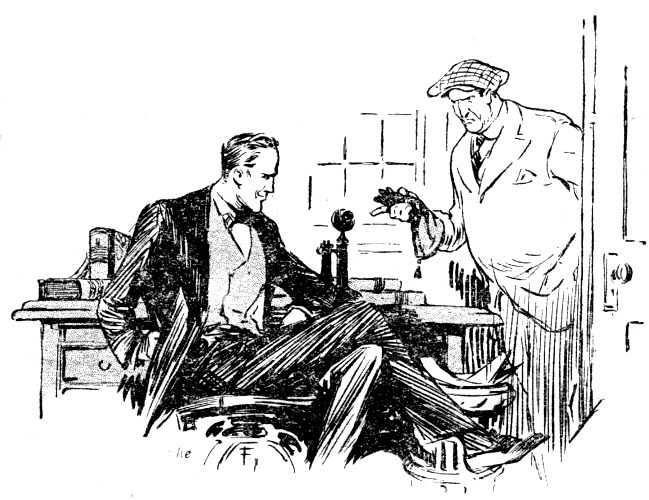
Morgan Kent cursed as he reached for the door.
Title: Dirt cheap
Author: Carl Clausen
Illustrator: Howard V. Brown
Release date: October 29, 2026 [eBook #79879]
Language: English
Original publication: New York, NY: The Frank A. Munsey Company, 1929
Other information and formats: www.gutenberg.org/ebooks/79879
Credits: Greg Weeks, Mary Meehan & the online Distributed Proofreaders Canada team at https://www.pgdpcanada.net
By CARL CLAUSEN
Political boss and business czar, Morgan Kent
meant to crush young Frank Westfield like
one of Kent's own steam rollers—and everyone
in Rocky Ford thought he would.
[Transcriber's Note: This etext was produced from
Argosy All-Story Weekly April 6 1929.]
Frank Westfield was not his family's pride. The Westfields were commercially and socially hard on the make; and they did not consider him a credit to them. He was apparently perfectly satisfied with his position as bookkeeper of the Barnett Brick Company at a salary of a hundred and fifty dollars per month, and with his title of general manager, at nothing at all.
A phrenologist would have interpreted Frank's firm jaw as a sign of aggressiveness. His family knew better. It denoted simply mulishness of a particularly exasperating brand. The fact that he was good-natured was no comfort to them.
They remonstrated with him from time to time, threw out veiled hints about the ultimate fate of youths with lack of ambition, and snubbed him at mealtimes.
Marshall, his brother, was cashier of the First National Bank of Rocky Ford. It was the consensus of opinion that he would step into the shoes of old Nathan Stoll, the president, when Stoll retired from active life. Colinne, Frank's oldest sister, was chief librarian of the Rocky Ford Public Library; and Gladys, the youngest member of the Westfields, had just returned from Columbia wearing the engagement ring of a Nassau Street broker.
These facts were pointed out to Frank frequently and with bitterness, and his own puny efforts at commercial and social success were held up to scorn; so he grew to look upon himself as the blight on the family tree, and kept in the background as much as possible.
He contributed fifty dollars per month to the family budget in exchange for a certain amount of erratic board and the occupancy of the large dormered attic room, where he loafed about in the evening in loose comfortable clothes, smoked a pipe, and quarreled with favorite authors.
Abroad he always looked cheerfully shabby; therefore he was not popular with the ultra-modern generation of Rocky Ford. Moreover, he did not have a way with him; and he danced, as Minnie Sanders expressed it, like a bundle of laths tied loosely together.
His principal recreation seemed to be to tramp about the countryside of Long Island with a fishing rod, exploring angling holes. As he never brought home any fish, his family counted this as one more point against him. Even in his hobby he was unsuccessful. They did not know that the day's catch was usually baked in butter between two stones in a shady nook near the hole where they were caught, and eaten with great relish by Frank and another.
This other person was Ruth Barnett. Ruth was not beautiful, but after three years of companionship Frank still found pleasure in sitting quietly by her, watching the play of her dark eyes and of her lips when she spoke or was silent. Ruth was a wholesome girl of middle height and slender. You've probably seen thousands like her—but Frank hadn't. Her mouth was a little large, but her hair was a soft reddish brown that had a way of catching any stray beams of light that came her way, and of holding them.
Of course the Westfields knew that Frank saw a good deal of "that Barnett girl." It was perfectly in keeping with his past and present performances that he should wander afield in search of amorous adventure. The only comfort was that as he could hardly support himself decently on his salary, there was no immediate danger of the entanglement becoming permanent.
Ruth Barnett had nothing. Indeed, she had something worse than nothing. Old Barney Barnett, her father, had fired his last batch of bricks some three years earlier, and had left his daughter the property known as the Barnett Brick Company, a concern that had been dying by inches for years. Only Frank's steadying hand as bookkeeper and general manager had kept it from breathing its last.
Frank's family did not, of course, know anything about this, nor did they know that quite frequently, when the monthly pay roll was a little short, Frank juggled the books surreptitiously, and as a result went without such things as a new hat or overcoat and other small necessities.
There were other things about which his family knew nothing, or rather about which they had known nothing until now.
Marshall, the brother who as cashier of the largest bank in the city was an important figure financially in Rocky Ford, had told his father about it one evening when Frank was out; and in the manner of the Westfields anything appertaining to the delinquency of Frank became at once the common property of the household. Mrs. Westfield discussed the matter in hushed tones with her daughters, while their male parent and elder brother settled the absent Frank's fate with firmness and dispatch.
When Frank came down to breakfast the following morning and found every member of the family buried in the various sections of the morning paper, their ominous manner ought to have warned him; but he was so used to being ignored that it went completely over his head.
Even when, as if by prearranged signal, his two sisters and brother folded up their news sheets one by one, laid them beside their empty coffee cups, and left the room gravely as if they could not bear to witness the blow of the ax that was about to descend upon his unsuspecting neck, Frank saw nothing unusual in the proceedings, but merely asked his mother to pass the toast.
While Mrs. Westfield turned a piece of bread on the electric toaster, she regarded her second-born with a mixture of fear and speculation, apparently considering that she had committed an unwise act in giving birth to him.
Mr. Westfield arose. The interchange of glances between his parents was lost upon Frank. He was totally unprepared for what was to follow when his father's "harrumph" caused him to look up.
"I'd like to see you in the study when you've done breakfast, Frank," Mr. Westfield, Sr., said with the ponderousness which the presidency of the Westfield Knitting Mills had conferred upon him.
"Who—me?" said Frank in surprise. "Sure, dad."
He was about to inquire the reason, but before he had the opportunity his father had left the room and had closed the door.
"What's up, mother?" Frank inquired.
"I haven't the faintest idea!" she told him quite untruthfully.
"I hope nothing's wrong at the mills," Frank said.
Mrs. Westfield arose as the colored maid entered to clear the table.
"Your father's management of the mills would preclude any such contingency," she remarked as she swept out of the room.
Frank stared after her. "I wonder what now?" he muttered under his breath.
A newspaper reporter had once referred to Westfield, Sr., as a captain of industry. Ever since, Mr. Westfield had tried hard to live up to it. His name had been coupled with that of Morgan Kent, the domineering president of the great North Shore Construction Company. Mr. Westfield did not like Mr. Kent, but he liked to have his name linked with him.
Kent had once stooped graciously to take seven hundred dollars away from him on eighteen holes at the St. George's links when Kent's regular partner had failed to show up because of transmission trouble.
Mr. Westfield always referred to the incident carelessly, in public, as if losing or winning seven hundred dollars at golf was a daily occurrence. He wisely refrained, however, from mentioning the episode at home, where the subject of a sealskin coat of the same price had been shuttled back and forth for some weeks and was finally abandoned in favor of one of silk velour with a fox fur collar. Which shows that Mr. Westfield was a diplomat.
In the main he was also a rather good sort, his ponderousness being more of a cloak to cover up a deep-rooted and pernicious inferiority complex than a mark of conceit. His occasional fits of bluster at home were the efforts of a fundamentally timid man to retain his precarious position as the head of his house and of three self-assertive and somewhat strong-minded women.
Such was the man who greeted his younger son in the study with a serious and troubled mien. He went straight to the point.
"Marshall met Sackett yesterday," he said in an accusing tone. Sackett was the vice-president of the Farmers and Merchants Bank, a rival of the Rocky Ford First National of which Mr. Westfield was a director and his son Marshall the cashier.
Frank tried not to look guilty.
"Yes?" he said.
"Sackett told Marshall what you've been doing. In fact, bragged about it!"
"Yes?" said Frank again.
Mr. Westfield thrust his head forward. No son of his could evade the issue with monosyllabic replies.
"If you wanted to borrow money, why didn't you come to our—Marshall's bank?" he demanded.
"Because I didn't want you to find out, and because Marshall wouldn't have let me have it," Frank replied candidly and with some heat.
Mr. Westfield stiffened. He was forced to admit the truth of the latter half of the statement. The frankness of the first half took the wind out of his sails.
He was just a little bit afraid of his second-born. Frank reminded him of his own mother, an easy-going but stubborn old woman, still hale and hearty at the age of eighty-seven.
"What did you use all that money for?" he asked, less aggressively. "I hear that during the past year you have borrowed over six thousand dollars from the Farmers and Merchants in varying amounts."
"I don't see that it's any particular business of yours, dad," Frank replied without rancor. "I'm twenty-six, and responsible for my own obligations."
"You mean to say that your ability to borrow money from the Farmers and Merchants was not due to the fact that you were my son?" Mr. Westfield returned with supreme frigidity.
"It certainly wasn't," Frank retorted as coldly. "I gave Sackett distinctly to understand that I was borrowing on my own responsibility and that you were to know nothing about it."
"Yes, yes," his father replied; "Marshall said that Sackett had told him something like that. Still, the moral effect of being a Westfield—"
"Moral fiddlesticks!" Frank retorted. "The Farmers and Merchants would cut your throat and Marshall's in a minute if they had the chance, and well you know it. I had the strongest sort of prejudice to overcome before I got my first five hundred."
Mr. Westfield blinked. The shot had struck home. And after all, the loaning of money to responsible people was a bank's function. Marshall's professional ire had been aroused by Sackett's boasting about the new Westfield business which the younger scion of that house had brought to his bank. Mr. Westfield frowned.
"Business competition is not the question at issue," he said severely. "I—your mother wants to know what you've used the money for."
The shadow of a smile flitted across Frank's face. "I paid it back promptly every time it was due. If you're worried about it, go over to the Farmers and Merchants and ask Sackett. The last item I got was one thousand dollars on a thirty-day note. I paid it back four days ago with interest. Next month I shall need six thousand on the same terms. They were satisfied with the security I offered, and told me that I could have it."
"Six thousand! Security!" Mr. Westfield ejaculated. "What resources have you?"
"That is part of my secret," Frank informed him.
"I demand to know what sort of speculation—gambling—you're engaged in!" his father repeated with rising inflection.
Frank looked at his sire in silence for some moments. A curious hard look had come into his usually mild and deep blue eyes.
"The surest thing in the world, dad," he said quietly.
"I dare say," Mr. Westfield remarked dryly, "they all are. Sure things! For the sake of your mother I shall have to ask you to discontinue them at once."
"Suppose I refuse?"
This contingency had apparently not occurred to the older man. It brought him up with a start. "Then I shall have to confer with your mother and—er—Marshall," he said somewhat lamely.
"Let me know the verdict," Frank replied. His hand was on the door-knob. "I can pack my trunk in half an hour."
Mr. Westfield's eyes traveled to a large portrait in oil on the wall opposite—Mrs. Arabella Westfield, his mother, painted by a famous artist when the sitter was about Frank's age. The qualities which that artist always recorded with his brush had made him famous.
Mr. Westfield seemed thoughtful as his eyes returned to the face of his son.
"Hm!" he said. "Harrumph!"
Frank saved him from further embarrassment by leaving the room and closing the door softly behind him.
Frank Westfield gave his card to the girl at the desk, who returned presently with the information that Mr. Morgan Kent would see him.
"Down the corridor, last door to the right," she told him.
A muffled "Come in" answered Frank Westfield's knock on the door whose frosted pane bore the legend "Private" in gold letters six inches high.
Morgan Kent looked up from his desk as the young man entered. Frank's card was still in his hand. He glanced from his visitor to the piece of pasteboard as if to refresh his memory, which was his way of humbling a petitioner.
"I heard that you had been awarded the contract for the Crown Hill tunnel, Mr. Kent," Frank said. "My firm, the Barnett Brick Company, would like to get a chance to bid on the glazed terra-cotta tile."
Kent laid Frank's card down. He was a large, powerfully built man, with a full, smoothly shaved face and a predatory, vikinglike aggressiveness in his manner and bearing. His eyes were of the peculiar pale-blue shade that shows almost colorless in certain lights and under certain conditions. They seemed to be taking the young man's measure now.
"Your kiln has no equipment for glazing," he said finally.
"I know, but it can be installed at a small cost. Our clay is of the very best quality."
The contractor leaned back in his chair and regarded the other with his expressionless eyes.
"Westfield," he said, "some day you're going to find out that meddling in other people's affairs is bad business for a young man who's trying to get along in his home town."
Frank's eyes went wide.
"I beg your pardon, sir!" he replied. If his blank amazement at this piece of advice was assumed, his innocent face gave no indication of it.
Kent rapped the arm of his chair with a peremptory middle finger.
"You know what I mean!" he retorted. "I suppose that you imagined you were protecting Miss Barnett's interest when you advised her not to sell me the yard?"
"Why, yes, but I didn't think that you'd object to her making a little money out of it before we're finally forced to shut down for lack of clay."
"I don't object. That's why I offered her twenty-five thousand cash for it—a good deal more than it's worth!"
"But," said Frank, "why not let us make the tile for you? You won't have to invest money in glazing equipment, and it'll give us a chance to make a piece of change. I've figured it from both angles, yours and ours. By the time you invest twenty-five thousand and another ten in glazing equipment and trackage, you're not going to be much ahead. It'll save you a lot of bother if we make your tile."
Kent waved the suggestion aside.
"How do I know that you can make tile to come up to the city's specifications, or indeed that you'll be able to live up to your contract at all? The past performances of the Barnett Brick Company would indicate otherwise."
"I had thought of that," Frank replied good-naturedly. "We'll post a bond of fifty thousand dollars guaranteeing delivery of the tile according to specifications. I've arranged for it already. The bonding people had an expert look our clay over. They are satisfied to take the risk."
Kent's eyes narrowed almost imperceptibly.
"You've taken a good deal for granted, don't you think?" he asked in a dangerously level tone. "How d'you know that I'd be interested?"
"You will be interested in my figures when I give them to you," Frank assured him. "Being right on the ground here, we can beat any outside firm a mile on prices and delivery. I took nothing for granted. Anticipating your very good objections I simply went to see the bonding people before coming to you with my proposition. I didn't want to go off half-cock."
"I see. And where are you going to get the money from for equipment and trackage? No one's going to loan you ten thousand on that old hole in the ground!"
"That, too, is arranged for," Frank said blithely, "your signature on the dotted line will be met with ten thousand dollars in cash posted by us at your own bank to guarantee operating funds."
Kent moved forward in his chair with what looked like a start.
"In addition," Frank went on, "we're willing to let you insert a clause in the contract to the effect that if we fail to deliver the tile according to agreement and specifications, you may take the yard over and operate it until the tunnel is completed. Could anything be fairer, Mr. Kent? You'll be protected, both ends against the middle!" he finished.
The contractor gave Frank another of his quick glances from the depths of his chair. He searched the other's face as if for a trace of levity, and finding none there, smiled himself. But it was a chilly smile, devoid of mirth, in which his pale crafty eyes took no part.
"Suppose you give me forty-eight hours to think it over," he said, looking at his fingernails. "If I decide to take you up, the contract'll be ready for Miss Barnett to sign." He paused. "I hope that I can see it your way. I always like to oblige the ladies," he added with what he thought was a sly squint. Frank thought otherwise. He knew what Kent was capable of, and he had to restrain the impulse to clip the contractor over the eye and make the squint a permanent adornment. Picking up his hat, he controlled his voice sufficiently to say:
"Very well, Mr. Kent; you can reach me at the office of the yard any time."
The contractor stood looking at the just closed door until his visitor's footsteps had died away down the corridor. Then, he whirled in his tracks and reached for the telephone on the desk.
"Get Sprowl on the wire, Miss Toomey, and tell him I want to see him after the board meeting," he told the girl at the switchboard.
"Yes, Mr. Kent."
One morning a week or so later Frank returned to the office of the brick yard at eleven o'clock and found Ruth Barnett there waiting for him. By the troubled look in her eyes he knew that she had read the morning Sentinel, so he was not surprised when she spread the paper out on the desk and pointed to a paragraph on the front page.
He read:
Public nuisance abated. Council passes ordinance prohibiting the manufacture of bricks within the city limits.
He glanced away.
"I was served with an injunction when I went up to the city hall to see about it," Frank replied as he took a legal document from his pocket and laid it on the desk; "this is it."
The color had left Ruth's face.
"What are we going to do, Frank?" she asked in a small, frightened voice.
"Nothing. Sit tight."
"Not fight the injunction?" she asked.
"It wouldn't do us any good. There's been a lot of agitation about our making bricks within the city limits for the last two or three years—even before your father died. It was bound to come sooner or later."
"Then we're ruined unless we sell to Kent?"
"He told you that, did he?" Frank's eyes were unfathomable.
The girl glanced at him quickly.
"Why, yes. He called me on the telephone this morning and said that his offer of twenty-five thousand still held good if I took him up during the next twenty-four hours."
"In a hurry, isn't he?"
Ruth was silent for a minute, then she said:
"What have you against Morgan Kent, Frank?"
"More than he suspects," was the cryptic answer.
"I think it was very decent of him to stick to his offer. He might easily have taken advantage of the situation we're in, and have lowered his price. I'd have to take what he offered, now."
"That's what he thinks! Yes, I have no doubt that Morgan Kent regards himself as a philanthropist."
They had moved to the window together. At the bottom of the ten acre-pit the kilns squatted like the tombs of some ancient Pharaohs. From the apex of one of them a thin spiral of smoke from the last firing of bricks rose lazily to the sky.
The girl raised her eyes to the south where the tall office buildings of the city of Rocky Ford were flung against the morning sky. Many of them had been erected with bricks from her kiln. For thirty years her father had made bricks; good bricks. The name of Barnett was linked directly with the city's growth, but like many other producers, Barney Barnett had got merely a pittance out of the business.
The middlemen—the great contractors, the architects and the real estate men—had got the cream. Still, faithfully, old Barney had gone on making bricks, literally eating up his patrimony. Of the small farm left to him by Grandfather Barnett, now overtaken by the city's growth, only this ugly ten-acre scar remained.
"Philanthropist or not, we've got to accept Kent's offer," the girl replied.
"I don't know about that," Frank replied. His arm had stolen around her waist.
"But, Frank, dear, with that four thousand mortgage on the house to raise the money for the glazing equipment, I wouldn't dare refuse his offer."
"That's what Kent figured," the young man said.
"Just what do you mean? If you thought he was crooked, why did you put your own six thousand in?"
"To catch big fish you need big bait," he replied.
"You mean that he was instrumental in getting the ordinance passed? I refuse to believe it! What good would that do him? He'd be unable to make tile himself!"
Frank laughed, harshly.
"You don't suppose he stands by his offer because he likes—the color of your eyes?"
He had not intended to put so much heat into the remark, but Kent's sly wink had set him to wondering. He had always prided himself upon not being jealous, and so far, Ruth had never given him cause, but he was very much in love with her, and he knew that Kent would stoop to anything to get what he was after.
The girl disengaged herself.
"You're forgetting yourself," she said sharply. She stood looking at him queerly for a moment. "Kent hinted that you were trying to get me into a tight place to your own advantage. Don't force me to believe it!"
"He'd do that!" Frank snapped back.
"I don't know what you're insinuating," the girl retorted coldly, "I only know that I'm going to accept his offer!"
"You can't! I've something to say about that! The contract between you and me was drawn up by Judge Crail, and he specializes in iron-bound contracts. My six thousand are in the ring, to stay!"
"You mean that you're going to hold me to it and ruin me by preventing me from selling to Kent?" the girl cried, stepping back as if to ward off a blow.
"I certainly am going to hold you to it, and it's not going to ruin you!" the young man asserted.
"Then what Kent said was true! You made me give you power-of-attorney over the yard so you could juggle it to your own advantage!"
"So he said that, too, did he? You and Kent are on pretty good terms, aren't you? If you choose to believe that I'm juggling your yard, you're welcome! I stand pat!"
He put forth his hand. "I—I didn't mean that, Ruth, but you've got to trust me!" he said desperately.
He did not dare tell her what he was about to do. The enemy he was fighting struck in the dark. So must he! It was absolutely necessary for the success of his plan that Ruth should appear desperately anxious to sell. If Morgan Kent suspected otherwise, the whole scheme might be wrecked. Neither did he dare to speculate upon how far the contractor had wormed himself into Ruth's confidence. Near or far, he promised himself a reckoning with Mr. Morgan Kent some day, which that gentleman would remember to the end of his life.
"Trust you?" she mocked bitterly. "In the face of what you've just told me?" Without another word she drew his ring from her finger, tossed it on the desk and left the office.
Frank stood looking at it for some moments, then he picked it up, put it in the safe and locked the door.
Morgan Kent was a heavy and valuable depositor in the First National Bank of Rocky Ford. As the bank's cashier, Marshall took it upon himself to go after Frank, his recalcitrant brother. There was a stormy session, some evenings later in the Westfield study, between Westfield, Sr., and his two sons.
"One has to be plain with you!" Marshall told Frank. "Kent wants your yard."
Frank admitted that he was under that impression.
"He's willing to pay a reasonable price for it. More than Ruth Barnett could hope to get from any one else!"
"What d'you call a reasonable price?" Frank asked.
"Well—thirty-five thousand. Maybe a little more," Marshall ventured cautiously. "I'll do my best to get her a square deal."
Frank laughed.
"So Kent's resorting to family pressure! He stoops to almost anything!"
Marshall's brows contracted angrily.
"Some day you're going to regret having got in his way. Unless Ruth's a fool, she'll take forty thousand!"
"Coming up!" said Frank. "Ruth's no fool. She simply can't take any offer without my agreement, and I'm not agreeing to anything like forty thousand!"
Marshall and his father exchanged glances.
"How much d'you expect to get for your precious brickyard?" the brother wanted to know.
"Two hundred thousand dollars," said Frank quietly.
The others held their breath.
"You—you're crazy!" Marshall stuttered.
"Think so?" said Frank.
"Do I think so! You poor boob, why should Kent pay you any such preposterous figure for that useless hole?"
"Ask him," Frank said, "and I'll bet you ten thousand on the side that he won't tell you."
"I'm no gambler," Marshall retorted coldly.
"That's why you'll stay cashier of the bank all your life, unless Stoll passes in his checks," Frank replied good-naturedly.
His father remonstrated mildly, waving aside the notion of any such figure.
"I'd like to see the man who could nick Morgan Kent for two hundred thousand," Westfield said, and he meant it.
"You're looking at him, dad," Frank retorted with a grin. "I told you a week or so ago that I was betting on the surest thing in the world."
Mr. Westfield shrugged his shoulders. Marshall's face had turned white. He seemed unable to control himself any longer.
"D'you know what this means to all of us—your getting in Morgan Kent's way? He'll withdraw his account from my bank and dump all his shares in the Knitting Mills on the open market. It'll cost me and your father thousands—thousands, d'you hear!" Marshall fairly shouted the words.
"I had thought of that," Frank said. "I'll grab every share in the mills as fast as he dumps them, and be glad to get them as long as you, dad, are the president. As to his bank account, I don't think you need worry about that, Marshall. There's no other bank in town that Kent would trust except Sackett's, and he's in bad there, over a shady real estate deal."
"You'll buy his shares in the mills!" Marshall scoffed. "Where'll you get the money?"
"From Kent, when he kicks through with the two hundred thousand. I've got a one-fourth interest in the yard, so my share'll be fifty thousand. That'll more than take care of his stock."
With a snort of derision Marshall flung himself from the room.
Alone with his second-born, Mr. Westfield ventured an observation:
"So that was why you wanted your six thousand?"
"Certainly." Frank smiled down at the fundamentally timid little man who was his father. "About two years ago you made an address at the Rotary Club—the time they printed that piece about you in the Sentinel, remember? The gist of your speech was that if a young man wanted to succeed, he must establish credit, and that the best way to establish credit was to borrow money often and pay it back promptly. It was good sound advice, dad, and I took it."
"I see," his father replied, disarmed by the compliment implied; "but supposing you had lost it?"
"I couldn't lose it. I told you the other day that I was playing safe. You thought I was speculating. I wasn't. I simply deposited the money as fast as I borrowed it, in a savings account in a New York bank, and drew it out again when my note fell due, or rather a few days before. As I always kept a balance of five hundred dollars there of my own money, the bank paid me three and a half per cent interest. The difference between that and the six per cent Sackett charged me, I made up from my salary."
Mr. Westfield drew a deep breath. He looked at his son with a new respect in his shrewd eyes, that was enhanced by observing the shabbiness of the suit Frank wore.
"And you used your borrowing ability to back a defunct brickyard?"
"Not defunct, dad. I knew what Ruth would be up against sooner or later, so I laid my plans. Sackett was satisfied with the security I offered—my fourth interest in the yard—considering its potentialities."
Mr. Westfield ran his hand through his sparse gray hair.
"I don't know what your game is," he said, "but I warn you that no one ever got the best of Morgan Kent." What he would have liked to add was that he hoped this honor would come to a Westfield; but being prudent of expression, even in the bosom of his own family, he contented himself with the warning.
"I'm not trying to get the best of any one," Frank told him, "I'm just trying to get a helpless girl what's hers by right of good fortune; and besides, Kent has run this town about long enough."
"And you're going to help him run it?" his father remarked. "I wish you luck," he added doubtfully, but with a sincerity that was not lost upon his son. "This Ruth person must be a very desirable young lady. I haven't seen her since her father's funeral."
"She is," Frank replied softly.
Mr. Westfield looked at his shoes. He always did when he felt it necessary to be diplomatic.
"I hope—harrumph," said he, "that you two won't get into a jam with Kent. I shan't be able to help you. We elected him to the board of directors last month, so you see the hole this move of yours puts me in."
"I'm sorry if I'm doing anything to hurt you with him," Frank replied.
His father glanced at him out of the tail of his eye, and Frank could have sworn that there was a wink in it.
"I guess the old man can take care of himself, son," Westfield, Sr., remarked with a toss of his head, "all I ask you to do is to step easy, until you're sure—then step hard!"
It was a little after ten o'clock in the morning, a week or so later, when Frank, smoking a worried pipe in the office of the deserted brick company, was roused from his broodings by a peremptory knock on the door. At his "come in" Morgan Kent entered and closed the door behind him. A glance was enough to tell Frank that the contractor had come gunning. His hands were incased in a pair of tasseled automobile driving gauntlets that added to his warlike appearance.
Legs apart and arms akimbo, the man stood looking down at Frank, who puffed quietly away at his pipe.
"Shut down, I see!" Kent remarked unpleasantly.
"Naturally," said Frank, "we're obeying the law."
Kent smiled crookedly.
"You're a good bluffer, Westfield, but bluffing doesn't get you to first base with me. The injunction kills you. I could wait and freeze you out, but I want the yard now."
Frank said nothing for awhile. He knew why Kent was in a hurry, and he had spent a rather bad week waiting for this moment. He was beginning to wonder if his wily antagonist had found a way to checkmate him.
He was at loggerheads with his family, to the point of taking his meals out rather than meet the accusing eyes of his mother and brother and his two sisters.
His break with Ruth worried him the most. She had not been at the yard since the day she gave him back the ring. His repeated telephone calls had been answered by the maid, who informed him that her mistress had gone to visit relatives in Boston. He guessed why. She had an uncle there whose business advice she no doubt had gone to seek.
For more than a week he had gone about his home town a marked man, wondering if he had overreached himself, and if so, what place on the map the climate would be the healthiest when his thirty-day note fell due. It was therefore with less confidence than he manifested outwardly that he forced himself to meet Kent's smoldering eyes.
"You could do that—freeze me out, but you'd get chilblains yourself in the process."
The contractor's teeth came together with a snap. He seemed to be trying to estimate the strength of this opponent sprawled so negligently in the swivel chair.
"What's your proposition?" Kent demanded thickly.
"Your emissary, my brother, has given it to you," Frank replied.
Kent made a wide sweep with right tasseled gauntlet.
"If you think you're going to get two hundred thousand dollars out of me for this stack of junk, you'd better think again!" he barked.
"I've been thinking so for over a year," Frank said, "ever since the agitation for the Crown Hill project began."
The contractor straightened up with a jerk. His face was working. It was evident that he restrained himself with a supreme effort from tearing his adversary limb from limb. Indeed, his right hand was raised as if to strike, then fell lamely to his side as a cunning look came into his eyes.
"All right," he growled, "have Miss Barnett put the deed in escrow at my bank."
"There isn't going to be any deed," Frank replied.
"What!"
"We're not selling you the yard, Kent—merely leasing it to you for the period of one year, or until the project's finished. You'll be permitted to use it for—the purposes you wish, but the title remains in Miss Barnett's name."
Kent raised himself to the full height of his six feet two. His face had turned the color of an overripe tomato, and the pupils of his pale-blue eyes were contracted to pinpoints.
"I'll see you in hell before I'll agree to any such proposition!" he stormed.
"That's where you're going if you don't change your tactics." Frank told him, "but I don't think you'll see me there. After having inhabited the same latitude with you in life, it'll be a positive pleasure for me to give hell a wide berth."
Frank arose, signifying that the interview was at an end. "When you've thought things over and learned to keep a civil tongue in your head, come around and see me; and if I were you I wouldn't delay. After twenty-four hours the price goes to an even quarter of a million."
Morgan Kent cursed as he reached for the door.
Instead of replying, Kent kicked the door open and stalked out, muttering curses. He shifted the gears of his expensive roadster with a vehemence that all but ripped the rear end out of the car as it roared up the steep incline to the street.
Ruth Barnett lived alone with an aged housekeeper-maid in the house on Griffin Avenue where she was born. The old house was a reminder of the days when city lots were measured in terms of acreage and it stood well back from the street in a grove of tall pines. The avenue was still an imposing thoroughfare. Giant locust trees lined its broad parkways, and there was an air of tranquillity about the street that reminded one of a country lane.
She was eating an early breakfast after having returned from Boston the night before, when Nelson, the foreman of the yard, called her on the phone.
"They're doing what?" she exclaimed in consternation. "Are you sure, Nelson?"
"Sure as I'm alive, ma'am!"
"I'll be right down!"
She hung the receiver up, flew down the steps and flung herself into her roadster, taking the corner on two wheels and opening the throttle wide.
At the brickyard a strange sight met her eyes. A thousand feet or so distant, six great steam shovels of the variety known as "hell-diggers" were loading dirt from the approaches of the new Crown Hill tunnel into great dump cars. A tramway had been laid from there to the edge of the pit, along which a small, champing engine was backing a string of cars loaded with dirt, and dumping their contents over the bluff into the pit.
She slammed her brakes on and sat petrified, watching two great five-ton cars tilt and spill their contents down on the roof of the old tool house. The vandals were burying her kilns, equipment—burying everything she possessed with dirt!
She left the machine and ran to the spot at the end of the tramway from where Kent was directing his men. On a stack of lumber, near by, Frank was seated with a tally board on his lap and a pencil in his hand. He arose as she came up.
"Frank! What are you doing? How dare you—" she panted, beside herself with fear and anger.
Morgan Kent removed a black cigar from his heavy lips.
"The boy-friend slipped one over on you, didn't he?" Kent asked with a sneer.
"What does he mean, Frank?" the girl cried bewildered.
"I mean that he sold you out—that's what!" Kent rasped. "Got you to give him power of attorney! I told you he was a crook!"
The girl stood looking at Frank to give him a chance to deny the contractor's allegations, but the young man made no reply. His eyes were fastened on Kent's towering figure as if to weigh his chances with him in physical encounter.
"I didn't know you had returned from Boston, Ruth," he said presently. "Please go home. I'll be with you in an hour."
"I won't go home!" she cried through a blur of tears. "I demand an explanation!"
"All right, honey," he replied wearily, "this is a free country. Stay and see the fun, if you must." He turned on the contractor. "Kent," he said, "I told my dad that you'd run this town long enough. I was wrong. You've run it too long. You're through; and I'm going to celebrate the event by licking you—or you me. Calling a man a crook is libel, but I'm not going to wait for the law to take its course. Take off your coat; I'm coming!"
The fight that followed went down in history. Frank was a good twenty pounds lighter than his adversary, but what he lacked in weight, he made up for in enthusiasm. Kent, looking for escape, glanced down the pit at his back. It was either a drop of thirty feet to the bottom or fight. He chose to fight. A coward at heart, fear of the thirty-foot drop goaded him on.
He fought blindly, madly, to ward off the blows that rained upon his face and neck with the precision and regularity of trip-hammers. There was no escaping them.
Twice he went to his knees. As he did so the second time his hand came in touch with an iron bar. His fingers closed about it. With a bellow of rage he hurled it at the other. It struck Frank a glancing blow on the temple.
Almost at the same moment Frank's left hook caught the murderous Kent behind the ear. Kent reeled back and clutched wildly at the edge of a dump car for support. The loaded car tilted and the contractor, losing his balance with it, went backward, and slid rather than fell down the sheer slope of the pit. He fetched up on the roof of the tool house twenty feet below, stunned and half buried in the avalanche of tunnel dirt.
Frank whirled as the crew of Kent's dump car closed in about him. Blood, streaming from the cut on his head, ran into his eyes, blinding him. Through a half daze he became aware that some one had sprung to his aid and was fighting beside him.
"Cowards! Scoundrels!" he heard a familiar voice shouting. The iron bar, which Kent had dropped as he fell, was being wielded by another. It came down with smack on the skull of the nearest of his assailants, who a moment before had stood poising a rock in his uplifted hands ready to hurl it at Frank. Once, twice more, the bar came down, then the crew fell back in panic. On the ground a man lay groaning. Another was dragging himself after his retreating fellows.
Westfield, Sr., straightened up and grinned at his son. Mr. Westfield's collar had gone adrift. His Bengal silk cravat waved to the breeze behind instead of in front, and of his black derby, the pride of Rocky Ford, nothing remained but the brim. This was draped about his neck.
His face was smeared with tunnel dirt, but his small bright eyes blazed with the light of battle, and the efficient iron bar was still in his hand.
He poked the prostrate figure at his feet with the toe of his boot.
"I wonder if I killed the fellow," he remarked cheerfully. "I hope not. It'd be awkward."
Frank stared at his father. He wanted to ask him how he came to be there, but he was too dazed to speak, so he just picked up his hat and coat, and the two of them walked slowly to the office of the brick company on the opposite side of the pit.
Mr. Westfield, in passing, tossed the brim of his wrecked derby over the bank where it soared briefly and came to rest not far from where the contractor was disentombing himself from the load of dirt. "Mr. Morgan Kent," Mr. Westfield told his son, "circulated a report about you which not only was untrue, but which cast a doubt upon the name of Westfield. I couldn't stand for that. When I didn't find him at his office, I came down here to give him a piece of my mind. It appears that I arrived at an—harrumph—opportune moment, Ruth," he added, nodding to the girl who had followed them.
The two men were removing the most conspicuous marks of the tournament, assisted by Ruth. Mr. Westfield paused in the act of removing, as best he could with a towel, the tunnel dirt from his linen collar.
"What a fine strapping girl you've grown into. I suppose you two'll want to get married next."
A wave of color suffused the girl's pale face. She glanced at Frank who was touching the sore spot on his head where the iron bar had come near ending the argument.
"Suppose you tell her, dad, while I go into the next room and get some court-plaster from the emergency locker," Frank said. "Ruth's been in Boston for the past week."
"I don't know how he did it," Westfield, Sr., said as the door closed upon his second-born, "but in some way he got wind that Kent had to have your yard as a dumping-place for his tunnel dirt, or else haul it to tidewater and load it on barges and tow them several miles out to sea. Frank's a wizard with a pencil. He figured that it would save Kent a cool half million in hauling charges if he could fill this old hole, and afterward he'd have a nice level ten-acre site to offer the city for a playground, at a very—er—substantial figure. A hundred and fifty thousand dollars is what he intended charging the city for it, and Sprowl was getting ready to jam an ordinance of acceptance through for him, when Frank threw his monkey-wrench into the proceedings and gummed the works."
Mr. Westfield paused and stuck his thumbs in the armholes of his vest.
"The way those two highbinders bluffed each other with their tile propositions was a scream. Neither had any intention of making tile here. Kent had already let his tile contract and Frank knew it. He's a great boy, Ruth. Thanks to him we're going to have an honest administration once more. Sprowl hopped the train for Florida when the news of the intended playground steal leaked out, and the rest of the board went fishing for the rest of the summer. You get a hundred and fifty thousand as your share of the deal, Frank makes fifty, and you'll have a mighty fine piece of ground here that I might be interested in for a new mill site if the price is right."
"I get a hundred and fifty thousand dollars!" the girl exclaimed.
"Sure, honey," Frank interjected as he wandered in with a strip of court-plaster adorning his temple. "I got two hundred thousand out of Kent on a yardage basis for the dumping privileges; fifty of that is mine. The rest is yours."
He stooped over the safe and began to twirl the knob.
"We'll have a regular old-fashioned wedding with roses and things," Mr. Westfield went on happily. "It'll cheer the old house up. Between Colinne and her books and Marshall and his securities they've made it into a cross between a public library and a stock exchange. I'd like to see how it'd look, dolled up as it used to be in your mother's time. What say?"
"How about it, Ruth?" Frank asked. He had opened the safe and had taken from it the circlet of platinum with its small but flawless stone. Moving to the girl's side he slipped it on her finger in the shelter of his palms.
"I—I think that it'd be wonderful, Frank," she replied in a low tone. Her dark eyes were contrite and humble.
"Tell you what we'll do, dear; we'll donate the site to the city for a childrens' playground under the name of the Barney Barnett Memorial."
"Attaboy!" Mr. Westfield sang out. "Between the Barnetts and the Westfields, we're going to make this town a decent place for the kids—and others!"
"We've got to—for the kids," Frank mused, and Mr. Westfield wondered why the two were grinning at each other like a pair of Cheshire cats. His mental processes were sometimes a little leisurely, but when he got a point it arrived with the impact of a brickbat.
"If the first one's a girl, I wish you'd call him Arabella after your grandmother, Frank," he said, so seriously that both of them laughed out loud.
THE END.