The Project Gutenberg eBook of Fencing foil class work illustrated
This eBook is for the use of anyone anywhere in the United States and
most other parts of the world at no cost and with almost no restrictions
whatsoever. You may copy it, give it away or re-use it under the terms
of the Project Gutenberg License included with this eBook or online
at www.gutenberg.org. If you are not located in the United States,
you will have to check the laws of the country where you are located
before using this eBook.
Title: Fencing foil class work illustrated
Author: Ricardo Enrique Manrique
Release date: October 28, 2026 [eBook #79878]
Language: English
Original publication: New York: American Sports Publ. Co., 1920
Credits: Bryan Ness and the Online Distributed Proofreading Team at https://www.pgdp.net (This file was produced from images generously made available by The Internet Archive/American Libraries.)
*** START OF THE PROJECT GUTENBERG EBOOK FENCING FOIL CLASS WORK ILLUSTRATED ***
A. G. SPALDING & BROS. MAINTAIN THEIR OWN HOUSES
FOR DISTRIBUTING THE SPALDING COMPLETE LINE OF
ATHLETIC GOODS IN THE FOLLOWING CITIES.
NEW YORK
Downtown—124-128 Nassau St.
Uptown—523 Fifth Avenue
NEWARK, N.J.
589 Broad Street
PHILADELPHIA, PA.
1210 Chestnut Street
BOSTON, MASS.
74 Summer Street
CHICAGO
211-217 So. State St.
INDIANAPOLIS, IND.
136 N. Pennsylvania St.
CINCINNATI, O.
119 East Fifth Avenue
CLEVELAND, O.
1117 Euclid Avenue
COLUMBUS, O.
197 South High Street
SAN FRANCISCO
156-158 Geary Street
OAKLAND, CAL.
416 Fourteenth St.
SEATTLE, WASH.
1204 Second Avenue
LOS ANGELES, CAL.
435 South Spring St.
PORTLAND, ORE.
Broadway at Alder
SALT LAKE CITY, UTAH
331 Main Street
PITTSBURGH, PA.
608 Wood Street
BUFFALO, N.Y.
611 Main Street
SYRACUSE, N.Y.
357 So. Warren Street
DETROIT, MICH.
619 Woodward Ave.
WASHINGTON, D.C.
613 14th Street, N.W.
LOUISVILLE, KY.
328 West Jefferson St.
ST. LOUIS, MO.
823 Locust Street
KANSAS CITY, MO.
1008 Grand Avenue
MILWAUKEE, WIS.
379 East Water Street
DES MOINES, IA.
803 Locust Street
ROCHESTER, N.Y.
40 Clinton Ave. North
ALBANY, N.Y.
52 State Street
BALTIMORE, MD.
110 E. Baltimore St.
ATLANTA, GA.
74 N. Broad Street
NEW ORLEANS, LA.
130 Carondelet Street
DALLAS, TEX.
1518 Main Street
DENVER, COL.
622 Sixteenth Street
MINNEAPOLIS, MINN.
52 Seventh St., South
ST PAUL, MINN.
386 Minnesota Street
LONDON, ENGLAND
317-318, High Holborn, W.C.
78, Cheapside, E.C.
LIVERPOOL
72, Lord Street
BIRMINGHAM, ENG.
New Street House
MANCHESTER, ENG.
4, Oxford St. and
1, Lower Mosley St.
BRISTOL, ENG.
42, High Street
EDINBURGH, SCOT.
3 So. Charlotte St. (Cor. Princes St.)
GLASGOW, SCOTLAND
68 Buchanan Street
MONTREAL, CANADA
369-71 St. Catherine St., W.
TORONTO, CANADA
207 Yonge Street
SYDNEY, AUSTRALIA
204 Clarence Street
PARIS, FRANCE
25-27 Rue Tronchet
Communications directed to A. G. SPALDING &
BROS. at any of the above addresses will receive prompt attention.
THE SPALDING
TRADE MARK, QUALITY AND SELLING POLICY CONSTITUTE
THE SOLID FOUNDATION OF THE SPALDING BUSINESS
SPALDING ATHLETIC LIBRARY
SPALDING OFFICIAL ANNUALS
No.
9.
SPALDING’S OFFICIAL INDOOR BASE BALL GUIDE
Price 10c.
No.
12A.
SPALDING’S OFFICIAL ATHLETIC RULES (A. A. U.)
Price 10c.
No.
1R.
SPALDING’S OFFICIAL ATHLETIC ALMANAC
Price 25c.
No.
3R.
SPALDING’S OFFICIAL GOLF GUIDE
Price 25c.
No.
6.
SPALDING’S OFFICIAL ICE HOCKEY GUIDE
Price 25c.
No.
7A.
SPALDING’S OFFICIAL WOMEN’S BASKET BALL GUIDE
Price 25c.
No.
55R.
SPALDING’S OFFICIAL SOCCER FOOT BALL GUIDE
Price 25c.
No.
57R.
SPALDING’S LAWN TENNIS ANNUAL
Price 25c.
No.
59R.
SPALDING’S OFFICIAL BASE BALL RECORD
Price 25c.
No.
100R.
SPALDING’S OFFICIAL BASE BALL GUIDE
Price 25c.
No.
200R.
SPALDING’S OFFICIAL FOOT BALL GUIDE
Price 25c.
No.
700R.
SPALDING’S OFFICIAL BASKET BALL GUIDE
Price 25c.
No.
1C.
SPALDING’S OFFICIAL BASE BALL GUIDE (Canadian Edition)
Price 25c.
(Prices subject to change without notice.)
Specially Bound Series of Athletic Handbooks
In flexible binding. Mailed postpaid on receipt of
75 cents each number.
No.
501L.
STROKES AND SCIENCE OF LAWN TENNIS
No.
502L.
HOW TO PLAY GOLF
No.
503L.
HOW TO PLAY FOOT BALL
No.
504L.
ART OF SKATING
No.
505L.
GET WELL—KEEP WELL
No.
506L.
HOW TO LIVE 100 YEARS
No.
507L.
HOW TO WRESTLE
No.
509L.
BOXING
No.
510L.
DUMB BELL EXERCISES
No.
511L.
JIU JITSU
No.
512L.
SPEED SWIMMING
No.
513L.
WINTER SPORTS
No.
514L.
HOW TO BOWL
No.
516L.
SCHOOL TACTICS AND MAZE RUNNING; CHILDREN’S GAMES
No.
517L.
TEN AND TWENTY MINUTE EXERCISES
No.
518L.
INDOOR AND OUTDOOR GYMNASTIC GAMES
No.
519L.
SPALDING’S OFFICIAL BASE BALL GUIDE
No.
520L.
SPALDING’S OFFICIAL FOOT BALL GUIDE
No.
521L.
SPALDING’S OFFICIAL BASKET BALL GUIDE
No.
522L.
GOLF FOR GIRLS
No.
523L.
HOW TO PLAY BASE BALL; HOW TO MANAGE A TEAM, ETC.
No.
524L.
SPALDING’S LAWN TENNIS ANNUAL
No.
525L.
HOW TO PITCH
No.
526L.
HOW TO BAT
In addition to above, any 25 cent “Red Cover” book listed in
Spalding’s Athletic Library will be bound in flexible binding for
75 cents each; or any two 10 cent “Green Cover” or “Blue Cover”
books in one volume for 75 cents.
(Continued on the next page.)
ANY OF THE ABOVE BOOKS MAILED POSTPAID UPON RECEIPT OF PRICE
SPALDING ATHLETIC LIBRARY
Red Cover Series, 25c. Blue Cover Series, 10c. Green
Cover Series, 10c.
Group I. Base Ball
“Blue Cover” Series, each number 10c.
No.
202
How to Play Base Ball
No.
219
Ready Reckoner of Base Ball Percentages
No.
224
How to Play the Outfield
No.
225
How to Play First Base
No.
226
How to Play Second Base
No.
227
How to Play Third Base
No.
228
How to Play Shortstop
No.
229
How to Catch
No.
232
How to Run Bases
No.
350
How to Score
No.
365
Base Ball for Boys (“Beginners”)
No.
9
Spalding’s Official Indoor Base Ball Guide
“Red Cover” Series, each number 25c.
No.
59R.
Official Base Ball Record
No.
79R.
How to Pitch
No.
80R.
How to Bat
No.
81R.
How to Umpire
No.
82R.
Knotty Base Ball Problems
No.
83R.
{
How to Organize a Base Ball League
{
How to Organize a Base Ball Club
{
How to Manage a Base Ball Club
{
How to Train a Base Ball Team
{
How to Captain a Team
{
Technical Base Ball Terms
No.
100R.
Spalding’s Official Base Ball Guide
No.
1C
Spalding’s Official Base Ball Guide. Canadian Edition
Group II. Foot Ball
“Red Cover” Series, each number 25c.
No.
200R.
Spalding’s Official Foot Ball Guide
No.
47R.
How to Play Foot Ball
No.
55R.
Spalding’s Official Soccer Foot Ball Guide
No.
39R.
How to Play Soccer
Group III. Tennis
“Blue Cover” Series, each number 10c.
No.
157
How to Play Lawn Tennis
“Red Cover” Series, each number 25c.
No.
2R.
Strokes and Science of Lawn Tennis
No.
26R.
Official Handbook National Squash Tennis Association
No.
42R.
Davis Cup Contests in Australasia
No.
57R.
Spalding’s Lawn Tennis Annual
No.
76R.
Tennis for Girls
No.
84R.
Tennis Errors and Remedies
No.
85R.
How to Play Tennis; for Girls
Group IV. Golf
“Green Cover” Series, each number 10c.
No.
2P.
How to Learn Golf
“Red Cover” Series, each number 25c.
No.
3R.
Spalding’s Official Golf Guide
No.
4R.
How to Play Golf
No.
63R.
Golf for Girls
Group V. Basket Ball
“Blue Cover” Series, each number 10c.
No.
7A
Spalding’s Official Women’s Basket Ball Guide
No.
193
How to Play Basket Ball
“Red Cover” Series, each number 25c.
No.
700R.
Spalding’s Official Basket Ball Guide
Group VI. Skating and Winter Sports
“Blue Cover” Series, each number 10c.
No.
14
Curling
“Red Cover” Series, each number 25c.
No.
6
Spalding’s Official Ice Hockey Guide
No.
8R.
The Art of Skating
No.
20R.
How to Play Ice Hockey
No.
28R.
Winter Sports
No.
72R.
Figure Skating for Women
Group VII. Track and Field Athletics
“Blue Cover” Series, each number 10c.
No.
12A
Spalding’s Official Athletic Rules (A. A. U.)
No.
27
College Athletics
No.
87
Athletic Primer
No.
156
Athletes’ Guide
No.
182
All Around Athletics
No.
255
How to Run 100 Yards
No.
317
Marathon Running
No.
342
Walking for Health and Competition
“Green Cover” Series, each number 10c.
No.
3P.
How to Become an Athlete By James E. Sullivan
No.
4P.
How to Sprint
“Red Cover” Series, each number 25c.
No.
1R.
Spalding’s Official Athletic Almanac
No.
45R.
Intercollegiate Official Handbook
No.
48R.
Distance and Cross Country Running
No.
70R.
How to Become a Weight Thrower
No.
77R.
A. E. F. Athletic Almanac and Inter-Allied Games
No.
88R.
Official Handbook Canadian A. A. U.
Group VIII. School Athletics
“Blue Cover” Series, each number 10c.
No.
246
Athletic Training for Schoolboys
“Red Cover” Series, each number 25c.
No.
61R.
School Tactics and Maze Running; Children’s Games
No.
66R.
Calisthenic Drills and Fancy Marching and Physical Training for the School and Class Room
No.
74R.
Schoolyard Athletics
Group IX. Water Sports
“Blue Cover” Series, each number 10c.
No.
128
How to Row
No.
129
Water Polo
“Red Cover” Series, each number 25c.
No.
36R.
Speed Swimming
No.
37R.
How to Swim
No.
60R.
Canoeing and Camping
Group X. Athletic Games for Women and Girls
“Blue Cover” Series, each number 10c.
No.
7A
Spalding’s Official Women’s Basket Ball Guide
“Red Cover” Series, each number 25c.
No.
38R.
Field Hockey
No.
41R.
Newcomb
No.
63R.
Golf for Girls
No.
69R.
Girls and Athletics
Group XI. Lawn and Field Games
“Blue Cover” Series, each number 10c.
No.
170
Push Ball
No.
180
Ring Hockey
No.
199
Equestrian Polo
No.
201
How to Play Lacrosse
“Red Cover” Series, each number, 25c.
No.
6R.
Cricket, and How to Play It
No.
43R.
Archery, Roque, Croquet, English Croquet, Lawn Hockey, Tether
Ball, Clock Golf, Golf-Croquet, Hand Tennis, Hand Polo, Wicket
Polo, Badminton, Drawing Room Hockey, Garden Hockey, Basket Goal,
Pin Ball, Cricket
No.
86R.
Quoits, Lawn Bowls, Horseshoe Pitching and “Boccie.”
Group XII. Miscellaneous Games
“Blue Cover” Series, each number 10c.
No.
13
American Game of Hand Ball
No.
364
Volley Ball Guide—new rules
“Red Cover” Series, each number 25c.
No.
49R.
How to Bowl
No.
50R.
Court Games
Group XIII. Manly Sports
“Blue Cover” Series, each number 10c.
No.
282
Roller Skating Guide
“Red Cover” Series, each number 25c.
No.
11R.
Fencing Foil Work Illustrated
No.
19R.
Professional Wrestling
No.
21R.
Jiu Jitsu
No.
25R.
Boxing
No.
30R.
The Art of Fencing
No.
65R.
How to Wrestle
No.
78R.
How to Punch the Bag
Group XIV. Calisthenics
“Red Cover” Series, each number 25c.
No.
10R.
Single Stick Drill
No.
16R.
Team Wand Drill
No.
22R.
Indian Clubs and Dumb Bells and Pulley Weights
No.
24R.
Dumb Bell Exercises
No.
73R.
Graded Calisthenics and Dumb Bell Drills
Group XV. Gymnastics
“Blue Cover” Series, each number 10c.
No.
124
How to Become a Gymnast
No.
254
Barnjum Bar Bell Drill
No.
287
Fancy Dumb Bell and Marching Drills
“Red Cover” Series, each number 25c.
No.
14R.
Trapeze, Long Horse and Rope Exercises
No.
34R.
Grading of Gym. Exercises
No.
40R.
Indoor and Outdoor Gymnastic Games
No.
52R.
Pyramid Building
No.
56R.
Tumbling for Amateurs and Ground Tumbling
No.
67R.
Exercises on the Side Horse; Exercises on the Flying Rings
No.
68R.
Horizontal Bar Exercises; Exercises on Parallel Bars
Group XVI. Home Exercising
“Blue Cover” Series, each number 10c.
No.
161
Ten Minutes’ Exercise for Busy Men
No.
185
Hints on Health
No.
325
Twenty-Minute Exercises
“Red Cover” Series, each number 25c.
No.
7R.
Physical Training Simplified
No.
9R.
How to Live 100 Years
No.
23R.
Get Well Keep Well
No.
33R.
Tensing Exercises
No.
51R.
285 Health Answers
No.
54R.
Medicine Ball Exercises, Indigestion Treated by Gymnastics,
Physical Education and Hygiene
No.
62R.
The Care of the Body
No.
64R.
Muscle Building; Health by Muscular Gymnastics
(Prices subject to change without notice.)
ANY OF THE ABOVE BOOKS MAILED POSTPAID UPON RECEIPT OF PRICE
7-19-20
Ricardo E. Manrique.
1
Spalding “Red Cover” Series of
Athletic Handbooks No. 11R
Fencing Foil
Class Work
Illustrated
By
Ricardo E. Manrique
Maitre d’Armes
New York
OFFICIAL TEXTBOOK OF
THE NEW YORK NORMAL SCHOOL OF
PHYSICAL EDUCATION
Published by
AMERICAN SPORTS PUBLISHING
COMPANY 45 Rose Street, New York
2
Copyright, 1920
by the
American Sports Publishing Company
New York
3
PREFACE
In every well regulated system of study and instruction
there must be some basis which, by experience and
practice, has presented itself most acceptable for the
requirements and results.
In the choice of basis for the educational system, when
the subjects are long established arts, such as is “Fencing,”
the “School” most universally used is accepted, as
its universalism speaks its adaptability to most persons.
It is in this way the “French School” in fencing has been
uniformly established throughout the United States.
This book aims to present, in the form of class work,
all the elementary conditions of fencing, according to the
“French School,” and to prepare the fencers, who will in
the future be the representatives of the art in the colleges,
in the universities and in the clubs.
The following work has been written by Professor
Ricardo E. Manrique, graduate of the “French School”
and a teacher for twenty-five years, with a wide experience
in handling large classes.
Prof. Manrique is the author of “The Art of Fencing
With the Foil, According to the French School,” and was
awarded the only medal given for work on fencing at the
Pan-American Exposition, Buffalo, 1901.
4
INTRODUCTION
Fencing in class is one of the most pleasurable subjects
for the instructor to present and assists widely in quickening
perception in the pupil and producing prompt execution
of commands.
This work aims to be a convenient and a concise guide
for the teacher, simplifying the evolutions of the foil in
action, and to smooth the path for the beginners by the
character of class work, for it affords the inevitable help
and pleasure of companionship and observations that are
essentially more agreeable through the early routine than
is the hard, dry, individual work vis-a-vis with the
instructor.
5
HISTORY OF FENCING
Fencing, the art of self-defense with the sword, has
passed through several phases since the days of its origin.
At the time of its birth and early development, the sword
in use was a very heavy weapon, and adversaries in combat
trusted more to inspiration and agility than to any
established principles. It was through the experience of
many generations of practical men that the principles of
sword-play were deduced, formulated, simplified and
adapted to the human anatomy.
The art of fencing has changed according to the change
of arms and the manner of combat. The beginning of
the middle ages was the epoch for heavy blows administered
with bludgeons, and the victor was he who hit
the hardest. When combatants were mounted on horse
the resistance of their armor controlled the result and
their physical strength was only secondary. It was with
the complete discarding of armor that the art of fencing,
properly speaking, began.
In the course of time, and after the passing of the
days of armor, there was a lighter and a shorter sword
introduced. This weapon was easy to manage and well
suited to the custom of going afoot; it was adopted by
those gentlemen of the cloak and sword who were obliged
to protect their lives, devising malicious attacks and
avoiding cunning thrusts. Their method differed from
modern methods because at that time the sword had as
6auxiliary the dagger, and offered complications quite out
of the question in fencing of our day. When the dagger
fell into disuse, the court sword was adopted, so called
because Dame Fashion demanded that it be an adjunct to
the apparel of every gentleman. This was the signal for
the advancement of an art which has been continually
evolving to develop into the perfection of the present day.
At about the time of the adoption of the court sword
two schools of fencing were formed in Europe, the
French and the Italian, still holding their own to-day. The
former had the advantage of royal protection, hence masters
of arms declare with pride that in France, in 1567
A.D. was established the first institution known as an
Academy of Fencing. This Academy of Arms disappeared
during the Revolution, when both its patrons and
its masters were suppressed. In 1886 it reorganized,
with the expressed object to create a common center for
fencing masters, to establish constant intercourse and
fellowship among them, and to watch over the profession
and promote its prosperity.
7
PART I
The Foil.
The foil used by the French School is divided into two
parts, the blade and the handle. The blade has three
equal subdivisions (imaginary, for convenience, not by
actual markings), the forte, part nearest handle; the
middle and part between middle and end called foible.
The handle has four subdivisions: the guard (made
either bell-shape, or number 8); the grip (wood, covered
with cord); the tongue (continuation of the blade
that passes through the grip), and the pommel (heavy
metal knob completing the handle).
There are several numbers in blades, the most usual
being No. 4 and No. 5, 34 and 35 inches in length from
guard to point.
To find proper balance of foil, poise the blade on a
finger and about one inch from guard, the exact balance
is regulated by the weight of the pommel.
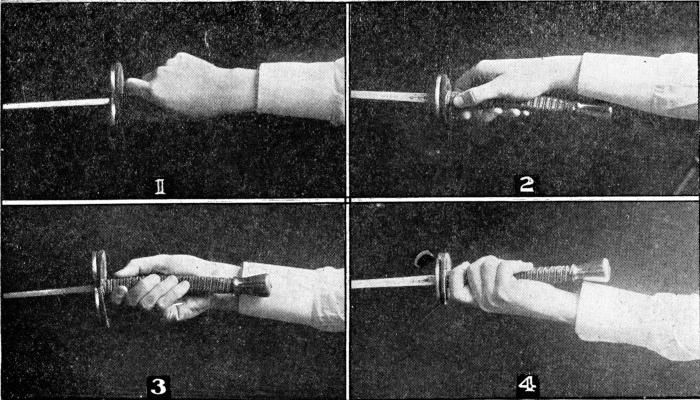
How to Hold the Foil
Hold the foil with the second phalange of the thumb
about one-half inch from the guard on convex side of
handle; the second and third phalanges of the index finger
on the concave side; the other fingers close together
on the remaining side. Allow handle to rest along the
life line. Hold foil lightly, for a hard grasp loses the
delicacy of touch so essential to a really good fencer.
8
First Position.
9
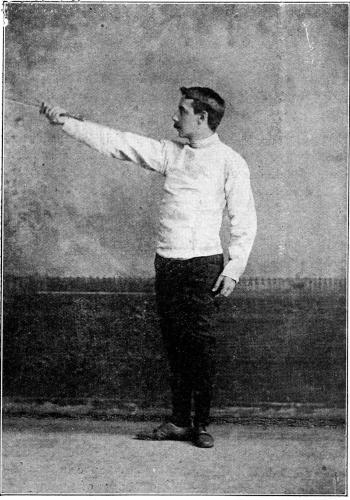
Position of Attention
With foil held as described, place the feet, heels together,
at right angles to one another, head up, right arm
and foil extended downward and slightly to the side,
button four inches from floor, left hand at side, naturally,
stand as much in profile as possible, without rigidity.
First Position.
From position of attention, keeping arm and foil in
straight line, raise them toward the adversary and
slightly to the right, until the hand is at the height of
your own forehead, nails up.
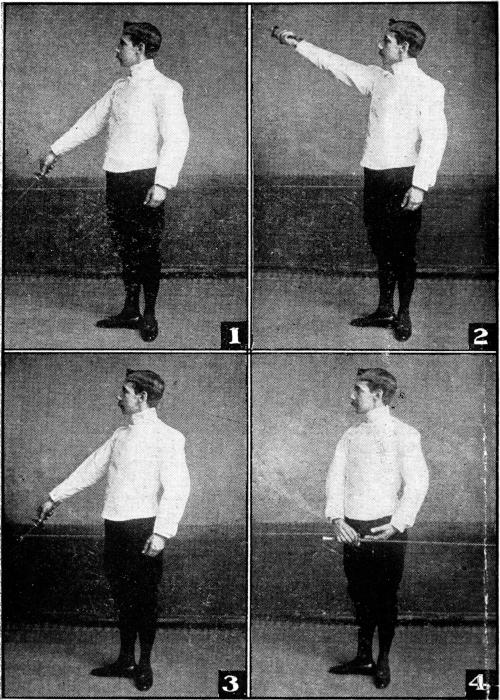
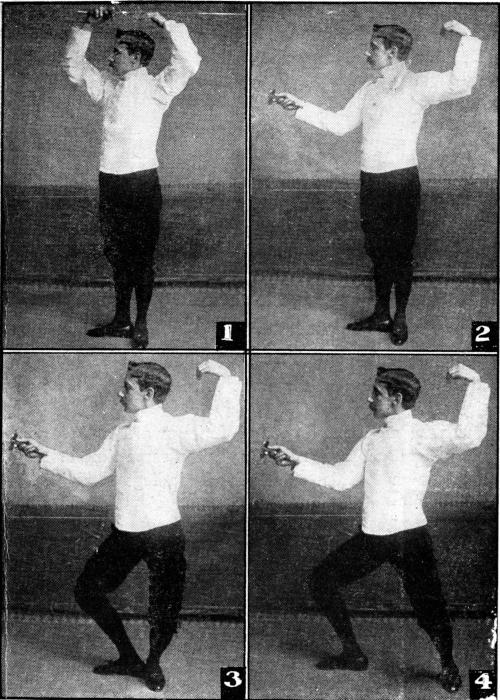
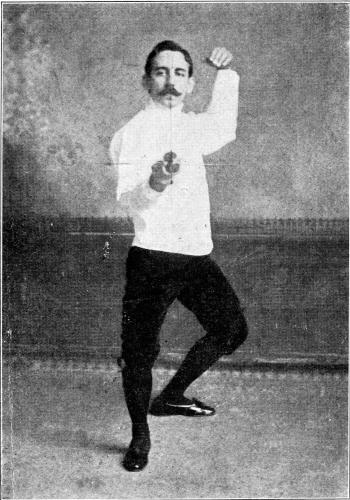
Preparatory Movements to Come “On Guard” From
First Position
From first position just given—
First—Lower foil until button is four inches from
floor.
Second—Continue movement of point till the blade
rests in a horizontal position in front of the body, finger
nails of right hand toward floor; at same time place left
hand, fingers together on blade, palm up, finger tips near
guard.
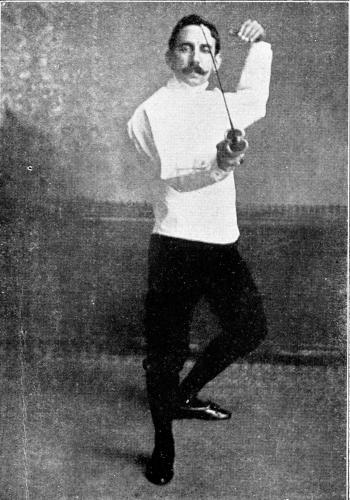
10
Preparatory Movements to Come on Guard From
First Position.
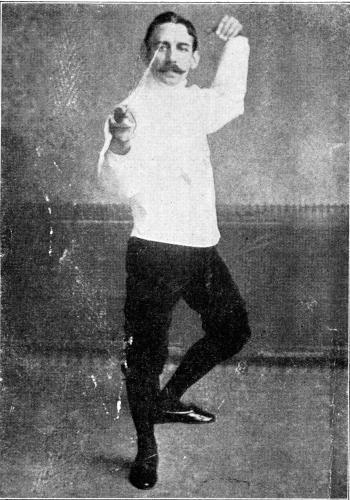
11
Preparatory Movements to Come on Guard From
First Position.
12
Third—Both hands maintaining same relative position,
carry foil over head, blade horizontal, arms bent.
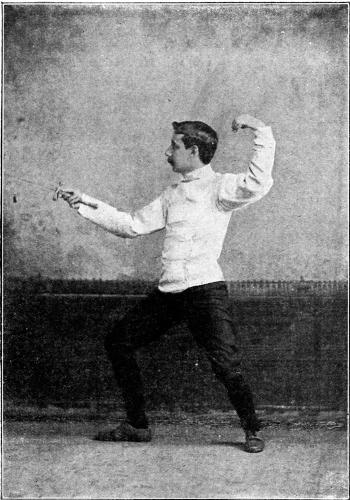
Fourth—Drop left hand to the side and height of the
head, movement and position curved; at the same time
bring right hand with foil in front of adversary, hand
kept chest high, nails in, arm bent, elbow in and about
eight inches from body, point of foil in line of adversary’s
eye.
Fifth—Feet keeping same position, bend legs, knees
separate, weight maintained by both legs.
Sixth—Bring right foot forward, two foot lengths,
between heels, keeping the right angle position; then you
are “on guard.”
The Recover
How to do it: To recover is to return to “first position”
from “on guard.”
Extending right arm and foil upward and forward,
hand forehead high, nails up; at the same time bring left
hand down to side, right foot back, legs straight, heels,
together.
The Advance
From “on guard” with body in same position, advance
right foot a convenient distance, left foot following an
equal distance.
The Retreat
Being “on guard” and keeping body and arm in same
position, take one step back with left foot, letting right
foot follow immediately.
13
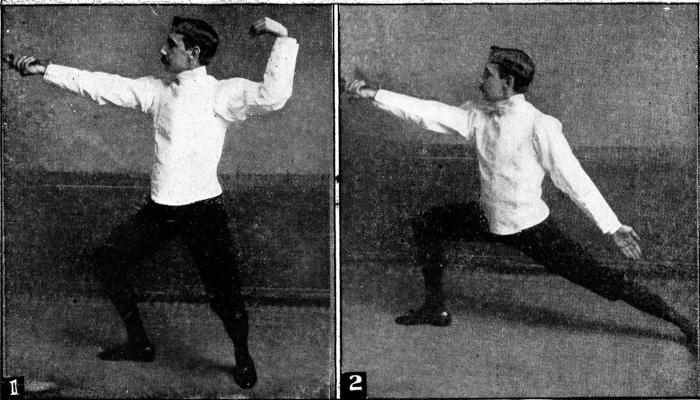
Extension of the Arm.The Lunge.
14
Gain
This motion consists in drawing the left foot toward
the right foot, the distance you wish to approach your
adversary in attack. The movement is made just before
lunging, keeping legs bent.
The Calls
Stamp right foot on floor, once or twice quickly and
audibly, rest of body remaining motionless; these stamps
may be used to insure a perfect balance, or as a means to
call an adversary’s attention to your desire that the bout
should stop.
Extension of Arm
Extend right arm with easy and smooth movement,
hand held nails up, arm and foil making straight line and
at level of chin.
To resume former position, draw back arm with foil,
in the easy, smooth way, and bring elbow to within eight
inches of body.
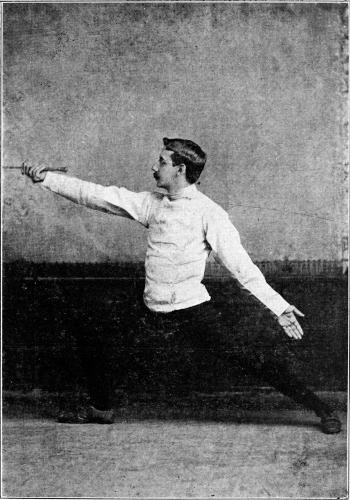
The Lunge.
The arm extended, as described, lift right foot about
one inch from floor, and pushing back with the left leg,
throw body forward until left leg is extended to its full
length with foot flat on floor, then the right foot, with
instep perpendicular to knee and with right thigh nearly
horizontal, returns to floor to receive weight of body.
Simultaneously with the thrust of the left leg, drop the
left hand backward and down in a curved movement,
until it rests within four inches of the thigh, palm turned
forward. The body is held as nearly as possible in a
perpendicular position throughout the lunge.
15
On Guard.
16
To return “on guard,” bending left leg at knee, draw
back right foot to original position, with weight of body
evenly distributed; at same time swing left arm upward,
and flex right arm with foil as described before.
Position of Foil Hand
Foil hand in fencing may assume four different positions,
namely:
First—Thumb down, nails to right.
Second—Thumb to left, nails down.
Third—Thumb up, nails to left.
Fourth—Thumb to right, nails up.
First, second and fourth can be used in attacks and
parries; third in parries only.
Public Salute
First—Being in first position, bring foil in front of
face, blade perpendicular, handle chin high, palm toward
face, nails in.
Second—Without moving arm, drop foil forward to,
horizontal position, then swing to left side, arm extended,
nails up, hand shoulder high, look in direction of foil.
Third—Withdraw arm and carry foil to front of face
in perpendicular position described, then drop forward as
in second part; swing to right side, nails down, hand
shoulder high and look in direction of extended arm and
foil.
17
Position of Foil Hand.
18
Fourth—Return foil to perpendicular position in front
of face, then after making the last six preparatory movements,
come to “on guard.”
Final Salute
In first position, flex arm, elbow near body, hand in
front of chin, nails in, blade perpendicular in front of
face.
Second—Swing point forward and down, extending
arm and at the same time turning hand outward, nails
down; halt point at about four inches from the floor and
a little to the right.
The Lines
The lines are the spaces existing on the different sides
of the blade when on guard.
There are four lines, namely, the space to right of
blade is known, as follows: right line, sixth line, third
line, and outside line; space to left of the blade known as
follows: left line, fourth line and inside line; the space
above the guard to the collar line, known as high line,
and space below guard to the belt line known as low line.
The right and left lines are the only lines for engagement.
High and low lines for attacking.
The Engagement
The engagement is the joining of your blade with your
adversary’s, in one of the lines of engagement, in such a
manner as to protect yourself, by carrying adversary’s
point away from either side of your body.
19
The Line.
20
Change of Engagement
The change of engagement is a new engagement, made
on the opposite from the one in which the blades were
originally. In making the change, lower your point
(movement made by the fingers only) and pass it under
and as near as possible to the adversary’s blade, protecting
yourself, as described, in the line of engagement.
If the change of engagement is made advancing, the
step forward must be preceded by the finger movement,
the advance being executed during completion of this
movement.
Double Engagement
The double engagement is made by two successive
engagements, the second beginning in the opposite line
to the one of the first engagement. If executed advancing,
the advance must be completed during the first change
of engagement.
Fingering
Fingering consists of having the guidance of the blades
entirely under the control of the fingers, more especially
the thumb and index finger.
Fingering gives the real fencer the most essential
quality of delicacy and sensitiveness.
The Attack
The attack is the action of a fencer when trying to
touch an adversary by simple or by complex thrust. Simple,
when it consists of one movement, complex, when it
consists of more than one.
21
Position of Engage in Fourth.
22
Position of Engage in Sixth.
23
There are only three simple thrusts, namely: the direct
thrust, the disengage and the cut-over.
The direct thrust is the action of the fencer when he
makes a direct extension of the arm, with the intention to
touch his adversary in the line of engagement.
The disengage is a pass under the adversary’s blade,
keeping as near to it as possible, and is followed by extension
of the arm with the intention to touch the adversary
in opposite line to the line of engagement.
The cut-over is a pass over the adversary’s blade and
as near to it as possible, motion made by thumb and index
finger only, and is followed by extension of the arm with
the intention to touch the adversary in the opposite line
to the line of engagement.
The complex attacks are without limit in number.
Further on there will be some explanatory examples
given.
The Feint
The feint is a counterfeit attack, and must be so executed
as to deceive the adversary into believing it a real
thrust, without being accompanied by a lunge, thus forcing
adversary to parry; then your point must be in readiness
to make another feint or to execute a thrust in
another line; by so doing, complex attacks are formed.
The Parry
The parry is the action of attempting to direct, beyond
your body, the point your adversary has thrust at you
(this attempt may be or may not be successful, in either
24case it is a parry). The parry is made by the forte of
your blade against the foible of your adversary’s.
The Counter-Parry.
The counter-parry is a reverse parry which seeks your
adversary’s blade in the line in which it presents itself,
to be forced into opposite line. In execution the point
describes, a small but complete circle, while hand remains
fixed.
Opposition Parry
The opposition is that special parry which meets the
adversary’s blade, accompanying it, without a tap, beyond
the front of the body, using a forceful pressure of the
hand, forte to foible.
Contraction Parry
The contraction parry is an awkward and unnecessary
parry, as it carries the adversary’s point through all the
lines, exposing the body, for example:
Engage in fourth—
No. 1—Attack by one-two.
No. 2—Instead of parrying sixth and fourth or sixth
and counter-sixth, parry sixth and counter-fourth (this
counter-fourth is a contraction parry).
The Different Parries
There are eight parries, each one of which has its
counter. These parries are first, second, third, fourth,
fifth, sixth, seventh or semi-circle and eighth.
25
The second and eighth are made to the right and in the
low line;
The third and sixth are made to the right and in the
high line;
The fourth and first are made to the left and in the
high line;
The fifth and seventh to the left and in the low line.
Execution of First
On a thrust at your left high line, turn your hand, nails
out, elbow raised and bent, forearm horizontal, handle
at height of left eye, point directed to adversary’s low
line.
The Counter of First
Being in position just described, on your adversary’s
attack in opposite line, raise point of your blade above
adversary’s, carrying it with yours to original position.
Execution of Second
On a thrust at your low line, lower your handle, in
motion from left to right, turning your hand, nails down,
bringing forearm, handle and blade in a position nearly
horizontal.
The Counter of Second
Being in position just described, on your adversary’s
attack in opposite low line, raise point of your blade
above your adversary’s and carry adversary’s blade to
original position.
26
Execution of Third
On a thrust at your right high line, carry your hand
to the right, nails down, turning by articulation of the
wrist, ending with point at height of and in line with
your right eye.
The Counter of Third
Being in position just described, on your adversary’s
attack in opposite line, drop your point under your
adversary’s and carry your adversary’s blade to original
position.
Execution of Fourth
On a thrust at your left high line, carry your hand to
the left, using a quarter turn of the wrist, thumb slightly
inclined to the right, point at height of and in line with
your left eye.
The Counter of Fourth
Being in position just described, on your adversary’s
attack in opposite line, drop point of blade under your
adversary’s, carry adversary’s blade to original position.
Execution of Fifth
On a thrust at your left line, turn your hand slightly,
nails down, lowering your wrist diagonally over your
adversary’s blade, carrying the latter to the low line. At
the end of the stroke the forearm, wrist and blade should
be in horizontal line across the body.
The Counter of Fifth
Being in position just described, on your adversary’s
attack in the opposite line, drop the point of your blade,
27passing it under that of the adversary’s and carry it to the
original position.
Execution of Sixth
On a thrust at your right high line, carry the hand to
the side, nails slightly upward, motion made with the
wrist, and finish with the point of your blade at the
height of and in line with the right eye.
The Counter of Sixth
Being in position just described, on your adversary’s
attack in opposite line, drop the point of your blade, passing
it under your adversary’s, and carry adversary’s blade
to original position.
Execution of Seventh or Semi-Circle
On a thrust at your low line, drop your point under
the adversary’s wrist, turning hand, nails up, by wrist
movement, and carry adversary’s blade to the left of your
body; at the end of this parry the hand should be chin
high, and the arm must be somewhat extended to facilitate
the movement.
The Counter of Seventh
Being in position just described, on your adversary’s
attack in opposite low line, raise the point of your blade,
passing it over your adversary’s, and carry adversary’s
blade to original position.
Execution of Eighth
On a thrust at your low line drop the point of your
28blade under adversary’s wrist, turning nails slightly up,
without changing height of wrist, and carry adversary’s
blade to the right of your body.
The Counter of Eighth
Being in position just described, on your adversary’s
attack in the opposite low line, raise the point of your
blade, passing it over your adversary’s, carry adversary’s
blade to original position.
Complex Attacks
Having explained the parries, it is now the moment in
which to grasp the complex attacks.
As has been said before, the complex attacks are without
limit, for many parries may be involved by able handling
of adversary’s attack.
The One-Two
The one-two, a complex attack of two motions, consists
of two disengages made in opposite directions, one
following immediately after the other; the first is like a
simple disengage, the second (made by motion of first
finger and thumb) is the one to deceive adversary’s parry.
Exercise
Engage in Fourth
Pupil—Disengage (1).
Instructor—Execute parry sixth.
Pupil—Deceive by disengage (2).
29
In this example the one-two is executed, but in the
event that the instructor executed the other parry that
the pupil should deceive, the result could be a series of
movements being made before the end of the attack, thus
proving the possibility of complex attacks of long duration.
The Double
The double is a complex attack of two motions. It consists
of two disengages in the same direction, one following
immediately after the other. Extending the arm
during the first disengage (as in one-two); the second
disengage is executed by the aid of the first finger and
thumb, and completes the double; the latter or second
disengage deceives the adversary’s counter-parry.
Exercise
Engage in Fourth
Pupil—Disengage (first part of double).
Instructor—Parry counter-fourth.
Pupil—Deceive by disengage (end of double).
The One-Two-Three
The one-two-three consists of three disengages, one
following immediately after the other, but made in opposite
direction. It is as the one-two with one more
disengage.
Exercise
Engage in Fourth
Pupil—Disengage (1).
Instructor—Parry sixth.
30
Pupil—Deceive by disengage (2).
Instructor—Parry fourth.
Pupil—Deceive by disengage (3).
In every case these exercises could be done from the
sixth engagement with opposite parries.
Disengage, cut-over; cut-over, disengage; cut-over,
cut-over; double, one-two; one-two, double; double,
one-two-three; one-two-three, double; double, double,
etc., etc. With these and many other combinations the
instructor can enlarge on the number of complex attacks.
The Riposte
This is the attack following a successful parry, with
or without the lunge. According to the position and
movements of your adversary, the riposte may be made
immediately after parry or in a brief interval of time.
The ripostes are simple and complex; the simple
ripostes are those executed with one movement and the
complex ripostes are those consisting of two or more
movements.
The simple ripostes are divided into simple direct and
simple indirect.
The simple direct is the most rapid of all ripostes, and
is called the riposte of tac-au-tac; it is executed in the
same line in which you have parried your adversary’s
attack, and when made on your adversary’s lunge, should
be made simultaneously with the stamp of your adversary’s
right foot on the floor.
The simple indirect ripostes are ripostes made by cut-over
or disengage.
31
For a proper execution of complex ripostes it is convenient
not to abandon your adversary’s blade as quickly
as for simple ripostes, but observe whether he returns
quickly or slowly to “on guard.”
To execute either of the two simple indirect ripostes
it is advisable to hold adversary’s blade as in complex
riposte.
The Counter-Riposte
The counter-riposte is the attack following a parry
of a riposte: it has the divisions and same suggestions as
for riposte.
The Second Counter-Riposte
The second counter-riposte is the attack following a
parry of the first counter-riposte; and the third and
fourth counter-ripostes, etc., are made in the same order,
thus forming long or short “phrases of arms.”
Phrase of Arms
A phrase of arms is a series of attacks, parries,
ripostes, etc., etc., one after the other, without interruption,
and ending only when one of the fencers is touched
or when they are out of distance by retreating. The
shortest possible phrase of arms is a direct thrust, a disengage
or a cut-over.
The Replacing (Remise)
The replacing is the second attack executed always by
a direct thrust in the same line in which the first attack
was made. You should never replace without first studying
the adversary’s style to find whether he usually
32ripostes by complex movement, which condition presents
the opportunity for replacing. Replace after adversary’s
first feint, the result will be that you stop his final movement
by an opposition, and touch him before he could
execute it. A good fencer will never replace with an
adversary who has the habit to riposte by tac-au-tac, because
the result will be, as a rule, a double touch.
The Redoubling (Redoublement)
The redoubling is the action of making a second attack
without coming on guard after the first. It can be executed
in any line, but never by a direct thrust, for in
such case it would be replacing. The only opportunity
for redoubling presents itself when in the adversary’s
parry of your first attack he does not riposte; this second
attack (the redoubling) must be made, while still in the
lunge, either by disengage or cut-over. Accompany the
motion of the hand by a slight pretence of recovery, in
order to deceive the adversary with the idea that you are
about to come “on guard.”
The Reprise
The reprise is a new attack made after the contestants
have engaged in a phrase of arms, without either receiving
a touch. At the moment of recovery of both, either
contestant quickly makes a new attack by simple or complex
movement. This is an effective attack because the
adversary may be disconcerted by the preceding phrase of
arms, and will find it difficult to offer successful parry.
33
Attacks on the Blade
Attacks on the blade are those executed to derange
the position of the adversary’s blade, driving it from its
line of defence.
The Beat
The beat is a tap, more or less light, made with your
blade against your adversary’s; it must be done with a
quick motion of the index finger and the thumb.
There are three beats. Beat preceding direct thrust is
forcible and at the place where the blades cross: it is
made to open room for the direct thrust. Beat preceding
disengage is light and is made with the foible of your
blade near the forte of the adversary’s; it is executed
thus in order to call attention on the one side of the blade
and open room on the other side. Beat preceding a cut-over
is executed lightly, as is the beat preceding disengage,
but is made with a backward motion, sliding
your blade along your adversary’s until you clear the
point.
The Double Beat
The double beat is the immediate succession of two
beats. The first beat is made in the line of engagement,
the other in the opposite line, and is made after dipping
your blade under your adversary’s. The double beat
can also be made by preceding each beat with a change
of engagement.
When the double beat is to be followed by a direct
thrust, the first beat must be slower and lighter than the
second; both to be made with about the center of your
adversary’s blade with the center of your own blade.
34When the double beat is followed by a disengage, the
first beat must be slower and lighter than the second
and on the center of the blades, but the second must be
made near the adversary’s forte and with your foible.
When the double beat is to be followed by a cut-over,
both beats are light taps; the second beat is the same as
the simple beat preceding cut-over, explained before.
The Press
The press is a pressure, more or less light, with your
blade against your adversary’s, in order to open your
adversary’s guard and facilitate an attack. When preceding
a direct thrust, the press must be executed by a
slow turning movement of the wrist, without losing contact
with the adversary’s blade. When preceding a disengage,
the press must be executed by a rapid turning
movement of the wrist, and upon your adversary’s response,
disengage; in this latter case start with your
point lower than in the preceding case.
The Glide
The glide is the feint of a direct thrust made by sliding
your blade easily along your adversary’s, with as little
warning as possible. When the glide is intended to
realize a direct thrust, glide with the forte of your blade
on your adversary’s foible, elevating your handle and
lowering your point to touch. If your glide is intended
to realize a disengage, it must be executed by sliding the
foible of your blade along the length of your adversary’s,
35in this case plainly drawing your adversary’s attention so
as to induce him to cover that line.
The Traverse
The traverse is a prolonged and sharp press, sliding
your blade along your adversary’s down toward the hilt,
in order to make an opening through which to thrust your
point.
The Low Thrust
The low thrust is the attack made by passing your
blade from a high line to a low line. To realize this, execute
first in a high line, a feint of attack or an attack on
the blade, then lower the point of your blade by a turn
of the wrist, and in a low line lunge to touch; at the
same time raise your handle as much as possible for self
protection.
The Bind
The bind is the action by which, with the possession of
your adversary’s blade, you carry it from a high line to
an opposite low line. On your adversary’s slow feint or
when his arm is extended, seize the foible of his blade
with your own forte, thus taking possession of his blade,
and, carrying your point to a low line, carry adversary’s
point outside the line of your body, then lunge to touch.
If the hind starts from fourth engagement, turn hand,
palm down; if from the sixth engagement, keep your hand
palm up.
The feint of bind is as the real bind without the lunge;
on your adversary’s endeavor to parry, deceive that parry
by a disengage.
36
The Cross
The cross is a brusque movement which is realized by
involving your adversary’s foible with your forte, and
carrying it from a high line to a low line or vice versa,
usually after parrying.
From fourth to second.
From sixth to seventh.
From second to fourth.
From seventh to sixth.
The Liement
The liement is a movement which forms a complete
circle, carrying your adversary’s blade (his arm being
extended), forte to foible, through all the lines, until
arriving again at point of departure, immediately follow
by a glide and direct thrust. Though I explain this
movement I must say it is, generally speaking, not used
by good fencers as it carries the adversary’s point across
your body, which is disconcerting.
The Time Thrust
The time thrust is an attack calculated to surprise your
adversary; it is therefore an attack executed in the time
intervening between the two final feints of your adversary,
or when his blade is momentarily out of line, or
on a prolonged feint, or during an attack disconcerted by
your adversary lunging before having extended his arm,
or on a feint beyond the body. It is a movement, at once
a thrust and a parry, and I advise it be executed in the
37outside line, because in the inside line there is a greater
chance of a double touch.
The time thrust should not be encouraged in a pupil
until he is thoroughly familiar with all the attacks, parries
and ripostes. Only advanced fencers should
attempt to execute a time thrust.
The Stop Thrust
The stop thrust is a rapid attack, executed in the face
of an advancing attack which is composed of wide feints.
In short, it is a time thrust realized on your adversary’s
advance.
38
PART II
In the preceding pages I have tried to frame, in a concise
form, the foundation of the art of fencing, the art
in which there are so many possibilities, so many beauties,
and so many benefits.
After a thorough understanding of what has gone
before in the pages of this little book, we pass to the
practical application in class work.
In class work the individuals assembled receive and
execute in concert all the movements on which fencing is
built.
The only parts of the fencer’s costume absolutely necessary
for this work are the foil, the mask, the glove and
the shoes.
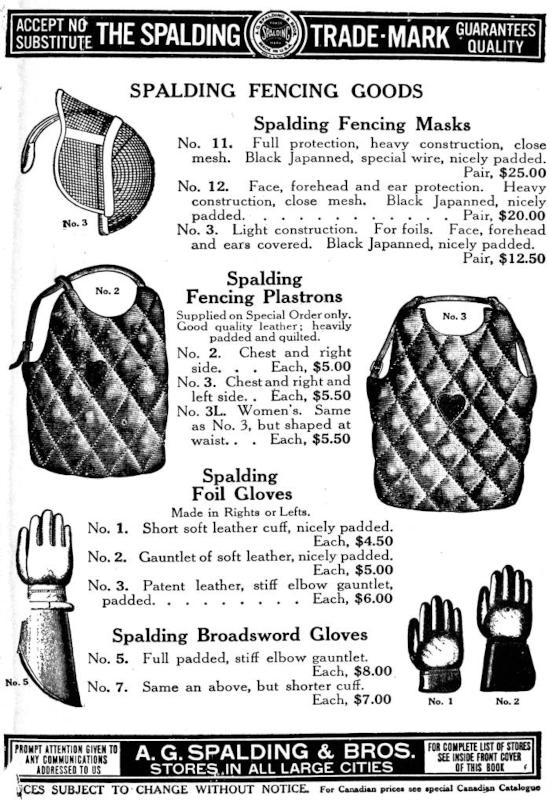
A. G. Spalding & Bros. have regulation fencing jackets
for both men and women. For men, there are fencing
trousers to be bought if desired. For women, it is advisable
they wear either a short skirt or bloomers. And, as
an additional advice to women, from a medical standpoint,
it is best to protect the chest by wrapping strips of
cloth across it and under the arms to form a bandage to
guard against any possible bruise from being struck
there with the foil button; about three yards of cheese
cloth or similar material crossed and recrossed until a
firm solid bandage is made as suggested.
As to the uniformly necessary adjuncts, the foil already
described; the mask, a specially prepared net work made
39to cover the face and ears of the fencer; the glove, a
regulation gauntlet, and the shoes, without heels and
with a rough sole, made especially for the purpose. The
Spalding catalogue contains a full list; with prices of
fencing equipment.
Class Work
(All commands have two orders, one preparatory and
one for execution.)
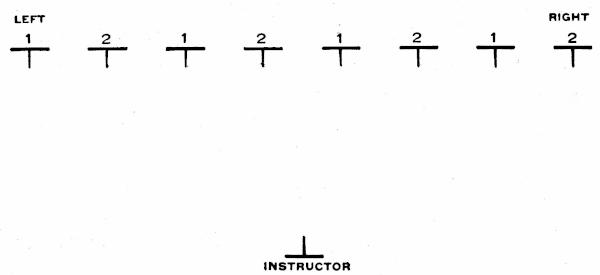
Assuming now there is a class of beginners before us,
the instructor will assemble this class, forming them in
one line, according to height and facing the instructor, the
tallest at the extreme left; command used will be “class,
fall in.” (See diagram above.) (The pupil at the end
of line at instructor’s left will be known hereafter as the
head of the line.)
The class thus formed in line, the Position of Attention
is: Heels on the same line and as near each other
as the conformation of the body permits; feet turned out
equally and forming with each other an angle of about
40sixty degrees; knees straight without stiffness; body erect
on the hips; shoulder square and falling equally; arms
and hands hanging naturally; elbows near body; head
erect and square to the front, chin slightly drawn in,
without constraint; eyes straight to the front.
At the command (1) Right, (2) Dress, (3) Front; the
pupils, except the head of the line, turn the head to the
right, so as to bring the left eye in a line about two inches
to the right of the center of the body, eyes fixed on the
line of eyes of pupils in that direction; at the same time
place the left hand on the hips, thumb to the back, the four
fingers together toward the front, elbow lightly against
the right arm of the next pupil. The instructor must
verify the alignment. Then at the command front, all
heads and eyes to the front and drop left hand to the
side.
(In fencing, the position of the feet must always be at
right angles.)
The class now in straight line and facing front after
preceding commands.
At the command (1) Half-left, (2) Face, rest on left
heel and turn one-quarter to the left, this turn brings the
left foot of every pupil in a straight line and pointing to
the left, bring right heel to left heel, feet forming right
angles. Simultaneously with the turn, raise right hand
away from body, slightly forward and to the right, palm
down; the class is now in attention position in fencing.
(1) First position.
(2) One.
41
Under (2) raise arm and come to first position in
fencing.
Under commands (1), (2), (3), (4), (5), (6), the
instructor leads the class through the execution of the
preliminary movements in fencing to “on guard.”
(1) Extend the arm.
(2) One.
Under command (2) extend the right arm, hand palm
up.
(1) Class.
(2) Lunge.
Under command (2) execute the lunge.
(1) On guard.
(2) One.
Under command (2) come on guard.
(1) Two calls.
(2) One.
Under command (2) give two calls.
(1) First position.
(2) One.
Under command (2) come back to first position.
(1) Final salute.
(2) One, Two.
Under command (2) make final salute.
42
(1) Front.
(2) Face.
Under command (2) rest on left heel and turn one-quarter
to the right; right hand to the side; the line is in
position of attention class work.
Foil and Mask.
After the class has received and executed the work
without the foil, the order is given to take foil and mask.
The foil is held between the first finger and thumb,
pommel down; thumb on the convex side of handle and
index finger on the concave side, blade perpendicular and
at the side. Now to come to fencing attention position.
Simultaneously with the half left face, by motion of first
finger and thumb, drop foil forward and down, turning
wrist brusquely, until the point is about four inches from
the floor. From this position, to come to attention position
class work, simultaneously with the command front
face, swing blade up by a brusque motion of the wrist to
perpendicular position at the side.
The mask is held by the left hand, the second and
third finger grasping the back part, in order that in position
of right dress the face of the mask is toward the
front; this manner of holding also facilitates in placing
the mask on and in removing it, as explained in the following
paragraphs.
(1) Mask on; (2) One; (3) Two.
Being in attention position class work, on command
43(2) bring lower part of the mask under the chin and in
front of the face; on command (3) draw back part of
mask over the back of the head, release hold and drop
the hand to the side.
(1) Mask off; (2) One; (3) Two.
Being in position of attention class work, on command
(2) grasp back part of the mask with second and third
finger; on command (3) remove mask and bring hand
with mask to position at the side.
Count Off
In order to have two sides, one for attacks and one
for parries, it is necessary now at this point to number
the pupils; this is done under the command “Count Off.”
Pupils being in a straight line in attention position class
work, mask off, all except the head of the line, turn heads
to the right, as in right dress, the rest of body remaining
motionless, and, beginning with the head man, count one,
two; each pupil turns his head and eyes to the front as he
counts.
It is imperative at this juncture, in order to give space
for freedom of movement, that the class be formed into
two lines; this is done easily by executing the commands,
as follows:
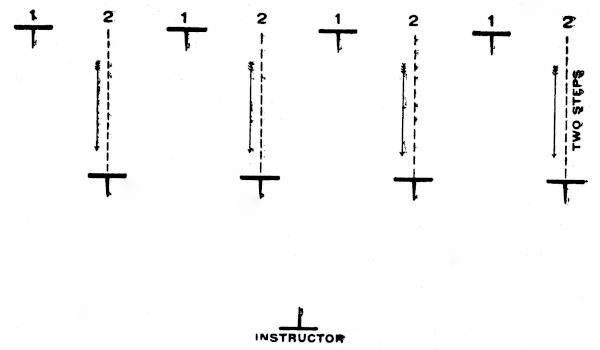
(1) No. 2’s two steps forward; (2) March. Under
the command (2) all No. 2’s will step two steps forward
(See Diagram on following page).
44
(In executing step forward or step back always step
with the left foot first.)
The class in two lines as just described.
A—(1) Half-left; (2) Face.
B—(1) First position; (2) One.
C—(1) Preliminary movements to come on guard.
(When on guard in class work, always keep the guide
to the left of the line; that is, the line must be regulated
from the pupils at the extreme left.)
D—(1) Extend the arm; (2) Lunge; (3) On guard.
(In his Section D, after the execution of “extend the
arm,” place the hand in all the different positions used
in fencing before the lunge.)
E—Advance.
F—Retreat.
G—Two calls.
H—(1) First position; (2) One.
I—(1) Final salute; (2) One, Two.
J—(1) Front; (2) Face.
45
The Lunge.
46
To have class again in one line, Command (1) No. 2’s
two steps back; (2) March.
(1) Right, (2) Dress, (3) Front.
(1) Class, (2) At ease.
At the last command allow the class to relax, and during
this period criticize and correct any individual faults
you have noticed and called attention to during the exercises;
demonstrate the correction.
With the class in one line and after half-left, face,
command, “right arm in position of on guard.” (The
work at this point is for the right hand and arm only,
the rest of the body remains without motion.)
Having one pupil step four steps forward engage his
blade; the class will follow the movements of this pupil,
each engaging an imaginary blade; in this way the instructor
can well demonstrate the right positions, explaining
now how to parry fourth and how to parry sixth
(and make individual criticisms).
In order to have the members of the class in regular
distances and one facing another, Command:
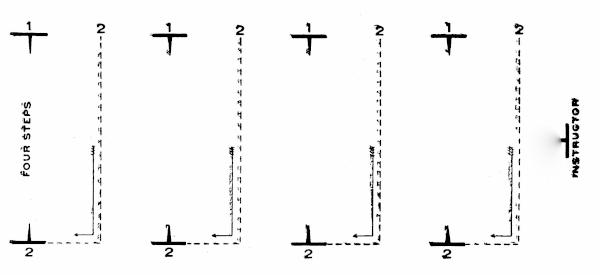
(1) No. 2’s four steps forward; (2) March.
(1) No. 2’s one step to the right; (2) March.
(1) No. 2’s about; (2) Face.
At the command “about” carry the toe of the right
foot about eight inches to the rear and three inches to
the left of the left heel, without changing the position of
47the left foot; at the command “face,” face to the rear,
turning to the right on the left heel and right toe; replace
the right heel by the side of the left. (U.S.A.)
With the class in this position, command:
(1) Half-left; (2) Face.
Always-having in mind the correct position of the feet,
in accordance with previously explained rules, it is to be
noted now, in addition that with the pupils vis-a-vis, the
right foot of each one must point in direct line to the
middle of the left foot of the other one, with the purpose
to be exactly opposite. (See Diagram above.)
Then following the necessary command bring the class
to on guard, and from fourth engagement, then from
sixth engagement, command as follows: (Attend that
always in engagement position, the point of your blade
must be at the height of, and in line with, the adversary’s
eye.)
48
Class Engage in Fourth
Direct Thrust.
No. 1—Direct thrust; lunge.
No. 2—Parry fourth (when No. 1 executes the lunge).
Both on Guard
Command No. 1. (1) Direct thrust; (2) lunge; (3)
on guard.
Disengage
No. 1—Disengage.
No. 2—Remain motionless.
No. 1—Lunge.
No. 2—Parry sixth.
Both on Guard
Command No. 1 (1) Disengage; (2) lunge; (3) on
guard.
Cut-over
No. 1—Change engagement.
No. 2—Attend the new engagement.
No. 1—Cut-over.
No. 2—Remain motionless.
No. 1—Lunge.
No. 2—Parry sixth.
Both on Guard
Command No. 1. (1) Cut-over; (2) Lunge; (3)
On guard.
No. 1—Change of engagement.
No. 2—Attend the new engagement.
49
The No. 2 will execute all the No. 1 has just done,
and No. 1 will do as No. 2 did.
Command—Two calls.
(1) First position; (2) One.
(1) Final salute; (2) One, two.
(1) Front; (2) Face.
(1) No. 2’s, one step to the right; (2) March.
(1) No. 2’s, four steps forward; (2) March.
(1) No. 2’s, About; (2) Face.
(1) Class right; (2) Dress; (3) Front.
(1) Class; (2) Dismiss.
(In class work when the instructor commands No. 1
advance, No. 2 must retreat or vice versa; this is to keep
the partners in the same relative position.)
(In class work, when the instructor observes the
partners are too close, and gives command for one of the
two to retreat, the other one must stand fast, for the
command is to correct distance.)
To instruct in attacks on the blade, and after the pupils
are in pairs, facing each other, the instructor will take
apart one pupil and with him demonstrate the following
commands:
Class on Guard
Engage in Fourth
No. 1—Beat, press, or any other attack on the blade,
and direct thrust.
No. 2—Attend the attack on the blade.
No. 1—Lunge.
No. 2—Parry fourth.
50
Both on Guard.
Command—No. (1) Beat Press Etc.
Direct thrust; (2) Lunge; (3) On guard.
The attacks on the blade could be used to precede any
simple or complex attack, and the commands arrange
and given as in the work previously explained.
As it is now the moment to understand complex attacks,
the instructor will explain each attack; and then
from the application of the following analysis there could
be a derivation of all the attacks of more than one movement.
Hereafter every lesson will be preceded by the Public
Salute, therefore the instructor had best present it now
at this point.
Engage in Fourth
No. 1—One.
No. 2—Parry sixth.
No. 1—Execute two (deceiving the parry of No. 2)
and lunge.
Observe that in this case the arm is not extended with
the cut-over, this being the only exception to the rule,
and in consequence also it is an irregularity in the execution
of the feint. (See definition of feint.)
Riposte and counter-riposte are among the most important
movements in fencing when handled intelligently,
and will be explained in the following exercises:
After you have given to No. 1 any command for attack,
then command No. 2 riposte by direct thrust, disengage or
any other movement you may decide, either simple or
complex, indicating to No. 1 the parries to be used to
avoid a touch. In the event you have elected to explain
52the counter riposte after No. 1 has parried the riposte,
then is the opportunity to explain and command the
counter riposte.
Engage in Fourth
No. 1—One, two and lunge.
No. 2—Parry sixth and fourth.
No. 2—Riposte by direct thrust and lunge.
No. 1—Coming on guard, parry fourth.
No. 1—Counter riposte by one, two and lunge.
No. 2—Come on guard and parry sixth and fourth.
Both on Guard
In giving the command put emphasis on riposte or
counter riposte, as the case may be.
When executing riposte or counter riposte by complex
movements, do not extend the arm until the last movement.
When presenting attacks advancing, the instructor
will emphasize the following details: In simple attacks,
advance at the same time you extend the right arm, the
lunge being executed immediately; in complex attacks,
advance during the first movement, and lunge during the
last movement.
(Note the application of the rule already given, that
when one side advances, the other retreats, in class work.)
An exercise will give the instructor a clear idea of the
importance of calling the attention in the high line, before
deciding on a thrust in the low line.
Exercise
Engage in Fourth
No. 1—Feint direct thrust, high line, or beat, press or
any other attack on the blade.
No. 2—Attend the feint by parry fourth.
No. 1—Low thrust, deceiving adversary’s parry and
lunge.
No. 2—Parry seventh.
Both on Guard, Coming to Fourth Engage
Command No. 1. (1) Feint direct thrust or any
other attack on the blade, and low thrust; (2) Lunge;
(3) On guard.
The following exercises will give a clear idea how to
prevent the bind and the liement.
The Bind
Engage in Fourth
No. 1—Feint direct thrust.
(2) Bind and lunge.
54
(1) Bring arm back to fourth position parry, and
without losing the contact with the adversary’s blade,
direct the point outside of your body.
Both on Guard
Command (1) On No. 1’s feint direct thrust; No. 2
bind; (2) Lunge; (3) On guard.
The Liement
Engage in Fourth
No. 1—Feint direct thrust.
No. 2—Liement and lunge.
No. 1—Bringing arm back to fourth position parry
(point a little higher than usual) and without losing the
contact of your adversary’s blade, direct the point outside
of your body.
Both on Guard
Command (1). On No. 1’s feint direct thrust; No. 2,
liement; (2) lunge; (3) on guard.
The Cross
The cross is most practically used after parries, in order
to be in possession of the adversary’s blade during the
riposte. However, as has been previously explained, the
cross is not often put into practice.
Engage in Fourth
No. 1—Glide, low thrust and lunge.
No. 2—Attend the glide and parry seventh.
No. 2—Riposte by cross and lunge.
55
No. 1—Come on guard, parrying sixth (without losing
contact of adversary’s blade).
Both on Guard
Command. (1) On No. 1’s glide and low thrust, when
lunging; No 2 parry seventh and riposte by cross; (2)
Lunge; (3) On guard.
Remise
Remise, redoubling and reprise are now in turn
analyzed in the following exercises:
Engage in Fourth
No. 1—Direct thrust and lunge.
No. 2—Parry fourth.
No. 2—Riposte by one, two.
No. 1—As soon as No. 2 starts his complex riposte,
place your point on his chest.
Command No. 1. (1) After No. 2 has parried your
direct thrust, in attack, and starts his complex riposte,
replace your point on his chest; (2) Lunge; (3) On
guard.
Redoubling
Engage in Fourth
No. 1—Direct thrust and lunge.
No. 2—Parry fourth and do not riposte.
No. 1—Redouble by disengage or by cut-over.
No. 2—Parry sixth
Both on Guard
Command No. 1. (1) After No. 2 has parried your
56direct thrust in attack and does not riposte, redouble by
a disengage; (2) Lunge; (3) On guard.
Reprise
Engage in Fourth
No. 1—Direct thrust and lunge.
No. 2—Parry fourth and do not riposte.
No. 1—Come on guard and immediately disengage and
lunge.
No. 2—Parry sixth.
Both on Guard
Command No. 1. (1) After No. 2 has parried your
direct thrust in attack and does not riposte, and you
have come on guard, make a second attack by disengage;
(2) Lunge; (3) On guard.
An easy application of Time-Thrust and Stop Thrust
can be made by giving exercises such as the following:
Engage in Fourth
No. 1—One, two and lunge.
No. 2—Time thrust, low line in eighth parry position,
lowering the point of your foil, carrying the hand from
left to right to protect the body, and at the same time
extend the arm with half lunge.
Both on Guard
Command (1). On No. 1’s one, two in attack, and
before the movement is finished; No. 2 time thrust in
eighth; (2) Lunge; (3) On guard.
57
If the attacking of No. 1 were made advancing, and
No. 2 execute the same movements as explained above,
the command would be as follows:
(1) On No. 1’s one, two advancing in attack, and
before the movement is finished; No. 2 stop-thrust in
eighth; (2) Lunge; (3) On guard.
Grand Salute
The Grand Salute, prelude of the assault, consists of
several attacks and parries with conventional execution;
and it is for three important reasons, a courteous salutation
to the audience; to demonstrate the classical beauty
of the movements, and to prepare the arms and legs for
the strain of the bout.
The two adversaries face one another at a distance of
about twelve feet. The instructor will command, (1)
Mask down; (2) One; (3) Two.
Under the command (2) the fencers charge diagonally
to the rear, on the left leg, bending left knee and placing
mask on the floor, under command (3) return to attention
position.
When resuming the mask the instructor will command:
(1) Take mask; (2) One; (3) Two.
Under command (2) charge as before and grasp the
mask; under command (3) return with it to attention
position.
Command for Grand Salute
(1) Class mask down; (2) One; (3) Two.
(1) Half-left; (2) Face.
(1) First position; (2) One.
58
No. 1—Take measure (this is to extend the right arm,
palm up, horizontal blade and lunge).
No. 2—Remaining at first position, advance or retreat
until your adversary’s point is about six inches from your
chest (not losing the left guide).
No. 1—(1) First position; (2) One.
Instructor commands, Class Public Salute and come
on guard, engaging in fourth.
No. 1—Disengage and lunge.
No. 2—Parry sixth and bring hand and arm in position
of second parry.
No. 1—When lunging, after the adversary has struck
your blade, swing foil across your face to the left side,
arm fully extended, so that the adversary’s face may be
seen between foil and arm.
Both on Guard Engaging in Sixth
No. 1—Disengage and lunge.
No. 2—Parry fourth and bring arm in position of
parry seventh.
No. 1—When lunging after the adversary has struck
your blade, swing foil to the right side, arm fully extended,
blade close to the ear, seeing adversary’s face in
line with the foil.
Both on Guard Engaging in Fourth
No. 1—Repeat one more disengage from fourth and
another from sixth, as has been explained.
No. 2—Parry as said.
59
Both on Guard Engaging in Fourth
No. 1—One, two without extending the arm, bring
arm and foil in position of third parry.
No. 2—Parry third.
Both Come to First Position
No. 2—Take measure.
No. 1—Remain in first position as before.
No. 2—Do all that No. 1 did before and No. 1 do as
No. 2 did.
Both adversaries—First position.
Both adversaries—On guard backward (left foot one
step back).
Both adversaries—One call (one stamp with right
foot).
Both adversaries—Two calls (two stamps with right
foot).
Both adversaries—First position forward (left foot
forward).
Both adversaries—Public salute.
Both adversaries—On guard forward.
Both adversaries—Two calls (two stamps with right
foot).
Both adversaries—First position forward (left foot
forward).
Both adversaries—Final salute.
Both adversaries—Front face.
Both adversaries—Take mask, One, two.
Both adversaries—One step backward, March.
60
ADVICE TO INSTRUCTORS
In the beginning execute all movements slowly that the
pupil will understand each thrust, parry, etc., and increase
velocity gradually, in order that the pupil may acquire
the rapidity so necessary to every good fencer.
Execute each movement first in the fourth line, then in
the sixth line.
Always attend that the pupil is in perfect equilibrium
when on guard; watching carefully that the line of the
feet is not crossed, that the body is erect on both hips, the
back is straight, the chest raised and in profile, that the
position of the arm and hand is perfect; beginners always
err in the latter.
Always precede the movements with “engage in, etc.”
before commanding the exercise.
Complete each attacking exercise with the order
“lunge,” and as soon as the movement is terminated,
return to guard with the order “on guard.”
Finish each exercise with some direct thrust.
Finish each lesson with two calls and final salute.
Rest after each bout; while resting, make explanations
to the pupils.
Change of engagement must be made often, in order
that the pupils’ fingers become nimble, an important
quality to good fencing.
Always use the same foil, for any change will cause
61uncertainty in movements owing to the difference in
weight.
Attend well that the pupil does not incline the body
forward when executing an attack, for this fault makes
it difficult for him to return on guard; also attend that
the pupil does not make an exaggerated lunge; both of
these defects cause another evil, for with them the left
foot cannot be kept flat on the floor, and it must be.
Attend well that the lunge is not made until the right
arm is fully extended.
One of the greatest essentials for an able instructor
is patience. Be your pupil’s friend and guide; anybody
can learn to fence; the results depend on the ability of
the instructor.
62
EPILOGUE
I would be happy to know that through these few
pages I have been able to create a love for fencing among
those who have followed the guide of “class work.”
The love of an art promotes the intelligent comprehension
of its possibilities, and the necessity for deeper
research. The class work gives the understanding, but
for the polish of the fencer there must be hard individual
work against the master’s plastron. If the class
work has been a pleasure, the deeper research will be
void of weariness. Continue, and you can be among the
first.
Work with a good master; avoid faults that can creep
in so easily and grow so rapidly; never imagine yourself
a graduate with a diploma, for there is always something
more to learn; do not be anxious for early assault; many
good pupils have lost all they learned by beginning the
assaults before they are ready for them. One evil
acquired by assaulting prematurely is the acquisition of
the habit to avoid being touched by various contortions
of the body, and this incorrect manner will remain with
one as a perpetual obstacle to improvement in the art.
Make your first assaults with the master, for he can
correct your faults; and also, you will not be over-anxious
to touch, sacrificing form and the rules in
the art.
63
THE ART OF FENCING
By Thomas A. Buys, M.D.,
President Brooklyn Fencing Club.
That fencing is an art, and one that requires a thorough
apprenticeship, all swordsmen know, but as this
article may come before the eyes of the uninitiated it
might be well to go a little into details, so that it will
never occur to them, as it did once to a prominent officer
of the National Guard, who, on witnessing a bout with
foils, remarked: “What art is there in two fellows jabbing
at each other with foils?” To start with, fencing is
not a recent discovery, but, on the contrary, is centuries
old. In the fifteenth, sixteenth and seventeenth centuries
it was probably at the height of its perfection, for then a
lack of knowledge of this interesting art might have
meant sudden death. The Spanish originated the best
school of sword-play, but it has come to us through various
sources, the two recognized ones being the Italian and
French methods. The Italian is rough and forceful, requiring
considerable strength, while the French endeavors
to train the hand to the greatest delicacy, so that the
faintest impressions are carried to the brain, as if the
sword, the arm and the body were charged by a highly
sensitive electric current, making the muscles and nerves
respond instantly and with beautiful co-ordination.
But you will say: “The days for duelling are past, of
what use is the sword?” True, the days of chivalry are
past; the sword no longer upholds the honor of family or
64name, its place being superseded by the police court and
our legal adviser; but for all of that, in these days of
strenuous games, we almost seek in vain for one which
will in itself combine exercise both mental and physical,
and while being generally beneficial, does not dilate the
heart, distend the lungs, nor break bones and tear ligaments,
as so many of our so-called amusements do. On
the contrary, fencing brings into play every part, every
organ and every sense in the body, with perhaps the exception
of the sense of taste and the sense of smell. Yet
as an exercise it cannot be called violent, and now that
our masks are so improved in construction, cases of injury
are very rare.
The object of the game is to score a touch upon opponent
(which means reaching any part of the body
above the waist line and below the collar line, arms excepted,
with the button of your foil), at the same time
protecting yourself. To do this requires a great deal of
judgment, as a man on guard is protected in the direct
line of attack and you must deceive him absolutely to
be successful, leading him to suppose that you will attack
him in one line when in reality you intend to strike
through another. This in itself requires coolness, self
composure and at the same time, decision, accuracy, firmness
of hand, keenness of eye, speed and agility, in thrust,
lunge and recovery. To perform these properly, the knees
must be bent, with the body poised, its weight resting
equally on each foot, so that an advance or a retreat may
be made with equal facility. The left leg, without rigidity,
should be like a coiled spring, ready on the instant
65to extend to its fullest extent in the lunge. Thus all parts
are kept on a constant qui vive, and as the play is so extremely
rapid, and requires the utmost concentration of
the mind to avoid unpleasant surprises, this in itself
banishes dull care and acts as a rare tonic to the nervous
system.
To qualify the statement as to the benefits of fencing
as a physical exercise. Some say it is too onesided, but
the truth is that the left arm is generally the one to
become fatigued first, as the dropping of the arm on the
lunge and sudden raising of the same on the recovery
bring into play all the muscles of the shoulder and many
of the neck and back, this tending to expand the chest by
raising the ribs and throwing the shoulders back. In the
lunge the entire weight of the body is thrown violently
forward on the right leg, bringing into play all the muscles
of the back and particularly those of the abdomen,
causing them to contract in such a manner as to act like
massage upon the bowels, regulating them and at the
same time reducing any tendency to corpulency in those
whose muscles are relaxed and flabby. There is a saying
that “It is a poor rule that won’t work both ways.” This
is particularly true of this form of exercise, for many
take it to reduce their weight. This it does by increased
ingestion of oxygen, which burns up the fat, and by rapid
muscular contractions, which rub the fat out from between
the muscular fibers. On the other hand with those
people who have no fat and are small muscled, the increase
in the circulation of their blood carries more nourishment
66to the muscle, making the individual increase
both in weight and size.
Fencing, through its high nervous tension, produces
deep and rapid respiration, increases the action of the
heart without strain, and causes invariably a profuse
perspiration, cleansing the pores of the skin of all poisonous
matter and acting through muscular contraction and
increased circulation on liver and kidneys. Thus we see
that apart from the pleasures of the art as a game, we
have all the necessities of an all-round exercise, which,
without being violent, reaches all the muscles, the excretory
and circulatory organs, cleanses and rejuvenates
the entire body, and gives a person who was nervous and
fidgity a firmness and control over his nerves, a keenness
of eye and a quick, graceful, erect carriage, which
makes walking a pleasure and induces a natural tendency
to think and act quickly, frequently saving us from accident.
It must not be assumed that a person who buys a pair
of foils and crosses them upon the wall of his room,
will attain any of the benefits mentioned, nor will they
who take one lesson a week and forget where they left the
foil until the next lesson; but those who, when properly
instructed, practice daily, making at least one hundred
correct lunges against some solid object, will soon perceive
the truth of my statement.
Fencing, it is believed, has come to stay. Under the
supervision of the Amateur Fencers’ League of America,
whose rules and regulations guide and govern the amateur
fencing world, restricting all roughness and promoting
67good fellowship and courtesy in conduct and bout
work, making competitions pleasant and insisting upon
good form and gentlemanliness, as absolutely essential
to a good swordsman, thus the art will become more
and more popular, until it takes its place, where it belongs,
at the head of the list, the king of all sports.
68
PROF. RICARDO E. MANRIQUE
from the Cercle d’Esgrime de l’Havane, 1888; official instructor
at the Gymnastic Club, 1889-1896; The Military
Club, 1890-96; The Progress Club, 1893-1896, at
Havana; Fencing Editor of El Figaro, Los Sports, and
La Discusión, 1890-1896, Havana; Instructor at
the Colon-Cervantes Club, 1896-1899; The New York
Normal School of Physical Education, 1899; The Dr.
Savage Physical Development Institute, 1899; Columbia
Institute, 1900; Nathan Hale School, 1902; The Berkeley
School, 1902; New York Normal College, 1902; Professional
Woman’s League, 1902; The Blythe Dramatic
School, 1902-1905; at Brooklyn Fencers’ Club, 1903;
College of New Rochelle, N. Y., 1907; Blessed Sacrament
Convent, New York City, 1907; Saint Angela’s School
for girls, 1909; South Orange Field Club, 1903; Lakewood
Physical Culture Club, 1903; Orange County Club,
N. J., 1903; Stanhope Wheatcroft Dramatic School, 1905;
Barnard College Fencing Club, 1904; Miss De Lancy
School for Ladies, 1904, New York; Central Branch
Young Men’s Christian Association, Brooklyn, 1905; The
Veltin School for Girls, 1906; Mme. A. E. Zeigler School
of Art, 1906; Columbia Grammar School, 1907, New
York. Member of the American Physical Education Association.
Author of “The Art of Fencing with the Foil,”
according to the French School; awarded the only medal
given for work on Fencing at the Pan-American Exposition,
Buffalo, 1901; Instructor Colonel’s Staff 71st
Regiment, N. G. N. Y.; Crescent Athletic Club, Brooklyn,
and others.
69
Fencing Rules ADOPTED AT A GENERAL MEETING, OCTOBER, 1911.
1. Foil competitions shall be conducted by three judges, whose
decisions shall be final and without appeal. One of them shall
act as Director. There shall also be a timer and a scorer.
2. The judges shall announce when a competitor is touched,
whether fair or foul, by direct attack, riposte or remise. Should
they disagree, the Director shall decide. A judge shall especially
watch one fencer, but he shall announce touches made on either.
Should a judge call a touch, it shall count a point, unless
either of the other judges shall announce to the contrary, in which
case the majority vote shall decide.
3. The Director shall superintend the bout, put the competitors
on guard, and give all necessary directions. He shall announce
to the scorer each touch as awarded.
4. Each bout shall consist of the majority of seven touches,
with a time limit of four minutes. The contestants shall change
position after three touches, or after two minutes in case three
touches have not been made in that time. In case of a tie after
four minutes, they shall fence for one additional touch.
5. A contestant must announce, when he is touched, whether
fair or foul. Failure to do so must be called to his attention by
the judges. Persistent failure will subject the offender, on the
concurrence of the majority of the judges, to a penalty of one
point, which shall be added to his opponent’s score.
6. The Director must stop a corps-a-corps.
7. Each judge shall give one point for form to the fencer
he thinks superior in that respect.
8. Each contestant shall fence with the same hand throughout
the bout.
9. Competitors shall wear clean, white fencing jackets and
long white trousers of soft material, unglazed.
10. Contestants shall fence within a marked space twenty feet
long and thirty-six inches wide, with a mark plainly indicating
the middle.
70
11. Foil blades shall not exceed thirty-four inches in length.
Guard of foil shall not exceed four inches in diameter.
12. Blacktarred tape shall not be used for buttons.
13. A touch shall count if delivered upon any part of the
body above the waist line and below the collar line, provided
it be made, by a direct thrust in such a manner that if the foil
had a sharp point it would cause a punctured wound. A touch
shall count if it reaches the body after merely grazing the arm.
A touch is of no value when the point is slapped on or
twisted on after the slap of the foil.
14. Should a fencer unduly cover his body with arm or head,
and receive a touch on either, which otherwise would have been
on the body, it shall be counted as good.
A contestant who advances after a lunge in such a manner
as to make it impossible for his adversary to riposte shall be
penalized one point.
15. A touch whether fair or foul invalidates the riposte.
16. A disarmament is of no value. A touch immediately following
disarmament counts.
17. A touch made with a bent arm on the original attack
shall not count.
18. A contestant who steps off the fencing strip shall be
penalized one point.
19. The beginning of the assault is marked by the contact of
the blades, which is called the engagement.
After the engagement either fencer has a right to attack,
before an attack is made.
After the engagement either fencer has a right to attack.
The full extension of the arm in the direction of the opponent’s
body is a necessary preliminary of an attack.
20. If both fencers commence an attack at the same moment,
and both are touched, whether on the target or not, neither touch
counts. But if only one is touched on the target and the other is
untouched, the touch is valid.
21. A fencer who during a bout disputes the decision of the
judges, shall, on concurrence of the majority of the judges, be
penalized one point, which shall be added to his adversary’s score.
ACCEPT NO SUBSTITUTE
THE SPALDING TRADE-MARK
GUARANTEES QUALITY
SPALDING FENCING GOODS
Spalding Fencing Masks
No. 11.
Full protection, heavy construction, close mesh. Black Japanned,
special wire, nicely padded.
Pair, $25.00
No. 12.
Face, forehead and ear protection. Heavy construction,
close mesh. Black Japanned, nicely padded.
Pair, $20.00
No. 3.
Light construction. For foils. Face, forehead and ears
covered. Black Japanned, nicely padded.
Pair, $12.50
Spalding Fencing Plastrons
Supplied on Special Order only.
Good quality leather; heavily
padded and quilted.
No. 2.
Chest and right side.
Each, $5.00
No. 3.
Chest and right and left side.
Each, $5.50
No. 3L.
Women’s. Same as No. 3, but shaped at waist.
Each, $5.50
Spalding Foil Gloves
Made in Rights or Lefts.
No. 1.
Short soft leather cuff, nicely padded.
Each, $4.50
No. 2.
Gauntlet of soft leather, nicely padded.
Each, $5.00
No. 3.
Patent leather, stiff elbow gauntlet, padded.
Each, $6.00
Spalding Broadsword Gloves
No. 5.
Full padded, stiff elbow gauntlet.
Each, $8.00
No. 7.
Same an above, but shorter cuff.
Each, $7.00
PROMPT ATTENTION GIVEN TO
ANY COMMUNICATIONS
ADDRESSED TO US
A. G. SPALDING & BROS.
STORES IN ALL LARGE CITIES
FOR COMPLETE LIST OF STORES
SEE INSIDE FRONT COVER
OF THIS BOOK
PRICES SUBJECT TO CHANGE WITHOUT NOTICE. For Canadian prices see special Canadian Catalogue
ACCEPT NO SUBSTITUTE
THE SPALDING TRADE-MARK
GUARANTEES QUALITY
SPALDING FENCING FOILS
Figure 8 Guard Fencing Foils
No. 7.
Iron mountings, corded handle.
Pair, $2.50
No. 11.
Blued mountings and 34-inch blade.
”4.00
No. 18.
Mountings of brass, and 34-inch blade.
”4.50
No. 17.
Special “Club” Foil, nickel-plated and polished, and
34-inch blade.
Pair, 6.00
Bell Guard Fencing Foils
No. 15.
Mountings nickel-plated, and 34-inch blade.
Pair, $4.00
No. 23.
Mountings nickel-plated and highly polished, and fine
34-inch engraved blade.
Pair, $7.00
Fencing Swords
No. 30.
Broadswords, wood.
Pair, $5.00
Fencing Sticks
No. 40.
Sticks, complete.
Pair, $2.00
No. 41.
Willow basket handles.
”1.00
No. 42.
Hickory sticks only.
”1.00
Foil Blades
No. B.
Fine Coulaux or Brunon Steel Blades, 34-inch.
Each, $1.10
No. C.
Rubber Foil Buttons.
Pair, .10
PROMPT ATTENTION GIVEN TO
ANY COMMUNICATIONS
ADDRESSED TO US
A. G. SPALDING & BROS.
STORES IN ALL LARGE CITIES
FOR COMPLETE LIST OF STORES
SEE INSIDE FRONT COVER
OF THIS BOOK
PRICES SUBJECT TO CHANGE WITHOUT NOTICE. For Canadian prices see special Canadian Catalogue
ACCEPT NO SUBSTITUTE
THE SPALDING TRADE-MARK
GUARANTEES QUALITY
Spalding Gymnasium Shoes
No. 15.
High cut, kangaroo uppers; genuine elkskin soles; will not
slip on floor; extra light; the correct shoes to wear for boxing.
Pair,
No. 155.
High cut, black leather, elkskin soles, soft and flexible.
Pair,
No. 166.
Low cut, black leather, electric soles.
Pair,
No. 66L.
Women’s low cut, extra light selected black leather uppers,
with electric soles.
Pair,
No. 21.
High cut, black leather; electric soles; sewed and turned;
extremely light and flexible.
Pair,
No. 20.
Low cut, otherwise as No. 21; sewed and turned.
Pair,
No. 20L.
Same as No. 20, but women’s sizes.
Pair,
Spalding Knockabout Leather Gymnasium Shoes
Flexible Soles
No. GWH.
High cut, special pearl colored leather; flexible soles:
well made.
Pair,
No. GW.
Low cut, otherwise as GWH.
Pair,
Spalding Special Bowling Shoes
No. 148.
For bowling and general gymnasium use; light drab chrome
tanned leather uppers, with electric soles, laces extremely
low down.
Pair,
Spalding Gymnasium and Acrobatic Shoes
No. FN.
Corrugated rubber sole, special leather uppers. For
acrobatic and wrestling wear.
Pair,
No. FL.
Extra high cut canvas acrobatic shoes. (Pat. Aug. 17, 1915).
Special leather soles, will not harden in water. Shoes are
reinforced where upper and sole are attached.
Pair,
No. FM.
Three inches lower than No. FL. White canvas shoes, black
trimmed; special leather soles.
”
No. E.
Low cut canvas, canvas soles.
”
Spalding Fencing Shoes
No. L.
Drab glove leather, red trimmings. Not carried in stock;
supplied on special order only. Specify on order if to be made
with or without toe extension sole, and on which shoe.
Pair,
No. LW.
Women’s, Otherwise same as No. L.
”
Spalding Clog Shoes
No. 1-0.
Goatskin uppers; wood soles. Special order only.
Pair,
HOW TO MEASURE FOR ATHLETIC SHOES
Running Shoes, Jumping Shoes, Hurdling Shoes, and Pole Vaulting Shoes are usually worn without stockings;
take measurements over bare feet. All other athletic shoes are worn with stockings; take measurements
over stockings. Take measurements as directed below and send with your order. Don’t Rush!
Be Careful!
In sitting position draw outlines of feet, both the right and left, measuring over stockings or bare feet as
required, according to style of shoe; then, with tape measure, drawing same tight, measure ball, waist,
instep, heel and ankle, as shown in cut.
IMPORTANT—Hold pencil perpendicularly all around the foot, especially at back of heel and
end of great toe.
PROMPT ATTENTION GIVEN TO
ANY COMMUNICATIONS
ADDRESSED TO US
A. G. SPALDING & BROS.
STORES IN ALL LARGE CITIES
FOR COMPLETE LIST OF STORES
SEE INSIDE FRONT COVER
OF THIS BOOK
PRICES SUBJECT TO CHANGE WITHOUT NOTICE. For Canadian prices see special Canadian Catalogue
ACCEPT NO SUBSTITUTE
THE SPALDING TRADE-MARK
GUARANTEES QUALITY
SPALDING
Gymnasium and
Athletic Equipment
Made of Best Materials
Durable
Comfortable
Correct in Design
Carefully Made
Athletic uniforms differ in construction from ordinary
clothes in that they must be especially strengthened in the
parts bearing the strain. Only long years of practical experience
in making athletic uniforms can determine the weak spots.
Spalding has had this experience and puts it into practice in
their own factory, where these goods are made.
Those who wear them have told us they are durable and
comfortable.
Spalding gymnastic uniforms have been used for
years by colleges, schools, Y. M. C. A’s, clubs, etc.
Why? Because the leaders of such organizations and institutions
have discovered they meet the approval of those using
them, thus eliminating friction between the director and his
pupils or members.
Why? Because the wearer is perfectly satisfied.
WRITE FOR Spalding Catalogue
CONTAINS A FULL LINE OF
Shirts, Tights, Trunks, Shoes, etc.
Suitable for Gymnasium and Athletic Use
FREE ON REQUEST
PROMPT ATTENTION GIVEN TO
ANY COMMUNICATIONS
ADDRESSED TO US
A. G. SPALDING & BROS.
STORES IN ALL LARGE CITIES
FOR COMPLETE LIST OF STORES
SEE INSIDE FRONT COVER
OF THIS BOOK
IN TRACK AND
FIELD SPORTS
Spalding implements are pre-eminent.
From the running shoes for Olympic
winners to the missiles of weight
throwers, Spalding goods are always
in evidence when championships are
won or records made.
Ruling bodies in track and field
athletics certify to Spalding. Quality
in the recognition of Spalding implements
for use in Olympic and
championship contests.
Don’t be led astray by the false
cry of cheapness and “just as good.”
Remember that superiority in competition
is the result of Quality in
equipment.