Title: The darkness on Fifth Avenue
Author: Murray Leinster
Illustrator: Lloyd Birmingham
Virgil Finlay
Release date: October 28, 2026 [eBook #79873]
Language: English
Original publication: New York, NY: Ziff-Davis Publishing Company, 1929
Other information and formats: www.gutenberg.org/ebooks/79873
Credits: Greg Weeks, Mary Meehan and the Online Distributed Proofreading Team at http://www.pgdp.net
By MURRAY LEINSTER
Illustrator FINLAY
[Transcriber's Note: This etext was produced from
Fantastic Stories of Imagination, March 1962
and was first published in Argosy, November 30, 1929.
Extensive research did not uncover any evidence that
the U.S. copyright on this publication was renewed.]
The moon was shining brightly in Central Park as Police Lieutenant Hines went at a leisurely pace toward his home. He'd been at a party, and it had been a tiresome one, as far as he was concerned.
The gravel under his feet crunched and crackled. He pulled a cigar out of his pocket and lighted it. The path curved and recurved. It came out at the edge of the lake and followed along its shore. And the moon was rising high above the tall apartments that line Fifth Avenue. Its light flickered and shimmered on the water in small, irregularly-shaped lambent flames.
Hines slowed down and stopped, to look at it. Shrubbery on every hand, silvered by the moonlight. The rising shores of the farther side of the lake were made queerly glamourous. The throbbing, rumbling murmur of the city all about him came as a curious incongruity. It seemed particularly odd because the wavelets of the lake were running up on the shore edge with small lapping noises, and it seemed that the city should be thousands of miles away. And Hines could hear the heavy, rather monotonous splashing of the huge fountain at the end of the Mall, but it sounded like a waterfall.
"It is pretty, isn't it?" said a girl's voice behind him.
Hines turned around. A girl was sitting on a bench, quite alone. She couldn't have been speaking to any one else.
She lifted her hand as if in a gesture for him to sit down beside her. He couldn't make out her face, but the slim silken legs were shapely in the moonlight, and the dress was fresh and cool.
Police Lieutenant Hines smiled to himself. Being attached to the detective bureau, he never wore a uniform, and he was off duty anyhow. He said unreproachfully:
"Sister, I'm a cop. You ought to be careful."
But the girl chuckled. She clasped her hands together and laughed; and then she chuckled again.
"But, Mr. Hines, it isn't against police regulations to speak to an acquaintance in the park, is it?"
Hines stared and suddenly flushed.
"I'm Kathryn Bush," said the girl on the bench, still amusedly. "Remember me, now?"
"Oh, Lord, yes!" said Hines.
"I'm not hunting copy to-night," she assured him, with a bare trace of malice. "I came out to be by myself and look at the moon and be stupid and romantic. The combination's necessary, isn't it—stupidity and romance?"
Hines puffed at his cigar.
"I was wondering myself," he admitted ruefully. "I just came from a party. The girls were pretty and stupid, and the music was stupid and pretty. And I didn't have a good time. I've been enjoying myself more, just looking at the moonlight, than I did at the party."
There was a little pause.
"'Sentiment on the Police Force,'" murmured a soft voice. "'Police Lieutenant Hines Discovered Moon-Gazing. Famous Vamp-Proof Detective Prefers Chaste Luna to Chasing Flappers. Special to the Star!'"
Hines stiffened and groaned. That was the exact method Kathryn Bush used in her column in the Star. She could make any man ridiculous; and she could twist her column to the bitterest and most sardonic tragedy when she chose.
"Don't!" said Hines desperately. "Please! I'd—"
"I wouldn't," said the girl. But she chuckled. "It wasn't even a temptation. Don't worry. I like you much too well. You do play fair, Mr. Hines, and you get fair play in the city rooms. I was sorry, afterward, that I treated you as I did."
She'd served him up to her delighted readers after the Paulson murder case, which he'd handled. On the whole she'd let him off easily. He knew it. She'd been no worse than gently malicious about one or two of his personal traits—enough to let people who knew him rag him.
There was another pause.
"I fibbed when I said I came out here to be alone," she said suddenly. "I had a sort of hunch that something was going to happen. Intuition, if you like. I don't know—I get hunches sometimes. When I saw you, I knew I was right. You generally manage to be where things are happening, too. What's going to happen?"
"Nothing that I know of," said Hines. He was relieved by her promise not to use him again in her column. "I was just walking home. That's all."
"Then," she said comfortably, "you'd better sit down. Something is going to happen. It always does."
Hines sat down. The waves were lapping almost at their feet, on the other side of the path. A park light glowed perhaps twenty yards away. Now and again the soft purring of a motor car on one of the automobile roads came to their ears.
"What do you think will happen?" asked Hines, mildly amused.
"I don't know," she admitted. "It's just a feeling."
The purring of a car came near. It was a heavy, powerful car, and the singing of its tires was as loud as the noise of its motor. It was moving slowly—very slowly. It went by the bench hardly more than fifty feet away, on the other side of a planting of shrubbery. A voice came suddenly from it, a trifle muted by the distance and the car's movement.
"Hell! How long's it goin' t' take yuh?"
Hines stiffened. He knew that voice, but couldn't place it. Some one he'd had dealings with some time. A crook's voice.
"I'm ready now."
This second voice was clipped and precise. Hines frowned to himself. He didn't know the second voice at all. But the first was—was—somebody he knew, and somebody who was wanted.
"Jam on the brakes, Pete," ordered the voice he knew. "He's goin' to try it now."
Brakes squealed, thirty or forty yards away. The park was very quiet indeed. It seemed as if the two on the bench could even hear movements within the softly purring car.
Hines felt the girl looking up at him. He was listening, while he racked his brains for a name.
"I think it must be happening," she said detachedly. "My hunches do work out sometimes."
The harsh, precise voice reached them:
"Look at the moon."
Involuntarily the girl raised her eyes. The full moon was swimming in a sea of stars. It was big and bright and smiling—
It went out.
Pitch darkness fell instantly. Hines was on his feet in a second. He felt the girl's hand tighten convulsively on his arm. He unbuttoned his coat unobtrusively, seized his service revolver.
But he was staring about into a blackness which was exactly that of a moonless night with a sky full of thunder-clouds. The suddenness of the fallen darkness was horrible. Its completeness was terrifying. The silence all about became ghastly.
There was no noise except the lapping water and the sound of a powerful motor idling at low speed a little way off, and a tiny sound which was not even a whisper—the vagrant night breeze stirring the leaves of the trees and shrubbery.
The silvery moonlight was cut off, absolutely. The moon had gone out. The stars had ceased to exist. Yet, dimly—very dimly—the opposite shore of the lake was visible. Its outline was sharp. And flickers of what could only be moonlight came from there, bright and vivid and scintillating. Hines flung his head back once more. The sky was blotted out exactly as if some one had suddenly placed a roof over a part of Central Park.
Then a voice came from forty or fifty yards away. The clipped, precise voice of the second man in the car.
"Satisfied?" It was almost a snarl of triumph.
"Yeah!" came the first voice again. It was awed, and it was exultant "Plenty! If y' c'n do the rest y' say, it's a cinch!"
The darkness lifted, exactly as if some one had turned on soft lights with a switch. The moon shone down again, round and benign and placid, swimming in a sea of stars. There was the minor roaring of a heavy car going into first speed, second, and away.
Hines suddenly uttered an exclamation.
"Lefty Dunn!"
The girl beside him was shaken. Her grip on his sleeve showed that. The abrupt and complete darkness and its equally complete and abrupt removal, had unnerved her. But she shook herself a little and became the newspaper woman again.
"It happened," she said coolly, in a voice that quavered only a little. "But what was it?"
"That voice was Lefty Dunn," said Hines grimly. "I thought he was in Chicago. He's wanted—for murder, among other things. If he'd known I was sitting here, he'd have taken a chance on trying to plug me, with a good car for a get-away. He has no particular reason to love me."
"But the darkness!" said the girl sharply. "What was that? And why was it done?"
Hines looked at her blankly for an instant. Then he searched the sky. From horizon to horizon the stars shone out through the smoky haze which the city itself interposes between itself and heaven. There was no trace of cloud, no trace of any mistiness which was not of the city's own production.
"I thought—" Hines knitted his brows, and then said impatiently: "I don't know what it was, but I've got to get word in that Lefty Dunn's in town. He's—Good Lord!" He stared at her. "Did you hear those voices in that car, and what they said?"
"Of course!"
He took her elbow and began to march her along the path at a rate that forced her to trot a little.
"Lefty said, 'When are you going to be ready?' and some one said they were ready then. And that second voice said to look at the moon, and the moon went out. And then somebody, the same voice, asked if Lefty was satisfied." Hines was talking almost feverishly and increasing his pace toward the Mall. "Do you see what it means?"
"I see," said the girl practically, "that to-morrow afternoon I have a headline, 'Moon Turned Off in Central Park,' and some wise-cracks about cruelty to petters in the city's recreation spaces."
Hines was hastening his pace almost to a run. The path they were following branched. One branch led out to the smooth automobile roadway. The other meandered on about the lake. Hines fairly dragged the girl down the shorter branch, toward the nearest police phone.
"Please don't!" he said sharply. "It is too serious for that—much too serious! Lefty Dunn's a dangerous man. He's one of the very few men who can organize criminals into coöperation. Don't you see that if we aren't crazy, both of us—"
Lights swept the ground before him. A horn honked in a startled fashion. There was a swoop and a rush and a humming noise. Hines grabbed the girl and jumped backward.
A huge car flashed by so swiftly that its back mudguard flicked at the girl's sheer skirt.
A voice came back from it. "Get t' hell outer the way!"
The car was gone, and Hines was staring after it and reaching into his pocket, his lips compressed.
"Things are happening," said the girl beside him. "Thanks. They weren't a bit careful, were they?"
"That's Lefty Dunn's car again," said Hines grimly, "and I got its license number which may mean nothing at all."
The car was speeding away, smoothly and silently, its headlight beams visible through mist and dust-swirls.
Hines began to write swiftly; but the girl caught at his arm again.
"Look! Oh, look!" she gasped.
The automobile roadway branched, ahead, and there were two cars with gleaming headlights coming down toward the intersection. Each one was perhaps twenty yards from the point where they would be visible to each other.
Lefty Dunn's car slowed down; and suddenly, before it there poured out a dense cloud of blackness. It was not smoke. It was not dust. The headlights of Lefty Dunn's own car bored into it and were smothered instantly, without being dissipated or reflected. It did not waver, as a mass of smoke or vapor would have done.
Dunn's car was going ahead still swiftly, though at less than its former rate, and it did not run into the darkness. The darkness kept on ahead! It seemed even to have a definite cone-shaped form.
Now the intersection of roads, and the traffic policeman at that intersection, and the tall hillock of earth behind it which had been brilliantly illuminated a moment before—everything was blotted out utterly.
From that incredible oblivion came a terrific crashing noise. Instantly thereafter the darkness vanished. The headlights of Lefty Dunn's car shone pitilessly upon the scene. One car had its nose halfway into the chauffeur's compartment of the other. Both of them had been slued around by the shock.
A woman began to scream shrilly in one of the cars. A man dragged himself out of the other. The traffic policeman ran to the spot, blowing on his whistle.
Lefty Dunn's car swerved to avoid the wreckage, took the right-hand road, and swept on out of sight.
There was nothing in the least peculiar about the rest of it. It was merely an automobile accident, and an ambulance arrived and administered first aid, and a long time later two derrick-cars arrived and towed the crippled machines away; and there was only a puddle of oil and a few splinters of glass left to show that anything had happened. The only thing at all odd was that the traffic cop and all the occupants of both cars insisted that they had simultaneously been stricken blind for a few seconds before the crash, and that that blindness had been the cause of the collision.
Hines left the office of the commissioner of police next morning with his jaw tightly set. In his own car, on the way back to his office, he swore softly but luridly; and he went into his office with an expression in which impatience was the least disagreeable ingredient. The commissioner of police had been incredulous and at the last impatient himself. The corroboration of the traffic cop had been dismissed as a very clumsy alibi for carelessness. Even the park policeman who had seen the moon go out for two minutes withered under the commissioner's sarcasm. Hines sat down at his desk and swore steadily, getting madder the longer he thought about it. He knew what he had seen. Two other members of the police force backed him up. A total of seven people in two cars which had been smashed up made exactly the same statements. And the whole thing was dismissed as a pipe dream.
It was only when disgust began to take the place of wrath that he noticed a report on his desk. He'd given orders that the license number he had noted down should be traced. The report was laconic, in the usual form. The license had been traced to Oliver Wetmore of—Central Park West. Mr. Wetmore was in Europe, and the car, a Pierce-Arrow, was in storage. The reporting officer had examined the car in the storage garage and found the license plates missing.
"Stolen," said Hines grimly. "Anybody who went to put a car in storage or take one out could have taken them. Somebody did. It's a dead end; but it proves, anyhow, that whoever was using 'em last night is crooked."
He called headquarters and succinctly repeated the report, asking that all officers on beat be ordered to look out for the number and report it by police phone. Within half an hour every uniformed man on the streets of New York would be watching for it, among other things. Those other things would include twenty-seven small lost children; five runaway girls, with descriptions attached; seventeen stolen cars—license numbers given; anywhere from four to fourteen fugitives from justice; and a philosophical anarchist.
It did not look especially promising. Hines knew it. But he also knew that the famous police dragnet sometimes has its inexplicable successes. Meantime he made some telephone calls.
The Museum of Natural History referred him to the research bureau of the American Electric Company. After twenty minutes of more or less patient waiting he had an anonymous specialist in research physics on the wire, who listened with amused patience to his account and then told him tolerantly that what he had seen was impossible. Light could be neutralized, to be sure. Monochromatic light could be altered by another monochromatic wavelength to a non-visible color. And interference would neutralize even sunlight, but only by the use of partial reflection, which was only practicable under laboratory conditions.
Hines thanked him politely and hung up.
"But, dammit, I saw it!" he growled.
The phone rang as he prepared to make still another call. It was Kathryn Bush.
"Good morning." She seemed to be amused. "Have you been told you're crazy?"
"I have!" said Hines grimly.
"So have I," she laughed. "But I have a news item for you. It wasn't used anywhere, but it's news. Get a pencil and write it down."
Hines pulled a memo pad into place. "Ready."
She read slowly. There is a vast amount of news that goes into newspaper offices, and more especially into the press associations, which is either unimportant or improbable and never sees print.
"'Edginton, New York. This town has heard a lot about freak weather, but Elias Rowe, of Stony Mountain, makes the latest contribution. Mr. Rowe drove over from Stony Mountain to-day to ship two calves and buy supplies. He reports that Stony Mountain is getting the fanciest brand of summer weather yet. He first noticed it a month ago, when as he was plowing his north twenty field he noticed a grateful shade. He looked up and saw the sun shining brightly, but with most of its heat missing, and the sky much darker than usual. He went home and put on his coat.
"'Nearly every day since then he's been getting fancier weather. He reports that yesterday it was pitch-dark for over half an hour in his barnyard, so dark that even with a lantern he couldn't see to water his horses at dinner time. He was inquiring how long these here eclipses were going to keep up, but when assured that nothing of the sort had been seen in Edginton, he drove home muttering about city wisecrackers. Local wits assert that Stony Mountain has either an inferior brand of sunshine or a very superior brand of moonshine.'"
"Got it," said Hines laconically. "What about it?"
"It's about a month old," came the voice over the wire.
"I was wondering if it didn't refer to some experiments with apparatus that might—er—turn out the moon."
Hines stared. Then:
"It sounds like it," he admitted. "I'll look up Edginton—"
"I have," said the voice in the receiver, comfortably. "It's a little hamlet of about three hundred people, away up-State. Stony Mountain isn't a village. It's a mountain, with no more than two or three houses within miles. A splendid place to do experiments of this sort in."
"Thanks. You ought to be on the force."
She laughed once more.
"Oh, this stuff is a bribe. I expect to be given the inside, when you find out what's up."
"Something's up, all right," agreed Hines grimly. "Lefty Dunn had those two cars smashed up just to see if he could, I'm thinking. The moon business was a test, the wreck was an experiment."
She rang off, and Hines read the clipping over again.
This clipping had been discarded from the news because it was impossible. And what Hines had seen had been termed impossible by a scientific authority. And yet, if Hines wasn't crazy, he'd heard Lefty Dunn ask somebody to give a demonstration of some sort, and the demonstration had been the putting out of the moon.
Considering what had happened later, it seemed probable that some piece of apparatus had been pointed upward into the air, from the car in which Lefty Dunn was riding. Later the same car had shot out a beam of darkness straight ahead of it instead of upward, and that beam had blotted out its own headlights, the headlights of two other cars, and a park light just over a traffic officer's head. It was at least conceivable that the production of an accident had been another demonstration.
But the question before Hines was, why had Lefty Dunn been chosen as the person to be convinced that a certain apparatus could throw a beam of darkness in any chosen direction from a car? What had he meant when he said, "If y' can do the rest y' say, it's a cinch?" What else had the man with the clipped, precise voice claimed he could do? Was the beam of darkness ahead of the car the thing in question? Was—
The phone rang sharply.
"Hello!"
"Lieutenant Hines, a report on the license number you queried." Clickings, and the fainter voice of a patrolman on beat, making his regular report at the box telephone. "The car with license J 41166, sir, is parked just off Madison Avenue on Fifty-Eighth Street, sir. It's been there two hours, sir, and I tied a ticket to the steering-wheel and made a note of the number and recognized it as one to look out for."
"Still there, eh?" asked Hines.
"Yes, sir."
"Keep an eye on it. Lefty Dunn was riding in it last night," said Hines briskly. "I'll be there in fifteen minutes."
He hung up and instinctively felt beneath his coat for the regulation revolver. Lefty Dunn would be a dangerous man to arrest. If the street was crowded it wouldn't be wise to try it unless they could jump him so he wouldn't have a chance to pull a gun.
The little police runabout had no outward indication of its official status. But there is a certain sequence of numbers that you never see on any but police cars. The letter designation on the license plates is "C," and the next to the last two figures are three and six.
Honking impatiently, the little runabout threaded traffic, crossed against traffic lights with a certain confident impunity, and went streaking up Madison Avenue. Hines was driving, and he was in civilian clothes, of course. His companion smoked languidly as the car darted northward.
Its horn blew impatiently as the patrolman on beat dawdled past. He looked unhurriedly, and made an inconspicuous motion with his hand. Hines drew up to the curb, stepped out, and stopped the patrolman with exactly the air of one asking for information.
"In front of the Blowbar Building, sir," said the uniformed man. "Been there about two hours, now. The tag's on the steering-wheel."
"Right. Thanks."
Hines went leisurely to the corner. He saw it at once. The car of the night before, powerful and gleaming and insolent, standing before one of those incredibly slender eighteen-story buildings that spring up on narrow frontages in New York. The building was new. Next to it an old-fashioned, sedate brownstone house still stood blowsily, with a "Furnished Rooms" sign visible in the front parlor window. There were three other houses just like it, and then a massive building of six or seven stories that went on to the end of the block and Park Avenue.
Hines went briskly across the street, turned into the office building, and scrutinized the floor directory carefully, as if he were looking for a name and was puzzled at its absence. Nothing. The lobby was merely a golden-marble entryway to the building, and a means of communication with its two elevators, both now aloft. There was no one in sight at all. From inside, however, Hines could look the car over thoroughly. It was a Packard, not a Pierce-Arrow, and he was justified in making an arrest on account of the false license plates alone. The street, too, was by no means crowded, and while gunplay would not be desirable, it could be risked.
He went out of the building and saw his companion from the roadster strolling toward the corner. The patrolman idled negligently near by. And then, quite suddenly, there was the clashing of elevator-doors from the building he had just left, and four men came out. Hines looked at them swiftly, recognized two of them. He thought he recognized a third. The fourth was Lefty Dunn.
He signaled with his hand. His companion and the patrolman drifted his way as the four men moved to the car and stood a moment, talking, beside it. The door of the blowsy brownstone house opened and a man came out of it. He was a tall, blond individual with flowing yellow whiskers. He came down the steps to the pavement.
Hines saw a nod pass among the men beside the car. One of them climbed into the chauffeur's seat and pressed on the starter. Hines unbuttoned his coat. And suddenly his whistle shrilled.
It was not quite quick enough. He blew it instead of opening fire, but even a shot would not have been quick enough. The three men beside the car had jerked glittering things out of their pockets. The sharp barking of automatic pistols cut through the shrilling of the whistle, and the tall man shuddered suddenly and began to collapse slowly to the pavement. The automatics barked.
Suddenly everything went dark. One instant Hines had been hurtling himself toward the huddled group of three men who were pumping lead at an evidently intended victim. The next instant he was careening through a blackness that was utterly opaque. He could not see the ground below him, or the sides of the street, or the sky. He felt the pavement striking the soles of his feet, but otherwise he might have been lost in the abyss of nothingness.
The whistle went on shrilling eerily in the darkness. In that absolute opacity before him a man cursed, and some one began to shoot at random. A bullet stung the skin of Hines' arm. He shot savagely at the sound. There was no flash to shoot at. He stumbled on the curbstone as someone squealed. A voice was roaring orders, and the exhaust of the big Packard boomed. Caroming wildly on, Hines struck a man. He fell on him savagely, striking viciously as the man collapsed, twisting an automatic from the unseen fingers and flinging it away. The man writhed and was still.
The voices were almost on top of him. Hines shot furiously at the space below them. Then a clash of gears, so near that he put out his hand. Something brushed against it and was gone. He knew the feel. He had reached out and touched the moving tire of the car at the curbing. He had been so close that but for the blackness he could have leaped into it. It roared away, sharply, swiftly—
There was silence except for the traffic noises, and startled, excited exclamations. The patrolman was blundering about.
"Lieutenant! Lieutenant Hines!"
"Here!" snapped Hines. "See how far this damned darkness extends. I've killed a man, I think, and they killed another one first."
"It stopped at the corner," said the plain-clothes man dazedly, blundering toward Hines in the blackness. "I came into it because I heard you shooting, sir. What—"
Hines swore again. He'd struck a match, which had not seemed to light, and he'd burned his finger on the invisible flame. He struck another, now, and held it carefully closer and closer to his eyes. At four inches he could just distinguish it. At two inches its flame was clear. He thought he could see his finger in the light.
But he began to feel the man underneath him. His victim, no doubt. A sickish feeling came over him as he felt something warm and wet on his fingers. He felt unspeakably ghoulish, squatting there in the darkness. The hair rose at the back of his neck.
With an infinitely slight sensation of flickering, the darkness vanished. The street, the sky, the buildings on every hand flashed into view. There was a dead man under him, and his hand was stained red, and there was another man lying quite still on the pavement a few yards away, and the patrolman was in the act of blundering against a brick wall. The plain-clothes man was fumbling his way with outstretched hands through broad daylight.
Hines stood up. He wanted to be sick, and he was filled with a vast and incredible rage. Two other uniformed men were running toward the spot.
"Get an ambulance," snapped Hines savagely. He looked in the direction in which the big car had disappeared. It was no longer in sight, of course. It had turned into Park Avenue and was mingled indistinguishably with the other traffic. "Take a look at that man there. See who he is. I'm going to look in this building."
He turned into the office building. An elevator was coming down. The doors slid open as he reached out his hand to touch the summonsing button. A broad-shouldered man with a professional Vandyke and a professional-looking bag in one hand and suitcase in the other, stepped out.
"Can you tell me what that shooting was?" he asked harshly. "I'm a doctor, and I thought I might be needed. You're hurt! Here, let me fix it."
"It's not my blood," snapped Hines. "There are two men out in the street who need looking after. I'm a police officer."
He dismissed the elevator-passenger summarily and fixed the colored elevator-boy with his eye.
"Y-yes, suh!" gasped the elevator-boy. He turned several shades lighter when he saw a glistening reddish stain on the hand that pointed a grim finger at him. "Y-yass, suh!"
"You know the clients of this building. How many offices have been rented lately—within a week or two, or a day or so?"
"A-ain't but one, suh."
"Take me there, in a hurry," said Hines savagely. "Speed!"
It was clear enough. The four men who had come out of the building had timed their exit for the emergence of the man they'd shot. They must have been in some office in the building from which they could see the brownstone rooming house, and possibly even into, say, a skylight room. When the man they intended to kill put on his hat and approached his door, they had started for the street.
Moreover, Hines had been able to look into the Packard fairly thoroughly, and it had contained nothing but the cushions. There was no sign of any complicated apparatus for the production or a direction of a beam of any sort. The darkness must have been sent down from some point in this building.
The elevator-boy was trembling visibly, but the doors swept shut with a swift hissing sound and the car abruptly shot upward. If the stopping-point of the elevator had not been automatically controlled, it is certain that the operator could never have made a reasonably accurate landing. The glass doors slid aside.
"Th-there y' are, suh."
"Which door? Wait here!"
The pebbled glass of the indicated door was unmarked and plain. Hines tried it, standing behind the solid wall. No sign. The door was unlocked. He flung it wide and stepped within.
The office was small and empty of all furniture, and was dusty as if it had been left unoccupied for a long time. One or two nails in the wall, and a few untidy smudges upon the paint were evidences of some previous occupant, but the only sign of its last inhabitant was a half dozen radio B batteries near the window with wire terminals still affixed. The red sealing-compound tops were bright and shiny and untouched by the dust which lay heavily upon the floor. And there was a smell of tobacco in the air. More, it was tobacco which had not had time to stale.
Hines jumped to a conclusion. He put his head out of the window. A short blast on his whistle made the patrolman's head swing back. Two other uniformed men had arrived at the spot where shots and a police-whistle blowing indicated something wrong.
"Nobody to leave this building!" shouted Hines through cupped hands. "Hold the doors until I get down!"
He went swiftly back to the elevator. The operator trembled again.
"Who rented that office?" he snapped, "and how long had he had it?"
"M-mistuh Preston, suh," said the trembling colored man. "He—uh—he rented it las' week, suh. Sayd he was a doctuh, suh, but his furniture ain't come in yet. He was in heah a coupla hours to-day, suh, an' some frien's of hisn, suh, jus' went out 'bout five minutes ago."
The elevator began to sink rapidly toward the ground floor.
"What does he look like?" demanded Hines. "When did you see him last?"
"Uh—you, suh," quavered the operator, "you seen him, suh. He got outer the car an' spoke t' you, suh, when you got in."
Hines clenched his hands and ground his teeth. Memory came to him enragingly. The voice that had asked what had caused the shooting, and that had offered to bind up his supposed wound—it had been the same voice that had spoken in the car with Lefty Dunn the night before.
The instant the elevator-doors opened, he knew the futility of pursuit. The shots had been fired all of three or four minutes before. A crowd had already gathered and was surging closer and closer about the uniformed men who now struggled to keep the two dead men from being trampled on by the merely curious crowd. The square-shouldered young man with the Vandyke and suitcase had walked out into that crowd and vanished. There were plenty of taxicabs about. He was undoubtedly sitting comfortably in one of them and being driven to a destination which might be any of the million homes in Greater New York.
Hines nodded despairingly to the plain-clothes man who had essayed to guard the door and keep the occupants of the building from leaving until Hines' arrival.
"That darkness was made by a man in an office on the fourth floor," said Hines bitterly. "He was working with Lefty Dunn to kill that other man, and he's got away. Oh, my God! What a fool I am!"
Hines's self-disgust held until the ambulance left and the crowd had dwindled to a mere sprinkling of sightseers who pointed out to each other where the two men had been standing when shot, and other argumentative persons who debated with much vehemence and no information whatever on whether or not the reported cloud of darkness had actually been present.
The man with the yellow whiskers was breathing, but that was all. He needed surgical attention in a hurry. He was rushed to a hospital. The same ambulance took away a huddled figure in very natty clothing and a sporty cap to whom surgical attention would be of no use at all.
There would be only commendation for Hines for shooting that second man. He was Micky the Dope, wanted by several States and by the Federal government in addition. Decidedly, Hines had come out of the affair with credit.
But he was bitterly disgusted with himself. He had more than a hunch, now, that there was much more at stake than merely the shooting down of a still unidentified man. There was, it was very clear to Hines, more involved than the capture of Lefty Dunn.
Hines was the only man in New York who saw the possibilities inherent in the settlement of darkness down upon parts of Central Park the night before. He was the only man in New York who could have nipped those possibilities in the bud. And he had let the man with the clipped, precise voice walk right past him after speaking to him.
"There's going to be hell to pay before we get him," he groaned, "if I know Lefty Dunn and if I guess right what that man's got."
He waited impatiently for the fingerprint wagon and rushed the photographer and the fingerprint technician up to the deserted office with the radio batteries on the floor.
"There'll be fingerprints on those batteries," he announced. "At least two sets—the man who sold them and the man who handled them in here. I want to know which is which, and the best set of prints you can cook up of that second man. And here, by the window." He pointed. "Here on the sill, and right here where a man'd steady himself when he looked out to get a good sight of that house next door. There were five men up here, I think, and they were watching and waiting for a man to get ready to go out."
"Yes?" said the fingerprint man. He yawned. "Anything else you want?"
Hines managed to grin.
"Plenty," he admitted. "The commissioner thinks I'm crazy. If he finds out I dragged you up here—when the shooting happened down in the street—he'll be sure of it. I want proof that Lefty Dunn was here this morning, and Micky the Dope—that's the man I plugged—and Joe the Greek, and I think Pete Lazzarini. The last two have records, but they aren't being looked for. Lefty and Micky were supposed to be out of town. Now, will you find those prints for me?"
"If they're there," said the fingerprint man.
He got right to work. First he dusted a little of his grayish powder about the B batteries and blew very gently. He surveyed the result with satisfaction.
"Pretty," he said pleasantly. He went over to the window and went through a slightly more involved process on a small area.
"Plenty of prints here," he said boredly. "All right, lieutenant. These prints are new ones, and some of them are very nice ones. I'll have photos ready in two or three hours, but I can't promise they'll be untangled right away. That'll take time."
With a sigh of relief, Hines left. He debated an instant down in the lobby of the building. He ought to—But the man in the hospital might recover consciousness. It was most important of all that he tell who had wanted him out of the way.
Trace down the man with the motive, and sooner or later Hines would trace down the gunmen themselves. And if he traced down the gunmen, sooner or later he'd find out who had flung on a curtain of darkness at a remarkably convenient moment. And if he caught that man, he'd have forestalled a number of undesirable happenings he began to feel more and more sure were in the wind.
At the hospital the blond man was still unconscious and Hines was impatient.
"But he may come to any moment," the surgeon told him comfortably. "I took a chance. Unconscious, no response to stimuli, severe shock. No need to give him anæsthetic, shock besides. I had an ether-cone handy, but he didn't murmur while I worked on him. Much better off. He can talk as soon as he comes to, instead of your having to wait an hour."
Hines was thinking busily. His eyes hardened.
"Any chance of his living a few days?" he demanded. "Long enough to do some identifying if I catch a man I'm looking for?"
"He should live ten years," the surgeon said placidly. "A bullet glanced off his skull, and there's not even concussion. Another went through the fleshy part of his shoulder. A third just missed his knee-tendons—a narrow thing, that. He'll be able to walk out of here in three or four days, most likely. He was lucky. Why was he shot at?"
"That's what I want to find out," said Hines.
"Go up to his bed, then," said the surgeon.
Hines was pacing impatiently up and down the corridor outside the ward when an idea struck him. He examined it warily. Then he called a nurse. In five minutes the still unconscious man was shifted to a private room, and his clothes were brought in.
Hines was going busily through the pockets and frowning savagely at the lack of identifying data when there was a knock on the door. A nurse put her head in and said:
"The young lady you were expecting."
Hines' face was blank when Kathryn Bush came in.
"You're not playing fair!" she said, her eyes stormy. "I had to fib to get in. But the press must be served. I told them you were expecting me. I guessed you'd be here. How is he?"
"Knocked cold," said Hines. "That's all." Then he added exasperatingly, "But look here—"
"Look here?" she echoed reproachfully. "I'm responsible for your getting the leads in this affair from the beginning. If I hadn't had a hunch and gone to the park, and if I hadn't risked arrest by speaking to a police officer who happened to be moon-gazing, and if I hadn't kept him talking to me, he'd never have known a darned thing was out of the way! And I gave you some important stuff this morning. It wasn't fair to hedge."
"Good Lord!" said Hines irritably. "It came too fast. I didn't have time to do anything. Certainly not to telephone you—"
"Oh!" She seemed mollified. "You would have phoned me if you could? That's all right. Now, what happened? A wild account of mysterious shootings, and darkness in broad daylight, was phoned in, and I grabbed the assignment. Threatened to weep all over the city editor's desk if he didn't give it to me. So I'm handling this for the Star. It sounded too insane to be true, but I knew better, especially when I heard you were in it. What really did happen?"
Hines went back to his investigation of the clothing, while he told her jerkily about the whole thing.
"The city editor wouldn't believe it," she said placidly. "As an assignment it is a dud. I told him about the moon and the accident last night and he looked at me as if he expected me to say I was Mary, Queen of Scots in one minute more. I blushed. Actually, I blushed! I felt proud of that blush afterward. Something of youth has survived even the city room."
Kathryn was possibly twenty-two or three, but whatever Hines might have intended to say, it was interrupted by a nurse. She came in, bent over the bed, and glanced up.
"He's conscious."
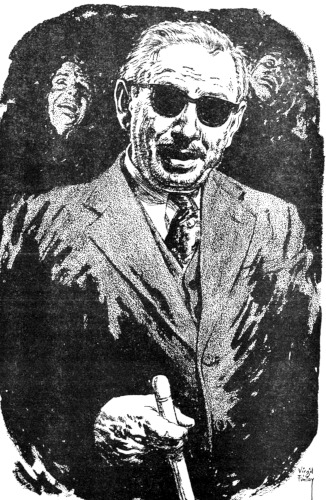
Hines moved swiftly to the bedside. Bland, clear blue eyes looked up at him above the rather incredible yellow whiskers. A booming voice said without emotion:
"I have been conscious for some time. Verdamm! Is that what happened?"
There was a distinct accent in his speech, but his sentence-structure was the careful accuracy of the educated European, tinged, presently, with exotic colloquialisms.
"If you heard me talking," said Hines, "you heard what happened. Yes. I'm Police Lieutenant Hines, and I want to know some things. Please try to tell me who you are and who you think wanted to have you killed."
"In spite of the very deffil of a headache," said the booming voice from the bed, "I have been trying to think of the answers to those questions for at least fife minutes. I saw the gentlemen who shot at me, yes. You, Herr Hines, were running toward them when I fell. But I nefer saw any of them before at any time. And I am verdammt if I know why they should shoot me. I am being calm, howefer. I shall give it my attention. Maybe I shall think it out. How much am I hurt?"
"Not badly," Hines assured him. He was biting at his lips and frowning in thought.
"Tell me," said Kathryn suddenly, smiling down at the bandaged man on the bed. "Were you ever in a place called Edginton, New York, or a place called Stony Mountain?"
The candid blue eyes turned to her, but they were wide with astonishment.
"Young lady," said the booming voice plaintively, "as a scientist I haff refused to admit magic into my considerations. But how in der name of forty-sefen deffils do you know that I came from there only a short time ago?"
Kathryn was twinkling triumphantly at Hines. He grunted.
"You win," he said briefly. "Go on."
"Who worked with you up there?" she asked. "I think he had you shot."
"Breston? No. He is a scoundrel in his way, and I do not like him. But he is a good scientist, and I haff no quarrel with him."
Hines grunted at the name. "Preston: he's about thirty-five," the detective said shortly, "very broad-shouldered, and he affects a Vandyke beard. His voice is rather harsh, and he speaks very precisely."
The wide blue eyes swung blankly to him.
"I think I will haff to call on more than forty-sefen deffils," the booming voice said more plaintively still. "Himmel! You know eferything. That is him. Do I need to say that my name is Schaaf—"
Kathryn looked up.
"Oh! You made the direct measurements of the size of a molecule."
The patient blinked.
"I nearly starff to death," he observed, "because there is in America no way for a theoretic physicist to earn a lifing. Nobody has efer heard of me. And I am shot at by utter strangers, I wake up in hospital—I must be in a hospital—and a young lady tells me where I haff been, a gentleman describes to me a man I most prifately dislike, and then I am reminded of a relatifely unimportant mistake I made six years ago."
Hines grunted impatiently.
"Preston's the man who had you shot, all right. And I think I know why. Professor Schaaf, it all works down to this. Up in Edginton you were working on the production of darkness, the neutralization of light—"
"No. Not I. I merely did measurements for Breston. He offered to gife me passage-money back to Europe if I did them. He got them cheap. Measurements of der mass and dimensions of der atmospheric ion, and changes in der mass and volume of der molecule when der allotropy of ionization took place."
"Well, then, Breston, or Preston, he was working on the neutralization of light—"
"Ach, no! On der production of fluorescence in ionized bodies under der influence of short Hertzian wafes. Wait—yes, I suppose you could say that. It is not scientific, but you might say that. When his apparatus finally got working it gafe off darkness that was like der bottom of hell."
Hines emitted a grunt that was almost explosive.
"Ha! Now we're getting somewhere! He has an outfit that makes darkness. It was used to help his gunmen escape when you were shot at, and I have excellent reason to think it's going to be used for more criminal purposes still."
"Criminal? It was pure science. Theoretic science. Der fluorescence of ionized substances under der influence of short Hertzian wafes. Does that sound like a help to safe-blowers?"
Hines drew a deep breath and began to talk. When he mentioned the shutting off of moonlight in Central Park, Schaaf nodded rapidly. He seemed to have lost surprisingly little strength.
"Yes. He could do that. He was working on a beam apparatus when I left, so that der darkness would be gifen off on one side only. He could not read der instruments before."
The account of the automobile accident that seemed to have been deliberately produced made the yellow-bearded man frown angrily. When Hines had given a succinct account of Lefty Dunn's police record and the ambitions he might be expected to cherish, Schaaf was rumbling in his beard.
"Hm—I see. I see. Maybe I can help you. Maybe I can't. I try, anyhow. I did not like Breston. He made me mad. When I saw der success of his experiments come about I said, 'Breston, I congratulate you. Der Atchison medal is der same as yours. If you carry on your work as splendidly as this, it may be efen that I shall yet read of you as a Nobel Prize man. You haff der disposition of a dyspeptic crab, but you are a great scientist and I congratulate you from der bottom of my heart.' I said that to him, in spite of der fact that he had made me mad. And he laughed at me. 'Atchison medal?' he said in a sneering sort of way, 'Nobel Prize! Schaaf, you are a damned fool. I am for bigger things than that.' And I turned around and left him. I thought he must be crazy."
Hines said curtly:
"With Lefty Dunn's organizing ability, he might pick up anywhere from a hundred thousand dollars to half a million within the next week, in New York City alone."
"Maybe, then, he is not crazy. You tell me, anyhow, he tried to get me killed. Hm—Lieutenant Hines, you send somebody to my room at that abominable house where I liff. Get eferything out of it. Eferything. I have papers of my own, and there are some memoranda of his that I took by mistake. I had intended to send them back to him. It was by accident that I took them. We will begin to see what we see. I haff an idea. And I will need all that I can findt about his figures."
Hines looked at the girl. She had been listening. But a good reporter, these days, does not go about with a pencil and a pad of paper. With soft shirts and soft cuffs in vogue, he does not even write on his cuffs. And Kathryn had no cuffs, anyhow.
"I'll go myself," said Hines briefly. "I'm going to post a guard at your door in case anybody has heard that you're still alive. My own opinion is that it would be wisest for you to die."
Schaaf blinked, and then smiled wryly.
"Ach, yes. It is better that I die. For der sake of my health, let us say. Fery well, I haff expired, and while you go get der things from my room I will think der wise deep thoughts of der defunct."
Kathryn smiled at the man in the bed and followed Hines from the room.
"I'm coming, too, if you don't mind," she announced, in the hall outside. "As a news story, this is a dud. Even if the Star printed it, the other papers would laugh. But I want to follow up what happens, because if Lefty Dunn and his friend Preston do use that darkness, I'll have the whole story for the Star while the other papers are just guessing. You see?"
"I do," said Hines, relieved. "It shouldn't be printed just now. I was trying to think of some way to persuade you to kill it, as far as publication."
It took less than five minutes to get two uniformed men on guard outside the yellow-bearded man's door, but it took ten to arrange that if any inquiries were made, by telephone or otherwise, the answer would be given that the bearded man shot on Fifty-Eighth Street had died without regaining consciousness.
"Schaaf knows too much about what Preston has developed," said Hines dryly. "Of course Preston wants him killed."
Then the little police runabout went sliding through traffic down town again. The fingerprint car had vanished from before the Blowbar Building. Hines let his mind linger hopefully on the possibilities fingerprints might offer if they turned out well. He went up the steps of the blowsy brownstone house. An angular woman with her head in a towel opened the door.
"I'm Police Lieutenant Hines," said Hines briefly. "A lodger here was shot about two hours ago and taken to the hospital. I've come to take charge of his effects."
He displayed his badge. The woman wiped her hands nervously.
"O' course you can go up," she said uneasily. "O' course! But his things have been took. A friend of his came an' said he'd helped put Mr. Schaaf in the ambulance, an' Mr. Schaaf was very likely hurt bad, an' he paid the room rent that was due an' packed the things up, an' 'bout half an hour ago he sent a taxi for the things that were left. He said Mr. Schaaf would be in the hospital for a long time an' he'd take care of them for him."
Hines's jaws snapped shut.
"He was a broad-shouldered man," he said grimly, "with a beard like a doctor."
The woman nodded, relieved.
"Yes, sir. He'd been to see Mr. Schaaf before, sir, but he missed him."
"When did he come in, to-day?" demanded Hines.
"Why, right after the ambulance left, sir."
Hines ground his teeth.
"I'll look at the room," he said savagely, "but it's no use."
It was very clearly useless to look in the room. It had been stripped clean of everything but the furnishings plainly provided by the house itself. The bureau drawers were emptied. The suitcase one would expect any transient to possess were gone.
"That was Preston," said Hines to Kathryn Bush with a savage calmness. "He was in here, packing up papers and such things, while I was in the building next door. He was probably in this room when I stopped on the sidewalk, not certain whether to come here or go first to the hospital. Nerve? That man has it!"
"And you think—"
"He'll bleed New York dry," snapped Hines. "He'll make the police force a laughing-stock."
The shooting of an unknown man who died without regaining consciousness was not big-time news. The curtain of sheer darkness which eye-witnesses swore had blocked the whole of Fifty-Eighth Street for nearly five minutes would have been big-time news had anybody believed in it.
Reporters who questioned Hines got noncommittal answers, found out that of the two men killed one was a well-known gunman previously supposed to be in Chicago, and let it go at that.
The fingerprints satisfied Hines completely and convinced the commissioner finally, but that bit of evidence was not made public. So the killing got an average of a quarter-column on an inside page in that afternoon's papers; the curtain of darkness was either not mentioned or was referred to as a smoke screen left behind by the fleeing car, and the whole affair was summed up as a New York reflection of a probable Chicago gang-war.
Schaaf grimaced when he re-read the accounts three days later. Hines had moved him from the hospital to his own apartment, and the big German was recovering rapidly. And as his strength came back a certain grimness came with it.
"Breston," he explained firmly, "is a scoundrel. He stole my records, which I had intended to publish. Those records are important. Himmel! I had an entirely new method of measuring. Der amplitude of der Brownian mofement in a dilute electrolyte enabled me to calculate der ion-masses perfectly. I had proof of der multiatomic nature of der molecule of six supposedly simple substances, by der demonstrable extra weight of der ions. Sooner or later I shall find Breston, and I shall exterminate him! I haff all my work to do ofer again, and right now if somebody offered to sell me der whole city of New York for six cents, I couldn't buy enough dirt to stop a watch."
Kathryn chuckled.
"I've an idea, Professor Schaaf," she said encouragingly. "When this thing breaks, you're going to get publicity. You're dead right now, of course, but when you're resurrected you'll be famous. And when you are famous—"
"When you are famous, efen if you are a fake," said Schaaf pessimistically, "der laboratories fall ofer themselfs to offer you a salary. All right. You make me famous, Miss Bush, and you, Mr. Hines, giff me a chance to practice Schrecklichkeit on that verdammt Breston."
He retired behind a cloud of smoke with every appearance of gloom. But presently he was explaining, in answer to Kathryn's questions:
"Breston does not make darkness. Not directly. He has found that ionized particles are fluorescent under der influence of certain short Hertzian wafes. And there are ionized particles eferywhere. Especially where there is dust. Fluorescence is der property of absorbing light of one wafe-length—one color—and radiating out light of a longer wafe-length, another color.
"You take rhodamine dye, for instance. You throw ultra-violet rays upon it. Der ultra-violet rays are a color so far past der blue end of der spectrum that it is infisible. But when they strike der rhodamine, they are absorbed and radiated away again as light of der most fifid of scarlet. Well, under der influence of Breston's short Hertzian wafes, der ions on dust-particles and in der air absorb all der colors of fisible light. And they radiate it away again as infisible colors we call heat, which is so far past der red end of der spectrum that you can't see it.
"Ordinary air contains enough ions to cause der absorption of practically all der light in der room. A laboratory with Breston's apparatus in it gets as dark as der bottom of hell, and after awhile it is as hot as hell's chimney."
Kathryn rose.
"I'll call on you," she said soberly, though her eyes had devils of mischief in them, "to give me a special interview. 'Thermometry in Hades. Famous Savant Measures Ultimates in Heat and Discusses Refrigerating Rooms for Red-Hot Mammas.'"
"Laugh," said Schaaf pessimistically, "but laugh in print, Miss Bush, and I won't complain."
He lapsed into a depressed silence as Hines and Kathryn went out.
"He takes the loss of his notes pretty seriously," said Hines, frowning. "So do I. He might have been able to work out something to neutralize the infernal thing."
"It's still hanging fire?"
Hines opened the car door for her. "Still," he said grimly. "We can't locate Lefty Dunn, but we do know that half a dozen of our most prominent gunmen and gangster-leaders have met him. We offered one of them, in particular, to forget about two of his most useful murderers if he'd come across with information that would enable us to nab Preston and Dunn. But he insisted he didn't know what we were talking about. The commissioner soft-pedaled the newspapers, but he's convinced. There were too many eye-witnesses to the last stunt."
"And so?"
"We're passing out word to all the big jewelers to put paste in their shop windows, and the banks especially have been warned to take extra care."
The little runabout was running swiftly down upper Broadway. The parked center-spaces with the air-ducts for the subway beneath were flowing by at an even, regular rate. Columbus Circle appeared dead. The façade and canopy of an uptown motion-picture palace swept by to the right.
A heavy gray car jerked suddenly out into the traffic and came purring up to a space no more than ten yards behind the runabout.
Quite silently and quite suddenly everything was blotted out. One instant the runabout was speeding along with Hines frowning abstractedly at the wheel; the next it was rolling through an opaque blackness that was so sudden that it stung the eyes. The girl gasped in her seat beside Hines. All the world was obliterated. The girl beside him ceased to exist; the wheel in his hands and his hands themselves could not be seen.
For perhaps three seconds there was stunned silence everywhere; then a multitudinous squealing of brakes, a scared squawking of horns.
The runabout shuddered as Hines jammed his foot down hard on the accelerator. It shot ahead through nothingness. There was a peculiar little lurch. He had swung imperceptibly to the left, and his left-hand tire had just slipped down the tiny drop of the surface-car rail exposed by road repairs.
"We're all right for a block or more," he snapped into the blackness all about him. "I'm following the car track, and all's clear for at least that distance."
He drove on and on. Brayings and bellowings arose on every hand. Every car in motion had stopped stock-still and its driver was sounding his horn desperately. Every man, it may be, believed he had been stricken blind. Certainly no man dared attempt to drive.
Hines eased the car to a stop.
"Get down in the bottom of the car," he said quietly into the nothingness that surrounded him. "I don't think they'll risk coming this far in the dark, but get down."
He felt the little car responding to her movement. Then there was a wait of seconds—minutes. Then, with a sudden flickering, the light went on again.
Pedestrians, groping hysterically for something solid to hold on to in their inexplicable blindness, grew dizzy and dazed at the sudden restoration of their sight. Drivers of many cars burst into speech which varied from the ludicrously prayerful to the grotesquely profane.
But Hines had whirled about in his seat and his service revolver was out and ready. The sudden return of light dazzled his eyes for a moment, but he saw a big gray car that had not quite stopped turn abruptly and dart off into a side street. It was crowded with men. It was the car that had pulled out from the curb and followed along some ten yards behind him.
With a grimace that was not in the least mirthful, Hines put his revolver away.
"Fooled 'em," he said harshly. "But I think hell's to pay to-day. This was half an accident."
Kathryn scrambled to her seat.
"I was s-scared," she said quietly.
"They saw me drive by," said Hines grimly. "Lefty Dunn has reason to dislike me. And I killed one of his men the other day, when they shot Professor Schaaf. So when they saw me they pulled out into the traffic behind me. They figured I'd do what everybody else would do when the blackness fell—jam on my brakes and blow my horn. And they'd come up to the car, turn off the darkness, fill me full of holes, and turn on the darkness again when they moved to a corner and turned down it. They could have sighted their way easily enough in two seconds of brightness. But I stepped on the accelerator instead."
The traffic was a nerve-racked, hopelessly disorganized mass of shaky drivers. Drug stores were being packed with clamorous people demanding a doctor's attention. Women had either fainted or were fainting all about. Because of the incredibility and consequent non-publication of the three previous uses of the darkness-producing device, every person who had been in the darkness considered that he had suddenly gone blind.
Hines jammed on his brakes again and fought his way into a drug store. He made two calls—using his police badge to force a way into the phone booths—and fought his way out again. The first strictly individual panic began to give way to a stunned amazement as people discovered that not only themselves but every one else had been blinded at the same instant.
The runabout circled Columbus' statue and went streaking down Seventh Avenue.
"I called headquarters," said Hines savagely, "and reported that I thought the whole works would come off within an hour or so. I admitted it was a guess, but Dunn and Preston are in a car fitted up to make darkness, and they aren't taking chances for fun."
"Please!" said Kathryn imploringly. "Please don't put me out of the car to make room for a detective. Please don't! If you're right I'm going to realize my life's ambition and scoop the town. The first things I learned in newspaper work were that there isn't any Santa Claus, and scoops don't happen any more. But please let me stay in this car!"
Hines shot on down town.
"Headquarters said the Merchants' National is moving three-quarters of a million in currency some time this morning. That will be Lefty Dunn's meat, if he can make it. When I stop the car you find a place to take cover."
A small, firm hand closed over his arm ecstatically.
"You're a darling!"
The runabout swung east at Thirty-Ninth Street.
"I phoned Schaaf, too," said Hines jerkily. "Told him I thought the darkness just now was intended to get me, but that I didn't believe it was planned. Just that they'd caught sight of me. He agreed, and said if things went dark there he'd crawl under a bed. They'd have to turn off the darkness to find him, and he'd have a chance to get some of them. He's enthusiastic and hopeful."
"He's rather a dear," said Kathryn exuberantly.
There were a series of staccato poppings to right and left. Half a dozen motorcycle police dived through the traffic and shot ahead, weaving in and out, in a dead run for Fifth Avenue.
"There's proof the commissioner's convinced," said Hines dryly. "He's afraid not to be."
He grunted in annoyance and swung in to the curb again.
"What's the matter?"
"I proposed that patrols of four or five men be put at strategic points down town, wherever being able to turn on the darkness would offer a killing. The darkness is shot out in a beam ahead of the car. The back part of the car that makes the darkness will be visible, as we saw in the park. And if we have a patrol closing in on the edge of darkness, wherever it may be, they'll spot that car."
He had dived out of the runabout and was plunging in to use a telephone again. Kathryn remained seated, her eyes shining. She began to visualize headlines, a by-line on the first page, photographs.
Then, quite suddenly, she realized that the headlines she had imagined were hopelessly bad, from a newspaper standpoint. Police Lieutenant Hines would be featured in the story, of course, but his name and title would not—would definitely not by any chance be set in hundred-and-twenty-point type across eight columns.
He came out, frowning.
"They'd forgotten it. It seems certain to be Fifth Avenue. They're going to post men now."
He shoved in the clutch and put the car in first. Fifth Avenue was only half a block away.
And there was a sudden flickering in the air, and then an obscure duskiness everywhere, and suddenly Thirty-Ninth Street ceased to exist about a hundred feet ahead of the car. There was a huge, thick wall of darkness that rose out of the earth and towered upward. For three seconds it loomed far above the tiny vehicles in the street, and suddenly it broke, and for three seconds more the light showed again, and then the cylinder of darkness abruptly formed once more and held.
Hines jammed on the brakes. He stared at the impalpable barrier of opacity that rose a hundred feet in the air.
"It's turned on," he said grimly.
Kathryn stared. The blackness looked almost exactly like the section of a monster cylinder of black velvet. There was not a particle of flickering or wavering about it. It was steady enough to seem tangible. A touring car with the top down was exactly halfway into it, and a woman in the back seat began to scream. The car began to back, slowly, and emerged from the apparently solid mass of darkness. The chauffeur stared up at it, his face a sickly gray. He backed and backed, senselessly, until his car crashed into a parked car behind him.
The black cylinder curved gently, and up aloft it could be seen to have a less definite edge. Four stories up on the Lord & Taylor Building one could see a cob-webby darkness begin at the edge of a window, and deepen to the complete opaqueness of a solid barrier only at the other side of the glass.
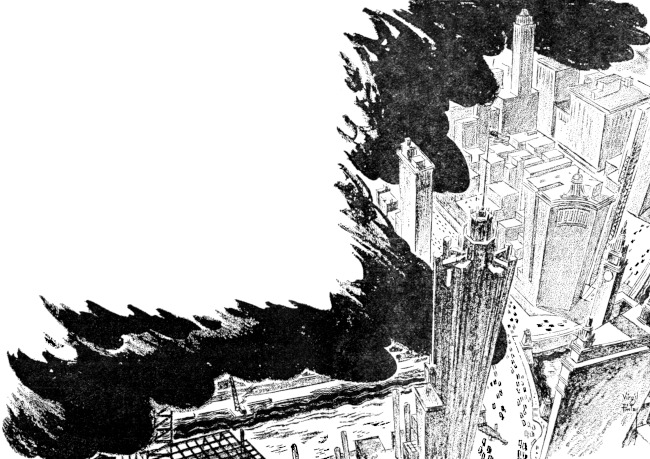
Then a monstrous, muffled uproar began on Fifth Avenue. It was the horns of many, many thousand cars being sounded by panic-stricken drivers to prevent their being run into while they could not see to drive. That moaning, discordant uproar began far down town. It extended far uptown again. It seemed to reach from one horizon to the other. And a vast column of implacable darkness lay athwart the city. It seemed to grow in size as it went uptown. At Forty-Second Street it was definitely over a hundred feet in height. At Fifty-Seventh it was two hundred, but seemed less tangible. It was thinner at the edges. In the Eighties it seemed hardly more than a thick, dense smoke that made all drivers slow down to a crawl and careful drivers stop altogether. At One Hundred and Twenty-Fifth Street it was a shadow only. Beyond the Bronx it was not noticed.
But from Madison Square to the Sixties a deep, discordant bedlam rose to the skies. The horns of thousands of helpless, stationary cars arose in a vast bellowing sound that seemed like a million-tongued cry of agony.
Fifteen minutes before, Fifth Avenue had been entirely normal, which is to say that it was crowded and picturesque. From curb to curb the asphalt was a solid stream of vehicles, going swiftly north and south in parallel lines, then halting abruptly for a space, and darting into swift motion again. The sidewalks contained their diverse populations.
About Madison Square, north of that small and isolated parking space the city fathers permit, there were openings in the wheeled traffic. And people could walk comfortably on the sidewalks, pausing to gaze into windows without being jostled, or they could hasten if they chose without jostling others.
Whistling young men in their later teens pushed wheeled boxes with a self-admiring dexterity from the location of one wholesale firm to the location of another wholesale firm. The occupants of the sidewalks were mostly men going from one place to another place.
Around Thirty-Fourth Street the character of the pedestrians had changed entirely. At least half the crowds on the sidewalks were women, and in consequence there was vast confusion and more than a little obstruction to anybody who had a definite destination. The wheeled traffic was a solid mass of gleaming vehicles, and a swift mechanical purring came from the space between the curbings whenever certain colored lights showed appropriate tints in suitable directions.
At Thirty-Ninth Street the pedestrian traffic was almost exclusively female, and most men moved west to Sixth Avenue if they were in a hurry. And a surging, solid mass of motors rolled north and south in mechanical obedience to lights and whistles in their five-block units.
This was fifteen minutes before the event that made women who could afford it have nervous breakdowns, and gave other women less luxurious nightmares for weeks afterward.
At about that time taxicabs began to appear here and there on the side streets leading to the avenue. The taxis stopped anywhere within a block of Fifth Avenue and disgorged their fares.
Most of those passengers were youngish men, and nearly all were impeccably dressed, and a few of them had that curious bluntness of features that comes of many batterings in many battles. Some, however, were distinctly shabby and furtive-eyed. And there were a few figures who were not young at all, but old and bent and broken. But in all these anomalous newcomers to the avenue one common feature could be observed. All were eagerly expectant, and all were more or less uneasy, or at least in doubt.
But for the most part the arrivals passed unnoticed. A patrolman at Thirty-Seventh Street widened his eyes at sight of one little group of amiably chattering young men who smiled and talked and very curiously did not move their lips at all. That patrolman turned deliberately about and strolled in their wake, swinging his night-stick and privately cursing the fact that so many women had not stayed at home that day, and that a policeman has so many duties entirely unconnected with the basic duty of his profession, and that he might lose sight of those young men if some fool woman stopped him to ask an idiotic question.
A traffic cop stepped over to a motorcycle patrolman resting on a still but chugging mount beside the curb.
"Better keep an eye on that car, Pete. I think I know the guy that's drivin' it."
And the motorcycle sputtered loudly and drifted off into the stream of vehicles.
A doorman outside a particularly exclusive store cocked a wise eye at a bent, white-bewhiskered figure trudging rather pathetically through the crowd, buffeted about by chattering women. The doorman was an ex-cop, and reflected inaudibly:
"There's old Schmeel, out of stir again. He'll be gettin' in trouble if he tries his old dip tricks in this crowd."
These observations were made, it is true. But the vast majority of the new arrivals slipped unnoticed into the throng. Even the fact that a great many of them looked now and then at their watches passed without comment.
Of course, no one could have been expected to observe a gentleman who had rented desk-space three days before, in a front office overlooking the façade of the Merchants' National Bank. He was gazing intently out of the front office window, and he held an office telephone in his hand.
No one could have guessed that he was talking to a man in another office fronting on Madison Square. Nor would any one guess that the man next to him with another telephone instrument in his hand was similarly connected with a telephone booth in a confectionery store just around the corner from Fifth Avenue.
A big gray car parked in the triangular parking space where Broadway crosses Fifth; it was not particularly observed, even though it was not empty of people like the other parked cars. And nobody at all noticed that the man at the driver's wheel was a broad-shouldered man with a professional-looking Vandyke beard, or that he was looking intently up at a window in which a man stood with a desk telephone in his hand.
Fifth Avenue for its whole length was a picture of swift and colorful movement in the bright sunshine. From the sidewalks where women predominated a babble of voices arose with the shuffling sound of many feet in movement. From the roadway came the booming, purring noise of many motors and the singing of innumerable tires. It was a highly picturesque and wholly normal sight.
But suddenly, one of the two men in the office facing the Merchants' National Bank said sharply:
"It's in sight."
The other man spoke into his transmitter. A clumsy gray object had appeared in the flood of wheeled things flowing below. New Yorkers gave it no second glance. Armored cars, equipped with bullet-proof walls and tires, and armed with machine guns and hand-grenades, move regularly through the streets of New York. It is, you see, the most civilized city in the world, and therefore land battleships are necessary for the movement of valuables about its thoroughfares.
"Get movin'," snapped the man whose phone communicated with the phone-booth around the corner. "The cops are comin' out now. They' goin' to rush it."
He listened, hung up the receiver, and lit a cigarette. His hands trembled a little. Four policemen were issuing suddenly from the bank. But six young men were rounding the corner, five of them having just ceased a cordial conversation in a candy store lobby on having been joined by the sixth from within. The policemen more or less efficiently checked the flow of pedestrians. They had a clear path made from the bank doorway to the curbing at the exact instant that the armored car came to a complete stop. It was excellent, neatly timed work.
"It's stopped. Get set!" The man at the telephone to Madison Square was tense. He'd seen, too, the six young men among the milling, curious crowd that had been checked by the police guard.
The door of the armored car opened. Simultaneously, two men appeared in the doorway of the bank, carrying apparently heavy bags. They came quickly down the steps.
"Shoot the works!" snapped the man at the telephone. His voice was strained to the breaking point.
There was a breath-taking pause, just about long enough for a man in a window on Madison Square to make a signal with his hand, and for that signal to be acted upon by a man in a parked car. Then, quite suddenly, darkness—tangible, blank, and absolute—fell upon the earth. All visible objects were blotted out.
It held for three seconds. Then unbearable and unbelievable daylight flooded the world once more. A shot, two, three—Then darkness fell again in the same incredible quietness and with the same unbelievable intensity.
From the darkness there arose the sound of firearms crashing savagely. There were screams. And then from south to north, as far as the ear could range, came the discordant, throaty bellowing of automobile horns. Men, struck blind, jammed on their brakes and set their horns to bellowing. The tumult that arose was horrible and insane; it was insistent and terrifying.
The crashing of guns ceased. The crowded, stunned mass of people before the Merchants' National heard panting snarls, heard a voice gasp triumphantly, "Got it!" and then many of the blinded, staggered people were hurled aside.
The bellowing horns of the cars were enough for orientation. Men and women who had stopped stock-still with their hearts in their throats at the sudden feeling of hopeless blindness upon them, were hurled to the ground.
A compact group of panting figures was heading swiftly and ruthlessly northward, and battered its way through the dazed crowd until a shrill whistling sound was audible through the deeper toned bellowing of the horns. Those figures turned in their savage progress, then, and clutched at the man who blew that whistle. He chuckled. A blind man is a good guide in darkness. He went before them, tapping, down a side street.
Unbelieving people who stared from bright sunlight at a monster cylinder of darkness that seemed to have engulfed Fifth Avenue saw six hatless young men come panting out of that darkness, dragging two heavy bags, saw them pile themselves into a waiting car, and saw that car plunge madly away from the darkness and the uproar that issued from it. And a blind man chuckled and went tapping his way back into the darkness.
That, though, was not the only occurrence which later showed that the darkness had not been unexpected. An old, bent blind man, returned from guiding panting gangsters to the light, went zestfully about his ancient trade. A dip, of all men, needs his eyesight second only to his nimble fingers. But here all men were blind.
There was the cushioned tapping of a stick amid all the tumult of blaring horns, and figures felt one brush accustomedly against them, and were too dazed to feel gentle but nimble old fingers abstracting here a wallet, there a watch.
Proprietors and clerks in jewelry stores fronting on the avenue heard the tremendous crashings of their plate-glass windows, and burglar alarms rang resoundingly, clanging clamorously even through the bedlam from without. Those clerks and those proprietors were entirely helpless to stop the clutching fingers that reached in and groped, and left empty traps where treasures had been on view before.
One man was found dead with a knife wound in his back, when the darkness lifted, and he was known to be a person who had acquired a certain amount of wealth by very dubious means, but nobody ever found out who had preferred the opportunity of a safe revenge to the chance of robbing with impunity.
For fifteen minutes Fifth Avenue was in darkness, darkness that was tangible and blank and absolute, and in that fifteen minutes forewarned persons of the underworld reaped a harvest. Each to his specialty, they sprang like wolves in the blackness whose duration they foreknew.
The list of thefts alone filled two columns in the next morning's papers, and there were some persons badly hurt—mostly women, who clutched hysterically at hands that groped about them. The list of smashed cars and traffic accidents was impressive. There had been three or four drivers who lost their heads and plunged madly through the blackness until brought up by insurmountable obstacles.
And since the underworld is the resort of people of all grades of mental distortion, there were one or two crimes that were quite too horrible to be reported in full.
But at the end of that fifteen minutes, with the barest possible trace of flickering, the darkness vanished as suddenly and as silently as it had come. The sunlight shone again upon hordes of motors, blaring frantically, and upon streets full of people who abruptly charged frenziedly here and there the instant they could see to flee. There were small crumpled figures which were women who had fainted, and who were, quite frequently, inconspicuously robbed of purses and trinkets while the hysteria of the light returned still held.
In all this uproar a gray car moved quietly out of the parking space the city fathers still permit in that vast triangle of asphalt where roadway crosses Fifth Avenue. The columnar—later it was proved to be the cone-shaped—beam of darkness that had been sent north from Madison Square had widened out at that spot.
For nearly two blocks in every direction the darkness had held about Madison Square. So that the gray car moved undisturbedly out of the parking space, and turned, and went down the nearly emptied lower Fifth Avenue to Ninth Street, and there turned east and vanished.
And nobody seemed to notice that it was driven by a broad-shouldered man with a Vandyke beard.
The street lamps glowed with a peculiar glitter upon pavements still wet from a recent rain. The rumbling of the city, which never ceases, had died down to that partially discordant muttering which is the city's voice in the small hours.
Kathryn came out of the doorway and shivered a little at the damp chilliness of the night air. But she smiled warmly when Hines held open the car door for her.
"It's decent of you," she said gratefully, as she stepped in and when the car started off. "I almost refused to get up when the telephone call came, but I'm glad I didn't. You think something's going to happen?"
Hines nodded. The little car was purring toward Broadway and swung into the nearly deserted but brilliantly lighted way. It began to shoot on down town with a singing of tires.
"Either we get him," he said tiredly, "or we'll have to throw up the sponge. I've never worked so hard in my life as I've done this last two weeks."
It was two weeks since a cone of darkness had lain along Fifth Avenue's length for fifteen minutes and left New York panic-stricken. In those two weeks Hines had been doing the work of at least six men. He was the only man in New York, aside from Schaaf, who would recognize the man Preston. And Preston had to be found.
"Crooks are fools," said Hines drearily. "You'd think those yeggs that were tipped off about the darkness would have known how to take advantage of it. But we picked up six more men to-day that we'll be able to send away for long stretches. Fingerprints, of course. You'd think a man who was going to smash a jewelry store window, knowing he couldn't be interfered with, would have the sense to wear gloves. We've got the men who robbed Blakes', and Houton's, and a couple of others. Their fingerprints were on glass fragments inside the windows. They'd cut their fingers on them and flung them out of the way as they groped for the stuff on the trays."
"But no trace of Preston?"
"None. Oh, we've done what we could. We've third-degreed and sweated every man we've picked up. We've had the station houses full, too. And we've worked. We've caught a bunch of the little ones, and recovered a good bit of property, and we have the goods on half a dozen fences we've been trying to get for a long time; but Lefty Dunn and his mob got away clean, and Preston with them—and they got three-quarters of a million from the Merchants' National. In currency."
There was silence as the car sped on down the nearly deserted street, passing no vehicles except occasional brilliantly lighted taxicabs. It passed Columbus Circle, and a little later it passed Times Square, and still went on down town.
"I—I feel almost ashamed of myself," said Kathryn soberly. "I tried to help all I could, when you were working to forestall Preston, but secretly I was almost hoping you'd fail. It would let me scoop the town. And it did. My salary was raised because I had all the story and Professor Schaaf's explanation of what the darkness was. But—it was terrible. And people are still afraid it will happen again."
"Why not?" asked Hines tiredly. "It can. We haven't a thing to go on. Schaaf's had the American Electric laboratories put at his disposal, and he's buzzing about there blissfully, talking about the possibility of heterodyning 'die verdammte short Hertzian wafes that cause der trouble.' But he's got to duplicate Preston's results before he can try to neutralize them. And so far there's been no reason why Preston shouldn't turn on his darkness anywhere in the whole city and make another clean-up at any minute."
"But there've been precautions—"
"Oh, yes. Sternutatory gases—sneezing gas bombs—in show windows, ready to be set off. Half-million-candle-power flares that will burn five minutes in every bank. That much light probably won't be absorbed by those ions Schaaf talks about. And guns. Most of all, there's the fact that people know what they're up against, and will fight back even in the dark. But I'm putting a lot of hope in to-night's work."
"What's happening to-night?" asked Kathryn.
"The banks have been working by non-negotiable paper more than ever," said Hines uninterestedly. "Wall Street went into spasms for awhile, but took to issuing certificates for its negotiable securities. Short of getting currency out of the Reserve Bank down there, it would be pretty difficult for Preston to make much of a killing where most of the money is. But money has to be shifted now and then.
"There's four millions in money and securities that has to be shifted to-night. It was intended to do it secretly, but we found the news had leaked. We think it leaked, anyway. And if it did, it leaked to Lefty Dunn, and he'll make a try for it with Preston's help. We're going to try to step on it. I've helped with the preparations, Schaaf's helped more. He saw Preston's outfit up-State, you know, and he made a suggestion or two that looks promising. I'm going to park you with him, if you don't mind."
The car was far down town indeed now. Kathryn saw "Broome Street" brightly illuminated on a corner signpost. But the runabout went on and on, and the buildings grew taller and taller until the thin thread of sky overhead was almost lost between the desolate lean flanks of the structures on either hand.
Hines turned off to the right, stopped the car, and switched off the lights.
"We'll walk from here." He looked at his watch. "Half past three. Two hours to daybreak. You'll lose a lot of rest."
"I got some sleep," she said.
They walked on toward the Battery. Their pace seemed a crawl, after the swift flight of the little car, and they seemed rather to be moving through a cavern than any inhabited city, and the desolation of dead buildings seemed to press down upon them and appall them.
It was a long, long walk through a desert of brick and steel. Suddenly Hines turned in to a deserted doorway, and a voice spoke softly, and they followed a hall to where a shaded electric bulb burned dimly, and Kathryn saw figures sitting in readiness for something. She could not know what.
There were one or two uniformed men among them, but the others looked strange indeed, and Kathryn could not distinguish the cause of their oddity. She was hustled into a tiny elevator that promptly began to rise to the steady humming of a hidden motor, through dark and unoccupied floors with the smell of emptiness.
The elevator stopped. A walk along a dark hallway to an open door. Into an unlighted room in which a pipe glowed and in which there was the sound of movement.
"Hines?"
"Right," said Hines briefly. "I've brought Miss Bush. She gave enough information before that affair of two weeks ago to have given us a chance to stop it. She's entitled to a front seat."
A voice growled. Kathryn smiled wickedly in the darkness. That was the commissioner, sitting up here in a darkened room.
"Ah, Miss Bush," Schaaf spoke amiably from the darkness. "You did not giff me der chance to thank you for making me famous. Come and share my window. Hines is going down into der street again."
She moved hesitantly through the darkness until he took her hand and pressed it. He led her to the square of grayish light that was the window.
"We are ten stories up," he told her. "If you do not mind der height, look down."
She saw the street far below her, empty and gray and desolate, but peculiarly clear by reason of the shaded street-lights.
"Der bank is opposite us," said Schaaf softly, as if afraid of betraying the presence of an ambush by normal speech. "You see der little lights inside. They haff four millions of dollars ready to be mofed in an armored car, when it comes. They feel, Miss Bush, about that four millions of dollars as I felt about my notes on der proof of der multiatomic nature of der sodium chloride molecule. That four millions is fery precious to them, Miss Bush, though they will nefer spend a cent of it. Just as my notes were fery precious, though I could not spend them."
He craned his neck. Far away, down the deep and narrow chasm below the window, a brightly lighted taxicab came in a peculiar silence. It seemed to roll noiselessly down the deserted street, and red and green and yellow lights glittered upon it, and the white paint of its hood glowed brightly as it passed close by a street lamp. It came on, and maudlin song arose faintly from it. It sounded like a drunken group of revelers, moved by some whim to invade the financial district at night.
It passed below and went on.
There was a muted whirring. The commissioner's guarded "Hello!" Then gruntings. He hung up the receiver.
"Their lookouts, most likely, in that taxi. They don't know we know about the leak, but they're scouting, anyway."
There was the movement of other bodies in the room. Kathryn suddenly realized that there were probably four or five other men in there, silent and waiting. One of them snapped a lighter and shielded the flame with his hand while he puffed a cigar into a glow.
Kathryn caught a sudden glimpse of a curious collar about his neck. It was a telephone transmitter hung in place, and there were headphones over his ears. This was an office already fitted with several phones, evidently, which had been taken over for use as a temporary headquarters for the night.
"Er—hadn't we better—" began the commissioner uneasily.
"Shush," said Schaaf placidly. "Lieutenant Hines told me how it should be done. Shush for awhile now."
Kathryn wanted to giggle. She felt very nervous and very much thrilled, and more than a little apprehensive; and her muscles were uncomfortably tense.
A man came out of the bank, far below. He looked up the street and then went back inside again. The bank became black and blank and dark again.
"They expect der armored car," observed Schaaf. "Now we can haff a little smoke. You might tell them."
He was talking toward the back of the room. A man spoke quietly into a transmitter.
Kathryn gazed about and saw nothing. Schaaf felt the movement.
"Wait. Der performance will be intricate," he said, and chuckled.
A minute. Two. Then there was a brittle little tinkling of glass somewhere. The scraping, musical sound of glass falling down the stone side of a building. Kathryn started.
"That—that's a fire over there. It must be!"
Smoke was welling hazily out of a broken window in a building on the opposite side of the street and a half block away. A wavering reddish glow became visible.
"To be sure," said Schaaf tranquilly. "It is an excellent effect."
He glanced once at it and stared down, looking far uptown and ignoring the gradual accumulation of a vast mass of whitish vapor curling up the sides of the buildings across the way. A second window broke with a second brittle tinkling. A fresh billowing of smoke came out.
"Here is der armored car coming," said Schaaf.
A man spoke quietly into a transmitter. Kathryn looked down.
Far away, coming sturdily down the deserted street, one of the squat gray armored cars which carry valuables from place to place in New York was speeding noiselessly. Four motorcycle policemen ringed it about.
It swept up to the bank and stopped. One of the motorcycle policemen suddenly pointed upward. There was an intensification of the red glow back of the thick smoke. The motorcycle cop had stopped his machine. He now ran swiftly to the nearest corner and worked busily at a little signal box.
"Eferything according to schedule," said Schaaf. "He is turning in der alarm."
A muted whirring. It was a telephone bell, muted. A man answered, and said quietly:
"Two cars are coming down Church Street at forty m.p.h."
Kathryn felt a little electric thrill running over her. The commissioner stood up and came over to one of the windows, gazing down nervously.
Schaaf said meditatively: "I do not hear der engines. Tell der bank not to hurry. And tell them of der two cars."
A man murmured at the back of the room. Kathryn was staring at the fire. The smoke coming out halfway up the building across the way was thick and dense, and the red glow behind it was fiercer. Then she heard a faint clatter and clanging.
"Hines," said Schaaf in her ear, "he is a smart man. He thinks that somewhere in der buildings all about there are men watching who can report by der telephones, and can signal that der beans are spilled. That is der reason for der verisimilitude."
The clanging and hooting grew louder. Making a monstrous tumult, building up a tremendous uproar, fire-engines came racing down the street. A steamer clanged to a stop and coupled swiftly to a hydrant. A hook-and-ladder came racing. A hose-tower after it.
The bank doors opened, and men made ready to come out.
Around the corner of the nearest street two heavy cars came hurtling. A machine gun began to spit, and filled the cañon-like space between the tall buildings with a snarling uproar. Water geysered upward for an instant and swung sharply toward earth.
Kathryn, staring down, saw the four-inch stream from a hose strike the foremost car and crash in its windows like so much wet paper. Then, abruptly, the street and the lights and the armored car and all the puffing fire-engines ceased to exist. And at the same instant something flared intolerably overhead and the buildings on either side of the street for many blocks to north and south began to gleam brightly.
"Breston," said Schaaf, very calmly indeed, "he has turned on der dark. I guessed right about der probable height of der phenomenon. Now, we shoot der works!"
A river of darkness seemed to have filled the street below. A dull black substance seemed to have welled up instantly and to flow silently and without disturbance between the tall rows of buildings, as the Styx itself must flow between its banks. Flares, the huge magnesium torches that are used by aircraft for landing at night, were burning atop buildings for blocks on either hand.
From the motionless surface of the darkness the smoke and steam of the fire-engines coiled upward into the glare above. The fire which had been the excuse for calling the fire-engines had abruptly gone out, and the welling smoke from the windows had ceased. The watchers in the tenth-floor office looked down upon a surface of blackness imprisoned between the walls of office-buildings. And submerged in that abysmal dark there were men.
Dull, thudding concussions sounded from below. Windows quivered.
"Bombs," said Schaaf calmly. "They were ready to smash open der armored car if they were too late to nab der shipment before it got in. Now they use der bombs because they are scared. I will bet anybody that Breston is shaking in his shoes."
The horrible shrill scream of a man in agony came echoing cavernously from the impenetrable blackness below.
A man spoke quietly at the back of the office.
"The bank doors are closed and the money's safe. They want to know if they can turn the juice into the doors."
"Himmel! No!" snapped Schaaf, as the commissioner rumbled an assent. "Firemen are sweeping der hoses all about. Do they want to electrocute them if a stream of water hits der doors?"
The commissioner hastily made his assent into a negative, and returned to his study of the incredible scene. The buildings rose out of nothingness, and their sides were apparently incandescent from the flames burning above.
Down there under the surface of the blackness, the fire-engines swept their streams of water to right and left and up and down. They were working blindly, of course, but whatever those streams of water struck would go down. Plate-glass, cars, men.
"Verdamm!" said Schaaf presently, though without dismay. "Hines is a smart man. He don't take chances. We were hoping, Miss Bush, that a stream of water would smash into der car where Breston had his apparatus working. If it got into der coils it would short-circuit them and der apparatus would work no longer. We could take a look at die Schweine then. But der engines are still working, judging by der steam that comes up, and still der darkness holds. Hm—Ah, here comes der first flare down."
A ball of fire, incredibly white and unbelievably fierce, descended before Kathryn's eyes. It was swinging down swiftly by a dangling steel cable. It went down in swift swoops of fifteen and twenty feet at a time.
"A magnesium flare," said Schaaf softly. "It has half a million candle-power. We try him on der dog. Ha!"
The flare reached the definite surface of the blackness. It seemed incredible that no glitter came from that surface. It dived into the flood of darkness. Its white light turned to red. Down and down—Fifteen feet in the black flood and it could be seen as a dully glowing red ball, no more.
"No more flares," said Schaaf quietly over his shoulder. "They don't work. Der darkness absorbs all der light. But keep der other flares going on der roofs. Now we try."
A voice spoke quietly from the row of telephone instruments.
"Lieutenant Hines reports that the street is full of gas. Sneeze-gas."
"No. 3 expedient gone to hell," said Schaaf calmly. "We hoped from der water, and we hoped from der flares. And we had sneeze-gas and tear gas bombs ready to smash in der street. But they intended to use it themselves to disable der armored-car crew and der bank people, I suppose, and they must haff masks. It is der deffil that Breston got so much money two weeks ago. He has capital to supply his friends with all modern improfements. Hm. All right. Tell that fire-eater Hines to get ready to go out with his mopping-up party and raise hell. Set der gongs going."
A man spoke quietly at the back of the room, and to the chatter and chuffing of engines in the street there now was added the heavy measured clanging of monster gongs. The engines shut off abruptly.
"Der gongs are signals," said Schaaf quietly. "It is Hines' idea. They signal to der firemen to cut off der water, and he and his gang go out hand and hand to sweep der street and grab anybody that has not a rubber suit on and smash him behind der ear. He and all his men are ex-soldiers, and they pretend it is a patrol between trenches. Also, der gongs keep them oriented so they know which way is which. Those motorcycle cops had orders to duck in der armored car if der darkness fell. I hope they remembered, or somebody is likely to sock them in der jaw."
The commissioner growled from the next window. There had been a sudden silence. The firemen had fumbled their way to their engines and climbed up on them. The street below should be empty of all living creatures except Lefty Dunn and his gangsters, desperate and at abay, and the sinister figure of the man who, allied with the underworld, seemed to have had the city at his mercy. Shots sounded suddenly from below.
"Somebody is going to get scared, now," said Schaaf. "Herr Commissioner, our Lieutenant Hines is out and fighting like der deffil. Der gentlemen for whom we are gifing this party will try to run away now. If you will giff orders—"
"I've got a cordon all about the darkness," growled the commissioner.
"Der idea is," said Schaaf patiently, "that Breston has not a full-power darkness-producing outfit with him, or else maybe der water got to some of his batteries and cut down his power. He can't drife a car in der darkness. He will try to walk, carrying that suitcase apparatus with him. Tip off der cordon of reserfs to leafe one man at efery corner, especially der corners where there are police telephones. Maybe they can tip us exactly where he arrifes."
The commissioner coughed, and swore privately to himself for not having issued the orders on his own initiative. He gave them.
"That, also, was Hines' idea," said Schaaf placidly.
He looked at his watch in the glare that came in the window. Another shot below. Three more. A shriek.
"It should be sunrise in half an hour more, maybe less," he observed. "I hope der verdammt fool is caught before der people try to come down this way to work. Otherwise we will haff to stop der subways."
He looked sharply at the girl beside him. She was shaking peculiarly. Her lips were caught between her teeth and her eyes glistened suspiciously.
"Shush!" said Schaaf in her ear. "I know. I am scared to der bottom of my marrow, too, but that fighting fool Hines is all right. He has to be! And if you cry now, I will tell him about it afterward! That is a threat! Shush!"
She caught her breath, struggling to fight down sobs of nervousness.
A man said briskly from the row of telephones:
"The cordon, sir, reports that the blackness is moving. It's moving on down town. It is three blocks long and three wide, and it has moved half a block south."
Schaaf grimaced, and then grinned.
"Haff somebody yell that out in der street to Hines. He will know what to do. Are members of der cordon posting themselfs in der high buildings and smashing in doors to get at telephones so they can watch der darkness and tell us? I suspect Breston will switch it off for an instant to try and see where he is, after he mofes a block or two."
A man spoke briskly into a telephone. And Schaaf said pleasantly:
"Hines efen thought of that, in case all der other things did not work. I told him he was a pessimist, but I admit now that he is smart."
Silence. There were no more shots. The lights flared brilliantly outside. One dimmed, and another took its place. The unwavering, opaque blackness below—it was almost impossible to look at it without believing that it was a solid substance—seemed to flow noiselessly like a river of death between the starkly illuminated buildings on either side, but Schaaf said suddenly:
"It is going down! He has mofed a block or more with his apparatus!"
Kathryn stared. The upper limit of the blackness had receded. It was hardly more than three stories above the street, now. As she watched, very, very slowly it went down still more.
"He is going south. On foot," said Schaaf, "as Hines predicted."
Five minutes later the street itself was dimly visible. The street-lights appeared as dull red glows, which grew brighter and turned white. The squat gray armored car appeared. There were two figures moving spasmodically on the pavement beside it. The darkness drew on toward the south. Two more figures, crumpled up and still. A car, slued around with its windows smashed and the hood torn off its engine by the force of a stream of water. Minutes later another car appeared dimly as the darkness became merely murkiness. It, too, was washed clear of windows.
"I bet," said Schaaf intently, "Breston almost got caught by a stream of water, and hid behind his car for protection from der hoses until they were turned off."
"Is—is he safe?" asked Kathryn in a strained voice. She was not, one gathered, asking about Preston.
One of the men at the telephones said quietly:
"Lieutenant Hines asked just now for the position of the center of the darkness. I gave it to him from the reports of the cordon around its outer edge."
Kathryn gasped in relief.
One of the other men at the telephones said swiftly:
"Report. The darkness was turned off for about two seconds. Preston was seen, carrying two heavy suitcases and staring about him. There were two other men with him. Lieutenant Hines fired on them and saw one of them fall."
Silence. Looking down from the windows now, the street was clear. But to the south the darkness rose from the pavement and filled the space between the buildings.
"It seems cruel," said Schaaf gently, "for all der whole police force to be hunting down three men as if they were mad dogs, but they are mad dogs. Der newspapers did not print all der crimes that happened on Fifth Afenue the other day. They could not. And Breston permitted those crimes deliberately. He arranged to turn der underworld loose for a share in der profits. He got that share. And he will do it again if we do not catch him."
The commissioner coughed, and said suddenly:
"See if the gas has cleared down in the street enough for us to go down."
A quiet inquiry.
"It is reasonably safe, sir."
The commissioner strode to the door. Kathryn looked appealingly at Schaaf.
"It is working like a well-oiled clock. We go down and follow der darkness, and maybe we see Hines, eh?"
The elevator was brightly lighted, now, and descended with a cheery hum. And the street was bright, though it was a ghastly brightness. They emerged to the sidewalk. An ambulance clanged up and stopped. Men had come out of the armored car and were bending over the writhing figures beside it.
"Sneeze-gas," said Schaaf quietly, "it is terrible. It produces a horrible exhaustion. But it is not fatal."
The still figures a little distance off were gangsters, with gas-masks adjusted in marked incongruity to their loudly checked and now soaked and draggled clothing. Uniformed figures were moving about, investigating. The firemen were cheerfully coiling up their hose and preparing a return trip to their engine-houses. Two more bodies of gangsters. A man in a rubber suit—one of Hines' men. Twenty yards on, another gangster.
There were seven gangsters and two police in the space of a block. Beyond that the pavement was blessedly bare. Schaaf looked east at the first side street.
"Der sky is lightening. Day will soon be here," he said quietly. "I think we get Breston."
They walked quietly after the slowly moving mass of darkness. On the ground-level, here, it looked vastly different. It rose in an irregular, clumsy curve. Seen from behind it looked oddly like some monstrous, prehistoric monster edging itself painfully down a cañon whose walls closed tightly upon its sides.
Four blocks down they found two policemen carrying off a figure on a litter.
"Lefty Dunn, sir," said one of them, satisfiedly. "Lieutenant Hines shot him, sir. He's dead."
Two blocks further a policeman was beaming as he inserted his key into the police telephone box.
"Just taking up cordon work here, sir," he reported happily. "The darkness is dwindling fast. It's hardly more than two blocks long and wide, sir."
"His batteries are running low," observed Schaaf. "Soon he is in der soup."
They hurried a little, now. It seemed as if the two fleeing men were guiding themselves by the trolley-tracks and could make better time in the horrible darkness all about them. A little farther on there was a clatter and clanging, and a chemical engine appeared where a policeman was playing a hand fire-extinguisher on the awning of a corner cigar store.
"Ah," said Schaaf pleasantly. "They are getting desperate. They tried to make a diversion by starting a fire. That is foolishness. It only adds arson to der charges of robbery and murder."
The cigar store was at the corner of Wall Street and Trinity churchyard showed a certain duskiness at its southern edge, but that was all.
And five minutes later they were able to view the darkness as a whole. It had moved out into the clear space which is Battery Park. The flagpole of the Aquarium rose above it. It was a circular, flattened mass of black with ragged, hazy edges. It stood like some monstrosity in the mass of green things. It was hardly more than two hundred feet in diameter, and it was certainly not thirty feet high. And it seemed to be still dwindling slowly.
Hines came up, with sweat-streaks on his face and powder-marks on his hands. He was wrapping his handkerchief around one wrist, which was bleeding.
"Cut it," he said quietly, "breaking in a door to get at a telephone booth. I called up Governor's Island, sir," he added to the commissioner of police. "They have some army planes there."
The sky was getting lighter and lighter. The harbor spread out as a lucent gray, and ships at anchor began to take definite shapes through the morning air. The Statue of Liberty rose gray and misty from its base.
The ominous mass of blackness was the only incongruous thing in the whole spectacle of the sunrise. That pancake of malevolent darkness was still, clinging to the outer edge of the park, with nearly half its diameter spreading out over the waves of the harbor. A sudden chug-chugging arose. The blackness began to move. It swept out over the water, moving steadily and doggedly.
"Himmel!" snapped Schaaf, his mouth dropped open. "They found a launch! Breston will make for der Jersey shore and land, and der Jersey police cannot make a cordon in time to stop him from landing and hiding himself."
"Don't worry," said Hines grimly. "Look there!"
A little dark speck detached itself from the earth of Governor's Island. It rose and rose, and a dull muttering drew nearer and nearer. The noise rose to a roar, and an army plane swept above the moving monstrosity of blackness. It circled and swooped.
Something dropped. There was a heavy concussion, a vast and crackling detonation.
And then there was abruptly nothing upon the water, anywhere, except a spouting mass of spray and smoke, and a few remnants of a boat that swirled about and sank as the plume of spray subsided. The blackness had gone out like a blown-out candle.
"Good shooting," said Schaaf comfortably. "That must haff been a big bomb. Now we will haff difers hunt for der fragments of Breston's apparatus, and we will find that we can't do a damned thing with them. Which from der scientific standpoint, is a fery great pity."
Hines unconsciously brushed his hands together.
"It's finished," he said, suddenly very tired.
The commissioner of police coughed. "Inspector Hines," he said, "I—er—I may not have co-operated with you as fully as I should when you first reported this matter; but—er—in the future you will find no cause for complaint. Come in to see me to-morrow."
He moved abruptly away. Hines stared after him.
"Inspector?" Kathryn gasped.
"Yes," said Schaaf placidly. "Inspector Hines. The commissioner is like Napoleon in his promotions. Yes. All of us haff our Napoleonic moments, and he did this fery nicely. You are Police Inspector Hines hereafter and I congratulate you. And I think, Miss Bush, that as a fery good friend of his, if I were you I would take der moment of congratulation as an opportunity to kiss him. It might not be unpleasant."
Kathryn swallowed something.
Hines flushed a little. "You've got your scoop," Hines said awkwardly, ignoring Schaaf, "and this time there is nothing to regret about it."
"I—I don't care!" said Kathryn firmly. "About the scoop, that is. It doesn't matter. But I am going to kiss you."
And she did.
THE END