The Project Gutenberg eBook of Collected papers, Volume II
This eBook is for the use of anyone anywhere in the United States and
most other parts of the world at no cost and with almost no restrictions
whatsoever. You may copy it, give it away or re-use it under the terms
of the Project Gutenberg License included with this eBook or online
at www.gutenberg.org. If you are not located in the United States,
you will have to check the laws of the country where you are located
before using this eBook.
Credits: Stephen M. Kraus at https://readfreud.org/ (This file was produced from images generously made available by The Internet Archive)
*** START OF THE PROJECT GUTENBERG EBOOK COLLECTED PAPERS, VOLUME II ***
1
THE INTERNATIONAL PSYCHO-ANALYTICAL LIBRARY
EDITED BY ERNEST JONES
No. 8
3
THE INTERNATIONAL PSYCHO-ANALYTICAL LIBRARY
No. 8.
COLLECTED PAPERS
VOL. II
BY
SIGM. FREUD, M.D., LL.D.
*
AUTHORIZED TRANSLATION
UNDER THE SUPERVISION OF
JOAN RIVIERE
PUBLISHED BY LEONARD & VIRGINIA WOOLF AT THE
HOGARTH PRESS, 52 TAVISTOCK SQUARE, LONDON, W.C.
AND THE INSTITUTE OF PSYCHO-ANALYSIS
MCMXXIV
4
COPYRIGHT 1924
Printed in Great Britain byR. & R. Clark, Limited,Edinburgh.
5
COLLECTED PAPERS
VOL. II
CLINICAL PAPERS
PAPERS ON TECHNIQUE
7
EDITORIAL PREFACE
In the regrouping of the Collected Papers, the present volume
has proved to be the most miscellaneous, and can indeed be termed
‘Clinical’ only a potiori. The word ‘clinical’, however, as the
present writer has expounded at length elsewhere, has greatly widened in
its meaning of late years, and has now come mainly to indicate a certain
characteristic mode of approach to various problems—psychological,
medical, and others.
The third, forthcoming volume will consist of five long
case-histories studied psycho-analytically, and is thus the most
valuable as regards actual clinical material. The fourth volume will
contain a number of papers on ‘Metapsychology’, together with most of
those dealing with the application of psycho-analysis to non-medical
topics.
The present volume contains all the other papers written between 1906
and 1924. Many are purely clinical in the narrower sense, such as
Hysterical Phantasies, Types of Nosogenesis, Disposition to Obsessional
Neurosis, Case of Homosexuality in a Woman, etc.; others concern matters
of wider interest, such as the ascertainment of truth in legal
proceedings, the sexual enlightenment of children, children’s lying,
etc., while the first application of psycho-analysis to the study of
character-development will also be found here.
A word should be said about two groups of papers which are more
homogeneous. The last four in the first section were written only this
year, 1924, and one of them has not yet even appeared in German;
Professor Freud, however, kindly supplied the manuscript of it to the
Institute for the purposes of this translation. These are all written on
the basis of his recent important brochure entitled Das Ich und Das
Es, of which a separate translation will shortly appear, and they
are so recondite that the reader is advised to postpone the study of
them until he is familiar with the contents of that book.
The second section contains all those papers relating directly to
Technique; six of them were published in a group in the
Zeitschrift. 8It should be pointed out, however, that
they were in no sense intended to form a comprehensive or consecutive
exposition of the technique, but merely deal with certain points arising
in the course of psycho-analytic treatment. In spite of several
attempts, no completely satisfying account of psycho-analytic technique
has yet been provided. Indeed, it is probable that, as with bacteriology
and many other disciplines, no written account of technique can do more
than supplement the only satisfactory method of acquiring it, namely,
first-hand study with someone who possesses a mastery over it.
We wish to express our gratitude to Fräulein Anna Freud for her
invaluable assistance in revising the translation.
REFERENCES
All the references in the footnotes contain only the title, and in
some cases the date, of the book or paper referred to; further details
will in all cases be found at the end of this volume in the List of
Books and Papers referred to in the Text.
The following abbreviations are used in the footnotes and at the end
in the List of Books and Papers referred to:
1. Imago = Imago, Vienna.
2. Jahrbuch = Jahrbuch für psychoanalytische und
psychopathologische Forschungen, Vienna.
3. Sammlung = Freud, Sammlung kleiner Schriften zur
Neurosenlehre, Vienna.
4. Zeitschrift = Internationale Zeitschrift für
ärztliche Psychoanalyse, later called Internationale
Zeitschrift für Psychoanalyse, Vienna.
5. Zentralblatt = Zentralblatt für Psychoanalyse,
Vienna.
9
CONTENTS OF VOLUME II
PAGE
CLINICAL PAPERS
I.
Psycho-Analysis and the Ascertaining of Truth in Courts of Law (1906)
Further Recommendations in the Technique of Psycho-Analysis. On Beginning the Treatment. The Question of the First Communications. The Dynamics of the Cure (1913)
IPSYCHO-ANALYSIS AND THE ASCERTAINING OF TRUTH IN COURTS OF LAW[1](1906)
There is a growing recognition of the untrustworthiness of statements
made by witnesses, at present the basis of so many judgements in Courts
of Law; and this has quickened in all of you, who are to become judges
and advocates, an interest in a new method of investigation, the purpose
of which is to lead the accused person to establish his own guilt or
innocence objectively. This method is of a psychological and
experimental character, and is based upon psychological research; it is
closely connected with certain views which have only recently been
propounded in medical psychology. I understand that you are already
engaged in testing the utility and bearing of this new method by means
of what one might call ‘mock trials’, and I have gladly accepted the
invitation of your President, Professor Löffler, to explain to you more
fully the relation of this method to psychology.
You are all acquainted with the game played at parties, where a word
is called out at random and someone has to add a second word forming a
compound with the first—for example, ‘steam’, ‘ship’, giving the
compound word ‘steam-ship’. It is nothing more than a modification of
this children’s game which the Wundt school has introduced into
psychology under the name of ‘association test’, and it omits only one
14rule of the game. The experiment is as follows: a word (termed
the ‘stimulus-word’) is called out to the subject, and he replies as
quickly as possible with some other word that occurs to him (the
so-called ‘reaction’), his choice of this reaction not being restricted
in any way. The points to be specially observed are the time
required for this reaction, and the very variable relation of
the stimulus-word to the reaction-word. Now it cannot be claimed that
much fresh knowledge was gained as the immediate result of these
experiments. This was to be expected, however, since they were carried
out without any decided aim in view, and without any guiding principle
which could be brought to bear on the results. The experiments only
became significant and fruitful when Bleuler in Zurich and his pupils,
especially Jung, began to pay attention to ‘association tests’. Their
experiments acquired practical value when the hypothesis was applied
that the connection between the stimulus-word and the reaction-word
could not be one of chance, but must be determined by a pre-existing
group of ideas in the mind of the person reacting.
It has become customary to call a group of ideas of this kind, having
an influence on the reaction to the stimulus-word, a ‘complex’. The
influence works either by the stimulus-word actually touching a complex
directly or by the complex succeeding in getting into touch with the
word by intermediate links. This determination of the reaction is a very
remarkable fact, as you can see by the undisguised amazement expressed
in the literature on the subject. The truth of it admits of no doubt,
however; for as a rule you can lay bare the particular complex at work
by asking the subject of the experiment to give the reasons for his
reaction, and so explain a reaction which could not otherwise be
understood. Examples like those given by Jung, on pp. 6 and 8–9 of his
treatise,[2] are well 15suited to make us
doubt the existence of chance and of what appears to be arbitrariness in
mental processes.
Let us consider for a moment the early history of the view put
forward by Bleuler and Jung, namely, that these reactions are determined
by complexes in the mind of the subject. In 1901 I published a work[3] in which I pointed out that a whole
series of actions previously held to be due to chance were on the
contrary strictly determined, and to that extent I have therefore
contributed towards circumscribing the field of mental free will. I took
as examples slight slips of memory, tongue or pen, and the mislaying of
objects. I showed that when someone makes a slip of the tongue it is not
chance, nor difficulty in articulation either, nor similarity in sound
that is responsible; but that in every case a disturbing group of
ideas—a complex—can be brought to light which alters the meaning of the
intended speech under the guise of an apparent slip of the tongue.
Further, I took for consideration people’s little actions that are
apparently purposeless and due to chance—their petty habits of playing,
fiddling with things and so on—and revealed them as ‘symptomatic
actions’ connected with a hidden meaning and intended to give this
hidden meaning unobtrusive expression. I found, moreover, that even a
Christian name cannot occur to the mind by chance, but must have been
determined by a powerful complex; and that the numbers that one may
think one chooses arbitrarily can be traced to the influence of such a
hidden complex. A few years later a colleague of mine, Dr. Alfred Adler,
was able to substantiate this most astonishing statement of mine by some
very striking examples.[4] Once one has accustomed oneself to
such a conception of determinism in mental processes it is a justifiable
deduction, drawn from the study of the psychopathology of everyday life,
that the 16associations given by a person under experimental
conditions are not arbitrary but are conditioned by the operation of an
idea in his mind.
Now let us return to the association test. In the kind of experiment
we have already referred to, it is the subject under examination who
gives us the origin of his reactions, and this fact has made these
experiments somewhat unprofitable from the point of view of legal cases.
But might we not change the order of things, somewhat as in an equation
with several unknowns which can be solved by interchanging one or the
other (taking either the a or the b as the x
we are seeking)? Up to now in our experiments the complex has been
unknown to us. We tested with any chance stimulus-word, and the subject
under examination revealed the complex which was brought to expression
by means of this word. Suppose we reverse the process. Suppose we start
with some known complex, take chosen words with which to stimulate
reactions in the subject, and put x in the mind of the subject
himself. Is it possible on this basis thus to decide whether the known
complex is present in the subject under examination, by a study of the
associations given as reactions? You observe that this method of enquiry
corresponds exactly with that adopted by an examining judge who wishes
to discover whether an acknowledged fact of which he is aware is also
known to the accused in the rôle of perpetrator. It seems that
Wertheimer and Klein, two pupils of Hans Gross, the Professor of
Criminal Law in Prague, were the first[5] to
put into practice this change in the methods of investigation, a most
important change from your point of view.
You know already from your own experience that in such investigations
several points in the reactions help to decide whether the subject under
examination possesses a complex which you are testing with your
stimulus-word. I will enumerate them for you in 17order. (1) An
unusual content in the reaction which requires explanation. (2) Increase
of reaction-time, for stimulus-words which have touched the complex are
reacted to after considerable delay (the delay may be several times
longer than the normal reaction-time). (3) Faulty reproduction. You know
what remarkable fact is meant by this. When a longish series of
stimulus-words is repeated after a short interval, the subject will give
the same reactions except where the stimulus-word has touched a complex,
and then another reaction will often be substituted. (4) Perseveration
(or perhaps better ‘after-effects’). It often happens that the action of
the complex which has been awakened through an effective (‘critical’)
stimulus continues after that word has been passed and changes the
reactions (e.g. by lengthening the reaction-time) to the
non-critical stimuli which follow immediately after. When all or several
of these signs are simultaneously present it proves that the complex
known to us is present as a disturbing element in the mind of the person
under examination. The disturbance is attributed to the fact that the
complex present in the mind of the subject is charged with feeling, and
enabled to distract his attention from the task of reacting. This
irregularity is regarded as a ‘mental betrayal’.
I know that you are at the moment concerned with the potentialities
and pitfalls of this experimental technique, the aim of which is to lead
the accused to betray himself objectively. I would therefore draw your
attention to the fact that an exactly similar method of discovering
hidden material in the mind has been practised for more than a decade in
a very different field of investigation. It is my purpose to lay before
you the points of resemblance and difference in the two cases.
This field is indeed a very different one from yours. I refer to the
therapy for certain nervous complaints, the so-called psychoneuroses, of
which hysteria and obsessions may be taken as examples. In this case
18the method is called psycho-analysis; it was evolved by me
from the ‘cathartic’ method of therapeutics first practised by Breuer in
Vienna.[6] To allay your surprise I must work
out an analogy between the criminal and the hysteric. In both we are
concerned with a secret, with something hidden. But in order that I may
not appear paradoxical, I must point out the difference at once. In the
case of the criminal it is a secret which he knows and hides from you,
but in the case of the hysteric it is a secret hidden from him, a secret
he himself does not know. How is this possible? Now, through laborious
investigations, we know that all these illnesses are the result of the
patient having succeeded in repressing certain ideas charged with strong
feeling, together with the wishes that arise from them, in such a way
that they play no part in his deliberate thought-processes, cannot enter
into his conscious thoughts, and therefore remain unknown to him. But
from this repressed psychic material (complexes) are generated the
somatic and psychic symptoms, which plague the patient just as a guilty
conscience does. In this one point, therefore, the difference between
the criminal and the hysterical is fundamental.
The task of the therapeutist is, however, the same as the task of the
judge; he must discover the hidden psychic material. To do this we have
invented various methods of detection, some of which lawyers are now
going to imitate.
It will interest you, from the point of view of your own profession,
to hear how we physicians proceed in psycho-analysis. When the patient
has recapitulated his history for the first time, we ask him to be
completely passive and to allow all thoughts that occur to him free
expression without any selection, criticism or suppression on his part.
We start, as you see, with an assumption he does not in any way share,
that his thoughts are not arbitrary but are determined by
19their reaction to his secret complexes, and may be regarded to
a certain extent as derived from these complexes. You will note it is
the same assumption which helped us to arrive at the significance of the
association test. But although we have impressed upon the patient the
rule to communicate all his thoughts, he does not seem able to keep to
it. He holds back first this and then the other thought, and gives
various reasons to account for this, either that it is unimportant or
that it is irrelevant, or that it is quite meaningless. We insist that
he should communicate the thought in spite of these objections and that
he should follow it up; for this criticism is precisely evidence to us
that the thought belongs to the ‘complex’ which we are seeking. It is
precisely in this attitude of the patient that we recognize a
manifestation of his ‘resistance’, which will continue through the whole
course of his treatment. I would only indicate briefly that this
conception of resistance has gained the utmost significance for us in
understanding the origin of the illness as well as the mechanism of the
healing process.
Now a similar attitude of criticism of associations does not occur
directly in your tests, whereas we are able in psycho-analysis to
observe all those striking signs of a ‘complex’ which you notice in your
tests. Even when the patient no longer ventures to evade the rule which
has been imposed upon him, we notice that sometimes, nevertheless, he
hesitates and stops, sometimes pauses in his flow of ideas. Every
hesitation of this kind is to us an expression of his resistance and an
indication of its relation to the ‘complex’. Indeed, for us it is the
most important sign of such a significance, just as for you the
lengthening of reaction-time is a very important indication. We are
accustomed to interpret the hesitation in this light even when the
content of the idea held back seems to contain nothing difficult, and
when the patient assures us he cannot imagine why he should hesitate to
communicate it. 20The pauses which occur in psycho-analysis are
as a rule many times longer than the delays which you notice in
reaction-tests.
The second of your complex-indicators, the alteration of the
reaction-content, also plays its part in the technique of
psycho-analysis. We are wont to regard even the smallest digressions
from the ordinary form of expression in our patients generally as a sign
of some hidden meaning; and for the time being we lay ourselves open to
the ridicule of the patient by such interpretations. We are literally on
the alert for remarks that hint at a double meaning, and in which the
hidden meaning glimmers through the harmless expression. Not only
patients, but colleagues ignorant of the technique of psycho-analysis
and its immediate bearings, are incredulous and accuse us of petty jokes
and of playing with words, but we are nearly always in the right. After
all, it is not difficult to understand that the only way in which a
carefully guarded secret betrays itself is by distant, or at best by
ambiguous, allusions. At last the patient becomes accustomed to
disclosing, by means of so-called ‘indirect representation’, all we
require in order to discover the complex.
The third of your complex-indicators, that of error in reproduction
(such as you observe when something repeated a second time shows a
discrepancy with the first), is also made use of in a narrower field in
the technique of psycho-analysis. One task which is often set us is the
interpretation of dreams, i.e. the translation of the
remembered dream-content into its hidden meaning. It sometimes happens
that we are uncertain at which point to begin the task, and in this case
we make use of a rule discovered empirically, according to which we let
the dreamer recount his dream again. In doing so he usually changes the
expressions used in some parts whilst faithfully repeating the rest.
These points, in regard to which discrepancies arise in the two accounts
or which are omitted in the second telling, are the points to which
21we pay special attention; for the inaccuracy indicates that
the complex is being touched, and promises the best approach to the
secret meaning of the dream.[7]
You will not now suppose that the points of similarity are exhausted
when I state that a phenomenon corresponding exactly to perseveration
does not appear in psycho-analysis. This apparent difference only arises
from the particular conditions of your test. For you do not allow the
effect on the complex time to develop itself. It has scarcely begun to
act when you distract the attention of the subject under examination by
a new and probably harmless stimulus-word, and then you may observe that
the subject delays, being still occupied with the complex in spite of
your interference. On the other hand, in psycho-analysis we avoid such
interruptions, keeping the patient occupied with his complex, and since
in our method everything is, so to speak, ‘perseveration’, we cannot
observe the phenomenon as an isolated occurrence.
We may claim that it is by means of this kind of technique that we,
on the whole, succeed in making the patient aware of what he has
repressed, of his secret, and thus in removing the psychological cause
of the symptom from which he is suffering. Before you draw any
conclusions as to the possibilities these successful results offer for
your profession, we will consider some points of difference in the
psychological situation in the two cases.
We have already pointed out the chief difference. With the neurotic,
the secret is hidden from his own consciousness; with the criminal it is
hidden only from you. In the first we have a genuine ignorance (though
not altogether complete), whilst in the latter this ignorance is merely
simulated. Connected with this is another difference more important in
practice. In psycho-analysis the patient consciously helps to overcome
his resistance because he expects to gain something from the
investigation—cure. The criminal, on 22the contrary, does not
co-operate with you; he would be working against his whole ego. As a
compensation for this, however, you are only endeavouring to arrive at a
conviction objectively; whereas our therapy demands that the patient
himself should also arrive at the same conviction subjectively. It
remains to be seen, however, how far your difficulties are increased or
altered by the lack of co-operation on the part of the subject; for this
is a situation which you can never bring about in your class
experiments, since your colleague playing the part of the accused is, in
spite of his conscious determination not to betray himself, your
co-worker and assistant.
Looking more deeply into the comparison of the two situations, it
will become clear to you that on the whole psycho-analysis is concerned
with a simple, special form of the problem of discovery of hidden
material in the mind; whereas in your profession, on the other hand, the
problem is a much broader one. The case of the psychoneurotic is
regularly concerned with a repressed sexual complex (in the widest sense
of the term), but this is a difference which does not concern you. There
is another point, however, which does. The aim of psycho-analysis is
identical in all cases; the analysis aims at laying bare the complexes
which have been repressed as a result of the painful feelings associated
with them, and which produce signs of resistance when there is an
attempt to bring them into consciousness. The resistance is localized;
it arises at the boundary between the unconscious and the conscious. In
your case we are concerned with a resistance originating entirely within
the conscious life. You cannot simply discount this difference. You must
first determine experimentally whether the conscious resistance betrays
itself by exactly the same signs as the unconscious resistance does.
Further, in my opinion you cannot yet be certain whether you may
interpret your objective signs of a ‘complex’ as resistance in the same
way that we psychotherapeutists 23do. It may happen in the case
of your experimental subjects, though not very often in the case of
criminals, that the complex you touch on is one tinged with pleasure,
and the question then arises whether this complex will give the same
reaction as one charged with painful affect.
I would also lay stress on the consideration that your experiments
may possibly be subject to a complication which naturally does not arise
in psycho-analysis. You may be led astray in your examination by a
neurotic who reacts as though he were guilty even though he is
innocent—because a lurking sense of guilt already existing in him
assimilates the accusation made against him on this particular occasion.
You must not regard this possibility as an idle one; you have only to
think of the nursery, where you can often observe it. It sometimes
happens that a child who has been accused of a misdeed denies the
accusation, but at the same time weeps like a sinner who has been
caught. You might think that the child lies, even while it asserts its
innocence; but this need not be so. The child is really not guilty of
the specific misdeed of which he is being accused, but he is guilty of a
similar misdemeanour of which you know nothing and of which you do not
accuse him. He therefore quite truly denies his guilt in the one case,
but in doing so betrays his sense of guilt with regard to the other. The
adult neurotic behaves in this and in many other ways just as the child
does. People of this kind are often to be met, and it is indeed a
question whether your technique will succeed in distinguishing such
self-accused persons from those who are really guilty. Finally, one more
point: you know that, according to law, you may not use any procedure
which takes the accused off his guard. He will therefore be aware that
his whole effort must be directed to avoid betraying himself in your
experiments; and a further question then arises, whether you can expect
the same reactions when attention is directed towards the complex as
when it 24is diverted from it? How far does the conscious
intention to avoid self-betrayal affect reactions in different
people?
Just because the situations on which your investigations are based
can be so manifold, psychology takes a very lively interest in its
results, and one would like to suggest that you should not too readily
doubt their practical value. Although my work lies so far from the
sphere of your legal practice, allow me to make one other suggestion. In
spite of the fact that experiments in class are essential for your
training and for the examination of witnesses, you will never be able to
reproduce in your experiments the same psychological situation as in the
examination of a guilty person in the criminal court. They remain ‘mock
trials’, and no practical conclusions can be based on them for use in a
criminal case. If we do not wish to give up experimental study, the
following alternative suggests itself: it might be arranged for you,
even to the extent of becoming a duty, to undertake such examinations
for a series of years in all actual cases of accusation without your
conclusions being allowed to influence the decision of the judge.
It would, indeed, be best if the latter never knew the conclusions which
you drew from your experiments with regard to the guilt of the accused.
After years of collecting and comparing the results thus obtained, all
doubt with regard to the value of this psychological method of
examination should be solved. I know, however, that the realization of
this proposal does not rest only with you or with your eminent
teachers.
I am certainly not the first to be struck by the resemblance between
what are called obsessive acts in neurotics and those religious
observances by means of which the faithful give expression to their
piety. The name ‘ceremonial’, which has been given to certain of these
obsessive acts, is evidence of this. The resemblance, however, seems to
me to be something more than superficial, so that an insight into the
origin of neurotic ceremonial may embolden us to draw by analogy
inferences about the psychological processes of religious life.
Persons who are addicted to obsessive acts or ceremonials belong to
the same class as those who suffer from obsessive thoughts and ideas,
obsessive impulses and the like, and form with them a definite clinical
group, the customary term for which is obsessional neurosis.[9] But one should not attempt to deduce
the character of the disease from its name, for, strictly speaking,
there are other morbid psychological phenomena which have an equal claim
to the ‘obsessional character’, as it is called. In place of a
definition we must for the present be content with a detailed
description of these conditions, for it has not yet been possible to
demonstrate the essential feature which probably lies at the root of the
obsessional neurosis, 26though one seems to find indications of
it at every turn in clinical manifestations of the disorder.
The neurotic ceremonial consists of little prescriptions,
performances, restrictions, and arrangements in certain activities of
every-day life which have to be carried out always in the same or in a
methodically varied way. These performances make the impression that
they are mere ‘formalities’; they appear quite meaningless to us. Nor do
they appear otherwise to the patient himself; yet he is quite incapable
of renouncing them, for every neglect of the ceremonial is punished with
the most intolerable anxiety, which forces him to perform it instantly.
Just as trivial as the ceremonial performances themselves are the
occasions which give rise to them, and the kind of actions which are
thereby caricatured, hindered, and invariably also delayed,
e.g. dressing and undressing, going to bed, and the
satisfaction of bodily needs. The carrying out of a ceremonial may be
described as the fulfilment of a series of unwritten rules; for example,
in the bed ceremonial the chair must stand in a particular place by the
bed, and the clothes must be folded and laid upon it in a particular
order; the coverlet must be tucked in at the bottom, and the bed-clothes
evenly spread; the pillows must be arranged in such and such a manner,
and the body must lie in a particular position—only when all is correct
is it permissible to go to sleep. In slight cases the ceremonial appears
to be only an exaggeration of an ordinary and justifiable orderliness,
but the remarkable conscientiousness with which it is carried out, and
the anxiety which follows its neglect, gives the ceremonial the
character of a sacred rite. Any disturbance of it is tolerated with
difficulty, and the presence of other persons during the performance of
it is almost always out of the question.
Any activities whatsoever may become obsessive acts in a wide sense
if they become elaborated by petty modifications or develop a rhythmic
character by 27pauses and repetitions. A sharp distinction
between ‘obsessive acts’ and ‘ceremonials’ is not to be expected; as a
rule an obsessive act develops from a ceremonial. Besides these,
prohibitions and hindrances (aboulia) complete the picture of
the disorder; the latter only carry further the work of the obsessive
acts, for in the one case a certain activity is interdicted altogether,
and in the other it is only possible when the patient follows the
prescribed ceremonial.
It is remarkable that both compulsions and prohibitions (that one
thing must be done and another may not be done) originally relate only
to the solitary activities of the persons concerned; for a long time
their social activities remain unaffected, so that for many years such
patients can treat their affliction as a private matter and hide it from
others. Moreover, far more persons suffer from these forms of the
obsessional neurosis than ever come to the knowledge of physicians. For
many patients, too, concealment is not a difficult matter, because it is
quite possible for them to fulfil their social duties during part of the
day, after having devoted several hours to their secret performances in
Melusina-like seclusion.
It is easy to see wherein lies the resemblance between neurotic
ceremonial and religious rites; it is in the fear of pangs of conscience
after their omission, in the complete isolation of them from all other
activities (the feeling that one must not be disturbed), and in the
conscientiousness with which the details are carried out. But equally
obvious are the differences, some of which are so startling that they
make the comparison into a sacrilege: the greater individual variability
of neurotic ceremonial in contrast with the stereotyped character of
rites (prayer, orientation, etc.); its private nature as opposed to the
public and communal character of religious observances; especially,
however, the distinction that the little details of religious ceremonies
are full of meaning and are understood symbolically, while those of
neurotics seem silly 28and meaningless. In this respect an
obsessional neurosis furnishes a tragi-comic travesty of a private
religion. But this, the sharpest distinction between neurotic and
religious ceremonials, disappears as soon as one penetrates by means of
psycho-analytic investigation to insight into obsessive actions. By this
process the outward appearance of being foolish and meaningless, which
is characteristic of obsessive acts, is completely demolished, and the
fact of their having this appearance is explained. It is found that
obsessive acts are throughout and in all their details full of meaning,
that they serve important interests of the personality, and that they
give expression both to persisting impressions of previous experiences
and to thoughts about them which are strongly charged with affect. This
they do in two ways, either by direct or by symbolic representation, so
that they are to be interpreted either historically or symbolically.
I must here give a few examples to illustrate these remarks. Those
who are familiar with the results of the psycho-analytic investigation
of the psychoneuroses will not be surprised to learn that what is
expressed in an obsessive act or ceremonial is derived from the most
intimate, and for the most part from the sexual, experiences of the
patient.
(a) A girl of my acquaintance was under the compulsion to
rinse out the basin many times after washing. The significance of this
ceremonial lay in the proverbial saying, ‘Don’t throw away dirty water
until you have clean’. The action had the meaning of a warning to her
sister, to whom she was much attached, not to separate from her
unsatisfactory husband until she had established a relationship with a
better man.
(b) A woman who was living apart from her husband was
subject to a compulsion to leave the best of whatever she ate; for
example, she would only take the outside of a piece of roast meat. This
renunciation was explained by the date of its origin. It appeared the
29day after she had refused marital relations with her husband,
that is to say, had given up the best.
(c) The same patient could only sit on one particular chair,
and could leave it again only with difficulty. In connection with
certain details of her married life the chair symbolized to her her
husband, to whom she remained faithful. She found the explanation of her
compulsion in the sentence, ‘It is so hard to part from anything (chair
or husband) in which one has once settled oneself.’
(d) For a long time she used to repeat a very curious and
senseless obsessive act. She ran out of her room into the next, in the
middle of which stood a table with a cloth upon it. This she pulled
straight in a particular manner, rang for the housemaid, who had to
approach the table, and then sent her off again on some indifferent
errand. During her efforts to explain this compulsion it occurred to her
that at one place on the tablecloth there was a stain and that she
always arranged the cloth so that the housemaid was bound to see it. The
whole scene proved to be a reproduction of an incident in her marriage.
On the wedding-night her husband had met with a not unusual mishap. He
found himself impotent, and ‘many times in the course of the night came
hurrying from his room to hers’ in order to try again. In the morning he
said he would be shamed in the eyes of the hotel chambermaid who made
the bed, so he took a bottle of red ink and poured its contents over the
sheet; but he did it so clumsily that the stain came in a place most
unsuitable for his purpose. With her obsessive act, therefore, she was
reproducing the bridal night. (‘Bed and board’ indeed comprise
marriage.)
(e) She started a compulsion to note the number of each
currency-note before parting with it, and this also was to be
interpreted historically. At a time when she had still had an intention
to leave her husband if she could find a more trustworthy man, she
allowed herself to become the object of the attentions of a man
30she met at a watering-place, but was in doubt whether he was
altogether in earnest. One day, as she was short of small change, she
asked him to change a 5-kronen piece for her. He did so, and put the
large coin in his pocket, saying with a gallant air that he would never
part with it since it had passed through her hands. At their later
meetings she was frequently tempted to challenge him to show her the
5-kronen piece, as if to convince herself that she could believe in his
attentions. But she refrained, for the good reason that one cannot
distinguish coins of the same value. Her doubts therefore remained
unsolved; they left her with a compulsion to note the number of each
currency-note by which each one can be distinguished from others of the
same value.
These few examples, selected from many I have met with, are intended
merely to illustrate the statement that in obsessive acts everything has
its meaning and interpretation. The same is true of ceremonials in the
strict sense, only that the evidence for this would require a more
detailed presentation. I quite realize, however, how far we seem to be
getting from any connection between this interpretation of obsessive
acts and the line of thought peculiar to religious practices.
It is one of the features of the disease that the person who is
affected with a compulsion submits to it without understanding its
meaning—or at any rate its chief meaning. It is only under the influence
of psycho-analytic treatment that the meaning of the obsessive act, and
therewith of the impelling motive underlying it, becomes conscious. We
express this important fact by saying that the obsessive act serves to
express unconscious motives and ideas. Here we seem to find a
further departure from religious rites; but we must remember that as a
rule the ordinary religious observer carries out a ceremonial without
concerning himself with its significance, although priests and
investigators may be familiar with its meaning, 31which is
usually symbolic. In all believers, however, the motives
impelling them to religious practices are unknown, or are replaced in
consciousness by others which are advanced in their stead.
The analysis of obsessive acts has already given us some sort of
insight into their causes and into the network of motives which bring
them to effect. One may say that a sufferer from compulsions and
prohibitions behaves as if he were dominated by a sense of guilt, of
which, however, he is ignorant—an unconscious sense of guilt, as one
must call it in spite of the apparent contradiction in terms. The sense
of guilt has its origin in certain early psychological occurrences, but
is constantly revived by temptations which are renewed at every present
opportunity; it gives rise, moreover, to a state of anxious expectation,
or anticipation of misfortune, which through the idea of punishment is
linked with the inner perception of temptation. When the compulsion is
first being formed, the patient is conscious that he must do this or
that lest misfortune occur, and as a rule the nature of the expected
misfortune is also recognized in consciousness. But the relation between
the occasion which gives rise to this anxiety and the danger to which it
refers is already hidden from him, though it is always capable of
demonstration. Thus a ceremonial begins as an act of defence or
security—as a protective measure.
The protestations of the pious that they know they are miserable
sinners in their hearts correspond to the sense of guilt of the
obsessional neurotic; while the pious observances (prayers, invocations,
etc.) with which they begin every act of the day, and especially every
unusual undertaking, seem to have the significance of defensive and
protective measures.
Deeper insight into the mechanism of the obsessional neurosis is
gained when the primary factor underlying it is taken into account: this
is always the repression of an impulse (one component of the sexual
instinct) which is inherent in the constitution of the person, and
32which for a while found expression in his childhood but
succumbed later to suppression. In course of this repression a special
type of conscientiousness directed towards opposing the aim of the
impulse is developed; but this mental reaction is felt to be insecure
and constantly threatened by the impulse which lurks in the unconscious.
The influence of the repressed impulse is felt as a temptation, and
anxiety is produced by the process of repression itself, which is dealt
with by directing it towards the future in the form of anxious
expectation. The process of repression which leads to the obsessional
neurosis must be described as imperfectly carried through and as
constantly threatening to break down. It may be compared, consequently,
with an insoluble conflict; fresh mental efforts are continually
required to counterbalance the constant forward pressure of the impulse.
Thus the ceremonial and obsessive acts arise partly as a defence against
temptation and partly as a protection against the misfortune expected.
Against the temptation the protective measures seem to become rapidly
ineffective; then the prohibitions come into play, for these are
intended to keep at a distance situations which give rise to temptation.
We thus see that prohibitions replace obsessive acts just as a phobia
serves to hold off an hysterical attack. From another point of view a
ceremonial represents the sum of all the conditions under which
something not yet absolutely forbidden becomes permissible, just as the
marriage ceremony of the Church signifies a sanction of sexual
enjoyment, which is otherwise sinful. It is in the nature, moreover, of
the obsessional neurosis—as of all similar affections—that its
manifestations (symptoms, including also the obsessive acts) fulfil the
condition of a compromise between the opposing forces in the mind. Thus
they always reproduce something of the identical pleasure they were
designed to prevent; they serve the repressed impulse no less than the
repressing element. Indeed, as the disease develops the performances
which at 33first were concerned chiefly with defence approximate
ever more and more nearly to those proscribed actions in which the
impulse was able to find an outlet in childhood.
This state of things has some counterparts in the sphere of religious
life, as follows: the structure of a religion seems also to be founded
on the suppression or renunciation of certain instinctual trends; these
trends are not, however, as in the neurosis, exclusively components of
the sexual instinct, but are egoistic, antisocial instincts, though even
these for the most part are not without a sexual element. The sense of
guilt in consequence of continual temptation, and the anxious
expectation in the guise of fear of divine punishment, have indeed been
familiar to us in religion longer than in neurosis. Possibly on account
of the sexual elements which are also involved, possibly on account of
some characteristic of instincts in general, the suppression active in
religion proves here also to be neither completely effective nor final.
Unredeemed backslidings into sin are even more common among the pious
than among neurotics, and these give rise to a new form of religious
activity, namely, the acts of penance of which one finds counterparts in
the obsessional neurosis.
We saw a curious feature of the obsessional neurosis, one that seems
to render it unworthy and trivial, in the fact that these ceremonials
are concerned with such petty performances of daily life, and are
expressed in foolish regulations and restrictions in regard to them. One
first understands this remarkable feature of the clinical picture when
one finds that the mechanism of the psychical displacement, which I
first discovered in the formation of dreams,[10]
dominates the mental processes in the obsessional neurosis. It is
already clear from the few examples of obsessive acts given above that
their symbolism and the details of their execution are effected as if by
a displacement from the actual important thing on to an insignificant
one which 34replaces it, e.g. from the husband to the
chair. It is this tendency to displacement which progressively changes
the clinical picture of the symptoms, and eventually succeeds in turning
apparently trivial matters into those of great and urgent importance. It
cannot be denied that in the religious sphere also there is a similar
tendency to a displacement of psychical values, and indeed in the same
direction, so that petty ceremonials gradually become the essence of
religious practices, and replace the ideas underlying them. It is for
this reason that religions are subject to retroactive reforms which aim
at the re-establishment of the original relative values.
The element of compromise in those obsessive acts which we find as
neurotic symptoms is the feature least easy to find reproduced in
corresponding religious observances. Yet here, too, one is reminded of
this trait in the neurosis when one recalls how commonly all those acts
which religion forbids—expressions of the instincts it represses—are yet
committed precisely in the name of, and ostensibly in the cause of,
religion.
In view of these resemblances and analogies one might venture to
regard the obsessional neurosis as a pathological counterpart to the
formation of a religion, to describe this neurosis as a private
religious system, and religion as a universal obsessional neurosis. The
essential resemblance would lie in the fundamental renunciation of the
satisfaction of inherent instincts, and the chief difference in the
nature of these instincts, which in the neurosis are exclusively sexual,
but in religion are of egoistic origin.
A progressive renunciation of inherent instincts, the satisfaction of
which is capable of giving direct pleasure to the ego, appears to be one
of the foundations of human civilization. Some part of this repression
is effected by means of the various religions, in that they require
individuals to sacrifice the satisfaction of their instincts to the
divinity. ‘Vengeance is mine, saith the Lord.’ In the development of the
35ancient religions one seems to find that many things which
mankind had renounced as wicked were surrendered in favour of the god,
and were still permitted in his name; so that a yielding up of evil and
asocial impulses to the divinity was the means by which man freed
himself from them. For this reason it is surely no accident that all
human characteristics—along with the crimes they prompt—were freely
attributed to the ancient gods, and no anomaly that it was nevertheless
not permissible to justify one’s own misdeeds by reference to divine
example.
An Open Letter to Dr. M. Fürst, Editor of Soziale Medizin und Hygiene
Dear sir—When you ask me for an expression of opinion on the
matter of sexual enlightenment for children, I assume that what you want
is the independent opinion of an individual physician whose professional
work offers him special opportunities for studying the subject, and not
a regular conventional treatise dealing with all the mass of literature
that has grown up around it. I am aware that you have followed my
scientific efforts with interest, and that, unlike many other
colleagues, you do not dismiss my ideas without a hearing because I
regard the psycho-sexual constitution and certain noxiæ in the sexual
life as the most important causes of the neurotic disorders that are so
common. My Drei Abhandlungen zur Sexualtheorie, in which I
describe the components of which the sexual instinct is made up, and the
disturbances which may occur in its development into the function of
sexuality, has recently received favourable mention in your Journal.
I am therefore to answer the questions whether children may be given
any information at all in regard to the facts of sexual life, and at
what age and in what way this should be done. Now let me confess at the
outset that discussion with regard to the second and 37third
points seems to me perfectly reasonable, but that to my mind it is quite
inconceivable how the first of these questions could ever be the subject
of debate. What can be the aim of withholding from children, or let us
say from young people, this information about the sexual life of human
beings? Is it a fear of arousing interest in such matters prematurely,
before it spontaneously stirs in them? Is it a hope of retarding by
concealment of this kind the development of the sexual instinct in
general, until such time as it can find its way into the only channels
open to it in the civilized social order? Is it supposed that children
would show no interest or understanding for the facts and riddles of
sexual life if they were not prompted to do so by outside influence? Is
it regarded as possible that the knowledge withheld from them will not
reach them in other ways? Or is it genuinely and seriously intended that
later on they should consider everything connected with sex as something
despicable and abhorrent, from which their parents and teachers wish to
keep them apart as long as possible?
I am really at a loss to say which of these can be the motive for the
customary concealment from children of everything connected with sex. I
only know that these arguments are one and all equally foolish, and that
I find it difficult to pay them the compliment of serious refutation. I
remember, however, that in the letters of that great thinker and friend
of humanity, Multatuli, I once found a few lines which are more than
adequate as an answer.[12]
‘To my mind it seems that certain things are altogether too much
wrapped in mystery. It is well to keep the fantasies of children pure,
but their purity will not be preserved by ignorance. On the contrary, I
believe that concealment leads a girl or boy to suspect the truth more
than ever. Curiosity leads to prying into things which would have roused
little or no interest if they were talked of openly without
38any fuss. If this
ignorance could be maintained I might be more reconciled to it, but
that is impossible; the child comes into contact with other children,
books fall into his hands which lead him to reflect, and the mystery
with which things he has already surmised are treated by his parents
actually increases his desire to know more. Then this desire that is
only incompletely and secretly satisfied gives rise to excitement and
corrupts his imagination, so that the child is already a sinner while
his parents still believe he does not know what sin is.’
I do not know how the case could be better stated, though perhaps one
might amplify it. It is surely nothing else but habitual prudery and a
guilty conscience in themselves about sexual matters which causes adults
to adopt this attitude of mystery towards children; possibly, however, a
piece of theoretical ignorance on their part, to be counteracted only by
fresh information, is also responsible. It is commonly believed that the
sexual instinct is lacking in children, and only begins to arise in them
when the sexual organs mature. This is a grave error, equally serious
from the point of view both of theory and of actual practice. It is so
easy to correct it by observation that one can only wonder how it can
ever have arisen. As a matter of fact, the new-born infant brings
sexuality with it into the world; certain sexual sensations attend its
development while at the breast and during early childhood, and only
very few children would seem to escape some kind of sexual activity and
sexual experiences before puberty. A more complete exposition of this
statement can be found in my Drei Abhandlungen zur
Sexualtheorie, to which reference has been made above. The reader
will learn that the specific organs of reproduction are not the only
portions of the body which are a source of pleasurable sensation, and
that Nature has stringently ordained that even stimulation of the
genitals cannot be avoided during infancy. This period of life, during
which a certain 39degree of directly sexual pleasure is produced
by the stimulation of various cutaneous areas (erotogenic zones), by the
activity of certain biological impulses and as an accompanying
excitation during many affective states, is designated by an expression
introduced by Havelock Ellis as the period of auto-erotism. Puberty
merely brings about attainment of the stage at which the genitals
acquire supremacy among all the zones and sources of pleasure, and in
this way presses erotism into the service of reproduction, a process
which naturally can undergo certain inhibitions; in the case of those
persons who later on become perverts and neurotics this process is only
incompletely accomplished. On the other hand, the child is capable long
before puberty of most of the mental manifestations of love, for
example, tenderness, devotion, and jealousy. Often enough the connection
between these mental manifestations and the physical sensation of sexual
excitation is so close that the child cannot be in doubt about the
relation between the two. To put it briefly, the child is long before
puberty a being capable of mature love, lacking only the ability for
reproduction; and it may be definitely asserted that the mystery which
is set up withholds him only from intellectual comprehension of
achievements for which he is psychically and physically prepared.
The intellectual interest of a child in the riddle of sexual life,
his desire for knowledge, finds expression at an earlier period of life
than is usually suspected. If they have not often come across such cases
as I am about to mention, parents must either be afflicted with
blindness in regard to this interest in their children, or, when they
cannot overlook it, must make every effort to stifle it. I know a
splendid boy, now four years old, whose intelligent parents abstain from
forcibly suppressing one side of the child’s development. Little
Herbert, who has certainly not been exposed to any seducing influence
from servants, has for some time shown the liveliest interest in that
part of his body 40which he calls his weewee-maker. When only
three years old he asked his mother, ‘Mamma, have you got a
weewee-maker, too?’ His mother answered, ‘Of course, what did you
think?’ He also asked his father the same question repeatedly. At about
the same age he was taken to a barn and saw a cow milked for the first
time. ‘Look, milk is coming out of the weewee-maker!’ he called in
surprise. At the age of three and three-quarters he was well on the way
to establish correct categories by means of his own independent
observation. He saw how water is run off from a locomotive and said,
‘See, the engine is making weewee, but where is its weewee-maker?’ Later
on he added thoughtfully, ‘Dogs and horses have weewee-makers, but
tables and chairs don’t have them’. Recently he was watching his little
sister of one week old being bathed, and remarked, ‘Her weewee-maker is
still tiny; it will get bigger when she grows’. (I have heard of this
attitude towards the problem of sex difference in other boys of the same
age.) I must expressly assert that Herbert is not a sensual child nor
even morbidly disposed; in my opinion, since he has never been
frightened or oppressed with a sense of guilt, he gives expression quite
ingenuously to what he thinks.
The second great problem which exercises a child’s mind—probably at a
rather later date—is that of the origin of children, and is usually
aroused by the unwelcome arrival of a baby brother or sister. This is
the oldest and most burning question that assails immature humanity;
those who understand how to interpret myths and legends can detect it in
the riddle which the Theban Sphinx set to Oedipus. The answers usually
given to children in the nursery wound the child’s frank and genuine
spirit of investigation, and generally deal the first blow at his
confidence in his parents; from this time onwards he commonly begins to
mistrust grown-up people and keeps to himself what interests him most.
The following letter may show 41how torturing this very
curiosity may become in older children; it was written by a motherless
girl of eleven and a half who had been puzzling over the problem with
her younger sister.
‘Dear Aunt Mali—Please will you be so kind as to write and
tell me how you got Chris or Paul. You must know because you are
married. We were arguing about it yesterday, and we want to know the
truth. We have nobody else to ask. When are you coming to Salzburg? You
know, Aunt Mali, we simply can’t imagine how the stork brings babies.
Trudel thought the stork brings them in a shirt. Then we want to know,
too, how the stork gets them out of the pond, and why one never sees
babies in ponds. And please will you tell me, too, how you know
beforehand when you are going to have one. Please write and tell me
all about it. Thousands of kisses from all of us.—Your
inquiring niece,
‘Lily.’
I do not think that this touching request brought the two sisters the
information they wanted. Later on the writer developed the neurosis that
arises in unanswered unconscious questions—obsessive speculating.
I do not think that there is even one good reason for denying
children the information which their thirst for knowledge demands. To be
sure, if it is the purpose of educators to stifle the child’s power of
independent thought as early as possible, in order to produce that ‘good
behaviour’ which is so highly prized, they cannot do better than deceive
children in sexual matters and intimidate them by religious means. The
stronger characters will, it is true, withstand these influences; they
will become rebels against the authority of their parents and later
against every other form of authority. When children do not receive the
explanations for which they turn to their elders, they go on tormenting
themselves in secret with the problem, 42and produce attempts at
solution in which the truth they have guessed is mixed up in the most
extraordinary way with grotesque inventions; or else they whisper
confidences to each other which, because of the sense of guilt in the
youthful inquirers, stamp everything sexual as horrible and disgusting.
These infantile sexual theories are well worth collecting and examining.
After these experiences children usually lose the only proper attitude
to sexual questions, many of them never to find it again.
It would seem that the overwhelming majority of writers, both men and
women, who have dealt with the question of explaining sexual matters to
children have expressed themselves in favour of enlightenment. The
clumsiness, however, of most of their proposals how and when this
enlightenment should be carried out leads one to conclude that they have
not found it very easy to venture this admission. As far as my knowledge
of the literature goes, the charming letter of explanation which a
certain Frau Emma Eckstein gives as written to her ten-year-old boy
stands out conspicuously.[13] The customary method
is obviously not the right one. All sexual knowledge is kept from
children as long as possible, and then on one single occasion an
explanation, which is even then only half the truth and generally comes
too late, is proffered them in mysterious and solemn language. Most of
the answers to the question ‘How can I tell my children?’ make such a
pitiful impression, at least upon me, that I should prefer parents not
to concern themselves with the explanation at all. It is much more
important that children should never get the idea that one wants to make
more of a secret of the facts of sexual life than of any other matter
not suited to their understanding. To ensure this it is necessary that
from the very beginning everything sexual should be treated like
everything else that is worth knowing about. Above all, schools should
not evade the task of mentioning sexual 43matters; lessons about
the animal kingdom should include the great facts of reproduction, which
should be given their due significance, and emphasis should be laid at
the same time on the fact that man shares with the higher animals
everything essential to his organization. Then, if the atmosphere of the
home does not make for suppression of all reasoning, something similar
to what I once overheard in a nursery would probably occur oftener. A
small boy said to his little sister, ‘How can you think the stork brings
babies! You know that man is a mammal, do you suppose that storks bring
other mammals their young too?’ In this way the curiosity of children
will never become very intense, for at each stage in its inquiries it
will find the satisfaction it needs. Explanations about the specific
circumstances of human sexuality and some indication of its social
significance should be provided before the child is eleven years old.[14] The age of confirmation would be a
more suitable time than any other at which to instruct the child, who
already has full knowledge of the physical facts involved, in those
social obligations which are bound up with the actual gratification of
this instinct. A gradual and progressive course of instruction in sexual
matters such as this, at no period interrupted, in which the school
takes the initiative, seems to me to be the only method of giving the
necessary information that takes into consideration the development of
the child and thus successfully avoids ever-present dangers.
I consider it a most significant advance in the science of education
that in France, in place of the catechism, the State should have
introduced a primer which gives the child his first instruction in his
position as a citizen and in the ethical obligations which will be his
in time to come. The elementary instruction provided there, however, is
seriously deficient in that it includes no reference to sexual matters.
Here is the omission 44which stands in such need of attention on
the part of educators and reformers. In those countries which leave the
education of children either wholly or in part in the hands of the
priesthood, the method urged would of course not be practicable. No
priest will ever admit the identity in nature of man and beast, since to
him the immortality of the soul is a foundation for moral training which
he cannot forgo. Here again we clearly see the unwisdom of putting new
wine into old bottles, and perceive the impossibility of carrying
through a reform in one particular without altering the foundations of
the whole system.
Among those whom one tries to help by means of psycho-analytic
treatment, one very often meets with a type of character in which
certain traits are strongly marked, while at the same time one’s
attention is arrested by the behaviour of these persons in regard to a
certain bodily function and of the organ connected with it during their
childhood. I can no longer say on what precise occasions I first
received the impression that a systematic relationship exists between
this type of character and the activities of this organ, but I can
assure the reader that no theoretical anticipations of mine played any
part in its production.
My belief in such a relationship has been so much strengthened by
accumulated experience that I venture to make it the subject of a
communication.
The persons whom I am about to describe are remarkable for a regular
combination of the three following peculiarities: they are exceptionally
orderly, parsimonious, and obstinate. Each of
these words really covers a small group or series of traits which are
related to one another. ‘Orderly’ comprises both bodily cleanliness and
reliability and conscientiousness in the performance of petty duties:
the opposite of it would be ‘untidy’ and ‘negligent’. ‘Parsimony’ may be
exaggerated up to the point of avarice; and obstinacy may amount to
defiance, with which irascibility and vindictiveness may easily be
associated. The two latter qualities—parsimony and obstinacy—hang
to46gether more closely than the third, orderliness; they are,
too, the more constant element in the whole complex. It seems to me,
however, incontestable that all three in some way belong together.
From the history of the early childhood of these persons one easily
learns that they took a long time to overcome the infantile
incontinentia alvi, and that even in later childhood they had
to complain of isolated accidents relating to this function. As infants
they seem to have been among those who refuse to empty the bowel when
placed on the chamber, because they derive an incidental pleasure from
the act of defæcation[16]; for they assert that even in
somewhat later years they have found a pleasure in holding back their
stools, and they remember, though more readily of their brothers and
sisters than of themselves, all sorts of unseemly performances with the
stools when passed. From these indications we infer that the erotogenic
significance of the anal zone is intensified in the innate sexual
constitution of these persons; but since none of these weaknesses and
peculiarities are to be found in them once childhood has been passed, we
must conclude that the anal zone has lost its erotogenic significance in
the course of their development, and that the constant appearance of
this triad of peculiarities in their character may be brought into
relation with the disappearance of their anal erotism.
I know that no one feels inclined to accept a proposition which
appears unintelligible, and for which no explanation can be offered, but
we can find the basis of such an explanation in the postulates I have
formulated in my Drei Abhandlungen zur Sexualtheorie. I there
attempt to show that the sexual instinct of man is very complex and is
made up of contributions from numerous components and partial impulses.
The peripheral stimulation of certain specialized parts (genitals,
mouth, anus, urethra), which may be called erotogenic zones, furnishes
47important contributions to the production of sexual
excitation, but the fate of the stimuli arising in these areas varies
according to their source and according to the age of the person
concerned. Generally speaking, only a part of them finds a place in the
sexual life; another part is deflected from a sexual aim and is directed
to other purposes, a process which may be called sublimation. During the
period of life which may be distinguished as the ‘sexual latency
period’, i.e. from the end of the fourth year to the first
manifestations of puberty at about eleven, reaction-formations, such as
shame, disgust, and morality, are formed in the mental economy at the
expense of the excitations proceeding from the erotogenic zones, and
these reaction-formations erect themselves as barriers against the later
activity of the sexual instinct. Now anal erotism is one of those
components of the instinct which in the course of evolution and in
accordance with our present civilizing education has become useless for
sexual aims; it would therefore be no very surprising result if these
traits of orderliness, parsimony, and obstinacy, which are so prominent
in persons who were formerly anal erotics, turned out to be the first
and most constant results of the sublimation of anal erotism.[17]48
The inherent necessity of this relationship is naturally not clear
even to myself, but I can make some suggestions which help towards an
understanding of it. The cleanliness, orderliness, and reliability give
exactly the impression of a reaction-formation against an interest in
things that are unclean and intrusive and ought not to be on the body
(‘Dirt is matter in the wrong place’). To bring obstinacy into relation
with interest in defæcation seems no easy task, but it should be
remembered that infants can very early behave with great self-will about
parting with their stools (see above), and that painful stimuli to the
skin of the buttocks (which is connected with the anal erotogenic zone)
are an instrument in the education of the child designed to break his
self-will and make him submissive. As an expression of defiance or of
defiant mockery, a challenge referring to a caress on this part of the
body is used even at the present day, as in former times—that is, it
represents a tender feeling which has undergone repression. An exposure
of the buttocks corresponds 49to the reduction of this speech to
a gesture; in Goethe’s Götz von Berlichingen we find both
speech and gesture introduced most appropriately as expression of
defiance.
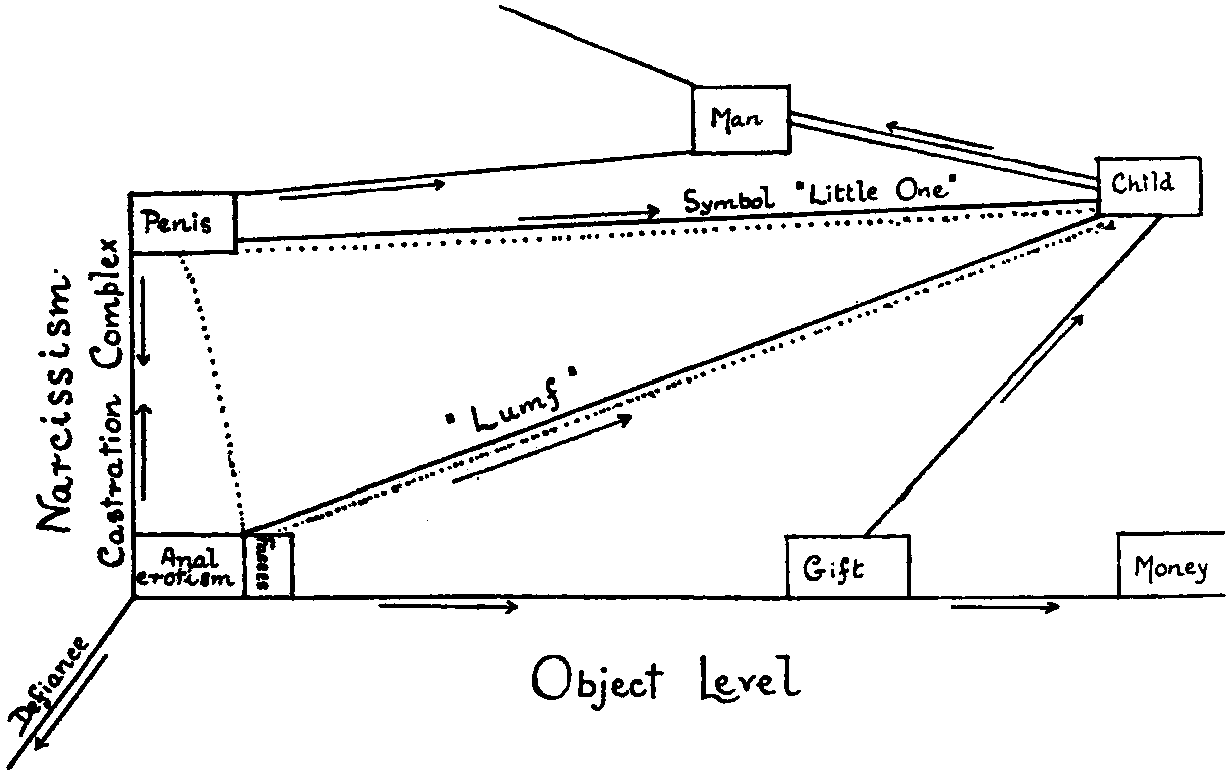
The connections which exist between the two complexes of interest in
money and of defæcation, which seem so dissimilar, appear to be the most
far-reaching. It is well known to every physician who has used
psycho-analysis that the most refractory and obdurate cases of so-called
chronic constipation in neurotics can be cured by this means. This is
less surprising if we remember that this function has shown itself
equally amenable to hypnotic suggestion. But in psycho-analysis one only
attains this result when one deals with the money complex of the persons
concerned, and induces them to bring it into consciousness with all its
connections. One might suppose that the neurosis is here only following
a hint from common speech which calls a person who keeps too careful a
hold on his money ‘dirty’ or ‘filthy’, but this would be far too
superficial an explanation. In reality, wherever archaic modes of
thought predominate or have persisted—in ancient civilizations, in myth,
fairy-tale and superstition, in unconscious thoughts and dreams, and in
the neuroses—money comes into the closest relation with excrement. We
know how the money which the devil gives his paramours turns to
excrement after his departure, and the devil is most certainly nothing
more than a personification of the unconscious instinctual forces.[18] The superstition, too, which
associates the finding of treasure with defæcation is well known, and
everyone is familiar with the figure of the ‘excretor of ducats’
(Dukatenscheisser).[19] Even in the early
Babylon cult gold is ‘the excrement of Hell’, Mammon = ilu manman.[20] Thus in following 50common
speech, the neurosis, here as elsewhere, takes the words in their
original most significant sense, and wherever it appears to express a
word figuratively it usually only reproduces its original meaning.
It is possible that the contrast between the most precious substance
known to man and the most worthless, which he rejects as ‘something
thrown out’, has contributed to this identification of gold with
fæces.
Yet another circumstance facilitates this equivalence in the mental
processes involved in neurosis. The original erotic interest in
defæcation is, as we know, destined to be extinguished in later years;
it is in these years that the interest in money is making its appearance
as something new which was unknown in childhood. This makes it easier
for the earlier impulse, which is in process of relinquishing its aim,
to be carried over to the new one.
If there is any reality in the relation described here between anal
erotism and this triad of character-traits, one may expect to find but
little of the ‘anal character’ in persons who have retained the
erotogenic quality of the anal zone into adult life, as for example
certain homosexuals. Unless I am greatly mistaken experience on the
whole is fully in accord with this anticipation.
One ought to consider whether other types of character do not also
show a connection with the excitability of particular erotogenic zones.
As yet I am aware only of the intense, ‘burning’ ambition of those who
formerly suffered from enuresis. At any rate, one can give a formula for
the formation of the ultimate character from the constituent
character-traits: the permanent character-traits are either unchanged
perpetuations of the original impulses, sublimations of them, or
reaction-formations against them.
51
VHYSTERICAL PHANTASIES AND THEIR RELATION TO BISEXUALITY[21](1908)
We are all familiar with the delusional phantasies of paranoiacs
which portray the person’s greatness or his sufferings, and occur in
stereotyped forms with almost monotonous regularity. We also come across
numerous accounts of the strange conditions under which certain perverts
carry out their sexual gratification—either in imagination or in
reality. Nevertheless, it may be new to some readers to hear that quite
analogous mental productions are regularly present in all the
psychoneuroses, particularly in hysteria, and that these so-called
hysterical phantasies have important connections with the causes of the
neurotic symptoms.
The common origin and normal prototype of all these phantastic
creations are the so-called day-dreams of adolescence, to which some,
though perhaps inadequate, attention has been given in the literature on
the subject.[22] They occur with perhaps equal
frequency in both sexes; in girls and women they are invariably of an
erotic nature, in men they may be either erotic or ambitious. The
importance of the erotic factor in those of men should not, however, be
under-estimated; a more precise investigation of the day-dreams of a
52man generally shows that all his heroic exploits, all his
successes, are for the purpose of pleasing a woman, of being preferred
by her to other men.[23] These phantasies are
wish-fulfilments, products of frustration and desire; they are justly
called day-dreams, for they give us the key to an understanding of night
dreams, the nucleus of which is nothing else than these daytime
phantasies, but complicated and distorted, and misunderstood by the
conscious psychic system.[24]
These day-dreams are invested with great interest, carefully
cherished and usually concealed with some shame, as though they belonged
to the person’s most intimate possessions. It is easy to recognize a
day-dreamer in the street, however, by his sudden absent-minded smile,
his way of talking to himself, or the hastening of his steps which marks
the climax of the fancied situation. All hysterical attacks which I have
been able to investigate up to the present have proved to be involuntary
day-dreams of this kind breaking in upon ordinary life. Now our
observations leave no room for doubt that phantasies of this sort may be
unconscious as well as conscious in nature, and that as soon as they
become unconscious they may become pathogenic, i.e. may express
themselves in symptoms or attacks. Under favourable circumstances
consciousness may just be able to capture such an unconscious phantasy.
After I had drawn the attention of one of my patients to her phantasies,
she told me that on one occasion she had burst into tears in the street,
and that, thinking quickly what she had been crying about, she realized
the existence of a phantasy in her mind that a pianist well known in the
town (but not personally acquainted with her) had entered into an
intimate relationship with her, that she had had a child by him (she was
childless), and that he had deserted her and her child and left them in
misery. It 53was at this point of her romance that she burst
into tears.
Unconscious phantasies have either always been unconscious and formed
in the unconscious, or more often they were once conscious phantasies,
day-dreams, and have been purposely forgotten and driven into the
unconscious by ‘repression’. Their content may then either have remained
the same or may have been altered, so that the phantasies which are now
unconscious are derivatives of phantasies that were once conscious. Now
an unconscious phantasy has a very important connection with the sexual
life of the person; it is actually identical with the phantasy which
served the person in his sexual gratification during the period of
masturbation. The masturbatory (in the widest sense, onanistic) act at
that time consisted of two parts, one of which was the creation of the
phantasy, and the other a manipulative performance for attaining
auto-erotic gratification at the climax of the phantasy. It is known
that these two components of the act have first had to be welded
together.[25] Originally the active performance
was a purely auto-erotic proceeding for the purpose of obtaining
pleasure from a particular erotogenic part of the body. Later this
performance became bound up with the idea of a wish emanating from the
sphere of object-love, and served as a partial realization of the
situation in which the phantasy culminated. If the person subsequently
renounces this type of masturbatory gratification with phantasy, the
action is given up, but the previously conscious phantasy becomes an
unconscious one. It may happen that no other form of sexual
gratification supervenes, the person remaining abstinent and not
succeeding in sublimating his libido, that is, in deflecting his sexual
excitation into higher channels; these are, then, the conditions under
which the unconscious phantasy is re-stimulated, and under which it will
grow and spread and, drawing upon the whole might 54of the
person’s need for love, will achieve expression of at least a part of
its content in the form of a morbid symptom.
In this way such unconscious phantasies are the immediate precursors
in the mind of a whole series of hysterical symptoms. The hysterical
symptoms are nothing but the unconscious phantasies made manifest by
‘conversion’, and in so far as the symptoms are of a somatic kind they
are often enough drawn from within the range of the sexual feelings and
motor innervations that originally accompanied the phantasy while it was
still conscious. In this way the process of discontinuing masturbation
is literally reproduced again backwards; while the final aim of the
whole pathological process, restoration of the original primary sexual
gratification, is achieved, though never, it is true, completely, yet
always by a sort of approximation.
Those who study hysteria find their attention therefore very soon
diverted from the symptoms and directed to the phantasies which give
rise to the symptoms. The technique of psycho-analysis enables us first
of all to infer the unconscious phantasies from the symptoms and then to
enable the patient to become conscious of them. Now it has been found by
this means that the content of the unconscious phantasies of hysterical
patients is in complete accordance with the conscious ways in which
perverts actually obtain gratification; and if any one requires examples
of such situations he need only call to mind the world-famed orgies of
the Roman Emperors, the madness of which, of course, was the product of
the unrestrained power and liberty possessed by their creators. The
delusions of paranoiacs are of a similar nature but are phantasies which
achieve direct access to consciousness; they are based on the
masochistic-sadistic component of the sexual instinct, and they too have
their complete counterpart in certain unconscious phantasies of
hysterical persons. Of practical importance, too, is the case of
hysterical persons who may not express their phantasies 55as
symptoms, but consciously realize them in action and thus imagine and
actually bring about assaults, attacks, or sexual aggressions.
This method of psycho-analytic investigation, which proceeds from the
conspicuous symptoms to the hidden unconscious phantasies, reveals
everything that can be found out about the sexuality of psychoneurotics,
including the fact which is the subject of this short preliminary
publication.[26]
The reason why the relationship between the phantasies and the
symptoms is no simple one but very complicated, is in all probability
due to the obstacles which the unconscious phantasies meet with in
seeking to find expression.1 As a rule, i.e. when the neurosis
is fully developed and has persisted for some time, a particular symptom
corresponds not to a single unconscious phantasy, but to several such;
and this correspondence, moreover, is no arbitrary one but obeys
definite laws. At the beginning of the illness these complications are
not likely to be all fully developed.
For the sake of general interest I will here trespass beyond the
continuity of my argument and try to describe the nature of hysterical
symptoms in a series of successively exhaustive formulas. They do not
contradict one another, but they consist partly in attempts at greater
completeness and more precise classification, and partly of applications
of different points of view.
1. The hysterical symptom is the memory-symbol of the operation of
certain (traumatic) impressions and experiences.
2. The hysterical symptom is a substitute, produced by ‘conversion’,
for the reactivation of these traumatic experiences by association.
3. The hysterical symptom is, like other mental products, the
expression of a wish-fulfilment.56
4. The hysterical symptom is a realization of an unconscious phantasy
which serves as a wish-fulfilment.
5. The hysterical symptom serves the purposes of sexual gratification
and represents a part of the sexual life of the person (corresponding to
one of the components of his sexual instinct).
6. The hysterical symptom corresponds to the recurrence of a form of
sexual gratification which was real in infantile life and has since been
repressed.
7. The hysterical symptom arises as a compromise between two opposing
affects or instinctual trends, of which one is attempting to express a
partial impulse or component of the sexual constitution, while the other
tries to suppress it.
8. The hysterical symptom may represent various unconscious
non-sexual impulses, but can never dispense with a sexual
significance.
Among these various definitions the seventh is the one which defines
the hysterical symptom most completely as the realization of an
unconscious phantasy, and the eighth recognizes the proper significance
of the sexual factor. Some of the previous formulas lead up to this and
are contained in it.
The connection between the symptoms and the phantasies makes it easy
to arrive, by psycho-analysis of the former, at a knowledge of the
components of the sexual instinct dominating the person concerned, which
I have described in my Drei Abhandlungen zur Sexualtheorie. In
some cases, however, investigation by this means yields an unsuspected
result. It shows that for many symptoms it is not enough to resolve only
one unconscious sexual phantasy or even a number of them, of which one,
the most important and fundamental, is of a sexual nature; to resolve
the symptom one has, on the contrary, to deal with two sexual
phantasies, of which one has a masculine and the other a feminine
character, so that one of these phantasies has its source in a
homosexual trend. This 57new statement does not alter our
seventh formula; an hysterical symptom must necessarily be a compromise
between a libidinal and a repressing force, but incidentally it may
represent a combination of two libidinal phantasies of an opposite
sexual character.
I shall refrain from giving examples of this law. I have found from
experience that short condensed analyses always fail in the convincing
effect for which they are intended, and I must leave an account of fully
analysed cases for another time.
I will, therefore, merely state the following formula and explain its
import.
9. An hysterical symptom is the expression of both a masculine and a
feminine unconscious sexual phantasy.
I must expressly mention that I cannot claim the same general
validity for this formula as for the others. As far as I can see, it
applies neither to all the symptoms of one case nor to all cases. On the
contrary, it is not hard to find cases in which the antithetical sexual
impulses have found expression in separate symptoms, so that the
symptoms of the heterosexuality and the homosexuality can be as clearly
distinguished from each other as the underlying latent phantasies.
Nevertheless, the condition stated in this ninth formula is frequent
enough, and important enough when it occurs to deserve particular
emphasis. It seems to me to mark the highest degree of complexity in the
way in which an hysterical symptom can be determined, and one may
expect, therefore, to meet with it only when a neurosis has persisted
for a long time and undergone considerable organization.[27]
The bisexual nature of hysterical symptoms can nevertheless be
demonstrated in numerous cases, and this is in any event an interesting
confirmation of my view that the assumption of a bisexual predisposition
58in man[28] is particularly clearly brought out
by psycho-analysis of neurotics. A quite analogous condition occurs when
anyone in his conscious masturbatory phantasies pictures himself both as
the man and as the woman in an imagined situation; further counterparts
of this are found in certain hysterical attacks in which the patient
acts at one and the same time both parts of the underlying sexual
phantasy—for instance, in one case I observed, the patient pressed her
dress to her body with one hand (as the woman) while trying to tear it
off with the other (as the man). These simultaneous contradictory
actions largely obscure the situation which is otherwise so plastically
portrayed in attacks, and thus serve very well to conceal the
unconscious phantasy which is actually at work.
In treatment by psycho-analysis it is very important to be prepared
for the bisexual meaning of a symptom. One need not then be surprised or
misled if a symptom seems to persist with undiminished force though one
of its sexual meanings has already been resolved. It is then still being
maintained by the perhaps unsuspected opposite sexual trend. In the
treatment of such cases one may also observe how the patient finds an
easy way of evading analysis of one sexual meaning by diverting
his associations constantly to the opposite meaning, as if along a
parallel line.
The material on which the following synthesis is built up is derived
from many sources. First, from the direct observation of what children
say and do; secondly, from what adult neurotics consciously remember of
their childhood and retail during psycho-analytic treatment; and
thirdly, from the conclusions, reconstructions and unconscious memories
translated into consciousness which result from the psycho-analysis of
neurotics.
That the first of these three sources has not alone supplied all that
is worth knowing on the subject is due to the attitude of adults towards
childish sexual life. Children are not credited with any sexual
activities, therefore no pains are taken to observe anything of the
kind, while on the other hand any expressions of such a thing which
would be worthy of attention are suppressed. Consequently the
opportunity of gaining information from this most genuine and fertile
source is greatly restricted. Whatever we derive from the uninfluenced
communications of adults concerning their conscious childhood is at best
subject to the objection that it is perhaps falsified in looking back
and, further, has to be estimated in the light of the fact that the
persons in question have later become neurotic. The material from the
third source is subject to all the attacks that are in general directed
against the trustworthiness of psycho-analysis and the reliability of
the conclusions drawn from it, so that 60no justification of it
can be attempted here; I will only assert that those who know and make
use of the psycho-analytic technique acquire extensive confidence in its
results.
I cannot guarantee the completeness of my collection, but I can
answer for the care taken in gathering the material.
There remains a difficult question to decide. How far ought one to
take for granted what is here reported about children in general as
being true of all children, i.e. of every individual child?
Pressure of education and the varying intensity of the sexual instinct
certainly render possible great individual variations in the sexual
behaviour of children, and, above all, these things influence the date
at which the childish interest in sexuality appears. Therefore I have
not arranged my material according to the successive epochs of
childhood, but have included in one recital what applies to various
children, in one early, and in another late. It is my conviction that no
child—none, at least, who is mentally sound, still less one who is
mentally gifted—can avoid being occupied with sexual problems in the
years before puberty.
I do not think much of the objection that neurotics are a special
class of people marked by a degenerative disposition, whose child-life
must not be regarded as evidence of the childhood of others. Neurotics
are human beings like every one else, and cannot be sharply
differentiated from normal people; in their childhood they are not
easily distinguishable from those who later remain healthy. It is one of
the most valuable results of our psycho-analytic investigations to have
found that their neuroses have no special mental content peculiar to
them, but that, as C. G. Jung has expressed it, they fall ill of the
same complexes with which we who are healthy also have to contend. The
difference is only that the healthy know how to overcome these complexes
without great and practically demonstrable harm; while the suppression
of 61these complexes in nervous people only succeeds at the
price of costly substitute-formations, thus in practice proving
unsuccessful. In childhood nervous and normal people naturally
approximate much more closely than in later life, so that I cannot
recognize it as an error in method to make use of the communications of
neurotics concerning their childhood as analogies for normal child-life.
Since those who later become neurotics very frequently include in their
constitution an especially strong sexual instinct and a disposition to
precocity and to premature expression of this impulse, they enable us in
this way to recognize much of the infantile sexual activities more
plainly and more correctly than, with our blunted talent for observation
of ordinary children, would otherwise be possible. The true value of
these communications by adult neurotics can only be estimated, to be
sure, when a collection of the childhood-memories of adult healthy
people, made after the manner of Havelock Ellis, has also been taken
into account.
In consequence of both external and internal unfavourable
circumstances, the following remarks apply chiefly to the sexual
development of one sex only, namely, the male. The value of a
compilation such as I attempt here, however, need not be merely
descriptive. The knowledge of the infantile sexual theories in the form
in which they appear in childish thoughts can be of interest in various
directions—for instance, surprisingly so for an understanding of myths
and fairy-tales. They are indispensable for the understanding of the
neuroses, where these childish theories are still in operation and have
acquired a determining influence upon the form taken by the
symptoms.
If, forgetting our mortality and imagining ourselves to be merely
thinking beings, gazing, for instance, from another planet, we could
apprehend the things of this earth afresh, perhaps nothing would arrest
our 62attention more forcibly than the existence of two sexes
among human beings, who otherwise resemble each other so closely and yet
emphasize their difference even in the most superficial indications. Now
it does not seem that children also choose this fundamental fact as the
starting-point of their investigations concerning sexual problems. Since
they have known a father and a mother as far back as they can remember
in life, they accept their existence as a reality which needs no further
inquiry, and in just the same way does a boy behave towards a little
sister from whom he is only separated by a slight difference of age, by
one or two years. The child’s desire for knowledge does not awaken
spontaneously on this point at all, as it would if prompted perhaps by
an inborn need to seek for causes, but arises under the goad of a
self-seeking impulse which dominates him when he is confronted by the
arrival of a new child—perchance at the end of the second year. Those
children whose own nursery at home does not become divided up in this
way are nevertheless able as a result of their own observations to put
themselves in the place of others who are in this situation in other
homes. The loss of the parents’ care and concern, which they actually
experience or with justice fear, the presentiment that they must from
now and for ever share all possessions with the newcomer, has the effect
of awakening the emotions of the child and sharpening its thinking
capacities. The elder child expresses unconcealed hostility against the
newcomer, which finds vent in unfriendly criticisms of it, in wishes
that ‘the stork should take it back again’, and occasionally even in
attempts at little outrages upon the helpless creature lying in the
cradle. A greater difference of age as a rule modifies the expression of
this primary hostility; just as in somewhat later years, if brothers and
sisters fail to appear, the wish for a playmate like those observed
elsewhere obtains the upper hand.
Under the stimulus of these feelings and anxieties 63the
child thus comes to consider the first of the great problems of life,
and asks itself the question where children come from, which at first
runs, ‘Where did this particular tiresome child come from?’ The
after-echo of this first riddle seems to be observable in the
innumerable riddles of myths and sagas. The question itself, like all
inquiry, is a product of dire necessity, as if to thought were entrusted
the task of preventing the repetition of an event so greatly feared. At
the same time, we may assume, the child’s thinking becomes independent
of the stimulus, and continues its activity as a separate impulse
towards investigation. Where a child is not already too much
intimidated, it takes sooner or later the shortest way by demanding
answers from its parents or attendants, who signify for it the source of
all knowledge. This way, however, fails. The child receives either
evasive answers or a rebuke for its curiosity, or is dismissed with that
mythologically significant information which in German runs: ‘The stork
brings the children; it fetches them out of the water’. I have grounds
for supposing that far more children than parents suspect are
dissatisfied with this solution, and respond to it with pronounced
doubt, which, however, is not always outspoken. I know of a
three-year-old boy who, to the terror of his nurse, was missed after
receiving this enlightenment, and found at the edge of the big lake of
the castle, where he had run, in order to see the children in the water!
I know of another who could allow his disbelief only hesitating
expression by saying he knew better, it was not storks who bring the
children, but herons. It appears to me from much of the evidence
conclusive that children refuse to believe the stork theory, and that
from the time of this first deception and rebuff they nourish a mistrust
against adults, have the presentiment of something forbidden which is
being withheld from them by the ‘grown-ups’, and consequently conceal
their further investigations by secrecy. With this, however, it comes
about that they 64experience the first occasion of a ‘psychical
conflict’, in that ideas for which they ‘by instinct’ feel a preference,
but which adults consider ‘naughty’, come into opposition with others
which are maintained by the authority of the adults without being
acceptable to them themselves. Out of these mental conflicts there may
soon arise a ‘mental dissociation’; the one idea which is bound up with
‘being good’, but also with a cessation of thinking, becomes the
prevailing conscious one; the other, for which meanwhile the inquiries
prosecuted have brought new evidence, which is not supposed to count,
becomes suppressed and unconscious. The nuclear complex of neurosis is
formed in this way.
Lately, by the analysis of a five-year-old boy[30]
which his father undertook and permitted me to publish, I have received
an irrefutable proof of a piece of knowledge towards which the
psycho-analysis of adults had for long led me. I now know that the
changes in the mother during pregnancy do not escape the sharp eyes of a
child, and that the latter is very well able subsequently to establish
the correct connection between the increase in size of the mother’s body
and the appearance of a baby. In the case mentioned, the boy was three
and a half when his sister was born, and four and three-quarters when he
showed his better knowledge by the most unmistakable allusions. This
precocious knowledge is, however, always kept secret, and later, in
connection with the future fate of childish sexual inquiry, is repressed
and forgotten.
The stork fable, therefore, is not one of the infantile sexual
theories; indeed, the observation of animals, who hide so little of
their sexual life and to whom children feel so closely related,
strengthens their disbelief. With the knowledge independently obtained
that babies grow in the mother’s body, a child would be on the right
path to solve the problem on which it 65first tries its thinking
powers. Its further progress is stopped, however, by a piece of
ignorance which cannot be made good, and by false theories which the
condition of its own sexuality imposes on it.
These false sexual theories, which I will now describe, all have one
very curious characteristic. Although they go astray in a grotesque way,
yet they all, each one of them, contain a bit of the real truth, so that
they are analogous to those adult attempts at solution, which we call
flashes of genius, of the problems of the universe that are too
difficult for human comprehension. What is correct and hits the mark in
these theories is to be explained by their origin in those components of
the sexual instinct which are already active in the childish organism;
for it is not due to an arbitrary mental act or to chance impressions
that these notions arise, but to the necessities of the psychosexual
constitution, and this is why we are able to speak of typical sexual
theories in children, this is why we find the same false ideas in all
children whose sexual life is accessible to us.
The first of these theories begins with a neglect of
sex-differentiation, the neglect to which we called special attention at
the commencement as being characteristic of children. It consists in
attributing to everybody, including women, a penis just like the one the
boy knows of from his own body. It is precisely in that sexual
constitution which we must recognize as a normal one that the penis is
already in childhood the governing erotogenic zone, the most important
autoerotic sexual object, and the estimate of its value is logically
reflected in the impossibility of imagining a person similar to the self
without this essential part. If a little boy obtains a sight of the
genitals of a little sister, what he says will show that his prejudice
is already strong enough to influence the perception; he does not remark
on the lack of the penis but invariably says, as if consoling
and reconciling: that her ‘widdler’ is still small, but when she is
bigger it 66will soon grow. The idea of a woman with a penis
returns still later in the dreams of adults; in a state of nocturnal
sexual excitation he throws down a woman, exposes her and prepares for
coitus; then on beholding the well-formed penis at the site of the
female genitals, the dream and excitation break off. The numerous
hermaphrodites of classic antiquity faithfully reproduce this once
general infantile idea; one may observe that to most normal people they
cause no offence, while actual hermaphroditic formations of the genitals
in nature nearly always excite the greatest abhorrence.
If this idea of woman with a penis becomes ‘fixated’ in a child, it
resists all the influences of later life and makes the man incapable of
dispensing with a penis in his sexual object, so that such a person, if
otherwise he has a normal sexual life, must become homosexual, seeking
his sexual object in men who through other physical and mental qualities
remind him of women. Real women, as they become known to him later, are
excluded from being sexual objects to him because they lack the
essential sexual attraction; indeed, in connection with another
impression of childhood-life they may become abhorrent to him. A child
who is chiefly dominated by penis-excitation usually produces pleasure
by stimulation of it with his hand, is detected doing this by his
parents or by the persons in charge of him, and is terrorized by the
threat that his penis will be cut off. The effect of this ‘castration
threat’ is in direct proportion to the value set upon this part of the
body, i.e., quite extraordinarily deep-rooted and persistent.
Sagas and myths testify to the revolt in the childish feelings, to the
horror which is then linked to the castration complex, and this later is
remembered with corresponding reluctance by consciousness. The woman’s
genitalia, seen subsequently and regarded as mutilated, recall this
threat, and thus awaken in the homosexual horror instead of pleasure.
This reaction is not altered by his learning through science that
67the childish assumption is not so far wrong after all, namely,
that a woman also possesses a penis. Anatomy has recognized the clitoris
within the female pudenda as an organ homologous to the penis, and the
physiology of sexual processes has been able to add that this little
penis which no longer grows behaves in the childhood of the woman like a
genuine and real penis, that it is the site of excitations which leads
to its being touched, that its excitability gives the sexual activity of
little girls a male character, and that it needs an effort of repression
in the years of puberty to make the woman develop through discarding
this male sexuality. The fact that the sexual function of many women is
crippled by their obstinately clinging to this clitoris excitability—so
that they remain anæsthetic in coitus, or that repression succeeds so
excessively that its action is partly nullified by hysterical
compensatory formations—all this shows that the infantile sexual theory
that a woman possesses a penis like a man has some truth in it.
One can easily observe that little girls are quite in agreement with
their brothers’ estimate. They develop a great interest in this part of
a boy’s body, but this interest is at once dominated by jealousy. They
feel themselves injured; they make attempts to urinate in the position
that is possible to the boy by his possession of the big penis, and when
they express the wish, ‘I should love to be a boy’, we know what lack
the wish is to remedy.
If children could follow the hint given them by the excitation in the
penis, they would get a little nearer to the solution of their problems.
That the baby grows in the mother’s body is obviously not a sufficient
explanation. How does it get there? What starts it developing there?
That the father has something to do with it is probable; indeed, he
declares that the baby is also his child.[31]
The penis, too, certainly also has its share in these mysterious
happenings; it testifies to this by the accompanying excitation in it
68during all this thought-work. Along with this excitation
obscure impulses are roused, which the child does not know how to
account for—to do something violent, to press in, to knock to pieces, to
burst open a hole somewhere. But when the child seems thus in a fair way
to arrive at the existence of the vagina, and to attribute to the
father’s penis an act of incursion into the mother which should create
the baby in the body of the mother, the inquiry breaks off helplessly;
for at this point there stands in the way the theory that the mother
possesses a penis like a man, and the existence of the cavity which
receives the penis remains undiscovered to the child. One can readily
surmise that the lack of success of this effort of thought facilitates a
rejection and forgetting of it. These speculations and doubts, however,
become the prototype of all later thought-work on problems, and the
first failure has a crippling effect for ever after.
Their ignorance of the vagina again makes it possible for children to
have a conviction which constitutes the second of their sexual theories.
If the baby grows in the body of the mother and is then detached from
it, this can only happen by the sole possible way of the anal aperture.
The child must be expelled like excrement, like a motion. If in later
childhood the same question is the subject of solitary reflection or of
a discussion between two children, then the explanations probably are
that the baby comes out of the navel, which opens, or that the belly is
slit and the child taken out, as happens to the wolf in the tale of
Little Red Riding-Hood. These theories are expressed aloud and later
consciously remembered; they no longer contain anything shocking. These
same children have then completely forgotten that in earlier years they
believed another sexual theory, which since then has undergone the
subsequent repression of the anal sexual components. At that time an
evacuation was something which could be spoken about in the nursery
without shame; the child was still not so far distant 69from his
constitutional coprophilic inclinations; it was no degradation then to
come into the world like a mass of fæces, which had not yet been
attainted by disgust. The cloaca theory, which is valid for so
many animals, was the most natural and the only one which could force
itself upon the child as probable.
Then, however, it was only logical that the child should refuse to
grant women the painful monopoly of giving birth to children. If babies
are born through the anus then a man can give birth just as well as a
woman. A boy can therefore fancy that he too has children of his own
without our needing to accuse him of feminine inclinations. It is only
his still active anal erotism at work.
If the cloaca theory of birth is preserved in consciousness in later
years of childhood, which occasionally happens, it is then accompanied
by another solution of the question concerning the origin of children,
one which, it is true, is no longer the original one. It is like that in
fairy-tales. One eats some particular thing and from this one gets a
child. The insane re-animate this infantile birth theory. A maniac, for
instance, will lead the visiting physician to a heap of fæces which she
has deposited in a corner of her cell, and say to him, laughing, ‘That
is the child I bore to-day’.
The third of the typical sexual theories appears in children when
through some unforeseen domestic occurrence they witness parental sexual
intercourse, concerning which they are then able to obtain only a very
incomplete idea. Whatever detail it may be that comes under their
observation, whether it is the position of the two people, or the
sounds, or certain accessory circumstances, in all cases they arrive at
the same conclusion, that is, at what we may call the sadistic
conception of coitus, seeing in it something that the stronger
person inflicts on the weaker by force, and comparing it, especially the
boy, to a fight as they know it from their childish play, in which, by
the way, an admixture of sexual excitation is also not wanting.
70I have not been able to establish whether children recognize
this procedure which they observe between the parents as the necessary
missing link in the problem of the birth of children; more often it
appears that this connection is overlooked by children for the very
reason that they had interpreted the love-act as an act of violence. But
this sadistic conception itself gives the impression of a re-appearance
of that obscure impulse towards cruel activity which was linked up with
penis-excitation when the child first reflected upon the puzzle of where
children come from. The possibility cannot be excluded that that
precocious sadistic impulse, which might have led to discovery of the
mystery of coitus, itself appeared first under the influence of very dim
memories of parental intercourse for which the child had obtained
material, without at the time making use of it, when it shared the
bedroom of its parents in the first years of its life.[32]
The sadistic theory of coitus, which by itself becomes a false guide
where it might have led to enlightenment, is again the expression of one
of the inborn components of the sexual instinct, any one of which may be
more or less strongly marked in any particular child, and thus the
sadistic conception is to a certain extent true; in part it divines the
essence of the sexual act and the ‘antagonism of the sexes’ which
precedes it. Often, too, the child is in a position to support this
conception by accidental observations which it understands in part
correctly, in part falsely. In many marriages the wife, in fact,
regularly opposes the matrimonial embrace, which to her brings no
pleasure and the risk of a fresh pregnancy, and thus to the child who is
supposed to be asleep (or pretending to be asleep) the mother might give
an impression that could only be explained as meaning warding off an act
of violence. At other times the whole marriage presents to the observant
child 71the spectacle of an unceasing quarrel, expressed by loud
words and unfriendly gestures, so that the child need not wonder that
this quarrel goes on in the night, too, and is finally decided by the
very same means which the child himself is accustomed to make use of in
its intercourse with its brothers, sisters and companions, that is, by a
fight.
The child also regards it as a confirmation of his idea if he
discovers spots of blood in the bed or on his mother’s linen. These are
to him a proof that in the night an attack of this kind by the father on
the mother has again taken place, while we should rather take the fresh
spots of blood to mean that sexual intercourse for the time being had
ceased. Much of the inexplicable ‘horror of blood’ in the nervous finds
its explanation in this connection. The child’s mistake again covers a
small part of the truth, for in certain well-known circumstances a trace
of blood is indeed regarded as a sign of initiated sexual
intercourse.
In less direct connection with the insoluble problem of where
children come from, the child occupies itself with the question of what
the nature and the content is of the state called ‘being married’; and
it answers the question differently according to its accidental
observations of its parents combined with its own impulses which are
still invested with pleasurable feeling. All that these answers appear
to have in common is that marriage promises pleasurable gratification,
and presupposes a disregard for modesty. The idea I have most frequently
met with is that ‘one urinates before the other’; a variation of this
which sounds as if it signified better knowledge symbolically is that
‘the man urinates into the woman’s chamber’. On other occasions the
meaning of marriage is supposed to be that the two persons show their
buttocks to each other (without shame). In one case in which training
had succeeded in postponing sexual knowledge especially late, a
fourteen-year-old girl who had already begun to menstruate arrived at
the idea from reading 72that being married signified ‘mixing
blood’, and since her own sister had not yet had a period the lustful
girl attempted to outrage a visitor who confessed that she was just
menstruating, so as to compel her to take part in this ‘mixing
blood’.
The infantile ideas about the nature of marriage, which are not
seldom retained by the conscious memory, have great significance for the
symptoms of later neurotic illness. They come into evidence first of all
in childish games, in which one does with the other whatever it is that
constitutes being married, and then later on the wish to be married can
choose the infantile form of expression when it appears in a phobia or
some similar symptom which at first sight seemed incomprehensible.[33]
These are the most important of the typical sexual theories that
children produce spontaneously in early childhood-years under the
influence of the components of the sexual instinct. I know that the
material is far from complete and that I have not established a full
connection between it and the rest of child-life. I can here add a few
supplementary remarks which otherwise every experienced person would
have missed in my account. Thus, for instance, the significant theory
that one gets a child by a kiss, which obviously betrays a pre-eminence
of the erotogenic mouth zone. In my experience this theory is
exclusively feminine and is sometimes met with as pathogenic in girls
whose sexual curiosity had undergone very strong inhibition in
childhood. One of my female patients through an accidental observation
happened upon the theory of the ‘couvade’, which is well known among
many races as a general practice, and probably has the purpose of
contradicting that doubt about paternity that is never quite to be
overcome. After the birth of his child, a rather strange uncle of hers
remained for days at home and received visitors in his
night-73shirt, so she concluded that both parents had a share in
the birth and must go to bed.
About the tenth or eleventh year information about sexual matters
comes to children. A child who has grown up unchecked in its social
relations, or who in some other way has found a good opportunity for
observation, communicates to other children what he knows, because by
doing so he can feel himself to be grown-up and superior. What children
learn in this way is mostly correct, that is, the existence of the
vagina and its use is revealed to them, but otherwise the enlightenment
which they get from one another is frequently mixed with false ideas,
and burdened with the remains of older infantile sexual theories. It is
scarcely ever complete and sufficient to solve the original problems.
Just as formerly with the ignorance of the vagina, so now ignorance of
the semen prevents understanding of the whole process. The child cannot
guess that out of the male sexual organ another substance can be
expelled besides urine, and occasionally an ‘innocent’ girl on her
wedding night is still indignant because the man has ‘urinated into
her’. This information acquired before puberty links up with a fresh
impetus in childish inquiries; the theories which the child now
produces, however, have no longer the typical and original stamp, which
was characteristic of the early primary ones as long as the infantile
sexual components were uninhibited and untransformed and could come to
expression in these theories. The later intellectual efforts to solve
the sexual puzzle seemed to me not worth the trouble of collecting, nor
have they much claim to a pathogenic significance. Their multiplicity is
naturally mainly dependent upon the nature of the first information
received, their significance consists rather in that they re-awaken the
unconscious vestiges of that first period of sexual interest, so that
not seldom masturbatory sexual activities and a part of the detachment
of feeling from the parents is linked up with them. Hence the
74condemning judgement of teachers that such information at this
age ‘corrupts’ children.
A few examples may show what elements often enter into these later
speculations by children about sexual life. A girl had heard from her
school companions that the man gives the woman an egg, which she hatches
in her body. A boy who had also heard of the egg, identified it with the
testicle, which is vulgarly called by the same name, and thereupon
puzzled his head how the content of the scrotum could always become
renewed. The information given seldom reaches as far as to prevent
important doubts on the matter of sexual processes. Thus girls may come
to expect that coitus happens only on one single occasion but lasts very
long, for twenty-four hours, and that from this one occasion come all
the successive children. One would suppose that this child had knowledge
of the process of propagation in certain insects: however, this
conjecture was not confirmed and the theory appeared to be an
independent creation. Other girls ignore the time of gestation, the life
in the womb, and suppose that the child appears immediately after the
night of the first connection. Marcel Prévost has turned this mistake of
young girls into an amusing story in one of his Lettres de
femmes. Hardly to be exhausted and perhaps in general not
uninteresting is this theme of the later sexual inquiries of children,
or of adolescents who have been delayed at a childish stage; but it lies
further from my purpose, and I must only call special attention to the
fact that many errors are invented by children in order to contradict
older, better but now unconscious and repressed knowledge.
The way in which the child behaves when he receives information also
has its significance. In many children sexual repression has gone so far
that they will not hear anything, and these may also succeed in
remaining ignorant until even later (apparently, at least) till the
knowledge dating from early childhood comes to light in the
psycho-analysis of neurotics. I 75know also of two boys between
ten and thirteen years old, who certainly listened to sexual information
but gave their informant the averting answer: ‘It is possible that your
father and other people do such things, but I know for certain that my
father would never do it’. However this later attitude in children
towards satisfying their sexual curiosity may vary, we can postulate a
thoroughly uniform behaviour in them in early years and believe that at
that period they were all eager to find out what it is the parents do
with each other to make the babies.
76
VII‘CIVILIZED’ SEXUAL MORALITY AND MODERN NERVOUSNESS[34](1908)
In his recently published book on sexual ethics, von Ehrenfels dwells
on the difference between ‘natural’ and ‘civilized’ (cultural) sexual
morality. By ‘natural’ sexual morality he understands that system of
control which enables a race to preserve its health and efficiency; by
‘civilized’, that system which when followed spurs man to more intensive
and productive cultural activity. According to him this contrast is best
elucidated by comparing the innate character of a people with its
cultural attainments. While referring to von Ehrenfels’ paper[35] for the better appreciation of this
significant line of thought, I shall take from it only so much as I need
to establish the connection with my own contribution to the subject.
It is natural to suppose that under the domination of a ‘civilized’
morality the health and efficiency in life of the individuals may be
impaired, and that ultimately this injury to the individual, caused by
the sacrifices imposed upon him, may reach such a pitch that the
‘civilized’ aim and end will itself be indirectly endangered. Indeed,
von Ehrenfels points to a series of injurious effects, responsibility
for which he attributes to the code of sexual morality at present
prevailing in our Western society; and although he fully acknowledges
its high value for the furtherance of civilization, he concludes by
judging it to be in need of reform. 77Characteristic of
present-day sexual morality is the extension of the demands made upon
women on to the sexual life of the male, and the taboo on all sexual
intercourse except in monogamous marriage. Even so, consideration of the
natural difference in the sexes necessitates less condemnation of lapses
in the male, and so in effect admission of a double code of morality for
him. But a society which accepts this double code cannot attain to ‘love
of truth, honesty and humanity’[36] except to a certain
narrowly limited degree, and must incline its members to concealment of
the truth, to euphemism, to self-deception, and to the deception of
others. Civilized sexual morality does worse, indeed, than this, for by
glorifying monogamy it cripples virile selection—the sole influence by
which an improvement of the race can be attained, for among civilized
peoples vital selection is reduced to a minimum by humane and hygienic
considerations.[37]
Among the injurious effects attributed to sexual morality the
physician misses precisely the one whose significance we are now to
consider. I refer to the way in which it promotes modern nervousness,
which under our present social conditions is rapidly spreading.
Occasionally a nervous patient will himself draw the physician’s
attention to the part played in the causation of his sufferings by the
opposition between his constitution and the demands of civilization, and
will remark: ‘We in our family have all become nervous because we wanted
to be something better than what with our origin we were capable of
being.’ The physician is also frequently given matter for thought by
observing that neurosis attacks precisely those whose forefathers, after
living in simple, healthy, country conditions, offshoots of rude but
vigorous stocks, came to the great cities where they were successful and
were able 78in a short space of time to raise their children to
a high level of cultural attainment. But, most cogent of all,
neurologists themselves have loudly proclaimed the connection between
the ‘increasing nervousness’ of the present day and modern civilized
life. A few extracts from the opinions of eminent observers will show
clearly upon what they base this connection.
W. Erb:[38] ‘The original question may now be
summarized thus: Are those causes of nervousness which have been put
before you so markedly on the increase under modern conditions of life
as to declare those conditions responsible? This question can be
answered without hesitation in the affirmative, as a cursory glance at
our modern life and its character will show.
‘This is already clearly evidenced by an array of general facts: the
extraordinary achievements of modern times, the discoveries and
inventions in every field, the maintenance of progress in the face of
increasing competition, have been gained and can be held only by great
mental effort. The demands on the ability of the individual in the
struggle for existence have enormously increased, and he can meet them
only by putting forth all his mental powers; at the same time the needs
of the individual, and the demand for enjoyment, have increased in all
circles; unprecedented luxury is displayed by classes hitherto wholly
unaccustomed to any such thing; irreligion, discontent, and covetousness
are spreading widely through every degree of society. The illimitable
expansion of communication brought about by means of the network of
telegraphs and telephones encircling the world has completely altered
the conditions of business and travel. All is hurry and agitation: night
is used for travel, day for business; even “holiday trips” keep the
nervous system on the rack; important political, industrial, financial
crises carry excitement into far wider circles than formerly;
participation in political life has become quite general; political,
religious, and 79social struggles, party-interests,
electioneering, endless associations of every kind heat the imagination
and force the mind to ever greater effort, encroaching on the hours for
recreation, sleep and rest; life in large cities is constantly becoming
more elaborate and more restless. The exhausted nerves seek recuperation
in increased stimulation, in highly-seasoned pleasures, only thereby to
become more exhausted than before; modern literature is concerned
predominantly with the most questionable problems, those which stir all
the passions—sensuality and the craving for pleasure, contempt of every
fundamental ethical principle and every ideal demand; it brings
pathological types, together with sexual psychopathic, revolutionary and
other problems, before the mind of the reader. Our ears are excited and
overstimulated by large doses of insistent and noisy music. The theatres
captivate all the senses with their exciting modes of presentation; the
creative arts turn also by preference to the repellent, ugly and
suggestive, and do not hesitate to set before us in revolting realism
the ugliest aspect offered by actuality.
‘This merely general picture suffices to show a series of dangers in
our modern cultural evolution, the details of which may be filled in by
a few strokes!’
Binswanger:[39] ‘Neurasthenia especially has been
described as essentially a modern disorder, and Beard, to whom we are
first indebted for a general description of it, believed that he had
discovered a new nervous disease which had developed specifically in
America. This assumption was of course erroneous; nevertheless the fact
that an American physician was the first to perceive and
maintain—as the fruit of great experience—the particular symptoms of
this disorder cannot fail to point to a close connection between them
and the modern way of life—the unbridled lust and haste for gold and
possessions, those immense advances in technical spheres which have
reduced to insignificance 80all limitations of time and space
where communication is concerned.’
Von Krafft-Ebing:[40] ‘The mode of life of innumerable
civilized peoples shows at the present time an abundance of
anti-hygienic factors which make it easy to understand the deplorable
increase of nervousness, for these harmful factors take effect first and
foremost on the brain. Changes have taken place in the political and
social, and particularly in the mercantile, industrial and agricultural
conditions of civilized peoples, in the course of no more than the last
decade, which have abruptly transformed professional life, citizenship
and property at the direct cost of the nervous system; this is then
called upon to meet the increased social and domestic demands by a
greater expenditure of energy, unredressed by any satisfactory forms of
recuperation.’
Of these and many other similarly-worded opinions I have to observe,
not that they are erroneous, but that they show themselves insufficient
to explain in detail the manifestations of nervous disturbance, and that
they leave out of account the most important ætiological factor. If one
passes over the less definite forms of ‘nervousness’ and considers the
actual forms of nervous disease, the injurious influence of culture
reduces itself in all essentials to the undue suppression of the sexual
life in civilized peoples (or classes) as a result of the ‘civilized’
sexual morality which prevails among them.
The proof of this statement I have attempted to establish in a series
of technical papers.[41] It cannot be repeated here; still I
will at this point put forward the most important arguments arising from
my researches.
Close clinical observation empowers us to distinguish two groups of
nervous disorder, the true neuroses, and the psychoneuroses. In the
former, the disturbances (symptoms), whether bodily or mental, appear to
81be of a toxic character. The phenomena are essentially the
same as those due to excess or deficiency of certain nerve-poisons.
These neuroses, usually designated collectively as ‘neurasthenia’, can
be induced by certain injurious influences in the sexual life, without
any hereditary taint being necessarily present; indeed, the form taken
by the disease corresponds with the nature of these noxiæ, so that not
seldom the clinical picture can be directly employed as a key to the
particular sexual ætiology. Any such regular correspondence between the
form of nervous disorder present and the other injurious influences of
civilization to which the writers quoted above attribute so much is,
however, entirely absent. It may, therefore, be maintained that the
sexual factor is the essential one in the causation of the true
neuroses.
With the psychoneuroses, hereditary influence is more marked, and the
causation less transparent. A peculiar method of investigation known as
psycho-analysis has, however, enabled us to recognize that the symptoms
of these disorders (hysteria, obsessional neurosis, etc.) are
psychogenic, and depend upon the operation of unconscious (repressed)
ideational complexes. This same method has taught us what these
unconscious complexes are, and has shown us that, speaking quite
generally, they have a sexual content. They originate in the sexual
needs of unsatisfied people, and represent a kind of substitute for
gratification of them. So that we must regard all factors which operate
injuriously upon the sexual life and suppress its activity or distort
its aims as likewise pathological factors in the psychoneuroses.
The value of the theoretical distinction between the toxic and the
psychogenic neuroses is, of course, in no way lessened by the fact that
disturbances arising in both sources are to be observed in most nervous
people.
Anyone who is prepared to look with me for the ætiology of
nervousness pre-eminently in influences which cripple the sexual life,
will willingly give his 82attention to some further
considerations, to be appended here, which are intended to review the
question of increasing nervousness in a broader application.
Our civilization is, generally speaking, founded on the suppression
of instincts. Each individual has contributed some renunciation—of his
sense of dominating power, of the aggressive and vindictive tendencies
of his personality. From these sources the common stock of the material
and ideal wealth of civilization has been accumulated. Over and above
the struggle for existence, it is chiefly family feeling, with its
erotic roots, which has induced the individuals to make this
renunciation. This renunciation has been a progressive one in the
evolution of civilization; the single steps in it were sanctioned by
religion. The modicum of instinctual satisfaction from which each one
had abstained was offered to the divinity as a sacrifice; and the
communal benefit thus won was declared ‘holy’. The man who in
consequence of his unyielding nature cannot comply with the required
suppression of his instincts, becomes a criminal, an outlaw, unless his
social position or striking abilities enable him to hold his own as a
great man, a ‘hero’.
The sexual instinct—or, more correctly, the sexual instincts, since
analytic investigation teaches us that the sexual instinct consists of
many single component impulses—is probably more strongly developed in
man than in most of the higher animals; it is certainly more constant,
since it has almost entirely overcome the periodicity belonging to it in
animals. It places an extraordinary amount of energy at the disposal of
‘cultural’ activities; and this because of a particularly marked
characteristic that it possesses, namely, the ability to displace its
aim without materially losing in intensity. This ability to exchange the
originally sexual aim for another which is no longer sexual but is
psychically related, is called the capacity for sublimation. In contrast
with this ability for displacement in which lies its value for
civilization, the sexual 83instinct may also show a particularly
obstinate tendency to fixation, which prevents it from being turned to
account in this way, and occasionally leads to its degenerating into the
so-called abnormalities. The original strength of the sexual instinct
probably differs in each individual; certainly the capacity for
sublimation is variable. We imagine that the original constitution
pre-eminently decides how large a part of the sexual impulse of each
individual can be sublimated and made use of. In addition to this, the
forces of environment and of intellectual influence on the mental
apparatus succeed in disposing of a further portion of it by
sublimation. To extend this process of displacement illimitably is,
however, certainly no more possible than with the transmutation of heat
into mechanical power in the case of machines. A certain degree of
direct sexual satisfaction appears to be absolutely necessary for by far
the greater number of natures, and frustration of this variable
individual need is avenged by manifestations which, on account of their
injurious effect on functional activity and of their subjectively
painful character, we must regard as illness.
Further aspects are opened up when we take into consideration the
fact that the sexual instinct in man does not originally serve the
purposes of procreation, but has as its aim the gain of particular kinds
of pleasure.[42] It manifests itself thus in
infancy, when it attains its aim of pleasurable gratification not only
in connection with the genitalia, but also in other parts of the body
(erotogenic zones), and hence is in a position to disregard any other
than these easily accessible objects. We call this stage that of
auto-erotism, and assign to the child’s training the task of
circumscribing it, because its protracted continuance would render the
sexual instinct later uncontrollable and unserviceable. In its
development the sexual instinct passes on from auto-erotism to
object-love, and from the autonomy 84of the erotogenic zones to
the subordination of these under the primacy of the genitals, which come
into the service of procreation. During this development a part of the
self-obtained sexual excitation is checked, as being useless for the
reproductive functions, and in favourable cases is diverted to
sublimation. The energies available for ‘cultural’ development are thus
in great part won through suppression of the so-called perverse elements
of sexual excitation.
It would be possible to distinguish three stages in cultural
development corresponding with this development in the sexual instinct:
first, the stage in which the sexual impulse may be freely exercised in
regard to aims which do not lead to procreation; a second stage, in
which the whole of the sexual impulse is suppressed except that portion
which subserves procreation; and a third stage, in which only
legitimate procreation is allowed as a sexual aim. This third
stage represents our current ‘civilized’ sexual morality.
If we regard the second of these stages as our standard, we must
acknowledge that a number of people, on account of their constitution,
are not equal to its demands. With whole classes of individuals, the
development of the sexual impulse referred to above, from auto-erotism
to object-love, with its aim of union of the genitalia, has not been
correctly and sufficiently completed. As a result of this disturbance of
development there arise two kinds of harmful deviation from normal or
‘civilized’ sexuality; and these are related to one another almost as
positive to negative. They are, first (disregarding altogether those
persons with an over-powerful and uncontrollable sexual instinct in
general), the different varieties of perverts, in whom an infantile
fixation on a preliminary sexual aim has impeded the establishing of the
primacy of the reproductive function; secondly, the homosexuals or
inverts, in whom, in a way not yet quite understood, the sexual aim has
been deflected from the opposite sex. If the injurious results of these
two 85forms of disturbance in development are less than might
have been expected, this can be directly ascribed to the complicated
co-ordination within the sexual instinct, which makes it possible for
the sexual life to express itself finally in some form or other, even if
one or more components of the instinct have been excluded from
development. The constitution of those suffering from inversion—the
homosexuals—is indeed often distinguished by the sexual impulse lending
itself to ‘cultural’ sublimation in a special degree.
Stronger developments of the perversions and of homosexuality,
especially if exclusive, do indeed make those who harbour them socially
unadaptable and unhappy, so that even the cultural demands of the second
stage must be recognized as a source of suffering for a certain
proportion of human beings. The fate of those persons who differ
constitutionally in this way from their fellows depends on whether they
are endowed with comparatively stronger or weaker sexual impulses in an
absolute sense. In the latter case, that of an impulse which is on the
whole weaker, perverts succeed in completely suppressing those
tendencies which bring them into conflict with the moral demands of
their level of civilization. But this, from the ideal point of view,
remains also their only achievement, because for this repression of
their sexual instinct they make use of all those energies which
otherwise they would employ in cultural activity. They are at once
inwardly stunted, and outwardly crippled. What we shall presently say
about the state of abstinence (of men and women) demanded by the third
state of culture applies to these also.
Where the sexual instinct is very strong but yet perverted, there are
two possible outcomes. In the first, which it is not necessary to
consider further, the afflicted person remains perverted, and has to
bear the consequences of his deviation from the prevailing level of
culture. The second way is much more interesting. Here, under the
pressure of education and social 86demands, a suppression of the
perverse impulse is indeed attained, but it is of such a kind as not to
be a true one, and can be better described as a miscarriage of
suppression. The inhibited sexual impulses are not expressed as such—and
to that extent the inhibition is successful—but they are expressed in
other ways which are quite as injurious to the person concerned, and
make him quite as useless to society as satisfaction of these suppressed
impulses in their original form would have done; and in this lies the
failure of the process, which in the long run far outweighs the success
of the suppression. The substitute-manifestations which thus present
themselves in consequence of suppression of the impulses constitute what
we describe as neurosis, in particular the psychoneuroses.[43] Neurotics are that class of people,
naturally rebellious, with whom the pressure of cultural demands
succeeds only in an apparent suppression of their instincts, one which
becomes ever less and less effective. Consequently their co-operation in
civilized life is maintained only by means of a great expenditure of
energy, combined with inner impoverishment, and at times it has to be
suspended altogether during periods of illness. I have, however,
described the neuroses as the ‘negative’ of the perversions, because in
the neuroses the perverse tendencies come to expression from the
unconscious part of the mind, after the repression, and because they
contain the same tendencies in a state of repression that manifest
perverts exhibit.
Experience teaches that for most people there is a limit beyond which
their constitution cannot comply with the demands of civilization. All
who wish to reach a higher standard than their constitution will allow,
fall victims to neurosis. It would have been better for them if they
could have remained less ‘perfect’. The realization that perversion and
neurosis stand to one another as positive and negative is often
unambiguously confirmed by observations made on 87members of the
same family. Quite often in one family the brother will be sexually
perverted, while the sister, who as a woman is endowed with a weaker
sexual instinct, becomes a neurotic—one whose symptoms, however, express
the same tendencies as the perversion of the brother who has a more
active sexual impulse. Accordingly in many families the men are healthy,
but from the social point of view undesirably immoral; while the women
are high-principled and over-refined, but highly neurotic. It is one of
the obvious injustices of social life that the standard of culture
should demand the same behaviour in sexual life from everyone—a course
of conduct which, thanks to his nature, one person can attain without
effort, whereas it imposes on another the severest mental sacrifices;
though, indeed, the injustice is ordinarily nullified by disregard of
the commands of morality.
These considerations have been confined so far to what applies to the
second stage of cultural development, postulated as interdicting every
‘perverse’ sexual activity, so-called, but allowing the free practice of
‘normal’ sexual intercourse. We have found that even when the line
between sexual freedom and restriction is drawn at this point, a number
of persons have to be ruled out as perverse, while others who endeavour
not to be perverse, and yet constitutionally should be so, are forced
into neurosis. It is now easy to predict the result which will ensue if
sexual freedom is still further circumscribed, and the standard demanded
by civilization is raised to the level of the third stage, which taboos
every sexual activity other than that in legitimate matrimony. Under
these conditions the number of strong natures who openly rebel will be
immensely increased: and likewise the number of weaker natures who take
refuge in neurosis owing to their conflict between the double pressure
from the influences of civilization and from their own rebellious
constitutions.88
We propose to answer three questions which now arise:
1. What is the task that is laid upon the individual as a result of
the demands of the third cultural stage?
2. Whether the legitimate sexual satisfaction allowed may be said to
offer reasonable compensation for the abstention in other
directions?
3. In what relation the possible injurious effects of this abstention
stand to the benefit accruing to culture?
The answer to the first question touches a problem which has often
been discussed and cannot here be treated exhaustively, i.e.
that of sexual abstinence. The third stage of our civilization demands
from both sexes abstinence until marriage, and lifelong abstinence for
all who do not enter into legal matrimony. The position sanctioned by
every authority, that sexual abstinence is not harmful and not difficult
to maintain, has also obtained a good deal of support from physicians.
It may be said that the task of mastering such a mighty impulse as the
sexual instinct is one which may well absorb all the energies of a human
being. Mastery through sublimation, diverting the sexual energy away
from its sexual goal to higher cultural aims, succeeds with a minority,
and with them only intermittently; while the period of passionate youth
is precisely that in which it is most difficult to achieve. Of the
others, most become neurotic or otherwise come to grief. Experience
shows that the majority of those who compose our society are
constitutionally unfit for the task of abstinence. Those who would have
fallen ill even under moderate sexual restrictions succumb to illness
all the earlier and more severely under the demands of our present
civilized sexual morality; for we know no better security against the
menace to normal sexual life caused by defective predisposition and
disturbances in development than sexual satisfaction itself. The greater
the disposition to neurosis, the less can abstinence be tolerated. For
in proportion as the component-impulses have been excluded from
development (as 89described above) they become precisely thereby
less controllable. But even those who would have retained their health
while complying with the demands of the second stage of civilization
will in many cases succumb to neurosis in the third stage; for the
psychical value of sexual satisfaction increases under privation. The
frustrated libido is now put in the position of spying out one or other
of the weaker spots which are seldom wanting in the structure of the
sexual life, so that it may break through at that point as a neurotic
substitute-gratification in the form of a morbid symptom. Anyone who
understands how to penetrate to the factors conditioning nervous illness
will soon be convinced that its increase in our society originates in
the greater stringency of sexual restraint.
We thus come closer to the question whether sexual intercourse in
legitimate marriage can offer full compensation for the restraint before
marriage. The abundance of the material supporting a reply in the
negative is so overwhelming that we are obliged to make only the
briefest summary of it. We must above all keep in mind that our
civilized sexual morality also restricts sexual intercourse even in
marriage itself, for it compels the married couple to be satisfied, as a
rule, with a very small number of acts leading to conception. As a
consequence of this, satisfying sexual intercourse occurs in marriage
only over a period of a few years, allowing also, of course, for
intervals of abstention on hygienic grounds required by the woman’s
state of health. After these three, four or five years, marriage ceases
to furnish the satisfaction of the sexual needs that it promised, since
all the contraceptives available hitherto impair sexual enjoyment,
disturb the finer susceptibilities of both partners, or even act as a
direct cause of illness. Anxiety for the consequences of sexual
intercourse first dissipates the physical tenderness of the married
couple for each other, and usually, as a more remote result, also the
mental affection between them which was destined to succeed
90the originally tempestuous passion. Under the spiritual
disappointment and physical deprivation which thus become the fate of
most marriages, both partners find themselves reduced again to their
pre-conjugal condition, but poorer by the loss of an illusion, and are
once more driven back to their determination to restrain and
‘side-track’ their sexual instinct. We will not inquire how far a man in
mature years succeeds in this task; experience seems to show that he
very frequently makes use of that amount of freedom which is allowed him
even by the strictest sexual code, though but reluctantly and furtively.
The ‘double’ code of morality conceded to the male in our society is the
plainest possible admission that society itself does not believe in the
possibility of adherence to those precepts which it has enjoined on its
members. But experience also shows that women, as the true guardians of
the sexual interests of the race, are endowed with the power of
sublimation only in a limited degree; as a substitute for the sexual
object the suckling child may suffice, but not the growing child, and
under the disappointments of matrimony women succumb to severe, lifelong
neurosis affecting the whole course of their lives. Marriage under the
present cultural standard has long ceased to be a panacea for the
nervous sufferings of women; even if we physicians in such cases still
advise matrimony, we are nevertheless aware that a girl must be very
healthy to ‘stand’ marriage, and we earnestly counsel our male inquirers
not to marry a girl who has been neurotic. Marital unfaithfulness would,
on the other hand, be a much more probable cure for the neurosis
resulting from marriage; the more strictly a wife has been brought up,
the more earnestly she has submitted to the demands of civilization, the
more does she fear this way of escape, and in conflict between her
desires and her sense of duty she again will seek refuge in a neurosis.
Nothing protects her virtue so securely as illness. The conjugal state,
which is held out to the youthful among civilized 91people as a
refuge for the sexual instinct, thus proves inadequate even to the
demands of the later period which it covers; beyond all question, it
fails to compensate for the earlier abstention.
To our third question, even he who admits the injurious results thus
attributable to civilized sexual morality may reply that the cultural
gain derived from the sexual restraint so generally practised probably
more than balances these evils, which after all, in their more striking
manifestations, affect only a minority. I own myself unable to balance
gain and loss precisely: nevertheless I could advance a good many
considerations as regards the loss. Returning to the theme of
abstinence, already touched on, I must insist that yet other injurious
effects besides the neuroses result therefrom, and that the neuroses
themselves are not usually appraised at their full significance.
The retardation of sexual development and sexual activity at which
our education and culture aim is certainly not injurious to begin with;
it is seen to be a necessity, when one reflects at what a late age young
people of the educated classes attain independence and begin to earn a
living. Incidentally, one is reminded here of the intimate relation
existing between all our civilized institutions, and of the difficulty
of altering any part of them irrespective of the whole. But the benefit,
for a young man, of abstinence continued much beyond his twentieth year,
cannot any longer be taken for granted; it may lead to other injuries
even when it does not lead to neurosis. It is indeed said that the
struggle with such powerful instincts and the consequent strengthening
of all ethical and æsthetic tendencies ‘steels’ the character; and this,
for some specially constituted natures, is true. The view may also be
accepted that the differentiation of individual character, now so much
in evidence, only becomes possible with sexual restraint. But in the
great majority of cases the fight against sexuality absorbs the
available energy of the character, and this at the very time when
92the young man is in need of all his powers to gain his share
of worldly goods and his position in the community. The relation between
possible sublimation and indispensable sexual activity naturally varies
very much in different persons, and indeed with the various kinds of
occupation. An abstinent artist is scarcely conceivable: an abstinent
young intellectual is by no means a rarity. The young intellectual can
by abstinence enhance his powers of concentration, whereas the
production of the artist is probably powerfully stimulated by his sexual
experience. On the whole I have not gained the impression that sexual
abstinence helps to shape energetic, self-reliant men of action, nor
original thinkers, bold pioneers and reformers; far more often it
produces ‘good’ weaklings who later become lost in the crowd that tends
to follow painfully the initiative of strong characters.
In the results produced by efforts towards abstinence the
stubbornness and insubordination characteristic of the sexual instinct
also come to expression. Civilized education attempts, in a sense, only
a temporary suppression of it up to the period of matrimony, intending
then to give it free rein in order to make use of it. Extreme measures,
however, are more successful in effecting repression of the instinct
than are moderate ones; but then suppression very often goes too far,
with the unwished-for result that when the sexual instinct is set free
it shows itself permanently impaired. For this reason complete
abstinence during youth is often not the best preparation for marriage
in a young man. Women dimly recognize this, and among their suitors
prefer those who have already proved themselves men with other women.
The injurious results which the strict demand for abstinence before
marriage produces are quite particularly apparent where women are
concerned. Clearly, education does not look lightly on the task of
suppressing the sensuality of the girl until marriage, for it employs
the most drastic measures. It not only forbids sexual intercourse and
sets a high 93premium upon the preservation of sexual chastity,
but it also protects the developing young woman from temptation by
keeping her in ignorance of all the facts concerning the part she is
ordained to play, and tolerates in her no love-impulse which cannot lead
to marriage. The result is that when the girl is suddenly allowed by
parental authority to fall in love, she cannot accomplish this mental
operation and enters the state of marriage uncertain of her own
feelings. As a result, the artificial retardation in the development of
the love-function provides nothing but disappointments for the husband,
who has treasured up all his desires for her. Psychically she is still
attached to her parents, whose authority has brought about the
suppression of the sexual feeling; and physically she shows herself
frigid, which prevents her husband finding any great enjoyment in
relations with her. I do not know whether the anæsthetic type of woman
is also found outside the range of civilized education, but I consider
it probable. In any case this type is directly cultivated by education,
and these women who conceive without pleasure show later little
willingness to endure frequent childbirths, accompanied as they are by
pain: so that the training that precedes marriage directly frustrates
the very aim of marriage. When later the retarded development of the
wife becomes rectified, and during the climax of her womanly life the
full power to love awakens in her, her relation to her husband has been
long undermined. As a reward for her previous submission, there remains
for her only the choice between unappeased desire, infidelity, or
neurosis.
The behaviour of a human being in sexual matters is often a prototype
for the whole of his other modes of reaction to life. A man who has
shown determination in possessing himself of his love-object has our
confidence in his success in regard to other aims as well. On the other
hand, a man who abstains, for whatever reasons, from satisfying his
strong sexual instinct, will also assume a conciliatory and resigned
94attitude in other paths of life, rather than a powerfully
active one. A particular application of the general statement that the
course of the sexual life is typical for the way in which other
functions are exercised is easily demonstrable in the entire female sex.
Their training excludes them from occupying themselves intellectually
with sexual problems, in regard to which naturally they have the
greatest thirst for knowledge, and terrifies them with the pronouncement
that such curiosity is unwomanly and a sign of immoral tendencies. And
thus they are thoroughly intimidated from all mental effort, and
knowledge in general is depreciated in their eyes. The prohibition of
thought extends beyond the sexual sphere, partly through unavoidable
associations, partly automatically, acting precisely in the same way as
the prohibition of religious speculation among men, and the taboo of any
thought out of harmony with loyalty in faithful subjects. I do not
support Moebius in the view he has put forward, which has met with so
much opposition, that the biological contrast between intellectual work
and sexual activity explains the ‘physiological mental weakness’ of
women. On the contrary, I think that the undoubted fact of the
intellectual inferiority of so many women can be traced to that
inhibition of thought necessitated by sexual suppression.
In considering the question of abstinence, far too little distinction
is made between two forms of it, namely, abstention from any kind of
sexual activity at all, and abstention from heterosexual intercourse.
Many who are proud of maintaining abstinence successfully have only been
able to achieve it with the help of masturbation and other similar means
of satisfaction, which are connected with the auto-erotic sexual
activities of early childhood. But this very connection makes these
substitutive measures of sexual satisfaction by no means harmless; they
predispose to the numerous forms of neurosis and psychosis, which are
conditional on a regression of the sexual life to its infantile form.
95Nor does masturbation at all correspond to the ideal demands
of civilized sexual morality, and it therefore drives young people into
the same conflicts with the ideals of education which they design to
escape by abstinence. Further, the character is undermined in more ways
than one by this indulgence; first, because it shows the way to attain
important aims in an otiose manner, instead of by energetic effort, in
line with the view that the attitude to sex is the prototype of the
attitude to life; and secondly, because in the phantasies accompanying
this gratification the sexual object is exalted to a degree which is
seldom to be reproduced in reality. A witty writer, K. Kraus in the
Vienna Fackel, has, as it were, expressed this truth
paradoxically in the cynical saying: ‘Coitus is merely an unsatisfactory
substitute for onanism!’
The severe standard demanded by civilization and the arduous task of
abstinence have combined to make avoidance of the genital union of the
sexes the main point of abstinence, whilst favouring other forms of
sexual activity—two results which may be said to betoken obedience by
halves. The so-called perverse forms of intercourse between the sexes,
in which other parts of the body assume the rôle of the genitalia, have
undoubtedly become of greater social significance since normal
intercourse has been so remorselessly tabooed in the name of
morality—and also on grounds of hygiene because of the possibility of
infection. These activities, however, cannot be regarded as so harmless
as irregularities of a similar kind interwoven with a normal
love-intercourse: ethically they are reprehensible, for they degrade the
love-relationship of two human beings from being a serious matter to an
otiose diversion, attended neither by risk nor by spiritual
participation. The spread of the homosexual means of gratification must
be regarded as a further consequence of the difficulties placed in the
way of normal sexual life; and in addition to those who are
constitutionally homosexual, or who become so in 96childhood,
must be reckoned the great number of those in whom, by reason of the
check on the main stream of the libido, the lateral channel of
homosexuality is forced open in maturer life.
All these unavoidable and unintended consequences of the insistence
upon abstinence unite in one general result: they strike at the roots of
the condition of preparation for marriage, which according to the
intentions of civilized sexual morality should after all be the sole
heir of all sexual tendencies. All those men whose libido, as the result
of masturbatory or perverse sexual practices, has become habituated to
situations and conditions of satisfaction other than the normal develop
in marriage a diminished potency. And all those women who could preserve
their virginity only by similar means show themselves anæsthetic to
normal intercourse in marriage. A marriage begun with impaired capacity
to love on both sides succumbs to the process of dissolution even more
quickly than otherwise. As a result of the diminished potency of the
man, the woman will not be satisfied and will remain anæsthetic, whereas
a powerful sexual experience might have been the means of overcoming the
disposition to frigidity that results from her education. The prevention
of conception is also more difficult to such a couple than to a healthy
pair, because the weakened potency of the man tolerates the use of
contraceptives badly. In such perplexity, sexual intercourse comes to be
regarded as the source of all difficulties and is soon abandoned, and
with it the fundamental condition of married life.
I call upon all who have studied these matters to aver that I am not
exaggerating, but am describing conditions glaringly evident to any
observant eye. The uninitiated can hardly believe how rarely normal
potency is to be found in the men, and how often frigidity in the women,
among those married couples living under the sway of our civilized
sexual morality; what a degree of renunciation, often for both partners,
is 97associated with marriage, and of how little the marriage
comes to consist, instead of bringing the happiness that was so ardently
desired. I have already shown that neurosis is the most obvious way of
escape from these conditions. I would, however, further point out how
such a marriage will increasingly affect the only child—or the limited
number of children—which spring from it. On appearance it looks as if we
then had an inherited condition to deal with, but closer inspection
shows the effect of powerful infantile impressions. As a mother, the
neurotic woman who is unsatisfied by her husband is over-tender and
over-anxious in regard to the child, to whom she transfers her need for
love, thus awakening in it sexual precocity. The bad relations between
the parents then stimulate the emotional life of the child, and cause it
to experience intensities of love, hate and jealousy while yet in its
infancy. The strict training which tolerates no sort of expression of
this precocious sexual state lends support to the forces of suppression,
and the conflict at this age contains all the elements needed to cause
lifelong neurosis.
I return now to my earlier assertion that, in appraising the
neuroses, their full significance is seldom reckoned with. I do not mean
by this the insufficient appreciation of these states exhibited in the
frivolous dismissal of them on the part of relatives, or in the
magniloquent assurances on the part of physicians that a few weeks of
cold-water cure or a few months of rest and convalescence will cure the
condition—these are merely the opinions of ignorant physicians and
laymen, and mostly nothing but forms of speech designed to afford the
sufferer a short-lived consolation. Rather, it is established that a
chronic neurosis, even if it does not completely paralyse existence,
represents for the person concerned a heavy handicap in life, much the
same as tuberculosis or a cardiac affection. We might in a measure
compound with this if neurotic illness merely excluded from communal
activity a number of 98individuals in any case infirm, and
permitted the remainder to take their share at the cost of merely
subjective disabilities; but I would rather draw attention to the point
of view that the neuroses, as far as they extend and in whomever they
occur, always succeed in frustrating the social purpose, and thereby
actually do the work of the socially inimical mental forces which have
been suppressed. So that in paying for compliance with its own
exorbitant prescriptions by increased neurosis, society cannot claim an
advantage purchased by sacrifice—cannot indeed claim any advantage
whatever. Let us examine, for example, the frequent case of a woman who
does not love her husband, because, owing to the conditions of the
consummation of her marriage and the experience of her married life, she
has no cause to love him; but who ardently wishes to do so, because this
alone corresponds to the ideal of marriage in which she has been brought
up. She will then suppress in herself all impulses which seek to bring
her true feelings to expression and contradict her ideal endeavours, and
will take particular pains to play the part of a loving, tender and
obedient wife. The result of this self-suppression will be a neurotic
illness, and this neurosis will in a short time have taken revenge upon
the unloved husband and have caused him precisely as much
dissatisfaction and trouble as would have arisen merely from an
acknowledgement of the true state of affairs. This example is literally
typical of what neurosis can do. A similar miscarriage of compensation
can be observed after suppression of other socially inimical impulses
not directly sexual. A man, for example, who has become excessively
‘kind-hearted’ as the result of powerful suppression of a constitutional
tendency to harshness and cruelty, often loses by so doing so much
energy that he does not achieve the full measure of his compensatory
impulses, and on the whole does rather less good than he would have done
without suppression.99
Let us add that together with the restrictions on sexual activity in
any nation there always goes an increase of anxiety concerning life and
of fear of death, which interfere with each individual’s capacity for
enjoyment, and do away with his willingness to incur risk of death in
whatever cause—showing itself in a diminished inclination to beget
offspring, thus excluding any people or group of such a type from
participation in the future. We may thus well raise the question whether
our ‘civilized’ sexual morality is worth the sacrifice which it imposes
upon us, the more so if we are still so insufficiently purged of
hedonism as to include a certain degree of individual happiness among
the aims of our cultural development. It is certainly not the
physician’s business to come forward with proposals for reform, but it
seemed to me that, by pointing out what significance the injurious
results of our sexual morality, enumerated by von Ehrenfels, have in
connection with the increase in modern nervousness, I could supplement
the account he gives of them, and could thus support the urgency of such
reform.
100
VIIIGENERAL REMARKS ON HYSTERICAL ATTACKS[44](1909)
A. When one psycho-analyses a patient subject to hysterical
attacks one soon gains the conviction that these attacks are nothing but
phantasies projected and translated into motor activity and represented
in pantomime. It is true that these phantasies are unconscious but
otherwise they are of the same nature as those that may be observed
directly in day-dreams or revealed by an interpretation of nocturnal
dreams. A dream frequently takes the place of an attack and still more
frequently helps to explain one, since the same phantasy finds different
forms of expression both in dreams and in attacks. One might expect by
observing an attack to be able to discover the phantasy it represents,
but this is rarely possible. As a rule the pantomimic representation of
the phantasy undergoes distortions, due to the influence of the
censorship, analogous to the hallucinatory ones of dreams, so that to
begin with both these manifestations are rendered unintelligible either
to the patient’s conscious mind or to the observer’s comprehension. An
hysterical attack, therefore, must be subjected to the same analytic
procedure as we use in dream-interpretation. Not only are the forces
producing the distortion and the purpose of this distortion the same as
those we are familiar with from the interpretation of dreams, but the
technique of the distortion is the same also.101
1. The attack becomes unintelligible through its representing several
phantasies simultaneously by means of the same material, that is,
through condensation. Features common to two (or more)
phantasies form the nucleus of the representation, as in dreams. The
phantasies thus made to coincide are often of quite different kinds, for
instance, a recent wish and the re-activation of an infantile
impression; the same innervations are then made to serve both purposes,
often most cleverly. Hysterical patients who make use of condensation to
a considerable extent may find a single type of attack sufficient;
others express a multiplicity of pathogenic phantasies by several types
of attack.
2. The attack becomes obscured by the patient’s undertaking the parts
played by both the persons appearing in the phantasy, that is, through
multiple identification. For instance, I have mentioned a
case[45] in which a patient tore off her
dress with one hand (as the man) while she pressed it to her body with
the other (as the woman).
3. A particularly effective form of distortion is antagonistic
inversion of the innervation, which is analogous to the very usual
changing of an element into its opposite by dream-work. For instance, in
an hysterical attack an embrace may be represented by the arms being
drawn back convulsively until the hands meet above the spinal column.
Possibly the well-known arc de cercle of major hysterical
attacks is nothing but an energetic disavowal of this kind, by
antagonistic innervation of the position suitable for sexual
intercourse.
4. Scarcely less confusing and misleading is the reversal of the
sequence of events in the phantasy, which again has its complete
counterpart in some dreams which begin with the end of an action and
finish with its beginning. For instance, an hysterical patient may
102have a phantasy of seduction, the content of which is that she
is reading in a park, her dress being slightly raised so that one foot
is visible; a gentleman approaches and speaks to her; they then go to
some other place where a love-scene takes place. This phantasy may be
acted in the attack in such a way as to begin with a convulsive stage
corresponding to the act of intercourse; she may then get up, go to
another room, sit down to read and reply to the imaginary remark made in
accosting her.
The two last-mentioned forms of distortion give some indication of
the intensity of the resistance with which the repressed material has to
deal, even when it breaks through in an hysterical attack.
B. The outbreak of hysterical attacks follows laws that are
readily understood. Since the repressed complex consists of libidinal
cathexis and ideational content (phantasy), the attack may be aroused
(1) associatively, if the content of the complex (sufficiently
charged) is stirred by a conscious occurrence; (2) organically,
if from some internal somatic reasons or external influences on the mind
the libidinal cathexis exceeds a certain amount; (3) in the service of
the primary tendency (paranosic gain) as an expression of
‘flight into illness’ if reality becomes painful or frightening,
therefore as a consolation; (4) in the service of the
secondary tendencies (epinosic gain) with which the state of
illness becomes connected as soon as the patient can gain a useful
purpose by the production of an attack. In the last case the attack is
aimed at particular people; it may be put off until they are within
reach, and gives an impression of conscious simulation.
C. Investigation of the childhood history of hysterical
patients shows that the hysterical attack is a substitute for an
auto-erotic gratification previously practised and since given
up. In a great number of cases this gratification (masturbation by
manipulation or pressure of the thighs, movement of the tongue, etc.)
103recurs during the attack itself during the deflection of
consciousness. The outbreak of attacks due to an increase of libido and
in the service of the primary tendency, as a consolation, then exactly
repeats the conditions under which the patient at one time consciously
employed this auto-gratification. The anamnesis of the patient then
gives the following phases: (a) auto-erotic gratification
without ideational content, (b) the same in connection with a
phantasy which culminates in the act of gratification, (c)
renunciation of the act with retention of the phantasy, (d)
repression of this phantasy, which then breaks through in the hysterical
attack either unchanged or else modified and adapted to new experiences,
and (e) which may even restore the action producing
gratification which belongs to the phantasy and has apparently been
given up. This is a typical cycle of infantile sexual activity:
repression, failure of the repression, and return of the repressed.
The involuntary passing of urine can certainly not be considered
irreconcilable with the diagnosis of hysterical attacks; it merely
repeats the infantile form of a violent pollution. Moreover, biting the
tongue may be met with in undoubted cases of hysteria; it is no more
inconsistent with hysteria than with love-making. It occurs in attacks
more readily when the physician’s questions have drawn the patient’s
attention to the difficulties of a differential diagnosis. Self-injury
may occur in hysterical attacks (more frequently in the case of men) and
then repeats an accident that happened during childhood (for instance,
during a fight).
The loss of consciousness, the ‘absence’ of the hysterical
attack, is derived from the fleeting but unmistakable loss of
consciousness which can be observed at the climax of every intensive
(also auto-erotic) sexual gratification. Where hysterical
‘absences’ arise from pollutions in young female persons this
development can be most clearly followed. The so-104called
hypnoidal states, ‘absences’ during day-dreaming so frequent in
hysterical cases, reveal the same origin. The mechanism of these
‘absences’ is comparatively simple. In the first place all the
attention is concentrated on the course of the process of gratification
and this whole cathexis of attention is suddenly removed at the moment
when gratification occurs, so that a momentary void in consciousness
takes place. This gap in consciousness, which may be called a
physiological one, is then extended in the service of repression until
it takes up everything which the repressing faculty rejects.
D. It is that reflex mechanism of the coitus-action which we
see becoming manifest during unrestrained surrender to a sexual activity
and which is available to everybody, including women, that points the
way to the motor discharge of the repressed libido in attacks. Even the
ancients called coitus a ‘minor epilepsy’. We may alter this statement:
the hysterical fit is an equivalent of coitus. The analogy with the
epileptic attack helps us little, since its genesis is even less
intelligible to us than that of hysterical attacks.
In general, the hysterical attack, like every form of hysteria, in
women recalls to action a form of sexual activity which existed during
childhood, and had at that time a pronounced masculine character. One
may often observe that it is just those girls who in the years before
puberty showed a boyish character and inclinations who tend to become
hysterical at puberty. In a whole series of cases the hysterical
neurosis is nothing but an excessive over-accentuation of the typical
wave of repression through which the masculine type of sexuality is
removed and the woman emerges.[46]
105
IXPSYCHOGENIC VISUAL DISTURBANCE ACCORDING TO PSYCHO-ANALYTICAL CONCEPTIONS[47](1910)
By taking psychogenic visual disturbances as an example, I propose to
show you what alterations in our idea of the genesis of such ailments
have resulted from the psycho-analytic method of investigation. You are
aware that hysterical blindness is taken as the type of a psychogenic
visual disturbance. It is thought that the researches of the French
school of Charcot, Janet, Binet have enabled us to apprehend the genesis
of such a disturbance. Indeed, we are now in a position to induce such
blindness experimentally if we happen to have at our disposal a
somnambulistic subject. If such a person is put into a deep hypnotic
trance, and it is suggested to him or her that nothing can be seen with
one of the eyes, he or she will behave as if blind of that eye, just as
an hysterical subject does under spontaneously developed visual
disturbance. We may thus construct the mechanism of the spontaneous
hysterical visual disturbance after the pattern of the suggested
hypnotic variety. In hysteria the idea of blindness does not arise from
the suggestion of the hypnotist, but spontaneously, so to speak, through
auto-suggestion; and this idea is in both cases so powerful that it
transmutes itself into actuality, precisely like a suggested
hallucination, paralysis, and the like.
This sounds quite reasonable, and will doubtless 106satisfy
all who are able to ignore the enigmas latent in those phenomena we term
hypnosis, suggestion, and auto-suggestion. Auto-suggestion, in
particular, gives rise to further conjectures. When, and under what
conditions, can an idea become so powerful as to reproduce the phenomena
of a suggestion and be directly transmuted into actuality? On this point
closer investigations have shown that the question is unanswerable
without recourse to the concept of ‘the unconscious’. Many philosophers
refuse to accept the concept of an unconscious part of the mind, because
they have not concerned themselves with the phenomena which necessitate
its postulation. Psycho-pathologists can no longer operate without the
concept of unconscious mental processes, unconscious ideas and the
like.
Well-directed experiments have shown that the hysterical blind do in
a certain sense see, though not in the complete sense. Excitations of
the blind eye may thus have definite results of a mental kind—for
instance, may evoke affects—although these fail to be consciously
apprehended. The hysterical blind are therefore blind in consciousness
only, while in the unconscious they are sighted. It is precisely
experiences of this sort that compel us to make a distinction between
conscious and unconscious mental processes. How comes it that these
people develop an unconscious auto-suggestion to be blind, while in the
unconscious they can see?
French research replies to this further question by the assertion
that patients of hysterical disposition display an inherent proneness to
dissociation—to a dissolution of the nexus in the psychic field—as a
consequence of which many unconscious processes never reach
consciousness. Let us for the present leave entirely unconsidered the
value of this attempt at explanation for comprehension of the phenomena
we are studying, and let us turn to another point of view. You will
surely note that the identity of hysterical 107blindness with
that produced by auto-suggestion, which I emphasized in my opening
words, is here abandoned. Hysterical patients are not blind as a result
of the auto-suggestive idea that they cannot see, but as a result of a
dissociation between unconscious and conscious processes in the visual
act; their idea that they cannot see is the logical expression of a
mental condition, and not the causation of it.
If you demur to the foregoing delineation on the ground of obscurity,
I shall not find it easy to defend myself. I have attempted to give you
a synthesis of the views of different investigators, and in doing so
have probably drawn the links too closely together. My desire was to
condense into a homogeneous whole the prevailing contributions towards
an understanding of psychogenic disturbances—their origin in
over-mastering ideas, the distinction between conscious and unconscious
mental processes, and the hypothesis of psychic dissociation—and in this
I was able to succeed no better than the French writers, with Pierre
Janet at their head. Pardon me therefore not only the obscurity but also
the inaccuracy of my delineation, and let me tell you how
psycho-analysis has led us to a more firmly based and probably a more
authentic view of psychogenic visual disturbances.
Psycho-analysis, too, accepts the hypothesis of dissociation and of
the unconscious, but sets them in a different relation to each other.
Psycho-analysis is a dynamic conception, which reduces mental life to
the interplay of reciprocally urging and checking forces. When it
happens that a group of ideas remains in the unconscious,
psycho-analysis sees in this no proof of a constitutional incapacity for
synthesis, exhibiting itself through this particular dissociation, but
maintains that an active antagonism of certain groups of ideas has
caused the isolation of another group in the unconscious. The process
which imposes such a fate upon a given group is termed by
psycho-analysis ‘repression’, and it recognizes in it
some108thing analogous to reasoned rejection in the sphere of
logic. Psycho-analysis can show that such repressions play an
extraordinary part in our mental life, that they may frequently miscarry
in individual cases, and that such miscarriages of repression are the
primary cause of symptom-formation.
If, then, psychogenic visual disturbance, as we have learnt, is based
on the segregation from consciousness of certain ideas connected with
seeing, the psycho-analytical mode of thought constrains us to assume
that these ideas have come into opposition with other more powerful
ideas (which we should ascribe to our conception of the ego, which has
had a varying significance) and have therefore become repressed. But
where can any such opposition, calling for such repression, arise
between the ego and single groups of ideas? You will observe that this
question could not have been posed before the advent of psycho-analysis,
for before that nothing was known about mental conflict and repression.
Our researches have now put us in a position to give the required
answer. Our attention has been drawn to the significance of the
instincts in the conceptual life; we have learnt that every instinct
seeks to come to expression by activating those ideas which are in
accordance with its aims. These instincts do not always agree with one
another, and this frequently results in a conflict of interests; the
contradictions in the ideas are merely the expression of the battle
between the various instincts. Of quite peculiar significance for our
efforts towards elucidation is the undeniable opposition between the
instincts which serve the purposes of sexuality, of gaining sexual
pleasure, and those others which aim at the self-preservation of the
individual, the ego-instincts. Schiller said that we can classify under
‘hunger’ or under ‘love’ every active organic instinct of our souls. We
have tracked the ‘sexual instinct’ from its earliest manifestations in
the child to its attainment of what is called the ‘normal’ final form of
it, and 109have found that it is made up of numerous
component-instincts which are rooted in the excitations of certain
regions of the body; we have clearly seen that these single instincts
must go through a complex process of development before they can
co-operate, in any effective sense, with the aims of propagation. The
light thrown by psychology on our cultural development has shown us that
culture is acquired essentially at the cost of the sexual
component-instincts, and that these must be suppressed, restrained,
transmuted, directed towards loftier goals, for civilized psychical
achievements to take place. As a valuable result of these researches we
have been able to recognize, what our colleagues are not yet prepared to
grant us, that those sufferings we call the neuroses derive from the
manifold ways in which these processes of transformation fail in regard
to the sexual component-instincts. The ego feels itself menaced by the
claims of the sexual instinct and defends itself from them by
repressions, which, however, do not always produce the desired effect,
but result in dangerous substitute-formations of the repressed instinct
and burdensome reaction-formations in the ego. From these two classes of
phenomena are formed what we term the symptoms of neurosis.
We have apparently wandered far from our theme, but in doing so have
touched on the connection of neurotic conditions with the whole mental
life of man. Let us now return to our more immediate problem. Speaking
generally, the various organs and systems of organs are at the disposal
of both sexual and ego-instincts. Sexual pleasure is not connected only
with the function of the genitals; the mouth serves for kissing as well
as for eating and speaking, the eyes perceive not only those
modifications in the external world which are of import for the
preservation of life, but also the attributes of objects by means of
which these may be exalted as objects of erotic selection, their
‘charms’. We now perceive the truth of the saying that it is never easy
to serve two masters at the same 110time. The more intimate the
relation of an organ possessing such a duality of function with one of
the great instincts, the more will it refuse itself to the other. This
principle necessarily leads to pathological consequences when the two
fundamental instincts are at variance, when a repression is set up on
the part of the ego against the sexual component-instinct in question.
It is easy to apply this to the eye and the faculty of vision. If the
sexual component-instinct which makes use of sight—the sexual ‘lust of
the eye’—has drawn down upon itself, through its exorbitant demands,
some retaliatory measure from the side of the ego-instincts, so that the
ideas which represent the content of its strivings are subjected to
repression and withheld from consciousness, the general relation of the
eye and the faculty of vision to the ego and to consciousness is
radically disturbed. The ego has lost control of the organ, which now
becomes solely the instrument of the repressed sexual impulse. It would
appear as though repression on the part of the ego had gone too far and
poured away the baby with the bath-water, for the ego now flatly refuses
to see anything at all, since the sexual interests in looking have so
deeply involved the faculty of vision. The other presentation of the
situation, however, is probably closer to the facts, the aspect in which
we see the active part in the process played by the repressed
scoptophilia. It is the revenge, the indemnification of the repressed
impulse, thus withheld from further psychical development, that it can
succeed in so boldly asserting its mastery over the organ which serves
it. The loss of conscious control over the organ is a detrimental
substitute-formation for the miscarried repression, which was only
possible at this cost.
This relation of the dually functioning organs to the conscious ego
and the repressed sexuality is even clearer in the case of the motor
organs than in that of the eye; as, for example, when the hand which had
been desirous of making a sexual aggression becomes
111hysterically crippled, and after the inhibition of this desire
can do nothing else, exactly as if it insisted stubbornly on
accomplishing that repressed innervation, and that only; or again, when
the fingers of persons who have renounced masturbation refuse to acquire
the delicate mobility which the piano or violin exacts. In the case of
the eye we customarily translate the obscure psychical processes
implicit in the repression of scoptophilia and in the outbreak of
psychogenic visual disturbance as if an accusing voice had uplifted
itself within the person concerned, saying: ‘Because you have chosen to
use your organ of sight for evil indulgence of the senses, it serves you
quite right if you can see nothing at all now’, thus giving its sanction
to the outcome of the process. There is here, we perceive, the idea of
the talion, and our explanation of psychogenic visual disturbance is at
one with those laws prevailing in saga, myth, and legend. In the
beautiful saga of Lady Godiva all the inhabitants of the little town
retire behind their shuttered windows in order to make less painful to
the lady her ordeal of riding naked through the streets in broad
daylight. The one man who peeps through the shutters at her nude beauty
is punished by becoming blind. Nor is this the only instance which leads
us to suspect that concealed in the study of neurosis lies the key to
mythology.
Psycho-analysis is wrongly reproached with tending to purely
psychological theories of the processes of disease. Yet its accentuation
of the pathogenic part played by sexuality, which is assuredly no
exclusively psychical factor, ought to have protected it from this
reproach. Psycho-analysis never forgets that the mental is based on the
physical, although it can only carry its work back to this foundation
and no farther. Hence psycho-analysis is fully prepared to grant, indeed
to postulate, that not every functional visual disturbance is
necessarily psychogenic, like those resulting from repression of the
scoptophilia. When an organ which serves two purposes overplays its
112erotogenic part, it is in general to be expected that this
will not occur without alterations in its response to stimulation and in
innervation, which will be manifested as disturbances of the organ in
its function as servant of the ego. And indeed, when we observe an organ
which ordinarily serves the purpose of sensorial perception presenting
as a result of the exaggeration of its erotogenic rôle precisely the
behaviour of a genital, we shall even suspect that there are toxic
modifications as well in that organ. For both kinds of functional
disturbances resultant from the exaggeration of the erotogenic office,
for those of physiological no less than for those of toxic causation, we
are obliged to retain, for want of a better, the time-honoured,
inapposite name of ‘neurotic’ disturbances. Neurotic disturbances of
vision are related to psychogenic as, in general, are the actual
neuroses to the psychoneuroses; psychogenic visual disturbances can
hardly occur without neurotic disturbances, though the latter surely can
without the former. Unfortunately, these ‘neurotic’ symptoms are as yet
little appreciated and understood, for they are not directly accessible
to psycho-analysis, and other modes of investigation have neglected the
sexual aspect.
From psycho-analysis there branches out another line of thought
conducting to organic research. We may ask ourselves whether the
suppression of the sexual component-instincts induced by environmental
influences suffices in itself to set up functional disturbances of the
organs, or whether there must not be some particular constitutional
conditions which predispose the organs to overdo their erotogenic part,
and thus provoke repression of the impulse. These conditions we should
necessarily regard as the part played by the constitution in the
tendency to disease when considering psychogenic and neurotic
disturbances. This would represent that factor which, in hysteria, I
have already designated as the ‘somatic compliance’ of the
organs.
In the ensuing remarks, which are based on impressions obtained
empirically, it is proposed to describe those changes of conditions
which operate to bring about the onset of neurotic illness in a person
predisposed to it. We are concerned, that is, with the exciting cause of
illness; scarcely at all with the form of it. The following view is
distinguishable from other formulations concerning the exciting causes
of illness in that it connects the changes to be described entirely with
the libido of the person concerned. Psycho-analysis has shown us that
the course taken by the libido is decisive for nervous health or
ill-health. The concept of predisposition needs no discussion in this
connection; for psycho-analytic research has made it possible for us to
trace back the predisposition to neurosis to its source in the
developmental history of the libido, and to reveal the factors operative
in this predisposition as inborn varieties of the sexual constitution
and the effects of external experiences in early childhood.
(a) The most immediate, most easily discerned, and most
comprehensible exciting cause of the onset of neurotic illness lies in
that external factor which may generally be described as
frustration. The person was healthy as long as his erotic need
was satisfied by an actual object in the outer world; he becomes
neurotic as soon as he is deprived of this object and no substitute is
forthcoming. Happiness here coincides with health, unhappiness with
neurosis. By providing a 114substitute for the lost source of
gratification, fate can effect a cure more easily than the
physician.
For this type, which may be said to include the majority of mankind,
the possibility of an outbreak of illness begins only with
abstinence—which may give us some indication of the significance for the
causation of neuroses of cultural restrictions in facilities for
satisfaction. Frustration operates pathogenically in that it dams up the
libido, and thus puts to the test both the person’s power of tolerating
the increase of mental tension, and his manner of taking steps to
release himself from it. There are only two possible methods of
retaining health in a continuous state of actual frustration of
satisfaction: first, that of transposing the mental tension into active
energy which remains directed towards the outer world and finally wrests
from that world an actual satisfaction for the libido; and secondly,
that of renouncing the libidinal satisfaction, sublimating the stored-up
libido and making use of it to ends which are no longer erotic and thus
elude the frustration. Both possibilities can be realized in the
destinies of mankind, which shows that unhappiness does not necessarily
coincide with neurosis, and frustration is not alone decisive for the
health or ill-health of the person concerned. The effect of frustration
lies principally in its bringing into action dispositional factors which
have hitherto remained inoperative.
When these are present in sufficient strength there arises the danger
of the libido becoming introverted.1 It turns away from
reality, which on account of the unrelenting frustration experienced has
lost all its value for the person concerned, and takes refuge in the
life of phantasy where it creates new wish-formations and re-animates
the vestiges of earlier, forgotten ones. In consequence of the intimate
connection between phantasy-activity and the infantile, repressed, and
now unconscious material existing in every indi115vidual, and
thanks to that attribute of the life of phantasy which exempts it from
the ‘testing of reality’,[49] the libido may now
begin to flow backward, may seek out infantile paths in the course of
its regression, and may strive after corresponding aims. When such
strivings, which are incompatible with the person’s state of mind in
real life, have become sufficiently intensified, there must ensue a
conflict between them and the other part of the personality which has
remained in relation with reality. This conflict issues in
symptom-formations and ends in manifest illness. That the whole process
originates in the actual frustration may be clearly perceived from the
circumstance that the symptoms by means of which the sphere of reality
is regained represent substitutive gratifications.
(b) The second type of occasion for the outbreak of illness
is by no means so obvious as the first, and could not indeed be
discerned before the searching analytic studies stimulated by the
complex-theory of the Zürich School.[50] In these cases the
person falls ill not as a result of some alteration in the outer world
which has replaced gratification by frustration, but as a result of an
inner effort to seize a gratification which reality offers to him. He
falls ill of the attempt to adapt himself to reality and to fulfil the
requisitions of reality, for in doing so he is confronted with
insurmountable inward obstacles.
It will be convenient to set these two types of falling ill in sharp
antithesis to one another—sharper, indeed, than observation for the most
part warrants. In the first type an alteration in the external world is
prominent; in the second, the accent falls upon an internal change. In
the first type, the person falls ill from an event; in the second, from
a developmental process. In the first case the task is one of renouncing
116a gratification, and the person falls ill because of his lack
of resistance; in the second case the task is that of exchanging one
kind of gratification for another, and the person is wrecked by his
rigidity. In the second case the conflict between the endeavour to keep
as he is and the other endeavour to alter himself in accordance with new
aims and new demands in reality already exists in him; in the first
case, the conflict does not begin until the dammed-up libido has chosen
other and incompatible possibilities of gratification. The part played
by the conflict and the previous fixation of the libido is in the second
type incomparably more striking than in the first, for in the first it
may well be that undesirable fixations of this kind only re-establish
themselves in consequence of the external frustration.
The young man who has hitherto gratified his libido by phantasies
issuing in masturbation and now desires to exchange this state of
affairs, so closely related to auto-erotism, for actual object-choice;
the girl who has given all her affection to her father or brother and
now would fain exchange the hitherto unconscious incestuous
libido-wishes for the conscious wish towards the man who is wooing her;
the wife who would be glad to abandon her polygamous inclinations and
phantasies of prostitution so as to be a faithful companion to her
husband and a blameless mother to her child—all these fall ill in
consequence of most laudable endeavours if the earlier fixations of
their libido are powerful enough to oppose themselves to the
displacement; for this again the factors of predisposition,
constitutional basis and infantile experiences prove to be of decisive
significance. They all, as it were, undergo the fate of the little tree
in Grimm’s fairy-tale which wanted to have different foliage. From the
hygienic standpoint, which is certainly not the only one to be
considered, one could but desire for them that they might have remained
to the end as undeveloped, as inferior, and as good-for-nothing as they
were before they fell ill. The change for which such 117patients
strive, but which they achieve only imperfectly or not at all, is
regularly equivalent to a step forward for them in real life. It is
otherwise if we reckon by ethical standards; we as often see people fall
ill when they divest themselves of an ideal as when they strive to
attain it.
Despite the very evident distinctions between the two types of
falling ill here described, they have essential points in common, and it
is not hard to find a formula which will apply to both. Falling ill of a
deprivation (frustration) likewise comes under the head of incapacity
for adaptation to reality, only that the incapacity is confined to
occasions when reality denies gratification to the libido. Falling ill
under the conditions belonging to the second type points merely to a
necessary peculiarity in the frustration. What is denied is not every
form of gratification in reality, but merely just the one which the
person declares to be the one and only form for him; further, the
frustration does not derive directly from the outer world but primarily
from certain trends within the ego. Yet the factor of frustration
remains common to both, and the most significant one for both. As a
result of the conflict which forthwith ensues in the second type, both
kinds of gratification, the customary as well as the desired, become
equally inhibited; damming-up of the libido and its attendant results
follow as they did in the first case. The mental processes involved in
the course of symptom-formation are in the second type more easily
discoverable than in the first, since the pathogenic fixations of the
libido had not first to be re-established but had been potentially
active during the healthy period. A certain degree of introversion of
the libido was mostly already existent; some degree of the regression to
the infantile is spared because the development had never traversed its
entire course.
(c) The next type seems an exaggeration of the second type,
that of succumbing before the requisitions 118of reality; I shall
describe it as outbreak of illness through inhibition of
development. There would be no theoretical reason for
distinguishing this from the rest, but there is a practical need to do
so; since here we have to deal with those persons who fall ill as soon
as they pass beyond the irresponsible age of childhood, and thus never
attain a phase of health—that of unrestricted capacity in general for
production and enjoyment. The essential part played by the dispositional
processes is in these cases quite apparent. The libido has never
forsaken its infantile fixations; the demands of reality do not suddenly
confront an individuality which is wholly or partially matured, but
arise out of the bare fact of its having grown older, and are of course
continually changing with the age of the person concerned. The conflict
is subordinate in importance to the incapacity; but if we take into
account the other results of our researches, we must postulate a
striving to overcome the infantile fixations, for otherwise the outcome
of the process would never be neurosis but only stationary
infantilism.
(d) Just as the third type shows us the dispositional
condition in an almost isolated form, so the now following fourth one
directs our attention to another factor, the operation of which has to
be reckoned with in all cases, and for that very reason might easily be
overlooked in a theoretical discussion. That is to say, we see people
fall ill who have hitherto been healthy, to whom no new experience has
presented itself, whose relation to the outer world has undergone no
change, so that their falling ill makes an inevitable impression of
spontaneity. Closer scrutiny of such cases shows us, nevertheless, that
a change has taken place in them which we cannot but regard as
highly significant in the causation of the illness. As a result of
reaching a certain period of life, and in accordance with regular
biological processes, the quantity of libido in their mental
economy has increased to an extent which by itself suffices to upset the
balance of health and 119establish the conditions for neurosis.
As is well known, such rather sudden intensifications in libido are
regularly connected with puberty and the menopause, with the reaching of
a certain age in women; in many people they may in addition manifest
themselves in periodicities as yet unrecognized. The damming-up of the
libido is here the primary factor; it becomes pathogenic as a result of
the relative frustration coming from the outer world, which
would have afforded sufficient gratification to a lesser need in the
libido. The dissatisfied and dammed-up libido may now open up the path
to regression and excite the same conflicts as those found in cases of
absolute external frustration. This warns us never to leave the
quantitative factor out of consideration when we are dealing with the
outbreak of illness. All the other factors—frustration, fixation,
inhibition in development—remain inoperative as long as they do not
involve a certain amount of libido and produce a definite degree of
damming-up. We cannot, it is true, measure the amount of libido
essential to produce pathological effects; we can only postulate it
after the effects of the illness have evinced themselves. In only one
direction can we define it more closely; we may assume that it is not a
question of an absolute quantity, but of the relation of this effective
amount of libido to that quantity of libido which the particular ego in
question can control, that is, can hold in suspension, sublimate, or
make direct use of. Therefore a relative increase in the quantity of
libido may have the same effects as one that is absolute. An
enfeeblement of the ego through organic illness or an unusual demand
upon its energy will be capable of producing neuroses which would
otherwise have remained latent in spite of all dispositional
tendencies.
The significance which we must attribute to the quantity of libido in
the causation of illness is in satisfactory accord with two axioms of
the new theory of neurosis which have emerged from psycho-analysis:
120first, with the axiom that the neuroses have their source in a
conflict between the ego and the libido; secondly, with the view that no
qualitative distinction exists between the conditions of health and
those of neurosis, but rather that the healthy have to contend with the
same difficulties in controlling the libido—only they succeed better in
doing so.
There still remain a few words to be said about the relation of these
‘types’ to clinical experience. When I review the number of patients
with whose analysis I am at this moment occupied, I must admit that none
of them represents any of the four types in its pure form. Instead, I
find in each an element of frustration operating along with a certain
degree of incapacity for adaptation to reality; the standpoint of
inhibition in development, which of course coincides with a tenacity of
fixations, is to be reckoned with in all of them; and the significance
of the quantity of libido we can never, as was set forth above, afford
to overlook. Indeed, it is my experience that in several of these
patients the illness has been manifested in accesses, between which
there were intervals of health, and that every one of these accesses was
to be traced to a different type of exciting cause. The formulation of
these four types has therefore no great theoretical value; they are
merely different paths by which a definite pathogenic constellation in
the mental economy may be achieved—I refer to a damming-up of the libido
which the ego is not able to master with the means at its disposal
without some damage. The situation itself, however, becomes pathogenic
only as a result of a quantitative factor; it is in no way a novelty in
the mental economy, nor is it created by the advent of a so-called
‘cause of illness’.
A certain practical importance may readily be granted to these types
of falling ill. Indeed, in individual cases they may be observed in a
pure form; we should not have been made aware of the third and fourth
types if they did not comprise the sole exciting 121causes of
onset in some persons. The first type reveals to us the extraordinarily
powerful influence of the outer world; the second that, no less
significant, of the peculiarities of the individual who opposes himself
to that influence. Pathology could never master the problem of the
outbreak of illness in the neurotic so long as it was occupied merely
with deciding whether these affections were of an endogenous or an
exogenous nature. To all the experience which points to the significance
of abstinence (in the broadest sense) as an exciting cause, pathology
then necessarily objected that other persons suffered a similar fate
without falling ill. But if it elected to lay emphasis upon individual
peculiarities as essential in sickness or health, it was obliged to bow
to the objection that persons with such peculiarities could permanently
retain their health provided only that they could preserve their
peculiarity. Psycho-analysis warns us to abandon the unfruitful
antithesis of external and internal factors, of fate and constitution,
and has taught us regularly to discover the cause of an outbreak of
neurosis in a definite mental situation, which can be brought into being
in different ways.
122
XITHE PREDISPOSITION TO OBSESSIONAL NEUROSIS[51](1913)
A Contribution to the Problem of the Option of Neurosis
The problem of why and how a person may fall ill of a neurosis
assuredly belongs to those which psycho-analysis is called upon to
solve. It is, however, probable that the solution will be found by way
of the answer to another and more specific problem—that of why any
particular person is bound to succumb to one particular neurosis, and no
other. This is the problem of the option of neurosis.
What do we know so far about this problem? Strictly speaking, only
one general principle has been established. We divide the causes of
neurotic disease into those which the individual himself brings with him
into life, and those which life brings to him—that is to say, into
constitutional and accidental. It is the interaction of these that as a
rule first gives rise to illness. Now the general principle just
referred to implies that the basic factors which determine the option of
neurosis are entirely of the former kind, that is, are of the nature of
dispositions, and are independent of experiences that operate
pathogenically.
Where are we to look for the origin of these dispositions? We have
come to realize that the mental functions concerned—above all, the
sexual function, 123but also various important ego-functions—have
to go through a long and complicated process of development before they
reach the state characteristic of a normal adult. We must further assume
that these developments are not always carried out without a hitch, so
that the function as a whole is not always subjected to progressive
modification. Should any component of it remain arrested at an earlier
phase there results what is known as a ‘fixation-point’, to which the
function can regress if external hardships give rise to illness.
Our predispositions to various neuroses are thus seen to be
inhibitions in development. The analogy with the facts of the general
pathology of other diseases strengthens this view. The question of what
factors can induce such disturbances in development does not lie within
the boundaries of psycho-analytic investigations; we must leave it to
biological research.[52]
With the help of such hypotheses, we were emboldened some years ago
to attack the problem of the option of neurosis. The line taken by our
method of investigation, which consists in tracing out normal conditions
from a study of their disturbances, led us to choose a very singular and
unexpected point of attack. The order in which the principal forms of
neurosis are customarily ranked—namely, hysteria, obsessional neurosis,
paranoia, dementia præcox—corresponds (if not quite exactly) to the
order of incidence of these diseases from childhood onward. Hysterical
manifestations may be observed already in early childhood; the first
symptoms of obsessional neurosis usually declare themselves in the
second period of childhood (from six to eight years of age); whilst the
two other psychoneuroses, which I have coupled under the joint
designation paraphrenia, first appear after puberty and during adult
life. Although last in order of incidence, 124these two
conditions were the first to yield results from investigations regarding
the predispositions determining the option of neurosis. The peculiar
characteristics of them both, i.e. megalomania, turning from
objective reality and difficulty in effecting transference, have forced
us to the conclusion that the predisposing fixation is to be sought in a
stage of libido-development prior to the establishment of object-choice,
that is to say, in the stage of auto-erotism and narcissism.[53] Paranoia and dementia præcox then,
although manifesting themselves so late in life, derive from very early
inhibitions and fixations.
As a result of this, it seemed reasonable to suppose that the
disposition to hysteria and obsessional neurosis, the two
transference-neuroses proper, both of which show early
symptom-formation, would be found at still earlier stages of
libido-development. But where could an arrest in development be found
before this, and above all, where could lie that difference between two
phases of development which would give rise in one case to an
obsessional disposition and in another to that of hysteria? For a long
time no light could be obtained on these points, and earlier surmises of
my own about the nature of these dispositions—e.g. the idea
that hysteria and the obsessional neurosis were conditioned respectively
by passivity and activity in infantile experiences—had soon to be
discarded as erroneous.
I will now return to individual clinical study, and will consider the
case of a woman patient who was under observation for a considerable
period, and whose neurosis underwent an unusual transformation. The case
was at first one of pure anxiety-hysteria, following on a traumatic
experience, and it preserved that character for some years. One day,
however, it suddenly changed into an exceedingly severe obsessional
neurosis. A case of this kind must be significant from more than one
point of view. On the one hand, it 125might turn out to have the
value of a bilingual document, and show how the two neuroses would
express an identical content in different languages. On the other hand,
it threatened wholly to overthrow our theory of disposition as a result
of arrest in development; unless we were prepared to assume that an
individual could have more than one weak spot in his libido-development.
I told myself that one had no right to reject the latter possibility,
but I was nevertheless very eager to arrive at an understanding of the
case.
As this came to me in the course of the analysis, it became evident
that the state of affairs was quite otherwise than I had imagined it.
The obsessional neurosis was not a further reaction to the same trauma
which had originally called forth the anxiety-hysteria; it was a
reaction to a second experience which had entirely eclipsed the first—it
was therefore an exception, although, to be sure, a still debateable
one, to our proposition that the option of neurosis does not depend upon
experience.
Unfortunately I cannot—for the usual reasons—go into the case-history
as fully as I could wish, but must confine myself to the following
details. Before she fell ill the patient had been a happy and almost
entirely contented married woman. She wished to have children, a wish
itself determined by infantile fixation, and fell ill when she realized
that her husband, to whom she was entirely devoted, could not satisfy
this longing. The anxiety-hysteria with which she reacted to this
frustration corresponded to a rejection of seduction-phantasies in which
she achieved her enduring wish for a child. She was not long in coming
to realize this herself, and did her utmost to prevent her husband
guessing that her illness was due to a privation for which he was
responsible. It is not without good reason, however, that I have
maintained that every man possesses in his unconscious an instrument by
which he can interpret the expressions of the unconscious of another;
the husband understood, 126without any confession or explanation,
what his wife’s anxiety signified, was deeply hurt by the discovery,
though he made no sign, and then began to react neurotically himself by
becoming for the first time impotent during sexual intercourse.
Immediately after he went on a journey, and his wife, believing him to
be permanently impotent, produced her first obsessional symptom on the
day before his expected return.
The content of her obsessional neurosis consisted in a tormenting
obsession about washing and cleanliness and in exceedingly vigorous
protective measures against wicked injuries which others might have to
fear from her; that is to say, it consisted of reaction-formations
against anal-erotic and sadistic impulses. In such forms her sexual need
was driven to find expression, as a result of the entire bankruptcy of
her genital life brought about by the impotence of her husband, who was
the only man to whom she could look for satisfaction.
At this point I was able to fit in a fragment of a new theory which
had recently been shaping in my mind. Although seemingly based on the
present isolated observation, it is, as a matter of fact, the result of
numerous earlier impressions, the significance of which first became
clear at this stage of the case under discussion. I told myself that my
original sketch of the development of the libidinal function required
another amplification. Formerly I had simply distinguished a phase of
auto-erotism, in which the various component-impulses, each for itself,
seek independent gratification on the body itself, from a phase when in
the interests of reproduction they unite under the primacy of the
genital system to effect object-choice. As is already known, the
analysis of paraphrenics had obliged us to interpolate a stage of
narcissism during which object-choice is already effected but in which
the object is still the ego itself. Now we are faced with the necessity
of reckoning with yet another stage before the ultimate condition, one
in which, although the 127component-impulses have been
co-ordinated for purposes of object-choice, and although the object does
present itself as one outside the self, nevertheless the primacy of
the genital zone has not yet been established. The
component-impulses which govern this pregenital organization of
the sexual life are, moreover, the anal-erotic and sadistic
impulses.
I know that general statements of this kind appear very startling at
first hearing. We become reconciled to them only after correlation with
our previous knowledge, and it often happens that in the long run they
come to be accepted as an insignificant innovation which had already
been long suspected. We may proceed therefore to consider this
‘pregenital sexual organization’ with somewhat similar
anticipations.
(a) The all-important part played by hate impulses and anal
erotism in the symptomatology of the obsessional neurosis has impressed
many observers, and recently Ernest Jones has called attention to it in
a particularly penetrating study.[54] This observation would
be established as an immediate corollary to our own views should it
prove that the component-impulses referred to, which precede the genital
impulses in the process of development, can act for the latter in this
neurosis.
At this point we may appropriately refer to a detail in the patient’s
history which has not so far been mentioned. The patient’s sexual life
began with sadistic beating-phantasies in her earliest childhood.
Following on their suppression an unusually long latency period set in,
in the course of which the girl achieved a far-reaching moral
development without awakening to the womanly sexual sensations. With her
early marriage began a period of normal sexual activity as a happy wife,
which lasted for a number of years, until the first great privation
brought on the hysterical neurosis. With the ensuing destitution of
128her genital life, her sexual activity, as has been said,
relapsed to the infantile stage of sadism.
It is not difficult to define the characteristic distinguishing this
case of obsessional neurosis from those many others which begin in early
years and follow a chronic course with more or less notable
exacerbations. In these latter, when once the stage of sexual
organization which contains the predisposition to obsessional neurosis
is established, it is never really overcome; in our case this
organization is, to begin with, superseded by a higher stage of
development, then subsequently reactivated by regression from that
higher stage.
(b) When we attempt to correlate our views with biological
considerations, we must bear in mind that the antithesis of masculine
and feminine which is set up by the reproductive function cannot be
present at the stage of pregenital object-choice. Instead we find an
antithesis of trends with active and passive aims which ultimately
resolves into the antithesis of sex (male and female). The active trend
is supplied by that general instinct of mastery which when we find it
serving the sexual function we call sadism; in the fully developed
normal sexual life it has also important accessory services to render.
The passive trend is fed from anal erotism, the erotogenic zone of which
corresponds with the old, undifferentiated cloaca. Accentuation of anal
erotism at the stage of pregenital organization gives rise in a man to a
marked predisposition to homosexuality, when the next stage of the
sexual function, that of genital primacy, is reached. The building up of
this last phase on the foundation of the previous phases, and the
subsequent transformation of the libidinal cathexes, provides us with
some of the most interesting openings for psycho-analytic research.
It may be thought that all such difficulties and complications could
be avoided by denying the pregenital organization of sexual life and
adopting the 129view that sexual life coincides with the genital
and reproductive function, making its appearance at the same time as
this. If this course were followed and use were made of such
psycho-analytic findings as are beyond dispute, the theory might be
advanced that as a result of sexual repression the neuroses are
compelled to express sexual strivings by means of other non-sexual
instincts, i.e. by compensatory sexualization of the latter.
Anyone so doing, however, would find himself in complete retreat from
the position taken up by psycho-analysis. He would stand where he was
before the advent of psycho-analysis and must abandon all the
comprehension it affords of the inter-connection between health,
perversion and neurosis. Psycho-analysis stands or falls by the
recognition of the sexual component-impulses, of the erotogenic zones,
and by the consequent expansion of the idea of the ‘sexual function’ as
opposed to the narrower one of a ‘genital function’. Moreover,
observation of the normal development of the child is in itself
sufficient to obviate any such temptation.
(c) In the sphere of character-development we again meet
with the same instinctual forces whose workings we have already
discovered in the neuroses. A sharp theoretical distinction between the
two becomes, however, necessary from the single circumstance that in
character-formation one feature is absent which is peculiar to the
mechanism of neurosis—namely, miscarriage of repression and the return
of the repressed. In the formation of character either repression is not
at work at all or it easily attains its aim, which is to replace the
repressed impulses by reaction-formations and sublimations. The
processes of character-formation are therefore less transparent and less
accessible to analysis than those of neurosis.
In this very sphere of character-formation, however, we do come upon
a good analogy to the case of illness described, one which confirms the
existence of the pregenital sadistic-anal-erotic sexual organization. It
130is well known, and has been a matter for much complaint, that
women often alter strangely in character after they have abandoned their
genital functions. They become quarrelsome, peevish and argumentative,
petty and miserly; in fact, they display sadistic and anal-erotic traits
which were not theirs in the era of womanliness. Writers of comedy and
satirists have in all ages launched their invectives against the ‘old
termagant’ into which the sweet maiden, the loving woman, the tender
mother, has deteriorated. This metamorphosis corresponds, as can be
seen, with a regression of sexual life to the pregenital anal-sadistic
level, the one in which we have found the predisposition to obsessional
neurosis. It would thus be not only the precursor of the genital phase,
but often enough its successor and resolvent as well, after the genital
function has been fulfilled.
The comparison of this alteration of character with the obsessional
neurosis is very impressive. Both are the result of regression, but in
the first the regression is complete and follows a process of repression
(or suppression) which has been accomplished smoothly; in neurosis we
find conflict, followed by efforts to prevent regression,
reaction-formations against it and symptom-constructions representing
compromises between the opposing tendencies, also a cleavage of the
mental processes into those which are capable of reaching consciousness
and those which are unconscious.
(d) Our formulation of the pregenital sexual organization is
incomplete in two directions. First it takes no account of the behaviour
of other component-impulses and is content to single out the very
definite primacy of sadism and anal erotism. There are many points
concerning the other component-impulses which would repay careful
investigation and collation; the desire for knowledge, in particular,
often gives one the impression that it can actually take the place of
sadism in the mechanism of the obsessional neurosis. After all, it is at
bottom an off-shoot, sublimated and 131raised to the intellectual
sphere, of the possessive instinct and its rejection in the form of
doubt bulks largely in the picture of obsessional neurosis.
The other defect in our formulation is much more important. We know
that a full understanding of any neurotic predisposition from the
developmental point of view is never complete without taking into
account not merely the stage of libido-development at which fixation
occurs but also the stage of ego-development. Our concern has been
confined to libido-development, however, and consequently does not
afford all the information we are entitled to expect. At the present
time little is known of the developmental stages of the ego-instincts; I
know only of one highly promising attempt by Ferenczi[55]
to approach this problem. I do not know if it will seem too daring if I
assume from the clues at our disposal that a premature advance of the
ego-development ahead of the libido-development contributes to the
obsessional disposition. Precocious development of this kind on the part
of the ego-instincts would necessitate the formation of object-choice
before the sexual function had reached its final configuration and would
thus leave a legacy of fixation at the pregenital stage of sexual
organization. When we take into consideration that, in order to protect
object-love from the hostility which lurks behind it, the obsessional
neurotic is compelled to build up an overconscientious system of
ultra-morality, one feels inclined to go a step further and regard a
certain degree of precocious ego-development as characteristic of human
nature in general and to trace the capacity for morality to the
circumstance that, developmentally, hate is the forerunner of love.
Perhaps this is the meaning of a statement made by W. Stekel, which
seemed incomprehensible to me at the time, that hate, not love, is the
primary state of feeling between human beings.[56]132
(e) The above considerations have some bearing on the
subject of hysteria; they bring out the intimate relation between this
condition and the last phase of libido-development characterized by
genital primacy and the introduction of the reproductive function. These
newly acquired activities undergo repression in hysteria, but no
regression to the pregenital phase takes place. The inadequacy of this
description of an hysterical disposition, due to our incomplete
understanding of ego-development, makes itself felt more than in the
case of the obsessional neurosis.
Nevertheless it is not difficult to see that a different regression
to an earlier level occurs in hysteria too. As we know, the sexuality of
a female child is governed by an organ that is essentially male (the
clitoris) and the manifestations of this sexuality are in many ways
similar to those occurring in boys. A final thrust of development at the
period of puberty must eliminate this masculine sexuality and promote
the vagina, a derivative of the cloaca, to the position of leading
erotogenic zone. Hence it is very usual in women suffering from hysteria
for a reactivation of this repressed masculine sexuality to take place,
against which defensive measures are directed by the ego-syntonic
instincts. It seems to me, however, a little premature to discuss the
problems of hysterical predisposition at this point.
A lady suffering from doubting mania and obsessive ceremonials made a
rule that her nurses should never let her out of sight for a single
moment: otherwise she would begin to brood about forbidden actions that
she might conceivably have committed during this relaxation of
vigilance. One evening whilst resting on the sofa she thought she saw
that the nurse on duty had fallen asleep. On calling out, ‘Have you seen
me?’, the latter started up and replied, ‘Of course I have’. This
aroused a fresh doubt in the patient’s mind, and after a time she
repeated her question, which the nurse met with renewed protestations;
just at that moment a maid-servant came in bringing the patient’s
supper.
This incident occurred one Friday evening. Next morning the nurse
recounted a dream which had the effect of dispelling the patient’s
doubt.
Dream: Some one entrusted a child to her whilst the mother was
absent on a journey and she had lost it. Going along the street, she
inquired from various people whether they had seen the child. Then she
came to a large expanse of water and crossed a narrow bridge.
(Supplementing this later: Suddenly there appeared before her on
this bridge, like a fata Morgana, the figure of another
nurse.) Then she found herself in some familiar place where she
met a woman she had known as a girl: the latter had in those days been
saleswoman in a provision-shop and later had got married. She was
standing in 134front of her door and the dreamer asked her, ‘Have
you seen the child?’ The woman paid no attention to the question but
informed her that she had been divorced, adding that even marriage is
not always happy. She woke up feeling reassured and thought: the child
will turn up in a neighbour’s house.
Analysis: The patient concluded that this dream was connected with
the incident of falling asleep which the nurse had denied; from
additional information volunteered by the latter she was able to
interpret the dream in a fashion which, although incomplete in many
respects, was sufficient for all practical purposes. For myself, not
having interviewed the nurse, I have only the lady’s report to go on;
first of all I shall quote the patient’s interpretation, supplementing
this afterwards as far as possible from our general understanding of the
laws governing dream-formation.
‘Nurse told me that the child in the dream reminded her of a case the
treatment of which had given her the most lively satisfaction. It was
that of a child who was unable to see on account of inflammation of the
eyes (blennorrhœa). The mother, however, was not away: she helped to
look after the child. On the other hand, I know that my husband thinks
highly of this nurse; when he went away he left me in her care and she
promised him to look after me—as she would a child!’
On the other hand, we know from the patient’s analysis that by
insisting on being kept in sight she had put herself once again in the
position of a child.
‘That she had lost the child’, continued our patient, ‘signified that
she had not watched me; she had lost sight of me. It was an admission
that she had actually gone to sleep for the time and had not told me the
truth later’.
She was quite in the dark about the meaning of that fragment of dream
where the nurse inquired from people in the street whether they had seen
the child: on the other hand she was able to elucidate subsequent
details of the manifest dream.135
‘The expanse of water made nurse think of the Rhine; she added,
however, that it was much larger. Then she remembered that on the
previous evening I had read her the story of Jonah and the whale, and
had told her that I once saw a whale in the English Channel. I fancy
that the water represents the sea and is an allusion to the story of
Jonah.
‘I think, too, that the narrow bridge comes from the same story,
which is told wittily in dialect. A religious instructor describes to
his pupils the wonderful adventure of Jonah, whereupon a boy points out
that it cannot be true, since the teacher himself had told them before
that whales could swallow only the smallest creatures owing to the
narrowness of their throats. The teacher got out of the difficulty by
saying that Jonah was a Jew, and that Jews would squeeze themselves in
anywhere. My nurse is very religious but inclined to scepticism, and I
reproached myself that my story-telling might perhaps have stirred her
religious doubts.
‘Now on this narrow bridge she saw the figure of another nurse whom
she knew. From what she said it appears that this nurse drowned herself
in the Rhine after being discharged from a case owing to some neglect or
other.[58] She herself had feared, therefore,
that she would be discharged for having fallen asleep. Moreover, on the
day following the incident and after relating the dream, nurse cried
bitterly, and when I asked why, 136replied quite rudely: “You
know why as well as I do: you won’t trust me any more”!’
Since the appearance of the drowned nurse was an after-thought and an
especially distinct item, we should have advised the patient to begin
her dream-interpretation at this point. According to the dreamer’s
report, too, the first half of her dream was accompanied by acute
anxiety; the second part paved the way for that feeling of reassurance
with which she awoke.
‘I regard the next part of the dream’, said the lady, continuing her
analysis, ‘as certain corroboration of my view that the dream had to do
with what happened on Friday evening, for the person who had formerly
been a saleswoman in a provision-shop can only have referred to the
servant who brought in the supper on that occasion. I noticed, too, that
nurse complained of nausea all day long. The question she puts to this
woman, “Have you seen the child?” is obviously traceable to my question,
“Have you seen me?” I put this question to her for the second time, just
as the servant came in with the dishes.’
In the dream, too, inquiry after the child is made on two occasions.
The fact that the woman does not reply and shows no sign of interest we
shall regard as an aspersion on this other servant made in the dreamer’s
own interest: she represents herself in the dream as being superior to
the other, just because she herself has to face reproach on account of
her own lack of attention.
‘The woman who appears in the dream is not in actual fact divorced
from her husband. The situation is taken from an incident in the life of
the other servant, who has been separated from her lover—“separated”,
divorced—by her parent’s veto. The remark that even marriage is not
always happy was in all probability a consoling remark made in the
course of conversation between the two servants. On it is modelled the
concluding sentence of the dream: the child will turn up.
‘I concluded from this dream, however, that on the 137evening
in question nurse really did fall asleep and that she was afraid of
being dismissed for this reason. I had no more doubt about the accuracy
of my powers of perception. Moreover, after relating the dream, nurse
added that she was very sorry she had no dream-book at hand. To my
comment that such books were full of the most ignorant superstitions,
she replied that, although she was not at all superstitious, still all
the unpleasant happenings of her life had taken place on a Friday. I
must add that at the present moment her treatment of me is not at all
satisfactory; she is touchy and irritable and makes scenes about
nothing.’
I think we must credit the lady with having accurately interpreted
and appreciated her nurse’s dream. As so often happens with
dream-interpretation during analysis, the translation of the dream does
not depend solely on associative material, but in addition on the
circumstances of its narration, the behaviour of the patient before and
after analysis, together with every remark or disclosure made by the
patient at the time—during the same analytic session. If we take into
account this nurse’s touchiness, her attitude to unlucky Fridays, etc.,
we should confirm the conclusion that the dream contained a confession;
in spite of her denial, she had actually fallen asleep and was afraid
she would be sent away from her ‘foster-child’.[59]
This dream, however, which had a practical bearing for the lady,
stimulates our theoretical interest in two directions. It took the form
of a consolation, but essentially it represented a significant
avowal in regard to the nurse’s relation to her patient. How
does it come about that a dream, which should surely serve the purpose
of a wish-fulfilment, can represent a confession which is not even in
any way advantageous to the dreamer? Must we concede the existence of
confession-dreams as distinct from wish- (and anxiety-)
138dreams, or again of warning-dreams, reflection-dreams,
adaptation-dreams, and so on?
I must confess I still do not quite understand why the objections I
gave to any such course in my Traumdeutung have given rise to
misgivings in the minds of so many psycho-analysts, among them some of
repute. It seems to me that the differentiation of wish-, avowal-,
warning- and adaptation-dreams, and so on, has not much greater value
than the differentiation, accepted perforce, of medical specialists into
gynecologists, children’s specialists, dentists. Let me recapitulate
here as briefly as possible the discussion of this question as set forth
in my Traumdeutung.[60]
The so-called ‘residues from the previous day’ can act as disturbers
of sleep and dream-producers; they are thought-processes from the
previous day which have retained affective cathexis and to some extent
withstood the general lowering of energy through sleep. These residues
are discovered by tracing back the manifest dream to the latent
dream-thoughts; they constitute portions of the latter, belong, that is
to say, to the activities of waking life—whether they are conscious or
unconscious—which are able to persist during sleep. In accordance with
the multiformity of thought-processes in the conscious and preconscious
systems, these day-residues are present in numerous forms with the most
varying significance: they may be wishes or fears that have not been
disposed of, or resolutions, reflections, warnings, attempts to adapt
oneself to current situations, and so on. To this extent the question of
this particular characteristic of dreams would seem to be confirmed by
the content discovered on interpretation of them. These residues from
the previous day, however, are not the dream itself: they even lack the
most essential constituent of a dream. They could not of themselves form
a dream. They are, strictly speaking, only the psychical material which
the dream-work employs, just as sensory and somatic 139stimuli,
either incidental or produced under experimental conditions, constitute
the somatic material for the dream-work. To attribute to them the main
part in dream-formation is simply to repeat in a new guise the
pre-analytical error by which dreams were explained on the hypothesis of
stomach trouble or skin-pressure. Scientific errors indeed have many
lives, and even when refuted are ready to creep in again under new
guises.
In so far as we comprehend the state of affairs, the conclusion has
been forced on us that the essential factor in dream-formation is an
unconscious wish—as a rule, an infantile wish—now in a state of
repression; this can come to expression through the somatic or psychic
material (therefore also through the day-residues), and thus it can
provide these with the energy by which they can force themselves through
to consciousness even during the nocturnal suspension of thought.
Whatever else it may contain, warning, reflection, or avowal, whatever
part of the rich content of preconscious waking life remains unsatisfied
and arises during the night, the dream is in every case the fulfilment
of this unconscious wish. It is this unconscious wish
that gives the dream-work its peculiar characteristic of an unconscious
elaboration of preconscious material. For a psycho-analyst dreams can
only be characterized as productions of the dream-work; in spite of the
fact that the latent dream-thoughts may only be found after
dream-interpretation, he cannot reckon them as part of the dream; they
are a part of preconscious thinking. (Secondary elaboration by the
conscious system is reckoned as part of the dream-work. Even if one were
to regard it separately, this would not involve any alteration in our
conception. The definition would then run: Dreams considered in the
analytical sense include the actual dream-work together with the
secondary elaboration of the product of this work.) The conclusion to be
drawn from these considerations is that one cannot put the
dream-characteristic of wish-fulfilment in the same category
140with dream-characteristics such as warnings, avowals, attempts
at solution, etc., without denying the concept of psychic dimensions of
depth, that is to say, without rejecting the psycho-analytical
standpoint.
At this point we may revert to the dream related by the nurse, in
order to demonstrate the dimensional character of the wish-fulfilment
contained therein. We already know that the lady’s interpretation of
this dream was by no means complete; there were portions of the
day-content which she was unable to appraise accurately. Moreover she
suffered from an obsessional neurosis, a condition which seems to me to
make it harder for the patient to understand dream-symbols, in contrast
with dementia præcox in which the reverse is true.
Nevertheless our knowledge of dream-symbolism enables us to
understand uninterpreted portions of this dream and to perceive a deeper
significance behind the interpretations already given. We cannot but
observe how some of the material employed by the nurse comes from the
complex of giving birth, of having children. The expanse of water (the
Rhine, the Channel where the whale was seen) is certainly the water out
of which children come. She too comes to the water ‘in search of a
child’. The Jonah legend behind this determination of the water, the
question how Jonah (the child) could get through such a narrow passage,
belong to the same association. The nurse, too, who out of mortification
threw herself into the Rhine, found some comfort in her despair of life
by the sexual-symbolic mode of her death—by going into water. The narrow
bridge on which the nurse makes her appearance is in all probability
also a genital symbol, although I must admit that here we lack more
precise knowledge.
The wish to have a child seems therefore to be the unconscious
creator of the dream in this instance; no other would be better
calculated to comfort the nurse for the painful state of affairs in real
life. ‘I 141shall be discharged: I shall lose my foster-child.
What matter? I shall get a real child of my own instead’. That
uninterpreted portion of the dream where she questions everyone in the
street about the child perhaps belongs here; the interpretation would
then run, ‘and even if I have to offer myself on the streets I know how
to get a child for myself’. A strain of defiance in the dreamer hitherto
disguised suddenly declares itself here: her avowal fits in here for the
first time. ‘What if I have shut my eyes and compromised my professional
reputation for conscientiousness and lost my post? Shall I be such a
fool as to drown myself like Nurse X? Not I: I’ll give up nursing
altogether and get married: I’ll be a woman and have a real child;
nothing shall prevent me.’ This interpretation is justified by the
consideration that ‘having children’ is really the infantile expression
of a desire for sexual intercourse: indeed it can be consciously chosen
as an euphemistic expression of this shocking wish.
In her waking life itself the dreamer showed some tendency to
confess; in the dream a confession which would be detrimental to her
interests is made possible; one of the nurse’s latent character-traits
makes use of the confession to bring about an infantile wish-fulfilment.
We may surmise that this character has a close connection—in regard both
to time and to content—with the wish for a child and for sexual
enjoyment.
Subsequent inquiry of the lady to whom I owe the first part of this
interpretation afforded some unexpected information about the previous
career of the nurse. Before she took up nursing she had wished to marry
a man who had courted her assiduously; she had then abandoned this
projected marriage on account of the opposition of an aunt towards whom
her relations were a curious mixture of dependence and defiance. This
aunt who prevented the marriage was the superintendent of a nursing
association, and was regarded by the nurse as the pattern on which she
142modelled her life. The latter expected to be her aunt’s heir,
and was dependent on her in this way; nevertheless she thwarted the aunt
by not entering the particular branch of nursing the latter had destined
her for. The defiance shown in the dream was therefore directed against
the aunt. We have ascribed an anal-erotic origin to this
character-trait, and may take into consideration that the interests
binding her to the aunt are of a financial nature; we are also reminded
that children favour the anal theory of birth.
This factor of infantile defiance may perhaps allow us to assume a
closer relation between the first and last scenes in the dream. The
former saleswoman in a provision-shop represents in the dream the
servant who brought the lady’s supper into the room just when she was
asking the question, ‘Have you seen me?’ It appears, however, that she
is intended in every way to play the part of hostile rival. Depreciation
of her nursing capacity is indicated by the fact that she takes not the
slightest interest in the lost child, her answer dealing with her own
private affairs. The dreamer had thus displaced on to this figure the
indifference about her patient which applied to herself. The unhappy
marriage and divorce which the former dreaded in connection with her
most secret wishes are attributed to the same person. We know, however,
that it was the aunt who had separated the nurse and her fiancé. Hence
the ‘provision-seller’ (a figure not lacking in infantile symbolic
significance) may represent the aunt-superintendent, who was in fact not
much older than the nurse and who had played the necessary part of
mother-rival in the nurse’s life. A satisfactory confirmation of this
interpretation is to be found in the fact that the ‘familiar’ district
where she comes upon this person standing in front of her door was the
place where her aunt carried out her official duties.
Owing to the lack of contact between the analyst 143and the
object of the analysis, it is scarcely advisable to penetrate deeper
into the structure of the dream. It may perhaps be stated that even in
the slight degree to which interpretation was possible the dream showed
itself rich in corroborative material and in new problems.
144
XIIIINFANTILE MENTAL LIFETwo Lies told by Children[61](1913)
It is comprehensible that children should tell lies when in doing so
they mimic the lies of grown-up people. But a number of the lies of
well-brought-up children have a peculiar significance, and should cause
their instructors to reflect rather than to be angry. These lies proceed
from the influence of an excessive love motive, and become momentous if
they lead to a misunderstanding between the child and the person whom it
loves.
I
A girl of seven (in her second year at school) had asked her father
for money to buy colours for painting Easter eggs. The father had
refused, saying he had no money. Shortly afterwards the girl again asked
for some money for a contribution towards a wreath for the funeral of
the late reigning princess. Each of the school-children was to bring
fifty pfennigs. The father gave her ten marks; she paid her
contribution, put nine marks on her father’s writing-table, and with the
remaining fifty pfennigs bought paints, which she hid in her
toy-cupboard.
At dinner the father asked suspiciously what she had done with the
missing pfennigs, and whether she had not bought the colours with them.
She denied it; but her brother, who was two years older, and together
145with whom she had planned to paint the eggs, betrayed her; the
colours were found in the cupboard. The father, very angry, handed the
culprit over to her mother for punishment, which was severely
administered. Afterwards the mother herself was overwhelmed when she saw
the child’s extreme despair. She caressed the little girl after
punishing her, and took her for a walk to console her. But the effects
of this experience, described by the patient herself as the
‘turning-point’ of her life, proved to be immitigable. She had hitherto
been a wild, self-confident child; thenceforth she became timid and
vacillating. During her engagement she flew into a rage that was
incomprehensible even to herself, when her mother was buying furniture
and trousseau-garments for her. She had the feeling that after all it
was her money, and no one else ought to buy anything with it.
As a young wife she was shy of asking her husband for any expenditure
for her personal needs, and made an unnecessary distinction between
‘her’ money and his. During the course of her treatment it happened now
and again that her husband’s remittances to her were delayed, so that
she was resourceless in the foreign city. After she had once told me
this, I made her promise that if it happened again she would borrow the
small necessary sum from me. She gave the promise, but on the next
occasion of embarrassment she did not keep it and preferred to pawn her
jewellery. She explained that she could not take money from me.
The appropriation of the fifty pfennigs in her childhood had a
significance which the father could not divine. Some time before she
began going to school, she had played a singular little prank with
money. A neighbour with whom she was friendly had sent the girl with a
small sum of money, as companion for her own still younger little boy,
to make some purchase in a shop. As the elder of the two, she was
bringing the change from the purchase back to the house. But when she
met the neighbour’s servant-maid in the 146street, she flung the
money down on the pavement. In the analysis of this action, even to
herself inexplicable, the thought of Judas occurred to her, when he
flung away the silver pieces gained by him through the betrayal of his
Master. She declared that she was certainly acquainted with the story of
the Passion before she went to school. But in what manner could she have
identified herself with Judas?
At the age of three and a half she had a nursemaid of whom she was
extremely fond. This girl had a love-affair with a doctor, and visited
his surgery with the child. It appears that the child was the witness of
various sexual proceedings. Whether she saw the doctor give money to the
nursemaid is not certainly established; there is, however, no doubt that
the girl gave the child little presents of money to ensure her silence,
and that purchases (probably sweets) were made with these on the way
home. It is possible, too, that the doctor himself occasionally gave
money to the child. Nevertheless, the child betrayed the girl to her
mother out of jealousy. She played so ostentatiously with the pfennigs
she had brought home that the mother could not but ask: ‘Where did you
get that money?’ The maid was dismissed.
To take money from anyone had thus early come to mean for her the
yielding of the body, the erotic relation. To take money from her father
was equivalent to a declaration of love. The phantasy that her father
was her lover was so seductive that the childish desire for colours for
the Easter eggs was easily, by its aid, indulged in spite of the
prohibition. But she could not confess to the appropriation of the
money; she was obliged to disavow it, because the motive of the deed,
unknown to herself, could not be confessed. The father’s chastisement
was thus a refusal of the tenderness offered him, a humiliation, and so
it broke her spirit. During the treatment a period of severe depression
ensued, the explanation of which led to her remembering the events
described, when I was once 147obliged to copy that humiliation by
asking her not to bring me any more flowers.
It will scarcely be necessary, for the psycho-analyst, to insist upon
the fact that in this child’s little experience we are confronted with
one of those extremely common cases of persistence of early anal erotism
in the later erotic life. Even the desire to paint the eggs with colours
derives from the same source.
II
A woman, now very ill as the consequence of a disappointment in life,
was in earlier years a particularly healthy, truth-loving, earnest and
admirable girl, and became a tender-natured woman. But still earlier, in
the first years of her life, she had been a wilful and discontented
child, and though she developed fairly early into an excessively good
and conscientious one, there were occurrences in her schooldays which,
when she fell ill, caused her deep remorse and were regarded by her as
proofs of fundamental depravity. Memory told her that she had frequently
in those days bragged and lied. Once, on the way home, a schoolfellow
boasted: ‘Yesterday we had ice at dinner.’ She answered: ‘Oh, we have
ice every day.’ In reality she did not know what ice at dinner could
mean; she knew ice only in the long blocks in which it is carted about,
but she perceived that there was something grand in having it for
dinner, and so she would not be excelled by her schoolfellow.
When she was ten years old they were given in their drawing-lesson
the task of drawing a circle in free-hand. But she made use of the
compasses, thus easily producing a perfect circle, and showed her
achievement triumphantly to her neighbour in class. The teacher came up,
heard her boasting, discovered the marks of the compasses in the
delineation of the circle, and took the girl to task. But she stubbornly
denied it, would not be abashed by any proofs, and took 148refuge
in sullen silence. The teacher conferred with her father; both were
influenced by the girl’s usual good behaviour to decide against any
further notice of the occurrence.
This child’s two lies were instigated by the same complex. As the
eldest of five children, the little girl early manifested an unusually
strong attachment to her father, which was destined in later years to
wreck her happiness in life. But she could not long escape the discovery
that her beloved father was not so great a personage as she was inclined
to think him. He had to struggle against money-difficulties; he was not
so powerful nor so distinguished as she had imagined. This departure
from her ideal she could not put up with. Since, as women do, she based
all her ambition upon the beloved man, it became a dominating idea with
her that she must support her father against the world. So she boasted
to her schoolfellows, in order not to have to belittle her father. When,
later on, she learnt to translate ice for dinner by ‘glace’,
the path lay open for her remorse about this reminiscence to take its
course as a dread of pieces or splinters of glass.
The father was an excellent draughtsman, and had often enough called
forth the delight and wonderment of the children by exhibitions of his
skill. In her identification of herself with her father, she had in
school drawn that circle which she could produce successfully only by
underhand means. It was as though she wanted to boast: ‘Look here—see
what my father can do’! The consciousness of guilt that hung round her
excessive fondness for her father found its outlet in the attempted
deception; a confession was impossible for the same reason that was
given in the earlier observation—it could not but have been the
confession of the hidden incestuous love.
We should not think lightly of such episodes in child-life. It would
be a grave misconception to read into such childish errors the prognosis
of a developing 149immoral character. Nevertheless, they are
intimately connected with the most powerful motivations of the childish
soul, and are prophetic of tendencies which will take shape either in
the later destiny or in a future neurosis.
150
XIVA CASE OF PARANOIA RUNNING COUNTER TO THE PSYCHO-ANALYTICAL THEORY OF THE DISEASE[62](1915)
Some years ago a well-known lawyer consulted me about a case which
had raised some doubts in his mind. A young woman had asked him to
protect her from the molestations of a man who had drawn her into a
love-affair. She declared that this man had abused her confidence by
getting invisible witnesses to photograph them in the act of
love-making, and that by exhibiting these pictures he could bring shame
upon her and force her to resign her position. Her legal adviser was
experienced enough to recognize the pathological stamp of this
accusation; he remarked, however, that, as what appears to be incredible
often actually happens, he would appreciate the opinion of a
psychiatrist in this matter. He promised to call on me again,
accompanied by the plaintiff.
Before I continue the account, I will say that I have altered the
milieu of this case in order to preserve the incognito of those
concerned, but that I have altered nothing else. I consider it an
undesirable practice, however excellent the motive may be, to alter any
detail in the presentation of a case. One can never tell which aspect of
a case may be picked out by a reader of independent judgement, and one
runs the risk of giving the latter a false impression.
Shortly afterwards I met the patient in person. She was thirty years
old, a singularly attractive and 151handsome girl, who looked
much younger than her age and was of a distinctly feminine type. She
obviously resented the interference of a doctor and took no trouble to
hide her distrust. It was clear that only the influence of her legal
adviser, who was present, induced her to tell the following story, one
which set me a problem to be referred to later. Neither in her manner
nor by any kind of expression of emotion did she betray the slightest
shame or shyness, although some such state of mind would naturally arise
on such an occasion in the presence of a stranger. She was completely
under the spell of the apprehension that her experience had induced in
her.
For many years she had been on the staff of a big institution, where
she held a responsible post. Her work had given her satisfaction and had
been appreciated by her employers. She had never sought any love-affairs
with men, but had lived quietly with her old mother whose only support
she was. She had no brothers or sisters; her father had died many years
before. Recently an official in the same institution, a cultured and
attractive man, had paid her attentions and she had inevitably been
drawn towards him. For external reasons, marriage was out of the
question, but the man would not hear of giving up their relationship on
that account. He had pleaded that it was senseless to sacrifice to
social convention all that they longed for, that they had an
indisputable right to enjoy and that could enrich their life as nothing
else could. As he had promised not to expose her to any risk, she had at
last consented to go to his bachelor rooms in the daytime. There they
kissed and embraced as they lay side by side, and he began to admire the
charms which were now partly revealed. In the midst of their love-making
she was suddenly frightened by a noise, a kind of knock or tick. It came
from the direction of the writing-desk, which was standing sideways in
front of the window; the space between desk and window was partly filled
up by a heavy 152curtain. She had at once asked her friend what
this noise meant, and was told, so she said, that it probably came from
the small clock on the writing-desk. I shall take the liberty, however,
of commenting below on this part of her narrative.
As she left the house she had met two men on the staircase who
whispered to each other as she passed. One of the strangers was carrying
something which was wrapped up and looked rather like a box. She was
much exercised over this meeting, and even on the way home her thoughts
had already taken the following shape: the box could easily have been a
camera, and the man a photographer who had been hidden behind the
curtain while she was in the room; the tick had been the noise of the
shutter; the photograph had been taken as soon as he saw her in a
particularly compromising position of which he had wished to obtain
pictorial evidence. From that moment nothing could abate her suspicion.
She pursued her lover with reproaches and pestered him for explanations
and reassurances, not only when they met but also by letter. In vain did
he try to convince her that his feelings were sincere and that her
suspicions were entirely without foundation. At last she called on the
lawyer, told him of her experience and handed over the letters which the
accused had written to her about the incident. Later I had an
opportunity of seeing some of these letters. They made a very favourable
impression on me, and contained mainly expressions of regret that such
an unspoilt and tender understanding should have been destroyed by this
‘unfortunate morbid idea’.
I need hardly justify my agreement with this view. But the case had a
special interest for me other than a merely diagnostic one. The view had
already been put forward in psycho-analytical literature that patients
suffering from paranoia are struggling against an intensification of
their homosexual trends, this pointing back to a narcissistic
object-choice. And a further interpretation had been made: that the
persecutor is 153in reality the loved person, past or present. A
synthesis of the two propositions would lead us to expect that the
persecutor must be of the same sex as the persecuted. We had not, it is
true, asserted that paranoia is always without exception conditioned by
homosexuality; but only because our observations were not sufficiently
numerous. It was one of those conceptions which in view of certain
connections become important only when universal application can be
claimed for them. In psychiatric literature there is certainly no lack
of cases in which the patient imagines himself persecuted by a person of
the opposite sex. It is one thing, however, to read of such cases, and
quite a different thing to come into personal contact with one. The
relation between paranoia and homosexuality had so far been easily
confirmed by my own observations and analyses and by those of my
friends. But the present case emphatically contradicted it. The girl
seemed to defend herself against love for a man by transforming the
lover straightaway into a persecutor: there was no sign of the influence
of a woman, no trace of a struggle against a homosexual attachment.
In these circumstances the simplest thing to do would have been to
abandon the theory that the delusion of persecution invariably depends
on homosexuality, and with it everything based on this view. Either that
theory must be given up or else, in view of this lack of conformation to
rule, one must side with the lawyer and assume that this was no
paranoiac combination but an actual experience which had been accurately
interpreted. But I saw another way out, by which a final verdict could
for the moment be postponed. I recollected how often wrong views were
taken about psychotic patients simply because they had not been studied
carefully enough and had not told enough about themselves. I therefore
said that I could not form an immediate opinion, and asked the lady to
call on me a second time, when she could relate her story again and add
any details that had 154perhaps been omitted. Thanks to the
lawyer’s influence I secured this promise from the reluctant patient;
while the former aided me in another way by saying that at our second
meeting his presence would be superfluous.
The story told on this second occasion did not conflict with the
previous narrative, but the additional details supplied resolved all
doubts and difficulties. To begin with, she had visited the young man
not once but twice. It was on the second occasion that she had been
disturbed by the suspicious noise: she had suppressed, or omitted to
mention, the first visit because it had no longer seemed of importance
to her. On the first day nothing had happened, but something did happen
on the day following. Her department in the business concern was under
the direction of an elderly lady whom she described as follows: ‘She has
white hair like my mother’. This elderly superintendent had a great
liking for her and treated her with affection, though sometimes she
teased her; the girl regarded herself as her particular favourite. On
the day after her first visit to the young man’s rooms he appeared in
the office to discuss some business matter with this elderly woman.
During their whispered conversation the patient suddenly felt convinced
that he was telling her about their adventure of the previous day, and
even concluded that there had been for some time a love-relationship
between the two which she had overlooked. The white-haired motherly old
lady now knew everything, and her speech and conduct throughout the rest
of the day seemed to confirm the patient’s suspicion. At the first
opportunity she took her lover to task about his treachery. He naturally
raised a vigorous protest against what he called a senseless accusation.
This time he succeeded in freeing her from her delusion and she regained
enough confidence to repeat her visit to his room a short time, I
believe a few weeks, afterwards. The rest we know from her first
narrative.155
These new details remove first of all any doubts as to the
pathological nature of her suspicion. It is easy to see that the
white-haired elderly manageress is a mother-substitute, that in spite of
his youth the lover has been put in the place of the father, and that
the strength of the mother-complex has driven the patient to suspect a
love-relationship between these ill-matched partners, however unlikely
such a relation might be. Moreover, this fresh information resolves the
apparent contradiction with the view maintained by psycho-analysis, that
the development of a delusion of persecution is conditioned by an
over-powerful homosexual bond. The original persecutor—the
agency whose influence the patient wishes to escape—is here again not a
man but a woman. The manageress knows about the girl’s love-affairs,
disapproves of them, and shows her disapproval by mysterious allusions.
The woman’s attachment to her own sex hinders her attempts to adopt a
person of the other sex as a love-object. Love for the mother becomes
the protagonist of all those tendencies which, acting as her
‘conscience’, would arrest the girl’s first step along the new road to
normal sexual satisfaction, in many respects a dangerous one; and indeed
it succeeds in destroying her relation with the man.
When the mother hinders or arrests a daughter’s sexual activity she
fulfils a normal function. This function is outlined in the early
relationship between mother and infant; it is based on powerful,
unconscious motivations, and has the sanction of society. It is the
daughter’s business to emancipate herself from this influence and to
decide for herself on broad and rational grounds what her share of
enjoyment or denial of sexual pleasure shall be. If in the attempt to
emancipate herself she falls a victim to a neurosis there is present a
mother-complex, which is as a rule over-powerful, and is certainly
unmastered. This conflicts with the new direction taken by the libido,
and the conflict is disposed of in the form of this or that
156neurosis, according to the disposition present. The
manifestations of the neurotic reaction will always be determined,
however, not by the actual relation to the actual mother, but by the
infantile relation to the original mother-imago.
We know that our patient had been fatherless for many years: we may
also assume that she would not have kept away from men up to the age of
thirty if she had not been sustained by a powerful emotional attachment
to her mother. This supporting tie becomes a burdensome obstacle when
her libido begins to respond to the call of a man’s insistent wooing.
She tries to free herself, to throw off her homosexual bond; and her
disposition, which need not be discussed here, enables her to achieve
this by the formation of a paranoiac delusion. The mother thus becomes
the hostile and jealous watcher and persecutor. As such she could be
overcome, were it not that the mother-complex retained power enough to
carry out its purpose of keeping her at a distance from men. At the end
of the first phase of the conflict the patient has thus become estranged
from the mother without having definitely gone over to the man. Indeed,
both of them are plotting against her. Then with a vigorous effort the
man draws her to himself. She conquers the mother’s opposition in her
mind and is willing to grant her lover a second meeting. In the later
developments the mother does not reappear, but we may rightly assume
that in this earlier phase the lover was not a persecutor directly; his
character as such was acquired, as it were, through the mother and in
virtue of his relationship to the mother, a factor which played the
chief part in the formation of the first delusion.
One would think that the resistance was now definitely overcome, that
the girl who had until now been bound to her mother had succeeded in
coming to love a man. But after the second visit a new delusion appears,
which, by making ingenious use of accidental circumstances, destroys
this love and thus successfully 157carries through the purpose of
the mother-complex. It still seems strange that a woman should protect
herself against the love of a man by means of a paranoiac delusion; but
before examining this state of things more closely, let us glance at the
accidental circumstances that form the basis of this second delusion,
the one aimed exclusively against the man.
Lying partly undressed on the sofa alongside her lover, she hears
some noise, a tick, knock, or tap. She does not know its cause but she
arrives at an interpretation of it after meeting on the staircase two
men, one of whom carries something that looks like a covered box. She is
convinced that someone acting on instructions from her lover has watched
and photographed her during their intimate tête-à-tête. We, of course,
are far from thinking that had the fatal noise not occurred the delusion
would not have been formed; on the contrary, we see behind this
accidental circumstance something compulsive, asserting itself again as
inevitably as when the patient divined a love-relationship between her
lover and the elderly manageress, her mother-substitute. Among the
wealth of unconscious phantasies of neurotics, and probably of all human
beings, there is one which is seldom absent and can be disclosed by
analysis, concerning the watching of sexual intercourse between the
parents. I call these phantasies, together with those of seduction,
castration, and others, primal phantasies; and I shall discuss
more fully elsewhere their origin and the relation of them to individual
experience. The accidental noise is merely a stimulus which activates
the typical phantasy of eavesdropping, itself a component of the
parental complex. Indeed, it is doubtful whether we can rightly call it
‘accidental’. As O. Rank has remarked to me, it is an essential part of
the phantasy of listening, and it reproduces either the sounds which
betray parental intercourse or those by which the listening child fears
to betray itself. But now we know at once where we stand. The lover is
still the 158father, but the patient herself has taken the
mother’s place. The part of the listener must then be allotted to a
third person. We can see by what means the girl has freed herself from
her homosexual dependence on the mother. A partial regression has taken
place; instead of choosing her mother as a love-object, she has
identified herself with her, she herself has become the mother. The
possibility of this regression points to the narcissistic origin of her
homosexual object-choice and with that to the paranoiac disposition in
her. One might sketch a train of thought which would bring about a
similar result: ‘If mother does it, I can do it too; I’ve just as good a
right as she’.
One can go a step further in disproving the accidental nature of the
noise. We do not, however, ask our readers to follow us, since the
absence of thorough analytic investigation makes it impossible in this
case to go beyond a certain probability. The patient mentioned in her
first interview with me that she had immediately demanded an explanation
of the noise, and had been told that it was probably the ticking of the
little clock on the table. I take the liberty of assuming that this
piece of information was a mistaken memory. It seems to me much more
likely that at first she did not react to the noise at all, and that it
became significant only after she met the two men on the staircase. Her
friend, who had probably not even heard the noise, ventured the
explanation, perhaps on some later occasion when she assailed him with
her suspicions, ‘I don’t know what noise you can have heard. Perhaps it
was the little clock; it sometimes ticks like that.’ A subsequent use of
impressions and displacement of recollections such as this occurs
frequently in paranoia and is characteristic of it. But as I never met
the man and did not continue the analysis of the woman, my hypothesis
cannot be proved.
I might go still further in the analysis of this apparently real
‘accident’. I do not believe that the clock ever ticked or that any
noise was to be heard at 159all. The woman’s situation justified
a sensation of throbbing in the clitoris. This was what she subsequently
projected as a perception of an external object. Similar things occur in
dreams. An hysterical patient of mine once related to me a short
‘awakening’ dream to which she could bring no spontaneous associations.
She dreamt simply that someone knocked and then she awoke. Nobody had
knocked, but during the previous nights she had been awakened by
unpleasant sensations of pollutions: she had thus a motive for awakening
as soon as she felt the first sign of genital excitation. There had been
a ‘knocking’ of the clitoris. In the case of our paranoiac patient, I
should substitute for the accidental noise a similar process of
projection. I certainly cannot guarantee that during our short
acquaintance the patient, who was reluctantly yielding to necessity,
gave me a truthful account of all that had taken place during the two
meetings. But an isolated clitoris-contraction would be in keeping with
her statement that no contact of the genitals had taken place. In her
subsequent rejection of the man, lack of satisfaction undoubtedly played
a part as well as ‘conscience’.
Let us consider again the outstanding fact that the patient protects
herself against her love for a man by means of a paranoiac delusion. The
key to the understanding of this is to be found in the evolution of the
delusion. As we might have expected, the latter was at first aimed
against the woman; the subsequent progression from a female to a
male object was, however, made on a paranoiac basis. Such
a progression is unusual in paranoia; as a rule we find that the victim
of persecution remains fixated to the same persons and therefore to the
same sex as before the paranoiac transformation set in. But neurotic
disorder does not preclude a progression of this kind, and our
observation may be the prototype of many others. There are many similar
processes beside that in paranoia which have never yet been classified
under this heading, 160amongst them some which are very familiar.
The so-called neurasthenic, for example, is prevented by his unconscious
incestuous fixation from choosing a strange woman as a love-object; his
sexual activity must remain within the limits of phantasy. But within
the limits of this phantasy he achieves the progress denied him in
reality and he succeeds in replacing mother and sister by new objects.
Since the veto of the censorship does not then come into action, he can
become conscious of his choice of these substitute-figures.
Alongside the phenomena of attempted progression from a position
recently achieved, as a rule by regression, we may group the efforts
made in some neuroses to regain a libido-position once held and
subsequently lost. Indeed we can hardly draw any abstract distinction
between these two categories. We are too apt to think that the conflict
underlying a neurosis is removed when the symptom has been formed. In
reality the struggle often goes on after this. Fresh instinctual
components arise on both sides, and these continue it. The symptom
itself becomes an object of this struggle; certain trends anxious to
preserve it conflict with others which strive to remove it and to
re-establish the status quo. In the attempt to render the
symptom nugatory the expedient is often adopted of trying to regain
through new channels what has been lost and is now frustrated by the
symptom. These facts throw much light on a statement made by C. G. Jung
to the effect that a peculiar psychic inertia, hostile to change and
progress, is the fundamental condition of neurosis. This inertia is in
fact most peculiar; it is not a general one, but is highly specialized;
it is not even all-powerful within its own scope, but fights against
tendencies towards progress and reconstruction which remain active even
after the formation of neurotic symptoms. If we search for the
starting-point of this specialized inertia, we discover that it is the
expression of a conjunction of 161instincts with impressions and
with the objects connected with these impressions. This conjunction has
been effected very early, is very hard to resolve, and has the effect of
bringing the development of the instincts concerned to a standstill. Or
in other words, this specialized ‘psychic inertia’ is only a different
term, though hardly a better one, for what in psycho-analysis we are
accustomed to call a fixation.
162
XVA CONNECTION BETWEEN A SYMBOL AND A SYMPTOM[63](1916)
The hat has been adequately established as a symbol of the genital
organ, most frequently the male, through analyses of dreams. It cannot
be said, however, that this symbol is at all an intelligible one. In
phantasies and in numerous symptoms the head also appears as a symbol of
the male genitals, or, if one prefers to put it so, as a representation
of them. Many analysts will have noticed that certain patients suffering
from obsessions express an abhorrence of and indignation against the
penalty of beheading, feelings which are far more pronounced as regards
this than any other form of capital punishment, and will in consequence
have had to explain to them that they treat being beheaded as a
substitute for being castrated. Dreams of young people or dreams
occurring during the period of youth which concern the subject of
castration, and in which there was mention of a ball which could only be
interpreted as the head of the dreamer’s father, have been often
analysed and frequently published. I have recently been able to solve a
ceremonial carried out by a patient before going to sleep, which
consisted in laying a small pillow diamond-wise on a larger one so that
the sleeper’s head would rest exactly in the long diameter of the
diamond. The diamond had the meaning that is familiar to us from
drawings on walls, the head was to represent the male
organ.163
It may be that the symbolic meaning of the hat is derived from that
of the head, in so far as the hat can be considered as a continuation of
the head, though detachable. In this connection I call to mind a symptom
of obsessional neurotics by means of which they manage to ensure
themselves continual torment. When they are in the street they are
constantly watching to see whether some acquaintance will salute them
first, by taking off his hat, or whether he seems to wait for their
salute; and they give up a number of their acquaintances who they
imagine no longer salute them or do not return their salute properly.
There is no end to their perplexities on the point; they find them
everywhere as their mood and fancy dictate. It makes no difference to
their behaviour when we tell them, what they all know already, that the
salute by taking off the hat signifies an abasement before the saluted
person, that a Spanish grandee, for example, enjoyed the privilege of
being in the presence of the king with his head covered, and that their
sensitiveness to saluting has therefore the meaning of not being willing
to show themselves as of less importance than the other person thinks
himself to be. The resistance of their sensitiveness to such an
explanation suggests the activity of a motive less present to
consciousness, and the source of this excess of feeling can easily be
found in relation to the castration complex.
164
XVION THE TRANSFORMATION OF INSTINCTS WITH SPECIAL REFERENCE TO ANAL EROTISM[64](1916)
Many years ago, observations made during psycho-analysis led me to
surmise that the constant co-existence in any person of the three
character-traits of orderliness, parsimony and
obstinacy indicated an intensification of the anal-erotic
components in the sexual constitution of that person, and that these
were modes of reaction specially favoured by his ego which had been
established during his development in the course of the absorption of
his anal erotism.[65]
In that publication my main object was to make known the fact of this
definite relation: I was little concerned about its theoretical
significance. Since then a general consensus of opinion has arisen that
each one of the three qualities, avarice, pedantry and stubbornness,
springs from anal-erotic sources—or, to express it more cautiously and
more completely—draws powerful contributions from these sources. The
cases in which these defects of character were combined and which in
consequence bore a special stamp (the ‘anal character’) were merely
extreme instances, which even to superficial observation afforded
illustration of the particular connection which concerns us here.
As a result of numerous impressions, and in particular of one
specially cogent analytical experience, 165I came to the
conclusion a few years later that in the development of the libido in
man the phase of genital primacy must be preceded by a ‘pregenital
organization’ in which sadism and anal erotism play the leading parts.[66]
From that moment we had to face the following question: what becomes
of anal-erotic impulses subsequently when, after the establishment of
complete genital primacy, they have lost their importance in sexual
life? Do they preserve their original nature, but in a state of
repression? Are they sublimated and absorbed by transformation into
character-traits? Or do they find a place and function within the new
organization of sexuality characterized by genital primacy? Or, to put
the question more accurately, since none of these three possibilities is
likely to be the exclusive fate of the anal erotism, to what extent and
in what way does each of them share in deciding that fate? For the
organic sources of anal erotism cannot be exhausted by the establishment
of the genital organization.
One would think that there could be no lack of material from which to
provide an answer, since the processes of instinctual transformation in
question must have taken place in all persons undergoing analysis. Yet
the material is so obscure, the abundance of ever-recurring impressions
so confusing, that even now I am unable to solve the problem fully and
can only contribute in part towards its solution. In this paper I shall
also not neglect the opportunity to refer where connections arise to
transformations of other impulses besides the anal-erotic. I need not
emphasize the fact that the processes of development here described—just
as the others found in psycho-analysis—have been inferred from the
regressions into which they had been forced by neurotic processes.
To begin with, it would appear that in the products 166of the
unconscious—spontaneous ideas, phantasies, symptoms—the conceptions
fæces (money, gift), child and penis are
seldom distinguished and are easily interchangeable. We realize, of
course, that to express oneself in this way is incorrectly to apply to
the sphere of the unconscious terms which belong properly to other
regions of mental life; in fact, that we have been tempted by the
advantages offered by an analogy. To put the matter in a form less open
to objection, these elements in the unconscious are often treated as if
they were equivalent and could replace one another.
The most evident connection is that between ‘child’ and ‘penis’. It
cannot be without significance that in the symbolic language of dreams,
as well as of everyday speech, both are replaced by a single symbol;
both child and penis are called ‘little one’ (das Kleine). It
is a well-known fact that symbolic speech often ignores the difference
of sex. The ‘little one’, which originally meant the male genital organ,
may have achieved a secondary application to the female genitals.
If we penetrate deeply into the neuroses of women, we not
infrequently meet with the repressed wish to possess a penis. We call
this infantile wish ‘penis-envy’ and include it within the castration
complex. Chance mishaps in a woman’s life, mishaps which are themselves
frequently the result of a very masculine disposition, have re-activated
this infantile wish and, through the backward flow of libido, made it
the chief vehicle of the neurotic symptoms. In other women we find no
evidence of the penis-wish; it is replaced by the wish for a child, the
frustration of which in real life can lead to outbreak of a neurosis. It
looks as if such women had understood (although this could not possibly
have acted as a motive) that nature has given children to women as a
substitute for the penis that has been denied them. From other women,
again, we learn that both wishes co-existed in infancy, and that one had
replaced the other. At first they had wanted a penis like a man; then at
a later, though still infantile, 167stage there appeared instead
the wish for a child. The impression is forced upon us that this variety
is caused by accidental factors during childhood, e.g. the
presence or absence of brothers, the birth of another child at some
critical time of life, so that the penis-wish and the child-wish were
fundamentally identical.
We can indicate the ultimate outcome of the infantile penis-wish in
those persons in whom the conditions for a neurosis in later life are
absent: it changes into the wish for a man, accepting the man
as an appendage, as it were, of the penis. A tendency hostile to the
female sexual function is thus transformed into one favourable to it.
Such women are capable of a love based on the masculine type of
object-love, which can exist alongside the feminine one proper, which is
derived from narcissism. We have already seen that in other cases the
child is the first link in the transition from narcissistic self-love to
object-love. In this way also, then, a child can be represented by the
penis.
I have occasionally had the opportunity of hearing some dreams of
women occurring after the first act of intercourse. They revealed an
unmistakable wish in the woman to keep for herself the penis with which
she had come in contact. Apart from their libidinal origin these dreams
indicated a temporary regression from the man to the penis as an object
of desire. One would certainly be inclined to trace back the wish for a
man in a purely rationalistic way to the wish for a child, since a woman
is bound to understand sooner or later that there can be no child
without the agency of a man. It is, however, more likely that the wish
for a man arises independently of the wish for a child, and that
when—from obvious motives derived exclusively from ego-psychology—it
does arise an unconscious reinforcement of libido from the original
penis-wish becomes attached to it.
The importance of the process described lies in the fact that a part
of the young woman’s narcissistic masculinity is thus changed into
femininity, and so can 168no longer operate in a way harmful to
the female sexual function. By yet another process a part of the erotism
of the pregenital phase becomes available for use in the phase of
genital primacy. The child is regarded as ‘lumf’[67]
(Lumpf), i.e. as something which becomes detached from
the body by passing through the bowel. A certain amount of libidinal
cathexis which originally attached to the contents of the bowel can thus
be extended to the child born through it. Linguistic evidence of this
identity of child and fæces is contained in the expression ‘to
give some one a child’. For its fæces are the infant’s first
gift, a part of his body which he will give up only on persuasion by a
loved person, to whom, indeed, he will make a spontaneous gift of it as
a token of affection, since as a rule infants do not soil strangers.
(There are similar if less intensive reactions with urine.) The process
of defæcation affords the first occasion on which the child must decide
between a narcissistic and an object-loving attitude. He either parts
obediently with his fæces, ‘offers them up’ to his love, or else retains
them for purposes of auto-erotic gratification and later as a means of
asserting his own will. The latter choice constitutes the development of
defiance (obstinacy), a quality which springs, therefore, from a
narcissistic clinging to the pleasure of anal erotism.
It is probable that the first significance which fæcal interest
develops is not ‘gold—money’, but ‘gift’. The child has no knowledge of
money other than that received as a gift, no idea of money earned or
belonging to it, inherited. Since its fæces constitute its first gift,
the child easily transfers interest from this substance to the new one
that meets it as the most valuable form of gift in life. Those who
question this derivation of gifts should review their experience of
psycho-analytic treatment, study the gifts they receive as doctors from
their patients, and watch the storms of 169transference which a
gift from them can rouse in their patients.
Thus the interest in fæces is carried on partly as interest in money,
partly as a wish for a child, in which latter an anal-erotic and a
genital impulse (‘penis-envy’) coincide. But the penis has another
anal-erotic significance apart from its relation to the interest in a
child. The relationship between the penis and the passage lined with
mucous membrane which it fills and excites has already its prototype in
the pregenital, anal-sadistic phase. The fæcal mass, or as one patient
called it, the fæcal ‘stick’, represents as it were the first penis, and
the stimulated mucous membrane of the rectum represents that of the
vagina. There are persons whose anal erotism remains vigorous and
unmodified up to the age preceding puberty (ten to twelve years); we
learn from them that already during the pregenital phase such persons
had developed in phantasy and in perverse activity an organization
analogous to the genital one, in which penis and vagina were represented
by the fæcal stick and the rectum. In other cases (obsessional
neurotics) we can observe the result of a regressive deterioration of
the genital organization: all the phantasies originally conceived on the
genital level are set back on to the anal level; the penis is replaced
by the fæcal mass, the vagina by the rectum.
Normally, when the interest in fæces recedes, the structural analogy
we have described here effects a transference of the interest to the
penis. Then if later inquiry yields the discovery that babies are born
from the bowel, the greater part of the anal erotism becomes transferred
to the baby, as chief heir, so to speak, of the anal erotism; the penis,
however, has been its predecessor in this as well as in another
sense.
I feel sure that by this time the manifold inter-relations of the
series, fæces, penis, child, have become utterly confused; so I will
attempt to remedy this defect by presenting them diagramatically, and in
170considering the diagram we can review the same material in a
different order. Unfortunately, this technical device is not
sufficiently plastic for our purpose, or possibly we have not yet
learned to use it with effect. In any case we ask the reader not to
expect too much from it.
Defiance springs from anal erotism and serves narcissistic
purposes, forming an important ego-reaction against demands made by
others. Interest in fæces is carried over first to interest in gifts,
then to interest in money. In girls, the discovery of the penis gives
rise to penis-envy, which later changes into the wish for a man as the
possessor of a penis. At an earlier stage the wish for a penis was
changed into the wish for a child, or the latter replaced the
former. An organic analogy between penis and child (dotted line) is
expressed by the existence of a symbol (‘little one’) common to
both. A rational wish (double line) leads from the wish for a child to
the wish for a man: we have already appreciated the importance of this
instinctual transformation.
A different series of relations can be observed much 171more
distinctly in the male. It is formed when the boy’s sexual curiosity
leads him to discover the absence of a penis in women. He concludes that
the penis must be a detachable part of the body, something analogous to
fæces, the first bodily substance the child had to part with. Thus the
original anal defiance enters into the composition of the castration
complex. The structural analogy which enabled the intestinal contents to
be the forerunner of the penis during the pregenital phase cannot come
into account as a motive, but a substitute in the mind for it is
provided by sexual investigation.
When a baby appears on the scene it is labelled ‘lumf’, in accordance
with the conclusions arrived at by sexual investigation, and becomes
invested with powerful anal-erotic interest. When social experiences
teach that a baby is to be regarded as a love-token, a gift, the wish
for a child is reinforced from the same source. Fæces, penis and child
are all three solid bodies: they all three, by forcible entry or
expulsion, stimulate a membranous passage, i.e. the rectum and
the vagina, the latter being as it were ‘rented’ from the rectum, as Lou
Andreas-Salome aptly remarks.[68] Infantile inquiry into
sexual matters can only lead to the conclusion that the child comes down
by the same route as the fæcal mass: the function of the penis is not
usually discovered by it. But it is interesting to note that after so
many vicissitudes an organic correspondence re-appears in the mental
sphere as an unconscious identity.
172
XVII‘A CHILD IS BEING BEATEN’[69]A Contribution to the Study of the Origin of Sexual Perversions(1919)
I
It is surprising how frequently people who come to be analysed for
hysteria or an obsessional neurosis confess to having indulged in the
phantasy: ‘A child is being beaten’. Very probably it occurs even more
often with other people who have not been obliged to come to this
decision by manifest illness.
The phantasy has feelings of pleasure attached to it, and on their
account it has been reproduced on innumerable occasions in the past or
is even being reproduced still. At the climax of the imaginary situation
there is almost invariably an onanistic gratification, that is to say, a
gratification in the genitals. At first this takes place in accordance
with the will of the person in question, but later on it does so in
spite of his efforts, and with the characteristics of an obsession.
It is only with hesitation that this phantasy is confessed to. Its
first appearance is recollected with uncertainty. The analytic treatment
of the subject is met by unmistakable resistance. Shame and a sense of
guilt are perhaps more strongly excited in this connection than when
similar accounts are given of memories of the beginnings of sexual
life.
Eventually it becomes possible to establish that the first phantasies
of the kind were entertained very early 173in life: certainly
before school age, and not later than in the fifth or sixth year. When
the child was at school and saw other children being beaten by the
teacher, then, if the phantasies had become dormant, this experience
called them up again, or, if they were still present, it reinforced
them, and noticeably modified their content. From that time forward it
was ‘an indefinite number’ of children that were being beaten. The
influence of the school was so clear that the patients concerned were at
first tempted to trace back their beating-phantasies exclusively to
these impressions of school life, which dated from later than their
sixth year. But it was never possible for them to maintain this
position; the phantasies had already been in existence before.
Though the children were no longer beaten in the higher forms at
school, the influence of such occasions was replaced and more than
replaced by the effects of reading, of which the importance was soon to
be felt. In my patient’s milieu it was almost always the same
books whose contents gave a new stimulus to the beating-phantasies:
those accessible to young people, such as the so-called
‘Bibliothèque rose’, Uncle Tom’s Cabin, etc. The child
began to compete with these works of fiction by producing its own
phantasies and by constructing a wealth of situations, and even whole
institutions, in which children were beaten or were punished and
disciplined in some other way because of their naughtiness and bad
behaviour.
This phantasy—‘a child is being beaten’—was invariably charged with a
high degree of pleasure and had its issue in an act of pleasurable,
auto-erotic gratification; it might therefore be expected that the sight
of another child being beaten at school would also be a source of
similar enjoyment. But as a matter of fact this was never so. The
experience of real scenes of beating at school produced in the child who
witnessed them a peculiarly excited feeling which was probably of a
mixed character and in which repugnance had a 174large share. In
a few cases the real experience of the scenes of beating was felt to be
intolerable. Moreover, it was always a condition even of the elaborated
phantasies of later years that the punishment should do the children no
serious injury.
The question was bound to arise of what relation there might be
between the importance of the beating-phantasies and the part that real
corporal punishment might have played in the education of the child at
home. It was impossible, on account of the one-sidedness of the
material, to confirm the first suspicion that the relation was an
inverse one. The individuals from whom the data for these analyses were
derived were very seldom beaten in their childhood, or were at all
events not brought up by the help of the rod. Naturally, however, each
of these children was bound to have become aware at one time or another
of the superior physical strength of its parents or educators; the fact
that in every nursery the children themselves at times come to blows
requires no special emphasis.
As regards the early and simple phantasies which could not obviously
be traced to the influence of school impressions or of scenes taken from
books, further information would have been welcome. Who was the child
that was being beaten? The one who was himself producing the phantasy or
another? Was it always the same child or as often as not a different
one? Who was it that was beating the child? A grown-up person? And if
so, who? Or did the child imagine that he himself was beating another
one? Nothing could be ascertained that threw any light upon all these
questions—only the one timid reply: ‘I know nothing more about it: a
child is being beaten’.
Inquiries as to the sex of the child that was being beaten met with
more success, but none the less brought no enlightenment. Sometimes the
answer was: ‘Always boys’, or ‘Only girls’; more often it was: ‘I don’t
know’, or ‘It doesn’t matter which’. But the point to which the
questions were directed, the 175discovery of some constant
relation between the sex of the child producing the phantasy and that of
the child that was being beaten, was never established. Now and again
another characteristic detail of the content of the phantasy came to
light: ‘A little child is being beaten on its naked bottom’.
In these circumstances it was impossible at first even to decide
whether the pleasure attaching to the beating-phantasy was to be
described as sadistic or masochistic.
II
A phantasy of this kind, arising, perhaps from some accidental cause,
in early childhood and retained for the purpose of auto-erotic
gratification, can, in the light of our present knowledge, only be
regarded as a primary trait of perversion. One of the components of the
sexual function has, it seems, developed in advance of the rest, has
made itself prematurely independent, has undergone fixation and in
consequence been withdrawn from the later processes of development, and
has in this way given evidence of a peculiar and anomalous constitution
in the individual. We know that an infantile perversion of this sort
need not persist for a whole life-time; later on it can be subjected to
repression, be replaced by a reaction-formation, or be transformed by
sublimation. (It is possible, however, that sublimation arises out of
some special process which would be kept in the background by
repression.) But if these events do not take place, then the perversion
persists to maturity; and whenever we find a sexual aberration in
adults—perversion, fetishism, inversion—we are justified in expecting
that anamnestic investigation will reveal some experience in the nature
of a fixation in childhood. Indeed, long before the days of
psycho-analysis, observers like Binet were able to trace the strange
sexual aberrations of maturity back to similar impressions and to
precisely the same period of childhood, namely, the fifth or
176sixth year. But at this point the inquiry was brought up
against the limitations of our knowledge; for the impressions that
brought about the fixation were without any traumatic force. They were
for the most part commonplace and unexciting to other people. It was
impossible to say why the sexual impulse had undergone fixation
particularly upon them. It was possible, however, to look for their
significance in the fact that they provided an opportunity of fixation
(even though it was an accidental one) for precisely that sexual
component which was prematurely developed and was ready to spring
forward. We had in any case to be prepared to find a provisional end
somewhere or other to the chain of causal connection; and the congenital
constitution seemed exactly to correspond with what was required for a
stopping-place of that kind.
If the sexual component which has broken loose prematurely is the
sadistic one, then we may expect, on the basis of knowledge derived from
other sources, that a disposition to an obsessional neurosis will result
from its subsequent repression. This expectation cannot be said to be
contradicted by the results of inquiry. The present short paper is based
upon the exhaustive study of six cases (four female and two male). Of
these, two were cases of obsessional neurosis; one extremely severe and
incapacitating, the other of moderate severity and quite well accessible
to influence. There was also a third case which at all events exhibited
clearly marked individual traits of obsessional neurosis. The fourth
case, it must be admitted, was one of straightforward hysteria, with
pains and inhibitions; and the fifth patient, who had come to be
analysed merely on account of lack of decision in life, would not have
been classified at all by coarse clinical diagnosis, or would have been
dismissed as ‘psychasthenic’. There is no need for feeling disappointed
over these statistics. In the first place, we know that not every
disposition is necessarily 177developed into a disorder; in the
second place, we ought to be content to explain the facts before us, and
ought as a rule to avoid the additional task of making it clear why
something has not taken place.
The present state of our knowledge would allow us to make our way so
far and no farther towards the comprehension of beating-phantasies. But
in the mind of the analytical physician there remains an uneasy
suspicion that this is not a final solution of the problem. He is
obliged to admit to himself that to a great extent these phantasies
subsist apart from the rest of the content of the neurosis, and find no
proper place in its structure. But impressions of this kind, as I know
from my own experience, are only too easily put on one side.
III
Strictly considered—and why should this question not be considered
with all possible strictness?—analytic work deserves to be recognized as
genuine psycho-analysis only when it has succeeded in removing the
amnesia which conceals from the adult his knowledge of his childhood
from its beginning (that is, from about the second to the fifth year).
This cannot be said among analysts too emphatically or repeated too
often. The motives for disregarding this reminder are, indeed,
intelligible. It would be desirable to obtain practical results in a
shorter time and with less trouble. But at the present time theoretical
knowledge is still far more important to all of us than therapeutic
success, and anyone who neglects childhood analysis is bound to fall
into the most disastrous errors. The emphasis which is laid here upon
the importance of the earliest experiences does not imply any
underestimation of the influence of later ones. But the later
impressions of life speak loudly enough through the mouth of the
patient, while it is the physician who has to raise his voice on behalf
of the claims of childhood.
It is in the years of childhood between the ages of 178two and
four or five that the congenital libidinal factors are first awakened by
actual experiences and become attached to certain complexes. The
beating-phantasies which are now under discussion show themselves only
towards the end of this period or after its termination. So it may quite
well be that they have an earlier history, that they go through a
process of development, that they represent an end-product and not an
initial manifestation.
This suspicion is confirmed by analysis. A systematic application of
it shows that beating-phantasies have an historical development which is
by no means simple, and in the course of which they are changed in most
respects more than once—as regards their relation to the author of the
phantasy, and as regards their object, their content, and their
significance.
In order to make it easier to follow these transformations in
beating-phantasies I shall venture to confine my descriptions to the
female cases, who, since they are four as against two, in any case
constitute the greater part of my material. Moreover, beating-phantasies
among men are connected with another subject, which I shall leave on one
side in this paper. In my description I shall be careful to avoid being
more schematic than is inevitable in presenting an average case. If then
upon further observation a greater complexity of circumstances should
come to light, I shall nevertheless be sure of having secured a typical
occurrence and not one of an uncommon kind.
The first phase of beating-phantasies among girls must therefore
belong to a very early period of childhood. Some features remain
curiously indefinite, as though they were a matter of indifference. The
scanty information given by the patients in their first statement, ‘a
child is being beaten’, seems to be justified in respect to this phase.
But another of their features can be established with certainty, and to
the same effect in every case. The child being beaten is never the one
producing the phantasy, but is invariably 179another child, most
often a brother or a sister if there is any. Since this other child may
be a boy or a girl, there is no constant relation between the sex of the
child producing the phantasy and that of the child being beaten. The
phantasy, then, is certainly not masochistic. It would be tempting to
call it sadistic, but one cannot neglect the fact that the child
producing the phantasy is never doing the beating himself. The actual
identity of the person beating remains obscure at first. Only this much
can be established: it is not a child but an adult. Later on this
indeterminate grown-up person becomes recognizable clearly and
unambiguously as the (girl’s) father.
This first phase of the beating-phantasy is therefore completely
represented by the phrase: ‘My father is beating the child’. I
am betraying a great deal of what is to be brought forward later when
instead of this I say: ‘My father is beating the child whom I
hate’. Moreover, one may hesitate to say whether the
characteristics of a ‘phantasy’ can yet be ascribed to this first step
towards the later beating-phantasy. It is perhaps rather a question of
recollections of events which have been witnessed, or of desires which
have arisen on various occasions. But these doubts are of no
importance.
Profound transformations have taken place between this first phase
and the next. It is true that the person beating remains the same (that
is, the father); but the child who is beaten has been changed into
another one and is now invariably the child producing the phantasy. The
phantasy is accompanied by a high degree of pleasure, and has now
acquired a significant content, with the origin of which we shall be
concerned later. Now, therefore, the wording runs: ‘I am being
beaten by my father’. It is of an unmistakably masochistic
character.
This second phase is the most important and the most momentous of
all. But we may say of it in a certain sense that it has never had a
real existence. 180It is never remembered, it has never succeeded
in becoming conscious. It is a construction of analysis, but it is no
less a necessity on that account.
The third phase once more resembles the first. It has the wording
which is familiar to us from the patient’s statement. The person beating
is never the father, but is either left undetermined just as in the
first phase, or turns in a characteristic way into a representative of
the father, such as a teacher. The figure of the child who is producing
the beating-phantasy no longer itself appears in it. In reply to
pressing inquiries the patients only declare: ‘I am probably looking
on’. Instead of the one child that is being beaten, there are now a
number of children present as a rule. Most frequently it is boys who are
being beaten (in girls’ phantasies), but none of them is personally
known to the subject. The situation of being beaten, which was
originally simple and monotonous, may go through the most complicated
alterations and elaborations; and punishments and humiliations of
another kind may be substituted for the beating itself. But the
essential characteristic which distinguishes even the simplest
phantasies of this phase from those of the first, and which establishes
the connection with the intermediate phase, is this: the phantasy now
has strong and unambiguous sexual excitement attached to it, and so
provides a means for onanistic gratification. But this is precisely what
is puzzling. By what path has the phantasy of strange and unknown boys
being beaten (a phantasy which has by this time become sadistic) found
its way into the permanent possession of the little girl’s libidinal
tendencies?
Nor can we conceal from ourselves that the inter-relations and
sequence of the three phases of the beating-phantasy, as well as all its
other peculiarities, have so far remained quite
unintelligible.181
IV
If the analysis is traced through the early period to which the
beating-phantasies are referred and from which they are recollected, it
shows us the child involved in the agitations of its parental
complex.
The affections of the little girl are fixed upon her father, who has
probably done all he could to win her love, and in this way has sown the
seeds of an attitude of hatred and rivalry towards her mother. This
attitude exists side by side with a current of affectionate dependence
upon her, and as years go on it may be destined to come into
consciousness more and more clearly and forcibly, or to give an impetus
to an excessive reaction of devotion to her. But it is not with the
girl’s relation to her mother that the beating-phantasy is connected.
There are other children in the nursery, only a few years older or
younger, who are disliked on all sorts of other grounds, but chiefly
because the parents’ love has to be shared with them, and for this
reason they are repulsed with all the wild energy characteristic of the
emotional life of those years. If it is a younger brother or sister (as
in three of my four cases) it is despised as well as hated; yet it
attracts to itself the share of affection which the blinded parents are
always ready to give to the youngest child, and this is a spectacle the
sight of which cannot be avoided. One soon learns that being beaten,
even if it does not hurt very much, signifies a deprivation of love and
a humiliation. And many children who believed themselves securely
enthroned in the unshakable affection of their parents have by a single
blow been cast down from all the heavens of their imaginary omnipotence.
The idea of the father beating this hateful child is therefore an
agreeable one, quite apart from whether he has actually been seen doing
it. It means: ‘My father does not love this other child, he loves
only me’.
This then is the content and meaning of the
182beating-phantasy in its first phase. The phantasy obviously
gratifies the child’s jealousy and is dependent upon the erotic side of
its life, but it is also powerfully reinforced by its egoistic
interests. It remains doubtful, therefore, whether it ought to be
described as purely ‘sexual’, nor can one venture to call it ‘sadistic’.
As is well known, all the signs upon which we are accustomed to base our
distinctions tend to melt as we come nearer to the source. So perhaps we
may say in words like those of the promise given by the three Witches to
Banquo: ‘Not clearly sexual, not in itself sadistic, but yet the stuff
from which both will later come’. In any case, however, there is no
ground for suspecting that in this first phase the phantasy is already
at the service of an excitement which involves the genitals and finds
its outlet in an onanistic act.
It is clear that the sexual life of the child has reached the stage
of genital organization, now that its incestuous love has achieved this
premature object-choice. This can be demonstrated more easily in the
case of boys, but is also indisputable in the case of girls. Something
like a premonition of what are later to be the final and normal sexual
aims governs the libidinal tendencies of a child; we may justly wonder
why this should be so, but we may regard it as a proof of the fact that
the genitals have already taken on their share in the process of
excitation. With boys the wish to beget a child from their mother is
never absent, with girls the wish to have a child by their father is
equally constant; and this in spite of their being completely incapable
of forming any clear idea of the means for fulfilling these wishes. The
child seems to be convinced that the genitals have something to do with
the matter, even though in its constant brooding it may look for the
essence of the presumed intimacy between its parents in relations of
another sort, such as in their sleeping together, micturating in each
other’s presence, etc.; and material of the latter kind 183can be
more easily apprehended in verbal images than the mystery that is
connected with the genitals.
But the time comes when this early blossoming is nipped by the frost.
None of these incestuous loves can avoid the fate of repression. They
may succumb to it on the occasion of some discoverable external event
which leads to disillusionment—such as unexpected slights, the unwelcome
birth of a new brother or sister (which is felt as faithlessness), etc.;
or the same thing may happen owing to internal conditions apart from any
such events, perhaps simply because their yearning remains unsatisfied
too long. It is unquestionably true that the events are not the
effective causes, but that these love-affairs are bound to be wrecked
sooner or later, though we cannot say upon what. Most probably they pass
because their time is over, because the children have entered upon a new
phase of development in which they are compelled to recapitulate from
the history of mankind the repression of an incestuous object-choice,
just as at an earlier stage they were obliged to effect an object-choice
of that very sort.[70] Nothing that is unconsciously
present as a mental product of the incestuous love-impulses is taken
over by consciousness in the new phase; and whatever has already come
into consciousness is expelled from it. At the same time as this process
of repression takes place, a sense of guilt appears. This is also of
unknown origin, but there is no doubt whatever that it is connected with
the incestuous wishes, and that it is justified by the persistence of
those wishes in the unconscious.
The phantasy of the period of incestuous love had said: ‘He (my
father) loves only me, and not the other child, for he is beating it’.
The sense of guilt can discover no punishment more severe than the
reversal of this triumph: ‘No, he does not love you, for he is beating
you’. In this way the phantasy of the second phase, that of being beaten
by the father, is a 184direct expression of the sense of guilt,
to which the love for the father is now subordinated. The phantasy,
therefore, has become masochistic. So far as I know, this is always so;
a sense of guilt is invariably the factor that transforms sadism into
masochism. But this is certainly not the whole content of masochism. The
sense of guilt cannot have won the field alone; a share must also fall
to the love-impulse. We must remember that we are dealing with children
in whom the sadistic component was able for constitutional reasons to
develop prematurely and in isolation. We need not abandon this point of
view. It is precisely such children who find it particularly easy to
hark back to the pregenital, sadistic-anal organization of their sexual
life. If the genital organization, when it has scarcely been effected,
is met by repression, it not only follows that every mental counterpart
of the incestuous love becomes unconscious, or remains so, but there is
another result as well: a regressive debasement of the genital
organization itself to a lower level. ‘My father loves me’ was meant in
a genital sense; owing to the regression it is turned into ‘My father is
beating me (I am being beaten by my father)’. This being beaten is now a
meeting-place between the sense of guilt and sexual love. It is not
only the punishment for the forbidden genital relation, but also the
regressive substitute for it, and from this latter source it
derives the libidinal excitation which is from this time forward
attached to it, and which finds its outlet in onanistic acts. Here for
the first time we have the essence of masochism.
This second phase—the child’s phantasy of being itself beaten by its
father—remains as a rule unconscious, probably in consequence of the
intensity of the repression. I cannot explain why nevertheless in one of
my six cases, that of a male, it was consciously remembered. This man,
now grown up, had preserved the fact clearly in his memory that he used
to employ the idea of being beaten by his mother for the purpose of
onanism, though to be sure he soon substituted for his own mother the
185mothers of his school-fellows or other women who in some way
resembled her. It must not be forgotten that when a boy’s incestuous
phantasy is transformed into the corresponding masochistic one, one more
reversal has to take place than in the case of a girl, namely the
substitution of passivity for activity; and this additional degree of
distortion may save the phantasy from having to remain unconscious as a
result of repression. In this way the sense of guilt would be satisfied
by regression instead of by repression. In the female cases the sense of
guilt, in itself perhaps more exacting, could be appeased only by a
combination of the two.
In two of my four female cases an artistic superstructure of
day-dreams, which was of great significance for the life of the person
concerned, had grown up over the masochistic beating-phantasy. The
function of this superstructure was to make possible a feeling of
gratified excitation, even though the onanistic act was abstained from.
In one of these cases the content—being beaten by the father—was allowed
to venture again into consciousness, so long as the subject’s own ego
was made unrecognizable by a thin disguise. The hero of these stories
was invariably beaten (or later only punished, humiliated, etc.) by his
father.
I repeat, however, that as a rule the phantasy remains unconscious,
and can only be reconstructed in the course of the analysis. This fact
perhaps vindicates patients who say they remember that with them onanism
made its appearance before the third phase of the beating-phantasy
(shortly to be discussed), and that this phase was only a later
addition, made perhaps under the impression of scenes at school. Every
time we have given credit to these statements we have felt inclined to
assume that the onanism was at first under the dominion of unconscious
phantasies and that conscious ones were substituted for them later.
We look upon the beating-phantasy in its familiar third phase, which
is its final form, as a substitute of this 186sort. Here the
child who produces the phantasy appears at most as a spectator, while
the father persists in the shape of a teacher or some other person in
authority. The phantasy, which now resembles that of the first phase,
seems to have become sadistic once more. It appears as though in the
phrase, ‘My father is beating the other child, he loves only me’, the
stress has been shifted back on to the first part after the second part
has undergone repression. But only the form of this phantasy is
sadistic; the gratification which is derived from it is masochistic. Its
significance lies in the fact that it has taken over the libidinal
cathexis of the repressed portion and at the same time the sense of
guilt which is attached to its content. All of the many indeterminate
children who are being beaten by the teacher are, after all, nothing
more than substitutes for the child itself.
We find here for the first time too something like a constant
relation of sex among the persons who play a part in the phantasy. The
children who are being beaten are almost invariably boys, in the
phantasies of boys just as much as in those of girls. This
characteristic is naturally not to be explained by any rivalry between
the sexes, as otherwise of course in the phantasies of boys it would be
girls who were being beaten; and it has nothing to do with the sex of
the child who was hated in the first phase; but it points to a
complication in the case of girls. When they turn away from their
incestuous love for their father, with its genital significance, they
easily abandon their feminine rôle. They spur their ‘masculinity
complex’ (v. Ophuijsen) into activity, and from that time forward only
want to be boys. For that reason the whipping-boys who represent them
are boys too. In both the cases of day-dreaming—one of which almost rose
to the level of a work of art—the heroes were always young men; indeed
women used not to come into these creations at all, and only made their
first appearance after many years, and then in minor
parts.187
V
I hope I have brought forward my analytic observations in sufficient
detail, and I should only like to add that the six cases I have
mentioned so often do not exhaust my material. Like other analysts, I
have at my disposal a far larger number of cases which have been
investigated less thoroughly. These observations can be made use of
along various lines: for elucidating the genesis of the perversions in
general and of masochism in particular, and for estimating the part
played by difference of sex in the dynamics of neurosis.
The most obvious result of such a discussion is its application to
the origin of the perversions. The view which brought into the
foreground in this connection the constitutional reinforcement or
premature growth of a single sexual component is not shaken, indeed; but
it is seen not to comprise the whole truth. The perversion is no longer
an isolated fact in the child’s sexual life; but falls into its place
among the typical, not to say normal, processes of development which are
familiar to us. It is brought into relation with the child’s incestuous
object-love, with its Oedipus-complex. It first comes into prominence in
the sphere of this complex, and after the complex has broken down it
remains over, often quite by itself, the inheritor of its charge of
libido, and weighed down by the sense of guilt that was attached to it.
The abnormal sexual constitution, finally, has shown its strength by
forcing the Oedipus-complex into a particular direction, and by
compelling it to leave an unusual residue behind.
A perversion in childhood, as is well known, can become the basis for
the construction of a perversion having a similar sense and persisting
throughout life, one which consumes the subject’s whole sexual life. On
the other hand the perversion can be broken off and remain in the
background of a normal sexual development, from which, however, it
continues to withdraw a certain amount of energy. The former case is the
one 188which was already known before the days of analysis, but
the gulf between the two is almost filled up by the analytic
investigation of fully developed perversions of this sort. For we find
often enough with these perverts that they too made an attempt at
developing normal sexual activity, usually at the age of puberty. But
their attempt had not enough force in it and was abandoned in the face
of the first obstacles which inevitably arise, whereupon they fell back
upon their infantile fixation once and for all.
It would naturally be important to know whether the origin of
infantile perversions from the Oedipus-complex can be asserted as a
general principle. While this cannot be decided without further
investigation, it does not seem impossible. When we recall the anamneses
which have been obtained in adult cases of perversion we cannot fail to
notice that the decisive impression, the ‘first experience’, of all
these perverts, fetishists, etc., is scarcely ever referred back to a
time earlier than the sixth year. At this time, however, the supremacy
of the Oedipus-complex is already over; the experience which is
recalled, and which has been effective in such a puzzling way, may very
well have represented the legacy of that complex. The connections
between the experience and the complex which is by this time repressed
are bound to remain obscure so long as analysis has not thrown any light
on the time before the first ‘pathogenic’ impression. So it may be
imagined how little value is to be attached, for instance, to an
assertion that a case of homosexuality is congenital, when the ground
given for this belief is that ever since his eighth or sixth year the
person in question has felt inclinations only towards his own sex.
If, however, the derivation of perversions from the Oedipus-complex
can be generally established, our estimate of its importance will have
gained added strength. For in our opinion the Oedipus-complex is the
actual nucleus of neuroses, and the infantile sexuality which culminates
in this complex is the true determinant of 189neuroses. What
remains of the complex in the unconscious represents the disposition to
the later development of neuroses in the adult. In this way the
beating-phantasy and other analogous perverse fixations would also only
be precipitates of the Oedipus-complex, scars, so to say, after the
process is completed, just as the notorious ‘sense of inferiority’
corresponds to a narcissistic scar of the same sort. In taking this view
of the matter I must express my unreserved agreement with Marcinowski,
who has recently put it forward most happily.[71]
As is well known, this neurotic delusion of inferiority is only a
partial one, and is completely compatible with the existence of a
self-overestimation derived from other sources. The origin of the
Oedipus-complex itself, and the destiny which compels man, probably
alone among all animals, to begin his sexual life twice over, first like
all other creatures in his early childhood, and then after a long
interruption once more at the age of puberty—all the problems that are
connected with man’s ‘archaic inheritance’—have been discussed by me
elsewhere, and I have no intention of going into them in this place.
Little light is thrown upon the genesis of masochism by our
discussion of the beating-phantasy. To begin with, there seems to be a
confirmation of the view that masochism is not the manifestation of a
primary instinct, but originates from sadism which has been turned round
and directed upon the self, that is to say, by means of regression from
an object to the ego.[72] Instincts with a passive aim must
be taken for granted as existing, especially among women. But passivity
is not the whole of masochism. The characteristic of ‘pain’
[Unlust] belongs to it as well,—a bewildering accompaniment to
the gratification of an instinct. The transformation of sadism into
masochism appears to be due to the influence of the sense of guilt
concerned in 190the act of repression. Repression, therefore, is
operative here in three ways: it renders the consequences of the genital
organization unconscious, it compels that organization itself to regress
to the earlier sadistic-anal stage, and it transforms the sadism of this
stage into masochism, which is passive and again in a certain sense
narcissistic. The second of these three effects is made possible by the
weakness of the genital organization, which must be presupposed in these
cases. The third becomes necessary because the sense of guilt takes as
much objection to sadism as to incestuous object-choice genitally
conceived. Again, the analyses do not tell us the origin of the sense of
guilt itself. It seems to be brought along by the new phase upon which
the child is entering, and if it afterwards persists it seems to
correspond to a scar-like formation similar to the sense of inferiority.
According to our present orientation in the structure of the ego, which
is as yet uncertain, we should assign it to that institution in the mind
which sets itself up as a critical conscience over against the rest of
the ego, which produces Silberer’s functional phenomenon in dreams, and
which cuts itself loose from the ego in delusions of observation.
We may note too in passing that the analysis of the infantile
perversion dealt with here is also of help in solving an old riddle—one
which, it is true, has always troubled those who have not accepted
psycho-analysis more than analysts themselves. Yet quite recently even
E. Bleuler regarded it as a remarkable and inexplicable fact that
neurotics make onanism the central point of their sense of guilt. We
have long assumed that this sense of guilt relates to the onanism of
early childhood and not to that of puberty, and that in the main it is
to be connected not with the act of onanism but with the phantasy which,
although unconscious, lies at its root—that is to say, with the
Oedipus-complex.
As regards the third and apparently sadistic phase of the
beating-phantasy, I have already discussed the 191significance
that it gains from carrying with it an excitation impelling towards
onanism; and I have shown how it arouses activities of phantasy which on
the one hand continue the phantasy along the same line, and on the other
hand neutralize it by way of compensation. Nevertheless the second
phase, the unconscious and masochistic one, in which the child itself is
being beaten by its father, is incomparably the more important. Not only
because it continues to operate through the agency of the phase that
takes its place; but we can also detect effects upon the character which
are directly derived from its unconscious setting. People who harbour
phantasies of this kind develop a special sensitiveness and irritability
towards anyone whom they can put among the class of fathers. They allow
themselves to be easily offended by a person of this kind, and in that
way (to their own sorrow and cost) bring about the realization of the
imagined situation of being beaten by their father. I should not be
surprised if it were one day possible to prove that the same phantasy is
the basis of the delusional litigiousness of paranoia.
VI
It would have been quite impossible to give a clear survey of
infantile beating-phantasies if I had not limited it, except in one or
two connections, to the state of things in women. I will briefly
recapitulate the conclusions. The little girl’s beating-phantasy goes
through three phases, of which the first and third are consciously
remembered, the middle one remaining unconscious. The two conscious
phases appear to be sadistic, whereas the middle and unconscious one is
undoubtedly of a masochistic nature; its content consists in being
beaten by the father, and it carries with it the libidinal cathexis and
the sense of guilt. In the first and third phantasies the child who is
being beaten is always someone else; in the middle phase it is only the
child itself; in the third phase it is almost 192invariably only
boys who are being beaten. The person beating is from the first the
father, but is later on a substitute taken from the class of fathers.
The unconscious phantasy of the middle phase had primarily a genital
significance and developed by means of repression and regression out of
an incestuous wish to be loved by the father. Another fact, though its
connection with the rest does not appear to be close, is that between
the second and third phases the girls change their sex, for in the
phantasies of the latter phase they turn into boys.
I have not been able to get so far in my knowledge of
beating-phantasies among boys, perhaps because my material was
unfavourable. I naturally expected to find a complete analogy between
the state of things in the case of boys and in that of girls, the mother
taking the father’s place in the phantasy. This expectation seemed to be
fulfilled; for the content of the boy’s phantasy which was taken to be
the corresponding one was actually his being beaten by his mother (or
later on by a substitute for her). But this phantasy, in which the boy’s
own self was retained as the object, differed from the second phase in
girls in that it was able to become conscious. If on this account,
however, an attempt was made to draw a parallel between it and the third
phase of the girl’s phantasy, a new difference was found, for the boy’s
own person was not replaced by many, unknown, and undetermined children,
least of all by many girls. Therefore the expectation of a complete
parallelism was mistaken.
My male cases with an infantile beating-phantasy comprised only a few
who did not exhibit some other gross injury to their sexual activities,
but on the other hand they included a fairly large number of persons who
would have to be described as true masochists in the sense of being
sexual perverts. They were either people who obtained their sexual
satisfaction exclusively from onanism accompanied by masochistic
phantasies; or they were people who had succeeded in combining
193masochism with their genital activity in such a way as to
bring about erection and emission, or to carry out normal coitus with
the help of masochistic contrivances and under similar conditions. In
addition to this there was the rarer case in which a masochist is
interfered with in his perverse activities by the appearance of
obsessional ideas of unbearable intensity. Now perverts who can obtain
satisfaction rarely have occasion to come in search of analysis. But as
regards the three classes of masochists that have been mentioned there
may be strong motives to induce them to go to an analyst. The
masochistic onanist finds that he is absolutely impotent if after all he
does attempt coitus with a woman; and the man who has hitherto effected
coitus with the help of a masochistic idea or contrivance may suddenly
make the discovery that the alliance which was so convenient for him has
broken down, his genital organs no longer reacting to the masochistic
stimulus. We are accustomed confidently to promise recovery to
psychically impotent patients who come to us for treatment; but we ought
to be more guarded in making this prognosis so long as the dynamics of
the disturbance are unknown to us. It comes as a disagreeable surprise
if the analysis reveals the cause of the ‘merely psychical’ impotence to
be a typically masochistic attitude, perhaps deeply embedded since
infancy.
As regards these masochistic men, however, a discovery is made at
this point which warns us not to pursue the analogy between their case
and that of women any further at present, but to judge the matter
independently. For the fact emerges that in their masochistic
phantasies, as well as in the contrivances they adopt for their
realization, they invariably transfer themselves into the part of a
woman; that is to say, their masochistic attitude coincides with a
feminine one. This can easily be demonstrated from details of
the phantasies; but many patients are even aware of it themselves, and
give expression to it as a subjective 194conviction. It makes no
difference if in a fanciful embellishment of the masochistic scene they
keep up the fiction that a mischievous boy, or page, or apprentice is
going to be punished. On the other hand the persons who administer
chastisement are always women, both in the phantasies and in the
contrivances. This is confusing enough; and the further question must be
asked whether this feminine attitude already forms the basis of the
masochistic element in the infantile beating-phantasy.
Let us therefore leave aside consideration of the state of things in
cases of adult masochism, which it is so hard to clear up, and turn to
the infantile beating-phantasy in the male sex. Analysis of the earliest
years of childhood once more allows us to make a surprising discovery in
this field. The phantasy which has as its content being beaten by the
mother, and which is conscious or can become so, is not a primary one.
It possesses a preceding stage which is invariably unconscious and has
as its content: ‘I am being beaten by my father’. This
preliminary stage, then, really corresponds to the second phase of the
phantasy in the girl. The familiar and conscious phantasy: ‘I am being
beaten by my mother’, takes the place of the third phase in the girl, in
which, as has been mentioned already, unknown boys are the objects that
are being beaten. I was not able to demonstrate among boys a preliminary
stage of a sadistic nature that could be set beside the first phase of
the phantasy in girls, but I will not now express any final disbelief in
its existence, for I can readily see the possibility of meeting with
more complicated types.
In the male phantasy—as I shall call it briefly, and, I hope, without
any risk of being misunderstood—the being beaten also stands for being
loved (in a genital sense), though this has been debased to a lower
level owing to regression. So the original form of the unconscious male
phantasy was not the provisional one that we have hitherto given: ‘I am
being beaten by my 195father’, but rather: ‘I am loved by my
father’. The phantasy has been transformed by the processes with
which we are familiar into the conscious phantasy: ‘I am being
beaten by my mother’. The boy’s beating-phantasy is therefore
passive from the very beginning, and is derived from a feminine attitude
towards his father. It corresponds with the Oedipus-complex just as the
feminine one (that of the girl) does; only the parallel relation which
we expected to find between the two must be given up in favour of a
common character of another kind. In both cases the beating-phantasy
has its origin in an incestuous attachment to the father.
It will help to make matters clearer if at this point I enumerate the
other similarities and differences between beating-phantasies in the two
sexes. In the case of the girl the unconscious masochistic phantasy
starts from the normal Oedipus attitude; in that of the boy it starts
from the inverted attitude, in which the father is taken as the object
of love. In the case of the girl there is a first step towards the
phantasy (the first phase), in which the beating bears no special
significance and is performed upon a person who is viewed with jealous
hatred. Both of these features are absent in the case of the boy, but
this is precisely a difference which might be removed by more fortunate
observation. In her transition to the conscious phantasy which takes the
place of the unconscious one the girl retains the figure of her father,
and in that way keeps unchanged the sex of the person beating; but she
changes the figure and sex of the person being beaten, so that
eventually a man is beating male children. The boy, on the contrary,
changes the figure and sex of the person beating, by putting his mother
in the place of his father; but he retains his own figure, with the
result that the person beating and the person being beaten are of
opposite sexes. In the case of the girl the situation, which was
originally masochistic (passive), is transformed into a sadistic one by
means of repression, and its sexual quality is effaced. In the case of
the boy the situation 196remains masochistic, and shows a greater
resemblance to the original phantasy with its genital significance,
since there is a difference of sex between the person beating and the
person being beaten. The boy evades his homosexuality by repressing and
remodelling his unconscious phantasy; and the remarkable thing about his
later conscious phantasy is that it has for its content a feminine
attitude without a homosexual object-choice. By the same process, on the
other hand, the girl escapes from the demands of the erotic side of her
life altogether. She turns herself in phantasy into a man, without
herself becoming active in a masculine way, and is no longer anything
but a spectator of the event which takes the place of a sexual act.
We are justified in assuming that no great change is effected by the
repression of the original unconscious phantasy. Whatever is
repressed from consciousness or replaced in it by something else remains
intact and potentially operative in the unconscious. The effect of
regression to an earlier stage of the sexual organization is
quite another matter. As regards this we are led to believe that the
state of things changes in the unconscious as well: so that in both
sexes the masochistic phantasy of being beaten by the father, though not
the passive phantasy of being loved by him, lives on in the unconscious
after repression has taken place. There are, besides, plenty of
indications that the repression has only very incompletely attained its
object. The boy, who has tried to escape from a homosexual
object-choice, and who has not changed his sex, nevertheless feels like
a woman in his conscious phantasies, and endows the women who are
beating him with masculine attributes and characteristics. The girl, who
has even renounced her sex, and who has upon the whole accomplished a
more thoroughgoing work of repression, nevertheless does not become
freed from her father; she does not venture to do the beating herself;
and since she has herself become a boy, it is principally boys whom she
causes to be beaten.197
I am aware that the differences that I have here described between
the two sexes in regard to the nature of the beating-phantasy have not
been cleared up sufficiently. But I shall not make the attempt to
unravel these complications by tracing out their dependence upon other
factors, as I do not consider that the material for observation is
exhaustive. So far as it goes, however, I should like to make use of it
as a test for two theories. These theories stand in opposition to each
other, though both of them deal with the relation between repression and
sexual character, and each, according to its own view, represents the
relation as a very intimate one. I may say at once that I have always
regarded both theories as incorrect and misleading.
The first of these theories is anonymous. It was brought to my notice
many years ago by a colleague with whom I was at that time on friendly
terms. The theory is so attractive on account of its simplicity and
comprehensiveness that the only wonder is that it should not hitherto
have found its way into the literature of the subject except in a few
scattered allusions. It is based upon the fact of the bisexual
constitution of human beings, and asserts that the motive force of
repression in each individual is a struggle between the two sexual
characters. The dominant sex of the person, that which is the more
strongly developed, has repressed the mental representation of the
subordinated sex into the unconscious. Therefore the nucleus of the
unconscious (that is to say, the repressed) is in each human being that
side of him which belongs to the opposite sex. Such a theory as this can
only have an intelligible meaning if we assume that a person’s sex is to
be determined by the formation of his genitals; for otherwise it would
not be certain which is the stronger sex of a person, and we should run
the risk of reaching from the results of our inquiry the very fact which
has to serve as its point of departure. To put the theory briefly: with
men, what is unconscious and repressed can be reduced 198to
feminine instinctual impulses; and conversely with women.
The second theory is of more recent origin. It is in agreement with
the first one in so far as it too represents the struggle between the
two sexes as being the decisive cause of repression. In other respects
it comes into conflict with the former theory; moreover, it looks for
support to sociological rather than biological sources. According to
this theory of the ‘masculine protest’, formulated by Alfred Adler,
every individual makes efforts not to remain on the inferior ‘feminine
line of development’ and struggles towards the masculine line of
development, from which gratification can alone be derived. Adler makes
the masculine protest responsible for the whole formation both of
character and of neuroses. Unfortunately he makes so little distinction
between the two processes, which certainly have to be kept separate, and
sets altogether so little store in general by the fact of repression,
that to attempt to apply the doctrine of the masculine protest to
repression brings with it the risk of being misunderstood. In my opinion
such an attempt could only lead us to infer that the masculine protest,
the desire to break away from the feminine line of development, was in
every case the motive force of repression. The repressing agency,
therefore, would always be a masculine instinctual impulse, and the
repressed would be a feminine one. But symptoms would also be the result
of a feminine impulse, for we cannot discard the characteristic feature
of symptoms—that they are substitutes for the repressed, substitutes
that have made their way out in spite of repression.
Now let us take these two theories, which may be said to have in
common a sexualization of the process of repression, and test them by
applying them to the example of the beating-phantasies which we have
been studying. The original phantasy, ‘I am being beaten by my father’,
corresponds, in the case of the boy, to a feminine attitude, and is
therefore an expression of 199that part of his disposition which
belongs to the opposite sex. If this part of him undergoes repression,
the first theory seems shown to be correct; for this theory set it up as
a rule that what belongs to the opposite sex is identical with the
repressed. It scarcely answers to our expectations, it is true, when we
find that the conscious phantasy, which arises after repression has been
accomplished, nevertheless exhibits the feminine attitude once more,
though this time directed towards the mother. But we will not go into
these doubtful points, when the whole question can be so quickly
decided. There can be no doubt that the original phantasy in the case of
the girl, ‘I am being beaten (i.e. I am loved) by my father’,
represents a feminine attitude, and corresponds to her dominant and
manifest sex; according to the theory, therefore, it ought to escape
repression, and there would be no need for its becoming unconscious. But
as a matter of fact it does become unconscious, and is replaced by a
conscious phantasy which disavows the girl’s manifest sexual character.
The theory is therefore useless as an explanation of beating-phantasies,
and is contradicted by the facts. It might be objected that it is
precisely in unmanly boys and unwomanly girls that these
beating-phantasies appeared and went through these vicissitudes; or that
it was a trait of femininity in the boy and of masculinity in the girl
which must be made responsible—that is, for the production of a passive
phantasy in the boy, and its repression in the girl. We should be
inclined to agree with this view, but it would be none the less
impossible to defend the supposed relation between manifest sexual
character and the choice of what is destined for repression. In the last
resort we can only see that both in male and female individuals
masculine as well as feminine instinctual impulses are found, and that
each can equally well undergo repression and so become unconscious.
The theory of the masculine protest seems to 200maintain its
ground very much better on being tested in regard to the
beating-phantasies. In the case of both boys and girls the
beating-phantasy corresponds with a feminine attitude—one, that is, in
which the individual is lingering upon the feminine line of
development—and both sexes hasten to get free from this attitude by
repressing the phantasy. Nevertheless, it seems to be only with the girl
that the masculine protest is attended with complete success, and in
that instance, indeed, an ideal example is to be found of the operation
of the masculine protest. With the boy the result is not entirely
satisfactory; the feminine line of development is not given up, and the
boy is certainly not ‘on the top’ in his conscious masochistic phantasy.
It would therefore agree with the expectations derived from the theory
if we were to recognize that this phantasy was a symptom which had come
into existence through the failure of the masculine protest. It is a
disturbing fact, to be sure, that the girl’s phantasy, which owes its
origin to the forces of repression, should also have the value and
meaning of a symptom. In this instance, where the masculine protest has
completely achieved its object, surely the determining condition for the
formation of a symptom must be absent.
Before we are led by this difficulty to a suspicion that the whole
conception of the masculine protest is inadequate to meet the problem of
neuroses and perversions, and that its application to them is
unfruitful, we will for a moment leave the passive beating-phantasies
and turn our attention to other instinctual manifestations of infantile
sexual life—manifestations which have equally undergone repression. No
one can doubt that there are also wishes and phantasies which keep to
the masculine line of development from their very nature, and which are
the expression of masculine instinctual impulses—sadistic tendencies,
for instance, or a boy’s lustful feelings towards his mother arising out
of the normal Oedipus-201complex. It is no less certain that
these impulses are also overtaken by repression. If the masculine
protest is to be taken as having satisfactorily explained the repression
of passive phantasies (which later become masochistic), then it becomes
for that very reason totally inapplicable to the opposite case of active
phantasies. That is to say, the doctrine of the masculine protest is
altogether incompatible with the fact of repression. Unless we are
prepared to throw away all that has been acquired in psychology since
Breuer’s first cathartic treatment and through its agency, we cannot
expect that the principle of the masculine protest will acquire any
significance in the elucidation of the neuroses and perversions.
The theory of psycho-analysis (a theory based upon observation) holds
firmly to the view that the motive forces of repression must not be
sexualized. Man’s archaic inheritance forms the nucleus of the
unconscious mind; and whatever part of that inheritance has to be left
behind in the advance to later phases of development, because it is
useless or incompatible with what is new and harmful to it, falls a
victim to the process of repression. This selection is made more
successfully with one group of instincts than with the other. In virtue
of special circumstances which have often been pointed out already, the
latter group, that of the sexual instincts, are able to defeat the
intentions of repression, and to enforce their representation by
substitute-formations of a disturbing kind. For this reason infantile
sexuality, which is held under repression, acts as the chief motive
force in the formation of symptoms; and the essential part of its
content, the Oedipus-complex, is the nuclear complex of neuroses. I hope
that in this paper I have raised an expectation that the sexual
aberrations of childhood, as well as those of mature life, are
ramifications of the same complex.
202
XVIIITHE PSYCHOGENESIS OF A CASE OF HOMOSEXUALITY IN A WOMAN[73](1920)
I
Homosexuality in women, which is certainly not less common than in
men, although much less glaring, has not only been ignored by the law,
but has also been neglected by psycho-analytic research. The narration
of a single case, not too pronounced in type, in which it was possible
to trace its origin and development in the mind with complete certainty
and almost without a gap may, therefore, have a certain claim to
attention. If this presentation of it furnishes only the most general
outlines of the various events concerned and of the conclusions reached
from a study of the case, while suppressing all the characteristic
details on which the interpretation is founded, this limitation is
easily to be explained by the medical discretion necessary in discussing
a recent case.
A beautiful and clever girl of eighteen, belonging to a family of
good standing, had aroused displeasure and concern in her parents by the
devoted adoration with which she pursued a certain lady ‘in society’ who
was about ten years older than herself. The parents asserted that, in
spite of her distinguished name, this lady was nothing but a
cocotte. It was said to be well known that she lived with a
married woman as her friend, having intimate relations with her, while
at the same time she carried on promiscuous affairs with a number of
men. The girl did not contradict 203these evil reports, but
neither did she allow them to interfere with her worship of the lady,
although she herself was by no means lacking in a sense of decency and
propriety. No prohibitions and no supervision hindered the girl from
seizing every one of her rare opportunities of being together with her
beloved, of ascertaining all her habits, of waiting for her for hours
outside her door or at a tram-halt, of sending her gifts of flowers, and
so on. It was evident that this one interest had swallowed up all others
in the girl’s mind. She did not trouble herself any further with
educational studies, thought nothing of social functions or girlish
pleasures, and kept up relations only with a few girl friends who could
help her in the matter or serve as confidantes. The parents could not
say to what lengths their daughter had gone in her relations with the
questionable lady, whether the limits of devoted admiration had already
been exceeded or not. They had never remarked in their daughter any
interest in young men, nor pleasure in their attentions, while, on the
other hand, they were sure that her present attachment to a woman was
only a continuation, in a more marked degree, of a feeling she had
displayed of recent years for other members of her own sex which had
already aroused her father’s suspicion and anger.
There were two details of her behaviour, in apparent contrast with
each other, that most especially vexed her parents. On the one hand, she
did not scruple to appear in the most frequented streets in the company
of her questionable friend, being thus quite neglectful of her own
reputation; while, on the other hand, she disdained no means of
deception, no excuses and no lies that would make meetings with her
possible and cover them. She thus showed herself too brazen in one
respect and full of deceitfulness in the other. One day it happened,
indeed, as was sooner or later inevitable in the circumstances, that the
father met his daughter in the company of the lady. He passed them by
with an angry glance which boded no good. 204Immediately after,
the girl rushed off and flung herself over a wall down the side of a
cutting on to a railway line. She paid for this undoubtedly serious
attempt at suicide with a considerable time on her back in bed, though
fortunately little permanent damage was done. After her recovery she
found it easier to get her own way than before. The parents did not dare
to oppose her with so much determination, and the lady, who up till then
had received her advances coldly, was moved by such an unmistakable
proof of serious passion and began to treat her in a more friendly
manner.
About six months after this episode the parents sought medical advice
and entrusted the physician with the task of bringing their daughter
back to a normal state of mind. The girl’s attempted suicide had
evidently shown them that the instruments of domestic discipline were
powerless to overcome the existing disorder. Before going further it
will be desirable, however, to deal separately with the attitude of her
father and of her mother to the matter. The father was an earnest,
worthy man, at bottom very tender-hearted, but he had to some extent
estranged his children by the sternness he had adopted towards them. His
treatment of his only daughter was too much influenced by consideration
for his wife. When he first came to know of his daughter’s homosexual
tendencies he flared up in rage and tried to suppress them by
threatening her; at that time perhaps he hesitated between different,
though equally painful, views—regarding her either as vicious, as
degenerate, or as mentally afflicted. Even after the attempted suicide
he did not achieve the lofty resignation shown by one of our medical
colleagues who remarked of a similar irregularity in his own family, ‘It
is just a misfortune like any other’. There was something about his
daughter’s homosexuality that aroused the deepest bitterness in him, and
he was determined to combat it with all the means in his power; the low
estimation in which psycho-analysis is so generally held in Vienna
205did not prevent him from turning to it for help. If this way
failed he still had in reserve his strongest countermeasure; a speedy
marriage was to awaken the natural instincts of the girl and stifle her
unnatural tendencies.
The mother’s attitude towards the girl was not so easy to grasp. She
was still a youngish woman, who was evidently unwilling to relinquish
her own claim to find favour by means of her beauty. All that was clear
was that she did not take her daughter’s passion so tragically as did
the father, nor was she so incensed at it. She had even for a long time
enjoyed her daughter’s confidence concerning the love-affair, and her
opposition to it seemed to have been aroused mainly by the harmful
publicity with which the girl displayed her feelings. She had herself
suffered for some years from neurotic troubles and enjoyed a great deal
of consideration from her husband; she was quite unfair in her treatment
of her children, decidedly harsh towards her daughter and over-indulgent
to her three sons, the youngest of whom had been born after a long
interval and was then not yet three years old. It was not easy to
ascertain anything more definite about her character, for, owing to
motives that will only later become intelligible, the patient was always
reserved in what she said about her mother, whereas in regard to her
father she showed no feeling of the kind.
To a physician who was to undertake psycho-analytic treatment of the
girl there were many grounds for a feeling of discomfort. The situation
he had to deal with was not the one that analysis demands, in which
alone it can demonstrate its effectiveness. As is well known, the ideal
situation for analysis is when someone who is otherwise master of
himself is suffering from an inner conflict which he is unable to
resolve alone, so that he brings his trouble to the analyst and begs for
his help. The physician then works hand in hand with one part of the
personality which is divided against itself, against the other partner
in the conflict. Any situation but this is more or less unfavourable for
206psycho-analysis and adds fresh difficulties to those already
present. Situations like that of a proprietor who orders an architect to
build him a villa according to his own tastes and desires, or of a pious
donor who commissions an artist to paint a picture of saints, in the
corner of which is to be a portrait of himself worshipping, are
fundamentally incompatible with the conditions of psycho-analysis. It
constantly happens, to be sure, that a husband informs the physician as
follows, ‘My wife suffers from nerves, so that she gets on badly with
me; please cure her, so that we may lead a happy married life again’.
But often enough it turns out that such a request is impossible to
fulfil, i.e. that the physician cannot bring about the result
for which the husband sought the treatment. As soon as the wife is freed
from her neurotic inhibitions she sets about dissolving the marriage,
for her neurosis was the sole condition under which maintenance of the
marriage was possible. Or else parents expect one to cure their nervous
and unruly child. By a healthy child they mean one who never places his
parents in difficulties, but only gives them pleasure. The physician may
succeed in curing the child, but after that it goes its own way all the
more decidedly, and the parents are now far more dissatisfied than
before. In short, it is not a matter of indifference whether someone
comes to analysis of his own accord or because he is brought to it,
whether he himself desires to be changed, or only his relatives, who
love him (or who might be expected to love him), desire this for
him.
Further unfavourable features in the present case were the facts that
the girl was not in any way ill—she did not suffer from anything in
herself, nor did she complain of her condition—and that the task to be
carried out did not consist in resolving a neurotic conflict but in
converting one variety of the genital organization of sexuality into the
other. The removal of genital inversion or homosexuality is in my
experience never an easy matter. On the contrary, I have found
207success possible only under specially favourable
circumstances, and even then the success essentially consisted in being
able to open to those who are restricted homosexually the way to the
opposite sex, which had been till then barred, thus restoring to them
full bisexual functions. After that it lay with themselves to choose
whether they wished to abandon the other way that is banned by society,
and in individual cases they have done so. One must remember that normal
sexuality also depends upon a restriction in the choice of object; in
general, to undertake to convert a fully developed homosexual into a
heterosexual is not much more promising than to do the reverse, only
that for good practical reasons the latter is never attempted.
In actual numbers the successes achieved by psycho-analytic treatment
of the various forms of homosexuality, which, to be sure, are manifold,
are not very striking. As a rule the homosexual is not able to give up
the object of his pleasure, and one cannot convince him that if he
changed to the other object he would find again the pleasure that he has
renounced. If he comes to be treated at all, it is mostly through the
pressure of external motives, such as the social disadvantages and
dangers attaching to his choice of object, and such components of the
instinct of self-preservation prove themselves too weak in the struggle
against the sexual impulses. One then soon discovers his secret plan,
namely, to obtain from the striking failure of his attempt the feeling
of satisfaction that he has done everything possible against his
abnormality, to which he can now resign himself with an easy conscience.
The case is somewhat different when consideration for beloved parents
and relatives has been the motive for his attempt to be cured. Then
there really are libidinal tendencies present which may put forth
energies opposed to the homosexual choice of object, though their
strength is rarely sufficient. It is only where the homosexual fixation
has not yet become strong enough, or where there are considerable
208rudiments and vestiges of a heterosexual choice of object,
i.e. in a still oscillating or in a definitely bisexual
organization, that one may make a more favourable prognosis for
psycho-analytic therapy.
For these reasons I declined altogether holding out to the parents
any prospect of their wish being fulfilled. I merely said I was prepared
to study the girl carefully for a few weeks or months, so as then to be
able to pronounce how far a continuation of the analysis might influence
her. In quite a number of cases, indeed, the analysis divides itself
into two clearly distinguishable stages: in the first, the physician
procures from the patient the necessary information, makes him familiar
with the premises and postulates of psycho-analysis, and unfolds to him
the reconstruction of the genesis of his disorder as deduced from the
material brought up in the analysis. In the second stage the patient
himself lays hold of the material put before him, works on it,
recollects what he can of the apparently repressed memories, and behaves
as if he were living the rest over again. In this way he can confirm,
supplement, and correct the inferences made by the physician. It is only
during this work that he experiences, through overcoming resistances,
the inner change aimed at, and acquires for himself the convictions that
make him independent of the physician’s authority. These two stages in
the course of the analytic treatment are not always sharply divided from
each other; this can only happen when the resistance maintains certain
conditions. But when this is so, one may institute a comparison with two
stages of a journey. The first comprises all the necessary preparations,
to-day so complicated and hard to effect, before, ticket in hand, one
can at last go on to the platform and secure a seat in the train. One
then has the right, and the possibility, of travelling into a distant
country, but after all these preliminary exertions one is not yet
there—indeed, one is not a single mile nearer to one’s goal. For this to
happen one has to make the journey itself from one station to
209the other, and this part of the performance may well be
compared with the second stage in the analysis.
The analysis of the patient I am discussing took this course of two
stages, but it was not continued beyond the beginning of the second
stage. A special constellation of the resistance made it possible,
nevertheless, to gain full confirmation of my inferences, and to obtain
an adequate insight on broad lines into the way in which her inversion
had developed. But before relating the findings of the analysis I must
deal with a few points which have either been touched upon already by
myself or which will have roused special interest in the reader.
I had made the prognosis partly dependent on how far the girl had
succeeded in satisfying her passion. The information I gleaned during
the analysis seemed favourable in this respect. With none of the objects
of her adoration had the patient enjoyed anything beyond a few kisses
and embraces; her genital chastity, if one may use such a phrase, had
remained intact. As for the lady who led a double life, and who had
roused the girl’s most recent and by far her strongest emotions, she had
always treated her coldly and had never allowed any greater favour than
kissing her hand. Probably the girl was making a virtue of necessity
when she kept insisting on the purity of her love and her physical
repulsion against the idea of any sexual intercourse. But perhaps she
was not altogether wrong when she vaunted of her wonderful beloved that,
aristocrat as she was, forced into her present position only by adverse
family circumstances, she had preserved, in spite of her situation, a
great deal of nobility. For the lady used to recommend the girl every
time they met to withdraw her affection from herself and from women in
general, and she had persistently rejected the girl’s advances up to the
time of the attempted suicide.
A second point, which I at once tried to investigate, concerned any
possible motives in the girl herself 210which might serve to
support a psycho-analytic treatment. She did not try to deceive me by
saying that she felt any urgent need to be freed from her homosexuality.
On the contrary, she said she could not conceive of any other way of
being in love, but she added that for her parents’ sake she would
honestly help in the therapeutic endeavour, for it pained her very much
to be the cause of so much grief to them. I had to take this as a
propitious sign to begin with; I could not divine the unconscious
affective attitude that lay behind it. What came to light later in this
connection decisively influenced the course taken by the analysis and
determined its premature conclusion.
Readers unversed in psycho-analysis will long have been awaiting an
answer to two other questions. Did this homosexual girl show physical
characteristics plainly belonging to the opposite sex, and did the case
prove to be one of congenital or acquired (later developed)
homosexuality?
I am aware of the importance attaching to the first of these
questions. Only one should not exaggerate it and obscure in its favour
the fact that sporadic secondary characteristics of the opposite sex are
very often present in normal individuals, and that well-marked physical
characteristics of the opposite sex may be found in persons whose choice
of object has undergone no change in the direction of inversion; in
other words, that in both sexes the degree of physical
hermaphroditism is to a great extent independent of the psychical
hermaphroditism. In modification of this statement it must be added
that this independence is more evident in men than women, where bodily
and mental traits belonging to the opposite sex are apt to coincide in
their incidence. Still I am not in a position to give a satisfactory
answer to the first of our questions about my patient; the
psycho-analyst customarily forgoes thorough bodily examination of his
patients in certain cases. Certainly there was no obvious deviation from
the feminine physical type, nor any 211menstrual disturbance. The
beautiful and well-developed girl had, it is true, her father’s tall
figure, and her facial features were sharp rather than soft and girlish,
traits which might be regarded as indicating a physical masculinity.
Some of her intellectual attributes also could be connected with
masculinity: for instance, her acuteness of comprehension and her lucid
objectivity, in so far as she was not dominated by her passion; though
these distinctions are conventional rather than scientific. What is
certainly of greater importance is that in her behaviour towards her
love-object she had throughout assumed the masculine part: that is to
say, she displayed the humility and the sublime over-estimation of the
sexual object so characteristic of the male lover, the renunciation of
all narcissistic satisfaction, and the preference for being lover rather
than beloved. She had thus not only chosen a feminine love-object, but
had also developed a masculine attitude towards this object.
The second question, whether this was a case of inherited or acquired
homosexuality, will be answered by the whole history of the patient’s
abnormality and its development. The study of this will show how
fruitless and inappropriate this question is.
II
After an introduction which digresses in so many directions, the
sexual history of the case under consideration can be presented quite
concisely. In childhood the girl had passed through the normal attitude
characteristic of the feminine Oedipus-complex[74]
in a way that was not at all remarkable, and had later also begun to
substitute for her father a brother slightly older than herself. She did
not remember any sexual traumata in early life, nor were any discovered
by 212the analysis. Comparison of her brother’s genital organs
and her own, which took place about the beginning of the latency period
(at five years old or perhaps a little earlier), left a strong
impression on her and had far-reaching after-effects. There were only
slight hints pointing to infantile onanism, or else the analysis did not
go deep enough to throw light on this point. The birth of a second
brother when she was between five and six years old left no special
influence upon her development. During the pre-pubertal years at school
she gradually became acquainted with the facts of sex, and she received
this knowledge with mixed feelings of fascination and frightened
aversion, in a way which may be called normal and was not exaggerated in
degree. This amount of information about her seems meagre enough, nor
can I guarantee that it is complete. It may be that the history of her
youth was much richer in experiences; I do not know. As I have already
said, the analysis was broken off after a short time, and therefore
yielded an anamnesis not much more reliable than the other anamneses of
homosexuals, which there is good cause to question. Further, the girl
had never been neurotic, and came to the analysis without even one
hysterical symptom, so that opportunities for investigating the history
of her childhood did not present themselves so readily as usual.
At the age of thirteen to fourteen she displayed a tender and,
according to general opinion, exaggeratedly strong affection for a small
boy, not quite three years old, whom she used to see regularly in a
playground in one of the parks. She took to the child so warmly that in
consequence a permanent friendship grew up between herself and his
parents. One may infer from this episode that at that time she was
possessed of a strong desire to be a mother herself and to have a child.
However, after a short time she grew indifferent to the boy, and began
to take an interest in mature, but still youthful, women; the
manifestations of this 213in her soon led her father to
administer a mortifying chastisement to her.
It was established beyond all doubt that this change occurred
simultaneously with a certain event in the family, and one may therefore
look to this for some explanation of the change. Before it happened, her
libido was focussed on motherhood, while afterwards she became a
homosexual attracted to mature women, and has remained so ever since.
The event which is so significant for our understanding of the case was
a new pregnancy of her mother’s, and the birth of a third brother when
she was about sixteen.
The network of causes and effects that I shall now proceed to lay
bare is not a product of my gift for combination; it is based on such
trustworthy analytic evidence that I can claim objective validity for
it; it was in particular a series of inter-related dreams, easy of
interpretation, that proved decisive in this respect.
The analysis revealed beyond all shadow of doubt that the beloved
lady was a substitute for—the mother. It is true that she herself was
not a mother, but then she was not the girl’s first love. The first
objects of her affection after the birth of her youngest brother were
really mothers, women between thirty and thirty-five whom she had met
with their children during summer holidays or in the family circle of
acquaintances in town. Motherhood as a ‘condition of love’ was later on
given up, because it was difficult to combine in real life with another
one, which grew more and more important. The specially intensive bond
with her latest love, the ‘Lady’, had still another basis which the girl
discovered quite easily one day. On account of her slender figure,
regular beauty, and off-hand manner, the lady reminded her of her own
brother, a little older than herself. Her latest choice corresponded,
therefore, not only with her feminine but also with her masculine ideal;
it combined gratification of the homosexual tendency with that of the
heterosexual one. It is well known that analysis of male
214homosexuals has in numerous cases revealed the same
combination, which should warn us not to form too simple a conception of
the nature and genesis of inversion, and to keep in mind the extensive
influence of the bisexuality of mankind.[75]
But how are we to understand the fact that it was just the birth of a
child who came late in the family, at a time when the girl herself was
already mature and had strong wishes of her own, that moved her to
bestow her passionate tenderness upon her who gave birth to this child,
i.e. her own mother, and to express that feeling towards a
substitute for her mother? From all that we know we should have expected
just the opposite. In such circumstances mothers with daughters of about
a marriageable age usually feel embarrassed in regard to them, while the
daughters are apt to feel for their mothers a mixture of compassion,
contempt and envy which does nothing to increase their tenderness for
them. The girl we are considering, however, had altogether little cause
to feel affection for her mother. The latter, still youthful herself,
saw in her rapidly developing daughter an inconvenient competitor; she
favoured the sons at her expense, limited her independence as much as
possible, and kept an especially strict watch against any close relation
between the girl and her father. A yearning from the beginning for a
kinder mother would, therefore, have been quite intelligible, but why it
should have flamed up just then, and in the form of a consuming passion,
is not comprehensible.
The explanation is as follows: The girl was just experiencing the
revival of the infantile Oedipus-complex at puberty when she suffered a
great disappointment. She became keenly conscious of the wish to have a
child, and a male one; that it was her father’s child and his image that
she desired, her consciousness was not allowed to know. And then—it was
not she who bore the child, but the unconsciously 215hated rival,
her mother. Furiously resentful and embittered, she turned away from her
father, and from men altogether. After this first great reverse she
forswore her womanhood and sought another goal for her libido.
In doing so she behaved just as many men do who after a first painful
experience turn their backs for ever upon the faithless female sex and
become woman-haters. It is related of one of the most attractive and
unfortunate princes of our time that he became a homosexual because the
lady he was engaged to marry betrayed him with a stranger. I do not know
whether this is true historically, but much psychological truth lies
behind the rumour. In all of us, throughout life, the libido normally
oscillates between male and female objects; the bachelor gives up his
men friends when he marries, and returns to club-life when married life
has lost its savour. Naturally, when the swing-over is fundamental and
final, we suspect some special factor which has definitely favoured one
side or the other, and which perhaps only waited for the appropriate
moment in order to turn the choice of object finally in its
direction.
After her disappointment, therefore, this girl had entirely
repudiated her wish for a child, the love of a man, and womanhood
altogether. Now it is evident that at this point the developments open
to her were very manifold; what actually happened was the most extreme
one possible. She changed into a man, and took her mother in place of
her father as her love-object.[76] Her relation to her
mother had certainly been ambivalent from the beginning, and it proved
easy to revive her earlier love for her mother and with its help to
bring about an over-compensation for her current hostility towards her.
Since there was little to be done with the 216real mother, there
arose from the conversion of feeling described the search for a
mother-substitute to whom she could become passionately attached.[77]
In her actual relations with her mother there was a practical motive
furthering the change of feeling which might be called an ‘advantage
through illness’. The mother herself still attached great value to the
attentions and the admiration of men. If, then, the girl became
homosexual and left men to her mother (in other words, ‘retired in
favour of’ the mother), she removed something which had hitherto been
partly responsible for her mother’s disfavour.[78]217
The attitude of the libido thus adopted was greatly reinforced as
soon as the girl perceived how much it displeased her father. Once she
had been punished for an over-affectionate overture made to a woman she
realized how she could wound her father and take revenge on him.
Henceforth she remained homosexual out of defiance against her father.
Nor did she scruple to lie to him and to deceive him in every way.
Towards her mother, indeed, she was only so far deceitful as was
necessary to prevent her father from knowing things. I had the
impression that her behaviour followed the principle of the talion:
‘Since you have betrayed me, you must put up with my betraying you’. Nor
can I come to any other conclusion about the striking lack of caution
displayed by this otherwise ingenious and clever girl. She
wanted her father to know occasionally of her intercourse with
the lady, otherwise she would be deprived of satisfaction of her keenest
desire—namely, revenge. So she saw to this by showing herself openly in
the company of her adored one, by walking with her in the streets near
her father’s place of business, and the like. This maladroitness was by
no means unintentional. It was remarkable, by the way, that both parents
behaved as though they understood the secret psychology of their
daughter. The mother was tolerant, as though she appreciated the favour
of her daughter’s ‘retirement’ from the arena; the father was furious,
as though he realized the deliberate revenge directed against
himself.
The girl’s inversion, however, received its final reinforcement when
she found in her ‘Lady’ an object which promised to satisfy not only her
homosexual tendency, but also that part of her heterosexual libido still
attached to her brother.
III
Consecutive presentation is not a very adequate means of describing
complicated mental processes going on in different layers of the mind. I
am therefore 218obliged to pause in the discussion of the case
and treat more fully and deeply some of the points brought forward
above.
I mentioned the fact that in her behaviour to her adored lady the
girl had adopted the characteristic masculine type of love. Her humility
and her tender lack of pretensions, ‘che poco spera e nulla
chiede’, her bliss when she was allowed to accompany the lady a
little way and to kiss her hand on parting, her joy when she heard her
praised as beautiful—while any recognition of her own beauty by another
person meant nothing at all to her—her pilgrimages to places once
visited by the loved one, the oblivion of all more sensual wishes: all
these little traits in her resembled the first passionate adoration of a
youth for a celebrated actress whom he regards as far above him, to whom
he scarcely dares lift his bashful eyes. The correspondence with the
‘type of object-choice in men’ that I have described elsewhere, whose
special features I traced to the attachment to the mother,[79] held good even to the smallest
details. It may seem remarkable that she was not in the least repelled
by the evil reputation of her beloved, although her own observations
sufficiently confirmed the truth of such rumours. She was after all a
well-brought-up and modest girl, who had avoided sexual adventures for
herself, and who regarded coarsely sensual gratification as unæsthetic.
But already her first passions had been for women who were not
celebrated for specially strict propriety. The first protest her father
made against her love-choice had been evoked by the pertinacity with
which she sought the company of a cinematograph actress at a summer
resort. Moreover, in all these affairs it had never been a question of
women who had any reputation for homosexuality, and who might,
therefore, have offered her some prospect of homosexual gratification;
on the contrary, she illogically courted women who were coquettes in the
ordinary sense of the word, and she rejected without hesitation the
willing 219advances made by a homosexual friend of her own age.
The bad reputation of her ‘Lady’, however, was positively a ‘condition
of love’ for her, and all that is enigmatical in this attitude vanishes
when we remember that in the case of the masculine type of object-choice
derived from the mother it is also an essential condition that the loved
object should be in some way or other ‘of bad repute’ sexually, one who
really may be called a ‘light woman’. When the girl learnt later on how
far her adored lady deserved to be called by this title and that she
lived simply by giving her bodily favours, her reaction took the form of
great compassion and of phantasies and plans for ‘rescuing’ her beloved
from these ignoble circumstances. We have been struck by the same
endeavours to ‘rescue’ in the men of the type referred to above, and in
my description of it I have tried to give the analytical derivation of
this tendency.
We are led into quite another realm of explanation by the analysis of
the attempt at suicide, which I must regard as seriously intended, and
which, by the way, considerably improved her position both with her
parents and with the lady she loved. She went for a walk with her one
day in a part of the town and at an hour at which she was not unlikely
to meet her father on his way from his office. So it turned out. Her
father passed them in the street and cast a furious look at her and her
companion, whom he had by that time come to know. A few moments later
she flung herself on to the railway cutting. Now the explanation she
gave of the immediate reasons determining her resolution sounded quite
plausible. She had confessed to the lady that the man who had given them
such an irate glance was her father, and that he had absolutely
forbidden their friendship. The lady became incensed at this and ordered
the girl to leave her then and there, and never again to wait for her or
to address her—the affair must now come to an end. In her despair at
having thus lost her loved one for ever, she wanted to put an end to
220herself. The analysis, however, was able to disclose another
and deeper interpretation behind the one she gave, which was confirmed
by the evidence of her own dreams. The attempted suicide was, as might
have been expected, determined by two other motives besides the one she
gave: it was a ‘punishment fulfilment’ (self-punishment), and a
wish-fulfilment. As a wish-fulfilment it signified the attainment of the
very wish which, when frustrated, had driven her into
homosexuality—namely, the wish to have a child by her father, for now
she ‘fell’[80] through her father’s fault.[81] The fact that at this moment the
lady had spoken to the same effect as the father, and had uttered the
same prohibition, forms the connecting link between this deeper
interpretation and the superficial one of which the girl herself was
conscious. From the point of view of self-punishment the girl’s action
shows us that she had developed in her unconscious strong death-wishes
against one or other of her parents: perhaps against her father, out of
revenge for impeding her love, but, more likely, also against her mother
when she was pregnant with the little brother. For analysis has
explained the enigma of suicide in the following way: probably no one
finds the mental energy required to kill himself unless, in the first
place, he is in doing this at the same time killing an object with whom
he has identified himself, and, in the second place, is turning against
himself a death-wish which had been directed against someone else. Nor
need the regular discovery of these unconscious death-wishes in those
who have attempted suicide surprise us as strange (any more than it need
make an impression as confirming our deductions), since the unconscious
of all human beings is full enough of such 221death-wishes, even
against those we love.[82] The girl’s identification of
herself with her mother, who ought to have died at the birth of the
child denied to herself, makes this ‘punishment-fulfilment’ itself again
into a ‘wish-fulfilment’. Lastly, a discovery that several quite
different motives, all of great strength, must have co-operated to make
such a deed possible is only in accord with what we should expect.
In the girl’s account of her conscious motives the father did not
figure at all; there was not even any mention of fear of his anger. In
the motivation laid bare by the analysis he played the principal part.
Her relation to her father had this same decisive importance for the
course and outcome of the analytic treatment, or rather, analytic
exploration. Behind her pretended consideration for her parents, for
whose sake she had been willing to make the attempt to be transformed,
lay concealed her attitude of defiance and revenge against her father
which held her fast to her homosexuality. Secure under this cover, the
resistance allowed a considerable degree of freedom to the analytic
investigation. The analysis went forward almost without any signs of
resistance, the patient participating actively with her intellect,
though absolutely tranquil emotionally. Once when I expounded to her a
specially important part of the theory, one touching her nearly, she
replied in an inimitable tone, ‘How very interesting’, as though she
were a grande dame being taken over a museum and glancing
through her lorgnon at objects to which she was completely indifferent.
The impression one had of her analysis was not unlike that of an
hypnotic treatment, where the resistance has in the same way withdrawn
to a certain limit, beyond which it then proves to be unconquerable. The
resistance very often pursues similar tactics—Russian tactics, as they
might be called[83]—in cases of the obsessional
neurosis, 222which for this reason yield the clearest results for
a time and permit of a penetrating inspection of the causation of the
symptoms. One begins to wonder how it is that such marked progress in
analytic understanding can be unaccompanied by even the slightest change
in the patient’s compulsions and inhibitions, until at last one
perceives that everything accomplished had been admitted only under the
mental reservation of doubt,[84] and behind this
protective barrier the neurosis may feel secure. ‘It would be all very
fine’, thinks the patient, often quite consciously, ‘if I were obliged
to believe what the man says, but there is no question of that, and so
long as that is not so I need change nothing.’ Then, when one comes to
close quarters with the motivation of this doubt, the fight with the
resistances breaks forth in earnest.
In the case of our patient, it was not doubt, but the affective
factor of revenge against her father that made her cool reserve
possible, that divided the analysis into two distinct stages, and
rendered the results of the first stage so complete and perspicuous. It
seemed, further, as though nothing resembling a transference to the
physician had been effected. That, however, is of course absurd, or, at
least, is a loose way of expressing it; for some kind of relation to the
analyst must come about, and this is usually transferred from an
infantile one. In reality she transferred to me the deep antipathy to
men which had dominated her ever since the disappointment she had
suffered from her father. Bitterness against men is as a rule easy to
gratify upon the analyst; it need not evoke any violent emotional
manifestations, it simply expresses itself in rendering futile all his
endeavours and in clinging to the neurosis. I know from experience how
difficult it is to make the patient understand just this mute kind of
symptomatic behaviour and to make him aware of this latent, and often
exceedingly strong, hostility without endangering 223the
treatment. So as soon as I recognized the girl’s attitude to her father,
I broke off the treatment and gave the advice that, if it was thought
worth while to continue the therapeutic efforts, it should be done by a
woman. The girl had in the meanwhile promised her father that at any
rate she would not communicate with the ‘Lady’, and I do not know
whether my advice, the motive for which is evident, will be
followed.
Only once in the course of this analysis did anything appear which I
could regard as a positive transference, a greatly weakened revival of
the original passionate love for the father. Even this manifestation was
not quite free from other motives, but I mention it because it brings
up, in another direction, an interesting problem of analytic technique.
At a certain period, not long after the treatment had begun, the girl
brought a series of dreams which, distorted as is customary and couched
in the usual dream-language, could nevertheless be easily translated
with certainty. Their content, when interpreted, was, however,
remarkable. They anticipated the cure of the inversion through the
treatment, expressed her joy over the prospects in life then opened
before her, confessed her longing for a man’s love and for children, and
so might have been welcomed as a gratifying preparation for the desired
change. The contradiction between them and the girl’s utterances in
waking life at the time was very great. She did not conceal from me that
she meant to marry, but only in order to escape from her father’s
tyranny and to follow her true inclinations undisturbed. As for the
husband, she remarked rather contemptuously, she would easily deal with
him, and besides, one could have sexual relations with a man and a woman
at one and the same time, as the example of the adored lady showed.
Warned through some slight impression or other, I told her one day that
I did not believe these dreams, that I regarded them as false or
hypocritical, and that she intended to deceive me just as she habitually
deceived her father. I was right; after 224this exposition this
kind of dream ceased. But I still believe that, beside the intention to
mislead me, the dreams partly expressed the wish to win my favour; they
were also an attempt to gain my interest and my good opinion—perhaps in
order to disappoint me all the more thoroughly later on.
I can imagine that to point out the existence of lying dreams of this
kind, destined to please the analyst, will arouse in some readers who
call themselves analysts a real storm of helpless indignation. ‘What!’
they will exclaim, ‘so the unconscious, the real centre of our mental
life, the part of us that is so much nearer the divine than our poor
consciousness, so that too can lie! Then how can we still build on the
interpretations of analysis and the accuracy of our findings?’ To which
one must reply that the recognition of these lying dreams does not
constitute an astounding novelty. I know, indeed, that the craving of
mankind for mysticism is ineradicable, and that it makes ceaseless
efforts to win back for mysticism the playground it has been deprived of
by the Traumdeutung, but in the case under consideration surely
everything is simple enough. A dream is not the ‘unconscious’ itself; it
is the form into which a thought from the preconscious, or even from
waking conscious life, can, thanks to the favouring conditions of sleep,
be recast. During sleep this thought has been reinforced by unconscious
wish-excitations and thus has experienced distortion through the
‘dream-work’, which is determined by the mechanisms valid for the
unconscious. With our dreamer, the intention to mislead me, just as she
did her father, certainly emanated from the preconscious, or perhaps
even from consciousness; it could come to expression by entering into
connection with the unconscious wish-impulse to please the father (or
father-substitute), and in this way it created a lying dream. The two
intentions, to betray and to please the father, originate in the same
complex; the former resulted from the repression of the latter, and
225the later one was reduced by the dream-work to the earlier
one. There can therefore be no question of any devaluation of the
unconscious, nor of a shaking of our confidence in the results of our
analysis.
I will not miss this opportunity of expressing for once my
astonishment that human beings can go through such great and momentous
phases of their love-life without heeding them much, sometimes even,
indeed, without having the faintest suspicion of them: or else that,
when they do become aware of these phases, they deceive themselves so
thoroughly in their judgement of them. This happens not only with
neurotics, where we are familiar with the phenomenon, but seems also to
be common enough in ordinary life. In the present case, for example, a
girl develops a devotion for women, which her parents at first find
merely vexatious and hardly take seriously; she herself knows quite well
that her feelings are greatly engaged, but still she is only slightly
aware of the sensations of intense love until a certain disappointment
is followed by an absolutely excessive reaction, which shows everyone
concerned that they have to do with a consuming passion of elemental
strength. Even the girl herself had never perceived anything of the
conditions necessary for the outbreak of such a mental upheaval. In
other cases we come across girls or women in a state of severe
depression, who on being asked for a possible cause of their condition
tell us that they have, it is true, had a little feeling for a certain
person, but that it was nothing deep and that they soon got over it when
they had to give up hope. And yet it was this renunciation, apparently
so easily borne, that became the cause of serious mental disturbance.
Again, we have to do with men who have passed through casual
love-affairs and then realize only from the subsequent effects that they
had been passionately in love with someone whom they had apparently
regarded lightly. One is also amazed at the unexpected results that may
follow an artificial abortion which 226had been decided upon
without remorse and without hesitation. One must agree that the poets
are right who are so fond of portraying people in love without knowing
it, or uncertain whether they do love, or who think that they hate when
in reality they love. It would seem that the knowledge received by our
consciousness of what is happening to our love-instincts is especially
liable to be incomplete, full of gaps, or falsified. Needless to say, in
this discussion I have not omitted to allow for the part played by
subsequent failures of memory.
IV
I now come back, after this digression, to the consideration of my
patient’s case. We have made a survey of the forces which led the girl’s
libido from the normal Oedipus attitude into that of homosexuality, and
of the paths thus traversed by it in the mind. Most important in this
respect was the impression made by the birth of her little brother, and
we might from this be inclined to classify the case as one of late
acquired inversion.
But at this point we become aware of a state of things which also
confronts us in many other instances in which light has been thrown by
psycho-analysis on a mental process. So long as we trace the development
from its final stage backwards, the connection appears continuous, and
we feel we have gained an insight which is completely satisfactory or
even exhaustive. But if we proceed the reverse way, if we start from the
premises inferred from the analysis and try to follow these up to the
final result, then we no longer get the impression of an inevitable
sequence of events which could not be otherwise determined. We notice at
once that there might have been another result, and that we might have
been just as well able to understand and explain the latter. The
synthesis is thus not so satisfactory as the analysis; in other words,
from a 227knowledge of the premises we could not have foretold
the nature of the result.
It is very easy to account for this disturbing state of affairs. Even
supposing that we thoroughly know the ætiological factors that decide a
given result, still we know them only qualitatively, and not in their
relative strength. Some of them are so weak as to become suppressed by
others, and therefore do not affect the final result. But we never know
beforehand which of the determining factors will prove the weaker or the
stronger. We only say at the end that those which succeeded must have
been the stronger. Hence it is always possible by analysis to recognize
the causation with certainty, whereas a prediction of it by synthesis is
impossible.
We do not, therefore, mean to maintain that every girl who
experiences a disappointment of this kind, of the longing for love that
springs from the Oedipus attitude during puberty, will necessarily on
that account fall a victim to homosexuality. On the contrary, other
kinds of reaction to this trauma are probably commoner. Then, however,
there must have been present in this girl special factors that turned
the scale, factors outside the trauma, probably of an internal nature.
Nor is there any difficulty in pointing them out.
It is well known that even in the normal person it takes a certain
time before a decision in regard to the sex of the love-object is
finally achieved. Homosexual enthusiasms, unduly strong friendships
tinged with sensuality, are common enough in both sexes during the first
years after puberty. This was also so with our patient, but in her these
tendencies undoubtedly showed themselves to be stronger, and lasted
longer, than with others. In addition, these presages of later
homosexuality had always occupied her conscious life, while the attitude
arising from the Oedipus-complex had remained unconscious and had
appeared only in such signs as her tender fondling of the little boy. As
a school-girl she was for a long time 228in love with a strict
and unapproachable mistress, obviously a mother-substitute. A long time
before the birth of her brother and still longer before the first
reprimand at the hands of her father, she had taken a specially keen
interest in various young mothers. From very early years, therefore, her
libido had flowed in two streams, the one on the surface being one that
we may unhesitatingly designate homosexual. This latter was probably a
direct and unchanged continuation of an infantile mother-fixation.
Possibly the analysis described here actually revealed nothing more than
the process by which, on an appropriate occasion, the deeper
heterosexual libido-stream was also deflected into the manifest
homosexual one.
The analysis showed, further, that the girl had suffered from
childhood from a strongly marked ‘masculinity complex’. A spirited girl,
always ready to fight, she was not at all prepared to be second to her
slightly older brother; after inspecting his genital organs she had
developed a pronounced envy of the penis, and the thoughts derived from
this envy still continued to fill her mind. She was in fact a feminist;
she felt it to be unjust that girls should not enjoy the same freedom as
boys, and rebelled against the lot of woman in general. At the time of
the analysis the idea of pregnancy and child-birth was disagreeable to
her, partly, I surmise, on account of the bodily disfigurement connected
with them. Her girlish narcissism had betaken itself to this refuge,[85] and ceased to express itself as
pride in her good looks. Various clues indicated that she must formerly
have taken great pleasure in exhibitionism and scoptophilia. Anyone who
is anxious that the claims of environment in ætiology should not come
short, as opposed to those of heredity, will call attention to the fact
that the girl’s behaviour, as described above, was exactly what would
follow from the combined effect in a person with a strong
mother-fixation of the two influences of her mother’s indifference and
of her 229comparison of her genital organs with her brother’s. It
is possible here to trace back to the impression of an effective
external influence in early life something which one would have been
ready to regard as a constitutional peculiarity. But a part even of this
acquired disposition, if it has really been acquired, has to be ascribed
to the inborn constitution. So we see in practice a continual mingling
and blending of what in theory we should try to separate into a pair of
opposites—namely, inherited and acquired factors.
An earlier, more tentative conclusion of the analysis might have led
to the view that this was a case of late-acquired homosexuality, but
deeper consideration of the material undertaken later impels us to
conclude that it is rather a case of inborn homosexuality which, as
usual, became fixed and unmistakably manifest only in the period
following puberty. Each of these classifications does justice only to
one part of the state of affairs ascertainable by observation, but
neglects the other. It would be best not to attach too much value to
this way of stating the problem.
Publications on homosexuality usually do not distinguish clearly
enough between the questions of the choice of object, on the one hand,
and of the sexual characteristics and sexual attitude of the subject, on
the other, as though the answer to the former necessarily involved the
answers to the latter. Experience, however, proves the contrary: a man
with predominantly male characteristics and also masculine in his
love-life may still be inverted in respect to his object, loving only
men instead of women. A man in whose character feminine attributes
evidently predominate, who may, indeed, behave in love like a woman,
might be expected, from this feminine attitude, to choose a man for his
love-object; but he may nevertheless be heterosexual, and show no more
inversion in respect of his object than an average normal man. The same
is true of women; here also mental sexual character and object-choice do
not necessarily coincide. The mystery of homosexuality 230is
therefore by no means so simple as it is commonly depicted in popular
expositions, e.g. a feminine personality, which therefore has
to love a man, is unhappily attached to a male body; or a masculine
personality, irresistibly attracted by women, is unfortunately cemented
to a female body. It is instead a question of three series of
characteristics, namely—
Physical sexual characteristics
(physical hermaphroditism)
—
Mental sexual characteristics
(masculine, or feminine, attitude)
Kind of object-choice
which, up to a certain point, vary independently of one another, and
are met with in different individuals in manifold permutations.
Tendencious publications have obscured our view of this
inter-relationship by putting into the foreground, for practical
reasons, the third feature (the kind of object-choice), which is the
only one that strikes the layman, and in addition by exaggerating the
closeness of the association between this and the first feature.
Moreover, they block the way leading to a deeper insight into all that
is uniformly designated homosexuality by rejecting two fundamental facts
which have been revealed by psycho-analytic investigation. The first of
these is that homosexual men have experienced a specially strong
fixation in regard to the mother; the second, that, in addition to their
manifest heterosexuality, a very considerable measure of latent or
unconscious homosexuality can be detected in all normal people. If these
findings are taken into account, then, to be sure, the supposition that
nature in a freakish mood created a ‘third sex’ falls to the ground.
It is not for psycho-analysis to solve the problem of homosexuality.
It must rest content with disclosing the psychical mechanisms that
resulted in determination of the object-choice, and with tracing the
paths leading from them to the instinctual basis of the disposition.
There its work ends, and it leaves the rest to biological research,
which has recently brought to light, through 231Steinach’s[86] experiments, such very important
results concerning the influence exerted by the first factor mentioned
above on the second and third. Psycho-analysis has a common basis with
biology, in that it presupposes an original bisexuality in human beings
(as in animals). But psycho-analysis cannot elucidate the intrinsic
nature of what in conventional or in biological phraseology is termed
‘masculine’ and ‘feminine’: it simply takes over the two concepts and
makes them the foundation of its work. When we attempt to reduce them
further, we find masculinity vanishing into activity and femininity into
passivity, and that does not tell us enough. In what has gone before I
have tried to explain how far we may reasonably expect, or how far
experience has already proved, that the elucidations yielded by analysis
furnish us with the means for altering inversion. When one compares the
extent to which we can influence it with the remarkable transformations
that Steinach has effected in some cases by his operations, it does not
make a very imposing impression. Thus it would be premature, or a
harmful exaggeration, if at this stage we were to indulge in hopes of a
‘therapy’ of inversion that could be generally used. The cases of male
homosexuality in which Steinach has been successful fulfilled the
condition, which is not always present, of a very patent physical
‘hermaphroditism’. Any analogous treatment of female homosexuality is at
present quite obscure. If it were to consist in removing the probably
hermaphroditic ovaries, and in implanting others, which would, it is
hoped, be of a single sex, there would be little prospect of its being
applied in practice. A woman who has felt herself to be a man, and has
loved in masculine fashion, will hardly let herself be forced into
playing the part of a woman when she must pay for this transformation,
which is not in every way advantageous, by renouncing all hope of
motherhood.
232
XIXCERTAIN NEUROTIC MECHANISMS IN JEALOUSY, PARANOIA AND HOMOSEXUALITY[87](1922)
A. Jealousy is one of those affective states, like grief,
that may be described as normal. If anyone appears to be without it, the
inference is justified that it has undergone severe repression and
consequently plays all the greater part in his unconscious mental life.
The instances of abnormally intense jealousy met with in analytic work
reveal themselves as constructed of three layers. The three layers or
stages of jealousy may be described as (1) competitive or
normal, (2) projected, and (3) delusional
jealousy.
There is not much to be said from the analytic point of view about
normal jealousy. It is easy to see that essentially it is compounded of
grief, the pain caused by the thought of losing the loved object, and of
the narcissistic wound, in so far as this is distinguishable from the
other wound; further, of feelings of enmity against the successful
rival, and of a greater or lesser amount of self-criticism which tries
to hold the person himself accountable for his loss. Although we may
call it normal, this jealousy is by no means completely rational, that
is, derived from the actual situation, proportionate to the real
circumstances and under the complete control of the conscious ego; for
it is rooted deep in the unconscious, it is a continuation of the
earliest stirrings of the child’s affective life, and it originates in
the Oedipus or family complex of the first sexual period. Moreover, it
is noteworthy that in many 233persons it is experienced
bisexually; that is to say, in a man, beside the suffering in regard to
the loved woman and the hatred against the male rival, grief in regard
to the unconsciously loved man and hatred of the woman as a rival will
add to its intensity. I even know of a man who suffered exceedingly
during his attacks of jealousy and who, according to his own account,
went through unendurable torments by consciously imagining himself in
the position of the faithless woman. The sensation of helplessness which
then came over him, the images he used to describe his condition—exposed
to the vulture’s beak like Prometheus, or cast fettered into a serpent’s
den—he himself referred to the impressions received during several
homosexual aggressions to which he had been subjected as a boy.
The jealousy of the second layer, the projected, is derived
in both men and women either from their own actual unfaithfulness in
real life or from impulses towards it which have succumbed to
repression. It is a matter of everyday experience that fidelity,
especially that degree of it required in marriage, is only maintained in
the face of continual temptation. Anyone who denies this in himself will
nevertheless be impelled so strongly in the direction of infidelity that
he will be glad enough to make use of an unconscious mechanism as an
alleviation. This relief—more, absolution by his conscience—he achieves
when he projects his own impulses to infidelity on to the partner to
whom he owes faith. This weighty motive can then make use of the
material at hand (perception-material) by which the unconscious impulses
of the partner are likewise betrayed, and the person can justify himself
with the reflection that the other is probably not much better than he
is himself.[88]
Social conventions have taken this universal state of things into
account very adroitly, by granting a 234certain amount of
latitude to the married woman’s thirst to find favour in men’s eyes and
the married man’s thirst to capture and possess, in the expectation that
this inevitable tendency to unfaithfulness will thus find a safety-valve
and be rendered innocuous. Convention has laid down that neither partner
is to hold the other accountable for these little excursions in the
direction of unfaithfulness, and it achieves the result on the whole
that the desire awakened by the new love-object is gratified by a kind
of turning-back to the object already possessed. The jealous person,
however, does not recognize this convention of tolerance; he does not
believe in any such thing as a halt or a turning-back once the path has
been trod, nor that a social ‘flirtation’ may be a safeguard against
actual infidelity. In the treatment of a jealous person like this one
must refrain from disputing with him the material on which he bases his
suspicions; one can only aim at bringing him to regard the matter in a
different light.
The jealousy that arises from this projection has, it is true, an
almost delusional character; it is, however, amenable to the analytic
work of exposing the unconscious phantasies of personal infidelity. The
jealousy of the third layer, the true delusional type, is
worse. It also has its origin in repressed impulses towards
unfaithfulness—the object, however, in these cases is of the same sex as
the subject. Delusional jealousy represents an acidulated homosexuality,
and rightly takes its position among the classical forms of paranoia. As
an attempt at defence against an unduly strong homosexual impulse it
may, in a man, be described in the formula: ‘Indeed I do not love him,
she loves him!’[89] In a delusional case
one will be prepared to find the jealousy arising in all three layers,
never in the third alone.
B. Paranoia.—Cases of paranoia are for well-known
reasons not usually amenable to analytic investigation. 235I have
recently been able, nevertheless, by an intensive study of two
paranoiacs, to discover something new to me.
The first case was that of a youngish man with a fully developed
paranoia of jealousy, the object of which was his impeccably faithful
wife. A stormy period in which the delusion had possessed him
uninterruptedly already lay behind him. When I saw him he was still
subject only to clearly defined attacks, which lasted for several days
and, curiously enough, regularly appeared on the day following an act of
intercourse, which was, incidentally, satisfying to both of them. The
inference is justified that after every satiation of the heterosexual
libido the homosexual component, likewise stimulated by the act, forced
for itself an outlet in the attack of jealousy.
The jealousy of the attack drew its material from his observation of
the smallest possible indications, in which the utterly unconscious
coquetry of the wife, unnoticeable to any other person, had betrayed
itself to him. She had unintentionally touched the man sitting next her
with her hand; she had turned too much towards him, or she had smiled
more pleasantly than when alone with her husband. To all these
manifestations of her unconscious feelings he paid extraordinary
attention, and always knew how to interpret them correctly, so that he
really was always in the right about it, and could justify his jealousy
still more by analytic interpretation. His abnormality really reduced
itself to this, that he watched his wife’s unconscious mind much more
closely and then regarded it as far more important than anyone else
would have thought of doing.
We are reminded that sufferers from persecutory paranoia act in just
the same way. They, too, cannot regard anything in others as
indifferent, and into their ‘delusions of reference’ they, too, take up
the smallest possible indications which these others, strangers, offer
them. The meaning of their delusion of reference is that they expect
from every stranger 236something like love; these ‘others’ show
them nothing of the kind, however—they laugh to themselves, fiddle with
their sticks, even spit on the ground as they go by—and one really does
not do these things while anyone in whom one takes a friendly interest
is near. One does them only when one is quite indifferent to the
passer-by, when one can treat him like air; and when we consider the
fundamental kinship of the words ‘stranger’ and ‘enemy’, the paranoiac
is not so far wrong in regarding this indifference as hate, in
comparison with his claim for love.
We begin to see that we describe the behaviour of both jealous and
persecuted paranoiacs very inadequately by saying that they project
outwards on to others what they do not wish to recognize in
themselves.
Certainly they do this; but they do not project it into the sky, so
to speak, where there is nothing of the sort already. They let
themselves be guided by their knowledge of the unconscious, and displace
to the unconscious minds of others the attention which they have
withdrawn from their own. Our jealous husband perceives his wife’s
unfaithfulness instead of his own; by becoming conscious of hers and
magnifying it enormously he succeeds in keeping unconscious his own. If
we accept his example as typical, we may infer that the enmity which the
persecuted paranoiac sees in others is the reflection of his own hostile
impulses against them. Since we know that with the paranoiac it is
precisely the most loved person of his own sex that becomes his
persecutor, the question arises where this reversal of affect takes its
origin; the answer is not far to seek—the ever-present ambivalence of
the feelings provides its source and the unfulfilment of his claim for
love strengthens it. This ambivalence thus serves the same purpose for
the persecuted paranoiac as jealousy serves for our patient—that of a
defence against homosexuality.
The dreams of my jealous patient contained a great surprise for me.
They were not simultaneous with the 237outbreaks of the attacks,
though they occurred within the period influenced by the delusion; they
were completely free from the delusion and showed themselves based on
homosexual tendencies which were disguised no more strictly than usual.
In view of my slight knowledge of the dreams of paranoiacs I was
inclined to suppose at that time that the disease did not penetrate into
dreams.
The homosexuality of this patient was easily surveyed. He had made no
friendships and developed no social interests; one had the impression
that the delusion had constituted the first actual development of his
relations with men, as if it had taken over a piece of work that had
been neglected. The fact that his father was of no great importance in
the family life, combined with a humiliating homosexual trauma in early
childhood, had forced his homosexuality into repression and barred the
way to its sublimation. The whole of his youth was governed by a strong
attachment to his mother. Of all her many sons he was her declared
favourite, and he developed marked jealousy of the normal type in regard
to her. When later he made his choice of a wife—mainly prompted by the
impulse to enrich his mother—his longing for a virgin mother expressed
itself in obsessive doubts about his wife’s virginity. The first years
of his marriage were free from jealousy. Then he became unfaithful to
his wife and entered upon an intimate relationship with another woman
that lasted for a considerable time. Startled by a certain suspicion, he
at length made an end of this love affair, and not until then did the
jealousy of the second, projected type break out, by means of which he
was able to assuage his self-reproaches about his own unfaithfulness. It
was soon complicated by an accession of homosexual impulses, of which
his father-in-law was the object, and became a fully formed jealousy
paranoia.
My second case would probably not have been classified as persecutory
paranoia without analysis; 238but I had to recognize the young
man as a candidate for this termination of the illness. In his attitude
to his father there existed an ambivalence which in its range was quite
extraordinary. On the one hand, he was the most pronounced rebel
imaginable, and had developed manifestly in every direction in
opposition to his father’s wishes and ideals; on the other hand, at a
deeper level he was still the most utterly abject son, in loving remorse
after his father’s death denying himself all enjoyment of women. His
actual relations with men were clearly dominated by suspiciousness; his
keen intellect easily rationalized this attitude; and he knew how to
bring it about that both friends and acquaintances deceived and
exploited him. The new thing I learned from studying him was that
classical persecution-ideas may be present without finding belief or
acceptance. They flashed up occasionally during the analysis, but he
regarded them as unimportant and invariably scoffed at them. This may
occur in many cases of paranoia; it may be that the delusions which we
regard as new formations when the disease breaks out have already long
been in existence.
It seems to me that this is an important recognition—namely, that the
qualitative factor, the presence of certain neurotic formations, has
less practical significance than the quantitative factor, the degree of
attention, or more correctly, the measure of cathexis that these
formations engage. Our consideration of the first case, the jealousy
paranoia, led to a similar estimate of the importance of the
quantitative factor, by showing that there also the abnormality
essentially consisted in the hyper-cathexis of the interpretations of
another’s unconscious behaviour. We have long known of an analogous fact
in the analysis of hysteria. The pathogenic phantasies, derivatives of
repressed instinctual trends, are for a long time tolerated alongside
the normal life of the mind, and have no pathogenic effect until by a
revolution 239in the libido-economy they undergo hyper-cathexis;
not till then does the conflict which leads to symptom-formation break
out. Thus as our knowledge increases we are ever being impelled to bring
the economic point of view into the foreground. I should also
like to throw out the question whether this quantitative factor that I
am now dwelling on does not suffice to cover the phenomena for which
Bleuler and others have lately wished to introduce the term ‘switching’.
One need only assume that increased resistance in one direction of the
psychical currents results in hyper-cathexis along some other path and
thus causes the whole current to be switched into this path.
The dreams of my two cases of paranoia showed an instructive
contrast. Whereas those of the first case were free from delusion, as
has already been said, the other patient produced great numbers of
persecution-dreams, which may be regarded as forerunners or substitutive
formations of the delusional ideas. The pursuer, from whom he managed to
escape only in terror, was usually a powerful bull or some other male
symbol which even in the dream itself he sometimes recognized as
representing his father. One day he produced a very characteristic
paranoiac transference-dream. He saw me shaving in front of him, and
from the scent of the soap he realized that I was using the same soap as
his father had used. I was doing this in order to induce in him a
father-transference on to myself. The choice of this incident out of
which the dream was formed unmistakably betrays the patient’s
depreciatory attitude to his paranoiac phantasies and his disbelief in
them; for his own eyes could tell him every day that I never require to
avail myself of shaving-soap and that therefore there was in this
respect nothing to which a father-transference could attach itself.
A comparison of the dreams of the two patients shows, however, that
the question whether or not paranoia (or any other psychoneurosis) can
penetrate 240into dreams is based on a false conception of
dreams. Dreams are distinguishable from waking thought in that for their
content they can draw from material (belonging to the region of the
unconscious) which cannot emerge in waking thought. Apart from this,
dreams are merely a form of thinking, a transformation of
preconscious thought-material by the dream-work and its conditions. Our
terminology of the neuroses is not applicable to repressed material;
this cannot be called hysterical, nor obsessional, nor paranoiac. The
other part of the material which is woven into the structure of a dream,
the preconscious thoughts, may be normal or may bear the character of
any neurosis; they may be the effects of all those pathogenic processes
in which the essence of neurosis lies. It is not evident why any such
morbid idea should not become woven into dreams. A dream may therefore
quite simply represent an hysterical phantasy, an obsessional idea, or a
delusion, that is, may reveal it upon interpretation. Observation of the
two paranoiacs shows that the dreams of the one were quite normal while
he was subject to his delusion, and that those of the other were
paranoiac in content while he treated his delusional ideas with
contempt. In both cases, therefore, the dream took up the material that
was at the time being forced into the background in waking life. This
too, however, need not necessarily be an invariable rule.
C. Homosexuality.—Recognition of the organic factor
in homosexuality does not relieve us of the obligation of studying the
psychical processes of its origin. The typical process, already
established in innumerable cases, is that a few years after the
termination of puberty the young man, who until this time has been
strongly fixated to his mother, turns in his course, identifies himself
with his mother, and looks about for love-objects in whom he can
re-discover himself, and whom he wishes to love as his mother loved him.
The characteristic mark of this process is that usually for several
years one of the ‘conditions of love’ is that the 241male object
shall be of the same age as he himself was when the change took place.
We know of various factors contributing to this result, probably in
different degrees. First there is the fixation on the mother, which
renders passing on to another woman difficult. The identification with
the mother is an outcome of this attachment, and at the same time in a
certain sense it enables the son to keep true to her, his first object.
Then there is the inclination towards a narcissistic object-choice,
which lies in every way nearer and is easier to put into effect than the
move towards the other sex. Behind this factor there lies concealed
another of quite exceptional strength, or perhaps it coincides with it:
the high value set upon the male organ and the inability to tolerate its
absence in a love-object. Depreciation of women, and aversion from them,
even horror of them, are generally derived from the early discovery that
women have no penis. We subsequently discovered, as another powerful
motive urging towards the homosexual object-choice, regard for the
father or fear of him; for the renunciation of women means that all
rivalry with him (or with all men who may take his place) is avoided.
The two last motives, the clinging to the condition of a penis in the
object as well as the retiring in favour of the father, may be ascribed
to the castration complex. Attachment to the mother, narcissism, fear of
castration—these are the factors (which by the way have nothing specific
about them) that we have hitherto found in the psychical ætiology of
homosexuality; and on them is superimposed the effect of any seduction
bringing about a premature fixation of the libido, as well as the
influence of the organic factor favouring the passive rôle in love.
We have, however, never regarded this analysis of the origin of
homosexuality as complete; and I can now point to a new mechanism
leading to homosexual object-choice, although I cannot say how large a
part it plays in the formation of the extreme, manifest and
242exclusive type of homosexuality. Observation has directed my
attention to several cases in which during early childhood feelings of
jealousy derived from the mother-complex and of very great intensity
arose against rivals, usually older brothers. This jealousy led to an
exceedingly hostile aggressive attitude against brothers (or sisters)
which might culminate in actual death-wishes, but which could not
survive further development. Under the influences of training—and
certainly not uninfluenced also by their own constant
powerlessness—these feelings yielded to repression and to a
transformation, so that the rivals of the earlier period became the
first homosexual love-objects. Such an outcome of the attachment to the
mother shows various interesting relations with other processes known to
us. First of all it is a complete contrast to the development of
persecutory paranoia, in which the person who has before been loved
becomes the hated persecutor, whereas here the hated rivals are
transformed into love-objects. It represents, too, an exaggeration of
the process which, according to my view, leads to the birth of social
instincts in the individual.[90] In both processes
there is first the presence of jealous and hostile feelings which cannot
achieve gratification; and then both the personal affectionate and the
social identification feelings arise as reaction-formations against the
repressed aggressive impulses.
This new mechanism in the homosexual object-choice, its origin in
rivalry which has been overcome and in aggressive impulses which have
become repressed, is often combined with the typical conditions known to
us. In the history of homosexuals one often hears that the change in
them took place after the mother had praised another boy and set him up
as a model. The tendency to a narcissistic object-choice was thus
stimulated, and after a short phase of keen jealousy the rival became a
love-object. Otherwise, however, the new mechanism is a separate one, in
that the change 243takes place at a much earlier period, and the
identification with the mother recedes into the background. Moreover, in
the cases I have observed, it led only to homosexual attitudes, which
did not exclude heterosexuality and did not involve a horror of
women.
It is well known that a good number of homosexual persons is
distinguished by a special development of the social instincts and by a
devotion to the interests of the community. It would be tempting, as a
theoretical explanation of this, to say that the behaviour towards men
in general of a man who sees in other men potential love-objects must be
different from that of a man who looks upon other men first as rivals in
regard to women. Against this there is only the objection that jealousy
and rivalry play their part in homosexual love also, and that the
community of men also includes these potential rivals. Apart from this
speculative explanation, however, the fact that the homosexual
object-choice not rarely proceeds from an early conquest of the rivalry
in regard to men cannot be unimportant for the connection between
homosexuality and social feeling.
In the light of psycho-analysis we are accustomed to regard social
feeling as a sublimation of homosexual attitudes towards objects. In
the homosexual person with marked social interests, the detachment of
social feeling from object-choice has not been fully carried
through.
244
XXTHE INFANTILE GENITAL ORGANIZATION OF THE LIBIDOA Supplement to the Theory of Sexuality[91](1923)
It is indicative of the difficulties which beset the work of
psycho-analytic research that it is possible, in spite of unremitting
observation extending over periods of years, to overlook quite broad
general features and typical situations, until at last they confront one
in a completely unmistakable guise. The remarks that follow are intended
to retrieve a lapse of this sort in the field of infantile
sexuality.
Readers of my Drei Abhandlungen zur Sexualtheorie (1905)
will be aware that I have never undertaken any thorough alteration of
this work for later editions, but have preserved the original
arrangement and have fulfilled the claims of later advances in our
knowledge by supplementing and correcting the text. Thus it may well be
that the old and the new do not admit of fusion without indications of
contradiction. In the beginning, for instance, the emphasis fell upon
pointing out the fundamental difference between the sexual life of
children and of adults; later on the pregenital organizations of the
libido swung into the foreground, together with the remarkable and
significant fact of the double thrust of sexual development, twice
making a start at separate periods. Finally, the curiosity of the child
engaged our interest; and from this proceeded the recognition of the
far-reaching similarity between the last stages of infantile sexuality
(about the fifth 245year) and the final form to which it develops
in the adult. In the last edition of the Sexualtheorie (1922) I
left things at this point.
I stated there (on p. 63) that ‘often, or perhaps regularly, complete
object-choice is established in early childhood, of the kind that we
have inferred to be characteristic of the pubertal phase of development,
namely, such as occurs when all the sexual trends become directed
towards one single person, and in that person seek to reach their aims.
This constitutes the most complete approximation possible in childhood
to the definitive form taken by sexual life after puberty. The sole
difference from the latter is that the coalescence of the
component-impulses and their concentration under the primacy of the
genital organs is not effected in childhood, or only very imperfectly.
The institution of this primacy is, therefore, the last phase which the
sexual organization undergoes.’
I am to-day no longer satisfied with the statement that the primacy
of the genitals is not effected in the early period of childhood, or
only very imperfectly. The approximation of childhood-sexuality to that
of the adult goes much farther and is not limited solely to the
establishment of an object-attachment. Even if perfect concentration of
the component-impulses under the primacy of the genitals is not
attained, at any rate at the height of the development of
childhood-sexuality the functioning of the genitals and the interest in
them reaches predominant significance, which comes little short of that
reached in maturity. The difference between the two—the
‘infantile genital organization’ and the final genital organization of
the adult—constitutes at the same time the main characteristic of the
infantile form, namely, that for both sexes in childhood only one kind
of genital organ comes into account—the male. The primacy reached is,
therefore, not a primacy of the genital, but of the
phallus.
Unfortunately we can describe this state of things only as it
concerns the male child; the corresponding 246processes in the
little girl are not sufficiently known to us. The little boy undoubtedly
perceives the distinction between men and women, but to begin with he
has no occasion to connect it with any difference in the genitals. It is
natural for him to assume that all living beings, persons and animals,
possess a genital organ like his own; indeed we know that he
investigates inanimate objects with a view to discovering something like
his member in them.[92] This part of the body, so easily
excitable and changeable, and so rich in sensation, occupies the boy’s
interest to a high degree, and never ceases to provide new problems for
his epistemophilic impulse. He wants to see the same thing in other
people, so as to compare it with his own; he behaves as if he had a dim
idea that this member might be and should be larger. The driving force
which this male portion of his body will generate later at puberty
expresses itself in childhood essentially as an impulsion to inquire
into things—as sexual curiosity. Many of those deeds of exhibitionism
and aggression which children commit, and which in later years would be
judged without hesitation to be manifestations of sensual passion, prove
on analysis to be experiments undertaken in the search for sexual
knowledge.
In the course of these investigations the child makes the discovery
that the penis is not one of the possessions common to all creatures who
are like himself. The accidental sight of the genitals of a little
sister or a little playmate is the occasion of this. In unusually
intelligent children the sight of girls urinating arouses the suspicion
even earlier that something is different here; for they will have
noticed the different position adopted and the different sound heard,
and have taken steps to repeat their observations in such a way as to
find out the truth. We know how they react to their 247first
perception of the absence of the penis. They deny its absence, and
believe they do see a penis all the same; the discrepancy between what
they see and what they imagine is glossed over by the idea that the
penis is still small and will grow; gradually they come to the
conclusion, so fraught with emotion, that at least it had been there and
had at some time been taken away. The absence of the penis is thought to
be the result of a castration, and then the child is faced with the task
of dealing with the thought of a castration in relation to himself.
Subsequent developments are too well known for it to be necessary to
recapitulate them here. It seems to me, however, that the significance
of the castration complex can only be rightly appreciated when its
origin in the phase of primacy of the phallus is also taken
into account.[93]
We know, too, to what a degree depreciation of women, loathing of
women, and a disposition to homosexuality are derived from a final
conviction of women’s lack of a penis. Ferenczi has recently, with
complete justification, traced back the mythological symbol of
loathing—the head of Medusa—to the impression made by the female
genitals devoid of a penis.[94]
It should not be presumed, however, that the child instantly and
readily makes a generalization of its perception that many women possess
no penis; in the way of this there lies the assumption that the absence
248of the penis is due to a castration performed as a punishment.
On the contrary, the child imagines that only unworthy female persons
have thus sacrificed their genital organ, such persons as have probably
been guilty of the same forbidden impulses as he himself. Women who are
regarded with respect, such as the mother, retain the penis long after
this date. Not yet is being a woman the same thing to the child as
having no penis.[95] Not till later, when the child
takes up the problems of the origin and birth of children, and divines
that only women can bear children, does the mother, too, become deprived
of a penis; and along with this quite complicated theories are
constructed, so as to account for the exchange of a penis in return for
a child. At the same time the real female genitals never seem to be
discovered. As we know, the baby is supposed to live in the mother’s
body (bowels) and to be born through the bowel passage. These last
theories take us up to the end of the period of infantile sexuality or
beyond.
It is well, further, to bear in mind the transformations which the
familiar polarity of the sexes goes through in the course of the sexual
development of childhood. A first contrast is introduced with
object-choice, which of course presupposes a subject and an object. At
the level of the pregenital sadistic-anal organization nothing is yet
heard of any maleness and femaleness; the dominant antithesis is that
between active and passive.[96] In the following stage
of the infantile genital organization maleness has come to
life, but no femaleness. The antithesis runs: a male genital organ or a
castrated condition. Not until completion of development at the time of
puberty does the polarity of sexuality coincide with male and
female. 249In maleness is concentrated subject,
activity, and the possession of a penis; femaleness carries on the
object, and passivity. The vagina becomes valued henceforth as an asylum
for the penis; it comes into the inheritance of the mother’s
womb.
In my booklet Das Ich und das Es,[98]
which appeared recently, I suggested that the mental apparatus should be
subdivided in such a way as to allow of a series of relationships being
represented in a simple and synoptic fashion. In other matters—for
instance, concerning the origin and function of the super-ego—a good
deal remained insufficiently elucidated. Now one may reasonably expect
that a proposition of the kind should prove itself useful and helpful in
other directions as well, even if it only enables us to see from another
angle what we already know, to group it differently and to describe it
more convincingly. By applying it in this way we might also reap the
advantage of turning away from the greyness of theory back to the
ever-green realm of observation.
The essay referred to describes the various allegiances the ego owes,
its mediate position between the outer world and the id, and
its struggles to serve all its masters at one and the same time. Now it
so happened that a train of thought suggested elsewhere, which had to do
with the causes giving rise to the psychoses and with prevention of
them, furnished me with a simple formula concerning what is perhaps the
most important genetic difference between neurosis and psychosis:
Neurosis is the result of a conflict between 251the ego and
its id, whereas psychosis is the analogous outcome of a similar
disturbance in the relation between the ego and its environment
(outer world).
To be suspicious of such simple solutions of problems is undoubtedly
a piece of justifiable caution. Moreover, the most that we should expect
from it would not be more than that this formula should prove itself
correct in rough outline. But even that would be something. Also one
recalls immediately a whole series of conclusions and discoveries which
seem to support our proposition. All our analyses go to show that the
transference neuroses originate from the ego’s refusing to accept a
powerful instinctual impulse existing in its id and denying it
motor discharge, or disputing the object towards which it is aimed. The
ego then defends itself against the impulse by the mechanism of
repression; the repressed impulse struggles against this fate, and finds
ways which the ego cannot control to create for itself substitutive
gratification (a symptom), which is forced upon the ego in the form of a
compromise; the ego finds its unity menaced and injured by this
interloper, pursues against the symptom the struggle it had formerly
maintained against the original impulse, and all this together produces
the clinical picture of a neurosis. It is no matter that in undertaking
the repression the ego is at bottom following the dictates of its
super-ego, which dictates originated in influences of the same kind from
the real environment that subsequently found representation in the
super-ego. The fact remains that the ego takes sides with these powers
that be, that their demands are stronger in it than the claims of
instinct from the id, and that the force which sets repression
to work against that part of the id and fortifies it by the
anti-cathexis of resistance is the ego. In the service of its super-ego
and of reality the ego has come into conflict with its id, and
this state of affairs is found in all the transference neuroses.
It is just as easy, on the other hand, from what we 252already
know of the mechanism of the psychoses, to quote examples from them
pointing to a disturbance in the relation between the ego and its
environment. In Meynert’s amentia,[99] the acute
hallucinatory confusion which is perhaps the most extreme and striking
form of psychosis, the outer world is either not perceived in the very
least or else any perception of it remains absolutely without effect.
Normally, indeed, the outer world commands the ego in two ways: first,
by current perceptions which it is constantly able to engender afresh,
and secondly, by the store of memories of former perceptions which, as
its ‘inner world’, has become the possession and a constituent part of
the ego. Now in amentia not only is acceptance denied to fresh
perceptions, but the importance (cathexis) of the inner world—that inner
world which formerly reflected the outer world as an image of it—is
withdrawn too; the ego creates for itself in a lordly manner a new outer
and inner world; and there is no doubt about two facts, that this new
world is constructed after the pattern of the impulses in the
id, and that the motive of this collapse of the ego’s relation
with the outer world is a severe frustration by reality of a wish, a
frustration which seemed too unendurable to be borne. The close affinity
of this psychosis with normal dreams is unmistakable. A pre-condition of
dreaming, however, is a state of sleep, and complete abandonment of
perceptive capacity and of the outer world is one of the features of
sleep.
We know that other forms of psychosis, the schizophrenias, incline to
end in affective hebetude, that is, to lose all interest in the outer
world. In regard to the genesis of delusions, a number of analyses have
taught us that the delusion is found like a patch on the spot where
originally there was a rent in the relation between ego and outer world.
If the condition of a conflict with the outer world is not still more
striking 253than it seems to us now, this is due to the fact that
in the clinical picture of the psychoses manifestations of the
pathogenic process are often overlaid by those resulting from an attempt
at cure or at reconstruction.
There always remains as a common feature in the ætiology both of the
psychoneuroses and the psychoses the factor of frustration—the lack of
fulfilment of one of those eternal uncontrollable childhood’s wishes
that are so deeply rooted in our composition, phylogenetically
fore-ordained as it is. In the last resort this frustration is always an
outer one; in the individual case it may proceed from that internal
institution (in the super-ego) which has taken over the part played by
the demands of reality. Now the pathogenic effect depends on whether, in
the tension of such a conflict, the ego remains true in its allegiance
to the outer world and endeavours to subjugate the id, or
whether it allows itself to be overwhelmed by the id and thus
torn away from reality. In this apparently simple situation, however, a
complication is introduced by the existence of the super-ego, which, in
some connection not yet clear to us, combines in itself influences from
the id as well as from the outer world, and is to some extent
an ideal prototype of that state towards which all the ego’s endeavours
are bending, a reconciliation of its manifold allegiances. The attitude
of the super-ego should be taken into account, as has not hitherto been
done, in all forms of mental disorder. For the moment, however, we can
postulate that there must be diseases founded on a conflict between ego
and super-ego. Analysis gives us the right to infer that melancholia is
the model of this group, and then we should put in a claim for the name
of ‘narcissistic psychoneuroses’ for these disorders. It does not fit in
badly with our impressions if we find reasons for distinguishing
conditions such as melancholia from the other psychoses. We then
observe, however, that we were able to complete our simple genetic
formula without abandoning 254it. A transference neurosis
corresponds to a conflict between ego and id, a narcissistic
neurosis to that between ego and super-ego, and a psychosis to that
between ego and outer world. To be sure, we can hardly say at a glance
whether this really represents new knowledge or is merely an addition to
our list of formulas; but I think that after all its capacity for
application must give us courage to keep in mind this dissection of the
mental apparatus that I have proposed, namely, into ego, super-ego and
id.
The proposition that neuroses and psychoses originate in the ego’s
conflicts with the various powers ruling it, that is, that they
correspond with a failure in the function of the ego, which after all is
straining to reconcile all these different claims with one another,
requires supplementing in a further point. One would like to know in
what circumstances and by what means the ego succeeds in surviving such
conflicts, which are undoubtedly always present, without falling
ill. Now this is a new field for research in which the most various
factors will certainly demand consideration. Two of them, however, can
be indicated at once. The outcome of such situations will assuredly
depend upon economic conditions, upon the relative strength of the
forces striving with one another. And further, it is always possible for
the ego to avoid a rupture in any of its relations by deforming itself,
submitting to forfeit something of its unity, or in the long run even to
being gashed and rent. Thus the illogicalities, eccentricities and
follies of mankind would fall into a category similar to their sexual
perversions, for by accepting them they spare themselves
repressions.
In conclusion there remains to be considered the question what that
mechanism analogous to repression may be by which the ego severs itself
from the outer world. This is not to be answered, in my opinion, without
fresh investigations, but, like repression, the content of this
mechanism must include a withdrawal of the cathexes emanating from the
ego.
We have a right to describe the existence of the masochistic trend in
the life of the human instincts as from the economic point of view
mysterious. For if mental processes are governed by the
pleasure-principle, so that avoidance of ‘pain’ and obtaining pleasure
is their first aim, masochism is incomprehensible. If physical pain and
feelings of distress[101] can cease to be signals of danger
and be ends in themselves, the pleasure-principle is paralysed, the
watchman of our mental life is to all intents and purposes himself
drugged and asleep.
In this light, masochism appears to us as a great danger, which is in
no way true of sadism, its counterpart. We feel tempted to call the
pleasure-principle the watchman of our lives, instead of only the
watchman of our mental life. But then the question of the relation of
the pleasure-principle to the two varieties of instincts that we have
distinguished, the death-instincts and the erotic (libidinal)
life-instincts, demands investigation, and we can reach no further
conclusion about the problem of masochism till we have answered this
call.
As will be remembered,[102] we have conceived
the principle which governs all mental processes as a special case of
Fechner’s tendency to stability, and consequently have ascribed
to the mental apparatus the aim of extinguishing, or at least of
maintaining at as low a level as possible, the quantities of excitation
flowing 256into it. For this tendency that has been presumed by
us Barbara Low has suggested the name Nirvana-principle, which we
accept. But we have unquestioningly identified the
pleasure-pain-principle with this Nirvana-principle. From this it would
follow that every ‘pain’ coincides with a heightening, every pleasure
with a lowering, of the stimulus-tension existing in the mind; the
Nirvana-principle (and the pleasure-principle which is assumed to be
identical with it) would be entirely in the service of the
death-instincts (the aim of which is to lead our throbbing existence
into the stability of an inorganic state) and would have the function of
warning us against the claims of the life-instinct, of the libido, which
tries to disturb the course life endeavours to take. Unfortunately, this
view cannot be correct. It seems that we experience the ebb and flow of
quantities of stimuli directly in perceptions of tension which form a
series, and it cannot be doubted that there is such a thing as both
pleasurable tension and ‘painful’ lowering of tension. The condition of
sexual excitement is the most striking example of a pleasurable increase
in tension of this kind, but it is certainly not the only one. Pleasure
and ‘pain’ cannot, therefore, be referred to a quantitative increase or
decrease of something which we call stimulus-tension, although they
clearly have a great deal to do with this factor. It seems as though
they do not depend on this quantitative factor, but on some peculiarity
in it which we can only describe as qualitative. We should be much
farther on with psychology if we knew what this qualitative peculiarity
was. Perhaps it is something rhythmic, the periodical duration of the
changes, the risings and fallings of the volume of stimuli; we do not
know.
Whatever it is, we must perceive that the Nirvana-principle, which
belongs to the death-instincts, underwent a modification in the living
organism through which it became the pleasure-principle, and henceforth
we shall avoid regarding the two principles as one. It 257is not
difficult to infer what force it was that effected this modification,
that is, if one has any interest at all in following this argument. It
can only be the life-instinct, the libido, which has thus wrested a
place for itself alongside the death-instinct in regulating the
processes of life. In this way we obtain a series, a small but an
interesting one: the Nirvana-principle expresses the tendency
of the death-instincts, the pleasure-principle represents the
claims of the libido and that modification of it, the
reality-principle, the influence of the outer world.
None of these three principles can actually be put out of action by
another. As a rule they know how to tolerate one another, although
conflicts must occasionally arise from the various aims towards which
each strives—a quantitative reduction of the stimulus-pressure on one
side, on another side some qualitative feature in it, and lastly a
postponement of the discharge of tension and a temporary acquiescence in
‘painful’ tension.
The conclusion to be derived from these considerations is that a
description of the pleasure-principle as the watchman over our lives
cannot be altogether put aside.
Let us return to masochism. It comes under our observation in three
shapes: as a condition under which sexual excitation may be roused; as
an expression of feminine nature; and as a norm of behaviour. According
to this one may distinguish an erotogenic, a feminine,
and a moral type of masochism. The first, the erotogenic
masochism, the lust of pain, is also to be found at bottom in the other
forms; the concept of it can be supported on biological and
constitutional grounds; it remains incomprehensible unless one can bring
oneself to make certain assumptions about matters that are wrapt in
obscurity. The third, in certain respects the most important form in
which masochism appears, has only lately, as a sense of guilt that is
for the most part unconscious, been properly 258appreciated by
psycho-analysis; it already admits, however, of full explanation and of
co-ordination into our previous knowledge. Feminine masochism, on the
other hand, is the form most accessible to observation, least
mysterious, and is comprehensible in all its relations. We may begin our
discussion with it.
In men (to whom for reasons connected with the material I shall limit
my remarks) we know this kind of masochism sufficiently well from the
phantasies of masochistic persons, who are often in consequence
impotent; their phantasies either terminate in an onanistic act or else
themselves constitute the sexual gratification. These phantasies are in
complete accord with the real conditions sought by masochistic perverts,
whether these situations are enacted as an end in themselves or serve to
induce potency and lead up to sexual intercourse. In both cases—for the
real situations are in fact only a kind of make-believe performance of
the phantasies—the manifest content is of being pinioned, bound, beaten
painfully, whipped, in some way mishandled, forced to obey
unconditionally, defiled, degraded. Far more rarely some kind of
mutilation is also included in their content, but then only in a very
restricted manner. The obvious interpretation, which is easily arrived
at, is that the masochist wants to be treated like a little, helpless,
dependent child, but especially like a naughty child. It is unnecessary
to adduce case-material in this connection, for it is all so very much
alike and is accessible to any observer, even to non-analysts. But if
one has an opportunity of studying cases in which the masochistic
phantasies have undergone specially rich elaboration, one easily
discovers that in them the subject is placed in a situation
characteristic of womanhood, i.e. they mean that he is being
castrated, is playing the passive part in coitus, or is giving birth.
For this reason I have called this form of masochism a potiori
feminine, although so many of its features point to childish life. This
stratification in superimposed layers 259of the infantile and the
feminine will later find a simple explanation. Castration, or the
blinding which represents it, often leaves a negative trace in these
phantasies by the condition that just the genitals or the eyes are not
to be injured in any way. (Incidentally, masochistic tortures seldom
convey an impression of such seriousness as the brutalities—phantasied
or actual—of sadists.) Moreover, in the manifest content of the
masochistic phantasies a feeling of guilt comes to expression, it being
assumed that the subject has committed some crime (the nature of which
is left uncertain) which is to be expiated by his undergoing the pain
and torture. This looks like a superficial rationalization of the
masochistic content of the phantasy, but behind it there lies a relation
to infantile masturbation. On the other hand, this element of guilt
takes us to the third, the moral type of masochism.
The feminine type of masochism described is based entirely on the
primary erotogenic type, on the ‘lust of pain’, which cannot be
explained without going very far back.
In my Drei Abhandlungen zur Sexualtheorie, in the section on
the sources of infantile sexuality, I put forward the proposition that
sexual excitation arises as an accessory effect of a large series of
internal processes as soon as the intensity of these processes has
exceeded certain quantitative limits; indeed, that perhaps nothing very
important takes place within the organism without contributing a
component to the excitation of the sexual instinct. According to this,
an excitation of physical pain and feelings of distress would surely
also have this effect. This libidinal sympathetic excitation
accompanying the tension of physical pain and feelings of distress would
be an infantile physiological mechanism which ceases to operate later
on. It would reach a varying degree of development in different sexual
constitutions; in any case it would provide the physiological foundation
260on which the structure of erotogenic masochism is subsequently
erected in the mind.
The inadequacy of this explanation is seen, however, in that it
throws no light on the regular and close connection of masochism with
sadism, its counterpart in the life of the instincts. If we go a step
further back to our hypothesis of the two varieties of instincts which
we believe to be active in animate beings, we come to another conclusion
which, however, does not contradict the one just mentioned. In the
multicellular living organism the libido meets the death or destruction
instinct which holds sway there, and which tries to disintegrate this
cellular being and bring each elemental primary organism into a
condition of inorganic stability (though this again may be but
relative). To the libido falls the task of making this destructive
instinct harmless, and it manages to dispose of it by directing it to a
great extent and early in life—with the help of a special organic
system, the musculature—towards the objects of the outer world. It is
then called the instinct of destruction, of mastery, the will to power.
A section of this instinct is placed directly in the service of the
sexual function, where it has an important part to play: this is true
sadism. Another part is not included in this displacement outwards; it
remains within the organism and is ‘bound’ there libidinally with the
help of the accompanying sexual excitation mentioned above: this we must
recognize as the original erotogenic masochism.
We are entirely without any understanding of the physiological ways
and means by which this subjugation of the death-instinct by the libido
can be achieved. In the psycho-analytical world of ideas we can only
assume that a very extensive coalescence and fusion, varying according
to conditions, of the two instincts takes place, so that we never have
to deal with pure life-instincts and death-instincts at all, but only
with combinations of them in different degrees. Corresponding with the
fusion of instincts there may under certain 261influences occur a
‘defusion’ of them. How large a part of the death-instincts may
refuse to be subjugated in this way by becoming attached to libidinal
quantities is at present not possible to ascertain.
If one is willing to disregard a certain amount of inexactitude, it
might be said that the death-instinct active in the organism—the primal
sadism—is identical with masochism. After the chief part of it has been
directed outwards towards objects, there remains as a residuum within
the organism the true erotogenic masochism, which on the one hand
becomes a component of the libido and on the other still has the subject
itself for an object. So that this masochism would be a witness and a
survival of that phase of development in which the amalgamation, so
important for life afterwards, of death-instinct and Eros took place. We
should not be astonished to hear that under certain conditions the
sadism or destruction instinct which has been directed outwards can be
introjected, turned inward again, regressing in this way to its earlier
condition. It then provides that secondary masochism which supplements
the original one.
The erotogenic type of masochism passes through all the developmental
stages of the libido, and from them it takes the changing shapes it
wears in the life of the mind. The fear of being devoured by the
totem-animal (father) is derived from the primitive oral stage of
libido-organization; the desire to be beaten by the father from the
next-following sadistic-anal stage; castration, although it is
subsequently denied, enters into the content of masochistic phantasies
as a residue from the phallic stage[103]; and from the final
genital stage are derived of course the situations characteristic of
womanhood, namely, the passive part in coitus and the act of giving
birth. The part played by the nates in masochism is also easily
intelligible, apart from its obvious foundation in reality. The
262nates are the special erotogenic bodily regions which have
preference in the sadistic-anal stage, as the nipple in the oral stage
and the penis in the genital stage.
The third form of masochism, the moral type, is chiefly remarkable
for having loosened its connection with what we recognize to be
sexuality. To all other masochistic sufferings there still clings the
condition that it should be administered by the loved person; it is
endured at his command; in the moral type of masochism this limitation
has been dropped. It is the suffering itself that matters; whether the
sentence is cast by a loved or by an indifferent person is of no
importance; it may even be caused by impersonal forces or circumstances,
but the true masochist always holds out his cheek wherever he sees a
chance of receiving a blow. One is much tempted, in explaining this
attitude, to leave the libido out of account and to confine oneself to
an assumption that here the instinct of destruction is again turned
inwards and is now raging against the self; yet there should be some
meaning in the usage of speech, which has not ceased to connect this
norm of behaviour in life with erotism and calls these maimers of
themselves masochists too.
True to a habit which has grown out of our technique, let us first
consider the extreme, undeniably pathological form of this masochism. I
have described elsewhere[104] how in analytic
treatment we come across patients whose behaviour in regard to the
effects of the analysis compels us to ascribe to them an ‘unconscious’
feeling of guilt. I there mentioned the trait by which these people are
recognized (the ‘negative therapeutic reaction’), and I did not conceal
the fact that a strong feeling of this kind amounts to one of the most
difficult resistances and the greatest menace to the success of our
medical or educative aims. The gratification of this unconscious sense
of guilt is perhaps 263the strongest item in the whole ‘advantage
through illness’ (which is as a rule composed of many different gains),
i.e. in the sum-total of the forces which oppose the cure and
struggle against relinquishing the neurosis; the suffering that the
neurosis involves is the very element which makes it of value to the
masochistic trend. It is instructive, too, to find, against all theory
and expectation, that a neurosis which has defied every therapeutic
effort may vanish when the person has become involved in the misery of
an unhappy marriage, has lost his fortune, or has developed a dangerous
organic disease. The one form of suffering has then given way to
another, and all that mattered, as we see, was that a certain level of
suffering should be maintained.
Patients do not easily believe what we tell them about an unconscious
sense of guilt. They know well enough by what torments (pangs of
conscience) a conscious feeling of guilt, the consciousness of guilt,
can express itself, and so they cannot admit that they could harbour
entirely analogous feelings in themselves without observing a trace of
them. I think we may meet their objection by abandoning the term
‘unconscious feeling of guilt’, which is in any case an incorrect one
psychologically, and substitute for it a ‘need for punishment’ which
describes the state of things observed just as aptly. We cannot,
however, let ourselves be prevented from judging and localizing this
unconscious feeling of guilt in the same way as we do the conscious
variety.
We have ascribed to the super-ego the function of the conscience and
have recognized the consciousness of guilt as an expression of a tension
between ego and super-ego. The ego reacts with feelings of anxiety
(pangs of conscience) to the perception that it has failed to perform
the behests of its ideal, the super-ego. Now we want to know how the
super-ego came to play this exacting part and why the ego has to fear a
difference of opinion with its ideal.264
We have said that the function of the ego consists in uniting with
one another the claims of the three powers it serves, in reconciling
them; and we can add that it has in the super-ego a model for this which
it can strive to emulate. This super-ego is in fact just as much a
representative of the id as of the outer world. It originated
through the introjection into the ego of the first objects of the
libidinal impulses in the id, namely, the two parents, by which
process the relation to them was desexualized, that is, underwent a
deflection from direct sexual aims. Only in this way was it possible for
the child to overcome the Oedipus-complex. Now the super-ego has
retained essential features of the introjected persons, namely, their
power, their severity, their tendency to watch over and to punish. As
has been set forth elsewhere,[105] it is quite
conceivable that this severity becomes intensified through the
‘defusion’ of the instincts which takes place along with this
incorporation into the ego. The super-ego, the conscience at work in it,
can then become harsh, cruel and inexorable against the ego which is in
its charge. The categorical imperative of Kant is thus a direct
inheritance from the Oedipus-complex.
These same persons, however, whose effect persists as the power of
conscience after they have ceased to be objects of libidinal impulses in
the id, belong also to the real outer world. This is where they
came from; their power, behind which lie concealed all the influences of
the past and of tradition, was one of the most acutely-felt
manifestations of reality. In virtue of their coincidence the super-ego,
which replaces the Oedipus-complex, becomes also a representative of the
real outer world and is thus a model for the ego’s endeavours.
In this way the Oedipus-complex proves itself, as has already been
suggested on an historical basis,[106] to 265be the
origin of morality in each one of us. In the course of development
through childhood which brings about an ever-increasing severance from
the parents, their personal significance for the super-ego recedes. To
the imagos they leave behind are then linked on the influences of
teachers, authorities, of self-chosen models and heroes venerated by
society; these persons need no longer be introjected by the ego, which
has now become much more resistant. The last figure in the series
beginning with the parents is that dark supremacy of Fate, which only
the fewest among us are able to conceive of impersonally. Little can be
said against the Dutch writer, Multatuli,[107]
when he substitutes the divine pair Λόγος καὶ Ἀνάγκη for the
Μοῖρα of the Greeks; but all those who transfer the guidance of
the world to Providence, to God, or to God and Nature, rouse a suspicion
that they still look upon these farthest and remotest powers as a
parent-couple—mythologically—and imagine themselves linked to them by
libidinal bonds. In Das Ich und das Es I have made an attempt
to derive the objective fear of death in mankind also from the same sort
of parental conception of Fate. It seems to be very difficult to free
oneself from it.
After these preliminaries we can return to our consideration of the
moral type of masochism. We said that the persons in question, by their
behaviour—in the treatment and in their lives—make the impression of
being morally inhibited to an excessive degree, of being dominated by an
especially sensitive conscience, although they are not at all conscious
of any such ultra-morality. On close inspection we can surely see the
distinction which divides this kind of unconscious development of
morality from the moral type of masochism. In the first, the accent
falls on the heightened sadism of the super-ego to which the ego
subjects itself; in the last, it falls instead on the masochism in the
ego itself, which seeks punishment, whether from 266the super-ego
within or from parental authorities without. It may be excused us that
we confounded them to begin with, for in both cases it is a question of
a relation between the ego and the super-ego or the powers equivalent to
it; in both cases there is a craving which is satisfied by punishment
and suffering. It is hardly an insignificant detail then that the sadism
of the super-ego is for the most part acutely perceived consciously,
while the masochistic impulse of the ego as a rule remains hidden from
the person and must be inferred from his behaviour.
The unconsciousness of the moral form of masochism guides us to a
near clue. We have translated the words ‘unconscious feeling of guilt’
as meaning a need for punishment by some parental authority. Now we know
that the wish to be beaten by the father, which is so common, is closely
connected with the other wish, to have some passive (feminine) sexual
relations with him, and is only a regressive distortion of the latter.
If we introduce this explanation into the content of moral masochism,
its hidden meaning becomes clear to us. Conscience and morality arose
through overcoming, desexualizing, the Oedipus-complex; in moral
masochism morality becomes sexualized afresh, the Oedipus-complex is
reactivated, a regression from morality back to the Oedipus-complex is
under way. This is to the advantage neither of the person concerned nor
of morality. An individual may, it is true, preserve the whole or a
certain amount of his morality alongside his masochism, but, on the
other hand, a good part of his conscience may become swallowed up by his
masochism. Further, the masochism in him creates a temptation to ‘sinful
acts’ which must then be expiated by the reproaches of the sadistic
conscience (as in so many Russian character-types) or by chastisement
from the great parental authority of Fate. In order to provoke
punishment from this last parent-substitute the masochist must do
something inexpedient, act against his own interests, ruin the prospects
267which the real world offers him, and possibly destroy his own
existence in the world of reality.
The revulsion of sadism against the self regularly occurs under the
condition of civilized suppression of the instincts, which withholds a
great part of the destructive instinctual components from being
exercised in life. One can imagine that this backward-flowing part of
the instinct of destruction comes to expression in the ego as an
intensified masochism. The manifestations of conscience allow us to
infer, however, that the destructiveness rebounding from the outer world
is also absorbed by the super-ego without any such transformation and
increases its sadism against the ego. The sadism of the super-ego and
the masochism of the ego supplement each other and combine to produce
the same effects. In my opinion it is only in this way possible to
understand how it is that a feeling of guilt ensues—frequently or even
quite generally—from a suppression of instinct and how it is that the
more anyone refrains from aggressiveness towards others the more strict
and sensitive his conscience becomes. One might expect that a person who
knows himself to be in the habit of avoiding aggressions that are
regarded as undesirable by civilization would have a good conscience as
a result and would therefore watch over his ego less suspiciously. The
situation is generally represented as though the requirements of social
life came first and the instinctual renunciation were its consequence.
The origin of morality remains then unexplained. The actual state of
things seems to be a reversal of this: the first renunciation of
instinctual gratification is enforced by external powers, and it is this
that creates morality, which expresses itself in conscience and exacts a
further renunciation of instinct.
Moral masochism thus becomes the classical piece of evidence for the
existence of ‘instinctual fusion’. Its dangerousness lies in its origin
in the death-instinct and represents that part of the latter which
escaped 268deflection on to the outer world in the form of an
instinct of destruction. But since, on the other hand, it has the value
of an erotic component, even the destruction of anyone by himself cannot
occur without gratification of the libido.
269
XXIIITHE PASSING OF THE OEDIPUS-COMPLEX[108](1924)
The significance of the Oedipus-complex as the central phenomenon of
the sexual period in early childhood reveals itself more and more. After
this it disappears; it succumbs to repression, as we say, and is
followed by the latency period. But it is not yet clear to us what
occasions its decay; analyses seem to show that the painful
disappointments experienced bring this about. The little girl who wants
to believe herself her father’s beloved and partner in love must one day
endure a harsh punishment at his hands, and finds herself hurled to
earth from her cloud-castles. The boy who regards his mother as his own
property finds that her love and care for him are transferred to a new
arrival. Reflection deepens the effect of these impressions by insisting
that painful experiences of this kind, antagonistic to the content of
the complex, are inevitable. Even when no special events such as those
mentioned occur, the absence of the hoped-for gratification, the
continual frustration of the wish for a child, causes the love-lorn
little one to turn from its hopeless longing. According to this, the
Oedipus-complex becomes extinguished by its lack of success, the result
of its inherent impossibility.
Another view would put it that the Oedipus-complex must come to an
end because the time has come for its dissolution, just as the
milk-teeth fall out when the permanent ones begin to press forward.
Although the majority of human children individually pass through
270the Oedipus-complex, yet after all it is a phenomenon
determined and laid down for him by heredity, and must decline according
to schedule when the next pre-ordained stage of development arrives. It
is therefore not very important what the occasions are through which
this happens, or whether any such occasions are discoverable at all.
One cannot dispute the justice of both these views. They are
compatible with each other, moreover; there is room for the ontogenetic
alongside the more far-reaching phylogenetic one. Even at birth, indeed,
the whole organism is destined to die, and an indication of what will
eventually cause its death may possibly already be contained in its
organic disposition. Yet after all it is of interest to follow up the
way in which the innate schedule is worked out, the way in which
accidental noxiæ exploit the disposition.
We have lately recognized more clearly than before that the sexual
development of a child advances up to a certain point, and that when it
reaches this point the genital organ has already taken over the leading
part. The genital organ in question, however, is the male alone, or,
more exactly, the penis; the female organ is still undiscovered. This
phallic phase, which is contemporaneous with the Oedipus-complex, does
not develop further into the final stage of genital organization, but
becomes submerged, and is succeeded by the latency period. Its
conclusion, however, is effected in a typical manner and in conjunction
with happenings that recur regularly.
When the (male) child’s interest turns to his genital organ, he
betrays this by handling it frequently, and then he is bound to discover
that grown-up people do not approve of this activity. More or less
plainly and more or less brutally the threat is uttered that this highly
valued part of him will be taken away. Usually it is from women that the
threat emanates; very often they seek to strengthen their authority by
referring to the father or the doctor, who, as they assure the
271child, will carry out the punishment. In a number of cases
women will themselves modify the threat in a symbolic manner by warning
the child that his actively sinning hand will be removed, instead of his
genital, which is after all passive. It happens particularly often that
the little boy is threatened in this way not because he plays with his
penis with his hand, but because he wets his bed every night and is not
to be induced to learn cleanliness. Children’s attendants behave as if
this nocturnal incontinence were a result and a proof of undue
preoccupation with the penis, and are probably right in their inference.
In any case long-continued bed-wetting is comparable to pollutions in
adults—an expression of the same excitation in the genitals that impels
the child to masturbate at this period.
Now the view we hold is that the phallic stage of the genital
organization succumbs to this threat of castration. But not immediately,
and not without the assistance of further influences. For to begin with
the boy does not believe in the threat, nor obey it in the least.
Psycho-analysis has recently laid fresh emphasis on two experiences
which all children go through, by which it is thought that they become
prepared for the loss of a valued part of the body—the withdrawal from
them of the mother’s breast, at first intermittently and later finally,
and the daily demand made on them to give up the contents of the bowel.
But if these experiences have an effect when the threat of castration
takes place, one sees nothing of it. Not until yet another experience
comes its way does the child begin to reckon with the possibility of
being castrated, and then only hesitatingly, unwillingly, and not
without efforts to depreciate the significance of what it has itself
observed.
The observation that finally breaks down the child’s unbelief is the
sight of the female genitalia. Some day or other it happens that the
child whose own penis is such a proud possession obtains a sight of the
genital parts of a little girl; he must then become convinced
272of the absence of a penis in a creature so like himself. With
this, however, the loss of his own penis becomes imaginable, and the
threat of castration achieves its delayed effect.
We must not be so short-sighted as the child’s attendant who
threatens it with castration; we cannot overlook the fact that the
child’s sexual life at this time is by no means exhausted by
masturbation. The child is demonstrably under the influence of the
Oedipus-attitude to its parents; masturbation is only the discharge in
the genital of the excitation belonging to the complex, and to this
connection between the two masturbation will owe its significance to him
for ever after. The Oedipus-complex offered the child two possibilities
of satisfaction, an active and a passive one. It could have put itself
in its father’s place and had intercourse with the mother as he did, so
that the father was soon felt to be an obstacle; or else it had wanted
to supplant the mother and be loved by the father, whereupon the mother
became superfluous. The child may have had only the vaguest notions of
what constituted the love-intercourse which serves as a gratification,
but that the penis played a part in it was certain, for the feelings in
his own organ were evidence of that. So far there had been no occasion
for doubt about a penis in women. But now the acceptance of the
possibility of castration, the recognition that women are castrated,
makes an end of both the possibilities of satisfaction in the
Oedipus-complex. For both of them—the male as a consequence, a
punishment, and the other, the female, as a prerequisite—would indeed be
accompanied by a loss of the penis. If the gratification desired in
consequence of the love is to cost the child his penis, a conflict must
arise between the narcissistic interest in this part of the body and the
libidinal cathexis of the parent-objects. Normally, in this conflict the
first of these forces triumphs; the child’s ego turns away from the
Oedipus-complex.273
I have described elsewhere the way by which this aversion is
accomplished. The object-cathexes are given up and replaced by
identification. The authority of the father or the parents is
introjected into the ego and there forms the kernel of the super-ego,
which takes its severity from the father, perpetuates his prohibition
against incest, and so insures the ego against a recurrence of the
libidinal object-cathexis. The libidinal trends belonging to the
Oedipus-complex are in part desexualized and sublimated, which probably
happens with every transformation into identification; in part they are
inhibited in their aim and changed into affectionate feelings. The whole
process, on the one hand, preserves the genital organ, wards off the
danger of losing it; on the other hand, it paralyses it, takes away its
function from it. This process introduces the latency period which now
interrupts the child’s sexual development.
I see no reason to deny the name of ‘repression’ to the ego’s turning
from the Oedipus-complex, although later repressions are for the most
part effected with the participation of the super-ego, which is only
built up during this process. But the process described is more than a
repression; when carried out in the ideal way it is equivalent to a
destruction and abrogation of the complex. It is not a great step to
assume that here we have come upon the borderland between normal and
pathological which is never very sharply defined. If the ego has really
not achieved much more than a repression of the complex, then this
latter persists unconsciously in the id, and will express
itself later on in some pathogenic effect.
Analytic observation enables us to perceive or to infer these
connections between the phallic organization, the Oedipus-complex, the
threat of castration, the formation of the super-ego and the latency
period. They justify the statement that the Oedipus-complex succumbs to
the threat of castration. But this does not dispose of the problem;
there is room for a 274theoretical speculation which may
overthrow the results obtained or set them in a new light. Before we
traverse this path, however, we must attend to a question which was
already roused during this discussion and has long been left on one
side. The process described relates, as we expressly stated, only to the
male child. How is the corresponding development effected in a little
girl?
Here our material—for some reason we do not understand—becomes far
more shadowy and incomplete. The female sex develops an Oedipus-complex,
too, a super-ego and a latency period. May one ascribe to it also a
phallic organization and a castration complex? The answer is in the
affirmative, but it cannot be the same as in the boy. The feministic
demand for equal rights between the sexes does not carry far here; the
morphological difference must express itself in differences in the
development of the mind. ‘Anatomy is Destiny’, to vary a saying of
Napoleon’s. The little girl’s clitoris behaves at first just like a
penis, but by comparing herself with a boy playfellow the child
perceives that she has ‘come off short’, and takes this fact as
ill-treatment and as a reason for feeling inferior. For a time she still
consoles herself with the expectation that later, when she grows up, she
will acquire just as big an appendage as a boy. Here the woman’s
‘masculine complex’ branches off. The female child does not understand
her actual loss as a sex characteristic, but explains it by assuming
that at some earlier date she had possessed a member which was just as
big and which had later been lost by castration. She does not seem to
extend this conclusion about herself to other grown women, but in
complete accordance with the phallic phase she ascribes to them large
and complete, that is, male, genitalia. The result is an essential
difference between her and the boy, namely, that she accepts castration
as an established fact, an operation already performed, whereas the boy
dreads the possibility of its being performed.275
The castration-dread being thus excluded in her case, there falls
away a powerful motive towards forming the super-ego and breaking up the
infantile genital organization. These changes seem to be due in the girl
far more than in the boy to the results of educative influences, of
external intimidation threatening the loss of love. The Oedipus-complex
in the girl is far simpler, less equivocal, than that of the little
possessor of a penis; in my experience it seldom goes beyond the wish to
take the mother’s place, the feminine attitude towards the father.
Acceptance of the loss of a penis is not endured without some attempt at
compensation. The girl passes over—by way of a symbolic analogy, one may
say—from the penis to a child; her Oedipus-complex culminates in the
desire, which is long cherished, to be given a child by her father as a
present, to bear him a child. One has the impression that the
Oedipus-complex is later gradually abandoned because this wish is never
fulfilled. The two desires, to possess a penis and to bear a child,
remain powerfully charged with libido in the unconscious and help to
prepare the woman’s nature for its subsequent sex rôle. The comparative
weakness of the sadistic component of the sexual instinct, which may
probably be related to the penis-deficiency, facilitates the
transformation of directly sexual trends into those inhibited in aim,
feelings of tenderness. It must be confessed, however, that on the whole
our insight into these processes of development in the girl is
unsatisfying, shadowy and incomplete.
I have no doubt that the temporal and causal relations described
between Oedipus-complex, sexual intimidation (the threat of castration),
formation of the super-ego and advent of the latency period are of a
typical kind; but I do not maintain that this type is the only possible
one. Variations in the sequence and the linking up of these processes
must be very significant in the development of the individual.
Since the publication of Otto Rank’s interesting 276study on
the trauma of birth, the conclusion of the present modest
communication—that the boy’s Oedipus-complex succumbs to the dread of
castration—cannot be accepted without further discussion. It seems to me
premature, however, to enter upon this discussion at the present time,
and perhaps also inadvisable to begin to criticize or to assess the
value of Rank’s view in the present connection.
277
XXIVTHE LOSS OF REALITY IN NEUROSIS AND PSYCHOSIS[109](1924)
I have recently[110] defined as follows one of the
features distinguishing the neuroses from the psychoses: in the former
the ego, in virtue of its allegiance to reality, suppresses a part of
the id (the life of instinct), whereas in the psychoses the
same ego, in the service of the id, withdraws itself from a
part of reality. According to this, the excessive power of the influence
of reality is decisive for neurosis, and for psychosis that of the
id. A loss of reality must be an inherent element in psychosis;
while in neurosis, one would suppose, it would be avoided.
But now, this does not at all agree with experience, which shows us
all that every neurosis in some way interferes with the patient’s
situation in life, that it serves him as a means whereby he can withdraw
from his real situation and that in its severe forms it signifies
directly a flight from real life. This contradiction appears to give
grounds for thought; it is, however, easily removed, and an explanation
of it will but advance our comprehension of neurosis.
The contradiction exists only so long as we keep in mind merely the
situation at the outbreak of the neurosis, when the ego undertakes, in
the service of reality, to repress an instinctual impulse. This is not
yet the neurosis itself, however. The latter consists much more in those
processes which render compensation for the damage done to a part of the
id, i.e. in the 278reaction to the repression
and in a miscarriage of it. The loosening of the relation to reality is
then a consequence of this second step in the formation of a neurosis,
and we should not be surprised if close investigation showed that the
loss of reality concerned precisely that very part of reality which
demanded the instinctual repression.
It is nothing new to characterize neurosis as the outcome of a
repression which has miscarried. We have always said this, and only
because of the new connection it has come into was it necessary to
repeat it.
Incidentally, the same doubts arise again in a specially impressive
manner when the neurosis in question is a case in which the exciting
cause (‘the traumatic scene’) is known, and in which one can see how the
person averts himself from the experience and consigns it to an amnesia.
I will take, for instance, a case analysed many years ago,[111] in which a young woman who was in
love with her brother-in-law, and whose sister lay dying, was horrified
at the thought, ‘Now he is free and can marry me’! This scene was
instantly forgotten, and thus the process of repression which led to the
hysterical pains was set in motion. It is instructive to see precisely
in such a case, however, the way in which a neurosis attempts to solve
the conflict. It discounts the change in reality, by repressing the
claim of the instinct in question, the love for the brother-in-law. The
psychotic reaction would have been a denial of the fact of the sister’s
death.
Now one might expect that when a psychosis breaks out something
analogous to the process in a neurosis happens, though of course between
different institutions in the mind; that is, that two steps may be
discernible in a psychosis also, the first of which tears the ego away
from reality, while the second tries to make good the damage done and
re-establish the relation to reality at the expense of the id.
And 279something of the kind can really be observed in a
psychosis; there are indeed two stages in it, the second of which bears
the character of a reparation—but then the analogy gives way to a far
more extensive similarity in the two processes. The second step in a
psychosis is also an attempt to make good the loss of reality, not,
however, at the expense of a restriction laid on the id—as in
neurosis at the expense of the relation with reality—but in another, a
more lordly manner, by creating a new reality which is no longer open to
objections like that which has been forsaken. The second step,
therefore, in both neurosis and psychosis is induced by the same
tendencies; in both it serves the struggle for power on the part of the
id which will not allow reality to dictate to it. Neurosis and
psychosis are both of them an expression of the rebellion of the
id against the outer world, of its ‘pain’, unwillingness to
adapt itself to necessity—to ἀνάγκη, or, if one prefers, of its
incapacity to do so. They are far more distinguishable from each other
in the reaction at the outbreak than in the attempt at reparation which
follows it.
The difference at the beginning comes to expression at the end in
this way: in neurosis a part of reality is avoided by a sort of flight,
but in psychosis it is remodelled. Or one may say that in psychosis
flight at the beginning is succeeded by an active phase of
reconstruction, while in neurosis obedience at the beginning is followed
by a subsequent attempt at flight. Or, to express it in yet another way,
neurosis does not deny the existence of reality, it merely tries to
ignore it; psychosis denies it and tries to substitute something else
for it. A reaction which combines features of both these is the one we
call normal or ‘healthy’; it denies reality as little as neurosis, but
then, like a psychosis, is concerned with effecting a change in it. This
expedient normal attitude leads naturally to some active achievement in
the outer world and is not content, like a psychosis, with
280establishing the alteration within itself; it is no longer
auto-plastic but allo-plastic.
In a psychosis the remodelling of reality is effected by means of the
residues in the mind of former relations with reality; that is, it
concerns the memory-traces, ideas and judgements which have previously
been formed about reality and by which reality was represented in the
life of the mind. But this relation was never a final and complete one;
it was perpetually being enriched and altered by new perceptions. Thus
to a psychosis also there falls the task of creating perceptions of a
kind corresponding with the new reality, which is accomplished most
effectually by way of hallucinations. Now the falsifications of memory,
the delusional systems and hallucinations in so many cases and forms of
psychosis are of a most distressing character and are bound up with a
development of dread, which is surely a sign that the whole process of
remodelling reality is conducted in the face of most strenuous
opposition. We may, for our own purposes, reconstruct the process on the
model of a neurosis, which is more familiar to us. Here we see that a
reaction of anxiety takes place every time the repressed instinct makes
a move forward, and that the result of the conflict is after all but a
compromise and as a satisfaction is incomplete. Probably in a psychosis
the rejected part of reality re-asserts its claim, just as in neurosis
the repressed instinct does; hence the consequences in both are the
same. Elucidation of the various mechanisms in the psychoses by which
the turning from reality and reconstruction of it is effected, and also
of the degree of success they are able to achieve, is a task for special
psychiatry which has not yet been undertaken.
There exists, therefore, a further analogy between neurosis and
psychosis in that the task undertaken in the second step of each to some
extent miscarries; for the repressed instinct (in neurosis) cannot
create for itself a completely satisfying substitute, and the
281presentations of reality do not permit of being re-casted into
entirely satisfying moulds (not, at least, in all forms of mental
disorder). But the accent falls differently in the two cases. In a
psychosis it falls exclusively on the first step, which is pathological
in itself and can only lead to disease; in neurosis, on the contrary, it
falls on the second step, the miscarriage of repression, whereas the
first step may succeed and does succeed on innumerable occasions within
the bounds of health—even though it is not achieved free of cost and
without leaving traces of the necessary expenditure of mental energy.
These differences, and perhaps many others too, are the consequence of
the topographical difference in the original situation at the outbreak
of the pathogenic conflict—whether in this conflict the ego surrenders
to its dependence on the real world or to its allegiance to the
id.
A neurosis usually contents itself with avoiding the part of reality
in question and protecting itself against coming into contact with it.
The sharp distinction between neurosis and psychosis is modified,
however, by the circumstance that neurosis, too, does not fail to make
attempts to substitute a reality more in accord with its desires for the
unsatisfactory real one. The way in which this becomes possible is
through the world of phantasy, a realm that, at the time when
the activity of the reality-principle first set in, became distinguished
from the real outer world, and later on was excluded from the demands of
necessity, like a kind of ‘reservation’, and which, though not
inaccessible to the ego, is only loosely attached to it. It is from this
world of phantasy that neurosis draws the material for re-creating the
world afresh according to its desires, and it finds this material there,
as a rule, by way of a regression to an earlier period in real life.
It is hardly possible to doubt that the world of phantasy plays the
same part in a psychosis, that for it, too, this world represents the
store-chamber from which the materials or the design for constructing a
282new reality are obtained. But the new phantastic outer world
of a psychosis attempts to set itself in place of external reality. That
of neurosis, on the contrary, is glad to attach itself, like a
children’s game, to a part of reality—some other part than the one
against which it must protect itself; it endows it with a special
meaning and a secret significance which we, not always quite correctly,
call symbolical. Thus we see that there arises both in neurosis
and in psychosis the question not only of the loss of reality,
but of a substitute for reality too.
283
PAPERS ON TECHNIQUE
285
XXVTHE FUTURE PROSPECTS OF PSYCHO-ANALYTIC THERAPY[112]An Address Delivered before the Second International Psycho-analytical Congress at Nuremberg in 1910(1910)
Since the objects for which we are assembled here to-day are mainly
practical, I shall choose a practical theme for my introductory address
and appeal to your interest in medical, not in scientific, matters. I
can imagine what your opinion about the success of our therapy probably
is, and I assume that most of you have already passed through the two
stages which all beginners go through, that of enthusiasm at the
unexpected increase in our therapeutic achievements, and that of
depression at the magnitude of the difficulties which stand in the way
of our efforts. Whichever of these stages in development, however, each
of you may happen to be going through at the moment, my intention to-day
is to show you that we have by no means come to the end of our resources
for combating the neuroses, and that we may expect a substantial
improvement in our therapeutic prospects before very long.
This improvement will come, I think, from three sources:
1. From internal progress.
2. From increased prestige.
3. From the general effect of our work.
286
1. Under ‘internal progress’ I understand advances (a) in
our analytical knowledge, (b) in our technique.
(a) Advances in our knowledge. We are, of course, still a
long way from knowing all that is required for an understanding of the
unconscious minds of our patients. Now it is clear that every advance in
our knowledge means an increase in the power of our therapy. As long as
we understood nothing, we accomplished nothing; the more we understand
the more we shall achieve. At its beginning psycho-analytic treatment
was inexorable and exhaustive. The patient had to say everything
himself, and the physician’s part consisted of urging him on
incessantly. To-day things have a more friendly air. The treatment is
made up of two parts, out of what the physician infers and tells the
patient, and out of the patient’s work of assimilation, of ‘working
through’, what he hears. The mechanism of our curative method is indeed
quite easy to understand; we give the patient the conscious idea of what
he may expect to find (bewusste Erwartungsvorstellung), and the
similarity of this with the repressed unconscious one leads him to come
upon the latter himself. This is the intellectual help which makes it
easier for him to overcome the resistances between conscious and
unconscious. Incidentally, I may remark that it is not the only
mechanism made use of by the analytic method; you all know that far more
powerful one which lies in the use of the ‘transference’. I intend soon
to undertake an exposition of these various factors, which are so
important for an understanding of the cure, in a Practice of
Psycho-Analysis. And, further, in speaking to you I need not rebut the
objection that the way in which we practise the method to-day obscures
its testimony to the correctness of our hypotheses; you will not forget
that this evidence is to be found elsewhere, and that a therapeutic
procedure cannot be performed in the same way as a theoretical
investigation.
Now let me refer briefly to various fields in which 287we both
have much to learn that is new and do actually make new discoveries
daily. First of all, there is the matter of symbolism in dreams and in
the unconscious—a fiercely contested subject, as you know! It is no
small credit to our colleague, W. Stekel, that, indifferent to all the
objections of our opponents, he has undertaken a study of dream-symbols.
In this there is indeed much still to learn; my Traumdeutung,
which was written in 1899, awaits important amplification from
researches into symbolism.
I will say a few words about one of the symbols that has lately been
recognized. Not long ago it came to my knowledge that a psychologist
whose views are not too distant from ours had remarked to one of us that
we undoubtedly overestimate the hidden sexual significance of dreams;
his most frequent dream was of going upstairs, and there could certainly
be nothing sexual about that. Our attention being thus drawn to it, we
began to study the incidence of stairs, steps and ladders in dreams, and
soon could establish the fact that stairs and such things are certainly
a symbol of coitus. The underlying element which the two things have in
common is not difficult to discover; one climbs an acclivity in rhythmic
movements, accompanied by increasing breathlessness, and in a few rapid
leaps can be down below again. Thus the rhythm of coitus reappears in
climbing steps. We will not forget to adduce the usages of speech in
this connection. It shows us that ‘mounting’ is used quite simply as a
symbol for the sexual act. In German one says ‘the man is a
Steiger, nachsteigen’. In French the steps of a stair
are called ‘marches’; ‘un vieux marcheur’, ein
alter Steiger both mean an old profligate. The dream-material from
which these newly recognized symbols are derived will in due time be put
before you by the committee we are about to form for collecting and
studying symbols. An account of another interesting symbol, of the idea
of ‘rescue’ and its changes in significance, will appear in the second
volume of our 288Jahrbuch. However, I must break off
here or I shall not reach my other points.
Every one of you will know from his own experience the total change
in one’s attitude to a new case when once one has thoroughly mastered
the structure of some typical cases of illness. Assuming now that we had
narrowly defined the regular elements in the composition of the various
forms of neurosis, just as we have already succeeded in doing for
hysterical symptom-formation, how much more assured we should be in our
prognoses! Just as an obstetrician knows by examining the placenta
whether it has been completely expelled or whether noxious fragments of
it still remain, so we should be able, independently of the success of
the cure and the patient’s present condition, to say whether the work
had been completely carried to an end or whether we had to expect
relapses and fresh onsets of illness.
(b) I will hasten on to the innovations in the field of
technique, where indeed nearly everything still awaits definitive
settlement, and much is only now beginning to come clear. There are now
two aims in psycho-analytic technique: to save the physician effort and
to open up for the patient the freest access to his unconscious. You
know that our technique has been transformed in important respects. At
the time of the cathartic treatment we set ourselves the aim of
elucidating the symptoms, then we turned away from the symptoms to
discovering the ‘complexes’, to use Jung’s indispensable word; now,
however, our work is aimed directly at finding out and overcoming the
‘resistances’, and we can with justification rely on the complexes
coming to light as soon as the resistances have been recognized and
removed. Some of you have since shown a desire to formulate and classify
these resistances. Now I beg you to examine your material and see
whether you can confirm the following statement: In male patients the
most important resistances to the treatment seem to be 289derived
from the father-complex and to express themselves in fear of the father,
and in defiance and incredulity towards him.
Other innovations in technique relate to the physician himself. We
have begun to consider the ‘counter-transference’, which arises in the
physician as a result of the patient’s influence on his unconscious
feelings, and have nearly come to the point of requiring the physician
to recognize and overcome this counter-transference in himself. Now that
a larger number of people have come to practise psycho-analysis and
mutually exchange their experiences, we have noticed that every
analyst’s achievement is limited by what his own complexes and
resistances permit, and consequently we require that he should begin his
practice with a self-analysis and should extend and deepen this
constantly while making his observations on his patients. Anyone who
cannot succeed in this self-analysis may without more ado regard himself
as unable to treat neurotics by analysis.
We are also now coming to the opinion that the analytic technique
must undergo certain modifications according to the nature of the
disease and the dominating instinctual trends in the patient. Our
therapy was, in fact, first designed for conversion-hysteria; in
anxiety-hysteria (phobias) we must alter our procedure to some extent.
The fact is that these patients cannot bring out the material necessary
for resolving the phobia so long as they feel protected by retaining
their phobic condition. One cannot, of course, induce them to give up
their protective measures and work under the influence of anxiety from
the beginning of the treatment. One must therefore help them by
interpreting their unconscious to them until they can make up their
minds to do without the protection of their phobia and expose themselves
to a now comparatively moderate degree of anxiety. Only when they have
done so does the material necessary for achieving solution of the phobia
become accessible. 290Other modifications of technique which seem
to me not yet ready for discussion will be required in the treatment of
obsessional neurosis. In this connection very important questions arise,
which are not yet elucidated: how far the instincts involved in the
conflict in the patient are to be allowed some gratification during the
treatment, and what difference it then makes whether these impulses are
active (sadistic) or passive (masochistic) in nature.
I hope you have received the impression that, when all that can at
present be merely glimpsed is known and when we have established all the
improvements in technique to which deeper experience with our patients
must lead us, then our medical practice will reach a degree of precision
and certainty of success which is not to be had in all medical
specialities.
2. I said that we had much to expect from the increase in prestige
which must accrue to us as time goes on. I need hardly say much to you
about the importance of authority. Only very few civilized persons are
capable of existing without reliance on others or are even capable of
coming to an independent opinion. You cannot exaggerate the intensity of
man’s inner irresolution and craving for authority. The extraordinary
increase in the neuroses since the power of religion has waned may give
you some indication of it. The impoverishment of the ego due to the
tremendous effort in repression demanded of every individual by culture
may be one of the principal causes of this state of things.
Hitherto the weight of authority with its enormous ‘suggestive’ force
has been against us. All our therapeutic successes have been achieved in
spite of this suggestion; it is surprising that any success was to be
had at all in the circumstances. I will not let myself go to the extent
of describing to you the agreeable things that happened during the time
when I alone represented psycho-analysis. I know that when I assured my
patients that I knew how to relieve them 291permanently of their
sufferings they looked round my modest abode, thought of my want of fame
and honours, and regarded me like a man who possesses an infallible
system in a gambling-place, of whom people say that if he could do what
he professes he would look very different. Nor was it really at all
pleasant to operate on people’s minds while colleagues whose duty it was
to assist took a pleasure in spitting into the field of operation, and
while at the first signs of blood or restlessness in him the patient’s
relatives threatened one. An operation may surely cause reactions; in
surgery we became used to that long ago. Nobody believed in me, in fact,
just as even to-day very few believe in us; under such conditions many
an attempt was bound to fail. To estimate the increase in our
therapeutic capacities that will ensue when general recognition is
accorded us, you should think of the different positions of
gynæcologists in Turkey and in the West. All that a woman’s physician
may do there is to feel the pulse of an arm which is stretched out to
him through a hole in the wall. And his curative results are in
proportion to the inaccessibility of their object; our opponents in the
West wish to restrict our access over our patients’ minds to something
very similar. But now that the force of public opinion drives sick women
to the gynæcologist, he has become their helper and saviour. Now do not
say that, even if the weight of public opinion comes to our aid and so
much increases our successes, that will in no way prove the validity of
our hypotheses. Suggestion is supposed to be able to do anything, and
our successes would then be results of suggestion and not of
psycho-analysis. Public opinion is at present suggesting hydropathic
cures, diet cures, electricity cures for nervous persons, but that does
not enable these measures to remove the neuroses. It will be seen
whether psycho-analytic treatment can accomplish more than they.
But now, to be sure, I must damp the ardour of your expectations. The
community will not hasten 292to grant authority to us. It is
bound to offer resistance to us, for we adopt a critical attitude
towards it; we accuse it of playing a great part itself in causing the
neuroses. Just as we make any single person our enemy by discovering
what is repressed in him, so the community cannot respond with sympathy
to a relentless exposure of its injurious effects and deficiencies;
because we destroy illusions we are accused of endangering ideals. It
seems, therefore, that the state of things from which I expect such
great advantages for our therapeutic results will never arrive. And yet
the situation is not so hopeless as one might think at the present time.
Powerful though the feelings and the self-interest of men may be, yet
intellect is a power too. It has not, perhaps, the power that makes
itself felt immediately, but one that is all the more certain in the
end. The most mordant verities are heard at last, after the interests
they injure and the emotions they rouse have exhausted their frenzy. It
has always been so, and the unwelcome truths which we psycho-analysts
have to tell the world will undergo the same fate. Only it will not come
very quickly; we must be able to wait.
3. Finally, I have to explain to you what I mean by the ‘general
effect’ of our work, and how I come to set my hopes on it. This consists
in a very remarkable therapeutic constellation which could perhaps not
be repeated anywhere else and which will appear strange to you too at
first, until you recognize in it something you have long been familiar
with. You know, of course, that the psychoneuroses are substitutive
gratifications of instincts the existence of which one is forced to deny
to oneself and others. Their capacity to exist depends on this
distortion and disguise. When the riddle they hold is solved and the
solution accepted by the sufferers these diseases will no longer be able
to exist. There is hardly anything quite like it in medicine; in
fairy-tales you hear of evil spirits whose power is broken when you can
tell them their name which they have kept secret.293
Now in place of a single sick person put the whole community of
persons liable to neuroses, persons ill and persons well; in place of
the acceptance of the solution in the first put a general recognition in
the second; and a little reflection will show you that this substitution
cannot alter the result at all. The success which the therapy has with
individuals must appear in the many too. Diseased people cannot let
their various neuroses become known—their apprehensive over-anxiousness
which is to conceal their hatred, their agoraphobia which betrays
disappointed ambition, their obsessive actions which represent
self-reproaches for evil intentions and precautions against them—when
all their relatives and every stranger from whom they wish to conceal
their thoughts and feelings know the general meaning of these symptoms,
and when they know themselves that the manifestations of their disease
produce nothing which others cannot instantly understand. The effect,
however, will not be merely that they will conceal their symptoms—a
design, by the way, which would be impossible to execute; for this
concealment will destroy the purpose of the illness. Disclosure of the
secret will have attacked, at its most sensitive point, the ‘ætiological
equation’ from which the neuroses descend, will have made the ‘advantage
through illness’ illusory, and consequently in the end nothing can come
of the changed situation brought about by the indiscretions of
physicians but an end of producing these illnesses.
If this hope seems utopian to you, you may remember that certain
neurotic phenomena have already been dispelled by this means, although
only in quite isolated instances. Think how common hallucinations of the
Virgin Mary were in peasant-girls in former times. So long as such a
phenomenon brought a flock of believers and resulted perhaps in a chapel
being built on the sacred spot, the visionary state of these maidens was
inaccessible to influence. To-day even the priesthood has changed its
attitude to such 294things; it allows police and medical men to
visit the seer, and since then the Virgin appears very seldom. Or allow
me to study the same processes, that I have been describing as taking
place in the future, in an analogous situation which is on a smaller
scale and consequently more easily appreciated. Suppose that a number of
ladies and gentlemen in good society had planned a picnic at an inn in
the forest one day. The ladies make up their minds that if one of them
wants to relieve a natural need she will say aloud that she is going to
pick flowers; but a wicked fellow hears of this secret and has printed
on the programme which is sent round to the whole party—‘If the ladies
wish to retire they are requested to say that they are going to pick
flowers’. Of course after this no lady will think of availing herself of
this flowery pretext, and other freshly devised formulas of the same
kind will be seriously compromised by it. What will be the result? The
ladies will own up to their natural needs without shame and none of the
men will take exception to it. Let us return to the serious aspect of
our problem. A number of people who find life’s conflicts too difficult
to solve have taken flight into neurosis and in this way won an
unmistakable, although in the end too costly, advantage through illness.
What would these people have to do if their flight into illness were
barred by the indiscreet revelations of psycho-analysis? They would have
to be honest, own up to the instincts that are at work in them, face the
conflict, fight for what they want or go without, and the tolerance from
the community which is bound to ensue as a result of psycho-analytical
knowledge would help them in their task.
Let us remember, however, that it is not for us to advance upon life
as fanatical hygienists or therapeutists. We must admit that this ideal
prevention of all neurotic illness would not be advantageous to every
individual. A good number of those who now take flight into illness
would not support the conflict under the conditions we have assumed, but
would 295rapidly succumb or would commit some outrage which would
be worse than if they themselves fell ill of a neurosis. The neuroses
have in fact their biological function as defensive measures and their
social justification; the ‘advantage through illness’ that they provide
is not always a purely subjective one. Is there one of you who has not
at some time caught a glimpse behind the scenes in the causation of a
neurosis and had to allow that it was the least of the evils possible in
the circumstances? And should one really require such sacrifices in
order to exterminate the neuroses, while the world is all the same full
of other inextinguishable miseries?
Should we therefore abandon our efforts to explain the hidden meaning
of neurotic manifestations, regarding it as dangerous to the individual
and harmful to the interests of society; should we give up drawing the
practical conclusion from a piece of scientific insight? No; I think
that nevertheless our duty lies in the other direction. The ‘advantage
through illness’ provided by the neuroses is indeed on the whole and in
the end detrimental to the individual as well as to society. The
distress that our work of revelation may cause will but affect a few.
The change to a more honest and honourable attitude in the world in
general will not be bought too dearly by these sacrifices. But above
all, all the energies which are to-day consumed in the production of
neurotic symptoms, to serve the purposes of a world of phantasy out of
touch with reality, will, even if they cannot at once be put to uses in
life, help to strengthen the outcry for those changes in our
civilization from which alone we can hope for better things for our
descendants.
I will let you go, therefore, with the assurance that you do your
duty in more than one sense by treating your patients
psycho-analytically. You are not merely working in the service of
science, by using the only and irreplaceable opportunity for discovering
the secrets of the neuroses; you are not only giving your
296patients the most efficacious remedy for their sufferings
available at the present time ; but you are contributing your share to
that enlightenment of the many from which we expect to gain the
authority of the community in general and thus to achieve the most
far-reaching prophylaxis against neurotic disorders.
297
XXVIOBSERVATIONS ON ‘WILD’ PSYCHO-ANALYSIS[113](1910)
A few days ago an elderly lady, under the protection of a female
friend, called upon me for a consultation, complaining of
anxiety-states. She was in the second half of the forties, fairly well
preserved, and had obviously not yet finished with her womanhood. A
divorce from her last husband had been the occasion exciting the
anxiety-states; but the anxiety had become greatly intensified,
according to her account, since she had consulted a young physician in
the suburb she lived in, for he had informed her that her sexual desires
were the cause of her anxiety. He said that she could not tolerate the
loss of intercourse with her husband, and so there were only three ways
by which she could recover her health—she must either return to her
husband, or take a lover, or satisfy herself. Since then she had been
convinced that she was incurable, for she would not return to her
husband, and the other two alternatives were repugnant to her moral and
religious feelings. She had come to me, however, because the doctor had
said that I was responsible for this new opinion, and that she had only
to come and ask me to confirm what he said, and I should tell her that
this and nothing else was the truth. The friend who was with her, a
still older, pinched and unhealthy-looking woman, then implored me to
assure the patient that the doctor was mistaken. It could not possibly
be true, for she herself had been 298a widow for many years, and
had remained respectable without suffering from anxiety.
I will not dwell on the awkward predicament in which I was placed by
this visit, but instead will consider the conduct of the practitioner
who sent this lady to me. First, however, it will be as well to adopt a
cautious attitude, which may possibly not be superfluous—indeed we will
hope so. Long experience has taught me—as it may others—not to accept
straight away as true what patients, especially nervous patients, relate
about their physician. A neurologist not only easily becomes the object
of many of the patient’s hostile feelings, whatever method of treatment
he employs; he must also sometimes resign himself to accepting
responsibility, by a kind of projection, for the buried repressed wishes
of his nervous patients. That such accusations then nowhere find more
credence than among other physicians is a melancholy but a significant
circumstance.
I have some grounds, therefore, for hoping that this lady gave me a
tendenciously distorted account of what her physician had said, and that
I do a man who is unknown to me an injustice by connecting my remarks
about ‘wild’ psycho-analysis with this incident. But all the same, by
doing so I may perhaps prevent others from acting wrongly towards their
patients.
Let us suppose, therefore, that her medical practitioner spoke to the
patient exactly as she reported of him. Everyone will at once vouchsafe
the criticism that if a physician holds it necessary to discuss the
question of sexuality with a woman he must do so with tact and
consideration. Compliance with this demand, however, coincides with
carrying out certain of the technical regulations of
psycho-analysis; moreover, the physician in question was ignorant of a
number of the scientific principles of psycho-analysis or had
misapprehended them, and thus showed how little understanding of its
nature and purposes he had in fact acquired.299
We will begin with the second of these, with his scientific errors.
His advice to the lady shows clearly in what sense he understands the
expression ‘sexual life’—in the popular sense, namely, in which by
sexual needs nothing is meant but the need for coitus or analogous acts
producing orgasm and emission of sexual secretions. The physician cannot
have been unaware, however, that psycho-analysis is commonly reproached
with having extended the connotation of the term ‘sexual’ far beyond its
usual range. The fact is undisputed; whether it may justly be used as a
reproach shall not be discussed here. In psycho-analysis the term
‘sexuality’ comprises far more; it goes lower and also higher than the
popular sense of the word. This extension is justified genetically; we
reckon as belonging to ‘sexual life’ all expressions of tender feeling,
which spring from the source of primitive sexual feelings, even when
those feelings have become inhibited in regard to their original sexual
aim or have exchanged this aim for another which is no longer sexual.
For this reason we prefer to speak of psycho-sexuality, thus
laying stress on the point that the mental factor should not be
overlooked or underestimated. We use the word sexuality in the same
comprehensive sense as that in which the German language uses the word
lieben (to love). And we have long known that a mental lack of
satisfaction with all its consequences can exist where there is no lack
of normal sexual intercourse; as therapeutists, too, we have constantly
to remember that the unsatisfied sexual trends (the substitutive
satisfactions of which in the form of nervous symptoms we have to
combat) can often find only very inadequate outlet in coitus or other
sexual acts.
Anyone not sharing this psycho-analytical point of view has no right
to call to his aid psycho-analytical theories concerned with the
ætiological significance of sexuality. By emphasizing exclusively the
somatic factor in sexuality he certainly simplifies the problem
300greatly, but he alone must bear the responsibility for what he
does.
A second and equally gross misunderstanding is discernible behind the
physician’s advice.
It is true that psycho-analysis puts forward lack of sexual
satisfaction as the cause of nervous disorders. But does it not also go
much further than this? Is its teaching to be ignored as too complicated
when it declares that nervous symptoms arise from a conflict between two
forces—on the one hand, the libido (which is for the most part
excessive), and on the other, a too severe aversion from sexuality or a
repression? No one who remembers this second factor, which is by no
means secondary in importance, can ever believe that sexual satisfaction
in itself constitutes a remedy of general reliability for the sufferings
of neurotics. A good number of nervous persons are, indeed, either in
the actual circumstances or altogether incapable of satisfaction. If
they were capable of it, if they were without their inner resistances,
the strength of the instinct itself would point the way to satisfaction
for them even though no physician recommended it. What is the good,
therefore, of advice such as that supposed to have been given to this
lady by her physician?
Even if it could be justified scientifically, it is not advice that
she can carry out. If she had had no inner resistances against onanism
or against a liaison she would of course have adopted one of these
measures long before. Or does the physician think that a woman of over
forty has never heard of such a thing as taking a lover, or does he
overestimate his influence so much as to think that she could never
decide upon such a step without medical recommendation?
All this seems very simple, and yet it must be admitted that there is
one factor which often complicates the issue in forming a judgement.
Some nervous states which we call the actual neuroses, such as
typical neurasthenia and pure forms of anxiety-301neurosis,
obviously depend on the physical factor in sexual life, and we have no
certain knowledge of the part played in them by the mental factor and by
repression. In such cases it is natural that the physician should first
consider some ‘actual’ therapy, some alteration in the physical sexual
way of life, and he does so with perfect justification if his diagnosis
is correct. The lady who consulted the young physician complained
chiefly of anxiety-states, and so he probably assumed that she was
suffering from an anxiety-neurosis, and felt justified in
recommending an actual therapy to her. Again a convenient
misapprehension! A person suffering from anxiety is not for that reason
necessarily suffering from anxiety-neurosis; a diagnosis of it cannot be
based on its name; one has to know what manifestations are comprised in
an anxiety-neurosis, and be able to distinguish it from other
pathological states in which anxiety appears. My impression was that the
lady in question was suffering from anxiety-hysteria, and the whole
value of such nosographical distinctions, one which quite justifies
them, lies in the fact that they indicate a different ætiology and a
different therapy. No one who took into consideration the possibility of
anxiety-hysteria in this case would have fallen into the error of
neglecting the mental factors, as this physician did with his three
alternatives.
Oddly enough, the three therapeutic alternatives of this would-be
psycho-analyst leave no room for—psycho-analysis! This woman can only be
cured of her anxiety by returning to her husband, or by satisfying her
needs by onanism or with a lover. And where does analytic treatment come
in, the treatment which we regard as the first remedy in
anxiety-states?
This brings us to the technical errors to be remarked in the
way that, according to our assumption, this physician proceeded. The
idea that a neurotic is suffering from a sort of ignorance, and that if
one removes this ignorance by telling him facts (about the
302causal connection of his illness with his life, about his
experiences in childhood, and so on) he must recover, is an idea that
has long been superseded, and one derived from superficial appearances.
The pathological factor is not his ignorance in itself, but the root of
this ignorance in his inner resistances; it was they that first
called this ignorance into being, and they still maintain it now. In
combating these resistances lies the task of the therapy. Telling the
patient what he does not know because he has repressed it, is only one
of the necessary preliminaries in the therapy. If knowledge about his
unconscious were as important for the patient as the inexperienced in
psycho-analysis imagine, it would be sufficient to cure him for him to
go to lectures or read books. Such measures, however, have as little
effect on the symptoms of nervous disease as distributing menu-cards in
time of famine has on people’s hunger. The analogy goes even further
than its obvious application, too; for describing his unconscious to the
patient is regularly followed by intensification of the conflict in him
and exacerbation of his symptoms.
Since, however, psycho-analysis cannot dispense with making this
disclosure to patients, it prescribes that two conditions are to be
fulfilled before it is done. First, by preparatory work, the repressed
material must have come very near to the patient’s thoughts, and
secondly, he must be sufficiently firmly attached by an affective
relationship to the physician (transference) to make it impossible for
him to take fresh flight again.
Only when these two conditions are fulfilled is it possible to
recognize and to overcome the resistances which have led to the
repression and the ignorance. Psycho-analytic measures, therefore,
cannot possibly dispense with a fairly long period of contact with the
patient, and attempts to bully the patient during his first consultation
by brusquely telling him the hidden things one infers behind his story
are technically 303reprehensible; they mostly lead to their own
doom, too, by inspiring a hearty dislike for the physician in the
patient and putting an end to any further influence.
Besides all this, one may sometimes make a false inference, and one
is never in a position to discover the whole truth. In psycho-analysis
these exact technical precautions take the place of a vague demand,
implying a peculiar talent, for ‘medical tact’.
It is not enough, therefore, for a physician to know a little of what
psycho-analysis has discovered; he must also have familiarized himself
with its technique if he wishes his medical practice to be guided by a
psycho-analytic point of view. This technique is even to-day not to be
learnt from books, and it is certainly not to be discovered
independently without great sacrifices of time, labour and success. It
is to be learnt, like other medical measures, from those who are already
proficient in it. In forming a judgement on the incident that I took as
a starting-point for these remarks, therefore, it is a matter of some
significance that I do not know the physician who is said to have given
the lady such advice and have never before heard his name.
Neither for myself nor for my friends and co-workers is it pleasant
to claim in this way a monopoly in the use of psycho-analytic technique.
But in face of the danger to patients and to the cause of
psycho-analysis which one foresees in this ‘wild’ psycho-analysis, we
have no other choice. In the spring of 1910 we founded an International
Psycho-Analytical Association, in which the members admit their
participation by allowing publication of their names, in order to be
able to repudiate responsibility for what is done by those who do not
belong to us and yet call their methods ‘psycho-analysis’. For as a
matter of fact ‘wild’ analysts of this kind do more harm to the cause of
psycho-analysis than to individual patients. I have often found that a
clumsy feat of a similar kind led to good results in the end, although
it first produced an 304exacerbation of the patient’s condition.
Not always, but still often. When he has abused the physician enough and
feels impervious enough to any further influence of the kind, his
symptoms give way, or he decides to take some step leading to recovery.
The final improvement then ‘comes of itself,’ or is ascribed to some
entirely harmless treatment by another physician to whom the patient
turned afterwards. In the case of the lady whose complaint against her
doctor we have heard, I should say that, in spite of all, the wild
psycho-analyst did more for her than some highly respected authority who
might have told her she was suffering from a ‘vasomotor neurosis’. He
did force her attention to the real cause of her trouble, or in that
direction, and in spite of all her struggles that cannot be without some
favourable results. But he has done himself harm and helped to intensify
the prejudices which patients feel, owing to their natural resistances,
against the ways of psycho-analysts. And this can be
avoided.
305
XXVIITHE EMPLOYMENT OF DREAM-INTERPRETATION IN PSYCHO-ANALYSIS[114](1912)
TheZentralblatt für Psychoanalyse was not designed solely
to keep its readers informed of the advances made in psycho-analytical
knowledge, and itself to publish lesser contributions to the subject;
but it aims also at presenting to the student a clear outline of what is
already known, so that by means of suitable directions the beginner in
analytical practice should be saved waste of time and effort.
Henceforward, therefore, articles of a didactic nature and a technical
content, not necessarily containing new matter, will appear in this
Journal.
The question with which I now intend to deal is not that of the
technique of dream-interpretation; neither the methods by which dreams
may be interpreted nor the use of such interpretations when made will be
considered, but merely the way in which the analyst should employ the
art of dream-interpretation in the psycho-analytic treatment of
patients. There are undoubtedly different ways of going to work in the
matter, but then the answer to questions of technique in analysis is
never a matter of course. Although there may perhaps be more than one
good road to follow, still there are very many bad ones, and a
comparison of the various methods can only be illuminating, even if it
should not lead to a decision in favour of any particular
one.306
Anyone coming from the study of dream-interpretation to analytic
practice will retain his interest in the content of dreams, and his
inclination will be to interpret as fully as possible every dream
related by the patient. But he will soon remark that he is now working
under very different conditions, and that in attempting to carry out
such an intention he will come into conflict with the most immediate
aims of the treatment. Even if a patient’s first dream proves to be
admirably suited for the introduction of the first explanations to be
given, other dreams will straightway appear, so long and so obscure that
the full meaning cannot be extracted from them in the limited hour of
one day’s work. If the physician pursues the work of interpretation
throughout the next few days, fresh dreams which have been produced in
the meantime will have to be put aside until he can regard the first
dream as finally resolved. The supply of dreams is at times so copious,
and the patient’s progress towards comprehension of them so slow, that a
suspicion will force itself upon the analyst that the appearance of the
material in this form may be simply a manifestation of the patient’s
resistance perceiving and taking advantage of the inability of the
method to master adequately what is so presented. Moreover, the
treatment will meanwhile have fallen some way behind the present and
quite lost touch with actuality. In opposition to this method stands the
rule that it is of the greatest importance for the cure that the analyst
should always be aware of what is chiefly occupying the surface of the
patient’s mind at the moment, that he should know just what complexes
and resistances are active and what conscious reaction to them will
govern the patient’s behaviour. It is seldom if ever advisable to
sacrifice this therapeutic aim to an interest in
dream-interpretation.
Then if we take account of this rule how are we to proceed with
interpreting dreams in analysis? More or less as follows: The
interpretation which can be 307obtained in an hour should be
taken as sufficient and it is not to be counted a loss if the content of
a dream is not fully revealed. On the following day, the thread of the
dream is not to be taken up again as a matter of course, unless it is
first evident that nothing has happened meanwhile to come more into the
foreground of the patient’s thoughts. Therefore no exception in favour
of uninterrupted dream-interpretation is to be made to the rule that
what first comes to the patient’s mind is first to be dealt with. If
fresh dreams occur before the others are disposed of, they must be
attended to, and no uneasiness need be felt about neglecting the others.
If the dreams become altogether too diffuse and voluminous, all hope of
completely unravelling them should tacitly be given up at the start. One
must generally guard against displaying special interest in the meaning
of dreams, or arousing the idea that the work would come to a standstill
if no dreams were forthcoming; otherwise there is a danger of resistance
being directed against the production of dreams and a risk of bringing
about a cessation of them. The patient must be brought to believe, on
the contrary, that material is always at hand for analysis, regardless
of whether or no he has dreams to report or what measure of attention is
bestowed upon them.
It will now be asked: If dreams are in practice only to be
interpreted in this restricted way, will not too much valuable material
which might throw light on the unconscious be lost? The answer to this
is as follows: The loss is by no means so great as might appear from a
superficial view of the matter. To begin with, the analyst should
recognize that in cases of severe neurosis any elaborate
dream-productions are to be regarded as, theoretically and in the nature
of the case, incapable of complete solution. A dream of this kind is
often based on the entire pathogenic material of the case, as yet
unknown to both analyst and patient (so-called descriptive and
biographical dreams, etc.), and is sometimes equivalent to a translation
into 308dream-language of the whole content of the neurosis. In
the attempt to find the meaning of such a dream all the latent, as yet
untouched resistances will be roused to activity and soon make it
impossible to penetrate very far. The full interpretation of such a
dream will coincide with the completion of the whole analysis; if a note
is made of it at the beginning, it may be possible to understand it at
the end, after many months. In the same way as with the elucidation of a
single symptom (the main symptom, perhaps), the explanation will depend
upon the whole analysis, during which one must endeavour to lay hold of
first this, then that, fragment of its meaning, one after another, until
one can finally piece them all together. Similarly, no more can be
expected of a dream in the early stages of the analysis; one must be
content with bringing a single pathogenic wish-motive to light in the
attempt at interpretation.
Thus nothing that could have been attained is abandoned by
relinquishing the idea of a perfect dream-interpretation; neither is
anything lost, as a rule, by breaking off from one dream to another more
recent one. We have found from fine examples of fully analysed dreams
that the several successive scenes of one dream may contain the same
idea running through them all, perhaps with gathering distinctness, and
likewise we have learnt that several dreams occurring on the same night
are generally nothing more than attempts, expressed in various forms, to
represent one meaning. In general, we can rest assured that every
wish-impulse which creates a dream to-day will re-appear in other dreams
as long as it has not been understood and withdrawn from the control of
the unconscious. It often happens, therefore, that the best way to
complete the interpretation of a dream is to dismiss it and to devote
attention to a new dream, which may contain the same material in perhaps
a more accessible form. I know that it is making a great demand, not
only on the patient but also on the 309physician, to expect them
both to put aside all thought of the conscious aim of the treatment, and
to abandon themselves to promptings which, in spite of all, still seem
to us so accidental. But I can answer for it that one is rewarded every
time that one resolves to have faith in one’s theoretical principles,
and prevails upon oneself not to compete with the guidance of the
unconscious towards the establishment of the connection.
I submit, therefore, that dream-interpretation should not be pursued
in analytic treatment as an art for its own sake, but that its use
should be subject to those technical rules that govern the conduct of
the analysis throughout. Naturally, one can at times adopt the other
course and give way a little to theoretical interest; but one should
always be well aware of what one is doing. Another situation to be
considered is that which has arisen since we have acquired more
confidence in our understanding of dream-symbolism, and in this way know
ourselves to be more independent of the patient’s associations. An
unusually skilful interpreter will sometimes be able to see through
every dream a patient brings without requiring him to go through the
tedious and time-absorbing process of dissection. Such an analyst does
not experience these conflicts between the demands of the cure and those
of dream-interpretation. And then he will be tempted to make full use
every time of his interpretations, by telling the patient all that he
has seen in the dream. In so doing, however, he will be conducting the
analysis in a way which departs considerably from the established
method, as I shall point out in another connection. Beginners in
analytic practice, at any rate, are urged against taking this
exceptional case as a model.
Every analyst will be in the position of this supposed expert of ours
in regard to the first dreams that his patients bring on beginning the
treatment, before they have learnt anything of the process of
dream-interpreta310tion. These initial dreams are, so to speak,
naïve; they betray a great deal to the auditor, like the dreams of
so-called healthy people. The question then arises whether the analyst
is promptly to translate and communicate to the patient all that he
himself sees in them. However, this question will not be answered here,
for it obviously forms part of the wider question: at what stage in the
treatment and how rapidly should the analyst guide him to the knowledge
of that which lies veiled in the patient’s mind? The more the patient
has learnt of the method of dream-interpretation the more obscure do his
later dreams become, as a rule. All the acquired knowledge about dreams
serves also as a warning to the dream-work.
In the ‘scientific’ works about dreams, which in spite of their
repudiation of dream-interpretation have received a new stimulus from
psycho-analysis, one repeatedly finds a very superfluous care exercised
about the accurate preservation of the text of the dream. This is
thought necessary in order to guard it against the distortions and
accretions supervening in the hours immediately after waking. Even many
psycho-analysts, in giving the patient instructions to write down the
dream immediately upon waking, seem not to rely consistently enough upon
their knowledge of the conditions of dream-making. This direction is
superfluous in the treatment; and the patients are glad enough to make
use of it to disturb their slumbers and to display eager obedience where
it cannot serve any useful purpose. Even if the substance of a dream is
in this way laboriously rescued from oblivion, it is easy enough to
convince oneself that nothing has thereby been achieved for the patient.
The associations will not come to the text, and the result is the same
as if the dream had not been preserved. The physician certainly has
acquired some knowledge which he would not have done otherwise. But it
is by no means the same thing whether the analyst knows something or the
patient knows it; later on the 311importance of this distinction
in the technique of psycho-analysis will be more fully considered.
In conclusion, I will mention a particular type of dream which, in
the nature of the case, occurs only in the course of psycho-analytic
treatment, and may bewilder or deceive beginners in practice. These are
the corroborating dreams which follow, as one may say, like
‘hangers-on’; they are easily translated, and contain merely what has
been arrived at by analysis of the previous few days’ material. It looks
as though the patient had had the amiability to reproduce for us in
dream-form exactly what we had been ‘suggesting’ to him immediately
beforehand in the treatment. The more experienced analyst will certainly
have some difficulty in attributing any such graciousness to the
patient; he accepts such dreams as hoped-for confirmations, and
recognizes that they are only to be observed under certain conditions
brought about under the influence of the treatment. The great majority
of the dreams forge ahead of the analysis, so that, after subtraction of
all that in them which is already known and understood, there still
remains a more or less clear indication of something hitherto deeply
hidden.
The almost inexhaustible subject of ‘transference’ has recently been
dealt with in this Journal by W. Stekel in a descriptive manner.[116] I wish to add a few remarks in
order to make clear how it happens that the transference inevitably
arises during the analysis and comes to play its well-known part in the
treatment.
Let us bear clearly in mind that every human being has acquired, by
the combined operation of inherent disposition and of external
influences in childhood, a special individuality in the exercise of his
capacity to love—that is, in the conditions which he sets up for loving,
in the impulses he gratifies by it, and in the aims he sets out to
achieve in it.[117] This 313forms a
cliché or stereotype in him, so to speak (or even several),
which perpetually repeats and reproduces itself as life goes on, in so
far as external circumstances and the nature of the accessible
love-objects permit, and is indeed itself to some extent modifiable by
later impressions. Now our experience has shown that of these feelings
which determine the capacity to love only a part has undergone full
psychical development; this part is directed towards reality, and can be
made use of by the conscious personality, of which it forms part. The
other part of these libidinal impulses has been held up in development,
withheld from the conscious personality and from reality, and may either
expend itself only in phantasy, or may remain completely buried in the
unconscious so that the conscious personality is unaware of its
existence. Expectant libidinal impulses will inevitably be roused, in
anyone whose need for love is not being satisfactorily gratified in
reality, by each new person coming upon the scene, and it is more than
probable that both parts of the libido, the conscious and the
unconscious, will participate in this attitude.
It is therefore entirely normal and comprehensible that the
libido-cathexes, expectant and in readiness as they are in those who
have not adequate gratification, should be turned also towards the
person of the physician. As we should expect, this accumulation of
libido will be attached to prototypes, bound up with one of the
clichés already established in the mind of the person
concerned, or, to put it in another way, the patient will weave the
figure of the physician into one of the ‘series’ already constructed in
his mind. If the physician should be specially connected in this way
with the father-imago (as Jung has happily named[118]
it) it is quite in accordance with his actual 314relationship to
the patient; but the transference is not bound to this prototype; it can
also proceed from the mother- or brother-imago and so on. The
peculiarity of the transference to the physician lies in its excess, in
both character and degree, over what is rational and justifiable—a
peculiarity which becomes comprehensible when we consider that in this
situation the transference is effected not merely by the conscious ideas
and expectations of the patient, but also by those that are under
suppression, or unconscious.
Nothing more would need to be said or would perplex us concerning
this characteristic of the transference, if it were not that two points
which are of particular interest to psycho-analysts still remain
unexplained by it. First, it is not clear why neurotic subjects under
analysis develop the transference so much more intensely than those who
are not being analysed; and secondly, it remains a mystery why in
analysis the transference provides the strongest resistance to
the cure, whereas in other forms of treatment we recognize it as the
vehicle of the healing process, the necessary condition for success.
Experience shows, and a test will always confirm it, that when the
patient’s free associations fail[119] the obstacle can be
removed every time by an assurance that he is now possessed by a thought
which concerns the person of the physician or something relating to him.
No sooner is this explanation given than the obstacle is removed, or at
least the absence of thoughts has been transformed into a refusal to
speak.
It appears at the first glance to be an enormous disadvantage in
psycho-analysis as compared with other methods that in it the
transference, elsewhere such a powerful instrument for success, should
become here the most formidable ally of the resistance. On closer
consideration, however, the first of these difficulties at least will
disappear. It is not the fact that the 315transference in
psycho-analysis develops more intensely and immoderately than outside
it. Institutions and homes for the treatment of nervous patients by
methods other than analysis provide instances of transference in its
most excessive and unworthy forms, extending even to complete
subjection, which also show its erotic character unmistakably. A
sensitive observer, Gabriele Reuter, depicted these facts at a time when
psycho-analysis hardly existed, in a remarkable book[120]
which altogether reveals great insight into the nature and causes of the
neuroses. This peculiarity of the transference is not, therefore, to be
placed to the account of psycho-analysis but is to be ascribed to the
neurosis itself. The second problem still remains unexplained.
This problem must now be tackled at close quarters: Why does the
transference in analysis confront us as resistance? Let us call to mind
the psychological situation in the treatment. One of the invariable and
indispensable preliminary conditions in every case of
psychoneurosis is the process which Jung has aptly named
introversion of the libido.[121]
This means that the quantity of libido which is capable of becoming
conscious, and is directed towards reality, has become diminished, while
the part which is unconscious and turned away from reality (and,
although it may still nourish phantasies in the person concerned,
belongs to the unconscious) is by so much increased. The libido
(entirely or in part) has found its way back into regression and has
re-animated the infantile imagos[122]; 316and
thither we pursue it in the analytic treatment, aiming always at
unearthing it, making it accessible to consciousness and at last
serviceable to reality. Wherever in our analytic delving we come upon
one of the hiding-places of the withdrawn libido, there ensues a battle;
all the forces which have brought about the regression of the libido
will rise up as ‘resistances’ against our efforts in order to maintain
the new condition. For if the introversion or regression of the libido
had not been justified by some relation to the outer world (in the
broadest terms, by a frustration of some desired gratification) and at
the time been even expedient, it would never have taken place at all.
Yet the resistances which have this origin are not the only ones, nor
even the most powerful. The libido at the disposal of the personality
had always been exposed to the attraction of unconscious complexes
(strictly speaking, of that part of those complexes which belongs to the
unconscious), and underwent regression because the attraction of reality
had weakened. In order to free it, this attraction of the unconscious
must now be overcome; that is, the repression of the unconscious
impulses and their derivatives, which has subsequently developed in the
mind of the person concerned, must be lifted. Here arises by far the
greater part of the resistances, which so often succeed in upholding the
illness, even though the original grounds for the recoil from reality
have now disappeared. From both these sources come the resistances with
which the analysis has to struggle. Every step of the treatment is
accompanied by resistance; every single thought, every mental act of the
patient’s, must pay toll to the resistance, and represents a compromise
between the forces urging towards the cure and those gathered to oppose
it.
Now as we follow a pathogenic complex from its
317representative in consciousness (whether this be a conspicuous
symptom or something apparently quite harmless) back to its root in the
unconscious, we soon come to a place where the resistance makes itself
felt so strongly that it affects the next association, which has to
appear as a compromise between the demands of this resistance and those
of the work of exploration. Experience shows that this is where the
transference enters on the scene. When there is anything in the
complex-material (the content of the complex) which can at all suitably
be transferred on to the person of the physician such a transference
will be effected, and from it will arise the next association; it will
then manifest itself by the signs of resistance—for instance, a
cessation in the flow of associations. We conclude from such experiences
that this transferred idea is able to force itself through to
consciousness in preference to all other possible associations, just
because it also satisfies resistance. This type of incident is
repeated innumerable times during an analysis. Over and over again, when
one draws near to a pathogenic complex, that part of it which is first
thrust forward into consciousness will be some aspect of it which can be
transferred; having been so, it will then be defended with the utmost
obstinacy by the patient.[123]
Once this point is won, the elements of that complex which are still
unresolved cause little further difficulty. The longer the analysis
lasts, and the more clearly the patient has recognized that distortions
of the pathogenic material in themselves offer no protection against
disclosure, the more consistently he makes use of that variety of
distortion which obviously brings him the greatest advantage, the
distortion by transference. 318These incidents all converge
towards a situation in which eventually all the conflicts must be fought
out on the field of transference.
Transference in analysis thus always seems at first to be only the
strongest weapon of the resistance, and we are entitled to draw the
inference that the intensity and duration of the transference are an
effect and expression of the resistance. The mechanism of transference
is indeed explained by the state of readiness in which the libido that
has remained accumulated about the infantile imagos exists, but the part
played by it in the process of cure is only intelligible in the light of
its relation to the resistance.
How does it come about that the transference is so pre-eminently
suitable as a weapon of resistance? One might think that this could
easily be answered. It is surely clear enough that it must become
peculiarly difficult to own up to any particular reprehended wish when
the confession must be made to the very person with whom that feeling is
most concerned. To proceed at all in such situations as this necessity
produces would appear hardly possible in real life. This impossibility
is precisely what the patient is aiming at when he merges the physician
with the object of his emotions. Yet on closer consideration we see that
this apparent gain cannot supply the answer to the riddle, for, on the
contrary, an attitude of affectionate and devoted attachment can
surmount any difficulty in confession; in analogous situations in real
life we say: ‘I don’t feel ashamed with you; I can tell you everything’.
The transference to the physician might quite as well relieve the
difficulties of confession, and we still do not understand why it
aggravates them.
The answer to this reiterated problem will not be found by pondering
it any further, but must be sought in the experience gained by
examination of individual instances of transference-resistance occurring
in the course of an analysis. From these one perceives eventually that
the use of the transference for resistance 319cannot be
understood so long as one thinks simply of ‘transference’. One is forced
to distinguish ‘positive’ transference from ‘negative’ transference, the
transference of affectionate feeling from that of hostile feeling, and
to deal separately with the two varieties of the transference to the
physician. Positive transference can then be divided further into such
friendly or affectionate feelings as are capable of becoming conscious
and the extensions of these in the unconscious. Of these last, analysis
shows that they invariably rest ultimately on an erotic basis; so that
we have to conclude that all the feelings of sympathy, friendship, trust
and so forth which we expend in life are genetically connected with
sexuality and have developed out of purely sexual desires by an
enfeebling of their sexual aim, however pure and non-sensual they may
appear in the forms they take on to our conscious self-perception. To
begin with we knew none but sexual objects; psycho-analysis shows us
that those persons whom in real life we merely respect or are fond of
may be sexual objects to us in our unconscious minds still.
So the answer to the riddle is this, that the transference to the
physician is only suited for resistance in so far as it consists in
negative feeling or in the repressed erotic elements
of positive feeling. As we ‘raise’ the transference by making it
conscious we detach only these two components of the emotional
relationship from the person of the physician; the conscious and
unobjectionable component of it remains, and brings about the successful
result in psycho-analysis as in all other remedial methods. In so far we
readily admit that the results of psycho-analysis rest upon a basis of
suggestion; only by suggestion we must be understood to mean that which
we, with Ferenczi,[124] find that it consists of—influence
on a person through and by means of the transference-manifestations of
which he is capable. The eventual independence of the patient is our
ultimate object when we use suggestion to bring 320him to carry
out a mental operation that will necessarily result in a lasting
improvement in his mental condition.
The next question is, Why do these manifestations of
transference-resistance appear only in psycho-analysis and not in other
forms of treatment, in institutions, for example? The answer is that
they do appear there also, but they need to be recognized for what they
are. The outbreak of negative transference is a very common occurrence
in institutions; as soon as he is seized by it the patient leaves,
uncured or worse. The erotic transference has not such an inhibitory
effect in institutions, since there, as otherwise in life, it is
decorously glossed over, instead of being exposed; nevertheless, it
betrays itself unequivocally as resistance to the cure, not, indeed, by
driving the patient out of the place—on the contrary, it binds him to
the spot—but just as certainly by keeping him away from real life.
Actually it is quite unimportant for his cure whether or not the patient
can overcome this or that anxiety or inhibition in the institution; what
is of importance, on the contrary, is whether or not he will be free
from them in real life.
The negative transference requires a more thorough elucidation than
is possible within the limits of this paper. It is found in the curable
forms of the psychoneuroses alongside the affectionate transference,
often both directed on to the same person at the same time, a condition
for which Bleuler has coined the useful term ambivalence.[125] This ambivalence of the feelings
appears to be normal up to a point, but a high degree of it is certainly
a special peculiarity of neurotics. In the obsessional neurosis an early
‘splitting of the pairs of opposites’ seems to characterize the
instinctual life and to form one of the constitutional conditions of
321this disease. The ability of neurotics to make the
transference a form of resistance is most easily accounted for by
ambivalence in the flow of feelings. Where the capacity to transfer
feeling has come to be of an essentially negative order, as with
paranoids, the possibility of influence or cure ceases.
After all this investigation we have so far considered one aspect
only of transference-phenomena; some attention must be given to another
side of this question. Those who have formed a true impression of the
effect of an extreme transference-resistance on the patient, of the way
in which as soon as he comes under its influence he is hurled out of all
reality in his relation to the physician—how he then arrogates to
himself freedom to ignore the psycho-analytic rule (to communicate
without reserve whatever goes through his mind), how all the resolutions
with which he entered upon the analysis then become obliterated, and how
the logical connections and conclusions which just before had impressed
him deeply then become matters of indifference to him—will need some
further explanation than that supplied by the factors mentioned above to
account for this effect, and these other factors are, indeed, not far to
seek; they lie again in the psychological situation in which the
analysis has placed the patient.
In following up the libido that is withdrawn from consciousness we
penetrate into the region of the unconscious, and this provokes
reactions which bring with them to light many of the characteristics of
unconscious processes as we have learnt to know them from the study of
dreams. The unconscious feelings strive to avoid the recognition which
the cure demands; they seek instead for reproduction, with all the power
of hallucination and the inappreciation of time characteristic of the
unconscious. The patient ascribes, just as in dreams, currency and
reality to what results from the awakening of his unconscious feelings;
he seeks to discharge his emotions, regardless of the reality
322of the situation. The physician requires of him that he shall
fit these emotions into their place in the treatment and in his
life-history, subject them to rational consideration, and appraise them
at their true psychical value. This struggle between physician and
patient, between intellect and the forces of instinct, between
recognition and the striving for discharge, is fought out almost
entirely over the transference-manifestations. This is the ground on
which the victory must be won, the final expression of which is lasting
recovery from the neurosis. It is undeniable that the subjugation of the
transference-manifestations provides the greatest difficulties for the
psycho-analyst; but it must not be forgotten that they, and they only,
render the invaluable service of making the patient’s buried and
forgotten love-emotions actual and manifest; for in the last resort no
one can be slain in absentia or in effigie.
323
XXIXRECOMMENDATIONS FOR PHYSICIANS ON THE PSYCHO-ANALYTIC METHOD OF TREATMENT[126](1912)
The technical rules which I bring forward here have been evolved out
of my own experience in the course of many years, after I had renounced
other methods which had cost me dear. It will easily be seen that they
may be summed up, or at least many of them, in one single injunction. My
hope is that compliance with them will spare physicians practising
analysis much unavailing effort and warn them of various possibilities
which they might otherwise overlook. I must, however, expressly state
that this technique has proved to be the only method suited to my
individuality; I do not venture to deny that a physician quite
differently constituted might feel impelled to adopt a different
attitude to his patients and to the task before him.
(a) To the analyst who is treating more than one patient in
the day, the first necessity with which he is faced will seem the
hardest. It is, of course, that of keeping in mind all the innumerable
names, dates, detailed reminiscences, associations, and effects of the
disease which each patient communicates during the treatment in the
course of months or years, and not confounding them with similar
material proceeding from other patients treated simultaneously or
previously. When one is required to analyse six, eight, or even more
patients daily, the effort of memory 324necessary to achieve this
evokes incredulity, astonishment, or even pity in the uninformed.
Curiosity is inevitably aroused about the technique which makes it
possible to deal with such abundance of material, and the expectation is
that some special means are required for the purpose.
The technique, however, is a very simple one. It disclaims the use of
any special aids, even of note-taking, as we shall see, and simply
consists in making no effort to concentrate the attention on anything in
particular, and in maintaining in regard to all that one hears the same
measure of calm, quiet attentiveness—of ‘evenly-hovering attention’, as
I once before described it. In this way a strain which could not be kept
up for several hours daily and a danger inseparable from deliberate
attentiveness are avoided. For as soon as attention is deliberately
concentrated in a certain degree, one begins to select from the material
before one; one point will be fixed in the mind with particular
clearness and some other consequently disregarded, and in this selection
one’s expectations or one’s inclinations will be followed. This is just
what must not be done, however; if one’s expectations are followed in
this selection there is the danger of never finding anything but what is
already known, and if one follows one’s inclinations anything which is
to be perceived will most certainly be falsified. It must not be
forgotten that the meaning of the things one hears is, at all events for
the most part, only recognizable later on.
It will be seen, therefore, that the principle of evenly-distributed
attention is the necessary corollary to the demand on the patient to
communicate everything that occurs to him without criticism or
selection. If the physician behaves otherwise he is throwing aside most
of the advantage to be gained by the patient’s obedience to the
‘fundamental rule of psycho-analysis’. For the physician the rule may be
expressed thus: All conscious exertion is to be withheld from the
capacity for attention, and one’s ‘unconscious 325memory’ is to
be given full play; or to express it in terms of technique, pure and
simple: One has simply to listen and not to trouble to keep in mind
anything in particular.
What one achieves in this way will be sufficient for all requirements
during the treatment. Those elements of the material which have a
connection with one another will be at the conscious disposal of the
physician; the rest, as yet unconnected, chaotic and indistinguishable,
seems at first to disappear, but rises readily into recollection as soon
as the patient brings something further to which it is related, and by
which it can be developed. The undeserved compliment of a ‘remarkably
good memory’ which the patient pays when one reproduces some detail
after a year and a day is then accepted with a smile, whereas a
conscious effort to retain a recollection of the point would probably
have resulted in nothing.
Mistakes in recollection occur only at times and in places where some
personal consideration has intervened (see below); that is, where there
is a notable failure to reach the ideal set up for the analyst.
Confusion with the communications of other patients arises very rarely.
In a disagreement with the patient whether he said some particular
thing, or how he said it, the physician is usually right.[127]
(b) I do not recommend that during the sitting, in the
patient’s presence, full notes should be made or a shorthand record
kept, and so on. Apart from the unfavourable impression which this makes
on many patients, the same considerations as have been advanced in
regard to attention also apply here. A prejudicial selection will of
necessity be made in taking down 326notes or shorthand, and part
of one’s own mental activity is occupied in this way which would be
better employed in interpreting what one hears. Exceptions may be made
to this rule without reproach in the case of dates, the text of dreams,
or single incidents of a noteworthy kind which can easily be detached
from their context to serve an independent purpose as examples. I am not
in the habit of doing this either, however. I write down examples from
memory in the evening after work is over; the text of a dream in which I
find something useful I ask the patient to write down for me after he
has related it.
(c) Note-taking during the sitting with the patient might be
supported on the ground of an intention to publish a scientific study of
the case. In theory this can hardly be denied. But in practice it must
not be forgotten that exact reports of an analytic history of a case are
less valuable than might be expected. Strictly speaking, they only
convey that appearance of exactness which ‘modern’ psychiatry presents
in many conspicuous instances. They are wearisome to the reader as a
rule, and yet they do not go far enough as a substitute for actual
presence at the analysis. Altogether, experience shows that a reader who
is willing to believe an analyst at all will give him credit for the
touch of revision to which he has subjected his material; but if the
reader is unwilling to take analysis or the analyst seriously, the most
faithful shorthand reports of the treatment of cases will not influence
him. This does not seem to be the way to make up for the deficiency in
evidence found in psycho-analytical descriptions of cases.
(d) It is indeed one of the distinctions of psycho-analysis
that research and treatment proceed hand in hand, but still the
technique required for the one begins at a certain point to diverge from
that of the other. It is not a good thing to formulate a case
scientifically while treatment is proceeding, to reconstruct its
development, anticipate its progress, and take notes 327from time
to time of the condition at the moment, as scientific interests would
require. Cases which are thus destined at the start to scientific
purposes and treated accordingly suffer in consequence; while the most
successful cases are those in which one proceeds, as it were, aimlessly,
and allows oneself to be overtaken by any surprises, always presenting
to them an open mind, free from any expectations. To swing over as
required from one mental attitude to another, to avoid speculation or
brooding over cases while the analysis proceeds, and to submit the
material gained to the synthetic process only after the analysis is
concluded, is the right course for the analyst. The distinction here
drawn between the two different attitudes would have no significance if
we already possessed all the knowledge (or even the essential knowledge)
about the unconscious and the structure of the neuroses which is
obtained by means of the analytic work. At the present time we are still
far from this goal and must not cut ourselves off from the means by
which we can test what we already know and learn more.
(e) I cannot recommend my colleagues emphatically enough to
take as a model in psycho-analytic treatment the surgeon who puts aside
all his own feelings, including that of human sympathy, and concentrates
his mind on one single purpose, that of performing the operation as
skilfully as possible. Under present conditions the affective impulse of
greatest danger to the psycho-analyst will be the therapeutic ambition
to achieve by this novel and disputed method something which will
impress and convince others. This will not only cause a state of mind
unfavourable for the work in him personally, but he will find himself in
consequence helpless against certain of the patient’s resistances, upon
the struggle with which the cure primarily depends. The justification
for this coldness in feeling in the analyst is that it is the condition
which brings the greatest advantage to both persons involved, ensuring a
needful protection for the physician’s 328emotional life and the
greatest measure of aid for the patient that is possible at the present
time. An old surgeon once took for his motto the words: Je le
pansai, Dieu le guérit. The analyst should content himself
with a similar thought.
(f) All these rules which I have brought forward coincide at
one point which is easily discernible. They all aim at creating for the
physician a complement to the ‘fundamental rule of psycho-analysis’ for
the patient. Just as the patient must relate all that self-observation
can detect, and must restrain all the logical and affective objections
which would urge him to select, so the physician must put himself in a
position to use all that is told him for the purposes of interpretation
and recognition of what is hidden in the unconscious, without
substituting a censorship of his own for the selection which the patient
forgoes. Expressed in a formula, he must bend his own unconscious like a
receptive organ towards the emerging unconscious of the patient, be as
the receiver of the telephone to the disc. As the receiver transmutes
the electric vibrations induced by the sound-waves back again into
sound-waves, so is the physician’s unconscious mind able to reconstruct
the patient’s unconscious, which has directed his associations, from the
communications derived from it.
But if the physician is to be able to use his own unconscious in this
way as an instrument in the analysis, he must himself fulfil one
psychological condition in a high degree. He may tolerate no resistances
in himself which withhold from his consciousness what is perceived by
his unconscious, otherwise he would introduce into the analysis a new
form of selection and distortion which would be far more injurious than
that resulting from the concentration of conscious attention. It does
not suffice for this that the physician should be of approximate
normality himself; it is a justifiable requisition that he should
further submit himself to a psycho-analytic purification and become
329aware of those complexes in himself which would be apt to
affect his comprehension of the patient’s disclosures. There can be no
reasonable doubt about the disqualifying effect of such personal
defects; every unresolved repression in the physician constitutes what
W. Stekel has well named a ‘blind spot’ in his capacity for analytic
perception.
Years ago I replied to the question how one becomes an analyst with
the answer: By the analysis of one’s own dreams. This training certainly
suffices for many people, but not for all those who wish to learn to
analyse. Moreover, not everyone is able to interpret his own dreams
without the help of another. I count it one of the valuable services of
the Zürich school of analysis that they have emphasized this necessity
and laid it down as a requisition that anyone who wishes to practise
analysis of others should first submit to be analysed himself by a
competent person. Anyone taking up the work seriously should choose this
course, which offers more than one advantage; the sacrifice involved in
laying oneself bare to a stranger without the necessity incurred by
illness is amply rewarded. Not only is the purpose of learning to know
what is hidden in one’s own mind far more quickly attained and with less
expense of affect, but impressions and convictions are received in one’s
own person which may be sought in vain by studying books and attending
lectures. In addition, the gain resulting from the lasting personal
relationship which usually springs up between the learner and his guide
is not to be estimated lightly.
Such analysis of a person who is for all practical purposes healthy
will naturally remain uncompleted. Whoever knows how to appreciate the
high value of the self-knowledge and increase in self-control so
acquired will afterwards continue the analytic examination of his own
personality by a self-analysis, and willingly recognize that, in himself
as in others, he must always expect to find something new. That analyst,
however, who has despised the provision of analysis for
330himself will be penalized, not merely by an incapacity to
learn more than a certain amount from his patient, but by risking a more
serious danger, one which may become a danger for others. He will easily
yield to the temptation of projecting as a scientific theory of general
applicability some of the peculiarities of his own personality which he
has dimly perceived; he will bring the psycho-analytic method into
discredit, and lead the inexperienced astray.
(g) I will now add a few other rules which will make a
transition from the attitude of the physician to the treatment of the
patient.
The young and eager psycho-analyst will certainly be tempted to bring
his own individuality freely into the discussion, in order to draw out
the patient and help him over the confines of his narrow personality.
One would expect it to be entirely permissible, and even desirable, for
the overcoming of the patient’s resistances, that the physician should
afford him a glimpse into his own mental defects and conflicts and lead
him to form comparisons by making intimate disclosures from his own
life. One confidence repays another, and anyone demanding intimate
revelations from another must be prepared to make them himself.
But the psycho-analytic relationship is a thing apart; much of it
takes a different course from that which the psychology of consciousness
would lead us to expect. Experience does not bear witness to the
excellence of an affective technique of this kind. Further, it is not
difficult to see that it involves a departure from psycho-analytic
principles and verges upon treatment by suggestion. It will induce the
patient to bring forward sooner and with less difficulty what he already
knows and would otherwise have kept back for a time on account of
conventional objections. But this technique achieves nothing towards the
discovery of the patient’s unconscious; it makes him less able than ever
to overcome the deeper resistances, and in the more severe cases it
invariably fails on 331account of the insatiability it rouses in
the patient, who then tries to reverse the situation, finding the
analysis of the physician more interesting than his own. The loosening
of the transference, too—one of the main tasks of the cure—is made more
difficult by too intimate an attitude on the part of the doctor, so that
a doubtful gain in the beginning is more than cancelled in the end.
Therefore I do not hesitate to condemn this kind of technique as
incorrect. The physician should be impenetrable to the patient, and,
like a mirror, reflect nothing but what is shown to him. In practice, it
is true, one cannot object to a psychotherapeutist combining a certain
amount of analysis with some suggestive treatment in order to achieve a
perceptible result in a shorter time—as is necessary, for instance, in
institutions; but one may demand that he himself should be in no doubt
about what he is doing and should know that his method is not that of
true psycho-analysis.
(h) Another temptation arises out of the educative function
which in a psycho-analytic treatment falls to the physician without any
special intention on his part. As the inhibitions in development are
undone it inevitably happens that the physician finds himself in a
position to point out new aims for the impulses which have been set
free. It is but a natural ambition for him then to endeavour to make
something specially excellent out of the person whose neurosis has cost
so much labour, and to set up high aims for these impulses. But here
again the physician should restrain himself and take the patient’s
capacities rather than his own wishes as his standard. Talent for a high
degree of sublimation is not found in all neurotics; of many of them one
can believe that they would never have fallen ill had they possessed the
art of sublimating their impulses. In pressing them unduly towards
sublimation, and cutting them off from the easier and simpler
gratifications, life may often be made even harder for them than they
feel it otherwise. A physician must always 332be tolerant of a
patient’s weakness, and must be content to win back a part of the
capacity for work and enjoyment even for a person of but moderate worth.
Ambitiousness in the educative direction is as undesirable as in the
therapeutic. Moreover, it must not be forgotten that many people succumb
to illness in the very effort towards sublimation beyond the limit of
their capacity, and that in those who are capable of it the process
usually takes place from within as soon as their inhibitions have been
removed by the analysis. In my opinion, therefore, efforts to bring
about sublimations of the impulses in the course of psycho-analytic
treatment are no doubt always praiseworthy but most certainly not in all
cases advisable.
(i) To what extent should the intellectual co-operation of
the patient be called for in the treatment? It is difficult to say
anything of general applicability on this point; the personality of the
patient is here the principal deciding factor. In any case caution and
self-restraint are to be observed in this matter. It is incorrect to set
the patient tasks, such as collecting his memories, thinking over a
certain period of his life, and so on. On the contrary, the patient has
above all to learn, what never comes easily to anyone, that such mental
activities as thinking over a matter, or concentrating the will and
attention, avail nothing in solving the riddles of the neurosis; but
that this can only be done by patiently adhering to the psycho-analytic
rule demanding the exclusion of all criticism of the unconscious or of
its derivatives. One must especially insist upon the following of the
rule most rigidly with those patients whose habitual manoeuvre it is to
shirk analysis by sheering off into the intellectual, and who speculate
much and often with great wisdom over their condition, thereby sparing
themselves from taking steps to overcome it. For this reason I dislike
resorting to analytical writings as an aid to patients; I require them
to learn by personal experience, and I assure them that in this way they
will acquire wider 333and more valuable knowledge than the whole
literature of psycho-analysis could afford them. I recognize, however,
that under the conditions of institution treatment it may be very
advantageous to employ reading as a preparation for patients in analysis
and as a means of creating an atmosphere favourable to influence.
The most urgent warning I have to express is against any attempt to
engage the confidence or support of parents or relatives by giving them
psycho-analytical books to read—either of an introductory or of an
advanced kind. This well-meant step usually has the effect of evoking
prematurely the natural and inevitable opposition of the relatives to
the treatment, which in consequence is never even begun.
I will here express the hope that advances in the experience of
psycho-analysts will soon lead to agreement upon the most expedient
technique for the treatment of neurotic persons. As for treatment of the
‘relatives’, I must confess myself utterly at a loss, and I have
altogether little faith in any individual treatment of them.
334
XXXFAUSSE RECONNAISSANCE (‘DÉJÀ RACONTÉ’) IN PSYCHO-ANALYTIC TREATMENT[128](1913)
It not infrequently happens in the course of an analytic treatment
that the patient, after reporting some fact that he has remembered, will
go on to say: ‘But I’ve told you that already’—while the
analyst himself feels sure that this is the first time he has heard the
story. If the patient is contradicted upon the point, he will often
protest with energy that he is perfectly certain he is right, that he is
ready to swear to it, and so on; while the analyst’s own conviction that
what he has heard is new to him will become correspondingly stronger. To
try to decide the dispute by shouting the patient down or by outvying
him in protestations would be a most unpsychological proceeding. It is
familiar ground that a sense of conviction of the accuracy of one’s
memory has no objective value; and, since one of the two persons
concerned must necessarily be in the wrong, it may just as well be the
physician as the patient who has fallen a victim to a paramnesia. The
analyst will admit as much to the patient, will break off the argument,
and will postpone a settlement of the point until some later
occasion.
In a minority of cases the analyst himself will then recollect that
he has already heard the piece of information under dispute, and will at
the same time discover the subjective, and often far-fetched, reason
which led to this temporary forgetfulness. But in the great
335majority of cases it is the patient who turns out to have been
mistaken; and he can be brought to recognize the fact. The explanation
of this frequent occurrence appears to be that the patient really did on
some previous occasion have the intention of giving this information,
that once or even several times he actually made some remark leading up
to it, but that he was then prevented by resistance from carrying out
his purpose, and afterwards confounded a recollection of his intention
with a recollection of its performance.
Leaving on one side any cases in which there may still be some
element of doubt, I will now bring forward a few others which are of
special theoretical interest. With certain people it happens, and may
even happen repeatedly, that they cling with particular obstinacy to the
assertion that they have already told the analyst this or that, when the
nature of the circumstances and of the information in question makes it
quite impossible that they can be right. For what they claim to have
told already once before and what they claim to recognize as something
old, which must also be familiar to the physician, turn out to be
memories of the greatest importance to the analysis—confirmatory facts
for which the analyst has long been waiting, or solutions which wind up
a whole section of the work and which he would certainly have made the
basis of an exhaustive discussion. In the face of these considerations
the patient himself soon admits that his recollection must have deceived
him, though he is unable to account for its definite character.
The phenomenon presented by the patient in cases like this deserves
to be called a ‘fausse reconnaissance’, and is completely
analogous to what occurs in certain other cases and has been described
as a ‘déjà vu’. In these other cases the subject has a
spontaneous feeling such as ‘I’ve been in this situation before’, or
‘I’ve been through all this already’, without ever being in a position
to confirm his conviction by discovering an actual recollection of the
previous occasion. 336This latter phenomenon, as is well known,
has provoked a large number of attempts at explanation, which can be
divided roughly into two groups.[129] One class of
explanation looks upon the feeling which constitutes the phenomenon as
deserving of credence, and assumes that something really has been
remembered—the only question being what. The second and far larger class
of explanation includes those which maintain, on the contrary, that what
we have to deal with is an illusory memory, and that the problem is to
discover how this paramnestic error can have arisen. This latter group
comprises many widely different hypotheses. There is, for instance, the
ancient view, ascribed to Pythagoras, that the phenomenon of the
déjà vu is evidence of the individual having had a former life;
again, there is the hypothesis based upon anatomy (put forward by Wigan
in 1860) to the effect that the phenomenon is based upon an absence of
simultaneity in the functioning of the two cerebral hemispheres; and
finally there are the purely psychological theories, supported by the
majority of more recent authorities, which regard the déjà vu
as an indication of an apperceptive weakness, and assign the
responsibility for its occurrence to such causes as fatigue, exhaustion
and distraction.
In 1904 Grasset[130] put forward an explanation of the
déjà vu which must be reckoned as one of the group which
‘believes’ in the phenomenon. He was of opinion that the phenomenon
indicates that at some earlier time there has been an
unconscious perception, which only now makes its way into
consciousness under the influence of a new and similar impression.
Several other authorities have agreed with this view, and have
maintained that the basis of the phenomenon is the recollection of
something that has been dreamed and then forgotten. In both cases it
would 337be a question of the activation of an unconscious
impression.
In 1907, in the second edition of my Psychopathologie des
Alltagslebens, I proposed an exactly similar explanation for this
form of apparent paramnesia without mentioning Grasset’s paper or
knowing of its existence. By way of excuse I may remark that I arrived
at my conclusion as the result of a psycho-analytic investigation which
I was able to make of an example of déjà vu in a female
patient; it was extremely clear, though it had occurred twenty-eight
years earlier. I shall not reproduce the little analysis in this place.
It showed that the situation in which the déjà vu occurred was
really calculated to revive the memory of an earlier experience of the
patient’s. The patient, who was at that time a twelve-year-old child,
was visiting a family in which there was a brother who was seriously ill
and at the point of death; while her own brother had been in a similarly
dangerous condition a few months earlier. But with the earlier of these
two similar events there had been associated a phantasy that was
incapable of entering consciousness—namely, a wish that her brother
should die. Consequently, the analogy between the two cases could not
become conscious. And the perception of it was replaced by the
phenomenon of ‘having been through it all before’, the identity being
displaced from the really common element on to the locality.
The name ‘déjà vu’ is, as we know, applied to a whole class
of analogous phenomena, such as the ‘déjà entendu’, the
‘déjà éprouvé’ and the ‘déjà senti’. The case which I
am now about to report, as a single instance out of many similar ones,
consists of a ‘déjà raconté’; and it could be traced back to an
unconscious resolution which was never carried out.
A patient[131] said to me in the course of his
associa338tions: ‘When I was playing in the garden with a knife
(that was when I was five years old) and cut through my little
finger—oh, I only thought it was cut through—but I’ve told you
about that already’.
I assured him that I had no recollection of anything of the kind. He
insisted with increasing conviction that it was impossible he could be
mistaken. I finally put an end to the argument in the manner I have
described above and asked him in any case to repeat the story. Then we
should see where we were.
‘When I was five years old, I was playing in the garden near my
nurse, and was carving with my pocket-knife in the bark of one of the
walnut-trees that also come into my dream.[132]
Suddenly, to my unspeakable terror, I noticed that I had cut through the
little finger of my (right or left?) hand, so that it was only hanging
on by its skin. I felt no pain, but great fear. I did not venture to say
anything to my nurse, who was only a few paces distant, but I sank down
on the nearest seat and sat there incapable of casting another glance at
my finger. At last I grew calm, took a look at the finger, and saw that
it was entirely uninjured.’
We soon agreed that, in spite of what he had thought, he could not
have told me the story of this vision or hallucination before. He was
very well aware that I could not have failed to exploit such evidence as
this of his having had a fear of castration at the age of five.
The episode broke down his resistance against assuming the existence of
a castration complex; but he raised the question: ‘Why did I feel so
certain of having told you this recollection before?’
It then occurred to both of us that repeatedly and 339in
various connections he had brought out the following trivial
recollection, and each time without our deriving any profit from it:
‘Once when my uncle went away on a journey he asked me and my sister
what we should like him to bring us back. My sister asked for a book,
and I asked for a pocket-knife.’ We now understood that this association
which had emerged months before had in reality been a screen-memory for
the repressed recollection, and had been an attempt (rendered abortive
by the resistance) at telling the story of his imagined loss of his
little finger—an unmistakable penis-equivalent. The knife which his
uncle did in fact bring him back was, as he clearly remembered, the same
one that made its appearance in the episode which had been suppressed
for so long.
It seems unnecessary to add anything in the way of an interpretation
of this little occurrence, so far as it throws light upon the phenomenon
of ‘fausse reconnaissance’. As regards the subject-matter of
the patient’s vision, I may remark that, particularly in relation to the
castration complex, similar hallucinatory falsifications are of not
infrequent occurrence, and that they can just as easily serve the
purpose of correcting unwelcome perceptions.
The following notes upon their author’s childhood were put at my
disposal in 1911. The writer, with whom I am unacquainted and whose age
is unknown to me, is a man of university education residing in a
university town in Germany:
‘In the course of reading your Kindheitserinnerung des Leonardo
da Vinci, I was moved to internal dissent by the observations
contained upon pages 29 to 31. Your assertion that male children are
dominated by an interest in their own genitals provoked me to make a
counter-assertion to the effect that “if that is the general rule, I at
all events am an exception to it”. I then went on to read the passage
that follows (page 31 to the top of page 32) with the utmost amazement,
such 340amazement as one feels when one comes across a fact of an
entirely novel character. In the midst of my amazement a recollection
occurred to me which showed me, to my own surprise, that the fact could
not be by any means so novel as it had seemed. For, at the time at which
I was passing through the period of “infantile sexual inquiry”, a lucky
chance gave me the opportunity of inspecting the female genitals in a
little girl of my own age, and in doing so I quite clearly observed
a penis of the same kind as my own. Soon afterwards I was plunged
into fresh confusion by the sight of some female statues and nudes; and
in order to get over this “scientific” discrepancy I devised the
following experiment. By pressing my thighs together I succeeded in
making my genitals disappear between them; and I was glad to find that
in that way all differences between my own appearance and that of a
female nude could be got rid of. Evidently, I thought to myself, the
genitals have been made to disappear in a similar way in female
nudes.
‘At this point another recollection occurred to me, which has always
been of the greatest importance to me, in so far as it is one
of the three recollections which constitute all that I can remember of
my mother, who died when I was very young. My mother is standing in
front of the wash-hand-stand and cleaning the glasses and washing-basin,
while I am playing in the same room and committing some misdemeanour. As
a punishment my hand is soundly slapped. Then to my very great terror I
see that my little finger is falling off; and in fact it falls into the
pail. Knowing that my mother is angry, I do not venture to say anything;
but my terror grows still more intense when I see the pail carried off
soon afterwards by the servant-maid. For a long time I was convinced
that I had lost a finger—up to the time, I believe, at which I learnt to
count.
‘I have often tried to interpret this recollection, which, as I have
already mentioned, has always been of the greatest importance to me on
account of its 341connection with my mother; but none of my
interpretations has satisfied me. It is only now, after reading your
book, that I begin to have a suspicion of a simple and satisfying answer
to the conundrum.’
There is another kind of fausse reconnaissance which not
infrequently makes its appearance at the close of a treatment, much to
the physician’s satisfaction. After he has succeeded in forcing the
repressed event (whether it was of a real or of a psychical nature) upon
the patient’s acceptance in the teeth of all resistances, and has
succeeded, as it were, in rehabilitating it—the patient may say:
‘Now I feel as though I had known it all the time’. With this
the problem of the analysis has been solved.
342
XXXIFURTHER RECOMMENDATIONS IN THE TECHNIQUE OF PSYCHO-ANALYSIS[133]On Beginning the Treatment. The Question of the First Communications. The Dynamics of the Cure.(1913)
He who hopes to learn the fine art of the game of chess from books
will soon discover that only the opening and closing moves of the game
admit of exhaustive systematic description, and that the endless variety
of the moves which develop from the opening defies description; the gap
left in the instructions can only be filled in by the zealous study of
games fought out by master-hands. The rules which can be laid down for
the practical application of psycho-analysis in treatment are subject to
similar limitations.
I intend now to try to collect together for the use of practising
analysts some of the rules for the opening of the treatment. Among them
there are some which may seem to be mere details, as indeed they are.
Their justification is that they are simply rules of the game, acquiring
their importance by their connection with the whole plan of the game. I
do well, however, to bring them forward as ‘recommendations’ without
claiming any unconditional acceptance for them. The exceptional
diversity in the mental constellations concerned, the plasticity of all
mental processes, and the great number of the determining factors
involved prevent the formulation of a stereotyped technique, and also
bring it about that a course of action, ordinarily 343legitimate,
may be at times ineffective, while one which is usually erroneous may
occasionally lead to the desired end. These circumstances do not prevent
us from establishing a procedure for the physician which will be found
most generally efficient.
Some years ago I set forth the considerations of chief importance in
the selection of patients, which I shall therefore not repeat here[134]; since that time other
psycho-analysts have confirmed their validity. I will add, though, that
since then, when I know little of a case, I have formed the practice of
first undertaking it only provisionally for one or two weeks. If one
breaks off within this period the patient is spared the distress of an
unsuccessful attempt at cure; it was only ‘taking a sounding’ in order
to learn more about the case and to decide whether it was a suitable one
for psycho-analysis. No other kind of preliminary examination is
possible; the most lengthy discussions and questionings in ordinary
consultation are no substitute. This experiment, however, is in itself
the beginning of an analysis, and must conform to its rules; there may
perhaps be this difference in that on the whole one lets the patient
talk, and explains nothing more than is absolutely necessary to keep him
talking.
For the purposes of diagnosis, also, it is an advantage to begin with
a period of a few weeks designed as an experiment. Often enough, when
one sees a case of neurosis with hysterical or obsessional symptoms,
mild in character and of short duration (just the type of case, that is,
which one would regard as suitable for the treatment), a doubt which
must not be overlooked arises whether the case may not be one of
incipient dementia præcox, so called (schizophrenia, according to
Bleuler; paraphrenia, as I prefer to call it), and may not sooner or
later develop well-marked signs of this disease. I do not agree that it
is always possible to effect the distinction so easily. I know that
there are psychiatrists who hesitate less often in their
344differential diagnosis, but I have been convinced that they
are just as often mistaken. For the psycho-analyst, however, the mistake
is more serious than for so-called clinical psychiatrists. The latter
has little of value to offer either to the one type of case or to the
other; he merely runs the risk of a theoretical mistake, and his
diagnosis has but an academic interest. In an unsuitable case, however,
the psycho-analyst has committed a practical error; he has occasioned
useless expense and discredited his method of treatment; he cannot
fulfil his promise of cure if the patient is suffering from paraphrenia
instead of from hysteria or obsessional neurosis, and therefore he has
particularly strong motives for avoiding mistakes in diagnosis. In an
experimental course of a few weeks suspicious signs will often be
observed which will decide him not to pursue the attempt further.
Unfortunately I cannot assert that an attempt of this kind will
invariably ensure certainty; it is but one more useful precaution.[135]
Lengthy preliminary discussions before the beginning of the
treatment, previous treatment by another method, and also previous
acquaintance between physician and patient, have certain disadvantageous
consequences for which one must be prepared. They result in the patient
entering upon the analysis with a transference already effected, which
must then be slowly uncovered by the physician; whereas otherwise he is
in a position to observe the growth and development of it from the
outset. By this means the patient gains a start upon us which we do not
willingly grant him in the treatment.345
One must distrust all those who wish to put off beginning the
treatment. Experience shows that at the appointed time they fail to
return, even though their motive for the delay (that is, their
rationalization of the intention) appears to the novice to be above
suspicion.
Special difficulties arise when friendship or acquaintance already
exists between the physician and the patient, or their families. The
psycho-analyst who is asked to undertake treatment of the wife or child
of a friend must be prepared for it to cost him the friendship, no
matter what the outcome of the treatment; nevertheless he must make the
sacrifice unless he can propose a trustworthy substitute.
Both the general public and medical men—still fain to confound
psycho-analytic with suggestive treatment—are inclined to attribute
great importance to the expectations which the patient brings to the new
treatment. They often believe that one patient will not give much
trouble because he has a great belief in psycho-analysis and is fully
convinced of its truth and curative power; and that another patient will
doubtless prove more difficult because he is of a sceptical nature and
will not believe until he has experienced good results in his own
person. Actually, however, this attitude on the part of the patient has
very little importance; his preliminary belief or disbelief is almost
negligible compared with the inner resistances which hold the neurosis
fast. A blissful trustfulness on the patient’s part makes the
relationship at first a very pleasant one; one thanks him for it, but
warns him that this favourable prepossession will be shattered by the
first difficulty arising in the analysis. To the sceptic one says that
the analysis requires no faith; that he may be as critical and
suspicious as he pleases; that one does not regard his attitude as the
effect of his judgement at all, for he is not in a position to form a
reliable judgement on the matter; his distrust is but a symptom like his
other symptoms and will not 346interfere if he conscientiously
carries out what the rule of the treatment requires of him.
Whoever is familiar with the nature of neurosis will not be
astonished to hear that even a man who is very well able to carry out
analysis upon others can behave like any other mortal and be capable of
producing violent resistances as soon as he himself becomes the object
of analytic investigation. When this happens it serves to remind us
again of the dimensions which the mind has in regard to its depth, and
it does not surprise us to find that a neurosis is rooted in mental
strata that were never penetrated by an intellectual study of
analysis.
Points of importance for the beginning of the treatment are the
arrangements about time and money. In regard to time, I adhere rigidly
to the principle of leasing a definite hour. A certain hour of my
available working day is appointed to each patient; it is his, and he is
liable for it, even if he does not make use of it. This arrangement,
which is regarded as a matter of course for teachers of music or
languages among our upper classes, perhaps seems too rigorous for a
medical man, or even unworthy of the profession. All the many accidents
which may prevent the patient from attending every day at the same hour
will be referred to, and some allowance will be expected for the
numerous intercurrent ailments which may arise in the course of a
lengthy analytic treatment. My only answer is: No other way is
practicable. Under a less stringent régime the ‘occasional’
non-attendances accumulate so greatly that the physician’s material
existence is threatened; whereas strict adherence to the arrangement has
the effect that accidental hindrances do not arise at all and
intercurrent illnesses but seldom. One is hardly ever put in the
position of enjoying a leisure hour which one is paid for and would be
ashamed of; the work continues without interruptions, and one is spared
the disheartening and bewildering experience that an unexpected pause in
the work always occurs just when it promises to be especially important
and productive. 347Nothing brings home to one with such
overwhelming conviction the significance of the psychogenic factor in
the daily life of mankind, the frequency of fictitious ‘indispositions’,
and the non-existence of chance as the practice of psycho-analysis for
some years strictly on the principle of hire by the hour. In cases of
indubitable organic illness, the occurrence of which cannot be excluded
in spite of interest in the psychical work, I break off the treatment,
regard myself as entitled to dispose otherwise of the hour which becomes
free, and take the patient back again when he has recovered and I again
have a free hour.
I work with my patients every day, except Sundays and public
holidays, that is, usually six days a week. For slight cases, or the
continuation of a treatment already well advanced, three days in the
week will suffice. Otherwise, restriction of the time expended brings no
advantage to physician or patient; it is not to be thought of at the
beginning. Even short interruptions have a disconcerting effect on the
work; we used to speak jokingly of the ‘Monday-crust’ when we began work
again after the rest on Sunday; with more frequent intervals the risk
arises that one will not be able to keep pace with the patient’s real
life, that the analysis will lose contact with the present and be forced
into by-paths. Occasionally one meets with patients to whom one must
give more than the average time of one hour a day, because the best part
of an hour is gone before they begin to open out and to communicate
anything at all.
An unwelcome question which the patient asks the physician at the
outset is: How long will the treatment last? What length of time will
you require to relieve me of my trouble? If one has proposed an
experimental course of a few weeks one can avoid a direct reply to this
question by undertaking to give a more trustworthy answer later on. The
answer is like that of Aesop in the fable of the Wanderer; on being
asked the length of the journey he answered ‘Go’, and gave 348the
explanation that he must know the pilgrim’s pace before he could tell
the time his journey would take him. This explanation helps one over the
difficulty at the start, but the comparison is not a good one, for the
neurotic can easily alter his pace and at times make but very slow
progress. The question of the probable duration of the treatment is
hardly to be answered at all, in fact.
As a result of the lack of insight on the part of patients combined
with the lack of straightforwardness on the part of physicians, analysis
is expected to realize the most boundless claims in the shortest time.
As an example I will give some details from a letter which I received a
few days ago from a lady in Russia. Her age is fifty-three; her illness
began twenty-three years ago; for the last ten years she has been
incapable of continued work; ‘various cures in homes’ have not succeeded
in making an ‘active life’ possible for her. She hopes to be completely
cured by psycho-analysis, of which she has read, but her illness has
already cost her family so much that she cannot undertake a visit of
more than six weeks or two months to Vienna. In addition to this there
is another difficulty: she wishes to ‘explain herself’ from the
beginning in writing, since any discussion of her complexes would excite
an attack or render her ‘temporarily dumb’. No one would expect a man to
lift a heavy table with two fingers as if it were a little stool, or to
build a large house in the time it would take to put up a wooden hut,
but as soon as it becomes a question of the neuroses (which mankind
seems not yet to have fitted into the general scheme of his ideas) even
intelligent people forget the necessity for proportion between work,
time and success—a comprehensible result, too, of the deep ignorance
which prevails concerning the ætiology of neuroses. Thanks to this
ignorance a neurosis is generally regarded as a sort of ‘maiden from
afar’; the world knows not whence it comes, and therefore expects it to
vanish away some day.349
Medical men support this happy belief; even the experienced among
them often fail to estimate properly the severity of nervous disorders.
A friend and colleague of mine, to whose credit I account it that after
several decades of scientific work on other principles he has betaken
himself to the recognition of psycho-analysis, once wrote to me: What we
need is a short, convenient form of treatment for out-patients suffering
from obsessional neurosis. I could not supply him with it, and felt
ashamed; so I tried to excuse myself with the remark that probably
physicians would also be very glad of a treatment for consumption or
cancer which combined these advantages.
To speak more plainly, psycho-analysis is always a matter of long
periods of time, of six months or a year, or more—a longer time than the
patient expects. It is therefore a duty to explain this fact to the
patient before he finally resolves upon the treatment. I hold it to be
altogether more honourable, and also more expedient, to draw his
attention, without alarming him unduly but from the very beginning, to
the difficulties and sacrifices involved by analytic treatment; thereby
depriving him of the right to assert later on that he had been inveigled
into a treatment the implications and extent of which he did not
realize. The patient who lets himself be dissuaded by these
considerations would later on have shown himself unsuitable; it is a
good thing to institute a selection in this way before the beginning of
the treatment. With the progress of understanding among patients the
number of those who stand this first test increases.
I do not bind patients to continue the treatment for a certain length
of time; I permit each one to break off whenever he likes, though I do
not conceal from him that no success will result from a treatment broken
off after only a small amount of work, and that it may easily, like an
unfinished operation, leave him in an unsatisfactory condition. In the
early years of my practice of psycho-analysis I had the greatest
350difficulty in prevailing upon patients to continue; this
difficulty has long since altered; I must now anxiously exert myself to
induce them to give it up.
The shortening of the analytic treatment remains a reasonable wish,
the realization of which, as we shall hear, is being sought after in
various ways. Unfortunately, it is opposed by a very important element
in the situation—namely, the slowness with which profound changes in the
mind bring themselves about, fundamentally the same thing as the
‘inappreciation of time’ characteristic of our unconscious processes.
When the patients are confronted with the great expenditure of time
required for the analysis they often bethink themselves of suggesting a
makeshift way out of the difficulty. They divide up their complaints and
describe some as unendurable and others as secondary, saying, ‘If only
you will relieve me of this (for instance, a headache or a particular
fear) I will manage by myself to endure life with the other troubles’.
They exaggerate the selective capacity of the analysis in this. The
analyst is certainly able to do a great deal, but he cannot determine
beforehand exactly what results he will effect. He sets in operation a
certain process, the ‘loosening’ of the existing repressions: he can
watch over it, further it, remove difficulties in the way of it, and
certainly do much also to vitiate it; but on the whole, once begun, the
process goes its own way and does not admit of prescribed direction,
either in the course it pursues or in the order in which the various
stages to be gone through are taken. The power of the analyst over the
symptoms of disease is comparable in a way to sexual potency; the
strongest man can beget a whole child, it is true, but he cannot effect
the production of a head alone, or an arm, or a leg in the female organ,
he cannot even prescribe the sex of the child. He, too, only sets in
operation a highly complicated process, determined by foregone events,
and ending with the severance of the child from the mother.
351Again, a neurosis has the character of an organism; its
component manifestations are not independent of one another, they each
condition and mutually support the others; a man can only suffer from
one neurosis, never from several accidentally combined in his person.
Suppose one had freed the patient, according to his wish, from the one
unendurable symptom, he might then have discovered that a symptom which
was previously negligible had increased until it in turn had become
intolerable. In general, the analyst who wishes the results to be as
independent as possible of the influence of suggestion from himself
(that is, of transference) will do best to refrain from using even the
fraction of selective influence upon the results of the cure which is
perhaps open to him. The patients who are most welcome to the
psycho-analyst will be those who desire complete health so far as they
are capable of it, and who will place as much time at his disposal for
the cure as the process requires. Naturally, such favourable conditions
are to be met with only in the minority of cases.
The next point to be decided on beginning the treatment is the money
question, the physician’s fee. The analyst does not dispute that money
is to be regarded first and foremost as the means by which life is
supported and power is obtained, but he maintains that, besides this,
powerful sexual factors are involved in the value set upon it; he may
expect, therefore, that money questions will be treated by cultured
people in the same manner as sexual matters, with the same
inconsistency, prudishness and hypocrisy. He is therefore determined
beforehand not to concur in this attitude, and in his dealings with
patients to treat of money matters with the same matter-of-course
frankness that he wishes to induce in them towards matters relating to
sexual life. By voluntarily introducing the subject of fees and stating
the price for which he gives his time, he shows the patient that he
himself has cast aside false shame in these matters. Ordinary prudence
352then demands that the sums to be paid should not be allowed to
accumulate until they are very large, but that payment should be made at
fairly short regular intervals (every month or so). (It is well known
that the value of the treatment is not enhanced in the patient’s eyes if
a very low fee is asked.) This is of course not the usual practice of
neurologists or other physicians in our European cities. But the
psycho-analyst may put himself in the position of surgeons, who are both
honest and expensive because they deal in measures which can be of aid.
In my opinion it is more dignified and ethically less open to objection
to acknowledge one’s actual claims and needs rather than, as the
practice is now among medical men, to act the part of the disinterested
philanthropist, while that enviable situation is denied to one and one
grumbles in secret, or animadverts loudly, over the lack of
consideration or the miserliness shown by patients. In estimating his
fee the analyst must allow for the fact that, in spite of strenuous
work, he can never earn as much as other medical specialists.
For the same reasons he may refrain from giving treatment
gratuitously, making no exceptions to this in favour of his colleagues
or their relatives. This last requisition seems to conflict with the
claims of professional fellow-feeling; one must consider, however, that
gratuitous treatment means much more to a psycho-analyst than to other
medical men—namely, the dedication of a considerable portion (an eighth
or a seventh part, perhaps) of the time available for his livelihood
over a period of several months. Another treatment conducted
gratuitously at the same time would rob him of a quarter or a third of
his earning capacity, which would be comparable to the effects of some
serious accident.
Then the question arises whether the advantage to the patient would
not outweigh the physician’s sacrifice. I may rely on my own judgement
in this matter, since I have given an hour daily, and sometimes
353two, for ten years to gratuitous treatment, because I wished,
for the purpose of studying the neuroses, to work with the fewest
possible hindrances. The advantages which I sought in this way were not
forthcoming. Gratuitous treatment enormously increases many neurotic
resistances, such as the temptations of the transference-relationship
for young women, or the opposition to the obligatory gratitude in young
men arising from the father-complex, which is one of the most
troublesome obstacles to the treatment. The absence of the corrective
influence in payment of the professional fee is felt as a serious
handicap; the whole relationship recedes into an unreal world; and the
patient is deprived of a useful incentive to exert himself to bring the
cure to an end.
One may stand quite aloof from the ascetic view of money as a curse
and yet regret that analytic therapy is almost unattainable for the
poor, both for external and for internal reasons. Little can be done to
remedy this. Perhaps there is some truth in the widespread belief that
those who are forced by necessity to a life of heavy labour succumb less
easily to neurosis. But at all events experience shows without a doubt
that, in this class, a neurosis once acquired is only with very great
difficulty eradicated. It renders the sufferer too good service in the
struggle for existence; the accompanying secondary ‘epinosic gain’ has
here too much importance. The pity which the world has refused to his
material distress the sufferer now claims by right of his neurosis and
absolves himself from the obligation of combating his poverty by work.
Any one who tries to deal by psychotherapeutic means with a neurosis in
a poor person usually makes the discovery that what is really required
of him in such a case is a very different, material kind of therapy—the
sort of healing which, according to tradition, Emperor Joseph II. used
to dispense. Naturally, one does occasionally meet with people of worth
who are helpless from no fault of their own, in whom unpaid treatment
354leads to excellent results without exciting any of the
difficulties mentioned.
For the middle classes the necessary expense of psycho-analysis is
only apparently excessive. Quite apart from the fact that restored
health and capacity for life on the one hand, and a moderate outlay in
money on the other, cannot be measured in the same category; if one
contrasts a computation of the never-ceasing costs of nursing homes and
medical treatment with the increase of capacity to live well and earn
well after a successful analytic treatment, one may say that the patient
has made a good bargain. Nothing in life is so expensive as illness—and
foolishness.
Before I conclude these remarks on beginning the analytic treatment a
word must be said about a certain ceremonial observance regarding the
position in which the treatment is carried out. I adhere firmly to the
plan of requiring the patient to recline upon a sofa, while one sits
behind him out of his sight. This arrangement has an historic meaning;
it is the last vestige of the hypnotic method out of which
psycho-analysis was evolved; but for many reasons it deserves to be
retained. The first is a personal motive, one that others may share with
me, however. I cannot bear to be gazed at for eight hours a day (or
more). Since, while I listen, I resign myself to the control of my
unconscious thoughts I do not wish my expression to give the patient
indications which he may interpret or which may influence him in his
communications. The patient usually regards being required to take up
this position as a hardship and objects to it, especially when
scoptophilia plays an important part in the neurosis. I persist in the
measure, however, for the intention and result of it are that all
imperceptible influence on the patient’s associations by the
transference may be avoided, so that the transference may be isolated
and clearly outlined when it appears as a resistance. I know that many
analysts work in a different way, though I do not know whether the main
355motive of their departure is the ambition to work in a
different way or an advantage which they gain thereby.
The conditions of the treatment being now regulated in this manner,
the question arises at what point and with what material it shall
begin.
What subject-matter the treatment begins with is on the whole
immaterial, whether with the patient’s life-story, with a history of the
illness or with recollections of childhood; but in any case the patient
must be left to talk, and the choice of subject left to him. One says to
him, therefore, ‘Before I can say anything to you, I must know a great
deal about you; please tell me what you know about yourself’.
The only exception to this concerns the fundamental rule of the
psycho-analytic technique which the patient must observe. This must be
imparted to him at the very beginning: ‘One thing more, before you
begin. Your talk with me must differ in one respect from an ordinary
conversation. Whereas usually you rightly try to keep the threads of
your story together and to exclude all intruding associations and
side-issues, so as not to wander too far from the point, here you must
proceed differently. You will notice that as you relate things various
ideas will occur to you which you feel inclined to put aside with
certain criticisms and objections. You will be tempted to say to
yourself: “This or that has no connection here, or it is quite
unimportant, or it is nonsensical, so it cannot be necessary to mention
it”. Never give in to these objections, but mention it even if you feel
a disinclination against it, or indeed just because of this. Later on
you will perceive and learn to understand the reason for this
injunction, which is really the only one that you have to follow. So say
whatever goes through your mind. Act as if you were sitting at the
window of a railway train and describing to some one behind you the
changing views you see outside. Finally, never forget that you have
promised absolute honesty, 356and never leave anything unsaid
because for any reason it is unpleasant to say it.’[136]
Patients who date their illness from a particular time usually
concentrate upon the events leading up to it; others who themselves
recognize the connection of their neurosis with their childhood often
begin with an account of their whole life-story. A consecutive narrative
should never be expected and nothing should be done to encourage it.
Every detail of the story will later have to be related afresh, and only
with this repetition will additional matter appear enabling the
significant connections which are unknown to the patient to be
traced.
There are patients who from the first hour carefully
357prepare their communications, ostensibly so as to make better
use of the time given to treatment. This appears to be eagerness on
their part, but it is resistance. One must disallow this preparation; it
is employed to guard against the appearance of unwelcome thoughts;[137] the patient may believe ever so
honestly in his praiseworthy intention, but resistance will play its
part in this kind of considered preparation and will see to it that in
this way the most valuable part of the communication escapes. One will
soon find that the patient invents yet other methods by which the
required material may be withheld from analysis. He will perhaps talk
over the treatment every day with some intimate friend, and in this
discussion bring out all the thoughts which should occur to him in the
presence of the physician. The treatment then suffers from a leak which
lets through just what is most valuable. It will then soon be time to
recommend the patient to treat the analysis as a matter between himself
and his physician, and to exclude everyone else from sharing in it, no
matter how closely bound to him or how inquisitive they may be. In later
stages of the treatment the patient is not usually tempted in this
way.
Certain patients wish their treatment kept secret, often because they
have kept their neurosis secret, and I put no obstacle in the way of
this. That in consequence the world hears nothing of some of the most
brilliantly successful cures is of course a consideration not to be
taken into account. Obviously the patient’s decision in favour of
secrecy at once reveals one feature of his inner history.
In advising at the beginning of treatment that as few persons as
possible shall be informed of it, one protects patients to some extent
from the many hostile influences seeking to detach them from the
analysis. Such influences may be very mischievous at the outset of the
cure; later they are usually immaterial, or even 358useful in
bringing into prominence resistances which are attempting
concealment.
If during the course of the analysis the patient requires temporarily
some other medical or special treatment, it is far wiser to call in some
colleague outside analytic work than to administer this treatment
oneself. Analysis combined with other treatment, for neurotic maladies
with a strong organic connection, is nearly always impracticable; the
patients withdraw their interest from the analysis when there is more
than one way leading them to health. Preferably one postpones the
organic treatment until after the conclusion of the mental; if the
former were tried first, in most cases it would do no good.
To return to the beginning of the treatment. Patients are
occasionally met with who begin the treatment with an absolute
disclaimer of the existence of any thoughts in their minds which they
could utter, although the whole field of their life-history and their
neurosis lies before them untrodden. One must accede this first time as
little as at any other to their request that one should propose
something for them to speak of. One must bear in mind what it is that
confronts one in these cases. A formidable resistance has come out into
the open in order to defend the neurosis; one takes up its challenge
then and there, and grips it by the throat. Emphatic and repeated
assurance that the absence of all ideas at the beginning is an
impossibility, and that there is some resistance against the analysis,
soon brings the expected confessions from the patient or else leads to
the first discovery of some part of his complexes. It is ominous if he
has to confess that while listening to the rule of the analysis he
formed a determination in spite of it not to communicate this or that;
not quite so bad if he only has to declare the distrust he has of the
treatment or the appalling things he has heard about it. If he denies
these and similar possibilities when they are suggested to him, further
pressure will constrain him to acknowledge that he 359has
neglected certain thoughts which are occupying his mind. He was thinking
of the treatment itself but not in a definite way, or else the
appearance of the room he is in occupied him, or he found himself
thinking of the objects round him in the consulting-room, or of the fact
that he is lying on a sofa; for all of which thoughts he has substituted
‘nothing’. These indications are surely intelligible; everything
connected with the situation of the moment represents a transference to
the physician which proves suitable for use as resistance. It is
necessary then to begin by uncovering this transference; thence the way
leads rapidly to penetration of the pathogenic material in the case.
Women who are prepared by events in their past lives for a sexual
overture, or men with unusually strong, repressed homosexuality, are the
most prone to exhibit this denial of all ideas at the outset of the
analysis.
The first symptoms or chance actions of the patient, like the first
resistance, have a special interest and will betray one of the governing
complexes of the neurosis. A clever young philosopher, with leanings
towards æsthetic exquisiteness, hastens to twitch the crease in his
trousers into place before lying down for the first sitting; he reveals
himself as an erstwhile coprophiliac of the highest refinement, as was
to be expected of the developed æsthete. A young girl on the same
occasion hurriedly pulls the hem of her skirt over her exposed ankle;
she has betrayed the kernel of what analysis will discover later, her
narcissistic pride in her bodily beauty and her tendencies to
exhibitionism.
Very many patients object especially to the arrangement of reclining
in a position where the physician sits out of sight behind them; they
beg to be allowed to undergo analysis in some other position, mostly
because they do not wish to be deprived of a view of the physician.
Permission is invariably refused; one cannot prevent them, however, from
contriving to say a few words before the beginning of the ‘sitting
itself’, 360and after one has signified its termination and they
have risen from the sofa. In this way they make in their own minds a
division of the treatment into an official part, in which they behave in
a very inhibited manner, and an informal ‘friendly’ part, in which they
really speak freely and say a good deal that they do not themselves
regard as belonging to the treatment. The physician does not fall in for
long with this division of the time, he makes a note of what is said
before or after the sitting, and in bringing it up at the next
opportunity he tears down the partition which the patient has tried to
erect. It again is a structure formed from the material of a
transference-resistance.
So long as the patient continues to utter without obstruction the
thoughts and ideas rising to his mind, the theme of the transference
should be left untouched. One must wait until the transference,
which is the most delicate matter of all to deal with, comes to be
employed as resistance.
The next question with which we are confronted is a main one. It
runs: When shall we begin our disclosures to the patient? When is it
time to unfold to him the hidden meaning of his thoughts and
associations, to initiate him into the postulates of analysis and its
technical devices?
The answer to this can only be: Not until a dependable transference,
a well-developed rapport, is established in the patient. The
first aim of the treatment consists in attaching him to the treatment
and to the person of the physician. To ensure this one need do nothing
but allow him time. If one devotes serious interest to him, clears away
carefully the first resistances that arise and avoids certain mistakes,
such an attachment develops in the patient of itself, and the physician
becomes linked up with one of the imagos of those persons from whom he
was used to receive kindness. It is certainly possible to forfeit this
primary success if one takes up from the start any standpoint other than
that of understanding, such as a moralizing 361attitude, perhaps,
or if one behaves as the representative or advocate of some third
person, maybe the husband or wife, and so on.
This answer of course involves a condemnation of that mode of
procedure which consists in communicating to the patient the
interpretation of the symptoms as soon as one perceives it oneself, or
of that attitude which would account it a special triumph to hurl these
‘solutions’ in his face at the first interview. It is not difficult for
a skilled analyst to read the patient’s hidden wishes plainly between
the lines of his complaints and the story of his illness; but what a
measure of self-complacency and thoughtlessness must exist in one who
can upon the shortest acquaintance inform a stranger, who is entirely
ignorant of analytical doctrines, that he is bound by an incestuous love
for his mother, that he harbours wishes for the death of the wife he
appears to love, that he conceals within himself the intention to
deceive his chief, and so forth! I have heard that analysts exist who
plume themselves upon these kinds of lightning-diagnoses and
‘express’-treatments, but I warn everyone against following such
examples. Such conduct brings both the man and the treatment into
discredit and arouses the most violent opposition, whether the
interpretations be correct or not; yes, and the truer they are actually
the more violent is the resistance they arouse. Usually the therapeutic
effect at the moment is nothing; the resulting horror of analysis,
however, is ineradicable. Even in later stages of the analysis one must
be careful not to communicate the meaning of a symptom or the
interpretation of a wish until the patient is already close upon it, so
that he has only a short step to take in order to grasp the explanation
himself. In former years I often found that premature communication of
interpretations brought the treatment to an untimely end, both on
account of the resistances suddenly aroused thereby and also because of
the relief resulting from the insight so obtained.362
The following objection will be raised here: Is it then our task to
lengthen the treatment, and not rather to bring it to an end as rapidly
as possible? Are not the patient’s sufferings due to his lack of
knowledge and understanding, and is it not a duty to enlighten him as
soon as possible, that is, as soon as the physician himself knows the
explanations? The answer to this question requires a short digression
concerning the significance of knowledge and the mechanism of the cure
in psycho-analysis.
In the early days of analytic technique it is true that we regarded
the matter intellectually and set a high value on the patient’s
knowledge of that which had been forgotten, so that we hardly made a
distinction between our knowledge and his in these matters. We accounted
it specially fortunate if it were possible to obtain information of the
forgotten traumas of childhood from external sources, from parents or
nurses, for instance, or from the seducer himself, as occurred
occasionally; and we hastened to convey the information and proofs of
its correctness to the patient, in the certain expectation of bringing
the neurosis and the treatment to a rapid end by this means. It was a
bitter disappointment when the expected success was not forthcoming. How
could it happen that the patient, who now had the knowledge of his
traumatic experience, still behaved in spite of it as if he knew no more
than before? Not even would the recollection of the repressed trauma
come to mind after it had been told and described to him.
In one particular case the mother of an hysterical girl had confided
to me the homosexual experience which had greatly influenced the
fixation of the attacks. The mother herself had come suddenly upon the
scene and had been a witness of it; the girl, however, had totally
forgotten it, although it had occurred not long before puberty.
Thereupon I made a most instructive observation. Every time that I
repeated the mother’s story to the girl she reacted to it with an
hysterical 363attack, after which the story was again forgotten.
There was no doubt that the patient was expressing a violent resistance
against the knowledge which was being forced upon her; at last she
simulated imbecility and total loss of memory in order to defend herself
against what I told her. After this, there was no alternative but to
abandon the previous attribution of importance to knowledge in itself,
and to lay the stress upon the resistances which had originally induced
the condition of ignorance and were still now prepared to defend it.
Conscious knowledge, even if it were not again expelled, was powerless
against these resistances.
This disconcerting ability in patients to combine conscious knowledge
with ignorance remains unexplained by what is called normal psychology.
By reason of the recognition of the unconscious, psycho-analysis finds
no difficulty in it; the phenomenon described is, however, one of the
best confirmations of the conception by which mental processes are
approached as being differentiated topographically. The patients are
aware, in thought, of the repressed experience, but the connection
between the thought and the point where the repressed recollection is in
some way imprisoned is lacking. No change is possible until the
conscious thought-process has penetrated to this point and has overcome
the resistances of the repression there. It is just as if a decree were
promulgated by the Ministry of Justice to the effect that juvenile
misdemeanours should be dealt with by certain lenient methods. As long
as this concession has not come to the knowledge of the individual
magistrates, or in the event of their not choosing to make use of it but
preferring to deal justice according to their own lights, nothing will
be changed in the treatment accorded to youthful delinquents. For the
sake of complete accuracy, though, it may be added that communicating to
the patient’s consciousness information about what is repressed does not
entirely fail of any effect at all. It does not produce the hoped-for
364result of abolishing the symptoms, but it has other
consequences. It first arouses resistances, but when these are overcome
it sets a mental process in action, in the course of which the desired
influence upon the unconscious memory is eventually effected.
At this point we should review the play of forces brought into action
by the treatment. The primary motive-power used in therapy is the
patient’s suffering and the wish to be cured which arises from it. The
volume of this motive-force is diminished in various ways, discoverable
only in the course of the analysis, above all by what we call the
‘epinosic gain’; the motive-power itself must be maintained until the
end of the treatment; every improvement effects a diminution of it.
Alone, however, the force of this motive is insufficient to overcome the
illness; two things are lacking in it, the knowledge of the paths by
which the desired end may be reached, and the amount of energy needed to
oppose the resistances. The analytic treatment helps to supply both
these deficiencies. The accumulation of energy necessary to overcome the
resistances is supplied by analytic utilization of the energies which
are always ready to be ‘transferred’; and by timely communications to
the patient at the right moment analysis points out the direction in
which these energies should be employed. The transference alone
frequently suffices to bring about a disappearance of the symptoms of
the disease, but this is merely temporary and lasts only as long as the
transference itself is maintained. The treatment is then nothing more
than suggestion, not a psycho-analysis. It deserves the latter name only
when the intensity of the transference has been utilized to overcome the
resistances; only then does illness become impossible, even though the
transference is again dissolved as its function in the treatment
requires.
In the course of the treatment another helpful agency is roused—the
patient’s intellectual interest and understanding. But this alone is
hardly worth 365consideration by the side of the other forces
engaged in the struggle, for it is always in danger of succumbing to the
clouding of reasoning power under the influence of resistances. Hence it
follows that the new sources of strength for which the sufferer is
indebted to the analyst resolve themselves into transference, and
instruction (by explanation). The patient only makes use of the
instruction, however, in so far as he is induced to do so by the
transference; and therefore until a powerful transference is established
the first explanation should be withheld; and likewise, we may add, with
each subsequent one, we must wait until each disturbance of the
transference by the transference-resistances arising in succession has
been removed.
366
XXXIIFURTHER RECOMMENDATIONS IN THE TECHNIQUE OF PSYCHO-ANALYSIS[138]Recollection, Repetition and Working Through(1914)
It seems to me not unnecessary constantly to remind students of the
far-reaching changes which psycho-analytic technique has undergone since
its first beginnings. Its first phase was that of Breuer’s catharsis,
direct concentration upon the events exciting symptom-formation and
persistent efforts on this principle to obtain reproduction of the
mental processes involved in that situation, in order to bring about a
release of them through conscious operations. The aims pursued at that
time, by the help of the hypnotic condition, were ‘recollection’ and
‘abreaction’. Next, after hypnosis had been abandoned, the main task
became that of divining from the patient’s free associations what he
failed to remember. Resistances were to be circumvented by the work of
interpretation and by making its results known to the patient;
concentration on the situations giving rise to symptom-formation and on
those which lay behind the outbreak of illness was retained, while
abreaction receded and seemed to be replaced by the work the patient had
to do in overcoming his critical objections to his associations, in
accordance with the fundamental psycho-analytic rule. Finally, the
present-day technique evolved itself, whereby the analyst abandons
concentration on any particular element or problem, contents himself
with 367studying whatever is occupying the patient’s mind at the
moment, and employs the art of interpretation mainly for the purpose of
recognizing the resistances which come up in regard to this material and
making the patient aware of them. A rearrangement of the division of
labour results from this; the physician discovers the resistances which
are unknown to the patient; when these are removed the patient often
relates the forgotten situations and connections without any difficulty.
The aim of these different procedures has of course remained the same
throughout: descriptively, to recover the lost memories; dynamically, to
conquer the resistances caused by repression.
One is bound to be grateful still to the old hypnotic technique for
the way in which it unrolled before us certain of the mental processes
of analysis in an isolated and schematic form. Only this could have
given us the courage to create complicated situations ourselves in the
analytic process and to keep them perspicuous.
Now in those days of hypnotic treatment ‘recollection’ took a very
simple form. The patient put himself back into an earlier situation,
which he seemed never to confound with the present, gave an account of
the mental processes belonging to it, in so far as they were normal, and
appended to this whatever conclusions arose from making conscious what
had before been unconscious.
I will here interpolate a few observations which every analyst has
found confirmed in his experience. The forgetting of impressions,
scenes, events, nearly always reduces itself to ‘dissociation’ of them.
When the patient talks about these ‘forgotten’ matters he seldom fails
to add: ‘In a way I have always known that, only I never thought of it’.
He often expresses himself as disappointed that not enough things come
into his mind which he can hail as ‘forgotten’, which he has never
thought of since they happened. Even this desire on his part is
fulfilled, however, particularly 368in cases of
conversion-hysteria. The ‘forgotten’ material is still further
circumscribed when we estimate at their true value the screen-memories
which are so generally present. In many cases I have had the impression
that the familiar childhood-amnesia, which is theoretically so important
to us, is entirely outweighed by the screen-memories. Not merely is much
that is essential in childhood preserved in them, but actually all that
is essential. Only one must understand how to extract it from them by
analysis. They represent the forgotten years of childhood just as
adequately as the manifest content represents the dream-thoughts.
The other group of mental processes, the purely internal mental
activities, such as phantasies, relations between ideas, impulses,
feelings, connections, may be contrasted with impressions and events
experienced, and must be considered apart from them in its relation to
forgetting and remembering. With these processes it particularly often
happens that something is ‘remembered’ which never could have been
‘forgotten’, because it was never at any time noticed, never was
conscious; as regards the fate of any such ‘connection’ in the mind,
moreover, it seems to make no difference whatever whether it was
conscious and then was forgotten or whether it never reached
consciousness at all. The conviction which a patient obtains in the
course of analysis is quite independent of remembering it in that
way.
In the manifold forms of obsessional neurosis particularly,
‘forgetting’ consists mostly of a falling away of the links between
various ideas, a failure to draw conclusions, an isolating of certain
memories.
No memory of one special kind of highly important experience can
usually be recovered: these are experiences which took place in very
early childhood, before they could be comprehended, but which were
subsequently interpreted and understood. One gains a knowledge
of them from dreams, and is compelled to believe in them on irresistible
evidence in the structure 369of the neurosis; moreover, one can
convince oneself that after his resistances have been overcome the
patient no longer invokes the absence of any memory of them (sensation
of familiarity) as a ground for refusing to accept them. This matter,
however, is one demanding so much critical caution and introducing so
much that is novel and startling that I will reserve it for special
discussion in connection with suitable material.[139]
To return to the comparison between the old and the new techniques;
in the latter there remains very little, often nothing, of this smooth
and pleasing course of events belonging to the former. There are cases
which, under the new technique, conduct themselves up to a point like
those under the hypnotic technique and only later abandon this
behaviour; but others behave differently from the beginning. If we
examine the latter class in order to define this difference, we may say
that here the patient remembers nothing of what is forgotten
and repressed, but that he expresses it in action. He
reproduces it not in his memory but in his behaviour; he
repeats it, without of course knowing that he is repeating
it.
For instance, the patient does not say that he remembers how defiant
and critical he used to be in regard to the authority of his parents,
but he behaves in that way towards the physician. He does not remember
how he came to a helpless and hopeless deadlock in his infantile
searchings after the truth of sexual matters, but he produces a mass of
confused dreams and associations, complains that he never succeeds at
anything, and describes it as his fate never to be able to carry
anything through. He does not remember that he was intensely ashamed of
certain sexual activities, but he makes it clear that he is ashamed of
the treatment to which he has submitted himself, and does his utmost to
keep it a secret; and so on.370
Above all, the beginning of the treatment sets in with a repetition
of this kind. When one announces the fundamental psycho-analytical rule
to a patient with an eventful life-history and a long illness behind
him, and then waits for him to pour forth a flood of information, the
first thing that happens often is that he has nothing to say. He is
silent and declares that nothing comes into his mind. That is of course
nothing but the repetition of a homosexual attitude, which comes up as a
resistance against remembering anything. As long as he is under
treatment he never escapes from this compulsion to repeat; at last one
understands that it is his way of remembering.
The relation between this compulsion to repeat and the transference
and resistance is naturally what will interest us most of all. We soon
perceive that the transference is itself only a bit of repetition, and
that the repetition is the transference of the forgotten past not only
on to the physician, but also on to all the other aspects of the current
situation. We must be prepared to find, therefore, that the patient
abandons himself to the compulsion to repeat, which is now replacing the
impulse to remember, not only in his relation with the analyst but also
in all other matters occupying and interesting him at the time, for
instance, when he falls in love or sets about any project during the
treatment. Moreover, the part played by resistance is easily recognized.
The greater the resistance the more extensively will expressing in
action (repetition) be substituted for recollecting. The ideal kind of
recollection of the past which belongs to hypnosis is indeed a condition
in which resistance is completely abrogated. If the treatment begins
under the auspices of a mild and unpronounced positive transference, it
makes an unearthing of memories like that in hypnosis possible to begin
with, while the symptoms themselves are for the time quiescent; if then,
as the analysis proceeds, this transference becomes hostile or unduly
intense, consequently necessitating repression, remem371bering
immediately gives way to expression in action. From then onward the
resistances determine the succession of the various repetitions. The
past is the patient’s armoury out of which he fetches his weapons for
defending himself against the progress of the analysis, weapons which we
must wrest from him one by one.
The patient reproduces instead of remembering, and he reproduces
according to the conditions of the resistance; we may now ask what it is
exactly that he reproduces or expresses in action. The answer is that he
reproduces everything in the reservoirs of repressed material that has
already permeated his general character—his inhibitions and
disadvantageous attitudes of mind, his pathological traits of character.
He also repeats during the treatment all his symptoms. And now we can
see that our special insistence upon the compulsion to repeat has not
yielded any new fact, but is only a more comprehensive point of view. We
are only making it clear to ourselves that the patient’s condition of
illness does not cease when his analysis begins, that we have to treat
his illness as an actual force, active at the moment, and not as an
event in his past life. This condition of present illness is shifted bit
by bit within the range and field of operation of the treatment, and
while the patient lives it through as something real and actual, we have
to accomplish the therapeutic task, which consists chiefly in
translating it back again into terms of the past.
Causing memories to be revived under hypnosis gives the impression of
an experiment in the laboratory. Allowing ‘repetition’ during analytic
treatment, which is the latest form of technique, constitutes a
conjuring into existence of a piece of real life, and can therefore not
always be harmless and indifferent in its effects on all cases. The
whole question of ‘exacerbation of symptoms during treatment’, so often
unavoidable, is linked up with this.
The very beginning of the treatment above all 372brings about
a change in the patient’s conscious attitude towards his illness. He has
contented himself usually with complaining of it, with regarding it as
nonsense, and with underestimating its importance; for the rest, he has
extended the ostrich-like conduct of repression which he adopted towards
the sources of his illness on to its manifestations. Thus it happens
that he does not rightly know what are the conditions under which his
phobia breaks out, has not properly heard the actual words of his
obsessive idea or not really grasped exactly what it is his obsessive
impulse is impelling him to do. The treatment of course cannot allow
this. He must find the courage to pay attention to the details of his
illness. His illness itself must no longer seem to him contemptible, but
must become an enemy worthy of his mettle, a part of his personality,
kept up by good motives, out of which things of value for his future
life have to be derived. The way to reconciliation with the repressed
part of himself which is coming to expression in his symptoms is thus
prepared from the beginning; yet a certain tolerance towards the illness
itself is induced. Now if this new attitude towards the illness
intensifies the conflicts and brings to the fore symptoms which till
then had been indistinct, one can easily console the patient for this by
pointing out that these are only necessary and temporary aggravations,
and that one cannot overcome an enemy who is absent or not within range.
The resistance, however, may try to exploit the situation to its own
ends, and abuse the permission to be ill. It seems to say: ‘See what
happens when I really let myself go in these things! Haven’t I been
right to relegate them all to repression?’ Young and childish persons in
particular are inclined to make the necessity for paying attention to
their illness a welcome excuse for luxuriating in their symptoms.
There is another danger, that in the course of the analysis, other,
deeper-lying instinctual trends which 373had not yet become part
of the personality may come to be ‘reproduced’. Finally, it is possible
that the patient’s behaviour outside the transference may involve him in
temporary disasters in life, or even be so designed as permanently to
rob the health he is seeking of all its value.
The tactics adopted by the physician are easily justified. For him
recollection in the old style, reproduction in the mind, remains the
goal of his endeavours, even when he knows that it is not to be obtained
by the newer method. He sets about a perpetual struggle with the patient
to keep all the impulses which he would like to carry into action within
the boundaries of his mind, and when it is possible to divert into the
work of recollection any impulse which the patient wants to discharge in
action, he celebrates it as a special triumph for the analysis. When the
transference has developed to a sufficiently strong attachment, the
treatment is in a position to prevent all the more important of the
patient’s repetition-actions and to make use of his intentions alone,
in statu nascendi, as material for the therapeutic work. One
best protects the patient from disasters brought about by carrying his
impulses into action by making him promise to form no important
decisions affecting his life during the course of the treatment, for
instance, choice of a profession or of a permanent love-object, but to
postpone all such projects until after recovery.
At the same time one willingly accords the patient all the freedom
that is compatible with these restrictions, nor does one hinder him from
carrying out projects which, though foolish, are not of special
significance; one remembers that it is only by dire experience that
mankind ever learns sense. There are no doubt persons whom one cannot
prevent from plunging into some quite undesirable project during the
treatment and who become amenable and willing to submit the impulse to
analysis only afterwards. 374Occasionally, too, it is bound to
happen that the untamed instincts assert themselves before there is time
for the curbing-rein of the transference to be placed on them, or that
an act of reproduction causes the patient to break the bond that holds
him to the treatment. As an extreme example of this, I might take the
case of an elderly lady who had repeatedly fled from her house and her
husband in a twilight state, and gone no one knew where, without having
any idea of a motive for this ‘elopement’. Her treatment with me began
with a marked positive transference of affectionate feeling, which
intensified itself with uncanny rapidity in the first few days, and by
the end of a week she had ‘eloped’ again from me, before I had time to
say anything to her which might have prevented this repetition.
The main instrument, however, for curbing the patient’s compulsion to
repeat and for turning it into a motive for remembering consists in the
handling of the transference. We render it harmless, and even make use
of it, by according it the right to assert itself within certain limits.
We admit it into the transference as to a playground, in which it is
allowed to let itself go in almost complete freedom and is required to
display before us all the pathogenic impulses hidden in the depths of
the patient’s mind. If the patient does but show compliance enough to
respect the necessary conditions of the analysis we can regularly
succeed in giving all the symptoms of the neurosis a new
transference-colouring, and in replacing his whole ordinary neurosis by
a ‘transference-neurosis’ of which he can be cured by the therapeutic
work. The transference thus forms a kind of intermediary realm between
illness and real life, through which the journey from the one to the
other must be made. The new state of mind has absorbed all the features
of the illness; it represents, however, an artificial illness which is
at every point accessible to our interventions. It is at the same time a
piece of real life, but adapted to our purposes by 375specially
favourable conditions, and it is of a provisional character. From the
repetition-reactions which are exhibited in the transference the
familiar paths lead back to the awakening of the memories, which yield
themselves without difficulty after the resistances have been
overcome.
I might break off at this point but for the title of this paper,
which requires me to discuss a further point in analytic technique. The
first step in overcoming the resistance is made, as we know, by the
analyst’s discovering the resistance, which is never recognized by the
patient, and acquainting him with it. Now it seems that beginners in
analytic practice are inclined to look upon this as the end of the work.
I have often been asked to advise upon cases in which the physician
complained that he had pointed out his resistance to the patient and
that all the same no change had set in; in fact, the resistance had only
then become really pronounced and the whole situation had become more
obscure than ever. The treatment seemed to make no progress. This gloomy
foreboding always proved mistaken. The treatment was as a rule
progressing quite satisfactorily; only the analyst had forgotten that
naming the resistance could not result in its immediate suspension. One
must allow the patient time to get to know this resistance of which he
is ignorant, to ‘work through’ it, to overcome it, by continuing the
work according to the analytic rule in defiance of it. Only when it has
come to its height can one, with the patient’s co-operation, discover
the repressed instinctual trends which are feeding the resistance; and
only by living them through in this way will the patient be convinced of
their existence and their power. The physician has nothing more to do
than to wait and let things take their course, a course which cannot be
avoided nor always be hastened. If he holds fast to this principle, he
will often be spared the disappointment of failure in cases where all
the time he has conducted the treatment quite correctly.376
This ‘working through’ of the resistances may in practice amount to
an arduous task for the patient and a trial of patience for the analyst.
Nevertheless, it is the part of the work that effects the greatest
changes in the patient and that distinguishes analytic treatment from
every kind of suggestive treatment. Theoretically one may correlate it
with the ‘abreaction’ of quantities of affect pent-up by repression,
without which the hypnotic treatment remained ineffective.
377
XXXIIIFURTHER RECOMMENDATIONS IN THE TECHNIQUE OF PSYCHO-ANALYSIS[140]Observations on Transference-Love(1915)
Every beginner in psycho-analysis probably feels alarmed at first at
the difficulties in store for him when he comes to interpret the
patient’s associations and deal with the reproduction of repressed
material. When the time comes, however, he soon learns to look upon
these difficulties as insignificant and instead becomes convinced that
the only serious difficulties are encountered in handling the
transference.
Among the situations to which the transference gives rise, one is
very sharply outlined, and I will select this, partly because it occurs
so often and is so important in reality and partly because of its
theoretical interest. The case I mean is that in which a woman or girl
patient shows by unmistakable allusions or openly avows that she has
fallen in love, like any other mortal woman, with the physician who is
analysing her. This situation has its distressing and its comical
aspects as well as its serious ones; it is so complicated, and
conditioned by so many factors, so unavoidable and so difficult to
dissolve, that discussion of it has long been a pressing need of
analytic technique. But since those who mock at the failings of others
are not always themselves free from them, we have hardly been inclined
to rush in to the fulfilment of this task. The obligation of
professional discretion, which cannot be 378disregarded in life
but which is useless in our science, makes itself felt here again and
again. In so far as psycho-analytical publications are a part of life,
we have here an insoluble conflict. I have recently disregarded this
matter of discretion for once[141] and shown how this
same transference situation at first retarded the development of
psycho-analytic therapy for ten years.
To a cultivated layman—and in their relation to psycho-analysis the
attitude of such men is the best we encounter—matters concerned with
love cannot be measured by the same standards as other things: it is as
though they were written on a page by themselves which would not take
any other script. If a patient falls in love with her doctor, then, such
a man will think only two outcomes are possible—one comparatively rare,
in which all the circumstances allow of a permanent legal union between
them, and the other much commoner, in which physician and patient part,
and abandon the work begun which should have led to her recovery, as
though it had been prevented by some elemental phenomenon. There is
certainly a third conceivable way out, which even appears compatible
with continuing the treatment, and that is a love-relationship between
them of an illicit character, not intended to last permanently; but both
conventional morality and professional dignity surely make this
impossible. In any event our layman would beg the analyst to reassure
him as unambiguously as possible that this third alternative is out of
the question.
It is clear that the analyst’s point of view must be different from
this.
Let us take the case of the second possible alternative. After the
patient has fallen in love with the physician, they part; the treatment
is given up. But very soon the patient’s condition necessitates her
making another attempt at cure with another physician; 379the
next thing that happens is that she feels she has fallen in love with
the second physician, and just the same again when she had broken off
and begun again with a third, and so on. This phenomenon, which occurs
with such regularity and is one of the foundations of psycho-analytical
theory, may be regarded from two points of view, that of the physician
analysing and that of the patient in need of analysis.
To the physician it represents an invaluable explanation and a useful
warning against any tendency to counter-transference which may be
lurking in his own mind. He must recognize that the patient’s falling in
love is induced by the analytic situation and is not to be ascribed to
the charms of his person, that he has no reason whatever therefore to be
proud of such a ‘conquest’, as it would be called outside analysis. And
it is always well to be reminded of this. For the patient, however,
there are two alternatives: either she must abandon her analytic
treatment or she must make up her mind to being in love with physicians
as to an inevitable destiny.[142]
I have no doubt that the patient’s relatives and friends would decide
as emphatically in favour of the first of the two alternatives as the
analyst would for the second. In my opinion, however, this is a case in
which the decision cannot be left to the tender—or rather, the jealous
egoistic—mercies of the relatives and friends. The patient’s welfare
alone should decide. The love of her relatives cannot cure her neurosis.
It is not necessary for the psycho-analyst to force himself upon anyone,
but he may take up the stand that for certain purposes he is
indispensable. Anyone who takes up Tolstoy’s attitude to this problem
can remain in undisputed possession of his wife or daughter, but must
try to put up with her retaining her neurosis and with the disturbance
it involves in her capacity for 380love. After all, it is the
same situation as that of a gynecological treatment. Incidentally, the
jealous father or husband makes a great mistake if he thinks the patient
will escape falling in love with the physician if he hands her over to
some other kind of treatment than that of analysis in order to get rid
of her neurosis. The difference will be, on the contrary, that her
falling in love in a way which is bound to remain unexpressed and
unanalysed can never render that aid to her recovery which analysis
would have extracted from it.
It has come to my knowledge that certain physicians who practise
analysis frequently prepare their patients for the advent of a
love-transference or even instruct them to ‘go ahead and fall in love
with the analyst so that the treatment may make progress’. I can hardly
imagine a more nonsensical proceeding. It robs the phenomenon itself of
the element of spontaneity which is so convincing and it lays up
obstacles ahead which are extremely difficult to overcome.
At the first glance it certainly does not look as if any advantage to
the treatment could result from the patient’s falling in love in the
transference. No matter how amenable she has been up till then, she now
suddenly loses all understanding of and interest in the treatment, and
will not hear or speak of anything but her love, the return of which she
demands; she has either given up her symptoms or else she ignores them;
she even declares herself well. A complete transformation ensues in the
scene—it is as though some make-believe had been interrupted by a real
emergency, just as when the cry of fire is raised in a theatre. Any
physician experiencing this for the first time will not find it easy to
keep a grasp of the analytic situation and not to succumb to the
illusion that the treatment is really at an end.
On reflection one realizes the true state of things. One remembers
above all the suspicion that everything impeding the progress of the
treatment may be an 381expression of resistance. It certainly
plays a great part in the outbreak of passionate demands for love. One
has long noticed in the patient the signs of an affectionate
transference on to the physician and could with certainty ascribe to
this attitude her docility, her acceptance of the analytic explanations,
her remarkable comprehension and the high degree of intelligence which
she displayed during this period. This is now all swept away; she has
become completely lacking in understanding and seems to be swallowed up
in her love; and this change always came over her just as one had to
bring her to the point of confessing or remembering one of the
particularly painful or heavily repressed vicissitudes in her
life-history. She had been in love, that is to say, for a long time; but
now the resistance is beginning to make use of it in order to hinder the
progress of the treatment, to distract her interest from the work and to
put the analyst into a painful and embarrassing position.
If one looks into the situation more closely one can recognize that
more complicated motives are also at work, of which some are connected
with the falling in love, and others are particular expressions of
resistance. To the first belong the patient’s efforts to re-assure
herself of her irresistibility, to destroy the physician’s authority by
bringing him down to the level of a lover, and to gain all the other
advantages which she foresees as incidental to gratification of her
love. With regard to the resistance, one may presume that at times it
uses the declarations of love as a test for the strait-laced analyst, so
that compliance on his part would call down on him a reprimand. But
above all one obtains the impression that the resistance acts as an
agent provocateur, intensifying the love of the patient and
exaggerating her readiness for the sexual surrender, in order thereby to
vindicate the action of her repression more emphatically by pointing to
the dangers of such licentiousness. All this by-play, which in less
complicated cases may not be present at all, has 382as we know
been regarded by A. Adler as the essential element in the whole
process.
But how is the analyst to behave in this situation if he is not to
come to grief and yet believes that the treatment should be continued
through this love-transference and in spite of it?
It would be very simple for me now, on the score of conventional
morality, emphatically to insist that the analyst must never in any
circumstances accept or return the tender passion proffered him—that
instead he must watch for his chance to urge the infatuated woman to
take the moral path and see the necessity of renunciation, and induce
her to overcome the animal side of her nature and subdue her passion, so
as to continue the analytic work.
I shall not fulfil these expectations, however—neither the first nor
the second. Not the first, because I am writing not for patients, but
for physicians who have serious difficulties to contend with, and also
because in this instance I can go behind moral prescriptions to the
source of them, namely, to utility. I am on this occasion in the happy
position of being able to put the requirements of analytic technique in
the place of a moral decree without any alteration in the results.
Even more emphatically, however, do I decline to fulfil the second of
the expectations suggested above. To urge the patient to suppress, to
renounce and to sublimate the promptings of her instincts, as soon as
she has confessed her love-transference, would be not an analytic way of
dealing with them, but a senseless way. It would be the same thing as to
conjure up a spirit from the underworld by means of a crafty spell and
then to dispatch him back again without a question. One would have
brought the repressed impulses out into consciousness only in terror to
send them back into repression once more. Nor should one deceive oneself
about the success of any such proceeding. When levelled at the passions,
lofty language 383achieves very little, as we all know. The
patient will only feel the humiliation, and will not fail to revenge
herself for it.
Just as little can I advocate a middle course which would recommend
itself to some as especially ingenious; this would consist in averring
one’s response to the patient’s feelings of affection, but in refraining
from all the physical accompaniments of these tender feelings, until one
could guide the situation along calmer channels and raise it on to a
higher level. Against this expedient I have to object that the
psycho-analytic treatment is founded on truthfulness. A great part of
its educative effect and its ethical value lies in this very fact. It is
dangerous to depart from this sure foundation. When a man’s life has
become bound up with the analytic technique, he finds himself at a loss
altogether for the lies and the guile which are otherwise so
indispensable to a physician, and if for once with the best intentions
he attempts to use them he is likely to betray himself. Since we demand
strict truthfulness from our patients, we jeopardize our whole authority
if we let ourselves be caught by them in a departure from the truth. And
besides, this experimental adoption of tender feeling for the patient is
by no means without danger. One cannot keep such complete control of
oneself as not one day suddenly to go further than was intended. In my
opinion, therefore, it is not permissible to disavow the indifference
one has developed by keeping the counter-transference in check.
I have already let it be seen that the analytic technique requires
the physician to deny the patient who is longing for love the
satisfaction she craves. The treatment must be carried through in a
state of abstinence; I do not mean merely corporal abstinence, nor yet
deprivation of everything desired, for this could perhaps not be
tolerated by any sick person. But I would state as a fundamental
principle that the patient’s desire and longing are to be allowed to
384remain, to serve as driving forces for the work and for the
changes to be wrought, and that one must beware of granting this source
of strength some discharge by surrogates. Indeed, one could not offer
the patient anything but surrogates, for until the repressions are
lifted her condition makes her incapable of true satisfaction.
Let us admit that this principle—of carrying through the analytic
treatment in a state of renunciation—extends far beyond the case we are
discussing, and that it needs close consideration in order to define the
limits of its possible application. But we will refrain from going into
this question now and will keep as closely as possible to the situation
we started from. What would happen if the physician were to behave
differently, and avail himself of a freedom perhaps available to them
both to return the love of the patient and to appease her longing for
tenderness from him?
If he had been guided in his decision by the argument that compliance
on his part would strengthen his power over the patient so that he could
influence her to perform the tasks required by the treatment, that is,
could achieve a permanent cure of her neurosis by this means, experience
would teach him that he had miscalculated. The patient would achieve her
aim, but he would never achieve his. There is an amusing story about a
pastor and an insurance agent which describes what would happen. An
ungodly insurance agent lay at the point of death and his relatives
fetched the holy man to convert him before he died. The interview lasted
so long that those outside began to have some hope. At last the door of
the sick chamber opened. The free-thinker had not been converted—but the
pastor went away insured.
If her advances were returned, it would be a great triumph for the
patient, but a complete overthrow for the cure. She would have succeeded
in what all patients struggle for, in expressing in action, in
reproducing in real life, what she ought only to remember, 385to
reproduce as the content of her mind and to retain within the mental
sphere.[143] In the further course of the
love-relationship all the inhibitions and pathological reactions of her
love-development would come out, yet there would be no possibility of
correcting them, and the painful episode would end in remorse and a
strengthening of her tendency to repression. The love-relationship
actually destroys the influence of the analytic treatment on the
patient; a combination of the two would be an inconceivable thing.
It is therefore just as disastrous for the analysis if the patient’s
craving for love prevails as if it is suppressed. The way the analyst
must take is neither of these; it is one for which there is no prototype
in real life. He must guard against ignoring the transference-love,
scaring it away or making the patient disgusted with it; and just as
resolutely must he withhold any response to it. He must face the
transference-love boldly but treat it like something unreal, as a
condition which must be gone through during the treatment and traced
back to its unconscious origins, so that it shall assist in bringing to
light all that is most hidden in the development of the patient’s erotic
life, and help her to learn to control it. The more plainly the analyst
lets it be seen that he is proof against every temptation, the sooner
will the advantage from the situation accrue to the analysis. The
patient, whose sexual repressions are of course not yet removed but
merely pushed into the background, will then feel safe enough to allow
all her conditions for loving, all the phantasies of her sexual desires,
all the individual details of her way of being in love to come to light,
and then will herself open up the way back from them to the infantile
roots of her love.
With one type of woman, to be sure, this attempt to preserve the
love-transference for the purposes of analytic work without gratifying
it will not succeed. These are women of an elemental passionateness;
386they tolerate no surrogates; they are children of nature who
refuse to accept the spiritual instead of the material; to use the
poet’s words, they are amenable only to the ‘logic of gruel and the
argument of dumplings’. With such people one has the choice: either to
return their love or else to bring down upon oneself the full force of
the mortified woman’s fury. In neither event can one safeguard the
interests of the treatment. One must acknowledge failure and withdraw;
and may at leisure study the problem how the capacity for neurosis can
be combined with such an intractable craving for love.
Many analysts must have discovered the way in which other women, less
violent in their love, can be brought round gradually to the analytic
point of view. Above all, the unmistakable element of resistance in
their ‘love’ must be insisted upon. Genuine love would make the patient
docile and intensify her readiness to solve the problems of her case,
simply because the man she loved expected it. A woman who was really in
love would gladly choose the road to completion of the cure, in order to
give herself a value in the physician’s eyes and to prepare herself for
real life where her feelings of love could find their proper outlet.
Instead of this, she is showing a stubborn and rebellious spirit, has
thrown up all interest in her treatment, and clearly too all respect for
the physician’s well-founded judgement. She is bringing out a
resistance, therefore, under the guise of being in love; and in addition
to this, she has no compunction about trying to lead him into a cleft
stick. For if he refuses her love, as duty and his understanding compel
him to do, she can take up the attitude that she has been humiliated
and, out of revenge and resentment, make herself inaccessible to cure by
him, just as she is now doing ostensibly out of love.
As a second argument against the genuineness of this love one
advances the fact that it shows not a single new feature connecting it
with the present 387situation, but is entirely composed of
repetitions and ‘rechauffés’ of earlier reactions, including childish
ones. One then sets about proving this by detailed analysis of the
patient’s behaviour in love.
When the necessary amount of patience is added to these arguments it
is usually possible to overcome the difficult situation and to continue
the work, the patient having either moderated her love or transformed
it; the aim of the work then becomes the discovery of the infantile
object-choice and of the phantasies woven round it. I will now, however,
examine these arguments critically and put the question whether they
really represent the truth or whether by employing them we are not in
our desperation resorting to prevarication and misrepresentation. In
other words: can the love which is manifested in analytic treatment not
truly be called real?
I think that we have told the patient the truth, but not the whole
truth without regard for consequences. Of our two arguments the first is
the stronger. The part taken by resistance in the transference-love is
unquestionable and very considerable. But this love was not created by
the resistance; the latter finds it ready to hand, exploits it and
aggravates the manifestations of it. Nor is its genuineness impugned by
the resistance. The second argument is far weaker; it is true that the
love consists of new editions of old traces and that it repeats
infantile reactions. But this is the essential character of every love.
There is no love that does not reproduce infantile prototypes. The
infantile conditioning factor in it is just what gives it its compulsive
character which verges on the pathological. The transference-love has
perhaps a degree less of freedom than the love which appears in ordinary
life and is called normal; it displays its dependence on the infantile
pattern more clearly, is less adaptable and capable of modification, but
that is all and that is nothing essential.
By what other signs can the genuineness of a love 388be
recognized? By its power to achieve results, its capacity to accomplish
its aim? In this respect the transference-love seems to give place to
none; one has the impression that one could achieve anything by its
means.
Let us resume, therefore: One has no right to dispute the ‘genuine’
nature of the love which makes its appearance in the course of analytic
treatment. However lacking in normality it may seem to be, this quality
is sufficiently explained when we remember that the condition of being
in love in ordinary life outside analysis is also more like abnormal
than normal mental phenomena. The transference-love is characterized,
nevertheless, by certain features which ensure it a special position. In
the first place, it is provoked by the analytic situation; secondly, it
is greatly intensified by the resistance which dominates this situation;
and thirdly, it is to a high degree lacking in regard for reality, is
less sensible, less concerned about consequences, more blind in its
estimation of the person loved, than we are willing to admit of normal
love. We should not forget, however, that it is precisely these
departures from the norm that make up the essential element in the
condition of being in love.
The first of these three characteristics of the transference-love is
what determines the physician’s course of action. He has evoked this
love by undertaking analytic treatment in order to cure the neurosis;
for him it is an unavoidable consequence of the medical situation, as
inevitable as the exposure of a patient’s body or being told some
life-and-death secret. It is therefore plain to him that he is not to
derive any personal advantage from it. The patient’s willingness makes
no difference whatever; it merely throws the whole responsibility on
him. Indeed, as he must know, the patient had from the beginning
entertained hopes of this way of being cured. After all the difficulties
are overcome she will often confess to a phantasy, an expectation that
she had had as she began the 389treatment—‘if she behaved well,
she would be rewarded in the end by the doctor’s love for her’.
For the physician there are ethical motives which combine with the
technical reasons to hinder him from according the patient his love. The
aim that he has to keep in view is that this woman, whose capacity for
love is disabled by infantile fixations, should attain complete access
over this function which is so inestimably important for her in life,
not that she should fritter it away in the treatment, but preserve it
for real life, if so be that after her cure life makes that demand on
her. He must not let the scene of the race between the dogs be enacted,
in which the prize was a chaplet of sausages and which a funny fellow
spoilt by throwing one sausage on to the course; the dogs fell upon it
and forgot about the race and the chaplet in the distance luring them on
to win. I do not mean to say that it is always easy for the physician to
keep within the bounds prescribed by technique and ethics. Younger men
especially, who are not yet bound by a permanent tie, may find it a hard
task. The love between the sexes is undoubtedly one of the first things
in life, and the combination of mental and bodily satisfaction attained
in the enjoyment of love is literally one of life’s culminations. Apart
from a few perverse fanatics, all the world knows this and conducts life
accordingly; only science is too refined to confess it. Again, when a
woman sues for love, to reject and refuse is a painful part for a man to
play; and in spite of neurosis and resistance there is an incomparable
fascination about a noble woman who confesses her passion. It is not the
grossly sensual desires of the patient that constitute the temptation.
These are more likely to repel and to demand the exercise of toleration
in order to regard them as a natural phenomenon. It is perhaps the finer
impulses, those ‘inhibited in their aim’, which lead a man into the
danger of forgetting the rules of technique and the physician’s task for
the sake of a wonderful experience.390
And yet the analyst is absolutely debarred from giving way. However
highly he may prize love, he must prize even more highly the opportunity
to help his patient over a decisive moment in her life. She has to learn
from him to overcome the pleasure-principle, to give up a gratification
which lies to hand but is not sanctioned by the world she lives in, in
favour of a distant and perhaps altogether doubtful one, which is,
however, socially and psychologically unimpeachable. To achieve this
mastery of herself she must be taken through the primordial era of her
mental development and in this way reach that greater freedom within the
mind which distinguishes conscious mental activity—in the systematic
sense—from unconscious.
The analytic psychotherapist thus has a threefold battle to wage—in
his own mind against the forces which would draw him down below the
level of analysis; outside analysis against the opponents who dispute
the importance he attaches to the sexual instinctual forces and hinder
him from making use of them in his scientific method; and in the
analysis against his patients, who at first behave like his critics but
later on disclose the over-estimation of sexual life which has them in
thrall, and who try to take him captive in the net of their socially
ungovernable passions.
The lay public, of whose attitude to psycho-analysis I spoke at the
outset, will certainly seize the opportunity given it by this discussion
of the transference-love to direct the attention of the world to the
dangers of this therapeutic method. The psycho-analyst knows that the
forces he works with are of the most explosive kind and that he needs as
much caution and conscientiousness as a chemist. But when has it ever
been forbidden to a chemist, on account of its danger, to occupy himself
with the explosives which, just because of their effectiveness, are so
indispensable? It is remarkable that psycho-analysis has to win for
itself afresh all the liberties which have long been accorded to other
medical work. I certainly do not advocate that the 391harmless
methods of treatment should be abandoned. For many cases they suffice,
and when all is said, the furor sanandi is no more use to human
society than any other kind of fanaticism. But it is grossly to
undervalue both the origins and the practical significance of the
psychoneuroses to suppose that these disorders are to be removed by
pottering about with a few harmless remedies. No; in medical practice
there will always be room for the ‘ferrum’ and the
‘ignis’ as well as for the ‘medicina’, and there a
strictly regular, unmodified psycho-analysis, which is not afraid to
handle the most dangerous forces in the mind and set them to work for
the benefit of the patient, will be found indispensable.
392
XXXIVTURNINGS IN THE WAYS OF PSYCHO-ANALYTIC THERAPY[144](1919)
You know that we have never been proud of the fullness and finality
of our knowledge and our capacity; as at the beginning, we are ready now
to admit the incompleteness of our understanding, to learn new things
and to alter our methods in any way that yields better results.
Now that we are met together once more after the long and difficult
years of separation we have lived through, I feel drawn to review the
position of our therapy, for to it indeed we owe our position, and to
take a survey of the new directions in which it may develop.
We have formulated our therapeutic task as one of bringing to the
knowledge of the patient the unconscious, repressed impulses existing in
his mind and, to this end, of uncovering the resistances that oppose
themselves to this extension of his knowledge about himself. Now when we
speak of uncovering these resistances, do we also mean that they are
thereby overcome? Certainly not always; but our hope is to achieve this
by exploiting the patient’s transference to the person of the physician,
so as to induce him to adopt our conviction of the inexpediency of the
repressive processes established in childhood and of the impossibility
of conducting life on the pleasure-393principle. I have expounded
elsewhere[145] the dynamic conditions in the new
conflict we lead the patient through, which we have substituted in him
for the previous conflict of his illness. I know of nothing there to
alter at present.
The work by which we bring the repressed material in his mind into
the patient’s consciousness has been called by us psycho-analysis. Why
‘analysis’, which means divellication and dissection and, by analogy
with the work of chemists, suggests the substances they find existing in
nature and bring into their laboratories? Because in an important
respect there is really an analogy between the two. The patient’s
symptoms and pathological manifestations, like all his mental processes,
are of a very elaborately organized nature; their elements at bottom
consist of motives, of instinctual impulses. But the patient knows
nothing of these elemental motives or not nearly enough. Now we teach
him to understand the structure of these highly complicated formations
in his mind; we trace the symptoms back to the instinctual impulses
which motivate them; we point out to the patient these instinctual
motives in his symptoms of which he has hitherto been unaware—just as a
chemist segregates the fundamental substance, the chemical ‘element’,
out of the salt in which it had been combined with other elements and
was thus unrecognizable. In the same way with expressions of his
personality that were not regarded as pathological, we show the patient
that he was only to a certain extent conscious of their motivation, that
other instinctual impulses of which he had remained in ignorance had
co-operated in forming them.
We have also thrown light on the sexual force in man, too, by
separating it into its component elements, and when we interpret a dream
we proceed by ignoring the dream as a whole and instituting associations
to its single elements.394
Now this well-founded comparison of the psycho-analytic medical
procedure with a chemical procedure might suggest a new direction for
our therapy. We have analysed the patient, i.e.
separated his mental processes into their constituent parts and
demonstrated these instinctual elements in him singly and in isolation;
what could be more natural than a request that we should also help him
to make a new and a better re-combination of them? You know that this
demand has actually been put forward. We have heard that after the
analysis of the diseased mental organism a synthesis of it must follow!
And, close upon this, concern was expressed that the patient might be
given too much analysis and too little synthesis; and then there
followed a move to put all the weight on this synthesis as the main
factor in the psychotherapeutic effect—seeing in it a kind of
revivification of something destroyed by vivisection.
I cannot imagine, however, that any new task for us is to be found in
this psycho-synthesis. If I were to permit myself to be honest and
uncivil I should say it was nothing but a meaningless phrase. I will
limit myself to remarking that it is only pushing a comparison so far
that it ceases to have any foundation, or, if you prefer, that it is an
unjustifiable exploitation of a name. A name, however, is only a label
applied to it to distinguish a thing from other similar things, not a
syllabus, a description of its content or a definition. And the two
objects in a comparison need only touch at a single point and may be
entirely different from each other in all else. The life of the mind is
a thing so unique and peculiar to itself that no one comparison can
reflect its nature. The work of psycho-analysis suggests analogies with
chemical analysis, but just as much with the incursions of the surgeon
or the manipulations of the orthopædist or the influence of the
pedagogue. The comparison with chemical analysis has its limits, in this
way: in mental life we have to deal with forces that are under
395a compulsion towards unification and combination. When we
succeed in dissolving a symptom into its elements, in freeing an
instinct from one concatenation, it does not remain in isolation, but
immediately enters into combination again with something else.[146]
On the contrary, indeed! The neurotic human being brings us his mind
racked and rent by resistances; whilst we are working at analysis of it
and at removing the resistances, this mind of his begins to grow
together; that great unity which we call his ego fuses into one all the
instinctual trends which before had been split off and barred away from
it. The psycho-synthesis is thus achieved during analytic treatment
without our intervention, automatically and inevitably. We have created
the conditions for it by dissolving the symptoms into their elements and
by removing the resistances. There is no truth in the idea that when the
patient’s mind is dissolved into its elements it then quietly waits
until somebody puts it together again.
Developments in our therapy will surely proceed in a different
direction, therefore; above all, in that which Ferenczi[147]
has lately characterized as ‘activity’ on the part of the analyst.
Let us hasten to agree upon what we mean by this activity. We defined
our therapeutic task as consisting of two things: making conscious the
repressed material and uncovering the resistances. In that we are active
enough, to be sure. But are we to leave it to the patient to deal alone
with the resistances we have pointed out to him? Can we give him no
other help in this besides the stimulus he gets from the transference?
Does it not seem natural that we should help him also in another way, by
putting him into the mental situation most favourable to solution of the
396conflict, which is our aim? After all, what he can achieve
depends partly on a number of external circumstances which converge in
their influence on him. Should we hesitate to alter this combination by
intervening in a suitable manner? I think activity of such a kind on the
part of the physician analysing is unobjectionable and entirely
justifiable.
You observe that this opens up a new vein in analytic technique,
which will require close application in order to work it out and which
will yield very definite rules. I shall not attempt to introduce you
to-day to this new technique which is still being evolved, but will
content myself with enunciating a fundamental principle which will
probably be the guiding force in our work on this new problem. It runs
as follows: Analytic treatment should be carried through, as far as
is possible, under privation—in a state of abstinence.
How far it is possible to determine this must be left for more
detailed discussion. By abstinence, however, is not to be understood
doing without any and every satisfaction—that would of course not be
practicable; nor do we mean what it popularly connotes, refraining from
sexual intercourse; it means something else which has far more to do
with the dynamics of illness and recovery.
You will remember that it was a frustration that made the
patient ill, and that his symptoms serve him as substitutive
gratifications. It is possible to observe during the treatment that
every improvement in his condition reduces the rate at which he recovers
and diminishes the instinctual energy impelling him towards cure. But
this instinctual propelling force is indispensable for cure; reduction
of it endangers our aim, the patient’s restoration to health. What is
the conclusion that forces itself inevitably upon us? Harsh though it
may sound, we must see to it that the patient’s sufferings, to a degree
that is in some way or other effective, do not prematurely come to an
end. When the symptoms have been dissected and the value 397of
them thus discounted, his sufferings become moderated, and then we must
set up a sufficiently distressing privation again in some other
sensitive spot, or else we run the risk of never achieving any further
improvement except quite insignificant and transitory ones.
As far as I can see, danger threatens from two directions. On the one
hand, when the illness has been broken down by the analysis the patient
applies his most assiduous endeavours to creating for himself in place
of his symptoms new substitutive gratifications, now lacking in the
feature of suffering. He makes use of the colossal capacity for
displacement in the libido that is now partly liberated, in order to
invest with libido and promote to the position of substitutive
gratifications the most diverse kinds of activities, pleasures,
interests, habits, including those that he already possessed. He
continually finds new distractions of this kind, into which the energy
necessary to complete the cure escapes, and he knows how to keep them
secret for a time. It is the analyst’s task to detect these by-paths and
to require him every time to abandon them, however harmless the
performance which leads to satisfaction may be in itself. The half-cured
person may also undertake escapades that are not so harmless, as when,
for instance, if he is a man, he seeks prematurely to bind himself to a
woman. It may be observed, incidentally, that unhappy marriage and
bodily infirmity are the two things that most often dissolve a neurosis.
They both gratify especially the sense of guilt (need for punishment)
which binds many neurotics so fast to their neuroses. By a foolish
choice in marriage they punish themselves; a long organic illness they
regard as a punishment by fate and then often cease to keep up their
neurosis.
In all such situations activity on the part of the physician must
take the form of energetic opposition to premature substitutive
gratifications. It is easier for him, however, to prevent the second
danger, one 398not to be under-estimated, which jeopardizes the
propelling forces of the analysis. The patient looks for his
substitutive gratification above all in the treatment itself, in his
transference-relationship with the physician, and he may even strive to
compensate himself through this means for all the other privations laid
upon him. A certain amount must of course be permitted to him, more or
less according to the nature of the case and the patient’s
individuality. But it is not good to let it become too much. Any analyst
who out of the fullness of his heart and his readiness to help perhaps
extends to the patient all that one human being may hope to receive from
another, commits the same economic error which our non-analytic
institutions for nervous patients are guilty of. They exert themselves
only to make everything as pleasant as possible for the patient, so that
he may feel well there and gladly take flight back there again away from
the trials of life. In so doing they entirely forgo making him stronger
for life and more capable of carrying out the actual tasks of his life.
In analytic treatment all such cosseting must be avoided. As far as his
relations with the physician are concerned, the patient must have
unfulfilled wishes in abundance. It is expedient to deny him precisely
those satisfactions which he desires most intensely and expresses most
importantly.
I do not think I have exhausted the range of useful activity on the
part of the physician with the statement that a condition of privation
is to be kept up during the treatment. Activity in another direction
during analytic treatment has already, as you will remember, been a
point at issue between us and the Swiss school. We rejected most
emphatically the view that we should convert into our own property the
patient who puts himself into our hands in seek of help, should carve
his destiny for him, force our own ideals upon him, and with the
arrogance of a Creator form him in our own image and see that it was
good. I still to-day maintain this attitude of rejection, and I think
that this is the 399place for that medical discretion which we
have had to ignore in other connections; I have learnt, too, that such a
far-reaching activity towards patients is not at all requisite for
therapeutic aims. For I have been able, without affecting their
individuality, to help people with whom I had nothing in common, neither
nationality, education, social position nor outlook upon life in
general. At the time of the controversy I spoke of, I had the
impression, to be sure, that the objections of our spokesmen—I think it
was Ernest Jones who took the chief part—were too harsh and
uncompromising. We cannot avoid also taking for treatment patients who
are so helpless and incapable of ordinary life that for them one has to
combine analytic with educative influence; and even with the majority
now and then occasions arise in which the physician is bound to take up
the position of teacher and mentor. But it must always be done with
great caution, and the patient should be educated to liberate and fulfil
his own nature, and not to resemble ourselves.
Our honoured friend, J. J. Putnam, in the land of America which is
now so hostile to us, must forgive us if we cannot accept his proposal
either, namely, that psycho-analysis should place itself in the service
of a particular philosophical outlook on the world and should urge this
upon the patient in order to ennoble him. I would say that after all
this is only tyranny, even though disguised by the most honourable
motives.
Lastly, another quite different kind of activity is necessitated by
the gradually growing appreciation that the various forms of disease
treated by us cannot all be dealt with by the same technique. It would
be premature to discuss this in detail, but I can give two examples of
the way in which a new kind of activity comes into question. Our
technique grew up in the treatment of hysteria and is still directed
principally to the cure of this affection. But the phobias have already
made it necessary for us to go beyond our former limits. One can hardly
ever master a phobia if one 400waits till the patient lets the
analysis influence him to give it up. He will never in that case bring
for the analysis the material indispensable for a convincing solution of
the phobia. One must proceed differently. Take the example of
agoraphobia; there are two classes of it, one slight and the other
severe. Patients belonging to the first indeed suffer from anxiety when
they go about alone, but they have not yet given up going out alone on
that account; the others protect themselves from the anxiety by
altogether giving up going about alone. With these last one succeeds
only when one can induce them through the influence of the analysis to
behave like the first class, that is, to go about alone and to struggle
with their anxiety while they make the attempt. One first achieves,
therefore, a considerable moderation of the phobia, and it is only when
this has been attained by the physician’s recommendation that the
associations and memories come into the patient’s mind enabling the
phobia to be solved.
In severe cases of obsessive acts a passive waiting attitude seems
even less well adapted; indeed in general these cases incline to favour
an asymptomatic process of cure, an interminable protraction of the
treatment; in their analysis there is always the danger of a great deal
coming to light without its effecting any change in them. I think there
is little doubt that here the correct technique can only be to wait
until the treatment itself has become a compulsion, and then with this
counter-compulsion forcibly to suppress the compulsion of the disease.
You will understand, however, that these two instances I have given you
are only samples of the new developments towards which our therapy is
tending.
And now in conclusion I will cast a glance at a situation which
belongs to the future—one that will seem fantastic to many of you, but
which I think, nevertheless, deserves that we should be prepared for it
in our minds. You know that the therapeutic effects 401we can
achieve are very inconsiderable in number. We are but a handful of
people, and even by working hard each one of us can deal in a year with
only a small number of persons. Against the vast amount of neurotic
misery which is in the world, and perhaps need not be, the quantity we
can do away with is almost negligible. Besides this, the necessities of
our own existence limit our work to the well-to-do classes, accustomed
to choose their own physicians, whose choice is diverted away from
psycho-analysis by all kinds of prejudices. At present we can do nothing
in the crowded ranks of the people, who suffer exceedingly from
neuroses.
Now let us assume that by some kind of organization we were able to
increase our numbers to an extent sufficient for treating large masses
of people. Then on the other hand, one may reasonably expect that at
some time or other the conscience of the community will awake and
admonish it that the poor man has just as much right to help for his
mind as he now has to the surgeon’s means of saving life; and that the
neuroses menace the health of a people no less than tuberculosis, and
can be left as little as the latter to the feeble handling of
individuals. Then clinics and consultation-departments will be built, to
which analytically trained physicians will be appointed, so that the men
who would otherwise give way to drink, the women who have nearly
succumbed under their burden of privations, the children for whom there
is no choice but running wild or neurosis, may be made by analysis able
to resist and able to do something in the world. This treatment will be
free. It may be a long time before the State regards this as an urgent
duty. Present conditions may delay its arrival even longer; probably
these institutions will first be started by private beneficence; some
time or other, however, it must come.
The task will then arise for us to adapt our technique to the new
conditions. I have no doubt that the validity of our psychological
assumptions will impress 402the uneducated too, but we shall need
to find the simplest and most natural expression for our theoretical
doctrines. We shall probably discover that the poor are even less ready
to part with their neuroses than the rich, because the hard life that
awaits them when they recover has no attraction, and illness in them
gives them more claim to the help of others. Possibly we may often only
be able to achieve something if we combine aid for the mind with some
material support, in the manner of Emperor Joseph. It is very probable,
too, that the application of our therapy to numbers will compel us to
alloy the pure gold of analysis plentifully with the copper of direct
suggestion; and even hypnotic influence might find a place in it again,
as it has in the treatment of war-neuroses. But whatever form this
psychotherapy for the people may take, whatever the elements out of
which it is compounded, its most effective and most important
ingredients will assuredly remain those borrowed from strict
psycho-analysis which serves no ulterior purpose.
403
LIST OF BOOKS AND PAPERS REFERRED TO IN THE TEXT
Adler,
‘Drei Psychoanalysen von Zahleneinfällen und obsedierenden Zahlen’,
Psychiatrisch-neurologische Wochenschrift, Nr. 28, 1905.
Andreas-Salomé, Lou,
‘“Anal” und “Sexual”’, Imago, Bd. IV., 1916.
Binswanger,
Die Pathologie und Therapie der Neurasthenie, 1896.
Bleuler,
‘Dementia Praecox oder Gruppe der Schizophrenien’, Aschaffenburg’s
Handbuch der Psychiatrie, 1911.
Breuer und Freud,
Studien über Hysterie, 1895. Vienna. Fourth Edition,
1922.
Eckstein, Emma,
Die Sexualfrage in der Erziehung des Kindes, 1904.
v. Ehrenfels,
Sexualethik, Grenzfragen des Nerven- und Seelenlebens, LVI.
Wiesbaden, 1907.
Ellis, Havelock,
Studies in the Psychology of Sex, vol. i., ‘The Evolution
of Modesty’, 1904.
The World of Dreams, 1911.
Erb, W.,
Über die wachsende Nervosität unserer Zeit, 1893.
Ferenczi,
‘Introjection and Transference’ (1909), Contributions to
Psycho-Analysis, translated by Ernest Jones, Boston, 1916. First
published in German, Jahrbuch, Bd. I., 1909.
‘Stages in the Development of the Sense of Reality’ (1913),
Contributions to Psycho-Analysis, translated by Ernest Jones,
Boston, 1916. First published in German, Zeitschrift, Bd. I.,
1913.
‘Technische Schwierigkeiten einer Hysterieanalyse’,
Zeitschrift, Bd. V., 1919.
‘Zur Symbolik des Medusenhauptes’, Zeitschrift, Bd. IX.,
1923.
Freud,
Beyond the Pleasure Principle, London, 1922. Translated by
C. M. Hubback from Jenseits des Lustprinzips, Vienna,
1920.
Das Ich und das Es, Vienna, 1923.
Die Traumdeutung, Vienna, 1900. Seventh Edition, 1922.
Drei Abhandlungen zur Sexualtheorie, 1905. Fifth Edition,
1922.
Group Psychology and the Analysis of the Ego, London, 1922.
Translated by James Strachey from Massenpsychologie und
Ichanalyse, Vienna, 1921.
Totem und Tabu, Vienna, 1913.
Zur Psychopathologie des Alltagslebens, first published in
the Monatsschrift für Psychiatrie und Neurologie, Bd. X., 1901.
Also published in book form by the Internationaler Psychoanalytischer
Verlag, Vienna, 1904. Tenth Edition, 1924.404
Grasset,
‘La sensation du “déjà vu”,’ Journal de psychologie normale et
pathologique, T. 1, 1904.
Janet, Pierre,
Névroses et idées fixes, 1898.
Jeremias,
Babylonisches im neuen Testament, 1906.
Das alte Testament im Lichte des alten Orients, Zweite
Auflage, 1906.
Jones, Ernest,
‘Hate and Anal Erotism in the Obsessional Neurosis’ (1913),
Papers on Psycho-Analysis, Third Edition, 1923. First published
in German, Zeitschrift, Bd. I., 1913.
Jung,
‘Die Bedeutung des Vaters für den Schicksal des Einzelnen’,
Jahrbuch, Bd. I., 1909.
‘Symbole und Wandlungen der Libido’, Jahrbuch, Bd. III.,
1911.
v. Krafft-Ebing,
‘Nervosität und neurasthenische Zustände’, Nothnagel’s Handbuch der
speziellen Pathologie und Therapie.
Lipschütz, A.,
Die Pubertätsdrüse und ihre Wirkungen, Berne, 1919.
Löwenfeld,
Die psychische Zwangserscheinungen, 1904.
Marcinowski,
‘Die erotischen Quellen der Minderwertigkeitsgefühle’,
Zeitschrift für Sexualwissenschaft, Bd. IV., 1918.
Multatuli,
Briefe, 1906.
Pick, A.,
‘Über pathologische Träumerei und ihre Beziehungen zur Hysterie’,
Jahrbuch für Psychiatrie und Neurologie, Bd. XIV., 1896.
Sadger, J.,
‘Die Bedeutung der psychoanalytischen Methode nach Freud’,
Centralblatt für Nervenheilkunde und Psychiatrie, Nr. 229,
1907.
‘Jahresbericht über sexuelle Perversionen’, Jahrbuch, Bd.
VI., 1914.
Stekel, W.,
Die Sprache des Traumes, Wiesbaden, 1911.
NOTES
Lecture delivered to Prof. Löffler’s Seminar in June
1906. First published in the Archiv für Kriminalanthropologie und
Kriminalistik, von H. Gross, Bd. 26, 1906; reprinted in
Sammlung, Zweite Folge. [Translated by E. B. M. Herford.]↩︎
Jung, Die psychologische Diagnose des
Tatbestandes, 1906.↩︎
Emma Eckstein, Die Sexualfrage in der Erziehung des
Kindes, 1904.↩︎
[The original has also: am Schlusse des
Volksschulunterrichtes und vor Eintritt in die
Mittelschule.—Trans.]↩︎
First published in the Psychiatrisch-Neurologische
Wochenschrift, Bd. IX., 1908; reprinted in Sammlung,
Zweite Folge. [Translated by R. C. McWatters.]↩︎
Cf. Freud, Drei Abhandlungen zur
Sexualtheorie, 1905.↩︎
Since it is just these remarks about the anal erotism
of infants in my three contributions to the sexual theory that have most
scandalized uncomprehending readers, I venture to insert here an
observation which I owe to a very intelligent patient. ‘An acquaintance
of mine who has read the Drei Abhandlungen zur Sexualtheorie
was talking about the book and said he fully accepted it, but one
passage—though naturally he also accepts and understands it—appeared to
him so grotesque and comic that he sat down and laughed over it for a
quarter of an hour. This passage runs: “It is one of the best signs of
later eccentricity or nervousness if an infant obstinately refuses to
empty its bowel when placed on the chamber, that is, when the nurse
wishes, but withholds this function at his own pleasure. Naturally it
does not matter to the child if he soils his bed; his only concern is
not to lose the pleasure incidental to the act of defæcation.” The
picture of this infant sitting on the chamber and deliberating whether
he should allow such a limitation of his personal independence, and of
his anxiety not to lose the pleasure of defæcation, caused my friend the
greatest merriment. Some twenty minutes later, as we were sitting at
tea, my acquaintance suddenly remarked without any preliminary, “Do you
know, there just occurs to me, as I see the cocoa in front of me, an
idea that I always had as a child. I then always pretended to myself
that I was the cocoa manufacturer Van Houten” (he pronounced it “Van
Hauten”), “that I possessed a great secret for the preparation of this
cocoa, and that all the world was trying to get this valuable secret
from me, but that I carefully kept it to myself. Why it was Van Houten
that I hit upon I do not know. Probably it was that his advertisements
made the greatest impression on me.” Laughing, and without thinking much
about the meaning of my words, I replied, “Wann haut’n (Van
Houten) die Mutter?” [When do mothers smack?] It was only later
that I realized that my pun really contained the key to the whole of his
sudden recollection from childhood, which I now recognized as a striking
example of a screen-phantasy, setting at rest the sense of guilt by
means of a complete reversal of the value of its memory content, while
it retained its reference to actual experience (the nutritional process)
and was supported by a phonetic association: “cocoa”—“Wann
haut’n” (Van Houten). (Displacement from behind forwards; excrement
becomes aliment; the shameful substance which has to be concealed turns
into a secret which enriches the world.) It was interesting to me how in
this case, after a defence-reaction, which to be sure took the
comparatively mild form of a merely formal objection, the most striking
evidence was supplied from the subject’s own unconscious after a quarter
of an hour without any effort on his part.’
[Besides the pun on the word Van Houten, there is probably a further
association between the German for cocoa (Kakao) and for the
nursery term for fæces in that language, Kakis. Compare also
the English caca for fæces.—Trans.]↩︎
Compare hysterical possession and demoniac epidemics.↩︎
[Unfamiliar to English readers, but compare ‘the goose
which lays golden eggs’.—Trans.]↩︎
Jeremias, Das Alte Testament im Lichte des alten
Orients, 1906, p. 216, and Babylonisches im Neuen
Testament, 1906, p. 96. ‘Mammon is Babylonian “Manman”, another
name of Nergal, the god of the underworld. According to an Oriental myth
which has passed over into sagas and folk-tales, gold is the excrement
of hell; see Monotheistische Strömungen innerhalb der babylonischen
Religion, S. 16, Anmk. i.’↩︎
First published in the Zeitschrift für
Sexualwissenschaft, Bd. I., 1908; reprinted in Sammlung,
Zweite Folge. [Translated by Douglas Bryan.]↩︎
Cf. Breuer und Freud, Studien über Hysterie,
1895; Pierre Janet, Névroses et idées fixes, I., ‘Les rêveries
subconscientes,’ 1898; Havelock Ellis, Studies in the Psychology of
Sex, vol. i., ‘The Evolution of Modesty’, 1904; Freud, Die
Traumdeutung, 1900; A. Pick, Über pathologische Träumerei und
ihre Beziehungen zur Hysterie, 1896.↩︎
The same is true of the relation between the ‘latent’
dream-thoughts and the elements of the ‘manifest’ dream-content. See the
section on dream-work in my Traumdeutung.↩︎
J. Sadger has recently discovered this independently in
his own psycho-analyses, and even vouches for its general validity:
Die Bedeutung der psychoanalytischen Methode nach Freud.↩︎
First published in Sexualprobleme, new issue
of the periodical Mutterschutz, Bd. IV., 1908; reprinted in
Sammlung, Zweite Folge. [Translated by Douglas Bryan.]↩︎
Freud, ‘Analysis of a Phobia in a Five-year-old Boy,’
Collected Papers, vol. iii.↩︎
In his autobiographical book entitled Monsieur
Nicolas, published in 1794, this sadistic misconception of coitus
is confirmed by Restif de la Bretonne, who there relates an experience
from his fourth year.↩︎
The games that are significant in later neuroses are
the ‘doctor’ game and the game of ‘father and mother’.↩︎
First published in Sexual Probleme, new issue
of the periodical Mutterschutz, Bd. IV., 1908; reprinted in
Sammlung, Zweite Folge. [Translated by E. B. Herford and E.
Colburn Mayne.]↩︎
Sexualethik, Grenzfragen des Nerven- und
Seelenlebens.↩︎
First published in the Zeitschrift für
Psychotherapie und medizinische Psychologie, Bd. I., 1909;
reprinted in Sammlung, Zweite Folge. [Translated by Douglas
Bryan.]↩︎
‘Hysterical Phantasies and their Relation to
Bisexuality’, No. V. of this volume, p. 51.↩︎
First published in Ärztliche Standeszeitung,
Vienna, 1910; reprinted in Sammlung, Dritte Folge. [Translated
by E. Colburn Mayne.]↩︎
First published in Zentralblatt, Bd. II.,
1912; reprinted in Sammlung, Dritte Folge. [Translated by E.
Colburn Mayne.]↩︎
Cf. Freud, ‘Formulations regarding the two Principles
in Mental Functioning’, Collected Papers, vol. iv.↩︎
Cf. Jung, Die Bedeutung des Vaters für das
Schicksal des Einzelnen, 1909.↩︎
Paper read before the International Psycho-Analytical
Congress at Munich in 1913; reprinted in Sammlung, Vierte
Folge. [Translated by Edward Glover and E. Colburn Mayne.]↩︎
Since the work of W. Fliess has revealed the biological
importance of periodicity, it has become conceivable that developmental
disturbances may be ascribed to modifications in the duration of the
various stages.↩︎
Cf. ‘Account of a Case of Paranoia,’ Collected
Papers, vol. iii.↩︎
Ernest Jones, Hate and Anal Erotism in the
Obsessional Neurosis, 1913.↩︎
Ferenczi, Stages in the Development of the Sense of
Reality.↩︎
W. Stekel, Die Sprache des Traumes, 1911, S.
536.↩︎
First published in the Zeitschrift, Bd. I.,
1913; reprinted in Sammlung, Vierte Folge. [Translated by
Edward Glover.]↩︎
I was here guilty of a condensation of the material,
which I was able to put right when I read my account to the patient. The
nurse who appeared on the bridge had not been discharged on account of
neglect. She was discharged because the child’s mother, who had to leave
home at the time, wanted to leave her child in charge of an
older—i.e. after all, a more trustworthy!—attendant. This was
followed by a reference to yet another nurse who had actually been
discharged on account of neglect, but who had not drowned herself. The
material necessary for interpretation of the dream element comes, as is
often the way, from two sources. My memory completed the synthesis
leading to interpretation. For the rest, this story of the drowned nurse
contains the element of a mother’s departure, which the patient
connected with the departure of her husband. We thus have here an
overdetermination which detracts somewhat from the elegance of the
interpretation.↩︎
As a matter of fact, a few days later the nurse
confessed to a third person that she had fallen asleep, thus confirming
the lady’s interpretation.↩︎
First published in Zeitschrift, Bd. V., 1919;
reprinted in Sammlung, Fünfte Folge. [Translated by Alix and
James Strachey.]↩︎
Cf. the part played by Fate in the myth of Oedipus.↩︎
Die erotischen Quellen der
Minderwertigkeitsgefühle, 1918.↩︎
Cf. ‘Instincts and their Vicissitudes,’ 1918,
Collected Papers, vol. iv.↩︎
First published in Zeitschrift, Bd. VI., 1920;
reprinted in Sammlung, Fünfte Folge. [Translated by Barbara Low
and R. Gabler.]↩︎
I do not see any progress or advantage in the
introduction of the term ‘Electra-complex’, and do not advocate its
use.↩︎
Cf. J. Sadger, Jahresbericht über sexuelle
Perversionen.↩︎
It is by no means rare for a love-relation to be broken
off by means of a process of identification on the part of the lover
with the loved object, a process equivalent to a kind of regression to
narcissism. After this has been accomplished, it is easy in making a
fresh choice of object to direct the libido to a member of the sex
opposite to that of the earlier choice.↩︎
The displacements of the libido here described are
doubtless familiar to every analyst from investigation of the anamneses
of neurotics. With the latter, however, they occur in early childhood,
at the beginning of the love-life; with our patient, who was in no way
neurotic, they took place in the first years following puberty, though,
by the way, they were just as completely unconscious. Perhaps one day
this temporal factor may turn out to be of great importance.↩︎
As ‘retiring in favour of someone else’ has not
previously been mentioned among the causes of homosexuality, or in the
mechanism of libido-fixation in general, I will adduce here another
analytical observation of the same kind which has a special feature of
interest. I once knew two twin brothers, both of whom were endowed with
strong libidinal impulses. One of them was very successful with women,
and had innumerable affairs with women and girls. The other went the
same way at first, but it became unpleasant for him to be trespassing on
his brother’s beat, and, owing to the likeness between them, to be
mistaken for him on intimate occasions, so he got out of the difficulty
by becoming homosexual. He left the women to his brother, and thus
‘retired’ in his favour. Another time I treated a young man, an artist,
unmistakably bisexual in disposition, in whom the homosexual trend had
come to the fore simultaneously with a disturbance in his work. He fled
from both women and work together. The analysis, which was able to bring
him back to both, showed that the fear of the father was the most
powerful psychic motive for both the disturbances, which were really
renunciations. In his imagination all women belonged to the father, and
he sought refuge in men out of submission, so as to ‘retire from’ the
conflict in favour of the father. Such a motivation of the homosexual
object-choice must be by no means uncommon; in the primeval ages of the
human race all women presumably belonged to the father and head of the
primal horde.
Among brothers and sisters who are not twins this ‘retirement’ plays
a great part in other spheres as well as in that of the love-choice. For
example, an elder brother studies music and is admired for it; the
younger, far more gifted musically, soon gives up his own musical
studies, in spite of his longing, and cannot be persuaded to touch an
instrument again. This is one example of a very frequent occurrence, and
investigation of the motives leading to this ‘retirement’ rather than to
open rivalry discloses very complicated conditions in the mind.↩︎
[In the text there is a play on the word
niederkommen, which means both ‘to fall’ and ‘to be delivered
of a child’. There is also in English a colloquial use of the verb ‘to
fall’, meaning pregnancy or childbirth.—Trans.]↩︎
That the various means of suicide can represent sexual
wish-fulfilments has long been known to all analysts. (To poison oneself
= to become pregnant; to drown = to bear a child; to throw oneself from
a height = to be delivered of a child.)↩︎
Cf. ‘Reflections upon War and Death’, Collected
Papers, vol. iv.↩︎
[A reference to the European War, 1914–18.—Trans.]↩︎
[I.e. believed on condition that it is
regarded as not certain.—Trans.]↩︎
Cf. Kriemhilde’s confession in the
Nibelungenlied.↩︎
Cf. A. Lipschütz, Die Pubertätsdrüse und ihre
Wirkungen.↩︎
First published in Zeitschrift, Bd. VIII.,
1922. [Translated by Joan Riviere.]↩︎
Cf. Desdemona’s song:
‘I called my love false love; but what said he then?
If I court moe women, you’ll couch with moe men.’↩︎
Cf. Freud, ‘Psycho-Analytic Notes upon an
Autobiographical Account of a Case of Paranoia’, Collected
Papers, vol. iii.↩︎
Cf. Freud, Group Psychology and the Analysis of the
Ego.↩︎
First published in Zeitschrift, Bd. IX., 1923.
[Translated by Joan Riviere.]↩︎
It is remarkable, by the way, what a small degree of
interest the other part of the male genitals, the little sac with its
contents, arouses in the child. From all one hears in analyses one could
not guess that the male genitals consist of anything more than the
penis.↩︎
It has quite correctly been pointed out that the child
acquires the idea of a narcissistic wound or deprivation of a part of
its body by the experience of the loss of the nipple after suckling and
of the daily production of its fæces, even already by its separation
from the womb of the mother at birth. Nevertheless, the castration
complex should be a term reserved for the occasion when the idea of such
deprivations comes to be associated with the loss of the male organ.↩︎
Zur Symbolik des Medusenhauptes. I will merely
add that in the myth it is the genital of the mother that is
represented. Athene, who carries the head of Medusa on her armour,
becomes by virtue of it the unapproachable, the woman at sight of whom
all thought of sexual desire is stifled.↩︎
From the analysis of a young woman I learnt that,
having no father and several aunts, until quite late in the
latency-period she clung to a belief that her mother and some of her
aunts possessed a penis. One of the aunts, however, was weak-minded, and
she was regarded by the child as castrated like herself.↩︎
Cf. Drei Abhandlungen zur Sexualtheorie.
Fünfte Auflage, S. 62.↩︎
First published in Zeitschrift, Bd. X., 1924.
[Translated by Joan Riviere.]↩︎
[The Ego and the Id, shortly to appear in
translation. To translate the German ‘es’, which means
‘it’ and thus implies the impersonality of the mind
apart from its ego, the Latin ‘id’ has been selected.—Ed.]↩︎
[To be distinguished, of course, from the common
English use of the term, meaning feeble-mindedness.—Ed.]↩︎
First published in Zeitschrift, Bd. X., 1924.
[Translated by Joan Riviere.]↩︎
First published in Zentralblatt, Bd. I.,
1910; reprinted in Sammlung, Dritte Folge. [Translated by Joan
Riviere.]↩︎
First published in Zentralblatt, Bd. I.,
1910; reprinted in Sammlung, Dritte Folge. [Translated by Joan
Riviere.]↩︎
First published in the Zentralblatt, Bd. II.,
1912; reprinted in Sammlung, Vierte Folge. [Translated by Joan
Riviere.] [The following six papers (omitting No. XXX.) originally
formed a Series of Papers on Technique, and are reprinted together in
the Sammlung.—Ed.]↩︎
First published in the Zentralblatt, Bd. II.,
1912; reprinted in Sammlung, Vierte Folge. [Translated by Joan
Riviere.]↩︎
We will here provide against misconceptions and
reproaches to the effect that we have denied the importance of the
inborn (constitutional) factor because we have emphasized the importance
of infantile impressions. Such an accusation arises out of the
narrowness with which mankind looks for causes, inasmuch as one single
causal factor satisfies him, in spite of the many commonly underlying
the face of reality. Psycho-Analysis has said much about the
‘accidental’ component in ætiology and little about the constitutional,
but only because it could throw new light upon the former, whereas of
the latter it knows no more so far than is already known. We deprecate
the assumption of an essential opposition between the two series of
ætiological factors; we presume rather a perpetual interchange of both
in producing the results observed. δαίμων καὶ τύχη determine
the fate of man; seldom, perhaps never, one of these powers alone. The
relative ætiological effectiveness of each is only to be measured
individually and in single instances. In a series comprising varying
degrees of both factors extreme cases will certainly also be found.
According to the knowledge we possess we shall estimate the parts played
by the forces of heredity and of environment differently in each case,
and retain the right to modify our opinion in consequence of new
knowledge. Further, we may venture to regard the constitution itself as
a residue from the effects of accidental influences upon the endless
procession of our forefathers.↩︎
Although many of Jung’s utterances give the impression
that he sees introversion as something characteristic of dementia præcox
and not observable to the same extent in the other neuroses.↩︎
It would be easy to say: the libido has re-invested
the infantile ‘complexes’. But this would be erroneous; it would be
correct only if expressed thus: ‘the unconscious part of these
complexes’. The exceptional intricacy of the theme dealt with in this
essay tempts one to discuss further a number of adjunct problems, which
require elucidation before one can speak definitely enough about the
psychical processes here described. Such problems are: The definition of
the boundary between introversion and regression; the incorporation of
the complex-doctrine into the libido-theory; the relationship of
phantasy-creation to the conscious, the unconscious, and to reality;
etc. I need not apologize for having resisted these temptations here.↩︎
From which, however, one need not infer in general any
very particular pathogenic importance in the point selected for
resistance by transference. In warfare, when a bitter fight is raging
over the possession of some little chapel or a single farmhouse, we do
not necessarily assume that the church is a national monument, or that
the barns contain the military funds. Their value may be merely
tactical; in the next onslaught they will very likely be of no
importance.↩︎
E. Bleuler, Dementia Praecox oder Gruppe der
Schizophrenien, in Aschaffenburg’s Handbuch der
Psychiatrie, 1911; also a Lecture on Ambivalence in Berne, 1910,
abstracted in Zentralblatt für Psychoanalyse, Bd. I., S. 266.
W. Stekel had previously suggested the term bipolarity for the
same phenomenon.↩︎
First published in Zentralblatt, Bd. II.,
1912; reprinted in Sammlung, Vierte Folge. [Translated by Joan
Riviere.]↩︎
The patient often asserts that he has previously
mentioned some particular thing, while one can assure him with calm
authority that he has now mentioned it for the first time. It then turns
out that the patient had previously had the intention to mention it, but
had been hindered in so doing by a resistance which had not yet been
overcome. The memory of his intention is indistinguishable in his mind
from the memory of the act itself.↩︎
First published in Zeitschrift, Bd. I., 1913;
reprinted in Sammlung, Vierte Folge. [Translated by James
Strachey.]↩︎
One of the most recent bibliographies of the subject
is to be found in Havelock Ellis, The World of Dreams, 1911.↩︎
[A detailed analysis of this patient’s case will be
found in ‘From the History of an Infantile Neurosis’, Collected
Papers, vol. iii.—Trans.]↩︎
Cf. ‘The Occurrence in Dreams of Material from Fairy
Tales’ (1913), Collected Papers, vol. iv. In telling the story
again on a later occasion he made the following correction: ‘I don’t
believe I was cutting the tree. That was a confusion with another
recollection, which must also have been hallucinatorily falsified, of
having made a cut upon a tree with my knife and of blood having
come out of the tree.’↩︎
First published in Zeitschrift, Bd. I., 1913;
reprinted in Sammlung, Vierte Folge. [Translated by Joan
Riviere.]↩︎
There is much to be said on the subject of this
uncertainty in diagnosis, on the prospects of analysis in the milder
forms of paraphrenia, and on the explanation of the similarity between
the two diseases, which I cannot bring forward in this connection. I
should be willing to contrast hysteria and the obsessional neurosis,
under the name of ‘transference neuroses’, with the paraphrenic group,
under the name of ‘introversion neuroses’, in accordance with Jung’s
formula, if the term ‘introversion’ (of the libido) were not alienated
by such usage from its only legitimate meaning.↩︎
Much might be said about our experience with the
fundamental rule of psycho-analysis. One meets occasionally with people
who behave as if they had instituted this rule for themselves; others
offend against it from the beginning. It is indispensable, and also
advantageous, to mention it at the first stage of the treatment; later,
under the influence of resistances, obedience to it weakens and there
comes a time in every analysis when the patient disregards it. One must
remember how irresistible was the temptation in one’s self-analysis to
yield to those cavilling pretexts for rejecting certain thoughts. The
feeble effect of the patient’s agreement to the bargain made with him
about the ‘fundamental rule’ is regularly demonstrated when something of
an intimate nature about a third person rises to his mind for the first
time; the patient knows that he must say everything, but he makes a new
obstacle out of the discretion required on behalf of others. ‘Must I
really say everything? I thought that only applied to what concerns
myself.’ It is naturally impossible to carry out an analysis if the
patient’s relations with other people and his thoughts about them are
excluded. Pour faire une omelette il faut casser des œufs. An
honourable man readily forgets such of the private affairs of strangers
as do not seem important for him to know. Names, too, cannot be excepted
from communication; otherwise the patient’s narratives become rather
shadowy, like the scenes of Goethe’s Natural Daughter, and do
not remain in the physician’s memory; moreover, the names withheld cover
the approach to all kinds of important connections. One may perhaps
leave names until the patient has become more familiar with the
physician and the process of analysis. It is a most remarkable thing
that the whole undertaking becomes lost labour if a single concession is
made to secrecy. If at any one spot in a town the right of sanctuary
existed, one can well imagine that it would not be long before all the
riff-raff of the town would gather there. I once treated a high official
who was bound by oath not to communicate certain State secrets, and the
analysis came to grief as a consequence of this restriction. The
psycho-analytic treatment must override everything which comes in its
way, because the neurosis and the resistances are equally relentless.↩︎
Exceptions may be made only of such data as the family
relationships, visits, operations, and so on.↩︎
First published in Zeitschrift, Bd. II.,
1914; reprinted in Sammlung, Vierte Folge. [Translated by Joan
Riviere.]↩︎
[Cf. Freud, ‘From the History of an Infantile
Neurosis’, Collected Papers, vol. iii.—Trans.]↩︎
First published in Zeitschrift, Bd. III.,
1915; reprinted in Sammlung, Vierte Folge. [Translated by Joan
Riviere.]↩︎
‘On the History of the Psycho-Analytic Movement’,
1914, Collected Papers, vol. i.↩︎
We know that the transference can express itself by
other less tender feelings, but I do not propose to go into that side of
the matter here.↩︎
Address delivered before the Fifth International
Psycho-Analytical Congress, in Budapest, September 1918. First published
in Zeitschrift, Bd. V., 1919; reprinted in Sammlung,
Fünfte Folge. [Translated by Joan Riviere.]↩︎
[Cf. ‘The Dynamics of the Transference’, Section II.
of the Series of Papers on Technique, p. 312 of this volume.—Trans.]↩︎
Even in chemical analysis something very similar
occurs. Simultaneously with the isolation of the various elements, which
the chemist forces upon them, syntheses which are no part of his
intention come into existence, owing to the liberation of the elective
affinities in their substances.↩︎
Ferenczi, Technische Schwierigkeiten einer
Hysterieanalyse.↩︎
Transcriber’s Note
The following typos in the original text have been corrected.