Please see the Transcriber’s Notes at the end of this text.
TEXTILES
THE MACMILLAN COMPANY
NEW YORK · BOSTON · CHICAGO · DALLAS
ATLANTA · SAN FRANCISCO
MACMILLAN & CO., Limited
LONDON · BOMBAY · CALCUTTA
MELBOURNE
THE MACMILLAN CO. OF CANADA, Ltd.
TORONTO
TEXTILES
A HANDBOOK FOR THE STUDENT
AND THE CONSUMER
BY
MARY SCHENCK WOOLMAN, B.S.
SOMETIME PROFESSOR OF HOUSEHOLD ARTS EDUCATION AT TEACHERS
COLLEGE, COLUMBIA UNIVERSITY, SPECIALIST IN
TEXTILES AND VOCATIONAL EDUCATION
AND
ELLEN BEERS McGOWAN, A.M.
INSTRUCTOR IN HOUSEHOLD ARTS IN TEACHERS COLLEGE
COLUMBIA UNIVERSITY
Revised Edition
New York
THE MACMILLAN COMPANY
1926
All rights reserved
Copyright, 1913 and 1926,
By THE MACMILLAN COMPANY.
Set up and electrotyped. Published October, 1913.
Revised edition, October, 1926.
SET UP AND ELECTROTYPED BY T. MOREY AND SON
PRINTED IN THE UNITED STATES OF AMERICA BY
THE BERWICK & SMITH CO.
[v]
PREFACE TO REVISED EDITION
The last ten years have witnessed important developments in the textile industries in the United States. This has become the greatest silk manufacturing country in the world. Its knitting interests, which were once devoted to the making of hosiery, gloves, and underwear, now draw on all the fibers to make in addition fabrics as well as garments—a development of great value to the consumer. Machine lace, for which this country depended almost solely on Europe, is now manufactured here to an extent which makes it a competitor in the world’s market. “Artificial silk,” which was just appearing, has now become the important new textile “Rayon.” The latter is but one of the wonderful achievements of chemistry in the textile field. The decade or more since the first publication of this book, has seen America become independent of the world in the manufacture of dyes also. The great war raised the price of all textiles, and brought about conditions which made necessary an entire reorganization of textile industries.
Textile study, as a part of education for teaching Home Economics, now touches fields of scientific, sociological, and economic interest. Departments of the government are working with women in the standardization of textiles. The industries are seeking the coöperation of the woman consumer. Honest advertising, the training of the sales force, truth in statement, and research in all textile fields are movements which have risen since the book first appeared.
To interpret these new conditions, to meet the needs of the women who have been brought into new and vital relations with the industrial world, to keep pace with the widespread strengthening of the Home Economics Movement and the awakened interest in textiles of the three million consumers in the General Federation of Women’s Clubs not only in the home, but in a [vi]feeling of responsibility for conditions within the industry, have made necessary a complete revision of this book. Many of the best known experts have coöperated with the authors in bringing forth this edition. Consumer, manufacturer, cutter, and retailer are recognizing their common interests, and are asking for information on the problems they are meeting, and the effort has been made to give them this assistance.
The chapter in the first edition, entitled Consumers’ Judgment of Textiles, does not appear in its original form in the present edition, but the contents are spread throughout the book so that each topic may have its rightful background.
Other marked changes in the present text include the addition of: a chapter on Knit Goods; new sections devoted to (1) the manufacture and uses of rayon; (2) the lace industry, with photographic illustrations of important laces; (3) suggestions for the application of textile tests and dyeing to many practical problems; and a comprehensive appendix containing statistics and useful tables.
The authors wish to express their indebtedness and gratitude to the many specialists in industrial, economic, and scientific fields who have lent their aid to this revision. The United States Department of Commerce through Mr. E. T. Pickard, Chief of the Textile Division, and Mr. Eugene Hartley, Chief of the Bureau of the Census; the United States Department of Agriculture through heads of the Cotton Division; the United States Chamber of Commerce through Mr. Alvin E. Dodd, director of the Domestic Distribution Department; the National Association of Wool Manufacturers, through the Secretary, Mr. Walter Humphreys; the National Association of Cotton Manufacturers, through the Secretary, Mr. H. G. Meserve; Mr. S. A. Salvage, President of the Viscose Company; Mr. Austin Cheney, of Cheney Brothers, silk manufacturers; Mr. George F. Smith of the Smith & Dove Manufacturing Company, and Dr. Ernest Cadgene of the Lyons Piece Dye Works have rendered valuable assistance. Those who gave special service [vii]in reading parts of the manuscript are Mr. John Bruce McPherson, Statistician of the National Wool Manufacturers’ Association; Mr. Marland C. Hobbs, of the Arlington Mills; Mr. Charles E. Baldwin of the Viscose Company; Mr. Charles B. Nichols, Statistician of the National Association of Cotton Manufacturers; Professor Thomas Nixon Carver of the Economics Department of Harvard University; officers and members of the Silk Association of America; Mr. Joseph Farber, of the Friedman-Blau-Farber Knitting Mills; Mr. Alvin Cook of the United States Testing Company; and Professors Bogert, Vulté, Lynde, Broadhurst, and Balderston of Columbia University or Teachers College.
M. S. W.
E. B. McG.
October, 1926.
This book is the result of twenty years’ experience in teaching textiles to college students. It is intended as a textbook for college classes or for study clubs and as a guide for the housekeeper or individual consumer of textiles and clothing, the teacher, the club woman, the saleswoman, and as an introductory survey of the subject for the student who contemplates professional work in the textile industries.
The growing emphasis upon textile study in college departments of home economics or household arts, and the increasing use of the textile industry as teaching material in other departments and other grades of schools, show a recognition of the part that the textiles are playing in the development of civilization and in our everyday life. Interest in the subject is still further accentuated by the movements now on foot to regulate the social-economic conditions in the textile and clothing industries and to secure standardization and honest labeling of textile products, as is being done for food products by the “pure food laws.”
To meet the existing need the authors have attempted to prepare a text suitable for use in college classes or by the public, shorter and more readable than the technical handbooks, yet sufficiently thorough and comprehensive to give a sound grasp of the subject as a whole with so much of the technology as is directly helpful to the consumer and as should be included in general courses in colleges and technical or vocational schools.
This has been a difficult task and could scarcely have been brought to a successful conclusion without the coöperation of the experts who have guided the authors, read the manuscript, and suggested ways of dealing with certain intricate and changing processes so as to make the book scientifically and technically accurate while non-technical in form.
[x]
With full appreciation of the time this service has taken in the busy lives of the experts, the authors express a debt of gratitude to Mr. William B. Sleeper, Mr. James Chittick, Mr. Theodor Quasebart, Mr. Gordon Donald, Mr. Franklin W. D’Olier, Mr. George F. Smith, and Professor H. T. Vulté of Columbia University, who have read the technical chapters of the book, and to Dr. Susan B. Kingsbury and Dr. Benjamin R. Andrews, who have read the social-economic parts. They wish to thank the manufacturers who have allowed the use of photographs and cuts of machines and also the authors and publishers who were willing to allow the reproduction of pictures from their printed works.
June 10, 1913.
[3]
TEXTILES
CHAPTER I
BEGINNING OF THE TEXTILE
INDUSTRIES
The development of the textile industries has been one of the greatest factors in civilization. The object of this chapter is to present the principles of textile manufacture as they existed in their simplest form, before they were obscured by the elaborate parts and adjustments of modern machinery. Modern woman owes a debt to primitive woman, for until machinery was invented, she held, in truth, the textile industries in her hand. She was the original inventor and workman. In the earliest times she bent her whole mind to improving the conditions immediately around her. Her work had to do with shelter, clothing, food, and the growing of simple things. She had to gather as well as to manufacture. If she could not find what she wanted, she tried something else, using everything around her which her strong fingers, her sharp teeth, or her rude tools could render available.
Primitive Conditions.
—To consider the development of industry in primitive communities is the best way to understand the reasons for some of the present industrial, social, and economic conditions. The need of food, clothing, and shelter caused the early inhabitants of the earth to use the materials spread about them by nature to supply their wants. They were at a great disadvantage in their struggle, for they had not the strength of the animals, nor had they weapons for defense or for obtaining food. They had to [4]fight with nature for life itself, but the results show that they were able to think and act, for they made progress toward control of their environment, and their labors and inventions made the modern world. The sharp stones at their feet were fastened to handles of wood or bone by the aid of rushes, strips of skin, or sinews of animals, and used for weapons. Branches of trees were interlaced to form carriers, to cover the wet or rough floors of rocky caves, to make a shelter above the entrance, or a defense outside of it. The skins of slain animals were used for many purposes, being laid on top of interwoven branches to form a shelter, thrown on the floor, worn about the body, or dried, cut into strips by sharp stones, and used for binders and for decorations. Thorns, bones, and twigs served for pins or for fasteners of the rude skin cloaks. Sinews, rushes, brakes, grasses, reeds, quills, rawhide, and vines were useful for twines, ropes, and handles. Birds’ nests, spiders’ webs, and other animal industries offered suggestions for using nature’s materials at hand. The gourds, the covering of some varieties of palm buds, the cocoanut, and the barks of cedar and other trees were ready for immediate use. Adaptations and changes were made, which opened the way to greater inventions.
Mats for various purposes were made at an early period by tying, twisting, twining, knotting, and interlacing grasses, rushes, twigs, sinews, strips of skin, and fibers of plants when soft material was needed, or split canes, vines, willow, and other branches when rigid forms were desired. Two kinds of materials were often combined in such articles as carriers or baskets. Nets for fishing or for carrying burdens, and traps for catching fish or game, were made in a similar way. Crude attempts at decoration show the birth of design and the instinct for beauty. Mats were woven showing variations of color in design from the turning over of rushes. Fringes of rushes, grasses, and shells were used for decorating and clothing the body. A network of knotted grasses was often [5]placed next to the skin with the fringe on the outside, which added to the comfort and endurance. Such garments are still worn in parts of the Orient.
The skins of animals were worn with the fur inside to make them comfortable. The felting of the wool of sheep as it touched the body led the way to the making of felt for cloth. The dried skin was later tanned to lessen its roughness. In some warm countries the soft, juicy, inner bark of certain trees is cut off in strips about six feet long and two inches wide. It is dried to rid it of sap and later soaked in water until soft, after which it is beaten into a flexible mass. It is again soaked and beaten with mallets and carved rollers, which give it a decorative appearance. Patterns are made in various ways by dipping leaves and flowers in dye and pressing them on the material. This material is still in use in parts of the East. It is called Tapa or Kapa cloth. It can be beaten into large sheets and varnished with oil to waterproof it. Torn or damaged garments made of it can be mended by beating in fresh bark. It was a forerunner of wool felt, it is said.
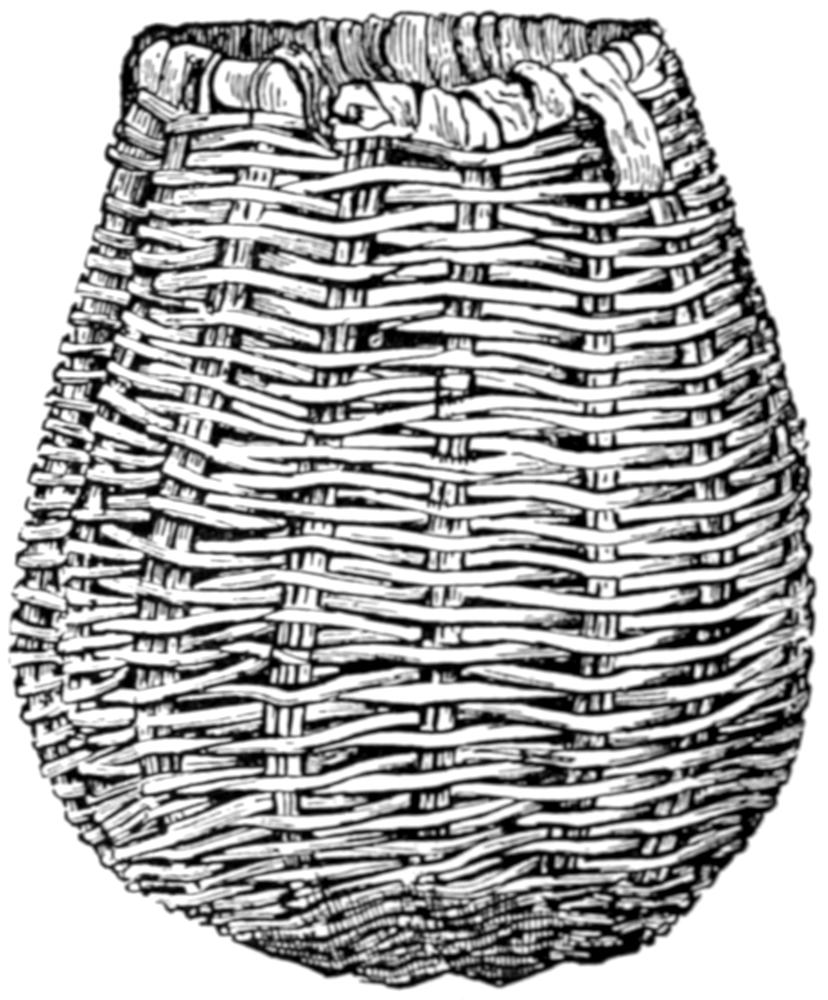
Fig. 1.—Wickerwork Basket.
Basketry was at first very simple, being made with splints, but it soon developed patterns in diagonals and diapers. The alternation of rigid with pliable materials gave a wide scope for design, and the twined and sewed basketry of some primitive people was an art (Fig. 1). Basketry and weaving have much in common, and improvements in one helped the other. Pottery soon developed, probably from the habit of lining baskets with clay in order to hold water. Into this [6]clay-lined basket a hot stone was placed to heat water for cooking. From learning how to make pottery bowls and pots it was but a step to discover that they could be put directly over the fire and the water heated without the stone. The hardening of the clay by heat was also learned. Some of the most primitive pottery shows the form of the weaving of the basket on the clay (Fig. 13).
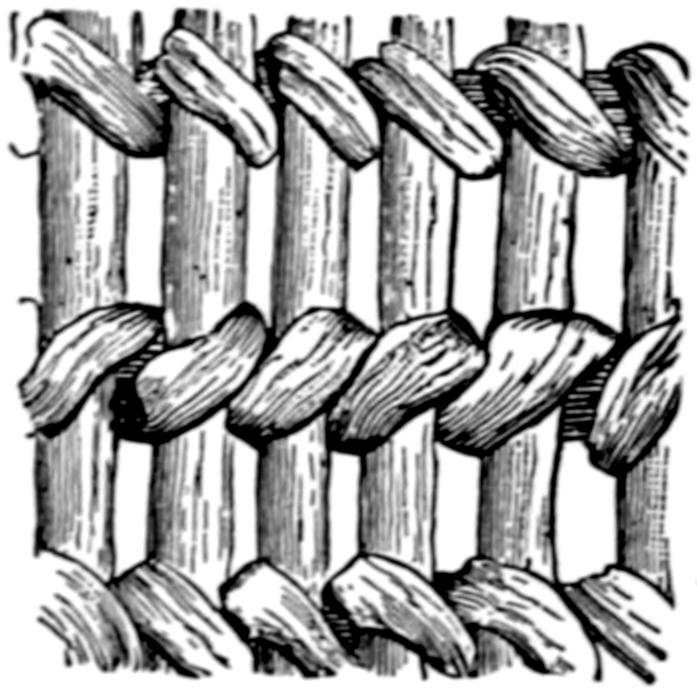
Fig. 2—Wattling.
The men were occupied in food getting, in fishing, hunting, and in war, while the women were working at the camp. The discovery of the use of fire tended toward further division of man’s and woman’s work, for she was the caretaker of the children, and naturally stayed by the fire. As the early people were wanderers, they needed carriers for transporting their young children and their household goods, and mats and baskets served many useful purposes in the life on the march, as well as in the tree, cave, or shelter homes. The cave as a shelter gave way before huts which could be quickly constructed of branches of trees with various coverings to keep out the rain. Inventions were adapted to various purposes; for example, a method of holding rigid materials by softer fibers twined about them at right angles, now called wattling (Fig. 2), was used for shelters by fastening several heavy sticks together in a point, with their loose ends stuck into the earth, laying grass and rushes on top, and holding down this covering by laying sticks at intervals across it, and tying it down by intertwining pliable material around the sticks; for defenses, by holding together the great stakes used for stockades around primitive huts; for early weaving of soft materials, or for very coarse basketry, as well as the fine basket weaving of the Pacific Coast of the United States. Wattling is really a form of weaving. Such a principle once [7]grasped by awakening minds became a means of development as the environment offered new materials for use, and the many needs gave an impetus.
The man, with the women and children dependent upon him, formed a family group. By degrees such families entered into alliances, thereby increasing their safety, and gaining knowledge of new methods of fishing, hunting, and living. These social interrelations tended to develop industries, for some families had made more progress in the crafts than others, and additional comfort and beauty were found to come through the use of new devices. Gradually those who excelled in any line of industrial work attained prominence, as did the great warrior or fearless hunter. Work in metal developed and helped to improve the tools in use. The fertile meadows and mountain sides provided plants and trees, the bark and fruit of which could be used for mats, baskets, carriers, and shelters. Methods of storing food and of transportation were needed, and as ways were found they were exchanged with other families and were the forerunners of trade. Although some planting was done, the homes were moved too frequently for the maintenance of a settled agriculture. There was little providence for the future, for all extras impeded travel.
During this wandering life important industries passed their simplest form. Weaving had begun on simple looms, which were nothing more than two heavy sticks between which rushes were stretched so that the latter were held taut, while the weaver wove other rushes across these threads. The value of fibers taken from plants and the coats of animals was discovered, and crude forms of spindles and distaffs aided in the spinning of yarn. At first, hair, hemp, leaf fibers, strips of fur and sinews were in use, but when it was found that short fibers, such as wool and cotton, could be prepared and twisted continuously around each other, a great step was taken toward weaving (Fig. 3). The first [8]woven articles were more for floor or tent covering than for clothing. The advantage of the softer materials for carriers and body coverings was soon felt, consequently softer fibers were in demand. Coarse hand-like wood contrivances aided in the opening (carding) of the wool or other fibers, so that they could be twisted more easily into yarn. Weaving which combined pattern with color gave results of interest and even beauty, increased by knowledge of dyeing, staining, and painting by the use of crushed berries and roots. Climate, of necessity, had its effect. Tropical regions gave fine, soft fibers which made exquisite weaving possible, while cold countries offered skins and coats of animals to be used for similar purposes. The ease of life in the tropics tended to idleness, but colder climates made it necessary to struggle continually to obtain the necessaries of life. It is in temperate parts that we must look for the greatest industrial inventions and improvement in living.
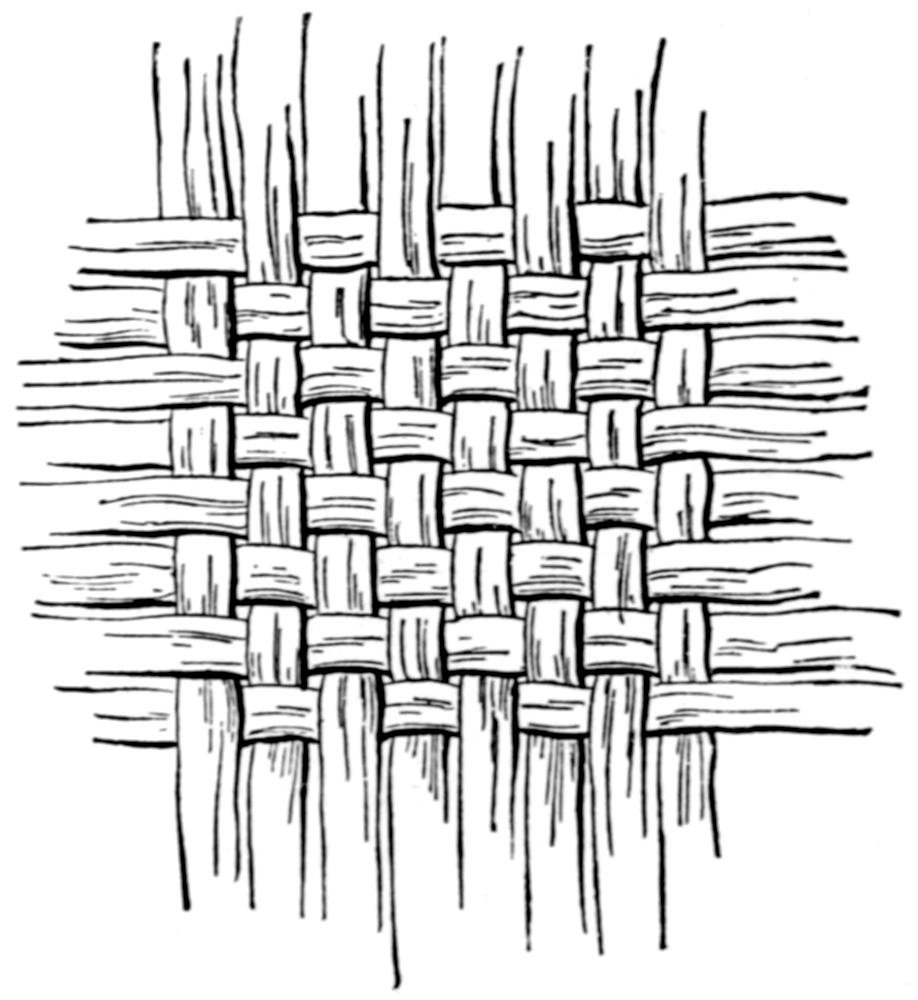
Fig. 3.—Plain Weaving.
[9]
Some form of sewing was used in various developing industries, the coiled basketry required a sort of needle, the making of netting was with a similar tool; decorations of articles and the making of clothing all used needle-like devices. Thorns and bones were used to hold skins together, but by holes placed in these devices the twisted yarn could be held, thus making a needle (Fig. 4). As people settled in communities there was more time for work and the product of simple looms increased. Lighter-weight strips of cloth were produced as fibers were found that could be made into yarn. The first clothing was a sort of a skirt wound around the body and fastened at the waist. These were worn by both men and women. The bone needle, stiletto, and awl, so useful to primitive women, were highly treasured and often beautifully decorated. In the tombs of Peru are found tools of great beauty which have been used by primitive races in that country (Fig. 5). The Incas, who dwelt in countries south of the United States, have left textiles of great beauty made of wool and cotton yarns.
In Switzerland primitive homes are found deep under the mud of Alpine lakes. Hanks of linen, wool, and other yarns, and remains of cloth indicate that spinning and weaving were well advanced, yet these people were of the early stone age. These fabrics are similar to those found in the cliff dwellings of southwestern United States.
Among the Eskimo there was less weaving than in warmer parts of the world, but extremely interesting garments and boots of skin decorated with fur and appliqué embroidery, show that according to the possibilities of their Arctic environment they were well advanced in some arts.
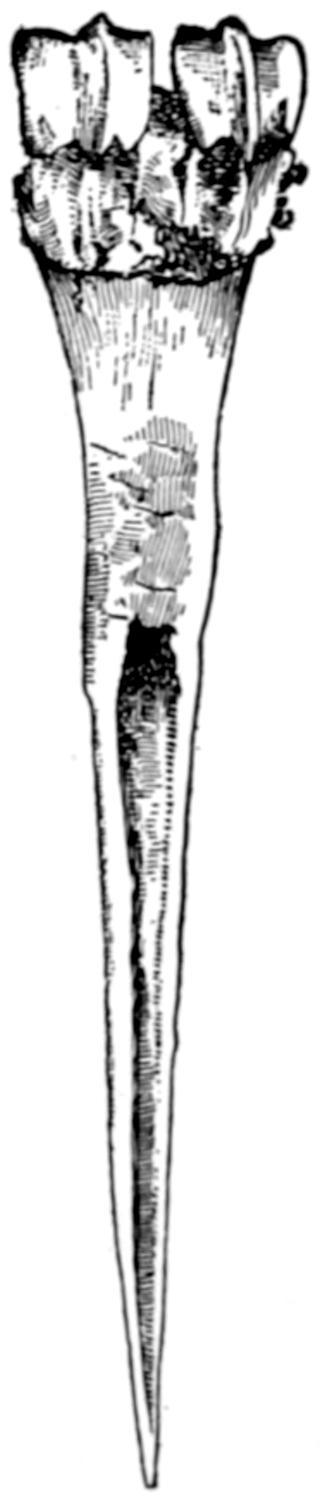
Fig. 4.—Bone Awl.
[10]
The increasing knowledge of animals and of means of trapping them led to domestication of the less savage species. The effect of the keeping of such domestic animals on problems of food, shelter, and clothing was very great. More permanent homes were established for the women, children, and the less able, while the strong men went out with the flocks and herds, returning at intervals. Care of animals developed a different and less savage temper. Warlike instincts were less constant. Peace between neighboring families increased, and ceremonies showing the pact between them were held around mounds of stone, which became the center of life and government.
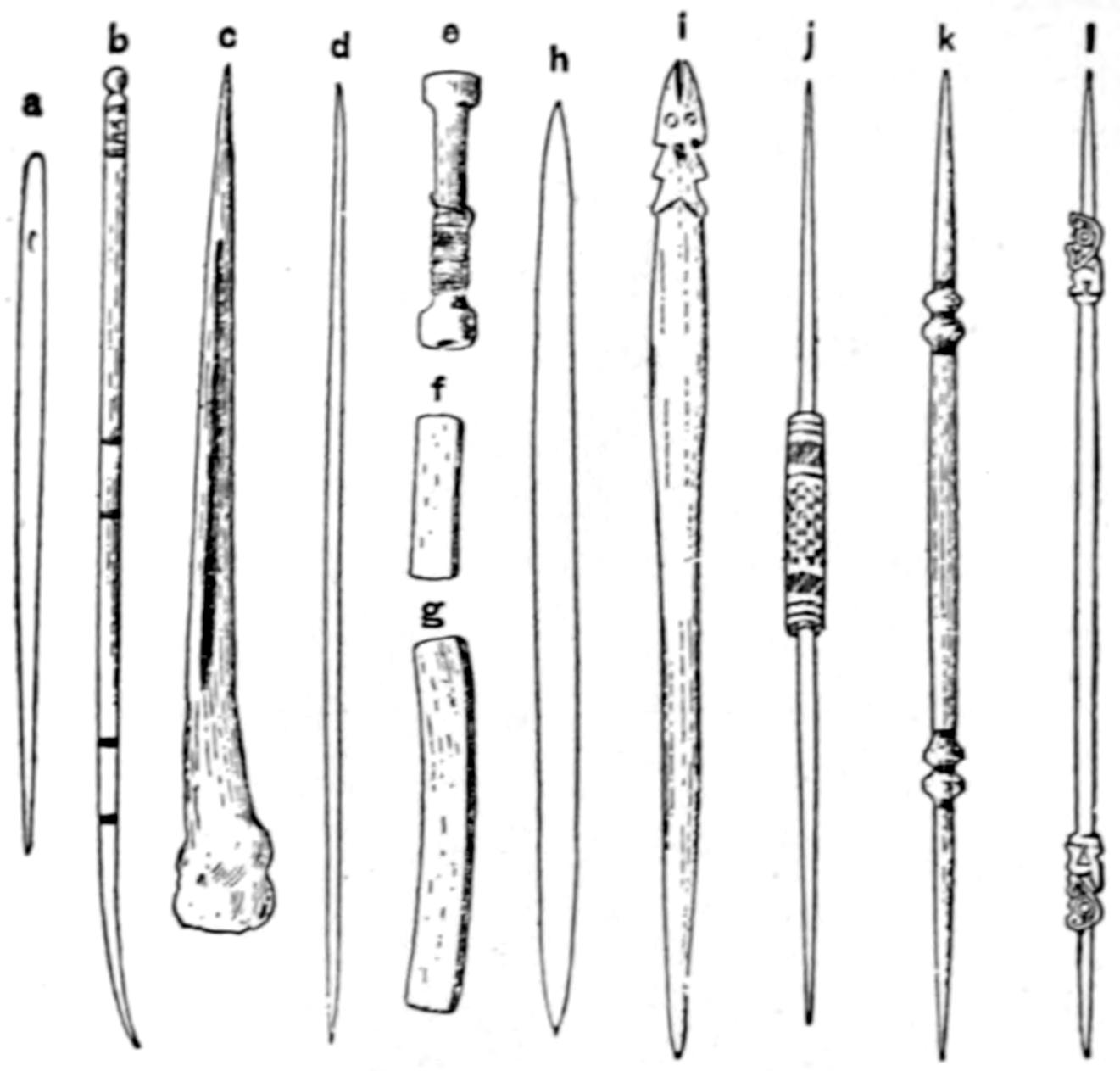
Fig. 5.—Primitive Implements.
a, b, needles; c, bone awl; d, needle pointed at both ends; e, wooden spool; f, netting mesh; g, weaving band; h, shuttle-like piece of wood; i, netting or weaving instrument; j, k, l, spindles.
When America was discovered it was inhabited by people of many stages of development. Pottery, basketry, weaving, tool making, with metals, and other arts were in some cases well advanced. The life of these people, while changed, is [11]still primitive. Nomadic and semi-nomadic tribes such as the Pima, Papago, Navajo, and Apache, use tepees or thatched houses for homes. Basketry is made for many household purposes, and the food is largely game. The Navajo are examples of those relying on a pastoral life for their support. They settle on land good for grazing and food. Wool and hair for their rugs, blankets, and lariats are obtained from their flocks of sheep and goats and herds of horses. Some planting is done, but it is not far advanced. Sedentary tribes are still living in the Southwest. Examples of these people are the Hopi and the Zuñi. They live in pueblos consisting of adjoining houses with walls of clay, adobe, brick, or stone. Those who lived before the dawn of history, the Cliff Dwellers, built community homes (supposed to be for defense) under overhanging cliffs, high on a canyon wall. They raised corn, beans, and squash on the mesas above the cliffs, and even had systems of irrigation. Beautifully decorated pots were made and used. The Zuñis were weavers (Fig. 6). Remains in the cliff dwellings far below the level of the present pueblos, show that a race of basket makers preceded by centuries the later Cliff Dwellers, of whom little is now known. The early race had no permanent dwellings.
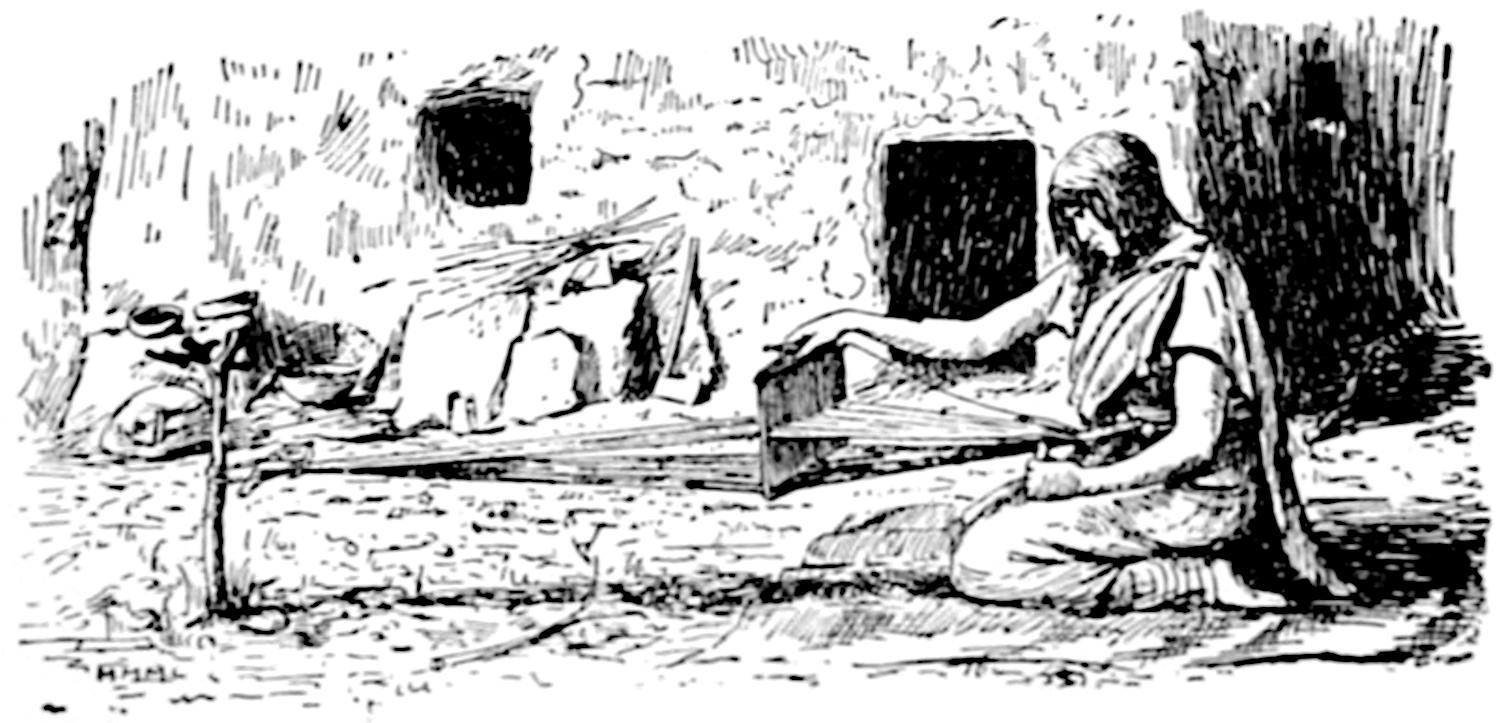
Fig. 6.—Pueblo Woman Weaving.
From Watson’s Textiles and Clothing, by courtesy of the American School of Home Economics.
The more stationary home life gave an incentive to the making of rugs, hangings, and clothing, which were often [12]rich and beautiful. The uniting of many families under one leader stimulated the desire to excel, and specialization in some particular textile craft was not uncommon. The wish for social approval led to the adornment of the person, and clothing became more decorative in character. It had been adopted in many cases to show prowess or to frighten enemies, by displaying the skins of animals slain by the wearer, or by strings of teeth or scalps worn around the body. This custom led to the use of woven material for ornament. A feeling of shame for not wearing clothes came only after dress had become customary. Hats, which at first were inverted baskets, were now made especially for the head covering. The demand for material made from spun wool or cotton increased with the demand for clothing. Dress now became a means not only of comfort or of decoration, but to show the distinction of sex or of classes. Among the Navajo Indians the chief’s blanket has its special design and colors, and the dress of the young unmarried women is different from that of the married ones. Special costume was used for the medicine men and warriors, and for ceremonials. The use of dress for social distinction has always characterized developing people. The Middle Ages perhaps saw its height, but although moderated, it is still a part of modern civilization, though now more practiced by women than by men. The demand for fabrics of rare design gave great impetus to the art of weaving. Tribes began to look to each other for exchange of products, and so tended to assume more peaceful relations. Textile industries had passed their primitive stages. Devices and even rude machinery to assist the hand were common. Beauty of design and skillful handling are evident from examples preserved in the museums. The most common of the textile crafts in use were:—
- Braiding and looping.
- Tying, wattling, and thatching.
- Netting for fish nets, carriers, and clothing.
- [13]
- Weaving for shelters, mats, rugs, hangings, and garments.
- Basketry, both woven and sewed, made into carriers, hats, traps, and household articles.
- Knitting and crocheting.
- Carding and spinning.
- Reeling.
- Needlework in sewing, embroidery, appliqué, repairing, box making, and clothing.
- Lace making, by sewing, weaving, and knitting.
- Skin drying and curing.
- Dyeing and staining.
- Decoration in beadwork, stenciling, block printing, and picture writing.
- Felting and beating.
- Making tools for use in the various crafts.
- Loom building.
Carding by Hand.
—The opening up, combing, or carding of raw fiber is probably as ancient as the art of spinning. The first cards or combs were evidently the fingers, with which the matted mass was opened, dirt and knots were pulled out, and the fibers were laid in a soft, open lap. A device for aiding the hand was later made of wood or bone, the shape being like the outstretched fingers. This instrument was succeeded by two flat pieces of wood covered with skin (Fig. 7), through which teeth or thorns protruded. The fiber was laid between the teeth of the two combs, and combed or carded thoroughly. Such cards are in use in some modern factories, where they are used for blending wools and trying out colors. The Navajo Indian woman of Arizona uses cards to comb her wool. They are made like the primitive ones, but the flat surfaces are now covered by card clothing (bent wires closely set together in leather or rubber). After the Indian woman washes and opens her raw wool,—always a very necessary part of successful carding,—she sits down on the ground and spreads a small quantity of wool on one card, which she holds face up with the left hand. The other card she holds with the right hand, having the [14]card clothing down. She firmly presses one card on the other, and draws toward her the one in her right hand, thus combing through the fibers on the other card. By repeating this process she finally has the wool in a clean, fluffy mass. When the wool is sufficiently open and free from dirt she lays the lap on the back of the left card, and makes it into a roll or sliver with the back of the other. With these rolls she spins her yarn.
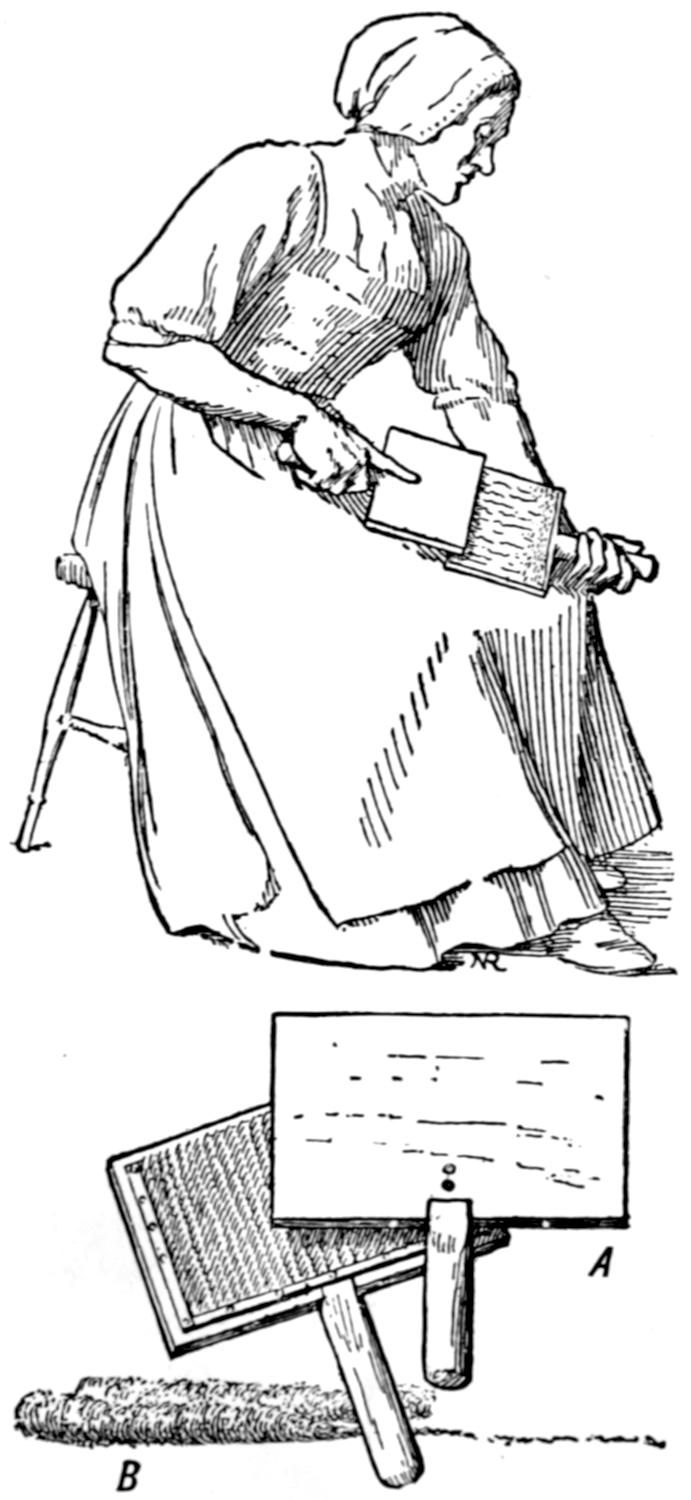
Fig. 7.—Hand Cards.
A, Cards; B, Wool Roll. From Hooper’s Hand-Loom Weaving, by courtesy of John Hogg, London.
Spinning by Hand.
—Spinning is the twisting of a succession of fibers into a continuous cord, rope, or yarn. It was one of the earliest industries of the human race, and the necessary opening of the fibers, which were often matted and rough, to make them twist more smoothly, was the beginning of carding. It is supposed that both processes began about the same time. The need of some form of [15]binding twine, and later of mats and shelters, led to the use of rushes, strips of skin, the hair and sinews of animals, the bark of trees, the fibers of the agave and other plants. These fibers were limited in length, and had to be knotted or twisted together to serve the purpose required. They were not spun. It was later discovered that some fibers lent themselves to continuous twisting. Wool spinning may have been the earliest, for wool was accessible and easily twisted on account of its natural oil and crimp. Flax (linen), though difficult to prepare, was in use even before the age of metals. Pictures on Egyptian tombs show the processes of flax preparation as conducted there at an early age. Cotton was used in India, and the laws of Manu, 1000 B. C., give regulations concerning its manufacture, seriously objecting to the heavy sizing of the yarn, showing that spinning was an old industry at that time. In South America at a very early period cotton was spun into fine yarns and woven into cloths of great beauty. Silk, too, was taken from the cocoons, slightly twisted, and woven into cloth in China and Japan at the dawn of their history.
Early spinning was done by the fingers alone, the fibers being held in the left hand and twisted with the right. It is a very simple process. Even a little twist greatly strengthens the fibers. The spinner drew from prepared (carded) fibers, such as cotton or wool, a number of parallel threads and twisted them as they came, making a continuous piece. It took a little practice to make a firm, even yarn. As the fibers thus spun untwist very quickly unless held by some artificial means, the worker probably wound the product on a stick, later fastening the end of the yarn in a natural or manufactured cleft, or holding it by a half hitch around the stick. It was seen that if the stick or spindle on which the spun fiber was wound and caught slipped from the hand while the spinner was twisting in another length, it would revolve rapidly in the other direction and untwist the length [16]of yarn. Experiment would show that by giving the spindle a sharp twirl as it descended, carrying the length of yarn, a twist might be put in during the time the revolutions continued. A spindle on which a quantity of spun yarn was wound would be found to revolve more smoothly and draw out the fibers better than one which had no yarn on it; this suggested the placing of a weight on the spindle. A lump of mud or clay, a stone or a piece of wood were early added to the spindle to assist the revolutions. It also kept the yarn from slipping off the spindle. Such weights, called whorls (Fig. 5, j.), were often molded, carved, or painted attractively.
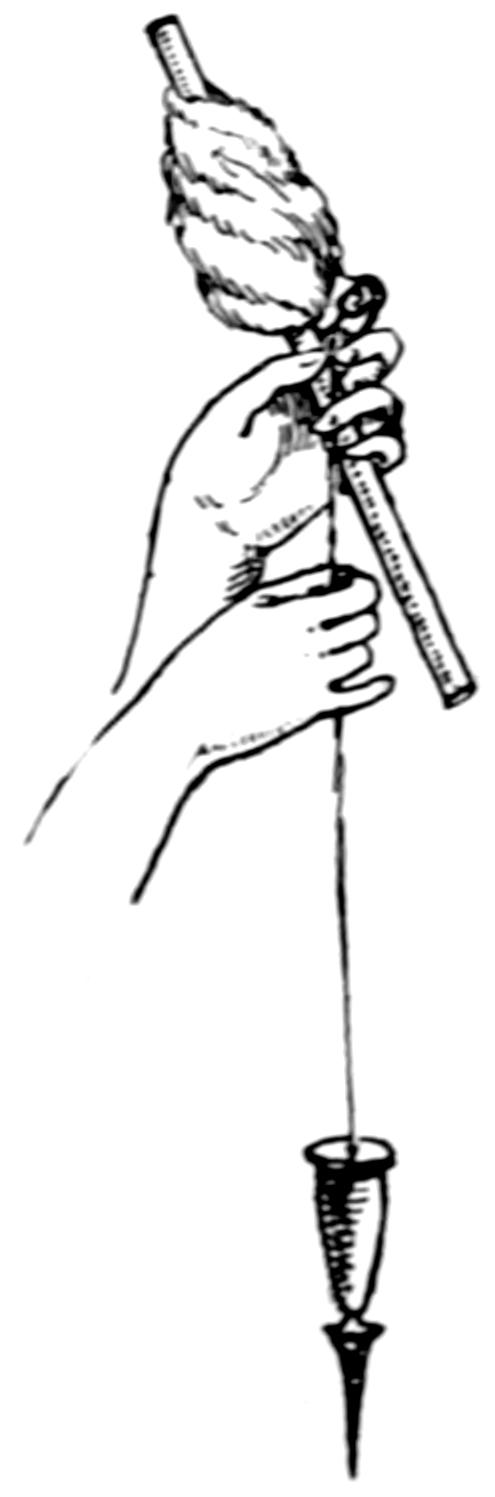
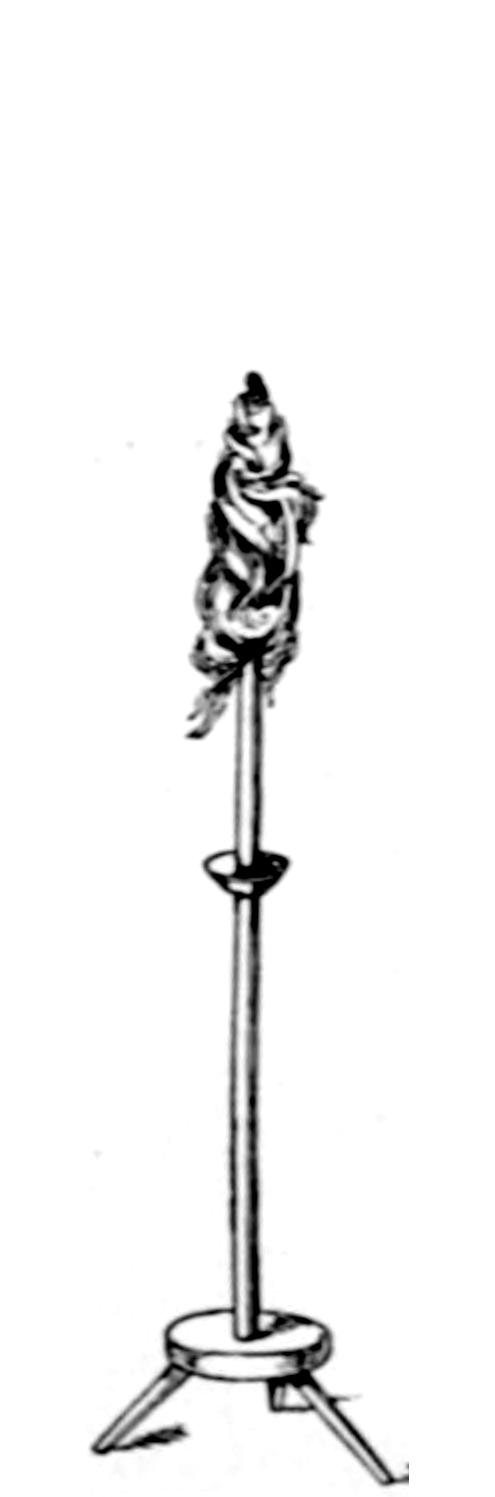
Fig. 8.—Hand in Action.
Fig. 9.—Rock.
Good spinning required careful carding of the fibers. Some means other than the hand of holding these opened-up fibers was necessary in order to keep them in good condition. At first a simple stick was used, at one end of which the carded mass was placed, lightly tied around with a piece of yarn to keep it smooth. This stick was called the distaff (Fig. 8). It was held under the left arm or in the belt, or it was thrust into the ground beside the spinner. In Germany it was called the rock (Fig. 9), and was placed on a block to hold it erect, while the spinner stood or sat near by. In parts of Europe spinning with the distaff and spindle can still be seen. The spinner draws out a number of fibers from the underside of the carded material next to the distaff, twists them, and fastens them to the end of the spindle. With the right [17]hand she gives a sharp twist to the spindle; in the meanwhile she continues to draw out a number of fibers with her left hand to supply the descending spindle (Fig. 10). When the spindle reaches the ground, she picks it up, winds on it the length of thread just spun, and catches the end in the [18]cleft. Spindles were made of wood, bone, and metal. They were usually from ten to twelve inches in length, while the distaff was from twelve to thirty-six inches in length.
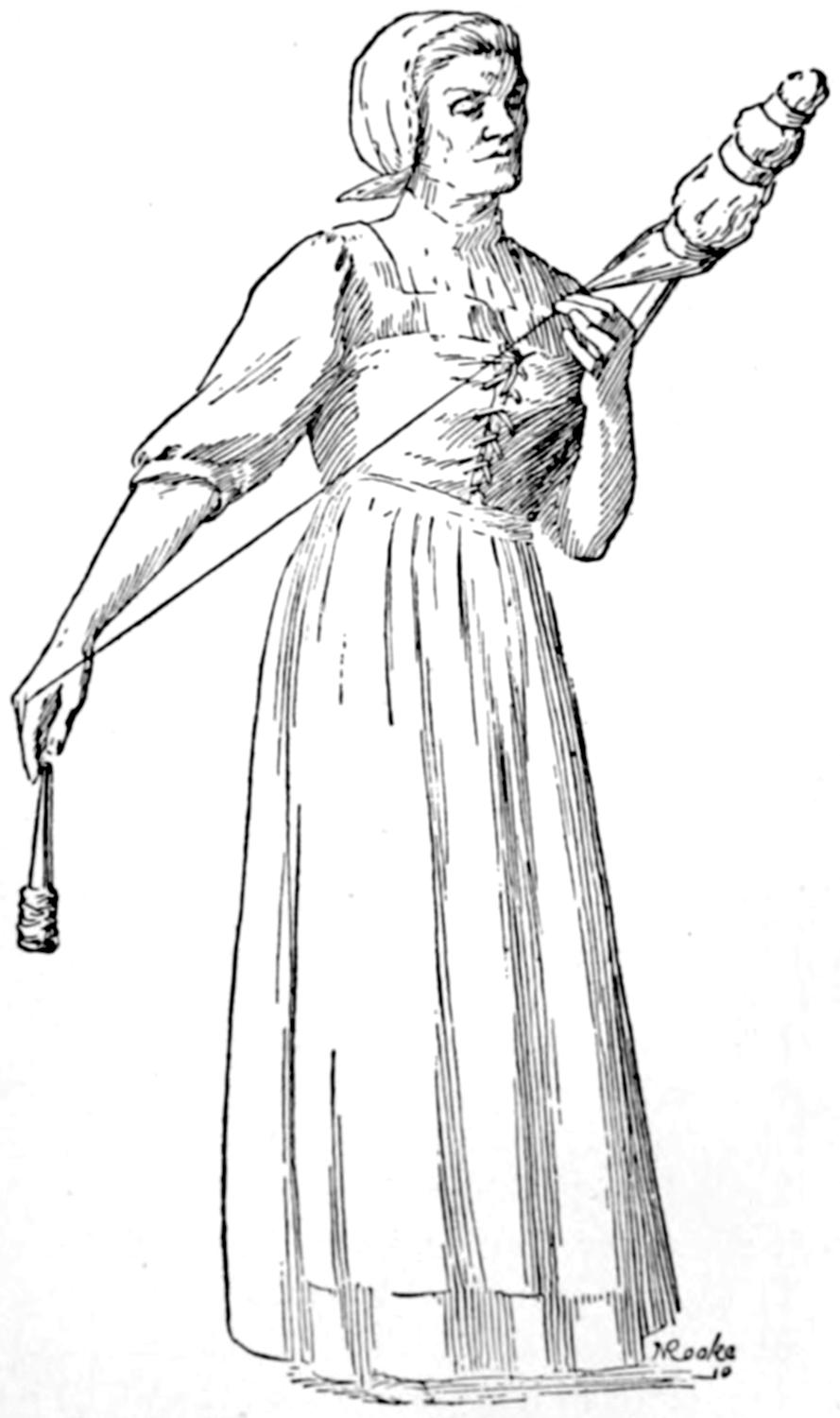
Fig. 10.—Spinning with Distaff and Spindle.
From Hooper’s Hand-loom Weaving, by courtesy of John Hogg, London.
Spinning is found among all primitive people, and although it differs somewhat in method, the underlying principles are the same, i. e., drawing out the fibers, twisting them, and winding them up. Ropemaking was similar to spinning. The worker held the raw material, such as hemp or flax, in the hand or apron, and after attaching some of the fibers to a revolving device, walked backward, letting out the material. It was thus drawn and twisted. The required length of rope was made by extending the twisting for a hundred or more feet and then returning, to allow it to be wound. The single ropes thus made were united in threes, making a heavier rope. Ropewalks across fields are still found in Europe.
In India we find a method of spinning the finest grades of
cotton yarn by revolving a thin piece of bamboo in a cup of
cocoanut shell. The fineness of the yarn to be used for
Dacca muslin has never been surpassed by machinery. A
simple method of spinning coarse yarn for hammocks or
twine was found in New Guinea. The worker laid a bundle
of fibers on the left knee, pulled some threads from it with the
right hand, twisted them, and rolled them into a ball on the
right knee. Another method of spinning was to tie fibers to a
stone and revolve the stone. The Navajo Indian women of
New Mexico and Arizona have for a spindle a slender stick of
wood with a circular disk or whorl at the end of it. The
woman sits on the ground with her slivers of carded wool
beside her, holds the spindle with her right hand, and puts the
point of the spindle on the ground with the whorl just above
it. She lays the long end of the spindle against her knee,
attaches the end of a sliver close to the disk, holds it out and
draws it away so that it grows thinner and is twisted as she
twirls the spindle. When a length of yarn is sufficiently
[19-
20]attenuated and spun, she winds it on the spindle. This
process is repeated until the spindle is full (Fig. 11). The
first yarn spun is soft and only slightly twisted, consequently
the process is repeated several times until it is strong enough,
especially for the warp threads.
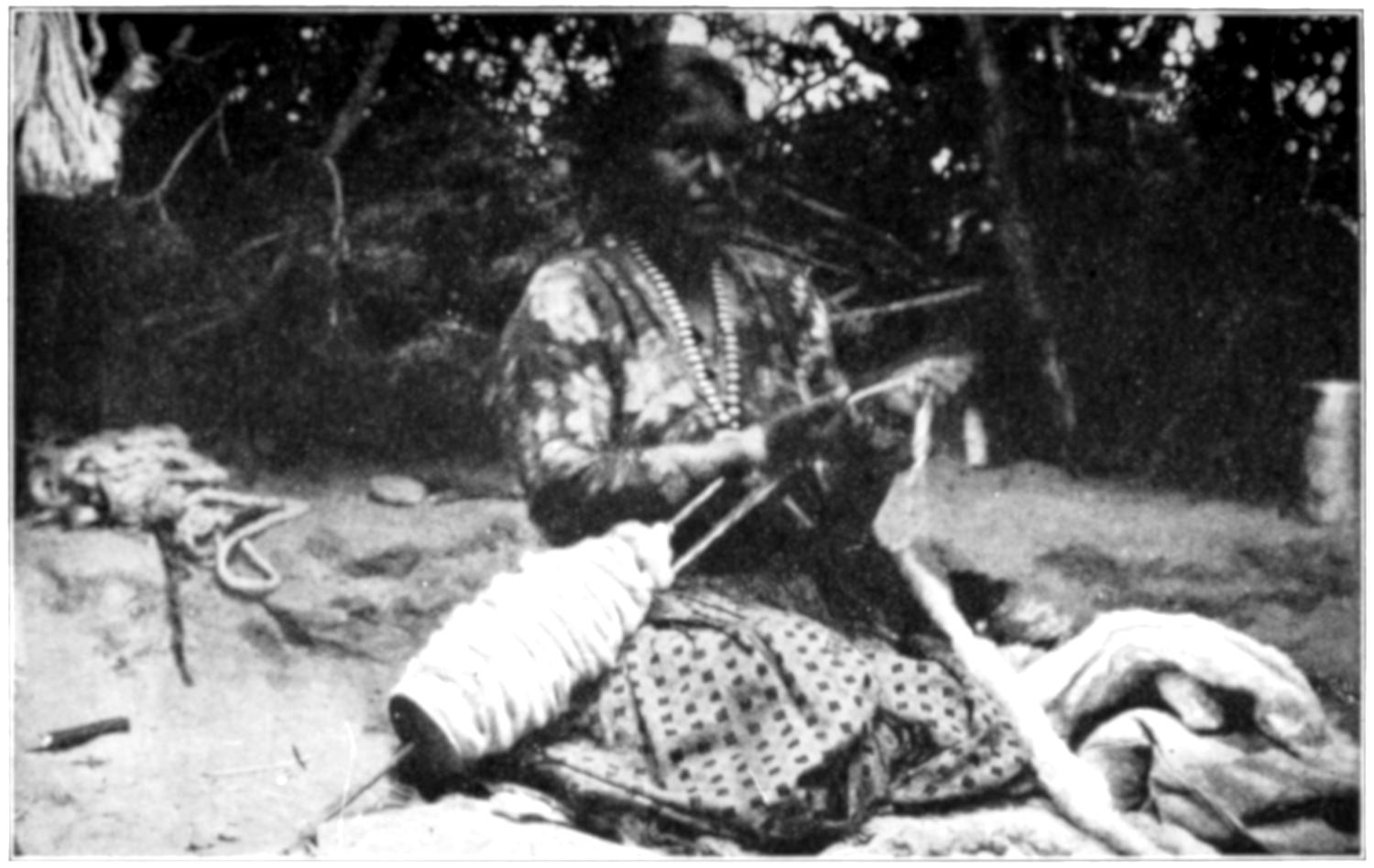
Fig. 11.—Navajo Woman Spinning.
Weaving by Hand.
—Weaving is the interlacing of two lines of threads crossing each other at right angles. (See Fig. 3). Plain or pattern effects are made according to the manner in which the threads are interwoven. The threads running the length of the cloth are called warp, or ends, and are set up first in the loom. Those that intersect and run across the warp are called woof, weft, pick, or filling. The filling threads which bind in the warp threads at either side form the selvage (Fig. 12).
Weaving is one of the most ancient of the arts. It preceded carding and spinning. Its development has called forth and still requires a high order of mechanical ability. Marvelous results in fineness of cloth and beauty of design were attained in it even when it was in its infancy, with few devices to aid the hand, and when to make one rug required untold labor. Even modern machinery cannot outdo the handwoven materials from various parts of the world.
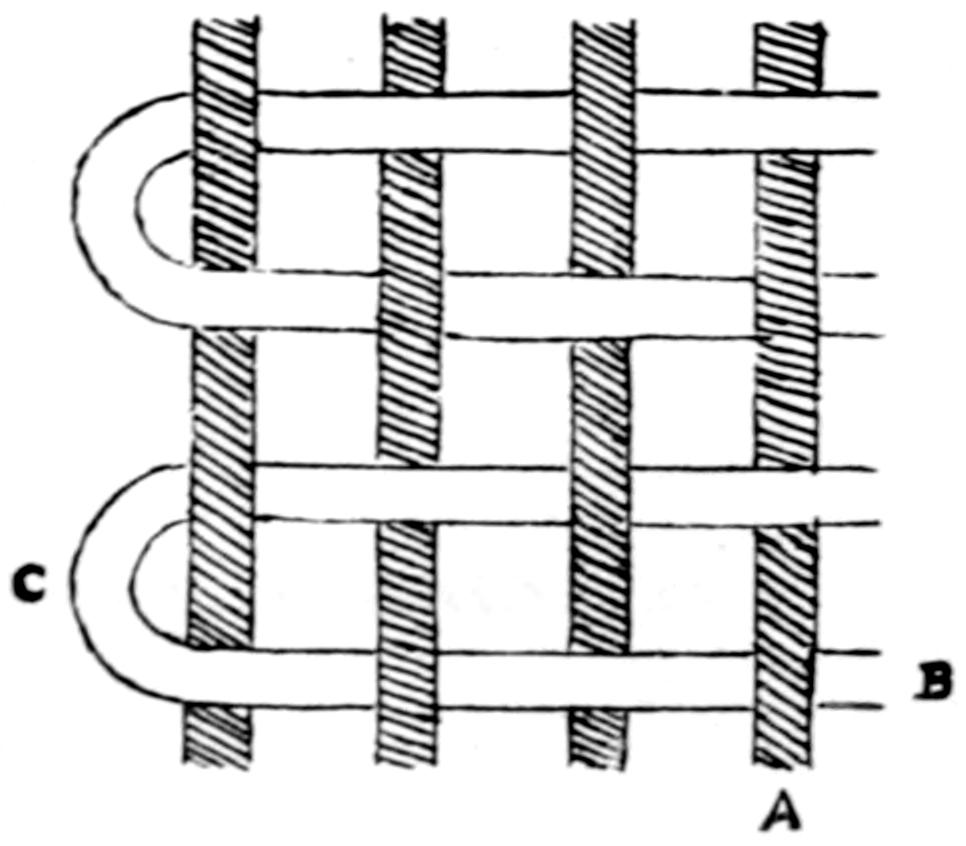
Fig. 12.—Detail of Weave.
A, Warp or ends.
B, Filling, woof, weft, or picks.
C, Selvage.
Our present knowledge of the beginnings of weaving comes (1) from the work of nations which are now in primitive condition and whose work we can watch, such as the natives of the Philippine Islands, the American Indian, and African tribes; (2) from early pottery, which was frequently decorated with a [21]textile design, and shows clearly that woven cloth was laid upon it when it was in a moist state (Fig. 13); (3) picture writing on tombs; (4) mats, rugs, and cloth which have been preserved. These ancient materials show the art from the coarsest mat weaving to the finest cotton and linen fabrics, having often the most intricate designs in various colors.
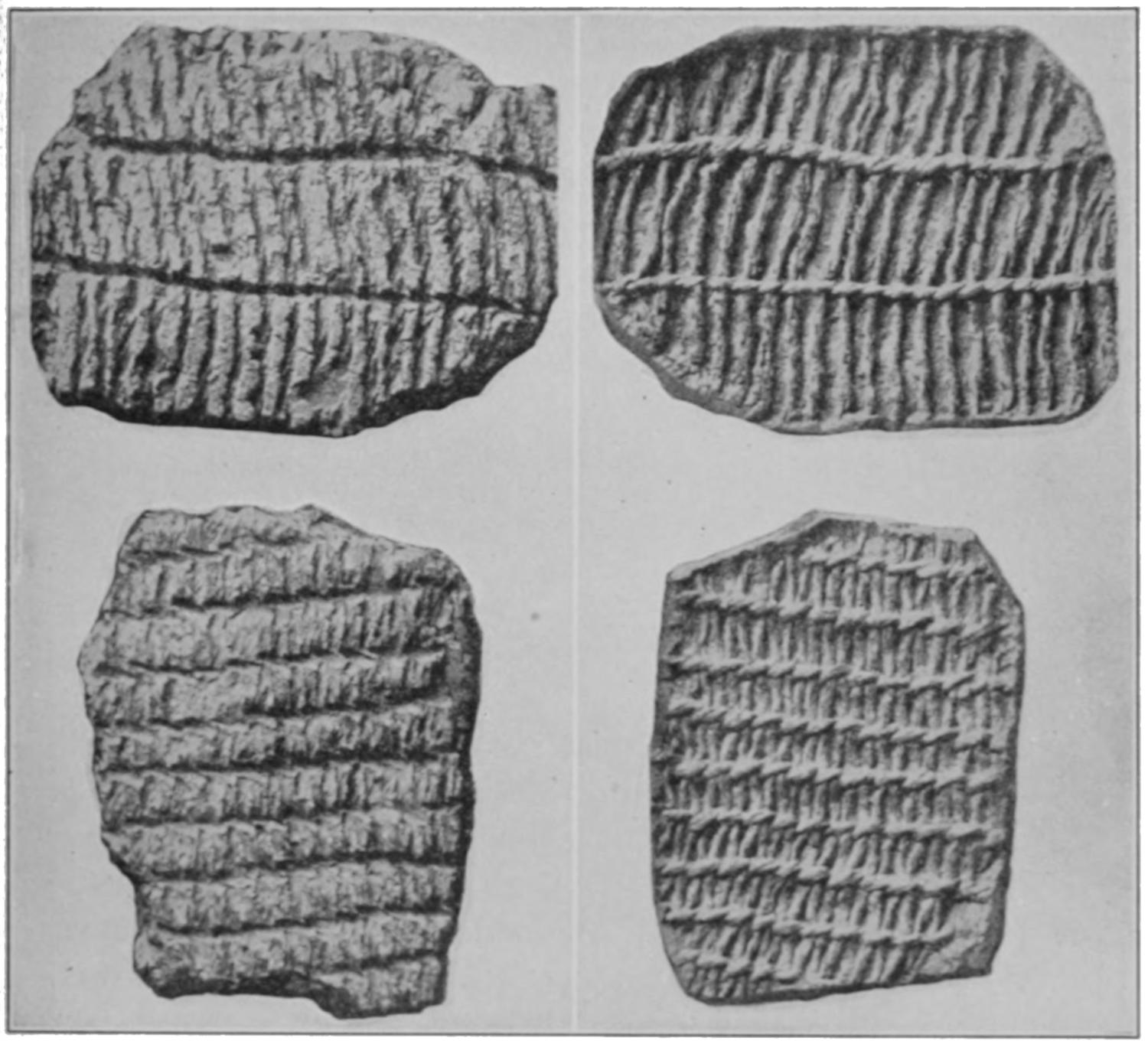
Fig. 13.—Textile-Impressed Pottery.
A. Pottery.
B. Weave used.
Principles Underlying Weaving.
—A knowledge of the principles of weaving is found among almost all primitive people, no matter how savage, and their first steps toward an adequate loom seem strangely similar, when it is remembered [22]that there was often no communication between nations. There were three principles developed, and these same three are the important ones in modern power weaving: (1) shedding, or the raising of the warp threads as needed; (2) picking, or the throwing across of the filling threads; and (3) battening, or the driving up of the filling. Various devices were invented to facilitate these motions. Weaving was done at first by the hand alone, rushes being laid lengthwise on the ground and lifted alternately, to allow the woof or filling to be inserted across them, and the fingers pushed the filling into place. One of the first inventions was a way of holding the warp stretched, that the threads of it might be raised more easily for the insertion of the filling. The early looms (see Fig. 14) were usually vertical, and had a heavy wooden bar or beam at the top to hold the upper ends of the warp, and [23]stone weights tied to the lower end of each thread, thus keeping the warp taut. The beam was suspended in a framework, or between trees. Some nations placed bars at each end, which were forerunners of the warp and web beams of the modern loom. To accomplish a more rapid raising of the warp threads, sticks were inserted alternately in the sheds, to indicate the path of the filling, a simple device which led finally to the harness of the modern loom. To take the place of the fingers for throwing the filling threads across the warp, a stick was used on which the filling was wound; this later became the shuttle containing its quill of yarn, and the shuttle race. As a means of widening the shed for the insertion of the filling, and later battening it up, a sword or batten was used, which served both purposes. The lathe or sley of the modern loom, with its reed, has developed from the early sword.
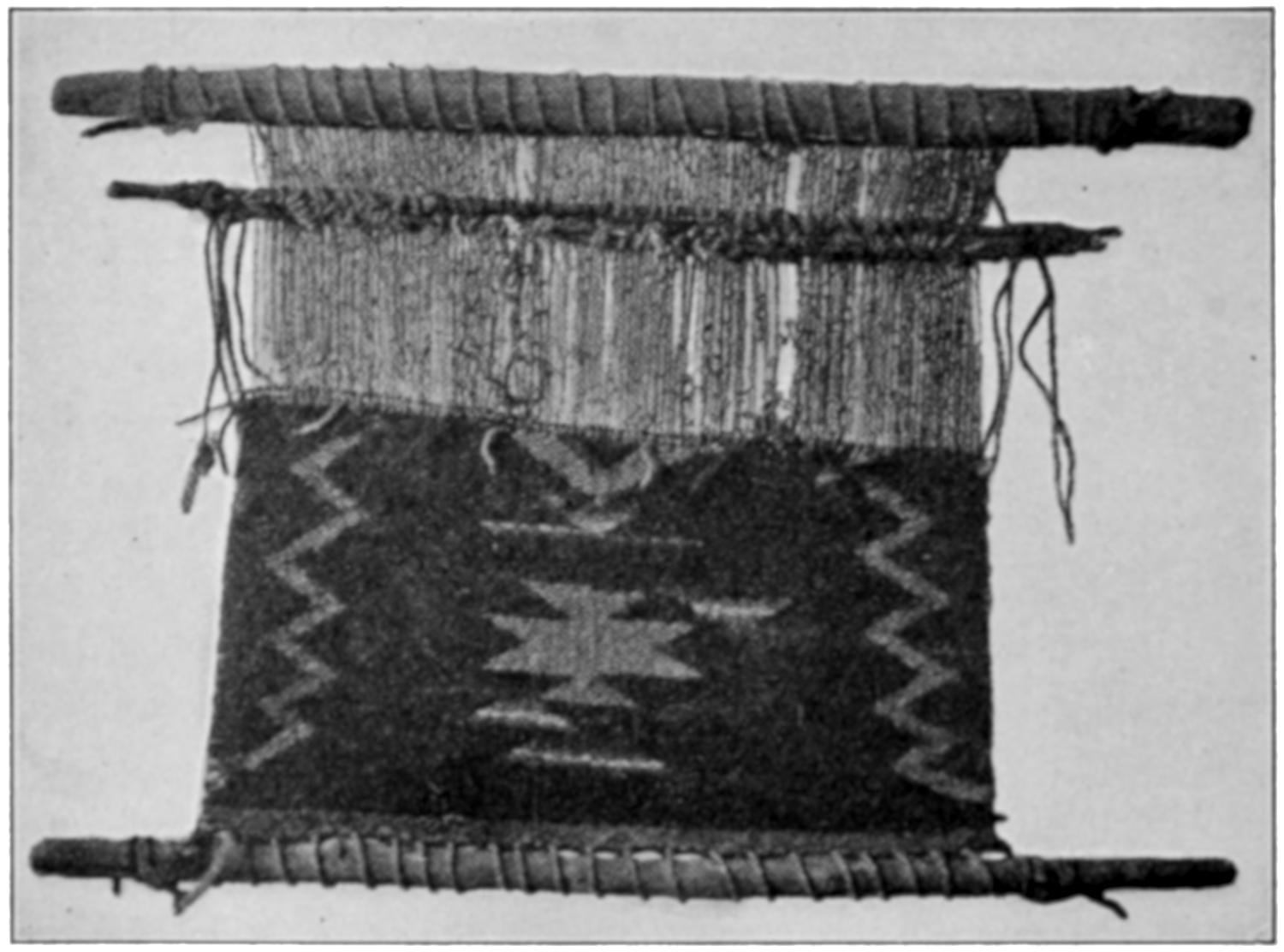
Fig. 14.—Navajo Loom.
Primitive Looms.
—Many kinds of looms were invented: (1) the upright or vertical, such as the Navajo Indian loom or some forms of the tapestry loom (see Fig. 14); (2) the horizontal loom, like those of the Moros of the Philippine Islands, and of the Zuñi and Pueblos of America (see Fig. 6), a form also seen in the hand loom of colonial days and in the power looms, and (3) slanting looms, such as are found among the rug makers of the East.
The beautiful Chilcat blanket (Fig. 15), is used for ceremonial purposes. It is woven by the Tlingit Indians of the northwest United States. The old blankets were white. Later color and pattern were introduced on the white, and finally the elaborate geometrical designs of to-day which are said to be of a conventionalized whale. The patterns are painted on a board in the size and shape desired. The squaw weaves from the pattern. The warp is of shredded two-ply cedar bark wrapped with a thread of wool. The soft hair of the mountain goat is the filling. Two threads are twisted together. The blanket is woven with the lower [24]ends rounded. Heavy weights hold the warp threads in place while the weaving is in progress. Few devices are used by the weaver.
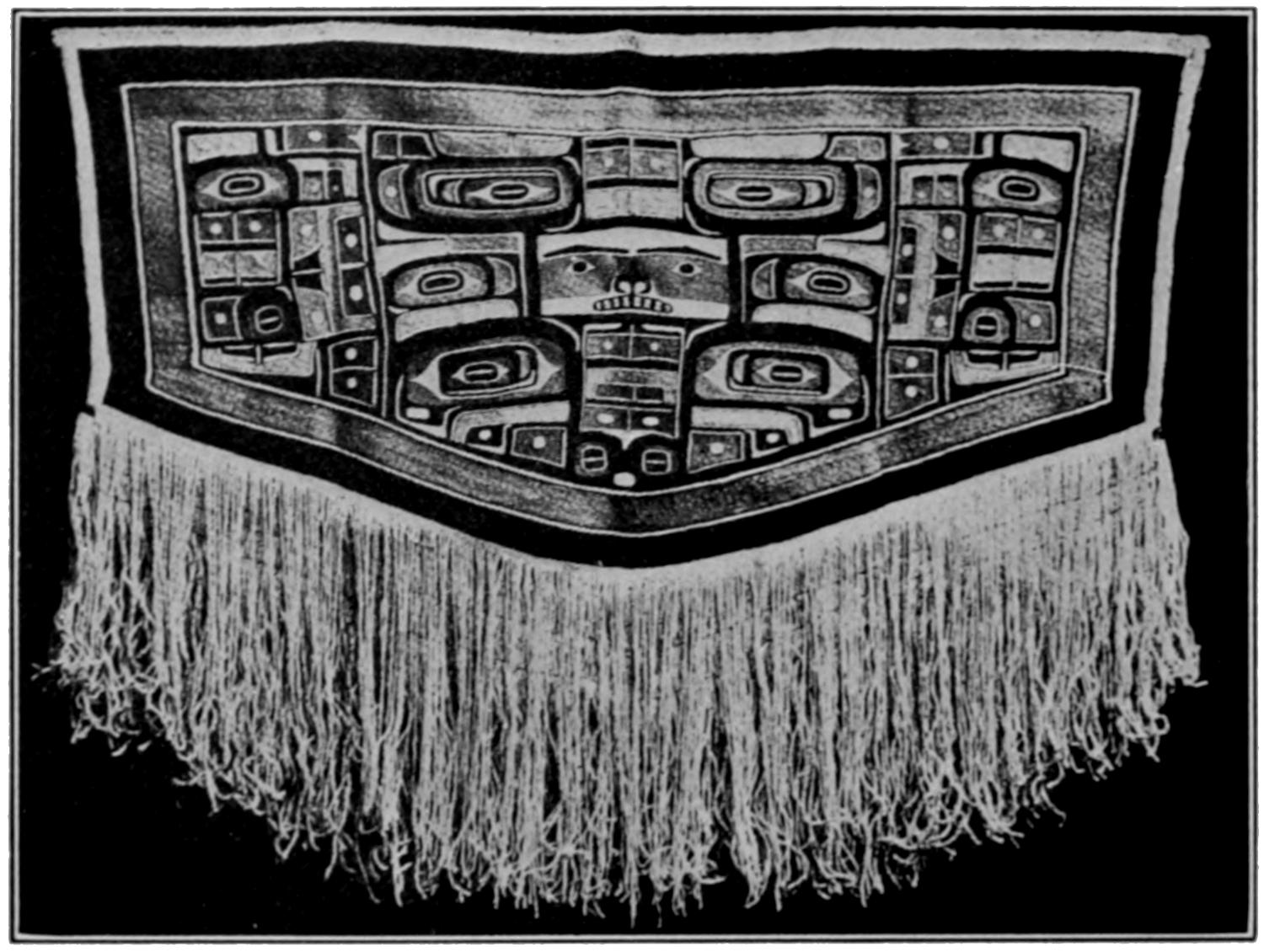
Fig. 15.—Chilcat Blanket.
Tools of various kinds were invented by different peoples to assist in the making of cloth, such as knives to split material, which took the place of the teeth of the worker; gauges to measure distances, which replaced the finger nail; awls to assist the fingers in fine work, and act as needles (Fig. 4), and combs to help the fingers in driving home short sections of filling. The Zuñi Indians invented an interesting heald shaft or heddle for making the shed (Fig. 6). It consisted of a series of small flat sticks held in a framework, with holes in the center of each stick, and spaces left between the sticks. The first warp thread was passed through a slit between sticks and the second through a hole in a stick, the third through a slit, the fourth through a hole, until all [25]the warp threads were disposed of, every other one being through a slit and the alternate ones through the holes. The shed was formed by raising or depressing the heddle, thus threads were alternately brought up or down, through which the filling was passed and battened up. This form of heddle is on the order of those used in the modern power loom (Fig. 16). Heddles of simple construction are found in many parts of the world. The Eskimo made one of bone, and the European carved one from wood (Fig. 17). Our colonial women used a similar heddle in their tape weaving.
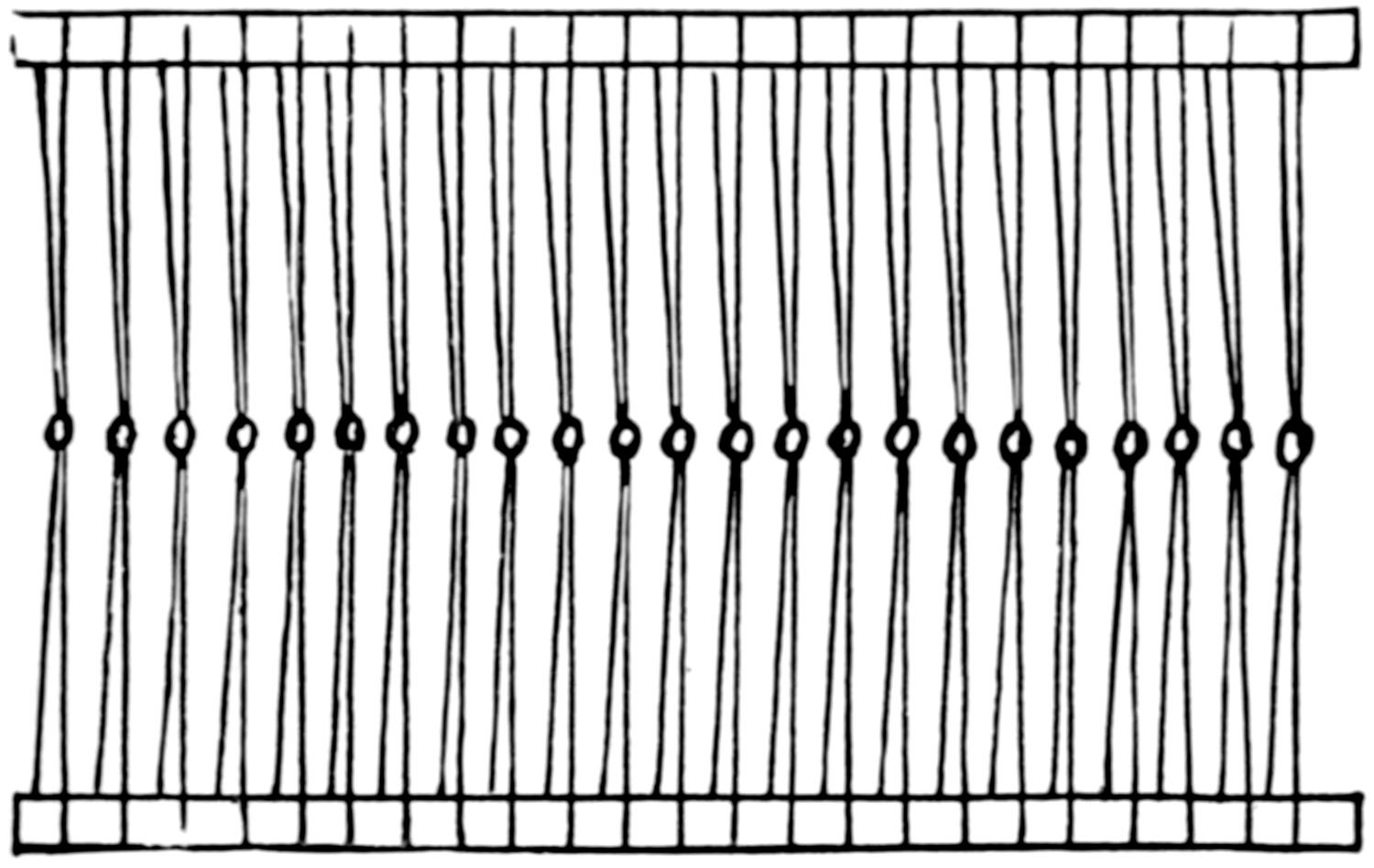
Fig. 16.—Heald Shaft.
The Navajo women are still weavers. Beautiful rugs were once woven of the wool of the native sheep (Fig. 14), dyed or undyed, with characteristic designs upon them. Unfortunately the demand for a cheap rug is injuring their art. Few people understand the value of these old rugs, and consequently are unwilling to give an adequate price for them. The better grade of rug took sometimes as long as a year to weave, but the present one is frequently made rapidly and poorly, with a cotton warp and commercial wools for filling. Cheap dyes and poor designs are used. In fact, these rugs are even copied on power looms and sold in [26]large quantities. The real Navajo rug has the wool of the native sheep carded and spun for the warp as well as the filling. The warp threads with their crossing are prepared and stretched on the beams. As the warp hangs taut the lease or crossing of the threads can be clearly seen, for every other thread is slightly forward of the alternate ones. By slipping sticks into these sheds they are accented. A simple harness is made by laying a long rod across the warp threads, fastening a piece of strong yarn to the rod, and in succession catching the yarn around each back thread in the lease and then around the rod. When all the back threads are thus connected with the rod, they can be drawn forward at one time, making a distinct shed of alternating threads. Through this the sword or batten is thrust and turned over to make a wider opening of the threads, while the filling is inserted. A stick is placed in the alternate shed, which preserves it. As the threads of this shed are forward in the crossing they are easily distinguished at any time. When the forward shed is to be used the sword or batten is placed in it and turned to its full width. The weaver sits on the ground and usually begins to work from the bottom up, but some work from both [27]ends, using a needle for the final weaving. She alternately opens the sheds, turns her batten in them, puts her filling across, and drives it home with the batten by turning it flat and drawing it toward the finished weaving. She uses a rude wooden comb to drive the filling home when she wishes to batten in a few threads at a time, in order to make a design. If she needs to let down the warp threads, she loosens the lashings at the top, lowers the pole with the attached warp threads, winds up the finished weaving on the lower pole and makes all tight again. When different colors are needed she uses separate balls of colored yarn, white, gray, and black being favorites, though red and yellow are also used. The work is really tapestry weaving, for the design is put in by the fingers as desired, and is not dependent on the harness. When she has finished with one color, she allows the roll of yarn to hang suspended while she takes up the next color. The Navajos conduct their whole industry, growing the sheep, shearing, cleaning, carding, spinning, dyeing, and weaving.
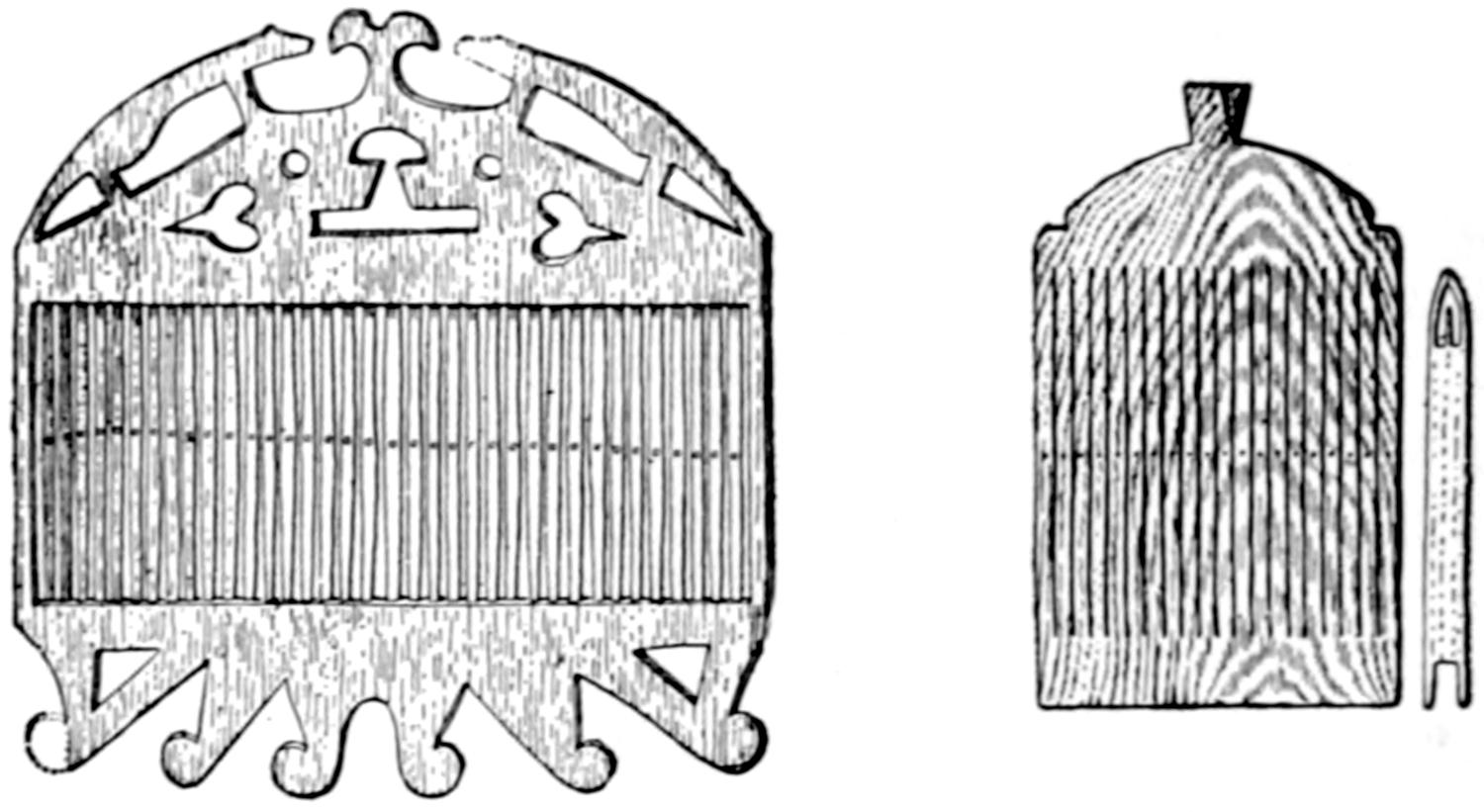
Fig. 17.—Primitive Heddles.
From Watson’s Textiles and Clothing, by courtesy of The American School of Home Economics.
[28]
CHAPTER II
CARDING AND SPINNING
Carding by Machine.
—Before the great machine inventions, carding was done much as the Indian woman did it, as told in the former chapter. When the demand for more rapid spinning came there was naturally an equal demand for better and more rapid carding, for good spinning depends upon it. The problems before the inventors of the eighteenth century were to accomplish the work of the hand cards by mechanical means at greater speed, and to make a continuous sliver instead of short pieces or rolls. They wished to do this with the minimum injury to the fiber and with the least possible waste. It cannot be said, however, that the modern carding machine, wonderful as it is, works with as little bad effect on the fibers as did the hand cards.
The beginning of the great mechanical inventions in methods of spinning and weaving was in England in the eighteenth century. When Lewis Paul in 1748 discovered that carding could be satisfactorily done by the use of revolving cylinders covered with wire clothing, he gave the principle of modern carding. James Hargreaves invented an improved cotton carder in 1762, which had more than one cylinder rotating in contact with the cotton. Richard Arkwright also invented one which he used in his own mill at Cromford. Until 1772, the fiber was fed by hand into the carding machine, but John Lees or Leigh of Manchester invented an apron feed, which saved the labor of one worker and facilitated the process by making it continuous. At that time the slivers received from the carder were in short pieces like the rolls from the hand cards. Arkwright made an invention by which the cotton was fed in a wide lap to the machine, which [29]carded it and passed the lap thus made to a funnel, where it was contracted into a sliver. He also invented a doffer or stripper to remove the sliver from the machine. The doffer was a helpful invention; it is claimed for both Arkwright and Hargreaves.
These inventions led to great changes in methods of manufacture. By 1774 all of the principles of modern carding were in use,—the continuous carding surface, the continuous feed, and the continuous doffer. In the modern carding engine an enormous number of fine teeth come in contact with the fiber; the object sought—of cleaning, opening, and laying the fibers parallel—is accomplished, but the process is a severe strain on them. Good carding often requires many previous processes of cleaning and opening, all of which have an effect on the strength of the fibers. On account of differences in the characteristics of raw materials, the processes leading up to carding and the work itself differ. Silk and flax are not carded, although the latter undergoes a similar process called hackling.
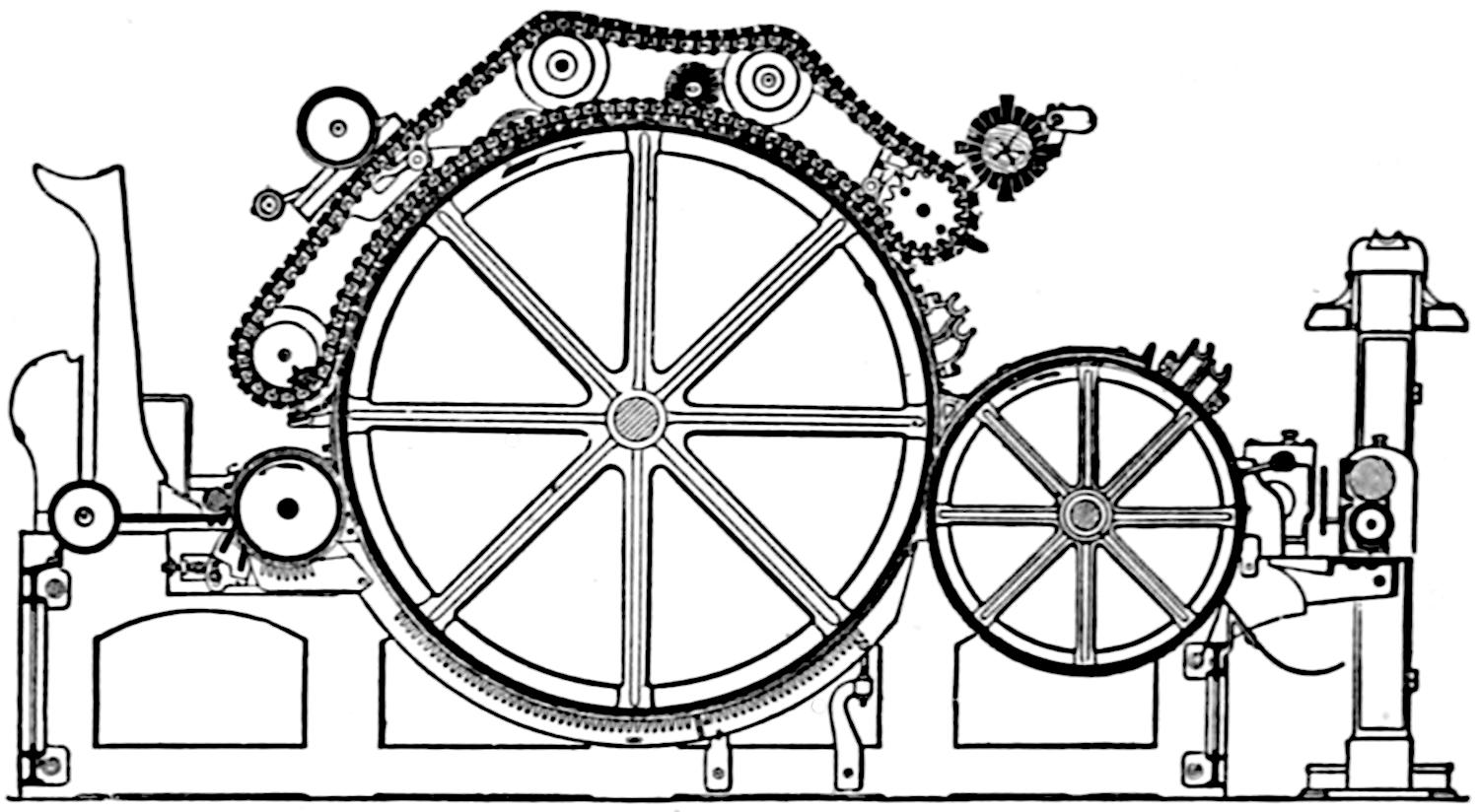
Fig. 18.—Revolving Top Flat Card.
Courtesy of the Whitin Machine Works.
The revolving flat card (Fig. 18) is used extensively in the United States for cotton. It has a cylinder about fifty inches in diameter and forty inches in width, called a swift, which is covered with card clothing, having about six or seven hundred steel wire teeth per square inch, amounting in all at times to three or four million. The teeth are turned in the direction of the movement of the cylinder. They are fastened in a leather, rubber, or cloth foundation, similar to the hand cards. In the process of carding, a large roll of partly cleaned cotton is placed in front of the machine. A revolving small roller takes the end of this sheet of cotton and delivers it to the “licker-in,” which in its revolution brings the cotton in contact with the big cylinder or swift, and the teeth catch the cotton and carry it on. Flat bars on an endless lattice above the swift are covered with card clothing, and in rotation press their teeth into the cotton which is on the cylinder. The contact of these slowly moving bars with the revolving cylinder is like the contact of the two hand cards; the cotton is thus combed and cleaned, and the poor fiber is carried away by a stripper. This rough, broken fiber is used for cheaper classes of goods, having machinery [30]especially adapted to it. The impurities drop through to a box under the machine. The revolution of the swift carries the good carded cotton to a point directly opposite the licker-in, where it is stripped off by another revolving cylinder, called the “doffer cylinder,” the teeth of which are so set that they take the cotton from the big cylinder or swift. An oscillating knife or comb, the “doctor knife,” strikes the cotton from the doffer cylinder, and the soft lap is then delivered to a funnel or to two rolls which contract it into a ribbon or sliver and deliver it to a can. The great cylinder or swift often moves at a rate of 150 to 200 revolutions a minute. The doffer comb strikes the cotton about a thousand times a minute. The card for wool does not aim to lay the fibers parallel, but simply to open them into a soft mass. A series of small cylinders, covered with card clothing, working over the top of the swift, take the place of the flat bars in the cotton card. These rollers or cylinders are in pairs called workers and strippers, and alternately press the wool on the teeth of the swift and remove it again, thus opening the fiber. (See Chap. VIII, Carding.) The fiber passes from one card to another in a transverse direction, to overcome the inclination to parallelism. The card in use in the worsted industry differs from the train of cards required in the wool, but the principles remain the same. The rapidity of movement in the swift depends upon the length of staple of the fiber. In the wool card the final stripping roller is called the fancy. It is larger and has longer teeth than the others, in order to [31]lift the carded wool from the teeth of the cylinder, that the doffer may carry it off. The speed of movement in the various cylinders depends on the requirements of the raw material. The principles of the modern card remain the same, but many improvements have been made in it. Automatic motion is about perfected and waste savers have been invented which catch the waste before the sliver is doffed, throw out the dirt still in it and return it to the feed end of the carding machine to pass again through the carding process. There is an inclination to combine the action of machines or to omit a machine when possible. (See also Wool Card, Fig. 85.)
Spinning by Wheels.
—Between the fourteenth and sixteenth centuries spinning wheels began to take the place of the distaff and spindle. The latter method had supplied the yarn from the dawn of history until the Middle Ages. Fabrics in museums testify to the skill, patience, and instinct for beauty in the women of the past. The process was, however, so slow that a more rapid method was necessary to increase the supply of yarn. India at a very early period invented a method of spinning by attaching a wheel to the spindle by means of a band, causing the latter to rotate. It was called the Gharka or teakwood wheel (Fig. 19). The spinner sat on the ground beside the wheel and supplied the spindle with raw material. The India wheel was a very rude instrument, but could spin a coarse yarn; the fine spinning of India continued to be done by the revolving spindle propelled by hand.
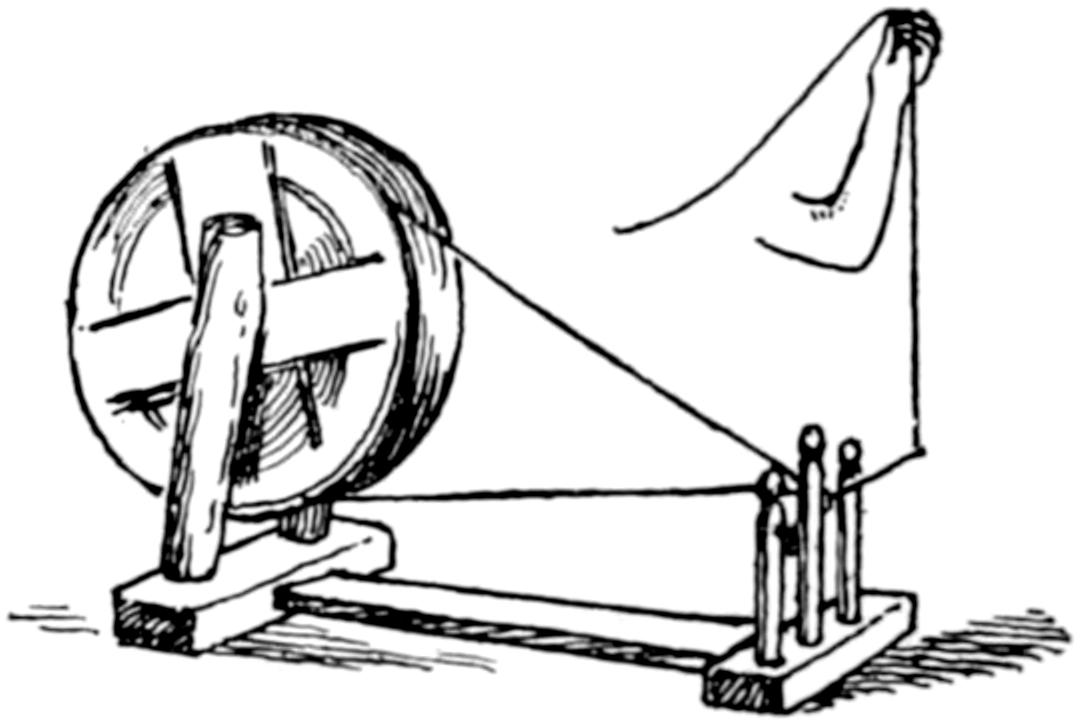
Fig. 19.—The Gharka Wheel.
The Great Wheel.
—In Europe early in the fourteenth century a single-thread wheel was used which was similar to the India wheel. The idea may have been brought from India, or it may have been original. In England this wheel [32]was called the Jersey, the Great, or the Wool wheel, and in Scotland the Muckle wheel (Fig. 20). It was principally used for wool, as its slow, intermittent motion was well fitted for short staple fibers which easily pull apart after being carded into the roll or sliver form. The one-thread wool wheel differed slightly in various places. It was found in both the low and high form. At first the great wheel directly revolved the spindle, the latter being in a horizontal position, but later a large wheel drove a smaller one, which again turned the spindle by means of a wharve or small grooved pulley fastened on the end of the spindle. The wharve was a development of the whorl.
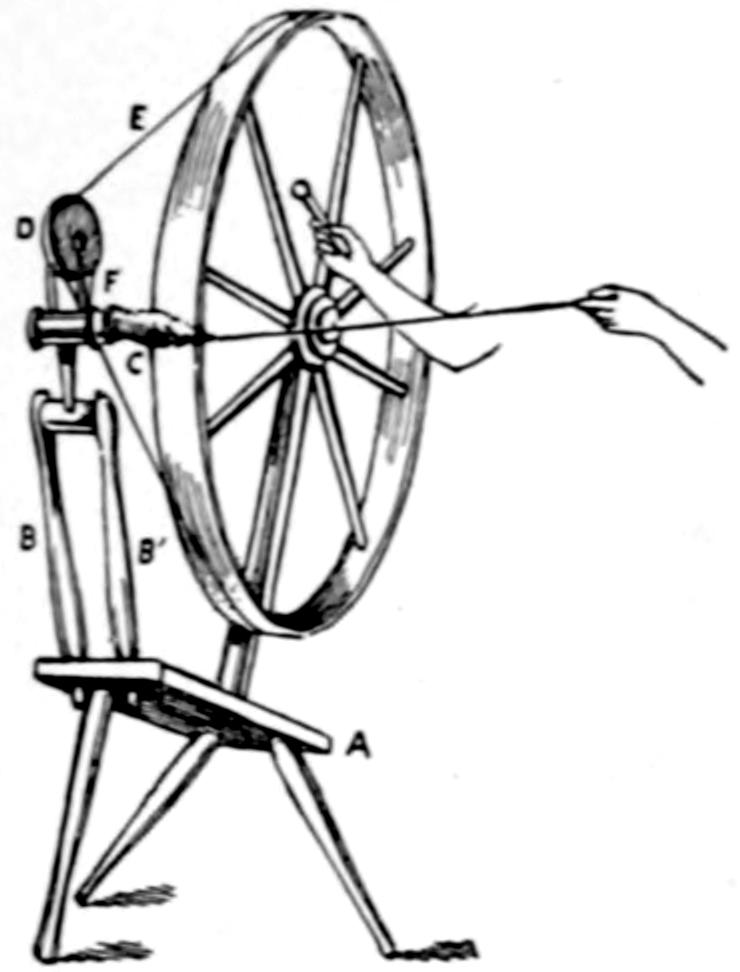
Fig. 20.—The Great Wheel.
The Parts of the Great Wheel
were: I. The standard (A) on three legs, on which were the two upright posts (B B′) which held the spindle (C) in a horizontal position. A wharve or pulley was at one end of the spindle, and a small wheel (D) provided with a pulley or groove. At the other end of the standard (A) was a post which held a large wheel. II. A band or cord (E), which connected the large wheel with the small grooved wheel (D). III. A cord (F) which connected the small grooved wheel with the wharve or pulley on the spindle.
The Motion of the Great Wheel.
—By revolving the great wheel by hand the small wheel turned very rapidly, communicating motion to the spindle through the wharve or pulley, consequently the spindle turned as long as the great wheel revolved.
The Method of Spinning on the Great Wheel.
—The wool or cotton was first carded by hand combs into soft rolls a [33]foot or more in length and a little less than two inches in width. (See Fig. 7). The spinner stood beside the wheel. An end of spun yarn had been left on the spindle to which she attached a roll, or, if not, she drew and twisted by hand a short length of yarn from one of the rolls and fastened that to the spindle. She brought the end of the twisted yarn to the point of the spindle, and held the remainder of the roll in her left hand. In her right hand she usually held a wooden peg, with which she struck a spoke of the great wheel, causing it to revolve and the spindle to turn. She gently drew the roll away from the spindle almost on a line with it. As the roll became attenuated, the revolving spindle twisted it into yarn in the same way that the revolving vertical spindle had twisted the yarn when it was spun by the hand of the worker. When the ball was drawn and twisted almost to its end, she stopped the wheel. By turning the wheel slowly in the opposite direction the spun yarn, which extended to the end of the spindle, backed off to the center of the spindle or to any point that the spinner desired. The yarn was now at right angles with the spindle. The spinner again turned the wheel in the original direction, thereby winding the length of spun yarn up on the spindle. She was now ready to piece on another roll. She laid one end of it over the end of the one just spun, again drew the end of the twisted part of the yarn to the end of the spindle, and repeated the process as described. She thus repeated the three principles required in the earliest spinning: (1) Drawing or attenuating the fiber; (2) twisting it, and (3) winding it up on the spindle. She did this in two parts or intermittently; the first division drew and twisted the yarn, the second wound it up. As has been said, the motion of the great wheel was intermittent. For soft yarn, made of easily separated fibers, this was a decided advantage, for it did not put too great a strain on the yarn by winding it while it was being drawn or twisted. The wheel was the progenitor of the modern mule, the motion of [34]which is also intermittent. The yarn was respun several times before it was strong enough to be used for warp threads. When the spindle was full of yarn the thread was wound off on a reel. (See Fig. 21). In general, the yarn from the great wheel was more satisfactory for the filling than for the warp threads. At the low wheel the spinner sat, but at the high one she stood, walking back and forth at her work. It is said that twenty miles a day were frequently covered by spinners on the wool wheel in our colonial times. The great wheel spun several times as much yarn in a given time as the distaff and spindle, and relieved the pressure for more yarn, but the cry for better warp thread still continued, and was met by the Saxony wheel.
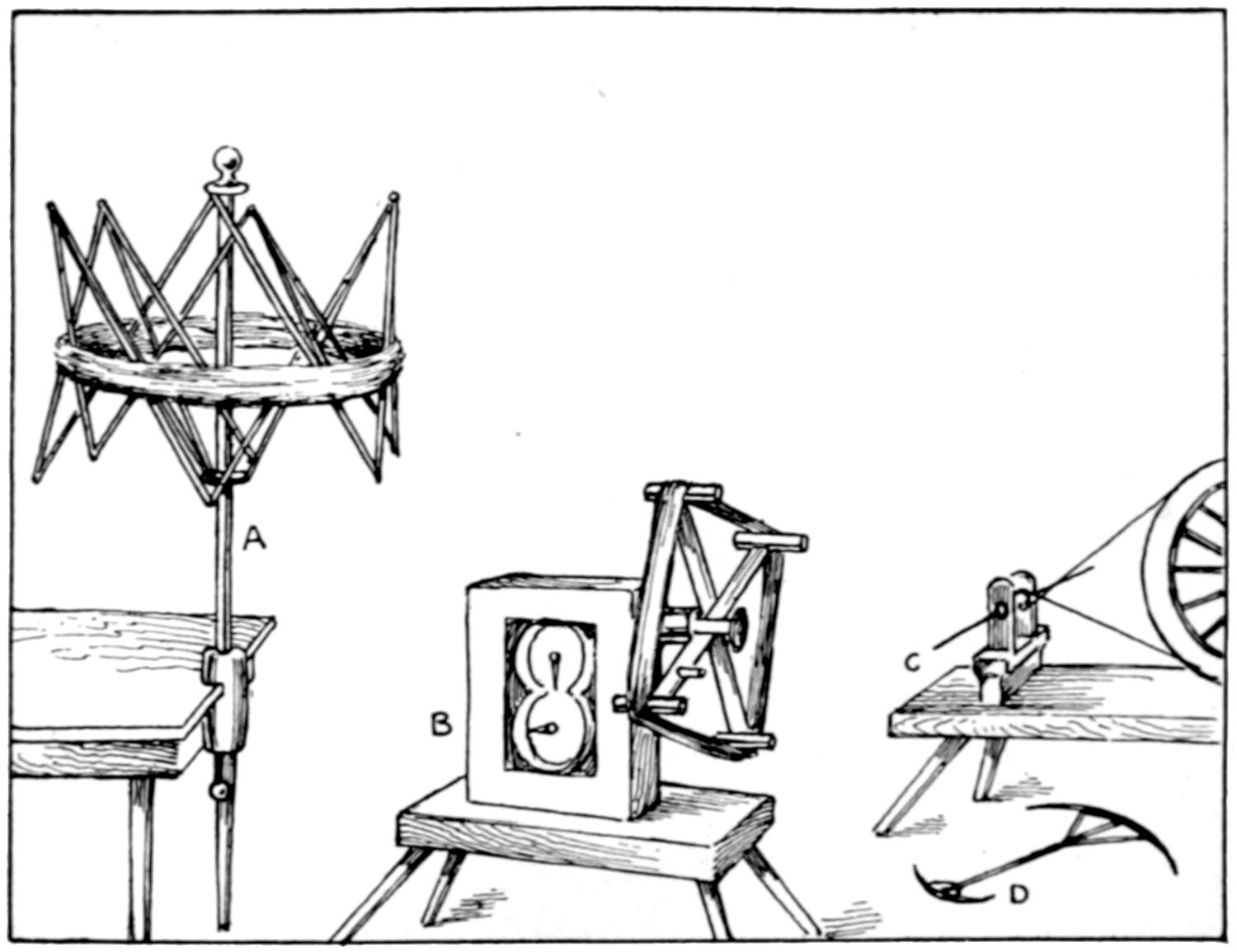
Fig. 21.—A, Swift; B, Clock Reel; C, Quill or Plug Winder; D, Niddy Noddy.
The Flax or Saxony Wheel
was invented, it is said, by Jurgens in Germany about 1530. It is probable, however, that wheels of a like character had been made before that [35]time. This wheel was an elaborate piece of mechanism as compared with the wool wheel. The foot was used as power, consequently the hands were free to draw out and guide the fiber to the spindle. The Saxony wheel was well adapted to the spinning of flax, for the principles of drawing, twisting, and winding were continuous, which made a strain on the yarn which flax could stand better than wool or cotton. The latter fibers were, however, spun upon it, not from the distaff, but from rolls of carded material fed by hand directly to the spindle, thus lessening the strain. There are several models of this wheel. A common one, though not the earliest form of it, is seen in Fig. 22.
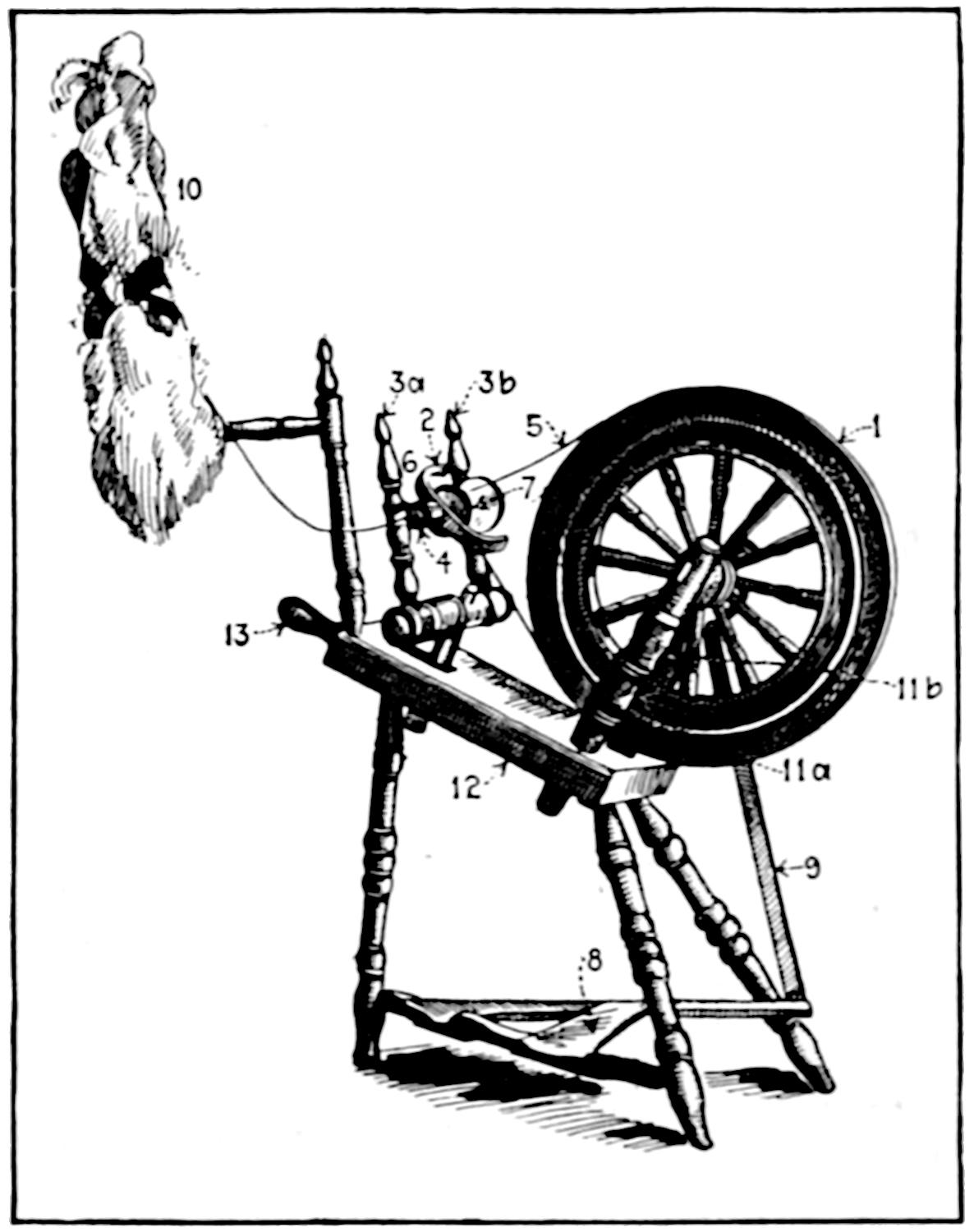
Fig. 22.—The Flax Wheel.
The Parts of the Saxony Wheel
were: I. The frame (12) [36]which stood on three legs, the wheel end being lower than the distaff end. II. The wheel (1) had an iron bar through its hub by which it was supported in the deep grooves of two upright bars of wood (11a, 11b). III. The distaff (10) was supported on a high standard at the opposite end of the frame from the wheel. IV. At the distaff end of the framework two upright bars (3a, 3b) supported the spindle (6), which was made of polished steel, and had a pointed end protruding through a leather ring on the upright bar (3b) away from the spinner, and a needle end (4) (in which was an eye) through another ring in the bar toward the spinner. A flyer (2) was fastened about one inch from the needle’s eye, and a large wharve or pulley one inch from the pointed end. A cord from the wheel caused the revolution of the spindle. The flyer (Fig. 23) had a series of hooks or guides over which the yarn was passed before it was delivered to the bobbin (7). The turning of the flyer twisted the fibers, which were threaded through the needle’s eye, and wound them up on the bobbin. The spinner changed the yarn from one hook to the other of the flyer as she spun, and gradually filled the bobbin evenly with yarn from end to end. The flyer went round very rapidly, but the bobbin was kept back by the friction of the yarn which was let out as the spinner wished, according to her ability or her desire for fine yarn. The slower movement of the bobbin caused the yarn to wind upon it. The bobbin or reel fitted loosely on the spindle, and was slipped on it by removing the pulley at the end of the spindle. The bobbin had also a groove or pulley at one end of it, around which one of the cords from the wheel was placed. V. A band or soft cord (5) was passed twice around the wheel; one part went over the grooved pulley or wharve on the spindle, and the other went over the pulley on the bobbin, causing them to revolve with the wheel. VI. A handle (13) regulated the tension by turning it either backward or forward, thus moving the standard on which the spindle and [37]other parts revolved, and tightening or loosening the band. VII. Underneath the framework was the treadle (8), connected with the wheel by means of a rod (9), which was attached by a crank to the iron bar through the hub of the wheel, and was tied to the treadle.
The Motion of the Saxony Wheel
was continuous, that is, the drawing, twisting, and winding occurred simultaneously, and not as in the great wheel in two divisions, requiring the stopping of the wheel and backing off of the thread on the spindle before winding began.
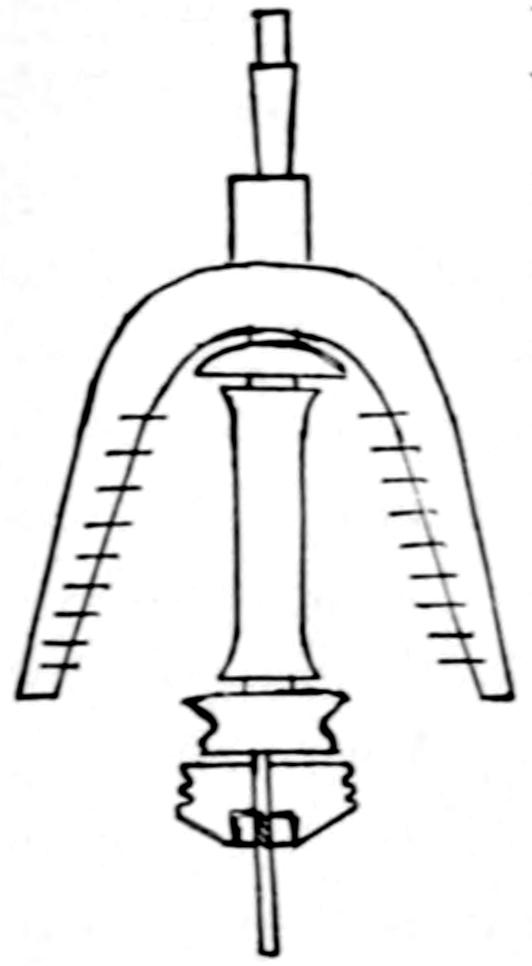
Fig. 23.—Flyer.
The Method of Spinning on the Saxony Wheel.
—The flax was carefully prepared beforehand. It was hackled, which was a sort of carding (see Chap. X), in order to have the fibers parallel and untangled. The spinner laid the flax carefully down on a flat surface, and turned the distaff in it until it was evenly covered. She then tied a ribbon loosely about it to keep it in good order, and placed the distaff on the standard. The fibers were now in good condition for drawing steadily down as many or as few as she desired. The spinner sat beside the wheel with her foot on the treadle, and by means of the connecting rod gave motion to the wheel. The double band caused the revolution of the spindle and flyer as well as the bobbin through the wharves on each. She drew the threads down from the distaff with her right forefinger and thumb until they reached the eye of the spindle. The flax passed smoothly under her second, third and fourth fingers as she held it lightly between the first finger and thumb which she slightly turned toward her as the thread was drawn down. She used her left hand to open up the mass of fibers next to the distaff, making them into a wedge shape with the narrow end running toward the right hand. She slightly twisted them, and threaded the yarn thus made through the needle’s eye in the spindle, brought the thread over one of the hooks of the flyer and fastened it to the bobbin by means of a thread which had been left there for [38]this purpose. Beginners often found it difficult to keep the wheel revolving smoothly while drawing the flax evenly from the distaff to the spindle. It took time to become a good spinner. The threads of flax were kept moistened by the spinner in order to make a tighter and smoother twist. The spindle, the iron bar on the large wheel, and the crank connected with the treadle were kept well greased.
The Saxony wheel was more complex than the great wheel. The flyer (Figs. 22 and 23) on the spindle by which the thread was twisted (said to have been invented by Leonardo da Vinci) was a great step in advance of former spindles, and is utilized in power spinning even to the present day. The continuous motion of this wheel made it possible to spin more and stronger thread in a given time than had any previous invention. The bobbin revolved at a different speed from the spindle, consequently it was possible to wind up the yarn as it was being spun. The flax wheel was improved upon in various ways, and two spindles were later used on it at one time, enabling expert spinners to double the output.
Spinning Machines Developed from the Principles of the Wheels.
—In England about the middle of the eighteenth century pressure for more rapid production of cloth, especially of cotton cloth, began to be felt. Suffering from poverty had lessened and more comforts were demanded. The subdivision of industry had increased in the towns, and as women no longer spun and wove in every home the demand for textiles was insistent. There was scarcity of yarn for weaving, for many of the spinners were not capable of making warp yarn. Wool and flax heretofore had been the [39]staples, but the introduction into England of cotton fabrics from India led to a demand for the spinning and weaving of that fiber. Some inventions were made, but little was thought of them at first, therefore the names of the first inventors and the dates of their inventions were not carefully preserved and are even now uncertain. The supply of yarn and the ability of the weavers to turn out cloth were about equal when John Kay of Bury invented his fly shuttle and picking stick, thereby increasing fourfold the output of the loom. This was followed by a patent of Robert Kay, son of John Kay, of the drop box (see Chap. III, The Parts of the Hand Loom), which also saved the weaver’s time. These inventions brought the capacity for weaving far ahead of the supply of yarn. Pressure was brought to bear on the spinners to meet the situation, (1) finding a mechanical way of spinning a number of threads at one time by keeping more spindles revolving, and (2) some automatic means of drawing out the fibers. John Wyatt of Birmingham is generally conceded to have been the first to suggest a way of spinning thread without the use of fingers. His patent was taken out in 1738 in the name of Lewis Paul, his partner. In his machine he uses the flyer of the Saxony wheel for spinning, but probably he had an entirely new and brilliant idea in the use of drawing rollers to attenuate the yarn. This latter principle is important in power spinning. Richard Arkwright later used this principle in his water frame, but gave no credit to either Wyatt or Paul, and is generally thought to have been the inventor.
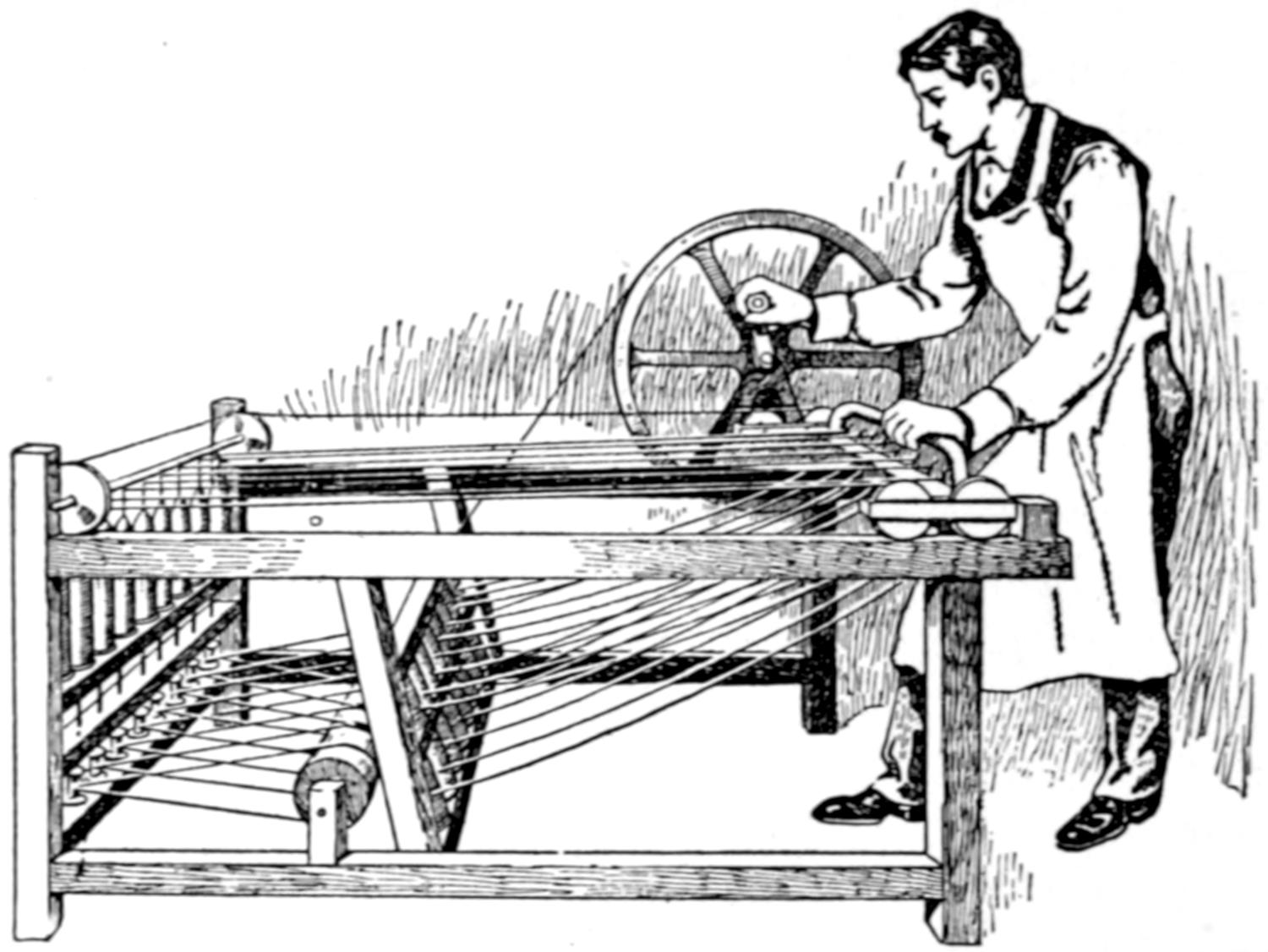
Fig. 24.—Hargreaves’ Spinning Jenny.
From Robinson and Beard’s The Development of Modern Europe, by courtesy of Ginn & Co.
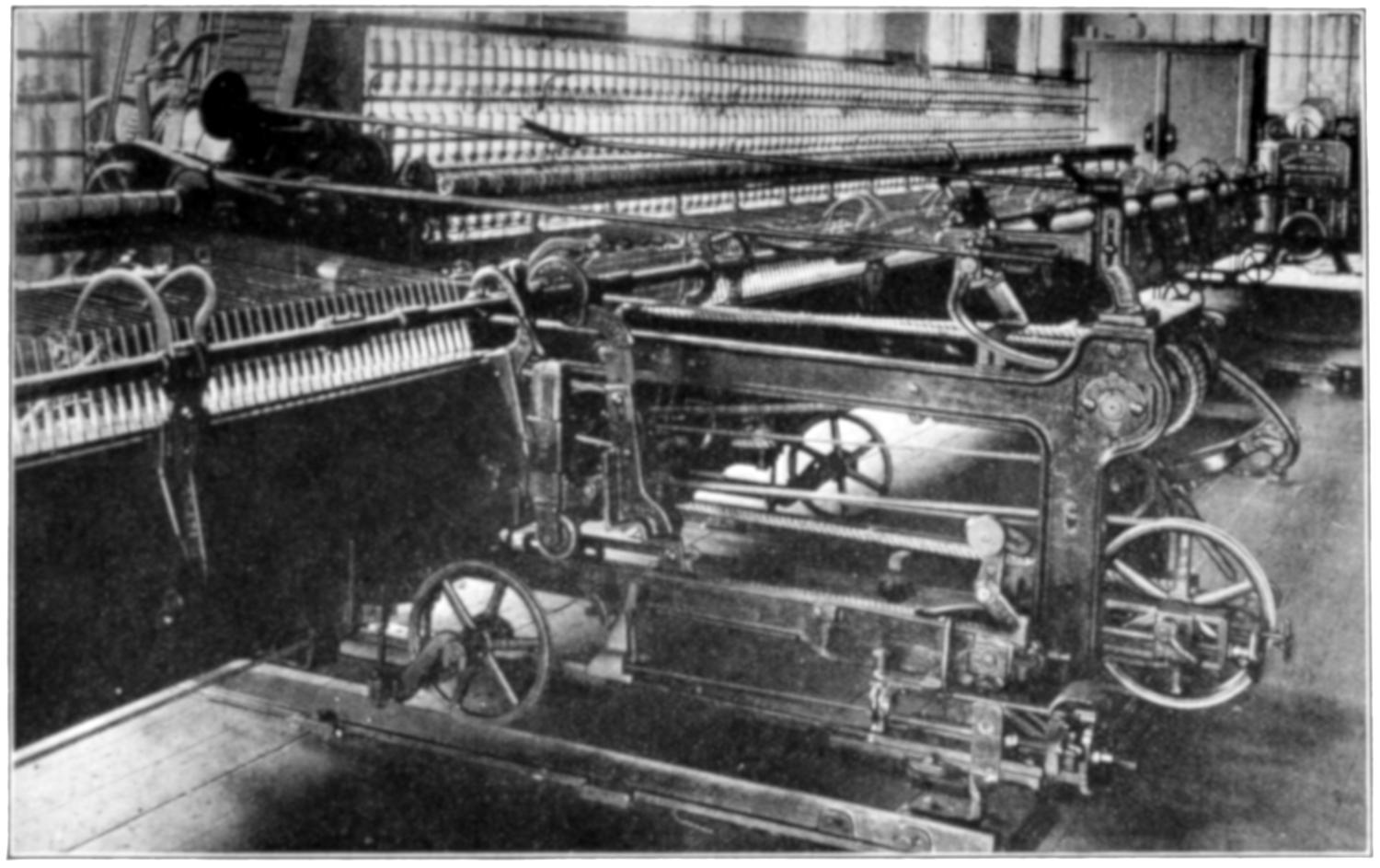
Fig. 25.—Mule Spinning.
Courtesy of the Mason Machine Works.
In 1764 or 1767 James Hargreaves, a spinner and carder, living in Blackburn, Lancashire, invented a spinning frame (Fig. 24) which was the progenitor of the modern self-acting mule. (See Figs. 25 and 26.) His idea was evidently taken from the principle of the great wheel. For power he used one hand to control a traveling carriage, and the other to turn a wheel by means of a crank. The wheel was connected by a [40]band with a cylinder under the framework, and bands went from the cylinder to the pulley or wharve of each spindle, thus setting them in motion as the wheel turned. This machine spun from eight to eleven threads at once. It was a great invention, but the fibers were not parallel, and the yarn was too softly twisted to be used for warp. The pictures now seen of the machine have improvements over the original invention. The important principles of Hargreaves’ spinning jenny were (1) a number of bobbins of roving (the last step in the preparation of yarn previous to spinning) were placed vertically in a creel under the frame; (2) the yarn from these bobbins passed through a holder and across to the spindles. The holder was so made that it could keep the threads fast or let them slip. (3) A carriage, which could be moved back and forth on the framework so that the holder could be drawn away from or moved toward the spindles. When the carriage was near the spindles the roving was caught in the holder and fastened to the tip of the spindles, and was [42]attenuated by drawing the carriage away from the spindles. In the meanwhile the stretch of roving was twisted by the revolution of the spindles by means of the wheel. When the carriage reached its farthest point on the track it was stopped, but the spindles were kept turning until the yarn was sufficiently twisted. The wheel was then stopped, and the carriage was backed slightly to allow guide or faller wires to back off the twisted thread from the end of the spindles, as was done in the great wheel. The carriage was now pushed back toward the spindles while the length of spun yarn was wound up. Thus Hargreaves’ spinning jenny repeated the intermittent motion of the great wheel, for the attenuating and twisting were done in one motion, and the winding in another. When one length of yarn had been spun, the bar on the holder was loosened, another length of roving was drawn from the bobbins into the holder, and the work of drawing and twisting was repeated. This machine was used widely, but Hargreaves had little use of his patent, which was taken out in 1770, for the hand spinners were infuriated, and persecuted the inventor for taking away their work. He was obliged to flee from his home on account of the tumult. He deserves to be remembered as one of the fathers of the [43]modern industrial world, for he made cotton spinning possible, and thus brought a cheaper fabric to the poor of England. Credit for this invention is given by some to High of Leigh.
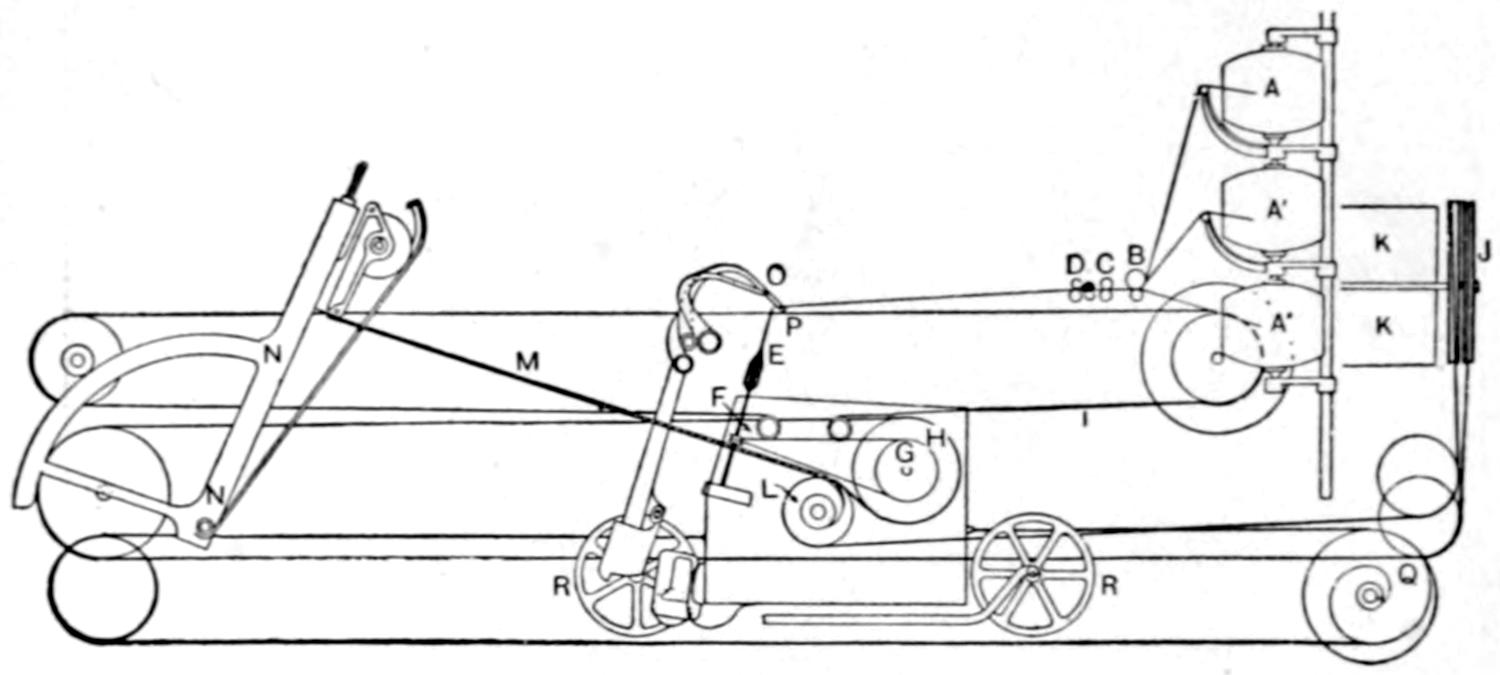
Fig. 26.—Detail of Mule.
From Barker’s Textiles, by courtesy of Constable & Co., London.
The spinning jenny was known to Richard Arkwright, a clever barber of Preston, who wandered about the towns of England in pursuit of business. He continually heard of the need of yarn and cloth, and probably improvements in devices were talked over with him, and new appliances shown him. About 1768 he brought out a machine founded on the principle of the Saxony wheel. It had an upright frame, a continuous motion, and the spindle and flyer of the Saxony wheel placed vertically (Figs. 27 and 28). The roving passed through twin drawing rollers and was attenuated before being twisted. It is probable, though not proven, that he had seen this in the machines of Wyatt and Paul. He received much credit for his invention, but is thought to have been a greater business man in forwarding the ideas of others than original in inventions of his own. His ideas of factory organization are not yet obsolete. He is, in any case, worthy of honor for what he has given to us. The principle of his machine is as follows: The roving was attenuated by means of a couple of twin rollers placed one behind the other. The first two rollers which received the roving ran rather slowly, but the two rollers ahead moved more quickly. Hence the fiber was caught, drawn, and laid more nearly parallel. After the roving, now of the required thickness, left the rollers, it was twisted by the flyers of the spindles and wound on the bobbins. Arkwright probably gave us the reciprocal vertical movement of the spindle. His first mill was built at Cromford in 1771, where he installed his own carding and spinning machinery. So greatly was his work appreciated that he was knighted. His machine was too heavy to be driven by the human hand, hence horse or mule power was used, and later water power gave the invention the name of [44]the water frame, or water twist frame. The homes of that time where most of the spinning had been previously done could not provide sufficient force, consequently small factories sprang up where the Arkwright spinning frame spun the yarn for those having private looms or for groups of manufacturing weavers. Steam power was applied to it in 1790. The use of drawing rollers is the great basis of modern spinning.
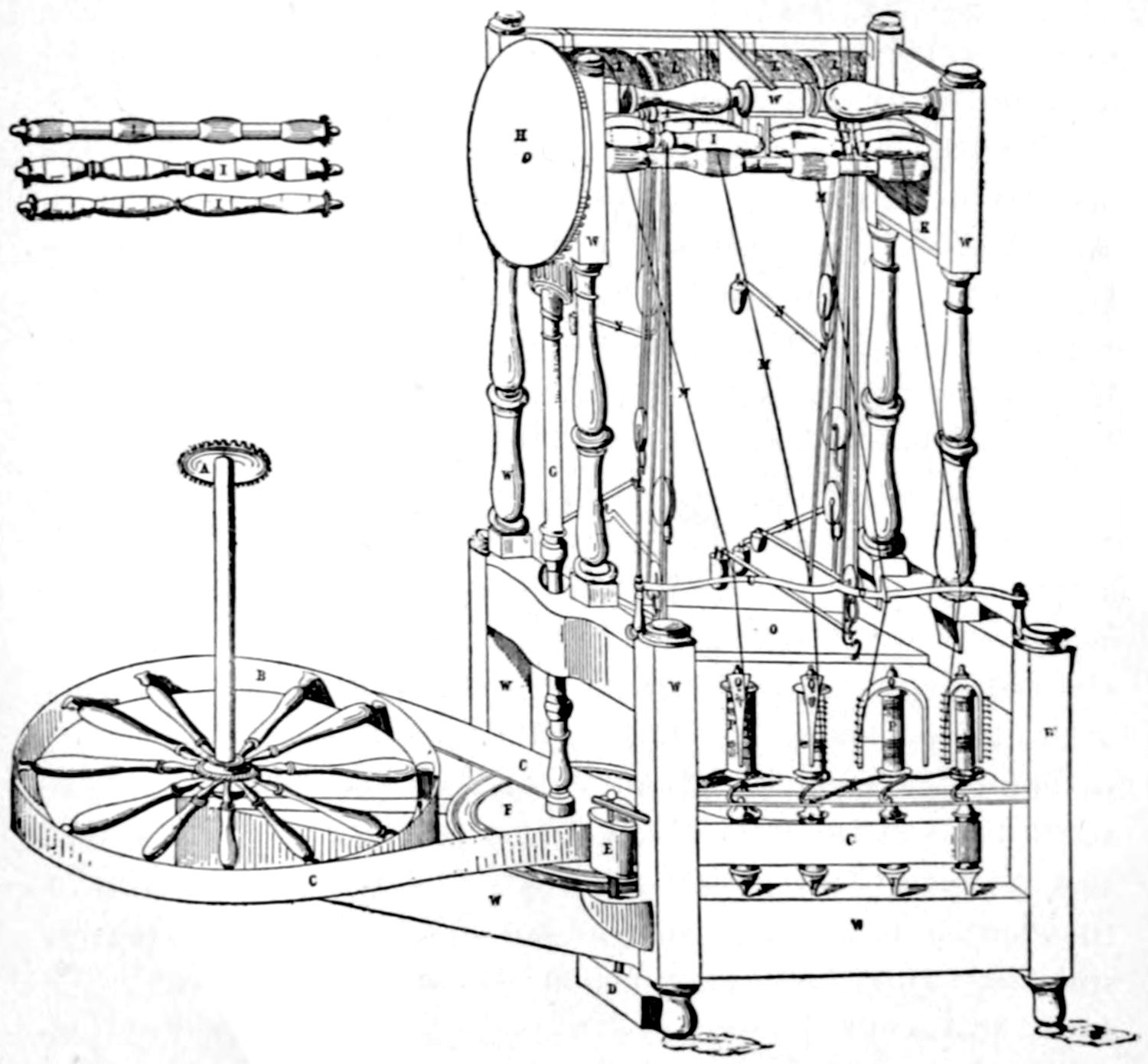
Fig. 27.—Arkwright’s Water Frame.
From Barker’s Textiles, by courtesy of Constable & Co., London.
Another inventor of note of this period was Samuel Crompton of Bolton. He was a textile worker, and a capable man. [45]He felt the need of a greater supply of warp yarn in his daily work. His invention in 1779 was a spinning frame which combined the good points of the machines of both Hargreaves and Arkwright. From Hargreaves he took the upright spindle frame, but placed it on the movable carriage. (In Hargreaves’ machine it had been attached to the back of the main framework.) From Arkwright he took the idea of drawing rollers and placed them where Hargreaves had his spindles. It is believed by many that Crompton invented the drawing rollers for his machine, and that he had never seen or heard of the Arkwright patent. Crompton placed the roving or slubbing in a creel behind the spindles. He patented his machine, calling it the mule spinning frame. It proved to be a wonderful machine, and has been the basis for one of the most useful spinning frames of the present day—the self-acting mule. Crompton was not only an inventor himself, but he knew how to take advantage of the inventions of others, and use them in his own way. In that era before steam power was utilized, Crompton’s mule was of more use than either Hargreaves’ spinning jenny or Arkwright’s water frame. Many other inventors made important additions to these inventions. The use of steam for power, and Whitney’s cotton gin, both of which came at the end of the eighteenth century, gave a tremendous impetus to cotton spinning, and the inventions of Roberts in 1830 gave the world the modern self-acting mule, which was a triumph of skill and automatic action.
The following dates mark important eras in the development of modern textiles:—
1. Distaff and spindle, from the dawn of history to about the fourteenth century.
2. Spinning wheels, from the fourteenth to the eighteenth century.
3. The great eras of invention: (a) Improvements in spinning and weaving, (b) the use of power other than the hand, and (c) the modern factory system.
[46]
The beginning of modern spinning, carding, and weaving came principally from such men as the following:—
John Wyatt, Birmingham. First thread spun without fingers, and the use of drawing rollers, 1738.
Lewis Paul. In connection with Wyatt, carding, revolving cylinder, 1748. (Claimed by Hargreaves.)
John Kay. Fly shuttle, 1738; improved in 1750.
Robert Kay, the son of John. The drop box, 1760.
Hargreaves. Spinning jenny; the spinning of a number of threads at once, 1764-1767.
Arkwright. Water frame (upright), 1768; the principle of rollers; doffer comb.
Crompton. Mule frame, combining Arkwright’s and Hargreaves’ ideas, 1779.
Lees or Leigh. Apron feed, 1772.
Cartwright. Power loom, 1789. Application of steam to Arkwright’s frame, 1790.
Eli T. Whitney. Cotton gin, 1794.
Roberts. Self-acting mule with quadrant, 1830.
Modern Spinning Frames.
—The principles of modern power spinning follow closely the inventions of Hargreaves, Arkwright, and Crompton. These men in their effect on the development of our factory system may be said to have been among the principal instruments in bringing forward the industrial and social problems of the present day. One girl now probably spins twelve hundred times as much in a day as was done with the old wheel. The difference between the old and the new is not in the principles employed, but in the mechanism which is used to take the place of the hand, i. e., the belts, pulleys, levers, wheels, gears, springs, chains, and cams, which automatically handle a thousand spindles at once, where the hand controlled one. True spinning is in reality the final process of twisting, but the term spinning is used to cover all of the preparatory steps as well. Before the final spinning the twisting is only sufficient to keep the attenuated fiber from breaking apart. The final process [47]before true spinning is called the roving. The final spinning may be done by the mule (Crompton’s patent), or by a ring spinning frame on the order of the upright spinning frame (Arkwright). Both machines may be used for tightly or loosely twisted yarns, but the mule is better adapted to the softer yarns, and the upright frame to the closer twisted yarns. In the present day the true spinning machines are preceded by others which are more or less similar in method, but they only prepare for the final twist. The principle of rollers is used for drawing and attenuating the fiber, and the twisting is done not only by the flyer but by other methods. The modern mule spinning, which has developed from Crompton’s mule, is more complicated than ring spinning, which followed Arkwright’s upright frame.
Mule Spinning—Intermittent Motion
(Figs. 25 and 26).—The essential features are as follows: The bobbins of roving are placed in a creel in the back of the machine. The roving is passed over bars through three separate twin drawing rollers, which attenuate and prepare the fiber. It is then carried between faller wires to spindles which are on a carriage which moves on a track. As it moves forward to its full extent the fiber is further attenuated while the spindle twists it. Probably five feet are covered by the movement of the carriage, the yarn being at the extreme end of the spindle for this purpose. When the carriage reaches its limit, it is stopped, the yarn is backed off the top of the spindle by the faller wires, one of which guides and the other holds taut, and the yarn is wound up on the spindles as the carriage returns to its place at the back of the mule. As a consequence the action is intermittent, as in the great wheel (Fig. 20). The spindles are placed at an angle of fifteen degrees, and each is provided with a wharve, whorl, or pulley by which it is revolved, a band around it passing to a driving cylinder. The mule is a complicated machine, and requires skilled attention. Men are usually in attendance. The machine [48]has to be adapted to differences in fiber, as between wool, worsted, and cotton. High counts of yarn may be spun on the mule.
Ring Spinning—Continuous Motion.
—The principle of ring spinning has largely taken the place of the flyer spinning as found in Arkwright’s patent. Following the Arkwright spinning frame came a series of inventions to improve the spindles. The upright frames look much alike. The drawing rollers were satisfactory and are found about the same, whether the flyer, ring, cap, or top principles are used for the spindles. A throstle frame (still used for making roving) followed Arkwright’s patent, and combined some features of Hargreaves’ jenny with Arkwright’s water twist, giving a new spindle, but it is seldom seen now in true spinning. The flyer (Fig. 28) principle is seen in the bobbin and fly frames, used to prepare the rove (slubber, intermediate, and roving) in cotton spinning. The twist depends on the relative speeds of the bobbin and flyer. The spindle has gradually been made more free in its motion, and runs more loosely in its bearings, which makes it steadier. Cap spinning (Fig. 29), used much in cotton spinning, utilizes this idea, and gives the spindle as much freedom as a spinning top, which running at full speed balances itself. Cap spinning is used in spinning worsted yarns, the principle at base being a stationary spindle with a stationary cap and a revolving bobbin. The latter has a whorl on it, and a band connected with the driving shaft makes it revolve. The yarn comes from the rollers above, the bobbin moves up and down, and the end of the cap keeps the yarn evenly winding on the bobbin.
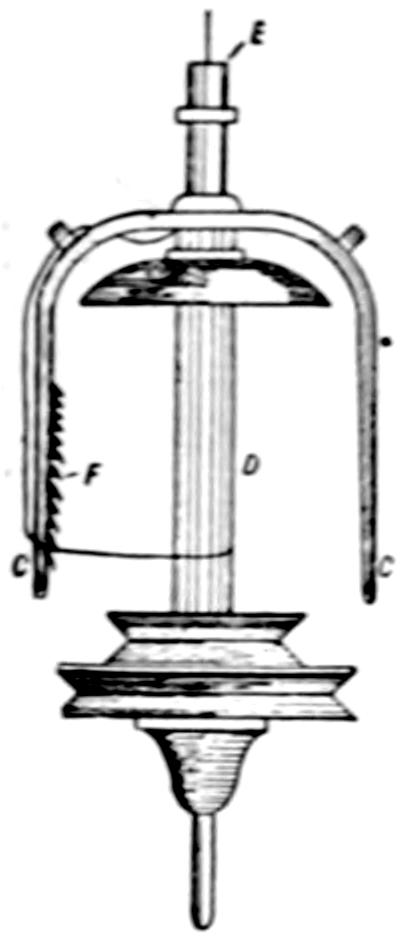
Fig. 28.—Flyer.
From Barker’s Textiles, by courtesy of Constable & Co., London.
In ring spinning (Fig. 30) the yarn is twisted immediately on leaving the rollers. In spinning frames there are usually [49]two rails. In the lower the spindles rest, and through the higher, called a bolster rail, the tops of the spindles pass. In ring spinning there is a third rail. This rail moves up and down the spindle, causing the yarn to wind evenly. A series of rings (Fig. 31), each with a flange, are fixed on the rail, and move with it. The front of each spindle goes through a ring, but does not touch it. A traveler, which is a crooked piece of fine wire, is sprung on the flange. It can move easily, but cannot come off. The ends of the yarn come through the rollers and each passes through a traveler and is fastened on a bobbin which is on the spindle. The spindle and traveler revolve rapidly. The latter is held back slightly by the yarn and consequently winds the yarn on the bobbin. A traveler makes as many as 10,000 revolutions per minute. Separators of metal are often used between the spindles to keep the threads from interfering.
The fundamental principles of spinning remain the same, but much is being done to increase the rapidity of the spindle and the automatic action of the machinery. Stop-motions are being perfected and minor faults remedied.
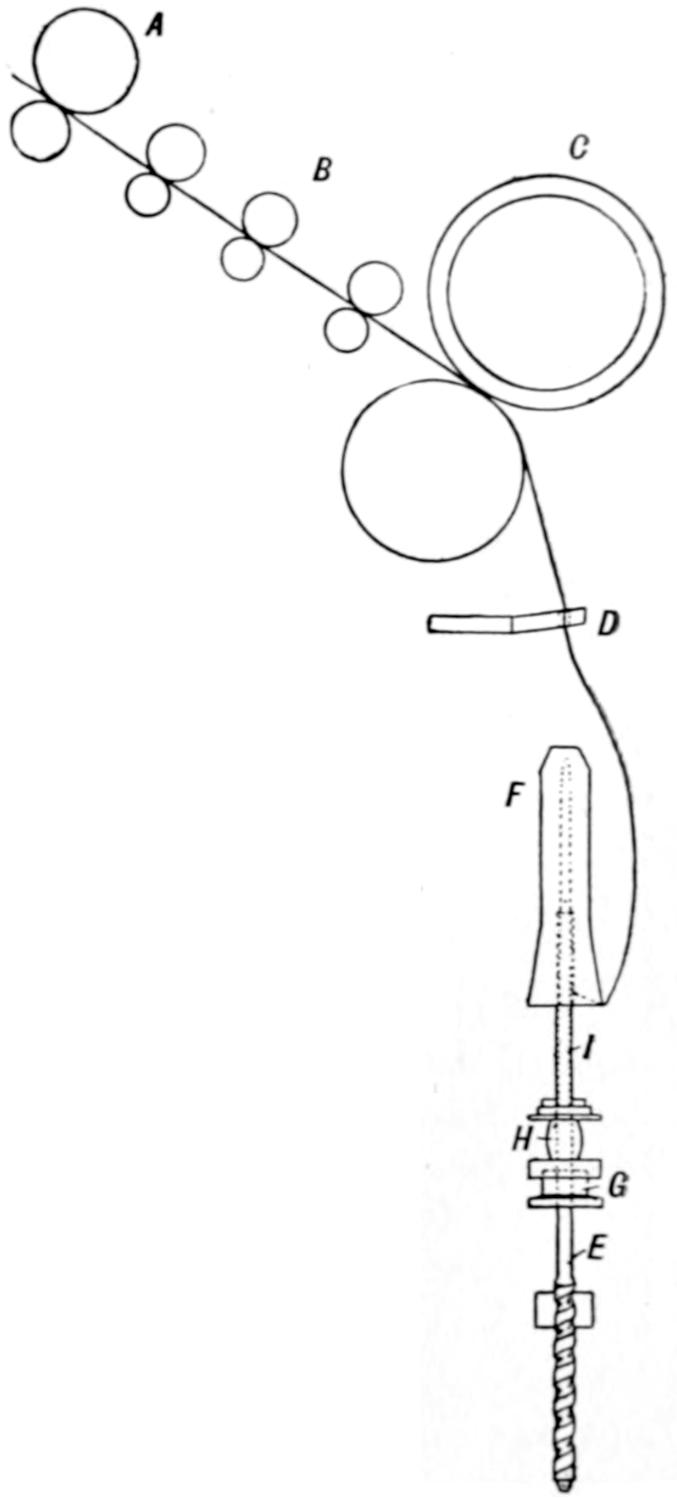
Fig. 29.—Cap Spinning Frame.
From Barker’s Textiles, by courtesy of Constable & Co., London.
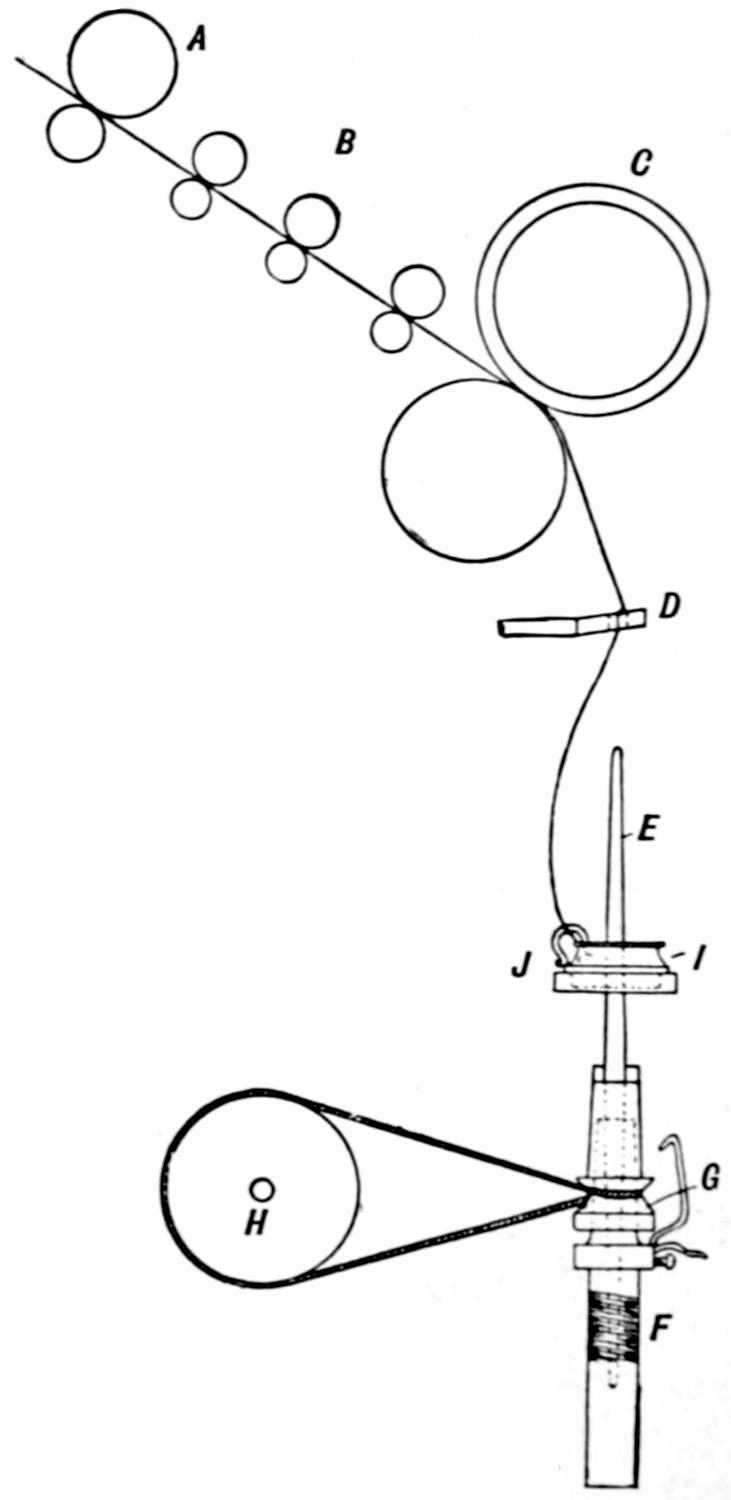
Fig. 30.—Ring Spinning Frame.
From Barker’s Textiles, by courtesy of Constable & Co., London.
The Development of Industrial and Social Life.
—The childhood of races passes into youth, but is often recalled in the emotional and recreational life. Festivals, dramatic representations, folk tales, dances, songs, and [50]religious ceremonies are instituted. Events in the former primitive life and the all-important industrial processes become motives for these diversions. Spinning and weaving are popular subjects for dramatizing. When the people began to live in permanent homes, life was duller than it was in the nomadic time, on account of the round of constantly recurring occupations. Interest was taken in cultivating textile plants, such as flax and cotton. Sheep were raised in order to provide wool for spinning. Private ownership and a sedentary life increased the demand for household goods. Two classes of textile industries began to be developed, the extractive and the productive. The people gathered together in groups, moved by the impulse toward sociability and the need for mutual help. New social and political relations arose between them, which required the establishment of forms of government. Slaves taken in the frequent wars were made to perform domestic services, hence a new class of industrial worker was available, who did not belong in the home and was considered inferior. A feeling of caste was more apparent, and dress was used to indicate varying conditions of life. The people built their own houses and provided for their wants with occasional help from friends. The homes became [51]busy workrooms, and some of the articles, yarn or cloth which were made, were sold or exchanged with neighbors for other goods. In early times the exchange of a few commodities was the only business relation. Industrial towns developed as trade centers, and additional workers had to be employed in the home workrooms to increase the output. The women were factors in this industrial change, for spinning, weaving, and bleaching were still home occupations.
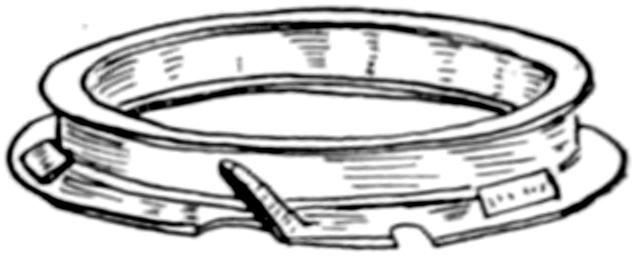
Fig. 31.—Detail of Ring.
Entire families soon began to devote themselves to special industries in order to sell to others or to exchange, and many households became economic centers. This era was in progress in Bible times. In Proverbs 31, the mother of King Lemuel speaks of the work of women in the households as comprising both home use and sale:—
“She seeketh wool and flax and worketh willingly with her hands.”
“She perceiveth that her merchandise is good.”
“She layeth her hands to the spindle and her hands hold the distaff.”
“She is not afraid of the snow for her household, for all her household are clothed in double garments.”
“She maketh fine linen and selleth it and delivereth fine girdles unto the merchant.”
The employer and helpers worked together in the home factories, each owning his own tools. Apprentices learned the whole process and were therefore fair judges of the output as well as workers on it. Great fairs occurred at intervals at which the industrial products of the household were sold outright or exchanged for farm products. Trade difficulties soon made a middleman necessary to collect the goods, sell, and exchange. The demand for bedding, for blankets, heavy serge curtains, flannels, household linens, and homespun materials increased the number of textile workrooms where both men and women worked together. Wherever industries were numerous, great towns began to develop. It was customary [52]for workers to gather around the home of some influential man, giving their services in return for his protection, but the downfall of the feudal system at the end of the fifteenth century cast them adrift and they gathered in the towns, increasing the number of those working in its commerce and industry. Markets were opened for selling goods, and guilds for both the merchant and the craftsman were organized to help standardize the work, to better conditions, and to give reliable goods at honest prices. The textile guilds became very influential and did much to organize trade and to train the workers. However, the passing away of the guild system in the seventeenth century deprived the workers of a central body which was responsible for the coördination of capital and labor, and which understood the relation of laborers to each other. There was not at the time any clearly defined division between the capitalists and the working classes, and much of the textile work was still done in the home workroom.
America was colonized about the time of the decline of the guilds, and its industrial life was characteristic of this era of home workshops. The life of the colonists was on the farm. Each home was a self-sufficient unit, and consequently a center of varied occupations. The mother directed the work of her daughters and also paid for such additional help as she could obtain from the neighborhood. The farm occupations were numerous and were in the stage in which homemade machinery and devices were used by the worker. The textile activities in each colonial household were principally carried on by the women. They consisted of carding of wool, breaking, hetcheling, and swingling of flax; wool and flax spinning; winding, reeling, and warping; the weaving of cloth, blankets, and rag carpets; the bleaching of cloth and yarns; sewing; quilting; dress and garment making; embroidery and lace making. The devices and machines used for this work were the cards, hetchels (Fig. 32), flax brakes, the great or wool [53]wheel, the flax wheel, winders, reels (clock and hand), niddy noddy, quill winder, swifts (Fig. 21), warping bars or warping drum, skarne, bobbin frame or creel (Fig. 33), bobbins of many kinds, healds and shafts, the raddle, and the loom. The fathers and sons assisted in the textile work by growing and preparing the fibers and making the machinery and tools. Some small factories run by water power were established in the late eighteenth century.
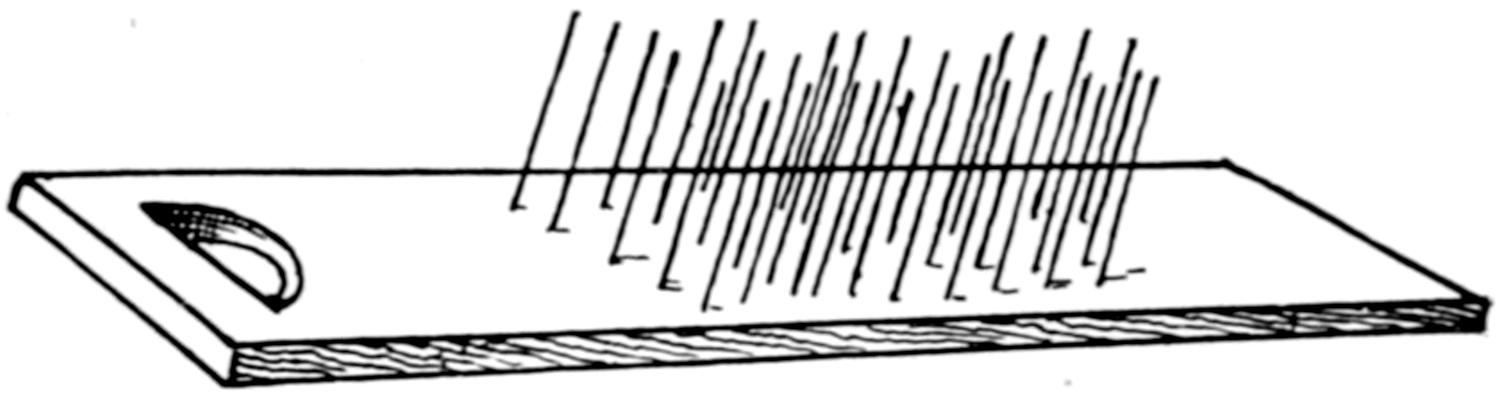
Fig. 32.—Flax Hetchel.
The half century from 1750 to 1800 was full of tremendous issues. The inventions of Hargreaves, Arkwright, Crompton, and Cartwright brought the modern factory system and with it a new industrial era. Horse and water power were soon succeeded by steam. Capital became more important than labor. At first the industries of spinning and weaving were separate. Little mills began to spring up where water power was good, but when steam power was used the two were often united under one management to save expense. About the middle of the nineteenth century so much capital was required to combine the two that they were again separated, excepting in very large plants. The twentieth century is seeing another change, for the inclination to unite many large plants under one management to improve organization and save expense is evident.
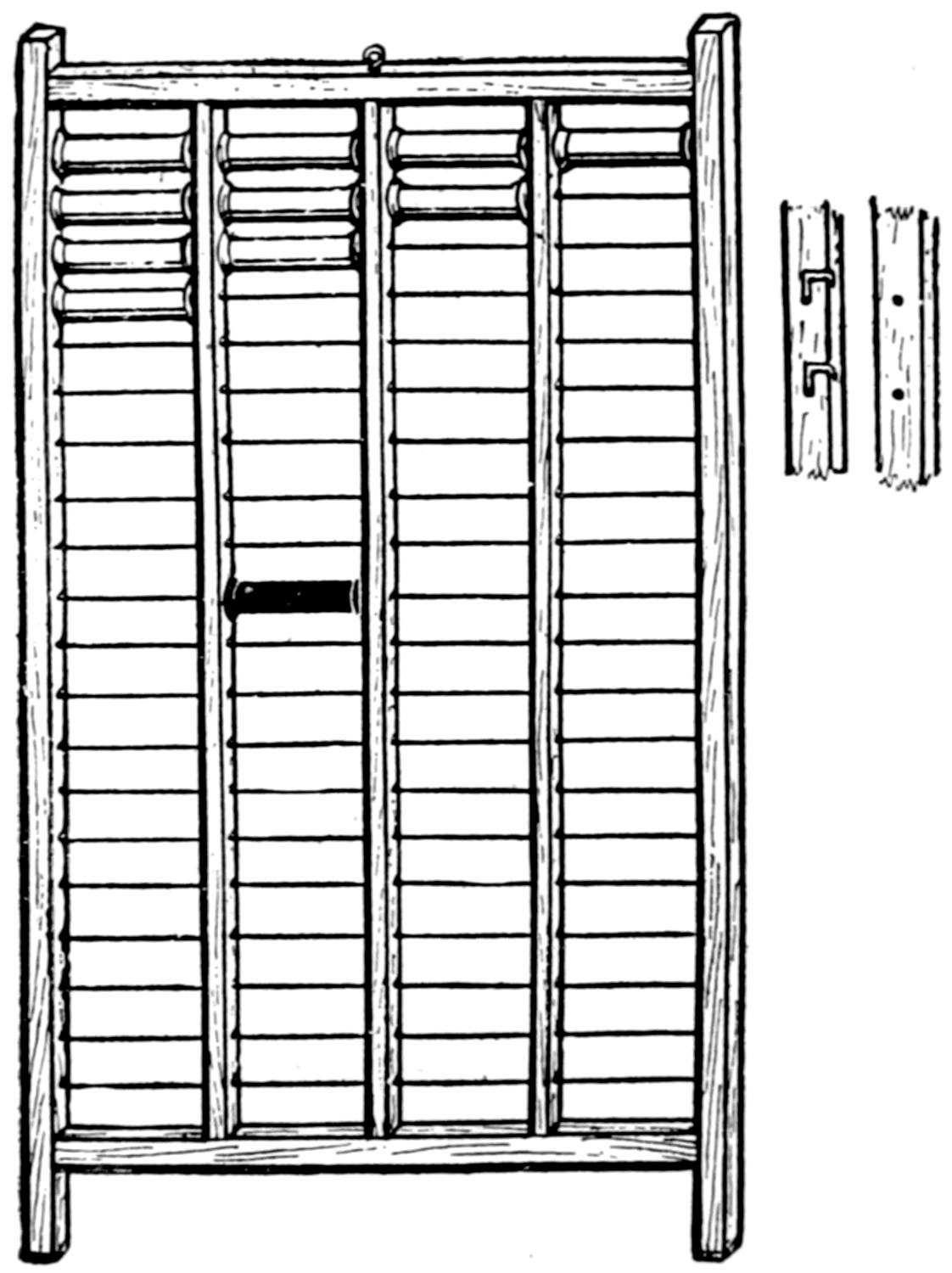
Fig. 33.—Bobbin Frame.
From Hooper’s Hand-loom Weaving, by courtesy of John Hogg, London.
Markets were extended, for steam power made transportation easier. An impetus toward increasing the output came as a result of the possibility of selling outside of the environment. Workers of both sexes turned toward the textile industries, for the expense of power and big machinery had [54]driven the work out of the homes into especially constructed and equipped buildings. The isolated worker could not compete with the machine. A reorganization of society was needed to meet the situation. Capital for the mills was provided by men of means, who, unlike the heads of the domestic workrooms, were not of necessity textile workers themselves. They controlled the situation but often knew little of the condition of workers. Questions of the division of profit between capital and labor began to cause irritation. Competition arose between mills, and subdivision of industry [55]followed as a means of increasing the output through rapidity of work. The worker, therefore, soon lost his individuality and likewise his interest in the perfection of the product. The capitalist increased in wealth, but low wages and poor living were prevalent among the lower class of workers.
A powerful mercantile class began to have voice in national affairs. The economic situation became acute, but gradually from it there developed a new social conscience in all classes, and laws were enacted which aimed to improve working conditions, to limit working hours, to regulate the work of women and children, to prevent industrial accidents or to compensate for them, to improve housing conditions and the sanitation of workrooms. Leagues and societies of workers and employers are organized now, and are at work adjusting these conditions.
The Industrial Revolution
is responsible for bringing about great changes for women; for as their home workrooms were taken away and the manufacture of textiles was conducted elsewhere, the women were no longer important economic producers. With this change their knowledge and ability to judge of the content and value of materials passed also. Those who had to labor became part of huge subdivided activities in the factories and knew only the small part on which they worked. Those who remained at home were entirely removed from participation in the making of cloth or even knowledge of the methods. The desire for cheap yet pretentious fabrics and the cost and difficulties in manufacturing reliable ones have brought into the market a large supply of untrustworthy and often adulterated materials to satisfy the demand. Complaint of these materials is usual, but few consumers realize how large a part they have in the conditions to which they object.
A new era has come in the twentieth century, for women are having increased influence in affairs outside as well as inside of their homes. They are the main textile consumers, [56]and their demand is a potent factor in the output. Large production is the economic aim of the day, and markets have extended all over the world. A trained consumer is needed as never before, who will work with the many agencies attempting to meet the problems arising and bring forth a better industrial America.
[57]
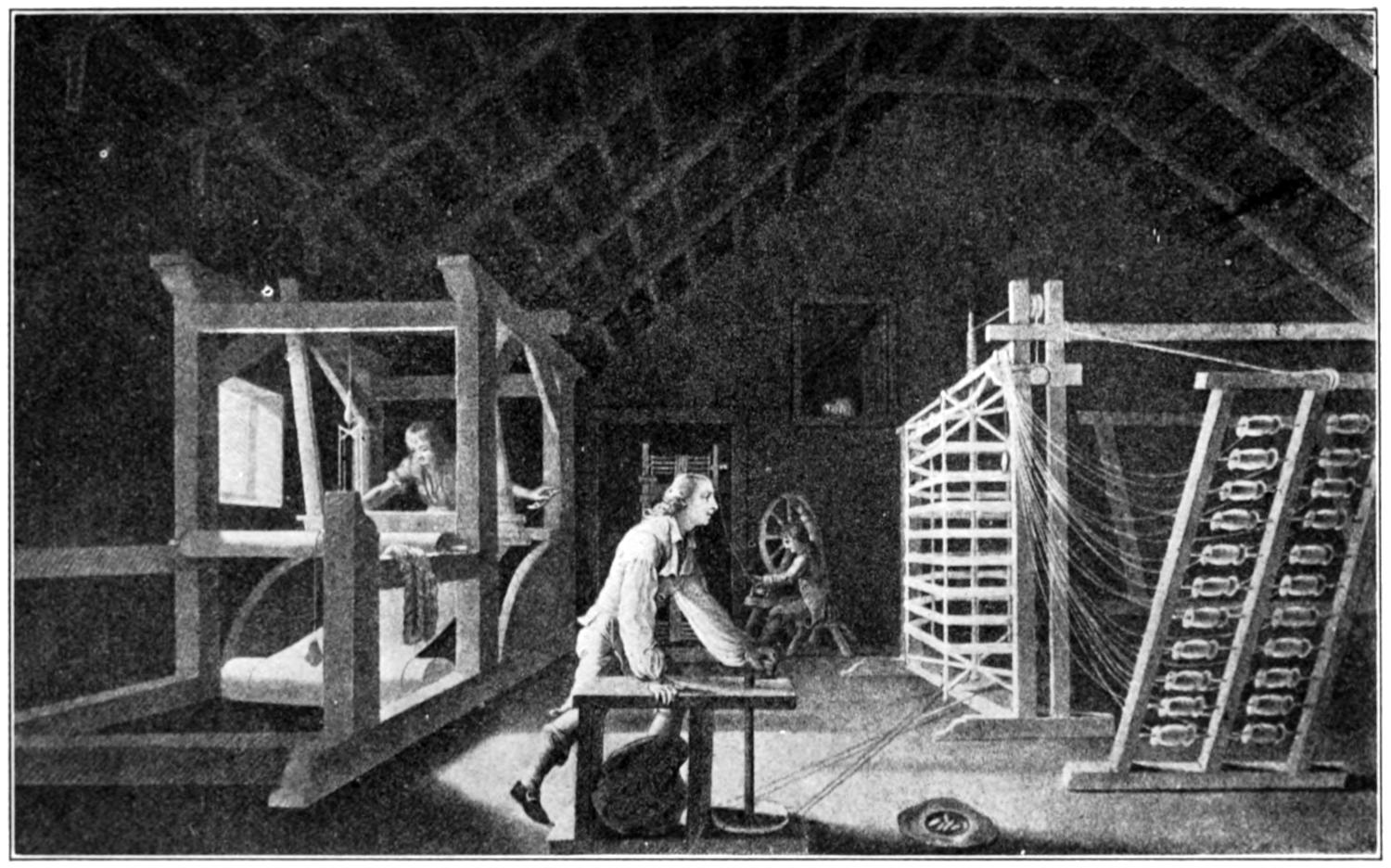
Fig. 34.—An Ancient Weave Room.
[58]
CHAPTER III
WEAVING
The Hand Loom.
—Primitive looms were in use for centuries, but finally the European hand loom (Fig. 35) was developed on which the modern power loom is based (Fig. 48). The principles underlying are the same as in the primitive one (see Chap. I, Primitive Looms): (1) making the shed by means of a harness; (2) throwing the filling yarn through it by the shuttle; and (3) battening the threads into a solid fabric. Continuous cloth was made, instead of the rug lengths of an earlier period. Our colonial loom was like the European hand loom, and the weaving was at first done in the homes. It is estimated that there were in this country one hundred twenty-five or more years ago about three and a half million spinning wheels, and a quarter of a million hand [59]looms. When the inventions leading to power spinning and weaving made it more profitable to do the work in mills, a number of them were started in the East, and also a few fulling mills were opened. Thus began our textile industry of to-day. The hand loom was used until about 1850.
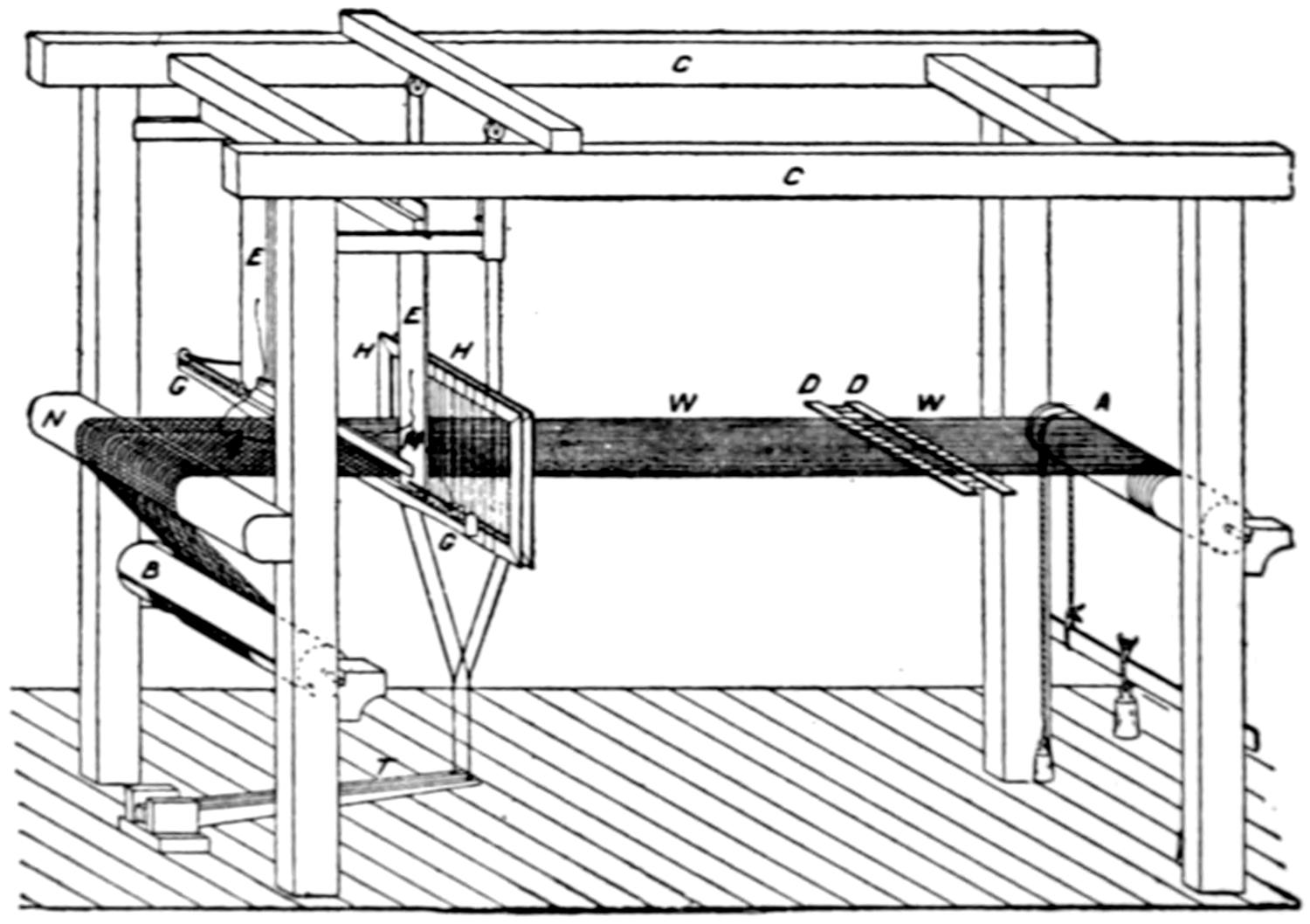
Fig. 35.—Hand Loom.
From Watson’s Textiles and Clothing, by courtesy of The American School of Home Economics.
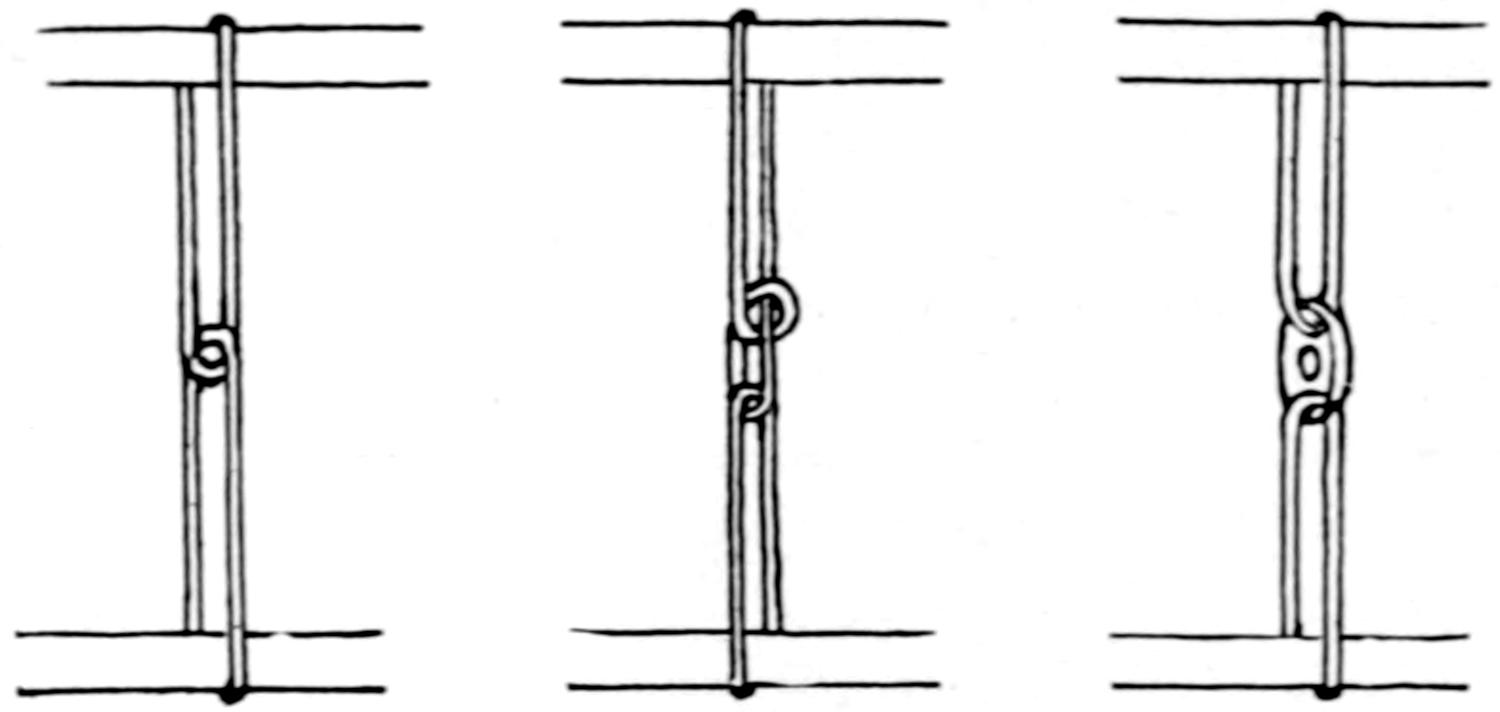
Fig. 36.—Healds.
The Parts of the Hand Loom
were as follows: (1) For the management of the warp: The framework, C, usually of wood, and clumsily made, contained a warp beam, A, on which the yarn was wound, and a web, cloth, goods, or merchandise beam, B, for the finished cloth. These two beams were held in slots at each end of the framework; the warp, W, was stretched between them, passing through the harness, H, and the reed on the way. Weights on the beams or rollers kept the warp stretched. When the weaving was going on, and the weaver desired to wind up the woven cloth, and at the same time to draw out some of the warp, she could do so without leaving her seat by taking hold of a lever, which on being raised released a paul from a ratchet wheel, and loosened the warp beam. When she had drawn off sufficient warp, and had wound up the cloth, she could fasten the paul on the ratchet, thus holding the warp tight. The earliest looms did not have this device. Inserted through the warp threads back of the harness were two smooth sticks called shed sticks, D, which kept the crossing of the warp intact. If a warp thread broke, it could be easily traced by means of these sticks. They were the earliest form of heddle, but are still in use as shed sticks on account of their value. (2) Shedding: The harness of the hand loom resembled somewhat a collection of heddles of the Zuñi principle (Figs. 6, 16, and 17). A series of healds or heddles were made of cord, and suspended on two laths or sticks. The cords were tied in various ways (Fig. 36), but in such a manner that there was an opening in their centers called the mail eye, through which warp threads could pass and be raised or depressed when a particular heald shaft was in use. Threads not needed passed between some [60]heddles to be threaded through others. When a number of healds were on one lathe, it was called a shaft, sheaf or leaf of healds (Fig. 16). The office of each heald shaft was to affect certain threads by drawing them up to form a shed when the pattern required it. The method of threading these shafts, the number to be used and their succession, was indicated by the draft. (See Chap. IV, Design, etc.) For plain weaving two or more shafts were in use. When the yarn was coarse two were sufficient, but when it was fine, four shafts or even eight prevented friction on the threads. For pattern weaving three or more shafts were used. The method of threading the healds and fastening the shafts to the treadles T controlled the warp threads, which could be drawn down as needed to make the shed (Fig. 37). The shafts were suspended from the framework over a roller, or tied to jacks which worked on a pulley, and therefore could be moved up and down. The shed was made by drawing down the various shafts as needed. (3) Picking: This was accomplished by means of a shuttle which held a bobbin or quill with the filling thread. It was boatlike in shape, and had an eye in one end through which the thread from the bobbin came. As part of the warp was depressed the shuttle was thrown through by one hand and caught by the other. A new shed [61]was made and the shuttle returned. A selvage was formed around the last warp thread on either side (Fig. 12). Kay’s patent of the picking stick and the fly shuttle, and his son’s patent of the drop box, put a quicker means of working into the hands of the weavers. (Chap. IV, Transitions, etc.) (4) Battening: The lathe, or sley, E, was set into a framework suspended from above or fastened below. It could be easily drawn forward by the hand, and pressed against the finished cloth, making it solid and even. In order to drive home every thread, a reed was set in the lathe. Reeds were made of a series of wires of a varying degree of fineness, according to the coarseness or the distance apart of the warp threads. One or two warp threads were passed through each dent or division of the reed. The width of the threads as they lay in the reed was the width of the finished cloth. The lathe with its reed was the development of the hand-shaped comb or the sword used in early times. A temple or tenterhook (Fig. 38) held the cloth the desired width and kept the weaver from drawing the threads inward as she worked.
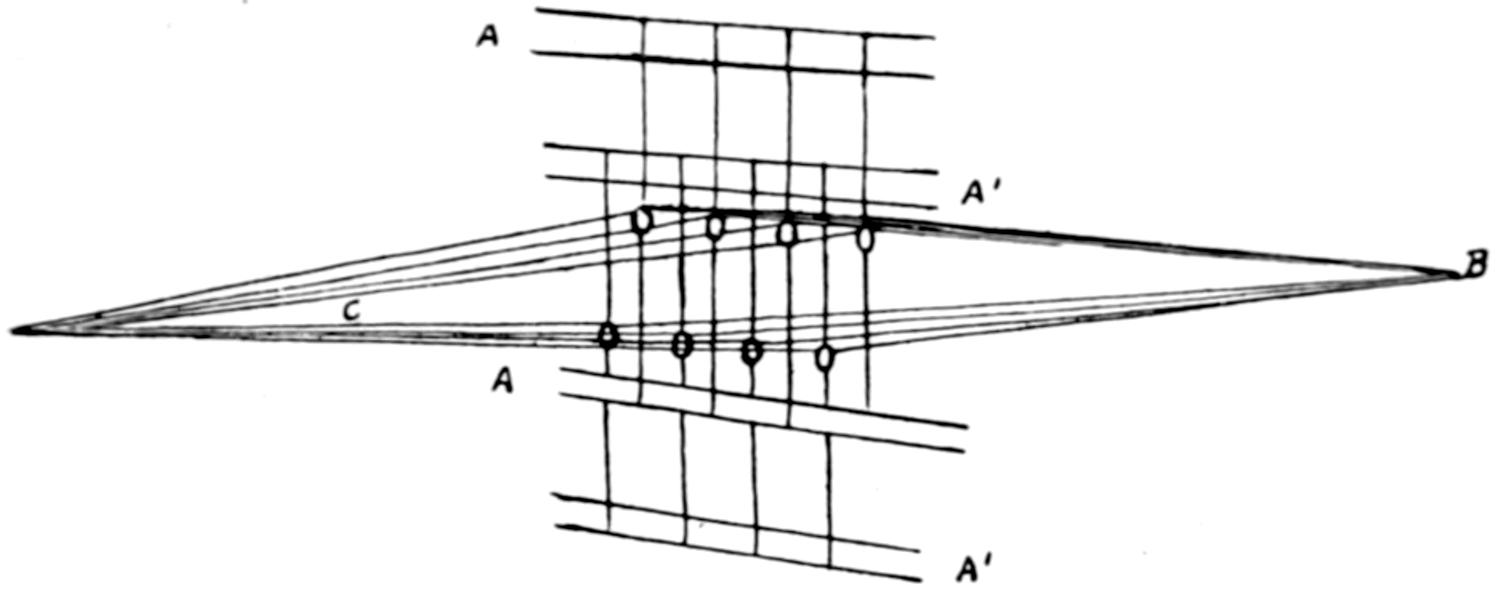
Fig. 37.—Detail of Harness, showing one Heald Shaft raised, thus forming Shed.
A, A′, Heald shaft. B, Warp threads. C, Shed.
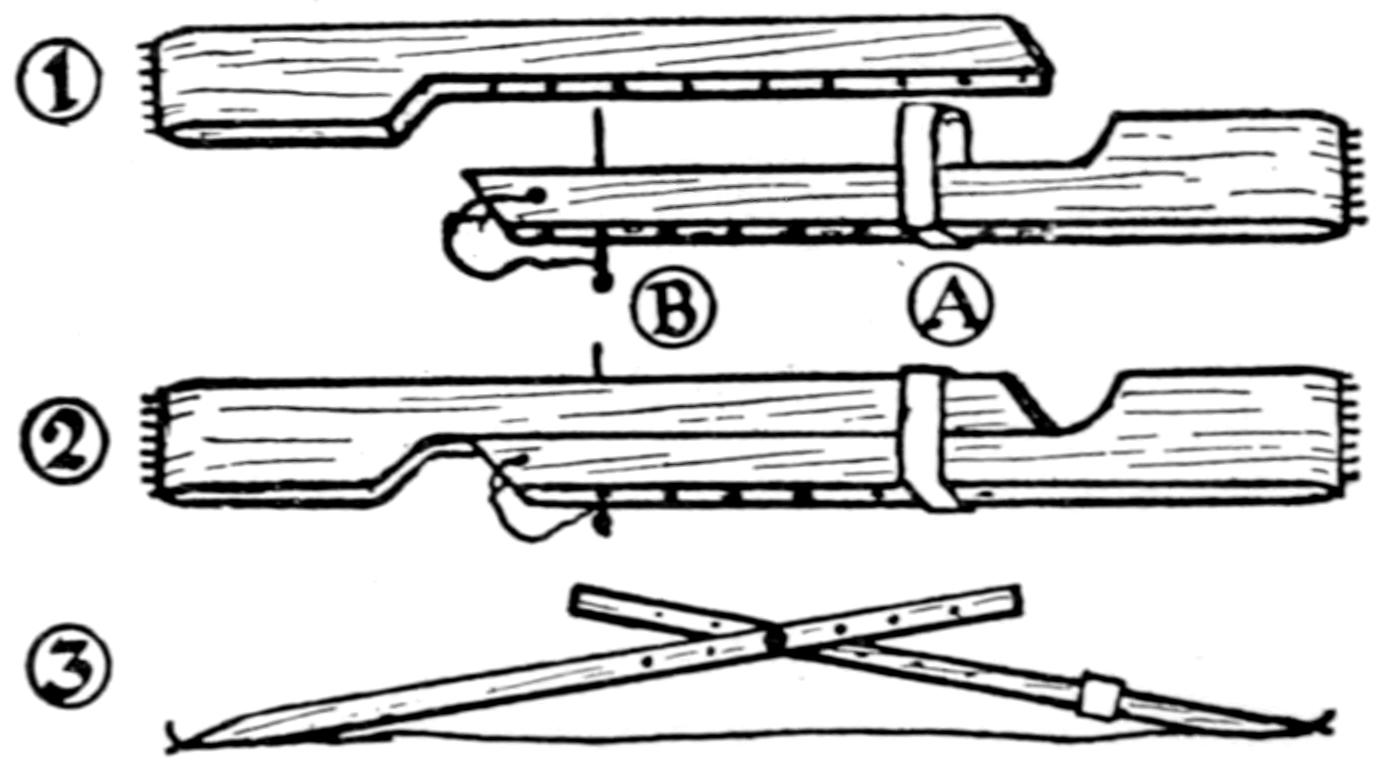
Fig. 38.—Temple or Tenterhook.
From Hooper’s Hand-loom Weaving, by courtesy of John Hogg, London.
The Working of the Loom.
—If a plain design is to be woven, every other warp thread must be up while the alternate threads are down. Consequently if two shafts are [62]used there will be one treadle tied to each; but if four or eight shafts are used for plain weaving, two or four will be fastened to one treadle and two or four to the other. The usual way in hand loom weaving with four shafts is to fasten the first and third shaft to one treadle, and the second and fourth to the other. The healds are threaded in such a way that the odd numbers, such as 1, 3, 5, 7, 9, etc., will be in the first and third shafts, and the even numbers in the second and fourth. It is more common in power weaving to have the first and second shaft act together, and the third and fourth. The drawing-in or threading the warp threads through the harness is done from the back toward the cloth beam. After the harness is threaded the warp yarn is put through the wires of the reed in succession and is fastened in perfect order to the cloth beam. The weaver depresses one treadle with the threads attached to it, which leaves the alternate one up. For elaborate patterns there are a number of treadles to which shafts of the harness are fastened, and it takes some skill to depress the correct ones and to do rapid work. The shuttle is thrown through the shed and the filling is left in it (Fig. 39). The worker draws forth the swinging lathe or batten with its reed, through the dents of which are the warp threads, and drives the filling home. She then pushes back [63]the lathe and is now ready for the alternate shed. She removes her foot from the first treadle and depresses the next [64]one, proceeding as before. If a thread breaks, as frequently happens, she stops to find it. The shed sticks are of use to her in tracing it, for it frequently snaps and springs back all the way to the warp beam. She must, therefore, after she has found her thread, tie a new piece of yarn to it with the weaver’s knot, bring it under and over the shed sticks, through the correct eye of the heald, and up to the cloth, where she holds it in place until she has woven a few lines. After it is well woven in, the end can be cut off. If the filling gives out, or a new color is to be used, she opens the shed which contains the end of the last thread, lays the new thread an inch over the old, battens the new into place, and continues weaving as before.
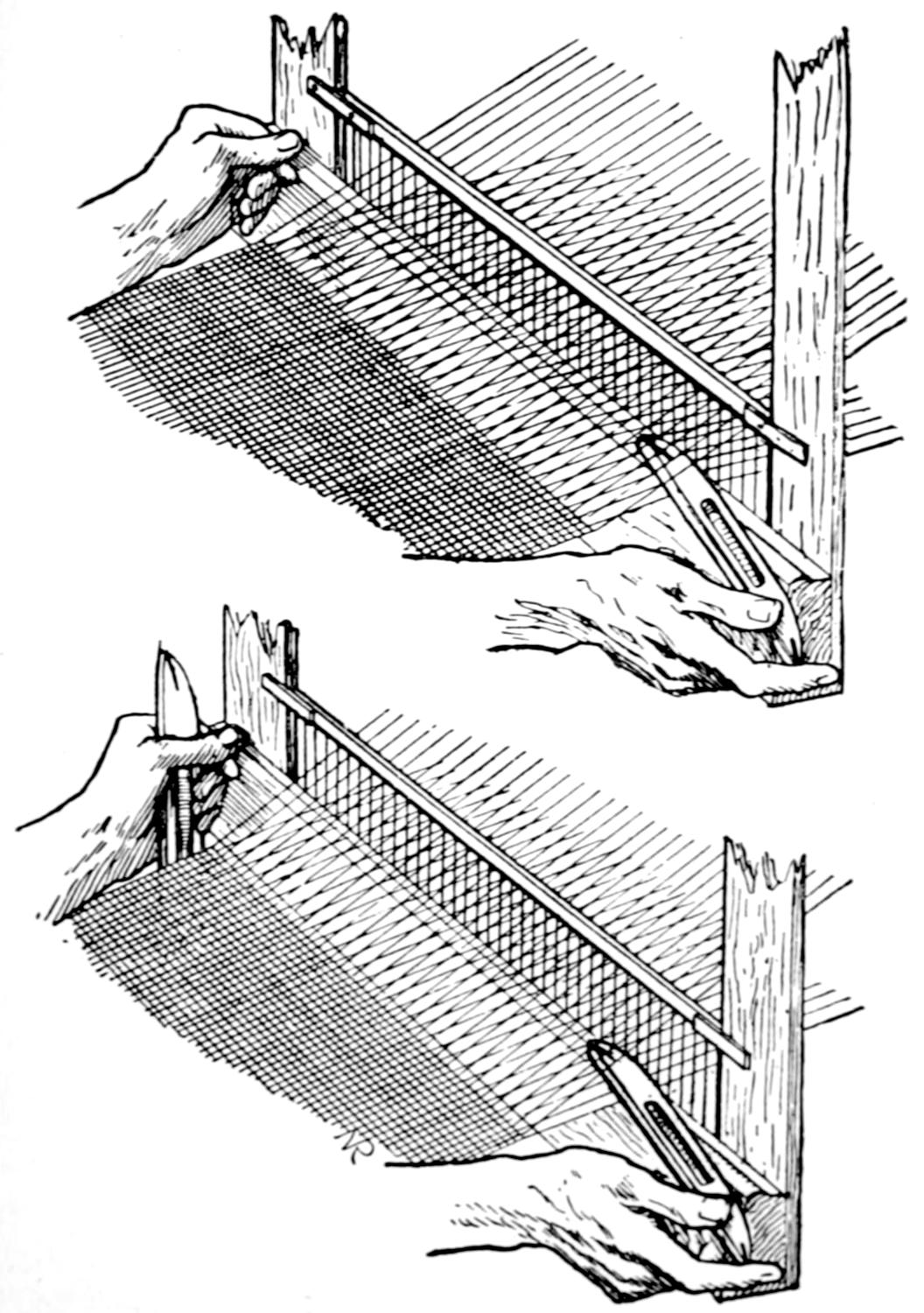
Fig. 39.—Throwing the Shuttle through the Shed.
From Hooper’s Hand-loom Weaving, by courtesy of John Hogg, London.
Winding, Warping, Beaming, and Drawing In.
—Weaving is a comparatively simple matter, but threading the loom is tedious. Even in the power loom the work is done by hand. A warp is formed of as many threads or ends as are needed in the width of the cloth. Each thread must be the same length and wound smoothly on the warp beam. An important part of successful weaving is the preparation of the warp (Fig. 40), placing it on the warp beam, sizing the yarn, placing the beam in the loom, and the threading of the yarn into the harness, or the drawing in. This was done by hand at first, but power now accomplishes the same result by an elaboration of parts which take the place of the hand. The accepted steps taken in setting up the loom are given below. (Craft workers are still using the hand loom to make original and exclusive fabrics, but some short cuts in the process of warping have been made which are described later.)
1. The bobbins of spun yarn are taken from the spinning wheel.
2. The yarn is wound from the bobbins on a reel, thus making a skein of definite length. The clock reel (Fig. 21) is still used, the click indicating the time when the skein should be tied or removed.
3. The skein is put on a swift (Fig. 21) and the yarn is run off on bobbins. If the threads are already on bobbins the first three steps are omitted.
[65]
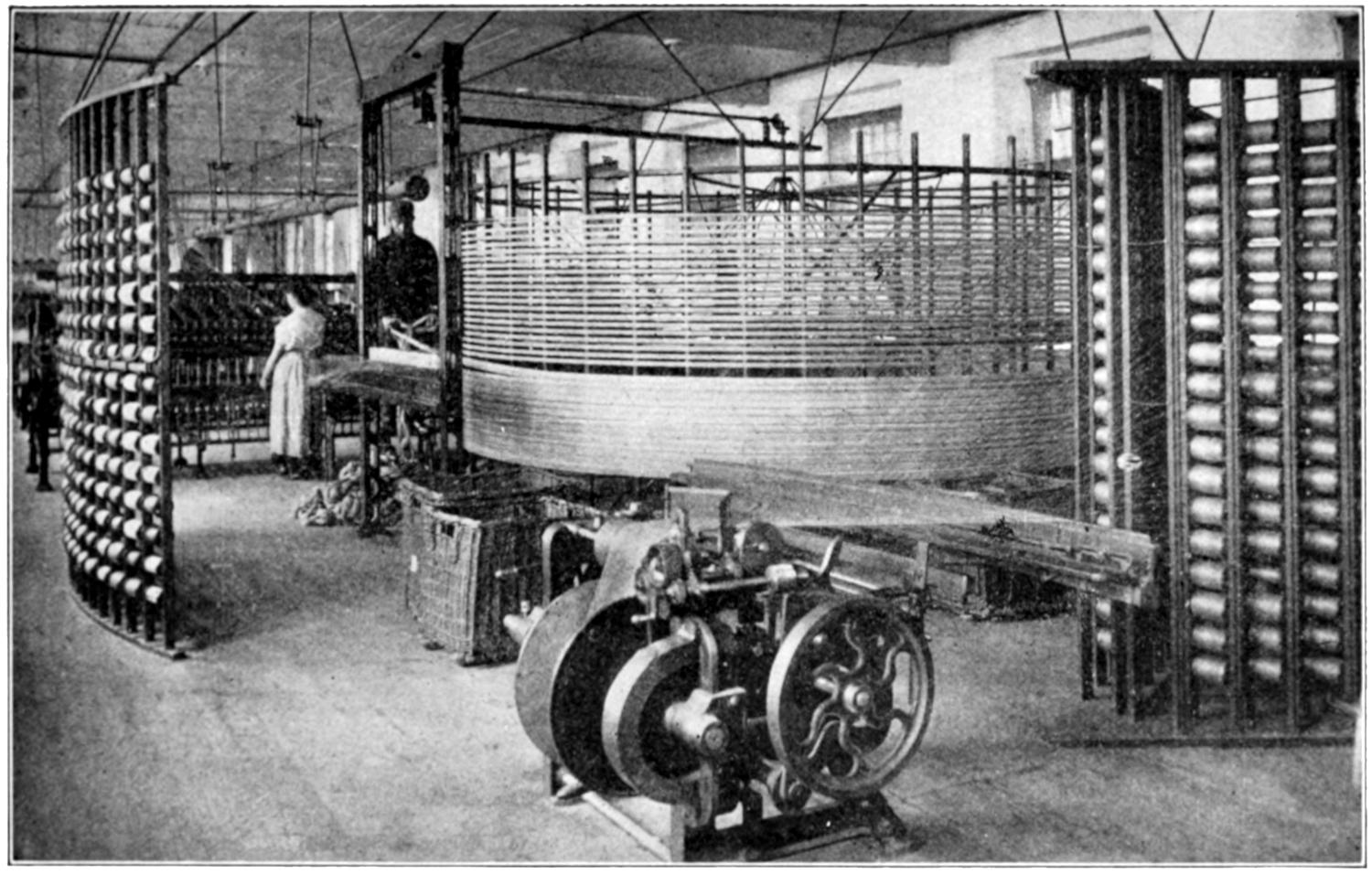
Fig. 40.—Hand and Sectional Warping. The Attendant is removing a Warp in Chain Form from the Drum.
Courtesy of The York Street Flax Spinning Co., Belfast.
[66]
4. Bobbins to the number required to provide threads for the warp are put on a creel, scarne, or bobbin frame (Fig. 33). When many threads are needed the warp must be made in sections.
5. The creel with its bobbins is put in front of the warping bars or the reel (drum) (Figs. 40 and 41). The yarn is drawn from the bobbins to make the warp, a lease being carefully kept at one end of the warp.
6. The warp is taken from the bars or from the drum in (1) a chain form (Fig. 42), (2) on a niddy noddy (see Fig. 21), or (3) on a stick, the lease always being carefully preserved.
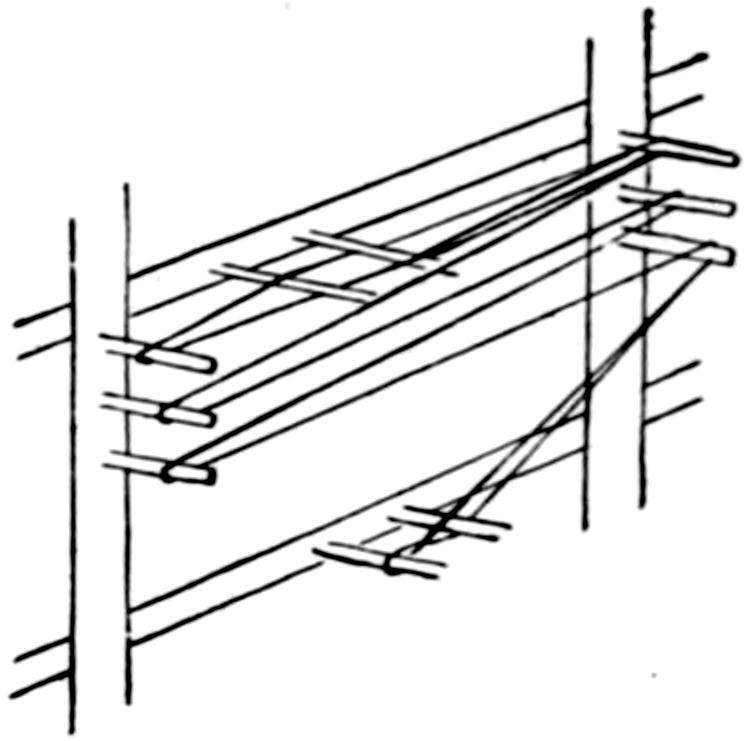
Fig. 41.—Warping Bars.
7. The chain is taken to the loom, from which the harness has been removed. A special frame holding the warp beam is sometimes used. Two people are required to do the work. One lets out the chain from the end taken last from the bars or drum, standing meanwhile by the cloth beam, and the other rolls up the warp on the warp beam as the chain is let out. If the warp is in several chains each one should be wound on in its own place.
8. Cords are put through the lease of sufficient length to stretch the warp to the purposed width of the cloth. Careful watch is kept for broken threads or for threads out of place.
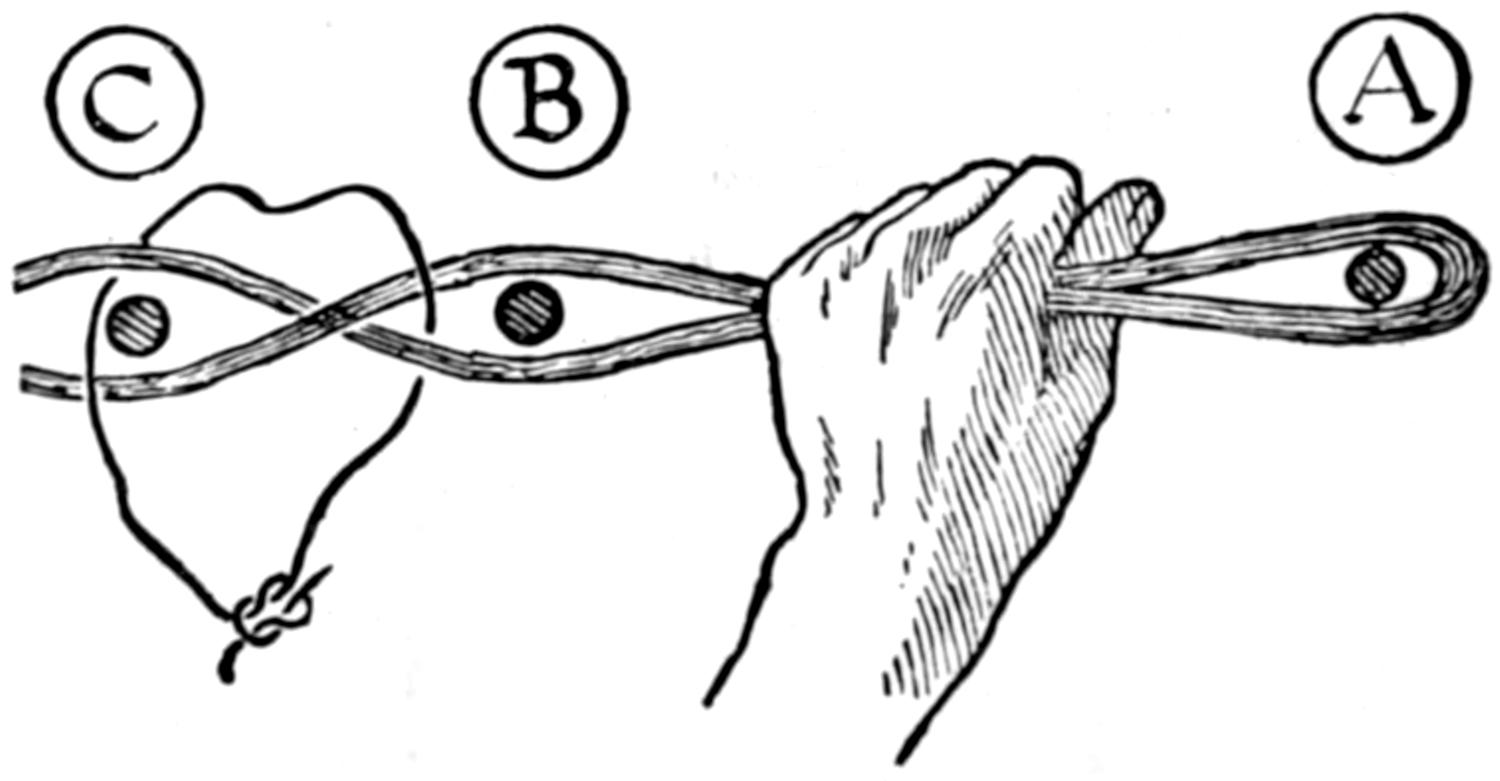
Fig. 42.—Taking off the Warp.
From Hooper’s Hand-loom Weaving, by courtesy of John Hogg, London.
9. Beaming. The threads must now be attached to the warp beam. They are usually tied in groups and slipped over a thin, flat stick which is attached to a piece of cloth fastened to the warp beam. Holes have been punched at intervals in the cloth, and strings through these [67]holes are tied to the stick. The warp threads or ends are stretched the required width on the stick.
10. The warp threads are distributed evenly on a raddle (Fig. 43) to a couple of inches wider than the cloth will be. The raddle is placed near the warp beam, that the ends of warp may pass through it and wind smoothly on the beam. The raddle has a removable top.
11. The warp beam is slowly revolved by one worker and the chain is let out by the other, who stands on the other side of the raddle. The threads pass through the raddle and the lease and are wound up evenly on the beam until the end of the warp is reached. A coarse brush is often used to lay the threads parallel.
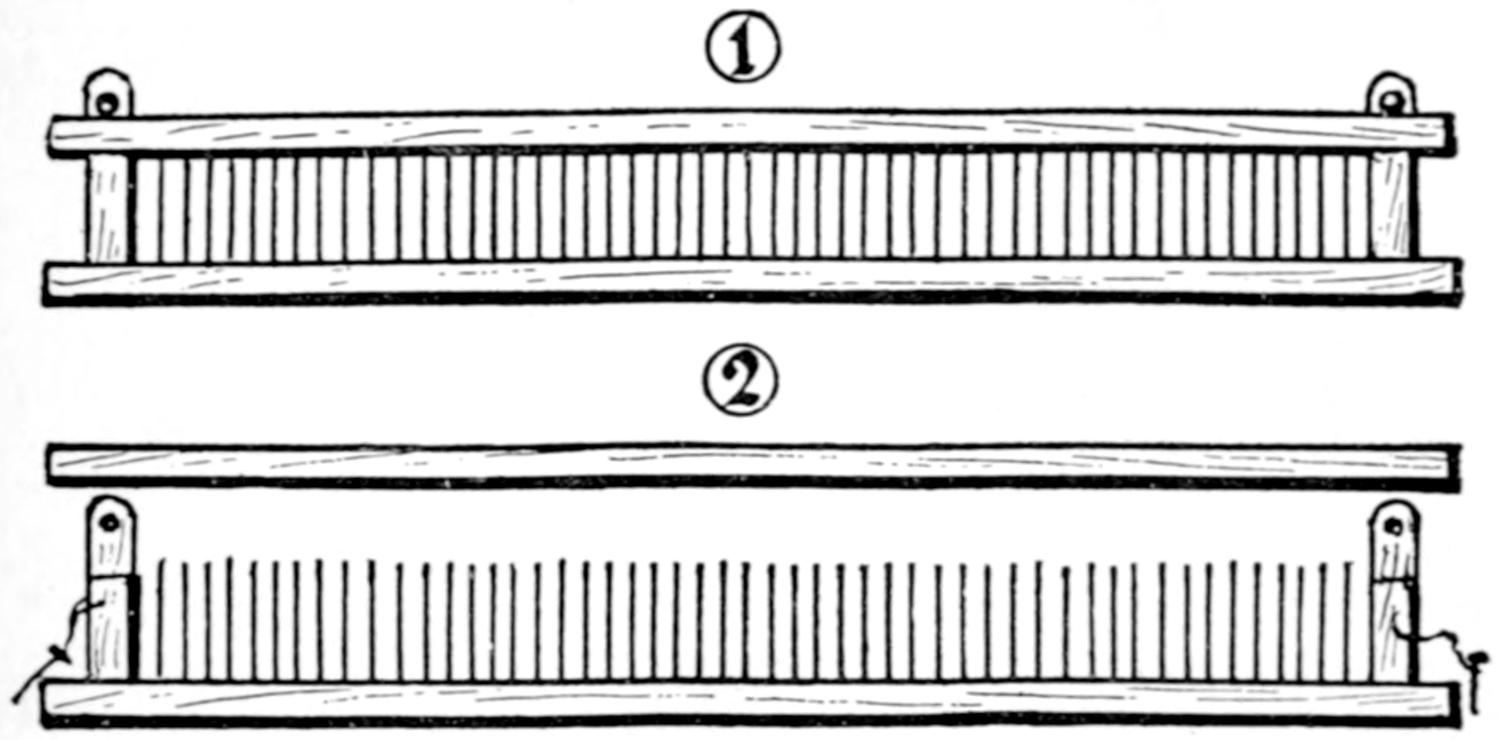
Fig. 43.—Raddle.
From Hooper’s Hand-loom Weaving, by courtesy of John Hogg, London.
12. Two sticks are placed through the lease in place of the cords. They are tied together at each end to keep the threads from slipping off. The raddle is removed, the threads of the warp are tied in bunches of ten or twenty on the harness side of the lease. It is extremely important that the threads shall go through the harness in the exact order that they come from the lease.
13. The ends of warp are now threaded carefully through the eyes in the healds of the harness. The order in which this shall be done depends upon the particular pattern required, and is indicated by a draft. (See Design and Draft, Chap. IV.)
14. When the threading of the harness is complete, the warp threads are taken one by one through the correct dents in the reed (Fig. 44).
15. The warp threads are passed over the breast beam and fastened evenly to the cloth beam in the same way as on the warp beam.
[68]
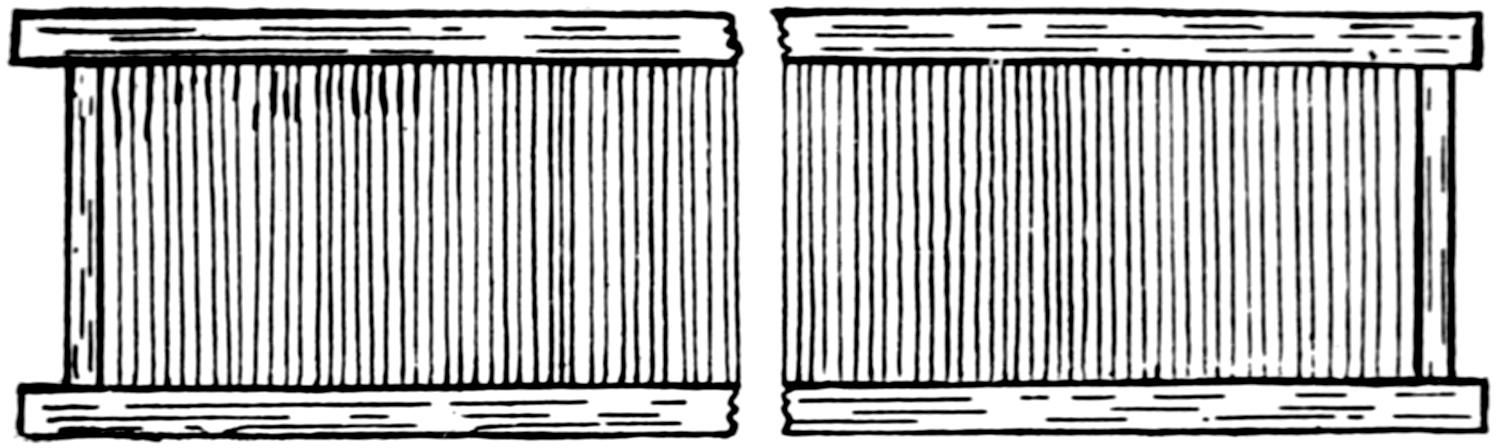
Fig. 44.—Reed.
In general, when a warp comes to an end in a loom the threads are not pulled through the harness, but are left hanging in small groups and are tied together so that they cannot slip through. When that arrangement of harness is needed again, the new warp threads are tied to the old by a flat or weaver’s knot, or twisted one by one to each of the former threads. This method saves much time. A good worker can twist in seven thousand new threads in a day. Machinery which does this work as well and more rapidly is on the market. It is expensive and not found in the smaller mills. Hand threaders are generally employed. Two workers are usually found sitting on either side of the harness. One pushes the warp thread through the mail eye with a little metal device, and the other receives it. Single warp threads are sized before weaving and after they are on the beam, to give them strength to bear the strain. Filling threads are not sized. For numerous details of warping and drawing in, see Hand-loom Weaving, by Luther Hooper.
Several processes mentioned in the above outline are given in greater detail below.
The creel (see Fig. 33) is an upright frame with a number of wire rods across it on which bobbins filled with yarn may be slipped. Threads are drawn from all the bobbins at once. The creels used by hand workers are of various sizes, carrying from ten to eighty bobbins. Those used for power warping frequently hold many hundreds. In hand warping the creel filled with its bobbins is placed beside the warping bars or drum, that the threads may be drawn from it for the warp. (See big reel in Fig. 40.)
[69]
Warping.
—The purpose of warping is to lay in parallel order the required number of threads for the width of the cloth. These threads must be the length of the finished cloth. The method used is to draw a small number of threads to the required length and repeat until the full number for the width is secured. If a drum three yards in circumference is used and ten threads from the creel are carried ten times around it, the result will be ten threads thirty yards long. By reversing the movement of the drum and carrying other ten threads back, there will be twenty threads thirty yards long. The same work may be accomplished by a series of pegs, called warping bars (Fig. 41), set at a distance of three yards apart, on which the yarn is carried back and forth.
Making the lease is an important part of warping, for thereby the threads can be kept in perfect order, or if they become tangled can be set right again. Three pegs are placed on the warping bars or on the drum for the purpose. The threads are drawn from the creel, the ends knotted together and placed over the first peg on the drum, the two remaining pegs being used for the lease. The warper begins by grasping the threads coming from the lowest row in the creel in the palm of her hand, twists her hand as she takes the second row, so that these threads pass over its back, and continues this alternation through the succeeding rows. She now has the lease in her hand and places it on the pegs, noting the order of placing. She revolves the drum, letting the threads from the creel lie on its surface, until she has drawn out the length of the warp. At this point there are two pegs, around which the threads are wound under and over (but not in a lease), before bringing them back over the same track. She ties the bunch of threads together that she may later count them more rapidly. By reversing the drum she brings the threads back to the lease pegs. She must now make the lease again, remembering that she is reversing the manner of making it, but preserving the first plan. If the manner of [70]placing has been such that the threads on the palm are on the second peg and those on the back of the hand on the third, on the return the reverse order brings the threads on the back to the third peg and those on the palm to the second. When the warp is complete and ready for removal two cords are inserted in the lease to keep the alternation perfect, and a cord is tied over all the groups of threads at the end. The first peg, to which the threads from the creel were tied, is removed, which loosens the warp, and it is taken off by looping it into a chain or taking it around a stick or niddy noddy (Fig. 42).
An easier method of warping for the hand loom is in use among hand workers when the design is simple, the yarn not too fine, and the length and width of the cloth is not great. The warp is made in a chain or in a series of chains as described above (Winding, Beaming, etc.), but no lease is placed in the threads. The warp is entered from the front of the loom (where the cloth beam is) and goes first through the reed and then through the harness (Fig. 45). Whenever possible the ends of the former piece of cloth are left through the harness and reed and tied in bunches to await the new warp. The part of the chain that has come last from the bars or drum is brought to the ends of warp hanging through the reed. The chain is let out enough to tie each thread to one which hangs through the reed. When the width is tied, the old threads are drawn through reed and harness, and the chain gradually let out. A brush is often needed to keep the threads separate as they pass through the reed and harness. Every broken thread must be repaired carefully. The warp must pass straight through reed and harness. A cloth with a series of eyes across the width is fastened to the warp beam. To these eyes the warp threads are tied in small bunches, beginning in the middle and then finishing both sides. The width of the threads on the beam should be the purposed width of the cloth. The warp beam is now revolved, [71]that the threads may be wound on it. There must be an even tension on them. As the beam revolves four sticks in succession are laid on the threads that the winding may be more even. There must be no piling of the threads on each other. The winding continues until the chain is all let out and a short length of yarn is left through each dent of the reed. These threads are tied in groups on the cloth beam side of the reed and are gradually fastened in succession to the eyes in the apron of the cloth beam. The center threads are tied first and then both ends. The threads must be taut and evenly held. If this is not the case the slack in the loose threads must be taken up. A well-stretched and even warp helps to make a good cloth. Careless work in drawing in and stretching the warp will cause continual trouble in the weaving.
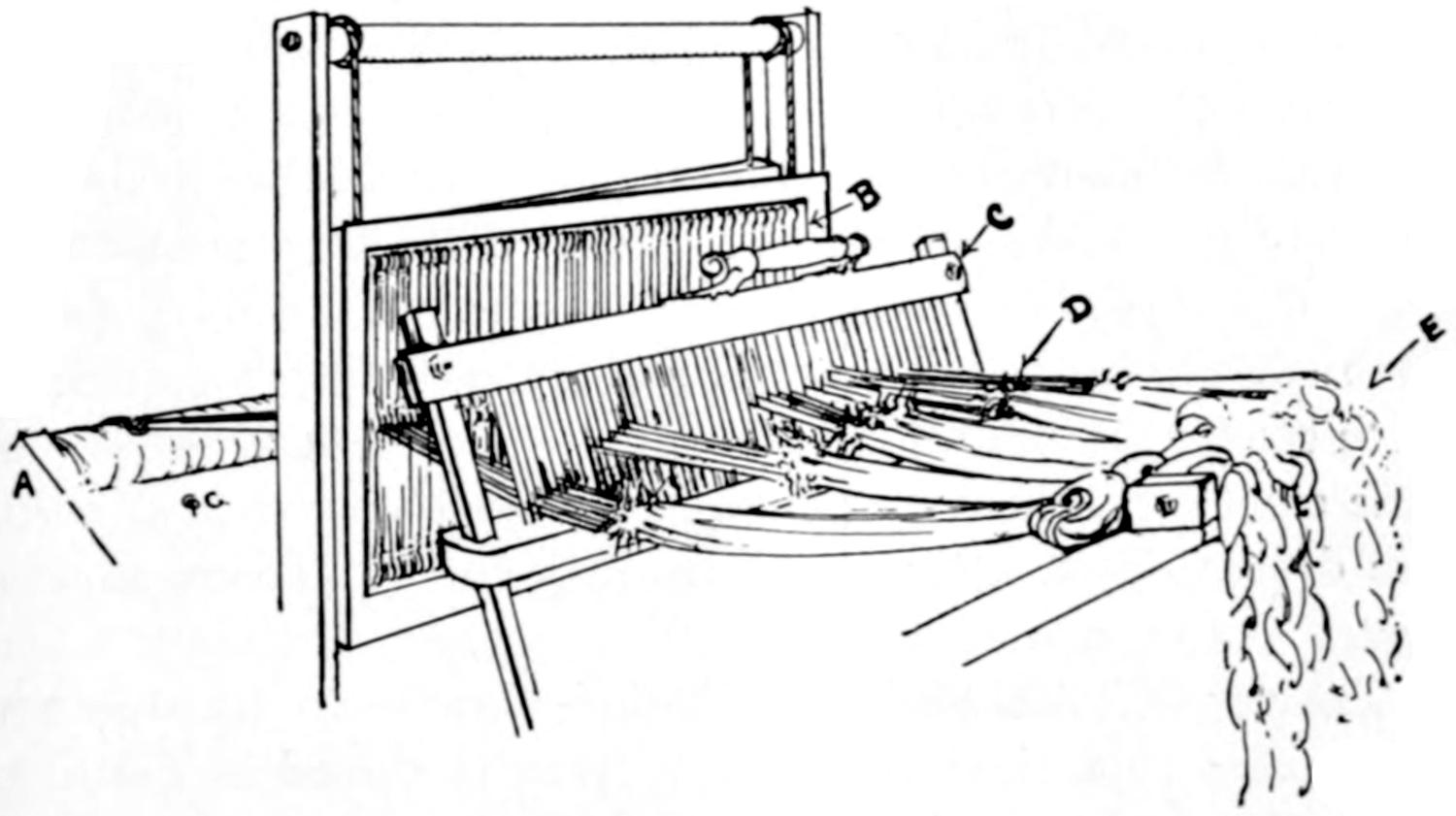
Fig. 45.—Showing Entering of Warp.
A, Warp Beam.
B, Harness.
C, Reed.
D, Tie of new threads to old which have been left through reed.
E, Cloth beam.
When the ends of old threads have not been left in the harness the new warp must be, thread by thread, passed [72]through the mail eyes of the harness, and through the reed. (The method of threading will be indicated by the draft.) It is well to put on first a warp of only a yard in length for it is easier to manipulate. The longer warp can be tied to this. The tie used is a weaver’s or flat knot. No shed sticks are required in these short warps, for a broken thread can be detected from a vacant dent in the reed or a mail eye without a thread. In very fine yarn, defects cannot be seen so readily. The careful keeping of the lease is also unnecessary unless very elaborate patterns are made. Much time is therefore saved in the preparation of the warp. Yarns are generally bought on the spool and can be placed immediately on the creel to be drawn off for the warp. It is even possible to take the threads directly from the creel to the warp beam through the reed and harness, when a narrow piece of cloth with coarse threads and not too great a length is to be woven. The creel is put in front of the loom, twenty threads or more are drawn off at a time, run through reed and harness and fastened to the warp beam.
Taking Off the Finished Cloth.
—The warp threads are cut a few at a time far enough from the finished cloth to prevent raveling, and from the harness so that they will not pull through. They are then tied with a flat knot in small bunches, to keep them from slipping through the mail eyes of the harness. The paul is released from the ratchet and the cloth beam is taken out and the cloth unrolled.
Tapestry Looms.
—The modern tapestry looms are found in horizontal or vertical form, the latter looking much like the vertical looms of antiquity. The warp is stretched tightly in the frame, and the pattern is put in by the fingers. The filling is inserted as a plain weave, but the use of color forms the pattern. Many colors often are used for the filling, and are usually put in by a sort of needle or bobbin. Two heald shafts are generally used, so that the alternate threads can be raised together and simplify the weaving, not only when [73]the filling is to be thrown all the way across the warp, but also when only a small section is needed. The vertical loom was quite usual in Europe until about 1400, when a horizontal loom took its place. France developed tapestry weaving in the time of Francis I, especially in the city of Arras, the weaving being called Arras work. Raphael and his students were designers for these tapestries. The Flemish tapestry weavers were considered the finest. Ghent formerly had seven streets devoted to this class of weaving. Although the industry has declined, tapestries are still woven. Some of the noted modern studios are the Gobelin atelier in Paris; the weaving sheds at Merton Abbey in England, where William Morris revived tapestry weaving (the discontinuance of this work is under discussion); and the studios of Albert Herter in America, where French Aubusson weavers are employed, the work being done on horizontal looms.
[74]
CHAPTER IV
POWER WEAVING AND DESIGN
The Transition to Power Weaving.
—During the early Middle Ages an increased demand arose in Europe for rich and elaborate materials. It was difficult to weave these on the plain hand loom. The Crusaders are given the credit of introducing the Draw Loom into Europe from Damascus, the term damask, used for elaborately designed linen, being taken from this city. The hand loom was naturally limited in the number of heald shafts and treadles which one worker could control. The draw loom allowed a wide scope in patterns. The shed was controlled by a series of cords attached to the heald shafts, which were pulled down in succession by an attendant called the “draw boy.” The weaver gave his attention to the weaving. Later an automatic attachment providing for mechanical shedding was invented, which took the place of the boy. A similar loom without the automatic attachment is still used in the East.
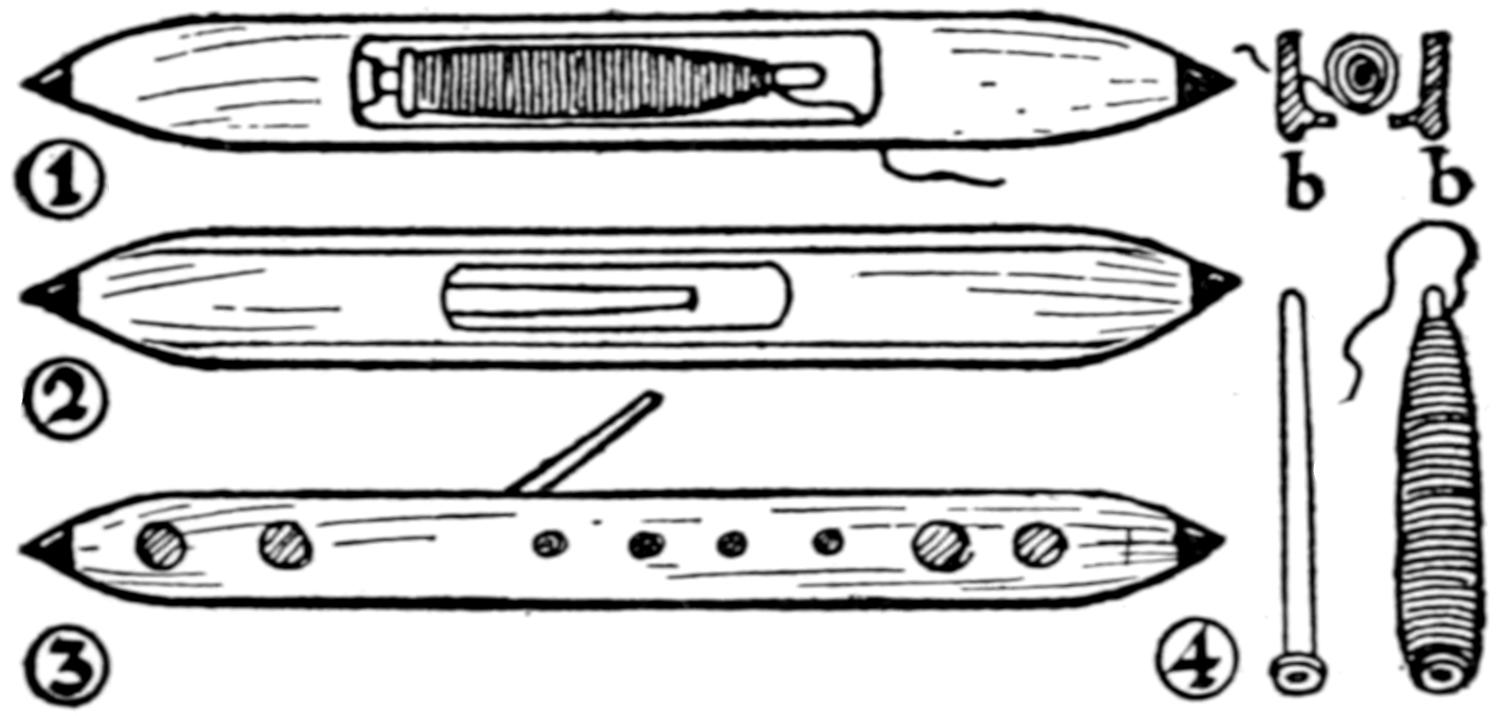
Fig. 46.—Fly Shuttle.
From Hooper’s Hand-loom Weaving, by courtesy of John Hogg, London.
In 1678 a loom was invented by M. de Genres of France, which embodied many modern principles, but little was heard of it. In 1745 another Frenchman, M. Vaucanson, brought forward his loom, which had the principle of shedding later used by Jacquard. It also had an embryo friction roller and a take-up motion, which are now found on the modern power loom. The invention of automatic spinning in England gave an impetus to weaving in that country. In 1733 John Kay invented the fly shuttle (Fig. 46) which increased the power of the weaver many times. He placed a shuttle race on the lathe, with a box at each end to receive the shuttle which the hands of the weaver had caught heretofore. Each shuttle box had a picker stick or driver connected with it, [75]which when moved threw the shuttle across the race and through the shed. The motive power for the picker stick was a cord extending from one driver in a shuttle box to the other, and a peg in the center of the cord was held by the weaver. If he wished the shuttle to fly from either side, he drew the handle sharply to the opposite side, which caused the driver to give a sharp blow to the shuttle. The hand looms before Kay made twenty picks per minute, but the fly shuttle increased this to forty picks, and further improvements made possible sixty picks per minute. The early power loom brought the record up to a hundred picks per minute with one man in attendance. To-day one man can attend to from four to six looms, which according to the kind of materials woven will make generally from two hundred to two hundred sixty picks per minute, and have even made four hundred. On plain goods at the present time, one weaver has watched as many as two dozen looms.
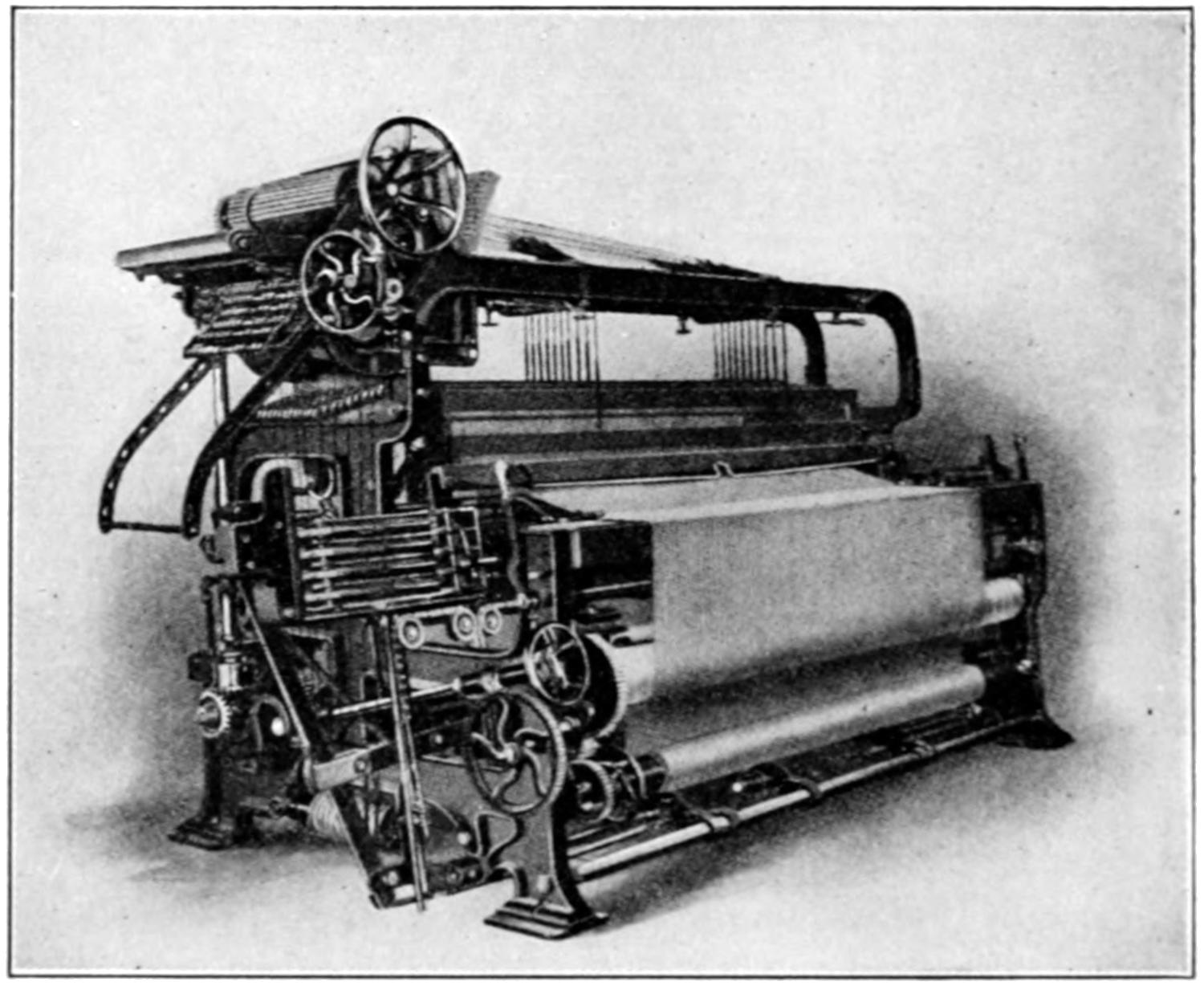
Fig. 47.—Loom with Drop Box and Dobby Attachment.
Courtesy of Crompton and Knowles Loom Works.
In the middle of the eighteenth century it was still necessary
to stop the hand loom every time a new color was needed
in the filling, in order to place a bobbin or quill with this
color in the shuttle. This difficulty was met in 1760 by
Robert Kay, the son of John Kay, by his drop box. (Fig. 47.
Left hand side on level with cloth.) Several shuttle boxes
[76]were placed at one or at both ends of the lathe in place of one
at each end. The shuttles held bobbins of different colors,
and the boxes fell into place automatically. These two inventions
of the Kays were of great importance in the history
of weaving. They made more cloth possible, but the spinning
wheels of the day could not provide enough warp. The
inventions of Hargreaves, Arkwright, and Crompton, however,
made increasing quantities of yarn possible, and more
effective weaving was soon needed. (Chap. II, Spinning
Machines.) In 1775 a power loom was invented which had
much merit, but unfortunately was not pushed. It was
1785 before Dr. Cartwright, of England, a clergyman of the
Established Church, who had mechanical genius, brought
out a heavy automatic loom. It was later improved and
[77-
78]became the basis for the power looms of to-day. It required
mechanical power to move it, the hand not being strong
enough.
The Power Loom
(Fig. 48).—The hand looms passed away slowly before the power looms. In 1830 Roberts invented his power loom which had a majority of the parts of the modern loom, and therefore required little attention. The hand weaver spent much of his time letting out the warp, winding up the cloth, moving the temple or tenterhook, changing bobbins in the shuttle, and mending broken threads. The modern power loom is a time saver, for everything is automatic. The harness, the pacing, or the let-off and take-up motions of warp and cloth, the self-acting temple, the fly shuttles and drop boxes move smoothly without attention. A detector in connection acts when the bobbin in a shuttle is empty, and causes the magazine to pass a new bobbin to the waiting shuttle, which can then finish its path. The empty bobbin falls into a receptacle below. A loose reed invented in 1841 (a fast reed had been used previously and is still in use) is so placed on a movable retaining board on the lathe that it can be pushed out when there is sufficient warp obstruction, thus stopping the loom and preventing further damage. When a shuttle leaves its race and plunges into the warp, technically called a smash, much harm will be done, if the loom continues running. The electrical “stop-motion” prevents this. It consists of wires which drop between the warp threads. If a thread breaks, the wire falls and completes an electric circuit which stops the loom. The filling stop is a weft fork which drops as the thread breaks.
It is easier to understand the power loom of to-day, if the principles underlying warp preparation, entering and weaving, and the simple parts of the regular hand loom of colonial days are understood. The power loom differs only in the multiplicity of parts necessary to take the place of the human [79]hand. Warping, beaming and sizing are the same in principle as in the hand loom, but are done more rapidly by power machinery. (See Chap. III, Winding, Warping, etc.) Huge drums or reels which wind the entire warp at one time, and also sectional warpers are used (Fig. 40). The yarn is prepared for warping on a spooling frame and the bobbins or spools are placed on the creel. The threads are drawn through a reed and a lease is made in them automatically, a measurer indicates the length of threads passed through, and a distributor winds the threads evenly on the beam. The peculiarities inherent in the different fibers make a slightly different handling necessary for each.
The warping of silk has difficulties, as the fiber is very fine. The warp is in sections, yet there may be several hundred ends in each section. The creels hold perhaps 300 bobbins. They slant toward the warping machines which may have the ends of a previous warp hanging through a reed to which the new warp is to be tied, pulled through a lease as it passes along, and fastened to a drum. The warp is cleaned as it goes through. The lease or crossing is most important in silk, for threads break frequently and could not be placed in the correct order were it not for the lease. The ends are fastened to the drum, the lease rods inserted, and the drum revolved slowly that each section may be evenly placed. The operator uses a brush to keep the threads from overlapping and sticking together.
The drawing in or entering are still done by hand. The harness may have either cotton or steel healds. Two workers are required if a new pattern is to be threaded through the mail eye. The way of threading is determined by the pattern. The operator sits on one side of the suspended harness and the assistant on the other. The operator pushes a reed hook through the correct heald eye and the assistant lays the correct warp thread on it. It is then drawn through by the operator. Very fine warps are sometimes entered [80]double. The number of shafts in the harness depends on the pattern. For instance, a five leaf satin will require five shafts. The threads of warp must also be entered through the reed on the batten or lath. The process is simpler when the ends of the old threads have been left through the reed to which the new warp can be twisted. An ingenious machine twists or ties the new threads. (See Chap. III, Winding, etc.)
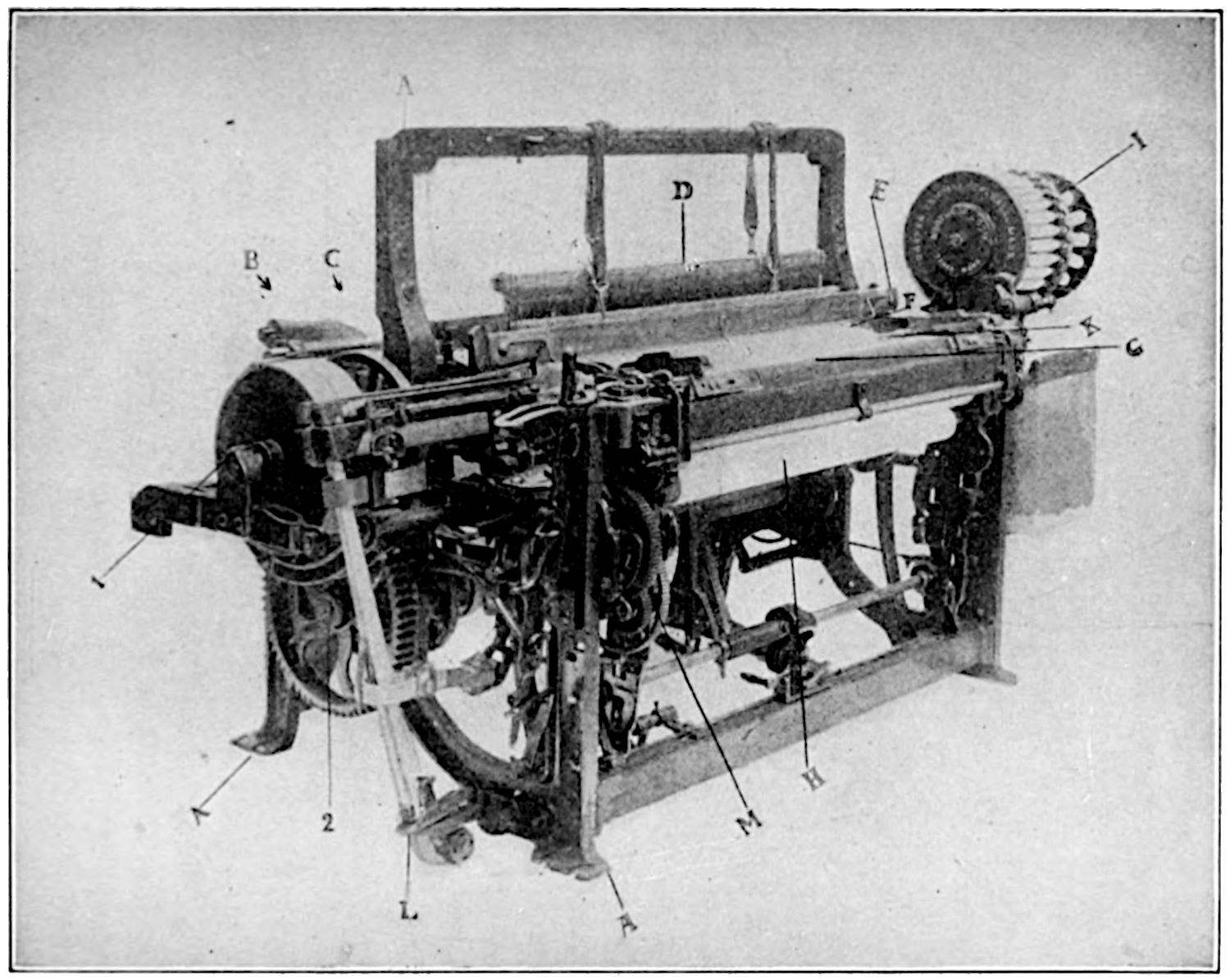
Fig. 48.—Power Loom.
Courtesy of The Draper Company.
Parts of the Plain Power Loom.
—(1) The Framework, A, usually of cast iron, which holds the working parts. (2) The Warp and its Manipulation. The warp (ends) is wound on a beam, B, placed at the back of the loom. (The figure does not show the beam; the letter B indicates that it is below.) It passes over the whip roll, C (not shown in the figure), through lease rods or shed sticks to the harness, D, through the reed, F, which is in the lathe or sley, E, and over a breast beam, G (the place is indicated), to the cloth or goods beam, H. A temple, K, holds the width of the cloth near the last threads woven. An automatic letting out and taking up motion, M, gradually winds up the cloth on its beam as it is woven, and proportionately lets out the warp. The action is regulated through a cogged wheel set to the number of picks per inch in the cloth. In case of breakage the warp stop motion stops the loom. (3) The Shedding. This is effected by the motion of the harness, D, which is composed of as many shafts or leaves of healds as the pattern demands (Chap. III). If a drawer-in has made an error and placed a wrong thread through any mail eye of the heald, it is sometimes rectified by removing the thread from the eye, taking a new bobbin, threading the heald with a thread from it, and carrying this thread through to the cloth beam. The bobbin is put on a spindle at the back of the loom to unwind with the warp threads. There are two methods of shedding, the closed and the open, based on different ways of separating the warp threads. (4) The Picking. By means of the picker [81]stick, L, on each side, the shuttles, carrying filling bobbins, are thrown across the race on the lathe, E, when a shed is made, entering the shuttle boxes first on one side and then on the other. A stop motion is connected in case the filling breaks. Single or drop boxes or a magazine, I, are used to hold the shuttles. (5) The Battening. This is effected by the reed, F, combined with the weight of the lathe, E. The reed may be fast or loose in the lathe. (6) The Temple, K, holds the cloth firmly at either selvage. As threads are often strained by the temple, it is customary to have a close weaving near the selvage, or twisted or stronger threads are used in the warp at each side. Mistakes made in weaving because of broken warp threads sometimes do not show until the finishing, and are then hard to repair; therefore in some kinds of cloth weavers will raise the shafts of the harness several times a day to be sure each mail eye is filled with its thread of warp. Warp threads are frequently sized beforehand to make them smooth and strong for the strain of weaving. The jar on the warp is often so great in stopping the loom that a spring has been put on the framework to lessen the shock.
The Driving Parts of the Plain Loom.
—Methods of actuating the loom differ somewhat in the various makes, but the following is representative of the direct loom control by the main shaft: The main or crank shaft, 1, extends a little beyond the framework, A. It is driven by a pulley, and is connected by wheels with the lower shaft; consequently the motion of the former is communicated to the latter or is reciprocal. The main shaft is cranked, and has connecting rods which give motion to the lathe, E, which oscillates on sley swords. The number of movements of the lathe is governed by a wheel which is set for the number of picks per inch in the cloth. The taking-up or pacing motion of the warp and cloth beams is connected with the motion of the lathe, and causes the cloth roller to move forward with each oscillation. The taking-up roller is a friction roller which [82]moving against the cloth beam winds up the cloth. The other parts of the loom are moved by the lower or tappet shaft, 2. The transfer of power from this shaft to the other working parts is by a tappet wheel or by cams. By means of this lower shaft, the harness, D, which forms the shed, is depressed as needed by a tappet or by cams acting on the treadles. The picking motion is also controlled from this lower shaft through the arms of rocker shafts hitting the picking sticks alternately and thus throwing the shuttle back and forth through the warp each time the shed is made.
The loom is sometimes controlled through the lower shaft or by indirect motion. Many consider this gives a more uniform action of the parts. Whatever method is pursued, the important thing is the careful timing of each motion, so that one will succeed another without interruption, injury to the cloth, or too constant attention of the weaver or the loom fixer.
Looms vary somewhat according to the materials woven upon them. The terms “ribbon looms,” “gingham looms,” “worsted looms,” “plush looms,” “double cloth looms,” and “carpet looms” are illustrations of adaptations to needs. The fineness of cloth is expressed by the number of picks and ends per inch with any count of yarn; thus in cotton 32 ends and 26 picks is coarse and 80 picks and 92 ends is very fine.
The modern power loom has become an almost perfect machine, the modern weave room a bewildering, throbbing mass of machinery (See Fig. 106). The inventions of the present are toward greater speed in order to turn out more goods, automatic action, special devices, prevention of slack threads in the warp or bunches in the cloth from almost spent filling, skips or unevenness in the weaving, lessening floor space, lowering cost of upkeep, and price of product. Illustrations of some of these are devices to take the place of the drawer-in, electro-magnetic power applied to the loom, a shuttleless loom on the order of the Jacquard to do away with [83]the elaborate making of cards, the storage room required, and to increase speed in operation.
The Jacquard Loom
(Fig. 49).—Harness looms are limited in pattern, but the Jacquard loom allows four hundred or more changes—practically an unlimited variety. The cost of working on the Jacquard is greater than on the plain loom. A twill containing sixteen changes (16-end) can be made on either the Jacquard or the harness loom, but the expense would be less on the latter.
The Jacquard was invented by Joseph Marie Jacquard, a straw hat manufacturer of Lyons, France, in response to a demand for a method of weaving more elaborate designs in silk and linen materials. His ideas were undoubtedly drawn from the Vaucanson model. The loom which at present is known by the name of Jacquard has many improvements over the original. The invention consists of a new method of shedding (Fig. 50), influenced from above the harness, whereas the harness loom is worked from below. It may be said in a general way that the principle of making the shed in the Jacquard loom is the raising of the harness cords (healds), A, by means of wire hooks, B, to which each cord is attached at its upper end. Each harness cord has a mail eye, C, through which a warp thread passes; consequently if the cord is drawn up, the warp thread rises also. Weights or lingoes, D, are attached to each cord at its lower end, which draw the cords back into place after the hooks have raised them. The warp threads are stretched between beams, as in the plain loom. In the Jacquard harness each warp thread is influenced singly, including the repeats of any one. In the simple loom the warp threads are controlled in the groups on any one shaft.
[84]
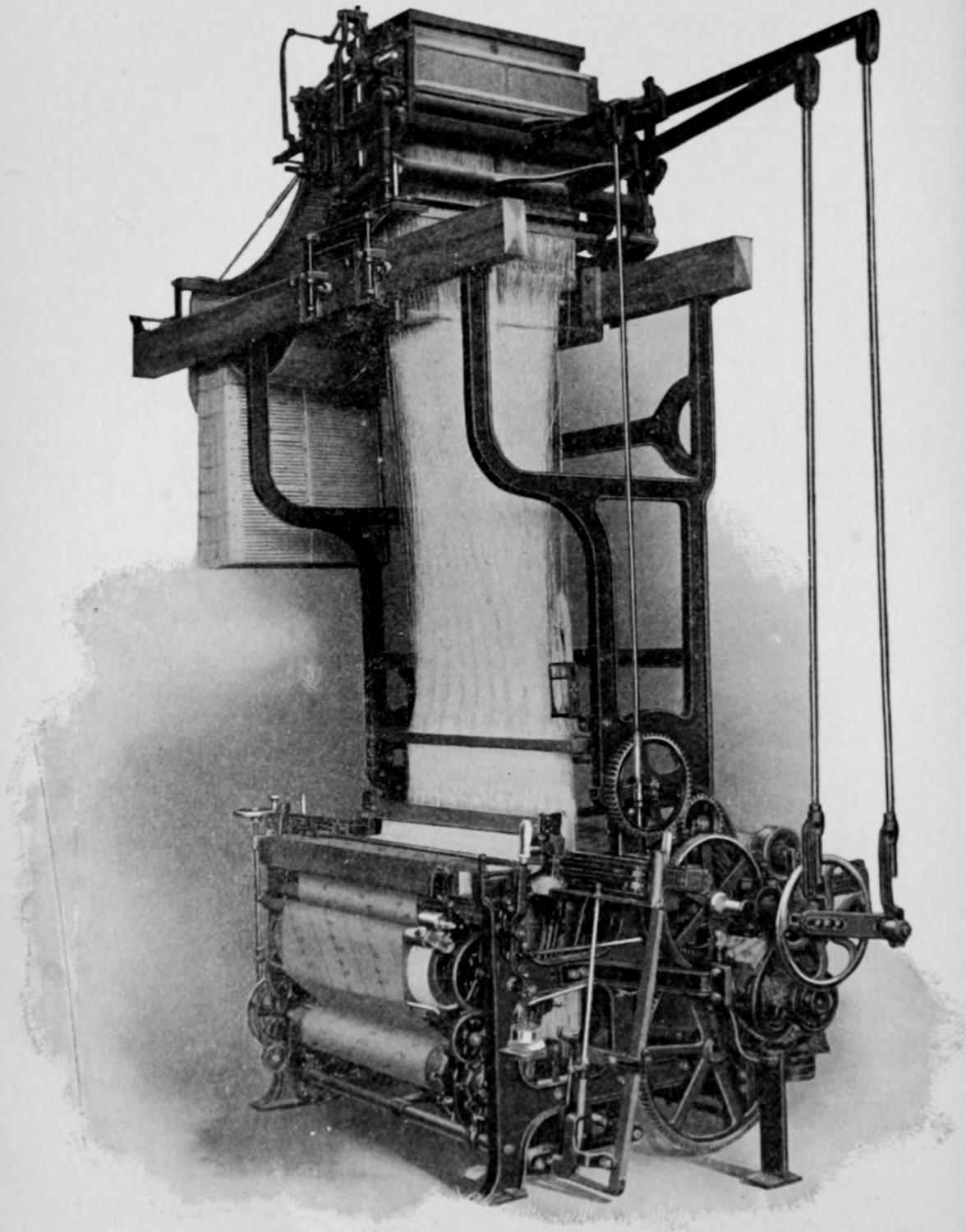
Fig. 49.—Jacquard Loom.
Courtesy of Crompton and Knowles Loom Works.
[85]
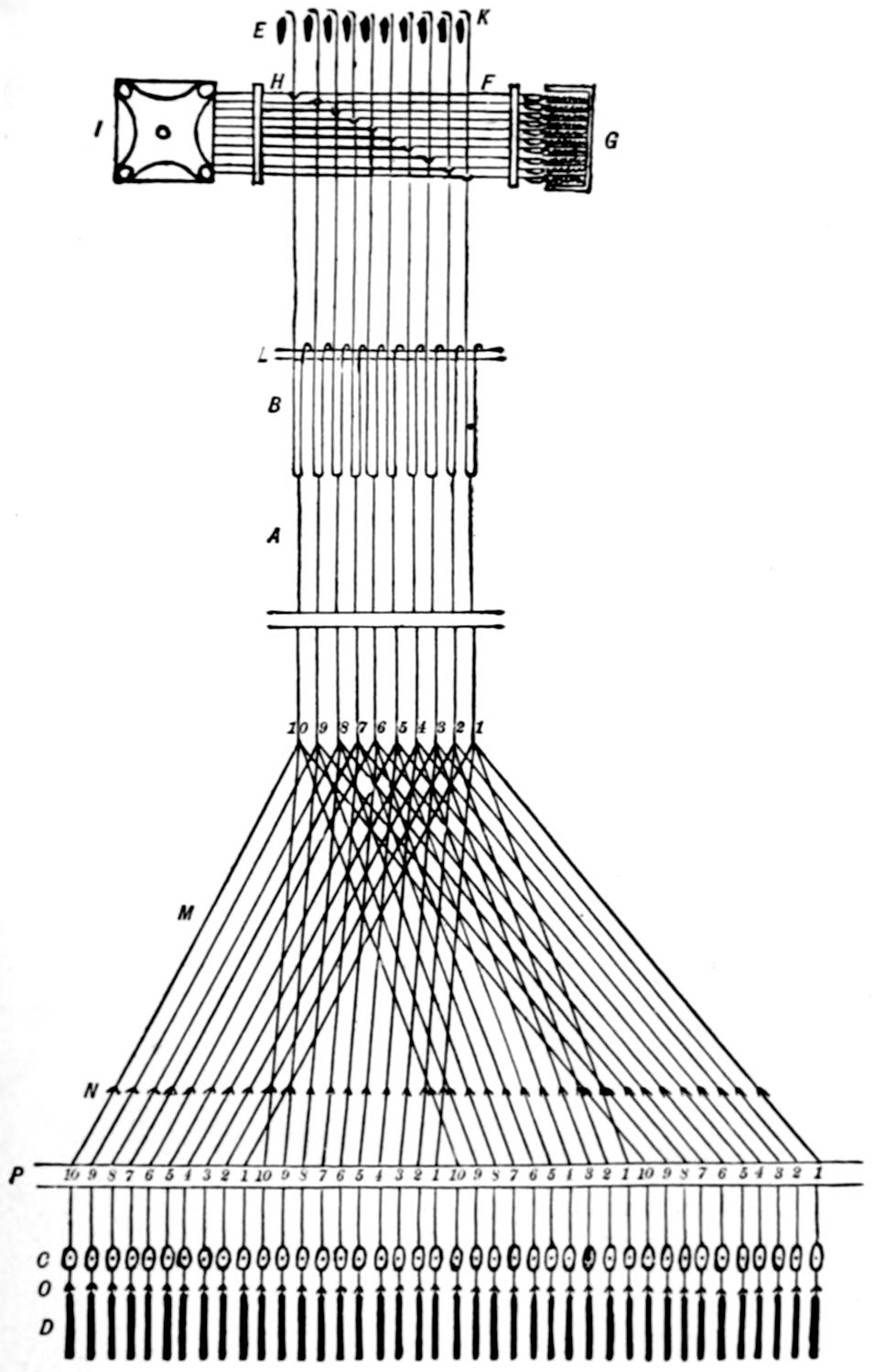
Fig. 50.—Detail of Jacquard Loom.
A, Neck cords. B, Hooks. C, Mail eye. D, Weights or lingoes. E, Griffe or hook lifter. F, Needles. G, Spring box. H, Needle eye. I, Cylinder. K, Catch of needles. L, Hook rest. M, Additional harness cords. N, Couplings joining upper and lower parts of harness. O, Knots holding heald lingoes to cords. P, Comber board.
[86]
There are single and double lift Jacquard machines. The principal parts of the single lift Jacquard harness are the harness cords, A, the hooks, B, the mail eyes, C, the lingoes, D, and the beams (these have been mentioned already); the griffe or hook lifter, E, consisting of a series of blades, knives, or bars, which lift the sheds as do the tappets or cams of the plain loom; the needles, F, which work horizontally, and have one end bent back to come in contact with the spring in the spring box, G, and an eye in each needle, H (the double lift machine has two eyes in the needle), to allow the hooks to pass through. The duty of the needles and cylinder, I, is to press forward against cards, which indicate the pattern and are against the batten. The needles govern the hooks, B, which pass through their eyes. The hooks work vertically and are made with a catch, K, at one end, which goes over the griffe but can be easily detached. They rise automatically with the griffe unless the needles are pushed back by the cards, which will throw the hooks from the griffe, thus lowering the warp threads and making a shed. The cylinder (Fig. 51) has four sides, and cards pass over it, coming in place alternately and indicating the pattern by pressing back those needles which are not required to raise the shed. The cylinder makes one quarter of a revolution with each pick of the pattern, thus placing one of its four sides in contact with the needles. The complete design is on the cards (Fig. 52), and each one represents one pick of the pattern. The cards are laced or tied together in perfect order at each end and in the center (Fig. 53). When the pattern is completed the succession of cards begins again. The cards [87]fall in place at the right moment against the cylinder. If there are holes in the card, they come directly opposite those in the cylinder. All the needles advance automatically, and some of them pass through the holes in the card. Those that do not pass into holes are thrown back and the hooks attached to them are thrown from the griffe, thus lowering the shed.

Fig. 51.—Cylinder of Jacquard Loom.
A, Cylinder. B, Cross section with cards.
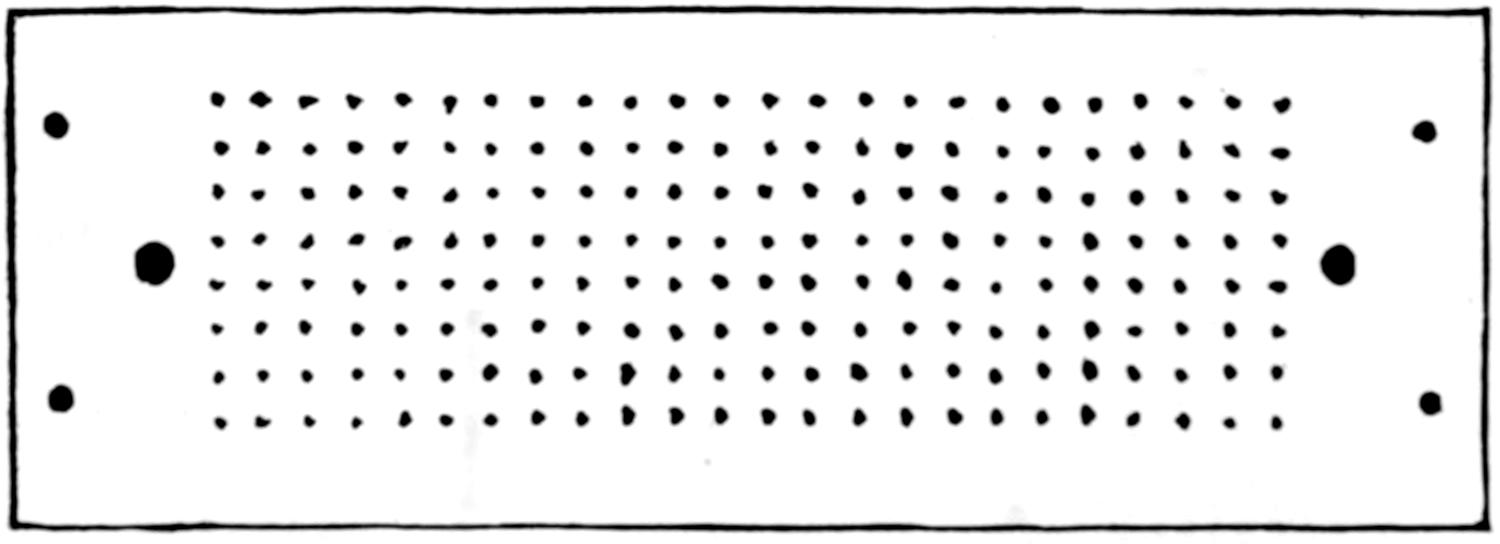
Fig. 52.—Card of Jacquard Loom.
Figure 50 shows only a part of the threads of the harness. For the complete loom see Figure 49. The neck cords, A, are attached to additional harness cords, M, which give repeats to the pattern if any one of the neck cords is raised. At N are a series of knots or couplings, which connect the upper and lower portions of the harness, and at O are the knots which hold the heald lingoes to the cords. The comber board, P, keeps the harness cords from tangling, for each cord is passed through a hole in the board up to the neck cords. The number of cords in the comber is regulated by the threads per inch in the warp. The comber is divided into as many sections as there are hooks in the machine. An iron frame incloses the working part of the Jacquard loom. The power is applied as in the plain loom.
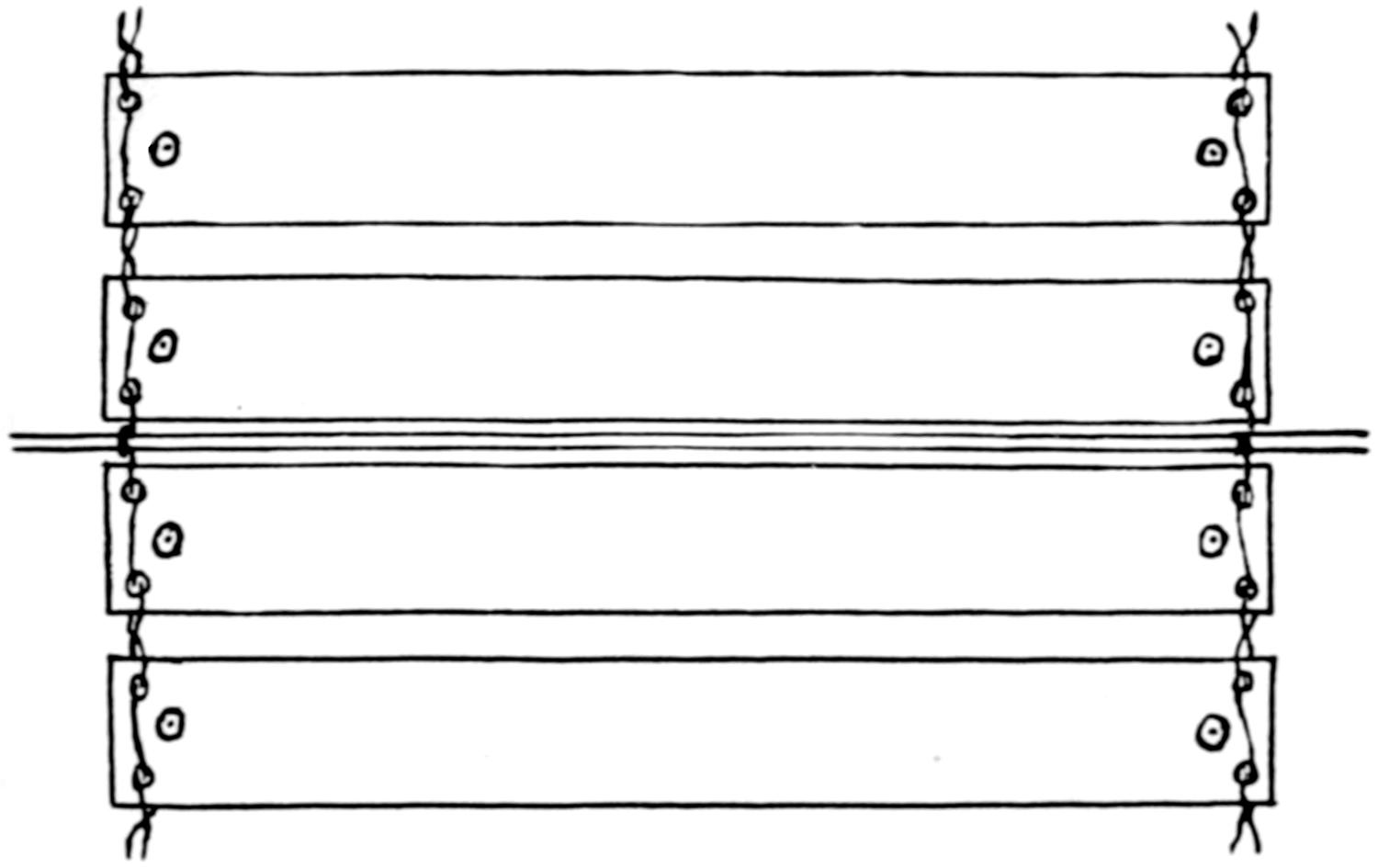
Fig. 53.—Lacing of Cards (Jacquard Loom).
There are many varieties of Jacquard looms, from the small one hundred needle to the two or more thousand needle machine. While they vary in some particulars, there is a general standard. The double lift machine generally has [88]eight hundred hooks, two to each thread, and also two griffes. Two patterns can be made at one time upon it, one for background and one for figure, as in damask table linen. The expense of the Jacquard lies in the making of the cards, the setting up of the harness, and the slow motion of the loom. To set up the entire harness for a new and elaborate design would take a skilled man several weeks; an exceptionally elaborate design of twenty thousand cards would be almost prohibitive in the time and cost of skilled labor, but it occurs at intervals for special ceremonies. Old damask designs are used repeatedly in linen manufacturing countries to save expense of setting up.
Some knit goods and lace curtains are woven on special Jacquard looms in which there are three lines of threads, a warp beam holding those which run straight, bobbins holding the zigzag threads, and the pattern is made by threads coming from spools. In the ordinary Nottingham curtain as many as seventy-two hundred threads are often in the harness of the Jacquard. The lace curtain looms are very wide. (Chaps. V and X, Machine Lace.) Carpets, such as Brussels, Wilton, and Axminster, are woven on specially adapted Jacquard looms.
The making of the cards requires special machines, one for cutting and another for duplicating. Each design is made first on squared paper in the usual way. The cards are first printed with a series of dots upon them. Each card is to represent one pick of a pattern, therefore holes are punched through the dots when the pattern is to appear on the surface. The worker has the design before him and reads a line across, punching the cards as he reads. His machine is similar to the typewriter. The cards are carefully numbered as they are punched, and are later laced together and hung over the cylinder of the Jacquard. (See Design and Draft, below.)
Various Attachments.
—The expense in Jacquard weaving led to further inventions by which the effect could be attained [89]without the cards and elaborate harness. An English invention, the dobby attachment, which is placed on the harness loom, is an illustration (Fig. 47. Dobby in upper left-hand corner). The result of its work is similar to the Jacquard, but the shedding is effected by a chain of narrow strips of wood (lags) into which pegs are placed which indicate the pattern and take the place of the cards. Each lag represents a pick of the pattern. On reading the design for the pattern a peg is inserted when the pattern is to be on the surface. In the loom the work of the pegs is to raise the harness. They travel around the cylinder and come in contact with the levers which lift connected hooks, and the latter raise the shafts attached to the hooks and make the shed. A second chain controls the shuttle. Multiplier chains duplicate the pattern and save time which would otherwise be taken in preparing the lags. The modern dobby offers almost unlimited possibilities.
Another method of weaving intricate patterns without the use of the Jacquard harness is by the head motion attached to the harness loom (Fig. 54 showing detail). This is an American invention and is used extensively in the United States. The heald shafts in the loom are elevated or depressed by pulleys, but the series of mechanical devices which actuate the pulleys is quite different from the English dobby system. It is claimed that the head motion is simpler and more steady than the dobby. The pattern chain consists of high and low links, which control the elevation and depression of the shafts. The chain is made of a series of rods on which bowls or small pulleys (lifters or risers), and tubes called sinkers, are arranged according to the requirements of the design. The chain lifts the shafts by means of the bowls or risers which come in contact with vibrators, and they again with the lifting cylinder connected with the heald shafts. A second chain is used to control the shuttle. A reversing [90]motion is connected which is of great value when mistakes in weaving have been made.
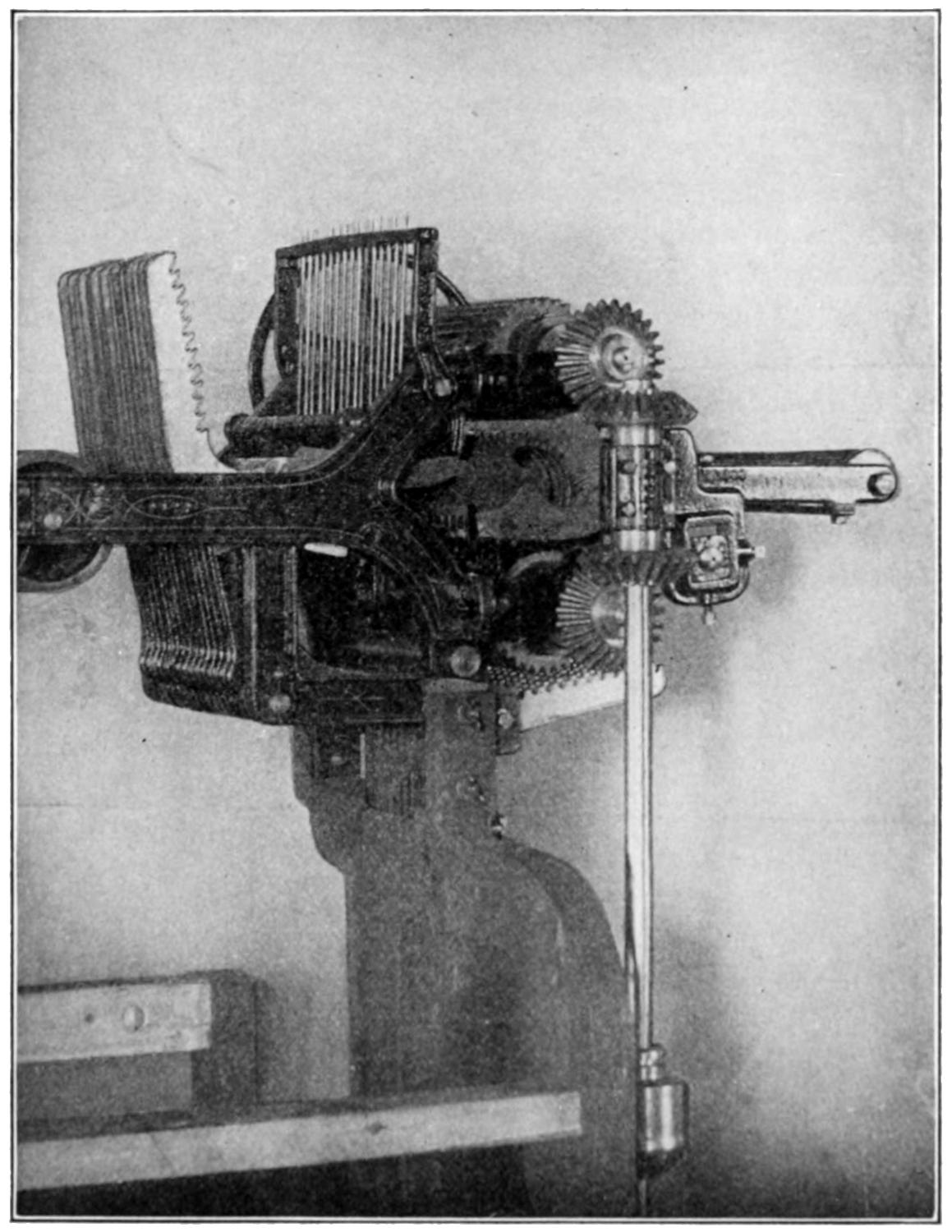
Fig. 54.—Head Motion.
Courtesy of Crompton and Knowles Loom Works.
Patterns may be woven on the surface of cloth to resemble [91]hand embroidery, with an attachment to the regular loom called the lappet. It affects the shedding, and is used extensively for decorative cotton goods and madras curtains. The work is used on both plain and gauze weaving, and may be continuous or intermittent. The floating threads left on the wrong side of the cloth by the lappet frame are shorn off later by a finishing machine especially adapted to the purpose.
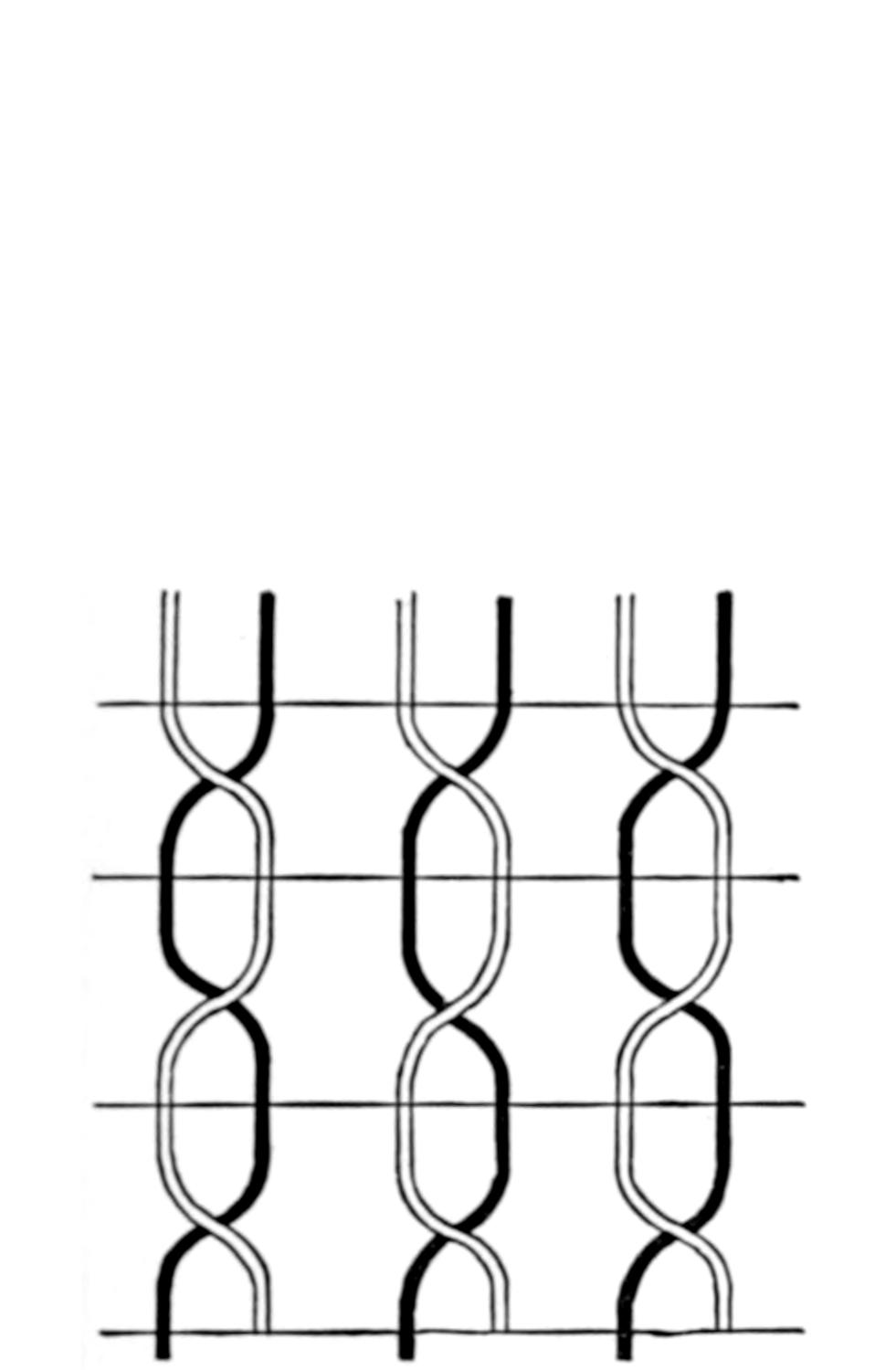
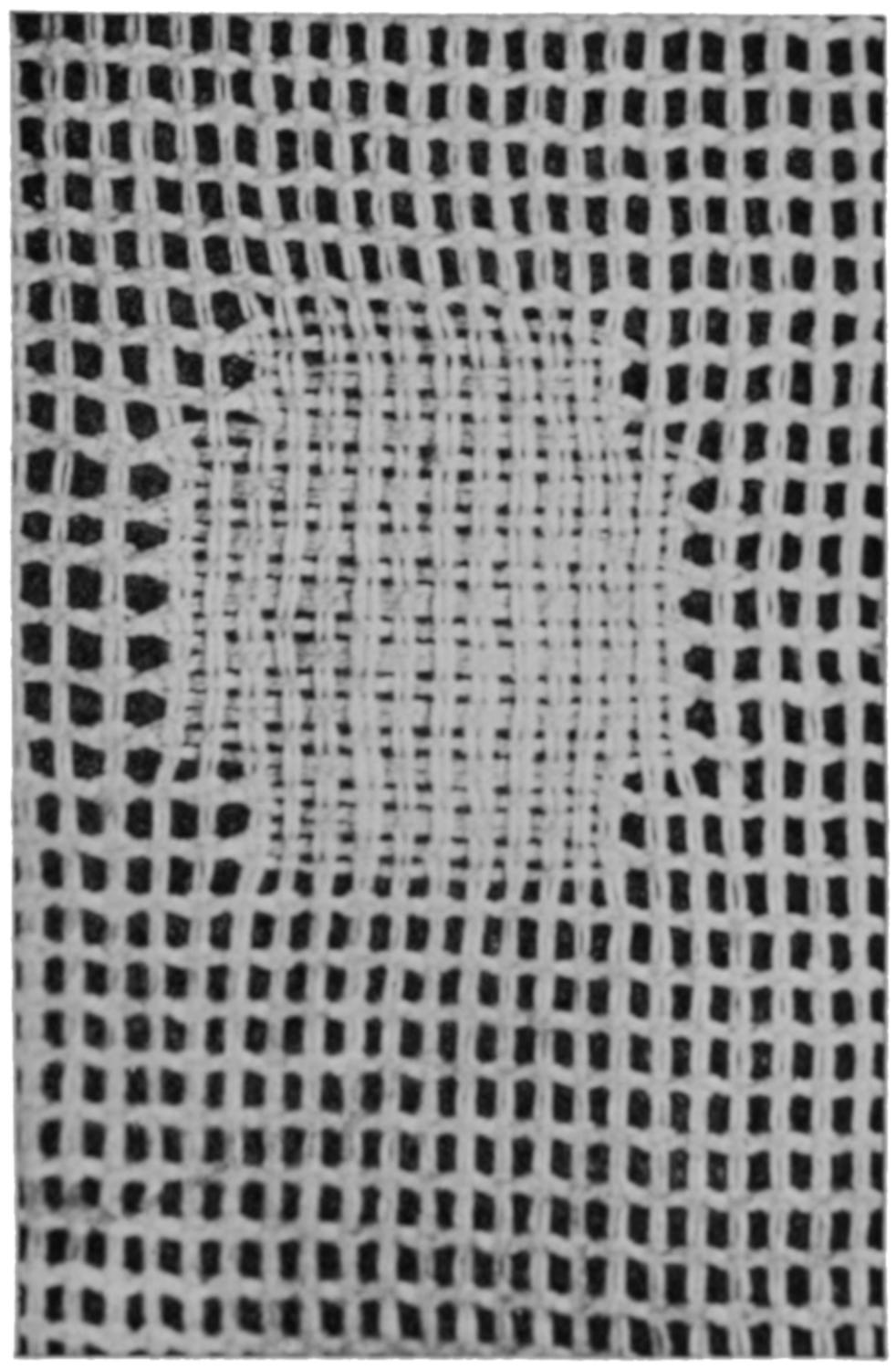
Fig. 55.—Leno Weave.
Fig. 56.—Cloth Illustrating Gauze.
The swivel is somewhat similar to the lappet. It is used extensively in weaving silk ribbons and broad silk materials. The attachment affects the picking motion and produces small continuous or intermittent figures without extending the thread from one side of the material to the other. It thus prevents the waste of valuable silk by using it only when necessary. The cards of the Jacquard machine can control the swivel patterns. The attachments are expensive [92]and the action slow. The lappet frame is more economical.
Gauze and Leno attachments cause a departure from the usual straight lines of the warp. Adjacent warp lines are made to twist about each other, letting the filling pass through, thus holding the cloth together (Figs. 55 and 56), and keeping the threads from untwining. The work is a sort of wattling and may be simple or elaborate. There is, usually, a standard heald and a doup heald. The latter can be drawn first to one side and then to the other of the standard heald and form the gauze pattern. Marquisette is woven in this way and it may be a strong weave. In some textiles, as in many housecloths, there are two doup healds. This method is used in making cotton chenille for curtains. The crossed warp threads hold the filling tightly, and when the cloth is finished the lines of filling are cut apart the length of the warp and make a soft yarn which is used for the filling of the chenille cloth. The effect of a pile fabric is thus gained inexpensively. Leno weaving has sometimes lacy stripes or pattern effects. When closely woven the fabric may be enduring, but often does not launder well.
Design and Draft.
—In the designing and drafting for the weaving of textiles, whether by hand or power, there are two lines of threads to consider: first, the warp or ends, which run lengthwise of the goods; second, the filling, picks, woof, or weft, which crosses the warp at right angles. The manner in which the latter threads intersect the former makes the design, complex as well as simple weaving depending on the succession of sheds. Textile design may be structural, that is, made by the weave, or it may be applied to the surface of the cloth. Pattern may be obtained, even with the plain weave, by the use of vari-colored yarns, making stripes, checks, and plaids; by cords or ribs; or the interlacing of warp and filling threads may give an elaborate pattern as in some brocades. A surface design is made after the cloth is woven, by printing, [93]stenciling, tied-dyeing, batik, discharge dyeing, embroidery by hand or machine, embossing or moiréing.
The principal structural methods may be reduced to a few fundamental principles: (1) the plain or tabby weave and its variations; (2) the twill weave and its variations; (3) the satin and its variations; the latter including figure weaving, pile fabrics, double cloth, and the designs made by the various attachments such as lappet, swivel, and curved warp weaving. A draft of the design is made to show the weaver the manner in which the filling should cross the warp. Squared or point paper (Fig. 57) is used generally for these drafts, eight by eight being a common variety. At regular intervals one line is made heavy for facility in reading.
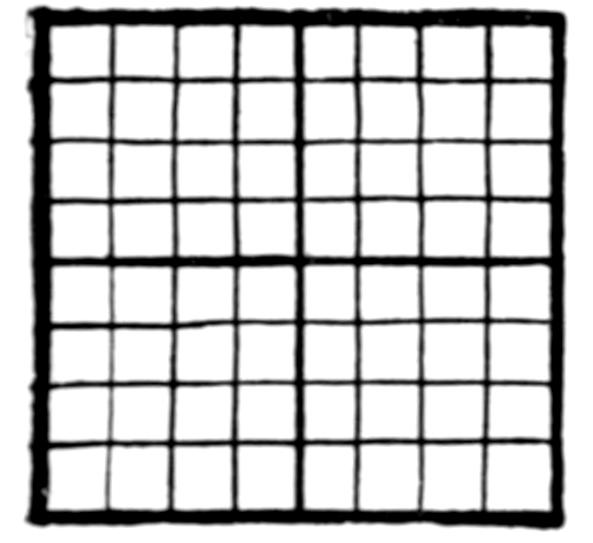
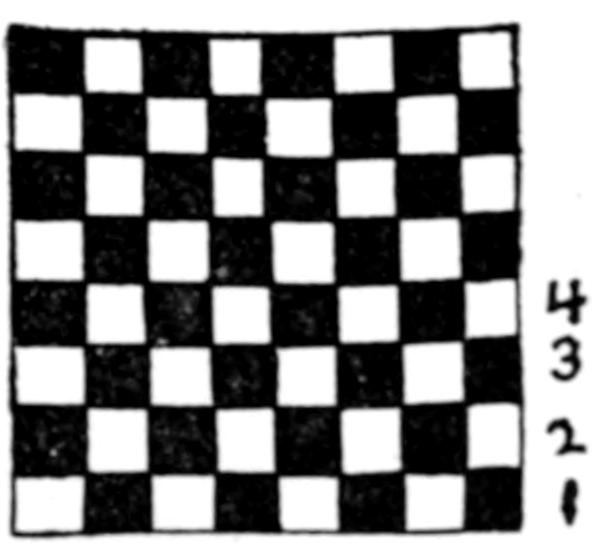
Fig. 57.—Design or Point Paper.
Fig. 58.—Plain Weave.
The simplest alternation of threads is called the plain, tabby, or cotton weave (Figs. 3 and 12). It is found in some of the best known fabrics such as muslin, gingham, cambric, and outing flannel in cotton; taffeta and habutai, in silk; tweed, flannel, and homespun in wool, and crash and handkerchief linen in linen. A draft for the plain weave is given in Fig. 58, and looks like a checkerboard. The shaded blocks represent the warp and the white ones the filling. The numbers at the side show that under the first heald shaft a warp thread is up and then a filling thread, followed again by a warp thread. In the second shaft the filling thread rises first. Two alternations complete the pattern. When coarse yarns are in use, a two-heald shaft is sufficient (Fig. 59 A). In finer yarns, four or even eight shafts are used (Fig. 59 B and C), as a better distribution of the warp threads can be made, thus lessening the strain and [94]liability to break. The threads are so inserted and the shafts connected that they act as two, the odd numbered threads being raised at one time and the even at the other. There are variations of plain weaving which give considerable latitude in design. Basket or Panama weaves (Fig. 60) have two or more warp threads crossed by two or more filling threads, or there may be a greater number of threads one way than the other. Hair-line stripes, warp or filling way, can be made in the plain weave by alternating colored yarns in the warp and filling, or by alternating one way and having it plain the other. Bedford cords (Fig. 61) have a line stripe and raised cord effect running lengthwise of the cloth. The face effect is generally plain. Poplin or rep effects are made by very heavy warp threads or by groups of warp threads shot over by one or more filling threads (Fig. 62). The very twist of the yarn will affect the pattern (Fig. 63). If after interlacing the threads the twist is in one direction, a smoother effect results in the finishing.
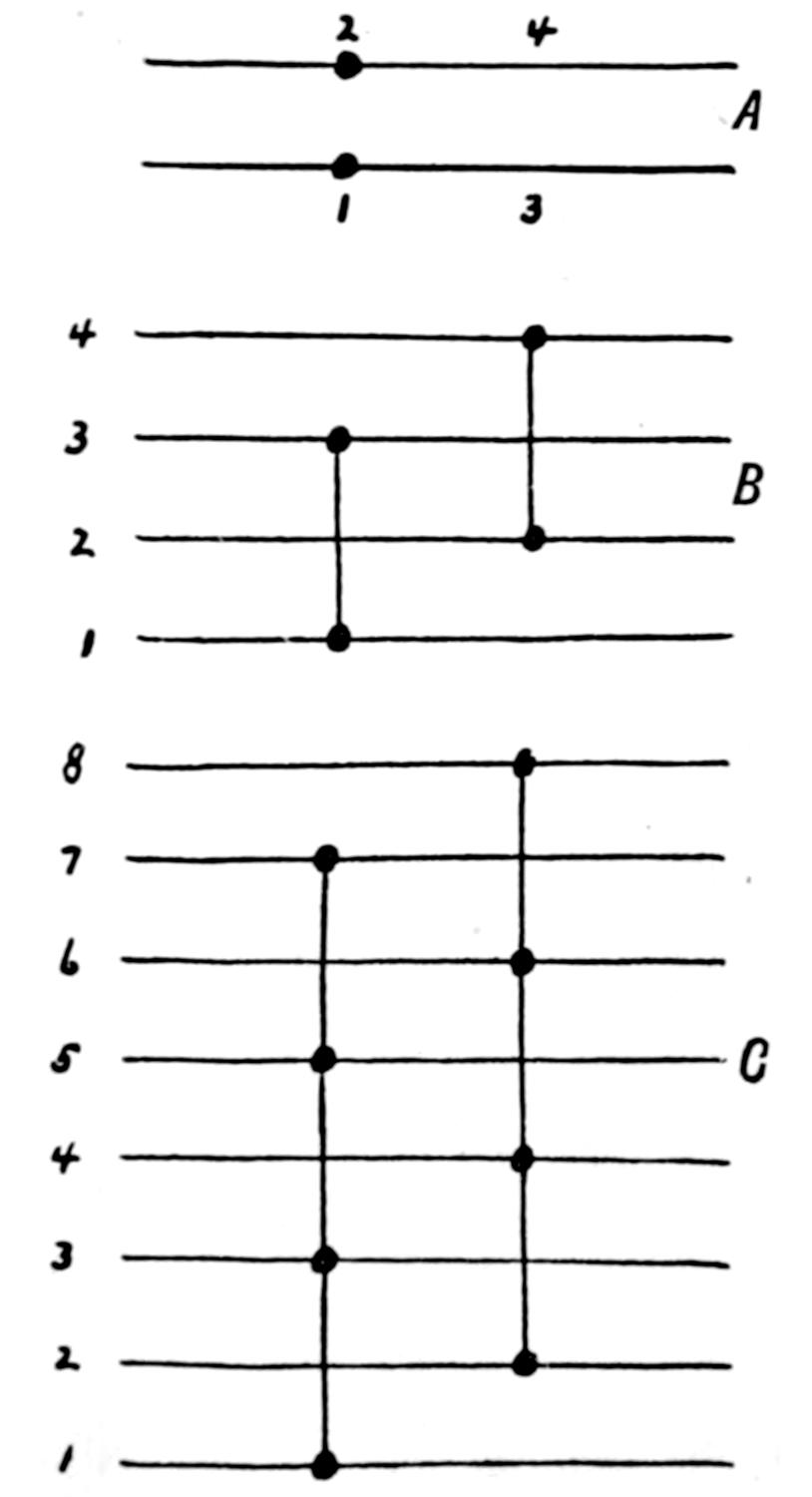
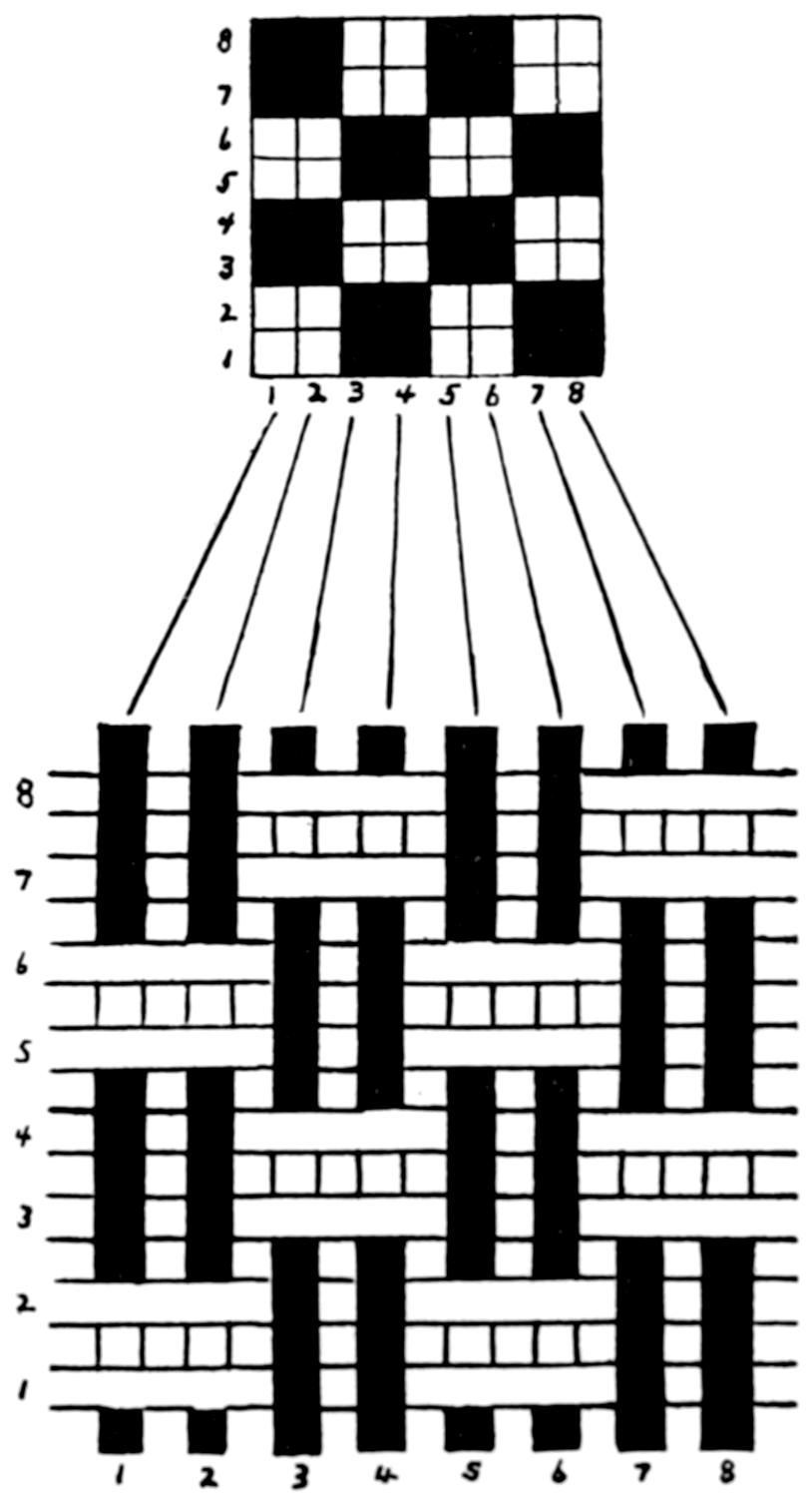
Fig. 59.—Shaft Combinations for Plain Weaves.
Fig. 60.—Basket or Panama Weave.
Twills
are the first variation from plain design. The three-shaft, three-harness, three-end, or three-leaf twill, as it is variously called, is much used. (See Figs. 64 and 65.) [95]The names given to twills indicate the number of shafts which it takes to complete the pattern. In the three-shaft twill the filling threads go under one and over two warp threads in the first line, but instead of alternating in the second line, as would be done in plain weaving, the filling skips one thread to the right or left of the crossing of the preceding line, as the case may be, thus forming a diagonal line across the material. In the three-shaft twill, the pattern begins to repeat itself in the fourth line. Twills may run to the right or to the left or both ways. In the latter case the design is called chevron, herring-bone, diaper, bird’s- or fish-eye. Twills may be so made that either warp or filling may be thrown on the face of the material. In the four-shaft twill (Fig. 65 A) the filling is on the face, for three filling threads are up and one down. In B the warp is on the face, as three warp threads are on the surface and one below; consequently the twill is made by the filling. For the warp faced twill there would be three risers and one [96]sinker on the chain of a head motion loom, expressed as 3/1. If it were a four-shaft twill, filling face, there would be three sinkers and one riser, throwing the filling on the face, and expressed by 1/3.
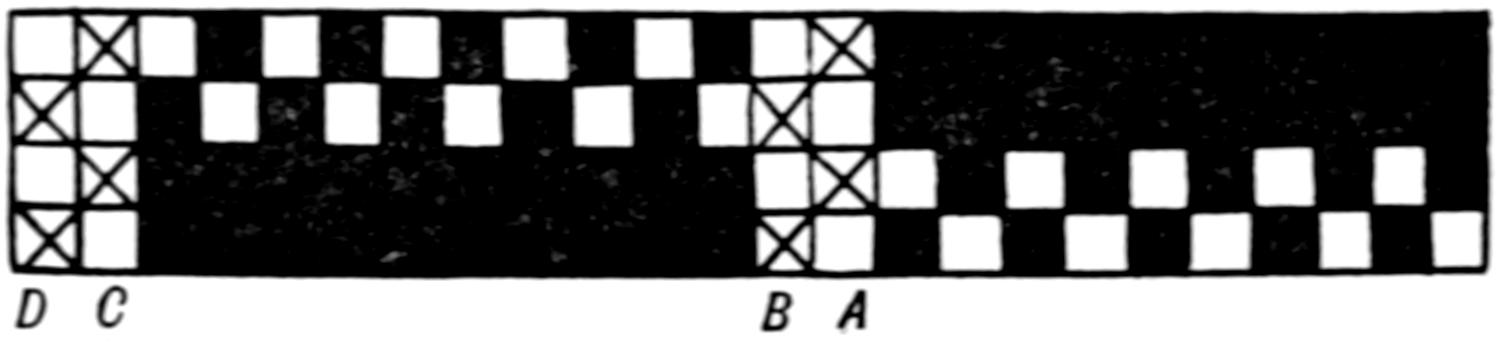
Fig. 61.—Bedford Cord.
A, B, C, D, plain weave throughout, forming line effect.
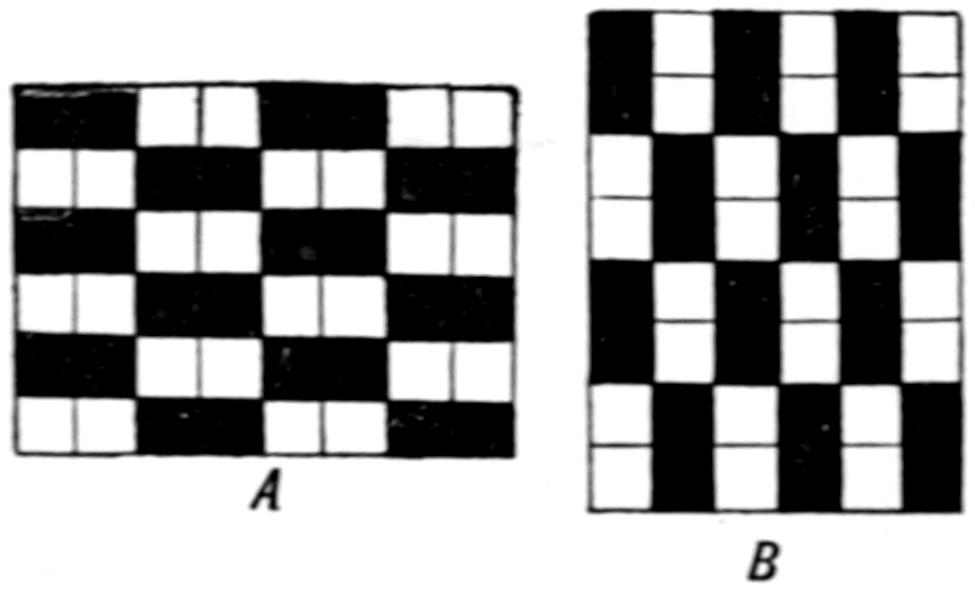
Fig. 62.—Poplin or Rep.
A, Warp ways. B, Filling ways.
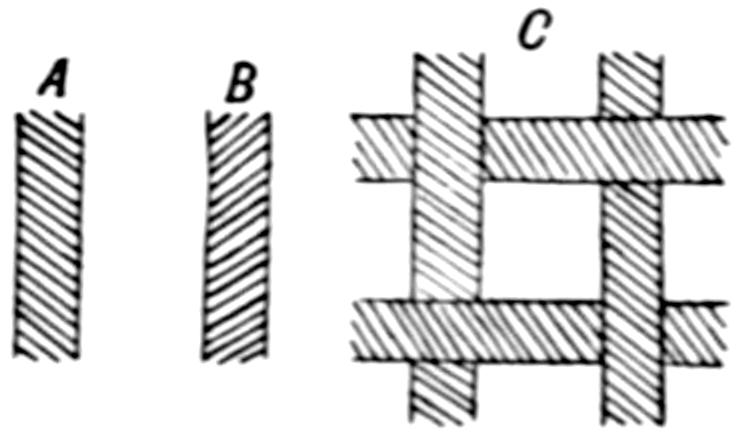
Fig. 63.—Showing Twist of Yarn.
A, Left twist. B, Right twist. C, Combination.
Drillings and jeans are often made on the three-shaft twill. Twills are among the most popular weaves. They may run as high as forty-eight or fifty shafts, each added number of shafts allowing a greater number of variations in the designs; therefore it may be said that there is an almost unlimited possibility of pattern. Twills may be even-sided, filling and warp balancing; or uneven-sided, filling and warp uneven, each additional shaft having its own advantages and variations. The principle of designing for the twill can be understood from the simplest ones. The following varieties are in use: broken, skip, corkscrew, double, curved, combination, steep, wide-waled, entwining, checker-board, pointed, and fancy. The four-shaft twill is very useful in woolens and worsteds, being found in blankets, cassimeres, and shepherd’s checks. It is much employed in double-backed [97]and stitched cloths for the backing weave. The five-shaft twill is used extensively in heavy materials, in doeskins, satins and sateens, Venetians, drillings, diapers, and damasks.
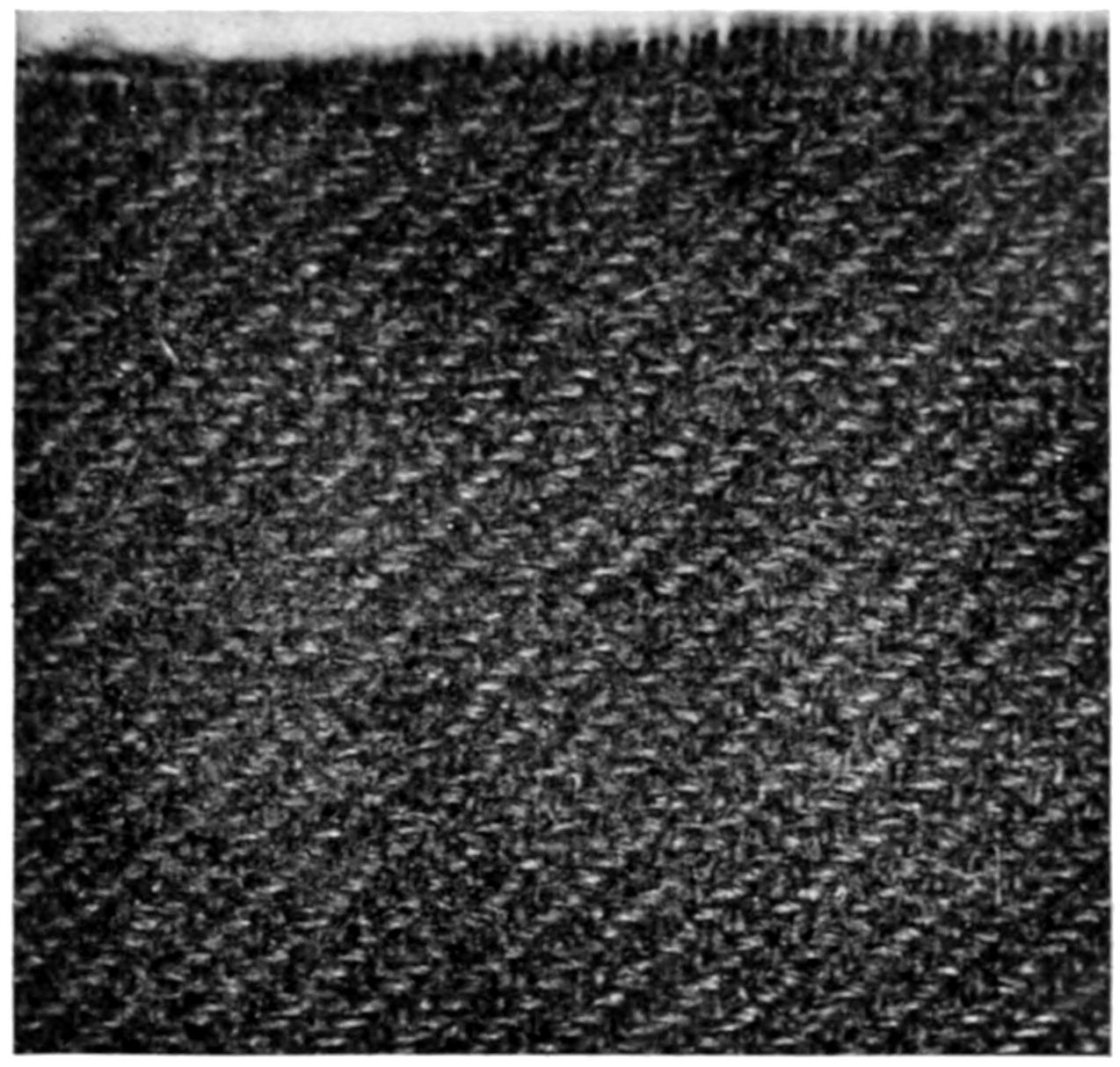
Fig. 64.—Cloth Showing Twill Weave.
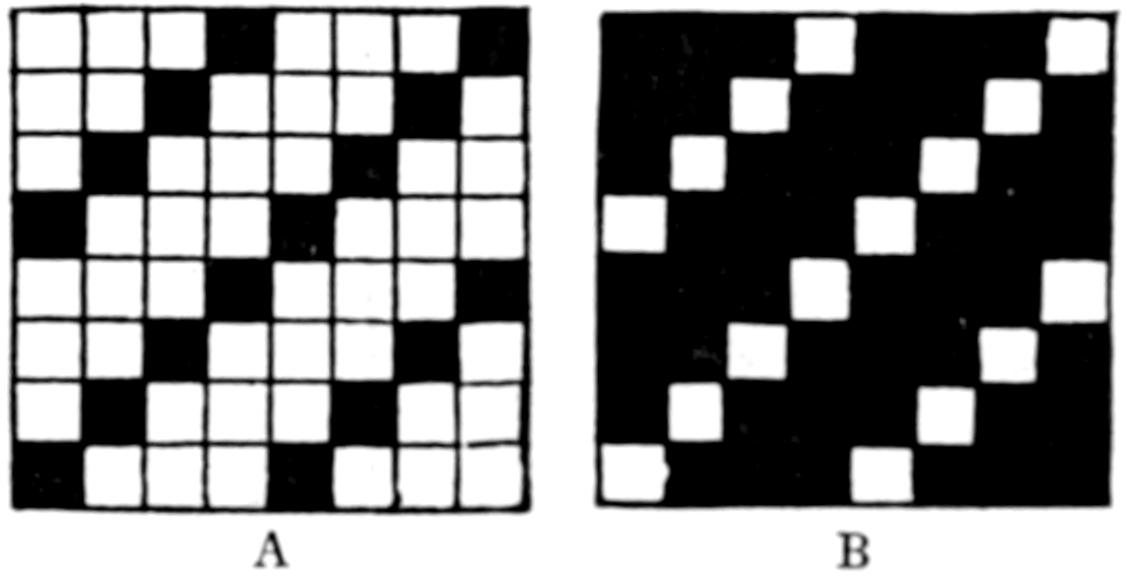
Fig. 65.—Four-Leaf Twill.
A, Filling for face.
B, Warp for face.
Satin weaving combines the characteristics of the twill and the figure, and may be included under twill weaving as well as figure weaving. The term satin or sateen (Fig. 66 A and B) is used to designate certain classes of design, such as five-shaft or eight-shaft satin. These same terms are often used interchangeably, but according to some authorities the warp-faced design, A, is the real satin and the filling-faced is the sateen, B. The expression often seen, “weft-faced satin,” would according to these authorities refer to sateen, [98]and “warp-faced sateen” would be satin. The word sateen was first used for cotton satin made to look like silk satin. Damasks are often woven with the background sateen and the figure satin, that is, the figure weave is a lengthwise twill and the background a crosswise one. The corkscrew weaves are on one of these principles; they are a steep twill. The twill effect is made clearer to the eye if it runs in the direction of the twist in the yarn. Smooth-faced serges are woven in this way, and the effect of clear light is increased by the finish. Rough twills are often woven with the twist of the threads running opposite to the pattern. Twills of various kinds are used extensively in elaborate floral figures and conventional designs, as a binder or stitch to hold together the warp and filling threads, that too long floats will not be on the surface. Elaborate combination twills look like Jacquard weaving, but are really only clever repeats, alternations, or reversals of pattern.
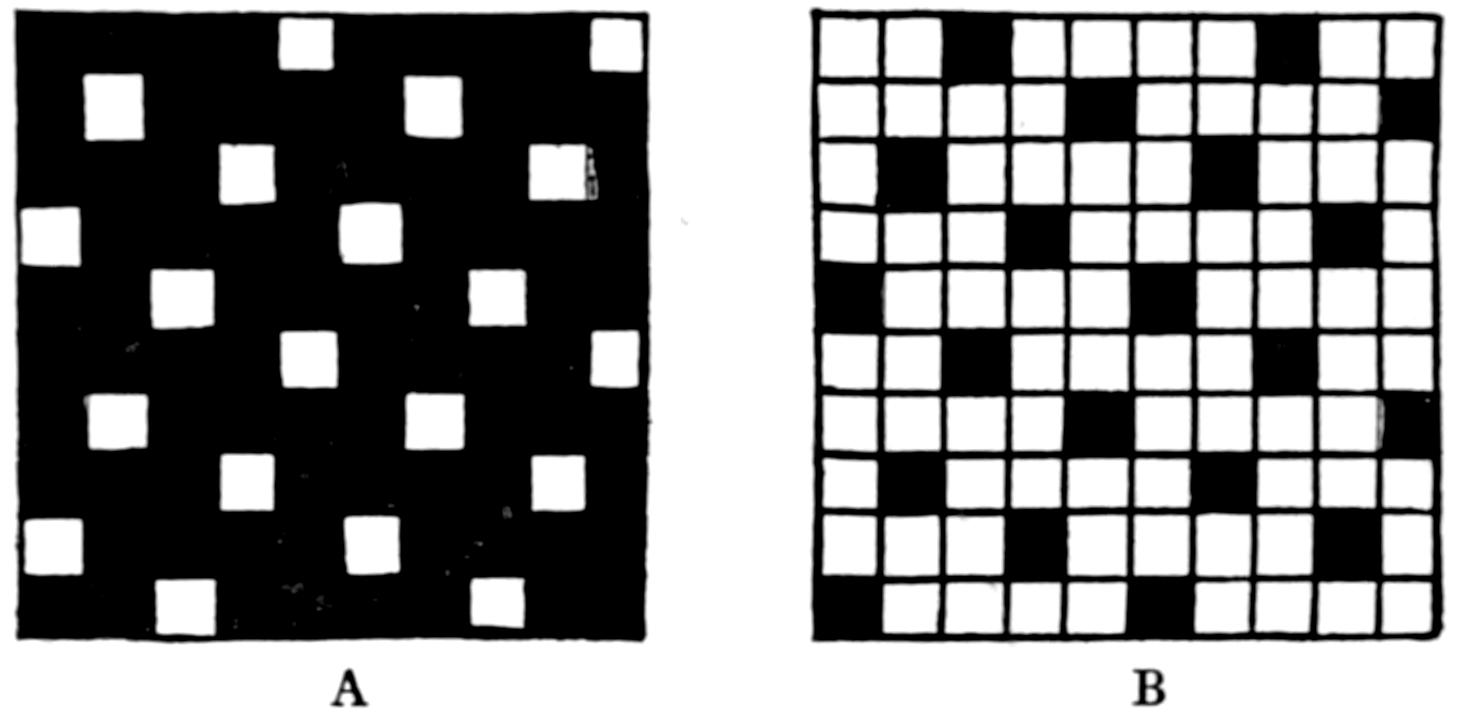
Fig. 66.—Satin Weave.
A, Real satin; warp face. B, Sateen; filling face.
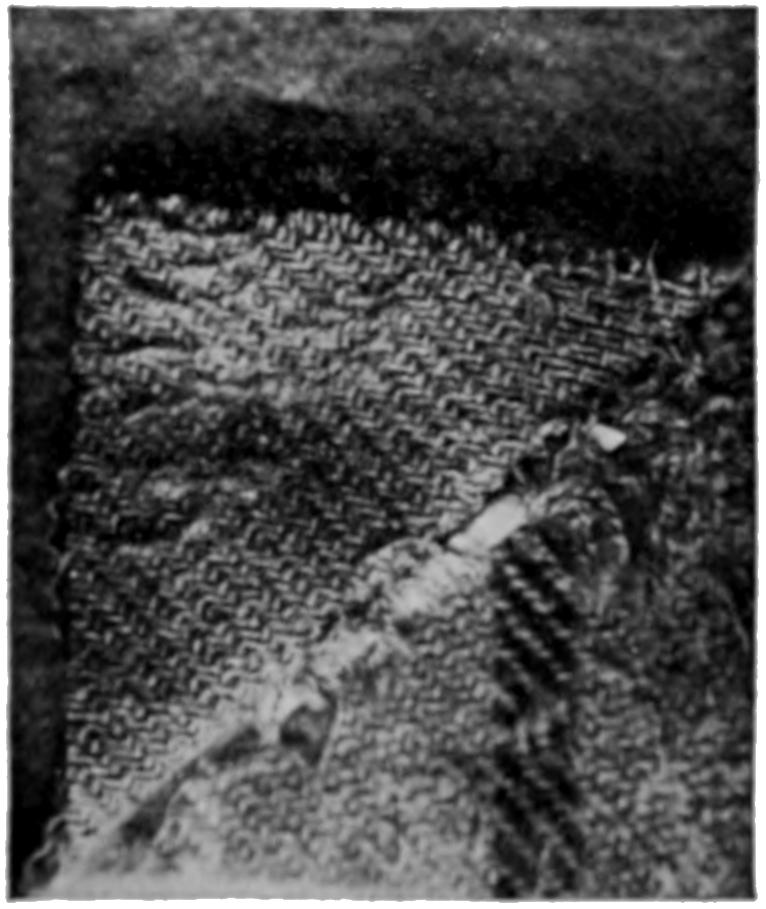
Fig. 67.—Double Cloth.
[99]
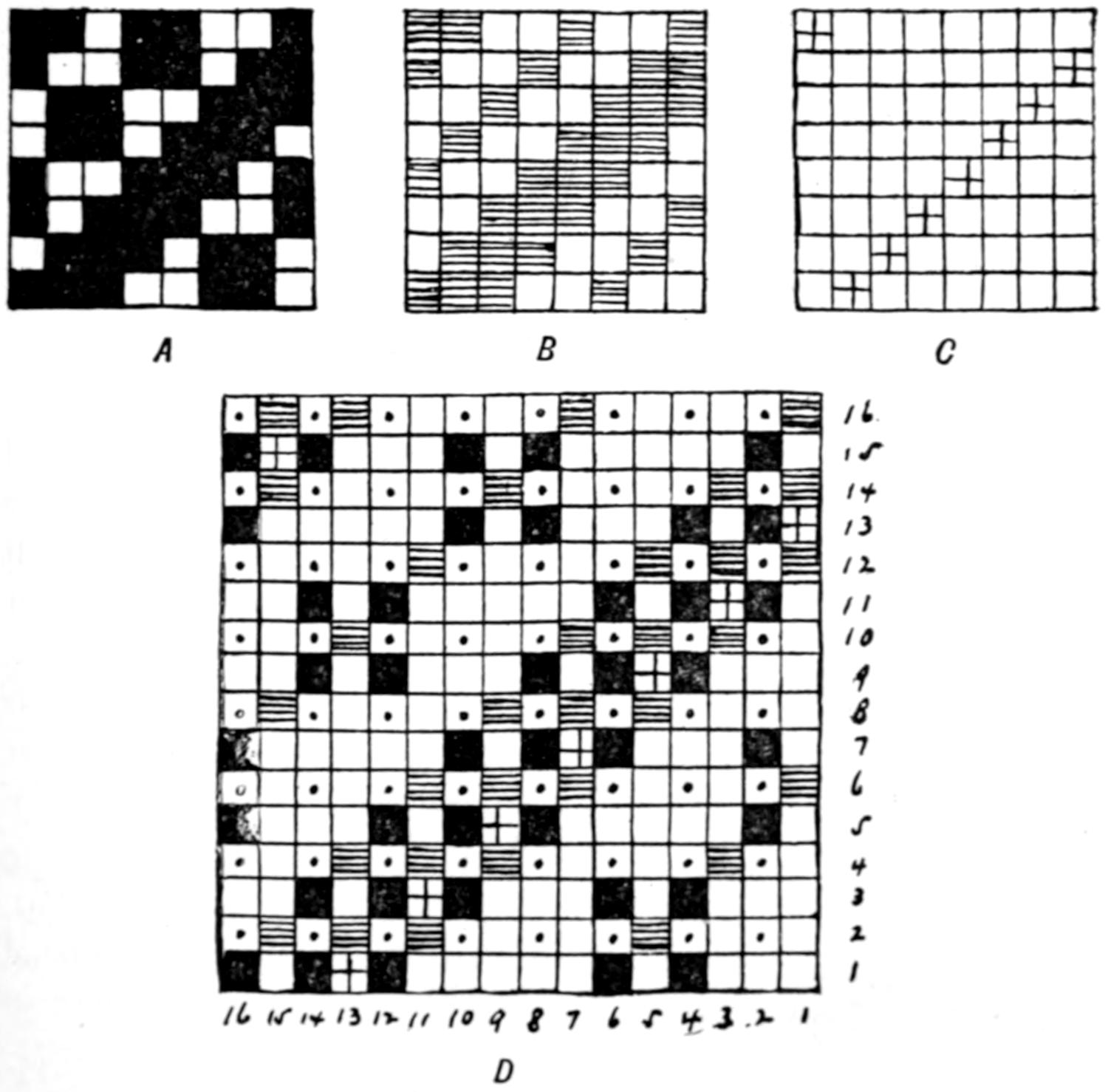
Fig. 68.—Double Cloth Weave.
A, Weave for the face. B, Weave for the back. C, Arrangement for combining back warp with face filling. D, The complete weave. Repeat: 16 ends; 16 picks.
The stitches used to hold together double cloths are usually twills which come at intervals to the surface. (See Fig. 67 for enlargement of cloth, Fig. 68 for explanation of the method of drafting, and Fig. 69 for interlacing of the two lines of threads.) In some classes of worsted goods the binder is frequent. The stitching requires care in planning, so that it does not make itself evident on the face of the cloth. The stitching stitches are now frequently employed in all classes of patterns. Cheap stock is often used for them, as it gives weight and does not show on the face. Cloths backed with shoddy or poor wool are usually rough on the wrong side.
[100]
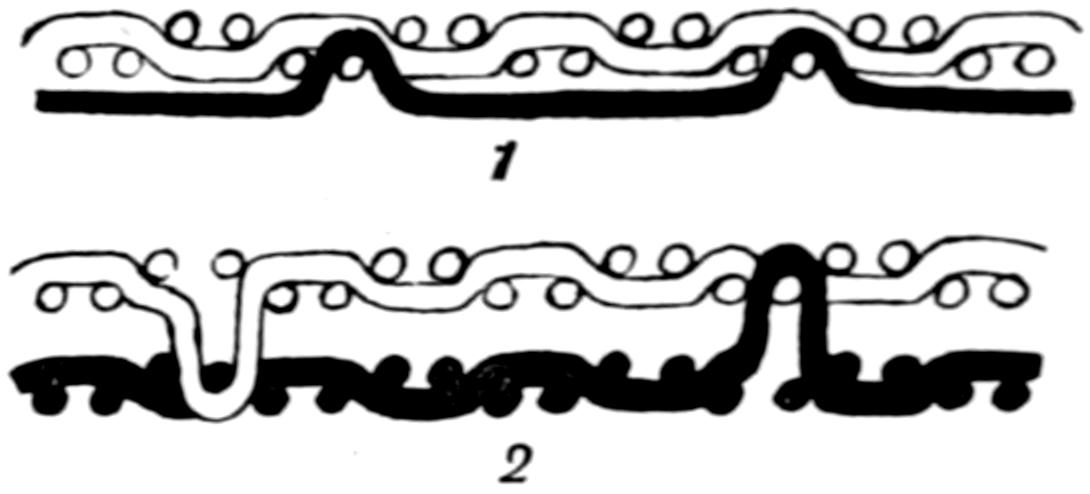
Fig. 69.—Double Cloth Interlacing.
1. Weft back. 2. Double cloth interlacings.
From Barker’s Textiles, by courtesy of Constable & Co., London.
Satins or Figured Weaves.
—The step between twills and figured weaves is short. Satin really belongs to both, for it is a broken or skip twill. The object in satin or sateen is to throw a series of closely twisted threads on the face of the material, with a cross thread at intervals, that the floats of warp or filling may reflect the light. When the warp is constantly crossed by the filling, the reflection of light is interfered with. In the satin the cross thread binds sufficiently to hold, yet it is not noticed. Cotton-backed satins save expense, and the cotton thread coming to the surface is not seen. When well woven of good materials this class of satin is enduring. An odd number of shafts is preferred for the satins; the five-shaft is much used, but the seven-shaft is considered a perfect satin. Diaper patterns (Fig. 70) and spots are illustrations of simple figure weaving, and Jacquard designs of intricate figure work. The damask designs are reversible, but brocades are woven with the patterns on the face only, though sometimes faintly indicated on the back. The filling threads which are not in use in an elaborate design are sometimes interwoven into the background until needed, and at other times are left in long [101]floats on the back to be cut off in the finishing. Damask weaving is usually beyond the powers of the simple loom, and the Jacquard harness is used. If the designer has a four hundred hook Jacquard and a cloth with one hundred threads in an inch, by dividing four hundred by one hundred he has four inches in which he must confine his design in width (the length is as he wishes it). He must avoid parallel and cross lines. Damasks are usually designed with warp satin for background, and with weft satin or sateen for figure.
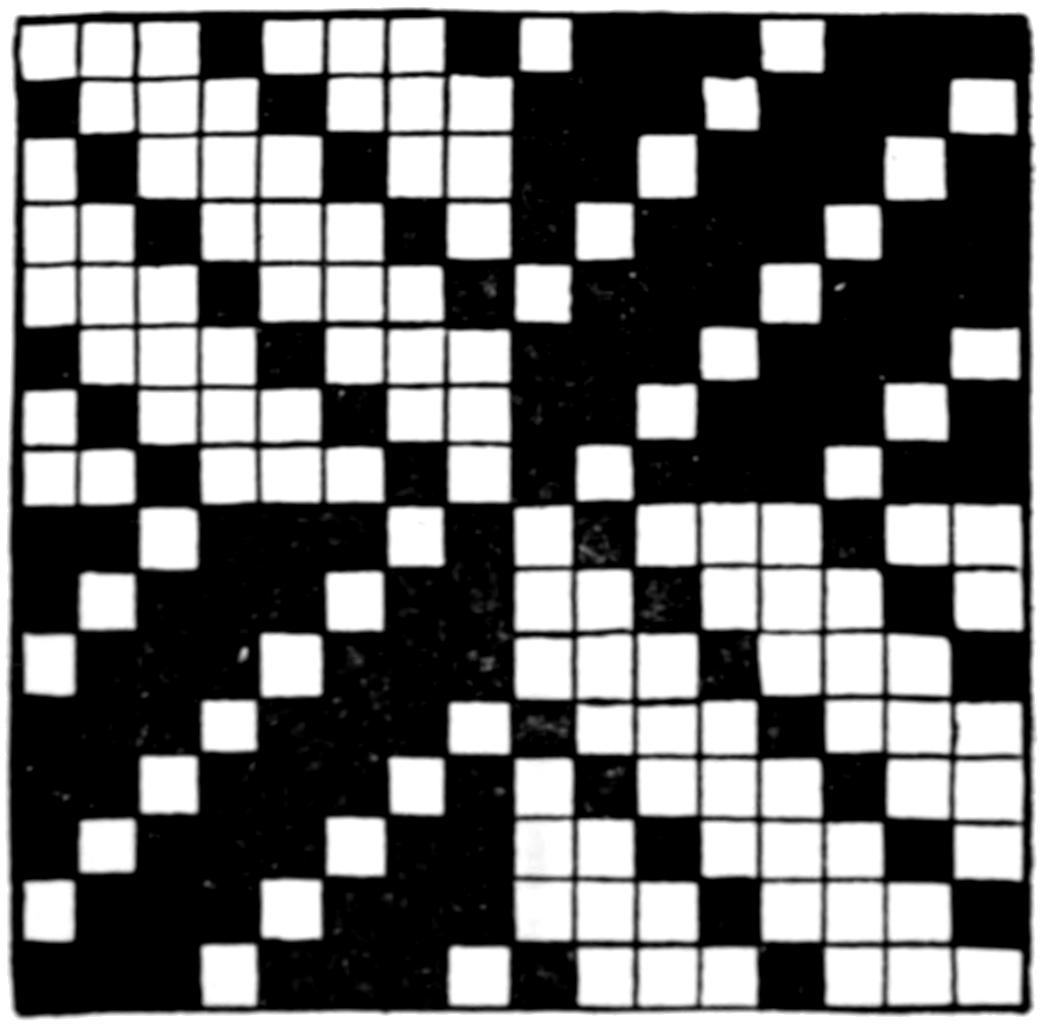
Fig. 70.—Diaper Pattern.
In figure weaving, the background is generally a plain or
satin weave. In designing, the relation of the pattern in the
figure to the twill in the background has to be most carefully
worked out, or the design will run into stripes or oblique
lines. The number of needles in Jacquard weaving is also
limited. The five- and eight-shaft satins for figure work are
generally preferred by designers to the higher number of
shafts. The use of color in silk designing brings in a large
item of expense. As few changes as possible will reduce the
cost of dyeing. The expense of the thrown silk is so great
that computations of the amount of each color in a design
have to be brought to the exact amount required, that nothing
may be wasted. The silk designer must know these
points. The design in Fig. 71 A is a lozenge or diaper pattern,
with six changes in length and nine in width, used frequently
in damask weaving. The complete diaper is made by a
reversal. Fig. 71 B gives the arrangement of pegs in the
lags for the dobby and Fig. 71 C the arrangement of the
cards for the Jacquard harness. This design is a very simple
one and perhaps would not be used on the Jacquard, unless
an elaborate central or border design were included, but it
illustrates the method of designing and preparing the cards.
The numbers at the bottom represent the warp threads affected,
and at the side the number of picks. In the cards
the needles will pass into the holes and the connected hooks
[102-
103]will remain on the griffes, but the other needles will strike the
cards where the dots are, will be battened back, and the shed
will be made by the hooks falling from the griffes; consequently
in the first line the first, fourth, fifth, sixth, and
ninth threads falling will make the shed and the filling will be
uppermost, as seen in the design. The repeats of the pattern
are provided for by the harness cords. In the lags of the
dobby the pegs are inserted when the warp threads are to
rise, consequently the filling passes under them. The first,
fourth, fifth, sixth, and ninth will be down, and the second,
third, seventh, and eighth up, which is what is required by
the design. The repeats are controlled by the dobby.
Fig. 71.—Lozenge Design.
A, Draft. B, Arrangement of pegs in the lags for the dobby. C, Arrangement of cards for the Jacquard harness.
Various Fabrics.—Pile Fabrics.
—A number of attractive and useful materials come under this head which are made in various ways. The term pile is sometimes used to cover napped goods, but it should be employed only when the fabric is so woven that a pile is formed on its surface. Napped goods are woven and the surface raised by gigging. The surface is cut to make a pile. Chinchilla is a napped fabric. It has two sets of warp threads, one for the face and one for the backing, and one filling thread. The cloth is woven loosely and well fulled; it is napped when still damp. The nubs on the surface are formed by a special machine which by a rotary motion rubs up the nap into rolls.
Fig. 72.—Plush Weave.
From Barker’s Textiles, by courtesy of Constable & Co., London.
Turkish toweling is one variety of pile goods; the construction is called a Terry weave. It has loops on the surface which assist in absorbing water. There are two sets of warp threads; one is held taut and the other is slack. The filling threads are inserted until several are in, and then beaten up. The slack warp is formed into a loop. There are many grades of this toweling. When the loops are made with two or more ply yarn, the filling interlaces the ground warp several times between the loops, the ground warp is strong and the weaving is close, an enduring towel results. Another form of pile weaving is used for velvets and plushes (Fig. 72). [104]A double cloth is woven on which some threads from each cloth interlace the other. A knife moves between the cloths, cutting the threads and leaving a pile on each side. In the finishing the pile is cut even. Corduroy is made by two sets of filling threads, one for the ground and the other for the pile. When the material is woven it has floats of filling, forming stripes running warp way. The floats are cut by hand with a sharp pointed knife. An imitation of corduroy is made by shearing a plain pile fabric in rows or cords. Cotton velvets, corduroys, velveteens, and filling plushes are really varieties of double cloth. They are woven in a rib pattern, the cord being along the filling. The surface loops are cut by hand with a long cutter in the direction of the length. Cotton velvets require a great deal of finishing to make them look well. In their weaving the backing threads are brought forward to form part of the pile, and also to connect the two rows of warp threads. Different weaves are used to form the face and the back respectively, but the two must be designed to work in harmony with each other, or the finish will be defective. Still another method is to have the warp pass over wires, leaving loops which the filling holds down. Brussels carpet is made in this way, but the loops are left uncut. For velvets, the wires have a knife edge which as they are withdrawn sever the warp threads and make a pile. Wilton carpet is thus cut. There are two sets of warp for ground and pile. The finishing of velvets is important. [105]Panne and mirror velvets are pressed, and embossed velvet is made by pressure of rollers. Chiffon velvet is finished to be especially pliable.
Crêpe and other crimped fabrics are woven in a variety of ways, plain, ribbed, or twilled. Some are made by using a sateen twill for the filling and a satin twill for the backing, the aim being to confuse the surface of the material by the way the stitches from the back break the face. In other cases filling yarns are given a hard right-hand twist and are alternated every few picks with a yarn of a left-hand twist. Crêpe is also woven with the warp yarn twisted in one direction and the filling in the opposite. In the dye vat these yarns are differently affected and the cloth is inclined to cockle. They may be woven also with an extra special warp beam which allows the warp to be a little loose, while the threads on the regular warp beam are tight. When the filling is beaten up, the looser threads are rather full and the finishing gives them the crêped appearance. Wool crêpons are sometimes made with the backing threads of cotton. By mercerizing the material after weaving it, the floats of wool are drawn together by the cotton, which is contracted.
Stitched, Backed, Double-faced, Double, and Multiple Cloths.
—Looms are constructed to weave double and multiple cloths, but by special warps and double harness the regular loom can serve the purpose. Backed cloths referred to above are made by weaving them in such a way that extra backing warp is held by filling stitches to the face, making the cloth heavier. (For Draft see Fig. 68.) The stitch on the surface comes under adjacent face threads and is invisible. Double-faced cloths are made similarly to backed cloths, but are well finished on both sides, silk-faced ribbons being illustrations. Figuring on a plain surface by extra warp and filling threads is done in a similar way to the double-faced cloth, except that the design appears only at intervals. Cloths having long floats of warp or filling on the surface to [106]carry out the design are made with a double warp or filling, and stitches come from the back to hold down the floats. Satin and sateen twills are much used for backing stitches. The double, triple, and multiple cloths have both double warp and double filling. They can be so woven as to be entirely separate, and when unfolded make a wide sheet of cloth several times the width of the loom, or they may be fastened together on one edge or on both edges and make tubular fabrics for bags, hose, or lamp wicks, or the two cloths may be held together at regular intervals and thus make reversible material for heavy coating and rugs. Backing yarn is frequently made of much cheaper fiber in order to decrease the cost while adding to the warmth and weight. Reworked wool, coarse new wool, and cotton are used for backing threads.
[107]
CHAPTER V
KNIT GOODS
The Industry in the United States.
—The knit goods industry in the United States was begun in the latter part of the nineteenth century, and had a rapid growth, for by 1909 the value of its products was quoted at $200,143,527.[1] By the census of 1923 the value had risen to $848,176,734, which was a gain of 33.8% over 1921. The number of establishments in 1923 was 2323.
[1] Daily News Record, April 17, 1923.
The main classes of knit goods are hosiery, underwear, garments, flat goods, bathing suits, gloves, and fancy knit goods. The industry is in most of the states, but the main establishments were (in 1923): New York, 886; Pennsylvania, 610; New Jersey and North Carolina each 109; Massachusetts, 87; Tennessee, 72, and Wisconsin, 66. Illinois, Ohio, California, Georgia, Michigan, Connecticut, and Rhode Island follow in order, and twenty-one other states have been making some form of knit goods.
All-silk hosiery is an important part of the hosiery industry. In 1923 the value was:
| Women’s Hosiery | - | Full fashioned | $25,158,309 | |
| Seamless | 12,452,613 | |||
| Half Hose | - | Full fashioned | 142,915 | |
| Seamless | 8,175,210 | |||
| Total: | $45,929,047 | |||
Underwear (knit) was valued in 1923 at $5,923,360.
The large jobbing centers are New York, Philadelphia, the Mohawk Valley in Massachusetts, Chicago, St. Louis, Minneapolis, Omaha, and St. Paul. The South is entering the field.
[108]
Foreign knitting centers
are in England, France, Germany, Switzerland, Italy, and Austria.
A large and increasing variety of articles are made from knit goods, for under and outer wear, neckwear and miscellaneous uses, and the flat knitting machines produce laces which combined with the plain knit goods make attractive fabrics for scarfs, sweaters, and other garments.
Early Inventions.
—Knitting is perhaps the oldest form of textile fabrication, as it is on the order of the netting used for fishing among primitive tribes. Knitting by hand was for many centuries a familiar method of making useful articles and garments, but in England, in 1589, a clergyman, named William Lee, invented the hand knitting machine with spring-bearded needles. He is entitled to high rank as an inventor, but was unable to obtain from Queen Elizabeth the right to construct his machine, for she feared the livelihood would be taken from hand knitters. The use of machinery did not progress rapidly, for the possibilities in looped fabrics were not realized at first.
Stocking making had become a thriving industry in England by 1772, and 8000 frames of the Lee order were in use, being worked by hand. The invention of a rib knitting machine came about 1740, and in 1769 the addition to the frames of a revolving shaft turned by a handle, increased the speed. Luther Barton, who built rotary frames, introduced a mechanically controlled mechanism by which shaped or fashioned pieces could be made for hosiery or underwear. In 1775 the Warp Knitting Machine appeared, which has since become a factor in the making of gloves, scarfs, ties, lace, and outer wear. The first circular frame was invented by a Frenchman, named Descroix, in 1798. In 1816 a noted French engineer, Marc Brunel, brought out a machine with radiating needles of the spring-beard variety. Machines of this order are still in use in France, being the basis of the standard circular frame with bearded needles.
[109]
The English loop wheel circular frame was brought into modern form by Mellor in 1847. It was improved by American knitters, and is still used in both countries. Lee’s spring-bearded needle continued as the best form until about 1849, when Matthew Townsend of Leicester, England, invented the self-acting or latch needle, which revolutionized the industry. This invention made possible the modern plain and rib circular and straight bar machines, and the seamless hosiery machines. The latch needles made fast running machines possible. A “Flat Machine” was invented in the United States by the Rev. I. S. Lamb in 1863. An Automatic Seamless Hosiery Machine, invented in 1879, was followed by the Scott and Williams machines. The increase in speed of manufacture has been great. On the hand frame one worker produced a few pairs of stockings or a couple of pieces of underwear each day, but by the latch-needle machine of the present day one operator on a set of machines can make daily 150 dozens of army half hose. A series of underwear machines, making a tubular web, produce 1000 pounds weight of fabric a week.
What Knitting Is.
—Knitting is the construction of a fabric with needles by a series of interlocking loops made of yarn. Both hand and machine power are utilized at the present day. At the beginning of the nineteenth century knitting frames were still worked by hand. The chief outputs are classed as flat goods, ribbed goods, fleece-lined, and mesh. The flat knit fabric is made on a machine having one cylinder of needles. Loops are on the face of the cloth in lengthwise rows called wales. The back of it has crosswise rows of interlocking semicircles called courses.[2] Ribbed fabrics are made on machines having two cylinders of needles which alternate, one cylinder drawing the loops in, and the other [110]drawing the alternate loops out. Ribbed garments are very elastic. Fleece-lined fabrics are knitted on a flat machine which has one cylinder of needles and special attachments that make a backing of heavy yarn. Three strands of yarn are knitted at each stitch—a fine yarn for the face, a heavy yarn for the back and a very fine yarn connecting the two. The backing appears on the outside of the tubing as this is the part to be fleeced. The fleecing is done by a napper. (See Chap. VI, Napping, etc.) Mesh fabric is knitted on a flat knitting machine. It is quite open and considered very hygienic because it is porous, hence the skin is well ventilated and the material dries more rapidly when wet. Two kinds of needles are in use, the spring-beard and the latch (Fig. 73 A, B). The spring-beard needle has a sort of hook on the end, which catches the yarn and yet allows the finished loop to slip off. The latch needle has a hooked end, against which a riveted wire latch can be pushed aside or against the hook, thus releasing or catching the thread and making the loops of yarn, one inside of the other (Fig. 74). The needles are set in slots, a needle for every loop (in coarse work there may be only a few to the inch or in fine there may be 18 to 34). The needles are set at work by a carriage with cams which move them up and down in the process of knitting, while a pattern chain or wheel automatically measures the length of fabric already knit and shifts the motion-changing devices to obtain the required results.
[2] Knit Underwear Fabrics, Lesson No. 4, Associated Knit Underwear Manufacturers of America.
Fig. 73.—A (ABOVE), Latch Needle.
Fig. 73.—B (BELOW), Spring-Beard Needle.
Courtesy of Associated Knit Underwear Manufacturers of America.
[111]
Fig. 74.—Latch Needle, showing Stitch.
1, Hook. 2, Latch, moving on pivot.
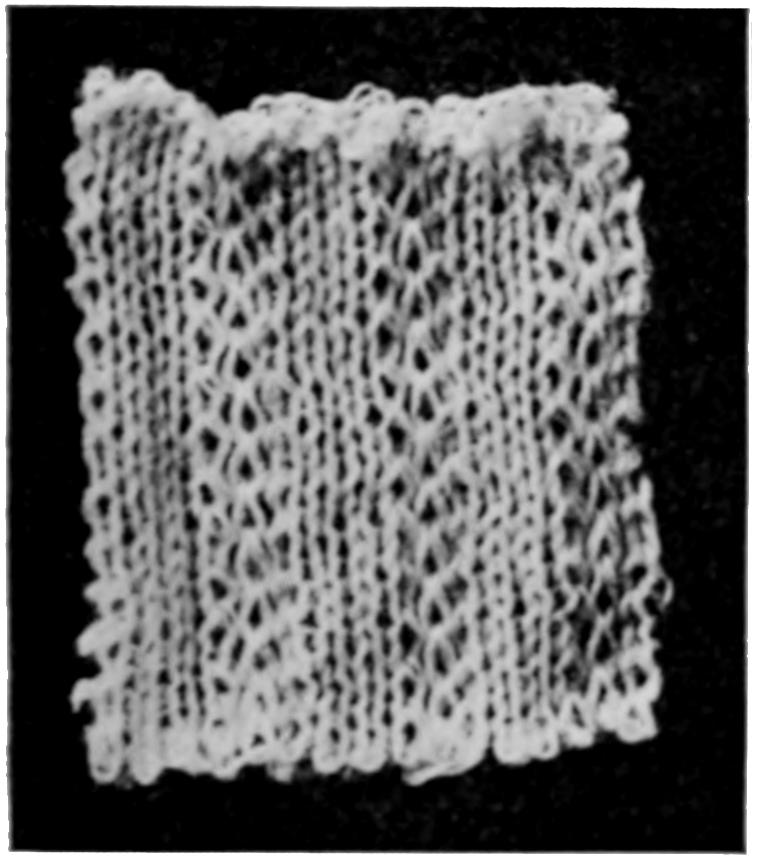
Fig. 75.—Knit Goods Showing Stripe.
Varieties of Machines.
—Knitting machines produce both plain and ribbed effects, which can be combined in one article. When a garment must be removed from one machine to another each loop is transferred to a needle in the second machine. This requires great care. Stripes can be made automatically by a system of changing yarns as they are delivered by the feeds (Fig. 75). There are both circular and flat knitting machines. The warp knitting frame is used largely for making fabrics for outer wear, such as yard goods, scarfs, gloves, and ties. It looks like a wide loom and is often so called. Some tubular warp knitting frames are made but the fabric is usually produced flat and later cut into the shape of the article needed. In the circular machines (Fig. 76), the web may have a stitch left out the entire length and the fabric can be cut apart along these threads. The webbing can thus be laid flat and garments can be cut from it. There are many varieties of knit goods produced by radically different machines. Cloakings and blankets are sometimes made with a cotton knitted ground through which woolen yarn is passed and in the finishing the wool is napped, giving a soft surface covering the knitted background. Knitted fabrics are found from fine glove silk to a heavy cloaking of wool, which looks like melton cloth. A fabric resembling a heavy velour is promised. Dress [112]goods like tricolette or Jersey cloth are popular, from which blouses, riding habits, or sport suits can be made. Stockinet [113]was imported from England as early as 1887. It was manufactured in the United States in 1912 and has been popular ever since. It is a flat or tubular knit fabric made on an ordinary knitting machine. Jersey or tricot is a knitted fabric made in tubular form. It is found in various weights and degrees of fineness. There has been great improvement in the construction of the cloth in the stretching and sagging. When women gave up flannel underskirts and began to wear knickerbockers and skirts of knitted goods, an impetus was given to Jersey cloth. Milanese knitting does not ravel, it is made on a warp knitting frame. Gloves, knickerbockers, and other articles are made from it.
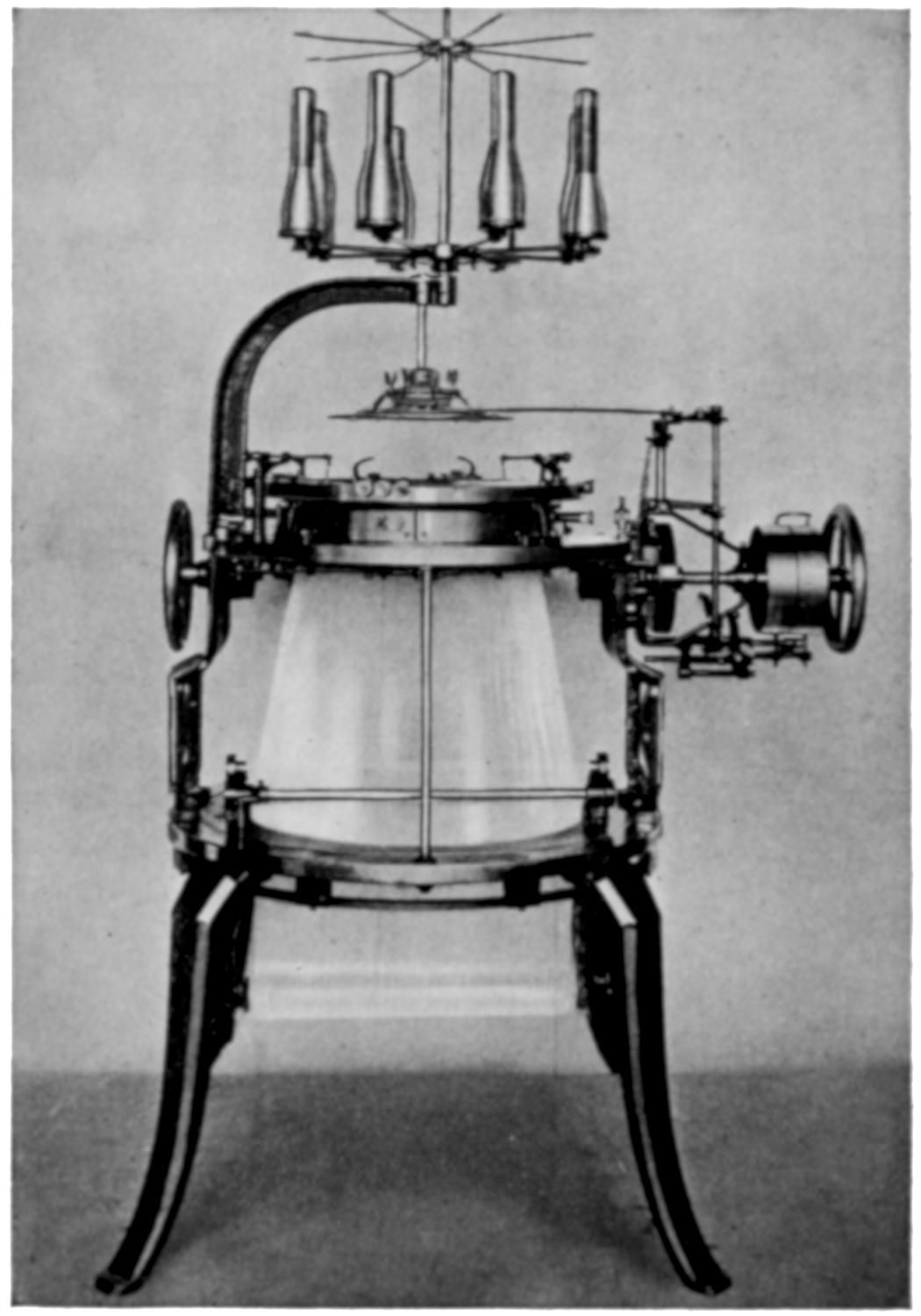
Fig. 76.—Circular Knitting Machine.
Courtesy of the Associated Knit Underwear Manufacturers of America.
It takes about one-seventh of the time to make a knitted fabric as an equally good woven one. The cost of production is thus lowered, and the price being less, the knitted cloth is naturally in demand. It has advantages for many purposes. It is light in weight, comfortable in its fit, and less solid than woven cloth, consequently it allows for the ventilation of the body. It is found in plain colors, in heather mixtures, and in fancies. The shoe trade uses much Jersey cloth. Plaited goods (double faced, with one fiber on the surface and another on the back) are attractive and economical. These are found increasingly in winter hosiery of cotton and wool, silk and wool, or cotton and rayon.
Yarns in Use.
—Many varieties of yarns are used—cotton, woolen, worsted, silk, rayon, and fancies.[3] The yarns are usually spun especially for the knitting trade, requiring softness, strength, and pliability. In worsted yarns both the French and the Bradford systems of spinning are used. (See Chap. VII, Spinning.) In silk, reeled, spun, and wild silk are all employed, and rayon is used extensively. A special winding machine is required, as this process is [114]very important. Rough places or knots interfere with the smooth running of the needles. The yarn is wound on bobbins or cones for the circular and flag machines, but for the warp knitter it is on a beam as it is for weaving.
[3] Of the fiber employed in 1922 there is the following record:
| Wool and Worsted | 75.9 | % |
| Rayon | 12.0 | |
| Cotton | 9.5 | |
| Pure silk | 2.6 |
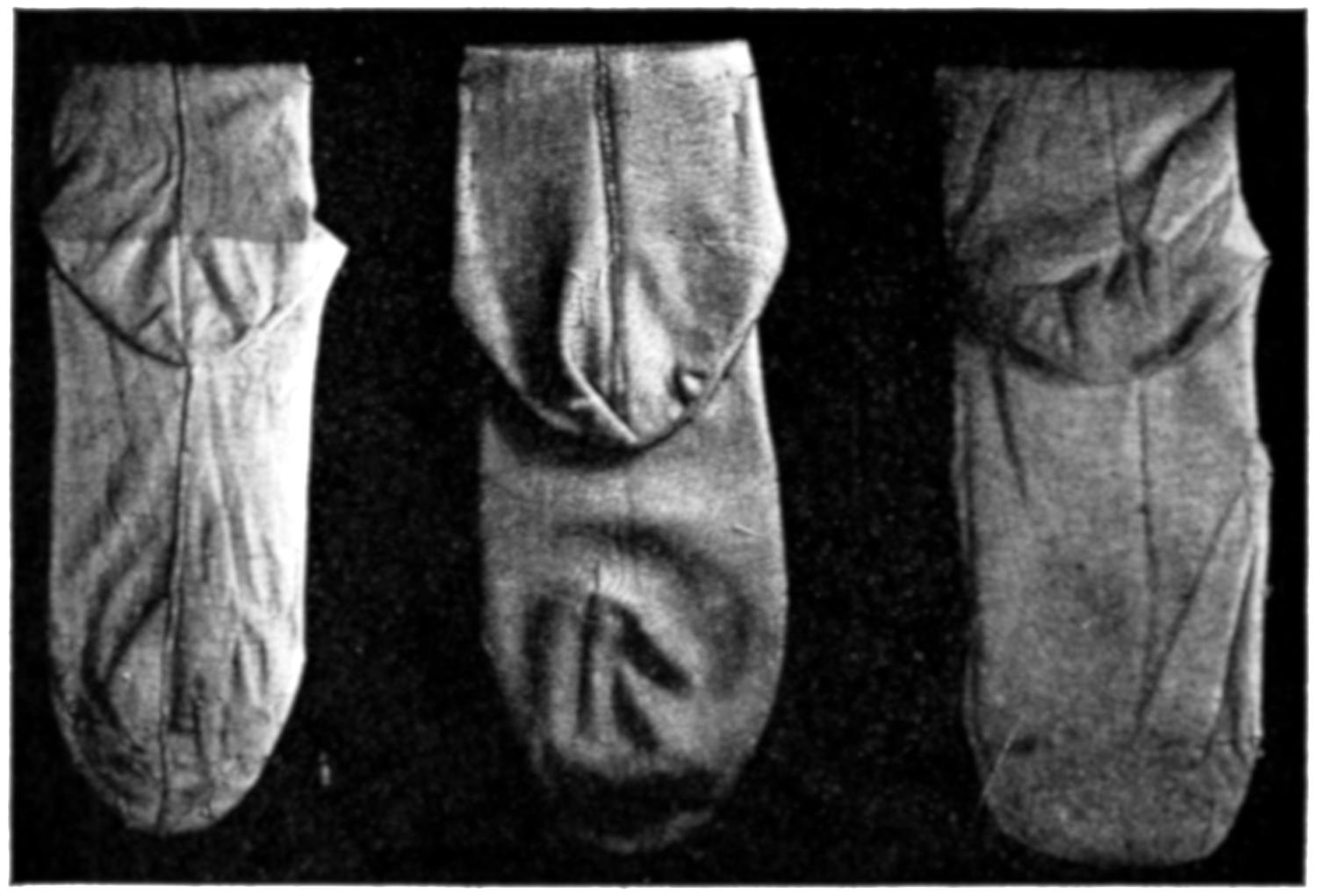
Fig. 77.—A, Full Fashioned. B, “Mock Seam.” C, Seamless.
Knit Goods.
Hosiery.
—Stockings were first cut from flat knit goods and seamed into the shape of the foot and leg. Shrinking into shape improved the appearance, and inventions followed, which, by transferring stitches, formed the heel and toe. Such hosiery is still made. The circular machine (Fig. 76), made it possible to form a tube the length of the leg. Cutting and shrinking were at first used to form the foot, but soon it was made automatically on the end of the tube; these were called seamless stockings (Fig. 77 C). The fit at the ankle is unsatisfactory, especially after laundering, and it is becoming increasingly common to cut them to shape at the ankle and seam them together from the heel up the entire length. This [115]is called a “mock seam,” (Fig. 77 B), as it looks like the seam in the “full fashioned” stocking. A seamless stocking, so treated, fits better, is improved in appearance and is cheaper than the full fashioned. The seamless stocking can be distinguished from the other by the fact that there is no seam under the foot, the seam up the leg (if there is one) stops at the heel, and the appearance of the seam is different, as it is more pronounced or has rougher edges. The finish at the toe differs in the seamless stocking, for it is joined about an inch below the toe, and the other is joined at the toe. Seamless stockings are made in large numbers, with or without the mock seam. They are knit largely of cotton yarn, but, other fibers are also in use. In buying a seamless stocking it is well to notice the manner of completing the upper part of the leg, for in some cases the fabric is very tight above the knee. Various ways of completing the stockings are in use: the fabric is sometimes turned back and stitched, or a facing is placed at the top which stretches over the knee, or the end of the stocking is ribbed and finished with a selvedge.
The full fashioned stockings (Fig. 77 A) are made on a complicated frame which forms the shape of the leg and heel in one process, and another machine completes the stocking, the work being begun at the widest end. Yarn guides are thrown into action to knit the heel pieces on each side of the ankle; when this is completed the loops are cast from the needles. The separate footing machine is now used. The loops are transferred from the first to the second machine. The web is narrowed at each side for instep gussets and again for the toe. The shaping is done automatically. Great care is needed in reeled silk hosiery especially, or an imperfect stocking will result. For fine silk stockings there may be as many as thirty-four needles to the inch in the frame. For ordinary hose a series of machines which make [116]from eighteen to twenty-four stockings are connected. As the full fashioned stockings are knitted flat, they must be seamed together on another machine, toe and heel, up the sole and back of the leg, with strong thread. The seam is neat and small. A perfectly fitting stocking is the result. Spring-beard needles are in use on full fashioned hosiery machines. Both latch and spring needles are used on the circular frames. (See Fig. 76.)
The stockings are examined by an inspector for flaws. They are frequently dirty, with the knitting puckered and loose when coming from the machines. Various methods are used to finish them. They are dampened, drawn on a wooden form, and hung up in a hot box which takes out the wrinkles and gives some luster to silk stockings. They are reinspected to be sure they are without imperfection. Scouring, pressing, steaming, and shaping make them into the attractive article we are accustomed to see.
Knitting machines are now made which produce stripes and patterns and elaborate lace or embroidered clocks at a comparatively small expense. The Jacquard machine can be used to control patterns. (See Chap. IV.) Any number of colors can be used in the designs.
Reeled silk stockings are expensive, but spun silk is less so and is much used. The best stockings are dyed in the yarn, but hosiery is often knit in the “gray” and dyed after it is in stocking form. Cotton stockings are often plaited over with silk, with wool, or with rayon, making an attractive appearance, but the surface fiber is apt to wear rough. Such stockings sell for lower prices than if made entirely of the surface fiber. Mercerized cotton hose are made in large numbers. A mercerized cotton lining is also made for wool hose for warm climates. Rayon hosiery is a comparatively new industry in the United States, and has grown up largely since 1917. In 1922 there were exported 20,000,000 pairs of stockings of this fiber. (See Rayon, Chap. IX.)
[117]
Balbriggan and lisle hosiery are made of fine cotton yarn closely twisted, and with the nap singed off to improve the appearance. Woolen and worsted hose are used increasingly for cold weather and for sport. As low shoes are now worn in winter the wool hose are desirable. The ventilation of the feet is more satisfactory in a low shoe, but cotton and silk hosiery are not warm enough. The slip-over golf stocking is especially useful in winter therefore, for it can be pulled over the silk stocking worn in the house when going into the open air and thus keep the body at more even temperature. The term “ingrain” silk is used for silk dyed in the yarn. (See Chap. XIII, Diazotized and Developed Colors.) These stockings hold the dye well, but are often weighted, hence may easily deteriorate.
Good hosiery is well knit, elastic, firm in feel, and is strong at toe, heel, and knee. The top is strengthened that it will not break easily. The garter catch should be placed on this part. The knitting is not cloudy, with irregularities of yarn thickness, but clear and even. These things should be noticed when buying hosiery. The customer should not carelessly push her hand through the stocking, for a broken finger nail or a ring will often catch a thread and a bad break will be started. Manufacturers complain of the number of stockings returned as defective which have been made so by careless examination. Silk stockings should be bought one-half size longer than the foot, as they will wear better. All stockings should be amply long. It is well for the purchaser to know something of makes of stockings, and, having found a satisfactory one, to keep to that. Some retailers have their own “brands” on stockings. This differs from a “make” in that the stockings may have been bought from many sources or makes, yet all bear the same brand. The names of manufacturers do not appear on these stockings, but in the makes the name is frequently on the boxes.
[118]
Wear.
—It is well to wear stockings in rotation and wash out after each wear. This is necessary in silk stockings, but also advisable with other fibers. Wool and silk require care in laundering. Soap should not be rubbed on the stocking nor very hot water used. A warmish water with a solution of a mild soap in it, dipping rather than rubbing, and rinsing in warm water give good results. It is stated that practically all hosiery is now fast to crocking. Nevertheless it is well to wash carefully, lest the dye run. In a silk stocking the gray that appears at the toe and heel is often due to wear and not loss of color.
Care should be taken in putting on a stocking. After placing the end of it on the toe it should be drawn on gently, so that the loops may not be broken. The stocking should be darned at the first break or the hole will spread beyond repair. The shoe should be smooth inside, or the rough place will wear upon the stocking. A light sheer fabric cannot stand much wear, and the chiffon silk hosiery of the day is not satisfactory for steady wear.
Hosiery is sold by the manufacturer to the jobber, who again sells, or it is sold to the retailer direct. Some manufacturing firms sell to the consumer without a middleman, claiming they thus can sell at a lower price. A house to house method of selling is also prevalent, but is not yet thoroughly satisfactory.
Underwear
is made on the same principle as hosiery—seamless and full fashioned. The circular machines (Fig. 76) are much larger than for hosiery. Fashioning, narrowing and widening the knit web is done by transferring the loops from several of the edge needles which are in use, to a separate machine. In a full-fashioned garment the work is begun at the widest part and narrowed as needed. The modern machine of the circular order produces the garment without joins and seams throughout. The garment fits well, and improvements come from time to time. From stockinet, [119]made on circular machines, many garments can be cut out at one time. The making up and trimming are done by mass production, consequently the price is moderate. The waste in the cutting-up is, however, a heavy item. This waste of material is not found in full fashioned underwear. The knit fabric is cut into strips in size according to the garment to be cut out. The strips are laid in a pile about twelve inches high and the pattern is laid on top. A workman follows the pattern with an electric cutter which cuts through the pile. The parts are separated into dozen lots and assembled in bundles for stitching. The development of knit underwear has been a blessing, for elastic, hygienic fabrics have taken the place of the former stiff, unyielding ones.
Special machines have been invented to unite the parts of garments and overcast the edges. The invention of the overlock and flat lock machines, by leading sewing machine makers, has made it possible to finish both inner and outer clothing so that the wear and appearance are satisfactory.
Underwear should be laundered in thick suds made of lukewarm water and mild soap. If the water is hard it should be softened. The garment should be squeezed but not rubbed hard. The rinsing should be thorough and if the garment is of wool the temperature of washing and rinsing water should be the same.
Tests show that bleached underwear is more absorbent of water than the unbleached for the latter is covered with a natural wax which prevents moisture from entering.
Outer Wear.
—The making of outer wear is increasing rapidly. In 1912 the United States had 345 enlarged knitting machines, but in 1922 there were 150,000. The industry is located principally in the eastern states, New York having in 1923 the majority of the mills. Knitting outer wear is, however, well distributed over the country. In 1922 there were 1352 mills and the wholesale production was $266,717,385. Sweaters, cardigans, sleeveless garments, [120]slip-ons, headwear, bathing suits, knitted fabrics for garments, infants’ wear, neckwear, scarfs, and miscellaneous articles are made. For such garments as sweaters there are machines which complete the entire article. The locks and cams are changed by carriers, so that shoulders, armholes and sleeves can be made as if by hand. The finishers add a little hand work to complete the garment, and it is as attractive as if made by a skilled hand worker. Various methods of finishing complete the article, such as shrinking into shape, steaming to give an attractive appearance, and napping to soften the surface.
A committee is working on standardization.[4] The great success of this industry should be realized by the consumer. The frequent false labeling of our domestic product as “imported” in order to sell it comes from a lack of knowledge of the work of our own factories and should not be tolerated by consumers. The knitted outer wear manufacturers, believing that the highest standards of conduct bring about the best interests of the industry, have formulated a code of ethics which shall be their ideal of business management to fellow manufacturers, distributors and employees. The spirit underlying all dealings shall be one of courtesy, coöperation and consideration.
[4] Standard Sizes for Knit Underwear, Associated Knit Underwear Manufacturers of America.
The knitting of gloves began as early as 1760 in America, when several glove knitters came from Scotland bringing their patterns with them. The value of the industry in Fulton County, New York, is now about $10,000,000. Silk, rayon, suede cotton, wool, and plain cotton gloves are made here.
Standardization of Knit Goods.
—The National Association of Hosiery and Underwear Manufacturers and the United States Bureau of Standards are working to eliminate wastes and conflicts in specifications and distribution. If the suggestions [121]can be carried out it is said that many millions of dollars will be saved. The reforms are in the following directions:
In the Purchase of Yarns. Eliminating imperfect yarns that a satisfactory article may be assured.
In the Sizes of Hosiery. Eliminating variations in the size of foot, by all mills uniting on a method of reckoning length. Knitting stockings in the “gray” in quarter sizes only, and relying on boarding for the full and half sizes. The change would tend to economy.
In the Sizes of Underwear. Standard sizes and measurements of knit underwear have been under discussion. The object of the setting up of standards and the use of the standard label is that a standard of value may be set up by which merchandise may be compared, that more intelligent buying may be possible for consumer, jobber and retailer, and that there may be a lessening of extreme competition between manufacturer, jobber, and retailer. Standard measures have been developed from the most careful investigations of sizes already in use in leading mills and averages were taken from them. In May, 1925, the suggestions were adopted to go into effect in the spring of 1926 for underwear made of bleached cotton in ribbed union suits and flat knit union suits for men, boys, and children.
In Tests. The industry has had no standard tests for breaking, bursting, tearing, absorption, heat retention, fastness of dyes, and abrasion. Methods of testing are being worked out.
In Defining Terms. There have been differences of opinion as to the meaning of many terms in use. The following are being standardized: Cut goods, cut hosiery, seamless, full fashioned, ingrain, lisle, and mock seam. The following are questioned: “Merino” and “Cashmere,” used in hosiery or underwear for the designation of part cotton and part wool content. As the terms are taken from the names of wool-bearing animals they are misleading and should not continue. [122]The term “fashioned” has been used for seamless stockings with a mock seam. The term is confused with “full fashioned” and should be eliminated. The term “silk” should not be used when rayon is the true fiber, or where there is an admixture of cotton in a silk stocking to give strength to toe, heel, and upper part. The exact facts should appear in any mention for advertising purposes. (See Better Business Bureau, Chap. XVI.)
The shortening of the length of stockings has been advocated as a method of reducing price.
Containers and Boxes. There has been a great variety in the boxes used by the different mills. It has been found that these can be reduced from hundreds of styles to a dozen. About 5,000,000 boxes are used each year.
Knit goods have a promising future. The latest inventions increase speed, perfection of movement, and automatic action. One machine serves where several were required formerly. The garter hold is stronger. Fancy stitches and the use of several colors of yarn in one stocking make pleasing variety possible without reduction of speed. The seamless stocking has become a more attractive article, for by automatically dropped stitches in the modern machine the shape at the ankle is better. The mock seam is smaller and neater, and the top is more elastic, thus fitting with more comfort at the knee.
[123]
CHAPTER VI
WOOLEN AND WORSTED—RAW
MATERIALS
Scope and Value of the Industry.
—Cloths made from woolen and worsted yarns are among our most useful and valued textiles. Such materials are essential in the greater part of the United States, as no other fabric can take the place of wool for warmth and endurance. The raw stock is procured from fleeces of various breeds of sheep, goats, and other animals which come from many parts of the world. The appearance of the cloths varies greatly, as the fiber ranges from the short staple, soft, crimpy, dull Merino wool to the long, lustrous, hair-like fiber of the Lincoln sheep of England, the glossy hair of the Angora goat of Asia Minor, or the coarse, long hair of the Chinese sheep. The length of the staple varies from two to even twenty inches. (See Fig. 78.)
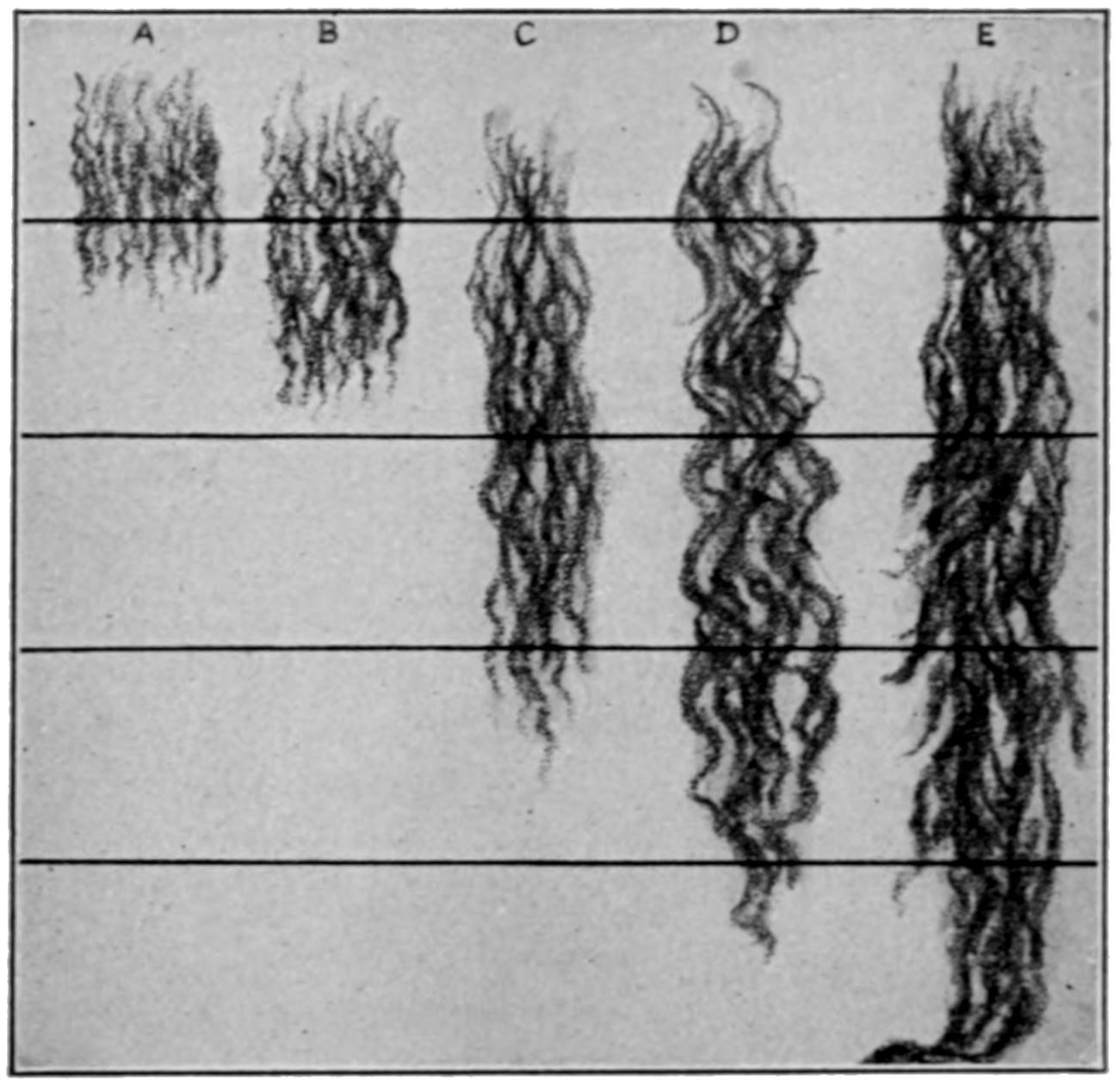
Fig. 78.—Relative Length of Staple.
| A, | Merino. | Average | length | 2¹⁄₄″-2¹⁄₂″ |
| B, | Fine Crossbred. | “ | “ | 3″ |
| C, | Alpaca. | “ | “ | 7¹⁄₂″ |
| D, | Mohair. | “ | “ | 8″ |
| E, | Lincoln. | “ | “ | 10¹⁄₂″ |
Vast numbers of workers are employed in the various branches of the wool industry, from growing wool to making the finished cloth into garments. The commercial value of the raw stock is enormous, and much is added by processes of manufacture. In the census of 1919 the value of raw wool used in our industries was estimated at $759,193,319, the value added to it by manufacture was $475,463,773, so the value of the product was consequently $1,234,657,992.[5] A table of the wool-growing countries and their production, taken from the latest available estimates in the Annual Wool Review of 1924, National Association of Wool Manufacturers, is found in the Appendix, Section I.
[5] Fourteenth Census, 1919. Textiles and Their Products.
[124]
The price of wool changes frequently, as it is influenced by climatic conditions, by market irregularities, and by dictates of fashion. The world’s shorn wool supply is far from sufficient for the demand, and for this reason experts say that the price of wool will continue to be high.[6] In order to keep the price from being prohibitive for the majority of people, the by-products of the industry, such as pulled wool, mill wastes, noils, and reworked wool or shoddy, are all utilized. (See Pulled Wool and Other By-Products, below.) In addition to these by-products of wool, the cotton, silk, and rayon industries are called upon for raw stock and yarns to use in union with wool. Thus by various means the short wool [125]crop is lengthened, the prices of cloth brought where those of moderate income and the poor can buy, and strong, enduring, attractive, warm cloth is provided.
[6] Albert W. Elliott: The Course of Wool Prices for the Last Ten Years, in the Bulletin of the National Association of Wool Manufacturers for January, 1923.
Decrease in Wool Growing.
—The production of wool in the world is not increasing; on the contrary, in some of the leading wool countries it seems to be decreasing. The high prices paid for wool during the war tended to increase the output, especially of wool from crossbred sheep. The reasons for the smaller output at present are mainly economic, as the prices received for the raw stock have not made it an advantageous crop for the grower. It is a fortunate circumstance that more careful breeding of sheep is increasing the weight of fleece, so that the loss in numbers is not so keenly felt.
Many reasons are given for the decrease in wool growing in the United States. Beyond the Missouri River farm lands are encroaching on the open range where free pasture was once obtained, and small towns are appearing. The price of land is higher, and fodder has had to be raised on the ranch, as huge flocks can no longer range at will. Land has had to be fenced to prevent sheep from wandering on adjacent farm lands. Prices paid for labor have risen, and it is difficult to obtain, so that altogether the cost of wool raising has become almost prohibitive. Other products, such as beef cattle and dairying, are found more desirable. There are sections of the inter-mountain states which are only fit for grazing, and sheep husbandry will continue, but in other parts large flocks will not be practical. The hope for an increased growing of sheep for wool depends on (1) whether a higher price can be maintained for wool; (2) on the use of waste lands not suited for farming; (3) on the development of irrigation systems in dry sections; (4) on adequate methods of storing fodder to use in case of failure of a year’s crop; (5) on increased use of crossbred sheep, thus making larger profits, as both mutton and wool are sold; and (6) on the increase of [126]small flocks on the regular farm lands. One difficulty in growing sheep in a farming community is that dogs worry and kill them, thus causing large losses. There are, however, some encouraging indications that the industry will not permanently decrease, for more study is being given to successful sheep husbandry in small flocks.
The Government forest ranges are being used by thirty states for grazing sheep, goats, and cattle, and the great demand for the privilege overtaxes the capacity of them. About thirty thousand permits are taken out yearly. The net area of the National Forest in 1924 was approximately 157,502,000 acres. These ranges are important in the success of the western sheep industry.
Changes in the Character of Wool Grown.
—In the past the Merino sheep was the main breed in the United States, for it was especially fitted for the great ranges of the West. It required less constant care than other varieties of sheep. It does not, however, yield good mutton, but the crossbred sheep does. Breeds of sheep with long, coarse hair are crossed with the Merino to produce the crossbred. Sheep of one-half, three-eighths, and one-quarter blood now predominate in the United States. There is some fine wool grown. The Delaine wools of Ohio and adjacent states are noted as the strongest Merinos in the world. They compete with the Merino combing wools of Australia. Much fine wool is imported to meet the consumer’s demand for fine cloths.
There has been a reduction of Merino wools in other parts of the world. Australasia and South America have been growing much less. This has had its effect on the price of cloths of fine wool, and brought forth much speculation as to future prices.
Wool- and Hair-Bearing Animals.
—The fleeces of many varieties of hair- or wool-bearing animals are used in the manufacture of cloths which are included under the wool [127]industry. The fibers vary greatly in length. Below four inches they are called “short-stapled,” and beyond that length, “long-stapled.” (See Classification of Wools, below.)
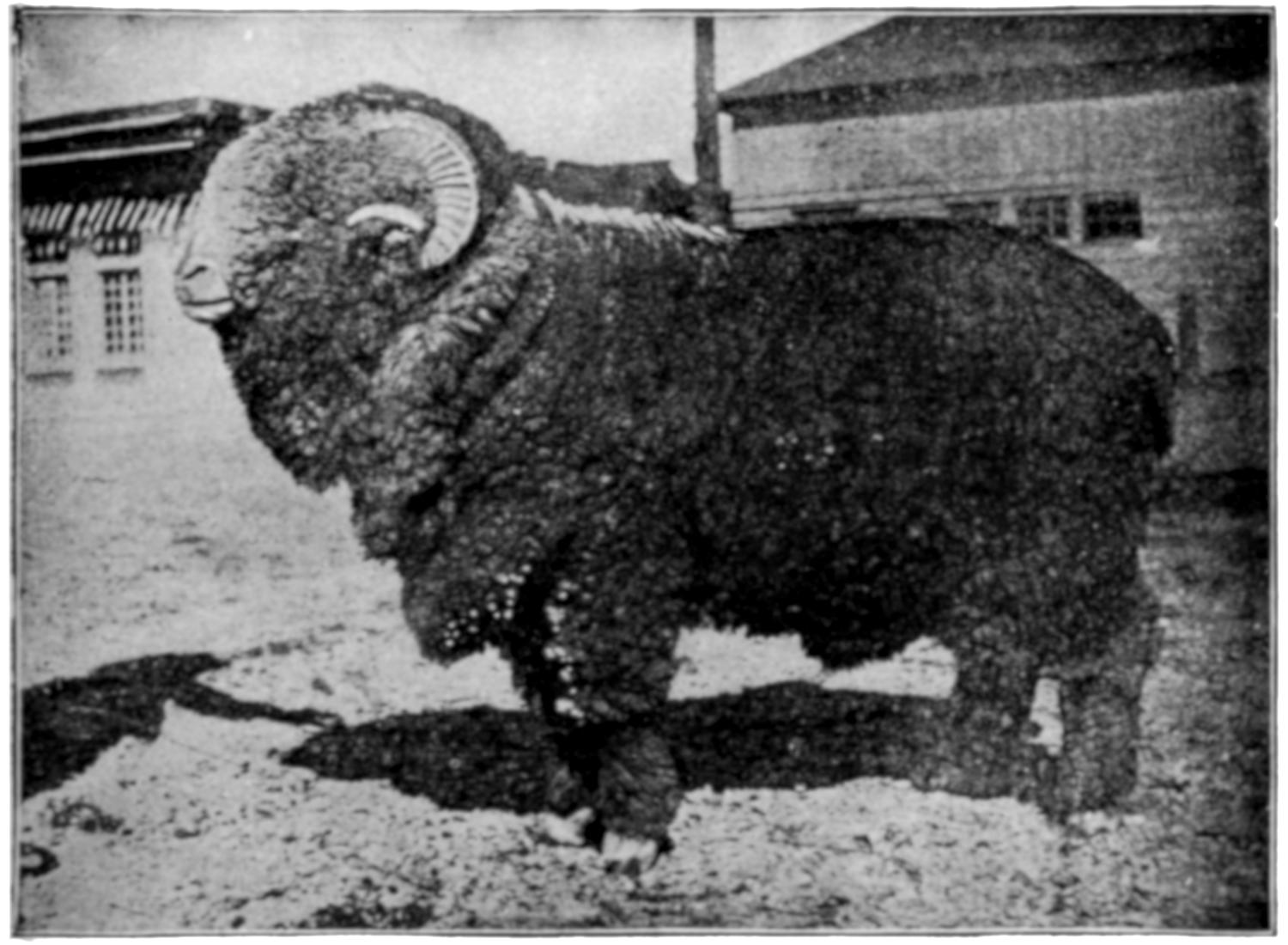
Fig. 79.—American Merino Ram.
From Collins’ Woolen and Worsted Spinning, by courtesy of the American School of Correspondence.
The Merino Sheep (Fig. 79) is descended from sheep originally from Spain. The Spanish Merino has been crossed with native or imported sheep in the leading countries, so that each has its own variety. The Rambouillet of France is imported into this country for breeding purposes. Australia has developed the Wanganella; Germany, the Saxony, and the United States has its special Merinos in the Vermont and Delaine. Merino wool is grown in South America, South Africa, New Zealand, and Australia, but the latter country is the largest producer.
[128]
The Crossbred Sheep. In the United States the favorite long-haired sheep for crossbreeding are the Cotswold, the Lincoln, and the Romney Marsh. Other English sheep with medium length wool are also used, such as the Shropshire, Hampshire, and Dorset. The United States Department of Agriculture has developed a good crossbred sheep by crossing the Lincoln with the Rambouillet; the wool grades from ³⁄₈ to ¹⁄₄ blood, the shrinkage is about 48 per cent, and the mutton is good. It is called the Columbia, and promises to be valuable.
British Breeds. These sheep are bred with the production of mutton as well as wool in mind. One class has very long wool and another has a medium length of wool. Important breeds of the first are the Lincoln, Cotswold, Leicester, Romney Marsh, and Roscommon. The Lincoln grows the heaviest fleece. These sheep are less hardy than the Merino and are not as well adapted to life on the open range. The wool is hair-like, twelve inches or more in length, coarse, glossy, wavy, and adapted to spinning by the Bradford system for hard worsteds, braids, linings, and lustrous dress goods. The sheep are not grown to a great extent in the United States, but are imported for breeding purposes, and the wool is also imported. The class of British sheep with medium length wool is divided into the mountain type, which includes the Cheviot sheep, and the Down type, of which the Southdown, Shropshire, Hampshire, and Dorset are well known in the United States. The wool of the Down breeds is three to five inches or more in length, and grades ¹⁄₄ to ¹⁄₂ blood. It is used largely in French Combing for soft worsteds. The Cheviot sheep are from the southern part of Scotland. The wool is used for Cheviot suitings, fine tweeds, and overcoatings.
Coarse Wool Breeds. Scotland, the Pyrenees, Iceland, and some Oriental countries such as China, East India and Turkey, grow sheep with coarse wool fleeces. The lack of [129]breeding is the main reason for the low condition of the wool. The United States imports these wools, for, with the exception of the lower crossbreds, such wool is not grown in this country. The wool is used principally for carpets and other floor covering. The better part of such fleeces is used at times by cloth manufacturers, for the domestic clip is insufficient for the demand. Under the tariff of 1922 (Fordney-McCumber) the coarse imported wools (carpet wools) pay a higher tariff when used for cloth than when used for floor coverings.
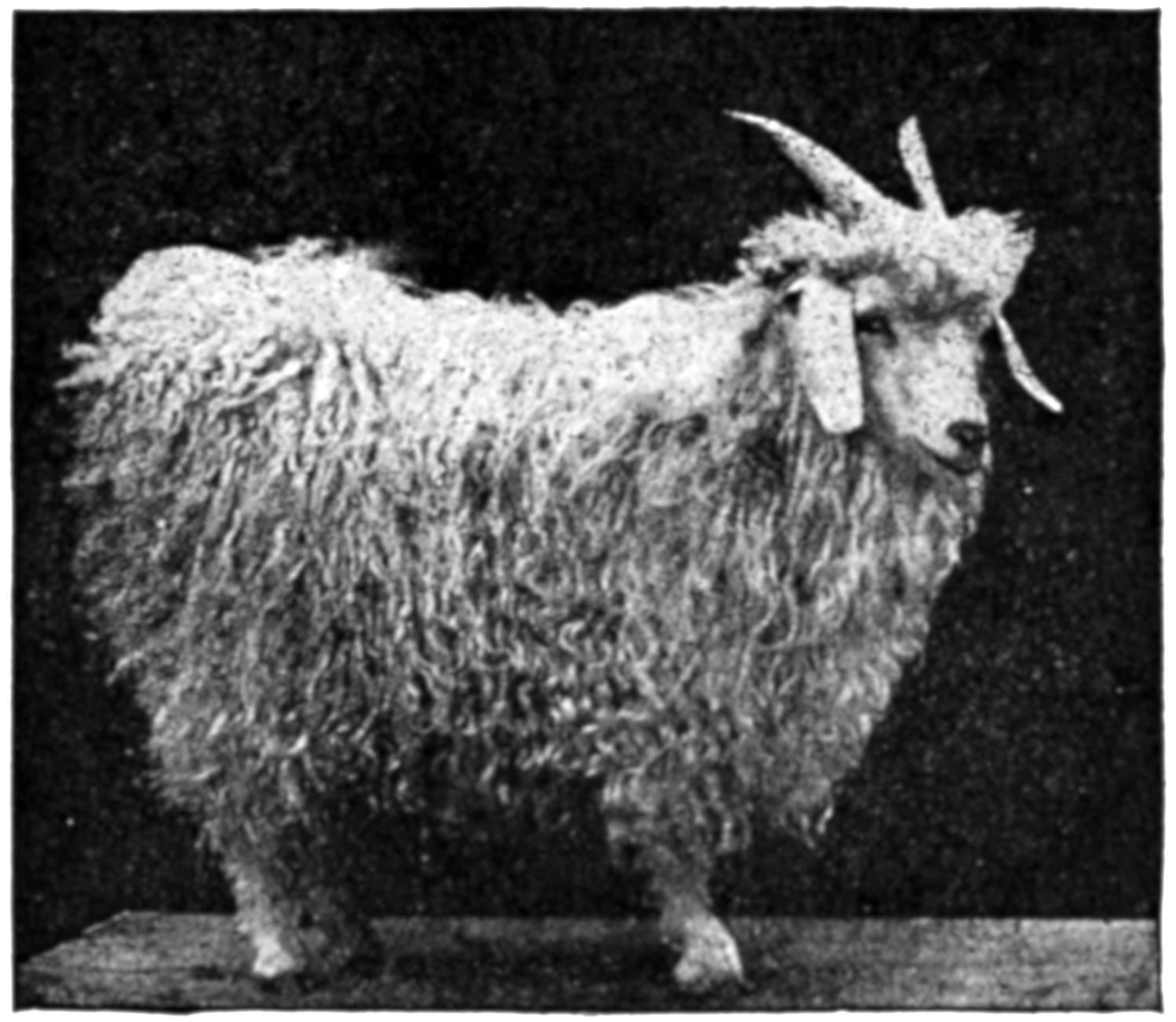
Fig. 80.—Angora Goat.
From Collins’ Woolen and Worsted Spinning, by courtesy of the American School of Correspondence.
Hair-like Wools. The hair and down of goats, camels, and other animals are also used in the wool industry. (See Chap. X, Hair.) For tariff purposes they are included under one of the three classes—Clothing, Combing, and Carpet—according to their characteristics. (See Classification of Wools, below.) The Angora goat (Fig. 80) is a native of [130]Asia. The Turks have raised them for two thousand years. South Africa now breeds a larger quantity, and is said to be the main producer. The United States produces them in large numbers in southwestern Texas, New Mexico, Arizona, California, and to a smaller extent in Oregon (Willamette Valley). The Angora goat is valuable for clearing brush from cut-over land. Kansas City is the important goat market of the United States. Bradford, England, is the principal manufacturing center. Fabrics made from the hair of the Angora, called mohair, are very enduring. They are used for cloakings, plush for car seats, astrakhans and other artificial furs, and for dress goods. The skins are often tanned with the hair on and used for coats, muffs, and robes. The Cashmere goat is from Tibet and the Himalayan Mountains. The fleece has long, glossy outer hairs and a soft down of wool, which is shed or combed from the goat in the springtime. It is silky to the touch and grayish in color. The amount from one goat is small. The down hair is used to make the noted Cashmere and India shawls. The Alpaca, Llama, and Vicuña are from Peru and from adjacent countries in South America. The hair of the Alpaca resembles the mohair, but is less strong. The animal thrives in a small area of that continent. The Llama hair is coarse and shorter than the hair of the Alpaca. The animal is gradually disappearing. The Vicuña gives an exquisite, fine, soft fiber about two or three inches in length. It is used at times in the United States. The original Montagnac overcoatings contained this wool. The outer hair of these goats is used largely for plushes, lustrous fabrics, linings, and carpet yarns. The down is used by itself or combined with wool for coatings and dress goods. Camel’s Hair from Russia and China is strong and coarse and is used when strength or special effects are desired. The down beneath the hair is very soft and varies in color from yellow to brown, the average length being about 2¹⁄₂ inches. Horsehair, Cattle [131]Hair, and Hair of the Common Goat are all used. The manes and tails of horses are used as the filling in haircloth, which is used in tailoring as a stiffener. Cattle hair and goat’s-hair are often blended with wool waste, reworked wool or cotton, and made into yarn for low-grade tweeds, horse blankets, rugs, and carpets. (See Chap. X., Additional Fibers.)
Growth and Care of Sheep.
—The best fleeces are obtained from a wise system of flock husbandry. Success must be attained through careful methods of breeding, feeding, shepherding, shearing, packing, and marketing. Sheep ranches which are intelligently conducted have increased in number. The health of the sheep is quickly affected by climatic conditions, food, water, and incidents of life. When these factors are good a natural oil or yolk secreted in the skin gives softness and vitality to the wool. A very cold winter, though hard on the sheep, often develops a heavy fleece, but when the climate is harsh and the rainy season prolonged, the yolk is apt to be washed out, consequently the fiber grows unevenly and is likely to be brittle. Wool from poorly bred sheep is apt to be tinged in color and does not spin well; the dead hair will not take the dye, and cloth made from it wears unsatisfactorily. When the climatic conditions are good, the quality of the wool and its soundness depend upon the shepherd’s care and knowledge. The very soil has its effect. Sheep crop very close and must be moved frequently. Some soil tends to weeds, and the wool will gather the burrs, or poisonous plants will injure the health of the sheep. The herder must keep his flock calm and well fed, he must see that the feeding is regular between seasons, and must lead the flock to shelter when extremes of heat or storms menace. The well trained shepherd and his ally, the sheep dog, are almost as important in the final condition of the cloth as is the superintendent of the mill with his heavy responsibilities.
The flockmasters of the British Isles have come from long [132]lines of ancestors who took pride in successful sheep raising. Special forage crops are grown for the sheep; the flocks are moved frequently in order to obtain better food and make a wise distribution of manure. Many sheep are raised for breeding purposes, for they are in demand in other sheep-raising countries. The cost of sheep is merged with other work of the farm; meat is the chief aim, and wool is a by-product. The cost, therefore, is easily carried.
Australia is, in general, well fitted for a sheep run. The results show the wisdom of the care and thought given to sheep husbandry. A large number of the grazing lands are leased, but the former possibility of long tenure is passing. The policy of the United States Government is against large holdings of land, consequently the Australian sheep owner had once a great advantage. An Australian sheep station, with its large number of workers on perhaps 10,000 to 60,000 acres of land, is a community in itself. The paddock system of fencing the feeding ground is usual. Under the shepherding system in the United States more labor is required, for one herder and a dog can take care of not more than 1500 sheep, an average number being 600. Rabbits are a pest in Australia, and wire netting boundary fences are used around the pastures to keep them out. The sheep are moved regularly to new feeding grounds. The shearing of sheep in Australia is done by shearing crews who go about from place to place under the supervision of the “classer,” who is responsible to the sheep owner for the work he does. The same crews frequently come to the United States, as the seasons are reversed, and the time of shearing in one country precedes the other. Each ranch in Australia is equipped with a well arranged shearing plant. The sheep are shorn by both hand and machine cutters. The fleeces are classified, sorted, and placed in bags for shipment. The bags, if made of jute, are carefully singed inside so that no fiber will get into the wool and injure it for manufacture. The kind of [133]wool, its grade, and the name of the station are stenciled on the bag. A buyer can thus know from what station his wool comes.
In the United States the herding or shepherding system is in general use, which makes a high cost per capita for the sheep. The Northwest has long cold winters, and the sheep have to be brought to the ranch to be fed and protected. The bulk of the flock is sometimes lost by cold, by storms, by poisonous plants, by predatory animals, and other causes. Water is often scarce, owners are fencing in their water supplies, and conservation of forests prevents the herder from grazing his flock at will. On the great western ranches huge flocks were once common, but the number owned by one man is less now than formerly. The flocks are composed chiefly of ewes. A band under one herder is usually about 1250 ewes and their lambs. The bands vary in size from 1200 to 3000. After the lambs are weaned, as many as 3500 ewes can go in a band. When a ewe is too old for shearing she is fattened and sold for mutton, and the wethers are sold when young for the same purpose. The shearing life of a sheep is about five years.
Herders, camp tenders, shearers, and extra laborers are required on a sheep ranch. Provisions, reading matter, and other necessities are carried to the herders by camp tenders, who come once in several weeks. The sheep wagon, also, is moved when necessary by the camp tender.
The work of shearing begins very early in the spring in Mexico and the southwestern part of the United States, and gradually extends to the north. In some states the sheep are shorn twice a year, because they thrive better when not too heavily burdened with wool in warm weather. There is still much carelessness in shearing, and the skin of the sheep is often badly cut. The shearing sheds, the equipment, and the methods of shearing and packing are crude and inadequate compared with those of Australia. The sheds are [134]long buildings with shafting run by a gasoline engine. Machine shearers are placed at regular intervals (Fig. 81). The rolling and placing of the fleece are far from satisfactory. Instead of specially constructed tables, such as are used in Australia, the fleece is rolled on the floor or ledge, and these are frequently dirty. Sisal strings are still used to fasten the fleeces, but paper strings are being urged. Some of the wool packs are of jute, and the small fibers get into the wool, which is not recognized until after the cloth is woven. Both the sisal and jute do not take the wool dye, therefore ugly flecks appear which have to be removed by the burlers or final finishers. (See Chap. VI., Burling and Mending.)
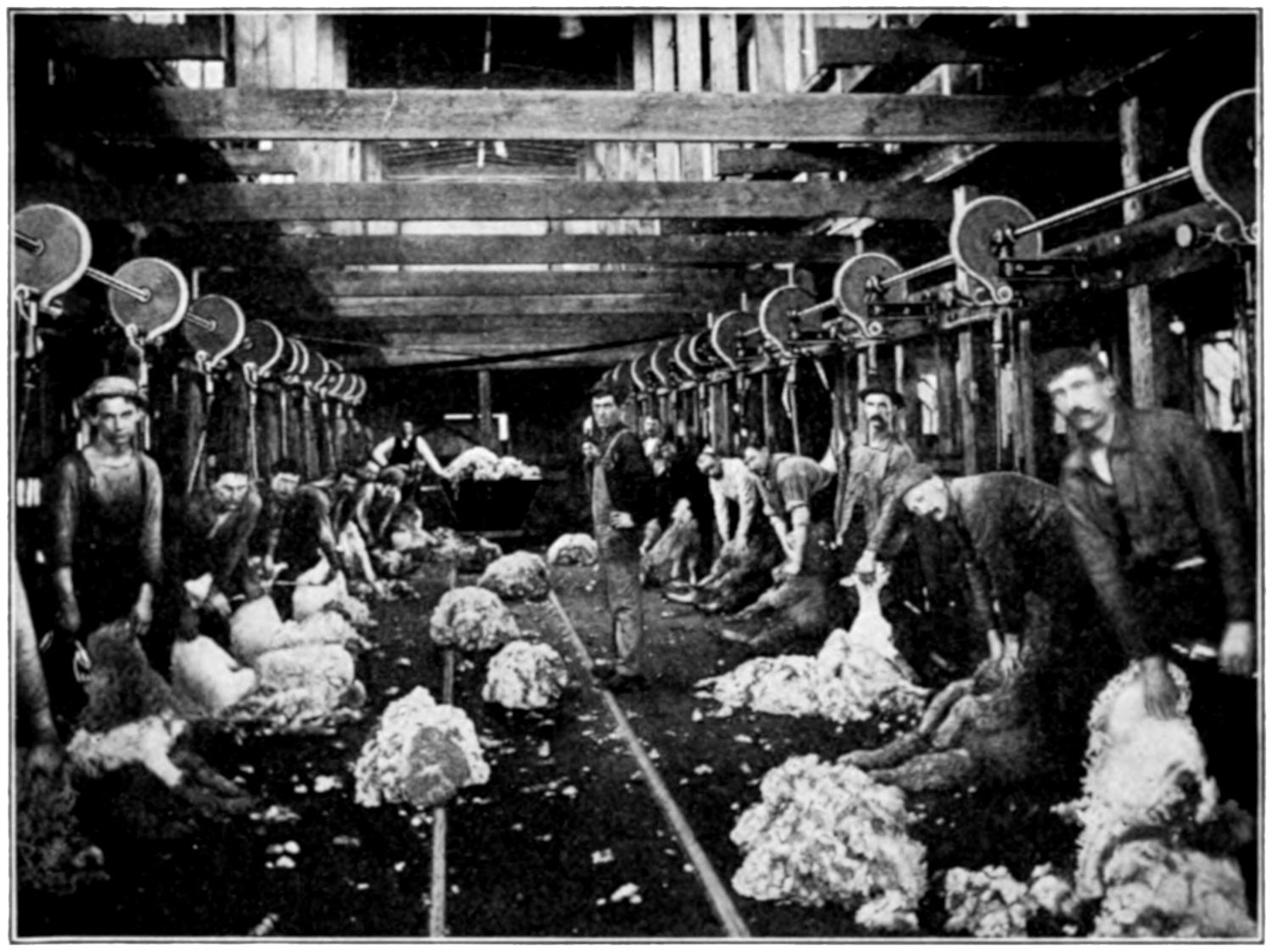
Fig. 81.—Machine Shearing.
Courtesy of the Chicago Flexible Shaft Company.
The fleeces are taken to the wool packer (jamber), who sits on the top of a framework like a very high stool. A long bag hangs down in the middle of it, and there is a shelf at one [135]side to hold the fleeces handed to him. He drops them into the bags and treads them down. One bag holds about forty fleeces, and weighs from 150 to 300 or more pounds. In 1923 the weight of the fleece averaged 7.3 pounds, and the shrinkage was about 59 per cent.[7] The packing of like kinds of wool together and adequate classification of it are needed.
[7] Annual Wool Review (1923) National Association of Wool Manufacturers.
Better methods of branding sheep are needed. After shearing, the owner’s name is branded on, usually with paint. As the wool grows the name remains on the tip of the wool. The painting on of the name is a trial to the manufacturer, for it has to be cut away or the wool is spoiled. Better methods of marking have been suggested, for instance the use of a soluble fluid instead of paint, so that it can be removed readily. Sometimes the brand is placed on the best part of the fleece, causing considerable loss, especially if carelessly made, when drippings injure other parts of the fleece. Territory wool is apt to have brands of paint which sometimes cause a loss of sale in the best market.
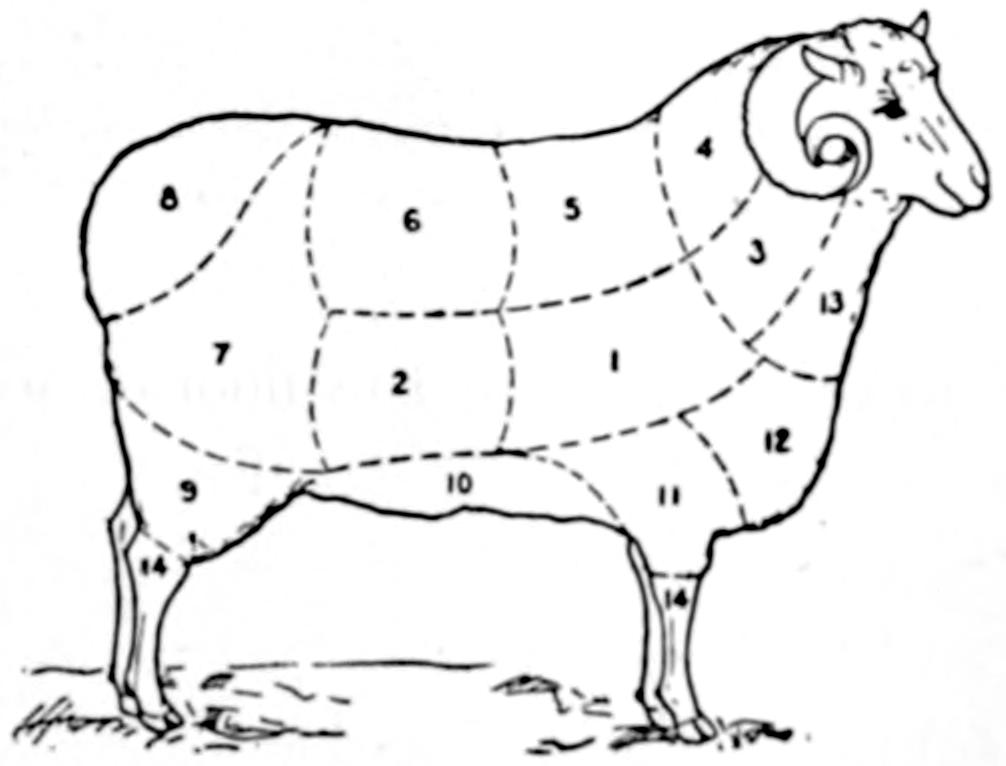
Fig. 82.—Position of Sorts.
From Collins’ Woolen and Worsted Spinning, by courtesy of the American School of Correspondence.
Varieties of Wool on One Sheep.
—A fleece is far from being equal in value in all parts (Fig. 82). It differs in length of fiber, fineness, strength, working quality, and shrinkage. These sorts are used for varying purposes, and bring higher [136]or lower prices. A fleece is named from the most representative wool on it. The best wool is on the shoulders; the sides are next in value, and the top of the back is similar in quality but not quite so good. The back of the sheep from the tail down gives the coarsest wool called the britch. Under the body the wool is short, irregular, stained, dirty, and apt to be tender. The upper part of the neck is usually faulty in growth. The lower legs give an inferior wool which is short and heavy with impurities. The head, chest and neck have stiff, coarse wool, often very dirty. The fleece of a Merino sheep is more apt to be even in value than a crossbred or a long-haired sheep. Good wool grows on tender flesh, consequently good wool and good mutton come from the same part of the sheep. Some mills use only one class of wool from a fleece and sell the remainder, whereas others can make use of the entire fleece except the skirtings. Australia sends her wool to us with the poorer parts removed, but the American clip is usually unskilled.
Classifying and Grading.
—Classifying should begin on the farm or ranch, and does in the most up-to-date ones. In some cases wool is bought by the mill directly from the growers, but the greater amount goes to a warehouse or some pool organized to sell the growers’ wool. The wool is placed in bins where the buyers can see it. The warehouse or pool aims to grade sufficiently, so that unnecessary sorting does not have to be done at the mill. The wool is graded without untying the fleece, according to the fineness of the wool in the bulk of it, and the length of staple; that is, whether it is a clothing or a combing wool. Some wool is “off grade” on account of the amount of dirt, burrs, straws or seeds contained in it, and is termed “unmerchantable.” Tender wool, patches of white, black or gray in it, kemped or cotted wool will ruin the salable quality. Wool from diseased sheep is rejected. If it were not for the grading or classifying at the [137]warehouse, the mill would receive much wool which it could not use and would have to sell again.
Variations in Characteristics and Qualities of Fiber.
—Wool fibers differ widely in their nature. Some are short, soft, crimpy, and covered with minute scales which usually draw together or felt in moist heat, but at times are without the felting quality. Other wools are long, harsh and hair-like, with only imperfectly developed scales. If the scales are very close together the fiber is stiff, but when uneven in growth and arrangement it is wavy or crimpy. Some wools spin to very fine counts or numbers, whereas other wools make a coarse yarn. (See Chap. XI, Physiology and Structure.) In the natural condition sheep grow two kinds of hair, a long stiff fiber called beard, and a softer, more crimpy fiber which is the true wool. Domestication and cultivation eliminate the coarse fibers. There should not be coarse hairs or kemps in the best wool. Kemps are fibers with a dense, shiny appearance. They remain uncolored in dyeing, or reflect the light differently from other fibers, and thus make a blemish in the cloth. They are sometimes found even in the best wool, but are more likely to appear in sheep that have not been well bred or have lived a rough life. The kemp is often shorter and larger than the wool in the rest of the fleece. It is only when the environment and life of a sheep are satisfactory that the important qualities of trueness of breed, soundness of fiber, strength, elasticity, length, softness, and white or bright color are attained.
Properties of Wool.
—Absorption of Moisture. Wool is very hygroscopic, that is, it is capable of slowly absorbing a large amount of moisture, and holding it between its cells and in the very center of the cells. Under ordinary conditions it takes in between 12 to 17 per cent of its weight, but when exposed to very damp air it will absorb as much as 30 to 50 per cent. Those who wear great coats of wool have perhaps noted the increase of weight when they have been exposed [138]to a very damp atmosphere. The weight of a given amount of wool will vary under different conditions, which will affect the price. Deceit can be practiced so that a higher price may be obtained for the wool, hence conditioning houses have been opened in wool centers where the wool can be tested. The standard weight of a given lot of wool can be found and also the condition of the wool.
Felting or Shrinking. The outer layer of the wool fiber consists of flattened scales (cells). In some kinds of wool they are very numerous. These project outward and overlap each other; they are called serrations and are composed of gelatinous material which softens under heat and moisture. This characteristic is made use of in some classes of goods which are felted and later finished by napping and shearing, making a satiny surface to the cloth as in broadcloth. The cloth is loosely woven and in the fulling mill may contract 30 per cent to 50 per cent in length and 75 per cent to 80 per cent in width. The fabrics are not usually shrunk more than 15 per cent to 25 per cent. Merino wool is in demand for making felted cloths.
Grease, Suint, and Foreign Matter. Natural grease, called yolk, is on the wool fiber, which keeps it from matting together on the live sheep. The grease comes from glands in the skin around the hair follicle and is insoluble in water. Some wools are so full of grease and dirt that they lose heavily in weight when scoured. The absence of grease in wool comes from poor vitality in the sheep—from old age, lack of food, or disease. Cotted or matted wool is of little worth commercially. Suint or dried perspiration is also found along with grease. It contains potash salts which are valuable, and efforts are made to save them in the cleansing tanks. They are soluble in water.
Shrinkage. The amount of loss in weight due to the removal of foreign matter in scouring wool is important to know, and very difficult to estimate. The term “shrinkage” [139]has been given, but must not be confused with the quality of felting or shrinking (drawing up in a warm moist atmosphere) which is inherent in many short staple wools. The fine grades of wool generally lose more weight than the coarser. The loss varies from 25 per cent to 80 per cent in the wools in the United States. (See Appendix, Section II.) Wool is bought usually “in the grease” (that is, the wool is as it was on the sheep’s back), but the price paid for it is based upon the buyer’s estimate of the weight it will be after scouring. The method is increasing in England, when the wool arrives at a warehouse and is graded, to send a sample to a conditioning house in order to have the shrinkage determined by testing it. (See Chap. VIII, Conditioning.) The weight of a given lot in the grease is found, the wool is scoured and again weighed. Shrinkage tables have been worked out to aid buyers, by which if their estimate of shrinkage is correct, they can tell what price the wool should be.
Luster. The scales of some wools are regular and smooth, and fit together closely, reflecting the light. The long staple wools have this quality more than the short staple. By the use of chlorine an artificial gloss can be given. (See Chap. XII, Chlorinated Wool.) Careless breeding decreases the luster in wool ordinarily bright.
Softness or Pliability. In the Merino and other fine wool sheep the scales fit closely and have projecting points. The fiber is very pliable and soft in feel.
Affinity for Dyes. (See Chap. XIII.) Wool has affinity for dyes in general. It is dyed in stock, in the slub, in the yarn, and in the piece. In wools containing kemps the dyeing is unsatisfactory, for the kemp does not take the dye. Some wools have black hairs appearing at intervals, which injures the appearance of the dyed cloth.
Tensile Strength. Wool is high in tensile strength, although the quality varies in different parts of the fleece, in different classes of wool, and with the size of the fiber.
[140]
Elasticity. Natural wool is very elastic, as may be noted if a lot of it in the raw state is pressed in the hand. Elasticity adds to the strength of cloth, and to its comfort as a covering for the body, but this quality is impaired by careless manufacture or laundering. An instrument called the dynamometer or cloth tester is used to test wool for strength and elasticity.
Electricity and Heat. Wool is a good generator of electricity and a poor conductor of both heat and electricity. It is excellent for clothing where warmth is needed, for the heat of the body is not carried away as rapidly as it is in some other textiles. High temperatures make wool harsh and brittle. Heat makes the wool fiber expand, and moist heat causes the fibers lying near each other to felt together. (See Chap. XV.)
Color. Wools that will scour white are in demand. It is this quality which the buyer is looking for in wool for the best uses. Wools yellow with grease and yolk are not desirable, for they are whitened with difficulty. If packed damp, they are apt to become yellowish from mold, and the value for manufacture is lessened. Some soils stain the wool and the color is hard to remove.
Classification of Wools.
—There are, it is stated, about two hundred breeds of sheep, and the wools from them are graded according to diameter and length of fiber. For tariff purposes foreign wools, imported into the United States, are classified, according to the breed of sheep, into three groups:—
Class I. Clothing Wools, also called carding wools, are the short-staple fibers from full-bred Merino sheep (Fig. 79) or the higher crossbreds (one-half to five-eighths blood). These wools come largely from Australia, New Zealand, and the western and central part of the United States. They are carded and spun on the mule frame, and the appearance of the yarn is soft, fuzzy, and lofty. The woven or knit cloth is frequently felted or shrunk so the weave is obliterated. Reworked [141]wool stock is frequently used in blends for these cloths. The fabrics called woolens are soft, elastic, dull in finish and may be very enduring. Typical woolens are tweeds, cassimeres, and broadcloths.
Class II. Combing Wools, often called staple, are long, hair-like wools coming from British sheep such as the Lincoln, Leicester, Cotswold, and other sheep; the lower crossbreds (one-half to one-quarter blood); the camel, the Alpaca, Angora goat, and other like animals. These wools come from Great Britain, South America, the United States, and other countries. They are carded and also combed until the fibers are parallel, and twisted closely on the upright spinning frame. The appearance of the yarn is smooth, hard and bright. The cloth, called worsted, is usually unfelted, showing the weave more or less distinctly. The appearance is firm, the pattern clear and the wear may be excellent. As wool is not plentiful, some of the third class, or carpet wools, are at times blended to reduce the price.
Under the head of worsteds is now included another class of combed wools, for the invention of special machinery (the French or Heilman comb) has made possible the combing of the shorter or clothing wools. Staple under 2.5 inches can now be combed, and the longer clothing wools and the shorter combing wools are taken for this purpose. The term “French Combing” is applied in the market to half blood or higher quality wools—the length of fiber being about 1¹⁄₂ inches, whereas the length of the long combing is 2¹⁄₂ inches or longer.
Class III. Carpet Wools include many varieties of coarse, long wools. They are imported from China, Turkey, and other eastern countries. Inferior sorts in the Combing and Clothing classes are also entered under Carpet Wools. Some of the coarser domestic wools are used for this purpose, but, in general, the United States imports its Class III wools. The stock is used principally for carpets, rugs, and other [142]floor covering, although at times it is used in worsted suitings. It is combed before spinning, hence is a worsted yarn.
Other Market Classifications.
—The following classifications are also used in the United States market:—
Domestic Wool. This term is employed to cover those wools grown on farms east of the Rocky Mountains.
Fleeces. Wools grown in the eastern central part of the country (Ohio and adjacent states). They are largely fine wools, 2.5 inches in length, free from dust and dirt. The term Delaine is used when the staple is over three inches in length. This class of wool is used largely in the French system of spinning for high priced dress goods, flannels, crêpes, and Bedford cords.
Territory Wool is used for wools grown in the western part of the country. This term includes many varieties of wool, fine and coarse, such as the pure blood Merino and various crossbreds. The Texas, California, Oregon, Arizona, and New Mexican wools are often listed under the name of the state and not under “Territory Wool.”
Merino Wool is short, fine, crimpy, and covered with fine scales or serrations. (See Wool- and Hair-Bearing Animals.) It is full of electricity. The best wool in the fleece is carded for fine woolens such as broadcloths, or if long enough, is used in French Combing for voiles and soft dress goods. The next grade is used in blends for less expensive dress goods, and the lower grades and “skirts” are often combined with cotton and used for cheaper fabrics. Some of the Australian and the Saxony (Germany) Merino wool spins to 80s and above, but 64s to 74s is as high as the American wool usually spins. It is used for both carding and combing, according to its length.
Crossbred Wool. The market terms to indicate the fineness of the wool are in fractions, such as one-half blood, which spins to 58s or 60s, and is used for worsteds and serges; three-eighths blood, which spins to 50s or 56s, and one-quarter [143]blood. The words high or low are often used to indicate finer or coarser; for instance, low one-quarter blood spins from 40s to 44s, but high one-quarter blood spins from 46s to 50s. The fractional terms refer to fineness rather than to an actual count of Merino blood content. Crossbred wools below one-quarter blood are about twelve inches in length, and are fairly strong, lustrous, and harsh; the felting qualities are low. The wool is used in mackinaws, friezes, carpets, and sweaters. The medium crossbreds of one-quarter to three-eighths blood have wool of fair felting quality, which is strong, lustrous, and soft, and is about ten inches in length. The fine crossbreds of three-quarter and one-half blood are about six inches or less in length and are soft, strong, fair in luster, and felt well. The wool is used in underwear, fine worsteds, and woolens. The crossbred wool has less electricity and oil in it than the Merino.
Braid or Luster Wool is obtained largely from pure-bred, long-haired English sheep, the length of the wool being from 4¹⁄₂ to 12 inches. The wool is lustrous, for the coarse, smooth fibers reflect the light. It spins 36s to 44s.
British Sheep have long and medium, coarse, glossy, hair-like wool which spins 36s to 40s. The Lincoln, Leicester, Shropshire, Cotswold, and Southdown are examples.
Britch Wool is coarse wool from the hind quarters of the sheep. It is broken and unsatisfactory.
Tag Locks are broken pieces of wool, mill sweepings or fragments of inferior wool.
In Grease and Scoured. These terms indicate the condition of the wool. If in grease, the fleece is dusty and dirty, and weighs from thirty per cent to sixty per cent more than if scoured. If washed on the ranch, the wool is sometimes brittle on arriving at the warehouse, on account of the loss of grease. Before the buyer purchases, it is important that he estimate the amount of shrinkage that is apt to occur in the scouring. (See Shrinkage.)
[144]
Skirting is removing from the fleece the less desirable parts, such as the neck, belly, legs, and the low qualities of the britch.
Varieties of Fabrics.
—The shorter, softer wools are covered with minute scales or serrations, which draw together when subjected to moisture, heat, and friction. This quality, called felting, is utilized in some classes of goods such as broadcloths and kerseys, which have a closely matted surface in which warp and woof are obliterated. The longer, more hair-like wools have little of the felting quality, and are used to make very different cloths in which the weave is distinct. Fancy yarns are made to use for filling, and cotton and silk are variously combined with wool. The wool industry, therefore, includes many varied fabrics of which the following are representative:
(1) Cloth, frequently felted, made from short staple, soft, dull, loosely twisted yarn of carded wool (see carding). Homespuns, tweeds, wool cheviots, some pile goods, blankets and some flannels show the weave, although softened by the short fibers standing on the surface. Meltons, kerseys, cassimeres, mackinaws, friezes and pilot or polo cloth are illustrations of the felted class in which the weave does not show. These fabrics are called woolens and are excellent wearing materials when well made. Many overcoatings are woolens and are frequently double cloth. Woolen yarns are used largely also in knit goods, in hosiery, sweaters, scarfs, and Jersey cloth. Noils, machine wastes, and reworked wool are blended with new wool or used by themselves in woolens, as the short fibers are adapted to the machines. Cotton also is blended with them. Excellent fabrics are thus made at a lower price than if made of all new wool.
(2) Cloth made from carefully combed, usually lustrous, hair-like wools spun into smooth, more or less tightly twisted yarn and woven into such fabrics as corkscrews, hard serges, suitings, clays, diagonals, and gabardine. The term worsted [145]is applied to these fabrics. The weave is distinct, and the “feel” smooth and hard. Some of the worsted cloths are slightly felted to give the surface a softened appearance, as in unfinished worsteds. The soft finished cloths are not quite as enduring as the hard. The latter, however, are apt to develop a shine where the surface is subjected to any friction. The English or Bradford system of spinning is used for the hard worsteds. These cloths are, in general, more popular in the United States than woolens, but fashion sometimes decrees the use of the latter. Reworked wool cannot be used in worsteds, for the machines are not adjusted to the short length. The better carpet wools are sometimes used in worsteds to lower the price, and cotton warps are found in some fabrics for the same purpose.
(3) Another variety of worsted cloth is made from combed, short staple wool. The method is called French Combing on account of the country of its origin. The yarn is spun on the mule frame, and is soft, lofty, and smooth. The hard worsteds are spun on the upright frame. The French combed yarns are used for classes of dress goods which drape softly, and in some knit goods. Soft finished serges, tricotines, challies, and wool crêpes are made from this yarn.
(4) Novelties. Fabrics are often made of worsted warp and woolen filling; some broadcloths are thus constructed. Silk yarns are inserted at intervals to give attractive effects to other cloths. Fancy yarns are made with knots or irregularities which give the material a flecked appearance. Special machines give different surfaces to the cloth, such as in embossed plush or in chinchilla. Silk and wool poplins and flannels are manufactured for dress goods and shirtings.
(5) Knit Goods. Cloth and overcoatings are knit of woolen or worsted yarns. Sometimes these are napped to give pile effects. They wear well and are less expensive than woven goods of the same weight. (See Chap. V, Knit Goods.)
(6) Union Goods. Some varieties of cloth have cotton [146]one way, usually in the warp. Alpaca and brilliantine are examples of this. Many serges have a cotton warp. When these are cheaply made the dye does not always hold well and the material will cockle, if not well crabbed. (See Chap. VII, Finishes.) Shepherd plaids often have cotton both ways of the goods, alternating with the wool. Pin-striped worsteds have the colored stripe of cotton in lower priced goods. Gloria for umbrella covers is made of cotton and wool. Silk noils and rayon waste are also used to give “feel” or brightness with some classes of wool dress goods.
(7) Floor coverings and upholstery are made of worsted yarn and woolen yarn is often used for the filling. Some upholstery materials have a backing of linen, jute or cotton yarn. Brussels carpet has a loop face of worsted yarn and a linen back. The cutting of these loops makes a velvet-like surface as in Wilton carpets. Plushes made of hair-like wool are used in automobiles and railroad service.
(8) Pile Fabrics. Velvet and plush effects for cloakings are made like Brussels and Wilton carpets, with an extra warp or filling yarn over a backing of wool or of another fiber. (See Chap. IV, Special Fabrics.) The pile may be cut or uncut. Bolivia is a pile fabric with the extra surface yarn in the filling.
(9) Napped Fabrics. The terms pile and nap are often used interchangeably, but the processes are different. A napped cloth is woven like a melton or broadcloth of woolen yarn, the pile is raised and shorn to any length desired. Velour is a napped cloth, but the term is often used to cover pile fabrics also.
(10) Felt. This cloth is used for industrial purposes of many kinds rather than for clothing. Masses of wool fibers are pressed and felted together with or without being woven. The fabric may be hard and boardlike or elastic and soft.
Pulled Wool, By-Products of Wool, and Substitutes for Wool.
—The world’s wool supply is insufficient to make all [147]of the cloth demanded, consequently new wool in the raw state is costly and wastes from the industry and substitutes for wool are used, that cloth may be sold at a price within the means of the majority of people. Cloth prices are high, and will continue so all over the world, for economic reasons, yet this fabric is absolutely essential for warmth and endurance. It has been stated that if the world’s new wool supply were divided evenly among those who are, for climatic reasons, obliged to wear it, there would be for each about enough to make a modern bathing suit. That is, fourteen ounces would be the individual portion, whereas the usual per capita amount runs into many pounds. Few could afford to wear this valuable textile if it were not for the use of by-products and substitutes, thus supplementing the wool supply and reducing the price of cloth. Wool wastes are seldom used without being blended with new wool, cotton, or pulled wool. Cotton at the present time costs more than some wool wastes. Cloth containing reworked wool sells at lower prices than when made of new wool.
The manufacture of reworked wool began in the United States about 1850, although it had started in England a quarter of a century before. It was well received in this country, and, before many years had passed, there were a number of establishments engaged in this work. The use of wastes has proved an economic blessing. During the great war the United States saved $1,000,000 a month by its system of reclaiming equipment left on the battle fields or at the billets, and the saving of wool by-products was an important part of this reclamation.
The following fibers are used in the wool industry in addition to new shorn wool:
Pulled Wool
is removed from the pelts of dead sheep. It is a by-product of the slaughtering houses, and pulleries are conducted by these houses. The wool is removed from the skin by one of three processes: sweating, lime, and depilatory; [148]the latter being preferred because it causes less injury to the skin and to the wool. The most important pulleries in the United States are in Chicago, St. Louis, New York City, Kansas City, and St. Joseph. The chief center of this industry is at Mazamet, France; pelts being shipped there from all over the world. Pulled wool is inferior to fleece wool of equal grade and origin. It is deficient in spinning and dyeing qualities. The yarn lacks elasticity. The fiber is of various lengths and grades, as all varieties of sheep are slaughtered for meat. Very short stapled wool from sheep that have been slaughtered shortly after shearing is called “shearlings.” It is used largely in the making of felts and hats. Pulled wool is classed with both combing and clothing wool, according to its condition. It is used in low grade cloth, blankets, soft twist knitting yarn, felts and hats. It is not closely graded, but is classified as AA, A, B, and C. It is listed with new shorn wool.
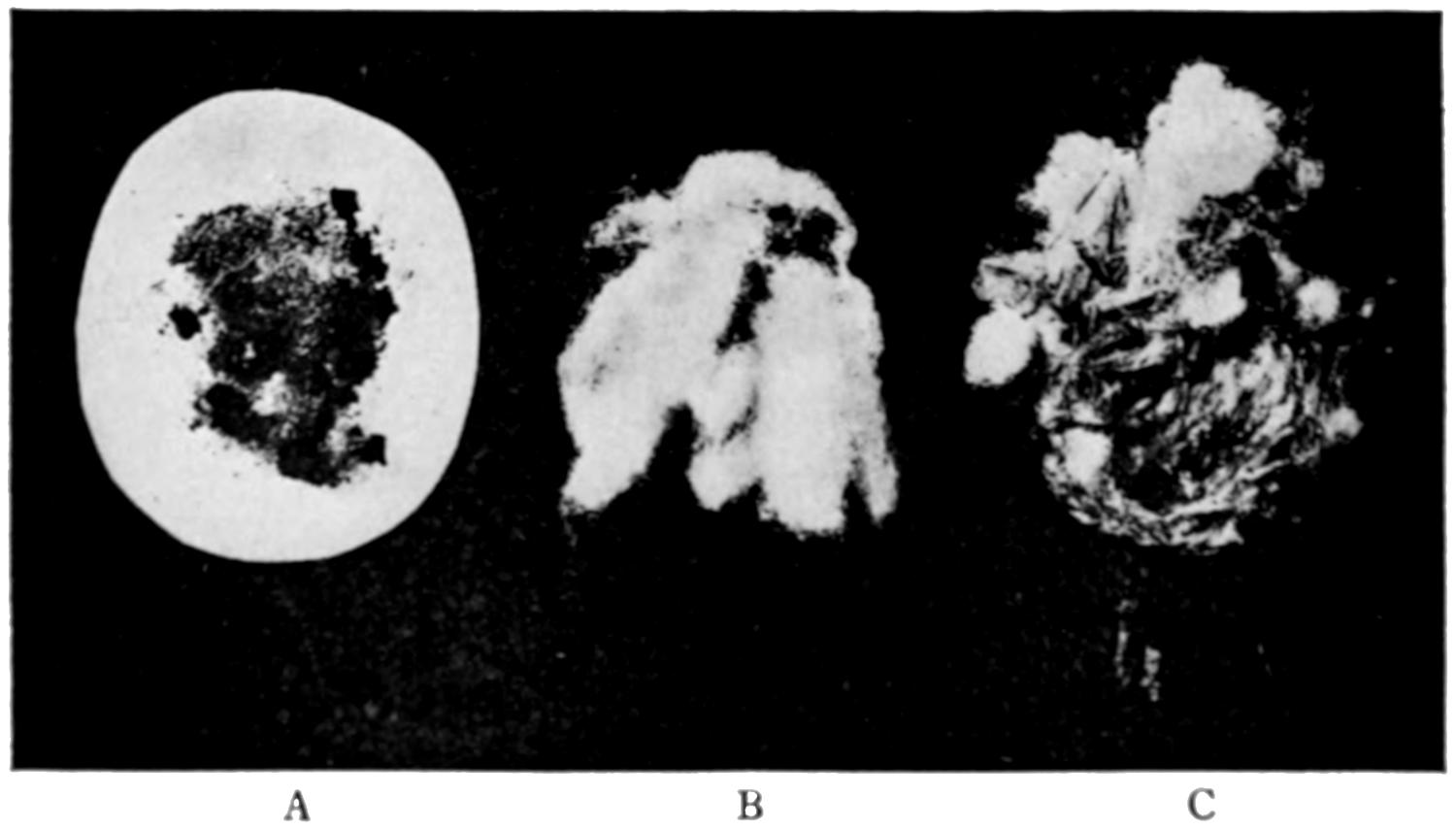
Fig. 83.—A, Burr Waste. B, Noils. C, Card Strips.
By-Products of Wool.
(Fig. 83)—Mill wastes are utilized by blending them with new wool, and a regular business is conducted in buying and selling them. Some of them are used in the mills where they are made, by returning them to [149]former machines to pass through again. The following are listed on the market: Soft wastes, which come from various machines preceding the spinning; fly and burr waste, woolen and worsted card waste are representative. These sell at the same price as scoured wool of an equal quality. Hard wastes are yarns and hard ends from spinning and winding frames and from looms. They are put through a Garnet machine to release the fiber. Worsted yarns yield excellent wastes which are used in the woolen industry. Noils are short fibers discarded from the comb in the worsted industry. The long combed fiber is called “top,” which is spun into worsted yarn, while the noils are used in the woolen industry. This is a very desirable product. Flocks are short ends from the gigging or napping machine. The product was formerly much used to give weight to the back of fulled cloths such as melton and broadcloth. They are used largely in flock wall paper.
Reworked Wool (Shoddy)
(Fig. 84) is fiber reclaimed from worsteds, softly woven woolens, or knit goods, by reducing the cloth to fiber again in a shoddy picker. Much unjust prejudice is felt against this worthy product, for which the term “shoddy” is largely to blame. The average consumer, who is ignorant concerning wool manufacture, believes it to be a worthless, weak material masquerading as wool. It is also asserted that it comes from filthy places and is not wholesome. These statements are false, for reworked wool is taken largely from new clips of cloth from ready-to-wear establishments, and is “all wool.” The United States only uses the best classes of it, whether imported or coming from this country. All vegetable matter is carbonized out, so the product is a little shorter and weaker than it was originally, but may be much stronger and more satisfactory than many kinds of new wool. It is absolutely clean and sanitary. Far from being worthless, it is extremely valuable, and enables the consumer to obtain warm, enduring, attractive cloth at [150]much less expense than if it were all new wool. The untrained consumer does not realize how much broken, short, and filthy wool comes from the sheep (so-called “virgin” wool), which is cleansed with soap and water. So weak is some of the “virgin” wool that reworked wool is added to it to strengthen it. The term “reworked wool” better describes the fiber than “shoddy.” “Reclaimed wool” and “regenerated wool” are also used. In France, where it is much used, it is called “renaissance wool,” meaning reborn. The use of reworked wool is comparable to the service of scrap iron or scrap rubber, both of which have a permanent and accepted place in industry, and are valuable additions to the comfort and economy of the world. The United States exports its poorest rags and mungo to other countries, and imports rags of high quality. This can be seen by the market prices for each. The average value of exported rags in 1924 was 6.6 cents per pound, but for imported rags it was 24 cents per pound.[8] The price of new wool is much higher even for poor grades. The amount of reworked wool used in comparison with new wool is said to be about one of the former to six of the latter. The United States demands fumigation of all rags that come from the East, to safeguard against the possibility of infection. These rags are less apt to be in good condition than the European.
[8] Annual Wool Review of National Association of Wool Manufacturers, March, 1925.
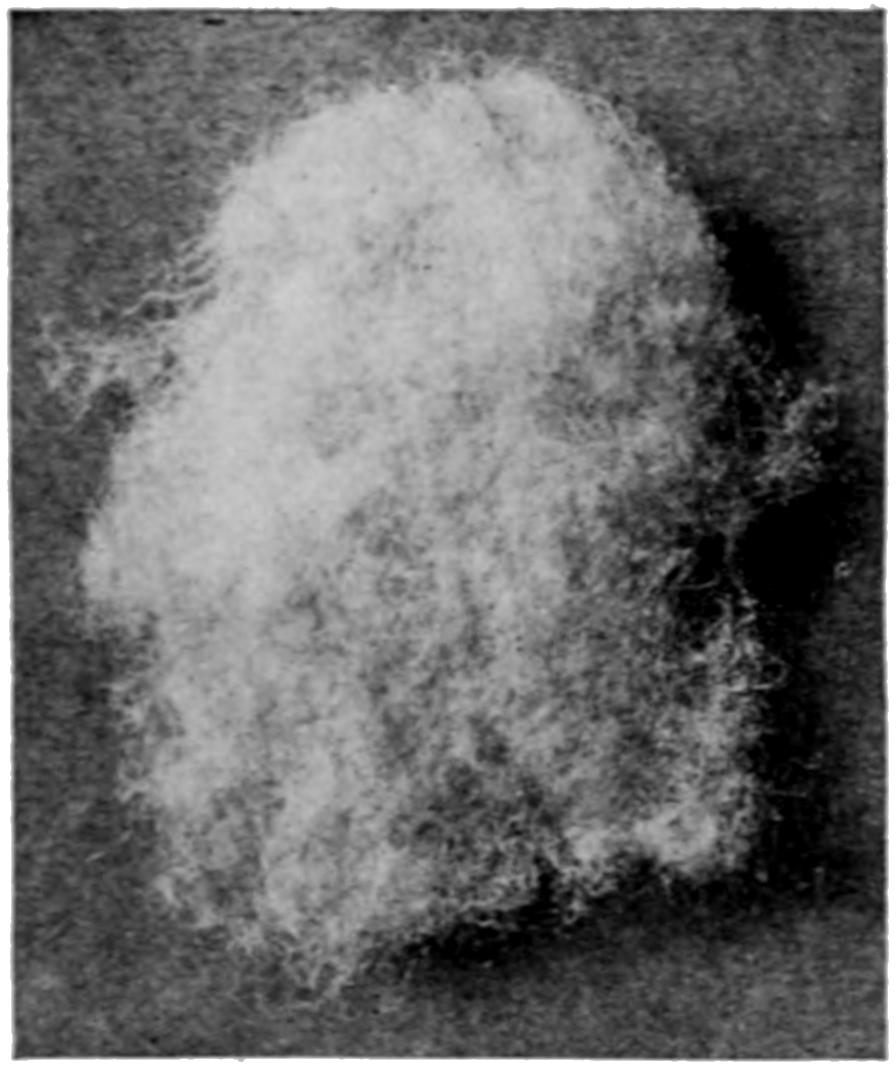
Fig. 84.—Reworked Wool from Sweater Material.
[151]
Reworked wool is used in woolens but not in worsteds. Short staple fiber is used in the former, and the woolen machinery is adapted to it. This is not the case with worsted machinery, which can only take a longer fiber. The people of the United States, in general, show a preference for worsteds, although, at times, fashion favors the use of woolens in flannels, tweeds, and homespuns. As a matter of fact, more than half of the manufactured cloths are worsteds, and a large percentage of the woolens have no content of reworked wool. Reworked wool is employed in the woolen industry, among other reasons, to reduce price, to produce heather mixtures, to save the price of dyeing, to form the plaid backing of heavy coatings, to add strength and “feel” to weak, harsh new wool, and to make warm rugs and blankets. The better classes of reworked wool give a softer and more pleasing product than many classes of new wool.
The method of preparing rags and clips for use is sanitary. This is done largely in special establishments, although some mills prepare their own. The following processes are usual: Sorting according to grade and color. The rags are carefully looked over for cotton, and those containing silk must be separated, for if they go into the all wool stock the cloth made from it will show the silk on account of its brightness. White and colored rags are kept in separate lots and sold to manufacturers, thereby saving dyestuffs and processes of dyeing. Carbonizing is done chemically, as it is necessary to destroy all cotton, burrs, and dirt. The system has been based on the general fact that acids will destroy vegetable matter and caustic alkalies will destroy animal matter. The finishing or dyeing of the original cloth must be taken into account, inasmuch as in the processes used there may have been left a preponderance of acid or alkali. Many methods have been tried, but the sulphuric acid process is most generally in use. This destroys all vegetable matter, and leaves the wool in its previous condition as to serrations, feel, and [152]other qualities. (Chap. XIII, Carbonizing.) Drying the rags follows, first by a whizzer (hydro-extractor), and then in a drying chamber, in which the heat is intense enough to destroy the vegetable matter but not the wool. The rags are now crisp and the vegetable matter is in the form of dust, which is removed by a willow or duster such as is used for cleaning other raw material. Washing in a solution of soda ash by a special machine removes any remaining dust and makes the fiber absolutely sanitary.
Men’s blue, black, and brown cloths are usually fast dyes, and the carbonization processes have little effect on the color. After they are reduced to fiber they are sold to manufacturers to be combined with dyed wool. One color may be used, or a number of colors may be made into yarn for heather mixtures. Women’s dress goods are lighter in weight and brighter in color and are apt to fade in the carbonizing. The color may be stripped from them, or they may be redyed before the picker is used. White goods, after carbonization, are passed directly to the shoddy picker.
The method of reducing the clips and rags to fiber again is by means of a machine called a “shoddy picker,” which has a revolving cylinder covered with spikes which catch the cloth and reduce it to a soft, short mass. It is said that five hundred or more varieties of cloth are made use of in the industry. In a very general way it may be stated that the following are found on the market: (1) Trimmings, clippings, and left over scraps of new material accumulating in tailoring and garment making establishments and head and end pieces from the looms (headings). (2) Soft woolens (loosely woven cloth and knit goods which are unfelted). (3) Skirted goods (suits, coats and cloaks of hard twisted worsted), and (4) rough cloth, the latter being used principally for roofing felts and wall papers. The term “shoddy” is sometimes used to cover Mungo and Extract wool also. Mungo (Fig. 130) is fiber reclaimed from hard felted and hard woven cloths. It is [153]considered low grade and is largely exported, but is sometimes used in cheap, heavy blankets. Extract wool is fiber from cloth which has had some content of cotton. The cotton is carbonized before the wool is used.
It cannot be honestly stated that reworked wool is always weaker than new wool, for the latter is frequently more lacking in strength than the reworked wool. The strength of the cloth depends principally on the way it has been constructed and finished. (See Chap. XVI, Endurance of Cloth.) The felting of reworked wool makes it a very enduring fabric. It is usually combined with new wool or with wastes, pulled wool or noils, the blend worked out for each piece of cloth being the result of long experience in the mills. These blends are highly valued. They sometimes contain a number of component materials given in percentages. The following is representative of the content of a cloth, the percentages being omitted: Green Yarn: (1) Green Extract Wool; (2) Dark Green Extract Wool (the extracts 1 and 2 are made from Delaine rags, the cotton being extracted to make the fiber all wool); (3) Russian Wool, Green; (4) China Scoured Green (3 and 4 are scoured and dyed to a shade in the ordinary process of scouring and dyeing). These are mixed together and passed through the card and form a green yarn. Thus the price of dyes and dyeing is saved.
The occupations connected with the collection and preparation of rags for reworked wool have become important. New York City is a center for the clothing trades, and many men and women are occupied in the rag industry. Old clothing, rags, and new clips from the ready-to-wear workrooms are collected. The buttons and seams are cut from the clothing, the cloth is graded according to color and quality, and sold in lots. Rag markets are held in many countries. Batley and Dewsbury, England, are the very center of the reworked wool production. A high degree of skill is used in the making of fabrics composed partly or entirely of reworked [154]wool. Great endurance and a fine appearance are attained. This cloth is imported into as well as manufactured in this country, for the mass of the people need inexpensive yet strong and attractive materials.
Substitutes for Wool
are used in cloth manufacture as well as wool by-products. Expense is reduced and strength is also added. Cotton is used frequently as warp in some fabrics, such as cotton warp serge, alpaca, and mohair. Blankets and some yarns are made of part wool. The so-called Merino underwear is part cotton, the yarn having both fibers in it. There is an advantage in combining cotton with wool in underwear, for it lessens the shrinkage and is more hygienic. Silk noils are also combined with wool to give feel to harsh wool. Reeled silk is also employed with wool in novelty goods, the silk often appearing on the surface.
Summary of Wool Production.
—Statistics concerning the wool supply cannot be taken very literally, as they are made up largely from estimates. The entire wool production is given as 2,720,070,400 pounds.[9] (See Statistics of Wool Industry, in Appendix, Sections I-IV.)
[9] Annual Report of National Association of Wool Manufacturers, 1925.
Australasia is first in production, giving a large part of the wool of the world. Australia has the main supply. The aggregate capital in wool growing is estimated at more than one billion dollars. Tasmania and New Zealand also produce sheep and handle the wool with great care. The crossbred sheep is largely grown in the latter country, for it has a large business in frozen meat, and this sheep is valuable for both mutton and wool.
Europe was second in wool production in 1924. Spain is the original producer of the Merino brand of sheep. The industry has declined in value, but since 1918 has been improving, and in 1924 that country stood third in Europe. Russia was estimated to have the largest clip in 1924, but her production is principally coarse wools used in the carpet [155]industry. The Donskoi sheep has long straight wool. The camel’s hair is used for coarse yarns and bagging. Great Britain is the second in the European industry. Many long-haired breeds of sheep are produced which are especially valuable in the worsted industry. Germany has produced some notable sheep, but has not a large production. The Saxony gives one of the finest wools in the world, spinning to 80’s and above. The French sheep are carefully tended and yield a fine wool, for which good prices are obtained. They run on high-priced land and the cost of production is greater than in England, but the industry is said to be more profitable. The French Rambouillet sheep are a factor in the French combed yarns, and in the success of France in high-priced dress goods. They are popular in the United States, and are found especially in the range states. They are imported also into other countries. They yield a heavier fleece than the American Merino. The sheep industry is not increasing in France. The Balkan States are producing much wool, the sheep being valued for milk as well as for mutton and wool.
South America was third in wool production in 1924. Argentina, Uruguay, and southern Chile are the main wool states. Brazil and Terra del Fuego also raise sheep. The wools vary in grade from very coarse to a moderately fine Merino.[10] The Australian paddock system and also the method of skirting the fleece are used. A native type of sheep, the Lincoln, Romney Marsh, Downs, and numerous crossbreds are found. The flocks are little disturbed by wild animals, and few herders are required on account of the fencing. South America is not likely soon to become agricultural. The cost of keeping sheep is little more than in Australia. Wool manufacturing began in Argentina during the world war on account of the high cost of imported cloth. [156]The Alpaca, Vicuña, and Llama are closely related in type and are native in Peru and Bolivia.
[10] Bulletin National Association of Wool Manufacturers, April, 1924.
North America came fourth in production in 1924, the United States being the chief producer. The growing of sheep began early, the first Merino sheep being imported in 1801. As the country developed the industry passed from the East to the great ranches of the West. Ohio and adjacent states still rely largely on wool production. Some of the other states are growing sheep and lambs for breeding purposes, and still other states are feeding lambs for mutton. The “feeder” sheep, purchased in the autumn, are healthy western sheep, but too thin for meat. They are put into the fields to feed on the stubble, and are excellent for clearing land.
More than half of the sheep of the United States are in the Rocky Mountains and on the Pacific Coast. In many parts of the West pure bred flocks are maintained, and Merino, Rambouillet, Cotswold, Lincoln, Hampshire, and Oxfords are found.
On the 600,000 or more ranches or farms there are more than a million workers in the sheep industry. The pulleries employ about 1000 workers, and in 1918 the rag, noils, and waste industries had 5500 at work.[11] Because conditions surrounding the growing of sheep differ greatly, the costs also vary greatly. The Southwest has suffered less from the scarcity and high price of land than other sections, but has had to spend much on wells and reservoirs. Flockmasters are questioning whether sheep husbandry is as profitable as other farm production, but there are undoubted possibilities of success if the millions of acres of land, which cannot be used for other purposes, are developed. A study of the best way to keep small flocks on farms should result satisfactorily, as it has in England. The cultivation of forage crops for the sheep and also for sale is receiving attention. The costs in [157]the middle west are the highest, but the economic justification offered is that much of the land is only fit for grazing, is not adapted for dairy farming, but must be kept in pasture to prevent erosions.
[11] Statistical Abstract of the United States, 1919.
Canadian Wools (included in the estimate for North America), are largely shorn from English long-haired breeds. They are used in the United States for combed yarns for worsteds. Merinos and crossbreds are also produced. The Canadian output for 1923 was 15,112,000 pounds.
South Africa, once indifferent to wool breeding, is becoming one of the great wool-producing countries of the world. The main yield is from the Union of South Africa, which includes the Cape of Good Hope, Natal, Orange River Colony, and the Transvaal. The sheep are varied in type, but the Merino is dominant. The Rambouillet endures well the dry district in the Cape Province, but the Wanganella (a medium Merino) is the most popular, for it is more profitable for the majority of the wool growers. The farmers are being educated in the proper culling and grading of the sheep, and many Australian methods are followed. Some British breeds are imported, and the crossbred sheep are becoming familiar. The production of mohair from the Angora goat is important.
Asiatic wools belong principally to the carpet wool type (see Classification of Wool, above). The United States depends on Asia, especially China, for wool for our carpet and rug industries. The Bactrian camel in the interior of Asia Minor is valued for its hair, which is shipped to China. The Karakul sheep are natives of Bokhara in Central Asia. The great value is in the pelts obtained from very young lambs, for the wool is then in very close curl. The skins are used for fur garments and muffs, the grades being known as Persian Lamb, Astrakhan, and Broadtail. The color is black. About 1,500,000 lamb skins are exported from Bokhara yearly. The sheep has a black face and long, coarse fleece, which is classed as carpet wool. The production of this sheep has been [158]successful in the United States. Cashmere wool comes from Tibet and the Himalayan Mountains. The fleece has long, glossy outer hairs and a soft under down of wool which is shed or combed from the goat in springtime. It is silky to the touch and grayish in color. The down hair is used in making the noted Cashmere and India shawls.
Wool Marketing.
—Selling the wool clip at auction is practiced largely in some wool-growing countries. The London sales occur every two months and govern the wool prices of the world. Wools from India are sold at Liverpool auctions and some South American wools are sold at open sales in Antwerp. Hamburg, Bremen, Havre, and Marseilles also have auctions. The bulk of the Australian wool is sold at Sidney, Melbourne, Brisbane, Adelaide, and Geelong. The growers find it advantageous to sell in the home market, for there are fewer charges for freight, insurance, storage, and dock than when sending to England. They also get their money for the clip sooner. New Zealand and Tasmania sell their wool largely in Australia. Dealers from all over the world attend the Australian sales. The wool is placed in well lighted warehouses in which the buyer can easily judge the quality. Catalogs are provided, leaving space for entering personal opinions and maximum prices. Some of the Australian growers send their clips to the London auctions. Australia puts up its wool honestly and sells to the highest bidder. The London auctions are conducted in a similar way.
Auction sales have been tried in the United States, but have not yet taken firm root. After the war the Federal Government disposed of its wool stores by auction. The wool growers sell their wool in several ways—to buyers from wool merchants or large mills; to local dealers; by consignment to commission houses; direct to mills in the neighborhood, or to farmers’ coöperative agencies. The bulk of the clip is sold to wool merchants. The centers are Boston, Philadelphia, [159]Chicago, New York, St. Louis, and Louisville. Boston is the principal wool market. Large warehouses where the wool is stored are maintained in the centers. The wool merchants in these cities send their buyers west about the shearing season to visit ranches and shearing sheds. Local representatives of large manufacturers also go west to buy, thus competing with the merchants in purchasing the clip. Wool is sometimes contracted for on the sheep’s back. According to the need of the house he represents, the buyer considers the following:—What will the shrinkage be? Is the color satisfactory? Will the fiber spin to the desired count? Is the length and strength of the staple adequate to the purpose? Has the fiber the requisite “feel”? Will it dye well?
An accurate estimation marks the capable buyer. The manufacturer has special needs. He may make both woolens and worsteds, in which case he may need many varieties of wools and may use the entire fleece except the skirtings. If a clip does not give the exact qualities needed the buyer may have to select two wools which when blended are satisfactory.
Buyers also attend the London and Australian auctions, importing large quantities of foreign wools. Efforts are made at times to eliminate the merchant in order to reduce expense. He is the middleman between the grower and the manufacturer, and often a speculator in wool. Wool growers, dissatisfied with the way their product has been marketed, have heretofore known little about grading. They are often at the mercy of the buyers. Courses of instruction in wool economics are being given at the state colleges to overcome this ignorance. Since the war there has been a significant growth in coöperative wool pooling and selling on the part of the growers. Groups of mills have also united in employing one buyer to go direct to the grower, thus saving expense.
The fluctuations in the price of wools come from many causes, such as supply and demand, conditions attending [160]former sales, unsettled national conditions, tariff discussions, unfavorable seasons, costs and difficulties of transportation, costs of services and the handling and commissions. For a table giving some comparative changes of prices per pound before and after the war, see Appendix, Section III.
Market terms for designating wool differ in various countries. A table in the Appendix, Section IV, shows some of the grades used. In the counts of yarn, 30’s is very coarse and over 80’s is very fine. The standard of worsted yarn is 60’s in the United States; the equivalent in foreign (the top makers’ system) is 66s to 74s.
International wool standards are greatly needed, but the establishment of them is no easy matter.[12] Negotiations are in progress between special committees in the United States and members of the wool industry in Great Britain that may lead to a common understanding with regard to preparing such grades. A uniform classification will “facilitate international trading and prevent misunderstandings.” The quality terms used in England and the Colonial trade are felt by many in the United States to have advantages.
[12] Bull. Natl. Assoc. Wool Manufacturers, Oct., 1923, page 523.
[161]
CHAPTER VII
WOOLEN AND WORSTED—MANUFACTURE
It has been said that the manufacture of wool requires more brains than other industries. From the beginning of the mill processes to the turning out of the finished product conditions may arise to injure the cloth and reduce profits. The one responsible for the result must have a practical knowledge of mechanics, of chemistry, and of design, color, and weaves. He must know the workable qualities and characteristics of both foreign and domestic wools, that he may select the right kind, condition, and color for his varied purposes. He must have experience in selecting by-products and substitutes, such as cotton, rayon, and other fibers, to combine with the new wools, that his blends may be satisfactory, and that the best results in cloth at the lowest price may be obtained. Having selected his raw stock, he must be on the alert in the various processes of manufacture to see that the wool shows the right reactions and results. Each step, from the raw stock through the preparatory processes, the spinning, weaving, and finishing, has its special difficulties, by which the product may be weakened or marred. Machinery must be watched, or some trifling lack of adjustment will cause it to wear out too rapidly. Oil stains, difficult to eliminate from wool, may occur through carelessness. Wool requires a humid, warm atmosphere, or the natural electricity becomes too high, yet it is hard to maintain the best condition without expensive apparatus. Dangerous dust and gases must be removed for the protection of the workers. Ventilation must be constantly considered, new labor-saving devices tried, and all waste and by-products from the machinery must be [162]utilized to the best advantage. The superintendent must be keen as to efficiency and economy at every turn, yet must make a product which will please a fickle market.
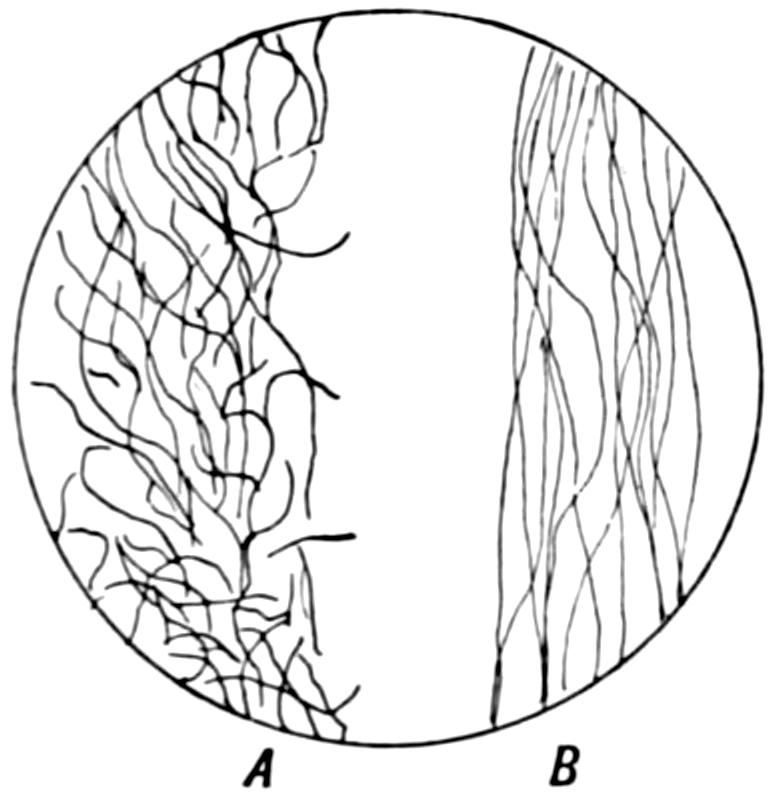
Fig. 85.—Sliver of Wool and Worsted.
A, Wool. B, Worsted.
Woolen and Worsted Spinning.
—(See Chap. II, Modern Spinning Frames.) The preparatory processes for both woolen and worsted yarns are similar (see Chap. VI, Varieties of Fabrics), the machines used differing only in their adjustment to long or short combing wools. The practice is increasing of putting several machines in a train or series by which the wool passes automatically from one to the other and saves handling. Each mill has its own method of procedure which has grown up through experience. Unwashed wool contains a fatty or greasy matter called yolk, which has been secreted from the skin of the sheep, and dust, dirt, burrs, and straws cling to the fleece. If the wool is fairly clean, scouring alone is required to prepare it for carding, but if it is full of impurities, it must be dusted and opened before scouring is advisable, and carbonizing (see Chaps. VI and XIII, Reworked Wool) must follow scouring when the wool is full of burrs. If the mill makes woolen yarns, the processes aim to clean but not to lay the fibers parallel in the yarn. On the contrary, worsted yarns must be well combed, that the fibers may lie side by side before they are twisted (Fig. 85). It is impossible to present a series of processes which are invariably used, but the general practice may be outlined as follows:—
Processes Common to Woolens and Worsteds
1. Sorting or dividing into qualities; classing.
2. Cleaning, usually required to some extent.
[163]
3. Opening, when wool is matted and very dirty. Dusting, for dirty wools. Scouring, for greasy or half-washed wools. There are usually three baths in a train. Cleaning by naphtha is also used.
4. Dyeing in the wool or raw stock dyeing, used often with woolens. Dyeing sometimes follows burring by carbonizing, if the color will be injured by the chemicals.
5. Drying.
6. Burring. Needed when wool is full of burrs. There are two methods of removal: (1) by machinery; (2) by carbonizing. Sometimes a burr roller attached to the carding engine is sufficient.
7. Blending or mixing the various kinds of new wools, wool by-products or substitutes for wool for woolens, or new wools for worsteds, needed for a particular yarn.
8. Oiling (sometimes done before blending).
Processes for Yarn Making or Spinning
A. Woolen or Carded Yarn.
1. Picking. For opening, cleaning, and mixing. Sometimes the wool requires several of these machines.
2. Carding. American names: (1) First Breaker; (2) Second Breaker; (3) Finisher. English names: (1) Scribbler; (2) Intermediate; (3) Condenser. The wool is frequently ready for spinning after the last card.
3. Drawing. Usually omitted as a separate process.
4. Spinning.
B. Worsted or Combed Yarn.
1. Picking or teazing. For mixing. (This machine is often omitted.)
2. Carding. These machines are similar to carding for woolen yarn (q. v.).
3. Gilling, before combing.
4. Combing. The result of this process is the top. Dyeing is frequently done in the top, and is called stock dyeing. It is also done in the yarn (skein) and in the piece after weaving.
5. Backwashing. It may come before combing.
6. Gilling, after combing. Often two gill boxes.
7. Drawing. Many times repeated. The last step before spinning is called roving.
8. Spinning.
[164]
Explanation of Processes
Sorting.
—Wool usually comes to our market unwashed or “in the grease,” and the fleeces must be sorted into their different qualities after they reach the mill. On account of the many sorts of wool on one fleece and the requirements of different fabrics the sorting operation is very important, that successful manufacturing may be assured. (See Chap. VI, Varieties of Wool on One Sheep.) Excellent light is needed and the sorter must have a delicate sense of touch. The manufacturers, in general, prefer wool “in the grease.” When the bags full of fleeces arrive at the mill they are opened and the wool is taken to the sorters’ tables or benches (Fig. 86). These have slatted or wire mesh tops through which the dirt, consisting of sand, straw, seeds, and filth, may fall. An exhaust fan below carries them away. The sorter takes one fleece at a time on the table, shakes out the dust, and then removes the low sorts (skirts) from the fleece and places them in a special receptacle near by. The sorters are trained to recognize accurately the various qualities by look and feel, and quickly divide by hand the remainder of the fleece into a number of parts, often six, eight, or even more, as occasion demands. Pure bred Merino sheep vary little in their grades of wool when the skirts are removed; the crossbred sheep have more sorts, and English breeds have the greatest number of variations. The best wool comes from the neck, shoulders, and sides; the poorest, from the legs. The useless parts, which are often full of paint, tar, clay, and filth, are cut off and discarded.
[165]
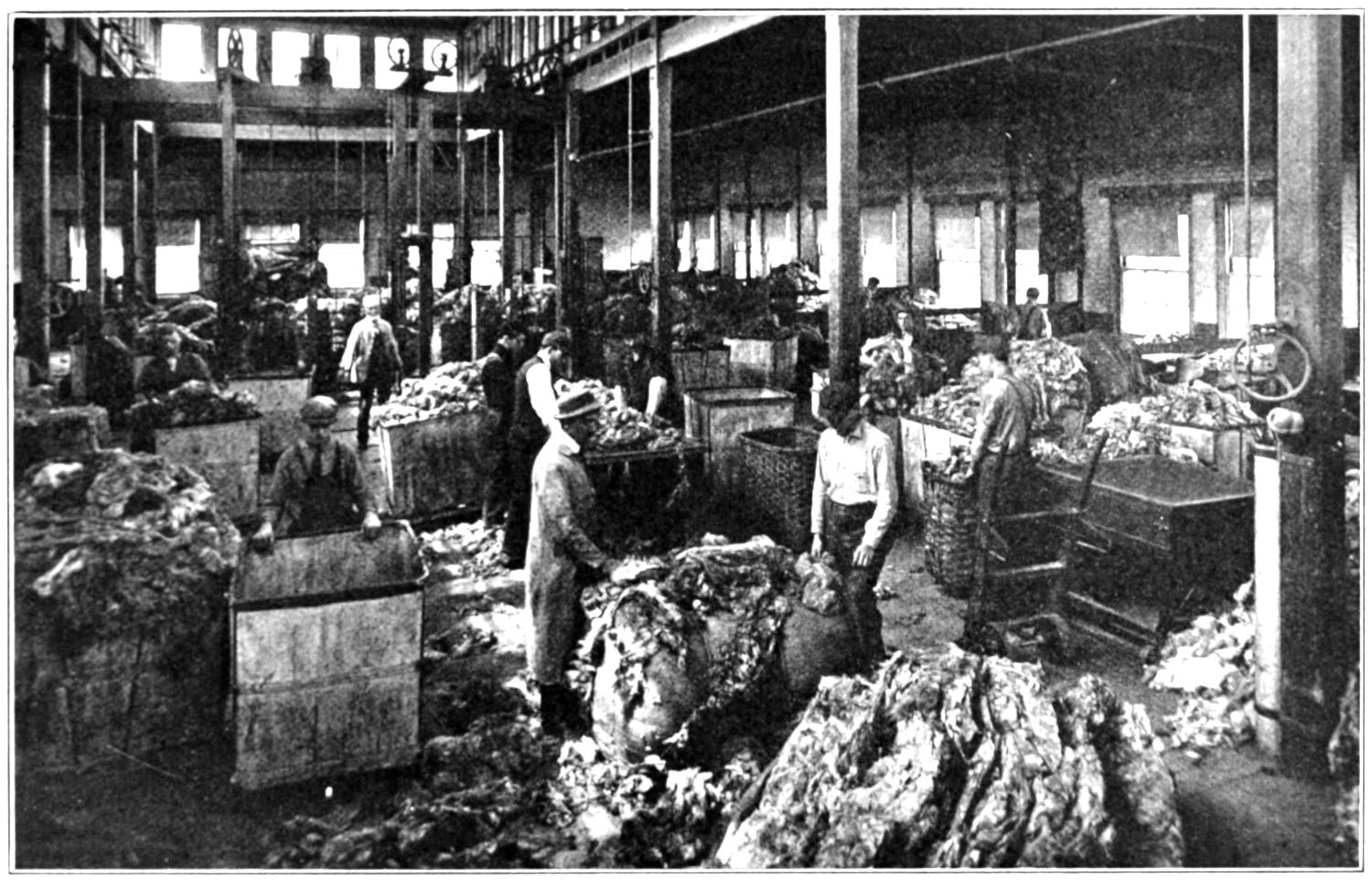
Fig. 86.—Wool Sorting.
Courtesy of M. J. Whittall.
[166]
There have been and still are dangers to those who sort wool, especially dirty Eastern wool from diseased or dead animals. Wool sorters’ disease, anthrax, comes from a germ which enters the body through a break in the skin or by the internal organs. It is one of the few diseases which affect both man and animal. The bacillus is difficult to kill. Medical knowledge is increasing as to the prevention, and modern methods of constructing sorters’ benches have minimized the trouble. Great Britain has taken special precautions against the disease. A list of countries from which wool can be admitted without disinfection has been made. Those handling wool at the docks are less protected than those in the mills, for the wool is disinfected after it arrives, not before. The United States has not had serious trouble with the disease. Some fleeces are so dirty that they are mechanically opened and beaten before sorting. After separating the wool into its different qualities, the classes are piled in bins marked with their names. Wools from all over the world—white, yellow, black, and gray—rest side by side ready for use. When wool is needed, it is usually blown through pipes or carried by other automatic means to the part of the mill where it is needed.
The Feed.
—(A species of opener.) When wool is very matted and dirty it must be cleaned before scouring. This process is required by short staple wool rather than by long. Wool impurities are difficult to eliminate. Sand and dust can be beaten out, straws and burrs require carbonizing, animal impurities are removed, in general, by washing. As much dirt as possible must be eradicated very early, or the cloth will be injured. In many mills automatic feeds are used before dusting, before scouring, and before carding, as a means of opening the wool and passing it on in better condition to the next process. Feeds are built either high or low, according to the length of wool which is to be passed through them. The wool is deposited in the hopper of the machine, and an apron of spiked slats carries it upward to an oscillating comb, which throws the surplus wool back into the hopper and carries the remainder to a revolving beater. The coarse spikes open the matted fiber, the dust is beaten out and falls below, and the wool is removed from the apron and passes to the next machine.
[167]
Dusting.
—Wool which is very full of straws, dust, and burrs requires repeated cleaning. The duster consists of a cylinder covered with coarse teeth or spikes, which opens the staple while a fan blows out the dirt. There are two forms of duster, the square and the cone. The work of scouring is simplified by this machine, consequently it is in use even for fairly clean wool. It often follows the feed in the train.
Scouring.
—(Fig. 87). The object of scouring is to clean the wool thoroughly without injuring the fiber by too hot water or too strong an alkaline cleansing solution. Dust, dirt, and a greasy matter called suint or yolk (a natural grease) must be removed. The character of the wool, the composition of the cleansing materials, the temperature, and the hardness or softness of the water have to be considered. Violent treatment of the wool in the scourer leaves it felted, ropy, and stringy. When the process is well done the wool comes out clean, soft, and fluffy, and free from the chemicals which have been used in the cleansing solution. Unless the wool has been properly washed the dyeing will be unsuccessful in color and fastness, and the spinning and weaving will be defective. Each mill has its own washing formulas, but potash, ammonium carbonate, and soda are in frequent use. The washer is a long, narrow trough, divided into several tanks or bowls of different sizes, according to the length of the wool used. The first bowls are scourers and are filled with warm, soapy, alkaline water; the last bowls are rinsers. A ducker plate pushes the wool on to the liquid. Fresh water flows in continually, and the soiled water passes out. Wringers are attached to each bowl, and the wool moves slowly toward them, carried along by rakes attached to the sides of the troughs. After each wringer the wool passes in cleaner condition to the next bowl, and in the final one is washed in pure water. From the last wringer it is carried automatically to the dryer, unless it is to be dyed before drying. The by-products, grease and potash, left in the scouring water, can be saved. The first is used as a basis for salves, and the potash for soaps and fertilizers. A train of machines such as the Feed, Duster, Scourer, and Dryer can be attended to by one or two men without needing to handle the wool.
[168]
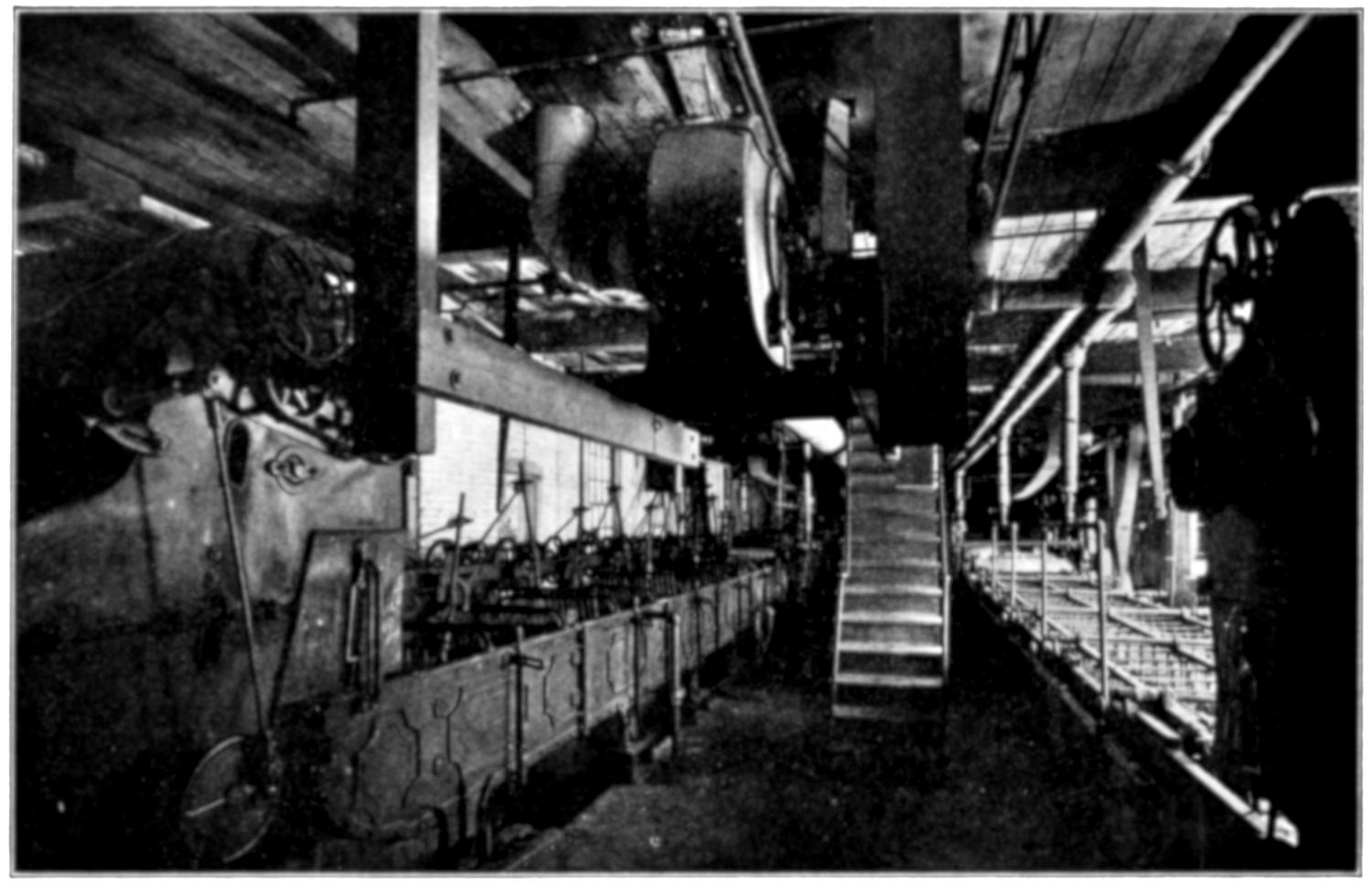
Fig. 87.—Wool Scouring.
Courtesy of M. J. Whitall.
[169]
A naphtha system of cleaning is in one of the large mills in this country and yields excellent results. The wool is placed in a hermetically sealed tank filled with naphtha, which removes the grease. It later passes through many washings in water, in which it becomes perfectly clean, to the dryer. The naphtha is distilled and recovered to use again; the grease is regained and sold. It is an inexpensive and quick method with no bad effect on the wool. The initial cost of installing is high.
Raw Stock Dyeing.
—When wool is very burry it is frequently carbonized before stock dyeing, unless the chemicals which are used in carbonizing will affect the wool so that it will not take the color satisfactorily. Stock dyeing (in the slub) comes after scouring. It is a very permanent class of dye. Dyeing in the yarn and in the piece are also practiced. (See Chap. XIII.)
Drying.
—It is very important for the sake of future processes that the wool shall be evenly dried. A hydro-extractor, similar to the kind used in large laundries, removes the excess moisture by centrifugal force. The wool is next spread on a series of frames, made of network, placed one above another, and hot air is driven through by a fan; or it is dried in a large drying chest, where it passes for a time over hot air pipes and is then carried to a huge drum, on which it is turned over and fed back to the pipes until it is dry.
Blending.
—In many mills wool is burred and picked before blending, for drying often entangles the fibers, and they need to be opened. Blending is especially important in the woolen industry, as the combination of color is often the beauty of the finished cloth. The object is, first, to combine wools of various kinds, such as Australian with Ohio, or with [170]other wools of similar staple, or to mix reworked wool, coarse wool, extracts, pulled wool, cotton or silk noils with new wool for the purpose of lowering the price of the cloth; or to combine new or reworked wool of various colors into attractive effects for heather mixtures. It requires ability, knowledge gained by experience of what can be expected of different wools in their carding, spinning, weaving, and finishing processes, and a feeling for harmony of color. A successful blender has many cherished recipes. Samples of different wools or of colors are tried first on hand combs until the right combination is reached, and then the percentages of the various wools are weighed carefully and laid in successive layers one above the other on the floor of the mill near the picker. Heather mixtures must often pass through the picker several times to perfect the combination.
The following blend was in use for many years in a prominent mill. It shows the method worked out in percentages:
| Ohio Wool ¹⁄₄ blood | 30% |
| Cotton | 30% |
| Garnetted Thread Waste | 10% |
| Reworked Wool | 10% |
| Noils | 10% |
| Pulled Wool | 10% |
A large number of woolen fabrics have cotton at times in the blend, such as tweeds, flannels, and many dress goods. In a low class of fabrics there may be 75 per cent of cotton. Raw Peruvian cotton is preferred in the mixture, for it resembles wool in the handle, being wiry. Reworked wool and wool wastes are also much used, largely in inexpensive goods, and make reliable and attractive fabrics.
Blending for worsteds has a different object, for reworked wool, noils, and other waste cannot be combined with the new wool. The object of the blending is to combine varieties of new wool with similar characteristics to insure a satisfactory cloth. The blending is done by hand.
[171]
Oiling.
—Wool loses its oil in the scouring process, and must be reoiled to pass easily through succeeding machines. Oiling usually follows blending, being done by hand or sprayed automatically as the wool lies on the floor, or as it passes on an apron to the picker or other machines. An oiler is often attached to the doffer end of the dryer. If cotton is in the blend, it is better to keep the oil from falling directly upon it, for it is apt to become stringy and lifeless. The cotton is carded and the wool is oiled before it is added. Wool is often allowed to stand one or more days after oiling, that the oil may be thoroughly absorbed before the cotton is placed with it. The cotton is sometimes added after the oiled wool has passed through the first breaker card and is being stripped from the doffer. The two slivers, cotton and wool, are united and the action of the machine causes them to twist around each other. Mills differ in the oils they prefer, but olive, neatsfoot, tallow, and other oils are in use. In the manufacture of soft, serrated wools into yarns which will be fulled after weaving, oiling before carding is very necessary, for it preserves the serrations from injury during the passage of the fiber through the thousands of fine teeth.
After oiling or blending, the processes for woolen and worsted yarns begin to diverge. The machines used are often much alike, but, as different results are required from them, modifications in structure are necessary. Raw stock for worsteds, after oiling, goes directly to the card. Worsted goods are distinguished by their combed, finely twisted yarn and clear weave. Woolen goods have a soft, lofty yarn and are often felted until the pattern is obscure. (See Chap. VI.)
Woolen Yarn
Burr Extracting or Burr Picking.
—Short staple wools are often full of burrs which persist in spite of the work of sorters, and of various machines. These must be removed before carding, or they will injure the machinery and be so crushed [172]into the wool that removal is difficult. Mills differ in the manner and time of burring. The elimination of burrs, seeds, and leaves is, however, usually effected by two different systems: (1) A mechanical method which consists of a roller covered with a series of toothed rings which open the wool, and a fluted beater or guard knife to knock out the vegetable matter. A brush strips the cleaned wool from the machine. The mechanical burring is used especially when fine wool is full of large burrs, the advantage of it over the second method being that the natural strength and color of the wool are not affected. (2) A chemical burring is also in use (see Chap. VI, Carbonizing, under Reworked Wool). Carbonizing is repeated after the cloth is woven, if vegetable matter is still present. Burring rollers are sometimes attached to the carding engine. In very dirty wools, both burr picking and carbonizing are often used.
The objects of the machines for making woolen yarn are (1) to clean and open by the action of many wire teeth; (2) to form a web of fibers lying in all directions; and (3) to condense the web into a band or sliver and reduce and twist it into a roving usually for the mule spinning frame. The length of time required to prepare and spin woolen yarn differs. Inexpensive yarns take but a few minutes from sorting to spinning, but the processes may be lengthened, repeated, or supplemented by additional machines when making higher grades of yarn.
Picking, Teasing, Opening, Willowing, and the Fearnaught.
—(Names used in different localities for this process.) A picking machine is usually required after scouring and drying, to open the entangled fibers, but it often comes after the blend has been made in order to combine the various wools or other fibers, and to prepare for carding. The picker is much like the carder. In place of the mixing picker a toothed cylinder is often attached to the first card. The blend is placed on a traveling lattice or apron, and carried [173]into the teeth of the cylinder, where it is opened, mixed, made pliable and flexible, and then is automatically passed to the card.
Carding.
—The carding for woolen yarn is done usually in a set of three machines, which are much alike except in their methods of doffing the slivers. The principle of the cotton card (see Chaps. II and VIII, Carding) is similar to the woolen or the worsted card, with some adjustments to meet specific needs. In America these machines are called the first breaker, second breaker, and third breaker or finisher; a condenser often is connected. In England they are called scribbler, intermediate, and condenser card. The first breaker card (Fig. 88) is often preceded by an automatic feed, which opens and blends the wool, delivers it to a weighing pan, and evenly deposits the correct amount on an apron to be carried to the breaker. The method of feeding the fiber to the machine is important in the final spinning. Each breaker card consists of a large cylinder or swift against which small cylinders called workers and strippers revolve. Thousands of teeth clothe the surface of the cylinder, becoming finer in each succeeding breaker, and open up the wool. The first card opens the wool into a film or sheet, which in that form or in a sliver passes to the second; from the second breaker the film is delivered in various ways, but often is contracted into a wide sliver and fed diagonally (“on the bias”) to an apron by an oscillating feed, which carefully deposits it back and forth, one layer half over and yet alongside of the other. The licker-in of the third breaker receives the wool from the side of the sliver, consequently the tendency to the parallelism of the fibers which has been given by the teeth of the card is counteracted. The product of this third machine is made ready to go to the drawing frames in the manufacture of some classes of yarn, or in others is condensed by a ring doffer or rollers covered with leather into a coarse, lightly twisted roving wound on bobbins, which goes directly to the spinning frame. The heavy edges of the folded-back sliver are separated from the rest of the wool automatically when they issue from the breaker, and are later returned to the hopper of the feed to be carded anew.
[174]
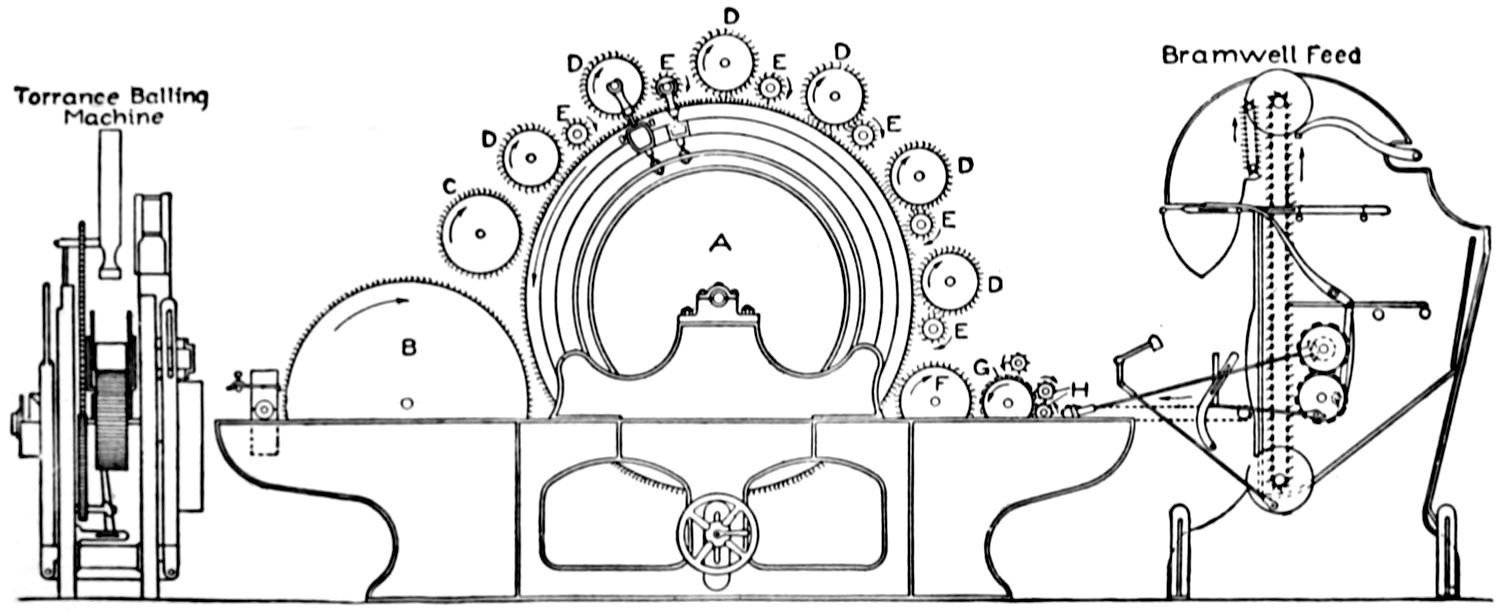
Fig. 88.—First Breaker Card.
From Collins’ Woolen and Worsted Spinning, by courtesy of the American School of Correspondence.
[175]
Many modifications of carding have been made, but no change in the principles underlying the work. Some of these modifications aim to increase production or to improve the quality of yarn. In England the rovings are generally formed by a tape condenser. The doffer takes the material from the last swift of the carder by means of rings of card clothing, each ring producing one ribbon or sliver. These are stripped, passed into the condenser, and rubbed into rovings, which is the last step before spinning.
There is much waste from the cards which never reaches the condenser. Some of it is of value and is used again. Waste-saving machines are in use in some mills, which, by means of an apron, carry off the waste to the first machine of the carding series. The dirt in the waste falls out as it is carried back. The carding machines require to be kept clean or the work will be unsatisfactory.
Drawing and Doubling.
—These machines are similar in all the wool industries, being based on the principle of drawing by rollers. (See Chap. II.) This is not always found as a separate process in the preparation of woolen yarn.
Mule Spinning.
—(See Figs. 25 and 26.) The intermittent motion of the mule spinning frame, which adapts it to the twisting of soft, short-staple yarns, makes it of service in the woolen industry. The roving, which is soft and slightly twisted, with the wool fibers running in all directions, is placed in the frame, drawn smaller and twisted more, but has still the same characteristics as in earlier processes. The yarn comes from the mule spinning wound on bobbins.
Skein Dyeing or Dyeing in the Yarn.
—If the yarn is now to be dyed, it must be wound into skeins or hanks on the swifts. (See Chap. XIII, Forms of Market Dyeing.) The [176]skeins are washed free from grease, and then are dyed. Great care is needed to have the exact color and to have it fast. The skeins must be kept moving to distribute the color evenly. Careful rinsing and drying follow.
Fancy yarns are made in many ways. Colored yarns are united, threads are looped or knotted and often again twisted with other yarns, fibers of other textiles are combined with the wool, and yarns are twisted in different ways and again twisted together. Woolen yarns are used for knitted and crocheted goods, for blankets, for staple materials such as broadcloths, flannels, golf cloths, cheviots, meltons, kerseys, homespuns, tweeds, cassimeres, chinchillas, and fancy dress goods, where the weave is soft and indeterminate or obliterated, and the colors are softly blended. Cotton warps are frequently used with wool filling, as in many blankets, flannels, and fancy dress goods. A well-made woolen cloth is enduring. At times the strength is low from loose weaving and weak yarn.
Worsted Yarn
In making worsted yarn the fibers must be combed until they are parallel, of the same length, and flat, before the sliver can be twisted into an even, lustrous thread. Many processes are required to do this satisfactorily, several days being sometimes needed for the work, hence worsted yarn is expensive. After the wool is blended it is carried on trucks or blown through pipes to the carding room. A feeder is sometimes used before the first breaker card. In some wools a burr roller is attached to the first card.
Carding.
—Worsted carders (two cylinders are generally used) differ from those used for woolen yarn in several minor ways, such as the doffing, as the fibers must be kept parallel, and the way of preparing the sliver for the next process. The sliver from the worsted card usually falls into a can. There are several methods by which worsted yarns are made ready [177]for spinning. When very long staple wool is to be spun into lustrous, closely twisted yarn the combing and gilling processes are especially important, and carding is merely preliminary to the others. In such cases the first breaker card alone is used (for too much carding breaks the long-staple wool), and it is followed by preparers which straighten out the fibers for the comb. Some wools require much carding, but at times it is not used. In some classes of carpet yarn the worsted carders do the work of opening and straightening the wool, and the combing and gilling are omitted. In general, however, worsted yarn goes through the following steps, but the emphasis on processes may vary: (1) Opening, cleaning, and separating the wool, the feed, and the carders; (2) drawing, straightening, and leveling on the gills by (3) extracting long fibers from the short, curly ones, and laying the former parallel in the comb; (4) drawing, doubling, and evening the slivers on gill boxes and drawing machines, and (5) drawing and twisting the roving into yarn and winding it on bobbins by the spinning frame.
Back Washing.
—The wool becomes much soiled by oil in the carders as well as in other machines and needs washing. The process is used either before or after combing, or even at both times. A back washer is often attached to a preparing gill box. If this cleansing is not done, the cloth is apt to become shiny from the oil left in it. The principle of washing is very simple. Two or four bowls are used for washing and rinsing the wool. Wringers or squeeze rolls follow each bowl to press out the water, and a drying cylinder comes at the end. It is generally conceded that four bowls wash the wool cleaner than two, and that the finished cloth is benefited thereby. The best soap should be used and fresh water should flow constantly into the scouring bowls to keep the soapy solution weak. In place of a hot cylinder to dry the wool, a fan is sometimes used. Oil is sprayed on the wool after back washing.
[178]
Gilling before Combing.
—A set of five or six preparers often follows the first breaker card, or the three-card cylinders may precede a set of preparers. The aim of these machines is to unite a number of slivers and to draw, straighten, level, and make parallel the fibers to prepare them for the comb. Sometimes as many as twenty-four slivers will be united in a preparing gill box. Gilling is done both before and after the comb, but the term gilling is not used for these machines until after the comb. Preparing gilling and gilling are therefore practically the same process, and the machines are similar in construction, but finer teeth are in the latter gill boxes. Each gill box has receiving and delivering rollers, between which is a series of bars or fallers covered with teeth or gills. The fallers move on screws from the receiving toward the delivering or draught rollers. As they move forward they press the wool down on a comb and lay the fibers parallel. When they reach the draught rollers they drop below, and are caught on a lower screw and carried back to the receiving rollers, where they are raised to the surface to begin again. The draught rollers move more rapidly than the rollers which are receiving the wool, and consequently attenuate the sliver. The speed is regulated by the size of the yarn desired, or by the length of the wool staple. When the product of the last preparer is to go to the comb a balling head (see Fig. 88, left side) is attached to it, which winds the slivers in such a way that four unwind from one ball and are united in the comb.
[179]
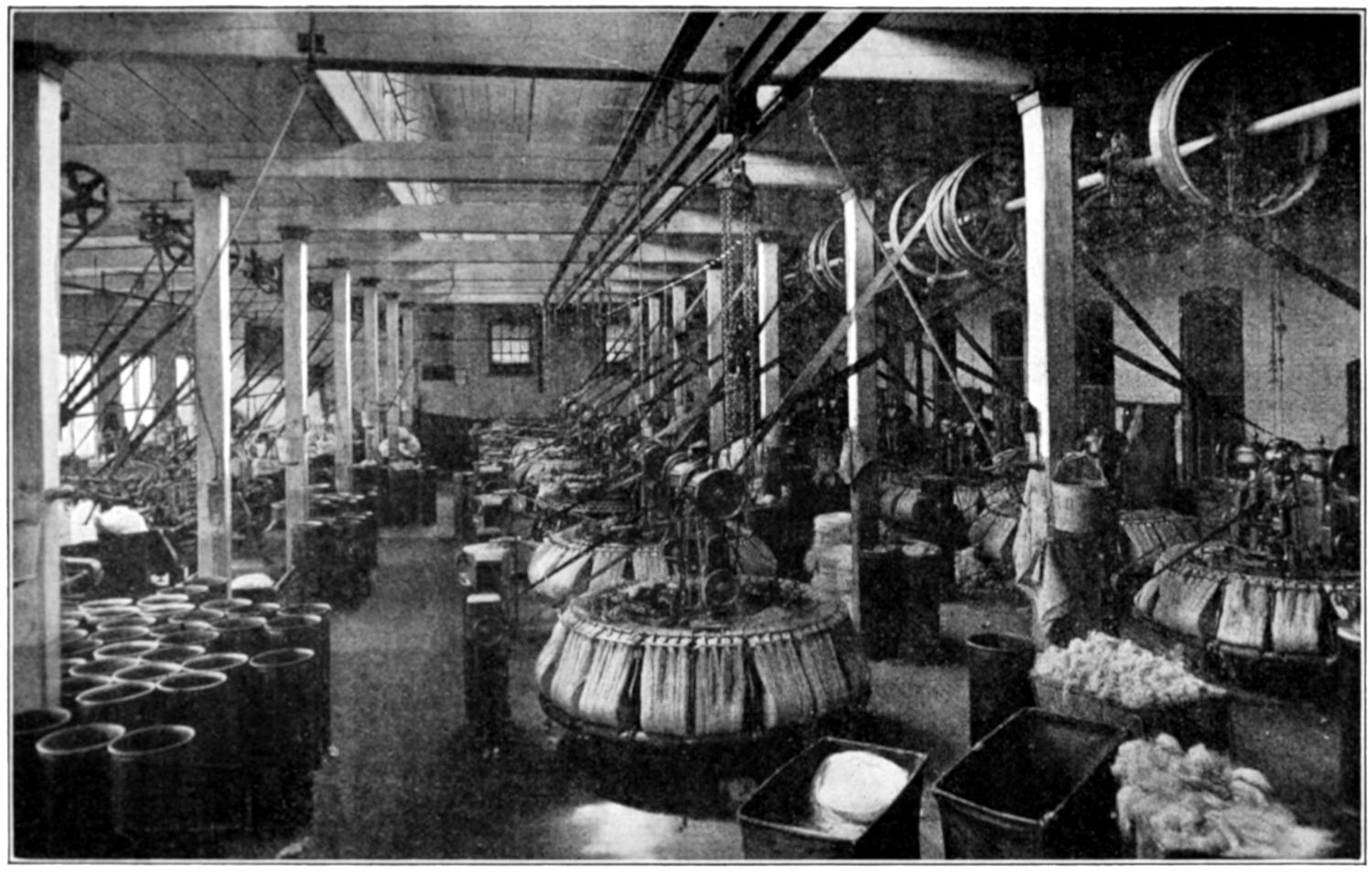
Fig. 89.—Wool Combing. The Noble Comb.
Courtesy of M. J. Whittall.
[180]
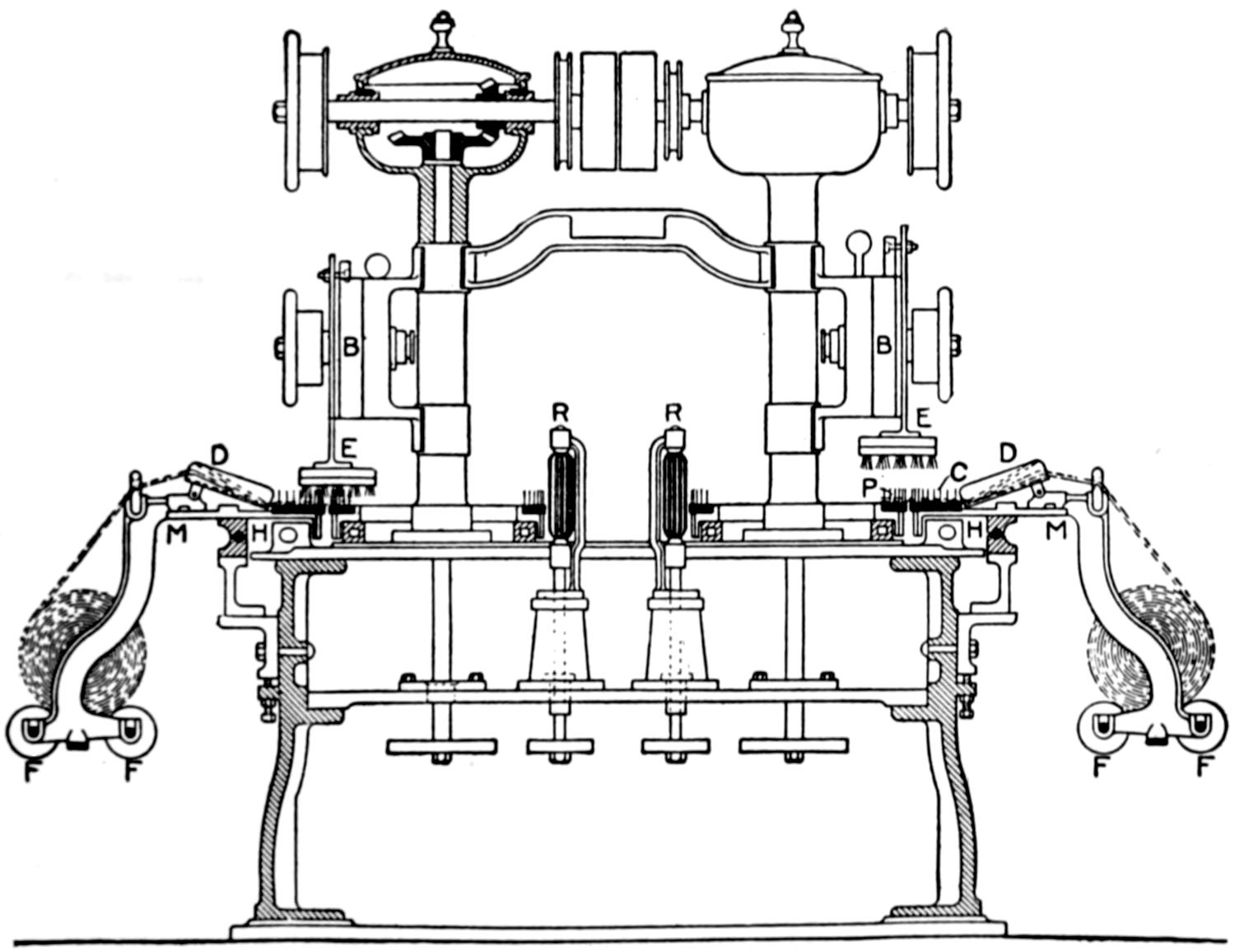
Fig. 90.—Detail of Noble Comb.
From Collins’ Woolen and Worsted Spinning, by courtesy of the American School of Correspondence.
[181]
Combing.
—(Figs. 89 and 90.) The slivers which come from the gills are level and fairly parallel, but short, curly fibers are mixed up with the long ones. The object of the comb is to rid the sliver of the short, curly wool (noils), and to comb the long, straight wool into a more parallel condition, called tops. There are several methods of combing, such as the nip or Lister comb, adapted to English long-staple wools; the square motion or Holden comb, adapted to medium length wools; the French or Heilman comb, suitable for short-staple wools and used largely in France (see Wool Manufacture, below), and the Noble comb, which adapts itself to both long and short staple wools and is used extensively in the United States. The aim of the Noble comb is to do the work of the brush and comb, i. e., to make parallel the long hairs and to catch the waste or broken hairs and throw them to one side. In order to accomplish this a series of elaborate and delicate adjustments are necessary. Eighteen balls of the prepared slivers are placed in order around the comb, four slivers coming from each ball. The end of each sliver is passed through a ring in the edge of the circle, and thence into openings which lead to a feed box. Through this they pass to a large, revolving, circular comb, 48 to 60 inches in diameter, where they are caught in the teeth of the combs. The large circle has several rows of upright, pointed teeth, which become finer as they leave the circumference. Two small circles, 16 to 20 inches in diameter, revolve on opposite sides of the big circle. Rows of teeth decreasing in size are also on the small circles, and they come in contact with the teeth of the large circular comb and lay parallel the fibers of wool with which they come in touch. The longer wool is inclined to remain on the big circle, but the little circles comb it through and take away the short ends, which are called noils. The long hairs soon project free from the big comb, and are taken from it by vertical rollers to make the top, whereas the short ends are carried off in another direction. A dabbing brush presses the wool on the teeth of the combs. The slivers from the balls are carried by the feed boxes on an inclined plane so adjusted that they are at the highest point when they pass the dabbing brush. As the boxes descend the plane the wool is pressed down on the teeth. The fibers which remain between the teeth are automatically lifted out by knives and fed again to the combs. The slivers are kept from slipping back from the feed boxes by nips which hold [182]them. Both small and large combs revolve together and in the same direction, and rest on a steam chest which aids the combing by keeping the wool warm. As a result of the combing two slivers come from the large circle and one from each small circle, and are united into one, a false twist being sometimes given to the sliver before it falls into a can. The combed sliver is called a “top,” and the processes following make it into a finished top.
The noil (see Chap. VI, By-Products of Wool) is removed from the teeth of the small comb by knives and passed to rollers which convey it from the machine. It is used in many ways, being often combined with new wools for woolen dress goods and blankets. Some mills use their own noils, but frequently they are sold to other manufacturers. Noils are valuable, costing about 60 per cent as much as the clean wool value.
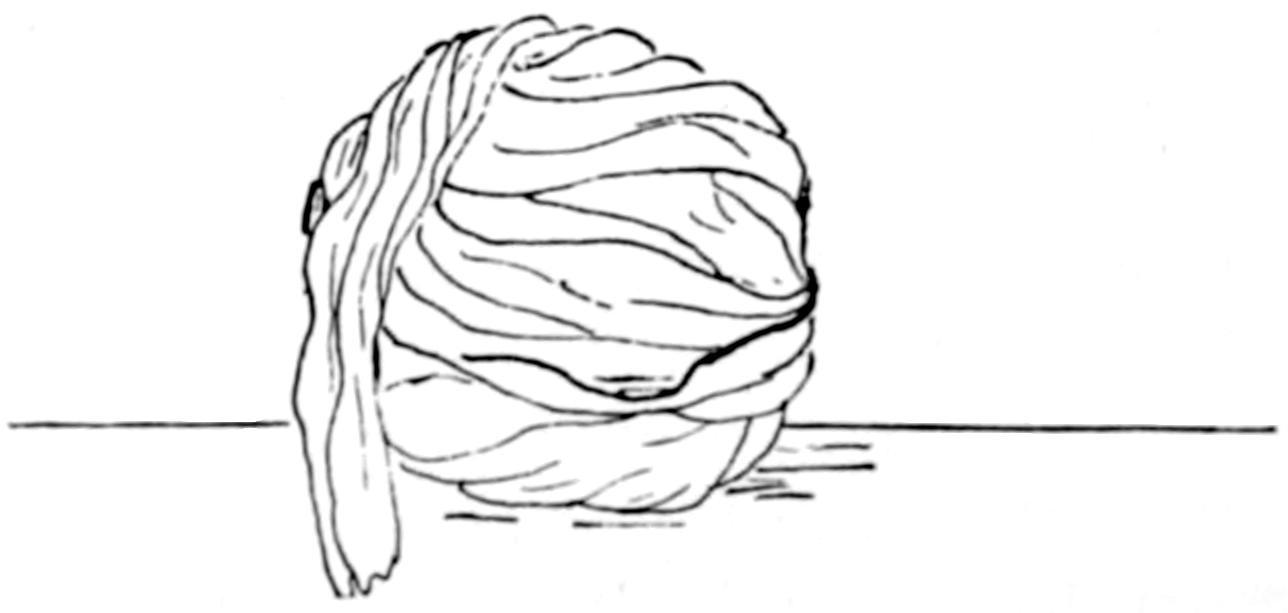
Fig. 91.—Top.
Gilling after Combing.
—The aim of the two or more gill boxes which usually follow the comb is to blend more completely different length fibers, to increase the parallelism, to apply moisture evenly to every fiber, and to wind the tops into a ball which will easily unwind. To accomplish this very fine teeth are necessary in these gill boxes. As many as twenty-eight cans from the combs are at times united in the first finisher gill box, the result of which is a heavy sliver. Three or more slivers are united into one in the last gill box, and by a balling head attachment the finished top (Fig. 91) [183]is wound. In some classes of yarn no real twist has yet been given to the sliver. Many mills buy their tops instead of making them. Combing and gilling are costly operations, and mills having well-equipped plants frequently do a commission business in tops, returning to the purchaser tops, noils, and waste. Wool sold in this form often has an excess of moisture in it, which increases its weight and consequently its cost to the buyer. To offset this condition, which is sometimes fraudulent, conditioning houses (see Chap. IX., Marketing, Classification, and Conditioning) have been organized to test wool. Standards of moisture have been agreed upon (15 per cent of moisture above bone dry), and variations from this affect the sale of the wool. Silk conditioning houses were long ago established in Europe and are now increasing in the United States. They now test both wool and silk for moisture as well as honest condition of fibers. Some mills do their own conditioning.
Drawing and Doubling.
—The tops must now be reduced to a size small enough to spin, and a number of slivers are united into one. The drawing processes are repeated from six to nine times, until the required size is reached. In some classes of yarn little twist is given until the machine which directly precedes the spinning (the roving), whereas in other varieties the thin yarn is repeatedly twisted. The product from these machines is wound on bobbins. It is stated that worsted yarn is often doubled a half million times before it is ready for the spinning frame.
[184]
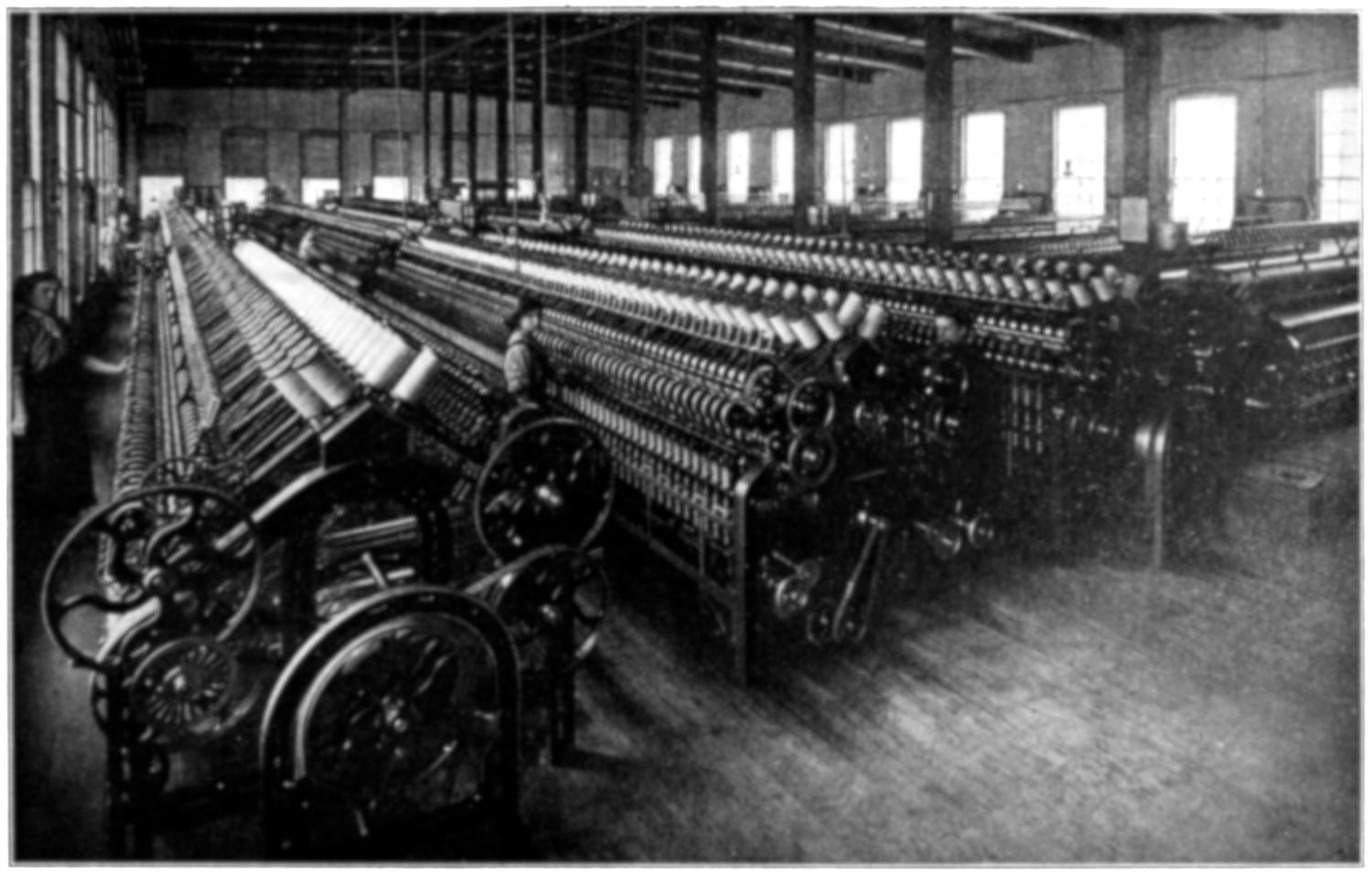
Fig. 92.—Spinning the Wool.
Courtesy of M. J. Whittall.
[185]
Spinning.
—(Fig. 92.) There are two methods of spinning worsted yarns: the Bradford or English system, which uses a long-staple wool, thoroughly oils it before combing, and gives a smooth, lustrous yarn fitted for worsted suitings as its final result; and the French or dry spinning, which uses shorter wool, little oil, and spins a soft, dull yarn. The latter system offers more difficulty in handling the wool on account of the increased electricity arising from the lack of oiling, and it costs more, but it yields a soft, clinging material much in demand. The principal difference between the two methods is in the drawing and spinning, as the former system requires much twisting, and the latter avoids twisting. No twist is put into the yarn until it is fully prepared for spinning. Soft yarns are spun on the worsted mule, which is almost identical with the mule for woolen spinning, or on a special frame, but closely twisted yarns require the throstle or upright frame, by the use of the flyer, cap, or ring principles. (See Chap. II, Mule Spinning and Ring Spinning.) The French system of spinning is usually on the mule, but may be on the upright frame. (See France, under Wool Manufacturing, below.) Winding according to the use of the yarn, follows.
Counts or Sizes of Yarns.
—The sizes of yarns are variously indicated in different localities and countries. The United States has two systems in general use for woolen yarns. The first originated in Philadelphia and is called the “cut”; the second is used in other parts of the United States, and is designated as the “run.” Both methods are based on the number of hanks or skeins required to make a pound, but differ in the size of the hanks. The “cut” system takes 300 yards of one-cut yarn (the coarsest) to make a pound (one hank). As two-cut yarn is as fine again as one-cut, it will take 600 yards of it to make a pound, which will be in two hanks. In the “cut” system the coarse yarns in general use are five-cut to seven-cut (lower sizes are seldom used); medium yarns are eighteen-cut to twenty-one-cut, and fine yarns are thirty-cut to thirty-five-cut. The market expresses these cuts as 1/30s cut when speaking of single No. 30 yarn (thirty hanks), or 2/30s cut when speaking of two-ply No. 30 yarn. Nos. 18 to 30 are coarse, 30 to 40 are medium, and above 40 are fine.
The “run” system has 1600 yards to the pound for one-run yarn; No. 2 run yarn is twice 1600, or 3200 yards to the [186]pound (being twice as fine as No. 1 run). Fine yarns are estimated in a like manner. In the “run” system Nos. 1 to 3 would be coarse yarns; Nos. 3¹⁄₂ to 5 would be medium, and Nos. 6 to 10 runs would be fine.
The sizes of worsted yarns are determined by the “count.” In this system 560 yards of 1-count yarn weigh one pound, and higher “counts” are estimated as in the “cut” and “run” methods. In worsted yarns Nos. 30 to 40 are comparatively coarse; 40s to 56s are medium yarns, and 60s to 100s are fine. Counts over 60s are not common. Low counts are used for knitting coarse sweaters. Worsted yarns are frequently two-ply (double), and sometimes are three- and four-ply. Carpet wools are generally worsted yarns.
Worsted and combed wool yarns are used for weaving, knitting, and needlework (crewel, Berlin, zephyr, and Saxony). Worsted yarns are in serges of many varieties, diagonals, prunellas, panamas, Venetian cloth, and voiles, and as the filling with cotton warps in alpacas, mohairs, Sicilians, and other luster goods. Yarns from the combed wool industry are found in underwear, fancy dress goods, soft serges, and buntings, and are combined with cotton or with silk in such materials as poplins, henriettas, lansdowns, and challies.
Weaving and Sizing.
—Yarn comes from the spinning frames on bobbins, but has still many processes to undergo before it is finally woven. When skein dyeing is necessary the bobbins must be run off into skeins or hanks on the swifts, and after dyeing the skeins are wound back on bobbins. Filling yarn goes directly to the weave room to be wound for the shuttles. Warp yarns require closer twisting than those for the filling. Some yarn is doubled before being woven, and has to go to a special machine which twists the two yarns in the opposite direction from the previous twisting. Warp yarn is frequently prepared for the loom by winding it on large dresser spools. Forty or more ends come from each spool, and as many spools are required as will make up [187]the number of threads in the warp. Thousands of warp threads are required for ordinary cloth. The spools are placed on a creel and the threads are drawn off on a beam in the order in which they will be needed in the loom. If the yarn is to be sized or slashed, it usually is done at this time. The object of sizing is to strengthen the warp yarn and keep it from roughing up in the drawing-in and weaving. Single woolen and worsted yarns are usually sized, but two-ply yarns need it less. Many of the mills of the United States do not size their yarns before weaving, as the extra machinery and time consumed add to the expense. There are many ways of sizing and many ingredients used, such as Irish moss, dextrin, gum arabic, potato starch, cornstarch, glue, and mucilage. The slasher is ordinarily a long trough filled with size, through which the threads from the beam pass. Rollers press in the size and also squeeze out the extra amount, and a heated cylinder dries the yarn. Much of the size drops out in a fine dust during the weaving. The yarn is warped before it is sized, and afterwards is drawn in and reeded before it is woven. (See Chap. III, Winding, Reeling, Warping, and Drawing-in.) The width of the cloth after finishing is from 50 inches to even 60 inches. Fabrics measuring from 22 to 27 inches are not made to any extent at present. The development of the ready-to-wear industry has caused a demand for the wider cloth, for it cuts to better advantage. Piece dyeing follows weaving, but the exact time for it depends on the finish the goods must have.
Finishing.
—The beauty of woolen goods lies largely in the finish of the cloth; and of worsted goods, in the weave. Both rely on attractive color combinations. Many of the favorite weaves are simple, such as the plain or tabby, the basket, stripe, and check. Twills or diagonals, satins, corkscrews, herringbones, ribs, cords, crêpes, and double-faced cloths are in common use. Many effects are gained by the use of yarns twisted or knotted in novel ways, by combining other fibers [188]with the wool, and by finishes and dressings applied after the weaving is over. Worsted suitings, when taken from the loom, look much as they will in the finished state, but woolen cloths, especially those which are to be fulled, are far from attractive, being coarse and rough, requiring many processes to develop their beauty. Woolen and worsted cloths may be finished in an infinite number of ways, but certain processes (which follow) may be taken as representative. The same processes are, in general, applied to both kinds of cloth, but when worsteds are fulled it is only to soften the weave, while the object in woolens is often to obliterate it entirely. Fulling can be watched and stopped when desired, but broadcloths and other face goods are given a heavy shrinkage. The latter materials are woven both longer and wider than they will be in their finished state, for they frequently shrink one-third in each direction. They are therefore woven as much as eighty inches wide that they may be fifty-two or fifty-four inches when finished. Broadcloth, melton, and kersey are usually woven with a twill which throws the warp on the face, consequently carded wool yarn is used for the warp, for when fulled it will cover the filling. Worsted filling is sometimes used in broadcloth, but the character of the weave throws it to the back. Cloth woven with the plain or tabby weave and fulled is sometimes called broadcloth, but is really a fulled flannel, and is less satisfactory than broadcloth. The present demand for very light weight, pliable broadcloths for women’s wear has reduced their strength while increasing their softness, for any defects of stock or early processes combined with the close shearing leave them weak and liable to tear. The finishing of face goods changes the rough, coarse product of the loom into the soft, satiny appearance which distinguishes these materials. Good stock and numerous processes make them expensive.
Inspection or Perching.
—Poor stock, careless scouring and blending, inferior chemicals, and injuries in the many processes [189]show when the goods come to the finishing stage. The most rigid inspection by experts is given the cloth after weaving, after mending, and after finishing. The material is drawn over rods or over an inclined plane and defects are noted, marked with chalk on the cloth, and remedies are suggested. These difficulties sometimes require that the cloth be sent back to previous machines for treatment. If the wool cannot yield good results, surface finishes, artificial stiffenings, lusterings, and dressings are used. Even with good stock carelessness or machines out of order may have caused injuries which must be repaired.
Burling and Mending.
—The usual difficulties with the cloth are knots which have been tied during winding, beaming, and weaving on account of broken threads. These imperfections must be removed with care or a hole will be made or a weak place, which will later give way in wearing. Menders often have to darn in the structure in the exact pattern. Flecks of sisal from tie strings in the fleeces, or jute from the wool packs, or black wool in the midst of light from careless packing on the farm must be removed. The expense of removing these imperfections is often very great. (See Chap. VI, Growth and Care of Sheep.) Specking or removing unsightly vegetable material comes frequently in the final finishing of the cloth. A quick dye called “speck dye” is often put on the cloth to be piece dyed, to cover flecks difficult to remove. This is done before piece dyeing and final finishing. Worsted suiting requires very careful mending, as the final finish will not cover defects, as will the fulling for face goods.
Washing and Drying.
—The cloth is frequently soiled by the machinery, and must be washed before it is finished. Some woolen cloths go to the fulling mill without washing, but worsteds are usually scoured in a special machine in which soap, Fuller’s earth, or other cleansing materials are in solution in warm water. Careful rinsing follows the washing, [190]to rid the cloth of oils, glues, and chemicals, as well as of dirt. Moisture is removed by a hydro-extractor, and the cloth dried in a cloth dryer or by a vacuum process.
Fulling, Milling, Felting, or Shrinking.
—This process is a very important one, being used principally in woolens. A large number of cloths, however, are slightly fulled to soften the appearance of the weave, but materials which are thoroughly fulled lose their weave lines, and after further finishing present a soft, even pile which has given them the name of face goods. Fulling takes advantage of the property of shrinking which is found in many wools, but especially in those having numerous scales or serrations as in pure blood merino. Moisture, heat, and pressure or rubbing increase this tendency, for the rough under surfaces of the scales resist interlocking until softened. Woolen yarn felts easily on account of the crisscross arrangement of its fibers. Cloth woven from such yarn and fulled decreases greatly in length and width, while increasing in bulk. A pattern woven in the cloth will be reduced in size. Goods which are to be fulled are not only woven longer and wider in proportion to the shrinking which will occur, but must be woven loosely enough to be soft and pliable after felting, yet close enough to be substantial, for close weaving often results after felting in a boardlike cloth. Fulling strengthens good wool, but poor, tender wool cannot be made strong in this way, though it may have a solid appearance. Cloth which is to be fulled is sewed together in an endless belt, folded with the selvages together and with the face inside. The fulling mill is a sort of huge chest or closet in which warm, oily, soapy water can act upon the cloth while it passes, twisted and hanging in loops over vertical rollers, under heavy hammers or in a trough. The friction also causes heat and aids in the felting. For slight fulling, as is needed in some worsted suitings, a couple of hours will suffice, but for broadcloths and meltons many hours are often required. Woolen cloths are not usually [191]washed before felting, as they are cleaned sufficiently by this process and the washing which follows. Cloth which lacks in weight and density is sometimes flocked in the fulling mill.
Flocks.
—Finely cut up wool waste can be fulled into cloth, making it firmer. This is usually applied to the under side. Flocks made from good stock, and applied to pure wool cloth, are not a detriment to the finished material. It happens, however, that flocks are used at times to cover up defects and to deceive the purchaser as to the fineness of the cloth. After a time the flocks drop out and the real poverty of the goods is evident. This short, fuzzy waste can be found frequently in the linings of wool coats and skirts, consequently it has become customary to leave the linings free, thus allowing the waste to fall out unheeded. Mill waste, sweepings, and clippings from the gig and shear are used. Fancy dress goods are sometimes made having as a surface design white or colored flocks which were added to the yarn while being spun. Flock wall papers are made with these same fine clippings, which are blown on the surface.
Washing, Drying, Crabbing, and Tentering.
—After fulling, the cloth requires careful washing or rinsing to free it from soaps. It is then dried in a hydro-extractor and perhaps later in a dryer. If vegetable matter is still present in the cloth, it must be carbonized or specked. Crabbing is a process to “set” the weave. The fabric is placed on a cylinder and passed over rollers, being kept tight to avoid wrinkles. The rolls are immersed in hot water or subjected to hot steam for a time, and then pressed. The weave is thus set and the pressure has imparted a finish. Cloth which has an admixture of cotton, if well crabbed, is less apt to cockle. Tentering follows to straighten the fabric. In olden times the cloth was fastened between posts in the mill yard, where it dried for several days, but now it is stretched carefully on a long frame, gripped on each selvage and passed over steam coils. This process removes cockles and creases, and sets the cloth [192]evenly across the filling, which is most important, especially if cropping is to follow, for irregularities of surface will be cut. Cloths which show their weaves, if tentered carelessly, will have the filling threads running a little on the bias, or the materials lack in smoothness. Cloths which are to be napped are moistened with water to make the next process effective.
Napping, Gigging, or Raising.
—These terms are almost interchangeable. Fulled cloth is rough and dull in appearance: the lustrous, soft pile which adds to its beauty and strength is made by roughing up the surface to disentangle the fibers and make them into a thick pile or nap, and then cutting them even with the shear.
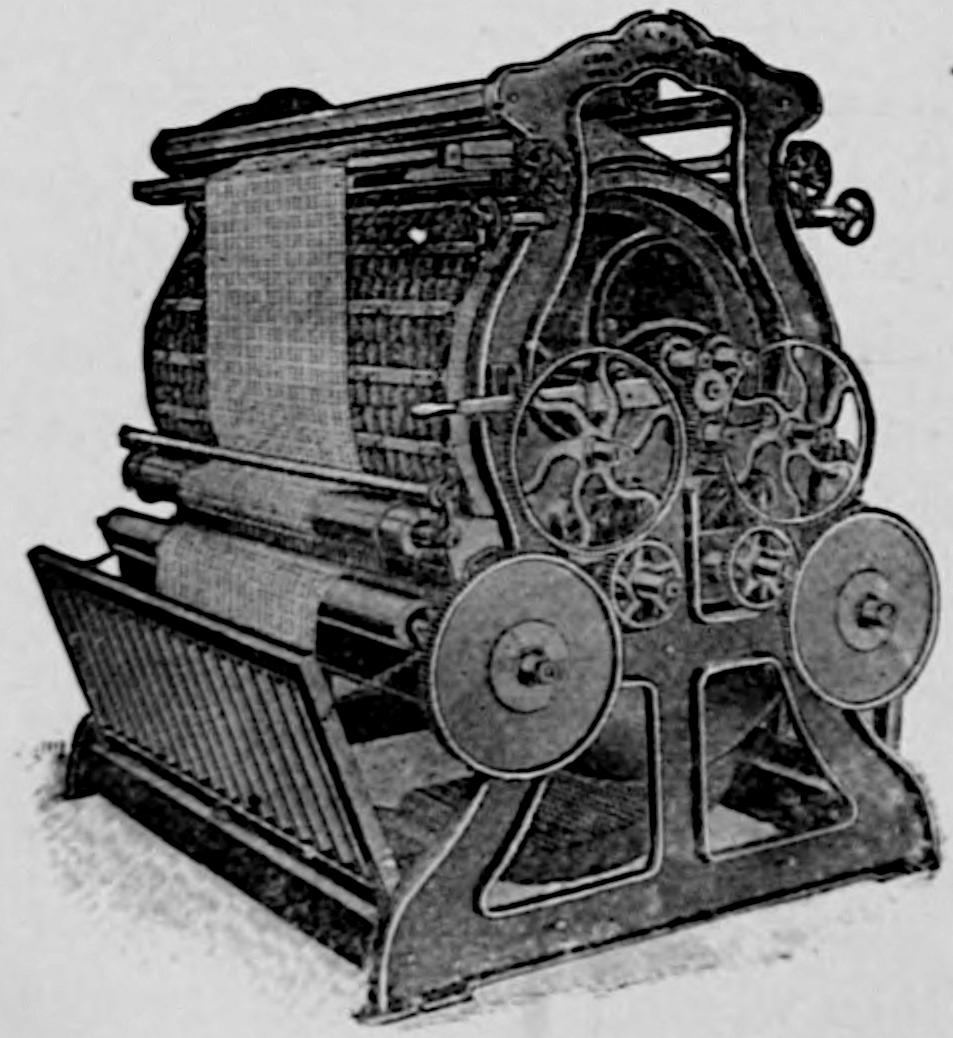
Fig. 93.—Double-Acting Gig.
Courtesy of Curtis & Marble.
Worsted suiting is merely napped enough to make the weave look clean and bright. Brushes are often used instead of teazles. Flannels are napped so that the weave is softened, but such felted goods as broadcloths and meltons have the pile so raised that the weave is completely obliterated. They have to pass many times through the gig to accomplish this. Defects are often concealed by softly raising a surface and finishing it to look well. The Raising Gig (Fig. 93) is a large, open cylinder on which a series of slabs or shallow boxes, the width of the cylinder, may be fastened. The best means of raising the nap is the teazle (Fig. 94), which is a vegetable growth something like a stiff thistle. Fine wire raisers are sometimes used, but have this disadvantage, that they break the cloth when in contact with a knot, whereas the vegetable teazles break first. The narrow troughs or [193]boxes are filled with the teazles laid lengthwise, so that they present a continuous napping surface. The cloth is stretched tight in the machine, a humidifier often sprays it as it passes slowly along, and the napping cylinder moves rapidly in the opposite direction, rubbing up the surface of the material with the teazles. The process is repeated several times, at first with old, soft teazles and gradually with stiff, new ones, until the surface is thoroughly covered with the raised fibers. The nap becomes finer as the gigging is repeated. There are two methods of napping, the wet and the dry. In the former, the cloth is kept moist, and the resulting pile is more shiny than in the dry raising. Face goods, such as broadcloths, are napped wet. The dry raising is used for worsted suitings and fancy woven goods. Cloths that require much finish are given a special steam lustering, such as broadcloths, plushes, Venetians, uniform cloth, and worsteds.
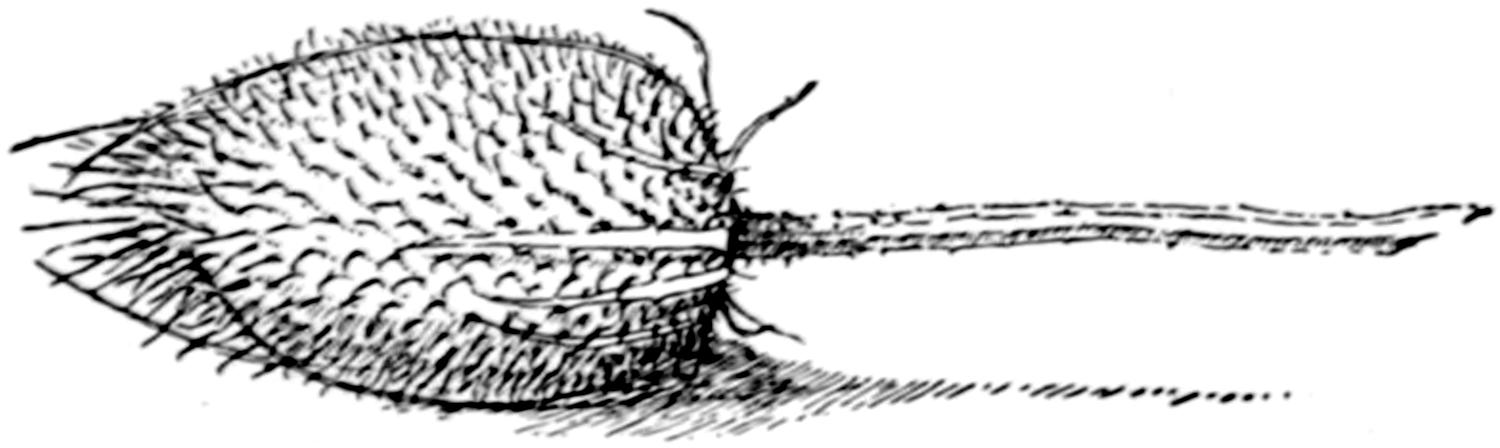
Fig. 94.—Teazle.
Shearing, Cutting or Cropping, and Brushing.
—Cutting the nap and brushing it clean follow gigging or napping. One machine frequently combines all three processes of raising, cropping, and cleaning. The aim of the shear (Fig. 95) is to trim the raised nap to the desired height, it may be merely to even it off, or it may be to cut the nap close. The shear has to be adjusted to the need and requires care, for if the nap is too long the surface roughens with wear; or if too close, the material is weakened. The cutting surface is a sharp blade arranged spirally around a cylinder which comes in contact with a sharp bar or knife. The two surfaces act [194]as scissors and cut the nap as desired. The principle is similar to the lawn mower. A stiff brush or a set of soft teazles set in a bar follow, and rid the cloth of clippings and dust. Steam brushes are also used for some classes of goods, such as kerseys. After the wet napping and cropping to which dress face goods are subjected, the hand, when laid on the cloth, can move smoothly in the direction in which the fibers have been raised, but feels the opposing nap when moved in the opposite direction. In goods woven entirely of wool the nap is along the warp way. In dry raising, to which worsted suitings and trouserings are subjected, the fiber is lifted to an upright position and the shear cuts it off, leaving the weave distinct. The nap therefore offers no resistance to the hand when passed over it. Brushes are in use, but it is important to have the right kind and to keep them clean and unworn. A rough and uneven cloth results from poor brushing. In fine grades of cloth a plush roller is sometimes used after the final clipping. The small fibers left from shearing after raising are used for docks.
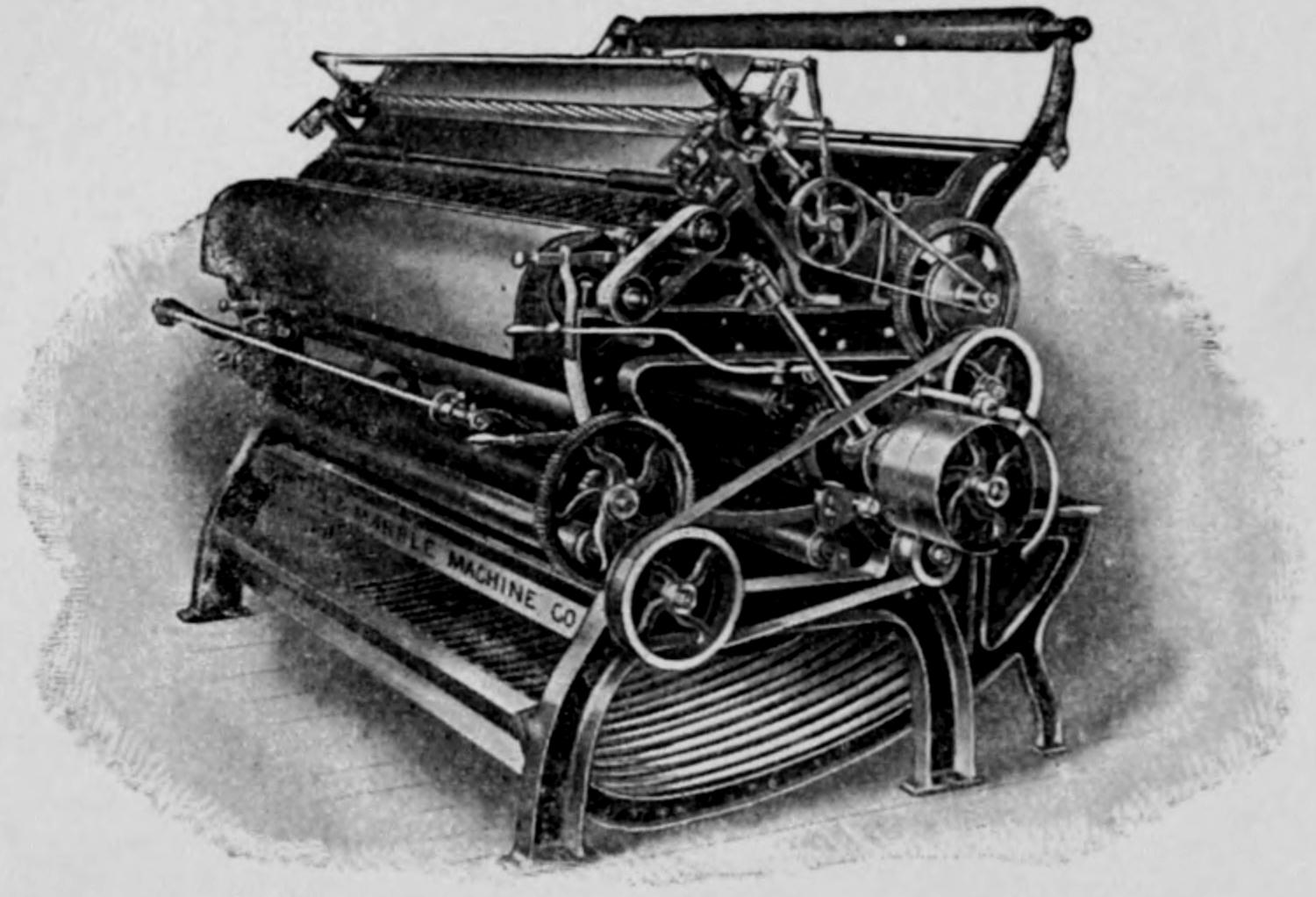
Fig. 95.—Single Cutting Shear.
Courtesy of Curtis & Marble.
[195]
The differing order in which the many finishing processes are applied, their repetition or elimination, the appearance and use of new kinds of machines, and the large number of differing cloths, make impossible a definite statement of procedure. Perching or inspection occurs at intervals, and defects are found which must be corrected. Tentering, napping, and cropping are often repeated. Some mills, knowing that irregularities are apt to occur, have these repetitions as a part of their regular schedule.
General Finishes.
—Boiling, steaming, pressing, and brushing are all used in varying degrees and times to give a final finish to cloth. Some wools, such as mohairs and alpacas, have a natural gloss which is increased by pressure; other wools can have a permanent luster brought out by treatment, and a surface finish can be applied to poor stock, giving it an attraction which is more or less enduring. Boiling or steaming brings out luster, and is employed for some woolen goods and for many worsteds. It is used after tentering with some classes of goods, and after gigging and shearing, or even after pressing, with other kinds. The following are representative methods: (1) wrapping the cloth around a roller and boiling it for several hours; (2) wrapping the cloth around a perforated copper cylinder through which steam is forced, occupying several minutes; (3) placing the roll of cloth in a steam chest. The material in each instance is treated first on one side and then on the other. Cloth which is to be dyed in the piece is frequently sent to the dye house after steaming. It is sewed into an endless belt by uniting the two ends, and is passed through the dye until the requisite color is gained.
Sponging (decating) of cloth after its completion is necessary to keep it from spotting in the rain, as the luster is so fine that small drops of water injure it. The larger dry goods stores will have the goods sponged before they are sent home. In the manufacture of woolens and worsteds in England and Germany the sponging is now done before it [196]leaves the factory, both for the cutting-up and the retail trade. As yet the United States has not made a specialty of this, but some of the largest mills are installing decating apparatus.
Final Pressing.
—A preliminary passing of cloth through the calender is often done before inspection occurs. Face goods are frequently thus pressed after the shearing and brushing, and are pressed again as a final finish. A calender is a highly polished heated roll on which the cloth is pressed smooth and given luster. Dry steaming often follows to make the gloss permanent, or steaming can be used to reduce an excessive luster. As a final finish a spindle or hydraulic press has been in use for some classes of goods, which gives a glaze to the material, but the calender is taking its place. The method of pressure in the spindle press is as follows: The cloth is carefully folded with press boards between the folds, so that one layer of cloth does not touch another. Hot plates are put above and below, and hydraulic presses or screws bring pressure upon the cloth. It is left overnight in the press, and then taken out and refolded in such a way that parts not pressed before now receive an equivalent amount. Pressing adds to the look of solidity in the cloth as well as to the luster.
Brushing of various kinds is also used in the final finishing.
Special Finishes.
—Cheviots, which partake of both woolen and worsted characteristics, though in general they are worsted, show the weave, but it is softened by some fulling and raising, and is not as clear as in the regular worsted suiting. A good worsted cheviot costs about twice as much as when made of woolen yarn. In the latter case it feels softer and is less liable to wear well. The original cheviots were made from the wool of the English cheviot sheep. Venetians are made of wool, but the weave, which is a sort of upright twill, is definite and clear like a worsted. Thus worsted and wools partake at times of opposite characteristics, from variations [197]in their finish. Flannels woven plain or with a simple twill are finished in many ways. At times they are subjected to the processes of worsteds and clearly show the weave. They are even woven with worsted yarn and dry finished. Still other varieties, such as the opera flannel and ladies’ cloth, are woven of woolen yarn and fulled, napped, sheared, and pressed to look like broadcloths. They are sold at different prices, being made of pure wool or in many degrees of combination with cotton. When made of all cotton they can be chemically treated to feel like wool, and given the finish to look like wool.
Special machines are used to give varieties of surface, the chinchilla machine being illustrative of such mechanical finish. The chinchilla cloth is made with a special weave, and is later fulled, gigged, and sheared to give it a long, soft nap, which is well opened and made erect with a wire brush. The cloth is now placed in the special machine, which has a rotary attachment, and rubs the nap into small rolls, bunches, or points. By adjustment of the machine these bunches can be made to lie in stripes or other designs. When this cloth is made of pure stock good results follow, but frequently it is manufactured of inferior wool and cotton, and is unsatisfactory. Cotton warp with a wool filling thrown on the surface is frequently used in its construction.
The true worsted suiting is finished much more simply than the face goods. After weaving, it is generally sufficient to wash, tenter, brush or gig (to raise the nap which obscures the weave), crop the surface to make it bright and distinct, and crab and press to give permanent luster.
Fibers are removed from yarn or cloth by several methods besides shearing, such as gassing or singeing, in which the yarn or cloth is passed quickly through a gas flame, which singes it without burning. Scouring or dyeing often follow on account of a slight discoloration. Passing the cloth rapidly over white hot copper rollers also removes the surface [198]fibers. The electric current is also used for napping and cropping as well as for other finishes.
Worsteds are usually dyed in the slub (top), in the skein (spun yarn), or in the piece, but a method of obtaining mixed effects such as the pepper and salt, called Vigoureux printing (see Chap. XIII, Forms of Market Dyeing) is in use. The old method was to unite two yarns which had been slub dyed, or a black and a white yarn when desiring to make gray. The Vigoureux process saves time and expense. The sliver of worsted yarn is printed in a regular or irregular pattern, usually one color on white. The dye is set and the sliver then goes through the regular processes for making it into yarn, in which the figure is obliterated and a mixed color secured. Heather mixtures for woolens can be obtained through mixing dyed new wools, but the use of reworked wools in various selected colors mixed by machinery gives excellent results, saves money and time, and is much in demand.
The use of surface finishings of innumerable kinds is very general. They are employed to beautify, to strengthen, and to conceal defects. Starches, gums, soaps, and chemicals are the usual dressings. The feel of one textile can be given to another by chemical treatment. Cotton is made to resemble wool and wool to have a silky effect. Moiré and embossed designs can be made by special machines, by the use of gums and starches. Crêpon effects and waterproof and fireproof finishes can be given by chemical means. (See Chap. XII.) Goods are made absorbent or antiseptic, are made to have a pleasing feel and soft finish, or are given weight and substance as well as gloss and luster, by surface treatment. Many materials which are lightly woven are subsequently stiffened on the back to give them an appearance of body which they do not really possess.
New discoveries in industrial chemistry are resulting in new methods of finishing. The chlorination of wools; printing [199]in light and dark; the production of unshrinkable yarns; combinations in one cloth of felted and unfelted surface, and giving silk effects in the rustle as well as the appearance are interesting methods of gaining diversities in material. Reliable trade journals should be consulted constantly by those who wish to know of new finishes and whether practical results have followed from the experiments which are being tried.
Other Uses of Wool and Worsted Yarns.
—Felt which is made of serrated wools was not woven originally, but was carded, felted, and pressed into cloth. At present it is frequently woven first, and fulled and finished later. A cheap kind of horse blanket is made which looks like felt, but is constructed in the following way: Sheets or laps of carded wool are placed on both sides of coarse burlap. These layers are made into one piece of cloth by means of thousands of needles, which pull the carded wool back and forth into the burlap, the rough jute or hemp fibers of which hold the wool in place. The finish gives the material an attractive appearance. Large quantities of woolen and worsted yarn are used for knit goods, for cardigan jackets, sweaters, hosiery, caps, shawls, gloves, mittens, underwear of all kinds, boot, shoe, and glove linings. In eiderdown flannel the wool is knitted into cotton stockinet and is made both single and double faced. The finishing of this material gives it a soft nap. Heavy woolen overcoatings for men’s wear are knit. Reworked wools in large percentages are used in these fabrics. The result is a warm, enduring, attractive cloth finished like a melton. Cotton is used largely in combination with wool in this industry.
The Carpet and Rug Industries
are important in the United States. The principal looms in use were invented here. New York, Pennsylvania, and Massachusetts are large producers. The wools are largely imported, much coming from China, and the yarns made from them are [200]coarse and shiny. Woolen yarn is used as well as worsted, but not to the same extent; the latter gives the better wear and is more expensive. These floor coverings were originally made entirely by hand by tying or twisting short ends of yarn around the warp threads and holding the loops in place by the filling. The loops were cut by hand by means of sharp knives. The machine-made products imitate the hand made, and are frequently constructed on specially adapted looms. The worsted yarn is made from coarse, hair-like wools. The yarn is not only doubled and twisted after spinning but often three two-ply strands are twisted into one, and several of these are used in each loop. The best carpets have a hemp or linen back and a well-dyed worsted yarn for the face. In good pile carpets the filling is thrown through the warp three times after each row of loops, which holds them well in place. There are many varieties of these floor coverings on the market, the principal one being the ingrain, which is woven like a cloth with two-ply or three-ply yarn. Venetians and Kidderminsters are similar. The weave is sometimes plain, but frequently there are elaborate designs which reverse the color on the front and back. Either side of the carpet can be used. Ingrain carpets with two webs are woven usually on Jacquard looms and are enduring and rather expensive when made of good three-ply yarn, but are made in all qualities and prices. They are manufactured with worsted in both warp and filling, or with worsted warp and wool filling, or with worsted warp and cotton, jute, or even poorer filling. The best quality has a large and definite number of warp and filling threads to the inch, but the poorer qualities reduce the amount and consequently the endurance. Drugget or felt is sometimes strong and serviceable, but often is cheap and poor. It is made plain or with a design printed upon it.
Pile carpets are constructed with the loops uncut, as in Brussels, or cut, as in Wilton. They have two warps. The [201]best carpets have a worsted surface. Wool is used in some varieties. The kind of fiber used for the backing makes considerable difference in the expense of the carpet, and also figures in the wear. Flax, hemp, cotton, cotton waste, and jute are all used according to the price of the carpet. After weaving, pile carpets are finished usually by brushing and shearing. Brussels carpets are made in several qualities, depending on the stock used, the number of threads in a loop, the loops in a given space, the class of dye used in the yarn, and the material used in the backing. The number of colors possible in a design is limited, as the yarn for each color must be dyed separately. Brussels carpets are woven on a special Jacquard loom, in which the worsted yarns for the surface loops are wound on spools and placed on large frames at the back and slanting towards the loom. Each color is on a separate frame, and there are about two hundred and fifty spools on one frame. The warp which is used for the backing is either wound on spools also and placed on the lowest frame, or it is wound on a beam and set at the back of the loom in front of the frames. The backing threads, both warp and filling, are also dyed. A body Brussels, which is considered the best kind, takes its worsted yarn into its very foundation, so that the colored worsted shows on the wrong side of the carpet in the midst of the backing threads. If it is a five-frame Brussels it will have five colors on the frames, and when one of these colors appears on the surface of the carpet the others can be seen at the back. There are several threads in each loop. The filling usually is shot across twice in Brussels, for the loops are less apt to pull out than if they were cut, in which case a three-shot filling is better. Flax and hemp make the best backing for both warp and filling, but cotton is sometimes used satisfactorily. Well-made Brussels carpets are very enduring and also expensive. The loops on the surface are made by passing the worsted yarn from the frame over a series of wires and holding down the [202]loops thus made by the filling threads. The rods or wires, usually eight or ten in number, come automatically in place, and are each withdrawn and placed at the end of the row after the filling holds the row of loops on the surface.
Tapestry Brussels carpet is a poor imitation of the real Brussels. Many colors are used in it. The design is made first on squared paper, the scheme of color in each pick of the pattern is studied out, and the succession of it sent to the printer. The skeins of yarn to be used for the loops on the surface of the carpet are wound on a large cylinder, attached to which are troughs of color which come in contact automatically with the yarn, and print it according to the succession of colors indicated in the design. (See Chap. VIII, Cotton Printing.) The skeins are taken from the cylinder, showing crosswise streaks of varied color, and are carried to the steam chest to have the dye set. When the carpet is woven the pattern is complete, but has a less distinct outline than the real Brussels. The Jacquard harness and the frames full of bobbins are not needed, hence expense is spared. A simple harness is used, and wires are required to make the loops. The rows of loops are usually farther apart, and often but one thread is used in each loop. The backing is generally jute or some inexpensive fiber, and the face is a poor quality of worsted yarn. Flecks of color are sometimes printed on the back to increase the resemblance to body Brussels carpet. Tapestry carpet which has the loops cut is often called velvet carpet.
The original Wilton rugs were, and are still, made by hand in England on upright looms. They are of great beauty and worth, and are high in price. The machine-made Wilton is a copy of these, and an excellent article, at a much lower price. It is woven like a Brussels carpet, but has the loop cut, for the wires over which the loops are made have sharp edges which cut through the worsted threads as they are drawn out from the row just made. The Wilton carpet is [203]usually woven of better worsted and backing yarn, a greater number of fibers are in each loop, the loops are closer together, and the filling thread, which binds the loops together, passes across three times after each row of loops is made. The warp frequently requires as many as two thousand threads. The number of colors for a design in Wilton carpet is limited as it is in Brussels. The French Moquette carpet is similar to the Wilton, and also named from the town of its manufacture.
Axminster carpet is a pile carpet resembling the Wilton, but numerous colors are possible by a special arrangement for the supply of worsted yarn. The design is made, and the colored yarn as needed for each line of loops is wound on a separate small cylinder. These are placed in an endless chain above the loom, and the threads from each are passed through a series of slots or needles. Each cylinder drops in place when needed, and makes its row of loops. It then automatically passes up to wait until it is again needed in a repeat of the pattern. Royal Axminster carpets are expensive. In England Axminster carpets are sometimes called Moquette, but the latter is more like Wilton carpet. The terms velvet and Moquette have been used rather loosely in America for cut pile carpets. Chenille Axminster carpets have a specially tufted cord made for them. The loom, in which the fabric is woven which will later be cut into strips along the warp to make the cord, has a harness with a doup heald as well as a standard one. The former can be drawn to one side, making adjacent warp threads overlap through which the filling passes. (See Chap. IV, Leno or Gauze Weaving.) The cloth is cut into strips across the filling, which is held by the crossed warp threads, and the severed ends rise into a fuzzy cord. This cord is woven into the surface of the carpet. The principle is much used for the manufacture of cotton chenille curtains. Glasgow has manufactured [204]chenille carpets; the United States does not import them to any extent.
Handmade rugs are imported chiefly from the East, Constantinople being the greatest Oriental market. They are made in Persia, India, Turkey, and other Oriental countries. The machine-made rugs of the United States copy the patterns of the Eastern handmade ones. The wools used are largely the same that are found in the Oriental ones. The method of making the rugs by machine is the same as the carpets already described. Handmade rugs or carpets come from France in the Aubusson and from England in the Wilton and Axminster. These are usually made to fit the room, being woven the exact size. Handmade rugs are very expensive. At the present time rugs are more in use than carpets, for the housekeeper prefers the bare floor with a few rugs to a carpet completely covering it.
Wastes and By-Products.
—(See Chap. VI, By-Products of Wool, and Reworked Wool.) The large variety and value of wastes can be seen by referring to any textile journal, and noting the kinds of products under such headings as Rags new and old, Shoddy, Machine Waste, and the like. An efficiently run factory takes the pounds of machine waste and its disposal into account when estimating the cost of its product, as well as the expense of the raw material, labor, repairs, equipment, and overhead expenses. The final cost is reduced by selling wastes, noils, or clippings, and the effect is felt in the market price of cloth or of clothing. Mutton, pelts, leather, rugs, cloaks, and oils help to make the utilization of the sheep one of the greatest industries in the world.
Cutting-Up Trade.
—The great increase of ready-to-wear clothing for men, women, and children has caused a demand on the manufacturer for classes of goods made especially for the “cutting-up trade,” as it is called. Some mills are working solely to supply these large clothing houses, and [205]sections of trade journals are devoted to these interests. (See Chap. XVI, The Clothing Industries.)
The machinery used in the wool industries has changed little, but new methods of obtaining results are reported constantly in trade journals. The automatic doffer in the spinning frame has made it possible to continue the work of the machine without interruption, for the empty bobbins are rejected and new ones put in the place. New machines for napping fabrics and for spinning finer counts of yarn are reported. Research groups in the industry are working to eliminate the various wastes, such as lengthening the life of leather aprons and brushes, the removal of dust in the singe room, gases in the bleaching and carbonizing rooms, and preventing the soiling of fabrics from oil on the machines. The ventilation of dye houses is receiving attention, and the better conditioning of the air in the mills.
Wool Manufacture in Leading Countries.
[13]—The leading wool manufacturing countries of the world are the United States, the United Kingdom, France, and Germany. Belgium, Italy, Austria, Russia, and Japan are also engaged in this industry. Belgium furnishes England with large quantities of woolen yarn annually and in her large scouring plants much of the wool used by the industries of the Continent are cleaned. Verviers is important in the wool industry.
[13] Report of the Tariff Board on Schedule K, 1912.
The United States is important in wool manufacturing,—woolens, worsteds, felt, carpets and rugs, and knit goods all being thriving industries. The manufacture of carded woolens as a household industry began among the earliest settlers. In 1859 when the worsted industry was in its infancy there were 1260 woolen mills run by power. The popularity of worsted fabrics interfered with the development of the woolen industry. At times there is a revival of interest in cheviots, tweeds, homespuns, and cassimeres, [206]but, in general, the production of worsted goods is greater. The main woolen mills are in Pennsylvania, Massachusetts, Connecticut, New Hampshire, New York, and Rhode Island; and in many states, even in the far west, there are mills making woolen cloth. As a general thing all processes of manufacture are conducted in the woolen mills. The worsted industry has developed rapidly. Some mills buy their yarns and weave only. Other mills buy tops, spin the yarn and weave and finish the goods, but there are many mills which carry on all of the processes. Massachusetts, Rhode Island, and Pennsylvania are the principal states, and Lawrence, Mass., Providence, R. I., and Philadelphia are noted cities. Cleveland, Ohio, has a large worsted mill. Knit goods and hosiery are rapidly increasing, a large amount of wool wastes being utilized. Felt is increasing its capital, and carpets and rugs are important industries. Cotton warp goods are in demand in cassimeres and dress goods. Cotton and wool mixed goods have declined with the exception of underwear and blankets, which are increasing. (See Appendix for statistics on the wool industry.)
Great Britain is noted for hard twisted worsted, the yarn being spun on the Bradford system. The center of manufacture is in a small district in the West Riding of Yorkshire. A large business is done in tops to sell to those making worsteds, and merchants buy raw wool and have it made into tops on commission. The demand for a great variety of yarns and fabrics has led to specialization in worsted spinning and also in weaving. The weavers have found it easier to buy the sort of yarn they need than attempt to make it all in their own mills. Bradford is the most important city for distributing raw materials, for worsted combing and spinning, and for the production of worsted dress goods for women. Huddersfield is the center for men’s worsted suitings. There is less specialization in the woolen industry, the mills preferring to mix the wool, reworked wool, noils and other ingredients [207]for themselves. Heavy woolens, overcoatings, cheap cloakings, and blankets are made near Dewsbury and Batley, where the greatest amount of reworked wool is produced. A low grade of fabrics is made at Morley. Leeds, once noted for broadcloths, is now doing a large business in serges and worsted coatings. Stroud in the west of England is noted for broadcloths and for using the finest class of wools in them. The southern part of Scotland is noted for tweeds, Galashiels being the most important center. Kidderminster is a carpet center and Nottingham and Derby have large hosiery interests.
France excels in soft worsted goods made by the French Combing System (see Combing, above) with short-staple wools. The combing of wool is a special business as it is in England, but in France it is for “tops” from soft mule-spun wools, where England produces hard spun wools on the frame. The Department of the North is the most important manufacturing center, the chief cities being Roubaix and Tourcoing for the wool combing industry. There are important mills in many other parts of France. Mazamet in the Department of the Tarn is the center for wool pulling. Vienne on the Rhone is the center for cloth made from reworked wool. Elboeuf in Normandy does a miscellaneous business in woolens and worsteds. The Department of the Somme produces wool and cotton velvets and the Department of the Rhone is engaged in the making of blankets. The hand loom is still working in homes and small domestic industries, and their artistic productions are making France supreme in fine classes of dress goods. The Rodier fabrics are an instance of the continued use of the hand industries.
Germany is doing much in wool manufacturing, but it is spread all over the country. Hand weaving is still in evidence, but is declining. It is found principally in western Saxony, north of Cologne, and North Bavaria. Both woolen and worsted mills are numerous, but more spindles are found [208]in the latter. The woolen industry produces much reworked wool and half woolen fabrics are produced in large quantities. Germany claims to have found a method of making fabrics of wool entirely mothproof.
Belgium, Italy, Austria, and Japan are also important in branches of the wool industry.
Woolen and Worsted Materials
- Albatross
- Astrachan
- Basket cloth
- Beaver
- Bedford cord
- Blankets
- Bolivia
- Broadcloth
- Bunting
- Carpets
- Cashmere
- Cassimere
- Challie
- Cheviot
- Chinchilla
- Corkscrew worsted
- Covert
- Cravenette
- Crêpe cloth
- Crêpon
- Diagonal
- Eponge
- Etamine
- Felt
- Flannel
- Frieze
- Gabardine
- Granite cloth
- Grenadine
- Henrietta
- Homespun
- Hopsacking
- Jersey cloth
- Kersey
- Ladies’ cloth
- Lansdowne
- Marquisette
- Melton
- Mohair
- Nun’s veiling
- Panama
- Polo or Golf cloth
- Poplin
- Prunella
- Ratiné
- Rep
- Serge
- Shepherd plaid
- Suiting
- Tartan
- Tricotine
- Tweed
- Velour
- Venetian
- Voile
- Whipcord
- Zibeline
[209]
Mixtures with Wool
- Alpaca
- Astrachan
- Bedford cord
- Brilliantine
- Eiderdown
- Eolienne
- Gloria
- Henrietta
- Lansdowne
- Lusters
- Marquisette
- Merino
- Mohair
- Poplin
- Sicilian
- Tropicals
- Viyella
[210]
CHAPTER VIII
THE COTTON INDUSTRY
Some Economic and Commercial Conditions.
—The vegetable fiber cotton is of more value to mankind than any one of the other textile fibers on account of its cheapness, its availability, and its varied usefulness. The materials made from it range from the finest threads, mulls, and laces to automobile tires and heavy sailcloths. It is probable that no other plant is so closely connected with the cost of living.
The invention of the saw gin in 1792 by Eli Whitney, and the application of power to machinery through Watts’ steam engine, were the factors in revolutionizing the industrial condition of the world, and in substituting the problems of factory production for those of the home. Whitney’s invention made the cotton of the United States available to English spinners, and the demand for cotton cloth gave the impetus to the inventions of Hargreaves, Arkwright, and Crompton. The influence of cotton on the commercial, political, and social relations of the United States is of noteworthy importance. It is the great commercial crop of the country, although corn exceeds it in total value. The United States is the greatest producer of cotton, and India, China, Egypt, and Brazil are also important producers. The Sea Island cotton is the finest and longest staple cotton in the world. This crop has been almost destroyed by the ravages of the boll weevil, and for commercial purposes it has disappeared, at least for the present.
The great cotton manufacturing countries of Europe, England, France, and Germany, have depended upon this country for supplies of lint for their mills. England has 40 per cent of her spindles on Egyptian cotton. The [211]United States uses about one-half of its own crop in its mills and exports the remainder. Its crop at present is in the neighborhood of 14 million bales of 500 pounds each, but before the war it had risen to 16 million bales. It produces about one-half of the world crop, and formerly grew a larger proportion of it.
For various economic reasons the conditions surrounding the growth of cotton in the United States have presented many difficulties, and the question as to whether it is advisable to continue growing such large crops has been under consideration. Labor problems in planting and harvesting the crop have been serious, wages have risen, transportation charges have gone up. The farmer in some sections of the cotton belt has found it difficult to make cotton pay and has turned to other crops. The price of cotton is from one to two hundred per cent higher, but expenses are so great that the returns are often inadequate. A very important factor in returns from the cotton has been the spread of the boll weevil over almost the entire cotton belt. The Sea Island crop has declined from 90,000 running bales to 2000.[14] It was stated in 1920 by the Bureau of Crop Estimates of the United States Department of Agriculture[14] that the average annual loss from the boll weevil was $300,000,000. (See Enemies of the Cotton Plant, below.)
[14] “The Cotton Situation,” Bulletin No. 877, United States Department of Agriculture.
The United States has been careless in its cotton growing. Seeds of good, medium, and poor cotton have been mixed at the gins, and when planted have brought inferior results. The cotton mills in this and foreign countries have suffered from this carelessness, for the bales contained uneven lint, and consequently the cloth made from it was unsatisfactory, or time and labor had to be spent to pick over the cotton when it arrived at the mill. Improved methods are being tried and large sections of some states are endeavoring to [212]grow but one variety of cotton, and thus obviate the danger of mixing seeds. Insects carry the pollen from one field to another. Methods of baling and handling have also been needing correction.
The cotton farmer asks a higher price for his cotton than before the Great War. He is endeavoring to give a more even staple, he is relying more on coöperative marketing that he may get better prices, and on the storage of unbought bales in warehouses, that the cotton may not be exposed to the weather. (Deterioration of the cotton in the bale through rain and dirt to which it was exposed has been a cause of complaint.) Representatives of foreign governments, where our cotton is used, have come to the United States to study the causes of the irregularities in our cotton. They are dismayed at the rising prices and are making efforts to increase the growing of cotton in other parts of the world, especially in their own dependencies. With the exception of Egypt, other countries do not grow cotton equal to the American crop. Russia, China, Japan, India, the British colonies in Africa, Brazil, Peru, and Argentina are purchasing large supplies of American improved seeds and are employing experts from the United States to help them to grow better cotton. If the price is higher than it was at one time, the cotton will be better. The standardization of the grades of cotton that values may be more easily determined has been under consideration for some years, and progress has been made.
Properties.
—The properties of cotton which are especially noteworthy are the following:—
1. The fiber has a natural twist (see Chap. XI) which aids in the spinning of it into fine and coarse yarns. When long, fine staple cotton is used and the thread well spun it makes a strong yarn.
2. Cotton burns easily on account of its cellulose nature and the natural oil it contains; it is said to be even subject to [213]spontaneous combustion. When cotton is nitrated, it is highly inflammable and is used for guncotton. Treatment with nitric acid gives cotton more or less a feel of wool, but as it burns more readily than before, there is danger if the material is brought near the fire. Many of these materials are napped to give them still more the effect of wool, and the danger of fire is still further increased by the greater amount of air between the fibers. The Chardonnet method of making rayon was by nitrating cotton. It was at first very inflammable until a method of denitrating was used.
3. Cotton is very free from impurities, and bleaching cleanses it still more. It can be stored for a long time without deterioration, unless sizings and starches and certain dyes are present. If kept clean and porous it is a hygienic material for wearing next to the body. (See Chap. XV.)
4. The hygroscopic quality is less than that of wool and silk. Artificial moisture is needed in its spinning to produce good results. It absorbs water slowly, and does not give it up quickly, consequently it remains damp a long time. To render cotton absorbent, the cotton wax is removed. It does not dye readily unless it is made more absorbent or a chemical is applied for which both it and the dye have an affinity. This mordant, as it is called, holds the dye to the cotton. (See Chap. XIII.)
5. Moist cotton is stronger than dry cotton. When cotton is heated, as under a very hot iron, its strength is less. Alternate moisture and heat do not hurt cotton unless the heat is too great.
6. Cotton crushes and creases easily, and needs frequent pressing. The surface of napped goods and blankets easily flattens down and takes on a rough, shabby look unless often brushed and shaken. The warmth of the cloth decreases as the surface loses its fluffiness, for the air is no longer imprisoned in it.
7. Cotton soils readily on account of the numerous fine [214]hairs protruding from the yarn, and the natural oil in it. When it is new and has the sizing or finish still upon it, it will stay clean longer, for the fibers are held down.
8. Cotton shrinks in water and in certain chemicals. This is a natural property but is augmented in weaving. The strain on the warp threads in the loom stretches the yarn to its full length, and the sizings and starches hold it there. Warm water and soap in the laundry loosen the finish and the yarn contracts. The shrinking must be taken into consideration when cutting out and making garments. When cotton yarn is put into a cold bath of a certain strength alkali it will shrink and become stronger and heavier, and will take on a parchment-like appearance. (See Mercerization, Chap. XII.)
9. Cotton is a better conductor of heat than wool or silk, consequently when thin it is a satisfactory summer garment.
10. The elasticity of cotton is less than either silk or wool, therefore the thread breaks more easily when subjected to strain.
11. The tensile strength is fair. The cotton fiber is stronger than the wool fiber.
12. Specific gravity. This differs in various textile fibers, but it is least in boiled-off silk. Wool is lighter than raw silk, and mohair is the same as the latter. Linen and cotton are the heaviest. Cotton blankets and quilts are much heavier than those made of wool of the same consistency.
By special treatment and at a small cost cotton can be made to resemble and even feel like linen, wool or silk, and thus have a distinct service, but it does not have the properties of these textiles.
Botany and Growth.
—Cotton consists of the hairs (plumose fibers) which protect the seeds of the plant. It is called a surface fiber to distinguish it from the bast or stem fibers, such as flax or Kentucky hemp. The stalks of the cotton contain bast fiber not utilized at present on account of the [215]expense of preparation. Cotton is almost pure cellulose. While growing, the fiber is cylindrical in form, but as it dries it twists and when fully ripe is like a narrow twisted ribbon (Fig. 134). This characteristic gives strength when the fibers are made into yarn. Cotton is often short in staple, but a fiber of even three-fourths of an inch in length can be spun into a strong yarn. (See Fig. 96.)
The cotton plant (Fig. 97) may be an annual, biennial, or perennial. In the United States it is planted annually and grows to a height of two to four feet. Sea Island cotton grows higher. In South America and India a more tree-like cotton is found. The leaf of the plant often varies in shape on different parts of the stem. The flower has five whitish or yellowish petals, which are almost saffron color at the base. They last a day, becoming purplish in color, and drop off, leaving a three- or five-celled pod or square, which increases in size and finally bursts into sections, disclosing the cotton fiber covering the seeds. Some varieties of seeds are covered with a soft surface down called linters, which adheres very closely. This is removed by a second ginning, and forms a valuable crop. Sea Island and Egyptian cotton have shiny black seeds without the fuzz excepting at the ends. Cotton ripens differently, and a plant may contain at one time mature cotton bursting out, together with developing bolls, flowers, and opening buds. A cotton field in bloom is a beautiful sight. (See Fig. 98.)
[216]
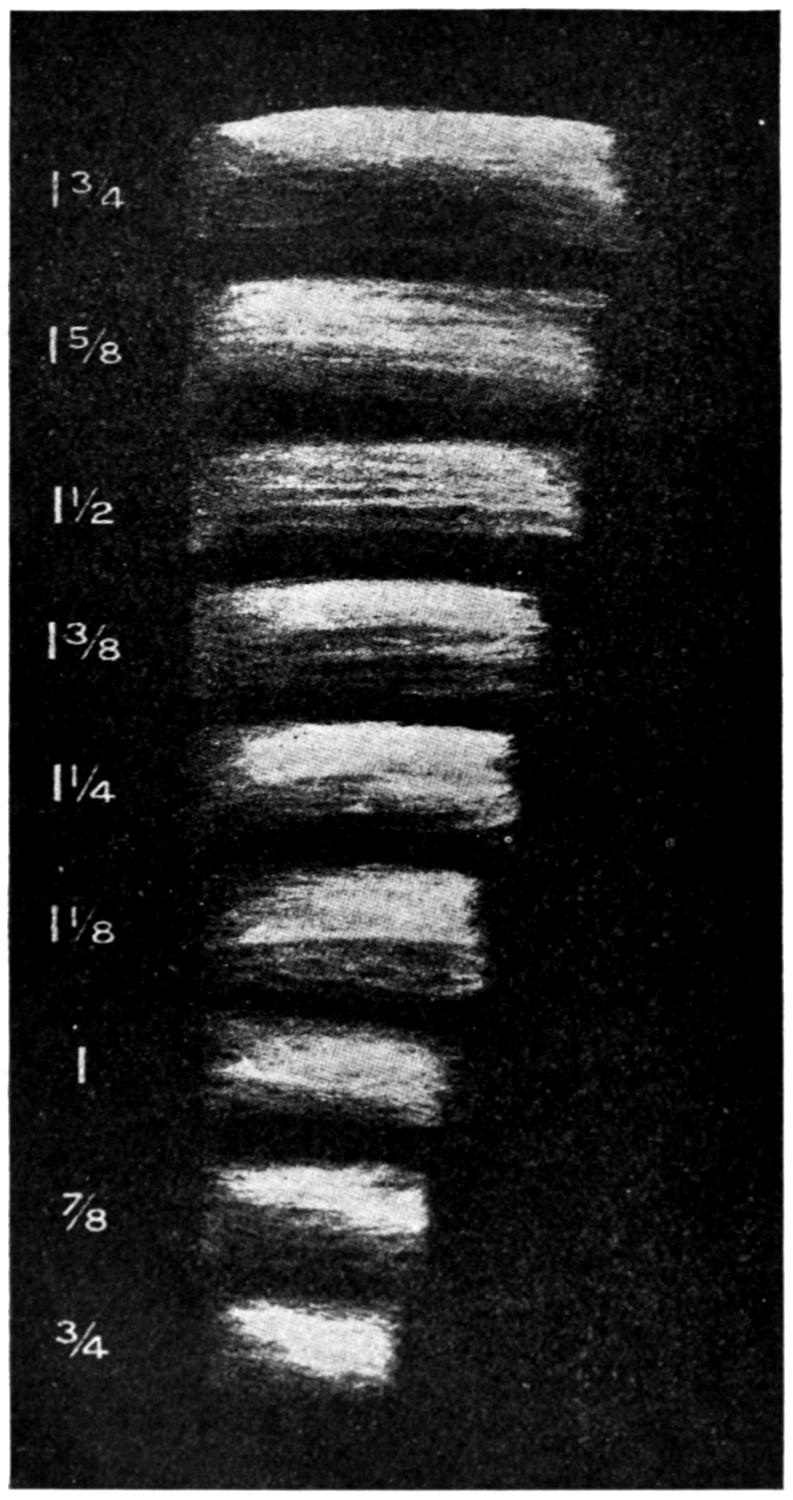
Fig. 96.—Staple of Cotton.
Courtesy of United States Department of Agriculture.
[217]
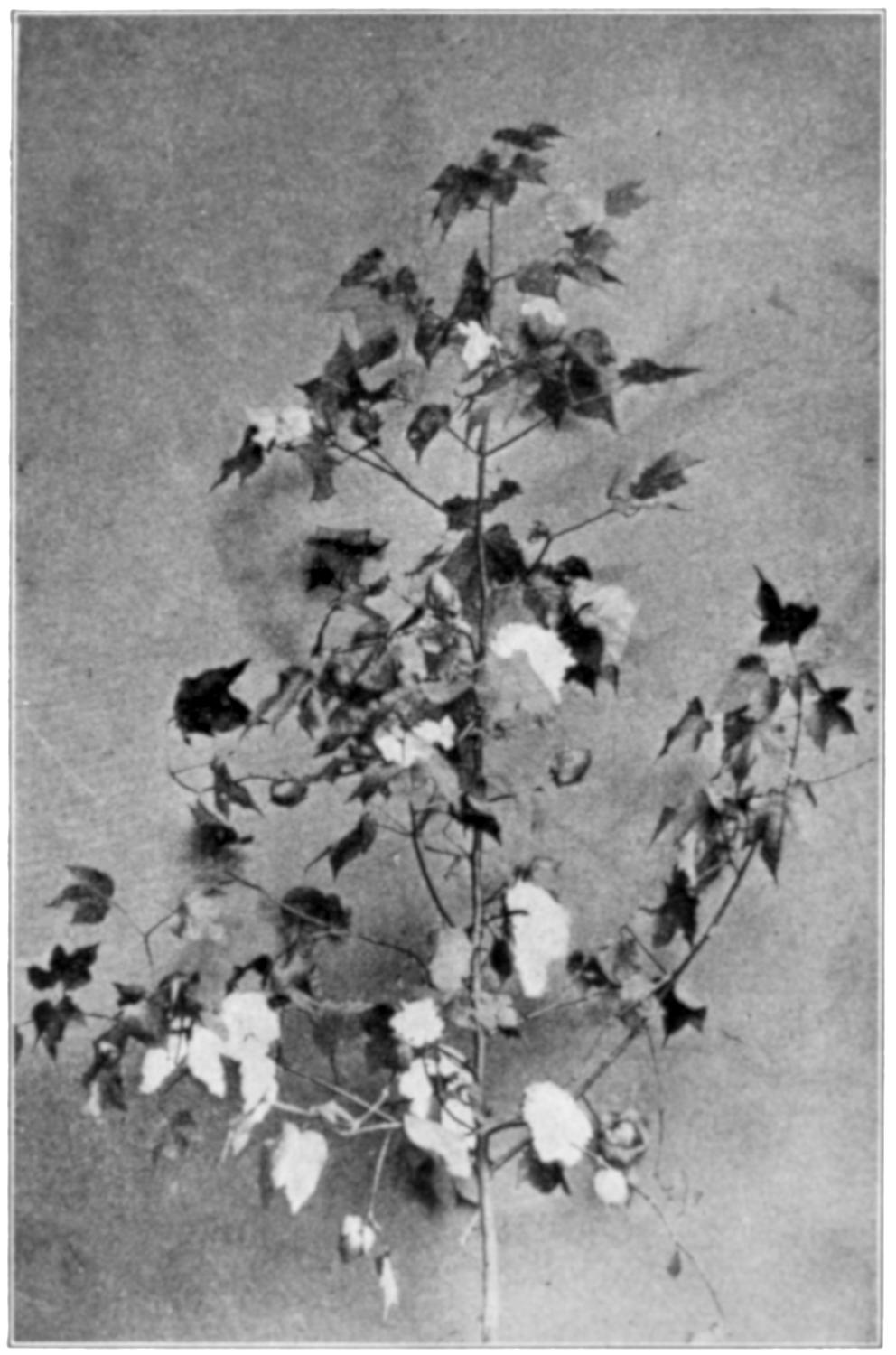
Fig. 97.—The Cotton Plant.
From Brooks’ Cotton, by courtesy of the American School of Correspondence.
[218]
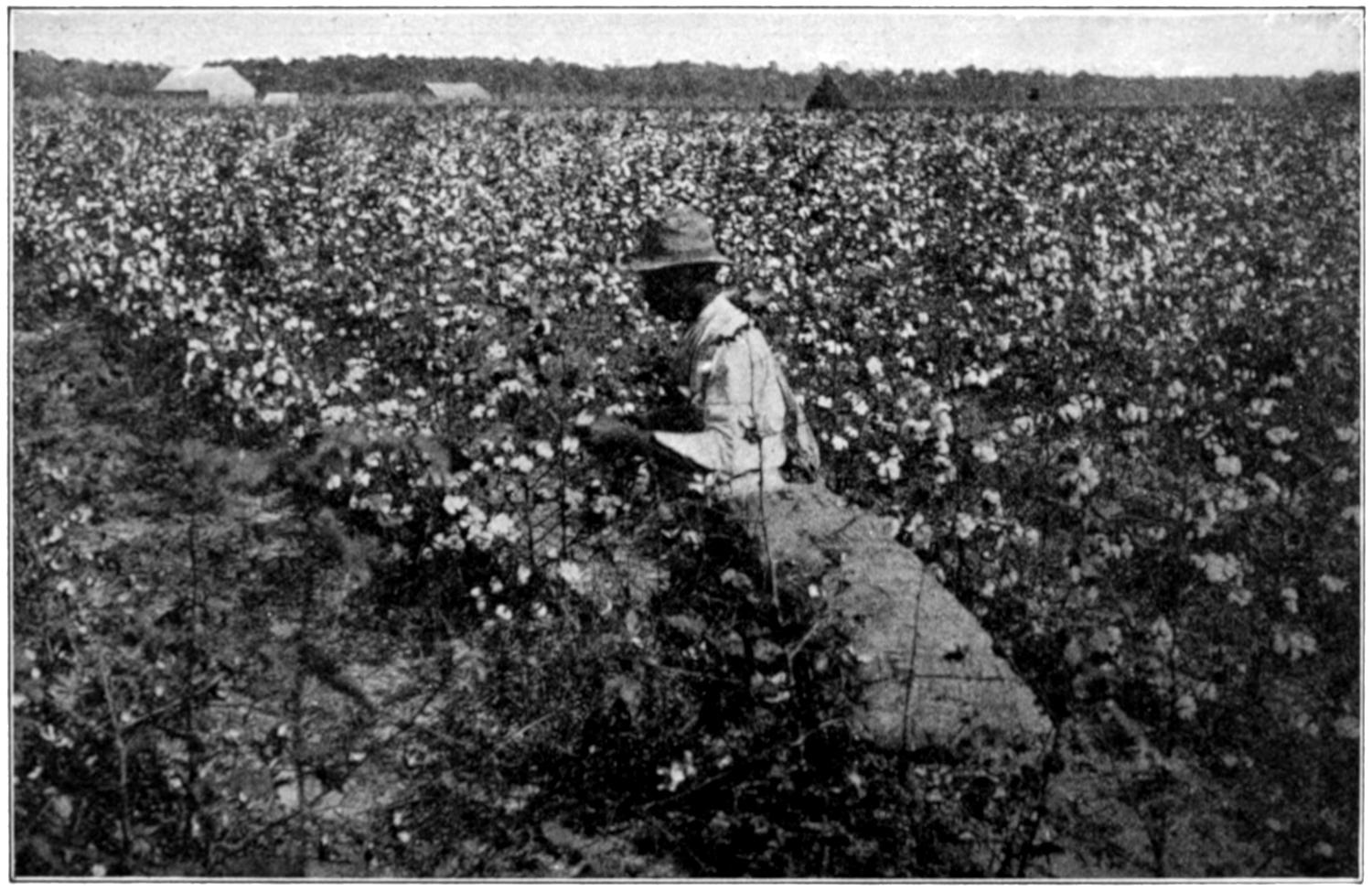
Fig. 98.—Cotton Field, showing Picker at Work.
Courtesy of U. S. Department of Agriculture.
[219]
Cotton belongs to the order Malvaceæ, or mallow, which also gives the hollyhock and marshmallow. The important genus of the mallow family is the Gossypium, which is found varying in height from two to thirty feet. The species are very numerous, for the plant develops new characteristics according to its habitat, the methods of cultivation, choice of seed, soil, climate, and position near or away from the sea. There are many agricultural varieties which have obscured the botanical species. Thirty-eight commercial types are recognized in Liverpool. Authorities differ greatly in classifying the species of cotton, but the following are fairly well established:—
Gossypium barbadense, takes its name from the Barbadoes, where it grows. Sea Island and Egyptian cotton come from this species, and the Peruvian and Brazilian are probably more or less related. Peruvian cotton has a long, strong staple which spins to medium fine counts, 45s to 70s. The barbadense grows better in salt air and soil; the fiber is long and silky, and the natural twists are frequent. The yield is perhaps less than the short staple cotton, but the value is greater. The highest counts of yarn are spun from it; 120s to 240s. The roller gin is generally used to separate the lint from the seed. Sea Island is the most valuable of the world’s cottons. In fineness and length of staple it surpasses the others. The Egyptian cotton is like the Sea Island and second in value to it. The cultivation began in Egypt in 1821, American Sea Island cotton seeds being planted. Egyptian cotton is mostly long staple, the best known is the Sakellarides. Other Egyptian cottons such as the Mitafifi and Abassi are roughly classed as Upper Egyptians.
Gossypium hirsutum is probably of American origin. It is grown as an annual. The name hirsutum is given on account of the appearance of the seed, which is covered with a grayish or greenish down. Some experts consider hirsutum and herbaceum to be the same species. The lint spins to warp threads 34s to 46s, and to filling from 36s to 54s. It is usually cleaned by the saw gin.
Gossypium herbaceum.—This variety is probably of Indian or Asiatic origin, and is both annual and biennial. The Brown Egyptian is from this species, and the Surat of India, which is short in staple, is said by some to belong to it also. The Nankeen cotton of China is a color variation of the herbaceum. The seeds are covered with two kinds of fibers: long and silky, and short and dense. The seed cotton has [220]to be removed very carefully, as the hairs adhere tightly to the seeds, and the down and part of the covering of the seeds are apt to come off at the same time.
Gossypium arboreum and neglectum.—These species are related to the herbaceum, are much alike, and have the seeds covered with down. They are natives of India, and grow to fifteen to twenty feet in height. They give the Bengal and Dacca cottons of India, and the China cottons. The Gossypium religiosum is thought by some to be the same as the Gossypium arboreum.
The American Upland cotton is beginning to be used in many parts of Asia.
Cotton is cultivated between 35 and 45 degrees both north and south of the Equator, but grows best within thirty-five degrees either way. More than half the cotton is cultivated in temperate latitudes. It thrives in a warm, humid atmosphere, with ample rainfall, and a light, loamy, or sandy soil which keeps damp yet holds the heat. In a moist, even climate with warm summers, and with salt in the air and soil, it reaches a very high quality as has been the case with the Sea Island. The latter is grown on the islands off the coast of North Carolina, Georgia, and Florida, and on lands near the sea. It is also produced in the West Indies. The conditions in the southern part of the United States are favorable, especially the gradual rise in temperature during the entire development of the cotton. Rain in the spring when the crop is maturing helps the development of stem and leaf. Heavy rains, however, in the summer are likely to injure the production of the bolls. The plant is very sensitive to frosts which sometimes come in the growing time. Humidity in the air is helpful, but cotton can thrive also under irrigation, as has been found in its successful raising in California and Arizona, where it is dry and hot.
The American Cotton Belt
extends from the Atlantic Coast through North Carolina, South Carolina, Georgia, [221]Florida, Alabama, Mississippi, Arkansas, Western Tennessee, Northern Louisiana, Texas, Oklahoma, and New Mexico. Cotton is also produced in the Salt River, Gila and Colorado Valleys in Arizona and in Palo Verde, the Imperial and San Joaquin Valleys in California. The main cotton produced in the United States is the Upland short staple, which is said to give 92 per cent of the crop. A longer staple Upland is produced in the valleys of Texas, in delta lands of Mississippi, in Oklahoma, Arkansas, South Carolina, and California. The name “Peeler” is in general use for a long staple Upland cotton. The Upland seeds are covered with down running in color from gray to brown. The length of the short staple is from five-eighths to one inch. There are many varieties of it grown in other parts of the world. In Arizona the Pima cotton is grown with success by careful irrigation. The standard of the lint is excellent; the staple is from 1¹⁄₂ to 1³⁄₄ inches. It is grown from Egyptian seeds. Great care is taken that the seeds shall be unmixed with other varieties, the soil is carefully prepared, and all weak plants are removed during growth. Arizona is also growing the Upland cotton. Meade cotton is being planted in place of Sea Island, as it matures earlier and is less apt to be destroyed by the boll weevil. The staple is 1¹¹⁄₁₆ inches in length under favorable cultivation. The seeds are smooth and the roller gin is used.
The Leading Cotton-Growing Countries
outside of the United States are India, Egypt, Brazil and Peru in South America, Russia, China, and Mexico. The West Indies also grow cotton. Egypt with its warm, bright climate, good water supply, system of irrigation, and favorable growing time, without storms or rains, is an excellent place for cotton growing. The length, strength, and color of the Egyptian cotton are notable. The brownish color of much of it is caused by the red coloring matter in the Nile, which stains while it nourishes the plant. The best of the Egyptian [222]cotton is next to the Sea Island in value. The United States imports more of it than any other foreign cotton. Out of the 292,288 bales of 500 pounds each imported in 1924 there were 164,152 bales from Egypt.[15] It is not likely that Egypt will greatly increase her crop, for the possibilities of suitable land are small. India produces a large crop of cotton but uses much of it at home. The fiber is short and coarse, largely from the excessive heat and the lack of sunshine during the monsoon summer. The government, however, is giving careful attention to its improvement. The United States imports little, but Japan, and Germany and other parts of Europe use India cotton. It is too coarse for general service by English spinners, but is used in England for poorer qualities of warp and filling. Russia produces cotton chiefly in the Asiatic provinces of Turkestan and Transcaucasia. The present unsettled condition of Russia has reduced the cotton acreage. South America is growing cotton in Brazil, Peru, and Argentine. Brazil is considered promising for cotton production. The rough Peruvian cotton is imported into the United States for mixing with wool in the woolen industry. Brazilian cotton is also used in the United States. China produces much cotton which is used at home. It is of a lower grade than American cotton, but is imported for mixing with better varieties. Mexico grows a cotton similar to the American cotton.
[15] Cotton Production and Distribution. Bulletin 156, Department of Commerce, Bureau of the Census, season 1923-24.
Since the United States has not been producing as much cotton as formerly, and the price has been high, active efforts have been made in many foreign countries to increase their production. Representatives of foreign governments have been sent to America to study methods of growing cotton. American experts are also being employed by other countries to assist in the development of improved varieties of cotton. Foreign competition will be felt in the United [223]States in the lower grades. As a large amount of the American crop is exported it is felt that the only adequate protection for the American market is to improve its cotton and grow it more cheaply than other countries are able to do. The inferior qualities are grown cheaper in foreign lands.[16]
[16] The Cotton Situation. Bulletin No. 877, United States Department of Agriculture.
Planting and Picking.
—(Fig. 98.) In the southern part of the United States, cotton is planted from early March to May, according to the locality. Machine planters are in general use. The crop begins to mature in late July, and it continues to do so until frost, in November or even December. The moment the cotton matures and the open boll displays its seed cotton fully ripe, the picking must begin. It is usually conducted in three stages, in the order of the developing bolls. These open first on the lower branches. The lower and middle bolls contain the best cotton. The cotton which matures at the end of the season is more likely to have spots and discolorations as it has been more exposed to the weather. It is picked by the small grower on his own account, but those having large plantations obtain hired labor. The gathering is usually done by hand, men, women, and children being at work in the fields from early morning until late at night. A machine harvester would be an advantage if one could be invented able to discriminate between ripe and unripe cotton, leaves and pieces of bolls, and for which the price would not be prohibitive. Machines have been invented which seem almost human, but as yet nothing has been generally adopted for this purpose. The human picker takes hold of the ripe cotton inside of the open boll, and it easily comes off clean. An average picker can gather from 200 to 250 pounds of seed cotton in a day; twice as much, it is said, can be picked by unusually quick workers. The planter must have his cotton picked as soon as it is ripe, for if left on the field it is apt to become tinged in color. [224]Labor now is both scarce and comparatively high in price, which are factors in the high price of cotton. Labor is often untrained, consequently stems, leaves, and dirt are combined with the seed cotton. If the cotton is picked damp and ginned when in this condition, the fibers are cut by the saws, which should only pick out the seeds. The cost of picking the crop is a large item, especially in low-priced cotton. A good professional picker can earn about $3.50 per day. Payment is usually according to the amount picked.[17] Careless work is only too common, and affects the cleanness of the cotton. The seed cotton is taken to the nearest gin house, where it is delivered to the gin, usually through suction pipes.
[17] A Story of Cotton. Turner. Memphis Terminal Corporation, Memphis, Tenn.
Enemies of the Cotton Plant.
—Several diseases cause losses to the cotton crop, and it has many insect enemies, such as the boll weevil, the cotton bollworm, the pink bollworm, and the cotton leafworm. The most serious is the first, for it has caused losses of 50 per cent or more of the crop in late years. It came from Mexico many years ago, and has gradually spread its ravages over almost the entire southern cotton area. Ways of meeting this menace to American cotton are being tried. The Sea Island crop is almost destroyed, although hopes are expressed that it may still be saved through some of the latest methods. The damage from the weevil varies from year to year. A mild winter or an excessive rainfall in the summer increases its activity. Concerted action is needed. Intensified farming and diversified crops are helping. The weevils that survive the cold of winter emerge in the spring from their hiding places in dead grass or under old cotton stalks and attack the young flower buds. Spraying helps to destroy them but does not eradicate. Burning the old plants in the fall or plowing them under tends to destroy hibernating places. The development of early maturing varieties of cotton gives the greatest promise, and is being pushed by the United [225]States Department of Agriculture. These are planted as early in the spring as possible without risk of damage by frost. The Acala, Durango, and Lone Star are representative of some of the newer cottons and are taking the place of the older varieties. In 1924 there were about 40,000,000 acres under cultivation in the United States. The yield per acre is about 130 pounds of lint cotton.
Cotton Ginning.
—After cotton is gathered the seeds must be removed. Ginning is seldom done now on the farms as it used to be, but at public gins which are established where there is ample cotton grown. It is virtually the first preparatory step in cotton spinning. The condition in which the process leaves the lint is important in the future price of it. The grade of the lint is dependent very largely on the care in harvesting, that is, whether it is ripe, clean, and dry, and on the feeding and speed of the gin. The modern public gin has pneumatic elevators and distributors, which suck up through pipes the seed cotton brought by the grower. The lint is separated from the seeds in the gin, and a blast of air carries it to the condenser and baling press. The seeds fall into a trough and are carried to bins in the gin house or are sent down a chute to the wagon of the grower who desires to use his own seeds for planting or other purposes.
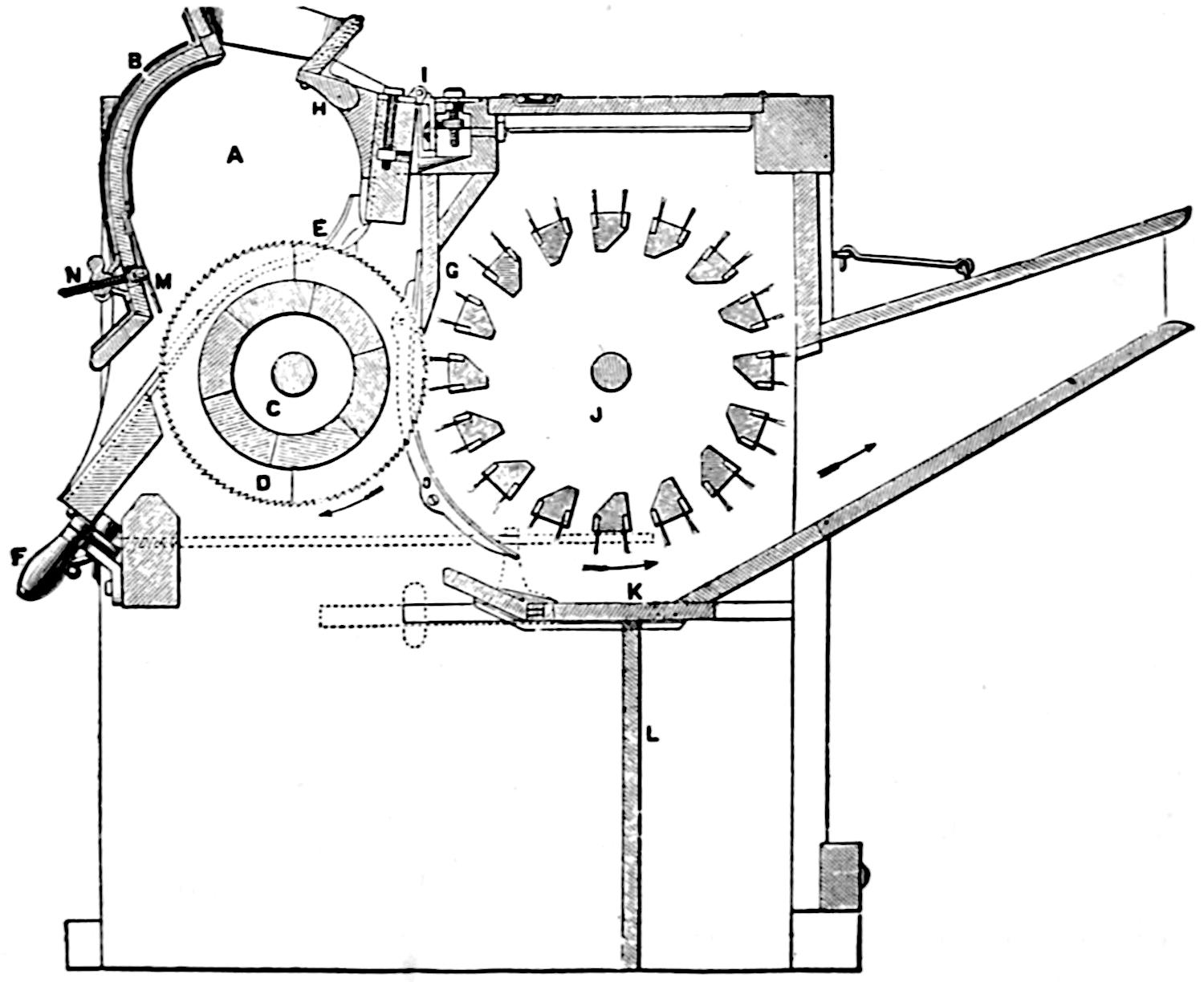
Fig. 99.—The Saw Gin.
From Brooks’ Cotton, by courtesy of the American School of Correspondence.
There are two kinds of gins in general use, the Saw Gin, which was Eli Whitney’s invention in 1793, and the Roller Gin, which is probably the descendant of the Churka Gin of India. Eli Whitney, a northern man, was teaching in a cotton district of the South. He saw that cleaning cotton was a laborious task, and that a method of facilitating the work was needed. His machine consisted of a drum with wire hooks or teeth, which rotated against a grate, on the other side of which was the seed cotton. The teeth caught the fiber and drew it through the bars, leaving the seeds to drop to the ground, and a brush took the cotton from the drum. The modern saw gin is an improvement on the [226]Whitney gin. Where two men before Whitney’s time could clean two pounds a day by hand, at the present time two men can remove the cotton from the wagon, attend six gins and clean twenty-four thousand pounds a day; i. e., each saw gin cleans at least four thousand pounds a day. The modern gin (Fig. 99) has a series of circular saws, forty or eighty on a shaft, which project through a slotted plate. The seed cotton is received at A and carried against the picker roll C and the saws E. The seeds drop below and the brush J carries the lint cotton to a flue to be carried to the condenser. A single gin may be used, or a number may be combined, called a battery. One flue may be used for all the gins, or there may be one for each. The cotton is somewhat [227]cleaned and straightened as it passes through the flue. A 60-saw gin revolving at 60 revolutions per minute will gin about 5000 pounds a day. The saw gin is suited to short-stapled cotton, having seeds covered with down. During the process of separating lint and seeds the fibers are much entangled and often full of specks and dirt. When the baled cotton reaches the mill several machines are needed to lay the fibers of the lint in order and to rid it of dust and specks. Saw gins undoubtedly tear and snarl the cotton, consequently many advocate the slower method of the Roller Gin, although it adds to the expense. Gins which do less damage yet work rapidly are needed, and some have been brought out which claim to clean as much cotton per day as the saw gin without its injury and waste, and to leave it in better condition for spinning.
The Roller Gin is an old method, having been used in India. It is principally employed for cotton with smooth seeds, such as Sea Island, American, Egyptian, and Meade. The cotton is fed to a hopper, which has rollers at the bottom covered with rough walrus leather which seize the fiber. A fixed “doctor” knife presses against a roller and draws the fiber between the roller and the knife. The seeds, drawn to a point where the knife touches the roller, are gently but swiftly pushed off by two blades which strike the cotton alternately. The lint is carried on by the rollers and swept off by brushes. A recent roller gin cleans about two bales a day, or about a thousand pounds.
The seeds, which are covered with down (Fig. 100), are sent to the oil presses, which are frequently installed in the gin houses. The principal products of the seeds are linters, hulls, oil, and cake. Linters are the short fibers adhering to the seeds of all cultivated varieties of cotton excepting the Sea Island, some Egyptian, and a few new species. These fibers are removed in a second ginning known as delinting or cutting. This is often done at a cotton oil mill as a first [228]step in the preparation of the seed for crushing. The linters are valuable for guncotton, rayon, celluloid, varnishes, photograph films, wadding, absorbent cotton, felt, low-grade yarn rope, lamp wicks, mixing with wool and like purposes. The cotton from the fields yields about 66 pounds of seed to 34 of lint out of one hundred pounds. The value of the linter crop is a large factor in the farmer’s returns.
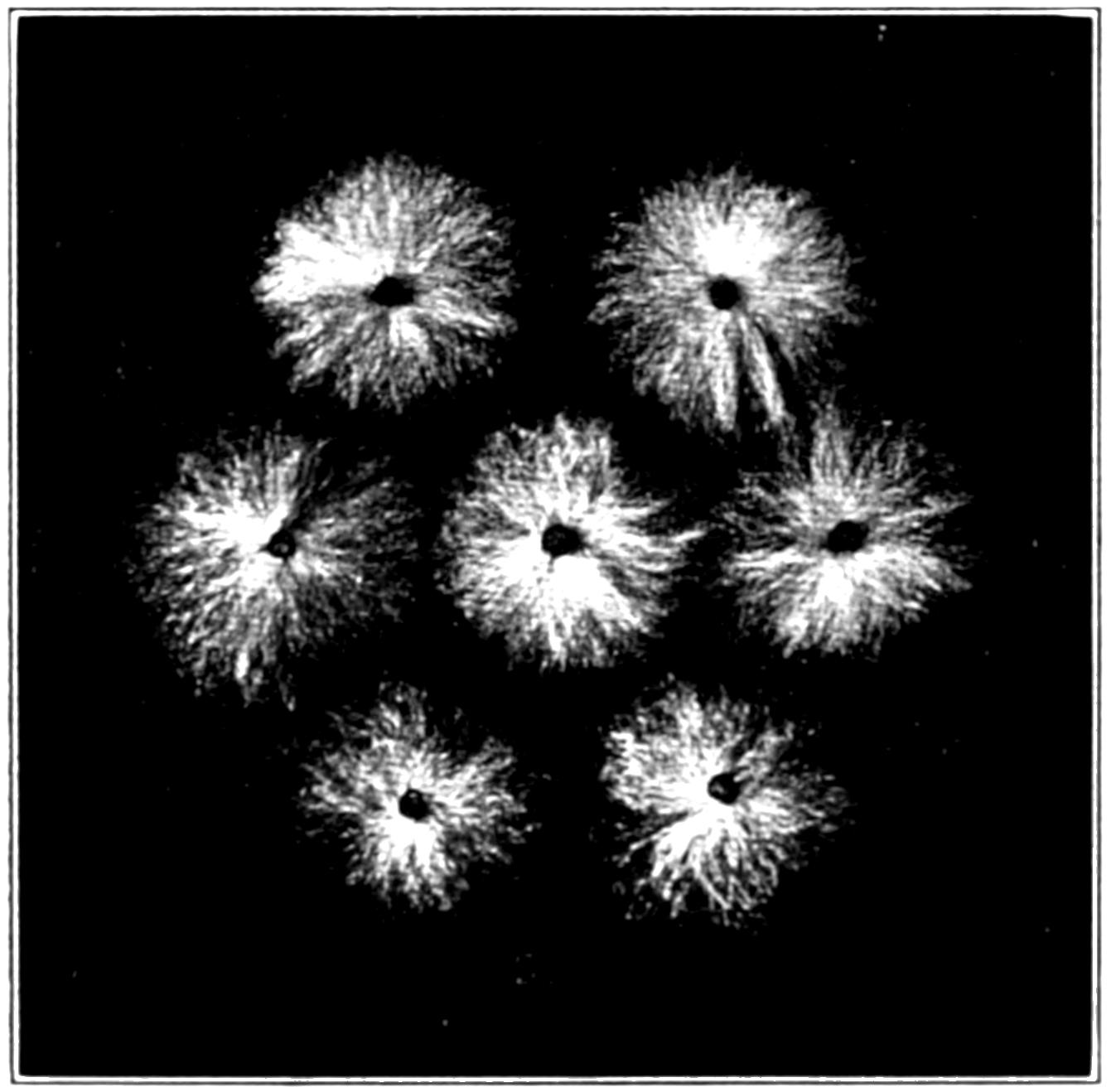
Fig. 100.—Cotton on the Seed.
From Brooks’ Cotton, by courtesy of the American School of Correspondence.
Baling and Handling.
—The lint cotton is delivered to a special receptacle in the press. The covering of the bale is jute or other coarse cloth. One bale contains the fiber from several acres. The bales from the farms are not tightly packed and will not stand long transportation, consequently the railroad and steamship companies have compresses which give a special baling before shipping. The standard American bale (uncompressed) is 54 in. long, 27 in. wide, and 48 in. in thickness. It weighs in the neighborhood of 500 pounds, [229]differing from various causes. The method of reducing the bulk is by a screw, steam, or hydraulic power according to the equipment used. A sudden terrific pressure acts on the entire mass, thereby reducing it to a fraction of its original height. The covering is fastened around the contracted mass by steel bands. The elasticity of the cotton and the air compressed in it cause the bale to spring to the turtleback shape characteristic of the American bale when the pressure is removed. The tare (covering, bands, etc.) amounts to 25 or 30 pounds. Foreign buyers are allowed 6 per cent off for the tare, but additional weight is often added wrongfully. Spinners complain that different staples of cotton are in one bale, which causes uneven spinning, yet it takes too long to return the bales for a better and more even cotton. Complaints are also made of price-adjusting difficulties, and of the hard edges of the high compress bale.
Criticisms of the American bale are incessant and are frequently justified (Fig. 101). An excess of moisture is often found, which increases the weight. Cotton may vary in moisture from 7 to 12 per cent. The bales are frequently exposed to the weather without cover, but the use of the licensed warehouse for storage is increasing. On account of careless storage the cotton is often mildewed. When the bales are opened they are sometimes found to contain foreign matter to increase weight. If, however, a buyer insists on having a cover removed to see if the cotton is of the same character and that no foreign matter is included he may find it unnecessary, and has to bear the expense of recovering. Foreign lands complain that the 500-pound bales are too big and unwieldy, that our system of baling injures the fiber, that the jute covering easily deteriorates, and that they are in a worse condition than the bales of any other country. Defective ginning causes the fibers to knot, which will interfere with smooth spinning, for the knots persist and show as dense white spots in the web as it comes [230]from the carding machine. The weight of the bale makes it necessary to pull it around with great hooks, the buyers tear cotton from the bales to test it, and the surface cotton becomes badly soiled. It is said of it that it is “the clumsiest, dirtiest, most expensive, and most wasteful package in which [231]cotton, or in fact any commodity of like value, is anywhere put up.”
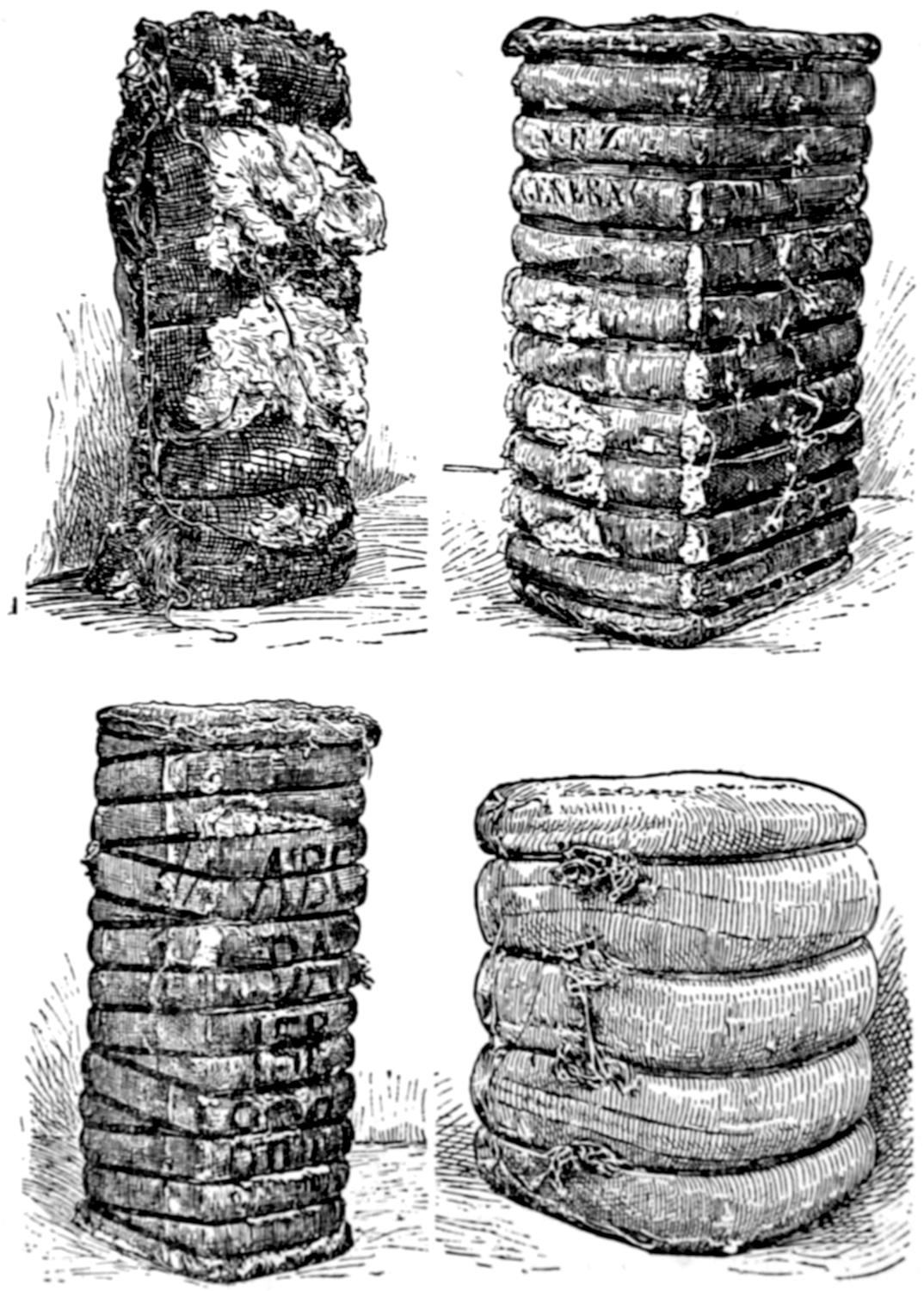
Fig. 101.—Cotton Bales. American bale in upper left-hand corner.
U. S. Dept. of Agriculture, Bul. 33.
The bales of cotton from other countries (Fig. 101), reach their destination in much better condition. The Egyptian bale (700 pounds) is long, smoothly covered, and easily packed in the ships, so that the cost of carrying is reduced and the loss from dirt and bursting bales is much less. The India bale weighs 400 pounds, being smaller and of greater density than the American. Efforts to improve the baling are being made.[18] The American Round Bale Compress makes a cylindrical bale. The cotton is received between two heavy rollers and rolled so tight that almost all air is excluded, consequently there is less damage from water and fire than with the old bale. The lint is covered with cotton cloth and held by wires. It weighs between 250 and 300 pounds, consequently the bale can be moved without the hook. The cotton is guaranteed and also the weight, therefore it does not have to be tested. It packs well into train or ship. It is making its way slowly. A suggestion is made that all cotton should be compressed at the gin and weight and sample be guaranteed. The bale could then go to its destination without breaking the cover to test the contents.
[18] A Story of Cotton. Turner. Memphis Terminal Corp., Memphis, Tenn.
The Industry in the United States.
—The United States produces the bulk of the cotton grown in the world. It is relied upon for the raw material for the better class of fabrics. With some exceptions, including some of the cotton of Egypt, the other cotton-growing countries produce a poorer grade than the United States. The American crop in 1911 was about 16,000,000 bales (500 pounds), but declined for many reasons (see above). However, the crop of 1924, in the final ginning report of the Census Bureau, was 13,618,751 bales, which was a larger crop than had been obtained since 1914. The world crop in 1911 was estimated at 22,297,000 bales (500 pounds), but in 1924 the estimate was 22,211,000 to [232]24,700,000 bales. The price of cotton per pound before the war was in the neighborhood of 12¹⁄₂ cents, but in 1924 it ranged from 23.5 cents to 37.65, 28 cents being an average. Many state it must go higher if the planter is to feel he can afford to continue with the crop, but this is not a universal opinion. At present it is not felt that there is an immediate danger of America losing its world position, but measures to increase production and decrease waste must be taken if production is to be stabilized. The United States Chamber of Commerce, having made a study of the trend of cotton production in the United States, is urging that a government commission be appointed to make an authoritative report on active and potential cotton production here and abroad. The United States uses a large part of its own crop and is making an increasing demand upon it. It also imports foreign raw cottons for classes of manufacture for which they are particularly fitted. From 150,000 to 350,000 bales (500 pounds) of Egyptian cotton are imported each year. It uses about 6,000,000 bales annually. It has imported as much as 700,214 bales of 500 pounds, and there is indication of increase rather than decrease, for cotton for manufacture is in great demand.
Each state has its own method of selling its cotton. It may go directly to a mill, to a local selling center, or to a warehouse. Large plantations are financed usually by a bank, and the cotton is shipped to a warehouse or a mill. The small local planters have little money and frequently borrow on the growing crop, through a merchant in a near-by town on the charge account system—that is, he takes commodities from the store up to the value of his cotton. In the picking season the merchant takes the cotton as it comes from the gin, giving credit to the grower according to the market price of lint cotton. The cotton thus obtained is sold to local buyers, to shippers, or to exporters. The local merchant also buys directly from the planter, paying money [233]to him if he has not borrowed on his crop. Poor marketing methods are only too common in the primary markets where the farmers sell their cotton. Improvements, however, are evident. The Southern farmer is using the cotton factor or merchant less for financial help than he did previously. Growers’ Coöperative Associations are handling large amounts of cotton. In 1923 there were twelve important ones, which were organized to improve distribution and to obtain more returns for the crop through the elimination of intermediaries and wastes. The Federal Trade Commission is urging the extension of coöperative marketing, as it has already proved itself to be a distinct advantage. The middlemen are fewer, the crop is held for advantageous sale in a warehouse and not, as often happened, dumped on an unwilling market, thus lowering the price. A more stable market is gained and the cotton is kept in better condition away from danger of storms and fires.
Cotton Marketing.
—Much cotton is sold through markets and exchanges. The great cotton markets of the world are Liverpool and Manchester in England, and New York and New Orleans in the United States. Bremen is the German market, Havre is the one in France, Alexandria, for Egypt, and Bombay, for India. Cotton exchanges are central markets where buyer and seller can get together. The members have the right to do business there. The New York Exchange is principally for “future contracts” for cotton, and New Orleans has a large business of this kind, as well as for direct selling. The rules of the exchange establish uniform usages and promote equitable trading. “Spot” cotton is sold for immediate delivery and is dealt with largely in the South. Cotton exchanges are also in Galveston, Augusta, Savannah, Norfolk, Memphis, Little Rock, Dallas, and Houston. Galveston is the largest receiving and exporting port in the United States. Other well-known ports are New Orleans, Houston, Savannah, Mobile, Norfolk, [234]Charleston, Wilmington, New York, and Pacific ports. The object of “future trading” on an exchange is not for speculation, but to furnish an insurance or “hedge” against loss from the fluctuations which occur in cotton. These fluctuations cannot always be anticipated. A merchant contracts for months ahead to supply the spinners who furnish the weavers with yarn. The merchant cannot always know what the price of raw cotton may be at the time he has promised to deliver it, consequently he contracts to buy an equal amount at a lower price than he has set, which ensures him against a heavy loss which might be met at any time. There is, however, much speculation in the United States cotton trade, and this tends to uncertainties in cotton prices. An exchange is only of service as it furnishes safe protection, and complaints of manipulations and squeezes have brought forth a report which is worthy of careful consideration for those interested in this subject.[19]
[19] The Cotton Trade. Report of the Federal Trade Commission, 68th Congress Senate Document 100.
The values of the various grades of cotton are quoted as so many points off from the price of White Standard Middling Upland Cotton. A point is ¹⁄₁₀₀ of a cent. If Middling cotton is selling on the market for 24 cents a pound and Low Middling is quoted as “off 300 points” it would mean it was selling at 21 cents a pound.
Classifying and Grading of Cotton.
—Uniform grade names for Upland cotton have been in use for many years, but the qualities which are represented by the names differ in various localities. Spinners also have their own ideas of classification, and it is necessary to have standard grades that all can understand. Negotiations with the Liverpool Cotton Association culminated in an international conference in June, 1923, which was attended by representatives of cotton associations of foreign countries. The result has been the adoption of official standards for grade and color of [235]Upland cotton.[20] Modifications will occur, but the Official Cotton Standards are now fairly determined. The nine grades which seem fairly settled are:
- Middling fair
- Strict good middling
- Good middling
- Strict middling
- Middling
- Strict low middling
- Low middling
- Strict good ordinary
- Good ordinary
[20] The Commercial Classification of American Cotton. United States Department of Agriculture Circular 278, Arthur W. Palmer.
Price is set by standard middling; better grades are fractions above this and poorer ones are fractions below. An important factor in choosing cotton is color. There are many possibilities, such as white, spotted, tinged, light stained, yellow stained, gray, and blue stained. The various grades in the Official Standards may be slightly away from white, and there is a permissible range of color allowed in the standard boxes decided upon for the nine white grades. A series of color standards below the Official Standards was also decided upon. Foreign matter may be present in the lint. The higher grades have little of this, but the lower often are quite full of it. The grades of highest spinning value are usually those which have the least. The foreign matter may be leaf, dust, and sand, shale or shives, and motes from seeds. Machine cleaners properly used in connection with any class of gin remove much of this foreign matter.
Official grades for American, Egyptian, and for Sea Island Cotton have been made also. Classification as to length of staple is even more important than its grade. Short staple cotton is, in general, regarded as lower than 1¹⁄₈ in. in length, and long staple is 1¹⁄₈ and beyond, but the tendency is increasing to consider cotton of one inch in length as “long” and below that as “short” staple. Federal grades for linter standards are being made tentatively. Seven grades are recognized.
The character of the cotton, whether strong, uniform, smooth and silky, is also of prime importance. The bales [236]may be defective in many ways—the staples may be mixed, the fibers may be stained through weather damage, the cotton may be immature, it may have been packed wet, causing damage to the fiber, it may be a falsely packed bale containing substances foreign to cotton or packed with good cotton on the outside and poor cotton within. The method of testing the bale is to cut the bagging in a crescent shape between two bands and with a hook pull out some lint. The grading of cotton in a local market where farmers sell is crude.
The bale is weighed for the benefit of the purchaser, less the weight in ounces of the samples taken from it, but the sample is given to the purchaser, who in buying numerous bales accumulates many pounds of cotton. The producer does not benefit. The bale is often cut many times. The cotton samples are collected and baled, making a large total of cotton which comes from these samples, and which is known as the “city crop.”
The buyer of cotton has many things to consider according to the use to which the cotton will be put, such as length of staple, strength, fineness, smoothness, uniformity, color, cleanliness, and pliability. The color and cleanliness he judges with his eyes. For length of staple and uniformity of growth he pulls some cotton from the bale and draws a lot of it into staple length between the fingers of both hands and lays a lot on his coat sleeve. For strength and resistance he holds the length of fibers between the fingers of both hands and gives a sudden jerk upon them. The cotton may be stringy, it may have been cut or injured at the gin, or it may be full of little knots (neps). He may find the cotton in one part of the bale better than in the other, and consequently will class the entire bale at the lower level.
Cotton Spinning.
—The raw cotton had to go through many difficulties attending its growth, such as enemies of the crop, poor cultivation, exposure to inclement weather and the [237]mixture of seeds in planting. It felt the tearing saws of the gin and the blending of lints of various staples and developments. The tremendous pressure of baling, inadequate covering to protect it from storms, the danger of fire and the hauling about with great iron hooks have been experienced. It now reaches the mill in a weaker condition, with the fibers crossing each other in all directions and often soiled and broken. Ahead of it are great machines which beat it with many strokes and blow it against grates to rid it of dust and specks, and then pass it through innumerable teeth to clean and lay it in the order in which nature grew it. Research departments in mills and associations are seriously studying the matter, looking toward the elimination of waste and omission of some of the machines. A fine, clean, even yarn requires several machines for cleaning, carding, and combing, and naturally the yarn is weakened while adding to its beauty. There is an inclination to combine the work of several machines in one, and even to omit machines. Double carding has almost passed and in many mills one picker has been omitted. In the later steps of spinning there is an inclination to lengthen the roving and spinning frames. Many suggestions are being made for more automatic work in spinning frame and loom, for higher speed, and greater facility of action. Cotton machinery is the result of great inventions and seems almost perfect, but many wastes are occurring from the ignorance of workers. The poor quality of some of the product is due to the workers.
Cotton spinning has long been important in the United States. In the early history the industry was especially for clothing and thread, but at present more cloth is made for mechanical uses than for clothing and great industries are dependent upon it. (See Cotton Manufacturing, below.) The preparatory processes differ according to the fineness of the yarn desired. Steps are repeated when great cleanliness and uniformity are needed, and for higher counts of yarn; [238]machines are repeated or even new ones are introduced when special effects are desired. The general aim in cotton spinning may be said to be: (1) to clean by opening, beating, and fanning; (2) to lay the fibers parallel by carding (Fig. 18), or even combing; (3) to unite and draw out the fibers, and (4) to twist them into yarn. The constant tension on the fiber, and the millions of teeth which pass through it, reduce its strength. When cotton is poorly picked, ginned, or baled, it requires repeated cleaning to prepare it for spinning, hence it may be greatly weakened. When the preparatory processes have been carefully conducted, the number of machines may be reduced. There is also more waste when cotton has to pass through many mechanical processes, which adds to the expense of the cloth. Cotton is spun best in a humid atmosphere. The southern states have a damper climate than the northern, but the climate in America is less satisfactory for spinning than that of England. Humidifiers are used in good spinning mills.
The following processes
of cotton spinning and manufacture are representative:
Bale Opening. Cutting the metal bands and allowing the cotton to expand from its great pressure.
Bale Breaking or Cotton Pulling. A machine which opens up and mixes the staples of various cottons of the same length is used in some mills. The process, however, is still done by hand also.
Picking, Opening, Willowing, and Scutching. (These terms are all used for similar processes.) The feed, the breaker picker, the intermediate picker, and the finisher picker of American mills cover the processes of cleaning and opening previous to carding. The result of the pickers is a wide lap wound into a roll.
Carding and often double carding of fine yarn may be required. The results of these machines are slivers.
Combing, used only in preparing the finest yarns. A sliver lap machine is required, if combing follows carding. The result of combing is a sliver.
Drawing,—usually three or more machines. The result is a small sliver.
[239]
Slubbing, by a bobbin and fly frame. A slight twist is now required in the product to give strength as the sliver has become attenuated. It is wound on a bobbin to be delivered to the next machine.
Intermediate Slubbing, by a bobbin and fly frame. The result is a twisted sliver wound on a bobbin for the roving frame.
Roving by bobbin and fly frame. A final slubbing when the soft rove is prepared for spinning. It is wound on a bobbin.
Spinning. The frame and mule are both in use, but the former is found more frequently.
Doubling and Twisting. The yarns are prepared in various ways.
Bleaching, Dyeing, Mercerizing, and Gassing of the yarn. These processes are used as necessary. The yarn may be dyed in skeins or warps.
Winding, Spooling, and Warping preparatory to weaving.
Sizing or Slashing to prepare the yarn to bear the strain of weaving.
Drawing-in to thread up the loom.
Weaving.
Finishing as needed, the principal methods being: pressing and glazing, starching and calendering, napping, bleaching, beetling, printing.
These processes are given in more detail below:
The Bale Breaker or Cotton Puller
is much like the wool picker. Cotton from different bales is carried on traveling lattices to the breaker, and is loosened up by means of four pairs of coarsely spiked rollers or beaters, each pair of which revolves more rapidly than those before it. It is thus prepared for the feed of the openers or pickers.
Picker, Opener, Willower, and Scutcher.
—In India cotton was originally opened by beating with willow wands to open up the staple. The mechanical means of doing this was called willowing. The term “scutching,” which means beating, was used in England for a more advanced willowing corresponding to the work of the intermediate picker and finisher picker of the American mills. The picker room of the usual cotton mill contains a number of pickers, the object of each being to open out the cotton that the sand, neps, leaves, and dust may be eliminated, and to form the lint into [240]an increasingly even lap. The first machine in the train is an automatic hopper feed (Fig. 102) which connects with the breaker picker (sometimes called the cotton opener). The machine is similar to the feed used in the wool industry. Steel pins on an endless apron open the cotton, which are stripped off by a doffer and carried by an apron to the breaker picker.
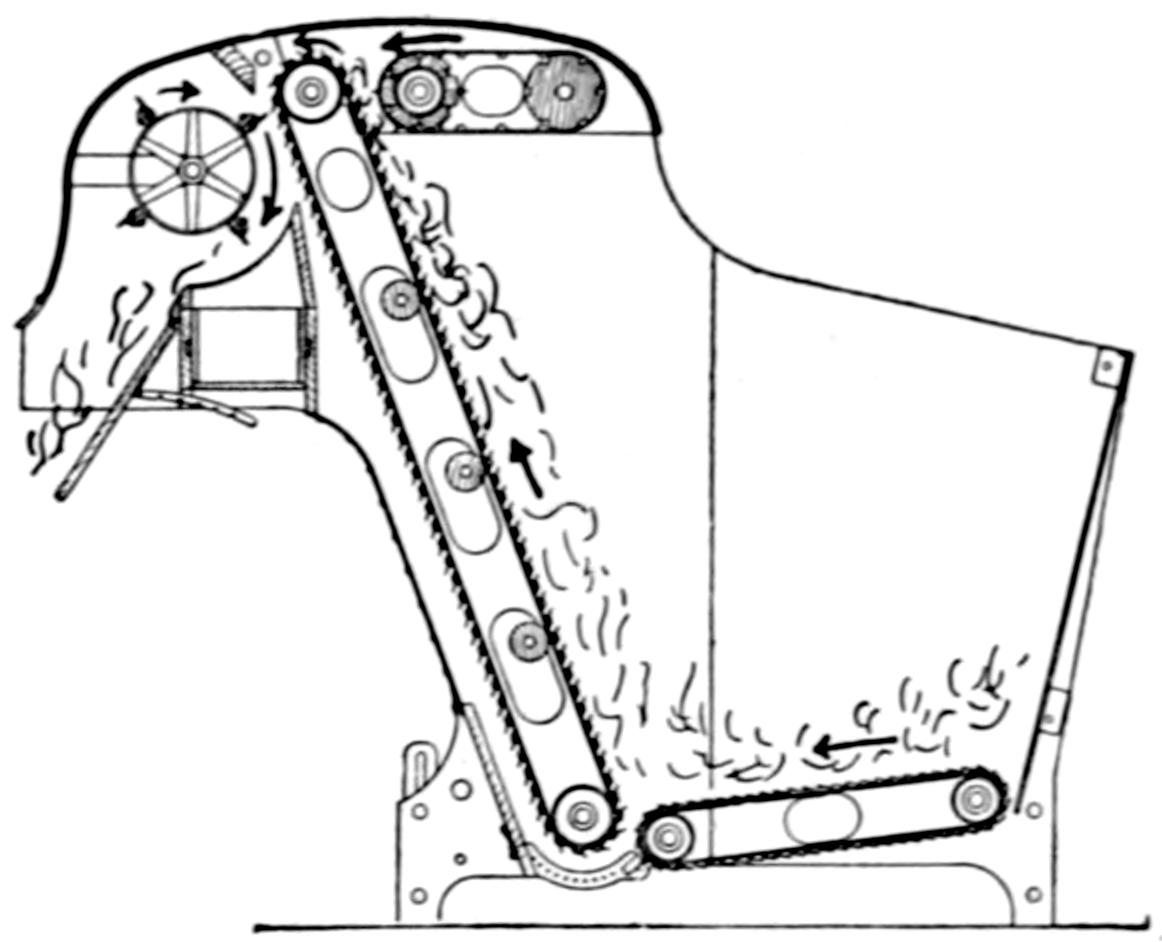
Fig. 102.—Sectional View of Feed.
Courtesy of the Kitson Machine Shop.
Breaker Picker; Intermediate Picker; Finisher Picker.
—The object and method of these machines are similar. The cotton fiber becomes cleaner, softer, and more parallel. The film is finally rolled into a wide lap to be taken to the carder. In the first or breaker picker the cotton is beaten by spikes or knives, and driven against cleaning bars or a grate where the dust falls out. The cleaned cotton is carried by a fan to a cage (a cylinder filled with small holes through which the air rushes), and the soft fiber clings to the outer surface of the cage to be carried by guide rollers to the second machine or intermediate picker. Four laps of cotton from the breaker picker are united. The intermediate picker has two or three blades with rather sharp edges which strike the cotton about two thousand or more times a minute. The cotton is then [241]thrown on cleaning bars and carried to a cage as in the first picker. The sheet of cotton thus made is pressed between rollers into a lap wound on bars. In England these two pickers are often called a double opener. A finisher picker, similar to the scutcher of the English mills, is often used, in which about four rolls from the intermediate picker are united, the rolls being placed on an apron and unfolding over one another (Fig. 103). The cotton is beaten by a two- or three-bladed beater as in the intermediate and made into a lap for the carder. Attached to these machines are special parts to even the lap and measure the amount of cotton. The best classes of cotton are sometimes clean enough to require fewer than three pickers, and there is an inclination to omit one.
Carding
(see Fig. 18).—This is a very important process. The aim is to clean and lay parallel the fibers. The wide lap from the previous machine is placed at the back of the card and fed to the great cylinder by the licker-in. The revolving flat card is in use for cotton, and closely resembles the wool card, but has narrow flat bars filled with teeth fastened in an endless chain over the big cylinder in place of the small worker and stripper cylinders of the wool card. The flats press the cotton on the teeth of the big cylinder and take out the neps and poor fiber, the action being like a comb pressing against a wire brush. The teeth of the flats are set in an opposite direction to the teeth of the cylinder. After the cotton is carded by the flats, it is passed to the doffer, but the waste cotton is brushed off in another direction. A cotton cylinder has often 700 or 800 teeth on one square inch. The large cylinder may have from four to six million teeth, and the speed is sometimes 2000 feet per minute. The strain on the fiber can perhaps be appreciated. Much dirt is taken from the cotton in carding, and falls into a receptacle below. The thin veil of cotton is taken off the cylinder by the doffer, reduced to a narrow sliver by being passed through an eye or between rollers, or by a method of leather divisions in the apron, and then drops coiled into a can. The waste cotton from the card is used for many purposes, and special carders are now on the market which prepare yarn from it to be used for inferior grades of cloth. A lap winder prepares the card waste to pass through its own special carder.
[242]
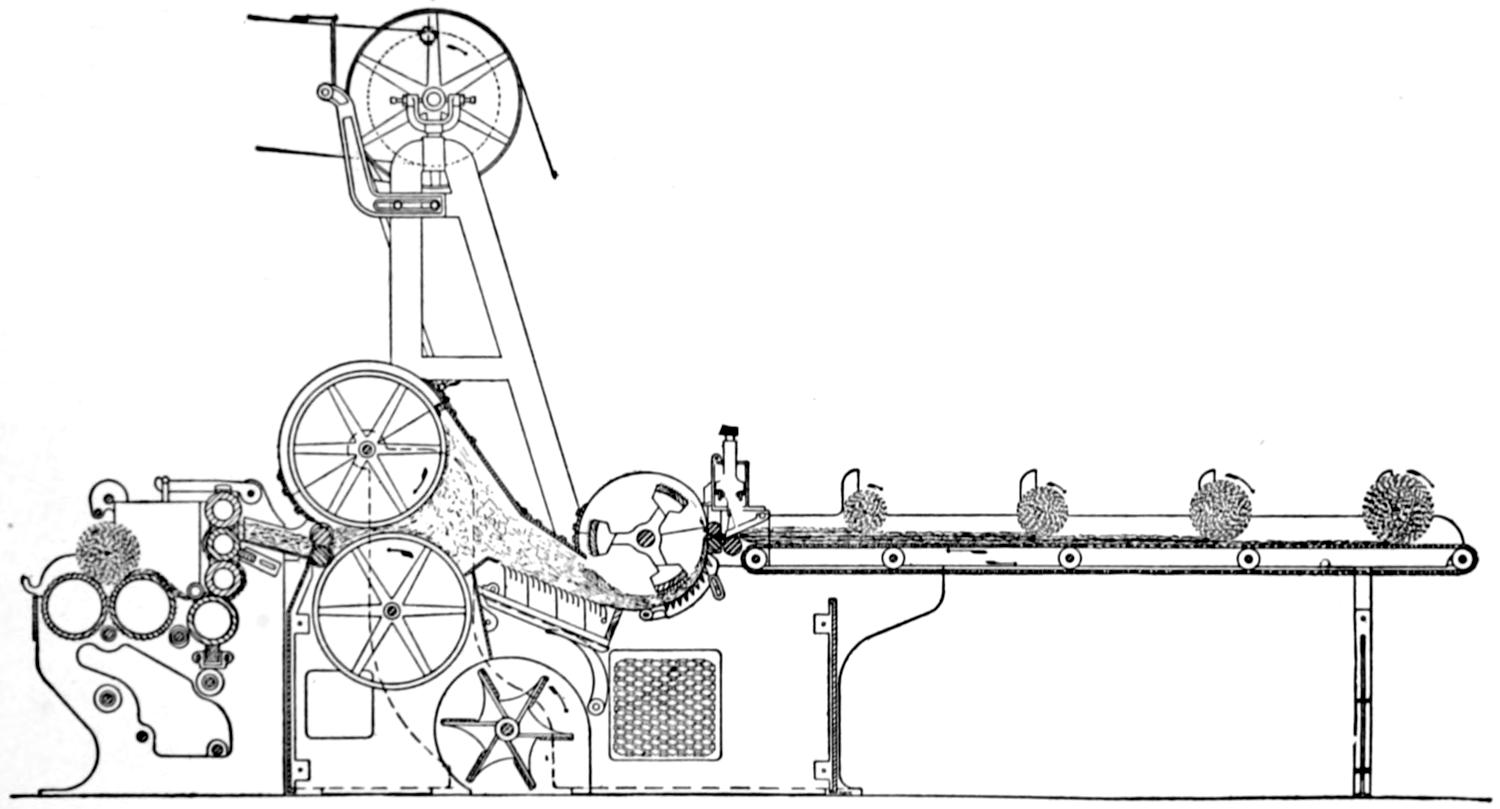
Fig. 103.—Sectional View of Finisher.
Courtesy of the Kitson Machine Shop.
[243]
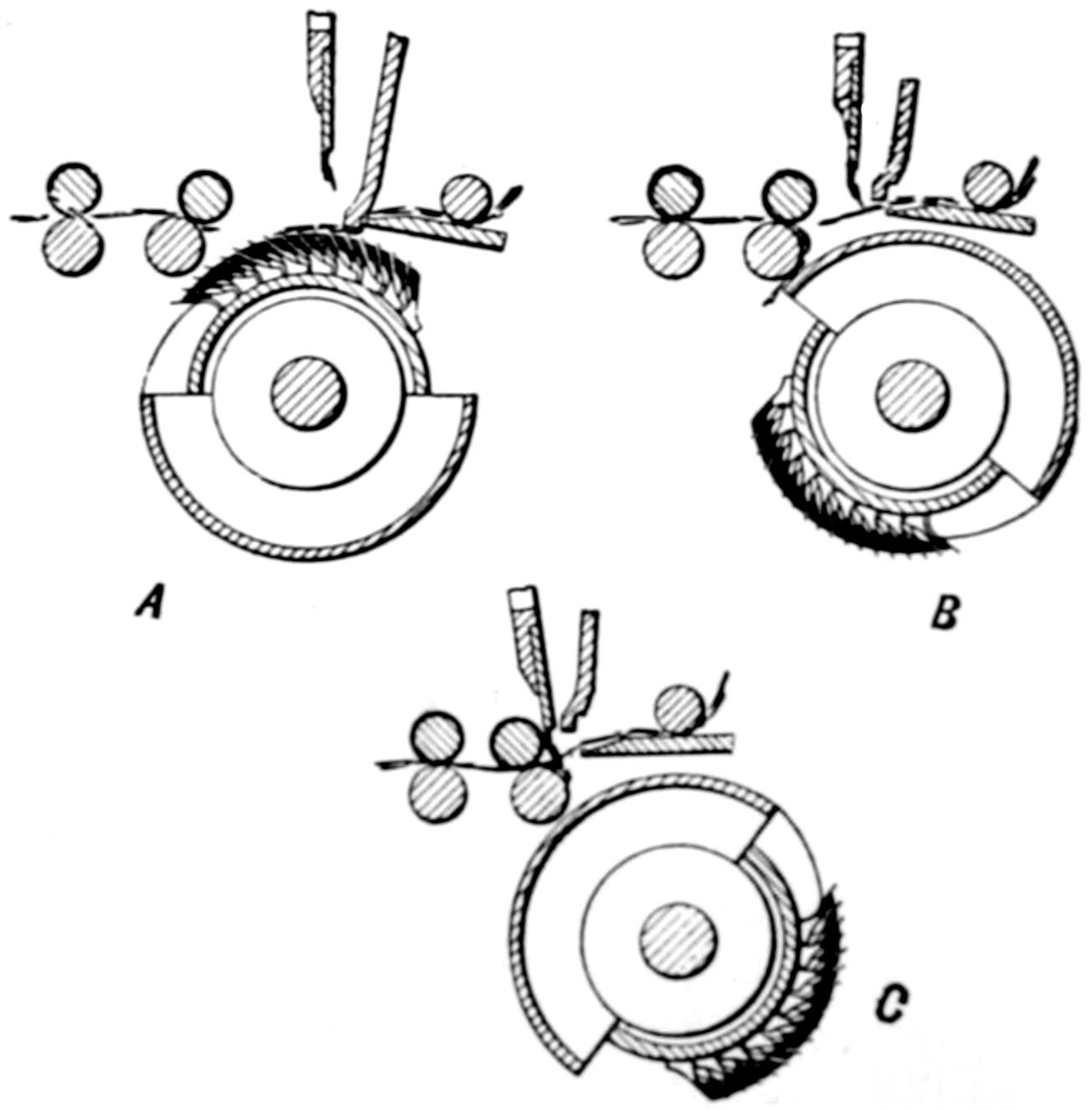
Fig. 104.—Detail of Combing Machine, showing Nip holding the Sliver against the Comb.
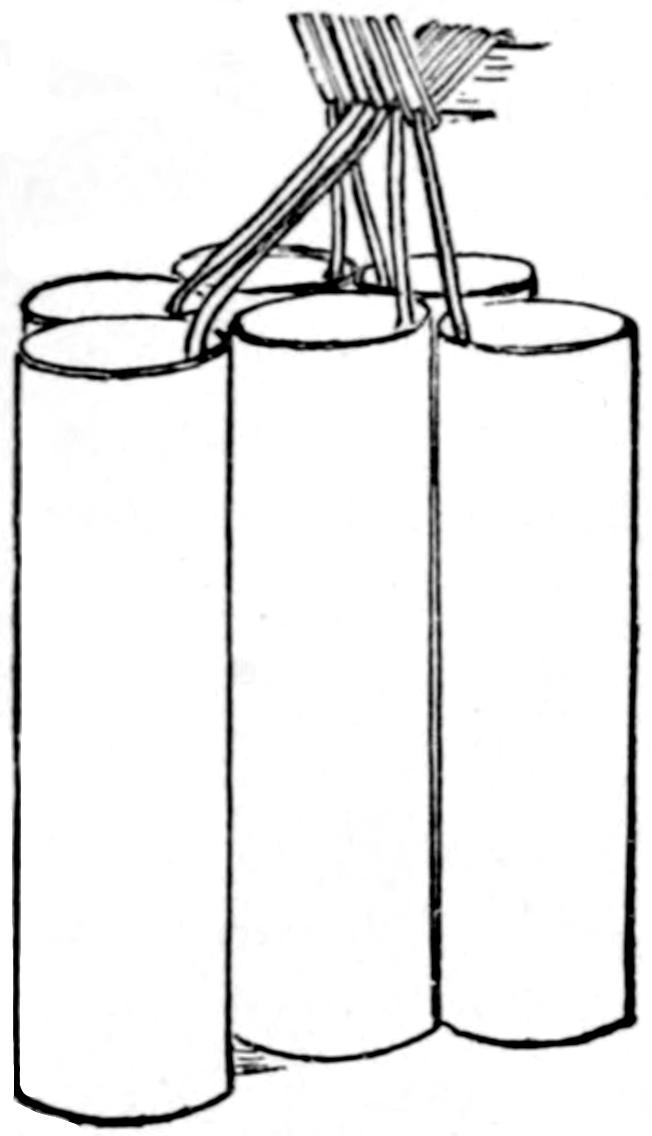
Fig. 105.—Slivers.
Combing
(Fig. 104).—Cotton is combed when a very fine grade of yarn is needed. It is employed usually for long staple fibers, such as Sea Island, Meade, Florida, long-stapled American, and Egyptian. This yarn is used for sewing threads, fine knitted underwear, mousselines, and dainty fabrics. Short-stapled cottons can also be combed by the newer combing machines. The machine follows carding or double carding. Slivers from the card are first united on the sliver lap machine and made into a lap to be [244]fed to the comber. The machine extracts short ends of cotton and impurities, selects fibers of even length and lays them parallel and overlapping, and finally forms a sliver. The method of combing is intermittent, and is accomplished by a nip holding a bunch of fibers, while cylinders covered with card clothing—the needles gradually becoming finer—comb them out first from one end and then from the other. The newly combed fiber is then lapped over that previously combed, and the united fibers are combed again by a suspended comb and finally attenuated into a sliver (Fig. 105). The result is a very silky product. The short, rough ends are conducted out of the machine. Naturally there is a great deal of waste from the comber, consequently the process is expensive and is only used with high-priced yarns.
Drawing and Doubling.
—This process is usually repeated three times. The aim is to unite several slivers, draw them together, thus removing weak points, and make an even, smooth sliver. The principle is by drawing rollers. The doubling in these and succeeding machines often runs as high for average cotton manufacture as 27,000 to 500,000 doublings, and even goes considerably higher for special yarns. From four to eight cans of slivers are united and drawn together by rollers in each of the three machines. The slivers are greatly reduced in size and would break unless twist were now given to them.
Slubbing by Bobbin and Fly Frames.
—The first twist is now put into the yarn, and it is wound on bobbins. Two attenuated slivers or soft yarns are united into one in each machine. Slubbing is done by three machines—slubbing, [245]intermediate slubbing, and roving. The methods are the same in each. The result of each machine’s work is a finer and more twisted yarn. The final frame makes the roving which is the last step before spinning.
Spinning.
—The spinning of cotton is done on the upright frame by the flyer, cap, or ring system (Figs. 28, 31), or by the mule (Figs. 25, 26). The first is a more rapid method and is in more frequent use, but the mule makes a softer and more attractive yarn. Frames with a new variety of spindle requiring almost no attention are appearing on the market, whereby the output of yarn is increased and the cost of production lowered. All modern machines have automatic attachments which stop if a sliver or a thread breaks.
Cotton Yarns
are spun or twisted in various ways, and are used for warp or filling, knitting yarn, sewing thread, or for hand embroidery. The numbers run from No. 4 coarse even as high as No. 400 for fine yarns. After the yarn is spun on the frame or mule it is usually doubled and twisted before it is ready for service. There are many ways of doing this, and the yarn may be dry twisted or twisted in water. Cotton yarns for weaving may be single or several ply, and the direction of the twist lends variety. Knitting yarns have special twists. They may be spun on the mule, doubled and twisted slightly, with a resulting soft appearance and woolly feel, as used in some classes of underwear; or they may be closely twisted in water, dyed, gassed or singed, glazed, and hard finished for lisle-thread effects. Fancy yarns with rough places at intervals are made for some classes of goods. Sewing cotton is frequently spun on the mule. For three cord sewing cotton, three yarns from the spinning frame are doubled and twisted. For six cord the yarn from the frame is doubled and twisted, and three of these are united and twisted. The yarn is sized before being twisted in both cases. When a good grade of cotton has been used a strong thread is the result. Sewing cotton [246]requires more twisting than yarn for weaving, for greater strength is needed. The numbers in sewing cotton run from 6 or 8 to 200 or more. Sea Island was once used, and now Meade and fine long staple American cotton are used in the best grades. All sewing cotton is glazed, but special varieties to be used for the sewing machine have more dressing than those for hand sewing. The spools containing 250 or 500 yards are wound by machine.
Yarn which has been carded, double combed, and then spun on the mule has a lofty, soft appearance like spun silk, but the expense is much higher than when less preparation is required. Special treatment of cotton yarn with gums of various kinds and a later machine polishing between rollers gives the appearance of a linen thread. The cotton thread made in this way is strong but not pliable. Another way of preparing cotton thread to look like linen is by spinning it with small knots or rough places upon it. When the cloth for this yarn is woven and the fabric is finished it closely resembles material which is woven of flax.
Bleaching.
—Cotton yarn becomes yellowish in color during the preparatory processes and spinning, and usually requires bleaching. For this purpose it is wound from the bobbins into hanks, which are slipped one inside the other into a chain containing perhaps five hundred pounds of yarn. Bleaching is done in various ways. (See Chap. XIII, Scouring and Bleaching.)
Mercerizing.
—Mercerized cotton is described in Chapter XII. Schreinerized cotton, because of its high luster, resembles mercerized material. The effect is produced by passing the cloth under engraved calenders, with pressure.
Dyeing.
(See Chap. XIII).—Cotton is usually dyed in the yarn. Dyeing in the unspun state, as in wool, is occasionally used, but this is the exception.
Sizing or Slashing.
—The shortness of staple and the softness of the cotton fiber make it necessary to apply sizing to [247]the yarn that it may stand the strain of weaving. The sizing material is a starchy or glutinous liquid applied to the thread in varying proportions according to need. Sizing of cotton thread has been in use since before the dawn of history. Each modern cotton mill has special formulæ. The process, which is generally called slashing, is done after warping and before drawing-in. It is especially necessary for warp yarns. Special sizes or coatings are also used in the cloth to give the look of solidity and weight which are not always present. Clay is often applied heavily to loosely woven cotton materials. The dressings or coatings used for cotton yarns are too numerous to mention, and are employed in various combinations.
Counts or Numbering.
—In the United States cotton yarn is counted by the number of hanks of 840 yards in the pound. No 1. yarn (the coarsest, but it is seldom used) would have 840 yards in one hank, which would weigh one pound. Number 20s single would have 20 hanks of 840 yards each, or 16,800 yards in all in one pound. Single 20s yarn would be written 1/20s or 20/1; two-ply 20s would be written 2/20s or 20/2 and 16,800 yds. would weigh two pounds,—or one pound would contain only 8400 yds. of 20/2 ply.
Sewing cotton is twisted into three cord (three threads twisted together) and also into six cord (three two-ply threads twisted together), but as the latter is smoother, stronger, and better adapted to the sewing machine, it is more in demand as serving both purposes. Three-cord sewing cotton number 60 would be expressed 3/60s, and six-cord would be 6/60s. A three-ply No. 8 yarn (3/8s) would be a coarser thread than single No. 8 (1/8s), for three threads of number 8 would be twisted together. Number 60, six-cord yarn, and number 60, three-cord yarn, are made the same size, but in the former case a finer yarn is used in the combination.
Winding, Spooling, Warping, and Drawing-in.
—The preparation of cotton warp yarn for the loom is similar to that [248]of other textile fibers, i. e., winding the yarn into hanks, spooling it, warping it, slashing or sizing, and threading the yarn through the harness. (See Chap. IV.)
Weaving
(Fig. 106).—A large number of standard cotton cloths, such as muslins, sheetings, many ginghams, percales, and sheer materials like nainsook, batiste, longcloths, cambrics, and lawns, are woven with the plain or cotton weave, as it is sometimes called. There are very slight differences in the body and feel of these materials until after the finishing. Regular twills and broken twills are found in denims, galateas, and sateens. Elaborate designs made on special looms or on the Jacquard, and double weaves of various kinds are found in expensive and bordered cottons, in fancy ginghams, leno weaves, and embroidered materials, in velveteens, Turkish toweling, and piqués, and in cloths which imitate linen, as in damasks; or silk, as in cotton brocades; and in imitation of wool and worsted materials, such as cotton coverts, chinchillas, beavers, diagonals, and worsted suitings. These materials are very soft and pliable when they come from the loom. Automatic looms are used largely in cotton mills.
Finishing Cotton Cloth.
—Cotton materials depend greatly on finishing for their effect; the only difference between some of the plainly woven materials is in the method of treating the cloth after weaving, and the resemblance of cotton to other textiles is principally a matter of dressings and machine finishing. (See Chap. XII.) So numerous are the dressings used and the processes which follow, that it is possible to indicate only representative methods. By means of these methods feel and appearance are given, such as a soft or supple finish by glycerin, fats, oils, and waxes; or a full finish by starch and pressing; or gloss, as needed in percalines, silesias, and percales, by mucilage, gums, and ammonia water; or high luster by warm dressings and the hot calender and mangle alternately; or stiffness by mucilage and gums as required in linings, swisses, tarletans and lawns; or weighting with clay that a solid appearance may be gained, as in cretonnes and canvas. To give a dull finish or the appearance of other textiles, special dressings are applied. Waterproofing, preserving, rendering sanitary, and taking away the natural inflammability, are also obtained through dressing. Elastic finishes are dependent to some extent on hand work. The material is starched, dried, beaten, squeezed, and worked by hand in all directions. Finishes are apt to pass off to some extent in the laundry, and the loss of the finish and crisp feeling, as in organdies, makes such materials unattractive, but starching or stiffening in the laundry restores to others much of the original appearance.
[249]
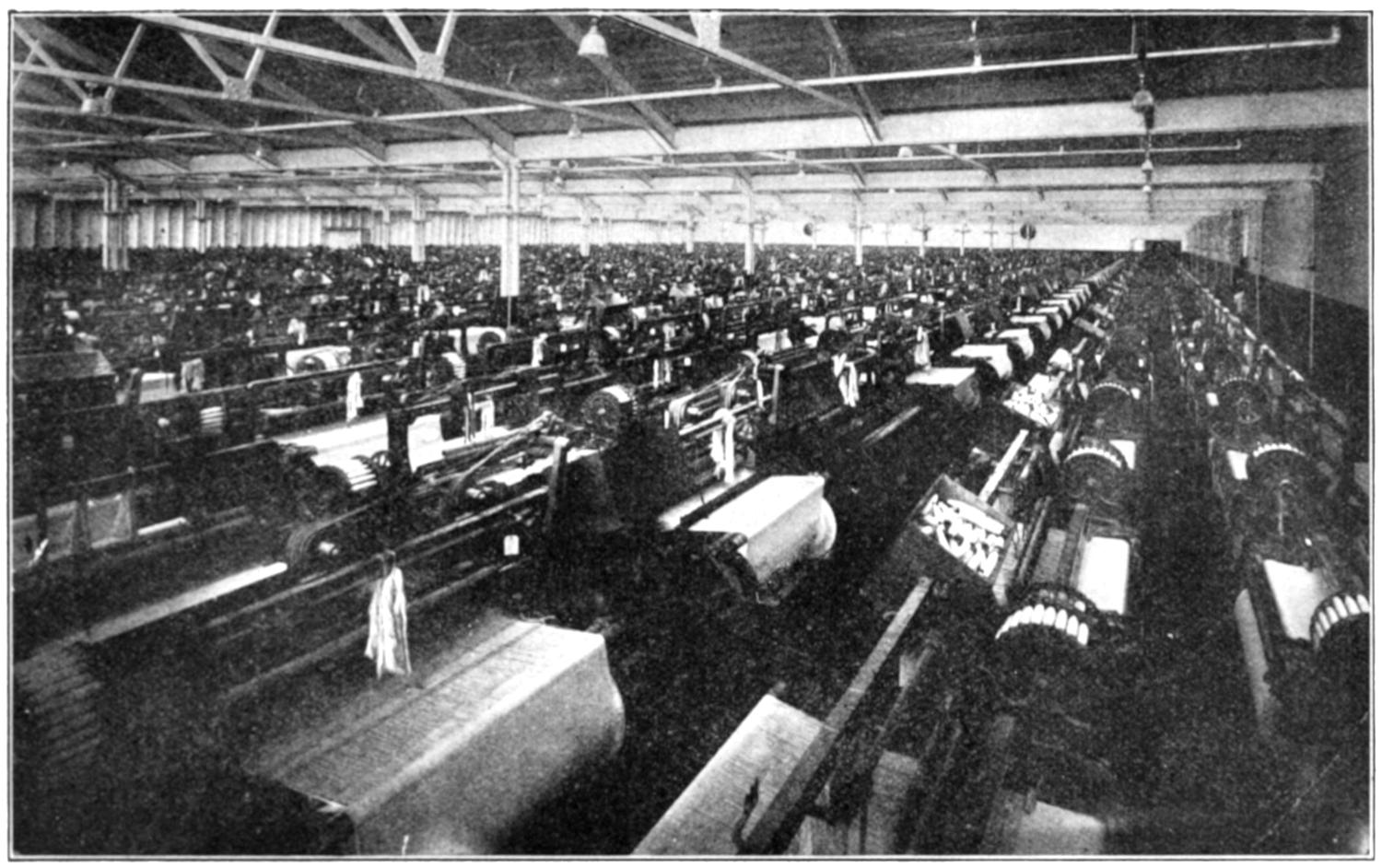
Fig. 106.—A Modern Weave Room, showing an Acre of Looms.
Courtesy of the Chicopee Manufacturing Company.
[250]
Cotton having designs woven in, such as fancy ginghams and madras, have frequently in the making long warp or filling floats on the back. These threads are cut off by a special machine. When the designs are small, as in polka dots and lozenges, there is danger of pulling out the cut threads in washing unless care is taken. Soft, rather open-mesh cotton materials, such as fine muslins and batistes, have to be dried carefully so that the dressing will not settle in the mesh and make the material too stiff.
The calendering is an important part of the finishing of these materials. Some cloths require a soft face and a stiff back and are treated on both sides, as in piqué. Percales and calicoes also depend greatly on the finish. The face is shorn or singed to get rid of the fluff, and after dressing they are treated like sateens and beetled to soften them. Dimities are finished with light farina sizing, the cloth being delivered to the size in large folds, and the rollers with the preparation upon them pass back and forth over the cloth. The material is dried, and as it is apt to shrink it is stretched on tenter frames an inch wider than necessary to allow for further shrinkage in the calendering.
[251]
Many of the finishes are expensive, and make the cost to the consumer rather high. This is especially noticeable in the fine cottons which have been carded, double-combed and finally given the most delicate finish, as in some of the exquisite French cotton dress goods. Enormous cotton finishing machines are used in large mills, and turn out 5000 yards a day, each finisher keeping five hundred looms busy.
Cotton is made to look like wool or worsted in various ways: first, by the use of a rough cotton like the Peruvian; second, by the preparation of the yarn; third, by weaving the cotton yarn into wool or worsted patterns; fourth, by chemical treatment or parchmenting to give the look of wool; fifth, by so treating that cotton will dye in the wool bath; sixth, by dressing and calendering with rollers covered with cloth to give a rough or woolly appearance, or passing the cloth through a napper and shear. Outing flannel, flannelette, pile goods, and blankets are napped by being passed several times over cylinders covered with card clothing. Cotton requires more delicate manipulation in the napping gig than wool, for it is much softer and is less elastic. So-called woolen glove linings are frequently of cotton made to look and feel like wool, or the cotton is combined with a little mohair or other wool.
To make cotton cloth look like linen requires much dressing, for the fiber of the former is soft, while flax has body. To give the effect of the shiny, long, smooth fibers of flax, which reflect the light, the cotton fabric has to be pressed down after dressing and then beetled, which makes the surface glisten like linen. Cotton toweling looks like linen on account of the yarn being spun with small knots in it at intervals, the design for the weaving being one of the ordinary huck or toweling weaves, and the dressing and finishing completing the resemblance. Linen is absorbent to moisture, and cotton can be made so by treatment, but the water does not evaporate from it the way it does from linen. Unfortunately, [252]after laundering the cotton towel loses the effect of linen. By heavily loading closely woven cotton cloth and pressing it, cotton canvas can be made to look much like linen, and at a very much lower cost.
Silk effects are largely the preparation of the yarn in mercerizing (see Chap. XII), in weaving of a silk pattern, in gassing, dressing, and pressure, or Schreinerizing. Satin finish for cotton sateens is gained by dressing with glycerin, and passing repeatedly through the calender. Glauber’s salt gives the luster of silk, and common salt the “scroop” or rustle. Mercerized yarn woven in a silk pattern as in cotton pongee looks and feels like spun silk. Velveteens, corduroys, and cotton velvets (see Pile Fabrics, Chap. IV) require elaborate finishes after weaving, which differ according to the purpose and quality of the material. They may be, as in cheap velvets, lined and stiffened for cutting, after which they are soaked, washed, and hydro-extracted, which removes the stiffening which aided in the cutting. They are then brushed, shorn, brushed again, singed, brushed. The cloth now has a brownish appearance, and is frequently bleached before dyeing or staining. In the cheapest velvets a stain is put on the surface instead of full dyeing. They are finally finished by waxing the pile side, brushing the wax in to give polish, and peg finished by stroking the cloth across the width. A final brushing prepares the cloth for sale. In better classes of materials the pile is sometimes raised by forcing steam through. The word “pile” is also used for napped fabrics.
Embossing machines make patterns in relief. After the material has a stiff finish, dots, checks, and twills can be placed upon it, but they pass away in the laundry. To represent embroidered cottons, dots of paste are printed on swiss; these will stand a little careful washing, but are darkened by the pressing iron.
Absorbent cotton is made by depriving the fiber of its [253]oil, wax, and mineral salts. It will then take moisture rapidly. For surgical purposes the cotton must be very pure and kept absolutely sterile. New Orleans, Texas, and Mobile cottons are considered good for this purpose.
Cotton wastes from the mills are used for many purposes, but the manufacturer of paper claims much of it in the United States. In Europe not only machine wastes but cotton cloth reduced again to fiber (reworked cotton) is used in the manufacture of cheap cloths. England, Germany, and Belgium take much of the American cotton wastes.
Cotton Printing and Printing Machines.
—The designs on cotton goods are frequently printed on the cloth instead of being woven in; calicoes or prints, percales, galateas, cretonnes, silkalines, lawns, and figured organdies are printed. There are several methods of printing,—by resist, i. e., printing before dyeing in such a way that the dye bath does not change the color (see Chap. XIII); by discharge, in which the fabric is dyed and so printed afterward that the color of the design is removed, or by the direct method. In the past, direct printing was first by stencils and then by blocks on which the designs were cut, a separate block being used for each color which was to appear in the design. The cloth was stretched on a framework or table, the blocks were dipped in the dye and then pressed by hand on the cloth. This method is still in use by hand workers. Hand block printing is considered enduring, but is expensive, and machine methods of several kinds have superseded it. The customary way at present is by cylinders on which the design is cut or stamped. These revolve against flat rollers which are in contact with the color troughs. Any excess of color received by the cylinder is taken off with a knife, that the impression may be clean. There are as many cylinders as there are colors in the design, even twenty being sometimes used. These cylinders impress the pattern on the cloth in such succession as is needed; calicoes are usually stamped [254]in one color only. If the background is to be in color the material is usually dyed first and the figure is stamped on later. Printing machines have usually a large drum over which passes an endless cloth into contact with the engraving cylinders, and the material to be printed is carried along by the cloth. As the drum is warm the color is quickly dried. The cotton material has to be prepared so that it will take the impression readily, and the woven cloth has to be bleached, if a light or white color is wished. Bleaching again takes place after printing when a very clear, white surface is required. The color is fixed by steam. Calendering under heavy pressure is given when gloss or luster is desired. A breaking machine, which has blunt, spiral knives which come in contact with the surface of the cloth, softens the gloss. The material is finally pressed between pressboards in the hydraulic press. Some color printing is done with dyes which are developed after the printing is over. (See Chap. XIII, Diazotized and Developed Colors.)
Preparing the designs for machine printing is done by two processes; in both copper rollers are used to give the impression. In one method the die is cut of soft steel, which is hardened and pressed against soft steel to make another die with the reverse of the pattern. These dies are pressed against copper cylinders and reproduced regularly along the length. The cylinders are placed as required in the printing machine and carefully adjusted that the pattern may be perfect. When the design has served its purpose and will not again be required it can be scraped from the cylinder, which can thus be used again. Printing establishments often have very large sums of money invested in cylinders, which are kept in a storeroom ready to be used again or to be impressed with new designs.
The second method is by the pantograph or pentograph. The design is drawn five times the required size, inked, and [255]pressed on metal (zinc). It is then etched in and the design placed in a machine, which reproduces it in one-fifth the size along a copper cylinder covered with varnish. This takes the impression which is later engraved upon it.
Cotton Manufacturing.
—The United States uses about one-half of her own crop, and is now the largest consumer of raw cotton, although Great Britain has more spindles, having about 56,000,000 to our 37,000,000.[21] The American consumption of raw cotton amounts to about 30 lbs. per capita annually. This is not all for clothing, for the fiber is in demand in other industries, such as in making rayon, bagging of many kinds, artificial leather, photograph films, factory belting, typewriter ribbon, automobile tires, and insulating for electric wires. The United States is a large importer of both raw and manufactured cotton. During the calendar year 1924 the imports of cotton cloth were 177,385,654 square yards, which was less than one-half as much as was exported (478,556,288 square yards).[21] Our chief cotton markets are the Philippines, Latin America, the Near East, Haiti, British East Africa, England, the Balkans, Canada, Greece, Canary Isles, Jamaica, Palestine, China, Cuba, and Venezuela. We could readily include other markets if we would take the trouble to get them. In general the United States does not make the finest class of cotton goods, but she is increasing in this class of manufacture. The country is noted for diversification in her cotton production. New Bedford, Massachusetts, is known for its fine weaves, and Fall River for print cloths and medium goods.
[21] From article of Edward Pickard, Chief of the Textile Division of the Bureau of Foreign and Domestic Commerce, in Daily News Record, November 18, 1924.
France is preëminent in the highest class of cotton goods. Mills are found in Normandy with Rouen as a center; in the northeast section, where Lille and Tourcoing are noted cities, and in the east with Épinal as a center. The annexation of Alsace adds 25 per cent to the number of the spindles of [256]France. England has long been renowned for her cottons. She consumes a vast amount of raw cotton, but her manufactured product goes largely to other lands. The British Cotton Research Association is working to improve manufacture. The center of cotton spinning is in the Manchester district in Lancashire, and in Oldham. Nottingham is making cotton nets, lace, and hosiery. Germany does a large cotton manufacturing business. Saxony, Bavaria, Baden, and Württemberg produce cotton goods. Chemnitz is noted for knit goods, and Plauen, for embroideries. Japan is increasing rapidly in cotton spinning and weaving.
The northern cotton mills in the United States have long been established. They produce all varieties of cloth, but tend to a higher class of goods than is made at present in the South. North Carolina, however, in Gaston County, is developing an industry in the finer yarns. The output of cotton manufacturing in 1923 showed that the South was in excess of the North.[22] Thirty states have cotton mills, but New England and the South are the principal producers. The question of the North retaining its cotton mills has been under discussion. Some firms have already started branches in the South. Six large northern mills have consolidated in order to lessen expense and employ the highest talent. The South has some advantages, for wages are lower and legislation has been less active in controlling hours of labor and the age of workers. It draws on a very reliable class of white labor from mountain regions, which is considered better than the foreign labor of the North. New England has the advantage of long established plants, large capital, skilled labor, nearness to great selling and style centers, and ports for transporting the goods to foreign countries, and finally of a cooler climate. It is also nearer to dense populations. It costs more to live in New England, for more substantial homes, more fuel, warmer clothing, and more expensive [257]food are required. The North realizes that to keep its business it must most carefully organize its mills to minimize waste and provide a product which is not made to a large extent in the South.
[22] Commerce Report from Bureau of the Census, May 18, 1925.
Cotton Materials
- Awning
- Batiste
- Blankets
- Bobinet
- Brussels net
- Bunting
- Calico
- Cambric
- Canvas
- Chambray
- Cheesecloth
- Chintz
- Coutil
- Crêpe
- Cretonne
- Crinoline
- Denim
- Dimity
- Drilling
- Duck
- Galatea
- Gingham
- Guncotton
- Indian head
- Jean
- Khaki
- Knit goods
- Kindergarten cloth
- Lawn
- Longcloth
- Madras
- Marquisette
- Moreen
- Mull
- Muslin
- Nainsook
- Organdie
- Osnaburg
- Percale
- Piqué
- Plissé
- Poplin
- Ratiné
- Ripplette
- Sateen
- Scrim
- Seersucker
- Sheeting
- Swiss
- Tarleton
- Ticking
- Tire fabrics
- Toweling
- Voile
Cotton Materials Looking Like Other Textiles
Wool
- Canton flannel
- Challie
- Chenille
- Eiderdown
- Eponge
- Grenadine
- Outing flannel
- Plush
- Ratiné
- Shepherd’s plaid
- Tapestry
- Molecloth
- Venetian
- Trouserings
Silk
- Canton
- Near silk
- Pongee
- Silkaline
- Soisette
- Velour
- Velveteen
Linen
- Birdseye
- Crash
- Damask
- Diaper
- Flaxon
- Handkerchief lawn
- Huckaback
- Linene
- Linon
[258]
CHAPTER IX
SILK
Economic Considerations.
—The filament which is obtained from the cocoons of the cultivated silkworm is used to make fabrics of great beauty, ranging from filmy chiffon and lace to the heaviest plushes and grosgrains, and from soft, dull finishes to crisp and glossy ones. The properties of pure, well manufactured silk justify the initial outlay, for beauty, cleanliness, and endurance are combined. The popularity and demand for the fabric at a low price, however, have caused adulterations of it, and substitutions of other fibers for it, whereby the natural qualities are altered, and we can no longer rely on it or know, even when paying a good price, whether it will wear well or not. The issue is not against low-priced silks which look like the best, for this has distinct advantages, but in the fact that there is generally little certainty that the silk will wear, even when a high price is paid for a supposedly enduring material. The consumer has two needs or desires, one of which is to gain temporary effects at a small expense—which she can have by purchasing silk combined with other fibers, or by weighted silk—for such purposes as millinery, hair ribbons, sashes and neckties, for passing fashions to be used for one season only, for light colored garments in which change is better than cleansing, and for the outgrowing of clothing. There is, however, a second need, i. e., for reliable, enduring silk, for which the consumer is perfectly willing to pay if she can be assured that she is obtaining pure silk materials which will endure a long time for such uses as upholstery, hangings, umbrella covers, underwear, hosiery, petticoats, and serviceable gowns.
It is distressing to the woman who knows the limitations [259]of the cheaper textiles and desires to buy the best, to have so little assurance that her money is being wisely spent. Every woman should know the present methods of treating silk and the prices that should be paid for pure silk, that she may be on her guard. She should ascertain the names of reliable manufacturing companies, and try in her selection to distinguish between silks for temporary use and those for service. The manufacturers state that they are only too glad to provide good stock if women honestly wish it and will pay for it. The consumer should make it economically possible for the manufacturer to do this. Women’s lack of knowledge is a large factor in the unreliability of the purchased materials. Fabrics are in the shops which are not enduring, being defective in the weave as well as from treatment, for they are made at a low price for effect alone. There are also light, gossamer-like silks which are very strong, and heavy silks which are made for temporary appearance as well as those made for endurance. Stiff, shiny, lustrous silks are for sale which are strong, yet many varieties of this class of goods are so unreliable that consumers fear to buy. Some manufacturing firms have tried to provide the market with an honest, guaranteed article, but have not had the encouragement they should have had, on account of the ignorance existing and the fact that fashion changes so rapidly that many women no longer wish the old, enduring silks. The economical consumer, however, is awaking to her responsibility and is beginning to study the entire subject.
The supply of silk is not increasing as rapidly as the demand from consumers for fabrics. European raw silk is declining in amount on account of scarcity of labor and its high cost. The Orient must now be relied upon principally for raw silk. The United States has a climate adapted to the culture, but has given up many beginnings on account of failure in profits. California has a promising industry in rearing, and has sent [260]cocoons to Japan for reeling, but at present it is a small beginning to be watched with interest.
The United States is now the main silk manufacturing country, with France the second. The latter country has led in the beauty of its designs, but the United States is becoming a close competitor. The price of the best silk is higher than before the war, and is likely to remain so. Spun silk, rayon (artificial silk), and mercerized cotton are increasingly used in combination with silk to lengthen the supply. Such fabrics are lower in price, yet offer much satisfaction when not expected to give equivalent results. It is well to know what to expect of silk, hence the properties should be considered.
Properties.
—The properties of cultivated silk give it preëminence among textiles when it is pure and well manufactured, for such silk combines strength, lightness, cleanliness, durability, high luster, and beauty. The characteristics of wild silk differ somewhat from the cultivated.
Softness. Silk, especially after the gum is removed, has an unusual degree of softness, which is of value in the manufacture of some of the most exquisite materials.
Fineness. The diameter of the filament of the Bombyx mori, for the outer fibers of China silk, is .00052 inch and for the inner .00071 inch. The silks of other countries vary slightly. The diameter of American cotton ranges about .00077 inch.[23]
[23] Matthews: Textile Fibers. Wiley and Sons.
Specific Gravity. The weight of silk is the lowest among textile fibers after the gum is removed, consequently light weight fabrics can be made from it.
Endurance. Pure silk, if a well constructed fabric, will last for years, even though given hard wear.
Strength. It is the strongest of all fibers in relation to its size when the gum has not been removed. On account of [261]this quality it is used in scientific experiments of a delicate nature. Weighting (Chap. XII) decreases this quality.
Tenacity. The tensile strength is about one-third that of the best iron wire, or about 64,000 lbs. per square inch (Matthews). It loses some of this quality when the gum is removed.
Elongation or Stretch. This quality is high in silk which has not been “boiled off,” and a thread may be stretched from one-seventh to one-fifth of its original length. J. Merritt Matthews says the silk fiber is very elastic, “stretching 15 to 20 per cent of its dry state before breaking. Degummed or boiled-off silk is somewhat lower in strength and elasticity than raw silk, the removal of the silk gum causing a decrease of 30 per cent in tensile strength and 45 per cent in elasticity. The weighting of silk also causes a decrease in its strength and elasticity.”[24]
[24] Matthews: Textile Fibers. Wiley and Sons.
Electricity. It is a poor conductor of electricity, but a good generator. This quality makes it difficult to manipulate in a hot, dry atmosphere. Humidifiers are used in mills to overcome it, and lessen breakages.
Heat Conductivity. It is not a good conductor of heat, consequently even when it is wet it feels warm in contact with the body.
Cleanliness. Silk sheds dust, consequently a gown of it keeps clean for a long time. Experiment has shown that germ life does not increase as rapidly on it as on some of the other textiles.
Transparency. The transparency of some of the woven material lends attraction.
Luster. Of the naturally produced textiles, silk is the most lustrous. Rayon is more so, but it is a synthetic textile. The luster of silk can be increased by treatment, and the removal of the gum adds to the glossiness. Mordanting and weighting in the dyeing tend to decrease it. The gloss of silk is easily destroyed by careless washing. Hard rubbing [262]breaks the filament, weakens the material, and takes away the luster.
Scroop. The crisp, crunching sound associated with silk is a quality natural with some silks; it is lost at times under treatments and restored by a bath in dilute acid and drying without washing.
Hygroscopicity. The power of absorbing water, dye, or other substances in solution is very great. “In rainy weather when the air is moist it may weigh several per cent more than in dry weather at the same temperature.... One hundred pounds of raw silk weighed at a relative humidity of 50 to 55 per cent at 70° F. would weigh at a relative humidity between 85 and 90 per cent and 70° F. around 105 pounds. This might make a difference of more than $50 on the price of a bale of raw silk. This amount of variation may be due to only ordinary changes, but by artificial means the moisture content may be temporarily raised to from 20 to 30 per cent of the weight of the dry silk without giving an appearance of wetness to the silk.”[25] The universal standard of 11 per cent is added to the absolute dry weight to represent the usual absorption of moisture from the normal atmosphere. The moisture in thrown silk is about the same. Raw silk contains slightly more moisture than boiled-off silk, as the sericin is more hygroscopic. Because silk has a great absorptive capacity it takes dye readily, more readily, perhaps, than any other fiber, but the technical difficulties connected with the process are greater than with wool. Its avidity for moisture and its quick absorption of metallic salts have caused the practice of restoring the weight lost in boiling off by adding more or less foreign substance. (See Weighting, below.)
[25] United States Testing Company, Inc. New York City.
Life History.
—The silkworm has been cultivated for many centuries on account of the filament which it spins. Roughly speaking, there are two general varieties of silk, the cultivated, [263]produced by the Bombyx mori, and wild silk from uncultivated moths such as the Tussah. The name Bombyx mori comes from the family to which the silkworm belongs, the Bombycidæ (spinners), and mori, from the Morus multicaulis or mulberry tree, on the leaves of which it feeds. The species Sericari mori, or silkworms of the mulberry, belongs to the class Lepidoptera or scaly-winged insects. The Bombyx mori is divided into other groups according to the method of reproduction. The annuals reproduce once a year, and 60 per cent of the silkworms belong to this class. The bivoltines reproduce twice a year, and the polyvoltines several times during the year. Some parts of China have six or seven crops annually.
Silkworms are cultivated by large breeders, or by small farmers, who with all of their families work together in the silkworm nurseries or cocooneries. The eggs are bought from growers who devote their time especially to reproduction, the best cocoons being kept for this purpose. In some countries there is strict government inspection to prevent the spread of disease. The manner of cultivation and the fertilization and growth of the mulberry are important factors in successful rearing. In temperate climates the silk is apt to be strong and even. In the tropics it is soft and bright. Bengal silk is excellent, but some of the tropical silk is lacking in strength. The silkworm which breeds once a year in temperate climates is considered the best.
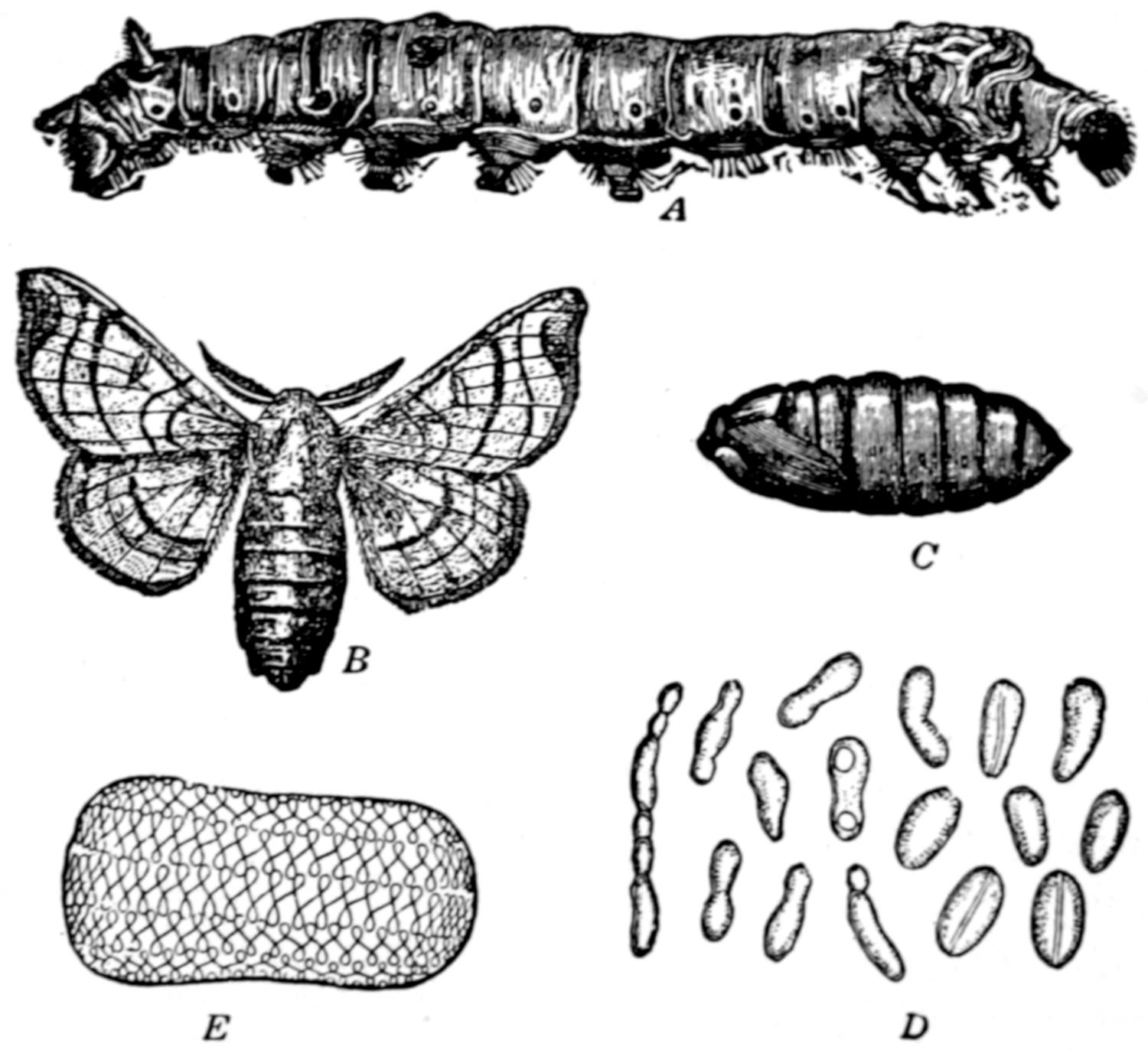
Fig. 107.—Different Stages in the Growth of the Silkworm.
A, Full Size. B, Moth. C, Chrysalis or pupa. D, Eggs. E, Diagram showing
cocoon and method of spinning.
From Matthews’ Textile Fibres, by courtesy of John Wiley & Sons.
The cultivated silkworm passes through four changes in its life of a couple of months, i. e., egg, larva or worm, chrysalis or pupa, and adult,—a cream-white moth which is about one inch in length (Fig. 107). Mating follows; the female lays several hundred eggs. She scarcely moves three inches during the three days of life, the entire time of male and female being devoted to producing eggs, often called seeds, which are laid on sheets of paper or pieces of muslin provided for that purpose. A slightly gummy liquid comes from the [264]moth and holds the eggs fast. The procedure is about as follows: The sheets are gathered, washed in cold water, hung for a few days in a damp atmosphere, and then placed in cold storage for about six months, the period of cold being advantageous for later hatching, which is done by heat. Many worms shed their skins four times, making five ages, differing in length of time with some silkworms, which are as follows: (1) birth to first molt, five or six days; (2) first to second molt, four days; (3) second to third molt, four to five days; (4) third to fourth molt, five to seven days; (5) fourth to maturity, seven to twelve days. The time between ages varies with different silkworms. Trays are provided to [265]hold the various ages of worms, and there are open shelves on which the trays can be placed for convenience in handling and for close observation.
Slightly different methods of cultivation are in use, but the following are representative: The cocooneries are conducted, in general, by experts who give scientific care to the seed and the rearing of the worm. They are generally under separate management from the filatures (the reeling). They are quiet, spacious, well-ventilated rooms or buildings where an even temperature is maintained. Farmers are usually less careful than the workers in large cocooneries; in the latter each worm is kept absolutely clean and has plenty of room, as overcrowding brings disease. Mild fumigation is resorted to at intervals. Heavy odors such as garlic or tobacco are not allowed, being disturbing to the worms. During the rearing time continuous care is needed. The best food for the Bombyx mori is the perfect leaves of the white mulberry (Morus alba), which must be young, fresh and dry, but never withered. The condition of the tree has its effect on the kind of silk produced by the worms feeding on it. Scientific experiments are being made to determine how to influence the color of the cocoon and the size. The leaves of the mulberry are chopped fine during the early ages of the worm. The tree is cultivated especially to provide food for the silkworm. It lives seventy years if good care is taken of it, but it must rest one year in three. Three varieties are found, the early, medium, and late-budding mulberry. The leaves, therefore, can be in condition for the various stages of growth of the worm. The late-budding tree is cultivated in greater numbers, as it is ready when the worms are larger and consume more leaves. The soil is important, and one which is rich in certain minerals has been found to provide leaves which keep the worm in better physical condition. A cold winter followed by a warm spring develops the leaf well. Two prime [266]requisites for good silk are the state of the leaves and the choice of the eggs.
Fig. 108.—Feeding Silkworms in the Canton Christian College School of Sericulture.
Courtesy of Canton Christian College.
When the leaves of the early mulberry are almost ready, the eggs are brought out from cold storage and kept warm until they hatch out. The eggs, an ounce of which contains from 30,000 to 40,000 seeds, are small, flat, dark, and round. The worm, when hatched, is the diameter of a hair and about one-eighth of an inch long. It makes a hole in the end of the egg from which it issues. Showing under the magnifying glass are long hairs, many legs, and a shiny nose. At first they merely suck the sap of the leaves provided for them, but later they gnaw the edges with their semicircular jaws which move sideways (Fig. 108). The noise of many full-grown worms eating is like the sound of rain. About thirty meals a day are eaten in the first stage, for the worms are [267]gluttons and eat their own weight daily. It is said that the silkworm in its life eats about fifty times its own weight. The development is very rapid, and during the next few weeks, as has been stated, the skin has to be changed four times. It is about twenty to thirty days from hatching to spinning. After the first molt the worm is lighter in color and requires more room; after the second, the spinning organs are more marked; after the third, the leaves do not need to be chopped. After the fourth molt the worm is full-sized, about three inches long, white and velvety, and the spinning glands are full of transparent liquid. Hunger lessens, restlessness grows, and the lifting of the fore part of the body indicates the desire to climb and to spin. Brush or twigs are provided (Fig. 109A), and the worm climbs into them and begins to inclose itself in its silken shell by expelling, from two openings underneath the mouth, two delicate threads which form a single one on issuing. They come from the internal glands, and the liquid hardens as it comes to the air. At first the silk is rough and is thrown out like guy lines on the twigs by the motion of the body. Gradually the worm incloses itself in the interior as it forms the cocoon. The method of spinning is by a movement of the head as if making a figure 8, weaving back and forth (Fig. 107E). The silk is a continuous double thread fastened together by the gum, the length varying from three hundred to even two thousand yards. An average cocoon contains about six hundred yards. From three hundred to seven hundred yards are reelable. Very perfect cocoons will reel to the end,[26] but the filament at the end is apt to be attenuated and is used for waste silk. The worm can be seen for a day, but gradually disappears, though it can be heard working within. It takes twenty-four hours or more to complete the cocoon. The silkworm wastes away as the silk is exhausted and gradually changes into a chrysalis. From fifteen to twenty days are spent in this state, and then the chrysalis changes into a moth which moistens the end of the cocoon and breaks its way out.
[26] Sericulture in South China. Canton Christian College, China, 1923.
[268]
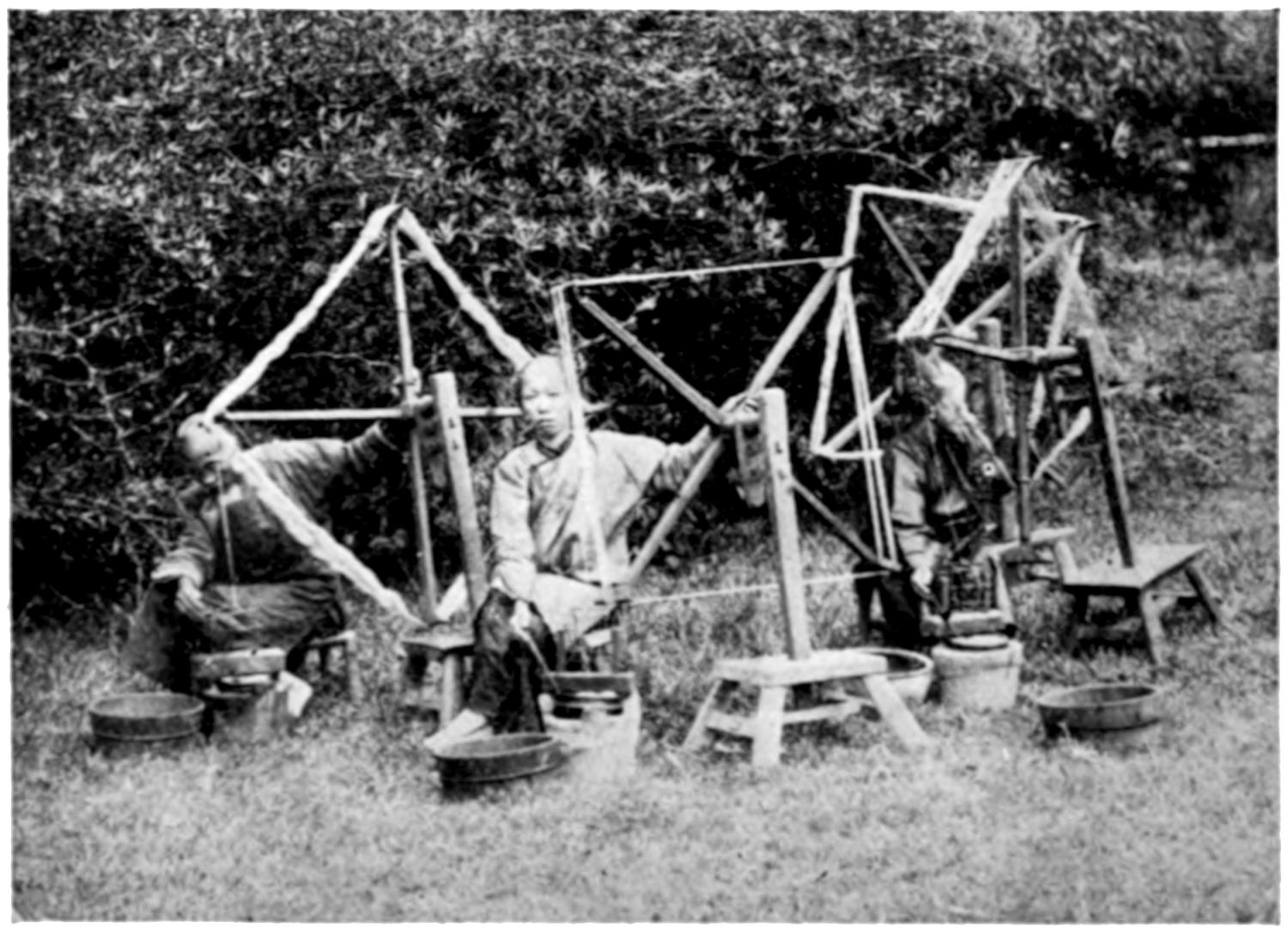
Fig. 109.—A (above), Silk Cocoons on Racks. B (below), Primitive Reeling.
Courtesy of Canton Christian College.
[269]
The silk consists of two parts: fibroin (the silk fiber), and sericin (the gum). On the outside of each cocoon is coarse, tangled silk unsuitable for reeling. This is used as a material for making spun silk (see Spun Silk), being known as floss. The greater part of the remainder of the silk on the cocoon can be reeled, but several filaments have to be united to gain the requisite strength for weaving. The filament of the inner layers does not pay to reel, and it becomes a waste material used also in spun silk. Cocoons are white, yellow, or greenish in color. The color of the Bombyx mori silk, after its gum has been removed by boiling off, is white, no matter what the color of the cocoons has been. The cocoons which are not intended for reproduction are subjected to heat, that the chrysalids may be stifled, since if the moth is allowed to issue, it cuts and spoils much of the fiber. The best cocoons are saved for reproduction. The moth emerges, leaving a hole in the end of the cocoon. These are called “pierced cocoons” and are used in the spun-silk industry. To make one pound of raw silk will take eleven to eighteen pounds of fresh cocoons.
There are silkworms other than the Bombyx mori which provide useful silk, and the industry is growing in importance. This product is called wild silk, because the worms are hatched in the open and not in nurseries under standard conditions. They eat other food than the mulberry. The leading varieties are the Tussah silk of India, China, and Japan. A large amount of these silks is used in the United States. The cocoons are larger and the products coarser and harsher than those of the Bombyx mori. The color is brownish, reddish, and yellowish.
Various diseases and parasites
attack silkworms, the most important being pebrine, which is caused by a germ within the body. The disease is infectious, hereditary, and difficult [270]to subdue. Other diseases are caused by certain conditions and are easier to control. Large sums of money were lost in silkworm culture until the absolute need of care in the following matters was learned: the importance of eggs from perfectly healthy moths, of clean leaves of the mulberry for food, of ample room in the cocooneries with cleanliness, regularity in feeding, and attention to temperature and ventilation. In good nurseries the most careful records are kept of food, temperature, and humidity. In Italy, France, China, and Japan the governments provide schools of sericulture that the best results may attend the industry.
Silk Reeling.
—The greater part of the silk on the cultivated cocoons, and most of the Tussah silk cocoons are reeled, and the waste and unreelable parts are laid aside to be spun. When the cocoons are brought to the filatures, they are first sorted and classified by color, i. e., shape, wrinkles, and condition (moldy, defective, or perfect). The fiber varies in thickness on the cocoon, tapering down in size toward the interior. Reeling consists in softening the silk so that it will come off evenly from the cocoon, and winding the filament in such a way that it can be drawn off without breaking. It is an important and tedious process. Uneven and careless reeling is common, especially among the primitive reelers, and gives much trouble later to the throwsters. Hand-reeled silk is likely to be dirtier, coarser, and more irregular than the machine reeled.
The filament should come off evenly in one long, smooth thread. Expertness on the part of the reeler is necessary to keep the fiber the correct size as she feeds it to the reel. Rapid reeling is the habit, but better results follow slower motion, for irregularities are more apt to be noticed. Hand reeling is a very simple process, but steam filatures are in general use, in which the heat of the water can be regulated, and the reels are run by power instead of by the feet. The silk is reeled in the way the foreign market desires it.
[271]
The method of reeling is as follows: There is a series of specially constructed basins filled with very hot water. The reeler sits in front of a basin. She first removes the loose silk from the outside of several cocoons and lays it to one side with defective ones and other waste. These will later be used for the manufacture of spun silk (see Spun Silk). The cocoons are floated on the water, which must be free from impurities or the color and condition of the silk will be affected. A filtration method for purifying the water is often in use. By means of a brush which is sometimes mechanical in action but at other times is held in the hand of the reeler, the cocoons are sunk below the surface of the water in order to soften the gum. A moment later the brush is raised and silk filaments from the cocoons are found clinging to it. The threads are caught by the fingers and drawn until they run smoothly, while broken and rough silk is put with the waste. There is often as much waste as reeled silk. The silk from several cocoons is united, twisted slightly in the fingers, passed through an agate or smooth glass eye and attached to the swift or reel in order to clean and keep the thread even. If a filament breaks another must be attached, in order that the thread may not vary in size. In many filatures an attendant assists the reelers. She removes the outer silk and softens the cocoons in boiling water. She lifts them with a scoop and puts them in the reelers’ basins. The reeler proceeds with the brush as given above. The water does not need to be boiling hot after the first softening of the cocoons. The reeled silk is continuous, as new filaments are added when any one gives out. The silk is sometimes too wet, which makes the filaments stick together on account of gum in them. In many filatures this is corrected by steam pipes running near the reels. For 13/15 denier silk (denier is a unit of weight, see Glossary at back of book), which is the standard raw silk sent from Japan to the United States, the threads from four to six cocoons [272]are united; for finer counts, such as 10/12 denier, fewer cocoons are required, and for heavy sizes, such as 24/26 denier, many more are united to make the thread.
Various methods of winding are in use. The silk threads as they come from the eye are, by a simple device, twisted around themselves (Fig. 110). By another method of reeling there are two threads, each made from a group of cocoons. Each thread passes through an eye, the two threads are twisted around each other, separated, twisted together again, and separated before passing to the swift or reel, where the thread is wound in a transverse or lateral manner across its width so as to make a cross reel, instead of piling up on itself. In some reeling machines a bell rings when a hank is complete and ready to be taken off. The product of reeling is called raw or reeled silk.
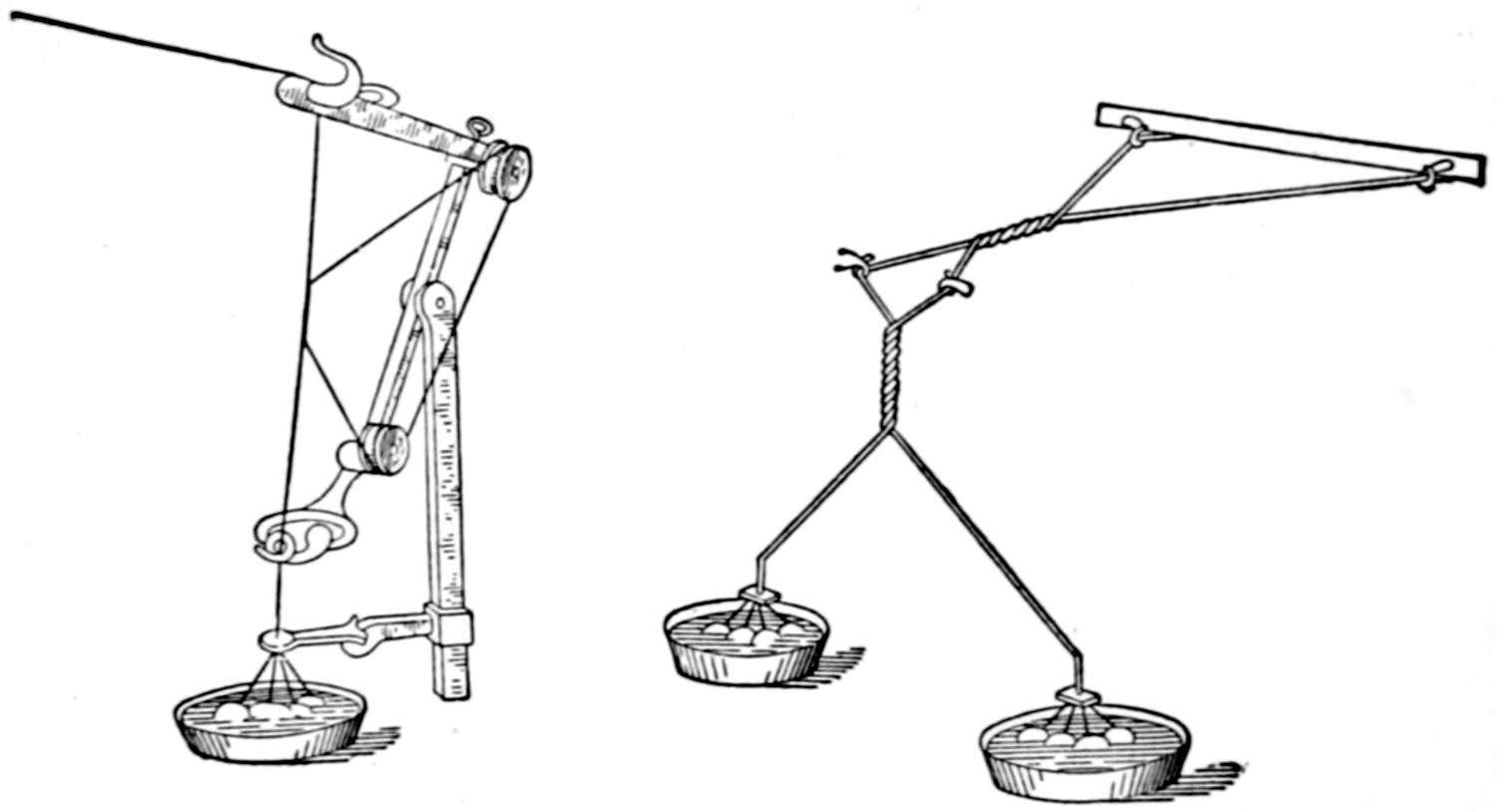
Fig. 110.—Croissures.
From Matthews’ Textile Fibres, by courtesy of John Wiley & Sons.
After reeling, the silk is prepared for export. It is in skeins or hanks from the swifts, of 50 to 100 grams each in weight. In China and Japan about thirty of these are united and called a book. Each book is wrapped and marked with [273]the brand or “chop” of the filature. (The ends of the silk are carefully fastened so that they can be easily found.) These are baled and covered with matting. The Picul bale used in Japan and Shanghai, China, weighs about 133¹⁄₃ pounds. Canton silk bales (catty bales) weigh 106²⁄₃ pounds. Italian silk is packed in shipping bales of about 200 pounds. The value of a pound of any standard silk varies greatly, conditions of growth and market conditions having their effect. In 1914 a pound of Japanese silk was worth about $5, but in 1920 the same silk was $18 per pound. The annual average prices for raw silk on the New York market for 1924 were:[27]
| Italian Extra Classical | $6.96 |
| Japan Kansai Best, No. 1 | 6.13 |
| China Steam Filature, 3d Category | 6.81 |
| Canton Filature, Ex. Ex. A | 5.96 |
[27] Compiled by the Statistical Bureau of the Silk Association of America.
Reeled silk is used for the best class of woven fabrics. Japanese silk is found in woven goods and hosiery. Italian and China silks are used in tulle, silk muslin, fine satins, and other broad silks of fine quality. The Canton filature silks were chosen for crêpes and velvets, but Japanese silks are now much used, as they are cheaper. Coarse Canton silks are found in silk mixtures. Tussah is used for mixed goods also, and for domestic Shantungs and pongees.
Spun Silk.
—The raw material of the spun silk industry is silk waste. It was probably manufactured mechanically in England about 1792 from throwing and weaving waste. Gradually methods of preparing the various wastes and twisting the thread developed. In 1828 the first mechanical plant was established in Basel, Switzerland, and about the same time the industry was organized in Lyons, France. It began in the United States in 1850. At present the United States uses about 20 per cent of the spun silk of the world. [274]Up to 1855 the greater part of the cocoon and raw silk which were too tangled to be used for reeling was wasted. A great industry was started when machinery for spun silk was invented. The spun silk production of the world is about 25 to 30 per cent of the raw silk production.[28] Spun silk yarns are used for sewing, braiding, insulating of electric wires, warp or filling of velvets, plushes, charmeuse, satins, linings, duvetyns, foulards, shirtings, crêpes, knit fabrics, hosiery, underwear, neckties, and passementeries. There are many qualities, ranging from wastes of the highest grade of reeled or thrown silk to a low quality used principally in the East. The lowest quality of Asiatic waste is not exported, but is used in the countries producing it for wadding, for interlining winter garments, and for other purposes. There is a large amount of waste in silk production; it is stated that only about one-half of the total world’s supply of silk spun by the worm comes into the market as raw silk. The principal sources are the following: (1) From cocoons, such as the rough threads thrown out first by the silkworm; from the teasing brush; from broken cocoons; from parchment-like inner layers, too fine to reel; and from defective, double, and pierced cocoons. (2) Reeling waste—poor reeling yields a large amount. Some Chinese silk is reeled solely for use as material for spun silk. (3) Gum waste, i. e., throwster’s waste, being fine and coarse ends made in the various reeling and winding processes, as in piecings. (4) Weaving mill waste, and (5) various wild silk cocoons which will not reel.
[28] New England Spun Silk Corporation.
Cocoons that cannot be reeled and the various filature wastes, termed frisons, are in separate bales and solidly packed. The waste is full of gum which must be removed, and hair, dirt, and other refuse are frequently found. Several methods of removing the gum are in use: (1) The French or Schapping system, which puts the waste in vats of tepid [275]water for a week until fermentation sets in and rids the silk of much of its gum. For some classes of goods such as velvets the schappe silk is excellent. (2) The soaking of the silk in a solution of alkali or in an acid solution, and (3) the English or boiling-off. The latter is used largely in America, the entire process being the following:
Degumming.
—The natural gum is removed from both cocoons and frisons by boiling it out. The waste is placed in open mesh bags and pulled back and forth and up and down in vats of soapy water kept just at the boil, which softens the gum so that it passes through the meshes of the bag. After several hours the silk is taken out and dried. It is later soaked in another vat to rid it of more gum, and comes out soft, fluffy, and white, having lost from 18 to over 50 per cent of its weight, the loss varying greatly according to the kind of waste. It is then dried in a revolving extractor, but allowed to hold 11 per cent of its dry weight.
Dressing
follows. The cocoons and frisons are fed separately at first through rollers against cylinders covered with wire needles which open up the mass, and then picking machines still further draw out the laps, which are cut into nine inch lengths. These are laid over rods by the machine, ready for a thorough combing in the next process, which is called a dressing machine. The latter resembles somewhat the hackling machine used in the flax industry. The lengths laid over the rods are placed over large cylinders covered with card clothing and are combed through first one way and then another. This is done several times, the first time giving the longest fibers. The short ends which are combed out are called noils, and are used for a poorer class of yarn, of use in the making of cartridge cloth (to hold explosives; see below), or to mix with wool. Cloths are laid over the combed laps as they lie on the drums, that the soft, silky fibers may be kept in order when they are removed. The laps, still wound around the rods and covered with the cloths, are [276]taken from the dresser, and are carefully removed and separated into lengths of equal size. The next step is the examining of the laps for any dirt or irregularities. They are laid on a glass table with a light shining from below the glass, consequently the slightest flaw can be distinctly seen. A sort of spreadboard, like the one found in the flax industry, runs the lap together, and these are formed into a sliver by another machine.
Spinning.
—Several slivers are drawn and united into one and again into a roving, which is wound on a bobbin preparatory to spinning. The final spinning may be on the mule or on the frame. The yarn is wound on a special reel for dyeing, which prevents the snarling of the fine, soft filaments by a method of cross winding. This keeps the threads from piling up on each other, making unwinding easy. Some spun yarn is wound on bobbins or on quills and taken directly to the weaving room if dyeing is not to be done in the yarn. Spun silk yarn is frequently gassed to make it glossy by ridding it of short, fluffy ends.
Filature wastes from the East are often known under the names of places from which they come. There are many different grades. Kibizzo is a Japanese filature waste. Curlies come from both China and Japan, and are listed under several grades. Some few of the Eastern wastes are found under chop marks. The term frisons, which was originally French filature waste, is used often in the United States for all filature wastes. A large amount of the best silk waste is imported into this country. It is used for filling, for dress goods, for warp velvets, and half-silk goods. Lower grades of spun silk are used for coarse knitted goods and for packing and insulating material. Silk wadding is made from waste from bourette spinning.
Silk waste is used in all silk manufacturing countries. Lyons, Paterson, Basle, and Milan use it in large quantities. Spun silk is not so strong as reeled silk. In the United States [277]silk waste is often called schappe, but this is not strictly correct, for that word belongs to a special French process.
Producing Countries.
—The main countries where the silkworm is cultivated at the present time are Japan, China, Italy, France, and the Levant. Other countries, such as Spain, Hungary, the Balkans and Switzerland produce small quantities, but the output is not important commercially. Japan is a large cultivator of silk and the amount is on the increase. In 1924 about 85 per cent of the importations of the United States were from this country, and a large proportion (89 per cent) of her product came to the American market. Careful and scientific methods are used in both rearing and reeling, and efforts are made to meet the requirements of our manufacturers. European spinners prefer the soft white silks of China and the Levant. It is stated in The Sericulture Industry and Leading Reelers in Japan, published by the Sericulture Association of Japan in 1921, that the number of families rearing silkworms in Japan was 1,638,121, with the promise of increase. An enormous number of acres are planted in mulberry trees. Both white and yellow cocoons are produced. The quality of Japanese silk is excellent, the color is whitish after boiling off, but not so clear a color as the Chinese silk. The silkworm is cultivated all over Japan, but especially in some of the central prefectures. About three million pounds go to Europe annually. Japan consumes about 30 per cent of her own silk. Chinese cocoons are sometimes bought, reeled in the Japanese filatures, and exported with the Japanese raw silk.[29]
[29] The Sericulture Industry of South China, Canton Christian College, China, 1923.
The Japanese government maintains colleges for the scientific study of sericulture and for instruction in rearing, and has experiment stations for the best methods of breeding silkworms. Every prefecture where silkworms are grown has [278]an inspection office for the examination of the seeds and other questions relating to successful rearing. The filatures are up-to-date and spotlessly clean, and the eggs are kept in adjacent fireproof buildings. Yokohama is the center of silk transactions. Speculation on the exchange causes constant fluctuations in the price of silk. The Imperial Silk Conditioning House is depended upon for giving the true weight and condition of silk for export.
Silk coming from Japan may be divided into three classes: for organzine, for tram, and for singles. Hard natured silks are called “Kansai,” and soft natured, “Sinshiu,” after districts producing silk, but many other districts produce the same kind. The terms really refer to the quality of the cocoons.
Japan sent to the United States in 1923 and 1924:[30]
| Raw Silk: | |
| Pounds | Value |
| 34,478,018 | $266,610,401 |
| Fabrics in the Piece: | |
| Pounds | Value |
| 1,378,943 | $9,100,118 |
| Silk Wearing Apparel: | $505,497 |
[30] Twenty-fifth Mid-Year Report, Silk Association of America.
China is a large producer of raw silk, but uses much in domestic consumption, as silk fabrics are worn extensively by both men and women. The dress of the people has been little influenced by foreign clothing ideals, and silk is worn throughout the year. Much of the woven silk of China is in special patterns to meet the desires of the people, hence is not exported to any extent. China sent to the United States in 1923-24 of raw silk, 4,680,779 pounds, and of fabrics in the piece 151,987 pounds. Shanghai sent 19,542 bales of raw silk (Picul or 133¹⁄₃ pounds) and Canton, 26,011 bales (Catty or 106²⁄₃ pounds.)[31]
[31] Twenty-fifth Mid-Year Report, Silk Association of America.
The raw silk industry is in the vicinity of Canton and Shanghai. Raw silks from the southern district are known [279]commercially as “Cantons” and from northern China as “Chinas.” Pongee silk comes from the Shantung Province of China. The Tussah or wild silk is used largely for hosiery, dresses, upholstery, and electric wire covering.
The methods of sericulture in China are not modern, but are improving. The government does not regulate the industry, consequently every section has its own ways of proceeding. These are often very primitive, and the silkworm seeds are not alike in quality. Diseases of the silkworm are extensive, and the pebrine is the most destructive. Many farmers have given up silk culture on account of this disease, as it so weakens the worms that many die, and from those that live a thin cocoon with defective silk results. The silk of China is excellent when well grown and reeled, but at present cannot be depended upon. South China produces an especially beautiful silk in the Canton district, being fine, soft, and highly lustrous. The United States imports it for velvets and crêpes.
Sericulture conditions have been studied of late years by many of the colleges of China, being assisted by the Silk Association of America with money and buildings. The Canton Christian College in South China is producing perfect seeds and selling them to the farmers. It is making scientific studies of the diseases and other matters relating to the success of silk culture, mulberry raising, and reeling, and is sending out students to train the farmers. Although the seeds grown at the College are more expensive than those from the farmers, they are found to give so much better results that the added price is considered worth it. South China grows six or seven generations of silkworms annually. The control of pebrine is the fundamental thing in developing the silk industry.
Because there is no government regulation to unify the raising and reeling of silk in China, methods of culture and the names for varieties of eggs differ in the silk producing [280]sections. In Shanghai, which draws from the whole of Central China, there are found a great variety of raw silks which differ in quality, color, and packing. Silks from several provinces are marketed, which makes it interesting to the student of silk. Steam filature silk, T’satlees, Tussah silk, and silk wastes from Central China are marketed there. A silk conditioning house has been opened lately in Shanghai. It is a branch of the United States Testing Company. “Chinas” are raised in a region around Tai-ho Lake, including parts of the provinces of Kiangsu and Chekiang, known as the T’satlee region. In Chekiang a good yellow silk is produced. The filatures of Central China are good. The Canton Province is the silk center for South China. Methods of production and reeling are not as up-to-date as in Shanghai. Through the influence of the Silk Association of America and the Canton Christian College the industry is gradually being placed on a sound scientific basis. An increasing business is being done with America. About four or five million farmers producing silk are in South China.
In 1879 the first steam filature appeared. These are now reeling the silk to the required size and cleanliness, but are slow in using some of the best methods of crossing the filament to keep it from tangling. Two missions have gone out from the United States to the Orient within a few years, composed of silk manufacturers and business men, for exchange of views and to lead to a better understanding between the silk producers and the manufacturers.
American manufacturers wish to import Chinese silk, but have found difficulties with the native reeling and irregularities in the size of the silk. The Chinese are trying to improve methods and old and primitive ones are slowly passing under the influence of colleges and educated Chinese workers (Fig. 109 B). The silk reeled on the farms, called T’satlees, is being rereeled to meet the need of American silk manufacturing methods. The T’satlees are reeled by Chinese [281]peasants in their cottages. They are troublesome to unwind and the size of the filament is irregular. The term comes from a region back of Shanghai. These silks have not been used to any extent in this country in their original state, although the silk is often very beautiful and white. T’satlee silks sell at a lower price, yet are strong, durable, and brilliant. It now comes to this country rereeled into skeins of standard size, and also cross reeled, thus making them easy to wind. It is used in the knit goods industry, for tie silks, upholstery fabrics, and other purposes.
Italian silk ranks high in quality. The Italian government and also private agencies foster the industry. The rearing is in many parts, but principally in the provinces of Lombardy, Venetia, and Piedmont. Levant cocoons are often reeled in Italy. The production in 1923-24 was about 10,803,000 pounds, of which the United States took 1,576,078 pounds. Turin is the silk center for Piedmont and Milan for Lombardy.
The French raw silk industry is being affected by lack of labor and its cost. France now principally imports her raw silk from China, Japan, Italy, and the Levant. The silk still grown is high in character. Silk manufacture is important in parts of France, Lyons being a noted center. The United States imported from France in 1923 raw silk and silk woven and knit.
The silk culture in India is mostly primitive. The crop is large but the silk is not satisfactory for American manufacturers. The industry is mainly found in Mysore, Assam, Burmah, Madras, and Bengal. In Kashmir the government is trying to improve the industry.
The product of the Levant and Asia Minor is purchased largely by France and Italy for their filatures.
The following table gives the raw silk production for 1923-24:[32]
[282]
| Total | 67,288,000 | pounds | |
| Europe | 11,519,000 | “ | |
| Levant | 1,764,000 | “ | |
| Asia | 53,015,000 | [33] | “ |
| Tussah | 990,000 | “ |
[32] Twenty-fifth Mid-Year Report of the Silk Association of America, 1924.
[33] The full production of raw silk is not known in China and India, the amount of export alone is given. An approximate amount of 74,000,000 pounds is estimated.
Silk in the United States.
—The United States is now the largest producer of silk fabrics in the world. (See Silk Manufacture, below.) The industry has grown with great strides within a decade. Raw silk and silk wastes are imported in large quantities and manufactured silk of many kinds are brought into the country, but in smaller amounts than in former years. The United States production of silk in 1923, as given by the United States Department of Commerce for release on March 11, 1925, was valued at $761,322,119, not including knit goods of silk or the cost of materials.
The United States importation of raw silk in 1923-24 was valued at $350,028,136.[34] In addition there was:—
| Waste silk valued at | $8,631,440 |
| Cocoons valued at | 132,038 |
| Piece goods valued at | 14,081,185 |
| Spun or schappe silk | 4,456,834 |
| Wearing apparel | 6,745,127 |
| Miscellaneous manufacture | 6,789,157 |
| Total | $40,835,781 |
[34] Twenty-fifth Mid-Year Report Silk Association of America, Sept., 1924.
In 1924 the number of establishments in the leading manufacturing states was as follows:—[35]
| New Jersey | 962 |
| Pennsylvania | 894 |
| New York | 798 |
| With Massachusetts, Connecticut, Rhode Island, Illinois, and Tennessee having lower numbers. | |
[35] Release of March 11, 1925, Department of Commerce, taken from the Census of Silk Manufacture, 1923.
[283]
New York City is the market center for silk fabrics, and most of those dealing in silk in any way have their headquarters there. The bulk of both reeled and manufactured products from the East comes to New York. San Francisco, Seattle, and Vancouver, Canada, are all receiving ports. The trains which bring the precious freight across the country from the Pacific coast are dirt and moisture proof and are thoroughly insured, as the value of one train may be from one to two million dollars. The world’s production of raw silk is difficult to obtain with any accuracy, as only export figures have been available from the Orient. An approximate amount is given of about 67,288,000 pounds. The United States imported in 1923-24 about 46,205,409 pounds of manufactured raw silk, 11,234,005 pounds of waste, and 4,358,785 pounds of manufactured fabrics.[36] The value of the silk woven or knit in this country was in 1923 estimated at $761,322,119; broad silk goods being $456,082,819; velvets, $23,879,903; plushes, $17,217,510; upholstery and tapestries, $10,635,974; silk threads and yarns, (organzine, tram, hard or crêpe twist, spun silk, machine twist, sewing, embroidery, and other floss silk, ribbons) $52,121,835; laces, embroidery, nets, veiling, etc., $2,892,812, and the remainder miscellaneous products.[36]
[36] Twenty-fifth Mid-Year Report Silk Association of America, Sept., 1924.
Marketing, Classification, and Conditioning.
—The principal raw silk markets of the world are Yokohama, Kobe, Shanghai, Canton, Milan, Lyons, and New York City. Marketing is done largely through commission merchants, who are sometimes exporters. Occasionally a big United States manufacturer will buy direct from a filature. Yokohama has a Raw Silk Exchange, but the transactions there are largely speculative.
The chief trouble with the raw silk transactions has been the lack of a standard basis to judge quality. Everything [284]has depended upon the buyers’ or inspectors’ ability to judge the value of the silk through sight, feel, and smell. The manufacturers in the United States want a permanent system of grading. The present one is merely a series of names for grades, without definite standard for any one. After many years of study of the problems involved, by a committee of the Silk Association of America, tentative classifications have been recommended, based on a series of mechanical tests on the silk.
Pending the adoption of a standard, the Silk Association of America has recommended that the present names used to denote the grades be restricted to eight. These are as follows: Grand Double Extra, Crack Double Extra, Double Extra, Best Extra, Extra, Best No. 1 to Extra, Best No. 1, Best 1 and No. 1.
The best raw silk is even, clean, elastic, strong, and lustrous. On the Yokohama Raw Silk Exchange Kansai No. 1 has been selected as the standard grade in the same way that cotton exchanges have chosen Middling Upland Cotton.
Raw silk is sold by weight, and as silk readily absorbs water, the habit is increasing of selling it by conditioned (tested) weight, i. e., tested with reference to the amount of water in the silk. In commercial practice, conditioned silk is supposed to contain moisture equal to 11 per cent of its absolutely dry weight. It will carry 30 per cent without feeling appreciably damp, and can be made to absorb considerably more. The method of testing for moisture is as follows: Samples are taken from a number of books in one bale of silk and weighed carefully. They are then placed in ovens and dried perfectly. The samples are again weighed, and the difference noted, and the dry weight of the full bale is worked out by proportion. The conditioned weight of the bale is based on this dry weight of the silk plus the accepted commercial regain of moisture, 11 per cent. The elasticity and tenacity of silk are greatly affected by the moisture in it. [285]Conditioning houses were first organized for silk, but are now used also for other textiles. In Europe silk is usually conditioned; testing houses are numerous in France and Italy. Germany, England, Switzerland, Japan, and China have them. The United States Testing Company has branches in New York, Paterson, New Bedford, and Philadelphia, and also in Shanghai. In addition to the conditioned weight, tests are used for both raw and thrown silk by chemical and microscopical analyses.[37] The following tests are representative and are increasingly practiced in this country. The boil-off test shows the amount of gum in the silk. Some varieties contain more than other kinds, ranging from 10 to 25 per cent. Silk is boiled off before dyeing, its brilliancy is thus increased but weight has been lost, which adds to the price. Sizing and winding tests are given to determine if the size is regular throughout. Cleanliness is important (for various imperfections in knots, fuzziness, and particles of cocoons are found in the reeled silk), and the elasticity and tenacity are desirable factors. Manufacturers desire to be completely informed about these matters before buying in large quantities.
[37] United States Testing Company, 1923, and Raw Silk, Duran.
The denier system for raw silk and the dram system for thrown silk are those customarily used in the United States. The denier weighs 0.05 gram. The weight of 450 meters of reeled silk filaments is given as the size in deniers. The higher numbers are coarser. The numbers of silk are given in averages or ranges, the size 13/15 denier being the one most in use in the United States. In spun silk the number of yards in a hank is 840, and the number of hanks in a pound is the count of the yarn, based on the finished yarn. This is like the method of counts in cotton. The higher numbers are finer. For thrown silk in the dram system the size is based on the thousand yard skein in drams. A skein weighing five drams is called a five-dram silk. In raw silk the United [286]States principally imports 20/22, 13/15, and 14/16 sizes. Very coarse sizes such as 30/40 are used for mixed fabrics.
Silk Throwing.
—The term “throwing” comes from an old Saxon word meaning twisting. It is used for the series of processes by which raw silk is made into yarn. Silk direct from the reel is strong enough to stand the strain of weaving, but the threads would open up if dyed, so when it is to be skein dyed it has to be more or less twisted. Spun silk, made from waste, is twisted by a different method which is more like cotton spinning. The work of throwing is simple, but the reeled silk is so delicate that complicated machines are required. Throwing is often conducted as a separate business, and thrown silk is for sale on the market. Silk weaving mills frequently send their reeled silk to the throwing mills to be prepared for them, or they buy the thrown silk. Some large silk manufacturers conduct the entire series of processes from raw silk to finished fabric.
There are different methods of throwing, of which the following are in constant use:
Singles. These are single raw silk threads which may be twisted or not. Hard-twist singles are used for gauzes, chiffons, and crêpes, for both warp and filling. Raw silk singles in the gum are often used for warp in piece-dyed goods.
Organzine (Fig. 111, B and C) is made from the better grades of raw silk, for it is generally used for the warp, and that must be strong. A single raw silk thread is twisted with a right-hand twist, perhaps sixteen turns to the inch. Two, sometimes three or even more of these twisted threads are again twisted together, left-hand twist, perhaps fourteen turns to the inch. There are variations in the manner of twisting. In taffeta weaving the organzine is twisted sixteen or more times on the first twist. For soft satins, on the contrary, the twisting may be less, for the sheen or luster is greater if the silk is less twisted. In dull finishes the organzine [287]is twisted very closely. When two threads are finally twisted together the yarn is called two-thread organzine; when three are united, three-thread organzine. Many machines are required in making organzine. In yarn-dyed goods the warp is usually organzine.
Tram. (Fig. 111, A and D.) For tram silk, which is generally used for filling, two or more single, untwisted, reeled threads are united into one and twisted very slightly. The terms two-thread, three-thread, etc., are used to designate the number. A poorer quality of silk is used for tram than for organzine. Hard-twist tram is used for the filling of some crêpes.
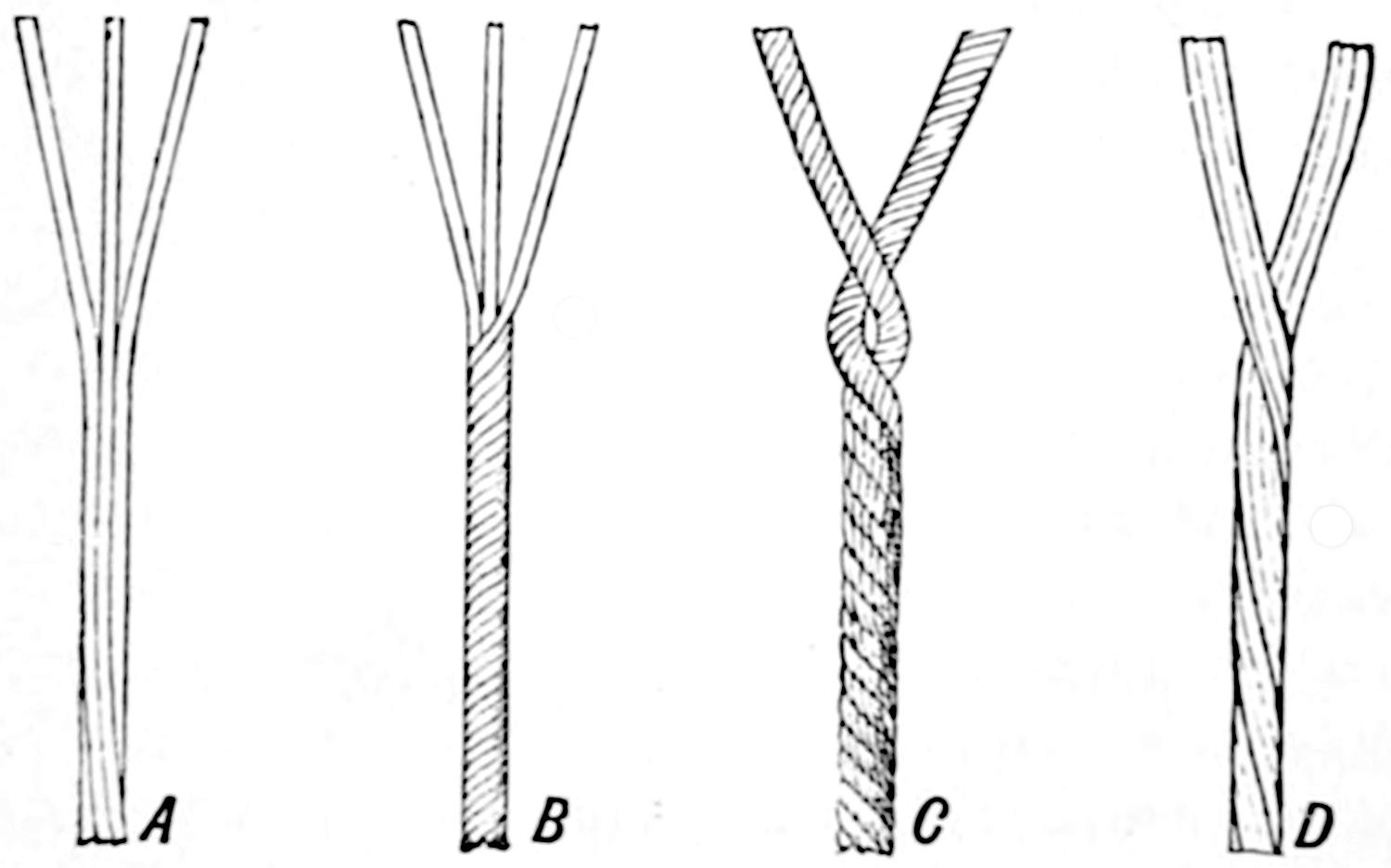
Fig. 111.—Organzine and Tram.
From Barker’s Textiles, by courtesy of Constable & Co., London.
Chiffon or Crêpe. The yarn used for these fabrics is a tram twisted from forty to eighty turns in an inch. For crêpe some of the yarns are a right-hand twist, and some left-hand.
There are many special twists, of which sewing silk is an illustration. There may be as many as one hundred cocoon filaments in one thread of sewing silk, depending upon the size. From three to perhaps two dozen raw silk threads are [288]united and twisted together, after which two, four, or six of these threads are again twisted together in the reverse twist while held at a tension.
Embroidery silk is made from singles slack twisted, which after doubling are twisted in the opposite direction.
When raw silk arrives at the throwing mills, the bales are opened and, if necessary, the skeins are sorted as to size and color. Skeins that are to be thrown “bright,” that is, without having been soaked, are taken directly to the winding machine. Those which are to be soaked are opened and put in open mesh bags in a bath of lukewarm water containing some olive or neat’s-foot oil and some olive oil soap, the gum being thus softened. When almost dry the skeins are frequently rolled and rubbed to soften any gum still left in them. They are then dried thoroughly, and allowed to regain their natural moisture of 11 per cent. In the making of organzine, winding the skeins follows to transfer the thread to bobbins. This process requires careful work. In the winding machine the skeins are stretched on a series of swifts or reels which are arranged side by side, and the end of each thread is passed through an eyelet to a bobbin, and by means of a guide wire is wound without friction up and down the length of the bobbin. A break in the thread automatically stops the machine. The attendant must piece all bad places and deliver a smooth thread. The threads are passed from one bobbin to another through a slot, or between two parallel plates so set as to remove all irregularities on the silk. Winding prepares the silk for doubling and twisting, which are necessary to give the filament sufficient coherence for boiling off and dyeing.
Doubling and Twisting.
—In some American machines throwing, doubling, and twisting are combined, but such machines can be used only when the silk is perfectly reeled and of good strength. Usually these processes are separate, the amount of doubling and twisting depending upon the [289]future use of the silk. For organzine much twisting is required, that it may dye well and be strong for warp. When thrown silk is to be sold, the hanks are made into bundles for shipping. In some instances the thrown silk is sent to the manufacturer on bobbins or on quills ready for weaving.
Dyeing and Attendant Processes
—Degumming and Stripping.—Silk may be yarn dyed, piece dyed, or printed. The processes for the first two are similar. If the yarn is to be dyed it goes in skeins to the dyehouse directly after throwing. The cloth is woven in the gum and dyed after weaving. A large number of colors are available in silk dyeing. Reeled silk is harsh and wiry, as it contains considerable gum or sericin, and it may also have much color in it, which must be removed. After the thread is thrown and before bleaching or dyeing, the gum and color are boiled out. All silk does not require the same treatment, for the gum is more difficult to remove in some cases, and in some classes of fabrics the gum is only partially removed. Stripping or boiling off greatly reduces the weight of the silk, for 25 per cent or more is often lost. The process is simple and not injurious. The natural luster and softness of the silk are enhanced by boiling off. If the silk is to be very lustrous, it is sometimes stretched in the gum before the stripping or boiling off occurs, and is again stretched and steamed after it. The boiling off, as usually practiced, consists of boiling in a vat of soapy solution, the silk being in cotton mesh bags. This is a process of much delicacy, as the degumming must be complete but not overdone. For soft silk, about 20 or 30 per cent of the thrown weight is lost in stripping, leaving it soft and lustrous; for “souple” silk the loss is less, being from 5 to 12 per cent. The result is a duller appearance and a firmer touch, suitable for grosgrains. “Ecru” silk has still less gum removed, probably from 2 to 5 per cent. After stripping, a silk may need several washings. It is dried in a hydro-extractor.
[290]
Spun silk does not have to be boiled off, as that is done previous to spinning it. If the silk is streaked or has not a clear color, bleaching is required and follows the boiling off. There are several ways of doing this, one being to hang the silk in a sulphur chamber. Sodium peroxide is used to some extent, especially for Tussah silk, and hydrogen peroxide is liked but it is expensive. After bleaching, the silk is thoroughly washed. (See Chap. XIII.)
Weighting
(see Chap. XII).—Weighting follows the boil-off whether in the yarn or piece. A certain amount of it is considered legitimate, as so much weight is lost in the boil-off, and silk is expensive. It has absorptive or adsorptive qualities, and is capable of taking in several times its own weight of the substances used in weighting, such as mineral salts. Salts of tin and salts of iron are now used, the latter for dark silk. It has been stated by some silk manufacturers that silk which is carefully weighted, even heavily, will give satisfactory results for the price paid. New methods of weighting are proving this to be true. In the majority of cases, however, with weighted silk, sunlight, perspiration and salt water cause deterioration. Silk is weighted in the piece as well as in the yarn. The claim is made that soft finished drapery fabrics require weighting to give them the requisite hanging qualities.
Wool and silk are animal fibers and take dye easily, but sometimes at different temperatures, hence it is possible to weave the cloth of both fibers, and by regulating the heat in the dye vat leave the one white and the other colored. (See Chap. XIII.)
Stretching and Lustering (for silk thread).
—Bringing out the gloss on silk thread may precede or follow dyeing, according to the character of the silk or the practice of the dyehouse. Both hand and machine methods are used. The dyer throws the skein over a strong peg on the wall, puts a smooth stick through it, and pulls the skein down hard, [291]twisting it about from right to left until it is soft and glossy. By the machine method, bobbins of twisted silk are placed in water and the silk is wound from them on a revolving copper roll. It then passes to another roll just above, which in revolving more rapidly stretches the silk. This stretching is usually done before dyeing. A high degree of luster is given by exposing the skein to steam in an oven, where the silk is stretched on highly polished rollers. The steam and friction, however, sometimes wear on the threads. Steam lustering often both precedes and follows dyeing, for the dyes, mordants, and weighting decrease the luster of the thread. A special olive oil bath is given some silks. “Scroop” as well as luster are obtained by soaking the silk in dilute acid. The boiled-off liquor containing the sericin or gum is frequently combined with the dye to increase the luster.
Printing.
—The printing of the warp or of the piece is popular. Silk printing is like cotton printing. (See Chap. VIII, Cotton Printing.) If the design is to be on the warp threads, they are passed rapidly through a loom and a few filling threads are thrown across at intervals to hold the warp in shape for passing over the great printing cylinder. This class of printing is sometimes called chiné. After printing, the goods are steamed to set the colors and then heated with dry heat to age them. A thorough washing is given before finishing. If designs are to be shown on a solid ground, either resist or discharge printing is used. (See Chap. XIII.)
Winding the Yarn, Warping and Weaving.
—After dyeing or warp printing, the skeins are wound in various ways according to the use to which they will be put. Silks to be woven immediately are placed on bobbins for the warping frames. Silk warping differs somewhat from that of other fibers, and requires the most delicate handling. There are several methods in use; the aim is the same as in all warping. (See Chap. III, Winding, etc.) Filling threads are wound on quills for the shuttle.
[292]
The weave in silk is of paramount importance, and ranges through all kinds of designs from plain to the most intricate Jacquard patterns. The silk designer requires training, years of experience, and artistic taste. Standard silks are found in the plain weaves such as the China, India, and Japan (habutai) silks; glacé silk, which is the name given to silk with contrasting colors of warp and filling; pongee and Shantung, taffeta and crêpe de chine. In twills there are the ottoman, grosgrain, bengaline, poplin, faille Française, and many others. These are often made with a wool or cotton filling, and the ribs are on the filling way. In satin weaves there are the messaline, merveilleuse, satin de chine, satin duchesse, Liberty satin, and peau de cygne. In pile weaving there are velvets and plushes, which are made in several ways. (See Chap. VI, Pile Weaving.)
Finishing.
—Pure reeled silk, well woven, requires no dressing, but is finished by picking, pressing, mangling, or calendering, with or without friction. Poorer silk fabrics or union goods need much finish to give them “handle,” strength, and body. Almost every piece of silk requires a picking over to take away fibers, nap, loose threads, and knots. This is sometimes done by hand, but is a slow process. The largest percentage of fabrics are passed rapidly through a shearing machine. There is a brush in front of each set of blades, and one for the back of the silk also, that all foreign matter may be removed. A suction current of air raises the little ends and the knife edges cut them off without injuring the surface of the material. The silk gains a smoother face through this process. Some fabrics, like taffeta, have both the front and back exposed to the blades, but in satin the face only is shorn. Fabrics are sometimes put through twice. Polishing often follows to spread the threads of warp and filling evenly over the surface, in order to soften the appearance and make the fabric smoother. Examinations occur frequently and directions are given for removing flaws if [293]any have been found. In light colored silks discolorations often occur and must be removed by special treatment. Each mill has its own cleaning paste.
The kind of finish to be used on silk depends upon the end to be obtained. Finishes are of two kinds—mechanical, or by means of dressings. Some of these have already been mentioned. The main yarn finishes are: (1) Sizings to smooth certain hairy yarns and make them wear better; (2) soaking in dilute acid to give scroop and gloss; (3) gassing to burn off the fluff and to make the yarn smooth; (4) dressings and mechanical finishes to give gloss and to harden. Organzine (if it needs sizing, which it rarely will) is sized with gelatin.
Finishes for woven silk are also mechanical or by dressings. The first includes calendering, mangling, or pressings of various kinds by which the woven material is made smooth. Velvets are cleaned, the pile raised and shorn. Chiffon velvets are wet sprayed and the pile brushed and cleaned. Processes in silk finishing are often repeated many times before the desired results are obtained. The goods may come directly in contact with metal rollers or may be pressed between finishing paper, according to whether a glistening or a soft effect is needed; moiréing or embossing cylinders having designs etched upon them may press into the dressed material, leaving the design on the surface; special machines of many kinds, used to give effects such as panne and mirror velvet; polishing machines; steaming machines for velvets and other pile goods; gassing and shearing machines to eliminate fluff and ends in materials made of spun silk or any silk which is inclined to have too rough a surface; breaking machines which are used to soften up material passing over rollers on which the tension can be increased or decreased as needed. Flat or spiral knives, or rollers with brass knobs or buttons break the finish; printing, used extensively for foulards, crêpes, and ribbons, may be direct or by resist or discharge. (See Chap. XIII.) After printing, finishes are necessary, [294]such as degumming the silk, calendering it, and breaking the surface to soften the handle and look.
Dressings are of many kinds; each mill has its own secret formulæ. The aim may be to soften, to stiffen, or to harden, to glaze, to strengthen, to waterproof, so the material will not spot; to fireproof, as special treatments make silk inflammable; or to cover defects. The following dressings are in constant use, usually in combination with each other, dextrin being perhaps the only one used by itself: Rice water, isinglass, gelatin, dextrin, starch, glues, gums, and waxes. The waxes are made into an emulsion with alkali, and the gums are softened with castor oil. Resinous substances, such as amber and resin, are also used.
Such finishes as gassing to remove fluff, gumming to give feel, calendering to improve gloss, breaking to remove stiffness and to give handle, are customary. Taffeta silk is finished in many ways. Gelatin water gives it stiffness; pressure and heat bring out gloss; waterproofing keeps it from spotting, so that it can be used for umbrellas and raincoats. For the latter purpose a special treatment is often given with melted rubber between two layers of silk. Oiled silk for raincoats and hospital service is a special finish on crêpe de chine or the habutai weave. Light silk fabrics are stretched in a tenter frame and finished on the wrong side. Satin is often sized as well as calendered to increase its luster. Very beautiful results are accomplished by a system of embossing. (See Chap. X, Machine Embroideries.) Silk surfacing and silk plating are methods of gaining effects at a small expense. In the first, cotton yarns are soaked in an acid solution and then immersed in one of silk, made by dissolving silk waste and shoddy in acid. (The procedure for obtaining the shoddy has been like that for wool shoddy. See Chap. VII, Wastes and By-Products.) Dyeing, gassing, and polishing follow; the effect is good but the endurance is sometimes low. Plating is used largely in knit goods. Silk [295]yarn or rayon is thrown on the surface and cotton yarn is below.
Cartridge cloth is made of silk noils. It looks like tweed and feels like cotton. This material is the best to hold the powder for heavy artillery. Bags made of it are filled with powder and placed at the back of the projectile. The firing of them hurls the charge and the entire bag is consumed. It is essential that no particle shall be left, or back-firing is liable to occur, killing the one discharging the cannon. Experiments have been made with cotton cloth, which promise success. The price would be much reduced if cotton could be used.
Mercerized cotton, having a silky appearance, is frequently combined with silk in attractive materials. Braids, shoe laces, and corset laces are apt to be mercerized cotton yet often pass for silk. They wear better than a heavily weighted silk and are lower in price. The Better Business Bureaus are working to have truthful statements concerning the use of mercerized cotton, and the consumer should assist in the movement, but there is much ignorance, and some tendency to deceive. Each fiber has its service, but neither can take the place of the other. Misstatements should be discouraged.
Silk Mixed Goods.
—Velvets, plushes, and satins are often made with a cotton back or a cotton warp. These may be perfectly satisfactory if the silk surface is close and strong. All-silk fabrics of this kind would be very expensive, and at times of less service. Many wool fabrics are made with a silk warp, an example being silk and wool poplins. Spun silk noils are combined with wool to give feel and brightness to it. Silk and rayon are frequently combined with cotton in stripes and figures, and make attractive and enduring materials if they are carefully laundered.
The manufacturing of silk knit goods is increasing rapidly. In the Mohawk Valley in New York State the number of [296]silk knit goods mills has gone from a few scattered ones to fifty, in a few years. Underwear, gloves, and hosiery are the main output. (See Chap. V, Knit Goods.)
Silk Manufacture.
—Germany has large silk industries in Rhenish Prussia, and makes dress silks, satins, velvets, knit goods, bindings, braids, and linings. Barmen, Elberfeld, and Krefeld are important centers; the latter is noted for velvets and has a water supply which is of special value in silk dyeing. Germany is producing large quantities of mixed and cheaper qualities of dress goods and trimmings. The United Kingdom manufactures upholstery goods, dress fabrics, ribbons, laces, and embroideries. The production of materials made of silk mixed with other fibers is increasing. Many towns have silk mills and the production and utilization of rayon is large. The silk industry is holding its own, but is not increasing. Leeds is noted for its sewing silks and mixed goods; Spitalfields, for pure, fine silks; Coventry for its ribbons and broad silks; Manchester produces silk as well as cotton goods; Nottingham makes knit fabrics, silk net, and lace; Derby uses both silk and rayon in its hosiery mills; Bradford weaves silk warp alpacas and other mixed goods; Braintree produces beautiful fabrics on its hand looms, coronation robes and wedding gowns having been made there for historic occasions.
Russia and Belgium have silk mills. Japan is noted for its silks. The Habutai or Habutæ (meaning soft as down) is woven in the gum from reeled silk unthrown and undyed. It comes in plain piece-dyed and in printed silk. Crêpes, satins, Jacquard, and printed goods are also made in Japan and exported. Special silks are made for the home trade. China produces pongees, woven in the gum from the wild Tussah, and other silks such as the well known Canton crêpe.
As has been said, the United States is the largest silk manufacturing country in the world, and the inhabitants wear large quantities of silk. It weaves 70 to 80 per cent of the [297]raw silk of Europe and the Orient (see Silk in the United States, above.) The United States mills produce broad silks, crêpes, velvets, plushes, upholsteries, ribbons, laces, passementeries, thrown and spun yarns, knit goods, and embroidery silks. The very elaborate fancy goods made in Lyons are not made to any extent in the United States. Paterson, New Jersey, has been the most important center for silk manufacturing, but labor and industrial conditions not being favorable in that state, Pennsylvania, whose laws are less stringent, is rapidly developing the silk industry. Scranton, Wilkesbarre, Allentown, and Lancaster, as well as other towns, have many mills.
Spun silk manufacturing is developing in New England. Large-scale production of staple silks is characteristic of the United States. Small workrooms for exclusive fabrics, often made on hand looms in Europe, are not found in the United States. About 97 per cent of the fabrics made are consumed at home. The country imports also large amounts of silk goods.
In general, throwing, weaving, and finishing are not done under one management. Manufacturers are expected by the public to know the amount of weighting in a particular silk, but weighting or adulteration may have begun in the Orient, may have been added to in boiling off before dyeing under one house, and in finishing after weaving, by still another. It is too much to expect the retailer to know details of the different treatments. Laws to compel announcement of weighting in silk will have difficulties in obtaining complete data, but the consumer desires to be protected from fraud, and progress is being made in compelling honesty of statement, without additional expense for fabrics.
[298]
Representative Silk Fabrics
- Armure
- Chiffon
- Chiffon cloth
- Chiné silk (warp print)
- Crêpe Canton
- Crêpe Brocaded
- Crêpe Charmeuse
- Crêpe de Chine
- Crêpe Georgette
- Crêpe Meteor
- Crêpe Flat
- Crêpe Printed
- Crêpe Romain
- Barathea
- Broadcloth
- Brocade
- Duvetyn
- Faille
- Foulard
- Georgette
- Grosgrain
- Habutai
- Jersey
- Marquisette
- Maline
- Messaline
- Moiré
- Mousseline de soie
- Mull
- Net
- Rep
- Peau de cygne
- Pongee
- Plush
- Peau de soie
- Pussy willow
- Satin Canton
- Satin Crêpe
- Satin Duchesse
- Satin Skinner’s
- Rayon (artificial silk). Usually mixed with another textile.
- Baronette satin
- Dewkist
- Kumsi Kumsa
- Tricolett
Mixed Goods
- Armure
- Bengaline
- Brocade
- Cotton backed satin and velvet
- Grenadine
- Khaki Kool
- Roshanara
- Poplin
- Ottoman
- Tapestry
Woven Underwear
- China silk
- Crêpe de Chine
- Habutai (Japanese silk)
- Pongee
- Pussy willow
- Radium
- Satin, Skinner’s
- Satin, wash
- Knit goods Milanese
- Knit goods Jersey
- Knit goods Stockinet
- Shantung[299]
- Surah
- Velvet Cotton back
- Velvet Chiffon
- Velvet Panne
- Velvet Mirror
- Velvet Silk back
- Taffeta
- Tussah
- Velour
(Note. There has been an inclination to increase the width of silks during the last twenty-five years. At one time they were 18 to 27 inches, and now 20 per cent are 54 inches in width. The broader silks have been made as an accommodation to the cutting-up trade, which finds that this width can be handled with the least waste.)
Rayon
(Artificial Silk)
Until 1910 very little artificial silk was used in the United States. The manufacture had begun in Europe in the latter part of the last century. The United States had a small mill (viscose) at work early in the present century, but by 1924 the annual production was about 45,000,000 pounds. The popularity is still on the increase. Rayon is the name given artificial silk by the Silk Association of America, and the term is accepted increasingly by most manufacturers in the United States and England. It is proving itself a valuable addition to the textile group. The future will bring many changes in its manufacture and utilization, as the work has only begun, but the methods of production mentioned below seem well established. The making of rayon is a triumph of chemistry.
The world’s rayon output is now almost that of silk. In 1924 there were 100,000,000 pounds produced and in 1923-24 about 110,000,000 pounds of raw silk was the world crop. [300]The demand for rayon is greater than the supply, and expansion continues. The manufacture in fact must be on a large scale, for much capital is required. Supplies of chemicals are needed, the intricacies of the process are great, and mechanical experts are required in the service of the plant. The United States is now the largest producer and consumer of rayon. The investment in the production in this country is given as more than $100,000,000.[38] The providing of domestic yarns covers about 95 per cent of the country’s needs, and the rest is imported. The European market supplies, in general, a cheaper, coarser yarn than is made here. About 75 per cent of the output of rayon in the United States is viscose.
[38] Report of Survey on Artificial Silk and Other Matters, issued by the United States Tariff Commission, May, 1925.
Rayon is a lustrous fiber made by converting cellulose into a thread by chemical and mechanical means. The appearance of the filament is like silk, but more lustrous. The qualities are not those of silk, but have their own value. Recent experiments are eliminating the unsatisfactory features. Finer sizes of yarn are made than at first, the fabric is able to stand water and heat better, it is less harsh in feel, keeps and takes the dye better, and covers better in weaving. It should not be compared with natural silk, for it is more closely allied with mercerized cotton, and it should not be considered an imitation of silk, but as a new product with its own properties. Its good qualities are low cost, bright appearance, long or short staple, cleanliness, uniformity, and ability to hold its white color.
In the past efforts have been made by chemists to find a way to manufacture a fiber similar to the silk made by the silkworm. (See Chap. XII, Chemistry of Rayon.) The first to make such a silk commercially profitable was Hilaire de Chardonnet, a French scientist. In 1899 he was awarded the Grand Prix at the French Exposition, where much interest [301]was taken in his discovery. Previous to his work the fiber made had been very inflammable, but he found a way to eliminate this trouble. He studied the silkworm and its habits, and analyzed the mulberry to find the necessary chemical way to change green leaves into silk filament. The first fiber produced was from branches and leaves of the mulberry, but later his product was made on purified cotton with sulphuric and nitric acids. He started a mill in Besançon, France, but opened a larger one later in Belgium at Tubize, which name is frequently used for this variety of artificial silk. Count Chardonnet died in Rome, March 12, 1924, having spent a fortune on his invention. Many improvements have been made in its manufacture. The transformation of cellulose into guncotton, and the Chardonnet process, have much in common. At Hopewell, Virginia, there is a large Tubize Artificial Silk Company. Workers from Tubize, Belgium, began the work. When they returned they left trained workmen to continue the manufacture.
Three other varieties of artificial silk have established themselves well in Europe and America—the Viscose, the Cuprammonium, and the Celanese. All of them use cellulose as a base and pass the liquid rayon through fine openings to form the filament, but their methods differ from each other. Cotton linters and spruce pulp are used as bases. The viscose method is the most popular in America. It was begun and has been developed in England. It is less expensive and the filament is more lustrous. Several mills have been opened in the United States, the main office and works being at Marcus Hook, Pennsylvania. The cuprammonium process was developed in Germany under the name of glanzstoff or luster fiber. This is not identical with the variety called lustron, a term used in America for the celanese or acetate silk. Cuprammonium silk has been largely used for braids and passementeries. The celanese [302](acetate) process has a factory at Amcelle, near Cumberland, Md., called “The American Cellulose & Chemical Company, Ltd.” The claim is made that this system gives a more subdued luster, a warmer, softer feel, and the fiber is less easily wet with water. (It is interesting to know that a similar treatment is used for waterproofing textiles.) On the other hand it is stated that this fiber loses luster in boiling water, which is less true of the viscose or the cuprammonium.
A brief account of the viscose method is the following:
Sheets of bleached cellulose cut to exact size, made of spruce pulp or cotton linters, are subjected to a mercerizing process. Extreme care is needed to keep the temperature equable and free from drafts, to keep note of time in a process, to have unvarying proportions of chemicals, and extreme cleanliness. The care corresponds to that required when developing the silkworm. After mercerizing, the sheets are shredded into crumbs by knife blades. The crumbs are white as snow. They are left for many hours to mature, and are then chemically treated to produce a gelatinous mass which is dissolved by further chemical treatment. Aging follows to form the spinning solution, a form of cellulose. Tubes with ends pierced with pin holes (the holes varying in size in different tubes) are used to make the threads, the denier differing according to the size of the holes. The spinning solution is forced through the holes and the threads pass into a trough containing a specially prepared chemical bath which in a moment coagulates the liquid threads into filaments which now look like white silk. These are united into one thread, but each filament keeps its own individuality and continues to do so through all further processes. The thread passes out of the bath over a roller, and down into a rapidly rotating box, and by centrifugal force is built into a cake. When the box is full the cake is removed. It contains about eight or nine thousand yards of crude rayon. The [303]thread from the cake is wound into a skein, cross winding being used as is done with reeled silk. Further treatment is needed to remove the chemicals used and to bleach the yarn. The product is now regenerated cellulose and is in condition to sell to manufacturing concerns, where winding, throwing, doubling, and dyeing prepare it for weaving. The spinning is much like silk and a humid atmosphere is needed. Sizing by a special machine comes before putting the warp on the loom.
Rayon does not take dye as easily as real silk. Much thought is being given to producing fast colors. With the exception of celanese the dyes for mercerized cotton are being used, i. e., direct cotton colors, vat and sulphur dyes. The Chardonnet, however, will dye with basic colors without mordanting. Viscose, also, has a little of this characteristic. Special dyes have had to be made for celanese which act on it but are not successful with other artificial silks. Some of these fibers dye better in the skein than in the piece, and bleaching offers some difficulties, but this is changing as new inventions come. The variations in taking dye among the different varieties of rayon make possible some very attractive effects, for by weaving the cloth with several of them and silk and wool, many tones of color result by dipping the cloth into one dye.
Rayon is used largely for woven and knit goods, for knitting and embroidery yarns, for braids, tapes, and shoe laces. Both warp and filling may be made of it, or it may be used in mixtures with silk, cotton, or wool. It is becoming very popular in stripes and figures combined with cotton. Pile fabrics and imitation furs are made of it. It is used for lace with excellent effects. For millinery and other purposes a cloth can be made of the pulp poured over a flat surface and printed with engraved rollers to make it look as if it were woven. Tulle and maline are often thus made and give some service if the cloth is kept dry. Artificial horsehair is made [304]of it for weaving into fabrics for use in interiors of closed cars and for automobile seats. Vistra, which is made in Europe into a fuzzy yarn like worsted, is similar to viscose. It is used in millinery.
Rayon has some limitations but these are being lessened by later methods. It is a stiff fiber and does not drape well when a fabric is woven entirely of it. It also lacks elasticity, but both of these conditions are improved when it is combined with another fiber, for pliability and softness are gained. Care is required in weaving it, but by the choice of suitable counts and of the right twist of yarn for the fabric selected it gives no trouble. When it is held too tight in the weaving it sometimes lacks good wearing quality. The tensile strength is 25 to 40 per cent of real silk, 40 to 50 per cent of Egyptian cotton and 60 to 80 per cent of American cotton. Its strength is reduced 33 to 50 per cent when wet, consequently it must be laundered carefully. It has not the warmth or resilience of wool, but is stronger when dry. However, wool fibers interlock and add to the strength of the cloth, which rayon does not do. It is less resilient than any of the fibers, creases readily and sometimes cracks. The very fine counts do not wear well nor stand friction.
Rayon has an affinity for moisture, but some kinds have more hygroscopic power than others, the order being: 1, nitrocellulose; 2, viscose; 3, cuprammonium; 4, acetate. At the present time rayon is sold on a moisture content of 11 per cent, which is the same as true silk. The true moisture content will require further data to establish.
If care is taken a garment of rayon will outwear a silk or cotton one. It must be very carefully handled when wet and should be laundered quickly and with caution. It is now better able to stand both very hot and very cold water and strong soap than it was formerly. When combined with other fibers it must be laundered to suit them but must [305]never be rubbed or strained. It takes starch and does not get yellow. The high luster is a help in identifying rayon.
Rayon yarn is numbered according to the denier system used in natural silk, the finer threads carrying the lower numbers. (See Chap. IX, Counts for Silk.) In silk 13/15 denier is a customary size, but in rayon 75 to 100 are used; however, finer threads are being made and will soon be in general use. The price is more stable on the market than other yarns. It costs less than natural silk. At the present time rayon is selling at $2.80 a pound for grade A, and silk for $7 a pound for the best grade of Japanese silk, but the latter is subject to speculative changes. The grades of rayon are A, B, and C, and inferior yarns. The waste and inferior yarns are used for lower classes of goods and other purposes. The waste is cut into lengths and spun like cotton. There was once much of it in manufacture and reeling, but at present that is greatly reduced.
Rayon is now produced in Belgium, France, Switzerland, Germany, England, Poland, Russia, Italy, and the United States. Czechoslovakia is beginning the manufacture. Great Britain, Germany, and Italy rank next to the United States in quantity of output.[39]
[39] Salvage: Viscose. Published by The Viscose Company.
[306]
CHAPTER X
LINEN AND MINOR FIBERS
Economics and Statistics.
—Linen has been called the textile of luxury, as its expense in finer grades stands in the way of its common use. The fiber, however, has qualities which adapt it to special service. It is held that ramie, which most resembles it in appearance, has like properties and is cheaper, but as yet the latter is not common enough for comparison. Linen, therefore, at present is preëminent for surgical uses and for household purposes. No other textile is so free from lint, gives up its moisture so rapidly, is so quickly cleansed and so pure and hygienic for constant service. Fabrics woven from other fibers are adulterated and cheapened, yet are still acceptable with many consumers, as the appearance is all that is really required of them, but with linen, it is in general the properties that are sought, and as all adulterations decrease these, pure linen is demanded.
The great war almost destroyed the linen industry. Hemp and cotton had to be used in union with flax or in place of it. The supply of flax and of linen fabrics was almost exhausted. Linen was in demand for airplane wings and cordage. The mills of Belfast, Ireland, unable to obtain sufficient yarn for their looms, turned to the use of cotton in unions and even without linen. The war was almost over before cotton was manufactured to take the place of linen for airplane wings. Special machinery had to be made to obtain a flawless yarn for this purpose, and mills desiring to help the government spent large sums of money for this machinery.
The contending armies fought on the best fields of Belgium, injuring them seriously for flax production. The mills of France and Belgium (for flax preparation into yarn, for [307]weaving and for finishing) were destroyed by bombs or had the machinery carried away. When the war was over the flax industries of these two countries seemed hopelessly prostrate. Belgian flax had been depended upon by other countries for the finest class of yarns. France was noted for damasks and fine linen. Russia had been the chief producer of seeds and yarn, and coarse linen was exported. The disturbed condition of that country affected its agriculture and less flax was produced. Dependable reports of the present state of her flax industry are lacking, but improvement is noted.
Little difficulty is now found in obtaining any class of linen desired. The prices of linen, while high, have not increased relatively as much as some other textiles. Europe has established her flax culture and her linen trade. The United States is importing more than ever before, the increases being notably larger from Czechoslovakia, Belgium, the Netherlands, Italy, and France. The United States imports her largest amount of linen from Ireland. Flax for fine linens is neither grown nor manufactured in the United States, but flax is planted extensively for seed.
Methods of cultivating flax are largely what they were in the time of the Pharaohs. Suggestions have been made and machines have been invented for more rapid means of harvesting the crop and preparing for spinning. A flax pulling and binding machine is in use in parts of Europe and America, which hastens production. Decorticating machines have been put on the market to take the place of retting by water, the claim being made that cost is decreased, that bleaching is unnecessary, and that by-products are saved. Prominent men in the industry, however, still feel that the old methods leave the flax in better condition for manufacture.
The naturally sturdy linen unfortunately comes to us often in a weakened condition, on account of the careless and rapid preparatory steps, the poor and cheap chemicals employed [308]in retting, bleaching, and dyeing, and the use of tow instead of the stronger line. When linen is combined with cotton, as is frequently the case, the valuable properties of the former are lessened, and the only gain is in cheapness. For hygienic clothing, linen is to be commended. Its purchase, when pure, well manufactured, and enduring, may be justified even for the poor.
Linen is accorded a respect which we do not give to other textiles, for its long history, its old-time reliability, its exclusive command of many household needs, its purity and wholesomeness have given it a high record. We usually wish it to last, and will mend and repair old sheets and treasure old tablecloths and napkins when other textiles are discarded. Almost every household keeps its old-linen bundle in case of accidents.
The world flax production has increased rapidly since the war, with the exception of Russia and Latvia. This is evident in the table given in the Appendix, Section V.
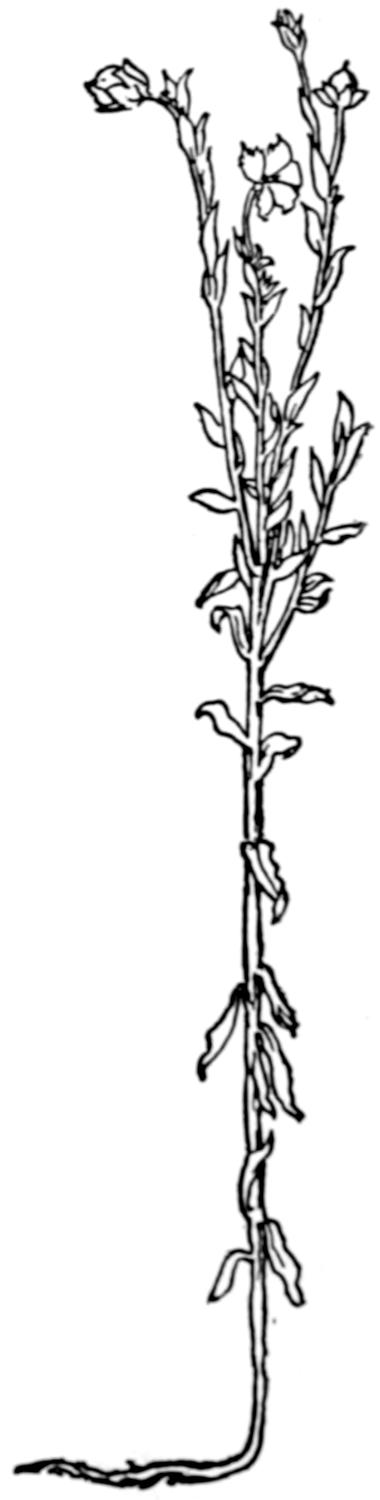
Fig. 112.—The Flax Plant.
From Hooper’s Hand-loom Weaving, by courtesy of John Hogg, London.
Properties.
—Absorption.—Linen absorbs water rapidly, the amount being 8 to 14 per cent according to some authorities. This is about equal to cotton, which is 10 to 12 per cent. Vegetable fibers are about equal in their absorbent qualities. Experiments have shown that linen does not absorb perspiration as well as cotton does. Moisture seems to spread through the woven meshes of linen differently from cotton, but experiments do not indicate much variation between the two. Linen which has been sized does not in general absorb water as rapidly as the unsized linen. Smooth, damp linen adheres to the skin slightly more than will cotton.
Evaporation.—Water evaporates quickly from linen, which makes it valuable for toweling, handkerchiefs, and wash cloths. The quality of rapid evaporation gives it a cold feeling next to the skin; this effect is lessened by weaving it with an open mesh. The natural smoothness and flatness [309]of the material adds to the feeling of coolness, as the air is not imprisoned in it. It is worn as winter underwear by Russian peasants on account of its cheapness and availability in that country, and by many in other parts of the world who believe in its hygienic qualities.
Cleanliness. The property of cleanliness makes it valuable. When correctly laundered it easily gives up its dirt and continues to be white and clean even after long service. Its cleanliness has made it of value in surgical use, and experiments have shown that germs do not increase as rapidly on linen as on wool, silk, and cotton.
Endurance and Strength. Linen thread is the strongest of the fine bast fibers. The wearing qualities are excellent when the fiber is pure. Chemical bleachings lessen the strength, although a dazzling whiteness can be obtained in a shorter time than in grass bleaching. The latter adds to the expense, but is justified in the longer endurance of the material. Unbleached linen is stronger than the bleached of the same weight. The length of the filament is a factor in the strength of linen. The material does not deteriorate quickly when laid away unless it is filled with sizings and dressings.
Tenacity. When pure, linen is very tenacious, and is, therefore, used for the strongest twines and cordage. This quality is a factor in strength.
Weight. Closely woven linen is heavy. Very much less air is held in the meshes than in cotton, so that equal volumes of the two textiles show linen to be 17 per cent heavier. Linen, however, is more penetrable by air than cotton, which adds to its feeling of coolness.
Fineness. The flax fiber can be subdivided almost indefinitely, yet the strength will continue. The delicate linen threads for the finest lace are spun by hand in damp cellars, where the eye cannot see the gossamer filament, but the fingers can feel it.
Luster. The luster of the finest linen is almost as high as [310]silk. This quality is lost in overretted flax. Tow has less luster, for the short staple interferes with the reflection of light, but special treatment is given to it to make it glossy.
Affinity for Dyes. Linen does not take or hold the dye well, therefore it is more apt to be found in the various bleaches than in color. Dress linens are, however, dyed in many colors, but are not always satisfactory.
Solidity and Toughness. These qualities give it great value for duck, canvas, twines, and cordage.
Suppleness. When undressed and unsized, it can be bent sharply and yet not broken. Linen fabrics are less flexible than cotton of equal thickness, and retain their shape better if free from dressing. This quality recommends linen for shirt bosoms and table linen.
Botany and Growth.
—Linen is made from the fiber contained in the stalk of the flax (Fig. 112). There are perhaps one hundred varieties of this plant known to botanists. The genus is Linum, and the best known of the cultivated species is Linum usitatissimum. Flax probably came from the East, but it grows easily in almost all climates and countries. In the ancient history of Egypt reference is frequently made to its cultivation and manufacture. It is grown in varying degrees for fiber in various parts of Europe and in the British Isles. India and the United States cultivate it for seed rather than for fiber. Japan and Australia are experimenting with it.
The plant is an annual, and has an erect, slight, and willowy stem (Figs. 112 and 117). It grows from twenty to forty inches in height, branching frequently in the upper part when not planted too closely, and having numerous small flowers which range from yellowish to bright blue. The seeds are small, flat, brownish, and smooth. The soil should be carefully selected, and the ground should be in a high state of cultivation for producing the best fiber, as is done in Belgium. The flax crop makes a heavy demand on the [311]soil, which must be guarded against exhaustion; rotation of crops is practiced for this purpose, especially in Belgium. In the Courtrai district the interval varies from five to ten years between successive plantings of flax in a field. In the countries of Europe where flax is cultivated it is usually sowed broadcast by hand, with much regularity. If fine fiber is desired, the sowing is close so that there will be little branching of the stalk, consequently the filament is complete without break. The seeds should be carefully selected. The Riga seeds from Russia, or the Riga seeds which have been grown in Belgium, and the Dutch seeds are considered to give the best results. The preparation of the flax for fiber is largely by hand. It is tedious, dirty, heavy work.
Flax springs up with many weeds which must be removed. In Europe the weeding is done principally by women and children who go over the ground on their hands and knees when the plants are from one to two inches high. In the spring wherever flax is being grown, wavering lines of workers, side by side, can be seen moving across the fields, weeding as they go. Flax is in the best state for fiber when the leaves and stem of the lower part of the plant turn yellowish and the seed pods are becoming ripe. This may be any time between the last part of June and the [312]end of August. Dry, clear weather is selected for the pulling. Men now go through the fields grasping a handful of flax at about the middle of the stems, and pulling the sheaf up by the roots (Fig. 113). The dirt is knocked off by hitting the root end against the boot. The pulling is a tedious operation. A flax-pulling machine has been invented which saves labor and time and is used with success in some places.
The drying of the flax before removing the seed is done in various ways. In some places each handful is laid diagonally across the former one. These sheaves are called beets. The root ends are together and the lengths are as nearly alike as possible. The flax is left to dry and is later stacked. In some countries it is hung in bunches on the fences or on racks, or it may be kiln dried. Still another way is to tie the sheaf together at one end and spread it open into a tent-shaped stack like the American Indian corn.
Rippling.
—After the flax is dried, it is rippled, in which process the stalk with its dried seeds and leaves is drawn through a large comb which has teeth about eighteen inches long, placed a short distance apart. The comb is usually set in the middle of a bench; two workers facing each other sit astride the bench at either end. A handful of flax is taken by each and alternately thrown upon and drawn through the comb. The dried leaves and seed bolls fall off on a sheet spread under the bench. Rippling must be carefully done or the fiber is injured. The stalks are often kept until the following season before they are prepared further. They are tied in bundles and piled up ready for the next process or for storage. The term straw is now used for the flax. It is sometimes kept a year before retting.
The Seeds.
—Flaxseeds are commercially of great value. When the main aim is seed culture the bolls are allowed to ripen completely, and special care is taken of them in the harvesting process. There is difference of opinion as to whether good fiber and good seed can be produced at the same time. Flaxseeds are an important agricultural product in the United States. In 1924 the United States crop was 30,500,000 bushels,[40] comparatively little of which was exported. The trend of flaxseed production is upward. The United States crop in 1924, on account of favorable growing conditions, almost doubled that of 1923.[41]
[313]
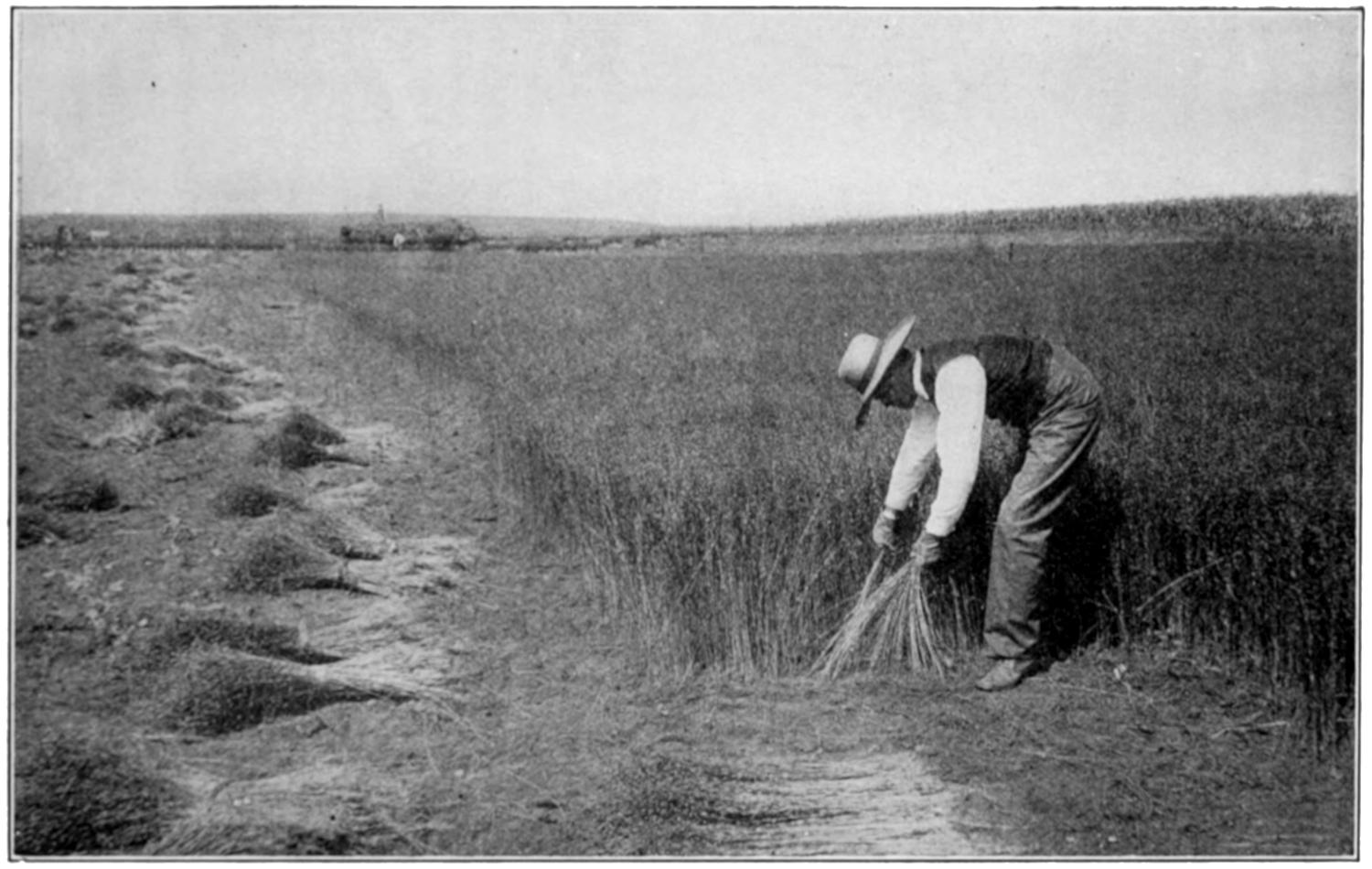
Fig. 113.—Flax in the Field.
From Watson’s Textiles and Clothing, by courtesy of the American School of Home Economics.
[314]
The greatest producers of flaxseed, in order of importance, are the following:—
| Flaxseed Production 1924[42] | ||
| Argentina | 52,359,000 | bushels |
| United States | 30,500,000 | “ |
| British India | 18,480,000 | “ |
| Canada | 9,757,000 | “ |
Note: Reports from Russia are lacking.
[42] United States Commerce Reports, Dec. 15, 1924.
The chief flaxseed importing countries are the United States, United Kingdom, Netherlands, France, Belgium, and Germany. In 1923, they imported 58,212,000 bushels. The seeds are used for linseed oil, which is important in the manufacture of paints, varnishes, linoleums, and oilcloths; linseed cake for feeding cattle; linseed powder for poultices; and linseed tea for an emollient.
Retting Flax.
—The fiber is found next to the bark, and the filaments of flax must be separated from it and the woody core. Many methods are used to accomplish this, but a usual one is to treat the straw in such a way that fermentation is set up through the presence of bacteria (Chap. XII, note under Cotton and Linen). The following methods are practiced in leading flax-growing countries: (1) Water Retting. The straw is steeped in clear, soft, running water for about two weeks; the river Lys is used for this purpose in Belgium (Fig. 114). The Belgian flax is usually a pale, yellow-white color and of excellent quality. (2) Pool Retting. [315]The flax straw is placed in stagnant pools for about the same length of time as for water retting. Ireland practices this method. The flax is good in quality but darker in color, a sort of silver-gray. (3) Dew Retting. The flax straw is spread over the fields to ferment. It should be turned frequently to obtain the best results, but this is not always done. Three or four weeks are needed to complete the process, but the sheaves of flax are often left all winter exposed to rain, sun, and dew. Russia uses this way of obtaining the fiber. The color of the flax is darker, and the quality is not usually as high as in other varieties of water retting. (4) Chemical or Steam Retting. This is a rapid method but sometimes weakens the fiber unless care is taken. It has not yet come into general use. (5) Decortication. A machine removes the outer bark. As yet this method is not considered entirely satisfactory. The balance of favor is still for water retting, both for color and strength. Where there is no running water special vats with steep sides are built and water conducted into them. All impurities must be kept out of the water (Fig. 115).
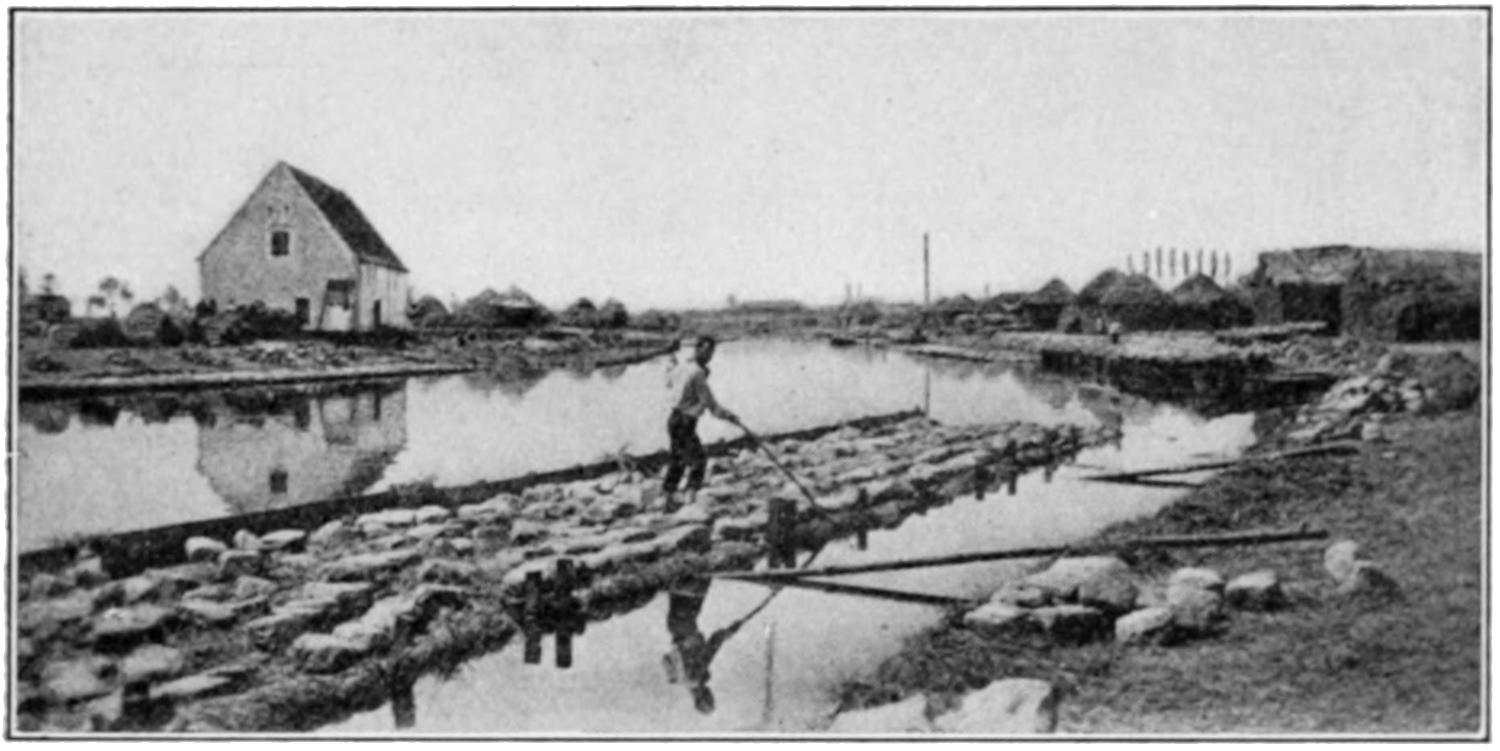
Fig. 114.—Retting at Courtrai.
The water of the river Lys, in Belgium, is especially adapted [316]for retting flax, which is remarkable for color, strength, and fineness. The region around Courtrai is given over to flax culture. Along the winding Lys at all seasons the flax is in various stages of preparation: growing and being weeded in the spring, covered with bloom in the early summer, and at all times of the year in stooks or stacks, or in crates retting in the water. Along canals and waterways passing into or out of medieval Courtrai come or go great barges of the flax to be retted or taken back to farms for further preparation. Scutching mills and great spinning and weaving factories are at hand to complete the preparation into cloth.
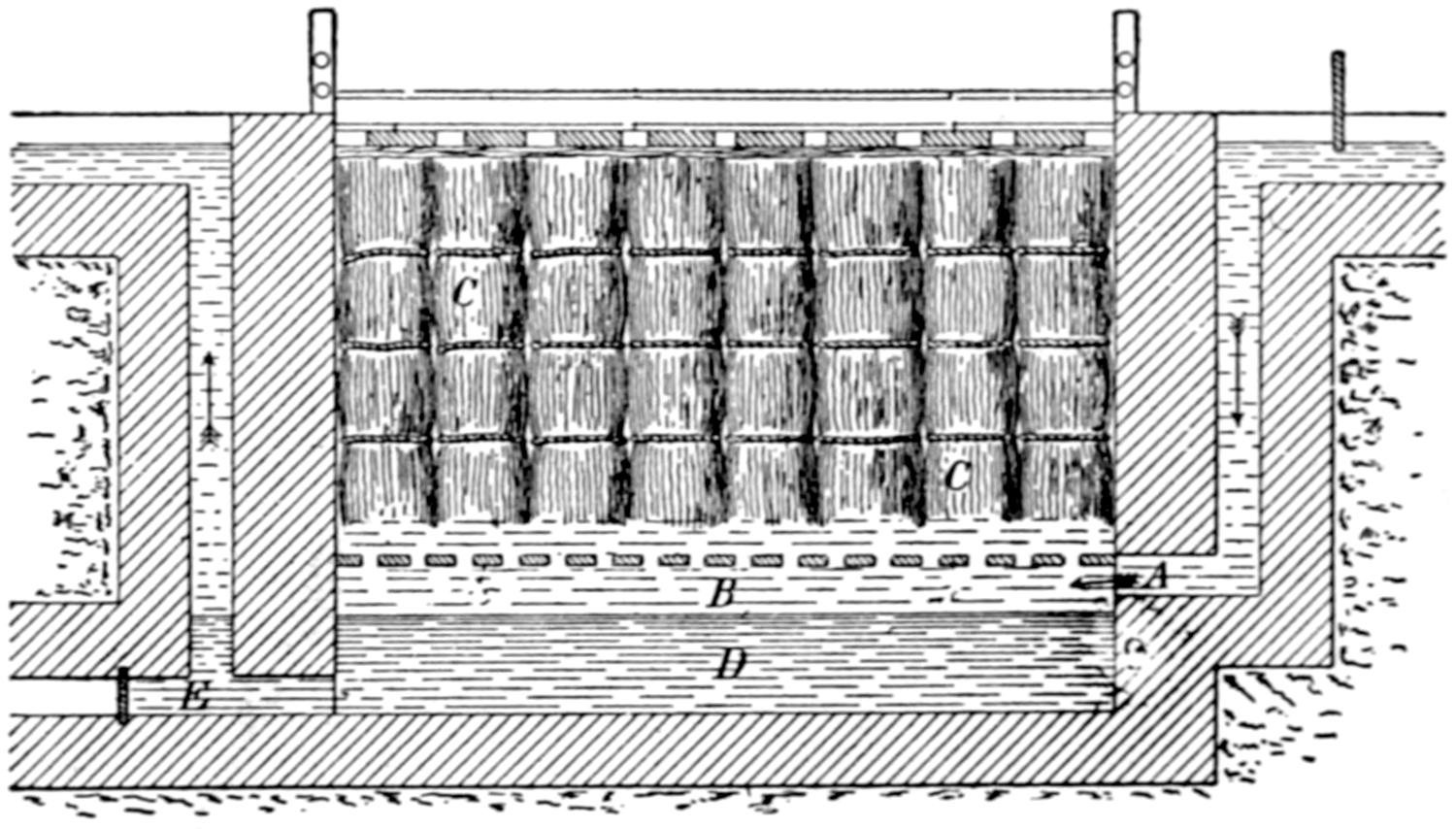
Fig. 115.—Retting Tank.
The method of retting in the Lys is in open crates of wood, with jute burlap around the four sides to keep the dirt out. The bundles are stood on end alternately to keep the size equal, and are packed so that they cannot move. From two to three thousand pounds of straw are often in one crate. The crates are covered with fresh straw and floated into position in the Lys, and are then weighted down with stones and sod until they are a certain distance below the water, perhaps six inches. It takes about fourteen or fifteen days for the retting, depending on the temperature of the water [317]or air and the color of the flax required. The work is carried on usually from mid-May to mid-October. Coarse straw is retted more easily than fine. At intervals the crates are raised and the flax bundles are turned and inspected to see if fermentation is progressing satisfactorily. There are various indications of the completion of the process, such as bubbles rising in the water and the crate lifting itself above the surface. When the process is complete, the crate is floated opposite a windlass and pulled on the bank. The bundles are taken out and stood in tent shape to dry. After a time, the bundle is turned wrong side out, that the inside may be also presented to the air. Fine fiber is usually immersed for about five days and taken out and dried for half a day, first on one side and then on the other, then put back for further retting.
The fall season for retting begins about September and continues until it is too cold. The retting begins again in March and continues until it is finished. Sometimes the year is not sufficiently long, and the remainder of the crop is carried into the next year. Overretting the straw causes the fibers to be brittle and weak. After the retting, in Belgium, the flax is spread on a grassy meadow to dry. This bleaches the fiber and helps in the separation of the bundles of filament. It is then stacked much like hay to be ready for the next process of breaking and scutching.
During the time of fermentation the odor from the flax is extremely disagreeable, and the water, unless carefully discharged, may poison fish and even cattle. After the flax is retted and dried, the straw should be bright and have a somewhat sweet odor. The outer bark is broken and brittle. The fermentation separates the bark and woody pith from the fiber, but further cleaning is needed to remove the pieces of straw and the dirt which still cling, and to separate the bundles of fiber, which adhere closely. Several processes follow to accomplish this, of which the breaking and scutching [318]are often conducted on the farms. Scutching mills, however, which also break the straw, are becoming frequent. The hackling and combing are done in spinning mills.
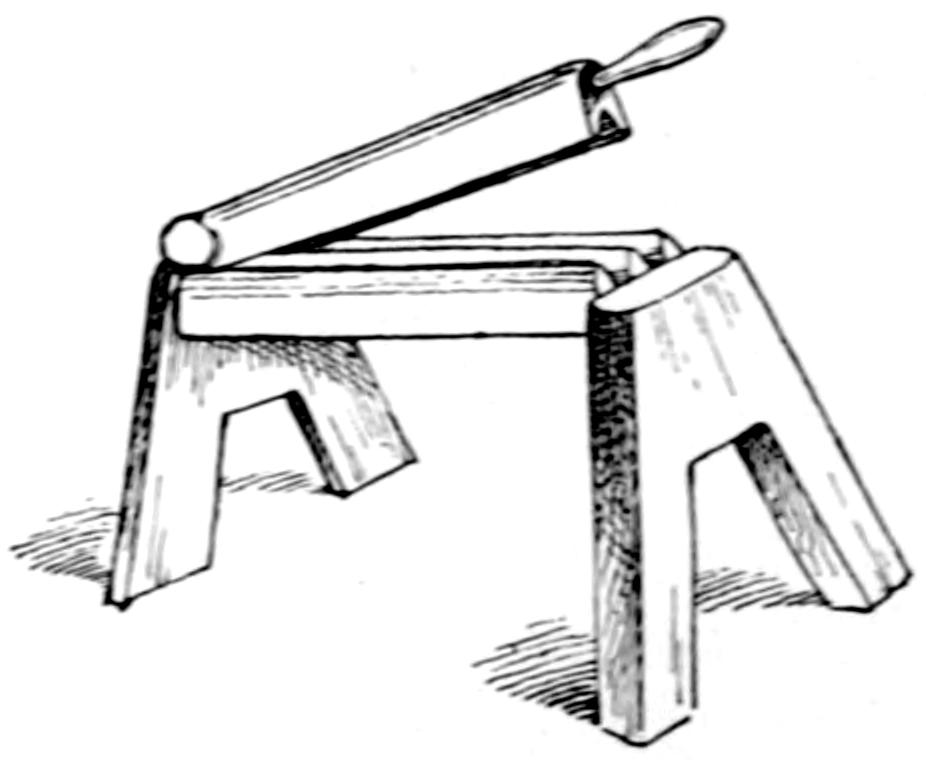
Fig. 116.—Flax Break.
Breaking.
—This process is done both by hand and machine, the purpose being to crack the inner wood all along its length. The chaff is then cast out from the fiber by shaking or hitting the sheaf. A very ordinary method of breaking is by a hand machine (Fig. 116). A series of long bars or knives is placed on a stand with a beater at one end, which can be raised and brought down again in contact with a sheaf of the flax straw as it is thrown across the bars. This breaks the wood into pieces and it drops out below, leaving the fiber. Breaking machines are in use in scutching mills which have several pairs of grooved rollers, through which the flax straw is passed. The pith is broken by the rollers, and much dirt falls out. After breaking, the flax is taken to the scutcher.
[319]
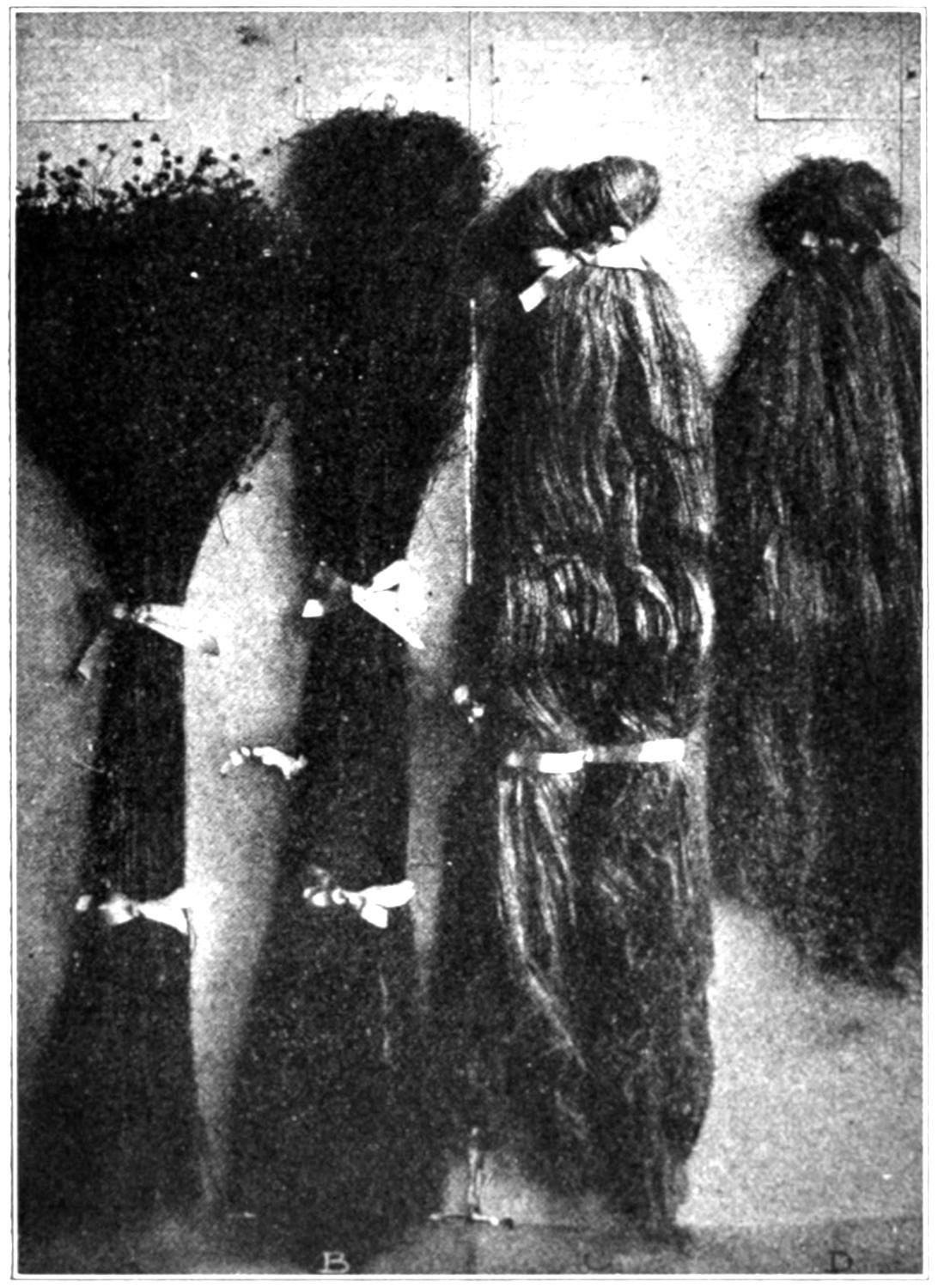
Fig. 117. Flax in Different Stages.
Photograph by C. R. Dodge.
[320]
Scutching.
—The flax must now be shaken or beaten to remove more of the coarse pieces of wood or bark which are clinging to it. Already the fiber begins to show itself more clearly, looking much like a switch of gray hair filled with straw (Fig. 117). In early days flax was beaten against stands to clean it, or it was hung up and beaten or “swingled,” as it was called. Still another method was to take a bunch of the fiber, place it in a cleft of an upright post, called a scutching post, and with a sort of flat beater to strike and clean the fiber (see h and d, Fig. 118). Scutching mills are now common in all flax countries, and the process is very simple. A shaft runs through a long room, controlling a series of beaters of wood, which revolve rapidly. The workmen stand each in a separate compartment and present bunches of the flax fibers to the beaters through a hole in a board. The blades or beaters hit the flax and knock out the “shive” and dirt. When one end of the flax is clean the other end is presented. Short fibers break off during the process, which are called scutching tow. The latter are rescutched, spun like cotton, and used for coarse cloths. The long fibers are called the line. Scutching roughly divides line from tow. The process as used at present is not very satisfactory, for it frequently injures the fiber, and thoughtful flax workers say the less of it the better for fine thread. An improved scutcher is needed. During the scutching the worker roughly divides the cleaned flax into bundles of even lengths. These are tied up together and baled, two hundredweight or two hundred and twenty-four pounds being usually in one bale, although Russia also puts up bales weighing four to five hundred pounds as well as those of two hundredweight. The flax is now ready for market or for the spinning mills.
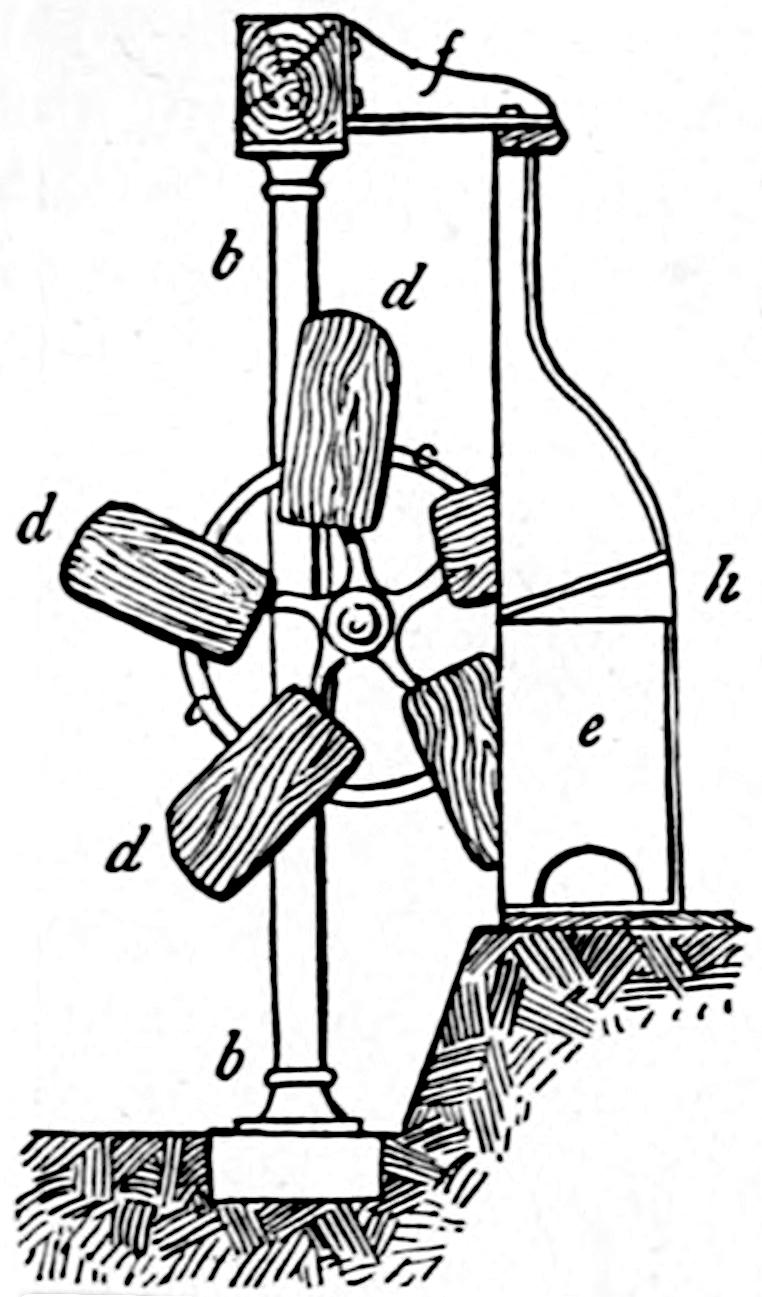
Fig. 118.—Scutching Device.
From Dodge’s Useful Fiber Plants.
Spinning of the Line.
—The baled flax arrives at the spinning mills, many of which are near the scutching mills, as is found in Courtrai in Belgium. The flax must now be [321]opened, cleaned, and straightened before it is ready for spinning. The spinning of flax differs from that of the other fibers in such particulars as the clearing away of large amounts of dirt, the combing out of the tow from the line, the great length of the filaments of line, and the necessity for still further subdividing the fibers by combing them through increasingly fine wires. Flax preparation requires special machinery or hand methods, which are expensive. Both wet and dry spinning are in use.
The processes as seen in British and Belgium mills are usually the following: First, a preliminary cleaning, combing, or hackling called roughing. The rough flax as it has come from the scutching mill is combed through coarse combs like the ripple or a primitive hetchel (Fig. 32). This removes broken pieces of tow and dirt. Roughing is a hand process. The roughing room has a series of benches, each containing usually two hackles, one coarser than the other, and also an upright, coarse, metal pin on which ends of flax can be broken by a quick pull. A rougher or worker presides over each bench. He spreads a lot of flax into divisions, called fingers, winds one of these around his hand, spreads the opposite end out into a fan shape, and throws it over the coarsest hackle. He draws the flax through first one way and then the other, until it begins to be smoother and finer and the dirt is removed. He casts the tow into the box at the back of the bench. Then he combs the line on a second comb, which is finer, in the same way. He lays the line in even piles with the root ends together. Three combs are sometimes used on a bench, coarse, intermediate, and fine. There is considerable art in hackling or roughing, and a poor rougher reduces all the flax to tow, but a good one has his line looking even and smooth, even after the first combing. The hackles or combs used in roughing are very similar to the old hand hetchel or hackle of colonial days (see Figs. 32 and 119). For finer yarns hand hackling is sometimes repeated many times in order to subdivide the flax bundles. Seemingly there is no limit to the amount of subdivision the flax will stand, until the filament begins to look like a mere hair. In England and Russia the finest grades of flax are hand roughed before machine hackling, but in other countries machine methods are being used. The process of hand roughing is expensive, and takes a longer time than the machine. It is claimed by many that coarser flax does not require the hand processes.
[322]
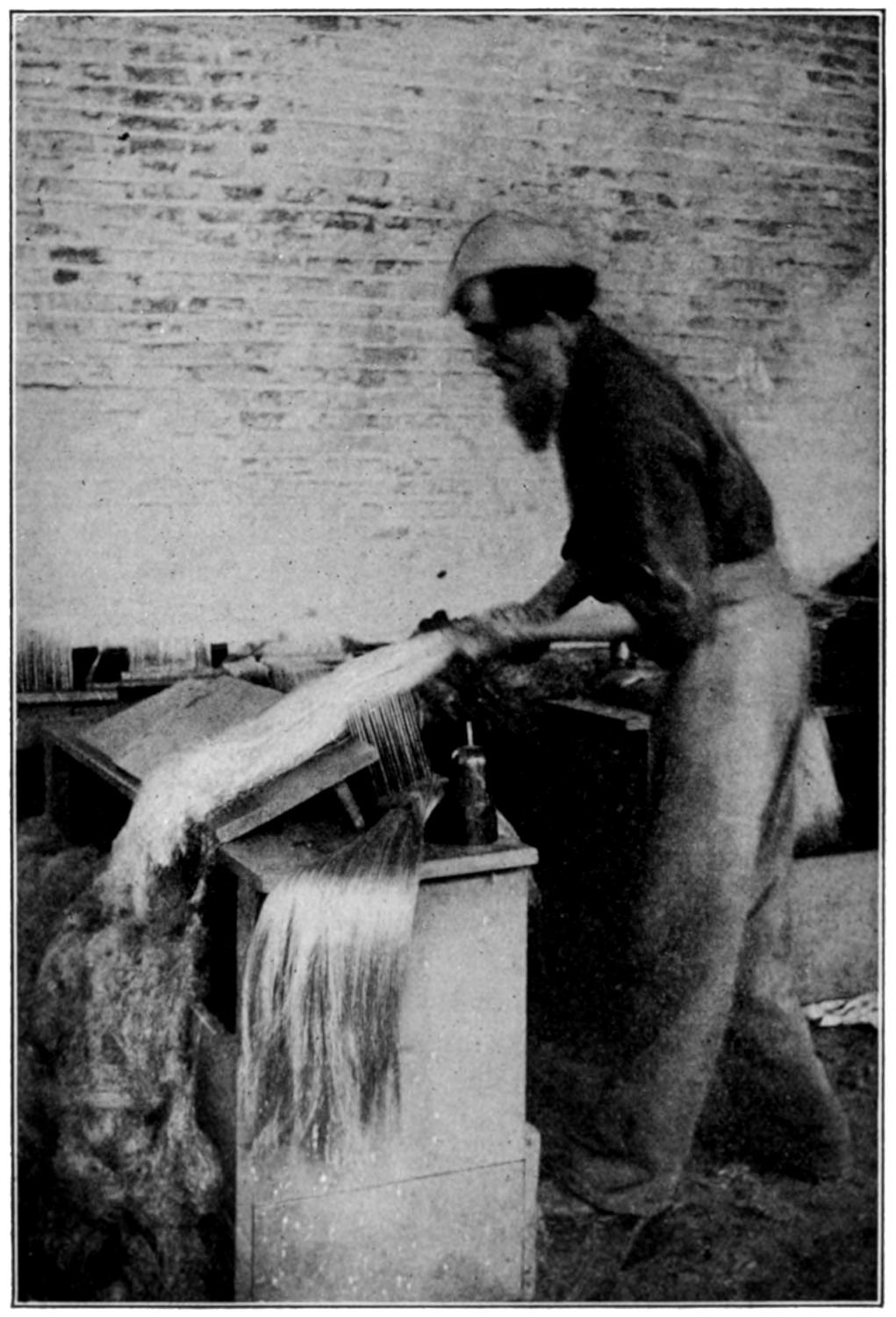
Fig. 119.—Hand Hackling.
From Watson’s Textiles and Clothing, by courtesy of the American School of Home Economics.
[323]
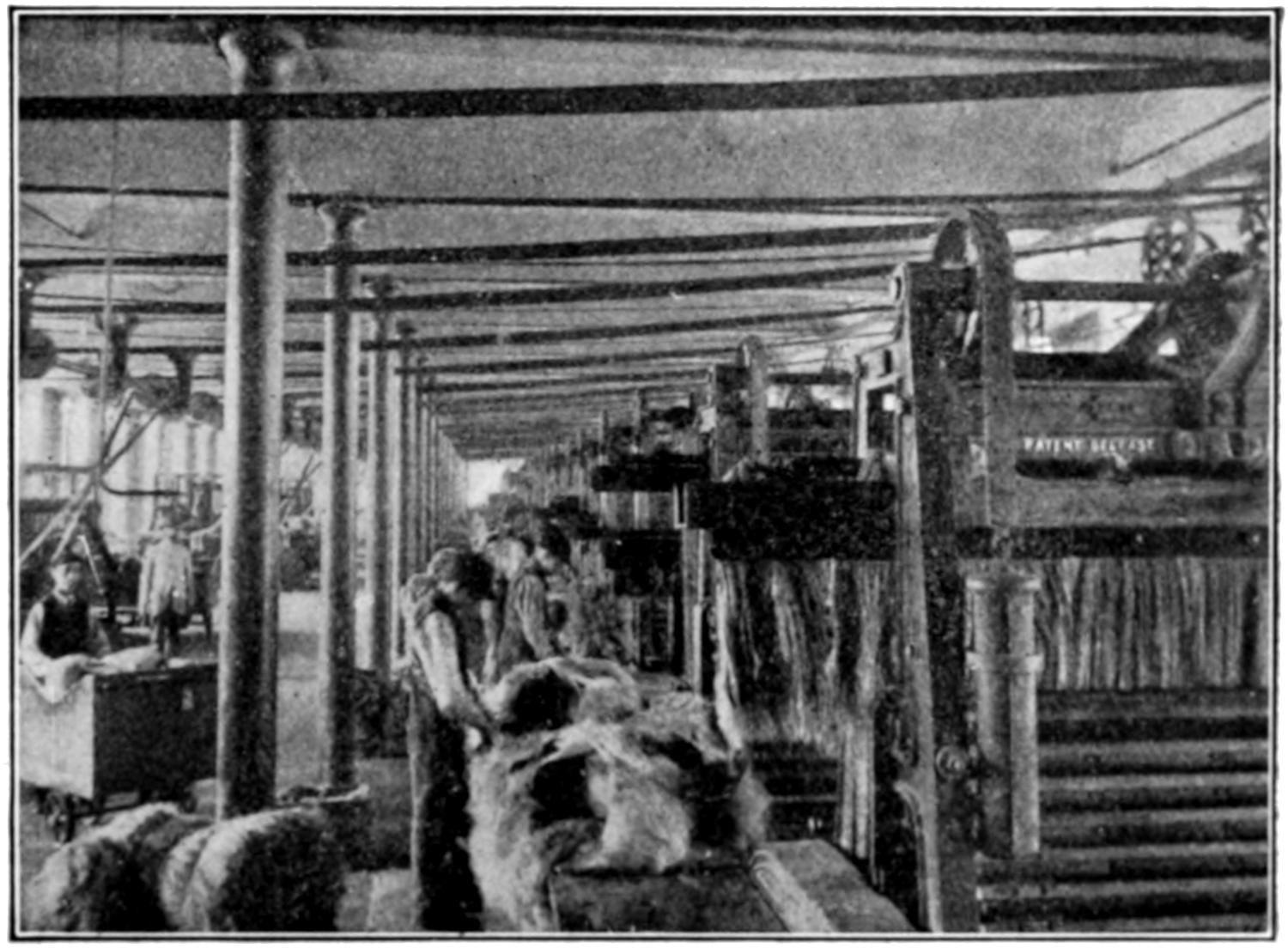
Fig. 120.—Machine Hackling.
Courtesy of the York Street Flax Spinning Co., Belfast.
Machine Hackling.
—The result of the roughing process is a fairly clean bunch of line, which is now subjected to a series of hackling machines which are much alike, except that the combs increase in fineness (Fig. 120). The object is the same as the hand hackling, to disentangle, clean, comb, and divide line from tow. Machine hackles are long upright machines. The ends of a bunch or tress of line are placed in [324]a plate in the upper part of one end of the machine and held by a clutch; a series of pins or teeth becoming gradually finer pass down through the flax as it moves slowly from one end of the machine to the other. The tow is left in the combs, and at the further end an attendant receives the line, turns it upside down that it may be combed through in the opposite direction, fastens it in another clutch, and it passes back by a second machine alongside the first one. The line, meanwhile, has become smooth, fine, and glossy; the tow is removed from the pins by a revolving brush or doffer.
Sorting and Cutting.
—These two processes are sometimes used for fine yarns. Flax for coarse yarns goes directly to the spreadboard, but for fine yarn it is hackled by hand and assorted into different qualities before it is passed to the next machine. For very fine yarn the line after sorting is usually cut into three divisions by a blunt instrument, the middle cut being the best. The term “cut line” is used. The fiber is now ready for the spreadboard.
Spreadboard.
—As the fiber is long, the bunches or strips are delivered to the spreadboard on an endless apron, each strip overlapping the former one by six or eight inches. It passes into the machine to be combed through by fine wires and made into a continuous ribbon or sliver.
Drawing and Roving.
—The drawing is repeated, four times being customary. The slivers are doubled, it is said, as many as ten thousand times. The frames are much like those used for wool and cotton. Several machines are required, varying according to the fineness of the thread desired.
Spinning.
—The upright spinning frames (see Chap. II) for wet, dry, and semi-dry spinning are used for flax, and are like those for cotton or worsted, except for the trough of hot water through which the linen yarn at times passes before it is twisted. Wet spinning of flax and tow makes a fine thread which does not look as silky as that which is dry spun. It is twisted tighter, however, and the flax is more subdivided, [325]which has its advantages for special classes of thread. Dry spun yarns have greater firmness than the wet spun, but the highest numbers are made with wet spinning. Warp yarns are usually made with the wet finish, as it adds to their strength. The use of too hot water is injurious to the flax, and the result is a frowsy, cheap looking yarn. Even in dry spinning, water is often dropped on the thread, or humidifiers are used to keep the air moist. It is necessary after wet spinning to have the yarn quickly dried, or mold will appear. Linen sewing threads are wet spun and then specially twisted and dressed much like cotton sewing threads.
Tow Spinning.
—Tow, or short, broken ends of the line from hackling and other preparatory processes, is a valuable by-product. There is also waste which comes from spinning and weaving. Special treatment, differing from the line, is given these wastes. They are prepared more like cotton. Beating, shaking, carding, combing, doubling, and drawing reduce this broken, tangled mass to a roving which is spun in the same way as the line. There are several grades of it, for wastes from its preparation are saved with the noils from the comb, and again made into yarn. Tow has many of the good qualities of the best flax, but it is weaker and rougher. It is used for crash, cheap toweling, and rough cloths with which the housekeeper is familiar. Medium priced towels often have tow yarn in the filling.
Winding, Warping, Sizing, and Drawing-in.
—The processes for linen preparatory to weaving are much like those for other textiles. Sizing is used on the warp yarns to give strength, and yarns are frequently bleached wholly or partly before weaving. The dressing or sizing of linen yarns is important. Flour and farina paste are much used, and are applied to the yarn in the slasher (see Chap. VIII, Sizing).
Weaving.
—Linen weaving requires a moist atmosphere. The plain or tabby weave is used for sheetings, hollands, crash, cambrics, lawns, ducks, and other common fabrics. [326]Twills are used in drillings, and huck and diaper patterns in toweling. The Jacquard wide loom is generally used for damasks. The latter differ from brocades in that both sides are alike and the cloth can be used on either side. The background is generally a plain or a broken twill (satin). There are single and double damasks. The pattern shows more distinctly on the wrong side of the double, as there are more threads, which makes possible greater shading effects in the design, throwing it into relief. The threads of double damask are usually double in the filling (see below, The Purchase of Linen). As the pattern is made by the way the warp and woof threads cross each other, an elaborate damask design requiring floats of six or nine threads is not as strong as a more closely woven pattern. In the usual double damask weave each filling yarn crosses seven warp ends and binds the eighth. A single damask is a closer weave, for it floats over four warp threads and binds the fifth. It is less attractive in appearance than the double damask, but wears about equally well, for the threads are well bound together.
Method of Counting.
—The method of counting linen yarns in England and America is by the number of leas or cuts in a pound, each lea representing three hundred yards, (Chap. VIII, Counts or Sizes of Yarns). No. 1 lea yarn would therefore have three hundred yards in a pound; No. 2 lea would have six hundred yards. The method of numbering in France and Austria is different. The counts for jute, hemp, and ramie are also figured by the lea. Fine linen yarns for costly handmade laces run as high as 400s or even 600s. They are spun by hand. Belgian hand spinners often work in damp cellars. Such yarns are very expensive, being quoted at as much as $120 per pound. The hand can spin finer counts than the machine, three hundred being as high as the latter can spin, and that is unusual.
[327]
Finishing.
—The finishing of linen materials is important to their appearance, but the processes are not unusual. Linen comes full bleached, half bleached, and unbleached. One-fifth of the weight is lost in the full bleach and the strength of the cloth is lessened. Full bleached cloth is the most expensive but the least enduring. The bleaching of the yarn of the fabric is perhaps the most important. Dressings of various kinds are used, but the highest class of linens receives little, as the mangling, calendering, or pressing bring out the gloss. Beetling is often used to assist in giving luster both to dressed and undressed linens. A usual series of finishes in an Irish mill is, first, bleaching by chemicals; second, rub boards to wash the chemicals from the bleached linen; third, crofting or grass bleaching; fourth, bluing, starching, washing, and mangling; fifth, damping; sixth, beetling; seventh, calendering and pressing, which processes are often repeated a couple of times, and the material is finally finished by heavy pressure in the hydraulic press. Inspection, folding, marking, and packing complete the preparation for market.
Bleaching
(see Chap. XIII).—The finest Irish table linen is usually woven of half-bleached yarn. It is then crofted from six weeks to two months. The following table gives the relative loss of weight in full bleaching the various fibers:
Flax—loss in cleaning and bleaching, 20 per cent.
Cotton—loss in cleaning and bleaching, 5 per cent.
Wool—loss in scouring, 20 per cent to 60 per cent.
Silk—loss in boiling off, perhaps 30 per cent, which can be made up in loading or weighting.
Experience proves that linen bleached by chemicals is not as strong as that bleached on the grass.
Dressings.
—Dressings for woven linen may be used to give strength and assist in bringing out the design, or to cover [328]defects, as in poor qualities of linen or unions with cotton (see Chap. XII). Special finishes are used in table linen and damasks, for crash, for glossy linens, and for dark-colored goods. For black and dark sewing threads a very glossy dressing is applied to strengthen the yarn, which, without it, would wear rough.
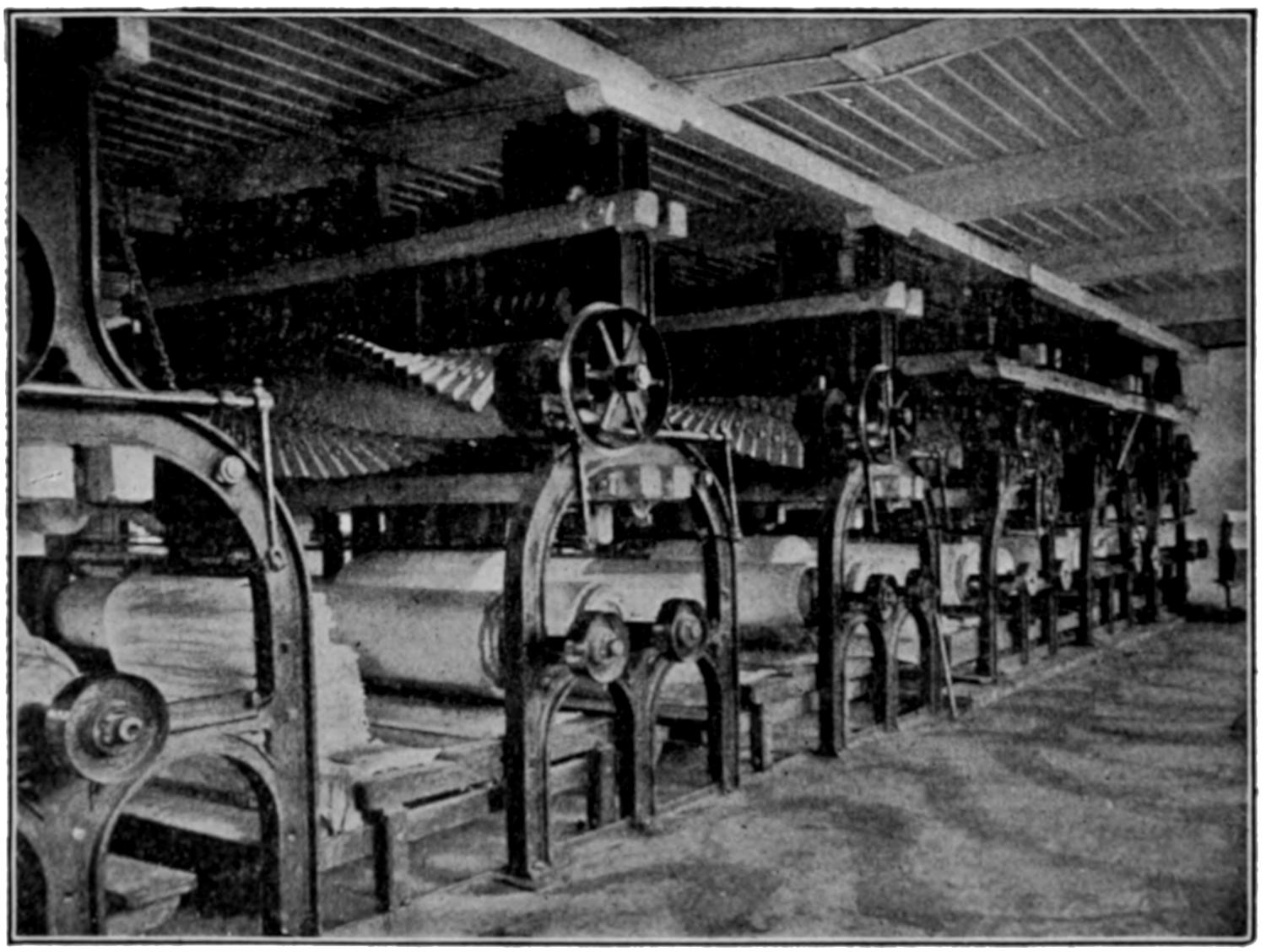
Fig. 121.—Beetling.
Courtesy of the York Street Flax Spinning Co., Belfast.
Beetling
(Fig. 121).—This process is frequently used to give gloss to the surface, and a supple, leathery feel to linens. It may be applied to dressed or undressed linen materials. Striking the woven cloth with wooden mallets after it was washed and dried was the original process. Hand-woven damasks are still finished at times by hand beetling. The power beetle is a large and heavy machine. The linen is dampened, wound on a roll, and placed in the machine; the roll is turned slowly and the cloth is hit by heavy hammers or [329]stamps, which descend directly upon it, or stamps with square butts are set spirally on a cylinder and impress the entire surface of the cloth, leaving small faces close together which reflect the light. The beetling machine is somewhat similar to the stamping machines used in ore concentration mills. Some yarns are beetled, such as filling yarns for heavy sailcloths.
Linen Manufacturing.
—The total value of the world’s production of linen fabrics, in 1923, was $11,390,000. The principal linen fabrics produced are table damasks, handkerchief linens, dress goods, cambrics, fine and coarse laces, shirtings, drillings, crash, duck, canvas, sheeting, toweling, ticking, sailcloth, airplane fabric, embroidery and sewing threads, string, twine, and cordage.
Russia has been the largest grower of flax in the world and has made linen fabrics also. Much of her linen has been hand woven in the cottages of peasants, as they depend on it for their clothing and underwear. Coarse materials are the main production of power machinery as well as hand.
Fine table linens are woven in France, Austria, Belgium, Germany, Czechoslovakia, England, Ireland, and Scotland. French damask is noted for its exquisite designs and effective appearance; the thread is round and fine. Special attention is given to the pattern and the beauty of finish. The most expensive as well as plainer fabrics are made in that country. Linen dress goods of many kinds come from there. Austria is noted also for the beauty of her designs in table linen.
Belgian yarn is noted for its fineness and strength. The best fiber in the world is grown in the Courtrai district. Many other countries buy it after it has been scutched, to spin into fine yarns, or they purchase the yarn to weave into cloth. Ireland depends on the yarn for her noted linens. Belgium has also a large manufacturing business. Materials of great beauty are woven in the Courtrai region. Toweling, table linen, twilled linens, diapers, and drillings are made. [330]It is said that more dressing is used on Belgian linen than on Irish. In some respects Belgian linens are said to be like the German ones.
Czechoslovakia is doing an increasing business in linen fabrics. The breaking up of the Austro-Hungarian Empire gave 80 per cent of the linen mills to Czechoslovakia, and efforts have been made by that country to obtain the foreign market. The product runs from the coarsest crash to the finest damasks.
Germany makes the highest grades of table linen, but exports more of the medium and lower grades. Saxony and Westphalia are noted for their linens. Those who have made a study of damasks in Dresden well know the exquisite fineness of many of them. Printed and dyed linens, made for lunch cloths and napkins, are often very attractive, but are not as enduring as the white cloths. Germany also produces excellent unbleached cloths, which are bought by economical housekeepers and bleached at home. The foreign market is desired, and rather showy, inexpensive linen which reproduces the patterns of other nations and has much dressing is exported. These are less satisfactory for service than the stronger old-fashioned linens of that country.
Irish linen has had and still holds a high reputation; the industry is mentioned in the history of the country as early as the thirteenth century. The linen is noted for its snowy whiteness, its reliable quality, its endurance. The climate is a factor in this, as sunshine and rain alternating give a moist climate good for the growth and manufacture of flax. The great center in Ireland for fine linens and damasks is Belfast and the northern part of the country. The trade goes calmly on with its own methods and does not make much effort toward doing new things to attract business. The old patterns are still in use and are greatly appreciated. The better table linen of Ireland is frequently hand woven and grass bleached. There are many cottages in or near Belfast where [331]the higher priced damasks are woven. The medium priced cloths are made by power looms and usually in the factory. The weaving of damask began in Ireland as early as 1634 by a colony from Scotland. Later refugees from France settled in that country and continued the damask weaving they had brought from France. Driving through the country outside of Belfast, the bleaching grounds can be seen covered with linen as in the old days. The fabric is good and honest, but not always showy. Besides the toweling and table linen, there is quite a business in fine cambrics, lawns, and batistes. Ireland relies on Belgium for much of its fine fiber and yarns, as she does not grow sufficient flax for her industry.
Scotch linen has a high reputation, especially when it comes from a few well known houses. It is often sun and grass bleached. The color is silver white. Some consider it lighter in weight than the Irish. It is imported particularly in the medium grades. The heaviest classes of sailcloths, canvas, tarpaulin, sacking, and carpeting are also manufactured in Scotland, Dundee being a center. Dunfermline and Perth weave damasks. Much of the Scotch linen is of moderate price. The designs are generally more showy than the Irish.
England purchases her flax or yarn in Ireland, Belgium, or Scotland, and does some good work in dress and table linen and also in ticking, low class sheetings, and brown hollands. Leeds and Barnsley are noted manufacturing centers.
The United States.
—Flax grows well in the United States, and there are four million acres under cultivation, but mostly for seed. To produce fiber and seed from the same plant is difficult, if fine fiber is desired (see Botany and Growth, above). The flax-spinning mills of the country use about 10,000 tons of flax yearly, which, in general, has been imported. The linen mills are making twines and threads principally, but there is a movement to enlarge the fiber output for making woven goods. Michigan, Minnesota, and [332]North Dakota are growing flax for fiber as well as for seeds. The straw in general makes a rough, tow-like yarn suitable for coarse crash or flax rugs, but not for fine linens. The states of Washington and Oregon have been experimenting with growing flax for fiber with much success. The chief of the Textile Division of the Bureau of Foreign and Domestic Commerce comments favorably on the possible production of linen from flax grown in the Northwest. The United States Department of Agriculture, through the Office of Fiber Investigations, has been encouraging the production of flax by developing improved strains which are resistant to disease and yield more and better fiber. About 6000 acres of flax for fiber were grown in the United States in 1920. The price obtained for it, however, was not sufficient to encourage the farmers to increase their acreage. The cultivation of flax for the finest thread presents many difficulties for this country, as the returns in money do not attract the farmer, who has other crops which are less trouble and are more easily sold. Labor is much cheaper in Europe, and the women and children are willing to work in the fields weeding the crop. There is a great deal of waste in the crop at any time, and the returns per acre are small. The machinery required for preparing and spinning fine linen thread is very expensive and of a special kind. It is said that a flax-spinning mill costs four times as much as one for cotton. Tow can be spun on cotton machinery, and the medium grades of cloth made from tow have a large market. It takes a larger number of workers in fine linen manufacture than in cotton, the relation being from four to six times as many.
The value of the seed industry is great, and although it is possible to cultivate flax for both seed and fiber, the best results in both industries are not obtained. We are not, therefore, likely to enter fine linen manufacturing with much energy at present, as such linens are really a luxury and the [333]sale comparatively small, whereas the market for cotton cloth is large.
There are large thread and cordage mills in the country and a few mills for crash and toweling, but the finer linens and damasks are not made here.
Canada is growing flax for fiber on the irrigated land in Western Canada, which has been superior to Russian flax. Ontario produces a fiber said to be equal to the Belgian. British Columbia has land and climate suited to the purpose. Canadian firms have begun weaving, bleaching, and finishing operations, and have started mills in the United States on capital from the latter country. A large automobile industry has planted large areas in flax and is importing machinery from Belfast to produce fabrics to use in the industry. There will be need, however, for further development of the machine processes in the cultivation and preparation of flax for spinning before the country is likely to go deeply into flax growing and manufacturing. A pulling and binding machine is now in use that is said to take the place of eighty laborers. The machine-pulled flax is delivered to the mills in bundles where the seed is threshed out and the straw is sent to the retting tanks. The retting processes are being studied by experts with the object of obtaining quicker methods.
The Importation of Linens by the United States is increasing.[43] Purchases are made from many countries, but principally from those listed in the table in Appendix, Section VI.
[43] United States Department of Commerce.
The Purchase of Linen.
—Linen should be made of the line, should feel heavy, should be unmixed with other fibers and have little dressing if one wishes it to have the properties for which it is famous. Linen damask is unchallenged for table service. It comes double or single. The former is more beautiful (see Weaving, above). The pattern in damask is in the warp lines, that is, the threads of design run lengthwise. When the cloth is held up, the vertical lines [334]reflect the light and the cross lines look dark, hence the right and wrong sides can be determined by the way the pattern stands out in the light. The majority of damasks are chemically bleached, but the old time grass bleach left the cloth more enduring. On account of the scarcity of flax and the high price of linens, cotton cloths have been used extensively. A mercerized cotton damask is very attractive when first finished. If kept spotlessly clean and stiff it is still pleasing, but it never can serve as well for a well-appointed table, as a good damask, for it crushes, soon loses its dazzling whiteness, and takes on a dull grayish look from the little protruding ends of cotton fiber which at first were held down by dressing.
In order to judge table linen the following points should be remembered: Good linen in the hand is soft and yielding, yet elastic and tough like leather, and is not stiff and crackly (for tests see Chap. XII, Cotton-Linen). Hand-woven grass-bleached damask wears better than damask made by power looms and chemically bleached, but the former are not easily found at present. In general, the grass-bleached linen comes to the United States about the first of January, having been bleached in the summer, and the housekeeper can find it on the counters at that time. Colored linens are not satisfactory, since flax does not hold the dye well, and as a strong mordant has to be used to hold the color, the yarn is apt to be weakened. If one has some knowledge of the best linens, it is well to buy them at a time in the year when the stock is low and the price reduced, before the new stock comes in. Linen should always be bought at a reliable house, and of a salesman who knows the quality. Some retail linen houses have their own patterns, which are used only when weaving for them. Table linen comes by the yard and in the bordered cloth. The cloth having a border around it is more attractive, but for the same weight linen it is generally cheaper to buy the material by the yard. Over-fine thread in damasks is not always a wise investment, but a strong, rounded thread is [335]enduring. The best linen is sized very little, if at all. The sizing in the yarn or in the cloth is apt to make a break in the yarn when the cloth is folded, which will later become a hole. Highly sized or dressed linen should, therefore, be distrusted. A round thread of even weight in both warp and filling gives strength. It is true some hand-woven linens have the thread somewhat flattened by beetling, but it has been round and strong in the first place, and not being dressed is probably not injured by the beetling. The number of threads per inch in damask should be noted by the weaver’s glass, both warp and woof or filling way. The correct amount for the warp in a good damask is for medium quality, 180 threads; for fine quality, 220 threads; and for the filling, of double damask, 280 threads; of single damask, 180 threads.
The weight of the linen is a factor in its value. When the number of threads per inch is satisfactory and there is no dressing, the cloth will wear well; when the cloth is coarsely woven and the weight is made of dressing, it will not wear, for after laundering the material will be coarse and flimsy. The minimum of weight is 4¹⁄₂ oz. per square yard.
High-grade linens are made from the line and the poorer grades from the tow. Good linen has a smooth surface; if when rubbed between the fingers it becomes fuzzy, it probably has much tow in it, or is a cotton mixture.
An all-over pattern in damask is generally more satisfactory than one with closely woven bands, alternating with a more loosely woven background, for in laundering the latter shrinks more than the bands and gives a cockled appearance. Long loose floats in the pattern do not wear well.
Neither very hot irons nor boiling water are good for linen. It should be damp when ironed and be pressed dry by repeated going back and forth over it to bring out the luster. Starch is not needed in the best linen, for the rigidity is inherent in the fiber. Damask stiff with dressing is apt to crack in the folds when put through the wringer. Damask [336]should be hung across the line and be well stretched and not be held by pins. It can be taken down when half dry, folded, and ironed when damp.
Prices are high at present, but a wise housekeeper should know the range of them for medium and high-grade linen. The linen buyer at a reliable department store is usually a good one to consult concerning the value of the stock. The United States buys largely of Irish linens and the housekeeper should know the names of the leading Irish firms. In towns where there is a Better Business Bureau the advertisements in the daily papers can usually be depended upon.
At one time certain patterns were characteristic of different countries, as the snowdrop or shamrock of Ireland and the check of Germany. At the present time these patterns are used interchangeably, and cannot be depended upon as representing any special country. Excellent linens come from many parts of Europe. Those accustomed to any one kind and who rely on good firms are apt to feel that that particular linen is the best. Certain brands of table linen can always be relied upon, and a housekeeper should know these.
To finish table linen a very narrow hem should be turned and then turned back again, and a fine overhand stitch used to hold it down. This is called a napery stitch and it lasts better than the regular hemming stitch. Machine stitching is not used on fine damask.
Hemstitched sheets are more apt to tear in the laundry than sheets with a hem made by sewing machine or hand, and machine-scalloped edges soon become ragged. In sheeting that is not high priced, yarn made of tow is sometimes used, which will not wear satisfactorily nor even look well, as the tow is short in staple and soon has a rough look. Unions of cotton and linen give good service for sheeting. All-linen sheets are little used at present, for the price is too high. Cotton sheetings are woven to give perfect satisfaction, [337]and are not so heavy nor so cool against the skin. Many use linen for pillow cases. Homespun sheets and pillow cases are liked.

Fig. 122.—Ramie Plant.
From Dodge’s Useful Fiber Plants.
Additional Fibers Used in Textile Manufacture
There are many fibers of secondary importance to wool, cotton, silk, linen, and rayon, which are used for woven material (see Chap. XI, Minor Fibers). The United States grows or imports them to some extent for coarse baggings, floor coverings, binding twine, for combining with other fibers to cheapen cloth, and, occasionally, for underwear, dress goods, millinery braids, and upholstery. Some of these secondary fibers are bast, i. e., taken from the stem of the plant in a similar way to flax; while a large number are structural, in that the filament is in the leaves or fruit and not in the stalk. Ramie (Rhea), and China grass which are much the same, jute, true or common hemp, Ambari and Sunn hemp are well-known bast fibers. Piña, Sisal hemp or Henequen, Manila hemp or abaca, Bowstring hemp, New Zealand flax, and Maguey are structural fibers, and among a number of other varieties reach our market under the commercial name “hemp,” as the structure and characteristics are similar to the common hemp.
Cheap labor in the countries from which many of these fibers come has made it possible to prepare them by hand and sell them at a lower price than would be possible in the United States with its higher cost of labor; therefore we are not producing them to any large extent. The bast fibers in general are harvested, dew or water retted, and broken, scutched, hackled, and spun much like flax. The structural fibers are treated and prepared similarly to Manila hemp.
Ramie
, often called China grass (Fig. 122), is a bast fiber with many valuable properties, of low price, and of future promise as a useful and attractive textile. It grows easily [338]in the United States, but the difficulties of decortication and consequent expense have kept it from the development it deserves. Both ramie and China grass belong to the family of stingless nettles (Urticaceæ); the ramie, or Rhea, being of the species Bœhmeria tenacissima, and China grass, of the Bœhmeria nivea. They flourish in India, China, Japan, and in warm parts of Europe and of North and South America.
The plant grows very high and the woody stalks are cut as they mature. The bark, when green, is hand-stripped and scraped without retting. When it is dry it is dew or water retted like common hemp or flax. This process is repeated a couple of times if necessary. The fiber is usually hung in the sun after it has been relieved of the woody matter and at first looks much like coarse hemp. Degumming, combing, drawing, and spinning follow. It is more difficult to clean than flax. The degumming, a chemical process, is repeated, as a portion of the gum only is taken out by the first bath, and the remaining gummy matter is much harder to remove. Unless all of it is taken away, however, the material feels like haircloth as it [339]touches the skin. After the final degumming the fiber is soft, white, silky, and glistening, and even more beautiful than flax. In the combing and drawing processes the long silky fiber, or line, is separated from the noils, or short fiber. Both are spun, the latter being used for coarser materials and for wadding.
Ramie is manufactured in France, England, and the United States. It is frequently combined with silk and is made into materials to compete with linen, which it strongly resembles. Like linen, it is difficult to dye. It is brilliant, strong, and durable, not easily affected by moisture, though some of its luster is lost by a wet finish. It has more tenacity than other fibers, and its elasticity, though not great, equals cotton and is greater than flax. It is not very flexible, but endures wear and tear. For underwear it has much promise, for it is cheap, yet has the qualities of flax. There seems to be no limit to the possibilities of this fiber, for it has a range from the finest lace to the heaviest canvas, waddings, and cordage. It is found in the market of the United States in dress goods, upholstery, underwear, tablecloths, toweling, and lace.
Piña
, or pineapple fiber, belongs to the family Bromeliaceæ, the species being Ananas sativa. It is native in tropical Asia, Africa, Southern Europe, and America, but in many countries the plant is grown for the fruit rather than for the fiber. The large fleshy leaves of the plant contain the fiber, which is usually extracted by hand. Piña is considered to be the most delicate and exquisite of vegetable filaments. The woven cloth is found in great perfection in the Philippine Islands and is often combined with silk in designs of great beauty. The weaving is usually done with the untwisted fibers. The appearance is white, soft, and lustrous and the material is flexible, durable, and unaffected by water. It is used much for coarse grass cloth as well as for fine transparent materials. The latter are for sale to some extent in the United States.
[340]
Jute
, or Jew’s Mallow, is used in cheaper classes of textile manufacturing. It belongs to the family Tiliaceæ. The species are very numerous, but the best known are Corchorus capsularis and Corchorus olitorius. It is a bast fiber and is retted and separated by hand methods. It grows in the hottest parts of India; being cultivated especially in Bengal. China also is giving some attention to its growth. The plant grows very high, the fibers reaching thirteen to fourteen feet in length. It is a very cheap and unsatisfactory fiber, as it rapidly deteriorates when subjected to light, air, and moisture. It is perhaps the poorest of the textile fibers. The best grades are light brown or silver-gray and fairly lustrous. It dyes easily but soon changes color. It is useful where cheapness is better than durability and is used for bagging, for covering cotton bales, wool packs, and for cheap binding twines and cordage. Tapestry materials of jute and cotton are attractive in appearance but are not enduring. The fibers are combined with wool in cheap dress goods. Carpets, rugs, upholstery, and burlaps are also made of jute. It is spun in fine and coarse counts. The United States does not grow much of it, as hand methods are too expensive, but much fiber is imported and manufactured here into twines, cordage, and cheap materials.
Bast Hemps.
—True or common hemp is a bast fiber of the species Cannabis sativa (family Urticaceæ). It is frequently named from places where it is grown—such as Kentucky hemp, Italian hemp, Russian hemp, and others. It grows at times to nine feet in height, and is harvested and treated much like flax. Dew retting was once used extensively in the United States, but decortication is taking its place. The color of the fiber, like flax, is pearl gray or yellowish. It bleaches well, is very strong, is more hygroscopic than either flax or cotton, and is not easily rotted in water. The coarser fibers of hemp are used for sailcloth, canvas, carpets, rugs, cordage, and ropes, and the finer for fish nets and cordage. [341]It is not used for fabrics to any extent, but is sometimes combined with flax in woven cloth. Hemp is one of the principal export crops of Russia; it is produced in Poland; France cultivates a fine variety of it; Italian hemp is of the highest grade; Japan used it very early; India is growing it, but for its narcotic effect rather than for its fibers; and the United States at one time cultivated it largely, but the decline in the shipbuilding industry resulted in small crops. The production is increasing. Wisconsin has many hemp mills making wrapping cord. When the stalk is fresh much of the outer bark and gum can be stripped off by hand. The yarn is sometimes twisted only slightly, and has a very glossy appearance.
The Ambari hemp of India is of the same family as the cotton plant—Malvaceæ; the species being Hibiscus cannabinus. It is a bast fiber and is used for very coarse textiles and for cordage.
The Sunn, Brown, or Madras hemp is another bast fiber of India. It belongs to the family Leguminosæ; the species is Crotalaria juncea. This fiber is also used for ropes and heavy textiles.
Hemps.
—Manila hemp, or abaca, is a structural fiber. It is a plantain and belongs to the family Musaceæ and the species Musa textilis. It is cultivated largely in the Philippine Islands and has its best development on rich flat lands. Manila hemp is a more brittle fiber than the true hemp. The coarser varieties are used for binding twines, cordage, and heavy cloth; the finer for dress materials, veils, and shirtings. The cultivation is simple and the fiber is obtained by native methods. The leaves are cut before the flowering of the plant; they are slit down and the layers of fiber are removed, dried, and then scraped free of pulpy matter, leaving only the fiber. The latter is shaken, washed, dried, and spun. Fiber for weaving sheer materials is beaten to separate the filaments into finer threads. France manufactures Manila hemp into fine muslins.
[342]
Sisal hemp (henequen) is an agave and is cultivated in the West Indies and in parts of Mexico and Central America. It is a structural fiber from the leaf, like the Manila hemp. The fibers are not so strong as those of the latter. They are used for hammocks and sacking and are a source for much of the supply of binder twine.
Cocoanut, coir, or coco fiber
comes from the fruit of the coco palm (Cocos nucifera) and is also a structural filament taken from the inside of the husk of the cocoanut. It consists of bundles of stiff fiber which separate into finer threads after treatment. The palm grows extensively in India, the Malay Peninsula, Java, and Japan. The husk of the fruit is removed and the nuts are soaked in holes dug for them or in tanks. The best coir in the market is soaked in heated water in specially prepared tanks, for machinery is now being tried successfully. The fiber in general is beaten, cleaned by hand, and spun into a loose rove. The color is cinnamon brown; the fiber looks like horsehair and is very strong, light, and elastic. It is used for many purposes such as stuffing upholstery, coarse mattings, sails, and cordage.
Arghan.
—The Arghan Company, Limited, of London, is promoting a new fiber as a competitor of flax. It belongs to the Bromelia family and is a sort of wild pineapple. It is claimed that it will spin to fine counts. It has been used by the Indians of Central and South America for fine fabrics, fish nets, and like uses, where strength, pliability, and weather resistance are needed. It is cleaned by hand. The leaves are about six to nine feet long and the fiber runs the length of the leaf.
Asbestos
is a useful mineral fiber. It is fire and acid proof and a poor conductor of heat. It is a fibrous rock and can be spun into yarn and woven into cloth. Asbestos curtains are made for places of entertainment to keep fire from spreading. It is used for household purposes in pads and iron [343]holders. In chemical laboratories it is used for aprons and it is wrapped about hot pipes.
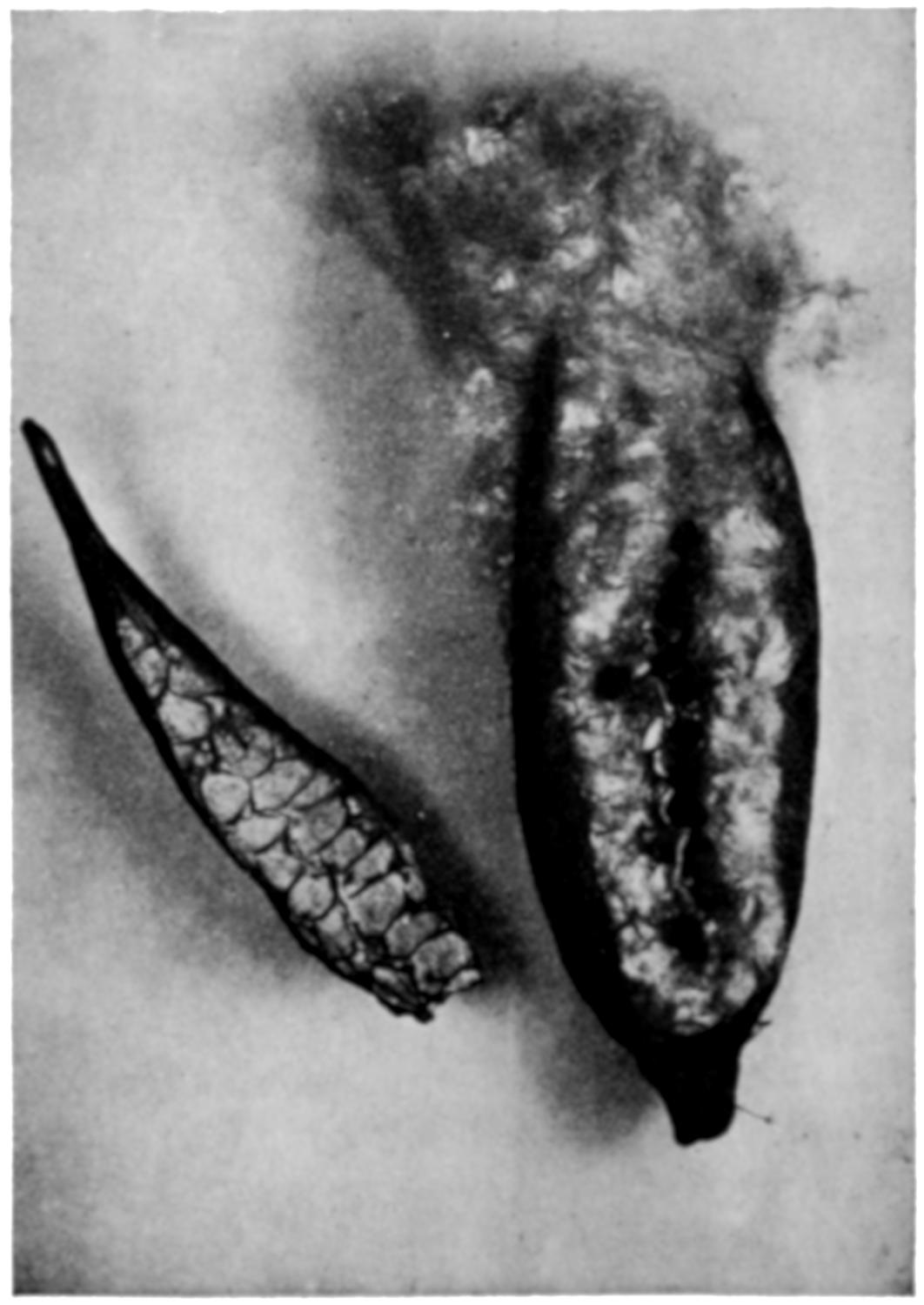
Fig. 123.—Kapok Pod, Opened to show Fibers and Seeds.
Kapok.
—(Fig. 123). The kapok tree is grown throughout the Philippine Islands, the natives having used it for centuries for filling mattresses and cushions. It is only since 1905 that the floss was exported. The cultivation is very simple and inexpensive. It is now grown regularly for home use and export. In 1923 there were 8000 pounds exported. It is grown in, and exported from, Java also.
[344]
The tree requires a warm climate and can stand prolonged dry weather. The floss is in the pods, which resemble those of the milkweed. In the Philippines the flowers appear in February and the pods in June. The latter are picked before they are quite ripe, as the floss is spoiled by the rains when the pods open. It is better not to store them too long. The cleaning of the floss is largely by hand methods. There is some very crude machinery in use. The floss is light and elastic and it is very buoyant. It does not mat with use. It can be treated to be spinnable but this is not done to a large extent. It is used in the United States for mattresses and for filling cushions of all kinds. It is excellent for buoyant cushions.
The seed of the kapok yields an oil which is used in soap manufacture, as an adulterant to other oils, and for cattle feed. The tree yields a gum which is used medicinally. The wood is used for tanning leather and for other purposes.
Hair.
—Varieties of hair are used in textile manufacture. Rabbit hair and camel’s hair are found in combination with other fibers in dress goods, and coatings. The hair of the Angora goat is in plushes, braids, and dress goods. The Cashmere and Alpaca hair make high-priced fabrics. Cow hair is used in cheap floor coverings and horsehair for stiffenings for suits, for interlinings, and for upholstery (see Chap. VI, Hairlike Wools).
On account of the scarcity of the older fibers during the great war, other fibers were tried with varying success. Paper was combined with cotton in cloth and for twine, and is still used for the latter. Flax and hemp waste, hitherto considered about useless, were combined with cotton and made for various household purposes, toweling, underwear, and industrial requirements. Cotton machinery was used for the preparation. The cost of production is lower than cotton. A factory has been opened at Stetten on the Baltic in Germany, and the company is planning to open one in Argentina.
[345]
Representative Linen Materials
- Butchers’ linen
- Cambric
- Crash
- Diaper
- Dress linen
- Duck
- Holland for shades
- Linen lawn
- Napkins
- Pillow cases
- Sailcloth
- Sheeting
- Sheets, hemstitched
- Table linen
- Toweling, huckaback
- Toweling, crash
- Toweling, glass
- Towels, huckaback
- Velour
Lace and Embroidery
Lace and Embroidery are too large subjects to deal with adequately in a few pages. The object of this short description is to indicate briefly the origin of some of the leading machine laces and to interest the student to consider the subject further in some of the books which deal with real laces and embroideries, and to visit museums where historic textiles are on exhibition.
The making of lace dates back to primitive times, from the tying of fringes for decoration and of nets for fishing. As early as 1000 B. C. ornamental nets and drawnwork with beads to decorate them were in use. Excavations at Thebes have brought them to light. Early mummy wrappings were decorated with cut and drawnwork, and “veils of net woven with gold” were mentioned by the earliest writers of antiquity. Ancient Egyptian textiles combining embroidery and lace motifs can be seen in the museums by those who desire to study the earliest beginnings of these arts.
Real Laces.
—The thirteenth century saw the beginning of fine linen handmade laces. At first lace was closely allied with embroidery. Italy was the birthplace of these arts. The finest class of linen yarn was required. The great centuries of lace were from the fifteenth to the eighteenth. [346]The centers were Italy, Flanders, Spain, France, and England. Designs were copied from Italy and from the other countries as the art developed. Lace and embroidery were in demand for church vestments, for household linens, and for costumes for both men and women. A great variety of designs were made and different methods of construction were developed. The following list indicates some main divisions, and under each there were numerous examples:
(1) Drawnwork combines primitive lace and embroidery. A linen fabric has threads drawn, the remaining ones are made into a pattern, and needlework stitches are inserted to fill the open spaces. It was sometimes called Hamburg Point.
(2) Darned work on linen threads. Hand run or chain stitch (tambour) designs were made on the background. Araneum is a coarse form of darned work. The modern name for this form is antique or spider work. It is sometimes called Cluny Guipure. Filet is a darned lace of great fineness and beauty, or coarse and effective.
(3) Cut work was one of the earliest forms of lace. It was used largely in the fifteenth century. It developed from drawnwork, for the cut threads were held down by stitches to make them strong. Other stitches were placed in the openings. Reticella, which was a development of cut work, was the beginning of needlepoint lace. Carrick-Macross lace on muslin is a cut-work lace (Fig. 124). Simple “brides” (connecting stitches) and picots (small decorations on the brides) were followed by elaborate designs and finally the entire linen foundation was omitted and needlepoint lace (Punto in Aria) appeared (Fig. 125). This was the true beginning of lace as we now know it.
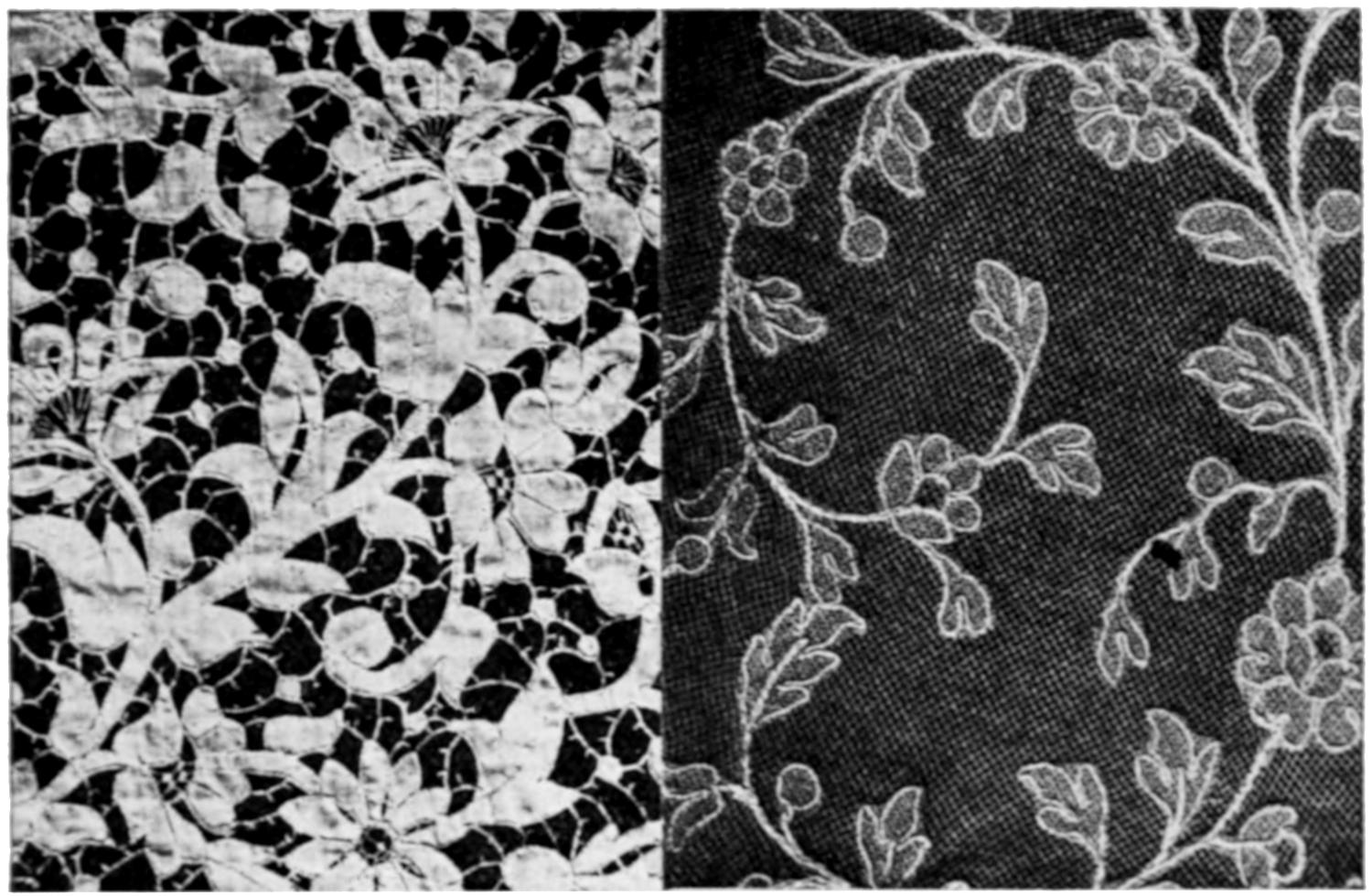
Fig. 124.—Carrick-Macross Lace.
Left: Real. Right: Imitation.
(4) Pillow, Bobbin, or Bone Lace. This lace is made on a pillow by the use of a number of bobbins of fine linen thread. A parchment design is placed on the pillow and the pattern is laid out with pins. The threads from the bobbins are [347]interwoven, twisted, or plaited around the pins. In some instances separate motifs are made on the pillow and united by various brides and stitches. Tapes were usually made on pillows and later used in a design, as in Brussels and Honiton lace (Fig. 126). Pillow and needlepoint laces are often combined in one lace (Fig. 127, C). Representative pillow laces are Valenciennes, Lille, Brussels, Buckinghamshire, Mechlin, Binches, Bruges, Duchesse, Maltese, and Cluny. The bobbins were of bone, ivory, or wood. Some of them were made attractive by decoration and had the name of the worker carved or inlaid on them. They are heirlooms in a family. The colored beads which were hung by wires on the bobbins to weight them were called “gingles.”
[348]
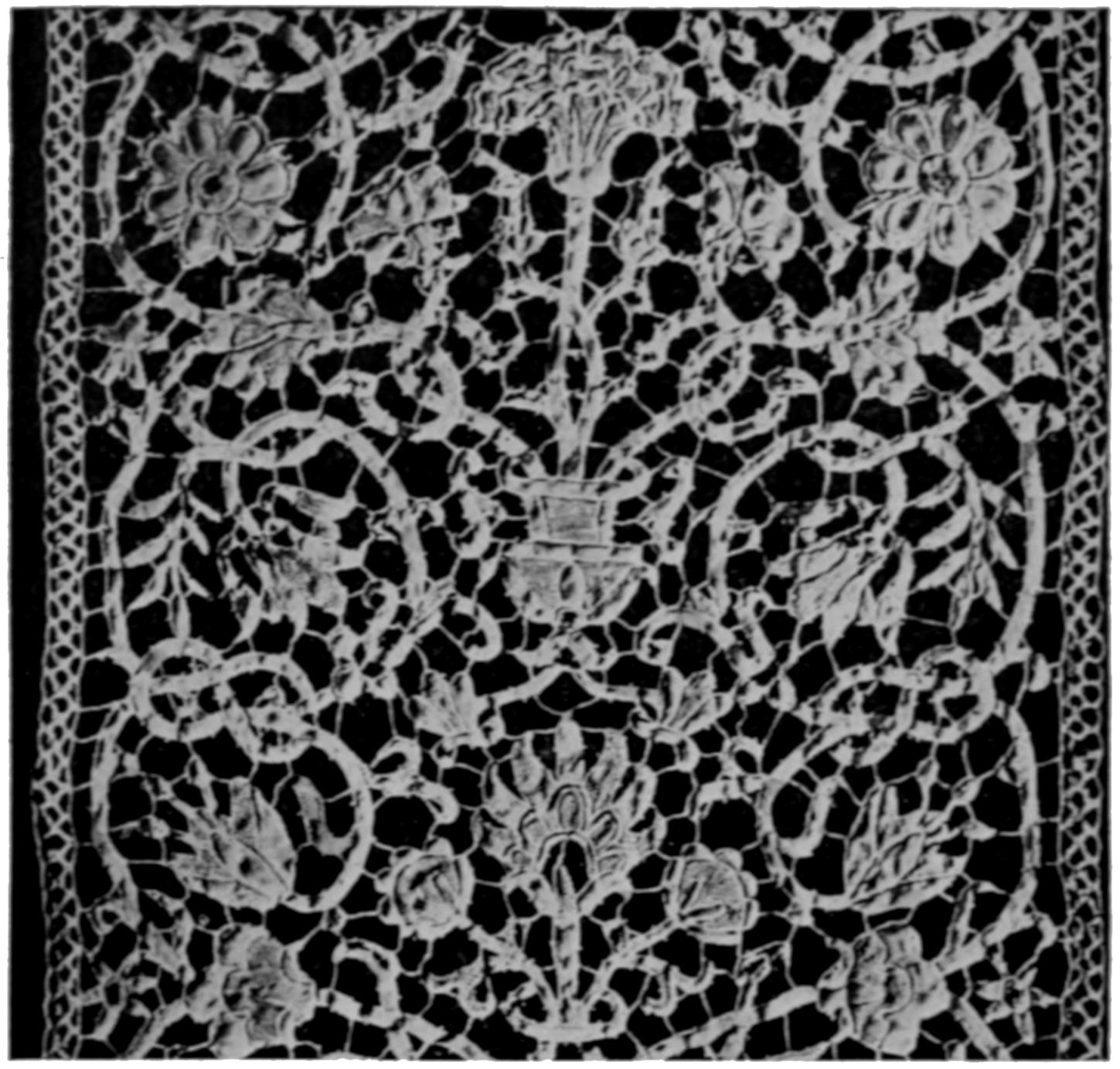
Fig. 125.—Punto in Aria.
Design shows Carnations, Jasmine, and Daisies.
From Ricci’s Old Italian Lace, by courtesy of William Heinemann, Ltd. London, Eng.
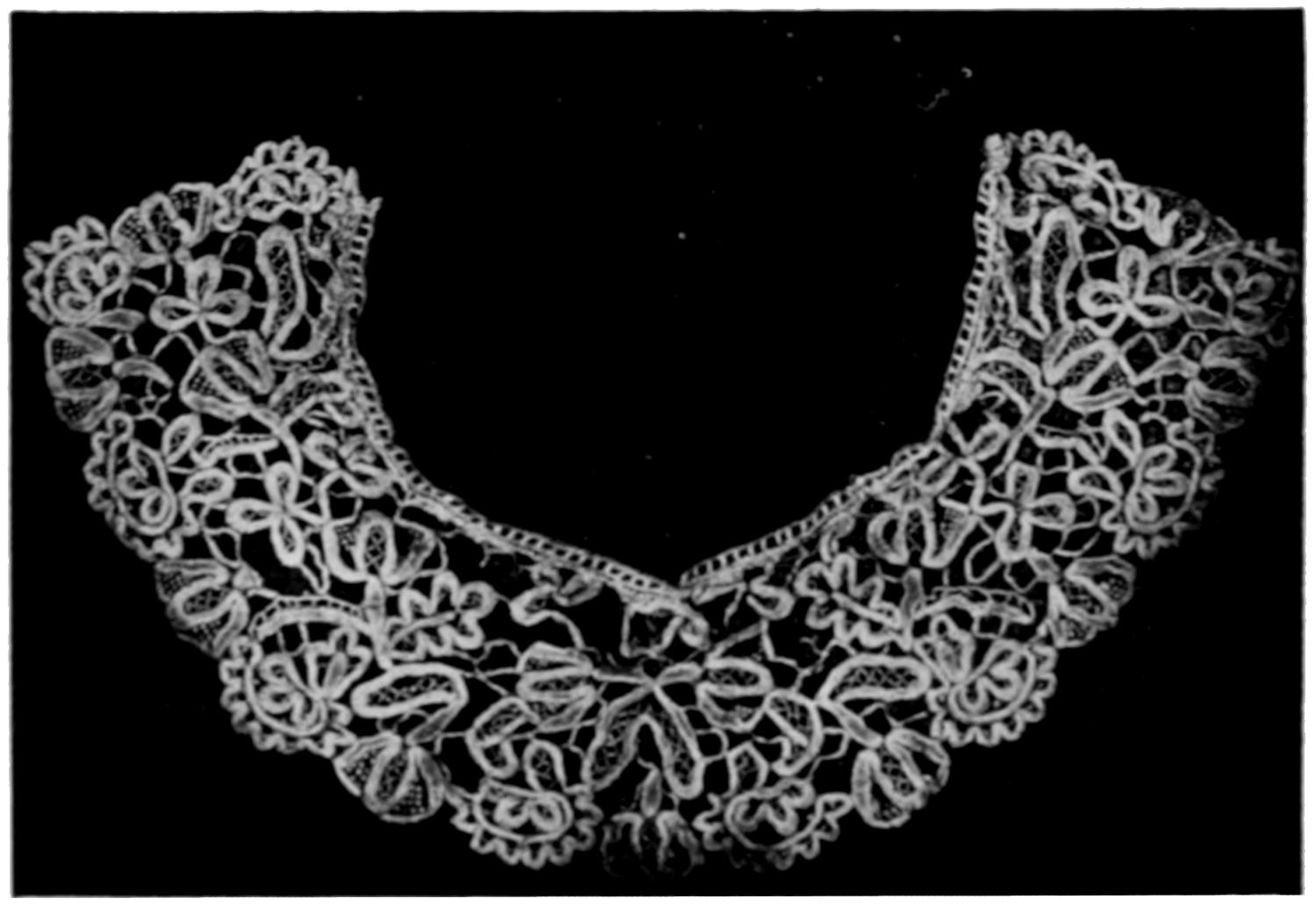
Fig. 126.—Very Old Honiton Lace. Rose, Shamrock, and Thistle Pattern.
[349]
(5) Needlepoint lace is made entirely by the needle. It was called Punto in Aria, or a stitch in the air (Fig. 125), to indicate the elimination of the linen background found in the Reticella. There are many varieties of needlepoint. Tape was made by needlepoint as well as by pillow, and used as a foundation for fine tape laces. The term Point Lace should be used only for needlepoint, but it is often confused with pillow lace. Point Venise or Venetian Point (Fig. 127, B) is a representative needlepoint lace. Some of this is made flat, as with Coraline, and some is padded or raised, as in Rose Point or Gros Point (Fig. 127, C). Some of the English and Flemish laces are needlepoint, and also some of the net and appliqué ones (Fig. 127, D). When the buttonhole stitch is used to produce the net the work is called needlepoint, but not when darning or overcasting are used in the construction. The Argentan and Alençon laces are needlepoint. Appliqué lace has needlepoint motifs and a net background made by machine. Machine-made net was introduced in the beginning of the nineteenth century. Before that time the net and pattern were made at the same time. The appliqué laces were in high favor in the court of Louis XV. There were many varieties of net background (réseau) according to the kind of lace. Tape was, at first, a filmy real lace, but the machine-made tapes are heavier and are much used in curtains.
(6) Knotted lace and tatting were early forms of handmade lace. An elaborate knotted lace was used early in Italy. Tatting was light and fine and a shuttle was used in its construction. It is made the same way now. Macramé lace is a coarse knotted lace made by the fingers.
(7) Crochet lace is made with a hooked needle. Irish crochet may be fine and flat (Baby Irish) (Fig. 127, A), or coarse and raised. It is a national industry. The peasants of Syria and other countries do a similar work. The Syrian lace is much used on handkerchiefs.
[350]
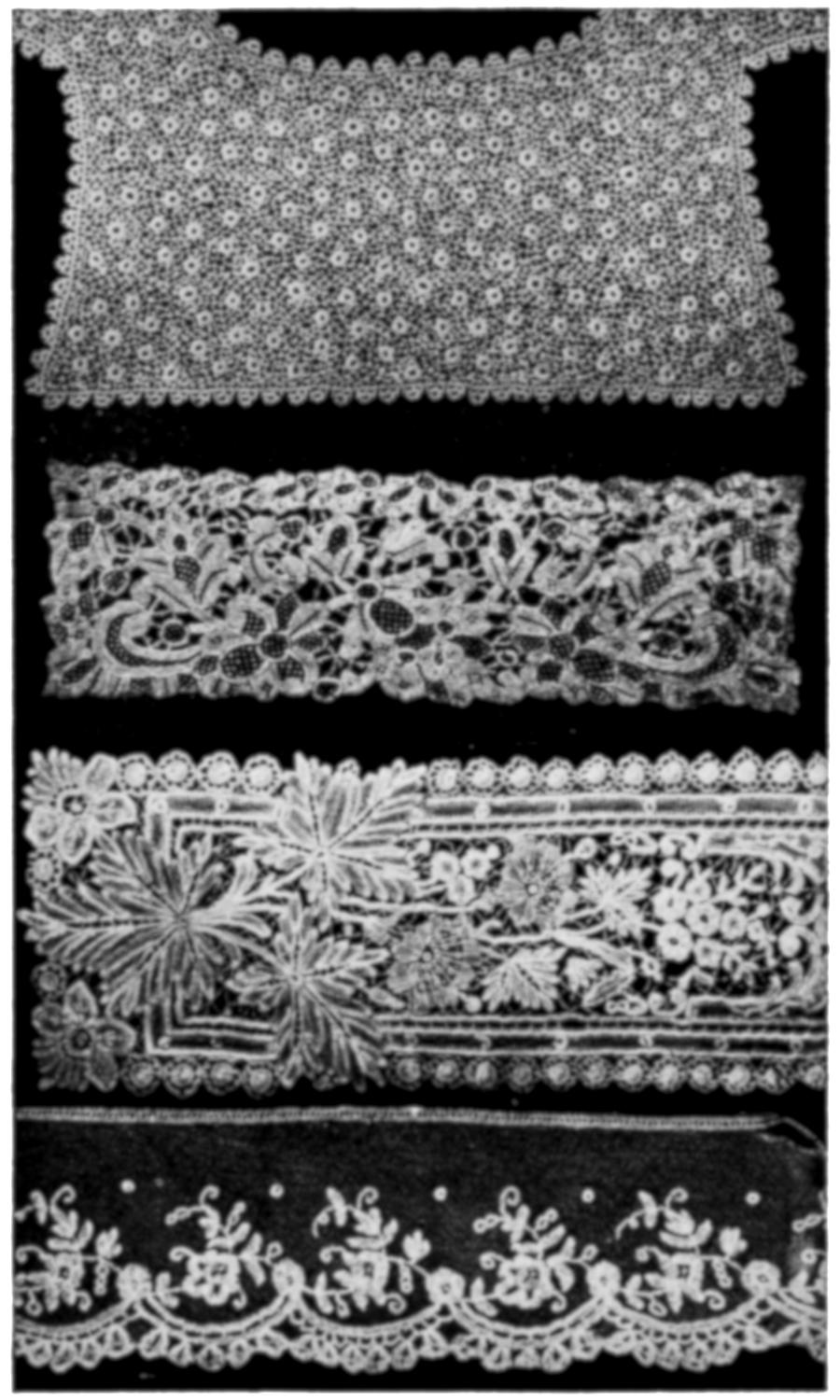
Fig. 127.—
A (Top), Baby Irish Crochet Lace.
B (Next), Point de Venise.
C (Next), Point Duchesse, combining Tape Lace (Duchesse) with Needlepoint (Point Lace).
D (Bottom), Appliqué, with Pillow Lace Motifs on Machine Net.
[351]
Imitation or Machine Laces.
—Inventions to simplify the making of real laces began to appear in the sixteenth century. Machine net was made as early as 1560 on the stocking frame invented by Lee (see Knit Goods). By 1760 machine lace was made in quantities in England. Many inventors were at work to perfect machines for the purpose. About 1740 Robert Frost made a knitted, figured lace by machine. In 1768 a Nottingham lace worker produced a sort of lace on a stocking frame. The warp machine of an Englishman named Crane appeared in 1775. This machine is almost endless in its possibilities,—knit goods, tatting, veilings, braid, laces, scarfs, and yard goods. All the early machine nets were an adaptation of the stocking frame, and the mesh unraveled, which was a disadvantage. About 1808 Heathcote invented his machine which made a fast net, and large numbers of people were soon employed making designs on this net. Queen Victoria’s wedding dress was a Honiton lace (Fig. 126) with handmade designs appliquéd on machine net. In 1833 cotton thread began to take the place of linen. The first factory which operated bobbinet machines was built by Heathcote in 1810 and produced nets of many widths. In 1813 the first Levers bobbinet machine was brought out.
Nottingham, England, has been noted for its machine laces. The curtains made there were called by the name of the city, but are now made in quantities in the United States and elsewhere. Caudry, France, as well as Nottingham is noted for varieties of nets. The finer laces are made on the Levers machine. The latest improvement on this machine is called “Go Through,” for the bobbins carry the warp threads through twice with one revolution of the crank shaft. This machine produces imitations of the linen handmade laces which are difficult to distinguish from the real. Chantilly, Valenciennes, and other laces are made on this machine.
Imitation laces are now made in many countries. Calais and Lyons in France, and Plauen, Barmen, and parts of Bavaria in Germany are noted for their torchon, cluny, and [352]other laces, and the United States has been rapidly pushing to the front in this industry. Linen threads are often used in these imitations instead of cotton, which makes the resemblance to the handmade lace even closer, and the wear is equally good. Some silk laces are being made and wool laces are made when the fashion demands. Many kinds of laces are made, and often two varieties are combined in one lace, but the most popular may be said to be the following, which are copies of the real laces:
Torchon lace is made all over Europe on pillows by peasants. It is a strong lace, frequently with a rather coarse thread. It is made in many designs and widths. The machine makes an excellent imitation of the real lace.
Cluny lace. There is little relation between the ancient cluny guipure and the modern machine lace. The latter is distinguished by the paddles, wheels, or stars in the design. Narrow cluny lace is used on underclothing. It resembles torchon lace.
Valenciennes or “Val,” is a copy of a very well-known real lace. The machine imitation is difficult to distinguish when linen thread is used, but the cotton thread thickens in washing and the lace loses its natural delicacy. It is a very popular lace. It is made in France, England, and the United States. The French lace has a diamond-shaped mesh and a very fine thread. England and the United States use sometimes a double thread with a hexagonal mesh, and the lace is called “German Val,” but none of this lace is made in that country. Another variety of Val lace has a square mesh. English Val is made in Nottingham, and the French, in Calais. Zion City, Illinois, makes most of the Val produced in the United States. Before this work began in Zion City about $6,000,000 of Valenciennes lace was imported annually. The entire staff of a large factory in Nottingham, England, was transported to this country and installed with the most modern machinery at Zion City.
[353]
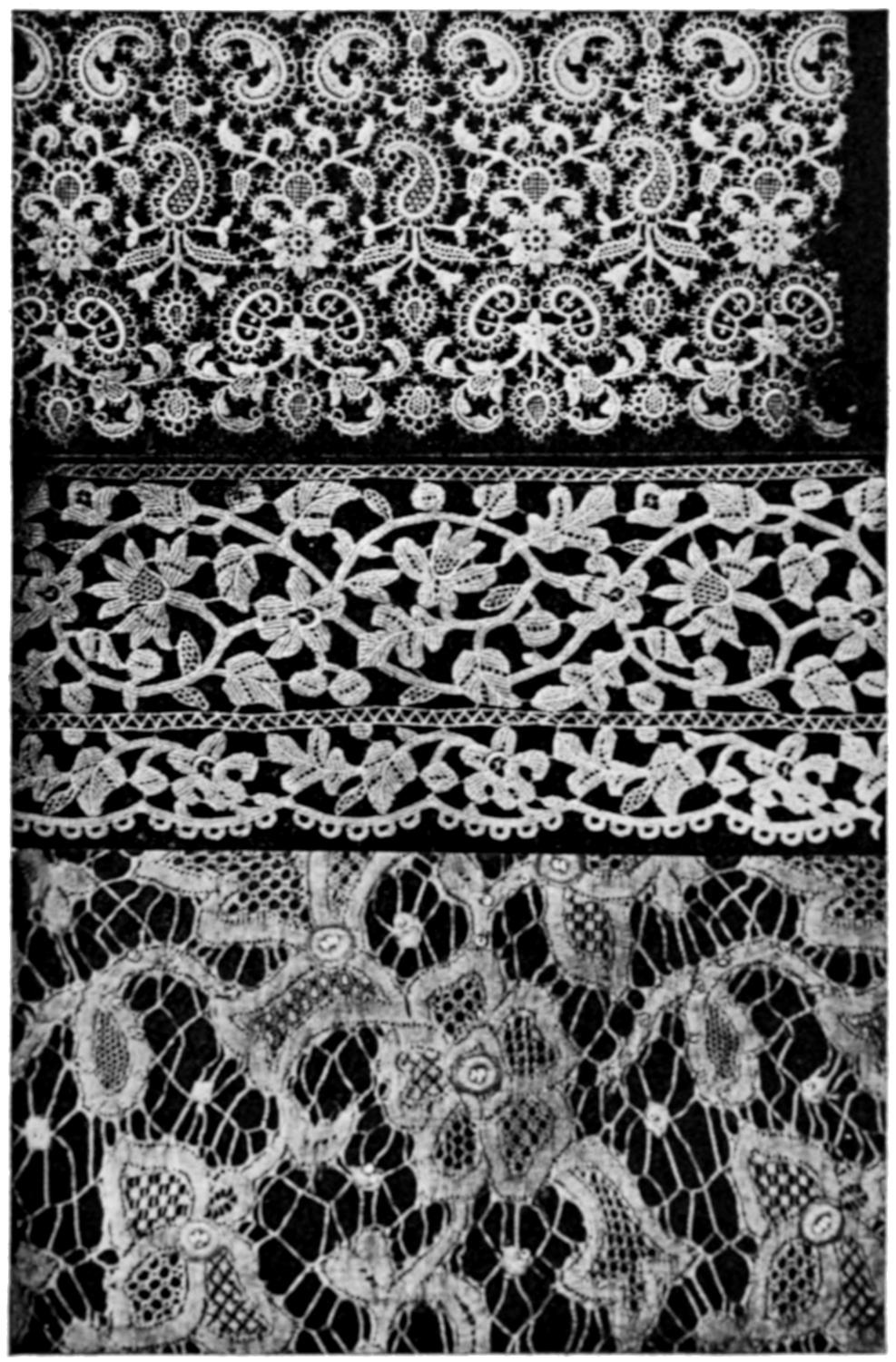
Fig. 128. Machine Laces.
A (Top), Point de Rose.
B (Middle), Point de Venise.
C (Bottom), French Renaissance.
Irish Crochet. This lace is difficult to imitate, for the machine cannot give perfectly the crochet stitch, but uses an over and over stitch. The difference can be detected by [354]the eye. There are some very simple crochet laces which are very attractive and look like the real.
Filet lace. Filet net resembles gauze, but the threads are locked at the corners to resemble the tie of the real filet. The Levers machine is sometimes used to make the imitation and the burnt-out process. Often the Schiffli machine is successful. (See Burnt-out Lace, below.)
Venetian point is frequently imitated (Fig. 128, B). The Schiffli machine is used and later the background is burned out.
Shadow lace. A very thin lace made on the Levers machine. The design is shadowy, and there is no limit to the possibilities of designs. It is sometimes coarse and at other times very fine, and is not very enduring.
Renaissance lace (Fig. 128, C) is a modern machine tape lace. A coarse variety is used for curtains. The tape is formed into patterns and handwork stitches catch the parts together. Several kinds of tape laces are often combined in one curtain, such as cord, appliqué sprays, and tape bowknots. Very fine tapes are made and used for costumes. The name Battenberg lace is applied to one in which a tape of this name is used.
Cotton lace manufacture
in the United States is growing rapidly. There was an increase in 1923 of 37.8 per cent over 1921. The value of the products in 1923 was $35,791,878. Nottingham lace nets and curtains and Levers laces had perhaps the greatest increase. In 1923 there were 39 establishments making lace, and about 8000 people are engaged in the industry. Pennsylvania had twelve workrooms; Rhode Island, eight; New York had seven; five were in Connecticut and four in New Jersey. Illinois, Massachusetts, and Ohio had each one establishment.
Learning to judge between real and imitation laces takes some experience, but the following suggestions may be helpful:
[355]
Machine work is more regular than the hand.
Machine work exactly repeats a pattern, but the hand work has small mistakes.
Needlepoint imitations lack the characteristic loop or buttonhole stitches.
By inserting a pin into needlepoint imitations the threads of the pattern are readily moved, but in the real, the loop holds them.
The imitation has a flatter, deader look.
Cotton threads are used in most imitations and they soon become rough in use and the laundry.
The relation of the ground to the pattern differs.
In imitating bobbin laces such as cluny or torchon, two sizes of threads are used. The magnifying glass will show if this is the case. The threads in the imitation are crinkly and loose, but they are taut and straight in the real.
Machine Embroideries.
—Imitation embroideries, as well as laces, are made in old centers of real embroidery and lace. The St. Gall district of Switzerland, Plauen, Germany, and Carlsbad in Czechoslovakia had almost a monopoly at one time, but the work has spread all over Europe and into the United States. Hand directed machinery was invented as early as 1850 to facilitate parts of the work and enable the workers to make more money. Machinery run by power, but much like the hand machines, followed. In the workrooms all three can be seen in various stages. Yarns of silk, rayon, linen, and cotton are used in the manufacture. Much of the work requires the burnt-out method of finish, which is done on a background that is later destroyed by a chemical bath. Guipure laces, embroideries, and passementeries are made on a background of chemically prepared material. Both hand and shuttle machines can be used for the embroidery. The hand machine is about five yards wide. The cloth on which the embroidery is to be done is stretched the length of the machine, and a carriage on either side of the stretched material carries a double row of from two hundred to four hundred double-pointed needles, each having an eye in the middle. The needles have each one and one-half yards of [356]thread on them. They are pushed through by one carriage and taken up by the other, a stitch being taken with each operation. The machine stops when nine inches of thread are left in the needles. Freshly threaded needles are put in automatically. A pantograph is at the left side of the machine, on which the design is many times enlarged. The operator with his left hand traces the pattern, which is reproduced in the correct size on the stretched material. In the hand machine the feet are used to keep the machine in action. The hand embroidery machine works on nine yard lengths.
The shuttle (Shiffli) machine is power operated, carries a greater length of fabric, and the output is many times larger. Some of the embroidered net top laces are so perfectly done that they can hardly be distinguished from the real. The machine has shuttles in place of needles. An automatic shuttle machine has cards like the Jacquard loom to control the pattern. If the cloth is to be an embroidered strip, it is taken off after the work is completed and finished by hand. If it is to be made into passementerie or lace, the same pattern has been repeated many times across the length of the strip. After the embroidery is finished, it is given to workers who cut out the designs, leaving a small rough edge around them. The background is of vegetable fiber if the embroidery is to be an animal fiber such as silk, i. e., a thin cotton fabric is stretched in the embroidery machine to receive the silk stitches. After the handworkers have cut out the designs, they carefully sew and embroider the many designs together to make the design perfect, and the latter is sunk into a chemical bath which destroys the background, leaving the embroidery or lace standing out clear, for the fraying edges have been eaten away. It is finally finished for sale by handworkers and pressers. Drilled embroidery, guipure, and work on tulle are done on these machines.
Embossing.
New inventions or the use in new ways of machines already on the market are constant. Through a [357]new utilization of the burnt-out work system called “soda-print,” an exquisite fabric has appeared lately. “It is executed by printing a thickened solution of chloride of alumina on boiled off pieces containing silk (or wool) and rayon. After dyeing, the goods are kept in a heated chamber (temperature and time depending upon fabric and strength of solution). The rayon is destroyed. After the carbonizing of the rayon, the pieces are washed and dried.”[44]
[44] Courtesy of Lyons Piece Dye Works.
The Bonnaz machine (Cornely) is an embroidery machine originally from Europe. It is on the order of a sewing machine, but the needle can be moved freely, consequently a skilled hand can use it as if it were a pencil, but more rapidly. Chain or cord stitches can be made to outline the designs. It is used in elaborate appliqué work on silk by having layers of lace or other material below the silk. The design is made by the machine, and the fabric not needed is cut away, thus varied colors and fabrics appear on the face. By adding a little handwork exquisite designs are achieved. Marvelously beautiful effects are obtained also by combining Jacquard velvet weaving, printing, burnt-out work, Bonnaz or other embroidery machine design and lace appliqué. Lyons, France, has been foremost in utilizing these machine inventions in fancy silks, and Belgium has communities occupied with machine embroideries. The Singer machine also offers possibilities in silk embroidery.
Hamburg edging is made on a Swiss machine; the original Hamburg Point was a drawnwork executed on muslin and embroidered. A crochet embroidery is made with a crochet needle on various materials. The fabric is stretched on a frame, and the pattern is crocheted through it from the wrong side. Veiling and dress nets are made. The work is very fine. Hoop embroidery on bobbinet and other materials is made by a simple machine attached to the hoop which drives the needle through the fabric. Ribbon and Braid work [358]follows a stamped design. The braid or ribbon is basted to the pattern and stitches finish the design.
The hand embroidered garments from the Philippine Islands are made under the direction of thirty or more firms. The embroidery is done largely in outlying districts. There are factories in Manila where the finest silk garments are embroidered. Contractors engage to provide embroidered garments at a fixed price. Cloth with the designs stamped on them are furnished and are distributed to women who give their entire time to this work, or to those who can give only part time. The women are often at work in the fields, and do this embroidery in rest hours. The Filipino women do good work, but need close inspection, as standards are lacking. Inspectors are sent out to supervise the work in progress. The designing has been in the hands of American designers, and is appropriate and attractive.
[359]
CHAPTER XI
MICROSCOPIC STUDY OF TEXTILE
FIBERS
The microscope is a most valuable aid in the study of textile fibers. Each fiber has its peculiar structure and characteristic markings, which are revealed by the microscope alone, and which furnish the best and often the only certain means of identification. Chemical tests fail, for instance, in distinguishing between wool and hair fibers, or between different grades and qualities of wool, cotton, or linen. Familiarity with the microscope, therefore, and with the appearance of the more important textile fibers, should be the basis of their analytical study.
A compound microscope of 250 to 500 magnification is desirable. The following directions for its use are given to aid beginners:
Parts of the Microscope.
—The essential parts of the compound microscope are those belonging to the microscope stand, and the optical parts. The microscope stand includes:
1. The base.
2. An upright or pillar.
3. A stage for holding the mount.
4. A mirror, having a straight and a concave side. The concave side is used in daylight. The mirror is manipulated till a shaft of light is sent through the hole in the stage and so through the center of objective, tube, and ocular.
5. The arm, which supports the tube.
6. The tube, which in turn holds the draw tube. In focusing an object, the tube is moved up and down by the rack and pinion, or coarse adjustment. A finer adjustment is secured by a slight turning of the small wheel at the top of the pillar.
[360]
The optical parts include:
1. The eyepiece or ocular, which fits into the draw tube, and may be taken out and used as a single microscope.
2. The objective. There are usually two objectives, which swing around on the nosepiece. A click tells when one is swung in position. The low power objective is generally short and stout; the high power long and slender.
To Use Low Power
1. Swing the low power objective into the optical axis, about one inch from stage.
2. Place mount on stage, so that a fiber lies over the center of the hole.
3. Looking at the objective from the side, turn the screw on the tube until the distance between objective and cover glass is about ¹⁄₈ inch.
4. Look through the tube, and manipulate the mirror to get a clear white light.
5. Lift objective until object focuses.
To Use High Power
1. Using low power, see that the part of the field to be observed is in the optical axis.
2. Raise objective one inch from stage, and swing high power objective into place.
3. Looking from the side, lower the high power objective until about ¹⁄₁₀₀ inch separates it from the slide. Do not let it touch the slide.
4. Lift objective until object focuses.
5. After using the high power objective, always turn the nosepiece before removing the slide from the stage.
Preparation of the Mount or Slide
1. With a pipette, put a drop of water on the middle of the microscope slide.
2. Lay not more than two or three individual fibers in the water.
3. Lay a clean cover glass on the fibers and water, bringing it down gradually from one side in order to exclude air bubbles.
4. See that the mount is clean and dry above and beneath. The space between cover glass and slide should be filled with water, with no floating, however.
5. Additional clarity in a mount is obtained by washing the fibers in alcohol and mounting in fifteen per cent alcohol.
[361]
Permanent mounts can be made with Canada balsam. Clean the cover glass and slide with alcohol, place the dry material on the slide, and add a drop of Canada balsam, just sufficient to fill the space between slide and cover glass. Carefully press down the cover.
Cross sectioning may be done by embedding in paraffin[45] or in glycerin gum,[46] and cutting with a microtome or razor.
[45] Chamberlain’s Methods of Plant Histology.
[46] Glycerin gum: 10 gms. arabic, 10 cc. water, and 40-50 drops of glycerin. (Hanausek and Winton, Microscopy of Technical Products.)
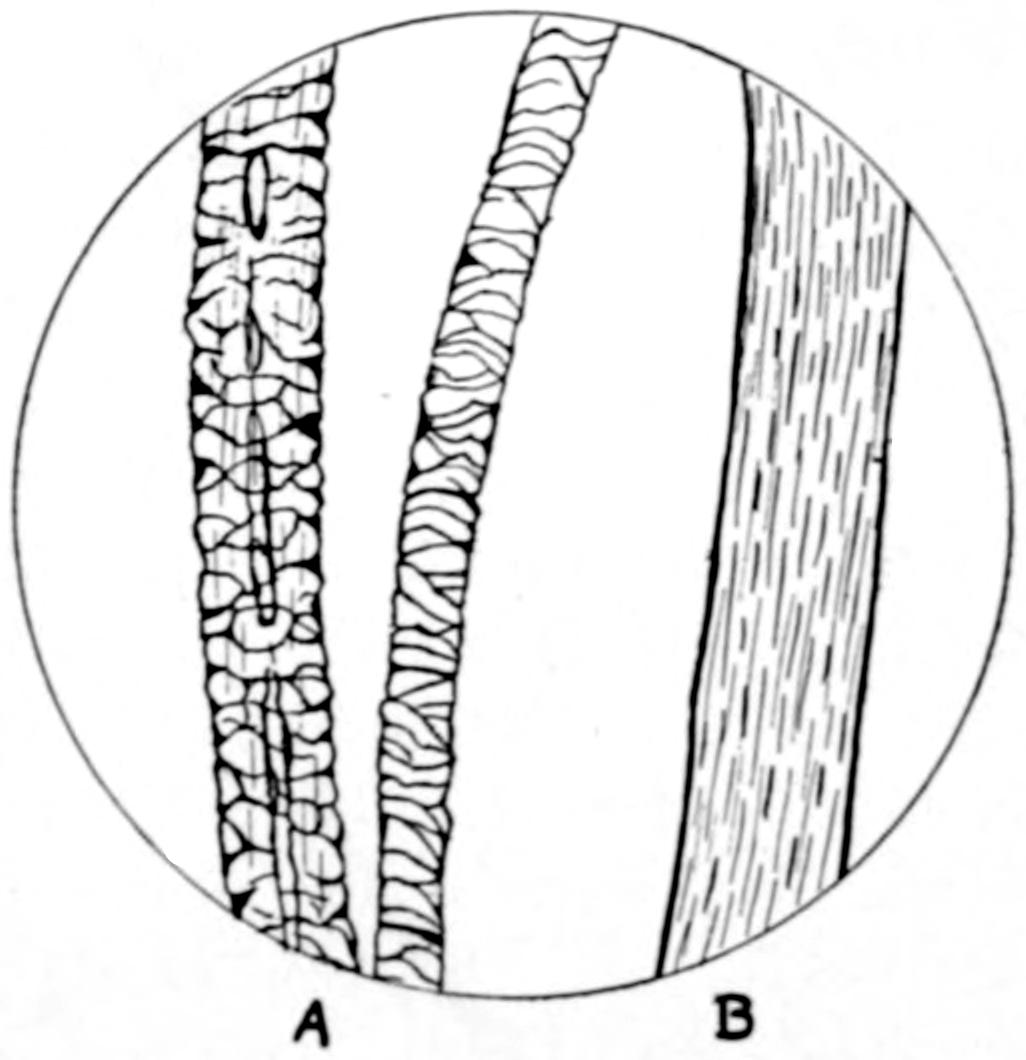
Fig. 129.—A, Wool Fibers. B, Hair Fiber.
Wool and Hair Fibers
(Fig. 129).—Wool and hair fibers are alike in origin and growth, and often in appearance, so that no sharp distinctions can be made between them. For purposes of classification, the fleece of sheep is called wool but it varies from the long, hairlike covering of the Lincoln, Leicester, and Cotswold varieties to the soft, crimpy merino. The so-called hair fibers come principally from the alpaca, cashmere, Angora, and Thibet varieties of goats and from the camel (see Chap. VI). However, both forms are usually produced on the same animal. The long hairs of [362]the cashmere goat cover a soft, woolly coat, and mixed with the fleeces of most sheep are long, stiff fibers called beard hairs.
Physiology and Structure.
—The root of the wool or hair fiber is in the follicle situated in the dermis. Both wool and hair show a common structure:
1. The epidermal covering, consisting of flattened, overlapping cells like the scales of a fish. These give the appearance of serrations or saw teeth to the fiber edges. Occasionally in fine wools, single scales encircle the fiber like a series of funnels; more often two or more make up the circumference. Coarse wools may show a covering of irregular, depressed scales like heavy plates. The scales of true hair fibers (Fig. 129, B) are often difficult to see under the microscope, as they are fastened firmly throughout their length to the cortical region, and are only slightly serrated at the fiber edge, while wool fibers, which have the scales set more loosely, show marked serrations. Mohair, alpaca, vicuña, llama and other hair fibers show a similarity under magnification. Camel hair usually has a combination of soft, crimpy wool fibers and stiff beard hairs.
Under the influence of warm water, and particularly warm alkaline or soap solutions, the epidermal scales become plastic and in a condition to cause their free edges to felt or interlock with contiguous fibers. Changes in temperature, particularly from hot to cold solutions, increase this interlocking by contraction, but the chief factor in felting the softened fiber is no doubt rubbing or friction. This is depended upon in fulling or milling woolens—a process directly opposed to the proper method of laundering them. The finer wools, rather than coarse wool or hair fibers, are chosen for fulled or felted fabrics, because the outer margins of their scales are relatively free from the fiber body and more susceptible to interlocking. Hair fibers are preferable for materials where spring, wiriness, and non-felting quality are desired.
[363]
The luster of wool or hair is dependent upon its cylindrical form and the set and arrangement of the scales. When these are smoothly and closely attached, as in hair fibers, a lustrous effect is given, but large scales, set in different planes, may give high luster to some coarse wools because of the many surfaces for light reflection. The duller wools have their reflecting surfaces broken by numerous fine scales with free edges.
The epidermal scales, horny and impervious to moisture, help to protect the fleece from storms and injuries, but they likewise retard the absorption of dyes by wool, and tend to dull the intensity of color of the dyed fiber.
2. The cortical region, made up of narrow, elongated cells, giving strength and elasticity to the fiber. By focusing deeply, small striations can be seen, which are the lumens of the tiny cells. The waviness of wool is supposed to be due to differences in size and development of the cortical cells.
3. The medulla or central canal, composed of cells, generally rounded in form. The medullary canal may be broad and plainly visible; it may appear as a continuous or broken line, or it may not be seen at all in some fine, transparent wools. Granular fragments and often pigment matter may appear in the contents. Hair fibers commonly show the medulla, wool fibers often do not. By its capillary action, the medullary canal has much to do with the absorptive capacity of wool, and is an important factor in the dyeing of the fiber. If by chance the medullary canal becomes closed, as may happen when lime is used to remove the pelts from dead sheep, or because of natural reasons, such fibers do not take dyestuffs well. They sometimes appear as uncolored fibers in a dyed fabric, and are called kemps.
Two important secretions adhere to the wool or hair fiber. The sebaceous glands pour their contents into the hair follicle, the sebum being known as wool grease. The chief constituents of this substance are cholesterol, a waxlike [364]alcohol, and its compounds with two or more fatty acids. Wool grease is insoluble in water, therefore a coating of it makes the fleece waterproof, besides keeping it soft, pliant, and resistant to matting and felting. The second secretion is from the sweat glands and consists largely of water-soluble compounds of potassium with oleic, stearic, and other organic acids forming soaps, and of potassium chloride, sulphate, etc. As generally accepted commercially, all the extraneous matter on the wool fiber is known as yolk or suint, although according to its French meaning the latter term is limited to the sweat secretion. The removal of the yolk is important, first, to enable the wool to take dyestuffs, and second, because the lanolin extracted from the wool grease, and the potash salts from the sweat, are of great commercial value (see Chap. VI).
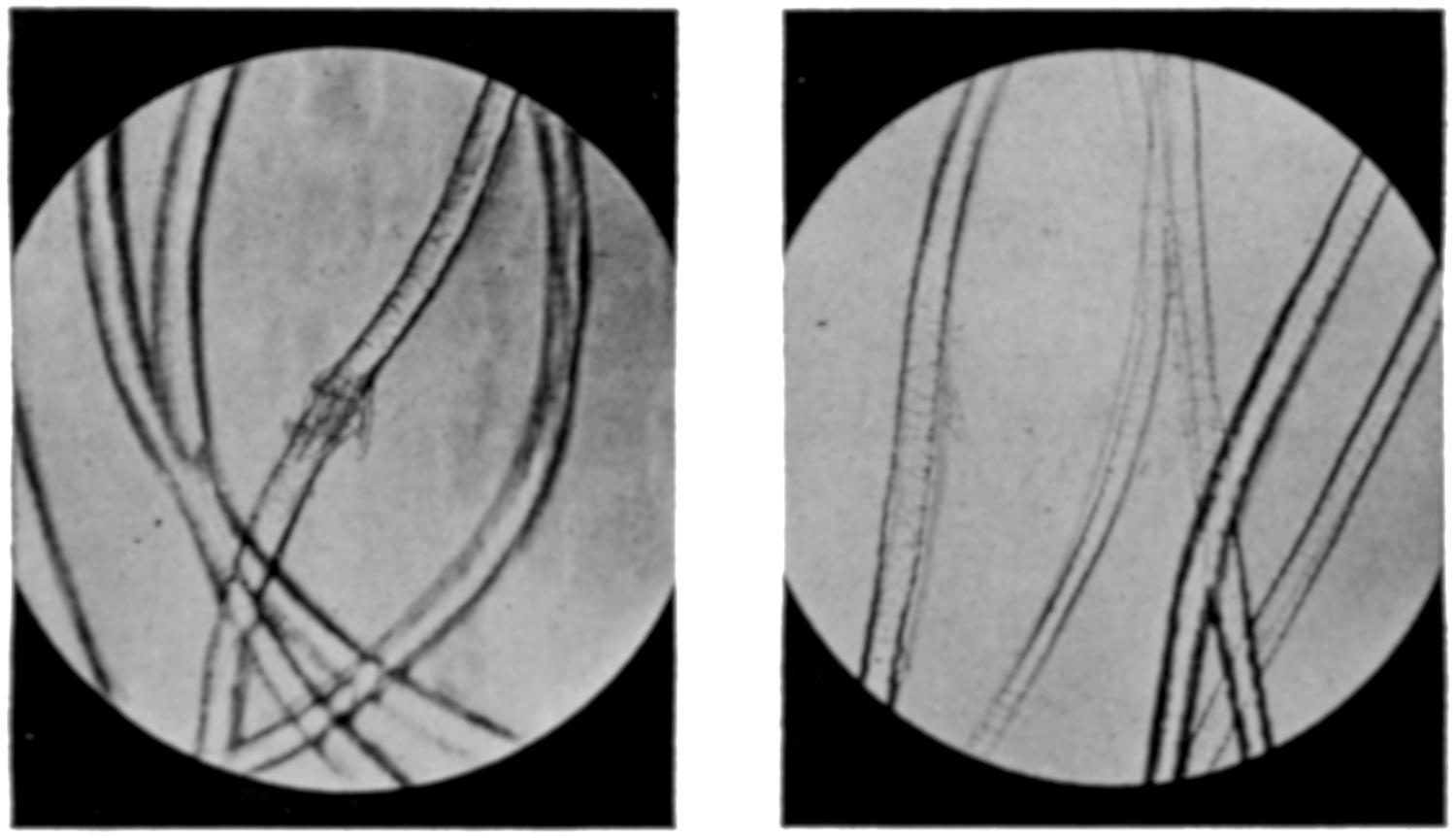
Fig. 130.—
A (Left), Fibers of New Wool from Burring Machine.
B (Right), Fibers of Reworked Wool (Mungo).
Reworked Wool
(Fig. 130, B).—This is wool recovered from woven or knitted material or machine wastes, and used again as textile material. The term shoddy is loosely given to all grades of such material, but should be applied to the best grades or true shoddy, which is obtained from softs, that is, from blankets, sweaters, hosiery or other unfelted [365]goods. Reworked wool of this type is superior to many grades of new wool in strength, staple, and freedom from imperfections. Mungo, or reworked wool obtained from fulled or felted goods, is of a lower grade than true shoddy. In the picking apart of the felted material the fibers may be broken into short lengths of ¹⁄₄ to ³⁄₄ of an inch, and bruised or otherwise damaged. Very little of this type of reworked wool is used in this country. Extract wool is recovered from wool-cotton mixtures, by the carbonizing process (see Chap. XIII, Carbonizing). Reworked wool of this class is used for other than woven textiles as a rule, e. g., for roofing paper and felts.
The microscopic appearance of shoddy
is a much-debated question. True shoddy cannot be identified under the microscope by the physical imperfections supposed to be the marks of shoddy. These are: injuries to the scales or fiber body, such as damaged or missing scales, split sides and frayed ends. These markings are seldom found in good reworked wool, but are frequent characteristics of new wool from the burring machine (Fig. 130, A). Such imperfections confuse the analyst who thinks he can determine the presence of shoddy by the microscope. Perhaps the most conclusive but not final evidence of shoddy is the appearance under the microscope of fibers of different dyes in a plain-dyed material from which some of the color has been stripped.
Silk.
—Silk differs from all other natural fibers in that it apparently shows no cellular structure (Fig. 131, B), although there is some evidence to show that it is made up of minute fibrillæ cemented together. The fluids secreted by the two spinnerets of the silkworm unite on issuing to form a double continuous thread of the raw silk. Under the microscope these two threads of protein material, called fibroin, are seen to be held together by an external gum or silk glue, the sericin, which appears in raw silk as irregular masses on the surface of the fiber (Fig. 131, A). After being freed [366]from sericin by boiling off, the individual filaments look smooth, cylindrical, structureless, lustrous, and transparent. Occasional constrictions may appear. Cross sections from the middle layers of the cocoon are rounded; those from the outer and inmost layers may be flattened or triangular.
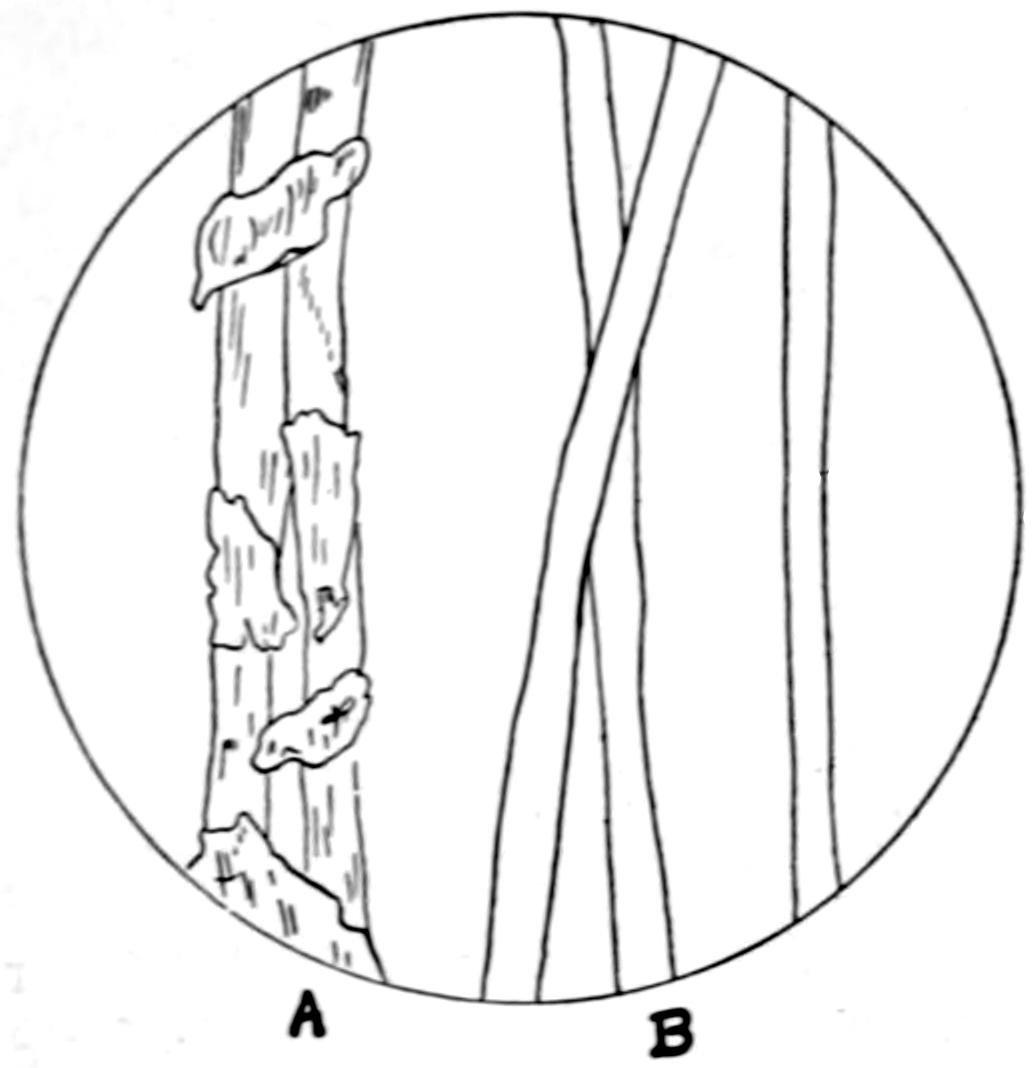
Fig. 131.—A, Raw Silk with Gum. B, Degummed Silk.
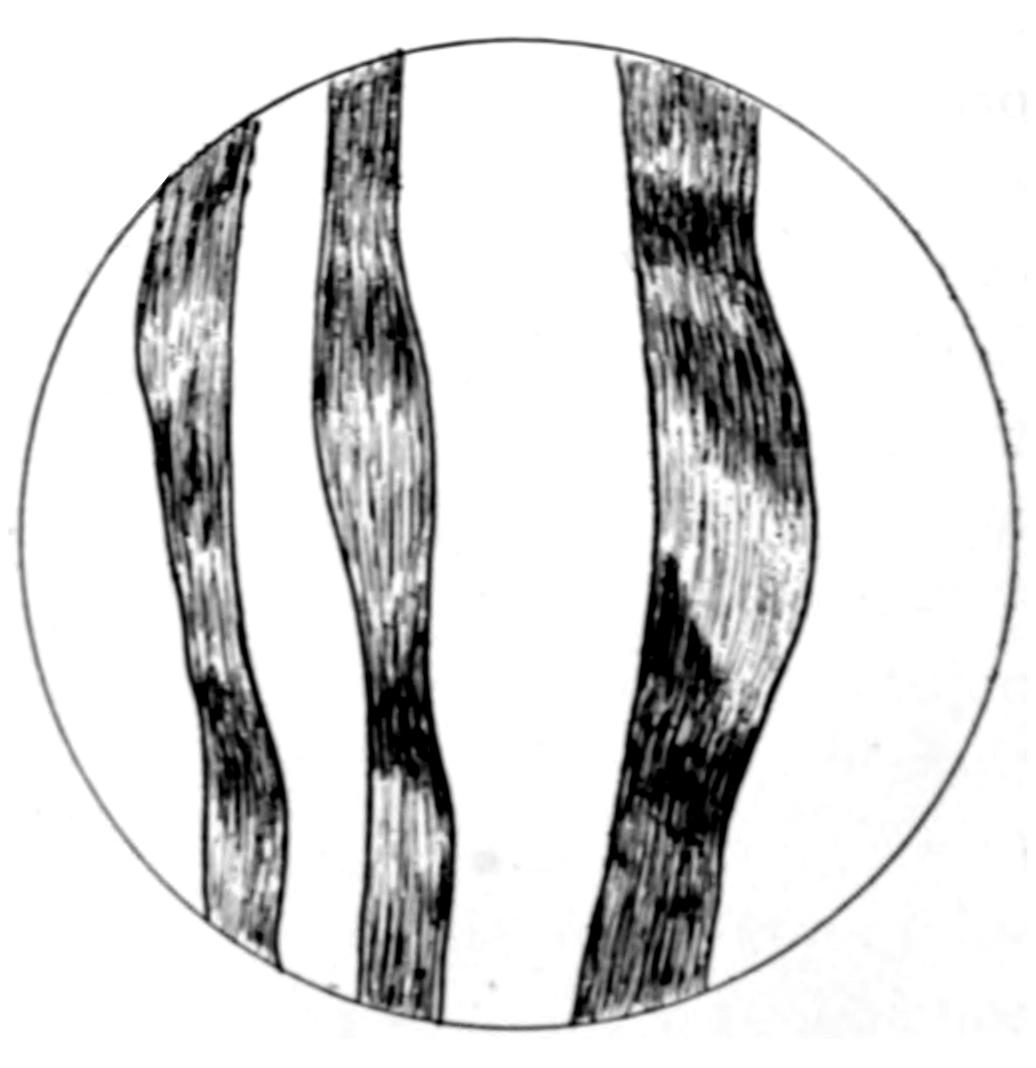
Fig. 132.—Wild Silk.
Wild Silk.
—Under the microscope the wild silk filament (Fig. 132) is broader than the cultivated silk, with irregularities in width, and numerous longitudinal striations. It is flattened or wedge-shaped in cross section. The diagonal lines often seen on the surface of Tussah or other wild silks have been attributed to pressure.
Rayon
(Fig. 133).—This shows cylindrical rods having the appearance of glass. Viscose silks are sometimes irregular, with minute air bubbles and longitudinal lines; nitro silks are smooth but not always regular in form; cuprammonium silks are rounded, smooth, and very lustrous; acetate or celanese silk has a filament which is uniform in diameter, with few markings.
[367]
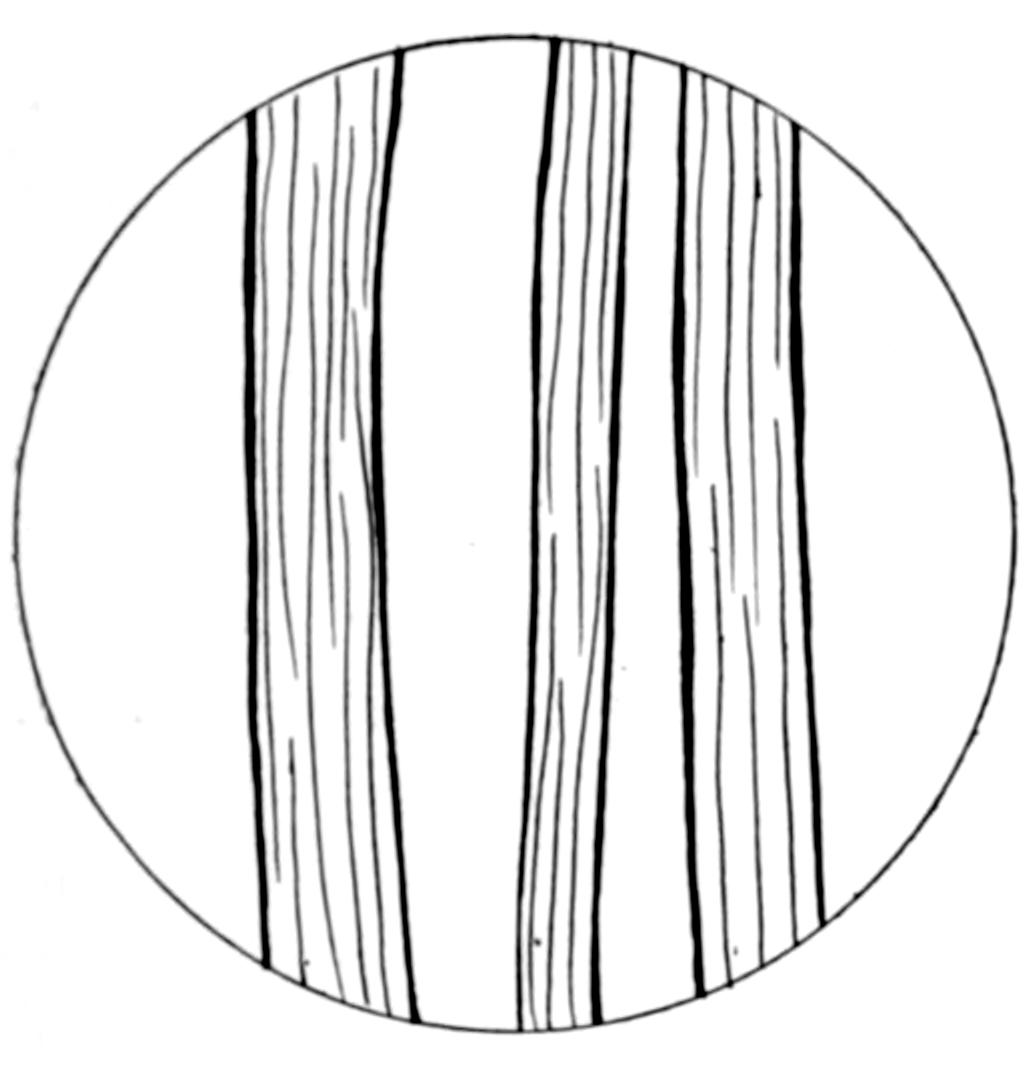
Fig. 133.—Rayon.
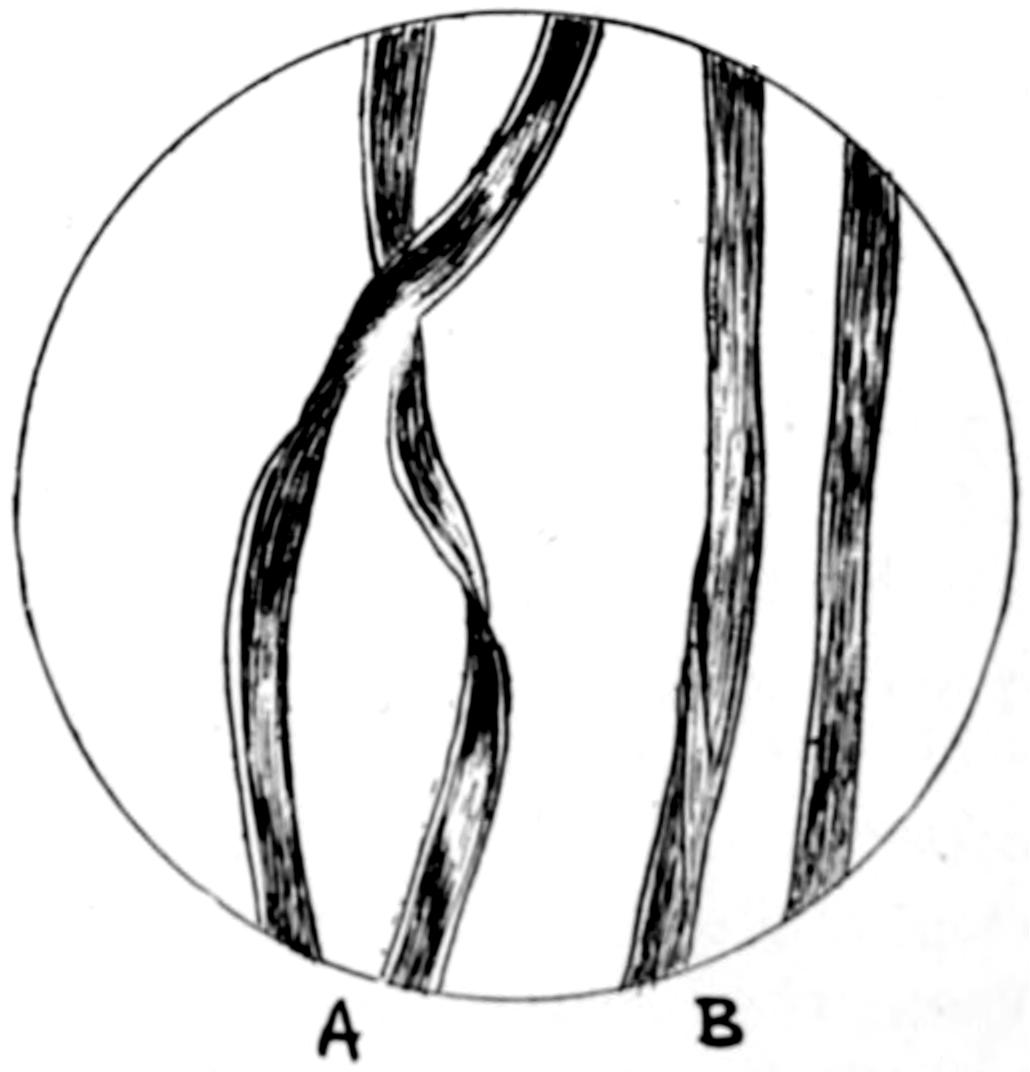
Fig. 134.—A, Cotton. B, Mercerized Cotton.
Cotton.
—Cotton is a unicellular seed hair, which grows as a modification of the coat of the cotton seed. Its length varies from less than an inch to nearly two inches, and it has a range of diameter roughly from .001 to .0056 inch. Being a part of the epidermis of the seed, the seed hair is covered with a thin, structureless cuticle. The walls of the fiber are strong and thick, and an interior canal or lumen is present through which sap or nutriment reaches the cell during the period of growth. When the cotton is ripe the flow of sap ceases and a vacuum forms which causes the cell to collapse. Subsequent drying contracts and twists the fiber. The typical appearance of a ripe cotton fiber under the microscope is that of a smooth, flat band with thickened edges—the cell walls—which make up about one-third of the diameter of the fiber (Fig. 134). The lumen is generally visible, its breadth being usually greater than that of the walls. The most characteristic mark is the twisting which occurs at intervals. There may be as many as 200 twists [368]to the inch. The stronger and more uniform the twist, the greater the elasticity of the fiber, and the better it is adapted to spinning. Dead or unripe cotton fibers show little or no twist, and a less strongly developed cell wall. The fiber tapers gradually to the point, which is rounded or blunt, with thick walls. The lower end of the fiber, which has been torn from the seed coat, is open. While the twist is a distinguishing mark of cotton, the presence of a cuticle can also be made to differentiate it from bast fibers, unless it has been removed by treatment, as is the case in mercerized cotton, and often in well-bleached yarn or weave. When cotton is placed in cuprammonia the cuticle is not affected, but the walls of the fiber become greatly swollen and break out in places through the cuticle, which is left hanging in constricting rings or shreds on the fiber. The lumen becomes like a coiled thread as the fiber shortens and swells.
Cross sections of ripe cotton fibers show elliptical, reniform or crescent shapes, with a central line representing the lumen (Fig. 135). The fibers of unripe cotton have not fully collapsed, therefore their cross section shows a more rounded appearance and a more regular outline than the ripe cotton.
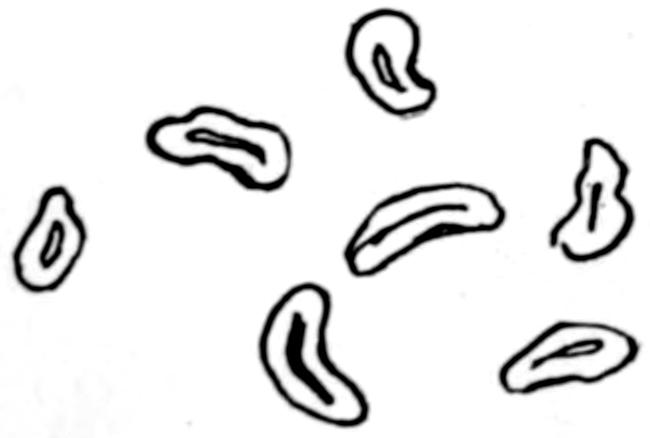
Fig. 135.—Cross Sections of Cotton Fibers.
Mercerized Cotton.
—In the mercerizing process (Chap. XII) the strong alkali used removes the cuticle of the cotton fiber and swells the cell walls, while the tension employed takes out the natural twist more or less completely. Under the microscope the modified fiber is seen to be straight, smooth, lustrous, and cylindrical (Fig. 134, B). Characteristic markings are occasional slight twistings, if the mercerization has not been perfect, and especially a lumen which appears and disappears in irregular widths, noticeable if the fiber is examined along its entire length. As the cuticle has been [369]removed, there is an even swelling of the fiber in cuprammonia with no constrictions. The lumen now plainly appears, and granular fragments may be seen in it. In cross section the mercerized fiber is rounded.
Flax.
—Flax fibers, the source of linen, are the bast fibers which lie under the outer layer of bark in the flax stalk. The fiber is made up of cells ranging from a fraction of an inch to two inches in length, and having an average diameter of .001 of an inch. Under the microscope, flax fibers show certain variations according to their quality or source, but the long fibers for linen yarn have the following characteristics in common: The shape is cylindrical, tapering to a sharp point. The cell wall is so thick that the lumen appears as a narrow, often threadlike, line. A distinguishing feature is fine cross lines at intervals, giving the appearance of joints or nodes, strikingly like those on the sugar cane or bamboo. Sometimes these intersect like the letter X (Fig. 136).
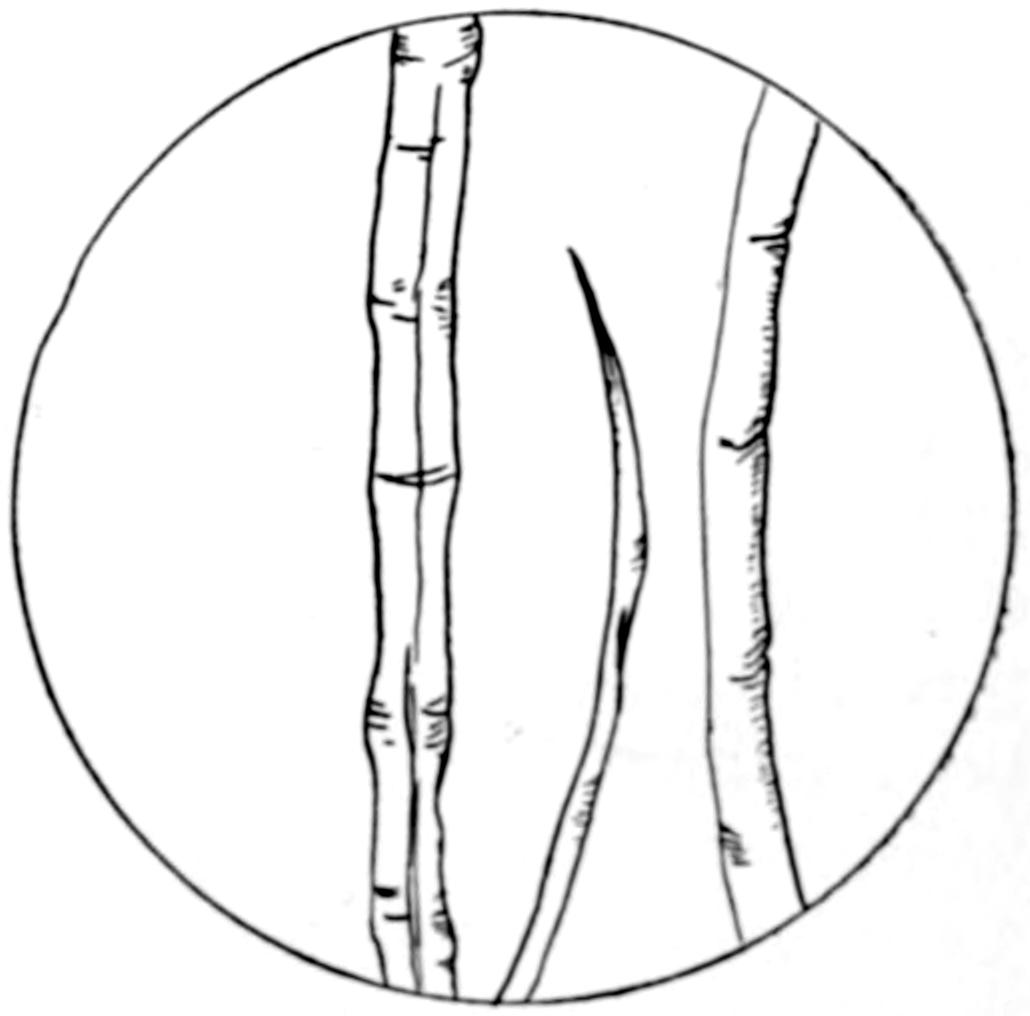
Fig. 136.—Flax Fibers.
In cuprammonia the walls dissolve with irregular swellings, but with no appearance of constricting cuticular rings, as with cotton. The lumen resembles a coiled thread.
Cross sections of flax are characteristic. They are polygonal, made up of groups of five- or six-sided cells, with a small lumen (Fig. 137).
Fibers from the base of the stem and the root of the plant are flattened, broad, and stratified, with wide lumens. In cross section the lumen shows its considerable size. These fibers are one source of tow yarn.
[370]
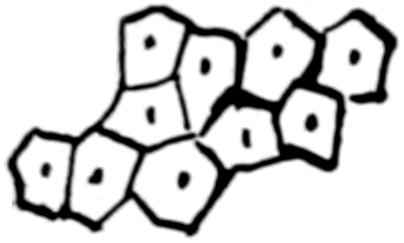
Fig. 137.—Cross Sections of Flax Fibers.
Additional Fibers.
—(See Chap. X.) Ramie is a bast fiber, from the nettle Bœhmeria tenacissima. A very similar fiber, and one generally called ramie, comes from the Bœhmeria nivea, or China grass. The fiber is large in diameter, has a silky luster, is strong, smooth, stiff, and inelastic. The bast cells are unusually large, being much longer than linen fibers and on an average three times as wide. Like linen, the cell walls are well thickened. The lumen varies, but is generally plainly visible, contains granules and sometimes equals one-third or one-half the diameter of the fiber. Characteristic appearances are a folding over of the cell wall at times, heavy transverse markings or nodes, and frequent striations along the fiber. The ends of the fiber are thick walled and rounded (Fig. 138).
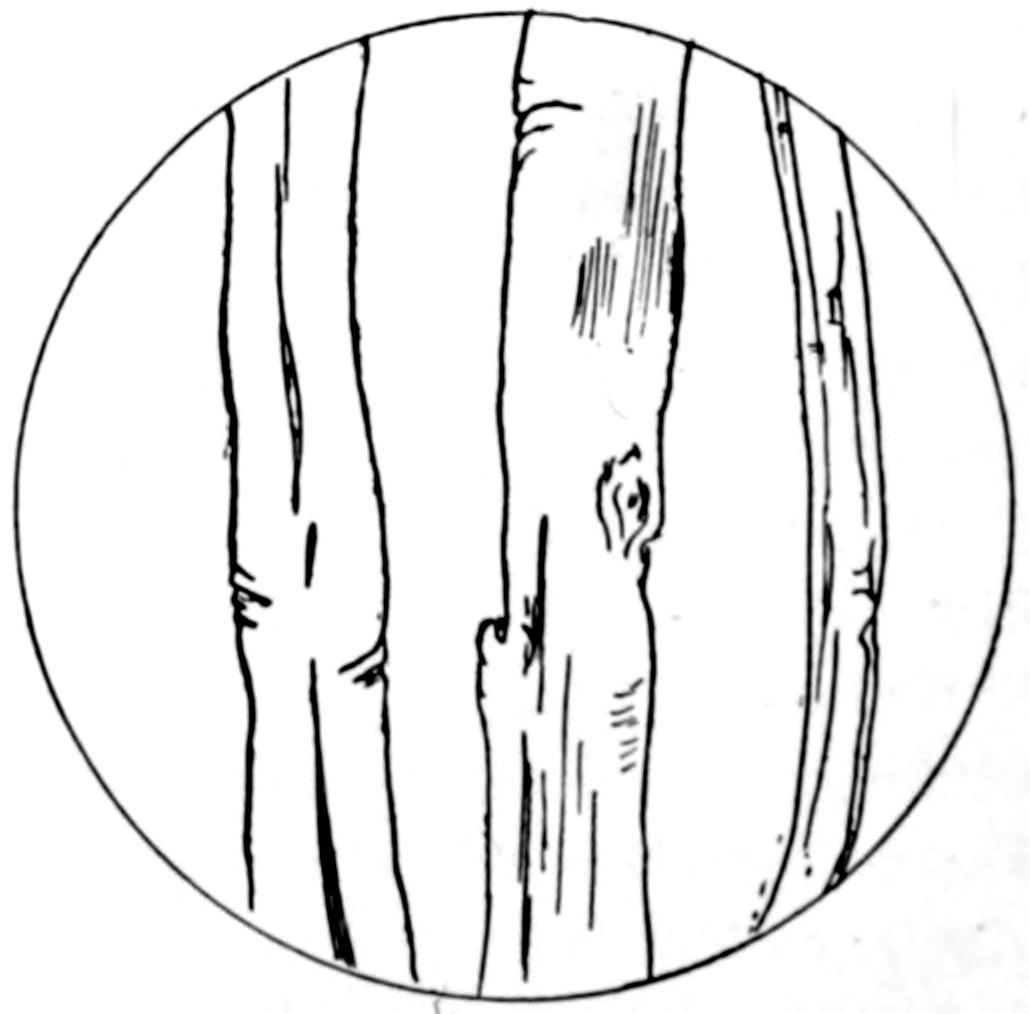
Fig. 138.—Ramie.
Jute
is the bast fiber from different species of the Corchorus, grown principally in India. The fiber is fine, long, lustrous, and soft, but deficient in strength. This is due in part to irregularities in the thickness of the cell walls, which show in the microscopic examination, as frequently the inner and outer cell walls do not lie in parallel lines. The fibers have a smooth appearance, without the transverse markings of linen and ramie. The canal is large and angular in cross section, and the fiber ends are tapering.
Hemp
is derived from many plants. For references to hemp see Chap. X and Matthews’ Textile Fibers. In general, [371]hemp resembles flax, with the differences that the cross markings are more like scorings than nodes, and the cell walls are much less regular. A characteristic is small branchings or spicules from the sides of the fiber. The fiber ends are blunt. Hemp is stronger than jute and is not weakened by salt water, therefore it is suitable for ship cordage.
Pineapple fiber
is obtained from the leaves of the pineapple plant. The elements of its fiber are extremely fine and lustrous; the lumen is threadlike. Woven with silk, the product is called Jusi cloth; alone, it forms the Piña cloth of the Philippines. The fibers of the wild pineapple of Colombia, South America, are known as pita fiber. Arghan is the name given it by a British syndicate which has developed a similar fiber in the Federated Malay States. Microscopically this fiber is a straight, lustrous filament, not so round as silk, with a narrow lumen. It is stronger than hemp or cotton of equal size, takes dye readily, and is not affected by salt water.
Coir.
—The husk of the cocoanut furnishes a cinnamon brown fiber known as coir. It is about ten inches long, but the fiber elements may be less than one millimeter in length. Under the microscope, the fiber shows irregularities in the cell wall, and a correspondingly irregular lumen, so that the latter may seem to have serrated edges. Pore openings are frequent.
Kapok
(see Chap. X, Fig. 123), a variety of Bombax cotton, comes from a cotton tree found in tropical countries. Dutch merchants trading with Java introduced the kapok and gave it its name. The pod contains the fibers in masses surrounding the seeds, but not fastened to them. The fiber is weak, thin-walled, short, silky, and lightest of all fibers in specific gravity. This property, and resistance to water absorption due to the natural oil in the fiber, make it useful for life preservers. It is also found in silk floss mattresses and mattresses for the navy. A mattress made of kapok is said to regain its resiliency on exposure to light and air.
[372]
Substitute Fibers.
—The world war brought into common use, especially in Germany, a number of substitute fibers. Yarns were made from paper pulp, which was drawn out, twisted and spun, and paper clothing was made with these yarns mixed with wool. Shoe toppings, blankets and carpetings were also made from it. “Cellulon” is the name of a wood pulp fiber. Spun glass is produced in Germany of such a fineness and tenacity that it is suited to many textile purposes. Germany and other countries have also turned to new plant sources for textile fibers. Nettles, a species of bulrush, and an African grass known as “alfa” are being utilized.
Microscopic Analysis of Fabrics.
—The purpose of the microscopic examination of a material is usually fourfold: to determine the method of construction, the nature of the fibers used, the relative amounts, if of different kinds, and their quality. A measured square of the fabric is cut out large enough to contain all of the different threads which may appear in the weave. It is then separated into warp and filling threads, which are carefully placed in different piles. The threads in each pile are individually examined. If different fibers have been used, the microscope will show whether they appear separately in warp and filling, or are combined either by twisting together or by making one a core around which the other is veneered. Other methods of combination may also be found. If possible, the different varieties of fibers are separated and weighed, which will give a quantitative estimate of the makeup of the fabric. When the various points in question have been settled and the weave has been analyzed, the microscopic examination is complete. There may yet remain questions which can be settled only by chemical tests, such as more accurate quantitative analysis, and an estimation of sizings or weightings.
[373]
CHAPTER XII
CHEMICAL STUDY OF TEXTILE FIBERS
Aims.
—Courses in textile chemistry differ in content according to the type of school and the kind of training in view; the age of the student, and the place in the curriculum. A technical course in the chemistry of textiles requires a preparation which includes organic chemistry and qualitative and quantitative analysis. Such a course has the trade aim of the textile school or the research aim of the university.
Another type of textile chemistry, which can be called an informational course, is adapted to the needs of students who are preparing to teach textiles and clothing, or workers in non-technical textile occupations. Some knowledge of general chemistry is necessary as a prerequisite. This course gives a background of information from which can be taken the material suitable to their later requirement. It may be placed as a separate course in the curriculum, or as a part of household chemistry.
A third type of chemical study of fibers consists of simple tests and explanations of chemical processes, which can be given as a part of general science work or accompanying the sewing courses in the grades and high school. No previous chemical training is necessary. This type of course is extremely worth while for the reason that it brings directly to the consumer the practical information which will help her in judging, purchasing, and caring for textiles.
It is the second type, or informational course, which is emphasized in this chapter.
Scope.
—An informational course in the chemical study of textiles should include for its subject matter:
[374]
The chemical nature of the textile fibers, with such properties of proteins and carbohydrates as apply to the case.
The effect of acids and alkalies on the principal fibers, with trade and household applications.
The identification of fibers and separation of fiber combinations in weaves.
A study of special chemical processes, particularly mercerizing and the making of rayon.
Chemical Nature of Textile Fibers
Classified according to origin, the leading textile fibers are found in the following groups:
Animal Fibers: Wool, hair, silk.
Vegetable Fibers: Cotton, flax, hemp, jute, ramie, kapok, etc.
Artificial Fibers: Rayon, chiefly of vegetable origin. Spun glass, asbestos, and metallic threads, of mineral origin.
Two important types of chemical compounds are represented in these groups. Protein is the chief constituent of the animal fibers, and the vegetable fibers belong to the cellulose type of carbohydrates.
Proteins contain the elements carbon, hydrogen, oxygen, and nitrogen, with the addition of sulphur in typical examples. Wool has a high sulphur content, but silk has none, therefore we have a subdivision of animal fibers into:
Sulphur-bearing fibers: Wool and hair.
Containing no sulphur: Cultivated and wild silks.
Celluloses contain hydrogen, carbon, and oxygen, and they may be:
Pure cellulose, e. g., absorbent cotton (free from impurities such as fatty substances), some rayon, and bleached flax (free from woody and other impurities), or,
Lignocellulose, containing lignin, a substance essential to woody tissue. Jute, hemp, and other minor bast fibers are lignocelluloses.
[375]
Reactions of Wool.
—The chief protein constituent of wool and hair is keratin. It belongs to the class of proteins which includes epidermal tissue, horn, and gelatin as a derived or hydrolytic form. As a keratinic fiber, wool is insoluble in cold water, but swells and becomes plastic to a certain extent in hot water. The plasticity of wool when so treated is utilized in the processes of crabbing and milling. (See Chap. VII, Finishing.) On prolonged boiling, some wool gelatin goes into solution. Consequently the long continued action of boiling water is hydrolytic and leads to slow decomposition, with evolution of ammonia and hydrogen sulphide. The presence of dissolved protein products may be confirmed by the biuret test.[47] Organic solvents such as alcohol, ether, gasoline, chloroform, and carbon tetrachloride have no effect on scoured wool, but dissolve fatty substances in the raw wool, or wool “in the grease.”
[47] Biuret Test. To a 10 per cent solution of caustic soda add dilute copper sulphate cautiously until a faint blue color but no precipitate remains in the liquid after shaking. Add the protein solution. A violet color indicates protein.
Dry heat produces changes in both protein and cellulose, but as far as yellowing or scorching and loss of tensile strength are concerned, wool apparently withstands dry heat better than silk or cotton. Those fibers which contain the larger amount of natural moisture probably scorch less easily, but a stiffening effect can be noticed when a hot iron is passed over wool or silk, which is analogous to the cooking of protein material. From tests made by the Department of Research of the Laundryowners’ National Association, quoted from page 108 of Standard Practice for the Power Laundry Washroom, the following comparisons are taken:
Total Loss of Strength (by Mullen Tester)
| Wool | Silk | Cotton | |
|---|---|---|---|
| 46¹⁄₂ hrs. on flat-work ironer | 20% | 27.7% | 26% |
| 18 hrs. of dry heat at 165° C | 14% | 33.9% | 28% |
Action of Acids and Alkalies on Wool.
—Being a protein, wool is both acid and basic. As an instance of its dual nature, [376]its basic groups combine with acid dyes, and its acid groups with basic dyes and various metallic salts and oxides. But alkalies are more destructive to wool than acids, so it is probable that the basic quality predominates and is able to neutralize acids.
Caustic alkalies are especially destructive to wool. The rate of deterioration depends more upon heat than upon strength of solution. A wool weave may withstand a cold 10 per cent solution of caustic soda for a half hour or more, depending upon the thickness of the material, but it begins to disintegrate in a few seconds in the same solution at boiling temperature. The action of caustic soda on wool under controlled conditions of strength and temperature is peculiar. In Harper’s Textile Chemistry the following illustration is given:
“Yarn with a breaking strain of 610 grains was immersed in cold caustic soda solution for 10 min. (A longer immersion causes deterioration.) The yarn was washed well in water containing a little acetic acid to remove the alkali, and then air-dried and tested. The following results were obtained:
| Strength of Solution |
Breaking Strain |
|---|---|
| Tw.° | grains |
| 5.8 | 570 |
| 15.0 | 430 |
| 25.0 | 180 |
| 32.4 | 95 |
| 52.6 | 335 |
| 76.6 | 770 |
| 82.4 | 875 |
Above this, weakening again occurs.”
The effect on wool of other than caustic alkalies with which it may come in contact in soaps and similar cleansers, e. g., washing soda, borax, ammonia, sodium silicate, and trisodium phosphate, depends upon the concentration of the hydroxyl ion to which these give rise on dissociation in water, and particularly upon the temperature. Uncombined washing [377]soda, trisodium phosphate, and sodium silicate are destructive to animal fibers, and when combined in soaps are not the best choice for washing wool and silk. Borax is a mild alkali, and ammonia, being volatile, is not harmful to wool in the ordinary household dilution. Both may be used on occasions for softening water and otherwise aiding in cleansing soiled blankets, for example; but, for the careful washing of baby flannels and other woolen garments of the household, nothing but the mildest of pure soaps should be used habitually. Carbonated alkalies are used when needed in the wool scouring process, to remove grease and other impurities from dirty wool, but are cautiously employed at moderate temperatures, not over 110° F. (see Chap. VII, Scouring).
Matthews [Textile Fibers (1924), p. 140] describes the use of the biuret reaction in determining the degree of deterioration or hydrolysis of wool when treated with various reagents. With regard to alkalies he says: “It was found that neutral soap had practically no dissolving effect on the wool fiber, whereas caustic alkali and alkali carbonates dissolve the fiber in amounts roughly proportional to their concentration.”
Felting of Wool.
—Alkalies greatly increase the felting tendency of soft wools. They have a swelling, softening effect on the fiber which brings it to a plastic condition. This softening and swelling in the presence of warm alkalies is a characteristic of colloids such as wool. If loosely attached epidermal scales are present, as in felting wools, their free edges in the swollen state interlock with those on fibers with which they come in close contact, and the plastic mass “sets” or coalesces into a permanent felt or mat. Friction has a great influence in producing this fusion of fibers, consequently all unnecessary handling and rubbing should be avoided in washing woolens.
Action of Acids on Wool.
—Wool stands up under treatment with acids better than with alkalies, yet their effect when not [378]actually destructive is usually to increase felting action and make the fibers more harsh and boardlike. Acids are used in certain wool manufacturing and dyeing processes, but with care as to suitable strength and temperature.
Sulphuric acid, when cold and dilute, has no appreciable destructive action on wool fibers, and is employed in the carbonizing process (see Chap. XIII). Some of the acid is taken up by the fiber, but owing to the basic nature of wool it has no tendering effect. But prolonged boiling with the acid in the strength of solution used for carbonizing, (e. g., 3 per cent to 5 per cent strength), will cause hydrolysis and destruction of the fiber. Sulphuric acid of 25 to 30 per cent strength will slowly dissolve wool. In dyeing wool with acid colors, dilute sulphuric acid is used to liberate the color acid from the dye and to increase the affinity of the wool for the color (see Chap. XIII).
Hydrochloric acid is similar to sulphuric in its action.
Nitric acid colors wool yellow. Except for this color change, wool can be treated for a short time in very dilute nitric acid without being seriously affected, and dyes are sometimes so stripped from the fiber before re-dyeing. Ordinary concentrations of the acid are slowly destructive to the fiber. Absorption tests have shown that nitric acid is most readily absorbed by wool, and acetic acid least.
Organic acids, for example acetic, have little or no deteriorating effect on wool. Acetic acid, like sulphuric, is absorbed to a degree by wool, and increases its affinity for dyestuffs. It is used in dyeing wool with basic dyes.
Tannic acid is different from other acids in that it is not taken up to any extent by wool, unless fixed in the fiber by the aid of metallic salts such as tartar emetic or stannous chloride (see Mordants, Chap. XIII).
Nitrous acid is used to diazotize wool in the application of developed dyes (Chap. XIII).
[379]
Chlorine.—Wool is destroyed by strong chlorine bleaches, but in weak solutions of hypochlorites, with suitable control of conditions, it becomes chlorinated (see Chlorinated Wool, below).
Neutral salts have no chemical action on wool, but certain acid or basic salts, when dissociated in solution, combine with the wool and act as assistants or as mordants in dyeing. An example is potassium dichromate.
Reactions of Silk.
—After the water-soluble silk gum or sericin is removed, the chief protein constituent of the silk filament is fibroin. Fibroin is insoluble in water, and can withstand the action of boiling water better than the keratin of wool. Sericin or silk gum is dissolved and removed by hot water. Dry heat, as shown above, is more destructive to silk than to wool, probably because the filament does not have the horny epidermal protection that wool has.
Silk, like wool, is both acid and basic, but since it succumbs more slowly than wool to alkalies, and is more quickly destroyed by mineral acids, it appears to have less of the basic property which is so marked in wool, and more of the acid.
Alkalies.
—Strong alkalies have the ultimate destructive effect on silk that they have on wool, the only difference being that the action is slower. Weakly alkaline solutions at moderate temperatures have little effect except to cause a diminution of luster.
Acids.
—Silk absorbs acids to a greater extent than wool, and is less able to neutralize them in the fiber, therefore they have a destructive effect. In strong hydrochloric acid boiled-off silk dissolves almost instantly. Heavily weighted silk, raw silk, and wild silk dissolve more slowly, owing to their lower absorptive capacity. Sulphuric acid reacts similarly to hydrochloric, but more slowly and if the temperature is low, silk may be recovered from concentrated sulphuric after brief immersion, without decomposition but with a [380]shrinkage of one-third to one-half its length. The action of nitric acid is similar to its effect on wool, as to color change and destruction, the latter being more rapid, however.
Dilute organic acids such as acetic or tartaric are harmless to silk at low temperatures, and may be used to remove stains, give scroop, or aid in dyeing. Even oxalic acid, which is a stronger reagent, may be used for stain removal, if neutralized and thoroughly washed out.
Tannic acid is rapidly absorbed by silk, especially in hot solution, and is used in some dyeing processes.
Hydrofluoric acid is peculiar in its action. It attacks mineral but not organic matter if used in weak solution at moderate temperatures, so it may be employed to remove mineral weighting from silk without appreciable injury to the latter.
Chromic acid has a marked effect on boiled-off cultivated silk, which it destroys in a few seconds at boiling temperature. Wild silk resists the action of the acid long enough to make this a recognition test for the two kinds of silks in fabrics.
Salts.
—Chlorides, or free chlorine, have a most destructive action on silk. Common salt in body perspiration or on the hands of workers on silk, when allowed to stay in the fiber, may cause spotting and weakening of the fabric, especially if tin salts have been used in weighting the material. When salt is used in the dyebath for silk, as recommended with some household dyes, it must be thoroughly rinsed from the dyed material. Silk is very absorptive of all salts in solution, and due to this capacity, certain salts, such as tin, may be used in the dyeing process to give weight to the silk (see Chap. IX, and below).
Basic and acid zinc chloride, ammoniacal nickel oxide, and cuprammonium solution dissolve silk.
Reactions of Vegetable Fibers.
—Cellulose, or celluloses, the principal constituents of vegetable fibers, are among the most stable of chemical substances, when pure. The molecule [381]of cellulose is so complex that its structure is usually represented by the expression n(C₆H₁₀O₅), which indicates the general proportions of its three elements and covers a number of related compounds. Actually the value of n in the molecule may be a thousand or greater. Cellulose can best be described, then, by its properties, and these are also the properties of purified cotton, flax, and ramie. Pure cellulose is long-lived. It is inert and not subject to decay if kept dry and not exposed to sunlight. Direct sunlight causes gradual deterioration. Linen fabrics thousands of years old are found in excavated Egyptian tombs. The cellulose molecule contains feeble acid and basic ions, the acid slightly predominating.
Cold water has no deteriorating effect on cellulose; in fact, cotton threads are stronger wet than dry. No appreciable effect is produced on cotton by water at 212° F., but when pressure raises the temperature to 320°-340° F. a tendering begins, due probably to the formation of hydrated or hydrolytic products. This has been investigated and proved in laundry research, where “it is evident that the temperature of an ironing machine operated at 90 lbs. steam pressure (saturated steam at a pressure of 90 lbs. per square inch is at a temperature of 320° F.) is about that at which cotton cloth begins to deteriorate, although this deterioration is not at once evident as a scorch.”[48] Dry heat is destructive to cellulose, as has been shown above. When the temperature of the oven was 330° F., the exposure for eighteen hours caused a loss of more than one quarter of the strength of the cotton fiber, and only a little less effect with the flat-work ironer at about the same temperature for 46¹⁄₂ hours. The difference was probably accounted for by the cooling effect of evaporation in the ironing process. This effect of heat as employed in ironing suggests a study in the deterioration [382]of household cottons and linens under the ironing temperatures commonly employed in the household.
[48] Standard Practice for the Power Laundry Washroom. Laundryowners National Association.
Action of Alkalies.
—Cellulose is resistant to alkalies, but is not entirely unaffected by them. Cold dilute solutions have practically no effect, but with increase in temperature the hydrolytic action of the OH ion produces a gradual weakening of the cotton, and especially of the linen, fiber, which is more marked if air is present (see Heuser, Textbook of Cellulose Chemistry, for action of caustic alkalies on cotton). If an oxidized cotton or oxycellulose forms, as it may if air is in contact with the fiber while in the hot alkali, the material is still further tendered. An oxycellulose also forms if cotton is overbleached with too strong bleaching solution. Under pressure, at temperatures above 100° C., cotton is rapidly hydrolyzed by strong alkalies.
Carbonated and other alkalies of the milder type have more or less action on cotton according to strength of solution and temperature, the effect being proportional to the amount of dissociation into OH ions, i. e., to the concentration of OH ions in the solution. At mild temperatures, carbonated and caustic alkalies may strengthen cotton for a time, due to mercerizing and shrinking effects.
Cold strong alkalies produce a peculiar change in the cotton fiber known as mercerization. The process of mercerizing is described later.
Action of Acids.
—As a rule, mineral acids attack cellulose.
Concentrated sulphuric breaks it down completely in a few minutes, and even very dilute sulphuric is destructive if dried and concentrated in the fiber, as shown by its use in the carbonizing process (see Chap. XIII). The products of this disintegration may be dextrins and glucose. Commercial glucose is produced by the hydrolysis of starch with sulphuric acid, starch being a substance allied to cellulose. If we get a drop of sulphuric acid on our clothing of vegetable material—or silk, for that matter—great speed in neutralizing [383]is the only thing that can save the fabric. However, when cellulose in the form of unsized paper such as filter paper, which is a pure form, is immersed in sulphuric acid of a specific gravity of 1.5 to 1.6 for a moment or two, then washed and dried, it will be found to have taken a toughened hydrated form which is called vegetable parchment, and sulphuric acid of about this strength is sometimes applied to cotton to give it a wool-like appearance, or in other cases the clear, transparent look of linen. The deterioration or destruction of the fiber is prevented as much as possible by low temperature, proper control of the process, and usually by using a “buffer” substance such as pyridine or ammonium salts.
The action of hydrochloric and of nitric acid is different. Concentrated hydrochloric acid has slow destructive action, and it can be used to separate silk from cotton in a weave by destroying the former. The cotton is not greatly affected in the brief time taken to destroy the silk. But hydrochloric acid gas in the presence of moisture is used to destroy cotton in the carbonizing process (see Chap. XIII). Nitric acid, however, combines with cellulose to form nitrated cellulose. When nitrated to the hexanitrate degree, cellulose loses its inert nature and is highly explosive guncotton. A lower nitrate, e. g., the tetranitrate, when dissolved in alcohol and ether, becomes the remedial collodion or new-skin. Cotton linters nitrated, dissolved, and further treated, make the nitrocellulose form of rayon (see Chap. IX, and below).
Volatile organic acids, such as acetic, have no appreciable effect on cotton or linen, but under certain conditions acetic anhydride will dissolve cellulose with the formation of cellulose acetate. This product has a number of important uses: for celanese or lustron silk (see below); for photographic films; “dope” for aëroplane wings, insulating material, etc. Oxalic acid, which is non-volatile and sharply crystalline, will disrupt the fiber if allowed to dry in it (see Chap. XIV). This is especially noticeable if a hot iron is put on a spot which [384]has been treated with oxalic without subsequent washing out or neutralization. Holes have often appeared in cotton or linen fabrics for this reason, sometimes because oxalic acid may have been used in the commercial laundry in connection with the bluing water. But oxalic acid is a safe and efficient stain remover for household use if carefully washed out or neutralized with soap, borax, or ammonia.
Cotton has an affinity for tannic acid and will absorb or adsorb a considerable amount. An analogous effect is noticed when a starch solution is treated with tannic acid. The starch adsorbs the acid and forms a precipitate with it. Cotton so treated can be dyed with basic dyes, as the cellulose holds to the acid and the acid holds to the dyestuff, thus acting as a mordant (see Mordants, Chap. XIII).
Chromic Acid has only a slow action on cellulose. It can be used as a separation reagent for silk-vegetable fiber mixtures.
Action of Salts.
—One of the most interesting of these reactions is the solubility of alkali-treated cellulose in carbon disulphide, to form “viscose.” This material is best known commercially in its finished product of viscose silk (see Chemistry of Rayon, below), but it has other important uses. Concentrated solutions of zinc chloride and of ammoniacal copper oxide (Schweitzer’s reagent) are also used to dissolve or “surface” cellulose material for commercial uses, such as cuprammonium silk (see Rayon, below). Salts such as magnesium and aluminum chloride are absorbed by cotton and are often used in cotton finishing. Zinc chloride is used to prevent or retard the growth of mildew. As these are acid-liberating salts, their presence in the fiber is likely to cause tendering, especially at elevated temperatures. Sodium stannate is also absorbed to a considerable extent and is an ingredient in the permanent fireproofing of cotton (see below). Certain basic salts also act as mordants by being absorbed by the cellulose on one hand and holding to the dye with the other.
[385]
Chlorine Bleaches
have little effect on cellulose unless too strong, or not sufficiently removed by washing. In this case an oxycellulose may form. The presence of one kind of oxycellulose can be shown by immersing the material in a 1 per cent solution of methylene blue. The oxycellulose takes up the dye, ordinary cellulose does not. Another form of oxycellulose has been recognized with different properties. It reduces Fehling’s solution.
Lignocelluloses
are not so enduring as pure cellulose. The woody substance they contain deteriorates with age and is much more susceptible to chemical action. Jute and hemp are examples of lignocelluloses. Of the two, jute is more easily decomposed, and becomes brittle with use, especially in contact with salt in the air or water.
Experiments
The following experiments illustrate the chemical nature and reactions of the principal fibers:
Elemental Composition.
—The elements present in the animal and vegetable fibers may be recognized by a simple method of destructive distillation:
1. Burn a sample of wool material in a dry test tube. The products evolved include gaseous compounds of carbon and hydrogen, water, ammonia, and hydrogen sulphide. Notice the odor like burning hair or feathers, and the condensation of hydrogen and oxygen as water on the sides of the tube. Test by odor and red litmus paper for ammonia. Hold in the mouth of the tube a roll of filter paper moistened in lead acetate. In the presence of a volatile sulphide the paper is colored silvery black. The residue contains carbon. Make a summary showing how the elements C, H, O, N, and S combine to form these products.
2. Repeat with silk. No sulphur is found, unless a trace may be present from sulphates used in the weighting. Other reactions are the same as with wool.
3. Repeat with cotton. Notice odor like burning wood or paper. Cotton and wood yield similar products when destructively distilled, including hydrocarbon gases, acetone, wood alcohol, and acetic acid. [386]Acetic acid is volatile. Prove its presence by holding a piece of moistened blue litmus paper in the fumes. Try to find ammonia and sulphur as before.
4. Burn samples of wool, silk, cotton, and rayon yarns. Could this be a home test to recognize animal and vegetable fibers by their odor and residue on burning? Does rayon burn in a distinctive manner? Burn several samples of silk dress goods. Is there a difference in manner of burning and residues? Account for it.
5. Dissolve a sample of silk in 5 per cent caustic soda solution by boiling. Repeat with wool. To each solution add a little lead acetate solution. The dissolved wool gives a black color with lead acetate, due to sulphur present; the silk solution shows no change.
Action of Acids.
—Immerse samples of wool, silk, cotton, linen, and rayon in the following solutions, under the same conditions. In each case note time taken to produce changes, if any, and comparative effects. Tabulate results.
1. Concentrated sulphuric acid (cold).
2. Five per cent sulphuric (cold). Squeeze out and without washing dry in air bath at 100° C. Note condition of fibers, and compare with carbonizing process (below).
3. Concentrated hydrochloric acid (cold).
4. Fifty per cent nitric acid (cold).
5. Concentrated chromic acid (warm to 80° C.).
6. Dilute acetic acid (cold and boiling). Squeeze out and without washing dry in oven, and examine for strength.
7. Five per cent oxalic acid (cold and boiling). Treat as with acetic.
Action of Alkalies.
—In the same manner, try the action of the following:
1. Ten per cent solution of caustic soda (cold).
2. One per cent and 5 per cent solutions of caustic soda. Raise temperature gradually. Note critical temperature for disintegration of wool and silk, and comparative time required.
3. Five per cent solution of household lye (boiling).
4. Five per cent solution of washing soda (cold and boiling).
5. Five per cent solution of ammonium hydroxide (cold).
6. Five per cent solution of borax (cold and boiling).
7. Weak solution of Javelle water (cold and warmed).
[387]
(a) After tabulating the results of these experiments, make a list of fiber combinations which can be separated by the acids or alkalies used.
(b) Apply the facts obtained to stain removal processes; to trade processes, such as fulling or milling, carbonizing, mercerizing.
Suggested Exercises. 1. To study the comparative composition and reactions of soaps, make 3 per cent solutions of a pure, mild flake or bar soap, and of soaps containing borax, washing soda, rosin soap, a bleach, trisodium phosphate, and sodium silicate. (See Chap. XIV., under Study of Soaps, for tests to recognize these ingredients.) Enter identical samples of wool and of cotton (linen also if desired), in the same bulk of each solution, raise to boiling, and under equal conditions boil for about twenty minutes or a half hour. This gives a quick estimation of the comparative effect of a pure soap and soaps with various “builders” on wool and cotton.
2. Compare different strengths of Javelle water on dressing-free cotton, as to formation of oxycellulose. Test with methylene blue as directed above. Test for the presence of oxycellulose in cotton boiled in solutions of caustic soda or washing soda in the presence of air. Compare strengths of original and treated samples on the Scott or Mullen strength tester.
3. Study comparative strengths of wool, silk, and cotton materials subjected to long boiling in pressure cooker, various oven heats, or ironing with an iron of tested temperature.
4. Measure the tensile strength of rayon samples when (1) dry; (2) wet in cold water; (3) wet in boiling water; (4) re-dried from each; (5) washed with variations in choice of soap and method of washing.
5. Compare equal percentage strength solutions of washing soda, borax, and trisodium phosphate in a series of washing tests on wool, as to strength, color, and shrinkage.
6. What happens to the wool fiber, in strength and microscopic appearance, when treated with 20 per cent, 35 per cent, and 50 per cent solutions of caustic soda at 15° C. for 1 min.; 10 min.; 30 min.?
7. Soak samples of silk for several minutes in a 10 per cent solution of sodium chloride, and in one or more of the perspiration formulas (Chap. XIV). Without washing, lay aside for some days and observe any change.
Separation and Identification Tests
Color Differentiation Tests.
—Color tests are especially useful on white or light colored mixtures of animal and vegetable [388]fibers, in cases where the object may be to identify the fibers without destroying the weave, or to detect the presence of a very few threads of wool or silk mixed with cotton.
Picric Acid. Picric acid in solution is a dye for animal fibers. Silk, wool, and cotton in underwear, for example, may be recognized individually without injury to the fabric, by spotting with the solution in an inconspicuous place. Silk and wool are colored yellow, the former taking the dye with a deeper, more lustrous effect than wool. Cotton loses the color of the dye on washing.
Millon’s Reagent[49] produces a red color on animal fibers; vegetable fibers are uncolored. The material is moistened with the reagent and slightly warmed.
[49] Millon’s Reagent. 100 grams mercury dissolved in 72 cc. nitric acid, (specific gravity 1.4) in the cold. When action ceases add twice the volume of cold water.
Nitric Acid of about 50 per cent strength gives a yellow color (xanthoproteic reaction) to animal fibers, not to vegetable. The color deepens to orange on touching with ammonia. Concentrated nitric acid colors jute reddish brown.
Dyestuffs. A mixture of animal and vegetable fibers may be dyed in a dye for wool and silk, e. g., acid magenta, and the color effect compared with a similar sample dyed in a cotton dye, e. g., congo red.
Iodine and Sulphuric Acid.[50] Cotton and linen are colored blue; hemp becomes greenblue; jute yellow; nitrocellulose and viscose silk blue; acetate silk, yellow. The colors should be observed under a microscope. The fibers are first treated with solution I, the excess of reagent is removed with filter paper, and after one or two minutes solution II is applied.
[50] Iodine and Sulphuric acid (Hoehnel’s Reagent). Solution I. One gram of potassium iodide dissolved in 100 cc. of water, and iodine added in slight excess. Solution II. Twenty cc. of glycerol mixed with 10 cc. of water. Add 30 cc. conc. sulphuric acid.
Separation of Wool-Cotton Mixtures.
—Animal fibers are destroyed by boiling in a solution of caustic alkali; vegetable fibers are not.
Caustic Potash or Soda Method. Weigh the air-dry sample, boil for fifteen minutes in a 5 per cent solution of caustic potash preferably, [389]keeping the solution at constant strength by replacing the water lost by evaporation, or by using a reflux condenser. (A long piece of glass tubing rising vertically through the cork of the flask will answer.) Remove the cotton residue, (Figs. 139, 140,) wash thoroughly, restore to air-dry condition, and weigh. It is estimated that cotton loses from 3 to 5 per cent of its weight through the action of the alkali. Taking 3 per cent as the loss of cotton, the percentage composition would be found according to the following example:
| Weight of air-dry sample | 2.500 | gms. |
| Weight of cotton residue | 1.700 | gms. |
| 1.700 gms. equals 97% of total cotton, therefore | ||
| 1.700 divided by .97 equals total cotton or | 1.750 | gms. |
| Per cent of cotton | 70% | |
| Per cent of wool, by difference | 30% | |
The above is a rough method. To be more accurate, the analysis must first take into account the weight of the finishing materials in the fabric. A method of removing these, recommended by Matthews, is as follows:
Weigh the air-dry sample, boil in a 1 per cent solution of hydrochloric acid, then in a very dilute solution of sodium carbonate (about one-half per cent), and lastly in water. Air dry and weigh. The loss is finishing material and coloring matter. Dry in an air bath at 100° C. to constant weight to remove the natural moisture of the fabric. Record weight of moisture-free material, and treat with the solution of caustic potash as above. Make the correction for loss of cotton. Finally, since the amount of wool and cotton in a mixed weave is not based on dry weights, estimate the natural amount of moisture in cotton cloth approximately at 8 per cent. and in wool at 16 per cent. (The United States Government allows 11 per cent regain of moisture for silk.)
For example:
| Gms. | Per cent |
||
|---|---|---|---|
| Weight of air-dry sample | 5.00 | ||
| Finishing materials (loss) | .05 | 1.0 | |
| Dressing-free sample | 4.95 | ||
| Moisture (loss) | .75 | 15.0 | |
| Moisture-free sample | 4.20 | ||
| Cotton residue (after treatment with alkali) | 2.00 | ||
| Wool (by difference) | 2.20 | ||
| Correction of cotton due to loss in alkali equals 3 per cent, or 2 gms. = 97 per cent of cotton in original sample. 2 gms. ÷ .97 | 2.06 | + | 41.2 |
| Correction of wool. 2.20 gms. = 103 per cent. | 2.14 | - | 42.8 |
| 100.0 | |||
| Finally, the relative amounts of cotton and wool in the original sample, based on normal moisture conditions, are found as follows: | |||
| 2.06 gms. of moisture-free cotton = 92 per cent of normal cotton | 2.24 | normal cotton | |
| 2.14 gms. moisture-free wool = 84 per cent of normal wool | 2.54 | normal wool | |
| Total normal wool and cotton in sample | 4.78 | ||
| Per cent cotton | 46.8 | ||
| Per cent wool | 53.2 | ||
[390]
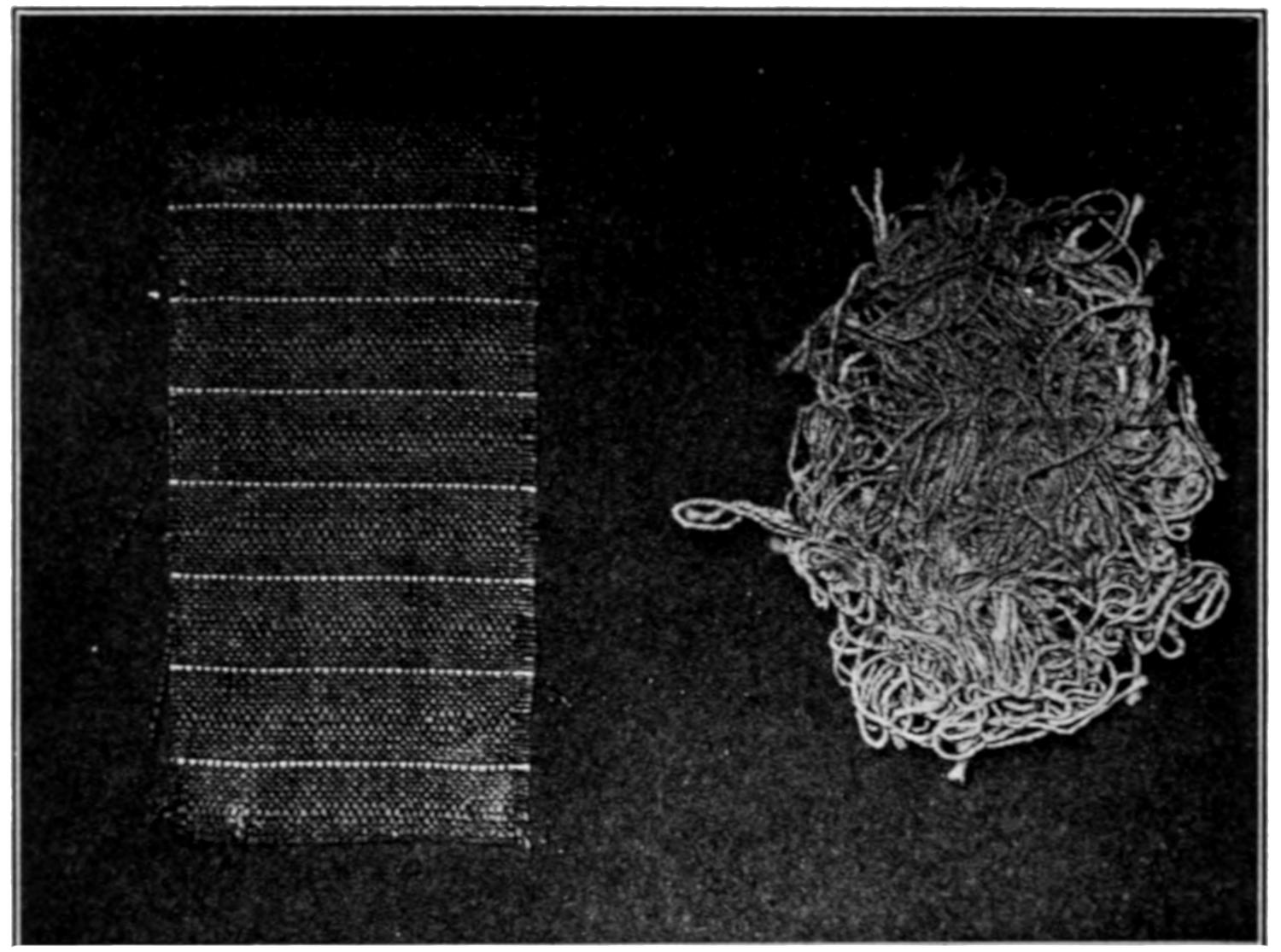
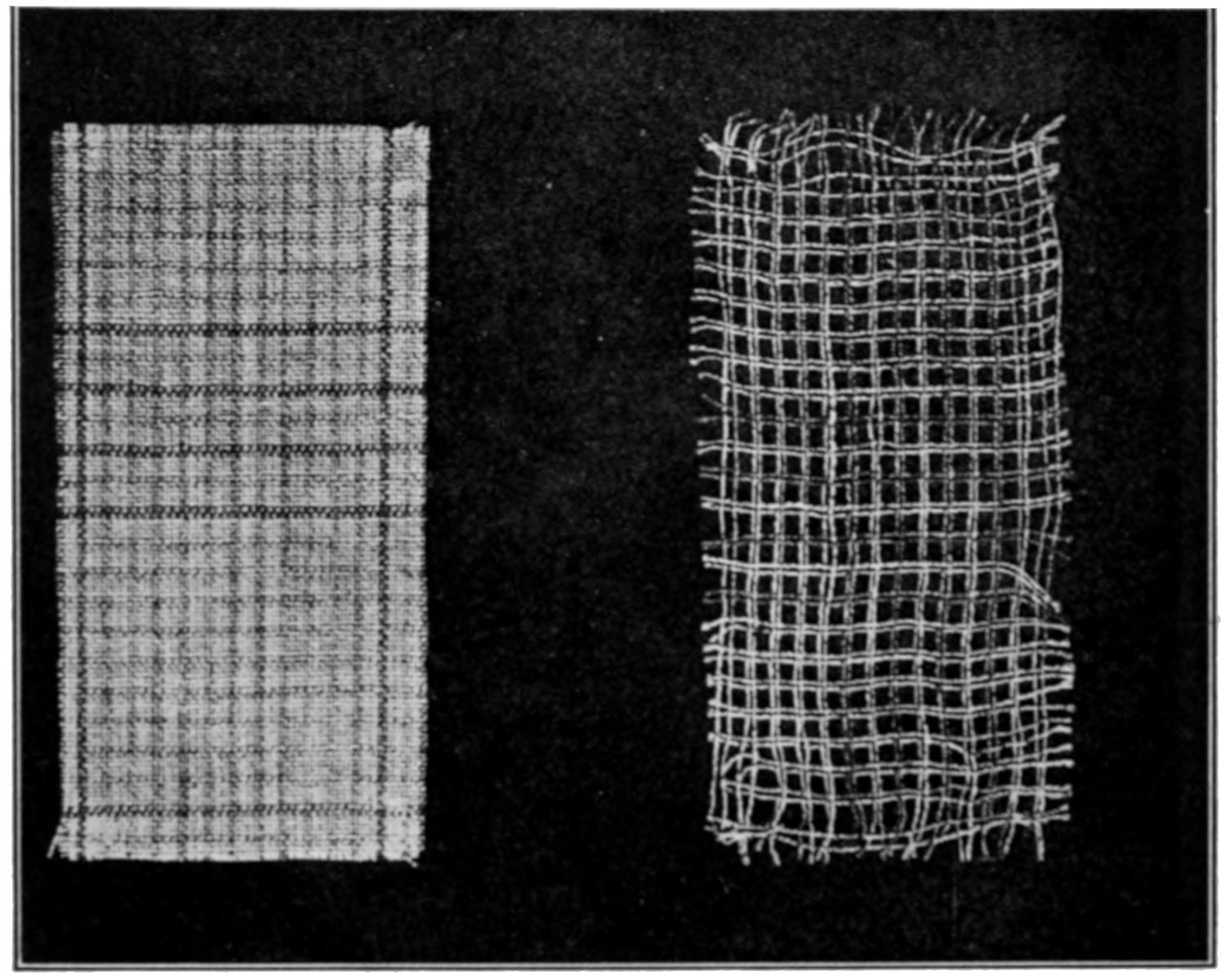
Figs. 139, 140.—Mixed Wool and Cotton Fabrics treated with Caustic Potash. The Original Material and the Cotton Residue are Shown.
[391]
Ammoniacal Copper Oxide (Schweitzer’s Reagent).[51] Immerse a sample of wool-cotton mixture in Schweitzer’s reagent for about twenty minutes. The cotton is dissolved; the wool remains.
[51] Schweitzer’s Reagent. Dissolve 5 gms. copper sulphate in 100 cc. boiling water, add caustic soda solution to complete precipitation. Wash precipitate thoroughly and then dissolve in the least possible quantity of concentrated ammonium hydroxide.
Separation of Wool-Silk Mixtures.
1. Immerse in 40 per cent HCl. Silk is destroyed in two minutes. If the test is made quantitative, finishing materials and moisture are removed by the method given above, and a correction of 0.5 per cent is made for loss of wool.
2. To a 5 per cent solution of caustic soda add sufficient lead acetate to form a heavy white precipitate. Mix well. Heat a white or light-colored sample in the mixture until a brown or black color is developed on the wool fiber. Silk is uncolored. Remove and wash. This test also applies to wool-cotton mixtures.
3. Ammoniacal nickel oxide[52] and basic zinc chloride dissolve silk with little loss of either cotton or wool. The silk in ordinary fabrics will dissolve in the former in two minutes, in a cold solution. If basic zinc chloride is used, warm the sample for five minutes.
[52] Ammoniacal nickel oxide. Dissolve 5 gms. of nickel sulphate in 100 cc. water; add NaOH to precipitate nickel as hydroxide. Filter, wash, dissolve precipitate in 25 cc. concentrated ammonium hydroxide, and add an equal volume of water.
Basic Zinc chloride. Heat together 1000 parts of zinc chloride, 850 parts of water, and 40 parts of zinc oxide until complete solution is effected.
[392]
4. A strong solution of barium sulphide will dissolve wool and leave silk or cotton unchanged. The action is quicker in a warm solution.
5. Copper glycerol solution[53] dissolves silk but does not affect wool. Warm the sample in the solution for a few moments.
[53] Copper glycerol solution. Dissolve 16 gms. of copper sulphate in 150 cc. of water, with the addition of 10 gms. of glycerol; then gradually add a solution of caustic soda until the precipitate of copper hydroxide which is at first formed just redissolves.
Separation of Silk-Cotton Mixtures.
—Hydrochloric acid, ammoniacal nickel oxide, basic zinc chloride, copper glycerol solution, chromic acid, and caustic soda solution will destroy silk but not cotton. The quantitative estimation is usually made by the caustic soda method.
Silk and Wild (Tussah) Silk.
—The microscope furnishes the most reliable test. The reagents which will destroy cultivated silk will also destroy wild silk, but the slower rate of absorption of the latter makes a basis for differentiation tests. For instance:
Cultivated silk is destroyed in about ten minutes in hot 5 per cent solution of caustic soda, but wild silk requires a longer time, perhaps thirty minutes.
Cold 40 per cent hydrochloric acid dissolves cultivated silk rapidly and wild silk slowly, some samples requiring an hour for complete solution.
Warm copper glycerol solution dissolves cultivated silk more rapidly than wild silk.
Boiling chromic acid dissolves cultivated silk more rapidly than wild.
Rayon with Other Fibers.
—Rayon can usually be recognized by its high luster and its manner of burning, but its separation from other fibers may be accomplished as follows:—
Rayon-True Silk.
—The best separation is effected by the copper glycerol solution, which destroys true silk but does not affect rayon. This test may be made quantitative.
[393]
Boiling solutions of caustic soda destroy true silk but not rayon, although the latter is softened and weakened, and the method is not a quantitative one.
The color tests given above to differentiate between animal and vegetable fibers apply to mixtures of rayon with wool or silk, and reveal the method of mixing the rayon in the weave.
Rayon-Wool.
—Cold 40 per cent HCl will slowly dissolve rayon, but does not disintegrate wool. Cold chromic acid dissolves rayon more rapidly.
A strong solution of barium sulphide will destroy wool with no effect on rayon.
Rayon-Cotton.
—Chromic acid destroys rayon more rapidly than cotton.
Mixtures of true silk, rayon, and cotton are found. The true silk can be dissolved out with copper glycerol solution and the rayon subsequently with chromic acid, leaving the cotton.
To distinguish between different kinds of rayon, e. g., nitrocellulose, viscose, cuprammonium, and celanese (lustron) silks, apply:
1. Burning Test. Nitrocellulose, viscose, and cuprammonium silks smell like burning paper and leave a gray ash; acetate silk (celanese or lustron) has a pungent smell, and leaves a blackish ash.
2. Iodine and Sulphuric Acid. Warm and apply. Acetate silk turns yellow; viscose dark blue; nitrocellulose violet; cuprammonium light blue.
3. Acetate silk dissolves in strong acetic acid; the others are not affected.
4. Immerse fibers in concentrated sulphuric acid. In the case of the nitrocelluloses no coloration appears for nearly an hour, then a pale yellow color shows. Cuprate silks show a yellow color at once, which deepens on standing, and viscose silks turn reddish brown immediately. Dyed silks must have their color removed before this test is made.
5. (From Griffin’s Technical Analysis.) Heat 0.2 gm. rayon in a test tube with 2 cc. of Fehling’s solution on a water bath for 10 minutes, then fill with water. Nitrocellulose silks show a green color, cuprammonium and viscose a clear blue.
[394]
Cover equal weights of cuprammonium and viscose silks in a test tube with zinc-chloride-iodide solution,[54] and after a few seconds pour off the excess. Then fill the test tube with water, pour off and repeat washing process until the water is light yellow or colorless. Cuprammonium silks are only weakly colored brown; viscose silks are colored bluish green for some time.
[54] Zinc-chloride-iodide solution. Dissolve 2 gm. potassium iodide and 0.1 gm. iodine in 5 cc. water. Add to this a solution of 20 gms. zinc chloride in 10 cc. water. Settle and use clear solution.
Cellulose acetate silk is soluble in a mixture of 5 parts chloroform and 2 parts denatured alcohol; also soluble in acetone.
Cotton-Linen.
—The microscope is the most reliable means of identifying flax fibers. Color and chemical tests are not satisfactory in distinguishing cotton from fine bleached linen, which by the processes of retting[55] and bleaching has become chemically identical with cotton. Coarser linen and cotton mixtures, such as towelings, respond fairly well to the tests given below, because of more marked differences in the rate of absorption by the flax of the reagent used. How to distinguish between cotton and linen in the household, without the microscope as a possibility, is one of the most frequent and important problems the purchaser of household supplies has to solve. The well known spotting test with water, oil, or ink is not to be depended upon, owing to certain dressings which may be given to cotton to increase its absorptive power. The surest tests are these: Unravel the yarn, [395]slowly pull it apart, and look at the parted ends. Flax fibers look straight, pointed, lustrous, and translucent; cotton fibers curl in different directions and look white and opaque. The length of staple should be an indication. Good cotton fibers average not over an inch, but good flax fibers may be considerably longer. Another home test which works as well as any color test, on a sample of toweling, for instance, is to fringe in both directions so that warp and filling threads are exposed for half an inch. Stain with ink, wash slightly, to remove excess, and place in a solution of oxalic acid. The stain fades more rapidly from the cotton than from the linen. This test can be used only on union goods, where the two fibers are close enough for comparison. The following tests are for laboratory use:
[55] The object of retting is to separate the bast fibers themselves, and to free them from the other parts of the flax stalk—the bark, woody tissue, and pith or marrow. A substance known as pectin binds the bast fibers to each other and to the surrounding stalk, but in the process of fermentation, while the flax is immersed in water, this is more or less completely removed. This is effected principally by micro-organisms which in the absence of air will attack moist pectin and break it down into simpler compounds. These are, as a rule, soluble and wash away, leaving the bast fibers free. Some pectic acid may be formed, which being insoluble in water remains on the fiber. Full bleaching still further purifies the flax fiber, however, making it nearly pure cellulose. This slow and expensive method of retting flax under water by the action of anaerobic bacteria has led to experimentation with other methods of removing the pectose without injury to the flax fiber. One of these employs aerobic bacteria to work on the pectin bodies. The flax is placed in vats, warm water and the bacterial cultures are added, and a current of air is sent through the water until retting is complete, in 36 to 40 hours. (See Chap. X.)
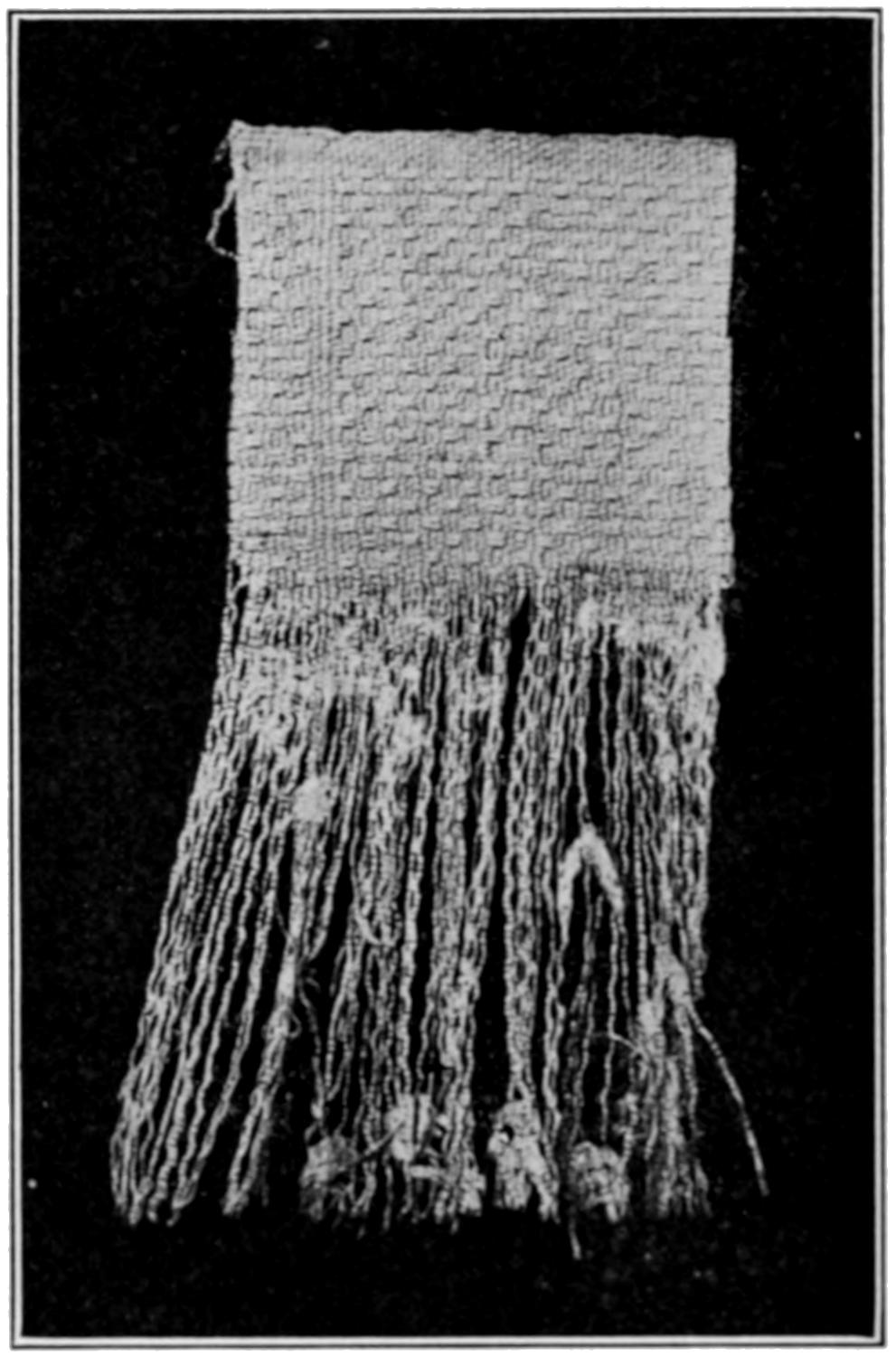
Fig. 141.—Mixed Linen and Cotton Toweling treated with Sulphuric Acid. The Linen remains in the Fringe.
Sulphuric Acid. Immerse the sample in concentrated sulphuric acid for one and one-half to two minutes, according to the texture of the material. Remove, wash thoroughly with water, followed by weak ammonia. Cotton fibers are weakened more than linen, and can be washed out, leaving the linen (Fig. 141).
[396]
Fifty Per Cent Caustic Potash. Warm a fringed sample of union material in this reagent. Remove and dry between filter paper. Linen becomes brownish-yellow; cotton white or straw color.
Fuchsin. Immerse a fringed sample in a 1 per cent solution of fuchsin in alcohol. Wash, lay in ammonia; then in strong caustic soda solution. Cotton is slightly colored; linen becomes rose-red.
Cyanin. Warm a fringed sample over a water bath in a 1 per cent alcoholic solution of cyanin. Wash in water to which only a drop or two of sulphuric acid has been added. Linen fiber is colored blue; cotton is paler in color. The color may be intensified by treatment with ammonia water.
Rosolic Acid. Warm the fringed material over a water bath in an alcoholic solution of rosolic acid, wash and dip for a second in strong caustic soda. Wash. Linen remains rose-red, cotton loses it color.
Copper Sulphate and Potassium Ferrocyanide. (Herzog.) Fringe a sample, lay for ten minutes in a 10 per cent solution of copper sulphate, wash to remove surplus of the copper salt, and place in a 10 per cent solution of potassium ferrocyanide. Flax fibers become copper red; cotton fibers are uncolored.
Methylene Blue. (Behrens.) Fringe the sample, color with a warm solution of methylene blue, wash thoroughly. The flax fiber holds a clear blue color while cotton fibers wash out green-blue to nearly colorless. This test fails if oxycellulose has formed in bleaching the material, as this substance has an affinity for methylene blue.
If considerable starch is present in towelings, damasks, or other materials to be tested for linen and cotton, as shown by the iodine test, it should be removed before the above reagents are used, otherwise the results may not be so definite. Methods for starch removal are given below under the section on Dressing and Finishing Cotton and Linen.
Suggested Exercises. 1. Make a collection of typical fiber combinations used for clothing or house furnishings, and apply a test for the recognition of each type of fiber used.
2. Make an economic study of wool-cotton mixtures for dress materials, baby flannels, shirtings, etc., as to cost, composition, tensile strength, and general wearing quality.
3. Study the composition of new or novelty fabrics which have misleading or non-descriptive names.
[397]
4. Make a study of rayon alone or in combination. Note kind of rayon; tensile strength wet and dry; composition of mixtures.
5. Make an economic study of wool or silk dress material available at certain price levels, such as the $6 level, the $3, the $1.50. Consider actual cost per square yard, composition, tensile strength, presence of dressing or weighting, quality of weave and general comparative values.
Special Chemical Processes
- 1. Dressing or Weighting.
- 2. Mercerizing.
- 3. Chlorinated and Unshrinkable Woolens.
- 4. Fireproofing.
- 5. Waterproofing.
- 6. Manufacture of Rayon.
Dressing or Finishing Cotton and Linen.
—The question of dressing or finishing is an important one from the consumer’s standpoint, especially in the purchasing of table linen. Materials of very inferior fiber or weave may be so loaded with starchy or other dressing as to appear of fine quality and firm texture. Simply boiling out a sample of toweling or table damask will often reveal an apparently different fabric from the purchased one.
A certain amount of dressing or sizing is legitimate and necessary, in order to make the filaments in a spinning yarn more homogeneous, and better able to stand the strain and friction of weaving, especially in the case of warp threads.
Only the finishing methods which employ chemical substances will be considered here. Mechanical processes have been mentioned in the chapters on cotton and linen. Chemical sizings or finishes have the chief purposes of: (1) giving stiffness or size to the material; (2) giving weight and body; (3) giving softness; (4) giving antiseptic properties; (5) bluing.
Substances that give stiffness or size to the weave are principally starches, such as potato, wheat, corn, rice, tapioca, cassava, and sago. Dextrins and other gums, [398]Irish or Iceland moss, glue, and sometimes blood or egg albumin and casein are also used. Starching improves the appearance and strength of most cottons and the cheaper grades of linens, but should not be used in excess, especially in table linens and towelings. According to Herzfeld, if such linens have any dressing, it should consist of not more than 2 to 5 per cent starch.
Weight and body are obtained by using heavy substances such as china clay, talc, blanc fixe, alum, chrome alum, magnesium chloride and sulphate, barium and calcium chloride. These may load the material to such an extent that a poor, sleazy weave is filled in and made to appear firm and thick. An over-load of earthy material can be detected by the dust which flies out when the cloth is torn, as with some cretonnes, unless this is held in by fatty substances. Many of these weighting or sizing materials, e. g., chrome alum, albumins and Iceland moss, are used as aids in fixing dyestuffs on the fiber, sizes and dyes being frequently applied in one “padding” operation.
Substances used for giving softness are tallow, stearin, soap, waxes, paraffin, oils, glycerol, etc. These soften the size and hold it to the fiber. Glycerol aids in giving cotton the clear look of linen.
Antiseptic substances are used to prevent or retard the growth of mildew in starched goods. They may be zinc chloride, formaldehyde, carbolic, salicylic, and boric acids. Both zinc and magnesium chlorides are liable to release hydrochloric acid under the influence of moist heat, and so may cause a tendering of the material.
Bluings include Prussian blue, ultramarine, and aniline dyes.
The complexity of sizing recipes can be judged by a recipe for white shirting material which calls for definite proportions of potato and wheat starches, China clay and barium sulphate, tallow, soap, cocoanut oil, stearin, soda crystals, and ultramarine blue.
[399]
Experiments in Removing Sizing.
—It is often important in purchasing household linens and cottons, especially in considerable quantity, to get at the real quality of the weave. This can be done by removing as much as possible of the soluble sizings, and starches which can be made soluble, from samples of the material. Starch is insoluble in cold water, and only soluble to the form of starch paste in boiling, in which form it sticks to the material and is difficult to remove without many boilings in frequent changes of water. To save time, an organic acid such as oxalic may be used in the water, which will change the starch to glucose in a short time of boiling. The laboratory method is as follows:
Five Per Cent Oxalic Acid. Using a reflux condenser, boil the sample about fifteen minutes in a 5 per cent solution of oxalic acid. Remove, wash thoroughly, boil again for a few minutes in clear water, and test with iodine. If starch is still present in considerable amount, as it may be in heavily dressed material, continue the boiling in a change of water. An approximation of the amount of soluble sizing in a fabric can be reached by making this test quantitative. This method requires only about a tenth the time of the method of boiling out the sizing in plain water.
Boiling in a pressure cooker under about fifteen pounds pressure for the necessary time is recommended to remove starch with as little injury as possible to the fiber, when the dressing-free material is to be used for tests, etc. This hastens the process by converting the starch to its soluble form.
Griffin, in Technical Analysis, recommends the following use of a starch-digesting enzyme: “Boil in water 10 minutes. Rinse. Digest at 60° C. for 2 hours in a solution of 15 cc. commercial diastofor in 500 cc. water. Wash and dry. If quantitative, dry the material to constant weight in an airbath at 100° C. before and after treatment.”
Dannerth (Methods of Textile Chemistry) recommends the following method of determining the amount of organic finishing material in a cotton fabric:
1. The percentage of filling materials. A weighed sample of the fabric is boiled consecutively in distilled water, 1 per cent caustic [400]soda solution, and 1 per cent hydrochloric acid; each operation should be continued for about one hour. If the sample be finally washed and dried to constant weight at 105° C., the result will give the amount of absolutely dry fiber present. Add 8 per cent to obtain the “normal” air-dry weight.
2. The percentage of moisture in the air-dry fabric is determined by drying to constant weight at 105° C.
3. The percentage of fats and waxes is determined by extraction with ether in the Soxhlet apparatus.
4. The percentage of starch, etc., is determined by difference as shown in the illustration below:
| Total filling materials. | 22 | per cent | ||||
| Moisture. | 12 | per cent | - | 17 | per cent | |
| Fats, etc. | 5 | per cent | ||||
| Starch, etc. | 5 | per cent | ||||
The qualitative test for mineral matter in the fabric is the ash which remains after ignition of the fabric in a crucible. The filling material may be soluble in water, e. g., the chlorides of zinc, calcium, magnesium, and sodium. The insoluble portion may consist of China clay, barites, gypsum, chalk, talc, lime, or aluminum soaps. These latter compounds will, of course, be decomposed on heating.
Suggested Exercises. 1. Try the following starch hydrolytic agents as to effectiveness in starch removal and their tendering effect on the fabric: Diastofor as directed above; one per cent solutions of formic and of tartaric acids; 1 per cent and 5 per cent solutions of oxalic acid; five per cent solutions of acetic acid, cream of tartar, sodium dihydrogen phosphate, sodium and potassium bisulphates.
2. Make an economic study of kitchen or other towelings as to cost, composition, quality of weave after dressings are removed.
3. Analyze a linen-finished or “linenized” fabric for the qualitative determination of the finishing materials used.
Sizing and Weighting of Silk.
—There are several reasons for the practice of adding finishing and weighting materials to silk. In the process of degumming the removal of the sericin or silk gum causes a loss of weight. This averages about 20 per cent, and on this basis one hundred pounds of raw silk will yield about eighty pounds of boiled-off silk. The throwster and especially the dyer plan to make up this loss by allowing the silk to take up weight from the baths [401]used. Silk readily absorbs the tannic acid and iron, tin, or other salts used in the baths. When properly carried out, this absorption up to a certain amount cannot be considered an adulteration, for it is a necessary accompaniment of some mordanting and dyeing operations, and it adds to the quality and attractive appearance of the silk. A 16-ounce[56] silk, or one which has had about 12 oz. brought up to 16 oz., is sometimes called “pure dye” silk and some silk manufacturers make 14-oz. silk their standard for “pure dye,” but the term is usually considered to mean that no weighting whatever has been added.
[56] A weighting of over 25 per cent, or approximately a 16-oz. silk, is often a strain on the fiber, yet organzine may be weighted to the extent of 18 oz. for colors and 30 ozs. for blacks, and the tram up to 24 or 26 ozs. for colors and 40 or even 60 ozs. for blacks. Weighting is calculated as ounces per pound of raw silk. A 24-oz. tram, for example, means that about 12 (or 12.4) oz. have been brought up to 24 oz., the equivalent of 16 oz. of raw silk, which is a weighting of 93 per cent. See Matthews, Textile Fibers.
In the weighting of silk, stannic chloride is used, except for blacks. It can be applied to white silk without changing its color, or to any shade of dye. The objection to its use in the past has been that the silk often rotted away after a while, because of the formation of free hydrochloric acid in the fiber. It may be mentioned that recently the process has been scientifically controlled so that it is claimed that silk can be weighted with tin salts without disturbing the quality of the original yarn. “Processed silk” is silk weighted in the gum by a method which is said to be harmless to the fiber, but at this date the process is not yet a commercial success.
The public has been too ready to lay the blame on weighting, if any weakness develops in the wear of silk, and it is true that eventually weighting affects the life of silk. The silk construction expert says, however, that construction has an equal influence upon strength of weave and fabric endurance, and experience shows that the length of life of the same silk is quite different with different wearers. Some people should never wear silk because the exhalations from [402]their bodies are sufficiently acid to destroy silk garments in a short time, even when not in contact with the skin. Silks that can be afforded by the person of moderate means would often be less satisfactory both as to appearance and ordinary expectation of wear were it not for the finishes and weightings given them. Some silks are back-filled with glue, sugar, gum tragacanth, dextrin or other gums in the final finishing processes.
The materials used in tin weighting are essentially those given above, with differences in the method of application. Silk has great adsorptive capacity for strong cold solutions of stannic chloride. After soaking in such a solution, it is washed and hydroextracted, during which the tin salt tends to dissociate to become stannic hydroxide, and hydrochloric acid is formed to some extent. The stannic hydroxide and chloride unite with the silk filament and with the sodium phosphate which is then applied. The process is repeated from the beginning until sufficient weighting is secured, and the final treatment usually consists in immersing the silk for some time in a warm solution of sodium silicate. If the process is not carefully carried out with regard to washing out excess stannic chloride, or such free hydrochloric acid as forms, the fiber is damaged and the silk becomes very tender. Many instances have occurred of tin-weighted silks which have gone to pieces after one wearing, or simply on hanging in the closet, but better methods and more care in the process are making such cases less frequent. Sodium chloride also, if left in the fiber, will develop stains and tender spots. Sodium acetate used in the final washing of tin-weighted silk aids in preserving the fiber, by replacing with acetic any hydrochloric acid which may be present. Black silks may be “pure dye,” with iron tannate as the mordant, or they may be “dynamited,” that is, especially heavily loaded. Logwood is still preferred to coal-tar colors for black silks. A method for dyeing organzine with logwood is as follows: [403]After boiling off, the silk is steeped in a bath of iron nitrate, and passes into a soap and iron bath, which adds a given weight of iron soap. The skein is then placed in a bath of potassium ferrocyanide, which with the iron present produces Prussian blue, and this is followed by a bath of cutch or catechu. Tannin absorbed from the catechu increases the weight 35 to 40 per cent, and here stannous chloride may be added to bring it up to any desired weight. The silk is now mordanted in an iron bath, and the dyeing finished in a logwood solution.
The following method of estimating weighting of tin-weighted silk is given by Alton A. Cook of the United States Testing Company, New York City:
A. 1. Dry sample for 2 hours at 105° C. and weigh. (“Bone-dry” weight should be between 1 and 2 gms.)
2. Boil in 250 cc. distilled water for at least 30 minutes to remove water-soluble finishing materials.
3. Dry at 105° C. to constant weight. Loss equals water-soluble finishing materials. (Commercial samples usually contain 2 to 10 per cent finishing materials.)
B. 1. Warm 100 cc. 2 per cent hydrofluoric acid to 60° C. Immerse sample and work it in the bath for twenty minutes, not allowing temperature to exceed 70° C.
2. Rinse in water, immerse in bath of 2 per cent sodium carbonate at 60° C. to 65° C., work as before for twenty minutes.
3. Thoroughly rinse and dry to constant weight at 105° C. Loss represents amount of mineral weighting.
C. Determine the amount of residual mineral matter in the silk after the preceding treatments by the usual ash method of burning off all organic matter. (This step should always be carried out to check the completeness of the stripping operation.)
Repeat the stripping if the ash is over 1 or 1¹⁄₂ per cent, and add total loss. (A pure, boiled-off silk should have an ash of not more than 0.1 per cent.)
The quantitative estimation of weighting in silks not tin-weighted, especially some blacks, is a difficult matter. The most accurate method seems to be the determination by the Kjeldahl process of the actual silk present in a given sample. [404]As nitrogenous substances—gelatin or glue, ammonium phosphate, and Prussian blue—may be in the weighting, these must first be removed. Matthews gives the following method for this:
“Boil a weighed quantity of silk (about 2 gms.) in a 2 per cent solution of sodium carbonate for thirty minutes. Wash, heat to 60° C. for thirty minutes in water containing 1 per cent of hydrochloric acid, and afterwards wash well in hot water. Repeat the treatment with alkali and acid until the sample no longer has a blue color.”
The Kjeldahl process consists in converting the nitrogenous matter of the silk, by the aid of sulphuric acid, into ammonium sulphate. Ammonia is liberated from this on addition of caustic soda, is distilled into a known amount of sulphuric acid, and the amount of nitrogen calculated. Matthews gives the nitrogen content of silk with 11 per cent hygroscopicity as 17.6 per cent, therefore the amount of true silk in the sample is determined by multiplying the percentage of nitrogen found by 5.68.
The operation is conducted as follows: Place the silk, treated as above, for removal of nitrogenous weighting, in a Kjeldahl flask, add 20 cc. of concentrated sulphuric acid, 10 to 12 gms. of potassium sulphate, and 0.5 gm. of copper sulphate. Heat gently at first, then increase the heat, and boil till colorless. Cool, add about 250 cc. of distilled water, and after the solid matter has dissolved, 4 or 5 drops of rosolic acid. Put 100 cc. of tenth-normal sulphuric acid and 4 or 5 drops of Congo red in an Erlenmeyer receiving flask. Place small pieces of zinc and paraffin in the Kjeldahl flask to prevent bumping, add 80 cc. or more of strong caustic soda, and connect at once. At first distill over a low flame, later with increased heat, until about half the contents of the flask has been distilled over. If the color in the receiving flask becomes red, showing excess of ammonia, add a measured amount of the tenth-normal sulphuric acid. Titrate the excess of acid in the receiving flask against tenth-normal caustic soda. (A more detailed description of this process with discussion of precautions and modifications may be found in Sherman’s Methods of Organic Analysis, Revised edition, Chap. XIV.)
[405]
Given the weight of the silk sample as 1.5 gms., the calculation may be as follows:
100 cc. N/10 H₂SO₄ used.
7.9 cc. N/10 NaOH used to neutralize excess H₂SO₄.
100 cc. H₂SO₄ - 7.9 cc. = 92.1 cc. used to take up ammonia.
1 cc. N/10 H₂SO₄ = 0.0014 gm. nitrogen.
92.1 × 0.0014 gm. N = 0.12894 gm. N in sample.
5.68 × 0.12894 gm. N. = 0.73 gm. actual silk.
0.73 + 1.5 = 48.7 per cent of actual silk in the sample.
Weighting is calculated in terms of percentage of the amount of pure silk present. Therefore a weighting of 0.77 gm. on 0.73 gm. silk (1.5 gms. - 0.73 gm. = 0.77 gm.) would be (0.77 × 100) divided by 0.73 = 105 per cent. This amount of weighting means that 16 oz. of raw silk have been brought up to 24 to 26 oz. in the dyeing and finishing operations.
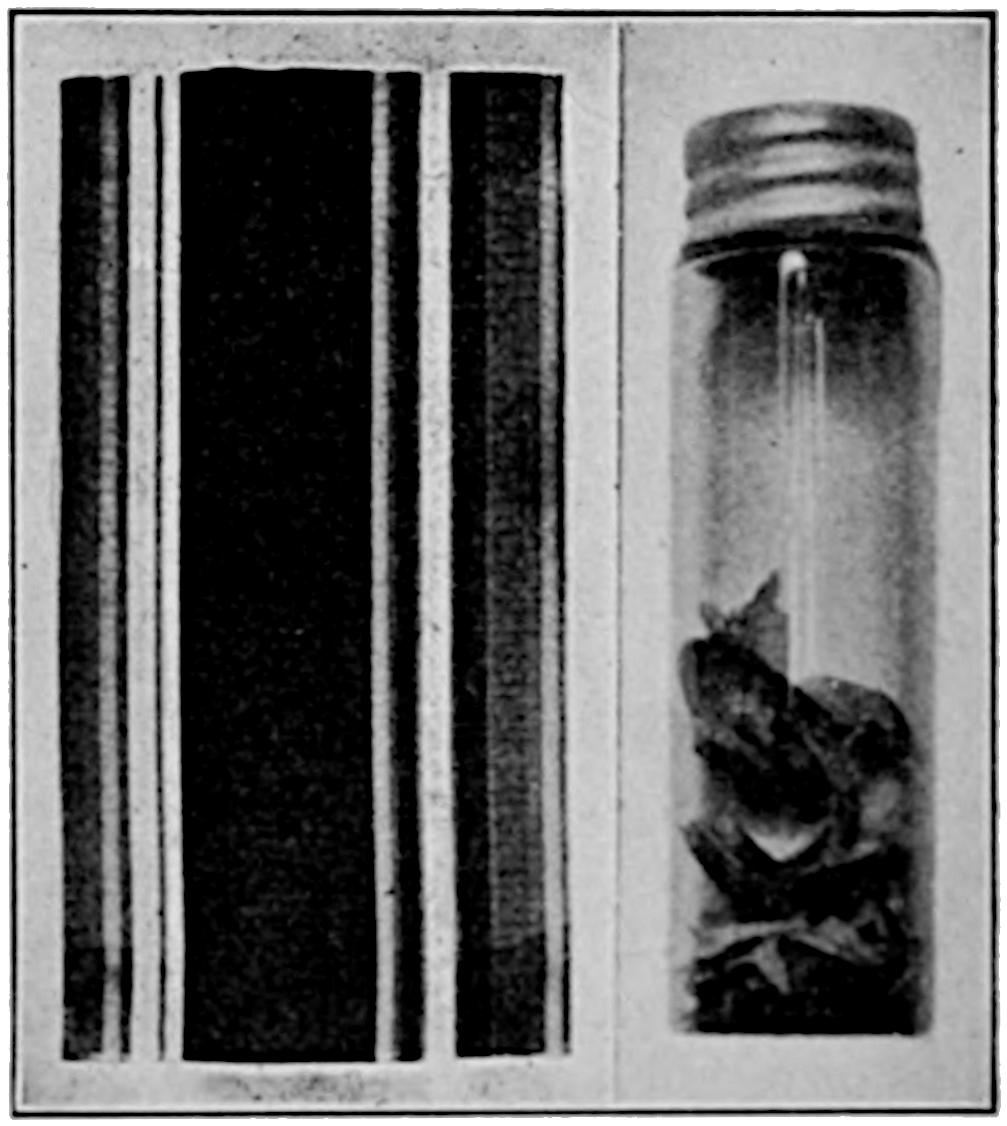
Fig. 142.—Weighting of Silk. The Bottle contains the Mineral Weighting left after burning a Piece of Silk like the Sample Shown.
Rough Estimation of Weighting.
—Mineral matter may be estimated approximately by burning a sample in a crucible until the organic matter is entirely consumed. The ash residue roughly represents the mineral weighting (Fig. 142), and if the fibers have been coated to excess, the form of the fabric will persist after the animal matter has been burned. This is a guide to the wearing value of a silk, and is the only method of investigation possible in the home. The sample may simply be held by forceps in the flame until nothing but mineral matter remains.
[406]
Suggested Exercises. 1. The presence of tin weighting may be proved as follows: Boil a sample of the silk in dilute HCl, reduce acidity with NH₄Cl, warm solution slightly and pass H₂S gas through. A yellow precipitate indicates stannic tin. Confirm by adding ammonium sulphate to the original solution. A heavy white precipitate of metastannic acid appears.
2. Test for glue in light-colored samples: Dissolve 3 gms. of ammonium molybdate in 250 cc. of water, and add 25 cc. nitric acid of specific gravity 1.2. Boil the sample in water, concentrate the solution on the water bath, and treat with the above reagent, which will cause a heavy white precipitate if glue is present. Other substances such as gum arabic give a turbidity but no characteristic precipitate.
3. Test for gum arabic by hydrolyzing the concentrated water solution of finishing materials with hydrochloric acid, using a water bath. Gum arabic, largely a pentosan, yields pentose, and on further heating furfural forms, which is volatile and will produce a red color on a strip of paper moistened with aniline acetate and held in the vapors.
4. Other water soluble substances, such as sugars, dextrins, and mineral salts, may be found in the usual ways: Starch and dextrin with iodine; sugar by inversion and Fehling’s test; glycerol by acrolein test; and mineral matter by qualitative methods.
5. Ash the sample. Perform usual qualitative tests, including test for silica.
6. Test for fats and waxes by Soxhlet extraction.
7. Make an economic study of different kinds of dress silks at a given range of price, as to construction, weighting, tensile strength, comparative values for certain purposes.
Mercerization.
—In the process of mercerization, cotton is made to undergo certain changes by treatment with strong caustic alkalies. John Mercer, an English cotton printer, was the first to show that cellulose, treated under given conditions with alkalies, contracted, gained in strength because of shrinkage, and in affinity for dyes. His investigations are described under the English patents of 1850. Owing to several reasons, chiefly the high price of caustic soda, the discovery had little commercial value for thirty years. Since 1880 the process has grown to be vastly important, especially since the patent taken out by Lowe in 1889, which covers a method of employing tension for preventing [407]shrinkage and producing a lustrous material. There have been several modifications and improvements of the method, credit for some of which is due to Thomas and Prevost of Germany, but the essential process consists in immersing the cotton yarn or piece under tension in strong cold caustic soda or potash solutions, and subsequently washing it.
To obtain a high degree of luster, the best quality of cotton is required, and tension is necessary. The fiber is generally combed and gassed to remove protruding ends, and render it more silky. After singeing, the goods are scoured thoroughly. The yarn or piece (usually the piece) may be bleached before or after mercerizing, depending upon the purpose for which it is intended. The material, suitably prepared, is carried under tension on rollers through the mercerizing solution. This may be caustic soda of a gravity of 55° to 65° Tw., at a temperature not exceeding 20° C. After a minute or two in the alkali solution the material, still under tension, is washed in fresh and acidified waters. The steps of the process in outline are: Mercerizing the prepared goods; washing; neutralization; washing; drying.
Mercerizing without tension is sometimes done on goods such as duck, which are to be shrunk for waterproofing; or on cotton velvets and other napped goods and Turkish towels, to close up the weave, or for strength. Unstretched mercerized goods gain in weight, strength, and in greater affinity for dyes than stretched goods; the latter gain in luster particularly, but also in increased affinity for dyes.
Crinkled effects are often produced by mercerizing cotton goods in stripes or other patterns by a printing process; the unmercerized portions crinkle because of the shrinkage of the adjoining mercerized parts. Discharge and resist effects can be produced by printing the caustic soda paste on dyed or prepared piece goods.
The chemical change produced by mercerization consists [408]in the probable formation of an alkali cellulose, which breaks up during the washing process, and the cellulose unites with water to form a cellulose hydrate. In addition to the chemical change, the cotton fiber undergoes structural modifications. The cell walls are thickened, the fiber becomes cylindrical or nearly so, and with mercerization under tension the natural twist tends to disappear, giving place to a smooth, rod-like appearance. Owing to the fact that the outer and inner structure of the fibers is not equally influenced by the alkali, some twisting is commonly found in mercerized fibers, by which they can be recognized under the microscope. The acquired luster is due partly to the better surface for light reflection given by the smooth, rounded fiber, partly to the removal of the cuticle, and partly to the translucent effect produced by strong alkalies on cellulose. Mercerization decreases the elasticity of the cotton fiber, therefore mercerized cottons are apt to crease and wrinkle even more than unmercerized.
Cotton may be made to appear to be mercerized by giving it the Schreiner finish (see Chap. VIII, Finishing).
Tests for Mercerization.
—The microscope is useful in determining not only the presence but the degree of mercerization. The slight twist which is occasionally found is a characteristic which helps to identify the fiber. The best chemical test is the Hubner method of treatment with a solution of iodine in potassium iodide.[57] The material is moistened with water, placed in the solution for a few seconds, then washed thoroughly and laid in water. Mercerized cotton remains blue or black; ordinary cotton fades to brown or yellowish. The absolute prerequisite for this test is that the material shall have been boiled free from starchy dressing before testing, otherwise all fibers will give the blue reaction.
[57] Iodine in potassium iodide: Dissolve 20 gms. of iodine in 100 cc. of a saturated solution of potassium iodide.
[409]
Chlorinated and Unshrinkable Wool.
—When wool is treated under certain conditions with acidified bleaching powder solution, or chlorinated, the fiber loses some or all of its felting property, due to a fusing of the epidermal scales with the cortical region. A typical treatment to produce this effect, taken from an article in the Textile World of Oct. 27, 1923, is as follows:
“The goods are steeped in a solution of hydrochloric acid of a strength of 1.5° to 2° Tw., then squeezed and passed into a cold solution of bleaching powder of about the same density. After working in this for about twenty minutes they are washed and passed into a bath of sulphurous acid or sodium bisulphite to remove any unused or combined chlorine. They are then washed with water, then in a dilute solution of sodium carbonate to neutralize the acid, and finally with water until free from alkali.”
The process is a difficult one to control. If not carried far enough, the material is not sufficiently unshrinkable to give satisfaction in advertised unshrinkable woolen underwear. On the other hand, too long action of the bleaching solution may over-chlorinate to the point where the epidermal scales are entirely removed instead of being fused to the cortex, and the strength of the goods suffers. The processed goods are used not only for underwear, but chlorinated and unchlorinated yarns may be woven together and afterward milled. The unchlorinated yarns shrink and give a crêpe effect to the fiber. Chlorinated wool has an increased affinity for certain dyestuffs. Two-tone effects can be produced by dyeing a fabric of mixed chlorinated and unchlorinated yarns. By introducing cotton, silk, or tannin-resisted dyed yarns, four or five color effects are possible.
Fireproofing.
—The Non-Flam Process, an English process patented in the United States in 1907, is a method of permanently fireproofing cotton, resulting from the investigations of Sir William Henry Perkin. It can be applied to any cotton fabric, but is especially valuable in the case of flannelette, [410]which because of its nap and treatment in finishing is exceedingly inflammable. The process, as described by the originator, is as follows: “The material is run through a solution of sodium stannate of approximately 1.22 sp. gr., in such a manner that it becomes thoroughly impregnated. It is then squeezed to remove the excess of the solution, and passes over heated copper drums in order to thoroughly dry it, after which it is run through a solution of ammonium sulphate of about 1.75 sp. gr., and again squeezed and dried. Apart from the precipitated stannic oxide, the material now contains sodium sulphate, and this is removed by passage through water. The material is then dried and subjected to the ordinary processes of finishing.”
It is of practical value to have a method of fireproofing which can be applied at home at need. Lace curtains and other draperies, properties for amateur theatricals, and Christmas trees are often the cause of fires. Children get hold of matches, and boys in Indian suits jump over bonfires. If a fireproofing solution can be applied easily and cheaply in such cases, without harm to the goods, it is often worth while, even though the process may have to be repeated after each washing.
Some ammonium salts have good fireproofing properties. On heating, ammonia is released, which forms a layer of non-combustible gas about the cloth, and at the same time a layer of vitreous material is covering the goods.
Experiments in the textile laboratory of Teachers College, Columbia University, have shown that the following formula is one of the best that can be devised for fireproofing at home, as it has the advantages of being easily obtained, is cheap (the cost is about 50 cts. per gallon of solution), effective, and leaves the cloth soft and unchanged in appearance:
Four ounces sal ammoniac.
Four ounces ammonium sulphate.
Six ounces dibasic ammonium phosphate.
[411]
Dissolve in one gallon of water. After the clothing is washed and rinsed, wring out, and immerse in enough of this solution to saturate the cloth. Allow to soak for five minutes or so, then wring out and dry without rinsing.
The solution may be sprayed on theatrical properties and other articles which cannot be immersed.
Other formulas for fireproofing are:
- 1. One pound dibasic ammonium phosphate dissolved in one gallon of water. Cost, about 95 cts. per gal. Effective but expensive.
- 2.
- 8 oz. ammonium sulphate
- 2 oz. borax
- 3 oz. boric acid
- 2 oz. ammonium carbonate
- ¹⁄₂ oz. dextrin (may be omitted)
- 1 gal water.
- Not so effective as the first solution, but costs about 20 cts. per gallon.
- 3.
- 8 oz. ammonium sulphate
- 2 oz. borax
- 2 oz. boric acid
- 1 gal. water.
- Costs about 18 cts. per gal. The cloth is left somewhat stiff.
- 4. The British Fire Prevention Formula:
-
- 2 lbs. ammonium sulphate
- 4 lbs. ammonium chloride
- 3 gals. water.
- Costs about 57 cts. per gallon. Cloth so treated is flash-proof, but burns after an exposure of several seconds to the flame.
- 5. Thouret’s Solution:
-
- 4 oz. ammonium phosphate
- 2 oz. ammonium chloride
- 1 oz. calcium chloride
- 1 gal. water.
Waterproofing.
—Closely woven canvas sheds water unless in contact with some object below it, but to become impervious to water treatment is necessary. Types of waterproofing substances used are: (1) insoluble metallic soaps such as aluminum soap, or other insoluble metallic compounds; [412](2) paraffins or waxes; (3) asphaltum or tar; (4) drying oil preparations, e. g., linseed. Substances inhibiting mildew may be combined with waterproofing material for better preservation.
Clothing material to be waterproofed is mechanically impregnated with rubber, waxes, etc., or treated chemically to deposit the waterproofing substance on or in the fiber. The Tate Electrolytic Process fills the pores of the fibers with insoluble aluminum hydroxide. It claims that a permanent combination is made between the chemical and the fiber by the electrolytic treatment given it. Methods of electroplating rubber on fabrics are being perfected.
A formula which could be applied to home waterproofing of a tent calls for about 8 lbs. crude paraffin wax and 1 to 2 lbs. beeswax dissolved in a mixture of 3 gals. of gasoline and 2 gals. of kerosene. Apply with a paint brush and keep away from an open flame while mixing and using.
Chemistry of Rayon
(see Appendix, Section X).—The making of artificial silk or rayon and its great commercial success stand as one of the most prominent recent achievements of the textile chemist. Nearly two hundred years ago the French scientist Reaumur suggested the possibility of making silk by artificial means, and about fifty years ago the Swiss Andemars received a patent for the production of an artificial fiber, but Comte Hilaire de Chardonnet, in France, was the first to patent a commercially successful method of making artificial silk, or what is now generally called rayon. This was in 1885, and the Chardonnet factory at Besançon was manufacturing one hundred pounds a day by 1891.
Chardonnet made his artificial silk by nitrating cellulose, dissolving it, and regenerating it as a filament. Many improvements have been made in the original process, notably by Lehner.
Whatever the method used to make rayon, the essential plan is the same: cellulose in the form of wood or cheap [413]fiber material is dissolved, then restored to a solid in the shape of fine lustrous filaments. The development and use of rayon as a textile fiber are considered in Chap. IX; its chemical production is given here.
At the present time there are four leading types of artificial silk according to method of manufacture: (1) Nitro or Chardonnet, also called Tubize; (2) Cuprammonium, called Cuprate, Glanzstoff or Pauly; (3) Viscose, and (4) Cellulose acetate, called Acetate, Celanese, and Lustron.
1. Nitro Silks. For this type of rayon raw cotton in the form of linters is taken, changed to nitrocellulose by treating with nitric acid in the presence of sulphuric, the resulting nitrated form dissolved in a mixture of alcohol and ether to a viscous solution, and in this stage filtered and pressed through spinning jets or orifices of perhaps ¹⁄₅₀₀ of an inch in diameter. The filaments solidify on emerging, after the manner of new-skin, due to the evaporation of the alcohol-ether solvent. In order to reduce inflammability, they are denitrified by ammonium or some other hydrosulphide, and further treated to improve color, strength, luster, and finish.
2. Cuprammonium Silks were developed from methods of Despaisses and Pauly. They are made by dissolving cotton, generally linters, previously purified, in ammoniacal copper oxide or Schweitzer’s reagent, and forcing the solution through jets into a coagulating bath of glucose and caustic soda solution. The effect of the glucose is to reduce the copper to a precipitate of cuprous oxide which can be separated from the filaments of rayon. As the thread comes from this spinning bath it is treated with acid to neutralize the caustic soda, washed free from acid, dried and finished. Modifications of the process are used in different factories. Cuprammonium silk has a smooth rounded surface and a high luster.
3. Viscose Silk was developed in England through the researches of Messrs. Cross and Bevan, the authorities in the chemistry of cellulose, who discovered its foundation [414]substance, cellulose xanthate. It is the leading form of rayon at present in both Great Britain and the United States. In this country both cotton linters and spruce wood are the raw material for viscose. The cellulose is freed from its encrusting woody impurities by the sulphite method, that is, digested with a mixture of free sulphurous acid and bisulphite of lime until the woody portions are destroyed. Bleaching follows. At the rayon mills the bleached sulphite pulp is mercerized with strong caustic soda, the resulting alkali cellulose is matured, shredded or “crumbed,” and dissolved in carbon disulphide, which converts it into an orange-yellow soluble derivative of cellulose called alkali-cellulose xanthate. This product is dissolved in dilute caustic soda solution or in water, and ripened. During the ripening process the cellulose xanthate hydrolyzes toward a cellulose or cellulose hydrate product, and at an intermediate stage the viscous fluid, viscose, is ready for spinning. The viscose is filtered and pumped through fine jets or holes into a coagulating bath of sulphuric acid, ammonium sulphate, and glucose. The spun filaments are washed, dried, reeled, and bleached.
Acetate silk is the most recent type to be manufactured. As it is a cellulose acetate, it is quite different in its nature and properties from other forms of artificial silk, which are practically regenerated cellulose. For this reason it is not always classed as rayon. Cotton or wood pulp dissolved in acetic anhydride in the presence of sulphuric acid forms cellulose acetate. This is precipitated by water, washed, dried, and dissolved in acetone. After filtering it is spun, and the filaments coagulated by exposure to warm air, which evaporates the solvent. Cellulose acetate is much stronger wet than any other type of rayon. It has been estimated that under similar conditions it has three times the strength of viscose when both are wet, but improvements in the latter are making it stronger in this respect. Acetate silk does not have the glassy luster of other artificial silks, it is soft to the [415]touch, and can be spun in fine filaments. Celanese and Lustron are trade names.
Rayon has certain advantages over natural silk. It is not weakened by perspiration, it does not turn yellow with age or exposure to light, and it is not weighted with the tin salts which may weaken natural silk. Its production is more standardized than the uncertain business of silkworm rearing, and it is comparatively inexpensive. It is durable if properly laundered and cared for. In underwear as it takes up moisture readily in most cases it tends to keep the body dry.
As a summary of the study of textile fibers and materials, students often find it valuable for teaching material to mount tested samples of fabrics on filing cards, with more or less complete information such as is suggested in the following outline:
Name of material...............Class.................Uses.................
Price and width..................Variations in price and width....
Price per square yard..........Weight per square yard............
Thread count: Picks............Ends.........................................
Yarn: Kind............Size or number..............Twist................
Weave.......................
Tensile strength: Warp............Filling..................................
Microscopic examination: Warp............Filling...................
Percentage composition: Warp...............Filling..................
Dressing or weighting: Kind..................Amount................
Fastness of dye.................
General estimation of quality.................
[416]
CHAPTER XIII
DYES AND DYEING
Antiquity of the Art of Dyeing.
—The use of color among primitive people began in prehistoric time. Appreciation of color marked the awaking of the æsthetic sense in man, and crude attempts at adornment with pigments evolved into dyeing as one of the earliest arts. Greek mythology indicates its relative chronology when it makes the dyer Idon father of Ariadne, goddess of spinning.
When Spanish explorers came to the New World they found the more civilized tribes of Indians in Central and South America using dyes which for beauty and permanency were not excelled in Europe. Red and purple came from the cochineal, blue from indigo, and yellow from ocher. Alum and niter mordants produced other colors. Central American and Nicaraguan tribes mixed indigo and lemon juice to make black, and obtained a purple by pressing the valve of a shellfish. Plants and lichens gave other colors. The Hopi Indians of the Southwest probably had a larger number of dyes in use than any other tribe.
In the Old World, the art of dyeing was established several thousand years before Christ, as shown by the dyed cloths found in ancient Egyptian tombs, and by the classics of the Chinese. The early history of the Hebrews has many references to the use of dyes. The scarlet of the Tabernacle curtains is supposed to have been obtained from an insect similar to the cochineal.
The two most famous dyes of the ancient world were indigo and Tyrian purple. The old Indian dyers used many colors, but the one best known down to the present time is indigo. [417]The name means Indian stuff. Its counterparts were the woad of Britain, and a similar plant in subtropical America.
To dye with indigo, which is an insoluble coloring substance in its natural state, the stem and leaves of the indigo plant were fermented in water in order to convert the active coloring principle of the indigo into a soluble form. A second vat followed, where an oxidation process changed this soluble substance to insoluble raw indigo, freed by these processes from various impurities. In this form it went to the indigo fermentation vat to be reduced again to soluble indigo-white. Various organic substances were used to induce fermentation; the process was unpleasant, lengthy, and required constant attention to bring the reduction to the desired stage without loss of coloring matter. When the right stage of reduction was reached, the cloth was dipped in the greenish-yellow fluid in the vat and hung in the air. In a few minutes oxidation brought out the indigo blue color.
Nowadays we use synthetic indigo, reduce it to a soluble form with sodium hydrosulphite, dip the cloth in the vat, then oxidize it in the air, and accomplish the whole process in rapid time. Indigo and related dyes are still called vat dyes because of the reduction vat employed.
The dye Tyrian purple has poetic and historical interest. Produced by extracting a few drops of whitish fluid from shellfish of the genus Murex, found on the shores of the Mediterranean near the ancient city of Tyre, it became so famous for its beauty and later for its high cost, that the expression “born to the purple” still indicates the perquisites of royalty or the very rich. As the shellfish became scarcer, the use of the dye was limited by royal edict to the family and court of the emperor. Pliny records the value put upon it, and the Bible makes frequent references to it, as where it speaks of the white wool of Damascus brought to Tyre to be dyed purple. The method of producing the color showed the kinship of the dye to indigo. The cloth, usually wool, [418]was dipped in the whitish fluid and exposed to the air, when oxidation produced the purple hue. A few years ago Dr. Friedlander, of Berlin, found the Murex still flourishing on the Mediterranean coast, and on extracting and analyzing the dye proved it to be a di-brom-indigo (a combination of indigo and bromine).
Modern Dyes.
—The year 1856 divides the ancient world from the modern in the matter of dyes. In that year a young English chemist, William Henry Perkin, while trying to prepare synthetic quinine from a coal tar distillate, accidentally made a mauve dye. Since this first coal tar dye thousands have come from the same source, which have superseded vegetable dyes because they are better standardized, more easily obtained and applied, more varied in color, and often more fast.
Present Status of Dyes in the United States.
—Before the World War, Germany held the monopoly in dye production. When the war broke out, America faced an entire break in her supply, as there were comparatively few dye factories and dye chemists in this country. Crudes, intermediates, and dyes had to be manufactured under urgent pressure. Not only were the makers obliged to satisfy the demands of the textile trades, but also the government need for intermediates to make munitions, for the making of dyes and munitions is closely connected. It is a remarkable fact that American manufacturers of dyes so met the emergency that no textile dyehouse in this country had to close for want of American dyes.
Now after about ten years the American dye industry is becoming firmly established. Figures show that about 95 per cent of the dyes used in this country at present are made in the United States, and our exportations exceed our importations. Quality has improved in all classes of dyes, so that there is no longer an excuse, if there ever was, for blaming a poor dye on its American origin. Vat dyes, the most difficult [419]for American dyers to prepare in quantity to meet the sudden demand, are now produced in amount adequate to make the United States independent of other countries for these valuable fast colors. For the welfare of the whole country, the American dye industry should not be allowed to suffer or decline through lack of the support of American citizens. It is significant that in 1923, when the United States government sued the Chemical Foundation, Inc., for the return of German Chemical and Dye Patents sold to the Foundation by the Alien Property Custodian—a suit which was decided in justification of the Chemical Foundation—the testimony of textile men indicated that their needs were amply met by the American dye industry.
Processes Preparatory to Dyeing.—Carbonizing.
—If wool contains leaves, burrs, or other vegetable impurities it is subjected to a carbonizing process to remove the vegetable matter, which would otherwise cause noticeable defects in dyeing. The process consists in reducing the vegetable matter to carbon by ridding it of its other two elements, hydrogen and oxygen, in the form of water. Sulphuric acid is the chief chemical used in carbonizing. When in contact with vegetable fibers it dehydrates them and leaves a residue, chiefly carbon, which is easily removable. A weak solution of sulphuric acid is used, usually not above 5 per cent. After immersion in the acid the wool is squeezed out and dried at 170° to 190° F., whereupon the carbonized impurities dust out.
Gaseous hydrochloric acid is also used for carbonizing. In this form it has a reaction similar to sulphuric acid as a dehydrating agent, and a less harmful action on wool than in the liquid state. Aluminum chloride is occasionally employed, the reason being that it dissociates in solution to yield hydrochloric acid in an active form for dehydrating. The solution of aluminum chloride is about 6 per cent and the temperature of the drying oven 300° F. Brushing removes the disintegrated material.
[420]
Scouring and Bleaching.
These processes remove natural coloring matter, gums, waxes, oily substances, and the like, which would interfere with dyeing. The cotton fiber contains about 5 per cent of such impurities as pectic acid, brown coloring matter, fatty acids, and waxes. As a result, the spun yarn has a dull, grayish appearance, which does not matter if it is to be dyed a dark color. In this case scouring is generally sufficient, a treatment which consists of removing waxy or fatty substances by boiling in solutions of either soap, sodium carbonate, or caustic soda, or mixtures of the three. For light colors, scouring is followed by bleaching. When the yarn is to remain white, soap solution and bluing baths complete the process. If bleaching is to be done in the woven fabric, the process is more complicated, for additional matters, such as sizing added to the warp threads in the weaving, have to be considered, and the method varies according to the subsequent treatment of the cloth. At least three processes are in general use—the market or white bleach; the Turkey red bleach; and the printer’s bleach. Electrical (carbon arc) bleaching is also done. A typical method of cotton bleaching may be outlined as follows:
1. Singeing.
2. Steeping to loosen the sizing. A diastatic enzyme may be used at this point to liquefy the starch in removing the size.
3. Washing, to remove size.
4. Lime boil. Boiling in limewater for 8 to 12 hours to convert fatty matter and waxes in the fiber into insoluble lime soaps.
5. Washing to free from excess lime.
6. Souring. The material is passed through dilute acid, generally hydrochloric, which breaks up the insoluble lime soaps and other salts of lime, forming soluble calcium compounds and setting fatty acids free. Mineral impurities such as iron stains are also dissolved out.
7. Boiling with soda ash and soap for 8 or 10 hours, which changes the free fatty acids to soluble soaps.
8. Washing. All impurities are now removed, other than natural coloring matter.
[421]
9. Bleaching proper, or chemicking. The material is treated with cold, dilute calcium hypochlorite (chlorinated lime) for 3 to 4 hours.
10. White sour. This is the final souring with acid. After washing, the material passes into dilute hydrochloric, sulphuric, or acetic acid. This sets chlorine free from the bleaching solution, which in the presence of water liberates oxygen, and this removes the coloring matter. All free lime is now removed, and excess chlorinated lime is decomposed.
11. Washing. This must be thorough, to remove all traces of lime or acid.
These treatments are modified as necessary. Pure white bleaching requires repetition of certain processes. Great care is necessary in bleaching. Careless handling may produce iron rust or mildew stains, but the greatest damage to the fiber comes from too long exposure to bleach or acid, or especially insufficient washing. Traces of acid or “chemic” (chlorinated lime) left in the fiber will “rot” (weaken) it so that a cotton or linen material shows holes on its initial washing and ironing. Glucose (cerelose) has been recommended as a buffer material to protect the fabric from the over-action of the bleach and acid.[58]
[58] Color Trade Journal and Chemist, May, 1925.
Linen Bleaching.
—Linen contains more coloring matter and natural impurities than cotton, which make its bleaching a longer and more complicated process. The method is similar to that for cotton, except that the chemicking and souring may be repeated several times, according to the perfection of bleach required, and grass bleaching is often combined with the chemical treatment. There are four grades of linen bleaching—quarter, half, three-quarter, and full. Other terms are sometimes used. Full-bleached flax is not as strong as other grades, due to the severity of the process. In linen yarns the loss of strength is estimated at 20 per cent for full bleach, and 15 per cent for half bleach.
Wool and Silk Bleaching.
—Before bleaching and dyeing, wool must be scoured to remove the oil and grease left on [422]the fiber after spinning. The usual method of wool scouring employs a solution of soap to which is added soda ash or ammonium hydroxide as necessary, according to the condition of the wool. Potash soaps are often used, as they give a soft feel to wool. The temperature for scouring is usually about 115° F.
Neither wool nor silk can be bleached by the method used for cotton, since the chlorine would yellow the animal fiber, and the alkali destroy it. The agent often used is sulphurous acid or sulphur dioxide gas. The wool or silk may be given the gas bleach by subjecting the yarn or piece to the fumes of burning sulphur in a moist atmosphere, or they may be passed through sulphurous acid. Sodium bisulphite is sometimes used, which in solution gives sulphurous acid. Hydrogen peroxide is the most perfect bleach for wool and silk. It is made slightly alkaline with ammonium hydroxide, and applied at a temperature of about 100° F. The wool or silk is allowed to soak in the peroxide for 10 to 12 hours. After bleaching, washing in soapy water and rinsing follow. Other bleaches used are sodium peroxide and perborate, potassium permanganate, and occasionally percarbonates and persulphates. In dilute solution and at moderate temperature sodium perborate is a mild bleach for any fiber.
Bleaching Tussah Silk.
—The color in Tussah or wild silk is in the filament itself, under the gum. The gum and other impurities are hard to remove entirely, consequently Tussah is difficult to bleach. The fiber is less absorbent than mulberry silk, which has an effect on the time necessary for exposure to the bleach, so that contact long enough for a full bleach may injure the filament. The process consists of a thorough boil-off and usually a sodium peroxide or perborate bleach.
Nature of the Dyeing Process.
—Dyeing follows bleaching. It is the process by which coloring matter is more or less permanently fixed upon or within a textile substance by [423]means of immersion in the color solution. Textile printing is a process of applying color to certain portions only of the fabric, by means of a printing machine. The two processes are sometimes combined in one material. The color solution, to be a dye, must possess not only color, but the power of fixing itself in the fiber, with or without assistance, to form an insoluble compound. Color is inherent in certain chromophor or color-bearing groups, such as the azo, nitro, and quinoid groups. A substance may contain one of these groups and have color, but to be a dye and have the quality of permanency it needs an auxochrome group, usually acid or basic, to aid it in combining with groups of the opposite nature in such fibers as wool and silk.
This chemical combination of dye and fiber is one theory of the nature of the dyeing process, which is less definite in its application to vegetable fibers. Other theories are (2) the mechanical or physical retention of the dye in the fiber by absorption and adsorption; (3) the diffusion and coagulation of a colloidal dye on and in the fibers, all of which are colloids, the result being a fixed or rigid molecular arrangement; and (4) the “electrical theory,” or the fixing of an ionizable dye on the fiber by the contact of opposite charges, which is a restatement of the chemical theory.[59] Since animal and vegetable fibers differ chemically, and dyes represent many types of chemical compounds, crystalloids as well as colloids, it may be concluded that no one theory of dyeing is best for all cases, but that dyeing is essentially a chemical phenomenon.
[59] Herrman: “The Science of Dyeing,” Dyestuffs, Jan., 1923.
Classification of Dyestuffs.
—A brief classification of dyestuffs is difficult from the standpoint of either their chemical nature or the method of application. For general information the student is referred to the yearly Reports of the United States Tariff Commission, in the section devoted to Dyestuffs. The Report of 1921 gives the following classification [424]of dyes then produced in the United States, according to method of application: (1) Acid; (2) Basic; (3) Direct; (4) Lake and Spirit Soluble; (5) Mordant and Chrome; (6) Sulphur; (7) Vat—subdivided into Indigo and other Vats; (8) Unclassified.
From various trade sources a compilation of the dyestuffs in common use has been taken, with their application, as given below:
1. Acid Colors. The acid colors differ in chemical nature but are alike in that all are applied in an acid bath. Most of them contain the azo group. The color of these dyes is taken up most strongly in an acid solution, less in a neutral, and least in an alkaline bath. In fact, acid dyes fade if washed with strong soaps or washing powders. These dyes are directly applied to wool and silk, feathers, leather, and other substances of a protein nature. They do not color vegetable fibers to any extent, but selected ones may be used in dyeing book bindings and staining wood and straw, where the color does not need to be fast to washing. Since acid dyes are usually sodium salts of sulphonic acids, the addition of an acid—sulphuric or acetic—to the dye bath breaks up the salt, liberates the color acid, and this dyes the wool or silk more readily than the salt itself. Glauber’s salt is generally added to the acid bath with these dyes. Its main function is to hold back the dye from too rapid absorption by the fiber, so that a more even, level shade is produced. Such substances as glauber’s salt and common salt, which aid in the dyeing operation, are called assistants.
Most acid dyes are satisfactory as to fastness to light, and to washing, unless warm water and an alkaline soap are used.
Acid dyes are sometimes used on cotton with an alumina-soap mordant in the presence of gelatin. This treatment of cotton with gelatin is one method of making “animalized” cotton.
2. Basic Colors. These include a range of chemical compounds which are alike in containing a basic group. Many [425]of them are aniline derivatives. They are direct dyes for wool and silk, but not for vegetable fibers with the exception of nitrocellulose silks. Generally speaking these dyes are brilliant, but not as fast as acid dyes. The dyestuff is applied in a neutral or slightly acidified bath, acetic acid being used. The use of the acid is principally to prevent hard water from affecting the solubility of the dye. Basic colors are less important than acid for dyeing wool and silk. They are used to some extent on cottons, with a mordant, to give certain brilliant greens, reds, purples, and blues.
3. Direct Cotton Colors. These are applied principally to cotton, but many also dye wool and silk, and such may be called all-fabric dyes. Many dyes of this class are cheap and give fugitive colors on cottons. They are easily applied with common salt as the assistant, to render the dye more insoluble in the fiber. Most of the household package dyes are direct cotton colors.
4. Mordant Colors, for example alizarines and logwood. These dyestuffs, some of which are vegetable in origin, dye no fibers directly, but require metallic mordants.[60] Many are applied to wool with a chrome mordant. Chrome colors are fast dyes. The principal mordant dye for silk is logwood, which is dyed with a tannin iron nitrate mordant. It is considered the best black for silk.
[60] A mordant is a substance which combines with the fiber on the one hand and the dyestuff on the other, to form an insoluble compound called a “color lake.” The derivation of the word, from a Latin verb meaning “to bite,” indicates its action in “biting” the dye to the fiber. A mordant is frequently used not only to produce fast colors but different hues; the color of a dye such as madder or alizarin, for example, can be changed according to the mordant used. Salts of metals such as iron, chromium, aluminum, tin and copper form one type of mordant; another type is represented by tannic add, oleic acid, etc.
5. Vat Colors. As a class, these dyes possess the highest degree of fastness, but this property varies in particular cases. Some are less fast to light than to washing, and in some the opposite is true. It cannot always be expected that dyes, in any class, will show equal fastness to all influences.
[426]
Three types of vat dyes are in common use: the anthraquinone; the indigoid, similar to indigo; and the hydron colors. Vat colors are especially used for cottons and linens, as the alkaline dye bath employed is dangerous to wool and silk, but by selection of dye and modification of process they are applicable to all fibers.
The vat colors are so named because of the reduction vat used in their application. In this vat the reducing agent is sodium hydrosulphite, or a combination with formaldehyde, which has strong reducing power. When the original insoluble dye is reduced by this means it goes into the soluble leuco (colorless) form, which can be taken up by the fiber. On subsequent exposure to the air, in a few minutes the leuco solution is oxidized in the fiber back to the original dye, with its color and insolubility. The fastness of the dye is due to its great insolubility in the oxidized form. These chemical changes of reduction and oxidation can take place because of the presence of two carbonyl groups in the dye. As mentioned before, natural indigo belongs to this class of dyes. Synthetic indigo has practically replaced it for the last twenty-five years.
Vat dyes are used for cottons where superior fastness to light and washing are desired. The process of dyeing is complicated and requires skilled dyers, therefore it is relatively expensive and only high-grade cottons are dyed with vat colors, as a rule. Good shirtings, ginghams, tapestries, and good quality embroidery cottons are examples. The same is true of dyes built up in the fiber by other chemical means, as in the classes which follow.
6. Insoluble Azo Colors. The general class of azo dyes is of great importance. It comprises a large range of colors and includes dye stuffs of different properties, such as acid, mordant, and direct cotton dyes. The particular virtue of the insoluble azo type of dye is that it is built up in the fiber to produce colors of great fastness and brilliancy. No heat [427]is necessary; the dyeing is done in cold solution. The method consists of immersing the material in an alkaline solution of beta-naphthol, drying, and passing through a diazo compound such as diazotized paranitraniline. Other compounds such as Naphthol AS are taking the place of the beta-naphthol. In either case an insoluble azo dye is developed in the fiber from colorless compounds. In printing cotton with these dyes the thickened Naphthol AS is first applied, together with the diazo compound in a stable form. A bath of acetic acid then develops the color.
7. Diazotized and Developed Colors. This method of dyeing is often spoken of as the “ingrain” process (see Chap. V., Hosiery). Again the dye is built up in the fiber, but the initial compound in this case is a cotton dyestuff containing an amino group. This is diazotized with nitrous acid and developed with beta-naphthol or other developer, when the dye color appears. This process may be used on silks, but it is much employed for dyeing fast blacks and navy blues in cotton hosiery.
Coupled Dyes are another example of built-in dyes, by a process reversing that described above. In this case a different type of dye is chosen, not capable of being diazotized itself, but which will “couple” or “tie up” (i. e., combine chemically) with a diazo compound such as paranitraniline, which acts as the developer. Brown, myrtle green, and black colors on cottons are frequently coupled dyes.
8. Phthalic Anhydride Dyes. These compounds are interesting as one of the remarkable successes of American chemists since the war. Before 1914 Germany was the only country producing phthalic anhydride. Now, following a discovery of two American chemists, we are making a purer product than the former German one, at a lower price, and exporting even to Germany. These dyes are in shades of pink and rose. Eosin belongs to this class. They are used to some extent for cotton, for silk, and in a few [428]instances for wool. They are brilliant, but not particularly fast. The great value of phthalic anhydride itself is its use in the manufacture of anthraquinone for the vat dyes. An arresting fact concerning it is quoted from the Color Trade Journal and Textile Chemist, May, 1925.
“The manufacturers of vat dyes now have at their disposal cheap and pure products with which to build up the complex molecules characteristic of these coloring matters, which give the brightest shades and the most permanent colors yet made. Every one knows that the permanency of the color is an important item in every household. Who has forgotten the rapidly fading colors of 1916 and 1917? Who does not know the waste that these poor colors entailed in replacement costs for clothes and draperies? Who is not now familiar with the Sun-fast, No-fade clothes and materials? These are possible because of vat dyes, and the American vat dyes are with us because of the development of cheap aluminum chloride and phthalic anhydride. And the latter is cheap because of the work of two chemists in the Color Laboratory of the Bureau of Chemistry of the Department of Agriculture. Thus, if one were inclined, it would be possible to figure out the saving to himself, to each family, to the nation as a whole, brought about as the result of the work of the Color Laboratory, which was organized to help establish American independence in dyes. Not only has it done that, but as shown above, it has caused a material saving and increased economy to each and every person who uses any cotton cloths, and who does not?”
9. Sulphur Colors. These dyes are not used for animal fibers on account of the strongly alkaline dye bath employed. They are manufactured by the fusion of sulphur and sodium sulphide with various organic substances, e. g., aromatic amines. They are soluble in a sodium sulphide bath, and this is their general method of application. The sulphur dyes are especially fast to washing, fairly fast to light, but not to chlorine bleaching. The colors are soft rather than brilliant, in yellows, browns (e. g. sulphur khaki), blues, greens and black, but no clear red has been produced thus far. Sulphur dyes are often used for rayon when exceptional fastness is desired.
[429]
10. Aniline Black. This is a complex dye in a class by itself, being produced by oxidizing aniline in the fiber to a black substance called nigraniline. To bring about the reaction an oxidizing agent such as potassium chlorate is used, in the presence of a catalyst, usually certain metallic salts. Unless oxidation is complete, the black cloth or stocking becomes greenish after using. Aniline black is used for cotton hosiery and cotton printing; seldom for wool or silk.
Of the ten classes of dyestuffs given above, all may be applied to cotton, but the acid and mordant (chrome) colors are least used. The easiest cotton dyes in point of application, and therefore the cheapest, are the direct cotton colors, and these are extensively used. Cotton fugitives are dyed with the cheaper colors of this class. Wool is dyed with acid, basic, phthalic anhydride, chrome, vat, and sometimes direct cotton colors, but the acid dyes are most important. Silk dyes are similar to wool, and include also diazotized and developed colors. Direct cotton colors are used in some silk-cotton hosiery. Rayon takes dyes readily. Nitrocellulose (tubize) silks have a direct affinity for basic dyes, but special dyes have been made for celanese, while viscose and cuprammonium silks have less affinity, but dye readily with direct cotton colors.
Temperature and Other Considerations.
—Temperatures for dyeing vary according to both dyestuff and fiber. As a rule, all fibers should enter the dye bath at a low temperature and be raised gradually to the maximum. Wool combines best with dyestuffs at or near the boiling point, but should not have hard boiling, especially in the case of fine felting wools. Silk takes up dye rapidly, therefore the dye bath should not be hot on entering the silk, and for even dyeing a temperature of 140° to 160° or 180° F. is found best. Boiled-off liquor from the degumming process is added to the dye bath to prevent loss of weight, aid in even absorption, and give added luster and softness to the silk. It may be replaced [430]by a mild soap solution, preferably olive oil soap. Cotton and linen may be boiled. Some dyes for these fibers give best results under the boil, but as a rule the cotton dyes used in the household require the boiling temperature for some time, to ensure fastness. As most varieties of rayon are weaker when wet, and especially so in a hot solution, they must be dyed in as cold a bath as possible, and handled with care. Rayon dyes with sufficient ease so that high temperatures are not necessary.
Scope of Experiments in Dyeing.
—It is of importance to every one to have a general knowledge of commercial dyes and their application, in order to appreciate processes which are too apt to be taken for granted by the consumer, and to be intelligent in the treatment of dyed material. But in a text which has as an ultimate aim the guidance of the consumer it seems impractical to study in detail the chemistry of dyes and commercial methods of dyeing. The former can be a part of a course in organic chemistry, which is desirable as a prerequisite to textile chemistry, and both are necessary in the textile school which prepares trained textile workers. Dye formulas and methods are complicated and of little experimental value to the average student of home economics. Mostly direct dyes in household package form are available for home dyeing, and it is more to the point that she shall learn skill in the use of these. Most teachers of textiles and clothing prefer to give their laboratory time to experiments which teach the comparative properties and applications of the various household dyes. Experiments in the use of non-household dyes may be found in a dyer’s textbook such as Matthews’ Application of Dyestuffs, and one or two from this book, illustrating each important class of dyes, are quoted below.
Preparation of Dye Solutions.
—In order to understand the percentage amounts called for in the experiments which follow, the student must know that dyestuffs and assistants [431]are measured in percentage relation to the weight of material to be dyed. For convenience, skeins to be dyed are generally in 5 gram weights for wool, 10 grams for cotton and 2 grams for silk. Five grams of wool require sixty times that amount of dye solution, or about 300 cc.; ten grams of cotton also require 300 cc., and two grams of silk need 125 cc. of solution. A recipe for acid dye which might call for 5 grams of wool yarn, 300 cc. of dyebath, 10 per cent of glauber’s salt, 5 per cent sulphuric acid, and 3 per cent Benzyl Violet, worked out on the basis of the weight of the yarn would use the following amounts:
10 per cent of 5 gms.—0.5 gm. glauber’s salt.
3 per cent of 5 gms.—0.15 gm. dyestuff.
5 per cent of 5 gms.—0.25 gm. sulphuric acid.
In order to obviate individual weighing of these small amounts, solutions may be prepared of such a strength that 10 cc. of each will contain the proper amount of the ingredient for a skein of wool. For example, 0.5 gm. of glauber’s salt are required; 10 cc. of solution must contain 0.5 gm., therefore dissolve 50 gms. of glauber’s salt in about 500 cc. of water and make up to 1000 cc. Of dyestuff, 0.15 gm. are required; therefore one liter is made up in a similar way to contain 15 gms. Of sulphuric acid, 0.25 gm. in 10 cc. would equal 25 gms. in 1000 cc., but as the specific gravity of concentrated sulphuric acid is 1.84, the number of cubic centimeters measured out would be 25 divided by 1.84, or 13 cc.
Acid Colors. General Method of Dyeing on Wool. Prepare a dye bath containing 300 cc. of water, 20 per cent of glauber’s salt, 4 per cent of sulphuric acid, and 1 per cent of Acid Magenta. Have the temperature of the bath at about 140° F. and place in it a well scoured and wet-out test skein of woolen yarn; by means of the stirring rods give the skein a few turns in the liquor so as to saturate the fiber thoroughly with the solution. Then allow the skein to hang from a stirring rod into the dye bath, and heat the latter gradually to the [432]boiling point, turning the skein from time to time so that it may dye up evenly. Do not maintain the liquor in a state of active ebullition, as this will rapidly cause the fibers of the wool to felt together; keep the bath just at a simmer. Continue the dyeing at this temperature for one-half hour, turning the skein from time to time. Then remove the skein, squeeze out the dye liquor, rinse well in fresh water until no more color is removed from the fiber, then squeeze out and dry. This experiment represents the general method of dyeing nearly all acid dyes on wool.
Basic Colors. General Method of Applying to Wool. Basic colors are usually dyed on wool in neutral or slightly acid baths. Dye a skein of woolen yarn in a bath containing 300 cc. of water, 2 per cent of acetic acid, 10 per cent of glauber’s salt, and 1 per cent of Methylene Blue; enter at 100° F., gradually raise to 180° F., and dye at that temperature for one-half hour. Dye another skein of woolen yarn in a similar bath containing 10 per cent of glauber’s salt and 1 per cent of Methylene Blue in the same manner, and note that the dyestuff is absorbed more rapidly. The function of the acid is to retard the dyeing, and so assist in the even distribution and thorough penetration of the color. If the bath in the first case does not exhaust completely, lift the skein and add 4 per cent of borax and continue dyeing for fifteen minutes. The borax is a mild alkali, and is added for the purpose of neutralizing the acid in the bath and so permitting the complete exhaustion of the dyestuff. Acetic acid is better to use in dyeing basic colors than sulphuric acid, as the former is volatile, and as the temperature of the dye bath rises the acidity becomes lessened and consequently the exhaustion is better.
Direct Cotton Colors. General Method of Applying to Cotton. These dyes are usually applied to cotton in a neutral bath containing either common salt or glauber’s salt; hence the name “salt” or “direct cotton” colors for this class of dyes. Dye a skein of cotton yarn in a bath containing 300 cc. of water, 20 per cent of common salt, and 1 per cent of Congo Red; enter at 140° F., gradually raise to the boil and dye at that temperature for one-half hour; then wash well and dry. The bath does not exhaust very well, but by adding more salt towards the end of the dyeing a better degree of exhaustion may be obtained.
Mordant Colors. General Method of Dyeing on Wool. The most generally used mordant for wool is chrome or sodium bichromate. It is applied to the fiber in the following manner: Prepare a bath containing 3 per cent of chrome and 4 per cent of tartar; enter a test skein of woolen yarn at 140° F., gradually raise to the boil, and continue [433]at that temperature for one-half hour; wash well, and then dye in a fresh bath containing 2 per cent Alizarin Blue NG and 4 per cent of calcium acetate; enter at 100° F., gradually raise to the boil, and dye at that temperature for one-half hour; then add 2 per cent of acetic acid and boil for fifteen minutes longer; wash well and dry. Sodium (or potassium) bichromate is a salt of chromic acid (CrO₃), while the mordant which is eventually produced on the fiber is chromium oxide (Cr₂O₃); hence in the process of mordanting the chrome must undergo reduction. This is brought about partly by the wool itself, but chiefly by the aid of the tartar. The latter is potassium acid tartrate, or potassium bitartrate, and is a reducing agent. When mordanting it will be noticed that the wool is first yellow in color; this is probably due to the formation of chromium chromate in the fiber. If this compound is exposed to the action of strong light it will suffer a rapid reduction to chromium oxide, which is green in color; hence it is best not to expose the mordanted wool unevenly to light for any length of time before dyeing.
Mordant Colors on Cotton and Silk. Dye a skein of cotton yarn in Alizarin Red; it will be found that the fiber has no attraction for the dyestuff. Mordant a second skein of cotton yarn by working in a cold solution containing 200 cc. of water and 5 grams of ferric chloride for ten minutes; squeeze and pass through a cold solution containing 200 cc. of water and 2 grams of soda ash. This furnishes a deposit of iron oxide on the fiber and gives the latter a buff color. Now dye this mordanted skein with Alizarin Red, boiling for one-half hour, and it will be found that the dyestuff is absorbed and the cotton becomes dyed. Dye a skein of silk with the solution of Alizarin Red; it will be noticed that silk is similar to wool and cotton, and is not dyed by the Alizarin dye. Mordant a second skein of silk with chrome in the same manner as was used with wool, and then dye with the Alizarin Red. It will be found that silk, like the wool, will combine with the dyestuff.
Alizarin is the active coloring principle in the vegetable substance madder, which was an important dye before synthetic alizarin replaced it. An experiment showing the action of a madder extract or alizarin with metallic mordants is interesting. Iron and copper salts, barium, calcium and stannous chloride, lead acetate and alum act as mordants with madder and give a variety of colors.
[434]
Vat Colors. Preparation of Indigo Solution. Mix 75 grams of Indigo paste (20 per cent) with 40 cc. of hot water, and 90 cc. of caustic soda solution (42° Tw.) and 50 grams of hydrosulphite powder (Blankit T) dissolved in 200 cc. of water. (See Matthews, page 445, for directions for making solution of sodium hydrosulphite if the powdered form is not available.) Stir gently and keep the temperature at about 110° F. In a short time the liquid should be of a clear amber-yellow color with a film of blue on top. The liquid now contains indigo-white and serves as a stock indigo solution for the preparation of the dye vat. The hydrosulphite powder (Blankit T) is an anhydrous compound of sodium hydrosulphite and is a fairly stable substance compared with most hydrosulphite derivatives. It is a strong reducing agent and converts the indigo-blue into indigo-white.
Dyeing Indigo with Hydrosulphite Vat. Prepare the dye vat as follows: to one liter of water (120° F.) add 2 grams of hydrosulphite powder (or 10 cc. of prepared hydrosulphite liquor); 0.5 cc. of ammonia water, and 4 cc. of glue solution (1 : 10); allow to stand for fifteen minutes, then run in 100 cc. of the stock indigo solution by means of a long-tubed funnel. Stir gently and allow to stand for thirty minutes. When the liquor is clear and of an amber-yellow color it is ready to use. Take a test skein of cotton yarn which has been boiled out and squeezed (but not dried) and pass it through this indigo vat without heating. Take care to manipulate the dyeing so as to disturb the liquor as little as possible, as much exposure to the air will cause undue oxidation and considerable indigo will be precipitated in the vat. When the skein has become evenly saturated with the liquor, squeeze it out well, and then expose the skein to the air for five to ten minutes. When the skein first comes from the vat it should be of a yellowish green color; on exposure to the air it soon turns blue. The dyed skein is then washed well in water and afterwards in a warm soap solution in order to remove all alkali and unfixed dyestuff.
Developed Colors. General Method of Applying. Dye a test skein of cotton yarn in a bath containing 6 per cent of Primuline, 20 per cent of salt, and 1 per cent of soda ash; enter at 140° F., gradually raise to the boil and dye at that temperature for one-half hour. It will be noticed that this is simply the general method for applying substantive dyes, and that the color obtained is yellow. Rinse the skein in fresh water and pass into a cold bath containing 5 per cent of sodium nitrite and 6 per cent of sulphuric acid; work for about ten minutes. It will be noted that the yellow color of the dye is altered to a brownish yellow by this treatment, and if the odor of the bath is observed the presence of nitrous acid will be noted. Rinse [435]the skein with cold water, and immediately pass into a third bath containing 2 per cent of beta-naphthol solution; work cold for fifteen minutes, then wash well and dry. When placed in the third bath it will be noticed that the skein turns a bright red color, which is due to the new dyestuff which has thus been formed within the fiber.
Phthalic Anhydride Colors, represented by eosin, can be applied directly to cotton with the addition of common salt to the bath. The color may be intensified by thoroughly steeping the bleached cotton skein in a bath of one part of Turkey Red Oil and two parts of water, drying, and dyeing in the eosin bath with the addition of a little acetic acid.
Sulphur Colors. General Method of Applying. Prepare a bath containing 5 per cent of Sulphur Brown, 5 per cent of sodium sulphide, 5 per cent of soda ash, and 25 per cent of common salt. Dye a skein of cotton yarn in this bath, entering at 140° F., gradually raise to the boil, and dye at that temperature for one-half hour; wash and dry. It will be noticed that the dye bath does not exhaust very well, so dye a second skein of cotton yarn in the same bath without adding any further dyestuff or chemicals, only diluting the bath to its original volume with water. Also dye a third skein in the same manner. Compare the colors on the three skeins, the gradation of which will show the comparative exhaustion of the bath.
Dyeing Khaki with Sulphur Dyes. Dye a skein of cotton yarn in a bath containing 5 per cent of Sulphur Khaki, 5 per cent of sodium sulphide, 2 per cent of soda ash, and 50 per cent of common salt. Enter at 160° F., gradually raise to the boil, and dye at that temperature for three-quarters of an hour. Squeeze and rinse and wash off in a weak soap bath at 160° F., and dry. Test this color for fastness to light and washing.
Aniline Black. One-Bath Process. Prepare a bath as follows: 300 cc. water, 10 grams aniline hydrochloride, 3 grams potassium bichromate. The aniline salt is dissolved in the water, after which the potassium bichromate is dissolved in a little water and also added. The cotton is worked in this solution cold for one hour, then the temperature is gradually raised to 150° F.... After dyeing, the cotton should be well washed in water, and then in a boiling soap solution containing 5 to 10 grams of soap per liter, to which a little soda ash may also be added. Due to the strong acidity of the bath, unless the [436]process is conducted very carefully, the cotton will be liable to become tendered.
Dyeing Silk a Pure Black with Logwood. By “pure” black is meant one which does not contain any weighting materials. Mordant a test skein of silk yarn in a bath containing 150 cc. of water and 20 per cent of cutch; enter at 120° F., and gradually bring to the boil, then allow to cool in the bath for one-half hour; next rinse the skein slightly and pass into a bath of nitrate of iron at 10° Tw., work at 120° F. for fifteen minutes, then pass through a dilute bath of soda ash and wash well. Next dye in a bath containing 150 cc. of water and 25 per cent of Logwood extract (solid) and 5 per cent of soda ash; enter at 140° F., gradually bring to the boil, and dye at that temperature for one-half hour, then wash well and dry.
Forms of Market Dyeing.
—Materials and yarns for the market may be dyed in the following ways:
1. Dyeing in the Wool. What is called raw stock dyeing corresponds to the “dyeing in the wool” of early days. The wool is dyed after washing and scouring, and before drying. It is recommended for its permanence, and is used principally for dark goods which must stand much wear and friction, and still hold their color. Equal parts of black and white wool, mixed in the yarn, make the Oxford mixture. Cotton is sometimes dyed in the loose state, and also waste silk. (See Chap. VII, Special Finishes.)
2. Dyeing in the Slub. Wool is dyed after being carded and combed, but not twisted; cotton is twisted. The dye sinks in, and later spinning conceals any irregularities. Vigoureux yarns are yarns that have been printed on the slub or top by a special machine with regular or irregular designs of color, generally black and white, covering spaces of one-quarter inch to several inches. The colors are set by steam. When the printed slub is later drawn and twisted, a more perfectly mixed effect is obtained than if colored wools had been blended.
3. Skein Dyeing. Yarns of all kinds are frequently dyed in the skein; silk is usually so dyed. The penetration of the [437]dye by this method is good. Skein-dyed yarns are used for ginghams, and in wool for plaid and novelty effects.
4. Piece Dyeing. The fabric is dyed after weaving, which produces a single uniform color. This is the cheapest and easiest way to apply dyes. Two-color effects and other variations of piece dyeing can be obtained by methods given below.
5. Cross Dyeing. This is piece dyeing of mixed cotton and wool. Cotton will not take wool dyes as a usual thing, consequently when dipped in a wool bath it is merely tinged with a fugitive color easily washed out. Plain colored materials, such as mohairs and alpacas, are woven with a cotton warp. The cotton yarn is dyed first in the color desired, and then woven with the worsted filling. The cloth is cross dyed by placing it in a wool bath, in which the cotton is unchanged. Most of the sulphur colors and some developed dyes on cotton resist cross dyeing. Cloths are woven with white or colored hair lines in the warp. When cross dyed in a wool bath, the wool is colored and the cotton hair lines remain as they were. The reduction in price in thus inserting cotton for wool is an item. Cheap shepherd plaids and other dress goods are woven with cotton for the white effects and with wool for the colored. The acetate variety of artificial silk mixed with cotton may be cross dyed by dyeing the former with certain azole (developed) dyes which leave the cotton white, then dyeing the cotton in direct cotton colors which leave this type of rayon unchanged.
In dyeing union goods to shade, the cotton warp may be dyed first and the fabric cross dyed as above, a direct dye may be used which can be made to color both wool and cotton the same, or the cotton may be “animalized” to take a wool dye. When the material is a silk-wool mixture the problem of dyeing each a different color may arise. This is not easy to do, as most dyes affect silk and wool in the same way, but it can be done by temperature control. A few dyestuffs, [438]e. g., acid magenta, dye wool at the boiling temperature with little effect on silk; on the other hand, silk may be dyed in a cool bath with several basic or direct cotton colors with no effect on wool. The first half of the operation is dyeing the wool at the boil in the chosen dye, followed by clearing up the silk if it is stained; and second, dyeing the silk in a cold bath.
6. Resist Dyeing. Resist dyeing and cross dyeing are virtually the same. In resist dyeing some of the yarn is treated to remain unchanged in the bath which colors the untreated part. Wool treated with tannin fixed with tartar emetic or stannous chloride will resist certain dyes. Cotton yarn also, treated with tannate of tin, may be woven with untreated cotton yarn, and when the fabric is piece dyed in direct cotton colors a two-color pattern results. Resist dyeing is used in batik work, which originated in Java. In this work all of the material which is not to take the dye in the first dip is brushed over with wax. The wax may then be removed and again be applied to parts which are to resist a second dye, and so on.
7. Discharge Dyeing. In discharge dyeing the material is piece dyed and the color afterwards removed in patterns by the action of chemicals applied by printing rollers. Polka dots are a common pattern in discharge dyeing. The discharge may be in white or different colors. The objection to this process in the past has been the possibility of weakening the fabric in spots by the strong stripping agent used or by careless after-treatment, but modern methods are more scientific than former practices.
8. Printing. Printed cottons and silks have sprung into great favor in late years. Their popularity is merited, for printing is no longer a synonym in many cases for fugitive colors. On the contrary, printed and dyed colors now have an equal chance of being fast. Wonderful color combinations and patterns can be made which would be impossible without [439]great expense by any method other than printing, so that now the art of the printer can be said to be ahead of the dyer’s. It is in this branch of color work that the use of vat colors reduced with hydrosulphites has revolutionized older processes. The vat colors are made up in paste form with hydrosulphite (usually sodium-formaldehyde sulphoxylate, NaHSO₂.HCHO, or Na₂S₂O₄,2HCHO,4H₂O sodium hydrosulphite formaldehyde) and printed on the cloth. On steaming, the sulphoxylate becomes liberated and at once reduces the dyestuff to its soluble form, which is taken up by the fiber. Oxidation follows and brings out the colors of the dyes used. Other methods of printing cotton are still used, such as the application of mordants on direct and aniline black.
Silk printing is done by various methods and with different dyestuffs. Direct or acid dyes are applied in paste form, sometimes with a number of rollers working in succession to print a varicolored pattern, and subsequent steaming fixes the colors. Hydrosulphite is often used to discharge piece-dyed silk.
Dyeing with Household Dyes
The vogue of the household dye is shown by the many varieties on the market. With such a choice, it is becoming a problem to select the best type for the special need. The student should be given opportunity to study the representative household dyes systematically, and tabulate as to (1) name and cost; (2) class:—whether for wool and silk, for cotton and other vegetable fibers, or all-fabric dyes; (3) form—whether powder, cake or paste; (4) type—those which dye fast colors and those which merely tint; (5) method of applying—temperature of bath, time, assistants used; (6) comparative dyeing effects on wool, silk, cotton, and rayon; (7) fastness to light, washing, and perspiration.
[440]
Reasons for Home Dyeing.
—When properly done, dyeing at home is worth while for two reasons—the utilitarian, and the æsthetic. Faded and shabby garments may have a new lease of life given them by brightening their color or changing it; stockings may be dyed to harmonize with a costume and accessories to give it an added touch; decorative effects in house furnishings may be achieved with little expense. Some suggestions for the use of household dyes are:
Brightening faded garments or changing the color of a blouse or dress to create a new garment in effect.
Dyeing handkerchiefs, ribbons, scarfs and other accessories to give finish to a costume.
Dyeing white curtain material to carry out a color scheme for room decoration.
Renovating faded hangings, draperies, pillow covers, etc.
Making artistic table runners, curtains, pillow covers, scarfs, with tied and dyed effects.
Dyeing rags and yarns for braided and hooked rugs.
Redyeing a cretonne of the wrong color in better harmony with the room.
Using good magazine illustrations for inspiration in color harmonies to be worked out in dyeing white cotton for children’s dresses.
Equipment for Home Dyeing.
—Most important is a kettle large enough to take in the material without crowding. Agate kettles are easily cleaned afterward. Some household dyes do not stain the utensil, so with them the wash boiler may be used. Two strong glass rods for turning the material can be secured by buying inexpensive glass towel bars. Other equipment includes a stove, of course; convenient apparatus for drying; spoons and cups for measuring and dissolving the dye; scales for weighing the material, and by choice a thermometer.
Choice of Dye. Purpose.
—There are two types of household dyes—those which dye fast colors and those which merely tint for a transitory effect. The latter type is easily applied, but should not be chosen for a permanent result, [441]which is only achieved by higher temperature and the expenditure of time. The exception to high temperature for fast colors is in the case of rayon, which is dyed quickly in a cool bath.
The choice of dye is also governed by the nature of the material. There are dyes designed for wool and silk; others for vegetable fibers, and still others which dye all fibers, but are essentially cotton dyes. An all-wool or silk material is most successfully dyed in the dyestuff suited to its nature, but often the stitching is cotton, so an all-fabric dye becomes necessary. The reason is that wool and silk may be made to take a cotton or all-fabric dye, but cotton will not ordinarily take a wool dye.
The newer tablet and paste forms of household dyes are convenient because they do not allow particles of dye powder to fly around and stain, and they are easily soluble.
Suggestions for Dyeing. Procedure.
—Some general rules of dyeing are well to keep in mind:
Have adequate equipment, especially a kettle of ample size.
Choose the right dye, and the right color. The right dye, as to the nature of the material (wool or cotton), and as to tinting or dyeing a fast color. The right color, with regard to the original color of the material to be dyed. If the original color is deep, either strip it (see directions below) or decide to dye a deeper color. Any color can be redyed black. It is well to choose a dye in the same color order as that in the material, for instance a faded blue to a darker blue. However, with a knowledge of the principles of color, a dyer may be successful in changing a color by topping with a different one, either to brighten or to gray the original.
Read the directions on the package, and follow them.
Dyeing can not be depended upon to cover up dirt or grease spots. Better cleanse first.
Hems, folds, and other thick places should be ripped open.
Have the dye thoroughly dissolved before putting in the material, and use sufficient water to cover the article completely.
Thoroughly wet the garment before putting it in the bath.
Keep it immersed but stir and turn constantly, using the dyesticks.
[442]
Beware of starting with too deep a color; more color can be added. It is easier to add than to strip color. By holding the dyed garment against the light while wet, its color on drying can be judged.
After dyeing is complete according to directions, rinse in cool water until the color does not show in the water.
Do not hang up at once after squeezing or wringing; either shake until nearly dry, or roll in muslin so that no two thicknesses of the dyed material are in contact. Press on the wrong side for most goods, while damp.
Stripping Color.
—Direct colors on vegetable fibers and silk may be stripped with boiling water and fairly strong soap. Acid colors on wools or silks are also stripped with hot soap solution, aided by ammonia or a little washing soda. The safest bleach for delicate wools and silks is hydrogen peroxide. Dilute the usual form (with strength marked on the bottle) to two or three volume strength, add a little ammonia, enter the article, warm to a little more than tepid heat and allow to stand two hours. Sulphur colors, and in fact most colors on vegetable fibers can be bleached with Javelle water, but vat dyes are usually beyond the power of the housewife to strip.
Physics of Color.
—Work in dyeing is valuable in developing initiative and originality in students, but it is stronger if the student possesses a background of knowledge of color—its physical nature and the rules of color harmonies.
Color is a phenomenon which manifests itself in the presence of light; in darkness it does not exist. To explain color, we think of white light as composite, made up of light waves of different lengths, which vary from about ³⁄₁₀₀₀₀₀ of an inch, the limit of visible red, to ¹⁄₁₀₀₀₀₀ of an inch, the limit of visible violet. When white light is passed through a prism there is a dispersion or separation of these light waves, and in some strange way their vibrations, impinging on the organs of sight, produce in the brain the effects we call color recognition. Those with the longest wave length give the red color, and those with the shortest are [443]violet, at the other end of the rainbow sequence. These colors of the spectrum—red, orange, yellow, green, blue, and violet—are called pure or unmixed colors, and contain neither white nor black. Black is the absorption of all color, with no reflection; white is the opposite, or total reflection and no absorption. Grays are degrees between black and white, or degrees of total absorption.
An object possesses color according to its property of absorbing certain light waves and reflecting others. For instance, it is red if all waves are absorbed and eliminated except the red ray, which is reflected to the eye. It is seldom, however, that we can say an object possesses pure color. With the red ray may be tones of violet and of orange; yellow may include orange on the one hand and green on the other, and blue may show tones of green and of violet.
When two colored solutions are mixed together, the resulting color is caused by the light wave which each transmits or reflects in common. Yellow and blue mixed produce green. If, as said before, yellow includes orange and green, and blue includes violet and green, then green is the only wave common to both which can become visible. Therefore by combining the three primary mixing colors, red and blue and yellow, in pairs, we get the other three spectrum colors of orange, green, and violet.
Color has three qualities: Hue, value, and chroma or intensity. The hue is what we ordinarily call the color, for example, red, orange, yellow, etc. The color scale of each hue shows different values, depending upon the amount of white or black that is mixed with the hue. Bright pure red, for example, is called the medium value; lighter values of red contain more or less white, and darker values more or less black. These values, sometimes called the tints and shades of a color, when arranged in sequence on each side of the medium value, make a color scale. The strength or intensity of any color is its chroma.
[444]
In studying the possibilities of the household dyes, it is a great help to have before the eyes an arrangement of the ten important color scales of red, yellow-red, yellow, green-yellow, green, blue-green, blue, violet-blue, violet, and red-violet. If these scales are arranged as sectors or radii of a circle,[61] the hues exactly opposite each other on the color circle are in the strongest contrast and are called complementary colors. For example, the complementary of the yellow scale is the scale of violet-blue, and the colors in the one scale are thrown into sharp relief or emphasis by the colors in the other. The addition of a complementary color to its opposite tends to soften or gray the latter, and when any two complementary colors are mixed in the right proportions a neutral gray is obtained.
[61] These color circles have been devised by the Clothing Information Bureau of Boston, and are sold under the name of “The Colorscope” by Wm. Filene’s Sons Co., Boston, Mass.
The color circle is useful to the student in the analysis of hues in fabrics or elsewhere; in offering suggestions for color harmonies; in studying dominant, neighboring or analogous, and complementary harmonies; and in applying these principles to the choice of colors for the individual.
Classroom Exercises.
—The following are a few suggestions for the study of household dyes:
1. Study the comparative effect of the household dyes on wool, silk, cotton, and rayon in one bath. Which are wool dyes? Which for cotton? Can cotton and rayon be dyed by a dye for wool and silk? Is there any difference between cotton and rayon in this respect? Will wool and silk take cotton dyes? If so, how can even dyeing of a silk-cotton stocking, for example, be accomplished? If a silk blouse is stitched with cotton, what type of dye should be chosen?
2. Try the effect of dyeing wool in a wool dye, with and without acid. Repeat with a cotton dye, with and without salt.
3. Work out color blends, using a color wheel as a guide.
4. Can a color be dyed into its opposite or complementary color? If in doubt, try.
[445]
5. Dye pieces of soft muslin or cheesecloth to match color harmonies in a picture.
6. Decide how a certain color could be changed to another color, and work it out.
7. Bring in garments, hosiery, feathers, etc., to dye as class problems.
8. Try out decorative effects in tied and dyed work.
Tied and Dyed Work.
—Novelty dyeing is always fascinating and can be made useful. Tied dyeing is an easy and satisfactory form. The pattern in tied and dyed work is made by tying string tightly around certain parts of the material to make a design, the cords being tight enough to prevent the dye from penetrating when the cloth is immersed. Beads and marbles may be tied in to make regular patterns, or drawing threads run through to gather even folds for tying. Border patterns can be made for runners or curtains, or circle designs, etc., for cushion covers. After the pattern is tied in, the material is dyed, without long boiling however, as this would bring about penetration under the string. If a second color is desired, the strings are wound around such parts as are not to take the second color, and so on. A foundation color may be put in before any tying is done.
[446]
CHAPTER XIV
LAUNDRY NOTES
The intelligent treatment of textile fibers in the laundry depends ultimately upon a knowledge of the chemical nature and structure of the fibers, and the effect upon them of water and friction, acids and alkalies, heat and cold. The general principle that protein fibers deteriorate in alkaline solutions and vegetable fibers in acid necessitates a knowledge of the particular acids and alkalies of the kitchen and laundry, how they affect each kind of material, and the reasons underlying the choice of cleansing and bleaching agents, and bluings.
Felting of Wool.
—From the laundry standpoint the most striking characteristic of wool fibers is their power of felting. The problem in the laundry is to cleanse wool with as little felting as possible. Certain influences increase the felting action, e. g., expansion due to heat, followed by sudden contraction from cold; the softening and expanding effect of alkalies, and friction. The soft, elastic quality of a wool blanket or sweater can be entirely lost by washing it with strong soap or washing powder, rubbing or wringing it, changing from hot to cold water, or hanging the warm, wet fabric outdoors on a cold day.
The peculiar protein nature of the wool fiber makes it very susceptible to hot water, which rapidly deteriorates it. Too hot an iron will cause felting and stiffening, whereas if the heat is regulated so that steam continues to rise from the damp pressing cloth, the fibers become plastic and will take and retain the shape desired, without losing their elasticity.
Acids and Alkalies of the Household.
—The action of acids and alkalies on the textiles fibers has been treated in detail in Chapter XII. The acids of the household, outside [447]of those found in fruits, are hydrochloric (muriatic), oxalic, and the acetic in vinegar, all of which may be used for removing stains and for cleaning purposes. Hydrochloric and oxalic acids have a tendering effect on cotton and linen if allowed to dry on the fiber, and should be followed by immediate washing and neutralization with ammonia or other alkali. Silk is more susceptible to the action of acids than wool. Since acids and alkalies neutralize each other, color changes in clothing by acid spots can often be restored by touching the spots with weak ammonia. An insidious because unlooked-for attack on silk and fine cotton underwear is made by the acids in certain deodorants and perspirants. Some of these are quite acid, and in one or two cases liberate hydrochloric acid.
The common alkalies in household use are ammonia, borax, carbonated alkalies such as washing soda, caustic alkalies, found in solutions of soaps or free in some soaps and washing powders, and trisodium phosphate and sodium silicate in certain soaps and cleansers of similar type. The carbonated alkalies have a yellowing effect on silk and wool; good soap has no deleterious action at moderate temperatures. Soaps should not be rubbed on wool because of the felting effect, and in fact for any cleansing operation a soap solution is better than direct rubbing.
It is especially necessary to make a good suds before entering the clothes in the wash water, if the water is hard. Such water contains salts of calcium or magnesium which unite with some of the soap to form an insoluble curd or calcium soap. As long as there is any calcium or magnesium left in solution in the water the soap will form these curds, so an additional amount of soap must be used to make suds. If the clothes are put in the water first and the soap rubbed on, the curd formation between calcium salts and soap takes place in the fiber and fiber spaces, where it sticks and is hard to remove. Clothes so treated soon lose their clear, clean [448]look. If iron is present in the water it will precipitate through the action of the soap as iron hydroxide—in the fiber also if soap is rubbed in as before. Iron hydroxide makes iron rust as it dries or is heated in the garment.
The use of washing soda to soften hard water is a soap saver, and a cost saver. The tendency, however, is toward the excessive use of the soda, more than is necessary to combine with the calcium or magnesium salts and remove them. The amount of washing soda needed to soften a given water is hard to measure, and the whole question of water softening is one of the most difficult problems of the household. If the water is only moderately hard, and the quantity of washing soda can be gauged which will allow for the immediate sudsing of the soap which follows it, that is a desirable and sufficient amount. But washing soda in considerable amount in water will in itself cause a precipitation or curdling of soap.
Soaps.
—In these days of many soaps for many uses, it is hard to choose the best soap for the particular use. To know the effect of alkalies on the fibers, and that heat accelerates the chemical action of alkalies, will aid in the choice and use of soap. A soap which can be used as a shampoo and is mild in its action on the hands is the safest for wool and silk. Such kinds are found in many flake soaps designed for fine fabrics, and some of the well known mild bar soaps. No aid in cleansing even a much soiled sweater or blanket is necessary other than a thick suds of a mild soap. Chipped soaps are a convenient form designed for quick solution, especially in the washing machine. They are usually better for the general laundry than for fine lingerie, wool, silk, or rayon. Builders such as sodium silicate, borax, and washing soda may be incorporated in these, which, while having a detergent and water-softening effect, considerably increase the alkalinity of the soap solution. Bar soaps for the laundry may be yellow or white. Yellow soaps contain rosin soap, [449]that is, a combination of rosin with caustic soda. Rosin soap lathers well, aids in making a tallow soap soluble in hard or sold water, and being cheap, lowers the cost of the combined product. Since yellow soaps are the cheapest form of soaps, they may be inferior in quality even for the price asked, but a well made bar soap is suited to many kinds of household cleansing operations, and is preferable to a white laundry soap if the latter is overloaded with sodium silicate. All white soaps of the laundry type contain more or less sodium silicate or water glass. This cheapens the product so that the cost of the bar is comparable with yellow soaps. Its value is that it retards or prevents rancidity and has detergent and water-softening qualities. It is alkaline in its nature, so soaps containing much water glass should not be used habitually for wool and silk.
Owing to their form, soaps of the powdered or granular type may contain not only soap but many other detergents, such as washing soda, neutral soda (a mixture of sodium carbonate and bicarbonate), trisodium phosphate, borax, bleaches such as peroxides or perborates, or bluings. These mixed products should be used with caution, if at all, on wool and silk, but the cottons and linens of the general wash are not harmed by mildly alkaline solutions if the temperature is not high. The constant use of high temperature, as in boiling clothes, will gradually tender even strong cottons and linens, especially if oxycellulose forms in the presence of air.
Cotton launders less easily than linen, and requires more thorough treatment. It has been estimated that cotton will collect three times as much dirt as linen will, and bacteria have been found on the surface in the ratio of 182 with cotton to 100 with linen, when both have been treated alike. Linen needs careful handling, as the fibers are stiff and inelastic, especially when starched, and soon break in the folds of table damask, for example, under heavy ironing.
[450]
Bluings.
—Certain aniline blues, or rather dyes, give clear, attractive blue shades. Some of these blues do not require acids to develop them, but in common practice varieties are used which are brought out on the material by the aid of acetic or oxalic acids. While acetic acid is volatile and not harmful, oxalic is far more likely to be injurious to the fabric, as it is not volatile, and is concentrated on the fiber in the ironing process. It is used for its whitening effect, without regard to its destructive action, and in a short time the clothes go to pieces. Another class of liquid blues is made on an iron base, e. g., Prussian blue. In the presence of alkalies the iron is changed to ferric hydroxide, which becomes ferric oxide or iron rust in the dry material, especially under the heat of the iron. If this kind is used, therefore, the bluing water must be entirely free from soap, otherwise rust spots appear on ironing. To determine whether a liquid blue is of this variety, add caustic soda solution or other alkali, and shake for a few minutes, heating gently meanwhile. If iron is present, the blue color will fade to the reddish yellow color of iron rust. The blue can be restored by the addition of acid, hence the iron-rust spot can be removed by treating with an acid. The ultramarine blues come in solid forms, and are insoluble in water. They are very satisfactory, provided they are not allowed to settle on the clothing and make blue spots. The choice of a bluing is a matter of individual taste, any standard kind being good provided it is used intelligently.
Suggested Exercises for the Study of Soaps. 1. Collect the types of soaps sold in the locality. Dissolve equal amounts of each in hot 95 per cent alcohol, and add a few drops of phenolphthalein to each flask. If a pink color appears it is due to free alkali in the soap. All soaps give an alkaline reaction in water solution, due to dissociation with the setting free of the hydroxyl ion, but in alcohol the alkali which shows, if any, is free in the soap, not combined with the fat to form the soap. A similar test is to add phenolphthalein to the [451]soaps in the dry shaved or chipped form, and compare the depth of color produced.
2. Detection of carbonate. Add acetic acid or vinegar to the finely divided soap and note effervescence due to carbonates. Confirm by passing the gas into limewater.
3. Detection of borax. To a few cc. of the soap solution add alcohol, and an equal amount of 40 per cent HCl. Shake well, filter if a precipitate forms, and add to the filtrate a few drops of a 1 per cent alcoholic solution of turmeric. A pink color indicates borax.
Griffin’s test for borax. Add 10 cc. dilute HCl to 1 gm. of the soap. Heat to boiling. Cool and filter to remove the layer of fatty acids. Immerse a strip of turmeric paper in the filtrate and dry. If borax is present the paper turns pink to deep red, but changes to blue or green with ammonium hydroxide or sodium carbonate.
4. Detection of rosin. Put some shavings of the soap in a dry porcelain dish and add about 5 cc. of acetic anhydride. Carefully add a few drops of concentrated sulphuric acid. A red violet color appears if rosin is present.
5. Detection of a peroxide or perborate bleach. Solutions of sodium peroxide and boric acid are combined to make perborax (Na₂B₄O₈,10H₂O). When half of its sodium is replaced by a mineral acid, sodium perborate (NaBO₃,4H₂O) separates. This compound evolves oxygen at 100°C. It is found in a few of the bleaching soaps on the market, and gives a response to the following test: Shake a hydrochloric acid solution of the substance to be tested with a little ether (free from alcohol). Add two drops of potassium dichromate. Shake. The upper ethereal layer will be colored deep blue if an oxygen bleach is present, owing to the formation of chromium peroxide.
6. Detection of trisodium phosphate. Acidify the soap solution with nitric acid, filter, add a few drops of the filtrate to a solution of ammonium molybdate and warm in a water bath. A yellow color and precipitate is a test for phosphate.
For the detection of sodium silicate, and for the quantitative analysis of soaps, consult Griffin’s Technical Analysis and Standard Practice for the Power Laundry Washroom.
Fastness of Dyes.
—Dye fastness is only a relative term. No dye can be expected to be equally fast to all influences. Dyes are tested as to their degree of fastness to the various influences of light, washing, perspiration, rubbing, hot [452]pressing, decatizing, stoving, etc., and are usually chosen according to the exposure and use required of them.
A dye may be fugitive to washing, for example, because it has been wrongly chosen or poorly applied, or quite often because it is improperly handled in the home or commercial laundry. The cheaper cotton goods cannot be dyed with the particularly fast colors which are expensive in themselves and in their application, therefore it should be understood that they must be washed with all possible care and skill to prevent fading.
According to recent theories of the cause of fading in sunlight, those dyes which are fast to sunlight have a stable molecular structure which is not influenced by the vibrations of light rays, while those which fade do so because certain light rays set up intramolecular vibrations of the dyestuff particles which may loosen valencies and break down the molecule. Some light rays and intensities have more effect than others.[62]
[62] Dyestuffs, April, 1925.
Fastness to Washing. Setting Colors. If a dye is fugitive to washing, either in itself or because it has been poorly applied, no amount of color-setting devices will make it fast. The best that can be done is to wash the garment in a way that will hold back as much of the dye as possible from running. For example, make a suds of a mild soap in warm water, cool till nearly cold, wash the garment quickly in this by sousing and squeezing, but avoid hard rubbing. Rinse quickly in two or three cool waters, and do not hang to dry, as the color will continue to run and streak. Fold in muslin so that no two thicknesses of the garment come in contact, and roll to dry. Press with a moderate iron before fully dry. If the color is fast to washing it still may not be fast to sunlight, and no dyed material should be hung in the sun to dry.
Salt is the common household stand-by in an attempt to set colors. Out of the eight or ten classes of dyestuffs used [453]in dyeing cottons, one class is called the salt colors, because common salt is used in the bath for level dyeing, and to give the dye somewhat greater insolubility in the fiber. The use of common salt, therefore, in washing cottons dyed with these colors, will not make a weak dye fast, but may retard its solubility in water. The difficulty in its use is that it cannot be put in the washing water where it is most needed, as it precipitates the soap and destroys the suds, but soaking in a warm, strong, salt bath previous to washing, and washing in cool water, and giving the garment a final rinse in salt water may do some good. One cold rinse is given between the soaking bath and the soap bath.
Vinegar, acetic acid, alum, lead acetate, etc., have been tried often as color-setting substances, with varying but generally poor success. They cannot be used with soap, so their effectiveness, like salt, is partly lost.
Dyes on silk, such as a certain shade of dark blue, and some wool dyes, are often quite fugitive to washing and do better with dry cleaning. If the article does not merit the cost of this, a wet brushing process is safer than ordinary washing. Acetic acid, which is often used to aid in even dyeing of silk or wool, can be chosen as the best aid to holding back the color. Prepare the wet brushing bath by adding about a half cup of vinegar (white vinegar for light colors) to each gallon of cold water used. Dip the article in the acidulated water, spread out on a table, and brush over with a soft brush or sponge. Dip again in the acid bath, follow by a cold rinse, squeeze out, and roll carefully in muslin until dry enough to press. Salt baths may be used in the same way for the wet brushing of cotton.
Soap bark can be recommended for washing soiled garments, silk, wool, rayon or cotton, which are dyed with fugitives. Its advantage over a mild soap is that salt or vinegar can be used with it in the washing bath. Prepare the soap bark by putting a pound of soap bark chips in a [454]gallon of water, bring to a boil, simmer for a half hour and strain. Use cool in any strength desired. The soap bark solution may also be used effectively for wet brushing.
Testing Material for Fastness to Washing. It is often worth while to test samples of cotton or linen dress goods which must be washed frequently, before spending time or money in making them into garments. Use plain water and look for “bleeding,” and also plait a strip of the dyed material with white muslin and wash in the usual way. Look for any stain on the undyed piece, and compare the color of the washed goods with the original sample.
Testing for Fastness to Light. Draperies and upholstery materials especially should be tested for light fastness before purchasing, if much expense is involved. Expose a sample to direct sunlight, and after a time compare with an unexposed piece. It is agreed that a dye which fades noticeably in a week or two is fugitive; if at three weeks it shows only slight fading it is moderately fast; four weeks without fading, fast. The time necessary for this test is an objection, and many manufacturing concerns for dyes, inks, paper, etc., and testing laboratories, employ an electrical method such as the carbon arc which produces the effect of intense sunlight and tests the color in a few hours.
Fastness to Perspiration. This is a consideration in the case of dyed material to be used for lingerie, slips, and coat linings. Body perspiration contains organic acids and sodium chloride, among other substances. Some formulas to represent it and the method of testing materials are:
Heermann’s. Steep samples for five minute periods in a solution of 50 gms. acetic acid and 100 gms. sodium chloride per liter. Dry after each immersion and examine.
50 cc. of 50 per cent acetic acid and 25 cc. butyric acid per liter. Five minute immersion as above.
5 tablespoons salt, 10 tablespoons vinegar, 1 pint water. Immerse [455]15 minutes, dry, repeat, and dry again. Or immerse, roll up wet, and leave in a warm place for twelve or fifteen hours.
Other formulas with similar methods are:
Lactic acid of 1.02 sp. gr. at 100° F.
One teaspoonful 50 per cent acetic acid in one quart water at 100° F.
10 gms. lactic acid, 10 gms. glacial acetic, 10 gms. common salt, 10 gms. ammonium chloride, in one liter water. Warm to 100° F.
Suggested Exercises. 1. Try the effect of temperature in washing fugitives, by employing 1 per cent solutions of a standard mild soap at (a) boil; (b) 160° F.; (c) 120° F.; (d) 85° F. Also use equal volumes of the soap solution and a 1 per cent salt solution at 85° F.
2. Using a definite low temperature throughout, and the same per cent strength of solution, compare the effect of different soaps on fugitive cottons.
Stain Removers.
—Stain removers come under three types of compounds according to their action: (1) Absorbents, such as starch, fuller’s earth, chalk, magnesia, and salt; (2) Solvents, including gasoline and other hydrocarbons, ether, chloroform, carbon tetrachloride and turpentine for grease and paint; and acid solvents for mineral stains such as rust; (3) Bleaches, both oxidizing and reducing in nature, to which class belong Javelle water, oxalic acid, hydrochloric acid, potassium permanganate, sulphur, hydrogen peroxide, borax and perborates, as well as lemon juice and salt, and of course sunlight. A few representatives of each type should be kept on hand in the home laundry. The person using the active chemical stain removers should be familiar with their nature, their effect on the different fibers, and the safe method of their application.
Absorbents. Those given above are harmless to all fabrics, except that salt should not be left to dry on silk. Their value is theoretical rather than practical, but their particular use is to absorb or adsorb fresh stains of grease, blood, ink, iodine, etc., from unwashable materials. Moist starch paste, for example, can be used to remove blood and iodine, and fuller’s earth for grease.
[456]
Solvents. The principal caution in the use of solvents is in regard to fire. Gasoline or cleaning naphtha and ether are highly inflammable; on the other hand chloroform and carbon tetrachloride will extinguish flame. While the latter two are safe and excellent grease solvents, their density makes it more necessary to guard against the formation of a ring, in removing a grease spot, than with the more volatile naphtha type. If a preparation is bought, the label should be read for its caution against fire. Many of these market preparations are mixtures containing ethylene chloride, fuller’s earth, and other ingredients.
Bleaches. Calcium or sodium hypochlorite may be taken to illustrate the chlorine type of bleach. Calcium hypochlorite, commonly called bleaching powder or chloride of lime, is soluble in twenty times its weight of water. When treated with an acid, it gives up chlorine, which unites with water to form hydrochloric acid and free oxygen. The latter oxidizes organic coloring matter and bleaches it. The reactions, using acid, are as follows:
Ca(OCl)₂ + 2HCl → CaCl₂ + 2HClO
2HCl + 2HClO → 2H₂O + 2Cl₂
Cl₂ + H₂O → 2HCl + O
Either hydrochloric or oxalic acid is effective in alternation with or in the presence of calcium hypochlorite. The reactions with sodium hypochlorite are similar. The action may take place without the addition of acid, the carbon dioxide of the air forming carbonic acid, as follows:
Ca(OCl)₂ + H₂O + CO₂ → CaCO₃ + 2HClO
HClO → HCl + O
Silk and wool would be destroyed by the alkaline nature of calcium or sodium hypochlorite, and yellowed by the free chlorine. These bleaches are therefore used only for vegetable fibers.
[457]
Experiment. Soak the material to be bleached in a weak solution of bleaching powder, with and without the addition of hydrochloric acid. After bleaching is accomplished, wash and treat with dilute acetic acid, in order to decompose remnants of bleaching powder and calcium carbonate in the goods. Finally wash free from acid.
Hydrogen Peroxide. This is used in the bleaching of wool and silk, and may be used for cotton. Oxygen is given up (H₂O₂ → H₂O + O), which unites with the organic coloring matter of the pigment and destroys it. Hydrogen peroxide gives up its oxygen most freely in an alkaline bath. Ammonia or borax, or a soap solution, may be used. Stains may often be removed without harm to delicate colors by dipping first in a warm solution of a mild soap, then spotting with hydrogen peroxide.
Hydrochloric Acid. This precipitates the color from direct cotton colors (substantive dyes), and from basic dyes. In the first case a free color acid is formed, and the lost color can be restored by using an alkali. In the latter case an acid salt of the basic dye is formed. Hydrochloric acid can be used as a bleach and color remover in many operations, but always with care to neutralize quickly and thoroughly after the stain or dye has disappeared. It cannot be used on silk. In the household its particular use is in the removal of iron rust stains, and with bleaching powder or Javelle water to remove obstinate cases of mildew. It is a powerful reducing agent, so it is more effective than an oxidizing bleach to take out stains from dyes which have been produced by oxidation, as vat dyes. In extreme cases these stains can only be removed by such a powerful reducing combination as hydrochloric acid and stannous chloride in alternation, but as the chemical action of the combination is serious if continued long, immediate neutralization with an alkali is necessary.
Potassium Permanganate. This is a powerful oxidizing agent, therefore it is a valuable bleach and stain remover. [458]It can be used on all fibers, but as it is more effective in acid solution or in alternation with an acid, it should be used carefully and thoroughly neutralized at the end. In acid solution the following reaction takes place:
2KMnO₄ + 3H₂SO₄ → K₂SO₄ + 2 MnSO₄ + 3H₂O + 5O.
In neutral solution, manganese dioxide is precipitated on the material, making a brown stain. This may be removed by treatment with acid or sulphites:
2KMnO₄ + H₂O → 2KOH + 2MnO₂ + 3O.
MnO₂ + H₂SO₃ → MnSO₄ + H₂O.
Experiment. Use a cold 1 per cent solution of potassium permanganate, applying it to the dye or stain with a stirring rod. The permanganate may be acidified with 2 per cent oxalic acid, or it may be applied in neutral solution, and the resultant brown color removed by rubbing in sodium bisulphite, sulphurous acid, or pulverized oxalic acid crystals. Wash thoroughly at the end of the process. This treatment is efficacious in removing almost all kinds of stains from white material.
Javelle Water. This is similar to bleaching powder, sodium hypochlorite being the bleaching agent. To prepare, dissolve one-half of a pound of bleaching powder in two quarts of cold water, and add this to a solution of one pound of washing soda in one quart of hot water. The reaction is:
Ca(OCl)₂ + Na₂CO₃ → 2NaOCl + CaCO₃.
The sodium hypochlorite breaks up as in the case of the hypochlorite of calcium, yielding hydrochloric acid and oxygen. Javelle water is a bleach for cotton or linen, and is used in weak solution. The advantage of Javelle water as a bleach over calcium hypochlorite is that the precipitate of calcium carbonate forms in the preparation of the Javelle solution, and can be filtered off before using, instead of being deposited on the fiber as in the other case.
[459]
Sulphur Fumes. Sulphur fumes are used for bleaching animal fibers, as wool or silk would be turned yellow by the chlorine bleaches. The clean wet article may be hung in a confined space over fumes of burning sulphur, such as the sulphur candle furnishes. This method is more safely applied without than within the house because of the poisonous nature of the fumes. The sulphur dioxide of the fumes reacts with the coloring matters, withdrawing oxygen from them and so reducing them to colorless substances.
Oxalic Acid. Oxalic acid is a reducing agent. It breaks up as follows: (COOH)₂ → H₂O, CO₂, CO. The carbon monoxide takes up oxygen from the organic coloring matter to form carbon dioxide, and in so doing decolorizes. Oxalic acid may be used on vegetable fibers if it is not allowed to dry on the material. In fact, oxalic acid is one of the best and safest stain removers of the household if properly used. It will often remove ink from dyed fabrics of all sorts, without affecting the dye, but its effect should be tried in an inconspicuous place before using it on dyed material. Oxalic acid and an alkali such as ammonia or soap solution, e. g., a bleaching soap, used in turn are more effective in alternation than either alone, for ink spots. The action of the alkali is to decolorize the colloidal Prussian blue dye which many inks contain, and the function of the acid is to make soluble and remove their iron base.
Removal of Stains.
—Specific stains and their removal are treated fully in Balderston’s Laundering and Housewifery, and in the Farmers’ Bulletin 861 of the Department of Agriculture, entitled Removal of Stains from Clothing and Other Textiles. Nothing need be added to this information except the general caution always to try the mildest reagent first, and always neutralize and wash thoroughly. Hot or cold water will often remove a stain without need of a chemical; white vinegar and ammonia, lemon juice and salt, hydrogen [460]peroxide and a mild soap, are all safe and effective combinations for many stains.
Suggested Exercises.
1. Make a list of a few useful household stain removers, and state under each the kinds of fibers it can be used upon and the stains it will remove.
2. Try the efficacy of Javelle and oxalic acid, potassium permanganate and oxalic, and household ammonia and oxalic solutions in alternation, or Zonite (an antiseptic preparation and a bleach) with or without acid, on obstinate stains such as old mildew.
3. Work with ink stains on colored silks and cottons, using sour milk, lemon juice, oxalic or acetic acid, or hydrogen peroxide, in alternation with a mild soap, a bleaching soap, ammonia or borax solutions, to decide upon a safe and effective method without injury to dye or fiber. Try alcohol also.
4. Try the efficacy of a bleaching soap vs. Javelle water on various stains, such as argyrol, peach stains, ink stains, etc., and take into account the effect comparatively on the tensile strength of the material, the comparative cost, and ease in application.
[461]
CHAPTER XV
HYGIENE OF CLOTHING
The Hygienic Importance of Clothing.
—The importance of clothing in maintaining a good physical condition does not receive the universal consideration it deserves. A conscious hygiene for the whole body has been emphasized in the past few years, and it is a most necessary part of this movement that people in general should recognize that our modern garb, unhygienic in many details, is a large factor in the problem of keeping well, and that rational clothing will not only aid in warding off many diseases, such as tuberculosis, but will be greatly effective in bringing about the desired state of perfect health.
Clothing which does not conform with the laws of hygiene is constantly undermining the health of the individual by draining the body of energy which could go to building up a resistance to disease in general, especially to throat and pulmonary troubles.
Individual resistance to cold depends on age, robustness, and habit, and clothing should be modified to agree with the conditions these impose. An even warmth in order to maintain the body at its normal temperature is secured by different types of clothing, according to the individual and his environment, but there are certain hygienic principles of general application which can guide all individuals in their choice of clothing.
A good general maxim is to wear no more clothing than is necessary for warmth. Letting the sunlight reach the body in summer and accustoming it to climatic changes and the rigors of winter are sound sense, but must be applied sensibly. Extremes should be avoided. According to present theory, [462]sunlight actually forms one of the fat-soluble vitamins in the skin, whence it goes to serve the body as a whole, but the fact that it has this effect does not mean that it is well to blister the body by too long exposure to the sun on a sandy beach; nor does it follow that because a Scotch Highlander, accustomed to cold houses and hard living, thrives bare-kneed in kilts, that a frail child, similarly unclothed, should be made to face wintry blasts after being habituated to a steam-heated house. Those who choose clothing for themselves or others should study the needs of the body, the way clothing may meet these needs, and especially the habits and requirements of the individual.
The Body in Its Ideal Condition
is maintained at a constant temperature, is dry, clean, well ventilated, and so unrestricted that all its parts can function properly. To meet these needs is the special province of clothing, and that worn next the body must be chosen with reference to its heat conductivity, its relative rates of absorbing and transferring moisture, its air capacity with relation to ventilation, its cleanly qualities, and its weight and fit. The properties of different fibers, the kind of textile weave, the choice of garments hygienic as to fit and fashion, and many other considerations enter into this important study of clothing in its relation to body welfare.
Clothing in Its Relation to Body Heat.
—The principal object of clothing is to aid in the maintenance of a constant body temperature. No matter what the climatic conditions may be, or what sudden changes in the environment may occur, the healthy body must keep a temperature of about 98.6 degrees. Very slight variations are normal, but a difference of a few degrees in either direction may be fatal to life. In itself, the human organism has two ways of maintaining heat equilibrium—by chemical and by physical regulation. An instance of the first method is seen when in adjustment to a falling temperature or to sudden cold, [463]heat is increased by increased oxidation, just as a furnace heat is maintained by the addition of fuel. This is called “chemical regulation” because it involves an increased amount of oxidation or burning of food material in the body. Variations in the quantity of blood sent to the skin, affecting the loss of heat by conduction, convection, and radiation, and the varying production of perspiration, affecting the loss of heat by evaporation, are factors in the physical regulation of temperature. The term “physical regulation” implies that the body temperature is maintained without necessarily changing the rate of oxidation. The unclothed races of men meet the heat demands of the body by increasing their food supply, when chemical regulation is necessary. Primarily, clothing is intended to do away with the necessity for “chemical regulation,” and so conserve energy and incidentally save fuel. Thus it must not conduct heat too rapidly for the maintenance of an even temperature; it must prevent undue loss of heat by convection, that is, the rising of currents of warm air, or “stream lines” of heat, and their replacement by cold currents; and it must not be so insufficient as to suffer the body to lose heat rapidly by general radiation.
The vasomotor system can be exercised and strengthened in its work of maintaining an equilibrium in body temperature, by cold baths or cold sprays after warm baths; by accustoming the skin to a moderately low temperature in the house both day and night, and eliminating the excessively warm clothing which is apt to cause sluggishness in the circulation. If the system is consistently toned in this way to stand sudden changes in temperature, fewer colds will follow exposure. The modern athletic young woman who keeps her body and skin in tone by exercise and daily cold baths, is perhaps able to wear with impunity the mode of dress which shows such vagaries as thin silk stockings and thin-soled pumps, short skirts and low necks, in winter [464]winds and snows, but this same athletic young woman is more apt to be seen with woolen hose below her short skirt, and stout shoes in winter, with other sensible dress in correspondence. There are far too many young girls of the “flapper” type who are imperiling their obviously frail constitutions by the futile “protection” of inadequate clothing in cold weather, but that these cases are not truly representative is evident if the average mode of dress is studied. That the hygienic trend of woman’s dress has been upward more than is the case with men’s attire, is the opinion of Dr. Walter B. James. In an article on “The Relation of Dress to Health, with Special Reference to the Army Uniforms,” in the Medical Record of April 13, 1918, Dr. James says: “In spite of the claimed absurdity of women’s dress, colds and catarrhs are for the most part maladies of the other sex, and pneumonia and bronchitis are certainly no less common, and indeed are probably more common, in men than in women.... The fashion of the abbreviated skirt has been attended with no increase of throat maladies.... All insurance companies regard the expectation of life, after the age of fifty, as better in women than in men, which would not encourage the view that women’s dress was less hygienic than men’s.” Dr. Augusta Rucker is quoted as saying: “The woman of the immediate future will be an active, useful person garbed about halfway between the over-woolened and bestarched man and the wisp-of-chiffon-and-diamond-shoulder-strapped lady of the ballroom.”
An attempt to harden the body by exposure is now more difficult than it was in primitive life. Houses, cars, and public buildings are, as a rule, overheated in winter, and the alternation with the cold and dampness out of doors creates a trying condition requiring careful adjustment to it in the matter of clothing. The “hardening process” may be persevered in to the point that what is gained in immunity to cold is lost in body development or resistance to disease. [465]Energy is required to keep up the warmth by chemical regulation of a body insufficiently or unevenly clothed, with too much exposure in certain areas. Why should a frail child or young girl call too much upon the body for energy for this purpose which could be used for growth and development? Why waste energy? This applies also to the boy who “toughens” himself by going without an overcoat in winter. Standing in the cold air without extra wraps, with thin stockings or slippers, or in evening dress after a dance, is such a waste of energy, and a positive menace to health. As a rule, children require relatively warm clothing, because of their proportionally greater surface area and their need of reserve energy for growth.
Rubner shows by experiment the increased amount of carbon dioxide given off when the body is required to accelerate its rate of oxidation in order to maintain heat equilibrium when clothing is insufficient. His figures are quoted by Lusk, in The Science of Nutrition, and by Dr. Jesse Feiring Williams, in Personal Hygiene Applied, as follows:
Influence of Clothes on Metabolism in Man at a Temperature of 11° C. to 12° C. (about 52° to 53° F.)
| CO₂ in grams per hour |
H₂O in grams per hour |
Remarks | |
|---|---|---|---|
| Summer clothes | 28 4 | 58 | Cold, occasional shivering |
| Summer clothes and winter overcoat | 26 9 | 50 | Chilly part of the time |
| Summer clothes and fur coat | 23 6 | 63 | Comfortably warm |
Dr. Williams comments: “This is the sort of scientific evidence from which the hygienist determines his rules. It will be observed that the individual with ‘summer clothes’ had to burn more food material, as indicated by [466]the greater CO₂ output, than the individual who wore ‘summer clothes and winter overcoat’ or the one dressed with ‘summer clothes and fur coat.’ This means, of course, that children and women, who are chiefly concerned in this matter, are losing valuable body heat by lack of proper protection of the body. It thus becomes a matter of prime importance in health that the body heat be conserved, that the losses of heat be prevented. This is of particular importance on cold, windy days because of the greater loss at such times.”
Cold floors which chill the feet are a cause of discomfort and lowered energy to those who suffer from this inconvenience and whose business requires them to sit much of the time. Woolen stockings will add much to the comfort and indirectly to the efficiency of such persons, or even a pile of newspapers under the feet will be a great protection.
In cold weather especially, the requirements for the cloak and the garments underneath are different. The main requirement for the outdoor covering is warmth. Most people dwelling in well-heated houses find it best to wear light-weight garments indoors, and depend upon the outer wraps for the extra warmth needed out of doors. Some weight is required, yet two light-weight garments will be warmer than one heavier. A close weave on a windy day is better than an open weave, because it prevents a too free passage of air to the body. Garments worn next the skin, when chosen on hygienic principles, are open in texture, light in weight, keep the skin dry, and provide ventilation, yet bring the loss of body heat by conduction and convection to a minimum.
The amount of heat conducted by a garment depends very little upon the nature of the fiber in it, but a great deal upon the amount of air held in its meshes. Still air (air not in motion) is a poor conductor of heat; furs are warm simply because they imprison so much air. No fiber possesses [467]warmth as an innate property, but wool feels warmer than other fibers because it holds more air, as its wiry quality keeps it from crushing. Napped cotton has had its air spaces increased, so it is warm as long as it is “woolly,” but wear and washing mat it down, and the air which acted as a non-conductor of heat is lost from its meshes. The heat-insulating properties of blankets have been measured by the Bureau of Standards at Washington, and conclusions were reached that the non-conduction value depended upon the number and size of air meshes rather than the nature of the fiber.
By virtue of its property of non-conduction, wool would be the ideal material for underwear, if other considerations did not affect the conclusion. Some of these will be discussed later; one drawback to its use is the fact that the wool fibers easily felt from careless washing and other causes, and the air spaces become obliterated. A felted, boardlike wool garment has lost much of its warm feeling. However, a loose weave of wool, carefully laundered, or wool mixed with one-quarter or one-half cotton or silk is the best cold-weather undergarment for aged people, invalids, little children, those with whom there is little perspiration and little blood brought to the skin by muscular activity, and those whose occupation keeps them outdoors in all weathers. The clothing recommended by the Director of Boys’ Recreation Clubs of the Horace Mann School includes: “Loosely woven, light woolen underclothing is preferable to cotton for hiking, and in cold weather hikers often wear two sets of underwear.”
Comfortable winter clothing for the older child depends much upon the individual. There is a difference in children, some generate heat rapidly, perspire readily, their clothing becomes wet and they catch cold easily in consequence, unless they are lightly clothed and kept out of drafts. Other children whose circulation is poor or oxidation slower, [468]become blue with cold and need underclothing of part wool, at least, to wrists and ankles, warm stockings and high shoes, so that they may not waste energy in trying to keep warm. But the average child who lives in heated rooms should be evenly clothed in not much more than the summer weight of under and outer clothing, for indoors, and depend on warm outer clothing when he goes outdoors.
As has been indicated, the secret of non-conduction of heat lies in the loose weave or open mesh. Cotton and linen woven in this way acquire a feeling of warmth, and possess advantages over wool in points of cleanliness, ventilation, and evaporation of moisture. For many people they make the most satisfactory year-round undergarments. Too open a mesh, however, will defeat its purpose by allowing a free movement of air, and heat loss by convection. Silk combines well with either cotton or linen, and adds its value as a non-conductor of heat.
Warm weather underclothing differs from that of winter in little except texture and weight. The body’s needs are the same, and the difference should be mainly in the outer dress, with perhaps a wider mesh in the light-weight cotton or linen undergarment. Cotton and linen feel cool in smooth, close weaves, since they do not hold a layer of warm air next the body and because of the relative ease with which they take up water and allow it to evaporate. Linen especially gives an added feeling of coolness by the rapid evaporation of moisture from it. A linen garment of close texture may cool the body too quickly in a draft of air; on the other hand an open mesh of linen is comfortable in cool weather and cool in warm.
The color of a garment has considerable to do with the heat the body receives from it. Black is the warmest color because it absorbs all the rays of light (see Color, in Chap. XIII). White is the coolest, since it has no absorption but total reflection of light. If a man can wear loosely fitting [469]white or light gray suits in warm weather he is more comfortably clothed than, for instance, in dark blue, which makes an ideal winter color. Next to black in degree of light absorption and warmth come dark blue, dark green, then dark red and yellow.
Clothing in Relation to Absorption.
—The sweat glands of the average adult give off a considerable daily secretion of water, varying in amount with the individual, his occupation, etc. As most of this must be taken up by the clothing, in addition to gaseous and solid constituents of the sweat and oil from the sebaceous glands, the manner in which different fibers absorb and discharge all this material becomes most important. To keep the body in good condition the glands must not become clogged; perspiration must be removed about as fast as it is formed; it must not stay in the garment to give a feeling of dampness and chill to the cooled skin, and the air pores of the garment must not become so clogged as to prevent ventilation.
The weave of an undergarment is an important factor in choosing it with reference to its absorptive and ventilative power. In a report of a test to determine the relative power of absorption and evaporation in knitted and woven underwear, made for the Associated Knit Underwear Manufacturers of America, W. L. Siewers, president of the Maline Mills, says in part:
“The knit fabric was made of combed yarn, 14-cut, the piece being 8³⁄₄ by 10 inches. The woven fabric was cut from a standard $1.00 suit, the size of the piece being 9¹⁄₂ by 13 inches. Each piece weighed 76 grains dry.
“Each piece was soaked in water and hung up, being weighed again after the water stopped dropping from the pieces; the weight at that time showing the amount of water absorbed by each piece. The pieces were then weighed at intervals in accordance with the following table:
[470]
Knit fabric (Soaked at 8.36 a.m.) Grains Moisture Dry weight 76 Dripping stopped at 9.15 a.m. 263 243 % Weight at 10.20 a.m. 78 2. 6% 10.50 a.m. 77 ¹⁄₂ 2. 0% 12.30 p.m. 77 1. 3% 2.00 p.m. 76 0. 0% Woven fabric (Soaked at 8.42 a.m.) Dry weight 76 Dripping stopped at 9.09 a.m. 158 108 % Weight at 9.45 a.m. 82 6. 6% 10.50 a.m. 78 2. 6% 12.30 a.m. 77 ¹⁄₂ 2. 00% 2.00 p.m. 77 1. 3% “Thus it will be seen that a knitted fabric weighing 76 grains dry absorbed 187 grains of water, while the woven fabric of the same dry weight absorbed only 82 grains. Within 65 minutes 185 grains had evaporated from the knit fabric, and in 285 minutes all of the moisture had evaporated and the fabric was back to its original dry weight. After 291 minutes the woven fabric was still moist, retaining 1.3 per cent water. During the period from the time dripping ceased until two o’clock when the knitted fabric was found to be thoroughly dry, the knit fabric showed an evaporation of seven-tenths of a grain per minute, whereas the woven fabric showed only three-tenths of a grain per minute.”
Of all the textile fibers, wool is the most hygroscopic Under ordinary conditions it carries moisture up to 12 or 15 per cent of its weight, and in moist surroundings may take up 30 to 50 per cent. Being a natural skin covering, it is well adapted for the absorption of sweat and oily secretions, but its power of holding these is a disadvantage in a garment. It not only absorbs moisture slowly, but dries slowly. The result is that it becomes very damp, and while this does not prevent it from feeling warm in still air, in a draft of cold air the heat conduction is rapid and the body receives a chill.
Silk is nearly as hygroscopic as wool, but it loses moisture [471]much more rapidly. In open mesh, it has many ideal qualities for underwear, since it is a poor conductor of heat and electricity, and is cleanly.
Cotton and linen are about equally hygroscopic, each taking up perhaps 7 to 12 per cent of moisture, but linen absorbs it more rapidly because of its greater porosity and capillary action, and yields it the most readily of any textile fiber. Again the open mesh is needed to counteract the dangerous element of too rapid evaporation.
Clothing and Cleanliness.
—A question closely connected with absorption is the ease and thoroughness with which undergarments of the different fibers can be freed from the products of the skin and kept in a sanitary condition. If it is the nature of the textile to hold the dirt and harbor germs, or if the garment is infrequently or carelessly washed, impurities are kept in contact with the body, and infection and disease are invited, especially if there may be abrasions in the skin. Quite as much difference exists between the fibers in respect of natural cleanliness as between their absorptive capacities.
Of the textiles ordinarily used for undergarments, linen is the cleanest because of its smooth surface and lack of natural oil or grease. Cotton yarn has more or less oily matter and many protruding ends of the short fibers in the twist, both of which affect the weave. Experiments have shown that about three times as much dirt clings to cotton as to linen, and nearly twice the number of bacteria will be collected by the skin when wearing cotton, in a comparison of similar weaves of the two. However, cotton launders easily, and can stand a high temperature in sterilization; so with frequent changes it is a sanitary material.
An interesting problem in the hygienic treatment of clothing is the proper washing of the type of lingerie so much worn at present. Silk underwear and stockings are quite as often rinsed out in the hand basin and dried in the [472]bathroom or bedroom at night, as sent to the laundry. No benefit of sun, outdoor air, or hot iron is had, of course, so the washing should be thorough to overcome these handicaps and retard the growth of bacterial colonies. Washing in soapy water followed by several rinsings, drying in the sunlight, and ironing with a hot iron spells good sanitation in laundering, but silk should not be dried in the sun and ironed with a hot iron, even were it convenient for many women to follow such a method. Silk is naturally a clean textile as to its smooth surface, but it absorbs oily and sweaty secretions readily. Two soapy waters and thorough rinsing in several changes of water until the final one is clear, seem the minimum treatment for sanitary cleansing of soiled underwear which must be dried away from fresh air and light.
Sun drying of clothing is an important factor in the destruction of bacteria. As a result of an investigation made a few years ago in California, to determine suitable methods of laundering bathing suits and towels in public bath houses, in connection with a legislative act controlling the sanitation of such places, part of the recommendations made included sun drying for six hours or hot air drying for one hour at a temperature of 250° to 300° F.
Woolen underwear, because of its comparatively rough surface, is likely to become heavily charged with bacteria, which multiply on the soiled garment more rapidly than upon an equally soiled garment of cotton or linen. It is, moreover, difficult to cleanse. The natural capacity of the fibers for storing up oily and sweaty secretions makes thorough washing imperative, and the difficulty lies in preventing the felting of such impurities into the garment. Loose textures can be satisfactorily cleansed by skillful laundering in solutions of a mild soap in tepid water, and thorough rinsing, but neither strong soaps nor hot water can be used, on account of the felting action.
[473]
Outer garments are by no means free from criticism from the standpoint of cleanliness, and the cheaper transitory materials have in this respect a certain advantage over those bought for long wear. The effect of dry cleansing on clothing of better quality as eliminating dangers must be considered. Wool outer garments hold large quantities of dust, and need to be brushed frequently, not only for appearance, but for health. Linings which are made as a part of a dress become very soiled, yet because they are not detachable, are frequently not cleansed for weeks or months. Detachable linings or slips are marked improvements characterizing the present mode of dressing.
The hygiene of the sweatshop and the laundry, and other questions of public health in connection with clothing, are subjects too large to be discussed here. A few rules of sanitation for the home laundry, however, may be emphasized. Soiled clothing should be kept in absolutely clean hampers. The usual wicker one, which is seldom cleaned, often contains myriads of bacteria; a vulcanized or white metal holder is better than a basket. A washable bag of heavy material kept absolutely clean can be used inside wicker hampers and eliminate much of the danger. Separate laundry bags should be used for handkerchiefs or especially soiled articles used in colds or disease, and the entire bag soaked in salt and water before washing the articles in it. Extremely soiled clothing should not be washed with cleaner articles. Steam laundries are usually better than home laundries for absolute sterilization, because of machine processes and factory inspection. Cotton is the only textile that can well stand boiling. Most bacteria in clothing will be killed, however, by keeping the temperature of the water in which the garments are being washed at 150° F. or above for some time, and drying in the sun, if possible. Strong alkalies act as sterilizers, but must be used with discretion. Any good soap, however, is germicidal, if used to accomplish perfect cleanliness.
[474]
An Unrestricted Body.
—A body impeded in any of its movements or functions can never be highly efficient or perfectly well. Tight clothing, whether shoes, corsets, or belts, or clothing so heavy that its weight is a burden, is worn at a sacrifice not only of comfort but of health. Poorly fitting, tight corsets lay the foundation for poor health in later life. Corsets are not really necessary to a woman who has strong muscles, and the present mode of dress, which does not require corsets, is most sensible. If they are worn, they should fit well, be adjusted carefully each time they are put on, and should be loose at and above the waist, that plenty of room to breathe may be allowed. Rubber reducing corsets violate the laws of hygiene. By constriction they may induce internal disorders, and by causing excess perspiration weaken the abdominal muscles. Garters suspended from the corset may be overtight, especially when attached in front, and will bring a pressure downward which may lead to serious displacement. When fashion decrees heavy skirts they should not drag from the waist, but be suspended from the shoulders. In the past collars have been worn too high and tight; the open neck and the loose, shoulder-suspended gown are excellent features of present styles which it is hoped will be allowed by fashion to be permanent. Bands about the waist should be loose enough not to cause marking of the body. They should be worn over a waist of some kind and not come directly against the flesh.
Shoes should be as straight on the inside line as possible, should fit the heel and instep snugly, and leave the toes free. (Fig. 143). The heel should be broad and low, and the sole thick enough to be substantial. Pointed toes have a tendency to weaken the arch of the foot. Many who complain of rheumatism in the feet have broken down or weakened arches, and are really suffering from the shoes they have worn. Orthopedic shoes can be obtained to relieve the pain or even cure the condition if it is not too serious. The orthopedic [475]shoe which fits one person’s foot may have too low an instep or heel for another. Each individual should look for the shoe which gives comfort to her foot and should continue in its use. There are many correctly shaped varieties of shoes to be found. If a shoe of sensible shape is worn during the day the foot is not likely to be harmed by a dressy and less hygienic shoe for an evening occasion.
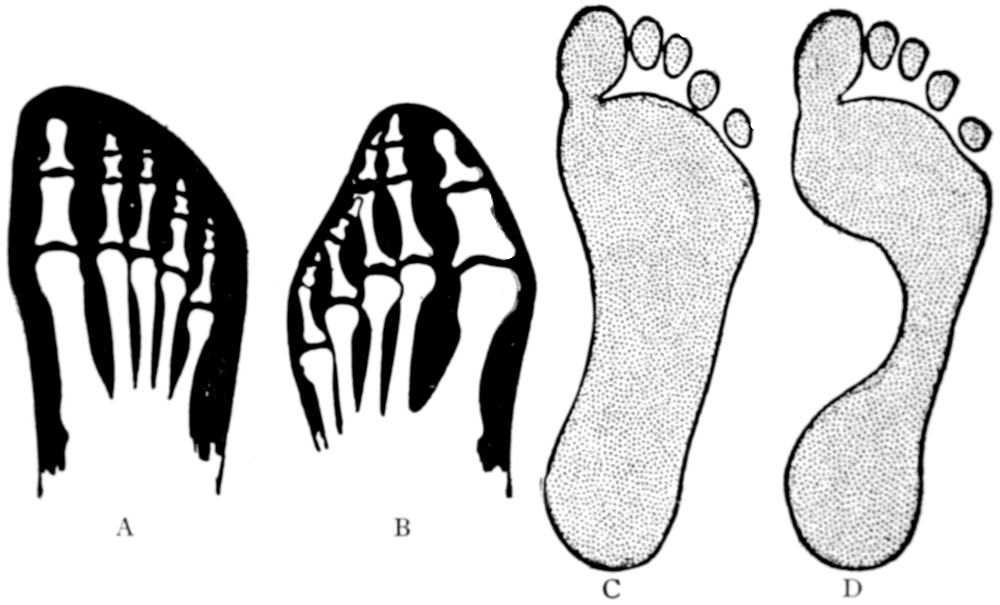
Fig. 143.—A. Comfortable Shoe of Correct Shape. B. Foot Distorted in Shoe. C. Flat-foot. D. Normal foot.
Courtesy of “Hygiene for the Worker.”
Dangers in Textiles.
—Real dangers may lurk in textile materials and clothing. A large amount of readymade clothing is still made in unsanitary homes and tenement rooms, and it is known that disease is carried in this way to the homes of the consumers. Poor or fugitive dyes in textiles or in hosiery may cause trouble. Bright-colored, striped cotton-flannel shirts have been known to injure those who are working in overheated workrooms or before hot furnaces, and dyed stockings may poison the skin, especially when it has been broken or scratched. The towel for the general [476]use of the public may be as dangerous as the common drinking cup, but the spread of knowledge of these matters is eliminating both evils. As Slosson says, “we blot our faces now instead of drying them,” since the paper towel has become so universally used.
When all is said, personal environment and idiosyncrasy must influence an individual’s choice of textile and manner of dress. The value of a study of the hygiene of clothing lies in the ability it gives to make an intelligent adjustment of clothing to one’s needs, and further, to become convinced of the importance of dressing in a way consistent with freedom of movement, physical development, and fitness for the occupation. Not all the efforts of the clothing reformers should be directed at women, offenders though they may be at times. As a whole, the clothing of men shows good points, especially in the matter of shoes, but men’s attire is quite deficient in its adjustment to heat regulation and ventilation, nor can much be said for some of its details such as stiff, unventilated hats and tight, high collars, whereas the trend in woman’s dress is toward light weight clothing, no corsets, short skirts, and (even if slowly) toward sensible shoes with good soles. It may be unusual to defend women’s hats, but from a hygienic standpoint they are generally better than the derby and top hat. An interesting experiment in temperatures has been made[63] whereby a thermometer kept in a top hat showed an inside temperature of 90° F. when the outer air stood at 77°, and 108° when the temperature rose at noon to 90°. In the evening there was a temperature outside of 68° and inside of 88°. A motor cap showed 98° inside against 78° outside.
[63] Cavanagh: The Care of the Body.
Scientific investigations of many kinds are needed that more knowledge may be gained of the relation of clothing to health. We need further data on the increase of germ life on various textiles when they are clean or soiled or when disease [477]is present, and the effect of laundering and other methods for the elimination of bacteria; a study of fugitive dyes, dressings, and treatments, and the effect on the skin; the influence on the body of each fiber and the union of different fibers; thermal properties of textiles with reference to the fiber, the weave, and the color, and the relation of weight and pressure in clothing to bodily condition.
[478]
CHAPTER XVI
ECONOMIC AND SOCIAL ASPECTS OF
TEXTILE PURCHASE
“Economy is idealism in its most practical form.”—Coolidge
Some Statistics of the Textile and Clothing Industries.
—Among the greatest industries in the United States, as in other civilized countries, is the series of occupations which supply textiles for clothing and household purposes. It may be said without exaggeration that the kinds of material made, their later use and to some extent the conditions within the industries are mainly influenced by women, who are the chief purchasers and consumers.
The value of the combined products of the selected clothing industries in 1923 was $3,925,193,176.[64] In New York City alone the value of the clothing output in 1920 was $1,528,365,400.[64] The value in the United States Census of 1910 was $1,684,636,499, showing a great increase in clothing production in 1923. The items covered are the following:
[64] Report of Merchants’ Association.
| 1910 | 1923 | |
|---|---|---|
| Clothing, men’s and women’s | $953,610,000 | $2,585,398,566 |
| Corsets[65] | 33,257,000 | 76,047,959 |
| Hats and caps, (other than felt, straw, and wool) | 13,689,000 | 42,811,444 |
| Hats (fur, felt) | 47,865,000 | 75,253,064 |
| Knit goods | 200,143,000 | 848,176,734 |
| Millinery and lace goods | 85,894,000 | 297,505,409 |
[65] Fashion’s decree has lessened the use of corsets, consequently the report of 1925 will be lower. Girdles and stiffened waists of various kinds are largely taking the place of the corset.
It is worth noting that every item has increased in greater proportion than the purchasing power of money. Ready-to-wear [479]clothing, knit goods, millinery and lace goods have made large increases.
The manufacturers of women’s apparel in 1923 produced clothing valued at nearly one and one half billion dollars:[66]
[66] Bureau of the Census.
| Suits, Cloaks and Skirts | $504,994,206 |
| Dresses, Shirt Waists and Blouses | 608,125,272 |
| Total | $1,113,119,478 |
The textile industries have grown also. The exact number of mills cannot now be obtained, for large textile establishments often have many mills under their control. The number of establishments in six groups in 1923 were:
| Kind | Number |
|---|---|
| Silk | 1,598 |
| Cotton | 1,642 |
| Knitting | 2,323 |
| Jute and Linen | 37 |
| Woolen and Worsted | 851 |
| Dyeing, Bleaching, and Finishing | 713 |
Value of Imports and Gowns from Paris, 1924, $8,833,264[67]
[67] Daily News Record.
Textiles and Their Products[68]
1923
| Number of Establishments | 26,062 |
| Number of Wage Earners (average) | 1,704,498 |
| Cost of Materials | $5,395,762,000 |
| Value of Products | 9,460,904,000 |
| Value added by Manufacture | 4,065,143,000 |
[68] Bureau of the Census.
Viewpoints.
—As women are said to buy or influence about 96% of the drygoods of the country, their ignorance of values and indifference as to conditions have a serious effect on the textile and clothing industries. The majority of those engaged [480]in manufacturing or in selling consider that women are not interested in the economic side of their clothing problem, either for the home or the industries, but care only for style and appearance. This characterization has never been entirely true, but now has less basis than it had a quarter of a century ago. The development of textile and clothing courses in Home Economics departments in universities, colleges, normal schools, high and grade schools, and the educational work of the General Federation of Women’s Clubs (in furthering its ideals of “The American Home”) have trained a large class of intelligent consumers. It may be said roughly, that one-third of the women of the country realize that the standard set by women consumers does have its influence on the industrial world as well as on the home, and they are consequently endeavoring to become better consumers by taking training. The women in another group of one-third have not been trained and have thought little about their responsibility, but are openminded and want to learn. The remainder will continue to be interested solely in their own personal appearance and apparently do not care about the effect their actions are having. The encouraging fact is apparent, however, that an increasing number of women are asking how to become more intelligent consumers.
The spending of an undue amount on dress and the frequent changing of fashions were evident before 1914, but were checked by the economic needs of the time. After the war was over, an era of extravagance began and will be stopped only by educating the consumer to see the industrial situation and the effect on the home of the tendency to thoughtless spending. Many helpful measures began during this time which should be continued, such as the following: (1) Less abrupt changes of fashion (before 1914 styles were often fundamentally altered in six months, making older clothing look out of date, but afterward with slight alterations a gown [481]could be worn several years and keep in the fashion). (2) Good materials are demanded, for women wear their clothing longer, and realize that enduring goods may be higher in price but pay in the end by their service. (3) Fewer articles of clothing are worn at one time, consequently the weight is less as well as the cost, and the hygienic condition is improved. (4) Expensive silk linings are less used in gowns, for slips have largely taken the place and can be worn with several garments. (5) Clothing is looser, the neck is open, and tight corsets and belts have passed (see Chap. XV). (6) Shoes with low heels and rounded toes that are long enough for the feet are gradually taking the place of the high French heel and pointed toe. (7) The wardrobe does not require so many varieties of outer clothing for all occasions, thus less money is required than would have been the case if old methods had continued. A woman can look as well dressed as she ever did, with a smaller outfit, and health has become an essential consideration of the dress of numerous women.
It has sometimes been erroneously argued that the large sums spent for clothing by many have been an advantage to the poor in that money has been placed in circulation and therefore the workers are benefited. This argument is especially unsound as affecting the production of women’s wear, for the workers are often overworked at extra hours without pay to supply the demand. There are many reasons why extravagance in clothing is not advantageous, such as (1) the money which is spent in such dress is badly invested and is failing to obtain, either for the individual or for the community,[69] the good returns of well-invested money; (2) it is having a deteriorating effect on the spenders by increasing their selfishness; (3) it is setting a pace which is followed by those of less means in the use of flimsy, showy fabrics [482]which not only do not endure, but often have a degrading moral effect on the wearers; (4) irritation is caused in those who desire but cannot afford such gratification; and (5) it increases a general tendency on the part of the young wage earner to sacrifice housing and food in order to spend too much of her wages on display in dress.
[69] From the standpoint of the community there is an irreparable waste when human energy which should be directed to the production of the necessities of life is diverted to the elaboration of superfluous things.
Factors in Cloth Endurance.
—Every consumer should know the conditions which are necessary to make an enduring fabric. The cost of it, alone, cannot indicate whether it will wear well, but if the price runs below a certain amount she should question the cause. It is well, therefore, for her to know the usual price for reliable fabrics. As a general rule new style goods are more expensive than the same quality in older fashions, on account of the risk in dealing with them until the merchant knows they will be successful. Many expensive clothes are not really enduring, for they are made for appearance, and strength has to be sacrificed. For instance: the best long staple cotton may be combed thoroughly, twisted into a silky yarn, and woven into a beautiful fabric; the price per yard will be high but the endurance small in comparison with a lower priced cloth with uncombed yarn and close weave. The highest priced reeled silk may be woven into a satin faced fabric which is only suitable for softly draped garments; if no strain is placed upon it it will wear for dressy occasions, but so easily will the threads shift that a slight draw on them will cause opening of the weave and fraying. The cloth has been made for graceful folds and its high price must not make the consumer think that it can stand all varieties of service. It can be seen, therefore, that high price and the use of the best raw material will not ensure wear.
Few consumers understand the difference between the many classes of wools used in making cloth. Many think that new or virgin wool in a fabric will ensure endurance, whereas if a reworked wool or shoddy is present the cloth will [483]be weak. The truth is that a well made woolen cloth composed largely or even entirely of reworked wool will give infinitely better service than a cloth made entirely of many of the sorts of new or virgin wool. The former is often combined with the virgin wool to strengthen it (see Chaps. VI and VII, By-Products and Reworked Wool). It is true that the use of the best raw material in a cloth made for endurance will give the most satisfactory wear, but it is not solely on account of the raw content, for the processes of making it into cloth were the main factors in its strength. The consumer must consider how a cloth has been made if she would judge wisely the probable wear.
The way the yarn is spun is a factor in endurance. Smooth, closely twisted yarns are the strongest. The tightly twisted yarns used in silk crêpe look dull, but will wear better in the fabric than would a loosely thrown warp and filling. Fancy yarns are often made with knots, nubs, or other irregularities. The fabric looks strong, but catches and wears off. A finely combed, long-staple, cotton yarn, closely twisted, is usually expensive on account of the processes required to produce it, but the strain of manufacture is great and weakens the fiber. A closely twisted yarn in a cloth will wear shiny, as in serge, for the surface wears off and reflects the light. Well twisted yarns are used in fabrics where the weave is a factor in the appearance of the finished cloth. In a softly twisted yarn the weave does not show as distinctly, for the yarn spreads over the surface as in blankets. In napped goods the weave is entirely obliterated, polo and broadcloth being illustrations. To know the character of yarn the cloth should be raveled both ways and the yarn untwisted. The character of the raw stock and the amount of twist that has been given can then be noted. The strength of the yarn and whether it will rough up should be considered, and whether it is a two-ply, or single yarn. Naturally the endurance is greater in the two-ply, but the demand for cheap fabrics is met [484]frequently by using single yarn in both warp and filling. Such fabrics cannot be depended upon for satisfactory laundering or wear.
The way a cloth is constructed will often determine the endurance. A very loose weave will catch and pull, leaving a defective surface. Some cloths are made in this way to give light weight and attractive appearance. If the yarn is well twisted the strength may be satisfactory, but not as much as if the cloth were woven closely also. When the warp and filling threads easily shift the endurance under strain is small. Cheap cloth is often woven loosely and finished with heavy sizing, which fills the spaces between the threads. The sizing passes by degrees and leaves a weak cloth. Such material easily pulls out of shape, but closely woven cloth stretches less. Close plain and twill weaves are the most lasting, and are more quickly made than pattern weaves, consequently cost less. A variation of the plain is the basket weave, which has two or more threads inserted both ways. It is less strong than the plain weave, for the threads are not bound so firmly. Another variation of the plain weave is to have a heavy yarn or cord one way and a fine one the other, as in a poplin. When such cloth is very carefully made it is strong, but often the finer yarn is worn by rubbing against the heavier one and breaks through. Some shirtings with stripes of heavier cord are very attractive, but soon wear at the neck or cuff, and the laundry increases the injury. Dimities are made with the heavier cord one or both ways, and are difficult to launder well, for the hot iron is too much for the fine weave, yet heat is needed to dry out the cord. Combinations of cotton and wool yarn are used in fabrics, but if they are not most carefully finished (crabbed, see Chap. VII), the surface is apt to become cockled in damp weather, as cotton reacts differently from wool. The former also soils more easily and loses its color sooner.
[485]
Knit goods (see Chap. V) may be well constructed of good yarn, but must be watched for a break in the structure, which may mean rapid stretching into a hole, or the threads may run some distance and be difficult to repair and look well. The material may stretch unduly in some places, such as the knees. Milanese knitting is done on the warp frame and does not ravel. It is used for underwear, gloves, stockings, and fabrics. Knit cloth of wool is frequently napped to give it a soft surface, and is not easily distinguished from napped woven goods. Flat knit goods are less attractive than ribbed knit, but the latter costs more. It is, however, more satisfactory and enduring. Knit goods are cheaper than the same quality in woven goods. Fancy patterns are often made in sweaters, but whenever long floats of threads are on the surface they are apt to catch. Combinations of cotton and wool yarns are much used in knit fabrics, with the same possible disadvantages as in woven fabrics.
Finish is Very Important in the Wear of Fabrics. The class of dyes used may be a reason for weakness. Heavy mordanting is necessary to hold some colors to cotton and linen, yet it tends often to weaken the yarn. Poor dyes or the adulteration of good ones may cause fading. Goods with a cotton warp and woolen or worsted filling will sometimes, after a little wear, become dull and soiled in appearance. Fabrics finished with dressings to hide poor yarn construction are apt to lose their solid appearance in the laundry and show the coarse weave. Too close shearing in pile goods makes a weak cloth, easily slit. Chiffon broadcloth is an illustration of consumer demand and consequent weak construction. Two materials may be made of the same fiber and woven in the same way, yet look and wear quite differently on account of the finish. Much of the apparent firmness of a cloth may be in the sizing which has been used. Dyeing in raw stock is more permanent than when done in the yarn, and the latter is more apt to hold its color than piece dye. Colored [486]designs printed on the surface of a cloth are very attractive, but will often become dull in outline. Wool and silk hold color better than cotton, linen, and rayon. Bleaching may weaken fabrics if carelessly done, for the chemicals used are strong. The term “ingrain” indicates the manner of dyeing (see Chap. XIII); it is used much in hosiery. It is well to remember that few fabrics are dyed fast to all influences; a cloth may stand the sun but not the laundry. Some can endure the laundry but not continual exposure to the weather. Sizings and dressings often come out in the laundry, but at times can be partially renewed by the use of starch or gum arabic and careful pressing.
Care is a very necessary factor in cloth endurance. Gowns, underwear, stockings, and shoes worn day after day without alternating regularly with another article of the same kind quickly deteriorate. After a gown has been worn it should have the street dust shaken or brushed from it and should be placed on a hanger. Cotton garments should be smoothed out by the hand before putting away, to remove the wrinkles. For a very sheer cotton, folding carefully and laying in a box or on a shelf is often better than hanging up. Pressing is excellent for preserving the freshness of clothing. For coats or street suits the tailor usually is more successful than the home ironer. Spots should be taken off when they occur, if possible, for often they can then be removed by cold water, but if they dry in, the cleaner, even, may be unsuccessful. Stockings, knit garments, and scarfs should be repaired before wearing again, no matter how small the break. Clothing should not be put into an unventilated closet or box when damp from perspiration or other cause, but should be placed outside on a hanger until perfectly dry before putting away. If clothing is repaired when the hole is small it will prolong the wear, and the mend does not show. Material often needs reinforcing under the arm or other places which are apt to wear quickly. A piece of the fabric itself is best for the [487]purpose. It is well to ask for the pieces, if the gown has been made at a dressmaker’s. Darning stockings, blacking and repairing shoes, keeping on buttons, hooks and eyes, and wearing aprons when at work are all necessary if clothing is to be kept in a wearable condition, and if one desires to practice economy. French chalk, cleaning fluids, clean cloths, white blotters, a good clothesbrush, a soft hatbrush, cleaning creams and brushes for shoes, an electric iron and an ironing board should be at hand and ready for use at any moment. Poor laundering is hard on clothing, but the best is a means of lengthening its life. It is well to consult such books as Laundering by Balderston, and Clothing; Choice, Care, Cost, by Woolman, both published by Lippincott, for information on laundering and care. Clothing made of wool, carelessly left hanging in a closet all summer, may be ruined by moths. Garments put away carefully will not only be saved from the ravages of moths but renew their freshness from the care given them. Even a small closet carefully arranged with a pole on which to hang clothing can serve to keep them in good condition. A wool suit will wear for years if care is given, but neglect may make it useless in a year. The wearer herself is frequently a factor in the deterioration of her own garments. This will result not only from buying poor fabrics and from careless and ignorant habits, but because she wears her clothing too tight, too close to the skin (some textiles cannot stand the direct heat or exudations of the body), or lets them get too soiled before sending them to the laundry or the cleaner. The reactions of the body surface differ, some persons having a more acid perspiration than others, which has its effect if care is not taken. A test between two women showed the difference in the influence they were having on their clothing. They bought silk petticoats identical in the raw material and manufacture, and made at the same place. In one instance the petticoat was worn out in two weeks of [488]constant wear, and in the other it lasted four years. (See Chap. XII, Weighting of Silk.)
Selection of Textiles and Clothing.
—The increase of wealth in the United States, releasing many from hard work and developing leisure, especially among women, has made possible a freer use of money than ever before. The tendency has increased among both men and women to spend an undue amount upon dress. The less well-to-do classes have wished to appear to equal advantage, consequently a large amount of effective, rather than reliable, materials have been produced. The market has been affected by the demand for large supplies of fabrics for garments, the price of manufacture has risen, and the cost of making into garments is higher also. The ability to use money wisely has not increased as rapidly as wealth.
Before the Industrial Revolution women were the home producers of all cloth. They not only decided what should be made and how to make it, but judged the worth of it afterward. They later used the woven material to make the needed clothing and household articles for their homes. In 150 years from that time women have become principally consumers, with little ability to judge of the value of the materials they buy. It is true that many of them still remain producers in textile mills, though in the capacity of hands rather than of heads. We also find some women producers of a higher type as forewomen in the great clothing industries where textiles are manufactured into garments, as dressmakers and as makers of clothing in the homes, but at the same time they also are apt to be consumers without sufficient knowledge of the use of money. A large class of influential women, however, are consumers only. As a class, women neither choose materials wisely nor indicate satisfactorily what shall be produced from the manufactured goods—hence are not efficient as planners or users of wealth for textiles. Their demand is, however, having its effect on the [489]quality of the output, for the goods and clothing produced are made to satisfy them.
The purchasing habits of large numbers of consumers have reacted upon retailers, wholesalers, cutters, and manufacturers, leaving upon them an impression that women, in general, have little interest in the intrinsic values of materials. During the last quarter of a century, however, groups of people have become intelligent in textile selection (see above, Viewpoints). Salespeople are being trained to sell to better advantage. Textiles are being studied as an important part of the knowledge needed. The consumer, more than ever before, needs to be fortified by knowing the values of materials, what she can afford to spend, and what she needs.
Our clothing is often an evidence of poor selection. Closets display the lack of intelligence in what has been bought—unbecoming garments, failing in line and color to suit the wearer, too frail for general occasions, not the sort of gown adapted to service; or clothing which costs too much to keep up. These hang unused, whereas the ordinary dress of the owner lacks dignity, for she has spent too much money on useless or rarely required garments.
The consumer has been spoiled by the vast supply of goods in the stores and is not satisfied unless she has many patterns in cloth to choose from, or numerous gowns to try on. She does not realize that many of these models are only chosen at intervals by anyone and remain over, having to be sold at reduced prices at the end of the season; this loss of money causing prices generally to be higher. The Secretary of Commerce has seen clearly the relation of this purchasing habit of the consumer to wastes in industry which he is trying to prevent. Unless the consumer is willing to forego the enormous assortment of samples in various commodities, the best efforts to lower prices must fail.
[490]
A study of purchasing habits in textile selection was made in the middle west by a committee of the American Home Economics Association. The group selected were substantial people living on moderate incomes in small towns or rural communities, and who appreciated value in their fabrics. The result in the naming of fabrics found desirable showed that these women had taken advantage of the instruction given by Home Demonstrators of the United States Extension Service of the Department of Agriculture. The materials chosen by them for service clothing indicated that in wool the majority desired serge, tricotine or jersey; in silk, satin, taffeta or jersey; and in cotton, nainsook, sateen, muslin, and cambric. Other materials were named, but these were the favorites.
Good selection requires more than an inclination toward fabrics of value, for many factors enter into wise choice for which training is required. Manufacturers of women’s fabrics, on account of the rapid changes of fashion, are more apt to make them for appearance than for endurance. Better cloth costs more, for the price of labor and other factors are high. Some women, desiring durable garments, are purchasing fabrics made for men, which are enduring according to the amount paid for them, and are having the cloth made up by custom tailors. The style of the tailored business suit changes little and minor adjustments keep it up to date for many years. The cost of keeping such a suit in order is small; cleaning and pressing at intervals and a new lining if there is a coat, can be done at the place where the garment was made.
The United States is advancing in design in both textiles and clothing, which should be recognized and encouraged. American dyes are successful, and fabrics colored by them are color-fast and attractive. When domestic production is as satisfactory as foreign, the consumer should acknowledge it and ask for homemade products. An impression that [491]foreign goods are better and cheaper than American has had an unfortunate influence on our production. Fine and fancy cottons are made in the United States, but the consumer has demanded foreign goods, consequently many thousands of looms were silent of late in one state alone, while large amounts of similar fabrics were imported. We are obliged to pay more for our goods, for the standard of living is higher here, our workmen receive better wages, and the hours of labor are shorter. The most elaborate class of goods, made abroad on hand looms, often in small workrooms, we do not make to any extent, but we do produce on power looms exquisite fabrics in the various fibers and in unions of fibers, and the consumer should recognize this. Foreign labels have at times been put upon our goods to sell them, which fact should put the consumer to shame.
Garments can be produced ready-to-wear, or made at custom houses, or they can be made at home. The consumer must decide which is the most satisfactory method. Some women prefer a number of inexpensive, ready-to-wear gowns to a few high-priced ones. Up-to-date transitory garments are bought and discarded as soon as the newness has worn off. The cost of good custom work is saved, and the time which would be taken in fitting or in making at home can be used in other ways. The United States leads the world in ready-to-wear clothing, and those made for women are receiving expert attention to make them more satisfactory. The loose one-piece gown lends itself to adjustment to almost all figures. Good cloths and simple designs can be procured. It is difficult as yet for the trained consumer to find out, when shopping for ready-to-wear gowns, where the cloth was manufactured and who were the cutters, yet she desires to have this information for her own satisfaction. A few of the best mills have their own cutters, which enables the purchaser to feel that the garment will give a good return for the money. In general, however, the cutters withhold the information. [492]It is said that 85 per cent of the textiles made in the United States are sold in manufactured form. A large number of textile mills are working solely for the cutting trade. Many of the ready-to-wear houses are national advertisers and keep their product up to the standard announced. Such information is a help to the purchaser. More than one-half of the men and a large number of women are depending on ready-to-wear clothing almost exclusively. There are many reliable retailers of ready-to-wear clothing, and many consumers feel that it is an advantage to see how a garment will look on them before they buy it, hence they buy ready-made clothing.
Custom work of high quality has great advantages. It is expensive and much fitting is required. The form of the garment and the line being made for the customer, are more apt to be artistic and becoming to the figure; the best cloth can be chosen, and by the selection of a conservative design the gown can be longer kept in service than the ready-to-wear. Many like this method of obtaining at least their better clothing, and prefer to have fewer garments in their wardrobe and have those noticeable for dignity and beauty, adapted to their personality. By ordering carefully in styles that are not extreme they have in a few years a desirable wardrobe at no greater expense than if they had bought many ready-to-wear gowns.
Home dressmaking is still largely used, either for all of the clothing or for a part of it. The aid of a visiting dressmaker is depended upon at regular seasons with many families. This way is the cheapest, but is apt to fail of the best results. In making garments at home time is taken which could often be used to greater profit, and where many articles are made the smooth routine of the home atmosphere is likely to be disturbed. Important things are left undone, or a person quite unadaptable to the family is injected into the group. In a household where the mother and older [493]daughters really know how and have time, money can be saved and good effects obtained. Underwear, children’s clothing and summer dresses are frequently made at home (see Making Clothing at Home, below).
Shopping.
—Each woman must decide for herself or for her family whether enduring or temporary fabrics are ultimately the cheapest for her. There is no objection to materials which appear to be better than they are if they are purchased for transient use, but misstatement should not be made about them, and they should be sold at an honest price for cheap goods. Inexpensive materials certainly have their economic place, for the easy soiling of light colors, the tendency to fade, which cannot be prevented in some fabrics, passing whims of fashion, and the outgrowing of clothing make it desirable to have materials which are not too high in price.
There are occasions, therefore, when it pays to buy the best materials, and other times when cheap, presentable materials may be more economical. If a child will soon outgrow garments and there is no one to whom they can descend the cheaper goods may be more desirable. When a consumer decides on pure, well-made, enduring fabrics, she must pay the price and expect the materials to wear if care is taken of them. If she concludes to buy cheap, ready-made garments, she must not complain if they soon look shabby. It is true that ready-made clothing, such as one-piece lingerie gowns, lace waists, and underwear, are sometimes cheaper than if made at home, but the materials are not apt to be so good as those one would buy, and consequently they do not usually wear as well. Cheap materials cannot be expected to endure whether they are in ready-made or in homemade clothing. When a gown is made at an expensive dressmaker’s, the cost is more in the making than in the materials. The difference in cost between enduring and temporary material is usually relatively small in the [494]total price paid for a gown, and economy in this case is in purchasing the best goods of the kind. Even the most careless purchaser usually wishes such articles to endure as petticoats, linings, umbrella covers, toweling, table linen, handkerchiefs, sewing silk, sheets, pillow cases, rugs, and other household articles. A frequent cause of unnecessary expense is on account of the lack of knowledge in many consumers of the amount of material required for a garment and the reliance placed on the sales person for the information. Unless there is a special reason for purchasing an extra amount of goods it is usually an economic loss to have more than is needed.
Price is an indication of worth on many occasions, especially at the best stores. It cannot always be relied upon, however, for chemical tests have frequently shown that even the very highly priced dress goods, upholstery goods, blankets, and table linen are not as pure or enduring as the price would indicate.
The consumer who desires to be economical should not make a practice of wandering about the shops to get ideas, for in that way her desires increase and are apt to become confused in her mind with her needs. When garments are really required in a family, the mother should consider the various sides of the question before she does any shopping at all: first, the amount of money she has to spend for them; second, the purpose for which they are needed; third, how long they are expected to wear; fourth, where to buy them, and the best material for the purpose, or ready-made; and fifth, the least amount of cloth which will make them and keep them in good condition. The materials or garments which will be most satisfactory for her need may be, on the one hand, something which will endure for years, or, on the other, a passing fancy only, but she should decide the best course for her to pursue before she is ready to shop. Samples should be obtained of materials whenever there is a question of endurance, and tested at home before purchasing, that mistakes may not be made. Bargain sales, as usually conducted, are a [495]doubtful advantage for the ordinary shopper; for poor materials, good materials with defects in the making, silk which is sold because it is doubtful if it will long endure on the shelves, and a few good values are often combined on the counters, and confuse the purchaser. It is really the expert only who is able to judge whether it really pays to buy any of the materials offered in the ordinary bargain sale. There are honest bargain sales which are of the greatest service to the economic consumer who knows what she wants and recognizes good material, but the thoughtless shopper is apt to buy more than she needs. Goods are often offered at these sales in lengths, and in general there is either more material or less than the shopper needs, consequently she pays for more than she should or has not enough, and thus any profit from the bargain is apt to be lost. Buying the past season’s clothing between seasons when the prices are lowered is wise if the purchaser knows exactly what she wants, the amount to spend, and can herself make such changes as will bring the garments up to date.
Shopping is an investment, and should be done with thought, not in the haphazard way in general use. The new styles are usually more expensive, for the element of risk taken by the merchant makes necessary a higher price. He will later put what is left on the bargain counter, having made his profit from it, or if it has not sold well, to get something out of it. Good sales come at regular intervals in most reliable department stores. July and August are special clearing out times when the best of fabrics or garments can be picked up. Warm weather articles are reduced in the fall and warm clothing in the spring and summer. January is a time for white goods sales and underwear. Linens are sold at this time also. A careful shopper can do some economical buying by observing these times. As women are the buyers for the family it is their business to become capable ones. It is a help to the shopper to know the prices of staple goods in order to compare them with advertised sales. The most reliable materials are often reduced for various reasons, [496]to close out a small stock or make room for new goods. These are sold at out-of-season sales. In many large retail stores such sales occur at regular times, as noted below. The shopper should know the names of trustworthy brands of goods, of dependable manufacturers, cutters, and retailers. “Seconds” or goods that have some defect in them are sold at a lower price. If the shopper makes a point of knowing whether the defect can be easily repaired she can save money by purchasing them. The shopper should set up standards of her own. Perhaps she needs a service gown. It may be of wool and she does not want it to sag or wrinkle. It must keep its color and be woven so that it will not become rough, and it must not spot. If the gown is to be of cotton it must not be too heavy for easy laundering, must not fade in the laundry or through wear, it must have little sizing and must not shrink unduly in laundering. For making such garments extreme simplicity and neatness are essential. The skirt must be wide enough to step up and walk easily. The neck must be loose and the sleeve close with no floating ends, and yet be easily pushed up the arm when necessary. The stockings should be substantial, and the shoes large enough for the feet to stand well in them; the toe rounded, the heel low and flat (see Chap. XV).
The mothers who make money go the furthest usually set aside a certain sum for clothing each year and carefully plan all of their purchases that the amount they are allowed to spend may certainly buy the necessities for each member of the family (see the chapter on Clothing Budgets which follows). If there is any money left, it can be used for the little odds and ends which “run away with money.” Careless buyers often take the bulk of the money for attractive notions when it should have gone for shoes, stockings, underclothing, and everyday dresses. Careful buyers never purchase washable outer and underclothing without considering the laundry, for time is taken in ironing frills and insertions, and in mending torn lace and lacy muslins, and the expense [497]is high for having lace-trimmed garments laundered. Clothing otherwise good is made useless and unattractive by torn trimming, while simple clothing continues to look well after much wear.
Making Clothing at Home
in simple style by members of the family has many advantages, if the time of the worker is not of greater value in some other direction. Ready-made clothing is not always constructed of the most substantial material; therefore, homemade garments of good cloth are usually better after repeated laundering and continued wear than those which are ready-made. If the latter are purchased, the selection should be made of as simple designs and as good material as possible, in neutral color and with substantial trimming. Elaborate trimming adds greatly to the constant as well as initial expense of dress. Knowing how to renovate materials and trim hats is also a help in saving money. The economic household thinks it wiser to buy plain than figured materials and standard rather than ultrafashionable fabrics. It is considered better for each individual to keep to one scheme of color that old waists, skirts, and coats may be kept in use and look well with new garments until they are worn out. Evening and party gowns for young girls can readily be made of mercerized or other cotton materials and wear much better than cheap silks, but must be carefully laundered and frequently pressed. Rompers and overalls for the little children are easily made at home and thus save money as well as prevent the spoiling of other clothing. Cotton crêpe has been used much lately by economical business women for shirt waists, nightgowns, petticoats, and underclothing. The garments can be laundered easily in the room and do not require ironing. When these garments are made from a good pattern and trimmed with narrow linen lace, an attractive result follows. They should go at intervals to a steam laundry, or they become yellow.
[498]
Economic Methods of Planning Clothing are being used by many. Each home buyer should develop her own. One gown can often be made to serve for several occasions by thought in its purchase and construction. Several blouses can go with one skirt and totally change its appearance. The ensemble suits may be very practical, for the coat, hat, and scarf can serve with other garments. One tone of color, or related tones, should be used for all outer garments, so that coats and gowns will go together. Each consumer can choose her own scheme according to what is most becoming to her personality. If there is a longing for extreme colors and styles, the sport clothing, which is not expensive, can satisfy that desire. Scarfs and sweaters can add the touch of brilliant color while leaving the gown and coat in the chosen tone. Hats also should be bought with the general color scheme in mind. By care in the choice of a summer hat, it may serve for the entire year, by the addition of a velvet or duvetyn crown. Thus a very desirable but costly hat may become an economy. Shopping should not be done hastily, but only after due thought of the need, and the most desirable garments to buy with the money. After clothing is bought there should be no need to think further about it; all necessary thought should precede the purchase.
Opinions differ as to where styles come from. Some are from Paris, other ideas are the result of a meeting of manufacturers or cutters who decide on what will be well to push the next season. The theater has its influence, and repeated requests from customers for some special design will send the store buyer to the wholesaler to obtain it. Even the progressive young girl of the day has her influence, and has been a factor in bringing into vogue many common-sense ideas, such as the sensible shoe, looser clothing, and boyish dress. The public seems to have little influence in the matter, but, in reality, the choice is always contingent upon what is felt the public will buy. As the trained consumer is increasing [499]in number and has her own opinion as to her wants she is becoming a more important factor in what shall be provided. An instance of this is the increase on the market of common-sense shoes for women; the shoemaker resisted this demand for some time, but had to succumb.
Some Simple Tests
can be made by the purchaser which help her judgment. For a thorough investigation of the content and condition of fabrics, however, laboratory tests are required, for one fiber can be chemically treated to resemble another, and the yarn content be obscure, or a finish can be put on cloth which in appearance as well as feel can puzzle even an expert. For such scientific study see Chap. XII. The general consumer can be greatly helped if she will make a point of understanding a few simple things such as the following: She should know the look and feel of staple cloths in all four textiles, and the customary price for them when at their best. When she is choosing cloth she should feel it with her bare hand and see how it drapes and folds, especially if the price is much below the usual, and she should know the many factors which must be satisfactory if the cloth is to be enduring (see Factors in Cloth Endurance, above). If she wishes the best wearing materials she will avoid a silk that feels stiff and creases readily, a shiny, starched table cover of damask, cotton shirtings with heavy cords alternating with sheer weave, or loosely woven cloth of wool with knots on the yarn. She will gradually learn some surface evidences of weak fabrics which will help her to avoid them. She will expect full bleached linen to be more expensive than unbleached, but will know that the strength of the former is lower.
Silk, in order to cheapen it, is often combined with mercerized cotton and rayon. The appearance is attractive but the purchaser should understand that the properties cannot be those of pure silk. Mercerized cotton is duller in appearance than silk and rayon is brighter. Raveling out the yarn [500]will sometimes reveal the fiber content, for if reeled silk has been used the fiber will be long, whereas the mercerized yarn is made of short fibers. Burning the raveled yarn will show the difference between animal and vegetable fibers (see Chap. XII). Rayon when wet becomes weaker, and if snapped in the hand will go to pieces, but silk is not affected by moisture, and if snapped gives forth a sound. The price is lessened by the use of rayon, but the fiber will be found to be stiffer, and less elastic than silk. The combination has advantages, for an attractive material at a lower price has been gained, but care must be taken of it (see Rayon, Chaps. IX and XII). A fine weave can be studied through the weaver’s glass, which can be bought for a low price at any optician’s. The consumer can see if the size of the yarn and the number of threads in both warp and filling are approximately the same. A cloth may seem to her attractive, but she should know what to expect of it after she has made it into a gown. A heavy cord in the filling and a loose warp often makes a weak cloth. Satin has floats of silk on the surface which give it its bright light, but when these are long and made of spun silk they will wear rough. Stiffenings and starches can often be detected by the naked eye, or the nail can raise them, or rubbing the cloth together will cause the dry dressing to fly out. A moderate amount of dressing on the yarn is needed to weave cotton and linen, and it is used in other textiles also, to strengthen the warp for the loom. It is when dressing is used to hide the poorness of the weave that it is objectionable, if the shopper desires a strong cloth. Threads easily moved in a fabric can be detected by the nail or by a needle. The kind of cloth thus made may be amply enduring when used for social events, but it is not serviceable.
Vat dyes have made possible fast colors in cotton goods, but it must be remembered that dyes are not usually made fast to all influences. (See Finish is Very Important, above.) [501]Animal fibers hold color better than vegetable. Rayon, which is a chemical product, does not hold color as well as silk does, but many people expect it to do so. Piece dyeing has been greatly improved in color fastness, but is less satisfactory than yarn or raw stock dyeing. Exaggerating the merits of textiles is usual among salespersons and the shopper must be aware of the usual properties of fabrics and not be deceived. The term “absolutely fast” is generally an exaggeration, but it is frequently heard. In buying colored wash goods for children or for house dresses it is well to test the fastness by laundry or weathering before buying. The latter can be done by placing a card over one-half of a sample and leaving it in the air and sunlight for a week or so, and noting any loss of color. Bleeding can be tested by washing a sample in hot water with a piece of white cloth in the same vessel to see if the color runs. Crocking may be noted by rubbing the fabric with a white cloth to see if the color comes off (see Chap. XIV).
Significance of Dress.
—Dress has a far-reaching influence which is not always appreciated. Well dressed people are generally regarded as successful. This may be a recognition of the success of the individual or of the head of the family. The women of a family are selected as a means of showing wealth, and a well-dressed family reflects distinction upon the one who is responsible for its support. This has been undoubtedly one reason for excessive dress in women. The extent to which they have been physically handicapped in their clothes has been another means of showing that sufficient wealth is possessed by the head of the family to free the woman from work; and that therefore her activity may be interfered with by tight clothing, trailing gowns, lacy trimmings without endurance, shoes in which it is impossible to walk easily, and other evidences of her uselessness.
Both overdressing and poor dressing are at a disadvantage in the business world. A position is as often gained by the [502]correct dress of the applicant as by her personal appeal. If she is vulgarly or overdressed she is apt to offend the possible employer, who wishes his office to have dignity, and who knows that the personality of such a one will be objectionable. If she has a careless, slovenly appearance he refuses to consider her application, feeling she is inadequate. The influence of dress on an employer is recognized generally, for it is no unusual procedure for a man who has only shabby garments and needs a position to borrow from a friend a neat business suit that fits him when making his application. Looking success is an important part of achieving success. The self-confidence that comes from being well dressed helps one to urge his ability. Ill fitting or shabby clothing makes a man feel at a disadvantage. There is a freedom of spirit attending the wearing of attractive, well-fitting garments which influences both the wearer and the beholder.
Dress has both a subjective and objective influence, for even our behavior is affected by the clothing we wear. Dress may indicate culture and release ability. The uniform of a soldier or a policeman is a help to morale, and important in the respect which it calls forth. The putting on of a sport suit for a holiday has its direct effect in making us ready for enjoyment. Dignified garments prepare us to live up to them in our actions. Immodest dress is undoubtedly a factor in the deterioration of the individual. Women’s dress of this era gives evidence of the greater freedom accorded them, and is an evidence of modern thought. In many ways too much license is taken, but on the other hand women’s dress has never been so hygienic and sensible. Character is shown often by the condition and style of our garments. One who is content to wear showy outside clothing and inadequate, torn garments beneath has some defect in her of which this condition is merely an evidence. Good nature is easily increased through wearing clean, comfortable, [503]pleasing clothes. The effect on children of being dressed in ragged, inadequate clothing is not only irritating, but also acts on the disposition as well as the health. On the other hand, extravagant or showy dress on a child is apt to produce priggishness and selfishness. It is not possible to state the relation in exact terms, but we believe that adequate, attractive, neat but not selfishly expensive clothing is a factor in virtue, and being well dressed gives a feeling of satisfaction and self-confidence which often enables the wearer to conquer a difficult situation. It is, therefore, of prime importance that we give attention to our dress, but always with regard to the amount of our income which we have a right to spend, that we may be entirely free from extravagance. Nor should our example be such as to cause either extravagance or envy in our less fortunate neighbors.
The Consumer’s Influence.
—Buying wisely is not a simple matter, as many consumers seem to think, but requires some training and much experience. Both men and women have been in the habit of considering that they have a right to buy their clothing according to their own will, being unaware or not caring for the effect their purchases may have on the industries as well as on the home. The present generation has been extravagant, and the younger people, not having been taught any better, have even exceeded their parents. The United States is noted the world over for its lack of thrift.
The Joint Commission of Agricultural Inquiry was appointed by the House of Representatives in the 67th Congress (1921) to study the causes for the widespread depression in farming communities. It urges in its report the coöperation of the consumer in reducing the cost of distribution by obtaining more knowledge of the commodities they need, “instead of depending upon the retailer to display a great variety of goods with superlative convenience and spacious display rooms with extravagant furnishings, fixtures, and [504]facilities. Such environment is created out of consumer demands, and must be paid for out of the purchase price of the merchandise the consumers buy.” The report further urges that the subject shall be taken up in schools and colleges that a better understanding of problems of distribution may follow. Thus is recognized the responsibility of the consumer for some of the causes for the high price of merchandise, and their part in reducing them. The times have been difficult and every agency should unite in endeavoring to understand conditions and to eliminate uneconomic practices. Many associations, research bureaus, and government departments are at work on these problems, and excellent suggestions have been made, but little can be accomplished unless the consumer coöperates.
The retail store is the center of women’s textile and clothing purchases. Through it her influence reaches to cutters, wholesalers, and manufacturers who are endeavoring to obtain her trade. She frequently objects to the cost of commodities, little realizing her share in the making of prices. Some one tells her that the prices of wholesale goods are almost doubled by the retailer, and she feels abused, not knowing of the many hands through which the merchandise has gone since it left the wholesaler and reached the store. She does not think how the overhead expenses have mounted through the conveniences and luxuries offered the consumer. English retailers, coming to the United States, are filled with wonder when they see the enormous expenses of the department stores in order to attract and satisfy the customers. Large amounts of merchandise from which to choose are a matter of course, yet much of it remains at the end of the season to be sold at lower prices; free delivery is a boon but it costs heavily. (A prominent retail store in one of the big cities endeavored to cut down the expense of delivery, arranging that those who wanted goods sent home could pay the price of transportation, and thus, in time, prices of [505]merchandise could be reduced, for this item in the overhead would not have to be included. The plan was a fine one, but such a protest was made that it amounted to a boycott and free delivery had to be reinstated to hold the customers, even though its cost had to be added to the price of goods.) In some cities a number of department stores are coöperating in delivery in order to lower expenses.
The approval system has great advantages, for busy mothers or business people, who cannot get to the stores, can have clothing sent home to try on and select. It would be unfortunate to lose this privilege, but the abuse of it should be stopped. In spite of much protest from the stores a large amount of goods are taken out and returned in bad condition. Merchandise will be kept and used for months, clothing is worn for special occasions and returned unsold. So many seasonal goods, such as blouses, will be taken out in one day that if more than enough of them were not bought the shelves would be depleted. The additional blouses have to be sold at a lower price when the time of greatest sale is over. Returned goods often have to be cleaned and pressed to make them fit for sale, so careless are some of the consumers in the treatment of the goods they are trying on at home. The loss through this privilege has to be adjusted by adding it to the price of future articles. At the present time in the city of Boston over $7,500,000 worth of merchandise are returned annually to the stores for refund, credit or exchange. This costs over $200,000, which is paid by the consumer.[70] Other cities of the country are having a like experience.
[70] Report of Retail Trade Board of the Boston Chamber of Commerce.
The customer is often thoughtless in her relation to the salesgirl. She is irritable and unjust when there is delay in getting some one to wait on her. She takes an undue amount of time to look over goods and will try on gowns and hats with no serious idea of buying. If she does return later to buy something which took her fancy she seldom takes the [506]trouble to find the girl who previously waited on her, yet the salary of the girl depends on the amount of sales she can make. If much time is taken by the salesgirl with no result her selling ability is questioned. The slightest failure in devoted attention and amiability if reported may lose the girl her position. Yet she may be supporting her family and may have passed a discouraging day with thoughtless customers trying her patience to the utmost.
The charge account has great advantages, but the habit of buying for cash will save many unwise purchases. It costs the merchants heavily to carry accounts, consequently it, too, adds to the price of goods. Those who have them have more consideration from the store, for they are known, they receive notices, and when they have complaints to make are given more attention. The number who pay at long intervals makes the charge account heavy on the merchant, for he often has to borrow to carry him over a time when his customers have failed to pay their debts. For the consumer the charge account is apt to make her buy more than she would without it, unless she has been thrifty enough to make a plan of purchases before shopping, which holds her back from the purchase of unnecessary things. Some of the stores have given up the charge account as they could not afford the delays in paying bills and the use of the account to take out expensive articles on approval.
The customer has been accustomed to a large and attentive sales force at all hours, yet only parts of days are they fully occupied, hence the expense of salaries swells the costs of the stores. The luxurious furnishings, the comforts in rest rooms, telephone and elevator service as well as the privileges already mentioned are accepted unthinkingly, yet cost heavily. Building construction, rents, wages, and transportation are high, and merchandise is brought from the ends of the earth. It is no wonder that the department store has a heavy overhead, which must be distributed in the cost of the goods. [507]The consumer should consider whether the luxuries and accommodations are so necessary to her that she prefers to pay more for her merchandise and thus have the stores as they are.
The price of ready-to-wear clothing, while high, has only kept pace with the advance in the price of the many charges entering into it. In 1913 the average wholesale price of a suit of men’s ready-to-wear clothing was $11.41, but by 1924 the average wholesale price was $26.54, or 122.39 per cent above 1913.[71] Such advances in wholesale prices are characteristic of merchandise of various kinds at the present time, but the consumer does not realize it. She accuses the retailer of profiteering; she also includes the clothier in the same charge. So serious became the charge a few years ago that a committee of the House of Representatives was appointed to investigate the matter. The result was a complete exoneration. The President of the United States urges the consumer to trust the retailer, for the complaint against him is unjust.
[71] Daily News Record, Oct. 15, 1924.
There are many ways in which the manufacturer suffers from the changes of fashion. The prevalent short skirt helps the stocking trade, but a quick change from a long to a short skirt will decrease the demand per capita for cloth. The widespread interest in having the hair bobbed has ruined the hairpin industry. President Coolidge has stated the following before the National Association of Cotton Manufacturers: “An expert in one of the government departments dealing with textiles, tells me that twenty years ago it took nearly 10 yards of gingham to make a woman a dress, whereas she now manages with 3¹⁄₂ yards. From the same authority I learn that in 1914 approximately 66 yards of these fabrics were required per capita in this country, while five years later in 1919, only 54 yards were demanded.”
Large Numbers of Women are Employed
in the textile and clothing industries. Their work, wages, and lives should be of interest to all consumers. Bad conditions in factories [508]and workrooms have pressed heavily upon them, and the undermined physical condition which often attends wage-earning experiences, has been a menace to the future of the race. Little children are still at work in homes, to some extent, for long hours and upon tedious tasks, and are being stunted in their moral, mental, and physical development. Years of this work make for dull brains and poor physique.
Every young person has a right to an education, to good health, and to a chance to get ahead in life. The nation will be successful only as the ability and spirit of childhood are fostered. The suppression and control of child labor is a national problem, for the fact is before us that one child in every twelve, and in some states one child in every four, is gainfully employed.[72] Over 1,000,000 children between the ages of ten and sixteen are working for wages, and nearly 400,000 of them are between ten and fourteen years of age. Large numbers are in the textile and clothing industries, and their work is ultimately due to consumers’ demands.
[72] Journal of the National Education Association, December, 1924, and pamphlet distributed by the Massachusetts Committee on the Ratification of the Child Labor Amendment, 6 Beacon St., Boston, Mass.
At present the majority of states have laws prohibiting child labor at night, forbidding children under fourteen to work at certain occupations while school is in session, keeping women and children out of dangerous pursuits, regulating sanitary conditions and demanding inspection of factories and workrooms. In some states those under sixteen are limited to an eight-hour day, overtime work without pay has disappeared and a minimum wage has been settled for many occupations. In order to fit children to make a living wage vocational education is provided for them by states’ action aided by the Federal Education Act. Instruction is of many kinds, in all-day and in part-time schools in which the worker is making a wage but has hours of instruction. Guidance and placement plans are also being forwarded in these schools, that each child may be directed into the work best fitted [509]to his or her ability with prospect of advance and good pay.
Legislation to improve conditions among women workers began about a century ago and progress has been made, but uniform laws are needed in the different states. Sweatshop labor in workrooms has almost passed, but there are still many homes where wage earning is being done by mothers and children. These places are not recognized as workrooms, consequently are not inspected for sanitary and other conditions required by law. The work is done largely for the ready-to-wear trade and for department stores. Some productive occupations are still carried on in the homes under good conditions by craft workers, by those who are too handicapped by orthopedic or other physical deformities to go regularly to trade, or by women who have cares at home requiring constant supervision, such as looking after little children or old people. There is an increasing tendency, however, to have regularly inspected workrooms for these workers, if possible. Many factory owners and heads of department stores are also earnestly forwarding betterment plans among their employees, and employees’ associations are being organized for the discussion and regulation of conditions affecting the working girls.
The home seamstress and dressmaker have not as yet had sufficient attention given to their labor conditions and the amount of work demanded of them in a given time. The need of such home workers still continues, but the uncertainties and lack of adequate remuneration do not encourage any serious preparation for such positions or their holding by a skilled and businesslike class of workers.
The work of the custom dressmaker is influenced also by the unintelligent attitude of her clientele and her own deficiencies in business training. The price of a garment should be based on the actual cost of materials, the hours of work and consequent wages of the expert and unskilled [510]workers who have constructed it, the time taken by the designer, draper, and fitter, overhead expenses of the shop, and the percentage of profit. Overhours which are required in changing a gown or hastening the completion (when the demand comes from the consumer) should be paid for as an addition to the bill. Hours set for fitting should be kept by the customer or she should notify the dressmaker of the purposed change. The garment should be delivered at the time specified. All laws concerning workers and sanitary condition of workrooms should be kept as carefully as in the factory. The pay for garments should be prompt. Many custom dressmakers desire to be absolutely businesslike, but have been prevented by the irritation felt at such changes by many of their clients. Those who have been able to organize their workrooms with efficient business methods are finding the benefit for themselves and their employees. Women can now help greatly by considering and urging forward a better system. The Consumers’ League has been a large factor in the improvements, and it and the Women’s Trade Union League are fighting bravely for still better conditions.
The Consumers’ League is a national organization with branches in many of the states. It began its work by an effort to improve the conditions of employment in department stores. It soon undertook to better the life of labor in other directions, such as to adjust wages in all fields in which women are employed, to arouse public opinion in the advisability of legislation, to obtain it, and to ask the enforcement of laws already on the statute books. By its earnest work and slogan “Do Your Christmas Shopping Early” it put an end to the late hours and rush in the stores at the holiday time which completely exhausted the sales force. It has already accomplished a notable work but realizes that much is still to be done. One state has issued the following list of abuses of which the customer should know, and aid in abolishing:
[511]
Children are still exploited in factories.
Factories are still unsanitary and unsafe.
Wages are still unstandardized.
Unemployment is unregulated.
Politics are a feature in the administration of labor laws.
Industrial processes cause occupational disease among workers.
Public opinion lacks the organization, the knowledge, and the leadership to exert its influence in the settlement of industrial problems.
The ideals of the Women’s Trade Union League are brotherhood, justice and peace. Skilled and unskilled workers together are endeavoring to improve the life of all women workers, to give them a living wage, to be relieved of the competition of child labor, to be protected from industrial diseases and accidents, to have decent housing and hygienic working lives, to have a voice in the conditions under which they work, and to remove the causes and occasions of industrial war. Large numbers of women are employed in textile mills and clothing workrooms. Much improvement has come from furthering union principles. The strike is now a less important method of control than it once was. It was seen to be expensive and new ideals have taken its place. Saving and investment are felt to give power, and labor banks have been organized to help the members of unions to save systematically. Education is being furthered and in it the problems of the employer have place. The training of working women is being carried even into the college. Bryn Mawr has opened its doors for a summer school for working women.
The Joint Board of Sanitary Control was established in 1910 in New York City as a part of the garment industries. It has jurisdiction over the cloak, suit, skirt, dress and waist trades. It represents employers, workers, and the public. There are 85,000 workers in these trades, many being women. The Board has shown great efficiency in gaining safety and fire protection, in changing the character [512]of former “sweatshop” workrooms to those with modern equipment, including washrooms, dressing rooms, rest and emergency rooms. Dense ignorance of sanitary and health matters was once common, and the education of the worker as well as the employer has been necessary in order to improve conditions and have the worker practice health rules, among which were correct posture and right seating. The Board has indorsed a movement for the placing of a label with the word “Prosanis” on it when the dress or coat has been manufactured under sanitary conditions. The Board’s inspectors keep constantly in touch with workrooms and workers. Literature is distributed, talks are given, and articles placed in the daily press. The Health Center is supported by the women themselves, but is housed in the same building as the Joint Board of Sanitary Control. The conception of health preservation has been expanded within the industry.
It must be remembered, however, that when ideals are achieved through faulty mortals much that is crude and even mistaken will occur which obscures for many both the cause of action and the beneficial results. The work has been slow, but through it all is growing up a better sympathy between employers and employed, better hours of labor, better moral and hygienic conditions of women’s work and the prevalence of conciliation committees and adjustment boards.
Waste in the Home
is too prevalent to excite remark, not only in money spent unwisely and in lack of thoughtful purchase and use of clothing, but in the general conduct of each day. Much unnecessary time is taken to do things when more important duties are pressing, such as putting fine needle work on clothing when the machine would do as well, in fine hand embroidery on underwear, in making over clothing, marcelling the hair, powdering and painting the face, and outlining the eyebrows. Talking over the telephone or chatting with neighbors during work hours use up precious [513]time in many homes. Not that some of these things should not be done, but that they should not be allowed to take the time of the more needed household tasks, causing the day to be frittered away. There are only a certain number of hours to work and a number of things to do, and unexpected things will come up that must be given attention. It is impossible to do all things in the most perfect way; the question for each homemaker to answer is, what can be omitted that something more important may be done? Failing to mend clothing regularly often means that good stockings and clothing are sent too soon to the scrap heap. Not removing spots from clothing as soon as they occur may result in a good gown being ruined or requiring money spent to put it in condition. In many families things are thrown away that might be utilized. Whether it can still be utilized without wasting time in putting it in order should be considered. Boxes, strings, wrapping paper, and pieces of textiles or clothing still in service are thrown away in many homes. Walking about the shops and buying odds and ends that attract for the minute; depending on the salesperson to tell how much cloth is needed for any purpose, thereby often buying more than is necessary; purchasing short ends of materials in bargains because they are cheap, with no definite service in view; having too many gowns and thus accumulating a stock of partly worn clothing, and waiting until underwear, stockings, and shoes are almost too far gone for service before replenishing, are all instances of customary thoughtless wastes. Human energy is taken to do useless things instead of training and economizing it for higher uses. Few women make a daily plan covering the most important things to do each day; it is only thus that they will accomplish the needed tasks and save time for the “best use of leisure.”
Many are unnecessarily fussy about order and cleanliness, and work themselves to death to attain it. They ruin the home atmosphere by objections to even simple forms of [514]disorder. This is a serious form of waste, for it touches the happiness of the family life.
Wastes of money as well as time are common even with those living on a moderate income, for people are employed to do small repairs, launderings or cleanings which could well be done at home by various members of the family.
Changing social practices are having their influence on the output of clothing workrooms. The automobile has altered methods of relaxation, so that summer resorts, where families once spent months and needed (or thought they did) large wardrobes of attractive garments, are not patronized as they once were, for the road house where the family spends the night, or, in dry parts of the country, the camping out-of-doors have taken the place. A different variety of clothing is therefore in demand. The radio is keeping families at home at night, and the moving picture houses entertain large numbers who do not have to wear evening dresses to attend. Fewer elaborate reception or party dresses are needed in many homes, which helps ordinary citizens to meet the needs of their wardrobes with a clothing budget which is not excessive. Girls are increasingly interested in athletic exercises, consequently sport clothing with the knicker suit and hiking boot have become an accepted manner of dress. Varieties of sport clothing are being offered in increasing quantities to old and young of both sexes.
The Clothing Industries
have increased rapidly in the United States within a decade. (See above, Statistics.) The leading cities for the manufacture are New York, Rochester, Baltimore, Cleveland, Philadelphia, Chicago, Boston, St. Louis, and Los Angeles, and work is going on in many parts of the country. Conditions under which the work is done have greatly improved (see above under Board of Sanitary Control and other subjects). A large up-to-date ready-made clothing factory, under an employer interested in the best conditions for his employees, offers [515]a very satisfactory employment for women who have the kind of health to allow them to work at electric power machines or to sit sewing all day.
The system of organization and division of labor in these large clothing factories is similar, whether expensive or inexpensive clothing is made. The inspection of the factories helps to keep the workrooms in safe and sanitary condition, while home workshops are often run under conditions which are not only a menace to the workers, but also to those who wear the clothing.
To those who have never made garments or thought much about the subject, the youth of the girls working in these great factories and the amount of work on one garment are a surprise. In large workrooms the division of labor is carefully arranged, being more or less the following: the original garment and the paper pattern for it are made by the designer and her helpers. It then goes to the calculator, who figures on the amount of material required and indicates on a slip the way the material is to be used. For illustration, let us suppose a fancy waist is to be made: the calculator will note if the material must be tucked, shirred or folded in any way and enters this on the slip. He then sends the waist, the pattern, and the slip to the estimator, who considers the price of the materials, the probable labor cost, the overhead or factory charges, i. e., rent, light, heat, office, and the cost of the designer and staff, and enters these on a slip. He then sends the two slips and the waist and pattern to the office. The design is now judged as to style, cost, and probable sale. It is tried on a living model and considered for line and fit. The manufacturer’s profit is added to the estimates of production, which gives the wholesale price of the waist, and the waist is ready to be seen by the buyers who have come from the retailers. Orders in dozens will probably come for the model, and as the waists are needed in several sizes, the pattern must be adjusted [516]before the work of construction begins. The paper pattern made by the designer goes, therefore, to the pattern room, where the various sizes are graded from it and patterns cut for different bust measures. These are sent to the cutter who cuts the material into the several parts of the waist by a knife or by an electric cutter. In the latter case several dozen of layers can be cut at one time in some materials. The cut material is sent to the sorter, who brings together the various parts of each waist. If tucking is to be done, the sorter sends the material to the tucker and on its return puts the tucked parts with the other sections. The assembled parts are sent to the trimming room, where the exact amount of lace, embroidery, passementerie or other decoration is added. All parts of the waist are now assembled and go to the forewoman of the workroom. She distributes to the hem-stitchers, the Corneli machine workers, or the trimmers the parts requiring their skill, and the waist is later put together by the machine operators. It is finally sent to the finishers for buttons, loops, hooks and eyes, and any small adjustments. Inspectors judge the work after each step. If a full gown is to be made, the skirt and waist go to the draper, who joins them and sees that the skirt hangs well. Pressing follows, and the gown is ready for packing and shipping. In most of the large houses skilled workers alone are employed.
Ready-to-wear clothing is usually sold directly to the retailer without the middleman. New York City has been the ready-to-wear clothing center of the country (see Statistics, above), but labor difficulties and high rents have driven many workrooms into outlying districts. There are some large establishments in which the work can be seen in progress, but much of it is given out to small workrooms. The contractor is important in the clothing industries. The manufacturer, so called, has his offices; he buys the cloth and linings, has the cloth examined and sponged, and the garments [517]cut. He lets the work out to the contractor, who returns the finished garments. The capital required is not large in comparison with the business done. The business is highly competitive. The workers are largely unionized.
The American Home Economics Association
, through its textile section, is endeavoring to understand conditions in industry and to formulate improvements which will lead to better satisfaction in the goods produced and also help to more intelligent reaction of the consumer on the manufacturer, jobber, cutter, and retailer. Through this same section a questionnaire has been sent to all the states by the clothing specialists of the Extension Committee. The aims, methods, and content of Extension Projects in Clothing have been requested. Thirty-nine states have replied giving valuable data. Some of the liberal arts colleges for women have become interested in readjusting their economic, scientific and sociological courses for closer connection with home problems, that a more economic home may result. The Purnell Act, which provides money for research in Home Economics fields in Land Grant colleges, will make possible the obtaining of important data on questions of textiles and clothing. The General Federation of Women’s Clubs, in its new division “The American Home,” is making a special study of the home. The home is, in truth, a many-sided vocation requiring varied knowledge, constantly increasing training, and experience to organize it and run it successfully.
It can be seen from the above statements that the ranks of the ignorant consumer are being broken by the many efforts to improve the conduct of the home. Nor are the women alone in research relating to purchase, for the Government and other agencies are at work. The United States Department of Commerce, through its division of Simplified Practice, is pointing out wastes and urging methods of lowering costs. The question of simplification is of prime [518]importance at the present time, for costs of distribution are high on account of larger rates of transportation, higher wages of labor, increased rents, taxes, and other items. The aim of the Department of Commerce is to coöperate with business, in maintaining standards of living and prosperity. Production, distribution, and consumption are being considered in order to eliminate wastes and to lower costs. Hundreds of commodities have been under consideration. The unnecessary duplication of models, styles, sizes, and varieties that have grown up in textiles, ready-to-wear clothing, and other merchandise needs control. Simplification is an economic movement to eliminate waste. Much has been accomplished in reducing the number of unnecessary sizes in some industries, in lowering costs, improving products, and lessening wastes. Illustrations of two industries helped by the study of simplification are beds and blankets. Types and sizes of beds, springs, and mattresses were studied, resulting in the elimination of all odd sizes of wooden and metal beds, and retaining one standard length and four sizes in width, with springs and mattresses in conformity. The bed blankets were in seventy-eight sizes of cotton, wool, and cotton and wool mixed; the reduction was made to twelve sizes, making for greater convenience and saving than was possible before.
Legislation, Federal and State.
—Each year there are before the country legislative measures relating to consumer interests. It may be tariff questions, labeling of textiles, price maintenance, honest advertising, child labor, the minimum wage or other matters directly affecting the economics of the home or the life of the woman worker. The homemaker of the past left these matters chiefly to men. Now that she has a vote it is obligatory upon her to understand both sides of the questions at issue and direct her representatives and senators in wise action.
[519]
CHAPTER XVII
CLOTHING BUDGETS
The consideration of the growth, manufacture, and economic utilization of textiles would be incomplete without a survey of costs and plans for the wardrobe. The subject has its difficulties at the present time, as prices are fluctuating but likely to remain high. The full subject of the division of income into the annual budget has been dealt with by many budget specialists, and will not be treated here excepting as a foundation for wardrobe estimates. For fuller discussion of the budget see Andrews’ Economics of the Household.
Accounts
are records of actual expenses, balanced monthly or yearly with the income. The keeping of accounts under specific headings shows what is likely to be spent or what should be curtailed in the following year. It is an ally of the budget, and it is wise to keep the same headings in both.
The budget habit is an economic necessity if one would plan the use of income wisely.
The Service of a Budget:
It eliminates wasteful spending and encourages the wise use of money.
It is a plan for using the income.
It is the balancing of needs with income.
It is a recipe for making a successful household.
It is a factor in contentment, for repentance is less apt to follow purchase.
It helps one to think before spending.
It helps one to get along with less money, for it makes the dollar go further.
It helps in apportioning a just amount to each member of the family.
[520]
The Idea of a Budget
is awe-inspiring to many housekeepers, yet neither is the making nor the living on one arduous. It is helpful to those who know how. Most new plans seem difficult at first, but this comes largely from apprehension that one is not equal to them. Each budget is an individual matter, for no two people meet the same conditions. Family needs are studied in relation to each other. The different parts of the country make various demands on the budget, the cold parts require greater outlay for shelter and clothing than the warm parts. The city has clothing requirements not needed in the farming sections. The professional woman has a different clothing problem from the business woman, and the housekeeper from the college girl. In some families the father must be considered first on the moderate income, for his business or profession has special demands. Frequently, however, the father spends less on clothing than his wife, for he desires her to look prosperous and thus indicate his success. The budget establishes a standard of living which is not greater than the income can stand.
Prices are high, and former plans for clothing expenses are now of little service. The rise in prices has been met by some women whose incomes have not increased, by complete readjustments in planning their clothing budget; fewer outer garments, perhaps two carefully selected articles a year; the omission of numerous extras in fancy slippers, trimmings, and collars. These women apparently dress as well, and are spending no more.
The entire family should work together for the budget. If a daughter wishes silk stockings and has her own allowance, she can buy them, but will soon discover that silk is not satisfactory for hard service and that cotton or rayon will do better and cost less, and thus release money for other articles she needs. She will never appreciate such things if she depends entirely on other people in the matter.
[521]
Determining the Main Annual Expenses and the Income Needed to Supply Them.
—Anyone about to make a general budget for the first time must know the income she is likely to have for the year in question. She can place the amount on a sheet of paper to compare later with the estimated expenses. The main divisions of her budget should now be considered. It is well, at first, to have but a few headings. The three main items are shelter, food, and clothing; the first two with some attendant expenses will almost always take more than one-half of the income, and clothing for a family will very likely take from one-fifth to one-fourth of it. The remainder can later be considered for personal items and for higher life and progress. Some beginners find it helpful to keep accounts for a few months in order to know how much money is being spent on various items.
Records of costs of clothing are difficult to obtain, as few families keep careful accounts. A study made by the United States Department of Agriculture of 402 families in New York State would seem to indicate that there is practically no difference in price of clothing for boys and girls under eight years of age. From eight to seventeen the cost per annum for each increases rapidly, and after that the girls’ expenses are slightly higher than the boys’. The average cost for both males and females over sixteen was $107. The average expenditure for a family was $277, or 13.8% of the entire budget.
The Clothing Division of the Budget.
—There are differences of opinion as to the percentage of income which should be spent on clothing. When the income is small, living and clothing take the most of it. The usual allowance for one person is from one eighth (12¹⁄₂%) to one fifth (20%) of the income, and for a family from one-fifth (20%) to one-fourth (25%). If too much is taken for clothing, other divisions of the budget suffer. If the members of the family are intelligent in selection, can sew, wash out and press [522]clothing and remove spots, the amount of the clothing division can be lowered to use elsewhere or better garments can be bought. The thought and planning attending the making of a budget are of especial benefit in the clothing section, for wastes are common. (See Chap. XVI, Factors in Endurance, Selection of Textiles and Clothing, and Wastes in the Home.)
The clothing demands upon each individual depend so largely upon the social customs of the environment that specific advice on exactly what to buy is impossible. The homemaker in a city, who does her own work, and the farmer’s wife have some needs in common, such as the house dress that will be strong, attractive, and easy to keep clean and tidy. But in other ways the requirements upon them are totally different. The professional woman and the secretary need well-made suits for daily service, but if one lives north and the other south the kind of suit will be very different. Each one making a clothing budget must consider her own needs from various standpoints. The kind of taste displayed and the standards shown are important, and must be reviewed. Two families may spend the same amount, and one may look dignified and well dressed, and the other vulgar and unsuitable. Attractive dress is more than spending money on it. (See Chap. XVI, Significance of Dress.)
It takes much thought and experience to be the shopper of the family and to dress all adequately on a small budget. When one is ready to consider the clothing needs for the coming season it will be a help if foresight has been shown in making an inventory of all clothing on hand, in use, or packed away. A clothing turnover is as important in the home as a stock turnover in the mercantile world. What can be put to use and how much it will cost must be considered. It is well to begin first on the minimum of clothing for each member. Planning a three years’ schedule is wise, [523]for the heavy expenses are divided in different years and do not hamper any one year. Better dressing is possible this way. If a new coat is bought one year the next two years may be free for other garments. Furs or an evening cloak can be obtained by planning ahead and having a place for them without overrunning the budget.
The clothing budget may be divided into several sections with a definite amount set aside. The percentages of the clothing money depend largely on the individual or family requirements. The following list is merely suggestive of the possible content of each section. It may serve to help someone in adjusting her clothing needs.
Outer clothing (coats, storm wraps, cloaks, ensemble suits, coat and gown—skirts, one-piece dresses, furs, sweaters, sport clothing, gymnasium, and bathing suits). This division usually takes more than one-half of the clothing money. The remainder, perhaps three eighths, can be used in the other sections as required. If laundry is included in this section allowance must be made for it. The amount varies greatly, as some wash their own clothing, while the expensive laundry is depended upon by other people. Some wear wash clothing principally. The laundry item is by many placed elsewhere in the budget.
Under clothing (night garments, knit, muslin, or silk underwear, negligees, bath wrapper, knickers, corsets, brassieres, girdle, costume slips).
Headwear and gloves (hats for various purposes; kid, wool, and fabric gloves).
Footwear and stockings (shoes high and low, slippers for dress and for room, rubbers, goloshes, sandals, spats, sport boots; stockings for daily use, for dress and for sport).
Accessories and miscellaneous (scarfs, collars, cuffs, umbrellas, pocket book, bags, handkerchiefs, hairpins, hair nets, shoe cream, hangers, shoe-trees, electric iron, and like articles.)
[524]
The percentages of the clothing money for the last four sections differ considerably with the taste of the individual. Fine underclothing is attractive to many, shoes and stockings interest other women, and several hats each season seem necessary to some. A clothing budget is not a list of everything that one uses, but a thought-out plan for those articles which must be bought in any one year. Each year finds many things left over from the year before.
In the following clothing budget of a college girl the entire wardrobe cost $307.75, but by distributing her expenses in two different years the cost annually was less than two hundred dollars. Her expenditure was less in the second year. This girl lived where summers were long and dry, hats were little used, and gloves seldom required. The amounts are given in round numbers.
| Outer clothing | $110 |
| Underwear | 45 |
| Headwear and gloves | 20 |
| Shoes and stockings | 35 |
| Accessories | 10 |
| $220 |
There are some schools and colleges where a uniform or simple dressing is prescribed, for it is considered to tend toward democracy. The college sets a pace for clothing which the students feel they must follow. Where it is not elaborate the parents are saved much expense.
A survey of what women spend on their clothing was made by the firm of R. H. Macy, New York, in coöperation with the National Association of Savings Banks. It was found that among self-supporting women the clothing item rose more rapidly with the increase in income.[73] As an illustration the following is given: “The business woman with an average income of $520 spends $100 on her clothes, and the [525]business woman earning $1200 spends $288, while the self-supporting woman with an income of $6000 usually spends $1300 for clothes.” Tentative clothing budgets were made as a result of the study, which follow:
| When the clothing budget is $100 annually | ||||
|---|---|---|---|---|
| Business woman |
Home woman |
|||
| Outer garments | $49 | .75 | $53 | .71 |
| Under garments | 21 | .30 | 18 | .16 |
| Hats | 5 | .58 | 5 | .58 |
| Shoes | 13 | .93 | 13 | .93 |
| Accessories | 4 | .85 | 4 | .16 |
| Miscellaneous | 4 | .59 | 4 | .46 |
| When the clothing budget is $1000 annually | ||||
| Outer garments | $597 | .23 | $570 | .10 |
| Under garments | 161 | .93 | 161 | .93 |
| Hats | 75 | .17 | 75 | .17 |
| Shoes | 69 | .97 | 69 | .97 |
| Accessories | 42 | .67 | 42 | .67 |
| Miscellaneous | 53 | .03 | 79 | .16 |
[73] Literary Digest, Aug. 25, 1923.
In the low budget the business woman spends less than the home woman but in the $1000 budget she spends more. In the low budget the business woman spends more on underwear. In general, however, they spend about the same amount.
A comparison between the budgets of freshman high school girls appeared in Everygirl’s Magazine of the Campfire Girls. It says, “wise planning, careful choosing, conservation, simplicity—these are the points for you to keep in mind if you would appear well dressed on a small outlay.”
| For the Freshman High School Girl | |
|---|---|
| Budget I | |
| Winter or spring coat (alternate years) | $25.00 |
| Wool dress (¹⁄₂)[74][526] | $6.00 |
| Silk dress (¹⁄₂) | 6.00 |
| Three white middies (¹⁄₂) | 3.00 |
| White skirt | 3.00 |
| Wool skirt | 4.00 |
| Slip-on sweater | 4.00 |
| Coat sweater (¹⁄₂) | 2.50 |
| Two white blouses | 4.00 |
| Winter hat (¹⁄₂) | 2.50 |
| Summer hat (¹⁄₂) | 2.00 |
| Outing hat (¹⁄₂) | 1.75 |
| Four suits of knit underwear | 4.00 |
| Three chemises | 3.00 |
| Three prs. wool-mixed stockings (¹⁄₂) | 1.50 |
| One pair silk stockings | 2.00 |
| Three prs. mercerized lisle stockings | 2.25 |
| Three nightgowns | 4.00 |
| Two gingham dresses (¹⁄₂) | 2.50 |
| White dress (¹⁄₂) | 2.50 |
| One pr. dress shoes (¹⁄₂) | 2.50 |
| One pr. school shoes (¹⁄₂) | 5.00 |
| One pr. gym. shoes | 2.00 |
| Khaki outing dress (¹⁄₂) | 2.00 |
| Bloomers | 2.00 |
| Rubbers | 1.00 |
| Fabric gloves | 1.00 |
| Total | $101.00 |
| For the Girl Who Can Sew | |
| Budget II | |
| Wool dress (¹⁄₂) | $3.00 |
| White skirt | 2.00 |
| Chemises | 1.50 |
| Gingham dresses (¹⁄₂) | 1.50 |
| White dress (¹⁄₂) | 1.50 |
| Nightgowns | 2.25 |
| Khaki dress (¹⁄₂) | 1.00 |
| Silk dress (¹⁄₂) | 4.00 |
| Plus items other than these as they are listed in Budget I | 71.00 |
| Total | $87.75 |
[527]
[74] The fractions indicate the cost in any one year.
The ability of the girl to sew saved in outer garments, but such articles as shoes, stockings, and gloves, being factory made, are the same cost in both budgets.
The following clothing estimates were made by a teacher for her wardrobe. The clothing on hand, the way she divided her expenses in three years, and the way she saved for her furs in a fourth year are indicated. She spent about $200 annually, and in three years her clothing cost her $551. Dividing expenses so that each year the call on the income is the same is the ideal way to plan. If the clothing at the same time is beautiful as well as practical a triumph has been achieved, for the amount devoted to clothing is not high. A person can be economical and yet not wise in clothing choice. It is what we do with the clothing money that counts.
[528]
| CLOTHING ON HAND OR NEEDED |
CLOTHING TO BUY | |||||
|---|---|---|---|---|---|---|
| First year | Second year | Third year | ||||
| Outer clothing | ||||||
| Coat (winter) | Coat, winter | $80.00 | Suit or spring coat | $35.00 | ||
| Coat (light) | Spring coat | $35.00 | ||||
| Furs | ||||||
| Sweater | ||||||
| Hats (4) | Hats (2) | 25.00 | Hat (1) | 18.00 | Hats (2) | 25.00 |
| Gloves | ||||||
| Cloth | Cloth gloves | 2.50 | Cloth gloves | 2.00 | ||
| Kid (short) | Kid gloves | 3.00 | Kid gloves | 3.00 | Kid gloves | 3.00 |
| Silk (long) | Silk gloves | 2.00 | ||||
| Gowns | ||||||
| Wool dresses (2) | Coat and skirt | 35.00 | Wool dress | 25.00 | ||
| Silk dresses (2) | Dress | 25.00 | Dress | 35.00 | Silk or wool (2) | 45.00 |
| Evening (1) | Cotton (1) | 10.00 | ||||
| Sport skirt (1) | Skirt | 10.00 | ||||
| Blouse (1) | Blouse | 10.00 | Blouse | 10.00 | ||
| Sweater (1) | ||||||
| Ratine (1) | ||||||
| Gingham (3) | ||||||
| Underclothing | ||||||
| Knitted (8) | Bloomers (2) | 2.00 | Bloomers | 4.00 | Bloomers (1) | 2.00 |
| Bloomers (3) | Camisole | 1.00 | Garter waists | 1.50 | Camisole | 1.50 |
| Camisoles (6) | Underskirt, silk | 5.00 | Knitted (6) | 6.00 | Knitted (2) | 2.00 |
| Waists for garters (4)[529] | Nightgowns (2) | 4.00 | ||||
| Underskirt, silk (1) | Garter waists | 2.00 | Underskirt, silk | 5.00 | ||
| Underskirt, cotton (2) | ||||||
| Nightgowns (3) | Nightgown | 2.00 | Nightgowns | 2.00 | ||
| Negligees | ||||||
| Crêpe kimono (1) | Kimono, silk | 6.00 | ||||
| Bathrobe (1) | ||||||
| Footwear | ||||||
| Pumps (1) | Pumps | 8.00 | ||||
| Oxfords (2) | Street shoe | 9.00 | Street shoe | 10.00 | Oxfords (2) | 14.00 |
| Slippers (1) | Slippers, bedroom | 2.00 | ||||
| Goloshes (1) | ||||||
| Stockings | ||||||
| Silk (3) | Silk, 3 prs | 6.00 | Silk | 2.00 | Silk, 2 prs | 4.00 |
| Wool (2) | Wool, 2 prs | 6.00 | Wool | 6.00 | Wool, 2 prs | 6.00 |
| Cotton (2) | Cotton | 3.00 | ||||
| Bathing suits | ||||||
| Wool(1) | $185.00 | $201.50 | $155.50 | |||
| Cotton (1) | ||||||
| Total for three years $551.00. | ||||||
| A balance was saved toward furs, as $200.00 per year was the yearly amount of the clothing budget, and the amount in the first and third year did not equal that (Kindness of G. H.) | ||||||
[530]
The Layette.
—A mother does not always have time to make all of the clothing for the coming baby. She can, however, buy the necessary articles well made, by machine, of good materials and not at high cost, or she can purchase handmade the highest class outfit. If she has time and knows how to sew she will not find the work difficult, for patterns can be obtained at a low figure. It is not necessary to have many garments, for they are soon outgrown; the number of slips depends upon whether they can be washed daily at home or will have to go to a laundry, and on how much money can be spent on them. Elaborately trimmed, very long dresses are no longer used, and the layette of the present is of the utmost simplicity. The wearing of too many clothes will make the baby uncomfortable. The slips and petticoats are not longer from the shoulder than 27 inches. The baby should not be kept overwarm, especially if it is living in a warm climate or in a house well heated or is a summer baby. Wool has advantages, for an infant must be kept evenly warm and wool is soft to the skin and feels warm even when wet, which is not the case with the other textiles. It has the disadvantage, however, of being ruined by careless washing, and as the clothing has to be so frequently washed the shirts and bands are apt to shrink unless the wool has some other fiber mixed with it. The baby is susceptible to cold, and the abdomen especially must be kept warm, hence the first abdominal binders and the bands and shirts must have much wool in them and must be kept soft and pliable that air may pass through. The skin must be kept dry and comfortable. When it is very cold a long sleeved and high necked knitted shirt opened down the front is necessary, but when the weather is warm a low necked shirt is better. It is well to have some wool in this garment even in warm weather, to prevent sudden chilling of the body from the use of other textiles, when the clothing is damp. For the slips a good quality of nainsook, longcloth, or batiste is excellent. A collar on the slips is not as good as a loose band with a fine edge of lace. A few fine tucks, beading, a little feather stitching on the seams, or a little embroidery of the finest kind on the waist is all that is necessary. The layette, if of good material and well taken care of, can be used again, for it is outgrown before it is worn out. A handmade layette can be bought ready to wear at $25 and $50, and machine made at less. It is possible to obtain the requisite clothing at $10, but the materials will necessarily be less fine. To make the entire wardrobe at home is the cheapest, and will mean a saving of one-third of the ready-to-wear price and at the same time finer and daintier clothing can be obtained.
The following are suggestions for a layette:
| Articles | Materials | Probable Cost | Number |
|---|---|---|---|
| Binders | All wool or union flannel, bias and unhemmed | .30 or .40 each | 3 or 4 |
| Bands | Knit, with straps over shoulders | .50 to 1.00 | 3 or 4 |
| Shirts[531] | Union silk and wool or all silk, open down the front | .70 to 1.50 | 3 or 4 |
| Gertrudes (wool petticoats) | Union flannel, cotton and wool or silk and wool | 1.20 to 3.50 | 3 or 4 |
| Petticoats | Cotton (not always needed) | .75 to 1.00 | 3 or 4 |
| Nightdresses | Union flannel | 1.00 to 1.75 | 3 or 4 |
| Knit goods | .50 to 1.00 | 2 or 3 | |
| Wrappers | All wool crêpe | 2.50 to 4.00 | 4 to 6 |
| Slips | Nainsook, batiste, or longcloth | .60 to 1.00 | 4 to 6 |
| Dresses | Ditto | .75 to 3.25 | 1 |
| Cloaks | Polo cloth for winter, cashmere lined with silk for summer | 3.00 to 3.50 each | 1 |
| Bonnet or hood | Wool, silk or nainsook | 1.00 to 2.00 | 1 or 2 |
| Jackets or sweaters | Wool | 1.00 to 2.50 | 2 or more |
| Shoes or socks | Soft leather or wool, amply long and wide | .50 to .75 | 2 |
| Stockings | Wool, long | .50 | 2 or 3 prs. |
| Cotton and wool | .50 | 2 pairs | |
| Diapers | Cotton birdseye | 2.70 for ten yds. | 2 or 3 doz. |
| Cheesecloth | 1.00 for ten yds. | 2 or 3 doz. |
Extras
An old blanket
Some old soft towels
A pad for the lap
Wrapping blankets
Flannelette sheets
Knitted shawl
An old silence cloth such as is used on the dining table makes an excellent pad for the baby to lie upon. An old wool blanket cut the size of the crib and covered with silk muslin is a warm comforter.
Note. Some mothers feel that a child requires a greater number of these garments than is given if there is likelihood of more being needed to keep it dry. A rubber diaper is not considered wholesome to use, but is a convenience when traveling.
[532]
For the first bands or binders one yard of soft wool or silk and wool flannel can be torn into bands five or six inches wide and eighteen inches long. These must not be hemmed. They are worn for a few weeks only. Many use the material bias or make pinked edges so that the band gives over the abdomen. These are worn to protect the bowels and to support the abdominal walls and prevent rupture. They are in use until the second band, which is knit and has straps over the shoulders, is substituted. The second bands keep the abdomen from getting chilled. They are worn summer and winter for eighteen months to two years. The shirts are open all the way down that they may be put on easily. They are made of silk and wool, or cotton and wool, as are the bands, that they can be washed without shrinking. All wool is too warm and shrinkage is likely to occur and make the fabric thick, so that the body is not ventilated as it should be and is not free in its movements. A tab or tape for holding up the diaper should be on the shirts. In winter the shirt should be high necked and with long sleeves. Shoes are unnecessary until the baby begins to creep. Outing flannel is cheaper than unions of cotton and wool, and is much used for petticoats, wrapping blankets, nightdresses, and wrappers. Napped cotton easily takes fire, however, and is dangerous; it also feels cold when wet and the skin is quickly chilled. Naturally there is a difference in the supplies required for a summer or a winter baby. With the latter, in a cold climate, it is necessary to use much wool in unions to keep the child warm, or the danger of chill is great.
The diapers are cut 18, 20, or 24 inches square. The cheesecloth ones are good for the little baby and can be used inside of the other diapers when he is older. They should be hemmed by hand. Blankets should be of wool, yet are frequently of cotton polo cloth. Eiderdown flannel, wool polo cloth, and knitted and crocheted blankets of wool are light in weight and warm. Dresses of kimono pattern [533]are satisfactory, for they are less apt to tear at the armhole. The wool petticoats or Gertrudes have a band of cotton around the waist for warm weather and straps over the shoulder. They fasten on the shoulder, or are easily put on when open all the way down the front. Viyella flannel is soft and warm for these. The sleeping bag or wrapper with a hood for very cold weather allows the child ample room to move and kick without getting cold. Socks can be pinned to the diaper rather than using a strap around the leg. Shoes and stockings should be amply large for the feet. In warm weather the bare feet need not be covered excepting with the length of the dress or slip, but in winter stockings are necessary.
A clothing survey
has been made in rural neighborhoods by the Extension Committee of the Textile Section of the American Home Economics Association. The members of the committee were clothing specialists from Land Grant colleges, the headquarters of the United States Extension Service. A questionnaire was sent out to obtain the results of the teaching of the specialists upon the women who live far from the large cities. Sixteen states were included in the survey, and the return of the questionnaires was from 4138 homes, the greater number on farms, but some in villages. The average number in the family was 4.02. The following are answers to some of the questions:
| Do you usually make clothing for yourself and adult members of the family? | ||||||||
| Yes | No | Yes | No | Yes | No | |||
| Undergarments | 3467 | 200 | Summer dresses | 3475 | 92 | Silk dresses | 1936 | 1294 |
| Aprons | 3207 | 829 | Blouses | 1763 | 201 | Wool dresses | 1749 | 1266 |
| House dresses | 3724 | 133 | Skirts | 1055 | 243 | Suits | 403 | 619 |
| Coats | 458 | 591 | ||||||
| Do you usually make for the children?[534] | ||||||||
| Yes | No | Yes | No | |||||
| Undergarments | 2561 | 423 | Cotton suits | |||||
| (boys) | 1347 | 1207 | ||||||
| Cotton dresses | 2688 | 443 | Wool dresses | 1273 | 1519 | |||
| Coats | 1906 | 487 | Wool suits | |||||
| (girls) | 635 | 1704 | ||||||
| (boys) | 649 | 1754 | ||||||
| Do you usually make for husband and adult boys? | ||||||||
| Yes | No | Yes | No | |||||
| Shirts | 1521 | 920 | Coats | 57 | 1703 | |||
| Underwear | 260 | 1598 | Trousers | 95 | 1695 | |||
| Pyjamas | 1069 | 1578 | ||||||
| Do you make over garments? | ||||||||
| Yes | No | |||||||
| For children | 2153 | 988 | ||||||
| For self | 2144 | 1299 | ||||||
| For husband | 125 | 1839 | ||||||
| Do you make hats? | ||||||||
| Yes | No | |||||||
| For self | 1400 | 1573 | ||||||
| For children | 730 | 1540 | ||||||
| Yes | No | |||||||
| Do you sew because you enjoy it? | 2225 | 222 | ||||||
| Find it an economy? | 3413 | 479 | ||||||
| Find clothes please better? | 2131 | 650 | ||||||
The survey shows that the greater number of farm women make the simpler clothing and underclothing for the family, including the fathers and sons. Many are making and trimming hats for themselves and daughters. Some make the silk and the wool dresses, but many do not, for they have not the time. From their expression of need it seems as if they feel the lack in themselves of ability to select cloth or clothing and to alter and use commercial patterns.
[535]
BIBLIOGRAPHY
- The Primitive:
- Clood: Story of Primitive Man.
- Earle: Home Life in Colonial Days.
- Kissell: Aboriginal American Weaving.
- Mason: Origin of Inventions.
- Mason: Woman’s Share in Primitive Culture.
- Reports of the Bureau of Ethnology, Washington.
- Starr: First Steps in Human Progress.
- Textile Fibers,—Growth and Manufacture:
- American School of Correspondence:
- Cyclopedia of Textile Work.
- Woolen and Worsted Finishing.
- Aschenhurst: Weaving and Designing.
- Barker: Textiles.
- Bean: On the Wool Track.
- Beaumont: Carpets and Rugs.
- Finishing of Textile Fabrics.
- Standard Cloths: Structure and Manufacture.
- Woolen and Worsted Cloth Manufacture.
- Wool Substitutes.
- Beckett: Cotton.
- Bennett: Cotton Glossary.
- Bradbury: Carpet Manufacture.
- Bradley: Wool Carding.
- Brinton: Carpets.
- Brooks: Cotton.
- Buck: Flat Machine Knitting and Fabrics.
- Carpenter: How the World is Clothed.
- Carter: Flax and Its Products.
- Chamberlain and Quilter: Knitted Fabrics.
- Cherington: The Wool Industry.
- Chittick: Silk Manufacturing and Its Problems.
- Cooke: Velvet and Corduroy.
- Crawford: The Heritage of Cotton.
- Cray: Sheep Farming in North America.
- Darby: Silk, the Queen of Fabrics.[536]
- Cotton, the Universal Fiber.
- Wool, the World’s Comforter.
- Davis: Hosiery Manufacture.
- Dodge: Useful Fiber Plants.
- Dooley: Textiles.
- Duran: Raw Silk.
- Dyer: Textile Fabrics.
- Felkin: A History of Machine Warp Hosiery and Lace Manufacture.
- Foltzer: Artificial Silk and Its Manufacture.
- Fox: Mechanism of Weaving.
- Gibbs: Household Textiles.
- Goldenberg: Lace: Its Origin and History.
- Greene: Practice in Finishing.
- Haerry: Artificial Silks.
- Hannau: Textile Fibers of Commerce.
- Hart: Raw Materials of the Worsted and Woolen Industries.
- Hooper: Hand Loom Weaving.
- Hooper: Silk.
- Hubbard: Cotton and the Cotton Market.
- Jackson: A History of Handmade Lace.
- Kinne and Cooley: Shelter and Clothing.
- Kissell: Yarn and Cloth Making.
- McGowan and Waite: Textiles and Clothing.
- Matthews: Textile Fibers.
- Mitchell and Prideaux: Fibers Used in the Textile and Allied Industries.
- Moore: Linen (short treatment).
- Linen (comprehensive treatise).
- Moore: The Lace Book.
- Nasmith: Cotton Spinning.
- Nystrom: Textiles.
- Oelsner: Handbook of Weaves.
- Palliser: History of Lace.
- Pollen: Seven Centuries of Lace.
- Polleyn: Dressing and Finishing of Textile Fabrics.
- Posselt: Manufacture of Narrow Woven Fabrics.
- Wool, Cotton, Silk, from Fiber to Fabric.
- Radcliffe: Manufacture of Woolen and Worsted Yarns.
- Rayner: Silk Throwing and Waste Silk Spinning.
- Ricci: Old Italian Lace.
- Scherer: Cotton as a World Power.[537]
- Sharp: Point and Pillow Lace.
- Thompson: Cotton and Linen Merchandise Manuals.
- Silk Merchandise Manual.
- Todd: The World’s Cotton Crop.
- Tompkins: Science of Knitting.
- Toothaker: Commercial Raw Materials.
- Turner: Study of Fabrics.
- Walton: The Story of Textiles.
- Watson: Textiles and Clothing.
- Watson: Advanced Textile Design.
- Whiting: A Lace Guide.
- Whitman and Leeson: Flax Culture in the United States.
- Woolman: Clothing—Choice, Care, Cost.
- Zipser: Textile Raw Materials.
- Textile Microscopy and Chemistry:
- Barker and Midgeley: Analysis of Woven Fabrics.
- Beery: Chemistry Applied to Home and Community.
- Bowman: Structure of the Cotton Fiber.
- Structure of the Wool Fiber.
- Dooley: Textiles.
- Dumville and Kershaw: The Carbonizing Process.
- Garard: Applied Chemistry.
- Griffin: Technical Analysis.
- Hall: Cotton Cellulose.
- Hanausek and Winton: Microscopy of Technical Products.
- Harper: Textile Chemistry.
- Herzfeld: Technical Testing of Yarns and Fabrics.
- Herzog: The Determination of Cotton and Linen.
- Heuser: Textbook of Cellulose Chemistry.
- Matthews: Textile Fibers.
- Mitchell and Prideaux: Fibers Used in the Textile and Allied Industries.
- Pearson: Waterproofing Textile Fabrics.
- Posselt: Fabric Analysis.
- Sherman: Organic Analysis.
- Slosson: Creative Chemistry.
- Textile Treatment and Care:
- Balderston: Housewifery.
- Laundering.
- Brannt: The Practical Dry Cleaner, Scourer, and Garment Dyer.
- Farmers’ Bulletin No. 861: Removal of Stains from Clothing[538] and Other Textiles. U. S. Department of Agriculture.
- Hubbard: The Instructor in Garment Cleaning. 2 Vols.
- Laundryowners’ National Association: Manual of Standard Practice for the Power Laundry Washroom.
- Mellon Institute: Research Literature on Laundry Problems.
- Osman: Cleaning and Renovating at Home.
- Owen: Dyeing and Cleaning of Textile Fabrics.
- Dyeing:
- Beaumont: Color in Woven Design.
- Cleland: The Munsell Theory.
- Fraps: Principles of Dyeing.
- Georgievics and Grandmougin: Textbook of Dye Chemistry.
- Hummel: Dyeing of Textile Fabrics.
- Matthews: Application of Dyestuffs.
- Bleaching and Related Processes.
- Laboratory Manual of Dyeing and Textile Chemistry.
- Mijer: Batiks, and How to Make Them.
- Norton: Artificial Dyestuffs Used in the United States.
- Olney: Textile Chemistry and Dyeing.
- Pellew: Dyes and Dyeing.
- Sargent: The Enjoyment and Use of Color.
- Hygiene (Texts, and References in Clothing Books and in Magazines):
- American Posture League: Miscellaneous Publications. New York City.
- Bergey: Principles of Hygiene.
- Brady: Personal Hygiene.
- Brown: Good Health for Boys and Girls.
- Butterick: Principles of Clothing Selection.
- Cavanagh: Care of the Body.
- Devine: The Normal Life.
- Dyer: Textile Fabrics.
- Fisher and Fisk: How to Live.
- Galbraith: Personal Hygiene and Physical Training for Women.
- Gibbs: Household Textiles.
- Gulick: The Efficient Life.
- Harrington and Richardson: A Manual of Practical Hygiene.
- Hartman and Bibb: The Human Body and Its Enemies.
- Hough and Sedgwick: The Human Mechanism.
- Jewett: The Body at Work.
- Journal of Home Economics:
- Baker: Clothes and the Body. June, 1916.
- Caton: The Hygiene of Women’s Underwear. June, 1921.[539]
- Glanton: Relation of Clothing to Health. April, 1924.
- Sherman: Hygiene of Clothing. Jan., 1925.
- Kinne and Cooley: Clothing and Health.
- Shelter and Clothing.
- Lane-Claypon: Hygiene of Women and Children.
- Life Extension Institute: Keep Well Leaflets. New York City.
- McGowan and Waite: Textiles and Clothing.
- Metropolitan Life Insurance Co.: Health of the Worker. New York City.
- O’Shea and Kellogg: The Body in Health.
- Pyle: Personal Hygiene.
- Ritchie: Sanitation and Physiology.
- Terman: The Hygiene of the School Child.
- Tolman and Guthrie: Hygiene for the Worker.
- Williams: Personal Hygiene Applied.
- Woolman: Clothing—Choice, Care, Cost.
- Economics and Budgets:
- Abbott: Women and Industry.
- Abel: Successful Family Life on a Small Income.
- Andrews: Economics of the Household.
- Bosworth: Living Wage of Women Workers.
- Butler: Women and the Trades.
- Chapin: Standard of Living.
- Donham: Spending the Family Income.
- Dyer: Evolution of Industry.
- Ely: Evolution of Industrial Society.
- General Economics.
- Kinne and Cooley: Shelter and Clothing.
- Lord: Getting Your Money’s Worth.
- MacLean: Wage-earning Women.
- McVey: Modern Industrialism.
- More: Wage-earners’ Budgets.
- Report on Condition of Woman and Child Wage Earners in the United States. 19 Vols.
- Streightoff: Standard of Living.
- Taber and Wardall: Economics of the Family.
- Woolman: Clothing—Choice, Care, Cost.
- General:
- Baer: Retail Selling Methods.
- Baker: Dictionary of Men’s Wear.
- Baldt: Clothing for Women.
- Clifford: The Lace Dictionary.[540]
- Cole: Encyclopedia of Dry Goods.
- Denny: Fabrics and How to Know Them.
- Dow: Composition.
- Fales: Dressmaking.
- Goldstein: Art in Everyday Life.
- Filene: A Merchant’s Horizon.
- Harap: Education of the Consumer.
- Harmuth: Dictionary of Textiles.
- Kinne and Cooley: Shelter and Clothing.
- Parton: Psychology of Dress.
- Patty: Hats and How to Make Them.
- Posselt: Technology of Textile Design.
- Rittenhouse: The Well-dressed Woman.
- Sage: Study of Costume.
- Small: How to Know Textiles.
- Some Great Commodities. Members of Statistical Division of National Bank of Commerce, New York City.
- Story: How to Dress Well.
- Talbot and Hughes: Dress Design.
- Weinberg: Color in Everyday Life.
- White: Market Analysis.
- Woolman: Clothing—Choice, Care, Cost.
- Periodicals and Pamphlets:
- American Silk Journal.
- American Wool and Cotton Reporter.
- Boys’ Outfitter.
- Chemicals.
- Daily News Record.
- Dry Goods Economist.
- Dyestuffs.
- Fiber and Fabric.
- Journal of Home Economics.
- Journal of Industrial and Engineering Chemistry.
- Lace and Embroidery Review.
- Men’s Wear.
- Millinery Trade Review.
- National Retail Clothier.
- Textile World.
- Textiles.
- Women’s Wear.
- Bulletins and Publications of:[541]
- U. S. Dept. of Agriculture.
- U. S. Dept. of Commerce.
- U. S. Bureau of Standards.
- Life Extension Institute, New York City.
- U. S. Testing Company, Inc., New York City.
- Joint Board of Sanitary Control, New York City.
- Better Business Bureaus.
- Silk Association of America.
- Universities.
- Consular and Trade Reports.
- Poole’s Index.
- Special References:
- Artificial Silk, Manufacture of. Textile World. Dec. 22, 1923.
- Artificial Silk, Survey of and Related Articles. Issued by the Tariff Commission. May 11, 1925.
- Artificial Silk. Jour. Indus. and Eng. Chem., Oct., 1925.
- Rayon: Salvage. Published by American Viscose Company.
- Rayon number of Textile World, Sept., 1925.
- Balderston: Home Laundering. Farmers’ Bulletin No. 1099 (June, 1920), U. S. Dept. of Agriculture.
- Baldt: Selection and Care of Clothing. Farmers’ Bulletin No. 1089 (Feb., 1920), U. S. Dept. of Agriculture.
- Denny: Fabric Fallacies. Pictorial Review, Aug., 1922.
- Fabrics—How to Buy Them. Extension Circular No. 402 (1922), Univ. of Nebraska.
- Facts About Linen. Circular of the Agricultural Extension Service, Vol. VII, No. 6 (1921-22), Ohio State Univ.
- Ibid. Circular No. 18.
- Frederick: You and Your Laundry. Hurley Machine Co.
- From the Sheep to the Needle. S. B. &. B. W. Fleisher, Inc., Phila.
- Herzog: The Determination of Cotton and Linen. Tech. Bull. No. 7, Teachers College, Columbia Univ.
- Kapok Culture and Industry. Circulars Nos. 21 and 26, U. S. Dept. of Agriculture.
- Lang and Whittelsey: Removal of Stains from Clothing and Other Textiles. Farmers’ Bull. No. 861, U. S. Dept. of Agriculture.
- Lee: Helps for Home Dyers. The Country Gentleman. May 3, 1913.
- Mayer: Tinting and Dyeing Secrets. Good Housekeeping. Aug., 1922.
- Matthews: Wonderful New Fabrics and Dyes. Good Housekeeping.[542] Oct., 1912.
- McGowan: Soaps in Variety, and How Soaps Clean. Good Housekeeping. June and August, 1925.
- Materials for the Household. Circular No. 70 (1917), U. S. Dept. of Agriculture.
- Old and New Methods of Spinning. American Wool and Cotton Reporter, July 14, 1921.
- Phillips: Modern Home Dyeing. Pamphlet of North American Dye Corporation, Mt. Vernon, N. Y.
- Rose: Growth of the Dye-Stuff Industry: Journal of Chemical Education, September, 1926.
- Silk, Its Origin, Culture, and Manufacture. The Corticelli Silk Mills, Florence, Mass.
- Silk from the Worm to the Wearer. Belding Bros. & Co., 902 Broadway, New York City.
- Skinner’s Silks and Satins—Their Romantic Story. William Skinner & Sons. New York City.
- Studies on Knit Underwear. Associated Knit Underwear Manufacturers of America.
- The Silkworm. Official Bulletin of the Silk Association of America.
- The Manufacture, Dyeing, Printing, and Finishing of Textiles. Pacific Mills, Lawrence, Mass.
- Warburg: Cotton and Cotton Manufacture. Also, Wool and Wool Manufacture. First National Bank of Boston.
- Ward: The Farm Woman’s Problem. U. S. Dept. of Agriculture Circular No. 148 (1920).
- Warp Knitting and Glove Manufacture. Merrill and other Writers.
[543]
GLOSSARY
- Absorbent Cotton. Natural cotton which has had its waxy and fatty matter removed in order to enable it to take up water readily.
- Animalized Cotton. Cotton made to have the nature of animal fibers toward wool or silk dyes, by being coated with protein material such as albumin, gelatin, or dissolved wool.
- Awl. A primitive tool made of bone which served as a needle.
- Bast Fibers. The long fibers lying under the bark in the stem of various plants such as flax, jute, and hemp.
- Batik. A method of resist dyeing originating in Java, in which wax is used to cover the part of the fabric which is not to take the dye.
- Battening. The driving up in close order of the filling threads in weaving.
- Beam. A cylinder which holds the warp of cloth in the loom.
- Beetling. A special finish of linen and cotton cloth in which the threads are beaten flat.
- Bleaching. Whitening materials by removing the natural coloring matter of the fiber.
- Bleeding. A running of color when washing dyed material.
- Blending. Mixing fibers of different kinds or colors to make a desired effect in the yarn.
- Block Printing. Method of dyeing by stamping color on a cloth with carved blocks.
- Boiled-off Silk. Silk which has had the sericin or gum removed.
- Boll. The pod of the cotton plant which contains the fibers.
- Breaking. The crushing and first separation of the woody portion from the flax or hemp fibers after the retting process.
- Broad Silks. Silk cloth as distinguished from silk ribbons.
- Burling. One of the processes of finishing cloth. It removes knots, burrs, and similar imperfections from the surface.
- Burnt-out Work. A method of producing decorative surface effects in fabrics by means of a chemical which destroys part of the fabric in pattern arrangement.
- Calendering. A finish for cotton cloth particularly, which gives smoothness, luster, and special effects by pressure under rollers.
- Cam. A projection on a wheel which causes reciprocal action.
- Carbonizing. Removing vegetable matter from wool by acids.
- Card Clothing. The fine teeth or wires which are on the carding cylinders.[544]
- Carding. A cleaning and combing of wool or cotton fibers preparatory to spinning.
- Chlorinated Wool. Wool treated with bleaching powder and other solutions to give luster, destroy its felting property, and increase its affinity for certain dyes.
- Clipping. Process of finishing some fabrics such as broadcloths, which cuts the surface fibers to even length.
- Clips. The cuttings from the manufacture of new garments.
- Cockling. An irregular shrinking on the surface of a fabric.
- Combing. A process for laying fibers in perfect order which sometimes follows carding.
- Conditioning. All moisture held in the fiber is removed by this process, and the legal amount restored.
- Cotted Wool or Cotts. Matted wool which is hard to open up.—Inferior wool.
- Count. The number given to yarn to indicate its fineness.
- Count of Cloth. The number of warp and filling threads in a square inch of fabric.
- Courses. The horizontal ridges in knit goods, made by the tops of each successive row of stitches.
- Crabbing. A method of setting the weave to keep its form.
- Cravenetting. A term applied to a method of waterproofing fabrics.
- Crocking. Rubbing off of loose dye from a dyed material, such as a coat collar or lining.
- Crofting. Spreading linen on grass to bleach.
- Cropping. Shearing the surface of cloth.
- Crossing. The arrangement in reeling or winding which prevents tangling or matting from the piling of threads upon each other.
- Cross Dyeing. Dyeing in a bath which colors only one kind of fibers in a mixed material.
- Decating. Sponging. A method of preventing cloth from spotting by water.
- Decorticating. Stripping off the bark or outer coat, applied chiefly to ramie and hemp.
- Denier. A measure of weight used in silk counting. The standard in the United States for a denier is a skein of silk 450 meters long, weighed by a unit of 0.05 gm. (called denier); 13 to 16 is written 13/16, and means that the skein varies from 13 to 16 deniers.
- Dents. The division between the wires on the reed through which the warp threads go.
- Direct Dyes. Dyes which can be applied to the fiber without the aid of a mordant.[545]
- Discharge Printing. A process which takes the color out of a dyed fabric, leaving a design where the chemical acted.
- Doctor Knife. The instrument which removes superfluous color from the roller used in printing dyes on a fabric.
- Doffer or Stripper. A device for taking the sliver from the card.
- Doubling. The process of forming a sliver from two or more smaller slivers to produce a roving.
- Down Hair. The soft hair found under the coarser hair on certain animals such as the camel.
- Draft. The design which indicates to the one setting up the loom how to proceed.
- Drawing In. The threading of the warp threads through the harness of the loom.
- Dressed Flax. Cleaned flax ready for spinning.
- Dressing. Substances used in the finishing of cloth to give stiffness, etc.
- Duplex Printing. The printing of a pattern on both face and back of a fabric.
- Dyeing. Immersion in a color bath to dye material.
- Dynamiting. Overweighting of silk with mineral salts.
- Ends. The warp threads. See Warp.
- Extract Wool. See Reworked Wool.
- Felt. A variety of cloth which has its fibers closely matted or fulled.
- Felting. The thickening of wool by the drawing up and interlocking of its fibers to produce shrinking.
- Fibroin. The filament of silk after the gum is removed.
- Filatures. Machines for silk reeling which take the place of hand reels.
- Filling. The cross threads in weaving. See Weft.
- Filling. Substances such as clay or starch, used in finishing processes to give body and weight to certain grades of cloth.
- Flax Brake. The device used to break the flax straw in order to separate the woody portion from the fiber, after retting and drying.
- Floats. Long threads of either warp or filling yarn brought to the surface in weaving, to make the pattern.
- Flocks. Soft, fluffy fibers thrown off by different processes in woolen and worsted manufacture, such as raising and cropping.
- Floss Silk. A term used for spun silk.
- Frame. An upright machine for twisting or spinning.
- Fulling or Milling. Felting or shrinking of woolens to produce close, firm material, such as broadcloth.[546]
- Full Fashioned. Term applied to knitted garments such as hosiery which are shaped by the machine in a flat web and afterward sewed to form a permanently shaped article.
- Garnetting. Converting thread waste into loose fiber.
- Gassing. Burning off fuzzy protruding ends from cloth to produce a smooth surface.
- Gauze. A form of weaving by means of a special heald. Also a light fabric made by the gauze weave.
- Gigging. A machine method of preparing the fulled cloth for shearing. See Napping.
- Ginning. Separating seed hairs of cotton from the seed.
- Hackle. See Hetchel.
- Hackling. A combing process which separates woody particles and tow from the line or long flax fibers.
- Harness. A collection of healds or heddles which controls the warp threads.
- Healds or Heddles. Cords or sticks having openings or eyes in their centers, through which the warp threads pass in the loom.
- Hetchel, Hatchel, Hackle, or Heckle. A device with long teeth set in a board, for cleansing the flax fibers from tow.
- Hydro-Extractor. A centrifugal apparatus for drying yarns, cloth, etc.
- In the Gray. A mill expression for woven cloth before it has been bleached or dyed. In the grege is used for silk.
- Ingrain. A term applied to (a) ingrain dyed material, i. e., dyed in the fiber before manufacture or developed in the fiber by diazotizing; (b) to ingrain carpet, which is made of wool dyed before manufacture.
- Kemps. Fibers of dead wool in a fleece, or coarse, inferior hairs, which do not dye well.
- Kibizzo. A Japanese term for a variety of silk waste.
- Lap. A wide sheet of fibers in the form of a web which precedes the drawing into slivers.
- Lappet. An attachment to the regular loom which affects the shedding. It is used extensively for decorative cotton goods.
- Laths. Sticks which hold the healds or heddles suspended in the hand loom.
- Lathe or Sley. The stick used for battening in weaving.
- Lease. The crossing made in the warp threads in preparing them for the loom.
- Lease Eye. The eye in the center of the heald, through which the warp yarn is drawn.[547]
- Leno is a weave in which certain warp threads cross each other, forming a design. Gauze and marquisette are varieties of leno weave.
- Line. Long flax fibers.
- Lint. Cotton fibers after removal from seed.
- Linters. The short seed hairs left attached to the cotton seed after the first ginning.
- Loading. See Dynamiting.
- Mail Eye. See Lease Eye.
- Mangling. Pressing a fabric under rollers which may or may not be heated.
- Mercerizing. A process applied particularly to cotton, consisting of a treatment with strong alkali to give the fiber special properties, especially luster.
- Milling. See Felting and Fulling.
- Mill Waste. A term applied to by-products of mill operations.
- Mordant. A substance used in dyeing which combines with fiber and dye to produce a fixed color.
- Mungo. See Reworked Wool.
- Napping. See Gigging.
- Neps. Small knots in cotton due to poor ginning or to immature or diseased bolls.
- Noils. Short fibers left in the combing for worsted yarn.
- Organzine. Silk thread used for warp. For the sake of strength it is of good quality and has a special twist.
- Pantograph or Pentograph. An instrument with two tracing points, one of which moves over a design, the other duplicates the design, usually on copper rollers used in pattern printing. The same principle is used in one variety of embroidery machine.
- Pelt. The skin of the sheep with the wool on it.
- Perching. One of the inspection processes before cloth is finished.
- Picker. A machine which opens up and cleans cotton lint. See Shoddy Picker.
- Picking. Putting in the filling threads in weaving.
- Picks. The woof, weft, or filling threads.
- Ply. One of the two, three, or more component strands of a twisted yarn or thread, as two-ply yarn, three-ply, etc.
- Pulled Wool. Wool removed by chemicals from the pelts of dead sheep.
- Pure Dye. A term applied to dyed silk to indicate that it has not been weighted in excess of the regain of weight lost in the boil-off.[548]
- Raddle. A device through which the warp threads pass in order to wind smoothly on the warp beam.
- Raw Material. Textile fibers in their original condition.
- Rayon. A manufactured fiber of regenerated cellulose, formerly called artificial silk. Varieties are nitrocellulose or Chardonnet, viscose, cuprammonium or glanzstoff, and acetate, sometimes called lustron and celanese.
- Reclaimed Wool. See Reworked Wool.
- Reed. An attachment of the lathe consisting of fine cords or wires between which the warp threads are carried.
- Reeled Silk. Silk filaments unwound from the cocoon but not yet twisted. Reeling is the act of unwinding them from the cocoon.
- Resist Printing. A process of dyeing which depends upon covering certain portions of the fabric with a paste resistant to the action of the dye.
- Retting. Rotting the flax stalks to effect the removal of the pectin and resinous substances which hold the bast fibers to the woody portion.
- Reworked or Recovered Wool. Wool obtained from manufactured materials or machine wastes, which is reduced to fiber again and respun and woven. Three grades are recognized: (1) Shoddy or softs. (2) Mungo or hard wool. (3) Extract wool.
- Ribbon. See Sliver.
- Rippling. Removing the seeds and leaves from the stems of the flax plant.
- Rock. The German term for the stick which holds the opened-up fibers that are ready for spinning.
- Roughing. A coarse combing or hackling of flax, following scutching.
- Roving. The last stage of drawing out a lap or combination of filaments in preparation for spinning.
- Schreinerized Cotton. Cotton given the appearance of mercerized cotton by special machine treatment.
- Scroop. The rustle or crunch of silk.
- Scutching. Knocking off the woody particles adhering to the flax fibers after the breaking process.
- Seed Cotton. Cotton seed with fibers attached.
- Selvedge or Selvage. The turning back of the filling threads at the edges of the cloth, which confines the warp threads.
- Sericin. Silk glue which coats the outer portion of the fibroin in raw silk.
- Serrations. The scales making the outer covering of the wool fiber.[549]
- Shaft, Sheaf or Leaf. A number of healds together on one lath.
- Shedding. Opening the warp threads for the passage of the shuttle.
- Shives. The woody fragments separated from flax by breaking.
- Shoddy. See Reworked Wool.
- Singles. Silk yarn which has no twist.
- Sized. Stiffened or starched.
- Skirts. Clippings or trimmings from the fleece of sheep; principally dirty ends from the legs. The skirting removes the poorer portions.
- Slashing. Sizing or dressing cotton or other yarns to prevent their rubbing rough in weaving.
- Sliver. A soft, untwisted rope produced by drawing out a lap or sheet of fibers in preparation for spinning.
- Slubbing. A process for doubling and slightly twisting a sliver.
- Sorts. The division of a pelt into grades of wool.
- Souple Silk. Silk with about one-sixth of the gum removed.
- Spindle. A stick tapering at each end, with a notch to hold the yarn for spinning.
- Spinnerets. The two holes in the head of the silkworm from which issue the silk filaments.
- Spun or Waste Silk. Inferior silk from various sources such as pierced cocoons and wastes from manufacturing processes. The filaments are carded and spun.
- Standard Samples. Collections of government samples which show the decision of experts as to the values of wools. Imported wools are compared with these samples.
- Staple. Length of fiber in a group or lock of wool, cotton, etc. Also, goods which are commercially established, and the principal productions of a country.
- Stock Dyeing. Dyeing in the fiber or stock.
- Stripping. Removing the sericin or gum of silk by boiling off.
- Swift. A large cylinder which is covered with card clothing. In hand weaving, a device for holding yarn for winding.
- Swivel. A device like a shuttle attached to a loom for embroidery effects.
- Sword. A stick thrust into a shed to widen the opening for the filling threads in hand weaving.
- Tag Locks. The lower edges of the fleece which become dirty and stained.
- Tapa Cloth. Made in the Southern Seas by beating the bark of a tree into a fabric.
- Teasel or Teazle. A dried flower head covered with stiff hooks or bracts, used to raise a nap on cloth.[550]
- Temple or Tenterhook. A device for holding the cloth in hand weaving so that it is stretched to an even width.
- Tentering. Stretching the cloth to width in a tenter frame.
- Thrown Silk. Silk carried through the processes which follow reeling. The result is a thread suitable for weaving. It is a method of spinning.
- Tie Dyeing. A method of dyeing by which certain parts of the material are prevented from taking the dye because of tight windings of string. When the string is removed the pattern appears.
- Topping. Dipping a dyed material in a bath of another color.
- Tops. The long wool fibers prepared for worsted yarn by the combing process.
- Tow. Short flax fibers separated from the line in the hackling process.
- Tram. Silk yarn used for filling. It is not so closely twisted as the organzine or warp yarn.
- Traveler. A crooked piece of wire used in ring spinning to help wind the yarn.
- Treadles. Devices operated by the feet to control the shed in weaving.
- Vigoureux. In vigoureux dyeing the color is printed on the slub or top in regular or irregular designs, which give a blended effect when the top is made into yarn.
- Virgin Wool. A term used for new wool.
- Warp or Ends. The threads running lengthwise of a weave.
- Waste. Ends broken off from processes of manufacture. It may be from spinning processes, such as ring waste, or from yarn waste. Much of the waste is put through the Garnett machine. Frisons is a French term for a class of waste silk.
- Wattling. A method of twisting soft fibers around rigid ones to form baskets, etc. A form of weaving.
- Weaver’s Glass. A small magnifying glass used to determine the weave and thread count of a fabric. Called also pick glass, cloth glass, etc.
- Weft, Woof, Picks, or Filling. The threads running across the warp in a weave.
- Weighting. Additions of mineral or other substances to silk in the dyeing operation especially, which give it extra body and weight.
- Wharve. A small grooved pulley fastened on the end of the spindle; a development of the whorl.
- Whorl. The weight at the bottom of the hand spindle.
- Wild Silk. Silk produced by worms not raised in cocooneries. Tussah is a variety.[551]
- Woof. See Weft, above.
- Woolens. Made from fibers which have not been combed and laid parallel.
- Workers and Strippers. Small cylinders which press the wool on the teeth of the wool card and remove it again.
- Worsteds. Made from combed and parallel-fibered wool yarns.
- Yolk or Suint. Secretions of the skin of sheep which coat the wool, keep it waterproof, and prevent matting.
Statistics[75]
[75] The statistics have come from the Annual Wool Review of 1924, National Association of Wool Manufacturers; The United States Department of Commerce; Census Bureau; and the Fairchild Publishing Company.
Section I. Wool-Growing Countries and Their Production
| Total Wool in the World | 2,720,070,400 | pounds | |
| Total North America | 297,442,000 | (including 15,112,000 pounds British Provinces) | |
| Total South America | 456,053,000 | pounds | |
| Total Central America | 3,513,000 | “ | |
| Total Europe | 657,114,000 | “ | |
| Total Asia | 289,215,300 | “ | |
| Total Africa | 278,166,000 | “ | |
| Total Oceania | 769,630,000 | “ | (of which Australia had 560,581,200 pounds) |
| The Number of Sheep in the World: | |||
| Estimated in 1923 from latest available data | 572,456,200 | ||
| The Number of Sheep in the United States (Continental): | |||
| Estimated in 1924 | 38,300,000 | ||
| Estimated in 1919 | 48,866,000 | ||
| Estimated in 1914 | 51,430,000 | (from averages, the war interrupted statistics) | |
| Wool Production in the United States: | |||
| Estimated in 1914-15 | 290,192,000 | pounds, including pulled wool | |
| Estimated in 1919-20 | 314,239,000 | pounds, | |
| Estimated in 1922-23 | 261,095,000 | “ | |
| Estimated in 1923-24 | 282,380,000 | (pulled wool 43,800,000 pounds is included) | |
| Mohair Production in the United States:[554] | |||
| Estimated in 1924 | 10,043,000 | pounds. | |
Note. The increase in the 1924 clip over the previous year is gratifying, the scoured equivalent of the sheared wool was 128,117,000 pounds.
Section II. United States Imports and Exports of Wools, and Values
Total Imports of Wool:
| Estimated | in | 1914-15 | 308,083,000 | pounds |
| “ | “ | 1919-20 | 427,578,038 | “ |
| “ | “ | 1921-22 | 215,087,236 | “ |
| “ | “ | 1923-24 | 239,122,359 | “ |
Qualities of Wool in the United States (estimated):
| Fine and Medium |
Half Blood |
Three- eighths Blood |
|
|---|---|---|---|
| Entire Country | 52% | 17% | 31% |
| Territory | 66% | 22% | 12% |
| Domestic | 23% | 8% | 69% |
Imports of Raw Wool into the United States, 1924:
| Clothing wool | 12,819,736 | pounds |
| Combing wool (including mohair) | 103,002,879 | “ |
| Carpet wool | 118,375,163 | “ |
Exports of Woolen Rags from the United States, Fiscal Year ending June 30, 1924:
| Quantity | Total Value | Value per Pound |
|---|---|---|
| 19,931,090 pounds | $1,210,823 | 6.6 cents |
Exports of Wool Wearing Apparel from the United States in
| 1924 | $2,776,295 |
Prices of Domestic and Foreign Wools in December, 1924:
| Ohio Fine Delaine Unwashed[555] | Ohio ¹⁄₄ Blood Grease | Territory Fine and Fine Medium Scoured | Territory Combing Scoured | Australian Choice, Sydney and Geelong 70s Scoured | Buenos Aires 40-44s Grease In bond | Montevideo 50s Grease In bond | South African Combing 64s Scoured | Australian Sydney and Geelong Combing 64s Scoured |
| 50-72 cents | 42-70 cents | 130-170 cents | 115-155 cents | 158-195 cents | 155-190 cents | 147-190 cents | 44-61 cents | 31-50 cents |
Shrinkage of Wool 1924 (average): 59%
Weight of Fleece (average): 7.40 pounds
Imports of Rags, Noils and Waste, Fiscal Year ending June 30, 1924
| Quantities | Value | Value per Pound |
|||
|---|---|---|---|---|---|
| (averages) | |||||
| Rags | 10,741,683 | pounds | $2,662,066 | 29 | cents |
| Noils | 5,860,233 | “ | 3,030,219 | 51 | “ |
| Wastes | 4,354,640 | “ | 1,947,006 | 44 | “ |
Imports of Principal Wool Manufacturers, 1922$52,141,893
Fine Wool States, 1922:
| Arizona | 80% |
| Utah | 75% |
| W. Vir. | 75% |
| Penn. | 60% |
| Ohio | 60% |
| Oregon | 50% |
| Colorado | 50% |
| N. Mexico | 50% |
Importations of Woolens and Worsteds into the United States from Great Britain, 1924:
| Square Yards |
|
|---|---|
| Woolens | 10,294,300 |
| Worsteds | 6,897,200 |
Manufacture of Woolens and Worsteds in the United States, 1923:
Number of establishments 851, Pennsylvania having 197, Massachusetts 186, Rhode Island 91, Maine 60, Connecticut 50, New Hampshire 41, New York 37, and New Jersey 33; other states in the east, middle west and far west have mills also.
| Wage Earners | Value of Products |
|
|---|---|---|
| Woolen Goods | 72,408 | $364,287,817 |
| Worsted Goods | 122,144 | 698,270,621 |
Entire value of products $1,062,558,438, being an increase of 40.6% as compared with 1921.
[556]
Value of Textile Industries in United States (Census 1919):
$5,006,639,405
Value of Five Primary Textile Industries:
| Cotton | $2,195,565,881 |
| Wool | 1,234,657,092 |
| Knit Goods | 713,139,689 |
| Silk | 688,469,523 |
| Twine, Jute and Linen Goods | 174,807,220 |
Leading Wool Markets of the World:
| England | London and Liverpool |
| Australia | Sydney and Melbourne |
| South America | Buenos Aires |
| United States | Boston, New York, Philadelphia |
Section III. Comparison of Pre-War and Post-War Wool Prices
| 1914 | 1918 | 1921 | 1924 | |
|---|---|---|---|---|
| (lb.) | (lb.) | (lb.) | (lb.) | |
| Ohio Fine Delaine, Unwashed | 24-25 cts. | 75 cts. | 35-36 cts. | 61-63 cts. |
| Ohio ¹⁄₄ Blood | 26-26¹⁄₂ cts. | 77 cts. | 25-26 cts. | 56-58 cts. |
| Territory Staple Fine and Fine Medium Scoured | 58-60 cts. | $1.85 | 80-85 cts. | $1.45-$1.50 |
| Territory Clothing Wool Scoured | 54-55 cts. | 60-65 cts. | $1.35-$1.40 |
Section IV. Comparative Grades of Wool[76]
[76] Wool, Hart, page 88.
| U. S. Domestic |
U. S. Territory |
U. S. Pulled Wool |
Canadian | Foreign | Counts Spun in U. S. |
||
|---|---|---|---|---|---|---|---|
| Full blood (XX) | Fine | AA | —— | 66s | to | 74s | 60s |
| ³⁄₄ blood (X) | Fine medium | AA | —— | 60s | “ | 66s | 50s |
| ¹⁄₂ blood | Medium blood | A | Fine | 54s | “ | 60s | 40s |
| ³⁄₈ blood | ³⁄₈ blood | B | Fine med. | 48s | “ | 54s | 36s |
| ¹⁄₄ blood | ¹⁄₄ blood | B | Medium | 44s | “ | 48s | 32s |
| Low ¹⁄₄ blood | Low ¹⁄₄ blood | C | Low med. | 40s | “ | 44s | 20s |
| Common | Common | C | Coarse | 36s | “ | 40s | 16s |
| Braid | Braid | C | Luster | 32s | “ | 36s | 16s |
[557]
Section V. Flax Fiber Production
| Before 1914 |
Estimate in 1924 |
|
|---|---|---|
| Country | Pounds | Pounds |
| Russia | 694,756,000 | 265,000,000 |
| Poland | 47,336,000 | 127,000,000 |
| Belgium | 51,887,000 | 96,000,000 |
| Lithuania | 49,703,000 | 82,700,000 |
| Latvia | 62,318,000 | 57,090,000 |
| Czechoslovakia | 9,143,000 | 30,550,000 |
The acreage of the different countries is taken from The Commerce Report, Dec. 15, 1924. Russia has the largest acreage, followed by Poland, Lithuania, Latvia, and Esthonia.
Acreage in the main flax raising countries of Europe:
| All Europe | 3,208,089 | acres |
| Northern Ireland | 42,800 | “ |
| France | 39,400 | “ |
| Italy | 49,400 | “ |
| Roumania | 50,600 | “ |
| Czechoslovakia | 52,689 | “ |
| Belgium | 54,000 | “ |
| Esthonia | 80,000 | “ |
| Latvia | 149,000 | “ |
| Lithuania | 152,000 | “ |
| Poland | 262,000 | “ |
Acreage in America:
| North America | 4,650,314 | acres |
| United States | 3,375,000 | “ |
| Canada | 1,275,314 | “ |
[558]
Section VI. United States Imports of Linen Fabrics in 1924
| Pounds | Value | |
|---|---|---|
| Ireland | 17,154,258 | $20,333,953 |
| Belgium | 5,455,780 | 4,499,558 |
| England | 2,855,423 | 3,344,791 |
| Scotland | 2,462,074 | 2,028,038 |
| Czechoslovakia | 1,585,452 | 2,048,885 |
| Germany | 956,399 | 1,214,052 |
| France | 385,316 | 512,283 |
| Netherlands | 91,419 | 77,948 |
| Italy | 77,395 | 80,046 |
| Russia in Europe | 53,768 | 15,374 |
| Norway | 20,932 | 10,411 |
| Japan | 12,746 | 12,142 |
| Switzerland | 8,575 | 16,043 |
| Poland and Danzig | 7,430 | 3,320 |
| Denmark | 5,239 | 7,251 |
| China | 3,991 | 6,688 |
| Sweden | 3,503 | 5,795 |
| Austria | 2,875 | 5,158 |
| Canada | 2,708 | 2,784 |
| Hungary | 2,295 | 2,548 |
| Spain | 2,167 | 4,965 |
| Hongkong | 1,441 | 1,196 |
| Malta, Goza, Cyprus Islands | 454 | 728 |
| Azores and Madeira | 451 | 625 |
| Cuba | 222 | 240 |
| Esthonia | 100 | 223 |
| All others | 115 | 359 |
| Total | 31,152,528 | $34,235,404 |
Reference Tables
Section VII. The Metric System, with Equivalents
The entire metric system of weights and measures is based upon a fundamental unit called a meter, which is the ten-millionth part of the distance from the equator to the pole, and is the principal unit of linear measure.
The ARE, or unit of square measure, is a square whose side is 10 meters.
[559]
The STERE, or unit of cubic measure, is a cube whose edge is a meter.
The LITER, or unit of all measures of capacity, is a cube whose edge is the tenth of a meter.
The GRAM or unit of weight, is the weight of a cube of pure water at its greatest density, the edge of which is the hundredth part of a meter.
The following tables and equivalents have been selected as useful in textile chemistry work:
Length:
1 millimeter (mm.) = about ¹⁄₂₅ in.
1 centimeter (cm.) = 10 mm. = about 0.4 in.
1 decimeter (dcm.) = 10 cm. = about 4 in.
1 meter (m.) = 10 dcm. = 100 cm. = 1000 mm. = 39.37 in.
Weight:
1 milligram (mg.) = smallest weight in the metric system.
1 gram (g. or gm.) = 1000 mg. = about ¹⁄₂₈ oz. avoir.
1 kilogram (kg.) = 1000 gm. = 2.2+ lbs.
Volume:
1 cubic centimeter (cc.) = volume of a cube 1 cm. on an edge = about 20 drops of water.
1 milliliter (ml.) (interchangeable with cubic centimeter) = volume occupied by 1 gm. of water weighed in a vacuum at 4° C. (maximum density).
1 liter (1.) = 1000 ml. = 1000 cc. = volume occupied by 1 kg. of water in a vacuum at 4° C.
Equivalents:
1 gram = 15.432 grains.
28.35 gms. = 1 oz. (avoir.).
453.6 gms. = 1 lb. (avoir.).
28.3966 cc. = 1 oz. (fluid).
30 cc. = 1.01 oz. (fluid).
1 liter = 1.0567 qts. (liquid) or 0.908 qt. (dry).
0.94636 liter = 1 qt. (liquid).
1 centimeter = 0.3937 in.
1 meter = 39.37 in.
0.9144 meter = 1 yd.
[560]
Table of Capacity Equivalents:
| Liters | Fluid ounces |
Quarts | Gallons | |||||
|---|---|---|---|---|---|---|---|---|
| Milliliter, or cubic centimeter | .001 | .0338 | .00106 | ... | ||||
| Centiliter | .01 | .338 | .01057 | .00264 | ||||
| Deciliter | .1 | 3 | .38 | .10567 | .02642 | |||
| Liter, or cubic decimeter | 1 | 33 | .8 | 1 | .0567 | .26417 | ||
| Decaliter | 10 | 338 | 10 | .567 | 2 | .6417 | ||
| Hectoliter | 100 | ... | 105 | .67 | 26 | .417 | ||
| Kiloliter | 1,000 | ... | ... | 264 | .17 | |||
| Myrialiter | 10,000 | ... | ... | 2641 | .7 | |||
Table of Weight Equivalents:
| Grams | Grains | Ounces avoirdupois |
Pounds avoirdupois |
|||||
|---|---|---|---|---|---|---|---|---|
| Milligram | .001 | .01543 | ... | ... | ||||
| Centigram | .01 | .15432 | ... | ... | ||||
| Decigram | .1 | 1 | .54324 | .0035 | ... | |||
| Gram | 1 | 15 | .43236 | .0353 | .0022 | |||
| Decagram | 10 | 154 | .32356 | .3527 | .0220 | |||
| Hectogram | 100 | 1,543 | .23564 | 3 | .5274 | .22046 | ||
| Kilogram | 1,000 | 15,432 | .35639 | 35 | .274 | 2 | .20462 | |
| Myriagram | 10,000 | ... | ... | 22 | .0462 | |||
| Quintal | 100,000 | ... | ... | 220 | .462 | |||
| Millier, or tonneau | 1,000,000 | ... | ... | 2204 | .62 | |||
[561]
Section VIII. Interchange and Comparison of Fahrenheit and Centigrade
F = ⁹⁄₅C + 32C = ⁵⁄₉(F - 32).
| Fahr. | Cent. |
|---|---|
| 0 | -17.78 |
| 32 | 0.00 |
| 40 | 4.44 |
| 41 | 5.00 |
| 50 | 10.00 |
| 59 | 15.00 |
| 65 | 18.33 |
| 68 | 20.00 |
| 72 | 22.22 |
| 77 | 25.00 |
| 80 | 26.67 |
| 95 | 35.00 |
| 98 | 36.67 |
| 100 | 37.78 |
| 104 | 40.00 |
| 113 | 45.00 |
| 122 | 50.00 |
| 140 | 60.00 |
| 145 | 62.78 |
| 158 | 70.00 |
| 167 | 75.00 |
| 178 | 80.00 |
| 212 | 100.00 |
[562]
Section IX. Comparison Between Specific Gravity and Densities.
Beaumé and Twaddle.
| Tw. | B. | Sp. Gr. |
|---|---|---|
| 0 | 0 | 1.000 |
| 1 | 0.7 | 1.006 |
| 2 | 1.4 | 1.010 |
| 3 | 2.1 | 1.015 |
| 4 | 2.7 | 1.020 |
| 5 | 3.4 | 1.025 |
| 6 | 4.1 | 1.030 |
| 7 | 4.7 | 1.035 |
| 8 | 5.4 | 1.040 |
| 9 | 6.0 | 1.045 |
| 10 | 6.7 | 1.050 |
| 11 | 7.4 | 1.055 |
| 12 | 8.0 | 1.060 |
| 13 | 8.7 | 1.065 |
| 14 | 9.4 | 1.070 |
| 15 | 10.0 | 1.075 |
| 16 | 10.6 | 1.080 |
| 17 | 11.2 | 1.085 |
| 18 | 11.9 | 1.090 |
| 19 | 12.4 | 1.095 |
| 20 | 13.0 | 1.100 |
| 21 | 13.6 | 1.105 |
| 22 | 14.2 | 1.110 |
| 23 | 14.9 | 1.115 |
| 24 | 15.4 | 1.120 |
| 25 | 16.0 | 1.125 |
| 26 | 16.5 | 1.130 |
| 27 | 17.1 | 1.135 |
| 28 | 17.7 | 1.140 |
| 29 | 18.3 | 1.145 |
| 30 | 18.8 | 1.150 |
| 31 | 19.3 | 1.155 |
| 32 | 19.8 | 1.160 |
| 33 | 20.3 | 1.165 |
| 34 | 20.9 | 1.170 |
| 35 | 21.4 | 1.175 |
| 36 | 22.0 | 1.180 |
| 37 | 22.5 | 1.185 |
| 38 | 23.0 | 1.190 |
| 39 | 23.5 | 1.195 |
| 40 | 24.0 | 1.200 |
| 41 | 24.5 | 1.205 |
| 42 | 25.0 | 1.210 |
| 43 | 25.5 | 1.215 |
| 44 | 26.0 | 1.220 |
| 45 | 26.4 | 1.225 |
| 46 | 26.9 | 1.230 |
| 47 | 27.4 | 1.235 |
| 48 | 27.9 | 1.240 |
| 49 | 28.4 | 1.245 |
| 50 | 28.8 | 1.250 |
| 51 | 29.3 | 1.255 |
| 52 | 29.7 | 1.260 |
| 53 | 30.2 | 1.265 |
| 54 | 30.6 | 1.270 |
| 55 | 31.1 | 1.275 |
| 56 | 31.5 | 1.280 |
| 57 | 32.0 | 1.285 |
| 58 | 32.4 | 1.290 |
| 59 | 32.8 | 1.295 |
| 60 | 33.3 | 1.300 |
| 61 | 33.7 | 1.305 |
| 62 | 34.2 | 1.310 |
| 63 | 34.6 | 1.315 |
| 64 | 35.0 | 1.320 |
| 65 | 35.4 | 1.325 |
| 66 | 35.8 | 1.330 |
| 67 | 36.2 | 1.335 |
| 68 | 36.6 | 1.340 |
| 69 | 37.0 | 1.345 |
| 70 | 37.4 | 1.350 |
| 71 | 37.8 | 1.355 |
| 72 | 38.2 | 1.360 |
| 73 | 38.6 | 1.365 |
| 74 | 39.0 | 1.370 |
| 75 | 39.4 | 1.375 |
| 76 | 39.8 | 1.380 |
| 77 | 40.1 | 1.385 |
| 78 | 40.5 | 1.390 |
| 79 | 40.8 | 1.395 |
| 80 | 41.2 | 1.400 |
| 81 | 41.6 | 1.405 |
| 82 | 42.0 | 1.410 |
| 83 | 42.3 | 1.415 |
| 84 | 42.7 | 1.420 |
| 85 | 43.1 | 1.425 |
| 86 | 43.4 | 1.430 |
| 87 | 43.8 | 1.435 |
| 88 | 44.1 | 1.440 |
| 89 | 44.4 | 1.445 |
| 90 | 44.8 | 1.450 |
| 91 | 45.1 | 1.455 |
| 92 | 45.4 | 1.460 |
| 93 | 45.8 | 1.465 |
| 94 | 46.1 | 1.470 |
| 95 | 46.4 | 1.475 |
| 96 | 46.7 | 1.480 |
| 97 | 47.1 | 1.485 |
| 98 | 47.4 | 1.490 |
| 99 | 47.8 | 1.495 |
| 100 | 48.1 | 1.500 |
| 101 | 48.4 | 1.505 |
| 102 | 48.7 | 1.510 |
| 103 | 49.0 | 1.515 |
| 104 | 49.4 | 1.520 |
| 105 | 49.7 | 1.525 |
| 106 | 50.0 | 1.530 |
| 107 | 50.3 | 1.535 |
| 108 | 50.6 | 1.540 |
| 109 | 50.9 | 1.545 |
| 110 | 51.2 | 1.550 |
| 111 | 51.5 | 1.555 |
| 112 | 51.8 | 1.560 |
| 113 | 52.1 | 1.565 |
| 114 | 52.4 | 1.570 |
| 115 | 52.7 | 1.575 |
| 116 | 53.0 | 1.580 |
| 117 | 53.3 | 1.585 |
| 118 | 53.6 | 1.590 |
| 119 | 53.9 | 1.595 |
| 120 | 54.1 | 1.600 |
| 121 | 54.4 | 1.605 |
| 122 | 54.7 | 1.610 |
| 123 | 55.0 | 1.615 |
| 124 | 55.2 | 1.620 |
| 125 | 55.5 | 1.625 |
| 126 | 55.8 | 1.630 |
| 127 | 56.0 | 1.635 |
| 128 | 56.3 | 1.640 |
| 129 | 56.6 | 1.645 |
| 130 | 56.9 | 1.650 |
| 131 | 57.1 | 1.655 |
| 132 | 57.4 | 1.660 |
| 133 | 57.7 | 1.665 |
| 134 | 57.9 | 1.670 |
| 135 | 58.2 | 1.675 |
| 136 | 58.4 | 1.680 |
| 137 | 58.7 | 1.685 |
| 138 | 58.9 | 1.690 |
| 139 | 59.2 | 1.695 |
| 140 | 59.5 | 1.700 |
| 141 | 59.7 | 1.705 |
| 142 | 60.0 | 1.710 |
| 143 | 60.2 | 1.715 |
| 144 | 60.4 | 1.720 |
| 145 | 60.6 | 1.725 |
| 146 | 60.9 | 1.730 |
| 147 | 61.1 | 1.735 |
| 148 | 61.4 | 1.740 |
| 149 | 61.6 | 1.745 |
| 150 | 61.8 | 1.750 |
| 151 | 62.1 | 1.755 |
| 152 | 62.3 | 1.760 |
| 153 | 62.5 | 1.765 |
| 154 | 62.8 | 1.770 |
| 155 | 63.0 | 1.775 |
| 156 | 63.2 | 1.780 |
| 157 | 63.5 | 1.785 |
| 158 | 63.7 | 1.790 |
| 159 | 64.0 | 1.795 |
| 160 | 64.2 | 1.800 |
| 161 | 64.4 | 1.805 |
| 162 | 64.6 | 1.810 |
| 163 | 64.8 | 1.815 |
| 164 | 65.0 | 1.820 |
| 165 | 65.2 | 1.825 |
| 166 | 65.5 | 1.830 |
| 167 | 65.7 | 1.835 |
| 168 | 65.9 | 1.840 |
| 169 | 66.1 | 1.845 |
| 170 | 66.3 | 1.850 |
| 171 | 66.5 | 1.855 |
| 172 | 66.7 | 1.860 |
| 173 | 67.0 | 1.865 |
[563]
Section X. Tables Showing the Preparation of Raw Material and the Four Different Kinds of Artificial Silk or Rayon Manufacture.[77]
[77] Luft. Rayon—Man-Made Silk. Chemistry in Industry, Vol. II.
TABLE I. PREPARATION OF RAW MATERIAL
Cotton Seed
Cleaning
|
Crushing and pressing
|
Raw linters
|
Digesting with caustic soda
|
Washing
|
Bleaching
(Lime-chlorine)
|
Washing
|
Drying
|
Bleached linters
Spruce Wood
Barking, cleaning, and chipping
|
Sulphite
(Sulphur-lime, calcium bisulphite)
|
Cooking in digesters
|
Washing and screening
|
Bleaching
(Lime-chlorine)
|
Washing
|
Paper machines
|
Drying
|
Cellulose
(Cut in sheets)
[564]
TABLE II. KINDS OF ARTIFICIAL SILK
Nitrocellulose
(Chardonnet silk)
|
Purified cotton
|
Sulfuric and nitric acids
|
Nitrocellulose
Dissolved in alcohol and ether
|
Filaments coagulated
Nitrocellulose filaments
|
Recovery of solvents
|
Removal of nitro groups
|
Unbleached thread Bleaching
|
Commercial thread
Acetate Silk
Cotton or wood pulp purified
|
Acetic anhydride, acetic acid, and
sulphuric acid
|
Dissolved in acetone
|
Spinning solution
|
Acetate cellulose filaments
|
Commercial thread
Cuprammonium Silk
(Also called Glanzstoff or Pauly)
Purified cotton or wood pulp dissolved
in ammoniacal copper
solution
|
Spinning solution
|
Coagulated by caustic soda or
sulphuric acid
|
Filaments of cellulose
|
Bleaching
|
Commercial thread
Viscose Silk
Bleached spruce pulp or cotton
linters
|
Caustic soda
|
Soda cellulose
Carbon bisulphide
|
Soda-cellulose-xanthate
water
|
Viscose solution
Spinning solution
|
Crude viscose filaments
|
Removal of sulphur Bleaching
|
Commercial thread