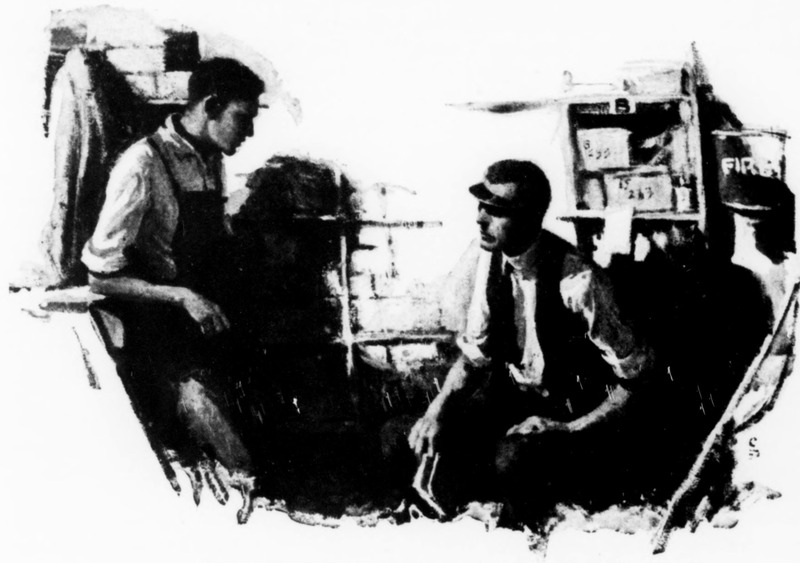
“I KNOW I WON’T STICK AT A JOB I HATE.”
Title: Common sense
Author: Helen R. Hull
Illustrator: William Percy Couse
Release date: October 16, 2026 [eBook #79807]
Language: English
Original publication: New York: Harper & Brothers, 1923
Other information and formats: www.gutenberg.org/ebooks/79807
Credits: Jens Sadowski. This file was produced from images generously made available by The Internet Archive.
Helen R. Hull
Illustrations: W. P. Couse
Harper’s Magazine, vol. 148, Dec. 1923, pp. 97-108.
“Thirteen gross large, seventeen small.” Sheldon Thorpe set down the figures opposite Stork safety pins at the end of the long typed list. “Straighten up those boxes, Red.” He pushed the green eyeshade up his forehead, moistened a finger, and flipped over the sheet. “That’s all now but the toys.” He glanced down the long aisle, honeycombed with booths; the eyeshade laid a sallow band across his patient, spectacled face.
“Toys aren’t as bad as these flim-flams.” The boy climbed down the step-ladder, rattled it together under his arm, and strode ahead of Sheldon. “Needles and pins and darning cotton and—pshaw!” He spat vigorously as he rounded the end of the aisle. Sheldon reached up to the light in its wire shield, snapped it off, and followed. At the far end of the basement gleamed another light. He saw it as he turned, and went meekly back to snap it off. Have to be careful about such items. Red was whistling and banging up there in the toy booth. Well, toys weren’t so thick in a June inventory. Take Christmas now—
“This cheap stuff for kids is sure a crime.” Red stuck a doll back into its box, and pawed behind the first layer of boxes. “Only nine of these X277. Got them in just last week, too.”
“Nine X277. Good seller. What’yuh mean, crime?” Sheldon held his blue pencil firmly in the column.
“Five gross sketch books, B83. Crime to give kids such ugly stuff. Cheap and ugly. American made.”
“Sells all right. They must like it. How many B84?”
“Sells!” Red clattered the short step-ladder into position and mounted it. “That’s all you think of. Twenty-eight—no, twenty-nine gross. Well, I’m through, you bet.” He stretched an arm into the next booth, his curly bright head shining under the ceiling light.
The next fifteen minutes they worked in swift silence, save for the announcement and repetition of figures. Then Sheldon folded together the thin sheets, clipped them, and brought his fist down on them.
“That’s done. Now I can work out the statements to-morrow. Say, Red, why don’t you stay on? If I get moved to a bigger store I’d take you along. We work pretty good together.”
“Me stay?” Red’s eyes, very blue under their sandy lashes, were round with derision. “To-morrow night I’m a free man. I got cash enough for my fare to the coast, and a job on a sheep boat out of Baltimore.”
Sheldon sat down on a box, staring up at the thin, gangling figure lounging against the ladder.
“You could work up, you know.” The green shade with its sallow reflection distorted his face.
“God! What to? You sound like a mother. Keep a steady job, my boy, and work hard. I’m going to Paris, I tell you. That’s the only place for an artist. And I’m going right now, before I lose my nerve and begin to worry for fear I won’t be able to line my belly.”
The narrow aisle, reaching back the length of the basement, bandied his words back and forth in the silence. At a footstep overhead Sheldon started, peering nervously up. It was outside, on the street; some late passerby. The basement ran out under the walk.
“How old are you?” Sheldon’s hands dropped over his knees, long, thin, with prominent knuckles, white under the grime of stock-handling.
“Eighteen.” Red straightened his shoulders. “Time I was getting down to real work. That night stuff at Chicago was good, but I want better than that. Real artists. I just stopped off here to see my folks and earn a wad to take me farther.”
“I went to work when I was fourteen,” said Sheldon. “In a grocery store.” He stared at his hands; they looked limp, sick, something apart from him. “I used to play the violin, nights. You get over those ideas.”
“I don’t,” said Red. “Folks want you to. Like I said—keep a steady job and settle down. That’s what they tell you. Say—” he leaned forward—“you don’t like this, do you?”
Sheldon lifted his head. His knees drew up slightly, as if his whole body made a horrible contraction, a wrenching of rejection. Round him flowed a faint odor, damp, dusty, of cardboard, paint, tin, caught there in the cellar, and holding him.
“Naw, you hate it. I’ve seen you.” Red nodded wisely. “What d’you stick it for?”
“I’ve been sticking it for more than twenty years.” There was something breaking in Sheldon, pulling apart like the strands of rotten rope. He liked Red—liked his funny, crackling voice; his thin, awkward body moving about; his impudent, casual ways. Red was going away. “You’re young.” He tried to hold those rotten, fraying ends together. “You don’t know yet.”
“Mebbe I don’t know everything.” There was in the strong thrust of Red’s chin, a stubbornness not of youth nor of age. “I know a thing or two. I’ve been good and hungry. That’s one thing. I’ve been crazy about a girl. That’s another. I know I won’t stick at a job I hate. I know I got to find out more about the way of putting down what I see. Look at you, there! You’re a bunch of limp triangles, all sprawling out with their apexes smashed together in your solar plexus, and that green light dripping on your face. I could paint that, and that shadow behind you, full of green. It would say something, I tell you. It’d say whether you liked sticking your job. It’d be more than you, too. It’d be all the other poor guys sticking jobs. But I couldn’t get that green now. Like water, only thicker.”
“I don’t see any green behind me.” Sheldon sounded irritated; he pulled the eyeshade up from his head and dangled it over a finger.
“You’d see it if I painted it. I can’t tell it to you.”
“Now that’s funny.” Sheldon’s foot crunched on a bit of excelsior from a packing box, and he stooped mechanically to pick it up. “I remember I used to think that way about a violin. There would be a way of saying things.” His fingers twisted the shaving.
“Why didn’t you?”
“Why?” Sheldon threw aside the excelsior. The frayed rope had parted, the rope which bound him silent and humble. “I’ll tell you! You think all you got to do is go ahead and do what you want to. You can’t do what you want to. My mother hated music. Hated the sight of a violin. She thought it was an excuse to stay out late at night. A devil snare. My father—he used to play. I never heard him. He ran away when I was a baby. Left my mother without a cent. She worked—washing, sewing, nursing sick folks. Then one day she got word he was dead in Texas. She had to borrow the money to send for him and bury him. That’s what doing what he wanted to did for him and us. I went to work then. ‘Keep my boy from being like his father!’ I’d hear her praying that at night.” Sheldon stopped; against his eyelids he saw, instead of Red, instead of the shadowy, silent store, a half-opened door, a woman kneeling beside a cot, face turned up so that the cords in her thin neck stood out, and her voice—heavy with anguish—“Oh, Lord, make Sheldon a good boy. Faithful, sober, hard working. Spare him. Keep him from the evil ways of his father.”
“So I plugged away,” he went on, slowly. “I thought if I hated what I had to do, that was a sign I was wicked. It would have seemed sinful to do what you liked. So I worked up—to this. When I’d feel half crazy, as if I couldn’t stand it—she’d say I was bilious. My wife, too. She makes me take calomel. Calomel!” Sheldon laughed, and the booths along the aisle took his laugh and knocked it back and forth like a grisly toy. “When my head is full of wild notions. I think how if I set a match to this excelsior and sat here while it burned? Or I think how I could run through the store and knock the women’s heads together where they’re pawing over pieces of me. That’s what it is, all this stuff. Spools and jumping jacks and knives and kettle covers. Me, scattered around in a million things. I ain’t anywhere else. I can’t stand it! Calomel!” He stopped; his thin lips seemed to stick together, dry and hot; he could feel cold sweat dripping down his chest. And there was Red, listening to him.
“Whee—oo!” Red thrust his hands into the pockets of his overalls. “Say, I didn’t know it was that bad! I thought you were just sorta fed up and sore on it all, needed a vacation.”
“I ought not to talk this way to you.” Sheldon’s misery looked deeply out of his tired, sunken eyes. “But you’re different, somehow. And now you’re going off. I’d be all right, you know, if I didn’t think. If I could stop thinking. There’s me, working around, steady, and then there’s another fellow, thinking, like a clock in my stomach what won’t stop ticking. Lately the thinking’s getting the best of me. And here on Wednesday this man’s coming, Clinton. Firm representative. To look things over, and if they’re o. k., to offer me a better job. Another store. More things.”
“Turn him down, old boy.” Red’s voice was rough and friendly.
“I got to go on. There’s my wife, Carrie, and the little girl.”
“I KNOW I WON’T STICK AT A JOB I HATE.”
“Turn him down and find something you want to do. God, you don’t want to go clean bughouse, do you?”
“What do I want to do?” Sheldon flung out his hands emptily. “This is all I’m good for. And I ain’t good for this.”
“Selling jimcracks isn’t all the world,” said Red. “Take a look round.”
“There’s another thing.” Sheldon leaned forward, his shoulders hunched. “I been looking at things, thinking. I had a notion—sorta nightmare, I guess—as if I tiptoed along past the sideshows in a circus. You know, the painted curtains they have to show what’s in the sideshow tent? Only the tents are all empty. That’s the joke. Empty. There are the curtains, bright pictures of what’s in the tent. When you peek in, nothing there. Love, that’s one sideshow. Being respectable. What the neighbors think. Common sense. Holding your job. Making money. Nothing behind, only folks don’t know it. Mebbe painting pictures is another.”
“Mebbe it isn’t.” Red stood up, stretching. “I tell you.” He laid his hand firmly on Sheldon’s shoulder. “You come along with me. That’s the ticket! Take a year off. Look around. We—you and me get on fine. I’d like a fellow along to speak English to. Beat it. Will you, huh?” He slapped his thigh resoundingly. “Now there you got it. To-morrow night. You could get a job on that sheep boat. Oo-la-la! Find a sideshow that isn’t empty. Say, old boy, will you?”
Sheldon sat rigid. He felt Red’s wiry, hard enthusiasm boring into his emptiness, gathering together the scattered bits of self.
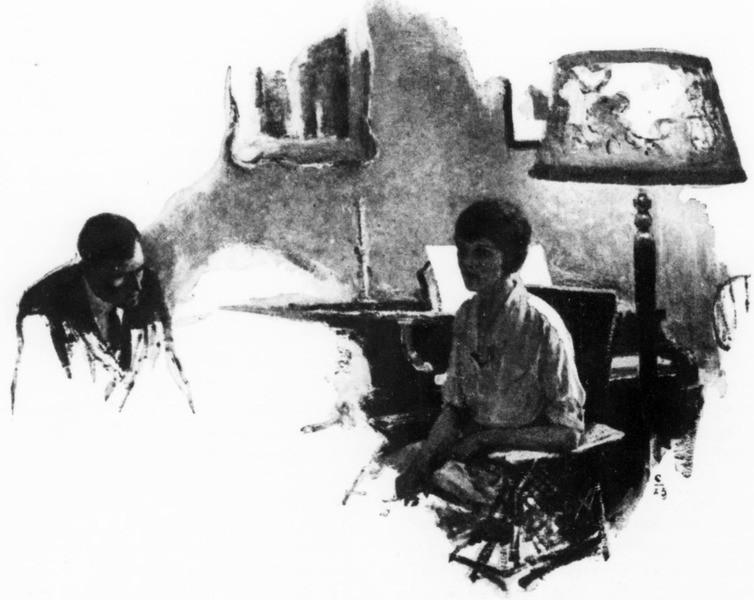
“CARRIE, I WANT TO GO AWAY. I’VE GOT TO GO. OR GO CRAZY.”
“That’s—” he ran his tongue over his dry lips. “That’s what my father did. Ran off.” Within him there went on a complete sundering of himself—the Sheldon Thorpe who worked along, diligent, silent—and that other feverish, thinking self. “I couldn’t do that.” The old Sheldon was shrinking into a crumb. “I’ve got money enough to leave for Carrie. I could tell her I was going.”
“That’d spill the beans,” declared Red, scornfully. “No skirt’ll let go of a man for a year.”
Sheldon got to his feet. The floor came up in lurches to meet him, as if he were drunk.
“I’ll not ask her. I’ll tell her I’m going, before I go crazy. It’s too late for me to try the violin.” He held his hands out, shaking. “They’re used up on packing boxes and figures—stiff; but there might be something else—something a fellow could be interested in—”
“Sure there is!” Red clapped his shoulder. “Only—” he was doubtful. “If you tell her she’ll keep you.”
“No!” Sheldon’s voice was a shout. “I won’t sneak off. Here.” He reached into his pocket, fumbled with a wallet. “Here, you get me a ticket.” He watched, not breathing, until Red had folded the bill and slipped it behind his watch. “Now come on.” He stumbled over the filing board with the sheets of figures, kicked at it, and strode down the aisle, Red at his heels.
Outside the store he stopped automatically, tried the nightlock, and peered through the draperies of embroidery in the window to see that the office light still burned. Red watched him curiously, his cap twirling in his fingers. Sheldon turned; his feet were steady enough now.
“You’d like me to go with you?”
“Sure as blazes!” Red tossed up his cap, ducked to catch it on his head, reached out his hand for a quick handshake, and swung off down the street.
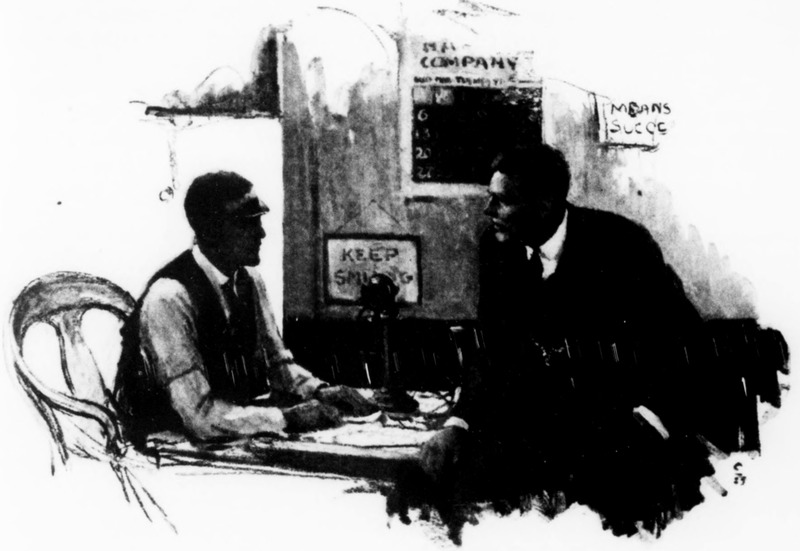
“GIVING AN IMITATION OF A HARD-WORKING MAN, EH?”
Sheldon set forth in the opposite direction. He would walk home, even if it was late. He left the business street for dimly lighted side streets. Never had he walked like this, head up, chest high; he could feel the darkness fall aside in smooth waves, and his thoughts, random, inchoate, bits of the old Sheldon, bits of the strange new Sheldon, spreading behind him in a long wake. Only last night, as he had walked, he had thought but one thought, over and over: I wish I was dead. I wish I could die. And to-night!
He stopped a moment on the bridge across the river. He should think about Carrie and what he should say to her. Under him the dark water moved softly, and along the bank was the faint cheep of insects. There at the bend of the river he caught the swift reflection of a star. He went on more slowly.
River Park Addition. His house was down here. Funny, how wound up and twisted into one another things in life were. Six—no, seven—years ago this summer a real estate agent had plotted off this land and made a big sale. Sheldon’s mother liked the advertisements. She and Sheldon had walked from the car line through the newly laid streets one Sunday, and Sheldon had pulled off the ticket on lot ten. That meant he claimed the lot. He had gone, the following noon, to the agent’s office. Carrie was there, behind the desk, with smooth black hair and blue eyes. She seemed to take a fancy to him. And his mother liked her. Demure and friendly. Sheldon grimaced in the dark. He knew now. Another empty sideshow. Carrie wanted a husband, and a home. She was tired of working in an office. Well—maybe that was what women wanted. She had been good to his mother. Planning the house with her, taking care of her when she was sick. “Carrie’s a wonderful wife, Sheldon,” his mother had said. “Be sure you deserve her,” just before she died.
And the little girl, Marjory—a quiet, docile child. Sheldon thought sometimes that she liked him, but Carrie “wouldn’t have her spoiled.” Yes, Carrie was a good wife, a good mother. She didn’t want any more children.
Perhaps, after all—the leaves from the poplars of his own street whistled under his feet; the dry spring was making them fall early. Perhaps it would be better, as Red said, not to speak to Carrie. She had so many ambitions: a bigger house, a car, a servant. “I’ve got to tell her,” said Sheldon. “I can’t sneak off.”
* * *
Carrie was sewing, sitting close to the piano lamp with its new varnished parchment shade. She looked up, moistening an end of thread on her tongue, a series of regular high lights on her waved hair. Sheldon felt uncomfortable whenever he looked at those waves. Carrie had saved up for months the money for what she called a “permanent,” and she hadn’t cared for his confession that he thought smooth hair prettier.
“My! you’re late,” she said. Often her voice had little undertones of implications, even when her words were simple.
“Yes.” Sheldon hesitated. He could talk better standing up—but he could lead up better if he sat down, maybe. He started toward the wing chair, but Carrie spoke quickly.
“You’re probably all dust from your basement. Sit down there—” She pointed at a little imitation Windsor chair. “I cleaned every bit of the stuffed furniture to-day with the vacuum cleaner.”
Sheldon sat down.
“Well?” She looked up from her sewing. “You might tell me about the reports. Are they good? Good enough to show Mr. Clinton?”
“I haven’t made them out.” Sheldon looked at his hands, spread on his knees. “We just finished the inventory.”
“My! it takes you a long time, doesn’t it?” She was whipping lace in place on a dress for Marjory, with brisk, snapping motions. “But you know it’s been a good year, anyway. Clinton must do something for you. He hinted he would.”
“I don’t want him to.” Sheldon drew one hand across his forehead, and stared at it, expecting to see it glisten with cold sweat. “Carrie, I want to go away. For a year. I—I’ve got to go. Or go crazy. I’ve got a chance....”
Carrie dropped her sewing into her lap, her hands shut firmly on it; and Sheldon, even in the intensity of his absorption, saw with a flicker of alarm, that she was not surprised. She looked at him, her eyes as expressionless as blue china, her wide, thin mouth shut firmly.
“I wasn’t meant for a storekeeper,” Sheldon hurried on. “I can’t stand it. If I don’t go away, I’ll smash, that’s all. There’s money enough in the bank for you for a year.”
“Where”—her voice was quiet—“are you planning to go, if I may ask?”
“I want a chance to look round, to see what I might do.” No use to explain more to Carrie. He had just to go.
“You mean you have nothing in view? Nobody’s made you a grand offer, I suppose?”
“Nobody’s made me any offer.” Sheldon drew a long breath. “But I have things in view.”
“Just when you begin to make a decent salary for your family, when you are going to have a bigger store offered to you, with all it means, you think you can throw it over. Where is your common sense? You must be crazy!”
“I shall be, I tell you.” Sheldon shivered. What was there so formidable in the lack of surprise in Carrie’s face? He had expected to find her impregnable, just because she was Carrie; but she seemed to be saying to herself, “I told you so!” She seemed to have lain in wait for him, traps set, guns trained, as if she had known that he would come home with these words, as if she had even seen him peering into the emptiness behind the sideshow placards. “I tell you I can’t endure it any longer. I’m going away, to look....”
“Just like your father.” Carrie folded her hands primly in her lap. “Your mother warned me. I’ve felt it coming. The way you’ve sneered at me. Picking at your food, and not eating. Sheldon, I won’t allow you to disgrace yourself and your family.” Her voice was unwaveringly clear. “I shall save you from yourself. Have you no ambition, no decency? Think of your innocent child.”
“Ambition?” Sheldon felt his heart thundering against walls of ice. “To make more money? No! I have an ambition, to find—to find myself. To find something I can do, where I won’t wish I was dead every hour in the day. I’ve been brought up to hate my father, sneaking off in the night and leaving a woman with a baby. Maybe he couldn’t help himself. I’m telling you I’ve got to go.”
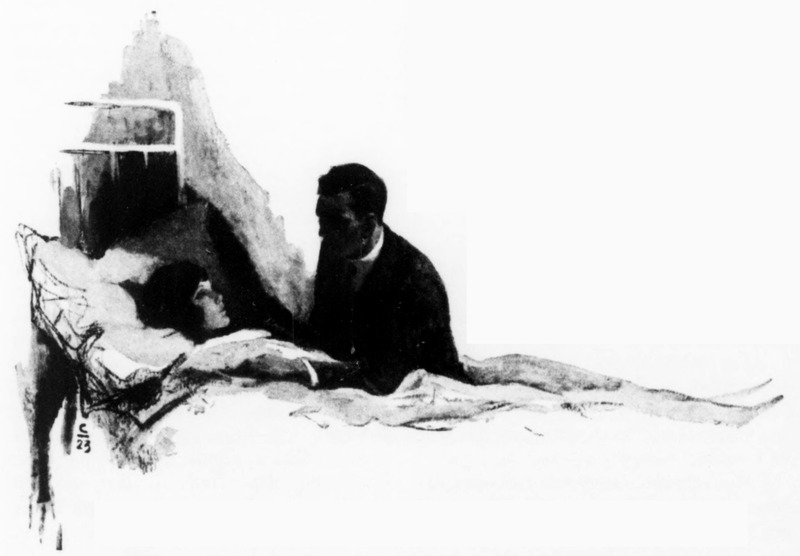
IF HE NEVER CAME BACK WOULD CARRIE TEACH HER TO HATE HIM?
“Couldn’t help himself? If you aren’t wicked and weak you can help yourself.” In each of Carrie’s cheeks, just under the prominent cheekbones, flared a spot of crimson. “Perhaps you think I like what I have to do, day after day. I haven’t complained, have I? I know my duty, and I do it, I hope.”
“Do you hate it, day after day?” Sheldon stared at her, trying to fit that idea into place. “You don’t wish you could die?”
“I’m not as wicked as that. Nobody likes what he has to do to get along. Here I gave up a good position to be your wife, and I’ve been as good a wife as I could.”
“Well, there!” Sheldon was suddenly triumphant. “That’s easy! You could get your job back again, while I....”
“For heaven’s sake!” Carrie’s voice was almost shrill, but it dropped immediately into its controlled level. “Announce myself to the world as a deserted wife? Sheldon, what are you thinking of?”
“There’s money enough without that. For at least a year.”
“What do you suppose I’ve been working for? So that you could get ahead. No man has ever had so much encouragement. First your mother, and then me. You can’t do anything else. You’re too old to tackle a new kind of work, and anyway, you’d get tired of that too. It isn’t,” she added, with an undertone of sharp malice, “as if you were a genius. You have to plod along to get anywhere.”
“You don’t know what I might have been,” cried out Sheldon, “if I’d ever had a chance!”
“I know it’s taken you a long time to get where you can earn enough money to support your family decently.”
“And you’d have me go on sticking it”—Red’s phrase came back—“so I can buy you more stuffed furniture too good for me to sit on, and more—”
“Most men take some pride in what they can buy for their wives.”
“Even when I tell you I’m going mad—that I may kill myself—”
“Sheldon, you’re all tired out.” Carrie rose quietly and stood beside him. “You come to bed. It’s only when you’re overworked that this weak strain in you comes out. You better ask Doctor Riley for a tonic. Something to brace you up.” She laid her hand on his shoulder.
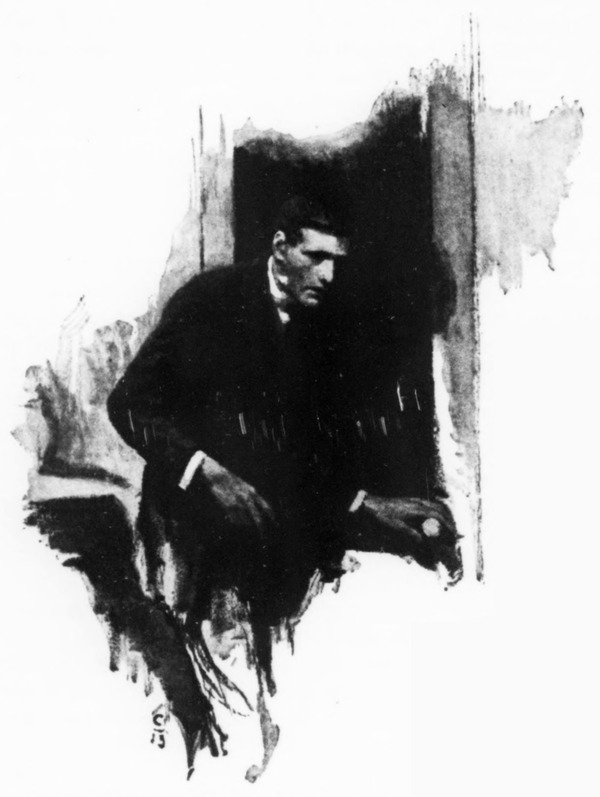
HIS HAND TOUCHED THE LATCH OF THE SCREEN DOOR.
Sheldon shut his eyes a moment. He thought her fingers crept up to his throat, closed about it, choking him. Cautiously he lifted his lids—no, he could see her fingers, lying softly there on his shoulder.
“I can’t take a new store, a larger one. I’ll fizzle it.”
“Nonsense.” She brushed away his words with a light gesture. “Come on to bed. I’ve said all I’m going to. But you’ll take the store Clinton offers you, and do well. We won’t even discuss it any more. In the morning you’ll have more common sense.”
Sheldon stumbled to his feet and crossed to the dark bedroom. As he heard Carrie lock the front door and snap out the light, he laughed. She hadn’t fooled him! Back of that calm blue gaze of hers, she was worried. She wasn’t sure. Talk! God, he didn’t want to talk any more. He’d said all he meant to say. He’d warned her. He laughed again.
* * *
He was still laughing, inside, at breakfast the next morning, a mocking, chittering laughter, like a flock of witless birds. Carrie, in fresh blue gingham, pouring the coffee, bidding Marjory to tell her Daddy all about the nice walk they had taken along the river; Marjory, her solemn little voice running on and on. When he left the house, Marjory was sweeping the poplar leaves away from the sidewalk with her ridiculous red-handled broom. Stock number G582, mumbled Sheldon. He watched her a moment. The slender neck, cream white, with a delicate hollow, under cropped dark hair, stopped the chittering laughter. It began again as he walked along, with the thought of Carrie hurrying into the bedroom where he was looking for a clean collar. To see if he had taken any of his clothes! He hadn’t. Wouldn’t need them, on a sheep vessel.
* * *
The long morning held a brief encounter with Red; Sheldon had followed him down to the basement. Red held up a strip of green ticket.
“Still want it?” he grinned.
“Yes.” Sheldon touched it. “You keep it. I’ll meet you at the train.”
“Nine-ten she goes.” Red stuck the ticket away in a pocket. “Say, this afternoon I got to leave early. My folks—and there’s a girl I got to see. You don’t mind? So long as we’re both skipping.”
Sheldon knew he wanted Red there, every minute until he could lock the front door of the store behind him. But he nodded. As he climbed the stairs he heard Red’s loud whistle retreating behind the stock shelves.
He would figure up the reports. Might as well leave things all clear. He worked steadily into the afternoon. Overhead, loss, sales. The figures crawled like insects under his eyes. From his office, slightly elevated at the rear of the store, he could gaze out over this fantastic representation of his past life. It’s all right, he thought, if you don’t look at it too hard. Take the matter of loss on goods, now. How serious he had been, teaching the feather-brained clerks to keep their goods fresh, not to let papers get wrinkled, or embroideries mussed. Those crêpe paper decorations on the walls—he’d worked like a fool to get them hung. And what for? A violent gesture of his hand sent a blot sprawling over his neat page, and he reached mechanically for a bottle of ink eradicator. The old Sheldon had taken all that seriously enough. It was all right, so long as you didn’t begin to think.
“Well, well, how’s the chief administrator?” The loud, cheerful voice was a hook, plucking him forcibly out of his circling thoughts. Mr. Clinton leaned over the railing of the office, his hand extended, his prominent blue eyes assaulting Sheldon. “Giving an imitation of a hard-working man, eh?” His smile pulled his full lips back from uneven, small teeth. “Didn’t expect me till to-morrow, I know. I got through early at Fenton, and burned up the road a little between here and there.”
Sheldon was mumbling something, shaking hands, shifting chairs to make room for Clinton.
“I’m not ready for you,” he said. His thoughts were frightened minnows, darting about. It wouldn’t make any difference, Clinton’s coming to-day. Carrie wouldn’t know he was in town. Sheldon could stay late at the store as he had planned. Clinton needn’t suspect. Damn the man, why hadn’t he waited until Wednesday! “Been figuring the turnover.”
“Doesn’t matter.” Clinton lounged easily in the chair, knees crossed, a neat clocked-silk ankle swinging. “The firm knows what it’s got in you. Mere matter of form, asking you for reports now, you know.”
As he went on Sheldon listened to his deep, over-cheerful tones, and watched the startled minnows darting. “It’s his silk shirts I hate, and his eyes popping out of his head. His patronizing ways—well, my little fellow, see how smart I am. Like to tell him—his eyes would stick out some if I said I didn’t give a tinker’s damn for the whole shooting-match.”
“So there’re these two stores in Class A,” Clinton was finishing, “both in need of a good steady hand to jerk them up. One in Indiana, one in Wisconsin. Which would you like to try? The firm believes in your ability to take hold and pull them up. We haven’t got the business from them they’re capable of. It’s the steady, quiet fellow like you that makes the fine manager.”
“You better let me think it over.” “He expects me to look grateful and impressed,” thought Sheldon, while an echo of the chittering laughter of the morning rattled in his head. “To-morrow I can give you an answer.”
“That’s right. Talk it over with the wife, eh?” Clinton rose. “Then there’s the matter of a little stock. You’ll have a fine bonus, and the company likes its managers of Class A stores to hold enough stock so they have a feeling of belonging to the firm. Not much is available. I could arrange that for you. Well, I’ll look around a little. Don’t bother to come.” He strolled off, his tall, thin body swaggering a little, his protruding blue eyes searching out the pretty faces behind the counters.
“Belonging to the firm!” Sheldon’s fists closed on the papers littering his desk. “I’ll show ’em. Steady, quiet—bah! Be a good little boy, and see what we’ll give you.”
He was crouched over the desk, his face stubborn and white, when a voice at his elbow whanged into him. He lifted his head, to see Carrie, an effect of restraint fluttering over her features, even over her silk dress and flowered hat, and behind her, his Panama balanced on a finger, Clinton.
“Isn’t this nice, Sheldon,” said Carrie. “Mr. Clinton says he can take dinner with us. So lucky I dropped in. I came to rescue my poor husband, Mr. Clinton. He works too hard for your old firm.” She pouted ingratiatingly up at Clinton. “He said he wasn’t coming home till just awful late, so I came down to insist. A chicken in the fireless cooker. And now you’ll take potluck with us—”
“I’m not through here.” Sheldon eyed Carrie grimly. That demure, shy fluttering of hers was a great bluff. He knew why she had come.
“No hurry about this work now, old man.” Clinton lounged beside Carrie. “Or is he such a demon for work that he can’t join us in celebrating his promotion, Mrs. Thorpe?”
That shook Carrie’s demureness for an instant. Her eyes leaped to Sheldon’s face, hard, full of warning, of triumph.
“You’ve got it?” She turned to Clinton, her hands, neat and small in silk gloves, pressed imploringly together. “Tell me about it!”
“If you’ll excuse me a minute.” Sheldon swung the gate open. “Just sit down in here, both of you.” He had heard the banging of the cash registers, which indicated that Miss Wilck, the floorwalker, was making her evening rounds. Time to lock the doors. The long, sultry day was over. He stood at the front door, to allow the few dallying customers to depart. Sudden bustling animation behind the counters: goods jerked into order, noses being powdered, a chattering renewal of life at the prospect of escape. “Good-night, Mr. Thorpe. Good-night. Good-night.” And back there in the office, those two. Suppose he walked out with the clerks, down the street. He had a vision of himself skulking in alleys behind the stores, hiding, and Carrie in pursuit. Where could he go until that train was due?
Miss Wilck pressed into his hand the striped canvas money bag. He had to put that into the safe. He didn’t intend to run off as a thief. The store was empty now, silent, except for the two in the office. Carrie had a queer laugh, he thought. Pitched too high.
No escaping them at this point. He would have to go home with them. Plenty of time before the train, anyway.
* * *
“Pretty snug, eh?” Clinton settled himself behind the wheel in his roadster. Carrie giggled softly. She was peering about, hoping, Sheldon knew, for a glimpse of some one who would recognize her in the shining red car. The touch of her light silk made his skin crawl sluggishly.
“So good of you to spare us an evening,” she was saying.
“Think of me having a chance at dinner in a home.” Clinton swung out from the curb. “Home cooking! I want to get my teeth in that chicken you were talking about. Now tell me where I turn. Let’s not get pinched for speeding, heh?”
“Isn’t this an elegant car, Sheldon?” Carrie’s ears were pink under the ripple of waved hair. “It rides so easy.”
Sheldon twisted his hand away from contact with her dress. This was what Carrie liked. She should have married some one like Clinton. What kind of wife did Clinton have?
Carrie thought she had him now, wedged in that seat, dragged home to dinner, committed definitely. Nine-ten, Red had said. Not three hours away. He’d have to make a bolt for it.
A nice little home dinner. Carrie spread her best linen, unrolled her best silver from its cotton-wool wrapping, made little darts to the door of the living room to cry out, “You’ll starve, I’m afraid! But I’m hustling.” Marjory came home from the neighbor’s, stood shy and unwilling while Mr. Clinton tried to coax her onto his knee, stared round-eyed at his hearty, “Not old enough yet for that, eh?” and disappeared for her supper. “Will you see that she’s in bed all right, Sheldon?” Carrie called to him.
Sheldon was thankful to escape the grind of talk with the guest. He stood beside Marjory’s cot. She wanted him to make a bow of the wispy red ribbon about the neck of her fuzzy gray dog. How little she was! He fumbled with the ribbon. If he never came back would Carrie teach her to hate him? But he meant to come back. He wasn’t deserting them. Just taking a little time to look round.
“Nice daddy!” Marjory flung her arms round his neck.
“Little pipestems.” Sheldon touched her wrists gently, and patted the sheet into place under her chin. “You ought to get fatter.”
He glanced back from the door. Funny little tyke, so solemn. “Think of your innocent child,” said Carrie. He wasn’t doing her any good, just sticking. If he could find something, could amount to something, then he might.
* * *
Carrie manœuvered an aside as she carried the platter of chicken to the table.
“For heaven’s sake, brace up! You make me ashamed, the way you act!”
Brace up, when all his being leaned perilously toward that nine-ten train, when time—two hours now—had grown more tangible than space, and he moved through it heavily, like a winded runner.
Clinton was spinning an interminable yarn about his first job with the firm, and Carrie listened, poised in admiring attention. Why couldn’t they eat and get through? He knocked a spoon to the floor and bent clumsily to reach for it, trying to extract his watch far enough to read the face. Eight. He’d have to allow a half hour from the house. No way to get a taxi down here. He couldn’t run through the streets; someone would see him. That meant forty minutes left. Forty—what was Carrie saying?
“I suppose you never get discouraged, do you?” Her voice blurred into undertones of meaning. “Tired of your work?”
“A man can’t allow that if he’s going to get ahead, you know.” Clinton was masterful, assured. “The game’s to the fellow that goes straight after what he wants, with lots of pep, forges ahead to success. That’s the American business man. He isn’t tired. Discouragement belongs to the fellows that keep park benches warm. The Go-Getter! He’s the man.”
“It’s just a matter of will, isn’t it?” Carrie’s glance pecked swiftly at Sheldon as she rose to clear away the salad course.
“That’s the idea. Will and brains and pep. You’re a wonderful cook, Mrs. Thorpe, if I may say so.”
Dessert and coffee. Sheldon’s tongue was swollen and thick, until he felt that another mouthful would choke him. Would they never finish? He couldn’t bolt away from the table, when Carrie was so pleased about her dinner—humiliating her. Unbelievable, to be held fast by a web as frail as that—just manners. But he couldn’t go. If he didn’t make that train, if Red went without him, he knew, suddenly, that he would never go. It was Red’s fire that had touched him into action.
“I wondered,” Carrie was saying, “if I might suggest—” she deprecated astutely her daring in offering a suggestion to the great Mr. Clinton—“a little vacation before Sheldon goes to the new store? He’s been working very hard.”
“Fine! Much better than interrupting the work there later in the summer. A little fishing trip. Or a motor trip—but you haven’t bought your car yet, have you? Well—”
Vacation! Suppose he got up and said, “Keep your damned store. I’m through. I’m leaving.” He couldn’t move his thick tongue. They were all rising, now, going into the living room. Carrie had his box of cigars.
“No matches? Sheldon, dear—”
He plunged into the kitchen. The back door—if he had his hat. Could he start for Europe without a hat? His hand touched the latch of the screen door, jerked violently back at the sound of a step—Carrie, coming through the dining room.
“Mr. Clinton’s going to take us for a little drive, Sheldon. I’m going over to ask Mrs. Purdy to sit here with Marjory till we get back.”
She hurried past him, out of the door. He saw her pass the band of light from the living-room windows, saw her outlined in the rectangle of yellow from the Purdy’s side door. She could see him if he ran out. He had to find Red! He’d wait till she came back, then dodge. Perhaps they’d chase him in that red car. But he might make it. She was laughing, the high, thin sound coming across the shadowy lawn. At last she turned and hurried back. Sheldon drew out his watch. Time, that dreary, lengthy track down which he had been running, spent and thick-tongued, had come to an end. Round and round jerked the tiny second-hand. Nine-ten, nine-eleven. Red had gone. Gone.
Carrie was at his side, catching his elbow in her hand.
“She’s coming right over. Sheldon, isn’t it splendid! Now come on, and do cheer up!”
Transcriber’s Notes
Transcribed from Harper’s Magazine, vol. 148, Dec. 1923, pp. 97-108.
New original cover art included with this eBook is granted to the public domain.
The original spelling and punctuation were mostly preserved.