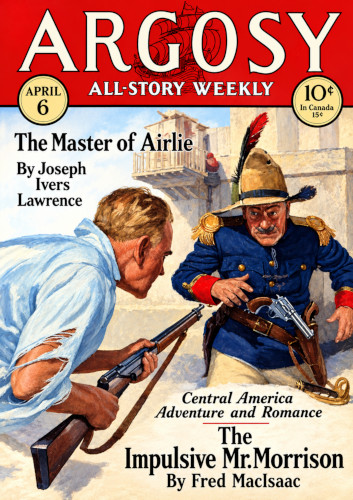
Title: The impulsive Mr. Morrison
Author: Fred MacIsaac
Illustrator: Howard V. Brown
Release date: October 8, 2026 [eBook #79744]
Language: English
Original publication: New York, NY: The Frank A. Munsey Company, 1929
Other information and formats: www.gutenberg.org/ebooks/79744
Credits: Greg Weeks, Mary Meehan & the online Distributed Proofreaders Canada team at https://www.pgdpcanada.net
By FRED MacISAAC
Author of "The Spectral Passenger,"
"The Press Agent," etc.
Central Americans are temperamental and
quick to act—but none of them was as wildly
impulsive as young Jim Morrison during
that whirlwind intrigue in Banana Land.
Novelette—Complete
| I. | THE CONSUL'S DAUGHTER |
| II. | THROWN FOR A LOSS |
| III. | JIM TRIES STRATEGY |
| IV. | REVOLUTIONARY UNDERCURRENTS |
| V. | THE SPANISH CAVALIER |
| VI. | GENERAL LOPEZ INTERRUPTS |
| VII. | A DARING RAID |
| VIII. | A CLEVER GAME |
| IX. | IN THE LAIR OF THE BANDIT |
| X. | PIZZO SHOOTS TO KILL |
| XI. | JIM OBEYS AN IMPULSE |
| XII. | THE MOUNTAIN TRAIL |
From the window of his chamber in the Hotel Trinidad, James Vincent Morrison looked upon the city of Rosa Blanca and cursed it for a hot, festering, vile-smelling tropic hole. Although he was clad only in B. V. D.'s, these were wringing wet, and perspiration was still oozing from his pores and irritating him as it trickled down his body. It was the hottest part of the day, 2 p.m., and everybody else was indulging in a siesta. Jim's body was too uncomfortable, and he had too much on his mind.
The window looked upon the Plaza of Rosa Blanca, capital city of the Central American republic of Santa Rosa. A hundred yards across the park he could see the palace of the president, a long, low plaster building set back in a garden and protected by a high brick and plaster wall, against which two sentries were leaning, probably asleep on their feet.
The Plaza was the business center of Rosa Blanca, but with the exception of colored folks sleeping on the benches of the park, no human being was in sight. There were a lot of mangy dogs wandering about, and a black and white goat.
So bright was the sun, reflected as it was by the white walls of the buildings, that it hurt Jim's eyes to look out, and the air was permeated by a subtle but unpleasant perfume which offended his nostrils.
Just the nasty capital of a rotten little banana republic, he reflected, and any white man who didn't leave by the first boat was a fool. He was a fool. He could have sailed on the fruit steamer this morning, and if it wasn't for Ellen he certainly would have done so.
For a week he had been lingering in Rosa Blanca—"White Rose," a lovely name for this pest hole—because Ellen Goring was here. Although she had indicated emphatically that she didn't want to marry him, he would hang around until she changed her mind; it might be for years and it might be forever.
Only seven days ago Jim Morrison had come down from the chief Morrison banana plantation to take the ship for New York. Although it had not been frightfully hot in the hills, it had been gosh-darned lonesome, for the manager and his wife, even if they were efficient banana raisers, were social duds; didn't even play bridge.
Coming down to Santa Rosa had been his father's idea; just a scheme to get him away from Gladys Glower of the Follies, with whom he hadn't been in love at all. Tom Morrison had told Jim it was time he got acquainted with the source of the family income, and had practically shipped him out of New York. Having been marooned among the banana trees for a month, he had driven down to Rosa Blanca a week ago and arrived at cocktail time. The next morning he was to start home.
Holding forth at the bar of the Hotel Trinidad was a fat man in whites; a soft, paunchy, loose-mouthed, blear-eyed old nuisance who was discussing American politics, expressing the dreariest blather in an unpleasant voice.
As Morrison was a newcomer the man had fixed on him, practically buttonholed him. After listening with growing impatience to his drool for a quarter of an hour, Jim lost his temper, something he lost easily, and expressed his opinion of bores so pungently and objectionably that the old man got furious and called him an ignorant young whippersnapper.
"I'd rather be that than a chattering superannuated ape," Jim retorted, and if the two or three Americans present hadn't held the paunchy person by the arms there would have been a real fight.
Leaving the bar in disgust, Morrison went into the dingy dining room and was led to a seat and a menu thrust into his hand by a black waiter. He did not consult it, however. Facing him, and only a few tables distant, was the most exquisite, most delectable, most glorious and most desirable girl in the world. With her was an elderly woman, drab, stern-visaged, starchy and argus-eyed, whom he put down as a missionary.
The girl had dark hair parted in the middle and caught in a knob at the back of her neck; long hair, mind you; and she had the largest brown eyes that ever adorned a female face. Her nose was small and saucily tilted, her mouth small, whimsical and expressive, her chin determined—and it had a dimple in it.
The woman with her said something and she smiled, which exhibited two rows of sublime teeth, and disclosed another dimple in the center of her right cheek. Her complexion was blond, despite her dark hair, a rare combination, and, in Jim's opinion, an adorable one.
That part of the figure visible above the table was alluring, and he knew without seeing them that her legs would be marvelous. It turned out that they were. When she observed his stare she looked demurely down and veiled her eyes with criminally long black lashes, while a bright blush illuminated her milky cheeks.
Jim Morrison knew by the astonishing behavior of his heart that he had met the girl of all girls, and the next thing was to find out who she was. He left his table abruptly and sought the hotel clerk.
"You mean the Señorita Goring," smiled the young Spaniard. "She is—ah—superb! Her father is the American consul."
"What luck," thought Jim. "I'll make his acquaintance, marry her and go north with her on next week's boat. Tum, tum, te, tum te tum tum."
It was the Mendelssohn wedding march he was humming. He rapidly wrote a note to the steamship company canceling his passage on the morrow and returned to the dining room. Sitting with the future Mrs. Morrison was the very same old dodderer who had wanted to beat him up in the barroom!
So it was the American consul with whom he had picked a fight. Holy mackerel, what a boner he had pulled! At the moment Mr. Goring looked up and saw Jim, and scowled fiercely, and then he said something to his daughter, who proceeded to gaze at Morrison with scorn and loathing.
"Torpedoed," Jim muttered. "James, my boy, you're sunk without a trace unless you do something, and do it quick. Now or never!"
He rose and walked toward the trio at the consul's table, who gazed at him in angry astonishment.
"Sir," Jim said, "I don't know who you are, but I wish to tell you that I am very much ashamed of my exhibition of a few moments ago. I think it must have been the heat. That drink I had disturbed me. I just want to say that you were entirely right and I was wrong. There is no question that the Republican party is the party of Lincoln and Roosevelt and the only party worthy of ruling the United States of America. If you made any other statements that I contradicted, due to my abnormal condition, I wish to tell you that you were correct, and I am a whippersnapper, just as you said."
Mr. Goring's rather fishy blue eyes regarded him, without change of expression, his cheeks grew even more purple than they had been. They were almost as purple now as his nose, and his pendulous underlip quivered menacingly. He leaned back in his chair and folded his hands insolently upon his paunch.
"Young man," he said, "your conversion is too sudden to be convincing. I quarrel with no man about his opinions. I am glad you are aware that you are a whippersnapper, but I still regard you as a most objectionable person. And you called me a superannuated ape."
"What?" exclaimed the young woman. "He called you that, father?"
"I was only prevented from chastising him by the interference of others."
"I withdraw that statement, too, sir. I withdraw everything. I regret I so far forgot myself as to insult a worthy gentleman. I think it must have been the heat."
"I cannot accept your apology. Kindly leave us, sir."
"My name is James V. Morrison," he persisted with desperation. "I am the son of Thomas Morrison of New York."
"I wouldn't care if you were the son of the President of the United States, sir," said the unmollified old gentleman, "I want nothing to do with you."
"May I suggest," said the elderly lady, in tones compared to which vinegar would be sweet, "that you withdraw, young man. You are grossly intoxicated."
Jim looked imploringly at the girl, whose face was without expression, then he bowed and slowly left the dining room. He had tried a bold stroke and lost. However, the girl knew exactly why he had humiliated himself. It was for her. Perhaps he had piqued her interest.
What an ass he had been. Of course he was irritable because of his long ride in the appalling heat, but he didn't have to get into a controversy with the old imbecile. He might have walked out of the barroom. And it had to be the father of the one girl!
"I'll get her yet," he assured himself, "but it's going to be tough."
Morrison was strolling aimlessly around town next morning when he saw Miss Goring come out of a shop. Opportunity knocks but once. He bore down rapidly, braked abruptly in front of her, lifted his panama with a graceful gesture and addressed her.
"Miss Goring," he said rapidly, "I cannot tell you how badly I feel about last night. It must have been the heat."
The girl bit her ripe underlip and eyed him icily. "So you explained last night."
"It's doubly unfortunate, because I fell in love with you the instant I saw you. I am anxious to make friends with your father. Won't you help me?"
Her eyes widened and her cheeks flamed, but she retained her composure.
"Are you still intoxicated?" she demanded.
"Sober as a judge. It's this way. I want to make the next boat for New York. I'd like to be married and—"
"You are quite mad," she exclaimed. "Step aside, please—or must I call a policeman?"
He stepped aside and she brushed by. He called after her:
"No man ever loved a girl as I love you."
She affected not to hear him, and hurried on.
"Well," observed Morrison to the ambient atmosphere, "she knows it now. She knows I love her, and my intentions are honorable. I will proceed to buy out some florist and send the contents of his shop to the consulate."
Ellen Goring, smiling in spite of herself at the encounter, walked briskly back to the consulate. She had observed this young man in the flyspecked dining room of the Hotel Trinidad last evening, noted that he was big and blond and clean-cut and wholesome. It is probable that he would have attracted her attention even if she had seen him in a big American city, but down here, in this exotic spot, whose inhabitants were mostly black and tan and whose resident Americans were few and mostly unappetizing, she had inspected him with interest. Even if a girl is perfectly satisfied to be unmarried, there is no reason why she should not look over the members of the male sex.
And then her father had come in and explained that the fellow was a quarrelsome, boisterous and insulting young brute. It was hard to believe that, but Mr. Goring was still hot from a quarrel with him. While Ellen loved her father she was not blind to his faults, and she thought he probably exaggerated a trifle, but she glanced at the culprit and saw that he was staring at her, and he had bold eyes. Then he had the effrontery to come to their table and admit to her father, in her hearing, that he had insulted him, had called him a superannuated ape.
His apology was an even greater insult. She knew why he made it. He wanted to get acquainted with her. This young man was much too brash and his impudence was egregious. She thought about him a lot that night, wondering how she could put him in his place, provided she had an opportunity to take him in hand.
And now the man was insane enough to accost her on the street, tell her he loved her and propose marriage on the spot. He had not even been introduced to her. She had charged him with intoxication, but she knew he was sober; she had declared he was mad, but she didn't believe it. She was thrilled, and it made her angry to be thrilled. What kind of girl did the fellow think she was? She would show him!
She would tell her father on him. Perhaps the consul could have him deported.
The American consulate was a small house on a side street half a block from the Plaza, a Spanish dwelling with a patio. It was rather a shabby patio and a shabbier house, but the consul's salary was small, and it was the best he could afford. There was a room on the ground floor which Mr. Goring had fitted up as an office, and the family lived in four rooms on the second floor. None of the other ground floor rooms were habitable. Over the entrance was a small flagstaff upon which hung the American flag, when their one servant remembered to hang it out.
Mr. Goring was sitting in the patio when she entered, clad in a soiled white suit, and minus collar and necktie. He had also omitted to shave, but he had his morning drink upon the little table beside the big wicker armchair in which he was stretched. Her father was degenerating rapidly in the tropics, she thought. Too much to drink, nothing much to do, and this withering, melting heat. If only he would give it up and go home!
The Honorable Elias Goring had no intention of going home. He liked his title, he liked the easy life, and he liked cheap drinks and plenty of them. He had been a State Senator in Illinois and had been defeated for reëlection after sixteen years in office. He had felt he was too old to set up in business again in Springton, their home, so he had grasped eagerly at the offer of the consulate in Rosa Blanca. While he had been somewhat disappointed when he first saw the place, three months ago, he had decided it would do.
Ellen, who had old-fashioned ideas about the love and respect due a parent, was finding it daily more difficult to respect her father, and his present appearance repelled her. Nevertheless, she was so angry she had to erupt, and she duly erupted.
"Father," she began, "that man who insulted you last night had the impudence to speak to me upon the street just now. He was abominable. He tried to make love to me."
"What's that? Why, the miserable young pup! I'll, I'll—" He stopped short.
"Well, what will you do about it?" she demanded. "Can you have him deported?"
Mr. Goring rubbed his unshaved jaw with his big right hand.
"It's like this, Ellen," he deprecated. "I was talking with our minister last night at the hotel. It seems the fellow's the son of Thomas Morrison, who is the Morrison Fruit Company. Well, Morrison owns this spiggoty republic. He put the present administration in power, and keeps it there. I reckon Morrison is powerful enough to yank me out of here if I assert myself in this matter the way I ought to."
"He told you who he was last night. You were bold enough then."
"Well, the fact is, I was excited, and I didn't connect the name at the moment."
"Upon my word!" exclaimed the furious girl. "I can be insulted by a man on the street and my father is afraid to protect me."
The consul got up from his chair and struck a statesmanlike attitude. His watery blue eyes tried to glower at her. "Don't you say that; don't you dare say I can't protect my daughter! I'll see this young man and give him a piece of my mind; but I can't deport him. The administration here wouldn't do it if I asked them to."
"Very well. Oh, very well! I'm sorry I told you about it. I can look after myself." She tapped the flagstone with an angry toe.
"I'll attend to this," said the father, striding up and down and fanning his own wrath to make it warm. "In just what way did he insult you?"
"He asked me to marry him and go North on the next boat."
"Well!" exclaimed Mr. Goring. "Upon my word! But, after all, Ellen, is a proposal of marriage from a rich young man an insult?"
She half smiled and suppressed the smile. "Considering that he had never met me and was practically picking me up, I think it is. Maybe not an insult, but very impudent. Don't bother, father—though, if you were removed from this dreadful place, it might be a good thing for all of us."
"I have a right to protect my daughter, and I shall. I'll speak to this young man!"
"Then here is your opportunity," she exclaimed. "I'm going to run for it."
She had observed, coming through the entrance, none other than Jim Morrison, staggering under so many tropic blooms that he really should have conveyed them in a cart. Ellen whisked up the stairs to the second floor and then went into a room directly over her father's chair, so she should not miss the conversation which was going to ensue.
"Good morning, Mr. Goring," said Jim cheerfully. "I came to pay my respects to our country's representative, and to leave a few simple flowers for the wife and daughter of the consul."
Mr. Goring resumed his chair and curled his lip at the visitor.
"You've got a gall coming here after last night," he said.
"I hoped you would remember that I apologized most humbly for what happened in the bar. It was the heat. I was not myself."
"We'll let that pass," said the consul angrily. "You have committed a new offense. You insulted my daughter upon a public thoroughfare, and I ought to horsewhip you for it."
"I insulted your daughter? Mr. Goring, I paid her the greatest compliment a man can pay a woman. I asked her to marry me."
"She took it as an insult. Now, young man, I don't care if you are your father's son and if you've got influence enough to have me pulled off this job, I don't like you. My daughter doesn't like you. We can't run you out of Rosa Blanca, but we can prevent you from coming into this house. Have you got any official business with the consul?"
"No-o," said Jim, then, brightly, "but no doubt I can think up some."
He thought he heard a titter somewhere above him, and looked up, but he could see nobody.
"The trouble with you young bloods from New York is you suppose you can commit all the crimes on the calendar and get away with it," proclaimed Mr. Goring. "Now, I'm a plain citizen from a country town in Illinois, but I don't kowtow to any New York millionaire or his brash son. My daughter is just as good as you are—"
"Say, she's a million times better," declared the object of the reproof. "She's the most beautiful girl I ever saw and I think she's the finest. When she gets to know me, maybe she'll find out I'm not so bad either."
He spoke loudly, for he suspected that Ellen was listening from above. He was sure about that titter.
"Well, I forbid you to make her acquaintance. I forbid you this house. If you accost her on the street again, I'll cable your father, appealing to him as one father to another."
"You're going to make it tough for a couple of nice young people," protested Morrison.
"Confound your impudence! My daughter don't want anything to do with you. She came in here, almost crying, and do you know what she asked me to do? Have you deported! Now, young man, you better go."
Jim Morrison's brisk cheerfulness faded and his face lengthened.
"Say, did she actually feel like that? I'm darn sorry. Will you ask her to accept these flowers as a token of my remorse?"
"Pick up your flowers and carry them off or I'll have the servants throw them out," said the consul roughly. "Are you going to leave or must I have you put out?"
"Oh, I'll go," he said dismally. Ellen leaned out the window and read his distress in the manner in which his big shoulders drooped. She ran downstairs again.
"Were you listening?" demanded Mr. Goring. She nodded.
"You can't complain of your old father now. I told him plainly where I stood and let him know that his wealth didn't impress me. Are you satisfied?"
"You needn't have told him I wanted him deported," she said crossly. "And you were much too harsh with the poor boy."
The consul's mouth dropped open in astonishment. "If you don't beat all!" he exclaimed. "You demand that I protect you and I risk my post to do it and this is the thanks I get."
Ellen rushed to him, wrapped her arms around his neck and kissed his cheek. "You are a dear," she said, "and I am very ungrateful. And I don't think you discouraged that young man much."
Jim Morrison was not discouraged, but for the moment he was nonplused. As the reader must have discovered, he was a very impulsive young man. As they used to say in the dime novels, "To think was to act with Jack Dalton"; and because Jim acted instantly upon his impulses he had got into hot water more than once.
A very rich young man cannot violently rush theatrical ladies in the city of New York without waking up married in New Jersey or Connecticut sooner or later, and if such a fate had not befallen Jim, it was more through good luck than good judgment.
On several occasions a pair of fine eyes had bowled him over, but he had recovered when he knew the lady better; in the case of Ellen Goring he was certain he would never recover. The effect that girl had upon him when he set eyes on her in the hotel dining room was as different from the feeling with which Gladys Gower had inspired in him as sunlight is from moonlight. Ordinarily he didn't make such an idiot of himself as he had done upon the two occasions he had encountered Ellen: he had acted like a drunken man, but he was drunk, not on liquor as she had charged, but upon a pair of amazing brown eyes.
He had blurted out that insane proposal to a girl to whom he hadn't been introduced because he could not help himself; and he had been in a fever when he bought a load of flowers and followed her to the consulate. The mouthings of that small-town politician, her father, had not bothered him in the slightest until the old man had stated that Ellen wanted him deported from Rosa Blanca. That was like emptying a pail of ice water upon his devoted head.
So far, in his twenty-five years, he had always got what he wanted from everybody, and when he paid court to young women he had found them responsive. Was it possible that this girl, the only one he could ever love, was not going to love him in return? Had he made such a sad impression on her that she disliked him? If she wanted him deported she couldn't like him very much. He shook his head.
"Wrong tactics," he muttered. "Can't rush a swell girl like that off her feet."
It's possible he might have been completely discouraged had it not been for the titter which he had heard from above while arguing with the old gentleman. It was exceedingly unlikely that Ellen's mother would giggle; the servants probably did not understand English; and that left only the young lady to be considered as the author of the mirthful sound.
Deport him? He would show her. But he had to find some way to meet her if he couldn't call at the consulate or speak to her in the street. Get somebody to invite her to dinner and seat him beside her and then she would have to talk.
Upon his arrival in Rosa Blanca en route for the plantation he had stopped in the sweltering seaport only long enough to procure an automobile to take him into the hills, but Morrison's had a manager in the city and that gentleman would have to be nice to the son of Tom Morrison. From him he could find out a lot about the Gorings, and if the manager had a wife he might confide in her and persuade her to square him with Ellen.
This manager was a sun-browned, hard-drinking individual of middle age named Jefferson Tillman, who had met Jim at the boat and capered about in his anxiety to be of service. Look him up.
Cramming his straw hat upon his blond head, Jim left the hotel and walked three blocks to the office of the Morrison Company, a gloomy looking interior, darkened in a vain effort to keep it cool. There he found Mr. Tillman in a small room at the rear with his feet upon a desk reading a New York newspaper a fortnight old. Mr. Tillman leaped to his feet and came forward with both hands extended in welcome.
"I've been to your hotel twice this morning, Mr. Morrison," he exclaimed. "I only heard late last night you had got in. How did you find things at the plantations?"
"Nothing there but a lot of bananas," he retorted as he threw himself into a swivel chair and put his own feet on the desk. "Say, this is probably the hottest and dirtiest town in all Central America. I'll go further and say in the world."
"You're lucky you don't have to live here," replied Tillman as he seated himself again. "I heard you canceled your passage on to-day's boat. Why?"
"I'm detained here on business," replied the heir of the Morrison banana business. "I have to wait till I persuade a girl to marry me, and it's going to take time by the looks of it. Years, maybe, the way she feels about me now."
"Not a Spanish girl? Not somebody you met in the hills?"
"The future Mrs. Morrison is known at present as Ellen Goring, and her old man is our consul in this interesting city. I am afraid he doesn't like me very much."
"Ellen Goring!" cried Mr. Tillman. "By Jove, you've picked a corker! That's one of the finest girls I've ever known, and my wife says so, too. So you're going to marry Ellen? I'm tickled to death. You work fast, young fellow. I suppose, though, you met her in America."
"It's like this, Tillman," he said, shamefacedly. "Miss Goring hasn't exactly agreed yet. She isn't taking the situation in the right spirit. In fact, she wants her father to have me deported."
"What? By the way you talked I thought it was almost settled," gasped the properly astonished agent.
"It's settled in my mind, but not in hers. You see, she's prejudiced against me by the fact that I had an argument with her father before I knew who he was. I called him a superannuated ape."
"And so he is," declared Tillman with a laugh, "only that wasn't very tactful of you."
"Well I had to overcome that and I tried plunging tactics. I stopped her on the street this morning and told her I wanted to marry her. So she wants me deported," he said ruefully.
"They couldn't deport you from this country, my boy. The Morrison Fruit Company is practically the government. But it's too bad you were so precipitate."
"I don't think she really meant it, but her father thinks she did. Anyway, I'm forbidden the consulate, and she'll probably call a cop if I speak to her again on the street, so I wondered if you and your wife couldn't throw a party and sort of give me a chance to have a talk with her. Give me five minutes alone with that girl—" His spirits soared at the idea.
The agent reached for his hand and shook it heartily. "You bet we shall," he exclaimed. "I'll talk it over with Mary at lunch. Suppose you come home with me and have lunch with us. Mary is crazy about Ellen and she was saying only last night it would be terrible if that girl threw herself away upon Carlo Lopez."
"What's that? Who?"
"Carlo Lopez, the minister of war. He is very rich and he has been paying her attentions. I think her father favors him."
"Say," shouted Morrison. "Do you mean to say that old catawampus would let his daughter marry one of these 'high-yallars' down here?"
"Lopez is as white as you or I. He is a Castilian, young, handsome and rich, as I have said. Ellen seems to like him."
"Yeah? Well, we'll soon change all that. The minister of war. Eight generals and two privates, that's his army, I suppose."
"No, no," protested Tillman. "They have a pretty good little army here. About five thousand well trained, well armed men. Morrison money armed and equipped them when President Garcia was a revolutionist and overthrew the government of President Moreno. I don't suppose I should tell you this, though."
"I wish I had called that old man something worse than an ape. He's an unnatural father. He's a scoundrel!"
"No. Just a loud-mouthed old jackass. He's flattered by the attentions of Lopez, but he couldn't make Ellen do something she didn't want to. She has a will of her own, that girl."
"Come on. We'll go see your wife," Jim commanded. "Good Lord, we've got to get things started right away. I never dreamed I was up against any competition. I've got to get going."
When Mr. Tillman informed Jim Morrison that the minister of war, General Carlo Lopez, was young and handsome, he did not exaggerate, for Lopez was a remarkable looking young man. There is a popular impression in the United States that the peoples of Central America are of mixed blood and they are referred to by the impolite as "spigs" and "greasers"—in return for which the Central Americans refer to us, when they think it safe, as "Yankee pigs."
It is perfectly true that there are millions of Indians and negroes in the hot countries and millions more who are half and three-quarter breeds, due to the fact that the early Spanish explorers and conquerors came away from home without their wives and—well, explain the mulattoes in America. However, the early settlement of Panama and adjacent countries enabled many aristocratic and cultured Spanish families to come across the ocean, and most of these were very careful to keep their blood pure.
Carlo Lopez could trace his ancestry back three hundred years and demonstrate that none of his progenitors had married outside the white race while it was obvious by looking at him that no red Indian or black African blood flowed in his veins. He was about five feet eight inches in height with straight, delicate features, extraordinarily fine black eyes, a narrow but determined chin, and a clear olive complexion.
He was as handsome as some of those old grandees of Spain whom Velasquez painted, and every time Ellen Goring looked at him she got a queer tingling feeling which might be love for all she knew. She had told Mrs. Tillman that it was unfair to womankind that a man should be permitted to be so beautiful.
The Lopez family had lived luxuriously upon the earnings of silver mines in the hills of Santa Rosa for three hundred years, except during such periods as when enemies were in control of the government and tried to confiscate the mines; then the male Lopezes took the field and stayed there until their friends had acquired the government of the republic.
Carlo Lopez had attended Harvard for two years, until the faculty decided that he was too sporting for a student and expelled him; but in this he had nothing on Jim Morrison, who was expelled from Princeton at the end of his junior year for undue boisterousness.
Lopez had returned to Santa Rosa five years ago to join the Liberal party, whose active members were hiding in the jungle with the Conservatives taking pot shots at them whenever one of them showed above the tall grass. The Lopez mines were occupied by the Moreno forces, a Moreno general was living in the Lopez country house, and things were in very bad shape from a Lopez standpoint.
However, the agents of the Morrison Fruit Company had discovered that General Moreno proposed to make an exclusive banana arrangement with the Blue Star Fruit Company, so they shipped down several carloads of machine guns, rifles and ammunition, landed about a hundred American adventurers who had seen service in the World War, drilled and equipped the Garcia patriots for a few months, extracted an exclusive banana contract from General Garcia, and enabled the cause of liberty to triumph.
While Jim Morrison was having lunch with Mr. and Mrs. Tillman, Carlo Lopez, minister of war, General Garcia, president of the republic, and General Arnaldo Volpe, commander-in-chief of the army, were lunching in the palace with a lantern-jawed, angular American who represented the Blue Star Fruit Company.
It was Jefferson Tillman's business to know about this luncheon, but he was busily occupied in trying to make good with the son of his boss.
"It's this way, your excellency," John Laird, the American, was saying. "You've been on the level with Morrison for five years and what's it got you? Just a measly twenty-five thousand a year. You've kept us out of this country, you've made yourselves dependent on Morrison, enabled him to make many millions, and all for what? A few cargoes of arms and ammunitions."
"Morrison enabled us to overthrow the tyrant Moreno," stated Carlo Lopez. "It is due to his aid that Liberty reigns in Santa Rosa."
"Well, that's all right. He's had his five years. That's probably longer than he has expected. You got a right to make a change unless you want to admit you're Tom Morrison's hired man."
"Take care," warned President Garcia. He was a fat, black-whiskered, saturnine individual, and, if Carlo Lopez was a hundred per cent Caucasian, President Garcia probably would not have assayed sixty per cent.
"You have no opposition now," Laird went on. "The Conservatives are shot to pieces. You have the country's revenues, a neat little army of five thousand men, a couple of batteries of field artillery, a hundred machine guns or so, and you don't have to take off your hats to anybody. Morrison couldn't do anything to you now. Moreno is dead, there's no revolutionary leader. And, general, I'll tell you something else. The day is past when American business men can foment revolution in Central America for their own purposes. You can appeal for protection to the Administration at Washington against interference in your government by the Morrison Fruit Company, and you'll get it."
"What is your proposition, Mr. Laird?" asked President Garcia.
"I want your Congress to open up the country. Some patriot can introduce a bill repealing the exclusive agreement with the Morrison Fruit Company and steamship company. A fair field and no favor, that ought to be the motto of Santa Rosa. That's going to sound all right in the United States. And, between ourselves, the Blue Star has a much bigger pull in Washington than Tom Morrison. He's in bad with the Administration."
Garcia looked at the minister of war. "Are we in a position to take such a stand?" he demanded.
"Yes," replied Carlo Lopez. "Pizzo, the bandit in the hills, has only a couple of hundred men. My spies report order everywhere, no plotting to amount to anything. The army is loyal, is it not, General Volpe?"
The commander-in-chief of the army, a very small blue-eyed Spaniard with red hair, nodded affirmatively. "They are being paid regularly, they have decent quarters, and there is nobody to tamper with their loyalty."
"In return for the privilege of trading here, what sort of proposition do you make to us?" asked the president.
"A quarter of a million in American money, delivered to you to be divided any way you wish. Fifty thousand a year instead of the Morrison contribution of half that."
"In which case Morrison sends arms and ammunition to Pizzo in the hills, slips in a foreign legion like that which fought with us, and we have a real revolution on our hands," said Garcia shrewdly.
"At the first sign of that you can throw the Morrison interests out," Laird declared eagerly, "and lodge a protest in Washington. You can depend upon the Blue Star to back you up."
Garcia looked at Lopez.
"Strange as it may appear to you, Mr. Laird," Lopez replied, "we of Santa Rosa are not for sale to the highest bidder. We love our little country. We took up arms against a tyrant and accepted American aid, even as the United States accepted aid from the King of France in your revolution. We have had five years of profound peace, we are prosperous and contented, and we have money in our treasury. We gave our word to Morrison and we shall keep it. The Blue Star was supporting the tyrant Moreno, if my memory is correct."
"Bravo!" exclaimed the president. "The minister of war expresses my sentiments, Señor Laird. Not if the Blue Star offered very much more American gold would we betray our country and break our treaty with our friend, the Morrison Company."
"Furthermore," Lopez said sternly, "I am fully informed of everything which goes on in Santa Rosa, and any attempt of your people to encourage the bandit Pizzo will be thwarted, Señor Laird."
"Well," said Laird, "I see I'll have to get in touch with my principals. I may get a better offer."
The president rose from his chair with great dignity, having had his coffee anyway. "Señor Laird," he declared, "this meeting is at an end. Your remark is offensive."
The American agent hastened to apologize, and polite relations were restored, but a few moments later the party broke up.
So far as Carlo Lopez, a Castilian gentleman of Santa Rosa, was concerned, the government's statement to Laird was made in the best of faith. That was true also as far as the president was concerned—at least until he got a better offer.
The minister of war, of course, was fully aware that the son of the mighty Tom Morrison was in the city, but he was not yet aware that Jim Morrison was endeavoring to pay court to Ellen Goring.
Having stood up stoutly for the right of the Morrison Fruit Company at the conference with the agent of the Blue Star Line, it seemed to General Lopez, as he sat at his desk in the war office in the Administration Building, that it would do no harm to let the son of Tom Morrison know who was a true friend in Rosa Blanca, and how crafty were the machinations of the Blue Star miscreants. Accordingly, he wrote a polite note to Jim Morrison in which he asked him to be his guest at the Exposition Restaurant that evening, and dispatched it immediately to the Hotel Trinidad.
When Jim returned from a very satisfactory meeting with Mrs. Tillman he found the note. Mrs. Tillman was a woman of thirty-five who had been blond and beautiful. She had lived three years in Rosa Blanca and her ambition was to get back to New York.
She had learned that the climate of Central America is horribly bad for blond ladies of thirty-five, for it shrivels them, withers them, ages them before their time. A young American girl will lose her color and dry up if she lives very long on the Central American coast, but she can come back when she gets into a decent climate; for a blond woman of thirty-five whose complexion is on the wane anyway, there is no coming back.
To win the friendship of Jim Morrison by helping him get the girl of his choice was an opportunity she was eager to grasp, because it was an important step to landing Jefferson Tillman some important job in New York. She had agreed to invite Ellen to dinner the following night and to seat her alongside of Jim Morrison. If Ellen proved obdurate she would sing the praises of the young man until the girl relented.
If Jim had not known that Carlo Lopez was paying court to Ellen he would have passed up his dinner invitation because it might be tiresome; but, supplied with this information, he was appalled by the fellow's impudence. Very curtly he wrote that a previous engagement would deprive him of the pleasure of meeting the minister of war. He spent the afternoon in his room in a state of undress, with a tall glass filled with ice and yellow liquid beside him and a book which bored him.
At dinner time he was early in the hotel dining room and remained late, but the Gorings did not dine at the hotel that night. He found two or three young Englishmen and Americans in the bar afterward and listened to their jabber for an hour or so, and then strolled out into the streets.
Night in Rosa Blanca was not so bad, as a balmy breeze blew in from the Caribbean, and the stars were like lamps in the heavens and the crescent moon was indescribably beautiful. The street sights were interesting, and the peculiar aroma of the city was less flagrant by night, or so it seemed to him. There was a principal avenue, wide and well paved; two or three business streets upon which only the cantinas were open; and then a maze of narrow thoroughfares not much wider than alleys, which were the residential quarters of the natives of Rosa Blanca.
The houses were usually one or two stories in height, built in solid blocks. Because of the heat, doors and windows were open and uncurtained, so that a saunterer upon any of those streets might look in and see the black and brown and yellow and near-white inhabitants enjoying their home life. Jim thought the said home life was rather disgusting.
There were many people on these narrow streets walking aimlessly, and many more sitting on doorsteps. He seemed to attract no attention as he moved among them, and when he came to a group which crowded the sidewalk they made way for him with a courtesy he wouldn't meet in New York.
He heard the bell on the cathedral striking the hour of nine, as he turned into a wider and more prosperous street where the houses were all of two stories. Upon the balconies of these houses he observed many women sitting and peering into the thoroughfare below, commenting upon the passers-by, giggling and apparently being well amused.
This street was less crowded than the alley-like calles through which he had passed, and as he came to its end it was almost deserted. From a side street he heard the tinkling of guitars and then a tenor voice lifted in a seductive Spanish song.
He turned the corner, and a few rods distant stood three men on the curb with upturned faces; two of them playing guitars while the third was vocalizing. Upon a balcony stood a yellow girl, dressed all in white, who leaned her elbows upon the rail and smiled down, while, on other balconies, other women were visible, enjoying the show.
"A serenade," he thought. "By Jove, a real Spanish serenade!"
The singer had a good voice, and he sang with so much passion that Jim was convinced that he was the lover. A little crowd gathered which did not perturb any of the actors, but they did not applaud when a song was finished; etiquette demanded that the lovers be not disturbed.
Presently the tenor finished and made a low bow, sweeping the ground with his Yippy Yappy hat, and then the girl unpinned a rose from her breast, held it out and dropped it when he lifted the hat to receive it. The young man picked the flower out of the hat, kissed it, and the girl tittered and disappeared from the balcony. The show was over.
The three musicians strolled, then, toward the corner where stood Jim Morrison and other spectators and, as they passed, he thrust out his hand and grasped the arm of the tenor.
"Any of you boys speak English?" he demanded.
"Sí, señor," said one of the guitarists, "I spik de Engleesh."
"You want to make ten dollars?"
"Sí, sí, sí, señor!"
"Then you come with me to the American consulate."
They had to show him the way, for he was hopelessly lost, but in ten minutes they stood in the deserted street outside the home of Ellen Goring.
"Now do your stuff," commanded Jim. "I'll show that kid a new wrinkle. I bet she's never been serenaded before."
The guitars twanged and the tenor opened his mouth and sang even more passionately than he had for love, a few minutes before. Jim stood beside them in delight. It mattered not to him that one of the guitar players was black as coal and the others were mulattoes.
As the man sang people appeared on balconies up and down the street, but although there were lights in the windows of the consulate, the serenade had no effect. Ellen, apparently, had no notion that she was the object of the musical tribute in the street below. Jim waited with as much patience as he could muster, but after ten minutes he could stand it no longer.
"Hey, gimme that," he commanded and grasped a guitar from a protesting player. He did not know how to play a guitar, but the strings would make a noise if he pulled them. He struck a couple of jangling chords and in a voice which was loud and very unmusical he began:
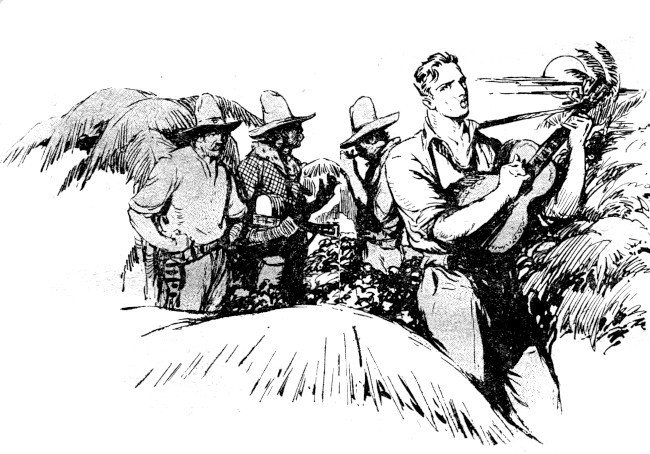
In a loud and unmusical voice Jim began his serenade.
He had selected that number because they used to sing it in college, and it seemed appropriate, but he didn't remember the words very well and the tune only approximately. However, it had an effect. He heard laughter on the second floor of the consulate and then out on the balcony popped Ellen, in a white evening dress. Behind her were Mrs. Goring, the consul, and a man in resplendent green and gold uniform, a stunning-looking man, who, he knew, could be none other than the minister of war, his rival. And all four were laughing heartily.
If the ground could have swallowed him up Jim would have been grateful; but there he stood with his mouth open, a guitar in his hands, and three colored men as his companions. Ellen looked down and recognized him, and uttered a wild whoop of mirth.
Mr. Goring peered down and also recognized him.
"Upon my word, Mr. Morrison," he cried angrily, "this is too much. If you must get intoxicated, why come and exhibit yourself under my windows—"
"And whoever told you you could sing?" demanded the heartless Ellen.
"May I ask who is this gentleman, and why he is disturbing the peace?" asked the minister of war, smoothly and maliciously.
"It's that dreadful young man we saw in the hotel," announced Mrs. Goring shrilly.
"Come on, you boys, let's get out of here," muttered Jim, overwhelmed with embarrassment.
"Just a minute, please," called Ellen, who disappeared. She returned in an instant and began to throw down into the street the flowers he had dropped in the patio that morning. It was too much. Jim led the retreat at a run, mocking laughter ringing in his ears. And such was the sad fate of a great idea.
As he fled he was pursued by his hirelings demanding their pay, and he tossed three ten-dollar bills at them without pausing in his gallop. Ellen, far from appreciating the thoughtfulness of his attention, had laughed louder than anybody and had added insult to injury by hurling his own flowers at him.
And that popinjay of a war minister had wanted to know who was disturbing the peace. For that Jim vowed he would punch him in the nose. The brute had invited him to dinner and, when Jim had refused, he had gone to call on the Gorings and was welcomed by the whole family, while he, Jim Morrison, who truly loved the girl and wanted to make her his bride, was compelled to caterwaul outside the window and then get insulted for his pains.
Well, he would go back to the hotel and drink and drink until he had drowned the recollection of his humiliation.
An hour later, having consumed half a dozen fiery concoctions without effacing the recollection of what had happened, he went up to his room and had begun to prepare for bed when his telephone rang. He regarded it dubiously. He was in no mood to talk to any one, and it was probably the obsequious Tillman. It rang again, and he took the receiver from the hook.
"Hello."
"Mr. Morrison?" said a sweet and thrilling soprano voice. He grasped at a chair to steady himself.
"Yes," he succeeded in replying.
"It's Miss Goring. I—I want to apologize for being so rude to you. I was very cruel. I know your attention was well meant, but you were so"—her voice broke with laughter—"so funny."
"You're an angel. I was a fool, but I hadn't had a drink, Miss Goring. I'm not a drunkard, honestly."
"I was afraid you felt terribly hurt and I wanted to apologize."
"Sure," he exclaimed joyously. "Can I see you in the morning?"
"Certainly not," she cried angrily. "I might have known you would misunderstand me!"
"No, no, I don't—" But she had rung off. Why did he always put his foot in it with her? He had offended her again, and she was so sweet and kind.
Jim went to bed, but he lay awake some time considering things. Ellen had proved herself to be the kind of girl he thought she was by phoning him to apologize for her mockery of his pitiful serenade; she had proved that she was everything desirable, and he loved her more than ever, but did he stand any chance with her?
He had glimpsed his rival on the balcony, and the fellow was fiendishly handsome. The mirror had informed Jim frequently that he belonged to the rugged school of pulchritude. He was rough and ready, and there was something about that girl which caused him to behave like an idiot.
Why an American girl should prefer a foreigner to one of her own kind was something he could not understand, but American girls were always marrying Frenchmen and Italians and Spaniards, and a girl he knew in New York had told him that they knew how to pay court to a lady; that their manners were perfect, they were adepts in doing the things that pleased a woman.
So far all Jim had done was to infuriate Ellen. Even when she had apologized on the phone he had been so light-headed as to act as though she were seeking an excuse to make an engagement with him. She had a right to be angry. Well, to-morrow night, when he met her at dinner, he would be on his best behavior and would make her see that he wasn't the buffoon she must consider him. Full of good resolutions he fell asleep and he woke up in the morning in the best of spirits and buoyed up by the importance of this day.
It happened to be one of the hottest days that Rosa Blanca had ever known, and even the natives complained of the temperature, but Jim's sufferings were tempered by the knowledge that he would meet Ellen at dinner in the house of people who were bound to his interest and who would give him his opportunity.
Dinner was at seven, but Morrison reported at six. He had hoped for a party of four, but Mrs. Tillman informed him that she could not invite Ellen without asking her parents, and there would be six at table.
"Whatever did you do last night?" she demanded. "Mrs. Goring is furious with you, and she called up this morning to break the engagement on behalf of the family. I had to plead with her not to get my husband into trouble by preventing us from doing for you the only thing you had asked us to do, and I guaranteed your good behavior. Mrs. Goring thinks you have horns and a tail."
"I swear to you," he declared earnestly, "that I'll be a lamb to-night. I thought it would be a good idea to serenade Miss Goring, but it didn't turn out to be such a good idea."
"I didn't know what you had done. Mrs. Goring was simply incoherent," replied the hostess. "However, the Gorings know how powerful your father is in this country, and I don't believe they would dare to refuse to come, actually."
"How powerful is my father?" he demanded. "I've heard that from several sources, but he never tipped me off. He just sent me down to see his principal plantation in order to get me out of New York."
"He financed and armed the last revolution and he is keeping President Garcia in power," she said.
"You don't say! I'll try to get him to fire the minister of war. I don't like that guy."
She laughed, tapped him playfully on the arm with her fan and went off to look after dinner arrangements. Tillman took up the story and before the other guests arrived Jim had learned a lot about the methods of the fruit company in which, some day, he would be the principal stockholder.
The Gorings arrived at seven o'clock, Mr. Goring looking uncomfortable in evening clothes, Mrs. Goring starchy and repressing her rancor with difficulty, and Ellen gorgeous in a frilly, fluffy pink gown with bare arms and shoulders. There was a look in her brown eyes which made him uneasy. Mrs. Tillman went through the introductions as though they had never met before, and Jim thought apologies were in order.
"I'm terribly sorry about that serenade," he said to Mrs. Goring. "It was just an idea I had, but it wasn't so good." Ellen choked back a laugh, but he caught her eye, and the hostile look was gone.
"Just a quiet little dinner," cooed Mrs. Tillman. "I wanted you all to meet Mr. Morrison and he was so distressed about your unfortunate misunderstanding at your other meeting that he was eager to set himself right in your eyes."
She gave her arm to Mr. Goring, Tillman took in Mrs. Goring and Jim had the privilege of leading Ellen, who took his arm demurely.
"Will you forgive me for the exhibition I have been making of myself?" he demanded.
"Provided you don't give way to any more ideas like the serenade," she smiled. "You know, Mr. Morrison, I have been thinking you were quite mad."
"I am—mad about you," he whispered.
They were at table and took the seats indicated by Mrs. Tillman.
The Tillmans did their part by engaging Mr. and Mrs. Goring in sprightly conversation, and this gave Jim a chance to talk to Ellen.
"Will you give me a chance to see something of you and make you realize that I'm not the idiot you think?" he asked.
"It depends on how you behave. Do you usually tell a girl you love her before you have been introduced?"
"I've never been in love before," he assured her. "That's why I don't know how to behave."
"But you can't want to marry a girl you have only seen once or twice," she protested.
"I knew I was a goner when I first set eyes on you in the hotel dining room. Imagine my embarrassment when I learned that your father was the old gentleman with whom I had just had an argument."
"I think you are just a spoiled rich man's son," she said severely. "You have always got exactly what you wanted and you suppose any girl you deigned to notice would be flattered."
"If I did, I'm all over that," he said ruefully. "Did you really want me deported?"
She smiled. "I thought the heat had affected you and a cool climate might cure you."
"You listened yesterday morning when I called on your father?" he accused.
"I didn't."
"I heard you laugh. You know you were listening."
"Well, I thought your conversation might be amusing. I wanted to see if father had courage enough to bawl out the son of Tom Morrison."
"He did—and how!" They both laughed.
"Whatever made you think of that preposterous serenade?" she asked in a more friendly tone than any she had yet used.
Jim told her how he had run across the serenaders. "I only grabbed the guitar when it looked as if you would never come out on the balcony."
She giggled at the recollection. "Consider my surprise when I heard the 'Spanish Cavalier' being murdered in English." It was delightfully funny now and their new understanding emboldened Jim to put his foot in it again.
"What made me mad was to see that greaser on the balcony. What on earth do you let one of those spigs come into your house for?" he asked earnestly.
Ellen stiffened and her reply was muffled fury. "Señor Lopez is as white as you are and much more of a gentleman. He is a friend of mine and I resent your statement, Mr. Morrison."
"I beg your pardon," he said contritely, but she punished him by turning to Mr. Tillman and forcing him to talk to her for the rest of the dinner.
For representing Morrison's in hot, unhealthy Rosa Blanca, Tillman received a salary which enabled him to rent a far more comfortable and attractive residence than the house of the American consul, and the party left the spacious dining room to take coffee in the large and blooming patio where a gently splashing fountain seemed to temper the warmth of the evening and where a faint breeze stirred the leaves of the little trees and bushes.
In the patio, conversation perforce was general, and after three-quarters of an hour, on a strong hint from Ellen, the consul, who was very comfortable, sighed, and said they would have to be going.
"Please, may I come and see you?" whispered Jim. "I'm dreadfully sorry I offended you again."
"You are the largest child that ever wandered around without a guardian," she said, showing her dimples. "Yes, only you are on probation."
His delight was so evident that she softened still more. "You would really be nice," she informed him, "if you didn't have such preposterous ideas. Good night, Mr. Morrison. Mary, the dinner was a joy. Good night, Mr. Tillman."
"I'll never cease to be grateful to you good people," declared Jim when the guests had gone.
"Did you square yourself?" Tillman asked. "Mrs. Goring was telling me about your drunken serenade."
"I was absolutely sober, I swear it," he protested, "but I don't suppose I'll ever make that woman think so. I must love the girl when I'm willing to take on that pair as in-laws."
Mary laughed deprecatingly. "Mrs. Goring is really a dear," she said, "only her disposition has been soured by living so many years with Mr. Goring, who has always been a hard drinker. I think she fancies Carlo Lopez because he is a teetotaler. He doesn't even drink wine."
"The more I hear about that Spig the less I like him."
"In your own interests, Morrison, and those of your father, soft-pedal remarks about Spigs in this country," advised Tillman. "Things have been known to happen to reckless Yankees. Lopez is a pure Castilian."
"Huh, you can't prove by me that Castilians are pure. Thought you said Lopez got expelled from Harvard for raising Cain?"
"He's reformed," grinned the agent.
The inhabitants of Castile, according to all accounts, are proud, haughty, honorable, and easily offended, and Carlo Lopez came of Castilians who had lived for three hundred years in Central America, where the climate has a degenerating effect upon the fine qualities of any white race.
He had made overtures to James Morrison in perfectly good faith, assuming that Jim was representing his father in Rosa Blanca and was fully informed regarding the situation of the fruit company in the republic of Santa Rosa, and he had been grievously offended by the curt note in which Morrison refused to dine with him without even bothering to explain his refusal. This was not only a slight to the ministry of war, but was particularly insulting to the very proud incumbent of the office.
Later in the evening, while paying his respects to Miss Goring in the presence of her parents, his ears had been assailed by ribald singing and he was informed that it was Jim Morrison in person who was making the night hideous under the window of Ellen Goring.
Lopez had long since made up his mind that Ellen would make a perfect Señora Lopez and his discovery that the son of Tom Morrison was interested in the young woman would have alarmed him if he had not been reassured by the behavior of Miss Goring upon that occasion.
But, as he kept informed of everything that happened in the city, he learned next night that the Gorings were dining with the Tillmans and that the only other guest was James Morrison, and he remembered an old Spanish proverb that one could not tell how a woman felt by what she said or did.
Ellen, he knew, did not like living in Santa Rosa and if she accepted the minister of war, she would have to reside here most of the time. Morrison was richer than Lopez and he could settle his wife in New York. It might be Morrison's winning argument.
Next afternoon, about four o'clock, General Carlo Lopez, wearing a striking service uniform of his own design—green coat, with heavy gold frogs, white riding breeches and high boots, and a gold and red fatigue cap—passed through the archway of the consulate and came into the patio, where he found Ellen Goring in the arms of Jim Morrison who was kissing her on the lips. True, she broke away immediately, her eyes blazing, her little fists clenched. She faced Jim like a young fury.
"I ask your pardon. I have intruded," softly said Carlo Lopez, whose black eyes were also blazing.
Ellen's composure returned. "Come right in, general," she said. "Mr. Morrison is just going. Oh yes, you are, and you're never coming back!"
"Is there any little thing I can do, Miss Goring?" asked Lopez softly but significantly.
"I am quite capable of managing my affairs, thank you," she retorted. "Good afternoon, Mr. Morrison."
Jim looked imploringly at the girl, threw Lopez a glance full of resentment for his intrusion and indeed for his very existence, then picked up his hat and went away. Lopez seated himself and, with exquisite tact, began to discuss a German opera company which the president of the republic had invited to Rosa Blanca.
Jim had behaved shamefully as he admitted to himself. Once again the brown eyes of that girl had intoxicated him and the kindness with which she had received him had affected his brain.
He had just come into the patio and Ellen, who was sitting under the colonnade, had risen and come forward with outstretched hand and a smile on her lovely face. All was well; she was no longer hostile and it only needed good judgment and a little patience; but what did he do?
Imbecile, he had flamed at the touch of her hand, exploded at the benevolence in her eyes and he had dragged her roughly into his embrace and rained kisses upon her sweet unprotected little face. She had struggled fiercely and then seemed to yield; he wouldn't swear to it, but it seemed as though she were beginning to return the pressure of his lips when that gold and green and white Adonis, Carlo Lopez, appeared on the scene. Ellen had thrust him violently from her and pronounced sentence of exile. It was all Lopez's fault. Now what was he going to do?
From his hotel he sent by messenger a letter full of extravagant protests of repentance, which was returned unopened. He tried the telephone and got Mrs. Goring, who told him Ellen did not wish to speak to him. He planted himself for two days outside the consulate and, on the second day, she emerged looking as cool and fresh in the melting afternoon as though she had come out of a refrigerator. She saw him, hesitated, and continued toward him.
"Please forgive me, Miss Goring," he said humbly.
"Don't you ever dare to speak to me again," she said as sharply as a lovely girl could say anything, and then she passed on her way.
General Carlo Lopez had a pleasant visit with Ellen after the departure of Jim Morrison and found her kinder toward him than usual, but her manner did not entirely satisfy him. He had seen her repulse and banish the mad American, and she certainly seemed to resent the man's familiarity with the utmost bitterness—but would she have done so had the minister of war not appeared unexpectedly upon the scene?
Being totally unacquainted with the impulsive nature of Jim Morrison, Lopez could not conceive that the fellow might have embraced and kissed Ellen without some encouragement. The Latin race has always overstressed the importance of a kiss. Lopez recalled the old Spanish proverb: "A woman kissed is two-thirds won." He was already furiously jealous of the young American, yet, such was his breeding, he had asked Ellen no questions regarding the situation he had blundered upon.
Back in his office in the Administration Building, however, General Carlo Lopez had a secretary telephone to John Laird, who was at the Hotel Trinidad, and Laird arrived shortly before six o'clock.
"Mr. Laird," he said crisply, "at our conference I told you that we should keep our agreement with the Morrison Company. That goes. If it should happen, however, that the Morrison Company should make an unjust demand upon this government, or reflect in any way upon our ability to govern our country, I should feel that we were absolved from our obligation and I am sure President Garcia would feel the same way."
"Yes? Is there any—er—prospect of such a thing coming to pass?"
Lopez smiled. "I think there is such a possibility. Therefore, if your principals can make us a better offer—"
"I'll undertake to arrange that," said the Blue Star agent eagerly.
When he had gone, Carlo Lopez wrote a letter, called in a spruce young officer and studied him for a moment.
"I want this letter placed in the hands of Pizzo the bandit," he said slowly. "Do you think you can find his camp and deliver it?"
"Sí, Señor Géneral, I shall do my best."
"Go in civilian clothes and be silent about this mission. If you succeed you will not be a lieutenant any longer, you will be a captain."
A week had passed since Jim Morrison rode down from the hills to take the steamer from New York. Now he sat in his room in his B. V. D.'s and wondered how you married a girl who hated you.
His temperament was mercurial; he was either in the clouds or at the bottom of an abyss. That he had made an impression on Ellen he was sure, for she had kissed back; but what good did that do when she wouldn't let him see her any more? Here he was, stewing in this hole for her sake, and he couldn't think of any way to make her see him, while in the offing was that handsome peacock, Lopez, who knew all about making love to women.
His watch on the bureau said two thirty; the whole darn town, resident Americans as well as natives, would sleep until three. Nobody to talk to, nowhere to go, and drinks didn't help much.
Tap, tap—a knock on the door.
"Come in, whoever you are," he called wearily. The door opened and a very curious-looking man appeared on the threshold.
"Perdóna me, señor," he said, removing his hat, a very dirty Panama, and bowing very low. He was small, half Indian by the look of him. He wore a heavy black mustache, possessed only a few front teeth, and needed a bath very badly. He was dressed in what had once been a khaki uniform and around his waist was an ammunition belt from which was suspended a heavy revolver in a leather holster, and a hunting knife. On his feet were canvas shoes.
"What the deuce do you want?" demanded the American.
"You are Señor Morrison, sí?"
"Well, yes. What of it?"
"I introduce myself. I am General Esteban Pizzo." A second low bow.
Jim opened his eyes. "Not Pizzo, the bandit?"
"Pizzo, the patriot, señor."
"You got a nerve coming to town. Have a drink?"
"A thousand regrets, señor. There is not time. You will dress and come with me."
"You go to the dickens," Jim retorted. "Clear out! Scat!"
General Pizzo drew from his holster his very large revolver. "My men, they surround the hotel. You come or I kill."
"I'll come," Jim agreed quickly. He was unarmed and the fellow looked villainous. "But why? What for?"
"I think the Señor Morrison pay very large ransom for his son. That is why."
"Yes? Maybe he'll be glad to get rid of me. Can I put my clothes on?"
"Porqué no?"
Taking this for assent, Jim dressed leisurely, wondering how it was possible for the bandit and his men to enter Rosa Blanca in the face of the government army, walk into the leading hotel, and carry off one of its most prominent guests.
"We go now," Pizzo declared, and Jim walked in front of him with the uneasy feeling that a gun was pointed at the small of his back. They walked along the corridor and descended the staircase one flight to the ground floor. There were four bandits in the office. No guests were visible or servants. The bandits fell in behind their leader and the party moved to the door, which was suddenly blocked by Ellen Goring, who frowned at the sight of Jim, and then took in his escort with astonishment.
"What's this?" she exclaimed. "Another of your wonderful ideas?"
"Beat it, Ellen," he cried. "It's Pizzo, the bandit. I'm pinched."
"Are you crazy?" she demanded. "What—why—oh?"
For General Pizzo had come out from behind the broad form of Morrison and covered Ellen with his big revolver.
"I regret," he said in his weird English. "La señorita is beautiful, but she make mistake to be here. Now she come with us. We take two prisoners."
The whole affair had struck Jim Morrison as being comic opera, but the statement of the bandit made it look very different. The brute was pointing a gun at Ellen and talking about taking her into the hills.
With his usual precipitancy he let fly his right fist at the chin of General Esteban Pizzo, caught him on the side of the jaw because he happened to move, and sent him down like a log, the revolver clattering on the floor. Jim forgot there were four more bandits behind him, and before he remembered he was struck on the back of the head with the butt of a long blue-barreled Colt and joined the general on the dirty stone floor.
A rush of bandits captured Ellen before she could utter a cry, and a dirty hairy hand covered her pretty mouth. General Pizzo got up from the floor with a snarl of rage, kicked Jim Morrison heavily in the ribs with one of his big boots, and then recovered his sang-froid.
"Pronto!" he exclaimed. "Throw the man and woman in the bottom of the car and let us depart."
There was nobody in the Plaza when Jim and Ellen were placed in the tonneau of a big though ancient touring car, and nobody to interfere when the five bandits climbed in after them and drove away. The machine rattled along through empty streets to the west side of the city and came to the barrier which was guarded.
Half a dozen soldiers and a sergeant piled out of a stone hut and the bandit who was driving stopped the car. The sergeant approached and demanded the password, whereupon Pizzo leaned out and said in a low tone:
"El Presidente."
"Pass," commanded the non-commissioned officer, and that was all there was to it.
Jim had received a savage blow and had been unconscious during the ten minutes required to get out of the city, but he recovered as the machine began to bump over the rough country road, and he opened his eyes to find Ellen's face within six inches of his own and her eyes filled with anxiety. He realized that his head was pillowed on her knees, and they were both in the bottom of an automobile. He recalled everything.
"My dear," he said, "I'm so frightfully sorry."
"Hush," she said softly. "You were wonderful. It wasn't your fault."
The machine was climbing now in second gear, for the foothills of the Sierras are close to the shore in Santa Rosa. The two bandits in the back seat were watching them closely with their weapons drawn and ready. He and Ellen were headed for hardships and dangers he could only suspect, but Jim was happier than he had been for a week, because his head was on Ellen's knees and she had said he was wonderful.
The machine was halted suddenly when several government cavalry men blocked the road. Again the password was efficacious, the horsemen drew to one side, and even the sight of two people in the bottom of the car did not seem to disturb them.
"Does your head hurt terribly?" she whispered.
He grinned at her. "It would if I moved. I'm terribly sorry about you, Ellen. They captured me to hold me for ransom, and no doubt they'll do the same for you. I'll see that they get whatever they ask."
"I'm not afraid. It was very brave of you to attack them when you saw that I was in danger." Her eyes were moist.
"Don't you know that I'd lay down my life for you?" he said softly. "Only, as usual, everything I do is wrong. They might have let you go if I had not hit Pizzo."
"No, no, they wouldn't," she protested. "They knew I would alarm the city. They had to take me."
Pizzo, in the front seat, turned his head.
"Silence back there," he commanded harshly.
Something made Jim chuckle. "What is it?" she whispered.
"Motor bandits in this God-forsaken country. Jesse James had a horse."
It was getting cooler as they climbed, and the car rattled and shook and bumped over a road which was more and more rocky and filled with holes. At the end of an hour it turned off the apology for a road and stopped a few rods within the jungle.
Pizzo got out first and approached the tonneau.
"Does the señorita speak Spanish?" he asked.
Ellen nodded.
"It is my great regret that it has been necessary to take you with us," he said, his black eyes devouring her loveliness. "You shall see that General Pizzo is a caballero who knows how to treat beautiful ladies. This man is rich. We hold him for ransom, but we hold you to delight the eyes of my brave patriots who one day will rule Santa Rosa."
"What's he saying?" demanded Jim, whose Spanish was hopeless.
Ellen had turned pale at what his remarks implied, but she feared to tell the headstrong youth. Jim was likely to get himself killed out of hand.
"Just fulsome compliments," she said.
"And now we must mount our horses," continued Pizzo. "If Señor Morrison cannot ride we shall tie him on a horse."
Jim most reluctantly lifted himself from his pillow. "I can ride," he said curtly.
The clerk at the Hotel Trinidad had been bound and gagged and laid down behind his counter, where he was found an hour later by other employees of the hotel who came on duty. He reported that bandits had carried off Mr. James Morrison and a lady who had entered the hotel as they were departing, and the police immediately notified the government, so that General Carlo Lopez was in receipt of the information a few minutes later; but he was not surprised by it.
He had written to the bandit Pizzo that he could probably win a fortune by capturing Morrison and, as he had personal reasons for wishing the fellow out of the way, he would arrange that Pizzo and a few picked men might enter and leave the city unmolested. There was a chance that the minister of war was only laying a trap for the bandit, but Pizzo did not think so, because he was aware that the existence of a small band of robbers was the government's excuse for taxing the people to support an army which was overlarge for the population of the republic. There was no special enmity between him and Lopez, and the government had made no serious effort to molest him for a couple of years.
So General Pizzo had risked himself and a few followers in the city and escaped, not with one prisoner but with two; but Lopez did not learn the identity of the second captive until Consul Goring telephoned him in great distress that Ellen had gone out shortly after two o'clock and had not returned to dinner.
Although Lopez had been informed that the hotel clerk had reported that a lady had been carried off with Morrison, it had not occurred to him for a second that the woman might be Ellen Goring. Having a low opinion of male morality he had supposed that Pizzo had found the American with some plaything and had obliged him by taking her along.
A search of the city which occupied the entire police force for hours revealed no trace of Ellen, and the minister of war was forced to conclude that the woman he hoped to marry had been taken in the trap he had arranged for his rival. If Ellen had seen Lopez in his rage, the fact that it was due to concern for her would not have prevented her from being terrified.
His plan had been to send an expedition after Pizzo, with secret instructions not to find him, after being officially informed that Morrison had been carried off by the bandit. Tom Morrison in New York would rage and storm against the government of Santa Rosa, and undoubtedly would make threats that no self-respecting administration need tolerate. In retaliation, President Garcia would break the exclusive trade arrangement with the Morrison Fruit Company, and the Blue Star would enter the republic in triumph.
Morrison, of course, would agree to pay the ransom when it was evident that the Santa Rosa government was incapable of rescuing his son, but this would be a matter of weeks, possibly months, and in the meantime Lopez expected to persuade Ellen Goring to marry him.
This imbecile of a Pizzo had complicated a very sweet little plot by carrying off the very girl Lopez wanted to keep away from Morrison, and he made the air blue with curses upon the devoted head of the bandit.
Then he cooled down and considered the situation more calmly. Apparently the girl had either been calling on Morrison in his chambers, something which his esteem for Ellen made it impossible to believe, or she had entered the hotel by accident at the moment of the raid and had been carried off by Pizzo lest she give the alarm. In any case, she was of no value to Pizzo, and when the bandit learned that she was dear to the minister of war he would release her quickly.
Lopez sent for the young officer who had delivered his first message to the bandit and, while awaiting him, indited a letter which would put fear into Pizzo's soul if he had one. It was a peremptory demand for the immediate release of Miss Goring, daughter of the American consul. If she were not back in Rosa Blanca in twenty-four hours the entire army of the republic would take the field against him and exterminate his band.
The messenger started in a speedy motor car some seven hours after the car containing the captives and their captors had passed out of the city. Lopez ordered two regiments to be prepared to march into the hills at six o'clock the following morning, and then he called on the president to explain how the failure to rescue Jim Morrison would result to the advantage of the administration.
It was necessary to make a gesture against the bandits, of course, but Morrison would only be satisfied with success, and a break between him and President Garcia was certain. Garcia saw the light quickly.
There was a big lump on Jim Morrison's head, but no abrasions. He could not account for the pain in his side until Ellen told him that Pizzo had kicked him while he lay unconscious.
"I'll get even with him for that," Jim muttered as they walked to the horses. "But, first, I've got to get you out of this."
"I'm not afraid—that is, not very much," she said rather dolefully. "But these men are rather awful."
They followed a winding path through a fernlike growth and came unexpectedly into a clearing where a dozen saddled horses were waiting, in charge of two black men armed with rifles and wearing very few clothes. Pizzo approached and pointed to a sorry horse which he ordered Morrison to mount, then smirked at Ellen and started to lead her forward to a small but efficient-looking mountain pony.
"I deeply regret," he explained in Spanish, "I have no side saddle, for I did not expect the good fortune of the señorita's company."
"I can't ride astride in these clothes," she replied, "but if you go slowly I can sit sidewise in the saddle."
"We shall accommodate our pace to your needs, señorita," he assured her, "and I shall ride beside you to assist you in necessity."
She looked at him contemptuously. "I shall not need your help."
He bowed again, a very gallant bandit. "Nevertheless, I shall be beside you."
He bent his back for her to step upon to mount and she leaped lightly from it into the saddle. Morrison was already mounted and watched this courtesy with well founded uneasiness.
If the yellow brute was going to be smitten with Ellen, it would make their situation much more serious than he had considered it up to the present.
Pizzo led the way up the mountain trail, and the cavalcade strung out behind him. Jim glowered as he rode along and vainly sought a practical plan of extricating them from their peril.
There were two blacks behind him with rifles; three bandits, armed with revolvers, rode ahead, between him and Pizzo, who rode beside Ellen. If Jim had been alone he would have risked throwing himself off his horse and plunging into the dense jungle through which they were threading their way, but he had to submit to this humiliating progress because of Ellen. If only he were beside her to cheer and encourage her! But Pizzo had made sure that they were separated.
If Esteban Pizzo had seen Ellen in Rosa Blanca he would not have dared lift his eyes to her, but he was general of a small and well armed band, and she was his captive. He rode a foot behind her so he could study her, and the more he studied her exquisite profile, the graceful poise of her fine little head, the perfection of her figure as she jogged along, the greater grew his admiration.
This was the loveliest creature who had ever ridden into the mountains of Santa Rosa, and she was his prize of war. He congratulated himself that he had dared enter the city in response to the invitation of Carlo Lopez, for not only would he get an enormous ransom for the son of Thomas Morrison, but he had secured a lovely mistress, perhaps a wife. Why not? He was a bachelor.
The sun set, and still they rode slowly through the hills. The character of the vegetation changed, the temperature lowered very pleasantly, and then it was dark, and Pizzo sent a man ahead with a lantern to light the way, while one of the blacks fastened Morrison's hands behind him and roped his feet under the belly of his horse.
Ellen was an experienced horsewoman, but she was half dead with fatigue and almost hysterical from terror and apprehension, for she had not missed the attraction she seemed to possess for the bandit leader. But at last they passed through a narrow rocky defile and came suddenly in sight of the lights of a settlement in a valley a few hundred feet below.
"It is my camp," said Pizzo proudly. "In fifteen minutes we shall be there, señorita. I promise you a welcome."
Morrison also saw the lights and knew that the end of the journey was in sight. He also was very tired, his head hurt, and he thought he had a broken rib, but he was glad, more for Ellen's sake than his own, that they would have a chance to rest.
In a quarter of an hour they debouched into a village street, passing between rows of wooden huts thatched with palm leaves. They were cheered by several hundred men and women who rushed out of the houses.
Before the largest of the huts they dismounted, and Ellen would have fallen had not Pizzo grasped her and passed his arm about her waist. Her strength returned magically, and she tore away from him.
"Don't you dare to touch me!" she exclaimed.
The bandit turned his palms out in deprecation. "You were about to fall, señorita."
"I don't care. Don't touch me."
"Be pleased to enter my poor dwelling. You and the Señor Morrison will dine with me to-night." He ordered Morrison released from his bonds and ushered the two prisoners into a large room in which a table was set, bare of linen, but upon which reposed a cold ham and a huge round loaf of bread which both Ellen and Jim eyed wolfishly.
"Señor, señorita," announced Pizzo. "I go to give some orders, but I return pronto and then we shall dine."
"Ellen, darling," Jim said when they were alone, "it breaks my heart that you should be in this predicament."
"It's not your fault," she said crossly, "and don't use endearing terms to me."
"It's the way I think of you," he muttered. "What brought you to the hotel at that moment?"
"I wanted some stationery and the shops were closed. Does it matter?" She dropped exhausted upon a chair.
"My father will arrange ransom for us both, but it's dreadful you should be held in a place like this even for a minute."
She smiled. "I suppose this is what is known as adventure. I don't like it. That Pizzo is appalling. However, General Carlo Lopez will have us out of here in a day or two. The whole army may be on the march at this minute."
"He might do it for you," said Jim, "but I don't think he would bother his head about me, and I'd rather be ransomed than be beholden to him."
"Upon my word," exclaimed the girl, "when I begin to like you you make the thing impossible. Carlo Lopez is my friend. I admire him."
"Well, he doesn't admire me. Say, wasn't it very queer these bandits were able to come into the heart of the city? And they knew the passwords. Who gave them to them? I wouldn't be surprised if your friend Lopez—"
"Jim Morrison—" she began angrily and then blushed violently.
"That's the first time you have called me Jim," he declared.
"And it will be the last. A slip of the tongue."
"Please don't let's quarrel," he pleaded. "I don't know why I always get your goat. You're not really interested in Lopez, are you?"
"It's none of your business," she retorted.
"It is too. I love you and want to marry you. He knows it, and I wouldn't be surprised if he got me kidnaped."
She sprang to her feet and glared at him. "And had me kidnaped too, I suppose!"
"No-o. I expect that was Pizzo's private enterprise. Ellen, is there anything I can do to make us friends?"
She was still angry. "You might try keeping quiet."
He sat down and felt of his head.
"Does it hurt very much?" she asked quickly.
Jim nodded. He felt of his ribs.
"Do you think they are broken?" she asked, still more gently. "It was the most brutal thing I ever saw."
He sighed heavily.
"You poor boy," she cooed. And then General Pizzo had to enter.
"Señor, señorita, at table," he commanded. "I am of a great hunger myself."
Nothing loath, they seated themselves, and, despite the atrocious table manners of the bandit, they ate heartily of ham and bread, but neither could drink the goat's milk, which Pizzo observed, and ordered a ragged servant to bring in a bottle of wine.
The bandit was in superb spirits and evidently wished to make an impression on the girl by his gallantry. Fortunately Jim did not understand most of his remarks or he might have met a violent end, but Ellen's cheeks were red and she answered in monosyllables.
"How much ransom are you going to ask for me?" asked Morrison when the general sank back in his chair surfeited with food.
"Two hundred fifty thousand dollars," replied Pizzo, his eyes agleam at the thought of so much American money.
"Double it," said Jim. "That includes also the young lady."
"Ah, you have interest in the young lady?"
"She is my fiancée—" He glanced at Ellen, read danger signals, and added hastily, "almost."
"Sí, sí. I do not know that. I think that over. I ask perhaps five hundred thousand dollars for you, maybe with, maybe without la señorita."
"The minister of war, Carlo Lopez," said Ellen in Spanish, "is a very great friend of—my father. If you do not release me without ransom, you will have the whole army of the republic to fight."
Pizzo shrugged his shoulder. "I do not care for the army of the republic. In the mountains I am king. But I would do very much for the beautiful señorita."
"Then let me go," she pleaded.
He smirked at her. "I consider that. Maybe you will like it here. It is very nice here. Cool. Not hot like Rosa Blanca."
"What's he talking about?" demanded Morrison for Ellen had shuddered.
"Nothing," she lied. "Don't anger him."
Pizzo understood and laid down his knife; he had not used a fork. "Señor Morrison, you are worth much money to me. I treat you well, but if you anger me, look out. I shoot quick and I shoot to kill."
"You're a regular hot tamale," sneered Jim. "If you injure a hair of this lady's head—well, you see what will happen." His finish was lame.
Pizzo rose, went to the door and shouted and in a few seconds three or four savages with rifles entered the room with much stamping.
"Take the señor to the empty casa opposite and lock him up for the night. Put a double watch around the house. Buenas noches, Señor Morrison," he said mockingly.
Jim jumped up and clenched his fists. "Be careful," warned Ellen. "You must do as he tells you."
"But I won't leave you alone with this—this—"
"Don't say it. I am sure General Pizzo knows how to respect a señorita."
"No man in Santa Rosa is a greater caballero," declared Pizzo. "Take him away."
Jim obeyed the prayer in her eyes and went silently. At the door he looked back, his face working with emotion.
"Good night, Jim," she called to him. "Don't worry. I shall be all right."
When she was alone with the bandit she faced him fearlessly.
"I am tired. I wish to sleep, general," she said coolly.
Pizzo opened a door to an inner room and showed her a bed.
"It is my chamber, señorita. None shall disturb your slumbers. I shall have a bed made up in this room."
Ellen managed a smile. "General, I think you are a true caballero," she said gratefully.
The little man swelled at her words. "You shall see," he declared.
However, as soon as Ellen was in the chamber, which was reasonably clean, by the way, she placed two chairs, one on top of the other, against the door so that an attempt to open it would cause the top chair to fall with a crash. She lay down upon the bed, fully dressed. Her intention was to fight off sleep, but she was dead with fatigue and in ten minutes she was unconscious.
Many hours later she was awakened by voices in the next room and she saw that the sun had been up at least an hour. Pizzo was talking to some one and she could hear every word.
"I do not fear General Lopez, or President Garcia," he boasted. "I do not care if she is the wife of Carlo Lopez. He cannot command me. She is my prisoner. I think I marry her myself."
"General Lopez says he will take the field himself at the head of the whole army of the nation," said the stranger boldly. "Beware, General Pizzo. You cannot fight the whole republic."
Pizzo laughed scornfully. "This Lopez! I do him a service. I carry off this Morrison. I will pay him a commission on the ransom. Tell him that. It is not my fault this beautiful señorita encounters me just as I am leaving the city. I take her with me so she cannot bring down the police upon us and get this Lopez into trouble with me. Now, I love her. I am as good a caballero as Lopez. I think she likes me better already. I do not give her up."
"Then you and your whole band, men, women and children, will be exterminated!" declared the messenger. "Our airplanes will drop bombs on this village as soon as I return."
"If you return," retorted the bandit significantly. "My friend, I know a pass through the mountains into Nicaragua. Once there, I am safe; the army of Santa Rosa is powerless. A few more bandits in Nicaragua mean nothing whatever to Nicaragua. From any part of these mountains I can collect the ransom from Señor Tomaso Morrison. Lopez may find another American señorita. This one belongs to me."
"Shall I take back that message?" asked the man.
"A moment. You have twice been in this valley. You know where are my outposts. Another shall take back my defiance. You remain."
"I came here under a flag of truce," cried the other. "You wouldn't dare detain me."
Pizzo laughed. "I dare anything."
"Then I proclaim you nothing but a treacherous brigand," cried the brave man who confronted him.
Crash! It was a pistol shot. She heard a groan and a heavy body fall and she tore open the door and stood in the doorway. Pizzo was returning a smoking pistol to his holster. A man in the uniform of a Santa Rosa army officer lay bleeding on the floor. Ellen uttered a shriek and crumpled down into a still white heap.
Pizzo looked at his victim, then at the girl lying on the floor. Shrugging his shoulders, he picked Ellen up with difficulty, for she weighed a hundred and eighteen pounds, and he was a small man, carried her back into the bedroom and laid her on the bed. For a moment he looked down on her. Was she worth the decision he had made to defy the whole military force of the republic? Well, anyway, he had done it, and she would pay for it. He left the hut and shouted for his lieutenants.
"Break camp, burn the houses, pack everything we can carry," he commanded. "We're going across the frontier into Nicaragua."
There were protests. This valley was the only home these outlaws possessed; but Pizzo knew how to explain the situation. Lopez had permitted him to carry off Morrison for ransom, but now Lopez had changed his mind and demanded that they give up their captive. The ransom of Morrison would make them all rich. It would be a million American dollars.
In Nicaragua's mountains they were safe from the army of Santa Rosa, and the revolution in that country would prevent its government from bothering about alien bandits in the remote recesses of the hills. The girl? Oh, she was nobody; it was on account of Morrison that they were taking to flight.
Looking through a window in the hut in which he had spent the night, Jim Morrison saw the outlaws assemble. There were about a hundred men, he thought, thirty-five or forty women, and a score or more of children of all ages. In the entire outfit there were not a dozen men who could be called white, the rest were Indians, negroes and breeds of the three races.
He watched them bustle about with lack-luster eyes. What had happened to Ellen during the night? Who had fired the shot just now, which came apparently from Pizzo's headquarters? The last question was soon answered for he saw four men carrying out a body dressed in the uniform of an officer of Santa Rosa cavalry. An envoy, perhaps, from the government, and this brigand had killed him!
Until he set eyes upon that dead body, Jim Morrison had not been fully alive to the desperate character of his captors. Pizzo was a slimy little rat, a menace to an unprotected young woman, but Jim couldn't accept him as a full-fledged bandit. He hadn't believed in bandits. The whole thing had seemed absurd. But Ellen's situation was not absurd, and ransom or no ransom, neither of them was safe in such a mob.
His door was unbolted and a soldier beckoned to him. He followed him into Pizzo's hut where the general was sitting at table.
Pizzo motioned to a seat.
"The young lady?" Jim demanded.
"She have refuse to come," said the chieftain. "I have to kill a man and she unfortunately see him. It's a pity."
"Where is she?" he cried. Pizzo nodded toward the inner room. Jim rushed to the door and knocked. "Ellen, it's Jim. Will you come out to breakfast?"
"I will not eat with a murderer," she answered hysterically. Pizzo laughed.
"I have finished. I go. Make her eat."
He left the room and Ellen emerged upon being informed of the fact. She was very pale and her eyes were red.
Jim grew pale as he looked at her. "Did that wretch—did he—"
"No, no," she denied. "He was decent to me, but, oh, Jim, he shot an officer who came from Lopez, murdered him in cold blood."
"Yes. I saw the body carried out. You poor kid, it must have been dreadful! Sit down here. There's nothing but bread and milk, but you need your strength."
He seated her and took his place opposite. Ellen was silent for a long moment, her head bent, but she was watching him through her long lashes. "Jim," she said shyly, "I have been very unjust to you, and I was horrid last night."
He laughed delightedly. "Anything you ever said to me, I deserved. I had it coming to me."
"No, you didn't. The officer was a messenger from Lopez and I overheard his conversation with Pizzo. Jim, Lopez was responsible for your capture. He contrived it with Pizzo."
"I wouldn't be a bit surprised," Jim replied calmly.
"The officer was sent to demand my release, not yours."
"Well, that would help a lot."
"And Pizzo killed him so he couldn't return and inform Lopez the location of this camp." Her voice began to shake. "He—he isn't going to let me go."
"Oh, yes, he will," Jim assured her.
She stretched appealing hands across the table. "Jim, I have been frightful to you and I don't deserve anything from you, but will you save me from this man? He says he's going to m-m-marry me." Her sobs overcame her. With two strides Jim was around the table and had her in his arms and this time she didn't repulse him.
"Don't you worry, darling," he declared as he stroked her glossy hair. "Nobody's going to marry you but me. I was afraid of Lopez, but you're onto him now, and you bet this funny bandit won't get you."
She looked up and smiled pitifully. "You'll think it's just because I'm in peril that I turn to you."
He laughed loudly to conceal his emotion. "I should worry why you turn to me, so long as you do. It's a question of money with these beggars and father has plenty for both of us."
She released herself and smoothed her hair. "No, Jim," she said.
"Pizzo thinks he's in love with me and he expects to get all the money he wants for you. I heard him say he was going to cross the frontier to Nicaragua and escape the Santa Rosa troops. If you can't save me, I won't be saved, that's all."
"Then it's up to us to get away. Just be ready to do whatever I say. Something will break for us."
Outside was much shouting and shrilling and Pizzo was heard giving sharp commands; there was the stamping of horses and mules and burros. Pizzo had no fear that the troops would penetrate into his fastness for days and he knew that Lopez expected his messenger to return accompanied by the young woman, so he need expect no overt action from the war minister until the messenger became overdue.
If Pizzo regretted that he had permitted his affections to jeopardize the existence of his band it was too late, now, to change things. The frontier of Nicaragua was forty miles away over high mountains, two days distant for an outfit which was loading most of the animals with its possessions and would have to proceed on foot.
He wanted to be on the march as soon as possible lest Lopez send airplanes on his trail when twenty-four hours had passed without the return of the unfortunate officer. Pizzo thought he could conceal his forces from the eye of an observer in a plane, but it would be safer to be across the frontier before the aircraft were sent out.
Ellen and Jim had half an hour together before the busy leader returned to their headquarters, and it was their first wholly amicable interview. The treachery of Lopez had shocked Ellen inexpressibly, even though it was displayed against Jim and not herself. She could not help contrasting favorably the big, blond, honest, humorous youth who sat opposite her with the slender, suave, handsome, but crafty Central American.
She was petrified with terror of Pizzo, and though she had turned to Jim and let her head rest on his breast just because he was her only hope, she had liked the feel of it there. She liked his protestations of love because now she believed he meant them, and she remembered that she had begun to like his kisses back home in the patio. Perhaps, after all, he was her man.
Jim was silent during most of their tête-à-tête because his mind was furiously working. It was up to him. Ellen depended on him. He was alone against a hundred armed and savage men, yet somehow he had to save her.
He shuddered at the thought of the girl in Pizzo's power for a second night. The man's passion must be tremendous if he had chosen to hold her against the whole force of the republic of Santa Rosa, and it was not to be trusted. The thought of Ellen in the arms of the half-breed caused his brain to reel. Ellen watched him as she nibbled at the dry bread and knew pretty well what was passing through his head. She wasn't afraid now, for somehow this ridiculous youth, whom she had mocked in Rosa Blanca, inspired confidence.
"Have—have you a plan?" she hazarded finally.
"No," he said dolefully. "We'll just have to watch our chance. It's bad enough now, but if he gets us away up in the interior, even if we escaped we'd perish before we ever reached a settlement. Hush, he's coming."
Pizzo entered. He had strapped a sword around his waist, had two revolvers in his belt now, and wore a flapping felt hat with a red feather in it. His black eyes gleamed as he looked at Ellen. Morrison he ignored.
"You feel better, señorita?" he demanded in Spanish. "My heart is sick that you saw an execution. You must understand I am a soldier and I killed an enemy."
"I don't care to talk to you, murderer," she said coldly.
His smirk vanished and he drew himself up. "Señorita," he said. "I love you. Because I love you I have refused a demand that I send you back to Rosa Blanca and now the whole army is marching against me. That is love, is it not?"
For answer she rose from the table and moved toward the inner room.
"You cannot take refuge there," he said, following her. "For your sake I abandon this camp where I have lived for three years and cross the frontier with my soldiers. This house and all the others I am about to burn."
Jim had risen and was listening with anxiety to the tirade, for the bandit's voice was rising. Pizzo whirled on him.
"I attend to you," he snarled. He darted to the door and shouted and, in a moment, two soldiers, a negro and an Indian, entered, closing the door behind them.
"Take this man outside and guard him," he commanded.
Pizzo turned his back to Jim and followed Ellen into the bedroom. This was too much for the hot-tempered American. The riflemen had stepped up to him and separated, one of them indicating that he was to step between them. With every ounce of strength he possessed, Jim brought his right fist up and crashed it against the point of the Indian's jaw. As the fellow dropped, Jim grasped the rifle and drove the butt of it squarely against the forehead of the negro who was trying to lift his gun to his shoulder. The second man collapsed and fell upon the body of the first, and Morrison swung about with the rifle and covered Pizzo who had turned and was standing in the doorway of the bedroom in the act of drawing his revolver from its holster.
"Drop that gun," Jim commanded harshly.
The revolver fell from the fingers of the bandit.
"For this I will kill," Pizzo snarled, his upper lip drawing back and showing yellow fangs and cavities.
"I'm doing the killing," declared Morrison. "Ellen, pick up that revolver and take the other one away from him.
"Quick!" he cried as she appeared, hesitating, behind the bandit.
Ellen fumbled at the holster on the left side of Pizzo's belt and drew out the weapon, then picked up the revolver from the floor, holding each timorously by the muzzle instead of the butt.
"Now tell him that if he calls for help I'm going to shoot. He may not understand my English."
"I understan'," said Pizzo. "You are imbecile. No ransom now. I kill you."
"Bring me those guns," Jim commanded; and Ellen glided to his side and handed him the weapons while Jim instantly covered Pizzo with one of them, having dropped the rifle to the floor. Both fallen soldiers were moving, and one sat up and blinked stupidly. "Tell them to be silent, Pizzo," he commanded. "If they yell, I'll shoot you."
Pizzo gave the order.
"Pull out his sword, and then stack these two rifles on the other side of the room," Jim said to Ellen. The girl returned timidly to Pizzo and shuddered at the glare he gave her, but she drew out the long blade from the scabbard. And then came a thump on the door.
"Ask them what they want, and tell them not to enter," snapped the American.
Pizzo lifted his voice and complied.
"What did they say?" he demanded of Ellen.
"They say all is ready for the word to march, and six men remain behind to fire the houses."
"Pizzo," he said softly, "tell them all to march, and not to fire the houses. You will follow with these men and the prisoners."
Pizzo was shaking with indecision.
Jim looked him squarely in the eye. "I'm going to fire," he exclaimed. "Listen, Ellen. If he says anything else, tell me, and I'll empty this gun into him."
There was a tense second. The bandit chief understood what it meant to be abandoned by his men, but he saw that Morrison was desperate enough to shoot. In fact, he had no choice. He snapped out the order to march.
The lieutenant who stood outside the door shrugged his shoulders and shouted: "Sí, sí, mi géneral!" To him it was plain what was happening inside. The general was with a beautiful woman and wished to remain with her for awhile. He had two men to guard the male prisoner and saddled horses waiting with which to overtake the band which was moving forward on foot.
"Pizzo, go stand against the opposite wall with the others," instructed Jim, and the little bandit, head drooping but eyes watchful as those of a ferret, obeyed. Jim was perspiring from excitement as though he were in a steam bath. Ellen was almost fainting from nerves. They waited in silence.
Outside was much shouting, tramping, rattling of accouterments, and the buzzing of two ancient Ford cars that were going to be used on the mountain paths as far as they could be driven. Presently it was evident that the movement had commenced. Jim thanked the gods that there were no windows on the front of the hut, just the door.
There was a window at one side, but it was covered with a dirty curtain. Daylight streamed in from a bedroom window at the rear. No eyes outside could witness the drama of the interior.
Presently Pizzo spoke. He addressed Ellen in Spanish.
"He says," she translated, "that, even now, he will spare your life and overlook this incident, and he will release me with you when the ransom is paid."
"Tell him to go to the devil."
Pizzo understood that and tried English.
"My men will return and kill you, señor," he threatened.
"They'll find you dead, in that case," Jim said grimly. There was a silence lasting ten minutes. "Look outside, Ellen," Jim commanded. "See if the column is in sight."
The girl opened the door and stepped outside. She returned with a very white face.
"They are out of sight," she said, "but there are two armed men about a hundred feet away guarding six horses."
"Stick your head out, Pizzo," Jim ordered. "Tell those fellows to mount two horses and report you will be along in half an hour. Or how would you like a bullet in your back?"
Shaking with hatred and fury, Pizzo opened the door and yelled to the men. Ellen nodded that he had said what he was told to say.
"Back up, Pizzo—back up!" warned Jim.
The general returned to his post by the wall. A moment later they heard two horses galloping past.
"Now," said Morrison, "this is what is going to happen. Pizzo, you and I and the lady are going to take the other horses and ride to Rosa Blanca. You are going to show us the way. If you try any tricks, you get filled full of lead. If you are a good boy, I won't turn you over to the Santa Rosa troops. Translate that, Ellen darling; he can only understand about six words of English at a time."
Ellen translated, and Pizzo looked sullen, but said nothing.
"Darned if I know what to do with the other two," Jim muttered. "March them ahead of us, I guess, for a few miles, and turn them loose. Ellen dear, can you carry those rifles as far as the horses? I'll have my hands full. Come on, Pizzo, you lead the way and tell the others to follow. I've got a lot of bullets here for you, remember that."
Apparently there was no fight in Pizzo, for he did what he was told. Jim made the trio go in single file and followed with his revolvers while Ellen staggered under the weight of the heavy rifles. Jim mounted first and took the two rifles from the girl, which he laid across his pommel, intending to throw them into the first chasm they came to. He made Pizzo aid the girl into her saddle.
"I'm going to ride astride," she declared. "Don't look at me, Jim. We've got to make good time, and I can't ride fast while sitting sidewise."
The two disarmed bandits were a problem, for if left behind they would bring the band quickly on the heels of the fugitives. He decided to force them to run ahead of the horses. He made Pizzo lead the fourth horse and ride ahead; he followed, and Ellen brought up the rear.
At a hundred yards he was able to dispose of the rifles by dropping them into a small stream, and then, keeping a sharp eye upon the men ahead, he ordered them to move faster. He remembered the rocky defile through which they had entered the valley, but from that point he was at Pizzo's mercy, for they had traveled in darkness the night before.
At a distance of two miles he dismissed the disarmed soldiers. He calculated that the main force of the bandits must be two miles from camp in the opposite direction, and it would take the pair an hour and a half to reach them.
There was more danger that a force might be sent back to camp to see what detained the general, but this possibility had to be chanced.
For an hour they climbed a narrow defile, and then they began to descend. They were making much better time than upon the previous night, due to Ellen's ability to travel faster, and Jim was hardly able to credit that things were going to work out so easily.
Pizzo rode with shoulders hunched and head bowed, probably boiling with fury and humiliation and plotting as hard as he was able. Occasionally Jim threw a word back to Ellen, but he dared not look around. She always answered cheerfully.
Two hours passed, and they were still traveling through mountainous and bewildering country. Suspecting that Pizzo might be leading them by a circuitous route toward his toiling followers, Jim shouted to him to slow up, and rode closer to him so he could threaten him frequently and at ease.
They were descending now, and the vegetation was changing from more temperate growths to ferns and occasional banana and bamboo thickets, a sign they were approaching the coast country. A third hour. Ellen rode up beside Jim, for the path had widened.
"I think we are pursued," she said. "Away up on that other mountain I can see a long row of horsemen."
"How far back? I can't take my eyes off Pizzo."
"I think it's where we were about an hour ago."
"Faster!" he said tersely.
The bandits had grown suspicious, and sent a force back to the camp. Finding it deserted, they had continued on until they met the two men he had turned loose, and now—trouble. He figured they had ridden for five hours the night before, from the point they left the automobile, and it was still two hours off. If the pursuers were an hour behind and the machine was still there, he and Ellen had a chance.
Pizzo was looking back. "You surrender now," he suggested. "My men soon catch us."
"If they do, you won't be alive to see it. Ride faster!" he commanded.
He had to threaten Pizzo a dozen times, for the bandit was trying to delay them, but they made better time. Another hour passed, and they could not see the pursuers, who might be just around a bend or five or ten miles back.
It was growing very hot, for the sun was directly overhead. However, the traveling was easier now, the trail less difficult.
Jim was watchful lest the bandit lead them out of the only road to safety, though there seemed to be no forks in the trail; but ten minutes later they came to a side path, down which Pizzo turned his horse's head.
"Wait a minute!" shouted Jim. "Halt!" He looked at the side path and at the trail upon which they were. This trail was well marked and the other very faint, yet still it might be the right one. However, Pizzo would not take the proper road if he could help it, and he had turned to the left.
"Back," Jim commanded. "Try that again, and I'll shoot you and risk finding my way."
The look on Pizzo's face told him he had guessed correctly.
"Jim," called Ellen softly, "I saw the men behind just now. I don't think they are two miles back. I saw them only for a moment, but there are a lot of them."
"Gallop, you yellow dog, gallop!" Jim commanded fiercely; and Pizzo galloped.
The trail was downhill and winding, but they followed it as fast as the horses could be persuaded to go. Jim was in an agony. It couldn't be possible they would be recaptured now, after coming so far.
Suddenly two men with straw hats and ragged whites, holding rifles, appeared before them in the road a hundred feet ahead. With a shout, Pizzo drove his horse to the right into the jungle through which they were passing.
Jim fired at him and missed, and their guide was gone.
The riflemen were taking aim, but Jim's horse was plunging down on them. Two shots rang out, and two more, and then Jim was upon them, gun smoking. One of them fell—Jim couldn't miss at twenty feet—the other ran into the bush.
Jim and Ellen galloped on, and now they heard firing behind them. He looked back and saw several men on horseback on an elevation a quarter of a mile back, who were firing as they rode. Too great a range now, but the pursuers would soon be upon them. On, on, and they rode into a clearing which Jim remembered. Upon the farther side of it was the automobile. If it had gas—if it wasn't locked—
"Hurray, Ellen!" he shouted. "We are saved!"
He rode up to the car and jumped off his horse. Ellen almost fell off. They climbed in. The bandit picket, who had taken to the jungle, appeared on the opposite side of the clearing and leveled his rifle.
"Duck," Jim commanded. The bullet struck the steel side of the car with a vicious ping, and so did half a dozen other bullets. But Jim had the car started. The engine was roaring. He heard a great shouting up the trail, which meant that Pizzo had rejoined his men; but now the car was jolting along through the rough, camouflaged way to the highroad. He dared not go fast—he had to be careful not to break a spring—and the enemy was close behind.
There were many shots now. Ellen was crouching in the bottom of the car, and he was bending as low as he dared. Suddenly the vegetation blocked his path. He drove through it because he could do nothing else, and it proved to be only a screen of loose branches of trees to conceal the path from the highroad.
Out on the road at last. Bad as it was, he was traveling twenty-five miles an hour, bumping and bouncing dangerously. For five minutes he drove with set teeth, then he drew a long breath and looked down.
"Sit up, Ellen," he said. "It's all over. We're safe."
Ellen, however, had fainted, and he dared not stop until he had put five or six miles between him and the pursuers.
By that time Ellen had recovered, and he lent her his right arm to help her into the seat.
"Are we actually safe?" she murmured.
"We are, unless they have another car, and I doubt it very much. But what the deuce is that?"
They had rounded a bend, and the road ahead was blocked with men on horseback.
"Soldiers!" he exclaimed. "Ellen, here comes your boy friend Lopez and his army."
"Lopez!" she said scornfully. "Don't speak of him."
"Well, we're safe, anyway."
"Thanks to you, and nobody else," she declared, gazing at him mistily.
Jim chuckled. "Ellen darling, this is Friday. There's a boat for New York Monday. Think you can make it?"
She caught his big right arm in her two little hands and squeezed it.
"I wouldn't be surprised, dearest," she said.
THE END.