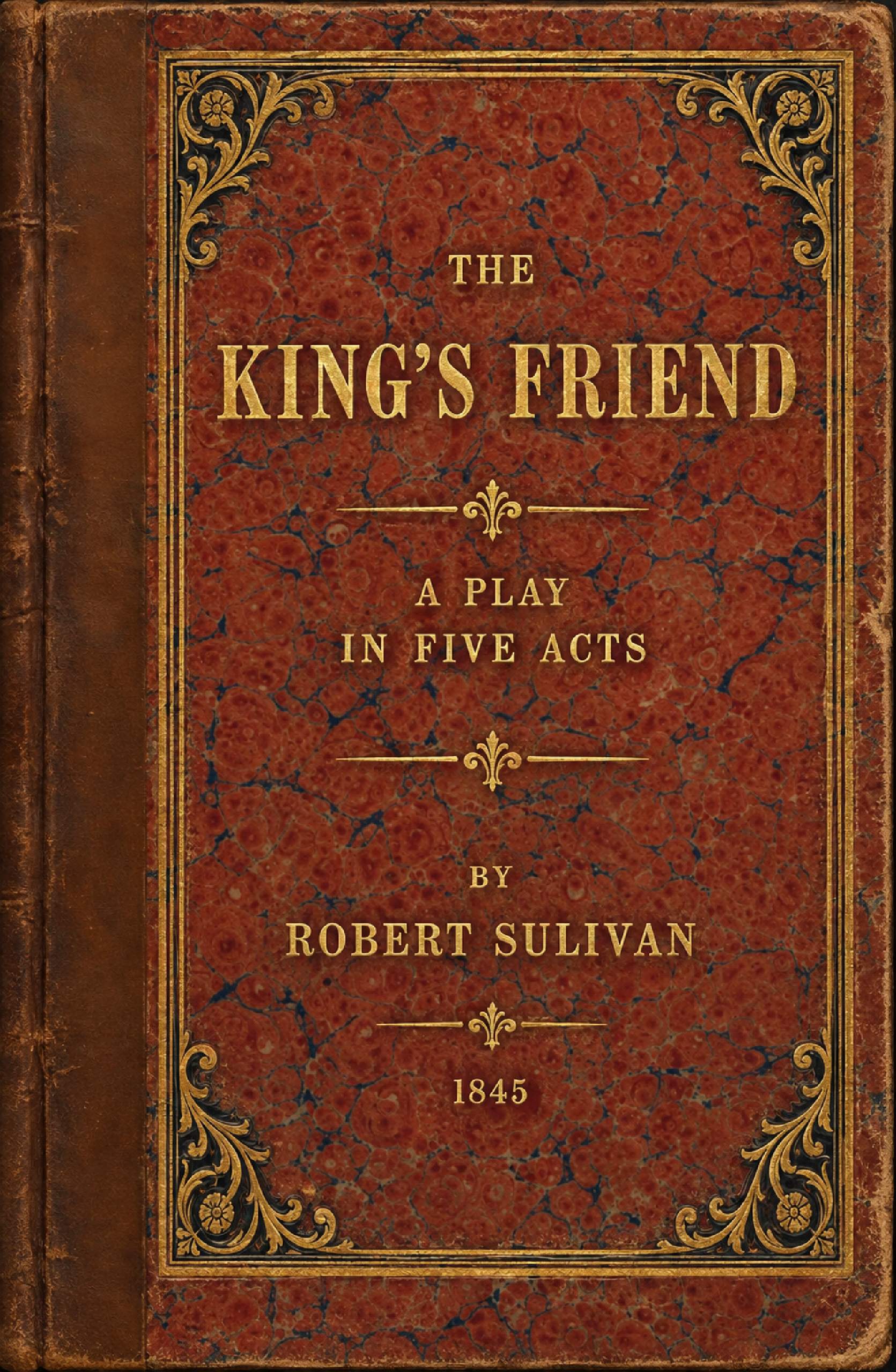
Title: The king's friend
Author: Robert Sulivan
Release date: October 7, 2026 [eBook #79740]
Language: English
Original publication: London: Saunders and Ottley, 1845
Other information and formats: www.gutenberg.org/ebooks/79740
Credits: Richard Illner and the Online Distributed Proofreading Team at https://www.pgdp.net (This file was produced from images generously made available by The Internet Archive)
A Play,
IN FIVE ACTS.
AS PERFORMED, FOR THE FIRST TIME, AT THE THEATRE
ROYAL, SADLER’S WELLS, ON THE 21ST OF MAY, 1845.
By ROBERT SULIVAN, Esq.
LONDON:
SAUNDERS AND OTTLEY, CONDUIT STREET.
1845.
LONDON:
ALFRED ROBINS, PRINTER, 7, SOUTHAMPTON STREET, STRAND.
My dear Sir,
I dedicate this Play to you; not under the idea that it has merit to make a dedication of any value, but because your ready acceptance of it, your many important hints for adapting it to the Stage, and the truly kind manner in which you recommended it to Mrs. Warner—your greatly gifted managerial partner—render it, such as it is, peculiarly your own. To your joint unremitting care, and liberal disregard of expenditure, in its production, as well as to your respective performance of two most inadequate parts, your audience and the press have already paid a tribute which leaves me no comment to offer. I can only say, that to them and to you, and to every performer concerned, I feel a debt which I am proud to acknowledge, and not likely to forget.
With the certain assurance that many a better writer will have to address you in the same spirit, believe me, my dear Sir,
Very faithfully your’s,
ROBERT SULIVAN.
York Terrace, Regent’s Park.
May 27th, 1845.
| Henry IV | Mr. Phelps. | |||
| Marquis de Rosny | Mr. H. Marston. | |||
| Le Seigneur de Fresne | Mr. G. Bennett. | |||
| Victor | Mr. S. Buckingham. | |||
| Du Front | Mr. Morton. | |||
| La Plume | Mr. H. Mellon. | |||
| Maignan | Mr. Scharfe. | |||
| A Page | Miss Stephens. | |||
| A Lackey | ||||
| Vauteur | } | Bravos | { | Mr. Knight. |
| Bravache | Mr. Graham. | |||
| Poignard | Mr. C. Fenton. | |||
| Attendants of de Fresne, Soldiers, Servants, Bravos. | ||||
| Katherine de Villequier | Miss Cooper. | |||
| Madame Chateaupers | Mrs. Warner. | |||
| Scene—France. In the Town of Mante. | ||||
Marq. Where was I, Maignan? Why do you not remind me?
Maig. I beg pardon, my lord—I repeated that last sentence so often that, to say the truth, it made me a little drowsy.
Marq. I would I could impress thee with a due sense of thy distinction! Dost thou remember from what I promoted thee?
Maig. Aye, sir—I was a busy nondescript, something between your lackey and your squire, and ought now to be enjoying a comfortable sinecure, for you have scarce a whole bone, or a half shirt, to need me in either capacity.
Marq. The wars have been hard upon us, I grant; but I wish I could elevate thee above the use of such undignified expressions as whole bones and half shirts! What signifies a wardrobe when we are clad in glory? Remember thou art now my secretary! The amanuensis of Maximilian de Bethune, Marquis de Rosny, and prime minister to his majesty, King Henry of France and Navarre—I tell thee, Maignan, posterity will consider thee a great man.
Maig. It is hard to consider ourselves so, when we have nothing but our title to greatness. It is only for such as you and our noble King Henry to entertain a true value for the sublimity of naked glory, and I confess that—though we have a hundred times beaten our enemies—our exploits are written upon our backs in characters which make one ashamed to walk the streets.
Marq. Would’st thou lose thy patience just where our trials end? This last battle—the glorious day of Ivri, has removed the last obstacle to our success, and for once, I regret my wounds. The king will win his capital without me.
Maig. He’ll never reach it, sir.
Marq. Never reach Paris?
Maig. No, my lord, I think not.
Marq. Thou hast a rare conceit! And now thy reason?
Maig. There is one terrible foe that stares him in the face still.
Marq. And that foe?
Maig. Is famine!—
Marq. Has famine played the traitor with us? At Ivri, it fought on our side. It whispered to our soldiers that victory would feed them, and they rushed to blood like famished wolves in winter. Poor tatterdemalions of a hundred battles! They would have gained against a well fed world! Aye, and devoured it afterwards.
Maig. They gained, sir—’tis not a month ago—and now behold the conqueror’s despatch, dated last week [takes a letter from the table and reads]. “I am close to my enemies, and have scarce a charger to mount, or a suit of armour to my back—I have neither clothing nor food, and for the last two days have existed at the cost of others.” If this is the plight of the king, the army, instead of marching through their foes to Paris, will scarce make head against the carrion crows.
Marq. By my conscience, thou art a politician! And the victory at Ivri then is something worse than nothing?
Maig. Not quite, my lord. It gained us questionable refuge in this more false than faithful town of Mante, and provided consolation for your wounds in the sympathy of madam—
Marq. Tush, man, tush! Dost thou suppose the soldier in such a cause, and the confidential minister of the great King Henry, can find leisure to dream of such vanities? Come, take thy pen and write—
Maig. An answer, sir, to the note of enquiry from Madam Chateaupers?
Marq. No, sir, a continuation of the memoirs of the Marquis de Rosny, who, when the king obtains his rights, shall be the Duc de Sully.
Maig. I hope, sir, I may live to congratulate you!
Marq. To business! Where did we leave off?
Maig. In the midst of this hopeful battle of Ivri, and the last sentence is a fair sample of our fortunes—past and to come—your horse has been wounded three times; besides which, you have received a shot in your hand, and lost the calf of your leg—[reads]. “A pistol ball entered my hip, and at the next charge I received another in my thigh and a cut in the head.”—Don’t you think, my lord, you have had almost enough of Ivri?
Marq. Attend, attend! [dictates]. “I should infallibly have perished if my squire had not hastened to my assistance and brought me another horse, which fidelity drew down many shots upon the brave Maignan, and had like to cost him his life.” There’s an end of that paragraph—what think’st thou of it?
Maig. Indeed, sir, your memoirs are becoming very interesting.
[A loud knocking is heard—Maignan rises.
Marq. What knocking is this? [knocking continued]. How! so impatient! ’Tis surely some express from the king! My new dukedom to my old doublet, he has entered Paris!
Maig. And my new place in history to my old one in the kitchen, not so!
[The doors at the back of the scene are thrown open and the King enters, in haste and disorder, as if from a long and rapid journey.
Marq. The king!
Maig. The king!
Hen. How dost thou, Rosny?
Marq. Sire!
Hen. Art thou afraid of me? ’Tis flesh and blood.
Give us thine hand—what, stricken into stone?
Marq. Our lives are somewhat used to strange surprises,
But never was I stone indeed till now.
Your majesty has surely conquered Paris,
And graciously is pleased to bring the news
In person? Maignan, see that no one enters.
Maig. [aside]. I thought as much.
[Exit.
Marq.
Good heaven, my royal master!
What new misfortune?
Hen.Would it were a new one!
’Tis one I’m too much used to—well, but first
How dost thou, man? I saw thee t’other day
With such a world of cracks upon thy crown
I feared I ne’er should hear thee scold again!
How dost thou, hey?
Marq.Sire, have you entered Paris?
Hen. No, sire, I’ve not.
Marq.Not after Ivri? not?
Not when your march was unopposed? Not when
Your enemy, the plethoric Maienne,
Who spent more time in feasts than you in bed,
Was scared till he found fleetness to outrun you?
I see, I see it all! No new disaster?
Worst luck for France, your majesty says true!
Hen. Why there now, Rosny, thou art off again
In thy tirades before thou’st heard me speak!
Marq. I care not, sire, what you may do with me—
It is my duty to speak truth—I would
Your ears were more familiar to’t! There is
No good pretext why you are not in Paris.
Fate gifted you beyond your royalty
With qualities to govern men and heroes,
And in the fairest epochs of your life,
You give your fortunes to the rule of women!
I know full well that nothing could arrest
Your march of victory but the fell dream
Of fascinations left behind in Mante.
Hen. Now, old acquaintance, what a pother’s this!
Be pacified, and bridle, if thou can’st,
Thy passion for that lengthy tongue of thine!
Be pacified, I say! Whate’er she was
At other times, woman is blameless now,
I swear to thee!
Marq.You’ve sworn it oft before.
Hen. And lied, I grant. But, for this once, believe me.
Did’st get my letters, man, wherein I spoke
Of my distress for money?
Marq.Sire, I did.
Hen. And why not stir thy battered stumps to send it?
Marq. You charged with your finance the Lord de Fresne—
All I could do I did. I hewed my woods
At Rosny; sold my cattle, and wrought gold
From everything I had that could procure it.
Hen. I know it, Rosny—’twas not that I meant—
Thou’st given thy blood too oft to grudge thy goods.
The fault is that thou did’st not squeeze de Fresne
Till he disgorged my pilfered revenues—
Not claim them with a rope about his neck!
Marq. He was your majesty’s own ’special choice—
I spoke my thoughts, and, for amends, you made him
The governor of Paris—when you take it—
How could I dare to hang a personage
Of such rare merit?
Hen. ’Sdeath I know him now!
No sooner are my prospects promising
Than he withholds the breeze that’s wafting me;
Stops my supplies; laments our bare exchequer;
And drives our troops from famine to rebellion.
Our mercenary Swiss, upon the moment
Our fates depended on despatch, refused
To march another step without their pay.
The discontent flew like a pestilence;
And there they stand—grim, gaunt, and ominous,
Choosing their time to join our enemies!
Now. Rosny, see—thou hast reproached me falsely.
Marq. [in consternation]. Is’t come to this? [then
observing the King’s feeble state, and speaking with great
feeling].
You are o’er laboured, sire,
And faint with hunger!
Hen. No—I hunger not.
I am past hunger—weary, Rosny, weary!
Come, help me to thine old camp bed—Thine arm—
Thine arm—no, not on that side—there’s a gash
I got in coming to thy help at Ivri—
’Sdeath, I am aching, that’s the truth of it,
And so art thou—thou move’st like thy grandam,
Stalking a minuet! Ha! ha! so! gently!
Marq. Sleep, sire, I pray you sleep; and I meanwhile
Will counsel with myself.
Hen. I say ’tis useless.
When nothing’s left, there’s nought to think about—
They who have done their duty honestly
Need ne’er repine. For my part, having paid
My country some few drops of blood, I’m happy
Altho’ a loser.
Marq. [aside].
Is he light of heart
Or head? Fatigue hath fevered him!
Hen.Thou too!
Thy spirit should not sink. Thou should’st be proud
In thy torn doublet as a moulting peacock!
And feel all thou could’st do thou hast done—
The smiles and frowns of fortune are like those
Of other mistresses, ne’er gained or softened
By lamentation.
Marq. [aside].
He doth wring my heart!
Sleep, sire,—I’ll hear no more—I will despatch
A messenger forthwith to my estate
And bid my agent raise me the last crown.
[Exit.
Hen. Had ever man two friends like honest Rosny?
Re-enter Maignan.
Maig. Sire, here’s a lady, closely veiled and cloaked,
Craves leave to see your majesty.
Hen.A lady? [rises].
An old or a young one?
Maig.By her voice
And step, I should believe a young one.
Hen.Aye!
I ne’er deny an audience to my subjects—
Admit her instantly.
[Exit Maig.
Methinks I’m not
So drowsy as I was. I wonder where
Friend Rosny is?
Re-enter Maignan, who introduces Katherine in disguise, and Exit.
Fair maiden—for I guess
That thou art young and fair—will’t please thee cast
Thy veil aside, and let me see to whom
I owe thus much?
Kath.
My liege, I had disguised
Both name and person, but that I believe
They will bespeak attention to my words—
My name is Katherine de Villequier.
Hen. De Villequier? That surely was the name
Of the unfortunate who gave her hand
To rogue de Fresne—my villain superintendent.
Kath. I am her niece, and being so, worst fortune!
Am also his. [she unveils].
Hen. His niece! She’s so unlike
The workmanship of earth, I could believe
’Tis not the earth I tread upon! His niece!
Kath. And therefore greatly peril’d by this errand,
With which, my liege, I could entrust no other.
Is any one beyond this house, informed
Your Majesty has entered Mante?
Hen.Not one.
Why dost thou ask me, beauteous Katherine?
Kath. Sire, you must fly!
Hen.
And wherefore should I fly
That have no place to fly to? If my course
Must end, I’ll end it with a glimpse of Heaven,
And where a voice like thine may say, “God bless thee!”
Kath. It must not be. To prove I talk not lightly,
I can repeat whate’er of late hath chanced you.
Your hardships, your despair, your troops’ desertion—
All evil tidings have been richly paid for,
And treasured by your faithless superintendent.
The profligate has wronged you till he feels
His interest unites him with your foes—
He hath bought o’er the citizens of Mante
With your own gold, and laid a deadly plot
(Anticipating your compulsion hither,
As a last home), to close the gates on you,
And send you fettered to your enemies!
Hen. Aye! even so?
Kath.
He knows not you are come;
But hourly hath expected you.
Hen.He knows not?
Then how did’st thou, fair Katherine?
Kath. My liege,
I have a chamber that o’erlooks the gate
T’ward Paris; there have I maintained my watch
Unceasingly, to scrutinize each stranger—
Believing that the form my fancy drew
Might teach me to distinguish you—’twas true!
Reward me, sire, by flying hence, this hour—
This hour, or you are lost!
Hen. Thou dost surprise me!
Not that such things should be, but that thy years,
Thy sex, and most, thy beauty, gave them heed.
Kath. There’s matter for your thoughts more pressing, sire,
I come to warn you—must I come in vain?
Hen. How could’st thou learn what thou hast warned me of?
Kath. The secrets, sire, of vaunting cowardice,
And drunken folly, have no mystery.
I’ve dwelt amongst them, and am neither deaf
Nor blind.
Hen. Blind I’ll be sworn thou’rt not—heaven send
Thou art not deaf. Thou sayest the time is pressing—
’Tis my excuse for pressing of the time—
Thou see’st me here a lone, abandoned, soldier—
My crown a shadow—all my powers usurped—
How hath thy loyalty survived my claim to’t?
Kath. What I may think or feel is little worth—
I ne’er examined if my heart were loyal,
And never thought upon your crown or state.
Take but my warning, sire—my prayer to fly—
And I will tell you they are breathed because—
Hen. Of what? Of what?
Kath.
Because you are the hero,
Henry de Bourbon!
[Re-enter the Marquis, who stands in astonishment].
Marq.May I trust my sight!
When I believed him fainting—almost dead!
Woman again! Now grant me patience, Heaven!
How came she here?
Hen.
Rosny, have done—have done—
It is an angel dropped from paradise
To warn me of a danger that escaped
E’en thee—behold again—
Marq.Madam, forgive me!
I know you for a model of all worth;
And that you had not come without good cause.
Kath. I came, my lord, to warn the king away,
Ere it be known that he hath ventured here—
Aid me, enforce it—save him! Sire farewell—
My errand’s done—heaven guard your majesty.
[Exit.
Marq. No, my liege, no! You shall not follow her!
Incorrigible! Would you have them seek her?
Hen. I care not—let them seek!
Marq. [he detains the king]. ’Tis madness! madness!
Hen. Ha, that curs’d cut! Thou art the better man,
Good grandam! Fye, to let mine enemies
Give thee a vantage! Thou, or else those eyes—
Something has pierced me—all my strength is gone;
And if thou’rt bent on scolding, I must e’en
Lie down and listen. [falls on the bed.]
Marq.
Sire, I thank the chance,
However sent, that gives your ear to reason;
And will make bold to lay before you all
The follies that have caused your mis-adventures.
Hen. Nay, nay, in pity!
Marq.
Pray you, sire, lie still,
We ne’er shall find a moment more convenient—
Hen. ’Sdeath!
Marq. Do you listen, sire? I speak of woman—
Hen. Well, well,—go on—
Marq. Of woman, sire—of woman! I would recal to your majesty how many times this fatal devotion to her smile has lost you the crown of France. The sums which you have been pleased to squander upon it, would not only have sufficed to feed your army, but to buy over those of your enemies. Nay, the noble character which you have tarnished by this weakness would in itself have been enough to intimidate, if not to win them. The time, sire, which I hoped never to see, is come at last, when I must either obtain your royal promise of amendment or tender my respectful resignation. Sire, will your majesty be pleased to take horse and quit this town before you are discovered in it? I see my eloquence is lost—Eh? How! as I am a mortal man, he is fast asleep! Dreaming of his new beauty! This is past endurance! [calls]. Maignan! Where art thou? I am angry with myself—yes, angry, that my heart is weak enough to forgive him still—I cannot help it. I think I can perceive the means of putting him once more on fortune’s track—I am a fool—no matter, we have grown up from boys together—encountered chances that have been strange as the friendship of two such opposites—and gone too long together to separate upon our journey—
Re-enter Maignan.
Do thou keep watch on him—I will return ere long.
Maig. Where shall I find you, sir, if you be wanted?
Marq. Hark, in thine ear—at Madam Chateaupers’!
[Exit.
Hen. [raising his head].
At madam who’s? Rosny gone courting!
Maig. Sire,
I’ll tell my lord your majesty has wakened—
Hen. No, no, not so! Not for thine ears! Dost think
I slept, or ever shall find sleep again,
Till thou hast brought me to that sorceress
That stole’t away from me? Hark ye—would’st thrive?
Hast thou ambition for the spur and banner?
Soul for a cavalier? Watch Rosny forth—
Bear me three words of fire to Katherine—
I’ll make thee knight of the burning billet! Fly!
[Exit Maignan—the King sits down to write.
END OF THE FIRST ACT.
Mad. Thou art a saucy boy! Thy father was a gentleman, so, thinking thee too good for everything, I have made thee good for nothing. I thought the marquis had left Mante a month ago.
Page. It was only yesterday you wrote to enquire after him, madam—[aside]. I understand—the note has not been answered.
Mad. Did I? I had forgotten. He was surprised, no doubt?
Page. I did not see him. I thought he might at least have been civil enough to enquire for your health, madam.
Mad. Poor man! ’Tis said he is writing his memoirs, if they prove as heavy as his company, Heaven help his readers!
Page. [aside]. So! She would have me contradict her! [aloud]. I always thought so, madam.
Mad. Sirrah, indeed! Woulds’t thou slander him because he can perceive no more wit in thine imp’s tricks than should be whipped out of thee?
Page. It needs some wit to perceive wit, and so I hold the marquis excused—
Mad. And yet the king hath chosen him from many wits to be his prime counsellor—
Page. That was because he thought the little wit he possessed would not be obscured by his feeling.
Mad. Hath he not feeling, then? He hath not grudged to shed his blood, and lavish on his friend whate’er he had.
Page. The more shame for him, madam; for it proves his want of honesty to his creditors—
Mad. By which want he sets them the example of a nobler virtue—devotion to his king and country.
Page. Well, madam, then we’ll grant him wit, feeling, and virtue. If he does me no good turn, after having obtained all this for him—the next time I’ll praise him.
Mad. Malapert, I’ve spoilt thee!
Page. Then, whilst he obtains the profit of all the wit he would have whipped out of me, I’ll go, and mend—madam, here comes the marquis.
[introduces Marquis and exit.
Mad. The marquis! [aside]. Alas, his wounds!
Marq. Madam! [bowing with ceremony].
Mad. Oh, sir, most welcome from the field of Ivri! I fear you have much forestalled your powers in doing me this grace.
Marq. Madam, the powers which are weak in our own service, possess a charmed existence in the king’s.
Mad. [disconcerted]. Is it to the king’s service that I owe this visit? My lord, I am proud to be of his majesty’s cabinet council.
Marq. Hem! [aside]. perhaps the step were not so difficult. Permit me madam [is going to hand chairs—she prevents him].
Mad. No, my lord, no! Your wounds, I pray you! [They sit].
Marq. The king is almost ruined!
Mad. Ah! do not say so! [aside]. I wish I did not tremble so?
Marq. Almost ruined, madam, from want of means to follow up his victories—his superintendent of finance has robbed him of his revenues—the estates of Rosny have scarcely another stick to sell, and our cause has become too desperate to afford a hope of borrowing.
Mad. Alas, that I had wealth to make such a hope needless!
Marq. ’Tis to that, madam, I am coming, ’tis said your late lamented husband had the happiness of leaving you provided in a manner suitable to your virtues.
Mad. Alas! alas!
Marq. [aside]. Am I deceived in her? Will not her loyalty stand the test?
Mad. Would I could aid the king to march triumphant, tho’ I beheld it barefoot! Look, sire, the riches of these walls—with all the state, so much o’ermeasured to my wants—are gone. Yet, think not I regret them—no, only in this; that they are no longer at your service.
Marq. Gone, madam, I am amazed!
Mad. Think not I have squandered them. No! They have purchased me both pride and happiness!
Marq. Madam, I am rejoiced you have made such envied purchases in so short a time. Forgive me if, when I was last in Mante—a few days previous to the battle of Ivri—I deemed these feelings inseparable from the cause of the King—
Mad. And so, my lord, they were.
Marq. Here is some meaning hidden from me. Ha! Gods! you change colour, madam! Can it be? have I solved a mystery? have I found a miracle?
Mad. Not so, unless it be a miracle to follow your example.
Marq. Hark you, madam, listen. In that long night before the battle of Ivri, as I lay upon the cold earth, revolving in my mind the fortunes of the morrow—the many chances of desertion by our unpaid, starving soldiers, thinking how gladly I would purchase them but one day’s pay with the last drop in my chilled and wounded body—in that moment when I foresaw our good cause lost, our noble Henry sacrificed to the malice of his foes—
Mad. Thank heaven, your fate was better!
Marq. In that moment was conveyed to me—I never learnt from whom—the blessing I despaired of—treasure, madam, treasure, so abundant,—it more than answered our necessities! The fight was gained, but by whose hands? These naked walls are witnesses! By yours! yes, yours!
Mad. My lord, I beseech you name it not.
Marq. Oh, woman, woman! Henry I forgive thee! for thy devotion to her power is wisdom! If the king obtains his crown, it is to you he owes it; and ’tis my business now to talk of the security for that which purchased it.
Mad. I never heard you took security.
Marq. It was not needful—what I had was his.
Mad. And why not mine the same?
Marq. [aside]. ’Tis well he does not hear as much. [rather uneasy]. Beseech you, madam, did you ever see his majesty?
Mad. Often—in your description, never elsewhere.
Marq. Then, am I bound the more to see you well secured. If it please you, we will now discuss the nature—the nature of the said security. In short the moveables of Rosny, and some other of my poor estates, have been disposed of long ago—the jewels of our family are scattered in the four quarters of the globe, and I can scarce replace my wounded charger that’s aching with the balls and blades of Ivri. But, madam, the lands of Rosny, though bare, are wide, and if they cannot furnish what we want, they can provide good interest for what we have had.
Mad. My lord, I implore you—
Marq. But this is not sufficient. The question now is the repayment of the principal, and it so chances, happily or otherwise, as you may please to determine, my lands cannot, with warranty of law, be alienated from the name of Rosny.
Mad. [aside]. Did I hear aright [aloud]. Indeed, sir, I do not exactly—understand you.
Marq. It is easy madam—that is to say—it is very difficult—very embarrassing.—In short, madam, my time has been so devoted to the state that I have not the eloquence—the—
Mad. If you would say, my lord, that you are not like those whose lives have been less valuable to the world, it is true; and not such loss to you as you consider it.
Marq. I thank you, madam, for your opinion, and will resume—touching this same bar to the conveyance of the lands of Rosny beyond the family, and how I would propose conveying them to you, whom—as yet—we have not the pride of—of numbering in our house. In fact, to be explanatory—I will make bold to throw the window open.
Maig. [without]. Is my lord here?
Mad. [aside]. Heaven’s, here is some one coming!
Marq. [aside]. Unfortunate intrusion! After working to such a point, all to begin again!
Enter Maignan hastily.
Marq. Maignan! What folly brings thee here?
Maig. No folly of mine, my lord, whatever it may be of other folks. It is just as I expected! This ma’amselle Katherine from the superintendent’s—
Marq. A—hem—[aside to Maignan]. Hush, hush good knave!
Mad. [aside]. Ma’amselle Katherine!
Marq. [apart to Maignan— Madam regarding them with suspicion and alarm]. I see it! Thou hast tidings of the king, but we must hide our master’s faults even here.
Maig. They will be published widely enough presently! You imagine you left him sleeping, my lord, but no sooner were you gone than he began to rave of ma’amselle Katherine—wrote her a note to implore a meeting in the superintendent’s garden, and charged me to deliver it. Not daring either to refuse or to obey, I gave it to another messenger, and hastened to apprise you.
Marq. Gods, thou should’st have brought it here! Is he mad? In the superintendent’s garden! Hark ye—hark ye—[they converse apart].
Mad. [apart]. Is not this strange? Did I mistake him? He did not quite say marriage; but ’twas a riddle to which there was no other answer—and the next moment—could any one believe it of a person so demure!—he flies into desperation at some news of ma’amselle Katherine at the superintendent’s—
Marq. [apart]. By all that’s true, he is not worthy to have so faithful a servant! At such a time too! He wearies me! He wears me out.
Mad. One of us two has certainly turned his head, and though I care not which it be, there is no harm in knowing.
Marq. [apart to Maignan]. Fly, knave, and take thy stand near the superintendent’s garden, observe what presses, whilst I halt after thee.
Maig. My lord, if I might advise [apart to Marquis].
Marq. [to Maignan]. I tell thee I must see this fatal beauty, though it cost my life—away with thee.
Maig. [to Marquis]. Well, my lord, remember what I have foretold.
[Exit.
Mad. [repeating apart]. This fatal beauty, though it cost my life.
Marq. [coming towards her]. Madam, a sudden service of the king’s.
Mad. Of the king, my lord?
Marq. A most unlooked for duty which will admit of no delay—
Mad. Oh, sir, neglect it not, I beseech you!
Marq. Allow me to add, madam, a duty most unseasonable. But we shall meet again—
Mad. Doubtless, my lord—
Marq. Our interview has not the termination I looked for, madam.
Mad. A very unexpected one, I dare say, my lord.
Marq. [bowing profoundly and backing off the scene]. Madam, your most—
Mad. [curtseying, and backing to the other side]. My lord your most—
Marq. Unchangeable—
Mad. Devoted—
Marq. [turning and hurrying off]. By heaven, too bad! Too bad!
[Exit.
Mad. Sirrah! Where art thou? Quick.
Re-enter Page.
If thou would’st play a spite upon the marquis to make us laughter, fly—dodge him to the superintendent’s. Find what he does—I promise thee brave sport!
Page. Aye, madam, that will I. [aside]. He has not been heavy this time.
[Exit.
Mad. [troubled]. What does he mean? Can one so famed for truth be, after all, no better than a base hypocrite? I know not whether to believe or doubt. Her uncle’s house is open nightly to all comers—I am a visit in her debt—what if I go and see what’s passing there—[going, stops].—I feel I am a little flurried—I may betray too much—and yet the boy can bring me nothing, and I may never have another occasion to be satisfied—I care not what they say or think—I’ll penetrate this mystery—I’ll go.
[Exit.
Enter Victor and Katherine.
Vict. I’ve placed the sentinels. The superintendent
Is busy at his night’s carouse, and now
My task is over.
Kath.Hateful task, I know—
And but for me, dear Victor, and thy wish
To watch beside me in this time of peril,
Thou might’st have followed the brave king to glory.
May we not learn to hate whom most we love,
When our love serves them with a hateful duty?
Vict. If you perceive such hazard, end it quickly,
And let us fly this place.
Kath.Have patience, yet—
If I consented, whither should we fly?
Where is our refuge? Victor, what has made thee
So much more earnest with me?
Vict.Be content—
The dangers in our way must not be thought on—
Our worst is in delay—
Kath. What worse than common
Is in this moment?
Vict.Do not question me,
We’ll speak of it hereafter. I have asked
A proof of all that love, so often vowed.
Wilt thou deny me? I have friends, I tell thee,
In a remote and unsuspected province,
Where they will shelter thee till better times—
Wilt thou consult my peace? Wilt thou depart?
Kath. Victor, thou’rt wild! Depart, and leave mine uncle
A show of reason for his doubts of thee?
Depart, and give my name to calumny,
Not daring to take thine in place of it?
Shame a proud house as its first fugitive!
Consider what thou art asking. If there’s peril,
’Tis only in these secret interviews.
There’s none for us apart.
Vict.Apart!
Kath.Thou hast
Anticipated better times. Till then—
Only till then—do’st think I’ll love thee less
Because we meet not?
Vict.Haply I should not,
If thou did’st meet no other—
Kath.Meet no other?
Vict. Before I made this suit, I knew my answer.
Kath. What mystery is this? I saw at first
Thou wert not like thyself—other? what other?
Vict. Mine eyes have ne’er been off thee, Katherine,—
The world had nothing else to claim their homage;
And still, the more I saw, the prouder seemed
My fortune! Haply, it was fit such hopes—
Presumptuous hopes—should be rebuked! ’Twas sudden—
Bold—independent—as became thy spirit!
Just as it should be! Thou’st been forth to day—
Alone, disguised, fearful, suspicious! Whither?
Kath. Thou’st lost thy senses, Victor, or would’st see
That, bearing this, I merit not these doubts.—
Thou dost me wrong—but I forgive thee.
Vict.Whither?
Kath. Do I then seem so slight of character
I cannot pass one chance to prove unworthy?
Were thy suspicions just, why should I strive
To blind thee? I can see no cause to prize
Thy love, except that I have given thee mine—
Think on’t for both our sakes—we’ll meet to-morrow,
When thou’rt more calm. Hush! hark! I heard a step.
I will not leave thee till we talk more fully—
Prithee stand by—
Vict.What step would venture
here?
Stand by? In faith, I will—and closely by—
[he retires amongst the trees—a Lackey raises his head above the wall].
Lackey. Hist, madam, hist!
Kath.What saucy man is this?
Lackey. Madam, I have wandered round your garden this hour
or more to deliver this letter. [throws a letter]. If it
come too late, I beseech you—[sees Victor].
S’death!
[disappears].
Vict. Stay, fellow, stay! Curse on this wall! Look up!
I have a purse for thee! The villain’s gone!
Ha! ’Tis no matter—here’s the note may tell us
More than the bearer. [takes it up and presents it]. There!
Kath. ’Tis not for me.
Vict. Your pardon—’tis addressed to you.
Kath. By heaven,
And on my hopes of it, I know not Victor,
What rash audacious dares insult me with it!
Vict. Read, madam, read—
Kath. At your desire—not else. [opens the letter and reads].
Vict. She changes colour! Ha! this letter.
[attempts to take it; she withholds it].
No!
I must not see’t?
Kath. Another time. Not now.
Vict. Not now?
Kath. You cannot.
Vict. Wherefore can I not?
Kath. Oh! Victor, Victor, in its dark inventions,
How apt a rival love can be to hate!
Think what you will, I cannot undeceive you,
And will not hear the words you must repent.
Vict. Tell me but whence it comes.
Kath.I’ve said I cannot.
Vict. Heaven help me to the bearer then!
[Exit.
Kath.Insensate!
In such a mood, how could I ask his aid!
An assignation from the king! The hour
Already come! No means of stopping him!
To meet is desperate; yet, not to meet
Were, in this labyrinth of treason, death!
[Is hastening out—suddenly turns back].
Misfortune still! This downy sycophant
That’s called our chamberlain! What seeks he here?
Enter La Plume.
La P. Beseech you, madam, vouchsafe me a word.
Kath. Monsieur La Plume, you are the master of our ceremonies, professor of all courtly breeding to those who require polish at short notice; therefore no one should perceive more quickly when company is not wanted.
La P. I shall be charmed to show my perception if any one ventures to intrude, for which purpose my lord superintendent has had the consideration to send me here.
Kath. I am aware of the superintendent’s consideration, which would make me the price of the most approved treason; and of your rivalry in that quality with your companion in favour, Monsieur du Front, who holds the lucrative offices of pursebearer, disburser of the king’s treasure to those who are too vile to serve him, and teacher of brave words to the faint-hearted. Pray you give o’er. I could not trust myself to distinguish between such merits [she is going out—he interposes with affected courtesy].
La P. Madam, it wounds my sensibilities to differ from you, and, as far as a coincidence of opinion with respect to Monsieur du Front, I am your most devoted echo; but pardon me if the strict rules of breeding forbid me to discuss myself. Monsieur du Front, as you happily describe him, is a most atrocious [stops suddenly]. But, indeed, it is a maxim in politeness never to criticise a gentleman in his presence; which might put him to the disagreeable necessity of contradicting. Madam, here is Monsieur du Front himself.
Enter Du Front.
Du F. Madam, the first charge into your presence requires more courage than the beginning of a battle.
Kath. I will not dispute Monsieur du Front’s sensations at the beginning—I have heard he seldom thought it worth while to see the ending.
Du F. By the blood of my rapier, you say true! I was always too busy in running after the fugitives! They found me one too many—hey, Monsieur La Plume.
La P. Oh, on all occasions!
Kath. A distinction in which Monsieur La Plume fully participates. [she is going again, Du Front interposes with grotesque homage].
Du F. Your wit, madam, is a battery, that will not leave a cavalier to deserve you! What shall we do for a truce?
Kath. That which you dare not—serve the king honestly. [she is going again, both interpose].
Du F. May I die of a sparrow shot if I have not lost a whole hogshead of blood in his service, without receiving so much in return as a rag to bind up my wounds! I have been notched and scotched like a crimped cod fish, till it took more trouble to put me together again than to make an oak tree out of a carpenter’s shavings—and that’s the truth on’t. “Captain du Front,” says the king, “you are too rash by half!—you lead us all into mischief!—you must go to Mante; bear the superintendent’s purse; and raise recruits o’ the right sort!” Isn’t that a fact? Monsieur La Plume—speak!
La P. As true a word as Monsieur du Front ever breathed, or ever will breathe. His valour was in a high fever, and he was sent here to infect the citizens.
Kath. [aside and going]. I would the malady had been the plague!
Re-enter Victor.
Vict. The villain has escaped me. Ha! well encountered, gentlemen! Will it please you tell me which of you is the impatient cavalier who could not wait for the answer to his letter?
Kath. Victor—
Vict. Oh, madam, I understand—which of you, gentlemen?
Both. Letter!
Vict. Aye, sirs—letter—you will not disown it in the presence of the lady herself, and tempt constructions so little flattering to your manhood?
Kath. Thou art beside thyself. Dost thou believe I would receive a letter from these?
Vict. I know of no other in Mante who would presume to write you one.
La P. [to Du Front]. Hear you this, Monsieur du Front? Mark you the lady’s consternation? [aloud]. Captain Victor, I do protest we are more in the dark than yourself. For my own part, I never perpetrated such a breach of etiquette in my life!
Du F. Body of me, I never perpetrated anything but hard blows! And as for writing!—I care not who knows it—the wars never left me time to learn.
Vict. Gentlemen, I believe you both, and her contempt of you is a proof that her correspondent is some one greater.
Kath. [aside]. This madness will discover all!
Vict. Hark you, sirs, you have more skill than I in weaving plots. Find me this gallant out, and for your pains, I will relieve you from one whom I some time believed to be your dangerous rival—myself to wit. For your own sake, be stirring; whilst I, upon the strength of my command, close up the gates on all who would leave the city.
La P. I pledge myself to this condition.
Du F. Blood, so do I—
Kath. Whilst thou hast life, thou wilt repent this!
Vict. Now then, to business!
Kath. Monsieur La Plume! Monsieur du Front!—a moment.
La P. Madam, you have wounded my feelings most distressingly.
Du F. Madam, our rival shall be served up to you daintily—split open and skewered with a brace of rapiers.
Kath. Victor, I have a word—a single word—that shall paralyze thee—stay—and thou shalt do me justice.
Vict. Aye, madam—when I have done justice for myself. Come, sirs, away.
[Exeunt La Plume, Victor, Du Front].
Kath. The king is lost.
[Exit.
END OF THE SECOND ACT.
De F. Why do you call me from supper? You know I never like to be called from supper till it is time to carry me to bed.
La P. My lord, here are some new partizans who have not yet been presented to you. This is Captain Vauteur, a brave gentleman, despitefully used by the king for helping himself to his fair share of plunder.
De F. ’Tis the king’s usual mode of paying services—just as he means to pay mine. But what is your special grievance, eh, Captain Vauteur?
Vau. I was drummed out of my regiment.
De F. You are just the gentleman we want. Brave as a lion, no doubt.
Vau. [his hand on his dagger]. Try me.
[Bravache and Poignard advance from table].
De F. And these, by their looks, are gentlemen whose merits have been equally ill appreciated.
La P. This, my lord, is Monsieur Poignard—this Monsieur Bravache—cavaliers of no particular title, but deserving of a great many.
De F. No doubt of it, and that’s the reason why they have not got any. ’Tis a rule with the king that good servants don’t need encouragement—bad ones do. You have been ill used, of a certainty—you bear all the appearance of injured men.
Brav. The king has thrown us upon our wits, and made it felony to use them.
Poig. So, hearing there was a want of a few soldiers of fortune here, we are come in to say we are in no wise particular—that’s the sum on’t.
La P. We have many more strangers of the same independent character; but having been a little out of sorts with the times, they are a little out of suits also, and therefore our invitations to supper have been confined to the most select.
De F. Gentlemen, you are welcome all—the more the better—and so another carouse to the superintendent.
Vau. Aye, aye; the superintendent.
Brav. Or any body else.
Poig. We are no wise particular [they return to the table].
Omnes. Aye, the superintendent.
Du F. Hark ye, my lord, we’ve something to tell you.
La P. In the first place, sir, your niece, Madam Katherine, did this evening receive a letter most mysteriously—refused to say from whence it came, and made it evident to us that the writer was some person of importance.
De F. Eh! who could it be?
Du F. That was the question; and therefore we set about enquiring whom she had seen of late, and discovered that she had this day visited some one in the house of the Marquis de Rosny.
De F. Rosny? No. He never thinks of wooing anything but a stone wall with a battering ram.
La P. True, sir, for which reason we extended our research to the city gates to learn what strangers had come in.
De F. Well, well,—what then?
Du F. And there we found a cavalier had entered, answering the description of the king!
De F. The king!
La P. Patience, sir! you must not betray your intentions until we are more certain. If he be here he is safe enough. The gates are closed against all who would pass out of them.
De F. But—my niece pay a visit to the king?
Du F. We know her partiality for his cause, and she knows our league against it. ’Twas not so very extraordinary in her to give him notice.
De F. By my life, a conspiracy! Plotting under our nose! ’Slife, but we’ll be of the party! Let me go, I say! [going].
La P. Caution, or you spoil all. As we entered, we found she had not yet returned from the garden.
De F. Well—well—what dost thou augur from that?
La P. That she would not be wandering in the dark without a companion.
De F. ’Oons do I understand aright? Do you believe the king to be now in my garden?
Du F. Those who know him would not be surprised at it.
De F. Arm all our friends!
La P. Caution, sir, this is only conjecture.
De F. No, by Jupiter, tis true! Ho! Where are you all? Where’s Captain Bravache? Where’s Captain Poignard?
[All come forward].
Follow me, follow! ’Oons, if I could only walk straight! Follow, follow! The king’s in the garden, and there’s not one of you but is set down for a traitor! Shoot all you meet, and cut down the rest! Here’s for Maienne!
Omnes. Hurrah!
[De Fresne staggers out, followed by the others tumultuously].
Enter Maignan.
Maig. Out of all breath, and ten to one this king
Of bats and nightingales has pass’d already.
Besides, the old wall twists and dodges us
As though it played at hide and seek itself—
We should have had more watchmen here than stones—
Let’s look about.
[Exit cautiously.
Enter Henry, closely wrapped in a cloak.
Hen.I wish the night were
darker—
Each rogue I met stared at me hungrily,
And seemed to reckon what my head would fetch.
No matter—here’s the garden—now for means
To clamber into it.
[approaches the wall.
Enter Madame Chateaupers’ Page.
Page. [perceiving Henry].
What’s here, a thief?
Thieving’s fair sport when there be none but thieves
To rob—now, comrade, can’st thou jump it?
Hen. [coming forward].So!
We’ve found a confidant?
Page.Aye, ready made.
Hen. Thou art a sprightly knave—what dost thou here?
Page. Watch other knaves.
Hen. Some dainty lady’s page—whom do’st thou watch for?
Page. One whom I owe a grudge—promise thou’lt lay
Thy rapier’s scabbard soundly on his shoulders,
And thou shalt know. What’s more, if thou would’st rob
The superintendent I will show thee where
To scale the wall.
Hen.A bargain—do thy part on’t
And I’ll do mine.
Page.A little further on,
Thou’lt find a branch hang over to the path—
Swing thyself up with it—once on the top,
Hang downwards, and let go—then keep straight on
Until thou reach the bottom. Now for thy turn.
Hen. Where is thine enemy?
Page.I hear him coming.
Hen. What is thy quarrel?
Page.He is playing double
With her I serve, and stumping here to court
The niece o’ th’ superintendent.
Hen.Is he so?
And what’s the caitiff’s name?
Page.His name is Rosny.
Hen. Rosny!
Page. Yes, Rosny—he they call the marquis——
Thou’rt not afraid?
Hen. I’d rather meet the devil!
Page. Stand!—here he comes!
Hen.Stand thou, for here I go!
[runs out.
Page. A base and cowardly thief as e’er I saw.
Re-enter Maignan.
Maig. No tidings of the king—and yet I thought I could hear voices. Whom have we here?
Page. And who art thou?
Maig. My master’s mistress’s little evil spirit! What goblin hath brought thee here?
Page. The same that should take thee hence, if I had not business with thee. Come, secret for secret—why are so many of us playing the sneak under this wall?
Maig. So many of us? Thou hast seen another then?
Page. A dastard villain, that scrambled over the wall just as he heard you coming.
Enter the Marquis, hastily.
Marq. Maignan!
Maig. We are too late, my lord, he is over the wall!
Marq. Where went he over? We must after him!
Maig. Sir, if I might advise—
Marq.Knave, shew me where.
Maig. My Lord, these brigands are at least a thousand.
Marq. I care not, though ’twere ten—I’ll follow him down the three throats of Cerberus! Out with thy rapier! All France depends on it! After me! After me!
[Exit.
Maig. [drawing]. So end our memoirs! So begins our history! There leads the general, and here follows the devoted French army.
[Exit after Marquis.
Page. And here goes the dispatch to my head quarters.
De F. [without]. On, on, surround the walls!
Page. Who have broke loose here? The madmen or the thieves?
Enter De Fresne and his followers.
De F. Pen him in, I say, and then shoot him at your leisure. Hillo! an accomplice! What little varlet is this, and what does he here?
Page. As good a man as you, and I do my own business.
Du F. Ho, my lord superintendent, let me strangle him with my thumb and finger.
Page. [aside]. The superintendent!
De F. Stop a bit—let me examine him. Who brought thee here, and which way is he gone?
Page. [aside]. Shall I betray the marquis? What’s to become of my mistress? [aloud]. I have seen no one but a fellow that looked like a thief, and hearing you coming he ran away.
De F. The king! his very picture. Which way, young cockatrice?
Page. [aside]. The king! [aloud]. This way, my lord,—follow, I’ll show you.
De F. On then, I say, or I’ll spin thee on my dagger like a chafer on a pin—on, varlet.
Page. [aside]. Heaven send me some precipice now, and I’ll break these drunkards’ heads in a heap.
All. On, on, on.
[Exeunt.
Enter Henry.
Hen. Where are we now? This villain hath the garden
Of the Hesperides. Long moss-grown alleys,
Contrived, no doubt, to lengthen out a love tale—
Dark winding mazes to elude intrusion,
And bowers scarce known to the nightingale. ’Tis well
That love creates such eyes for hiding places,
Else were I lost. Aye, here’s the group of Cupids—
This is the spot.
Enter Katherine down a terrace.
Kath. Speak not above the breeze,
Nor let your foot fall louder than the leaf,
Did any see you come?
Hen. If love be blind,
Not one.
Kath. My liege, such pure and holy hopes
As call no stain upon a maiden’s cheek,
Were, haply, worthless to a mighty king,
But still methinks ’twere pleasant to deserve them.
Hen. I will deserve—
Kath. Was it deserving them
To write this letter?
Hen. Hear me, Katherine—
Kath. Sire, you would tell me how the lawless love
Of royalty brings not contamination
Like sins of vulgar birth. I spare mine answer.
Moments are precious now—but, oh! remember
How oft the glance of greatness brands our sex
With sins we never dreamt on. Let me pray
Dismissal from the thoughts wherein ’twere shame
I longer dwelt.
Hen. [aside]. ’Tis something like the tone
They all have used, and something better acted.
I thought her more a novice [aloud]. Pray you, heed me—
My life, as you have shown, is here environ’d
With many perils, which (tho’ lengthen’d use
Has taught me to bestow small care on them)
Compel brief speech. Then hear me, Katherine,
I’ve never seen thy like, nor loved till now—
I ne’er will change till I have found thy better,
Which the earth holds not.—I will keep from thee
No royal proof—if e’er I’ve royal power—
That I o’erstep not now, in love’s romance,
My reason or my truth.
Kath. Perhaps ’twas wrong
To think my service to your majesty
Compatible with that I owed myself—
Perhaps the insult should have been proclaimed,
The consequence uncared for.
Hen. Menaces?
Kath. Not so, my liege. I could have meant no menace
To one who oft hath proved he knows no fear.
I spoke of dangers ere you gave me cause
For menaces; and if your own avail not,
I’ll tax your chivalry to think of mine.
Hen. Peril to thee!
Kath. You know my birth is noble,
And that my kindred are your enemies—
Were I suspected of the thousand’th part
Of what your wish would make me—
Hen. ’Sdeath, most true!
I never dreamt of that! And, now I think on’t,
This interview can never pass unknown—
It were pure madness if I left thee here.
Kath. [going]. Heaven shield you, sire, my coming was
well meant,
As witness my going hence.
Hen. What would’st thou have?
Be frank at once and leave me not to guess—
What special thing have I forgot to promise?
Kath. You have forgotten, sire, the promise made
Already by your matchless deeds of honour.
In Cahors, sire, your sword remained unsheathed
Five bloody days and nights, because you deemed
Your honour was at stake—you loved it then!
At Arques you said
Your business was to die, or live with honour;
And still more late upon the plains of Ivri,
Your broken ranks had but to keep their eyes
On your white plume, and follow it to honour!
These are the promises you’ve made and broken
To be the model of a royal king.
Who follows now your majesty will come
To other end than honour.
Hen. By my soul,
Thou’st set the blood of Henry more in motion
Than did the storm of any field thou’st cited!
Maiden, forgive me—I have done thee wrong.
Kath. Repair it, sire, by flying from this place.
Hen. Yet hear me once again before we part—
There is one field you named not in your list—
The field that holds my monument, or binds
A crown upon the brows of Katherine.
Kath. Your majesty forgets you have a queen.
Hen. My majesty! alas, my mockery!
King without kingdom—warrior without powers—
And husband without wife! Is she my queen?
Margaret of Valois? She who wrung my youth
With fetters forced, and by her deep schemes poisoned?
No, maiden, no—Heaven sees the scandal on’t—
The church in justice—
Kath. You are wed to glory,
And to your people’s good—let that suffice.
Hen. Thou dost refuse a kingdom?
Kath. My dread liege,
I claim of you forbearance of this suit,
Which only can prevail when I am false
Elsewhere, and therefore worthless if it—
Hen. Elsewhere?
And thou hast other hopes? Then so end mine!
I would not wrong thee, in the thoughts of him
Whose thoughts are dear to thee, for the best throne
Since kings were fooled, and flattered, and betrayed.
Kath. You are betrayed e’en now. Look, look, my liege—
What lights are these? What voices?
Hen. Faith, I care not—[draws his sword].
Since I have failed in such dear purpose here,
I am so out with Fortune I would fain
Defy her to her worst.
Kath. Away, they come!
Hen. They could not find me in a fitter mood
To do them justice.
Marq. [without—in a low cautious tone]. Maignan!
Hen. [suddenly alarmed]. Rosny’s voice!
What evil genius can have brought him here?
Marq. [without]. Varlet! I’ve lost thee?
Hen. He, by all that’s fearful!
Had e’er romance so rude a wakener!
I’ve stood some odds ere now—but honest Rosny!
Voices. [without]. Follow, come on! he’s here about.
Hen. I am gone—
Maiden, farewell! the time shall be thou’lt find—
Voices. [to the R.]. I have him—
Hen. [returning]. No, thou liest!
[going to the opposite side.
Voices. Help, help! I’ve got him!
Hen. I do not think it!—
[going to another point].
Kath. [stops him]. That way lies the water!
Hen. So be ’t! I’ll take it like a hunted deer.
[Exit.
Voices. [without.] Ho there! Where are you? Where?
Kath. Beset on all sides!
Enter the Marquis.
My Lord de Rosny.
Marq. Precisely, madam; that most unfortunate—
Kath. Follow the king, my lord, let him not lose one moment.
Marq. Hush, madam, hush. If darkness befriend him only half so much as it bewilders me, he’s safe for this time—Gods, what a dilemma!
Kath. Alas, my lord, how got you here?
Marq. Madam, I’ll answer that another time—the question is how to get hence—odds life, poor Maignan! ’Tis well he is light of heel!
Voices. [without]. Come on, the sounds were here—
Kath. Hark! ’tis the superintendent—
Marq. With all his troop of drunkards! Here’s the reward of loyalty! [they stand aside].
De F. [without]. Shoot ’em, I say—shoot everybody you see!
Enter De Fresne, La Plume, Du Front and others, with arms and flambeaux.
Shoot ’em and ask no questions! Woo’ns! Where are they?
Du F. Some one escaped us by the terrace.
De F. The king, the king!
La P. Another leaped the wall!
De F. Both of them the king! You’ll never have such another opportunity to shoot the king by accident, as long as you live! After him! Off to the citizens! Drum up the soldiers! Away! [As they are hurrying out the marquis steps before them].
Marq. Hold, gentlemen! If you would seek the king, I pray you take me with you—
De F. Rosny! Rosny turned gallant!
Marq. My lord superintendent, these drunken bouts are intolerable; the keeper of the king’s exchequer, and the governor of Paris, sallying forth with a troop of cut-throats to murder my attendants. ’Fore heaven, my lord, ’tis well I chanced to be here.
De F. ’Oons, you are very good! But how happen’d you to come? What are you doing with my niece in the dark? That’s the question—
All. Aye, aye.
Marq. [aside to Kath]. A rather difficult impromptu, madam. We must keep to the same story, and stick at nothing.
De F. If their doing be fair and honest, I consent they be married forthwith. If they refuse, Rosny is not here on his own account, and he would not run the risk for any one but the king—let him answer that!
All. Aye, aye, that’s the point, let him answer that!
Marq. Consent we be married! Married! Is this the state and are these the witnesses you choose for the negociation of a marriage? Go home, my lord, get sober, and to-morrow we shall understand each other.
De F. Ho, hear you this? I am to wait till to-morrow to know whether my house is disgraced! To give my Lord de Rosny time to account for his visit!
Marq. My lord superintendent, the man who invites a suspicion upon the honour of his house—
De F. I know all that—but why don’t he answer, whether he means marrying?
Marq. I crave your pardon, my lord, and desire you to salute this lady with the best title his majesty may think I have merited [aside to Kath]. Consent, madam! There’s no alternative.
De F. By Jupiter, I can scarce believe this! [aside]. I see but crookedly to-night, but if I would patch up matters with the king, which I believe were the best policy, such a marriage might prove a wind fall.
Kath. [unwilling to favour the deception]. My lord—
Marq. [interrupting her]. Madam, I beseech you give no farther explanation of an arrangement with which no one has any business but ourselves! [she attempts to speak]. And pardon me if, under the circumstances, I want the words best suited to my very peculiar fortune [she attempts again]. Madam, I am ill at making vows; but when I prove unworthy of your confidence—when I maintain not against the world, your excellence, your beauty, and your wisdom,—
Enter Madam Chateaupers—[the Marquis stops short and speaks apart].
We wanted nothing else to make this worse than Ivri!
De F. Well, wisdom, beauty, what do you stop for?
Mad. [having looked round and collected the meaning of the scene]. My lord, I came to visit your niece, and was directed hither—I fear somewhat unseasonably—
De F. Not in the least, madam. Only Rosny trying his hand at a love scene. There’s nothing interrupted but a few vows of everlasting fidelity, which stopped short just as you came in.
Mad. Alas! I hope the marquis will begin again! I would not for the world lose the last edition of my lord’s vows of fidelity. Pray you, my lord! I entreat!—nay then, madam, suffer me to make amends to you, and take up my lord’s story where it usually breaks off. [regarding the marquis askance]. “The lands of Rosny, madam, though bare are wide—and hapily or otherwise, as you may determine, cannot be alienated from the family name.”
De F. Heh! has he been trying his fortune there too?
Mad. Do not imagine it, sir, for my lord finds it very easy—that is to say, very difficult—very embarrassing—because he has not the eloquence—the—
De F. Why Rosny, how’s this?
Marq. [aside]. Loyalty is, beyond comparison, the greatest of human virtues! [aloud]. Madam, it is not to be denied that I stand here in a position somewhat unusual—unusual, madam, and not altogether unembarrassing. In short, you have reason to feel surprised at me—very much surprised, and I candidly confess myself unable to make any excuse—[aside]. My character is lost!
Mad. Nay, my lord, you have the best excuse in the world! Remember, it is a fixed rule in diplomacy to be always provided with alternatives—that all your declarations should have duplicates—and how difficult it is to divest ourselves of established habits! I have no doubt the “fatal beauty” will make allowance for them. Of the alternative system she cannot fail to perceive the advantages, however she may hesitate on the subject of duplicates.
Marq. Madam, I have not the eloquence—
De F. A cuckoo, a cuckoo! will no one lend him another note?
Marq. [aside]. This is to be worse than the king!—upon my conscience, worse.
Kath. [aside]. Another step! Cannot the malice of fortune be content without Victor? As I expected!
Enter Victor, as if from pursuit, his sword drawn.
Vict. Your mysterious visitors, madam, are again indebted to their fears and fleetness, but, as their secret will no longer suit your reputation, you may now, perhaps, be less disposed to withhold it.
De F. Never trouble your head about it—the secret is out, and you have nothing to do but wish her joy—the Marchioness de Rosny!
Vict. The Marchioness de Rosny!
Kath. [aside]. Heavens, what answer!
Vict. I pray you, madam, this is true?
Kath. Victor, you will judge for yourself. If you must needs display the qualities that mar your nature, let it not be said that I provoked you to it. I’ll speak no more.
Vict. The usual refuge, madam, of those who have no further subterfuge; I knew you better by your silence than your speech, and do indeed wish the Marquis de Rosny joy of you.
Marq. As I live, I must interpose here! Madam, it appears there are impediments to—my hopes, which I did not dream of! Sir, I protest it is the last wish of my heart to be the rival of any man; and if you really pretend to the hand of this lady—
De F. No, no, by Jupiter, no! Why, what a pair you are! Each provided with an alternative! I never saw the like! Come in, and let us settle preliminaries at once; come in, I say.
Vict. Madam, farewell. I thank you that have taught me to scorn my fetters whilst there is yet time to throw them off.
Mad. Madam, it is fortunate you are fair—a happy security—but do not forget that the marquis’s declarations have duplicates.
Vict. My Lord de Rosny, though I envy not your fortune, you are sensible here is matter for discussion—to-morrow. [Exit.
Mad. My Lord de Rosny, I congratulate you on having found such “eloquence.”
[Exit.
De F. ’Fore heaven there are not sane people enough to take care of the mad ones! In, in, I say—and drink another health to the Marchioness de Rosny.
La P. [to Du F.]. Wilt thou bear this?
Du F. Shall he break faith with us? Let him look to’t.
Marq. [recovering from his perplexity]. Permit me, madam—the felicity—[hands Katherine ceremoniously]. If I am not immortal after this, there is no security for man!
[Exeunt.
END OF ACT THE THIRD.
Hen. So, thou disloyal knave, thou did’st betray me?
Maig. I said your majesty would need assistance.
Hen. Would thou had’st found some other than thy master’s!
Thou’st armed him with occasion for a sermon
As long’s the war, and much more terrible!
What did he out so late? Why came he not
To see me ere I slept?
Maig. My liege, he said
He should have much to talk about, this morning.
Hen. Much? I believe him! ’Twas a luckless feat!
Where did’st thou find him? madam—?
Maig. Chateaupers’—
Hen. Who’s madam Chateaupers?
Maig. A lady, sire,
That is esteemed the fairest in the town—
Hen. What! Fairer than the niece of rogue de Fresne?
Maig. Her equal, at the least, so please you, sire.
Hen. Then thou hast seen what I did never see.
[Exit Maignan.
’Sdeath, I’ll rebel, and read old Rosny lectures.
Enter the Marquis.
How now, old comrade! What a prank is this,
For one of your staid character! To strut
Like a shrove cock, a mark for idle cupids!
These goings on will ruin us!
Marq. Indeed,
My liege, they will!
Hen. Oh, most assuredly!
Where hast thou been, man?
Marq. Sire, it matters not—
My duty brings me to a declaration,
Touching the object of your last night’s visit—
Hen. Has she relented? Did’st thou stay to woo
And win her for me?
Marq. No, sire, I have woo’d
And won her for another person.
Hen. How!
Thou’st won her for another?
Marq. Sire, I have.
Hen. It is not possible! For whom?
Marq. Myself.
Hen. Thyself?
Marq. Myself.
Hen. Thou art delirious!
Marq. ’Twould not be wonderful. My liege, this night
Has she engaged her promise to become
The Marchioness de Rosny.
Hen. How! The what?
Marq. The Marchioness de Rosny.
Hen. She confessed
She had a love—but—’sdeath!
Marq. I’ve told you truth.
Hen. Thou reprobate! And Madam Chateaupers?
Marq. [aside]. How heard he that?
Hen. Now, on my conscience, Rosny,
This is too horrible! Two rendezvous
In the same night? Thou’lt scold me after this!
Marq. Sire, I will do my duty, if you’ll let me.
Hen. How can’st thou do thy duty by them both?
Marq. Sire, will your majesty—
Hen. Be moderate!
These rival loves have thrown you in a fever!
Marq. Your majesty’s enough to throw all France
In a fever! Now, upon the verge of ruin!
Hen. Oh, ’tis too bad my name should be the worst,
When thou hast reaped so much the better fortune!
Marq. I will be calm!
Hen. Well, well, I give thee joy!
Two at a time! Oh fye! Two at a time!
Thou’lt never scold me after this! No, never!
Marq. Sire, I will scold as long as I have breath!
I’ll die to save you from your faults, on purpose
That you may hear me scold to my life’s end.
Could you be quiet for twelve hours, I’d save
All France for you. Continue in this folly,
And we have not so long to live!
[Exit.
Hen. Ha! ha!
Victory, victory! For once I have
The best on’t, and have beat the enemy
Clean off the field! Where art thou honest varlet!
My hat and cloak!
[Re-enter Maignan, who brings hat and cloak].
Thy master is gone forth
On my affairs, ’tis good I go on his.
Make his adieus to Madam Chateaupers,
And comfort her with railing at his falsehood!
My hat, my cloak, I say!
Maig. So please you, sire,
Might I advise, you’d not go forth to day.
Hen. If thou’rt more sage than suits a cavalier
I’ll make thee none.
Maig. Beseech you, sire, forgive me—
I’d only have you think, whatever chances,
That I foretold it.
[Exit.
Hen. Chance? What ill can chance
That hath not chanc’d already? I am like
Some bankrupt that hath come to his last coin,
Which he doth ever spend in desperation,
And I’ll take counsel when the dead take physic!
[Exit.
Du F. Never tell me, my lord—bones of my father! You have broken faith! The lady was already promised to one of us!
De F. ’Oons! what of that!
La P. I hold it highly contrary to good manners, my lord, to claim a gentleman’s promise.
De F. Then, why do you?
La P. Excepting when he doesn’t mean to keep it; and then it is universally admitted to be high time.
De F. How could I help it if she would’nt have you?
Du F. Body of me! ’Tis the first time the noble superintendent ever doubted his authority! His authority! Soul of St. Dennis! His authority is like his jaw, that never snaps for any one but himself.
La P. Relying upon your excellency’s good faith, we have taken our congé of the king, and slammed the door upon our own backs!
De F. Well, well, you can go and knock again, can’t you?
Du F. And so be shewn up to be hanged out of the first pair of stairs.
De F. Not a bit of it, I’ll warrant you—’tis odds if he has ever missed you, and certain he’d forgive you for all the harm you could do him.
La P. Your reason, sir, for breaking with us, would be clear to the visual organs of a mole. The Duc de Maienne has sent to demand money, as well as the king, and has not the same polished breeding in taking an apology.
Du F. And the marquis would be a convenient hand in patching up old grievances, and that’s the truth on’t.
De F. Well, and isn’t this a very good reason? Odds! would you talk about promises in the face of reasons like these? Haven’t you had a greater share of the king’s revenues than the king himself? Haven’t you grown conceited, insolent, and insatiable, upon the strength of large rewards for a proportionable want of merit? For serving yourselves at a table for princes, and a toilet for tomfools, when honest folks go naked by thousands and starve in heaps. Promises! Odds! If I could make you disgorge what you have had already, I promise you I would do that, and there’s an end on’t.
Enter the Marquis, unperceived.
Marq. [aside, having observed the discontent]. Eh! Is it so? Hem! [aloud]. My lord de Fresne—[advancing].
De F. What, Rosny! Thou art a most determined gallant! Early and late! Well, well, I’m glad to see thee, spite of the novelty—
Marq. It was not till last night, when you bestowed your niece upon me, that I knew of your good will—let that suffice.
De F. [to Du Front and La Plume]. We’ve business—don’t you see?
Du F. [to La Plume]. By Mars, and so have we!
La P. [to Du Front]. If I have a hope in life, it is to see him hanged.
[Exeunt La Plume and Du Front.
Marq. I have surprised you somewhat early, my lord De Fresne, in order to discuss the arrangements for our approaching family connection.
De F. I’m glad to see you in such a hurry, though, i’faith, I should hardly have suspected [regarding the Marquis’ figure significantly]. However, there’s no judging from appearances.
Marq. I will grant you, they are often deceptive—and now, without farther preface, the point of main importance in our alliance is to link our interests together for their mutual furtherance, and to espouse the cause of one master.
De F. Good.
Marq. Now, you will bear with me, for it is necessary we should be quite sincere in this business—it never has been very evident who was your master, King Henry, or the Duc de Maienne, his enemy; for, whilst you have held your appointment under the one, you have done everything in your power to serve the other.
De F. Why, that’s the king’s own fault for being displeased that I represented him here in a becoming manner, and spent his revenue royally—there was nothing left for me, d’ye see, but to join t’other party.
Marq. I admire your sincerity, and will confess plainly that there are certain reasons against my pursuing that course—in the first place, the Duc de Maienne has been divided from me by long enmities, and, in the next, his majesty is so exclusively engaged in war, that he makes me his deputy in everything else.
De F. Well then, not to go into a long roundabout, diplomatic puzzle, and forget one end before we arrive at the other, I only ask of the king the continuance of my office, with no enquiry for arrears—I hate arithmetic.
Marq. You shall never hear a word about it. And now since we have arrived at this happy understanding it is important to re-inforce the king with arms and money, without a moment’s delay.
De F. I know that well enough, and we’ll send them off immediately after the marriage.
Marq. [puzzled]. The—the marriage?
De F. Aye, the marriage—you have not forgotten that, have you? The marriage with my niece, you know. You say we must be sincere, and therefore, no apologies. The fact is, our treaty must be duly ratified. I cannot quite make you out. I believe you mean the marriage, and somehow I believe you don’t. I believe the king is with the army; and then again, may I be hanged if I don’t believe he was in my garden last night; so no communication with the army, and no egress from the city till the day after the wedding.
Marq. I respect your caution. It becomes a true statesman [aside], and a traitorous vermin, that I have a mind to pin to the wall! [aloud]. And for the marriage, I should be transported if there were time for it—but the branches of our two houses are widely scattered, and could scarcely be summoned in less than—than six weeks or so.
De F. Six weeks! Why then, we must try and do without them; for how can you that were so violent—you must needs jump my walls at midnight, at the risk of having more points in you than a porcupine—wait six whole weeks! no, by my word, you shall be indulged this very day! I’ll say no more about the matter, but go and see the writings prepared according to agreement, which I will presently call upon you to sign. In the meantime [calling]. Ho! mistress niece! The marquis! Make the most of your courting, for odds, ’twill be none of the longest.
[Exit.
Marq. He—em! The town bristling with bayonets—the gates closed—the king suspected to be here—and nothing to serve him but this extremity!
Enter Katherine.
Madam, I fear my tongue is too long used
To the cold, measured, march of policy
To praise, as I should praise, your matchless goodness—
Your ready courage—most rare apprehension—
For ’twas to these the king did owe his life
Last night—
Kath. My lord, I know your character
Too well to underprize your good opinion;
But ’tis your aid—our need is desperate!
Marq. You have the pride and consolation, madam
Of a most loyal service to the king;
And they should ne’er despair who do their duty.
Kath. Had the king thought of his, this ne’er had
been—
I will continue this deceit no longer.
Marq. Let me but see him through this one dilemma!
We’ll be as prompt as coolness and due caution—
Kath. Coolness and caution lag too slow for me,
For time will fix th’ impression of my falsehood—
Coolness and caution! Was I cool and cautious
When you depended on my aid last night?
What gain is mine? Alas! what need had I
Of a base subterfuge? I cast it off!
The day must not conclude, nor noon arrive,
Before this cloud be cleared.
Marq. A royal maid
With right upon her side. Beseech you, madam,
Give me but time enough!
Kath. What time was given
To help him in a thousand deadlier straits?
These heroes!—Do but view them at a distance!
What giants they appear! What cheats they are!
What contradictions to all nature else!
The farther off the greater! View them near—
How quick to serve their ends at others’ cost
How notable to think the wrong repaid
With caution and delay!
Marq. Happen what will,
There shall be no delay.
Kath. Nor caution neither.
Marq. Be satisfied, for I’ll be desperate—
Kath. And soon, my lord—I’ll wear this mask no longer.
[Exit
Marq. I cannot blame her, but, if fortune please,
I’d rather wed a tigress—’tis indeed
High time for something desperate—but what?
This was the door—St. Denis, blink awhile,
Or judge me by my need—not by my helpmates!
[Opens the door at which La Plume and Du Front went out.
Sirs, will you please come forth?
Enter La Plume and Du Front.
Short compliments in time of trouble—your entertainment here is not what it was wont to be—service is sometimes the seed of injury—and the superintendent is a clod of little hope. In few words, gentlemen, we are each in want of the other.
Du F. May I be food for crows—but I will join with any one who ensures us vengeance.
La P. And replaces us in the good opinion of the king.
Marq. To that end have I invited your fellowship—the king shall makes amends for whatever injuries you may have suffered from his enemies, provided you help him to the means, and the first of these is to assist me and my household out of this cursed city.
Du F. The gates are closed against all who would pass from it.
Marq. Why, that I know.
La P. The soldiers are so used to bribery that nothing will prevail with them but gold—
Marq. That I know likewise—
Du F. The question is how to get it.
Marq. Aye—that I do not know.
Du F. Then there, sir, I can help you—I am his purse bearer, and your own eyes shall convince you how far he has wronged the revenue—
Marq. Aye? And my own fingers too? Hast thou pocketed a providential store?
Du F. No, sir, I have done better—I have pocketed it all.
Marq. Thou paragon of purse bearers! Heaven help thy noble pocket!
La P. He means, my lord, his office is to keep the key of the treasury.
Marq. Can’st rob it for us? eh?
Du F. Only have patience with me till it be dark.
Marq. No, our necessities are crying! Steal us but enough to help us past the barrier, and load one steed, now on the instant, and before ’tis dark we’ll give the world news that shall make it ring.
La P. Meanwhile, as chamberlain, I have the ordering of the household, and can so dispose of it that none shall interfere with you.
Marq. Besides, broad day puts out the eyes of doubt,
Which darkness ever brightens. Off to work!
Bear me your plunder to the city gates,
Whither I’ll follow you—and if at night
You’ve heads upon your shoulders, they’ll look down
On some that now o’ertop them—Mercury,
Thou god of thieves, look kindly on beginners!
Du F. Old hands, and all—
La P. You’ll find we are men of honour—
Marq. Away! I’ll keep De Fresne engaged awhile!
And then let each come jingling like a pack-horse!
Be strong as elephants and fleet as deer!
[Exeunt La Plume and Du Front.]
We’ll save him yet! If that’s not desperate,
I never will
redeem another promise.
[Exit.
Hen. I do repeat, and swear it, madam, Rosny’s marriage
Is but pretence—his lackey has confessed it—
He hath been driven to’t by taking credit
For my misdeeds—you must forgive and trust him.
Mad. My liege, howe’er I’ve been misled, I can
Reproach the marquis with no broken word,
But rather blame my own too quick construction;
So being free to choose, I know not why
His choice should not be real—my worst grief
Is for the spirit stung and mortified—
The woman’s spite with which I taunted him—
Oh, I could weep for this!
Hen. Take comfort, madam—
If you have lectured him this once unjustly,
Be it part payment of a debt from me.
Keep up the scolding—let him have enough on’t,
But for the present pardon him.
Mad. My liege,
I am too loyal to become your rival;
For who shall say what new emergencies
May make my Lord de Rosny need his freedom?
Hen. Madam, I vow it is my fixed resolve
To lead a new life, and require no service
That’s not in keeping with his care for you—
Beseech you force me not to woo for him—
This tongue of mine has such a trick of talking
In the first person, I shall make mistakes.
Mad. If ’twere my life, it were your majesty’s
Without the wooing, but you urge me now
To that which woman hath conceded never—
To take the second place in thoughts of him
Who must be first in her’s—sire, pray you spare me!
Hen. Why this is to be jealous of the king!
Were it the queen ’twere reason.
Mad. Pardon, sire,
I will trust none that gives no trust to me,
Had he but said the king needs so and so—
Hen. And so he would have done; but don’t you see,
He was ashamed of me! Good reason too!
I’m a perpetual disgrace to him!
Madam, relent—so fair a look makes not
Such fell resolves—nay you will wed him still.
Mad. No, my liege, never.
Enter Page alarmed and hastily with a note.
Page. Madam, madam!
Mad. Ha! [alarmed and endeavouring to recover
herself].
Sirrah—the king!
Hen. Nay, we are old acquaintance!
I have a bargain to conclude with him,
When I’ve the courage—is it not so? Come—
Speak my good boy.
Mad. [confused]. I do beseech you, sire,
Question him not—the matter is mine own.
Hen. Madam, it steals the roses from your cheek,
And must be made your champion’s.
Mad. Nay! ’tis nothing—
I only wished it secret from the fear
Of misconstruction. That the marquis takes
His courtship elsewhere I am well content,
But, in remembrance of some kindness past,
I’ve had misgivings which much troubled me,
Touching a rival in my lord’s new venture.
Hen. A rival! So! I had forgotten that!
[aside]. Old Rosny’s case is not quite desperate!
Mad. I heard some words last night that sounded like
Defiance, and dispatched my page this morning
To learn what’s like to come of it.
Hen. Most wise
And provident—now, sir, your story.
Page. Sire,
My mistress bade me fly, as I did prize
Her life—
Mad. My liege, the boy doth ever make
My need of him too urgent—
Hen. As you prized
Your lady’s life! and whither did you fly?
Page. To Mons. Victor’s lackey, please you sire,
To make acquaintance as I could, and mark
What passed—
Hen. And then?
Page. I met him coming forth,
Charged with a letter for the marquis—
Hen. Good—
Page. “Well met” quoth I—“I’m on the way to him—
Spend me this o’er the way—I’ll do your errand,
And then come drink with you.” The sot went in,
And here’s the rest on’t—
[gives letter].
Hen. [breaking open the letter]. When thou has a beard
I’ll not forget thee—So, the time and place!
A challenge, true enough—now on the instant.
Mad. My liege, no answer coming, he may send
Another that will reach the marquis—
Hen. Doubtless.
Mad. Alas! Here will be mischief—deadly mischief!
Hen. I should not wonder, madam.
Mad. Nay, ’tis certain!
You’ll interpose, my liege? You will prevent it?
Hen. Madam, not I! Rosny would rather die
Than live in your displeasure.
Mad. Die!
Hen. No doubt on’t.
You’ll see anon—old Rosny is a fury
In his passado—carries a long sword—
Long as his tongue, and pretty near as sharp;
But when he feels his victory will gain
No smiles from you, his corslet is a cobweb!
An urchin might transfix him with a bulrush!
A hail stone do the work of a cannon ball!
He’ll be demolished, madam, ten times killed!
Mad. I do beseech you, sire, lose not the time
That may prevent it!
Hen. Madam, as you will
I’m open to a treaty—’tis my maxim
In wars of all kinds. An you’ll wed the marquis,
When I have saved him, I will fight his battle.
Mad. Sire, ’tis impossible.
Hen. So be it, madam.
Mad. My liege, my liege!
Hen. You will not marry him?
Mad. Your faithful friend!
Hen. You will not marry him?
Page. Madam, say yes—you’ll be too late.
Mad. Oh, heaven!
Hen. You will not marry him?
Mad. Yes, yes, my liege.
Whate’er you wish, so you will fly!
Hen. I fly!
But if I find him not, how stop them then?
I’ve none to lay commands upon the marquis—
Mad. Sire, if you wish it, I will do’t myself.
Hen. Madam, your loyalty is past belief!
Show me the nearest road—my liege must fly!
[Exeunt.
END OF THE FOURTH ACT.
Vict. This marquis does not come—’tis past the hour—
How! Katherine!
Enter Katherine.
Kath. I sent a message, Victor;
Would you not hear it?
Vict. The noble kinswoman
Of one who holds the king’s authority—
It was my duty to obey you——madam.
Kath. Madam from Victor! Madam and duty! Good!
It was your duty to maintain my fame,
And not to slander it.
Vict. Methinks that duty
Belongs more rightly to the marquis.
Kath. If
I met the marquis ’twas by accident.
Vict. And doubtless ’tis another accident
That makes you marchioness.
Kath. No, Victor, no!
You ne’er gave credit to that artifice;
You could not do it.
Vict. And if ’twas artifice,
What fortune shall be his, when it is proved so—
His madam, his—I mean the cavalier
Whom you encounter’d not by accident?
Kath. The fortune that’s above your guidance, Victor,
Be’t good or ill; and therefore much beyond
All doubt of my participation in’t;
I came to tell you ’twas the king I met.
Vict. The king!
Kath. But I will render you a true account
Of all that pass’d.
Vict. The rest may be imagined.
Kath. No—hear me—
Vict. I have heard.
Kath. First, here’s the letter
I dared not give you.
Vict. Keep it—’tis too late—
Kath. Thou wilt not judge till thou hast heard me?
Vict. Heard
What I had never heard, but for last night
Which placed it past concealment.
Kath. So! Enough!
All this I bear with, for the blush ’twill cost thee—
But mark me, Victor—I have told the how
The king hath sought a refuge here in Mante,
Where he has scarce a friend.—Thou hast command,
And ’tis thy part, to see no ill befall him—
’Tis a rare chance to merit nobly—do so—
Press not these doubts to deeds—else fare thee well.
Enter La Plume and Du Front with money bags.
La P. Look, who are these? our mistress, and—
Du F. No matter,
Friends to our cause—no time for jealousy,
We are pursued. If you would serve the king
Look here and lend a hand.
La P. Nay, doubt us not,
Here’s proof convincing—this is gold—all gold.
Vict. Gold for the king!
Du F. Stolen from the superintendent.
La P. We are in concert with my Lord de Rosny,
And here’s a plot.
Vict. A plot! a noble plot!
And swifter than my hopes [seizing them].
Villains and thieves
What, rob your master!—ho! there, sentinels!
Kath. Hold, Victor—hold.
Vict. What, rob you master, traitors!
And escape hanging? Breaking on the wheel?
Hollo there! Ho!
Du F. Blood, art thou mad. Let go.
Kath. Yet, Victor, hear me!
Enter Sentinels.
Vict. These are two rogues that rob the superintendent.
To prison and report them—off.
[Exeunt Sentinels with Du Front and La Plume.
Kath. Forgive me heaven
That I did love this man! My dream is ended.
[Exit.
Enter the King.
Hen. Here are the lists, and there’s the adverse knight,
Armed cap à pie with fires from Erebus!
Fair sir, will’t please you give me audience?
Vict. The king!
Hen. Now frankly to the matter here—
Your name is Victor, and you love the niece
Of my good superintendent, and are now
Preparing thunders for our noble marquis.
Vict. The marquis, sire, is pleased to take on him
The deeds of others.
Hen. An’ thou know’st so much,
’Tis so much less to tell thee—come, speak freely.
Vict. My liege, I’d have my blood one moment royal.
Hen. ’Tis honest, and that’s better—
Vict. Or my rival,
For a brief space, a subject.
Hen. Fairly said,
There’s nothing that I quarrel with, except
The doubt that I would seek in royalty
A shelter from the laws of gentlemen—
No, by mine honour, if the king hath wronged thee,
Thou never cans’t be righted by old Rosny.
Rosny may lie for him, an’ he so please,
But Henry (’tis the only privilege
His subjects grudge him not) fights for himself—
Vict. My liege—
Hen. Yet hear me. I perceive a contest
’Twixt your liege lord, and twenty liege lady,
Which I would end in peace, with fewest words.
Thou hast believed me charmed to her thrall—
Why so art thou—then where’s thy right to blame me?
I would she had been charmed as much to mine!
And finds’t me guilty of a billet-doux,
In strains that merited a better fortune—
And interviews by night—heaven help old Rosny,
He hath stood sponsor till his case is hopeless—
And shifts, and escapades—I know not what.
Well, ’tis all true; and now thy cause to love me?
’Tis that I give thee proof of thy love’s love
Thou ne’er had’st gained without me—if I urged
A suit unworthy, be the shame on’t mine—
I had repaired it with the throne of France,
Which she refused, aye, and for thee refused it.
Would’st thou have proof? Go, win me her consent,
And thou shalt see thy Katherine thy queen!
Vict. If this be so—
Hen. And wherefore should it not?
Why should I take these pains, but for the truth,
And my desire to mend in honesty
What I have marred in folly? an’ thou doubt’st
I have no title here but fellow-soldier.
Vict. Henceforth, let no man trust himself in love
Or loyalty—in any faith he holds!
I had defied whate’er the world contains
Of solid test, and at a shade turn traitor!
Hen. A traitor—thou? Thou art a slanderer.
Vict. My liege, in madness to compel the justice
Your majesty’s free will has offered me,
Have I arrested such a sum of treasure
As would have paved your road to Paris—given
The bearers on’t to durance; and ere this
Your cause is ruined!
Hen. Treasure? Is it gone?
What, no retrieving it?
Vict. My liege if life—[going, the King stops him].
Hen. No, no—[tumult heard]. What noise is that?
Vict. The tale is known,
The hounds are on the chase.
Hen. We’ll make them howl for ’t.
Vict. Sire! I will die regaining my lost name—
Hen. Aye, but not yet. I would we had old Rosny—
Mine ancient magazine of last resources!
His wit’s the light of other hemispheres,
And just begins to dawn where mine’s benighted—
He’d have some mine to spring, I’ll warrant him—
Some succour under ground, or in the clouds—
Some scheme the world ne’er heard of—-gad’s my life,
No other scheme will serve! Go! stand aloof—
Watch me these varlets—I’ve an errand elsewhere—
Vict. I will not leave you.
Hen. Watch them—I will come—
To find this treason’s depth, we’ll sweep the scum.
[Exeunt.
Marq. Gods! is this bearable! Mischief in the four quarters of the globe, and only one pair of hands to put it to rights! Not a moment to be lost, and no knowing where to begin! But one person in his right senses, and nobody to tell him what to do with them! The king gone to meet that furious lover! All the town in an uproar! All Christendom undone—[walks about distracted].
Mad. My lord—oh heaven, forgive me! Indeed, indeed I thought only of your danger—I never imagined any harm could come to the king—did I, boy—did I—speak.
Page. No, madam, I’ll take my oath you have never thought of any body but the marquis for the last twelve-month.
Maig. My lord, ’tis nobody’s fault but the king’s—I told him how ’twould be when he whisked off to Madam Chateaupers—I came after you as fast as my legs could carry me; but the world is upside down, and there is no finding anything. [Tumult heard.]
Marq. Hark to those wolves! Here’s death in a dozen shapes at once! Madam, madam! It is no time for lamentation—we have only to look out and make our choice—lost—undone—[runs to the window, followed by Madam.]
Maig. No doubt of it, and with two such masters, so shall I be too! Twisting and twirling betwixt a brace of cataracts, with no hope of advancing any way but downwards.
Page. Dying out of the pale of all society! Neither cavalier nor canaille! Astride of the line of demarcation, with one side ashamed of the other.
Marq. [coming from the window]. Madam, we have no time to listen here—we must be doing—the superintendent knows of your visit—suspects a conspiracy—is gone to make the last preparations—in five minutes more I shall be married and the king murdered [tumult]. Hear them again! My whole life is a panic! Every moment a convulsion! I have no peace in prospect till I am dead and buried [is hurrying out].
Enter Katherine.
Kath. All’s lost! All’s ruined!
Marq. Madam, beseech you be explicit, for I am prepared for anything.
Kath. The treasure you dispatched is intercepted—the secret is confessed.
Marq. And the sooner the world ends the better!
Kath. ’Tis my work—mine. There is none to blame but me. Had I not warned the king of his danger he had never tempted it so rashly!
Marq. And had I not taken a score of wounds for him at Ivri, he had never come. Here’s reproach enough to share between us, and give us both abundance, therefore I pray you, madams both, be moderate, and let us at all events live to see what happens [to Madam]. Madam, I have been loyal to my word! [to Katherine]. Madam, I have been as desperate as you could wish!
[He is hastening out when he finds himself met on all sides by armed men, who have entered during the speech, with Vauteur, Bravache, and Poignard.]
How! This is doomsday, sure—and these are the devils! I am beset!
Kath. Hush! hold! I know these men—provoke them not—give no pretext for quarrel.
Marq. Miscreants!
Mad. Let go your sword! Oh heaven! Is this the wise Marquis de Rosny!
Marq. Madam, I am not wise—I am a maniac! I must find the king!
Kath. Nay, peace! would’st show these wretches where to find him? Be calm, your part is done—the rest is mine.
[Katherine and Madam stand on each side of the Marquis, who surveys the persons behind him, first over one shoulder, then the other].
Marq. A contribution from all the gibbets in France, in honour of our nuptials, madam. The enemy has seen through our movements, and these malefactors are provided as our bridesmen.
Enter De Fresne and others at side door.
De F. Still true to your duplicates, Rosny? Madam, your disposition is very forgiving. I’m sorry he cannot reward you for it—but, you see, he is otherwise engaged. Now Rosny, to the fulfilment of our contract.
Kath. [crossing before the Marquis as he advances to De Fresne].
My Lord de Rosny,
I tax your courtsey as a true knight
To claim no promise forced by menaces.
If I retract, be theirs the blame who used them.
De F. Ho! by Jupiter! But we’ll be satisfied whether my Lord de Rosny retracts!
Mad. [crossing before the marquis].
No, my lord, no; I’ll vouch he spoke sincerely—
My Lord de Rosny, let no thought of me
Prevent your wishes. Take him, madam, take him—
For heaven’s sake say no more, but marry him.
De F. Odds, Rosny, these proceedings are more extraordinary than ever. Last night, these two would have pulled caps for you, and now you are going begging. What’s the meaning on’t? Let him tell us that.
Kath. [again interposing]. I’ll tell it for him, sir, I
hold the marquis
Too high to link him with a house like your’s;
And prize myself too well to be the patch
That in the king’s esteem shall mend your honesty—
You lose your time.
De F. Hey! How?
Kath. Yes! Look again
To your assassins—they are ready—mark them—
Remember all the shames that I can publish—
Bribe them to slay me—[to Rosny
and Madam]. Peace! ’tis what I
wish.
De F. Friends, she is incited to this by the Marquis de Rosny.
[Consults with his friends, who throw menacing glances at the Marquis.
Marq. Madams both, stand you apart. Maignan, thou did’st good service at Ivri. It is but ten to one—out with thy rapier! Fortune has done her worst.
Bravos. Down with the marquis.
[They advance, when the King enters from the door in the back—the rest recoil].
Hen. Where is he? Rosny!
Marq. I die with a lie in my mouth! Fortune has not done her worst!
Hen. So, madcap, have I found thee? Shall I ne’er
Take eyes from thee, but thou must run to mischief?
They tell me here’s a wedding—madams, beware!
He hath a fashion from the Turk, and covets
More wives than are his due—keep him between you.
Where’s my good steward? Now! what folks are these?
These are no kindred for a marriage feast—
Sirrah! what means this jail delivery?
This congress from the galleys?
De F. They are men
Of honour, sire, although unfortunate
In your displeasure.
[The King advances towards the bravos, De Fresne speaks apart to those on his side].
When I speak the word,
Stand by each other.
Marq. [aside]. His unarmed breast within reach of their poignards! [aloud]. My liege, a word— [running to the King, Madam and Katherine interpose].
Kath. Be still—be mute—show no mistrust in them—
You force them to extremities.
Mad. You shall not stir.
Hen. [examining the Bravos, who, with De Fresne, have been too intent upon him to observe the conduct of the Marquis].
I can recall this visage. Thou wert one
Convicted as a spy, that plied o’ both sides—
And thou, do I mistake? thou wert condemned
For selling my despatch to th’ enemy—
Thee I once punished for—I know not what.
What dost thou here, thou rogue? And thou?—And thou?
Bravos. [pressing rudely round him]. Your majesty was misinformed of me; I was sore wronged. And I—aye, all of us.
Hen. [flinging them back]. Hence, villains! back!
’Sdeath! must I hurl you—carrion?
[Advancing to De Fresne].
Know’st thou the doom I gave these runaways?
De F. Your majesty was pleased to banish them.
Hen. And thou to call them back, for which I here
Lay hand on thee for a disloyal knave—
Encourager of thieves and renegades
To back the in thy robberies. Thou know’st
I know thee—hast been treating with Maienne
To give this town up—to betray thy master—
I’ve letters intercepted that shall hang thee,
And for this special purpose came I here.
De F. My liege I vow—
Hen. If thou do’st breathe one word
This sword is swifter than a thousand traitors—
Dost thou rely on these—to daunt with rags
Henry of Bourbon—Ha! Where’s Rosny’s lackey?
[Flings De Fresne to Maignan].
Tie me this shaking villain with a packthread!
If he be troublesome, cuff out his brains.
De F. Help friends, and save yourselves, there’s not a man amongst you but is doom’d! Help! quickly, help!
Bravos. Down with the king, down with the marquis.
[The King and the Marquis face the bravos on either side—Madam and Katherine are in the act of rushing forward to interpose—Maignan and the Page of killing the Superintendent.—Shouts of “Long live the king” are suddenly heard all around the palace,—the doors are burst open, and Victor enters, followed by La Plume, Du Front, and a party of soldiers].
Kath. Victor, and faithful to the king—’tis Victor!
Hen. [to Victor]. Now, gad-o’mercy, friend, thou’st
spoilt our sport!
But what is this, I hear? “God save the King?”
What beam hath changed their winter note to this?
“God save me,” say you? ’Slife, sirs, God save you.
But what, indeed, has made these throats so loyal?
Vict. [pointing to La Plume
and Du Front].
These gentlemen, my liege (the praise is theirs—
Would it were mine)—found argument to prove
Their gold a bounty from your majesty
To the good citizens and soldiers here—
The uproar that we heard was in the scramble,
Which being o’er, their love and loyalty
Hath burst all bounds.
Hen. We’ll make these men of Mante
A Macedonian phalanx [to the soldiers]. Right about!
You to the left
[Part of the soldiers face the bravoes on the right, part those on the left].
Now sweep me off those felons—
Off to the jail with them—they know the way.
[Exeunt soldiers, with their prisoners].
Now for my superintendent.
La P. Please you, sire,
If we’ve done somewhat to redeem ourselves.—
Du F. For our reward we only ask to hang him.
Hen. What reason can’st thou give that they should not?
De F. So please your majesty, I’ll think of it.
I’m ill at explanation, and appearance
Is evermore against me.
Hen. Fair Katherine, thou’dst tell ’tis thine uncle,
And we do owe the more than such a life;
Therefore we’ll leave the hanging, and go storm
His treasury. Take him away—whate’er
His walls afford that may reward you, sirs,
I give you heartily—go strip them bare,
But do not hang him.
La P. Come sir, come to prison.
Du F. I would we might have hanged him—
But he’ll come to’t.
[Exeunt La
Plume and Du Front,
with De Fresne].
Hen. I have more treasure still, which I’d fain keep,
But needs must give away—how—Katherine—
Here’s one deserves thee—not so well as I did,
Because he doubted thee, which I could never—
Yet—for his fault doth gall him grievously—
Take him, and teach him better.
Vict. In one day
I have twice forfeited all trust in me,
And have become so strange unto myself,
’Twould be a new shame, did I promise better—
My life be surety for ’t.
Kath. An’ thou’lt not promise,
I’ll promise for thee—good my liege, we know
The shade is darkest in the sunniest spot,
The stain is deepest in the purest fount,
The cloud in bluest skies most visible,
And faults will oftentimes appear most monstrous,
For the heart’s worthiness.
Hen. Dost hear that, Rosny?
Out with thy pocket-book—’tis just my case.
Marq. By and bye, so please you, sire. I have a cold damp to wipe from my forehead, and to ask heaven’s pardon, that I e’er thought the affairs of men could be quite desperate.
Hen. Madam, how say you? ’Tis an arrant wild one—
Leaps ladies’ walls at night—but he hath answered
For me ere now, and so will I for him—
Your beauty will reform him—take my word—
And make him steady as he looks.
Mad. My liege,
An if the marquis hath no more engagements,
He hath so often taught me to be loyal
I leave my fortunes with your majesty.
Hen. ’Tis well! and more than he deserves—what says he?
Marq. Madam—I have not the eloquence—the—
Mad. Hush! that note’s your false one—
Maig. This I did not foretel!
Page. As the marquis says—affairs are never desperate!
Hen. We’ll talk the rest upon the road to Paris;
And plan another chapter for thy book
Shall keep the moth out.
Marq. Please your majesty
Here are more matters than will serve our turn,
Or suit the dignity of history.
Hen. Well, leave them to the writers of romance—
Prime ministers detected leaping walls
For midnight love scenes, were a bad example;
And that’s the truth on’t. Keep thy counsel, man,
And march and mend—Paris and Victory.
THE END.
Alfred Robins, Printer, 7, Southampton Street, Strand.
A table of contents has been created by the transcriber.
Minor spelling and punctuation errors have been silently corrected.
Archaic spellings have been retained as originally printed.
Inconsistent abbreviations for the Marquis in speech headings have been standardized as “Marq.”
The cover image was created by the transcriber and is placed in the public domain.