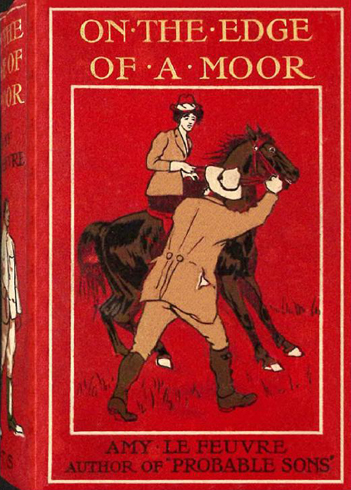
Title: On the edge of a moor
Author: Amy Le Feuvre
Contributor: Sarah Doudney
Release date: October 5, 2026 [eBook #79731]
Language: English
Original publication: London: The Religious Tract Society, 1903
Other information and formats: www.gutenberg.org/ebooks/79731
Transcriber's note: Unusual and inconsistent spelling is as printed.
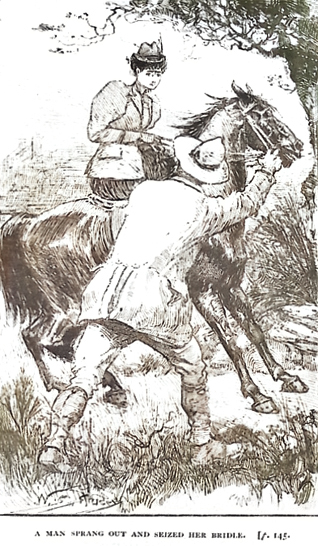
A MAN SPRANG OUT AND SEIZED HER BRIDLE.

BY AMY LE FEUVRE
AUTHOR OF "PROBABLE SONS,"
"HEATHER'S MISTRESS," "DWELL DEEP,"
"ODD," "THE CARVED CUPBOARD," ETC.
FOURTH EDITION
LONDON
THE RELIGIOUS TRACT SOCIETY
4 BOUVERIE STREET AND
65 ST. PAUL'S CHURCHYARD
STORIES BY
AMY LE FEUVRE
———————
HEATHER'S MISTRESS. 3s. 6d.
ODD MADE EVEN. 3s. 6d.
ON THE EDGE OF A MOOR. 3s. 6d.
THE CARVED CUPBOARD. 2s. 6d.
DWELL DEEP; or, Hilda Thorn's
Life Story. 2s.
JILL'S RED BAG. 2s.
LEGEND LED. 2s.
A LITTLE MAID. 2s.
ODD. 2s.
PUZZLING PAIR. 2s.
BULBS AND BLOSSOMS. 1s. 6d.
HIS LITTLE DAUGHTER. 1s. 6d.
BUNNY'S FRIENDS. 1s.
ERIC'S GOOD NEWS. 1s.
PROBABLE SONS. 1s.
TEDDY'S BUTTON. 1s.
A THOUGHTLESS SEVEN. 1s.
———————
LONDON
THE RELIGIOUS TRACT SOCIETY
4 BOUVERIE STREET
"Cast thy bread upon the waters,
for thou shall find it after many days."
THE land was still, the skies were grey with weeping.
Into the soft brown earth the seed she cast.
"Oh, soon," she cried, "will come the time of reaping,
The golden time, when clouds and tears are past."
Then came a whisper through the autumn haze—
"Yea, thou shalt find it after many days."
Hour after hour she marks the fitful gleaming
Of sunlight shining through the cloudy rift;
Hour after hour she lingers, idly dreaming
To see the rain fall, and the dead leaves drift.
"Oh, for some small green signs of life!" she prays.
"Have I not watched and waited many days?"
At early morning, chilled and sad, she hearkens
To stormy winds that through the poplars blow.
Far over hill and plain the heaven darkens—
Her field is covered with a shroud of snow.
"Ah, Lord," she sighs, "are these Thy loving ways?"
He answers, "Spake I not of many days?"
The snowdrop blooms: the purple violet glistens
On beds of moss, that take the sparkling showers.
Half cheered, half doubting yet, she strays and listens
To finches singing to the shy young flowers.
A little longer still His love delays
The promised blessing—"after many days."
"Oh, happy world," she cries, "the sun is shining!
Above the soil I see the springing green!
I could not trust His word without repining;
I could not wait in peace for things unseen.
Forgive me, Lord! My soul is full of praise.
My doubting heart prolonged Thy 'many days.'"
SARAH DOUDNEY.
CONTENTS

CHAP.
ON THE EDGE OF A MOOR

A FAMILY COUNCIL
"IT is only let to him for ten years."
"Ten years! It's a perfect age. Don't talk of it!"
"Years slip by fast enough as one gets older."
"I don't suppose we shall meet again like this at the end of it."
"No; I expect most of you boys will be married."
"And what about yourself, Tabby?"
"Oh, I shall have developed into a strong-minded spinster."
A general laugh followed this statement, and seven pairs of eyes rested critically, or otherwise, on the figure of the girl in their centre.
Reclining in an old oaken chair, her face just raised enough to show her white, softly-moulded throat, her hands idly clasped round her knees, Rhoda Carlton met her brothers' gaze with calm equanimity.
At first glance, she might not strike one as a beauty, though there was something in the poise of her head, and in the upright bearing of her tall, slender figure that demanded attention from all who met her. Dark rippling hair surrounded a broad white brow, but a pair of soft brown eyes did not alter the natural severity of her classical features in repose, and it was not until she spoke or smiled, and the sudden sunshine softened and irradiated her whole countenance, that one realized how beautiful she was.
Turning from her to the young men around her, no stranger would have doubted their relationship for an instant. Seven of the finest-looking men in the county, they were called, and if length of limb and breadth of shoulder as well as determined regular features were to be taken into consideration, then no doubt the average Englishman would be at a disadvantage.
Howard, the eldest, stood against the chimney-piece, his dark brows knitted, and he alone of the little group seemed ill at ease.
Edgar's whole bearing, as he leant back in an easy-chair, smoking a cigar, proclaimed him to be a soldier; whilst lying on the hearth-rug in front, there was no mistaking the sailor in the family, his tattooed wrist and sturdy figure standing out in bold relief against the blazing fire. In the background were three others, one of them a dreamy-looking curate, and lastly, the youngest of all, a youth in shooting jacket and knickerbockers, was lying full length on a low couch, looking the picture of health and content. They were all grouped round the smoking-room fire—the cosiest corner in Verners Manor.
But if we leave them there together and venture into the servants' hall, a voluble old housekeeper, discoursing to Captain Carlton's soldier servant, may supply us with all necessary information about them.
"Do you want to know what this family gathering is for, Mr. Nicholls? Then no one can tell you better than myself, which have nursed the eight from their infancy, and never saw finer babies anywhere. It's been a long time coming. Since the old master broke down and told Mr. Howard the strain of keeping the old place together was too much for him, and Mr. Howard finding out that cunning rascal of a Lock, which was the agent and which was thieving and ruining the whole property, why I knewed it would come to this!
"But Mr. Howard, he's a wonderful gentleman for business, and he gets the reins in his hands, and he cuts down the timber, and he pulls the place together, and I believe it would have been well to this day, if it hadn't been for them 'lections. He must stand for his county, he says, and so all the neighbourhood said; and the money was got in hand, and he flung it out right and left; and then, when all's said and done, a little bow-legged, bald-headed ironmonger comes in at the top of the poll, and Mr. Howard finds he has wasted his goods for nothing.
"Then his lawyer persuades him to let the whole place to a cousin of his who's a man of money, and says if he's allowed to have it ten years, he'll bring it back to the old style again. And that's where we stand now, Mr. Nicholls! And what Miss Rhoda will do, and where she'll go, is past my knowledge! But she's a wonderful young lady; I believe she has excited her brother to this degrading business. And he is going up to London, and is actually going into a house of business for a time, till he can get his affairs in better order—he the heir, and the head of the family, Mr. Nicholls!
"We've been proud of them up to now. Captain Carlton is a credit to us, and Mr. Robert, he's following on in the Navy, though it do take a long time for an officer to get his title there! Then there's Mr. Herbert, he's an elegant preacher, and has been highly complimented on his sermons by the bishop himself, though what he must needs take a curacy in the East of London for, I can't imagine! Mr. Walter, he had high honours at the Oxford University, and has a lot of letters after his name; he is one of the head masters at the Eton school for young gentlemen, and will doubtless take full charge before long. Mr. Edmund wears a wig and gown, and is as elegant and persuasive in his speaking before the judges, I believe, as Mr. Herbert is in his pulpit. And as for Mr. Rodney, he's a fine young country gentlemen, who can hunt the hounds, or land a salmon, or get the biggest bag of game that you ever see a gentleman bring in. And he is off to Australia to do some farming, he says.
"But there! Mr. Howard, he quite spoils all with these plans of his! And it's just a good-bye all round to-night, for most of them go their different ways to-morrow, and it's chiefly to settle what becomes of Miss Rhoda they're here. She's a fine young lady, and could have been married over and over, but no one seems to touch her heart, she's that indifferent to them all; whether it's a titled gentleman, or a poor curate, it's all the same, and I always feel sorry for them when she gives them the cold shoulder! She's not so fond of gaiety as she ought to be at her age, and she's as strong a will as any of her brothers. I don't know what will become of her!"
If the old housekeeper could have been a listener to the conversation in the smoking-room at that moment, she would have been truly horrified at her young lady's plans.
"The question is," Rhoda was saying, as she looked round upon her brothers with an amused twinkle in her eye, "what is to be done with me? My private income is . . . £130 a year. It has just been enough to keep me in clothes, but when a house and food has to come out of it as well, it is rather a puzzle."
There was silence, which Howard broke at last by saying,—
"I have told you before that if you will put up with London lodgings, I will make arrangements for both of us."
"And that offer I have declined with many thanks, for you will be far more comfortable making your home with Uncle Harvey, as he suggests."
"Come to me," proposed Herbert; "you will have a vast scope for your energy in the work in our East End parish."
Rhoda shook her head. "You are too High Church for me," she said; "we should spend our time in arguments, the Bible 'versus' the Prayer Book and the Holy Fathers. Now, don't look hurt. I appreciate your thought for me, but it wouldn't answer, old boy!"
"I am afraid," put in Edgar with a slight drawl, "that even if I had quarters to offer you, the cavalry barracks at Aldershot would not be much to your taste."
"That they would not be," and a clear laugh rang out from the girl as she turned to her brother Robert. "Well, Bob, are you going to offer me a cabin in the 'Invincible'?"
"Walter is the most likely one to suit you," Bob replied, taking up a fallen cinder from the rug and aiming it with true precision at that individual's head; "he has awfully snug quarters at Eton, and wants some one to keep down that old virago of a cook of his!"
"She won't have anything to say to me," responded Walter, drily.
"She has already planned a life for herself," said Edmund, "so I shall not suggest her coming into chambers with me, even if it were practicable. Now then, Tabby, out with it!"
"I shouldn't mind taking her out with me to the Bush," Rodney put in, with a grandfatherly air; "she can fish and shoot fairly well, and it would be awfully handy to have a person to mend one's socks and cook a dinner, to say nothing of cleaning the house down!"
"That is really a liberal offer, Rodney. I am overpowered with gratitude. Now will you all listen to me? Howard, do you remember that tiny cottage on the moor that you and I went to a couple of years ago, when you hired a piece of grouse-shooting? I intend to live there, if possible. I have calculated it all, and think I shall really be comfortable in it, if I can persuade old Hannah to come with me."
"Preposterous!" exclaimed Howard. "How on earth would you get through a winter snowed up there? And the accommodation is awful. It is all very well to live picnic fashion for a week or two in the height of summer, but it is a mere workman's cottage. You must think of something better than that."
"That is where I intend to live," she said determinedly, "and I shall go over next week to see about it."
"And what will Mrs. Grundy say to a girl of your age, setting up house for yourself like that, and what society would you have? Don't talk such arrant nonsense, Tabby!"
And Edgar lost his drawl in his vexation at such an idea.
"That is just the point. There is no society there, therefore there is no Mrs. Grundy. You all know how I dislike society; and truth to tell, I am longing for real work. Now, boys, listen! This is no mere Quixotic fancy of mine, it has been a desire for a long time past. That place is benighted; the village down below has no resident clergyman, but one who comes over on Sunday from another village three or four miles off. I love the country, and I love the poor. And it is a grand opportunity to live amongst them and try to make their lives happier and brighter. I mean to do it. It will be ten years before there is a chance of our returning here, and perhaps longer. By that time Howard may be ready to bring a bride home here as mistress. You need not shake your head. I have been mistress here for five years, and beyond it being our home, and a place where we have had every comfort, I do not know that it would break my heart to live elsewhere."
"Well, Tabby, I for one heartily approve of your plan," exclaimed Rodney. "If you won't come out with me, it's the next best thing to it, and I'll tell you what I'll do! I will see you settled in your cottage before I go abroad. You will want a man to arrange things for you, and I've nothing to do for the next month."
But the objections of four or five brothers are not so easily overruled, and Rhoda's plan was a distasteful one to most of them. If she had not had a very strong will, she would not have conquered. But at the end of all the protestations made against it, she leant back in her chair with quiet determination in her dark eyes, and said slowly, with a placid smile, "I like to hear your different objections and opinions, but I have not spoken without thought. I am not a mere girl; I am under no one's control, and I have my income per annum to do exactly as I like with. You may not fancy the idea at first, but you will soon get accustomed to it, and next summer, if all is well, I shall not be at all surprised if you Londoners will not be very pleased to accept an invitation from me for a week or two of pure fresh moor air. What I really want to do, is to ask you, Howard, to go over the house with me to-morrow, and help me to pick out a few bits of furniture that I may want. I believe all my mother's things are mine, are they not?"
"Yes," assented Howard, a little gloomily. "Are you going to take the grand piano and the harp from the drawing-room? You will have to get the cottage wall taken down to admit the piano, but I suppose that will be a trifle."
"No," Rhoda said quietly, "the cottage piano in the morning-room will answer my purpose. Now we will change the subject. You are all looking cross, and I am not going to have our last evening together spent in gloom. Let us have some music."
"She ought to marry," observed Edmund, as his sister moved across to the piano; "a single woman with opinions and a will of her own is sure to come to grief sooner or later."
"A year of cottage life will teach her what all our objections fail to do. Let her buy her experience."
Edgar spoke with assurance.
"We give you a year, Tabby," called out Bob, "and then we shall see you creeping back thankfully to civilized society."
Rhoda laughed, but would not be drawn into further arguments on the subject.
FIRST ACQUAINTANCES
"THERE, Hannah! Now what do you think of our new home?"
"Indeed, mum, it's a queer place for you."
Rhoda laughed at the look of perplexity on Hannah West's face, as she surveyed for the first time her young mistress's choice of a dwelling-place. She had been maid to Rhoda's mother, and was deeply attached to the family, but five years ago had married their coachman, who died shortly after, and since then she had kept one of the lodges. She had always begged Rhoda to let her live with her if she married, and there had been no difficulty in getting her to come with her now.
It was a month after the family gathering at the Manor, and it had been a busy time with Rhoda. Her untiring energy, and determination to overcome the many obstacles raised in her path, had served her in good stead. She had gone down to the village of Ashampton, and had taken lodgings there with her brother Rodney.
There had been difficulty at first about the cottage; the old couple that had been put in as caretakers during the winter had first to be provided for. Then the landlord, who owned a large straggling property on the moor, was abroad, and his agent was not sure whether he would like a permanent tenant, and be willing to undertake the necessary alterations to make it habitable for a lady.
But when these preliminaries were at last satisfactorily arranged, Rhoda and Rodney set to work with a will, and when she brought Hannah out and showed her over the tiny domain, she said laughingly, "I almost feel as if I have built the place myself, I have made so many improvements."
The cottage was of rough grey stone. It stood on the side of the moor, and commanded one of the finest and most extensive views in the country. There was a small enclosure in front, just large enough to hold a few hardy shrubs and flowers, behind were two or three wooden outhouses which were dignified by the name of stables.
Inside, the cottage certainly had a very cosy appearance. The front door opened into a large low room which, though originally meant for a kitchen, Rhoda had converted into a very pleasant sitting-room. A large old-fashioned open hearth faced you as you stepped in; on either side of it were two deep recesses, filled with shelves reaching to the ceiling, one containing Rhoda's books, the other some valuable old china. At the opposite ends of the room were two low casement windows, one facing east, the other west, and their recesses were filled with cushioned window seats. The cottage piano, a screen, a comfortable couch and two or three easy-chairs, a quaint old escritoire and one or two smaller tables and seats, completed the furniture of the room.
Two doors led to the other part of the house, one into Rhoda's bedroom, the other into a bright little kitchen; and beyond the latter lay a nice pantry and dairy and two small rooms, one of which was fitted up as Hannah's bedroom. The other one was intended to be a spare room for any visitor, but at present, it remained unfurnished.
Hannah was delighted with the kitchen; it was tiled underfoot but had a warm rug laid down by the fire, and the neat dressers and large kitchen range comforted her soul.
"It's a poor place for you, mum," she said with a shake of her head, "but I'll be bound I can make it comfortable for you, and if the ovens are as good as they look, I shall be satisfied."
"We will bake our own bread, Hannah," Rhoda went on cheerfully, "and milk our own cow, and make our own butter. Do you know that Mr. Howard has given me a £10 note to buy a cow and two pigs? I mean to have a poultry yard too, and if we can only get a nice spot close to the house for a kitchen garden, we shall have all that we need."
"I'm afraid of the cold, though," the old servant pursued, looking round her doubtfully. "I've heard tell the wind sweeps down from the top of the moor like a hurricane, and the snow nearly buries one alive."
"We shall weather it. I am going to have very thick curtains put to all the windows and doors. I am having two layers of thick felt put down in my sitting-room, and I have lots of old Persian rugs to go on the top, and if you find the tiles cold in the kitchen, we will cover it all over with coco-nut matting. I am determined that we shall be warm at all costs."
And then Rhoda went back to her brother in the sitting-room.
"The only thing that puzzles me," she said, as she drew a chair to the fire, "is whether Hannah and I shall be able to do all the work of the house together. Hannah will work until she drops, I know, and she can turn her hand to anything. But if we have a garden and poultry, I cannot expect her to attend to it all."
"Get a boy," suggested her brother; "you could have one up from the village for very little, and he need not sleep on your premises—unless you need him for protection at nights."
Rhoda laughed. "Who would visit us up here at night, do you think? Burglars must be unknown in this part of the country, and even they would hardly think this poor cottage could produce enough to make it worth the risk."
"You have some of the plate here."
"Only my own, and that is a very small quantity, I assure you. But I will certainly get a boy; he will be able to take a lot of the rough work off our hands. What I should like to get into order before you go, Rodney, is my garden. I saw one further down the moorside, which was so sunk in the ground that it was sheltered from the wind. Do you think mine could be managed so?"
"I will see about it to-morrow," was her brother's reply.
And Rhoda went to sleep that night feeling that a new life was opening out before her.
A few weeks later, when her brother left her, she began to realize the strange isolation of her position.
But what to others would have been a keen deprivation was real enjoyment to her. She was out in the fresh breezy air, bringing in treasures of nature to adorn her rooms: bits of lichen, golden bracken and heather, bright red berries of all sorts were deftly and beautifully grouped together. Sometimes she would bring in an armful of sticks, to add to their little store of firing, occasionally bunches of watercress from the neighbouring stream; and her bright laugh and sweet clear voice constantly carolling out some quaint ditty as she helped Hannah in the household work, was music in that faithful servant's ears.
But Rhoda was soon intent on the work that she had come to do. As she stood at her door on a fine frosty afternoon, looking down to the valley below, with the village clustering under a thickly wooded height of firs, and a little farther on the grand old ruins of Ashampton Castle, looking picturesque in their comfortable cloak of evergreen and ivy, she called Hannah to her.
"How am I to begin, Hannah?" she said. "I am shy of visiting my neighbours when they don't know who I am. I want to be friends with them; how shall I start?"
"Them stiff formal visits aren't much to any one's liking, I'm thinking," rejoined the old woman, thoughtfully. "If you want to be friends, mum, keep on the look-out to do them some neighbourly action, and you'll get a better welcome than going to their door like a parish visitor."
"But I don't see any one," objected Rhoda. "I go down to the village on market days, and every morning for my letters, but no one seems to notice me, or care for my coming and going."
"I shouldn't be in a hurry, mum, only keep a quick look-out, and the opportunity will come. I'm thinking that Jock may have some belongings that might like to hear how he's getting on in his place."
"Oh, Hannah, how dull I am! I will go and see his mother to-morrow. Is he in the garden? I will speak to him now."
"She never lets the grass grow under her feet," muttered Hannah, as she went back to the kitchen. "It's patience ought to be more to the fore: she's such a one for dashing straight off at a thing and stopping to think after, but there isn't any one her equal with it all!"
With swift steps Rhoda turned towards her little garden plot, which Rodney had successfully sunk in the ground, and which was already planted for the coming spring.
Jock Chalmers, a red-headed boy of fourteen, looked up with a vacant stare from the weeds he was hoeing, upon her approach.
"Jock," she said brightly, "do you think your mother would like to see me? I thought of calling on her to-morrow and telling her how nicely you get through your work here."
Jock gave a kind of grunt.
Rhoda continued, "Tell me where you live. Can you see your home from up here?"
"Na, yon big trees hideth of 'un!"—and a dirty forefinger indicated in which direction to look.
"Would you like me to go and see your mother?"
"A'm agreeable!"
There was evidently nothing to be got out of Jock. Rhoda turned away a little discouraged, and went back to her position at the door. As she gazed away from the wild moorland around her, down to the cultivated valley below, and up again on the other side to long stretches of ploughed land, with farms scattered here and there surrounded by the rich red earth, she said to herself with a sigh, "It takes a long time and much labour to cultivate the earth. I expect I shall not find it easy to reach the hearts of these people; it will be hard ploughing perhaps at first."
It was her custom every morning after breakfast to walk down to the village for her letters, and bad weather never kept her indoors. She enjoyed the fresh morning air, and would return up the hillside rosy and warm with the exercise. But the following morning dawned upon a thick drenching-mist, and Hannah tried to dissuade her from going.
"It will not hurt me," Rhoda declared; "I have a thick ulster, and I want my letters. That is the worst of living beyond the country postman's beat, but exercise is good for me. Good-bye, Hannah. If the mist clears, I shall go and see Jock's mother before I come back, so don't expect me till you see me!"
"Take an umbrella, mum, then, do!"
"No, indeed; the wind is too strong for that. I am quite impervious to the wet."
But Rhoda was not experienced in these moor mists, and though thickly shod, by the time she reached the little post-office her feet were wet through. The postmistress, a grim, hard-featured woman, who rarely spoke unless asked a direct question, and who had handed Rhoda her letters morning by morning without a gleam of recognition, now glanced at her with commiseration.
And when Rhoda proceeded to take off her cap, and wipe her streaming face, she said gruffly, "It's a wet walk for you, miss."
"Yes, it is, but I am very strong, and can stand it. I wonder if you would allow me to wait here for a little, on the chance of the mist clearing off. It looks lightening."
The woman opened a door and motioned to her to enter. But Rhoda hesitated for a moment when she saw a bright, cosy sitting-room, spotlessly neat and tidy, and before a blazing fire a cheery-faced little woman, enveloped in a large shawl, seated in a comfortable easy-chair, the morning's paper on her lap.
"I shall bring in so much wet with me," she said.
But in a moment, a drugget was spread over the hearth-rug, and she was invited to stand upon it.
"I think I might be introduced to the young lady, Susan," said the figure in the chair, in a slightly injured tone.
The postmistress's tone was very glum as she said to Rhoda, "This is my sister, Mrs. Thatcher. We live together here; her husband died twenty years ago."
And then she went back to the shop, shutting the door after her with a sharp bang.
"My poor sister never thinks of people's nerves," said Mrs. Thatcher, smiling apologetically; "she is a very good business woman, and is quite wrapped up in it. I sometimes wish she was of a more cheerful disposition. I always try to look at the bright side of everything. A wet day only makes me appreciate the warmth and comfort of our own fireside the more, and if it has brought you in to have a few words with a poor invalid, why then, indeed, it will have added to my comforts. I seldom get a chance of having a chat with any one; my sister is so unsociable, as I often tell her."
Rhoda began to be interested. Was this an opening for a little work? she wondered.
"Have you been an invalid long?" she inquired sympathetically.
"I am subject to bronchitis in the winter, so I never go out, and even in the warm weather I have to be very careful. We have come down in life—there was a time when my husband had a nice trap and horse, and when business was over, oh, the nice drives we had! You see, my dear young lady, our pride sometimes has to have a sad fall. When I was governess in some of the most genteel families in the county, and when I married John Thatcher, auctioneer and agent to most of the building property round, I never thought I should live to come down to a little country post-office and a stationery depository combined!
"But my dear husband was taken ill of congestion of the lungs, and died leaving me without a penny. It was a terrible blow to me, and here I am, a helpless, useless encumbrance to my energetic, busy sister. Not that I wish to complain, as I said before; I always try to look on the bright side of things. I remember my father used to call me his 'sunshine,' and Susan his 'shadow.' She always took life seriously, Susan did, and she is so quick and clever that she looks down upon me, I sometimes think, for my want of knowledge about business matters."
"I shall like to come in and see you again if I may," Rhoda said gently, "but I am not in a fit condition to stay long now. As it is, I am afraid that I shall make this room a great deal too damp for your welfare."
"I shall be delighted to see you any day," responded Mrs. Thatcher with alacrity. "You are a stranger in these parts, are you not? Do you live far off?"
"Up on the moor."
"Then you are the young lady there has been so much talk about! Maggie Simes, our little maid-of all-work—she is a dreadful girl for gossip, and I suppose she means well, for I must say a chat does cheer me up—she was telling me about you."
"What did she say?" asked Rhoda, laughing. "I did not know I was of sufficient importance to furnish gossip for the neighbourhood."
"Ah, well, it's best not to repeat all one hears; people will talk. Some say you have been crossed in love, and have retired from the world, and gone to live up there in disgust at society. And some hinted you were rather queer in the head; and I think all of us have been very curious about you."
Rhoda's sweet, clear laugh rang out merrily.
"Why shouldn't a person be allowed to settle in the country without having a mystery attached to them, I wonder! I have no strange history, Mrs. Thatcher. I am only a very common-place young woman who likes country better than town, and a quiet life better than a noisy bustling one. Now I must say good-bye—the mist seems to be clearing a little—and if you will allow me, I will come and pay a longer visit one afternoon, may I?"
Mrs. Thatcher eagerly expressed her hope that she would do so. And Rhoda, after a few bright words of thanks to the silent sister, left the post-office with elation at having gained an entrance there.
It was still raining a little, but she walked valiantly on till she reached Jock's home. It was not a propitious day for visiting; Mrs. Chalmers was in the midst of her washing, and the small cottage looked the picture of untidiness and discomfort. Mrs. Chalmers herself was a nervous, careworn little woman; she thanked Rhoda profusely for coming to see her, but beyond that seemed to have no conversation, and her "No, ma'am," and "Yes, ma'am," were, to say the least of it, disheartening.
At last, as she was coming away, Rhoda said with some effort, "I wonder if you would let me leave you a little book? I suppose you are able to read sometimes? I always feel that we want some quiet moments in this busy life of ours to think of better things and of our own souls. Do you ever get a quiet time to yourself?"
"No, ma'am!"
Rhoda laid her little book down and left with a sigh. As she was toiling up the steep hill towards home, her heart went up in prayer for those she had seen. She had an earnest longing to be used by God in winning souls into the Kingdom, but she felt the ground hard and unprepared for the seed.
"May God teach me how to plough," was her inward thought; "or rather, may He do it Himself! I would like to be the plough in His hands, if He will use me."
A QUESTION OF PEAT
"HANNAH, what are you doing?"
"Making some hot scones for your tea, mum."
Rhoda came into the kitchen and seated herself on the low window sill; she had just returned from a long walk, and was glowing and breathless from battling against the wind.
"I want to give you my experience this afternoon," she said. "I have made some fresh acquaintances."
"You haven't been down to the village, have you?"
"No, I have been on high ground. I struck right across the moor above us, and seeing a farmhouse all by itself under the shadow of one of these tors—isn't that what people call the hills about here?—I thought I would pay it a visit. They are neighbours, Hannah, so don't look so dubious. The door was opened by a little humpbacked, deformed woman or girl—I don't know which—who greeted me with a scowl. I asked for a glass of milk. She would not ask me in, but went away to get it, and then an old woman appeared—such a dear old creature, with a snowy white cap—and she took me into the best parlour at once, and told me all about herself and family. She is a Mrs. Tent, and lives with her son and wife, who manage the farm; the hunchback is her only unmarried daughter. Her son has four children, such pretty dark-eyed boys! They come right across the moor, down to Ashampton, every day to school; they take a donkey with them, and ride it by turns. Their mother I saw for a minute; she was digging some turnips up in the garden.
"Well, as I was drinking my milk, Mrs. Tent began telling me of a trouble that has come on them. It seems that their landlord is the same as mine—Mr. Rokeby. They have rented the farm on a lease, which is now just at an end, and they have always been accustomed to cut into a vein of peat, as they call it, which runs through their ground. The other day Mr. Rokeby's agent called on them, and said they must do this no longer, that Mr. Rokeby would not have his land spoilt, and that if it was touched again they would be given notice to quit. I felt quite sorry for them. Old Mrs. Tent said it saved them all firing in the winter time, and that they had sold a good bit to their neighbours. And, as she truly said, the ground was so poor and barren that if they weren't allowed to get the peat out of it, it wasn't worth the money they gave for it. She said they had cut peat for twenty years, and by taking care of the ground and attending to it, it was as good as it had ever been."
"Didn't they have no contract about it when they took the farm over?"
"It appears not. In fact, they were the ones to discover the vein of peat. It has fired me with the desire to investigate our ground, Hannah, and see if we haven't a peat vein. It would save us a lot of coal. As Mrs. Tent said, it isn't as if wood were plentiful up here and getting up coals from Ashampton is a serious business. Well, the upshot of all this is, that I have promised to write to Mr. Rokeby about it, and lay me the case plainly before him. Mrs. Tent was telling me that not one of them are good enough scholars to 'put it clear and proper like.' Her son has tried to see Mr. Rokeby more than once, but he is always away. And that is what I am going to do this very minute, only I thought I would tell you about it first. I think this Mr. Rokeby must be a regular old curmudgeon, from all accounts, and I will try to touch his hard old heart. Jock hasn't gone yet, has he? He can take the letter down for me."
"I don't think you're called upon to interfere, mum," began Hannah slowly, as, having put her cakes into the oven, she now stood with arms akimbo and reflected.
"Now don't damp me, there's a dear old soul. I want to make friends with the Tents. I have an eye to those small boys. I might have a Sunday class for them here, and I long to know that poor hunchback; she looked so soured and miserable. It can do no harm, at all events, and may do some good."
And Rhoda went back to her room and sat down at her writing-desk to compose the important letter.
It was some days before she received a reply. It was as following:—
"Mr. Rokeby presents his compliments to Miss Carlton, and in reply to
her letter begs to state that his agent was acting according to his
wishes in the matter mentioned.
"Rokeby Court."
"I call that an exceedingly ungentlemanly letter!" exclaimed Rhoda, as she read it aloud to Hannah.
"I should say that he is a gentleman that does not like to be interfered with, mum. And you see you are a perfect stranger to him."
"Oh, Hannah, you will never give me any sympathy. Now I shall have to go across to the Tents this afternoon and confess my failure. I never did like this Mr. Rokeby from the time we first had to do with him. He always keeps out of sight himself, and his agent is one of the most disagreeable old men that I have ever seen. I shall dislike him more than ever now. Where is Rokeby Court, do you know?"
"I think it's somewheres across the moor, about ten miles away."
Rhoda set off on her mission about two o'clock, taking her rough Scotch terrier, Tartar by name, with her. She had no fear in taking these lonely walks by herself, and the wildness and desolation of the moors rather invigorated than depressed her. Clad in a warm shooting dress, gaiters and cap to match, and a strong stick in her hand, she felt quite equal to battle with rough wind and weather; those were the only foes that ever crossed her mind. She loved nature and nature's God, and therefore never found her wanderings over the moor dull or uninteresting.
She was received very warmly by old Mrs. Tent, who took her into the kitchen. It was a pleasant, homely room. Young Mrs. Tent was making a batch of bread, and Jess, the deformed daughter, was sitting by the fire knitting stockings for the boys. Rhoda was offered a seat in the chimney corner, which she took, and then disclosed the object of her visit.
"Ah, well," said old Mrs. Tent, "I never thought he would heed. He be a very hard landlord, if so be his Mr. Crake, speaks right of him. My son be saying he dunno if he won't clear out and settle t'other side of the valley. If he had a bit more money, he would, only the land over there be twice as much as this; but then, as he sayeth, you get its worth out of it. If it weren't for our cattle and poultry, we should never get on at all!"
Rhoda expressed her sympathy, and then asked the young mother after the boys.
"They're not home yet. They were to call at the post afore they come back for a letter that their father is looking for. I wish we were nearer the village oftentimes. We're out of the way of everything here."
"And so am I," said Rhoda, brightly, "but I enjoy that part of it. I go down to the village every morning to get my letters; wet or fine, the weather never keeps me."
"You do? Now to think o' that!" ejaculated the old woman. "I haven't been to the post for many a year, not since Susan Frith come into it. I should like to see her and Lucy again, but folks tell me they keepeth theyselves wonderful close!"
"Do you know them?" asked Rhoda with interest. "I was paying Mrs. Thatcher a visit the other day. She seems such a bright, cheery little woman."
"Ay, ay, she may well be," and Mrs. Tent nodded her head up and down mysteriously.
"Now, mother," said her daughter-in-law, "don't you be so hard on her. I can't abear Miss Frith, and I dunno why she be your favourite. She fairly scares a person with her hard, cross tongue."
"I knew them afore you did, M'ria—when they were in frocks and pinnies. I went over and cooked the dinner for their mother's funeral, and well do I remember Lucy prancing up and down and showing herself off to the company in her new black frock, whiles Susan, she creepeth up to me in the kitchen, and saith she, looking up so mournful with they black eyes of hers, and yet so determined like for her age,—
"'Mrs. Tent,' she saith, 'will you show me how to make a steak puddin' for father? Mother said as she hoped I would try and keep the house going when she were a-taken, an' I will try with all my might to do it.'
"The little maid! I can see her now, and all the time choking her sobs down, for she were powerful fond of her mother. And she carried out her mother's wish right bravely. She were only just turned eleven, but she took up life's burden then, that she did, and she worked straight on for twenty year at that farm, till her father he were carried out to be buried 'longside of his wife. She were allays steady and grave, were Susan, but Lucy were just the opposite. She played whiles Susan worked, and not a finger would she lift to help her. She were her father's darling, o' course. I don't think Susan ever had a loving word from him, though she slaved for his comfort as Lucy never would 'a-done.
"And then they cometh to be young women, and Lucy, mind you, were sent to a boarding school to be made a lady of, and she cometh back a-playing the pianny and talking that jargon they calleth French. I saith to her one day, when I were up at the farm giving Susan a hand with pickling of pork,—
"'Why, Lucy,' says I, 'are you a-coming home to help your sister on the farm a bit now? It's heavy work for her.'
"She laughed in my face, and held out a pretty pair o' white hands. 'Do you think,' she saith, 'I'm agoing to scrub and scour and bake with these? Have I the cut of a house drudge? No,' she saith, 'but I'm agoing to earn my livelihood another way, Mrs. Tent. I'm agoing to be a governess,' she saith; and with that she runneth away from me laughing.
"And the next thing I heerd were that she'd got a situation not far off in a clergyman's family. Well, as I were a-saying—But am I a-tiring of you, miss?"
"No, indeed, I like to hear it all."
Mrs. Tent continued: "By-and-by there cometh a young man a-coorting Susan. She could hardly take it in, poor maid, that any one should care for her—not but what she had her share of good looks, only she didn't make enough of herself, Susan didn't, and when her sister was by, she let her come too much to the front. Well, she and this John Thatcher kept company for two year. She said she couldn't leave her father, but John were willing to wait.
"And then back from one of her situations cometh Lucy. There! You can guess what happened; a pretty face and lively tongue soon winneth a man, and Miss Lucy spared no pains in making of herself agreeable to John. I do believe he would 'a stood true, if Susan had come to the front more; he did press her hard to marry him soon, but she said she couldn't. She dropped herself in the background, and soon saw John a-making love to Lucy.
"Then she spoke to him much as she spoke to me the day mother died, quiet and gentle-like but very steady. She told him she knew Lucy would make him happier than she would, and they could be married as soon as they liked—which they were, a month from that time! She told me all about it when her trouble were fresh on her.
"'But,' saith she, pursing her lips up very firm, 'I'm never going to speak on this subjec' agen, Mrs. Tent, and you must please not mention the matter to me after to-day.'
"Ah, poor Susan, she have had her trials!"
"Well," put in young Mrs. Tent, as she placed her dough down in front of the blazing fire, "I never heerd tell of that story before, mother, but of course it's not to be wondered at if men likes bright, pretty ways, and Miss Frith—if she allays looked as gloomy as she do now—I don't think she'd keep a lover long anyhow!"
"Folks differ about some things, seemingly. I don't think much myself of a red-checked apple if it's rotten to the core. But there! Some seems to like the rottenness!"
It was the hunchback who spoke, and her tone was inexpressibly bitter. Rhoda glanced at her, and with a sympathetic smile she laid her hand on hers.
"I think I agree with you," she said gently; "it's the heart men ought to look at—not the outward form. I think some of the noblest souls have lived in very plain and homely bodies. I do feel for poor Miss Frith."
"But that isn't all," put in the old lady briskly; "let me tell you more. When old Frith died, he left a good bit o' money to his daughters, and Susan she determined to keep the farm on. It were doing well, and she were a good business woman and a clever manager. But that John Thatcher, who had set up as a gentleman, he and Lucy begged and prayed her to put her money into some investment o' his.
"I don't rightly know how they got round her. John told her it would be the making o' him if she would, and it would be as safe as in the Bank o' England. Anyhow, she gave it to them, and then it all make to a smash, and every penny o' hers had clean gone.
"John didn't live much longer, and he died leaving Lucy with a many of his debts to pay, and not a penny that she could call her own. Of course Susan couldn't keep on the farm, but she managed to pay the debts, and took her sister to live with her. And now she's the postmistress of Ashampton, and her sister has never wanted for nothing. Susan she slaves herself to death in keeping her in idleness; she's a good woman, that she is, and folks that know her story needn't wonder she's a bit grave and stern!"
"Thank you, Mrs. Tent; she is a noble woman. I am so glad to hear about it. It shows how wrong it is of us to judge people hastily."
Rhoda's tone was somewhat wistful; she was wishing that she had found an entrance into Susan's Frith's heart, but as yet she was as far from that as ever, and now she felt as if she did not wish to cultivate Mrs. Thatcher's acquaintance any more.
She stayed some little time longer, and before leaving discovered that Mrs. Tent's deformed daughter, Jess, was passionately fond of reading.
"Are you a good walker?" Rhoda asked her. "Could you come over to me one afternoon and see if I have any book you would like to borrow?"
Jess stared at her in astonishment.
"I'm not given to walking," she said gruffly, "but I'll come. Next Saturday I'll come."
"That will be very nice. I shall expect you early, because you won't want to be out after dark."
"As to that, I prefer it. I'm not afraid of the dark;" and Jess gave a short laugh as she took up her knitting again.
Young Mrs. Tent came outside the door with Rhoda. Lowering her voice, she said, "It's very kind of you, miss, to take notice of Jess. We can't get her out nowheres—leastways not to see people; she wanders away over the moor by herself, but as to going near Ashampton or into any neighbour's house, why, she flatly refuses."
"I do feel so sorry for her. Has she always been like this?" Rhoda said gently.
"Yes, from her birth. She have a very sharp tongue at times, but she's wonderful fond of the boys; she'll do anything for them. Good afternoon, miss; you know we're allays glad to see you. Mother quite cheers up having a visitor."
When Rhoda told Hannah that evening the story of Susan Frith she concluded by saying, "Do you think it is wrong, but I feel I cannot go and visit Mrs. Thatcher with the same pleasure now! I wish I could get to know Susan; she is the one that wants cheering up."
"I think Mrs. Thatcher may be in more want of spiritual help," said Hannah, thoughtfully. "Don't give her up, mum; you may get her to look at her sister a little differently, if you try and influence her a bit."
VISITORS
TWO days after this, the weather, which had been becoming increasingly cold, developed into driving snow and wind. And as evening came on, the gale was so violent that Rhoda told Hannah to make up a bed for Jock, and let him sleep the night there. They were glad enough to shut up the house and draw the curtains, for the snow beat in at every crevice, and the wind howled round the house in a perfect fury.
"I do not wonder that people and cattle perish in such storms as this, if out upon the moor," said Rhoda, as Hannah came in with a dainty little meal for her at seven o'clock.
"It's an awful night, mum! We seem to be right in the thick of it, too! It's a wonder the windows don't blow in. I'll put another log or two on your fire, for it's bitter cold."
And Hannah bustled about, pulling a curtain here and a mat there, until Rhoda laughed, saying,—
"I believe you think me a hothouse plant, by the care you are taking of me! Why, I am as warm as a toast in here! I hope you are as comfortable in the kitchen."
"Yes, we are nicely there. How thankful I'm to think you ordered shutters for the windows! What should we have done without them! But there, I've left one window unclosed. I thought maybe if there was any poor soul out, it would be a beacon light to them. Jock has been telling me his father was lost in just such a storm as this, six years ago come this Christmas, and when he was found in the morning quite dead, he wasn't above fifty yards from a dwelling-place!"
Rhoda shivered. "Don't tell me any more, Hannah, or you will make me nervous."
Hannah left the room, and Rhoda was wrapped in thought whilst disposing of her food.
Later in the evening, she went to her piano. She was passionately fond of music, and had a beautiful voice. Now as she tried over some of her songs, Hannah and Jock in the kitchen listened spellbound, but when she drifted into some sweet old hymn tunes, and finally into the solemn prayer for those at sea, old Hannah added her quavering voice to the refrain—
"'Oh, hear us when we cry to Thee
For those in peril on the sea.'"
The last note had hardly died away when all were startled by a thundering knock at the front door, which opened immediately into the sitting-room.
For a moment Rhoda, starting from her seat, stood irresolute, and then when the knock was repeated and a hoarse voice shouted for admission, she motioned to Hannah, who had already appeared, to unfasten it.
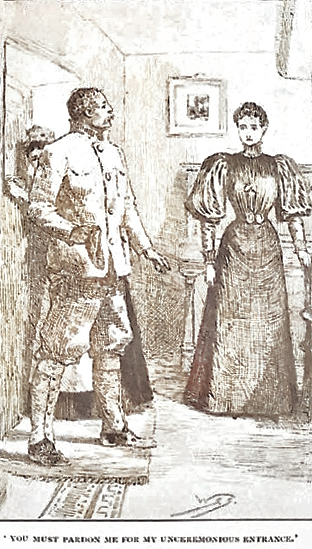
"YOU MUST PARDON ME
FOR MY UNCEREMONIOUS ENTRANCE."
When once the door was open, such a blinding shower of snow swept in that it was very difficult to distinguish the man's figure in the midst of it. He turned without a word to help Hannah close the door behind him, and it needed all their strength to accomplish that feat, for the wind was driving against them like a hurricane. Then, taking off his cap, he looked about him in bewilderment.
"I haven't the faintest idea where I am," he said, addressing Rhoda; "you must pardon me for my unceremonious entrance. I was nearly desperate. I think I have been wandering about for hours, and then I saw your light and made my way here."
He was a tall, broad-shouldered man in rough shooting suit and gaiters. His heavy moustache was glistening with icicles, and his eyebrows and hair were so thickly powdered with snow that it gave him the appearance of an elderly man. His dark eyes were keen and rather fierce at first sight, but they softened when he spoke, and his voice was that of a cultured gentleman.
"I am glad our light has been a guide to you," said Rhoda, quietly; "it must be terrible out to-night."
"It is indeed. I have my horse outside. Is there a stable where I could put him up for a short time, till I know my bearings?"
"Jock will bring him round. Hannah, will you tell him?"
Hannah was standing looking with great disapprobation at the melted snow that was pouring from the stranger's clothes and making pools of water where he stood. He caught her look.
"May I come into the kitchen," he asked, "and have a rub down? I am really not in a fit condition to stay here."
He followed her, and Rhoda seated herself by the fire, he wondering who he was. But it was not long before he returned, and she ordered a cup of hot coffee to be brought to him at once. More than this he would not take.
"I must be making the best of my way back," he said. "I have not the slightest notion what part of the moor I am in. Can you tell me how far Rokeby Court is from here?"
"You are a very long way from it," said Rhoda. "Are you staying there?"
"Yes, and I want to get back, or they will be anxious."
"We are close to Ashampton; the village is only about a mile and a half from us."
"Ashampton! I am very far out of my beat, then. I ought to be on the other side of the moor."
He looked perplexed.
And Rhoda said, "You must not think of venturing to Rokeby to-night. You would never reach it."
"No," he said, with a short laugh, "it would be madness to attempt it. Now, can you put me in the way of reaching Ashampton? I will get a bed at the inn there."
"I wish we could offer you hospitality here for the night," said Rhoda, thoughtfully, "but we have really no accommodation."
He looked up, and a softer gleam came into his eyes.
"I am very much obliged to you, but I would rather get to Ashampton if I could."
"I think, then, if we guide you to the cart-track just in front of our gate, you cannot go astray, for that goes straight down to the village, and there is some fencing on one side of it the whole way."
"Thank you, that will be first-rate."
There was a pause; sipping his coffee, the stranger made good use of his eyes, and Rhoda noted with amusement his perplexed and wondering gaze, as he saw the different tokens of comfort and refinement around him.
"Isn't this a rather lonely place for you?" he asked at length, a little hesitatingly.
"No, I never feel it so. I love the moor."
"But excuse me, I do not mean to be inquisitive; but surely you do not live here alone?"
Rhoda's head was a little raised as she answered, with a touch of proud reserve in her tone, "I live here with my old and faithful servant, Mrs. West."
"Still, I think you must feel the want of space in such a tiny place as this, don't you? This must be a mere labourer's cottage."
"It quite satisfies my requirements."
He would not be suppressed by her tone.
"I often think," he said reflectively, "that, after all, comfort and not space is the chief thing to aim at in a house. You have proved it so here. We can live in one room as happily as in a dozen, for we can but be in one room at a time."
"Will your horse be fit to ride down to Ashampton?" Rhoda inquired, quietly changing the conversation.
"Oh yes, thank you; he wasn't as exhausted as I was. Is there no farm nearer to you than Ashampton?"
"No, the nearest is a good two miles from here."
"And can you tell me—"
He stopped suddenly, and then, as if struck by some strange idea, said, "Surely you cannot be Miss Carlton?"
"I am."
He looked a little confused, then gave a short laugh.
"Mr. Rokeby had an idea you were quite an old lady, and it was having had this spot described to me as being the nearest cottage to Ashampton that made me think you must be she. Haven't you—er—had some correspondence with Mr. Rokeby lately?"
"Has he been telling you he has had some one meddling with his tenants and prying into matters that do not concern them?"
And Rhoda smiled as she spoke.
"It was a question of peat, wasn't it? I remember hearing something about it."
"Yes, and if you have any influence with Mr. Rokeby, I do wish you would persuade him to reconsider his decision."
Shortly and graphically she brought the case before him. And when she paused, her hearer seemed interested.
"I think, in justice to Mr. Rokeby, I must remind you that all his straggling property on the confines of the moor used to be rich in peat, which is not to be found everywhere. We are not in Ireland, you know, Miss Carlton, and the peat veins, as the people about here call them, are getting very scarce. Cutting the peat impoverishes the land. He has a right to withhold that permission from any tenant."
"I really can hardly imagine the land becoming more impoverished than it is. As Mrs. Tent said to me, if it doesn't produce peat, it will not produce anything else. But of course Mr. Rokeby must do as he thinks best. It is cutting off one of the means of livelihood for these poor people."
"Shall I speak to him again about it?"
"I wish you would, if you have any influence with him."
"I can but try, at all events."
For some time longer her guest stayed talking, and then rose to go.
Jock brought his horse round, and Hannah, wrapped up in a shawl, ventured outside the door to point out to him some landmarks. The storm was lessening, and the snow had almost ceased to fall. In the distance, the twinkling lights of the village could be seen.
And when Hannah came back to her mistress, she said cheerfully, "It isn't possible for him to lose himself now, mum, and the snow is not so deep as it might be."
Rhoda was gazing dreamily into the fire, but turned round.
"Have you any idea who he may be, Hannah? Some relative of Mr. Rokeby, do you think?"
"I made so bold as to ask him his name when he was shaking the snow off him in the kitchen. Mr. Wallace, he calls himself, but he seemed rather high and mighty over himself, and I asked no more. I have heard Mr. Rokeby lives by himself. He must be a friend staying there."
"He looks an unhappy man, with restlessness strongly marked on his face. It is a very resolute face too, but I should say he was a man with little religion."
"He has a very high-handed way of speaking, but he gave five shillings to Jock, which has pleased him mightily."
"It is fortunate Jock was here. That reminds me, Hannah, I have had a horse promised me by Mr. Edgar. Don't you think we shall find it useful? He says he has bought one very cheap from an officer going abroad, and will send it to me for a Christmas present."
"I think a moor pony would answer our purpose better than one of that sort," replied Hannah, dubiously. "We want one to go up and down the hills with a cart."
"Well, we will see what this one is like. If it is of no use to us, I will exchange it for another. I don't like to refuse it. I told my brothers I would not be proud, and would accept anything they liked to send me, from a horse down to a milk-can or a washing-tub. And this is the first offer I have had. It is not one to be despised."
The next day being Saturday, Rhoda wondered whether Jess Tent would be enterprising enough to come across to her in the snow. A frost had followed the storm, and the snow was crisp and hard. Still, it would be tiring walking, and she half hoped that she would not attempt it. However, about half-past three, as she went to the door to look out, she saw a figure in the distance, and knew from the limping gait that it was Jess.
"Now, Hannah, you must bring in a dainty little tea for us at four. Make us some of your nice hot cakes. I want to give this poor girl a treat."
Jess arrived rather breathless, but with eager curiosity and anticipation shining in her large, pathetic grey eyes. Rhoda took off her heavy shawl, and seated her in a cushioned chair by the fire, and Jess felt as if she must be in fairyland. Yet there was nothing very costly in the things about her; it was only the contrast from the farmhouse kitchen that she felt, and the few plants, photographs, and pretty knickknacks scattered about gave a charm to the whole in her eyes.
She was dressed in her Sunday best, her hair smooth and shining from the liberal use of hair-oil, a blue ribbon with a tiny locket on it was tied about her neck, and stiff starched frills of lace were round her throat and wrists. A black silk apron with two pockets trimmed with violet ribbon completed her attire. Poor Jess! Though outwardly gruff in tone to all around, she had a longing for sympathy and kindness, and Rhoda's bright face and cheery voice had from the first quite fascinated her. She had been counting the hours to this visit, and had determined to come in spite of the bad weather.
"You are sure your feet are not wet?" Rhoda said kindly. "I know those snowshoes you have just taken off are wonderful things, but the wet sometimes gets through them."
"My feet are quite dry, thank you."
And then Rhoda drew up a chair to the other side of the fire and began to talk. She had the great gift of being able to win people's confidence, and before long Jess was pouring into her ears thoughts and aspirations that for years had been fast locked within her breast.
"I dare say it may seem foolish to you, but I want to know, and I haven't a bit of knowledge. I sit and think things out when I'm working, and I'd give worlds to be a scholar. I've heard tell of people knowing all the stars by name, and others know every leaf and plant on the moor by grand Latin names. I love books—any sort I can get hold of—not stories so much. I used to read magazines which Jim used to bring from Ashampton, but it was all very well as long as I was wrapped up in it, but after it was finished, it made me hate myself and my life more than ever. And then I got hold of a geography book, and I found that a deal better; it made me feel, after I'd studied it a bit, as if I was getting something into my head that would last. I began to think of other countries, and how I should live in them if I went there, and it makes me feel I know more of the world than just this bit of England."
Jess paused, and Rhoda said, with interest, "Please tell me more. What other books have you read?"
"History. Ah! I just dote on English history. There was a time when I used to hear father talk about the Roman road across a part of the moor, and I used to think the Romans was black savages; and then there's supposed to be an old British village, or the stones of it, hereabouts—do you know of it, miss?"
"Yes, I am longing to know more about it. Hannah and I were out one morning trying to discover traces of it, and certainly some of the old stones are most interesting. We have been told that a hearthstone was dug up in our plot of ground behind the house some time ago in beautiful preservation."
"Ah, well, when I first heerd tell of it, I thought the Britons were French people. I didn't know they had aught to do with us. But the History told me all about it, and about the Romans too. It's wonderful, the difference there is betwixt books—I was thinking it out the other day. The story-papers make me feel awful discontented and restless like, the other hard reading leaves me a comfortable, filled kind of feeling after. The stories make me think what a miserable wretch I am, of no good to no one; the History and such like, they make me feel I know a lot more than most of our folk do, and it lifts my head up like."
"I must let you look at some of my books after we have had tea, and you must choose one to take back with you. Now I know you will not mind my asking you, but amongst the books that you read, do you study the Bible?"
"No."
Jess looked surprised, and a slight pucker settled between her brows as she spoke. "I do read a chapter now and again on a Sunday, but it doesn't suit me as well as the other kind of reading."
"You find it dry and uninteresting?"
"Yes," she said, with a short laugh. "I don't think I'm different to most folks if I do."
"I suppose you are not," Rhoda said, with a little sigh, "and yet it is worth more than all the books you have read or could read put together."
Jess looked uninterested, her eyes roved round the room.
Rhoda added brightly, "Will you be surprised if I tell you that I would rather have my Bible to study than any of the books I have on those shelves?"
"I suppose you get more out of it than what most do."
"Perhaps you have never tried. I wish you would come to me one Sunday, and let us have a little study of it together."
"I shouldn't mind," said Jess, laconically; "Sunday is a long day to me."
"I suppose you never go to church?"
"Not me. Jim he goes to the chapel in Ashampton when he ain't too tired, and M'ria she goes with him on occasions. Mrs. Tent and me always keep to home with the boys."
"I won't ask you to come to-morrow because of this snow, but to-morrow week, if it is good weather, will you come at three o'clock, and then you will be able to have a cup of tea before you go home?"
"Yes, I'll come," responded Jess.
Hannah now entered the room, and wheeled up the tea-table to the fire.
Jess's eyes shone as she noted the delicate china, the silver muffin-dish with hot cakes, and another plate of crisp brown biscuits, the thin bread and butter, and the rich-looking plum cake in the old-fashioned cake-basket, all had a great fascination for her. She had few pleasures in her life, and had always appreciated everything beautiful.
Rhoda noticed her enjoyment of it all, and was as cheery and bright a hostess as Jess could have had.
When tea was over, she was taken to the bookshelves, but seemed quite bewildered as to what to choose. She finally selected a book of travels in Africa, and then, with a longing look at the piano, said, "Do you play, miss? I'm so fond of music. I can sing myself fairly well, it's the only thing I can do, but of course we haven't an instrument of any kind. Jim had a concertina once, but one of the children smashed it, and we ain't had no music for years."
Rhoda sat down and began to sing one of her simple ballads, then she asked Jess to join her in a hymn, and she was struck with the sweet true notes the poor deformed girl had. They sang on for some time, first trying one thing, and then another, until Rhoda, seeing her visitor showed no sign of taking her departure, said gently, "I mustn't keep you longer, for you have a long way to go. I am so glad you have been able to come, and I shall expect you to-morrow week if it is fine."
"Oh, I'll be sure to come. I like it here. It's rather different to our home, as you know, and I get so tired of that old kitchen."
Then, as she was putting on her shawl, she said, surveying the room with approving eyes,—
"It's like the books I've read. I could sit here with comfort if it was mine, and I never would go outside. I've heerd tell of a lady that lives like you the other side of the valley. She has a tiny cottage that we would think a great come-down, but inside it's like a palace. Jane McKay, that comes and gives us a hand at times, she's been in for a day; but she says, for all she has such nice furniture, she's awful poor, and nearly starves herself and her girl that does for her."
"What is her name?" asked Rhoda, with interest.
"Miss Montague, they call her. She lives just the other side of Ashampton. She's awful fond of flowers, but Jane says that you can't stay your hunger with them, and she has more flowers than food on her table, she says."
Rhoda said no more, but bade her good-bye, and then went into the kitchen.
"Hannah, I think that poor Jess has had a good time here; but oh, how I want to reach her soul! It seems so difficult, and now she has gone, I feel I could have said more than I did. I am always losing opportunities."
"Is she coming again, mum?"
"Yes, next Sunday. Do you know, I have such quantities of plans in my head for this winter. What do you think of an evening-service on Sunday night in our kitchen, and a Sunday school in the afternoon, and perhaps a sewing-party or mothers' meeting in the week, and a village library attached?"
Hannah smiled, and there was much hidden behind that smile, but she said quietly, "People don't like coming out on winter nights in country like this, I fancy. You'll have to get to know them first, mum; there ain't enough of them yet to fill our kitchen. Better wait a bit. I believe you may do more good in teaching and talking to the ones and twos than to crowds."
"Yes, I know that is so, but sometimes I feel I haven't enough to expend my energy on here. And, Hannah, I have just heard of a lady I am most anxious to know. I feel very curious about her."
Rhoda related what she had heard from Jess, adding, "Of course I know my chief object in coming here was to make friends with the poor, but I confess I did not realize what it would be to cut oneself off so completely from all one's friends, and she might prove a nice acquaintance; what do you think?"
But Hannah looked dubious, and could give no advice on this point.
A GIFT
THE next day Rhoda started for church in Ashampton. She always attended the morning service there, and Hannah sometimes accompanied her, but found it too long a walk to take often. It was a bright, frosty morning; icicles were glittering in the sun, and the snow was crisp and hard underfoot. Down the snowy slopes in front lay the little village, half buried in the snow, and the ridge of pine woods stood like grim sentinels above on the other side of the valley.
There were not many people about as she came down the village street, but the bells were chiming merrily, and presently in front of her she noticed Miss Frith come out of the post-office, and wend her way up the steep little cobble-stoned lane leading to the church. For one moment Rhoda hesitated, then determined to join her. As yet she had been quite unsuccessful in getting to know her, for Miss Frith seemed always so busy that she could barely spare time to hand the letters across the counter when asked for them.
"Good morning, Miss Frith. We are both rather early, I think."
Miss Frith turned round, and the lines about her mouth became more set when she saw Rhoda's intention of walking with her.
She responded civilly, and then Rhoda inquired for the invalid.
"She is fairly well, thank you. This sharp cold rather tries her. She was asking after you only this morning, wondering whether you would come and see her."
"Yes, I will, indeed. May I come to-morrow afternoon? I hardly know when you are at leisure."
"As to me, I'm generally busy with the shop, but Lucy is always at leisure. She will be glad to see you to-morrow."
"I wish you had some one to relieve you sometimes. How tired you must get of always being on duty! Don't you?"
Rhoda spoke brightly and sympathetically, but the reply was rather sharp.
"I suppose we are never intended to be off duty in this life, are we? I never expect to be."
"No," Rhoda said thoughtfully, "we ought not to be—in the sense you mean; but very few remember that;" and she added softly, almost under her breath, "'Blessed is that servant whom his Lord when He cometh shall find so doing.'"
Miss Frith caught the words, and her face softened wonderfully, but her voice had the same sharp ring in it as she asked, "Are you one of His servants?"
"I hope I am," Rhoda responded.
"You're one of the few, then. There aren't many in this part of the world. A more benighted, heathenish place I never was in, and our clergyman—well, I needn't tell you what he is like—you have heard him. It's a case of the blind leading the blind."
Rhoda could not truthfully deny this statement, though she was saddened at the bitterness of tone with which such an assertion was made. Changing the subject, she said, "I have been seeing old Mrs. Tent lately; she was telling me she used to be an old friend of yours."
"Yes, when she lived out our way. That was before her son married. I haven't seen her for a long time, nor Jess, the deformed daughter. The others come in occasionally on market days."
"Jess came to tea with me yesterday."
Miss Frith stood still, partly to gain her breath—for the ascent to the church was very steep—partly in sheer amazement.
"You don't say so! I wouldn't have thought it! She was always very queer with strangers, and wouldn't have anything to do or say with them. She must be changed since I knew her."
"Poor thing! I feel so sorry for her. She has had a very lonely life, I fear."
Miss Frith pursued her way in silence.
Just before they reached the church, Rhoda asked, "Do you know a Miss Montague who lives about here?"
"You will see her in church," was the reply; "she sits in the front seat under the pulpit. She has called at the office sometimes, but she has only settled in these parts for the last two years."
The church was not very full, and Rhoda could not help letting her eyes stray to the front seat, but there was nothing very noticeable in the figure there, except perhaps a briskness and alertness in the poise of the head and in every motion of the body.
As she came down the aisle after the service was over, Rhoda saw that she was comparatively young in years, though her white hair, combed back over her broad, low brow, gave her at first sight an elderly appearance. She was quietly though stylishly dressed, her dark eyes flashed and sparkled with animation, and as she passed quickly out of the churchyard, and Rhoda watched her open a gate and disappear across a field, she said to herself, "I should like to know her. She is a woman of some character, I should say, and there is something very dainty and charming about her."
She had a solitary walk home, but she had been refreshed and strengthened by the liturgy and hymns, if not by the sermon, which was delivered by a sleepy-looking curate, who seemed only too glad when he could pronounce the Benediction and get out of church and back to his own parish again.
But Rhoda's thoughts were busy; she was thinking of Miss Frith. She had felt instinctively that she was a good woman, but wondered how much joy and freedom she had in her religion, and then, when she remembered her past history, was ashamed of herself for judging her.
"I am certain of this, Hannah," she said, when talking it over with her old servant afterwards, "that duty is a very strong principle with her. She has evidently lived a quiet, faithful life, keeping herself in the background, and serving and caring for all but herself. I admire her immensely, and only wish she would be more friendly with me. But I know it will be a work of time to gain her confidence."
Monday morning brought a letter from Edgar, saying he had sent the horse off, and it would arrive at Ashampton about three in the afternoon. And after a consultation with Hannah, Rhoda settled to take Jock down, and go to the station herself to meet it.
"I am glad we have got the stable ready for it. I am afraid the forage will be an expensive item in our housekeeping."
"Yes, indeed it will, mum," responded Hannah, with a solemn shake of her head; "and I don't see that it will be of much use to us in the winter. You will be able to get some riding, but that's about all."
"Oh, come now, we will work it more than that Jock can bring the coals and provisions up in our small cart, which we have never used yet, instead of paying a man from Ashampton to do it, and our marketing can be done on a larger scale. We will not have to take so many journeys to the village. I am wishing at this present moment for a groom to go to the station and bring the horse up without my troubling about it, but I put my pride in my pocket long ago, so I ought not to mind. I shall send Jock back with it, and then shall go on to see Mrs. Thatcher; so do not expect me home till late."
It was nearly six o'clock before she returned. Hannah was getting anxious, as it was a very dark evening. She had been herself to the stable, and seen that Jock had done all that was necessary for the welfare of the fresh arrival, which was a very beautiful black mare, looking far more fitted to carry a cavalry officer than to cart coals and vegetables up and down the moorside.
"But it's just like Mr. Edgar," Hannah muttered to herself, with another shake of her head. "He spends his money freely, and without a thought. I wish he had sent a stout young donkey instead; that would have been far more to the purpose."
Jock, hearing this soliloquy, put in his word.
"Hir be a old 'un; the men at the station were lookin' at 'un, an' they openeth hir mouth an' zed zo. Hir be wonderful zteady; a' rideth 'un up, an' hir mouth baint hard neither, but 'tis the hills will do for she, an' she taketh hir time zurely!"
This information did not make Hannah more hopeful. When Jock was leaving for home, she made him take the lantern with him.
"You'll meet the mistress coming up, and she'll be in want of a light, and thankful to have it; so don't you miss her, whatever you do!"
Very glad was the old servant when, later on, she saw the lantern returning. She met Rhoda with a relieved face.
"I wonder what the gentlemen would say if they saw you, mum, tramping about the country at all sorts of hours."
"What a good thing it is that I'm an independent woman!" said Rhoda, with her bright laugh. "Now, Hannah, I have a lot to tell you. Wait till I get my cloak off."
"Have you had a cup of tea, mum?"
"Yes; a very nice one. I want nothing till seven o'clock. Have you seen my horse? Isn't she a beauty?"
Chatting away, Rhoda divested herself of her outer wraps, and then sank into her easy-chair by the fire with a sigh of content.
"Now, Hannah, sit down: I can't talk comfortably if you will persist in standing."
But this Hannah would never do; the usual response came—"I like standing best, mum."
And so Rhoda had to let her have her way.
"First of all, I managed very well at the station. On the platform, waiting for the London train, was Mr. Wallace. At first, I wondered if I should speak to him, but seeing he recognized me, and being the only one on the platform besides himself, I spoke. He told me he had got on very well the other night, and reached the inn after tumbling into no less than three snowdrifts! He seemed grateful for our hospitality, but really we could not have done much less for him.
"And then I told him my errand at the station, and he kindly offered to see to everything for me, as his train did not leave till a quarter of an hour after the Aldershot one came in. It was such a relief to be able to put it into his hands. He seemed very well known at the station. I suppose he spends a good deal of his time with Mr. Rokeby.
"I think I showed my discomfiture at the first sight of the horse, for you know, Hannah, though she does look such a beauty, she is rather a contrast to the moor pony we talked of! And I told him how it was. He asked me to let him know at any time if we wished to make an exchange, for Mr. Rokeby had a good deal to do with horses, and he might be able to help us. I replied very stiffly that I would not dream of troubling Mr. Rokeby in the matter, and that no doubt one of the farmers would be able to effect the exchange. The foolish man looked rather hurt, so I told him frankly that I had not found Mr. Rokeby such an obliging landlord as to make me desirous of asking him a favour. And then he wanted to know what he had done.
"Don't look so solemn, Hannah; it's much best to say a thing straight out. I told him that I had never seen him personally, but his agent, with whom I had most to do, was one of the most disobliging men I had ever met, and if he did or said anything particularly disagreeable, he was sure to back it up by, 'It's Mr. Rokeby's orders.' And I told him Mr. Rokeby had the name of being a very hard and grasping landlord. Now doesn't every one say that of him? Was I wrong? Well, of course I ought not to have been so free with my tongue. I felt so afterwards, when it was too late, as he is a friend of his, but I really couldn't help it. I am afraid he did not like it. He left me with a cold, curt bow, but I do not mind, for I only spoke the truth.
"I went on to the post-office then. Mrs. Thatcher was expecting me. I couldn't help wondering how she would like it if she knew I had been told her past history, but she chatted away as brightly as usual.
"I said to her, 'Can you ever help Miss Frith in her business? It seems a good deal for her, single-handed.'
"'Yes, so it is,' she said, with a smile; 'and when first I came, I wanted her to let me, but she is one of those people who like to do everything themselves. I often wish, when the time seems so long in here, that I could have more occupation. The very people coming in and out make a stir and keep it lively. But I am quite shut away from it, and, after all, in winter the cold draughts would never do for me.'
"Well, we talked on; she begged me to stay to tea, and so I did. Just before it was brought in by their little maid, I got an opportunity of saying the word I wanted. We were talking about the church, and what a pity it was that there was no resident clergyman, and I asked if she did not feel sometimes the want of Christian teaching and help.
"She answered, 'As to that, I can't say I miss it, for I never see the good of other people coming to preach to you as to what you ought to do, and what you oughtn't. I'm not fond of interference at any time, and I'm not a drunkard to be converted to total abstinence, nor yet a great sinner to be talked into better ways.'
"'Of course,' I said, 'I think if we learn life's lessons from the great Teacher Himself, we do not need any human being to teach us. But I must confess that as you like to have a chat with me to brighten the day, so I like to have a talk with others about the things that are dearest to my heart.'
"'Are you very religious?' she asked, with a surprised look. 'I shouldn't have thought so from your face.'
"'I am sorry I do not carry my colours well,' I said. 'Don't I look religious?'
"'Oh, you're too bright. You look as if you live without a care or thought of such things. Now, there's Susan—she has always been religious—she sits up with her Bible in front of her on a Sunday, and looks fit to snap your head off if you venture to make a remark. She's always been the good one in the family. Where right and wrong have come in, she's always done the right. Poor dear John used to say,—
"'"Susan has such a high standard of things, I always feel below her. One has to stretch on tiptoe to understand her views of life!"
"'But then religion has made a dismal work of her. I don't profess much, but I'm a long sight happier than Susan is. My motto is, "Make the best of things and slip along easy." If religion is to make me as solemn and melancholy as Susan, I'm far better without it.'
"She said some more in the same strain. I could not help saying, 'I don't think it is religion that has made your sister grave; we can't be all alike in temperament, and circumstances may have been against her. I think, from what I have heard, she has always had great responsibilities on her shoulders, and has been the one to manage for others. She may have troubles of her own that do not appear on the surface.'
"I saw this was not palatable to Mrs. Thatcher, so I added, 'I am defending religion, you must remember. True religion, a life lived in communion with God, is one of the brightest and most joyous experiences that any one could wish for.'
"I could not say more, for tea came in, and then Miss Frith appeared.—Am I tiring you, Hannah? Shall I stop?"
"No, indeed, mum," was the hearty reply. "I always pray for you when you go a-visiting, because I know what you want to be at."
"'My Father's business,'" said Rhoda, softly, as she gazed into the glowing coals before her. "I ought to be at it every day, but it seems difficult. Well, we had a cosy tea, hot muffins and watercress. Miss Frith was at first quite silent, and seemed to be always listening for the shop-bell, but no one came to disturb us. I told them a little about myself; they liked to hear it, and we had a nice time. Miss Frith decidedly thawed, and once she smiled, and her face was quite transfigured by it. I feel now that I have really made friends with them. Miss Frith gave me quite a warm hand-shake when I came away. I wonder if she will greet me just as grimly to-morrow morning when I go down for the letters!
"Hannah, do you know what my last idea is? Don't purse up your lips like that, but listen! I should like to build a tiny greenhouse against one side of the house here, and then I could have some flowers all the winter, and could take some with me when I go visiting. Flowers are always appreciated. Do you think we could manage it?"
"It would take a lot of money, mum, and how would you keep it warm?"
"Oh, some hot pipes, I suppose, and a small furnace. Do you think it would be extravagant?"
"I'm thinking the first storm would shatter it to pieces up here. Think of the wind last week."
"But our windows stood it. It would have to be made very strong, of course, with perhaps some big shutters. I wonder how much it would cost. I could ask Mr. Crake, only he is so glum. I think I will get a carpenter from the village, and plan it myself. I will inquire in Ashampton to-morrow."
Hannah said no more. She felt her young mistress did not yet know how little could be done with £130 a year; she had been so accustomed to have everything done for her in her old home that she had hardly discovered the difference in her circumstances. But the old servant wisely concluded that experience would be her best teacher.
A FRIEND IN NEED
EVERY week Rhoda wrote to one or two of her brothers. She was determined to keep up her interest in all their different lives, especially now that they were so scattered. We may gather something of her life from the following letter to Rodney:—
MY DEAR RODNEY,
I always feel in writing to you that I can describe the details of my
life better than to any of the others, for you know my surroundings so
well. I am quite settled down now, and am thoroughly enjoying myself.
Would you like an account of my day? But first let me tell you of my
live stock. Of course Tartar need not be mentioned, though I find him
quite a companion. I have a dear little brown cow that I have named
Ginger, and she already allows me to pet and stroke her; two black
pigs; ten hens and one cock; three ducks; a large black cat; and,
lastly, a beautiful black mare named Sultana, who only arrived from
Aldershot a short time ago. She is a present from Edgar, and I took my
first ride on her to-day. She is a beauty; her age is the only thing
against her, but I can detect little feebleness in her movements, and
she is very sure-footed.
Now to give you an idea of how I live. I am called at 6.30, and
generally go into the dairy for half an hour or so before breakfast,
as I make all the butter. At half-past eight I have breakfast, then
prayers with Hannah, and go out to the chicks. I feed them, and potter
round, and start the boy with his morning's work. My garden is still
a great toil; he has been getting the ground into right condition for
potatoes and all sorts of vegetables, but I discover that he wants an
eye over him. He is a steady boy, but as stupid and dense as can be.
The other day he was resting on his spade, and gazing up into the air
with open eyes and mouth.
"What are you thinking about?" I asked him.
"A' baint thinkin' nought. A' were conzeiderin o' her, when she telleth
me to fetch the hoss zome water firzt thing. A' hath not fetched 'un."
"Go and do it at once, then."
He took quite five minutes before he saw the necessity for this. I
wonder how his mind works! This is a digression.
At ten o'clock, I go down to Ashampton for my letters, and generally do
my marketing at the same time. I must tell you I am going to send some
butter to the market every week. I have found a nice old woman who has
a stall there, and I am going to give her a little percentage on all
she sells for me. When the spring comes, I shall send down eggs, and
as my poultry increases, I shall kill some of them, and do likewise.
I think it is the first winter that will be the most expensive one.
My last idea has been to put up a greenhouse, but when I inquired, I
found it would cost too much, and these country people are so slow that
I believe it would take a year to build. I have been looking into my
accounts, and am alarmed at the amount I have spent already.
When I return from the post, I help Hannah in the housework for a
little, and then sit down to my writing till lunch comes at one
o'clock. I very often go into the kitchen in the afternoon and make
cakes or bread, and let Hannah have a rest. She will do so much, and
will allow me to do so little, that I am having constant contentions
with her about it. I generally go out in the afternoon. I am gradually
getting to know my neighbours, and am making friends with all I meet.
I often laugh as I wonder what some of you boys would say if you saw
me drinking tea and gossiping with the postmistress or farmers' wives
about here! But, do you know, I find their conversation much more
edifying than the ordinary gossip of society.
At 4.30, if I am in, I milk Ginger; I like to do it if I can once a
day; then I see that Jock has shut up the stable safely for the night.
I have my afternoon tea, and for the rest of the evening I occupy
myself with books and music. My dinner, as Hannah will call it, is at
seven.
It is quite an old maid's life, isn't it? But oh, how I am getting
to love the moor! If you could only stand with me sometimes and see
some of our wintry sunsets, and watch the soft purple outlines of
the different tors gradually deepen and darken against the golden
background; if you could look down the valley to the other side and
see the lights and shadows on the wooded hills, and note the brown
and golden tints on the low-lying marsh land by the river that winds
like a silver streak of light at the bottom; and then up at the vast
expanse of sky, where every variety of form and colour meets your eye
in the succession of clouds that drift past you—sometimes it may be the
soft fleecy ones, sometimes the wild dark waves that come sweeping by,
heralding the coming storm-oh, I think you would agree with me that
even winter on the moor is grand! What the spring will be I cannot
imagine, but I am keenly looking forward to it. I have had some rose
trees planted in the garden, and fresh shrubs put in front of the house.
I wonder how you are getting on yourself. Write and tell me of all your
doings. You and I will be able to compare farm and house keeping notes.
And you won't forget in your busy life the things we were talking about
before you left. 'In all thy ways acknowledge Him, and He shall direct
thy paths.' I have found it a wonderful help to me. You will say that
'Tabby always ends up with a preach.' Good-bye. May God bless and watch
over you!
Your loving sister,
RHODA.
Jess Tent came over the following Sunday, and Rhoda, after much silent prayer, strove to make the Bible lesson interesting to her. She found it hard work. Jess's eyes were rolling round the room most of the time, and with difficulty she suppressed several yawns. At last, to Rhoda's consternation, when she hoped she was really listening, a quick drop of the head and heavy breathing told that she was fast asleep. She woke up very much ashamed of herself a few minutes after, but Rhoda felt it had effectually quenched the Bible reading, and, if she had not been rather a strong-minded young woman, would have shed tears of disappointment at the apparent failure of her effort.
"It's so dreadful comfortable here," said poor Jess, by way of apology, "and I have a way of napping in the afternoon, if I'm not doing anything particular."
"Never mind," said Rhoda, cheerfully; "I wish I could make it as interesting to you as I find it myself. I suppose it is like this. Imagine me reading some letters from a great friend of mine to you. Well, you wouldn't be as interested in them as I should, for my friend would be a stranger to you; but if you were to meet that friend and get very fond of her, and she of you, when she had gone away again, you would look forward to having and hearing letters from her with very different feelings, wouldn't you?"
"That I should;" and Jess's tone showed she was interested now.
"And that is just how it is with our Saviour. Ah, Jess, if you would only take Him as your friend and get to know Him, you would have such joy in your life. He died for you, He loves you, and He wants to have you in His fold. I have found Him such a friend to me, and He will be the same to you."
Jess looked into the fire before her, but did not speak.
"And if you know Him," continued Rhoda, softly, "you will love and enjoy His Word. It will make the Bible a new book to you."
There was no time for further talk, for tea was brought in, and Jess, thoroughly roused now, brightened up and chatted away on different subjects. She changed her book and took away another, but before leaving said,—
"I should like to come next Sunday, and may I bring one of the boys with me? He would be very good, and he would like it so."
"Bring two of them if they can manage the walk; I shall be delighted to see them."
When she had gone, Rhoda went to her bedroom, for her heart was heavy, and kneeling down, she prayed earnestly that the Holy Spirit Himself would convince Jess of her need of a Saviour.
"It is very good for me to have these failures," she said to herself; "if I should have nothing but success, I might get uplifted, and think it was my own powers that were attracting and influencing them. I can pray the more earnestly for her, and I will do that."
A few days after this she was down in Ashampton in the afternoon, and when she had done her business, she went to the post-office to post a parcel.
Miss Frith looked so utterly woebegone and miserable that Rhoda said at once, "You are not well, I am sure. What is the matter?"
"Nothing particular, only the faceache," was the dry reply.
"Oh, you poor thing, I am so sorry! Can't you do anything for it?"
"It is a tooth that I must have drawn. I didn't have a wink of sleep last night." Then she added, in a more friendly tone, "Well, I must bear it. I can't leave the shop to go and have it out. I must wait till next week. There's a young girl next door at the draper's who has obliged me sometimes by stepping in and taking my place for a short time. She is away on a holiday. When she comes back, I'll go."
"But does your sister never take your place? Couldn't she just for half an hour or so?"
"Lucy is delicate, and she has never been accustomed to do business."
There was no bitterness in her tone. One of Miss Frith's good traits was that she would never disparage her sister to any one.
"Is there a dentist here?" asked Rhoda, quickly.
"Mr. Thorpe, the chemist, he is very good at teeth. He has taken out one for me before."
"Well, look here! You let me take your place for a little. I can spare the time. It is misery for you to go on like this. Now do let me; I will be very careful. And you will not be gone long if you go at once."
Miss Frith looked astonished, then said doubtfully, "It is very good of you, but I don't think I ought to let you."
"Oh, nonsense! I shall enjoy it immensely: I have never kept shop before, but I'm sure I can do it."
"After all, there may not be a customer that will come in. Some afternoons I get no one, and I shall be back before post-time. It would be a great relief to me; I almost think I might go."
"That is right. You will feel ever so much better after it is over. Now will you explain a little to me where you keep the things?"
This Miss Frith did, but just before starting she said, with a dismayed look, "You don't understand working the telegraph, do you?"
"No, indeed I don't, but I'm sure you don't send or get many telegrams here. It is not likely that in the short time you will be away, I shall be called upon for that."
"No," Miss Frith replied, in a reassured tone, "I don't suppose I send off a telegram once in a week, and receive them as seldom. I shall be as quick as I can, and you must tell any one, if they especially want to see me, that I shall be back directly. And I haven't told Lucy I am going, or that you are here. I thought it might fuss her."
She went, and Rhoda seated herself behind the small counter, very amused at the part she was going to play. No one came in for some time, and then it was a small boy demanding a "penn'orth of paper" and a stamp. Whilst she was serving him, she was startled by the sudden entrance of Mr. Wallace, who, seizing hold of a telegraph form, began hastily to write upon it, without noticing the absence of the postmistress.
"There," he said shortly, handing it across the counter without looking up, "send that off at once, please."
Certainly it is very often that the unlikely things do happen, and Rhoda's heart sank from the moment she noted his hurried entrance. For a minute she was speechless, and glancing up impatiently, he recognized her, and at once raised his hat, looking intensely bewildered as he did so.
"I am so sorry," Rhoda said, recovering her self-possession, "but the postmistress has just gone out. She will be back shortly, and as she is a friend of mine, I offered to take her place. I am dreadfully sorry—" here her voice faltered—"but I don't understand the working of the telegraph. Can this wait until her return?"
"It is most urgent."
A cloud had settled on his brow, but it cleared quickly.
"Do you think I might be allowed to send it myself? I have not knocked about all over the world for nothing. May I come behind this affair? Thanks—" as Rhoda gladly made way for him—"now I shall be able to manage."
He evidently was no novice in the art of telegraphy, from the rapid way he executed his message; and then he handed the form to Rhoda to scan, as the telegram was a long one. She gave the required stamps in a business-like fashion, and he watched her with an amused gleam in his eyes.
"I certainly do meet you in unexpected places, Miss Carlton. How is your horse?"
"Very satisfactory for riding, thank you."
"Have you put him in harness yet?"
"No; we are going to try next week."
"And are you going to do any hunting with him this winter?"
Rhoda laughed.
"No, I haven't come down here to hunt."
He looked as if he would like to ask her what she had come for.
She added, "I don't think my mare would be up to hunting; she is not so young as she was. Don't you find the moor rather treacherous riding? There seem to be so many bogs."
"A great many, and unless you know how the land lies, you may often find yourself in one of them before you know where you are."
He turned to go, then added, "By-the-by, you may be pleased to hear that Mr. Rokeby has reconsidered the peat question, and the Tents may go on using it as they have done heretofore."
Rhoda's face brightened with pleasure.
"That is good news indeed. I am so much obliged to you for mentioning the matter to him."
"At the same time I may give you a friendly hint that Mr. Rokeby is not fond of interference between himself and the tenants."
"I am quite aware of that," said Rhoda, calmly, "but if I see wrongs that might be righted, I shall always raise my voice in protest, and I should tell Mr. Rokeby so himself, were I to see him."
"Perhaps you are better qualified for that 'rôle' than for that of postmistress," was the retort, given with twinkling eyes; and bidding her "Good afternoon," Mr. Wallace went his way, leaving her half-chagrined, half-amused at his words.
The next customer was an old countryman in smock-frock and leather gaiters, but when he saw Rhoda, he looked very perplexed, and rubbed his fingers through his hair in a bewildered fashion.
"Bain't the missus in?"
"She will be here very soon. Can I do anything for you, or would you rather wait?"
"Her have wrote a letter for us on occasions."
"I think I can manage that, if you will let me," said Rhoda, very gently.
He looked doubtfully at her, then pulled out of his pocket half a crown.
"A' be after one o' they money orders to zend to our zon Tom. He be awful zick in 'Mericky, an' t' old woman an a' want 'un to go by the night's post!"
"I see. Now will you sit down and tell me what to say?"
"The missus here cud allays put 'un well for me wi'out a many words from a'! Her be a brave zcholar!"
He took out his red cotton handkerchief, mopped his head well, and then sat down.
After some consideration, he continued, "Tell 'un as us have heerd from his missis, an' thank her kindly for what she have a-written. Her be a good missis to 'un, an' us be vairly well conzeiderin' all things, an' Jenny she be out to zarvice, an' t' old woman zends her love, an' us be hopin' to hear 'un make a good end. He were a good little lad at home, an' us 'll grieve a'ter 'un zadly. But us must all die when our time do come. The half-croon 'll maybe cheer of 'un up. An' us hopeth he'll make a good end."
The old man paused, drew his cuff across his eyes, and then watched Rhoda's pen fly over the paper with anxiety.
At last she looked up.
"May I tell him how to make a good end?" she asked softly.
"Eh? A' be hard o' heerin'. Tom were a good lad, 'un were; he knawed his A B C when he were but vour year old, an' went to Zunday zchool, an' the Cateky were no trouble to 'un, right bravely did 'un zay it! A' be lookin' for 'un to do his dooty, an' us be hopin' he'll go eazy like."
"If he knows his Saviour, and trusts in Him for forgiveness, I think he will make a good end."
"Ay, ay—" for Rhoda's clear, distinct voice had made itself heard—"'ee can put 'un in a tex'. A' did go to chapel once on a toime, an' a tex' be a brave thing fur a man on the death-bed."
Rhoda sighed as she finished her task.
"Is there no hope for him?" she asked.
The old man pulled out the letter.
"Jenny were to home lazt week, an' her did read 'un to we. Tom be vurry zick, as 'ee can zee!"
It was with difficulty that Rhoda could decipher the badly written epistle, but she gathered from it that the old man was only too right in his supposition that his son was dying.
"Do you live far from here?" was her next question.
"Up on moor yonner. Do 'ee know Hazel Varm?"
"No; at least I think I have heard the Tents speak of it."
"'Tis this zide o' the Tents, doan agen a sma' copse over the railway cooting."
"I know," Rhoda said brightly; "it is a little black house. I have seen it. May I come and see your wife one day? I should like to so much."
"Be 'ee one o' the missus' vrends here?" he asked, glancing at her furtively. "If zo be 'ee're a respectibble young pusson, a' don't mind a-zeein' of 'ee agen; t' old woman, her be vurry vond o' visitors, if zo be they be zteady an' zober volk."
"I think I am respectable and sober," Rhoda said modestly, trying to restrain a smile. "Now do you want a stamp? That will be a penny, and a penny for the order. Thank you. Would you like to put the stamp on?"
He stood up, and with his trembling old work-worn hand drew the letter to him, and squaring his elbow bent mind and body to the task before him. The perspiration stood out on his brow with the effort, and then his old head shook solemnly from side to side.
"A' hope as how he'll make a good end!" he repeated.
Rhoda felt the pathos in his tone, and looking up, she saw his old eyes full of tears. Her own filled with sympathy, and she laid her hand gently on his arm.
"Ask God that he may," she said.
He shook his head again.
"The parson doeth zo. A' baint a good hand at prayer. A' knoweth a man that cood pray winderful—Zam Black; he were a deal over an hour in chapel one night over the prayer; but there, my old woman an' me, us be var too old to learn noo!"
"Let us speak to God here," Rhoda said; and bending her head and clasping the old withered hands in hers, in a few short, simple words she commended the dying son to God's most loving keeping.
The old man gazed at her in astonishment, ejaculated, "Umun!" And departed muttering to himself, "She be a winderful pious young pusson; the parson coodn't 'a-done it better, but there warn't much on 'un. It were too short for good. If it had a-bin Zam Black noo! There warn't much on 'un."
ROBIN AND POLL
MISS FRITH returned a few minutes after the old man's departure. She had been successful in having the bad tooth out, and was very grateful to Rhoda.
"I should like to send you straight to bed, and give you a nice cup of tea, or something hot to make you sleep," said Rhoda. "If only I was capable of taking your place, I would stay on, and go home after the shop is closed."
Miss Frith smiled, tired and exhausted as she was. "You've been a good friend to me to-day," she said, "and I shall be all right soon. I have very good health as a rule—one of my mercies, I suppose."
Then Rhoda related her experiences, and laughed merrily at Miss Frith's dismay when she heard of the telegram.
"I don't know who Mr. Wallace may be, but Mr. Rokeby has gentlemen friends staying with him at this time for the hunting. The old man is Robin Day; he and his wife have a hard struggle to live, half a crown is a good deal for them to spare. He has a few sheep and pigs, and comes in with vegetables to sell on market days. It isn't often he pays me a visit any other day. But, dear me! I'm sorry about the telegram. I hope he wasn't put out. I really must never leave again."
"Will you teach me the telegraph code, and then I shall be able to relieve you occasionally? I am in earnest. I am very quick at getting hold of new things generally, 'though I say it that shouldn't!' And I can't bear things to master me. I like to know and be able to do everything."
But Miss Frith would not promise this, and Rhoda took her leave.
Her heart was full as she walked up the steep hillside home. Poor old Robin's ignorance and apathy had touched and distressed her greatly, and she longed to be able to bring light into his soul. Earnestly did she ask to be used in this way, and with prayer and thoughts, the walk back seemed shorter than usual.
She was not long before she visited old Robin and his wife. It was a crisp frosty afternoon when she set out, and the fresh bracing air had a most exhilarating effect on Tartar, who raced to and fro in high glee. It was a long walk, and once or twice she found herself in some boggy places, which delayed her progress, but at last she reached the cottage. It was more like a wooden shanty than anything else; an irregular stone wall surrounded it, and a little group of stunted trees and bramble bushes, which went by the name of the copse, formed a shelter from the wind across the moor. Just below it was a deep railway cutting, and a little further on a small farm.
The door was opened to her by the old man himself, who did not seem to recognize her at first, but when he did, begged her to come in. It was a neat little kitchen, and in the chimney corner, on an old-fashioned settle, was seated his wife. Rhoda was struck with her clean and quaint appearance. She wore a close-fitting white frilled cap, stiff with starch, and her wrinkled face looked out of it, a picture of cheery content; a very short blue serge skirt showed a neatly clad pair of feet in coarse grey worsted stockings and stout country boots, and a large white apron and bright red crossover completed her attire.
"Poll," said the old man, going eagerly forward and indicating the visitor by a backward gesture of his thumb, "this be the young pusson down toon—her madeth that short bit o' prayer so sudden like that a' telled 'ee of."
"Glad to see you, me dear. Sit down 'longside o' me. Robin an' me do take a bit o' rest in the afternoons, an' us be vurry glad to see a visitor. This be a terrible lonely place in the winter. Be you a-livin' near?"
"Not many miles away. I am up on the moor too, and I love it."
"Ay, ay, the moor be a vine stretch o' coontry, so it be; an' wouldn't the Lunnon volks be pleased to have it in their big city! Ever bin' to Lunnon town, me dear, or eithermore you ain't?"
"Yes," Rhoda said, smiling, "but I was glad to get away from it. I don't like towns."
"Ay, ay, but when I were a young maid, I be sent up there, an' I meeteth my virst husband over yonner. I've had vour on 'em, me dear; an' Robin he cometh last, an' he be the best o' they all!"
She nodded across at the old man, who rubbed his old hands together with a pleased chuckle. She continued,—
"There were Ned Blake, he were a peart an' likely lad, but were weak on the chest; us were married in Lunnon, an' baided there for two year; then he took on ill, an' coughed hisself away to an early grave. An' his tombstone were put over he by his uncle, who did it grand, for he did have a shop o' his own, an' sold fish to the quality. I mindeth the words o' it noo—
"'Edward Blake. Aged twenty-vive. Not lost, but gone before.'
"Ned were a good lad to me, but he were too weakly to be o' much service. Then there were Harry Carter. I cometh doon to home agin, which were nigh Exeter, an' he were as smart a man that ever were in the baking trade. Him an' mesel', us set up for ourselves arter us be wedded, an' they loaves of his'n were foine. I smelleth 'em a'most noo, an' when Robin do bring the bread from toon, I taketh a sniff wi' me nose an' saith ofttimes that it mindeth me o' Harry's bread. Ay, I do, Robin, don't I? Es fay, us were wedded six year; but he did take to the drink, an' I had a fearful time on't, 'twas the business agoing doon, an' the drink that dooed it—an' I lost me two childer, an' his horse runneth away wi' he, an' pitched of him oot, an' he were a-carried back to me wi' a broken collar-boon, an' he were in the churchyard a week arter. I were well a-rid o' he, but it were a sad pity, an' he were sich a smart man when virst I a-knowed him.
"Tim Booth coometh a-coortin' me two weeks arter the funeral, but I wouldn't ha' nought to say to he in me widder's deep black. Tim had wanted me afore, but he were not so smart an' illegant like Harry; he were cross-eyed, an' I a-flouted him. But arter two or three month, it were very dull at home, an' mother her kep' on a-saying,—
"'Tis to sarvice you'm best be goin', Polly.'
"So saith I one day, 'I goeth into Tim's sarvice, 'tis that will soot the best.'
"An' our banns were called, an' us were man an' wife in vour weeks from that day. I hath not much to tell agen Tim; he were a terrible steady chap, a mourning sort o' man wi' his head allays dandyin' doon, an' he were great at releegion—winderful pious he were! He thought a heap o' his chapel, an' were class-leader; but ay, ay, he were too pious for me, an' he wouldn't have a laugh wi' me, an' I gotted that moped I runneth home to mother once, but she giveth me such a talkin' that I did get back quicker nor I came, an' we did pull togither peaceable till he taketh ill o' a complaint they do call roomity vever, an' then he goeth into churchyard same as t'others. I mindeth us did have a beautiful funeral, there were all the village to bury him—'twas so respected he were. Tim he left me a bit o' money, for he were a carpenter, an' had saved.
"An' then I goeth to baide wi' me married sister, an' Robin he were on a varm close by. That were vorty year ago coom this Christmas, an' us have baided all those year wi'out a mummur!"
"Wi'out a mummur!" echoed old Robin, as he looked across at her with fond eyes. "Ah, but her were a pretty maid when a' virst coorted she!"
The white cap seemed to grow several inches taller at this, and then Rhoda asked if they had heard any fresh tidings about their son.
A sigh came from the old woman.
"Ay, ay, me dear, it be a sore trial; he were me only boy, an' sich a brave lad he were, but us coodn't keep him to home. Oot to 'Mericky he must go, an' he gotted on a farm an' dooed right well, an' wedded all in a twel' month; an' noo he be a-dyin', an' his old mother can't smooth his pillow out an' watch his last breath. Us will not have a letter agen for a long spell, shall us, Robin?"
The old man shook his head.
"Us be gettin' into years," his talkative wife continued, "but us be winderful stirrin' still, an' the childer have not to keep us. Jenny her be doin' well, an' now an' agen her sendeth us some o' her airnins; but Robin he be a dreadvul worker. He getteth up at vive of a mornin, an' he diggeth the taters up, an' tendeth to the sheep, an' cleaneth the kitchen out afore I getteth oot o' me bed. But I stirreth round when I be up, an' I wash an' starch me caps every second day, an' hath a big wash a fortnight; an' I liketh not dust an' dirt, so I'm allays a wipin' an' cleanin'.
"Did you see our stone wall, me dear? All on't Robin putteth up, an' all a-done of hisself. He picketh up the stones off the moor and buildeth like a mason vor sure!"
So she chatted on, now and then appealing to her husband, and Rhoda found that she was not wanted to do more than listen. She asked them if they could read, but Robin shook his head.
"My old woman did a-used to, her did, afore her eyes wanted glasses. A' did get zome vor she, an' they were zmashed the week arter. A' just satted doon on 'un, a' did; an' times is bad—very bad—an' us never hath bin able to buy zome agen."
"I wonder if you would like me to read you a little before I go, about a poor blind man?"
And receiving two nods in assent, Rhoda took her Testament out of her pocket, and read the account of Bartimaeus, explaining in simple language a few of the lessons it taught. They listened, and when she had finished the old woman said,—
"That be vurry nice, me dear. You speaketh proper—us be pleased to hear you."
"Ay," muttered old Robin, "her be a winderful pious young pusson!"
Rhoda could not help smiling, though she felt nearer crying. How could she get at these sleeping, frozen hearts!
When she left them, after promising to come and see them again, her heart sank within her.
And when she arrived home, she went straight into the kitchen to Hannah, and started that worthy woman by saying emphatically,—
"I believe now more than ever in the terrors of the law being preached. I can understand the doctrine of hell fire and doom and judgement being essential to awaken some dead souls. You speak of the love of Christ, and they hug themselves and smile, 'Ay, ay, He be merciful!' You speak of sin—'Ay, ay, He won't be hard on us!' Oh, Hannah, what can I do to wake these people up? I never dreamt they would be so apathetic and dense."
"It's the beginning that is hardest, mum; you came here because they were such heathen. The soil is hard, but the farmer breaks it up with his plough, and he don't expect to see corn at this time of the year."
Jess and her two little nephews arrived the next Sunday. And in telling Bible stories to the children, Rhoda found that Jess was far more interested than she had been the Sunday before.
"I was above her head," she confided to Hannah afterwards; "there is something remarkably childlike about her, though sometimes her intelligence fairly startles me. She not only listened this afternoon, but asked several questions and volunteered additional explanations of her own to the boys. I shall not despair of winning her yet."
Christmas came and went very quietly. Rhoda was so entreated to spend it with some of her brothers in London that she went up to her uncle's house for three days. She had to stand a great deal of chaffing and criticism from all assembled there, but she bore it with calm equanimity.
"I am happy," she said, "and Hannah is too. I have everything I want and a wide field to work in, so you can laugh away. When the spring comes, I shall invite some of you down, and you will end by envying my snug little house."
"How many of us can you put up?" questioned Edmund. "You are liberal with your invitations, but unless we sleep in the pigsty or the stable, I don't know how you're going to find room for us."
"I am afraid I can only put up one at a time, so you must take it in turns. I shall ask Howard first."
"Many thanks, Tabby. I shall be glad and thankful to get out of town by that time, I expect. I feel like a fish out of water here."
"He is afraid of the fogs," laughed Edmund. "I met him in the City the other day, and he would hardly vouchsafe me a word; he was so occupied in keeping his mouth shut, to say nothing of a silk handkerchief wound round up to his ears."
"And do you go careering all over the moor on your black horse like a wild gipsy?" inquired her uncle. "It is too unconventional a life for a young woman, and I am surprised at your brothers allowing it."
"I am not so very young now," Rhoda said; "you forget how the years pass. I am not a mere schoolgirl, uncle!"
"I do trust that you have your clergyman's sanction to all the visiting that you seem to be doing," Herbert said, with concern.
Rhoda's laugh rang out merrily. "I have no clergyman," she said. "If I were to start a Sunday service in my kitchen, Bertie, would that be heresy and schism? Because I am thinking of it. And, uncle, I assure you, no one could live a quieter and more staid and respectable life than I am doing."
"Ah, well, you will get tired of it in a few months' time," her uncle said, resignedly. "Novelty always has a charm to young people."
And most of Rhoda's friends were of the same opinion.
Not long after she had been back, she discovered another little outlying farm a mile or two away. An old woman and her son lived in it, and they seemed in a miserable condition. The poor woman broke down and sobbed like a child when telling Rhoda her troubles. The son, Nathan Cobb by name, was very much away from home, sometimes selling his vegetables and poultry in neighbouring villages, and old Mrs. Cobb seemed to till their little patch of ground, and do all the farm work out of doors as well as in. The house itself was sadly in need of repairs, the roof letting the rain in, and the flooring quite broken up.
"Who is your landlord?" asked Rhoda.
"Mr. Rokeby; ay, an' he be a hard 'un. Mr. Crake were aroond here last week, an' he zayeth if us don't pay the rent by nex' Moonday us must quit! A' knoweth us be a bit late wi' it, but 'tis the times be so bad, an' try as us can, us zeemeth not to be able to zave. Two o' our coos have gotted the plague and died this las' zummer, an' a' have bin sick o' the 'fluenzy mysel', an' it do zeem zometimes that it must be the Union for a'! A' never thought to zee zuch days; a'd work my fingys to the boon, a' would, to keep a hoose over ourn heads, but work as a' doeth, the varm don't pay, an' us shall be put to doors."
"But what a disgraceful state the buildings are in! Surely Mr. Rokeby would repair it for you?"
"'Tisn't he that'll lift his little vinger for sich as we! A've tramped over the moor to zee 'un, an' begged 'un to give us time—leastways a' zeed Mr. Crake. Mr. Rokeby were away—and he zayeth us must do our oon repair, an' he knowed us have not a bit o' siller to do it. A'm zure the way the last znow a-cometh through on my bed in yonner corner, there were enough to kill a healthy woman an' bury her right off, let 'lone me that be allays troubled with rheumatiz! If so be Mr. Rokeby would wait till the zummer cometh round, us could pay off then; it be the loss of the coos have putted us in zich ztraits!"
Rhoda sympathized with her, left her some money, and came home in an indignant frame of mind.
"I shall write to Mr. Rokeby, Hannah," she said, dashing into the kitchen impetuously, and pouring out the story into her ears; "I don't care if he likes it or not. She seemed such a clean, tidy woman, with such a sad face; she just looks as if she would work until she drops. He might have a little more consideration than to talk of turning them adrift in the winter time."
And going hastily to her writing-table, she penned the following letter:—
DEAR SIR,
I do not think you can know the circumstances of Mrs. Cobb and her son,
or your agent would not talk so heartlessly of turning them out. I
also think you cannot be aware of the state of the farm buildings. The
house is not fit for human beings to live in. Mrs. Cobb has tried to
see you about it. Mr. Crake gives her to understand that you absolutely
refuse to undertake any repairs. I hardly think this can be the case.
May I beg of you to inquire into the matter? Mrs. Cobb has told me
that illness and the loss of a couple of their cows is the cause of
their present poverty, and if you will give them a little more time,
they will endeavour to make up the required rent. I will be answerable
myself for a quarter's rent; I do not know exactly how much is due.
Hoping you will deal leniently in the case,—
Yours faithfully,
RHODA CARLTON.
Hannah looked dubious on hearing this read, but said nothing.
The reply came in a few days' time.
DEAR MADAM,
These are the circumstances of the case you mention. Nathan Cobb is a
notorious drunkard and gambler. He took the farm on a repairing lease,
and for three years has not paid his rent. I think these facts explain
themselves. Perhaps it would be well another time to obtain more
accurate information before concluding that the landlord is a tyrant
and the tenant a victim.
Yours faithfully,
W. ROKEBY.
Poor Rhoda looked very crestfallen on receiving this, and then she laughed.
"Hannah, do you think Mr. Rokeby considers me a perfect fool? I suppose, from his point of view, my letter was a piece of feminine simplicity. Well, I still feel intensely for that poor woman. If her son is bad, it does not make her so."
"No," said Hannah, thoughtfully; "it's a sorry look-out for a mother to have to do her son's work, and he a hearty, well-grown man. But you'll not be paying their rent for them, mum?"
"No, if this is true, I do not think I shall. I should like to get Mrs. Cobb into an almshouse. She would be better away from that son. Oh, a happy thought has just struck me. My cousin, Mr. Stuart, has never filled up your place in the Lodge. Now wouldn't that do for her?"
"If she is an honest, respectable woman it might. Would the Tents know aught about her, do you think, mum?"
"I will ask Jess next Sunday."
Jess knew all about the Cobbs, and gave a very satisfactory account of the mother.
But when Rhoda went to see her, and broached the subject, Mrs. Cobb stoutly refused to leave her son.
"He cometh back las' night, an' he zayeth us had better chuck it up, an' a' goeth with 'un till 'un don't want me no more. 'Tis to Exeter us be agoin', an' he do zay he will try to get work yonner. Thank'ee kindly, miss, but a' will stop wi' 'un zo long as he lets me."
Not a word did she say about his bad habits, and Rhoda respected the mother's feelings and said nothing more, only gave her a stamped envelope addressed to herself, and asked her to send it to her if the time came when she would change her mind.
AN OPEN DOOR
RHODA was busy kneading bread in the kitchen one afternoon, and talking and laughing merrily with Hannah, when they were startled by a knocking at the front door. Hannah went to open it, and returned saying, in a tone of surprise, "A lady to see you, mum."
Rhoda took the visiting card handed to her in her floury fingers and read, "Miss Montague."
Her face brightened at once.
"Do you think you can go on kneading this, Hannah? It is nearly done; and then will you bring us in some tea? I am so glad she has called."
She washed her hands hastily, took off her large apron, and went in to her visitor, who was seated holding her "pince-nez" to her eyes, taking quiet note of her surroundings.
"Miss Carlton, I think? Do you know, I have only just discovered that you have settled in this part, and as I am a near neighbour, I thought it would be well for us to know each other. What a charming room you have here, and what a view!"
She pointed out of the west window as she spoke, where the sun was sinking over some purple hills—a great ball of fire—sending out flashing rays of beauty over the soft grey landscape. Like a panorama the clouds passed by, changing their hues and tints as they did so, from a pale salmon edged with pearly grey to a bright rose, which darkened into a deep crimson, whilst streaks of every shade of gold would illuminate the sky.
Rhoda turned, and for a moment, she and her visitor watched it in silence, which Miss Montague presently broke,—
"I wonder if you are as fond of nature as I am."
"I am very fond of it," said Rhoda, "and living up here I seem to get all the beauty of it untouched by man."
"Ah, I see we shall have much in common. You must come and see me and my flowers. That is one thing I should miss up here. It is too bleak and cold for much vegetation. I like grand wild scenery, but not so well as the sweet rural part that I live in; I think I like nature in detail better than 'en masse.' Is that sense to you? I know what I mean by it. Now tell me, have you come here to live?"
"I hope so," Rhoda answered, smiling, "I have settled down to do so."
"I am not going to ask you yet why you have chosen to bury yourself alive here, though I am burning with curiosity to know. Why, my dear, you are young and fresh and—may I say it?—good-looking! Now what has possessed you to do it?"
Rhoda could not help laughing.
And Miss Montague joined her a little shamefacedly, then added, "Oh, I know I am very rude, but you see if you live long here, you cannot be conventional. I have been here two years and a half, and do you know in all that time I have not spoken to a single woman in my own position in life. So you can fancy I was rather pleased to hear of your advent. I heard it through my little maid, who heard it through another girl who occasionally visits some farmer's family of the name of Tent. Gossip flies round even in this part. Well, it is a nice part of the country to be in, and I am content. I have found what I wanted. A life apart from society, and—men!"
Miss Montague brought out this last word with some bitterness, then noticing Rhoda's surprised look, she went on calmly, "Yes, I hate them. I think I honestly do. I am sick to death of them. I think I would like to clear the world of them, perhaps leaving a few doctors and lawyers, and possibly one or two clergymen."
"Do you like women better?" Rhoda asked, amused.
"I think I do, on the whole. I don't care for any one very much except myself. But don't think I am a misanthrope. Oh dear no! And I do not shun my fellow-creatures. I think I am a sociable being at heart, and perhaps my bark is worse than my bite. I am a lonely woman, Miss Carlton, without kith or kin. I have led a very gay life, and have known what it is to have every luxury; but when my money departed, and I had to struggle on trying to keep up appearances in London, I could not do it. My soul revolted at dingy, dirty lodgings, and impudent servant girls; I must have things nice about me, and I could not have them on my small income in London. So I discovered this part of the country, and have never regretted it. And I said good-bye to society without a sigh. Perhaps, to be quite frank, society took the initiative in bidding me farewell after my money went, but I had a good many friends in town up to the time I left. Perhaps, after all, my motive was not to get rid of the men so much as to economize; but this does not alter my feelings about them. They are born selfish, they are brought up and trained to be selfish, and they live and die grasping all that is best for themselves, and consider that woman's object in life is to amuse, interest, and minister to them."
"I think you are very hard on them. I suppose you rank yourself among the strong-minded women of the day?"
"Strong-minded women! Excuse my repeating your words, but I do hate that expression. It is as much as to say that the majority of women have weak minds, and it is only the few who differ from them. No, I rank myself among the ordinary Englishwomen, with private prejudices and opinions of my own. And now, will you tell me what you do with yourself all day? I will tell you more about myself when I know you better, but I should like to know your hobby. Not flowers?"
"No, I hardly think so, though I am very fond of them. I have a variety of occupations; I bake, I milk, I dust, I garden, and I ride and walk as I feel inclined."
"Do you ride? I wish I did; but I cannot afford a horse, and I think I have lost my nerve. But you must be able to get over the country quickly. Dear me, what a time I took walking up here! I thought I should never reach you. I met Mr. Rokeby in the station road, and he directed me. Do you know him?"
"No, I have never seen him, but he is my landlord."
"He is the only man about that I am on speaking terms with. He knew some friends of mine, but I have a contempt for his grand, lordly airs; he always seems to consider it a mark of condescension to speak to you at all. I must tell you one day about Mr. Long. He is the curate who comes over on Sunday to give us the benefit of his ministrations. He came to see me once, but I don't think he will ever come again. Well, go on, tell me more about yourself."
"I visit my neighbours," Rhoda said quietly; "I came here to do some work."
"What kind of work?"
"To help some of these poor country people to live happier, fuller lives—not to exist like mere animals, but to know something of what they were sent into the world for."
"Oh, I see! You are a philanthropist. I'm sure I do not know what I was sent into the world for. Can you tell me?"
"I think the Bible will, Miss Montague. Were we not made for God's glory?"
"Good gracious! You're worse than a philanthropist, you're an enthusiast, you're a religious fanatic! And yet you don't look like one. Your room, your dress, is distinctly worldly, I consider. I am glad I know your object in coming here. To 'help us poor country folks to live happier, fuller lives.' That is what you have got to do to me. I think I might possibly be happier, and there is plenty of space in my life for something more. I am not 'to exist any longer like a mere animal.' I wonder what kind of animal I resemble! I think a fastidious Persian cat. I love soft cushions, and warm corners, and plenty of sleep. Now, I am not laughing at you, nor joking. I shall hold you to that purpose of yours. Here is my hand upon it!"
She stretched out her daintily gloved hand, and Rhoda took it, feeling overwhelmed at her rapid mode of speech. But there was something so attractive in her bright winning tone that she felt strangely drawn to her, and a quick prayer went up from her heart that she might be used in earnest to win her into the Kingdom.
Tea came in, and Miss Montague sat on, seeming to be thoroughly enjoying herself.
When she at length rose to go, she said, "I feel I have been amply repaid for a long and tiring walk by my charming visit, and I hope I shall entertain you as kindly when you come down to see me."
As Rhoda went to the little gate with her, Miss Montague pointed down the valley to where she lived.
"How superior you must feel up here! Don't you have a kind of pitying contempt for the poor valley folk? Do you think it is a type of our lives—yours and mine? You on the heights where few can live, I with the rest of the world at your feet. I wonder if atmosphere affects the soul. Do you think if I dwelt nearer heaven in reality, I should be nearer spiritually? But I couldn't do it. I don't like these cold, grand, desolate places. I am only a cat. Cats don't roam over mountain tops. Good-bye. Don't leave me long without coming to see me."
Rhoda watched her disappear in the fast-gathering twilight, and with a smile and a sigh went back to her room, feeling that her life was fast filling with fresh interests, and that there was no fear of her tiring of the monotony of her environments.
That same week she went over to the Tents', and returned with a radiant face.
"Hannah, the way before us is opening. What do you think Mrs. Tent has asked me this afternoon? She said the younger boys didn't like being left behind every Sunday, and there were a great many tears in consequence. She couldn't send them, for it was too far, and they had to rest the donkey on Sunday. So she asked, with great hesitation and many apologies for doing so, if I would go over there on Sunday afternoons, and give them all the benefit of a Bible lesson. She said they could so seldom get to chapel, that Sunday was a long day, and her husband liked to sit still and read. Old Mrs. Tent would be so pleased if I would come, and her husband himself told her to ask me. I said I would be delighted, and then I thought of old Robin Day and his wife. They don't live very far from the Tents, and I asked permission for them to come. You will come too, won't you? We will have some hymn-singing, and, who knows? It may grow into a large meeting—a Sunday service on the moor! Oh, I am so thankful the opportunity has come at last! I only hope I may be able to speak so as to interest them. We shall need to pray much about it, Hannah."
"Yes, mum—I am very glad. It is much better than having the service here; their kitchen must be a good big one."
"It is a splendid room. The only one who was not pleased was Jess. She looked as black as a thundercloud. Poor thing! I think she loves coming over here. I told her she must come to me on Saturdays instead, when she wanted to change her book for another. I think that mollified her, but she looked very sullen up to the last. I shall try and see the Days to-morrow; I do hope they will come."
Rhoda set off with a light heart to visit the old couple the next day. She had been several times to read to them, and they seemed to enjoy her coming. She found old Robin out in his garden, but he followed her in immediately.
"Us have bin a-wantin' of 'ee zore, miss. Bob Smith—him that worketh the zignal box below—have a-zented up a letter vrom the pozt, an' us be not able to read 'un. Us knoweth not rightly if our lad be alive or dead."
Old Poll thrust the letter forward with a shaking hand, and both stood by the side of Rhoda, their old faces quivering with excitement. She did not keep them waiting. The letter was from their daughter-in-law, saying that he had taken a wonderful turn for the better, and was now out of danger.
"Ay, ay, to think on't!—" and Poll's apron came up to her eyes—"Us niver did a-think he'd have gotted through. Why, all last evenin' afore us getted to bed, me dear, Robin an' me was a-makin' up some bootiful verses for his tomb. Ay, 'twas somethin' vine, they were! Robin he do be a bit o' a poet. An' to think as they be not needed! Ay, it be a zore pity! Us allays writes our own verses for graves. 'Tis a thing you can't get nowhere unless you makes it yerself. Will 'ee like to hear on 'em?"
"Yes, I should," said Rhoda, divided betwixt laughter and tears at the poor old things, and wondering if she would ever get so old as to be more interested in some composition of her feeble brain than in the life of a human being, and that one an only son.
Poll immediately began in a solemn sing-song tone,—
"Varewell, dear son, us hopes to meet agen,
An' won't us all be very happy then!"
"There be three verses of they," put in Robin, eagerly; "the old woman maketh the lazt 'un, her did!"
And taking the words out of his wife's mouth, he continued,—
"Ay, zadly shall us miss 'ee, dear,
But doctors coodn't keep 'ee here.
His body rezts aneath the zod,
His zoul, he hath flown up to God."
There was a pause.
Then Rhoda said gently, "I am sure those verses are very nice, but how glad you must be that they will not be wanted! I think God has answered our prayers, and raised your son up again in a wonderful way. Don't you think it would be nice to thank Him together?"
Robin rubbed his head doubtfully and looked at his better half.
"Ay, ay, me dear," she said briskly, "us 'll like a bit o' prayer. Me dear departed Tim he were winderful clever at prayer, he were. Many's the time me knees have hurted terrible, but he were as vresh as a daisy; he did pray louder an' longer than any on 'em to chapel. But you doos your best, me dear."
And with this encouraging word, Rhoda knelt and gave thanks for the one restored to health.
When she rose, she said brightly, "I always think it is such a comfort that God does not need long prayers from us. He is our Father. If children want anything, they don't take long in telling their parents what it is. He likes us to ask for everything, and to thank Him for everything."
The old couple nodded their heads, and then Poll said, with a little hesitation in her tone,—
"Might us trouble you, me dear, to write doon they verses, for fear as they should slip our mem'ries? They taketh a winderful long time to make up, an' I'm a-thinkin' as they'll coom in handy vur Robin, if so be the Lord do take on him."
Robin scratched his head, and looked uncomfortable, but his wife patted his arm consolingly.
"Maybe us 'll go togither," she said, "but I can't deny as I've a-buried three on 'em, an' the Lord may requeer the vour!"
Rhoda wrote down the verses, and Poll carefully folded the paper up and put it in an old tin tea-pot on the shelf. Then Rhoda told them about the little service on Sunday afternoon, and asked them if they would come.
Poll got quite fluttered over it.
"Us hath not bin to chapel for many year; I mindeth the last time I putted on me bonnet were for old Abel's vuneral, an' that were nigh six year ago, an' me rheumatics be rayther badly; but us might conzeider on't, mightn't us, Robin?"
"Ay, us might conzeider on't. 'Tis not zo vurry far ower yonner."
"I mindeth when I vurst gooed to a kitchen meetin' wi' me dear departed Harry. Poor dear lad, I 'ticeth of him to coom, but he were mighty uncoomfortable, an' saith he when us were cooming oot,—
"'If that be a meetin', Polly,' saith he, 'I'm jiggered if I don't do me meetin's in me own kitchen arter this! An' you can do the praychin' whiles I taketh a nap!'
"Poor Harry, he allays liked his coomfortable cheer, an' us were on a vorm in the kitchen wi'oot a back for nigh two hour! But Robin an' me will do our best to coom, me dear, if it pleaseth you; and there! it will be a bit o' a change for we."
SICK NEIGHBOURS
SUNDAY afternoon found a cosy little party in the Tents' kitchen. Jim and his wife were most anxious that every one should be comfortable, and Robin and Poll were honoured with the two best arm-chairs. Jess was the only one of the party who stood sullenly aloof; she retreated into the farthest corner of the room, and when the hymns were started, she resolutely closed her lips. Rhoda had feared, from her not arriving to see her on Saturday, that she was still displeased about it, and felt a great pity for her.
"Pray, Hannah, that they may keep awake. A sleeping audience is my horror," was the request that Rhoda made of her old servant on entering the house.
And it was with great thankfulness that she noticed how interested all seemed to be. She took as her subject the parable of the wedding garment, first describing the scene as graphically as she could, and then going onto the solemn lessons it taught. And as her clear soft voice grew more earnest as she pleaded with all to be sure that they possessed the spotless robe so freely given, and which had cost the Lord so much to give, old Mrs. Tent wiped the tears from her eyes, and Robin and Poll felt their old frozen hearts quicken and thaw under the power of God's holy Word. The little boys never took their eyes off her, and when the closing hymn was being sung, the smallest called out,—
"Can a' have a goon liketh that 'un, mother? Can a' get 'un?"
He was hushed, but Rhoda called him to her before leaving.
"You must ask Jesus to give you that white robe, Jacky. He loves to give it to little boys as well as grown-up people."
He nodded impressively, and she felt that some seed had fallen into soft ground.
They were pressed to stay to tea, so that it was late when they set out homewards. Rhoda had tried up to the last to win a word from Jess, but with no success, save a few grunted monosyllables.
Old Mrs. Tent said apologetically, when she had limped out of the room,—
"She be in one o' her moods, miss. You mustn't mind her; she's sometimes days like this. I was only sayin how wonderful free she have been from 'em lately. And it has been rare nice this arternoon; we haven't had such a talk out o' the Bible for years. I hope nought will prevent your coming next Sunday."
"I hope not," Rhoda said promptly. "I will be sure to come if I can."
"I think you've made a good beginnin', mum," said Hannah, as they tramped through the dead heather and moist grass, "but I'm not likin' the idea of the walk for you every Sunday."
"Oh, Hannah, what is the walk compared with the chance of reaching those poor dark souls! I felt this afternoon as if I would give anything for an experienced evangelist to have the opportunity I had, and then I was ashamed of myself, because God's Word is always powerful, and it does not depend on the skill of the instrument, but of the player, if I may use such a simile. I believe the Holy Spirit Himself was there this afternoon. We asked for His presence, and I realized it. And as far as the walking goes, I am much more fit for it than you. Do you think you will be able to manage it? It is so nice to have you."
"I shall manage it right enough, mum. It is mostly on the level, not like that terrible hill from Ashampton."
The mists of evening were rapidly descending, but Rhoda knew her way well along this part of the moor, and did not fear. Suddenly a horseman appeared, and they were startled by Mr. Wallace's voice.
"Good afternoon, Miss Carlton. You are just the person I wanted to see."
He dismounted, and leading his horse walked by her side while he continued, "I have just been making a visit, and as I should judge from what I have heard that you like errands of mercy, I am going to bring this case to your notice. It is a young woman seriously ill—rheumatic fever, I believe. Her husband works for Mr. Rokeby, your tyrannical landlord. She seems all alone in her sickness, and has two babies making demands on her for food and attention. Could you go and see her, I wonder? A lady always manages best in these matters."
"I shall be only too glad. Where does she live?"
"It is about two miles and a half from where we are now. It would be a long walk, but if you are riding, it would be quite an easy matter. It is a little cottage at the bottom of the tor, just where the river goes past. You can make no mistake, for there is no other dwelling-place near."
"But she ought to have some one with her at once. Has she no one?"
"She will have her husband till some one relieves him. I am afraid he makes a very inefficient nurse. If you could get some woman from this part to stop with her for a bit, it would be a charity. I will send over a doctor to see to her to-morrow—at least Mr. Rokeby will. He does sometimes look after his tenants, Miss Carlton, though perhaps you will not believe it."
Mr. Wallace's tone was slightly mocking, but Rhoda only laughed.
"I am glad to hear it," she said. "Does he often get helped in doing so by you?"
"Is that a gibe at me?"
"Not at all. I was thinking it was good of you to go and visit a sick person. I know how men dislike that kind of thing, but I think it is a pity that Mr. Rokeby always does things by proxy."
"I happened to be passing by, that was how it was. I dare say you will be glad to hear that your friend Crake is leaving."
"Is he really? Well, I am glad, and so will all be who have had dealings with him."
"And would you like to know his opinion of you? I think I must tell you.
"'It is they kind of women that takes the bread out of honest men's mouths, and raises the dust, if a tack isn't in according to their liking!'"
Rhoda laughed merrily. "Poor Crake! He told one of his workmen in my hearing, when I was superintending some repairs to my cottage, that he could understand—
"'A party with money being particular in the adornment of his mansion, but when there was neither money nor mansion in the question, it was past his comprehension.'
"So I stepped up to him, and said, 'Next time you take a walk, Mr. Crake, you pick the smallest wayside flower that you can see, or take up the most insignificant insect in your path. Put them under the most powerful magnifying glass you can get hold of, and you will be surprised to see that the Creator of all things takes, if possible, more pains with the small things in life, than with the large.'
"He did not like it, of course."
Mr. Wallace seemed amused.
Hannah had discreetly dropped behind, but he was in no hurry to go his way.
"I wonder what you have been doing this afternoon?" he said. "Pardon my curiosity. I expect it has been a visit to some one, has it not?"
"I have been to the Tents'," Rhoda replied gravely. Then she added, with a slight effort, "I have been having a Bible reading in their kitchen at their own request. We are all so far away from church up here that a little gathering over the Bible is very helpful."
"How large was your congregation?"
"Twelve with myself, including the children."
"May I come and listen one afternoon?"
The question was put so coolly that Rhoda felt quite taken aback. She glanced at him, and though there was a gleam of amusement in his eyes, he added gravely,—
"I am in earnest. Do not think I am joking. Why should I not come?"
"I think there is no necessity for it," Rhoda answered, quietly recovering her composure. "You have a church close to you, and can study your Bible at home in a way that these poor people cannot."
"I do not think I have ever sat down to study my Bible in my life," he remarked meditatively, "and I am not irreligious, nor a sceptic. Perhaps, if I were to hear you, I might take a hint as to how to commence."
She shook her head.
Then, with a quick change of the subject, he continued, "Why are women so intense nowadays, I wonder? Whether it is golf, or tennis, or University degrees, or religion, their eagerness and rapidity make us poor men gasp for breath! I sometimes think, like in the old fairy tale, they have been sleeping through all these generations, with their faculties lying dormant, and have only just wakened to the fact that life is real, something beyond mere existence. It is such a new sensation to them that their ardour and energy surpass those who have the real burden of life on their shoulders. One wonders, after a generation or so of sharing in the toil and struggle for supremacy, whether they will maintain the zeal and activity with which they started."
Rhoda was silent.
"I am interested," he went on in the same calm, dispassionate tone, "to watch your scheme of life up here. You have started a line for yourself, and whether from philanthropical or religious motives, I cannot but help wishing you success. An unordained clergywoman is your 'rôle,' is it not?"
Rhoda's eyes flashed a little, and with raised head she said, "I think our slight acquaintance, Mr. Wallace, hardly warrants such scoffing!"
"I beg your pardon."
His tone was perfectly courteous, but his heavy moustache fortunately concealed his smile.
And then, after a moment's silence, he said, "And now I must bid you good afternoon. I trust you will forgive my words. They may have appeared derisive, but I assure you, I have the deepest respect for your principles, and am thankful to think that the isolated families out here may benefit by your ministrations."
Rhoda was beginning to feel ashamed of her outburst, and she said, looking up at him with her frank smile, "You see, I am only a faulty woman after all, who shows temper upon the slightest provocation. I know the way you men look upon women's work! Founded on enthusiasm, and carried on by fits and starts, guided only by the impulses of the moment! But, believe me, I have not come here to obtrude my actions upon my neighbours. I am trying to live quietly amongst the poor and do the little I can to help them heavenwards. I do not think that it is an unwomanly life, and the truth is so precious to me that I long to pass it on. I do try to benefit their bodies, but, above and beyond that, I long to be the means of benefiting their souls. Shall we shake hands, to show we do not bear any malice?"
Rhoda felt the grip of his hand for long after, and as he rode away, she turned to Hannah:
"What a dreadful lot of old Adam is in me still! But Mr. Wallace always gives me the impression that he looks upon my life here as child's play, a mere pastime, a Quixotic fancy; his superior, complacent tone rouses all that is bad in me. Oh, Hannah, it is easy to talk to others about the Gospel, but how one fails to live a Christ-like life oneself! I feel utterly condemned this afternoon."
As Hannah had not heard the foregoing conversation, she could offer no remark.
The next morning, Rhoda set off on Sultana, to see the sick woman. She took a basket with some groceries in it, and told Hannah she might be late for lunch.
The afternoon wore away, and dusk had set in before she appeared. Hannah gave a relieved sigh when she heard the clattering of Sultana's hoofs outside; she was always anxious after dusk for the welfare of her young mistress.
"I am very tired, so give me a cup of tea, and then I will tell you what I have been doing."
And Rhoda, pulling off her gloves, sank into her easy-chair by the fire with great content. Tea was not long in coming, and then she kept Hannah to listen.
"I had no difficulty in finding the cottage. Poor young woman! She was almost delirious with fever and racked with pain. Her husband, a strong, hearty young man, seemed perfectly helpless; he was sitting by the bedside, holding a baby in his arms and trying to feed it with some cold milk in a bottle. Another child was crying by his side, and the room in a perfect litter, with the remains of breakfast on the table. They seemed to be all living in the bedroom, for there was no fire in the kitchen. I told him the doctor would be there soon, and asked him if he would put my horse in his stable and then light the kitchen fire and tidy up a bit there, while I saw to his wife and children. He seemed quite relieved to be told what to do. I found there was some hot water, so I tucked up my habit and set to work. I undressed and washed the children first of all; they were so dirty—
"Ah, you should have let me go, mum!"
"I thoroughly enjoyed myself, I tell you! I found some clean clothes for them. Poor woman! She must be a tidy clean body when she is well, but everything was at sixes and sevens. Then I warmed some milk, and sweetened it. Was that right, Hannah? I felt quite ignorant about babies' food, but the child took it, and I rolled it up in a shawl and made an impromptu cradle on the top of a box. To my delight, it settled off to sleep, and the other child was as good as gold, sat in its little chair, sucked its thumb, and stared with large open eyes at every movement of mine. I tidied the room up—it was more untidy than dirty, I am thankful to say—I washed the breakfast things, and then made the poor woman as comfortable as I could. I dared not wash her, for she seemed to be burning with fever.
"I was still busy when the doctor arrived. A nice old man he was, but he looked very grave over her, and set to work to swathe her in cotton wool. I took the children out of the room, and then came back to help him. He said she must have some one with her, and if I could think of no one, he would try to get somebody from his village to come over with him, only he knew of no one for the next few days. So I told him I would be responsible for her for that time, and when he had gone, I asked the husband, Hal Brown by name, if he thought he could get a bit of dinner for himself and the children. I think the poor fellow had been quite dazed before I came, for now he seemed to brighten up out of his lethargy, and told me he could manage very well indeed.
"So I got him to bring round Sultana, and I rode off to the Tents', and told them the facts of the case. I had early dinner with them. I saw that young Mrs. Tent could not leave, for she was full of work, and her dairy could not be left; old Mrs. Tent had a bad cold on her chest; so I set to work to tackle Jess. I got her away from the others, and coaxed her out of the sulks, and pleaded and implored her to help me. I have discovered that Jess loves to feel her importance, and though she hung back for a long time—partly, I think, from dislike to going near her neighbours—she yielded at last, Mrs. Tent was quite willing that she should go; so we set off, she on the donkey, and I leading the way.
"Of course, I was more than half inclined to stay with the sick woman myself, but I thought it would be such a grand opportunity to get Jess interested in others. And I saw, from the way she set to work when she got there, that she has her wits about her. She is fond of children, which is such a mercy, and when I left her an hour later, her face was quite radiant with satisfaction and self-importance. Don't you think I have done a good day's work? I have promised to ride over and see how she is to-morrow. But I am confident that Jess will prove a good nurse."
And this was indeed the case. Jess was only too delighted to have her powers called into requisition, and when the doctor asked her if she would like to be relieved in a few days' time, she was indignant at the idea.
"No one wants me at home," she confided to Rhoda. "The baby knows me and smiles at me, and is as good as gold, and I like tending on sick folk."
"The little hunchback will do," pronounced Dr. Bedford as he took his leave; "she knows how to nurse, and she has only to follow my directions. I believe our patient will pull through, but it is a tedious illness and will take time."
Rhoda was backwards and forwards a good deal, and she found Sultana of great value now.
One afternoon, Jess informed her that Mr. Rokeby had paid a morning visit—"And he left a sovereign, miss, for me to spend as I thought best for the good of the family."
Poor Jess's head was raised proudly as she spoke.
"I told him," she continued, "that you brought over most things, and he asked how often you came. He was very agreeable, quite different to what I thought he was, but I've never had a chance to speak to him before. Hal Brown says he is a very stern master, but he's fair and just, and he said it was Mr. Crake to fault always in matters between us and Mr. Rokeby."
"I am glad to hear it," responded Rhoda, heartily; and she wondered if it was Mr. Wallace's influence inducing him to take more interest in his tenants.
It was only a day or two after this, that, going into the post-office for her letters, she was surprised to see a stranger in Miss Frith's place.
"What is the matter with Miss Frith?" she asked the girl.
"She is taken very bad with pleurisy. I was telegraphed for yesterday evening from Abeythorpe. I help in the post-office there, and they sent me over at once."
"But I was here yesterday, and she only had a bad cold. I wonder if I might see her?" And, distressed at the news, Rhoda passed through into the sitting-room.
Mrs. Thatcher was sitting placidly before the fire with her knitting.
"I am so sorry to hear of Miss Frith's illness," Rhoda said. "Do you think I might go up to see her?"
"Yes, isn't it trying? I never do complain, but I have had such a trying morning. Susan she will go on until she knocks up, instead of nursing her cold properly, as she should do; and I'm sure our girl Maggie seems to have quite lost her head this morning. To begin with, she brought me my breakfast half cold, and not fit for a pig to eat—toast all black and burnt! Susan always makes my toast for me; she knows it's one of the few things I do care for. Then my fire has nearly gone out, she left me so long without coals. And this Miss Green is such a young upstart—she said she had come to attend to the business, and not to me. That was only because I asked her to fetch me my glasses from upstairs, and my knitting."
"Have you seen your sister this morning?"
Rhoda's tone was a little impatient.
"I looked in at the door as I was coming down, but she seemed asleep, so I did not venture in. That room of hers has a north aspect, and is so cold that I daren't stay there long. It wouldn't do for both of us to be laid up, and I'm very susceptible to atmosphere."
Rhoda said no more, but went up a very narrow staircase, and found herself in a bare, cold little room.
Maggie was doing up the hearth, and vainly trying to make the fire burn brightly: smoke was coming out in volumes. Miss Frith lay in bed looking on, but too ill and in too much pain to care whether the fire smoked or not. A light came into her eyes when she saw Rhoda, who came forward, and with an impulse of pity stooped and kissed her on the forehead.
"You poor thing! I am so sorry for you. And how bitterly cold your room is! You will never get well here."
"The doctor said her oughter go in t'other room," observed Maggie, "but Mrs. Thatcher stoppeth of me when I were agoin' to try an' move her. This fire won't light; 'tis no good. I've bin a-trying for over an hour."
"I will help you," said Rhoda, brightly. "No, Miss Frith, you mustn't object, and you are not to talk. I am going to nurse you. Maggie, show me the other room."
Rhoda was not surprised at the contrast between the two rooms, for she had expected it. She was glad to find it was large enough to take in Miss Frith's small bed quite easily. Every comfort seemed to have found its way there, and the sun was streaming in through the south window.
She told Maggie to light the fire at once. And then, when that proved an easy task, she wrapped a blanket round Miss Frith, and, with Maggie's help, half led, half carried her in, and put her in a chair by the fire till they were able to bring her bed in and arrange it for her.
She stayed for a couple of hours, putting everything in perfect order, and then, going downstairs, announced to Mrs. Thatcher the change she had effected.
That good lady's complacence quite forsook her; she was really angry. But Rhoda's quiet, firm tone awed her, and she relapsed into tears.
"It is very awkward," she sobbed. "How can I share a room with a sick person? I really don't know what Dr. Williams could have been thinking of, to give such an order. I suppose it means I shall have to sleep down here on the sofa, and who is to arrange things for me? Oh dear! It is a wretched state of things! The best plan would be for Susan to go into the infirmary. My nerves are not in a fit state to stand the strain; I haven't the health or strength for nursing. Dear! Oh dear! Was there ever any one so unfortunate as I am!"
Patience was not one of Rhoda's virtues, and she bit her lips hard to prevent hasty words from being uttered.
"Now listen, Mrs. Thatcher. There is plenty of space for you to sleep in your own room, and some one must be there to-night to keep the fire up. Will you try and do this? Your sister's life depends on it. I would come down myself and be with her, and if she is worse to-morrow, I certainly will. But I thought you would like an opportunity of trying to repay her a little for all the care and love she has given you. Maggie will be a real help to you; she has a good head on her little shoulders, and she understands what medicines are to be given.
"Will you try, for your sister's sake, to do what you can for her? She must not be talked to, and the room must be kept at a warm, even temperature. Dr. Williams has said he will be in again this afternoon, and he will give further directions. She has a plaster on now, and it may have to be changed, but Maggie understands about that."
It needed a great deal of talking and reasoning to get Mrs. Thatcher to see that she must try and exert herself a little, but Rhoda felt that, if ever she was to be roused, now was the opportunity, and before she left she was sobbingly assured,—
"I'll do my very best, and if I'm taken ill too—well, it will be a natural consequence. But I'll try and see what I can do for her."
When Rhoda reached home, she had a long consultation with Hannah.
"It seems as if every one is getting ill, Hannah! I feel that Miss Frith will get no proper care and attention. If she is worse to-morrow, I must go and nurse her myself. I can do it, for I nursed Rodney through just such another attack once. And I should love to make her comfortable; she has never had any one to look after her. No, I am not going to let you go and nurse her; I shall do it myself. Why, what am I here for, except to help in a time like this?"
Miss Frith was worse the next day, and Rhoda went to her, and for a fortnight never left her. Mrs. Thatcher began to value for the first time her silent, self-denying sister, and seemed a changed woman for the time being. If she could not help much in the sick-room, she certainly tried to keep things straight downstairs.
And then gradually Miss Frith came back to health and strength again. She said very little, but one afternoon, as Rhoda was sitting by her and reading some verses of comfort from the Bible, she suddenly laid her hand on hers, and with eyes full of tears, said brokenly,—
"Why did you do it? You have saved my life; the doctor said only skilful nursing could have brought me through. You had better have left me alone—it is hard to turn back to life again. I seem to have had so much of it, and I am so tired of it all! I don't mean to be ungrateful, but I was wanting to go."
"But we want you with us still, Miss Frith;" and Rhoda tried to speak lightly. "What would your sister do without you? She has been in real distress about you. She told me only yesterday that you had been her best friend through life, and I'm hoping that she will help you more when you get well again. You will let her, will you not? Don't spoil her so, but let her have the pleasure of waiting on you sometimes."
Miss Frith shook her head rather sadly, but said no more.
When Rhoda eventually left her, there was a strong bond of friendship between them that could never be broken. Many a long talk had they over the Bible, and the truths that were so precious to each of them drew them closer together, whilst Rhoda learnt many a lesson from the deep strong nature that had been so long shut away from any human being.
MISS MONTAGUE
WHEN Miss Frith had quite recovered, Rhoda went one day to return Miss Montague's visit. She could not help being charmed with the tiny house, though the wealth of hothouse plants and flowers that adorned the rooms were almost overpowering with their perfume. Everything about Miss Montague was bright and comfortable; she seemed, with her graceful little figure, silvered hair, and sparkling dark eyes, to be a fit inmate of the quaint, old-fashioned room with all its dainty belongings.
"Don't think me snobbish," she said to Rhoda, "if I tell you that all my possessions are real of their kind. I cannot stand imitations and shams. Nowadays it is hard to tell the difference, but I am determined not to fall into the craze of getting cheap, tawdry impositions of foreign goods. I have been in India, and have collected my curiosities myself. They are all genuine. I know some people laugh at me, but, do you know, I can tell in the taste of my food whether my fork and spoon is real silver or electro-plated. I have not a plated article in the house. What I have is a small quantity, but it is real."
Rhoda felt amused. She thought that with a small income, this expensive taste might prove rather awkward.
Miss Montague continued: "I tell you, I am sick of seeing twopenny-halfpenny 'art muslins,' as they call them, draped all over the windows and walls, and penny fans stuck in every imaginable corner, with cotton wool frogs and spiders, and beetles and monkeys swarming up your curtains and draperies. I went down to Aldershot to see a friend of mine in the camp. She was very proud of her hut drawing-room, and asked me what I thought of it.
"'It looks exactly like a toy-shop,' I said, 'or a linen-draper's bazaar!'
"Enough of my room—I told you I liked comfort and warmth, and I'm thankful I have it. What have you been doing with yourself? I was told you were nursing our postmistress. Is that true?"
"Yes. She is a great friend of mine."
"A queer taste you must have for friends, though she is my ideal of a postmistress, grim and forbidding; a woman that would not condescend to gossip over all the letters coming and going—oh yes, I am very well satisfied with her. But I am aghast at the idea of nursing such a dragon! How did you manage it? Sickness in any shape or form is abhorrent to me. I keep well away from it. I think I am the most selfish person in existence; for as to doing anything disagreeable that I could get out of, I shouldn't dream of it! Dirt, misery, disease, and abject poverty are my sworn foes. I give them a wide berth."
"Would you not like some one to come and nurse you if you were ill?"
"My dear, I hope I never shall be ill. I have enjoyed wonderful health all my life. Oh yes, I know by the grave curl of your lip what you are going to say. I must die. Well, I suppose I must some time, but that is a subject that I put on a shelf with my other foes. I will not touch upon it. You can teach me how to live, but not how to die. Have you come prepared to preach to me this afternoon?"
"No, I have not," said Rhoda, laughing; "I have come to improve our acquaintance. I am afraid I am breaking the tenth commandment. I am coveting your flowers."
"Ah, you must come into my conservatory;" and Miss Montague opened the glass doors at the end of her room.
It was not a very large one, but every variety of creeper covered the roof, and the stands were crowded with the choicest hothouse plants.
"Of course it is an expense to me," Miss Montague said, "so I try to turn an honest penny by them. I supply three of my London friends with flowers every week, at a cheaper rate than they can get them in Covent Garden; I condescend to send some to the market here every Saturday, and I write articles in several gardening papers. I consider myself a very good amateur gardener. Then of course I grow my plants myself, and attend to them, with occasional help from a gardener near here. Perhaps I am more a florist than a gardener. I don't go in for fruits or vegetables. It is astonishing how fond one gets of a plant that has been a great trouble to rear. MY sickly children have a strong hold in my affections."
"You tolerate disease in plants?"
"Am I inconsistent? I love them, that is the reason; but think of the difference between a flower's infirmities and a human being's! I went into a sick-room once, in London, where there was a woman suffering from abscesses in her throat. Faugh! Shall I ever forget the atmosphere? There is nothing repulsive in plants."
"I think," said Rhoda, meditatively, "that we both might help each other. If you let me buy some flowers from you occasionally, I should be so glad, for I should like to take some to my sick neighbours. Miss Frith is very fond of flowers."
"I will give you one for her," Miss Montague responded quickly, "for I always respect a woman who can hold her tongue. I never could hold mine, and have got into hot water many a time through overmuch speaking. And then I shall with pleasure take any orders from you. Do you think she would fancy the heliotrope?"
"You are very kind. I am sure she will, and I will take it in to her on my way home."
They went back to the fire then, and a few minutes after Miss Montague's little maid appeared with tea. It was daintily served. The small wafers of thin bread and butter and rice-cakes were on Crown Derby plates, the tea was fragrant, and the silver tea-service was delightfully antique in appearance. But Rhoda could not help agreeing with the verdict already pronounced upon Miss Montague's housekeeping, that quality, not quantity, held the ascendency.
Miss Montague continued her voluble flow of conversation.
"It is delightful to have a chat with one's fellow-creatures. I dare say you wonder how I can stand living alone; for I am fond of talking, there is no denying it. But you see I am a typical old maid—I have my puss!"
Here Miss Montague took up a white Persian cat from the hearth-rug and fondled it lovingly.
"And so I talk all day long to her, and she understands me. Don't you think me very frivolous, Miss Carlton?"
"No, I don't think so," was the reply; "only, to be quite frank, I cannot help wishing something better for you."
"Better than a 'mere animal existence.' You see I remember your vocation. It is to get us all out of this. But what would you have me do? I loathe visiting the poor. I tell you, the very thought of tract distribution, and carrying greasy soup, and sitting in smelly, stuffy bedrooms and kitchens drives me crazy! I consider I benefit my fellow-creatures by rearing flowers for them, and I am fairly happy. I have had my troubles in life; and let me say by the way that all my troubles came through the men, and now I am having my resting time. I suppose I shall go gently downhill till I arrive in my dotage, and sit up in a chair by the fire, nodding and mumbling away to myself. I hope I shall have my flowers and a soft-cushioned chair and a cheery fire, and then I think I shall be content. I am not going to have you come here and try and turn me topsy-turvy, and alter my whole plan of life, when I have arranged it for myself so satisfactorily. What is it you wish better for me?"
"I will not tell you to-day," Rhoda said quietly. "Perhaps you would be angry, and not wish to see me any more, and I want to see you again. I do not set myself up as a preacher."
"My dear, I couldn't afford to quarrel with you. If you don't answer my question, I shall pass a sleepless night trying to solve it. You good people ought never to be backward in telling us poor sinful creatures our faults."
"I can't believe, then," said Rhoda, softly, "that your present life thoroughly satisfies your soul. Does it?"
"I don't know whether I have a soul. I think I am like Undine in her first stage. How much happier she was then, wasn't she? Her troubles began when her soul began to grow. Of course, man's perfidy had a large share in it. Perhaps another day I may give you some of my experiences of men. But I am philosophical; they have not blasted my life. I have discovered that I can live without them. I will try and find out if have a soul by the time I see you next. Ah, I see, I am shocking you! I told you I was flippant. But you good people are such paragons of perfection that very little shocks you. Is it true that you conduct a Sunday service up on the moor?"
"I have a Bible reading at a farmhouse on a Sunday afternoon, but I had to stop it during Miss Frith's illness. It is only for a few of the people about who cannot get to church or chapel."
"Now, look here; if you ask me to lunch with you one Sunday, I will go to it. I cannot manage the walk otherwise. And you can prepare your discourse expressly for me. Give it to me hot and strong; it will be a splendid opportunity, and then you will have delivered your soul—isn't that one of your phrases?—and we need never touch on the subject again."
Rhoda hesitated. She felt a strong dislike to having Miss Montague as one of her audience, and yet she hardly dared refuse her. "I shall be very glad for you to come to lunch," she said, after a pause, "but you must not expect me to alter my subject. I am taking simple Bible stories, and explaining them in the most childish language, so that the smallest child can understand. I don't think you would care for it, but you are welcome, if you think you would like to come."
"I shall come. I shall see you at church next Sunday, and we can go up the hill together. Good-bye, if you must be going. I know you think me an awful creature, but I assure you I am mostly on the surface. I have no hidden depths of wickedness in me. Some friends have told me I have no depths at all!"
And so it came to pass that on the following Sunday Miss Montague formed one of Rhoda's audience.
She talked and grumbled in her light-hearted way the whole time she was walking to the Tents', of the roughness of the road, the keenness of the air, and the dreariness of the weather; for it was a cold grey day in February, and the distant landscape was obliterated by a thick mist. But when she arrived in the farmhouse kitchen, she subsided into silence, and her bright eyes were busy taking note of everything around her.
Rhoda's congregation was increasing. Some of the farm lads attended; Hal Brown had commenced to come, bringing a nephew with him, for his wife was now convalescent; old Robin and his wife, of course, were there; and Jess, no longer in a sullen mood, led the singing with great animation. Rhoda told the story of Naaman; she had prayed much that Miss Montague's presence might not disturb her or fetter her speech in any way, and after the first few moments, she ceased to be conscious of her being there. She had the gift of being able to tell a story well, and when she had thoroughly aroused their interest, did not find it difficult to let the incidents teach the lessons they were intended to.
When she concluded with a few earnest words of pleading, as was her wont, there was a silent hush over the room, and Miss Montague was more moved than she cared to show. Yet when it was over, and Rhoda turned to have a little conversation with the Tents, Miss Montague took the opportunity of drawing out old Mrs. Day, and was soon rattling away, highly amusing the old couple by her voluble chatter.
"Your husband's name must be Darby," she was persisting, "and yours is Joan. I have a song that I used to sing about you."
"To think o' that!" ejaculated Poll, with a laugh. "But 'tis a mistake, mum; I ain't never had a Darby! There have a-bin Ned, an' Harry an' Tim, an' it be Robin that be my man noo!"
"Why, you naughty old woman, have you had for husbands? That is too many for any one. Why should you have had four and I none?"
"Hur were a pretty maid, hur were!" put in Robin, with a chuckle.
"Well, I wasn't an ugly one. I dare say you mayn't believe it, but I was considered rather nice-looking at one time. I think one husband would have contented me, though, and, after all, I believe a single life is the blessed one. Four husbands! It's truly awful to contemplate! I expect you got rather tired of some of them, didn't you now? Perhaps were rather glad when they were taken?"
The old woman looked solemn.
"Us must be thankful vor our mercies, mum. 'Twere, the right time vor they to be tooken, natur'lly 'twere zo!"
Miss Montague laughed gaily.
"And is the last one the best of the four?"
Old Poll turned to Robin with shining eyes, and laid her withered, trembling hand on his arm. "Ay, ay, me dear," she said, with a little break in her voice; "he be a good man to me. Us do be particulooly sooted, Robin an' me. I be rare vond o' he!"
And the pathos in the old woman's voice as she looked into her husband's face, and the cheery smile he gave her as he lovingly patted her hand, brought a lump in Miss Montague's throat. She turned away; and when, a short time after, she and Rhoda, with Hannah a few steps behind, were wending their way back, she said shortly,—
"A single woman's life is not altogether blessed. Why do some people live such fuller lives than others?"
"I thought you hated men," observed Rhoda, with a smile.
"So I do. I abominate them. Allow me to congratulate you on your sermon. I wish we had that style in our churches. Couldn't you coach up our wretched curate here to be a little more interesting?"
Rhoda made no reply.
Miss Montague continued, "Now, tell me truly, do you really believe all you tell those people Sunday by Sunday?"
"I do," was the grave reply.
"And you think there is no help for us, whether we are big or little sinners, unless we are cleansed, and that is to be one definite act?"
"The Bible says so, does it not?"
"Oh yes, you gave us plenty of texts. Frankly, this is a new gospel to me. I thought the correct thing was to do one's best, and one would stand a chance of being put right—cleansed, as you call it—just before death, if one wasn't cleansed in baptism. I rather fancy I used to be told we were, and didn't want another cleansing. But I am very foggy about these things. You have stirred me up this afternoon to think I may be a kind of sinner after all. I wonder if I am?" Then with a quick change of tone, "What old dears those ancient folk are! Where did you get hold of them? They look as if they must have walked straight out of the Ark! And what a little humpbacked monstrosity that girl or woman was that sang so beautifully! Who is she?"
And, as if to elude all serious subjects, Miss Montague chattered on without a pause till they reached Rhoda's cottage.
She came in to tea, had a rest, and then departed.
"I won't come up every Sunday to hear you—it is too much of a walk—but you have not seen the last of me. I shall come occasionally."
Rhoda sank into a chair with a weary sigh.
"She takes a lot out of one, Hannah, and I have had her on my hands for nearly five hours. I wonder if it is any good trying to reach her!"
"You are tired, mum," said Hannah, briskly; "to-morrow you'll be thankin' the Lord for putting it into her heart to come. Rest a bit, and you'll feel better."
"I don't know what I should do without you to cheer me up," said Rhoda.
And five minutes after, the old servant, coming in to attend to the fire, found her young mistress fast asleep.
She stood and watched her for a minute in silence, and went out into the kitchen muttering to herself, "She is but a bit of a child yet in some things, but the Lord means to use her in these parts. I felt the Spirit's power this afternoon. Bless her sweet face, sleeping there as tired out as a baby! She'll wake up her bonny bright self again, I'm thinkin'!"
A MISADVENTURE
SPRING came, and Rhoda revelled in the sweet air and sunshine; she was out in the early morning watching the unfolding buds on the hawthorn bushes, and the numberless tiny flowers and stonecrop covering the great grey boulders of granite that here and there made a break in the monotony of the wild waste of moor above. Her garden was a constant source of interest, coupled with a certain amount of anxiety, as the keen east winds and violent south-westerly gales seemed to destroy everything that was not very hardy. Her vegetables were satisfactory, but her flowers hardly so: the one comfort she had was in her rose trees. Sunk well into the ground, they gave fair promise of prospering.
One afternoon, after a hard morning's work, superintending Jock, and vainly trying to make his movements quicker, Rhoda told Hannah she was going for a long ride.
"Do not be anxious about me if I am a little late. I want to go further across the moor than I have been yet, and I think it will do me good. Oh, Hannah, how this lovely spring weather seems to fill one with gladness and hope! I sometimes wonder if God is going to let me see some results of my winter's work amongst souls, as He is letting me now see it in nature. I wish I could believe I had passed the winter time, and all the ploughing had been done."
"The ploughing and sowing is more important than the reaping, mum, I take it."
The last sight Hannah had of her young mistress was a pleasant one; Rhoda was a good horsewoman, her cheeks were flushed and eyes sparkling with anticipation of an enjoyable time, and she rode off calling out gaily, "I feel fit for a thirty-mile ride!"
It was a bright clear afternoon when she started; Tartar, of course, accompanied her. And in an hour's time, she was far away out on the open moor, noting the golden gorse and broom, and the tender young bracken uncurling in the midst of its bed of dry heather.
About four o'clock, she was descending a rather steep path that led down to a wild rushing stream which she hoped might satisfy Sultana's thirst, when suddenly, without any warning, her steed lost her footing, through entangling one of her feet in a hidden crevice under the heather, and she herself was pitched violently over her mare's head.
Sultana, after a roll over, fortunately not near enough to hurt her mistress, struggled to her feet again, but Rhoda lay unconscious, and Tartar sniffed and whined in a pitiful state of perplexity round her prostrate form. No sign of human habitation or any living creature seemed to be near, only a dreary expanse of moor, not even a group of the shaggy cattle and moor ponies that were often to be seen about.
After a time, she recovered consciousness, and tried to raise herself. A sharp agonizing pain in her right foot prevented her, and she knew she had injured her ankle seriously.
"I must try to mount Sultana at all costs," she said to herself.
Bravely did she attempt it; she crawled to the spot where she was contentedly munching some soft grass, and stretching up her hand to her bridle made a desperate effort to reach the saddle. It was in vain; one of her arms was bruised and sprained, and a faintness seemed to come over her at every movement. She sank back after several trials, and pillowing her head on a moss-covered boulder burst into tears. Then, feeling she must at all costs keep Sultana with her, she managed, with the help of some string in her pocket, to keep a hold of her bridle.
The sun went down, and a grey mist came creeping over the moor. Thoroughly unnerved and exhausted, she felt the utter hopelessness of expecting relief, but her heart went up in prayer that some one might pass along, as she felt a night spent in her present condition would be most dangerous.
"Oh, Tartar, if you could only fetch some one! Bark sir, bark! Let our case be known!"
Poor Tartar hardly understood his mistress's faint tones, but he was a dog of some sagacity, and began to run to and fro, giving vent to his feelings by short quick barks of distress. No other sound was heard, and the silence, combined with the mist shrouding every object around, increased the feeling of desolation.
And then the dusk closed rapidly in, and Rhoda had almost resigned herself to her fate, and lay half unconscious and quite impassive in her strange surroundings, when Tartar set up a furious barking, and through the gloom and mist a figure on horseback appeared.
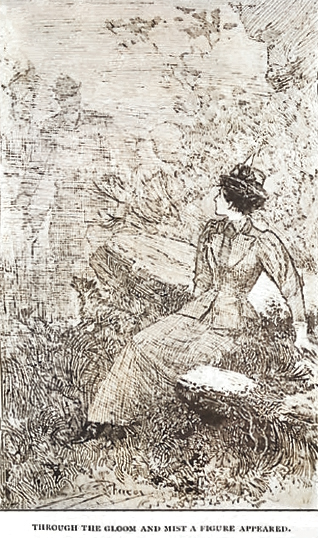
THROUGH THE GLOOM AND MIST A FIGURE APPEARED.
Instantly Rhoda roused herself, and with all her strength called out, "Help!"
In another moment, to her intense thankfulness and relief, Mr. Wallace appeared by her side.
"Miss Carlton! I am sorry to see you like this! Have you had a fall? Are you hurt?"
"Sultana lost her footing. Can you kindly help me to mount? Yes, I have hurt my foot. Oh, how good of God to send you!"
The feeling of her heart found expression in words as she felt his strong arm round her, but she could not stand, and a sharp cry of pain escaped her when he raised her up gently.
"Trust yourself entirely to me," he said, briefly, "I can place you on your horse, but whether you will be able to ride her is doubtful."
In another moment, she found herself on Sultana's back.
The position proved a painful one, and she set her teeth, determining if possible to hide her sufferings.
"Now, what are we to do?" he said, standing before her with perplexity in his eyes.
"I must get home as fast as I can."
He glanced up at her white face and firmly compressed lips, and shook his head.
"You couldn't possibly do it. Do you know that you are between eight and nine miles away?"
"I can't sit here all night," Rhoda said, trying to laugh, "I must get back!"
"I shall take you on to Rokeby Court. We are only about a mile and a half away."
Mr. Wallace's tone was determined, but Rhoda strongly objected.
"I would rather try to get home. I have no fancy for intruding upon Mr. Rokeby. I must get home, Hannah will be so anxious."
"Miss Carlton, for once you must, I am afraid, bend your will to mine." And Mr. Wallace looked up as he spoke with the sparkle in his eyes that so often came when addressing her: "I am a better judge of what you are fit to do than you are yourself. We will send a messenger over to your place in a very short time. It is as much as you will do to accomplish a mile, I am afraid, in your present condition."
He drew his arm through his horse's bridle, and walking by her side led Sultana gently on, trying to avoid the very rough parts of the track they were passing along.
And Rhoda had no spirit to resist; indeed, when every movement of the horse gave her a fresh shock of pain, she felt how right Mr. Wallace had been in his decision. Their progress was very slow, and for the most part it was made in silence. She became almost stupefied by the pain, and when at length, after an interminable distance, as it seemed to her, they reached some lodge gates, she drew a long breath of relief.
"Now," Mr. Wallace said, "we will rest here. Old Mrs. Foster has a very comfortable couch in her best parlour, and I will send for our doctor. He lives close at hand, if he is in from his rounds."
He lifted her off her horse, and carried her in, laying her gently down, and the old woman fussed about in great perturbation. Then he disappeared, and Rhoda lay still with closed eyes, wondering what poor Hannah would do at her continued absence.
It was about a quarter of an hour after that Mr. Wallace returned with Dr. Bedford.
And after a short examination, she was told that beyond a general bruising and shaking, a fractured ankle was the only serious injury she had sustained. Dr. Bedford took the ankle in hand at once, and after a painful setting, he told her he was afraid it might prove a tiresome business.
"You will have to give it a long rest."
But Rhoda did not hear; she had quietly fainted away.
And Mrs. Foster ran here and there, not knowing in the least what to do. A little brandy and some fresh air soon brought her round, and then Dr. Bedford took his leave, after having made arrangements with Mr. Wallace that she should be carried up to the house as soon as possible, and promising to come the first thing in the morning.
When Mr. Wallace came to her, Rhoda tried to smile,—"What a lot of trouble I am giving! Now I want you to leave me here for the night, just as I am. I dread another move."
"I am sorry, but it is out of the question; you see what old Mrs. Foster is like, and there is no one but her here. She is good for nothing in an emergency. You will have every comfort up at the house, my—Miss Rokeby will be only too pleased to do all she can for you."
"I did not know there was a Miss Rokeby in existence."
"She is getting old, and does not go out much. I thought you would like to know that I have sent a groom off to tell your old servant where you are."
"Thank you, that is kind of you. I must get back as early as possible to-morrow morning."
Her brow contracted with pain as she spoke, and Mr. Wallace said quietly,—
"You will be amenable to reason, I know. We will not discuss to-morrow at present."
And then he left her, but returned a short time after with an impromptu litter, upon which she was placed, and carried up in solemn state to the house. It was a beautiful old Elizabethan structure, and the lights in all the casement windows gave it a cheery aspect as they approached. She was carried straight through the large old-fashioned hall, and up the broad oaken staircase to a comfortable bedroom, where a gentle-faced old lady received her very kindly, and did her utmost to make her feel at home.
When Rhoda began to apologize for the trouble she was giving, she cut her short at once,—
"My dear, do not mention it. I am only thankful you were discovered before night set in, and it is fortunate that you were not far from us. My brother is only too glad to be of any service to you. I have heard him mention you by name before, and if I were able to go about, I should have called. Now lie still, while I see that you have something to eat. You must be nearly starving."
Rhoda could not get up much appetite for the dainty little repast that was brought her; she had a restless, feverish night, and felt so far from well, that she was not surprised when the doctor the next morning absolutely forbade her to be moved at present. And she was content now to lie still; she was almost relieved at his decision.
Later in the day, she felt brighter and more herself, and when Miss Rokeby came in to see her she asked if there had been any message from Hannah.
"Yes, the groom said she seemed very troubled at first, and wanted to come off to you then and there, but my brother had written saying there was no need for that, for he had brought you here for the present, and we would take every care of you."
Rhoda looked up quickly.
"Mr. Wallace brought me," she said; "I have never seen Mr. Rokeby."
Miss Rokeby looked puzzled.
"My brother brought you here, my dear. He found you on the moor. His name is Wallace Rokeby. Do you know him by his Christian name best?"
And then, like a lightning flash, Rhoda saw that Mr. Wallace and Mr. Rokeby were one and the same person; and the discovery nearly took away her breath, making her cheeks burn with shame and vexation.
"I have been under a strange delusion," she said at length, "I suppose it is the consequence of never having been properly introduced to your brother. I was under the impression that his surname was Wallace, and that he was a friend of Mr. Rokeby. He certainly never undeceived me."
And as she remembered all her allusions to the "harsh landlord," telling him to his face what she thought of him, and how completely she had been deceived, a spirit of resentment at the way he had purposely kept her in ignorance of his identity took possession of her. She longed to get up and leave his house, and it was only her good sense and self-control that enabled her to hide her mortification and wounded pride.
Two or three days passed, and she was still a prisoner. Nothing could exceed the kindness shown to her; Miss Rokeby was constantly in and out of the room, but when on the third day her bedroom door opened, and Hannah was ushered in, Rhoda held out her hands to her with the greatest sense of relief, and as she drew near her she laid her head against her shoulder and burst into tears.
"I have wanted you so much. They have been very kind, but I am such a stranger to them. Oh, Hannah, get me home at once, I shall never get well here! I have discovered that Mr. Wallace is a perfect fraud, and it makes me miserable to think of it."
And the next day, the doctor giving the required permission, preparations were made to take her back. Mr. Rokeby placed his brougham at her disposal, and though the distance would be a long way round to drive by road, it was the only way she could be moved.
She was carried downstairs in the morning, and as she lay on a couch in the library awaiting the carriage, Mr. Rokeby came in to see her. It was the first time they had met since the day of her accident. She could not forget her discovery, and there was a little hauteur in her greeting. But as he stood there looking down upon her with kindly interest and sympathy, she kept her wounded feelings out of sight, and looking him full in the face said frankly,—
"This is not the time to reproach you, after you have shown me such kindness, but I should like to know the reason for your concealing your identity from me. Do you think it was fair or kind to take advantage of me so?"
"No," he said, gravely, "I must plead guilty. The first night I came upon you, your old servant provoked me by her curiosity, and I resolved on the impulse of the moment not to gratify it, for I saw she was suspicious of me. I had no intention of deceiving you, but you seemed so satisfied with my personification that I had not the courage to enlighten you, for, from the way you talked of 'Mr. Rokeby,' I feared I would forfeit your friendship at once if you discovered that I was the iniquitous tyrant you were always inveighing against. I must ask your forgiveness. I feel you have a right to be very angry with me. I have to thank you for opening my eyes a little to Crake's harsh method of carrying out my orders, and I think, since I have looked into matters more myself, my tenants have benefited."
Then he added, with a dry smile, "Not but what I still think ladies do not always understand the rights existing between landlord and tenants."
"To witness, the case of the Cobbs," said Rhoda, smiling; "I am afraid you will not forget that. I suppose I must forgive you, but I shall not apologize for my plain speaking about you to your face, for that you deserved. It is the old adage being carried out—'Listeners never hear good of themselves.' You should not have put yourself into such a position."
"I have survived it. In fact, I am afraid I shall rather miss hearing my different acts commented on. I hope you will not cease writing your characteristic notes, if any fresh act of tyranny comes before you."
Rhoda's tone was dignified as she said, "I shall certainly let you know of any wrong existing."
He stood looking down upon her with the amused gleam in his eyes for a moment, but it deepened into something more earnest as he noted how even the few days' confinement and suffering had left their traces in her face.
"I wish I could have prevented that accident of yours," he said, gravely. "I am afraid the being laid aside for a time will prove a great trial to one of your active disposition."
"I dare not think of it," Rhoda responded, the light dying out of her eyes at once, "but I shall have grace given me to bear it. Dr. Bedford said I could not have my foot out of splints under two months. I might be able to get about on a crutch at the end of that time. And I have been looking forward to this spring so much."
She stopped, for tears seemed near the surface, and Mr. Rokeby said cheerily,—
"Do not look on to the future. You may get about sooner than you think, and meanwhile, if I can be of any use to you, do not hesitate to send for me."
"Thank you very much. I can't express my gratitude for all your kindness, but I shall not forget it."
FIRST-FRUITS
VERY long and weary were the days that followed, and Rhoda's faith and patience sadly failed. Even Hannah was surprised at the change in her bright, light-hearted young mistress. Sometimes her irritability and impatience would thoroughly dishearten the old servant, and then those phases would be followed by others of the deepest depression of spirits.
"I suppose I must have utterly failed in carrying out the work given to me, or I should not have been so laid aside," she said to Hannah one lovely morning in May, as she lay on her couch looking out into the sweet, soft sunshine, and vainly trying to restrain her longings to be out in the midst of it all.
"It's a fresh class you have been promoted to," said Hannah, sagely.
"If only I could know the reason for it! Just to happen when my long, trying winter's work was over, and I was beginning to see some results! Look at our Sunday afternoon services—increasing week by week; the last Sunday I took it there were twenty-five, and promises of more, now the weather is improving. And then suddenly it has been brought to a standstill. Was I getting too uplifted, Hannah? I tried not to be. I think and wonder as I lie here, and though with my lips I say, 'Thy will be done,' my heart is not in accord with it. I have been wondering whether it is the devil's doing, whether he determined to upset the work when it seemed most promising. Do you think it can be?"
"He could not work without God's permission, mum," Hannah said slowly. "The seed has been sown, and God maybe can water and tend it without you for a time."
"Oh, I know all that," and Rhoda's tone was impatient. "I know I am not wanted at present, or I wouldn't be lying here. I have heard from my uncle suggesting my coming to his house in town till I am better. I am half inclined to go. A cottage upon the moor is very pleasant when one can get about, but it is simply unbearable when you have to lie still in the same small room day after day. There! I see from your face how I shock you by my impatience. I think my illness may show me what a vile temper I have when things are not according to my liking. The last time I went to see that young Mrs. Brown, she was fretting at not getting on faster after her attack of rheumatic fever. I preached patience and resignation to her with the greatest self-complacency. It is a very different matter to preach it to oneself. Do you think any one will ever come and see me here? Oh, what sympathy I shall have with those who are lying sick after this experience of mine! I think what makes me mind it most is the insignificant cause. A sprained and broken ankle! If I felt really ill, too ill to care for anything, the time would pass quicker. But my health is capital, and I am just panting to have a good run across the moor. Don't go, Hannah; I must grumble, it does me good. Say you're sorry for me—say it's very hard."
"I am sorry, mum, but nothing would make me say the Lord is hard upon you, for I know better."
And these words brought a feeling of shame to Rhoda's heart, as she realized against whom she was grumbling.
Hannah had hardly left the room before there was a timid knock at the door, and upon Rhoda's calling out "Come in," Jess appeared, looking very shy.
"I thought you'd excuse my calling, miss, but I did want to know how you were, and mother said she thought as how you would understand."
"Why, Jess," Rhoda exclaimed, holding out her hand to her, "I'm delighted to see you. I was only saying to Hannah just now how I longed for a visitor. I really think God must have sent you just to cheer me up. Come and sit down by me, and we will have a nice talk together. You don't know how lonely I have been feeling."
Jess took a seat by the couch with a look of infinite, satisfaction. "We've missed you dreadful on Sundays," she said, "but Jim he got your message to keep the service on if possible, and so we have plenty o' hymns, and Jim he reads a chapter, and Hal Brown he led in prayer last Sunday. He said he used to think a deal of such things years ago, only he had fallen away like, and it had brought it all back agen to him. He got up and he said a few words last Sunday, and he spoke very nice. He said he was a-makin' a fresh start, and mother she set to a-cryin' when he was talkin', and we had a grand time."
"Thank God!" breathed Rhoda to herself, almost afraid to trust herself to speak.
Jess was at no loss for conversation, and had so much to tell about her home life, and Mrs. Brown and her family, who were still a great interest to her, that Rhoda could only lie still and listen and wonder, as she noted the brightness in her face at the change from the sullen Jess who had so obstinately resisted the idea at first of having a service at home.
She kept her to lunch with her. But after it was over, Jess lingered, and showed so plainly that she had something on her mind, that Rhoda asked her at length,—
"Have you anything else to tell me, Jess?"
"Yes," she said, hanging her head.
"Don't be afraid to tell me. Are you in any trouble?"
"No."
Rhoda waited. Then, with a little burst, Jess came out with,—
"I thought perhaps you'd like to know, I see it different now to what I did. I—I couldn't get out of my head what you said to me months ago."
"What was that?" asked Rhoda, gently, though her heart beat quickly as this revelation was made.
"It was the Sunday I came here, and went to sleep when you were talking to me. You said—I mind the very words—
"'He died for you, He loves you, and He wants to have you in His fold.'
"I couldn't get them out of my head, and I was miserable, and when you gave up having me here on Sundays, I said to myself it was no use tryin' to be better, for there was an end of it all. And then you come and took me off to Mrs. Brown, and when I was a-nursin' her I felt if it was me I shouldn't be ready to die, and I got more and more anxious like. And then I wondered if your words were true, and I got my Bible one night when I was watchin' her, and I come across that verse in the beginnin' of Revelation,—
"'Him that loved us, and washed us from our sins in His own blood.'
"I thought over that for a long while, and I prayed every night that I might belong to them that could say that. And then, that Sunday when you told us about Naaman, I seemed to see it clearer. And last Sunday, hearing Hal Brown speak up, I saw what he had I could get, and I—I went to my little room after, and asked to be washed and taken into the Fold. And, miss, you don't know how happy I am, for I feel He really has done it."
"Oh, Jess, I am thankful! I have prayed so much for you."
They talked a little longer, and then Jess took her leave.
But directly she was gone, Rhoda put her head down amongst her cushions and burst into tears.
"How good of God!" she sobbed. "How little do I deserve it! It is overwhelming, when I think of my ungrateful and impatient grumbles against Him. And all the time, He was preparing this great joy for me."
An earnest prayer for pardon, mingled with thanksgiving, went up from her heart.
And when Hannah came in later on, a glance at her mistress's softened, radiant face led her to expect some good tidings.
Only those who know the joy of seeing a careless, unawakened soul enter into the Kingdom, and receive the gift of eternal life, can realize the happiness that filled Rhoda's heart.
Hannah did not hear a murmur pass her lips for many days after, but she was not surprised when she said to her, "I have refused my uncle's invitation, Hannah. I feel I cannot leave. Jess is coming over every Saturday to have a little Bible reading with me, and practise some hymns. God is going to give me some work to do, I think, and I will not run away from it."
Rhoda's next visitor was Miss Frith. She had got some one to take her place, and though it was a considerable effort on her part to do it, she had conquered her feelings of reticence, and arrived one afternoon at three o'clock.
Rhoda, of course, was delighted to see her, and spoke to her frankly of her difficulties in bearing her confinement with fortitude and patience.
"I have failed so miserably," she assured her. "I know it is all my own fault, for God has sufficient grace for all our needs. But it is a fight with me, and I thought at one time I had got past fighting. I think it shows one how much hidden depths of sin is buried within us; it only needs certain circumstances to bring it out. I remember, when you were laid up, I could not understand your restlessness; but you were a saint compared with me!"
"Ah, no," Miss Frith said, gravely. "You are of too bright a disposition to be as soured and rebellious as I was."
"Indeed, you don't know me. I feel I could fling my cushions at Hannah's head, sometimes, in sheer temper. I have never been patient, and I think I have had my own way pretty much through life. Even in my work here, there is no one who hinders or opposes me. It is the first real check I have received, and I am beginning to see now that I have had a lesson set before me that I sadly needed to learn. But I won't talk about myself the whole time. How is your sister?"
"She has been rather poorly the last week or two with a bronchial attack. I don't think so much of that, as she has often had them before, but she seems so depressed with it. She says she knows she is going to die, and that isn't like her."
"I am sorry. Excuse my asking you, but have you ever spoken to your sister on serious subjects?"
"Never," said Miss Frith, setting her lips together firmly; "it's the life, not the lips, must teach. I don't approve of preaching."
"There is a verse that has been a great help to me in my life. I wonder if I may give it to you. Would you mind handing me my Bible? I should like to read it to you. It is in Isaiah, and the marginal reading is so striking, I think. Here it is:
"'Ye that are the Lord's remembrancers, keep not silence.'
"I remember when it first struck me. It seemed to come as an inspiration. Don't you think it means we must testify with our lips?"
Miss Frith did not answer.
"I know I am not as old a Christian as you, but it seems to me that God does use us again and again as His mouthpiece. I could tell you of one quite lately who has been truly converted, I hope and believe. Some words of one person first set them thinking; God continued the work. But they were brought to decision by the words of quite an ignorant man, who was testifying in his simple way of what the Lord had done for him. Don't you think we may miss opportunities by keeping our mouths shut?"
"I think," said Miss Frith, with deliberation, "if a person is anxious to hear, then is the time to speak. My sister would neither care nor understand, and least of all would she listen to me. If you were able to come and see her, it would be different—she's always asking after you. Do you think you could manage it soon?"
"I will if I can, but I wish you would try. Will you read her a verse or two from the Bible?"
Miss Frith shook her head, and changed the subject.
Rhoda kept her to tea, but when she was wishing her good-bye she put her hand on her arm gently, and said, "Don't be angry at my persistency.
"'Ye that are the Lord's remembrancers, keep not silence.'
"Think it over, won't you? And send me up word how your sister is by Jock when he calls for my letters."
Three days after, Rhoda was startled and shocked by the tidings of Mrs. Thatcher's death. She had suddenly taken a turn for the worse, and died one night, when only her sister was with her. Rhoda longed to go down and offer comfort and sympathy to Miss Frith, but this Dr. Bedford forbade her to do, so she had to content herself with writing.
"Now, I wonder," she said to Hannah, "if there was opportunity of speaking to her; she seemed quite laid upon my mind when Miss Frith was here. I suppose no clergyman was sent for. I do so wish now that I had tried to reach her more. I don't think I ever found it more difficult with any one than with her."
There was no word or sign from Miss Frith, but knowing her silent, reserved character, Rhoda was not surprised, and for the time being she was kept in suspense.
Other people came to visit her in her convalescence; Miss Montague came several times, and certainly enlivened her by her flow of conversation. And one day Miss Rokeby came over in the brougham, accompanied by her brother. They had been very kind in sending over books and flowers, and occasionally a present of game, but Rhoda felt that Miss Rokeby's visit had cost her some effort, and appreciated it accordingly.
"My dear," she said, on leaving, "I think you have a charming little retreat, but you ought not to be living alone here. I do not want to be curious, but I cannot help wondering what has induced you to come and bury yourself alive on this moor. If you want to work, there is plenty of scope in the large towns and cities all over England. Our hard-worked clergy are always calling out for workers. Is not that more natural and fitting a sphere for you to be engaged in?"
"I know most people think so," rejoined Rhoda, earnestly, "but the people in the towns live in a blaze of light compared with the country people in such parts as this. Workers get in each other's way, and one denomination hinders the work of another. I have talked it over with my brother, who is a curate in the East End of London, and though of course workers are wanted everywhere, I do think the country wants them most. Christians always congregate in towns; they want scattering; and I determined not to form one of their number. It always seems to me that the ground in the town is over-tilled, whilst many parts in the country lie fallow and waste."
"What is your work here?" asked Miss Rokeby, with interest.
For an instant Rhoda hesitated; then she said simply, "Trying to make people see and believe the reality in religion, and how it can become part and parcel of our everyday lives."
"But that is the work of the clergy."
"There are no clergy here. No minister of any denomination visits the small farms about the moor."
Mr. Rokeby had been listening in silence, but now he said, "And how is the Sunday service getting on? I hear grand accounts from Brown, who goes to it. I believe he will end by being a preacher of some sort before long. Since his wife's illness, he has come out in quite a new light. I was having a chat with him the other day in the wood, as he was cutting down some trees, and he turned round and asked me a very pointed question as to my spiritual state. Do you train them to preach, Miss Carlton?"
"No," she said, meeting his quizzical glance very gravely, "but I suppose those words are true,—
"'Out of the abundance of the heart the mouth speaketh.'"
There was no more said, but as Miss Rokeby left the house, she said to her brother,—
"It is a strange life for a young girl, and such a good-looking one, too! A vein of eccentricity in her nature, I suppose. I wonder her relatives allow it."
"A more wholesome life than pining in useless luxury for occupation, or steeped in the frivolities of town dissipation," responded her brother, drily.
A WARNING
"GOOD morning, Miss Frith. May I come in? Are you very busy?"
It was Rhoda who spoke, and she was mounted on Sultana outside the post-office. It was her first ride since her accident, and greatly had she enjoyed it.
Miss Frith looked a shade more worn and stern, but she came out at once and helped her to dismount, calling a small boy to hold the horse whilst she led her into the back sitting-room, which looked strangely empty without the familiar figure in the arm-chair.
Rhoda took hold of her hand when she was seated. "Now tell me, if you can bear to speak of it. I have been praying for you and thinking of you so much lately."
"I can believe that. You know I am not a good letter-writer, and one can't write about the thing dearest to one's heart. I will tell you all I can; I should like to."
Miss Frith paused; then she said: "I never can thank you enough for speaking to me as you did that day. I came back, and all the evening those words rang in my ears,—
"'Keep not silence.'
"She did not seem to be any worse, and her breathing was not so alarming as I had heard it before, but her spirits, as I told you, were very low, and she kept saying,—
"'I shan't get over this, Susan.'
"I tried to cheer her up. But the next morning, when she kept on at the same refrain, I said to her,—
"'Well, Lucy, if you don't get over it, what then?'
"She shivered, and as I had broken the ice, I went on, 'If you know what it is to commit your soul to God's keeping, you need have no fear; you'll be only going home.'
"'I couldn't,' she said; 'I've wasted my life, and it is too late.'
"I took my Bible up, and picked out a verse here and there, to show her that she had only to come to the cross as a sinner. She listened eagerly, but only shook her head when I asked her to pray. So I—I had a bit of prayer with her myself. I felt easier in my mind after.
"And then the next day, in the afternoon, she was taken much worse. I sent for the doctor, and he came and did all he could, but I knew then she was sinking. Just about twelve that night, she seized my hand.
"'The blood—' she gasped. 'Say it.'
"I repeated,—
"'The blood of Jesus Christ His Son cleanseth us from all sin.'
"She nodded her head, and those were the last words she said. I can't help hoping she saw the truth before she went, but I don't think I should ever have forgiven myself if I hadn't said a word to her. Poor Lucy! She was always spoilt by every one of us. I dare say, if I had been different, I could have had more influence with her."
Miss Frith's face quivered a little as she finished speaking.
And Rhoda said gently,—
"It will be a great comfort to you to remember that God's own words were the last on her lips. I am so glad and thankful you had the opportunity of speaking."
"I miss her dreadfully," Miss Frith continued. "I sometimes think I won't stay here, but then I must get my living somehow."
"I should be sorry for you to leave. Have you no relative to come and stay with you?"
"None. I am best alone."
Rhoda stayed some little time, and resolved to come down pretty often to try to cheer and comfort the lonely woman.
As she was riding home, she met Mr. Rokeby, who turned back and rode for some distance with her.
"I am glad to see you out again. How is the foot?"
"Getting on nicely, though I cannot stand on it yet. I don't know what I should do without Sultana."
"She has proved a good investment on the whole. And are you scouring the moor, and visiting all your old friends again?"
"I hope to do so, but this is my first day out."
"I have some new tenants that I thought you might like to visit. They have taken the Cobbs' place. When you are over in that direction, you might see what you can make of them. The father looks like a gaol-bird; he has two wild slips of girls; the son is the most presentable of the lot."
"They do not sound promising," said Rhoda, with a smile. "Do you know nothing of them?"
"I know they have been out to America, and not long been over here. He says he knows how to farm, and has some capital to start with. As you know, it is a tiny place. I thought perhaps you might get an influence over the girls. The son has got work on the line. There is no mother."
"I will certainly go to see them as soon as possible. Thank you for telling me about them."
"Are you going to recommence your Sunday service again?"
"I have promised to go over next Sunday."
"Miss Montague informed me that she was sometimes one of your audience. What do you make of her, I wonder?"
"I like her very much," Rhoda replied simply.
He smiled. "You are on good terms with every one here. Even that silent postmistress brightens up at the sound of your name. How do you manage to ingratiate yourself into these people's good graces?"
"I don't know. They have all welcomed me most kindly whenever I have been to see them. I haven't met with any disagreeable people here yet."
"Present company excepted? I did hear I was very disagreeable once."
"So I used to hear, but though I have not yet personally experienced it, I should not wonder if you could be."
"That is not the answer I expected. Cannot you comfort me with the assurance that 'you like me very much'? You have not known Miss Montague as long as you have known me."
"I have only known Mr. Rokeby for a few weeks. Miss Montague is a much older friend."
"I am afraid you will not forget the past, Miss Carlton. It is not generous of you. You were much kinder to me when I was simple Mr. Wallace."
Rhoda skilfully changed the subject.
But as he left her, he said,—
"Do not be surprised if you see me stealing in and taking a back seat in the Tents' kitchen one afternoon when you are speaking. I do not see why I should be excluded from all good things."
"The man is getting troublesome," muttered Rhoda to herself, with knitted brows, after they had parted; "I did not think I should have to deal with any of that sort up here. He seems to consider my work as child's play, a perpetual source of amusement to him. I wish he would go abroad, and leave me alone."
She came across one of the girls he had mentioned just as she was reaching home. A handsome, dark-haired young woman she was, with a shawl lightly thrown over her head, and a pile of faggots slung across her back. As Rhoda passed her, she looked up at her and returned her earnest gaze with a saucy laugh.
"Hope you'll know me again, my lady."
"I beg your pardon," Rhoda said at once; "I was wondering if you were one of the fresh arrivals that I have heard about. Have you taken a little farm that used to belong to some people of the name of Cobb?"
"That's the ticket, though it seems folks are very spry on new-comers, if you spot us so soon."
"I live on the moor myself," Rhoda explained gently, "so I know most of my neighbours. May I come and see you one day?"
The girl hesitated; then she said, "Father will be out to-morrer—if you come then, I don't care."
"Very well, then, I will come. I wonder if you will get as fond of the moor as I am! Look at the shadows of those clouds crossing the hills."
And Rhoda turned her radiant face to the blue distance beyond, where the sun was shedding its last rays before sinking into its golden bed.
The girl looked at her, not at the hills, and a curious expression passed over her face; then she laughed.
"This style of country don't suit me, though it do give one breathing space. London is the city for me, or New York."
And then, setting off at a quick run, she began to whistle "Yankee Doodle"; whilst Rhoda put up a prayer that this fresh acquaintance might be influenced for good.
The very next morning, she had the following note from Mr. Rokeby:—
"DEAR MISS CARLTON,
"Please do not go to see the people I mentioned to you until I have
seen you again. I will give you reasons later on.
"Yours sincerely,
"W. ROKEBY."
"Now," said Rhoda emphatically to herself, "I will not stand this. I am not going to have him arranging whom I shall visit and whom I shall not. He is very fond of laying down the law, but I will not place myself under his instruction. It is like him, this note—cool and peremptory; it is quite sufficient to issue a command without giving any reasons for doing so! And of course this means that he is coming to see me about them, and I will not have him visiting me here. Go I shall, most certainly! The question is whether I shall answer this or not. I think I shall take Hannah into my confidence."
Hannah was called in, but did not strengthen her young mistress in her resolve.
"They may be a bad lot, and not fit for a lady to visit," she said.
"Nonsense, Hannah; what harm could they do me? I promised the girl to go. She said her father would be out, and I never break a promise if I can help it."
Hannah looked doubtful.
"It is only kindness on Mr. Rokeby's part, mum; he must feel they aren't the right sort of people to visit, and as he himself suggested your going to them, I can understand his writing to warn you against them now."
Rhoda's head was moved a little impatiently.
"Kindness! I don't want kindness from him. He is nothing to me, nor I to him. If he once begins interfering with my visiting, there will be no end to it. I will not allow him to have control over my actions. No, I will not get angry about it—it is not worth that—but the fact is, Hannah, I do not wish to become on intimate terms with him. I fear I have been too friendly, and the less we have to do with each other the better. I think I will answer this note after I have been over this afternoon."
Hannah said no more, but walked into the kitchen, and there began muttering to herself, as was her wont when somewhat perturbed.
"She will treat him as she has treated the rest of them. She sees now, I expect, what I've seen for some time—he shows his admiration in the very way he looks at her. I wish she weren't so masterful. I should like to see her comfortably settled in a home of her own, and Mr. Rokeby and she would make a splendid couple. Still, if he is not religious, it would be a terrible thing for her; and it's difficult to say if she mayn't be doing right by nipping it in the bud. But he is a kind, open-handed gentleman—I am sorry she takes his friendliness amiss.
"I suppose I have been a fool, a-building castles in the air over them. She would help him so much, if it could be. I shan't forget the way he looked at her when he put her into the carriage to come back here from staying at Rokeby Court. And I knew what was a-coming when he gets his sister to come and call. I wonder now what he said yesterday to her, to make her take up this haughty way of hers again. Sometimes she's like a child, with her bright laugh and high spirits, but when she gets on her high stilts, as I may say, no one dursn't say a word!"
Rhoda had recovered her equanimity of mind before she started for her ride that afternoon. Her foot was rapidly healing, and she was hoping before long to begin walking again. She rode along slowly, enjoying the bracing air and the sweet smell of the gorse and broom that here and there brightened up the dull brown of the dry heather. Larks were rising up, carolling out their sweet songs, and, soaring into the bright blue sky, were soon lost to sight. Now and then a hawk would poise in mid air with fluttering wings, and then swiftly swoop down into the valley below after its prey; and the rabbits chased each other in quick succession across her path.
She was never nervous, least of all when she was on horseback; yet, as she came near the dwelling of which she was in search, she could not help allowing that it was in a very lonely, isolated position.
She noticed that it was now in good repair, but there did not seem to be a sign of any one about. Carefully she dismounted, tied her horse to a rough piece of fencing near, and, with the help of a stout stick she had brought with her, made her way to the door. It was fast shut, but she heard the sound of men's voices in close altercation, and after she had knocked sharply there was a sudden lull.
For some minutes she waited, then knocked again; when the door suddenly burst open, an evil-looking man, with closely cropped head and large square jaw, thrust his head out, and greeted her with a volley of oaths and curses and much abuse, telling her to go about her business and not come "spying out decent folks' dwellings. And if you show your nose round this part again, it will be the worse for you!"
Rhoda was quite staggered by such a reception, and before she could offer a word of explanation, the door was banged in her face and locked and bolted inside. She hesitated for a moment, then, very crestfallen, retraced her steps and mounted Sultana. As it was early in the afternoon, she thought she would go on a little farther, and then, descending into the valley over which she was looking, would ride back through Ashampton on the other side of the river.
She had not been so far in this direction before, and for a time the loveliness of the country around her took off her thoughts from her disagreeable experience. Presently she noticed a little cottage standing in a small belt of fir-trees, and, always on the look-out for a fresh sphere for work, she made her way up to it. A little girl of twelve or so was hanging up some clothes to dry in the yard as she approached.
"I wonder if you could give me a glass of milk?" Rhoda asked, bringing forward her usual excuse for entering the doors of a fresh place.
"Yes, miss; please come in."
Rhoda dismounted, and entered a tidy little kitchen. Whilst waiting there, she heard a voice in an adjoining room calling out,—
"Nellie! Nellie! Who is it?"
The door was ajar, and as the child was out of hearing, Rhoda stepped up, saying, "It is a stranger asking for a glass of milk. May I come in?"
"Yes, please, do."
And Rhoda, stepping in, found stretched on a bed drawn close to a small latticed window a comparatively young woman, who greeted her with a pleased smile.
"Sit down, ma'am. I rarely see visitors. It whiles away the time to see a fresh face."
"Are you ill?" inquired Rhoda, sympathetically.
"Bedridden for life," the woman said sadly. "I shall never be on my legs again."
"Oh, how sad! How did it happen?"
"It was an attack of rheumatism—rheumatic fever, the doctor called it. I was out picking worts two years ago on the moor, and a mist came on, and I lost my way and was out all night. The wet and the cold did it, I suppose. It has been a weary time here, but one gets accustomed to anything in time, and I'm reconciled now. I'm quite crippled and helpless, but I have the use of my hands, and I'm thankful for that."
Rhoda sat down by the bedside, and was soon hearing all the family history. The poor woman's husband, Richard Dyke by name, worked in some quarries a little distance off, and Nellie, their only child, looked after the house and her mother.
"She's turned fifteen, though she looks small, and ought to be in service, only we can't spare her. I don't know what we should do without her! I am able to make some crotchet mats, and she goes to the market at Ashampton every Saturday with butter and eggs, and sells my mats as well. She's a careful little maid, she is!"
"You're not a native of these parts yourself?" Rhoda asked.
"No. I've been in service all my life, and was parlour-maid to old Mrs. Hutton, the other side of Ashampton. Maybe you know her. She owns the old castle by the river, and a lot of property joining Mr. Rokeby's."
"I have never met her," said Rhoda. "I suppose you married from her house, then?"
"Yes. She gave us a handsome clock as a present. It stands in the kitchen. She often used to say to me,—
"'Jane, you'll live to repent leaving me.'
"But I don't think I have. I've a good husband."
Rhoda marvelled at the quiet patience in her tone, and told her of her own experience when laid by. From that she went on to talk about the subject most dear to her heart, and Mrs. Dyke lay still and listened, with a softened, interested look upon her face.
Before Rhoda went, she had a few words of prayer, and Mrs. Dyke said, with tears in her eyes, as she was wishing her good-bye,—
"Come again and see me, will you, ma'am? You don't know what it is to have a visit like this. We might be heathen up here—we never see a soul to speak to about such things. Clergy seem very scarce about here, and no one seems to trouble about this side of the moor. I'm not very religious myself, but I do make Richard read a chapter of the Bible to me every Sunday, and Nellie goes down to the chapel Sunday school in Ashampton of a Sunday morning. I was brought up well, and since I've been lying here, I've often thought over things, and wanted to be a bit different."
Rhoda promised to come again soon, and left the cottage with a lightened heart, feeling very thankful for the cheery opening for work. Then she made her way down the valley, crossed a low stone bridge, and got upon the high-road leading to Ashampton.
Shortly afterwards she met, to her surprise, the girl to whom she had spoken the day before, and reined up to speak to her, but she evaded her by springing across a stone wall into a field close by, calling out as she did so,—
"We don't want nought of you, and if you've been to our place, you know it!"
"You told me your father would be out," Rhoda said, a little indignantly.
The girl laughed. "Might as well try to tell a swallow's flittings as his. If he says he'll be out, he'll be in; and if he says he'll be in, he'll be out, as sure as nuts is nuts. You go your way, and leave us alone; but I warn you, if you're found spying round our place, you'll get into trouble."
And then away she ran across the field with another derisive laugh, whilst Rhoda went on her way, feeling vexed and chagrined to find that she had better have followed Mr. Rokeby's advice.
"And yet, Hannah," she said, when talking it over that evening, "I feel I was guided to that poor woman. I should never have discovered her whereabouts if I had not gone to the other place."
She sent the following reply to Mr. Rokeby that night:—
"DEAR MR. ROKEBY,
"Many thanks for your warning about your new tenants. Please do not
trouble to give me your reasons, as I have been there this afternoon,
and do not intend at present to repeat my visit. I should hardly think,
from what I have seen of them, that they are an improvement upon the
Cobbs.
"I remain, yours truly,
"RHODA CARLTON."
And Mr. Rokeby first frowned, then smiled, as he read this note, and folding it up, consigned it to a small drawer in his writing-desk, in company with others bearing the same signature.
AN AUDACIOUS THEFT
RHODA was very busy now, seeing her old friends. Robin and his wife told her how they had missed her weekly visit and reading.
"Us do be filled up and comforted by your bit o' chat," said the old man. "'Tis very instructive for we, an' my old woman hur saith t'other marnin',—
"'Robin,' hur saith, 'a'm thinkin' the Lord's Book be, arter all zaid and done, a deal more interestin' than yonner Ashampton paper!'"
Poll nodded her head sagely. "You do be as good as a passon in how you read an' explanize. If me dear departed Harry had but a heerd o' you, maybe you cood 'a turned he vrom the drink, an' kep' he alive to this day. But then there be Robin to be thought o'. Us must be thanvul he were a-tooken afore I gotted vull tired o' he!"
But none seemed to thirst for her visits so much as Mrs. Dyke, and yet Rhoda shrank from going to her very often. Her most direct way led past the house she had been warned to avoid, and she generally made a "détour" when near it, for she felt strangely nervous of encountering Tom Evans, the surly owner, again. She neither saw nor heard anything of Mr. Rokeby, and sometimes wondered what his communication to her about them would have been.
One afternoon she had left Mrs. Dyke rather late; her husband had come in, and Rhoda had been trying to persuade him to come over to the Sunday service. As she rode along, the gathering dusk made her determine to ride straight past the Evans's, for she did not want to be out later than possible. She urged Sultana on as she came near, and drew a breath of relief as she passed in safety. Lights were in the windows, and, judging from the noise going on inside, there were plenty of people within. She was wondering why they always seemed to be having company, when suddenly, as she passed under the shadow of a thorn-bush, a man sprang out, and seized her bridle with such a powerful hand that Sultana was brought to a standstill with the jerk.
Rhoda's heart beat violently. She could not recognize the figure, as his hat was well over his face, but a harsh voice commanded her to get down, and she felt the only thing was to obey.
"What do you want?" she demanded, thinking, of course, that the next thing would be a request for her purse.
But not a word did the man say; he turned Sultana's head, vaulted into the saddle, and was out of sight before she could recover from her fright.
Rhoda stood still for a moment, quite dazed, and then, realizing how utterly unprotected she was, and how easy it was to rob, or perhaps even murder her, without a chance of escape, she set off running as fast as she could from the ill-fated place. Her foot was far from strong, and she made slow progress. More than once she tripped and fell in the long heather and bracken, a hidden piece of rock or a hole in the ground being the cause. But gradually, as she got farther away, and there were no signs of any pursuer, she came to the conclusion that it was her horse and not herself that was wanted, and took courage.
Nearly an hour later, she staggered rather than walked into her cottage, and Hannah, seeing her white face and exhausted state, could not repress an exclamation of alarm. But wisely she held her tongue, gave her a cup of hot coffee, put her into an easy-chair by the fire, and took off her damp clothes herself. And Rhoda was soon able to tell her of her misadventure.
"I don't know what to do, I am so exhausted. Ought I not to put it into the hands of the police? Jock has gone home, I suppose. Oh, Hannah, I cannot lose Sultana!"
"There's not much chance of the police being able to do anything to-night, mum. I'm afraid the thief will have got clean away. It's such a benighted place. There's only one policeman in Ashampton, I do believe. Now, if only Mr. Rokeby knew of it, he would know what to do."
"I think I will go to bed. My ankle is hurting dreadfully, I do hope I shall not have to lie up again. I hardly knew how to get home. Oh, Hannah, if I have lost Sultana, what shall I do? I am so dependent on her."
"We won't talk no more about it, mum, to-night."
And Rhoda was so overcome by her fright and fatigue that when, a little later, Hannah put her to bed, she sank at once into a heavy slumber, and never woke till broad daylight the next morning.
She persisted in getting up, though her ankle was swollen and painful.
And when Jock arrived, told him she would like him to go down to Ashampton and fetch the policeman up to speak to her.
Jock stood with open mouth and eyes listening to the explanation that followed, and then started off at a quick run down the lane. His pace soon slackened, however. Such a piece of news did not often fall to him to tell, and he looked about for some one to whom he might communicate it. He had not to wait long; an old farm-labourer met him, and Jock dilated to his heart's content upon the shocking adventure that had befallen his mistress.
"Oi've never heerd tell afore on a young leddy bein' left, an' t'hoss bein' taken. It be allays the t'other way; the young leddy do be the prize!" And the old man rubbed his head dubiously. Then he added slowly, "'Ee be but a thick-headed lad. Be un the young leddy that be taken an' t' hoss coom home wi'out she?"
"Ay," retorted Jock, stolidly, "an' t'hoss have axed me to fetch the perlice, an' not baide wastin' me toime over a dunder-headed numskull!"
He quickened his pace after this, but stopped to repeat his story at the first cottage he passed, and then, as he approached the station, which was midway down the hill, he saw Mr. Rokeby riding leisurely towards it in front of him. It was too great a temptation to Jock. Racing after him, he called out, "Hoi! Hoi!" till Mr. Rokeby looked round, wondering if the boy was demented.
"The missus' black hoss be run off wi'!" shouted Jock.
He had the gratification of seeing interest at once aroused. Mr. Rokeby brought his horse to a standstill, and questioned and cross-questioned him, till poor Jock began to wish he had been more discreet. Then, after getting as much of the truth out of him as was possible, Mr. Rokeby turned his horse's head, and leaving Jock to continue on his errand, cantered up the hill again as fast as he could go, and never drew his rein till he reached Rhoda's cottage. He found her on the couch by the fire, and she turned round on his entrance with a relieved air.
"I wonder if you can help me, Mr. Rokeby?" she said, almost appealingly; for the loss of Sultana weighed heavily on her, and it was no time to stand on her dignity with him.
"I will, if I possibly can. I have heard of your loss from your boy going down to Ashampton, and that is what has brought me. Will you give me the exact details?"
Rhoda did so calmly and quietly, but as she noted Mr. Rokeby's knitted brows and flashing eyes during her recital she said, "I know what you are going to say—that I have brought it upon myself. I own I may have, and yet I believe I would do it again, if it were only to comfort and talk to that poor woman."
"You take your own way, and it is not for me to remark on it," he said gravely, almost coldly. Then he added, "May I ask with what kind of reception you met when you went to the Evans's?"
"The father opened the door, swore at me, and banged it in my face. I suppose you think that served me right! I must say I wonder at your taking such tenants—they are making our moorside quite unsafe."
"I do not think they will be here long. Was it the father or the son who took your horse, do you think?"
"Neither, as far as I could see. This was an elderly man with a short grey beard, but I could not see his face."
"Do you think he had any connexion with the Evanses?"
"I should think so. It was only just past the cottage. What do you know about them? Why did you send me a warning?"
Mr. Rokeby smiled. "Which warning you considered extremely impertinent and unnecessary, and which you totally disregarded, giving me to understand that I ought to know my place better than to venture to interfere with any of your proceedings, even though it was at my instigation you were visiting them!"
Rhoda coloured. "It is ungenerous to triumph over my fall," she said.
"I have a new agent, a clever man, and he liked the look of Evans so little that he traced him back to America, and there found that he had been imprisoned for counterfeiting coin. He was only one of a gang, and our suspicions were aroused hereby seeing several other men in the habit of shutting themselves up with him towards night. I rather think they fancy they have got hold of a nice quiet place, and will beat liberty to carry out their nefarious practices without any fear of molestation. My agent, Mr. Hughes, had kept me in the dark over this, or I would never have dreamt of asking you to visit them. When I returned home after seeing you, he told me, and I thought I could do no less than send you a line."
Rhoda was silent.
He continued, "Hughes has been employing a detective this last week to watch them, but where he was last night, I cannot imagine. He is staying at the Dragon in Ashampton, and he will be of more help to us now than this country policeman. It looks to me as if one of the principal leaders in it has scented something, and has made off, using your horse with that object."
"In which case I am not likely to see her again. I really don't know what I shall do. I am afraid I shall be perfectly helpless, tied to the house again, for I am no good at walking at present, as I proved last night."
Mr. Rokeby looked sympathetic, then said, with a little hesitation in his tone, "I wish you would do me the favour of exercising one of my horses for a short time. They are eating their heads off in the stables from want of work. And I have a chestnut which would carry you well, as gentle and sure-footed as a moor pony. Let me have the pleasure of sending her over to you till Sultana returns."
"Thank you very much," was the decided reply, "but I could not think of such a thing. No, I shall get on in time, and be able to walk, I hope, as I used to do before Sultana was given to me."
"I wish you were a little less proud, Miss Carlton."
Rhoda looked up, and met his keen, amused glance unflinchingly.
"I am never at ease on a borrowed horse," she said, "but I appreciate the kindness of your offer. If you can find Sultana for me, I shall be truly grateful."
"Will you allow me to wait for the advent of this policeman?"
"I shall be very glad for you to see him and take the matter into your hands."
And this Mr. Rokeby did, for when the policeman arrived, Rhoda had only to listen and answer the few questions put to her. He was able to give them the information that the detective had planned a surprise, and, taking several stalwart fellows up with him the night before, visited the cottage in the hopes of capturing the party whilst actually engaged in their business. How they got wind of it, no one knew, but when he arrived there, the father and daughters were engaged in the peaceable act of eating their supper, and, though they made a thorough search of the premises, nothing was found that could implicate them.
The detective was not to be balked, however, and was now scouring the moor in the hopes of coming across those that had made their escape.
"We can do nothing at present," Mr. Rokeby said. "It is possible he may trace them, but not probable."
"Sultana is not fleet of foot," Rhoda remarked; "she is an old horse, and if tried beyond her strength will collapse, I feel sure. In either case, I am afraid it is a bad look-out for me. Have you given them notice to quit, Mr. Rokeby?"
"Not yet."
When both men had left, Rhoda limped into the kitchen.
"Hannah, I feel like Job. It seems one trouble after another. How am I to get across to the Tents' next Sunday? It stops all my work again."
"Perhaps Mr. Rokeby—"
"Mr. Rokeby, of course, has offered me the use of one of his horses. But I could not take it. It would be out of the question. I wish I was a little richer. Sultana costs me a good bit to keep, and I feel I cannot go to the expense of hiring an animal from Ashampton. No, I must be content to stay quietly at home for the present. I am afraid I have partly brought it upon myself. I know that is Mr. Rokeby's opinion."
Very little causes excitement in a small country village, and Ashampton and neighbourhood were soon aware of Rhoda's loss.
The day after, Miss Montague came up to see her.
"My dear Miss Carlton, you are quite a heroine! You will be having newspaper reporters from Exeter to interview you. I am astonished to see you looking so well. The first account that I heard was that you had been robbed and nearly murdered by a highwayman. Next, that it was your horse that was murdered, and you had to run for your life; then that your horse fled in fright, and you had a hand-to-hand fight with your assailant. I am hoping to hear a true account now."
Rhoda gave it, and Miss Montague heaved a sigh of relief.
"Well, it's only a horse. Ask your brother to send you another one. It is absurd to think you will ever have it back again."
"My brother isn't rolling in riches," Rhoda said, smiling. "No, it was an expensive luxury, and I shall be better without one, perhaps. It is my foot that disables me so. When that gets well, I shall be able to tramp the country again, but until that time comes, I shall be a prisoner here, I'm afraid."
"I will come up and visit you as often as I can. Have you plenty of books? I can lend you any amount of novels, but I suppose you're too good to read those. Who is going to do the preaching up here next Sunday? I heard you had started again."
"They must get on without me for a Sunday or two more;" and a sigh followed her words.
"That is a pity. Look here; may I come up and spend Sunday afternoon with you here, and then you can preach to me, to keep your hand in? I really mean it. I will come up in a Sunday frame of mind, and will let you talk to me exactly as you choose. Is it a bargain?"
"I shall be glad to see you," Rhoda said evasively.
"Very well, then I shall come."
And after talking away for some time longer, Miss Montague took her leave, saying as she did so, "Don't be down-hearted about your horse, nor about your meeting. I always look upon you as one of the most sensible young women that I know, and I do believe it is not cant with you, but principle. Don't you believe in a Providence arranging things for you? Then isn't it all right?"
Rhoda's bright smile shone out again at this.
And with a nod of approval, Miss Montague departed.
A STRAIGHT TALK
MR. ROKEBY came and went for the next few days with news of the Evanses and their friends, but nothing could be proved against them. The real culprits seemed to have escaped, and no trace could be found of them or of the horse.
As he was wishing Rhoda good-bye at the garden gate, after the last of these interviews, he said, looking at her intently, "I do not think you will be tempted to go past the Evans's house just yet, but I wish you would promise me you will not go near the neighbourhood for the present."
"I am not likely to be able to walk so far for some time," said Rhoda, a little coldly. "I never make promises to any one."
"I only ask it for your own sake," he urged. "You have no one to look after you here. It is not safe for you to be in their vicinity by yourself. Your brothers, I think, would be the first to say so."
Rhoda smiled.
"My brothers have given me up as incorrigible, long ago. I shall not do anything rash, but when I get stronger on my feet, I shall go to see Mrs. Dyke, if I can possibly manage it."
"Will you not take some one with you? I would offer myself as an escort with pleasure, but I feel I would not be acceptable."
"No, thank you. I always like to do my visiting alone. After all, Mr. Rokeby, you can easily make the coast clear for me. Why do you keep such disreputable tenants?"
Mr. Rokeby looked amused.
"And this from the lady who has hitherto always stood up for the tenants' rights, and written furious notes to the unjust and arrogant landlord demanding justice for the oppressed! Are you aware that a landlord cannot turn a tenant out without a quarter's notice, especially when he has no ground for ejecting them?"
Rhoda looked rather crestfallen, and then laughed.
"But you should not have taken them in the first instance without more careful inquiry. We have been so peaceful and quiet up here till they came. If a system of robbing and bullying all who go their way is to be the order of things now, we have you to thank for it."
"And that is why I venture to plead with you not to expose yourself to the chance of another experience like that of a few nights ago. I plead guilty to bringing unsafe characters here. Is it too much to ask you to keep away from them?"
Their eyes met; and there was something in his earnest look that made her say hastily, "Very well! I promise to take Hannah with me the next time I go. That must content you."
"Thank you," he said simply, and left her.
"It is no concern of his what I do, and where I go," she said musingly. "It ought not to interest him in the least. I cannot bear the idea of being considered unprotected. As if I want a bodyguard always dogging my footsteps! I did hope, when I came up here, that I should have perfect liberty and independence. I wish I need have no intercourse with him."
The next day was Sunday; and, true to her promise, Miss Montague arrived early in the afternoon, and brought Rhoda a lovely bouquet of flowers.
"How are you bearing your confinement to the house?" she asked, settling herself in a big chair opposite Rhoda, and arranging the cushions to her liking.
"Badly, I am afraid," was the truthful answer. "I can't help worrying over the loss of my horse at times, but I hope I am learning my lesson. I am trying to be at rest about it."
They talked for some time, then Miss Montague said,—
"I heard to-day that Mr. Rokeby intends to go abroad again soon, with his sister. You are such friends that I should think you would quite miss him."
"I see very little of him, as a rule. Lately, he has taken this matter of my horse into his hands, but I shall be very thankful if he goes abroad. I came here to work amongst the poor, and I like to do it with perfect freedom."
"I don't believe you like men better than I do," said Miss Montague, laughing; "I wonder if you came here to get away from them?"
"I don't dislike the sex," Rhoda replied gravely, "because I have always been a great deal amongst them. I am the only girl, and have seven brothers, who all have their particular cranks and crotchets; but I never had any difficulty in living with them."
"And you don't think that they are all selfish creatures? Don't be shocked at my plain speaking. May I give you a little of my experience?"
"Do."
"At seventeen, I was engaged to be married to a young fellow in the Guards only a few years my senior, and I think we both imagined ourselves desperately in love with each other. I suppose we were both too young, and being equally headstrong, soon came to grief. I found he expected me to minister to his wants and pleasures on every occasion, and I asked him one day if this was his idea of a woman's duty.
"'Most certainly,' was his calm reply; 'after marriage, if not before it.'
"'Then you can get some one else to marry you,' I said, 'for I certainly will not be your victim.'
"And we never spoke to each other again. You are smiling, and I can smile too now, though at the time I was in misery about it.
"But a few years after, I got over it and went out to India to my father, who was a judge there. I pinned my faith, whilst there, to a barrister. We were engaged for nine months, and then I overheard a few chance remarks of his to a friend one day.
"'Do you know pretty Rose Finch is pining for you at home?' his friend said. 'I saw her just before I came out again.'
"'She ought to have got over it by this time,' said my 'fiancé.' 'I have, very nearly. When I wrote to break it off, I was desperate, but time heals such wounds. You see she hadn't a penny to bless herself with. What could I do? A man cannot support a wife on an income that will only just suffice for his own needs.'
"'You are in luck now, at any rate.'
"'As far as pounds, shillings, and pence go, I am,' was the reply.
"You will not be surprised to hear that when we first met after that, I gave him his 'congé,' and my faith in genuine affection was shattered again.
"I suppose it was foolish of me to trust another man, but I did, and this time it was a London doctor, who was an earnest worker, a philanthropist. I really believed in that man, and began to feel interested in better things. I must tell you this was after my father's death, when I was making my home again in England. We were within a few weeks of our marriage, when a crash came in the company in which most of my money was invested.
"'What a mercy,' I said to myself, 'that it will make no difference to me! My future husband is not mercenary, as he has often assured me his feelings would be exactly the same if I did not possess a penny!'
"And knowing that he was enjoying a very fair income, I went cheerfully on making preparations for our wedding. The week before the day that was fixed for our marriage, I received a note from him to the effect that he was in great trouble, as he felt more and more how unsuited I was to help him in all his good work; he had been fighting with his conscience for weeks, but he dared not marry me without telling me of his scruples and doubts concerning our union, &c. I needn't tell you more. It was sickening cant to me; all his conscientious motives were laid bare by his sister telling me of the awful state of mind he had been in since hearing of my loss, and how impossible it was for him to contemplate a marriage with a penniless girl! What do you think of my experience of mankind, Miss Canton?"
"I think you have been unfortunate, and I feel very sorry for you."
"You need not. I have got over it. I am afraid I flirted with lots of men after that, but never was so foolish as to lose my heart to any; and I soon discovered that my reduced income made a great difference in my attractions. I have not become soured with it, only I have learnt to live my life happily without men, and you will be wise if you do the same."
There was silence for a few moments, then Miss Montague said,—
"Now, are you ready to give me a Bible lesson? That is what I came for, you know, not to talk gossip."
"Shall we read a little together?" Rhoda said, putting out her hand for her Bible, which was always close at hand, and breathing an inward prayer for guidance as she did so.
Miss Montague's eyes twinkled ominously, but she took a Bible that was offered to her in silence, and then Rhoda suggested reading part of the seventeenth chapter of Jeremiah. When they came to the fifth verse, Miss Montague looked up.
"I don't mean to be irreverent, but may I say of the first part of this verse that 'them's my sentiments'? Did you choose it 'à propos' of our talk just now?"
"No, I did not remember the exact words. It only seems to give us two wonderful pictures—light and darkness—winter and summer—and since I have lived on the moor, I can picture the desolate scene in the sixth verse so. Shall we read on?"
They did so; and then Rhoda said softly, "It seems to me such a wonderful contrast, that one wonders, if we believe the reality of it, that we can put ourselves under the curse and not under the blessing. And the curse is not on the outwardly immoral and ungodly, only on those who place their confidence in themselves, whose hearts are out of the Lord's keeping."
"You are giving it to me hot and strong, with a vengeance," murmured Miss Montague. "I did not know you had me up here to curse me!"
But her eyes were scanning the page intently as she spoke.
"Anyhow," she added, "my experience is not at all that of the sixth verse. I'm a very happy person, in my way, and I don't feel I'm living in a parched land at all."
"Don't you think the soul may be in a parched land, though the body may be in prosperous circumstances? Now, shall we look at the eighth verse? Isn't it a beautiful picture of a happy life; like a tree sucking in moisture underneath and out of sight, having an inexhaustible fountain to feed its growth, quite independent of all outside means, so that in hard, difficult times, when others around would be withered up with blasts of adversity, this one would stand fresh and beautiful, never ceasing to yield fruit for its Maker?"
Miss Montague knitted her brows. "You go on too fast for me in your eloquence. I don't think the verse says all that. 'Shall not see when heat cometh'—what does that mean, may I ask?"
"Doesn't it mean that we shall not notice the troubles that would naturally distress us? It is an Eastern image, and I suppose the blazing waves of heat are to be dreaded for most trees there, when there is so little rain to keep them cool."
"Go on."
"I like to put another verse with this. Shall we turn to it? It is the third chapter of Habakkuk.
"'Although the fig-tree shall not blossom, neither shall fruit be in
the vines; the labour of the olive shall fail, and the fields shall
yield no meat; the flock shall be cut off from the fold, and there
shall be no herd in the stalls: yet I will rejoice in the Lord, I will
joy in the God of my salvation.'
"The first half seems such utter poverty, doesn't it? The last as rich as any one can be! It is a case of leaf being green in the blazing heat, of not being careful or anxious in the year of drought."
"Then what a trifle the loss of your horse must be!" Miss Montague said mischievously.
"It is," said Rhoda, with shining eyes, "when I get to verses like this. That is where this Book is such a comfort. A verse or two like these seem to lift one up altogether out of the Slough of Despond. It makes me feel ashamed of my groans over my small troubles. I know I am a bad practiser of what I preach, but I am only a beginner in God's school, and when I look up such passages as this, it is a splendid tonic. I chose this chapter quite as much for myself as for you. I am so fond of it."
"I don't think I have ever read or heard those verses before. Now, go on with your description of a Christian's life, and see if you cannot make my mouth water!"
Rhoda was not shocked with the apparent flippancy of tone. Her heart was longing after the bright, worldly little woman in front of her, and she said most earnestly,—
"Oh, how I wish I could, Miss Montague! But it is the Holy Spirit who will give you that longing. I have only experienced the reality of it myself for a few years. Soon after I left school, I began to think seriously of life; and for a long time I seemed to be seeking after light which did not come. I hardly know when I found it. It was the Bible showed me Christ, and I saw at last if I took Him as my Saviour, I took all the riches of heaven with Him. I don't think any one can describe the deep, restful satisfaction and joy it is to live with Him and for Him every day. Nothing—no one—can mar the peace that passes understanding, that keeps our hearts and minds through all that comes. I suppose it is only by looking back to our former life that we see how intensely barren it was in every way."
Miss Montague laid her head back on the cushions, and watched Rhoda's glowing face as she spoke.
"You are an enthusiast," she said; "some people would tell you all this was a dream or a fancy. But I'm not sceptical myself. I believe you have something that I have not, and I have been secretly envying you for that possession for some time past, let me tell you. I am going to quote Bible words:
"'Almost thou persuadest me to be a Christian!'
"'But,' and this is a very big 'but,' I tell you frankly, if it entails my going into dirty houses in Ashampton, and visiting the sick and the poor, and the loathsome and the vile, I cannot, and I will not, do it! Now then, what have you to say to me?"
"You would do anything and everything for Him, Miss Montague, if you once came to Him and knew Him!"
"But don't you see this prevents my 'coming to Him,' as you term it?"
"I suppose it may do so. I think if you were to have a sight of your own heart, as I had, and realize that for living away from and rejecting Christ, God's wrath is daily and hourly over your head, that would prevent you from weighing your soul's salvation with your own momentary case and comfort."
"Now, that is hitting out very straight! I think I have had enough for to-day. I will think it over. Don't I hear the clattering of tea-cups in the other room? Am I going to be rewarded by some tea?"
And when Hannah came in a few moments after with the afternoon tea, Miss Montague looked up laughingly into her face and said, "I have had my powder—I took it well—and now it is over, and here is the jam!"
As she took her departure a little later, she said half-seriously, half-comically, "We have come to very close quarters this afternoon, but I don't know that I should care for a repetition of it. So you must give me your word before I go that you will not attack me again on the same subject till I give you leave. I will not be bullied into it, and though you have not badgered me much yet, I am always in fear of you, especially if you think you see signs of my coming round. I know what you good people are like! Promise me that you will leave me alone."
Rhoda could not help laughing, and Miss Montague joined her. "I certainly promise. I did not start the subject this afternoon, remember."
"No, I brought it upon myself. I wanted to hear your side of the question, that was all—to see how well you could plead for your cause—and you have not done badly. Good-bye! I hope your foot will be better soon."
"If I cannot speak to her, I can pray for her," said Rhoda to herself after she had gone, "and God can speak Himself, and convince her of her need. I don't feel as if this afternoon has been wasted. It has been different kind of sowing, that is all."
TOM EVANS'S END
A FEW weeks later, and Rhoda was able to walk with very little difficulty. She was not often indoors now; her garden was her great delight, and most of the morning she and Jock would be busy there; in the afternoon she would be over the moor, calling on those she knew, or trying to make fresh acquaintances amongst the outlying cottages and farms.
One afternoon, on her way home, she was passing some of the large boulders of granite that here and there appeared in the midst of the heather and bracken, when she fancied she heard some moans. Tartar began to sniff suspiciously along the ground, and suddenly his sharp bark from behind one of the rocks told her he had discovered something. In another instant she was standing beside the prostrate form of Tom Evans, lying partly underneath a heavy piece of stone that had evidently got dislodged from the boulder above and rolled down upon him. She shuddered at the sight, knowing what injuries he must have sustained, and bending down, tried to see if she could move him from his dreadful position. And then, though partly unconscious, he turned and looked at her.
"Water!" he gasped. "I'm done for at last!"
She turned, for she knew a stream was not far off, but she had no cup in which to take it, so dipping her handkerchief in, and soaking it well, she carried it back and held it to his mouth. He sucked in the moisture greedily.
"I will go and get help," she said gently, "for I cannot move you."
"I shall be dead before help comes!" he groaned. "Don't leave me." Then a clearer look coming in his eyes, he said, "I know you, and it's Mike Carr has stole your hoss—the villain!—to carry him away from justice after making a tool of me, and not letting me go halves, as we arranged. He'll swing for it yet. Curse him!"
"Hush, hush!" said Rhoda. "Don't spend your breath in such words. You may not have much longer to live. Listen to some of God's words.
"'Call upon Me in the day of trouble, and I will deliver thee.'
"'Though your sins be as scarlet, they shall be as white as snow.'
"Think over these words; ask God for Christ's sake to pardon you. I must leave you to get help."
She called Tartar, and made her way as quickly as possible to the Tents' farm, which fortunately was not far off.
And shortly afterwards, some strong labourers with a hurdle came to the spot. Alas! They found that it was a lifeless body that was to be their burden. How long he had lain there they could not tell, but the only conjecture was that he must have dislodged a stone in stumbling along, and been crushed under it as it fell.
Rhoda felt the awfulness of his death intensely, and yet could not go home till she had seen his daughters and broken the news to them. She asked Mrs. Tent to let her have the donkey, which was willingly given to her, with the request to ride home on it afterwards, and then she rode as quickly as she could to the Evans's house. One of the girls was at the door.
"I have brought you bad news," said Rhoda gently; "have you not been anxious about your father?"
"Where is he?" demanded the girl fiercely.
And as she spoke, her sister put her head out, and behind her peered the brother, a young man with a far franker countenance than his father's.
"He has been taken to the Tents' farm. He was discovered lying out on the moor, crushed by a stone in falling."
"Is he dead?"
The question was indifferently put.
Rhoda paused for a moment, then said solemnly, "Yes, he died before help could be obtained."
"Good luck to us!" was the exclamation from the son in the background.
And Rhoda was shocked and disgusted by the callousness of it.
"Will you not go to the farm?" she asked, addressing herself to him.
"Suppose I must," he muttered, and he stepped out of the doorway as he spoke—a great, tall, broad-shouldered young fellow. Coming up to Rhoda, he said, "I see I've shocked you, miss, but if you knew our past, you would not wonder. For these last five years, I've bin tryin' to earn a honest livin'; I've got taken on the railway here, and it's as much as I've bin able to hold it, since we've bin put under a ban! Seems to me most folk 'll lend a shoulder to push a chap down, if they can, and it's precious hard to hold up against them!"
With that he strode off, and Rhoda was just about to speak to the girls, when they suddenly darted in and banged the door after them, and turning round, to her surprise she met Mr. Rokeby's grave gaze. He had ridden up quietly, and she had not noticed his approach.
"You are not alone?" he questioned gravely.
And Rhoda, with a quick resentment of his tone, replied coldly,—
"Yes, I am, and I am going home immediately."
He bowed stiffly, and moved aside to allow her to pass on.
Only Rhoda, ashamed of her momentary pique, said, "I suppose I must offer an explanation, as I have broken my word to you, but poor Tom Evans is dead, and I came to tell his daughters so."
"Dead! You don't mean it! That will settle the business I have come over about."
Rhoda gave him the facts of the case.
He listened, and was shocked at the circumstances in which the man had died, then remarked, "In one way it is a great relief to my mind, as this will enable me to get rid of them before I go abroad."
"Why? Will you not give the young fellow a chance, if he is desirous of keeping on the cottage? He is employed in honest work, and it may mean ruin to him if you turn him adrift."
"I thought you were longing for me to turn out the whole family, neck and crop?"
"Not now that the father has been removed."
"They will only be pests to the neighbourhood, I expect."
"I think not. I have hopes of reaching the girls now."
"I will see," Mr. Rokeby said, looking at her meditatively; "of course, I must have an understanding with this son first. I expect to leave this part next week, but I am sure my present agent will prove perfectly capable of looking after things while I am away, and if you have any pet project in your head for the benefit of any of my tenants, he will forward such to me, and I will try and meet with your wishes as much as possible."
This speech jarred on Rhoda. She made no reply.
"I must go over to the Tents' directly," he continued. Then, looking at her earnestly, he added,—
"I think this may be our last meeting, Miss Carlton. I may be two or three years abroad, and will most likely find you flown by the time I return."
"I do not think that is likely," said Rhoda, meeting his gaze frankly as she spoke. "I hope Miss Rokeby may benefit by the change. Please give her my best wishes for her journey. Good-bye."
Only a hand-shake, but Rhoda felt the grip for long after.
And as she rode slowly away, Mr. Rokeby stood silently watching her out of sight, then with a little sigh, he went up to the cottage, to say a few words to the girls before he went on to the Tents'.
As Rhoda returned home, the remembrance of the awful death of Evans weighed heavily on her spirits, and not even the hopes of gaining an entrance to the cottage could lift the depression that seemed to creep over her.
Hannah listened to all she had to tell her with her usual grave interest.
"It's been almost too much for you, mum," she said; "I will bring you a cup of tea at once, you look worn out."
"See that Jock looks after the donkey well," said Rhoda, sinking into a chair; "Mrs. Tent said the boys would call for it on their way to school to-morrow."
Then, for a few moments after Hannah had left her, she gazed dreamily out of the open window in front of her.
"I am glad he is going," she said, half to herself. "I shall have no fear of meeting him too often now, and shall be able to give up my whole thoughts and time to the work here. I must try to be content to sow the seed broadcast, and wait patiently God's time for it to spring up and bear fruit. This spring has shown me one tender sprout springing up, and I shall pray and hope for others. Does Mr. Rokeby imagine I shall tire of my life here? Yes, I am very glad I have said good-bye to him, very glad!"
Yet a sigh that was like the echo of the one breathed by Mr. Rokeby a short time before, followed her emphatic words.
Jess was a great joy and comfort to Rhoda. Every Saturday she came over for a little private Bible reading, and her Bible was becoming more and more precious to her, whilst her religion was shaping and altering her life, so that all who knew her marvelled at the change.
The following Sunday, when Rhoda went over to the Tents', she saw to her surprise and delight young Evans. Jim Tent had given him a warm invitation to come, when he attended his father's funeral with him; and though the young fellow occupied a back seat, and looked ill at ease, when Rhoda began to speak upon the story of the Good Samaritan, his eyes never left her face, and he listened with eager attention. She had a word or two with him afterwards, and expressed her hope that he would be able to continue to support himself and his sisters in the neighbourhood.
"I'm agoing to try," he said with quiet determination, "and ye'll have no fear of being turned out if ye comes to speak with the girls."
This sounded promising, and Rhoda thanked God for the opening.
"You had one in the audience that maybe you didn't see, mum," said Hannah, when walking home with her young mistress.
"Who?"
"Mr. Rokeby. He slipped in late behind you, and took a seat at the door. He was gone directly the closing prayer was over."
"I am glad I did not see him," said Rhoda, after a minute's silence, "but there will be no chance of that being repeated. This is his last Sunday in England for a long time to come."
"He got the message anyhow," said the old servant, "and he looks like a gentleman that may be seeking the truth, I always fancy."
Rhoda made no reply.
Her life was very quiet and uneventful for some time after this. Several times she had tried to reach the Evanses, but the girls were always out. She had suspicions that they locked themselves in upon seeing her approach, but of this she could never be sure. Ned Evans, their brother, did not appear again at the Sunday service for a long time, and then every now and then he would slip in, and take himself off without a word after it was over.
The spring slipped by, with its keen east winds and bright sunshine, and the days lengthened out, and the sun began to beat fiercely down.
Rhoda came in hot and tired one morning from a good two hours' work in her garden.
"Hannah," she said, sitting down on the low window-seat in the kitchen, "do you know, I am very discouraged about my plants. When I look at the wealth of flowers that Miss Montague lives amongst, and then consider the result in my barren plot of all these months of work, I begin to doubt whether this bleak moor-ground will yield anything that will repay me for all my trouble, and also whether I am fitted to be a gardener at all. I dare say it is my inexperience at it that has made it such a failure."
Hannah smiled.
"A garden takes time, mum; it doesn't yield much the first year. You have to fight against difficulties that Miss Montague knows nothing of—the violent storms of wind and rain without any trees or buildings to break its force. And of course the ground is poor; hard and stony it is, very; but you've been enriching it, and it will bear fruit. Seems to me," went on Hannah, thoughtfully, "that every beginnin' takes time to be a success."
"You are right," Rhoda said, looking up with sparkling eyes; "and my garden is only another picture of the spiritual seed I am trying to sow up here. With the exception of Jess, I have seen no signs of it springing up and bearing fruit. But I suppose I must go on, and not be discouraged."
"'After many days,'" said Hannah, softly; "and sometimes the slowest work is the surest."
"To witness," put in Rhoda, "those seedlings that started up so quickly in the garden a month ago, and made me think that I should have a gay bed of flowers in no time. The frosts bit them, and the wind beat them down, and in a fortnight, they were dead. I don't think I wish for crowds to be converted, and a wonderful revival blessing, but after eight months' work, don't you think we ought to see more of these people around us coming out boldly on the Lord's side?"
"I think the Lord will let you see them when He sees fit. Meanwhiles, He may be carrying on His work underground. There's a deal goes on with a seed before it shows itself to us."
"I wish I had your patience and faith, Hannah. What should I do without you? You cheer me on so often. Do you think that God cannot give some of His workers such success as others, because they are too liable to be uplifted? I sometimes think it is so with me. I suppose, if I had had my way, I should have thought myself a wonderful creature, and had my head turned by success. Well, I must be content with small things. My garden will just supply our needs in the way of vegetables—for that I am thankful. I must not expect to compare mine with Miss Montague's. And I have a few flowers coming on in it. Then as to our spiritual field, we have had opportunities for sowing; and, after all, casting in the seed is, as you often tell me, perhaps the chief work. If I could get at those Evans girls, I should be happier. But the opening may come yet."
TWO LITTLE STRANGERS
RHODA was a little puzzled a few days after this to receive the following letter from her brother Herbert:—
"MY DEAR TABBY,
"I wonder if you could possibly take in two children for a fortnight.
They are recovering from influenza, and a breath of your moor air
would set them up in no time. I do not think they will give much
trouble, their parents are respectable, but they are genuine East End
children—girls of eight and ten. We will pay their fare and board. I
thought you might like the chance of a bit of work. You cannot find
very much to do up in that deserted spot, and it would be a real
charity. Send me a wire on receipt of this, for we want to get them
off as quickly as possible, and I will send them down to you at once.
I have a longing to get out into the country myself, and later on mean
to have a try. Have you made friends with your clergyman yet? I should
like, it possible, for these children to attend the Church Sunday
School whilst with you. They have been most regular in their attendance
here.
"I lunched with Edgar the other day at his Club, and he told me about
the loss of your horse. He was in a great state of mind about you, and
vowed it was hardly safe for you to be living the life you do. I think
myself you should never go out unattended by Hannah. Why don't you ask
an elderly friend to stay with you? I know a very nice woman, a widow
lately returned from India. She is one of our most earnest workers
here, and meditates becoming one of our deaconesses. Would you like
me to suggest to her to come to you for a change of air? She has such
sound views as regards the Church that I think you would be benefited
by her society. I should be glad if she showed you how much more
workers are needed in towns; above all, how important it is for woman's
work to be supervised by the clergy. No more for now, as I am going to
evensong.
"Your affectionate brother,
"HERBERT."
"Hannah, will you come here a minute?" called out Rhoda, as she sat perusing this epistle with a pucker between her brows.
Then, as the old servant turned round, she said a little impatiently, "Isn't it tiresome! This is the only one of my letters that I did not read coming home, and now I shall have to tramp down in the heat again to send a telegram off. But still, I don't know that I could have decided without consulting you first. What do you think of this?" And Rhoda read the first part of her brother's letter.
Hannah's face did not give much clue; it wore the same grave, set expression as usual, and she answered, "It shall be just as you please, of course, mum."
Then Rhoda laughed.
"I really believe living in the country is making me become fastidious. I shall be as bad as Miss Montague if I don't take care. Honestly, Hannah, I don't like the idea of having two East End children about our snug little house. We haven't room for children; they will bring dirt and wickedness with them, give you a lot of extra work, and be a great responsibility. Mr. Herbert thinks I have nothing to do! I have my hands as full as they can be. I don't do half the visiting I ought, and now I have only my own legs to carry me, I seem to spend most of my time on the road. I haven't been to see Mrs. Dyke for a fortnight, and I ought to visit her regularly every week. No—candidly—I don't like the idea, but yet I don't think I ought to refuse them, and after all, poor little souls, it may be the making of them. Do you think we can manage it, Hannah?"
"There's the room next to mine, mum. It hasn't been furnished yet, but there's a couple of mattresses to spare, and we could soon get enough for their wants."
"Men are so unpractical," sighed Rhoda; "he never imagines the possibility of my not having room for them. His whole letter is so ridiculous, but it is just like him! Well, if you think we had better take them, I will go down to Ashampton again, and telegraph to that effect."
"Let Jock go, mum; he could take a telegram to the station."
"Ah, the station! That is not quite so far as the post-office. No, I must do it myself, Hannah. He has a lot to do in the garden to-day. Sultana has quite spoiled me for walking. Do you think I could pick up a moor pony cheap? I would even condescend to a donkey. I think I must find some way of getting about a little quicker."
"I think perhaps the Tents would help you about a pony, mum, if you think you could afford it."
"I am not sure that I can. Now I must be off. Shall I have to order anything from Ashampton for these children?"
"I think not, mum; I shall like to try and see what I can do first."
Rhoda put on her broad-brimmed hat, and calling Tartar, set off briskly for the station.
When she arrived there, she met Miss Montague, who was going for the day into Exeter, and having a quarter of an hour to wait before her train came in, was delighted to have a chat. When she heard Rhoda's news, she raised her hands in horror.
"My dear, I really shall wash my hands of you if you are going to inundate our fair, pure country with slum children. How can you take them in! I shall be afraid to come near you. They will steal all your valuables, and lead you a regular dance. You will be building a school or home for them up there before long, and our part of the moor will become a Hampstead Heath. Can't you find enough to do there without bringing London outcasts down? If you want more work, come down to Ashampton. There is no regular district visitor, and there is plenty of scope for your energies.
"By-the-by, I have made acquaintance with old Mrs. Hutton. Have you heard of her? She, like your friend Mr. Rokeby, spends most of her time abroad, but she comes here in the summer; she is too old to visit people herself, but she met some friends of mine abroad, and so wrote and asked me if I would come to lunch with her one day. She owns the old ruined castle by the river, and I discover that I am one of her tenants. She is a charming old lady, and I have regaled her with all the gossip of the neighbourhood. She is very curious to see you, and I have promised to take you to see her one day. She is one of the people about here whom you have come down amongst to teach how to live, so I thought you would be glad of an opportunity of influencing her. Will you come down to lunch with me one day next week?"
"Thank you, I will try, but I must let you know a few days later. I hardly can tell yet how much of my time may be taken up with these little people."
They chatted together a little longer, and then Miss Montague's train came in, and Rhoda began to slowly ascend the hill home again. She was tired and warm when she got in, and very disinclined after lunch to walk over to Mrs. Dyke's.
Hannah tried to dissuade her from doing it, but she felt she ought to go, as she did not know when she would have a chance again. She was rewarded when she reached the sick woman by the welcome she received from her.
"I've wearied for the sight of your face, ma'am. You do make me feel so much better by your talk, but I'm afraid the distance is too far for you to manage often."
"I miss my horse," Rhoda said, brightly; "but I will try and not leave you so long again without a visit."
She had a nice time with her, and read and prayed with her before she left. Coming back, as she was passing the Evans's, she saw the two girls in the garden.
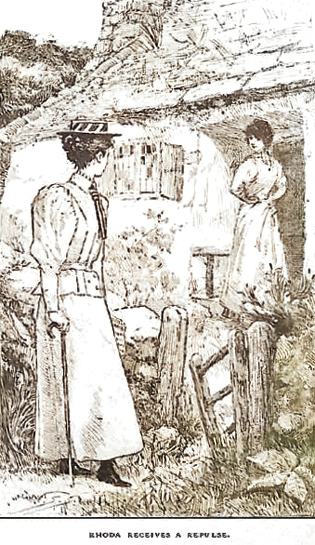
RHODA RECEIVES A REPULSE.
One of them darted in at once and closed the door, but the other stood up a little defiantly and responded to Rhoda's "Good afternoon."
"Why are you so afraid of me?" Rhoda asked, pleasantly. "I only want to be friends with you."
"We're afraid of no one," retorted the girl, indignantly; "least of all of any one in these parts. No one seems to have an idea in their heads but how to insult us and treat us like dirt beneath their feet!"
"Have I done that?" asked Rhoda, gently.
"We can't make out what you're after. If it's about your hoss, we know nought about him, and it's no good coming to try to worm out of us what never was in us!"
"I assure you I have no such intention. I was pitying you both for living here with so few friends. How do you employ yourselves? Are you fond of reading?"
"We're as fond of it as you are of asking questions!" was the rude retort. And with a mocking laugh, the girl sauntered into the cottage, and shut the door behind her.
Rhoda sighed, and continued her walk home, praying that even yet an opening might come for work in this family.
The next afternoon, the children arrived. Rhoda had received a letter in the morning to say they were coming, and she went herself to the station to meet them by the five o'clock train. Her heart was filled with pity when the two little mites were handed out by a good-natured guard. Their white, pinched faces and scared eyes made her voice doubly tender as she stooped to give them a few words of welcome.
They were poorly but neatly clothed; the youngest had a pretty, gentle little face, the eldest was evidently a wide awake little Londoner.
"She's tired, 'Etty is, the train made her feel sick. Oh my! Look at the 'ills up there, 'Etty! 'Owever are we going to walk right up there? Mr. Carlton said as 'ow we were agoing to live on the top of a 'ill. Is your 'ouse far from 'ere, teacher?"
"I think, Jock," said Rhoda, turning to the boy, who had come down with the small cart and hired pony, in case there might be luggage, "that the little girls had better drive up; they seem to have only a small bundle each."
And this arrangement greatly delighted the children.
"Mother said as 'ow we must bring 'ome a lot o' primroses and vi'lets when we came," the eldest girl continued. "'Ave you got woods and trees up on your 'ill, teacher?"
And her little tongue never ceased talking the whole way up, every now and then breaking out into exclamations of delight and surprise at the sights around them.
Rhoda took them round to the kitchen, and told Hannah to give them a good tea, and put them to bed early.
They gave less trouble than Rhoda expected, and Bessie, the elder of the two, was a handy little thing. She not only kept herself and her sister in good order, but took full charge of their room, and gave Hannah help in the housework besides.
Rhoda saw that they were out of doors a good deal.
Hetty was rather timid at first, and would not stray very far from the house.
"What a big, empty world it is here!" she said, as she stood one day with Rhoda looking down the valley, and the range upon range of hills the other side.
"Don't you like it?" asked Rhoda.
"It frightens me at first, it's so lonely. I like the flowers and the grass, but I think I should like some shops up here, it 'ud seem more 'omey!"
And Rhoda shuddered at the thought of Whitechapel shops being the child's ideal of hominess!
Every morning she had them in her room for a Bible lesson, and, in comparison with the country people round, their quickness and shrewdness amazed her.
"I know all the Bible stories," said Bessie one day; "I'm rather tired of 'em, teacher. The hinfants are taught about them. I shall be a teacher when I get bigger, and, oh my! shan't I smack 'em well if they don't learn their lessons proper!"
"I shan't read the Bible much except on Sundays when I grows up," said Hetty, thoughtfully. "Grown-ups don't read it, do they, teacher? It's mostly at schools it's taught. Our gov'ness at the day school, she don't believe it, I 'eard one of the girls say. We 'as to read a chapter through in the mornin', but we gets through it as quick as we can."
"Don't you love Jesus?" asked Rhoda, with a sinking heart. "Do you know what He has done for you?"
"He died to save us from our sins," repeated Bessie, glibly.
"And are you saved from yours?"
The child stared. "He died to save the world," she said, "and I harsk to be forgiven every night."
"But are you forgiven?"
"I hain't done nothin' awful wicked," she said, taken aback by this cross-questioning; "there was a gal in our street, and she got a prize for best lessons in the Sunday school too, she could learn that quick and easy—she got, took up by the perleece for stealing some boots, las' Friday week it was, and her father 'e was mad, 'e said 'e'd break every bone in her body if she comed 'ome again—'e gets drunk most nights, but 'e'd never steal nothin'!"
And this was the way in which most of Rhoda's teaching would be met. Still she did not despair, and meanwhile, saw with satisfaction the thin little cheeks filling out, and the pink colour making its first appearance in them.
They were a source of great interest to Jock, who listened to their grand accounts of London and its ways with open mouth and eyes, and Bessie looked upon him as "a poor hidget boy," so Hetty informed Hannah one day.
They were neither of them good walkers, and on Sunday afternoon, Rhoda had to leave Hannah at home to take care of them whilst she went to the service alone.
And so the fortnight soon slipped away. On the last day but one of their stay, Rhoda was in great anxiety about Bessie; she had strayed away from her sister, and could not be found anywhere. Tea-time came, but there were no signs of her, and both Rhoda and Hannah turned out to look for her, hoping every minute to see her little figure coming towards them.
As dusk set in, they began to get much alarmed, and then about nine o'clock they saw in the distance some one coming along, and this proved to be Meg Evans with the child in her arms.
"She missed her way, and I found her not far from us—she's dead tired, and can't walk a step." And Meg's voice, which was wonderfully softened, added curtly, "I'll carry her as far as your house. She's no light weight."
"I'm dreadful tired," murmured Bessie, "and I thought as 'ow I should 'a died soon if this young pusson hadn't come along."
The "young pusson" made no other remark until she set the little girl down in the kitchen.
Then Rhoda insisted that she should come in and have a rest before she went back. She took her into her own sitting-room, and Meg looked about her almost as curiously as Jess had done the first time she was introduced to it. Making her sit down, Rhoda asked Hannah to make them some hot coffee, for, owing to the anxiety about the child, she herself had had nothing since her afternoon tea.
"I can't tell you how grateful I am to you for bringing her back," Rhoda said; "they are going home to-morrow, and I should never have forgiven myself if anything had happened to her."
"She's uncommon like a little sister of ours," said Meg, gruffly. "I mothered her till she died of bronchitis out in America; she was just such a smart little 'un!"
Rhoda looked interested.
"Do tell me about her. Was it long ago?"
"Nigh four years. Mother died when she was born, and the child couldn't stand our rough life; it's a good thing she was taken."
Then she added, impulsively, "Don't mind our rudeness; we can't help it. We've always been treated unfair, with every one down upon us; it makes us wild with every creature we meet. My sister Vic is off. She's gone to London, to try and get into some circus riding somewhere. Vic is a wonderful horsewoman—but I'm going to stay on with my brother here. Ned has been a good brother to us; he takes after mother, and I don't mind on occasions having a visit from you. It was Vic that was so bitter, and she's gone."
"I won't come if you would rather not," said Rhoda, gently, "but I often pass your cottage on the way to a sick woman I visit, and I should like now and then to come in and see you."
No more was said.
The girl stayed for a cup of coffee, and then went.
But as Rhoda shook hands with her, she felt that it was only a question of time to gain her friendship.
"Why, Hannah," she said, "it is worth the fortnight's visit of these children to have got hold of that poor girl. I never thought she would have come into this house so willingly. I feel we owe Bessie a debt of gratitude for her escapade."
There were a few tears from the children in parting. Hetty clung round Rhoda's neck and whispered, "I will try to love Jesus and be good, and will you come to see us when you come to London?"
And Bessie asserted positively, "We'll come and see you next summer, and stay a month. Oh my! Won't mother scream to see our flowers!"
And then Rhoda sat down to write to her brother,—
DEAREST BERTIE,
I hope you will get your chicks safe and sound. They have been as good
as gold, though of course it has given Hannah a good bit more to do;
still, they have been very helpful. I hope you will not think they have
suffered from my teaching. Poor little mites! Their heads seem full
of Bible truth, but their hearts empty; is it so with all the London
children, I wonder? I could not send them to any Sunday school here.
Ashampton is too far off, and they are not like country children for
walking.
I have never answered your question about your friend coming to see me
here. I should not like it at present, and I am quite sure she would
not. It needs some one in thorough sympathy with my work here to stand
the solitude and isolation of my position. I shall be delighted to see
any of you boys—that is a very different matter. Howard has promised
to come down later on, but, truth to tell, I am rather afraid of him!
He does think so much of one's surroundings, and would like to see me
in the lap of luxury. Of course I am very comfortable, but I make my
own butter, dig in my own garden, and sometimes carry poultry and eggs
backwards and forwards to market.
You do not seem to understand that the clergy are "nil" about here.
Times may change, however. If the Rector of Abeythorpe, who has
Ashampton in his charge, were to be removed, and a more active man
put in his stead, we might see much more done. He is a very old man,
and keeps two very lazy curates, and I assure you, if I waited to
work under their supervision, I should have a very easy time of it.
The reason I came here was that there seemed such an opening for
quiet, steady work, and I have found it. I don't think I could ever
be persuaded to live in a town while there are places like this to be
found, and from what I hear, I fear there are many of them scattered
over our country. Good-bye. Isn't the difference in your work and mine
just this—you seek to bring people to church in order to lead them on
to God; I seek to bring them to God and then to church? Your motto is,
"First the Church, then God." Mine is, "First God, then the Church."
Don't be angry with me.
Your loving sister,
TABBY.
MRS. HUTTON
"I REALLY think if I were owner of such a place as this that it would not make me happier."
"I honestly confess that it would me. Look at this magnificent avenue of rhododendrons and chestnuts. Can you imagine what they must be in the spring? And yet the place is shut up nearly the whole year round. I think Mrs. Hutton only lives here for three or four months in the summer. The head gardener here is a friend of mine—his name is Jacobs, and I get a lot of cuttings from him, while he even condescends to take some of mine in exchange. I envy him his hothouses here. Sometimes I think of earning my living and going out as lady-gardener. Don't you think it would be a good idea? I could superintend well, I'm sure, and with a good staff under me, I am confident I should be equal to managing the largest garden in England. I should have a cottage rent free, and live in an atmosphere of warmth and flowers."
Rhoda and Miss Montague were walking up the avenue, to pay the promised visit to Mrs. Hutton. It was a beautiful old house, quite hidden away in its nest of fine old trees, and Rhoda was reminded of her old home as she stepped inside.
Mrs. Hutton welcomed them warmly. She was a handsome old lady, with a great deal of character, and as she took Rhoda's hand in hers, she said, looking at her earnestly, "Are you the young lady on the edge of the moor?"
"I am," replied Rhoda, with a smile.
Mrs. Hutton shook her head.
"When I was your age," she said, solemnly, "my parents would as soon have thought of sending me across the ocean in a balloon as allowing me to plant myself on a wild moor, in a house of my own, with only an old servant to look after me."
"I have no parents now," said Rhoda, a little sadly.
The old lady's face softened.
"Have you no one to look after you?"
"She has seven brothers," put in Miss Montague; "isn't she to be pitied? She does well to get away from them."
"Ah, you are a nineteenth-century young woman, with a will and a purpose of your own, I am afraid."
"I am afraid I am," said Rhoda, smiling. "I am sorry you do not like the idea of my living on the moor, but I came there to be quiet, and I am not doing any one any harm."
"Now just tell me what you are doing;" and Mrs. Hutton leant back in her chair and prepared herself to listen.
Rhoda told her, sketching some of her neighbours' lives with a tender hand, and bringing before the old lady the isolation and deadness of their surroundings, and their quick response to friendliness, and touching gratitude for any kindness shown them.
Tears were in Mrs. Hutton's eyes as she heard about Robin and his wife.
"Go on, my dear, go on. It is as good as a story."
When Rhoda paused, she was asked—
"And how do you get about to all these small farms since you have lost your horse?"
"I walk."
"But you do not go wandering over the moor all those distances by yourself?"
"I take my dog with me."
"And do you visit in Ashampton as well?"
"Not much. I cannot find time. I am friends with Miss Frith, at the post-office, and I know an old washerwoman, and the mother of the lad who works for me."
"And she comes to see me," put in Miss Montague; "I'm afraid she thinks me a hard case, but she has tackled me once or twice, and she hits out straight when she is about it."
"About what does she tackle you?" asked Mrs. Hutton, an amused sparkle coming in her eyes.
"She thinks me frivolous, sinful—not fulfilling the ends for which I was created. She wants to set me visiting the poor; and I shall not and will not do it."
"Now," protested Rhoda, "you must speak fairly, Miss Montague. I don't think such a thing has ever been in my mind, much less on my lips."
"Well, you rub me up, and make me uncomfortable, until I feel I ought to do it, which comes to the same thing."
"Will you put me down on your visiting list, and come and see me sometimes?" said Mrs. Hutton, turning to Rhoda with a smile. "I am rather an invalid, and it would be a real charity."
Rhoda promised she would, and then another visitor was ushered in, no other than the curate who generally came over on Sundays to preach.
Mrs. Hutton would not allow them to leave before tea, so they stayed.
Rhoda was rather amused at the curate's blank look of dismay as he saw Miss Montague, but she was perfectly self-possessed.
"You will not refuse to shake hands with me, will you?" she said, a little mocking gleam in her bright eyes as she spoke.
Then, as the poor man coloured furiously, offered his hand, and murmured something that was indistinguishable, she turned to Mrs. Hutton and explained with great serenity,—
"Mr. Long and I had some words one day when he came to see me. My unfortunate tongue said what perhaps had been better left unsaid—circumstances had provoked it. He generally cuts me dead if I ever meet him out of doors, but I do not bear malice. As long as he does not favour me with one of his pastoral visits again, I am quite willing to be friends."
"How is the rector?" asked Mrs. Hutton, changing the subject with dexterity.
"Very poorly; he is laid up with bronchitis again."
"It is very unfortunate, as it throws so much of the parish work upon you two young men. Can you tell me in what parish the farms along the side of the moor are?"
"They belong to Ashampton."
"And do you never visit over there?"
Her tone was inquisitorial, and Rhoda began to feel a little uncomfortable.
Mr. Long hesitated.
"Yes, some time ago, when first I came here, I used to go up now and then. But the fact is, Mrs. Hutton, it is as much as we can manage down here."
"Do you know Miss Carlton? I think she comes down to your church every Sunday morning."
Mr. Long bowed.
"It is only lately that I have discovered where you lived," he said, turning to Rhoda. "I hope to have the pleasure of paying you a visit before long."
"What days have you for visiting the poor in Ashampton?" continued Mrs. Hutton.
"I—I—well, sometimes I come in on a Saturday. It is generally the end of the week before I can manage it."
Here tea was brought in, and for the time, Mrs. Hutton's questions ceased.
Rhoda and Miss Montague left when it was over, and Mrs. Hutton said, looking at the former with kindly eyes,—
"You will come and see me again, will you not?"
"I shall be delighted," was Rhoda's reply, and she really meant it.
"I like the old lady so much," she said to Miss Montague, as they walked away; "I am quite grateful to you for taking me to see her."
"But she is a bit of a tyrant, I warn you. I am chuckling at the thought of Mr. Long now. I hope she will put him through his catechism. You know the livings of Abeythorpe and Ashampton are in her gift, and the curates are in mortal fear of her."
"I would rather be your friend than your enemy," Rhoda observed irrelevantly. "Why are you so hard upon that young man?"
Miss Montague laughed. "I can't help it. It is my evil nature, I suppose. I hate, I abominate humbug—you know I do—and he is the essence of it. He came to see me, and in the course of conversation asked me if I would not undertake a little district visiting in Ashampton. Now if he had stopped there, I should have thanked him and politely declined, but when he went on to say, in his most sanctimonious voice,—
"'I assure you, Miss Montague, we hard-worked curates have very few friends to lighten our load, and however much we may esteem it a Christian privilege to visit the sick and afflicted, we cannot overtake our work in these two parishes. "The spirit is willing, but the flesh is weak," and we cannot be in two places at once—'
"Then my wrath rose.
"'Mr. Long,' I said, 'your heavy loads and, Christian privileges and willing spirits go to the wind when tennis or a garden-party is concerned. I am neither deaf nor blind, and if you expect me to relieve you of your daily duties, whilst you dance off to this entertainment or the other, you have come to the wrong person. I like my comfort and ease as much as you do, but I am honest, and say so—'
"And he got up and walked straight out of my house without a word. I have never met him since to speak to, till to-day. I know you are shocked. I never can control my tongue—it is always bringing me into trouble. How will you like a visit from him?"
Rhoda did not answer; she was hoping in her heart that Mrs. Hutton, in her zeal, would not urge Mr. Long to visit their part much, as she felt convinced he would be no real spiritual help to those around. And then she longed for some true-hearted, earnest clergyman to come to Ashampton and live there.
"In that case," she thought, "I should not be wanted, and would move farther on."
About a week after this, Rhoda was surprised, one morning, by a small governess car and moor pony being driven up to her door by a groom in livery, who delivered the following note:—
DEAR MISS CARLTON,
When I was a girl, I used to drive a good bit about the moor in a
little concern like the one I send you. I want you to accept it as a
gift from an old lady, and not allow any feelings of pride to prevent
her from having the pleasure of giving. The pony is steady and sure,
and you will be able to ride him if you prefer it. I shall feel more
comfortable about you if I know you have a quicker and safer mode of
getting about than you have at present.
Yours very sincerely,
SELINA HUTTON.
What could Rhoda do but accept with gratitude such a present? She felt the kindness that prompted it, and knew how much she would hurt by refusing.
"Oh, Hannah," she exclaimed, after writing a grateful little note and dispatching the groom with it, "is not this just the thing I have been longing for? Come and look at it. Is it not a dainty little turn-out? Now do you know the first thing I am going to do with it? I am going over to the old Days', and I shall bring them back to tea with me. How they will enjoy it—poor old things! And I shall try if, by putting plenty of cushions in it, I could not get Mrs. Dyke out for a short drive one day. I shall be able to take so many little comforts to the people, that I could not riding. It is really very good of Mrs. Hutton, considering I am such a stranger to her, and I will not be proud, but be thankful for her friendship and sympathy."
Mrs. Hutton had indeed taken a great fancy to Rhoda, and the latter found that if she did not visit her every week or ten days, it was almost a grievance.
"Tell me all you're doing, my dear, and don't be afraid. I never chatter, as our mutual friend does, and I like to hear all—good, bad, and indifferent."
This was how she was always welcomed, and when she went away, it was always—
"And now don't you want any help? Have you no one you want to relieve, or sick to whom you would like to take any dainties? Here is my purse; let me, as I cannot work, help you by my means."
But Rhoda would always refuse this offer.
"I have no very poor about me. They are more in need of spiritual food than temporal. I will let you know if any deserving ones come to my notice, to whom relief would be acceptable."
With her little trap and pony, Rhoda was able to accomplish a good deal. She persuaded Miss Frith to come up one day and see the Tents, and as she was a bad walker, the trap made this quite practicable.
"I wish you would not shut yourself away from people so," Rhoda had said to her more than once; "I shall never be satisfied till you get some one to live with you who would be able to relieve you, and so let you have a little time for seeing your neighbours."
"I don't like my neighbours," said Miss Frith, grimly.
"But you don't want to live your life entirely alone."
"People don't take to me, nor I to them."
"Because you will not let them know you. Look what a struggle I have had to get you to speak to me, and even now I am a little frightened when you hand me my letters with that stern, set look about your face."
Miss Frith smiled.
"I never ought to look stern at you. I can't forget your nursing when I was ill. I am not ungrateful; only I am a sad, grave woman, and I can't chatter gossip like most about me, I feel too old for it."
"I shall make you young before I have done with you."
But Miss Frith shook her head, then she said abruptly, "I sometimes wonder, now my sister has been taken from me, whether I couldn't do something for others, but where to begin I don't know! I cannot visit—no one would welcome a visitor such as me—you want to carry sunshine with you to make visiting a success, and I never could do that. My life has always been full in the way of having some one to look after, and now I feel it such a blank. I am thinking of taking a lodger. Maybe if I got an invalid, I could see to them, and the shop as well. I can't do work outside, I haven't the time for it."
"Oh, you must not look out for an invalid. It must be a young girl whom you could mother a little, and influence for good, and who would be able to help you in some ways. I wish I knew of a London dressmaker, or some one wanting country air for a change. I will bear it in mind."
Rhoda accomplished her plan of having the old Days over to spend an afternoon with her very successfully. They were delighted, and some of their remarks about her room and house were very comical.
"Es fay! Her be a winderful book larner!" observed the old man, standing up and surveying the well-filled bookcase with awe and curiosity. Then turning to Rhoda, he said, "Do 'ee know the inzides of all they vollumes?"
"I think I have read most of them," said Rhoda, laughing.
He shook his head solemnly from side to side.
"A' baint struck at her praychin', Poll—her hath a meenister's book-shelf, but there is too many for one head to carry, her will coom to the churchyard early!"
"'Tis too many for she," echoed Poll, "an' I mind me o' me dear departed Ned—he were powerful vond o' they books—they did disease his mind, an' he tooked no vood to strengthen hisself up agen them. They be worritin' sort o' things to lay hold on a young pusson, an' I'm thinkin', me dear, that 'tis better if you leaveth they alone, an' keepeth to the Bible an' the newspapers."
"Be 'ee a lady o' property?" asked old Robin, a little later on, as his eyes roved round the room. "There zeemeth to be a winderful lot o' curioosities! A' be thinkin' 'ee knoweth how to be coomfortable, but do 'ee tell on us now, when 'ee hath no vizitors, who zitteth on all these cheers an' cooshions!"
"I use them all myself," said Rhoda, briskly. "When I have a headache, I lie down on that sofa; when I have a backache, I sit in that big easy-chair; when I write, I sit up on that tall, straight one; and when I want to read, I use that low, broad one."
"Ay, to think on't!" ejaculated Robin, with open mouth. "An' one cheer be all a' need till a' coom to me lazt restin'-place. The quality be ztrangely queer in their habits, they be!"
The poor old couple were like children over their tea.
And when she drove them back and left them at their own door, Poll said, with a curtsy, "Robin an' me thank you greatly, me dear. Your hoose be very tidy an' conformable—but 'tis one thing that be wantin'—sadly wantin'."
"And what is that?"
"A husband, me dear. I've had four on 'em, an' I knoweth well what they be. A young maid like you moost get a man. If I were to be left a lone widder, an Robin did vollow me departed ones, I should a' be in a evil plight, but I should a' enjoyed on havin' on 'em fur a time. Get a husband, me dear, an' he'll be company for 'ee. An' if so be he turneth out badly, the Lord may take 'un off, an' then 'ee can try another!"
HOWARD'S ARRIVAL
"NOW, Howard, give me your opinion of my quarters."
Rhoda was standing triumphantly before her brother as she spoke, and he was seated in one of the big easy-chairs in her sitting-room. He had come to stay with her for ten days. She had met him at the station, and walked up the hill with him in the cool of a lovely evening in July. She had shown him round her small domain; every plant—vegetable and flower—in the garden had been duly admired; the horse and cow, the pigs, the poultry were all inspected; and then, after a comfortable little dinner, she awaited his verdict.
He glanced up at her, as she stood in front of him, clad in a simple black lace gown, with a bunch of wild roses fastened in her belt. Her soft, white skin, if a little sunburnt by the constant exposure to the moor air, did not seem to have suffered much; her brown eyes were sparkling with light and gladness, and in her face was an increased softness and sweetness that struck him very forcibly after the jaded, discontented countenances he had become accustomed to see in London society.
"It seems to suit you," he said slowly.
"I don't want your opinion of myself, but of my quarters. I am happy, as I knew I should be. Of course I have my ups and downs, but I would not exchange my present life for any other that you could offer to me. Are you tired? No? Then come and watch the sunset from the garden gate."
Howard followed her out, and drew a deep breath of the pure, sweet air, as he stood looking down over the river and the valley to the range of hills on the other side.
It was a soft, still evening; the cornfields in the distance and the wooded slopes were being touched up by a succession of lights and shadows that were most fascinating to watch. For miles the horizon stretched away in one dazzling line of gold. Soft, rosy clouds passed swiftly by, the gold mingled with dark crimson waves, and then like a ball of fire, the sun began to sink behind the purple line of hills. They stood silent for some minutes, watching the beautiful panorama before them, and then Rhoda said softly,—
"'Can any understand the spreadings of the clouds...? Behold, He
spreadeth His light upon it.'"
Howard drew another long breath, and when the afterglow had subsided, he turned to his sister.
"You have me at a disadvantage. How can I complain of your quarters in such a country as this? I tell you frankly, I am sickened of town life. I was never made for it. I hate the noise, the rush, the struggle for life, the selfish pushing to the wall of all the weak in the race. I hate the streets, the gas, the mud and soot, the misery and sin one sees on all sides. And above all, I detest the desk-work to which I am confined day by day. I would gladly throw it up for such a life as yours, but it is impossible. Sometimes I have had thoughts of joining Rodney for a few years; I am thoroughly disgusted and down-hearted. Now, preach me one of your sermons, Tabby, to brace me up."
"I am sorry," Rhoda said sympathetically; "no, I shall not preach to you to-night. You look worn out. Why, Howard, your forehead is getting lined with wrinkles! You will grow old before your time."
"Ten years," continued Howard moodily, "ought not to seem long to a man my age, but this last year seems like ten to me! I have had an invitation to go down to the Manor, but I hardly dare trust myself to do so. I don't believe any of you care for it as I do; I love every stick and stone in the place. Well, I will talk no more about my own affairs; tell me of yours. Are there any people here fit for you to associate with? Who is this Mrs. Hutton that has given you the pony?"
"She is a dear old lady, who tries to mother me, I have promised to take you to dine with her one day soon. She wants us to go next Friday. Will you do it?"
"I do not mind. This air is too cold for you in that thin dress, let us go in. Will you allow me to enjoy a cigar, whilst you sing me something?"
And as he sank again into the easy-chair, and the soothing fumes of the fragrant weed dispelled for the time his discontent, he muttered to himself, "She was right, and we were wrong; she could not have done better."
Yet after the first favourable impression had passed by, Howard began to criticize his sister's ways and habits rather severely. And he startled her by saying suddenly one afternoon as they were out walking,—
"Who is this Mr. Rokeby that Hannah has been speaking to me about?"
"He is my landlord. What has Hannah been saying?"
Rhoda's voice was very quiet, with a touch of dignity in it that made her brother pause to choose his words.
"Has he been over here much? Have you had much to do with him?"
"Very little. We have corresponded about various matters, and circumstances have thrown us together occasionally."
"He is abroad now?"
"Yes."
"I think you ought to have a companion here—an elderly lady."
"What elderly lady would consent to be placed in a cottage on the top of a moor to encounter all the blustering gales and keen east winds, with no society but Hannah's and mine for most of the year?"
"There are many who might be thankful for the home. It need not be a very old lady—a widow with limited means."
"I don't like widows."
"We have been talking it over in town; and since that escapade of yours with your horse we are doubly anxious about it. In fact, Uncle Harvey is consulting several lady friends of his, and if we hear of any one suitable, we will let you know."
"Thank you," said Rhoda, swallowing her feelings of annoyance as well as she could; "but at present, I have no intention of having a companion. Hannah is quite sufficient for all my needs."
Howard's brows were knitted.
"Cannot you see, yourself," he said, "that a girl of your age ought not to be receiving visitors in this out of the way place without a chaperone? I wonder what that fellow thinks we are made of, to leave you so unprotected!"
"If you mean by 'that fellow,' Mr. Rokeby," Rhoda said calmly, though her cheeks flushed a little, "he has only been inside my door three times. Once he was driven in by storm, once he called with his sister, and once he helped me to interview a policeman. He is now abroad for two or three years."
"Thank goodness for that!" was the muttered retort.
Rhoda went on very quietly,—"If I thought there was real cause for me to have a companion, I would do so. But I do not. Away up here, amongst the simple country people, there is not the slightest necessity for it. I mean to have a friend or two to stay with me occasionally, but I have really only just got my spare room properly furnished. Now, don't look so gloomy, my dear boy. I will do nothing here that could offend the most straitlaced acquaintance we have. Ask Mrs. Hutton what she thinks. She is a thorough woman of the world, and she does not think my position here peculiar or improper."
The subject was changed, and Howard said no more.
He dined at Mrs. Hutton's with his sister, where they met Miss Montague and a Major Hutton, a nephew of the old lady, who was her heir, and was paying her a visit for a few days.
If Miss Montague did not like men, she certainly concealed her feelings very well, for she attracted and amused both the gentlemen, and Howard remarked, as he drove his sister home in her little car,—
"I am glad there are a few decent people for you to speak to. That Miss Montague is a taking little woman, not the sort to be living out in the wilds here."
"I like her much," said Rhoda warmly; "she is true, and thoroughly kind. She lives in a cottage not much bigger than mine. I am not at all original in my style of living. I believe many ladies do."
Rhoda was a little perplexed, when Sunday came round, as to what she should do with Howard, but he calmly informed her that he had arranged to take a walk with Major Hutton.
"I knew you went in for preaching somewhere, so thought I would make myself scarce."
"I wish you cared for these things," said Rhoda, with a little sigh.
"Perhaps I care more than you imagine," Howard rejoined gravely; "I do believe in and respect religion. I am no sceptic, though I have gone through that phase, as most men do, I suppose. I go to church, and do the best I can with life as I find it, but I cannot understand your passion for stirring up people to say they are 'converted.' Let them believe in God and do their duty, that is all that is required of us."
"That is all," said Rhoda, earnestly; "but have you ever thought over our duty towards God and our duty towards our neighbour? You talk of doing one's duty. Who does it? I mean according to the lines laid down for us in the Bible. And when you mention my stirring up people—oh, I wish I could; I wish I could! They are all so apathetic, so lifeless, so sleepy, have so little idea of their position in the sight of God, so little desire for heavenly things!"
"They are very contented as they are."
"But, Howard, they are utterly unprepared for the next life. If I did not believe in a future world, I would let them alone; but I do, and you do too, and can we stand by calmly, and see these poor lifeless souls go down to destruction without holding out a helping hand? Would you watch a blind man walk over a precipice without giving him a word of warning? We say we believe all that the Bible tells us, but we don't act it out. We are not in dead earnest, as we should be."
"You ought to have been a man, and then you could have gone into the Church," Howard remarked, with a smile.
This was how a discussion generally ended with her brothers; they would listen to her perfectly unmoved, and would smile at her enthusiasm. Yet her words sank deeper than she knew; and perhaps in Eternity itself, Rhoda would realize that not a prayer for them, not a word said to them had been in vain. Many a soul finds its way into the Kingdom by very small links of the chain of God's almighty love.
"Line upon line, here a little, and there a little"; it may be given them through a "stammering tongue," but if it be a message from God, it will bring power and blessing in its train.
Howard's fortnight soon passed. He went on to stay with his cousin at the Manor for a short time before returning to town, but he felt a different man when he left the moor.
"I don't know if the air or your wise talk has been a tonic to me," he said to his sister, as they were walking down to the station together the last day, "but I am ashamed of my grumbles about my life in town. Our motto has always been 'Straight ahead.' I have failed to remember it. Perhaps my depression was most of it physical. I must give you your due, Tabby, you do brace one up. Do you never feel down yourself, I wonder?"
"Oh, don't I! I wish you could have seen me when I fractured my ankle and was laid up! I don't think you could possibly have equalled me, in my despair and wretchedness. It is very often physical weakness that makes us depressed. Now, give me a word of commendation before you go. Don't you think I have done well?"
"As far as air and scenery go, you have. Socially you have not, though I am easier in my mind since I have had a talk with Mrs. Hutton about you. She has promised to look after you like a mother, and I think she will. And if you would have Miss Montague up for a few days sometimes, I think it would be a good thing."
"Perhaps I will, if she can tear herself away from her flowers. Good-bye, old fellow! Run down to me whenever you get a fit of the blues, and tell the others in town that I shall always be glad to see them when they want a change of air."
And so they parted, and Rhoda came back to her little cottage, resolving to throw herself into her work with more zest, now that she would be alone again.
She was slowly making friends with Meg Evans, who welcomed her now as often as she liked to go. But nothing would induce the girl to go to the Tents' kitchen on Sunday.
"Ned goes on occasions, and I won't be the one to hold him back, but I'm not going to be converted by anybody. I've seen revival meetings in America—they shouts, and they tumble down, and drags one another up to a wooden form, and screams out that they're saved, and the next day is shouting and drinking inside the public-houses same as ever! I don't want any of that bosh! I don't believe a word of it."
And all Rhoda's invitations received the same kind of replies. She could only pray for her, and now and then drop a word that she trusted would find an entrance into her heart.
Besides her visits to those on the moor, Rhoda was beginning to know several of the Ashampton villagers, and soon found that she had as much visiting as she could well get through. She was very seldom repulsed, and nearly all were glad to see her bright face and smile when she entered their cottages.
"I have got a lodger," was Miss Frith's announcement one morning, as Rhoda was taking her letters from her hand.
"Have you? I am so glad; who is she?"
"It is a 'he,'" said Miss Frith, gravely; "a poor young man dying of consumption. He has one little girl of six—such a handy little maid for her age, and no trouble whatever. They came yesterday; some one had told him I was on the look-out for a lodger, and I took him in the first minute I set eyes on him. He is a watchmaker by trade, and has come from Exeter. I doubt if he's very long for this world. His wife died four years ago."
"But he will be a great charge."
"I want something to do, and the child does a lot for him. She will have to go to school, but she can help when she is at home."
"But she is a mere baby."
"A child in her position has never known much babyhood, I take it," Miss Frith said drily. "I shall be glad if you can come and have a little reading with him sometimes."
Rhoda looked at her steadily for a minute, then smiled. "You know my thoughts, Miss Frith?"
"Ah, well, maybe I do, but a fresh face has more attraction and power than one he'll get pretty well tired of. Besides, I never set myself up as a teacher."
Rhoda shook her head reprovingly; "God has brought him to you to be nursed, and to be led into the Fold. I am sure of it, and I don't want to let you miss the joy of it. Ah, you will, dear Miss Frith, won't you? Put aside your reserve, and talk to him about the things that you love just as much as I do. Promise me you will."
Miss Frith turned aside quickly, and Rhoda saw that she was more moved than she cared to show. In a minute she said gruffly, "I will try, and if I fail, you must step into my place."
Rhoda left her with a thankful heart. Perhaps of all her friends Miss Frith occupied the warmest place in her heart, and she was delighted to find that she was willing to come out of her shell, and do the work that lay close to her hand.
A FOILED SCHEME
"I HAVE come up to get a breath of air. Ashampton is suffocating, and I am stagnating in the airless atmosphere."
It was Miss Montague speaking, and she lay back in an easy-chair by the open window in Rhoda's sitting-room.
Rhoda herself, in a simple holland dress, looked fresh and cool, as she took a seat near her friend.
"I am so glad to see you," she said. "I do indeed think I have the best of it this warm weather. What have you been doing lately?"
"I've been fighting with old Jacobs over his prize carnations. I tell him, if I had his opportunities, I would beat him hollow! I have been entertaining Mrs. Hutton now and then with the gossip of the neighbourhood. She likes me to go up to her, for she says I keep her lively, but of course you are her favourite. I am too old to be jealous, I never was that way inclined; jealous people make themselves miserable, and misery and I keep apart. Why, my dear, I do believe if her nephew ever offends her, and she cuts him out of her will, you will step into his place! What have you done to bewitch her so? Tell me, honestly, how you like the major."
"I have never thought much about him," said Rhoda candidly; "I have only seen him once or twice. He seems a pleasant, genial man."
Miss Montague laughed.
"You are such a cool, unimpressionable young lady! I should not think any one has ever given you a heartthrob yet. Now, don't frown at me and put on that severe air. I am glad enough to meet with a sensible woman, who has other ideas in her head but the one most women live upon—that of getting a husband! Only, let me offer you a friendly warning. The major came down for three days. He is staying on for nearly a month, and you see him at least once, if not twice a week—and Mrs. Hutton has her plans, so beware!"
"Did you come up to talk about Major Hutton?" asked Rhoda serenely. "Because I do not think he is interesting. I want to ask you if you will come up and stay with me here for a week. The change will do you good. Every time I go down to Ashampton, I am struck with the difference in the air. It is, as you say, quite suffocating in this heat. I have a spare room now, and it would be such a pleasure to have you."
"I declare I will come! Many thanks. Stop, though—there are my flowers to be considered. But my man who helps me will look after them, and you are so delightfully breezy up here that it is a great temptation."
"Then let us consider it settled. When can you come?"
"Not to-morrow, but the day after, I will with the greatest pleasure, and you will take me over the moor in your little cart, won't you? I shall look forward to it. Now, let me tell you whom I stopped coming to see you this afternoon—Mr. Long. I met him toiling up to the station, and I brisked up and passed him.
"'Good afternoon,' I said sweetly; 'are you going up to the moor? I am—to see Miss Carlton.'
"'I was thinking of calling on her myself,' he said, 'but will defer my visit to another day.'
"Has he been to see you yet?"
"Some weeks ago he called. He seemed rather nervous, poor man, and I am glad to be spared another visit from him."
"The rector is very ill, I hear. If he died, we might have a pleasant change. Not that I think it likely—you know my opinion of the clergy."
"Ah, don't be so bitter against them," Rhoda said gravely; "I have known so many good, earnest men, that I cannot bear to hear them run down. An individual does not represent a class, remember!"
"Well, we won't quarrel over them. I hope I shall see a good one before I die. How are old Darby and Joan? And the deep-dyed ruffians who got hold of your horse—have they cleared out yet?"
Rhoda gave her the news of the neighbourhood.
But after Miss Montague had gone that afternoon, she remained deep in thought, looking out of her window upon the wide expanse of moor, and watching the purple-tinted hills and the rugged outlines of the tors in the distance. She had not been oblivious to Major Hutton's marked attentions, and though never giving him the slightest encouragement, was finding that her constant visits to Mrs. Hutton were becoming a great difficulty. The old lady would allow no excuses, when she tried to make her visits less frequent.
"I am as much a part of your work as any of your poor people on the moor. I will have a weekly visit from you, so don't tell me you are too busy to come."
Rhoda was quite willing to go to see her, for she often got an opportunity of having interesting talks with her. But it was a different matter to have Major Hutton invariably in the room, and now that Miss Montague had put into words what her own heart felt to be true, she was more than ever disinclined to continue her visits.
The next time she was there, Major Hutton accompanied her down the avenue as she was returning.
She was making some remark about the beauty of the place, when he suddenly turned to her, and said with emphasis, "It is a fine old place. Could you be happy to make it your home?"
"No," she said decidedly, looking straight in front of her, and trying to speak lightly; "I shouldn't like it at all. Ashampton is so low and relaxing after the moor air, I am always glad to get back to my little cottage again, though I confess it is a pleasant change to come and see Mrs. Hutton; but then—I am fond of her."
"And if you like a person the place does not signify?" persisted the major.
Rhoda did not answer.
"My aunt wants me to sell out and come and settle down here during her lifetime," he continued; "there is only one thing that would make me do it. As a bachelor I could not stand it."
"No," responded Rhoda, "and I should think it would be a great pity if you gave up your profession so soon. It would be such an idle, useless life in Ashampton. Of course, if Mrs. Hutton really wanted you, I would be the last to dissuade you. But she will be going abroad in a month or two, and what would you do with yourself all the winter?"
"Yet you manage to exist here during the winter."
"I have my work," Rhoda said, a soft light coming into her eyes; "and having found my vocation in life, winter or summer makes no difference to me."
"Do you mean to say," he said, with impatience in his tone, "that you meditate living in that cottage up there for the rest of your life? It is preposterous!"
Rhoda laughed. "It is a good thing every one has different tastes," she said; "what would be misery to you is delight to me. We must be content to go our own ways, Major Hutton, and not judge one another's plan of life too hardly."
They had come to the gate, and Major Hutton stopped and leant against the pillar, gazing wistfully at her. Her tone and words had rung a death-knell to his hopes. Yet, making a last desperate effort, he said, as he took her hand in his, and forced her to look at him, "I think this will be good-bye. I shall go back to my regiment the end of this week."
Rhoda's clear, unembarrassed gaze met his. She knew the pain she was giving, but it was only true kindness to him.
"Good-bye," she said brightly; "I think an active life is much more healthy than one of leisure and ease. You will think so yourself when you get back to your work again."
She felt his earnest, intent look, but never wavered, and wringing her hand, he sadly retraced his steps.
It was not so much her beauty, perhaps, as her bright, winning tone and manner that had won his heart, and Miss Montague was quite right in her supposition that his aunt favoured his suit.
Rhoda sighed as she took her way homewards.
"I wish they wouldn't like me," she said to herself half-comically, "but I really think there is no chance of my coming across any one else here. Mr. Rokeby is the only other unmarried man about—and he is safe. Perhaps he may bring a wife back with him from abroad."
Yet as she said this, a certain wistfulness gathered in her eyes, and a shadow came across the brightness of her face.
The next morning she received a note by post from Mrs. Hutton:—
MY DEAR RHODA,
I want to see you at once. Please come to me "without fail" to-morrow
morning.
Yours affectionately,
SELINA HUTTON.
Rhoda read this at the post-office, and dashed off a note whilst there, sending it by a village boy:—
MY DEAR MRS. HUTTON,
I cannot possibly come to you to-day, nor again this week, I am afraid.
Will you not let me know by letter what it is I can do for you?
Yours affectionately,
RHODA CARLTON.
"There," she said to herself, "she will be very angry, but I cannot help it. I will go and see her after Major Hutton has left, but not before."
And when Rhoda visited Mrs. Hutton the following week, she was received with the stately coldness that she anticipated.
"I am sorry you should have wasted your valuable time in coming to see an old creature like me," Mrs. Hutton said, with severity. "I can only say, I do not wish to detain you for any length of time, as I know how irksome it must be to you."
Rhoda stooped down and kissed her.
"Don't be angry with me, Mrs. Hutton. I am dreadfully sorry for having vexed you so, but I could not act in any other way."
"Indeed! And pray, why not?"
"I did not wish to come here again till Major Hutton had gone. We had said good-bye to each other when I was last here."
Then Mrs. Hutton faced round, and her cap-strings shook in her agitation.
"You had no business to say good-bye to him! Why should you come here week after week, and steal away his heart, only to turn round and flout him in the end? Yes—you need not flash your eyes at me, I am angry with you, 'very' angry. I have planned this from the first day I saw you, and it is not always that my nephew falls in with my wishes so readily as he did in this case. I might have looked for a rich bride for him, or a lady of title, but I saw in you what I knew would make him happy, and so I watched with delight your intercourse with him. Pray, what have you to say against him? If he is not good enough for you, who is? How do you expect to get a husband, if you are so ultra fastidious?"
"Mrs. Hutton," said Rhoda, with quiet dignity, "I will pass over much of what you have said, because I know you are very vexed. I think, when you are calmer you will allow that neither by word nor sign have I given any encouragement to Major Hutton. I am very sorry that your plans for him have failed. I did not come to this part of the country with any ideas of marriage in my head. I want to be free and unfettered in my work. I do not wish to say anything in disparagement of your nephew. He is no doubt a good and honourable man, but his interests in life are not mine, nor mine his, and 'how can two walk together, except they be agreed?'"
"He has a great respect for your work," put in Mrs. Hutton eagerly; "and he told me he thought a landowner's wife ought to take interest in the tenants, and benefit them, according to their needs. He would allow you to do exactly as you liked in Ashampton."
"That is not my idea of true unity between husband and wife. What a wife values, I should think, is being able to go to her husband for help and advice, for counsel in difficulty, for co-operation in all she undertakes. No, Mrs. Hutton, we are not suited to each other, and I mean to live my life alone. A single life as a worker in the Lord's vineyard is a much more useful and successful one than any other. I am sorry I have pained and disappointed you, but you must forgive me."
"You are a headstrong, foolish girl, and I have lost all interest in you."
Rhoda looked a little wistfully into the old face that seemed bristling all over with injured feeling and annoyance.
Then she said gently, "Perhaps I had better not stay any longer this morning; I have not lost interest in you, Mrs. Hutton. I think you are much nicer—" here a twinkle came in her soft brown eyes—"than the major! Let us part friends."
"That we certainly will not, if you can see anything in such a subject to joke about! I consider that you have behaved very badly, and do not want to have anything further to do with you."
Rhoda left her, feeling more sorry for the irascible old lady than hurt by her. She was not surprised when she received a penitent little note a few days after. And she was soon reinstated in favour, though it was long before Mrs. Hutton could get over her disappointment.
Miss Montague spent a fortnight with Rhoda, and both enjoyed the visit. They went together to the service at the Tents' each Sunday, but Miss Montague would not let Rhoda speak to her as she longed to, and fought shy of all serious subjects.
But Rhoda did not give up praying for her.
"It seems all I can do, Hannah," she said to her old servant, in despair. "Oh, if I had my wish, how many about here would I like to see brought over the line!"
"I think the Lord is quite as anxious for them," Hannah rejoined, drily, "only He doesn't hurry. It is 'after many days.'"
And so the summer passed, and Rhoda looked with longing heart over the rich golden fields on the other side of the valley, as they lay in the blaze of the warm autumnal sunshine. She watched the reaping with a sigh, and wondered if she would ever see the harvest of her sowing day by day. Yet, when she looked around, she had a great many mercies to be thankful for.
The Sunday afternoon service was a regular institution now, and the numbers kept up wonderfully. Meg Evans had at last begun to attend—not regularly, but as the fit took her—and sometimes some would come to it from Ashampton. Jess was going on steadily; Hal Brown was most earnest and enthusiastic; Jock had, after these many months, now shown signs of interest in spiritual things, and had commenced to read with avidity a large-print Testament that Rhoda had given him. Miss Frith was ministering to her lodger's need, and one morning met Rhoda with a sunshiny face.
"I do believe he has got hold of the truth at last," she said; "he told me last night he saw it, and he had never seen it before, and he seems so happy—so different to when he came. He seemed to have no belief in anything then."
Rhoda rejoiced with her, and was thankful to see how the hard, set face was relaxing into softness and sweetness, when such subjects were discussed.
It was about the middle of October, when Mrs. Dyke was called home. Rhoda had seen she was failing for some time past, and had done all she could to make her last days comfortable and happy ones. She was called to her late one soft autumnal afternoon. The heather and bracken were already losing their glory, but the blackberries and scarlet hips and haws were brightening all the hedges and bushes, and the mountain ash added to the beauty of the small copses down the steep hillside.
As she entered the sick-room, the last ray of the setting sun was touching the dying woman's pillows. She turned her head and smiled at Rhoda's approach.
"I'm going to leave you," she murmured. "I'll thank Him when I see Him, for sending you to teach me about Him." Then after a pause she said, "Will you sing to me?"
Rhoda knelt by her side, and her sweet, clear voice began—
"How sweet the name of Jesus sounds
In a believer's ear!"
When she came to the last verse, to her surprise, Mrs. Dyke raised herself on her pillow, and in a tremulous voice joined in—
"So shall the music of Thy name
Refresh my soul in death."
As the last note died away, her head sank on her breast, and her husband, leaning over, drew her to rest against his shoulder, where she peacefully breathed her last.
As Rhoda drove home in the waning light, her heart was uplifted; she realized as she never had before, what a glorious entrance into true life it must be to the sick and weary ones on earth. And as her eyes travelled upwards, and the last rays of the departing sun met her gaze, she murmured to herself—
"Ever the richest, tenderest glow
Sets round the autumnal sun;
But there sight fails—no heart may know
The bliss when life is done."
A CHANGED LIFE
IT was a dull grey afternoon towards the end of October. Rhoda was seated in her low window-seat facing the setting sun, making a small frock for one of Mr. Brown's children, and singing softly to herself as she did so. Suddenly a hurried knock was heard at the door, and Miss Montague burst in, breathless and excited; she carried a small bag in her hand.
"I thought I should never get here," she exclaimed. "Can you put me up for a night or two? Such a dreadful thing has happened! If I wasn't strong-minded, I think I should go into hysterics; I am quite unstrung, and that hill has finished me!"
Rhoda saw she was as she said, quite unstrung. She made her sit down in an easy-chair, and then said quietly but firmly, "Now don't talk for a few minutes; just rest and be quiet. I will bring you a cup of tea. Hannah is having hers in the kitchen now, and I shall not be a moment."
Miss Montague looked very near tears, but she did as she was told, drank a hot cup of tea, and felt better.
"You have no idea what I have gone through to-day," she continued, as soon as she was able to speak. "I have never had such an experience before in all my life. You know my little maid—Nelly White; she has not been very well lately, complaining of a sharp pain in her side. I called in old Dr. Williams, who treated it as indigestion. She went to bed last night apparently much better; this morning she did not appear with my hot water. I went to her room, and I found—" here Miss Montague gave a little shiver—"I found her lying dead in her bed!"
Rhoda uttered a shocked exclamation.
"Yes; I rushed off for the doctor, and telegraphed for her parents, who fortunately live only eight miles off. I believe it is heart-disease; but isn't it awful? I simply can't stay in the house. I have made all arrangements, but I shall have to attend the inquest to-morrow. I thought you would come back with me to it. I came off out of the house as quickly as I could, but even now I can hardly believe it is true. Why, yesterday at this time she was bringing in my tea, as brightly as possible, and now she is lying there stiff and cold! Oh, death is terrible—I can't stand it!
"Suppose I should die like that! I have been haunted all day by the thought; it is nearly making me lose my senses. I thought of you with wonderful comfort, and have come to stay till I can get this out of my mind. Will you have me? Ah, you're sorry for me; I see you are! I would give worlds to have your faith, and to have no fear of death. I am not fit to die, Rhoda. I have lived a godless, selfish, worldly life; and I have been miserable for some time past. Do you remember I told you not to speak to me about these things till I asked you? Well—I ask you now. I tell you I am in abject terror; we seem so fearfully close to the other world.
"Poor little Nelly! She was such a good little servant. Do you know that she walked up to one of your Sunday services with a friend the other week? She has been reading her Bible diligently since. I wonder if she had a presentiment she was going to die! It seems a year since this morning. I have left my cat, my flowers, everything, and I feel as if I cannot go back. Do comfort me—say something—you seem a tower of strength!"
"Let us have a little prayer together," said Rhoda, softly.
And without a word, the worldly little woman sank on her knees, sobbing with fright and distress.
Very earnestly did Rhoda pray that this sad warning might lead her to the Saviour, and that she might yield herself up—soul and body—into His keeping, now and for ever. When they rose from their knees, she stooped and kissed her.
"You must take this as a message from God," she said.
"Oh, but it is such a cruel way of sending a message, such an awful shock! I thought I was strong-minded enough to endure anything, but I always told you I fight shy of the dreadful things in life,—and now for this to happen to me seems so hard!"
"If Nelly was a child of God, she could not have a happier or easier translation to her home above. And, dear Miss Montague, perhaps God has found you have not heeded His gentle voice calling you, so He has had to speak in a louder tone."
Miss Montague shivered.
They talked together for some time longer, but Rhoda felt that in her friend's present unnerved state it would be unwise to urge decision upon her. She could only pray that the strong impression made might not wear off.
And after a night's rest, Miss Montague recovered her self-possession; but she was now earnestly desirous of finding true rest for her soul, and did not shun the help that Rhoda was only too anxious to give. It did indeed seem as if this sad incident had brought the realities of life and death before her in a way that she had never seen them before. And towards the end of that morning, Rhoda had the intense joy of witnessing her stepping into the Kingdom as simply and trustingly as a little child.
"I will visit the sick and poor every day of my life, if God wishes me to," she said, as she turned a tearful yet shining face towards Rhoda. "That has been the struggle; for a long time I have been fighting against that thought, I felt I could not do it. But I think I could be a hospital nurse, or a tract distributor in the slums, to have the assurance that I belong to Him."
Later on, she said, "I must go back this afternoon, but could you—is it asking you too much—come home with me, and stay for a day or two? I dread being alone there. Yes, I cannot get over my nervous feelings, though I know it is wrong."
Rhoda willingly agreed, and the day or two lengthened into a fortnight's visit. She did not leave her till she was comfortably settled with a fresh maid, and many and long were the spiritual talks they had together.
Dora Montague was a changed woman. She still had a great deal to learn, and her tongue was as voluble as ever, though a vein of earnestness had crept into her tone, and the sad event in her little household had left a shade upon her brow.
But she was happy; and the peace in her heart, after long years of restlessness, was such a new and blessed experience that she could hardly understand it.
One of the first things she did was to grip hold of Miss Frith's hand across the little shop-counter, and say, to the utmost astonishment of that good woman,—
"I am converted, so must shake hands with you. I dare say you won't believe it, but I really am. And it is through Miss Carlton. I know you are a real Christian, so I shall come in and ask your advice about things, when I can't get hold of her. Do you know of any needy family in the village? I am going to take a district. Won't Mr. Long be pleased?"
And she rattled on, leaving Miss Frith transfixed with amazement, though she did her best to respond, with as much warmth as she ever showed to any one.
Mrs. Hutton was just making preparations for going abroad again, but Miss Montague managed to tell her of the change in her life.
"You are so vehement," Mrs. Hutton said calmly; "you talk of being converted as if you were a heathen or a drunkard. I do not hear Rhoda Carlton speak as you do. She takes things so much more quietly."
"Because she is accustomed to them," retorted Miss Montague. "My dear Mrs. Hutton, I feel as if I am only just beginning life; I never would have imagined it would make so much difference to one. Excuse my asking you, but have you ever gone through my experience?"
"Never; and I hope I never shall, if it produces such excitement."
"Now, that is too bad. You were always glad when I raved about my dear puss or my flowers. You never said I was excited then, and now of course you put me down as a fanatic. Ah, well, I used to do the same thing myself! But I am sorry you're not pleased about it. You have so often complained of my frivolity before that I thought you would like to know I am going to take things more seriously now. Don't you believe in me at all?"
Mrs. Hutton put up her gold "pince-nez," and criticized her visitor from head to foot.
"I shall be away six months," she said drily; "I will tell you whether I believe in you seven months hence."
"That is if you are alive," put in Miss Montague. "Since my little maid's death, every life seems to me to be trembling in the balance. Why, you might go to sleep any night, and never wake up in this world any more!"
Mrs. Hutton rose to her feet.
"I am going for my usual drive," she said; "if you like, to come with me do, if not, I must ask you to excuse me."
"I am afraid I must get home. I went to see that family outside your lodge gates to-day. Did you know one of the boys was a cripple? I quite enjoyed my talk with him."
"Ah, well," said the old lady, sagely nodding her head, "if you keep on visiting the poor, I shall believe in you. But don't think every one has to go through the same experience as yours, and don't think it necessary to remind every one you come across of their death-bed."
The third person to whom Miss Montague spoke about the change in herself was Mr. Long. She met him in the street and invited him to tea with her, stopping his hesitating excuses by saying, "Now don't be afraid I am going to be rude. The past is past, and I hope you will forget it. I really want to tell you something that as my pastor you ought to know."
She led the unwilling young man to her house, and after giving him a very dainty tea, plunged at once into her subject.
"To begin with," she said, "I will take a district in Ashampton. Now don't you wonder what has made me change my mind? It is not love for the poor, I am afraid, or for the dirt and misery that I shall find, but the fact is, I am a changed woman—I am converted. Ah, I thought you would open your eyes. It is true, and I cannot tell you how happy I am. It is all the difference between existence and life. Ah, why did you not tell me about these things before? If you are a real Christian, how can you keep the blessedness of such a life so in the background? But I am not going to reproach you. I am learning a lot of things, and one of them, I hope, is to have more sympathy and charity towards my fellow-creatures."
Mr. Long certainly was very astonished at these words, but all he said was, "I am glad that you are—that you see things differently. We shall be very thankful to have your help in the parish."
"Well," said Miss Montague, "I must say you take my news very coolly. Aren't you delighted? You ought to be. Do you think I am pretending? Do you realize what it is to a poor restless, frivolous soul to be suddenly linked on to Christ Himself, and be the recipient of all His loving care and the blessings He bestows? Can you imagine what it is to me, who have all my life dreaded death with an unspeakable dread, to be able to look forward and even long for it, having the assurance that it will be but a step into heaven—'for ever with the Lord'?
"Does this sound strange and meaningless to you? I tell you what, Mr. Long; if you have not experienced this full life, don't you rest till you get it, and you will find then that you have a burning desire to pass it on. I believe there are a great many who stop halfway, and are content to follow 'afar off.' I don't want to be one of those. Pray that I may be kept close to the Lord, for I am but a beginner. Only I do long that others should experience the same enjoyment and rest that I am doing."
Mr. Long looked uncomfortable; he began to talk about parish matters, and then took his leave.
But Miss Montague's straightforward words made a great impression upon him, and as he watched her altered life, he began to wonder if his own life was as fruitful as it ought to be. Things wore a different aspect now to him, for hours at night did he pore over his Bible.
As time went on, his sermons seemed to gain in power and earnestness, and he gradually came to realize the joy and liberty in the Lord's service as he never had done before. He was very quiet about it, but the poor whom he visited soon felt the difference in his tone, and learnt from him, for the first time, lessons of a Saviour's love, and of His saving and helping power.
One afternoon, he met Miss Montague coming out of a house where a sick lad was dying. They walked down the street together, but as they parted, he said hesitatingly, whilst a flush came to his sallow cheek,—
"Miss Montague, I have wanted to thank you for a long time for the few words you said to me some time ago. They were the means of opening my eyes to a great deal. I think I was following 'afar off,' and I realize now, as I never have before, the joy of a closer walk with our Master."
Tears came into Miss Montague's eyes, which she tried in vain to conceal. She grasped his hand.
"Mr. Long, it is good of you to say this to me, but oh, how glad I am! And let me tell you what a refreshment and comfort your sermons have been lately. I have led such a dreadfully selfish, idle life myself, that I wonder I dared say a word to you; I always feel condemned when I think of my past."
"We will work and help each other now," rejoined the young man.
And from that day he and Miss Montague were staunch friends.
FELLOW LABOURERS
TIME went on very quietly with Rhoda now. Another winter came and went, another spring with its lessons of hope and promise. Her work widened, and she had many of the people round in her heart and prayers. Before another year had passed, both Ned Evans and his sister were added to the little number of those who by their changed lives gave witness to the saving power of grace in their souls. Miss Frith's lodger died, but the little girl had so won her affections that, with the consent of some of her distant relatives, she adopted her, and the child did much towards banishing the shade of gloom that even now at times gathered on the brow of the lonely woman.
Rhoda's life was a busy one, but a happy one. She herself was gaining experience in the work that was dear to her heart, and was learning that sowing the seed was sometimes a long process, and that reaping did not always immediately follow. She had her times of depression and disappointment; some, about whom she was most hopeful, grew cold and fell back to their old life again; but others stepped in and filled the ranks, and the work, though slow, did not flag.
She had several visits from her brothers from time to time, and even the most fastidious of them were fain to acknowledge that she was both comfortable and happy in her small domain.
Mr. Long now helped her much by coming up and taking the Sunday afternoon service very frequently, and he told her it was a most enjoyable time to him.
Towards the end of the second summer of her stay there, Howard came down for a longer visit than usual.
And a week after he had arrived, Mr. Rokeby returned home. Rhoda was taking a walk with her brother across the moor when they met him. He seemed to her to have a graver, softened look on his face as he greeted her. But having heard of the death of his sister abroad, she attributed it to that, and introduced him to her brother, feeling sure that they would like each other.
She was not disappointed, for Howard brightened up, and confided to her after Mr. Rokeby had left them that he should enjoy a little shooting with him, and should certainly avail himself of his invitation to go over to Rokeby Court.
And for the next week or two, they saw a great deal of Mr. Rokeby. He came to dine with them, and would often drop in about tea-time in the afternoon. But Rhoda seemed to elude all "têtes-à-têtes" with him, and was only her free happy self when joining in the general conversation.
It was a lovely September afternoon. Rhoda was standing at her gate, looking over the glowing landscape in front of her, and when she heard a man's footstep approaching she looked up with a bright smile, expecting to see her brother, who had gone down to Ashampton a couple of hours before.
But it was Mr. Rokeby.
"Are you disappointed to see me?" he asked with a smile. "Is your brother in?"
"No, but he will be back soon. Do come in and wait."
She led the way into the house, and he followed, his eyes watching her every movement.
"There are a good many changes in the neighbourhood," he remarked presently. "I have always been meaning to ask you after your Sunday service. It is still going on, I suppose? I thought of coming over to it next Sunday, if I may."
"Mr. Long will be very glad to see you," Rhoda answered simply. "I hope he will be taking it then."
"That is one of the changes I am marvelling at. What has stirred up Mr. Long to such activity? Do you work under him now?"
Rhoda laughed. "I do not feel I do," she said, "but it is very pleasant to have his hearty sympathy and co-operation in all my work here. I sometimes wonder if I ought to be moving on to some other place that is in more need of workers."
Mr. Rokeby got up from his seat, and stood looking out of the window facing the setting sun, and for a moment there was silence, then suddenly he turned round and came to her side. Looking down upon her he said very quietly, but with a slight tremor in his tone—
"May I tell you of some one who is in sore need of you? Will you listen to his case?"
A distressed look came into Rhoda's eyes, and a hot flush rose to her cheeks.
"Perhaps," she said very gently, "it would be better for both of us if you did not."
"I think I must be heard. I will not take my dismissal so easily. I know what you feel—that I am not in sympathy with your views, and that therefore we would not suit each other. I should have spoken two years ago if it had not been for this. I felt it would be an insurmountable obstacle in the way. I knew from what I had seen of you what your answer would be, and so I went abroad. I could never pretend to be what I was not, and I determined not to speak to you till my interests were the same as yours. I have been blindly groping my way for years towards the light.
"Do you remember the last Sunday before I went away? I shall never forget that little service in the Tents' kitchen. Honestly, I confess I went there because I wanted to have another sight of you—to hear your voice once again; but I came away with another voice in my ears, and it was the commencement of the scales dropping from my eyes, and the light entering my soul. I will not tell you at present all the phases I went through, but I can assure you now that your Master is mine, and His work will be my chief delight. If we are to live as strangers, I can still thank God, He ever brought you into this neighbourhood, because it was the reality of your religion that first impressed me. But if—oh, Rhoda, can you come to me, and let us work together for Him? There is such a wide sphere for you over my part of the moor, so many that you will be able to reach. Dare I hope for your love? Will you give yourself to me?"
He had taken her hands in his, and was bending over her with a world of love and longing in his clear frank eyes.
But Rhoda was speechless; she felt she could not send this suitor away as she had many others, and her heart was in a tumult.
He waited, and at last she looked up.
"I meant to live my life alone," she said, a little unsteadily, "but I do not think that now—I can."
That was enough. His arms were round her, and then a little later, drawing her to the open window, and looking out upon the golden sky and purple moor, he softly uttered these words,—
"O God, give us Thy blessing, and make Thyself increasingly precious
to both of us!"
And now for one more look at Rhoda before we leave her. Her work is not finished, perhaps even a fuller sphere is awaiting her; and this thought is filling her heart as she stands on the steps of Rokeby Court one lovely spring morning in May.
Her marriage had taken place at her uncle's house in London, and six out of her seven brothers had been present at it. She was thankful that her choice was so thoroughly appreciated that not a dissentient voice was heard amongst them. Indeed, the general feeling was, as Edgar informed her, that of relief that she was going to "return to a civilized life."
She went abroad with her husband for six weeks, and came to her new home the beginning of May.
Hannah was established there as housekeeper, and met her young mistress with a shining face.
And now, on the first morning after her arrival, Rhoda stands looking down the avenue of scented limes away to the distant moors, and her eyes grow moist with feeling as her thoughts are raised heavenwards.
A hand is quietly laid on her shoulder, and turning she meets her husband's inquiring gaze.
"I was thinking," she said, as she linked her arm in his, "what a field there is before us on this side of the moor; and I was wondering how soon we could commence work."
He laughed.
"You are indefatigable. Six weeks' holiday is quite enough for you, I presume. Well, I am ready. I am not afraid I shall lose my wife if I leave her free to follow the desires of her heart, for we will work together, Rhoda. I have been idle too long."
Then after a pause, he said, with a sparkle in his eyes, "And now that we are going to settle down as man and wife, may I ask which is to be the ruling spirit? I remember the time when I doubted the probability of your ever giving way to the will of another. You have been so accustomed to manage your own life that it may seem strange to have another who has the right to guide you at times. What are your views on the subject?"
"I don't think there will be friction between us," said Rhoda, her eyes leaving the distant scene and dwelling on her husband's face. "Where there is love and confidence, there can be no question of one ruling the other."
Then, as one of the flashing smiles her husband liked so much to see crossed her face, she added, "I have promised to obey you, so must do so. I know you will not abuse your power."
"If we are both led by the same Guide, we shall walk in the same path," her husband observed thoughtfully, "but there are times when I realize I am a long way behind you."
"Ah, no! We have only been called at different times into God's vineyard. Do you know the one little verse that has been much in my mind lately, and which seems to comfort and cheer me, when I think of the vast amount of work to be done, and so few comparatively to do it?
"'For we are labourers together with God . . .'
"Working in a cause that cannot fail, and in which no labour will be lost."
There was a moment's silence, then the resolute man's voice added very solemnly,—
"'Therefore, my beloved brethren, be ye stedfast, unmoveable, always abounding in the work of the Lord, forasmuch as ye know that your labour is not in vain in the Lord.'"
THE END.