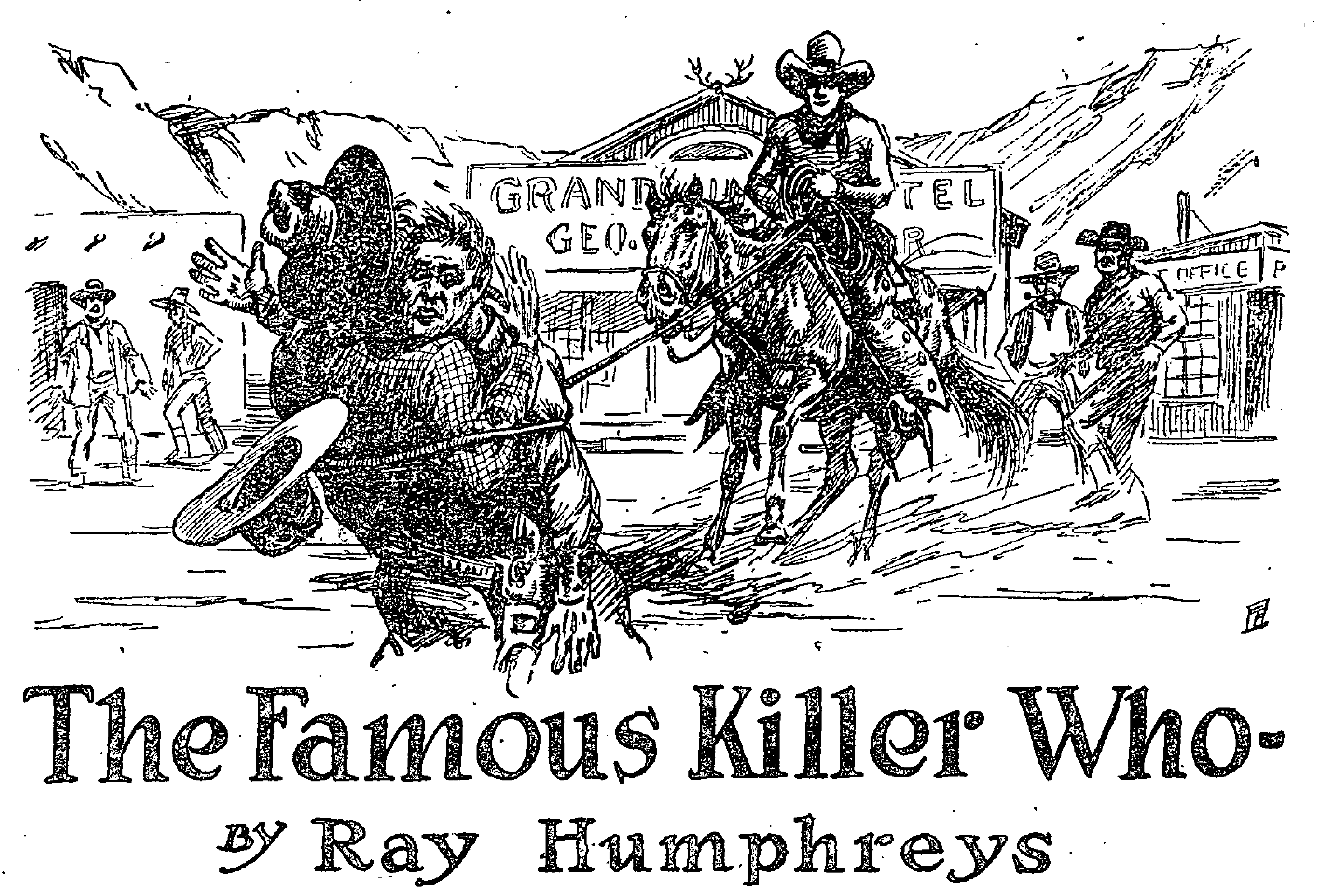
Title: The famous killer who—
Author: Ray Humphreys
Release date: September 30, 2026 [eBook #79692]
Language: English
Original publication: New York, NY: Street & Smith Corporation, 1927
Other information and formats: www.gutenberg.org/ebooks/79692
Credits: Prepared by volunteers at BookCove (bookcove.net)
“I thank you, mayor!”
Sheriff Joe Cook of Monte Vista accepted the fat, black cigar with the gold band that Mayor Al Foster of Monte Vista handed him.
“I have one for “Shorty,” ef he’s around,” said the mayor genially, pulling out a mate to the sheriff’s cigar from a vest pocket.
“That gal telegrapher at the station!” exploded Sheriff Cook, savagely biting the end off of his cigar. “I knowed when the railroad put her in here that she’d be a-causin’ trouble with them big blinkers of hers, an’ that babylike voice she’s got! Dang me, mayor, ef it ain’t one thing it’s another, seems, all the time! I ain’t agin’ wimmen in business, y’understand, mayor, but I’m agin’ purty ones mixin’ up business an’ romance!”
Mayor Foster nodded in sympathy.
“Ah,” he said politely, “an’—ef I may ask—what has the young lady telegrapher done, sheriff?”
The sheriff puffed violently on the gift cigar.
“She’s sure throwed a fistful of monkey wrenches into the machinery of this office, mayor!” exclaimed Sheriff Cook.
“You ask me a minnit ago whar Shorty McKay, my deputy, was, an’ I answer you by throwin’ a fit over that gal telegrapher. Waal, mayor, it’s got under my hide. Every minnit that I ain’t got my eyes on that Shorty, he’s struttin’ around the railroad station, swappin’ sweet words an’ lovin’ looks with that gal telegrapher.”
“You suppose he’s thar now?” asked the mayor.
“I dunno, but I suspect!” said the sheriff. “I sent him over to the Palace Feed Stable at eleven thirty, to find out about a stray hoss they’ve got over thar, an’ I figger he had to drap by the station to see the noon train come in, an’ like as not he’s still thar.”
The sheriff’s telephone buzzed.
“Hullo?” said the sheriff, shifting his cigar to the far side of his mouth. “Yes—what is it? Huh, who is it speakin’? Talk up, I kain’t hear you. Oh, yes—yes—I hear you now, ma’am—yes—the telegrapher at the station speakin’.”
The mayor arched his eyebrows and cocked his head sideways.
“Yes,” went on the sheriff, nodding energetically, “a telegram fer me from Sage Mound—yes—yes, it’ll be all right ef you read it to me. Wait a minute until I git a pencil now.”
The mayor hurriedly offered his pencil.
The sheriff’s hand was shaking violently as the mayor leaned over his shoulder to read the remarkable message the sheriff had written out. The mayor’s face blanched as he read it.
Sheriff Joe Cook,Monte Vista, Colorado.Famous killer who arrived your town noon train. Suggest entertainment until we arrive.HODGES,OSBORN,MORGAN.
“Lissen, miss,” the sheriff was stammering, “did you—waal—happen to notice—ef—a man like that got off the train?”
“Oh, yes, sheriff,” came back the soft, musical reply of the girl operator, “I particularly noticed that just one man got off the train. He went to the Lone Spruce Hotel, I think.”
“Is—is my deputy, Shorty, around thar anywhars?” asked Cook. “Have you seen—er—noticed him—that is?”
“No, I haven’t,” the girl sang back.
The sheriff hung up the receiver.
“Who yuh reckon it is?” whispered Mayor Foster.
The sheriff picked up the message he had written out.
“I dunno,” he said, candidly, “it might be “Scarface Slim” Kildare from over Ouray, but I thought he was in the pen; it might be “Gun-fanner” Smith from Big Springs—he’s a bad aigg! It might be “Slippery Dell” Hanson, a right tough hombre hisself; or it might be “Greaser Tom” Romero—with a dozen notches on his cannon.”
The mayor’s voice trembled.
“Them signatures, sheriff,” he stammered.
“Hodges is the district attorney over thar at Sage Mound,” said Cook. “An’ you know Osborn is mayor of Sage Mound. Morgan is the sheriff. An’ them three signin’ the telegram means just one thing. This hombre is wanted bad. We gotta git that feller.”
The mayor raised a hand.
“Sheriff, we gotta git him—of course,” said the mayor. “But we ain’t got to have no shootin’ scrape over it. We got fair warnin’ he’s a bad one. He ain’t no one-man proposition. We kin call on volunteers to help git him.”
The sheriff was on the verge of asking the mayor why he was butting in, but a second glance at the message caused Cook to decide that possibly, after all, Mayor Foster had the right idea. There was no sense in tackling a famous killer single-handed. No, sir! It would be well to assemble a posse of sizable proportions and then trap the desperado in such a way that he would have no chance to get his guns cracking.
“Whoever he is, he’s probably kilt his man in Sage Mound,” said the sheriff, “an’ then rid over through the butte country, probably ketchin’ the train at Painted Bluffs, drappin’ off here, figgerin’ he had doubled back far enough to fool ’em.”
“Yes,” said the mayor, licking his dry lips, “but let us postpone guessin’ about him until after we has him! I won’t feel right until we has him subdued, sheriff.”
“We’ll git some of the boys,” said the sheriff.
Fifteen minutes later, after diligent telephoning on the part of the sheriff, some twenty men had assembled at the sheriff’s office, all heavily armed. The sheriff explained—briefly, and the mayor had his say, cautioning care so that there would be no slip-up that might result in shooting and bloodshed.
“I believe ef we kin lure him out in the street, outa the hotel, we kin rope him by surprise,” suggested the mayor.
The sheriff grunted.
“We got Jodey Bennett here to do the trick ropin’,” said the sheriff, “but who is goin’ to do the lurin’, the nice job, Mister Mayor—that’s what you got to consider—it’s got to be a dang smart hombre to handle that without tippin’ his hand or gittin’ bumped off.”
“I wish Shorty was here,” said the mayor, wistfully.
“Shorty ain’t smart enough fer that job, even ef he was here,” said the sheriff. “Who’ll volunteer?”
The silence was eloquent.
“Very well,” said the mayor, quietly. “I’ll git him out, an’ you boys do the rest!”
“You git him out at your own risk, mayor,” said the sheriff, “an’ then step quickly away from him so Jodey Bennett kin rope him. We kin fire a few shots over his haid to pacify him—an’ by that time he’ll know the jig’s up with him!”
So the crowd adjourned to Pecos Street and scattered around the Lone Spruce Hotel. Jodey Bennett, the best trick roper in the San Luis Valley, took station just around the corner from the main entrance to the hotel. The sheriff, a sawed-off shotgun under his arm, planted himself directly across from the hotel entrance, behind a sign board which offered the twin merits of some secrecy and some security. The rest of the boys stepped into doorways or loitered at the curbs, their guns in hand under their coats or under folded arms. Mayor Al Foster lurched across the street.
So quietly had the posse arrived and taken position that no one on the street had noticed anything unusual. The hotel lobby was practically deserted when the mayor stumbled in, brave at heart but irresolute at the knees. He made for the desk, aware that his gait was shaky and uncertain. The clerk, listening to his whisper, suddenly drew back as though a rattlesnake had struck at his face.
“What?” he exclaimed.
“The man who came in on the noon train!” repeated the mayor in a hoarse whisper, “is Scarface Joe or Gunslingin’ Pete or something like that—a famous murderer—an’—would you please—kindly point him out to—to—to me?”
The clerk’s eyes looked like marbles protruding from his head. He tried to speak, choked, and then pointed guardedly.
“Er—him?” asked the mayor.
The clerk nodded, mutely.
The mayor looked at the short, stockily built gentleman sitting on the lounge near the front window. The man did not resemble the typical murderer as the mayor had pictured him. He was not in cowboy clothes. Instead he wore a brown derby and a suit of checked store clothes. He was husky, however, and appeared able to put up a good fight with his fists.
The mayor wabbled toward him.
“Excuse me, brother,” said the mayor, touching his man on the arm, with deference, “I am the mayor here—an’—would you—honor—honor—me—if we took a look at our—our scenery outside, perhaps?”
The man’s jaw dropped.
“Outside—outdoors,” said Mayor Foster, trying to smile.
The man took off his derby and scratched his head.
“Are you coo-coo, brother?” he asked, kindly, “or am I? I don’t git you at all, but I’ll step out with you.”
They went out at once—the mayor staggering slightly, but still game.
A shrill whistle sounded. That was the sheriff’s signal to Jodey Bennett to get ready with his rope. But the killer was not yet far enough out in the street to give Jodey a chance.
“Over here,” said the mayor, smiling weakly, “ef you please. Really, our scenery—mountains, mountains—an’—an’—a very fine climate.”
The man in the derby stepped toward the beckoning mayor.
Two shrill whistles; that meant the throw, from Bennett. The mayor, his face chalky, tried to leap away, but his feet seemed rooted to the spot.
Jodey had made a perfect catch!
“What the heck!” screamed the stranger, as the rope slipped down and tightened over his arms and likewise around the quivering form of Mayor Foster. Immediately there was a volley of shots, and while the stranger cringed a bit at the unexpected fusillade, it was the mayor who yelled:
“I’m here!” he cried. “Don’t shoot me!”
The stranger appeared dazed for only a minute. Then, with a wild cry about “lunatics,” he seized Foster by the shoulders and attempted to force him down through the hemp loop as a prelude to escape himself. He did not know who the men were with the guns. He struggled mightily, despite the feeble cries of the mayor, but at the moment that he had forced the mayor to his knees and had the rope up, almost over the mayor’s head, a man on horseback dashed around the corner, circled half way once; and the lariat suddenly tightened with tremendous pressure, yanking the stranger off his feet so that he somersaulted over the mayor. Both rolled over and over in the street, like two fighting bulldogs.
The mayor did his part. He yelled lustily. But the stranger, muttering his astonishment, jerked the mayor up, and then, with an almost superhuman effort, wiggled out of the noose and lurched for Bennett. He pulled that gentleman from his horse so fast that Bennett thought a tornado had struck him. Then, using Bennett as a shield, and lifting the cowboy right off his feet, the stranger rushed the sheriff, closed with him, and obtained possession of the shotgun in jig order.
Instantly the street cleared, as if by magic.
The stranger, whirling around dizzily, seemed to be attempting to cover all points of the compass at once, but his tormentors appeared to have vanished. Only the mayor, entangled in Jodey Bennett’s lariat, remained, and he was sitting comfortably in the dust, massaging his forehead and mumbling in a dazed sort of way. The sheriff and Jodey Bennett and Jodey Bennett’s horse were all three crowded between two buildings. Others of the posse were here and there, wherever they had found refuge. But the stranger, handling the sawed-off shotgun most recklessly, held the fort.
“Your ropin’,” gasped the sheriff to Bennett, “was most scandalous!”
“We’re in fer it now, plenty!” said Cook uneasily, “I don’t recognize that hombre as any of th’ outlaws I knows.”
“Say,” cried Bennett, “look who is comin’!”
Up the street came the girl telegrapher. Hands reached out from between buildings, attempting to detain her, and hoarse warnings were hissed at her, en route, but she paid no heed. In the middle of the street, however, she saw one man with a shotgun and another man rubbing his head. She ran out impulsively and laid a hand on the arm of the man with the gun, and groans and sighs echoed from all sides, where the posse waited.
Instantly heads popped out on all sides.
“That gal telegrapher!” exclaimed the sheriff, excitedly. “She’s got spunk, brains, good, ol’-fashioned nerve!”
A figure loomed up beside the sheriff.
“Hullo, boss,” it said, “I been lookin’ fer you over to the office. I got a message fer you. It was phoned up.”
“That gal telegrapher!” gasped the sheriff. “I hand it to her, Shorty. I take back all I ever said! Why, fer out an’ out bravery, she jus’ takes the cake!”
“Thanks!” said Shorty, fidgeting.
And then, before any one thought of rushing to the girl’s assistance, a cavalcade of horsemen swept up the street. There were Hodges and Osborn and Morgan and other leading citizens of Sage Mound. The girl waved them down. They tumbled off sweating horses and crowded around, and it was then that the sheriff remembered the telegram Shorty had thrust into his hand. He read it swiftly, to utter a wild cry of mingled grief and rage. He shoved the telegram at Bennett.
“Read that!” he howled.
Bennett read it. It said:
Sheriff Joe Cook,Monte Vista, Colorado.Famous Miller New arrived your town noon train. Suggest entertainment until we arrive.HODGES,OSBORN,MORGAN.
“Miller New, the famous wrestler!” cried Bennett, his eyes bulging. “The bird that is goin’ to wrestle at Sage Mound tonight!”
“Miller New!” whooped the sheriff, frantically. “An’ when that baby-voiced, afraid-to-speak-up woman telephoned me, I thought she said ‘famous killer who’ instead of ‘famous Miller New!’”
“Explain,” said Bennett, shrugging his shoulders.
So the perspiring sheriff rushed out toward the group in the street, where the mighty Miller New, famed wrestler, was loudly complaining about the treatment he had received by a gang of thugs and maniacs. The Sage Mound bunch were voicing angry exclamations, and a storm seemed brewing.
“That gal telegrapher,” began Sheriff Cook, wildly.
“That gal telegrapher,” repeated Mr. New, in stentorian tones, “was the only sane person in this burg. She come right out an’ asked me what the trouble was, an’ when I told her who I was everything was lovely. Ef it hadn’t been fer her I’d still be out here gettin’ shot at, I reckon, by a lot of——”
“That gal telegrapher,” cried the sheriff, desperately.
“Listen, gents,” broke in Shorty, with a roar, “my boss, the sheriff, is only tryin’ to tell you how brave he thinks the little woman is. He just told me back thar on the sidewalk. He gives her credit! An’ as fer this awful mixup about Mr. New—I reckon we’re all sorry. But I invite every one o’ you Sage Mound gents to our weddin’——”
“That gal telegrapher!” roared the sheriff, once more, but again he was interrupted. The mighty Miller New broke into a smile and at that the Sage Mound boys sent up a friendly yell, while they waved their hats and beamed on the girl and Shorty.
“That’s right, sheriff!” they whooped in cordial tones, though perhaps in error. “We’re for her, too—hooray fer that gal telegrapher of ol’ Monte Vista!”
And the sheriff, speechless, sat down beside the speechless mayor, who was still rubbing his forehead in a dazed sort of way.