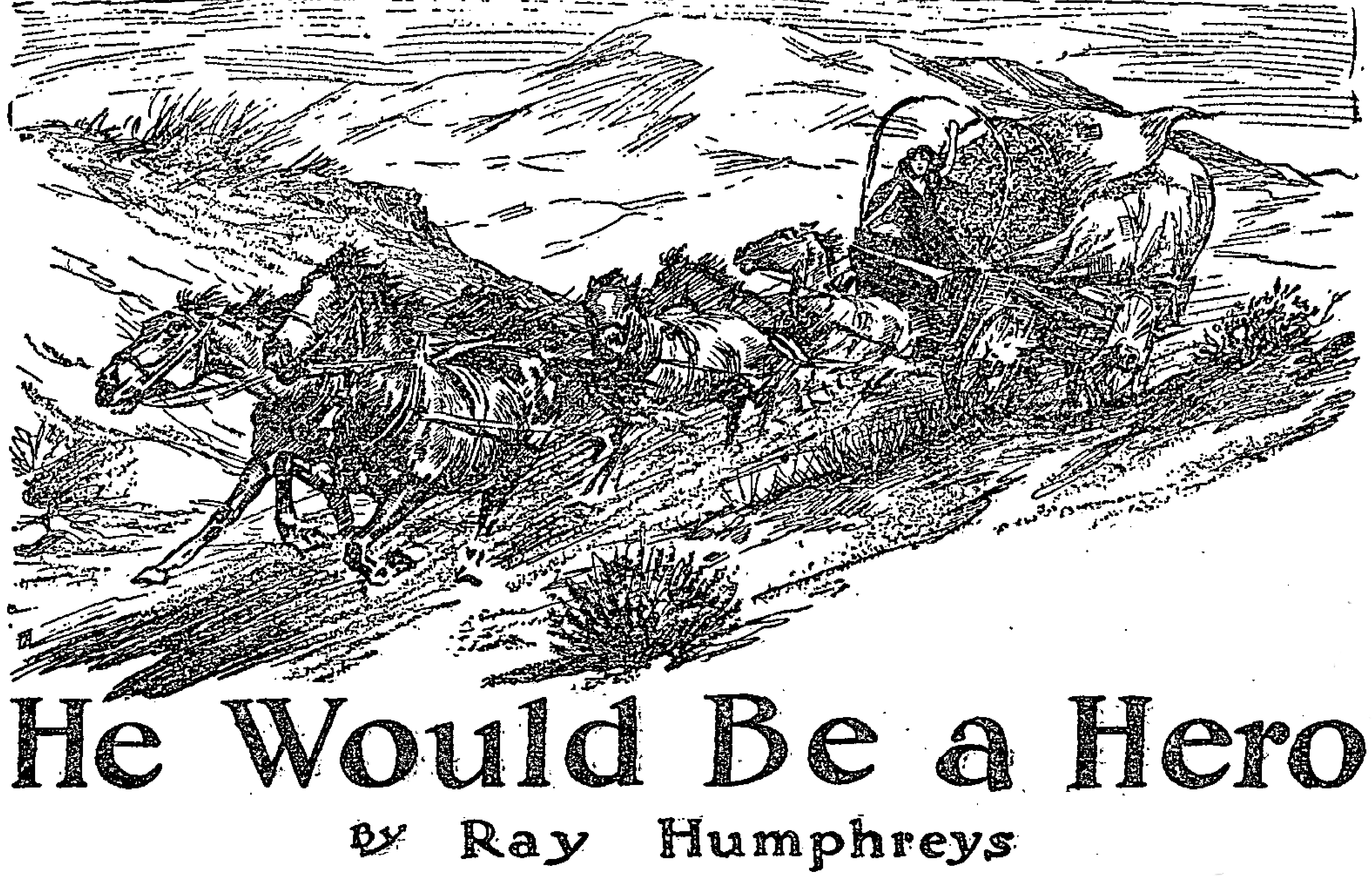
Title: He would be a hero
Author: Ray Humphreys
Release date: September 29, 2026 [eBook #79686]
Language: English
Original publication: New York, NY: Street & Smith Corporation, 1927
Other information and formats: www.gutenberg.org/ebooks/79686
Credits: Prepared by volunteers at BookCove (bookcove.net)
It was noon on rodeo day in Monte Vista. Sheriff Joe Cook sat in his office, drumming nervously on his desk with his finger tips. His ruddy face was seamed with worry. He looked hard and long at his fidgeting deputy, “Shorty” McKay, who stood on the other side of the desk, eyes down, fumbling with the Stetson hat he held in his hands. There was a long silence.
“Waal,” said the sheriff, finally, with more sorrow than anger in his drawl, “ef yuh insist on puttin’ pleasure before business in an emergency like this, just hop to it—go on out to the rodeo in yuhr yaller shirt an’ yuhr purple necktie an’ gather in the applause while yuh leaves me alone to try to gather in Manuel Perida.”
“I’d like to help yuh git Manuel,” interrupted Shorty, earnestly, “but, boss, I gotta take part in that International Covered Wagon race on the program this afternoon. Didn’t the chamber o’ commerce choose me to represent America in that race, an’ what ef I never showed up, after practicin’ fer weeks, an’ trainin’ them broncs to run like holy heck?”
“Have it yuhr own way, o’ course!” cut in Sheriff Cook, grimly. “The fact that Manuel Perida runs amuck this mawnin’ an’ holds up the Dawson drug store an’ shoots two men an’ then disappears shouldn’t interfere with yuh havin’ yuhr fun. Waal, dang it, have it, but fust hand over that badge—yuh ain’t no deputy no longer!”
Shorty’s face went white, but he hesitated only the fraction of a second. He unpinned the star from his vest with clumsy, shaking fingers. He laid it, face up, on the sheriff’s desk. Then he backed away as though he feared his late boss might take a swing at him.
The sheriff reached for the badge and put it in his pocket. He was evidently restraining himself with the greatest difficulty. He itched to knock some sense into Shorty, but he refrained and instead of leaping for his one-time assistant the sheriff contented himself with a terse remark.
“Thar is one born every minute!” said Cook significantly.
“One—one what?” stammered Shorty, not understanding.
“One fool—like Barnum said!” snapped the sheriff, scraping his feet threateningly. “Now git out before I throws yuh out!”
Shorty departed quickly, needing no second order. The minute the door slammed on him, the sheriff got busy on the telephone, calling up a dozen young bloods of the town whom he could trust. To each he told substantially the same story, something like this:
“This is the sheriff talkin’. Jim, I want yuh to come right over quick. I’m gonna deputize yuh to help me look fer that crazy Manuel Perida, who held up the drug store this mawnin’. Yes—I’ve looked considerable already, but thar’s such a big rodeo crowd in town that dodgin’ is purty good. I got the roads guarded with volunteers an’ I’m sure he ain’t left town. Come on over quick as yuh kin—I needs help an’ a whoopin’ lot o’ it.”
The gang came, of course. They were sworn in before the justice of the peace and Sheriff Cook dispatched them in various directions; ordering them to take no chances if they met Manuel Perida, who was probably desperate enough, the sheriff thought, to do some more shooting if cornered. The sheriff said nothing of Shorty, or of Shorty’s enforced resignation, except to mention, sarcastically, that Shorty was too busy in the rodeo to help hunt the criminal.
The rodeo, meanwhile, had welcomed Shorty with open arms. The International Covered Wagon race, in which Shorty was entered to represent America, was a feature event of the afternoon’s program. Two huge covered wagons, each drawn by six half-wild mustangs, were to race two miles, twice around the rodeo track. Shorty, who had the American flag draped on each side of his wagon, had accumulated and trained a motley collection of horses. He had made up his mind to win. Señor Julio Quijano, who had entered an outfit to represent the Mexican Republic, also desired to win, however, and he had thought himself out a splendid plan. Instead of using half-wild broncs he had collected and drilled half a dozen of his faster cow ponies. It was sure to be a great race.
“I got two dollars an’ fifteen cents up on yuh to win, Shorty,” said Eddie Owens, one of the rodeo committeemen, as Shorty arrived at the rodeo corrals. “An’ by golly, yuh got to win! Yuh got to uphold the glory o’ America, the honor o’ Monte Vista, the reputation o’ the sheriff’s office, an’ the safety o’ my two dollars an’ fifteen cents! Win? Why, boy—yuh just gotta win!”
“I aim to do it, Eddie,” said Shorty, sadly, “but don’t mention no sheriff’s office to me, please.”
“Huh?” asked Eddie.
“Look!” cried Shorty, and he pointed at the big covered wagon that was entering the infield. It was drawn by a six-horse hitch of sturdy cow ponies, most of them paints, but it wasn’t the horses that had attracted Shorty’s attention. It was the driver. Instead of Señor Julio Quijano, there was a girl on the driver’s seat, handling the ribbons. A very pretty girl, costumed in the high comb and vivid shawl and short skirt of Spain.
“Gee, Julio’s daughter——” began Eddie, in admiration.
“Miss Marie Quijano will drive the Republic o’ Mexico’s entry in the International Covered Wagon race,” announced Tod Sloan, the gentleman with the megaphone, as the señorita drove her outfit around in front of the grand stand, “while Mister Shorty McKay will drive the American entry. Let’s go!”
“A fine stunt,” growled Shorty; “puttin’ in a gal to race agin’ me! It’ll be duck soup ef she don’t git kilt. I got a notion——”
“A fine stunt!” grinned the Señor Quijano, strolling up. “The people, they all cheer for the señorita—yes—and more they cheer, faster my daughter go! I bet we win!”
“I got twenty cents more I’ll bet,” began Eddie Owens.
“I accept!” and Quijano smiled, bowing low.
Shorty snorted and ran for his outfit. His team was hitched and waiting, with rodeo employees at the horses’ heads. There was an admiring crowd about the wagon. As Shorty arrived, Dave Brofman, one of the sheriff’s new deputies, greeted him cordially.
“Boss here?” asked Shorty brusquely.
“Yup,” said Brofman, “we’re all here, lookin’ fer Perida. We combed the town fine but he wasn’t thar. Sheriff thinks he’s in the crowd out here—a lot o’ Mexicans here, yuh know.”
“Huh!” said Shorty, climbing to the wagon seat.
Five minutes later the two entries in the International Covered Wagon race stood at the starting line, on the track, in front of the grand stand. Enthusiasm was at high pitch. All the while spectators were cheering for Shorty at first, but when the pretty Señorita Quijano smiled a dazzling smile at the grand stand, Shorty lost twenty-five per cent of his admirers. The Mexicans, of course, were behind the señorita—solidly. Much money had been wagered on the race, which had been advertised up and down the San Luis valley as the big event of the rodeo. National feeling had been aroused. At the last moment Eddie Owens had been challenged by a strange Mexican to bet another dollar on the race, and as the teams lined up Eddie was anxiously buttonholing all friends in sight, begging for the loan of a dollar.
“I’m plungin’,” admitted Eddie recklessly.
The real plungers, at that moment, however, were the twelve broncs out on the track. The starter’s pistol cracked and the two big wagons lurched forward as one, with every bronc straining in the traces. The grand stand rose as one man and whooped. The señorita had the rail, which Shorty had graciously granted her without argument. Shorty stood up, anchored by his lines, and yelled at his horses. The girl shook out her reins vigorously. It was a mad scramble from the very start and the big canvas-covered wagons swayed and creaked.
“Thar is one born every minute!” said Sheriff Joe Cook sadly, as he watched the start. The sheriff was weary. He and his twelve volunteer deputies had searched in vain for Manuel Perida.
“One what?” asked Doc Healey, standing beside the sheriff.
“One fool—like Shorty!” explained Cook, drearily.
At the quarter post the two racing teams were practically neck and neck. At the half Shorty’s lead team of gray bronchos were perhaps a head in front of the señorita’s calico leaders. The grand stand was shouting itself hoarse.
“Señorita!”
“Shorty!”
The Mexican section of the grand stand had lost all semblance of order. Sleek Mexican merchants were tossing expensive hats high in the air and not bothering to watch where they lit. Fat señoras were embracing one another. Prayers and pious exclamations mingled with more expressive expletives. Eddie Owens had lost his head completely. He had just bet his silver cigarette case, his signet ring, his watch and watch charm, and he was now looking for some one who would put up something against his new seven-dollar emerald-colored shirt.
“Señorita—ah, the señorita!”
“Come on, Shorty, come on!”
At the half Shorty had lost his lead. The señorita’s calico lead team had forged ahead half a length, but she lost that advantage on the three-quarter turn, and the two teams swung recklessly into the home stretch coming as hard as the dozen crazy ponies could gallop. The señorita, it appeared, was an excellent driver. She handled her ribbons with skill, but Shorty was not only a good driver, he was a bit of a daredevil, too. He was standing up now, cracking his whip, and the ponies in his hitch were scurrying forward with apprehensive, quivering flanks. They were running! Shorty was ahead, by a matter of inches, as the two outfits swept past the grand stand. There was another mile to go. The crowds cheered madly.
“I’ve just bet my boots, Shorty; an’ my vest, an’ my belt, an’ my ridin’ breeches!” whooped Eddie Owens in supplication, as the racers passed. “Yuh gotta win—Shorty—yuh gotta!”
But Shorty didn’t hear Eddie’s shout. He was too busy swinging his six around the quarter turn again. The señorita had begun to use her whip with telling effect. The two outfits were again neck and neck. The rodeo committee in the judges’ stand were swearing that this was the race of races! Monte Vista had never seen such a thrilling event as this International Covered Wagon race before. The Mexicans in the south end of the grand stand were reminding the saints that the señorita must win! Eddie Owens had offered to bet a week’s labor at anything—wood chopping, bean hoeing, or sheep shearing—against a thin dime, even a Canadian dime, that Shorty would win.
Around the curve went the raging teams, the señorita’s paints pulling ahead inch by inch. Shorty gritted his teeth. The glory of the United States, the honor of Monte Vista, the safety of Eddie Owens’ two dollars and fifteen cents, to say nothing about the security of Eddie’s hat, pants, shirt, were all at stake. Shorty swung his long whip dexterously, but this time the whip did more than hiss through the air. It barely touched the off gray on Shorty’s lead team, but that animal jumped as though a bee had struck it. Its teammate followed suit. Then the swing team increased its gallop, and the wheelers whirled after perforce. Inch by inch Shorty recovered his lost ground.
“Giddap!” whooped Shorty, as the two scrambling ponies flattened out for real speed on the back stretch of the track. “Come on along, yuh fuzztails! Shake a laig! We gotta win this race—I need that hundred dollars—I’m outta a job account o’ yuh fuzzies! Let’s go—yippee—whoopee-ee-ee!”
The long whip whistled through the air, aimed for a lagging swing team animal, but never landed. Before it reached its mark there was a scream from the señorita—a wild piercing scream—and Shorty dropped the whip as though he had been shot. The señorita, sitting sideways on the wagon seat, flung both hands heavenward and screamed again. The reins dropped from her lap and were whirled over the dash in the twinkling of an eye. The señorita’s face was deathly pale, and the paint ponies, sensing that something was wrong, took their bits in their teeth. They’d run sure enough now!
The grand stand heard those blood-curdling screams, but not as plainly as Shorty heard them! The grand stand grew strangely mute as the señorita’s teams took their heads. The girl fixed her gaze on Shorty for the briefest of a fleeting moment. Her hands were still high in the air; her face was blanched with terror; her eyes wide and appealing. Then she went on until the top of her covered wagon shut her off from Shorty’s sight, for her six paints were running with a vengeance now. Shorty had a second to think. He yelled at his horses, reached for the whip, missed it, and remembered he had dropped it. Then his eyes lit on a little pile of pebbles he had thoughtfully stored away at one end of the seat for the express benefit of the near gray leader—a vicious horse that generally had to be pelted to make any speed. Shorty reached for the little stones. He threw one at the near leader, hit the off leader with another. Gradually—with heartbreaking deliberation, it seemed—Shorty began to overhaul the señorita’s outfit.
“She’ll crash the fence, sure,” cried Shorty, “fer thar’s no stoppin’ them broncs now! I got one chance in a thousand, I’ll——”
It seemed an age to the spectators before Shorty’s wagon, careening from side to side, crept up on the Quijano wagon. It seemed an eternity before the crowds saw Shorty stand up and prepare for action. Some thought he would snatch the girl from her perilous seat on the runaway wagon. Others decided, on the spur of the moment, that Shorty would desert his outfit and leap to the other wagon and endeavor to stop it. Another scream from the girl! Shorty dropped his handful of reins, and jumped. The crowd caught its breath. For a brief moment it looked as though Shorty had leaped short, but he hadn’t. He scrambled up on the señorita’s wagon, seized her in his arms, and jumped again; this time off the señorita’s outfit and toward the grassy infield, where a soft landing might be possible. It was a flying leap from a swaying wagon. There had been no time to judge distances accurately. The crowd began to cheer just as Shorty, with the señorita held close, struck the infield fence—and the cheer changed to a long-drawn groan.
The fence, aged and weathered, gave away under the impact. The girl and her rescuer rolled to the ground just as a thunderous crash echoed over the arena. The two speeding wagons had come together with a terrific smash. Splinters flew through the air. An injured horse screamed in pain. The dust cleared away, to show one wagon on its side, the other wagon partly on top of it, while a tangled mass of crazed horses, several of them squealing, were kicking and biting in a desperate effort to flee the mêlée. The spectators and the rodeo hands stood paralyzed for a full minute.
“Hurt?” groaned Shorty, shaking the wan señorita.
“No—no!” cried the señorita, struggling to sit up. “It was awful—it was Manuel—his senses have deserted him! Early this morning he begged that he might hide in our big wagon. I thought he was sick—he look so bad! Then I hear that the white men want him! I beg father to let me drive the wagon so that he should not find my Manuel in it. We were engaged, señor! So I drive, but Manuel suddenly jump up from under tarpaulin in wagon, an’ point gun an’ say he keel me an’ himself! I scream then, an’——”
“Manuel?” asked Shorty, blinking, while his mouth twitched in pain. “Manuel—Manuel who? I seem to remember——”
“Manuel Perida, my fiancé,” began the señorita, sobbing.
Shorty jumped to his feet. He saw people running toward the scrambled wagons. Others were coming toward him and the girl. He whirled and made for the wrecked wagons, diving into the pile of débris. His head hurt, his knees gave way beneath him, but he went on. He yanked his handcuffs off his belt, and when he saw an unconscious man in the ripped bed of the señorita’s wagon, he snapped the cuffs over that man’s yielding wrists. He dragged him out—one step, two steps, three steps, four—five—and then Shorty suddenly keeled over. He went down in a heap.
Sheriff Cook and his friend, Doc Healey, were the first to reach Shorty’s side. The doctor bent over and began to feel the senseless deputy with expert hands. The sheriff looked at the man cuffed to Shorty and recognized the swarthy fellow as Manuel Perida, for whom he and all his volunteer deputies had searched all day in vain. Tears came to the sheriff’s eyes as he looked on the battered Shorty. The ex-deputy was barely breathing, it seemed. His face was cut and bruised. One arm was bent back under him. His clothing was torn. Doc Healey was working feverishly. Other men ran up, taking off their hats.
“Waal,” groaned Sheriff Cook mournfully, gazing at his late deputy, “he insisted on all this hisself—got hisself to blame—murdered hisself recklessly—he would race—he would be a hero despite all! As I told him just this mawnin’—as Barnum said once, thar’s one born every minute——”
Doc Healey looked up with an expansive grin.
“An’ most o’ ’em live,” said the doctor, suavely. “This kid has got a coupla broken ribs an’ he’s fainted from pain—but in a day or two he’ll be snappin’ out of it nice; it ain’t very serious——”
“Just a minute,” whispered the perspiring sheriff. He dived into his pocket. He withdrew a glittering deputy’s badge. He leaned over and pinned it on the unconscious Shorty’s vest with trembling fingers. Then he stood up and spoke to the throng.
“Shorty is a fool,” he said, “fer luck!”