Title: Dangling doom
Author: W. C. Tuttle
Release date: September 28, 2026 [eBook #79673]
Language: English
Original publication: New York, NY: Street & Smith Corporation, 1927
Other information and formats: www.gutenberg.org/ebooks/79673
Credits: Prepared by volunteers at BookCove (bookcove.net)
It was very quiet up there in the land of the big snows; very quiet and very cold. A thermometer, if there had been such a thing, would probably have showed twenty below. There was a little sunshine, which threw dull shadows from the snow-covered firs and tamaracks, but it was as cold as moonlight.
A moose bird, soft flying as a gray shadow, dipped down a ravine which in summer held a brawling stream, but where now the ten-foot firs barely showed their tips above the snow. There were no tracks of bird or rabbit, and even the pine squirrel kept to his burrow in the old pine snags.
But there was a track out there through the dim aisles of the trees, a huge track—the trail of snowshoes. A close observer might have noted that the tracks were irregular, not at all like the tracks of one who is sure of his step.
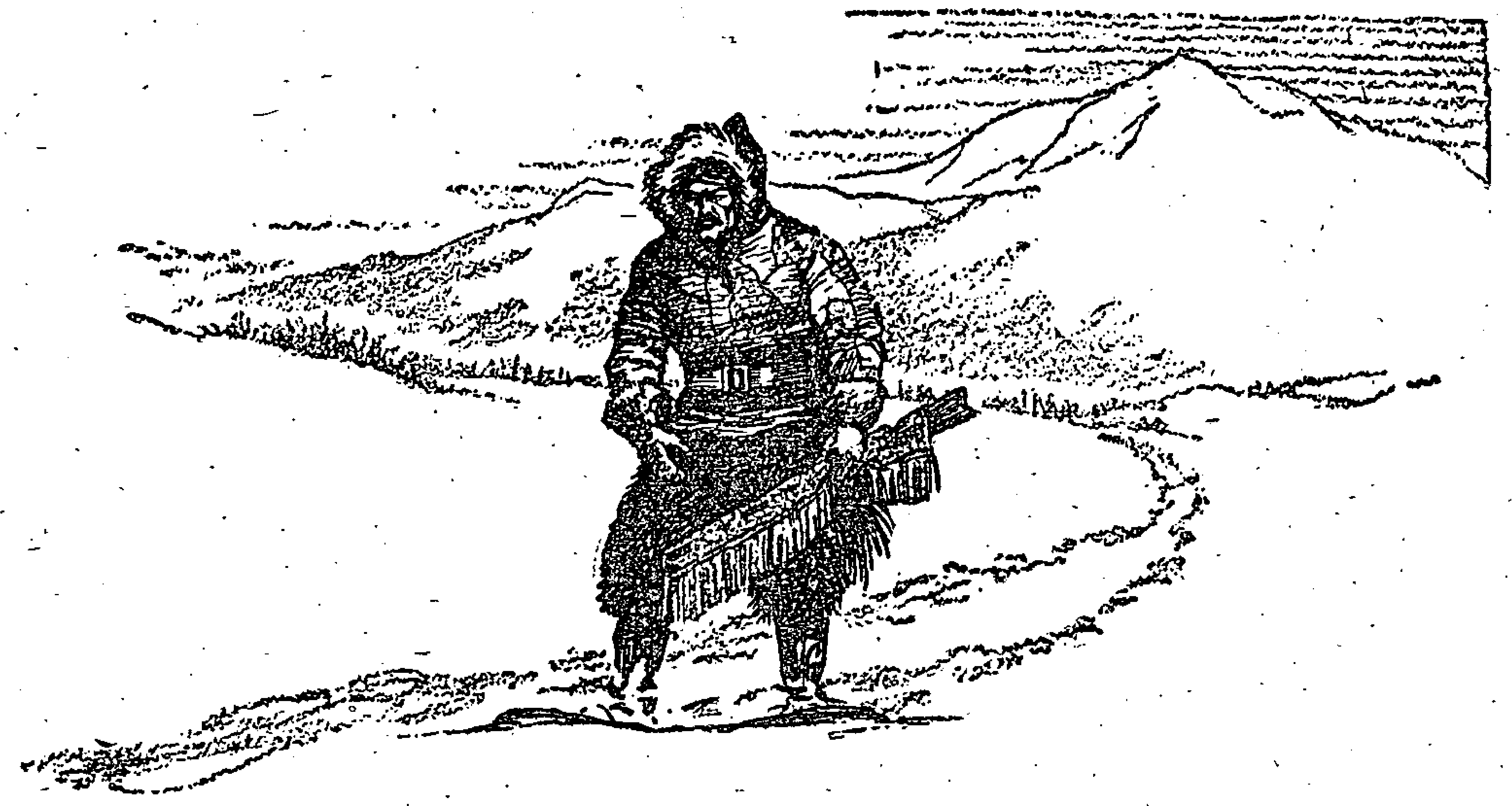
Along this trail came a man, humped over, traveling slowly, a rifle in the crook of his left arm. The fur collar of his parkalike coat extended almost to the top of his fur cap in the back, and his black-bearded face seemed like a continuation of the cap and collar. He wore thick gray woolen trousers tucked inside heavy stockings, and on his feet were Indian-made moccasins.
On his back was a small pack wrapped in blankets, and from the belt of his coat dangled a short-handled ax. His snowshoes were of the bear-paw design, homemade, while the tracks he was following had been made by an ordinary factory type of shoe.
Suddenly the man stopped short, sniffing the wind. To his nostrils came the scent of wood smoke. He seemed more alert now and crouched forward on his snowshoes, swinging the rifle from his left arm to both hands. But there was nothing to be seen except the moose bird, sitting motionless on a bare snag.
The man went slowly forward, following the tracks which suddenly turned down the slope of the little gully toward a clump of spreading firs. Beyond this clump was the open side of the hill, unmarked by track of any kind. From the man’s position he could see the gully above the trees, and that was also unmarked.
He stripped off his heavy mitten, and his bare right hand clutched the grip of his cocked rifle. He could see the tiny streamer of smoke now. With scarcely a sound he moved forward, circling the clump at close range.
He stopped short. Within ten feet of him was a dying fire, and just beyond it, huddled against the butt of a balsam fir, lay a figure wrapped in blankets. The sleeper had taken the precaution of piling up the snow for a windbreak and gathering a considerable quantity of firewood. Just beside the fire grew a lodge-pole sapling possibly six inches thick at the butt, and about sixteen or eighteen feet tall, branchless for nearly its whole distance.
The trailer moved closer, holding the rifle in such a position that it covered the sleeping man. A rifle had been placed against the branches beside the blanketed figure. The newcomer secured this and stepped back.
“Wake up and pay for your lodgin’!” he growled, his voice ringing sharp in the clear air.
For several moments the sleeper did not move. Then, his head lifted slightly and his sleepy eyes stared at the man who stood beside the fire. He was also bearded almost to the eyes, with a scraggly growth of red whiskers, and even his eyes were red, as though inflamed.
Slowly he sat up, gazing always at the man with the rifle.
“Who are you?” he growled harshly.
“Deputy sheriff from Galena.”
“Oh, yea-a-ah!”
A glance showed him that his rifle had been removed.
“Deputy sheriff, eh? Well, what do yuh want, deputy sheriff?”
“You.”
“Me?” The man laughed. “Yuh might tell me why?”
“For killin’ Al Weed in Galena three days ago.”
“Yea-a-ah?”
“Yea-a-ah! Thought you’d snowshoe over into the Cœur d’Alene, eh?”
“I don’t know Al Weed.”
“Then what did yuh shoot him for?”
“Didn’t know I had.”
“Didn’t, eh? What’s yore name?”
“None of yore business.”
The deputy shook the mitten off his left hand, dug in his pocket and drew out a pair of handcuffs.
“Put yore hands out,” he ordered. “No fool moves, or I’ll kill yuh. I’ve been on yore trail for three days, and I’ll take no chances.”
The handcuffs clicked around the man’s wrists, and the deputy stepped back with a sigh of relief.
“I hope yo’re satisfied,” said the prisoner. “Yuh don’t mind if I keep my hands under the blankets, will yuh? It’s awful cold.”
“Git up!” snapped the deputy, pointing the rifle at him.
The man slowly got to his feet, and the deputy picked up a heavy Colt which had been inside the blanket.
“No wonder yore hands got cold,” he sneered. “Yo’re a tough jigger, eh? C’me here.”
Holding the revolver in one hand, he unlocked the cuff from one wrist, jerked the man’s arms on each side of the lodge-pole sapling, and snapped the cuff on again.
“I reckon that’ll hold yuh for a while,” he said, and began building up the fire. With the flames leaping merrily, he turned to his grub pack.
“How’re yuh fixed for grub?”
“Not a crumb,” replied the prisoner.
“I seen where yuh killed a snowshoe rabbit yesterday.”
“Ate it all last night. This is a hard country to live off of in the winter. Mind loanin’ me my blanket? I’m too far from the fire for it to do me any good.”
“I’ll loan yuh nothin’. Now, what do yuh think of that?”
“Want to take me back frozen, eh? Must be expectin’ a spell of hot weather.”
The deputy did not reply. He was melting snow in a small pot for his coffee. The prisoner’s inflamed eyes watched him for a while and then glanced up the tree. He was most surely in a position from which there was little hope of escape. Finally he looked at the kneeling deputy.
“Who was this here Al Weed?” he asked.
“Gambler,” growled the deputy, fanning the smoke away from his eyes. “You ort to know. You killed him.”
“Never heard of him in my life.”
“Suits me. Do you make a practice of goin’ round the country killin’ strangers? Oh, several folks saw yuh. You was in the store not ten minutes before yuh shot him. I was in the saloon myself. Started to come out along with Weed, but the bartender spoke to me and I went back. Al came to the doorway, and you shot him. A man on the other side of the street saw yuh shoot. I got on yore trail inside of thirty minutes and I’ve been on it ever since. You shore headed into a deserted end of the country, but I figured you was tryin’ for the Cœur d’Alene.”
“Regular bloodhound on webs, eh?”
“When I go after a man, I always git him.”
“Yea-a-ah? Been a deputy all yore life?”
“Three year.”
The deputy dumped some coffee in the pot and set it on the fire.
“Three years, eh? Allus lived around here?”
“Little over three year.”
“Came here from up in the Okanagan, didn’t yuh?”
The deputy jerked to his feet and stared at the prisoner. He came closer, peering at the man.
“Who are you?” he asked harshly.
“Chilcoot Evans.”
“You? I don’t believe it! Chilcoot Evans?”
“Now you know how it come that I killed Al Weed.”
“I’ll be—you thought he was me?”
“Hoped he was, you dirty crook! You a deputy! And takin’ me back there for murder! Why don’t yuh laugh?”
The deputy was speechless. He turned back to the fire and placed more wood on the flames, staring off at the blue-white of the forest evening.
“So yuh came back, didja?” he muttered.
“You didn’t think I wouldn’t, did yuh, Wibel?”
“Why didja come back, Chilcoot?”
“To kill yuh.”
“Yea-a-ah?”
“For sendin’ me up to serve life for what you done.”
“For what I done, eh?”
The deputy stirred the coffee with a stick. He opened his pack and took out a couple of rolled hot-cakes. A moose bird flew in like a shadow, perched on a near-by limb, and ruffled its feathers. Perhaps it had visited camps before, and remembered that there might be a few crumbs.
“Yeah—for what you done,” said the prisoner slowly. “You killed Harris yourself. Remember Jack McCord? He got sent up for three years for stealin’ horses. I met him there. He finished his term a couple of days before I broke out, and he told me he saw you kill Harris that night and put yore gun in my pocket. I was too drunk to know what was done, but Jack saw it. He’s there in Galena ready to testify, but I didn’t want to send yuh up—I wanted to kill yuh.”
The deputy turned his head and laughed wolfishly.
“Sounds good, Chilcoot. But I’m the deputy sheriff of this county, and yo’re an escaped convict. Do yuh think I’m goin’ to take yuh back with me and have all this come out? If yuh do, yo’re crazy. I never did catch up with yuh, savvy?”
“Suits me. Anythin’ is better than goin’ back to the pen.”
“Pretty nervy, Chilcoot. Got quite a lot of nerve for a killer, ain’t yuh?”
“What do yuh mean by that? I’m no killer.”
“No-o-o? Don’t lie to me!”
The deputy got to his feet and came closer, his finger pointing straight into Chilcoot’s face.
“Don’t lie, you dog. You and Harris killed Sid Barker, my pardner, and stole what gold he had. Harris told me about it. He was drunk, too, crazy drunk; but he told the truth. He said you killed Sid with an ax. That’s why I killed Harris and put the deadwood on you.”
“You can’t prove it,” whined the prisoner.
“I know I can’t. I couldn’t prove it at that time. And that’s why I done what I——” The moose bird dropped on the blanket roll and tried to drag away one of the cold cakes. The deputy flung his stick at the bird.
The prisoner laughed hollowly. “Funny, ain’t it? Both of us murderers. Both of us up here in the big woods. It ort to be the survival of the fittest, as they say, Wibel. Turn me loose and I’ll fight yuh for it with bare hands.”
“Like fun I will!”
Wibel turned back to the fire. The air was growing colder now. They could hear the snapping of the pines as the air bit into them. Suddenly the deputy threw up his head. From far down the canyon came the snapping howl of a hunting wolf. The deputy turned his head and grinned at the prisoner whose hands were blue from the cold.
“Hear that? They’re on our trail, Chilcoot. It’s a bad winter on wolves. I’ll go back and admit yuh beat me over the summit—and the wolves will destroy all evidence.”
“You dirty coward! At least, move the fire over closer; I’m freezin’, Wibel.”
“Freeze then!”
Wibel lifted the can of coffee off the fire, got his rifle, and laid it on the blanket beside him. His eyes scanned the dark forest behind.
“Scared, eh?” sneered Chilcoot.
Wibel placed wood on the fire until the dancing flames almost reached the lower branches of the fir.
“I’m freezin’, I tell yuh!” wailed the prisoner. “Can’t yuh give me a chance?”
“You ain’t fit to live, Chilcoot.”
“I’m as fit as you are. Unlock my hands and we’ll fight it out. Both murderers; men with crooked brains. Do yuh believe in God, Wibel? Don’t slop that coffee. If you’ve got too much, gimme some. Do yuh believe in Him, Wibel? Let yore God, or yore luck, whichever yuh call it, decide. Ain’t yuh game to fight it out?”
“I’d be a fine sucker to take a chance, wouldn’t I?”
“Yo’re bigger than I am, Wibel. But it wouldn’t be murder. Survival of the fittest, don’t yuh see? Makes a kinda game endin’ for a man. C’me on, Wibel. My hands are freezin’. One of my feet is froze already.”
“Shut up! Feet freezin’, eh? What’s the difference? You’ll all be stiff by mornin’. I jist noticed that you’ve got a good pair of moccasins on, Chilcoot. Yuh might as well will ’em to me. To-morrow mornin’ I’ll take ’em off yuh. But you won’t never need ’em.”
“Dead man’s shoes,” said Chilcoot hoarsely. “Don’t do it, Wibel. Don’tcha know what that means? I’ll haunt yuh. Dead man’s shoes.”
Wibel laughed harshly and got to his feet.
“All right, Chilcoot, I’ll take ’em while yo’re alive. Yuh won’t haunt me then, will yuh? I don’t care. My moccasins are about gone anyway.”
“Gimme a chance,” wailed Chilcoot. “Unlock my hands and give me a chance, Wibel. Let’s fight it out. Neither of us are fit to live, but—go on, Wibel. Man to man, nothin’ but bare hands. Yo’re bigger than I am.”
“Shut up, you fool! Hold that foot still.”
“I can’t move it, Wibel, it’s frozen stiff.”
The deputy dropped on one knee beside the tree, reached out and took hold of the moccasin string. With a move incredibly swift for a freezing man, Chilcoot kicked forward with the other foot, catching the deputy beneath his bearded chin. The kick had all the strength of a muscular leg behind it, and the deputy’s head snapped back—further than a head should ever snap back—and he rolled sideways in the snow.
Chilcoot Evans laughed softly as he tried to twist his hands around to get inside his coat, but the chain of the handcuffs was too short. He stared at the limp form of the deputy, and there was panic in his red eyes as he shifted his gaze up the slim lodge-pole.
“Survival of the fittest,” he muttered. “A sheath knife in my shirt and I can’t get at it.”
The fire was dying now. The moose bird fluttered down to the blanket, but sailed back to the bough again. A wolf’s howl sounded closer.
Slowly the man began climbing the tree, slipping his handcuffed wrists ahead of him, gripping the bark with the chain.
“Survival of the fittest,” he panted. “Luck decided in my favor. One had to stay here. Both murderers, but I had the judge in my favor this time.”
He laughed insanely and kept climbing. Halfway he paused and almost slid back, but the chain caught on a knot and nearly broke his wrists.
He was handicapped now. His right wrist was injured, but he kept climbing. The tree was swaying. If he got high enough, perhaps it would break off and set him free.
Now he could grasp the trunk with his left hand. The top was a tangle of branches, and he was almost up there. Only a few feet more. Suddenly the tree bent over. He swung his full weight on it hoping to break it below his hands; but it swayed out, tearing his knees loose, and he swung out over the snow, the chain still around the trunk, dangling ten feet above the snow. For several moments he hung limp, swaying; and then he jerked heavily, trying to break the lodge-pole. But the pole merely played him like a fish on a line.
Hampered with his heavy clothing, the man tried desperately to draw himself back to the trunk of the tree, but his right hand was useless and his left was too weak to swing him to safety.
Twice he managed to draw up to the swaying trunk, like a man shinning himself on a horizontal bar; but the last time he dropped back limply, twisting against the chain of his handcuffs.
A breeze was blowing now; twenty below, and a breeze! The moose bird dropped down and pecked hungrily at the frozen cakes, while the coals of the fire died lower and lower. A hundred yards away two timber wolves, black as ink against the snow, came to a stop and sat on their haunches.
The Judge had made His decision.