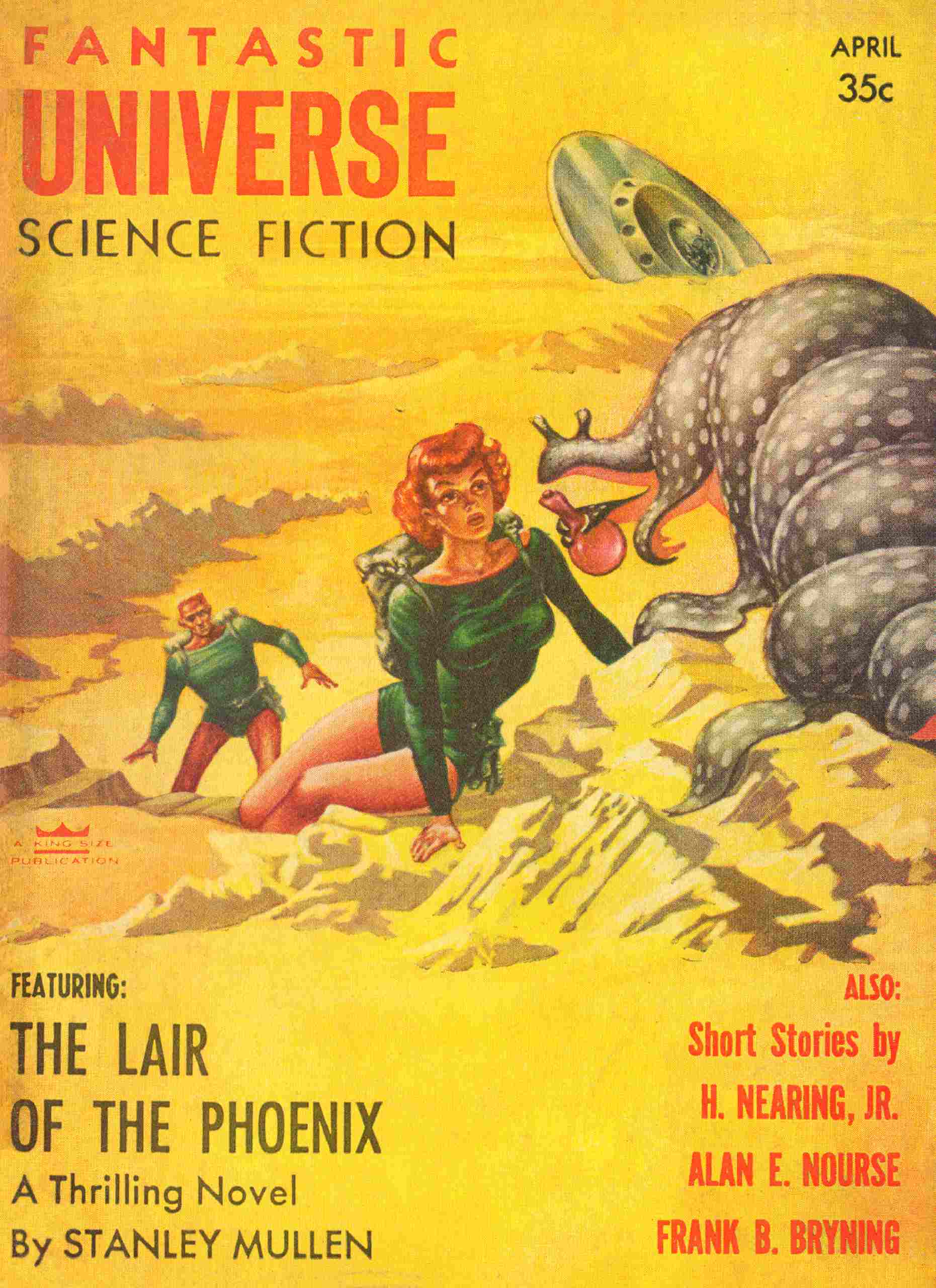
Transcribed from Fantastic Universe, April 1956 (Vol. 5, No. 3).
Title: The neurotic rose
Author: Jr. H. Nearing
Illustrator: Kelly Freas
Release date: September 28, 2026 [eBook #79668]
Language: English
Original publication: New York: King-Size Publications, Inc., 1956
Other information and formats: www.gutenberg.org/ebooks/79668
Credits: Tom Trussel - Stories of Futures Past (This file was produced from images generously made available by The Internet Archive)
Transcribed from Fantastic Universe, April 1956 (Vol. 5, No. 3).
by H. Nearing, Jr.
A food-and-sex complex in the vegetable kingdom may not have quite the same dark Freudian significance as neuroticism on a human plane. But can we be completely sure that plants can’t go haywire too—from repressions too intolerable to be borne? H. Nearing, Jr., in his first story for us—and a brilliant story it is!—almost convinces us that men and plants can become psychotic buds on the same stem, and quite possibly dogs as well!
Not many men could have grown a plant that was half a dog—or a dog that was half a flower. But Ransom was a botanical genius!
“See,” said Professor Cleanth Penn Ransom, of the Mathematics Faculty, “just like a nasty little kid on a hunger strike.”
Professor Archibald MacTate leaned over the flower on the windowsill of his colleague’s office and examined it closely. It looked something like a large rose, but its petals were shaggy with reddish brown hair, oddly reminiscent of hound’s ears. The center protruded conically, like a snout, and was slitted by two rows of white teeth. It had a doggy smell.
“What is it, old boy?” MacTate asked. “The aroma’s not exactly rosy.”
“Well, he’s not quite a rose anymore.” Ransom held a grasshopper in front of the flower’s snout again and sighed when the thing twisted its thick, sinewy stem and turned coldly away. “I don’t know what’s wrong with him. He used to eat a grasshopper every day. Terrific appetite—when you consider it takes a Venus fly-trap two weeks to digest a meal. But yesterday he went on a hunger strike, and I can’t do a thing with him.”
Ransom ran an experimental finger along the support stick to which the flower’s neck had once been securely tied by a string, now broken. “The creature acts hungry sometimes, though,” he conceded. “See these nibbles on the stick.” He pulled the stick out of the flower pot and pointed at the tooth marks along the edge. “Well, he doesn’t need a support now anyway.”
He went to his desk, put the grasshopper into a glass jar and tossed the stick into the wastebasket.
“But you mean it was a rose?” said MacTate, staring at it incredulously.
“Sure. It grew from a seed. What else could you start with if you wanted to cross a plant with an animal?”
MacTate looked at him. “I’m not sure I—”
“Psychology, MacTate.” Ransom sat down in his swivel chair, stuck out his little round belly and began to swing. “Tell me”—he aimed a finger at his colleague—“why do dogs show more intelligence in some tests than they actually possess? Did it ever occur to you it’s because they’ve been pampered and flattered for centuries? They’re not prisoners or slaves like the other animals, but man’s best friend. So on those tests they knock themselves out trying to make a good showing for their friend, see?”
His eyes narrowed. “Now—what flower is like a dog in that respect? What flower has been bred in more than three thousand varieties, and become the symbol of the gooeyest human sentimentality and pampering?” He nodded. “You have guessed it. If you want to cross a plant and an animal, you take man’s two best friends and persuade them to cooperate. The dog and the rose.”
“But—” MacTate looked dubiously at the flower, and then back at Ransom. “I don’t want to seem critical, but just why should you want to cross a plant with an animal?”
“Well, just out of scientific curiosity—for one reason.”
“I’m more interested in the next reason.” MacTate sat down in front of Ransom’s desk, crossed his long legs and lit a cigarette.
“All right, MacTate. It’s Mrs. Underdouble. She’s Chairman of the Flower Show crowd, as you know. She’s been reading these anti-science books, and the other day she told the Woman’s Club that scientists were helpless infants outside their own little chosen fields. She said that no mathematician, for instance, had ever won a prize at the Flower Show.”
“What were you doing at the Woman’s Club, old boy?”
“Well, we were sort of debating for them. On the Scientific Way of Life.”
“Who won?”
“Nobody—yet. Suspended verdict. I bet her a crow-eating preface to the anti-science book she’s writing that I could quite easily win a prize at the Flower Show.” Ransom waved at the dog-rose on the windowsill. “If he can’t win a prize—”
“What did she bet?” MacTate asked.
“Oh, one of her stud dogs. An Irish spaniel.” Ransom looked reflectively at the dog-rose.
MacTate whistled. “High stakes!”
“He’s not doing so well right now. The spaniel, I mean. He had a nervous breakdown not long ago. I don’t know exactly why, but he actually made more money last year in stud fees alone than you and me together.”
Ransom grinned. “Anyway, I told her I knew a dog doctor who wouldn’t charge a broken-down college professor as much as he would the chairman of a flower show, so she lent him to me for a course of treatments. He’s a nice dog. Name’s C-u-a-i-l-g-n-e, pronounced Cooley. His first name, that is. I don’t remember all of it.”
At the sound of “Cooley” there was a rustling under Ransom’s desk, and a large dog covered with reddish brown curls peered around its oaken base at MacTate.
“There he is,” Ransom chuckled. “Heard us talking about him.” He slapped Cooley’s haunch affectionately.
MacTate looked at his colleague with a suspicious eye. “Just who is this ‘dog doctor’ you’re taking him to, Ransom?”
“Me.” Ransom grinned. “Who else? I’m giving him the best treatment in the world. A little brandy now and then and a little exercise chasing rats down interesting alleys. I’ve opened up new horizons for him.”
MacTate eyed the dog-rose on the windowsill again. “I see.”
Ransom followed his glance. “Listen, MacTate. That’s why I wanted to talk to you. I think she’s suspicious, and if she ever drops in here to check up I don’t want her to see that.” He pointed at the dog-rose. “So—how about taking him to your office for a while. The rose, not the spaniel. Maybe it’ll improve his appetite to live in a philosophical atmosphere.”
“But, old boy, wouldn’t the University hothouses be a better place to—”
“No, no. Mrs. Underdouble is always going there. Ever since she endowed that chair in Botany they have given her the run of the place, and one of her favorite sports is taking her friends on guided tours through the hothouses. She’d find it there as quick as on the windowsill.”
“But what difference would it make if she did find it?”
“Don’t you understand? She’d charge me a stud fee, MacTate.”
“Aha!” MacTate pointed triumphantly at the dog-rose. “I see it all now. Cooley is one of the parents of that.”
“My God, MacTate, where have you been? Didn’t you notice the resemblance right off? The thing’s the spitting image of Cooley.”
MacTate frowned. “But how in the name of heaven—”
“Well, I mixed some genes with this supersonic needle. You know. And then I encouraged him with autocoids from Cooley’s blood after he started to grow. The rose, I mean. Pure breeds on both sides. Thoroughly pampered. A few more transfusions and he ought to—Oh, that reminds me. I’ve got to get Cooley some more hamburger.”
Ransom looked speculatively at the windowsill. “I only take a couple ounces of his blood each time, but it seemed to make him tired. So I tried putting it back—”
“Putting what back?” MacTate looked up.
“The blood, of course. I’d give the rose a transfusion from Cooley and then give him a transfusion from the rose, to even things up. But then I found out that if I just fed him enough hamburger he didn’t need the blood back. And yesterday I got him two pounds—” Ransom waved at a deep-freeze box under the windowsill. “I put the meat right there but it mysteriously disappeared.”
MacTate looked at the box. “How long has this been going on? The transfusions.”
“Several weeks.” Ransom got up and looked around the box. “I put it right on top of the deep freeze to thaw and then got called down to the Dean’s office, and when I came back—”
“Maybe Cooley got tired of waiting.”
Ransom shook his head. “I took Cooley with me to introduce him to the Dean. He wasn’t here. Well, anyway”—he went to the closet in the corner of his office and took out an old newspaper—“we’ve got to get him some more meat right away.” He wrapped the newspaper in a cylinder around the dog-rose and tied it securely with a string. “And we can drop this off at your office on the way back. Come on, Cooley. You can go along.” He picked up the dog-rose and led the way out.
They went to a meat market not far from the campus and lined up at the counter behind a stout woman with unkempt hair who was buying a steak. She had a beery aroma and carried a bottle-shaped package under one arm. The butcher cut her a steak, weighed it, plopped it on the counter and turned to get some wrapping paper.
There was a paper-tearing sound that seemed to begin before the butcher reached the wrapping roll. When he actually tore off a sheet for the meat, the sound of the rip had a slightly different timbre. He turned back to the counter and reached for the steak.
“Hey,” said the beery woman. “What’s this? A clip joint?” She pointed indignantly at the steak.
The butcher scratched the black fuzz on his right arm, and shaped an astonished O with his fat lips. A neatly semicircular portion of the steak, about an inch in diameter, was missing from its left edge.
“What do you do?” said the woman accusingly. “Sneak a little of each sale home for your dog?”
“Dog?” The butcher looked at Cooley, who was waiting patiently beside Ransom. Then he looked at Ransom, and his eyes popped. “Say—”
“What are you talking about?” Ransom scowled. “My dog was sitting right here beside me since we came in. And a dog’s bite doesn’t look like that, even if he could jump that high. Look—” He shifted the dog-rose to his left arm and stepped aside to point to the height of the counter. The movement brought him next to a glass case exhibiting salami and cheese.
MacTate heard a rustling in the cylinder of newspaper Ransom was holding. From a rip in the paper protruded a reddish brown snout. It twisted toward a roll of liverwurst that lay on top of the glass case and took a bite of it. “Old boy—”
Ransom’s attention was occupied elsewhere.
“Looks like a dog’s bite to me,” said the angry butcher, studying the steak. He picked it up and came around the counter toward Cooley. “Open his mouth and we’ll just—”
Cooley eyed the advancing butcher with mistrust and started to back away.
“Cooley,” Ransom shouted. “Stand still. He can’t—”
Startled, Cooley dodged back into a large pyramid of dogfood cans, knocking them all over the floor in an irregular drumroll of tinny bangs.
“Ransom—” MacTate grabbed his colleague’s arm and pointed to a little dressed chicken that was disappearing through the rip in the newspaper cylinder. “It was up here by this.” He pointed at the bite in the roll of liverwurst.
Ransom jerked his bundle away from the glass case and then looked around at Cooley, who was leaping up on a shelf laden with jars of olives.
“Cooley! Come down here! Cooley!” The jars crashed juicily as Ransom continued to retreat from the butcher.
“I thought you said he couldn’t jump,” said the butcher.
“Cooley, do you hear me? Come here.”
Ransom lunged after the dog, but slipped on the spilled olives and dived into the beery woman, knocking her and her bottle-shaped bundle to the floor. The bundle began to lose its bottle shape, and a winey smell mingled with the beery aroma.
Cooley leaped off the olive shelf, sniffed at the liquid oozing through the paper around the broken wine bottle, and began to lick it.
“Good heavens, old boy. Have you made an alcoholic of him?”
“Never mind, MacTate. Help me grab him.”
Ransom, MacTate and the butcher converged on Cooley together, while the beery woman on the floor screamed a kind of war song in accompaniment. They seized various parts of Cooley’s anatomy and pulled him away from the oozing wine.
“What are you doing to that animal?”
They looked up. A large woman in an immense hat had entered the store and stood glaring at them. Her jaw and her bosom vied for first place in her horizontal projection.
“As for you, Ransom—”
“Look, Mrs. Underdouble, I can explain—”
“Explain why you are introducing a priceless dog to Bacchanalian orgies in a delicatessen?” She wrapped her arms around Cooley and heaved him off the floor. “A good thing I was passing—” She ran out of breath because of Cooley’s weight. Glaring at Ransom, she turned and staggered to the door.
The beery woman, still shrieking, got off the floor and picked up a can of dogfood to hurl after them. Ransom caught her arm.
“Mrs. Underdouble,” he called. “Wait. You can’t take Cooley yet. He—MacTate.” He turned and thrust the dog-rose into his colleague’s arms. “Take care of all this. I’ll see you later.”
He sprinted to the door in Mrs. Underdouble’s wake and dived into a large black car just as it pulled away from the curb.
MacTate looked at the debris on the floor, at the beery woman, and at the butcher. He sighed. “Send your bill to Professor Ransom at the University. That’s a sufficient address. Everybody knows him.”
The butcher surveyed the mess. “That I can believe.”
MacTate left quietly with the dog-rose. He went to his office, set the gorged flower on his windowsill and took the torn newspaper off it. As he locked his office he reflected joyfully that it was Friday. Ransom would be unable to implicate him in anything for two whole days. As he turned away from the door he heard a peculiar grating sound inside his office. Mice? Well, the dog-rose could eat them.
Monday morning, as he unlocked his office, he heard the phone ringing inside. He went in and answered it.
“MacTate.” It was Ransom. “She’s finally decided to let me have Cooley again. I—explained everything. So we can give the rose another transfusion. How is he?”
“Well....” MacTate turned and looked at the windowsill. The dog-rose was perched precariously on a circular projection directly under its pot. All the rest of the wooden sill within a radius of two feet had been chewed away. “Good heavens, Ransom, you’d better get over here. Right way.”
Ransom was there in four minutes flat. “My God.” He stared at the mutilated windowsill. “Remember those nibbles on the support stick? Apparently it has taken to eating wood!”
“The change in diet hasn’t agreed with it, either.” MacTate pointed at the flower, which was lolling foolishly to one side of its bulging stem. Its shaggy petals were disheveled and its jaws slightly parted. Suddenly there was a spasm in its stem and it emitted a loud hiccough. Its petals shot erect for a moment as if startled, then collapsed and bobbed idiotically up and down.
“MacTate—do you smell something?” Ransom asked, sniffing.
“Yes.” MacTate sniffed too. “A little like applejack, isn’t it?”
Ransom stared at the flower. “My God, that’s what he did with the wood. The thing’s drunk.”
MacTate shook his head. “What a digestive system.” He looked at Ransom. “Old boy, you don’t think it could be hereditary? The way Cooley went for that wine—”
“No, no.” Ransom examined the dog-rose’s stem. “See those blisters? Edema. My God, why didn’t I think of that?”
“What do you mean, Ransom? What’s wrong with it?”
“Beriberi.” Ransom lifted its petals to look at the corolla. “I forgot he had enough animal in him to need vitamins. So he’s got alcoholic polyneuritis. We’ve got to feed him lots of thiamin, quick.” He looked around. “But where can we keep him meanwhile? If he grows enough to eat the rest of your windowsill. MacTate—” He aimed a finger at his colleague. “I’ve got it. Her hothouse.”
“Whose hothouse, Ransom?”
“Mrs. Underdouble’s, of course. It’s all plastic and cement. No wood. And it’s like Poe’s ‘Purloined Letter’. She’d never dream of looking in her own—”
“But, old boy, surely she inspects her own flowers from time to time.”
“Of course she does. But this will only be overnight. Tomorrow I can dose him up with vitamins and take him down to the Flower Show.”
“Didn’t you say it needed another transfusion from Cooley, too?”
“We can give him one out there. That’s where Cooley is now. We can take him out and bring Cooley back with one trip.” Ransom looked at the dog-rose. “MacTate, have you got anything we could put over him. I’m afraid if we wrap him in wood-pulp—”
MacTate went to his closet. “I think I have a—yes. Here it is.” He took out a shabby golf bag. “Will this do?”
“Fine.” Ransom put the dog-rose into the bag and slung it over his shoulder. “Come on. We’ve got to keep moving.”
When they arrived at the suburb where Mrs. Underdouble had her estate, Ransom parked under a row of trees beside the highway. “We’d better sneak up the back road to her greenhouse first,” he said descending from the car. “It’s right up here.”
He went to the end of the row of trees and turned up a dirt road between high banks laden with ragweed and poison ivy. “The dangerous part is up here where the road runs nearest to the house,” he warned. “Keep your head down.”
MacTate noticed that the banks beside the road were becoming lower. He stooped a little, while Ransom bent over like an Indian tracker.
“Oof.” Before Ransom could leap aside or back he suddenly tripped and went sprawling headlong on the dusty soil. He arose swearing and began to slap the dust off his clothes. “I don’t know why the hell she—”
“Ransom,” someone called from the house on the right.
“You forgot and stood up, old boy.” MacTate reminded him. He pointed toward the house. “Look.”
Mrs. Underdouble was sitting on the front porch regarding them through a pair of binoculars.
Ransom sighed. “Let’s go, MacTate.”
They stepped up on the bank and crossed the field to Mrs. Underdouble’s lawn.
“Ransom,” she said, eying the golf bag. “I didn’t know you played that nauseating Republican game.”
“No, no, Mrs. Underdouble,” he murmured apologetically, ascending the porch steps. “We’re—out studying nature.” He laughed deprecatingly. “This golf bag is just to keep specimens in.” He noticed that she was holding a large Siamese cat on her lap.
Suddenly there was a commotion in the golf bag. It bulged over its entire length as it was battered in various directions by blows from within.
“Specimens of what?” demanded Mrs. Underdouble, studying the bag.
“Smells the cat,” Ransom whispered to MacTate. “Oh,” he said, turning to Mrs. Underdouble, “this and that. We—”
He was interrupted by a loud rip, and immediately thereafter a long slit appeared in the golf bag. Frantically he grabbed both sides of the slit and held them together with his hand.
“Ransom,” she said, “you are a madman. Oh, and that reminds me. What have you done to Cooley?”
He stared at her. “What do you mean what have I done to him? I haven’t—”
“You’d better come over here and see.” She put the cat down, got up and led the way across the lawn to the rose bushes flanking the hothouse. She reached into several of the bushes and finally held the branches of one of them aside, pointing. “Just look there!”
Cooley was sitting under the bush with an expression of narcissistic beatitude in his eyes.
“What’s he doing under that rose bush?” said Ransom. “How did he get out of the kennels?”
“He howls until he’s turned loose and then comes over here and sits.” Mrs. Underdouble glared at him. “Explain, Ransom.”
“Well, I—” There was a batting inside the golf bag again. Ransom tightened his grip on the slit.
“And precisely what is in that bag?” She demanded for the second time, and he could see that she was at the end of her patience.
“Well—”
A phone saved him by ringing in the office adjoining the hothouse. “Oh—” She grimaced with resentment. “You’d better be thinking up some answers, Ransom.” She relinquished her hold on the rosebush and went into the office.
“Cooley.” Ransom pulled the branches aside. “MacTate. My God, those double transfusions. He thinks he’s a rose.”
MacTate leaned over to stare down intently at Cooley. Then he pointed to a number of little tendrils curling out of the dog’s ears. “Maybe he is, old boy.”
Ransom turned pale. “Stamens! I—Listen, MacTate, we can worry about Cooley later. Let’s sneak the rose into the hothouse while she’s gone.” He led the way into the hothouse. “Here. We can put him behind the Brazilian trumpet creeper.”
He took the dog-rose out of the golf bag and thrust it under a cluster of bright orange flowers growing on the tendrils of a large vine. “Now when she comes back—”
“Ransom, what are you doing in here?” Mrs. Underdouble came belligerently into the hothouse. “It’s for you.”
He stared at her. “What’s for me? I don’t understand—”
“The telephone, of course. The call was for you.”
“But—no one knew I was coming here.”
“I did—and I told her. It’s the secretary of the Flower Show Steering Committee. They can’t understand your entry form. The description of your—”
“When did they start worrying about that?”
Mrs. Underdouble turned to the trumpet creeper and began to finger the orange flowers. “Oh, just checking.”
“Now I wonder who put them up to that.” Ransom gave her a dirty look and went down to the office.
She turned to MacTate. “Have you known Ransom long?” She asked.
MacTate sighed. “Years and years,” he said, his gaze on a slight movement among the orange flowers behind her. “Don’t you feel that he is sometimes a bit—well, overenthusiastic?”
“I suppose you might say—” MacTate stopped. The orange flowers had begun to shake violently.
Mrs. Underdouble turned with a startled exclamation. “My creeper! What has he done now?” She pushed the flowers aside, her lips tightening.
The dog-rose had sunk its teeth into the woody stem of the vine and was jerking at it hungrily.
“What is that thing?” Mrs. Underdouble almost screamed the words. “Get it out of here.” She grabbed the vine and tried to pull it away from the locked jaws.
Ransom came back into the hothouse. “What were you screaming about?” he asked.
“It’s eating her creeper,” said MacTate, reproachfully. “I thought you were going to keep it away from wood.”
“How was I to know he’d eat wood while it’s still alive?” Ransom yanked the dog-rose away from the vine, his color rising.
Mrs. Underdouble, still pulling, bumped abruptly to the floor. “Ransom—”
“Here, MacTate.” Ransom dropped the dog-rose into the golf bag and handed it to his colleague. “Pick up Cooley and take them both to my office. Here’s the key. I’ll see you later.”
He turned to help Mrs. Underdouble, who was staring in horror at the place where the dog-rose had been.
“Ransom. That wasn’t your entry? Not that?”
“Look, Mrs. Underdouble, I can explain everything. You see—”
MacTate slipped quietly out of the hothouse. And back in Ransom’s office, he set the dog-rose and Cooley, who was apparently satisfied with just one rose for a companion, side by side on the deep-freeze box. Then he pulled the box well away from the windowsill, sighed, and went home.
The next morning, as he was about to cross the street on the way to his office, he saw Ransom’s car heading for him. He hopped back on the curb just as Ransom pulled up with a screeching of brakes.
“MacTate.” Ransom got out of the car and slammed the door. “How’s the rose? Did you give him any vitamins?”
MacTate noticed that his colleague was carrying a brown bottle and a large book under his arm. The book was titled Einführung zum Pflanz und Tiereinteilungsgrund. “Well, no, old boy,” he said. “You didn’t say anything about—”
“My God! Let’s get to him.” Ransom swung about, and headed for his office.
“You mean,” said MacTate, following close at his heels, “that you haven’t been to your office since—”
“How could I?” Ransom demanded. “I’ve been spending all my time working up a case.” He hefted the book as he spoke, his expression somber.
“Case?”
“For the rose, yes. She claimed he couldn’t qualify as a plant anymore and this morning she hauled me before the committee for an eligibility ruling. I forgot all about his vitamins until just now.” Ransom flourished the brown bottle again.
“What did the committee decide?” MacTate insisted on knowing.
“Well, it came down to sex.” Ransom turned up the stairs to his office. “They figured it wasn’t so much a matter of whether he was a plant or an animal, but of whether he was a flower. You see, the simplest flower known is the spurge. It hasn’t got anything but a single stamen or a single pistil. No petals or anything else. So they said if I could find either a stamen or a pistil on the rose they would qualify him. Do you remember if he had any?”
MacTate thought. “No. All I remember is that Cooley had stamens in his ears. But he must have got them from the—”
“My God, what’s that?”
They were just outside Ransom’s office. From inside came a lugubrious howl.
“Give me the key, MacTate,” Ransom said urgently, holding out his hand.
MacTate gave him the key. He unlocked the office door and flung it open. In the flower pot on the deep-freeze box there was only a clotted stump. Beside it lay a tangle of what looked like old brown paper. Cooley sat behind the box mourning his lost companion.
“What happened, old boy? That isn’t your rose?”
“All that’s left of him,” Ransom said. He leaned over and patted Cooley sympathetically. “He couldn’t get wood for a jag anywhere else, so he ate himself. If only I’d remembered those damned vitamins. Now we’ll never know if he had stamens or—”
“Well, it must have had something,” said MacTate. “Odd. In this light the color is practically identical to—”
“What are you talking about, MacTate?” Ransom interrupted. “What color?”
“This.” MacTate brushed away a wisp of the withered debris beside the stump. “It’s like the flowers on that vine it was eating in the hothouse.”
From the side of the stump grew a slender tendril topped by little orange petals. If there was any hair on them it was still too fine to see. But in their precise center was a pair of diminutive brown jaws. As they watched, a fly buzzed past. The jaws darted at it and made a little click—and the fly vanished.
“My God,” said Ransom, “he’s had a baby.”
“What’s had a baby, Ransom?” said a voice behind them, causing them to turn in consternation.
Mrs. Underdouble had come into the office. “If you’re talking about Cooley, I quite agree. That horrible thing you had in the hothouse yesterday looked just like him, so I suppose you could call it his baby. Now as you know, the stud fee—” She looked at the remains of the dog-rose. “What’s that?” she demanded.
“What’s left of my entry,” said Ransom.
“Dead? That really is too bad.” She clucked her tongue, grinning. “Did it have stamens or—Stop that, Ransom. What are you doing?” She slapped his hand away from the withered petals he had been trying to pull over the orange baby. “What’s that?”
“All right. You’d find out sooner or later. It’s my new entry.”
“Orange. Like the—” She stared at it. “Ransom, do you know what my scion fee is for the trumpet creeper?”
“Look, Mrs. Underdouble, you can’t prove—”
“What? Look at the color. You don’t deny that you had your monster out mutilating my trumpet creeper, do you? Anyway, you can’t enter that.”
Ransom scowled. “What do you mean? If you admit it’s the offspring of your trumpet creeper it’s got to be eligible.”
“Ah-ah. That’s not the point, Ransom. Does it have stamens or pistils?”
Ransom looked startled. He bent over the little orange dog-creeper and examined it. “It’s got to have something,” he said, desperately. “Wait a couple of days. It’s just a bud now. It—”
“No entries can be accepted for prize competition after today, Ransom.” Mrs. Underdouble laughed nastily. “But don’t worry about the creeper fee. Cooley’s services will cost you enough.” She went to the door. “I’ll send you a bill,” she said, and left.
“It’s a shame the rose ate itself,” said MacTate. “Because it was old enough to have had stamens. Come to think of it, it must have had them if it gave them to Cooley.”
“What?” Ransom looked startled. “Don’t you see? How could Cooley have picked up stamens from the dog-rose if it didn’t have any itself? He—”
“MacTate.” Ransom was staring at Cooley, who had fallen asleep behind the deep freeze. “Come on.” He grabbed MacTate’s arm. “Let’s get over to the drug store before the lunch crowd hits it.”
“Drug store? Why?”
“We’ve got to get some dye for Cooley, so she won’t recognize him until after the awards.”
“But why—”
“Think, MacTate. What did the committee say? Anything with stamens. All right.” Ransom pulled him out the door. “We’re entering Cooley in the Flower Show. If he wins himself for us she can’t charge us a stud fee. Can she?”
This etext was produced from Fantastic Universe, April 1956 (Vol. 5, No. 3). Extensive research did not uncover any evidence that the U.S. copyright on this publication was renewed.
Obvious errors have been silently corrected in this version, but minor inconsistencies have been retained as printed.