
Title: 60 years of best sellers, 1895-1955
Author: Alice Payne Hackett
Author of introduction, etc.: Frederic Gershom Melcher
Release date: September 27, 2026 [eBook #79660]
Language: English
Original publication: New York: R. R. Bowker, 1956
Other information and formats: www.gutenberg.org/ebooks/79660
Credits: Tim Lindell, Chuck Greif and the Online Distributed Proofreading Team at https://www.pgdp.net (This book was produced from images made available by the HathiTrust Digital Library.)
SIXTY YEARS OF BEST SELLERS
We shall not busy ourselves with what men ought to have admired, what they ought to have written, what they ought to have thought, but with what they did think, write, admire.
—A History of Criticism by George Saintsbury
1895-1955
Alice
Payne
Hackett
NEW YORK, R. R. Bowker Company
1956
Library of Congress Card Number: 56-13419
Copyright, 1956, by R. R. Bowker Company
62 West 45th Street, New York 36, N. Y.
Printed in the U.S.A. by
Rae Publishing Company
| Foreword by Frederic G. Melcher | vii |
| Key to Endpapers | ix |
| A Guide to Best Sellers | 1 |
| Best Sellers, 1895-1955 | 11 |
| Best Seller Subjects | 47 |
| Annual Best Sellers | 93 |
| Early Best Sellers | 215 |
| About Best Sellers | 221 |
| Title and Author Index | 231 |
The term “best seller” was coined and came into common use because it filled a need. A term was needed to describe what were not necessarily the best books but the books that people liked best. For a long time people have been interested in what other people read and why. If we are studying what books were popular in any period of our history, it is important to know not only what people could have read, or should have read, but what they did read. The record of what books a great many people have bought and read is a part of the social history of those people.
The books which have been important from a literary standpoint have been recorded in many volumes of literary criticism. Many of those books have had large and continuing sales, though some have only been appreciated years after they were published. These great books are the product in which any country must take great pride. On the other hand the record of best sellers of the hundred or more years during which book publishing has been an active industry in this country has not heretofore been adequately made. The record is only in part literary history. A literary classic is a book which continues to be important to succeeding generations of readers. Some of the best sellers of each decade have done that; many more have not. The lists covering a fifty-year period which this volume includes will make interesting material for study. Whether or not literature of continuing value is to be found among the best sellers, the lists provide significant insight into the thinking and emotions of a people. The trends of such reading may have more significance than a casual glance indicates.
How many copies any book has sold is recorded on the files of its
publisher, and business records are not readily unearthed. Fortunately,
however, the comparative sales of books year by year for the last half
century have been kept systematically. The closing of this fifty year{vii}
{viii}
period makes a natural occasion for printing the record. The sales
totals of books are more difficult to gather and to verify, but such
figures, insofar as they have ever been printed, have become part of the
historical files of the Publishers’ Weekly office. Alice Payne
Hackett, who has had so much to do with the development and completeness
of these files, has pursued for her book every figure that could be
verified by the files or records in the publishing offices.
Fifty Years of Best Sellers will open up to the student and bookman new fields for speculation. Perhaps students of literary history will try to chart the evolution of public taste from these records and writers of tomorrow’s best sellers find, in these titles of the past, some clue to the perennial elements of popular appeal.
Frederic G. Melcher
1946
The prompt recognition which was accorded ten years ago to Alice Hackett’s records and comments on best sellers and the demand which has followed for a continuation of her figures and analysis has shown that such records have an interest to widely different groups of people—to the book trade, of course, but also to reminiscent readers and to students of public taste and social history. This continuation of the yearly lists is now accompanied by an expansion of earlier information which Miss Hackett has gathered by persistent contacts with many sources and to these annual lists has been added a greatly extended group of classified lists which enhance the popular interest and usefulness of the book.
Frederic G. Melcher
August 1956
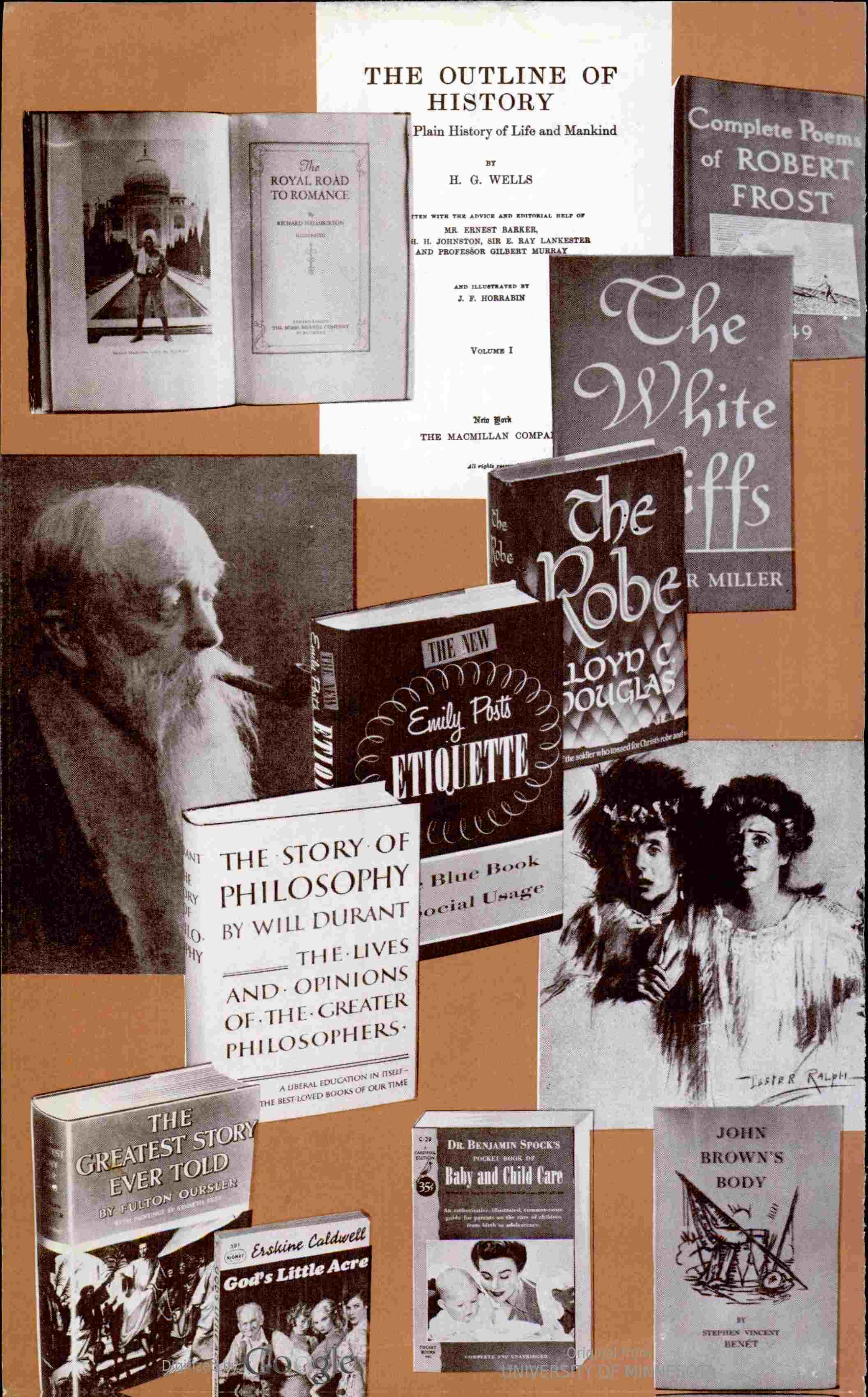
In the upper lefthand corner are the title page and frontispiece of The Royal Road to Romance, which introduced Richard Halliburton as the glamorous traveler of the ’20’s. Next is the title page of H. G. Wells’ most famous best seller, The Outline of History. To its right, and just below it, are pictures of the Complete Poems of Robert Frost, one of our best-loved poets, and of The White Cliffs, by Alice Duer Miller, best-selling poetry of World War II.
At the middle left is Alfred Aloysius Horn, whose fabulous Trader Horn, was a high spot of the ’20’s. Emily Post’s Etiquette in its original and revised editions has been a steady seller for thirty or more years. Just below Etiquette is the famous Story of Philosophy by Will Durant, and above it one of the most outstanding religious novels of our time, The Robe, by Lloyd C. Douglas. At the right is an illustration from one of the earliest best-selling American mystery stories, The Circular Staircase, by the dean of mystery writers, Mary Roberts Rinehart.
The bottom row includes a picture of the top seller in religious non-fiction, The Greatest Story Ever Told, by Fulton Oursler; the bestselling novel of this century, God’s Little Acre, by Erskine Caldwell, in its paperbound edition; Dr. Benjamin Spock’s Pocket Book of Baby and Child Care, the overall best seller in paperbound books; and the title page of the first edition of John Brown’s Body, Stephen Vincent Benet’s great narrative poem.
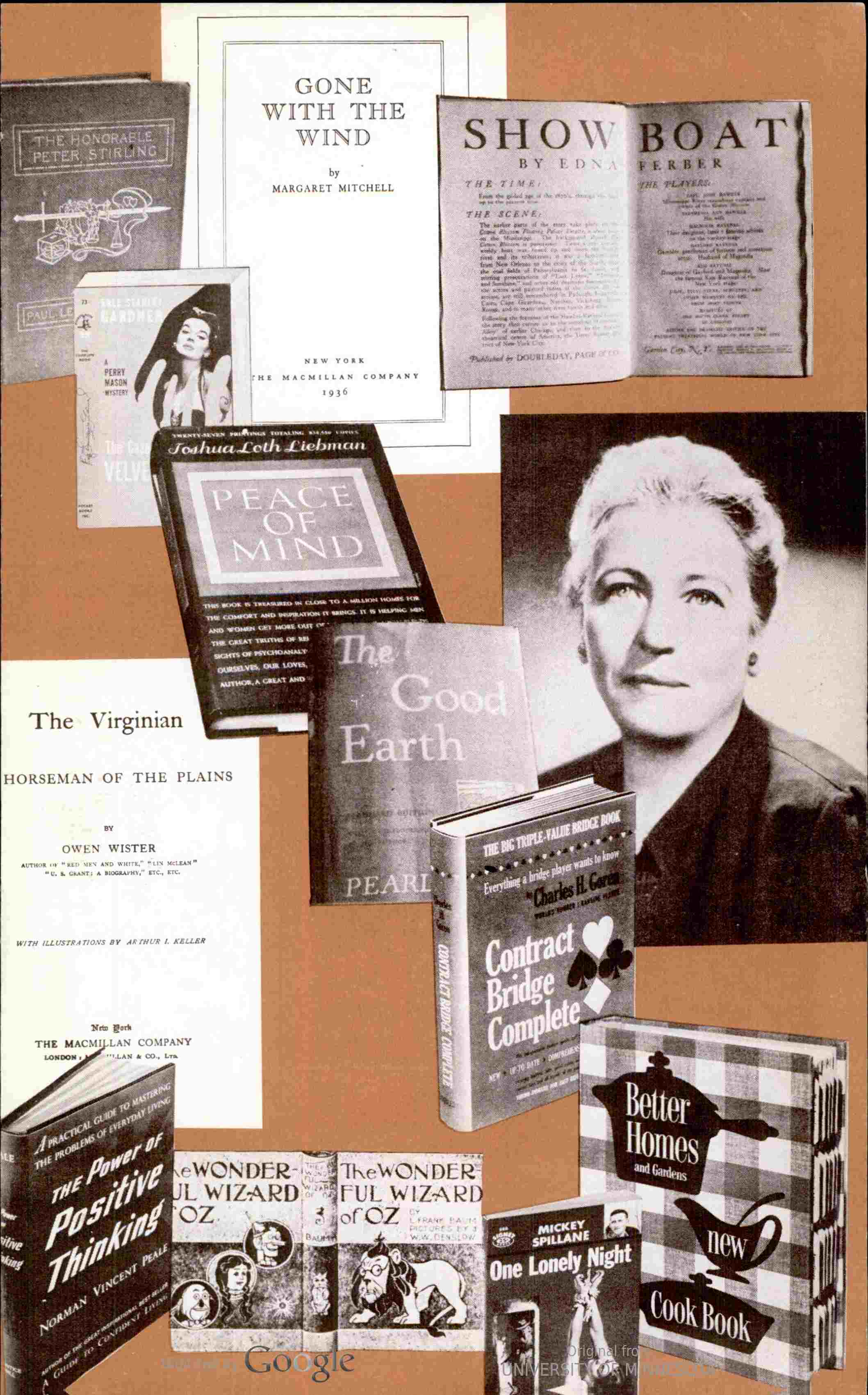
On the right page, at the upper left, is The Honorable Peter Stirling, by Paul Leicester Ford, a sensation of the 1890’s, followed by the title page of Margaret Mitchell’s Gone with the Wind, and the double title page of the special pre-publication edition of Edna Ferber’s Show Boat.
Below is the paperbound edition of Erle Stanley Gardner’s first Perry Mason mystery, The Case of the Velvet Claws. In descending order are Rabbi Liebman’s Peace of Mind; The Good Earth, flanked by a picture of its author, Pearl Buck; and Contract Bridge Complete, by the best-selling writer on bridge of the ’50’s, Charles Goren. At the left is{x} the title page of one of the best-known western stories, The Virginian, by Owen Wister.
Along the lowest row are Dr. Norman Vincent Peale’s The Power of Positive Thinking; the jacket of the original edition of L. Frank Baum’s The Wonderful Wizard of Oz, perennial juvenile favorite; the paperbound edition of One Lonely Night, by the sensational detective writer of the ’50’s, Mickey Spillane; and the new edition of the bestseller among cook books, the Better Homes and Gardens Cook Book.
It is the purpose of this book as of its predecessor, Fifty Years of Best Sellers, to present as completely as possible the facts and figures about American best sellers, to interpret and comment to some extent upon the statistics presented but not to evaluate from a literary standpoint.
There is always a great deal of interest and curiosity about best-selling books among members of the general reading public as well as among those concerned with the publishing, selling and publicizing of books. The lists and figures of this book are an attempt to answer the questions of such interested people. In view of the recurrent controversies about the best-seller system, which usually hinge upon the complaint that best seller lists draw attention only to a few books to the disadvantage of what are possibly more worthy books, it must be added that this book is not designed to glorify the best seller per se, but simply to give the facts. As long as newspapers and magazines find best seller lists attractive features for their readers, the best seller will be with us. Even if there were no organized best seller lists, notable sales for a certain book would be news. When a book becomes conspicuous for its fast and unusually large sales, people who are not ordinarily book buyers or not particularly interested in books become aware of it, even buy it. Sales themselves stimulate sales. They cannot be ignored as a factor in the book business.
The term best seller is usually comparative rather than absolute. A book may be the best seller in one store or one city; it may be the best seller over the country for a week, or a year, for five years or for sixty. The words used to designate such a book have become so established in our language and are so often loosely used that “best seller” has too often become synonymous with “book,” especially in circles outside the book industry. Advertisers, magazine editors, and program directors in radio and television, attempting to adhere to fair standards when mentioning books, often query major review media, li{2}braries, trade magazines, book associations, etc. as to whether a certain book may honestly be called a best seller. In the office of Publishers’ Weekly, the book trade magazine where much of the material for this present volume was developed, it has become the practice to answer such questions in the affirmative if that book has appeared on one of its monthly best seller lists, which are based upon bookstore surveys. The book is a best seller for at least the moment at which the question is asked. But is the book of the moment or month a best seller as David Copperfield or Gone with the Wind is a best seller? In the pages following I have attempted to illustrate the various states of best sellerdom.
The reason why the story of best sellers begins in 1895 is that it was in that year that the first best seller lists were printed in the United States. Harry Thurston Peck, then editor of the literary magazine, The Bookman, began to run each month the lists of the best-selling books in a number of large cities. By 1902, “best seller” had been established, mainly through the publicity derived from The Bookman’s lists, as a term specifically applied to books. About 1903 the magazine set the limit of its monthly list of titles at six and called the lists “the six best sellers.” From these Bookman lists were formulated the best seller lists for the years 1895 to 1912 when the Publishers’ Weekly lists were begun. There were few and scattered records of best-selling books previous to 1895. There are occasional lists in early literary magazines, some in Publishers’ Weekly, a few lists of the most popular reading matter in public libraries to be found, but all these give the effect of rather random reporting. Without any methodical listing of best sellers in the years previous to 1895, it is practically impossible to arrive at exact figures of sales for the books of preceding centuries or even at estimates except in the case of the books which have endured. A list of “Early Best Sellers,” most of which have been read for more than a century, is included in this book. It has been checked by a number of authorities, and, while it may possibly not be complete, the titles on it comprise a valid body of best sellers published before 1895.
The first edition of this book covered the years from 1895 to 1945. Since then there have been tremendous changes in the business of{3} bookselling, principally in methods of selling. During and just after World War II more books could have been sold than were available. This was because of paper quotas, shortages in other materials, and wartime demands. Children’s books, especially, sold as fast as they could be placed on sale, for one reason because the metals used in making toys for children were in even shorter supply than paper. All books sold very well in spite of limitations placed upon their manufacture. There were fewer titles published but those that were published and were successful sold out all their printings. At about the time that paper restrictions began to be lifted book clubs boomed. The major clubs had been in existence for a number of years but it was not until the postwar period that all their monthly selections sold into many hundreds of thousands. The Book-of-the-Month Club distributed a total of 7,011,936 books in 1950. In its fiscal year of 1950 the Literary Guild sent out about 8,800,000 books. Compare these figures with those estimated by Maxwell Aley in the June 6, 1931 Publishers’ Weekly. He concluded then that there were “one million habitual book buyers, one million more occasional buyers and beyond that a vague but large number who buy one or two books a year.” Because of the popularity of the books in the Armed Services Editions, distributed to men and women in the Armed Services during the war, the book trade hoped that the many new readers of books would continue to read in the postwar years, and that the book boom of the late ’40’s and early ’50’s would continue.
The big totals piled up by the book clubs had a tremendous effect on what I have called the overall best seller lists, the three lists that include books that have sold 750,000 copies or more in the past sixty years. Many books of the mid-century have displaced the favorites of the century’s early years that once were high on the lists. The reading picture given by the list is entirely different from what it was ten years ago.
At almost the same time as wartime demands were creating new best sellers, another tremendous change which affected the overall best seller lists, was taking place in the book business. That was the success of the 25-cent paperbound book. This was not a new develop{4}ment in the trade. In the nineteenth century, in the “dime novel” period, paper bound books had big sales. Dime novels flourished for years. There were also many experiments in later years to launch paperbound lines, but it was not until 1939 that the paperbound book came into its own for moderns. Its success was due to new methods of cheaper manufacture, to new methods of distribution through the magazine wholesaler system, and to improved literary quality of the books chosen for reprint in paper covers.
When the first edition of this book appeared, paperbound books were established but had not yet attained the enormous sales that came later on. There was one “overall” best-seller list, 1895-1945, in Fifty Years of Best Sellers. Both hardbound books, including the reprints at 75 cents and $1 which sold well up to the 1940’s, and paperbound books were lumped together on it. Paperbound sales account for the place of only a few books on the list—books like See Here, Private Hargrove and The Pocket Book of War Humor. That list, made in 1944, was, on the whole, not greatly affected by paperbound book sales. Since then the whole picture has changed enormously. Paperbound sales, both reprints of hardcover editions and books which have made their first appearance in paper covers, account for by far the majority of titles.
That is why, for this new edition, I have arranged the overall list, 1895-1955, in three sections. Students of the book business and of literary taste will find what books have sold to bookstore and book club customers, what titles have sold to the so-called mass market. The evidence is not quite what one would expect. While great numbers of detective and western stories and some sensational fiction on the list are due to paperbound sales, it is also true that paperbound distribution accounts for the appearance of such authors as John Steinbeck and William Faulkner on the overall combined list.
In general the sales figures on these three lists are much larger than those on the 1945 list. The minimum sales figure on that list was half a million copies. On two of the 1955 lists the minimum is one million; on the hardbound list, 750,000. There are also many more titles on these lists than on the 1945 list. Title production has increased{5} every year since the end of the war and the reading population has also increased. While the sales figures for the most popular books are startlingly larger than those of a decade ago, they are not so great as one must believe they could be in relation to growth of population and the increase in high school and college enrollment. Robert Frase, economic consultant and associate director of the American Book Publishers Council, has recently pointed out that this population pattern ought soon to affect the book business favorably even if it has not yet affected it as much as expected. This slow rate of increase in sales, if not in title production, is illustrated by figures Mr. Frase has quoted for trade books sold in 1929 and in 1954. The figures for both years are practically the same, about 70,000,000 copies. Book club sales, however, rose from about 2,000,000 to 50,000,000; paperbacks from zero to 190,000,000; juveniles, at all prices, from 37,000,000 to 95,000,000.
Among trade books, the topmost best sellers are selling in even greater quantities than they did previously, but for the run-of-the-mill books the situation is not so happy. Big best sellers, textbooks, children’s books, and other special types of books are going along at a good rate. The novel or book of non-fiction that may be worthy but is not particularly outstanding has a rougher road. Because of increasing manufacturing costs and the decrease in rental libraries, which once absorbed a creditable number of the ordinary romances and novels designed for a few hours’ diversion, it is difficult for the publisher to sell the unassuming book profitably. Contrary to public assumption, most authors of books do not make much money. They must either write a great many books or else produce a few big best sellers in order to attain satisfactory incomes. Laura Z. Hobson, author of Gentleman’s Agreement and other books, has made the statement that of the 2,000 members of the Authors’ Guild, less than half make an annual income of $3,000 or more from all forms of writing. But an author may not have to live on book sales alone. The sales of subsidiary rights, i.e., rights to use a book as the basis of a movie, television show or condensation, are becoming of more and more importance both to author and publisher; but it is mainly the “big” books that bring in the big money, and they are few and far between. The{6} Desperate Hours, for example, brought its author, Joseph Hayes, a quarter of a million dollars within a very short time—but this included, besides sales of the book and of book club editions, the sale of the play and screen rights, Reader’s Digest condensation and magazine serialization. One book that almost reached the ultimate in all types of sales was The Razor’s Edge by W. Somerset Maugham. It was serialized in Redbook, was a best seller in its trade edition, was both a Literary Guild and a Dollar Book Club best seller, sold in a clothbound $1 reprint and in a 25-cent paperbound reprint, and was produced as a movie. Numerous foreign rights were sold.
Readers may wonder why many, if not most, of the best sellers on the three overall lists do not appear on the annual lists of best sellers, 1895 through 1955, and, conversely, why many of the titles on the yearly lists do not appear on the overall best seller lists. This situation illustrates the difference between the best seller of the year and the all-time best seller. These annual lists as compiled by the Publishers’ Weekly, are primarily for the interest of the retail bookseller. They do not include book club sales or sales in paperbound reprint editions. They are intended to show the reading tastes of the book buyers who actually go to a store to select books, not of those who buy by mail or pick up random reading from newsstands. Most of the books on the annual lists of recent years sell a minimum of about 75,000 copies. It takes several years’ big sales to put one of the books from the yearly lists on the all-time list. Book club sales and paperbound sales will also help do the job.
The reason why many of the books on the all-time lists do not appear on yearly lists is, in general, the same. In the case where book club or paperbound sales do not enter into the situation the books probably have sold steadily, piling up sales over the years until they reach big quantities. This is especially true of the cook books which stand high on the hardbound list; four out of the first five titles on the list are cook books.
These yearly lists are more interesting for the student of social history and literary taste than are the overall lists. They reflect events {7}and crises in history over sixty years as well as the changing mores—from Pollyanna to Polly Adler. There are books on these lists that have made history and influenced American thinking. Consider The Honorable Peter Stirling by Paul Leicester Ford, The Pit by Frank Norris, The Jungle, by Upton Sinclair, Mr. Britling Sees It Through, by H. G. Wells, The Economic Consequences of the Peace by John Maynard Keynes, The Plastic Age by Percy Marks, Mother India by Katherine Mayo, Looking Forward by Franklin D. Roosevelt, It Can’t Happen Here by Sinclair Lewis, The Grapes of Wrath by John Steinbeck, For Whom the Bell Tolls by Ernest Hemingway, Berlin Diary by William L. Shirer, The White Cliffs by Alice Duer Miller, You Can’t Do Business with Hitler by Douglas S. Miller, Victory Through Air Power by Major Alexander P. de Seversky, They Were Expendable by W. L. White, One World by Wendell L. Willkie, Strange Fruit by Lillian Smith, I Chose Freedom by Victor Kravchenko, Gentleman’s Agreement by Laura Z. Hobson, Kingsblood Royal by Sinclair Lewis, The Wall by John Hersey, Witness by Whittaker Chambers, But We Were Born Free by Elmer Davis, Why Johnny Can’t Read by Rudolf Flesch and Year of Decisions by Harry S. Truman. There are many books which have added new words and phrases to the American language: The Virginian, Pollyanna, Over the Top, Main Street, Babbitt, Gentlemen Prefer Blondes, Back Street, Life Begins at Forty, Mr. Chips, Lost Horizon, The Hucksters, The Snake Pit, and The Man in the Gray Flannel Suit. Some are known by more people because their titles are the titles of songs: The Trail of the Lonesome Pine, The Rosary, In Flanders Fields, The Sheik, Stars Fell on Alabama, My Sister and I, and The Last Time I Saw Paris.
Of interest to publishers is the number of titles on the annual list that specific firms have issued. The leaders are Doubleday (with predecessor firms), 89; Harper, 80; Houghton Mifflin, 46; Scribner, 43; Little, Brown, 41; Bobbs-Merrill (with predecessor firms) and Macmillan, 40 each; Appleton-Century-Crofts (with predecessor firms), 39; Simon and Schuster, 31; Lippincott (with Stokes), 23; and Dodd Mead, 20. With one exception all these houses were founded in the nineteenth century. Simon and Schuster is the youngest, and its 31 best sellers appear only on the annual lists since 1924. The authors who have had the most titles on the sixty annual lists are Mary{8} Roberts Rinehart with eleven; Sinclair Lewis with ten; Zane Grey and Booth Tarkington with nine each; and Louis Bromfield, Winston Churchill (the American novelist), George Barr McCutcheon, Gene Stratton Porter, and Frank Yerby with eight each. In the first twenty years, 1895-1914, the authors who appeared most frequently were George Barr McCutcheon, with eight titles; Winston Churchill with seven, and Mary Johnston and Sir Gilbert Parker with five each. In the period 1915-1934, Zane Grey led with nine titles. He was followed by Warwick Deeping, Sinclair Lewis, Mary Roberts Rinehart, and Booth Tarkington, with seven each, and by Coningsby Dawson, Eleanor H. Porter, Gene Stratton Porter, and H. G. Wells with five each. In the past twenty years, the authors having most titles on the lists are Frank Yerby with eight; Daphne du Maurier, John P. Marquand and John Steinbeck with six each; and Thomas B. Costain, A. J. Cronin, Lloyd C. Douglas, John Gunther, James Hilton, and Frances Parkinson Keyes with five each. The authors whose books have covered the longest span on all the lists are: Ellen Glasgow, whose first best seller appeared on the 1904 list and her last on the 1935 list; Edna Ferber, 1924 and 1952; Mary Roberts Rinehart, 1909 and 1936; Frances Hodgson Burnett, 1896 and 1922; Sinclair Lewis, 1921 and 1947; and Louis Bromfield, 1927 and 1945.
As I have said, literary criticism does not enter into this book; it is a guide to the past and present, and, for those looking toward future best sellers, a starting-point for speculation. It is wise to bear in mind Samuel Butler’s statement: “There are some things which it is madness not to try to know but where it is almost as much madness to try to know. Sometimes publishers hoping to buy the Holy Ghost with a price, fee a man to read for them and advise them. This is but as the vain tossing of insomnia. God will not have any human being know what will sell.” Years ago the formula for a best seller was summed up as Lincoln’s Doctor’s Dog—because books about Lincoln, about doctors and about dogs are always popular. Today the title might be amended to How to Be Lincoln’s Doctor’s Dog’s Psychiatrist. Or the writer might follow the caption for a drawing by Alan Dunn in the New Yorker, “It can’t miss, J. G.! The author got disillusioned with{9} Communism, escaped from behind the Iron Curtain, came to the United States, lived on a sharecropper’s farm in Georgia, spent a year in a state insane asylum, turned to religion, and now is a monk.”
What best sellers of today will become the classics of tomorrow? Malcolm Cowley has pointed out, in an article in the New Republic (Dec. 22, 1947), “Classics and Best Sellers,” the distinction between a classic (a book admired by intelligent readers through several generations) and a best seller (a book purchased by many readers in one generation). The terms, he says, “are not mutually exclusive—a best seller may become a classic in time, as happened with Dickens’ novels.” In order to try to find out how many of the books on the early years’ lists were at all familiar to today’s young generation, I read the titles and authors’ names to several recent college graduates. Only the most obvious authors were known to most of them, and extremely few titles. The lists were also tried out on freshman English composition classes in a New England college, with equally negative results. I quote from a letter written by the teacher of the classes. “These students are almost completely ignorant of the best sellers you have listed. Occasionally the name of an author may remind them of something they’ve heard their parents discuss. In some cases, they had heard the name of the book, but knew nothing of the author, e.g., Seventeen, If Winter Comes, Gentlemen Prefer Blondes.... Generally the best sellers of yesterday are a dead issue to the college freshman of today. The one exception is Gone With the Wind which has had a slight renaissance since the movie was reissued.... My concern is not that these students are ignorant of the best sellers of yesteryear, but that most of them know nothing about contemporary American and English literature. Their ignorance is appalling! Many have read nothing by Hemingway, Steinbeck, Eugene O’Neill, Faulkner, Maugham, Hilton, Shaw, etc. A few have read From Here to Eternity and some are at least familiar with the titles of book club books that they have seen around their homes. In school they may have read Arrowsmith, but they have never heard of Dreiser, Edith Wharton, Booth Tarkington, Winston Churchill, Willa Cather, or practically anyone since Mark Twain.”
To relate the material, the facts and figures of this present book up to 1950, to their historical and sociological background, I heartily recommend the reading of James D. Hart’s The Popular Book (Oxford University Press, 1950). For a final word on the whole business of best sellers I quote from his concluding paragraphs. “If a student of taste wants to know the thoughts and feelings of the majority who lived during Franklin Pierce’s administration, he will find more positive value in Maria Cummins’s The Lamplighter or T. S. Arthur’s Ten Nights in a Bar-Room than he will in Thoreau’s Walden—all books published in 1854. The mores and manners prevailing in the year of the Teapot Dome scandal can better be extrapolated from Gertrude Atherton’s Black Oxen than from Wallace Stevens’s Harmonium. The book that time judges to be great is occasionally also the book popular in its own period; but, by and large, the longer-lived work reflects the demands of the moment only in the most general sense. Usually the book that is popular pleases the reader because it is shaped by the same forces that mold his non-reading hours, so that its dispositions and convictions, its language and subject, re-create the sense of the present, to die away as soon as that present becomes the past. Books of that sort generally are unreadable for succeeding ages; but like other fragments of the past, they help form the present. The volumes themselves may gather dust on library shelves, but they have left lasting impression on the American mind, etched deeply into a national consciousness.”
This overall list of best sellers includes books published in the United States from 1895 through 1955, which have, over sixty years, sold one million copies or more. Most of them have appeared in many different editions and in both hardbound and paperbound format. Many have been sold by book clubs, on newsstands, and by mail as well as through bookstores. Most of the titles, with some notable exceptions, represent the most popular reading habit, that is, reading for entertainment. Pamphlets are not included in the list, nor are dictionaries, encyclopedias, atlases, editions of the Bible, hymnals, prayer books, manuals, textbooks, and certain other books, such as game and novelty books. Best sellers in these specialized fields are, in general, covered under other headings. Children’s books are included when they are primarily juvenile novels and not picture or game books.
Publishers’ names are not given because most of the books have been published by at least two firms and sometimes by five or six or even more. The date of original publication in this country follows the author’s name. “F” indicates fiction, “J” juveniles. Many of the titles listed as juveniles were originally published as adult books, but changing taste has now definitely placed them in the category of juvenile reading, and they are so indicated in accordance with modern standards.
Three hundred and six titles make up this list of books which have sold over 1,000,000 copies in the years since 1895. In the original edition of the present book a somewhat comparable list appeared, an overall best-seller list of books which had sold 500,000 copies or more in the years from 1895 through 1945. There were only 143 titles on that list. The enormous increase in both number of best-selling books, and in sales is due not only to the normal increase in the number of new titles issued in the years since 1945 but in much greater part to the{12} increase in the production and distribution of paperbound books and to the big jump in book club sales during the years immediately after World War II.
This revolution in the make-up of the overall best-seller list has resulted in the elimination of most of the popular books that first appeared in the years up to 1930. There are only 14 titles on the list that were published in the years between 1916 and 1930. Some of the most popular authors of the early part of this century like the novelist Winston Churchill, whose historical tales were the best sellers of almost every year from 1901 through 1915, and Harold Bell Wright and Gene Stratton Porter, whose names predominated on the earlier list, have all but disappeared from this one. On the other hand, the paperback editions are responsible for the inclusion on this list of many of the books of twenty or so years ago which never had extremely large sales in their hardback editions—books by authors like Erskine Caldwell, Thorne Smith, William Faulkner, and Paul De Kruif. It is the paperbacks, too, that have created the large sales for the many detective and western stories that appear here. In His Steps, Gone with the Wind, and How to Win Friends and Influence People are still right at the top. Some of the older favorites are still here, but much farther down the list than they were, such titles as Pollyanna, The Rosary, The Little Shepherd of Kingdom Come, and The Sheik. One hundred and eighteen of these 306 books have been published since 1945, and 43 of them since 1950.
| F | In His Steps, by Charles Monroe Sheldon. 1897 | (est.) 8,000,000 |
| The Common Sense Book of Baby and Child Care, by Benjamin Spock. 1946 | 7,850,000 | |
| F | God’s Little Acre, by Erskine Caldwell. 1933 | 6,582,553 |
| Better Homes and Gardens Cook Book. 1930 | 5,806,586 | |
| F | Gone with the Wind, by Margaret Mitchell. 1937 | 5,000,000 |
| How to Win Friends and Influence People, by Dale Carnegie. 1937 | 4,877,511{13} | |
| F | I, the Jury, by Mickey Spillane. 1947 | 4,441,837 |
| F | The Big Kill, by Mickey Spillane. 1951 | 4,158,840 |
| A Message to Garcia, by Elbert Hubbard. 1898 | (est.) 4,000,000 | |
| F | My Gun Is Quick, by Mickey Spillane. 1950 | 3,912,419 |
| The Pocket Cook Book, by Elizabeth Woody. 1942 | 3,800,000 | |
| F | The Long Wait, by Mickey Spillane. 1951 | 3,774,374 |
| F | Kiss Me, Deadly, by Mickey Spillane. 1952 | 3,773,045 |
| F | One Lonely Night, by Mickey Spillane. 1951 | 3,737,882 |
| F | Vengeance Is Mine! by Mickey Spillane. 1950 | 3,649,500 |
| The Greatest Story Ever Told, by Fulton Oursler. 1949 | 3,580,570 | |
| Betty Crocker’s Picture Cook Book. 1950 | 3,500,000 | |
| F | Journeyman, by Erskine Caldwell. 1935 | 3,490,703 |
| The American Woman’s Cook Book, ed. by Ruth Berolzheimer. 1938 | 3,400,000 | |
| F | Tragic Ground, by Erskine Caldwell. 1944 | 3,395,197 |
| F | The Razor’s Edge, by W. Somerset Maugham. 1944 | 3,221,843 |
| F | Tobacco Road, by Erskine Caldwell. 1932 | 3,168,321 |
| The Boston Cooking School Cook Book, by Fannie Farmer. 1896. Ninth ed. by Wilma Lord Perkins. 1951 | 3,058,778 | |
| The Story of the Bible, by Jesse Lyman Hurlbut. 1904 | 3,000,000 | |
| F | From Here to Eternity, by James Jones. 1951 | 2,996,435 |
| F | The Chinese Room, by Vivian Connell. 1942 | 2,919,484 |
| F | A House in the Uplands, by Erskine Caldwell. 1946 | 2,871,332 |
| F | Duel in the Sun, by Niven Busch. 1944 | 2,850,347 |
| J | The Wonderful Wizard of Oz, by L. Frank Baum. 1900 | 2,830,049 |
| F | The Case of the Lucky Legs, by Erle Stanley Gardner. 1934 | 2,744,413 |
| The Service Cook Book, by Ida Bailey Allen. 1933 | 2,750,000 | |
| F | See Here, Private Hargrove, by Marion Hargrove. 1942 | 2,693,000{14} |
| F | The Robe, by Lloyd C. Douglas. 1942 | 2,674,951 |
| F | The Caine Mutiny, by Herman Wouk. 1954 | 2,589,763 |
| F | Not as a Stranger, by Morton Thompson. 1954 | 2,575,000 |
| F | Topper, by Thorne Smith. 1926 | 2,557,806 |
| F | A Tree Grows in Brooklyn, by Betty Smith. 1943 | 2,539,000 |
| F | Trouble in July, by Erskine Caldwell. 1940 | 2,524,233 |
| F | Mutiny on the Bounty, by Charles Nordhoff and James Norman Hall. 1932 | 2,523,846 |
| F | Georgia Boy, by Erskine Caldwell. 1943 | 2,488,616 |
| F | Pocket Book of Short Stories, ed. by M. E. Speare. 1941 | 2,438,000 |
| F | So Well Remembered, by James Hilton. 1945 | 2,402,225 |
| Betty Crocker’s Good and Easy Cookbook. 1954 | 2,400,000 | |
| F | The Golden Hawk, by Frank Yerby. 1948 | 2,384,663 |
| F | Rebecca, by Daphne du Maurier. 1938 | 2,358,468 |
| F | Forever Amber, by Kathleen Winsor. 1944 | 2,348,400 |
| F | The Case of the Curious Bride, by Erle Stanley Gardner. 1934 | 2,315,388 |
| F | B.F.’s Daughter, by John P. Marquand. 1946 | 2,309,124 |
| F | The Sure Hand of God, by Erskine Caldwell. 1947 | 2,245,719 |
| F | The Silver Chalice, by Thomas B. Costain. 1952 | 2,236,004 |
| F | Kitty, by Rosamond Marshall. 1943 | 2,234,974 |
| F | The Glorious Pool, by Thorne Smith. 1934 | 2,227,945 |
| F | The Amboy Dukes, by Irving Shulman. 1947 | 2,213,167 |
| F | Tales of the South Pacific, by James Michener. 1947 | 2,208,270 |
| F | The Case of the Sulky Girl, by Erle Stanley Gardner. 1933 | 2,184,168 |
| F | Battle Cry, by Leon M. Uris. 1953 | 2,178,000 |
| F | Dinner at Antoine’s, by Frances Parkinson Keyes. 1948 | 2,142,000 |
| F | The Black Rose, by Thomas B. Costain. 1945 | 2,129,442{15} |
| F | Lost Horizon, by James Hilton. 1935 | 2,128,864 |
| F | Prince of Foxes, by Samuel Shellabarger. 1947 | 2,127,969 |
| The Pocket Book of Verse, ed. by M. E. Speare. 1940 | 2,127,000 | |
| F | The Case of the Lame Canary, by Erle Stanley Gardner. 1937 | 2,119,362 |
| F | Pocket Book of Erskine Caldwell Stories, ed. by Henry Seidel Canby. 1947 | 2,107,000 |
| J | Freckles, by Gene Stratton Porter. 1904 | 2,089,523 |
| I’ll Cry Tomorrow, by Lillian Roth, Mike Connolly and Jerold Frank. 1954 | 2,075,000 | |
| F | The Case of the Dangerous Dowager, by Erle Stanley Gardner. 1937 | 2,073,589 |
| F | The Passionate Witch, by Thorne Smith. 1941 | 2,070,645 |
| The Song of Our Syrian Gu(est.) by William Allen Knight. 1903 | 2,070,500 | |
| The Outline of History, by H. G. Wells. 1921 | 2,070,170 | |
| F | Strange Fruit, by Lillian Smith. 1944 | 2,066,070 |
| J | The Girl of the Limberlost, by Gene Stratton Porter. 1909 | 2,053,892 |
| F | The Case of the Substitute Face, by Erle Stanley Gardner. 1938 | 2,040,167 |
| F | Magnificent Obsession, by Lloyd C. Douglas. 1929 | 2,038,576 |
| F | Women’s Barracks, by Tereska Torres. 1950 | 2,036,048 |
| F | Leave Her to Heaven, by Ben Ames Williams. 1944 | 2,031,210 |
| F | The Case of the Baited Hook, by Erle Stanley Gardner. 1940 | 2,023,489 |
| F | The Case of the Stuttering Bishop, by Erle Stanley Gardner. 1936 | 2,019,162 |
| The Power of Positive Thinking, by Norman Vincent Peale. 1952 | 2,000,000 | |
| F | The Case of the Counterfeit Eye, by Erle Stanley Gardner. 1935 | 1,980,198 |
| F | Giant, by Edna Ferber. 1952 | 1,889,001{16} |
| F | The Naked and the Dead, by Norman Mailer. 1948 | 1,876,000 |
| F | Cannery Row, by John Steinbeck. 1945 | (est.) 1,873,000 |
| The Joy of Cooking, by Irma S. Rombauer. 1931 (The New Joy of Cooking, with Marion Rombauer Becker 1951) | 1,855,434 | |
| F | The Case of the Caretaker’s Cat, by Erle Stanley Gardner. 1935 | 1,879,792 |
| F | This Is Murder, by Erle Stanley Gardner. 1935 | 1,868,039 |
| F | The Case of the Velvet Claws, by Erle Stanley Gardner. 1933 | 1,863,346 |
| F | Nevada, by Zane Grey. 1928 | 1,834,116 |
| F | The Case of the Sleepwalker’s Niece, by Erle Stanley Gardner. 1936 | 1,814,946 |
| F | The Bishop’s Jaegers, by Thorne Smith. 1932 | 1,814,649 |
| F | The Good Earth, by Pearl S. Buck. 1931 | 1,811,500 |
| F | House of Flesh, by Bruno Fischer. 1950 | 1,800,212 |
| F | Désirée, by Annemarie Selinko. 1953 | 1,770,826 |
| 30 Days to a More Powerful Vocabulary, by Wilfred J. Funk and Norman Lewis. 1942 | 1,766,454 | |
| Better Homes and Gardens Baby Book. 1943 | 1,766,284 | |
| F | The Case of the Black-Eyed Blonde, by Erle Stanley Gardner. 1944 | 1,764,784 |
| One World, by Wendell L. Willkie. 1943 | 1,756,760 | |
| F | The Call of the Wild, by Jack London. 1903 | 1,752,500 |
| Jailbait, by William Bernard, 1949 | 1,750,000 | |
| F | The Clue of the Forgotten Murder, by Erle Stanley Gardner. 1935 | 1,737,780 |
| You Are What You Eat, by Victor H. Lindlahr. 1940 | 1,730,000 | |
| F | Impatient Virgin, by Donald Henderson Clarke. 1931 | 1,702,500 |
| F | The Case of the Haunted Husband, by Erle Stanley Gardner. 1941 | 1,695,359 |
| F | The Wayward Bus, by John Steinbeck. 1947 | 1,687,000 |
| F | The Wild Palms, by William Faulkner. 1939 | 1,678,000{17} |
| F | Adventures of Ellery Queen. 1934 | 1,676,000 |
| The Greatest Book Ever Written, by Fulton Oursler. 1951 | 1,674,438 | |
| F | The Foxes of Harrow, by Frank Yerby. 1946 | 1,671,697 |
| J | Facts of Life and Love for Teen-Agers, by Evelyn Willis Duvall. 1950 | 1,670,000 |
| F | A Woman in the House, by Erskine Caldwell. 1949 | 1,623,630 |
| F | The Virginian, by Owen Wister. 1902 | 1,623,000 |
| F | This Very Earth, by Erskine Caldwell. 1948 | 1,611,798 |
| F | The Harvester, by Gene Stratton Porter. 1911 | 1,611,007 |
| F | The New Adventures of Ellery Queen. 1940 | 1,603,000 |
| F | The Spanish Cape Mystery, by Ellery Queen. 1935 | 1,603,000 |
| F | Mr. Roberts, by Thomas Heggen. 1946 | 1,599,779 |
| F | The Song of Bernadette, by Franz Werfel. 1942 | 1,594,000 |
| F | The Case of the Howling Dog, by Erle Stanley Gardner. 1934 | 1,593,199 |
| J | Laddie, by Gene Stratton Porter. 1913 | 1,586,529 |
| F | Strange Woman, by Ben Ames Williams. 1941 | 1,581,973 |
| F | The Chinese Orange Mystery, by Ellery Queen. 1934 | 1,565,000 |
| F | Pride’s Castle, by Frank Yerby. 1949 | 1,559,203 |
| F | Mother, by Kathleen Norris. 1911 | 1,553,792 |
| F | Yankee Pasha, by Edison Marshall. 1947 | 1,550,000 |
| F | Christmas Holiday, by W. Somerset Maugham. 1939 | 1,546,793 |
| F | Duke, by Hal Ellson. 1949 | 1,540,000 |
| F | The Vixens, by Frank Yerby. 1947 | 1,524,123 |
| F | The Case of the Borrowed Brunette, by Erle Stanley Gardner. 1946 | 1,537,214 |
| F | The Case of the Buried Clock, by Erle Stanley Gardner. 1943 | 1,530,206 |
| Analysis of the Kinsey Reports on Sexual Behavior in the Human Male and Female, ed. by Donald P. Geddes. 1954 | 1,519,380{18} | |
| F | The Case of the Drowsy Mosquito, by Erle Stanley Gardner. 1943 | 1,510,245 |
| In Tune with the Infinite, by Ralph Waldo Trine. 1897 | 1,507,314 | |
| Pocket Book of Cartoons, ed. by Bennett Cerf. 1943 | 1,507,000 | |
| F | The Case of the Shoplifter’s Shoe, by Erle Stanley Gardner. 1938 | 1,506,660 |
| F | The Dutch Shoe Mystery, by Ellery Queen. 1931 | 1,506,000 |
| F | The Murder of Roger Ackroyd, by Agatha Christie. 1926 | (est.) 1,500,000 |
| F | The Case of the Gold Digger’s Purse, by Erle Stanley Gardner. 1945 | 1,492,948 |
| F | Floodtide, by Frank Yerby. 1950 | 1,492,413 |
| Dear Sir, by Juliet Lowell. 1944 | 1,488,097 | |
| F | Random Harv(est.) by James Hilton. 1941 | 1,476,460 |
| F | Young Lonigan, by James T. Farrell. 1932 | 1,475,311 |
| F | No Time for Sergeants, by Mac Hyman. 1954 | 1,473,400 |
| F | The Case of the Cautious Coquette, by Erle Stanley Gardner. 1949 | 1,465,537 |
| F | Spring Fire, by Vin Packer. 1952 | 1,463,917 |
| Believe It or Not, ed. by Robert L. Ripley. 1941 | 1,457,000 | |
| F | Mr. Adam, by Pat Frank. 1946 | 1,445,156 |
| F | Duchess Hotspur, by Rosamond Marshall. 1946 | 1,440,668 |
| F | Mildred Pierce, by James M. Cain. 1941 | 1,436,252 |
| F | The Postman Always Rings Twice, by James M. Cain. 1934 | 1,435,000 |
| F | Lord Johnnie, by Leslie Turner White. 1949 | 1,432,000 |
| F | Serenade, by James M. Cain. 1937 | 1,428,765 |
| F | Green Dolphin Street, by Elizabeth Goudge. 1944 | 1,425,000 |
| F | All Quiet on the Western Front, by Erich Maria Remarque. 1929 | 1,424,231 |
| F | The Case of the Half-Wakened Wife, by Erle Stanley Gardner. 1945 | 1,424,228 |
| Pocket Book of War Humor, ed. by Bennett Cerf. 1943 | 1,422,000{19} | |
| F | The River Road, by Frances Parkinson Keyes. 1946 | 1,421,000 |
| F | Calamity Town, by Ellery Queen. 1942 | 1,412,000 |
| F | Bedelia, by Vera Caspary. 1945 | 1,409,790 |
| F | The Case of the Turning Tide, by Erle Stanley Gardner. 1941 | 1,408,319 |
| F | Cry Tough! by Irving Shulman. 1949 | 1,407,447 |
| F | The D.A. Calls It Murder, by Erle Stanley Gardner. 1937 | 1,407,310 |
| F | The Royal Box, by Frances Parkinson Keyes. 1954 | 1,406,000 |
| F | The Case of the Silent Partner, by Erle Stanley Gardner. 1940 | 1,402,931 |
| F | Lydia Bailey, by Kenneth Roberts. 1947 | 1,400,616 |
| Dennis the Menace, by Hank Ketcham. 1952 | 1,400,000 | |
| F | A Swell Looking Girl, by Erskine Caldwell. 1950 | 1,397,583 |
| Pocket Book of Boners. 1943 | 1,387,000 | |
| F | A Farewell to Arms, by Ernest Hemingway. 1929 | 1,383,000 |
| F | The Case of the Empty Tin, by Erle Stanley Gardner 1941 | 1,377,388 |
| F | The Case of the Rolling Bones, by Erle Stanley Gardner. 1939 | 1,368,767 |
| F | A Place Called Estherville, by Erskine Caldwell. 1949 | 1,368,066 |
| F | The Golden Fury, by Marian Castle. 1949 | 1,363,909 |
| F | Murder Up My Sleeve, by Erle Stanley Gardner. 1938 | 1,359,975 |
| J | Rebecca of Sunnybrook Farm, by Kate Douglas Wiggin. 1904 | 1,357,714 |
| F | Knock on Any Door, by Willard Motley. 1947 | (est.) 1,355,045 |
| F | The Revolt of Mamie Stover, by William Bradford Huie. 1951 | 1,355,000 |
| F | The King’s General, by Daphne du Maurier. 1946 | 1,354,982 |
| F | The Man in the Gray Flannel Suit, by Sloan Wilson. 1955 | 1,350,000 |
| F | Joy Street, by Frances Parkinson Keyes. 1950 | 1,349,000 |
| F | The Tormented, by Theodore Pratt. 1950 | 1,344,912{20} |
| F | The Damned, by John D. MacDonald. 1952 | 1,335,768 |
| F | Lady Chatterley’s Lover, by D. H. Lawrence. 1932 | (est.) 1,329,228 |
| F | The Spirit of the Border, by Zane Grey. 1906 | 1,325,000 |
| F | Sanctuary, by William Faulkner. 1931 | 1,322,214 |
| F | The Young Manhood of Studs Lonigan, by James T. Farrell. 1934 | 1,318,075 |
| F | Rampart Street, by Everett and Olga Webber. 1948 | 1,318,000 |
| F | Annie Jordan, by Mary Brinker Post. 1948 | 1,315,455 |
| I Never Left Home, by Bob Hope. 1944 | 1,308,094 | |
| A Man Called Peter, by Catherine Marshall. 1951 | 1,303,000 | |
| F | The Bigger They Come, by A. A. Fair. 1939 | 1,295,319 |
| More Dennis the Menace, by Hank Ketcham. 1953 | 1,290,208 | |
| F | The Trail of the Lonesome Pine, by John Fox, Jr. 1908 | 1,285,000 |
| F | The Saracen Blade, by Frank Yerby. 1952 | 1,284,042 |
| F | Came a Cavalier, by Frances Parkinson Keyes. 1947 | 1,279,000 |
| F | This Side of Innocence, by Taylor Caldwell. 1946 | 1,276,000 |
| F | The Case of the Crooked Candle, by Erle Stanley Gardner. 1944 | 1,273,775 |
| My Flag Is Down, by James Maresca. 1948 | 1,261,000 | |
| F | Before the Sun Goes Down, by Elizabeth M. Howard. 1946 | 1,260,725 |
| F | Golden Sleep, by Vivian Connell. 1948 | 1,258,675 |
| F | The Cautious Amorist, by Norman Lindsay. 1932 | 1,253,793 |
| Five Acres and Independence, by M. G. Kains. 1935 | 1,250,000 | |
| F | Steamboat Gothic, by Frances Parkinson Keyes. 1952 | 1,247,000 |
| F | The Thin Man, by Dashiell Hammett. 1934 | 1,243,445 |
| F | Cocotte, by Theodore Pratt. 1951 | 1,237,773 |
| F | The Four of Hearts, by Ellery Queen. 1938 | 1,235,000 |
| Washington Confidential, by Jack Lait and Lee Mortimer. 1951 | 1,235,000 | |
| F | The Crisis, by Winston Churchill. 1901 | 1,232,380{21} |
| F | Singing Guns, by Max Brand. 1938 | 1,229,000 |
| F | Farewell My Lovely, by Raymond Chandler. 1940 | 1,228,880 |
| F | The Citadel, by A. J. Cronin. 1941 | 1,228,797 |
| F | Hill Girl, by Charles Williams. 1951 | 1,226,890 |
| F | Gentleman’s Agreement, by Laura Z. Hobson. 1947 | 1,221,986 |
| F | Mrs. Miniver, by Jan Struther. 1940 | 1,218,849 |
| F | The Case of the Perjured Parrot, by Erle Stanley Gardner. 1939 | 1,212,047 |
| F | Pocket Book of Modern American Short Stories, ed. by Philip Van Doren Stern. 1943 | 1,205,000 |
| The Microbe Hunters, by Paul De Kruif. 1926 | 1,202,913 | |
| F | 13 French Street, by Gil Brewer. 1952 | 1,200,365 |
| Love Without Fear, by Eustace Chesser. 1947 | 1,200,320 | |
| F | The Best of Damon Runyon, ed. by E. C. Bentley. 1938 | 1,200,190 |
| F | David Harum, by Edward Noyes Westcott. 1900 | 1,200,000 |
| F | Midsummer Passions. 1948 | 1,200,000 |
| The Settlement Cook Book, by Mrs. Simon Kander. 1930 | 1,200,000 | |
| {43}Sex Habits of American Women, by Fritz Wittels. 1951 | 1,200,000 | |
| F | The Shepherd of the Hills, by Harold Bell Wright. 1907 | 1,200,000 |
| F | The Sheik, by E. M. Hull, 1921 | 1,194,000 |
| F | Michael O’Halloran, by Gene Stratton Porter. 1915 | 1,194,440 |
| F | The Egyptian Cross Mystery, by Ellery Queen. 1932 | 1,194,000 |
| F | The Case of the Lonely Heiress, by Erle Stanley Gardner. 1948 | 1,193,009 |
| F | The D.A. Draws a Circle, by Erle Stanley Gardner. 1939 | 1,192,862 |
| F | The Case of the Drowning Duck, by Erle Stanley Gardner. 1942 | 1,188,293 |
| F | Jeeves, by P. G. Wodehouse. 1924 | 1,183,063{22} |
| F | The Case of the Smoking Chimney, by Erle Stanley Gardner. 1943 | 1,181,877 |
| F | The Young Lions, by Irwin Shaw. 1948 | 1,173,730 |
| F | The Case of the Backward Mule, by Erle Stanley Gardner. 1946 | 1,164,181 |
| Cartoon Laffs. True Magazine. 1952 | 1,162,375 | |
| F | The Siamese Twin Mystery, by Ellery Queen. 1933 | 1,161,000 |
| F | Destry Rides Again, by Max Brand. 1930 | 1,158,000 |
| F | The Case of the Careless Kitten, by Erle Stanley Gardner. 1942 | 1,153,876 |
| A House Is Not a Home, by Polly Adler. 1953 | 1,150,000 | |
| J | The Little Engine That Could, by Watty Piper. 1929 | 1,149,633 |
| F | The Turquoise, by Anya Seton. 1946 | 1,149,487 |
| F | 1984, by George Orwell. 1949 | 1,146,731 |
| F | The Tragedy of X, by Barnaby Ross. 1932 | 1,142,000 |
| F | Sangaree, by Frank G. Slaughter. 1948 | 1,138,891 |
| F | Halfway House, by Ellery Queen. 1936 | 1,138,000 |
| F | The Cardinal, by Henry Morton Robinson. 1950 | 1,136,817 |
| F | The Night Life of the Gods, by Thorne Smith. 1931 | 1,133,614 |
| F | Peony, by Pearl S. Buck. 1948 | 1,133,000 |
| F | And Then There Were None, by Agatha Christie. 1940 | 1,128,776 |
| F | Darling, It’s Death, by Richard Prather. 1952 | 1,125,112 |
| F | The Street, by Ann Petry. 1946 | 1,124,811 |
| The Egg and I, by Betty MacDonald. 1945 | (est.) 1,125,000 | |
| F | Bonjour Tristesse, by Françoise Sagan. 1955 | 1,120,000 |
| Peace of Mind, by Joshua L. Liebman. 1946 | 1,102,364 | |
| F | I Have Gloria Kirby, by Richard Himmel. 1951 | 1,100,617 |
| Kon-Tiki, by Thor Heyerdahl. 1950 | 1,100,000 | |
| F | The Little Shepherd of Kingdom Come, by John Fox, Jr. 1903 | 1,100,000 |
| F | The Other Room, by Worth T. Hedden. 1947 | 1,100,000 |
| F | The Rosary, by Florence Barclay. 1910 | 1,099,000{23} |
| F | Never Love a Stranger, by Harold Robbins. 1948 | 1,098,060 |
| F | The Case of the Fan-Dancer’s Horse, by Erle Stanley Gardner. 1947 | 1,096,372 |
| F | The Riders of the Purple Sage, by Zane Grey. 1912 | 1,094,000 |
| F | My Cousin Rachel, by Daphne du Maurier. 1952 | 1,093,230 |
| F | The Great Impersonation, by E. Phillips Oppenheim. 1920 | 1,092,690 |
| F | Rawhide Range, by Ernest Haycox. 1952 | 1,090,000 |
| The Sexual Side of Marriage, by Max J. Exner. 1932 | 1,087,716 | |
| F | Bad Girl, by Viña Delmar. 1928 | 1,085,566 |
| F | What Makes Sammy Run? by Budd Schulberg. 1941 | 1,082,000 |
| F | Love Is Eternal, by Irving Stone. 1954 | 1,078,753 |
| F | Hungry Hill, by Daphne du Maurier. 1943 | 1,068,004 |
| The Pocket Entertainer, ed. by Shirley Cunningham. 1942 | 1,068,000 | |
| F | Louis Beretti, by Donald Henderson Clarke. 1929 | 1,066,600 |
| F | Mistress Glory, by Susan Morley. 1948 | 1,063,502 |
| Crusade in Europe, by Dwight D. Eisenhower. 1948 | 1,059,713 | |
| J | Pollyanna, by Eleanor H. Porter. 1913 | 1,059,000 |
| F | Spoonhandle, by Ruth Moore. 1946 | 1,057,993 |
| F | The Beach House, by Stephen Longstreet. 1952 | 1,055,000 |
| Strength for Service to God and Country, by Norman F. Nygaard. 1942 | 1,050,000 | |
| F | Bugles in the Afternoon, by Ernest Haycox. 1944 | 1,044,747 |
| F | The Dragon’s Teeth, by Ellery Queen. 1939 | 1,039,000 |
| F | The D.A. Goes to Trial, by Erle Stanley Gardner. 1940 | 1,037,482 |
| F | The Sun Also Rises, by Ernest Hemingway. 1928 | (est.) 1,037,000 |
| F | Cassidy’s Girl, by David Goodis. 1951 | 1,036,497 |
| F | Butterfield 8, by John O’Hara. 1935 | 1,021,738 |
| F | Ramrod, by Luke Short. 1943 | 1,018,992 |
| F | I Can Get It for You Wholesale, by Jerome Weidman. 1937 | 1,018,942{24} |
| F | High Towers, by Thomas B. Costain. 1949 | 1,015,604 |
| F | Never Come Morning, by Nelson Algren. 1942 | 1,015,000 |
| F | The Case of the Lazy Lover, by Erle Stanley Gardner. 1947 | 1,013,139 |
| The Sea Around Us, by Rachel Carson. 1951 | 1,010,753 | |
| Martha Logan’s Meat Cook Book. 1942 | 1,010,000 | |
| F | Scarlet Sister Mary, by Julia Peterkin. 1928 | 1,007,310 |
| F | The Sun Is My Undoing, by Marguerite Steen. 1941 | 1,010,000 |
| F | The French Powder Mystery, by Ellery Queen. 1930 | 1,006,000 |
| Great Controversy, by Ellen G. White. 1926 | 1,005,381 | |
| F | Fast Company, by Marco Page. 1938 | (est.) 1,005,000 |
| Pocket Book of Crossword Puzzles, by Margaret Petherbridge. 1943 | 1,001,000 | |
| F | Anthony Adverse, by Hervey Allen. 1933 | 1,000,000 |
| Brave Men, by Ernie Pyle. 1944 | 1,000,000 | |
| Egermeier’s Bible Story Book. 1923. Rev. by Arlene S. Hall. 1955 | 1,000,000 | |
| Etiquette, by Emily Post. 1922 | (est.) 1,000,000 | |
| A Heap o’Livin’, by Edgar Gu(est.) 1916 | 1,000,000 | |
| J | Little Black Sambo, by Helen Bannerman. 1899 | (est.) 1,000,000 |
| J | Pollyanna Grows Up, by Eleanor H. Porter. 1915 | 1,000,000 |
| The Simple Life, by Charles Wagner. 1901 | 1,000,000 | |
| F | The Web of Days, by Edna L. Lee. 1947 | 1,000,000 |
| Will Rogers, by Patrick J. O’Brien. 1935 | 1,000,000 | |
| Your Dream Home, by Hubbard Cobb. 1950 | 1,000,000 |
This list, giving only sales figures for the hardbound editions of the best sellers, is the most comparable in content to the overall bestseller list in the 1945 edition of this book. In the main that original list consisted mostly of hardbound best sellers. Some paperbound editions were included, but when the list was first made, there were only a scattering of these paperbound editions that could be included.
The 1895-1955 list has been limited to books selling 750,000 copies or more in the original edition and in hardbound reprint and in book club editions. There are 147 titles compared to the 144 books in 1945 which had sold 500,000 or more. The names of the original publishers and the dates of original publication in the United States are given. In cases where the original publisher has gone out of business but the book is still in print, the name of the present publisher is given, but if the book itself is out of print, the name of the original publisher is given whether or not the firm is still in existence.
Many of the older titles from the periods before the two world wars are still here. Only those on the original list that have not yet sold 750,000 copies are omitted. Many new books of the ’40’s and ’50’s have been added—58 published in 1945 or later, only 20 of which were published in 1950 or later. There are 19 authors who have two or more books on this list. The leaders in number of titles are Frances Parkinson Keyes with six, Daphne du Maurier, Gene Stratton Porter and Frank Yerby with five each, and Thomas B. Costain and Harold Bell Wright with three each.
| Better Homes and Gardens Cook Book. 1930 Meredith | 5,806,586 | |
| F | Gone with the Wind, by Margaret Mitchell. 1937 Macmillan | 5,000,000 |
| Betty Crocker’s Picture Cook Book. 1950 McGraw-Hill | 3,500,000 | |
| The American Woman’s Cook Book, ed. by Ruth Berolzheimer. 1938 Garden City Books | 3,400,000 | |
| The Boston Cooking School Cook Book, by Fannie Farmer. 1896. Ninth ed. by Wilma Lord Perkins. 1951 Little, Brown | 3,058,778 | |
| The Story of the Bible, by Jesse Lyman Hurlbut. 1904 Winston | 3,000,000 | |
| J | The Wonderful Wizard of Oz, by L. Frank Baum. 1900 Bobbs-Merrill | 2,830,049 |
| F | A Tree Grows in Brooklyn, by Betty Smith. 1943 Harper | 2,539,000 |
| F | The Robe, by Lloyd C. Douglas. 1942 Houghton Mifflin | 2,530,129 |
| Betty Crocker’s Good and Easy Cookbook. 1954 Simon and Schuster | 2,400,000 | |
| F | The Silver Chalice, by Thomas B. Costain. 1952 Doubleday | 2,236,004 |
| F | The Black Rose, by Thomas B. Costain. 1945 Doubleday | 2,129,442 |
| J | Freckles, by Gene Stratton Porter. 1904 Doubleday | 2,089,523 |
| The Song of Our Syrian Guest, by William Allen Knight. 1903 Pilgrim Press | 2,070,500 | |
| The Outline of History, by H. G. Wells. 1921 Macmillan | 2,070,170 | |
| J | The Girl of the Limberlost, by Gene Stratton Porter. 1909 Doubleday | 2,053,892 |
| F | Leave Her to Heaven, by Ben Ames Williams. 1944 Houghton Mifflin | 2,031,210 |
| {27} F | In His Steps, by Charles Monroe Sheldon. 1897 Grosset & Dunlap and others | (est.) 2,000,000 |
| The Power of Positive Thinking, by Norman Vincent Peale. 1952 Prentice-Hall | 2,000,000 | |
| F | The Razor’s Edge, by W. Somerset Maugham. 1944 Doubleday | 1,911,843 |
| The Joy of Cooking, by Irma S. Rombauer. 1931 (The New Joy of Cooking, with Marion Rombauer Becker. 1951) Bobbs-Merrill | 1,855,434 | |
| F | The Call of the Wild, by Jack London. 1903 Macmillan | 1,752,500 |
| Better Homes and Gardens Baby Book. 1943 Meredith | 1,766,284 | |
| F | Dinner at Antoine’s, by Frances Parkinson Keyes. 1948 Messner | 1,748,000 |
| F | Not as a Stranger, by Morton Thompson. 1954 Scribner | 1,700,000 |
| F | The Foxes of Harrow, by Frank Yerby. 1946 Dial Press | 1,671,697 |
| F | The Caine Mutiny, by Herman Wouk. 1954 Doubleday | 1,664,763 |
| F | Forever Amber, by Kathleen Winsor. 1944 Macmillan | 1,648,400 |
| F | The Golden Hawk, by Frank Yerby. 1948 Dial Press | 1,648,064 |
| How to Win Friends and Influence People, by Dale Carnegie. 1937 Simon and Schuster | 1,627,511 | |
| F | The Virginian, by Owen Wister. 1902 Macmillan | 1,623,000 |
| F | The Harvester, by Gene Stratton Porter. 1911 Doubleday | 1,611,007 |
| J | Laddie, by Gene Stratton Porter. 1913 Doubleday | 1,586,529 |
| F | Mother, by Kathleen Norris. 1911 Doubleday | 1,553,792 |
| F | The Vixens, by Frank Yerby. 1947 Dial Press | 1,524,123 |
| The Greatest Story Ever Told, by Fulton Oursler. 1949 Doubleday | 1,516,570 | |
| In Tune with the Infinite, by Ralph Waldo Trine. 1897 Bobbs-Merrill | 1,507,314{28} | |
| F | Strange Woman, by Ben Ames Williams. 1941 Houghton Mifflin | 1,443,524 |
| F | Green Dolphin Street, by Elizabeth Goudge. 1944 Coward-McCann | 1,425,000 |
| F | All Quiet on the Western Front, by Erich Maria Remarque. 1929 Little, Brown | 1,424,231 |
| F | Lydia Bailey, by Kenneth Roberts. 1947 Doubleday | 1,400,616 |
| J | Rebecca of Sunnybrook Farm, by Kate Douglas Wiggin. 1904 Houghton Mifflin | 1,357,714 |
| F | The King’s General, by Daphne du Maurier. 1946 Doubleday | 1,354,982 |
| F | Joy Street, by Frances Parkinson Keyes. 1950 Messner | 1,349,000 |
| F | Annie Jordan, by Mary Brinker Post. 1948 Doubleday | 1,315,551 |
| A Man Called Peter, by Catherine Marshall. 1951 McGraw-Hill | 1,303,000 | |
| F | The Trail of the Lonesome Pine, by John Fox, Jr. 1908 Scribner | 1,285,000 |
| F | Came a Cavalier, by Frances Parkinson Keyes. 1947 Messner | 1,279,000 |
| F | This Side of Innocence, by Taylor Caldwell. 1946 Scribner | 1,276,000 |
| F | Before the Sun Goes Down, by Elizabeth M. Howard. 1946 Doubleday | 1,260,725 |
| F | Désirée, by Annemarie Selinko. 1953 Morrow | 1,235,843 |
| F | The Crisis, by Winston Churchill. 1901 Macmillan | 1,232,380 |
| F | Gentleman’s Agreement, by Laura Z. Hobson. 1947 Simon and Schuster | 1,221,986 |
| The Greatest Book Ever Written, by Fulton Oursler. 1951 Doubleday | 1,217,201{29} | |
| F | David Harum, by Edward Noyes Westcott. 1900 Appleton-Century-Crofts | 1,200,000 |
| The Settlement Cook Book, by Mrs. Simon Kander. 1930 Simon and Schuster | 1,200,000 | |
| F | The Shepherd of the Hills, by Harold Bell Wright. 1907 Appleton-Century-Crofts | 1,200,000 |
| F | Michael O’Halloran, by Gene Stratton Porter. 1915 Doubleday | 1,194,440 |
| F | The Sheik, by E. M. Hull. 1921 Dodd, Mead | 1,194,000 |
| F | The River Road, by Frances Parkinson Keyes. 1946 Messner | 1,168,000 |
| F | Rebecca, by Daphne du Maurier. 1938 Doubleday | 1,166,468 |
| F | The Royal Box, by Frances Parkinson Keyes. 1954 Messner | 1,156,000 |
| J | The Little Engine That Could, ed. by Watty Piper. 1929 Platt & Munk | 1,149,633 |
| F | The Turquoise, by Anya Seton. 1946 Houghton Mifflin | 1,149,487 |
| The Egg and I, by Betty MacDonald. 1945 Lippincott | (est.) 1,125,000 | |
| F | The Little Shepherd of Kingdom Come, by John Fox, Jr. 1903 Scribner | 1,100,000 |
| F | The Rosary, by Florence Barclay. 1910 Putnam | 1,099,000 |
| F | The Riders of the Purple Sage, by Zane Grey. 1912 Harper | 1,094,000 |
| F | My Cousin Rachel, by Daphne du Maurier. 1952 Doubleday | 1,093,230 |
| F | So Well Remembered, by James Hilton. 1945 Little, Brown | 1,083,226 |
| F | Love Is Eternal, by Irving Stone. 1954 Doubleday | 1,078,753 |
| F | Pride’s Castle, by Frank Yerby. 1949 Dial Press | 1,073,679 |
| F | Hungry Hill, by Daphne du Maurier. 1943 Doubleday | 1,068,004 |
| Crusade in Europe, by Dwight D. Eisenhower. 1948 Doubleday | 1,059,713 | |
| J | Pollyanna, by Eleanor H. Porter. 1913 Page | 1,059,000 |
| Strength for Service to God and Country, by Norman {30} F. Nygaard. 1942 Abingdon Press | 1,050,000 | |
| Five Acres and Independence, by M. G. Kains. 1935 Greenberg | 1,044,000 | |
| F | Topper, by Thorne Smith. 1926 Doubleday | 1,018,806 |
| F | High Towers, by Thomas B. Costain. 1949 Doubleday | 1,015,604 |
| F | B.F.’s Daughter, by John P. Marquand. 1946 Little, Brown | 1,012,912 |
| F | Scarlet Sister Mary, by Julia Peterkin. 1928 Bobbs-Merrill | 1,007,310 |
| F | The Sun Is My Undoing, by Marguerite Steen. 1941 Viking Press | (est.) 1,010,000 |
| Great Controversy, by Ellen G. White. 1926 Review & Herald | 1,005,381 | |
| F | Anthony Adverse, by Hervey Allen. 1933 Rinehart | 1,000,000 |
| Brave Men, by Ernie Pyle. 1944 Holt | 1,000,000 | |
| Egermeier’s Bible Story Book. 1923 Rev. by Arlene S. Hall. 1955 Warner Press | 1,000,000 | |
| Etiquette, by Emily Post. 1922 Funk & Wagnalls | (est.) 1,000,000 | |
| A Heap o’Livin’, by Edgar Guest. 1916 Reilly & Lee | 1,000,000 | |
| J | Little Black Sambo, by Helen Bannerman. 1899 Lippincott | (est.) 1,000,000 |
| A Message to Garcia, by Elbert Hubbard. 1898 Roycroft | (est.) 1,000,000 | |
| J | Pollyanna Grows Up, by Eleanor H. Porter. 1915 Page | 1,000,000 |
| The Simple Life, by Charles Wagner. 1901 Doubleday | 1,000,000 | |
| F | The Song of Bernadette, by Franz Werfel. 1942 Viking Press | (est.) 1,000,000 |
| F | The Web of Days, by Edna L. Lee. 1947 Appleton-Century-Crofts | 1,000,000 |
| Will Rogers, by Patrick J. O’Brien. 1935 Winston | 1,000,000 | |
| F | Yankee Pasha, by Edison Marshall. 1947 Farrar, Straus and Cudahy | 1,000,000 |
| {31}Your Dream Home, by Hubbard Cobb. 1950 Wise | 1,000,000 | |
| F | The Good Earth, by Pearl S. Buck. 1931 John Day | 976,500 |
| F | The Golden Fury, by Marian Castle. 1949 Morrow | 969,499 |
| F | Floodtide, by Frank Yerby. 1950 Dial Press | 969,491 |
| Here Is Your War, by Ernie Pyle. 1943 Holt | 967,000 | |
| F Shannon’s Way, by A. J. Cronin. 1948 Little, Brown | 960,245 | |
| History of the World War, by Richard J. Beamish and F. A. March. 1919 Winston | 960,000 | |
| F | Prince of Foxes, by Samuel Shellabarger. 1947 Little, Brown | 948,180 |
| The Story of the Other Wise Man, by Henry van Dyke. 1896 Harper | 936,191 | |
| F | The Calling of Dan Matthews, by Harold Bell Wright. 1916 Appleton-Century-Crofts | 925,000 |
| Land Birds East of the Rockies, by Chester A. Reed. 1905 Doubleday | 920,436 | |
| F | The Winning of Barbara Worth, by Harold Bell Wright. 1911 Appleton-Century-Crofts | 900,000 |
| F | Mutiny on the Bounty, by Charles Nordhoff and James Norman Hall. 1932 Little, Brown | 895,750 |
| F | The Cleft Rock, by Alice Tisdale Hobart. 1948 Bobbs-Merrill | 887,200 |
| F | Pilgrim’s Inn, by Elizabeth Goudge. 1944 Coward-McCann | 885,000 |
| The Story of Philosophy, by Will Durant. 1926 Simon and Schuster | 874,975 | |
| F | Pavilion of Women, by Pearl S. Buck. 1946 John Day | 868,000 |
| F | Scaramouche, by Rafael Sabatini. 1921 Houghton Mifflin | 862,901 |
| F | The Moneyman, by Thomas B. Costain. 1947 Doubleday | 849,428 |
| F | Bride of Fortune, by Harnett Kane. 1948 Doubleday | 847,434 |
| F | The Parasites, by Daphne du Maurier. 1950 Doubleday | 841,715 |
| Better Homes and Gardens Handyman’s Book. 1951 {32}Meredith | 840,888 | |
| F | The Private Life of Helen of Troy, by John Erskine. 1925 Bobbs-Merrill | 840,369 |
| F | The Keys of the Kingdom, by A. J. Cronin. 1941 Little, Brown | 819,629 |
| F | The Big Fisherman, by Lloyd C. Douglas. 1948 Houghton Mifflin | 814,637 |
| F | Lusty Wind for Carolina, by Inglis Fletcher. 1944 Bobbs-Merrill | 812,130 |
| They Were Expendable, by W. L. White. 1942 Harcourt, Brace | 810,663 | |
| For Doctors Only, by Francis Leo Golden. 1948 Fell | 810,000 | |
| F | Impatient Virgin, by Donald Henderson Clarke. 1931 Vanguard Press | 802,500 |
| Peace of Mind, by Joshua L. Liebman. 1946 Simon and Schuster | 802,064 | |
| Diet and Health, by Lulu Hunt Peters. 1922 Reilly & Lee | 800,000 | |
| F | For Whom the Bell Tolls, by Ernest Hemingway. 1940 Scribner | 800,000 |
| F | The Mysterious Rider, by Zane Grey. 1921 Harper | 796,950 |
| The Royal Road to Romance, by Richard Halliburton. 1925 Bobbs-Merrill | 794,287 | |
| Expectant Motherhood, by Nicholson J. Eastman. 1940 Little, Brown | 794,052 | |
| F | The Peacock Sheds His Tail, by Alice Tisdale Hobart. 1945 Bobbs-Merrill | 790,931 |
| F | Parris Mitchell of Kings Row, by Katherine Bellamann. 1948 Simon and Schuster | 788,634 |
| J | Penrod, by Booth Tarkington. 1914 Doubleday | 784,125 |
| F | Richard Carvel, by Winston Churchill. 1899 Macmillan | 780,400 |
| Better Homes and Gardens Garden Book. 1951 Meredith | 779,975 | |
| F | The Man of the Forest, by Zane Grey. 1920 Harper | 774,500 |
| {33}F | The Case of the Cautious Coquette, by Erie Stanley Gardner. 1949 Morrow | 770,552 |
| F | The View from Pompey’s Head, by Hamilton Basso. 1954 Doubleday | 770,359 |
| F | The Miracle of the Bells, by Russell Janney. 1946 Prentice-Hall | 770,000 |
| The Book of Etiquette, by Lillian Eichler. 1922 Nelson Doubleday | 756,432 | |
| J | Winnie-the-Pooh, by A. A. Milne. 1926 Dutton | 780,000 |
| Ann Pillsbury’s Baking Book. 1950 Barnes | 750,000 | |
| F | Eben Holden, by Irving Bacheller. 1900 Lothrop, Lee & Shepard | 750,000 |
| Our Hearts Were Young and Gay, by Cornelia Otis Skinner and Emily Kimbrough. 1942 Dodd, Mead | (est.) 750,000 | |
| F | The Re-creation of Brian Kent, by Harold Bell Wright. 1919 Appleton-Century-Crofts | 750,000 |
| F | Tarzan of the Apes, by Edgar Rice Burroughs. 1914 McClurg | 750,000 |
Paperbound
This third list of best sellers, 1895-1955, includes only books which have sold one million or more copies in paper-covered editions. No hardcover sales are included in the totals. There are 173 titles on the list, most of which have sold at prices ranging from 25 cents to 50 cents. The publishers named are the publishers of the paperbound editions. In some cases these books are “originals” that is, they were first issued in paper covers, and not as reprints of hardcover editions. Books in this category are indicated by “(orig)” after the publisher’s name. In a very few cases a book was issued by its original publisher in both paper and hardcover editions. In that case only the sales of the paperbound edition are given.
The most recent development in the paperbound field has been the establishment of reprint series by the regular trade publishers, most of them offering their backlist titles at reduced prices in the new format. The substance of most of these series is more serious from the literary standpoint than the usual offerings of the regular paperbound publishers. One of the good outlets for these paperbound series is the college bookstores whose readers find special books they may have long wished to own but have not been able to afford at their original prices, and also books that may have been out of print in their clothbound editions. This sort of enterprise has been so successful that more and more publishers have embarked upon it.
Some reprint publishers have always issued paperbound books of serious nature, notably New American Library with its Mentor Books, Penguin Books which imports English editions to large extent, and Pocket Books, which, from its start, has issued dictionaries, classics, and manuals, such as the one that heads the following list. Titles in{36} the well-known Modern Library have only recently appeared in paper as well as in cloth, as have the books in the Viking Portable Library. One of the first trade publishers to enter this paperbound field was Doubleday & Company with Anchor Books, a line of paperbound reprints and originals for which Doubleday won the Carey-Thomas Award for creative publishing in 1955. Knopf’s Vintage Books have gone over the million mark in sales. Doubleday’s Image Books, a paper-back series of Catholic works, when only its first few titles were available, sold over half a million copies in six months.
An example of another type of paperbound publishing is that of Oceana Publications and its Legal Almanac Series. These are original works of several hundred pages, most of them issued in both cloth and paper bindings. This series specializes in one subject, in this case, law in simplified form for the layman. Forty volumes of the Legal Almanac Series have exceeded a million in total sales. The first volume in the series, Marriage and Divorce, has sold over 100,000 copies. There are also numerous other publishers specializing in issuing paperbound books on certain subjects. Many of these books are of the “how-to” and “fix-it-yourself” type, such as those issued by Fawcett Publications, the Lane Publishing Company, Arco Publishing Company and Maco Magazine Corporation.
| Pocket Book of Baby and Child Care, by Benjamin Spock. Pocket Books | 7,500,000 | |
| F | God’s Little Acre, by Erskine Caldwell. New American Library | 6,340,524 |
| F | In His Steps, by Charles Monroe Sheldon. Advance (orig) | 6,000,000 |
| F | I, the Jury, by Mickey Spillane. New American Library | 4,372,837 |
| F | The Big Kill, by Mickey Spillane. New American Library | 4,150,840 |
| F | My Gun Is Quick, by Mickey Spillane. New American Library | 3,907,419 |
| {37}The Pocket Cook Book, by Elizabeth Woody. Pocket Books (orig) | 3,800,000 | |
| F | The Long Wait, by Mickey Spillane. New American Library | 3,763,374 |
| F | One Lonely Night, by Mickey Spillane. New American Library | 3,732,882 |
| F | Kiss Me, Deadly, by Mickey Spillane. New American Library | 3,692,045 |
| F | Vengeance Is Mine! by Mickey Spillane. New American Library | 3,645,000 |
| How to Win Friends and Influence People, by Dale Carnegie. Pocket Books | 3,478,000 | |
| F | Journeyman, by Erskine Caldwell, New American Library | 3,476,140 |
| F | Tragic Ground, by Erskine Caldwell, New American Library | 3,357,675 |
| F | Duel in the Sun, by Niven Busch. Popular Library | 3,200,000 |
| F | Tobacco Road, by Erskine Caldwell. New American Library | 3,131,220 |
| A Message to Garcia, by Elbert Hubbard. Roycroft (orig) | 3,000,000 | |
| F | The Chinese Room, by Vivian Connell. Bantam Books | 2,915,000 |
| The Service Cook Book, by Ida Bailey Allen. Service, Inc. (orig) | 2,750,000 | |
| F | A House in the Uplands, by Erskine Caldwell. New American Library | 2,730,000 |
| F | From Here to Eternity, by James Jones. New American Library | 2,516,635 |
| F | Trouble in July, by Erskine Caldwell. New American Library | 2,508,983 |
| F | Georgia Boy, by Erskine Caldwell. New American Library; Avon | 2,478,488 |
| F | Pocket Book of Short Stories, ed. by M. E. Speare. Pocket Books (orig) | 2,438,000 |
| F | {38}See Here, Private Hargrove, by Marion Hargrove. Pocket Books | 2,260,000 |
| F | Singing Guns, by Max Brand. Pocket Books | 2,219,000 |
| F | The Amboy Dukes, by Irving Shulman. Avon | 2,200,000 |
| F | The Sure Hand of God, by Erskine Caldwell. New American Library | 2,188,052 |
| F | Tales of the South Pacific, by James Michener. Pocket Books | 2,131,000 |
| The Pocket Book of Verse, ed. by M. E. Speare. Pocket Books (orig) | 2,127,000 | |
| F | The Case of the Curious Bride, by Erle Stanley Gardner. Pocket Books | 2,120,000 |
| F | Pocket Book of Erskine Caldwell Stories, ed. by Henry Seidel Canby. Pocket Books | 2,107,000 |
| F | The Glorious Pool, by Thorne Smith. Pocket Books | 2,085,000 |
| The Pocket Dictionary, by W. J. Pelo. Pocket Books | 2,075,000 | |
| F | Battle Cry, by Leon Uris. Bantam Books | 2,067,000 |
| F | Mr. Roberts, by Thomas Heggen. Pocket Books; Armed Services Editions | 2,055,120 |
| F | The Case of the Lame Canary, by Erle Stanley Gardner. Pocket Books | 2,038,000 |
| F | Women’s Barracks, by Tereska Torres. Gold Medal Books (orig) | 2,036,048 |
| F | The Case of the Sulky Girl, by Erle Stanley Gardner. Pocket Books | 2,000,000 |
| A House Is Not a Home, by Polly Adler. Popular Library | 2,000,000 | |
| How to Prepare Your Income Tax, by David Joseph. Garden City Books (orig) | 2,000,000 | |
| F | The Case of the Substitute Face, by Erle Stanley Gardner. Pocket Books | 1,990,000 |
| F | The Passionate Witch, by Thorne Smith. Pocket Books | 1,950,000 |
| F | The Case of the Lucky Legs, by Erle Stanley Gardner. Pocket Books | 1,927,000 |
| {39}The Greatest Story Ever Told, by Fulton Oursler. Permabooks | 1,911,155 | |
| F | The Case of the Baited Hook, by Erle Stanley Gardner. Pocket Books | 1,886,092 |
| F | The Case of the Stuttering Bishop, by Erle Stanley Gardner. Pocket Books | 1,875,000 |
| F | The Case of the Counterfeit Eye, by Erle Stanley Gardner. Pocket Books | 1,870,000 |
| F | Cannery Row, by John Steinbeck. Bantam Books | 1,843,000 |
| F | House of Flesh, by Bruno Fischer. Gold Medal Books (orig) | 1,800,212 |
| F | The Case of the Caretaker’s Cat, by Erle Stanley Gardner. Pocket Books | 1,799,000 |
| I’ll Cry Tomorrow, by Lillian Roth, Mike Connolly and Jerold Frank. Popular Library | 1,750,000 | |
| Jailbait, by William Bernard. Popular Library | 1,750,000 | |
| You Are What You Eat, by Victor H. Lindlahr. Journal of Lifetime Living | 1,730,000 | |
| F | Lost Horizon, by James Hilton. Pocket Books | 1,726,000 |
| F | Magnificent Obsession, by Lloyd C. Douglas. Pocket Books | 1,689,000 |
| F | The Case of the Dangerous Dowager, by Erle Stanley Gardner. Pocket Books | 1,667,715 |
| F | The Bishop’s Jaegers, by Thorne Smith. Pocket Books | 1,646,000 |
| F | The Case of the Velvet Claws, by Erle Stanley Gardner. Pocket Books | 1,638,762 |
| F | Kitty, by Rosamond Marshall. Pocket Books; New American Library | 1,630,175 |
| F | A Woman in the House, by Erskine Caldwell. New American Library | 1,623,630 |
| F | This Is Murder, by Erle Stanley Gardner. Pocket Books | 1,622,771 |
| F | The Naked and the Dead, by Norman Mailer. New American Library | 1,620,005 |
| F | The Case of the Haunted Husband, by Erle Stanley Gardner. Pocket Books | 1,607,714 |
| J | {40}Facts of Life and Love for Teen-Agers, by Evelyn Millis Duvall. Popular Library | 1,580,000 |
| F | The Clue of the Forgotten Murder, by Erle Stanley Gardner. Pocket Books | 1,569,436 |
| F | This Very Earth, by Erskine Caldwell. New American Library | 1,566,255 |
| F | The Case of the Sleepwalker’s Niece, by Erle Stanley Gardner. Pocket Books | 1,559,320 |
| Love Without Fear, by Eustace Chesser. New American Library | 1,555,320 | |
| F | Topper, by Thorne Smith. Pocket Books | 1,542,000 |
| F | Duke, by Hal Ellson. Popular Library | 1,540,000 |
| About the Kinsey Report, ed. by Donald P. Geddes and Eve Currie. New American Library | 1,516,380 | |
| Pocket Book of Cartoons, ed. by Bennett Cerf. Pocket Books (orig) | 1,507,000 | |
| 30 Days to a More Powerful Vocabulary, by Wilfred J. Funk and Norman Lewis. Pocket Books | 1,502,000 | |
| F | Spring Fire, by Vin Packer. Gold Medal Books (orig) | 1,463,917 |
| Believe It or Not, ed. by Robert L. Ripley. Pocket Books | 1,457,000 | |
| F | Strange Fruit, by Lillian Smith. New American Library | 1,448,070 |
| F | The Case of the Buried Clock, by Erle Stanley Gardner. Pocket Books | 1,426,101 |
| Pocket Book of War Humor, ed. by Bennett Cerf. Pocket Books (orig) | 1,422,000 | |
| F | The Case of the Howling Dog, by Erle Stanley Gardner. Pocket Books | 1,411,739 |
| F | The Postman Always Rings Twice, by James M. Cain. Pocket Books | 1,410,000 |
| F | Serenade, by James M. Cain. New American Library | 1,402,765 |
| F | Cry Tough! by Irving Shulman. Avon | 1,400,000 |
| F | A Swell Looking Girl, by Erskine Caldwell. New American Library (orig) | 1,397,593 |
| {41}Pocket Book of Boners. Pocket Books | 1,387,000 | |
| F | A Stranger in Paris (Christmas Holiday), by W. Somerset Maugham. Bantam Books | 1,381,000 |
| F | Nevada, by Zane Grey. Bantam Books | 1,374,000 |
| F | The Case of the Drowsy Mosquito, by Erle Stanley Gardner. Pocket Books | 1,366,385 |
| F | The Case of the Turning Tide, by Erle Stanley Gardner. Pocket Books | 1,351,396 |
| F | The Revolt of Mamie Stover, by William Bradford Huie. New American Library | 1,350,000 |
| F | The Tormented, by Theodore Pratt. Gold Medal Books (orig) | 1,344,912 |
| F | The Case of the Empty Tin, by Erle Stanley Gardner. Pocket Books | 1,337,091 |
| F | The Damned, by John D. MacDonald. Gold Medal Books (orig) | 1,335,768 |
| F | The Case of the Shoplifter’s Shoe, by Erle Stanley Gardner. Pocket Books | 1,328,196 |
| F | Lady Chatterley’s Lover, by D. H. Lawrence. New American Library | 1,327,338 |
| F | The Spirit of the Border, by Zane Grey. Pocket Books | 1,325,000 |
| F | The Case of the Borrowed Brunette, by Erle Stanley Gardner. Pocket Books | 1,323,406 |
| F | The Case of the Black-Eyed Blonde, by Erle Stanley Gardner. Pocket Books | 1,322,676 |
| F | Sanctuary, by William Faulkner. New American Library | 1,322,214 |
| F | Duchess Hotspur, by Rosamond Marshall. New American Library | 1,315,090 |
| F | The Razor’s Edge, by W. Somerset Maugham. Pocket Books | 1,310,000 |
| F | The Case of the Silent Partner, by Erle Stanley Gardner. Pocket Books | 1,301,027 |
| F | No Time for Sergeants, by Mac Hyman. New American Library | 1,300,000 |
| F | {42}Rampart Street, by Everett and Olga Webber. Pocket Books | 1,300,000 |
| F | The Case of the Rolling Bones, by Erle Stanley Gardner. Pocket Books | 1,299,803 |
| F | A Place Called Estherville, by Erskine Caldwell. New American Library | 1,281,920 |
| F | Damon Runyon Favorites. Pocket Books | 1,279,000 |
| English-Spanish, Spanish-English Dictionary, comp. by Carlos Castillo and Otto F. Bond. Pocket Books | 1,295,000 | |
| My Flag Is Down, by James Maresca. Bantam Books | 1,251,000 | |
| F | The Man in the Gray Flannel Suit, by Sloan Wilson. Pocket Books | 1,250,000 |
| F | Young Lonigan, by James T. Farrell. New American Library | 1,249,210 |
| English Through Pictures (The Pocket Book of Basic English), by I. A. Richards and C. M. Gibson. Pocket Books (orig) | 1,245,000 | |
| New American Webster Dictionary. New American Library (orig) | 1,239,121 | |
| F | Cocotte, by Theodore Pratt. Gold Medal Books (orig) | 1,237,773 |
| F | Golden Sleep, by Vivian Connell. New American Library | 1,237,140 |
| F | The Bigger They Come, by A. A. Fair. Pocket Books | 1,233,555 |
| F | Hill Girl, by Charles Williams. Gold Medal Books (orig) | 1,226,890 |
| F | Farewell, My Lovely, by Raymond Chandler. Pocket Books | 1,225,000 |
| F | The Case of the Gold-Digger’s Purse, by Erle Stanley Gardner. Pocket Books | 1,223,570 |
| F | The Adventures of Ellery Queen. Pocket Books | 1,208,000 |
| F | The Thin Man, by Dashiell Hammett. Pocket Books | 1,208,000 |
| F | Pocket Book of Modern American Short Stories, ed. by Philip Van Doren Stern. Pocket Books (orig) | 1,205,000 |
| F | 13 French Street, by Gil Brewer. Gold Medal Books (orig) | 1,200,365 |
| Sex Habits of American Women, by Fritz Wittels. Avon (orig) | 1,200,000 | |
| F | The Cautious Amorist, by Norman Lindsay. Bantam Books | 1,198,000 |
| F | The Best of Damon Runyon, ed. by E. C. Bentley. Pocket Books | 1,195,000 |
| F | The Wild Palms, by William Faulkner. New American Library | 1,171,245 |
| F | The Wayward Bus, by John Steinbeck. Bantam Books | 1,167,000 |
| Cartoon Laffs. True Magazine. Gold Medal Books (orig) | 1,162,375 | |
| F | The Case of the Half-Wakened Wife, by Erle Stanley Gardner. Pocket Books | 1,159,418 |
| F | Murder Up My Sleeve, by Erle Stanley Gardner. Pocket Books | 1,157,160 |
| F | The New Adventures of Ellery Queen. Pocket Books | 1,155,000 |
| F | Destry Rides Again, by Max Brand. Pocket Books | 1,138,000 |
| F | Darling, It’s Death, by Richard Prather. Gold Medal Books (orig) | 1,125,112 |
| F | The Case of the Drowning Duck, by Erle Stanley Gardner. Pocket Books | 1,122,344 |
| F | The Dutch Shoe Mystery, by Ellery Queen. Pocket Books | 1,122,000 |
| I Never Left Home, by Bob Hope. Simon and Schuster | 1,121,088 | |
| F | Mildred Pierce, by James M. Cain. New American Library | 1,112,161 |
| F | Knock on Any Door, by Willard Motley. New American Library | 1,105,045 |
| F | I Have Gloria Kirby, by Richard Himmel. Gold Medal Books (orig) | 1,100,617 |
| More Dennis the Menace, by Hank Ketcham. Avon | 1,100,000 | |
| F | The Chinese Orange Mystery, by Ellery Queen. Pocket Books | 1,098,000 |
| F | 1984, by George Orwell. New American Library | 1,093,975 |
| F | Rawhide Range, by Ernest Haycox. Popular Library (orig) | 1,090,000 |
| F | {44}The D.A. Calls It Murder, by Erle Stanley Gardner. Pocket Books | 1,088,299 |
| F | The Case of the Smoking Chimney, by Erle Stanley Gardner. Pocket Books | 1,076,503 |
| The Pocket Entertainer, ed. by Shirley Cunningham. Pocket Books (orig) | 1,068,000 | |
| F | The Other Room, by Worth T. Hedden. Bantam Books | 1,065,000 |
| F | The Young Lions, by Irwin Shaw. New American Library | 1,063,730 |
| F | Never Love a Stranger, by Harold Robbins. Bantam Books | 1,062,440 |
| F | What Makes Sammy Run, by Budd Schulberg. Bantam Books | 1,056,000 |
| F | The Case of the Careless Kitten, by Erle Stanley Gardner. Pocket Books | 1,051,799 |
| F | The Beach House, by Stephen Longstreet. Popular Library | 1,050,000 |
| F | Mistress Glory, by Susan Morley. New American Library | 1,049,040 |
| F | The Case of the Perjured Parrot, by Erle Stanley Gardner. Pocket Books | 1,046,912 |
| F | The Case of the Lonely Heiress, by Erle Stanley Gardner. Pocket Books | 1,043,266 |
| F | Halfway House, by Ellery Queen. Pocket Books | 1,043,000 |
| F | The Street, by Ann Petry. New American Library | 1,042,505 |
| The Sexual Side of Marriage, by Max J. Exner. Pocket Books | 1,040,000 | |
| F | Cassidy’s Girl, by David Goodis. Gold Medal Books (orig) | 1,036,497 |
| F | The Case of the Backward Mule, by Erle Stanley Gardner. Pocket Books | 1,032,196 |
| F | The Spanish Cape Mystery, by Ellery Queen. Pocket Books | 1,019,000 |
| F | Jeeves, by P. G. Wodehouse. Pocket Books | 1,012,000 |
| F | {45}Ramrod, by Luke Short. Popular Library | 1,012,000 |
| Martha Logan’s Meat Cook Book. Pocket Books (orig) | 1,010,000 | |
| F | Never Come Morning, by Nelson Algren. Avon | 1,010,000 |
| F | The Night Life of the Gods, by Thorne Smith. Pocket Books | 1,009,000 |
| F | The Sun Also Rises, by Ernest Hemingway. Bantam Books | 1,007,000 |
| Pocket Book of Crossword Puzzles, by Margaret Petherbridge. Pocket Books | 1,001,000 | |
| F | Bonjour Tristesse, by Françoise Sagan. Dell | 1,000,000 |
| F | Butterfield 8, by John O’Hara. Avon | 1,000,000 |
| F | Fast Company, by Marco Page. Pocket Books | 1,000,000 |
| F | I Can Get It for You Wholesale, by Jerome Weidman. Avon | 1,000,000 |
Many individuals, groups and organizations are interested in finding out what the best sellers are in certain general categories. I have tried to cover in this section the subjects most frequently asked about. Sales figures for cook books are without doubt those most often sought. Religion perhaps comes next (the individual title most asked about above all other books is the Bible). There is interest in the sales of mystery and detective stories, and, to a less extent, in “westerns” and juveniles. Questions about reference books are usually concerned with their quality. Their standing over the years, implying frequent revisions (although number of editions is not mentioned here unless there has been a change of title) is reflected in sales figures. The same statement is applicable to subscription volumes and sets. “Novelties” are included because of the stir they often make although they are usually short-lived. The reverse is true of poetry. One of the most honored of the creative arts over the centuries, its sales in the short span of time and place covered here, have been comparatively small.
COOKERY
Probably more questions are asked in the field of best sellers about the Bible, next about cook books. All sorts of people and business organizations ask what the best-selling cook books are and how many copies of cook books are published and sold. Most interested are the magazines, especially those designed for the woman at home, and next the producers of radio and TV programs. It is no coincidence that, next to the Bible and books on religious subjects, cook books have sold the best and the most consistently in the non-fiction field since 1895. It is quite apparent from a study of the best seller lists that only the need for advice on feeding the spirit surpasses the need for advice—and books—on feeding the body.
Paradoxically, cook books are seldom seen on the bookstore re{50}ports that appear weekly, monthly, and annually in newspapers and magazines. When a new, especially salable, and well-publicized cook book is brought out or when a new edition of an older, standard cook book is published, it does appear on these lists for a short time. Booksellers are not averse to listing standard books that sell year in and year out on their reports, but such reports, dominated as they would be by the Bible, dictionaries, cook books and other standard books would become monotonous. What periodical would care to publish them?
Figures on the number of new cook books published annually have been compiled by the Publishers’ Weekly only since 1952. Cook books have always been included in the category of domestic science, or, more recently, home economics. This is one of the smallest categories. In 1955 it comprised 255 titles out of 12,589 new books and new editions published in the United States. Though small, it is one of the most important in the book trade and therefore for the general public. It is quite likely that the number of poor cook books in that 255 is infinitesimal in proportion to the number of poor novels in the 2073 issued in 1955.
Nearly every cook book is planned to meet a particular need or some special taste. They vary from the general compendium for the household and from quantity cook books such as those for large institutions to little volumes concerned solely with cooking such specialties as mushrooms or omelettes. There are national and regional cook books, collections of the favorite recipes of well-known persons, books on various techniques such as barbecuing or using an electric mixer, and books for people on every kind of diet. Many of the new cook books and the new editions of standard books have resulted from the many new methods of cookery and the new ways of packaging foods developed during recent years. The number of new books and new editions has remained fairly steady during the past four years: 102 in 1952; 86 in 1953; 77 in 1954; and 91 in 1955.
The leading best seller among cook books, the Better Homes and Gardens Cook Book is also one of the top best sellers in all fields. It ranks fourth in the overall list of best sellers during the past sixty years, first{51} in the list of best sellers in hardbound editions only. The top ten on the cookbook best seller list are mostly the standard encyclopedic type that are reissued from time to time in new editions embodying new culinary methods. They range in age from the old standby, familiarly called “Fannie Farmer” or the “Boston Cook Book” to the Good and Easy Cook Book of 1954. A number of the books are sponsored by women’s magazines or by food companies.
Included among cook books are the closely allied diet books. They appear farther down the list, as do also more specialty cook books. Mabel Claire’s Modern Cook Book has been sold throughout the United States through department stores under the name of each particular store, viz. Smith’s Cook Book. Next in age to “Fannie Farmer” among the cook books which have sold over half a million copies is Diet and Health with Key to the Calories. A sensational seller in the 20’s, it appeared on the annual lists of 1922 and 1923, rose to top place in non-fiction in both 1924 and 1925, and appeared for the fifth year on the 1926 list. Look Younger Live Longer was third on the best seller list of 1950, first in 1951. One cook book not listed here because its sales records are no longer available was a wartime best seller of 1917, Better Meals for Less Money.
| Better Homes and Gardens Cook Book. 1931 Meredith | 5,806,586 |
| The Pocket Cook Book, by Elizabeth Woody. 1942 Pocket Books | 3,800,000 |
| Betty Crocker’s Picture Cook Book. 1950 McGraw-Hill | 3,500,000 |
| The American Woman’s Cook Book, ed. by Ruth Berolzheimer. 1938 Garden City Books | 3,400,000 |
| The Boston Cooking School Cook Book, by Fannie Farmer. 1896. Ninth ed. by Wilma Lord Perkins. 1951 Little, Brown | 3,058,778 |
| The Service Cook Book, by Ida Bailey Allen. 1933 Service, Inc. | 2,750,000 |
| Betty Crocker’s Good and Easy Cook Book. 1954 Simon and Schuster | 2,400,000{52} |
| The Good Housekeeping Cook Book. 1933 Rinehart | 1,190,048 |
| The Joy of Cooking, by Irma S. Rombauer. 1931 (The New Joy of Cooking, with Marion Rombauer Becker. 1951) Bobbs-Merrill | 1,855,434 |
| You Are What You Eat, by Victor H. Lindlahr. 1940 Journal of Lifetime Living | 1,730,000 |
| The Settlement Cook Book, by Mrs. Simon Kander. 1930 Simon and Schuster | 1,200,000 |
| Martha Logan’s Meat Cook Book. 1942 Pocket Books | 1,010,000 |
| Modern Cook Book, by Mabel Claire. 1932 Greenberg | 900,000 |
| Ann Pillsbury’s Baking Book. 1950 Barnes | 840,000 |
| Diet and Health with Key to the Calories, by Lulu Hunt Peters. 1922 Reilly & Lee | 800,000 |
| Look Younger, Live Longer, by Gayelord Hauser. 1950 Farrar, Straus and Cudahy | 600,000 |
Other Successful Cook Books
Not inclusive by any means, this list is representative of the variety of successful books in the field. Here are some of the culinary specialties, a teen-age cook book, diet books, and the high-priced, The Gourmet Cookbook, which, at $10, appeals to the audience indicated by its title. Eat and Reduce has also had a large sale in South America; its publisher claims that it has had the largest sale there of any American book in Spanish translation.
| Cooking for Two, by Janet Hill. Little, Brown | 422,172 |
| America’s Cook Book. Scribner | 375,000 |
| Duncan Hines Adventures in Good Cooking and The Art of Carving in the Home. Adventures in Good Eating, Inc. | 300,000 |
| Sunset Barbecue Book. Lane | 246,439{53} |
| Duncan Hines Dessert Book. Pocket Books | 225,000 |
| Better Homes and Gardens Junior Cook Book. Meredith | 156,910 |
| Toll House Recipes, by Ruth Wakefield. Little, Brown | 135,000 |
| Better Homes and Gardens Diet Book. Meredith | 134,072 |
| Barbecue Cook Book. Lane | 132,903 |
| The Gourmet Cookbook. Gourmet Distributing Corp. | 115,000 |
| Let’s Cook It Right, by Adelle Davis. Harcourt, Brace | 105,452 |
| The Gold Cook Book, by Louis P. deGouy. Greenberg | 100,000 |
| Ida Bailey Allen Sandwich Book. | 100,000 |
DETECTION AND MYSTERY
Almost a condensed version of the overall best seller list is this record of the best sellers in detection and mystery, so close to the top of all best sellers are these books by Mickey Spillane and Erle Stanley Gardner, which of course lead in their own field. This is the biggest list both in number of titles and in total sales of all in the best seller special subjects section. There are 112 books which have sold half a million copies or more on this list, and 56 of them are by Erle Stanley Gardner and/or A. A. Fair, the pen name he uses for his stories which feature the detectives Bertha Cool and Donald Lam. Next in numerical representation is Ellery Queen, with 29 titles, including one appearing here under the pen name of Barnaby Ross. But Mickey Spillane leads all the rest in sales of individual titles. He has written only seven books, but they are the top seven on the list.
The original dates of publication are included and the original publishers except when books are out of print in their original editions, in which case the name of the present reprint publisher is given. The dates range from 1908 when Mary Roberts Rinehart’s The Circular Staircase (in 1920 turned into a hit play, The Bat, and later into a movie) was first published, up to 1954 and The Glass Village by Ellery Queen.
I have not attempted to draw any distinguishing lines inside the detection and mystery field. Everything is included which would fall into the general classification—detection, spy stories, pursuit stories,{54} psychological mysteries, gangster tales, romantic mysteries, and stories of violent action. The list illustrates well the radical changes that have occurred in public taste in this field, changes which can be considered greater than in any other single subject of creative writing.
Probably the earliest American best seller (outside of Edgar Allan Poe’s mystery tales and their big sales did not occur in his lifetime) was The Leavenworth Case by Anna Katharine Green. It was published in 1878 and has sold over half a million copies. Louis Vance, Meredith Nicholson, Sir Arthur Conan Doyle and Mary Roberts Rinehart were authors who appeared regularly on all the annual best seller lists after the turn of the century. In the late ’20’s S. S. Van Dine created Philo Vance, a new type of detective. Through the ’20’s and ’30’s Agatha Christie was considered the favorite of highly literate detective story readers. Many of her books appear on this list of best sellers, among them the one that made her famous, The Murder of Roger Ackroyd. The Thin Man came along in 1934, introducing a new sort of writing in detective fiction. This story, of swift action and terse phrasing, was the starting point of a new school, the hard-boiled mystery, from which has emerged the sex-and-guts detective of the ’50’s.
In an article in the Saturday Review called A Cosmic View of the Private Eye, John Paterson writes in praise of the hardboiled detective as evolved by Hammett and Chandler, of the change from “the ‘transcendant’ detective of an older, safely established order to one in a bewildering world of disintegrated values.... He is, in the final analysis, the apotheosis of the everyman of good will who, alienated by the values of his time, seeks desperately and mournfully to live without shame, to live without compromise to his integrity.”
In 1946 a select group of readers of The Pleasures of Publishing, a bi-weekly publication of the Columbia University Press, cast their votes for Dorothy Sayers as their favorite detective story writer. In order of choice, following her, were John Dickson Carr (Carter Dickson), Erle Stanley Gardner, A. Conan Doyle, Agatha Christie, Ngaio Marsh, Raymond Chandler, Dashiell Hammett, Manning Coles and Rex Stout. A Gallup Poll, in 1950, in which 53 per cent of those questioned were college graduates, showed Erle Stanley Gardner as their selection{55} for the best mystery writer of all time.
In the early 1950’s Mickey Spillane’s seven books featuring the ruthless detective Mike Hammer led all others in sales of individual titles. As far as total sales of all his books go, Spillane is not up to Gardner. His sales are about 27,000,000; the sales of all Gardner’s books, including Canadian sales, amount to over 86,000,000 copies. Erle Stanley Gardner must be considered, then, the most popular writer of detective stories in this country, in fact the most popular twentieth century writer of fiction. He is definitely not of the hard-boiled school; he presents a deductive problem usually resolved in a dramatic courtroom scene starring Perry Mason, the lawyer-detective. Perry Mason is not the rough and ready type. In fact he is so gentlemanly that the suggestion has been made that it would be an interesting experiment to send the frustrated Della Street, Mason’s secretary, and the frustrated Archie Goodwin, whose romantic episodes are always being interrupted by his boss, Nero Wolfe, off on a weekend together in Atlantic City.
The first Perry Mason mystery, The Case of the Velvet Claws, was published in 1933. It was dictated to a stenographer in three and one-half days. Nor has Mr. Gardner let down since. He is a prodigious writer. In 1956 the publication of his fiftieth Perry Mason story was celebrated. In addition he has written over 30 other books including the A. A. Fair mysteries, a series featuring the “D.A.” as detective, and three books of non-fiction—over 80 books in 23 years.
When Mickey Spillane’s fifth thriller, The Big Kill, was published in its paperbound edition, something of a record in print orders was made. The printing consisted of 2,500,000 copies and at the same time new printings of one million copies each of his first four books were made.
Although Spillane is the mystery phenomenon of the 1950’s he must be considered only third in line in popularity of American mystery story writers of all time. Ellery Queen, pseudonym of two men, Frederic Dannay and Manfred B. Lee, estimates the sale of his works at 35,000,000 plus a foreign sale of from 15 to 20 million. Queen, the son of a New York City police official, is always the hero-detective of{56} the books that bear his name as author. His two originators have published 32 books since their first in 1929, The Roman Hat Mystery. They have also written a number of juvenile mysteries under the name of Ellery Queen, Jr.
Probably next in order of popularity with American detective story readers is the English writer, Agatha Christie. Her detectives, of the deductive school, are principally Hercule Poirot and the quiet little Englishwoman, Miss Marple. Running close to the Christie novels in sales are those by Brett Halliday, featuring the man of action, Mike Shayne, tough-fisted and with an eye for blondes—or brunettes.
Figures for total sales of the output of other popular writers have been estimated mainly from the reports of the paperbound publishers, who are responsible for the big sales in this field: over seven million, Richard S. Prather; over six million, Wade Miller, John Dickson Carr (Carter Dickson), and William Ard; over five million, Raymond Chandler, Leslie Charteris, E. Phillips Oppenheim, George Harmon Coxe; over four million, Mary Roberts Rinehart (her total sales, including hardbound books are much greater than this. She has written well over 50 books, but not all of them mysteries.); over three million, Georges Simenon, Dashiell Hammett, F. Van Wyck Mason, Rex Stout and Helen Reilly; over two million, Frances and Richard Lockridge, James Hadley Chase, Bruno Fischer, Leslie Ford, Helen McCloy, Mignon Eberhart, Henry Kane, Edgar Wallace, Bill Ballinger, Sax Rohmer, Ed Lacy, and Peter Cheyney.
Individual detective stories which appeared on the annual best seller lists but not on the overall mystery best seller list, some of their sales figures not available now, are, chronologically, The Hound of the Baskervilles, by A. Conan Doyle (100,569 sold), The House of a Thousand Candles, by Meredith Nicholson (289,944 sold), The Brass Bowl, by Louis J. Vance (184,071 sold), The Port of Missing Men, by Meredith Nicholson (150,429 sold), The Black Bag, by Louis J. Vance (35,247 sold), The Man in Lower Ten, by Mary Roberts Rinehart (113,360 sold), The Window at the White Cat, by Mary Roberts Rinehart (152,002 sold), The Pawns Count, by E. Phillips Oppenheim, The Greene Murder Case, by S. S. Van Dine, The Bishop Murder Case, by S. S. Van Dine, and The Door, by Mary Roberts Rinehart.
| I, the Jury, by Mickey Spillane. 1947 Dutton | 4,441,837 |
| The Big Kill, by Mickey Spillane. 1951 Dutton | 4,158,840 |
| My Gun Is Quick, by Mickey Spillane. 1950 Dutton | 3,912,419 |
| The Long Wait, by Mickey Spillane. 1951 Dutton | 3,774,374 |
| Kiss Me, Deadly, by Mickey Spillane. 1952 Dutton | 3,773,045 |
| One Lonely Night, by Mickey Spillane. 1951 Dutton | 3,737,882 |
| Vengeance Is Mine! by Mickey Spillane. 1950 Dutton | 3,649,500 |
| The Case of the Lucky Legs, by Erle Stanley Gardner. 1934 Morrow | 2,744,413 |
| The Case of the Curious Bride, by Erle Stanley Gardner. 1934 Morrow | 2,315,388 |
| The Case of the Sulky Girl, by Erle Stanley Gardner. 1933 Morrow | 2,184,168 |
| The Case of the Lame Canary, by Erle Stanley Gardner. 1937 Morrow | 2,119,362 |
| The Case of the Dangerous Dowager, by Erle Stanley Gardner. 1937 Morrow | 2,073,589 |
| The Case of the Substitute Face, by Erle Stanley Gardner. 1938 Morrow | 2,040,167 |
| The Case of the Baited Hook, by Erle Stanley Gardner. 1940 Morrow | 2,023,489 |
| The Case of the Stuttering Bishop, by Erle Stanley Gardner. 1936 Morrow | 2,019,162 |
| The Case of the Counterfeit Eye, by Erle Stanley Gardner. 1935 Morrow | 1,980,195 |
| The Case of the Caretaker’s Cat, by Erle Stanley Gardner. 1935 Morrow | 1,879,792 |
| This Is Murder, by Erle Stanley Gardner. 1935 Morrow | 1,868,039 |
| The Case of the Velvet Claws, by Erle Stanley Gardner. 1933 Morrow | 1,863,346 |
| The Case of the Sleepwalker’s Niece, by Erle Stanley Gardner. 1936 Morrow | 1,814,946{58} |
| House of Flesh, by Bruno Fischer. 1950 Gold Medal Books | 1,800,212 |
| The Case of the Black-Eyed Blonde, by Erle Stanley Gardner. 1944 Morrow | 1,754,784 |
| The Clue of the Forgotten Murder, by Erle Stanley Gardner. 1935 Morrow | 1,737,780 |
| The Case of the Haunted Husband, by Erle Stanley Gardner. 1941 Morrow | 1,695,359 |
| The Adventures of Ellery Queen. 1934 Pocket Books | 1,676,000 |
| The New Adventures of Ellery Queen. 1940 Stokes | 1,603,000 |
| The Spanish Cape Mystery, by Ellery Queen. 1935 Pocket Books | 1,603,000 |
| The Case of the Howling Dog, by Erle Stanley Gardner. 1934 Morrow | 1,593,199 |
| The Chinese Orange Mystery, by Ellery Queen. 1934 Pocket Books | 1,565,000 |
| The Case of the Borrowed Brunette, by Erle Stanley Gardner. 1946 Morrow | 1,537,214 |
| The Case of the Buried Clock, by Erle Stanley Gardner. 1943 Morrow | 1,530,206 |
| The Case of the Drowsy Mosquito, by Erle Stanley Gardner. 1943 Morrow | 1,510,245 |
| The Case of the Shoplifter’s Shoe, by Erle Stanley Gardner. 1938 Morrow | 1,506,660 |
| The Dutch Shoe Mystery, by Ellery Queen. 1931 Pocket Books | 1,506,000 |
| The Murder of Roger Ackroyd, by Agatha Christie. 1926 Dodd, Mead (est.) | 1,500,000 |
| The Case of the Gold-Digger’s Purse, by Erle Stanley Gardner. 1945 Morrow | 1,492,948 |
| The Case of the Cautious Coquette, by Erle Stanley Gardner. 1949 Morrow | 1,465,537 |
| The Case of the Half-Wakened Wife, by Erle Stanley Gardner. 1945 Morrow | 1,424,228 |
| Calamity Town, by Ellery Queen. 1942 Pocket Books | 1,412,000 |
| The Case of the Turning Tide, by Erle Stanley Gardner. 1941 Morrow | 1,408,319{59} |
| The D.A. Calls It Murder, by Erle Stanley Gardner. 1937 Morrow | 1,407,310 |
| The Case of the Silent Partner, by Erle Stanley Gardner. 1940 Morrow | 1,402,931 |
| The Case of the Empty Tin, by Erle Stanley Gardner. 1941 Morrow | 1,377,388 |
| The Case of the Rolling Bones, by Erle Stanley Gardner. 1939 Morrow | 1,368,767 |
| Murder Up My Sleeve, by Erle Stanley Gardner. 1938 Morrow | 1,359,975 |
| The Bigger They Come, by A. A. Fair. 1939 Morrow | 1,295,319 |
| The Case of the Crooked Candle, by Erle Stanley Gardner. 1944 Morrow | 1,273,775 |
| The Thin Man, by Dashiell Hammett. 1934 Knopf | 1,243,445 |
| The Four of Hearts, by Ellery Queen. 1938 Stokes | 1,235,000 |
| Farewell My Lovely, by Raymond Chandler. 1940 Knopf | 1,228,880 |
| The Case of the Perjured Parrot, by Erle Stanley Gardner. 1939 Morrow | 1,212,047 |
| The Egyptian Cross Mystery, by Ellery Queen. 1932 Pocket Books | 1,194,000 |
| The Case of the Lonely Heiress, by Erle Stanley Gardner. 1948 Morrow | 1,193,009 |
| The D.A. Draws a Circle, by Erle Stanley Gardner. 1939 Morrow | 1,192,862 |
| The Case of the Drowning Duck, by Erle Stanley Gardner. 1942 Morrow | 1,188,293 |
| The Case of the Smoking Chimney, by Erle Stanley Gardner. 1943 Morrow | 1,181,877 |
| The Case of the Backward Mule, by Erle Stanley Gardner. 1946 Morrow | 1,164,181 |
| The Siamese Twin Mystery, by Ellery Queen. 1933 Pocket Books | 1,161,000{60} |
| The Case of the Careless Kitten, by Erle Stanley Gardner. 1942 Morrow | 1,153,876 |
| The Tragedy of X, by Barnaby Ross (Ellery Queen). 1932 Viking Press | 1,142,000 |
| Halfway House, by Ellery Queen. 1936 Pocket Books | 1,138,000 |
| And Then There Were None, by Agatha Christie. 1940 Dodd, Mead (est.) | 1,128,776 |
| Darling, It’s Death, by Richard Prather. 1952 Gold Medal Books | 1,125,112 |
| I Have Gloria Kirby, by Richard Himmel. 1951 Gold Medal Books | 1,000,617 |
| The Case of the Fan-Dancer’s Horse, by Erle Stanley Gardner. 1947 Morrow | 1,096,372 |
| The Great Impersonation, by E. Phillips Oppenheim. 1920 Little, Brown | 1,092,690 |
| The Dragon’s Teeth, by Ellery Queen. 1939 Stokes | 1,039,000 |
| The D.A. Goes to Trial, by Erle Stanley Gardner. 1940 Morrow | 1,037,482 |
| The Case of the Lazy Lover, by Erle Stanley Gardner. 1947 Morrow | 1,013,139 |
| The French Powder Mystery, by Ellery Queen. 1930 Stokes | 1,006,000 |
| Fast Company, by Marco Page. 1938 Dodd, Mead (est.) | 1,005,000 |
| The D.A. Holds a Candle, by Erle Stanley Gardner. 1938 Morrow | 994,655 |
| The Case of the Negligent Nymph, by Erle Stanley Gardner. 1950 Morrow | 940,552 |
| The Door Between, by Ellery Queen. 1937 Pocket Books | 931,000 |
| The Case of the Dubious Bridegroom, by Erle Stanley Gardner. 1949 Morrow | 911,676 |
| The Case of the Vagabond Virgin, by Erle Stanley Gardner. 1948 Morrow | 911,504 |
| Cure It with Honey, by Thurston Scott. 1951 Harper | 904,643 |
| The Roman Hat Mystery, by Ellery Queen. 1929 Stokes | 896,000 |
| The DA. Galls a Turn, by Erle Stanley Gardner. 1944 Morrow | 866,118{61} |
| The D.A. Breaks the Seal, by Erle Stanley Gardner. 1946 Morrow | 861,568 |
| The Greek Coffin Mystery, by Ellery Queen. 1932 Pocket Books | 845,000 |
| The D.A. Cooks a Goose, by Erle Stanley Gardner. 1942 Morrow | 844,280 |
| Night Cry, by William L. Stuart. 1948 Dial Press | 818,585 |
| The Circular Staircase, by Mary Roberts Rinehart. 1908 Rinehart | 800,000 |
| The Case of the One-Eyed Witness, by Erle Stanley Gardner. 1951 Morrow | 782,208 |
| The Murderer Is a Fox, by Ellery Queen. 1945 Little, Brown | 776,000 |
| The Origin of Evil, by Ellery Queen. 1951 Little, Brown | 763,000 |
| The Devil to Pay, by Ellery Queen. 1938 Pocket Books | 759,000 |
| Murder for Christmas, by Agatha Christie. 1939 Dodd, Mead (est.) | 750,000 |
| Murder in the Calais Coach, by Agatha Christie. 1934 Dodd, Mead (est.) | 750,000 |
| The American Gun Mystery, by Ellery Queen. 1933 Avon | 744,000 |
| The Punch and Judy Murders, by Carter Dickson. 1937 Morrow | 742,452 |
| Two Clues, by Erle Stanley Gardner. 1947 Morrow | 726,126 |
| The Tragedy of Y, by Ellery Queen. 1932 Lippincott | 720,000 |
| Crows Can’t Count, by A. A. Fair. 1946 Morrow | 711,894 |
| The A B C Murders, by Agatha Christie. 1936 Dodd, Mead (est.) | 700,000 |
| Bats Fly at Dusk, by A. A. Fair. 1942 Morrow | 683,157 |
| Give ’Em the Ax, by A. A. Fair. 1944 Morrow | 680,198 |
| The Judas Window, by Carter Dickson. 1938 Morrow | 660,164 |
| The Peacock Feather Murders, by Carter Dickson. 1937 Morrow | 640,090 |
| The Saint Goes West, by Leslie Charteris. 1942 Doubleday | 637,819 {62} |
| Top of the Heap, by A. A. Fair. 1952 Morrow | 635,752 |
| Some Women Won’t Wait, by A. A. Fair. 1953 Morrow | 634,311 |
| The Tragedy of Z, by Ellery Queen. 1933 Avon | 592,000 |
| Phantom Lady, by William Irish. 1942 Lippincott | 583,000 |
| Ten Days’ Wonder, by Ellery Queen. 1948 Little, Brown | 576,000 |
| Drury Lane’s Last Case, by Ellery Queen. 1933 Pocket Books | 554,000 |
| The King Is Dead, by Ellery Queen. 1952 Little, Brown | 548,000 |
| Double, Double, by Ellery Queen. 1950 Pocket Books | 525,000 |
| The Scarlet Letters, by Ellery Queen. 1953 Little, Brown | 515,000 |
| Cat of Many Tails, by Ellery Queen. 1949 Pocket Books | 507,000 |
| The Glass Village, by Ellery Queen. 1954 Little, Brown | 506,000 |
JUVENILES
Statistics on best sellers in the children’s book field are more difficult to assemble accurately and consistently than in any other. The following list of 75 books is an attempt to record the individual titles, published in the United States since 1895, that have sold a quarter of a million copies or more.
There are many of the oldest favorites and classics on the list of early best sellers, those published before 1895. As these books have gone out of copyright they have been issued by various publishers, perhaps newly illustrated or in re-edited or condensed versions. It becomes impossible to collect exact statistics for all these scattered versions, even for some published later than 1895. Many of the original publishers have gone out of existence and even some modern publishers do not have sales records that go back very far. When there have been many publishers and many versions of the same story, it is an all but impossible task to assemble all the sales records, hence the absence of such favorites as The Tale of Peter Rabbit, by Beatrix Potter. Modern versions of old favorites are not included in the list unless one specific volume, perhaps with a special illustrator, has accurate sales records,{63} like The Real Mother Goose and Walt Disney’s Uncle Remus. Inexpensive paperbound books in series are not included.
Juvenile fiction has a disconcerting habit of changing its audience. Some of these best sellers like Freckles and Penrod started their careers as adult fiction. Others were launched as juveniles and have since added an adult audience, like the A. A. Milne books. The majority of the books on this list were, however, planned for the youngest group of juvenile readers.
A unique venture in selling to the older age group of children has been the Teen Age Book Club, started over ten years ago. Its books are paperbound, are sold at 25 and 35 cents, and are usually reprints, many of them of adult titles suitable for teen age reading. In the school year 1954-55 the Club sold 2,800,000 paperback books to student members and over 10,000,000 in the past six years. The club’s top sellers in the 1954-1955 period were Magnificent Obsession by Lloyd C. Douglas and The Real Story of Lucille Ball by Eleanor Harris.
The top sellers on the following list of best sellers might be said to sell to captive audiences. They are not regular trade books, but are “musts” for Boy Scouts and Girl Scouts. Their very large sales totals, covering yearly distribution, merit places for them here. Additionally the Boy Scouts of America has given me some typical figures for some of their other books. These are for the year 1955; Wolf Cub Scout Books, 970,000; Bear Cub Scout Books, 750,000; Lion Webelos Cub Scout Books, 595,000.
There are huge quantities of children’s books sold which can only be indicated here. The 10-cent to one dollar stores, department stores, and newsstands are the chief outlets for these books which include coloring books, cut-out books, and paper-doll books, for example, as well as versions of the classics and juvenile fiction. One of the big sections of this type of production and sale of children’s books is comprised of “series.” Children latch on to a favorite character and follow him or her through every imaginable adventure in volume after volume. Total estimates of sales for some of these series are available. Not all of these listed just below fall, however, into the class of those just described. The Landmark Books and First Book Series, for example, have{64} their greatest sales through regular bookstore outlets.
Little Golden Books, originated in 1942, have sold 285,000,000 in the United States and Canada.
The Frank Merriwell series, by Burt L. Standish, which flourished in the ’20’s had an estimated sale of 126,000,000.
The 20 Uncle Arthur Bedtime Stories, by Arthur S. Maxwell, begun in 1927, have sold 19,601,979 copies.
The Golden Play Books, 15 cents each, have sold 10,000,000.
Miss Frances’ Ding Dong School Books have sold over 10,000,000 since 1953. Their publicity is tied in with Miss Frances’ TV program for children, and they sell at 25 cents each.
The Burgess Animal Books, by Thornton Burgess, have sold well over 8,000,000 copies.
With over 4,000,000 sales are the Bedtime Story Book series by Thornton Burgess and the Childhood of Famous Americans series.
In the 3,000,000 group are the Landmark Books with over 75 titles, the Golden Nature Guides, the Pollyanna Glad Books, 15 titles, the Twin Books of Lucy Fitch Perkins, 24 of them, and the Raggedy Ann Books, originated by Johnny Gruelle in 1918. The Raggedy Ann Books have also had many by-products in the way of cut-out books, mechanical books, and the Raggedy Ann and Raggedy Andy dolls.
Sixty titles of the First Book Series, edited by Helen Hoke Watts, have sold 2,265,903 copies.
The famous Elsie Dinsmore books by Martha Finley have sold well over 2,000,000. There are 28 titles, the first published in 1868.
Around the 2,000,000 mark is the Little Colonel series by Annie Fellows Johnston.
Twenty titles in the Petersham Story Book series have sold 1,728,000; Walter Farley’s Black Stallion books, ten of them, have sold 1,250,000; the Andrew Lang Fairy Tale Series has sold 1,268,367, and 11 volumes of the Five Little Peppers series by Margaret Sidney have sold 1,415,978 through one publisher since 1937. The first book in this series was published in 1880, and the total sale is, of course, much greater.
In the over one million group are the Colby Books; the Real Book Series; the Oz books of L. Frank Baum; the Magic Talking Books, with records on their covers; the Seahorse Fun Books at $1 each; the Teen-Age Library; 21 volumes of the Young Readers Bookshelf; the Buddy Books; and such older stories as the Ruth Fielding, Betty Gordon, and Motor Boys books.
Illustrating the pull of comic books (not magazines) are the Classics Illustrated Series and the Classics Illustrated Junior Series. These two lines were designed to present worth-while educational subjects in the comic book format which children like so much. Well over a million copies of the books in each series have been sold. The publisher of some of the older comic books, predecessors of today’s big sellers, report a total sale of over 30,000,000 of such titles as Bringing Up Father, Mutt and Jeff, Little Orphan Annie and Dick Tracy.
Books distributed only through the low-price stores are those issued by such firms as the Whitman Publishing Company and the Saalfield Publishing Company. The Saalfield Play Books, mostly coloring and paper-doll books, which sell for 25 cents and under, have a lifetime each of from six months to two years. They are always issued in first printings of at least a quarter of a million. No records of individual books are kept. During the 1955 Davy Crockett craze, Grosset & Dunlap sold about two million copies of three Davy Crockett books, including one million of The Picture Story of Davy Crockett and 600,000 of The Davy Crockett Coloring Book.
| Boy Scouts Handbook. 1910 Boy Scouts of America | 14,975,000 |
| Girl Scouts Handbook. 1916 Girl Scouts of America | 4,500,000 |
| The Wonderful Wizard of Oz, by L. Frank Baum. 1900 Bobbs-Merrill | 2,830,049 |
| Freckles by Gene Stratton Porter. 1904 Doubleday | 2,089,523 |
| The Girl of the Limberlost, by Gene Stratton Porter. 1909 Doubleday | 2,053,892{66} |
| Facts of Life and Love for Teen-Agers, by Evelyn Willis Duvall, 1950 Association Press | 1,670,000 |
| Laddie, by Gene Stratton Porter. 1913 Doubleday | 1,586,529 |
| The Golden Dictionary, by Ellen Wales Walpole. 1944 Simon and Schuster | 1,450,000 |
| Rebecca of Sunnybrook Farm, by Kate Douglas Wiggin. 1903 Houghton Mifflin | 1,357,714 |
| The Little Engine That Could, ed. by Watty Piper. 1929 Platt & Munk | 1,149,633 |
| Pollyanna, by Eleanor H. Porter. 1913 Page | 1,059,000 |
| Egermeier’s Bible Story Book. 1923. Rev. by Arlene S. Hall. 1955 Warner Press | 1,000,000 |
| Little Black Sambo, by Helen Bannerman. 1899 Lippincott (est.) | 1,000,000 |
| Pollyanna Grows Up, by Eleanor H. Porter. 1920 Page | 1,000,000 |
| Lassie Come-Home, by Eric Knight. 1940 Winston | 819,000 |
| Anne of Green Gables, by L. M. Montgomery. 1908 Page | 812,000 |
| Penrod, by Booth Tarkington. 1914 Doubleday | 784,125 |
| Winnie-the-Pooh, by A. A. Milne. 1926 Dutton | 780,000 |
| When We Were Very Young, by A. A. Milne. 1925 Dutton | 735,000 |
| Just So Stories, by Rudyard Kipling. 1902 Doubleday | 700,775 |
| The Real Mother Goose. 1916 Rand, McNally | 700,000 |
| The White Bunny and His Magic Nose, by Lily Duplaix. 1945 Simon and Schuster | 689,000 |
| Mrs. Wiggs of the Cabbage Patch, by Alice Hegan Rice. 1903 Appleton-Century-Crofts | 650,000 |
| The Golden Christmas Book, by Gertrude Crampton. 1947 Simon and Schuster | 628,000 |
| Seventeen, by Booth Tarkington. 1916 Harper | 619,716 |
| Better Homes and Gardens Story Book. 1950 Meredith | 609,274 |
| Just David, by Eleanor H. Porter. 1916 Houghton Mifflin | 604,957 |
| Shoe Book of Nursery Rhymes. 1945 Capitol | 592,572 |
| Walt Disney’s Bambi. 1941 Simon and Schuster | 583,000{67} |
| Animal Stories, by Georges Duplaix. 1944 Simon and Schuster | 553,000 |
| The Golden Encyclopedia, by Dorothy Bennett. 1946 Simon and Schuster | 548,000 |
| The Golden Egg Book, by Margaret Wise Brown. 1947 Simon and Schuster | 534,000 |
| Now We Are Six, by A. A. Milne. 1927 Dutton | 500,000 |
| The Rainbow Dictionary, by Wendell Wright. 1947 World | 500,000 |
| The House at Pooh Corner, by A. A. Milne. 1928 Dutton | 488,000 |
| Walt Disney’s Uncle Remus. 1947 Simon and Schuster | 443,000 |
| The Dutch Twins, by Lucy Fitch Perkins. 1911 Houghton Mifflin | 438,416 |
| Storytime Tales, il. by Corinne Malvern. 1950 Simon and Schuster | 426,000 |
| The Golden Song Book, by Katherine Tyler Wessells. 1945 Simon and Schuster | 420,000 |
| The Gateway to Storyland, ed. by Watty Piper. 1925 (Also issued as Nursery Tales Children Love) Platt & Munk | 414,585 |
| Tenggren’s Farm Stories. 1946 Simon and Schuster | 398,000 |
| Tenggren’s Story Book. 1944 Simon and Schuster | 388,000 |
| The Golden Mother Goose. 1948 Simon and Schuster | 382,000 |
| Tenggren’s Cowboys and Indians. 1948 Simon and Schuster | 356,000 |
| Stories That Never Grow Old, ed. by Watty Piper. 1938 (Also issued as Tales from Storyland) Platt & Munk | 354,722 |
| Walt Disney’s Cinderella. 1950 Simon and Schuster | 353,000 |
| The Golden Bible: Old Testament. 1946 Simon and Schuster | 350,000 |
| Judy and Jim, by Hilda Miloche and Wilma Kane. 1947 Simon and Schuster | 349,000 |
| The Golden Book of Poetry, ed. by Jane Werner. 1947 Simon and Schuster | 347,000 |
| Pat the Bunny, by Dorothy Kunhardt. 1940 Simon and Schuster | 339,000{68} |
| Fairy Tales That Never Grow Old (Also issued as Stories Children Love) 1923 Platt & Munk | 325,292 |
| Book of Cowboys, by Holling C. Holling. 1936 Platt & Munk | 323,109 |
| Set the Clock, by Dorothy N. King. 1916 Watts | 319,700 |
| The Golden Book of Nursery Tales. 1952 Simon and Schuster | 303,000 |
| The Story of Doctor Dolittle, by Hugh Lofting. 1920 Lippincott | 302,562 |
| Book of Indians, by Holling C. Holling. 1935 Platt & Munk | 302,250 |
| The Story of Ferdinand, by Munro Leaf. 1936 Viking Press | 300,000 |
| The Great Big Animal Book, il. by Feodor Rojankovsky. 1950 Simon and Schuster | 298,000 |
| Scat Scat, by Sally R. Francis. 1940 Platt & Munk | 297,860 |
| The Big Clock Book. 1949 Capitol | 286,560 |
| The Brimful Book, by Watty Piper. 1927 Platt & Munk | 283,438 |
| Baby Animals, by Garth Williams. 1952 Simon and Schuster | 275,000 |
| The Animals’ Merry Christmas, by Kathryn Jackson. 1950 Simon and Schuster | 264,000 |
| The Road in Storyland, ed. by Watty Piper. (Also issued as Folk Tales) 1932 Platt & Munk | 264,140 |
| The Story of Davy Crockett, by Enid La Monte Meadowcroft. 1952 Grosset & Dunlap | 260,000 |
| The Adventures of Reddy Fox, by Thornton W. Burgess. 1913 Little, Brown | 256,150 |
| Walt Disney’s Davy Crockett. 1955 Simon and Schuster | 252,000 |
| Anne of Avonlea, by L. M. Montgomery. 1920 Page | 250,000 |
| Anne of the Island, by L. M. Montgomery. 1915 Page | 250,000 |
| The Black Stallion, by Walter Farley. 1941 Random House | 250,000 |
| Chronicles of Avonlea, by L. M. Montgomery. 1912 Page | 250,000{69} |
| One God: The Ways We Worship Him, by Florence Mary Fitch. 1944 Lothrop, Lee & Shepard | 250,000 |
| The Story of Babar, by Jean de Brunhoff. 1933 Random House | 250,000 |
| Telltime the Rabbit, by William Hall. 1945 Crowell | 250,000 |
| Why the Chimes Rang, by Raymond M. Alden. 1908 Bobbs-Merrill | 250,000 |
NOVELTIES AND GAMES
Periodically, a new fad hits the American public. It may be a dance or a song, a slang phrase or a game. Sometimes such a fad is opportunely made the basis of a book that sells until fickle taste turns elsewhere. Sometimes a new brand of book creates the fad as happened with the Cross Word Puzzle Books, which perhaps should head the list of best sellers in this field, but have been excluded because they constitute a series.
Cross word puzzles had been enjoyed by a select group of fans for some years before 1934 when the then new and untried firm of Simon and Schuster made a collection of the puzzles that had been appearing in the New York World. The book was compiled by Prosper Buranelli, F. Gregory Hartswick and Margaret Petherbridge, and it had the added innovation of a pencil that went along with each book in a slot on the binding. The rest is history. Not only did the books themselves create a host of cross word puzzle fans but cross word puzzles have continued ever since as popular newspaper features. They have developed into “Little Foolers,” diagramless puzzles and Double-Crostics for super experts. Simon and Schuster alone had published 73 of the Cross Word Puzzle Books through 1955 and 35 Double-Crostics. Two million one hundred thousand Cross Word Puzzle Books were sold through 1955, 200,000 of the Double-Crostics books. The editorship of the Cross Word Puzzle Books has been continued by Margaret Petherbridge Farrar, that of the Double-Crostics initiated by Elizabeth S. Kingsley and continued by Doris Nash Wortman.
There are not nearly so many Believe It Or Not books as Cross Word Puzzle Books. This was originally also a newspaper fea{70}ture, conceived and drawn by Robert L. Ripley, who capitalized on the Believe It or Not fad not only in books and newspaper syndication but in shows, exhibits and many other ways. Boners and Ask Me Another, great fads in their day, were also published in successive volumes after the first.
Humor, usually in a ribald vein, is dominant on this list of novelty best sellers. There are many cartoon and joke books on it, and pictorial humor like the Zoo books of Clare Barnes, Jr. The Specialist, monologue by a onetime vaudeville headliner, continues to sell and has been published in ten other countries. Dennis, which started as a newspaper picture feature, has probably only started on its best-selling career, with its first two volumes listed here. Another popular cartoon feature reproduced in a number of paperbound books is Walt Kelly’s Pogo. About 1,600,000 of the Pogo books have been sold, though no individual title has sold enough to win a place among these 19 books that have sold over 275,000 copies.
There are eight manuals of games making up the second list of more serious game books, half of them bridge books. Bridge has always been a best-selling subject from the time of Milton C. Work and auction bridge even before the ’20’s. Robert F. Foster’s auction and contract bridge books sold over 1,000,000 copies. The late ’20’s and ’30’s when contract bridge replaced auction was the Culbertson heyday. In the ’40’s and ’50’s bridge instruction books increased in number and continued to sell well. Outstanding in the ’50’s are those by Charles Goren, who estimates the sales of his seven titles at over two million. Canasta book sales hit their high in 1949. The publisher of Invitation to Chess, by Irving Chernev and Kenneth Harkness, believes it to be the best-selling book on chess with 74,058 copies sold.
Novelty Books
| Believe It or Not Books, by Robert L. Ripley. 1929 Simon and Schuster | 2,030,628 {71} |
| Pocket Book of Cartoons, ed. by Bennett Cerf. 1943 >Pocket Books | 1,507,000 |
| Dear Sir, by Juliet Lowell. 1944 Duell, Sloan & Pearce | 1,488,097 |
| Pocket Book of War Humor, ed. by Bennett Cerf. 1943 Pocket Books | 1,422,000 |
| Dennis the Menace, by Hank Ketcham. 1952 Holt | 1,400,000 |
| Pocket Book of Boners. 1943 Pocket Books | 1,387,000 |
| More Dennis the Menace, by Hank Ketcham. 1953 Holt | 1,290,208 |
| Cartoon Laffs. True Magazine. 1952 Gold Medal Books | 1,162,375 |
| The Pocket Entertainer, ed. by Shirley Cunningham. 1942 Pocket Books | 1,068,000 |
| The Specialist, by Chic Sale. 1929 Specialist | 1,000,000 |
| For Doctors Only, by Francis Leo Golden. 1948 Fell | 810,000 |
| Texas Brags, by John Randolph. 1944 Randolph | 500,000 |
| Cobean’s Naked Eye. 1950 Harper | 695,000 |
| All About Girls. 1950 Avon | 520,000 |
| Bet It’s a Boy, by Betty B. Blunt. 1940 Watts | 500,000 |
| White Collar Zoo, by Clare Barnes, Jr. 1949 Doubleday | 499,787 |
| Bachelor’s Jokebook, by Leo Guild. 1953 Avon | 480,000 |
| Home Sweet Zoo, by Clare Barnes, Jr. 1950 Doubleday | 303,027 |
| The Sad Sack, by George Baker. 1946 Simon and Schuster | 278,392 |
Game Books
| Pocket Book of Crossword Puzzles, by Margaret Petherbridge. 1943 Pocket Books | 1,001,000 |
| The Culbertson Summary. 1935 Winston | 983,628 |
| The Culbertson Self-Teacher. 1935 Winston | 972,079 |
| Canasta, by Josephine Artayeta de Viel and Ralph Michael. 1949 Farrar Straus and Cudahy | 600,000 |
| Point Count Bidding, by Charles Goren. 1949 Simon and Schuster | 573,475{72} |
| How to Win at Canasta, by Oswald Jacoby. 1949 Doubleday | 464,655 |
| Canasta, the Argentine Rummy Game, by Ottilie H. Reilly. 1949 Washburn | 238,985 |
PAMPHLETS
A very special branch of all book sales consists of pamphlets. They are probably the least publicized and the least important to the retail bookseller of all printed matter. Yet their volume of production and sales is very large. The latest available statistics are those issued in 1949 by the Bureau of Census. The figures are for the year 1947. In that year 402,290,000 pamphlets were sold with a value of $20,656,000. The comparable figures for books were 487,216,000 sold with a value of $435,124,000. In that year there were 9,182 new books and new editions of books published. No complete record of individual pamphlet titles has been kept, but it seems likely from the census figures that there are more new pamphlets than new books produced each year. The great mass of pamphlets issued is probably attributable to the Government Printing Office, to State printing offices, and to universities.
A pamphlet is customarily defined as paperbound printed matter of 64 pages or less. Usually the subject is very specialized. Pamphleteering usually means printing or writing material to be printed in support of a cause or to denounce a wrong. This type of pamphlet publishing makes up a very small part of twentieth century output, although it does exist.
Typical twentieth century pamphleteering is informative rather than crusading in purpose. Among popular pamphlets of this sort are the Town Hall Meeting and Chicago Round Table discussions on the air of current topics, which are regularly printed and distributed. An original series is Public Affairs Pamphlets issued by the Public Affairs Committee, a nonprofitmaking organization which, in its own words, has “revived and modernized pamphleteering as a primary method of conveying important knowledge to a wide and diversified audience.” In its nineteen years of existence this organization has sold over 22 million pamphlets at 25 cents each. Its pamphlets are often co-sponsored{73} and distributed through other national organizations such as the American Red Cross. Many are used in large corporations’ employee reading racks. Some are sold on newsstands.
Public Affairs Committee’s own best sellers are What About Girls, 1,188,306; Races of Mankind, 966,997; Blood’s Magic for All, 747,471; Facing the Facts About Cancer, 683,953; Epilepsy, The Ghost Is Out of the Closet, 604,800; and Building Your Marriage, 522,031.
The Government Printing Office is probably the leading producer of printed matter in the United States. Established by Congress in 1895, the year the first best seller lists were made, it presently sells about 47,000,000 items each year and distributes some 78,000,000 without charge, principally to libraries. Profits, which have amounted to more than $1,500,000 annually since 1950, are turned over to the Treasury Department. All the material is authored by government departments and agencies.
The Superintendent of Documents has supplied the titles and sales figures of some representative best sellers issued by the Government Printing Office, from which the following titles have been selected. They range in price from five cents to $1.50: Infant Care (Children’s Bureau), 10,012,934; Prenatal Care (Children’s Bureau), 4,959,321; The Child from One to Six (Children’s Bureau), 3,893,329; Your Federal Income Tax, 1,838,516; Your Child from Six to Twelve (Children’s Bureau), 1,415,432; First Aid (Bureau of Mines), 771,410; Modern Miracle Men (Senate Document), 685,982; Aircraft Powerplant Handbook (C.A.A.), 562,279; Pilots Weather Handbook, 520,194; What You Should Know About Biological Warfare (Federal Civil Defense publication), 480,246. Other varied subjects are Lee Mansion, 181,511; Window Curtains, 69,722; Pointers on Making Good Lawns, 207,845; Making Cellars Dry, 153,367; Prospecting for Uranium, 330,795.
POETRY AND DRAMA
Poetry is the stepchild of the best sellers. Individual books of poems seldom appear on the annual best seller lists. In the list following, John Brown’s Body, The White Cliffs (second on the 1941 list), and I’m a Stranger Here Myself, are among the eleven books of poetry that have made the annual lists during sixty years. The two Pocket Books were sold through the outlets for paperbound books, sales of which are never reflected in the bookstore best seller lists.
The other books which have appeared on the annual best seller lists in the course of sixty years, and for only some of which sales figures are obtainable, are chronologically, Poems of Alan Seeger, 1917; Rhymes of a Red Cross Man, by Robert W. Service, which headed both the 1917 and 1918 lists; Over Here, by Edgar Guest, 1918; Treasury of War Poetry, by G. H. Clark, 1918 (67,860 sold); In Flanders Fields, by John McCrae, 1919 (17,000 sold); The Years Between, by Rudyard Kipling, 1919 (35,805 sold); The Light of Faith, by Edgar Guest, 1926 and; Fatal Interview, by Edna St. Vincent Millay, 1931 (64,450 sold). It is obvious from these annual and overall lists that it is war poetry which has had the popular bookstore sale.
Estimates of the total sales of all the works of modern poets put Edgar Guest and Robert W. Service in the lead. There have been, however, substantial bookstore sales of individual titles and collected works of poets not previously mentioned, among them, Robert Frost, Edwin Arlington Robinson, T. S. Eliot, and Carl Sandburg. Poetry anthologies are also standard volumes sales-wise in the stores, such as those edited by Louis Untermeyer and Oscar Williams.
| The Pocket Book of Verse, ed. by M. E. Speare. 1940 Pocket Books | 2,127,000 |
| A Heap O’ Livin’, by Edgar Guest. 1916 Reilly & Lee | 1,000,000 {75} |
| The Pocket Book of Ogden Nash. 1955 Pocket Books | 930,000 |
| John Brown’s Body, by Stephen Vincent Benét. 1929 Doubleday | 612,000 |
| The White Cliffs, by Alice Duer Miller. 1941 Coward-McCann | 344,338 |
| I’m a Stranger Here Myself, by Ogden Nash. 1938 Little, Brown | 149,727 |
Drama
Plays in book form have a small but devoted audience. In sixty years only three books of plays have appeared on the annual best seller lists, none on the overall lists. The three books are Three Plays by Eugène Brieux, in 1912, Saint Joan by Bernard Shaw in 1924, and Strange Interlude by Eugene O’Neill, a best seller of 1928, which sold between 100,000 and 150,000 copies. More recently, in 1950, The Lady’s Not for Burning by Christopher Fry has appeared on bookstore lists, although its sales were not large enough to place it on any list of the year. New American Library has announced that its sales, in paperbound editions, make Tennessee Williams the leading modern playwright in terms of book sales. About 750,000 copies of his plays have been sold in the 25-cent editions. A recent development in the selling of plays in book form is the Fireside Theatre. This is a book club started in 1949, which selects plays in book form for its membership. In the past few years its average circulation of individual plays has been 11,000 copies. Most popular of its selections have been Teahouse of the August Moon by John Patrick, Bell, Book and Candle by John Van Druten, Wonderful Town by Jerome Chodorov and Joseph Fields, and The Caine Mutiny Court-Martial by Herman Wouk. All through this book are a great many books from which plays and motion pictures have been made.
REFERENCE
Reference books, strictly speaking, are the dictionaries, encyclopedias, atlases which comprise the first list in this section. They are{76} chiefly concerned with words and language usage or are compendia of facts.
There are almost as many editions of dictionaries as there are of the Bible. In many cases it is impossible to collect sales statistics for specific volumes. Unfortunately this situation results in some notable omissions from this list. The G. & C. Merriam Company, one of the oldest dictionary publishers, established in 1831, was the first publisher of the Webster dictionary after Noah Webster himself. This first Merriam-Webster dictionary was issued in 1847, and has gone through many revisions. The principal twentieth-century editions are the Webster’s New International Dictionary and Webster’s Collegiate Dictionary. The publisher will not release sales figures, but it is evident that they run into many millions. The only figures that have been available are scanty, but they give an inkling of the rest. This is the four and one-half million copy sale of Webster’s New Collegiate Dictionary between 1936 and 1949 when the sixth edition was issued.
Other large publishers of dictionaries have given some general figures about their sales. The World Publishing Company, with eight separate dictionaries, has averaged a total of about 1,800,000 copies a year for the past five years. All the Funk & Wagnalls dictionaries have sold well over the half-million mark.
One of the best-known American reference works is Robert’s Rules of Order. First published in 1876, it has sold close to a million and one-half copies. Another important reference work originally published in the nineteenth century is Bartlett’s Familiar Quotations. In the years 1937-1955 during which it has been a Little, Brown & Company publication, that firm has sold 807,632 copies.
| Merriam-Webster Pocket Dictionary. 1947 Pocket Books | 6,000,000 |
| The Pocket Dictionary, by W. J. Pelo. 1941 Pocket Books | 2,075,000 |
| The Thorndike Century Beginning Dictionary, by E. L. Thorndike. 1952 Scott, Foresman | 2,000,000 {77} |
| The Thorndike Century Junior Dictionary by E. L. Thorndike. 1952 Scott, Foresman | 2,000,000 |
| 30 Days to a More Powerful Vocabulary, by Wilfrid Funk and Norman Lewis. 1942 W. Funk | 1,766,454 |
| Roget’s Pocket Thesaurus. 1923 Pocket Books | 1,725,000 |
| The American Everyday Dictionary, ed. by Jess Stein. 1953 Random House | 1,710,000 |
| The English-Spanish, Spanish-English Dictionary, comp. by Carlos Castillo and Otto F. Bond. 1948 University of Chicago Press | 1,299,711 |
| English Through Pictures, by I. A. Richards and C. M. Gibson. 1945 Pocket Books | 1,245,000 |
| New American Webster Dictionary. 1951 New American Library | 1,239,121 |
| Thorndike-Barnhart Comprehensive Desk Dictionary, ed. by Clarence L. Barnhart. 1951 Doubleday | 1,150,621 |
| The New Century Dictionary of the English Language. 1927 Appleton-Century-Crofts | 1,100,000 |
| Thorndike-Barnhart Handy Pocket Dictionary, ed. by Clarence L. Barnhart. Rev. ed. 1953 Garden City Books | 1,037,750 |
| Appleton’s English-Spanish, Spanish-English Dictionary, by Arturo Cuyas. 1903 Appleton-Century-Crofts | 800,000 |
| Nature Atlas of America, by E. L. Jordan. 1952 Hammond | 750,000 |
| The American Vest Pocket Dictionary, ed. by Clarence L. Barnhart. 1951 Random House | 655,000 |
| The American College Dictionary, ed. by Clarence L. Barnhart. 1947 Random House | 625,000 |
| Winston Dictionary: College ed. 1926 Winston | 529,480 |
| Goode’s World Atlas. 1922 Rand, McNally | 500,000 |
| The Columbia Encyclopedia, ed. by William Bridgwater and Elizabeth J. Sherwood. 1935 Columbia University Press | 500,000 |
| Anthology of Children’s Literature, by Edna Johnson and others. 1935 Houghton Mifflin | 500,000{78} |
| Rainbow Dictionary, by Wendell W. Wright. 1947 World | 500,000 |
| Winston Dictionary: Encyclopedic ed. 1926 Winston | 480,900 |
| A Dictionary of Modern English Usage, by H. W. Fowler. 1926 Oxford University Press | 400,000 |
Technical Reference Works
Lines of demarcation in the field of technical reference works are not well defined. In some cases it is a matter of opinion whether a technical book is a reference work or a textbook; it may be both. Probably the only large area of book sales not covered, for many reasons, in the present book is that of textbooks. Soaring enrollments in elementary and high schools and in colleges and estimates of future school population at an even greater increase than that of the past decade make textbooks among the books most in demand and most necessary for the future. There are not many textbooks that have, so far, sold in the millions. Though they are often revised they also frequently become out of date comparatively soon after publication. One of the problems of defining textbook sales has been expressed by a college textbook publisher who writes, “ ... it is not possible for a publisher to know how many copies of one of his best sellers have actually been sold. Since 1942 we have sold about 100,000 copies of a literature anthology—but at least five times as many sales of this title have been made through the second-hand facilities on college campuses all over the country.... Although not every college student sells every one of his textbooks, the overwhelming majority sell the overwhelming majority of the books that they buy new and as many of the second-hand volumes as they can dispose of. For these reasons there is often little relationship between the number of books that a college publisher sells of a given title in a given year and the total number of copies of this same title that are sold during that year.”
Fields of textbook publishing, vary as well as their sales. For example, a very different type from the regular elementary or college{79} textbooks are the publications of Berlitz Publications, Inc., known internationally for its book and record language teaching methods. Charles F. Berlitz calls attention to three of the basic Berlitz books, the Libro Español, the Premier Livre and the English First Book. Since 1880 they have sold, respectively, about 4,200,000, 6,100,000, and 5,300,000 copies. One of the oldest American textbook lines, in the elementary field, is the McGuffey Readers, remembered, often fondly, by those who were school children in the late nineteenth, early twentieth, centuries. The first McGuffey Reader was published in 1836. The sales of all have been estimated at over 122,000,000. Even older was the “blue-black speller,” Noah Webster’s The American Spelling Book, sales of which have been estimated at over 60 million.
The following list has been confined to technical reference works, some of which may be used as textbooks, but most of which are mainly purchased for use outside regular educational courses—by craftsmen, technicians, amateur or would-be technicians, homeowners, and others. Mention may be made here of the large sales of a series of year books in a specialized technical field. The Spectator has published nearly 90 yearly editions of the Life Index and Fire Index, giving annual insurance statistics. In the aggregate, 3,600,000 of the Life Index have been sold, and 1,900,000 of the Fire Index.
| The Radio Amateur’s Handbook. 1926 American Radio Relay League | 2,000,000 |
| Telefixit, by John P. Kenneally. 1951 Coleman Publications | 1,125,000 |
| Elements of Radio, by Abraham Marcus and Ralph E. Horton. 1943 Prentice-Hall | 1,075,000 |
| Machinery’s Handbook. 1914 Industrial Press | 1,000,000 |
| How We Live, by Fred G. Clark and Richard S. Rimanoczy. 1949 Van Nostrand | 961,300{80} |
| Motor Service’s New Automotive Encyclopedia (Dyke’s mobile and Gasoline Engine Encyclopedia). 1921 Goodheart-Wilcox | 950,000 |
| Physics, by E. Hausmann and Edgar P. Slack. 1935 Van Nostrand | 676,765 |
| American Machinists’ Handbook, ed. by Frank Colvin and F. A. Stanley. 1909 McGraw-Hill | 500,000 |
| How to Become a Radio Amateur. 1930 American Radio Relay League | 500,000 |
| Measuring Intelligence (A Measurement of Intelligence), by L. M. Terman and M. A. Merrill. 1916 Houghton Mifflin | 500,000 |
| Modern Electric and Gas Refrigeration, by A. D. Althouse and C. H. Turnquist. 1933 Goodheart-Wilcox | 400,000 |
| The Boy Mechanic. 1913 Popular Mechanics Press | 355,000 |
| Henley’s Twentieth Century Book of Ten Thousand Formulas, Processes and Trade Secrets. 1907 Henley | 350,000 |
| General Leathercraft, by Raymond Cherry. 1940 McKnight & McKnight | 344,000 |
| Home Mechanics Handbook, ed. by Ray E. Haines. 1945 Van Nostrand | 257,325 |
| The A.R.R.L. Antenna Book. 1939 American Radio Relay League | 250,000 |
| An Atlas of Human Anatomy, by Franz Frohse and others. 1942 Barnes & Noble | 250,000 |
| Learning the Radiotelegraph Code. 1942 American Radio Relay League | 250,000 |
| Practical Electricity and House Wiring, by Herbert P. Richter. 1952 Drake | 250,000 |
Manuals and Guides
Here is an assortment of manuals for the use of individuals in specific fields and for students working for specific goals. Most of them are published annually. The date of the first year’s publication is given. At the top should be the American Red Cross First Aid Text Book, best seller of World War II. Its complete sales record is not now avail{81}able, but it can be estimated at about 20,000,000. A World War I best seller from the 1917 list is The Plattsburg Manual.
| Boy Scouts Handbook. 1910 Boy Scouts of America | 14,975,000 |
| Your Income Tax, by J. K. Lasser. 1939 Simon and Schuster | 12,000,000 |
| Girl Scout Handbook. 1916 Girl Scouts of America | 4,500,000 |
| Practice for the Army Tests, by David Turner. 1942 Arco | 1,152,000 |
| The Radio Amateur’s License Manual. 1930 American Radio Relay League | 1,000,000 |
| The Officer’s Guide. 1932 Military Service | 609,000 |
| Your Personal Income Tax Guide, by David B. Chase. 1942 Simon and Schuster | 600,000 |
| New Drill Regulations (Infantry Drill Regulations). 1932 Military Service | 527,000 |
| Company Administration and Personnel Records. 1933 Military Service | 523,000 |
Reference Works for the Home
These books differ from the reference works listed previously in that they are primarily intended for guidance in domestic affairs. Cook books, which are generically in this group, are treated under their separate heading. The bulk of the sales in the very large figure for The Common Sense Book of Baby and Child Care are those of the paperbound edition, entitled Pocket Book of Baby and Child Care. The Vest Pocket Calorie Counter is an inexpensive little book for practical use by people who wish to lose or to gain weight. All the other books have appeared only in regular size, hardbound editions.
| The Common Sense Book of Baby and Child Care, by Benjamin Spock. 1946 Duell, Sloan & Pearce | 7,500,000{82} |
| Better Homes and Gardens Baby Book. 1943 Meredith | 1,766,284 |
| Vest Pocket Calorie Counter. 1935 Garden City Books | 1,300,000 |
| Etiquette, by Emily Post. 1922 Funk & Wagnalls | (est.) 1,000,000 |
| Better Homes and Gardens Handyman’s Book. 1951 Meredith | 840,888 |
| Expectant Motherhood, by Nicholson J. Eastman. 1940 Little, Brown | 794,052 |
| Better Homes and Gardens Garden Book. 1951 Meredith | 779,975 |
| The Book of Etiquette, by Lillian Eichler. 1922 Nelson Doubleday | 756,432 |
| Modern Medical Counsellor, by Hubert Swartout and others. 1943 Review & Herald | 638,116 |
| Amy Vanderbilt’s Complete Book of Etiquette. 1952 Doubleday | 500,000 |
| The Complete Book of Interior Decorating, by Mary Derieux and Isabelle Stevenson. 1949 Hawthorn | 500,000 |
| The Complete Book of Mothercraft. 1952 Hawthorn | 500,000 |
| The Complete Book of Sewing, by Constance Talbot. 1949 Hawthorn | 500,000 |
| The Home Doctor (The Family Physician), by Herman Pomeranz and Irvin S. Koll. 1951 Hawthorn | 500,000 |
RELIGION
Any discussion of best sellers in the field of religion must start with the Bible, which is listed in this book only among best sellers first published in the United States before 1895. Unquestionably it is the best seller of all time in this country, most certainly the best seller in the mid-twentieth century. A new version of the Bible, first issued in 1952, has outsold everything else on the best seller lists of the ’50’s. This Revised Standard Version topped the year’s list in 1952, 1953, and 1954, and sold over four million copies in a little more than three years. This, however, is only one Bible. Beginning with John Eliot’s translation of the New Testament into the language of the Massachu{83}setts Indians in 1661, the Bible has been issued by very many different publishers, in different editions and translations, and in parts.
How to find the sales figures for all these volumes through the years? Shall the complete Bible only be estimated or shall its various portions, published separately, be included in its overall sale? Such questions are academic since the exact measurement of Bible sales even for the past sixty years is an impractical task. Its continuing widespread sales in its variety of editions, and the sales figures that are available prove its predominance as the best seller in this country.
My own estimate of average yearly sales of the complete Bible in the United States is in the neighborhood of seven million copies.
In 1956 there were editions of the complete Bible available from fourteen different regular Bible publishers, including Catholic, Jewish, Episcopal, and Protestant versions. Some of these publishers had more than one edition of the Bible; most of them had, in addition, portions of the Bible bound separately, commentaries, concordances, Bible dictionaries and atlases, Bible helps and lesson books, prayer books, hymnals and missals. Beyond these there are certain other versions of the Bible which are produced occasionally by the trade publishers, those who are not ordinarily considered Bible publishers. They swell the total although the sales of their Bibles are small in comparison with sales of the standard versions such as the King James. Examples of volumes of this type are The Bible Designed to Be Read as Living Literature, which has sold 194,929 copies since 1936, The Dartmouth Bible, which has sold 31,000 copies since its publication in 1950, and The Runner’s Bible, which has had a sale of 158,000 since 1915.
My seven-million estimate of Bible sales is based upon figures submitted by some of the regular Bible publishers (not all are willing to give them), aided by estimates made by two experienced men in the field of Bible publishing. One is David H. Scott, Manager of the Bible department of Harper & Brothers, who estimates the total number of King James Bibles sold through commercial channels at about five million copies a year. The other is Ben D. Zevin, President of the World Publishing Company, who puts the figures at seven million. Mr. Zevin gives an approximate figure of fifty million for the number of{84} Bibles sold by his company in its fifty years of publishing. Most Bible publishers do not know and only a few are willing to hazard an estimate of the number of Bibles sold in their firms’ existence.
In addition to the Bibles sold commercially in the United States, many are given away or sold at cost by such organizations as The Gideons and the American Bible Society, which is “primarily a missionary organization interested in the distribution of the Holy Scriptures as widely as possible.” In the years from 1809 through 1954 it has distributed over thirty-eight million complete Bibles in the United States. The majority have been sold at or slightly below cost; in some cases they have been given as free grants. The Society also provides New Testaments and Bibles regularly to members of the armed forces, without charge. The government, during World War II, for the first time in American military history, issued a Bible to every man and woman who entered the Armed Services, A King James or Douay New Testament was given to those of Protestant or Catholic faith and a condensation of the Old Testament to those of Jewish faith, 17,000,000 volumes in all.
Sales of books on religious subjects for general reading can be definitely determined, at least for those published since 1895. The following list of twenty-four best sellers in this category includes books that have sold half a million copies or more. They have been written from the point of view of many different religions; they range in publication date from 1896 to 1952. More of these titles have appeared on the annual best seller lists than the titles in any of the other subject lists. 1953 was the biggest year of all for religious books on the annual best seller lists, with six out of the first ten in non-fiction. Peace of Mind appeared on three consecutive lists, 1946-1948, A Man Called Peter in 1952, 1953 and 1955, and The Power of Positive Thinking was sixth in 1952, second only to the Revised Standard Version of the Bible in 1953, 1954 and 1955.
| The Greatest Story Ever Told, by Fulton Oursler, 1949 Doubleday | 3,580,570{85} |
| The Story of the Bible, by Jesse Lyman Hurlbut. 1904 Winston | 3,000,000 |
| The Song of Our Syrian Guest, by William Allen Knight. 1903 Pilgrim Press | 2,070,500 |
| Bible Readings for the Home Circle. 1914 Review & Herald | 2,051,448 |
| The Power of Positive Thinking, by Norman Vincent Peale. 1952 Prentice-Hall | 2,000,000 |
| The Greatest Book Ever Written, by Fulton Oursler. 1951 Doubleday | 1,674,438 |
| In Tune with the Infinite, by Ralph Waldo Trine. 1897 Bobbs-Merrill | 1,597,314 |
| A Man Called Peter, by Catherine Marshall. 1951 McGraw-Hill | 1,303,000 |
| Peace of Mind, by Joshua L. Liebman. 1946 Simon and Schuster | 1,102,364 |
| Strength for Service to God and Country, by Norman F. Nygaard. 1942 Abingdon Press | 1,050,000 |
| Great Controversy, by Ellen G. White. 1926 Review & Herald | 1,005,381 |
| Egermeier’s Bible Story Book, by Elsie E. Egermeier. 1923 Rev. by Arlene S. Hall 1955 Warner Press | 1,000,000 |
| The Story of the Other Wise Man, by Henry van Dyke. 1896 Harper | 936,191 |
| Abundant Living, by E. Stanley Jones. 1942 Abingdon Press | 749,180 |
| The Man Nobody Knows, by Bruce Barton. 1925 Bobbs-Merrill | 726,892 |
| The Seven Storey Mountain, by Thomas Merton. 1948 Harcourt Brace | 669,048 |
| Daily Strength for Daily Needs, by Mary W. Tileston. 1901 Little, Brown | 606,060{86} |
| The Sermon on the Mount, by Emmet Fox. 1934 Harper | 590,633 |
| A Guide to Confident Living, by Norman Vincent Peale. 1948 Prentice-Hall | 575,000 |
| Human Destiny, by Pierre Lecomte du Noüy. 1947 Longmans, Green | 560,000 |
| Angel Unaware, by Dale Evans Rogers. 1935 Revell | 500,000 |
| Mr. Jones, Meet the Master, by Peter Marshall. 1949 Revell | 500,000 |
| Quiet Talks on Power, by S. D. Gordon. 1904 Revell | 500,000 |
| The Story of the Bible, by Hendrik W. Van Loon. 1933 Liveright | 500,000 |
Other Successful Religious Books
Here are some more very successful sellers in the religious book field, added because of the great surge of public interest in books on religious subjects, both non-fiction and fiction, during the past decade. Most of these titles were first published in that period: The Greatest Faith Ever Known, by Fulton Oursler (sales 369,970 copies); This I Believe, Series 1 (281,014); On Being a Real Person, by Harry Emerson Fosdick (230,000); Life Is Worth Living, Series 1, by Fulton J. Sheen (223,500); Peace of Soul, by Fulton J. Sheen (223,000); Power Through Constructive Thinking, by Emmet Fox (206,000); Christ and the Fine Arts, by Pearl Maus (200,000); The Life of Christ, by Giovanni Papini (200,000); The Bible Designed to Be Read as Living Literature (194,929); The Return to Religion, by Henry C. Link (181,739); The Prayers of Peter Marshall (140,500); The Secret of Happiness, by Billy Graham (137,282); This I Believe, Series 2 (129,034); Religions in America (102,570).
Religious Novels
Twenty religious novels have sold over half a million copies since 1895. A book has been considered a religious novel if it has a dominantly religious theme or if its central character is closely related to religion—a minister or priest, or a Biblical character. There are perhaps many other novels which have religious overtones. I have tried, however, to confine this list to books in which the religious theme is predominant, essential to the plot. It is interesting, in sharp contrast to religious non-fiction, that only half of the books in the following list have been published since 1940.
There are a number of other religious novels which were best sellers in their year of publication: A Singular Life, by Mrs. Ward and The Damnation of Theron Ware, by Harold Frederic, 1896; The Christian, by Hall Caine, 1897; The Inside of the Cup, by Winston Churchill, 1913; The Sky Pilot in No Man’s Land, by Ralph Connor, 1919; Simon Called Peter, by Robert Keable and Maria Chapdelaine, by Louis Hemon, 1922; Elmer Gantry, by Sinclair Lewis, 1927; Joseph and His Brethren, by H. W. Freeman, 1929; Shadows on the Rock, by Willa Cather, 1931; Three Loves, by A. J. Cronin, 1932; Forgive Us Our Trespasses, by Lloyd G. Douglas, 1933; The Nazarene, by Sholem Asch, 1939; Mary, by Sholem Asch, 1949; The Foundling, by Cardinal Spellman, 1951; and Moses, by Sholem Asch, 1951.
| In His Steps, by Charles Monroe Sheldon. 1897 Advance | (est.) 8,000,000 |
| The Razor’s Edge, by W. Somerset Maugham. 1944 Doubleday | 3,221,843 |
| The Robe, by Lloyd C. Douglas. 1942 Houghton Mifflin | 2,674,951 |
| Magnificent Obsession, by Lloyd C. Douglas. 1929 Houghton Mifflin | 2,318,142 |
| The Silver Chalice, by Thomas B. Costain. 1952 Doubleday | 2,236,004 |
| The Song of Bernadette, by Franz Werfel. 1942 Viking Press | (est.) 1,594,000 |
| The Shepherd of the Hills, by Harold Bell Wright. 1907 Appleton-Century-Crofts | 1,200,000 |
| The Calling of Dan Matthews, by Harold Bell Wright. 1916 Appleton-Century-Crofts | 925,000 |
| Green Light, by Lloyd C. Douglas. 1935 Houghton Mifflin | 839,989 |
| The Keys of the Kingdom, by A. J. Cronin. 1941 Little, Brown | 819,629{88} |
| The Big Fisherman, by Lloyd G. Douglas. 1948 Houghton Mifflin | 814,637 |
| The Miracle of the Bells, by Russell Janney. 1946 Prentice-Hall | 770,000 |
| Quo Vadis, by Henryk Sienkiewicz. 1896 Little, Brown | 754,000 |
| The Re-creation of Brian Kent, by Harold Bell Wright. 1919 Appleton-Century-Crofts | 750,000 |
| The Chain, by Paul I. Wellman. 1949 Doubleday | 689,350 |
| The Bishop’s Mantle, by Agnes Sligh Turnbull. 1948 Macmillan | 626,843 |
| Black Rock, by Ralph Connor. 1908 Revell | 600,000 |
| The Sky Pilot, by Ralph Connor. 1899 Revell | 600,000 |
| The Cardinal, by Henry Morton Robinson. 1950 Simon and Schuster | 588,395 |
| The Apostle, by Sholem Asch. 1943 Putnam | 554,000 |
SUBSCRIPTION BOOKS
Subscription books differ from all the other books listed in this volume in the method by which they are sold. They are not sold in bookstores, except occasionally in secondhand bookstores, but are sold by house-to-house canvassing, by mail order or advertising in periodicals, and over the air. They are usually sets of books, consisting of many volumes. The “book agent” used to sell sets of well-established authors like Shakespeare, Dickens and Thackeray. Nowadays subscription books are usually encyclopedias, for both children and adults. Methods of selling have changed from the old horse-and-buggy days, although even now some of the subscription book houses have hundreds of salesmen in the field.
Subscription selling, which usually implies installment selling, has flourished in this country ever since the days of Parson Weems. For the purpose of this book no attempt has been made to go that far back into the past. Twenty-one present-day subscription and mail order houses were queried as to their sales. Those who gave factual replies are listed here with their responses as to their sales and sales figures.
Encyclopaedia Britannica—Encyclopaedia Britannica, Britannica Junior, Britannica Book of the Year, Britannica World Atlas. In the case of these four publications, total sales figures would run into the millions of dollars. Even the Atlas enjoys a sales volume in excess of one million copies annually.
Frontier Press Company—We have sold over three million copies of The Standard Dictionary of Facts and another one million copies of The Lincoln Library. The twenty-second edition of The Lincoln Library came from the press October, 1955. The first edition was in February, 1924. The Standard Dictionary of Facts was copyrighted first in 1908. The seventeenth edition was copyrighted in 1927.
field Enterprises, Inc.—There have been printed and distributed over 625,000 sets of the 15-volume Childcraft in the last ten years. The World Book Encyclopedia has sold well over a million sets during the same period of time.
Grolier Society, Inc.—Book of Knowledge Annual, 1940-1955, 2,365,000 copies. Story of Our Time, 1947-1955, 506,000 copies. Americana Annual, 1938-1955, 2,000,000 copies. The Book of Knowledge, 1910-1955, 2,300,000 sets. Encyclopedia Americana (first published 1829, first published as a 30-volume set, 1921), 1921-1955, 1,250,000 sets. Land and People, 1928-1955, 405,000 sets.
A. N. Marquis Company—Who’s Who in America, since the first edition appeared in 1899, has sold in the millions. There have been twenty editions since 1899. At least half a million Who’s Who volumes have been sold in the last fifteen years alone.
United Educators, Inc.—Our estimates indicate that sales of The American Educator (10 volumes) and My Book House (12 volumes) are well over one million, with The Wonderland of Knowledge (14 volumes) slightly under one million.
University Society, Inc.—International Library of Music and the Bookshelf for Boys & Girls. Both sets have been revised periodically since 1900 and both have sold over half a million copies.
WESTERNS
This list of western stories which have sold over half a million copies is short but it represents a rapidly growing and consistently selling field. Western stories sell increasingly well, especially in their 25-cent paperbound editions. One of the books on this list, Rawhide Range, is a paperbound “original.” Western stories are far from reaching the big totals of the detective stories—for one reason few women read western stories. But there are probably just as many if not more women mystery fans than men. Like the Mystery Writers of America, the western story writers have formed their own organization, Western Writers of America, and publish a professional magazine, The Roundup, similar to MWA’s The Third Degree. Science fiction is another type of writing growing in popularity, but as yet there are not enough big sales of individual titles to warrant its inclusion as a section of this book. These three fields, mysteries, westerns, and science fiction, often overlap; it is occasionally difficult to classify a story definitely in one of the three.
Zane Grey is the author of five of the thirteen top-selling westerns listed below, and he is undoubtedly the best-selling western author of the past sixty years, with his overall total of nearly 28,000,000. The Virginian, by Owen Wister, oldest of the thirteen, is second on the list. The fiftieth anniversary of its publication was celebrated in 1952. It has been a stage play and there have been four movie versions. The book has added to American expressions the hero’s famous line, “When you call me that, smile!” The Virginian is the only book on the list, besides the Zane Grey titles, which has appeared on annual best seller lists. Nine out of these thirteen books were published before 1943.
Although not many western authors have piled up big sales with individual titles, they are prolific, usually producing at least two or three new stories per year. Some of the writers of westerns whose total sales are high are: William MacLeod Raine, over 19,000,000; Ernest Haycox, over 13,000,000; Todhunter Ballard, over 5,000,000; Clarence E. Mulford, William Colt MacDonald, Peter Field, and Clar{91}ence Budington Kelland, over 4,00,000; Norman Fox, Wayne Overholser, and Luke Short, over 2,000,000; Evan Evans and Al Cody, over 1,000,000.
| Nevada, by Zane Grey. 1928 Harper | 1,834,116 |
| The Virginian, by Owen Wister. 1902 Macmillan | 1,623,000 |
| Singing Guns, by Max Brand. 1938 Dodd, Mead | 1,229,000 |
| Destry Rides Again, by Max Brand. 1930 Dodd, Mead | 1,158,000 |
| The Riders of the Purple Sage, by Zane Grey. 1912 Harper | 1,094,000 |
| Rawhide Range, by Ernest Haycox. 1952 Popular Library | 1,090,000 |
| Bugles in the Afternoon, by Ernest Haycox. 1944 Little, Brown | 1,044,747 |
| Ramrod, by Luke Short. 1943 Macmillan | 1,018,992 |
| The Mysterious Rider, by Zane Grey. 1921 Harper | 796,950 |
| The Man of the Forest, by Zane Grey. 1920 Harper | 774,500 |
| The Spirit of the Border, by Zane Grey. 1906 Pocket Books | 750,000 |
| Fightin’ Fool, by Max Brand. 1939 Dodd, Mead | 605,000 |
| Gone to Texas, by John W. Thomason, Jr. 1935 Scribner | 550,000 |
1895
| Fiction | |
| 1. | Beside the Bonnie Brier Bush, by Ian Maclaren. Dodd, Mead |
| 2. | Trilby, by George du Maurier. Harper |
| 3. | Adventures of Captain Horn, by Frank R. Stockton. Scribner |
| 4. | The Manxman, by Hall Caine. Appleton |
| 5. | Princess Aline, by Richard Harding Davis. Harper |
| 6. | Days of Auld Lang Syne, by Ian Maclaren. Dodd, Mead |
| 7. | The Master, by Israel Zangwell. Harper. |
| 8. | The Prisoner of Zenda, by Anthony Hope. Holt |
| 9. | Regeneration, by Max Nordau. Appleton |
| 10. | My Lady Nobody, by Maarten Maartens. Harper |
The year in which the first American best seller lists were published was in the era of bicycles (which were to stage a return nearly fifty years later during the gas rationing days of World War II) and the Gibson girl, with her pompadour hair-do. Rural free delivery was established in that year, an event that was to have a notable effect upon merchandising of every kind, including the marketing of books. Romantic novels like The Prisoner of Zenda by Anthony Hope and Richard Harding Davis’ Princess Aline, which was illustrated by Charles Dana Gibson, suited the mood of the period, though the homely Beside the Bonnie Brier Bush of Ian Maclaren and the exotic Trilby were the top best sellers. Best remembered of the first ten are these two, both of them tremendously successful in play form. Only two of the books on this first list were written by American authors. The other eight titles, by British and European authors, would have been unprotected by copyright in this country five years earlier, and several publishers or printers could have issued them without any legal arrangement with the rightful publishers. The passage of the international copyright law in 1891 resulted in orderly publication—a fact which helped to make possible the compiling of best seller lists.
1896
| Fiction | |
| 1. | Tom Grogan, by F. Hopkinson Smith. Houghton Mifflin |
| 2. | A Lady of Quality, by Frances Hodgson Burnett. Scribner |
| 3. | The Seats of the Mighty, by Gilbert Parker. Appleton |
| 4. | A Singular Life, by Elizabeth Stuart Phelps Ward. Houghton Mifflin |
| 5. | The Damnation of Theron Ware, by Harold Frederic. Stone & Kimball |
| 6. | A House-boat on the Styx, by John Kendrick Bangs. Harper |
| 7. | Kate Carnegie, by Ian Maclaren. Dodd, Mead |
| 8. | The Red Badge of Courage, by Stephen Crane. Appleton |
| 9. | Sentimental Tommy, by J. M. Barrie. Scribner |
| 10. | Beside the Bonnie Brier Bush, by Ian Maclaren. Dodd, Mead |
Gold was discovered in the Klondike. Bryan ran for President. Books on bimetallism and the gold standard were the most widely-read non-fiction. The best-known of them, Coin’s Financial School, enjoyed a revival. In Boston the Aeronautical Annual was, strangely enough, a best seller. 1896 was the year in which the first movies were shown—introducing a new medium of entertainment that was to have noticeable effect upon the business of publishing. The popularity of the historical novel, America’s favorite reading all through the 1890’s and the early 20th century and revived again and again, was marked by the sales of such books as A Lady of Quality and The Seats of the Mighty. Tom Grogan, heading the 1896 list, marks the first appearance of that long-time favorite, F. Hopkinson Smith. The success of A Singular Life and The Damnation of Theron Ware illustrates the continuance of interest in religious novels from the previous decade, when Robert Elsmere, by Mrs. Humphry Ward, and John Ward, Preacher, by Margaret Deland, were high favorites. The list shows an increase in the number of books by American authors. Books by six of these authors—F. Hopkinson Smith, Frances Hodgson Burnett, Gilbert Parker, Harold Frederic, John Kendrick Bangs, and Stephen Crane—are still in demand by collectors of American first editions.
1897
| Fiction | |
| 1. | Quo Vadis, by Henryk Sienkiewicz. Little, Brown |
| 2. | The Choir Invisible, by James Lane Allen. Macmillan |
| 3. | Soldiers of Fortune, by Richard Harding Davis. Scribner |
| 4. | On the Face of the Waters, by Flora Annie Steel. Macmillan |
| 5. | Phroso, by Anthony Hope. Stokes |
| 6. | The Christian, by Hall Caine. Appleton |
| 7. | Margaret Ogilvy, by J. M. Barrie. Scribner |
| 8. | Sentimental Tommy, by J. M. Barrie. Scribner |
| 9. | The Pursuit of the House-boat, by John Kendrick Bangs. Harper |
| 10. | The Honorable Peter Stirling, by Paul Leicester Ford. Holt |
Although the “400” ruled New York society and decreed the conventions of the nation, the great novel of the day was that famous story of the early Christians, Quo Vadis. This year marked the appearance of Little, Brown & Company as a publisher of best sellers. James McIntyre of that firm showed genius in reaching large markets, especially difficult at that period with a book with a Latin title, the author of which had a long Polish name. The semi-religious novels of Hall Caine were coming into prominence too. This year also saw the first appearance among best sellers of Paul Leicester Ford, whose books, together with those of Winston Churchill (the American novelist), Charles Major, Mary Johnston, and others, were the record makers of their day in the field of historical fiction. The Honorable Peter Stirling had an interesting publishing history. Its publisher, Henry Holt & Company, was chiefly known for scholarly volumes and textbooks, although in 1895 it had taken a successful fling in trade publishing with The Prisoner of Zenda. Peter Stirling, issued in a small first printing, did not reach large sales until one San Francisco bookseller announced that the chief character was modeled upon President Cleveland. Word-of-mouth advertising brought the sales of the book eventually to 228,000 copies.
1898
| Fiction | |
| 1. | Caleb West, by F. Hopkinson Smith. Houghton Mifflin |
| 2. | Hugh Wynne, by S. Weir Mitchell. Century |
| 3. | Penelope’s Progress, by Kate Douglas Wiggin. Houghton Mifflin |
| 4. | Helbeck of Bannisdale, by Mrs. Humphry Ward. Macmillan |
| 5. | Quo Vadis, by Henryk Sienkiewicz. Little, Brown |
| 6. | The Pride of Jennico, by Agnes and Egerton Castle. Macmillan |
| 7. | The Day’s Work, by Rudyard Kipling. Doubleday, McClure |
| 8. | Shrewsbury, by Stanley Weyman. Longmans, Green |
| 9. | Simon Dale, by Anthony Hope. Stokes |
| 10. | The Adventures of François, by S. Weir Mitchell. CenturyThe Battle of the Strong, by Gilbert Parker. Houghton Mifflin |
“Remember the Maine!” swept the nation following the battleship’s destruction by an explosion in Havana Harbor, which brought the United States into war with Spain on April 25. The Spanish fleet was destroyed in Manila Bay on May 1. The Philippines (temporarily captured by the Japanese forty-four years later) were annexed, and the peace treaty was signed on December 10. “The end of the war came at an opportune time for autumn business,” says a book trade letter of the period. Several authors were included on the best seller list for the first time—Rudyard Kipling, whose books created a furor, Kate Douglas Wiggin, and S. Weir Mitchell. The sale of Mitchell’s Hugh Wynne was not handicapped by the book’s being published in two volumes, nor was that Helbeck of Bannisdale, by Mrs. Humphry Ward, also a two-volume novel. Though Mark Twain was writing at this period, his books never appeared on bookstore best seller lists, for most of them were issued by subscription companies whose house-to-house sales were not recorded in best seller reports from bookstores.
1899
| Fiction | |
| 1. | David Harum, by Edward Noyes Westcott. Appleton. |
| 2. | When Knighthood was in Flower, by Charles Major. Bowen-Merrill |
| 3. | Richard Carvel, by Winston Churchill. Macmillan |
| 4. | The Day’s Work, by Rudyard Kipling. Doubleday, McClure |
| 5. | Red Rock, by Thomas Nelson Page. Scribner |
| 6. | Aylwin, by Theodore Watts-Dunton. Dodd, Mead |
| 7. | Janice Meredith, by Paul Leicester Ford. Dodd, Mead |
| 8. | Mr. Dooley in Peace and War, by Finley Peter Dunne. Small, Maynard |
| 9. | No. 5 John Street, by Richard Whiteing. Century |
| 10. | The Market Place, by Harold Frederic. Stokes |
An International Peace Conference sponsored by the Russian government met at The Hague. Aguinaldo staged an insurrection in the Philippines. The Boer War began. The great novel of the day, David Harum, a novel that became a stage hit and many years later a movie with Will Rogers in the title role, was the story of a down-to-earth countryman of upper New York State. When Knighthood Was in Flower was the first best-selling novel to bear the Indianapolis imprint of the Bowen-Merrill Company, later the Bobbs-Merrill Company, a firm which developed a technique of exploiting popular fiction that greatly influenced American publishing. When Knighthood Was in Flower, Janice Meredith, and Richard Carvel are perhaps the best-remembered of the novels of this great era of historical fiction. Richard Carvel introduced Winston Churchill to the best seller lists, an American author who was to attain leading places on many later annual lists and whose name was much better known then in America than that of Winston Spencer Churchill of England. Also on the 1899 list appeared Mr. Dooley, Finley Peter Dunne’s humorous character who was quoted for many years.
1900
| Fiction | |
| 1. | To Have and to Hold, by Mary Johnston. Houghton Mifflin |
| 2. | Red Pottage, by Mary Cholmondeley. Harper |
| 3. | Unleavened Bread, by Robert Grant. Scribner |
| 4. | The Reign of Law, by James Lane Allen. Macmillan |
| 5. | Eben Holden, by Irving Bacheller. Lothrop |
| 6. | Janice Meredith, by Paul Leicester Ford. Dodd, Mead |
| 7. | The Redemption of David Corson, by Charles Frederic Goss. Bowen-Merrill |
| 8. | Richard Carvel, by Winston Churchill. Macmillan |
| 9. | When Knighthood Was in Flower, by Charles Major. Bowen-Merrill |
| 10. | Alice of Old Vincennes, by Maurice Thompson. Bowen-Merrill |
1900 was the year of the Boxer Rebellion in China, the great hurricane and flood in Galveston, Texas, and the first excavation for the New York subway. The new century began with historical novels dominating the nation’s reading: To Have and to Hold, Janice Meredith, Alice of Old Vincennes, and others. David Harum had a follower in the field of rural wisdom in Eben Holden, which for a short time brought D. Lothrop & Co. (of Five Little Peppers fame) into the field of adult publishing. Bowen-Merrill was prominent on the list with three titles, two of them by Hoosier novelists Charles Major and Maurice Thompson.
1901
| Fiction | |
| 1. | The Crisis, by Winston Churchill. Macmillan |
| 2. | Alice of Old Vincennes, by Maurice Thompson. Bowen-Merrill |
| 3. | The Helmet of Navarre, by Bertha Runkle. Century |
| 4. | The Right of Way, by Gilbert Parker. Harper |
| 5. | Eben Holden, by Irving Bacheller. Lothrop |
| 6. | The Visits of Elizabeth, by Elinor Glyn. John Lane |
| 7. | The Puppet Crown, by Harold MacGrath. Bowen-Merrill |
| 8. | Richard Yea-and-Nay, by Maurice Hewlett. Macmillan |
| 9. | Graustark, by George Barr McCutcheon. Stone & Kimball |
| 10. | D’ri and I, by Irving Bacheller. Lothrop |
President McKinley was shot while attending the Pan-American Exposition, and Theodore Roosevelt took office on September 14. Though this was a year of financial panic, famous novels sold in the hundreds of thousands. The first book of a previously unknown author, The Helmet of Navarre, made such a success as a serial in The Century that it was published in an unprecedented first printing of 100,000 copies. Turning from the Revolutionary setting of Richard Carvel to the Civil War scene for his new book, Winston Churchill established The Crisis as the best seller of the year. Alice of Old Vincennes climbed from tenth place on the best seller list of the previous year to second place, via national advertising and promotion such as books had seldom before been given. Graustark, with the Chicago imprint of Stone & Kimball, established a lasting reputation for George Barr McCutcheon, another of the Hoosier school of writers. Together with Harold MacGrath’s The Puppet Crown, it marked a new trend in fiction—toward the light romance of intrigue and adventure in high society.
1902
| Fiction | |
| 1. | The Virginian, by Owen Wister. Macmillan |
| 2. | Mrs. Wiggs of the Cabbage Patch, by Alice Caldwell Hegan. Century |
| 3. | Dorothy Vernon of Haddon Hall, by Charles Major. Macmillan |
| 4. | The Mississippi Bubble, by Emerson Hough. Bowen-Merrill |
| 5. | Audrey, by Mary Johnston. Houghton Mifflin |
| 6. | The Right of Way, by Gilbert Parker. Harper |
| 7. | The Hound of the Baskervilles, by A. Conan Doyle. McClure, Phillips |
| 8. | The Two Vanrevels, by Booth Tarkington. McClure, Phillips |
| 9. | The Blue Flower, by Henry van Dyke. Scribner |
| 10. | Sir Richard Calmady, by Lucas Malet. Dodd, Mead |
While “ragtime” swept America, Debussy’s Pelleas et Melisande was a popular success in Paris. The first “skyscrapers” were being built. the best seller list. Advance orders for Mary Johnston’s Audrey exceeded 100,000 copies. Several new writing reputations were established by 1902 sales—those of Owen Wister, Emerson Hough, and Alice Caldwell Hegan (later Mrs. Rice). The book, the play, in which Dustin Farnum acted for ten years, and the movie in which Gary Cooper portrayed “The Virginian” have made the hero’s famous words “When you call me that, smile,” familiar in many an American household. Eventually The Virginian was to sell well over a million and a half copies. Owen Wister dedicated it to his lifelong friend, Theodore Roosevelt. The Hoosier school added Booth Tarkington to its best-selling membership with his third book, The Two Vanrevels. His first novel, The Gentleman from Indiana, had been published in 1899. On this list too a detective story appeared for the first time. It was The Hound of the Baskervilles, by that most famous writer of detective fiction, the creator of Sherlock Holmes.
1903
| Fiction | |
| 1. | Lady Rose’s Daughter, by Mrs. Humphry Ward. Harper |
| 2. | Gordon Keith, by Thomas Nelson Page. Scribner |
| 3. | The Pit, by Frank Norris. Doubleday, Page |
| 4. | Lovey Mary, by Alice Hegan Rice. Century |
| 5. | The Virginian, by Owen Wister. Macmillan |
| 6. | Mrs. Wiggs of the Cabbage Patch, by Alice Hegan Rice. Century |
| 7. | Mettle of the Pasture, by James Lane Allen. Macmillan |
| 8. | Letters of a Self-Made Merchant to His Son, by George Horace Lorimer. Small, Maynard |
| 9. | The One Woman, by Thomas Dixon, Jr. Doubleday, Page |
| 10. | The Little Shepherd of Kingdom Come, by John Fox, Jr. Scribner |
1903 was the year of the first successful airplane flight, made by the Wright brothers on December 17. The past few years had been a period of financial crisis; now the era of great industrial expansion was beginning. Big business and high finance were introduced as themes for the best seller by Frank Norris, The Pit. With Lovey Mary, Alice Hegan Rice repeated the success of her Mrs. Wiggs of the Cabbage Patch. Both were in the Century Company’s famous series of short dollar novels, a series which reached its sales climax with The Lady of the Decoration in 1907. A new author, John Fox, Jr., appeared with the first of two novels that were to become almost synonymous with the words “best seller.” There was only one English author on the list, Mrs. Humphry Ward; but her Lady Rose’s Daughter was in number one position. For the first time, a non-fiction title appears, autobiography by the famous Saturday Evening Post editor. Up to 1912 no distinction was made on the lists between fiction and non-fiction.
1904
| Fiction | |
| 1. | The Crossing, by Winston Churchill. Macmillan |
| 2. | The Deliverance, by Ellen Glasgow. Doubleday, Page |
| 3. | The Masquerader, Anonymous (Katherine Cecil Thurston). Harper |
| 4. | In the Bishop’s Carriage, by Miriam Michelson. Bobbs-Merrill |
| 5. | Sir Mortimer, by Mary Johnston. Harper |
| 6. | Beverly of Graustark, by George Barr McCutcheon. Dodd, Mead |
| 7. | The Little Shepherd of Kingdom Come, by John Fox, Jr. Scribner |
| 8. | Rebecca of Sunnybrook Farm, by Kate Douglas Wiggin. Houghton Mifflin |
| 9. | My Friend Prospero, by Henry Harland. McClure, Phillips |
| 10. | The Silent Places, by Stewart Edward White. McClure, Phillips |
The Russo-Japanese War was raging, and Americans were, on the whole, sympathetic to Japan. Advertisements of the year offered new rolls for phonographs, automobile road maps, one-piece collar buttons, and Sapolio. The World’s Fair was on in St. Louis, the New York subway was opened, the Panama Canal was begun, and the first successful tunnel under the Hudson River was finished. In the magazines and newspapers the “literature of exposure” was appearing. Lincoln Steffens was writing; Thomas W. Lawson produced Friday the Thirteenth; and Ida Tarbell’s History of the Standard Oil Company was running in McClure’s Magazine. Among books, historical and romantic fiction dominated the best seller lists and the “sex problem” reared its head. Again Winston Churchill topped all other novelists of the year. An edition of 110,000 copies of Ellen Glasgow’s The Deliverance was published; like most of these early 20th-century novels, it was priced at $1.50.
1905
| Fiction | |
| 1. | The Marriage of William Ashe, by Mrs. Humphry Ward. Harper |
| 2. | Sandy, by Alice Hegan Rice. Century |
| 3. | The Garden of Allah, by Robert Hichens. Stokes |
| 4. | The Clansman, by Thomas Dixon, Jr. Doubleday, Page |
| 5. | Nedra, by George Barr McCutcheon. Dodd, Mead |
| 6. | The Gambler, by Katherine Cecil Thurston. Harper |
| 7. | The Masquerader, Anonymous (Katherine Cecil Thurston). Harper |
| 8. | The House of Mirth, by Edith Wharton. Scribner |
| 9. | The Princess Passes, by C. N. and A. M. Williamson. Holt |
| 10. | Rose o’ the River, by Kate Douglas Wiggin. Houghton Mifflin |
Novels were beginning to utilize motor cars and wireless telegraphy, the new inventions of the period, in their plots. “Realism” appeared in literature. Novels and plays on business themes were popular. One of the stage hits based on a business theme was Charles Klein’s The Lion and the Mouse. Maxine Elliott and Mrs. Fiske were stars of the period. The first issue of Variety was published on December 16. The Clansman, Thomas Dixon’s novel of the Ku Klux Klan, which was to become, as The Birth of a Nation, one of the most famous feature pictures of the silent movies, was well up on this year’s best seller list. The Williamsons made the list with one of their first automobile romances. They specialized in the type of story in which the heroine falls in love with her chauffeur, who is actually the scion of a titled British family. “Motormania” hit the nation in a big way and practically all the publicity pictures of authors showed them at the wheels of their 1905 automobiles.
1906
| Fiction | |
| 1. | Coniston, by Winston Churchill. Macmillan |
| 2. | Lady Baltimore, by Owen Wister. Macmillan |
| 3. | The Fighting Chance, by Robert W. Chambers. Appleton |
| 4. | The House of a Thousand Candles, by Meredith Nicholson. Bobbs-Merrill |
| 5. | Jane Cable, by George Barr McCutcheon. Dodd, Mead |
| 6. | The Jungle, by Upton Sinclair. Doubleday, Page |
| 7. | The Awakening of Helena Ritchie, by Margaret Deland. Harper |
| 8. | The Spoilers, by Rex Beach. Harper |
| 9. | The House of Mirth, by Edith Wharton. Scribner |
| 10. | The Wheel of Life, by Ellen Glasgow. Doubleday, Page |
One of the most influential novels ever published in this country, Upton Sinclair’s The Jungle, awoke the American public to the menace of the “meat trust” and resulted in the passage of the Pure Foods and Drugs Act. Theodore Roosevelt, who took the “big stick” to some of the big corporations, championed simplified spelling as well as trust busting. John Philip Sousa was the March King of the nation. William Vaughan Moody’s The Great Divide was a Broadway success. William Randolph Hearst was defeated for the governorship of New York State. Here for the first time was an all-American best seller list, which Winston Churchill headed for the third time, with another novel which, like The Crisis and The Crossing made good use of the letter C. Robert W. Chambers’ The Fighting Chance was published in a first printing of 50,000 copies, in six weeks went to 100,000 and soon to 200,000. One of the first hits in the mystery-adventure field which was not a costume romance was Meredith Nicholson’s House of a Thousand Candles.
1907
| Fiction | |
| 1. | The Lady of the Decoration, by Frances Little. Century |
| 2. | The Weavers, by Gilbert Parker. Harper |
| 3. | The Port of Missing Men, by Meredith Nicholson. Bobbs-Merrill |
| 4. | The Shuttle, by Frances Hodgson Burnett. Stokes |
| 5. | The Brass Bowl, by Louis J. Vance. Bobbs-Merrill |
| 6. | Satan Sanderson, by Hallie Erminie Rives. Bobbs-Merrill |
| 7. | The Daughter of Anderson Crow, by George Barr McCutcheon. Dodd, Mead |
| 8. | The Younger Set, by Robert W. Chambers. Appleton |
| 9. | The Doctor, by Ralph Connor. Revell |
| 10. | Half a Rogue, by Harold MacGrath. Bobbs-Merrill |
1907 was a year of financial panic. Harrison Fisher was the popular artist of the time, along with Howard Chandler Christy, who illustrated Beverly of Graustark, and James Montgomery Flagg. The Harrison Fisher “gift book” annual was called A Dream of Fair Women, each colored illustration inspired by a popular poem. 1907 was the year in which Ian Maclaren died; he was the great popular novelist of the previous decade and author of the first best seller of these yearly lists, Beside the Bonnie Brier Bush. Novelist Stewart Edward White was photographed in his two-cylinder Maxwell runabout; Mrs. Pat Campbell arrived to tour the country; Farrar and Chaliapin were singing at the Metropolitan, and Mary Garden at the Manhattan Opera House; the Lusitania made its first voyage to New York; and The Man from Home, by Booth Tarkington and Harry Leon Wilson, was the theatrical hit of the year. The Century Company’s short dollar fiction series, which had started with the publication of Mrs. Wiggs of the Cabbage Patch, reached another high with The Lady of the Decoration. Robert W. Chambers’ new novel, The Younger Set, marking the interest in sophisticated society romance, had sales of{108} 200,000 copies, equaling the sale of his The Fighting Chance in 1906. Bobbs-Merrill, Indianapolis publishers, had four titles on the list, to the envy of many an eastern publisher.
1908
| Fiction | |
| 1. | Mr. Crewe’s Career, by Winston Churchill. Macmillan |
| 2. | The Barrier, by Rex Beach. Harper |
| 3. | The Trail of the Lonesome Pine, by John Fox, Jr. Scribner |
| 4. | The Line of the Mask, by Harold MacGrath. Bobbs-Merrill |
| 5. | The Shuttle, by Frances Hodgson Burnett. Stokes |
| 6. | Peter, by F. Hopkinson Smith. Scribner |
| 7. | Lewis Rand, by Mary Johnston. Houghton Mifflin |
| 8. | The Black Bag, by Louis J. Vance. Bobbs-Merrill |
| 9. | The Man from Brodney’s, by George Barr McCutcheon. Dodd, Mead |
| 10. | The Weavers, by Gilbert Parker. Harper |
Belgium annexed the Congo. Maude Adams was playing in Barrie’s What Every Woman Knows, and Augustus Thomas’ The Witching Hour was another theatrical success. The Harrison Fisher annual was Bachelor Belles. Winston Churchill was again first on the best seller list, having deserted his southern historical scenes for a New Hampshire setting. The first printing of The Trail of the Lonesome Pine, third on the list, was sold out in a few months. One of the best-known popular songs used the book’s title—a songwriting habit that has persisted. Frances Hodgson Burnett was still a best seller twenty-two years after her greatest hit, Little Lord Fauntleroy. Nine of the authors were Americans, but all were “repeaters” from previous years, a characteristic of the fiction lists, which report favorite writers year after year.
1909
| Fiction | |
| 1. | The Inner Shrine, Anonymous (Basil King). Harper |
| 2. | Katrine, by Elinor Macartney Lane. Harper |
| 3. | The Silver Horde, by Rex Beach. Harper |
| 4. | The Man in Lower Ten, by Mary Roberts Rinehart. Bobbs-Merrill |
| 5. | The Trail of the Lonesome Pine, by John Fox, Jr. Scribner |
| 6. | Truxton King, by George Barr McCutcheon. Dodd, Mead |
| 7. | 54-40 or Fight, by Emerson Hough. Bobbs-Merrill |
| 8. | The Goose Girl, by Harold MacGrath. Bobbs-Merrill |
| 9. | Peter, by F. Hopkinson Smith. Scribner |
| 10. | Septimus, by William J. Locke. John Lane |
William Howard Taft was inaugurated as President of the United States; the first “Model T” Ford rolled off the assembly line; Peary reached the North Pole; and suffragettes were chaining themselves to London railings in this year 1909. Rube Goldberg’s Foolish Questions was a regular feature of the New York Evening Mail, Frances Starr was appearing in The Easiest Way, and Mary Garden triumphed as Salome. “The art of the moving picture is still in its infancy,” wrote Frederic Taber Cooper. Dr. Eliot’s Five-Foot Shelf made its first appearance. In the publication of Basil King’s The Inner Shrine, best-selling book of 1909, Harper used anonymity to build up curiosity. The same publisher had also employed that method in selling Katherine Cecil Thurston’s hit book of 1904 and 1905, The Masquerader, and was to use it again in 1910 with Basil King’s The Wild Olive. This promotion stunt can be used only infrequently or its effect is blunted. Another example of its success, twenty years later, was the publication of Ursula Parrott’s Ex-Wife in 1929 by Cape & Smith. The Man in Lower Ten, by Mary Roberts Rinehart, was the first American detective story to make the annual best seller list. It was illustrated in color by Howard Chandler Christy. William J. Locke, who{111} had long been popular and is best remembered for his Beloved Vagabond, was introduced to the list, in tenth place, with one of his typically whimsical tales.
1910
| Fiction | |
| 1. | The Rosary, by Florence Barclay. Putnam |
| 2. | A Modern Chronicle, by Winston Churchill. Macmillan |
| 3. | The Wild Olive, Anonymous (Basil King). Harper |
| 4. | Max, by Katherine Cecil Thurston. Harper |
| 5. | The Kingdom of Slender Swords, by Hallie Erminie Rives. Bobbs-Merrill |
| 6. | Simon the Jester, by William J. Locke. John Lane |
| 7. | Lord Loveland Discovers America, by C. N. and A. M. Williamson. Doubleday, Page |
| 8. | The Window at the White Cat, by Mary Roberts Rinehart. Bobbs-Merrill |
| 9. | Molly Make-Believe, by Eleanor Abbott. Century |
| 10. | When a Man Marries, by Mary Roberts Rinehart. Bobbs-Merrill |
The end of an era had come with the death of Edward VII of England. 1910 was also the year of the death, in her ninety-second year, of Julia Ward Howe, author of The Battle Hymn of the Republic. Japan annexed Korea. The Mauretania was queen of the Atlantic. Edmond Rostand’s Chantecler was produced in Paris; and Maeterlinck’s Blue Bird, in London. Montague Glass’ Potash and Perlmutter stories were running in the Saturday Evening Post, and the newspaper “funnies” of the day were The Hall Room Boys and Bud Fisher’s Mutt and Jeff. Everyone was humming Ethelbert Nevin’s song, “The Rosary,” which was used in the plot of the year’s best-selling novel—the first to take precedence over a new Churchill novel at the top of the list in a number of years. So popular and profitable was the book that its publisher’s new building on West 45th Street, in New York, was dubbed “The Rosary.” But its author, Florence Barclay, along with such other authors as the Williamsons and Eleanor Abbott, is almost forgotten today. On the other hand, Mary Roberts Rinehart, represented by two books on the 1910 list, is still a best seller.
1911
| Fiction | |
| 1. | The Broad Highway, by Jeffery Farnol. Little, Brown |
| 2. | The Prodigal Judge, by Vaughan Kester. Bobbs-Merrill |
| 3. | The Winning of Barbara Worth, by Harold Bell Wright. Book Supply Co. |
| 4. | Queed, by Henry Sydnor Harrison. Houghton Mifflin |
| 5. | The Harvester, by Gene Stratton Porter. Doubleday, Page |
| 6. | The Iron Woman, by Margaret Deland. Harper |
| 7. | The Long Roll, by Mary Johnston. Houghton Mifflin |
| 8. | Molly Make-Believe, by Eleanor Abbott. Century |
| 9. | The Rosary, by Florence Barclay. Putnam |
| 10. | The Common Law, by Robert W. Chambers. Appleton |
Alexander’s Ragtime Band” was the song of the year. It swept the country in 1911, and staged a return some twenty-seven years later. As a result of the 1938 movie of that title, an additional 1,000,000 copies of the song were sold. Along with ragtime came the first big wave of mechanized music—the player piano and the phonograph, forerunners of radio, talking screen and TV. The New York Public Library at 42nd Street and Fifth Avenue, which, with other libraries, is a final repository for many of the forgotten best sellers of yesterday, was opened on May 23. Top seller of the year, The Broad Highway, by the new English writer, Jeffery Farnol, marked the last high spot of this long era of the historical novel. A total of 305,000 copies were sold in both original and reprint editions. Here was the first appearance of Harold Bell Wright, who built an extraordinary following, perhaps largely among a public not generally buyers of books. Gene Stratton Porter, many of whose books are among the big American best sellers of all time, made her first appearance on these lists with The Harvester. Freckles had been published in 1904 but had missed making an annual list largely because its great sale came after it had gone into a 50-cent reprint edition.{114} The Winning of Barbara Worth was priced at $1.30 and Queed, a first novel that caught the public fancy, at $1.35—both prices typical of their time.
1912
| Fiction | |
| 1. | The Harvester, by Gene Stratton Porter. Doubleday, Page |
| 2. | The Street Called Straight, by Basil King. Harper |
| 3. | Their Yesterdays, by Harold Bell Wright. Book Supply Co. |
| 4. | The Melting of Molly, by Maria Thompson Daviess. Bobbs-Merrill |
| 5. | A Hoosier Chronicle, by Meredith Nicholson. Houghton Mifflin |
| 6. | The Winning of Barbara Worth, by Harold Bell Wright. Book Supply Co. |
| 7. | The Just and the Unjust, by Vaughan Kester. Bobbs-Merrill |
| 8. | The Net, by Rex Beach. Harper |
| 9. | Tante, by Anne Douglas Sedgwick. Century |
| 10. | Fran, by J. Breckenridge Ellis. Bobbs-Merrill |
| Non-Fiction | |
| 1. | The Promised Land, by Mary Antin. Houghton Mifflin |
| 2. | The Montessori Method, by Maria Montessori. Stokes |
| 3. | South America, by James Bryce. Macmillan |
| 4. | A New Conscience and an Ancient Evil, by Jane Addams. Macmillan |
| 5. | Three Plays, by Eugene Brieux. Brentano |
| 6. | Your United States, by Arnold Bennett. Harper |
| 7. | Creative Evolution, by Henri Bergson. Holt |
| 8. | How to Live on Twenty-Four Hours a Day, by Arnold Bennett. Doran |
| 9. | Woman and Labor, by Olive Schreiner. Stokes |
| 10. | Mark Twain, by Albert Bigelow Paine. Harper |
Woodrow Wilson was elected President of the United States, defeating both William Howard Taft and Theodore Roosevelt; the latter’s Bull Moose candidacy split the Republican party. Arizona{116} and New Mexico were admitted to the Union. The dramatic sinking of the great liner Titanic, with many notables on board and with enormous loss of life, stunned two continents. In this year began the heyday of the Harold Bell Wright-Gene Stratton Porter popularity. Both their 1911 best sellers reappeared on the 1912 list, Mrs. Porter’s reaching top place. Anne Douglas Sedgwick’s Tante gave a note of literary distinction to a none too distinguished group of novels. The Publishers’ Weekly added non-fiction best-selling records this year and again in 1913, then dropped them for three years until the sales of books about World War I made non-fiction titles big sellers again. Previously fiction and non-fiction had been lumped together, with the result that the list consisted entirely of fiction and a book of general literature seldom if ever reached a yearly best seller list. Not until the 1920’s did non-fiction sales equal those of fiction, when such books as H. G. Wells’ Outline of History began to come along. Non-fiction best sellers tell more about the subjects in which the public was interested than which authors were their favorites. The first non-fiction best-seller list featured “self-help” books, biography, travel, social and economic problems, philosophy—recurring topics through all the later years. Notable was the appearance of two books by Arnold Bennett on the list.
1913
| Fiction | |
| 1. | The Inside of the Cup, by Winston Churchill. Macmillan |
| 2. | V.V.’s Eyes, by Henry Sydnor Harrison. Houghton Mifflin |
| 3. | Laddie, by Gene Stratton Porter. Doubleday, Page |
| 4. | The Judgment House, by Sir Gilbert Parker. Harper |
| 5. | Heart of the Hills, by John Fox, Jr. Scribner |
| 6. | The Amateur Gentleman, by Jeffery Farnol. Little, Brown |
| 7. | The Woman Thou Gavest Me, by Hall Caine. Lippincott |
| 8. | Pollyanna, by Eleanor H. Porter. Page |
| 9. | The Valiants of Virginia, by Amélie Rives. Bobbs-Merrill |
| 10. | T. Tembarom, by Frances Hodgson Burnett. Century |
| Non-Fiction | |
| 1. | Crowds, by Gerald Stanley Lee. Doubleday, Page |
| 2. | Germany and the Germans, by Price Collier. Scribner |
| 3. | Zone Policeman 88, by Harry A. Franck. Century |
| 4. | The New Freedom, by Woodrow Wilson. Doubleday, Page |
| 5. | South America, by James Bryce. Macmillan |
| 6. | Your United States, by Arnold Bennett. Harper |
| 7. | The Promised Land, by Mary Antin. Houghton Mifflin |
| 8. | Auction Bridge To-Day, by Milton C. Work. Houghton Mifflin |
| 9. | Three Plays, by Eugene Brieux. Brentano |
| 10. | Psychology and Industrial Efficiency, by Hugo Munsterberg. Houghton Mifflin |
In 1901, 1904, 1906, 1908, and again in 1913 a novel by Winston Churchill headed fiction sales. Hall Caine’s The Woman Thou Gavest Me sold 346,000 in the year. Pollyanna made her first appearance, beginning a series that continued to sell over many years, although latterly as juvenile reading. Non-fiction included (a year before the{118} outbreak of World War I) a book on Germany and President Wilson’s statement of his program. Brieux’ plays appeared for the second year—one of the few books of drama in all these lists. The discussion of one of the plays, Damaged Goods, when performed in New York, on a startling theme for its times, probably accounted for the book’s large sale. Milton Work, first bridge authority to achieve a national sale for his instruction book, was later succeeded by Culbertson and then Goren.
1914
| Fiction | |
| 1. | The Eyes of the World, by Harold Bell Wright. Book Supply Co. |
| 2. | Pollyanna, by Eleanor H. Porter. Page |
| 3. | The Inside of the Cup, by Winston Churchill. Macmillan |
| 4. | The Salamander, by Owen Johnson. Bobbs-Merrill |
| 5. | The Fortunate Youth, by William J. Locke. John Lane |
| 6. | T. Tembarom, by Frances Hodgson Burnett. Century |
| 7. | Penrod, by Booth Tarkington. Doubleday, Page |
| 8. | Diane of the Green Van, by Leona Dalrymple. Reilly & Britton |
| 9. | The Devil’s Garden, by W. B. Maxwell. Bobbs-Merrill |
| 10. | The Prince of Graustark, by George Barr McCutcheon. Dodd, Mead |
In midsummer an Austrian archduke was murdered in the obscure Balkan town of Sarajevo, and by fall all Europe was at war. The United States had just opened the Panama Canal to the world’s seaborne traffic. At home, everyone was singing one of Jerome Kern’s first great song hits, “They Didn’t Believe Me,” from The Girl from Utah. Harold Bell Wright attained first place as most popular novelist of the year, closely followed by Eleanor Porter with Pollyanna and Winston Churchill with his story of a liberal minister, which had been the 1913 leader. Among the new names were those of Owen Johnson, already known for his appealing stories of Lawrenceville School, Leona Dalrymple, with Diane of the Green Van under the new Chicago imprint of Reilly & Britton (now Reilly & Lee), and W. B. Maxwell. It is interesting to note that in this year of 1914 two best sellers were adult novels about boys. Once in a long while such a story hits the hearts of its readers—as did J. D. Salinger’s Catcher in the Rye many years later. Perhaps the most famous book on this list is that novel of youth, whose hero, Penrod, belongs in the permanent roll of American literature.
1915
| Fiction | |
| 1. | The Turmoil, by Booth Tarkington. Harper |
| 2. | A Far Country, by Winston Churchill. Macmillan |
| 3. | Michael O’Halloran, by Gene Stratton Porter. Doubleday, Page |
| 4. | Pollyanna Grows Up, by Eleanor H. Porter. Page |
| 5. | K, by Mary Roberts Rinehart. Houghton Mifflin |
| 6. | Jaffery, by William J. Locke. John Lane |
| 7. | Felix O’Day, by F. Hopkinson Smith. Scribner |
| 8. | The Harbor, by Ernest Poole. Macmillan |
| 9. | The Lone Star Ranger, by Zane Grey. Harper |
| 10. | Angela’s Business, by Henry Sydnor Harrison. Houghton Mifflin |
U. S. war industries were booming. The Lusitania was sunk by a German submarine on May 7. “Hello Frisco” was the song of the day, celebrating the opening of the New York-San Francisco telephone line; the first transatlantic speech was given by radio, and the first telephone message sent across the Atlantic. Poison gas made its appearance on Europe’s battlefields. Billy Sunday was exhorting a good many Americans into repentance. The Birth of a Nation, first great feature film, based upon The Clansman, a best seller of 1905, opened in New York. F. Hopkinson Smith, author of Felix O’Day, a best seller of 1915, whose novels had been best sellers ever since the 1890’s, died in his seventy-seventh year. The Turmoil, a Booth Tarkington major novel, headed the list of fiction. K, by Mary Roberts Rinehart, in fifth place, is her best-known non-mystery novel. Here came the first of the many Zane Grey books to appear on the lists, and another new name was that of Ernest Poole, whose novel of New York harbor has a well-established place in American fiction.
1916
| Fiction | |
| 1. | Seventeen, by Booth Tarkington. Harper |
| 2. | When a Man’s a Man, by Harold Bell Wright. Book Supply Co. |
| 3. | Just David, by Eleanor H. Porter. Houghton Mifflin |
| 4. | Mr. Britling Sees It Through, by H. G. Wells. Macmillan |
| 5. | Life and Gabriella, by Ellen Glasgow. Doubleday, Page |
| 6. | The Real Adventure, by Henry Kitchell Webster. Bobbs-Merrill |
| 7. | Bars of Iron, by Ethel M. Dell. Putnam |
| 8. | Nan of Music Mountain, by Frank H. Spearman. Scribner |
| 9. | Dear Enemy, by Jean Webster. Century |
| 10. | The Heart of Rachael, by Kathleen Norris. Doubleday, Page |
The First World War was in its third year. The New York-New Jersey area was rocked by the Black Tom explosion, supposedly engineered by German secret agents. Woodrow Wilson was re-elected on the campaign slogan, “He kept us out of war,” and “preparedness” became the watchword of the day. For the second year in succession Booth Tarkington headed the list of best sellers, this time with Seventeen, novel of adolescence, almost as well known as his famous Penrod. Seventeen has sold over half a million copies. In fourth place was Mr. Britling Sees It Through, by H. G. Wells, which gave thousands of Americans a better understanding of the war. Here is the first appearance of Kathleen Norris with The Heart of Rachael. Dear Enemy was written by the author of the better-remembered Daddy Long Legs, which, because of its slow steady sale, did not appear on any annual list. Along with such books as Penrod, Seventeen, and the Pollyanna stories, it marks a noticeable trend through this period toward novels about very young people written to entertain adults.
1917
| Fiction | |
| 1. | Mr. Britling Sees It Through, by H. G. Wells. Macmillan |
| 2. | The Light in the Clearing, by Irving Bacheller. Bobbs-Merrill |
| 3. | The Red Planet, by William J. Locke. John Lane |
| 4. | The Road to Understanding, by Eleanor Porter. Houghton Mifflin |
| 5. | Wildfire, by Zane Grey. Harper |
| 6. | Christine, by Alice Cholmondeley. Macmillan |
| 7. | In the Wilderness, by Robert S. Hichens. Stokes |
| 8. | His Family, by Ernest Poole. Macmillan |
| 9. | The Definite Object, by Jeffery Farnol. Little, Brown |
| 10. | The Hundredth Chance, by Ethel M. Dell. Putnam |
| General Non-Fiction | |
| 1. | Rhymes of a Red Cross Man, by Robert W. Service. Barse & Hopkins |
| 2. | The Plattsburg Manual, by O. O. Ellis and E. B. Garey. Century |
| 3. | Raymond, by Sir Oliver Lodge. Doran |
| 4. | Poems of Alan Seeger. Scribner |
| 5. | God the Invisible King, by H. G. Wells. Macmillan |
| 6. | Laugh and Live, by Douglas Fairbanks. Britton Publishing Co. |
| 7. | Better Meals for Less Money, by Mary Green. Holt |
| War Books | |
| 1. | The First Hundred Thousand, by Ian Hay. Houghton Mifflin |
| 2. | My Home in the Field of Honor, by Frances W. Huard. Doran |
| 3. | A Student in Arms, by Donald Hankey. Dutton |
| 4. | Over the Top, by Arthur Guy Empey. Putnam |
| 5. | {123} Carry On, by Coningsby Dawson. John Lane |
| 6. | Getting Together, by Ian Hay. Houghton Mifflin |
| 7. | My Second Year of the War, by Frederick Palmer. Dodd, Mead |
| 8. | The Land of Deepening Shadow, by D. Thomas Curtin. Doran |
| 9. | Italy, France and Britain at War, by H. G. Wells. Macmillan |
| 10. | The Worn Doorstep, by Margaret Sherwood. Little, Brown |
The United States declared war on Germany on April 6. The first of the A.E.F. landed in France in June. Liberty Loans were launched and Mary Pickford, Douglas Fairbanks, and Charlie Chaplin drew enormous crowds to buy bonds, as they made appearances in such places as the steps of the New York Public Library. Revolution swept imperial Russia. Jazz was the rage in America. Large hotels and restaurants introduced thés dansants featuring fox trots. As Americans donned khaki and rolled puttees, Mr. Britling rose to top place in fiction, selling 350,000 copies in fifteen months. Irving Bacheller reappeared, after sixteen years, with his Light in the Clearing in second place, followed by many other familiar names—Locke, Porter, Grey, Hichens, etc.—though none of these books is remembered as its author’s best. Although most of the fiction was on the mediocre side, non-fiction and war books (both added classifications in this year) showed what the war-minded American public wanted, for most this “general non-fiction” list reflected the emotions and emergencies of wartime America. First was the poetry of Robert W. Service, then The Plattsburg Manual for future officers. Sir Oliver Lodge aroused great interest when he, a noted scientist, proclaimed his belief in communion with the dead, in this case with his son, who had been killed in the war. Alan Seeger’s poem, I Have a Rendezvous with Death, was responsible for the continued sale of his book through the war years. Over the Top, best-remembered of World War I books, glorified the doughboy and sold 350,000 copies in 1917.
1918
| Fiction | |
| 1. | The U. P. Trail, by Zane Grey. Harper |
| 2. | The Tree of Heaven, by May Sinclair. Macmillan |
| 3. | The Amazing Interlude, by Mary Roberts Rinehart. Doran |
| 4. | Dere Mable, by Edward Streeter. Stokes |
| 5. | Oh, Money! Money! by Eleanor H. Porter. Houghton Mifflin |
| 6. | Greatheart, by Ethel M. Dell. Putnam |
| 7. | The Major, by Ralph Connor. Revell |
| 8. | The Pawns Count, by E. Phillips Oppenheim. Little, Brown |
| 9. | A Daughter of the Land, by Gene Stratton Porter. Doubleday, Page |
| 10. | Sonia, by Stephen McKenna. Doran |
| General Non-Fiction | |
| 1. | Rhymes of a Red Cross Man, by Robert W. Service. Barse & Hopkins |
| 2. | Treasury of War Poetry, by G. H. Clark. Houghton Mifflin |
| 3. | With the Colors, by Everard J. Appleton. Stewart, Kidd |
| 4. | Recollections, by Viscount Morley. Macmillan |
| 5. | Laugh and Live, by Douglas Fairbanks. Britton Publishing Co. |
| 6. | Mark Twain’s Letters, ed. by Albert Bigelow Paine. Harper |
| 7. | Adventures of Richard Harding Davis, by Richard Harding Davis. Scribner |
| 8. | Over Here, by Edgar Guest. Reilly & Lee |
| 9. | Diplomatic Days, by Edith O’Shaughnessy. Harper |
| 10. | Poems of Alan Seeger. Scribner |
| War Books | |
| 1. | My Four Years in Germany, by James W. Gerard. Doran |
| 2. | The Glory of the Trenches, by Coningsby Dawson. John Lane |
| 3. | Over the Top, by Arthur Guy Empey. Putnam |
| 4. | {125}A Minstrel in France, by Harry Lauder. Hearst’s International Library Co. |
| 5. | Private Peat, by Harold R. Peat. Bobbs-Merrill |
| 6. | Outwitting the Hun, by Lieut. Pat O’Brien. Harper |
| 7. | Face to Face With Kaiserism, by James W. Gerard. Doran |
| 8. | Carry On, by Coningsby Dawson. John Lane |
| 9. | Out to Win, by Coningsby Dawson. John Lane |
| 10. | Under Fire, by Henri Barbusse. Dutton |
The Long Long Trail” wound on into the last year of war, which began with a great German offensive and ended with dancing in the streets as the first premature Armistice Day was celebrated. Zane Grey’s U. P. Trail was the most popular novel of the year, firmly establishing his reputation as a writer of western adventure that was to last for more than two decades. The Tree of Heaven introduced an English writer of consequence to the American best seller list. Dere Mable, considered the prototype of soldier humor, flashed into popularity as did See Here, Private Hargrove a quarter of a century later. Edward Streeter’s book, which might well have been classed as a war book instead of fiction, quickly sold half a million copies. Not for thirty-one years did Edward Streeter’s name reappear on the annual lists, with Father of the Bride in 1949, which made almost as big a hit. E. Phillips Oppenheim, whose stories of intrigue, mystery, and adventure have been read by at least two generations in England and America, made his first appearance on the list. There are four books of poetry among non-fiction, all with wartime appeal—a type of writing that was noticeably missing among World War II best sellers with one exception. Edgar Guest, through his thirty-five years of writing, has had probably the largest popular audience for poetry since James Whitcomb Riley in the 1890’s. Two important volumes of memoirs received attention in that war year of 1918—Mark Twain’s Letters edited by Albert Bigelow Paine and the Recollections of Viscount Morley. Ambassador Gerard’s book on Germany had a noticeable influence on American public opinion just as William L. Shirer’s Berlin Diary, Ambassador Davies’ Mission to Moscow, and Ambassador Grew’s Ten Tears in Japan were to have in World War II. One of the most widely discussed books from a literary point of{126} view was Under Fire. Three books by Coningsby Dawson, star reporter of World War I and extremely popular lecturer in the United States, appeared on this list of war books.
1919
| Fiction | |
| 1. | The Four Horsemen of the Apocalypse, by V. Blasco Ibanez. Dutton |
| 2. | The Arrow of Gold, by Joseph Conrad. Doubleday, Page |
| 3. | The Desert of Wheat, by Zane Grey. Harper |
| 4. | Dangerous Days, by Mary Roberts Rinehart. Doran |
| 5. | The Sky Pilot in No Man’s Land, by Ralph Connor. Doran |
| 6. | The Re-Creation of Brian Kent, by Harold Bell Wright. Book Supply Co. |
| 7. | Dawn, by Gene Stratton Porter. Houghton Mifflin |
| 8. | The Tin Soldier, by Temple Bailey. Penn Publishing Co. |
| 9. | Christopher and Columbus, by “Elizabeth.” Doubleday, Page |
| 10. | In Secret, by Robert W. Chambers. Doran |
| Non-Fiction | |
| 1. | The Education of Henry Adams, by Henry Adams. Houghton Mifflin |
| 2. | The Years Between, by Rudyard Kipling. Doubleday, Page |
| 3. | Belgium, by Brand Whitlock, Appleton |
| 4. | The Seven Purposes, by Margaret Cameron. Harper |
| 5. | In Flanders Fields, by John McCrae. Putnam |
| 6. | Bolshevism, by John Spargo. Harper |
The fight for the League of Nations was on, after the Paris Peace Conference, with Henry Cabot Lodge its most vigorous opponent in the Senate. President Wilson took his dream of world organization to the people in a nation-wide tour. Calvin Coolidge was settling the Boston police strike, an act that was to win him national fame and help to bring him eventually to the White House. The “high cost of living” made the daily headlines. The first airplane crossed the Atlantic, a Navy plane that flew from Nova Scotia to Portugal. The{128} Four Horsemen of the Apocalypse, an outstanding war novel of more romantic appeal that Mr. Britling of 1916-1917, headed 1919 fiction. Dutton used spectacular display advertising to push it. Its price, $1.90, was a new high for a book destined for wide sales. Later, The Four Horsemen became one of the first movies to build the great popularity of Rudolf Valentino. With The Arrow of Gold, Doubleday, Page succeeded in giving Joseph Conrad the wide audience he deserved. Here is the first appearance of two very popular women novelists, “Elizabeth” (Countess von Arnim), and Temple Bailey, the latter of whom Charles Shoemaker, of the Penn Publishing Company of Philadelphia, brought to the front and made a competitor of such writers as Kathleen Norris for the great audience of romantic women readers. Non-fiction best seller and war book records were merged in 1919. What has become a classic of our literature, The Education of Henry Adams, took top place among non-fiction. Like Alan Seeger’s Poems, John McCrae’s In Flanders Fields became a best seller on the strength of a single poem, the title poem in this case. Kipling’s The Years Between contained some poems about World War I.
1920
| Fiction | |
| 1. | The Man of the Forest, by Zane Grey. Harper |
| 2. | Kindred of the Dust, by Peter B. Kyne. Cosmopolitan Book Co. |
| 3. | The Re-Creation of Brian Kent, by Harold Bell Wright. Book Supply Co. |
| 4. | The River’s End, by James Oliver Curwood. Cosmopolitan Book Co. |
| 5. | A Man for the Ages, by Irving Bacheller. Bobbs-Merrill |
| 6. | Mary-Marie, by Eleanor H. Porter. Houghton Mifflin |
| 7. | The Portygee, by Joseph C. Lincoln. Appleton |
| 8. | The Great Impersonation, by E. Phillips Oppenheim. Little, Brown |
| 9. | The Lamp in the Desert, by Ethel M. Dell. Putnam |
| 10. | Harriet and the Piper, by Kathleen Norris. Doubleday, Page |
| Non-Fiction | |
| 1. | Now It Can Be Told, by Philip Gibbs. Harper |
| 2. | The Economic Consequences of the Peace, by John M. Keynes. Harcourt, Brace |
| 3. | Roosevelt’s Letters to His Children, ed. by Joseph B. Bishop. Scribner |
| 4. | Theodore Roosevelt, by William Roscoe Thayer. Scribner |
| 5. | White Shadows in the South Seas, by Frederick O’Brien. Century |
| 6. | An American Idyll, by Cornelia Stratton Parker. Atlantic Monthly Press |
The first election returns broadcast in the United States announced the success of Warren G. Harding’s campaign for the Presidency. Women voted for the first time in the 1920 election and helped to put across the amendment to the Constitution that ushered in the prohibition era, the era in which such books as This Side of Paradise,{130} Flaming Youth, and The Plastic Age brought into the limelight the uninhibited “younger generation.” Zane Grey again topped best-selling fiction with The Man of the Forest. William Randolph Hearst was in the book publishing field for a time; his Cosmopolitan Book Company put two favorites—Peter B. Kyne and James Oliver Curwood, both writers of outdoor adventure stories—on the best seller list. Joseph C. Lincoln, teller of homely New England tales, joined the best sellers with The Portygee. Heading non-fiction was Philip Gibbs, a favorite reporter of World War I, who found a waiting market for a volume of war episodes, Now It Can Be Told. A new publisher, Harcourt, Brace & Company, appeared on the list with a book of historical importance, The Economic Consequences of the Peace, by John M. Keynes. Public interest in President Theodore Roosevelt’s letters, written with charm and spontaneity, and in the biography of him by William Roscoe Thayer, was highlighted by his recent death. Frederick O’Brien’s White Shadows in the South Seas started a new vogue in travel literature and aroused the public’s interest in exotic lands.
1921
| Fiction | |
| 1. | Main Street, by Sinclair Lewis. Harcourt, Brace |
| 2. | The Brimming Cup, by Dorothy Canfield. Harcourt, Brace |
| 3. | The Mysterious Rider, by Zane Grey. Harper |
| 4. | The Age of Innocence, by Edith Wharton. Appleton |
| 5. | The Valley of Silent Men, by James Oliver Curwood. Cosmopolitan Book Co. |
| 6. | The Sheik, by Edith M. Hull. Small, Maynard |
| 7. | A Poor Wise Man, by Mary Roberts Rinehart. Doran |
| 8. | Her Father’s Daughter, by Gene Stratton Porter. Doubleday, Page |
| 9. | The Sisters-in-Law, by Gertrude Atherton. Stokes |
| 10. | The Kingdom Round the Corner, by Coningsby Dawson. Cosmopolitan Book Co. |
| Non-Fiction | |
| 1. | The Outline of History, by H. G. Wells. Macmillan |
| 2. | White Shadows in the South Seas, by Frederick O’Brien. Century |
| 3. | The Mirrors of Downing Street, by a Gentleman with a Duster (Harold Begbie). Putnam |
| 4. | Mystic Isles of the South Seas, by Frederick O’Brien. Century |
| 5. | The Autobiography of Margot Asquith. Doran |
| 6. | Peace Negotiations, by Robert Lansing. Houghton Mifflin |
Normalcy” was President Harding’s word for the administration he hoped to provide—but the best-selling novel of the year was a “debunker” of normal small-town life, the book that skyrocketed Sinclair Lewis into fame. Main Street sold 295,000 copies in 1921 and brought a new realistic vein into American popular literature which had, for many years, been dominated by royal romance and western adventure. Lewis’s book was published by the young firm of Harcourt, Brace{132} & Company, which also provided the second novel on the list, The Brimming Cup, by Dorothy Canfield, one of the most beloved writers of a quarter century. Edith Wharton, already a literary notable, appeared on the list for the first time since 1906 with her most famous book, The Age of Innocence. Here, too, was the first appearance of Gertrude Atherton, and of Coningsby Dawson as a writer of fiction. Next to Main Street, the novel that became most famous was The Sheik, by Edith M. Hull, a writer whose name had been familiar on best seller lists for many years but whose 1921 book sold like wildfire and eventually became the movie vehicle which made Rudolf Valentino the screen idol of his day. A landmark among best sellers headed non-fiction—H. G. Wells’ Outline of History, which was issued first as a two-volume set at $10.50, was later marketed in one volume at $5.00, and a few years later had an edition of half a million at $1.00. White Shadows of the South Seas was even more popular in its second year; a second and similar book by Frederick O’Brien also appeared on this list. One of the first “debunking” biographies was The Mirrors of Downing Street, published under a pseudonym. The visit to this country of Margot Asquith, wife of the English Prime Minister, stirred interest in her autobiography, and Wilson’s Secretary of State scored a success with his history of World War peace negotiations. This is almost the last of non-fiction best sellers to deal directly with World War I, only three years after its close. Hylan had just been elected Mayor of New York City; Curran defeated Fiorello La Guardia in the Republican primary; and Emperor Hirohito of Japan went on a world peace tour.
1922
| Fiction | |
| 1. | If Winter Comes, by A. S. M. Hutchinson. Little, Brown |
| 2. | The Sheik, by Edith M. Hull. Small, Maynard |
| 3. | Gentle Julia, by Booth Tarkington. Doubleday, Page |
| 4. | The Head of the House of Coombe, by Frances Hodgson Burnett. Stokes |
| 5. | Simon Called Peter, by Robert Keable. Dutton |
| 6. | The Breaking Point, by Mary Roberts Rinehart. Doran |
| 7. | This Freedom, by A. S. M. Hutchinson. Little, Brown |
| 8. | Maria Chapdelaine, by Louis Hemon. Macmillan |
| 9. | To the Last Man, by Zane Grey. Harper |
| 10. | Babbitt, by Sinclair Lewis. Harcourt, Brace Helen of the Old House, by Harold Bell Wright. Appleton |
| Non-Fiction | |
| 1. | The Outline of History, H. G. Wells. Macmillan |
| 2. | The Story of Mankind, by Hendrik Willem Van Loon. Boni & Liveright |
| 3. | The Americanization of Edward Bok, by Edward Bok. Scribner |
| 4. | Diet and Health, by Lulu Hunt Peters. Reilly & Lee |
| 5. | The Mind in the Making, by James Harvey Robinson. Harper |
| 6. | The Outline of Science, by J. Arthur Thomson. Putnam |
| 7. | Outwitting Our Nerves, by Josephine A. Jackson and Helen M. Salisbury. Century |
| 8. | Queen Victoria, by Lytton Strachey. Harcourt, Brace |
| 9. | Mirrors of Washington, Anonymous (Clinton W. Gilbert). Putnam |
| 10. | Painted Windows, by a Gentleman with a Duster (Harold Begbie). Putnam |
Bobbed hair—short skirts—low waistlines—mah-jongg—Paul Whiteman at the Palais Royale—and Babbitt, which introduced a new descriptive word into our language, are all reminders of 1922.{134} That was the year, too, in which the Reader’s Digest was launched. It was to have a definite effect upon the sale of books it “digested” and to start a tremendous wave of magazine book digests. The English writer, A. S. M. Hutchinson, had two novels on the best seller list, with If Winter Comes, which sold 350,000 copies in its first ten months, in first place. The Sheik carried over into its second year, this time next to the leader. The Head of the House of Coombe brought Frances Hodgson Burnett into her fourth decade of best sellerdom. Simon Called Peter, a war novel dealing with a religious problem, was a sensation on both sides of the Atlantic and sold 152,000 copies. Maria Chapdelaine, with its background the northern Quebec woods, was a critical as well as a popular success. The Outline of History in its lower-priced edition made top place in non-fiction for the second year. Along with Hendrik Van Loon’s Story of Mankind, James Harvey Robinson’s Mind in the Making, and J. Arthur Thomson’s Outline of Science, it ushered in a period of “outline” books on various cultural and scientific subjects that was to reach a climax with the sales of The Story of Philosophy four years later. Edward Bok, who had made a reputation as editor of the Ladies’ Home Journal, provided a new version of the American success story. Two health books achieved big sales. Lytton Strachey’s first outstanding biography was his life of Queen Victoria. Mirrors of Washington and Painted Windows followed in the anonymous footsteps of The Mirrors of Downing Street.
1923
| Fiction | |
| 1. | Black Oxen, by Gertrude Atherton. Boni & Liveright |
| 2. | His Children’s Children, by Arthur Train. Scribner |
| 3. | The Enchanted April, by “Elizabeth.” Doubleday, Page |
| 4. | Babbitt, by Sinclair Lewis. Harcourt, Brace |
| 5. | The Dim Lantern, by Temple Bailey. Penn Publishing Co. |
| 6. | This Freedom, by A. S. M. Hutchinson. Little, Brown |
| 7. | The Mine with the Iron Door, by Harold Bell Wright. Appleton |
| 8. | The Wanderer of the Wasteland, by Zane Grey. Harper |
| 9. | The Sea-Hawk, by Rafael Sabatini. Houghton Mifflin |
| 10. | The Breaking Point, by Mary Roberts Rinehart. Doran |
| Non-Fiction | |
| 1. | Etiquette, by Emily Post. Funk & Wagnalls |
| 2. | The Life of Christ, by Giovanni Papini. Harcourt, Brace |
| 3. | The Life and Letters of Walter H. Page, ed. by Burton J. Hendrick. Doubleday, Page |
| 4. | The Mind in the Making, by James Harvey Robinson. Harper |
| 5. | The Outline of History, by H. G. Wells. Macmillan |
| 6. | Diet and Health, by Lulu Hunt Peters. Reilly & Lee |
| 7. | Self-Mastery Through Conscious Auto-Suggestion, by Emile Coué. American Library Service |
| 8. | The Americanization of Edward Bok, by Edward Bok. Scribner |
| 9. | The Story of Mankind, by Hendrik Willem Van Loon. Boni & Liveright |
| 10. | A Man from Maine, by Edward Bok. Scribner |
All America was chanting “Yes, We Have No Bananas.” Over in Germany Hitler’s beer hall Putsch missed fire. President Harding died, and Calvin Coolidge was quietly sworn in as President of the United{136} States by his father in a simple ceremony in a small New England village. All over the country the revived Ku Klux Klan flourished; white-sheeted men marched openly and fiery crosses burned at night. The magazine Time was founded in 1923. With Black Oxen, based on the rather sensational theme of physical rejuvenation, Gertrude Atherton achieved the great popular success of her long writing career. Babbitt and This Freedom held over into a second year on a fiction list of typical wide-audience appeal, marked with first appearances of Arthur Train and Rafael Sabatini. Etiquette, by Emily Post, who had previously been known as a novelist, topped non-fiction sales and developed into a staple bookstore item for the years to come. Papini’s Life of Christ, a presentation of the life of Jesus in terms of the new psychology, sold well over 100,000 copies in 1923. The Page Letters made a new record for a two-volume biography, with 75,000 sold in a year. Mrs. Peters’ Diet and Health, in its second year on the list, had just about reached 200,000. Robinson and Van Loon in their second years, Wells in his third, and Bok in his second, the latter with another book besides his Americanization on the list, gave evidence of the long life of non-fiction. Coué became a conversational byword through the ideas expressed in his little self-help book.
1924
| Fiction | |
| 1. | So Big, by Edna Ferber. Doubleday, Page |
| 2. | The Plastic Age, by Percy Marks. Century |
| 3. | The Little French Girl, by Anne Douglas Sedgwick. Houghton Mifflin |
| 4. | The Heirs Apparent, by Philip Gibbs. Doran |
| 5. | A Gentleman of Courage, by James Oliver Curwood. Cosmopolitan Book Co. |
| 6. | The Call of the Canyon, by Zane Grey. Harper |
| 7. | The Midlander, by Booth Tarkington. Doubleday, Page |
| 8. | The Coast of Folly, by Coningsby Dawson. Cosmopolitan Book Co. |
| 9. | Mistress Wilding, by Rafael Sabatini. Houghton Mifflin |
| 10. | The Homemaker, by Dorothy Canfield Fisher. Harcourt, Brace |
| Non-Fiction | |
| 1. | Diet and Health, by Lulu Hunt Peters. Reilly & Lee |
| 2. | The Life of Christ, by Giovanni Papini. Harcourt, Brace |
| 3. | The Boston Cooking School Cook Book; new ed. by Fannie Farmer. Little, Brown |
| 4. | Etiquette, by Emily Post. Funk & Wagnalls |
| 5. | Ariel, by André Maurois. Appleton |
| 6. | The Cross Word Puzzle Books, by Prosper Buranelli and others. Simon & Schuster |
| 7. | Mark Twain’s Autobiography. Harper |
| 8. | Saint Joan, by Bernard Shaw. Brentano |
| 9. | The New Decalogue of Science, by Albert E. Wiggam. Bobbs-Merrill |
| 10. | The Americanization of Edward Bok, by Edward Bok. Scribner |
Twenty-four votes for Underwood” rang through the nation as the 1924 Democratic Convention in the old Madison Square Garden on New York’s Madison Square went on through the hot summer{138} days and nights. At Aeolian Hall, Paul Whiteman brought jazz into the realm of classical music with his introduction of George Gershwin’s Rhapsody in Blue to the concert stage. What Price Glory, realistic war drama, was the theatrical hit of the year. The Teapot Dome scandal thoroughly discredited the Harding regime, and Calvin Coolidge, who had become President upon Harding’s death, was reelected. Edna Ferber was a new name on best seller lists. Her So Big skyrocketed. The Plastic Age, a revelation of campus life and the “lost generation,” achieved the best sellerdom that F. Scott Fitzgerald’s This Side of Paradise (1920) never reached. Attempts to suppress Percy Marks’ novel only added to the demand for it. Anne Douglas Sedgwick returned to the list for the first time since 1912. In its third year, Diet and Health outsold every other non-fiction title. Papini’s Life of Christ, approaching 200,000, was in second place for the second year. The Boston Cooking School Cook Book, which has sold over 3,000,000 copies through its long career from its first publication in 1896, appeared in a new and best-selling edition. Etiquette continued to sell. A French writer, Andre Maurois, found a big American audience for his biography of Shelley. Shaw’s Saint Joan was one of the few dramas in all these years to make an annual list. The first and highly successful venture of the new publishing house of Simon and Schuster was that of putting cross word puzzles, long a newspaper feature, into book form. The demand was so great that this firm has continued ever since to publish several volumes of cross word puzzles and the later Double-Crostics each year. Since 1924 many novelty books of various kinds from Ask Me Another, Believe It Or Not and Boners to the photographic books of Clare Barnes, Jr., have followed in the wake of this first experiment.
1925
| Fiction | |
| 1. | Soundings, by A. Hamilton Gibbs. Little, Brown |
| 2. | The Constant Nymph, by Margaret Kennedy. Doubleday, Page |
| 3. | The Keeper of the Bees, by Gene Stratton Porter. Doubleday, Page |
| 4. | Glorious Apollo, by E. Barrington. Dodd, Mead |
| 5. | The Green Hat, by Michael Arlen. Doran |
| 6. | The Little French Girl, by Anne Douglas Sedgwick. Houghton Mifflin |
| 7. | Arrowsmith, by Sinclair Lewis. Harcourt, Brace |
| 8. | The Perennial Bachelor, by Anne Parrish. Harper |
| 9. | The Carolinian, by Rafael Sabatini. Houghton Mifflin |
| 10. | One Increasing Purpose, by A. S. M. Hutchinson. Little, Brown |
| Non-Fiction | |
| 1. | Diet and Health, by Lulu Hunt Peters. Reilly & Lee |
| 2. | The Boston Cooking School Cook Book; new ed. by Fannie Farmer. Little, Brown |
| 3. | When We Were Very Young, by A. A. Milne. Dutton |
| 4. | The Man Nobody Knows, by Bruce Barton. Bobbs-Merrill |
| 5. | The Life of Christ, by Giovanni Papini. Harcourt, Brace |
| 6. | Ariel, by André Maurois. Appleton |
| 7. | Twice Thirty, by Edward Bok. Scribner |
| 8. | Twenty-Five Years, by Lord Grey. Stokes |
| 9. | Anatole France Himself, by J. J. Brousson. Lippincott |
| 10. | The Cross Word Puzzle Books, by Prosper Buranelli and others. 1st—4th series. Simon & Schuster |
Coolidge prosperity—the Scopes case in Tennessee, in which Clarence Darrow and William Jennings Bryan argued the theory of evolution, basis of the play Inherit the Wind in 1955—Red Grange—the{140} Florida boom—the crash of the Shenandoah—are all memories of 1925. Soundings, first in fiction, sold nearly 100,000 copies. Better remembered is The Constant Nymph, made into a stage hit and the basis of both British and American movies. Glorious Apollo, woven around the character of Byron, was the start of E. Barrington’s (Mrs. L. Adams Beck) extremely successful series of novels about real people of the past. Michael Arlen made a much talked-about hit with what was considered a daring novel, The Green Hat, later a highly successful stage play starring Katharine Cornell. Sinclair Lewis’ third novel, Arrowsmith, confirmed his place in American literature and probably was an important factor in his being awarded the Nobel Prize. Arrowsmith dealt with the medical profession as Babbitt had with the businessman and as Elmer Gantry was to deal, in 1927, with the ministry. Here was the first appearance of Anne Parrish, long a favorite writer. The records of both Diet and Health and The Boston Cooking School Cook Book gave evidence of the exceptionally energetic distribution of books which gave practical advice on the always popular subject of food. When We Were Very Young, permanent contribution to the literature of childhood by A. A. Milne, previously known chiefly as a playwright, was the first book in the field of semi-juvenile, semi-adult writing to hit the lists in many years. Bruce Barton topped Papini’s Life of Christ, then in its third year on the best seller lists, with an American businessman’s version of Jesus’ life. Lord Grey’s reminiscences gave a foretaste of the advent of more basic books on World War I than the reporters’ narratives published during and immediately after the war years.
1926
| Fiction | |
| 1. | The Private Life of Helen of Troy, by John Erskine. Bobbs-Merrill |
| 2. | Gentlemen Prefer Blondes, by Anita Loos. Boni & Liveright |
| 3. | Sorrell and Son, by Warwick Deeping. Knopf |
| 4. | The Hounds of Spring, by Sylvia Thompson. Little, Brown |
| 5. | Beau Sabreur, by P. C. Wren. Stokes |
| 6. | The Silver Spoon, by John Galsworthy. Scribner |
| 7. | Beau Geste, by P. C. Wren. Stokes |
| 8. | Show Boat, by Edna Ferber. Doubleday, Page |
| 9. | After Noon, by Susan Ertz. Appleton |
| 10. | The Blue Window, by Temple Bailey. Penn Publishing Co. |
| Non-Fiction | |
| 1. | The Man Nobody Knows, by Bruce Barton. Bobbs-Merrill |
| 2. | Why We Behave Like Human Beings, by George A. Dorsey. Harper |
| 3. | Diet and Health, by Lulu Hunt Peters. Reilly & Lee |
| 4. | Our Times, Vol. I, by Mark Sullivan. Scribner |
| 5. | The Boston Cooking School Cook Book; new ed. by Fannie Farmer. Little, Brown |
| 6. | Auction Bridge Complete, by Milton C. Work. Winston |
| 7. | The Book Nobody Knows, by Bruce Barton. Bobbs-Merrill |
| 8. | The Story of Philosophy, by Will Durant. Simon & Schuster |
| 9. | The Light of Faith, by Edgar A. Guest. Reilly & Lee |
| 10. | Jefferson and Hamilton, by Claude G. Bowers. Houghton, Mifflin |
The middle 1920’s were the years of pioneering along the air lanes of the world. Admiral Byrd made the first flight over the North Pole in 1926. Babe Ruth became Sultan of Swat. Philadelphia opened the Sesquicentennial Exhibition. In Germany, Hitler’s Mein Kampf had{142} been published. The Book-of-the-Month Club, which was to introduce an extremely successful method of marketing books, was founded in 1926. New fiction writers were coming to the fore in America—John Erskine, with his first great hit, The Private Life of Helen of Troy, historical fiction written in a new manner; Warwick Deeping, English author, whose Sorrell and Son found a responsive note in thousands of American hearts (his book marking the first appearance of the firm of Alfred A. Knopf, Inc., on the annual best seller lists); and P. C. Wren, whose more popular Beau Geste was published late in the previous year and did not make the 1925 list, and whose second book, Beau Sabreur, also appeared among 1926 best sellers. Galsworthy was at the height of his American sales, with one of the novels in The Modern Comedy, companion volume to The Forsyte Saga. Edna Ferber followed So Big with the perennially famous Show Boat, familiar to all Americans as book, play, movie, and song. With his Man Nobody Knows heading non-fiction, Bruce Barton added an interpretation of the Bible in his series of books on practical religion. George Dorsey rode the wave of the new interest in psychology with Why We Behave Like Human Beings, and Diet and Health continued on in its fifth year, the new edition of The Boston Cooking School Cook Book in its third. Mark Sullivan’s first volume of Our Times marked a new interest in our recent past that was continued some years later by such books as Frederick Lewis Allen’s Only Yesterday and Since Yesterday. Evidence of the bridge craze was the 65,000 copies of Milton Work’s new manual ordered before publication and the sale of over 100,000 copies of Foster’s Simplified Auction Bridge within ten months after publication. (“Contract” had not yet come along.) Will Durant’s Story of Philosophy, which had previously appeared in part in the five-cent booklets published as Little Blue Books by the Haldeman-Julius Co. of Wichita, Kansas, marked the peak of the “outline” era, selling 95,000 copies in 1926 alone.
1927
| Fiction | |
| 1. | Elmer Gantry, by Sinclair Lewis. Harcourt, Brace |
| 2. | The Plutocrat, by Booth Tarkington. Doubleday, Page |
| 3. | Doomsday, by Warwick Deeping, Knopf |
| 4. | Sorrell and Son, by Warwick Deeping. Knopf |
| 5. | Jalna, by Mazo de la Roche. Little, Brown |
| 6. | Lost Ecstasy, by Mary Roberts Rinehart. Doran |
| 7. | Twilight Sleep, by Edith Wharton. Appleton |
| 8. | Tomorrow Morning, by Anne Parrish. Harper |
| 9. | The Old Countess, by Anne Douglas Sedgwick. Houghton Mifflin |
| 10. | A Good Woman, by Louis Bromfield. Stokes |
| Non-Fiction | |
| 1. | The Story of Philosophy, by Will Durant. Simon & Schuster |
| 2. | Napoleon, by Emil Ludwig. Boni & Liveright |
| 3. | Revolt in the Desert, by T. E. Lawrence. Doran |
| 4. | Trader Horn, Vol. I, by Alfred Aloysius Horn and Ethelreda Lewis. Simon & Schuster |
| 5. | We, by Charles A. Lindbergh. Putnam |
| 6. | Ask Me Another, by Julian Spafford and Lucien Esty. Viking Press |
| 7. | The Royal Road To Romance, by Richard Halliburton. Bobbs-Merrill |
| 8. | The Glorious Adventure, by Richard Halliburton. Bobbs-Merrill |
| 9. | Why We Behave Like Human Beings, by George A. Dorsey. Harper |
| 10. | Mother India, by Katherine Mayo. Harcourt, Brace |
Mechanical and scientific progress continued in 1927, height of the whole period of invention and exploration that followed World War I. Lindbergh made the flight to Paris that thrilled the world, and later in the year wrote about it in a book that became a best seller. Ford pro{144}duced his new Model A, the first Ford with a gear shift. The Holland Tunnel under the Hudson River was officially opened. The stock market was booming. The disastrous Mississippi floods occurred the same year that the musical play based upon Edna Ferber’s novel of Ol’ Man River was produced in New York. The Literary Guild, following book marketing methods similar to those of the Book-of-the-Month Club, started to function in 1927, and one of its first selections, Trader Horn, made the yearly list. The publication of Elmer Gantry with an initial printing of 100,000 copies and sales of over 200,000 in the first ten weeks found Sinclair Lewis at the peak of popularity. Booth Tarkington was high on the list. So was Warwick Deeping, with two books; Sorrell and Son, holding over from 1926, sold 133,830 copies in the two years. Mazo de la Roche, a Canadian contributor to American best seller lists, like Gilbert Parker, Ralph Connor, and Louis Hémon of past years, made a great hit with Jalna, first book in a notable series about the Whiteoak family of Canada. The ninth volume in the series, but the earliest chronologically, was published seventeen years afterward, in 1944, and there were more Jalna stories in the ’50’s. Louis Bromfield made his first appearance on the list with A Good Woman. The Story of Philosophy was the outstanding non-fiction title of the year. Emil Ludwig, who was to write so many popular biographies, revived the always latent interest in Napoleon. Revolt in the Desert was a book of permanent historical importance by the great English hero of World War I, the mysterious and daring Lawrence of Arabia. Trader Horn came from South Africa to tell tall tales which caught the public’s fancy. As Simon and Schuster had done, a new firm, the Viking Press, scored its first best-selling success with a series of novelty books. Its Ask Me Another quiz book was an immediate hit, selling 100,000 copies in its first four weeks and becoming the first of a series which made quizzes a popular pastime for years—perhaps germinating “Information Please!” and the “$64,000 Question.” With two best sellers in 1927, Richard Halliburton captured a public which wanted adventure with glamour, a trend in travel and escape reading that had begun with O’Brien’s White Shadows in the South Seas a number of years before. Dorsey carried on the interest in popular science, and in Mother India Katherine Mayo wrote the first book to make a large audience aware of modern India’s problems.
1928
| Fiction | |
| 1. | The Bridge of San Luis Rey, by Thornton Wilder. A. & C. Boni |
| 2. | Wintersmoon, by Hugh Walpole. Doubleday, Doran |
| 3. | Swan Song, by John Galsworthy. Scribner |
| 4. | The Greene Murder Case, by S. S. Van Dine. Scribner |
| 5. | Bad Girl, by Vina Delmar. Harcourt, Brace |
| 6. | Claire Ambler, by Booth Tarkington. Doubleday, Doran |
| 7. | Old Pybus, by Warwick Deeping. Knopf |
| 8. | All Kneeling, by Anne Parrish. Harper |
| 9. | Jalna, by Mazo de la Roche. Little, Brown |
| 10. | The Strange Case of Miss Annie Spragg, by Louis Bromfield. Stokes |
| Non-Fiction | |
| 1. | Disraeli, by Andre Maurois. Appleton |
| 2. | Mother India, by Katherine Mayo. Harcourt, Brace |
| 3. | Trader Horn, Vol. I, by Alfred Aloysius Horn and Ethelreda Lewis. Simon & Schuster |
| 4. | Napoleon, by Emil Ludwig. Liveright |
| 5. | Strange Interlude, by Eugene O’Neill. Liveright |
| 6. | We, by Charles A. Lindbergh. Putnam |
| 7. | Count Luckner, the Sea Devil, by Lowell Thomas. Doubleday, Doran |
| 8. | Goethe, by Emil Ludwig. Putnam |
| 9. | Skyward, by Richard E. Byrd. Putnam |
| 10. | The Intelligent Woman’s Guide to Socialism and Capitalism, by George Bernard Shaw. Brentano |
With the outward scars of World War I healed, war itself outlawed by the Kellogg-Briand Pact, and the big bull market well under way, Americans were flocking to Europe by every conceivable means, from{146} freighter to mammoth liner. Amelia Earhart was the first woman to fly the Atlantic. At home, gangsters, bootleggers, and racketeers were riding high. The first all-talking movie, The Lights of New York, was presented, and Walt Disney was working on his first Mickey Mouse picture. The Bridge of San Luis Rey, a novel that attained such fame that the Pulitzer Prize committee departed from its usual custom of giving its award to a story laid in the United States, was leader of 1928 fiction. This novel with a South American background, Thornton Wilder’s first great success, sold 240,000 copies in its first year. English writers with devoted American audiences were next on the list. A new writer of detective stories, S. S. Van Dine (pseudonym of Willard Huntington Wright), flashed into the book world with big sales. The Greene Murder Case was one of the first of many novels that made Philo Vance almost as familiar a fictional character as Sherlock Holmes, and the first detective story to appear on an annual list since Mary Roberts Rinehart’s The Window at the White Cat in 1910. Booth Tarkington’s Claire Ambler had an added interest because it was the first book to be issued under the new imprint of Doubleday, Doran & Co., a merger of the old firms of Doubleday, Page and George H. Doran. Biography was the subject of about half the non-fiction list. André Maurois followed his successful Ariel with the life of Disraeli. Emil Ludwig’s Napoleon held over into its second year and he added a biography of Goethe to the list. American antipathy to all things German having subsided, readers devoured Lowell Thomas’ account of a German war hero’s exploits. Mother India and We were both best sellers for the second year. Eugene O’Neill’s play, widely publicized for its feat of holding audiences through five hours, with intermission for dinner, sold well in book form. Admiral Byrd followed Lindbergh’s account of sky adventure with his story of his 1926 flight to the North Pole. Bernard Shaw addressed the intelligent woman on political theory.
1929
| Fiction | |
| 1. | All Quiet on the Western Front, by Erich Maria Remarque. Little, Brown |
| 2. | Dodsworth, by Sinclair Lewis. Harcourt, Brace |
| 3. | Dark Hester, by Anne Douglas Sedgwick. Houghton Mifflin |
| 4. | The Bishop Murder Case, by S. S. Van Dine. Scribner |
| 5. | Roper’s Row, by Warwick Deeping. Knopf |
| 6. | Peder Victorious, by O. E. Rölvaag. Harper |
| 7. | Mamba’s Daughters, by DuBose Heyward. Doubleday, Doran |
| 8. | The Galaxy, by Susan Ertz. Appleton |
| 9. | Scarlet Sister Mary, by Julia Peterkin. Bobbs-Merrill |
| 10. | Joseph and His Brethren, by H. W. Freeman. Holt |
| Non-Fiction | |
| 1. | The Art of Thinking, by Ernest Dimnet. Simon & Schuster |
| 2. | Henry the Eighth, by Francis Hackett. Liveright |
| 3. | The Cradle of the Deep, by Joan Lowell. Simon & Schuster |
| 4. | Elizabeth and Essex, by Lytton Strachey. Harcourt, Brace |
| 5. | The Specialist, by Chic Sale. Specialist Publishing Co. |
| 6. | A Preface to Morals, by Walter Lippmann. Macmillan |
| 7. | Believe It or Not, by Robert L. Ripley Simon & Schuster |
| 8. | John Brown’s Body, by Stephen Vincent Benet. Doubleday, Doran |
| 9. | The Tragic Era, by Claude G. Bowers. Houghton, Mifflin |
| 10. | The Mansions of Philosophy, by Will Durant. Simon & Schuster |
The Coolidge boom turned into Hoover prosperity, only to totter in September with the first warning crash of this country’s greatest financial depression. But the market still wavered on the brink of disaster, and book sales were booming. The great novel of World War I, All{148} Quiet on the Western Front, written by a German, appeared eleven years after the war’s close, to sell 300,000 in its first year. It was issued here in a first printing of 100,000; 700,000 were printed in Germany. Famous all over the world, it was made into a Hollywood super-feature. Sinclair Lewis did another portrait of the American businessman in Dodsworth, a book that was made into a highly successful play, later a movie. S. S. Van Dine’s Bishop Murder Case was as high on the list as his Greene Murder Case had been. Ole Rölvaag’s Peder Victorious was a sequel to his first novel of the Dakota prairies, Giants in the Earth (1927). American regional literature was awakening more and more interest. The South provided two new novelists of distinction, DuBose Heyward of Porgy fame, and Julia Peterkin, who won the Pulitzer Prize with her first book. Perfecting its technique for selecting and developing best sellers, the young firm of Simon & Schuster, which had started only five years previously with The Cross Word Puzzle Book, was responsible for four books on the non-fiction list. The Art of Thinking, by a French writer, caught on with a public interested in self-improvement and sold 125,000 in 1929. The sensational spit-in-the-wind Cradle of the Deep followed in Trader Horn’s footsteps. Believe It or Not, first of Robert Ripley’s collections of his popular newspaper features, went over 50,000. The Mansions of Philosophy did not become the great success that Will Durant’s Story of Philosophy had been. Henry the Eighth and Elizabeth and Essex were added to the many notable biographies of the period. Word-of-mouth publicity made Chic Sale’s tiny little book of decidedly homely humor a runaway best seller. Since 1929 its sales have exceeded 1,000,000 copies. Walter Lippmann, outstanding political commentator, made his first appearance among best sellers in 1929. John Brown’s Body, one of the early selections of the Book-of-the-Month Club, attained unusual sales for a book of poetry, in this case one long narrative poem. Its first printing was 70,000 copies. At that time the Book-of-the-Month Club’s membership was about 50,000.
1930
| Fiction | |
| 1. | Cimarron, by Edna Ferber. Doubleday, Doran |
| 2. | Exile, by Warwick Deeping. Knopf |
| 3. | The Woman of Andros, by Thornton Wilder. A. & C. Boni |
| 4. | Years of Grace, by Margaret Ayer Barnes. Houghton Mifflin |
| 5. | Angel Pavement, by J. B. Priestley. Harper |
| 6. | The Door, by Mary Roberts Rinehart. Farrar & Rinehart |
| 7. | Rogue Herries, by Hugh Walpole. Doubleday, Doran |
| 8. | Chances, by A. Hamilton Gibbs. Little, Brown |
| 9. | Young Man of Manhattan, by Katharine Brush. Farrar & Rinehart |
| 10. | Twenty-Four Hours, by Louis Bromfield. Stokes |
| Non-Fiction | |
| 1. | The Story of San Michele, by Axel Munthe. Dutton |
| 2. | The Strange Death of President Harding, by Gaston B. Means and May Dixon Thacker. Guild Publishing Corp. |
| 3. | Byron, by André Maurois. Appleton |
| 4. | The Adams Family, by James Truslow Adams. Little, Brown |
| 5. | Lone Cowboy, by Will James. Scribner |
| 6. | Lincoln, by Emil Ludwig. Little, Brown |
| 7. | The Story of Philosophy, by Will Durant. Garden City Publishing Co. |
| 8. | The Outline of History, by H. G. Wells. Garden City Publishing Co. |
| 9. | The Art of Thinking, by Ernest Dimnet. Simon & Schuster |
| 10. | The Rise of American Civilization, by Charles and Mary Beard. Macmillan |
1930 was a year of financial depression, bank crashes, brokers’ suicides, and the unemployed selling apples on the streets of New York, with people turning to the inexpensive diversion of miniature golf to take their minds off money troubles. France started to build the Magi{150}not Line that was designed to protect her forever from military aggression. Edna Ferber led fiction sales for the second time in six years. Her Cimarron was a story of pioneer Oklahoma. The fame of his first novel carried Thornton Wilder’s story of ancient Greece high on the list, though interest in it quickly flagged. Years of Grace was the first novel by a new writer from Chicago; it won the Pulitzer Prize and made its author one of the established favorites in the fiction scene. The Good Companions, published in 1929, had made a great audience for the English novelist, playwright, and essayist, J. B. Priestley, an audience that eagerly bought his new book, Angel Pavement. Mrs. Rinehart scored with another mystery novel twenty-one years after her Man in Lower Ten had become one of the first American best sellers in the detective fiction field. Hers was the first best seller on these lists to be published by the new firm of Farrar & Rinehart—established by John Farrar, formerly editor of The Bookman, and two of Mrs. Rinehart’s sons. The first book of the Herries Chronicle by Hugh Walpole was an immediate favorite and founded a fictional dynasty that rivaled Galsworthy’s Forsytes in popularity. A young American writer scored a big success with Young Man of Manhattan (also a Farrar & Rinehart publication), combining realism and romance in a story of the uproarious 1920’s. In non-fiction, leader of the year was Dr. Axel Munthe’s Story of San Michele, one of those freak best sellers that start out in a modest way, catch on through recommendation by one reader to another until sales begin to pile up and advertising takes over. This, the first of the best-selling “doctor” books, has sold 181,000 copies. The vogue for autobiographies by notables or unusual figures in the professions began, but neither lawyers nor preachers have proved as magnetic in the literary field as doctors. The sensational Strange Death of President Harding (300,000 sold) had been preceded in 1927 by another book of the same caliber, The President’s Daughter, revealing unsavory Washington scandal in an era of corruption. Byron was Maurois’ third consecutive success, and Ludwig again offered a biography to an assured public. James Truslow Adams and the Beards made their first appearances as best-selling historians. Will James rose to popularity with his cowboy reminiscences and drawings. The Durant and Wells books both returned to the lists in new dollar editions.
1931
| Fiction | |
| 1. | The Good Earth, by Pearl S. Buck. John Day |
| 2. | Shadows on the Rock, by Willa Cather. Knopf |
| 3. | A White Bird Flying, by Bess Streeter Aldrich. Appleton |
| 4. | Grand Hotel, by Vicki Baum. Doubleday, Doran |
| 5. | Years of Grace, by Margaret Ryer Barnes. Houghton Mifflin |
| 6. | The Road Back, by Erich Maria Remarque. Little, Brown |
| 7. | The Bridge of Desire, by Warwick Deeping. McBride |
| 8. | Back Street, by Fannie Hurst. Cosmopolitan Book Co. |
| 9. | Finch’s Fortune, by Mazo de la Roche. Little, Brown |
| 10. | Maid in Waiting, by John Galsworthy. Scribner |
| Non-Fiction | |
| 1. | Education of a Princess, by Grand Duchess Marie. Viking Press |
| 2. | The Story of San Michele, by Axel Munthe. Dutton |
| 3. | Washington Merry-Go-Round, Anonymous (Drew Pearson and Robert S. Allen). Liveright |
| 4. | Boners. Viking Press |
| 5. | Culbertson’s Summary, by Ely Culbertson. Bridge World |
| 6. | Contract Bridge Blue Book, by Ely Culbertson. Bridge World |
| 7. | Fatal Interview, by Edna St. Vincent Millay. Harper |
| 8. | The Epic of America, by James Truslow Adams. Little, Brown |
| 9. | Mexico, by Stuart Chase. Macmillan |
| 10. | New Russia’s Primer, by M. Ilin. Houghton Mifflin |
Contract bridge hit the nation with full force in this year of continued depression. Katharine Cornell was appearing on Broadway in The Barretts of Wimpole Street (one of the most popular plays presented for American soldiers overseas in World War II) and “De Lawd” made his appearance in The Green Pastures. Of Thee I Sing, with George Gershwin’s music, was the first musical play ever to{152} win the Pulitzer Prize. The Good Earth, by Pearl S. Buck, topped all novels of the year, making a permanent place in our literature for itself and her other novels of China. Mrs. Buck was awarded the Nobel Prize for Literature in 1938. Her book marked the first appearance on these lists of a publication of the John Day Company. There were five novelists new among best sellers in 1931, all of them women, all American but one. Willa Cather’s books had been highly esteemed and widely read for years, but not until publication of Shadows on the Rock did one of them become a leading best seller. Bess Streeter Aldrich’s preceding book, A Lantern in Her Hand, had won many readers by word-of-mouth publicity, gaining an audience for her next, A White Bird Flying. Grand Hotel, by the only one of the five not an American, is the most famous of them all. Fannie Hurst, fifth new name on the list, already had a great following among magazine and book readers, but it was Back Street that put her among the top-ranking best sellers. A new woman writer topped non-fiction, too, a member of the Russian royal family, the sale of whose autobiography reflected the widespread interest in Russia. Through all these years many memoirs of imperial and revolutionary times in that country were published; interest was awakened also in the Soviet experiment, with other writers like M. Ilin, whose New Russia’s Primer was tenth on the list, exploring postwar Russia. Washington Merry-Go-Round was a natural successor to Mirrors of Washington of nearly a decade before, but it packed more dynamite. Published anonymously, it proved to have been written by columnists Drew Pearson and Robert Allen. Boners was another fad book in the Cross Word Puzzle, Ask Me Another and Believe It or Not line. With several succeeding volumes it sold into the hundreds of thousands. As the new contract bridge replaced auction, there was demand for new guides to the game; Ely Culbertson was the one who cashed in on the opportunity in a big way, taking the place held by Milton Work five years before, later to be succeeded himself by Charles Goren with his “point count” system. Edna St. Vincent Millay reached the list for the first time with Fatal Interview, and thus became the first new best-selling writer of serious poetry besides Stephen Vincent Benét since World War I days.
1932
| Fiction | |
| 1. | The Good Earth, by Pearl S. Buck. John Day |
| 2. | The Fountain, by Charles Morgan. Knopf |
| 3. | Sons, by Pearl S. Buck. John Day |
| 4. | Magnolia Street, by Louis Golding. Farrar & Rinehart |
| 5. | The Sheltered Life, by Ellen Glasgow. Doubleday, Doran |
| 6. | Old Wine and New, by Warwick Deeping. Knopf |
| 7. | Mary’s Neck, by Booth Tarkington. Doubleday, Doran |
| 8. | Magnificent Obsession, by Lloyd C. Douglas. Willett, Clark |
| 9. | Inheritance, by Phyllis Bentley. Macmillan |
| 10. | Three Loves, by A. J. Cronin. Little, Brown |
| Non-Fiction | |
| 1. | The Epic of America, by James Truslow Adams. Little, Brown |
| 2. | Only Yesterday, by Frederick Lewis Allen. Harper |
| 3. | A Fortune to Share, by Vash Young. Bobbs-Merrill |
| 4. | Culbertson’s Summary, by Ely Culbertson. Bridge World |
| 5. | Van Loon’s Geography, by Hendrik Willem Van Loon. Simon & Schuster |
| 6. | What We Live by, by Ernest Dimnet. Simon & Schuster |
| 7. | The March of Democracy, by James Truslow Adams. Scribner |
| 8. | Washington Merry-Go-Round, Anonymous (Drew Pearson and Robert S. Allen). Liveright; Blue Ribbon Books |
| 9. | The Story of My Life, by Clarence Darrow. Scribner |
| 10. | More Merry-Go-Round, Anonymous (Drew Pearson and Robert S. Allen). Liveright |
In the worst year of the depression came the bonus march on Washington and the ensuing battle of Anacostia Flats. James J. Walker resigned under a cloud as Mayor of New York City. Radio was in full swing, with Rudy Vallee its topnotch artist. Father Coughli{154}n’s radio talks were gaining listeners. Technocracy was the newest theory on how to cure the depression. Colonel and Mrs. Lindbergh’s small son was kidnaped from his crib in Hopewell, N. J. Over in China, Japan seized Shanghai in her undeclared war on that country. The Good Earth headed fiction for a second year, with Pearl Buck’s second novel, continuing the story of the same Chinese family, taking third place. The Fountain, in second place, received unusual critical attention. From England too came Magnolia Street, Inheritance, with which Macmillan vigorously reentered the field of best-selling fiction, and Three Loves, A. J. Cronin’s first best seller. Ellen Glasgow and Booth Tarkington both continued their many years’ popularity. Lloyd Douglas came rather quietly into the list in eighth place. He was a retired minister, over fifty, when his first novel was published. It was a book that caught on throughout the country, chiefly in the Midwest, by word-of-mouth personal recommendation, the first of many novels that were to put him in the highest ranks of best-selling novelists. James Truslow Adams, who had been developing a reputation as an American historian, found a popular audience with two books, one of which, first in non-fiction in 1932, had also appeared on the previous year’s list. Frederick Lewis Allen of Harper’s Magazine, as Mark Sullivan had done, found a waiting audience of people who enjoyed reading about things they remembered, events of the not-too-far-distant past. Vash Young, businessman like Bruce Barton before him, combined inspirational writing with practical advice in a little volume timed for that period of financial depression when salesmen particularly needed a lift. Hendrik Van Loon, going under Simon & Schuster’s sponsorship, added another volume to his illustrated surveys of human knowledge. Ernest Dimnet followed his Art of Thinking with a new book, as did Pearson and Allen with More Merry-Go-Round. Their first book was still selling merrily, switching during the course of the year into a reprint edition. The trade policy regarding reprints was changing and non-fiction titles were now released much more quickly in popular-priced editions. Clarence Darrow, who seven years before had shared the spotlight in the Scopes trial, wrote a best-selling autobiography.
1933
| Fiction | |
| 1. | Anthony Adverse, by Hervey Allen. Farrar & Rinehart |
| 2. | As the Earth Turns, by Gladys Hasty Carroll. Macmillan |
| 3. | Ann Vickers, by Sinclair Lewis. Doubleday, Doran |
| 4. | Magnificent Obsession, by Lloyd C. Douglas. Willett, Clark |
| 5. | One More River, by John Galsworthy. Scribner |
| 6. | Forgive Us Our Trespasses, by Lloyd C. Douglas. Houghton Mifflin |
| 7. | The Master of Jalna, by Mazo de la Roche. Little, Brown |
| 8. | Miss Bishop, by Bess Streeter Aldrich. Appleton-Century |
| 9. | The Farm, by Louis Bromfield. Harper |
| 10. | Little Man, What Now? by Hans Fallada. Simon & Schuster |
| Non-Fiction | |
| 1. | Life Begins at Forty, by Walter B. Pitkin. Whittlesey House |
| 2. | Marie Antoinette, by Stefan Zweig. Viking Press |
| 3. | British Agent, by R. H. Bruce Lockhart. Putnam |
| 4. | 100,000,000 Guinea Pigs, by Arthur Kallet and F. J. Schlink. Vanguard Press |
| 5. | The House of Exile, by Nora Waln. Little, Brown |
| 6. | Van Loon’s Geography, by Hendrik Willem Van Loon. Simon & Schuster |
| 7. | Looking Forward, by Franklin D. Roosevelt, John Day |
| 8. | Contract Bridge Blue Book of 1933, by Ely Culbertson. Bridge World |
| 9. | The Arches of the Years, by Halliday Sutherland. Morrow |
| 10. | The March of Democracy, Vol. II, by James Truslow Adams. Scribner |
Who’s Afraid of the Big Bad Wolf?” was the theme song of 1933 as Franklin D. Roosevelt, taking office as chief executive of the nation, quickly declared a bank holiday. The NRA and the AAA were created. The World’s Fair opened in Chicago. Tobacco Road, which by{156} 1939 was to break the record for successive Broadway performances, was produced. The United States abandoned the gold standard, liquor made a legitimate reappearance with the repeal of the 18th Amendment, the speakeasy era passed out of existence, and the public took up jigsaw puzzles in a big way. In Berlin the Reichstag was burned. Anthony Adverse, selling 300,000 copies in its first six months, captured readers of many levels of taste and turned public interest definitely toward the historical novel for the first time since the early decades of the century. Anthony Adverse, too, began a trend toward the novel of unusual length, a feature which hit the fancy of the public again in Gone with the Wind. Continuing its big-time fiction drive begun with Phyllis Bentley’s Inheritance in 1932, Macmillan found in Gladys Hasty Carroll a new writer from Maine. Lewis, Aldrich, and Bromfield repeated best-seller performances, as did Galsworthy with his third book in the new saga and Mrs. Aldrich with a predecessor of Mr. Chips and Miss Dove. Lloyd Douglas’ Magnificent Obsession climbed steadily. In tenth place appeared a new writer from Germany, Hans Fallada, author of the first fiction success for the firm that had up till now been outstanding in non-fiction. A new self-help book hit the non-fiction top for a long run, selling 88,897 copies in 1933, of a total 164,000 sale. Biography, with characters from France, Russia, China, and a doctor’s story, The Arches of the Years, took four of the places on the list. Kallet and Schlink issued their interpretation of the claims of modern advertising in 100,000,000 Guinea Pigs, a volume that led the way for many other books of the “exposure” type and drew increased attention to consumer movements. Culbertson continued to sell year after year. As Woodrow Wilson had done twenty years before, Franklin Roosevelt began his administration with a best-selling book on his policies. For the first time the firms of Whittlesey House, Morrow, and the Vanguard Press made their appearance on these lists. 1933 also saw a best seller from Appleton-Century, a combination of two publishing houses which had been individually responsible for many best-selling titles since the beginning of these records.
1934
| Fiction | |
| 1. | Anthony Adverse, by Hervey Allen. Farrar & Rinehart |
| 2. | Lamb in His Bosom, by Caroline Miller. Harper |
| 3. | So Red the Rose, by Stark Young. Scribner |
| 4. | Good-Bye, Mr. Chips, by James Hilton. Little, Brown |
| 5. | Within This Present, by Margaret Ayer Barnes. Houghton Mifflin |
| 6. | Work of Art, by Sinclair Lewis. Doubleday, Doran |
| 7. | Private Worlds, by Phyllis Bottome. Houghton Mifflin |
| 8. | Mary Peters, by Mary Ellen Chase. Macmillan |
| 9. | Oil for the Lamps of China, by Alice Tisdale Hobart. Bobbs-Merrill |
| 10. | Seven Gothic Tales, by Isak Dinesen. Smith & Haas |
| Non-Fiction | |
| 1. | While Rome Burns, by Alexander Woollcott. Viking Press |
| 2. | Life Begins at Forty, by Walter B. Pitkin. Whittlesey House |
| 3. | Nijinsky, by Romola Nijinsky. Simon & Schuster |
| 4. | 100,000,000 Guinea Pigs, by Arthur Kallet and F. J. Schlink. Vanguard Press |
| 5. | The Native’s Return, by Louis Adamic. Harper |
| 6. | Stars Fell on Alabama, by Carl Carmer. Farrar & Rinehart |
| 7. | Brazilian Adventure, by Peter Fleming. Scribner |
| 8. | Forty-two Years in the White House, by Ike Hoover. Houghton Mifflin |
| 9. | You Must Relax, by Edmund Jacobson. Whittlesey House |
| 10. | The Life of Our Lord, by Charles Dickens. Simon & Schuster |
The Townsend plan and Upton Sinclair’s EPIC party followed on the heels of Technocracy as economic cure-alls. Dillinger, greatest American bandit of the era, was killed, and the Dionne quintuplets were born. Parisians rioted over evidence of government corruption, and{158} F.D.R. signed the Philippine Independence Act. Dust storms devastated Kansas and Oklahoma. Anthony Adverse sold 176,100 more copies in 1934, bringing it to the top of the fiction list again, but this was only the beginning! The South contributed two new novelists, Caroline Miller with the Pulitzer Prize novel, Lamb in His Bosom, and Stark Young with So Red the Rose, both books laid in the old South. Another two-year period of best-sellerdom began with James Hilton’s first success, Good-Bye, Mr. Chips, the first book, too, to achieve country-wide fame through radio commendation—the book about which Alexander Woollcott went “quietly mad.” There were seven new names on the list in all. The English writer, Phyllis Bottome, scored a hit with her story of insanity, marking a trend toward novels studying abnormal psychological situations. Mary Ellen Chase, who had taught English to two decades of Smith College girls, proved that she herself could write vigorously. Mary Peters was another Maine story and subject of another big Macmillan promotion campaign. Alice Tisdale Hobart wrote a telling story of China; and Seven Gothic Tales introduced an author from Denmark whose unique tales created a devoted audience for her work in this country. Alexander Woollcott had become radio’s favorite voice and expert story-teller as well as book promoter. People bought his own book, While Rome Burns, as well as those he recommended. In 1934 While Rome Burns sold 83,545 copies. Eventually it reached a sale of over 500,000. Life Begins at Forty was second in 1934, and another self-help book, You Must Relax, was in ninth place. Louis Adamic’s extremely interesting account of his native Yugoslavia found many readers, as did Carl Carmer’s picturesque interpretation of the State of Alabama, a book that inspired a popular song and laid the foundations for the author’s reputation in the field of American folklore. A century-old book by the prince of best sellers, Charles Dickens, was rescued for a time from obscurity.
1935
| Fiction | |
| 1. | Green Light, by Lloyd C. Douglas. Houghton Mifflin |
| 2. | Vein of Iron, by Ellen Glasgow. Harcourt, Brace |
| 3. | Of Time and the River, by Thomas Wolfe. Scribner |
| 4. | Time Out of Mind, by Rachel Field. Macmillan |
| 5. | Good-Bye, Mr. Chips, by James Hilton. Little, Brown |
| 6. | The Forty Days of Musa Dagh, by Franz Werfel. Viking Press |
| 7. | Heaven’s My Destination, by Thornton Wilder. Harper |
| 8. | Lost Horizon, by James Hilton. Morrow |
| 9. | Come and Get It, by Edna Ferber. Doubleday, Doran |
| 10. | Europa, by Robert Briffault. Scribner |
| Non-Fiction | |
| 1. | North to the Orient, by Anne Morrow Lindbergh. Harcourt, Brace |
| 2. | While Rome Burns, by Alexander Woollcott. Viking Press |
| 3. | Life with Father, by Clarence Day. Knopf |
| 4. | Personal History, by Vincent Sheean. Doubleday, Doran |
| 5. | Seven Pillars of Wisdom, by T. E. Lawrence. Doubleday, Doran |
| 6. | Francis the First, by Francis Hackett. Doubleday, Doran |
| 7. | Mary Queen of Scotland and the Isles, by Stefan Zweig. Viking Press |
| 8. | Rats, Lice and History, by Hans Zinsser. Little, Brown |
| 9. | R. E. Lee, by Douglas Southall Freeman. Scribner |
| 10. | Skin Deep, by M. C. Phillips. Vanguard Press |
The Nazis, in full power in Germany, began their anti-Jewish campaign. Mussolini invaded Ethiopia. In the United States the social security laws were passed and the WPA was inaugurated. Will Rogers was killed in an airplane crash. Boondoggling, Huey Long, and cafe society were conversational topics. Swing music hit the country, with{160} Benny Goodman its leading exponent. Porgy and Bess, originating in DuBose Heyward’s novel, Porgy, was the first musical produced by the Theatre Guild. With his third book, which sold 103,286 copies in 1935, Lloyd Douglas became the most popular novelist in the country. Ellen Glasgow, who had been a best seller for nearly four decades, achieved a high place with her latest novel. Six years previously, Thomas Wolfe’s Look Homeward, Angel had brought him into literary prominence. His second novel, Of Time and the River, found a popular audience. Rachel Field, widely known as a writer of books for children and as their illustrator as well, made a national reputation with an adult novel. James Hilton’s Mr. Chips went into its second year. One of his earlier novels, now reissued and also praised by Mr. Woollcott, was close behind it on the list. Both books were to repeat their fame as movies. By now book club printings had reached about 75,000 copies. Although no yearly records were kept of juvenile best sellers, it is interesting to note that a famous juvenile, The Little Colonel, brought out in reprint edition, sold 100,000 copies in 1935. The name of Lindbergh reappeared on the non-fiction list after eight years. This time it was Anne Morrow Lindbergh who wrote of air adventure. It was her literary skill as well as her name, with all its associations from the first Paris flight through the tragic events of kidnaping and trial, that made her book non-fiction top seller of the year, reaching 185,000 copies. While Rome Burns, first in 1934, was second in 1935. Life with Father, as a book, laid the groundwork for the famous play’s record run on Broadway. Vincent Sheean’s Personal History forecast the important part that newspapermen were to play in the field of books during the coming war years. The foundations for the success of Seven Pillars of Wisdom had been laid eight years previously by Lawrence’s Revolt in the Desert. The legend of the man had grown and this, with a notable publicity campaign, accounted for the fact that an expensive book, one that was not “written down” for the sake of appeal to a wide public, was a best seller of the year. Revolt in the Desert had been in fact a popularization of part of the original Seven Pillars of Wisdom. Notable biographies by Hackett, Zweig, and Freeman had many readers. Hans Zinsser popularized some interesting aspects of medical lore; and Skin Deep became still another best-selling “consumer” book, following 100,000,000 Guinea Pigs.
1936
| Fiction | |
| 1. | Gone with the Wind, by Margaret Mitchell. Macmillan |
| 2. | The Last Puritan, by George Santayana. Scribner |
| 3. | Sparkenbroke, by Charles Morgan. Macmillan |
| 4. | Drums Along the Mohawk, by Walter D. Edmonds. Little, Brown |
| 5. | It Can’t Happen Here, by Sinclair Lewis. Doubleday, Doran |
| 6. | White Banners, by Lloyd C. Douglas. Houghton Mifflin |
| 7. | The Hurricane, by Charles Nordhoff and James Norman Hall. Little, Brown |
| 8. | The Thinking Reed, by Rebecca West. Viking Press. |
| 9. | The Doctor, by Mary Roberts Rinehart. Farrar & Rinehart |
| 10. | Eyeless in Gaza, by Aldous Huxley. Harper |
| Non-Fiction | |
| 1. | Man the Unknown, by Alexis Carrel. Harper |
| 2. | Wake Up and Live! by Dorothea Brande. Simon & Schuster |
| 3. | The Way of a Transgressor, by Negley Farson. Harcourt, Brace |
| 4. | Around the World in Eleven Years, by Patience, Richard, and Johnny Abbe. Stokes |
| 5. | North to the Orient, by Anne Morrow Lindbergh. Harcourt, Brace |
| 6. | An American Doctor’s Odyssey, by Victor Heiser. Norton |
| 7. | Inside Europe, by John Gunther. Harper |
| 8. | Live Alone and Like It, by Marjorie Hillis. Bobbs-Merrill |
| 9. | Life with Father, by Clarence Day. Knopf |
| 10. | I Write As I Please, by Walter Duranty. Simon & Schuster |
The Rome-Berlin Axis was announced and Germany entered the Rhineland. Edward VIII of England renounced his throne to marry the woman he loved. Revolution against the established government in{162} Spain broke out in bloody civil war. American inventiveness turned to air conditioning and streamlining. Destructive floods rolled through the East and Midwest. Published in June, Gone with the Wind was to dominate all fiction sales for two years, creating publishing history with sales never before reached by fiction in so short a time. One million copies were sold in its first six months, and the book and its author, whose first novel it was and who never wrote another, established themselves firmly in American literary legend. George Santayana, Spanish by birth and long a professor of philosophy at Harvard, wrote a best-selling novel, The Last Puritan, first of a number of novels by various authors on patrician and intellectual Boston. Walter Edmonds was a new name in historical fiction, adding to the period’s growing trend toward long historical novels which was started by Anthony Adverse and pointed up again by Gone with the Wind. Nordhoff and Hall were a writing team from the South Seas who had first written after World War I of their experiences in France and who had previously made a big hit with Mutiny on the Bounty, a sea chronicle based on old records. Rebecca West and Aldous Huxley, notable English writers, appeared for the first time on an American annual best seller list. The non-fiction list was typical of the variety of authorship and subject matter which often comes to the fore in public approval. A surgeon writing for the layman headed the list, followed by a self-improvement book and a newspaperman’s story. Fourth came the travel experiences of three smart youngsters, delightedly read by adults. Travel of all kinds predominated the list in this year when the rumblings of coming war were growing louder. Mrs. Lindbergh’s book was still a best seller, followed by the narrative of the experiences in out-of-the-way countries of a doctor with a notable career throughout the world in medical research, which also marked the first appearance of the W. W. Norton imprint on these lists. Inside Europe was the first book in an excellent series on political interpretation the world over by reporter John Gunther. Live Alone and Like It, which sold 100,000 copies in 1936, was another self-help book written in humorous and entertaining fashion. Tenth was one of the first and one of the most notable books on Russia that foreign correspondents were to write.
1937
| Fiction | |
| 1. | Gone with the Wind, by Margaret Mitchell. Macmillan |
| 2. | Northwest Passage, by Kenneth Roberts. Doubleday, Doran |
| 3. | The Citadel, by A. J. Cronin. Little, Brown |
| 4. | And So—Victoria, by Vaughan Wilkins. Macmillan |
| 5. | Drums Along the Mohawk, by Walter D. Edmonds. Little, Brown |
| 6. | The Years, by Virginia Woolf. Harcourt, Brace |
| 7. | Theatre, by W. Somerset Maugham. Doubleday, Doran |
| 8. | Of Mice and Men, by John Steinbeck. Covici, Friede |
| 9. | The Rains Came, by Louis Bromfield. Harper |
| 10. | We Are Not Alone, by James Hilton. Little, Brown |
| Non-Fiction | |
| 1. | How to Win Friends and Influence People, by Dale Carnegie. Simon & Schuster |
| 2. | An American Doctor’s Odyssey, by Victor Heiser. Norton |
| 3. | The Return to Religion, by Henry C. Link. Macmillan |
| 4. | The Arts, by Hendrik Willem Van Loon. Simon & Schuster |
| 5. | Orchids on Your Budget, by Marjorie Hillis. Bobbs-Merrill |
| 6. | Present Indicative, by Noel Coward. Doubleday, Doran |
| 7. | Mathematics for the Million, by Lancelot Hogben. Norton |
| 8. | Life with Mother, by Clarence Day. Knopf |
| 9. | The Nile, by Emil Ludwig. Viking Press |
| 10. | The Flowering of New England, by Van Wyck Brooks. Dutton |
U. S. travelers flocked to Paris for the Exposition and to London for the coronation of King George VI. Japan began her long war against China. The dirigible Hindenburg burst into fire as it made its first landing at Lakehurst, N.J. Charlie McCarthy, candid cameras, and skiing were current crazes in America, which was also swept by a wave of{164} the new “sit-down” strikes. Pins and Needles, produced by the Labor Stage, was to break musical show records by 1939. Gone with the Wind swung into an even more triumphant leadership of fiction sales, eventually selling 5,000,000 copies. Translation rights were being sought in a score of languages and GWTW became as well-known initials as NBC or WPA. Kenneth Roberts of Maine had published four other historical novels before he achieved national recognition with Northwest Passage. A. J. Cronin was more popular than ever, with one of his best-liked novels, The Citadel, which sold 161,108 copies in 1937. A new writer of historical fiction from England, Vaughan Wilkins, made his debut on the list, as did Virginia Woolf and W. Somerset Maugham, although their books had had large American audiences for many years. John Steinbeck’s first selling success came with Of Mice and Men. His Tortilla Flat, in 1935, had made its mark with the critics. Louis Bromfield departed from his usual American scene with a novel of India. Half the fiction was contributed in 1937 by English writers, half by American. The best-known self-help book of them all, How to Win Friends and Influence People, topped all non-fiction with sales of 729,000 copies in 1937, in addition to its 12,000 from the previous year. With its reappearance in a 25-cent edition, it was to sell nearly 5,000,000. The Return to Religion, one of the few titles in the non-fiction religious field to reach the annual lists in some time, in contrast to the predominance of religion in both earlier and later years, sold 83,000 copies. Continuing his series of books on various fields of human knowledge, Hendrik Van Loon produced a best seller whose illustrations and format added to its sales appeal. Marjorie Hillis followed her Live Alone and Like It with another entertaining book along self-help lines, and Noel Coward first appeared among best sellers with his autobiography. Mathematics for the Million was not written down for mass interest; on the contrary, the public had to rise to the scholarly but effective presentation of a difficult subject. Clarence Day continued his delightful family chronicle with Life with Mother. Emil Ludwig deserted, temporarily, the lives of great men for the biography of a river. With The Flowering of New England, a distinguished literary critic began a series of books on American cultural history, though this was not the first volume chronologically.
1938
| Fiction | |
| 1. | The Yearling, by Marjorie Kinnan Rawlings. Scribner |
| 2. | The Citadel, by A. J. Cronin. Little, Brown |
| 3. | My Son, My Son! by Howard Spring. Viking Press |
| 4. | Rebecca, by Daphne du Maurier. Doubleday, Doran |
| 5. | Northwest Passage, by Kenneth Roberts. Doubleday, Doran |
| 6. | All This, and Heaven Too, by Rachel Field. Macmillan |
| 7. | The Rains Came, by Louis Bromfield. Harper |
| 8. | And Tell of Time, by Laura Krey. Houghton Mifflin |
| 9. | The Mortal Storm, by Phyllis Bottome. Little, Brown |
| 10. | Action at Aquila, by Hervey Allen. Farrar & Rinehart |
| Non-Fiction | |
| 1. | The Importance of Living, by Lin Yutang. John Day |
| 2. | With Malice Toward Some, by Margaret Halsey. Simon & Schuster |
| 3. | Madame Curie, by Eve Curie. Doubleday, Doran |
| 4. | Listen! the Wind, by Anne Morrow Lindbergh. Harcourt, Brace |
| 5. | The Horse and Buggy Doctor, by Arthur E. Hertzler. Harper |
| 6. | How to Win Friends and Influence People, by Dale Carnegie. Simon & Schuster |
| 7. | Benjamin Franklin, by Carl Van Doren. Viking Press |
| 8. | I’m a Stranger Here Myself, by Ogden Nash. Little, Brown |
| 9. | Alone, by Richard E. Byrd. Putnam |
| 10. | Fanny Kemble, by Margaret Armstrong Macmillan |
Peace in our time” was declared at Munich after the Czech crisis and after Hitler had annexed Austria. American jitters were induced by a Martian radio attack, with Orson Welles as entrepreneur. God Bless America, which Irving Berlin had written in 1917, was revived by Kate Smith to become what some chose to call our second national an{166}them. Bingo and the big apple were fads of the year, and “Wrong-Way” Corrigan amused two continents. “Information Please!” the quiz program that topped all quiz programs, presented many authors on the radio as well as its “regulars” and, emceed by Clifton Fadiman, then literary critic of The New Yorker, added to the interest in and knowledge of books on the part of its vast radio audience. The Yearling, novel of a Florida boy and his beloved fawn, outsold other fiction and took its place as an American classic read by both young and old. The Citadel, third in 1937, went up to second place in 1938. From England came two writers new to the list and quickly taken up by the public, Howard Spring and Daphne du Maurier. Rebecca has gone on selling in reprint editions and was natural material for an extremely popular movie. Northwest Passage and The Rains Came, perhaps Bromfield’s greatest fiction seller, carried on into their second years. Rachel Field’s best-known novel, which also became a feature movie, was based upon events in her own family history. And Tell of Time was a historical story of Texas by a second new American woman writer on this list. Hervey Allen turned to American Civil War history with his first novel since the great Anthony. With the Sino-Japanese war going into its second year, an interpretation of China by a Chinese man of letters outsold all other non-fiction, reaching 124,415 copies. This included book club sales. Margaret Halsey scored the British in her clever and humorous With Malice Toward Some. The daughter of Madame Curie told the story of her mother’s life, which was taken to the hearts of readers aware of the woman scientist’s greatness. The autobiography of a country doctor was halfway down the list. The response to Carl Van Doren’s definitive life of Franklin was enthusiastic. Another new bestselling American biographer was Margaret Armstrong, with Fanny Kemble. Ogden Nash was a constantly quoted favorite from the pages of The New Yorker and other magazines, even before the publication of I’m a Stranger Here Myself. Admiral Byrd gave his record of months in the Antarctic, newspaper accounts of which had previously thrilled and mystified millions.
1939
| Fiction | |
| 1. | The Grapes of Wrath, by John Steinbeck. Viking Press |
| 2. | All This, and Heaven Too, by Rachel Field. Macmillan |
| 3. | Rebecca, by Daphne du Maurier. Doubleday, Doran |
| 4. | Wickford Point, by John P. Marquand. Little, Brown |
| 5. | Escape, by Ethel Vance. Little, Brown |
| 6. | Disputed Passage, by Lloyd C. Douglas. Houghton Mifflin |
| 7. | The Yearling, by Marjorie Kinnan Rawlings. Scribner |
| 8. | The Tree of Liberty, by Elizabeth Page. Farrar & Rinehart |
| 9. | The Nazarene, by Sholem Asch. Putnam |
| 10. | Kitty Foyle, by Christopher Morley. Lippincott |
| Non-Fiction | |
| 1. | Days of Our Years, by Pierre van Paassen. Hillman-Curl |
| 2. | Reaching for the Stars, by Nora Waln. Little, Brown |
| 3. | Inside Asia, by John Gunther. Harper |
| 4. | Autobiography with Letters, by William Lyon Phelps. Oxford University Press |
| 5. | Country Lawyer, by Bellamy Partridge. Whittlesey House |
| 6. | Wind, Sand and Stars, by Antoine de St. Exupery. Reynal & Hitchcock |
| 7. | Mein Kampf, by Adolf Hitler. Reynal & Hitchcock |
| 8. | A Peculiar Treasure, by Edna Ferber. Doubleday, Doran |
| 9. | Not Peace But a Sword, by Vincent Sheean. Doubleday, Doran |
| 10. | Listen! the Wind, by Anne Morrow Lindbergh. Harcourt, Brace |
The New York World’s Fair opened, with exhibits from nearly all the countries of the world except Germany, and was visited by the new King and Queen of England. The Spanish Civil War ended with the surrender of the Loyalists. Late in the year Germany invaded Poland—the period of peace between two world wars had ended. A novel of{168} the “Okies,” those dispossessed by the dust storms of 1934, made John Steinbeck top best seller of the nation. Bookstores sold 300,000 copies during the year. All This and Heaven Too and Rebecca both climbed higher on the best-seller ladder in their second year. John P. Marquand had written a penetrating novel of Boston, The Late George Apley, in 1937. Known popularly as the writer of the “Mr. Moto” spy stories, he attained critical and commercial success with his first serious novel, though it did not make the list of the year in which it was published. As often happens with a newly prominent writer, the second book after a first success achieved greater national sales in its first year of publication, though not necessarily total sales, than did the earlier book. Escape, written by Grace Zaring Stone under the pseudonym of Ethel Vance, was the first best-selling fiction based upon events in Hitler’s Germany. Continuing the trend of the long historical novel was The Tree of Liberty. Another trend—toward fiction of Biblical times—was marked by the sales of The Nazarene, scholarly story by a writer new to this country, whose work was translated from the Yiddish. Christopher Morley, long-beloved poet, essayist, and novelist, found a best-selling audience with his portrayal of a modern working girl, Kitty Foyle, later played on the screen by Ginger Rogers. Contemporary history began to loom large in the world of books. Best seller of non-fiction was written by Pierre van Paassen, a Hollander who took a world view of political events in his reminiscences, as had Vincent Sheean in 1935. In Reaching for the Stars, Nora Waln described the tragedy of life in Germany under the Nazis as she had witnessed it. Gunther continued his political surveys with Inside Asia. Long an influential commentator on books, Professor Phelps of Yale had an assured audience for his autobiography and Oxford University Press (American branch) had its first big popular seller. Country Lawyer, amusing narrative of old-time upstate New York life, introduced the legal profession into best sellerdom, where medical lives were already well established. Wind, Sand and Stars, by a French writer and aviator, added to the literature of flight. Mein Kampf, Bible of Nazi Germany, was published with its full text for the first time over here. A best seller over many years in the fiction field, Edna Ferber wrote best-selling non-fiction as well with her autobiography, A Peculiar Treasure.
1940
| Fiction | |
| 1. | How Green Was My Valley, by Richard Llewellyn. Macmillan |
| 2. | Kitty Foyle, by Christopher Morley. Lippincott |
| 3. | Mrs. Miniver, by Jan Struther. Harcourt, Brace |
| 4. | For Whom the Bell Tolls, by Ernest Hemingway. Scribner |
| 5. | The Nazarene, by Sholem Asch. Putnam |
| 6. | Stars on the Sea, by F. van Wyck Mason. Lippincott |
| 7. | Oliver Wiswell, by Kenneth Roberts. Doubleday, Doran |
| 8. | The Grapes of Wrath, by John Steinbeck. Viking Press |
| 9. | Night in Bombay, by Louis Bromfield. Harper |
| 10. | The Family, by Nina Fedorova. Little, Brown |
| Non-Fiction | |
| 1. | I Married Adventure, by Osa Johnson. Lippincott |
| 2. | How to Read a Book, by Mortimer Adler. Simon & Schuster |
| 3. | A Smattering of Ignorance, by Oscar Levant. Doubleday, Doran |
| 4. | Country Squire in the White House, by John T. Flynn. Doubleday, Doran |
| 5. | Land Below the Wind, by Agnes Newton Keith. Little, Brown |
| 6. | American White Paper, by Joseph W. Alsop, Jr., and Robert Kintnor. Simon & Schuster |
| 7. | New England: Indian Summer, by Van Wyck Brooks. Dutton |
| 8. | As I Remember Him, by Hans Zinsser. Little, Brown |
| 9. | Days of Our Years, by Pierre van Paassen. Dial Press |
| 10. | Bet It’s a Boy, by Betty B. Blunt. Stephen Daye Press |
After months of the so-called “phony” war, the German blitz broke loose, engulfing Holland, Belgium, Luxembourg, France. Millions in America grabbed each new edition of the newspapers as the Nazis stormed nearer Paris. War gloom was at its deepest as Hitler attacked{170} England from the air, and American sympathy went out to the besieged and bombarded Britishers. In the fall Wendell Willkie polled an enormous popular vote, but Franklin D. Roosevelt was elected President of the United States for a third term. A novel of the Welsh coal miners, beautifully written and with an emotional appeal that quickly made the best-seller grade, brought a new name to the head of the fiction list. How Green Was My Valley sold 176,280 copies through the bookstores. Third, by a new English writer, was Mrs. Miniver, the central character of which charmed the American public in the book and the movie. Its author, Jan Struther, was possibly the most frequent guest on “Information, Please!” For Whom the Bell Tolls, Ernest Hemingway’s first great best seller, told of an American in the Spanish Civil War. A new name in historical fiction was F. van Wyck Mason, though, like John P. Marquand, he had long been liked in another field of fiction—as a writer of international adventure stories featuring an Army Intelligence hero. The first in his series of novels on the early maritime history of this country, Three Harbours, did not reach an annual list, but the second, Stars on the Sea, did. It was a novel of unusual length, as was Oliver Wiswell, another Kenneth Roberts historical novel. I Married Adventure, Osa Johnson’s narrative of years in far, wild countries with her explorer husband, Martin Johnson, topped nonfiction with sales of 288,000, including book club copies. How to Read a Book was an interesting success. “Information, Please!” contributed another book success when one of its most popular stars the whimsical and musical Oscar Levant entertained with A Smattering of Ignorance. Country Squire in the White House, campaign literature of 1940, sold over 100,000 copies. Land Below the Wind was an Atlantic-Little, Brown prize-winning book about Borneo. With the exception of American White Paper and Days of Our Years (the first Dial Press book on these lists), it is amazing to note that by the end of the first year of the war no non-fiction best seller could in any way be considered a “war book.” New England: Indian Summer was the second volume of Van Wyck Brooks’ best-selling literary history. As I Remember Him was the biography of his “romantic self” by Hans Zinsser, author of Rats, Lice and History. Bet It’s a Boy, a little cartoon book of obstetrical humor, sold over 100,000 in the year.
1941
| Fiction | |
| 1. | The Keys of the Kingdom, by A. J. Cronin. Little, Brown |
| 2. | Random Harvest, by James Hilton. Little, Brown |
| 3. | This Above All, by Eric Knight. Harper |
| 4. | The Sun Is My Undoing, by Marguerite Steen. Viking Press |
| 5. | For Whom the Bell Tolls, by Ernest Hemingway. Scribner |
| 6. | Oliver Wiswell, by Kenneth Roberts. Doubleday, Doran |
| 7. | H. M. Pulham, Esquire, by John P. Marquand. Little, Brown |
| 8. | Mr. and Mrs. Cugat, by Isabel Scott Rorick. Houghton Mifflin |
| 9. | Saratoga Trunk, by Edna Ferber. Doubleday, Doran |
| 10. | Windswept, by Mary Ellen Chase. Macmillan |
| Non-Fiction | |
| 1. | Berlin Diary, by William L. Shirer. Knopf |
| 2. | The White Cliffs, by Alice Duer Miller. Coward-McCann |
| 3. | Out of the Night, by Jan Valtin. Alliance Book Corp. |
| 4. | Inside Latin America, by John Gunther. Harper |
| 5. | Blood, Sweat and Tears, by Winston S. Churchill. Putnam |
| 6. | You Can’t Do Business with Hitler, by Douglas S. Miller. Little, Brown |
| 7. | Reading I’ve Liked, ed. by Clifton Fadiman. Simon & Schuster |
| 8. | Reveille in Washington, by Margaret Leech. Harper |
| 9. | Exit Laughing, by Irvin S. Cobb. Bobbs-Merrill |
| 10. | My Sister and I, by Dirk van der Heide. Harcourt, Brace |
Never had so many owed so much to so few” as England’s gallant airmen defended their island. The worst threat of invasion was over but Germany had attacked Russia and held nearly all the continent as her own Festung Europa. One Sunday afternoon toward the end of the year, when most American families had their radios tuned to the Philharmonic, came the stunning announcement that the Japanese had at{172}tacked Pearl Harbor. The United States immediately entered the war against Japan, Germany, and Italy. War books predominated the 1941 list of best sellers, although we were actually at war only during the last month of the year. In fiction two best-selling war novels, both by English authors, were in second and third places. James Hilton had already written several best sellers (his Random Harvest was about World War I), but Eric Knight, later killed in a plane crash, was best known as the author of an outstanding dog story, Lassie Come-Home. First on the list was the latest Cronin novel, rival in popularity to The Citadel. The Keys of the Kingdom sold 236,496 copies through the trade, plus 234,328 through the Book-of-the-Month Club, whose membership had reached a figure far beyond that of its early years. Marguerite Steen, author of many novels, joined best sellers with a long historical novel. For Whom the Bell Tolls and Oliver Wiswell appeared in their second year, and John P. Marquand added another portrait of consequence to his gallery of Bostonians. Mr. and Mrs. Cugat, from the pages of The New Yorker, which more and more produced fiction and essays later made into popular books (Life with Father first appeared there), introduced another new author. Edna Ferber had a story of old New Orleans, and Mary Ellen Chase a second best seller about Maine. The war led in earnest in non-fiction. Correspondent William Shirer’s Berlin Diary made history by forming opinion and preparing American understanding of one of the enemies with whom we were to be at war by December. It sold 213,769 copies through the bookstores, 236,496 through the Book-of-the-Month Club in 1941. The White Cliffs, first Coward-McCann best seller on these lists, a narrative poem of wartime England, later basis of a movie and a popular song, made a record sale for a book of poetry, reaching 250,000 copies in its first three years. The underground life of Gestapo vs. Communist came into Jan Valtin’s Out of the Night. John Gunther followed his Inside Europe and Inside Asia with a third best seller. American interest in England’s great crisis was reflected in the sales of Prime Minister Winston Churchill’s speeches. You Can’t Do Business with Hitler struck an important prewar note. The touching story of a Dutch refugee boy, My Sister and I, a title which also inspired a popular song of the day, made a total of seven books on the 1941 non-fiction list that were concerned with the war{173} in one way or another. The other three places were filled by Clifton Fadiman’s anthology, Reading I’ve Liked, arousing interest in a wide audience because of his great popularity on “Information, Please!” and as book critic of The New Yorker; by a historical portrait of Washington, D. C., Reveille in Washington; and by the autobiography of a longtime favorite author and humorist, Irvin S. Cobb.
1942
| Fiction | |
| 1. | The Song of Bernadette, by Franz Werfel. Viking Press |
| 2. | The Moon Is Down, by John Steinbeck. Viking Press |
| 3. | Dragon Seed, by Pearl S. Buck. John Day |
| 4. | And Now Tomorrow, by Rachel Field. Macmillan |
| 5. | Drivin’ Woman, by Elizabeth Pickett. Macmillan |
| 6. | Windswept, by Mary Ellen Chase. Macmillan |
| 7. | The Robe, by Lloyd C. Douglas. Houghton Mifflin |
| 8. | The Sun Is My Undoing, by Marguerite Steen. Viking Press |
| 9. | Kings Row, by Henry Bellamann. Simon & Schuster |
| 10. | The Keys of the Kingdom, by A. J. Cronin. Little, Brown |
| Non-Fiction | |
| 1. | See Here, Private Hargrove, by Marion Hargrove. Holt |
| 2. | Mission to Moscow, by Joseph E. Davies. Simon & Schuster |
| 3. | The Last Time I Saw Paris, by Elliot Paul. Random House |
| 4. | Cross Creek, by Marjorie Kinnan Rawlings. Scribner |
| 5. | Victory Through Air Power, by Major Alexander P. de Seversky. Simon & Schuster |
| 6. | Past Imperfect, by Ilka Chase. Doubleday, Doran |
| 7. | They Were Expendable, by W. L. White. Harcourt, Brace |
| 8. | Flight to Arras, by Antoine de St. Exupery. Reynal & Hitchcock |
| 9. | Washington Is Like That, by W. M. Kiplinger. Harper |
| 10. | Inside Latin America, by John Gunther. Harper |
The early months of 1942 marked the low point of the war as far as the United States was concerned. The Philippines were overrun after MacArthur’s desperate stand on Corregidor, Australia and our lifelines to that continent were threatened, and Singapore fell. Then in April we struck our first offensive blow with the bombing of Tokyo. In{175} August came the first attack on Guadalcanal. Americans were introduced to rationing, and pleasure-driving in automobiles was prohibited. Almost unnoticed, ex-Kaiser Wilhelm of Germany died in exile. Again the appeal of religious fiction was evidenced by the great sale of The Song of Bernadette, which reached almost half a million copies in 1942. With its reprint edition, timed for the release of a notable movie, it sold over 900,000 in two years. John Steinbeck’s The Moon Is Down, later a stage play, was a story of the German occupation of Norway which, like Bernadette, approached the 500,000 mark in 1942. Pearl Buck’s novel of war in China, Dragon Seed, sold around 400,000 copies in its original edition and was also made into a notable 1944 movie. The Robe, published in October, a novel of the time of Christ, started toward its record-breaking sales figure—it was still high on best seller lists the country over two years later. In that time it was never less than fifth on the monthly National Best Seller List of Publishers’ Weekly, and it passed the 1,000,000 mark on its second birthday. The rookie of World War II, Private Hargrove, was the star of the hit book of 1942 non-fiction; sales in all editions went over 2,000,000, far outdistancing the comparable Dere Mable of World War I. Seven war books dominated the non-fiction list. Besides Private Hargrove there were Ambassador Davies’ report on Russia (later a controversial movie); The Last Time I Saw Paris (first Random House best seller of these lists), nostalgic portrait of the Paris that had been, by Elliot Paul, whose Life and Death of a Spanish Town had previously portrayed the coming of fascism to Spain; Victory Through Air Power, a noted flyer, plane designer, and manufacturer’s forecast of strategy; They Were Expendable, first American record of personal exploit in World War II to become a national best seller, by correspondent W. L. White, the first book to be named an “Imperative” by the newly formed Council on Books in Wartime; Flight to Arras, war experiences of the French aviator who had written Wind, Sand and Stars; and Inside Latin America in its second year. Marjorie Rawlings, of The Yearling fame in fiction, contributed charming sketches of her Florida countryside. A highly entertaining autobiography by a star of stage, movie, and radio, and a picture of Washington life comprised the unwarlike part of the list.
1943
| Fiction | |
| 1. | The Robe, by Lloyd C. Douglas. Houghton Mifflin |
| 2. | The Valley of Decision, by Marcia Davenport. Scribner |
| 3. | So Little Time, by John P. Marquand. Little, Brown |
| 4. | A Tree Grows in Brooklyn, by Betty Smith. Harper |
| 5. | The Human Comedy, by William Saroyan. Harcourt, Brace |
| 6. | Mrs. Parkington, by Louis Bromfield. Harper |
| 7. | The Apostle, by Sholem Asch. Putnam |
| 8. | Hungry Hill, by Daphne du Maurier. Doubleday, Doran |
| 9. | The Forest and the Fort, by Hervey Allen. Farrar & Rinehart |
| 10. | The Song of Bernadette, by Franz Werfel. Viking Press |
| Non-Fiction | |
| 1. | Under Cover, by John Roy Carlson. Dutton |
| 2. | One World, by Wendell L. Willkie. Simon & Schuster |
| 3. | Journey Among Warriors, by Eve Curie. Doubleday, Doran |
| 4. | On Being a Real Person, by Harry Emerson Fosdick. Harper |
| 5. | Guadalcanal Diary, by Richard Tregaskis. Random House |
| 6. | Burma Surgeon, by Lt. Col. Gordon Seagrave. Norton |
| 7. | Our Hearts Were Young and Gay, by Cornelia Otis Skinner and Emily Kimbrough. Dodd, Mead |
| 8. | U.S. Foreign Policy, by Walter Lippmann. Little, Brown |
| 9. | Here Is Your War, by Ernie Pyle. Holt |
| 10. | See Here, Private Hargrove, by Marion Hargrove. Holt |
With the landing of a great Allied armada in North Africa came the turning point of the war. Our troops moved on into Sicily and Italy, and, from Britain, Germany and the occupied countries of Europe were blasted from the air. In the Pacific our Navy began moving in on{177} Jap-held islands. Again a religious novel topped fiction—The Robe, which had been published late the previous year. With paper supply cut to 90 per cent of the 1942 level, Houghton Mifflin was hard put to it to meet the demand. As new printings of The Robe appeared, the book shrank in height and thickness, though the text was not cut. Marcia Davenport was a new best-selling author whose Valley of Decision, story of a Pennsylvania mine-owning family, met with great success. The daughter of Alma Gluck, she had already written two well-liked books with musical background, a biography of Mozart and a novel, Of Lena Geyer. By the end of 1943, Valley of Decision had been on 14 consecutive monthly lists and Bernadette on 13. Novels reflected the war only slightly; it was the background for only two best sellers of the year, So Little Time, in which John Marquand deserted his customary Boston scene, and William Saroyan’s tender and moving story of a California family, which became a memorable movie as well. This was Saroyan’s first appearance on an annual best seller list. A new author with a first novel whose title was to become as familiar as Gone with the Wind was Betty Smith, who put neglected Brooklyn on the fiction map. The four other authors were all familiar names among best sellers—Sholem Asch with his second religious novel, Daphne du Maurier with the successor to Rebecca, Hervey Allen with the first book of his projected series of American historical novels, and Franz Werfel with The Song of Bernadette in its second year. Three novels on the 1943 list were religious in theme. Only two titles on the non-fiction list were not “war books.” These were Dr. Fosdick’s On Being a Real Person, which sold over 200,000, and the gay reminiscences of a trip to pre-World War I Europe by Cornelia Otis Skinner and Emily Kimbrough. Under Cover, an opinion-making report of subversive activities in this country, sold 600,000 copies in its original edition. Wendell Willkie’s wartime trip around the world created an eager market for his report, which reached over 1,500,000 copies. Since it was published simultaneously in a cloth and a paperbound edition, the latter greatly outselling the former and having a wide newsstand and drugstore sale, Willkie’s book might well have stood at the head of this list. But these lists are based upon bookstore sales only, and therefore the reports on Under Cover outdistanced those on One World. One World was also an “Im{178}perative” of the Council on Books in Wartime, has been translated into sixteen languages, and has sold 3,000,000 copies throughout the world. Eve Curie was again a best seller, this time with an account of her trip to the war fronts of the globe. Guadalcanal Diary was a correspondent’s report of our hard-fought campaign. Burma Surgeon related the experiences of a doctor who became an Army medical officer when the Japanese took over the country in which he had labored long as a medical missionary. Walter Lippmann, influential newspaper columnist who had been a best seller in 1929 with A Preface to Morals, gave his views on what our foreign policy had been and should be, another Council “Imperative.” In Here Is Your War newspaperman Ernie Pyle revealed the human qualities of the infantryman as he saw them in North Africa—a book that found country-wide response as had the newspaper articles upon which it was based. See Here, Private Hargrove was still going strong in its second year.
1944
| Fiction | |
| 1. | Strange Fruit, by Lillian Smith. Reynal & Hitchcock |
| 2. | The Robe, by Lloyd C. Douglas. Houghton Mifflin |
| 3. | A Tree Grows in Brooklyn, by Betty Smith. Harper |
| 4. | Forever Amber, by Kathleen Winsor. Macmillan |
| 5. | The Razor’s Edge, by W. Somerset Maugham. Doubleday, Doran |
| 6. | The Green Years, by A. J. Cronin. Little, Brown |
| 7. | Leave Her to Heaven, by Ben Ames Williams. Houghton Mifflin |
| 8. | Green Dolphin Street, by Elizabeth Goudge. Coward-McCann |
| 9. | A Bell for Adano, by John Hersey. Knopf |
| 10. | The Apostle, by Sholem Asch. Putnam |
| Non-Fiction | |
| 1. | I Never Left Home, by Bob Hope. Simon & Schuster; Home Guide |
| 2. | Brave Men, by Ernie Pyle. Holt |
| 3. | Good Night, Sweet Prince, by Gene Fowler. Viking Press |
| 4. | Under Cover, by John Roy Carlson. Dutton |
| 5. | Yankee from Olympus, by Catherine Drinker Bowen. Little, Brown |
| 6. | The Time for Decision, by Sumner Welles. Harper |
| 7. | Here Is Your War, by Ernie Pyle. Holt |
| 8. | Anna and the King of Siam, by Margaret Landon. John Day |
| 9. | The Curtain Rises, by Quentin Reynolds. Random House |
| 10. | Ten Years in Japan, by Joseph C. Grew. Simon & Schuster |
The news of the invasion of northern Europe that the world had been waiting and hoping for so long was broadcast early on the morning of June 6. With the Allies closing in on Germany from all sides, confidence rose that the end of the war was in sight. In the fall, as Dewey{180} and Roosevelt campaigned for the Presidency, two influential and greatly admired men on the national political scene died within a few days of each other, Al Smith and Wendell Willkie, the latter also the author of one of the great best sellers, One World. Strange Fruit, poignant first novel of white and black in the South, published by the comparatively new firm of Reynal & Hitchcock, was first on the fiction list of the year. It was later banned in Boston as was another first novel, fourth among best sellers, Forever Amber. Kathleen Winsor was the much publicized and photogenic author of Forever Amber, a novel of Restoration England which emphasized the bawdiness of the period. There were two religious novels on the list—The Robe in its third year of best-sellerdom and The Apostle in its second. Another first novel, A Tree Grows in Brooklyn, was in third place. It had been fourth the year before. The war was the background in only two novels, in The Razor’s Edge and in A Bell for Adano, which was John Hersey’s first novel but third book about the war. It was the story of an American AMG officer in Italy and of the problems he faced in administering the affairs of a region recently swept of the Nazis. Ben Ames Williams, long a favorite fiction and magazine writer, appeared on a yearly list for the first time. Green Dolphin Street was a historical novel which won for its author, Elizabeth Goudge, the $125,000 prize offered by the film producers Metro-Goldwyn-Mayer. War books of 1944, seven out of the ten in non-fiction, were notable because of their timeliness, their coverage of the diverse phases of the war, and their excellence of presentation. One was written by a comedian who journeyed to the war fronts to entertain the troops, three by war correspondents, one by an investigator of subversive activities, and two by statesmen. Bob Hope’s book, published in a paper as well as a cloth edition, far outstripped the rest in sales, going well over the million mark. Ernie Pyle was the newspaperman responsible for two books on the list. He was awarded a Pulitzer Prize for his reporting from the war fronts. Quentin Reynolds had written many excellent books, from the war correspondent’s vantage point, since the start of the war, but not until The Curtain Rises was published did he make the annual list. The books by former Under Secretary of State Sumner Welles and former Ambassador Grew were outstanding examples of those which, like Berlin Diary{181} and One World, influenced American thinking. First of the three non-war books of the year was Good Night, Sweet Prince, a biography of one of the most famous stars of stage and screen, John Barrymore of the glamorous theatrical family. The other two non-war books were also biographies. Yankee from Olympus, in fifth place, was primarily the story of Justice Holmes but included as well other members of a family that held a prominent place in American life and letters over many years. Anna and the King of Siam was the interesting story of a woman who went to Siam in the 19th century as governess to the King’s daughters. It became, many years later, basis of the popular musical, and then the movie, The King and I.
1945
| Fiction | |
| 1. | Forever Amber, by Kathleen Winsor. Macmillan |
| 2. | The Robe, by Lloyd C. Douglas. Houghton Mifflin |
| 3. | The Black Rose, by Thomas B. Costain. Doubleday |
| 4. | The White Tower, by James Ramsey Ullman. Lippincott |
| 5. | Cass Timberlane, by Sinclair Lewis. Random House |
| 6. | A Lion Is in the Streets, by Adria Locke Langley. Whittlesey House |
| 7. | So Well Remembered, by James Hilton. Little, Brown |
| 8. | Captain from Castile, by Samuel Shellabarger. Little, Brown |
| 9. | Earth and High Heaven, by Gwethalyn Graham. Lippincott |
| 10. | Immortal Wife, by Irving Stone. Doubleday |
| Non-Fiction | |
| 1. | Brave Men, by Ernie Pyle. Holt |
| 2. | Dear Sir, by Juliet Lowell. Duell, Sloan & Pearce |
| 3. | Up Front, by Bill Mauldin. Holt |
| 4. | Black Boy, by Richard Wright. Harper |
| 5. | Try and Stop Me, by Bennett Cerf. Simon & Schuster |
| 6. | Anything Can Happen, by George and Helen Papashvily. Harper |
| 7. | General Marshall’s Report. Simon & Schuster |
| 8. | The Egg and I, by Betty MacDonald. Lippincott |
| 9. | The Thurber Carnival, by James Thurber. Harper |
| 10. | Pleasant Valley, by Louis Bromfield. Harper |
The world was shocked at Roosevelt’s death at Warm Springs in April. The long-awaited VE day came in May and, in August, VJ day, after the atomic bomb had exploded over Hiroshima and Nagasaki. The UN charter was signed in San Francisco. War shortages{183} still prevailed in the book industry; though “thin” books were necessary to conserve paper and other production materials a very “fat” book was 1945’s best-selling novel, the already-famous Forever Amber, selling 868,630 copies in its second year. Two hundred and seventy thousand copies of the second novel on the 1945 list were sold during that year, also its second year, bringing the total of The Robe close to 2,000,000 at that time. These two novels at the top of the 1945 list were the only ones that year that were not book club selections or dividends or issued in the Armed Services Editions of which 90,000,000 books had been distributed to men in the service. Three new novelists appeared during the year—James Ramsey Ullman, Adria Locke Langley, and Gwethalyn Graham—most of the others were well-known and popular writers. There were no war novels on the 1945 fiction list; historical fiction predominated. War books, however, took first, second, third and seventh places in non-fiction. Brave Men, published late in 1944 and second for that year, sold 687,450 copies through the bookstores, and, with its book club sales, well over a million. Dear Sir, the little book of war humor, unexpectedly showed up with the total of 654,391. The leading autobiography of 1945, Black Boy, sold 195,000 copies, and, with book club, 546,000. General Marshall’s Report sold 133,770 copies, of which 15,000 were clothbound, 118,770, paper-bound—representing a trend toward two editions, in cloth and paper, of a single title which was further developed in succeeding years. In general non-fiction did not attain the high sales of fiction, though Brave Men (its author had been killed early in the year by a Japanese sniper’s bullet) outdistanced every book in both classifications.
1946
| Fiction | |
| 1. | The King’s General, by Daphne du Maurier. Doubleday |
| 2. | This Side of Innocence, by Taylor Caldwell. Scribner |
| 3. | The River Road, by Frances Parkinson Keyes. Messner |
| 4. | The Miracle of the Bells, by Russell Janney. Prentice-Hall |
| 5. | The Hucksters, by Frederic Wakeman. Rinehart |
| 6. | The Foxes of Harrow, by Frank Yerby. Dial Press |
| 7. | Arch of Triumph, by Erich Maria Remarque. Appleton-Century |
| 8. | The Black Rose, by Thomas B. Costain. Doubleday |
| 9. | B. F.’s Daughter, by John P. Marquand. Little, Brown |
| 10. | The Snake Pit, by Mary Jane Ward. Random House |
| Non-Fiction | |
| 1. | The Egg and I, by Betty MacDonald. Lippincott |
| 2. | Peace of Mind, by Joshua L. Liebman. Simon & Schuster |
| 3. | As He Saw It, by Elliott Roosevelt. Duell, Sloan & Pearce |
| 4. | The Roosevelt I Knew, by Frances Perkins. Viking Press |
| 5. | Last Chapter, by Ernie Pyle. Holt |
| 6. | Starling of the White House, by Thomas Sugrue and Col. Edmund Starling. Simon & Schuster |
| 7. | I Chose Freedom, by Victor Kravchenko. Scribner |
| 8. | The Anatomy of Peace, by Emery Reves. Harper |
| 9. | Top Secret, by Ralph Ingersoll. Harcourt, Brace |
| 10. | A Solo in Tom-Toms, by Gene Fowler. Viking Press |
1946 was the year in which the American public first listened to an atomic explosion—at Bikini Atoll, via radio, in which Mother Cabrini was the first American citizen to be raised to sainthood and in which the end of World War II was officially proclaimed by President Truman. Call Me Mister and Annie Get Your Gun were popular stage productions and The Best Years of Our Lives, the movie of the year. Daphne{185} du Maurier, whose The King’s General headed the 1946 best seller list, was a novelist familiar to readers of best sellers. Her Hungry Hill was a best seller of 1943 and her famous Rebecca appeared on the lists of both 1938 and 1939. Through the bookstores, 228,235 copies of The King’s General were sold in 1946; including sales through three book clubs, its total was 1,095,571. Besides The King’s General, there were four other historical novels on the 1946 list of best-selling fiction. This Side of Innocence, by Taylor Caldwell, took second place with a bookstore sale of about 221,000 copies. This novel had, in addition, the largest sale ever attained at that time by any Literary Guild selection, over 1,055,000, making a grand total of 1,276,000. Another longtime popular novelist, Frances Parkinson Keyes, reached the annual list for the first time with her River Road, with sales of 225,000, plus a book club sale adding up to 950,000. Fourth of the historical novels was a first novel by Frank Yerby, later to become one of the biggest-selling novelists of the ’40’s and ’50’s. The Foxes of Harrow sold 172,000 through the bookstores, and, with sales from three book clubs, attained a total of 1,200,000 during the year. Eighth was The Black Rose, a Thomas B. Costain historical. A widely publicized first novel, The Miracle of the Bells, by Russell Janney, reached fourth place, the only title on the fiction list which was not the selection of any book club. Another writer new to the best seller lists, Frederic Wakeman, had a trade sale of over 180,000 for his The Hucksters, with a total of 712,434, with book club sales. Arch of Triumph, by Erich Maria Remarque, whose great novel of World War I, All Quiet on the Western Front, topped the 1929 best seller list, was in seventh place. B. F.’s Daughter, by John P. Marquand, a favorite novelist, sold 129,000 copies through the trade plus 680,000 book club copies, a total of 809,000. The Snake Pit, by Mary Jane Ward, making her first appearance on the list and starting a trend for psychiatric novels, sold about 125,000, which, with the book club sale, made a total of 600,000. All these figures for fiction in the first postwar year seemed staggering in the cold light of less prosperous earlier and later years. With production problems still keeping publishers busy trying to keep up with demand, books were sold in quantities never before reached, though the actual number of new titles was at its lowest in about 40 years. Said Publishers’ Weekly, “Never before have so few{186} titles gone to so many readers ... the major book clubs ... think nothing of printing a half-million copies of a current selection.” Nonfiction figures were not quite so startling. Though Betty MacDonald’s first book, The Egg and I, sold 496,000 copies through the bookstores and a total of 1,038,500 with its book club sale, Joshua L. Liebman’s Peace of Mind, which was to be the non-fiction best seller of 1947 and still on the annual list in 1948, reached second place with a mere 242,000 copies. There were two biographies of the late President among 1946 best sellers, and a volume of White House reminiscences, two war books, a book on the peace, and two biographies, one a Russian political autobiography.
1947
| Fiction | |
| 1. | The Miracle of the Bells, by Russell Janney. Prentice-Hall |
| 2. | The Moneyman, by Thomas B. Costain. Doubleday |
| 3. | Gentleman’s Agreement, by Laura Z. Hobson. Simon & Schuster |
| 4. | Lydia Bailey, by Kenneth Roberts, Doubleday |
| 5. | The Vixens, by Frank Yerby. Dial Press |
| 6. | The Wayward Bus, by John Steinbeck. Viking Press |
| 7. | House Divided, by Ben Ames Williams. Houghton Mifflin |
| 8. | Kingsblood Royal, by Sinclair Lewis. Random House |
| 9. | East Side, West Side, by Marcia Davenport. Scribner |
| 10. | Prince of Foxes, by Samuel Shellabarger. Little, Brown |
| Non-Fiction | |
| 1. | Peace of Mind, by Joshua L. Liebman. Simon & Schuster |
| 2. | Information Please Almanac, 1947, ed. by John Kieran. Garden City Publishing Co. |
| 3. | Inside U.S.A., by John Gunther. Harper |
| 4. | A Study of History, by Arnold J. Toynbee. Oxford University Press |
| 5. | Speaking Frankly, by James F. Byrnes. Harper |
| 6. | Human Destiny, by Pierre Lecomte du Nouy. Longmans, Green |
| 7. | The Egg and I, by Betty MacDonald. Lippincott |
| 8. | The American Past, by Roger Butterfield. Simon & Schuster |
| 9. | The Fireside Book of Folk Songs, ed. by Margaret B. Boni. Simon & Schuster |
| 10. | Together, by Katharine T. Marshall. Tupper & Love |
The Taft-Hartley Act was passed by Congress in 1947 and the Marshall Plan announced; the Freedom Train, exhibiting the great historical documents of the U.S.A., and the Friendship Train, bearing food for devastated Europe, were started on their ways. Street-cars{188} disappeared from Manhattan Island and flying saucers were seen in the sky. New Yorkers went to the theatre to see All My Sons, A Streetcar Named Desire and the first plays by Gian-Carlo Menotti to be produced here. Henry Ford died at his home in Michigan, leaving an estate of over 500 million dollars. Titles which rang up most sales in the bookstores during 1947 were The Miracle of the Bells, a first novel by Russell Janney, in fiction, and Peace of Mind, by Rabbi Liebman, in non-fiction. The non-fiction title outsold the fiction title by about 30,000 copies. Both books were also on the 1946 best seller list. The Miracle of the Bells had a larger sale, one of over 240,000 copies, in its second year. With book club sales it had reached an overall figure, by the end of 1947, of approximately 400,000. Only two novels and three books of non-fiction on the combined list had no book club or extra-bookstore sales whatsoever. Half the fiction list in 1947 was made up of historical novels. Thomas B. Costain’s The Moneyman, in second place in fiction, selling 185,000 through the trade, started out with an advance sale double that of his earlier historical romance, The Black Rose. The other historical novels on the 1947 list were Lydia Bailey, The Vixens, House Divided, and Prince of Foxes, all by well-known and popular authors. The Vixens sold 152,706 copies through bookstores, plus over 125,000 Fiction Book Club sale. House Divided, one of the two “bookstore only” novels on the list, sold just over 125,000. Prince of Foxes sold 107,000 copies—with its Literary Guild sales, over 1,125,000. The heightened postwar interest in problems of race relations was reflected in the sale of Gentleman’s Agreement, by Laura Z. Hobson, dealing with Jewish-Gentile relations, and Kingsblood Royal, in which Sinclair Lewis presented the dilemma of a white man who discovered that he had Negro blood. Gentleman’s Agreement sold 172,615 copies through bookstores, over a million in 1947 through all media. The Lewis book had an overall sale of about 800,000, of which 115,000 were sold in the stores. The Wayward Bus, by John Steinbeck, sold 520,000, including trade, book club, and Armed Services Editions. East Side, West Side, by Marcia Davenport, the other of the two “bookstore only” novels, had a sale of approximately 111,000. Peace of Mind, one of the first of the big sellers in the “inspirational” market that boomed in the ’40’s and ’50’s, had a bigger sale in its second year in the book{189}stores, 270,669. Its overall sale by the end of 1947 was 577,693. Nearly 300,000 copies of the first Information Please Almanac were sold—the famous radio program was at the height of its popularity—and the Almanac was the second best seller of that year. John Gunther’s 1947 “Inside” book, Inside U.S.A., was in third place, with 187,000 copies printed. It was among the four non-fiction best sellers which may be roughly classified as historical and political. The others were Arnold Toynbee’s A Study of History, with 123,000 trade sale plus 60,000 book club; Speaking Frankly, Secretary of State Byrnes’ memoirs of the war years, with 125,000 printed; and The American Past, picture history by Roger Butterfield, with a sale of about 68,000. Besides Peace of Mind, another religious book was a big 1947 seller. Human Destiny, by Pierre Lecomte du Nouy, reached sixth place with a sale of 105,000 and a book club printing of 320,000. The Egg and I, which had been the 1946 leader in non-fiction, appeared again in 1947 with sales of 101,138 copies in that year. Its two-year total was in the neighborhood of a million and a quarter. Besides the MacDonald book, the only other 1947 best seller which could be classified as biography, a category that formerly dominated non-fiction lists, was Together, the life of General Marshall written by his wife. It sold 59,156 copies through the stores, 300,000 with its book club sales.
1948
| Fiction | |
| 1. | The Big Fisherman, by Lloyd C. Douglas. Houghton Mifflin |
| 2. | The Naked and the Dead, by Norman Mailer. Rinehart |
| 3. | Dinner at Antoine’s, by Frances Parkinson Keyes. Messner |
| 4. | The Bishop’s Mantle, by Agnes Sligh Turnbull. Macmillan |
| 5. | Tomorrow Will Be Better, by Betty Smith. Harper |
| 6. | The Golden Hawk, by Frank Yerby. Dial Press |
| 7. | Raintree County, by Ross Lockridge, Jr. Houghton Mifflin |
| 8. | Shannon’s Way, by A. J. Cronin. Little, Brown |
| 9. | Pilgrim’s Inn, by Elizabeth Goudge. Coward-McCann |
| 10. | The Young Lions, by Irwin Shaw. Random House |
| Non-Fiction | |
| 1. | Crusade in Europe, by Dwight D. Eisenhower. Doubleday |
| 2. | How to Stop Worrying and Start Living, by Dale Carnegie. Simon & Schuster |
| 3. | Peace of Mind, by Joshua L. Liebman. Simon & Schuster |
| 4. | Sexual Behavior in the Human Male, by A. C. Kinsey and others. Saunders |
| 5. | Wine, Women and Words, by Billy Rose. Simon & Schuster |
| 6. | The Life and Times of the Shmoo, by Al Capp. Simon & Schuster |
| 7. | The Gathering Storm, by Winston Churchill. Houghton Mifflin |
| 8. | Roosevelt and Hopkins, by Robert E. Sherwood. Harper |
| 9. | A Guide to Confident Living, by Norman Vincent Peale. Prentice-Hall |
| 10. | The Plague and I, by Betty MacDonald. Lippincott |
Americans were talking about the “pumpkin papers” in the Chambers-Hiss case in 1948, watching and listening to the first symphony and opera telecasts. They were seeing Mister Roberts and Kiss{191} Me Kate on the stage. Slow Boat to China, Nature Boy and Citation became familiar words. Published in mid-November of 1948, Lloyd C. Douglas’s second Biblical novel The Big Fisherman outdistanced all the other fiction titles of that year. It had an advance of 245,000 copies and, by the end of the year, had sold 366,692. Comparable figures for The Robe, issued in 1942, were an advance of 42,000 and a sale of about 100,000 by the end of the year. The Robe was a best seller for 32 months, a record only bettered in later years by Peace of Mind and The Power of Positive Thinking by Dr. Peale. The first postwar novel about World War II to make the annual list was in second place. This was The Naked and the Dead, by Norman Mailer, a new writer who received a great deal of important critical attention. His book sold 137,185 copies in the stores plus about 60,000 through the Book Find Club. Another World War II novel and also a first novel, though its author, Irwin Shaw, was well known as a playwright and short story writer, reached tenth place on the list. His The Young Lions had a sale of 78,050 in 1948. There was another first novelist on 1948’s list, also highly regarded by the critics, Ross Lockridge, Jr., who committed suicide not long after his Raintree County had achieved great success. All the rest of the best-selling novels of 1948 were by authors of longtime popularity. Frances Parkinson Keyes’ Dinner at Antoine’s was in third place with a sale of 114,249 copies. It was followed by Agnes Sligh Turnbull’s novel with a religious theme, The Bishop’s Mantle, which sold over 100,000 copies through the trade, its Dollar Book Club and other sales bringing it close to the million mark. Betty Smith’s successor to A Tree Grows in Brooklyn, Tomorrow Will Be Better, was fifth. With its bookstore sale of 102,163 and its Dollar Book Club sales, Frank Yerby’s The Golden Hawk passed the million mark, making it probably the best-selling novel of the year in sales to the public through all media. Memoirs of the war and war years were prominent among the non-fiction best sellers of the year. General Eisenhower’s Crusade in Europe topped them with sales in a little over a month, of 239,265 copies plus a large book club sale. Prime Minister Churchill’s first volume in his great history of World War II, The Gathering Storm, was seventh on the list, and Robert E. Sherwood’s Roosevelt and Hopkins, eighth. The trend toward big sales for books on man’s intimate psy{192}chological, spiritual, and physical problems accelerated. Four books on the list could be placed in such categories: How to Stop Worrying and Start Living, Peace of Mind, Sexual Behavior in the Human Male, and A Guide to Confident Living. Dale Carnegie’s book followed his great success, How to Win Friends and Influence People, with a sale of 235,636 in its first year. Joshua Liebman’s Peace of Mind, in its third year as a leading seller was close behind it with 227,705. Book phenomenon of the year, the Kinsey Report, sold about 225,000 copies. Dr. Peale’s first best seller, A Guide to Confident Living, had sales of 78,000 copies in 1948. Three books in lighter moods completed the list: entrepreneur Billy Rose’s Wine, Women and Words, with sales of 155,655, of which only 28,149 were clothbound copies; cartoonist Al Capp’s The Life and Times of the Shmoo, selling 141,977 in paper covers; and egg fancier Betty MacDonald’s The Plague and I.
1949
| Fiction | |
| 1. | The Egyptian, by Mika Waltari. Putnam |
| 2. | The Big Fisherman, by Lloyd C. Douglas. Houghton Mifflin |
| 3. | Mary, by Sholem Asch. Putnam |
| 4. | A Rage to Live, by John O’Hara. Random House |
| 5. | Point of No Return, by John P. Marquand. Little, Brown |
| 6. | Dinner at Antoine’s, by Frances Parkinson Keyes. Messner |
| 7. | High Towers, by Thomas B. Costain. Doubleday |
| 8. | Cutlass Empire, by Van Wyck Mason. Doubleday |
| 9. | Pride’s Castle, by Frank Yerby. Dial Press |
| 10. | Father of the Bride, by Edward Streeter. Simon & Schuster |
| Non-Fiction | |
| 1. | White Collar Zoo, by Clare Barnes, Jr. Doubleday |
| 2. | How to Win at Canasta, by Oswald Jacoby. Doubleday |
| 3. | The Seven Storey Mountain, by Thomas Merton. Harcourt, Brace |
| 4. | Home Sweet Zoo, by Clare Barnes, Jr. Doubleday |
| 5. | Cheaper by the Dozen, by Frank B. Gilbreth, Jr. and Ernestine Gilbreth Carey. Crowell |
| 6. | The Greatest Story Ever Told, by Fulton Oursler. Doubleday |
| 7. | Canasta, the Argentine Rummy Game, by Ottilie H. Reilly. Ives Washburn |
| 8. | Canasta, by Josephine Artayeta de Viel and Ralph Michael. Pellegrini & Cudahy |
| 9. | Peace of Soul, by Fulton J. Sheen. Whittlesey House |
| 10. | A Guide to Confident Living, by Norman Vincent Peale. Prentice-Hall |
As President Truman began a second term, people were disturbed by high coffee prices and returned to coffee hoarding. New Yorkers were asked to hoard water because of shortage—until the disastrous floods{194} came to the northeastern states in the latter part of 1949. Tickets for South Pacific, the biggest musical hit in years, were only obtainable at impossible prices. Historical novels came back into their own in 1949, comprising more than half the fiction list, two of the six built on Biblical characters. Best-selling novel was The Egyptian, by Mika Waltari. It was a story of ancient Egypt and the Near East, a translation from the Finnish of a writer not previously published in this country. Though sales of The Big Fisherman were much smaller in 1949 than in 1948, when it topped the annual list, it was, nevertheless, second for the year, selling 162,615 in comparison with 1948’s 366,692. Another Biblical novel, Mary, by Sholem Asch, was third. Historical romances by the perennially best-selling authors, Costain, Mason, and Yerby were in seventh, eighth and ninth places. High Towers had a trade sale of 84,710 plus a Dollar Book Club sale of 824,434. Cutlass Empire also had a large book club sale in addition to its 80,668 through bookstores. Pride’s Castle sold 73,503 plus a Dollar Book Club sale that brought it up over the million mark. On a theme far from Biblical was modern novelist John O’Hara’s A Rage to Live. Its sales were 135,000 copies. Point of No Return, by John P. Marquand, later to be the basis of a very successful stage play, as was his Late George Apley, was fifth with 128,164 copies sold through the trade and a total sale, including book club, of 528,164. Dinner at Antoine’s, which had been third on the 1948 list, sold 95,000 more copies in 1949. With its Dollar Book Club sale it reached over a million. Thirty-one years after his big seller of World War I, Dere Mable, appeared on the best seller list, Edward Streeter reappeared with his entertaining novel, Father of the Bride (later a movie), which sold 73,281 copies plus Book-of-the-Month Club distribution. Feature of 1949 non-fiction was the predominance of what could be called non-reading books—picture books and game books. The hilarious “Zoo” books by Clare Barnes, Jr., photographs of animals caricaturing certain moments of humans, were the big hits of the year. White Collar Zoo took first place with its sale of 395,000 copies. Home Sweet Zoo, published on December 2, wound up in fourth place, selling 262,000 copies in the last month of the year. The Canasta craze that hit the U.S. was reflected in the appearance of three Canasta books. Oswald Jacoby’s How to Win at Canasta was second with a sale of 385,333.{195} Canasta, the Argentine Rummy Game, by Ottilie H. Reilly, sold 206,000 copies. Canasta, by Josephine Artayeta de Viel and Ralph Michael, sold over 200,000 in the bookstores and, in a cheaper edition, about 400,000 more through other outlets. Thomas Merton’s The Seven Storey Mountain led the religious titles which made up most of the remainder of the non-fiction list. It sold 307,400 copies in 1949. Fulton Oursler’s The Greatest Story Ever Told was sixth with 205,426 sold through the trade, 286,906 through book clubs. Peace of Soul, the then Monsignor Fulton J. Sheen’s rejoinder to Dr. Liebman’s Peace of Mind, was ninth with a total of 182,652. A Guide to Confident Living, which had been ninth on the 1948 list, was tenth in 1949, selling 158,000 copies, 15,000 of them in the month of December. The remaining “reading” book on the list, in fact the only one not religious, not a picture or game book, was the humorous family biography, Cheaper by the Dozen, by Frank B. Gilbreth, Jr. and Ernestine Gilbreth Carey. It sold 241,093 copies in the stores and 257,000 through the Book-of-the-Month Club.
1950
| Fiction | |
| 1. | The Cardinal, by Henry Morton Robinson. Simon & Schuster |
| 2. | Joy Street, by Frances Parkinson Keyes. Messner |
| 3. | Across the River and Into the Trees, by Ernest Hemingway. Scribner |
| 4. | The Wall, by John Hersey. Knopf |
| 5. | Star Money, by Kathleen Winsor. Appleton-Century-Crofts |
| 6. | The Parasites, by Daphne du Maurier. Doubleday |
| 7. | Floodtide, by Frank Yerby. Dial Press |
| 8. | Jubilee Trail, by Gwen Bristow. Crowell |
| 9. | The Adventurer, by Mika Waltari. Putnam |
| 10. | The Disenchanted, by Budd Schulberg. Random House |
| Non-Fiction | |
| 1. | Betty Crocker’s Picture Cook Book. McGraw-Hill |
| 2. | The Baby. Simon & Schuster |
| 3. | Look Younger, Live Longer, by Gayelord Hauser. Farrar, Straus & Young |
| 4. | How I Raised Myself from Failure to Success in Selling, by Frank Bettger. Prentice-Hall |
| 5. | Kon-Tiki, by Thor Heyerdahl. Rand McNally |
| 6. | Mr. Jones, Meet the Master, by Peter Marshall. Revell |
| 7. | Your Dream Home, by Hubbard Cobb. Wise |
| 8. | The Mature Mind, by H. A. Overstreet. Norton |
| 9. | Campus Zoo, by Clare Barnes, Jr. Doubleday |
| 10. | Belles on Their Toes, by Frank Gilbreth, Jr. and Ernestine Gilbreth Carey. Crowell |
Television came into its own in 1950 with the tremendous interest shown in the Kefauver committee’s crime investigation hearings. The President recalled General MacArthur after the start of the Korean {197}War and authorized continued work on the H bomb. The theatre-in-the-round was arousing interest, and people were humming Goodnight, Irene. Heavyweight champion Joe Louis met defeat before the gloves of Ezzard Charles. George Bernard Shaw died at the age of 94. The majority of the 1950 fiction best sellers were modern stories in contrast to the predominance of historical novels in 1949. The Cardinal, top seller of the year, was by an author new to the best seller lists, as also were Jubilee Trail and The Disenchanted. All the others were by authors who had appeared on annual best seller lists at least once. Trade interest in The Cardinal was heightened by its publication in both cloth and paperbound editions, the first major trial of this merchandising method for a best-selling novel. It sold 435,516 copies in paper, 152,879 in cloth, a total of 588,395. Frances Parkinson Keyes’ Joy Street, second in fiction sales, reached its place with only one month in the bookstores. It was published on December 1 with an advance of 110,000. Re-orders made its total, by the end of the year, 140,285. Third and fourth were two novels by well-known writers in which World War II was the background—a much less important background in Ernest Hemingway’s Across the River and Into the Trees than in John Hersey’s fine novel of the Jewish quarter in Nazi-occupied Warsaw. Across the River and Into the Trees sold 104,000 copies. The Wall sold 97,860 plus a Book-of-the-Month Club distribution of 230,000. Kathleen Winsor followed up the success of Forever Amber with the story of a modern girl, Star Money. The total sale of The Parasites by Daphne du Maurier, including that of the Book League, was 401,891. Its trade sale was 82,347 copies. From seventh to ninth places came the only best-selling historical novels of the year. Frank Yerby’s Floodtide, 81,000, outsold his Pride’s Castle of 1949. In addition, it had a large Dollar Book Club sale. Jubilee Trail, by Gwen Bristow, was over half a million with its Literary Guild copies. Ninth was The Adventurer, by Mika Waltari, whose The Egyptian had topped the 1949 list. Budd Schulberg’s novel, presumably based on the life of F. Scott Fitzgerald The Disenchanted, wound up the fiction. It sold 70,000 through the trade, 255,000 including book club copies. Again in 1950 “reading” books were scarce among the top ten sellers in non-fiction. Eight out of the ten fell into “how to,” picture book, or “self-help” categories, if the Marshall and Overstreet books may be included in the last-named{198} group. The two remaining titles, Kon-Tiki, by Thor Heyerdahl and Belles on Their Toes, by the Gilbreth writing team, sold respectively 128,848 copies and over 300,000 with book club copies. Leading the bookstore list of 1950 non-fiction best sellers was Betty Crocker’s Picture Cook Book, with a trade sale of 300,000. General Mills sold about 200,000 more. The Baby, humorous picture book, sold about 250,000 copies in the bookstores, with a sale, including newsstands, of 322,236. Look Younger, Live Longer, by Gayelord Hauser, sold about 200,000 copies in bookstores, with its health food store sale, 275,135. Frank Bettger’s How I Raised Myself from Failure to Success in Selling, in fourth position, sold 195,000 copies. Sixth was Mr. Jones, Meet the Master, by Peter Marshall, reaching a sale of 125,000. Your Dream Home, by Hubbard Cobb, sold over 100,000 copies through bookstores, close to one million by mail, making it actually the top best seller of the year through all channels. The Mature Mind, by H. A. Overstreet, was the only title among the first ten that appeared on every monthly list through 1950. It sold 91,341 copies plus a Book-of-the-Month Club sale of 247,500. Campus Zoo, another humorous picture book, compiled by Clare Barnes, Jr., two of whose “Zoo” books were on the 1949 list, sold 81,724.
1951
| Fiction | |
| 1. | From Here to Eternity, by James Jones. Scribner |
| 2. | The Caine Mutiny, by Herman Wouk. Doubleday |
| 3. | Moses, by Sholem Asch. Putnam |
| 4. | The Cardinal, by Henry Morton Robinson. Simon & Schuster |
| 5. | A Woman Called Fancy, by Frank Yerby. Dial Press |
| 6. | The Cruel Sea, by Nicholas Monsarrat. Knopf |
| 7. | Melville Goodwin, U.S.A., by John P. Marquand. Little, Brown |
| 8. | Return to Paradise, by James A. Michener. Random House |
| 9. | The Foundling, by Cardinal Spellman. Scribner |
| 10. | The Wanderer, by Mika Waltari. Putnam |
| Non-Fiction | |
| 1. | Look Younger, Live Longer, by Gayelord Hauser. Farrar, Straus & Young |
| 2. | Betty Crocker’s Picture Cook Book. McGraw-Hill |
| 3. | Washington Confidential, by Jack Lait and Lee Mortimer. Crown |
| 4. | Better Homes and Gardens Garden Book. Meredith |
| 5. | Better Homes and Gardens Handyman’s Book. Meredith |
| 6. | The Sea Around Us, by Rachel L. Carson. Oxford University Press |
| 7. | Thorndike-Barnhart Comprehensive Desk Dictionary, ed. by Clarence L. Barnhart. Doubleday |
| 8. | Pogo, by Walt Kelly. Simon & Schuster |
| 9. | Kon-Tiki, by Thor Heyerdahl. Rand McNally |
| 10. | The New Yorker Twenty-fifth Anniversary Album. Harper |
Nearly seven years after the end of World War II an Army novel with a Pearl Harbor finale, topped the fiction sales of the year, and three other novels with war backgrounds were high on the list. In{200} England Winston Churchill resumed his post as Prime Minister, two high-ranking British diplomats disappeared presumably behind the Iron Curtain, and King George opened the Festival of Britain. Sinclair Lewis and Henri-Philippe Petain died, the former aged 65, the latter, 95. In the United States, people were stirred by General MacArthur’s address to Congress after his recall from the Far East command. Joe Di Maggio retired from baseball, and Ben Hogan won the Open Golf Championship. From Here to Eternity, James Jones’ first novel, outsold every other fiction title in the bookstores, reaching a total of 240,000. The Caine Mutiny, by Herman Wouk, story of the wartime Navy, was not far behind it with a sale of 236,000 copies. In sixth place was another war novel of the sea, The Cruel Sea, by Nicholas Monsarrat, which sold approximately 70,000 copies. Seventh, was John P. Marquand’s latest best seller, with a war background, Melville Goodwin, USA. Religious novels took third, fourth and ninth places: Moses, by Sholem Asch; The Cardinal, by Henry Morton Robinson, which was the top 1950 seller and which sold 88,709 copies in 1951; and The Foundling, by Cardinal Spellman, with sales of 61,000. There were only two historical novels on the list: A Woman Called Fancy, by Frank Yerby (75,666), and The Wanderer, by Mika Waltari. James A. Michener’s postwar Return to Paradise sold 65,000 copies. On the non-fiction list the title which was third in 1950 took top place in 1951, Gayelord Hauser’s Look Younger, Live Longer. Including the sales of the new edition which came out in 1951, but not including sales through health food stores, its total for the year was 286,735. Betty Crocker’s Picture Cook Book, which was first in 1950, was second in 1951 with sales of 233,500 copies. Third was one of only three books on the non-fiction list that can be called “reading” books to distinguish them from the “subject” books—and two picture books—that comprise seven out of the ten. That was Washington Confidential, the first of the “Confidential” books by Jack Lait and Lee Mortimer to make an annual list. It sold 227,131 copies. The two other “reading” titles were Rachel L. Carson’s The Sea Around Us, with a sale of 167,181, and Kon-Tiki, by Thor Heyerdahl (fifth in 1950), which sold 140,461 copies in 1951. Continuing the “subject” books, two Better Homes and Gardens titles, the Garden Book and the Handyman’s Book, were fourth and fifth, with sales through book{201}stores of 221,213 and 206,989 copies. The Thorndike-Barnhart Comprehensive Desk Dictionary sold 162,623 copies, not including book club or school distribution. Eighth and tenth were the two “picture” books, Walt Kelly’s comic strip book for adults, Pogo, selling 145,731 copies, and the cartoon collection, The New Yorker Twenty-Fifth Anniversary Album. As a rule standard works like dictionaries and cook books were not included on these Publishers’ Weekly annual best seller lists except in the years when they were new. That is why the Thorndike-Barnhart dictionary was included on the 1951 list but other standard works like the World Almanac and Lasser’s Your Income Tax, which sells about 200,000 copies annually, were not.
1952
| Fiction | |
| 1. | The Silver Chalice, by Thomas B. Costain. Doubleday |
| 2. | The Caine Mutiny, by Herman Wouk. Doubleday |
| 3. | East of Eden, by John Steinbeck. Viking Press |
| 4. | My Cousin Rachel, by Daphne du Maurier. Doubleday |
| 5. | Steamboat Gothic, by Frances Parkinson Keyes. Messner |
| 6. | Giant, by Edna Ferber. Doubleday |
| 7. | The Old Man and the Sea, by Ernest Hemingway. Scribner |
| 8. | The Gown of Glory, by Agnes Sligh Turnbull. Houghton Mifflin |
| 9. | The Saracen Blade, by Frank Yerby. Dial Press |
| 10. | The Houses in Between, by Howard Spring. Harper |
| Non-Fiction | |
| 1. | The Holy Bible: Revised Standard Version. Nelson |
| 2. | A Man Called Peter, by Catherine Marshall. McGraw-Hill |
| 3. | U.S.A. Confidential, by Jack Lait and Lee Mortimer. Crown |
| 4. | The Sea Around Us, by Rachel L. Carson. Oxford University Press |
| 5. | Tallulah, by Tallulah Bankhead. Harper |
| 6. | The Power of Positive Thinking, by Norman Vincent Peale. Prentice-Hall |
| 7. | This I Believe, ed. by Edward P. Morgan; foreword by Edward R. Murrow. Simon & Schuster |
| 8. | This Is Ike, ed. by Wilson Hicks. Holt |
| 9. | Witness, by Whittaker Chambers. Random House |
| 10. | Mr. President, by William Hillman. Farrar, Straus & Young |
In contrast to the best sellers of a few preceding years, the best sellers of 1952 showed few interesting or new trends, and, in general, their sales totals were lower. The novels on the list were all written by well-established authors, most of whom had appeared on annual best seller{203} lists many times. In 1951 there were four war novels among the best sellers; in 1952 the only one was a repeat, The Caine Mutiny. There were two historical novels as there were the previous year; two with religious themes as compared with 1951’s three. Because of a very large December sale The Silver Chalice won top place in fiction to the surprise even of its publisher because the second place title, The Caine Mutiny, also a Doubleday book and a best seller for 21 months, had been running ahead throughout the year. When their sales were totaled, however, The Silver Chalice turned up with a sale of 221,000 copies, The Caine Mutiny with 189,000. Herman Wouk’s novel was also second on the 1951 list with 236,000 sold that year. East of Eden sold 140,000; My Cousin Rachel 130,000; Steamboat Gothic over 120,000; Giant 119,000; The Gown of Glory 62,500 and The Saracen Blade over 55,000. Outstanding on the 1952 non-fiction list was the Nelson Bible with its close to two-million-copy sale. Three other titles of religious interest among the 1952 best sellers again pointed up the continuing popular appeal of religious books. A Man Called Peter, which had been on the list for 15 months, was second with sales of 205,000 copies. It had sold 94,000 in 1951. The Power of Positive Thinking was in sixth place with a total of 102,340 sold and This I Believe seventh with 98,500. U.S.A. Confidential, third, sold 163,961 copies. The Sea Around Us, on the list for 17 months and seventh in 1951 with a sale of 167,181, was fourth for 1952, selling 105,795. Four biographies, two of them of political figures, as befitted the election year, made up the rest of the non-fiction list: Tallulah; This Is Ike, which sold about 90,000 copies, including both cloth and paperbound editions; Witness, selling 80,000 copies; and Mr. President totalling 77,246. Sales of non-fiction titles on the best seller list were larger than those of fiction but still they did not equal by any means the sales of the titles on the similar list in 1951. One reason is that “how-to” books, with their very large sales, made up most of 1951’s list; in preceding years the non-fiction lists had been heavily weighted with Canasta, “Zoo,” and standard books of information so that these non-fiction lists did not reflect the same reading interests among the new, general books as did the fiction lists. For 1952, the cook books which had been out for several years and the cartoon books, which were current popular novelty items, were omitted in{204} order to give a better picture from the literary point of view of what general topics interested the public most. The public was greatly interested, also, in 1952, outside the book field, in the forthcoming coronation of Queen Elizabeth II, in the political campaign in which General Eisenhower defeated Adlai Stevenson, and in the new Cinerama.
1953
| Fiction | |
| 1. | The Robe, by Lloyd C. Douglas. Houghton Mifflin |
| 2. | The Silver Chalice, by Thomas B. Costain. Doubleday |
| 3. | Désirée, by Annemarie Selinko. Morrow |
| 4. | Battle Cry, by Leon M. Uris. Putnam |
| 5. | From Here to Eternity, by James Jones. Scribner |
| 6. | The High and the Mighty, by Ernest K. Gann. Sloane |
| 7. | Beyond This Place, by A. J. Cronin. Little, Brown |
| 8. | Time and Time Again, by James Hilton. Little, Brown |
| 9. | Lord Vanity, by Samuel Shellabarger. Little, Brown |
| 10. | The Unconquered, by Ben Ames Williams. Houghton Mifflin |
| Non-Fiction | |
| 1. | The Holy Bible: Revised Standard Version. Nelson |
| 2. | The Power of Positive Thinking, by Norman Vincent Peale. Prentice-Hall |
| 3. | Sexual Behavior in the Human Female, by Alfred C. Kinsey and others. Saunders. |
| 4. | Angel Unaware, by Dale Evans Rogers. Revell |
| 5. | Life Is Worth Living, by Fulton J. Sheen. McGraw-Hill |
| 6. | A Man Called Peter, by Catherine Marshall. McGraw-Hill |
| 7. | This I Believe, ed. by Edward P. Morgan; foreword by Edward R. Murrow. Simon & Schuster |
| 8. | The Greatest Faith Ever Known, by Fulton Oursler and G. A. O. Armstrong. Doubleday |
| 9. | How to Play Your Best Golf, by Tommy Armour. Simon & Schuster |
| 10. | A House Is Not a Home, by Polly Adler. Rinehart |
There were record-breaking floods in the low-lying countries of Europe in 1953. Josef Stalin died in Moscow early in the year. Eugene O’Neill died in Boston on November 27. Edmund Hillary and Tenzing Norkey conquered the world’s highest peak, Mount Everest. The un{206}usual aspect of 1953’s fiction best seller list was that the leading novel and two others were popularly-priced editions of older novels, which had been best sellers several years previously in their original editions. Two were re-priced and re-publicized to coincide with new movies based upon them. The biggest fiction sales of 1953 were chalked up by the $1.98 movie edition of The Robe, which had been originally published in 1942. It was the top seller of 1943, second in 1944 and in 1945. It is remarkable that, eleven years after its first publication, it topped all fiction with its sale of 180,000. In addition, 8,000 copies of the $3.75 edition were sold. The movie of the same title was the first film to be shown in the then new CinemaScope process. In second place on the fiction list was 1952’s best seller, The Silver Chalice. After a sale of 221,000 copies in 1952, it sold 135,000 in 1953 including about 89,000 in the $1.98 edition, which was on sale only in the last three months of the year. Désirée, leader of sales among novels that were published in 1953, was third with 115,773 copies. It was one of five historical novels, half the list, in comparison with two each in 1952 and in 1951. The author was one of three new to the annual best seller lists. The other two were Leon M. Uris, author of Battle Cry, and Ernest K. Gann, author of The High and the Mighty, which sold 63,857 copies in the bookstores. Battle Cry was the only war novel on the list unless one can so consider the army novel, From Here to Eternity, which was fifth with 68,500 copies sold in its $2.69 movie edition. It had been 1951’s top-selling novel in its original edition. If outlets other than bookstores had been considered for these annual lists, From Here to Eternity would have outdistanced by far any other novel, for 2,000,000 copies of its paperbound 75-cent edition, brought out to coincide with the appearance of the movie, were sold. The theme of religion dominated nonfiction best sellers in 1953 as it had in many preceding years, and nonfiction continued; title for title, to outsell fiction in the bookstores. For the second year the Revised Standard Version of the Bible outsold all other current titles. It had been averaging 49,700 copies a month in buckram and 41,790 in leather throughout the year. With its big December sale, it went over 1,100,000 for the year. Of the other six books of religious appeal Norman Vincent Peale’s The Power of Positive Thinking was second with a sale of 340,000 (it had been sixth on the 1952{207} list); Angel Unaware fourth with sales of 257,176; Life Is Worth Living, with sales of 142,000, fifth; in sixth place, A Man Called Peter, sales in 1953, 130,000; This I Believe seventh, as it had been in 1952, its 1953 sales 115,000; and eighth, The Greatest Faith Ever Known, selling 96,000. The three remaining non-religious, non-fiction best sellers of the year were Sexual Behavior in the Human Female, third, with sales of 275,000 copies; How to Play Your Best Golf, sales 90,000; and A House Is Not a Home, in tenth place with 86,000 sold.
1954
| Fiction | |
| 1. | Not As a Stranger, by Morton Thompson. Scribner |
| 2. | Mary Anne, by Daphne du Maurier. Doubleday |
| 3. | Love Is Eternal, by Irving Stone. Doubleday |
| 4. | The Royal Box, by Frances Parkinson Keyes. Messner |
| 5. | The Egyptian, by Mika Waltari. Putnam |
| 6. | No Time for Sergeants, by Mac Hyman. Random House |
| 7. | Sweet Thursday, by John Steinbeck. Viking Press |
| 8. | The View from Pompey’s Head, by Hamilton Basso. Doubleday |
| 9. | Never Victorious, Never Defeated, by Taylor Caldwell. McGraw-Hill |
| 10. | Benton’s Row, by Frank Yerby. Dial Press |
| Non-Fiction | |
| 1. | The Holy Bible: Revised Standard Version. Nelson |
| 2. | The Power of Positive Thinking, by Norman Vincent Peale. Prentice-Hall |
| 3. | Better Homes and Gardens New Cook Book. Meredith |
| 4. | Betty Crocker’s Good and Easy Cook Book. Simon & Schuster |
| 5. | The Tumult and the Shouting, by Grantland Rice. A. S. Barnes |
| 6. | I’ll Cry Tomorrow, by Lillian Roth, Jerold Frank and Mike Connolly. Frederick Fell |
| 7. | The Prayers of Peter Marshall, ed. by Catherine Marshall. McGraw-Hill |
| 8. | This I Believe, 2, ed. by Raymond Swing. Simon & Schuster |
| 9. | But We Were Born Free, by Elmer Davis. Bobbs-Merrill |
| 10. | The Saturday Evening Post Treasury, ed. by Roger Butterfield. Simon & Schuster |
As Americans watched the McCarthy hearings on TV, were hopeful about the Salk polio tests, lived through hurricanes Carol to Hazel, and learned to pronounce Dien Bien Phu, they also bought more copies of{209} the Bible in the Revised Standard Version than of any other book. In 1954 R.S.V.B. held its top position among best sellers for the third consecutive year. Its sales were smaller than they had been in preceding years, but large enough to outsell any other title, fiction or non-fiction, by almost 200,000. It sold 710,359 copies in 1954, making a three-year total of 3,141,670. The majority of novels among the ten best sellers of the year were by authors whose names have appeared on these lists many times before, authors of well-established popularity. The exceptions were: the top title of the year, Not As a Stranger, by Morton Thompson, which pointed up the perennial interest in “medical” stories; No Time for Sergeants, the only first novel on the list, its author, Mac Hyman, bringing out delightfully some of the more humorous aspects of life in the U.S. armed forces; and The View from Pompey’s Head. The author of the last-named title, Hamilton Basso, was a well-known writer, who won a place among the top ten for the first time. No Time for Sergeants sold 66,216 copies plus a 100,000 book club sale; The View from Pompey’s Head sold 58,000 plus book club copies. Fifth on the fiction list was The Egyptian. It had been the top-selling fiction title of 1949 brought back in a $1.98 edition to coincide with the release of the movie based upon it. More than half the fiction list was made up of period novels. Along with The Egyptian there were Mary Anne with a sale of 127,000; Love Is Eternal with an 88,000-copy sale; The Royal Box, which sold 83,234; Never Victorious, Never Defeated, sales 57,442; and Benton’s Row, which, in one month, sold 54,724. The one remaining novel, neither historical nor by an author making his first appearance on an annual list, was Sweet Thursday, which sold 65,000 copies. Sales of the non-fiction titles in the top ten places of the year were greater by over 1,600,000 than the sales of the top ten novels, and nonfiction also outsold fiction title by title down the list. Besides the number one book, the Bible, there were three other best sellers of religious interest in comparison with 1953’s six. The Power of Positive Thinking, which was second also in 1953 and sixth in 1952, sold 531,336 copies in 1954, making a total of 971,336 for the three years. In seventh place The Prayers of Peter Marshall sold 91,000, followed by the second series of This I Believe selling 89,867—19,887 in the clothbound edition, 69,980 in the paperbound. Two cook books took third and fourth{210} places among non-fiction, The Better Homes and Gardens New Cook Book with a sale of 359,468 copies and Betty Crocker’s Good and Easy Cook Book, which sold 290,000 copies. Two autobiographies—that of Grantland Rice, late sports columnist, and of Lillian Roth of the entertainment world, were in fifth and sixth places, both somewhat surprise sellers. The Tumult and the Shouting sold 133,498 copies; I’ll Cry Tomorrow, 115,000. But We Were Born Free, by Elmer Davis, was the only book on current affairs on the list. The Saturday Evening Post Treasury, handsome, illustrated gift book, did especially well at Christmas time, selling 73,159 copies in two months.
1955
| Fiction | |
| 1. | Marjorie Morningstar, by Herman Wouk. Doubleday |
| 2. | Auntie Mame, by Patrick Dennis. Vanguard Press |
| 3. | Andersonville, by MacKinlay Kantor. World Publishing Co. |
| 4. | Bonjour Tristesse, by Françoise Sagan. Dutton |
| 5. | The Man in the Gray Flannel Suit, by Sloan Wilson. Simon & Schuster |
| 6. | Something of Value, by Robert Ruark. Doubleday |
| 7. | Not As a Stranger, by Morton Thompson. Scribner |
| 8. | No Time for Sergeants, by Mac Hyman. Random House |
| 9. | The Tontine, by Thomas B. Costain. Doubleday |
| 10. | Ten North Frederick, by John O’Hara. Random House |
| Non-Fiction | |
| 1. | Gift from the Sea, by Anne Morrow Lindbergh Pantheon Books |
| 2. | The Power of Positive Thinking, by Norman Vincent Peale. Prentice-Hall |
| 3. | The Family of Man, by Edward Steichen. Simon & Schuster and Maco Magazine Corp. |
| 4. | A Man Called Peter, by Catherine Marshall. McGraw-Hill |
| 5. | How to Live 365 Days a Year, by John A. Schindler. Prentice-Hall |
| 6. | Better Homes and Gardens Diet Book. Meredith |
| 7. | The Secret of Happiness, by Billy Graham. Doubleday |
| 8. | Why Johnny Can’t Read, by Rudolf Flesch. Harper |
| 9. | Inside Africa, by John Gunther. Harper |
| 10. | Year of Decisions, by Harry S. Truman. Doubleday |
The public’s choice of novels during 1955 ranged from some concerned with young love to others about the complex problems of modern life, from one laid in the South during the Civil War, to scenes of strife in{212} South Africa. No trends were particularly discernible, except that there were fewer historical novels than usual on the list, only two. Four of the year’s best-selling novels were by new or little-known writers—Patrick Dennis, Françoise Sagan, Sloan Wilson and Mac Hyman. Top novel in sales was Marjorie Morningstar, by Herman Wouk, whose The Caine Mutiny was second in 1952. Marjorie Morningstar sold 191,349 copies during the year. Auntie Mame was second with 150,000 copies sold. Andersonville was published late in the year but had a total of 121,000 exclusive of book club sales. Bonjour Tristesse was by a young French writer, Françoise Sagan, the only author on both fiction and non-fiction lists not an American, and the only woman author on the fiction list. It sold 120,000 copies. The Man in the Gray Flannel Suit sold just under 100,000. Total for Something of Value was 93,757. Not As a Stranger was the top fiction seller of 1954. Sales of the original edition and of the $2.69 edition, timed with the movie based upon it, brought it in its second year to seventh place. No Time for Sergeants, also in its second year, and the basis of a Broadway hit, sold 92,000 copies in 1955. Its two-year total plus a book club sale was over a quarter of a million. The Tontine was by a writer long familiar to readers of best sellers. It sold 75,298 copies. Ten North Frederick, published on Thanksgiving Day, sold 65,900 in just over a month. In reporting the nonfiction best sellers of each year, it had become Publishers’ Weekly’s policy not to include standard works such as dictionaries and cook books, and, in the case of the 1955 list, the Bible, after such volumes had appeared on the lists for one, two, or more years. The Bible, Revised Standard Version, had headed the annual list for three years. Its sales of 800,000 copies, more than in 1954, would have made it top for 1955 as well. It seemed to be an established fact up through the mid-twentieth century, that the Bible, in whatever version, was always the best seller. Therefore, in order to mirror more transient contemporary reading taste, it was omitted from this list and Gift from the Sea took first place with its sale of 430,000. There were three books of religious interest on the 1955 best-seller list: The Power of Positive Thinking, appearing for the fourth consecutive year, sold 378,000; A Man Called Peter, with 275,000 sold in its $1.98 movie edition; and The Secret of Happiness, which sold 115,697. Third for 1955 was the beautiful book of photo{213}graphs plus text, by Edward Steichen, The Family of Man, which had its big sale, of 364,000 copies, in the paperbound edition. In addition there was a hardbound edition sale of about 15,000. The self-help book, How to Live 365 Days a Year, was fifth with a sale of 235,000. The Better Homes and Gardens Diet Book sold 130,021 copies in 1955. Winding up the list, in eighth, ninth, and tenth places, were three books of topical importance: Why Johnny Can’t Read, Inside Africa, and Year of Decisions by former President Harry S. Truman. This first volume in President Truman’s autobiography sold 74,820 copies. Following the recent trend, the ten top non-fiction titles outsold the ten top fiction by almost two to one. The total sale of the non-fiction through the bookstores amounted to 2,168,701 volumes; that of the fiction, 1,102,761. As 1955 ended the country was still in alarm over President Eisenhower’s illness, wondering whether he could again be a candidate for the presidency. The stock market was high, unemployment at its lowest figure. A new generation had learned all about Davy Crockett. Most imminent cloud in the political sky was the threat of a clash in the Near East. On the interplanetary scene came the government’s announcement of its project for the launching of manmade satellites.
These are the titles, published before 1895, when the systematic recording of best sellers began, which have without question sold a total of a million copies or more through the years. It is impossible to arrive at definite sales figures for most of these because each has been issued by a variety of publishers. Many of these firms are no longer in existence and few accurate sales records are obtainable now, especially for the earliest books.
Prayer books, hymn books, textbooks, and similar specialized volumes are not included in this list, although many of the titles that are included have appeared in school editions as well as in trade editions. The list is in chronological order according to American publication.
The Holy Bible
The Pilgrim’s Progress, by John Bunyan
Mother Goose
Aesop’s Fables
The Vicar of Wakefield, by Oliver Goldsmith
Robinson Crusoe, by Daniel Defoe
Poems, by Robert Burns
Gulliver’s Travels, by Jonathan Swift
Arabian Nights’ Entertainment
Autobiography, by Benjamin Franklin
Plays, by William Shakespeare
The Sketch Book of Geoffrey Crayon, Gent., by Washington Irving
Ivanhoe, by Sir Walter Scott
Kenilworth, by Sir Walter Scott
{218}The Spy, by James Fenimore Cooper
The Last of the Mohicans, by James Fenimore Cooper
The Swiss Family Robinson, by Johann R. Wyss
The Last Days of Pompeii, by Edward Bulwer-Lytton
Oliver Twist, by Charles Dickens
Tales, by Edgar Allan Poe
Two Years Before the Mast, by Richard Henry Dana, Jr.
The Deerslayer, by James Fenimore Cooper
The Old Curiosity Shop, by Charles Dickens
Essays, by Ralph Waldo Emerson
Poems, by Alfred Tennyson
A Christmas Carol, by Charles Dickens
The Three Musketeers, by Alexandre Dumas
The Count of Monte Cristo, by Alexandre Dumas
Poems, by Henry Wadsworth Longfellow
Fairy Tales, by Hans Christian Andersen
Jane Eyre, by Charlotte Brontë
Vanity Fair, by William Makepeace Thackeray
Wuthering Heights, by Emily Brontë
The Oregon Trail, by Francis Parkman
Poems, by John Greenleaf Whittier
David Copperfield, by Charles Dickens
Reveries of a Bachelor, by Ik Marvell
The Scarlet Letter, by Nathaniel Hawthorne
The Wide Wide World, by Susan Warner
The House of the Seven Gables, by Nathaniel Hawthorne
Moby-Dick, by Herman Melville
Bleak House, by Charles Dickens
Uncle Tom’s Cabin, by Harriet Beecher Stowe
{219}Hard Times, by Charles Dickens
Tempest and Sunshine, by Mary Jane Holmes
Walden, by Henry David Thoreau
The Age of Fable, by Thomas Bulfinch
Leaves of Grass, by Walt Whitman
The Prince of the House of David, by J. H. Ingraham
Lena Rivers, by Mary Jane Holmes
John Halifax, Gentleman, by Dinah Maria Mulock
The Autocrat of the Breakfast Table, by Oliver Wendell Holmes
A Tale of Two Cities, by Charles Dickens
East Lynne, by Mrs. Henry Wood
Fairy Tales, by Jakob and Wilhelm Grimm
Silas Marner, by George Eliot
Les Misérables, by Victor Hugo
Lady Audley’s Secret, by Mary Elizabeth Braddon
Ishmael, by Mrs. E. D. E. N. Southworth
Self-Raised, or, Out of the Depths, by Mrs. E. D. E. N. Southworth
Hans Brinker and His Silver Skates, by Mary Mapes Dodge
St. Elmo, by Augusta J. Evans
The Man Without a Country, by Edward Everett Hale
Alice’s Adventures in Wonderland, by Lewis Carroll
Little Women, by Louisa May Alcott
The Rubaiyat of Omar Khayyam, Translated by Edward Fitzgerald
The Story of a Bad Boy, by Thomas Bailey Aldrich
Little Men, by Louisa May Alcott
Barriers Burned Away, by E. P. Roe
Science and Health with Key to the Scriptures, by Mary Baker Eddy
The Adventures of Tom Sawyer, by Mark Twain
The Faith of Our Fathers, by Cardinal Gibbons
{220}Ben-Hur, by Lew Wallace
Nana, by Emile Zola
Madame Bovary, by Gustave Flaubert
Five Little Peppers and How They Grew, by Margaret Sidney
Poems, by James Whitcomb Riley
Heidi, by Johanna Spyri
Treasure Island, by Robert Louis Stevenson
A Child’s Garden of Verses, by Robert Louis Stevenson
The Adventures of Huckleberry Finn, by Mark Twain
War and Peace, by Leo Tolstoi
The Birds’ Christmas Carol, by Kate Douglas Wiggin
She, by H. Rider Haggard
Thelma, by Marie Corelli
Robert Elsmere, by Mrs. Humphry Ward
Stories, by Guy de Maupassant
Barrack-Room Ballads, by Rudyard Kipling
Black Beauty, by Anna Sewell
Plain Tales from the Hills, by Rudyard Kipling
Three Men in a Boat, by Jerome K. Jerome
The Adventures of Sherlock Holmes, by A. Conan Doyle
Steps to Christ, by Ellen G. White
Beautiful Joe, by Marshall Saunders
Coin’s Financial School, by William H. Harvey
The Christian’s Secret of a Happy Life, by Hannah Whitall Smith
Trilby, by George du Maurier
America’s Most Censored Author. Publishers’ Weekly, May 14, 1949
An interview with Erskine Caldwell.
Anthony Hits a Million! by Sanford Cobb. Publishers’ Weekly, Aug. 24, 1935
An account of the publication and sales of Anthony Adverse in the United States and in other countries.
April 1954—30th Birthday of Crossword Puzzle Books, by John J. Winterich. Publishers’ Weekly, Apr. 17, 1954
Augusta Evans Wilson, 1833-1900, by William Perry Fidler. University of Alabama Press, 1954.
A biography of the author of St. Elmo.
Author Robert Ruark. Newsweek, Aug. 19, 1955
The success of Something of Value and of some other “big money-making authors.”
Best Loved Books of the Twentieth Century, by Vincent Starrett. Bantam Books, 1955
Many of the essays are on best sellers of the period.
Best Sellers: 1900-1935. The Trend of Popular Reading Taste Since the Turn of the Century, by Frederick Lewis Allen. Saturday Review, Dec. 7, 1935
Analysis of American reading over an extended period. A similar analysis of the reading of the 1930’s appears as a chapter in Mr. Allen’s book, Since Yesterday, Harper, 1939.
Best Sellers in Fiction During the First Quarter of the Twentieth Century, by Irving Harlow Hart. Publishers’ Weekly, Feb. 14, 1925
Best Sellers in Non-Fiction Since 1921, by Irving Harlow Hart. Publishers’ Weekly, Feb. 4, 1933
Best Sellers of the Fifties, by Don C. Seitz. Publishers’ Weekly, Feb. 28, 1931
Discusses A Prince of the House of David, by Joseph Holt Ingraham.
Best Sellers of Yesterday. The Bookman, 1910
Articles run throughout the year on such 19th-century best sellers at St. Elmo, Innocents Abroad, and Mr. Barnes of New York.
The Best Sellers Since 1875: Thirty-Five Books Have Had Sales of More Than 500,000 Copies Since 1875, by Edward A. Weeks. Publishers’ Weekly, Apr. 4, 1934
Big Books: The Story of Best Sellers, by J. A. Goodman and Albert Rice. Saturday Evening Post, Nov. 17, 1934
The sales and marketing of big best sellers of the 1930’s.
The Book in America. A History of the Making and Selling of Books in the United States, by Hellmut Lehmann-Haupt and others. 2nd ed. R. R. Bowker Co., 1952
Especially the section “Publishing and Bookselling Since 1890.”
Books, Their Place in a Democracy, by R. L. Duffus. Houghton Mifflin, 1930
The Book Trade in War Time, by Archibald G. Ogden. Publishers’ Weekly, July 8, 1939
Publishing and sales during World War I.
Books and Best Sellers, by Philip Van Doren Stern. Virginia Quarterly Review, Jan., 1942
The making and importance of best sellers of the 1940’s, with some historical background.
The Case of Erle Stanley Gardner, by Alva Johnston. Morrow, 1947
Chronicles of Barabbas, 1884-1934: Further Chronicles and Comment, 1952, by George H. Doran. Rinehart, 1952
A famous American publisher includes background and anecdotal material about many best-selling authors, W. Somerset Maugham, H. G. Wells, Hugh Walpole, Mary Roberts Rinehart, Ralph Connor, among them.
Classics and Best-Sellers, by Malcolm Cowley. New Republic, Dec. 22, 1947
The Comics, by Coulton Waugh. Macmillan, 1947
“From the Katzenjammer Kids to the Sad Sack.”
The Coming of Age of the Catholic Book Trade, by Joseph A. Duffy. Publishers’ Weekly, Feb. 18, 1950
Includes information on Catholic best sellers, both fiction and non-fiction.
The Content Characteristics of Best-Selling Novels, by John Harvey. Public Opinion Quarterly, v. 17, no. 1
A statistical approach to “the puzzle of literary success.”
The Critical Period in American Literature, by Grant C. Knight. University of North Carolina Press
Writers and changing popular taste, 1890-1900.
The Extinction of the Dime Novel, by Firmin Dredd. The Bookman, March, 1900
The Fiction Factory, by Quentin Reynolds. Random House, 1956
The history of the magazine publishing firm of Street & Smith gives sidelights on such best-selling authors as Max Brand and Edgar Wallace.
Fiction Fashions from 1895 to 1926, by Irving Harlow Hart. Publishers’ Weekly, Feb. 5, 1927
The First Hundred Million, by E. Haldeman-Julius. Simon & Schuster, 1928
The publisher of the “Little Blue Books” tells their history.
Forgotten Best Sellers That Influenced America. New York Times Book Review, 1944
Ethan Allen, Author. (Ethan Allen’s A Narrative of Colonel Ethan Allen’s Captivity.) May 7
A Southerner Who Maddened the South. (Hinton Rowland’s The Impending Crisis of the South.) June 11
Horatio Alger, Jr. and Ragged Dick. (Horatio Alger’s Ragged Dick.) July 2
An Outspoken Visitor. (Mrs. Trollope’s Domestic Manners of the Americans.) July 9
A Congressman Rediscovers Atlantis. (Ignatius Donnelly’s Atlantis.) July 30
Gen. Wallace and Ben Hur. (Lew Wallace’s Ben Hur.) Aug. 6
Professor Coin, Financial Wizard. (William Hope Harvey’s Coin’s Financial School.) Oct. 15
Monk Hall, Shame of Philadelphia. (George Lippard’s The Quaker City, or the Monks of Monk Hall, a Romance of Philadelphia Life, Mystery and Crime.) Oct. 22
How to Drive the Sheriff from the Homestead Door. (Susan Warner’s The Wide, Wide World.) Dec. 24
Genteel Queen of Crime, by Nigel Dennis. Life, May 14, 1956
Agatha Christie’s life and writing.
Golden Multitudes, by Frank Luther Mott. Macmillan, 1947
A critical and anecdotal history of best sellers in this country from 1638 to 1947. The author has evolved his own method of determining a best seller. The lists he has made are based upon the formula of a book selling at least a number equal to “one per cent of the total population of continental United States for the decade in which the book was published.”
“Heidi”—or the Story of a Juvenile Best Seller. Publishers’ Weekly, July 25, 1953
The History of ‘In His Steps’ by Its Author Charles M. Sheldon. Privately Printed. 1938
The writing and the sales history of In His Steps.
Hoosiers Sell Best, by John H. Moriarty. Indiana Quarterly for Bookmen. Jan., 1947
The most popular authors on the yearly lists, 1895-1944 in the first edition of this book, with statistics of their geographical origins, by States.
The House of Beadle and Adams and Its Dime and Nickel Novels; The Story of a Vanished Literature, by Albert Johannsen. University of Oklahoma Press, 1950
How Large Is Our Book-Reading Public? by Maxwell Aley. Publishers’ Weekly, June 6, 1931
How to Build a Best Seller, by George Emerson. Saturday Review, Sept. 5, 1953
History of “Operation Kinsey,” the pre-publication publicity for Sexual Behavior in the Human Female.
“In His Steps,” the Story of a Best Seller. Publishers’ Weekly, Mar. 2, 1946
“In Tune with the Infinite,” Famous Best Seller, Now 50 Years Old. Publishers’ Weekly, Feb. 22, 1947
The author, Ralph Waldo Trine, the book, and its history.
The Inside Story of the World of Perry Mason, by Frank E. Robbins. Morrow, 1950
About the chief characters created by Erle Stanley Gardner. Reprinted from the Michigan Alumnus Quarterly Review.
Lincoln’s Doctor’s Dog, by George Stevens. Lippincott, 1939
Account of famous best sellers of the 1930’s.
The Literary Situation, by Malcolm Cowley. Viking Press, 1954
Chiefly a critical study of post-World War II writing, with chapters on “Cheap Books for the Millions” and “Hardbacks or Paperbacks?”
Miracle Books, by Leon Whipple. Survey, May 1, 1927
Reasons for the sales of big non-fiction best sellers of the 1920’s.
The Most Popular Authors of Fiction Between 1900 and 1925, by Irving Harlow Hart. Publishers’ Weekly, Feb. 21, 1925
The Most Popular Authors of Fiction in the Post-War Period, 1919-1926, by Irving Harlow Hart. Publishers’ Weekly, Mar. 12, 1927
The Nation’s Appetite for Fiction, by Herbert F. Jenkins. Publishers’ Weekly, Sept. 24, 1921
Gives information and figures on the sale of many novels of the post-World War I period.
Of Making Many Books: A Hundred Years of Reading, Writing and Publishing, by Roger Burlingame. Scribner, 1946
A chapter on “Best-Sellers” is included in this 100th anniversary history of the publishing house of Charles Scribner’s Sons as well as background material on such best-selling Scribner authors as Edith Wharton, F. Hopkinson Smith, S. S. Van Dine, Ernest Hemingway, John Galsworthy, James Boyd, Harold Frederic, and others.
The One Hundred “Best Sellers of the Last Quarter Century,” by Irving Harlow Hart. Publishers’ Weekly, Jan. 29, 1921
The One Hundred Leading Authors of Best Sellers in Fiction from 1895 to 1944, by Irving Harlow Hart. Publishers’ Weekly, Jan. 19, 1946
This, like all Professor Hart’s studies of best sellers in Publishers’ Weekly, is based upon his intensive analysis, over the years, of the monthly best seller geographical charts issued by the Publishers’ Weekly office.
Over the Tops, by Gilbert Seldes. Saturday Evening Post, Apr. 25, 1936
On the popularity of books, legitimate plays, musicals, road shows, moving pictures, sheet music, etc.
Paper-Bound Books in America, by Freeman Lewis. New York Public Library, 1952
The history of paperbound publishing up to 1952.
Poetry Among the Best Sellers, by Alice P. Hackett. Publishers’ Weekly, Dec. 1, 1928
Noteworthy poetry sales, especially those of Edna St. Vincent Millay’s books.
The Popular Book, by James D. Hart. Oxford University Press, 1950
Full of background material and facts about the popular and best-selling books from the beginning of American reading to 1950.
The Publisher, by Robert Sterling Yard. Houghton Mifflin, 1913
A chapter on “What Makes a Book Sell.”
Reading, Writing, and Religion, by Eugene Exman. Harper’s Magazine, May, 1953
On the increase in the reading and sale of religious books.
Religious Books As Best Sellers. Publishers’ Weekly, Feb. 19, 1921
Mary Roberts Rinehart, by Geoffrey T. Hellman. Life, June 25, 1946
Some “Best Sellers” of Other Days, by Michael Sadleir. Publishers’ Weekly, Mar. 26, 1927
The Story of the McGuffeys, by Alice Mc Guffey Ruggles. American Book Co., 1950
Subject matter and quality of best sellers and their chances for survival.
The Strenuous Age in American Literature, by Grant C. Knight. University of North Carolina Press, 1954
A critical history of the books of the years 1900-1910, against the social background of the period.
Ten Best Sellers, by W. Somerset Maugham. Good Housekeeping, Sept., 1948
Discussion of the qualities that appealed to the public in ten famous 19th century novels.
There Were Giants in Those Days, by Mildred Catharine Smith. Publishers’ Weekly, July 13, 1929
Quo Vadis and its advertising campaign.
This Was Publishing, by Donald Sheehan. Indiana University Press, 1952
The business, philosophy and problems of book publishing in the years from the close of the Civil War to the beginning of World War I. Information about many individual books and authors.
Twenty-five Years of Best-Sellers, by Harrison Smith. The English Journal, Oct., 1944
Analysis of literature and reading tastes, 1914-1944.
Lew Wallace’s ‘Ben Hur’ Gallops On, by Walter Monfried. Milwaukee Journal, Feb. 27, 1955
What a New Englander Was Likely to Read in 1711, by John J. Winterich. Publishers’ Weekly, Feb. 3, 1951
What Makes a Book Sell? by Robert Banker. Publishers’ Weekly, Dec. 4, 1954
Why of the Best Seller, by William Lyon Phelps. The Bookman, Dec., 1921
The quality of best sellers, chiefly Main Street and the novels of Harold Bell Wright and Gene Stratton Porter.
Writing As a Career, by Thomas H. Uzzell. Harcourt, Brace, 1938
The chapter on “The Popular Novel” analyzes the literary quality of some novels which have sold over half a million copies since 1875.
A B C Murders. The, 61
A. R. R. L. Antenna Book, The, 80
Abbe, Patience, Richard and Johnny, 161
Abbott, Eleanor, 112, 113
About the Kinsey Report, 40
Abundant Living, 85
Across the River and into the Trees, 196, 197
Action at Aquila, 165
Adamic, Louis, 157, 158
Adams, Henry, 127, 128
Adams, James Truslow, 149-151, 153-155
Adams Family, The, 149
Addams, Jane, 115
Adler, Mortimer, 169
Adler, Polly, 7, 22, 38, 205
Adventurer, The, 196, 197
Adventures of Captain Horn, 95
Adventures of Ellery Queen, 16, 42, 58
Adventures of François, The 98
Adventures of Huckleberry Finn, The, 220
Adventures of Reddy Fox, The, 68
Adventures of Richard Harding Davis, 124
Adventures of Sherlock Holmes, The, 220
Adventures of Tom Sawyer, The, 219
Aeronautical Annual, 96
Aesop’s Fables, 217
After Noon, 141
Age of Fable, The, 219
Age of Innocence, The, 131, 132
Aircraft Powerplant Handbook, 73
Alcott, Louisa May, 219
Alden, Raymond M., 69
Aldrich, Bess Streeter, 151, 152, 155, 156
Aldrich, Thomas Bailey, 219
Aley, Maxwell, 3
Algren, Nelson, 23, 45
Alice of Old Vincennes, 100, 101
Alice’s Adventures in Wonderland, 219
All About Girls, 71
All Kneeling, 145
All Quiet on the Western Front, 18, 28, 147, 148, 185
All This, and Heaven Too, 165, 167, 168
Allen, Frederick Lewis, 142, 153, 154
{234}Allen, Hervey, 24, 30, 155, 157, 165, 166, 176, 177
Allen, James Lane, 97, 100, 103
Allen, Ida Bailey, 13, 37, 51
Allen (Ida Bailey) Sandwich Book, 53
Allen, Robert S., 151-154
Alone, 165
Alsop, Joseph W., Jr., 169
Althouse, A. D., 80
Amateur Gentleman, The, 117
Amazing Interlude, The, 124
Amboy Dukes, The, 14, 38
American College Dictionary, The, 77
American Doctor’s Odyssey, An, 161, 163
American Educator, The, 89
American Everyday Dictionary, The, 77
American Gun Mystery, The, 61
American Idyll, An, 129
American Machinists’ Handbook, 80
American Past, The, 187, 189
American Red Cross First Aid Text Book, 80
American Spelling Book, The, 79
American Vest Pocket Dictionary, The, 77
American White Paper, 169, 170
American Woman’s Cook Book, The, 13, 26, 51
Americana Annual, 89
Americanization of Edward Bok, The, 133, 135-137
America’s Cook Book, 52
Analysis of the Kinsey Reports, 17
Anatomy of Peace, The, 184
And Now Tomorrow, 174
And So—Victoria, 163
And Tell of Time, 165, 166
And Then There Were None, 22, 60
Andersen, Hans Christian, 218
Andersonville, 211, 212
Ann Vickers, 155
Anna and the King of Siam, 179, 181
Anne of Avonlea, 68
Anne of Green Gables, 66
Anne of the Island, 68
Annie Jordan, 20, 28
Angel Pavement, 149, 150
Angel Unaware, 86, 205, 207
Angela’s Business, 120
Animal Stories, 66
Animals’ Merry Christmas, The, 68
{235}Anthology of Children’s Literature, 77
Anthony Adverse, 24, 30, 155-158, 162, 166
Antin, Mary, 115, 117
Anything Can Happen, 182
Apostle, The, 88, 176, 179, 180
Appleton, Everard J., 124
Appleton’s English-Spanish, Spanish-English Dictionary, 77
Arabian Nights’ Entertainment, 217
Arch of Triumph, 184, 185
Arches of the Years, The, 155, 156
Ard, William, 56
Ariel, 137, 139, 146
Arlen, Michael, 139, 140
Armour, Tommy, 205
Armstrong, G.A.O., 205
Armstrong, Margaret, 165, 166
Arnim, Countess von, 128
Around the World in Eleven Years, 161
Arrow of Gold, The, 127, 128
Arrowsmith, 9, 139, 140
Art of Thinking, The, 147-149, 154
Artayeta de Viel, Josephine, 71, 193, 195
Arthur, T. S., 10
Arts, The, 163
As He Saw It, 184
As I Remember Him, 169, 170
As the Earth Turns, 155
Asch, Sholem, 87, 88, 167, 169, 176, 177, 179, 193, 194, 199, 200
Ask Me Another, 70, 138, 143, 144, 152
Asquith, Margot, 131, 132
Atherton, Gertrude, 10, 131, 132, 135, 136
Atlas of Human Anatomy, An, 80
Auction Bridge Complete, 141
Auction Bridge To-Day, 117
Audrey, 102
Auntie Mame, 211, 212
Autobiography of Margot Asquith, The, 131
Autobiography with Letters, 167
Autocrat of the Breakfast Table, The, 219
Awakening of Helena Ritchie, The, 106
Aylwin, 99
B. F.’s Daughter, 14, 30, 184, 185
{236}Babbitt, 7, 133, 135, 136, 140
Baby, The, 196, 198
Baby Animals, 68
Bacheller, Irving, 33, 100, 101, 122, 123, 129
Bachelor Belles, 109
Bachelor’s Jokebook, 71
Back Street, 7, 151, 152
Bad Girl, 23, 145
Bailey, Temple, 127, 128, 135, 141
Baker, George, 71
Ballard, Todhunter, 90
Ballinger, Bill, 56
Bangs, John Kendrick, 96, 97
Bankhead, Tallulah, 202
Bannerman, Helen, 24, 30, 66
Barbecue Cook Book, 53
Barbusse, Henri, 125
Barclay, Florence, 22, 29, 112, 113
Barnes, Clare, Jr., 70, 71, 138, 193, 194, 196, 198
Barnes, Margaret Ayer, 149, 151, 157
Barnhart, Clarence L., 77, 199
Barrack-Room Ballads, 220
Barrie, J. M., 96, 97, 109
Barrier, The, 109
Barriers Burned Away, 219
Barrington, E., 139, 140
Bars of Iron, 121
Bartlett, John, 76
Barton, Bruce, 85, 139-142, 154
Basso, Hamilton, 32, 208, 209
Bats Fly at Dusk, 61
Battle Cry, 14, 38, 205, 206
Battle of the Strong, The, 98
Baum, L. Frank, ix, 13, 26, 65
Baum, Vicki, 151
Beach, Rex, 106, 109, 110, 115
Beach House, The, 23, 44
Beamish, Richard J., 31
Beard, Charles and Mary, 149, 150
Beau Geste, 141, 142
Beau Sabreur, 141, 142
Beautiful Joe, 220
Beck, Mrs. L. Adams, 140
Becker, Marion Rombauer, 15, 27, 52
Bedelia, 18
Before the Sun Goes Down, 20, 28
Begbie, Harold, 131, 133
Belgium, 127
Believe It or Not, 18, 40, 69, 70, 138, 147, 148, 152
Bell, Book and Candle, 75
{237}Bell for Adano, A, 179, 180
Bellamann, Henry, 174
Bellamann, Katherine, 32
Belles on Their Toes, 196, 198
Beloved Vagabond, The, 111
Benet, Stephen Vincent, ix, 75, 147, 152
Ben-Hur, 219
Bennett, Arnold, 115-117
Bennett, Dorothy, 67
Bentley, E. C., 21, 43
Bentley, Phyllis, 153, 156
Benton’s Row, 206, 209
Bergson, Henri, 115
Berlin Diary, 7, 126, 171, 172, 180
Bernard, William, 16, 39
Berolzheimer, Ruth, 13, 26, 51
Beside the Bonnie Brier Bush, 95, 96, 107
Best Loved Books of the Twentieth Century, 223
Best of Damon Runyon, The, 21, 43
Bet It’s a Boy, 71, 169, 170
Better Homes and Gardens Baby Book, 16, 27, 82
Better Homes and Gardens Cook Book, ix, 12, 25, 50, 51, 208, 210
Better Homes and Gardens Diet Book, 53, 211, 213
Better Homes and Gardens Garden Book, 32, 82, 199, 200
Better Homes and Gardens Handyman’s Book, 31, 82, 199, 200
Better Homes and Gardens Junior Cook Book, 53
Better Homes and Gardens Story Book, 66
Better Meals for Less Money, 51, 122
Bettger, Frank, 196, 198
Beverley of Graustark, 104, 107
Beyond This Place, 205
Bible Designed to Be Read as Living Literature, The, 83, 86
Bible: King James, 83, 84
Bible Readings for the Home Circle, 85
Bible: Revised Standard Version, 82, 84, 202, 203, 205, 208, 209, 212
Big Clock Book, The, 68
Big Fisherman, The, 32, 87, 190, 191, 193, 194
Big Kill, The, 13, 36, 55, 57
Bigger They Come, The, 20, 42, 59
Birds’ Christmas Carol, The, 220
{238}Bishop, Joseph B., 129
Bishop Murder Case, The, 56, 147, 148
Bishop’s Jaegers, The, 16, 39
Bishop’s Mantle, The, 88, 190, 191
Black Bag, The, 56, 109
Black Beauty, 220
Black Boy, 182, 183
Black Oxen, 10, 135, 136
Black Rock, 88
Black Rose, The, 14, 26, 182, 184, 185, 188
Black Stallion, The, 68
Blasco, Ibanez, V., 127
Bleak House, 218
Blood, Sweat and Tears, 171
Blood’s Magic for All, 73
Blue Flower, The, 102
Blue Window, The, 141
Blunt, Betty B., 71, 169
Bok, Edward, 133-137, 139
Bolshevism, 127
Bond, Otto F., 42, 77
Boners, 70, 138, 151, 152
Boni, Margaret B., 187
Bonjour Tristesse, 22, 45, 211, 212
Book in America, The, 224
Book Nobody Knows, The, 141
Book of Cowboys, 68
Book of Etiquette, The, 33, 82
Book of Indians, 68
Book of Knowledge, The, 89
Book of Knowledge Annual, 89
Books, Their Place in a Democracy, 224
Bookshelf for Boys & Girls, 89
Boston Cooking School Cook Book, The, 13, 26, 51, 137-142
Bottome, Phyllis, 157, 158, 165
Bowen, Catherine Drinker, 179
Bowers, Claude G., 141, 147
Boy Mechanic, The, 80
Boy Scouts Handbook, 65, 81
Braddon, Mary Elizabeth, 219
Brand, Max, 20, 22, 38, 43, 91
Brande, Dorothea, 161
Brass Bowl, The, 56, 107
Brave Men, 24, 30, 179, 182, 183
Brazilian Adventure, 157
Breaking Point, The, 133, 135
Brewer, Gil, 21, 42
Bride of Fortune, 31
Bridge of Desire, The, 151
Bridge of San Luis Rey, The, 145, 146
{239}Bridgwater, William, 77
Brieux, Eugene, 75, 115, 117, 118
Briffault, Robert, 159
Brimful Book, The, 68
Brimming Cup, The, 131, 132
Bristow, Gwen, 196, 197
Britannica Book of the Year, 89
Britannica Junior, 88
Britannica World Atlas, 89
British Agent, 155
Broad Highway, The, 113
Bromfield, Louis, 8, 143-145, 149, 155, 156, 164-166, 169, 176, 182
Bronte, Charlotte, 218
Bronte, Emily, 218
Brooks, Van Wyck, 163, 169, 170
Brousson, J. J., 139
Brown, Margaret Wise, 67
Brunhoff, Jean de, 69
Brush, Katharine, 149
Bryce, James, 115, 117
Buck, Pearl S., ix, 16, 22, 30, 31, 151-154, 174, 175
Bugles in the Afternoon, 23, 91
Building Your Marriage, 73
Bulfinch, Thomas, 219
Bulwer-Lytton, Edward, 218
Bunyan, John, 217
Buranelli, Prosper, 69, 137, 139
Burgess, Thornton, 64, 68
Burlingame, Roger, 227
Burma Surgeon, 176, 178
Burnett, Frances Hodgson, 8, 96, 107, 109, 117, 119, 133, 134
Burns, Robert, 217
Burroughs, Edgar Rice, 33
Busch, Niven, 13, 37
But We Were Born Free, 7, 208, 210
Butler, Samuel, 8
Butterfield, Roger, 187, 189, 208
Butterfield 8, 23, 45
Byrd, Richard E., 141, 145, 146, 165, 166
Byrnes, James F., 187, 189
Byron, George Gordon, 140, 149, 150
Cain, James M., 18, 40, 43
Caine, Hall, 87, 95, 97, 117
Caine Mutiny, The, 14, 27, 199, 200, 202, 203, 212
Caine Mutiny Court-Martial, The, 75
Calamity Town, 18, 59
Caldwell, Erskine, ix, 12-15, 17, 19, 36-40, 42
{240}Caldwell, Taylor, 20, 28, 184, 185, 208
Caleb West, 98
Call of the Canyon, The, 137
Call of the Wild, The, 16, 27
Calling of Dan Matthews, The, 31, 87
Came a Cavalier, 20, 28
Cameron, Margaret, 127
Campus Zoo, 196, 198
Canasta, 71, 193, 195
Canasta, the Argentine Rummy Game, 72, 193, 195
Canby, Henry Seidel, 15, 38
Canfield, Dorothy, 131, 132
Cannery Row, 15, 39
Capp, Al, 190, 192
Captain from Castile, 182
Cardinal, The, 22, 88, 196, 197, 199, 200
Carey, Ernestine Gilbreth, 193, 195, 196, 198
Carlson, John Roy, 176, 179
Carmer, Carl, 157, 158
Carnegie, Dale, 12, 27, 37, 163, 165, 190, 192
Carolinian, The, 139
Carr, John Dickson, 54, 56
Carrel, Alexis, 161
Carroll, Gladys Hasty, 155, 156
Carroll, Lewis, 219
Carry On, 122, 125
Carson, Rachel, 24, 199, 200, 202
Cartoon Laffs, 22, 43, 71
Case of Erle Stanley Gardner, The, 224
Case of the Backward Mule, The, 22, 44, 59
Case of the Bated Hook, The, 15, 39, 57
Case of the Black-Eyed Blonde, The, 16, 41, 58
Case of the Borrowed Brunette, The, 17, 41, 58
Case of the Buried Clock, The, 17, 40, 58
Case of the Careless Kitten, The, 22, 44, 60
Case of the Caretaker’s Cat, The, 16, 39, 57
Case of the Cautious Coquette, The, 18, 32, 58
Case of the Counterfeit Eye, The, 15, 39, 57
Case of the Crooked Candle, The, 20, 59
{241}Case of the Curious Bride, The, 14, 38, 57
Case of the Dangerous Dowager, The, 15, 39, 57
Case of the Drowning Duck, The, 21, 43, 59
Case of the Drowsy Mosquito, The, 17, 41, 58
Case of the Dubious Bridegroom, The, 60
Case of the Empty Tin, The, 19, 41, 59
Case of the Fan-Dancer’s Horse, The, 22, 60
Case of the Gold Digger’s Purse, The, 18, 42, 58
Case of the Half-Wakened Wife, The, 18, 43, 58
Case of the Haunted Husband, The, 16, 39, 58
Case of the Howling Dog, The, 17, 40, 58
Case of the Lame Canary, The, 15, 38, 57
Case of the Lazy Lover, The, 24, 60
Case of the Lonely Heiress, The, 21, 44, 59
Case of the Lucky Legs, The, 13, 38, 57
Case of the Negligent Nymph, The, 60
Case of the One-Eyed Witness, The, 61
Case of the Perjured Parrot, The, 21, 44, 59
Case of the Rolling Bones, The, 19, 42, 59
Case of the Shoplifter’s Shoe, The, 18, 41, 58
Case of the Silent Partner, The, 19, 41, 59
Case of the Sleepwalker’s Niece, The, 16, 40, 57
Case of the Smoking Chimney, The, 21, 44, 59
Case of the Stuttering Bishop, The, 15, 39, 57
Case of the Substitute Face, The, 15, 38, 57
Case of the Sulky Girl, The, 14, 38, 57
Case of the Turning Tide, The, 19, 41, 59
Case of the Vagabond Virgin, The, 60
Case of the Velvet Claws, The, ix, 16, 39, 55, 57
Caspary, Vera, 18
Cass Timberlane, 182
Cassidy’s Girl, 23, 44
{242}Castillo, Carlos, 42, 77
Castle, Agnes and Egerton, 98
Castle, Marian, 19, 30
Cat of Many Tales, 62
Catcher in the Rye, 119
Cather, Willa, 10, 87, 151, 152
Cautious Amorist, The, 20, 43
Cerf, Bennett, 17, 18, 40, 71, 182
Chain, The, 88
Chambers, Robert W., 106, 107, 113, 127
Chambers, Whittaker, 7, 190, 202
Chances, 149
Chandler, Raymond, 20, 42, 54, 56, 59
Charteris, Leslie, 56, 61
Chase, David B., 81
Chase, Ilka, 174
Chase, James Hadley, 56
Chase, Mary Ellen, 157, 158, 171, 172, 174
Chase, Stuart, 151
Cheaper by the Dozen, 193, 195
Chernev, Irving, 70
Cherry, Raymond, 80
Chesser, Eustace, 21, 40
Cheyney, Peter, 56
Child from One to Six, The, 73
Child’s Garden of Verses, A, 220
Childcraft, 89
Chinese Orange Mystery, The, 17, 43, 58
Chinese Room, The, 13, 37
Chodorov, Jerome, 75
Choir Invisible, The, 97
Cholmondeley, Alice, 122
Cholmondeley, Mary, 100
Christ and the Fine Arts, 86
Christian, The, 87, 97
Christian’s Secret of a Happy Life, The, 220
Christie, Agatha, 18, 22, 54, 56, 58, 60, 61
Christine, 122
Christmas Carol, A, 218
Christmas Holiday, 17, 41
Christopher and Columbus, 127
Chronicles of Avonlea, 68
Chronicles of Barabbas, 224
Churchill, Winston, 8, 10, 12, 20, 28, 32, 87, 97, 99-101, 104, 106, 109, 112, 117, 119, 120
Churchill, Winston Spencer, 99, 171, 172, 190, 191, 200
{243}Cimarron, 149, 150
Circular Staircase, The, ix, 53, 61
Citadel, The, 21, 163-165, 166, 172
Claire, Mabel, 51, 52
Claire Ambler, 145, 146
Clansman, The, 105, 120
Clark, Fred G., 79
Clark, G. H., 74, 124
Clarke, Donald Henderson, 16, 23, 32
Cleft Rock, The, 31
Clue of the Forgotten Murder, The, 16, 40, 58
Coast of Folly, The, 137
Cobb, Hubbard, 24, 30, 196, 198
Cobb, Irvin S., 171, 173
Cobean’s Naked Eye, 71
Cocotte, 20, 42
Cody, Al, 91
Coin’s Financial School, 96, 220
Coles, Manning, 54
Collier, Price, 117
Columbia Encyclopedia, The, 77
Colvin, Frank, 80
Come and Get It, 159
Comics, The, 224
Common Law, The, 113
Common Sense Book of Baby and Child Care, The, ix, 12, 81
Company Administration and Personnel Records, 81
Complete Book of Interior Decorating, The, 82
Complete Book of Mothercraft, The, 82
Complete Book of Sewing, The, 82
Complete Poems of Robert Frost, The, ix
Coniston, 106
Connell, Vivian, 13, 20, 37, 42
Connolly, Mike, 15, 39, 208
Connor, Ralph, 87, 88, 107, 124, 127, 144
Conrad, Joseph, 127, 128
Constant Nymph, The, 139, 140
Contract Bridge Blue Book, 151
Contract Bridge Blue Book of 1933, 155
Contract Bridge Complete, ix
Cooking for Two, 52
Cooper, James Fenimore, 218
Corelli, Marie, 220
Costain, Thomas B., 8, 14, 23, 25, 26, 30, 31, 87, 182, 184, 185, 187, 188, 193, 194, 202, 205, 211
Coue, Emile, 135, 136
{244}Count of Monte Cristo, The, 218
Country Lawyer, 167, 168
Country Squire in the White House, 169, 170
Coward, Noel, 163, 164
Cowley, Malcolm, 9, 226
Coxe, George Harmon, 56
Cradle of the Deep, The, 147, 148
Crampton, Gertrude, 66
Crane, Stephen, 96
Creative Evolution, 115
Crisis, The, 20, 28, 101, 106
Critical Period in American Literature, The, 225
Crocker’s (Betty) Good and Easy Cookbook, 14, 26, 51, 208, 210
Crocker’s (Betty) Picture Cook Book, 13, 26, 51, 196, 198-200
Crockett (Davy) Coloring Book, The, 65
Cronin, A. J., 8, 21, 31, 87, 153, 154, 163-165, 171, 172, 174, 179, 190, 205
Cross Creek, 174
Cross Word Puzzle Books, The, 69, 137, 139, 148, 152
Crossing, The, 104, 106
Crowds, 117
Crows Can’t Count, 61
Cruel Sea, The, 199, 200
Crusade in Europe, 23, 29, 190, 191
Cry Tough!, 19, 40
Culbertson, Ely, 70, 118, 151, 152, 155, 156
Culbertson Self-Teacher, The, 71
Culbertson Summary, The, 71, 151, 153
Cummins, Maria, 10
Cunningham, Shirley, 23, 44, 71
Cure It with Honey, 60
Curie, Eve, 165, 176, 178
Curie (Madame), 165
Currie, Eve, 40
Curtain Rises, The, 179, 180
Curtin, D. Thomas, 123
Curwood, James Oliver, 129-131, 137
Cutlass Empire, 193, 194
Cuyas, Arturo, 77
D. A. Breaks the Seal, The, 61
D. A. Calls a Turn, The, 60
D. A. Calls It Murder, The, 19, 43, 59
D. A. Cooks a Goose, The, 61
D. A. Draws a Circle, The, 21, 59
{245}D. A. Goes to Trial, The, 23, 60
D. A. Holds a Candle, The, 60
Daddy Long Legs, 121
Daily Strength for Daily Needs, 85
Dalrymple, Leona, 119
Damnation of Theron Ware, The, 87, 96
Damned, The, 19, 41
Dana, Richard Henry, Jr., 218
Dangerous Days, 127
Dannay, Frederic, 55
Dark Hester, 147
Darling, It’s Death, 22, 43, 60
Darrow, Clarence, 139, 153, 154
Dartmouth Bible, The, 83
Daughter of Anderson Crow, The, 107
Daughter of the Land, A, 124
Davenport, Marcia, 176, 177, 187, 188
David Copperfield, 2, 218
David Harum, 21, 28, 99, 100
Davies, Joseph E., 126, 174, 175
Daviess, Maria Thompson, 115
Davis, Adelle, 53
Davis, Elmer, 7, 208, 210
Davis, Richard Harding, 95, 97, 124
Dawn, 127
Dawson, Coningsby, 8, 122, 124-126, 131, 132, 137
Day, Clarence, 159, 161, 163, 164
Day’s Work, The, 98, 99
Days of Auld Lang Syne, 95
Days of Our Years, 167, 169, 170
Dear Enemy, 121
Dear Sir, 18, 71, 182, 183
Deeping, Warwick, 8, 141-145, 147, 149, 151, 153
Deerslayer, The, 218
Definite Object, The, 122
Defoe, Daniel, 217
deGouy, Louis P., 53
De Kruif, Paul, 12, 21
Deland, Margaret, 96, 106, 113
de la Roche, Mazo, 143-145, 151, 155, 156
Deliverance, The, 104
Dell, Ethel M., 121, 122, 124, 129
Delmar, Vina, 23, 145
Dennis, Patrick, 211, 212
Dennis the Menace, 19, 70, 71
Dere Mable, 124, 125, 175, 194
Derieux, Mary, 82
Desert of Wheat, The, 127
{246}Désirée, 16, 28, 205, 206
Desperate Hours, The, 6
Destry Rides Again, 22, 43, 91
Devil to Pay, The, 61
Devil’s Garden, The, 119
Diane of the Green Van, 119
Dickens, Charles, 88, 157, 158, 218, 219
Dickson, Carter, 54, 56, 61
Dictionary of Modern English Usage, A, 78
Diet and Health, 32, 51, 52, 133, 135-142
Dim Lantern, The, 135
Dimnet, Ernest, 147, 149, 153, 154
Dinesen, Isak, 157
Dinner at Antoine’s, 14, 27, 190, 191, 193, 194
Diplomatic Days, 124
Disenchanted, The, 196, 197
Disney, Walt, 146
Disney’s (Walt) Bambi, 66
Disney’s (Walt) Cinderella, 67
Disney’s (Walt) Davy Crockett, 68
Disney’s (Walt) Uncle Remus, 63, 67
Disputed Passage, 167
Disraeli, 145
Dixon, Thomas, Jr., 103, 105, 107
Dodge, Mary Mapes, 219
Dodsworth, 147, 148
Doomsday, 143
Door, The, 57, 149
Door Between, The, 60
Doran, George H., 224
Dorothy Vernon of Haddon Hall, 102
Dorsey, George A., 141-144
Douay New Testament, 84
Double, Double, 62
Double-Crostics, 69, 138
Douglas, Lloyd C., ix, 8, 13, 15, 26, 32, 39, 63, 87, 153-156, 159-161, 167, 174, 176, 179, 182, 190, 191, 193, 205
Doyle, Sir Arthur Conan, 54, 56, 102, 220
Dragon Seed, 174, 175
Dragon’s Teeth, The, 23, 60
Dream of Fair Women, A, 107
Dreiser, Theodore, 9
D’ri and I, 101
Drivin’ Woman, 174
Drums Along the Mohawk, 161, 163
{247}Drury Lane’s Last Case, 62
Duchess Hotspur, 18, 41
Duel in the Sun, 13, 37
Duffus, R. L., 224
Duke, 17, 40
Dumas, Alexandre, 218
du Maurier, Daphne, 8, 14, 19, 23, 25, 28, 29, 31, 165-167, 176, 177, 184, 185, 196, 197, 202, 208
du Maurier, George, 95, 220
Dunne, Finley Peter, 99
Duplaix, Georges, 66
Duplaix, Lily, 66
Durant, Will, ix, 31, 141-143, 147-150
Duranty, Walter, 161
Dutch Shoe Mystery, The, 18, 43, 58
Dutch Twins, The, 67
Duvall, Evelyn Willis, 17, 39, 65
Dyke’s Automobile and Gasoline Engine Encyclopedia, 79
Earth and High Heaven, 182
East Lynne, 219
East of Eden, 202, 203
East Side, West Side, 187, 188
Eastman, Nicholson J., 32, 82
Eat and Reduce, 52
Eben Holden, 33, 100, 101
Eberhart, Mignon, 56
Economic Consequences of the Peace, The, 7, 129, 130
Eddy, Mary Baker, 219
Edmonds, Walter D., 161-163
Education of a Princess, 151
Education of Henry Adams, The, 127, 128
Egermeier’s Bible Story Book, 24, 30, 66, 85
Egg and I, The, 22, 29, 182, 184, 186, 187, 189
Egyptian, The, 193, 194, 197, 208, 209
Egyptian Cross Mystery, The, 21, 59
Eichler, Lillian, 33, 82
Eisenhower, Dwight D., 23, 29, 190, 191, 204, 213
Elements of Radio, 79
Eliot, George, 219
Eliot, John, 82
Eliot, T. S., 74
“Elizabeth”, 127, 128, 135
Elizabeth and Essex, 147, 148
Ellis, J. Breckenridge, 115
Ellis, O. O., 122
{248}Ellson, Hal, 17, 40
Elmer Gantry, 87, 140, 143, 144
Emerson, Ralph Waldo, 218
Empey, Arthur Guy, 122, 124
Enchanted April, The, 135
Encyclopedia Americana, 89
Encyclopedia Britannica, 88
English-Spanish, Spanish-English Dictionary, 42, 77
English Through Pictures, 42, 77
Epic of America, The, 151, 153
Epilepsy, the Ghost Is Out of the Closet, 73
Erskine, John, 31, 141, 142
Ertz, Susan, 141, 147
Escape, 167, 168
Esty, Lucien, 143
Etiquette, ix, 24, 30, 82, 135-138
Europa, 159
Evans, Augusta J., 219
Evans, Evan, 91
Exile, 149
Exit Laughing, 171
Exner, Max J., 23, 44
Expectant Motherhood, 32, 82
Exupery, Antoine de St., 167, 174
Ex-Wife, 110
Eyeless in Gaza, 161
Eyes of the World, The, 119
Face to Face with Kaiserism, 125
Facing the Facts about Cancer, 73
Facts of Life and Love for Teen-Agers, 17, 39, 65
Fadiman, Clifton, 166, 171, 173
Fair, A. A., 20, 42, 53, 55, 59, 61, 62
Fairbanks, Douglas, 122-124
Fairy Tales That Never Grow Old, 67
Faith of Our Fathers, The, 219
Fallada, Hans, 155, 156
Familiar Quotations, 76
Family, The, 169
Family of Man, The, 211, 213
Family Physician, The, 82
Far Country, A, 120
Farewell My Lovely, 20, 42, 59
Farewell to Arms, A, 19
Farley, Walter, 64, 68
Farm, The, 155
Farmer, Fannie, 13, 26, 51, 137, 139, 141
Farnol, Jeffery, 113, 117, 122
Farrar, Margaret Petherbridge, 69
{249}Farrell, James T., 18, 20, 42
Farson, Negley, 161
Fast Company, 24, 45, 60
Fatal Interview, 74, 151, 152
Father of the Bride, 125, 193, 194
Faulkner, William, 4, 9, 12, 13, 16, 20, 41
Fedorova, Nina, 169
Felix O’Day, 120
Ferber, Edna, ix, 8, 137, 138, 141, 142, 144, 149, 150, 159, 167, 168, 171, 172, 202
Fiction Factory, The, 225
Fidler, William Perry, 223
Field, Peter, 90
Field, Rachel, 159, 160, 165-167, 174
Fields, Joseph, 75
Fifty Years of Best Sellers, 1, 4
Fightin’ Fool, 91
Fighting Chance, The, 106, 108
Finch’s Fortune, 151
Finley, Martha, 64
Fire Index, 79
Fireside Book of Folk Songs, The, 187
First Aid, 73
First Book, 79
First Hundred Million, The, 225
First Hundred Thousand, The, 122
Fischer, Bruno, 16, 39, 56, 58
Fisher, Dorothy Canfield, 137
Fisher, Harrison, 107, 109
Fitch, Florence Mary, 68
Fitzgerald, Edward, 219
Fitzgerald, F. Scott, 138, 197
Five Acres and Independence, 20, 29
Five Little Peppers and How They Grew, 100, 220
Flaming Youth, 130
Flaubert, Gustave, 220
Fleming, Peter, 157
Flesch, Rudolf, 7, 211
Fletcher, Inglis, 32
Flight to Arras, 174, 175
Floodtide, 18, 30, 196, 197
Flowering of New England, The, 163, 164
Flynn, John T., 169
Folk Tales, 68
For Doctors Only, 32, 71
For Whom the Bell Tolls, 7, 32, 169-172
Ford, Leslie, 56
{250}Ford, Paul Leicester, ix, 7, 97, 99, 100
Forest and the Fort, The, 176
Forever Amber, 14, 27, 179, 180, 182, 183, 197
Forgive Us Our Trespasses, 87, 155
Forsyte Saga, The, 142
Fortunate Youth, The, 119
Fortune to Share, A, 153
Forty Days of Musa Dagh, The, 159
Forty-Two Years in the White House, 157
Fosdick, Harry Emerson, 86, 176, 177
Foster, Robert F., 70, 142
Foundling, The, 87, 199, 200
Fountain, The, 153, 154
Four Horsemen of the Apocalypse, The, 127, 128
Four of Hearts, The, 20, 59
Fowler, Gene, 179, 184
Fowler, H. W., 78
Fox, Emmet, 85, 86
Fox, John, Jr., 20, 22, 28, 29, 103, 104, 109, 110, 117
Fox, Norman, 91
Foxes of Harrow, The, 16, 27, 184, 185
Fran, 115
Frances (Anatole) Himself, 139
Frances, Miss, 64
Francis, Sally R., 68
Francis, the First, 159
Franck, Harry A., 117
Frank, Jerold, 15, 39, 208
Frank, Pat, 18
Franklin, Benjamin, 166, 217
Franklin (Benjamin), 165
Freckles, 15, 26, 63, 65, 113
Frederic, Harold, 87, 96, 99
Freeman, Douglas Southall, 159, 160
Freeman, H. W., 87, 147
French Powder Mystery, The, 24, 60
Friday the Thirteenth, 104
Frohse, Franz, 80
From Here to Eternity, 9, 13, 37, 199, 200, 205, 206
Frost, Robert, ix, 74
Fry, Christopher, 75
Funk, Wilfred J., 16, 40, 77
Galaxy, The, 147
Galsworthy, John, 141, 142, 145, 150, 151, 155, 156
Gambler, The, 105
Gann, Ernest K., 205, 206
{251}Garden of Allah, The, 105
Gardner, Erle Stanley, ix, 13-24, 32, 38-44, 53-55, 57-61
Garey, E. B., 122
Gateway to Storyland, The, 67
Gathering Storm, The, 190, 191
Geddes, Donald P., 17, 40
General Leathercraft, 80
Gentle Julia, 133
Gentleman from Indiana, The, 102
Gentleman of Courage, A, 137
Gentlemen Prefer Blondes, 7, 9, 141
Gentleman with a Duster, A, 131, 133
Gentleman’s Agreement, 5, 7, 21, 28, 187, 188
Georgia Boy, 14, 37
Gerard, James W., 124, 125
Germany and the Germans, 117
Getting Together, 123
Giant, 202, 203
Gibbons, Cardinal, 219
Gibbs, A. Hamilton, 139, 149
Gibbs, Philip, 129, 130, 137
Gibson, C. M., 42, 77
Gift from the Sea, 211, 212
Gilbert, Clinton W., 133
Gilbreth, Frank B., Jr., 193, 195, 196, 198
Girl of the Limberlost, The, 15, 26, 65
Girl Scouts Handbook, 65, 81
Give ’Em the Ax, 61
Glasgow, Ellen, 8, 104, 106, 121, 153, 154, 159, 160
Glass Village, The, 53, 62
Glorious Adventure, The, 143
Glorious Apollo, 139, 140
Glorious Pool, The, 14, 38
Glory of the Trenches, The, 124
Glyn, Elinor, 101
God the Invisible King, 122
God’s Little Acre, ix, 12, 36
Goethe, 145, 146
Gold Cook Book, The, 53
Golden, Francis Leo, 32, 71
Golden Bible (The): Old Testament, 67
Golden Book of Nursery Tales, The, 68
Golden Book of Poetry, The, 67
Golden Christmas Book, The, 66
Golden Dictionary, The, 66
Golden Egg Book, The, 67
{252}Golden Encyclopedia, The, 67
Golden Fury, The, 19, 30
Golden Hawk, The, 14, 27, 190, 191
Golden Mother Goose, The, 67
Golden Multitudes, 226
Golden Sleep, 20, 42
Golden Song Book, The, 67
Golding, Louis, 153
Goldsmith, Oliver, 217
Gone to Texas, 91
Gone with the Wind, ix, 2, 9, 12, 26, 156, 161-164, 177
Good Bye, Mr. Chips, 7, 156-160
Good Companions, The, 150
Good Earth, The, ix, 16, 30, 151-154
Good Housekeeping Cook Book, The, 52
Good Morning, Miss Dove, 156
Good Night, Sweet Prince, 179, 181
Good Woman, A, 143, 144
Goode’s World Atlas, 77
Goodis, David, 23, 44
Goose Girl, The, 110
Gordon Keith, 103
Gordon, S. D., 86
Goren, Charles, ix, 70, 71, 118, 152
Goss, Charles Frederic, 100
Goudge, Elizabeth, 18, 28, 31, 179, 180, 190
Gourmet Cookbook, The, 52, 53
Gown of Glory, The, 202, 203
Graham, Billy, 86, 211
Graham, Gwethalyn, 182, 183
Grand Hotel, 151, 152
Grant, Robert, 100
Grapes of Wrath, The, 7, 167, 169
Graustark, 101
Great Big Animal Book, The, 68
Great Controversy, 24, 30, 85
Great Impersonation, The, 23, 60, 129
Greatest Book Ever Written, The, 16, 28, 85
Greatest Faith Ever Known, The, 86, 205, 207
Greatest Story Ever Told, The, ix, 13, 27, 38, 84, 193, 195
Greatheart, 124
Greek Coffin Mystery, The, 61
Green, Anna Katharine, 54
Green, Mary, 122
Green Dolphin Street, 18, 28, 179, 180
Green Hat, The, 139, 140
{253}Green Light, 87, 159
Green Years, The, 179
Greene Murder Case, The, 56, 145, 146, 148
Grew, Joseph E., 126, 179, 180
Grey, Lord, 139, 140
Grey, Zane, 8, 16, 20, 23, 29, 32, 41, 90, 91, 120, 122-125, 127, 129-131, 133, 135, 137
Grimm, Jakob and Wilhelm, 219
Gruelle, Johnny, 64
Guadalcanal Diary, 176, 178
Guest, Edgar, 24, 30, 74, 124, 125, 141
Guide to Confident Living, A, 85, 190, 192, 193, 195
Guild, Leo, 71
Gulliver’s Travels, 217
Gunther, John, 8, 161, 162, 167, 168, 171, 172, 174, 187, 189, 211
H. M. Pulham, Esquire, 171
Hackett, Francis, 147, 159, 160
Haggard, H. Rider, 220
Haines, Ray E., 80
Haldeman, Julius E., 225
Hale, Edward Everett, 219
Half a Rogue, 107
Halfway House, 22, 44, 60
Hall, Arlene S., 24, 30, 66, 85
Hall, James Norman, 14, 31, 161, 162
Hall, William, 69
Halliburton, Richard, ix, 32, 143, 144
Halliday, Brett, 56
Halsey, Margaret, 165, 166
Hammett, Dashiell, 20, 42, 54, 56, 59
Hankey, Donald, 122
Hans Brinker and His Silver Skates, 219
Harbor, The, 120
Hard Times, 218
Hargrove, Marion, 13, 37, 174-176
Harkness, Kenneth, 70
Harland, Henry, 104
Harmonium, 10
Harriet and the Piper, 129
Harris, Eleanor, 63
Harrison, Henry Sydnor, 113, 117, 120
Hart, James D., 10, 227
Hartswick, F. Gregory, 69
Harvester, The, 17, 27, 113, 115
Harvey, William H., 220
Hauser, Gayelord, 52, 196, 198-200
Hausmann, E., 80
{254}Hawthorne, Nathaniel, 218
Hay, Ian, 122, 123
Haycox, Ernest, 23, 43, 90, 91
Hayes, Joseph, 6
Head of the House of Coombe, The, 133, 134
Heap o’Livin’, A, 24, 30, 74
Heart of Rachael, The, 121
Heart of the Hills, 117
Heaven’s My Destination, 159
Hedden, Worth T., 22, 44
Hegan, Alice Caldwell, 102
Heggen, Thomas, 17, 38
Heidi, 220
Heirs Apparent, The, 137
Heiser, Victor, 161, 163
Helbeck of Bannisdale, 98
Helen of the Old House, 133
Helmet of Navarre, The, 101
Hemingway, Ernest, 7, 9, 19, 23, 32, 45, 169-171, 196, 197, 202
Hemon, Louis, 87, 133, 144
Hendrick, Burton J., 135
Henley’s Twentieth Century Book of Ten Thousand Formulas, Processes and Trade Secrets, 80
Henry the Eighth, 147, 148
Her Father’s Daughter, 131
Here Is Your War, 31, 176, 178, 179
Herries Chronicle, The, 150,
Hersey, John, 7, 179, 180, 196, 197
Hertzler, Arthur E., 165
Hewlett, Maurice, 101
Heyerdahl, Thor, 22, 196, 198-200
Heyward, DuBose, 147, 148, 160
Hichens, Robert, 105, 122, 123
Hicks, Wilson, 202
High and the Mighty, The, 205, 206
High Towers, 23, 30, 193, 194
Hill, Janet, 52
Hill Girl, 21, 42
Hillis, Marjorie, 161, 163, 164
Hillman, William, 202
Hilton, James, 8, 9, 14, 18, 29, 39, 157-160, 163, 171, 172, 182, 205
Himmel, Richard, 22, 43, 60
Hines (Duncan) Adventures in Good Cooking and The Art of Carving in the Home, 52
Hines (Duncan) Dessert Book, 52
His Children’s Children, 135
His Family, 122
{255}History of ‘In His Steps’, The, 226
History of the Standard Oil Company, 104
History of the World War, 31
Hitler, Adolph, 141, 165, 167-169
Hobart, Alice Tisdale, 31, 32, 157, 158
Hobson, Laura Z., 5, 7, 21, 28, 187, 188
Hogben, Lancelot, 163
Holling, Holling C., 68
Holmes, Mary Jane, 219
Holmes, Oliver Wendell, 219
Holy Bible, The, 217
Home Doctor, The, 82
Home Mechanics Handbook, 80
Home Sweet Zoo, 71, 193, 194
Homemaker, The, 137
Honorable Peter Stirling, The, ix, 7, 97
Hoosier Chronicle, A, 115
Hoover, Ike, 157
Hope, Anthony, 95, 97, 98
Hope, Bob, 20, 43, 179, 180
Horn, Alfred Aloysius, ix, 143-145, 148
Horse and Buggy Doctor, The, 165
Horton, Ralph E., 79
Hough, Emerson, 102, 110
Hound of the Baskervilles, The, 56, 102
Hounds of Spring, The, 141
House at Pooh Corner, The, 67
House-Boat on the Styx, A, 96
House Divided, 187, 188
House in the Uplands, A, 13, 37
House Is Not a Home, A, 22, 38, 205, 207
House of a Thousand Candles, The, 56, 106
House of Beadle and Adams and Its Dime and Nickel Novels, The, 226
House of Exile, The, 155
House of Flesh, 16, 39, 58
House of Mirth, The, 105, 106
House of the Seven Gables, The, 218
Houses in Between, The, 202
How Green Was My Valley, 169, 170
How I Raised Myself from Failure to Success in Selling, 196, 198
How To Become a Radio Amateur, 80
How To Live on Twenty-Four Hours a Day, 115
How To Live 365 Days a Year, 211, 213
How To Play Your Best Golf, 205, 207
How To Prepare Your Income Tax, 38
{256}How to Read a Book, 169, 170
How To Stop Worrying and Start Living, 190, 192
How To Win at Canasta, 72, 193, 194
How To Win Friends and Influence People, 12, 27, 37, 163-165, 192
How We Live, 79
Howard, Elizabeth M., 20, 28
Huard, Frances W., 122
Hubbard, Elbert, 13, 30, 37
Hucksters, The, 7, 184, 185
Hugh Wynne, 98
Hugo, Victor, 219
Huie, William Bradford, 19, 41
Hull, Edith M., 21, 29, 131-133
Human Comedy, The, 176
Human Destiny, 86, 187, 189
Hundredth Chance, The, 122
Hungry Hill, 23, 29, 176, 185
Hurlbut, Jesse Lyman, 13, 26, 85
Hurricane, The, 161
Hurst, Fannie, 151, 152
Hutchinson, A. S. M., 133-135, 139
Huxley, Aldous, 161, 162
Hyman, Mac, 18, 41, 208, 209, 211, 212
I Can Get It for You Wholesale, 23, 45
I Chose Freedom, 7, 184
I Have Gloria Kirby, 22, 43, 60
I Married Adventure, 169, 170
I Never Left Home, 20, 43, 179
I, the Jury, 12, 36, 57
I Write As I Please, 161
If Winter Comes, 9, 133, 134
Ilin, M., 151, 152
I’ll Cry Tomorrow, 15, 39, 208, 210
I’m a Stranger Here Myself, 74, 75, 165, 166
Immortal Wife, 182
Impatient Virgin, 16, 32
Importance of Living, The, 165
In Flanders Fields, 7, 74, 127, 128
In His Steps, 12, 26, 36, 87
In Secret, 127
In the Bishop’s Carriage, 104
In the Wilderness, 122
In Tune with the Infinite, 17, 27, 85
Infant Care, 73
Infantry Drill Regulations, 81
Information Please Almanac, 1947, 187, 189
Ingersoll, Ralph, 184
{257}Ingraham, J. H., 219
Inheritance, 153, 154, 156
Inner Shrine, The, 110
Inside Africa, 211, 213
Inside Asia, 167, 168, 172
Inside Europe, 161, 162, 172
Inside Latin America, 171, 174, 175
Inside of the Cup, The, 87, 117, 119
Inside Story of the World of Perry Mason, The, 226
Inside U.S.A., 187, 189
Intelligent Woman’s Guide to Socialism and Capitalism, The, 145
International Library of Music, 89
Invitation to Chess, 70
Irish, William, 62
Iron Woman, The, 113
Irving, Washington, 217
Ishmael, 219
It Can’t Happen Here, 7, 161
Italy, France and Britain at War, 123
Ivanhoe, 217
Jackson, Josephine A., 133
Jackson, Kathryn, 68
Jacobson, Edmund, 157
Jacoby, Oswald, 72, 193, 194
Jaffery, 120
Jailbait, 16, 39
Jalna, 143-145
James, Will, 149, 150
Jane Cable, 106
Jane Eyre, 218
Janice Meredith, 99, 100
Janney, Russell, 33, 87, 184, 185, 187, 188
Jeeves, 21, 44
Jefferson and Hamilton, 141
Jerome, Jerome K., 220
Johannsen, Albert, 226
John Brown’s Body, ix, 74, 75, 147, 148
John Ward, Preacher, 96
John Halifax, Gentleman, 219
Johnson, Edna, 77
Johnson, Osa, 169, 170
Johnson, Owen, 119
Johnston, Alva, 224
Johnston, Annie Fellows, 64
Johnston, Mary, 8, 97, 100, 102, 104, 109, 113
Jones, E. Stanley, 85
Jones, James, 13, 37, 199, 200, 205
Jordan, E. L., 77
{258}Joseph, David, 38
Joseph and His Brethren, 87, 147
Journey Among Warriors, 176
Journeyman, 13, 37
Joy of Cooking, The, 15, 27, 52
Joy Street, 19, 28, 196, 197
Jubilee Trail, 196, 197
Judas Window, The, 61
Judgment House, The, 117
Judy and Jim, 67
Jungle, The, 7, 106
Just and the Unjust, The, 115
Just David, 66, 121
Just So Stories, 66
K, 120
Kains, M. G., 20, 29
Kallet, Arthur, 155-157
Kander, Mrs. Simon, 21, 28, 52
Kane, Harnett, 31
Kane, Henry, 56
Kane, Wilma, 67
Kantor, MacKinlay, 211
Kate Carnegie, 96
Katrine, 110
Keable, Robert, 87, 133
Keeper of the Bees, The, 139
Keith, Agnes Newton, 169
Kelland, Clarence Budington, 91
Kelly, Walt, 70, 199, 201
Kemble (Fanny), 165, 166
Kenilworth, 217
Kenneally, John P., 79
Kennedy, Margaret, 139
Kester, Vaughan, 113, 115
Ketcham, Hank, 19, 20, 43, 71
Keyes, Frances Parkinson, 8, 14, 18-20, 25, 27-29, 184, 185, 190, 191, 193, 196, 197, 202, 208
Keynes, John Maynard, 7, 129, 130
Keys of the Kingdom, The, 31, 87, 171, 172, 174
Kieran, John, 187
Kimbrough, Emily, 33, 176, 177
Kindred of the Dust, 129
King, Basil, 110, 112, 115
King, Dorothy N., 68
King Is Dead, The, 62
Kingdom round the Corner, The, 131
Kingdom of Slender Swords, The, 112
King’s General, The, 19, 28, 184, 185
Kings Row, 174
Kingsblood Royal, 7, 187, 188
{259}Kingsley, Elizabeth S., 69
Kinsey, Alfred C., 190, 192, 205
Kintnor, Robert, 169
Kipling, Rudyard, 66, 74, 98, 99, 127, 128, 220
Kiplinger, W. M., 174
Kiss Me, Deadly, 13, 37, 57
Kitty, 14, 39
Kitty Foyle, 165, 167, 169
Knight, Eric, 66, 171, 172
Knight, Grant C., 225, 228
Knight, William Allen, 15, 26, 85
Knock on Any Door, 19, 43
Koll, Irvin S., 82
Kon-Tiki, 22, 196, 198-200
Kravchenko, Victor, 7, 184
Krey, Laura, 165
Kunhardt, Dorothy, 67
Kyne, Peter B., 129, 130
Lacy, Ed, 56
Laddie, 17, 27, 66, 117
Lady Audley’s Secret, 219
Lady Baltimore, 106
Lady Chatterley’s Lover, 19, 41
Lady of Quality, A, 96
Lady of the Decoration, The, 103, 107
Lady Rose’s Daughter, 103
Lady’s Not for Burning, The, 75
Lait, Jack, 20, 199, 200, 202
Lamb in His Bosom, 157, 158
Lamp in the Desert, The, 129
Lamplighter, The, 10
Land and People, 89
Land Below the Wind, 169, 170
Land Birds East of the Rockies, 31
Land of Deepening Shadow, The, 123
Landon, Margaret, 179
Lane, Elinor Macartney, 110
Langley, Adria Locke, 182, 183
Lansing, Robert, 131
Lantern in Her Hand, A, 152
Lasser, J. K., 81, 201
Lassie Come-Home, 66, 172
Last Chapter, 184
Last Days of Pompeii, The, 218
Last of the Mohicans, The, 218
Last Puritan, The, 161, 162
Last Time I Saw Paris, The, 7, 174, 175
Late George Apley, The, 168, 194
Lauder, Harry, 124
Laugh and Live, 122, 124
{260}Lawrence, D. H., 19, 41
Lawrence, T. E., 143, 144, 159, 160
Lawson, Thomas W., 104
Leaf, Munro, 68
Learning the Radiotelegraph Code, 80
Leave Her to Heaven, 15, 26, 179
Leavenworth Case, The, 54
Leaves of Grass, 219
Lee, Edna L., 24, 30
Lee, Gerald Stanley, 117
Lee, Manfred B., 55
Lee Mansion, 73
Lee (R. E.), 159
Leech, Margaret, 171
Lecomte du Nouy, Pierre, 86, 187, 189
Lehmann-Haupt, Hellmut, 224
Lena Rivers, 219
Let’s Cook It Right, 53
Letters of a Self-Made Merchant to His Son, 103
Levant, Oscar, 169, 170
Lewis, Ethelreda, 143, 145
Lewis, Freeman, 227
Lewis, Norman, 16, 40, 77
Lewis, Rand, 109
Lewis, Sinclair, 7, 8, 87, 131, 133, 135, 139, 140, 143, 144, 147, 148, 155-157, 161, 182, 187, 188, 200
Libro Espanol, 79
Liebman, Joshua L., ix, 22, 32, 85, 184, 186-188, 190, 192, 195
Life and Death of a Spanish Town, The, 175
Life and Gabriella, 121
Life and Letters of Walter H. Page, The, 135, 136
Life and Times of the Shmoo, The, 190, 192
Life Begins at Forty, 7, 155, 157, 158
Life Index, 79
Life Is Worth Living, Series 1, 86, 205, 207
Life of Christ, The, 86, 135-140
Life of Our Lord, The, 157
Life with Father, 159-161, 172
Life with Mother, 163, 164
Light in the Clearing, The, 122, 123
Light of Faith, The, 74, 141
Lin Yutang, 165
Lincoln, 149
Lincoln, Joseph C., 129, 130
Lincoln Library, The, 89
{261}Lincoln’s Doctor’s Dog, 8, 226
Lindbergh, Anne Morrow, 154, 159-162, 165, 167, 211
Lindbergh, Charles A., 143, 145, 146, 154
Lindlahr, Victor H., 16, 39, 52
Lindsay, Norman, 20, 43
Line of the Mask, The, 109
Link, Henry C., 86, 163
Lion Is in the Streets, A, 182
Lippmann, Walter, 147, 148, 176, 178
Listen, the Wind, 165, 167
Literary Situation, The, 226
Little, Frances, 107
Little Black Sambo, 24, 30, 66
Little Colonel, The, 160
Little Engine That Could, The, 22, 29, 66
Little French Girl, The, 137, 139
Little Lord Fauntleroy, 109
Little Man, What Now?, 155
Little Men, 219
Little Shepherd of Kingdom Come, The, 12, 22, 29, 103, 104
Little Women, 219
Live Alone and Like It, 161, 162, 164
Llewellyn, Richard, 169
Locke, William J., 110, 112, 119, 120, 122, 123
Lockhart, R. H. Bruce, 155
Lockridge, Frances and Richard, 56
Lockridge, Ross, Jr., 190, 191
Lodge, Sir Oliver, 122, 123
Lofting, Hugh, 68
Logan’s (Martha) Meat Cook Book, 24, 44, 52
London, Jack, 16, 27
Lone Cowboy, 149
Lone Star Ranger, The, 120
Long Roll, The, 113
Long Wait, The, 13, 37, 57
Longfellow, Henry Wadsworth, 218
Longstreet, Stephen, 23, 44
Look Homeward, Angel, 160
Look Younger, Live Longer, 51, 52, 196, 198-200
Looking Forward, 7, 155
Loos, Anita, 141
Lord Johnnie, 18
Lord Loveland Discovers America, 112
Lord Vanity, 205
Lorimer, George Horace, 103
{262}Lost Ecstasy, 143
Lost Horizon, 7, 14, 39, 159
Louis Beretti, 23
Love Is Eternal, 23, 29, 208, 209
Love without Fear, 21, 40
Lovey Mary, 103
Lowell, Joan, 147
Lowell, Juliet, 18, 71, 182
Luckner (Count), the Sea Devil, 145
Ludwig, Emil, 143-146, 149, 150, 163, 164
Lusty Wind for Carolina, 32
Lydia Bailey, 19, 28, 187, 188
McCloy, Helen, 56
McCrae, John, 74, 127, 128
McCutcheon, George Barr, 8, 101, 104-107, 109, 110, 119
MacDonald, Betty, 22, 29, 182, 184, 186, 187, 189, 190, 192
MacDonald, John D., 19, 41
MacDonald, William Colt, 90
MacGrath, Harold, 101, 107, 109, 110
McGuffey Readers, 79
Machinery’s Handbook, 79
McKenna, Stephen, 124
Maclaren, Ian, 95, 96, 107
Maartens, Maarten, 95
Madame Bovary, 220
Magnificent Obsession, 15, 39, 63, 87, 153, 155, 156
Magnolia Street, 153, 154
Maid in Waiting, 151
Mailer, Norman, 15, 39, 190, 191
Main Street, 7, 131, 132
Major, Charles, 97, 99, 100, 102
Major, The, 124
Making Cellars Dry, 73
Malet, Lucas, 102
Malvern, Corinne, 67
Mamba’s Daughters, 147
Man Called Peter, A, 20, 28, 84, 85, 202, 203, 205, 207, 211, 212
Man for the Ages, A, 129
Man from Brodney’s, The, 109
Man from Maine, A, 135
Man in Lower Ten, The, 56, 110, 150
Man in the Gray Flannel Suit, The, 7, 19, 42, 211, 212
Man Nobody Knows, The, 85, 139, 141, 142
Man of the Forest, The, 32, 91, 129, 130
{263}Man the Unknown, 161
Man without a Country, The, 219
Mansions of Philosophy, The, 147, 148
Manxman, The, 95
March, F. A., 31
March of Democracy, The, 153
March of Democracy, The, Vol. II, 155
Marcus, Abraham, 79
Maresca, James, 20, 42
Margaret Ogilvy, 97
Maria Chapdelaine, 87, 133, 134
Marie, Grand Duchess, 151
Marie Antoinette, 155
Marjorie Morningstar, 211, 212
Market Place, The, 99
Marks, Percy, 7, 137, 138
Marquand, John P., 8, 14, 30, 167, 168, 170-172, 176, 177, 184, 185, 193, 194, 199, 200
Marriage and Divorce, 36
Marriage of William Ashe, The, 105
Marsh, Ngaio, 54
Marshall, Catherine, 20, 28, 85, 202, 205, 208, 211
Marshall, Edison, 17, 30
Marshall, George C., 189
Marshall, Katharine T., 187
Marshall, Peter, 86, 196-198, 208, 209
Marshall, Rosamond, 14, 18, 39, 41
Marshall’s (General) Report, 182, 183
Marvell, Ik, 218
Mary, 87, 193, 194
Mary Anne, 208, 209
Mary-Marie, 129
Mary Peters, 157, 158
Mary Queen of Scotland and the Isles, 159
Mary’s Neck, 153
Mason, F. Van Wyck, 56, 169, 170, 193, 194
Masquerader, The, 104, 105, 110
Master, The, 95
Master of Jalna, The, 155
Mathematics for the Million, 163, 164
Mature Mind, The, 196, 198
Maugham, W. Somerset, 6, 9, 13, 17, 27, 41, 87, 163, 164, 179
Mauldin, Bill, 182
Maupassant, Guy de, 220
{264}Maurois, André, 137-139, 145, 146, 149, 150
Maus, Pearl, 86
Max, 112
Maxwell, Arthur S., 64
Maxwell, W. B., 119
Mayo, Katherine, 7, 143-145
Meadowcroft, Enid La Monte, 68
Means, Gaston B., 149
Measurement of Intelligence, A, 80
Measuring Intelligence, 80
Mein Kampf, 141, 167, 168
Melting of Molly, The, 115
Melville, Herman, 218
Melville Goodwin, U.S.A., 199, 200
Merriam-Webster Pocket Dictionary, 76
Merrill, M. A., 80
Merton, Thomas, 85, 193, 195
Message to Garcia, A, 13, 30, 37
Mettle of the Pasture, 103
Mexico, 151
Michael, Ralph, 71, 193, 195
Michael O’Halloran, 21, 29, 120
Michelson, Miriam, 104
Michener, James, 14, 38, 199, 200
Microbe Hunters, The, 21
Midlander, The, 137
Midsummer Passions, 21
Mildred Pierce, 18, 43, 74, 151, 152
Miller, Alice Duer, ix, 7, 75, 171
Miller, Caroline, 157, 158
Miller, Douglas S., 7, 171
Miller, Wade, 56
Milne, A. A., 33, 63, 66, 67, 139, 140
Miloche, Hilda, 67
Mind in the Making, The, 133-135
Mine with the Iron Door, The, 135
Minstrel in France, A, 124
Miracle of the Bells, The, 33, 87, 184, 185, 187, 188
Mirrors of Downing Street, The, 131, 132, 134
Mirrors of Washington, 133, 134, 152
Misérables, Les, 219
Miss Bishop, 155
Mission to Moscow, 126, 174
Mississippi Bubble, The, 102
Mistress Glory, 23, 44
Mrs. Miniver, 21, 169, 170
Mrs. Parkington, 176
Mrs. Wiggs of the Cabbage Patch, 66, 102, 103, 107
{265}Mistress Wilding, 137
Mr. Adam, 18
Mr. and Mrs. Cugat, 171, 172
Mr. Britling Sees It Through, 7, 121-123, 128
Mr. Crewe’s Career, 109
Mr. Dooley in Peace and War, 99
Mr. Jones, Meet the Master, 86, 196, 198
Mr. President, 202, 203
Mr. Roberts, 17, 38
Mitchell, Margaret, ix, 12, 26, 161, 163
Mitchell, S. Weir, 98
Moby Dick, 218
Modern Chronicle, A, 112
Modern Comedy, The, 142
Modern Cook Book, 51, 52
Modern Electric and Gas Refrigeration, 80
Modern Medical Counsellor, 82
Modern Miracle Men, 73
Molly Make-Believe, 112, 113
Moneyman, The, 31, 187, 188
Monsarrat, Nicholas, 199, 200
Montessori, Maria, 115
Montessori Method, The, 115
Montgomery, L. M., 66, 68
Moody, William Vaughan, 106
Moon Is Down, The, 174, 175
Moore, Ruth, 23
More Dennis the Menace, 20, 43, 71
More Merry-Go-Round, 153, 154
Morgan, Charles, 153, 161
Morgan, Edward P., 202, 205
Morley, Christopher, 167-169
Morley, Susan, 23, 44
Morley, Viscount, 124, 125
Mortal Storm, The, 165
Mortimer, Lee, 20, 199-202
Moses, 87, 199, 200
Mother, 17, 27
Mother Goose, 217
Mother India, 7, 143-146
Motley, Willard, 19, 43
Motor Service’s New Automotive Encyclopedia, 79
Mott, Frank Luther, 226
Mulford, Clarence E., 90
Mulock, Dinah Maria, 219
Munsterberg, Hugo, 117
Munthe, Axel, 149-151
Murder for Christmas, 61
{266}Murder in the Calais Coach, 61
Murder of Roger Ackroyd, The, 18, 54, 58
Murder Up My Sleeve, 19, 43, 59
Murderer Is a Fox, The, 61
Murrow, Edward R., 202, 205
Mutiny on the Bounty, 14, 31, 162
My Book House, 89
My Cousin Rachel, 23, 29, 202, 203
My Flag Is Down, 20, 42
My Four Years in Germany, 124
My Friend Prospero, 104
My Gun Is Quick, 13, 36, 57
My Home in the Field of Honor, 122
My Lady Nobody, 95
My Second Year of the War, 123
My Sister and I, 7, 171, 172
My Son, My Son!, 165
Mysterious Rider, The, 32, 91, 131
Mystic Isles of the South Seas, 131
Naked and the Dead, The, 15, 39, 190, 191
Nan of Music Mountain, 121
Nana, 220
Napoleon, 143, 145, 146
Nash, Ogden, 74, 75, 165, 166
Native’s Return, The, 157
Nature Atlas of America, 77
Nazarene, The, 87, 167-169
Nedra, 105
Net, The, 115
Nevada, 16, 41, 91
Never Come Morning, 23, 45
Never Love a Stranger, 22, 44
Never Victorious, Never Defeated, 208, 209
New Adventures of Ellery Queen, The, 17, 43, 58
New American Webster Dictionary, 42, 77
New Century Dictionary of the English Language, The, 77
New Conscience and an Ancient Evil, A, 115
New Decalogue of Science, The, 137
New Drill Regulations, 81
New England: Indian Summer, 169, 170
New Freedom, The, 117
New Joy of Cooking, The, 15, 27, 52
New Russia’s Primer, 151, 152
{267}New Yorker Twenty-Fifth Anniversary Album, The, 199, 201
Nicholson, Meredith, 54, 56, 106, 107, 115
Night Cry, 61
Night in Bombay, 169
Night Life of the Gods, The, 22, 45
Nijinsky, Romola, 157
Nijinsky, 157
Nile, The, 163
1984, 22, 43
No Time for Sergeants, 18, 41, 208, 209, 211, 212
Nordau, Max, 95
Nordhoff, Charles, 14, 31, 161, 162
Norris, Frank, 7, 103
Norris, Kathleen, 17, 27, 121, 128, 129
North to the Orient, 159, 161
Northwest Passage, 163-166
Not as a Stranger, 14, 27, 208, 209, 211, 212
Not Peace But a Sword, 167
Now It Can Be Told, 129, 130
Now We Are Six, 67
No. 5 John Street, 99
Nursery Tales Children Love, 67
Nygaard, Norman F., 23, 29, 85
O’Brien, Frederick, 129-132, 144
O’Brien, Lieut. Pat, 125
O’Brien, Patrick J., 24, 30
Of Lena Geyer, 177
Of Making Many Books, 227
Of Mice and Men, 163, 164
Of Time and the River, 159, 160
Officer’s Guide, The, 81
Oh, Money! Money!, 124
O’Hara, John, 23, 45, 193, 194, 211
Oil for the Lamps of China, 157
Old Countess, The, 143
Old Curiosity Shop, The, 218
Old Man and the Sea, The, 202
Old Pybus, 145
Old Wine and New, 153
Oliver Twist, 218
Oliver Wiswell, 169-172
On Being a Real Person, 86, 176, 177
On the Face of the Waters, 97
One God: The Ways We Worship Him, 68
100,000,000 Guinea Pigs, 155-157, 160
One Increasing Purpose, 139
One Lonely Night, ix, 13, 37, 57
One More River, 155
{268}One Woman, The, 103
One World, 7, 16, 176, 177, 180, 181
O’Neill, Eugene, 9, 75, 145, 146, 205
Only Yesterday, 142, 153
Oppenheim, E. Phillips, 23, 56, 60, 124, 125, 129
Orchids on Your Budget, 163
Oregon Trail, The, 218
Origin of Evil, The, 61
Orwell, George, 22, 43
O’Shaughnessy, Edith, 124
Other Room, The, 22, 44
Our Hearts Were Young and Gay, 33, 176
Our Times, v. 1, 141, 142
Oursler, Fulton, ix, 13, 16, 27, 28, 38, 84-86, 193, 195, 205
Out of the Night, 171, 172
Out to Win, 125
Outline of History, The, ix, 15, 26, 116, 131-135, 149
Outline of Science, The, 133, 134
Outwitting Our Nerves, 133
Outwitting the Hun, 125
Over Here, 74, 124
Over the Top, 7, 122-124
Overholser, Wayne, 91
Overstreet, H. A., 196-198
Paassen, Pierre van, 167-169
Packer, Vin, 18, 40
Page, Elizabeth, 167
Page, Marco, 24, 45, 60
Page, Thomas Nelson, 99, 103
Page, Walter H., 135, 136
Paine, Albert Bigelow, 115, 124, 125
Painted Windows, 133, 134
Palmer, Frederick, 123
Papashvily, George and Helen, 182
Paper-Bound Books in America, 227
Papini, Giovanni, 86, 135-140
Parasites, The, 31, 196, 197
Parker, Cornelia Stratton, 129
Parker, Sir Gilbert, 8, 96, 98, 101, 102, 107, 109, 117, 144
Parkman, Francis, 218
Parris Mitchell of Kings Row, 32
Parrish, Anne, 139, 140, 143, 145
Parrott, Ursula, 110
Partridge, Bellamy, 167
Passionate Witch, The, 15, 38
Past Imperfect, 174
Pat the Bunny, 67
{269}Patrick, John, 75
Paul, Elliot, 174, 175
Pavilion of Women, 31
Pawns Count, The, 56, 124
Peace Negotiations, 131
Peace of Mind, ix, 22, 32, 84, 85, 184, 186-192, 195
Peace of Soul, 86, 193, 195
Peacock Feather Murders, The, 61
Peacock Sheds Its Tail, The, 32
Peale, Norman Vincent, ix, 15, 26, 85, 190, 191-193, 202, 205, 206, 208, 211
Pearson, Drew, 151-154
Peat, Harold R., 125
Peck, Harry Thurston, 2
Peculiar Treasure, A, 167, 168
Peder Victorious, 147, 148
Pelo, W. J., 38, 76
Penelope’s Progress, 98
Penrod, 32, 63, 66, 119, 121
Peony, 22
Perennial Bachelor, The, 139
Perkins, Frances, 184
Perkins, Lucy Fitch, 64, 67
Perkins, Wilma Lord, 13, 26, 51
Personal History, 159, 160
Peter, 109, 110
Peterkin, Julia, 24, 30, 147, 148
Peters, Lulu Hunt, 32, 52, 133, 135-137, 139, 141
Petherbridge, Margaret, 24, 45, 69, 71, See Farrar, M. P.
Petry, Ann, 22, 44
Phantom Lady, 62
Phelps, William Lyon, 167, 168
Phillips, M. C., 159
Phroso, 97
Physics, 80
Pickett, Elizabeth, 174
Pickford, Mary, 123
Picture Story of Davy Crockett, The, 65
Pilgrim’s Inn, 31, 190
Pilgrim’s Progress, The, 217
Pillsbury’s (Ann) Baking Book, 33, 52
Pilots Weather Handbook, 73
Piper, Watty, 22, 29, 66-68
Pit, The, 7, 103
Pitkin, Walter B., 155, 157
Place Called Estherville, A, 19, 42
Plague and I, The, 190, 192
Plain Tales from the Hills, 220
{270}Plastic Age, The, 7, 130, 137, 138
Plattsburg Manual, The, 81, 122, 123
Pleasant Valley, 182
Plutocrat, The, 143
Pocket Book of Baby and Child Care, ix, 36, 81
Pocket Book of Basic English, The, 42
Pocket Book of Boners, 19, 40, 71
Pocket Book of Cartoons, 17, 40, 71
Pocket Book of Crossword Puzzles, 24, 45, 71
Pocket Book of Erskine Caldwell Stories, 15, 38
Pocket Book of Modern American Short Stories, 21, 42
Pocket Book of Ogden Nash, The, 74
Pocket Book of Short Stories, 14, 37
Pocket Book of Verse, The, 15, 38, 74
Pocket Book of War Humor, The, 4, 18, 40, 71
Pocket Cook Book, The, 13, 37, 51
Pocket Dictionary, The, 38, 76
Pocket Entertainer, The, 23, 44, 71
Poe, Edgar Allan, 54, 218
Poems of Alan Seeger, 74, 122, 124, 128
Pogo, 70, 199, 201
Point Count Bidding, 71
Point of No Return, 193, 194
Pointers on Making Good Lawns, 73
Pollyanna, 7, 12, 23, 29, 66, 117, 119
Pollyanna Grows Up, 24, 30, 66, 120
Pomeranz, Herman, 82
Poole, Ernest, 120, 122
Poor Wise Man, A, 131
Popular Book, The, 10, 227
Porgy, 148, 160
Port of Missing Men, The, 56, 107
Porter, Eleanor H., 8, 23, 24, 29, 30, 66, 117, 119-122, 124, 129
Porter, Gene Stratton, 8, 12, 15, 17, 21, 25-27, 29, 65, 66, 113, 115-117, 120, 123, 124, 127, 131, 139
Portygee, The, 129, 130
Post, Emily, ix, 24, 30, 82, 135-137
Post, Mary Brinker, 20, 28
Postman Always Rings Twice, The, 18, 40
Potter, Beatrix, 62
Power of Positive Thinking, The, ix, 15, 26, 84, 85, 191, 202, 203, 205, 206, 208, 209, 211, 212
{271}Power Through Constructive Thinking, 86
Practical Electricity and House Wiring, 80
Practice for the Army Tests, 81
Prather, Richard, 22, 43, 56, 60
Pratt, Theodore, 19, 20, 41, 42
Prayers of Peter Marshall, The, 86, 208, 209
Preface to Morals, A, 147, 178
Premier Livre, 79
Prenatal Care, 73
Present Indicative, 163
President’s Daughter, The, 150
Pride of Jennico, The, 98
Pride’s Castle, 17, 29, 193, 194, 197
Priestley, J. B., 149, 150
Prince of Foxes, 14, 31, 187, 188
Prince of Graustark, The, 119
Prince of the House of David, The, 219
Princess Aline, 95
Princess Passes, The, 105
Prisoner of Zenda, The, 95, 97
Private Life of Helen of Troy, The, 31, 141, 142
Private Peat, 125
Private Worlds, 157
Prodigal Judge, The, 113
Promised Land, The, 115, 117
Prospecting for Uranium, 73
Psychology and Industrial Efficiency, 117
Publisher, The, 228
Punch and Judy Murders, The, 61
Puppet Crown, The, 101
Pursuit of the House-Boat, The, 97
Pyle, Ernie, 24, 30, 31, 176, 178-180, 182, 184
Queed, 113, 114
Queen, Ellery, 16-18, 20-24, 42-44, 53, 55, 58-62
Queen, Ellery, Jr., 56
Quiet Talks on Power, 86
Quo Vadis, 88, 97, 98
Races of Mankind, 73
Radio Amateur’s Handbook, The, 79
Radio Amateur’s License Manual, The, 81
Rage to Live, A, 193, 194
Rainbow Dictionary, The, 67, 78
Raine, William MacLeod, 90
Rains Came, The, 163, 165, 166
{272}Raintree County, 190, 191
Rampart Street, 20, 41
Ramrod, 23, 44, 91
Randolph, John, 71
Random Harvest, 18, 171, 172
Rats, Lice and History, 159, 170
Rawhide Range, 23, 43, 90, 91
Rawlings, Marjorie Kinnan, 165, 167, 174, 175
Raymond, 122
Razor’s Edge, The, 6, 13, 27, 41, 87, 179, 180
Reaching for the Stars, 167, 168
Reading I’ve Liked, 171, 173
Real Adventure, The, 121
Real Mother Goose, The, 63, 66
Real Story of Lucille Ball, The, 63
Rebecca, 14, 29, 165-168, 177, 185
Rebecca of Sunnybrook Farm, 19, 28, 66, 104
Recollections, 124, 125
Re-creation of Brian Kent, The, 33, 88, 127, 129
Red Badge of Courage, The, 96
Red Planet, The, 122
Red Pottage, 100
Red Rock, 99
Redemption of David Corson, The, 100
Reed, Chester A., 31
Regeneration, 95
Reign of Law, The, 100
Reilly, Helen, 56
Reilly, Ottilie H., 72, 193, 195
Religions in America, 86
Remarque, Erich Maria, 18, 28, 147, 151, 184, 185
Return to Paradise, 199, 200
Return to Religion, The, 86, 163, 164
Reveille in Washington, 171, 173
Reveries of a Bachelor, 218
Reves, Emery, 184
Revolt in the Desert, 143, 144, 160
Revolt of Mamie Stover, The, 19, 41
Reynolds, Quentin, 179, 180, 225
Rhymes of a Red Cross Man, 74, 122, 124
Rice, Alice Hegan, 66, 102, 103, 105
Rice, Grantland, 208, 210
Richard Carvel, 32, 99-101
Richard Yea-and-Nay, 101
{273}Richards, I. A., 42, 77
Richter, Herbert P., 80
Riders of the Purple Sage, The, 23, 29, 91
Right of Way, The, 101, 102
Riley, James Whitcomb, 125, 220
Rimanoczy, Richard S., 79
Rinehart, Mary Roberts, ix, 8, 53, 54, 56, 57, 61, 110, 112, 120, 124, 127, 131, 133, 135, 143, 146, 149, 150, 161
Ripley, Robert L., 18, 40, 70, 147, 148
Rise of American Civilization, The, 149
River Road, The, 18, 29, 184, 185
River’s End, The, 129
Rives, Amélie, 117
Rives, Hallie Erminie, 107, 112
Road Back, The, 151
Road in Storyland, The, 68
Road to Understanding, The, 122
Robbins, Frank E., 226
Robbins, Harold, 22, 44
Robe, The, ix, 13, 26, 87, 174-177, 179, 180, 182, 183, 191, 205, 206
Robert Elsmere, 96, 220
Robert’s Rules of Order, 76
Roberts, Kenneth, 19, 28, 163-165, 169-171, 187
Robinson, Edwin Arlington, 74
Robinson, Henry Morton, 22, 88, 196, 199, 200
Robinson, James Harvey, 133-136
Robinson Crusoe, 217
Roe, E. P., 219
Rogers, Dale Evans, 86, 205
Rogers, Will, 99
Rogers (Will), 24, 30
Roget’s Pocket Thesaurus, 77
Rogue Herries, 149
Rohmer, Sax, 56
Rojankovsky, Feodor, 68
Rolvaag, O. E., 147, 148
Roman Hat Mystery, The, 56, 60
Rombauer, Irma S., 15, 27, 52
Roosevelt, Elliott, 184
Roosevelt, Franklin D., 7, 155, 156, 158, 170, 180, 182
Roosevelt, Theodore, 102, 106, 115, 130
Roosevelt (Theodore), 129
{274}Roosevelt and Hopkins, 190, 191
Roosevelt I Knew, The, 184
Roosevelt’s Letters to His Children, 129
Roper’s Row, 147
Rorick, Isabel Scott, 171
Rosary, The, 7, 12, 22, 29, 112, 113
Rose, Billy, 190, 192
Rose o’ the River, 105
Ross, Barnaby, 22, 53, 60
Roth, Lillian, 15, 39, 208, 210
Royal Box, The, 19, 29, 208, 209
Royal Road to Romance, The, ix, 32, 143
Ruark, Robert, 211
Rubaiyat of Omar Khayyam, The, 219
Ruggles, Alice McGuffey, 228
Runkle, Bertha, 101
Runner’s Bible, The, 83
Runyon, Damon, 21, 43
Runyon (Damon) Favorites, 42
Sabatini, Rafael, 31, 135-137, 139
Sad Sack, The, 71
Sagan, Françoise, 22, 45, 211, 212
St. Elmo, 219
Saint Goes West, The, 61
Saint Joan, 75, 137, 138
Salamander, The, 119
Sale, Chic, 71, 147, 148
Salinger, J. D., 119
Salisbury, Helen M., 133
Sanctuary, 20, 41
Sandburg, Carl, 74
Sandy, 105
Sangaree, 22
Santayana, George, 161, 162
Saracen Blade, The, 20, 202, 203
Saratoga Trunk, 171
Saroyan, William, 176, 177
Satan Sanderson, 107
Saturday Evening Post Treasury, The, 208, 210
Saunders, Marshall, 220
Sayers, Dorothy, 54
Scaramouche, 31
Scarlet Letter, The, 218
Scarlet Letters, The, 62
Scarlet Sister Mary, 24, 30, 147
Scat, Scat, 68
Schindler, John A., 211
Schlink, F. J., 155-157
{275}Schreiner, Olive, 115
Schulberg, Budd, 23, 44, 196, 197
Science and Health with Key to the Scriptures, 219
Scott, Thurston, 60
Scott, Sir Walter, 217
Sea Around Us, The, 24, 199, 200, 202, 203
Seagrave, Lt. Col. Gordon, 176
Sea-Hawk, The, 135
Seats of the Mighty, The, 96
Secret of Happiness, The, 86, 211, 212
Sedgwick, Anne Douglas, 115, 116, 137-139, 143, 147
See Here, Private Hargrove, 4, 13, 37, 125, 174-176, 178
Seeger, Alan, 74, 122-124, 128
Self-Mastery through Conscious Auto-Suggestion, 135
Self-Raised, or, Out of the Depths, 219
Selinko, Annemarie, 16, 28, 205
Sentimental Tommy, 96, 97
Septimus, 110
Serenade, 18, 40
Sermon on the Mount, The, 85
Service, Robert W., 74, 122-124
Service Cook Book, The, 13, 37, 51
Set the Clock, 68
Seton, Anya, 22, 29
Settlement Cook Book, The, 21, 28, 52
Seven Gothic Tales, 157, 158
Seven Pillars of Wisdom, 159, 160
Seven Purposes, The, 127
Seven Storey Mountain, The, 85, 193, 195
Seventeen, 9, 66, 121
Seversky, Major Alexander P. de, 7, 174
Sewell, Anna, 220
Sex Habits of American Women, 21, 42
Sexual Behavior in the Human Female, 205, 207
Sexual Behavior in the Human Male, 190, 192
Sexual Side of Marriage, The, 23, 44
Shadows on the Rock, 87, 151, 152
Shakespeare, William, 88, 217
Shannon’s Way, 31, 190
Shaw, George Bernard, 9, 75, 137, 138, 145, 146, 197
Shaw, Irwin, 21, 44, 190, 191
She, 220
{276}Sheean, Vincent, 159, 160, 167, 168
Sheehan, Donald, 228
Sheen, Fulton J., 86, 193, 195, 205
Sheik, The, 7, 12, 21, 29, 131-134
Sheldon, Charles Monroe, 12, 26, 36, 87, 226
Shellabarger, Samuel, 14, 31, 182, 187, 205
Shelley, Percy Bysshe, 138
Sheltered Life, The, 153
Shepherd of the Hills, The, 21, 28, 87
Sherwood, Elizabeth J., 77
Sherwood, Margaret, 123
Sherwood, Robert E., 190, 191
Shirer, William L., 7, 126, 171, 172
Shoe Book of Nursery Rhymes, 66
Short, Luke, 23, 44, 91
Show Boat, ix, 141, 142
Shrewsbury, 98
Shulman, Irving, 14, 19, 38, 40
Shuttle, The, 107, 109
Siamese Twin Mystery, The, 22, 59
Sidney, Margaret, 64, 220
Sienkiewicz, Henryk, 88, 97, 98
Silas Marner, 219
Silent Places, The, 104
Silver Chalice, The, 14, 26, 87, 202, 203, 205, 206
Silver Horde, The, 110
Silver Spoon, The, 141
Simenon, Georges, 56
Simon Called Peter, 87, 133, 134
Simon Dale, 98
Simon the Jester, 112
Simple Life, The, 24, 30
Simplified Auction Bridge, 142
Since Yesterday, 142
Sinclair, May, 124
Sinclair, Upton, 7, 106, 157
Singing Guns, 20, 38, 91
Singular Life, A, 87, 96
Sir Mortimer, 104
Sir Richard Calmady, 102
Sisters-in-Law, The, 131
Sketch Book of Geoffrey Crayon, Gent., The, 217
Skin Deep, 159, 160
Skinner, Cornelia Otis, 33, 176, 177
Sky Pilot, The, 88
Sky Pilot in No Man’s Land, The, 87, 127
Skyward, 145
{277}Slack, Edgar P., 80
Slaughter, Frank G., 22
Smattering of Ignorance, A, 169, 170
Smith, Betty, 14, 26, 176, 177, 179, 190, 191
Smith F. Hopkinson, 96, 98, 109, 110, 120
Smith, Hannah Whitall, 220
Smith, Lillian, 7, 15, 40, 179
Smith, Thorne, 12, 14-16, 22, 29, 38-40, 45
Snake Pit, The, 7, 184, 185
So Big, 137, 138, 142
So Little Time, 176, 177
So Red the Rose, 157, 158
So Well Remembered, 14, 29, 182
Soldiers of Fortune, 97
Solo in Tom-Toms, A, 184
Some Women Won’t Wait, 62
Something of Value, 211, 212
Song of Bernadette, The, 17, 30, 87, 174-177
Song of Our Syrian Guest, The, 15, 26, 85
Sonia, 124
Sons, 153
Sorrell and Son, 141-144
Soundings, 139, 140
South America, 115, 117
Southworth, Mrs. E. D. E. N., 219
Spafford, Julian, 143
Spanish Cape Mystery, The, 17, 44, 58
Spargo, John, 127
Sparkenbroke, 161
Speaking Frankly, 187, 189
Speare, M. E., 14, 15, 37, 38, 74
Spearman, Frank H., 121
Specialist, The, 70, 71, 147
Spellman, Cardinal, 87, 199, 200
Spillane, Mickey, ix, 12, 13, 36, 37, 53, 55, 57
Spirit of the Border, The, 20, 41, 91
Spock, Benjamin, ix, 12, 36, 81
Spoilers, The, 106
Spoonhandle, 23
Spring, Howard, 165, 166, 202
Spring Fire, 18, 40
Spy, The, 218
Spyri, Johanna, 220
Standard Dictionary of Facts, The, 89
Standish, Burt, L., 64
Stanley, F. A., 80
{278}Star Money, 196, 197
Starling, Col. Edmund, 184
Starling of the White House, 184
Starrett, Vincent, 223
Stars Fell on Alabama, 7, 157
Stars on the Sea, 169, 170
Steamboat Gothic, 20, 202, 203
Steel, Flora Annie, 97
Steen, Marguerite, 24, 30, 171, 172, 174
Steffens, Lincoln, 104
Steichen, Edward, 211, 213
Stein, Jess, 77
Steinbeck, John, 4, 7-9, 15, 16, 39, 43, 163, 164, 167-169, 174, 175, 187, 188, 202, 208
Steps to Christ, 220
Stern, Philip Van Doren, 21, 42
Stevens, George, 226
Stevens, Wallace, 10
Stevenson, Isabelle, 82
Stevenson, Robert Louis, 220
Stockton, Frank R., 95
Stone, Grace Zaring, 168
Stone, Irving, 23, 29, 182, 208
Stories Children Love, 67
Stories That Never Grow Old, 67
Story of a Bad Boy, The, 219
Story of Babar, The, 69
Story of Davy Crockett, The, 68
Story of Doctor Dolittle, The, 68
Story of Ferdinand, The, 68
Story of Mankind, The, 133-135
Story of My Life, The, 153
Story of Our Time, 89
Story of Philosophy, The, ix, 31, 134, 141-144, 148, 149
Story of San Michele, The, 149-151
Story of the Bible, The, 13, 26, 85, 86
Story of the McGuffeys, The, 228
Story of the Other Wise Man, The, 31, 85
Storytime Tales, 67
Stout, Rex, 54, 56
Stowe, Harriet Beecher, 218
Strachey, Lytton, 133-134, 147
Strange Case of Miss Annie Spragg, The, 145
Strange Death of President Harding, The, 149, 150
Strange Fruit, 7, 15, 40, 179, 180
Strange Interlude, 75, 145
{279}Strange Woman, 17, 27
Stranger in Paris, A, 41
Street, The, 22, 44
Street Called Straight, The, 115
Streeter, Edward, 124, 125, 193, 194
Strength for Service to God and Country, 23, 29, 85
Strenuous Age in American Literature, The, 228
Struther, Jan, 21, 169, 170
Stuart, William L., 61
Student in Arms, A, 122
Study of History, A, 187, 189
Sugrue, Thomas, 184
Sullivan, Mark, 141, 142, 154
Sun Also Rises, The, 23, 45
Sun Is My Undoing, The, 24, 30, 171, 174
Sunset Barbecue Book, 52
Sure Hand of God, The, 14, 38
Sutherland, Halliday, 155
Swan Song, 145
Swartout, Hubert, 82
Sweet Thursday, 208, 209
Swell Looking Girl, A, 19, 40
Swift, Jonathan, 217
Swing, Raymond, 208
Swiss Family Robinson, The, 218
T. Tembarom, 117, 119
Talbot, Constance, 82
Tale of Peter Rabbit, The, 62
Tale of Two Cities, A, 219
Tales from Storyland, 67
Tales of the South Pacific, 14, 38
Tallulah, 202, 203
Tante, 115, 116
Tarbell, Ida, 104
Tarkington, Booth, 8, 9, 32, 66, 102, 107, 119-121, 133, 137, 143-146, 153, 154
Tarzan of the Apes, 33
Teahouse of the August Moon, 75
Telefixit, 79
Telltime the Rabbit, 69
Tempest and Sunshine, 219
Ten Days’ Wonder, 62
Ten Nights in a Bar-Room, 10
Ten North Frederick, 211, 212
Ten Years in Japan, 126, 179
Tenggren’s Cowboys and Indians, 67
Tenggren’s Farm Stories, 67
Tenggren’s Story Book, 67
{280}Tennyson, Alfred, 218
Terman, L. M., 80
Texas Brags, 71
Thacker, May Dixon, 149
Thackeray, William Makepeace, 85, 218
Thayer, William Roscoe, 129, 130
Theatre, 163
Their Yesterdays, 115
Thelma, 220
They Were Expendable, 7, 32, 174, 175
Thin Man, The, 20, 42, 54, 59
Thinking Reed, The, 161
13 French Street, 21, 42
30 Days to a More Powerful Vocabulary, 16, 40, 77
34-40 or Fight, 110
This Above All, 171
This Freedom, 133, 135, 136
This I Believe, Series 1, 86, 202, 203, 205, 207
This I Believe, Series 2, 86, 208, 209
This Is Ike, 202, 203
This Is Murder, 16, 39, 57
This Side of Innocence, 20, 28, 184, 185
This Side of Paradise, 129, 138
This Very Earth, 17, 40
This Was Publishing, 228
Thomas, Lowell, 145, 146
Thomason, John W., Jr., 91
Thompson, Maurice, 100, 101
Thompson, Morton, 14, 27, 208, 209, 211
Thompson, Sylvia, 141
Thomson, J. Arthur, 133, 134
Thoreau, Henry David, 10, 219
Thorndike, E. L., 76
Thorndike-Barnhart Comprehensive Desk Dictionary, 77, 199, 201
Thorndike-Barnhart Handy Pocket Dictionary, 77
Thorndike-Century Beginning Dictionary, The, 76
Thorndike-Century Junior Dictionary, The, 76
Three Harbours, 170
Three Loves, 87, 153, 154
Three Men in a Boat, 220
Three Musketeers, The, 218
Three Plays, 75, 115, 117
{281}Thurber Carnival, The, 182
Thurston, Katherine Cecil, 104, 105, 110, 112
Tileston, Mary W., 85
Time and Time Again, 205
Time for Decision, The, 179
Time Out of Mind, 159
Tin Soldier, The, 127
To Have and To Hold, 100
To the Last Man, 133
Tobacco Road, 13, 37
Together, 187, 189
Toll House Recipes, 53
Tolstoi, Leo, 220
Tom Grogan, 96
Tomorrow Morning, 143
Tomorrow Will Be Better, 190, 191
Tontine, The, 211, 212
Top of the Heap, 62
Top Secret, 184
Topper, 14, 29, 40
Tormented, The, 19, 41
Torres, Tereska, 15, 38
Tortilla Flat, 164
Toynbee, Arnold J., 187, 189
Trader Horn, Vol. 1, ix, 143-145
Tragedy of X, The, 22, 60
Tragedy of Y, The, 61
Tragedy of Z, The, 62
Tragic Era, The, 147
Tragic Ground, 13, 37
Trail of the Lonesome Pine, The, 7, 20, 28, 109, 110
Train, Arthur, 135, 136
Treasure Island, 220
Treasury of War Poetry, 74, 124
Tree Grows in Brooklyn, A, 14, 26, 176, 179, 180, 191
Tree of Heaven, The, 124, 125
Tree of Liberty, The, 167, 168
Tregaskis, Richard, 176
Trilby, 95, 220
Trine, Ralph Waldo, 17, 27, 85
Trouble in July, 14, 37
Truman, Harry S., 7, 184, 193, 211, 213
Truxton King, 110
Try and Stop Me, 182
Tumult and the Shouting, The, 208, 210
Turmoil, The, 120
{282}Turnbull, Agnes Sligh, 88, 190, 191, 202
Turner, David, 81
Turnquist, C. H., 80
Turquoise, The, 22, 29
Twain, Mark, 10, 98, 219, 220
Twain (Mark), 115
Twain’s (Mark) Autobiography, 137
Twain’s (Mark) Letters, 124, 125
Twenty-Five Years, 139
Twenty-Four Hours, 149
Twice Thirty, 139
Twilight Sleep, 143
Two Clues, 61
Two Vanrevels, The, 102
Two Years Before the Mast, 218
U. P. Trail, The, 124, 125
U. S. Foreign Policy, 176
U. S. A. Confidential, 202, 203
Ullman, James Ramsey, 182, 183
Unconquered, The, 205
Uncle Tom’s Cabin, 218
Under Cover, 176, 177, 179
Under Fire, 125, 126
Unleavened Bread, 100
Untermeyer, Louis, 74
Up Front, 182
Uris, Leon M., 14, 38, 205, 206
Uzzell, Thomas H., 229
V.V.’s Eyes, 117
Valiants of Virginia, The, 117
Valley of Decision, The, 176, 177
Valley of Silent Men, The, 131
Valtin, Jan, 171, 172
van der Heide, Dirk, 171
Van Dine, S. S., 54, 56, 57, 145-148
Van Doren, Carl, 165, 166
Van Druten, John, 75
van Dyke, Henry, 31, 85, 102
Van Loon, Hendrik Willem, 86, 133-136, 153-155, 163, 164
Vance, Ethel, 167, 168
Vance, Louis, 54, 56, 107, 109
Vanderbilt’s (Amy) Complete Book of Etiquette, 82
Vanity Fair, 218
Vein of Iron, 159
Vengeance Is Mine, 13, 37, 57
Vest Pocket Calorie Counter, The, 81, 82
Vicar of Wakefield, The, 217
Victoria (Queen), 133
{283}Victory Through Air Power, 7, 174, 175
View from Pompey’s Head, The, 32, 208, 209
Virginian, The, ix, 7, 17, 27, 90, 91, 102, 103
Visits of Elizabeth, The, 101
Vixens, The, 17, 27, 187, 188
Wagner, Charles, 24, 30
Wake Up and Live!, 161
Wakefield, Ruth, 53
Wakeman, Frederic, 184, 185
Walden, 10, 219
Wall, The, 7, 196, 197
Wallace, Edgar, 56
Wallace, Lew, 219
Waln, Nora, 155, 167, 168
Walpole, Ellen Wales, 66
Walpole, Hugh, 145, 149, 150
Waltari, Mika, 193, 194, 196, 197, 199, 200, 208
Wanderer, The, 199, 200
Wanderer of the Wasteland, The, 135
War and Peace, 220
Ward, Elizabeth Stuart Phelps, 96
Ward, Mrs. Humphry, 87, 96, 98, 103, 105, 220
Ward, Mary Jane, 184, 185
Warner, Susan, 218
Washington Confidential, 20, 199, 200
Washington Is Like That, 174
Washington Merry-Go-Round, 151-153
Watts, Helen Hoke, 64
Watts-Dunton, Theodore, 99
Waugh, Colton, 224
Way of a Transgressor, The, 161
Wayward Bus, The, 16, 43, 187, 188
We, 143, 145, 146
We Are Not Alone, 163
Weavers, The, 107, 109
Web of Days, The, 24, 30
Webber, Everett and Olga, 20, 41
Webster, Henry Kitchell, 121
Webster, Jean, 121
Webster, Noah, 76, 79
Webster’s Collegiate Dictionary, 76
Webster’s New Collegiate Dictionary, 76
Webster’s New International Dictionary, 76
Weems, Parson, 88
Weidman, Jerome, 23, 45
{284}Welles, Sumner, 179, 180
Wellman, Paul I, 88
Wells, H. G., ix, 7, 8, 15, 26, 116, 121-123, 131-133, 135, 136, 149, 150
Werfel, Franz, 17, 30, 87, 159, 174, 176, 177
Werner, Jane, 67
Wessells, Katherine Tyler, 67
West, Rebecca, 161, 162
Westcott, Edward Noyes, 21, 28, 99
Weyman, Stanley, 98
What About Girls, 73
What Makes Sammy Run?, 23, 44
What We Live By, 153
What You Should Know about Biological Warfare, 73
Wharton, Edith, 9, 105, 106, 131, 132, 143
Wheel of Life, The, 106
When a Man Marries, 112
When a Man’s a Man, 121
When Knighthood Was in Flower, 99, 100
When We Were Very Young, 66, 139, 140
While Rome Burns, 157-160
White, Ellen G., 24, 30, 85, 220
White, Leslie Turner, 18
White, Stewart Edward, 104, 107
White, W. L., 7, 32, 174, 175
White Banners, 161
White Bird Flying, A, 151, 152
White Bunny and His Magic Nose, 66
White Cliffs, The, ix, 7, 74, 75, 171, 172
White Collar Zoo, 71, 193, 194
White Shadows in the South Seas, 129-132, 144
White Tower, The, 182
Whiteing, Richard, 99
Whitlock, Brand, 127
Whitman, Walt, 219
Whittier, John Greenleaf, 218
Who’s Who in America, 89
Why Johnny Can’t Read, 7, 211, 213
Why the Chimes Rang, 69
Why We Behave Like Human Beings, 141-143
Wickford Point, 167
Wide Wide World, The, 218
Wiggam, Albert E., 137
{285}Wiggin, Kate Douglas, 19, 28, 66, 98, 104, 105, 220
Wild Olive, The, 110, 112
Wild Palms, The, 16, 43
Wilder, Thornton, 145, 146, 149, 159
Wildfire, 122
Wilkins, Vaughan, 163, 164
Williams, Ben Ames, 15, 17, 26, 27, 179, 180, 187, 205
Williams, Charles, 21, 42
Williams, Garth, 68
Williams, Oscar, 74
Williams, Tennessee, 75
Williamson, C. N. and A. M., 105, 112
Wilkie, Wendell L., 7, 16, 170, 176, 177, 180
Wilson (Augusta Evans): 1835-1919, 223
Wilson, Harry Leon, 107
Wilson, Sloan, 19, 42, 211, 212
Wilson, Woodrow, 115, 117, 118, 121, 127, 132, 156
Wind, Sand and Stars, 167, 168, 175
Window at the White Cat, The, 56, 112, 146
Window Curtains, 73
Windswept, 171, 174
Wine, Women and Words, 190, 192
Winnie-the-Pooh, 33, 66
Winning of Barbara Worth, The, 31, 113-115
Winsor, Kathleen, 14, 27, 179, 180, 182, 196, 197
Winston Dictionary: College Edition, 77
Winston Dictionary: Encyclopedic Edition, 78
Wintersmoon, 145
Wister, Owen, ix, 17, 27, 90, 91, 102, 103, 106
With Malice Toward Some, 165, 166
With the Colors, 124
Within This Present, 157
Witness, 7, 202, 203
Wittels, Fritz, 21, 42
Wodehouse, P. G., 21, 44
Wolfe, Thomas, 159, 160
Woman and Labor, 115
Woman Called Fancy, A, 199, 200
Woman in the House, A, 17, 39
Woman of Andros, The, 149
Woman Thou Gavest Me, The, 117
Women’s Barracks, 15, 38
{286}Wonderful Town, 75
Wonderful Wizard of Oz, The, ix, 13, 26, 65
Wonderland of Knowledge, The, 89
Wood, Mrs. Henry, 219
Woody, Elizabeth, 13, 37, 51
Woolf, Virginia, 163, 164
Woollcott, Alexander, 157-160
Work, Milton C., 70, 117, 118, 141, 142, 152
Work of Art, 157
World Almanac, The, 201
World Book Encyclopedia, The, 89
Worn Doorstep, The, 123
Wortman, Doris Nash, 69
Wouk, Herman, 14, 27, 75, 199, 200, 202, 203, 211, 212
Wren, P. C., 141, 142
Wright, Harold Bell, 12, 21, 25, 28, 31, 33, 87, 88, 113, 115, 116, 119, 121, 127, 129, 133, 135
Wright, Richard, 182
Wright, Wendell W., 67, 78
Wright, Willard Huntington, 146
Writing as a Career, 229
Wuthering Heights, 218
Wyss, Johann R., 218
Yankee from Olympus, 179, 181
Yankee Pasha, 17, 30
Yard, Robert Sterling, 228
Year of Decisions, 7, 211, 213
Yearling, The, 165-167, 175
Years, The, 163
Years Between, The, 74, 127, 128
Years of Grace, 149, 150, 151
Yerby, Frank, 8, 14, 16-18, 20, 25, 27, 29, 30, 184, 185, 187, 190, 191, 193, 194, 196, 197, 199, 200, 202, 208
You Are What You Eat, 16, 39, 52
You Can’t Do Business with Hitler, 7, 171, 172
You Must Relax, 157, 158
Young, Stark, 157, 158
Young, Vash, 153, 154
Young Lions, The, 21, 44, 190, 191
Young Lonigan, 18, 42
Young Man of Manhattan, 149, 150
Young Manhood of Studs Lonigan, 20
Younger Set, The, 107
Your Child from Six to Twelve, 73
Your Dream Home, 24, 30, 196, 198
{287}Your Federal Income Tax, 73
Your Income Tax, 81, 201
Your Personal Income Tax Guide, 81
Your United States, 115, 117
Zangwell, Israel, 95
Zinsser, Hans, 159, 160, 169, 170
Zola, Emile, 220
Zone Policeman, 88, 117
Zweig, Stefan, 155, 159, 160
Typographical errors corrected by the etext transcriber:
Two millon one=> Two million one {pg 69}
monolog by a=> monologue by a {pg 70}
Public Affairs Pamplets=> Public Affairs Pamphlets {pg 72}
deightful family=> delightful family {pg 164}
Failure to Succcess=> Failure to Success {pg 196}
I ll Cry Tomorrrow=> I’ll Cry Tomorrow {pg 208}
late sports columist=> late sports columnist {pg 210}