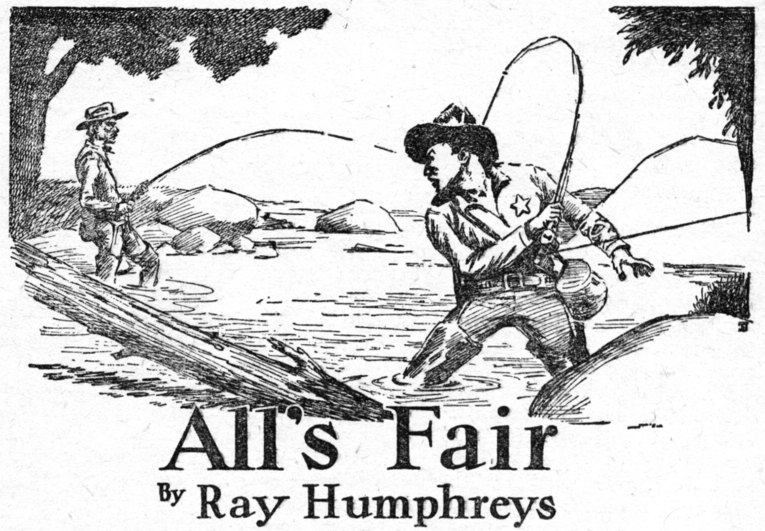
Title: All's fair
Author: Ray Humphreys
Illustrator: Harry T. Fisk
Release date: September 25, 2026 [eBook #79652]
Language: English
Original publication: New York, NY: Street & Smith Corporation, 1928
Other information and formats: www.gutenberg.org/ebooks/79652
Credits: Prepared by volunteers at BookCove (bookcove.net)
The sheriff of Monte Vista had the blues, and had them bad. He looked up and scowled blackly as his youthful deputy, “Shorty” McKay, came into the office, whistling.
“Ain’t nuthin’ on yuhr single-track brain,” snapped Sheriff Joe Cook, peevishly, “so quit tootin’ fer the crossin’!”
Shorty smiled indulgently at his worried boss.
“Sheriff,” said Shorty, soothingly, “yuh’re jus’ broodin’ yuhrself sick. I say that my advice is—don’t sell yuhr spuds on a fallin’ market, an’ leave that guy ‘Foxy’ Fromera to me to handle.”
“What?”
“I says to put yuhr pertaters in storage out to yuhr place, an’ let me ketch this here smart crook, Foxy, an’ yuh pack up yuhr troubles, boss, an’ go fishin’!”
The sheriff sat back in his chair and stared at his eager-eyed deputy in astonishment that was combined with increasing wrath. It was a minute before he could speak.
“Put my spuds in storage,” he snorted, finally, as his face grew very red, “an’ probably lose more money on the crop than ef I sold ’em at a loss, now, eh? An’ whar in heck have yuh learned anything about sellin’ spuds, an’ when to sell ’em, an’ when not to sell ’em?”
“Ef yuh sell ’em now yuh lose,” said Shorty; “ef yuh hold ’em fer a while yuh may make some money.”
The sheriff exploded. He laughed gruffly.
“Yes, an’ ef I leave yuh to ketch that Fromera feller, yuh may ketch him, an’ yuh may not! I ain’t strong fer that ‘may’ business, in spuds or crooks. It’s too dern uncertain! Ef I hold them spuds I may lose more money on ’em than ef I sell ’em now! May! May! May! Once when I was a young feller I went with a gal name o’ May an’ I never did know what she was goin’ to say or do next. Yuh take the month o’ May in Colorado—it may snow an’ then again it may not. Any bird what goes by that rule o’ may ain’t——”
“He may be right an’ he may not!” said Shorty.
The sheriff gave Shorty a gloomy look.
“Ef yuh ain’t got nuthin’ to do, Shorty,” the sheriff suggested, “supposin’ yuh go to the corral an’ give yuhr pinto hoss some advice on marketin’ pertaters. I got enough woes without arguin’ with yuh an’ losin’ my temper! I gotta do two things blamed quick, an’ I gotta do plenty thinkin’ before I do ’em—so I reckon I ain’t goin’ to miss yuh none ef yuh go outside!”
“Have it yuhr way,” said Shorty, backing out of the office. He was rather relieved to get away, at that. He went down to the corral and climbed up on the top rail and sat there, in the sun, musing over the sheriff’s twin woes. Shorty knew exactly what was bothering the sheriff. Potatoes, for one thing. Foxy Fromera, for another thing. The sheriff, like a lot of other folks in the San Luis Valley, had a big farm, and on that farm he had raised a bumper crop of the famous tubers that generally topped all potato markets. But other planters had likewise raised huge crops, and now, as the sheriff finished harvesting his, the price had dropped out of the spud market. The price was down to a dollar a bushel and at that return the crop was a loss instead of a profit.
And then there was Foxy Fromera, the San Luis Valley’s most undesirable citizen. Everybody knew Foxy and thoroughly despised him. Foxy was a crook, and a crook with brains. His cunning had earned him the name Foxy. He was always up to mischief, and so far he hadn’t paid the price for his misdeeds. Again and again he had succeeded in his crimes—mostly thefts—but each time the sheriff, getting angrier and angrier, had failed to get the goods on him. At last Sheriff Cook had begun to fear that probably he never would get Foxy into jail on real evidence, and that fear had preyed on the old sheriff’s mind until it became a nightmare.
And just when the sheriff had the potato market drop out from under his new crop, Foxy Fromera had pulled off another job. He had looted a store in Del Norte and had made a clean sweep. The sheriff had ridden out and found Fromera on his isolated ranch, and Fromera had hotly denied the robbery. The sheriff had searched the ranch and found no incriminating evidence. He knew that Fromera was guilty of complicity in the robbery, but there wasn’t even as much as a thread of evidence on which to convict the fellow.
“Waal,” said Shorty, thinking all this over as he sat on the top rail of the corral, “thar’s jus’ one thing to do afore the old man goes plumb nutty on his worries! I gotta get him out fishin’, ef it’s only fer a day—take him over to Willer Creek an’ let him git his mind off his worries; ef I have to drag him over thar on the end o’ a lariat—yessir, I’ve gotta do it!”
Shorty slid down off his perch and made for the office, determined to argue long and loudly. But he was surprised.
“Shorty,” said Sheriff Cook, as the deputy entered, “as far as yuhr advice about pertaters an’ Fromera is concerned, it’s not worth lissenin’ to with a hooman ear! But yuh said one thing afore yuh went out that has kinda impressed me. Yuh said something about me goin’ fishin’ to fergit my troubles! Waal, I been thinkin’ an’ I swanny ef I don’t believe that it might be a good idear to go fishin’—whar I could really think my worries over in peace! When a man’s fishin’ his brain kinda clears.”
“Now yuh’re talkin’,” said Shorty, happily.
“I’ll go fishin’,” went on Sheriff Cook, “but yuh’ll have to stay here an’ keep a eye on things while I’m gone. I’ll only stay out a day—but that’ll give me plenty o’ time to think——”
Shorty shook his head.
“Boss,” he said, “I’m goin’ with yuh. I kin show yuh the swellest trout holes, an’ further——”
“Nope!”
“An’ further,” went on Shorty, “ef I was to stay here as yuh suggest, boss, I would sure be tempted to go right out an’ grab that Fromera an’ toss him in jail.”
The sheriff’s scowl returned.
“Yes, I know yuh would, yuh idjut,” said Cook. “That ain’t no lie! Yuh’d jump in an’ make a fool o’ yuhrself an’ me without layin’ no keerful plans as must be laid ef that scamp is ever to be caught. I figger on mappin’ out such a plan as I fishes, an’ also, ef I have time, I gotta kinda make a personal analysis o’ the pertater situation, although I’m goin’ to sell my crop Saturday—I’ll swallow my loss now instead o’ a bigger one later on. Yes, I’ll go fishin’.”
“An’ I’ll go with yuh!”
“Waal, I suppose yuh’d better,” said the sheriff, wearily, “seein’ I ain’t any too keen to trust yuh here alone.”
The fishing was fine on Willow Creek, away down in the southern end of the valley, far from Monte Vista. The grumbling sheriff and his eager deputy, Shorty, had made the horseback trip in a few hours, despite the fact that Shorty had lugged along a burro laden down with canvas trappings, cooking utensils, and grub. The sheriff had balked at first, declaring that the expedition was a one-day affair only, but in the end Shorty had triumphed. The burro had gone along. The camping outfit would be handy in case they did have to stay out overnight. Shorty was highly elated. He kept chuckling to himself all the way to Willow Creek. The sheriff asked him about his merriment.
“That four-legged burro in our party,” said the sheriff, significantly, “he don’t see nuthin’ funny to laugh at!”
“I’m jus’ thinkin’ how surprised that Fromera bird will be when we land him,” explained Shorty, quickly. “I kin jus’ see the astonished look on his yaller phiz!”
The sheriff grunted. Yes, fine chance of getting the wily Fromera until a well-hatched plan was mapped out! The sheriff got busy thinking right away. He made up his mind on the potato situation quickly. He would sell—at the market price of a dollar a bushel—yes, sell and pocket his losses, rather than hold and lose even more. As for Fromera—that would take some more complicated thought. The sheriff lapsed into silence.
All that day the sheriff remained silent, although he whipped Willow Creek with his rod for many miles. Again and again he played a big rainbow or native trout, and his creel grew heavy with its burden. Shorty, trailing along some two or three hundred feet behind his boss, was also silent—but he was nervous. He tried to fish. All he caught was a willow branch now and then. He lost three Gray Widow flies and half his line before he gave it up as a bad job. After that he just loafed along, well behind the sheriff, and watched his boss in the throes of heavy thought.
“I’ll keep him out another day ef I have to strangle him into submission,” said Shorty, repeatedly, as time passed.
But there was no need of such drastic measures, after all. Sheriff Cook was fond of fishing. He had never found the Willow Creek trout so responsive to his flies. And when he got back to where they had left their horses and found Shorty with camp all established, he didn’t put up much of a fight. He was willing to remain another day, he finally conceded, and he told Shorty why in a few terse, sharp words.
“I’m still thinkin’ over that Fromera matter,” he said.
“Fine!”
“I’ve finished with the pertater matter; I’ll sell!”
“I figgered yuh would!”
“Huh!”
But the evening meal of mountain trout, strips of bacon, hot biscuits, and good coffee put the sheriff in better mood. He even admitted that Shorty was a blamed good cook. He intimated, however, that Shorty should take up cooking as a profession instead of deputy sheriffing. Shorty said nothing. So there was no argument that night, nor none the next day, when the sheriff whipped the creek for another nice catch. They started back for Monte Vista toward the middle of the afternoon, with the sheriff in high spirits. He had thought out a plan to capture Foxy Fromera and get enough dope on him to send him to prison.
“Next robbery we has,” he told Shorty, triumphantly, “I’ll jus’ throw every Mexican we got in Monte Vista in jail an’ keep him thar until he squawks on Fromera. It’s a cinch Fromera don’t work alone—he has accomplices among the Mexes—an’ ef I kain’t land him direct I kin land him through jailin’ all the Mex suspects in town. Some one or more o’ ’em will finally have to break down an’ confess—implicate Fromera—an’ we has him dead to rights with signed statements agin’ him!”
Shorty shrugged his shoulders.
“We’ll have to build a bigger jail,” he muttered.
“Eh?” asked the sheriff, turning in his saddle.
“Nuthin’,” said Shorty. “I was talkin’ to myself. I was sayin’ I’d like to bag a quail!”
So the homeward journey continued in peace. The sheriff was in better spirits than he had been for two weeks. His worries were practically settled, he figured. He’d sell his potatoes for what he could get. And he’d act on his new plan for nabbing Foxy. He entertained Shorty with tales of the old days in the San Luis Valley, when Indians and buffaloes roamed the place. That reminded Shorty of something and he spoke up.
“We must go huntin’,” he suggested, hopefully.
“Might!”
“Let’s plan on it!”
“We’ll see!” said the sheriff. “Ef I sell those spuds off without no trouble an’ get Fromera, I could go huntin’ with a free conscience. Say, Shorty, ain’t this a wonderful evenin’?”
“Yes, it is!” agreed Shorty.
But one half hour later the evening was stormier. No sooner had Sheriff Cook hit the office than he found his farm foreman, Jim Stewart, waiting for him there. Stewart was all excitement. He could hardly wait for the sheriff to dismount and enter the office. Shorty’s face went white at sight of the foreman. More woe brewing? Yes, that was right, it developed.
“Sheriff,” gasped Stewart, wildly, “we’ve been robbed!”
“Huh?”
“Yessir, I come in here to see yuh yesterday, an’ waited until late fer yuh to git back, an’ yuh didn’t come; so I stayed in town all night an’ rode out to the farm this mawnin’, an’——”
“Yes?”
“An’ some low-lived, worthless, snake-in-the-grass thief has sure enough stole all our—our—that is, your—your——”
“What?”
“Pertaters!”
“Pertaters!”
“Yessir, carted them sacks off clean as a whistle,” went on the foreman, “made a good job o’ it. Took the whole crop! Cleaned out both store houses! Musta had three or four great, big wagons! I seen wagon tracks as far as Coyote Creek, but I couldn’t trace ’em after they hit the main Gunbarrel Pike! Them pertaters are gone—every dern las’ one o’ ’em!”
The sheriff sat down weakly.
“Fromera!” he gasped, wretchedly.
“No, it wasn’t him!” said Stewart, “because I seen him here yesterday when I got in. An’ he was here today! An’ Josh Wilson hisself swears Fromera was at his hotel all las’ night, an’ Josh’s word is good! It wasn’t Fromera, boss, but Heaven alone knows who it was!”
The sheriff lifted angry eyes at Shorty.
“Dang yuh, Shorty, an’ yuhr fishin’!” he snapped, hotly. “After I spends hours figgerin’ on whether or not to sell them pertaters, an’ finally decides to let ’em go at a dollar a bushel, along comes a thief—a pack o’ thieves, a caravan o’ thieves, ef yuh please—an’ carts ’em all off, so I don’t git even a dime fer ’em. An’ while I’m plannin’ to nab Fromera, a bunch o’ bigger crooks than even he ever dared to be comes along an’ runs off with my property, Shorty, with my property!”
“We’ll go look fer ’em!” suggested Shorty.
“Yes, we kin go look,” said the sheriff, miserably, “but that’s about all; an’ why in thunder, Stewart, did yuh leave the place an’ come in to see me, sir?”
“Yuh called me up an’ asked me to, boss,” said the foreman, “an’ yuh said to wait fer yuh ef yuh wasn’t here!”
“What’s that?”
“Yuh sure did!”
“I sure did not!” roared the sheriff, losing his last bit of self-control. “Stewart, yuh’re a blamed idjut! Yuh let some crook lure yuh off the farm on a fake call.”
Stewart hung his head in shame.
“Seems like I must have!” he admitted.
After that—for days—Shorty and his boss, the sheriff, rode high, low, jack, and the game through the San Luis Valley, looking for potatoes, stolen potatoes. But, while they found many thousands of bushels of sacked potatoes, they did not find the sheriff’s. Of course, the sheriff had no way of identifying his particular potatoes. He did know the bags, however. He had purchased them in Kansas City. Most of the other growers in the valley were using a different sack, one obtained in Denver. The two officers poked their noses into unlimited numbers of barns, fields, underground storerooms, basements, and moving wagons—but found no potatoes in Kansas City sacks! And the vast potato warehouses in Monte Vista, Del Norte, Center, Wagon Wheel Gap, and Alamosa revealed none of the stolen stock, either.
But Sheriff Cook was persistent. He had sought out all the suspicious characters in the valley. He had gone out to Fromera’s place and put that worthy suspect through a long grilling. Fromera was politely angry. He denied stealing the potatoes. He defied the sheriff to arrest him for that—or for anything else—and prove it on him. He hinted at damage suits against the county and against the sheriff for false arrest. He swore as fluently as the sheriff did—and in the end Sheriff Cook and Shorty rode away and left Fromera alone. They had nothing on him and the sheriff knew it. Further, the sheriff’s recent plan of jailing all the Mexican suspects in the valley to catch Fromera had been voted down by the board of county commissioners. They had pointed out that such a plan would alienate all the Mexican votes in the valley and would be mighty poor politics, indeed!
So time dragged on. One week, two weeks, three weeks passed. And Sheriff Cook and Deputy Shorty McKay still rode and rode and rode. But the sheriff’s potatoes appeared to have vanished into thin air. Telegrams to Salida, Pueblo, Colorado Springs, Denver, had failed to unearth any clews of the missing spuds. The railroad shipping records out of Alamosa had shown that no sacked potatoes such as Sheriff Cook had lost had been shipped. Apparently the stolen crop had been taken out in wagons, or else it was still cached in the valley. The latter seemed improbable. But the sheriff and Shorty continued their search. They rode early and late and in between, but still without success.
And it didn’t help the sheriff’s temper, either, to see the potato market rising steadily as the days went by. The price had gone up to one dollar and twenty-five cents a bushel from one dollar right after the first flow of shipments out of the valley had ceased. A week after the sheriff had lost his crop the price stood at one dollar and thirty-seven cents a bushel. Two weeks after the theft of the potatoes the market quotation was one dollar and ninety-five cents a bushel. In three weeks the price had gone up to two dollars and fifty cents a bushel. Farmers who had held back now sold at a fine profit. But Sheriff Cook just swore. He hadn’t sold his—but he didn’t have them to sell, either! When the price went on up to three dollars a bushel the sheriff could hold in no longer.
“Waal, Shorty!” he snapped, angrily, “why don’t yuh begin crowin’ about how yuh told me so? Yuh advised me not to sell, sayin’ the market would go up! It has! I’m surprised yuh ain’t begun baitin’ me afore this. Say something! I’ve been waitin’—I’m disappointed. I’m alarmed at thinkin’ yuh’re ill or something; seein’ yuh hasn’t started to razz me!”
“Let’s go huntin’, boss!” said Shorty.
The first suggestion fell on deaf ears. It took Shorty three days to talk the sheriff into riding over to the Big Piney country, where deer abounded, for a hunting trip. And even then Shorty had to ring in the suggestion that perhaps—it was just barely possible—those stolen potatoes might be hidden in some blind canyon in that region. It was just one chance in ten thousand, but Shorty played it for all it was worth. The sheriff sniffed. He had heard the new quotations on potatoes the evening before—three dollars and twenty cents a bushel, the best price in a long time! And he had none to sell! He felt his nerves on edge. He needed a rest.
“Waal, we will go huntin’, Shorty!”
They started for the Big Piney country early the next morning, with Shorty in high spirits and the sheriff as gloomy as any man could be and still live. The sheriff recalled his promise of five weeks before—that he would go hunting if he sold his potatoes right away and landed Fromera in jail through his carefully thought-out plan. He had neither landed Fromera nor sold his potatoes, but here he was going hunting anyway. He hated himself. He called out to Shorty:
“Son, don’t try to cross me today, I’m feelin’ plenty mean an’ nasty! I don’t want no arguments, fer I won’t be responsible fer what I says or does ef I git worse!”
“No arguments,” agreed Shorty affably.
But Shorty, it soon appeared, was wrong. Shorty, who was slightly in the lead, turned down the Duck Lake road. The sheriff pulled up and called to him, lustily.
“Hey, yuh galoot! That’s the wrong way!”
“No, it ain’t,” said Shorty, coming back. “Miles Dwyer hisself told me he saw forty deer over this way last week!”
The sheriff snorted.
“All right, go ahead,” he said, “but why didn’t yuh say yuh was goin’ to Duck Lake in the fust place, Shorty?”
“I fergot!” said Shorty.
It was a two-hour trip to Duck Lake at steady going. The sheriff was surprised when Shorty turned off on an old lumber road after about forty minutes’ trotting. Again Sheriff Cook pulled up and yelled at his guide and deputy:
“Whoa thar, idjut! Whar yuh goin’ now?”
The yell brought Shorty back in a jiffy.
“Ssshh!” he warned. “We’re in game country now, boss. We jus’ gotta go about two miles more to a little valley——”
“I thought we was goin’ to Duck Lake!”
“Waal—not all the way; yuh see, Tommy Dean told me that this valley I spoke of was the best place——”
“Go ahead,” said the sheriff wearily.
But when the sheriff saw Shorty unlimber a six-gun a few minutes later, as they climbed the old logging road, he took more interest in life. One thing was sure, Shorty was famous as a deer hunter. He probably knew where he was going now, the sheriff decided. Tommy Dean’s advice was always good, too, although the sheriff would have been mighty contented with taking Miles Dwyer’s advice and going on to Duck Lake. Well, it was immaterial where they actually went, if they got a deer apiece, thought the sheriff, riding along ten or fifteen yards behind Shorty. Getting those deer might banish his thoughts of potatoes and Fromera, hoped the sheriff.
“Stick ’em up, brother!”
The sheriff woke up with a start, as he heard Shorty’s yell and saw Shorty bring a six-gun to shoulder level. That was a funny thing to shout at a deer! The sheriff rode on, curiously, but he almost fell out of his saddle when he saw that Shorty had no deer at bay ahead, but instead had Foxy Fromera. Foxy had both hands lifted. There was a look of surprise on his face.
“What yuh doin’ up here, Foxy?”
“Why, nuthin’, Mr. Shorty,” answered the Mexican, slowly, “except—hunting—deer!”
“Oh!”
“Yessir, that’s all!”
“Waal, we’re huntin’, too, Fromera,” said Shorty, while the sheriff gasped. “Yuh’d be sure enough surprised to know what we’re huntin’, brother! Yuh jus’ try to guess what we’re huntin’—go on—Fromera—guess—guess!”
Fromera caught the glint in Shorty’s eyes. He guessed.
“Deer—mebbe?” he suggested, hopelessly.
“No,” said Shorty. “Notes!”
“Notes, Señor Shorty?”
“Boss,” said Shorty, not hesitating in the emergency to give Sheriff Cook a rapid order, “would yuh mind drappin’ off that hoss an’ searchin’ this gent, after relievin’ him o’ his weapons while I holds my cannon on him so he won’t try no monkeyshines?”
“Sure,” said the sheriff in a mystified tone.
He got down, walked around behind Fromera, and snatched the man’s twin six-guns from their holsters. He also relieved him of his knife. Then he allowed the Mexican to drop his hands. He searched him, while Shorty covered Fromera.
“Go through those papers, boss!” urged Shorty, as the sheriff took a handful of folded papers from a pocket.
The sheriff went through them. At the same time Foxy Fromera’s expression went through half a dozen changes. He tried to smile. He frowned. He grew sad. He looked sick. He licked his lips. He puckered them. He groaned aloud—at last.
“Say,” said the sheriff, holding a yellow slip of paper he had unfolded, “listen to this, Shorty! Here’s a note addressed to Fromera an’ it says:
“Sheriff Cook an’ his kid deputy are goin’ out on a two-day fishin’ trip tomorrow an’ here is yuhr chance to git even with Cook. His farm foreman won’t be on the place, but the sheriff’s big crop of potatoes will. Bring five wagons an’ take ’em. It’s a cinch. Hide ’em out up by yuhr place near Duck Lake until I writes yuh again, when I will let you know when it is safe to bring them spuds to market. Save this note to compare with my signature on next to prevent any slip-ups. Yuh better be in Monte Vista while the potatoes are bein’ lifted by yuhr men. Alibi, see? Yuh did me a good turn once, Foxy, an’ I repay yuh this way.
“Cam” Tyuped,“Yuhr friend.
“Waal, what do yuh know about that?” cried the sheriff, as he finished reading the slip of yellow paper.
“Put yuhr bracelets on Foxy, boss,” said Shorty, “an’ I guess we’ve got him dead to rights. I reckon those pertaters are up to yuhr hangout at the valley, Foxy?”
The crook who had never been caught was very meek now that he realized that he was caught—and caught with the goods!
“Yes!”
“March ahead up thar, then!” ordered Shorty, crisply.
Fromera turned and started. The jig was up for him and he knew it. He swore softly under his breath, but he plodded up the trail doggedly. The sheriff, still too surprised to talk much, mounted and rode up alongside of Shorty. He held out his hand and they shook.
“Congratulations, Shorty!” said Sheriff Cook, softly, so that Fromera, well ahead, might not hear. “I know yuh did this somehow—this nabbin’ o’ Fromera, the foxy—but I reckon afore we’re through we’ll have to round up this note-writin’ bird, Cam what’s-his-name—lemme see ag’in.”
He referred to the note.
“Cam Tie-yuh-ped, or something like that—T-y-u-p-e-d, he spells it. Must be a Mex, too.”
Shorty shook his head.
“All’s fair in love an’ war, boss,” said Shorty, in a whisper. “Yuh take that ‘Cam Tyuped’ an’ read it around the other way—with the ‘Ty’ transposed for easy readin’—an’ yuh’ll see it reads ‘Deputy Mac’—that’s me. I wrote that note, boss. I planned the potato robbery myself—took yuh off on the fishin’ trip to give Fromera a chance to git ’em; an’ while I could have laid my hands on ’em right away after we came back—seein’ I knowed from a friend o’ Fromera’s that he had this isolated hide-out valley—I didn’t fer two good reasons. I hope yuh ain’t sore, boss?”
Sheriff Cook was too astonished to be sore.
“I jus’ don’t get yuh, Shorty!” he gasped.
“Waal, I’ll tell yuh, boss,” said Shorty, with a grin. “I figgered all was fair in love an’ war, as I jus’ said a minnit ago. I knowed yuh was settin’ yuhr heart on sellin’ them spuds o’ yuhrs right when the market was lowest an’ I knowed yuh was crazy to nab Fromera here, although yuh didn’t have any idear how to do it. I figgered the spud market would go up an’ I thought I knowed how to get Fromera. I jus’ combined my idears. I decided I had to make yuh hold them potatoes. Thar was only one way, to steal ’em from yuh. I decided thar was only one way to git Fromera an’ that was to frame him some way legitimate. So I had him steal the potatoes. I wrote him to save that note to compare with my next note, which I was to write him when it was safe to market the potatoes. I figgered today that the spud market had gone high enough—three dollars and twenty cents a bushel—an’ that yuh should git ’em an’ sell ’em now at a profit; at the same time we nabs Fromera red-handed, an’ we’ll no doubt find other stolen property up ahead here along with the spuds!”
Sheriff Cook had made some rapid calculations on the difference between three dollars and twenty cents and one dollar per bushel for potatoes.
“Shorty,” he said, “I’ve cleaned up on spuds an’ we’ve cleaned up on Fromera. I guess we won’t have to prosecute him on my spud theft—once in jail he’ll cough up a confession about his other misdeeds an’ we kin run him outta the county, at least. That’ll satisfy me, seein’ as how he has helped yuh help me make a killin’ on spuds, an’ Shorty, I’ll make yuh a present o’ the very finest saddle hoss yuh kin find in Colorado, no matter how much he costs—is that satisfactory?”
Shorty just grinned slowly.
“Yes,” he said, “ef yuh give me one other thing—jus’ one o’ them nice red spuds, boss, that I kin put in a glass jar an’ keep to home—as a souvenir o’ the time I beat the potato market an’ Foxy Fromera all at one shot, an’ proved to yuh that all is fair in love an’ war. I loved yuh too much, boss, to see yuh sell spuds at a loss, an’ I was bound to win the war we had declared on Señor Fromera!”
“Amen!” said the sheriff, fervently.