Title: Neptune speaks
Author: Frank Richardson Pierce
Illustrator: Hubert Rogers
Release date: September 21, 2026 [eBook #79623]
Language: English
Original publication: New York, NY: The Butterick Publishing Company, 1928
Other information and formats: www.gutenberg.org/ebooks/79623
Credits: Prepared by volunteers at BookCove (bookcove.net)
Gossiping wives of fishermen said he was a little off!
We of a more generous nature called him peculiar. Too old to lay keels in the shipyard, he had retired to a beachcomber’s shack on the beach. There he lived! How? God only knows. How does any beachcomber live?
Often of an evening I have seen him sitting there watching the ships pass—vessels whose keels he had supervised laying. I was present when the Aleut’s keel was laid. It was his last ship and you will recall her maiden voyage—lost with all hands after striking a rock.
It worried him a lot, partly because it was his last ship; partly because of the mystery of her sinking. He often said:
“The great tragedies of the sea are never told because no one survives. Only Neptune knows, and he won’t speak.”
Later on he qualified this somewhat. Evenings, he said, when the tide and moon were right; when it was still except for the soft voice of tiny waves breaking on clean sand, Neptune’s daughter talked to him, but she spoke only of the beauty of the sea; never of the tragedy.
And then, one night, Neptune himself came—came without warning and, as if the burden of his story was too great to bear....
Because the lips of those who were aboard the steamer are now sealed in death, you ask me, Neptune, to speak?
Did not the diver who descended to the wreck tell what he saw? What silenced him? The story was there for him to read! Ah yes, perhaps the tragedy of it stilled his tongue. Perhaps....
I saw him descend! Then when he could remain below no longer he returned to the scow and his face was as pale as death when they removed his helmet—and he was a man hardened to the ways of the sea.
You say the sea is merciless?
Ah! But you don’t know it as I know it! It is man, not the sea, who is merciless. Did not the sea stop it all, stop the madness that even I, who have seen everything, turned from?
You recall how the ship struck? Yes? The weather was calm and the captain refused the chance to transfer his passengers to another steamer. Then the steamer that would have aided disappeared into the night and, without warning, the storm came.
It came with the roar and snarl of a beast; it lashed the channel waters white in its fury. Those aboard the Aleut looked into the blackness of night; fear clutched their hearts and their nerves grew tense. And the sea with countless fingers groped about the hull seeking a hold. And then, do you recall....
But, no! You can’t recall that because you did not see it and no man lived to tell the story of what happened after the steamers left. Only I, Neptune, saw; only the silent diver who read the story while below knows what happened.
The storm grew in fury; the waves in their might lifted the hull slightly from the rock, then lowered it again. With the scream of buckling plates the fangs of the reef bit deep into the vessel and those aboard fought back madness and looked to the officers for protection.
The officers, heavily armed, moved among them, giving assurance that all was well and a rescuing steamer would soon be alongside. Eager eyes stared into the night and saw only blackness. The fear grew; despair and hope fought the battle in each heart and when hope for the moment triumphed the red and green running lights of phantom ships gleamed—and vanished.
The scream of the storm grew louder.
From the depths of the ship rushed swarthy men with the fear of madness gleaming in their eyes. The first officer drew his automatic pistol and ordered them back. They paused, in doubt, each waiting for some one to lead. One or more must die before they could pass.
Their aspect was fearsome, with their staring black eyes and the grime and grease of the engine room on their swarthy features. They retreated below, not in defeat, but to confer and form a definite plan. In the rigging above the gale played a dirge; in the hull beneath the reef fangs ate deeper.
The first officer reported to the captain.
“Yellow scum! We may have trouble!”
“Shoot to kill!” the captain answered.
Somewhere a woman screamed. The captain’s head jerked around.
“Silence that woman!”
A quartermaster hastened to obey. The scream of one starts others when human nerves are taut.
A passenger stepped up, his manner respectful.
“Captain, I represent a committee of the passengers. We do not presume to dictate or even suggest. Can not we be set ashore?”
The captain did not look at the raging sea. He knew without looking.
“No small boat can live. Don’t worry! The ship is wedged on the rocks, she can’t sink. A base of granite is supporting her. A rescuing steamer will be here soon!”
If he had misgivings in his own mind; if he regretted his failure to place his passengers aboard the other steamer, he remained silent. His was the responsibility here—and hereafter.
To those aboard, the night blackness had contained menace enough, but now, with the sea lashed white—white, not black—seemed the garb of death.
Nerves strained to the breaking point began to snap; the captain turned to the quartermaster.
“What was done with that woman?”
“Confined to the writing room, sir; locked in with others who were showing panic, sir!”
Mutiny!
The swarthy crowd from below decks spilled up a ladder. No uncertainty this time. They wanted a boat and would have it. Some would die, but others would live. The captain spoke tersely:
“They’re armed. Shoot to kill!”
The first officer answered—
“Aye aye, sir—the scum!”
He was glad they were not white men.
Women screamed. Stewards rushed in to quiet them. Some were bound and thrust into the writing room. The quartermaster had no part in this. A graver condition was developing and the captain was rallying his best men.
The ship shuddered as if unutterably tired. A shift of several feet came slowly. From the depths the hull groaned as frames buckled and plates carried away.
A man screamed—
“My God, she’s going!”
The decks became alive. The leader of the mutineers rushed at the captain. His face was twisted into a snarl. The captain’s face was cold and calm. He leveled his weapon and spoke sharply.
The leader’s voice, high-pitched and whining, sounded above the storm.
“By God, we’re going to take a boat!”
The captain hesitated, then realizing that words would not stop the impending panic, fired. The leader dropped and another took his place. He turned to rally the others and a bullet, through the back of the skull, dropped him. A quartermaster hurled the body into the sea.
The leader of the passengers approached once more, protest on his lips.
“Put him in irons,” the captain ordered; then he added, “and any of the others!”
The quartermaster was a powerful man; the passenger had no chance. He was led, protesting, away.
A skulking figure darted along the deck, running low. When his chance came he knocked the captain’s weapon down. The first officer felled him with his gun, then heaved him over the side.
The chief engineer joined the captain.
“You can’t stop them with guns,” he said. “There are too many of them and you had better use—”
The captain turned on him. His stare was as cold as ice. He was about to put the chief in his place, but the man from the engine room spoke a single word—
“Steam!”
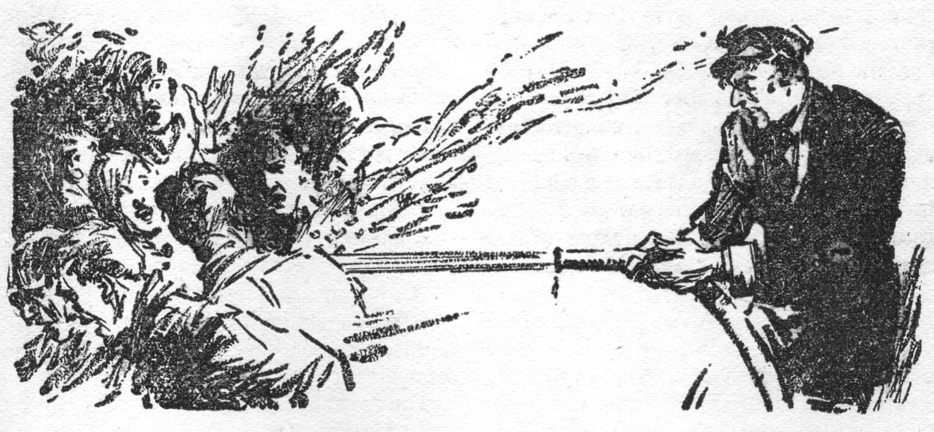
That would stop them. The captain nodded; the chief stepped to the pilot house and telephoned. A man unreeled a hose and turned a valve. As the mutineers, now joined by whites from the steerage, surged forward, a jet of water leaped from the nozzle. It changed to hot water, then live steam. They faltered, and several dropped, writhing. A bullet was different, but steam covered them all.
One of the swarthy men disappeared below. He caught up a spanner and knocked down the man standing watch on the steam line. Then he closed the valve.
Backed by steam, the captain was driving the mutineers back. The steam jet died and with a cry of triumph they came—a swarming, seething, maddened mob with flashing knives cutting a pathway through the crowded deck to the boats. They spilled into a boat as water spills from a ledge into a pool. Two of their number stood by and paid out as the writhing falls were swallowed by the screaming blocks. They slid down the falls, missed the boat and vanished in the black water. Then the ship went mad.
From doors and ladders they poured, their cry blending to a mighty demand.
“The boats! The boats!”
And each turned on those nearest and fought until one fell and one went on. And the cries of the doomed grew louder and louder until it reached the very heavens; until the sea in the might of its pity rose and claimed its own. With a thousand fingers it caught the hull, lifted it clear and drew it down. Around the momentary hole in the water the sea madly rushed in great circles as if fearful it would be denied its prey.
In the center of the seething eddy a small boat spun dizzily while swarthy men strained at the oars. The struggle was brief, futile—splinters of driftwood defying a tide. Then it vanished and over the spot the storm spread a shroud of foam and from below no living thing emerged, but the tides ebbed and flowed and the gale rushed on.