Title: Hell's Angel
Author: Raoul Whitfield
Illustrator: V. E. Pyles
Hubert Rogers
Release date: September 15, 2026 [eBook #79581]
Language: English
Original publication: New York, NY: The Butterick Publishing Company, 1928
Other information and formats: www.gutenberg.org/ebooks/79581
Credits: Prepared by volunteers at BookCove (bookcove.net)
In the first place, there was hot blood in Marcosson’s veins. Second son of a Franco-Italian union, he had been born in Morocco and brought up in Africa. He remembered his mother as a lean, wiry creature who flared into rages that were terrible to behold. His older brother quietly slipped away to the diamond fields one night after Marcosson senior had used rawhide fiercely. After that there was swift tragedy. He was young, sensitive—this Dantone Marcosson. For years he remembered the red against the white of his mother’s breast. For years his dark eyes stared, in sleepless nights, at the green hilt of the knife.
Three hours after his father had brought swift tragedy into the house, the native police had come. After that he had not seen Marcosson senior again. He remembered him as a powerful, dark-eyed man who spoke battering French when aroused to temper, precise English when calm. That is, he came to remember his father in this manner, later, in America. A vice-consul and an uncle had got him to America.
The uncle had raised him, and had kicked him out of the house at the age of fifteen. John Marcosson had never understood his brother; it was not to be expected that he could understand the son. Perhaps he was justified. Rage is a terrible thing—the Marcosson rage was more terrible, perhaps, than any the uncle had witnessed. Hot countries, heritage. Suppression, bitterness.
At fifteen the boy became a wanderer. He got along. The Dantone became Dan. He traveled over the United States. Somehow, he kept straight—though he saw the inside of many jails. Lack of money got him inside cells. Something kept him from getting that money in a dishonest manner. Heritage, perhaps. His uncle had told him that his father’s father had been a priest.
Anyway, Dan Marcosson grew—and toughened. He worked in the steel mills of Pittsburgh, the ore mines up along Lake Michigan. He had a thirst for knowledge, educated himself. He met a doctor in an ore town, told him of his past. Perhaps the doctor was wise, perhaps he was a fool. Surely he tried to be kind. He told the boy many things. He told him to keep away from heat, from hot countries.
Dan Marcosson accepted some of his advice. He harvested wheat, rye—in Canada. He saved some money, crossed the line again, visited Seattle. He was sick of the cold, headed down the Pacific Coast for Mexico. In Ensenada it was hot enough. There was a brawl with a drunken sailor. The boy was strong, and he nearly killed the man with his bare fists. He got out of town, walked all night through the heat, on the road to Tia Juana.
He slept in the cool of a deserted adobe shack, the next morning, resumed his walk during the afternoon and night. He reached Tia Juana just before the second dawn; when the line opened he went across. His papers were all right. And in San Diego, in a hot sky, he watched two planes twist and circle.
That was the beginning of his desire for wings. He became a hanger-on at Gus Dario’s joy hopping field. Later he flew. Gus liked him, taught him. Cooler weather came. Shortly after Christmas he was flying alone. He had nerve, fine eyes. He was almost twenty-one. And Gus admitted he could do more things with the battered Jenny than any pilot he had trained. A perfect feel of stick and rudder.
In April war was declared. When the Air Service came into being on a large scale, applicants were supposed to have two years of college education. Dan Marcosson credited himself with two years at an obscure college in the Middle West, over which Gus had once performed stunts. He passed the mental tests, the physical tests. Already he was a pilot. Among the first half dozen commissioned pilots, he sailed for France. It was a winter sailing, cold. France was cold. But Dantone Marcosson did not mind that. He had come to hate heat, and to fear it. He believed that the doctor he had met up in the ore country had told him the truth. He had wings—and he was very happy.
These things I know, because Captain Marcosson told them to me as the Thomas slid through a blue-green sea of glass, between Guam and the Islands. There were ribbons on the captain’s tunic; his lean face was burned brown by sun and wind. There was a goggle scar over his left eye; his nose was broken in two places. He had powerful shoulders and arms, and dark, deep-set eyes.
I knew the captain’s war record. Few in the Air Service were not aware of it. Brilliant? Not exactly that. It was too spotty. Seven enemy planes, officially—perhaps a half dozen more unofficially. That part of it was all right. It was the other thing that counted against him. Twice he had faced court-martial boards. Once he had been sent back to Blois and almost returned to the States. It wasn’t the discipline—there wasn’t much of that in A. E. F. flying. It wasn’t that he couldn’t fight. It was his uncontrollable temper, his heritage of hot blood.
It was the strength of his arms, the battering power of his fists. Words meant so much to him—the same words that meant so little to those who uttered them. And he hadn’t changed, after the war. He had stayed in. He had studied. He loved his wings, the swift flight of a plane through the sky. Now, at thirty-three, ten years after, he was a captain. Twice since the war he had lost numbers. Once twenty of them—the second time ten. He didn’t tell me why, but I could guess. You could almost see it, on the transport.
A constabulary officer and the captain were the only two officers on the transport who were not West Point men. There is a difference. You wear the ring—or you do not wear it. The ring is a symbol of the great gulf, in peace times.
We were seated in the smoking room. We might almost have been on the parade ground back at El Paso, or on the Presidio, or on Governors Island. There was no ship motion other than the vibration of engines. Two electric fans droned and swiveled. It was hot—terribly hot. Marcosson had been very quiet after his talk. I had been thinking. Suddenly he leaned forward, toward me. His eyes were narrowed. There was a huskiness in his voice.
“Lieutenant,” he asked, “have you ever been afraid?”
I didn’t answer. It was a confession. I thought of how I’d asked Sock Casey, the first day out, who the man who sat before me was. And Sock had replied a bit grimly.
“That’s Hell’s Angel Marcosson. He’s not a West Point man.”
That was all—and that was enough. Enough—and yet, not enough. God knows there had been time enough for association, on that trip down. Twenty-seven days we had been out of the Golden Gate. A bit hotter each day. Monotony of sea and sky. Flying fish. Midway Islands, Guam. Cliffs and color stuck out in the middle of a lot of water. And then the vibration of engines again. Hotter. Three days out of Manila—and Marcosson was telling me that he was afraid, by asking me if I’d ever been afraid.
“It isn’t so bad, Captain,” I replied, after a little silence. “Of course, some spots are worse than others.”
Marcosson relaxed again. His face twisted suddenly; the scar over his left eye stood out. The fans droned on. He smiled. He knew I understood.
“I’ve been in the cold spots for five years,” he stated tonelessly. “You say some places down here are worse than others. I’ll get the worst.”
There was no answer for that statement. I tried to cheer him up.
“They plan to establish fields in the provinces. You might pull Baguio, Captain.”
He laughed. Of course he’d heard of that resort. Snow in the mountains—the only cool spot in the hot season.
“She’s for generals and colonels, Lieutenant,” he returned. “How far are we from—India? Or Africa?”
His voice was low, strange, as he asked the question. I stared at him. I didn’t know, anyway. But I could see what he was thinking about. I could follow him back through the years. Thirty-three, he was. He looked forty, older. He looked like a man who was burned out, inside.
I got out a handkerchief and wiped the perspiration from my face and neck. The two fans kicked around an awfully hot air. The deck outside sweltered in the heat. The captain spoke again.
“Ever hear Indian drums, Lieutenant? Native drums?”
I shook my head. Marcosson’s eyes were closed; his body slanted in the swivel chair, but it was rigid. His voice held no shade of tone. It was as monotonous as the sea and sky.
“I heard ’em last night,” he stated. “First time in fifteen years.”
I stared at him. His voice made me shiver. I got up from the chair.
“You won’t hear them in the Islands, Captain,” I stated cheerfully. “Well, I’m going below for a snooze. The heat takes it out of a fellow. See you later.”
I started for the smoking room door. The captain spoke.
“Won’t I, Lieutenant?” he muttered tonelessly. “That’ll be—fine.”
I went outside. Heat soaked into the deck. I ran into Sock Casey near the aft companionway. He grinned at me.
“How’s your little pal, Hell’s Angel?” he greeted. “This heat ought to suit his temperament fine.”
I swore. It seemed to me that I could understand a lot of things. It isn’t fun to watch a fighter taking a licking.
“Sock,” I said slowly, “stick to flying. Don’t try to be a comedian.”
I went down and tried to sleep. But it wasn’t any good. I kept thinking about Marcosson, about the past he’d pictured for me. The captain had a knack of saying things in a way that brought out a lot of things he did not say. He had flown a ship sweetly, during the war. He had wings, all right. He made a plane his wings. And inside of him was a hell. Some one had tagged him right.
There were rumors of a field to be established at Baguio. The C. O. up there would have a nice job. Good air, cool. I hoped Marcosson would get that field. But I knew he would not. A social job, that would be. Staff officers would wing up from Manila. There would be conversation to be made. Not Marcosson’s brand of conversation. A West Pointer would get that assignment. An officer with charm. A personality.
I swore into the damp sheets of the bunk in the tiny cabin. There would be the fields out in the distant provinces. Mindoro, Samar, Leyte, Panay, Mindanao. Bohol and Cebu. Hell’s Angel Marcosson in close contact with a few pilots, day after day, night after night, on some God-forgotten stretch out in the provinces! The same faces, the same word tones, the same ships. The same enlisted men. And the same heat. Two years of it.
Perspiration soaked my body. The transport vibrated as it had been vibrating for days. The same wood panels creaked. I groaned. If the heat were getting me, what would it do to Marcosson? What wouldn’t it do?
The cabin door opened with a slam, against the wash basin. Sock came in. He was red with anger. He glared down at me, his blue eyes narrowed.
“I go into the smoke room,” he stated harshly. “No one’s in there but Marcosson. I sit down at the next table, start to deal myself a solitaire layout. The first thing I know Marcosson’s on his feet. He tells me to get the hell out of the place. God, but he’s sore! White, he was.”
I stared up at Sock.
“What were you doing, besides dealing out the hand?” I asked grimly.
The pilot swore.
“Whistling,” he replied. “And why in hell shouldn’t I?”
I rolled over on my face again, tried to shut out the sound of Sock’s raving. I was thinking about Marcosson. I felt sorry for him, sorry as hell. It was just the beginning.
Three days after the transport steamed in past Cavite and docked within a half mile of the Manila Hotel and the Luneta, I ran into Jimmy Blake at the Army and Navy Club.
“Some of ’em are swell, Mac,” Jimmy stated. “I flew Colonel Brace around while he picked out locations. The Administration is all excited over this experiment. They’ve got a couple of fields staked out in jungles. Have to fly gas and oil in. One of ’em is slated for a spot that hasn’t been missed by a typhoon in the last ten years. They’re all hot. Thank God I’ve got two months’ leave due me.”
I grinned.
“How long will it last, Jimmy?” I asked. “They tried something like it on the Mex border. But it didn’t stick.”
Jimmy grunted.
“It’ll last until the dengue kills off twice as many pilots as the fields kill off, which will be plenty. Then the Administration will pull in the ships, and leave gas and fuel cached. They’ll write it into the records as a nice bit of tactics. It will be—for a couple of colonels and one general.”
I nodded.
“Which is the worst field of the bunch, Jimmy?” I asked.
The lieutenant groaned.
“There’s one out near Salcedo, Samar province—she’s pretty awful. They’re rating her for six P. T. 9’s. They lost ten men with fever when they cleared that jungle out. It gets so hot the sharks crawl out of the ocean and cool off on the sand of—”
I yawned. Jimmy closed his eyes. It was hot in the club. It would be hotter; the season was just starting. I could imagine what the Salcedo field would be like. While I was thinking about the captain, Sock Casey came in. He had just come from headquarters and he had an official list of assignments. I grabbed for it.
I’d drawn a field on Luzon. Sock was slated for assignment to Colonel Brace’s staff. And Captain Dantone Marcosson had pulled a C. O.’s job—at Salcedo!
Jimmy was looking over my shoulder, having come to life. His eyes went down the list.
“Soft for you, Sock,” he stated. “The colonel smokes none but the best of cigars. And you pulled a nice field, Mac—easy hop in to Manila. Pretty fair country around that stretch. You can— Say, is that Hell’s Angel Marcosson? The C. O. for Salcedo?”
Sock beat me to it.
“It sure is!” he stated. “Good spot, Jimmy?”
I swore slowly and with much feeling. Jimmy Blake smiled grimly.
“For him,” he said slowly, “it’s perfect!”
In the third month after I’d gone out to Iriga, rumors commenced to drift in. We were in the middle of the hot season. Bailey flew down from Manila. Marcosson was having a tough time at Salcedo. Half of his ground crew men were sick. Two lieutenants had been killed in spins. They were cracking up too many ships. Hell’s Angel was keeping out of the air himself and sending others up to map out the country. He was drinking. Staff was considering pulling him out.
“And by the time they decide half the Squadron will be dead,” Bailey stated. “It seems that Colonel Brace has sent Sock Casey down to investigate, under cover, of course.”
I groaned. Sock Casey, a hot-tempered kid flyer, going down to investigate Marcosson! I could imagine the way he’d go about it. And I could figure the way Marcosson would receive him. After Bailey had taken off for his wing back to Manila, I looked up Cap Tully.
“Sock Casey’s down at Salcedo,” I stated. “I’d like to see him. Never set a ship down on that field. I can make it in three hours. Stay overnight—fly up tomorrow. If the captain will permit me—”
“Go to it, Mac,” Tully interrupted. “Why any one should want to go down there to see a guy—that’s beyond me. But go ahead—give Captain Marcosson Captain Tully’s respects. Tell him I’d fly down myself, only I hate his guts! Tell him—”
Tully stopped. He shrugged his shoulders. It was the first time I’d heard him let loose on Marcosson. Another one who hated the man.
“I told him to go to hell, once.” Tully’s voice was grim. “I’ve got a hunch he’s there right now. So never mind giving him my regards.”
I saluted, and headed for my coop in the fairly new barracks. Packing a kit, I went out and had my pet two-seater rolled out. Heat waves sizzled off the cleared field. I was soaked in perspiration by the time I got in the front cockpit. The leather was hot; my Irving ’chute pack made things a lot worse. I wore the lightest helmet possible and rolled down the collar of my washed-white khaki shirt.
There would be a water crossing into Samar, but it wasn’t much of one. It was about two o’clock when I took off. The air was bumpy; I got four thousand feet and flew my roller map course to the southeast. There was a drift wind from the west, and a pretty strong one. The country below was rugged. In spots it was cultivated. In most places it was not.
I sat back in the cockpit, listened to the roar of the engine—and thought about Captain Marcosson. I wondered why he’d talked to me that afternoon, in the smoking room of the Thomas. Talked to me of the past. It was my guess that he saw the end coming. Of course, there were ways out. But with his record in the Army he would have had to take his transfer to the Islands or resign. And Hell’s Angel wasn’t the resigning breed. He was sticking to the finish, which, as I saw it, wasn’t far off.
“He’ll smash into Sock sure as hell!” I muttered beneath the roar of the exhausts. “If the heat’s got him....”
I swore grimly and kept my eyes on the instrument board. Air speed ninety-two. Altitude forty-five hundred. Engine cool enough, with the gas feed right and oil pressure steady. I’d be down there soon enough—see things for myself. Cap Tully thought Marcosson was sitting in hell. So did I. But Sock Casey was young and hot-headed. Maybe I could have a talk with him.
The air the prop flung back was warm, even at our altitude. The rubber on my goggles was hot where it pressed against my skin. I thought of Marcosson’s left eye goggle scar, of his broken nose. I thought of his war record. And the damned heat was licking him. He’d known it would. I’d guessed it would. Hot blood in his veins. French, Italian. Killer blood.
And Sock Casey down there investigating. Things would break fast, I could guess that. Maybe I’d be too late. Sock didn’t understand. He didn’t know what I knew. I should have talked to the kid, back on the transport. Or in Manila. But I hadn’t. I’d do it in a few hours. There were too many humans hating Marcosson. It was bad enough for him to have the heat to lick.
I missed the field by about ten miles, but twenty minutes later I learned I’d missed it. Circling in a mild bank, I headed northward again. She was no cinch to pick up. I almost missed her the second time. The coast line saved me. I picked up the native town, spotted the field, a few miles to the northeast.
She was small. Her sock was hanging limp from a tall bamboo pole. Jungle rimmed the oblong cleared stretch. The hangars were on the north side, and from the air it looked as though the first typhoon would lift them higher than the world’s ship record. They were canvas, staked down.
I circled the field three times and made a fair landing by skimming growth so that I’d have all the room there was to roll along. Even at that I had only about ten feet left when the P. T. stopped. Cutting the switch, I climbed over the side. No use trying to taxi around until I got ground crew men holding a wing tip. And I was tired.
The first person I saw was Sock. He came up at a trot, his browned face as fat as ever, his blue eyes wide. I stared at him. His lips were puffed; there was red trailing down his chin.
“Hello, Mac!” he greeted. “What in hell are you—” He stopped, and I saw that he knew what I was looking at. “It’s all right, Mac,” he stated grimly. “Just the C. O.’s way of enforcing fool orders. That is—the way he thinks he’ll enforce ’em.”
I swore harshly. Marcosson striking his inferior officer. Striking the man sent down by Colonel Brace. A sweet mess.
“How is he?” I muttered foolishly.
Sock wiped his lips savagely with the back of a sunburned hand.
“Great!” he returned, with fine sarcasm. “He’s got a yellow streak two feet wide.”
The ground crew men were coming up. Sock changed the subject. He gave orders for the care of the P. T.
“How come you wing down on us?” he asked.
“Pleasure trip,” I stated.
Sock laughed. It was a bitter laugh. We moved back toward what looked like some temporary barracks.
“A fine place for pleasure this is!” Sock muttered. “Marcosson’s finished, Mac. He’s crazy as hell.”
I didn’t say anything. Sock wiped his lips again.
“Hears drums all the time, Mac. Lost his flying sense. Puts ships in the sky for no reason. Gone wild on staking the country out. He’d got her mapped into fractional zones that—”
We pulled up. I saluted. Before us stood Marcosson. He’d come out along a narrow trail through the growth, one that converged with another we had just turned into, off the field. I stared at him.
It was his eyes that had changed. They shone brightly—too brightly. His face was thinner; he was unshaved. I spoke cheerfully.
“Hello, Captain! Good to see you.”
His expression stopped me. The narrowing of his dark eyes, the pressing together of his rather thin lips. His body was tense. He spoke suddenly, in a hoarse tone.
“You, too, eh? All of you coming down. Vultures winging in for the finish, eh? Staff vultures dropping down for the final show. What will it be, gentlemen? A parade in formation? Or shall I break out the personnel on the field?”
He laughed suddenly, harshly. My eyes went to Sock’s. He spoke in a low tone.
“The captain is sick, Lieutenant,” he stated. “I have suggested that he allow me to fly him to Manila. It didn’t meet with his approval.”
Sock’s fingers went to his bruised lips. There was a grim edge in his tone. Marcosson’s eyes were on mine. He bowed. With his right hand he gestured through the dense growth to our right.
“Welcome to hell, Lieutenant!” He was smiling with his lips. “It is a pleasure to—”
He stopped. His body stiffened. Fear flashed in his eyes. His right hand went toward the holster he wore over his left thigh. Sock spoke.
“Ground crew swinging Lieutenant MacNamara’s P. T. around, Captain. Sounds a bit like drums, at that.”
Marcosson’s fingers came away from the holster of his Service Colt. His eyes blazed into the blue ones of Sock Casey. Perspiration streamed down his drawn face. Without a word he faced about—moved down the trail. His body was slightly stooped.
I looked at Sock.
“Why in hell don’t you leave him alone?” I muttered in a low tone. “The man’s on the edge. If you knew as much as I—”
“I know more!” Sock smiled grimly. “I know plenty more!”
I waited. Sock swore softly; his face was twisted.
“He spent six months in Colon, Mac. It was hot. He almost went under. Drank a lot—and had a Flight to handle. My brother was down there—just out of Brooks’ Field. He was only a kid. Marcosson hated him. He took things too easy. The heat didn’t bother Al any. Cross country flight—and Marcosson sent Al up with a missing engine. Made him take off. Al went up and the ship—” Sock paused, then went on again, in a low tone—“stalled two hundred feet off the ground. Came down in a spin—the beginning of one. Finished Al. They transferred Marcosson a week or so later. Fever. Damn his rotten—”
Sock broke off, turned away from me. I remembered that the lieutenant had had a brother in the Air Service. I remembered that he had been killed in a crash.
“It might not have been done—” I started to talk, then stopped. What was the use? So many men hated Marcosson.
But Sock heard me. He faced around. There was a grim smile on his face.
“Colonel Brace sent me down to bring Marcosson back to Camp Nichols, Mac. I’ve got orders in my pocket. I’ve been having a little hell of my own. Last night I lay on my cot and listened to him rave, in the next coop. He hears drums all the time. He’s almost licked. Took a P. T. up yesterday just before sunset. Damn’ near turned over on the come-in. A couple more air trips....”
Sock swore softly. I stared at him. Suddenly he straightened a bit. His voice was hard, but controlled.
“I could stick down here a few days, Mac, and ride him out of things. I’ve got him for a court martial already. Can’t you see how I could smash him all the way? Well, I won’t. I’m going back now, and show him the orders. I’ll ride him back to Camp Nichols. We’ll start right away. Lieutenant Fenwick can take charge of the field. We’ll be half the way back to Manila by dark, and the riding will be cool. They can take him out of the air, ship him back to the States. A hop a month for his extra pay and he’ll still wear wings. It’s too damned good for him, but—I’m no killer.”
I spoke slowly.
“Better wait until tomorrow morning, Sock. He’ll take the orders hard.”
Sock laughed harshly.
“I’m afraid to wait, Mac,” he stated grimly. “Should have started yesterday. But he’s smashing right up before me. I didn’t know the full story, all about how Al went out, until I ran into Lieutenant Fellman, ten days ago. He was with Marcosson and Al on the Panama cross country flight. He tried to get Al to tell Marcosson to go to hell and not to take off. But the kid wouldn’t do it. Marcosson was his superior—that sort of thing. So he went up....”
The lieutenant reached into a pocket of his khaki shirt. Paper crackled.
“Come on in for a wash, Mac.” Sock’s voice was steady enough. “That is, if there’s any water. I’ll give Marcosson a look at his orders. See you in a week or so, for a decent chin. We’re pulling in the ships, quitting the fields. Not worth it—and the country is pretty well mapped. That’s one thing Marcosson did decently.”
We moved toward the temporary barracks. The air was heavy with jungle growth, reeked sweetly. Insects hummed. A parrot screamed shrilly. I was thinking of Marcosson.
“He never had much of a chance, Sock,” I stated. “It was in his blood.”
Sock muttered something I didn’t get. We walked on.
“He just naturally likes to hurt,” Sock muttered. “I should watch him rot right here—it wouldn’t take long now. But I won’t.”
We reached the barracks. Sock got me some water in a tin basin. It was odorous, warm. But it helped get some of the kicked-back oil off my face. Sock disappeared. He came back again in about ten minutes. There was a puzzled expression on his face.
“We’re getting off in a half hour,” he stated. “Damned if he didn’t take it easily. Just sort of got white, then smiled. Asked me when I wanted to start. I told him right away. He nodded, called Lieutenant Fenwick in, turned things over. Fenwick’s been his adjutant. The boys are filling up the tanks now.”
I frowned.
“Think I’ll wing back with you, Sock,” I said slowly. “No use sticking here. Go back as far as my field, anyway.”
Sock nodded.
“All right, Mac,” he returned. “Go out and have the boys get at your ship. Grab a look at the field. You can see all of it in five minutes. In a month it’ll be historical.”
I grinned, went out. My ship was on the deadline. Sock’s was there, too. I got the sergeant in charge, told him I was flying out with Sock. He was in such good humor that I guessed Sock had hinted about the general abandonment of the provincial fields. They started fueling my bus.
It was too hot to walk. I didn’t know any of the pilots at the field. So I sat down on a gas can, in the shade of one of the hangars. And while I was thinking about Marcosson I heard the drums. They were distant. They rolled something like thunder. Far away thunder. It was the first time I’d heard them.
I went out on the deadline. The ground crews were sweating over the two ships. Sock came out from the barracks with his kit. He listened, smiled grimly.
“Hear ’em, Mac?” he muttered. “Some damned family branch of the Moros. Most of ’em stick down on Sulu. Not many drums like that in the Islands—not now. They were talking all last night.”
I swore softly. I could imagine what that dull booming had done to Marcosson’s nerves. They must have taken him back a lot of years. Well, he’d seen it all coming. He’d felt it coming, back in the smoke room of the transport, months ago.
The ground crews were finishing up fueling. I stared across the small field. The C. O. was coming out. He wore his uniform—no flying overalls. He walked with his head down. The heat, even with the sun getting down, was sizzling.
I got up as he approached, smiled. If he heard the distant drums, he gave no sign of it.
“It’ll be all right to get into a bit of civilization, eh, Captain?” I suggested. “Even a few months down here are pretty tough.”
He smiled. It was a peculiar smile. His eyes were narrowed, seemed to be staring beyond me. Sock came up. Marcosson spoke.
“I’ve seen the post officers.” The C. O.’s voice was steady. “Lieutenant Fenwick will take charge as soon as we get into the air. I’m ready, Lieutenant.”
Sock started to say something, changed his mind. A corporal came over with the ’chute packs. All three of us got into them.
“Running lights and flares checked, sir.” The corporal addressed Marcosson. “Your Irving has just been rerolled.”
The C. O. nodded. In hot countries the Irving ’chute packs have to be unfolded and rolled again more often than in cold climates. The corporal was evidently unaware that Marcosson was being relieved.
I shook hands with Sock.
“I’ll drop away south of Iriga, Sock. See you later.”
Sock nodded. I turned toward Marcosson. We shook hands.
“See you in Manila, Captain,” I stated cheerfully.
There was a peculiar expression in his eyes. He spoke in a hard tone.
“Coming to the court-martial trial, are you?” he asked.
I saw Sock stiffen. He spoke quietly.
“There won’t be any, Captain,” he said. “You’re already broken!”
Rage gripped Marcosson. His whole body stiffened. His hands were at his sides, fingers spread stiffly. They were shaking. He sucked in his breath sharply. Sock turned his back on him, moved toward the front cockpit of the P. T. he was to fly.
There was silence over the field. The drums broke it, rumbling. Marcosson relaxed. His lips moved a little. I caught the words.
“—already broken—”
He straightened. I moved toward my ship. The engine of Sock’s P. T. roared; there were test blocks under both planes’ wheels. A hand gripped my arm. I halted, turned. Marcosson spoke above the roar of the P. T.’s exhausts.
“I thought his brother was—yellow, Lieutenant! Thought he could get the kinks out of that engine, in the air. He took her off in a tough climb. He was green—and I thought he lacked nerve. Tell him that, Lieutenant. Tell him I know he’s Al Casey’s brother. I’ve known it since I ran into him on the transport, coming down to this hell. That kid was so damned cool, so sure of himself. And I was—”
He stopped, his face twisting. Then, suddenly, he smiled. His voice was calmer.
“Tell him that, Lieutenant—when you see him in Manila. And—happy landings—”
He turned away, went swiftly toward the two-place P. T. I stared after him. The ground crew men were pulling the blocks away from the wheels. Marcosson swung up into the rear cockpit; I saw Sock twist his head, saw the captain nod.
I got it, then. Marcosson was going out. Sock would never land him in Manila. Somewhere along the air route—
A gust of wind swept back from the rolling P. T. as I started to run toward her. She picked up speed; her engine roared. I shouted hoarsely. No chance of Sock’s hearing me. Turning back, I climbed into my plane. She was throttled down; I revved her up, signalled the ground crew men to pull the chocks away from the wheels. We rolled out from the dead line. Sock’s ship was taking off, climbing.
He took her up in a mild bank. I gave him plenty of air, circled widely over the field for altitude. My eyes went to the rear cockpit of the other P. T. I could see Marcosson’s head; it was motionless.
At eight thousand Sock leveled off—set a course for northeast Samar. I winged in toward the plane. There was nothing I could do, yet I wanted to do something, to stop Marcosson. I could see him sitting before me in the smoke room of the Thomas, telling me that story. I could see what a battle he’d had. And now Hell’s Angel was going out. How? Over the side? With no jerking of the Irving’s rip cord ring?
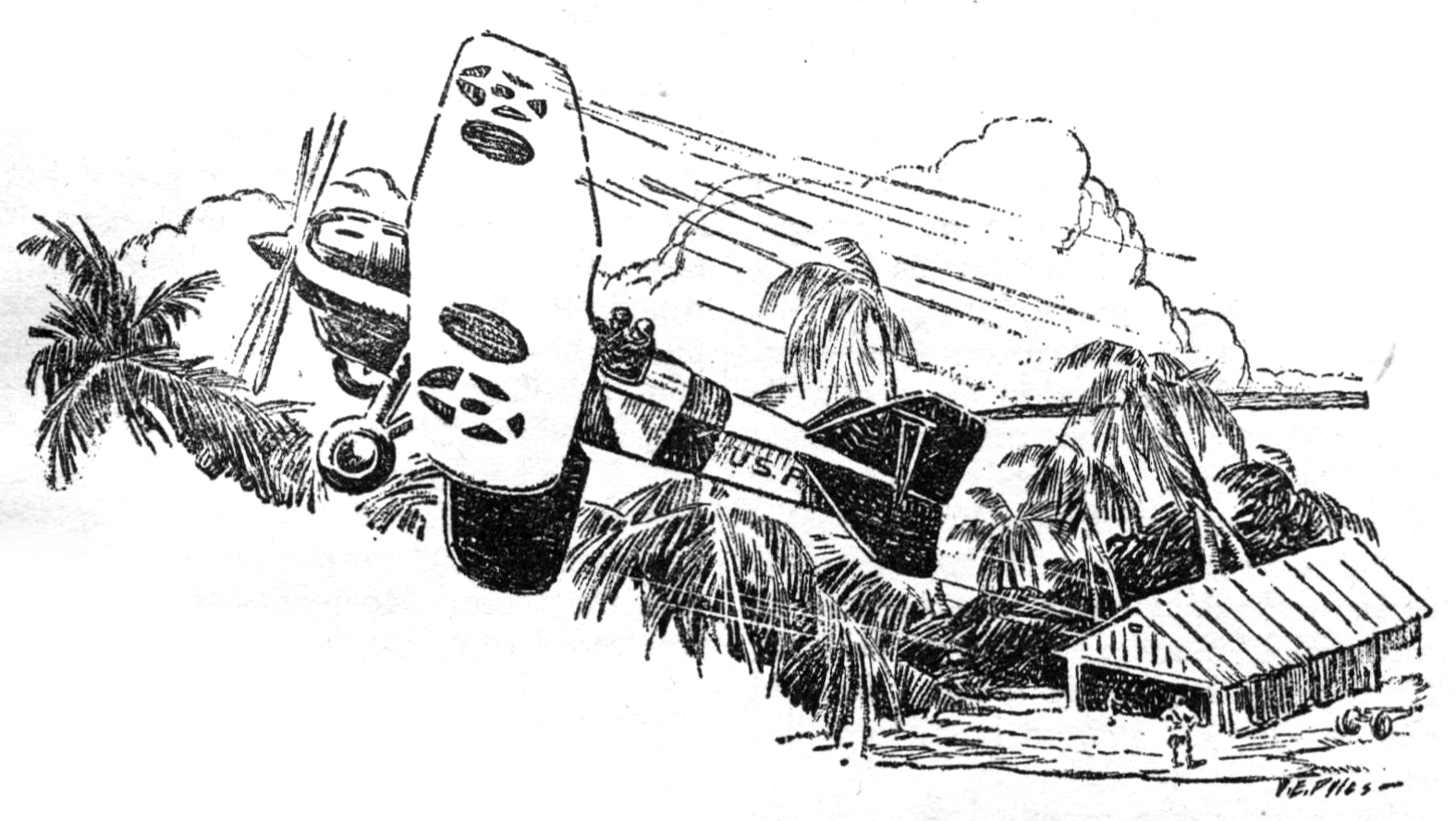
I swore softly. My eyes went down to the instrument board. When I raised them again the two ships were flying within twenty-five feet of each other, Sock’s P. T. on the right. And Marcosson was swinging a leg over the side of the fuselage!
Sock’s helmeted head was turned slightly to the right. He was staring up at the white clouds high in the sky. I shouted hoarsely, knowing that he couldn’t hear. And even so, there was nothing he could do. Marcosson was stepping overboard.
Sock’s head twisted suddenly. Perhaps he was just taking a look at the sky behind; perhaps he felt that something was wrong. The captain was on the upper surface of the P. T.’s lower wing, out of the prop wash when her pilot saw him.
And Sock acted. A wing of the P. T. flashed upward—the right wing. The nose of the ship came around. The roar of her engine blended into the roar of my plane’s engine.
I zoomed. But there wasn’t time. Wing crackled into wing. Struts snapped. A wire hissed across the cockpit of my ship. I ducked my head, felt a stabbing pain in my left leg as I cut the switch. Splinters of the props cut through the twisted and torn wing fabric. Even as I raised my head I could feel the first motion of the spin into which the tangled planes were falling.
I shoved the goggles up over the leather of my helmet, snapped the buckle of my safety belt. The two ships were in a slow spin now; my eyes went toward the cockpits of the other P. T. And the first thing I saw was the head and shoulders of Sock Casey. His head hung limply across the left side of the cockpit fuselage; red streaked across his face. He was unconscious!
I crawled up from the leather seat. The two ships were tightly tangled, wings were interlocked. The spin was becoming greater—but it was a flat spin. A pancake spin. And it would not stay that way long.
My eyes went out toward the right wing surfaces of the other ship and I saw Marcosson. He was crawling slowly over the wing, toward the front cockpit. His face was white, set. His eyes were on the head and shoulders of Sock Casey.
I shook my head violently to fight off the first waves of dizziness caused by the spin. The wing on which Marcosson had been working his way outward was undamaged. I knew what had happened. Sock hadn’t seen me wing my plane in so close. He had seen the captain on the right wing. He had guessed what the man was about to do. His bank to the left had been made to prevent Marcosson from getting clear. With that wing-tilt the captain could not have jumped without striking the fuselage of the plane. And Sock had banked into my ship in one booming air crash.
Wind was shrilling through the broken wires of the two ships now; shrilling through torn struts, ripped fabric. I stared at Marcosson as the fingers of my left hand went instinctively to the harness over my left thigh, gripped the release ring of the ’chute pack. The two ships were down around five thousand feet already.
Five feet of twisted struts, torn fabric separated me from Sock’s cockpit seat. But Marcosson was within a few feet of the pilot now. I saw one hand reach down into the cockpit. With the other he gripped a strut still intact. And then he was dragging Sock up from the cockpit seat, pulling him inch by inch out on the wing—the good wing.
The spin was becoming wider. The noses of the two planes were dropping. Marcosson raised his eyes to mine. He was smiling grimly. He jerked his head toward the undamaged left wing surface of my plane. Then he started to drag Sock out along the wing.
There was nothing I could do. Couldn’t reach them through that wreckage. I got a leg over the side of the fuselage—the left side. The stick had jammed against my left knee in the crash. I dragged out along the wing, pulled myself up to my knees. The planes were spinning to the right. I turned my eyes toward the wing beyond the wreckage.
Two figures shot out into space. Arms were gripped around Sock’s body. I thought I caught a glimpse of Marcosson’s right hand on Sock’s ’chute harness.
I released my grip on a wing strut. The spin hurled me clear. I counted five—jerked the rip cord ring. The pilot ’chute crackled. The bigger spread of silk snapped as the small spread, sprung from the pack, pulled it out. The harness tightened about my body. My head came around with a snap. And then I was drifting downward, gently.
I shook the tears from my eyes, stared off to the right. A figure was dangling inertly beneath a spread of white silk. Sock’s figure. My eyes went downward. Something was streaking toward the tropical growth below. My eyes followed it for a second—then I turned them away.
Perhaps ten seconds later there came the boom-crash of the tangled planes. I slipped my ’chute toward Sock’s. We were within five hundred feet of the earth. He raised a hand weakly, tried to wave to me. I stared downward.
Both ’chutes were drifting clear of the jungle strip. The wind was carrying us down toward primitively irrigated fields. I got a glimpse of several natives staring up at us. The two ’chutes were drifting within fifty feet of each other. I drew up my legs, prepared to break the shock of the seventeen-foot-a-second drop. There would be little wind drag.
I struck, fell forward, pulled down on the shroud lines of the collapsing ’chute silk. Getting loose from the harness, I limped toward Sock.
He was trying to sit up. I got a handkerchief around the dent in his head made by a strut splinter. He spoke thickly.
“Marcosson—pulled my rip cord in the dive. I was conscious—couldn’t move. He let go—did he—”
I shook my head slowly. “Didn’t pull his own rip cord, Sock,” I said hoarsely. “He took the plunge into the jungle strip.”
Sock Casey closed his eyes. We weren’t far from the field. They’d heard the crash—it wouldn’t be long before they’d reach us. As for Marcosson—the jungle growth was thick; in places impenetrable. A five-thousand-foot plunge!
“He—didn’t want to go back—that way, Sock,” I muttered. “He wasn’t—that breed.”
Sock nodded weakly. I stared at the natives, stripped to the waist, coming cautiously toward us. I told Sock what Marcosson had wanted me to tell him, about his brother.
“He pulled me out,” Sock said slowly, after a little silence. “Maybe—there was something in that name—Hell’s Angel.”
I nodded.
“He went out that way,” I said.