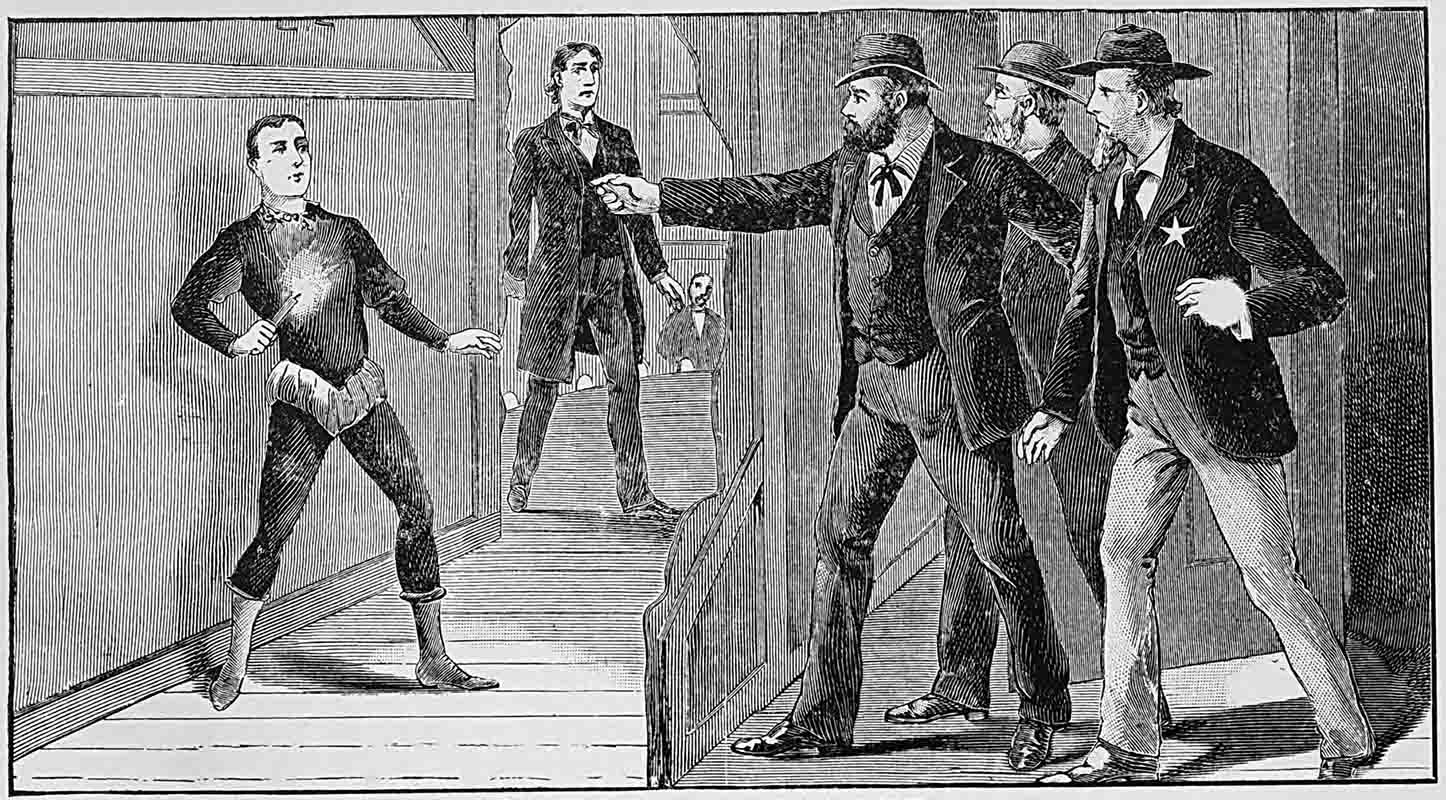
“I am his lawful guardian.” See page 48.
Neka, the Boy Conjuror
OR
A MYSTERY OF THE STAGE
BY
CAPTAIN RALPH BONEHILL
AUTHOR OF
“Tour of the Zero Club,” “Boys of the Fort,” “For the Liberty
of Texas,” etc.

NEW YORK AND LONDON
STREET & SMITH, PUBLISHERS
Copyright, 1902
By STREET & SMITH
Neka, the Boy Conjuror
CONTENTS.
| Chapter | Page | |
|---|---|---|
| I. | —A Crash in the Storm | 5 |
| II. | —A Friend in Need | 11 |
| III. | —Neka on the Stage | 17 |
| IV. | —A Moment of Peril | 28 |
| V. | —An Encounter on the Road | 34 |
| VI. | —The Enemy’s Power | 41 |
| VII. | —A Row on the Stage | 49 |
| VIII. | —Adventures at a Fair | 56 |
| IX. | —An Act Not on the Bills | 63 |
| X. | —Neka Shows Courage | 69 |
| XI. | —More Adventure | 76 |
| XII. | —King of Fire in Earnest | 83 |
| XIII. | —Neka’s Brave Deed | 90 |
| XIV. | —A Rival Company | 95 |
| XV. | —The Company is Enlarged | 101 |
| XVI. | —A Race for Money | 110 |
| XVII. | —Saving the Enemy | 116 |
| XVIII. | —In the Metropolis | 123 |
| XIX. | —An Attack in the Dark | 131 |
| XX. | —An Acrobatic Failure | 137 |
| XXI. | —Demands of the Rascals | 143 |
| XXII. | —Saving the Star | 151 |
| XXIII. | —Jennie Windom’s Peril | 157 |
| XXIV. | —A Well-taught Lesson | 163 |
| XXV. | —Neka’s Presence of Mind | 169 |
| XXVI. | —Not on the Programme | 175 |
| XXVII. | —The Face at the Window | 179 |
| XXVIII. | —A Chase and Its Result | 186 |
| XXIX. | —Life on the Road | 191 |
| XXX. | —A Thrilling Ride | 197 |
| XXXI. | —Into the Snowdrift and Out | 204 |
| XXXII. | —Quick Wit Against No Wit | 209 |
| XXXIII. | —Something of the Past | 214 |
| XXXIV. | —Daniel Bambo is Stubborn | 220 |
| XXXV. | —Neka Shows His Bravery | 224 |
| XXXVI. | —Beginning of the End | 229 |
| XXXVII. | —A Curious Revelation—Conclusion | 234 |
[Pg 5]
NEKA, THE BOY CONJUROR.
CHAPTER I.
A CRASH IN THE STORM.
“Git up there, you lazy critters! Git up! Do yer know it’s stormin’ like mad an’ we hev still six miles to go? Git up!”
Crack! slash! down came the lash of the heavy whip on the backs of the two tired horses, and forward lurched the rickety circus wagon with a jounce which threatened to smash both springs and axle.
It was indeed “storming like mad.” Overhead the sky was inky-black, except when lit up by vivid streaks of lightning, and the cold September rain came down in almost unbroken sheets.
Along the dismal and muddy road straggled the dozen wagons and trucks belonging to Bambo’s International Circus and Menagerie, the Greatest Aggregation of Marvels on the Globe. At the head of the procession, in the covered hood of the band chariot, rode Daniel Bambo himself, a lean and sour-faced individual, his face at this moment more sour than ever.
Business had been bad at Camville, the last stopping place, and now it promised to be worse at Ryetown. Perhaps [Pg 6]it would rain so hard that it would be impossible to raise the one dilapidated tent of which the circus boasted.
“Hang the luck, anyhow!” muttered Daniel Bambo to himself. “The rain will spoil everything. We won’t be able to show at all, and how I’m goin’ to pay those feed bills and the performers I don’t know. I have most a mind to sell out, first chance I git. The variety business is a heap sight better than this.”
In savage mood he whipped up the horses again, then stood up and looked back to see if the other wagons were following. A streak of lightning told him the outfit were all in the struggle, and then a jerk and a jar nearly knocked him into the road.
“Whoa!” he yelled, as he steadied himself by holding on to the iron brace of the hood. “Whoa, Billy! What’s the matter now?”
The last remark was called forth by the fact that the left horse had turned partly around and was kicking vigorously. The chariot came to a standstill, and Bambo peered over the high dashboard.
“Bu’sted again!” he murmured, referring to the worn-out harness. “Knew it wouldn’t last. Neka! Neka!” he called out, turning around.
For several seconds there was no response. In savage impatience the man leaned over and struck out with his whip into the darkness of the chariot body. Crack! crack! the lash came down on a bit of thin canvas, which was quickly thrown aside, and a boy appeared, rubbing his eyes sleepily.
Had there been more light it could have been noted that [Pg 7]the boy was tall, thin, and, despite his hollow cheeks and sunken eyes, handsome. It could also have been noted that he had been shamefully misused, and that he had suffered bodily and mentally.
“Can’t yer hear nothin’?” demanded Bambo. “Want me to wait all night fer you?”
“I was dead tired, sir,” replied the youth, in a voice which showed how exhausted he was.
Indeed, had it been otherwise he would not have slept so soundly in that pelting rain with only a bit of soaked canvas over him.
“You’re always tired!” growled the proprietor of the Greatest Aggregation of Marvels on the Globe. “What do you suppose I’m keepin’ you fer, eh? Hump yourself now, and git down and tie up the harness. It’s all bu’sted again.”
The boy drew a long breath and sighed deeply. He was still half asleep.
“Where is the cord?” he asked.
“Don’t you know as well as I do? It’s in the back under the box. Here is the key. Hurry up, and see that the next wagon don’t run into us in the dark.”
The boy climbed up the side of the chariot and dropped to the road. In the darkness he landed in a puddle of water, but he hardly minded this. When one is utterly exhausted in body and mind, such seeming trifles do not count.
Splashing through the mud, he felt his way to the back of the chariot. Then he felt for the padlock of the under locker, and, finding it, inserted the key.
[Pg 8]
He was on the point of opening the locker when a sound back of him attracted his attention. The next turnout, that containing the poles and seats, was coming up.
“Hi there! stop!” he called out. “Stop your team, Hank Maul!”
Scarcely had the words been uttered than out of the darkness appeared the heavy wagon. The driver, half asleep on the box, paid no attention to the warning.
“Stop! stop!” repeated the boy, shrilly. “Don’t you hear me, Hank Maul?”
And then, as the driver continued to doze away, he leaped for the head of the nearest horse, with the intention of turning the team to one side.
It was a perilous thing to attempt, yet he did not falter, realizing to a certain extent what would follow should anything go wrong.
He caught the horse, but was not strong enough to stop him, nor to alter his course to any considerable extent.
Bang! the heavy pole struck the rear of the chariot. Jingle! jingle! went the large oval mirror with which the rear was decorated, and then the pole went clear through the woodwork, scattering the splinters in all directions.
Luckily for the horses, their harness, like the set used for the first team, was old and rotten. The beasts shied right and left, and broke free with scarcely a scratch on either. The sleepy driver pitched off sideways into the mud puddle, thus saving his neck from being broken.
A second later the air was fairly blue with imprecations from the lips of Daniel Bambo and from the driver, who [Pg 9]arose with mud plastered over him from head to foot. Bambo leaped down and came forward, whip in hand, his face blazing with passion.
“You good fer nothin’ rascal!” he fairly foamed. “Didn’t I tell you to stop the next wagon? Look at the damage you’ve caused!”
“Do ye want ter break my neck?” put in Hank Maul. “Why didn’t ye run back an’ warn me? Bambo, that boy ought to be licked within an inch of his life.”
“Well, you’re to blame too, and I’ll take the price of this smash-up out of your next pay!” retorted Daniel Bambo, who knew well enough he could get nothing from the boy, seeing as the youth had absolutely nothing. “Neka, come here, till I tan yer hide well fer you!”
The boy stepped back. Somehow he felt that he was not to blame. He clinched his fists and shut his teeth hard.
“I don’t want you to whip me,” he said, from between his closed teeth.
“Don’t you?” howled the circus proprietor, sarcastically. “It ain’t fer you to say what yer want, see? Come here!”
“I—I—won’t!”
The words were out at last. The boy had longed to rebel against the harsh treatment he received, but up to the present had not dared. He was only fourteen years old, and for four years had known but one master, Daniel Bambo, who must be obeyed at all times.
“Yer won’t?” fairly shouted the owner of the Greatest [Pg 10]Aggregation of Marvels on the Globe. “I’ll give yer a couple of extra ones on yer back fer that!”
And flourishing the whip over his head, he darted to where the boy stood.
For only an instant did the lad remain standing; then he began to retreat.
“Stop, Neka, stop, or I’ll break every bone in your body!”
“I won’t! I ain’t going to be whipped for this accident!” was the firm reply. “I did what I could to turn the horses out.”
“Don’t talk back to me!” foamed Daniel Bambo.
“Gittin’ mighty nasty, ain’t he?” put in Hank Maul, maliciously.
“I’ll take it out of him—or kill him!” howled the circus proprietor. “Are you goin’ to stop now?”
Once more he darted forward. The boy continued to retreat, but was collared as he was in the act of leaping a log fence to one side of the road.
“Now take that!” continued Daniel Bambo.
But ere the whip could descend, a stone, thrown from the darkness of the field beyond, caught him in the side of the head and knocked him flat on his back, and more than half unconscious.
The boy was as much astonished as any one at the unexpected turn of affairs. He gazed on the scene in amazement, but as Hank Maul sprang forward to Bambo’s aid, a new idea seemed to take possession of him, and off he ran down the muddy road as fast as his legs would carry him.
[Pg 11]
CHAPTER II.
A FRIEND IN NEED.
At this important moment of his life the boy had but one idea. He was running away—going to leave that life of hardship, of starvation and beatings behind. He thought of nothing else.
He did not go far before he became aware that somebody was following him. Was it Bambo, Maul, or both of them? In terror he endeavored to increase his speed. But he was too exhausted, and lagged at every step.
“My young friend, don’t be alarmed,” came presently to his ears. “I am your friend and will not hurt you. It was I who threw the stone which smote the Philistine on his brow. Slacken your fast pace, and let us interview one another.”
At this curious call, the boy stopped short. As a matter of fact, he was nearly ready to drop. He staggered to the rail fence and leaned heavily upon it for support. The circus turnout had been left a good quarter of a mile behind.
Following the strange call there emerged from the darkness the form of a tall and angular man, wearing a long, black frock coat and a battered silk hat. His feet were incased in patent leather shoes, almost worn to the uppers, and altogether his appearance was to the last degree shabby genteel.
[Pg 12]
“Are you the—the man that threw the stone?” gasped the boy.
“I am the individual, my son,” was the response, delivered in a voice of unusual profoundness. “It was a lucky stroke to your aid, was it not? Your enemy fell, and I doubt if he is yet aware of what happened.”
“I hope, sir, you didn’t kill him,” faltered the boy.
“Assuredly not. I calculated the distance with precision, and he is merely stunned—I made certain of that ere I undertook to follow you.”
There was a moment of silence, followed by a flash of lightning and a loud peal of thunder. The man looked around and espied a barn not a great distance from the road.
“Come with me to yonder shelter,” he said, kindly, taking the boy’s hand. “It will not be long ere the circus people come this way, and I presume you wish to avoid them.”
“Yes! yes! let me get away! I never want to see any of them again,” was the quick answer.
“Then come, let me assist you over the fence.”
But this was not necessary. The boy leaned back, gave a nimble twist, and was on the other side quick as a flash.
“Ah, I perceive you are an acrobat,” said the tall man, as he climbed over the rails in clumsy but rapid fashion. “Did you perform in the circus?”
“Yes, sir.”
No more was said just then. Side by side the two crossed the field and approached the barn. A small, rear door was unlocked, and they went inside.
[Pg 13]
“A goodly shelter,” observed the tall man. “I wish I had struck it previously. But had I done so, I would not have met you, so it is better as it is. I see no house near, so most likely we shall be free from interruption.”
He struck a match, and, lighting a bit of candle he took from his coat-tail pocket, surveyed the interior of the structure. The barn was evidently not in use, for it contained nothing but a small pile of old straw.
“I imagine this will serve our purpose admirably,” he went on. “Let us take off our coats and rest on the straw. I would keep the candle burning, but it would not last long, and we may find it useful later on. Besides, there is danger of a conflagration.”
And so speaking, he snuffed the tallow, leaving himself and the boy in total darkness.
While the light lasted, the pair so strangely thrown together had surveyed each other curiously. Both apparently were satisfied.
“I cannot offer you a card,” went on the tall man, as he spread out his coat where it might have a chance to dry. “But my name is Longfellow Wadsworth, and I am an elocutionist, and at times, when the chance offers, a tragedian. Usually I ride about in my own private car or stage, but through a series of very unfortunate and distressing occurrences, I am now compelled to journey on foot, seeking an audience wherever conditions favor. May I ask your name, my son?”
“Neka, sir.”
“Neka? Rather—ah—short and odd. What is the rest of it?”
[Pg 14]
“That is all there is to it, sir.”
“It is your—ah—circus name, perhaps?”
“It’s the only name I have, sir. They used to call me Ned when I was a small boy, but that’s past long ago.”
“And you do not look to be over fourteen.” Longfellow Wadsworth seemed to grow thoughtful. “Are your folks traveling with the show?”
“I haven’t any folks.”
“I thought so—by the way that brute of a driver attacked you. He should be placed under arrest.”
“That was Daniel Bambo, the owner of the circus. He says he is my regular guardian, but I don’t believe it, for old Jerry Brown, the clown, before he died, said Bambo had no real claim on me.”
“Really, Neka, your story interests me. So this Bambo claims to own you, so to speak? How long has he claimed this, and where did he obtain you?”
“I have been with him four years. Before that time I lived with an old woman in Cleveland, named Susan Gilderoy. Her husband was a stage juggler, and he trained me to do a number of tricks.”
“I see. Are these folks still living?”
“No, sir. Leon Gilderoy was killed on the railroad, and his wife never got over the shock. She went into a faint, and died three days after. Then Daniel Bambo, who was a relative of Mrs. Gilderoy, came along and took charge of everything, including myself.”
“And you have been traveling with his circus ever since?”
“I have been traveling with him, yes, sir. But the first [Pg 15]two years we were on the variety stage. He is also a juggler and conjurer, and we did a turn, together with old Jerry Brown, as the Bambo Family from Australia.”
“How long has this Jerry Brown been dead?”
“Two years. After he died, Daniel Bambo left the stage and started his circus. Then I was taught to ride as well as to juggle and do tricks, and I was also billed as Neka, King of Fire, in which character I pretend to wash my hands in burning oil and to eat pieces of burning paper.”
“Ah, yes, I have heard of those tricks. You have an interesting history.” Longfellow Wadsworth paused as a rattle of thunder passed over. “Now you have run away, what do you propose to do?”
“I don’t know,” was Neka’s blank reply. “I ran away on the jump, as the saying is.”
“With your ability, you can undoubtedly make a fair living in some circus or variety company, but you will need somebody to aid you, or you will be fleeced by the sharpers in the profession. If you wish, I will be your friend. It is true I am poor, but——”
“I haven’t a cent,” laughed the boy.
He thought it queer himself that he could laugh at such a time.
“Then we are on an equal footing, so far as finances go. But I was going to remark, I will stand by you, Neka. Who knows but what we may strike positions in the same company? And I will endeavor to defend you against the wiles of that circus brute——”
[Pg 16]
Longfellow Wadsworth got no further. A cry from the field, not far from the barn, interrupted him.
“Stop the wagon out there!” came in the voice of Daniel Bambo. “I am going to see if he came to this barn and hid.”
[Pg 17]
CHAPTER III.
NEKA ON THE STAGE.
“He is coming in here!” cried the boy, in sudden terror.
“Never mind, I will protect you,” responded the elocutionist. “I will argue the point——”
“It won’t do; he must not see me!” panted the boy. “I—I’m going up in the loft to hide.”
Close to his hand were a number of slats nailed to two of the uprights of the barn wall. The ladder had put the thought of ascending into his mind. He went up noiselessly, yet like a flash, and disappeared into a corner filled with hay.
A muttering was heard without, and Daniel Bambo, carrying a lantern on his arm, entered.
The rays from the lantern fell upon a long figure stretched out on its back, with eyes tightly closed. The figure was snoring.
“A tramp!” muttered the proprietor of the circus to himself. “The country seems to be alive with ’em. Hey, there, you!”
He gave Longfellow Wadsworth a prod in the side with his foot. The prostrate figure groaned, heaved a sigh, and turned over on its side.
“Tired out or dead drunk,” soliloquized Daniel Bambo. [Pg 18]“Most likely the latter, and if I wake him, there’ll only be a row.”
He left Wadsworth’s side and flashed his light across the barn and into the corners. He walked over to the straw, and shoved it with the butt end of his whip. Then he looked up at the loft.
“Hardly worth while, I reckon,” he continued, “but I’ll make sure.”
And, with the lantern on his arm, he climbed up the ladder.
Neka, under the hay, hardly dared to breathe. He heard the circus proprietor walk around the loft, and the rays of the lantern penetrated through the loose hay. Bambo even poked the boy with his whip. It was a supreme moment, and Neka nearly cried out with fright.
But it was soon over, and Bambo went below again. Without trying to get anything out of Longfellow Wadsworth, he left the barn.
Neka remained where he was until the elocutionist called him.
“It’s perfectly safe now, my son. He has gone to the road and the wagons are moving ahead,” he called out.
“It was a narrow escape,” said the boy, on descending. “I thought he had me, sure.”
“He thought me a tramp and drunk,” returned Longfellow Wadsworth. “I had a good mind to get up in my wrath and smite him in the nose for it. For your sake, I swallowed the indignity.”
“I shan’t forget your kindness,” replied Neka, warmly. “I hope he doesn’t come back.”
[Pg 19]
He walked around to the front of the barn. The storm was shifting, and in a portion of the sky the stars were already shining. Down in the road he could just make out the wagons filing slowly along through the mud. He counted them to make sure all were there, and none left behind.
“I don’t know which way you are traveling,” he said, on returning inside. “But I want to go in the opposite direction to the one Daniel Bambo is taking.”
“I am willing. Neka, at present all roads are alike to me. Suppose we strike out for Chambersburgh? That is a nice town, and perhaps we shall strike luck of some sort there.”
“That will just suit me, Mr. Wadsworth.”
After this the two laid down to rest on the straw—taking some of the bedding to cover themselves, for the night was decidedly chilly.
As tired as he was, it took Neka a long while to get to sleep. His thoughts were busy, and he was filled with anxiety concerning the future.
Had he really seen the last of Daniel Bambo, or would he meet that savage tyrant again? And if he did not, would he be able to make himself a comfortable living without outside aid?
Neka did not worry about the last. To be free of Bambo was a comfort in itself, and, as Longfellow Wadsworth had observed, he would probably have little trouble in finding some situation on the variety stage. If only he would never behold his taskmaster again.
Neka thought also of the dim past, which appeared like [Pg 20]a beautiful vision. He remembered himself as a little boy, playing in an immense garden surrounded by a high stone wall. He had worn good clothes then, and had never known what it was to go hungry or to be lashed with a whip.
“I wish those times would come back,” he half murmured to himself, and with this wish he finally dozed off.
When the couple in the old barn awoke the sun was shining brightly, and from the fields around came the carol of numerous song birds. Neka leaped up, to find Longfellow Wadsworth brushing his silk hat with a small pocket brush, which he later on used also for his flowing locks.
“A beautiful morning, Neka,” exclaimed the elocutionist. “A good morning to expand the heart and fill it with good motives. I trust you slumbered well.”
“Fairly well, sir. I am glad it has cleared off. Let us be on our way.”
“I am willing—seeing as there is nothing at hand with which we may appease our hunger. Let us move on in hopes of a speedy meal which shall satisfy us to the uttermost.”
“I reckon we won’t get much unless we work for it,” laughed Neka. “I won’t steal, and I would hate most awfully to beg.”
“Exactly my sentiments,” returned Longfellow Wadsworth. “Yet a free lunch counter——”
He did not finish.
“And I don’t drink,” went on the boy, pointedly.
[Pg 21]
“You are to be honored, my son, for that. It is the one enemy——”
Again Longfellow Wadsworth did not finish. But Neka knew he was going to say that drink was the one enemy of his life. He looked at his companion’s nose, and saw it was unusually red.
Reaching the road, they struck out as rapidly as the mud would permit. The man was a rapid walker, yet the boy kept up to him easily. Neka had been trained until his muscles were like iron, and could endure almost any amount of strain.
After passing the spot where the accident to the circus chariot had occurred, they branched off on another road, the one running into Chambersburgh, a town of six or seven thousand inhabitants.
Presently they came to where the road ran across a brook. The stream was much swollen, and the rain had washed away part of the wooden bridge.
“A bad break,” observed Neka. “They ought to fix this before night comes on.”
They stopped beside the bridge to wash their faces and hands, and to get a drink, for the day was growing warm. They were pleased to see that the sun was drying their clothes.
Neka had just turned away to regain the road when a shout from the direction in which they had come attracted his attention. He looked back and saw a fellow coming on, riding like the wind on a bicycle, with another fellow running along on foot.
“Stop him! stop the thief!” yelled the fellow on foot.
[Pg 22]
Startled at this call, Neka ran out in the road. The fellow on the wheel was now less than a hundred feet away. The boy at a glance noticed that he was in ordinary street dress, while the wheel he rode was first-class.
He glanced back. The runner was in knickerbockers, with a cap on his head. Surely he must be the owner of the wheel.
“Hold up!” commanded Neka, and put up his hands before the approaching wheelman.
“Get out of my way, boy!” cried the fellow on the wheel. “Skip, or I will run over you!”
Neka did not budge.
“If this be an honest man he will halt,” he thought, and held his ground.
Seeing he could not intimidate the boy, the wheelman endeavored to pass to one side. But Neka again leaped before him, and, coming closer, caught hold of the handle-bar of the machine.
Leaping to the ground, the wheelman tried to wrench the bicycle away, at the same time making a pass for the boy’s head. Neka dodged and held fast, and a few seconds later the young man in the bicycle suit reached the scene of the encounter.
“You rascal!” he burst out. “Drop my wheel instantly!”
“Hang the luck!” muttered the would-be thief, for he was nothing else. “I’ll remember you, boy!” he cried to Neka.
And before anybody could stop him, he left the road, [Pg 23]leaped a fence, and darted into a thicket leading to a dense woods.
The owner of the bicycle was profuse in his thanks to Neka, and offered the boy a dollar as a reward, which amount, however, the boy declined.
“I was sitting under a tree smoking when that chap sprang out of the bushes and leaped on my wheel,” said the bicyclist. “If it hadn’t been for you I would have lost that machine.”
“My companion is truly a plucky fellow,” remarked Longfellow Wadsworth. “Neka, you should not embarrass the gentleman by refusing the reward he offers.”
“I don’t want any reward,” replied Neka. “But if you can help us to get some work to pay for our breakfa——”
“Ahem, ahem!” broke in the elocutionist. “The boy was about to say perhaps you could assist us in giving an entertainment at the next town. I am an elocutionist and he is a magician and juggler. We have been unfortunate, and——”
“By Jove! just the thing!” burst out the owner of the bicycle. “Yes, I can help you, I am sure. You see, it is this way,” he went on. “I am the secretary of the Chambersburgh Bicycle League. We expected to give an entertainment to-night at the town hall to our friends. We were going to have the Carroll family, sleight-of-hand performers, to show for us. But they have sent word they can’t come on account of sickness, and so——”
“Exactly, exactly,” interrupted Longfellow Wadsworth, fervidly. “You wish us to exhibit in their stead. [Pg 24]We’ll do it, sir, just to help you out, and on very liberal terms, sir, very liberal. Won’t we, Neka?”
“If the gentleman will accept our services,” smiled the boy.
“Of course, I’ll have to talk it over with the others first,” said the bicyclist. “Come with me, will you?”
The three journeyed along side by side, Neka and the elocutionist on foot and the young man on his wheel. On the way, the young man said his name was Harry Lardale, and that his father was county clerk. Longfellow Wadsworth made quite a splurge when he introduced Neka and himself. Neka did not like this much, and at the first opportunity took the elocutionist to task about it.
“But we must put up a front, my son, it’s everything in business,” said the elocutionist. “Besides I told nothing but the truth. I am world famous, having read for kings and queens, as well as presidents, and I know you’re a wonder in your specialties by your noble forehead.”
Reaching Chambersburgh, Harry Lardale took them to his residence, and there treated them to breakfast. He readily saw what a plight they were in, and asked no questions. Then he went off to interview his friends.
“The pair may be very good and they may be bad,” he said. “But we can get them at our own figure, and they’ll be better than nothing. It’s too late to tell folks we can’t entertain them now. The town people will know, but what of those from Camville, Horner Run, and other places?”
So it was decided among the committee of the league [Pg 25]that Neka and Longfellow Wadsworth should make up a programme for them and do their best. Each was to receive ten dollars for his services, and the elocutionist put in the stipulation that half of the money was to be paid immediately. After some hesitation, this was done.
“Now we can brush up a bit,” said Longfellow Wadsworth. “I need a shave and a new collar and necktie at the very least.”
“And I a whole outfit,” replied Neka, surveying his shabby suit. “But I can’t afford it, so will have to go without. The chemicals I use in my fire tricks will cost at least a dollar.”
“I have an idea for you, my son. Why do you not buy some cheap red and blue stuff and have some seamstress make you a fancy suit, just for stage use?”
“Good! I’ll do it!” cried Neka, enthusiastically, and he went off at once.
By the middle of the afternoon their preparations for the entertainment were all made. A pianist had also been engaged, and they ran the programme over with him, to give him the proper cues, especially for playing while Neka was performing.
The hall was a fairly large one, with seats for six hundred people. At the hour for opening it was comfortably filled, and people continued to come.
“A good house,” whispered Longfellow Wadsworth to Neka, as both looked out through a peep-hole in the curtain. “We must do our best. Who knows but what this opening may lead to other engagements.”
The first number on the programme was a musical selection [Pg 26]by the pianist. Then the curtain rolled up, and Longfellow Wadsworth came forward, and, after making a profound bow, started in to recite Poe’s “Raven.”
While the recitation was not of the first order, it was by no means bad, and the elocutionist received a generous round of applause. This encouraged him, and for an encore he recited an original piece called “The Other Man’s Hat,” semi-humorous, which went still better.
“Now, Neka, keep up the good work,” he whispered, as he came behind the scenes. “They are ready to give you a warm welcome.”
The pianist was playing a low, tremulous movement, just as Neka had instructed him. The lights on the stage were lowered until they were all but out.
Suddenly Neka, King of Fire, burst into view. No longer was he a mere down-trodden boy. He was an actor, a magician, a wizard, all in one.
He burst on the stage like a meteor, clad in a suit of fiery red, tipped top and bottom with bright yellow. In one hand he held a ribbon of fire, yards in length, and this he moved around his body with great rapidity. Up it went to his head, around his neck, under his leg, across his back, and over his shoulder, until it seemed as if there was a perfect tangle of fire about him. And while he was doing this he opened his mouth and blew out a stream of fiery sparks into the air.
A deafening round of applause broke forth from the audience. They had thought Neka some semi-professional magician, and were prepared to see a lot of very simple tricks. They were taken completely by surprise.
[Pg 27]
“My, but he’s a wonder!”
“How in the world does he do it?”
While the audience were still spellbound, Neka suddenly threw himself backward and turned a somersault. It was as if a huge pin wheel was sailing in the air.
Then as speedily a shout of horror arose.
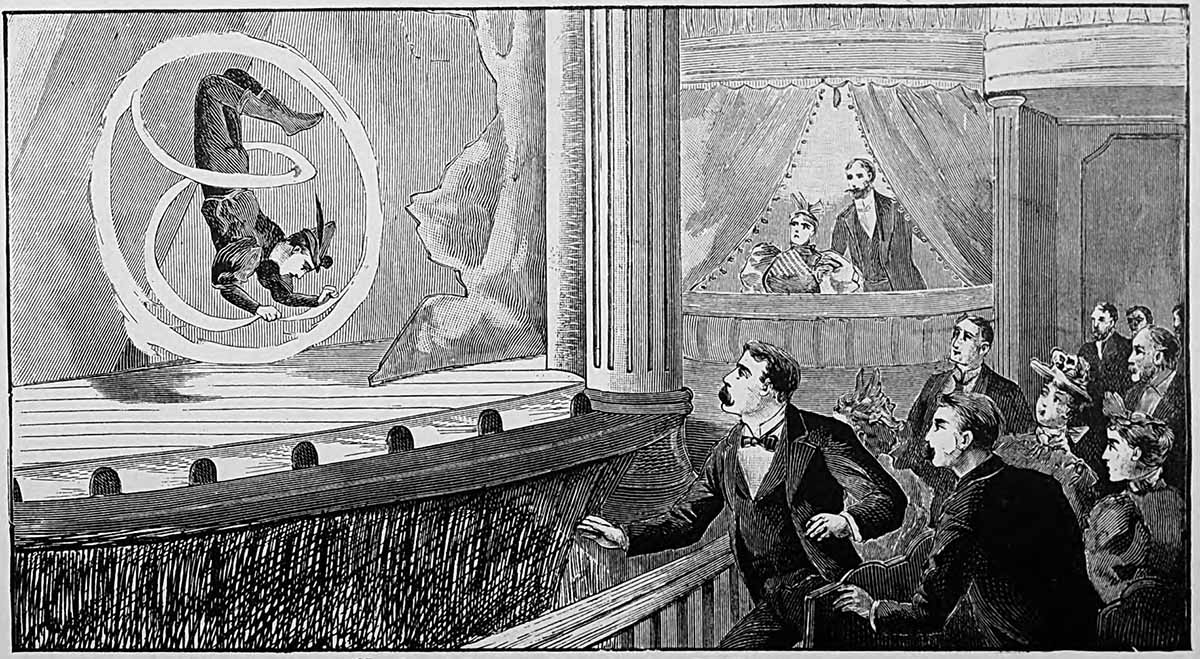
“Look out! The scene is coming down!”
Neka heard the shout, but did not understand it. He sprang backward to make another somersault, when of a sudden a heavy side scene, representing a portion of a castle, began to topple over on him.
It looked as if he would be crushed and burned in the very midst of his triumph!
[Pg 28]
CHAPTER IV.
A MOMENT OF PERIL.
For a moment the wildest kind of excitement prevailed throughout the town hall. Men sprang up and women screamed in fright.
“He will be crushed!”
“Cannot some one catch the falling scenery?”
A hundred other cries rang out—people can call better than they can rush up and help.
In the meanwhile Neka was whirling around, turning somersaults and back hand-springs. He was totally unconscious of his peril. He fancied the audience were afraid he would be killed on account of the danger attending the performance of his fire trick.
But now Longfellow Wadsworth, who was standing near one of the wings, sprang forward.
To attempt to steady the scene was useless. It had been built by a well-meaning, but ignorant, local carpenter, and was almost as heavy as the wooden side of a barn. The running brace in the rear had broken away, and it was bound to come down.
“Come this way, Neka!” yelled the elocutionist. “Save yourself!”
This cry, delivered but a few feet from him, startled the boy very much. But in his circus experience he had [Pg 29]been taught not to lose his presence of mind no matter how great the interruption, and this stood him in good stead.
Like a whirlwind he went on, turning over and over, until the wing was reached. Then he shot out of sight.
Crash! the scene came down, reaching over the full depth of the stage, smashing several of the footlights and narrowly escaping the pianist.
A tiny blaze sprang up, but ready hands subdued the conflagration, and a long sigh of relief followed.
“By Jove, my son, but that was a narrow escape!” ejaculated Longfellow Wadsworth. He was as white as a sheet, and trembled from head to foot.
Neka was busy brushing the fire out, and for several seconds could not answer. He was not hurt in the least, but the accident had spoiled the climax of his trick.
“Yes, I am thankful I escaped,” he said, at last, and quite coolly. “I wonder what made the scene fall. You didn’t move it, did you?”
“No.”
A dozen members of the bicycle club were now coming forward. Like a flash Neka got the paraphernalia of his tricks out of sight. They were costly secrets, and well worth preserving.
“Is he hurt?” questioned Harry Lardale, anxiously, as he pressed forward to Neka’s side.
“I’m all right,” replied the boy. “But I had a close call.”
“Indeed you did. I ought to have told you about that scene. I was told the brace was rotten.”
[Pg 30]
“We’ll have to have help to put it out of the way,” put in Longfellow Wadsworth.
“Certainly.”
Several of the club members sprang forward to assist, and the scene was raised from the footlights and the curtain lowered. In five minutes the stage was cleared and set with another scene, and in the meanwhile the pianist started up a lively air, which changed the current of the audience’s thoughts.
“You had better go on while I prepare for some more tricks,” said Neka, to the elocutionist, and Longfellow Wadsworth willingly complied.
The elocutionist was warming up, and a recitation entitled “Mulligan’s Hens” brought forth roars of laughter. Seeing the audience took better to humorous than to pathetic pieces, he thereafter confined himself to such selections as were calculated to elicit laughter.
When Neka next appeared, it was in a robe of blue trimmed with white. Silently he advanced to the center of the stage, then made a violent clutch in the air.
Bang! an explosion was heard, and a streak of fire seemed to dart across the stage. It struck his head and instantly there was a blaze.
“He is on fire!”
“What has happened? Was that an explosion?”
“He’ll be burned up!”
Half-a-dozen people leaped up in alarm.
“Don’t be alarmed, my good friends,” said Neka, in a cool tone. “This is the way I clean my hair now and [Pg 31]then. It’s better than a shampoo, and far less costly. See, I will brush it out.”
And producing a brush from his sleeve, he brushed the fire to the floor, and stamped it out with his feet.
The fire extinguished, he ran to the wing, and appeared with a little charcoal heater. In it lay a rod of iron, red-hot.
“My pet plaything,” he explained, as he came forward with the rod in his hands. “An excellent thing to warm with. Would any of you like to try it? No? All right, then, I’ll keep it to myself.”
He took a strip of paper and laid it on the rod. It immediately caught fire, and he tossed the burning brand out for inspection.
“I will now heat it a trifle more,” he went on, sticking the rod into the heater. “The charcoal is not very hot. I’ll have to blow it up.”
And, to the amazement of all, he picked out the white-hot bits with his fingers and blew upon each, then put them back.
“Creation!”
“He’s a king of fire and no mistake.”
The iron bar was now hotter than ever. Neka took it up and advanced to the footlights.
“Will any one examine the bar? I would like at least one gentleman to come up and satisfy himself that the bar is really at a white heat.”
Two gentlemen came forward. One touched the bar, and gave a cry of pain which caused the audience to roar.
“You are satisfied?” asked Neka.
[Pg 32]
“More than satisfied,” said the gentleman, flipping his fingers. “I’ll give you a written statement that it’s hot if you desire it.”
“Thanks, but it’s not necessary, sir. Now please observe, I take the bar, and, presto! I brand myself at pleasure!”
The sleeves of Neka’s robe dropped away, disclosing his bare arms. Up first one and then the other he ran the red-hot bar. There was a slight splutter, but that was all. Many could not endure the sight, and turned away their faces; others gaped open-mouthed at the trick.
Once more Neka retired, and Longfellow Wadsworth came on. He recited a selection the boy had suggested, “A Countryman at the Magician’s Entertainment,” and during this Neka came on again and performed more fire tricks, to fit the surprise and horror of the countryman.
This wound up the performance, and when the curtain went down the applause was loud and long.
The Chambersburgh wheelmen were delighted at the success of the entertainment, and the reporter for the local paper promised to give the performance a splendid notice. This he did, and to-day Neka has the clipping from the Chambersburgh Gazette in his scrap-book.
It was after eleven o’clock before the boy and his partner were ready to leave the town hall. They had already hired a room at the hotel, and thither they made their way, talking over the prospects as they went.
“Well, now, the question is, what’s to be done next?” said Neka, as they entered the room and prepared to retire.
[Pg 33]
“I move we take the stage to Lock Haven to-morrow,” replied Longfellow Wadsworth. “Perhaps we can arrange for an entertainment there, either for some organization or on our own hook.”
“That may be a good plan. It will at least bring us closer to New York, and I reckon that is where we both want to go.”
“You are right, Neka. It’s the only place from which to obtain an engagement with the sort of company we are looking for,” replied the elocutionist.
Before retiring Neka took a thorough bath. This was necessary in order to remove the alum and other chemicals with which his head, neck, and arms were covered, for all had been covered in order to protect his skin from the fire.
Both the boy and Longfellow Wadsworth slept soundly that night. The elocutionist was much elated over their success, and much to Neka’s disappointment, persisted in taking a couple of glasses of liquor before he went to bed.
“Just as a nightcap, my son,” he said, “just as a nightcap. In the future I shall beware and not—ahem—satisfy the craving to an obnoxious extent.”
Which led Neka to believe, and rightly, too, that the elocutionist had a great weakness for strong drink.
This was to be deplored, and the boy determined to keep a sharp eye on his partner in an endeavor to keep him from going astray. What a task Neka thus cut out for himself will be seen later.
[Pg 34]
CHAPTER V.
AN ENCOUNTER ON THE ROAD.
After the hotel bill was paid at Chambersburgh, Neka found himself with exactly three dollars and fifty cents in his pocket. Longfellow Wadsworth had about the same amount.
The sum was not large, but it was a fact that it was considerably larger than Neka had ever possessed while under the so-styled care of Daniel Bambo. The circus proprietor had not only beaten and starved him, but it was rarely that Neka had a cent to spend on himself, and when he had it was usually money received from some kind-hearted spectator at the circus.
“Lock Haven is only four miles from here,” said Neka to the elocutionist. “Let us walk the distance. We can do it in a little over an hour, and save forty cents each in stage fare.”
“I see you have the principle of saving installed in you,” replied Longfellow Wadsworth. “A good trait, my son; wish I could say as much for myself. I will hie myself to the bar for an eye-opener, and then do as you suggest.”
The elocutionist went off, and when he came back, a quarter of an hour later, his breath smelled strongly of liquor. However, he had not been drinking to excess, [Pg 35]and they started off at a rapid gait. Neka, with a bundle done up in brown paper, and his partner with a cheap and shiny hand satchel, purchased at the town second-hand establishment.
The day was clear and cool, the road a good one, and both went on in the best of spirits, the elocutionist even breaking out now and then in a bit of song, while Neka amused himself by imitating several song birds he heard.
“By the way,” remarked Longfellow Wadsworth, suddenly, “I have been thinking of your personal history, Neka. Where do you suppose you sprang from?”
“I haven’t the slightest idea,” replied the boy, and a momentary look of sadness crossed his handsome face.
“But you must have come from somewhere,” persisted Longfellow Wadsworth.
“That’s true, but who my father and mother were I never heard.”
“Did those people in Cleveland ever say anything about it?”
“Not a word. All I ever heard was from old Jerry Brown, who, as I told you, said Daniel Bambo had no claim on me.”
“Then this Brown must have known something about you.”
“That is true. But his secret died with him.”
The elocutionist shook his head and ran his hand through his hair thoughtfully.
“It’s a pity he didn’t tell you more,” he went on. “Maybe you belong to some rich folks and were stolen from home.”
[Pg 36]
“And maybe not, as the song says,” laughed Neka. “No, I am not building up any false hopes,” he added, soberly. “I reckon I was just a poor nobody, and that’s all.”
“Well, if I were you, I’d make this Daniel Bambo knuckle down some day and tell me all about myself.”
“I intend to do that—when I can. But at present I am satisfied to keep out of his clutches.”
“Of course. One can do but little when one is—ahem—in pecuniary straits, as it were.”
“That’s so,” concluded Neka, and there the subject was dropped.
But the boy did not forget. He kept on wondering about the past. Would it ever be cleared up, or must his parentage be forever shrouded in mystery?
How soon would he again meet the cruel circus proprietor, and would Daniel Bambo compel him to rejoin the Greatest Aggregation of Marvels on the Globe once more?
“Not if I can help it,” muttered Neka, to himself. “I’ll fight tooth and nail first, and refuse to perform.”
All of which went to show that the spirit of personal liberty was growing stronger in the boy every hour.
About half the distance to Lock Haven was covered, when they came to a slight hollow. Here were a number of bushes and a fallen tree, and the elocutionist proposed they take a brief rest.
“We are in no tremendous hurry,” he said. “And it won’t do to enter Lock Haven looking fagged out.”
[Pg 37]
So they sat down. Behind them were a number of chestnut trees, the nuts of which were just ripening.
“I’ll go up and shake some down,” said Neka, and up he went without delay.
Chestnuts in hand, they remained in the hollow until the nuts were eaten. Then Longfellow Wadsworth wandered a short distance away, to look at the surroundings, so he said, but in reality to take a draught from a black flask he had procured at the hotel bar-room. Drink was his one great weakness, and he could not quit it entirely so long as he possessed the means to satisfy the craving.
When the elocutionist was gone, Neka laid down on the log in the sunshine. It was a pleasant thing to do, rest instead of working like a slave around the dirty canvas of the circus. How glad he was that he had left that life behind!
Neka had been resting less than three minutes when a form stole out of the woods and came up behind him. The form was that of the man who the day previous had attempted to steal Harry Lardale’s bicycle.
“That same kid!” muttered the would-be thief to himself. “Now I have the chance to git square with him!”
He gazed around, and seeing a heavy stick close at hand, picked it up. Then he came up noiselessly behind Neka.
A single blow, swiftly delivered, caused Neka to utter a sharp groan and roll from the log to the earth. The man stood ready to deliver a second blow, but it was unnecessary. Neka was unconscious, with the blood streaming from a wound back of his left ear.
[Pg 38]
Fearful of being seen, the man gazed around again. No one was in sight, but he heard footsteps among the fallen leaves in the woods. He ran his hands into Neka’s pockets, and brought forth the boy’s money.
“Humph! not much, but better’n nothin’,” he muttered.
And then, picking up the bundle in brown paper and the shiny satchel, he hurried up the road and into the woods at a point several hundred feet farther on.
“Neka, come here and see what I have found!” called out Longfellow Wadsworth.
Receiving no reply, he called again.
“Must have gone to sleep,” he said to himself, and he came out on the road, a richly embroidered skate bag in his hand.
“By Jove!” he exclaimed, in horror. “Has the lad committed suicide?”
He rushed forward and raised Neka up. Then he saw the cut back of the ear. A bump was forming rapidly.
“Struck from behind, as sure as fate! Where is the dastardly villain who committed this most atrocious deed? Poor boy!”
He ran to a nearby puddle of water, and soaked a rather dirty handkerchief in it, then, returning, bound the cloth around Neka’s head over the wound. By the time this was accomplished the youth opened his eyes and gave a low gasp.
“Oh!” he groaned. “Did you hit me?”
“Not I,” responded Longfellow Wadsworth, reproachfully. “Neka, what makes you fancy me a villain of such deep dye?”
[Pg 39]
“I didn’t know—I thought you might have thrown a stone up the chestnut tree, and——”
“Ah, I see; you meant did I hit you by accident. No, I threw no stone, my son.”
“Then somebody attacked me with a club, I reckon.” Neka sat up and blinked his eyes. “What a rap he did give me! Can you see anything of him?”
“I will make a search.”
The elocutionist was as good as his word; he ran both up and down the road, and into the woods on both sides. But the hunt for the thief was useless, and in a quarter of an hour he came back, exhausted and angry.
“I see my bag is gone and your bundle——” he began.
“And every cent of my money,” added Neka, feeling in his pockets. “Whoever did the deed knocked me out to rob me.”
“It must have been done quickly,” observed the elocutionist. “As quickly as that bicycle thief took that young man’s wheel.”
“I believe it was the same chap!” burst out Neka. “He said he would remember me. Like as not, he has been hanging around waiting for a chance to get square.”
“That is not improbable, Neka. Well, the fates are against us, it would seem. After our success of last night, here we are stranded again, with less than two dollars and a half to our credit.”
And Longfellow Wadsworth counted out the sum total he possessed.
“You are better off than I, for I have nothing——”
“Say not so, my son. See, here is a paltry two dollars [Pg 40]and forty-three cents. One-half is yours. No, no, it is yours, for Longfellow Wadsworth has said so. I’ll divide the sordid pile, one dollar and twenty-one each and a cent extra. I’ll flip it up, heads for you, tails for me. It comes down heads, and is yours. Now do we once more stand on an equal plane.”
And the elocutionist, with a flourish, thrust the bill and the change into Neka’s grasp.
“You are kind,” began the boy.
“Don’t mention it, my son. Are we not partners? United we stand, divided we fall. Come, if you are able, let us be on our way. Who knows but what we may yet conquer fate and incidentally bring that rascal to justice?”
[Pg 41]
CHAPTER VI.
THE ENEMY’S POWER.
Neka found the wound on his head an ugly one, and consequently the remainder of the journey to Lock Haven took much longer than either had anticipated. Both kept a keen lookout for the party who had robbed them, but met no one to whom the slightest suspicion could be attached.
Arriving at their destination, Neka made his way to a drug store and here had his wound fixed up. This cost him a dollar, leaving him only the small sum of twenty-two cents.
In the meanwhile, Longfellow Wadsworth went off to see what could be done toward giving an entertainment for the benefit of some local organization.
In this quest he was unsuccessful. No one cared to go into the matter, at least not at once, and the elocutionist came back in a couple of hours thoroughly disheartened.
“If we show at all, we must do it on our own account,” he said.
“Will that pay?” asked Neka.
“It must pay. It is our only chance. Come, we will hunt up the owner of Bard’s Hall, as the sole hall in the place is called.”
They soon learned that Mr. Bard kept a large grocery [Pg 42]store, the hall occupying the second floor of the building in which the place of business was located.
He was a tall, angular man, with a thin, shrewd face.
“Want to hire the hall, eh?” he said. “What for?”
“To give an entertainment consisting of readings and recitations and wonderful tricks with fire,” replied the elocutionist, drawing himself up to his full height.
“Fire tricks? Don’t want ’em. You might burn down the building.”
“The tricks are perfectly safe,” said Neka. “I have performed them for years, and never started a fire yet.”
Mr. Bard seemed only half-convinced. Yet he was a close man, and he hated to see the chance of making some money out of his hall slip by.
He asked a number of questions about the show, and finally said they might have the hall that night providing they agreed to leave everything as it was and paid the rent, twenty dollars, in advance.
This last proposition was a dismaying one, as to pay in advance was totally out of the question.
“We have—ah—been unfortunate in receiving money due us,” said Longfellow Wadsworth. “Suppose you let us take the hall, and we will settle as soon as we open our entertainment?”
“No, I must have the money in advance,” replied Mr. Bard, decidedly. “Last winter I let a lot of show actors have the place, and they went away without paying a cent.”
“We are—ahem—not so dishonest,” protested the elocutionist.
[Pg 43]
“Maybe not; but them is my terms. You can take the hall or leave it, just as you please.”
“I wonder is there another hall in town?” said Neka.
“No, there ain’t,” replied the grocer, in ill-concealed tones of satisfaction.
“You will be perfectly safe in taking the money for tickets sold,” persisted Longfellow Wadsworth; but Mr. Bard would not listen, and turned away to wait on several customers.
Much chagrined at their failure to secure the hall, Neka and the elocutionist walked out of the store.
“I must confess I am what is poetically called stumped,” admitted Longfellow Wadsworth, when they were out of hearing. “I don’t know what is best to do.”
“It is getting late,” replied Neka. “Even if we get the hall it is too late to properly advertise an entertainment.”
“We might sell some tickets and get the money for immediate use, and then postpone our show until to-morrow,” said the elocutionist, easily. “I had that in view from the start. But now our cake is dough, in the language of a Bowery Shakespeare.”
The pair walked aimlessly up the one street of the town. It is not pleasant to have a set-back with so little money in one’s pocket.
Under his arm, tightly rolled up, Longfellow Wadsworth carried the richly embroidered skate bag he had picked up in the woods. He now shook it out and examined it.
“This is by no means a common bag,” he said, as he [Pg 44]turned it over. “It is embroidered in silk, and, by Jove, Neka! here are a lot of pearls as sure as you live!”
The boy took the bag. The elocutionist was right; on one side was a wreath in red silk, and in the center a dozen pearls.
“A rich find, my son!”
“What in the world was it doing in the woods?” asked Neka.
“That I can’t propose to answer. But the pearls are valuable, beyond a doubt. I wonder——”
Longfellow Wadsworth stopped short.
“We must look for the owner.”
“What, the owner of a skate bag found in the woods? My son, don’t be crazy. The bag must have been lost last winter, or perhaps winter before last.”
“It looks as if it had just been dropped,” said Neka.
“No, no, it has been out in rain, for here is a spot. I’ll tell you what we’ll do. I’ll take these pearls and leave them with that owner as security for the rent. Probably he will take them, or, if not, no doubt the jeweler who keeps the store opposite will let us have a loan on them.”
“Well, there will be no harm in getting a loan on the pearls,” said Neka. “I don’t think I would bother that Mr. Bard to take them for security.”
“I agree with you. He is a most disagreeable personage, truly,” responded Longfellow Wadsworth.
He took out his penknife, and with great care removed the pearls from the skate bag, after which he rolled up the bag and thrust it into his pocket.
[Pg 45]
“Perhaps I had better make the visit to the jeweler’s alone,” suggested the elocutionist.
“Just as you think best,” replied Neka.
“I will meet you at the grocery corner.”
With this understanding, Longfellow Wadsworth hurried off. It took him but a couple of minutes to reach the jeweler’s establishment.
It was a modest place kept by an old man named Samuel Cordley. When the elocutionist entered he found Cordley at the work-bench fixing a tall clock. Neka’s partner was not long in coming to the point.
“We have been unfortunate in receiving money due us,” he said, “and I wish to raise money on some pearls I have in my possession.”
And he handed over the pearls for inspection.
The old jeweler’s eyes lighted up as he surveyed the pearls.
“May I ask where they came from?” he asked, slowly.
“They—ahem—once belonged to my wife,” replied Longfellow Wadsworth, without a blush. “I kept them in—ah—remembrance of her, dear soul!” and he wiped away an imaginary tear.
“What do you wish me to loan you on them?”
“Only thirty dollars. You see, my dear sir, we are to give an entertainment across the way, and I shall redeem them to-morrow, and pay you for your favor.”
The jeweler asked a few more questions, and then handed over the desired amount and placed the pearls away in his safe.
“Thanks,” said Longfellow Wadsworth, warmly. [Pg 46]“Here are a couple of passes to our entertainment. Trust we see you there,” and he scrawled something on a sheet of paper lying on the counter.
“Thank you; I’ll come if I can,” replied Samuel Cordley, and put the slip in his show-case.
“Victory!” cried Longfellow Wadsworth, as he rejoined Neka. “Thirty dollars—just enough to pay for the hall, advertising and extras. Come, let us hustle, for now every moment counts.”
They at once entered the grocery, and the elocutionist began to dicker for the hall, finally beating Mr. Bard down to eighteen dollars. Then he and Neka hunted up a printer and somebody to furnish them with music. A wagon was also procured, with a banner on each side announcing the entertainment, and this was driven all around the district, while the pianist who had been engaged blew long and loudly on a bugle while seated in the rear.
It must be confessed that Neka was rather nervous over the result of this, their first real venture. The night before they had been backed up by a club; now they were going it entirely alone.
They had placed the regular admission at twenty-five cents, with a few seats higher and a few seats lower, so in order to make expenses they must have at least one hundred and twenty people present. Longfellow Wadsworth was to sell tickets, and Neka was to take them, until it was time to go on, and after that a man who had helped them was to take in the money and pass folks in alone.
“Look out, the scene is coming down!” See page 27.
[Pg 47]
At half-past seven o’clock the people who had come to see the show began to arrive. A colored boy was the first to enter, and Neka laughingly called him their mascot. Then followed three gawky farm lads, and a crowd of ladies and gentlemen.
By ten minutes to eight Neka had passed in the one hundred and twenty people, and he felt much elated. The crowd was still coming, and every admission now meant just so much clean profit.
By eight o’clock a few over two hundred people had entered and only a few stragglers remained. Neka left the door in charge of the hired man, and went back of the stage, where he was soon joined by the elocutionist.
“We are twenty-three dollars ahead of the game,” said Longfellow Wadsworth, joyfully. “We are winners, my son, beyond a doubt.” And he jingled the cash in the skate bag.
The pianist was already pounding out a selection on the tiny piano with which the hall was furnished, and the elocutionist lost no time in preparing to make his appearance.
Neka busied himself with his chemicals, and donned his robe of red and yellow. Soon Longfellow Wadsworth left him behind the scenes alone.
A burst of applause told Neka that the elocutionist had finished, and it was now time for him to make his appearance. He lighted a taper for use in the first of his fire tricks.
Suddenly a side door opened, and three men came in.
[Pg 48]
“There is the boy!” cried one, pointing to Neka. “He ran away from me, and I am his lawful guardian!”
“And that is the man who said he owned the pearls which belong to Miss Fordham!” cried a second man, and he pointed through the wing to Longfellow Wadsworth.
The first speaker was Daniel Bambo, the second Cordley, the jeweler. The third man, the one they addressed, was the Lock Haven constable.
No wonder Neka was greatly startled.
[Pg 49]
CHAPTER VII.
A ROW ON THE STAGE.
“You didn’t think I would drop on you quite so quick, did you?” sneered Daniel Bambo, as he rushed forward and grabbed Neka by the arm.
“Leave that boy alone!” thundered Longfellow Wadsworth, dramatically.
He had not heard the accusation the jeweler had brought against him.
“And who are you?” demanded the proprietor of the Greatest Aggregation of Marvels on the Globe, harshly.
“Longfellow Wadsworth, elocutionist and tragedian, of Boston, Philadelphia, and New York. A man of the world, and a champion to this downtrodden youthful genius, and——”
“You’re cracked,” muttered Bambo. “I have no quarrel with you. I have to do with Neka, my ward, who ran away a few days ago. Neka, come along with me.”
“I shall not go,” replied the boy, in a low, but firm, tone.
“What!” roared Daniel Bambo, his wrath arising on the instant. “What’s that?”
“I shall not go back with you, to be beaten and starved,” went on Neka. “I have struck out on my own hook.”
[Pg 50]
“Just to hear the young scamp,” cried the circus proprietor, turning to the Lock Haven constable. “He won’t go back—after I have brought him up, clothed and fed him, and given him a good home for four years!”
“Some boys need to be taken well in hand,” was the officer’s comment.
“And some men ought to be taken in hand,” snorted Longfellow Wadsworth. “That man is a brute, if ever there was one. If the Society for the Prevention of Cruelty to Children knew of his doings he’d be cracking stone for the State this minute.”
“Shut up!” cried Bambo. “Officer, as that man is undoubtedly a thief, you had better arrest him and take him away. I’ll take care of the boy myself.”
“A thief!” Longfellow Wadsworth strode forward, his eyes flashing wildly. “I will—will——There! how do you like that, sir?”
That was a savage tweak of Bambo’s long nose, which caused the circus proprietor to yell with pain. Bambo made a pass at the elocutionist, but the constable stepped between.
“This is all contrary to law——” he began.
“He called me a thief!” blustered Longfellow Wadsworth.
“So you are!” howled Bambo.
“He is no thief!” put in Neka, warmly.
“But he said the pearls belonged to his wife, while they really belong to Miss Fordham, of this town,” put in Cordley, the jeweler.
[Pg 51]
All eyes were now turned upon Longfellow Wadsworth.
To his credit be it said that the elocutionist blushed deeply. He had meant no harm by the fiction he had invented concerning the history of the pearls. He had told the story merely for “dramatic” effect, as he told many other things. To tell a “good story” and give it out for truth was one of his failings.
“What have you to say to this?” asked the constable, as the elocutionist paused before replying.
“The pearls belong on this skate bag, which I picked up in the woods to-day while on my way from Chambersburgh to this town,” said Longfellow Wadsworth, squarely. “We were short of funds, and so I put them out on a loan, expecting to redeem them to-morrow. It was then my intention to sew the pearls on the skate bag again, and make a diligent search for the owner.”
“A likely story,” sniffed Daniel Bambo.
“I was not addressing you, you brute,” retorted the elocutionist. “My business appears to be with these gentlemen.”
“But how about that story about your wife——” began the jeweler.
“I must have—er—have been thinking of something else when I told that. My head was full of business, you know.”
“Probably,” replied Cordley, dryly.
“If this Miss Fordham is about I shall be happy to restore her bag to her. I will also pay you, Mr. Cordley, the money advanced, with interest on the loan, and you [Pg 52]can return to her the pearls. That ought to be satisfactory.”
“I suppose so,” mused the constable. “She took the skate bag with her yesterday to go chestnuting, and I reckon she dropped it where you picked it up, although she felt almost certain a thief stole it before she left this town.”
“If necessary, I can prove I was in Chambersburgh all day yesterday,” replied Longfellow Wadsworth, eagerly. “I can prove it by Mr. Harry Lardale, the son of the county clerk.”
“Then you certainly must be telling the story straight about finding the bag,” said the constable. “I’ll take the bag, and you pay Cordley, and I reckon it will be all right.”
Longfellow Wadsworth lost no time in emptying the money from the bag. As Daniel Bambo saw the amount his eye glistened.
“Been taking in a lot of money at the door,” he remarked, but the elocutionist paid no attention. He paid over the money to the jeweler, and got his receipt.
“I should not have touched the pearls, but I found a loan absolutely necessary. Kindly restore the bag to Miss Fordham with my regrets and compliments.”
And the elocutionist bowed profoundly.
“I will,” said the constable.
Then he looked at Daniel Bambo.
“I’ll attend to my end of the affair,” said the circus manager. “You can go.”
“Not so fast, please,” put in Longfellow Wadsworth. [Pg 53]“Mr. Constable, I will ask you to take this man with you. We don’t want him behind the scenes.”
At this Daniel Bambo’s face almost turned white with surprise and rage.
“Put me out!” he fairly gasped.
“Yes, put him out.”
“I’ll go—but I take that boy with me,” growled the proprietor of the Greatest Aggregation of Marvels on the Globe.
And again he took hold of Neka’s arm.
“Let go of me!” said the boy.
“You’ll go with me!”
“I will not!”
Bambo tried to shove the youth toward the side door.
Longfellow Wadsworth sprang in between. He leaned over, close to Daniel Bambo’s ear.
“Let him go. I know something of the past, and if you molest that boy I will take you to court and expose you.”
This random shot had an electrical effect on the circus proprietor. He released his hold on Neka’s arm and fell back, gazing in wonder at the elocutionist.
“Who—I never saw you before,” he faltered.
“Never mind, you never saw many of old Jerry Brown’s friends,” went on Longfellow Wadsworth, following up his advantage.
“A friend of Jerry Brown!” muttered Daniel Bambo, and on the instant his whole manner changed.
“After this I want you to leave Neka alone. He is [Pg 54]under my protection and I shall see to it that he obtains his rights.”
“You’ll keep him to make money out of him,” sneered the circus proprietor.
“No, I shall not be as avaricious as you were. So long as we perform in partnership, half the receipts shall go to him. This has already been arranged.”
“Does he git half the receipts to-night?”
Daniel Bambo’s eyes glistened. How he wanted to get at that money!
To go back to the day before, his circus had been attached for debt at Ryetown, four of his principal performers had left, and it looked as if the Greatest Aggregation of Marvels on the Globe was going to a total smash.
No wonder, therefore, he looked with longing eyes on the money Longfellow Wadsworth held in trust for Neka.
But he dared not just then push his claim for the possession of the youthful King of Fire. There was no telling how much the elocutionist knew of the past, or what trouble might arise should the matter be dragged into court.
“I ought to have some of that money. I kept him when he wasn’t worth his salt,” he growled.
“And you kept him, too, when he made money hand over fist for you,” added Longfellow Wadsworth. “Now leave us, for the audience is growing impatient.”
The elocutionist spoke the truth. Outside in the main hall the people were stamping and uttering cat calls, which grew louder each instant.
[Pg 55]
Daniel Bambo stood irresolute for a moment. The jeweler had gone off, but the constable still lingered.
“All right, have your own way,” he said, as a sudden idea flashed into his mind. “I only hope the boy proves as much care and trouble to you as he has to me.”
And with these words he marched out of the door and downstairs into the street.
[Pg 56]
CHAPTER VIII.
ADVENTURES AT A FAIR.
As much as Neka wished to talk matters over with Longfellow Wadsworth, there was no time to do so now. The audience were growing highly impatient, and several cries of “humbug,” “fraud,” and so forth had been raised.
“Get ready as quickly as you can,” said the elocutionist. “I will make an apology for the delay.”
He slipped out on the stage, and, coming forward, laid his hand on his heart and bowed profoundly.
“Ladies and gentlemen: No one regrets this delay more than do I and my distinguished fellow performer, Professor Neka. But accidents will happen in the best of families, some one has said, and when they do happen we must make the best of them. In bringing our numerous trunks to this hall the drayman accidentally let slip one containing the most important paraphernalia belonging to Professor Neka, and, in consequence, many of his things were sadly shattered, involving a loss of several hundred dollars. But the professor, with his accustomed courage to meet adverses, has gone bravely to work to mend matters, and will be ready to give you one of the grandest exhibitions of fire tricks ever seen on any stage in a few minutes more. In the meantime I will crave your indulgence, and beg leave to recite a humorous selection, entitled, ‘Murphy’s Tailless Cow.’”
[Pg 57]
This little speech was well received, and the recitation was applauded. By the time Longfellow Wadsworth had finished, Neka was ready to go on.
The boy was nervous, yet he did not allow this to mar his performance. He came on the stage with a grand flourish, and executed his fiery ribbon evolution amid vigorous handclappings.
“He’s all right!”
“No fake about that!”
“The folks in Chambersburgh said he was a wonder, and they are about right.”
This evening Neka had a new trick in view. He had purchased several daggers of iron. These he heated red-hot, then, advancing to the footlights, began to joggle them into the air with his bare hands. A storm of applause showed how well this new trick was received.
“We have caught them, just as we caught the folks at Chambersburgh,” observed Longfellow Wadsworth, when they were closing up. “What a pity a place like this is not large enough to exhibit for several nights.”
Neka was silent on this subject, his head being filled with thoughts concerning Daniel Bambo. The elocutionist was quick to surmise what the trouble was.
“Don’t you worry about him, Neka,” he said. “I fancy we have him where the hair is good and long instead of short.”
“You said something to him about old Jerry Brown,” said the boy, slowly.
“Yes, and that was where I had him.”
“He appeared greatly alarmed.”
[Pg 58]
“Yes, it made him cave in. Do you know, I believe I can corner him some day and make him reveal your past,” went on Longfellow Wadsworth, earnestly.
“I wish you could,” replied Neka, and his heart gave a great bound at the thought.
“I don’t believe, at any rate, that he will bother you again in a hurry,” said the elocutionist.
The two talked the matter over on the way to the town tavern, a dingy and old-fashioned place, where they obtained a room together for a dollar.
Early on the following morning they had breakfast, and cast about for some place where they might exhibit on the following evening. Outside of Chambersburgh, only a few small villages were in the vicinity, and it would scarcely pay to open up in them.
“We had better push on to Carmine,” said Longfellow Wadsworth. “I see by the County Item there is to be a county fair there for three days next week. If we can buy a privilege cheap and hire a tent, it would pay very well to give a sort of continuous performance during fair days.”
“That’s a good idea!” cried Neka. “Under a tent I can tumble as well as execute my fire tricks.”
“And I can take a hand at exhorting the folks to come in and see our wonderful exhibition, my son. I once traveled, in my younger days, for a circus side show, and had a neat speech which I have not forgotten. It ran something like this:”
The elocutionist waved his hands grandly, as though addressing a vast multitude.
[Pg 59]
“‘Walk up, tumble up, crawl up, any way to get up, kind people, and enter and behold the wonders we have spread for your inspection. The greatest and most glorious and mystifying combination of wonders on the face of the terrestrial globe! You may travel from the Atlantic to the Pacific, from the Great Lakes to the Gulf of Mexico, and see none that will equal this stupendous and magnificent olla-podrida of good things, and all for the small sum of one dime, the insignificant ten cents. If you miss this unparalleled opportunity you will regret it for the remainder of your life, so walk up at once and thus get ahead of the great crowd that is now coming on.’
“I tell you, Neka, that used to fetch ’em every time.”
“It ought to,” laughed the boy. “Such a speech is better than blowing a horn or beating a bass drum.”
Just as they were about to leave Lock Haven, an elderly man, accompanied by a young lady, drove up in a T-cart and got out. They made an inquiry of the landlord, and then turned to Neka and his companion.
“Mr. Travers tells me you are Professor Wadsworth, the elocutionist,” said the elderly man.
“I have that honor,” replied Longfellow Wadsworth, bowing deeply, and removing his battered tile with a flourish.
“I am James Fordham; this is my daughter, the one that lost the skate bag which you found.”
“Ah, yes—er——”
“My daughter thinks she should acknowledge your service,” went on James Fordham. “Of course, not [Pg 60]knowing anything about the ownership of the bag, you had a perfect right to put out the pearls on a loan.”
“Merely a bit of necessity, my dear sir; otherwise I would not have done it,” returned the elocutionist. “You see, we were short of ready cash, and, as there is no bank in town, we could not draw on our New York——”
“It is unnecessary to make explanations, Professor Wadsworth. The truth is, I offered a reward of twenty-five dollars for the recovery of the bag, and my daughter thinks, and I think, too, that you should have the money.”
“I expected no reward, but——” Longfellow Wadsworth hesitated.
He liked to appear indifferent to pecuniary gain, but to lose twenty-five dollars, why, that was not to be thought of.
“You will accept it, please,” said the girl. “I know now you must have found it under the twin chestnut trees on the Chambersburgh road.”
“I did, miss, I did. And if you really insist——”
Longfellow Wadsworth looked longingly at the five crisp five-dollar bills in the elderly gentleman’s hand.
“I do, sir,” said the girl, and a minute after the elocutionist had the money tucked safely in his vest pocket.
A few minutes later the two parties separated, and Neka and his partner set off on their journey to Carmine. A farmer came along with an empty produce wagon, and offered to give them a ride for ten cents each, and this offer was accepted.
“We are growing rich, my son,” cried Longfellow Wadsworth, as he and Neka rode along in the back of the [Pg 61]wagon. “Twenty-three dollars last night and twenty-five now make forty-eight, and two I had make an even fifty. Not bad, is it?”
“The twenty-five is yours, professor.”
“No, no; we share and share alike; didn’t I say so before? I am not a second Daniel Bambo, my son. Half the money is yours. Here, take it, lest it be lost and the blame fall on my shoulders.”
“I’ll put it in my shirt, so it won’t be as easy to rob me as it was before,” said Neka. “But tell me, why do you draw the long bow so much?”
“Me? Never, Neka!”
“But you told them about a bank account——”
“Oh, that was a mere figure of speech—it didn’t count.”
“And you said something to the jeweler about those pearls——”
“Another little turn that hurt nobody.”
“I don’t like that.”
“Don’t be too particular in this life, my son.” Longfellow Wadsworth was for the moment irritated, but as quickly recovered his good humor. “Let us change the subject.”
And then he spoke of the fair and of their future plans, and so the talk about the elocutionist’s shortcoming was dropped. But it was plain to see that Neka’s idea of right and wrong were of a finer and higher grade than those of his companion.
Carmine was reached in half an hour, and a few minutes later they found themselves at the entrance to the fair grounds, which were inclosed by a high board fence.
[Pg 62]
To the man at the gate Longfellow Wadsworth explained their mission, and they were readily admitted. They looked over the grounds, sized up the attractions offered, and finally made up their minds to locate, providing they could rent a suitable tent.
They took a walk among the other “fakirs,” as all show people are called at a fair, and soon met the owner of a trained animal exhibition who had an extra tent he would let for three dollars a day. The tent was twenty feet wide by fifty feet long, and though rather small, Neka and his partner thought they could make it do. They hired the outfit, leased a promising spot, and lost no time in getting ready. The day was Saturday, and the fair was to open bright and early the following Monday morning.
[Pg 63]
CHAPTER IX.
AN ACT NOT ON THE BILLS.
“We ought to have some other attraction besides ourselves,” observed Neka. “People will think they are not getting the worth of their money if they pay ten cents and only see a few fire tricks and hear a humorous recitation.”
“I shall dress up in a character costume and give them a song also,” said Wadsworth. “I used to sing funny songs, and they always take in the open air.”
But Neka was not quite satisfied. He was in for giving people “their money’s worth.”
“If we do that, we’ll do better in the end,” he said. “A slim show never prospers.”
“Well, I don’t see what we can add to our combination, my son. We might take in a third partner, but I don’t believe in dividing profits with too many.”
“Let us try to hire somebody to do a turn,” rejoined the youth.
This appeared difficult, but proved quite easy. On leaving the grounds that night, Neka ran across a fellow named Jack Bindley, who had been attached to Daniel Bambo’s circus. Bindley was out of a place, and out of money, and he jumped at the chance to earn three dollars a day at the grounds.
Jack Bindley was billed in the circus as a bareback [Pg 64]rider, but he could do a dozen other things, including tricks with cards and a black-faced act which was side-splitting. Moreover, he was a good hand with a brush to paint signs, and Longfellow Wadsworth was pleased when Neka brought him in.
A programme to last half an hour was arranged, and Bindley set to work painting a number of large signs and banners, telling of the many wonders to be seen in the Neka-Wadsworth Oriental Parlor of Wonders. Neka was described as an Imp from the Infernal Regions, who would take a bath in a roaring fire, and Longfellow Wadsworth as a mimic who had performed before all the crowned heads of Europe. Bindley called himself Leon Canavair, from Paris, the Wizard of Cards, and also set himself down as Ole Jim Backus, the Original Georgia Corncracker and Plantation Singer.
A quiet Sunday was spent on the fair grounds, and at five o’clock Monday morning Neka and the others arose to put the finishing touches to the place.
A small stage had been built at the back end of the tent. There were no benches, as visitors at fair exhibitions usually stand. Outside Longfellow Wadsworth had constructed a stand out of a large drygoods box. Tickets he intended to sell out of his hand satchel.
It looked a little like rain, and consequently the crowd was slow in coming in. But about eleven o’clock it brightened and shortly after the noon hour the fair grounds began to fill up.
Neka and Bindley were ready to appear, and while a hired boy took tickets at the entrance, Longfellow Wadsworth [Pg 65]mounted his box and began to exhort the people to enter.
His loud voice soon drew a crowd, and by telling a funny joke or two he put them in good humor. Then he told of the marvels to be seen, and half a dozen entered in a bunch and as many more followed.
In fifteen minutes the tent was full, and Bindley opened the exhibition. He was followed by Wadsworth, who did but a short “turn.” Then came Neka, who was undoubtedly the star attraction. At the end of half an hour the audience, numbering exactly forty-six people, filed out, well satisfied.
“A first dose of four dollars and sixty cents,” whispered Longfellow Wadsworth. “I wonder if we can’t do better the next time.”
One of the men on going out had said it was the best show on the grounds. The elocutionist stopped him, and had him repeat the assertion. Then he dilated on it, and as a consequence the tent was soon packed, seventy-two being inside.
Nine performances were given that day and by night Neka and his partner found themselves just thirty-six dollars richer than before. They had taken in fourteen dollars more than this, but three had gone to Bindley, three for the tent, seven for the ground, and a dollar to the boy.
Neka and the elocutionist talked the matter over, and raised Bindley’s wages to five dollars a day.
It was arranged that Bindley should remain in the tent [Pg 66]all night, while Neka and his partner put up at a hotel just outside of the grounds.
The making of so much money had one bad effect on Longfellow Wadsworth. He drank a number of times, and would have become most woefully intoxicated had not the youth prevailed upon him to go up to his room in the hotel and retire for the night.
In this respect the elocutionist was a fair type of a large class of people on the variety and regular stage. With talents of no mean order, they are the victims of their appetites, and find it next to impossible to break off drinking while traveling around from place to place and meeting hail-fellows-well-met wherever they go.
“I must get him to break off,” said Neka to himself. “He would be a first-rate fellow were it not for his appetite for drink and his habit of drawing the long bow. I think I can reform him.”
The youth understood that he had undertaken a big task, but he had taken a strange liking to Longfellow Wadsworth, in spite of the latter’s eccentricities, and he was willing to shoulder the burden and do his best.
How well Neka was repaid for sticking to this strange individual and giving him his moral support will be seen as our story progresses.
The next day opened well, for the crowd came early and performances were started at ten o’clock. At noon the fair grounds were packed, for the “middle” day of a fair is always the best.
“We’ll have to do with only a bite for dinner to-day,” [Pg 67]laughed Neka. “We can’t afford to knock off for a regular meal.”
“Never mind, we’ll make hay while the sun shines,” replied Bindley, who was always light-hearted.
Bindley had been questioned concerning Daniel Bambo. He could, however, tell but little outside of the fact that the circus had been attached at Ryetown. There had been twenty dollars coming to him, and he had left the concern as a rat leaves a sinking ship.
“And I never want to see Daniel Bambo again,” said Bindley. “He is the hardest fellow to work for I ever struck.”
“You are right,” said Neka. “If I, too, can keep out of his sight, I shall be satisfied.”
The tent of the “combination” was situated in the midst of a number of shows. To one side of them was a fakir with a lot of dolls and baseballs with which to knock the puppets down for prizes, and on the other the proprietor of the trained animal exhibition. Beyond this was another combination, of bearded ladies, jugglers, and mimics and a merry-go-round and a shooting stand.
From time to time a wild scream, half-human, half-savage, disturbed Neka and his companions. It came from the trained animal exhibition, and finally Neka asked what was the cause.
“It’s the chimpanzee,” replied the proprietor. “I can’t do a thing with him. He has been suffering with the toothache, and is as ugly as a bear with a sore head. We had him loose yesterday, but I guess I’ll have to chain him up.”
[Pg 68]
“Yes, that would be better,” replied Neka. “At a circus I was with we once had a gorilla who got the toothache and he bit his keeper most horribly. No matter how tame they are, they are not to be trusted when suffering such pain.”
A minute after this the two separated, and Neka went back to his tent to do his turn. He heard a number of screams from the animal tent, but paid no attention. Heating his iron daggers red-hot, he brought them before the audience and rubbed them on paper, which, of course, was instantly burned up.
The dagger was on a platter. Setting the platter on a low stand, he proceeded to pick the daggers up one after another and throw them up into the air in a circle.
He was in full swing of this fire trick when a scream ten times louder than any of the others was heard.
“Stop him! Stop the beast!” he heard somebody cry. “Stop him, before he chews somebody up!”
Then came a crash and a ripping of canvas, and a huge chimpanzee leaped onto the stage, close to Neka’s side. The creature looked hideous in the extreme, for its eyes rolled horribly, and the white foam poured from its mouth in a stream.
For a single instant the mad creature paused. Then it crouched for a spring, and launched itself straight for Neka’s throat!
[Pg 69]
CHAPTER X.
NEKA SHOWS COURAGE.
When the mad chimpanzee leaped through the canvas onto the little stage, the audience in the tent became panic-stricken.
“He is mad!”
“He will tear somebody to pieces!”
“Let me get out of here!”
A mad rush was made for the entrance, while a score or more dropped to the ground and crawled under the tent walls.
In less than half a minute, Neka was left alone, with the single exception of Bindley, who came rushing from the tiny dressing-room to see what all the racket was about.
In the meantime the chimpanzee had leaped straight for Neka’s throat. By a marvelous twist, the youth got out of his way and came up in the beast’s rear.
With a scream and a roar the enraged brute turned clumsily, sending the foam from its mouth over Neka’s robe. Again it paused, and then made another leap.
“Stab it with one of the daggers!” yelled Bindley. “If you can keep him off ten seconds I’ll have my revolver!”
“I don’t want to kill him if I can help it,” replied Neka, making another leap out of the way. “Bring a rope and make a loop at one end and we’ll capture him.”
[Pg 70]
As he spoke he held up two of the red-hot daggers before him. On the instant the beast put up a paw and endeavored to knock the weapons from his grasp.
The chimpanzee was burned, and let out a wild scream of pain. Then he made another attempt by striking the weapons away.
As quick as a flash, Neka turned one of the daggers point forward. The blade entered the chimpanzee’s forepaw, and both burned and cut him.
Surprised at this unexpected happening, the beast roared and yelled, and retreated to a corner. Here he alternately nursed his wound and his aching tooth, and while he was doing this Bindley appeared with the rope.
A noose was made, and by a skillful throw Neka landed the rope over the chimpanzee’s body. Hardly had the throw been made when the proprietor of the animal exhibition broke through the tent wall, armed with a chain and a prod.
“I’m glad you didn’t shoot him!” he cried. “He cost me two hundred dollars cash.”
The rope was wound around a big stake, and thus secured it was an easy matter to chain the chimpanzee and muzzle him. By the efforts of the owner, Neka, Bindley, and several others, he was finally removed to his cage, and made a close prisoner for the remainder of his stay at the fair grounds.
The proprietor of the animal exhibition was profuse in his thanks to Neka for having spared the chimpanzee’s life, and he did not hesitate to praise the youth for his bravery.
[Pg 71]
As a result of the excitement, a large crowd gathered around, and when Longfellow Wadsworth announced that the star of the show was the man who had braved a mad animal single-handed, and captured him, the tent was filled at once, and for the next two hours a rushing business was done.
“I wonder what Daniel Bambo would say if he knew we had taken in ninety dollars in two days?” asked Neka, to the elocutionist, that evening. “We have really done better in proportion than his circus ever did.”
“That is no doubt true, my son; but, unfortunately, county fairs do not last forever. I have made inquiries, and have learned that this is the last fair to be held in this section of the country this year.”
“Then we’ll either have to go back to hall exhibitions, or make our way to New York and strike for places in some variety company.”
“What’s the matter with organizing your own company?” suggested Bindley. “If you are careful in making up your route you’ll make more money that way than you will working under salary.”
“But it takes money to start an organization,” said Neka. “Look what the printing alone costs.”
“You could start out in a modest way for three or four hundred dollars,” replied the all-round artist. “Form a company, and include me, and I’ll promise to work like a car horse to make it a success.”
This idea at once appealed to Longfellow Wadsworth, and to Neka it was by no means distasteful. They would be over a hundred dollars ahead when the fair closed, and [Pg 72]a few weeks of good luck at “barnstorming,” as playing in small places is termed, might put them sufficiently ahead to strike out as a full-fledged company, playing regular stands.
“We’ll do it!” cried the elocutionist. “How will this sound? The Neka-Wadsworth Unique Special Company? That ought to go well, eh?”
“Especially if you have a couple of good lithographs of Neka doing his best fire tricks,” said Bindley. “You won’t want more than seven or eight people, for most of them can double, and here are three of us already.”
The idea was such a fascinating one that they talked it over until after midnight, and then it was practically settled they should form a company just as soon as the state of finances would permit.
On the last day of the fair it turned off cold, and toward sundown those about the tent, inside and out, began to shiver. The next day would be the first of October, and the long summer was now at an end, and winter was not far off.
Around the fair grounds were congregated a great number of sharpers and pickpockets, and of these all hands had to beware.
“You don’t want to be cleaned out, you know,” said Bindley. “Some of these ducks would cut your throats if they knew you had over ten dollars in your pockets. The gangs that follow the fakirs are growing worse every year, and at the wind-up of the season they rob and assault folks whenever they get half a chance.”
[Pg 73]
“I’ve been cleaned out once,” said Neka. “I am on my guard.”
The life at the fair grounds pleased the boy, and he was sorry that it was coming to a close. He worked his best, and the receipts on the third day almost equaled those of the second.
It was seven o’clock in the evening when they settled up with the owner of the tent and the boy helper and left the grounds. It was already dark, and outside of the fence the drinking booths and the table fakirs were urging on business by the aid of flaring gasoline lamps and kerosene torches.
“This way fer yer big drink!”
“Here’s where yer git yer hot frankfurters. Only a nickel!”
“Step up, gents, an’ try yer luck. Three throws fer a dime, an’ yer may win five dollars!”
“Come up! come up! and see what I’ve got!” yelled one burly fellow perched on a soap box. “The boss prize package, only a dime each. Just watch me put that dollar in this envelope! There’s another dollar, and there’s another! Money in all of ’em, gents! Take yer choice fer a dime!”
“Poor fools!” laughed Bindley. “They ought to know they would never win anything from such a duck as him. If you watch him closely you can see the dollar bill go up his sleeve instead of in the envelope, and he uses the same bill every trip.”
“Yet no doubt he has coined money to-day,” put in [Pg 74]Longfellow Wadsworth. “The law—what’s the matter, Neka?”
“Don’t you recognize that fellow?” burst out the young King of Fire, clutching his partner’s arm.
“I must say his face looks familiar.”
“It is the chap who stole that bicycle from Mr. Harry Lardale!”
“By Jove, my son, you are right!” ejaculated the elocutionist. “And if that is so, he is most likely the one who attacked you so brutally on the road.”
“If he is, you ought to land on him with both feet,” cried Bindley, who, it may be said right here, was much given to the slang of the road.
“If I could prove that he attacked me I would have him arrested.”
“Well, you can prove he tried to steal the bicycle,” said Longfellow Wadsworth. “That is enough to hold him on. No doubt Harry Lardale is well known around here, and he can make it warm for the trickster.”
“That is so. Let us—look! look!”
Again Neka clutched his partner’s arm, and pointed to the crowd surrounding the fakir.
A disturbance was on. An old countryman had passed up a five-dollar bill and asked for three prize packages. Instead of giving back the necessary change the fakir wanted to load up the old man with more envelopes, each containing a sliver of “prize soap,” valued at less than a cent.
“I want my change!” growled the countryman.
[Pg 75]
“But, my dear fellow, these packages——” began the fakir.
“I want my change! I don’t want any more packages! Them three I bought didn’t have nuthin’ in ’em.”
“But these——”
“Gimme my change! Perlice! perlice!” cried the rural gentleman, alarmed at the prospect of losing the cash due him.
“Git out of my way!” suddenly growled the fakir.
And, making a leap from the soap box, he started to run away into the darkness beyond the circle of smoky lights.
[Pg 76]
CHAPTER XI.
MORE ADVENTURE.
The crowd standing around the fakir were so astonished by his sudden movement that for the instant no one but the old countryman attempted to stop him.
The farmer caught the rascal by the arm, but was quickly flung off and into the crowd on his back, where he lay, too dazed even to speak.
“He’s going to rob that man!” cried Neka.
There was no time to say more. To the astonishment of the boy and his companions, the scamp tore along close to where they were standing.
Neka was the first to act in this emergency. Leaping forward, he put out his foot, and down went the fakir flat on his face in the dirt of the country road.
“Wot did yer do dat fer?” he growled, as he struggled up and gasped for the wind that had been knocked out of him. “Do yer want me ter hit yer, sonny?”
He attempted to go on, but Neka caught his arm, and a second later Longfellow Wadsworth and Bindley also had their hands on him.
By this time the crowd was in pursuit, the countryman coming up in the rear, puffing and blowing, for he was old and feeble.
“Hold him! He is a thief! Don’t let him git away from ye!” he yelled.
[Pg 77]
“We have him,” replied the elocutionist. “Is there an officer around?”
“Wot yer goin’ ter arrest me fer?” asked the fakir, brazenly. “I wasn’t doin’ nuthin’, only going ter git change fer that old gent.”
“He was going to run off with my five-dollar bill,” puffed the old farmer.
“What’s the trouble here?” demanded an officer, coming up, club in hand.
Matters were quickly explained. The five-dollar bill was given back to the old countryman, and he refused to make a complaint against the fakir.
The scamp was about to decamp when Neka told the officer to hold him.
“He is wanted for trying to steal a bicycle from Harry Lardale, son of the county clerk,” he explained. “I am sure Mr. Lardale will lodge a complaint. Besides that, I think he is a fellow who knocked me unconscious on the road and robbed me a few days ago.”
“I’ll take him in if you’ll come along and make a complaint,” replied the officer, briefly.
Neka agreed to this, and soon the entire party were on their way to the Carmine police station.
On his way the fakir begged hard to be let go. He was closely watched by Neka, and to a good purpose, for as they neared the jail the boy saw him attempt to throw something away.
“What is that?” he cried. “The prisoner threw it away.”
An examination was made and the object was found. [Pg 78]It proved to be an oddly shaped bit of ivory, carved and polished.
“My pocket-piece!” cried Neka. “Old Jerry Brown gave me that,” he explained to Longfellow Wadsworth. “This proves that this chap is the one who assaulted me.”
“No doubt you are right.”
“What else did he have belonging to you?” asked the officer, becoming interested.
“A couple of dollars in money, and a pocket-knife, an old one, with a brass handle, marked ‘Neka.’”
By this time the station was reached. A complaint was made, and the prisoner was examined. The brass-handled knife was found in a back pocket, also fifteen dollars and a half.
Neka said if the money and knife were returned to him he would not make a complaint, not wishing to wait around Carmine until the trial should come off.
The thief agreed to restore the stolen things, and did so. Then he was locked up until Harry Lardale could be heard from.
It may be said here that the bicyclist appeared against him the very next day, and that the scamp was tried and convicted, and sent to prison for one year.
When Neka and Longfellow Wadsworth returned to their hotel the elocutionist asked the boy to show him the pocket-piece he had obtained from old Jerry Brown.
“An odd bit of a keepsake, truly,” he mused, as he turned it over.
“I think a good deal of it,” said Neka. “Jerry thought [Pg 79]a good deal of it, too, and only gave it to me when he thought he could not live any longer.”
“Had he anything to say about it when he presented it?”
“No, excepting that I should keep it, and not let Daniel Bambo take it away from me, because it was a charmed piece, and would some day bring me great luck.”
“Ah!”
The elocutionist said no more, but the bit of ivory and what the dead juggler had said about it set him to thinking deeply.
“You take good care of that bit of ivory, Neka,” he remarked, the next morning. “I’m a bit superstitious myself, and I believe that carries with it your whole luck in the future.”
The boy did not altogether understand what he meant. He wanted to ask several questions, but Longfellow Wadsworth cut him short.
“I’ve been looking over the ground,” he went on, “and I don’t know but what we had better try our luck at Cambron to-morrow, and lay off to-night. There is a charity fair going on at Cambron, but perhaps the town is big and rich enough to turn out for both affairs. I don’t know of any other town to strike in this section.”
“Cambron always was a good show town,” said Bindley, who was taking breakfast with them. “You won’t lose anything by going there.”
“The circus certainly did very well there,” mused Neka. “We might try it. We can’t expect first-class stands every night.”
[Pg 80]
“In the meanwhile, I will wire ahead and see what we can do at Washingtonville,” went on Longfellow Wadsworth. “We may as well be making dates ahead.”
Neka laughed.
“We’ll soon want an advance agent and all that sort of thing,” he said.
“Certainly,” rejoined Bindley. “Your route will have to be mapped out at least a month or six weeks ahead. You know some shows book ahead the whole season, but then they are the big guns.”
A day of rest after the trying work at the fair was welcome to all hands. They took the coach for Cambron, arriving there just before dinner.
As Longfellow Wadsworth had said, there was a charity fair in progress there. It was held in an armory directly in the rear of the hall in which shows were given, the two buildings being so close that the back windows of each were scarcely five feet apart.
When they went to hire the hall they were told they could do but little. Yet, undaunted, they went ahead, paid the rent, and got out their bills.
At this the managers of the charity fair grew very bitter, and were loud in their denunciation of the “tramp actors,” as they termed our friends.
“We’ll boycott ’em, and get our friends to do the same,” they said.
So angry was the head of the committee that he had a banner painted, which read as follows:
“Rally to the fair, everybody! Don’t go to any fake [Pg 81]show, but spend your money for the benefit of the hospital! Leave tramp actors to themselves!”
This banner was tacked on a wide spreader attached to a stick, and a man was put on the street to carry it around, especially in the vicinity of the show hall.
Neka laughed when he saw the banner, but Longfellow Wadsworth and Bindley were furious.
“I’ll fix ’em!” stormed the elocutionist. “I’ll give ’em a banner that will make ’em howl.”
“I wouldn’t raise a quarrel,” said Neka. “It will do us no good. Rather try to make them ashamed of themselves.”
“But how?” asked Bindley.
“Get up a banner praising the fair, and say we’ll be there ourselves to-night.”
“Ha! ha! a good idea!”
The banner was made, and Bindley went to work on it. When finished, it read as follows:
“Go to the fair by all means, and spend all the money you can afford in the good cause. Afterward attend the great moral exhibition of the Neka-Wadsworth Specialty Company at Radley’s Hall. To-night Professor Neka will give a free exhibition of one of his celebrated fire tricks in front of the armory. Be sure to go to the fair early, so you can see him. Remember, the company perform in Cambron to-morrow night only!”
“That will mix matters up,” said Neka. “I wonder what the manager of the fair will say to that?”
The banner was turned over to an old man, and carted around the principal streets, and in front of the armory.
[Pg 82]
At first the committee having the fair in charge were angry. Then they talked matters over, and came to the conclusion they were not treating the “actor folks” just right. Half an hour later their banner was taken in, and it did not appear again.
[Pg 83]
CHAPTER XII.
KING OF FIRE IN EARNEST.
Some of the fair people wished Neka to give up the idea of giving a free exhibition on the street in front of the armory, but Longfellow Wadsworth objected.
“We have advertised it,” he said, “and we always fulfill our promises to the public.”
Then the fair people tried to stop the exhibition by going to the town authorities, but the elocutionist, warned by Bindley, had forestalled them.
“They have a license for the street exhibition,” said the town clerk. “And we can do nothing.”
There was a lot of grumbling after this, but nothing further could be done.
Toward evening Neka drove up in front of the armory in a large open wagon. He was in his robe of blue, and wore an immense turban on his head, making him look like a Turk.
In the wagon he had a number of small cannon balls, which were hollow, and also a charcoal heater.
Longfellow Wadsworth was with him, and immediately began a little lecture, which attracted a large crowd that was going to the fair.
In the meantime the cannon balls were heating in the charcoal stove.
[Pg 84]
When they were red-hot Neka took them up in his hands and performed several tricks with them. To show how hot the balls were, he threw several of them in the crowd. The would-be catchers were slightly burned, and this caused a roar of merriment.
This free exhibition took very well with the crowd, and a large number were heard to say that they would certainly attend the show.
“We would like to have you all, kind people,” called out Longfellow Wadsworth. “But don’t forget the charity fair. Remember, faith, hope, and charity. Here is the charity, and we shall have faith and hope to see you with us to-morrow night.”
This light speech drew a round of laughter, in the midst of which the wagon was driven off. Undoubtedly, the “actor folks” had left a good impression behind them.
To show their further good-will, Neka and Longfellow Wadsworth attended the fair that evening, and left several dollars behind them. Some of the stand-holders took this in good part, but others snubbed the actors all they could.
One young woman in particular was very obnoxious to Neka. She was the daughter of a local doctor, and as plain-looking as a person could be. Yet she thought herself a belle, and was dressed to the last degree for the occasion.
She was tending a stand where fancy articles of paper were on sale. A gorgeous fan which struck Neka’s fancy hung in front of the stand, and thinking he might [Pg 85]use it on the stage just to set off his scene, he approached and asked her the price.
“It’s not for sale,” she snapped.
“Oh, I thought all these things were for sale,” replied the boy, mildly.
“That’s sold,” she went on, tartly. “And if it wasn’t, I wouldn’t want to sell it to you.”
An angry reply arose to Neka’s lips at this insult, but he repressed it, and giving her one look full in the face, passed on without a word.
“They’re a charitable lot,” he declared, when he and the elocutionist left. “My, but that woman’s face would cause a vinegar barrel to turn over with envy!”
The following morning and afternoon were used in advertising the coming performance as much as possible. Several banners were tacked on a wagon, and a drum and fife corps was placed inside and driven around the district. Several thousand handbills were also distributed.
The fair folks made a strong effort to keep people from attending the show, but, as is usual in such cases, the more they tried the more people wanted to go. By seven o’clock there was a crowd around the hall, while the armory was almost deserted.
“We’ve got ’em!” cried Bindley, enthusiastically. He was as much interested as though he was one of the owners of the company. “See ’em coming!”
“I know one person won’t be here,” replied Neka. “That young woman who gave me the set-back last night.”
[Pg 86]
“You are not going to forget her so easily, I see,” laughed the all-around artist.
By eight o’clock the hall was packed, Longfellow Wadsworth having sold a hundred tickets more than he had calculated on.
“The fair isn’t hurting us any,” said the elocutionist. “To-night we’ll have our banner receipts. I reckon that free exhibition last night did the business.”
It was now time to open up. Neka looked out to see why the local pianist, who had been engaged, had not struck up. No one was at the piano.
“Hullo! I wonder if he has been bought off by the fair people?” he observed to Bindley.
This was the exact truth, although they did not know it until some time later.
“We must do something,” went on Neka, as the people in the hall began to stamp impatiently.
“We can’t give the show without music,” said Bindley. “Half the acts would fall flat.”
“I know it. I’ll go out and see if I can’t hunt the pianist up.”
Neka had taken off his street coat, but now he put it on again, and went out of the stage door. The alley way leading to the stage was deserted, and in the crowd on the street, no pianist was to be found.
Much vexed, Neka stood looking around, not knowing what to do. There was no use of appealing to Longfellow Wadsworth, as that individual had his hands full at the ticket office.
As he stood there a sudden burst of music from the [Pg 87]next street reached his ears. It was the sounds emanating from a large “piano” hand-organ. Without waiting, and struck by a sudden inspiration, Neka darted up the block and around the corner.
Two Italians were in charge of the big organ, one of whom was grinding a popular air in double-quick time.
“Come with me if you want to earn a couple of dollars in two hours,” he said to one of the Italians.
“Twoa dollar?” queried the sunburned son of Italy.
“Yes, in two hours.”
The Italian waited to hear no more. He spoke to his partner in his native language, and prepared to follow Neka. Their day was about over, and to get an evening job was like so much money found to them.
The boy led the way through the alley to the stage door, and the big “piano” organ was hoisted onto the back of the stage. It was rolled close to the first left entrance.
The Italians now understood, and grinned to each other. It was the first time they had played at an entertainment, and they were greatly tickled.
A list of the tunes was made, and the organ was started up. It sounded very well in the hall, and at the conclusion of the first piece there was quite some applause.
“Nothing like getting out of a hole,” said Neka. “But if I see that pianist I’ll give him a big chunk of my mind.”
“Probably the organ plays better than that pianist would,” said Bindley. “It don’t make any mistakes, even if it does go along like a windmill.”
Bindley opened the show, and then Longfellow Wadsworth [Pg 88]came on, leaving the ticket office in charge of a hired man. In the meanwhile Neka was preparing to present a brand new fire trick.
The trick was an elaborate one, and much care had to be exercised in order to prevent accidents. Neka proposed to bathe his face in flames from a wash-bowl filled with fire. This is a Chinese sensation seldom attempted in this country.
A clapping of hands told that Longfellow Wadsworth had finished his turn, and then Neka went on.
He began with a number of simple tricks, such as bending a red-hot rod with his bare hands, juggling the hot daggers, and the like.
Then a stand was brought in containing a bowl with water, on the top of which rested the material which was to be used in taking the bath of fire.
“Now, ladies and gentlemen,” began Neka, speaking, as he usually did, with a peculiar accent supposed to be foreign, “I propose to give you something which is but seldom performed, even in China, where the act originated. It is called the Oriental Bath of Fire, and was invented by Chica Chura-Manra, chief of the royal worshipers of the sun. You see here a plain wash bowl, filled with water. On the top I place this material, which looks like cotton, but which, as you behold, can be crushed to nothing in your hand. This material is celestial fire soap, a secret compound, which can be used on the face only when burning. Now you see me bare my arms and neck for the Bath of Fire. Oh, but it will be a [Pg 89]glorious bath, invigorating the system and strengthening the muscles! Now I light the soap, and——”
Neka got no farther. A piercing cry rang through the theater, coming from the armory in the rear. The cry was that of a woman.
For a moment all were spellbound; then as the cry was repeated men and women leaped to their feet.
“Fire! fire! The armory is on fire!”
Neka heard the cry, and stared back of the stage. A window was open, and he could see directly into the armory hall, where the charity fair was being held.
A sight met his gaze that caused his very heart to turn sick. One of the stands was in a blaze, and close to it stood a young woman, her thin white dress aflame from bottom to waist! The young woman was the very one who had snubbed him so unmercifully.
But Neka did not stop to think of this. Quick to act in an emergency, he sprang upon the window-sill.
“Where are you going?” yelled Bindley.
“To save her life!” replied Neka, and made a jump from the sill straight through the window opposite onto the armory floor.
[Pg 90]
CHAPTER XIII.
NEKA’S BRAVE DEED.
Only a few people in the armory saw Neka make the daring leap from the rear window of the theater to the building in which the excitement was going on. The young woman in flames commanded the attention of all.
Strange to say, none of her friends ran in to her assistance. Either they were too scared or too afraid to make the first move toward effecting a rescue.
The instant that Neka landed on the armory floor he made a wild rush for the woman’s form, now fairly enveloped in fire.
“Look out, young man!”
“Mary Breston will be burned to death!”
“The armory will be burned down!”
“Isn’t this awful!”
Then of a sudden the crowd became silent as the people saw Neka catch the young woman by the waist and throw her down on the floor.
“Water—a rug—coat—anything!” called out the boy. “Be quick, somebody!”
As he spoke he took his bare hands and dashed out the fire that was mounting to the young woman’s face. The preparation he had used for his tricks now stood him in good stead, for he remained uninjured.
[Pg 91]
Soon a wet curtain was flung to him and a coat followed. He threw these over the victim and rolled her over. Then two men came to his assistance, and before the crowd could fairly recover from its shock, the fire was out so far as it was confined to the young woman. The stand that was burning was then pulled down and also extinguished.
The young woman was unconscious and was carried to the parlor of the armory and laid upon a couch. Soon her father, the doctor, came, along with another physician. They worked over her constantly for an hour, when she was pronounced out of danger and taken home in a coach.
In the meantime Neka returned to the theater, and so did that part of the audience which had left at the first cry of fire. The show had been sadly interrupted, but the performers did their best, and the audience went away at the conclusion well satisfied.
“Are you hurt at all, my son?” asked Longfellow Wadsworth, anxiously, as soon as he got the chance to address the boy privately.
“Not a bit,” laughed Neka. “I was just in trim to fight fire. If the accident had to happen, it could not have chosen a better time.”
On the following morning, while Neka and the others were at breakfast, a message was handed to the boy. It was from Dr. Robert Breston, and asked Neka to call at his residence that morning if possible, or, at least, before leaving town.
Neka was on a stand about going. He had not forgotten [Pg 92]how Mary Breston had snubbed him. He was inclined to leave the saved girl and her parent severely alone.
But Longfellow Wadsworth and Bindley urged him to answer the message, and finally he walked over to the doctor’s home, only a few blocks away.
Mary Breston lay on a couch in the sitting-room. Her burns were but slight, and her face and neck remained entirely uninjured.
Dr. Breston received Neka with a warm shake of the hand, and then turned to his daughter.
“This is the brave young man who saved your life, Mary,” he said.
The young woman eyed Neka eagerly, then started and blushed. She recognized him and remembered how she had ill-treated him.
“And it was you!” she exclaimed, in a low voice. “You! What can you think of me?”
And she began to cry.
“Why, Mary!” ejaculated the doctor. “Have you met this brave young man before?”
“He came to the fair night before last, father, and I, knowing he was one of the actors belonging to that show which was going to perform in opposition to us, snubbed and cut him all I could.” She turned to Neka. “Oh, I hope you will forgive me. I was very rude.”
“Certainly I’ll forgive you,” responded Neka, melting all in a moment. “I suppose you felt cut by our coming to town.”
[Pg 93]
“I did, and we girls promised to do all we could to make your visit to the fair unpleasant.”
“That wasn’t right, Mary,” put in her father. “The theatrical company had a full right to come to town if they wished. Their business is a legitimate one.”
“I know it, father, and I am very sorry.”
“Let us drop it,” interrupted Neka. “I hope you are not much hurt,” he went on, kindly.
“No, thanks to you, I escaped almost totally. But if it hadn’t been for you, I would have been burned to death!”
And the young woman shuddered.
“Yes, that is true,” said the doctor. “We owe you a world of gratitude, Mr.——”
“My name is Neka, sir.”
“Ah, your stage name.”
“The only one I have.”
“Indeed!” The doctor looked curious, but said no more on the point just then. “Your fire tricks stood you in good stead.”
There was a slight pause, and the doctor looked at his daughter.
“I want to thank you from the bottom of my heart,” said Mary Breston, earnestly. “You saved my life, and I will never forget it, never. I heard you were about to leave town. Before you go won’t you accept this as a slight token in remembrance of your brave service to me?”
She brought out a leather case and handed it to Neka. The lid flew back, revealing a gold watch and chain within.
[Pg 94]
The watch was undoubtedly a costly one, and the boy’s face flushed with pleasure. But then he shook his head slowly.
“I don’t deserve this,” he said.
“But you do—and a good deal more,” said Mary Breston. “Do not refuse my gift. It is but a poor return for your gallant act.”
“Yes, you must take the watch and chain by all means,” added her father.
A little more talk followed, and finally Neka accepted the beautiful gift. By this time Mary Breston looked fatigued, and shaking her by the hand, Neka withdrew from the room.
Dr. Breston followed him to the parlor. He was becoming interested in the brave and modest boy, and could not forbear to ask Neka a number of questions concerning himself. Before they parted he knew a good bit of the boy’s past history.
“A curious tale, truly,” he said. “I trust you have no further trouble with that Bambo, and some day find out the whole truth of your parentage.”
But even as Dr. Breston spoke thus he never dreamed of the important part he was to play in establishing Neka’s identity later on.
It may be said here that Mary Breston recovered from her injuries inside of several weeks and was then as well as ever. She never forgot the brave lad who saved her life and made her so ashamed of her unkind conduct toward him.
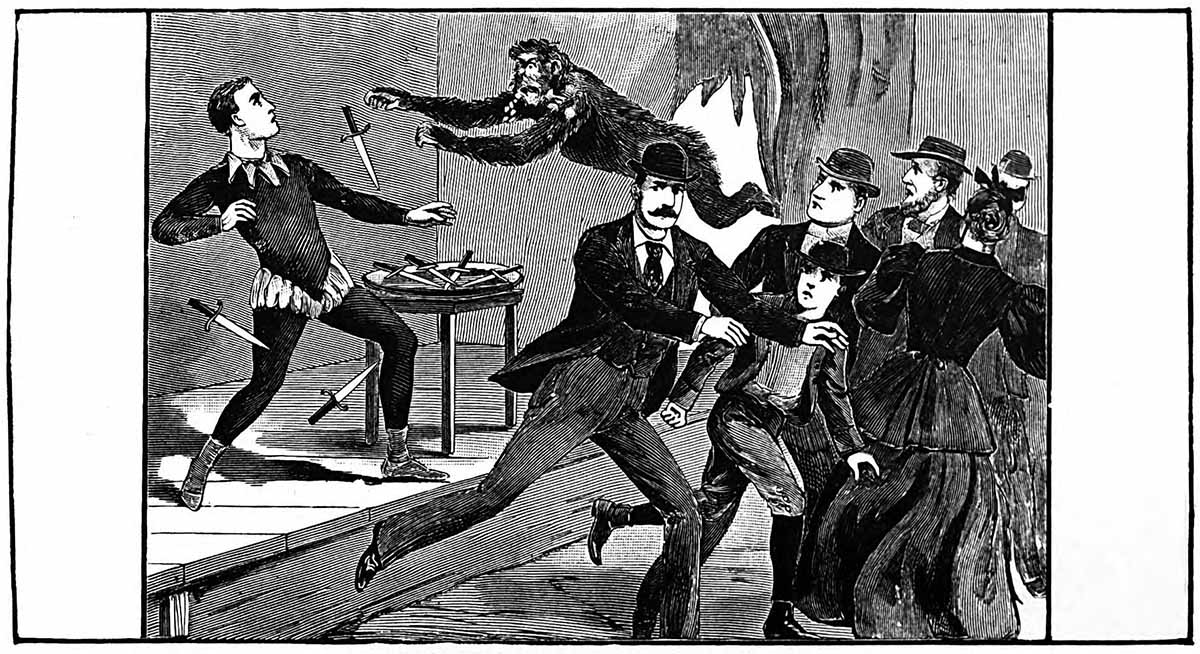
“The mad creature sprang for Neka.” See page 68.
[Pg 95]
CHAPTER XIV.
A RIVAL COMPANY.
From Cambron, Neka and his friends went to Washingtonville. Longfellow Wadsworth had wired ahead and secured a small but cozy theatre, and they billed the town for a three-nights’ stand.
“Our first venture at remaining more than one night,” remarked Neka; “I wonder how it will pan out.”
“Tell better after the third night,” laughed Bindley. “If business is good the whole three nights, it ought to give you quite a lift.”
“We must expect some set-backs,” put in the elocutionist. “We cannot expect the sun to shine all the time.”
“The trouble is, we are not strong enough yet to stand much of a set-back,” responded Neka, thoughtfully. “Our expenses here are over a hundred and twenty dollars. No business would about wipe out our capital.”
“Never mind, don’t worry,” said Bindley.
He was always cheerful and his perpetual good humor was contagious.
Neka wondered what had become of Daniel Bambo, but heard nothing concerning the proprietor of the Greatest Aggregation on the Globe.
On the evening of the first night in Washingtonville a cold rain set in about six o’clock, and by seven it was [Pg 96]pouring steadily. The lamp in front of the little theatre flickered dismally in the downpour, and the pavement was all but deserted.
“No audience to-night,” said Longfellow Wadsworth, as he walked up and down inside the entrance anxiously. “You couldn’t hire country folks to come out in the wet. They are more afraid of it than city people.”
“Here is an audience of two, anyway,” said Neka, as a pair of young men came in.
They shook the water from their umbrellas, strode up to the door and presented—free passes!
With downcast face, Longfellow Wadsworth let them in. The pair, all alone in the body of the theatre, looked uncomfortable and did not dare to crack the peanuts they had brought along.
Five minutes passed, and a man drifted in. He paid a quarter and joined the lonely pair within, and the three began a whispered conversation concerning the probabilities of the show being postponed.
“This is awful!” groaned the elocutionist.
“Twenty minutes to eight,” replied Neka. “Let us keep up our courage.”
Ten minutes passed, and not another soul came in. Longfellow Wadsworth heaved a deep sigh and retired to the ticket office to seek consolation out of his pocket flask.
But then matters began to brighten just a wee bit. Three big boys came in, followed by a couple of young [Pg 97]men with their best girls. They had hardly procured tickets when a loud fish-horn sounded outside, and a big covered stage drove up.
“This here crowd is from Goose Run,” explained one tall, lanky youth, who appeared to be in charge. “We wuz bound ter come, rain or no rain, ain’t that so, Sally?”
“Thet’s so, Joel,” was the reply from a comely young woman within the stage.
There were eighteen people in the stage, and this made twenty-eight folks all told to see the show.
As the stage stood at the door Neka was struck by a sudden idea. He ran in to talk it over with Longfellow Wadsworth.
“I’ve a good mind to take that stage and drum up an audience,” he said. “I think we can get folks to come if we bring them here free.”
“But the stage will cost money, my son, and as it is now——”
“I’ll give the driver five cents for every person he brings to the theatre.”
“Well, go ahead and do as you please.”
This settled, Neka called on Bindley to come along. Then the driver of the big turnout was appealed to.
“Five cents fer every person I fetch in, eh?” he mused. “All right, I’ll go ye!”
A big fish-horn remained in the stage, and this the two appropriated, and off they started with a flourish.
They drove up and down half a dozen of the principal [Pg 98]streets of the town, and while Neka blew on the horn, Bindley stood by the rear step, shouting out that they were going to the theatre, and the stage was free to any one that wanted to go along.
The idea caught the fancy of the town folks, especially those who had thought to witness the entertainment. In ten minutes the stage was packed and on its way to the theatre.
Two more trips were made. In the meantime others came in on foot, and by twenty minutes past eight the audience numbered close to a hundred people.
“Not an extra large crowd,” said Neka, as he counted them. “But it’s a good deal better than only thirty or forty.”
The pianist was pounding out lively airs, but those in the theatre were growing impatient, so, without further delay, Longfellow Wadsworth went on the stage and gave one of his best humorous recitations. This put the people in good humor, and the remainder of the entertainment passed off with great success.
Although the audience was limited, Neka and the others gave the best exhibition in their power. During the course of the show Bindley came out in a quaint monologue, in which he mentioned the fact that, should it rain the next evening, free stages would run all over the town to bring folks to the theatre, and he trusted the audience would mention this to all of their friends.
This speech was well received, and it was a good thing [Pg 99]that it was made, for the next night it rained as hard as ever. True to the promise, three stages were procured, each with a banner outside, and these brought to the theater over a hundred and fifty people between seven and eight o’clock.
Yet even the free stages did not give them a paying audience, and when the receipts for the first and second nights in Washingtonville were counted up, they were still some twenty dollars behind.
“Thought we would catch it some time,” muttered the elocutionist, dismally.
“Twenty dollars is not such a loss,” replied Neka. “Remember, we have another night to count on.”
“But it looks as if it would rain for a week still, my son.”
“Oh, no, it will clear to-night, mark my word.”
Neka was right. By midnight the storm shifted, and on the following morning the sun arose as bright as ever.
On the day previous Bindley had brought word in that a rival specialty company was in the vicinity and intended to come to Washingtonville either that night or the next. At breakfast Neka heard that the rivals were already located at a hall on the next block.
Curious to learn something about them, the boy strolled off in the direction.
He soon reached the hall, and in front, on the billboard, saw a flaring poster that took him completely by surprise.
[Pg 100]
HENRY MAUL’S SPECIALTY CO.
The Finest in the World!
No Fake Show can compare to it!
See Henry Maul, King of Jugglers!
See the Wonderful Trick Pony, Stump!
See the Windoms, Joe and Jennie!
The Finest Child Mimics on the Stage!
Lowest Price! Best Show! Go to No Other!
“Henry Maul!” read Neka. “It must be Hank Maul who drove for Bambo! It is, for there he mentions Stump, the trick pony. Bambo’s circus must have been sold out, and Maul took the pony for back salary. I wonder who Joe and Jennie Windom can be? I never heard of them. If that last line isn’t cheeky, to say the least!”
Neka was about to pass on when a shrill cry of pain attracted his attention.
“Stop! stop! Don’t whip me any more! Please don’t!”
It was a girlish voice which uttered the cry. It came from the interior of the hall.
“Shut up, you whelp!” was the reply, in the well-known rough voice of Hank Maul, the ex-circus driver. “You’ll do as I want you to, or I’ll break every bone in your skinny body!”
[Pg 101]
CHAPTER XV.
THE COMPANY IS ENLARGED.
Neka knew what a hard-hearted wretch Hank Maul was; consequently his blood fairly boiled with indignation when he heard the words given above.
“The scoundrel!” he murmured to himself. “It sounds as if he were whipping a defenseless girl!”
Without further hesitation, the boy dashed into the hall building. A narrow passageway led to a door opening upon the wing of the stage, and to this he made his way. He flung open the door.
A sight met his gaze that caused his indignation to increase, if such a thing were possible.
There in the center of the otherwise empty stage stood Hank Maul, and in his savage clutch was a slim-built girl of not more than twelve years of age. The girl was thinly clad, and the ex-circus driver had been beating her over the shoulders with a short, black whip.
“Now do it,” he said. “Do it, or I’ll give you another taste of the lash.”
“I can’t! I’ll break my neck!” pleaded the girl.
With a frightful imprecation, Hank Maul raised the whip to strike the poor creature over the head.
But before the blow could descend Neka sprang in, caught the whip away and hurled it into a corner.
[Pg 102]
“Let her alone, Hank Maul!” he cried, with flashing eyes. “You are a big, overgrown brute to strike a girl like that!”
“Neka!” The man stepped back in amazement. “What brought you here?” he demanded, fiercely.
“I heard the girl’s cries from the street. You shan’t beat her any more.”
“Won’t I?” sneered the man. “It’s not for you to say!”
“It is for me to say, Hank Maul. Leave her alone.”
For the girl had attempted to retreat behind Neka, and Maul had caught her fiercely by the arm.
“Git out of here, Neka, or I’ll—I’ll wipe up the floor with you!” howled the ex-driver, fairly beside himself with rage. “Because you belong to a rival show you can’t come here and boss me.”
“The show business has nothing to do with this matter,” responded the boy, as calmly as he could. “Leave the girl alone.”
At that moment a light step was heard outside, and a boy came in. He was about a year older than the girl, and the pair looked very much alike. As a matter of fact, they were Joe and Jennie Windom, the child mimics mentioned on the mammoth hand-bill outside.
“Oh, Joe!” faltered the girl, breaking from Maul and rushing to her brother.
“What’s the trouble now, Jennie? Has he been trying to beat you again?”
“Yes.”
[Pg 103]
“See here, Mr. Maul, I won’t stand——” began Joe Windom.
“Shut up!” howled the manager of the rival specialty company.
“Are you the boy put down as Joe Windom?” asked Neka.
“Yes.”
“Is this your sister?”
“Yes. Who are you?”
“I am Neka, the Fire King.”
“Oh!”
“I heard your sister crying for help and came in. Has this brute any claim on you?”
“No.”
“I have!” yelled Maul, black with passion. “You git out now, an’ quick!”
“I won’t let you abuse these children,” said Neka. “If you beat that girl again, I’ll notify the authorities.”
“Oh, Joe, let us leave Mr. Maul,” pleaded Jennie Windom. “Remember, he hasn’t paid us a cent yet.”
“I paid your board for two days,” growled Hank Maul, sullenly.
What Neka had said about informing the authorities made him modify his demands.
“That wasn’t much.”
“It was enough.”
“I know Hank Maul of old,” put in Neka. “He was a brute and still is. If he has no claim on you, I advise you to leave him without delay.”
[Pg 104]
“The trouble is, we don’t know where to go,” whispered Joe Windom. “We haven’t any money.”
“I will help you all I can,” said Neka. “Where did you come from?”
“The Clara Peal Specialty Company that went to pieces in Battleville. We were stranded, and Maul asked us to join his new company, which is nothing but a fake.”
While Joe Windom was speaking Maul ran to the corner and again secured his whip.
“I’ll teach you to talk about me!” he cried, and struck at Joe Windom.
Again Neka caught hold of the whip. A fierce fight ensued, which ended when Joe Windom sprang in. Between them the boys knocked Maul flat on his back.
“Run for it, Jennie!” panted her brother. And at once the girl took to her heels, and then the boys were not slow in following, leaving Hank Maul to pick himself up as best he might.
At the corner below the three came together, and Neka invited the Windoms over to his own theatre. Here he introduced them to Longfellow Wadsworth and Bindley.
From the brother and sister it was learned that they were orphans with no one to depend on but themselves. Their father had been an actor and had died on the road, and their mother had been dead since they were very young. They had an uncle up in Boston, but he was poor and hard-hearted, and had written to them that he could do nothing to help them.
The pair had been taught to mimic a dozen or more well-known characters, such as a countryman, an old [Pg 105]soldier, a dude, and the like, and, at Wadsworth’s suggestion, they went through their act. They had no stage dresses, yet created a decidedly favorable impression.
“What do you think of them?” asked Neka, as he called the elocutionist aside. “Could they be drilled into doing something worth putting on the bills?”
“I think so,” replied Longfellow Wadsworth.
“I would like to take them in. Perhaps the girl could assist me in some fire tricks.”
“I can play the banjo, too,” put in Joe Windom. “Can’t you make a place for us in your organization?”
Neka looked at Wadsworth, and then and there it was decided to take the orphans in.
This afterward proved a good move, for not only did the mimic turn take well, but Jennie helped Neka in several tricks, Joe played a solo on the banjo, and with five members they were able to put a little one-act farce on their bills as a wind-up every night, and this was more than appreciated.
“We’re getting there gradually,” said Bindley. “By the time we reach New York we’ll be a full-fledged company.”
Bindley was very proud of one thing Neka had done. This was to insert his name on the hand bills as stage manager.
But Bindley deserved it. He had said he would work like a car horse for success, and he was keeping his word. He got up innumerable advertising dodges, and each one of them counted in the receipts.
It must not be supposed that Hank Maul took peacefully [Pg 106]to the scene which had transpired at the hall he had hired. That afternoon he called at the theatre and had a long and warm discussion with Neka and Wadsworth.
“I’ll have you arrested! I’ll sue you for damages!” he fumed.
“The best thing you can do is to keep quiet,” remarked Longfellow Wadsworth. “If you say too much, we’ll get Jennie Windom to make a complaint against you.”
With the Windoms gone, Maul had only himself and the trick pony left. He could not give his show, and consequently sought to leave Washingtonville without paying for either hall or hotel accommodations.
But the town people were too sharp for him. They stopped him and attached the pony and his trunk. Then he was compelled to pay both the bills and the costs of the attachments.
He left Washingtonville feeling very bitter toward Neka and his friends.
“I’ll git square with ’em,” he growled to himself, more than once. “I’ll git square if it costs me my life!”
The Neka-Wadsworth Company now had the field in Washingtonville entirely to themselves, and, as the night proved clear, the final performance in that town was a big success. The local paper, the County Clarion, gave them a fine notice, and this helped fill every seat in the little theatre.
“Victory, after all, my son!” cried Longfellow Wadsworth, after the performance was over. “Two wet nights, and still twenty-eight dollars ahead of the deal.”
[Pg 107]
This was not a large amount, but it was better than running behind, and they were correspondingly thankful.
From Washingtonville the combination, as Bindley always called it now, struck into Connecticut and then over into New York State. In the meantime Joe and Jennie Windom were well drilled into their parts and made their appearance. They made a hit, and Neka and Wadsworth were more pleased than ever for having taken them in charge.
The first snow of the winter found them at a town on the Hudson called Woolskill. There had not been a show in the place for three weeks, and the prospects were that they would have a big house for the two nights they intended to remain there.
Since the night it had rained and Longfellow Wadsworth had sought consolation from his black flask, Neka had done his best to get the elocutionist to give up his drinking habits. This had been hard work, but he had partly succeeded, as Wadsworth had not drunk a drop for over two weeks.
“You can trust me, Neka,” he said. “I won’t drink any more. Fact is, I never was a very hard drinker. Only take an eye-opener and a nightcap once in a while, that’s all.”
The company had been making money right along, and they now had nearly four hundred dollars to their credit. This amount had been exchanged at various banks for ten and twenty-dollar bills, and Longfellow Wadsworth carried the amount in a flat package, sewed up in an inside pocket of his vest.
[Pg 108]
On the afternoon of the day they arrived in Woolskill all hands went to the theatre which had been hired by the elocutionist.
“I have a friend in business here,” he said. “Tom Marcy, a furniture dealer. I want to call on him. I’ll be on hand at six o’clock.”
Nothing was thought of this, as one or another often went off in the same way. But when six o’clock and half-past came, and Longfellow Wadsworth did not show up, Neka and Bindley became anxious.
“I’ll call at Marcy’s furniture store and see if he’s there,” said Neka.
The establishment in question was but a few blocks away. Arriving there, Neka stated his errand.
“Why, Mr. Wadsworth left about half-past five,” said the proprietor. “We talked over old times, had a drink, and then he said he would have to get back to the theatre.”
“Where did you leave him?”
“At the corner below, on the other side.”
The corner mentioned was occupied by a saloon. Neka walked in the direction, and his heart began to fail him. Was it possible Longfellow Wadsworth had given way to his appetite for strong liquor?
He looked into the saloon and found it empty. This was some satisfaction.
“Lookin’ for anybody, boss?” asked a bootblack stationed near.
“Yes,” replied Neka, and described the elocutionist to the street urchin.
“I saw der gent, boss. He was with Mr. Marcy first.”
[Pg 109]
“That’s the man. Did you see him later on?”
“Yer bet I did.”
“Where?”
“Down near der river, in front of Dan Humboldt’s saloon. He was wid a couple o’ slick-lookin’ coves, an’ he was as full as a tick. It looked ter me like der slick-lookin’ coves had it in fer him, fer dey was leadin’ him down a side street.”
Neka gave a groan. Longfellow Wadsworth had gone and become intoxicated in spite of all warnings. What of the large amount of money he carried? Was it still safe?
[Pg 110]
CHAPTER XVI.
A RACE FOR MONEY.
For the moment Neka was too stunned to do more than stare at the bootblack. The urchin had seen Longfellow Wadsworth intoxicated and in company with two slick-looking individuals who were most likely bent upon robbing the elocutionist.
“Yer look kinder broke up over dat news, boss,” remarked the bootblack, kindly.
Neka straightened up.
“See here,” he said, “can you lead me to the spot where you saw the three men last?”
“Cert, boss.”
“Then do it. I’ll pay you for your time.”
On the moment the bootblack started down a side street of Woolskill which led to the Hudson River.
It was bitter cold, and the early snow of winter came down in driving sheets. But Neka did not mind this—indeed, he scarcely noticed the snow—his mind being bent upon his partner and the money Longfellow Wadsworth had carried. If the sharpers robbed the elocutionist the combination would be as poor as when it first started.
“And just when we thought to go to New York and start out as a regular company,” Neka said to himself, [Pg 111]and almost groaned aloud. It had been hard work to save that three hundred and eighty dollars, and to think of it vanishing was something awful.
Five minutes’ walk brought the two to a street fronting the docks. Here were a number of cheap stores and saloons. The bootblack pointed to a saloon at the end of a row.
“Da was over dare last, boss.”
“Thanks. You didn’t see them after that?”
“Nixey.”
“All right. Here is a quarter for you. Or hold on—wait here for me. I may want you again.”
“Correct, boss; I’ll wait all night ef yer say so,” was the ready reply.
The bootblack remained on the corner while Neka walked in the direction of the saloon. The boy had gone scarcely a hundred feet when a man staggered from a pile of lumber on a dock opposite and came toward him.
“Shay, friend——” he began.
“Longfellow Wadsworth!” cried Neka, and leaped to the other’s side.
The elocutionist stared at him for a second, then fell limp in his arms.
But Neka did not mean to allow the elocutionist to go to sleep just then. He shook him vigorously.
“Where have you been?” he demanded. “Is the money safe?”
“It’s sh’all right, Neka—sh’all right,” mumbled Longfellow [Pg 112]Wadsworth. “Just met a couple o’ friends—sh’all.”
“I am sorry to see you have been drinking.”
“Won’t do it again, Neka, my son; never!”
“But the money?”
“Shafe—always shafe w’me,” went on Longfellow Wadsworth.
“Is it in your inside pocket?”
“Course, Neka; course.”
The boy slipped his hand to the pocket. It was torn open on one side, and the well-known flat packet of bank-bills was gone!
“You’ve been robbed!”
“Never!” In surprise Longfellow Wadsworth became sober for a second. “Ain’t the money there? By Heavens!” he went on tragically.
“You miserable man—to get drunk and let them rob you of all our money!”
Longfellow Wadsworth fairly turned pale as Neka flung him off and up against a billboard.
“Don’t, Neka, don’t! I’m—I ain’t fit to live, but don’t leave me! I won’t drink any more—I—I——”
But the elocutionist could not go on. The tears came into his eyes, and he sank down on his back in the snow, overcome equally by drink and sorrow.
Neka gazed at him pityingly. He was tempted to leave the man where he was. But he changed his mind and raised Longfellow Wadsworth up.
Then he motioned for the bootblack to come up, and between them they carried the man through the snow to [Pg 113]a safe place on the dock and set him up on some boxes in an out-of-the-way corner.
“Where did you leave the men who were with you?” asked Neka.
It was difficult to make the elocutionist understand, but at last he managed to give forth the information that he had walked to the river and seen the men off in a boat.
“Dem ducks went over ter Pemleton, sure,” said the bootblack, who by this time was almost as much interested as Neka.
“Is that opposite to this town?”
“Yes.”
“Would you remember them if you saw them again?”
“Oh, cert.”
“Then help me put this man in a carriage and come with me.”
To find a carriage and place Longfellow Wadsworth in it was not an easy matter. However, it was at last accomplished, and the driver was given directions to take him to the theatre, along with a note Neka scribbled out for Bindley.
Then, as the carriage went off, Neka and the bootblack hurried to the river. A boat and boatman were found to take them across, and they started from the dock without delay.
The snow was still falling steadily, and a stiff wind from the northeast blew the white particles almost directly into their faces. It was growing darker every instant, and soon all to be seen were the early lights on either side of the stream.
[Pg 114]
“I suppose you know the way, even in this fall of snow,” remarked Neka to the boatman.
“Ought to, sir; been over it more than a thousand times.”
“Row us over as quickly as you can. It is of great importance.”
“Said you were after a thief, didn’t you?”
“Yes.”
“I’ll do my best, sir.”
And the boatman did, the craft fairly flying through the water, testifying to that fact.
“Those men could not go to any other town than Pemleton, could they?” questioned Neka of the bootblack.
“Ain’t no udder town fer five miles up an’ down, sir.”
“Then that is most likely where they have gone.”
On and on swept the rowboat through the snow and the darkness.
About half the distance across had been covered when Neka suddenly sprang up.
“What is that?” he cried. “Listen!”
“Help! help!” came faintly from out of the darkness to their left.
“Somebody is in trouble,” put in the boatman, quickly.
“Where away?” he called, at the top of his lungs.
“This way! Help! help! Our boat is sinking!”
“Row to the party,” said Neka. “There seems to be two of them! We can’t leave them to perish.”
At once the boatman turned the boat in the direction from which the cry for assistance came. A dozen strokes, and they came in sight of a small boat.
[Pg 115]
The craft had sprung a leak and was half full of water. Clinging to the seats were two men, both the perfect pictures of misery and despair.
“Look!” burst from the bootblack’s lips. “Dem’s de ducks wot was wid der gent we jest sent off in der coach!”
[Pg 116]
CHAPTER XVII.
SAVING THE ENEMY.
“You are sure?” burst from Neka’s lips.
“Cert, boss. I would know der feller wid der red-hot mustache anywhere.”
“Help! help!” came in frantic tones from the sinking rowboat. “Save us! Don’t let us get in the ice-cold water!”
“We’ll save you,” called out Neka, and then he added to his friends, in a lower tone: “Don’t let on that we know them. We’ll arrest them without their knowing it.”
“Dat’s der cheese!” returned the bootblack, falling in with the scheme at once.
By this time the two rowboats were close together. The despairing ones were standing on the seats of their craft. They easily stepped from one boat to the other.
“Thank fortune you came in time,” gasped one, a tough-looking sport. “No ice bath for me!”
“We’ll take your boat in tow,” suggested the boatman, and got up to do so.
“Never mind the boat, let her drift,” exclaimed one of the men, quickly, with a suggestive glance at his companion.
“Yes, let her drift.”
“But she’s a good boat,” said the boatman. “If you [Pg 117]don’t want her, I’ll be glad to take her.” He glanced the craft over. “Why, it’s Hank Paulson’s craft!”
The two men looked uncomfortable. As a matter of fact they had stolen the boat and did not care what became of her so long as the theft was not traced to them.
“Well, I’m in a hurry,” said Neka. “Take me over without delay,” and he pointed toward Woolskill.
“Say, you ain’t going to Woolskill, are you?” demanded one of the rescued ones, in quick alarm.
“Yes.”
“We want to go to Pemleton,” put in the second man. “Can’t you take us over there first?”
“I am in a hurry to get to Woolskill,” returned Neka, coldly.
“We’ll pay you well if you’ll take us to Pemleton first,” went on the fellow with the “red-hot” mustache.
He appeared to be the leader of the twain.
“I’ve got to take this gent where he wants to go first,” answered the boatman, with a shrug of his shoulders.
Secretly he enjoyed the situation, as did also the bootblack.
“But we have an important engagement in Pemleton,” insisted the tough-looking individual. “We must get there in a quarter of an hour. Take us over, and we’ll make it right all around.”
“What will you give?” asked Neka, struck with a sudden idea.
“We’ll give you each a ten-dollar bill.”
“Gee!” murmured the bootblack.
[Pg 118]
“Show up the money,” went on Neka, as if he doubted they had the sum mentioned.
The leader of the two men hesitated a second, then put his hand in his inside coat pocket and brought out a flat package.
The young Fire King’s heart gave a leap of joy. It was Longfellow Wadsworth’s packet without a doubt.
“You’re rich enough to take your time,” laughed Neka. “I would like your money, but I can’t wait. Row for Woolskill,” he added, to the boatman.
Scarcely had the words passed his lips when the tough whipped a pistol from his hip pocket.
“Row for Pemleton!” he ordered, as he pointed the weapon at the boatman’s head.
“Don’t shoot me!” howled the river man. “Don’t shoot! Put that pistol away!”
“You’re a fine fellow to draw a pistol,” cried Neka.
“Well, I want him to take us over the river,” muttered the thief, sullenly.
A silence followed. The boatman turned the boat around. He had no desire to be shot.
Neka was in a quandary. How could he circumvent these rascals? He determined to try a ruse.
“Here comes a steamboat! Look out!” he yelled, suddenly. “She’s going to run us down!”
In wild alarm the two men and the bootblack leaped to their feet. The boatman remained seated and turned the craft out of her course.
As quick as a flash Neka leaped to the leader of the toughs. Bang! A blow straight from the shoulder sent [Pg 119]the fellow reeling backward. He lost his balance and went out with a loud splash into the river.
His companion tried to defend himself, but Neka was too quick for him. He threw the fellow down and rolled him out over the bow.
“Don’t drown me,” yelled the big tough, despairingly. “I—I can’t swim!”
“Save me!” bawled his companion. “I can’t swim, either.”
“Turn the boat around and let them both take hold of the stern,” commanded Neka, as he picked up a boathook. The rowboat was turned about as directed, and Neka saw to it that the pair in the water got a hold. Then he sat down on the stern seat, boathook in hand.
“Now keep a hold, but don’t attempt any nasty work,” he said, sternly. “If you do I’ll crack you over the head with this iron.”
“Don’t be hard on us!” muttered the leading thief, with chattering teeth. “We’ll be frozen stiff in this icy water!”
“It’s your own fault. Hand over that packet of money.”
“Do you mean to rob us?”
“We mean to get back some stolen property,” replied Neka.
This reply almost made the two rascals collapse. They tried to speak, but between the cold and their mental confusion, could scarcely utter a word. Neka threatened to shove the leading thief off, and then the man gave up the precious packet without further delay. The boy’s heart [Pg 120]was a thousand times lighter as he placed the money in his inside pocket. It was wet, but this he did not mind.
“You ought to let us go, now you have that money back,” whined the younger of the pair of evildoers. “I didn’t do the stealing.”
“You shall both go to prison, if I know anything about it.”
“He drugged the gent,” put in the leader, who did not appreciate his companion’s remark.
“So you drugged Mr. Wadsworth first, eh?” said Neka, half to himself.
He was glad to learn that the elocutionist’s condition was not due to his fondness for liquor.
The thieves continued to beg, but Neka would not listen to a word. He ordered the boatman on, and soon they were back to the landing at Woolskill.
Here the rascals tried to sneak off, but a policeman was called, and all hands assisted in lodging the evildoers in jail. Neka paid the boatman and the bootblack five dollars each for their extra trouble, and they promised to appear at court whenever wanted.
This business finished, Neka made his way with all possible speed to the theatre. It was after nine o’clock, and instead of finding the performance in full swing, all was dark outside.
In the green room he found Bindley and Joe Windom. Longfellow Wadsworth lay on a couch, a towel tied about his forehead.
The elocutionist started up as the boy came in.
[Pg 121]
“The money, Neka! The money!” he fairly sobbed.
“I have it.”
“Thank Heaven!”
“What of the rascals?” questioned Bindley.
“Safe in jail.”
And sitting down, Neka told his story.
Longfellow Wadsworth was hardly yet in condition to listen. Yet he understood most of what was said. He wrung Neka’s hand silently.
“I’ve taken my last drink,” he whispered, hoarsely. “Before I take another I’ll kill myself.”
“Tell me that when you are perfectly sober,” replied Neka, and he turned away.
Bindley told him that a good audience had assembled at the box office and been turned away. He hoped they would have a good house on their second and final night in the town.
Longfellow Wadsworth was taken to the hotel. He passed a restless night. When Neka arose at seven o’clock the elocutionist came in at once to see him.
“Neka, there is no use in my offering any excuse,” he said, in a shamefaced way. “I drank more than was good for me, and that was my fault. Those fellows drugged me, but had I been perfectly sober they wouldn’t have gotten the chance. From this time on I’m going not only to take the pledge, but I’m going to keep it.”
He held out his hand. Without hesitation Neka grasped it warmly.
[Pg 122]
“Good for you, Wadsworth,” he said. “Drink is your one enemy. Leave it alone and you’ll be all right in every way.”
“I’ve given you my promise, Neka; I won’t break it,” replied Longfellow Wadsworth.
[Pg 123]
CHAPTER XVIII.
IN THE METROPOLIS.
On the day following the capture of the thieves they were brought up for examination and then committed to await the examination of the grand jury. Several complaints in addition to that made by Longfellow Wadsworth were put down against them, so the elocutionist had not to worry about coming back to Woolskill in order to make sure that they would be sent to jail. As a matter of fact, both rascals got three years each in Sing Sing prison.
Extra handbills were gotten out by noon, announcing that the Neka-Wadsworth Company would positively perform that evening. As a result of the extra advertising the theatre was jammed, and at the conclusion of the performance the partners found themselves with a clean balance on hand of five hundred and sixty dollars.
“Not a fortune,” said Neka, “but still something.”
Matters were talked over, and it was decided to remain out a week longer and then move into New York City.
In the meantime advertisements were published in a prominent theatrical weekly calling for good performers to join the new company, which was to be called the Neka-Wadsworth Oriental Specialty Combination. A call was also issued for musicians and a first-class orchestra leader.
[Pg 124]
Bindley had been through this part of the business several times, and he took charge as both general and stage manager. Besides seeing performers who desired situations, he also contracted for the necessary printing, which consisted of billboard and window lithographs.
From Woolskill the company came down to Haverskill and then to Irvington and Mount Vernon. Good business favored them, and when, on Saturday night, all hands packed up and got aboard the train for New York City, Neka and Longfellow Wadsworth carried between them a little over seven hundred dollars with which to strike out on the road as a full-fledged specialty company.
As the train rolled on the boy could not help but lean back in his seat and think of the past. What a difference a few months had wrought! Instead of being a poor, half-starved performer in a third-rate circus, he was now half owner of a specialty company, and making money more rapidly than he had ever dreamed of in days gone by.
He wondered if he would fall in with Daniel Bambo again, and also speculated on the future, and if he would be able to clear up the mystery which surrounded his birth.
Rooms had been engaged at a well-known theatrical boarding-house for Bindley and the Windoms. To keep up appearances, which was now essential to future success, Neka and Wadsworth put up at a first-class hotel. The boy begrudged the money thus spent, but realized that now was the time to thrust the best foot forward.
Sunday was a quiet day and Monday a very busy one. A temporary office was secured, and here the necessary [Pg 125]performers were engaged, and bookings in nearby theatres for six weeks ahead were made. Bindley was sharp and shrewd in making bookings that were undoubtedly to their advantage, and in return for this work Neka and Wadsworth promptly raised his salary to forty dollars a week and a percentage of the net receipts.
Both of the partners had fondly hoped to open up their regular season in New York City, but all the theatres were occupied and booked. Yet Bindley went on a still-hunt, as he called it, and managed to secure just one week at a prominent East Side theatre devoted almost exclusively to high-class specialty performances.
The company, when completed, numbered sixteen people, and included several dancers and contortionists, a brother and sister vocalists, a “human fly,” a musical wonder, who had a side-splitting act in which he played tunes on stones, barrels, gas pipes, glasses, ocarinas, or, as they are commonly called, “sweet potatoes,” and the like, and several other unique specialists.
Rehearsals were numerous, and on the Monday following, when the company opened, everything was in “apple pie” order. A first-class leader for the orchestra had been hired, and also a reliable ticket-taker and ticket-seller.
It must be confessed that Neka was somewhat nervous when the evening came for the opening performance. The house had been pretty well “papered,” that is, a great number of free passes had been issued, but it still remained to be seen if the performance caught on. If it did not, the remainder of the week would prove a failure, and bookings ahead would be highly difficult.
[Pg 126]
It was a clear, cold night, and by half-past seven people began to flock to the theatre. By eight o’clock every seat was taken, but this, of course, was on account of the free passes. As a matter of fact, there was, in actual money, less than a hundred dollars in the place. This is generally the way it is at all opening performances.
“Well, will it be worth coming to?” was the question that went the rounds, and then the programme was eagerly perused.
Promptly on time the curtain went up, and the performance began with a general introduction of half-a-dozen members of the company. This was followed by several songs and tumbling by the contortionist.
Up to this time the audience had been mildly pleased, and they figured that the show was no better and no worse than dozens of others they had seen.
Then came the time for Longfellow Wadsworth to make his appearance. The elocutionist had prepared a monologue which he called “The President’s Day Off.”
This skit was a decided novelty, and the audience at once warmed up. There was fun and more fun, and when Wadsworth at last waddled off the stage, apparently arguing with his private secretary about affairs in Cuba, there was a wild burst of applause.
“He’s great!”
“That’s the funniest thing I ever heard!”
The applause continued, and Wadsworth stuck his head from the wing and said he would be back after he had broken in a new broncho, and then came more clapping of hands.
[Pg 127]
Suddenly the stage grew dark, and the orchestra began to play a weird piece in a minor key. Everybody became still, and every neck was stretched forward to see what was coming. On the bills appeared but the words:
NEKA, Fire King.
A flash of light, akin to lightning, sped over the stage. The roll of thunder was heard. Another flash and more thunder, and the stage became darker than ever, and then——
Out of the center came a fountain of fire, the sparkling waters turning from blue to red, red to gold, and then to a pale green. The water mounted higher and higher, and as it came up a figure appeared in the center, a figure clad in white and gold. A quick leap, a clap of the hands, and the fountain disappeared, the stage grew light as day, and Neka came down to the footlights, bowing and smiling.
This entrance was so novel, so entirely unexpected, that the audience were caught on the instant. They cheered and stamped.
“Wasn’t that pretty!”
“That’s the best yet!”
Neka stopped smiling and waved his hands up into the air. Two birds came floating down from the wing borders. He struck each on the head, and a flame of fire shot out of the back of his hand. He blew upon the birds, and both disappeared in a twinkle.
Then from a stand Neka took a pack of cards. He spread them out that the audience might see them. Up [Pg 128]they went into the air, and as they came down it was seen that the cards were on fire. With a smile of pleasure he threw one after another of the burning cards into his mouth and apparently swallowed them.
By this time the audience was spellbound, but Neka gave them no time to speculate on what they had seen. He turned to the table and took up a newspaper. It began to blaze, and he rammed it into his ear, out of sight. Then a handkerchief took fire, and he rammed that in the other ear.
“Say, look at that!”
“He don’t mind fire a little bit, does he?”
Neka gave a low whistle, and an assistant came in with a charcoal stove. After blowing upon each bit of charcoal while it was red-hot in his hand, he put a saucepan on the stove filled with water. The saucepan would not remain on the stove, but slipped off. Apparently enraged, Neka sat down on the charcoal stove himself and banged the saucepan on his knee. When he got up the charcoal was still red-hot. He pitched piece after piece in the air, and as it came down, it apparently went into his mouth and disappeared.
Neka next dragged a small box to the center of the stage. He opened it to show it was empty. Then he fired a pistol shot into the box, and it broke apart, and out on the stage hopped Jennie Windom, put on the bills as the Child of Fire.
Neka rushed up to her as if to kiss her. She ran away from him. He put his hand behind him and brought out a long ribbon of fire. Making a noose of this, he flung it [Pg 129]over her head and tightened it around her neck. He fired another shot from his pistol, and the stage floor opened, and a huge baking oven came into sight.
The door of the oven was flung open, revealing a roaring fire within. To make sure the fire was just right, Neka raked and scraped it with his fingers. Once his hair seemed to take fire, but he brushed the flames off and ate them.
Then muttering a strange incantation, he hurled the girl into the furnace and closed the door. A second later he was on top of the furnace.
None too soon, for out of the top there gradually grew a ladder of flaming metal. The ladder grew longer and longer until the top disappeared into the flies. Then the girl appeared, in the form of an angel with wings and mounted the ladder. She disappeared upward. Neka made a dash to stop her and knocked the ladder down. It encircled his neck, there was a fearful explosion and much smoke, and the ladder, the oven and Neka disappeared together.
For the moment the audience, worked up to the top notch of excitement and interest, was silent. Then a roar of applause broke forth which lasted all of five minutes.
Neka’s act had made the hit of the evening, and the success of the new company was assured.
It will be unnecessary to go into the details of what followed. Neka was called out twice, and when he finally quit he was thoroughly exhausted.
“We’re right in it,” said Bindley. “To-morrow we’ll have to turn folks away, mark my word.”
[Pg 130]
And Longfellow Wadsworth was of the same opinion.
Little did these two dream of what the morrow was to bring forth.
It was after twelve o’clock when Neka and the others left the theatre. Longfellow Wadsworth had promised to see another actor at a neighboring hotel, so the young Fire King went on his way alone. To calm down before retiring he set out to walk instead of riding.
This just suited a man who followed him. This man was Daniel Bambo, the ex-circus proprietor. He had been at the theatre and had seen what a wonderful hit Neka had made.
Bambo was not alone. Close beside him strode none other than Hank Maul, his former wagon-driver and performer. Both were down on their luck, and both contemplated Neka’s success with much bitterness.
“We’ll fix him!” muttered Daniel Bambo. “Come on.”
“You bet we’ll fix him!” growled Hank Maul.
And the two rascals stole on close behind Neka, through the almost deserted streets of the East Side.
[Pg 131]
CHAPTER XIX.
AN ATTACK IN THE DARK.
From their talk it was plain to see that Daniel Bambo and Hank Maul were following Neka through the semi-deserted streets of the East Side of New York for no good purpose.
The fact was that both were in a bad way financially, and both attributed their ill-luck to the Boy Fire King.
“If it hadn’t a-been for Neka, the circus wouldn’t have bu’sted,” Bambo had said to Maul more than once, to which the ex-driver had replied: “Yes, an’ if it hadn’t been fer him I would now have a fust-class variety show on the road an’ coinin’ money.”
Daniel Bambo and Hank Maul had laid their plans against Neka carefully, and had been watching their chance to “get at him” for three days.
It would have been an easy matter to have attacked him bodily and perhaps have killed him, but this was far from their present intention.
“He’s too valuable to be killed,” Bambo had said. “The best thing we can do is to make money out of him.”
But how, was, at first, a perplexing question.
Yet, finally, the circus manager solved it to his satisfaction, and when he unfolded his plan, Hank Maul instantly agreed to it.
[Pg 132]
As the pair of rascals hurried on after Neka they were followed by a dilapidated coach, driven by an old man.
This old fellow, Dennis Groin, was in their employ. He was an ex-convict from Australia, and ready to do anything in the world but honest work.
As Neka passed along, all unconscious of impending peril, he hummed gayly to himself. His metropolitan success filled him with delight, and it was no wonder that his mind was busy with bright thoughts of the future.
At a distant corner he hesitated for a moment, thinking whether he had better continue a block farther or turn into the side street.
The corner was dark, the electric light globe being covered with wet snow, and he did not notice the two forms that came up behind him as silently as twin shadows.
“Now!” he suddenly heard a familiar voice cry, and then the two men leaped upon him and bore him backward to the pavement.
Neka was so taken by surprise that for the moment he offered no resistance. In that space of time a heavy bit of bagging was thrown over his head and wound tightly around his face and neck, making it impossible for him to cry out, save in a very muffled tone.
But Neka quickly recovered from his astonishment, and then he started the liveliest kind of a struggle to free himself from the clutches of his assailants.
Unfortunately for the boy, the street at this spot was deserted by both pedestrians and police, so Bambo and Maul had it all their own way, while Dennis Groin, bringing the coach to the curb, sprang down to their assistance.
[Pg 133]
Over and over in the snow rolled Neka and the two men, until Maul, in his anxiety to prevent the boy getting away, hit him a severe crack behind the ear with a stick he carried.
A groan issued from beneath the bagging. Neka straightened out, and his hands fell limp by his side.
“You’ve done it now!” cried Daniel Bambo, hoarsely. “You’ve killed the boy!”
“No, no! I didn’t hit him hard enough,” ejaculated Hank Maul, in sudden terror, as a vision of death by electrocution flashed across his mind. “He’s only stunned.”
“Don’t be afther wastin’ toime on this sphot,” put in Dennis Groin. “The copper will be comin’ along in a minit. Lift him into the coach if yez is goin’ ter take him along.”
He caught Neka by the legs, and Daniel Bambo and Hank Maul lifted the upper part of the inanimate form, and in a few seconds the poor boy was thrust into the coach. Maul went in with him, while Daniel Bambo and the Irishman leaped to the box, and off went the turnout at a speed that threatened each instant to break an axle or a spring.
When safe in the coach, Maul anxiously placed his hand to Neka’s heart. It still beat, but so faintly that the villain at first could not feel it, and shivered as from an icy draught.
On and on and still on went the old coach, the horse puffing and blowing at the extra work put upon him. Central Park was passed and also the Harlem River, and [Pg 134]then they struck a country road upon which but few houses were situated.
By this time Neka was regaining consciousness. Putting his head out of a window Maul asked how much farther they had to go.
“About half a mile,” replied Bambo. “Why?”
“He’s coming around and there may be trouble.”
“I’ll come inside,” replied the circus manager.
He hopped down and entered, and on they went again.
Neka began to struggle, but the two men shoved him into a corner and held him there until the distance mentioned had been covered. Dennis Groin turned into a side road, and entering an open gateway, brought the coach to a halt at the side porch of an old house which must have been built during revolutionary times.
The house was dark from top to bottom. Opening the coach door, Groin asked for a key. It was handed out by Bambo, and with it the ex-convict opened the porch door.
A lamp in the sitting-room was lit, and, aided by its rays, Bambo and Maul managed to carry Neka into the house. Then Groin went out and took the horse and coach to a stable in the rear.
“Tie his legs first, before you take the bag from his head,” suggested Maul, and this advice was acted on by Bambo, who also pinioned Neka’s arms behind him.
When Neka was finally allowed to see where he was, he stared about him in astonishment. He had recognized Daniel Bambo’s voice, and now he saw Maul.
“You villains!” he exclaimed. “Why have you brought me here? Do you wish to kill me?”
[Pg 135]
“Gently, Neka, not so loud,” replied Daniel Bambo. “Don’t git excited, for it won’t do you no good nohow.”
“Answer my question—why have you brought me here?”
“Cos we like yer company, that’s why,” put in Hank Maul, sarcastically.
“You have no right to strike me down and make me a prisoner.”
“Wall, we took the right, Neka.”
“You are a pair of rascals.”
“No compliments,” growled Daniel Bambo. “Yer seem ter forgit thet I have a lawful hold on ye.”
“You have nothing of the sort, Daniel Bambo. If you think you have, let us go to law and find out.”
At this direct thrust the circus manager’s face changed color. He paused for a moment, then shook his fist in Neka’s face.
“You little imp, I’ll git square with you yet, mind my word! I brought you up and helped you to become a so-called Fire King, an’ I’m not going to take a back seat now, when you’re makin’ money, dollars on dollars.”
“But what are you going to do with me?”
“You’ll see fast enough. Hank, go and see if the room is as we left it.”
Hank Maul slipped into the front hall. He was gone but a minute.
“All right,” he grinned.
“Then catch hold,” muttered Daniel Bambo.
Between them they raised Neka up and carried him out into the hall and up a pair of broad stairs.
[Pg 136]
At the rear of the upper hall was a small room, the single window of which was tightly nailed up from the inside.
Into this apartment, no better than a prison cell, the rascals thrust Neka.
“In the morning we’ll come to terms,” remarked Daniel Bambo, and off the pair went, closing and bolting the door, leaving Neka a close prisoner in the dark.
[Pg 137]
CHAPTER XX.
AN ACROBATIC FAILURE.
It would be hard to analyze Neka’s feelings as he found himself in the close confinement of the room and bound hands and feet.
Why had they brought him to this place? What would be the outcome of this strange and unexpected proceeding?
“They must have been laying for me,” he thought. “And they went at me as soon as they learned how successful I had been.”
The room was pitch dark. The captors had deposited him on a chair, and here he remained while Bambo and Maul went below. A little later he heard Groin come in from the stable and then the three men proceeded to the front of the house, and all became quiet.
One thing made Neka smile to himself, despite the grimness of his otherwise helpless condition. This was the fact that Bambo and Maul had bound him, blissfully forgetful of the fact that among the numerous juggling tricks he had learned was that of loosening himself, no matter how bound.
“That trick will come in useful now,” he thought. “I wonder how long they intend to remain away?”
He waited a few minutes, then, as no sound reached [Pg 138]him, began on his bonds. Several twists and slick movements, and the ropes on his arms dropped to the floor. Those on his feet speedily followed.
Neka was without a light, or even so much as a match, and the prison room was pitch dark. He felt his way about the walls with great caution, being careful not to stumble over any article of furniture or to make any noise.
The survey was not encouraging. The window was boarded over, and he rightfully guessed that the blinds outside were also nailed up.
“They had this all planned beforehand,” he reasoned. “They have some deep scheme which they intend to work against me.”
But though escape seemed hopeless, Neka was not the lad to give up thus easily. Finding it useless to attempt to open the window, he tried the door.
An extra bolt had been placed on the outside, making two, one at the top and the other at the bottom. They were large and screwed on, and as the door was heavy, it refused to either bend or break.
In one corner of the room was another door, closed and locked. But the lock was only a common one, and Neka easily pried the door open. Beyond was a closet scarcely two feet square.
Chagrined at finding no opening, Neka was about to leave the closet when something prompted him to examine the flooring and ceiling.
Standing on the chair, he reached up, to find that the closet was apparently without a ceiling. He braced himself against the white-washed sides and raised himself [Pg 139]up. Soon he struck a couple of beams, and pulling himself up still further, he sat astride of them.
By the cold wind which swept around him Neka knew that he was now in the open garret of the old house. The early snow had sifted through the roof, and a pile lay close to Neka’s hand, some of which he took up and placed on the lump on his neck where Maul had struck him.
At the front end of the garret was a window, and to this Neka hurried, fearful that each instant his escape would be discovered. In running across the garret he stumbled on a pile of rubbish. He raised himself, and, coming in contact with the wooden roller of a window curtain, picked it up to use as a club should the necessity for action of that nature arise.
Reaching the window, Neka opened it and looked out. The ground was a good twenty-five feet below. The front piazza was a small one and not in line with the window, but to his left.
“Oh!” said Neka to himself, presently.
He had not thought of the garret stairs. Sure there must be some way of reaching the second floor from the garret.
Neka took four steps to the rear, and then he found the stairs, but not in the manner desired. His left foot struck the top stair, he slipped and then went down to the bottom with a crash, sending the door open with a tremendous bang.
By the time he had picked himself up there was a commotion below.
[Pg 140]
“He is trying to escape!” he heard Daniel Bambo exclaim.
“Let’s go up quick!” replied Maul. “Dennis, you stay below here.”
“Sure and Oi will thot,” replied the ex-convict.
Daniel Bambo and Hank Maul made a dash for the hallway and began to ascend the steps just as Neka, pretty well shaken up, managed to regain his feet. The wooden roller had come down with him, skinning a pair of knuckles as a result, and the boy clutched it desperately.
“Stand back!” he cried, as Bambo, with an angry snarl, leaped toward him. “Stand back, or I’ll brain you, Daniel Bambo!”
“Hear him!” yelled Bambo, in a rage. “Come on, Hank!”
“I’m comin’,” returned the ex-driver, yet he took good care to keep well in Bambo’s rear, a thing easy to do, as the upper hallway was rather narrow.
Too blinded by rage to see his danger Daniel Bambo rushed toward Neka.
Crash! Down came the shade roller, and the circus manager uttered a loud groan and staggered back.
“Stop! Do you want to kill me, Neka?”
“I told you to keep back,” retorted the boy.
He glanced around. Bambo had fallen up against Maul, and the way ahead was completely blocked, and this was the only means of getting below in a regular manner.
But Neka had his wits about him. At his side was [Pg 141]the railing which guarded the side of the open stairway below. Dropping the roller over this railing, he turned a somersault and followed. Before the two men could realize the turn of affairs, he was on his feet at the bottom of the stairs and making for the front door.
“He’s gone!”
“Follow him!”
“Dennis Groin! Stop him!”
At the last call the parlor door opened, and the Irishman rushed out and confronted Neka. But up came the wooden roller again.
“Out of my way, or I’ll knock you down!” said Neka, sternly, and Groin, as much stunned as the others, fell back, leaving the boy to reach the front door unmolested.
But here Neka met with complete failure. The door was locked and the key gone. Realizing that escape in that direction was cut off, he turned, and as he did this all three of his captors pounced upon him.
He fought desperately, but was no match for the trio, now careless as to how brutally they treated him. He was knocked flat on his back, and while Maul sat on his head, Daniel Bambo flung himself on the boy’s stomach. With such treatment it was a wonder that Neka was not killed.
As it was he was once more stunned, and this time so tightly bound that it was utterly impossible for him to move.
“I was foolish not to remember his tricks with [Pg 142]ropes,” was Daniel Bambo’s comment. “I’ll fix him this trip.”
“We’ll lock him up better, too,” said Hank Maul.
Neka was again removed to the upper prison room, and with a hammer and some nails, Maul nailed up the closet door. Then Neka was placed on the cot the room contained and strapped to it tightly. The work took a long time, but even when it was finished Neka had not recovered. He lay limp, his face as pale as death and his eyes closed.
“Maybe he’s knocked out fer keeps,” whispered Maul, anxiously.
“Not he,” replied Daniel Bambo, harshly. “He’ll come around some time before morning. Come on down and let us finish that letter so that Groin won’t lose any time in posting it.”
And once more the door was bolted on poor Neka and he was left, bruised and unconscious, to his fate.
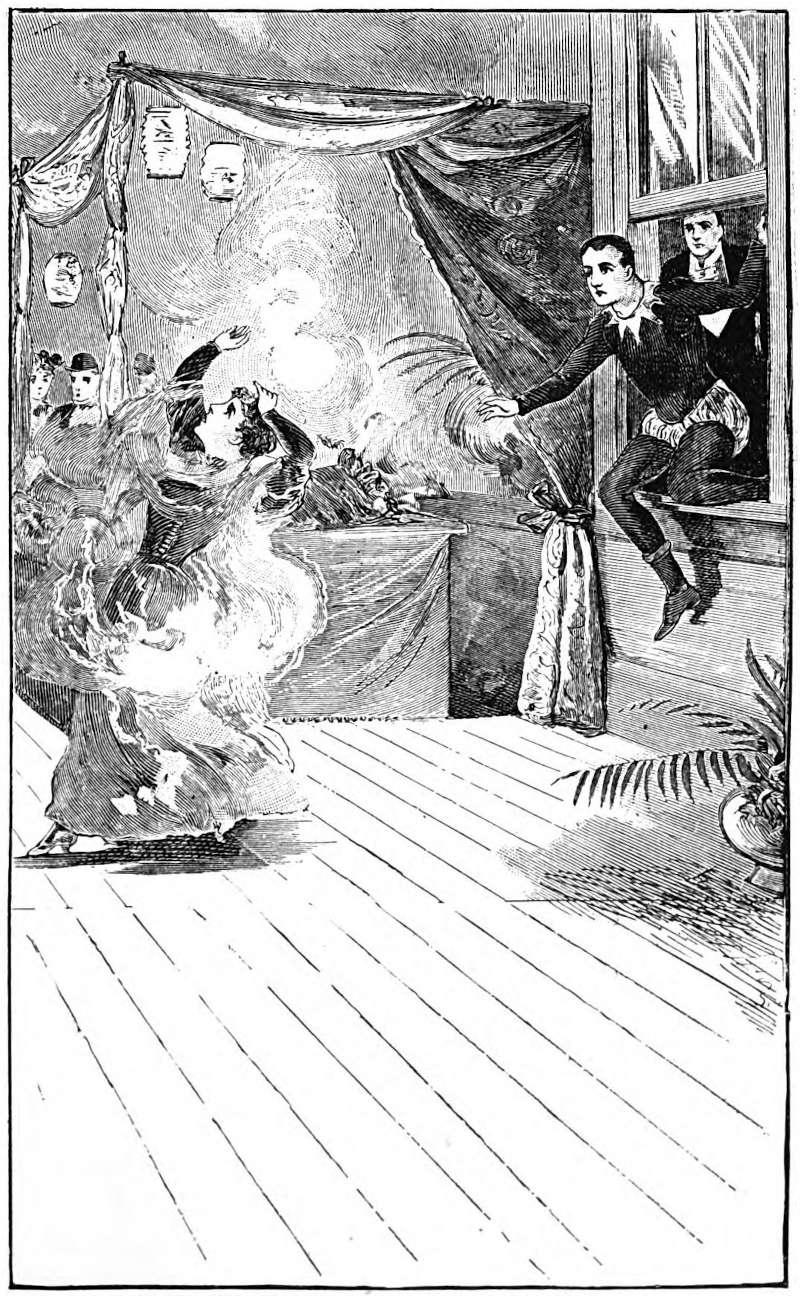
“Her thin white dress was aflame.” See page 89.
[Pg 143]
CHAPTER XXI.
DEMANDS OF THE RASCALS.
It was not until some time after breakfast the following morning that Neka’s absence was discovered.
“He’s sleeping pretty long,” said Bindley to Longfellow Wadsworth. “He must be more than tired out.”
“Well, he deserves a good sleep,” replied the elocutionist and ballad singer, for Wadsworth had now added several songs to his turn. “He made the hit of the performance beyond all question.”
“That’s true. Just see how the Herald, World, Sun, and the other morning papers puff him up. He’s a star and no mistake.”
Longfellow Wadsworth and Bindley might have been jealous of Neka’s great success in New York, but both loved the boy too well for that. They meant to shake him by the hand and congratulate him again when he came down.
But as the time slipped by and Neka did not put in an appearance, the pair began to grow anxious. Bindley had called a rehearsal at the theatre at ten o’clock, and it was almost that already.
“I’ll call him,” said Longfellow Wadsworth, and went up in the elevator.
In two minutes he came down, pale and excited, and [Pg 144]told Bindley the news. Neka’s room was vacant and looked as if he had not occupied it at all during the night.
“What can it mean?” asked Bindley, but all Longfellow Wadsworth could do was to shake his head and say he didn’t know.
“Maybe he meant to meet us at the theatre,” Bindley suggested, after they had made useless inquiries at the hotel office and of the bellboys. “Let us go down and see.”
So they took a car to the theatre and waited around there for another hour. Bindley started the rehearsal with the other performers, but he was too anxious concerning Neka’s welfare to put any heart in the work.
In the meantime, Longfellow Wadsworth tramped about the lobby anxiously, glancing up and down the street and then at his watch, a timepiece his present prosperity had enabled him to get out of pawn. Where could Neka be? He conjured up all sorts of things, but none so dire as the reality.
Presently a special delivery messenger from the post office came in.
“Letter for Longfellow Wadsworth,” he said, laconically, as the elocutionist rushed toward him.
“I am your man,” exclaimed Longfellow Wadsworth. “I have been looking for it.” He glanced at the handwriting. “Pshaw! This is not from Neka.”
He signed for the letter, and the messenger departed. Then he opened the epistle and read it quickly, then more slowly, and his hands trembled violently. [Pg 145]“The base villains!” he murmured, tragically, yet with true feeling. “The villains! poor Neka!”
The letter, which had been penned by Hank Maul at Daniel Bambo’s rather mixed-up dictation, ran as follows:
We have Neka in our power, and he can’t get away, no matter how hard he tries. If you want him back quick and all well, you must pony up a thousand dollars. Raise the money any way you please if you ain’t got it in cash, and have it for us either this afternoon at four o’clock or to-morrow afternoon at precisely the same hour. Take the money in good twenty-dollar bills, and have it so it can easily be counted, and at exactly four o’clock take a Sixth avenue elevated train at Fourteenth street station for the last stop in Harlem, and walk up past the Polo Grounds and all will go well. But beware and go alone and have no police or other spies around, or you will never see Neka alive again. This will be a square deal on our account if you do the right thing, and you won’t be harmed and Neka can go back with you. He is now fifteen miles away, but if you come at four o’clock to-day he can get back with you in time for to-night’s show if you hustle things. Yours,
The New York Blacktops.
Take Notice! No police, or there will be trouble, and you won’t git Neka back!
After perusing the note several times, Longfellow Wadsworth rushed off and showed it to Bindley, who also read it with close interest.
“The rascals!” muttered the stage manager. “Who can they be?”
“I can’t tell you,” returned the elocutionist. “The question is, what ought I to do?”
“I wouldn’t give ’em a penny,” burst out Bindley. “Not but what I want Neka back, but it ain’t right, and, besides, I don’t believe it will do any good.”
[Pg 146]
“New York must be getting a pretty place to come to if this is the sort of a gang that is allowed to exist,” ejaculated Longfellow Wadsworth, wrathfully.
Not for one moment did either he or Bindley suspect Daniel Bambo or Hank Maul. If they thought of these men at all it was to suppose them still up in the New England States.
The matter was talked over for fully half an hour, and no conclusion was arrived at. Longfellow Wadsworth was for handing the case to a first-class private detective, but Bindley demurred.
“They may make a mess of it,” he said. “Why not meet whoever there is and talk the matter over this afternoon? It won’t do any harm.”
“But we won’t get Neka back, and the show——”
“We’ll have to shut down, that’s all. Neka is worth a dozen stands even as good as this one.”
Again the matter was talked over, and finally Longfellow Wadsworth agreed to go off as directed in the letter. He armed himself, and so did Bindley, who intended to follow on the quiet.
At a quarter to four Longfellow Wadsworth made his way to the Fourteenth street station of the Sixth avenue elevated. In his hip pocket he carried a pistol and inside of his coat a short but heavy club. He also had a pocketbook stuffed with paper to resemble bank notes.
As is usual the elevated station was crowded, and try his best, the elocutionist could not pick out anyone who might be there to watch him.
[Pg 147]
Somewhat nervously he waited until his watch pointed to the hour of four. At that moment a train bound for Harlem came along, and he boarded it. Bindley also got on, but the two kept apart, and in addition the stage manager was disguised by a heavy, false beard.
To Longfellow Wadsworth the train appeared to move from one station to the next at a snail’s pace, and he fancied the terminus of the line would never be reached.
But at last the brakeman cried out “Last stop!” and the train rolled into the station at One Hundred and Fifty-fifth street, and the passengers who remained got off. They included about two dozen men, a dozen women, and several boys and girls.
Descending the long stairs to the street, Longfellow Wadsworth turned and walked up past the Polo Grounds. He walked slowly, but no one appeared to follow him save an old woman and Bindley, the latter a good half block behind.
“This looks like a sell,” thought the elocutionist. “There is no one here nor was there any one on that train. Either they got afraid or perhaps Neka has escaped them. Pray Heaven the latter proves true.”
But scarcely had the thought flashed over Wadsworth’s mind than the old woman hobbled up and touched him on the arm. She was heavily veiled and spoke in a hoarse and unnatural tone.
“Excuse me, sir, but are you Longfellow Wadsworth?” she asked, with a suspicious glance around.
[Pg 148]
“I am, madam,” he returned, much astonished.
“Did you bring the money that the gents wants?” she went on.
“Ah, you are the—ah—the one to meet me,” replied Longfellow Wadsworth, ignoring the reference to the money. “Where is Neka?”
“I don’t know what yer talkin’ about, sir,” growled the old woman. “I was told to bring you alone, if you said you had the money, that’s all.”
“Then lead the way, good woman. For I am in a hurry to get back with Neka.”
At this reply the old woman chuckled to herself. The chuckle sounded more natural than her voice, and on the moment the elocutionist grew suspicious.
Then the truth burst upon him. It was no woman at all, this veiled figure, but a man! Moreover, he had heard that voice before. It was the voice of Daniel Bambo!
He was greatly tempted to grab the impostor by the throat and cry for help. But he thought of Neka and of what he might be suffering at the hands of others and kept quiet. Perhaps Bambo might be merely the tool of a gang. Yet he managed to look back and was greatly comforted to see Bindley was following. He slyly dropped a card, as had been previously agreed upon, which meant that he was on the right track and Bindley must keep on guard. This card the stage manager picked up only a few minutes later.
“Where are you going to take me?” he asked, carelessly.
[Pg 149]
“You’ll see when you’re there,” was the hoarse reply. “Have your money ready for the gents—that’s what they said I must tell you.”
“Are you in with the crowd?”
“I’m in with nobody. I’m a lone an’ honest widder.”
“So I would imagine,” was Longfellow Wadsworth’s rather sarcastic reply.
The pair passed down a side street. Here, at a corner, a coach was in waiting with Dennis Groin on the box.
“You’ll git in the coach,” said Bambo, briefly. “That man has directions as to where he is to take his fare.”
“But where are you going?”
“That’s none of your business.”
Longfellow Wadsworth hesitated. He did not know that Bambo intended to ride on the box with Groin, to keep a lookout for possible detectives, or policemen. He wondered how Bindley would be able to follow if he entered the carriage.
At that instant an empty coach dashed by, going toward the stage manager. Without further hesitation, the elocutionist entered Dennis Groin’s turnout, feeling satisfied Bindley would know enough to hire the empty coach in which to follow wheels on wheels.
No sooner had Longfellow Wadsworth entered the dilapidated coach than Bambo sprang up beside Groin, and away they went at the top of the sorry-looking nag’s speed.
Through the back window of the coach Longfellow [Pg 150]Wadsworth saw Bindley stop the other turnout and parley with the driver. Then they turned a bend, and he could see no more, but he felt certain the stage manager would continue on the trail.
Half an hour passed, and Longfellow Wadsworth wondered when the strange adventure would come to an end, when of a sudden the coach gave a lurch and went down into a deep rut. A crash followed, and off came one of the front wheels, and both Groin and Bambo were pitched out into the snow and dirt.
As they went down Bambo’s veil came off, and so did his bonnet, revealing his repulsive face fully to Longfellow Wadsworth, who rolled out of the open coach door. Groin was hurt in the leg, and on attempting to rise fell back with a grunt of pain.
“Hang the luck!” growled Daniel Bambo.
He leaped up and faced the elocutionist. But before he could make another move Longfellow Wadsworth had his pistol out.
“This game has gone far enough, Daniel Bambo,” he said, sternly. “Let us come to a settlement. Where is Neka?”
[Pg 151]
CHAPTER XXII.
SAVING THE STAR.
As Daniel Bambo found himself covered by Longfellow Wadsworth’s pistol he shrank back in abject terror. He had a wholesome dread of fire-arms, and the stern look in the elocutionist’s face told him plainly that to expect mercy unless he did the correct thing was out of the question.
“Don’t—don’t shoot me!” he shrieked.
“Then tell me where Neka is,” repeated Wadsworth.
“He is in—in a house about half a mile from here.”
A groan from Dennis Groin interrupted the pair. The Irishman had had his leg broken and was vainly endeavoring to get away through the snow.
“Stop where you are!” ordered Longfellow Wadsworth, and with another groan, Groin tumbled down where he stood.
“See here, Wadsworth, let us try to—to fix this matter up,” whined Daniel Bambo, breaking down totally. “I didn’t mean the boy no harm.”
“Never mind that now. Take me to him.”
“Will you let me go if I do?”
“Decidedly not, Bambo.”
“But look here——”
“I won’t argue with you,” thundered the elocutionist. [Pg 152]“Take me to where Neka is without delay. If you don’t——”
He finished by waving the pistol significantly, at which Bambo was nearly overcome.
“Come on,” faltered the ex-circus manager, at last, and moved along through the snow.
“Wait just a minute,” ordered Longfellow Wadsworth.
He had glanced back and now saw that Bindley was coming up swiftly in the other coach.
In less than a minute the stage manager was on the ground and much surprised to recognize Bambo. Seeing Bindley made the circus manager feel certain the game was up. In his mind he already saw himself serving a long term in prison.
“Keep your eye on that rascal, will you?” said Wadsworth, to the coach driver, and pointed to Groin. “We’ll pay you for your trouble.”
“All right, sir,” was the Jehu’s answer.
And while the others went off he assisted Groin into his coach and made him keep quiet on the cushions.
Bindley and Wadsworth went off with Bambo between them. It can truly be said that never had the wretch felt so miserable. He knew he had done wrong, and now the law stared him in the face.
“Who is in with you in this nefarious work?” demanded the elocutionist, as they proceeded.
Bambo was silent for a moment.
“Hank Maul,” he replied, finally.
He was not going to suffer alone.
[Pg 153]
“What! that would-be variety manager?” ejaculated Bindley. “Phew! but you are a pretty pair, I must say!”
“It was Maul’s idea,” exclaimed Daniel Bambo, eagerly. “I would never have carried Neka off on my own account.”
“Don’t try to crawl out of your end of it,” said Bindley, in deep disgust. “I reckon you’re as much to blame as any one.”
After this they trudged along in comparative silence. It did not take long to reach the old house in which Neka was confined, and Bambo led the way to the side door.
Their approach had been noticed, for as they walked up to the porch a figure ran from the kitchen door and down to the barn.
“It’s Maul!” shouted Bindley.
“Go after him!” returned Longfellow Wadsworth.
Bindley at once complied. Maul ran past the barn and threw himself over the back board fence. Bindley followed, and both disappeared.
The side door was locked from the inside, and so Bambo and Wadsworth had to walk around to the rear. As they proceeded Bambo’s face was a study. He was thinking of Maul’s possible escape and of his being thereby compelled to face the music alone.
“Walk in,” commanded Wadsworth, as the ex-circus manager paused on the threshold. “You can’t slip me here. Where is Neka?”
“In the back room up stairs.”
“Lead the way.”
With a groan loud and deep, Daniel Bambo did so. Up [Pg 154]the stairs they went until the door to the back room was reached. The bolts were thrown back, and they entered.
It was dark, and Longfellow Wadsworth could see nothing within. But another’s eyes were on the alert.
“Wadsworth!”
“Neka, true enough!” ejaculated the elocutionist, joyfully. “Are you all right?” he added, anxiously.
“Yes, but terribly cramped.”
“Where are you? I can hear but not see.”
“Here, strapped to the cot. I got away once, and they have tied me so tight I can scarcely breathe.”
“Light a lamp or something,” commanded Longfellow Wadsworth, intending the words to Daniel Bambo.
Then he wheeled about. Bambo was gone! He listened and heard a step down in the kitchen, and then all became quiet.
Watching his chance, the ex-circus manager had made a dash for liberty at the time when Wadsworth was interested in hearing Neka’s cry.
Down the stairs after the fleeing criminal went Longfellow Wadsworth, his long legs doing heroic work so far as progress went. But when the kitchen-door yard was reached he halted. Daniel Bambo was nowhere to be seen.
He hunted around for fully five minutes without success. He was about to give up and return to the upper floor when Bindley came back.
“Got away,” said the stage manager, laconically.
“Worse than that, Bambo has escaped also,” replied Longfellow Wadsworth.
[Pg 155]
“Is that so? And Neka——”
“Safe up stairs.”
“Well, that’s something to be thankful for.”
The pair entered the house, and lighting a lamp, for it was now growing very dark, they proceeded upstairs. A few cuts from a pocket knife released Neka, and he slowly sat up and stretched himself.
“What time is it?” he asked of Wadsworth.
“Ten minutes to seven.”
“Almost time I was at the theatre, eh?”
“Bravo!” cried Wadsworth. “Yes, you’ll have to hustle if you want to go on. But are you able?”
“Will be after I’ve had a rubbing down and something to eat. But those two villains——”
“Escaped, both of them.”
“And that Irishman who was here?”
“A coachman?”
“Yes.”
“Down the road in care of another cab driver.”
“I see. Well, let us go. We can’t do anything here.”
“But this house?” asked Bindley.
“It is one that is let furnished—I heard Bambo say so. We can lock up, and that’s all,” replied Neka.
They went below, and Neka told his story. Soon they were on the way back to where they had left Dennis Groin. He was gone, and so was the cabman. Not till the next day did they learn that Groin had been taken to the hospital, where, later on, he was compelled to have his shattered leg amputated. As Neka thought this was [Pg 156]punishment enough, the lad made no complaint against the man.
A quarter to eight found them at the theatre, and that night a performance was given as usual. Perhaps Neka’s act was not up to his usual standard of excellence, yet he drew round after round of applause.
On the following day the police were set on the track of Bambo and Maul, but day after day went by, and nothing was heard of the pair of rascals. The authorities came to the conclusion that they had left the metropolis, and after a while Neka and his friends were forced to agree with them.
[Pg 157]
CHAPTER XXIII.
JENNIE WINDOM’S PERIL.
While the company remained in New York, Joe and Jennie Windom, the two waifs Neka had picked up so strangely in the little town down East, stopped with some friends who lived up on the East Side near the Catherine street ferry to Brooklyn. They liked this better than a strange boarding-house, and during their stay made quite a number of friends.
Between the pair and Neka a warm friendship had sprung up, and Neka did all in his power to advance them so that they might both earn first-class salaries.
Jennie was really a pretty girl, and her beauty soon took the eye of several members of a gang of toughs who made their headquarters in the vicinity of the ferry. But as Joe was generally with her on her trips to and from the theatre, she was protected from insult at their hands. They would leer at her, but that was as far as they dared to go.
One evening, however, Joe had a call to go to Jersey City, and Jennie in consequence had to go home alone.
“You must take the cars, Jennie,” said Joe, “and don’t get off until you are right in front of the Tooleys’ house.”
Jennie promised this, and so they separated after the performance was over, and Jennie boarded the car as she had agreed and rode away.
[Pg 158]
All went well until she was within half-a-dozen blocks of her friend’s home.
Then there came a clatter on the street as a runaway wagon dashed up. A crash and a yell, and the wagon struck the front end of the car, and driver and horse were thrown down.
A crowd began to collect, and the driver was taken up and sent off in an ambulance. The horse and wagon remained, and Jennie knew it would be half an hour or more before the car would be able to proceed on its way.
“I won’t wait,” she thought. “I’ll just get out and run on.”
And leaving the car, she battled her way to the sidewalk through the crowd and hurried on through the snow and the semi-darkness.
Two blocks still remained to be passed when she went by a low-looking saloon. In front stood three young men, each with a cigar stuck up in one corner of his mouth.
“Dan, dare goes dat gal now,” whispered one tough to his companion.
“Yer right, Pete. Ain’t she a daisy, dough?”
“Bet yer freckles she is!” put in the third tough.
“Ah dere!” called out the first speaker, but Jennie only went on the faster, without turning her head.
“Say, Pete, I’ll bet yer I can walk home wid her,” remarked the tough called Dan.
“Maybe yer can,” replied Pete, sarcastically.
Jennie of course did not hear this conversation, but by [Pg 159]instinct she felt all was not right, and almost broke into a run in her eagerness to reach the home of her friend.
Seeing this, the tough came up on a lope silently. She heard him breathe heavily and then felt his heavy hand on her shoulder.
“Say, don’t walk so fast,” said the tough, as sweetly as his liquor-soaked voice would permit. “I’ll see yer safe home.”
“Let go of me, sir!” cried Jennie, indignantly. “You have no right to touch me!”
She struggled to free herself, but he held her so tight she could not. Then she attempted to scream, but before she could make a sound he had his dirty hand over her mouth.
“Yer a spunky one,” went on the tough.
“Don’t you dare to touch me,” gasped Jennie, in terror. “Don’t! Let me go!”
Again she struggled to free herself. But the tough was strong, and she was as a little child in his burly grasp.
But now light footsteps were coming up unheard. A boyish form came into view, and the newcomer took in the situation at a glance.
Bang! Without a word the newcomer let out straight from the shoulder with his right fist. The blow took the tough behind the ear and swung him back with a groan of pain and fright.
“Let that young lady alone, you tramp!” came in the clear voice of Neka, and once again he hit the tough, this [Pg 160]time a side blow in the nose that caused that member to bleed profusely.
The fellow staggered back to wipe his olfactory organ, and let go his hold of Jennie.
“Mr. Neka!” cried the girl, joyfully, and at once placed herself under the lad’s protection.
“Wot der yer mean by hittin’ me in ther horn?” demanded the tough, as he strode up to Neka with clinched fists.
“You say a word, and I’ll hand you over to the police,” replied Neka, sharply. “Begone about your business.”
“I’m goin’ ter settle wid you first, see? Hi, Pete, Mike, come here!” the latter to his former companions, who had followed Neka to the scene.
“Come on,” said Neka, in a low tone, and watching their chance he and Jennie started off at a swift gait.
The toughs started to follow.
“You go and I’ll keep them back,” said Neka, and he wheeled around.
“But you——” began the girl.
“I’ll come out all right. Go on, you haven’t far to go, I believe.”
“No, only to the end of the next block,” and Jennie sped away like a frightened deer.
The toughs advanced upon Neka, but came to a sudden halt when the one called Pete exclaimed:
“Hold on, fellers, don’t youse know him?”
“Naw.”
“Dat’s der chap called Neka, de Fire King!”
“He is right,” said Neka. “I am the Fire King, as [Pg 161]they call me, and I’ll make you all sing small if you molest me,” and he flourished a stage sword that he happened to be carrying to his hotel at the time.
At this demonstration the toughs drew still further back. Then a roundsman approached, and all three promptly took to their heels.
“What’s the trouble?” asked the roundsman, as he came up, and when Neka told him he promised to see to it that Jennie Windom was not molested again.
Fearing that the girl would be anxious concerning his welfare, Neka visited the friend’s house. He found Jennie on the stoop, looking for him anxiously.
“You were not hurt?” she queried. “I am so glad. I must thank you for what you did. You are awfully brave.”
This made Neka blush. In his quiet way he thought a good deal of Jennie Windom.
The girl wished to know how it was that Neka was in the neighborhood at the same time, and Neka was forced to confess that he had come to see if she had got home safe.
“I heard from Wadsworth that you had left alone, and I was worried,” he said, “for Bindley told me this was a tough district.”
“It is, and I shall be glad when I get out of it, even though I have kind friends here,” returned Jennie.
On the way to his hotel Neka kept a sharp lookout for the three toughs and for possible rocks which might be aimed at his head. But the roundsman had done his work well, and nothing more was seen or [Pg 162]heard of the gang while the Neka-Wadsworth Company remained in the metropolis.
“I suppose we’ll have lots of tough times on the road,” thought Neka. “But that is one of the drawbacks of the profession, and we’ll have to put up with it.”
[Pg 163]
CHAPTER XXIV.
A WELL-TAUGHT LESSON.
So well were Neka and his company received in New York that their engagement was extended from one week to two. It could easily have run a month or six weeks, but it was utterly impossible to get the theatre for that length of time.
Two weeks had been booked by Bindley in Philadelphia, and after finishing up in the metropolis, the company left for the Quaker City on the Pennsylvania Railroad.
The trip was taken on Monday morning, the company leaving at eight o’clock. This would bring them in Philadelphia in time to have dinner and a rehearsal in the afternoon.
On the train a curious incident occurred to Neka, and it is well worth recording, as showing the spirit of independence which was now growing in the lad’s breast.
The company occupied one of the middle cars of the train, and it was almost full when they got aboard. Neka and Wadsworth got a seat together, and directly in front of them a thin, mean-looking traveling drummer occupied a seat alone.
At Newark the train stopped to take on more passengers, [Pg 164]and among others was a young woman with a baby in her arms. She tried to find a seat, and the only one vacant was that beside the mean-looking drummer. He saw her, but sat in the very middle of the seat with a bag on each side of him and refused to stir.
“Is that seat——” she began, timidly, but he turned his face about coldly and stared out of the window.
She bit her lip and walking a few steps, prepared to stand up in the aisle, still holding her child in her arms.
“Won’t you take my seat, madam?” asked Neka, politely, as he arose and tipped his hat.
“Oh, I don’t want to deprive you——” she faltered.
“You won’t deprive me. I’ll take the seat ahead,” returned Neka.
The lady with the baby sat down beside Longfellow Wadsworth, and the boy moved ahead.
“I’ll thank you to let me have this seat,” he said to the mean-looking drummer.
At first the man scowled at him and did not reply. Then Neka repeated his request.
“This seat belongs to a man in the smoking-car,” he growled, finally.
“Well, I’ll sit in it until he comes back,” said Neka, who did not believe the statement.
Again the man scowled.
“Reckon you can stand just as well,” he growled, under his breath.
“I don’t intend to stand while there is a vacant seat,” retorted Neka, with some spirit. “Move or I’ll call the conductor.”
[Pg 165]
“See here, boy, you keep your tongue to yourself,” grunted the drummer. “This is my seat, and that baggage belongs to a man in the smoking-car. I have no right to touch it.”
“Well, I’ll touch it and keep his seat for him,” returned Neka, not giving in an inch.
And seizing the two bags, he placed them on the floor and squeezed himself into the seat beside the drummer, who swore under his breath.
Several passengers who had witnessed the scene smiled to themselves and an old gentleman nodded approvingly.
“Like to see young Americans stick up for their rights,” he said, to his companion. “That drummer’s a hog.”
All the way to Princeton the drummer growled to himself and squeezed Neka as much as possible. This made the boy angry, and he looked about for some way to get square with the unreasonable fellow.
At Princeton the lady with the baby got out, and Neka rejoined Longfellow Wadsworth. A whispered conversation ensued, and suddenly both smiled to themselves. When the conductor came along Neka held a consultation with him.
“Certainly,” said the train official, and passed on.
When the train rolled into the great depot at Philadelphia the drummer arose, stretched himself lazily, and prepared to walk out with his two grips. At once Neka stopped him, at the same time stopping the old man who had nodded approvingly.
[Pg 166]
“Just you drop those bags,” said Neka, in a loud voice.
“What’s that?” demanded the drummer, sourly.
“You drop those bags. You said they belonged to a man in the smoking-car and that you had no right to touch them. Now leave them alone.”
There was a laugh at this, and a crowd gathered around to see the outcome of the incident.
The drummer got red in the face and stared at Neka as if he would chew the boy up.
“Conductor,” continued Neka, undisturbed by the drummer’s looks. “You will have to take charge of these two valises. This gentleman says they belong to a man in the smoking-car.”
“They don’t; they belong to me,” snapped the drummer.
“He said they belonged to somebody else, and he had no right to touch them,” put in Longfellow Wadsworth, seriously.
“So he did, so he did,” added the old man from the opposite side of the car. He enjoyed the fun as much as any one. “He may be a would-be thief, conductor. You had better keep an eye on him.”
At this the drummer was almost ready to faint. He stared around speechlessly.
“I’ll take the grips to the station-master,” said the conductor. “The owner can claim them there by identification of contents.”
And he caught up the bags and walked out, while the crowd howled at the drummer until he was only too [Pg 167]glad to sneak out of sight. He was boiling mad at Neka, but could do nothing, and the severe lesson had served him right.
From the railroad station the company went to the hotel and had dinner. At two o’clock they repaired to the theatre for rehearsal.
In another chapter mention was made of the “Human Fly” act. This turn was done by a young woman known on the stage as Nina Tonetti, although her real name was Nina Pluggs. The act consisted in walking head downward on a temporary ceiling erected on the stage. The secret of the act lies in the shoes that are worn, each being of rubber and having a force pump attached which creates a suction underneath that holds them wherever they are placed.
In Philadelphia Nina Tonetti had decided on a startling innovation. This was to consist of an act in which she was to walk on the ceiling of the auditorium itself instead of a temporary affair hoisted on the stage.
When the rehearsal for this act began Neka as well as Longfellow Wadsworth and Bindley were on hand to see that everything was in good working order, for a drop from the ceiling would mean broken bones and perhaps instant death.
Nina Tonetti herself understood the peril of her undertaking, and although determined to go ahead, she did so with extreme caution.
“I hope you are not going to try the plaster,” said Neka, “I doubt if it will hold you, no matter how hard it appears to be.”
[Pg 168]
“No, I am going to walk along that woodwork only,” replied the young woman, and pointed to some fancy work which ran diamond-shaped from the center of the proscenium around the huge chandelier in the center of the auditorium ceiling.
At last the preparations for the first attempt were completed, and Nina Tonetti donned the suit she usually wore when performing it. Then up she went on a ladder until the center of the proscenium arch was reached.
Here she balanced herself for a moment, then turned upside down and set first one foot on the ceiling and then the other.
In this strange fashion she walked a dozen feet or more.
“That’s good,” said Longfellow Wadsworth. “That will create a sensation.”
“So it will,” put in Bindley. “She’s a daring one,” he added, as the Human Fly took a longer step than any of the previous ones.
One side of the diamond-shaped fancy woodwork was traveled when Nina Tonetti was seen to pause. She put out one foot and then drew it back.
“What’s the trouble?” called out Bindley.
“The next board is unsafe,” she replied. “It’s suffering from dry rot, I believe.”
Scarcely had she spoken, when there came a sharp crack, and the very bit of woodwork to which her feet were glued, as it were, sprang away from the ceiling six inches or more!
[Pg 169]
CHAPTER XXV.
NEKA’S PRESENCE OF MIND.
To those standing below in the otherwise empty theatre, it looked as if Nina Tonetti, the “Human Fly,” would be dashed to death on the seats below her.
“Gracious!” burst from Bindley’s lips. “What shall we do?”
“Catch her if she comes!” ejaculated Longfellow Wadsworth, but even as he spoke he felt this was well-nigh impossible, for the distance was all of thirty-five feet.
“Keep quiet, don’t stir an inch!” cried Neka. “Try to catch her if she falls,” he added to his companions.
With three leaps he had cleared the orchestra stalls and was on the stage. Near to hand were several large ropes, used to haul unnecessary scenery out of the way.
Selecting the longest of these ropes, Neka cut it away from the blocks which held it. Then he made a slip noose in one end of the rope.
Standing well down to the footlights, he curled the impromptu lasso around his head and measured the distance carefully with his eye.
Whizz! Away flew the end of the rope, and the noose caught over the bottom of the heavy brass gas fixture in the center of the theatre ceiling.
[Pg 170]
Neka pulled the loop up, so that the end of the rope was fast. As he did so, there came another cracking of a board.
“I am falling!” shrieked Nina Tonetti.
“Catch the rope!” yelled Neka. “Here it comes!”
As he called, he threw the loose end of the rope upward. She did not see it coming, but as it hit her shoulder, she clutched it in one hand.
Crack! crash! Down came the board from overhead, bringing with it a lot of plaster and dirt and a cloud of dust. For the moment, those below could see nothing; then they beheld Nina Tonetti swinging safely in midair.
Bindley and Longfellow Wadsworth felt almost inclined to cheer. As for Neka, a great load was lifted from the boy’s heart. To him it would have been horrible to have one of their performers killed.
Down the rope, hand below hand, came the Human Fly, until within ten feet of the floor. Then her nerve forsook her, and she fell, a limp, unconscious mass, into Bindley’s arms.
She was carried into the dressing-room and a doctor was sent for. The physician said her nervous system had been shocked, but she would soon get over this. Yet it was not until a week later that Nina Tonetti again made her appearance on the boards.
Despite the accident to one of its main drawing cards, the Neka-Wadsworth Specialty Company met with tremendous success in Philadelphia. On the opening night the audience was cold and apathetic.
[Pg 171]
“We’ll have to warm ’em up,” said Bindley. “Give it to ’em hot like.”
And they did. Longfellow Wadsworth outdid himself in his droll monologue, and for an encore came out as William Penn, to argue with the present day citizens, and this “caught on” immediately.
For Philadelphia Neka had arranged a new fire act, which he called the Arbor of Flames.
This new act was the last thing produced previous to the usual farce wind-up. When the curtain went up on the scene, there was revealed a Chinese tea garden. Into this garden stalked Neka, attired as the Emperor of China.
He clapped his hands, and Jennie Windom came dancing in, carrying a lighted taper. As she handed it to Neka, it went out. She appeared frightened, but he only smiled and pointed to a bush standing nearby. She touched the taper to the bush and immediately the taper burst into flames again.
Then Neka took the taper and tasted of the fire on it. It seemed to please him, and he put the taper in his mouth. From between his partly closed teeth could be seen the fire still glowing within.
“By Jove! He must have a fire-proof mouth!” cried one spectator, and several echoed this opinion.
The taper gone, Neka waved his hand for another and also for a cup of tea. When the tea came, he put the taper in it, but instead of the latter going out, the tea burst into flames. While the cup was thus full of fire, the Fire King quaffed it with apparent satisfaction.
[Pg 172]
Suddenly he clapped his hands, and a strange green light shone all over the stage. Then Neka passed his hands over Jennie Windom’s eyes and put her in a trance. He made her walk around and point to several flowers and bushes standing about.
Whatever she pointed out immediately took fire, until two flowers and two bushes were blazing away. These stood in a small square, and from each there slowly arose a pillar of fire, which, when it was eight feet high, curved forward and joined the others in a cross overhead.
As soon as the pillars of fire were several feet high, burning vines began to appear around them, and, when they were joined, they formed a little arbor. Neka again clapped his hands and inside the arbor a table appeared, with two seats. He seated Jennie on one seat and took the other himself.
On the table was a covered bowl. When it was opened, fiery snakes sprang out. But as fast as they appeared, Neka seized and devoured them.
Finally one of the snakes got away. Still in her apparent trance, Jennie Windom caught it in her hand. She gave a cry, there was an explosion, and then, like a cloud, the arbor of fire disappeared, and Neka stood down by the footlights bowing and smiling, and holding pretty Jennie by the hand.
“Wonderful!”
“I never saw anything half so good!”
So the comments went on, and from that instant the success of the engagement in Philadelphia was assured.
Yet Neka and Longfellow Wadsworth were not to be [Pg 173]without trouble while in the Quaker City. On their third day there was a very much intoxicated variety actor came to the elocutionist for a position.
“We are all filled up,” said Longfellow Wadsworth. He knew the fellow, and did not care to say any more.
The drunkard was very persistent, however, and soon after accosted Neka, and the result was that the boy Fire King gave the man a piece of his mind.
The drunkard went off, vowing vengeance. But as he was intoxicated, Neka paid no attention to his threats.
But an hour later, a row below the stage was heard, and on going down, Neka saw Bindley in the act of kicking the drunkard out of a rear door.
“Found him in your dressing-room,” he said to the boy. “I tell you we’ll have to watch out for these chaps. Lots of them are not above stealing, especially when they are down on their luck.”
No more was said about the matter. Bindley went out and came back to report the fellow out of sight.
“And he’s too drunk to find his way back,” he laughed.
Neka lost no time in going over his effects to see that nothing had been stolen. Especially was he solicitous about his tricks, for the drunkard claimed to be something of a fire king himself.
“I reckon he wouldn’t be above stealing my best tricks if he got the chance,” he thought.
That evening Neka reached the theatre rather late, and when it was time for him to go on, he hurried into his costume with all possible speed.
“Five minutes, Mr. Neka!” came in the voice of the [Pg 174]call boy, and this meant Neka had just that length of time in which to complete his preparations.
The time passed, and Neka went on the stage. He had just made his bow, and was starting on some of his simpler tricks when, on glancing into the right wing, he saw Joe Windom beckoning to him frantically.
Fearing something was wrong about his attire or preparations, Neka artfully allowed himself to drift close to the wing. At once Joe Windom thrust a written slip of paper in his hand.
While devouring a burning strip of cotton, Neka read the slip. It was a mere scrawl, but it startled him greatly.
Beware of your life. That drunkard tampered with some of your apparatus! He said he would blow you sky-high.
[Pg 175]
CHAPTER XXVI.
NOT ON THE PROGRAMME.
Neka read the note at a glance, yet he realized its importance just as much as if he had studied it an hour.
Never had he been placed in such an awkward and uncomfortable position. He did not know what to expect, and it is the unknown that makes cowards of us all.
He dared not go on with his tricks, and yet here he was facing a vast audience that was watching his every movement.
In the center of the stage stood a charcoal stove, wherein was heating an iron bar to be used in the next trick. Trying to think of some means of excusing himself to the audience, Neka approached the stove and took out the bar.
That, at least, was all right, and he began to handle it affectionately and licked it with his tongue.
Suddenly a strange hissing within the charcoal stove made him jump away. Then, as if warned by Providence, he hurled a blanket, to be used in the following trick, over the stove.
Bang! The blanket had scarcely dropped over the stove, when there came a loud explosion. The stove was completely wrecked, and had it not been for the blanket, the pieces must have flown in every direction.
[Pg 176]
“That was his trick to blow me sky-high,” thought Neka, as he shuddered. “Well, thank goodness, it’s over, and we are safe!”
It must not be supposed that he was not startled. As a matter of fact, he was trembling violently in every limb and it was only his strong nerve that kept him from collapsing utterly.
The audience, while shocked, thought the explosion part of a trick, and remained quiet.
“Lower the stove on the trap and put out the fire!” called Neka to Bindley at the wing, and this was immediately done. The few burning bits scattered from under the blanket Neka picked up with his hands, and then began to juggle them as if nothing out of the ordinary had occurred. He brought his first turn to an end immediately after, and once off the stage demanded an explanation of Joe Windom, which was not long in forthcoming.
Joe had seen the drunkard on a corner a block from the theatre. The man was muttering to himself, and as Joe passed him the lad had heard him say something to the effect that Neka would be blown sky-high on the stage. On reaching the show house, Joe had heard from Bindley how the drunkard had been among the boy Fire King’s effects, and had at once put two and two together, with the result described above.
“It was a narrow escape,” said Joe Windom. “You ought to have that man arrested.”
“By all means,” added Longfellow Wadsworth.
The next morning Neka started out to find the fiend, [Pg 177]and bring him to justice. He was thoroughly aroused and resolved to make an example of the fellow.
It was no easy matter to trace the drunken variety actor in such a large city as Philadelphia. But Neka was determined, and did not give up at the first or the second failure.
He started on the corner where the fellow had last been seen, and from there traced him down to the riverside. Here he learned the fellow had gone over to Camden, and Neka accordingly crossed the ferry.
In Camden Neka struck the trail and followed it to a third-rate boarding-house situated down among the machine works.
As he stood on a corner he heard a loud cry for help and almost immediately a young man came running past him.
Then, on looking down the block, Neka saw the drunken variety actor in a fierce hand-to-hand fight with two other men.
The fight grew hotter each instant and for the time being Neka thought it best not to interfere. He stood and watched the encounter with keen interest.
The two strangers soon began to get the best of the variety man, and before the other could resist he was well pounded and rolled over and over in the gutter. Then, of a sudden, one of the men slipped and fell on the prostrate man.
“Oh, oh! me collar-bone is broke!” yelled the drunken man, and with a jerk he straightened out and fainted dead away.
[Pg 178]
Alarmed at this turn of affairs the two young men ran off and two blocks away Neka saw them join the fellow who had first skipped out.
By this time a crowd was collecting, and soon a policeman came up. The man still remained unconscious and an ambulance was sent for.
The surgeon on the ambulance said the man was quite severely injured, having sustained a compound fracture of the collar-bone and a broken arm. He was taken away immediately after and Neka did not take the trouble to follow.
“He’s punished enough,” he said to himself. “Perhaps in the hospital he will have a chance to think over his misdeeds.”
Neka had never before stopped in Camden, and he now resolved to take in the sights of the busy little city. The streets were full of snow, and flying sleighs made matters lively and jolly.
He walked along several of the principal thoroughfares, gazing into the windows and at the flying turnouts, and at noon stepped into a restaurant for lunch.
The lunch was a good one and he took his own time in eating it. When he had finished, he walked up to the desk to settle.
And then he made the unpleasant discovery that he had come away from his hotel in Philadelphia with only seven cents in his pocket.
[Pg 179]
CHAPTER XXVII.
THE FACE AT THE WINDOW.
For the moment Neka did not know what to do. His face flushed and he bit his lip.
The cashier, a young fop, by the way, stared hard at him.
“I—ah—I came away without any money in my pocket,” stammered Neka. It was the first time he had ever been caught this way.
“Sorry, but your check is thirty-five cents,” returned the clerk, coldly.
“Can I send it to you? I am Neka, of the Neka-Wadsworth Company, now playing in Philadelphia.”
“We don’t trust patrons—especially variety actors,” was the harsh reply. “You’ll have to pay before you leave.”
“But I can’t do that—I have only a few cents in my pocket and——”
“We’ve met your stripe before,” sneered the clerk. “If you can’t pay you’ll have to leave security.”
Neka was nonplused. He felt in his pockets. He had nothing to leave of any value. In his haste to follow the variety drunkard he had come off with little or nothing.
“I don’t know what I can leave,” he said, slowly.
“Might leave that overcoat.”
[Pg 180]
The clerk’s manner was so insolent that Neka was angered.
“Evidently you take me for a beat,” he cried. “But let me tell you that the opinion of a senseless fop doesn’t make it so.”
“You say another word and I’ll have you locked up!” howled the clerk. “Pay your bill and get out.”
“If you will send somebody with me I’ll pay the bill and also the messenger for his trouble,” returned Neka.
“I won’t send any messenger. John,” went on the clerk, calling a waiter. “Go out and get a policeman.”
This order was heard by a dozen patrons, and a crowd began to collect.
“He don’t look like a beat.”
“What’s his bill?”
“Thirty-five cents.”
“Humph! Well, he ought to be able to pay that.”
“He says he forgot his money.”
“That may be. I’ve forgotten my pocketbook myself, more than once.”
Before the waiter could leave, Neka stepped up to him.
“Instead of going for a policeman you call the proprietor,” he said.
“Well, sah—I must obey orders.”
“You’ll save yourself trouble by doing as I wish,” went on Neka.
At that moment a well-dressed gentleman walked in and up to the desk.
[Pg 181]
“What’s the trouble, Willis?” he demanded.
“This feller is trying to do me out of thirty-five cents!” grumbled the clerk.
“I was unfortunate enough to leave my hotel in Philadelphia without my purse,” put in Neka. “I have offered to let him send a messenger back with me and said I would pay for the trouble caused. But he will not listen and just ordered this waiter to call in a policeman. Here is my card. I am willing to do the right thing, and I must say that I was never treated so harshly before when there was no cause for it.”
The proprietor of the hotel took Neka’s card and glanced at it. His eyes lit up, for, as it happened, he had seen Neka on the stage only the night before.
“Willis, you must be losing your senses,” he said, sharply. “Don’t you know a gentleman when you see him?” He turned to the boy Fire King. “It’s all right, Mr. Neka, you can pay at any time you happen to be in the neighborhood again, and accept my apology for the trouble this clerk of mine has caused.”
“Thanks,” returned Neka, greatly relieved. Then of a sudden he plunged his hand into a pocket and brought out a couple of free passes for the theatre. “Won’t you accept these for your kindness?”
The proprietor took the passes and thanked Neka. The clerk felt cheap and worse, for he wished very much to see the performance. In the midst of the change of feeling Neka walked out. That very evening he remitted the amount of his bill.
[Pg 182]
“I was a chump!” growled the clerk to himself, after the restaurant proprietor had “raked him over the coals.” “If I had treated him better I might have had those passes instead of old Halsey.”
Leaving the vicinity of the restaurant, Neka walked slowly down to the ferry. A boat was in the slip and he got aboard and mingled with the crowd on the forward deck.
Scarcely had the ferryboat passed out of the slip than she had to stop, to allow a large schooner, drawn by a sturdy steam tug, to pass her, on the way up the river.
As the schooner passed slowly by, Neka, along with the other passengers, looked her over curiously. In the rear were several windows, and from one a face was peering. Just as the schooner swung past the ferryboat’s bow Neka recognized the face. It was that of Daniel Bambo!
At first Neka could scarcely believe his eyes, but a second look convinced him beyond all doubt that it was really and truly the ex-circus proprietor, his former guardian and taskmaster.
“What in the world is he doing on that boat,” thought Neka, for he had never heard of Daniel Bambo having any connection with the water.
He tried to make out the name of the schooner, but the paint was badly scratched, and ere he could decipher the letters the craft was almost out of sight. Bambo had not spied Neka and still remained at the [Pg 183]window, looking out, curiously, so the boy had every opportunity to make certain there was no mistake.
As the ferryboat made its way across the stream, Neka kept his eye on the schooner, but she continued on her way without putting in at any of the numerous docks, so he was still at a loss as to her destination when he landed in Philadelphia.
Had he had money with him he would have lost no time in going back in an effort to follow Daniel Bambo. But he had had one bitter experience and he did not wish to invite a second. He walked to his hotel, as rapidly as he could.
Longfellow Wadsworth was standing in the lobby and to him Neka related his unusual tale, to which the elocutionist listened with deep interest.
“I’ll go with you, Neka,” said Wadsworth. “We have neither rehearsal nor matinee to-day.”
And soon they were off, and this time the lad had made certain he was not without funds.
Arriving in Camden they hired a sleigh and drove as close to the river front as the streets would permit. As block after block was passed, Neka gazed anxiously for some sign of the schooner, but without avail.
“It may have crossed and landed on the Philadelphia side,” said Longfellow Wadsworth. “We can go but a few blocks farther.”
The end of the street was reached and still no schooner answering the description of the right one appeared.
“It does not look as if they had crossed over,” said Neka. “But what made him hug this shore so closely?”
[Pg 184]
“Perhaps the tide,” returned Longfellow Wadsworth, but Neka shook his head.
There was, however, nothing to do but to go back, and this they did. But on the way they stopped at several docks and here gained a clew.
“Thet schooner went over ter Philly,” said an old longshoreman, who sat in a sheltered corner smoking a clay pipe. “I know her well.”
“What is her name?”
“The Blue Dart.”
“That’s it!” cried Neka. “I remember the letters, BL and AR, on her stern and there was a dart beneath.”
“Where is she bound for?” questioned Wadsworth.
“Mor’n likely she went over to the Ringstetter wharves,” replied the longshoreman. “I reckon she was loaded with some truck from the Bahamas.”
“Thank you,” said Neka, and slipped a dime into the old fellow’s hand.
Without further delay, the pair drove back to the ferry. A very few minutes sufficed to land them once more on Pennsylvania soil.
At the ferry station they found out where the Ringstetter wharves were, and lost no time in turning their sleigh in that direction.
“We must capture Daniel Bambo if we possibly can,” said Neka.
“He’ll be a much surprised man if we do,” laughed Longfellow Wadsworth. “I wonder if he is aware we are performing in this city?”
[Pg 185]
“He must know, if he has any eyes. There are billboards enough around, announcing that fact.”
“Perhaps he hasn’t been ashore yet. Maybe he fled to the Bahamas when he ran away from New York.”
“He couldn’t get back so soon, could he?”
“If he took a steamer out.”
The two wondered if Daniel Bambo was alone, or if Hank Maul was with him.
Their doubt on this point was, however, soon set at rest. As the sleigh turned a corner they almost ran over a pair of men who were about to cross the street.
“Hi! hi! Don’t run over us!” yelled one of the men. Then he fell back in amazement. “Neka!” he gasped.
The man was Daniel Bambo. His companion was Hank Maul.
“Neka, by gum!” howled the ex-circus proprietor, and then, without further words, the pair of rascals took to their heels up the narrow and snow-laden thoroughfare.
[Pg 186]
CHAPTER XXVIII.
A CHASE AND ITS RESULT.
The flight of Daniel Bambo and Hank Maul was so sudden that for the moment Neka and Longfellow Wadsworth sat motionless in the sleigh, hardly believing the evidence of their senses.
“Both of them!” cried the elocutionist.
“We must go after them!” ejaculated Neka, and catching up the reins, he made the horse turn back.
Down one block they went at top speed. Then Daniel Bambo and Hank Maul were seen to turn into a narrow side street.
Up to the corner dashed the sleigh, and as he made the turn the horse gave a sudden jerk.
Scrape! the sleigh swung around. It came hard up against a stone in the snow, and in a twinkle it went over.
Neka and Longfellow Wadsworth were flung headlong over one side. The boy landed head first in a huge snowbank, and the snow went down his collar and coat sleeves. Fortunately the horse ran but a few steps, and then came to a halt.
It was several seconds when Neka extricated himself from his decidedly unpleasant position. He gave a quick glance around.
Longfellow Wadsworth lay on his back several yards [Pg 187]away. His eyes were closed, and there was an ugly cut on his forehead.
Much alarmed, Neka forgot all about the flying criminals, and thought only of his friend. He bent over the elocutionist.
“Wadsworth! Wadsworth!” he cried.
There was no response. Neka put down his ear and discovered that the elocutionist breathed, but only faintly.
The turnover had been witnessed by half-a-dozen people, and soon a crowd began to collect.
“Where is the nearest drug store?” asked Neka.
“Down on the next corner,” replied a man. “Shall we help carry him there?”
“If you please.”
Three men from the crowd sprang forward to assist, and the four picked Longfellow Wadsworth up and carried him off as tenderly as it was possible to do.
Luckily, a doctor was in attendance at the drug store, and Longfellow Wadsworth was turned over to his care. The examination lasted nearly a quarter of an hour, and during it the elocutionist regained consciousness. “There are no bones broken,” said the physician. “But the man has suffered a heavy shock, and must remain quiet for several days. I will patch up the wound in his forehead and then you had better have him removed to his home or a hospital in a coach.”
“I’ll have him taken to his hotel,” said Neka, and sent a boy off to hunt up a large and easy carriage.
Half an hour later found Neka and the elocutionist on the way to the hotel. A man was hired to drive behind [Pg 188]with the sleigh, which, strange to say, had not been injured in the least.
Neka knew it would now be next to useless to continue the search for Daniel Bambo and Hank Maul. Those two rascals had had sufficient time and warning to keep well out of sight. The chances were that they would even leave Philadelphia.
But after he was certain Longfellow Wadsworth was comfortable, Neka took the sleigh again and continued the hunt. Several hours were spent without avail, and the boy sent the turnout back to Camden and went to the theatre to prepare for his evening’s appearance.
With Longfellow Wadsworth out of the list, the programme had to be altered somewhat, and to make up for the elocutionist’s absence, Neka introduced a new act of his own which he called the Lightning Stroke.
This trick is from the Arabian, and is performed at a certain feast called the Sal-Beno-Sal. Neka had learned of the trick through old Jerry Brown, but it had taken him a long while to master it.
At the proper time the stage was set to represent a scene on a mountain top. The stage grew dark, and a storm was seen to approach from far away. The dim lightning lit up the sky, the distant rumble of thunder was heard, and presently came the patter of rain.
In the midst of this Neka entered, clad in the garb of a traveler over the mountains. He wore a long cloak and top boots and a broad-brimmed rubber hat to shelter him from the rain.
[Pg 189]
The storm increased in violence, and the lightning came closer and closer.
As if to view his surroundings, Neka climbed to the top of a great rock set in the center of the stage. Scarcely had he stood upright when a vivid flash of lightning seemed to leap from the black clouds directly overhead and to strike him full in the breast.
After that the lightning played upon him for several minutes, striking him on the head, in the back, on the arms, and even in the feet and legs. At one time he appeared to be fairly covered with electricity.
As bolt after bolt struck him his appearance began to change. His raven black hair gave way first to gray, and then to white; the mustache he had worn disappeared, and his face, from looking youthful, took on gradually the haggard appearance of extreme old age. At last his hat blew off and whisked out of sight. His long cloak followed, and his top boots dropped away into the brush below in the rocks. One article of clothing followed another until finally when there came a brilliant burst of lightning lasting several seconds there was revealed to the astounded audience nothing but what looked like the marble statue of an aged man standing on the rock, with arms uplifted to the grandeur of the storm. Then the curtain descended swiftly.
This act created a tremendous lot of discussion, it was so novel and mystifying. For a long time not even rival magicians discovered the means used in producing the trick, and not only Philadelphia, but many other cities went wild over the act. To let the reader into the secret [Pg 190]for once we would state that the illusion is produced by pictures thrown upon a curtain or wall of steam. What appears to be rain is really steam sent up from below the stage through a long pipe filled with holes. As the steam comes up in a wall across the stage, pictures are cast upon it from in front overhead, at a spot just behind the proscenium arch, out of sight of the audience. Of course, Neka had to give aid to the illusion by several rapid changes in position on the stage rock, but that was all. The hat and cloak were fastened to fine but strong threads, and at the proper moment were jerked away by other persons overhead in the flies. The lightning behind Neka was stage lightning, but that which appeared to strike him was only lightning pictured on the curtain of steam directly in front of him.
[Pg 191]
CHAPTER XXIX.
LIFE ON THE ROAD.
From Philadelphia the Neka-Wadsworth Specialty Company went to Baltimore and then on to Washington. Long before this the elocutionist was as well as ever, and had resumed his place among the players.
The fame of the organization was now spreading, and Neka and his partner were well pleased to see the crowded houses which greeted them everywhere. More than once the S. R. O. (standing-room only) sign had to be displayed in the lobby of the theatre they were playing at, and this, for a new company, was as unusual as it was gratifying.
Meeting with such success, Bindley was likewise enabled to demand a larger share of the receipts. Where the company had heretofore been content with from forty to sixty per cent., it now asked and received from fifty to seventy-five per cent.
Bindley was a hard and shrewd worker, and realizing the important part he played in the success of the organization, Neka and Longfellow Wadsworth talked the matter over, and made him an equal partner with themselves. The name of the company, however, remained unchanged.
It must not be thought that Neka and Longfellow Wadsworth had forgotten Daniel Bambo and Hank Maul. The police of Philadelphia had been informed concerning [Pg 192]the rascals, and a sharp watch had been set for them. The captain of the Blue Dart was also interviewed, but said he had merely taken the men on at the lower bay from another sloop that was bound for Baltimore.
“I don’t believe that story,” said Neka, when he heard it.
“Nor do I,” replied the elocutionist. “But what are you going to do about it?”
“If I felt rich enough, I would hire some first-class detective to run Daniel Bambo down.”
“And Maul, too?”
“I don’t care for Maul so much. I want to get Bambo, so I can make him tell me what he knows of my past history.”
“I see. Well, you’ll soon have money enough ahead to hire two detectives,” laughed Longfellow Wadsworth. “Actually, Neka, I feel as if we were rolling in wealth.”
“So do I. But we are not, and the best we can do is to save our money. We may strike a long bad spell before the season is over.”
“That is so, and I’m not spending money foolishly. You have taught me the best lessons I ever learned, and I mean to profit by them.”
While in Washington, Neka paid many visits to the public institutions, and even visited the House of Representatives and the Senate. The Patent Office also interested him, especially that portion devoted to stage devices, of which there are many hundreds.
Leaving Washington, the company struck out for the West by the way of Pittsburg and Harrisburg, and exactly [Pg 193]a month later landed in St. Louis. Up to this time the weather had been everything that could be desired, and business was fine.
It must not be supposed, however, that Neka and his friends had an altogether easy time of it. There were many difficulties to overcome, and more than one trouble to adjust. Not only this, but on two occasions they came in contact with rival companies, and once Bindley almost came to blows with the billposters for tearing down the Neka-Wadsworth paper and sticking up rival matter in its place.
This incident terminated in a very funny way, and is worth recording. It happened in Harrisburg on a Monday morning, when the company had been in town scarcely an hour.
Bindley was walking down a street, in company with Neka, when he espied a tall and gaunt-looking billposter on the opposite side of the street.
“He’s tearing down our bills!” cried Bindley, and rushed over, prepared to fight it out.
To Bindley, to tear down one of the show bills was as base as to steal his pocketbook.
“Stop that, you chump!” he roared, and grabbed the billposter by the arm.
“Stop nothin’!” growled the man of the brush and paste kettle. “Let go my arm.”
“Those are our bills, and they are to stay up!” ordered Bindley.
“Not on your life,” was the reply. “I’m going to put the Wood-Hinkley Company’s bills up here.”
[Pg 194]
“Indeed! I paid for this board, and our bills stay up until Saturday,” returned Bindley, firmly.
One word brought on another, and finally the knight of the paste attempted to hit Bindley over the head with his brush.
A lively scuffle ensued, Bindley dodged the blow, and threw the billposter down.
When the man arose, he was in a thunderous rage. He threatened Bindley with arrest and prosecution. Bindley told him to go ahead.
Then the fellow attempted to tear down more of the bills and substitute those of the rival concern.
Bindley kept on arguing, and once again the billposter aimed a blow at him. This time the brush, full of paste, struck Neka’s manager on the ear.
The billposter began to roar with laughter, for Bindley’s organ of hearing was partly filled with the paste. But he didn’t laugh long.
Rushing in, Bindley struck the brush from the billposter’s hand. Then he caught the man around the waist and lifted him from the ground.
“Le’me go!” howled the billposter, in affright.
“I’ll let you go fast enough,” rejoined Bindley, sarcastically, and turning the man heels up, he let him drop plump into his own kettle of paste.
The billposter went down up to his neck, and could not arise until he had brought up kettle, paste and all. The floury stuff entered his eyes, nose, mouth and ears, and a large quantity of it ran down inside of his collar. The [Pg 195]crowd that saw the scene nearly split their sides laughing at him.
“Throw yourself up on the board and stick there for a living picture!”
“That’s right; don’t let him pull down your bills.”
And so the talk ran on.
The billposter was such a sight that he did not remain on the scene long.
Yet before he left, Bindley gave him fair warning about the remaining bills.
“If you want to avoid trouble, leave those bills alone. I’ll let you off easy now, but I want you to remember I’m from the West, and I carry a seven-shooter with me.”
And the billposter thought this statement true; so not a bill was molested after that until the Neka-Wadsworth Company had left Harrisburg.
After a prosperous week in St. Louis, the company started for Springfield, Illinois, where it was to remain three nights.
The start was made on Saturday night, Bindley wishing to get to Springfield to remain there over Sunday.
It was nearly twelve o’clock when the company crossed the river to East St. Louis and boarded the cars for Springfield. Although the ride would occupy less than three hours, a sleeper was engaged, which was to switch from the train on arriving at Springfield, thus allowing the members to remain in their berths until morning.
The start was made all right, and, being thoroughly tired after a hard week’s performances, all the members of the company, Bindley included, were soon fast asleep.
[Pg 196]
As was usual, Neka was one of the first to wake up, and he lost no time in dressing himself, hopping out of his berth and making his way to the lavatory to indulge in a good Sunday morning’s wash.
While he was at his toilet, he noticed that the car was at a standstill, but not in any depot. He thought this odd, but gave it no serious consideration.
But presently Bindley rushed in in a state of excitement.
“Well, if this don’t beat the Dutch!” cried the manager.
“What?” asked Neka.
“Look where we are!”
“Where are we, Bindley?”
“We’re out on the prairie, that’s where we are!” answered the manager. “We’re about a hundred miles from nowhere, so far as I can see!”
Soon the whole company was aroused, and one after another went outside to view the situation.
Bindley was more than half right, so far as appearances went. The sleeping car stood on a side track near a patch of woods, and nothing else was in sight, but a broad stretch of level fields, dotted here and there with bushes, all dazzling with snow in the rising sun.
“Where’s the conductor or brakeman?” asked Longfellow Wadsworth.
All hands looked around. Neither conductor nor brakeman could be found, nor was there even a porter about to give them any information.
[Pg 197]
CHAPTER XXX.
A THRILLING RIDE.
At first the different members of the company were inclined to treat the situation as a huge joke on themselves.
“The car was dropped by accident,” said several. “The train will be back before long to pick us up.”
But as an hour went by and then another, matters began to look serious.
“I must confess I’m getting hungry,” said Neka. “If nothing turns up soon, I’m going off on a tour of discovery.”
“I’m with you, Neka,” replied Bindley. “I’m getting to think they don’t intend to come back for us.”
“But why did they drop us?” questioned Jennie Windom.
“Perhaps they got tired of hauling us along,” laughed Nina Tonetti.
She was always light-hearted.
A little later Neka, Bindley and Longfellow Wadsworth set out to look over the situation. They trudged down the track for nearly half a mile, but no buildings of any kind appeared in sight.
“Let us go the other way,” suggested Neka. “We are walking away from Springfield now.”
So the three retraced their steps, and soon reached the [Pg 198]car again. They found those inside half frozen, for the car had been steam heated, and now the pipes were empty.
A few minutes later they started in the opposite direction. Here they fared better, for a ten minutes’ walk brought them in sight of a farm house and several outbuildings.
“Some signs of humanity,” cried Neka. “Let us visit the place and arrange for a hot breakfast for the crowd, if nothing more.”
The owner of the farm, a tall Westerner, was much surprised to have three callers coming on foot through the snow. But when matters were explained, he hastened to make the visitors welcome, and invited all hands to partake of such “fodder” as he could offer them. Bindley at once went off to bring back the balance of the company. A notice was tacked on the car, stating where the company was, this being done to notify any railroad officials who might come after the car.
A hot breakfast at the farmhouse served to put all hands in good humor. It was learned that they were a mile from a village called Penfield, which was eighteen miles out of Springfield, their destination.
“Well, one thing is certain,” remarked Bindley. “We must get to Springfield somehow.”
“We have all of Sunday and Monday before us,” said Joe Windom.
“True, but there is no telling what may turn up at Springfield. We had better get off early.”
The matter was talked over for a while, and finally Bindley and Neka took a walk back to the empty car.
[Pg 199]
On the way they discovered a small shed in a hollow, which they had previously overlooked. Outside of the shed was a snowy mound.
Neka brushed away part of the snow, and thus uncovered the end of a handcar.
“Hullo! a handcar!” he exclaimed.
“That’s of small use to us,” replied Bindley.
“I don’t know about that. If we can get it on the track we might ride on it to the next town.”
“By Jove! that’s a good idea, Neka. Let us try to move it.”
The two set to work, and soon had the handcar clear of the snow. But to move the heavy thing was a different matter.
Presently Longfellow Wadsworth came along, and the three, by main strength, managed to shove the handcar onto the regular track. Then they sprang aboard, Bindley giving the necessary start before doing so.
The oil on the axles was stiff, and consequently the machine moved quite slowly at first. But presently it got warmed up, and on and on over the tracks they bowled, their speed increasing as they advanced.
“This is first-class exercise to keep one warm!” puffed Longfellow Wadsworth.
“It will keep us from getting cold,” replied Bindley. “I believe we can run all the way to Springfield on this thing if we wish.”
“Providing we don’t meet a train coming in the opposite direction,” put in Neka.
[Pg 200]
“They run very few trains on Sundays out here.”
“That’s a good thing for us—in one way.”
“And a mighty poor thing in another,” growled Longfellow Wadsworth.
A minute later the three discovered that they were running down hill. The handles moved of themselves, and the speed kept on increasing.
“We are coming into Penfield,” said Bindley. “See the houses ahead!”
“I don’t believe we can stop the machine!” cried Neka, in alarm. “We can’t!” he added, as he tried in vain to make the brake work.
Bindley sprang to assist him, as did Longfellow Wadsworth. It was useless. There was a whirr and a snap, and on went the handcar at a greater speed than ever!
“By George! we’re in for it now!” cried the elocutionist.
“Hang fast, or you’ll be pitched off!” yelled Neka.
Scarcely had he spoken when they approached a curve, and there came a jerk calculated to send them all off. But they clung fast and ten seconds later flashed past the Penfield station like a cannon-ball express.
“Providence alone knows where we are going now!” groaned Longfellow Wadsworth. “See! the course is still down hill!”
“But there is a rise about a mile further on,” replied Neka. “Perhaps we’ll be able to stop there.”
The dash through Penfield had aroused considerable interest, especially as a man in a cutter had had a narrow [Pg 201]escape from being struck, a catastrophe which must have resulted seriously.
“They see us!” cried Bindley, as he nodded back to where a crowd of people were pointing with their hands and talking excitedly.
“Yes, but that won’t help us,” replied Neka. “They may telegraph ahead to switch us off on a side track and ditch us.”
The smoke was beginning to come up from the wheels, so great was the speed. But to this they paid no attention, their whole thought being now centered on what was ahead and what would be the outcome of the thrilling and perilous ride.
The rise Neka had mentioned was nearly a mile off still, when through the clear air came the unmistakable sound of a locomotive whistle.
“Do you hear that?” cried Bindley.
“A train coming!” echoed Longfellow Wadsworth.
“Is it behind us or ahead?” questioned Neka.
For several seconds no one could answer this question. Then the awful truth burst upon them.
The train was ahead!
“It’s coming along at forty miles an hour, too!” moaned Bindley. “We are lost!”
Neka grew sick at heart, and Longfellow Wadsworth turned as white as the snow around them.
Death did certainly appear to stare them in the face.
Eagerly the trio looked around them for some means of escape.
None appeared. On either side the wind had blown [Pg 202]the snow from the bed of the road, and nothing but the frozen ground and the hard railroad ties appeared.
To jump under such circumstances would prove fatal.
“Try that brake again!” cried Bindley, hoarsely. “Jam it down as hard as you possibly can!”
The three sprang to the brake as if it was their one hope of salvation. But it was labor thrown away. It was broken under the car, and would take no hold on the wheels.
“No use; it won’t work!” groaned the elocutionist.
“We are doomed!” added Bindley.
Neka said nothing. Yet it must be confessed that he felt fully as bad as the others. In the very midst of their success it looked as if they must give up life itself!
And now the approaching train could be seen, around a long curve, and still half a mile away. But, oh, how rapidly the distance between the oncoming locomotive and the dashing handcar appeared to diminish.
“Shall we jump?” yelled Longfellow Wadsworth.
“We must jump!” replied Bindley. “Now, then, all together!”
“Wait a second!” screamed Neka. “There is a big snowbank ahead, and we may be able to——”
Neka was unable to finish.
The handcar struck another downward curve, and away it went at a rate of speed that took away his very breath.
With loud yells Longfellow Wadsworth and Bindley [Pg 203]waited no longer, but took long leaps for the snowbank Neka had mentioned. Seeing there was no other help for him, Neka sought to follow.
A fearful chill of terror struck through his heart. The lining of his overcoat had caught fast in the handle of the handcar, and he was a prisoner, with the oncoming train less than two rods away!
[Pg 204]
CHAPTER XXXI.
INTO A SNOWDRIFT AND OUT.
Neka had no time to think. The train was less than two rods away. Whatever was to be done must be done at once. Delay could mean but one thing—death.
The handcar made another mad leap. Then, as if by the kind act of Providence, when still several yards away from the train, it struck several lumps of ice which were frozen solidly. It could not crush the ice, and, consequently, tipped over, and went down the embankment into the snowdrift beyond.
At first Neka scarcely knew what had happened. He felt himself bounce up and over, and then came a whirl of snow into his face and a weight on top of him, and down and down he went, until it seemed to him he was never going to stop.
But a halt came at last, and he found himself on a layer of hard snow and ice, with the handcar partly on top of him.
His first effort, on coming to himself, was to crawl from beneath the obstruction above. He tore loose his overcoat, and struggled to the right and the left, until at last he found himself clear.
The snowbank into which he had plunged was all of twelve feet in depth, and to gain the top was harder work [Pg 205]than to clear himself of the handcar. The more he plunged the more mixed did he become until he was only too glad to pause for breath in a place where there appeared an opening overhead.
The train had come to a standstill, and several of the crew were out on the tracks listening to what the engineer and the fireman had to say concerning the handcar.
“There she is in the snow,” said the engineer.
“Who was on her?” queried the conductor.
“Three men. Two of ’em jumped off and the third went over with the car.”
A hunt was made around, and soon the conductor of the train espied the top of Neka’s head.
“There is one of them!” he shouted. “Hullo, down there!”
“Hullo!” replied Neka. “Can’t you give a fellow a lift?”
“Certainly. Any bones broken?”
“I guess not. But I’m pretty well shaken up.”
“Should think you would be,” laughed the conductor.
He ordered a brakeman to bring a rope from the accident closet on one of the cars, and an end of this was thrown to Neka, and by this means the young Fire King was easily hoisted to the tracks, little the worse for his remarkable tumble.
“Where are the other two men?” asked the conductor.
“They ought to be close by,” replied Neka. “They sprang off just before the handcar went over.”
He set up a shout, and the others joined in. Soon an [Pg 206]answering cry came back, first from Bindley, and then from Longfellow Wadsworth.
Located by their voices the stage manager and the elocutionist were speedily brought out of their unpleasant situations. Luckily no one had suffered serious injury, although Bindley was pretty well knocked out, having come down with all force flat on his stomach.
“What were you doing on the handcar any way?” demanded the conductor, seeing that they were not regular railroad hands.
Had they been less well-dressed he might have taken them for tramps, for the knights of the road are not above using a handcar when they can run down grade and thus avoid laboring at the handle-bars.
In a very few words Neka and his companions explained the situation. As they proceeded the conductor began to laugh.
“I heard about your car up at Springfield. It broke away by accident, and when they caught up the coupling facing was broken off. They left you on a siding and sent to Springfield for another car. That car must be there for you by this time.”
“But isn’t this the main track?”
“No, this is a spur. You are two miles from the regular track between East St. Louis and Springfield.”
“Well, by Jove, we’re making mistakes all around,” cried Longfellow Wadsworth. “Will you kindly tell us what we had better do to get ourselves and the rest of our company into Springfield?”
“Ride back to Penfield with us and telegraph to Springfield [Pg 207]to have that car sent there instead of to that siding,” replied the conductor. “Come lively if you want to go along. The track men can attend to that handcar to-morrow. You had no right to use it, but under the circumstances I reckon nothing will be said.”
“Well, I guess not,” growled Bindley. “Unless the railroad company want to be sued for this delay.”
The run to Penfield was quickly made, and here word was telegraphed to Springfield. It was found an engine had been sent to the spur to haul in the damaged sleeper, on which it was supposed a porter had been left to notify the sleeping passengers. Word was sent that another train would back down to Penfield in an hour.
“Well, the other engine will bring in that sleeper with our valises,” said Longfellow Wadsworth. “So we had best send to that farmhouse for the others to join us here.”
This was agreed upon, and a man was dispatched with a big sleigh to bring the others into town. By one o’clock the specialty company were assembled in the Penfield depot, the center of a rural crowd, who gazed at them with mouths wide open.
“Some of these folks look as if they had never seen actors before,” remarked Neka.
“Yes, a good portion of them are as green as grass,” replied Bindley. “But the remainder are smart enough.”
At nearly two o’clock the extra train came along and all bustled aboard. The run to Springfield was made without further difficulty, and six o’clock found them [Pg 208]safely housed at the best hotel the capital city of the State affords.
“Well, that was an adventure,” remarked Neka, in talking it over. “The whole company got lost and couldn’t find itself. I trust we have no such experiences in the future.”
And he shuddered when he thought of the narrow escape from death on the handcar.
[Pg 209]
CHAPTER XXXII.
QUICK WIT AGAINST NO WIT.
Although the Neka-Wadsworth company had had such a remarkable time in getting to Springfield they found everything all right on their arrival. They had been well billed and heralded in the local papers, and the theatre was packed every night of the stay.
“We have caught the public and no mistake,” said Longfellow Wadsworth.
“I am very thankful,” replied Neka.
The pair were in the box office at the time, and turning to Bindley they asked him how the bank account stood.
“To-morrow it will stand just twenty-four hundred dollars to our credit,” was Bindley’s reply. “Not a bad showing, eh? And the season is still young.”
“I should say it was a very good showing,” replied the boy Fire King. “If this keeps on we’ll be millionaires in no time.”
“We’ll catch more or less of a frost before the season is ended,” smiled Bindley. “We must expect it.”
A “frost” to theatrical people is poor business. Bindley knew that they could not continue to make money at every place at which they stopped. Even the best of companies occasionally lose money at certain stands. No route can be laid out that will bring uniform success.
[Pg 210]
From Springfield the company worked its way to Chicago and Milwaukee, and then over into Lansing, Detroit, Sandusky, Toledo, and on to Cleveland. At first Bindley had thought to go farther west, but good offers were received from places in New York State, Pennsylvania, and New Jersey, and it was determined not to go farther west until the following season.
It was in Cleveland that Neka had a remarkable experience which left an impression on his mind for many weeks afterward, and often caused him terrible dreams. He had become accustomed to surprises, but this was so far out of the ordinary it was not to be easily forgotten.
It was on Saturday night, the last performance to be given in Cleveland. The theatre was fairly jammed, even standing-room being at a premium. All the company were in the best of spirits and the performance promised to pass off with its usual smoothness.
When Neka came on to perform with his wonderful Bath of Living Fire trick he noticed a peculiar-looking old man sitting in the front row of seats, directly in the rear of the leading violinist of the orchestra.
The man’s face was so striking that Neka would have noticed him had he sat perfectly still, but instead of doing this the old man squirmed from one side of his seat to the other, and clasped and unclasped his hands as if in the most intense excitement.
The persons on either side of the man were evidently with him, and from time to time they spoke soothingly to him and attempted to clasp him by the hands. But he would not listen to them and flung them off.
[Pg 211]
“Now, ladies and gentlemen,” began Neka. “I am about to take a bath, and it will refresh me greatly, I can assure you. See how the fire rolls up! See how delightful to the touch it is!”
As Neka spoke he plunged his hands into a bowl filled with reddish flames, and brought some of the fire out. Then he began to bathe his face in the flames.
He had scarcely touched his forehead when the old man in the orchestra seat leaped to his feet. The two men with him tried to hold him back, but they were powerless to do so. In two bounds he cleared the players before him, and sprang over the footlights.
“I knew you were the Old Nick,” he cried. “You can’t play with the fire from the infernal regions here! I will banish you!”
And putting his hand inside of his coat the old man brought out an old-fashioned Turkish scimiter and waved it wildly over his head.
“Look out!” yelled one of his attendants. “He has one of his crazy fits on!”
“Ha! say not I am crazy!” stormed the old man. “I am the defender of the world. Go back to your regions of darkness, you imp of night!”
He made a savage rush at Neka, who very promptly retreated. The young Fire King saw now that the man was insane, and should never have been allowed to come to such a performance, even when accompanied by two attendants.
“Go back to your seat,” commanded Neka, as sternly as he could. “Go back and I will argue with you later.”
[Pg 212]
“Back? Never, you imp! I will kill you and thus free the world! They told me you had come to town, you, the Fire King, and I sharpened my sword in secret. I will have your heart’s blood!”
Again he rushed at Neka and again the lad attempted to retreat. By this time the attendants were on the stage, and the whole house was in an uproar.
The boy tripped over some of his paraphernalia lying by, and fell on his back. As quick as a flash the insane man was on top of him with upraised scimiter, ready to strike a real fatal blow.
For one single second Neka thought his last hour on earth had come. The next he grew strangely calm.
“Wipe the molasses off your sword,” he said, sternly. “Ain’t you ashamed of yourself?”
Surprised by those totally unexpected words, the insane man dropped back on his knees and lowered his scimiter to examine it. The moment he did this Neka rolled out of his reach, and the two attendants fell upon their charge in the rear.
A fierce hand-to-hand struggle ensued. But the attendants were powerful young fellows, and they speedily brought the insane creature to submission and disarmed him. This done the crazy man began to weep like a little child, and thus weeping he was led to a coach and driven off.
The next morning Neka learned that the insane man was very rich, and was usually confined in a private sanitarium close by. He had begged to be allowed to [Pg 213]attend the theatre, and had promised to sit perfectly quiet throughout the performance.
His relatives were very sorry for the disturbance he had created. They sent a check to Neka for one hundred dollars, which the lad promptly returned, along with a note, stating that they had better keep the man behind locked doors in the future. Neka thought a hundred dollars no compensation for the fright he had sustained, and his companions agreed with him.
The incident advertised the company extensively. Some people thought the scene a “put up job,” but the reporters knew the rich crazy man too well, and they gave nothing but facts, and as a result the company did a bigger business than ever when it went to Buffalo.
[Pg 214]
CHAPTER XXXIII.
SOMETHING OF THE PAST.
The holidays found the Neka-Wadsworth company in Rochester. As usual with all theatrical companies the days just before Christmas were exceedingly poor ones, there being less than a third of a house at each performance. But Christmas night and the balance of the week made up for it, the theatre being so crowded that not even standing-room was obtainable.
From Rochester the company went to Geneva, Syracuse, and then to Ithaca, where they remained until the first day of February.
Neka had become so thoroughly interested in the disappearance of Daniel Bambo and Hank Maul that wherever he went he kept a sharp lookout for these unworthies.
“They are around somewhere,” he said to Longfellow Wadsworth. “I feel it in my bones.”
“It’s a great pity you can’t locate Bambo,” replied Longfellow Wadsworth. “I believe if forced to do so, he could tell lots of your past history.”
“I don’t doubt it either, and I’ll make him tell it some day,” concluded Neka, firmly.
On the afternoon of the second day in Ithaca, Neka was walking down in the vicinity of Cayuga Lake with the [Pg 215]elocutionist, when suddenly Longfellow Wadsworth made a sudden dive into a crowd of people standing on a corner, listening to a street fakir, who was trying to sell packages of cheap jewelry.
Neka followed him with his eye, and saw Wadsworth make a grab for the fakir, who promptly dropped from his stand on a soapbox, and attempted to escape.
The fakir was Daniel Bambo!
“Bambo!” cried Neka.
“Hang the luck!” howled the ex-circus manager, and off he started on a run for the lake.
Neka tried to go after him, but was caught in the crowd. As it was, Daniel Bambo would certainly have escaped, had it not been for Longfellow Wadsworth.
But as we know, the elocutionist’s lower limbs were both long and nimble. He went after Daniel like the wind, and caught the rascal at the end of the street.
A fierce struggle followed, but Longfellow Wadsworth’s mind was made up, and he gave the ex-circus man no leeway to escape. He struck him on the arm and then tripped him up and sat on him.
“Let me go!” cried Bambo, and attempted to draw a pistol.
As the weapon came in sight, a policeman appeared, and he was followed by Neka.
“Arrest this man!” yelled Longfellow Wadsworth.
“Yes, arrest him,” put in Neka. “He is a badly wanted man.”
“Who are you?” demanded the bluecoat, as he caught hold of Bambo.
[Pg 216]
Neka and Wadsworth explained matters. Bambo tried to conceal the pistol, but the policeman promptly took the weapon away.
“I’ll arrest you for carrying concealed weapons, if nothing more,” said the officer, and marched Bambo off to jail, accompanied by Neka and the elocutionist.
Neka was greatly delighted to think Daniel Bambo was in custody at last. He made a formal charge against him, and Bambo was held until the court could take proper action in the matter.
But when Neka approached his old taskmaster, he could not induce him to talk.
“I won’t say a word,” growled Daniel Bambo. “Go, now, and do your worst.”
“But you won’t help your case by being obstinate, Bambo,” said Neka.
“I don’t care. Go on and do your worst.”
“You won’t talk about my past?”
“Not a word.”
“You won’t deny that you know a good deal?”
“I ain’t sayin’ anythin’! Now leave me alone.”
“Where is Hank Maul?”
“Find out.”
And after that Daniel Bambo would not speak again.
But from several letters found in his clothing, Hank Maul was traced by a detective from Philadelphia to Binghamton, and it was learned that Bambo and he were to meet in the latter city. A detective was sent to Binghamton, and two days later Hank Maul was captured and held there.
[Pg 217]
Neka went to see him, and a long talk ensued. At first Hank Maul was as obstinate as Daniel Bambo had been, but gradually he thawed out, and when Neka hinted it might go easier with him if he exposed Daniel Bambo, Maul agreed to make a full confession of all he knew.
“And I’ve got a heap sight more to tell of your past than you dream on,” remarked Hank Maul.
“You have!” ejaculated Neka, excitedly.
“Yes. He told me when we went into the deal against you.”
“And what of the past, Maul? Who am I?”
“I don’t know your real name—Bambo wouldn’t mention that. But you are a rich boy—or at least you ought to be if you had what’s coming to you.”
“How do you know that?”
“Got it from Bambo.”
“And where did he learn it?”
“Got it partly from old Jerry Brown afore he died, and partly from Susan Gilderoy.”
“But the Gilderoys are dead. I looked for some of them when I was in Cleveland.”
“So they are. But Bambo has all the papers—at least, he did have ’em.”
“And you say I ought to be rich?”
“Exactly.”
“Are my—my parents living?” faltered Neka.
“No, they died when you were young. That’s how the Gilderoys got hold of you.”
Neka gave a deep sigh. He had hoped that the truth would be more agreeable.
[Pg 218]
“Then I have no relatives living?”
“Oh, yes; Bambo said you had a rich sister, who has spent a pile of money in looking for her long-lost brother.”
“A sister!” Neka’s heart gave a great leap. “What is her name?”
“I can’t tell you.”
“Where does she live?”
“Somewhere down East.”
“Does Bambo know her?”
“He knows of her. I don’t know if he ever spoke to her. When we captured you in New York, it was his plan to get a thousand dollars from Wadsworth first, and then squeeze your rich sister.”
“How? By promising to restore me to her for a consideration?”
“That’s it. But the hull scheme bu’sted when they came down on us and we had to skip. Then Bambo and I both took to drinking, and that’s how we got caught, I reckon.”
“Did Bambo write to my sister at all?”
“He wrote a letter, but I don’t believe he sent it. He didn’t mention your stage name, of course, but said you were having a hard time of it on the boards. He wanted to work on your sister’s sympathies.”
After this Neka questioned Hank Maul at a much greater length. He felt convinced that the man was telling the truth so far as he knew it, but could gain no additional information.
“If I have a sister, and she lives down East, I’ll find [Pg 219]her sooner or later,” said Neka, to himself. “I must find her!” he burst out. “I must, that’s all there is to it!”
Leaving Hank Maul still in custody, Neka took an early train from Binghamton back to Ithaca, and arriving there, at once proceeded to the jail.
“Now I must bring Daniel Bambo to terms,” he said. “I must make him speak, no matter how much he wishes to remain silent!”
[Pg 220]
CHAPTER XXXIV.
DANIEL BAMBO IS STUBBORN.
When Neka entered the jail at Ithaca it was with the firm determination to make Daniel Bambo tell all he knew concerning his earlier history, and where to find his sister.
That his former taskmaster knew all he now felt certain, for Hank Maul had had no object in telling aught but the truth, for his release from custody depended upon the aid given to the young Fire King.
When Neka faced Bambo the ex-circus manager and fakir scowled viciously at him.
“I don’t see why yer can’t leave me alone!” he snarled.
“Bambo, I have come to have it out with you,” said Neka, quietly, but firmly. “I want you to make a full confession.”
“Ain’t got anythin’ to confess.”
“But you have, and it is folly to beat about the bush.”
“All right—if you know better’n I do why do you come here?”
“I want you to reveal the past—to tell me all you learned from Mrs. Gilderoy and old Jerry Brown.”
At the mention of the two names Daniel Bambo started. Then he settled back and drew up his lips.
[Pg 221]
“You are in a bad hole, Bambo,” went on Neka, “and unless you do all you can to right matters, it will go mighty hard with you.”
“Maybe it will.”
“I know it will. Abduction is no light offense, to say nothing of your other crimes.”
“You’ll have to do a lot of proving first.”
“I can easily do that. Hank Maul has confessed, and will give all the evidence against you that is necessary.”
“Hank confessed!” Daniel Bambo started back as if shot. “I don’t believe it.”
“He has, though. And I have come here to get my sister’s address from you,” added Neka.
Had somebody struck Bambo in the face he would not have been more astonished.
He fell back and became deadly pale. Then with a mighty effort he collected himself.
“I never knew you had a sister,” he faltered.
“You lie, Daniel Bambo. You do know, and I want you to give me her address instantly.”
Daniel Bambo drew a long breath. Then he shrugged his shoulders.
“Neka, I’ve had a terrible time with you, and it looks like I have lost. But you shan’t git the best o’ me. I won’t tell you a thing. Now git right out.”
At these cruel words the young Fire King could scarcely control himself. He had the greatest inclination in the world to leap at Bambo’s throat and force the wretch to speak.
[Pg 222]
But he held back, while his face took on a look of deepest scorn.
“Bambo, do you know what your refusal means?”
“You can’t prove anything!” howled the former proprietor of the circus. “Now I don’t want to talk any more. Is Hank Maul in jail?” he added, suddenly.
“Yes.”
“Well, let him talk. He planned your abduction, it wasn’t me. And as for a sister and all that, I know nothing about it, so there!”
And Bambo turned on his heel in his cell and threw himself down on a bench, as if to end the interview.
But Neka would not give in so easily. He threatened, coaxed, and pleaded, but all to no purpose. Daniel Bambo had made up his mind, and when this was done he was one of the most stubborn men on earth.
At last Neka had to give it up, having already spent more time with the prisoner than the regulations of the prison allowed.
He at once went to Longfellow Wadsworth and told the elocutionist the particulars of what he had learned. Neka’s partner listened with deep interest.
“It’s a shame you can’t force him to confess, Neka,” exclaimed Wadsworth. “But as you can’t, better do the next best thing. Hire a first-class detective to take up the case. He ought to be able to strike some clew through Bambo or Maul, or in Cleveland.”
Neka thought this good advice, and on the following day a detective was engaged, and he immediately set to work to unravel the mystery.
[Pg 223]
In the meantime the trials of Bambo and Maul were postponed for three weeks.
From Ithaca the Neka-Wadsworth Specialty Company went to Binghamton and then to Carbondale, Pittston, and Wilkesbarre. These stops occupied a week and a half, and during that time Neka had hard work to do his turn at each performance, so anxious was he to hear from Peter Rumley, the detective who was working on the case.
Rumley wrote to Neka at the end of the second week that he had traced matters to Cambron, the very place where Neka had saved Mary Breston from being burned to death. He had learned that Daniel Bambo had been in the neighborhood on some private business and strongly suspected it was in connection with Neka’s unknown sister.
Another week passed and again the trials of Bambo and Maul were postponed. Maul chafed under the confinement, but strange to say, Daniel Bambo was as stubborn as ever.
“I’ll tell all on one condition,” he said to the detective once. “That is that I be let free and given a thousand dollars for speaking.”
This offer made Neka angry.
“He won’t get a cent out of me,” he said. “I’ll remain an unknown till I die before I consent to any such arrangement.”
And there the matter rested until several startling things occurred which changed the whole course of Neka’s life.
[Pg 224]
CHAPTER XXXV.
NEKA SHOWS HIS BRAVERY.
From Wilkesbarre the company proceeded to Allentown and then to Easton, and from that point visited several cities in New Jersey.
Finally they struck Trenton, and here it was that Neka came close to losing his life.
It was a blustery day and the wintry air was full of snow, which blew in all directions at once.
“We’re in for a regular storm and no mistake,” remarked Bindley, as he gazed up at the sky. “I wouldn’t be surprised if we were snowbound here Saturday night.”
“It’s only Friday to-day,” said Neka. “There may be a change in the next twenty-four hours.”
As usual the theatre was packed. Only two dull weeks in the whole tour had thus far been struck, and the partners were just three thousand and two hundred dollars richer than when they had started out from New York City.
Shortly after dinner Neka left the hotel to take a walk over to the State House, to look in on a session of the legislature, for this was something of a novelty to the young Fire King.
He listened to the various speakers for about an hour and a half and then looked at his watch.
[Pg 225]
“Phew! five o’clock!” he murmured. “I’ll have to be getting over to the theatre to arrange for that new bed of fire trick.”
Pushing his way through the crowd Neka made his way to the sidewalk and started for the theatre, situated on the main street, which, by the way, is hilly and full of turns.
He had gone a distance of several blocks when a cry of horror from several girls standing on a corner attracted his attention.
“Oh, Mary, look!”
“That lady will be killed!”
“What can be the matter with that horse?”
And then the girls ran back into the doorway of a nearby store.
Neka followed their looks and saw a horse harnessed to a cutter plunging wildly about the street but a rod away. The infuriated animal had already kicked the dashboard of the cutter to splinters, and now he seemed bent upon demolishing the rest of the turnout.
In the cutter sat a young lady, certainly not over nineteen years of age. She was tall and thin, and at present she was deadly pale. The reins had dropped from her hands into the snow, and she clung to the side of her seat, unable to help herself.
Several men ran out to catch the horse, but the animal became wilder than ever and bit at them, meanwhile foaming at the mouth. The truth was that he was suffering from a crazy streak, brought on, as it often is, by snow blindness.
[Pg 226]
Neka did not hesitate to spring forward with the others, and when they fell back he made a quick leap and managed to gain the horse’s back.
At first the animal kicked and plunged more madly than ever. Then without warning he turned around and galloped up the street as swiftly as he could go.
A shout immediately arose.
“Look out there!”
“Clear the track!”
“If that horse runs into anything, both of them will surely be killed!”
On and on went the horse, pulling the cutter after him, over the uneven snow.
“Hold fast, lady,” cried Neka, not, however, daring to look back. “I think I can bring him to a stand.”
“Yes, yes,” came in reply. “Whoa, Nestor, whoa!”
But Nestor did not intend to stop. At the sound of his mistress’ voice he went on faster than ever.
Several blocks were passed and the turnout had a dozen narrow escapes from running into other sleighs and into wagons and carriages.
By this time Neka had the animal around the neck and was trying his best to subdue him by every art in his power.
But for once he could do absolutely nothing.
Another corner appeared just ahead and here stood a street stand upon which flared a gasoline torch.
Frightened by a sudden puff of the torch in the falling snow the horse made a mad leap to one side and swung around the corner.
[Pg 227]
As he did this the cutter went over on its side and the young lady was pitched out on her head.
She struck in a hard spot close to the gutter, and lay there stunned and bleeding.
On and on again went the horse, the cutter banging upon his heels.
Neka dared not look back, although he felt something was wrong.
Then, without warning, the horse shied again, mounted the sidewalk and rushed pell-mell through an alley-way into a barn at the rear.
Before he had a chance to leap off Neka was caught between the animal and the barn doorway. He slipped to the ground, and then all became a dark and terrible blank.
When a hostler and another man picked him up he was covered with blood, which flowed from the side of his head and from beneath his torn shirt bosom.
“He’s about done for,” said the hostler, and the other man ran out to get a doctor and summon an ambulance.
The horse was dying, having almost crushed in his skull by running headlong into his stall. A little later he was put out of his misery by being shot.
The doctor who examined Neka said he was suffering from a fracture of the skull and two or three broken ribs. The boy was placed in the ambulance as carefully as possible and taken to the hospital, where he was put in a private ward. Longfellow Wadsworth was summoned and came without delay.
[Pg 228]
It was a great shock to the elocutionist when he saw Neka lying on the bed, white and still.
“What do you think of this case, doctor?” he asked, hurriedly.
“Very bad, very bad indeed,” was the sober reply.
“Do you mean he won’t pull through?” ejaculated Longfellow Wadsworth.
“I can’t say that. But your friend is very seriously injured. He may regain consciousness and come out all right in the end and he may not.”
[Pg 229]
CHAPTER XXXVI.
BEGINNING OF THE END.
Without Neka as a star performer the company could not play and that night and on Saturday the theatre in Trenton was dark.
All of the others were as anxious concerning Neka’s welfare as was Longfellow Wadsworth, and one after another called at the hospital. Jennie Windom was particularly affected, for in her quiet way she thought Neka the best young man in the world.
It was not until Saturday night that Neka opened his eyes and regained consciousness. Even then he gazed around with nothing but a vacant stare. Longfellow Wadsworth and Bindley stood by, but he recognized neither of them.
“He is out of his mind, as I thought he might be,” said the doctor in attendance. “You had better leave him.”
And much against their will the partners were compelled to go.
The company had been booked in several places in Pennsylvania, but these dates had to be canceled. At first several wanted to go ahead with some hired substitute to take Neka’s place, but Bindley and Wadsworth would not listen to this.
“A substitute would only ruin Neka’s reputation as well [Pg 230]as the reputation of our company,” said both. “You must either lay off until he is better or join some other show.”
While Neka lay in the hospital it was learned that the young lady who had been thrown from the cutter was also badly hurt, although not nearly so seriously as the young Fire King. Her name was Grace Bartford, and she had been taken to the home of her guardian, Maxwell Kent, a merchant of Trenton. Maxwell Kent came to see Neka, and said that his ward had desired to see him also as soon as she was able to go out.
To Neka the whole world had taken on a different look with that awful fall that had appeared to crush out his very life. The first he realized was that he was on his back in a strange room, with strange faces about him. Not for several hours after did the recollection of what had taken place come back to him.
It was fully a week before he knew any one, and then to attempt to do any talking or thinking set his head to throbbing painfully.
“You must keep perfectly still, Mr. Neka,” said the nurse who attended him. “Try to content yourself and leave off thinking and talking.”
“But my friends——”
“Are all here and wish you to do as I have advised. All your affairs are being well taken care of.”
Two days later, however, Neka insisted on having a talk with Longfellow Wadsworth, and the elocutionist told him what had been done.
[Pg 231]
“We can well afford to wait,” he said. “We have made so much money, you know.”
But he did not add that he had engaged a specialist to attend Neka, and the specialist charged fifty dollars a day, an amount that was eating up their savings fast. The specialist had come down from New York City, and it was only his great skill that saved Neka from being crippled, both mentally and physically.
On the day that Neka and Wadsworth had the talk, the detective sent a long letter down from Cambron relating to Neka’s past. Longfellow Wadsworth took the liberty of opening and perusing this letter, and then, in high excitement, showed it to Bindley, who also read it with keen interest.
“It can’t be the same,” cried Bindley, as he looked at the elocutionist.
“It’s certainly extraordinary,” commented Longfellow Wadsworth. “But then you must remember that truth is stranger than fiction.”
The contents of the letter were discussed for a long while, and then of a sudden Wadsworth leaped to his feet.
“I think I can find out something,” he said.
“How?” asked Bindley.
“Do you remember that peculiar bit of carved and polished ivory Neka has?”
“Certainly.”
“That looks as if his father might have been engaged at one time in the African export trade. All the ivory comes from Africa and Asia.”
[Pg 232]
“That’s rather long drawn.”
“Wait and hear me out. I’m going to take that bit of ivory and learn if there is another like it.”
“By jove, that’s a scheme,” exclaimed Bindley.
The matter was dropped at the entrance of Joe Windom, but Longfellow Wadsworth lost no time in riding over to the hospital, his errand being to obtain the bit of ivory, which Neka had lately taken to wearing around his neck.
Neka was sleeping at the time, and he decided to wait, rather than to arouse the lad.
While he sat in the reception-room, looking over a local paper, a coach drove up to the door and a young lady, assisted by an elderly man, got out.
The young lady was Grace Bartford, and the gentleman with her was her guardian.
On catching sight of the young lady, who could walk but slowly, and then only by leaning on her guardian’s arm, Longfellow Wadsworth’s face became a study.
“It’s fate,” he muttered to himself. “It’s fate, nothing less.”
Soon the two came into the room. Maxwell Kent had met the elocutionist, and now introduced his ward.
“I have come to see the brave young man who risked his life to save me,” said Grace Bartford. “I understand he is your partner.”
“Yes, and he is, indeed, brave,” responded Longfellow Wadsworth.
He was so excited over something he hardly knew what he was saying.
[Pg 233]
The attendant now came in to announce that Neka was awake, and the visitors might see him. At once Grace Bartford threw aside her outer wraps.
And then Longfellow Wadsworth caught sight of something suspended from a gold chain around her neck that caused him to almost shout for joy.
It was an ivory ornament, carved and polished, exactly similar to that belonging to Neka.
[Pg 234]
CHAPTER XXXVII.
A CURIOUS REVELATION—CONCLUSION.
“Wait, please, Miss Bartford!”
And Longfellow Wadsworth caught the beautiful young lady by the arm and drew her back.
“Why, what is it you wish?” she asked, much surprised, for the look on the elocutionist’s face plainly indicated his excitement.
“I wish to ask you several questions—questions of great importance.”
“Well?”
“That ivory ornament—where did it come from?”
A look of surprise swept over Grace Bartford’s features.
“Why do you ask that question, Mr. Wadsworth?”
“I am deeply interested—that is all I can say just at present.”
“Do you know of any one who has an ornament similar to this?” she demanded.
“Yes.”
The beautiful girl gave a start.
“Who is it?”
“Won’t you answer my question first?”
“This ornament was left me by my father when he died. He dealt in ivory and other African products.”
“Did he ever tell you anything about the ornament?”
[Pg 235]
“Indeed he did. But—but——”
“Please tell me what you know.”
“Miss Bartford thinks there is a similar ornament to be found somewhere,” broke in Maxwell Kent. “Miss Bartford once had a younger brother who was stolen by circus people, and who soon after died——”
“Perhaps he didn’t die,” put in the beautiful girl. “We are not real sure, you know.”
“Well, we are almost sure,” said the guardian.
“When little Robert was stolen he had around his neck one of these ornaments, both of which were given to my father by an African king named Ballabolala. I wear the ornament around my neck in hopes that some day I may find somebody who has the other. Have you it, Mr. Wadsworth?”
“No, but Neka has it, and it belonged to him from childhood, and he was brought up among circus and theatrical people,” blurted out the elocutionist, who could contain himself no longer.
“Neka!” the girl started back and stared at the elocutionist. “The young man who risked his life in my behalf?”
“Yes.”
“And he—he has no parents living—no blood relatives?”
“He did not have—he was absolutely a waif, brought up by a Mrs. Gilderoy, of Cleveland, and later——”
“Gilderoy! Is it possible?” cried Grace Bartford.
“You knew the woman?”
“My mother’s folks once had a nurse woman named [Pg 236]Barton who married a man named Gilderoy. She was discharged for stealing.”
“And she took revenge by stealing your brother, Neka—or, I believe you call him Robert!” fairly shouted Longfellow Wadsworth. “The sun is breaking through at last.”
“And you say Mr. Neka is that young man?” asked Maxwell Kent, doubtfully.
“He is, and for years he has been trying to find out something concerning himself. In his childhood days he had one friend, a clown, named Jerry Brown. When Brown died he told him to be sure and keep the ornament, and that the Gilderoys had no claim on him. To my mind the ornament solves the question.”
“Oh, I hope so!” exclaimed Grace Bartford. “I got a letter from somebody when I was up among my relatives in Cambron, saying they would put me on the track for two thousand dollars. But the letter was so badly written and put together that I did not give it much attention.”
“I would like to see it,” replied Longfellow Wadsworth. “I believe it was written by Daniel Bambo, who formerly had Neka in charge, and who is now in jail.”
“My brother would be not quite seventeen years old now,” said Grace Bartford.
“That is just about Neka’s age. Had he any birth marks?”
“I never thought of that. I must ask Dr. Breston of Cambron. He was our family physician.”
[Pg 237]
“Dr. Breston! Neka knows him. He once saved the doctor’s daughter’s life.”
“Oh, I heard of that! And he is the same!” The tears started to Grace Bartford’s eyes. “Pray Heaven he is my brother!” she murmured.
More talk followed, and then they went in to see Neka; but found he had again gone to sleep.
“Do not disturb him,” whispered the beautiful girl. “He must have his full rest. I will telegraph to Dr. Breston.”
So they left the hospital and a telegram was sent to Cambron. In two hours a message came in reply, which read:
Robert Bartford had a triangular red mark at the lower part of the back of the neck, exactly like that possessed by his father.
“That settles it,” cried Longfellow Wadsworth. “Neka has the mark, although it is very faint. I’ve seen it several times at the theatre.”
No words can describe Grace Bartford’s feelings. She wanted to go to her newly found brother and clasp him in her arms. But at the hospital the doctors forbade this.
“He must not be shocked. Wait until he is stronger,” they said.
So for fear she could not control herself the beautiful girl kept away entirely for ten days longer.
At the end of that period Neka was sitting up and all danger of a relapse was past. It was Longfellow Wadsworth who broke the news to him ere Grace Bartford arrived.
[Pg 238]
“Neka, I have something wonderful to relate to you concerning your past,” he began.
“My past! Have you discovered anything?”
“Yes.”
“My sister——” and the boy’s breast began to heave.
“Calm yourself, Neka. Your sister is found.”
“Found! Oh, Wadsworth, where is she? Who is she?”
“Her name is Grace Bartford, and she is the one whose life you tried to save when the accident occurred which brought you here.”
“That beautiful young lady! I must be dreaming!” murmured the boy. “As I lay here I have often seen a vision of her. And she is really my sister?”
“Yes.”
“Where is she? Why don’t she come to me?”
“The doctors said you must wait. But she is coming, and—she is here!”
The door burst open and Grace Bartford rushed in, and a second later happy brother and sister were in each other’s arms.
My pen is not equal to tell of the scene which followed. Both Neka and Grace sobbed for joy, and there was not a dry eye in the room. Neka was a waif no longer, a waif without even a regular name. Henceforth he would be known as Robert Bartford. How strange that sounded to him at first!
By the urgent request of Grace, Neka, as we must continue to call him, was removed to the Kent mansion, and here he speedily regained health and strength. Never [Pg 239]was a sister more devoted to a brother than was Grace, and the reader may rest assured that never did a brother appreciate more what was done for him.
From Grace and Maxwell Kent, Neka learned that there was fifty thousand dollars held in trust for him.
A like sum was also held in trust for his sister. So, in the future, the young Fire King would be a fairly rich fellow.
Maxwell Kent wished to have Neka give up the stage, but the boy demurred at this. Then he sought his sister.
“I will do what you say, Grace,” he said.
“Do as you think best, Robert,” she replied. “Only if you do stay on the stage try to make your company select and the best in the world!”
“I will,” replied Neka.
Two years have passed since then, and many changes have occurred. Daniel Bambo is serving out a ten years’ sentence in prison, and bitterly rues the day he would not confess to Neka when given the chance. Hank Maul was allowed his liberty, and has drifted away, no one knows where.
The Neka, Wadsworth & Bindley Gigantic Specialty Company is now known both in this country and in Europe as the best of its kind on earth. It carries nothing but star performers, and appears only at leading theatres, and then at advanced prices.
Neka is at the head of the great combination, and is known far and wide as the greatest magician and Fire King of the age. With him are his old friends Longfellow Wadsworth, Bindley, and all of the others, and a [Pg 240]score of new people. Joe Windom is advance agent of the concern, which is coining money.
Neka is one of the happiest young men to be found, not only because he has found his sister and a fortune, but—let me whisper it—pretty Jennie Windom has made him a promise—and perhaps some of our older readers can guess what it is. So now, while he is happy and on the road to success, let us bid Neka good-by.
THE END.
Transcriber’s Notes
Obvious typographical errors and punctuation errors have been silently corrected after careful comparison with other occurrences within the text and consultation of external sources. Some hyphens in words have been silently removed and some silently added when a predominant preference was found in the original text. Except for those changes noted below, all misspellings in the text and inconsistent or archaic usage have been retained.
Page 5: “NEKA, THE BOY CONJURER” replaced by “NEKA, THE BOY CONJUROR”.
Page 18: “left Wadsoworth’s side” replaced by “left Wadsworth’s side”.
Page 43: “May be not” replaced by “Maybe not”.
Page 54: “Greatest of” replaced by “Greatest Aggregation of”.
Page 65: “on the rounds” replaced by “on the grounds”.
Page 102: “with flushing eyes” replaced by “with flashing eyes”.
Page 128: “He put this” replaced by “He put his”.
Page 154: “can scarcely breath” replaced by “can scarcely breathe”.
Page 160: “sped way” replaced by “sped away”.
Page 169: “looked as if Nino” replaced by “looked as if Nina”.
Page 169: “ejaculated Longfelllow” replaced by “ejaculated Longfellow”.
Page 171: “bush standing near by” replaced by “bush standing nearby”.
Page 197: “a hugh joke” replaced by “a huge joke”.
Page 200: “replied Nekla” replaced by “replied Neka”.
Page 206: “hemanded the conductor” replaced by “demanded the conductor”.
Page 212: “An’t you ashamed” replaced by “Ain’t you ashamed”.