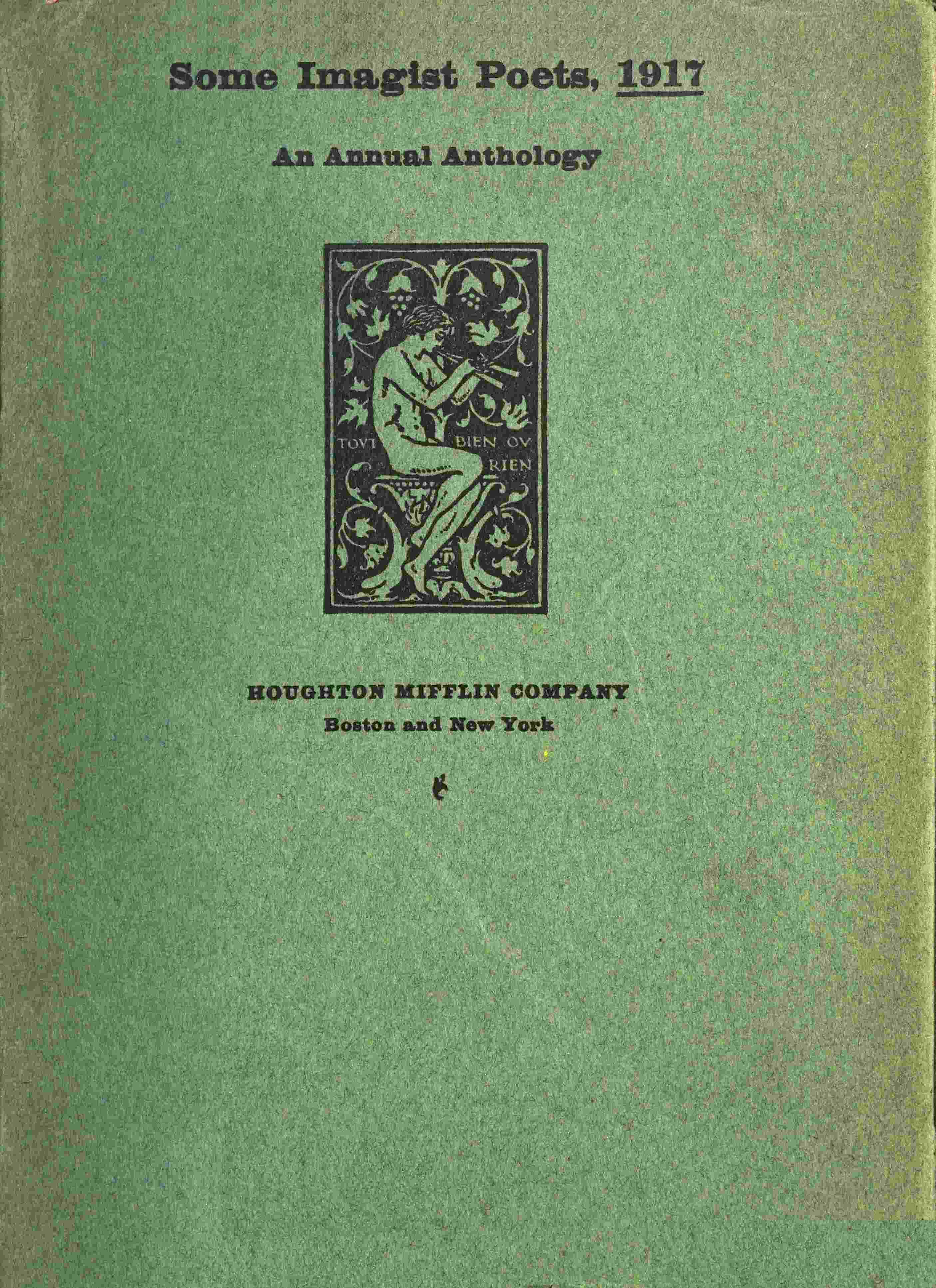
SOME IMAGIST POETS, 1917
SOME IMAGIST POETS
1917
AN ANNUAL ANTHOLOGY

BOSTON AND NEW YORK
HOUGHTON MIFFLIN COMPANY
The Riverside Press Cambridge
1917
COPYRIGHT, 1917, BY HOUGHTON MIFFLIN COMPANY
ALL RIGHTS RESERVED
Published April 1917
The authors wish to express their thanks to the editors
of Poetry, The Seven Arts, The Poetry Review, and The
Egoist, London, for permission to reprint certain of these
poems which originally appeared in their columns.
The poem “Streets,” on page 79, is an adaptation from
the Japanese of Yakura Sanjin, 1798, a prose translation of
which, made from a German translation, appears in Mr.
Arthur Davison Ficke’s “Chats on Japanese Prints.”
{1}
{2}
{3}
This is an old and very cruel god ...
We will endure;
We will try not to wince
When he crushes and rends us.
If indeed it is for your sakes,
If we perish or moan in torture,
Or stagger under sordid burdens
That you may live—
Then we can endure.
If our wasted blood
Makes bright the page
Of poets yet to be;
If this our tortured life
Save from destruction’s nails
Gold words of a Greek long dead;
{4}
Then we can endure,
Then hope,
Then watch the sun rise
Without utter bitterness.
But, O thou old and very cruel god,
Take, if thou canst, this bitter cup from us.
{5}
I have been a spendthrift—
Dropping from lazy fingers
Quiet coloured hours,
Fluttering away from me
Like oak and beech leaves in October.
I have lived keenly and wastefully,
Like a bush or a sun insect—
Lived sensually and thoughtfully,
Loving the flesh and the beauty of this world—
Green ivy about ruined towers,
The out-pouring of the grey sea,
And the ecstasy
Of a pale clear sky at sunset.
I have been prodigal of love
For cities and for lonely places;
I have tried not to hate mankind;
I have gathered sensations
{6}
Like ripe fruits in a rich orchard....
All this is gone;
There are no leaves, no sea,
No shade of a rich orchard,
Only a sterile, dusty waste,
Empty and threatening.
I long vainly for solitude
And the lapse of silent hours;
I am frantic to throw off
My heavy cloth and leather garments,
To set free my feet and body;
And I am so far from beauty
That a yellow daisy seems to clutch my heart
With eager searching petals,
And I am grateful even to humility
For the taste of pure, clean bread.
{7}
One night I wandered alone from my comrades’ huts;
The grasshoppers chirped softly
In the warm misty evening;
Bracken fronds beckoned from the darkness
With exquisite frail green fingers;
The tree gods muttered affectionately about me,
And from the distance came the grumble of a kindly train.
I was so happy to be alone,
So full of love for the great speechless earth,
That I could have laid my cheek in the wet grasses
And caressed with my lips the hard sinewy body
Of Earth, the cherishing mistress of bitter lovers.
{8}
The long autumn grass beneath my body
Soaks my clothes in dew;
Where my knees press into the ground
I can feel the damp earth.
In my nostrils is a smell of crushed grass,
Wet pine-cones and bark.
Through the bronze pine trunks
Glitters a silver segment of road.
Interminable squadrons of silver and grey horses
Pace in long ranks the blank fields of heaven.
There is no sound;
The wind hisses gently through the pine-needles;
The flutter of a finch’s wings about my head
Is violent as distant thunder,
And the shrill flight of a gnat
Sounds loud and clear.
{9}
I am “to fire at the enemy column
After it has passed”—
But my rifle (loaded with “blank”)
Lies untouched before me,
My spirit follows the gliding clouds
And my lips murmur of the mother of beauty
Standing breast-high in golden broom
Among the English pine-woods!
{10}
The grim dawn lightens thin bleak clouds;
In the hill clefts beyond the flooded meadows
Lies death-pale, death-still mist.
We trudge along wearily,
Heavy with lack of sleep,
Spiritless, yet with pretence of gaiety.
The sun brings crimson to the colourless sky;
Light gleams from brass and steel—
We trudge on wearily—
O God, end this bleak anguish
Soon, soon, with vivid crimson death,
End it in mist-pale sleep!
{11}
Let the sea beat its thin torn hands
In anguish against the shore,
Let it moan
Between headland and cliff;
Let the sea shriek out its agony
Across waste sands and marshes,
And clutch great ships,
Tearing them plate from steel plate
In reckless anger;
Let it break the white bulwarks
Of harbour and city;
Let it sob and scream and laugh
In a sharp fury,
With white salt tears
Wet on its writhen face;
Ah! let the sea still be mad
And crash in madness among the shaking rocks—
For the sea is the cry of our sorrow.
{12}
I
Through the dark pine trunks
Silver and yellow gleam the clouds
And the sun;
The sea is faint purple.
My love, my love, I shall never reach you.
II
You are beautiful
As a straight red fox-glove
Among green plants;
I stretched out my hand to caress you:
It is blistered by the envious nettles.
III
I have spent hours this morning
Seeking in the brook
For a clear pebble
To remind me of your eyes.
And all the sleepless hours of night
I think of you.
{13}
IV
Your kisses are poignant,
Ah! why must I leave you?
Here alone I scribble and re-scribble
The words of a long-dead Greek poet:
“Love, thou art terrible,
Ah, Love, thou art bitter-sweet!”
{14}
They have torn the gold tettinx
From my hair;
And wrenched the bronze sandals
From my ankles.
They have taken from me my friend
Who knew the holy wisdom of poets,
Who had drunk at the feast
Where Simonides sang.
No more do I walk the calm gardens
In the white mist of olives;
No more do I take the rose-crown
From the white hands of a maiden.
I, who was free, am a slave;
The Muses have forgotten me,
The gods do not hear me.
Here there are no flowers to love;
But afar off I dream that I see
Bent poppies and the deathless asphodel.
{15}
Vagabonds of beauty,
Wistful exquisite waifs
From a lost, and a forgotten, and a lovely land,
We cannot comfort you
Though our souls yearn for you.
You are delicate strangers
In a gloomy town,
Stared at and hated—
Gold crocus blossoms in a drab lane.
We cannot comfort you;
Your life is anguish;
All we can do—
Mutely bring pungent herbs and branches of oak
And resinous scented pine wreaths
To hide the crown of thorny pain
Crushing your white frail foreheads.
{16}
I am a garden of red tulips
And late daffodils and bay-hedges,
A small sunk garden
About an oblong pool
With three grey lead Dutch tanks—
I am this garden shattered and blown
With a day-long western gale
And bursts of rapid rain.
There are dank petals in the ruffled waters,
And muddy flowers upon the path.
The grass is covered with torn leaves.
God of gardens, dear small god of gardens,
Grant me faint glow of sunlight,
A last bird hopping in the quiet haze,
Then let the night swoop swiftly,
Fold round and crush out life
For ever.
{17}
{18}
{19}
I
I asked of your face:
is it dark,
set beneath heavy locks,
circled with stiff ivy-fruit,
clear,
cut with great hammer-stroke,
brow, nose and mouth,
mysterious and far distant
from my sense.
I asked:
can he from his portals of ebony
carved with grapes,
turn toward the earth?
I even spoke this blasphemy
{20}
in my thoughts:
the earth is evil,
given over to evil—
we are lost.
II
And in a moment
you have altered this.
Beneath my feet, the rocks
have no weight
against the rush of cyclamen,
fire-tipped, ivory-pointed,
white.
Beneath my feet the flat rocks
have no strength
against the deep purple flower-embers,
cyclamen, wine spilled.
III
As I stood among the bare rocks
{21}
where salt lay,
peeled and flaked
in its white drift,
I thought I would be the last
you would want,
I thought I would but scatter salt
on the ripe grapes.
I thought the vine-leaves
would curl under,
leaf and leaf-point
at my touch,
the yellow and green grapes
would have dropped,
my very glance must shatter
the purple fruit.
I had drawn away into the salt,
myself, a shell
emptied of life.
{22}
IV
I pluck the cyclamen
red by wine-red
and place the petals
stiff ivory and bright fire
against my flesh.
Now I am powerless
to draw back
for the sea is cyclamen-purple,
cyclamen-red, colour of the last grapes,
colour of the purple of the flowers,
cyclamen-coloured and dark.
{23}
I
Each of us like you
has died once,
each of us like you
has passed through drift of wood-leaves,
cracked and bent
and tortured and unbent
in the winter frost—
then burnt into gold points,
lighted afresh,
crisp amber, scales of gold-leaf,
gold turned and re-welded
in the sun-heat.
Each of us like you
has died once,
each of us has crossed an old wood-path
and found the winter leaves
so golden in the sun-fire
that even the live wood-flowers
were dark.
{24}
II
Not the gold on the temple-front
where you stand,
is as gold as this,
not the gold that fastens your sandal,
nor the gold reft
through your chiselled locks
is as gold as this last year’s leaf,
not all the gold hammered and wrought
and beaten
on your lover’s face,
brow and bare breast
is as golden as this.
Each of us like you
has died once,
each of us like you
stands apart, like you
fit to be worshipped.
{25}
I
Shall I let myself be caught
in my own light,
shall I let myself be broken
in my own heat,
or shall I cleft the rock as of old
and break my own fire
with its surface?
Does this fire thwart me
and my craft,
or my work—
does it cloud this light;
which is the god,
which the stone
the god takes for his use?
II
Which am I,
The stone or the power
{26}
that lifts the rock from the earth?
Am I the master of this fire,
is this fire my own strength?
Am I the master of this
swirl upon swirl of light—
have I made it as in old times
I made the gods from the rock?
Have I made this fire from myself,
or is this arrogance—
is this fire a god
that seeks me in the dark?
III
I made image upon image for my use,
I made image upon image, for the grace
of Pallas was my flint
and my help was Hephæstos.
I made god upon god
step from the cold rock,
I made the gods less than men
{27}
for I was a man and they my work.
And now what is it that has come to pass
for fire has shaken my hand,
my strivings are dust.
IV
Now what is it that has come to pass?
Over my head, fire stands,
my marbles are alert.
Each of the gods, perfect,
cries out from a perfect throat:
you are useless,
no marble can bind me,
no stone suggest.
V
They have melted into the light
and I am desolate,
they have melted,
each from his plinth,
{28}
each one departs.
They have gone,
what agony can express my grief?
Each from his marble base
has stepped into the light
and my work is for naught.
VI
Now am I the power
that has made this fire
as of old I made the gods
start from the rocks—
am I the god
or does this fire carve me
for its use?
{29}
I
So you have swept me back—
I who could have walked with the live souls
above the earth,
I who could have slept among the live flowers
at last.
So for your arrogance
and your ruthlessness
I am swept back
where dead lichens drip
dead cinders upon moss of ash.
So for your arrogance
I am broken at last,
I who had lived unconscious,
who was almost forgot.
If you had let me wait
I had grown from listlessness
{30}
into peace—
if you had let me rest with the dead,
I had forgot you
and the past.
II
Here only flame upon flame
and black among the red sparks,
streaks of black and light
grown colourless.
Why did you turn back,
that hell should be reinhabited
of myself thus
swept into nothingness?
Why did you turn,
why did you glance back—
why did you hesitate for that moment,
why did you bend your face
caught with the flame of the upper earth
above my face?
What was it that crossed my face
with the light from yours
{31}
and your glance?
What was it you saw in my face—
the light of your own face,
the fire of your own presence?
What had my face to offer
but reflex of the earth—
hyacinth colour
caught from the raw fissure in the rock
where the light struck,
and the colour of azure crocuses
and the bright surface of gold crocuses
and of the wind-flower,
swift in its veins as lightning
and as white.
III
Saffron from the fringe of the earth,
wild saffron that has bent
over the sharp edge of earth,
all the flowers that cut through the earth,
all, all the flowers are lost.
Everything is lost,
{32}
everything is crossed with black,
black upon black
and worse than black—
this colourless light.
IV
Fringe upon fringe
of blue crocuses,
crocuses, walled against blue of themselves,
blue of that upper earth,
blue of the depth upon depth of flowers—
lost!
Flowers—
if I could have taken once my breath of them,
enough of them,
more than earth,
even than of the upper earth,
had passed with me
beneath the earth!
If I could have caught up from the earth,
the whole of the flowers of the earth,
if once I could have breathed into myself
{33}
the very golden crocuses
and the red,
and the very golden hearts of the first saffron,
the whole of the golden mass,
the whole of the great fragrance,
I could have dared the loss.
V
So for your arrogance
and your ruthlessness
I have lost the earth
and the flowers of the earth,
and the live souls above the earth,
and you who passed across the light
and reached
ruthless—
you who have your own light,
who are to yourself a presence,
who need no presence.
Yet for all your arrogance
and your glance,
{34}
I tell you this—
such loss is no loss,
such terror, such coils and strands and pitfalls
of blackness,
such terror
is no loss.
Hell is no worse than your earth
above the earth,
hell is no worse—
no—nor your flowers
nor your veins of light
nor your presence,
a loss.
My hell is no worse than yours
though you pass among the flowers and speak
with the spirits above earth.
VI
Against the black
I have more fervour
than you in all the splendour of that place,
against the blackness
and the stark grey
{35}
I have more light!
And the flowers—
if I should tell you,
you would turn from your own fit paths
toward hell—
turn again and glance back
and I would sink into a place
even more terrible than this.
VII
At least I have the flowers of myself
and my thoughts—no god
can take that!
I have the fervour of myself for a presence
and my own spirit for light.
And my spirit with its loss
knows this:
though small against the black,
small against the formless rocks,
hell must break before I am lost.
Before I am lost,
hell must open like a red rose
for the dead to pass.
{36}
{37}
{38}
{39}
I
Like a gaunt, scraggly pine
Which lifts its head above the mournful sandhills;
And patiently, through dull years of bitter silence,
Untended and uncared for, starts to grow.
Ungainly, labouring, huge,
The wind of the north has twisted and gnarled its branches;
Yet in the heat of midsummer days, when thunder-clouds ring the horizon,
A nation of men shall rest beneath its shade.
And it shall protect them all,
Hold everyone safe there, watching aloof in silence;
Until at last one mad stray bolt from the zenith
Shall strike it in an instant down to earth.
{40}
II
There was a darkness in this man; an immense and hollow darkness,
Of which we may not speak, nor share with him, nor enter;
A darkness through which strong roots stretched downwards into the earth
Towards old things;
Towards the herdman-kings who walked the earth and spoke with God,
Towards the wanderers who sought for they knew not what, and found their goal at last;
Towards the men who waited, only waited patiently when all seemed lost,
Many bitter winters of defeat;
Down to the granite of patience
These roots swept, knotted fibrous roots, prying, piercing, seeking,
And drew from the living rock and the living waters about it
{41}
The red sap to carry upwards to the sun.
Not proud, but humble,
Only to serve and pass on, to endure to the end through service;
For the ax is laid at the roots of the trees, and all that bring not forth good fruit
Shall be cut down on the day to come and cast into the fire.
III
There is a silence abroad in the land to-day,
And in the hearts of men, a deep and anxious silence;
And, because we are still at last, those bronze lips slowly open,
Those hollow and weary eyes take on a gleam of light.
Slowly a patient, firm-syllabled voice cuts through the end-less silence
Like labouring oxen that drag a plow through the chaos of rude clay-fields:
“I went forward as the light goes forward in early spring,
But there were also many things which I left behind.
“Tombs that were quiet;
{42}
One, of a mother, whose brief light went out in the darkness,
One, of a loved one, the snow on whose grave is long falling,
One, only of a child, but it was mine.
Have you forgot your graves? Go, question them in anguish,
Listen long to their unstirred lips. From your hostages to silence,
Learn there is no life without death, no dawn without sun setting,
No victory but to him who has given all.”
IV
The clamour of cannon dies down, the furnace-mouth of the battle is silent.
The midwinter sun dips and descends, the earth takes on afresh its bright colours.
But he whom we mocked and obeyed not, he whom we scorned and mistrusted,
He has descended, like a god, to his rest.
Over the uproar of cities,
{43}
Over the million intricate threads of life wavering and crossing,
In the midst of problems we know not, tangling, perplexing, ensnaring,
Rises one white tomb alone.
Beam over it, stars,
Wrap it round, stripes—stripes red for the pain that he bore for you—
Enfold it forever, O flag, rent, soiled, but repaired through your anguish;
Long as you keep him there safe, the nations shall bow to your law.
Strew over him flowers:
Blue forget-me-nots from the north, and the bright pink arbutus
From the east, and from the west rich orange blossom,
But from the heart of the land take the passion-flower;
Rayed, violet, dim,
With the nails that pierced, the cross that he bore and the circlet,
And beside it there lay also one lonely snow-white magnolia,
Bitter for remembrance of the healing which has passed.
{44}
Under the sun which seems to halt and drip
Down the long yellow line of heavy beeches,
Striding in order along the hillside,
There is a hedge of bramble and rose.
Hour on hour I have wandered beside it,
Heaping my basket with gleaming fruit,
Staining my fingers and tearing my hands,
Letting the clusters clutch me,
Letting them wind their hooked fingers about me—seeking no way of escape.
Purple-blue globes amid the brambles,
Tangled with scarlet hips of roses,
And the hazy, lazy autumn
Drifting out with the drifting leaves;
Down the hill the slow movements of browsing cattle,
Up the hill the shrill laughter of children
Fighting their way through the tangle
Towards the drooping spoil.
Grey ‘old-man’s-beard’ covers densely the tops of the brambles,
{45}
And against it project the scarlet hips of the roses,
Against the greenery flashing
Like lanterns swung through the leaves:—
Up above them, wavering slowly,
The undergrowth flares out in scarlet,
And, above it, the yellow tips of the beeches
Almost motionless,
Now and then drop slowly a spear of flame to the earth.
Under the sun which seems to stop and quiver
At the edge of the hill, under the ledge of the beech-trees,
Like a wave arrested suddenly by a cliff of yellow rock;
Slipping quickly down to the ocean again,
Filling with haze the distant dusty ocean
Of stubble-fields on the horizon—
The air is thick with heavy sweetness
Perfume of ripening berries,
Crimson turning to purple,
Wine of the autumn sun.
And there wells up in me a drunken impulse of autumn,
To fling myself in the tangle;
Let it tear my clothes to tatters and slash across my cheeks;
To crush the berries and trample
Their sweetness, with the laughter
{46}
Of red cheeked children scrambling
Across the fallen leaves:—
To find myself a faun again, freed from the restraint of houses,
With red-stained face a-leering
Out of the dense, deep web of interlacing thorn:
A girdle of scarlet berries slung carelessly over my shoulder,
A crown of glistening purple berries gleaming in my hair.
{47}
The sky is covered with light white wisps of cloud;
Afar in the pale and hazy sky
A lone star glitters—flickers—glitters
Over the thin-leaved motionless trees,
Standing in washes of darkness
Upon the blue grey of the distance,
Which seems so far—so remote—so very far
As if the moon itself
Were nearer earth than it.
Now a thin cloud blows suddenly across the face of the moon,
And the patterns of the shadows run quickly together;
The mysterious earth sinks down
Beneath the darkness pressing firmly upon it.
A vague leaf glances coldly as the moonlight
Strikes again athwart the tangle of lightly-swaying tree-tops,
And where the stems are closely ranked together
In the hollows there is darkness,
As if they were intently watching something,
{48}
Which they would never let escape.
This night is not as is the night of cities,
Where all seems like a flitting dance of phantoms
With wavering traffic
Under red lamps;
For I have seen men passing to the theatre
Who seemed to walk as people walk in sleep,
Deliberate, gravely smiling,
With passionless, shut eyes;
And I have seen the trees asleep in daylight,
Rocked by the wind and nodding
To every gossipy bird:—
But in the night no woodcutter hews the hard bark,
And not a wind lifts up a single leaf-tip
But that the tree has challenged it to blow.
On the other side of the house, where the road passes,
The moon lights up a neighbour’s red-tiled roof-top;
It looks like an old tortoise sleeping soundly
Upon the shore of an undiscovered sea.
{49}
Above the east horizon,
The great red flower of the dawn
Opens slowly, petal by petal;
The trees emerge from darkness
With ghostly silver leaves,
Dew-powdered.
Now consciousness emerges
Reluctantly out of tides of sleep;
Finding with cold surprise
No strange new thing to match its dreams,
But merely the familiar shapes
Of bedpost, window-pane, and wall.
Within the city,
The streets which were the last to fall to sleep,
Hold yet stale fragments of the night.
Sleep oozes out of stagnant ash-barrels,
Sleep drowses over litter in the streets.
Sleep nods upon the milkcans by back doors.
And, in shut rooms,
Behind the lowered window-blinds,
{50}
Drawn white faces unwittingly flout the day.
But, at the edges of the city,
Sleep is already washed away;
Light filters through the moist green leaves,
It runs into the cups of flowers,
It leaps in sparks through drops of dew,
It whirls against the window-panes
With waking birds;
Blinds are rolled up and chimneys smoke,
Feet clatter past on silent paths,
And down white vanishing ways of steel,
A dozen railway trains converge
Upon night’s stronghold.
{51}
Under the soft grey windswept sky,
Between two rows of yellow trees
Soddenly dripping;
The brown backs of an army
Go marching.
Like an enormous snake with undulatory movement,
Past the old church with scarlet ivy hooding its stiff grey walls,
Past the drowsy churchyard,
Where wet leaves cling to the stones,
Up the hill and past the village,
Through the curving lines of hedgerows,
Beyond the brow of the hill, lost in brown stubble,
The brown backs of an army
Go writhing into the distance.
Under the flying clouds that hide the eastern sky,
Footfalls, footfalls, repeated clamour of footfall;—
One, two, left, right, the road is full of them—
And the noise rises and strives to cling
{52}
To the wet wind-blown branches,
It penetrates the empty church and echoes up the aisle.
Whirling leaves drift over the endless footfalls,
Striving to hush them to quiet;
O agonised hands!
Under the soft grey rainy sky
Of October;
Under the swirling leaves that fall and settle amid them,
Silent files of men, stiffly-backed and sombre,
With a jagged fringe of rifles projecting from every shoulder,
Move like an immense machine with a million feet;
Marching,
Into the darkness steadily marching,
Incessantly swinging and falling,
Swallowed up in the twistings of the hills,
Vanishing amid the confused brown stubble of the earth.
And the old earth holds its breath and listens:
Was that a shot, a sob, a strangling cry?
Silence. Only the trees hold out their empty arms in yearning,
And a flight of rooks across them goes clanging away before night.
{53}
{54}
{55}
There has been no sound of guns,
no roar of exploding bombs;
but the darkness has an edge
that grits the nerves of the sleeper.
He awakens;
nothing disturbs the stillness,
save perhaps the light, slow flap,
once only, of the curtain
dim in the darkness.
Yet there is something else
that drags him from his bed;
and he stands in the darkness
with his feet cold against the floor
and the cold air round his ankles.
He does not know why,
but he goes to the window and sees
{56}
a beam of light, miles high,
dividing the night into two before him,
still, stark and throbbing.
The houses and gardens beneath
lie under the snow
quiet and tinged with purple.
There has been no sound of guns,
no roar of exploding bombs;
only that watchfulness hidden among the snow-covered houses,
and that great beam thrusting back into heaven
the light taken from it.
{57}
The bedroom is darkness.
A dim cloud in one direction
is the window with its curtains;
the leaves of the trees outside rustle on one another.
I fall to sleep.
How long have I slept?
A voice calls, a bell rings;
the clamour and the ringing lengthen;
I turn; it continues;
not mine the name I hear,
and yet
there is alarm in it that concerns me?
Am I awake?
Over my nightdress
I huddle my clothes;
thrust my bare feet into slippers;
and run down the stairs.
From a blur of female faces
distraught eyes stand out,
{58}
and a woman’s voice cries:
“The Zeppelins—they are attacking us;
Avenue Road[A] is alight,
High Mydelton[A] is burning.
Did you not hear the guns?
Oh, what shall we do?”
We make jokes to reassure them.
I shiver: chill? excitement? fear?
Am I awake?
My mind has been washed by sleep and left limp.
The trees in the gardens opposite
stand out behind the houses,
a dark fretwork against the sky;
and everywhere is stillness.
Yet something slinks overhead through the sky;
men will say that they saw it pass, and then
a flash, a thud,—
a house has been cleft through three stories, and burns;
and children burn in their beds,
and men are burned rescuing them,
an old man and woman are burned to death
{59}
because the staircase has been smashed away.
But we do not know this yet;
we have only heard explosions,
and have seen the glow of fires in the sky,
quickly gone.
We climb upstairs to the top story,—
to see!
There is nothing to see ...
But the silence and stillness are sinister.
What has been taken away, what added?
Brick and stone have become unreal,
and only the primæval trees remain,
with the primæval fear behind them and among them....
What is that behind the trees?—
A flame-coloured circle of light that glows
and grows brighter and dimmer by turns.
Is it an airship on fire?
It burns on, and moves nearer, slowly;
it swings clear of the trees—
the moon!
{60}
The little Heddon roars over its stones towards its mouth
between two cliffs mounting up, one with the grey-brown haze
of the budding oakwoods and the line of the path athwart them,
as though cut with a knife;
and the other grey with loose shale, and here and there
the gorse in bloom over the dead, brown bracken,
that springs again, green once more, from its death.
The little Heddon roars over its stones between
its violets, primroses, and celandines to the sea.
And, friends, what am I doing here beside you and the Heddon?
Why did I come to you with my heart-ache and my cares,
falsely to brighten your life with the foil of my darkness?
Why did I come to your pinewoods?
{61}
The little Heddon roars over its stones to the sea.
My life grated on in its groove, and that groove
Brought me to you, but see! the little Heddon roared over my brain,
and for a day washed the mist from it, cleared the clog of it,
and the groove is no longer there.
Yet I shall leave you; I shall take back my groove,
with a keener edge to my heart-ache and a different tune:
the little Heddon roaring over my brain to the sea!
{62}
Brother,
I saw you on a muddy road
in France
pass by with your battalion,
rifle at the slope, full marching order,
arm swinging;
and I stood at ease,
folding my hands over my rifle,
with my battalion.
You passed me by, and our eyes met.
We had not seen each other since the days
we climbed the Devon hills together:
our eyes met, startled;
and, because the order was Silence,
we dared not speak.
O face of my friend,
alone distinct of all that company,
you went on, you went on,
into the darkness;
{63}
and I sit here at my table,
holding back my tears,
with my jaw set and my teeth clenched,
knowing I shall not be
even so near you as I saw you
in my dream.
{64}
DUSK
To J. C.
Here where the brown leaves fall
from elm and chestnut and plane-tree;
here where the brown leaves drift
along the paths to the lake
where the waterfowl breast the waves
that are ridged by the wind,—
you spoke of your art and life,
of men you had known who betrayed you,
men who fell short of friendship
and women who fell short of love;
but, abiding beyond them, your art
held you to life, transformed it, became it,
and so you were free.
And I told you of all my weakness,—
my growing strength to resist
the appeal to my heart and eyes
of sorrowful, beautiful things;
and the strength of this outer husk
I had permitted to grow and protect me
{65}
was its pitiful measure.
You said: There are cracks in the husk.
It grew to your measure perhaps once;
but you are now breaking through it, and soon
it will fall apart and away from you.
Like a tree content with its fate,
you would not have known it was there
if it had grown to remain.
The cold wind blew the brown leaves
on to the lovers beneath,
who crept closer together for warmth
and closer still for love.
The peacocks perched in the branches
hawked their harsh cry at the golden
round moon that loomed over the tree-tops.
And the sound of our feet on the gravel
for a time was answer enough
to the broken mesh of our thoughts.
I said: I have wife and children,
{66}
a girl and a boy: I love them;
the gold of their hair is all the gold
of my thoughts; the blue of their eyes
is all the purity of my vision;
the rhythm of their life is more to be watched
than the cadences of my poems.
And you asked me:
Have you taken refuge behind them?
Do you not fear to lose your life
in saving it for them?
Be brave! Be brave! The waters are deep,
the waves run high; but you are a swimmer:
strike out!
The cold wind blew the brown leaves
deeper and deeper into the dusk;
the peacocks had hushed their cries;
the moon had turned her gold into silver,
and between the black lace of two trees
one star shone clearly.
O night!
have I deserved your beauty?
{67}
{68}
{69}
I
And so I cross into another world,
shyly and in homage linger for an invitation
from this unknown that I would trespass on.
I am very glad, and all alone in the world,
all alone, and very glad, in a new world
where I am disembarked at last.
I could cry for joy, because I am in a new world, just ventured in;
I could cry with joy, and quite freely, there is nobody to know.
And whosoever the unknown people of this unknown world will be,
{70}
they will never understand my weeping for joy to be adventuring among them,
because it will be a gesture of the old world I am making,
which they will not understand, because it is quite, quite foreign to them.
II
I was so weary of the world
I was so sick of it.
Everything was tainted with myself;
sky, trees, flowers, birds, water,
people, houses, streets, vehicles, machines,
nations, armies, war, peace-making,
work, recreation, governing, anarchy,
it was all tainted with myself, I knew it all to start with
because it was all myself.
When I gathered flowers, I knew it was myself gathering my own flowers;
when I went in a train, I knew myself going in my own train;
when I heard the cannon of the war, my ears listened to my own cannon,
when I saw the torn dead, I knew it was my own torn dead body,
it was all me, I had done it all.
{71}
III
I shall never forget the maniacal horror of it, in the end,
when everything was me, I knew it all already, anticipated it all;
because I was the author and the result
I was the God and the creation at once;
Creator, I looked at my creation,
Created, I looked at myself, the Creator.
It was a maniacal horror in the end.
IV
I was the lover, I kissed the woman,
and, God of horror, I was kissing also myself;
I was a father and begetter of children,
and oh, oh horror, I was begetting myself in my own body.
V
At last came death, sufficiency of death,
and that at last relieved me, I died.
I buried my beloved—it was good; I buried myself and was dead.
War came, and hatred, and every hand raised to murder.
Good, very good, every hand raised to murder!
{72}
Very good, very good, I am also a murderer! It is my desire.
It is good; I can strike and strike and see them all fall,
the mutilated, horror-struck youths, in a multitude,
one and another, and then in clusters together,
smashed, and broken with blood, and then burned in heaps,
going up in fetid smoke to get rid of them,
the murdered bodies of youths and men and me, in heaps,
heaps, in heaps, in horrible reeking heaps,
till it is almost enough, till I am killed perhaps:
thousands and thousands of gaping, hideous foul dead,
that are youths and men and me, being burned with oil, and consumed
in corrupt thick smoke, that rolls
and taints and blackens the sky, till at last
it is dark, as dark as night, or death, or hell,
and I am dead, and trodden like earth in the sodden earth,
dead, and trodden to nought in the sour black earth,
dead, and trodden to nought, trodden to nought.
VI
Ah, but it is good to have died and been trodden out!
Trodden to nought in black, dead earth,
quite to nought
to nothing;
absolutely to nothing.
{73}
VII
When it is quite, quite nothing, then it is everything.
When I am trodden quite out, quite, quite out,
every vestige gone—then I am here,
discovered, setting my foot on another world,
landed, claiming another terrestrial life,
disembarked from the voyage of death—not risen, not born again,
but disembarked from out the horrible foul ship, into a new heaven and earth,
new beyond knowledge of newness, alive beyond life,
glad beyond glory and furthest conception of pride,
living where life was never yet dreamed, where nothing was hinted at,
that is, now, in the world, with me and with life.
VIII
I put out my hand in the night, one night, and my hand
touched that which was verily not me,
verily it was not me.
Where I had been, was a sudden blaze,
a sudden flaring blaze of new being.
So I put my hand out further, again, and further
{74}
felt that which was not I,
it verily was not I.
It was the Unknown.
I was a blaze leaping up,
I was a burst of light, a tiger,
I was greedy, I was mad for the Unknown,
I, new-landed, new-risen, starved, disembarked from the tomb,
starved from a life of selfless consuming myself,
here was I now, arriving, with my hand stretched out
and touching the real Unknown, the Unknown, the Unknown.
And oh, I can only say
that I can touch, I can feel the Unknown;
I, the first comer.
Cortes, Pisarro, Columbus, they are nothing,
I am the first Comer
I am the discoverer
I have found the other world.
Eureka!
The Unknown, the Unknown!
I am thrown upon the shore,
{75}
I am covering myself with the sand,
I am filling my mouth with the earth,
I am burrowing my body into the soil:
the Unknown!
IX
It was the flank of my wife
I touched with my hand, I clutched with my hand,
rising, reaching from the tomb,
it was the flank of my wife, whom I had married years ago,
at whose side I have lain for a thousand nights,
and all the while, she was I, she was I,
I touched her, it was I who touched and I who was touched.
Yet rising from the tomb, flung from the ship,
stretching out my hand, my hand flung like a drowning man’s hand on the shore,
I touched her flank, and knew myself carried by the current in death
over to the new world, touching the other shore,
flotsam, jetsam, thrown and washed back on the shore,
yet grasping the new world,
clutching to climb out on the new and timeless world.
{76}
{77}
{78}
{79}
STREETS
As I wandered through the eight hundred and eight streets of the city,
I saw nothing so beautiful
As the Women of the Green Houses,
With their girdles of spun gold,
And their long-sleeved dresses,
Coloured like the graining of wood.
As they walk,
The hems of their outer garments flutter open,
And the blood-red linings glow like sharp-toothed maple leaves
In Autumn.
NEAR KIOTO
As I crossed over the bridge of Ariwarano Narikira,
I saw that the waters were purple
With the floating leaves of maples.
{80}
DESOLATION
Under the plum-blossoms are nightingales;
But the sea is hidden in an egg-white mist,
And they are silent.
SUNSHINE
The pool is edged with the blade-like leaves of irises.
If I throw a stone into the placid water,
It suddenly stiffens
Into rings and rings
Of sharp gold wire.
ILLUSION
Walking beside the tree-peonies,
I saw a beetle
Whose wings were of black lacquer spotted with milk.
I would have caught it,
But it ran from me swiftly
And hid under the stone lotus
Which supports the statue of Buddha.
{81}
A YEAR PASSES
Beyond the porcelain fence of the pleasure-garden,
I hear the frogs in the blue-green rice-fields;
But the sword-shaped moon
Has cut my heart in two.
A LOVER
If I could catch the green lantern of the firefly
I could see to write you a letter.
TO A HUSBAND
Brighter than fireflies upon the Uji River
Are your words in the dark, Beloved.
THE FISHERMAN’S WIFE
When I am alone,
The wind in the pine trees
Is like the shuffling of waves
Upon the wooden sides of a boat.
{82}
FROM CHINA
I thought:—
The moon,
Shining upon the many steps of the palace before me,
Shines also upon the chequered rice-fields
Of my native land.
And my tears fell
Like white rice grains
At my feet.
THE POND
Cold, wet leaves
Floating on moss-coloured water,
And the croaking of frogs—
Cracked bell-notes in the twilight.
AUTUMN
All day long I have watched the purple vine-leaves
Fall into the water.
And now in the moonlight they still fall,
But each leaf is fringed with silver.
{83}
EPHEMERA
Silver-green lanterns tossing among windy branches:
So an old man thinks
Of the loves of his youth.
DOCUMENT
The great painter Hokusai,
In his old age,
Wrote these words:
“Profiting by a beautiful Spring day,
In this year of tranquillity,
To warm myself in the sun,
I received a visit from my publisher
Who asked me to do something for him.
Then I reflected that one should not forget the glory of arms,
Above all when one was living in peace;
And in spite of my age,
Which is more than seventy years,
I have found courage to draw those ancient heroes
Who have been the models of glory.”
{84}
THE EMPEROR’S GARDEN
Once, in the sultry heats of Midsummer,
An Emperor caused the miniature mountains in his garden
To be covered with white silk,
That so crowned
They might cool his eyes
With the sparkle of snow.
ONE OF THE “HUNDRED VIEWS OF FUJI” BY HOKUSAI
Being thirsty,
I filled a cup with water,
And, behold! Fuji-yama lay upon the water
Like a dropped leaf!
DISILLUSION
A scholar,
Weary of erecting the fragile towers of words,
Went on a pilgrimage to Asama-yama.
And seeing the force of the fire
Spouting from this mighty mountain
Hurled himself into its crater
And perished.
{85}
PAPER FISHES
The paper carp,
At the end of its long bamboo pole,
Takes the wind into its mouth
And emits it at its tail.
So is man,
Forever swallowing the wind.
MEDITATION
A wise man,
Watching the stars pass across the sky,
Remarked:
In the upper air the fireflies move more slowly.
THE CAMELLIA TREE OF MATSUE
At Matsue,
There was a Camellia Tree of great beauty,
Whose blossoms were white as honey wax
Splashed and streaked with the pink of fair coral.
At night,
{86}
When the moon rose in the sky,
The Camellia Tree would leave its place
By the gateway
And wander up and down the garden,
Trailing its roots behind it
Like a train of rustling silk.
The people in the house,
Hearing the scrape of them upon the gravel,
Looked out into the garden
And saw the tree,
With its flowers erect and peering,
Pressed against the shōji.
Many nights the tree walked about the garden,
Until the women and children
Became frightened,
And the Master of the house
Ordered that the tree be cut down.
But when the gardener brought his axe
And struck at the trunk of the tree,
There spouted forth a stream of dark blood;
And when the stump was torn up,
The hole quivered like an open wound.
THE END
Richard Aldington
Images. Poetry Book Shop, London, 1915; and The Four Seas Company,
Boston, 1916.
H. D.
Sea Garden. Constable & Company, London; and Houghton Mifflin
Company, Boston, 1916.
John Gould Fletcher
Fire and Wine. Grant Richards, Ltd., London, 1913. (Out of print.)
Fool’s Gold. Max Goschen, London, 1913. (Out of print.)
The Dominant City. Max Goschen, London, 1913. (Out of print.)
The Book of Nature. Constable & Company, London, 1913.
Visions of the Evening. Erskine McDonald, London, 1913. (Out of
print.)
Irradiations: Sand and Spray. Houghton Mifflin Company, Boston, 1915;
and Constable & Company, London, 1915.
Goblins and Pagodas. Houghton Mifflin Company, Boston, 1916.
F. S. Flint
The Net of Stars. Elkin Mathews, London, 1909.
Cadences. Poetry Book Shop, London, 1915.
D. H. Lawrence
Love Poems and Others. Duckworth & Company, London, 1913; and
Mitchell Kennerley, New York, 1913.
Amores. Duckworth & Company, London, 1916; and Huebsch & Company,
New York, 1917.
Prose: The White Peacock. William Heinemann, London, 1911; and
Duffield Company, New York, 1911.
The Trespasser. Duckworth & Company, London, 1912; and
Mitchell Kennerley, New York, 1912.
Sons and Lovers. Duckworth & Company, London, 1913; and
Mitchell Kennerley, New York, 1913.
The Prussian Officer. Duckworth & Company, London, 1914;
and Huebsch & Company, New York, 1916.
The Rainbow. Methuen & Company, London, 1915; and
Huebsch & Company, New York, 1917.
Twilight in Italy. Duckworth & Company, London, 1916; and
Huebsch & Company, New York, 1917.
Drama: The Widowing of Mrs. Holroyd. Mitchell Kennerley, New York,
1914.
Amy Lowell
A Dome of Many-Coloured Glass. Houghton Mifflin Company, Boston,
1912; The Macmillan Company, New York, 1915.
Sword Blades and Poppy Seed. The Macmillan Company, New York;
and Macmillan & Company, London, 1914.
Men, Women and Ghosts. The Macmillan Company, New York, and
Macmillan & Company, London, 1916.
Prose: Six French Poets. The Macmillan Company, New York; and
Macmillan & Company, London, 1915.
The Riverside Press
CAMBRIDGE . MASSACHUSETTS
U . S . A.