
Title: Lives of the queens of Scotland and English princesses connected with the regal succession of Great Britain, vol. 1
Author: Agnes Strickland
Release date: September 3, 2026 [eBook #79508]
Language: English
Original publication: New York: Harper & Brothers, 1851
Other information and formats: www.gutenberg.org/ebooks/79508
Credits: Karin Spence and the Online Distributed Proofreading Team at https://www.pgdp.net (This file was produced from images generously made available by The Internet Archive)
CONNECTED WITH THE REGAL SUCCESSION OF GREAT BRITAIN.
BY AGNES STRICKLAND
AUTHOR OF
THE “LIVES OF THE QUEENS OF ENGLAND.”
VOL I.
NEW YORK:
HARPER & BROTHERS, PUBLISHERS,
No. 82 CLIFF ST.
1851.
| INTRODUCTORY PREFACE. | |
| LIFE OF MARGARET TUDOR, QUEEN OF JAMES IV.— | |
| PAGE | |
|---|---|
| CHAP. I. | 1 |
| II. | 40 |
| III. | 85 |
| IV. | 128 |
| V. | 157 |
| VI. | 197 |
| LIFE OF MAGDALENE OF FRANCE, FIRST QUEEN OF JAMES V.— | |
| CHAP. I. | 249 |
| II. | 280 |
| LIFE OF MARY OF LORRAINE, SECOND QUEEN OF JAMES V.— | |
| CHAP. I. | 311 |
| II. | 346 |
[v]
The Biographies of Royal Females who have played distinguished parts in the history of a country—especially those who have been involved in the storms caused by revolutions in popular opinion—afford not only instances of lofty and heroic characteristics elicited by striking reverses of fortune, but the most touching examples of all that is lovely, holy, and endearing in Womanhood.
“If,” as the Duchess de Bourbon said to her unfortunate kinswoman, Margaret of Anjou,[1] “a book were to be written on the calamities of illustrious ladies of royal birth,” it would, doubtless, exceed in pathos and dramatic interest all the tragedies in the world. It would form an extensive series of volumes, in which daughters of every family inheriting the fatal distinction of royalty, in every age and country, might find a place: and who more mournfully pre-eminent than Mary Stuart, and several of the Princesses connected with the regal succession of Great Britain? Of Queens of England who have fallen by the hand of the executioner, or died broken-hearted exiles in foreign lands, it is unnecessary to speak here, their memorials having already been placed before the reader.[2] While engaged in preparing that series of royal female biographies, materials no less interesting connected with cotemporary Queens of the sister realm were[vi] elicited, whose lives, together with those of such English Princesses as were placed in the direct line of the regal succession, appeared desirable adjuncts to the Lives of the Queens of England. They are, in fact, links of the same family chain.
However shadowy the catalogue may at first sight appear of forgotten northern Queens, each played her part distinctly, whether for good or ill, and gave a color to the temper of the times in which her lot was cast; each had her separate glories and her griefs.
In consequence of the premature, and, in too many instances, the violent deaths of the Kings of Scotland, almost every reign commenced with a long minority, in the course of which there was invariably a struggle between the Queen-mother and the great nobles of the realm for the tutelage of the infant sovereign, and the exercise of the power of the Crown. The Queen, generally a princess of foreign birth, for such was even a daughter of the kindred royal line of England considered, had little chance against the turbulent magnates, by whom female domination was held in scorn; and it was only through the influence of bribes, intrigues, and fomenting their jealousy of each other, that a Queen-mother ever succeeded in grasping the reins of empire, and then at the expense of life-consuming cares. The old age of a King of Scotland was forty, and very few Queens attained that age.
Who were the Queens of Scotland? This work will, we trust, answer that question satisfactorily, by dispelling the obscurity in which the lapse of centuries, and the translation of the Scottish Court from Holyrood to Westminster and Windsor, have involved the Royal Consorts of the Monarchs of the sister realm.
The things we look upon through the inverted telescope of Time are of course diminished, the lights are misty, and the shades fade into deeper darkness. Yet what we see are like daguerreotype miniatures—reduced impressions[vii] of full-sized realities. Daguerreotypes are not beautiful, but true, occasionally precious memorials, where no better likenesses can be obtained.
The Lives of the Queens of Scotland, in the modern series which I have the honor of introducing in the present volume, commence with Margaret Tudor, the consort of James IV. of Scotland, and daughter of Henry VII. of England and Elizabeth of York. Margaret Tudor, like her illustrious predecessor and ancestress, Margaret Atheling, was an English Princess in the direct line of the regal succession of that realm, and a Queen-consort of Scotland. Her posterity by James IV. united the blood of the elder line of the Anglo-Saxon Kings and the Norman Conqueror, blended with that of Bruce-Stuart and Plantagenet-Tudor in one rich stream. James VI. of Scotland, doubly her great-grandson, inherited the realms of England and Ireland as the representative of that princess, whose hereditary rights are now vested in her august descendant, Queen Victoria.
The Life of Mary Stuart, which will occupy two successive volumes of this series, was in preparation long before the publication of that of Elizabeth Tudor, in our Lives of the Queens of England, where it was promised as a companion biography, but a separate work.
Inexorably as the destiny of Mary Stuart was influenced by Elizabeth of England, no one could mix the personal annals of those rival Britannic sovereigns together without producing, as Camden has done, great confusion, and impairing the interest attached to both by violating the individual unity essential to biography; for they were stars shining in distinct orbits, and never visible in the same hemisphere. Their lives ought, however, to be read in succession, because they cast reflected lights upon each other, and are calculated, like the cotemporary biographies in both series, to illustrate the comparative state of society in the sister realms.
[viii]
My pledge to the public touching the Life of Mary Stuart could not be redeemed till after the arduous undertaking in which my sister and myself were engaged was concluded. The accomplishment of that task occupied several years, in the course of which fresh sources of information connected with the personal history of Mary have been opened both in France and England. So numerous, however, are the works on this subject of ever fresh and undying interest, that although not one of them has been written since the publication of Prince Labanoff’s seven volumes of her letters, and La Mothe Fenelon’s dispatches, we determined not to infringe on the pre-occupied ground and literary property of other authors, by bringing out a new Life of Mary Stuart in three volumes singly, but resolved, proceeding on our own original track, to introduce it into a new series of royal biographies on the same plan as The Lives of the Queens of England. The biography of Mary will, of course, be rendered more perspicuous and intelligible by being preceded by those of the three Queens in the present volume, and followed by that of her aunt, Margaret, Countess of Lennox, the mother of the unfortunate Darnley, which is full of curious information bearing on the much contested point of the guilt or innocence of Mary.
The selfish and short-sighted policy of Margaret Tudor, while exercising the functions of Queen-Regent for her son James V., her intrigues with England, the interminable embroilments caused by her marriages and divorces, sowed, as will be shown, the perilous seeds of which her unfortunate descendants, Mary Stuart and Darnley, were destined to reap the bitter harvest.
The Life of James the Fifth’s first consort, Magdalene of France, having important connection with political relations, but no entanglement with political intrigues, comes like a refreshing interlude of sweet and pleasant things between the turmoils and agitations detailed in the[ix] more eventful histories of Margaret Tudor and Mary of Lorraine. It is, in sooth, a romantic but carefully verified love-tale of royal romance, blended with the splendid pageantry and costume of the brilliant courts of those chivalric monarchs, Francis I. of France, and the fifth James Stuart of Scotland. The accomplishments and refined tastes of James V., like those of his illustrious ancestor James I., and his own daughter Mary, were unfortunately too much in advance of their era. Lesley, Bishop of Ross, censures the great increase of expense, caused by the march of luxury at this period, as injurious to morals, and inconsistent with the means of the country.
“Here is to be remembered,” he says, “that there were many new ingines and devices, as well of bigging (building) of palaces, habiliments, as of banqueting, and of men’s behavior, first begun and used in Scotland at this time, after the fashion they had seen in France. Albeit it seemed to be very comely and beautiful, yet it was more superfluous and voluptuous than the substance of the realm of Scotland might bear forth or sustain: nevertheless, the same fashions and custom of costly habiliments, indifferently used by all estates, excessive banqueting, and sic like, remains yet to these days, to the great hinder and poverty of the whole realm.”[3]
These observations, as Lesley wrote in the reign of Queen Mary, are perhaps even more applicable to the consequences of James the Fifth’s second marriage with the sprightly Duchess-dowager of Longueville, Mary of Lorraine, who presided over the court of Scotland for nearly two-and-twenty years—first as Queen-consort, and subsequently as Queen-Regent—during which period French fashions and French influence gained a natural, but ultimately most unpopular ascendency. The leading events of the stormy period of Mary of Lorraine’s regency are more familiar to the reader than her early history and[x] wedded life, which are the more agreeable for not being mixed up with the religious warfare which convulsed Scotland during her widowhood. Whatever is requisite to be related on the latter subject will be told as briefly as possible in due order of chronology.
Many of Mary Stuart’s countrymen who are now painfully halting between two opinions—an internal conviction that she was rather a victim than a criminal “rugging at their hearts,” and pleading all sorts of extenuating circumstances in her behalf (which, if she were guilty of the crimes imputed to her, is a grave offense against morality),—would rejoice to see her innocence established, if it could be done without dispelling that veneration for John Knox which their church, to the great hindrance of historic truth, makes no less an article of historic than of spiritual faith.
As it is, however, contrary not only to our principles, but to the plan of our royal biographies, to convert historical characters and events into pegs whereon to hang party questions, especially those involving theological differences, which it is the peculiar province of ecclesiastical writers to discuss, we will endeavor to keep John Knox as much in the background as he will allow us. After all, his testimony regarding Mary amounts to nothing beyond harsh words, which, however they may have biased the minds of men, have no real effect as matter of evidence. As members of the Reformed Church, we regard him as a great and honest instrument in the overthrow of the Church of Rome in Scotland. Intent on the mighty work in which he was engaged, John Knox, like Jehu the son of Nimshi, drove furiously—his zeal carried him in many things too far; in fact it intoxicated his reason, by causing him to see through a distorted lens every thing done by Mary Stuart, the daughter of his ancient adversary, Mary of Lorraine.
Since the publication of those valuable national works,[xi] Tytler’s History of Scotland, and the Life of Mary Stuart by Henry Glassford Bell, Esq., a vast body of her letters and other cotemporary documents has been brought to light by the indefatigable research of Prince Labanoff, the learned contributors to the Maitland and Bannatyne Club Books, and other generous laborers in the cause of historic truth, which supply matter for a more important biography of this Princess than could possibly have been written before the discovery of these papers. These collections, although printed, are, with very few exceptions, inaccessible to the public; and even if the great expense attending the purchase of such as are not confined to private circulation did not place them out of the reach of general readers, they would be unintelligible to readers unaccustomed to the old French and obsolete Scotch orthography. In addition to these, I have been favored with access to the charter-chests of many of the historical families of Scotland, and aided by that zealous and liberal-minded documentarian, Alexander Macdonald, Esq., of the Register House, Edinburgh, with the communication of excerpts from the Royal Exchequer Records of Scotland, and curious items of the Privy Purse expenses of the Queens of Scotland; besides several inedited letters of Queen Mary, discovered by himself, which had escaped the research of Prince Labanoff. An especial meed of thanks is due to John Riddell, Esq., of the Faculty of Advocates, for various important additions to my collections illustrative of the personal history of the Scottish Queens, both in the present series and the medieval.
I have been also indebted to David Laing, Esq., the learned librarian of the Signet Library, for much friendly attention and information, and the loan of valuable documentary works. Nor must I omit to mention my obligations to Frederick Devon, Esq., of the Chapter House, Westminster, and Henry Sharpe, Esq., brother of my lamented friend, Sir Cuthbert Sharpe. Above all, I beg[xii] to express my grateful sense of the courtesy of the Honorable John Stuart, in favoring me with the use of Mary’s secret correspondence, recently discovered in the family archives of the House of Moray. Were I to specify all the honored names of the learned noble, and the noble learned, the good, the generous-minded, and the true, who have kindly labored to smooth the difficulties of this arduous undertaking, by opening every source of information, both national and private, and strewing an otherwise rugged path with flowers, not only would the time fail me, but volumes would be requisite to express my appreciation of the gratifying attentions and affectionate hospitalities I have received in Scotland.
The base misrepresentation of the Scottish character which pervaded the coarse literature of the eighteenth century in England, and extended its pernicious influence through all classes of society, was not merely symptomatic of the bad taste and blunted moral perceptions of that soul-degrading period—it was one of the successful organs of party malice, neither more nor less than the reptile tail of the hydra of falsehood, which reared its hundred heads against the Royal House of Stuart, and established the most palpable calumnies by the hardihood of assertion.
The pen is a small instrument, but it is a lever capable of overturning thrones. It is among the pains and penalties of Royalty to experience the fickleness of public favor, and to be occasionally borne down by an unmerited load of obloquy, of which the pen of some incendiary writer has been the exciting cause; but that a whole nation should have been brought to discredit by slanderous tongues and witless pens, is a marvel and a mystery no less strange than true.
As long as Scotland, in consequence of bad roads and tedious traveling, remained a sort of terra incognita, vulgar prejudice prevailed among the ignorant and narrow-minded portion of society in England; but Scotland only[xiii] required to be seen to be appreciated. Strong in native talent, rich in native worth, valiant, persevering, and wise, her sons have been ever foremost in the field of honorable enterprise, whether in deeds of arms, science, jurisprudence, or the industrial arts of peaceful life. In poetry, music, and song, she has certainly never been surpassed. It was, however, reserved for the genius of Sir Walter Scott to draw English hearts and English gold to Scotland, and to knit those bonds of brotherly regard which no act of legislature could do. His graphic pictures of Scotland and the Scotch acted like a spell of enchantment on the imaginations of the English. Those who were able to indulge the enthusiastic feelings which his writings had excited, crossed the Border, rushed into Highland glens, scaled Highland hills, congregated at Scotch hostelries, peeped into Scotch cottages, were invited to partake of Scotch hospitality—and found themselves in a land flowing with milk and honey, not merely in its festive character, but in its kindliness to strangers, which is the glory of all lands.
Yet among the numerous visitors whom the sight-seeing instincts of this age of locomotion have rendered familiar with the ancient seats of Scottish regality, how few know any thing about the Queens who once held their courts within the now deserted walls of Dunfermline, Falkland, Linlithgow, and Stirling!—gems which, even in their desolation, are surviving monuments of the graceful tastes of their founders, and incline the musing antiquary, who realizes in fancy for a moment their pristine glory, to smite his breast and exclaim “Ichabod!” With the exception of Windsor Castle, England has certainly no vestige of palatial architecture which may compare with the royal homes of Scotland, of whose former tenants a few particulars may be no less acceptable to the sons and daughters of the land, than to the southern stranger who visits them.
[xiv]
The Maiden Castle, sitting enthroned on her dun rock, the Acropolis of Edinburgh, at once a relic and a witness of the immutable Past, is full of memories of eventful scenes connected with Queens whose hearts would have leaped with exultation could their eyes have looked on such a vision of national prosperity as the bright New Town, with its gay streets, and shops full of costly merchandise; its spacious squares, crescents, and noble public buildings rising on the outer ballium of that grim fortress whose base is now surrounded by green flowery gardens, for the joyance of a peace-loving generation. Mons Meg and her brethren have lost their vocation through the amended temper of the times, and hold sinecure posts in silence—their destructive thunders being superseded by the din of the railway trains bringing hourly freights of wealth and wisdom to the good town of Edinburgh and its inhabitants.
England and Scotland are now ONE, not merely by the blending of the regal houses of Plantagenet, Bruce, Tudor, and Stuart in the person of James VI., and his accession to the throne of Great Britain in 1603, and the parliamentary act of consolidation in 1707, then miscalled the Union; but truly and effectually by friendship, based on mutual esteem, which has been cemented between the true hearts of the north and south in the present century. Under these auspicious circumstances, the Lives of the Queens of Scotland ought not to be less interesting to English, than those of the Queens of England have proved to Scotch readers.
Each of the Lives in the present series of royal biographies forms a distinct original narrative of individual yet general interest, illustrative of the course of civilization, the progress of the arts, and the costume of the periods to which they belong, calculated to lend a charm to the study of history, which, when truthfully told and[xv] philosophically considered, is the noblest school of ethics replete with moral teaching.
Many original royal letters will be embodied in these volumes, with facts and anecdotes carefully verified. Local traditions, not unworthy of attention, have been gathered in the desolate palaces and historic sites where every peasant is an oral chronicler, full of spirit-stirring recollections of the past. These are occasionally connected with themes which were the fountains whence Sir Walter Scott drew his inspiration for the chivalric poetry and romance which has rendered Scotland classic ground. The tastes of those who were the rising generation when the Waverley romances were the absorbing theme of interest in the literary world, have become matured. They require to have history rendered as agreeable without the mixture of fiction as with it; they desire to have it so written, without sacrificing truth to fastidiousness, that they may read it with their children, and that the whole family party shall be eager to resume the book when they gather round the work-table during the long winter evenings.
Authors who feel as they ought to feel, should rejoice in seeing their productions capable of imparting pleasure to the simple as well as the refined; for a book which pleases only one grade of society may be fashionable, but can not be called popular. That which interests peasants as well as peers, and is read with equal zest by children and parents, and is often seen in the hands of the operative classes, speaks to the heart in a language intelligible to a widely-extended circle of humanity, has written its own review, and needs no other.
Edinburgh, October 23, 1850.
[1]
MARGARET TUDOR.
THE
QUEENS OF SCOTLAND.
Margaret Tudor, the eldest daughter of Henry VII. and Elizabeth of York—Born at Westminster—Baptized at St. Margaret’s church—Childhood and education, &c.—Dances at her brother Arthur’s bridal—Is legatee to his personal property—Margaret is betrothed at Richmond palace to James IV.—Loses her mother Queen Elizabeth—Previous life of James IV.—Margaret sets out with Henry VII. for the north—Is taken to her grandmother’s castle of Colleweston—Receives publicly her father’s and her grandmother’s blessing—Her father gives her admissal—His written benediction on her therein—She bids him farewell in the hall at Colleweston—Her equipage and attendance—Her magnificent progress toward Scotland—Her grand entry of York—Remarkable meeting with the Earl of Northumberland—Her arrival at Durham, at Newcastle, at Alnwick—Kills a buck there with her crossbow—Her sojourn and entertainment at Berwick—Her preparations for entering Scotland—Issues through the north gate of Berwick—Is escorted by a feudal army of English Borderers—Her first morning’s journey in Scotland—Is received as Queen-Consort by a noble escort sent by James IV.—Enters the Pavilion of Recreation at Lammermuir—The English Border chivalry defiles before her, making their devoir of adieu—She proceeds to Fast castle—Sleeps there the first night in Scotland—Roads pioneered before her—Received by the nuns of Haddington on the second night—Arrives at Dalkeith castle—Received in state by Lady Morton—The King’s approach unexpectedly announced.
The national enmity which had, from the earliest times, subsisted occasionally between the realms of England and Scotland, reached an intolerable degree of rancor in the fifteenth century.
For two hundred years, the monarchs of England had left no attempt untried to subvert the independence of Scotland, laboring vehemently to destroy it either by force or fraud. Force had hitherto proved unavailing. If Edward I. had for a short time caused the whole island to own him as sovereign, yet the warlike north broke away as soon as her bleeding wounds were stanched,[2] and returning seasons had repaired the destruction perpetrated by the southern invader. All these bitter aggressions Scotland took care to retaliate when the hour of England’s weakness came. A terrible thorn did the vengeance of the northern realm prove in the side of her neighbor, when struggling in the agonies of the White and Red Rose succession wars!
But neighbors, whether they be private individuals or mighty nations, can not systematically perpetrate long courses of mutual injuries without at times becoming aware that such employment is singularly unprofitable. Henry VII. had the wisdom to draw this inference: he had, from an early period of his reign, projected the policy of making the King of Scotland his friend and ally, by giving him the hand of his eldest daughter, who, according to the figurative language of his councillors, “would prove the dove which was to bring to the island-kingdoms the blessings of permanent peace.”
But the royal family of Tudor was not a nest from which doves ever sprang. It is true that Margaret Tudor became the mother of the line which, succeeding to the Britannic empire, peaceably effected by right the good that might could never accomplish. Yet Margaret’s personal conduct brought no elements of peace; and while she ruled as Queen Regent of the north, her character reflected, as in a dim and turbid mirror, a family resemblance of the caprices and passions of her powerful brother Henry VIII., the sovereign of the south.
Margaret was born Princess-Royal of England at Westminster Palace, November 29, 1489, being the eldest daughter of Elizabeth of York and Henry VII. A few hours afterward the royal babe made her first appearance in public life, her father and his mother Margaret, Countess of Richmond, having resolved that her baptism should be celebrated on St. Andrew’s day—the patron saint of Scotland, which occurs November 30.[4] As the Countess of Richmond, grandfather and godmother to the infant, left an elaborate treatise of her own writing on royal ceremonials, no doubt can exist but that the baptism was conducted according to the ancient customs of the monarchs of England.
The Queen’s chamber, where Margaret Tudor drew her first breath, was in immediate vicinity to the Painted Chamber, or St. Edward’s Chamber,[5] subsequently used as the hall where the[3] House of Commons deliberated. Some ancient windows, lately to be seen near those belonging to the well-known Painted Chamber, pertained to the apartments of our Queens at Westminster Palace.
The little Princess was borne in royal pomp from this chamber in Westminster Palace[6] by the Lady Berkeley, assisted by the Earls of Arundel and Shrewsbury. She was brought by them into the Whitehall,[7] where the procession formed; for the christening was to take place in the church near Westminster Abbey, dedicated to St. Margaret, Queen of Scotland—who was, at the same time, patroness and name-saint of her young descendant—Henry VII. and his sagacious mother having arranged all these coincidences for the purpose of conciliating the national predilections of the Scotch.
The sacred silver font was brought from Canterbury Cathedral, as usual for the baptism of the children of the Kings of England, and set up in the porch of St. Margaret’s Church, the porch itself being richly hung with tapestry, and the ceiling with fine embroidery.[8] Here the Bishop of Ely, in full pontificals, waited the arrival of the procession, which took its way through the gate in the wall of the New Palace Yard, leading direct to St. Margaret’s Church.[9] The infant Princess was attended by her eldest aunt the Lady Anne of York, who bore the white chrisom; Lord Wells, the husband of the Princess Cecily of York, carried the salt in a grand gold salt-cellar—salt being always used at the Roman Catholic baptisms; a great silver chandelier full of lights was borne before Lord Wells; wax-tapers, unlighted, were carried on all sides by the nobility and officers of the royal household. Margaret, Countess of Richmond, gave the Princess her name; the Duchess of Norfolk, “daughter to the good Talbot,” says our authority,[10] was the other godmother; and Dr. Morton, Chancellor of England and Archbishop of Canterbury was godfather.
The new-born infant was evidently baptized by immersion, notwithstanding the cold usual to our climate at the last day of November, for the words occur—“When the babe was put into[4] the font, all the tapers were lighted.”[11] Indeed, the illuminated MSS., both of England and France, always represented royal infants swimming in the fonts, as may be seen in the Beauchamp MSS., and that of St. Denis, representing severally the baptisms of Henry VI. and Charles VI. of France.
When the ceremonial was over, the infant Princess-Royal was borne back to Westminster Palace in solemn procession. She was carried under a canopy supported by four bold bannerets, who had won their pennons and spurs at Bosworth Field. These gentlemen were Sir Gilbert Talbot, Sir Edward Stanley, Sir James Blount, and Sir John Savage. Before the Princess-Royal were carried her christening presents, with trumpets sounding merrily. The Archbishop of Canterbury had presented his god-daughter with a beautiful gold aspersoir, set with precious stones, to be used in sprinkling sweet waters. The Viscount Wells carried a silver chest or box heaped with gold coins, the gift of the child’s grand-dame and sponsor, the Countess Margaret.
Margaret was nursed at her mother’s favorite palace of Shene (recently named Richmond by Henry VII.). Lady Guildford, wife of Sir Richard Guildford, one of the knights of the royal household, was her lady-mistress, or personal governess. Her nurse, a Welshwoman, is designated by the King, in the treasury order for receipt of her wages, as “our beloved Alice Davy,”[12] who received ten pounds per annum. The assistants in the nursery, being only rockers, were not complimented as the “king’s dearly beloved;” their names were Anne Mayland and Margaret Troughton. They received each only £3 3s. 8d. per annum. Alice Bywymble, the day-wife, another Welshwoman, had the same salary. There is a treasury order extant, given under the privy-seal at Greenwich Palace, when the Princess was about three years old, which expressly specifies that the above attendants of her nursery were to have no deductions from their wages imposed on them by those officers who disbursed the order.
In her early infancy, overtures were made for the betrothal of the English Princess-Royal with James IV. of Scotland, a prince who was grown up to man’s estate before she was born,—a discrepancy of age which did not promise her much chance of being Queen of Scotland, notwithstanding all the compliments paid to[5] the Scottish saints by her baptism at St. Margaret’s Church, on St. Andrew’s day. James IV., being withal absorbed in passionate love for a lady of his own age, merely encouraged the overture in order to prevent the gainsaying of his inclination; for which purpose he flattered the ardent wishes of his councillors that he should ultimately form a matrimonial alliance with the infant of his powerful southern neighbor.[13]
Margaret of Richmond, who superintended the bringing up of her granddaughter and godchild, was one of the most learned women in Europe, according to the acquirements of the cloister. Better far, she could write pleasant letters, expressing clearly what she meant to say—sometimes enlivened with strokes of naïve humor, which speak of a cheerful and innocent heart; her orthography not illiterate, her writing is fair and even legible, when it is considered that she wrote the running-hand of the old English black character.
None of these attainments were imparted to her young name-child Margaret, who, though brought up surrounded by the awakening renaissance or era of the new birth of classical lore, was neither a learned nor an educated princess. Some one, either father or grand-dame, must have indulged her ruinously, and permitted the willfulness of caprice and petulance to take root in her young heart. She was reared with her two brothers, Arthur and Henry, the first older, the latter younger than herself. The Princes were educated with all the learning of the times, but Margaret imbibed none from their intercourse and conversation.
Her portrait was painted more than once by Mabuse, the precursor of Holbein, when he visited the court of Henry VII. in search of patronage. Lord Lindsay, who has devoted much learning and research to the state of the arts, considers that Mabuse painted his first group of Henry VII.’s children in the year 1596 or 1597.[14] At that period, Margaret was seven or eight years of age.
[6]
When Sir Thomas More, by the permission of Henry VII., took the learned Erasmus to visit the royal children at Shene, he mentions seeing Margaret with her brothers Henry and Edmund, saying that she was then a girl about eleven years old. He gives no praises to her beauty; indeed, at that period, her portrait by Mabuse, painted in the same piece with her brothers Henry and Edmund, presents the appearance of a little prim old woman, rather than the soft features of childhood. The costume is very plain and homely—probably it might be the habit belonging to the Carthusian Convent at Shene. All her bright hair is concealed, her head being covered with a hood, similar in form to those seen at the present day worn by female mourners following the pedestrian funerals of the poor through the crowded streets of London. Mabuse painted many copies of the portraits of the royal children: one is familiar to the public, in the long gallery at Hampton Court. The three children look grave, and even grim, which was the fault of the hard literal pencil of Mabuse and his fading colors, rather than the hand of nature—for the Tudor royal family had all very bright complexions; and Margaret, although not remarkable for a classical outline of features, was famed for lilies and roses, and a profusion of glittering hair.[15] In the Hampton Court group, her little brother Edmund, a solemn-looking baby of three years old, has his head covered with an infinity of pale yellow round curls. He died when he was in his fourth year.
Margaret Tudor learned to write in her childhood, or rather to trace certain square-looking marks, which would resemble some of the Oriental characters if they had more regularity. Her orthography was guided solely by the sounds she uttered; and these prove that the persons who formed her pronunciation placed strong aspirations before all the vowels. She played on the lute, and danced actively. Her performance of a quick lively dance, with her brother Henry as a partner, at the festival of her brother[7] Arthur’s marriage with Katharine of Arragon, was admired by the whole court.
In her royal mother’s Compotus, or diary of expenses, the purchase of lutes and lute-strings, and fees to Giles the luter, for teaching Margaret, occur occasionally. Thus, the ornamental part was not neglected in the education of the young Princess-Royal, however wofully her mind was left vacant, and her passions uncontrolled. Arthur, Prince of Wales, lavished much love and indulgence on his sister Margaret, who was nearest to him in age of all the royal family. Even when he married Katharine of Arragon, and retired to keep court at Ludlow Castle, the absence of a few months had not effaced Margaret from his affections. In fact, he proved how much dearer the sister was than his bride, by bequeathing to her all his personal property, jewels, plate, and even his best robes.[16]
The death of Arthur, Prince of Wales (April 2, 1501), made the alliance with his sister a matter of more consequence to the Council of Scotland. Margaret was now heiress to the heir-apparent, her next brother Henry, whose single life stood between her and the succession to the fair kingdom of South Britain and its dependencies. Ideas of the ultimate consolidation of the Britannic empire, by means of her descendants, began to occur to the sagacious brain of Henry VII. The Scottish Council was too urgent with their King to secure the young Princess, for the good of his country, to leave him any feasible excuse for delaying the solemn affiancing, or marrying her by proxy.
After much diplomatic negotiation between Henry VII.’s astute minister Fox, Bishop of Durham, and the Earl of Bothwell, the latter, accompanied by the Archbishop of Glasgow, came to London, and demanded the hand of the Princess Margaret. The proposition was thankfully accepted by Henry VII., and laid before his Privy Council, at which debate occurred the celebrated saying, often quoted from Lord Bacon, in proof of the far-sighted[8] wisdom of that sovereign. One of the English lords present having objected that “the Princess Margaret, being next heir to her brother Henry, England might chance to become a province to Scotland.”
“No,” replied King Henry, “the smaller will ever follow the larger kingdom.”[17]
The Scottish annalists, however, do not dismiss Henry VII.’s speech quite so tersely, but add the historical authority on which the King founded his apothegm.
“Some of his counsellors,” says Lesley, Bishop of Ross,[18] “did propound certain reasons for staying of that marriage, alledging that it might happen that the heritage and succession of the realm of England might fall to Margaret his eldest daughter, and to her successors; and, therefore, it seemed best she should be married to some foreign prince. To the whilk, the King Henry VII. did answer, ‘What then, if such things did happen (which chance God forbid), I see that it would come so that our realm would receive no damage there-through; for in that case England would not accress to Scotland, but Scotland to England, as to the most noble head of the whole isle, as when Normandy came to the power of Englishmen, our forbears.’ And so the wisdom of the King was commended, and the lady Margaret granted to the King of Scotland.”
Margaret’s only surviving brother, Henry, Prince of Wales, did not view the possible prospect of the island union with the complacency of his sire. Or probably his worthless tutor, Skelton (remarkable for his virulent abuse of the Scotch), had filled his young mind with furious antipathy; for the passion the boy flew into, when required to salute Margaret as the betrothed bride of James IV., astonished the English Court, and even the foreign envoys. After his rage had had its course, Henry was afflicted with several fits of ague—an illness oddly enough attributed by Cardinal Cajetan, a cotemporary statesman and author, to the excessive displeasure of the Prince at his sister Margaret’s wedlock with James IV.[19]
The portion and settlement of Margaret Tudor were arranged[9] during the autumn of 1502. The young Queen was to be put immediately in possession of the castles and manors which constituted the jointure-lands of the Queen Consorts of Scotland, to the amount of £2000 per annum; to which James IV. added a pension of 500 marks. In the event of her widowhood, Margaret was to be permitted to reside, at her pleasure, either within or without the bounds of Scotland. Henry VII. gave Margaret but £10,000, which was to be paid by installments, in three years—a dowry little more than half as much as that which Alexander III. gave with his daughter Margaret to Haco, King of Norway, in the thirteenth century.[20]
It was stipulated that Henry VII. should not be obliged to send his daughter to Scotland before September 1, 1503. She was given liberty, by her marriage articles, to keep twenty-four English servants, besides the Scottish attendants[21] which her lord the King might think requisite for her rank.
The health of the Queen of England, Elizabeth of York, had been infirm since the death of her son Arthur; her situation was delicate, and the time drew on when she was about to take her chamber in the Tower of London, previously to her seventh accouchement. The marriage of the Princess Margaret, therefore, was not celebrated according to ancient custom, amid the assembled multitudes of London and Westminster; but in the retirement of her royal mother’s apartments at Richmond Palace. John Young, Somerset Herald, a zealous and pains-taking chronicler of all occurrences relating to the same, assisted at the ceremonial: and from his narrative the following information is drawn.[22]
“At the King’s right royal manor of Richmond, on St. Paul’s[10] day, January 24, 1502–3, were performed the fiancels of the right high and mighty Prince, James IV., King of Scots, and Margaret, eldest daughter of our sovereign lord Henry VII., King of England and France, and Lord of Ireland, as ensueth—
“The King, the Queen, and all their noble children, having heard mass, and a notable sermon preached by Richard Fitzjames, Bishop of Chichester, the Queen, after service, received the whole illustrious company in her great chamber. She was attended by her daughter the Princess Margaret, and by the little Lady Mary, her youngest child; likewise by her own sister, the Lady Katharine of Devonshire, and most of the great ladies of the court.”
It is remarkable that John Young, Somerset Herald, notices that the Lady Katharine Gordon, widow of Perkin Warbeck, was in the Queen’s train; and, on account of her nearness of kin both to the Kings of England and Scotland, took rank next to the royal family, although Lady Braye, the wife of the prime minister, was present.
“The King was attended by his son Prince Henry, Don Peter the Pope’s orator, and the ambassadors of Spain and Venice; the Archbishops of Canterbury and York, with four other bishops; likewise the members of the Privy Council, and a great number of the nobles of England. Then were introduced Patrick Hepburn, the Earl of Bothwell, who acted as proxy for the King of Scotland his sovereign; and the other procurators for the marriage, being the Archbishop of Glasgow and the elect Bishop of Murray.[23]
“Then the Earl of Surrey stood forth, and with very good manner, right seriously declared the cause of that fair assembly being met together. Dr. Routhall, King Henry VII.’s Secretary, proceeded to read the Scottish Commission. A canon of Glasgow, Mr. David Cunningham, followed, by reading aloud the Pope’s dispensation ‘for consanguinity, affinity, and nonage.’”[24]
The Archbishop of Glasgow commenced the usual questions, by demanding solemnly of King Henry VII.—
“Does your Grace know any impediment on your part to this wedlock, other than is here dispensed withal?”
The King assured him that he did not.
“Does your Grace know of any impediments and objections,[11] any other than the Pope has here dispensed with?” asked the Scottish Archbishop of Queen Elizabeth, mother of the bride.
The Queen declared she knew of none other. The bride herself, the Lady Margaret, was then solemnly adjured relative to her knowledge of any objections to her marriage with the King of Scots. She gave a satisfactory answer. Henry the VII. in his turn put the same kind of questions to the Archbishop of Glasgow, regarding the pre-engagements of James IV., and not without reason, considering that the archives of his own realm could bear witness that the royal wooer had already been half married, both to Margaret’s cousin, Anne of Suffolk, and to her aunt, Lady Cecilia Plantagenet.
Whether the report had reached the high contracting parties, that James of Scotland was at that very time wholly married to the fair Margaret Drummond of Stobshall, our herald says not; but proceeds to declare that the Archbishop of Glasgow solemnly answered in his royal master’s name that he was free and disengaged.
King Henry next demanded of the Bishop of Murray, whether “it was indeed the very will, mind, and full intent of King James, that Earl Bothwell should in his name assure the Princess Margaret.” The Bishop answered “that it was so.”
Then the Archbishop of Glasgow demanded and speered of the Princess Margaret, “whether she were content of her own free will, and without compulsion, to wed his master.”
Margaret answered, “If it please my lord and father the King, and my lady and mother the Queen, I am content.”
The King assuring her “that it was their will and pleasure;” Margaret knelt and received the blessing of both her royal parents, most solemnly given. The Archbishop of Glasgow proceeded to read the words of the fiancelles, first to the Earl of Bothwell, and then to the Princess:—
“I, Patrick, Earl of Bothwell, Procurator of the right high and mighty Prince James, by the grace of God King of Scotland, my sovereign lord, having sufficient power to contract matrimony per verba de presenti, with thee Margaret, daughter to the right excellent, &c., Prince and Princess, Henry, by the grace of God King of England, &c., and Elizabeth, Queen of the same, &c., do here contract matrimony with thee, Margaret, and take thee unto and for the wife and spouse of my said sovereign lord, James,[12] King of Scotland, All others for thee he forsaketh, in and during his and thine lives, natural;[25] and thereto I plight and give thee his faith and troth, by power and authority committed and given to me.”
The Princess Margaret’s betrothment was completed by the following words, which she repeated after the Archbishop of Glasgow:—
“I, Margaret, first daughter of the right excellent, right high and mighty Prince and Princess, Henry, by the grace of God King of England, &c., and Elizabeth, Queen of the same, wittingly and of deliberate mind, having twelve years complete in age in the month of November be past, contract matrimony with the right excellent, &c., Prince James, King of Scotland, (for) the person of whom, Patrick, Earl of Bothwell, is procurator; and I take the said James, King of Scotland, unto and for my husband and spouse, and all other for him forsake during his and mine lives natural; and thereto I plight and give to him in your person, as procurator aforesaid, my faith and troth.”
When the Princess Margaret had thus plighted her troth, the royal trumpeters, who had by her father’s orders been stationed on the leads at the end of the Queen’s chamber, blew up their most inspiriting notes, and a “loud noise of minstrels answered in their best and most joyful manner.”
Elizabeth of York rose when her daughter had completed her vow of betrothal, and, taking her by the hand, led her to the banquet set out in her private apartments, and placed her at table as if she had been a queen visiting her; and they both dined at one mess covered. The King withdrew to a separate banquet laid out in his chamber, where he dined, placing the Scottish proxy and the Archbishop of Glasgow at his own table. In the afternoon a very splendid jousting took place, where Edward, Duke of Buckingham, Charles Brandon, and Lord William of Devonshire, distinguished themselves remarkably “by the spears they brake, and the right goodly gambades they made.”
[13]
In the morning, after the King and Queen had “soped,”[26] the young Queen of Scots came into her royal mother’s great chamber. “Her Grace gave thankings to all those noblemen who had taken pains and charge to joust for her sake, which full well and notable had accomplished the same.” According to her directions given to her royal sire’s officer-of-arms, she thus, by the help of their voices, proclaimed—“Rayne de Shezells[27] and Charles Brandon have right well justed, John Carr[28] better, and the Lord William of Devonshire best of all.”
Then, by the advice of her ladies, the young Queen of Scots gave personal thanks to all the gentlemen and nobles who had jousted in her honor. After the prizes had been distributed among them with her royal hand, a goodly pageant entered the hall, curiously wrought with fenestralis (windows) having many lights burning in the same, in manner of a lantern, out of which sorted (issued in pairs) divers sorts of morisks.[29] Also a very goodly disguising of six gentlemen and six gentlewomen, who danced divers dances; then followed a voide or banquet.
The Earl Bothwell sent to the English officers-of-arms the gown of cloth-of-gold he wore when he was affianced to the Princess in the name of his sovereign lord; likewise a fee of a hundred crowns.[30]
Another day of jousting took place; at night there was a notable supper, after which Henry VII. sent his present of a cupboard, with its plate, to the Archbishop of Glasgow. It consisted of “a cup of gold and cover, six great standing pots of silver, four-and-twenty great bowls of silver, with their covers, a basin and[14] ewer of silver, and a chafoir[31] of silver.” Another cupboard of plate, of great value, was presented by the King to Patrick Hepburn, Earl of Bothwell. The elect Bishop of Murray received a standing cup of gold covered, and one thousand crowns of gold of the solaile (of the sun), all in a goodly bag of crimson velvet, well garnished. The Lord Lion, or principal herald of Scotland, who was officiating at these important fiancels, received a purse with a hundred of the soleil-crowns, and a goodly gown of fine satin.
A few days only passed by ere all the splendor of Margaret’s betrothal was covered with the deepest mourning. Elizabeth of York, the bride’s affectionate mother, having given birth to a daughter, expired, Feb. 11. The utmost grief wrung the hearts of Henry VII. and his children. But the Scotch ambassadors for the marriage of Margaret could not fail to perceive that this calamity had greatly strengthened the chance of the Princess-Royal succeeding to the crown of England, since her mother might have superseded her with many sons, if that Queen’s life had been longer spared.
The funeral and deep mourning for Elizabeth of York put a temporary stop to all further proceedings regarding the marriage of her daughter. Meantime it will be desirable to give some account of the sovereign to whom she had been plighted.
James IV. was fully eighteen years older than his young bride, being born in March 1472.[32] He was the son of James III. and Margaret of Denmark, his queen. The hour of the young Prince’s birth caused great consternation at the Scottish Court. James III., being given to the study of astrology, predicted, by means of his perverse attempts at reading the future, all sorts of injuries to himself and his kingdom, owing to the peculiar position of certain planets when his harmless babe made his appearance in this world. Moreover, the King had a dream which alarmed him exceedingly: he consulted his Archbishop of St. Andrew’s, who was addicted to the same vain sciences as himself, and received[15] the interpretation “that the royal lion of Scotland, in course of time, would be torn by his whelps.”[33]
The very means James III. adopted to avoid an imaginary danger led him into a real one. He resolved to estrange himself from his Queen and son, and, like the king in the Arabian Tales, fortified Stirling Castle, to inclose therein the young Prince, lest he should owe to him his dethronement or death. Without dwelling on the stormy events of James III.’s reign and life, it is sufficient to say that his son grew up rapidly, and manifested great genius and abilities; but, under the care of his patient, much-enduring mother, seemed as if he meant to put to shame forever the science of astrology, by proving a young royal lion far too docile to attack his sire, or cause him trouble of any kind.
Meantime, James III. made many attempts at marrying his son. First, he contracted him in boyhood to the Lady Cecilia, second daughter to Edward IV., and even received some cash as earnest of the bride’s portion. After the death of her warlike sire, James III. held no faith with the forlorn orphan of Westminster Sanctuary; but, with shameful facility, tendered the hand of his son to her cousin, the Lady Anne of Suffolk, the favorite niece of the successful usurper, Richard III. “Forthwith,” says Bishop Lesley, “that young lady was called Duchess of Rothesay at the court of the King of England; but when his untimely death took place, she lost that name as quickly as her cousin Lady Cecilia.” The death of Margaret of Denmark, Queen of Scotland, occurring when her son was about fourteen, her husband had soon after cause to rue the mistake he had committed in regard to the education of the Prince. The King, while following the dictates of superstitious caprice, had renounced all the natural love that ought to have been between him and his son, and, at the same time, the proper authority and influence of a father.
Of course, the royal boy could have no great regard for a father whom he was willing to love, but who would never see him. Hence, then, it came to pass that, when the Queen was no more, the Prince gladly availed himself of the aid of those barons who were his father’s enemies, to escape from the gloom of the wizard castle in which he was immured. While the King thought his heir was safe under the care of his castellan, Shaw of Sauchie, at Stirling Castle, young James was indulging in the dreams of[16] first love, wooing the fair Margaret Drummond, by Tay’s banks, among the delicious groves of Stobbeshaw.
It was an attachment which had grown up from childhood. Margaret is supposed to have been one of the maidens of the Queen, his mother. Her father was considered the wisest and most prosperous noble in Scotland, and her family had before that time given a Queen to the country.
The traditions of Scotland attribute the words of the beautiful melody called “Tay’s Banks” to the young Prince of Scotland, when under the influence of his passion for the Lady Margaret Drummond. Some of the lines are intelligible to modern readers, when divested of their uncouth orthography.
The young Prince was awakened from his dream of happy love on Tay’s banks, by the civil war that broke out against his father. The discontented barons proclaimed him King, by the style of James IV.[36] He was hurried to the head of the insurgent militia. For several weeks, skirmishing with various success took place. James III. was wounded and defeated in the battle of Sauchie, near Stirling. Finally he was assassinated by an agent of the confederated barons at Sauchie Mill, where he had taken refuge,[37] about the 9th of June, 1488.
James IV. being one of the most popular sovereigns that ever reigned in Scotland, his countrymen have fondly endeavored to cleanse his memory from all possible imputation of guilt regarding his father’s death, by affirming that he was only thirteen or fourteen when this tragedy occurred. He was, however, born March, 1472, and therefore had entered his seventeenth year in June, 1488.[38]
[17]
There were few persons of the revolutionary party who had any certain knowledge of the fate of James III.; and those who were aware of it durst not reveal the fact, for the young King manifested the utmost solicitude for his father’s safety, and spoke of him with such filial affection, that it was deemed best to leave him in suspense. The leaders of his faction brought him to Linlithgow Palace[39] within a few hours of their victory, and when there a cry was suddenly raised by the townsmen that Sir Andrew Wood, James III.’s naval commander, was seen “travishing up and down the Forth.”
News arrived directly afterward, from Stirling, that Sir Andrew Wood had sent his “float-boats” to the shore, and had received many of the wounded belonging to his King’s forces on board his famous war-ships, the Flower and the Yellow Carvel. It was affirmed, likewise, that James III. was safe with his valiant sea-captain.
Messengers were immediately sent to demand of Sir Andrew Wood whether the King were in either of his ships? The captain replied “he was not, and they might search his ships if they chose.”
The confederate lords then asked if he would come on shore for a conference. Sir Andrew Wood, who at that time had ascertained the murder of his royal master, refused to come, unless they sent on board his ships hostages of great consequence. When this was done he came on shore, and met the young King and his council at Leith, the place appointed.
James IV. was anxiously expecting to see his father, whose person was totally unknown to him, when the handsome and majestic naval chief entered his presence. He gazed earnestly in his face, and with the tears overflowing his eyes, said to him, “Sir, are you my father?”
Sir Andrew Wood replied, weeping, “I am not your father, but your father’s true servant; and shall be enemy till I die of those who were the cause of his down-putting.”
The Lords demanded of him “if he knew where James III. was?” Wood declared “that he knew not.” Then they speered “who those were that came out of the field of battle, and passed to the ships in the float-boats?”
“It was I and my brother,” replied Sir Andrew Wood. “We[18] came on shore, and put ourselves ready to have aided our King with our lives.”
“Is he not in your ships?” asked the lords.
Wood answered, “He is not. Would to God he were there; I should defend and hold him skaithless from all the treasonable traitors that have cruelly murdered him. For I trust to see the day when they will be hanged and drawn for their demerits.”
The blunt speaking of the faithless seaman not a little incensed those among his audience, whose consciences accused them regarding the death of James III. They murmured together, they would even have cut Sir Andrew to pieces, had not the recollection of their hostages restrained their fury. They had heard enough from that loyal gentleman, and their young King a little too much for their purposes. The bold seaman was therefore hurried on board his ship, and exchanged for the hostages. It was high time, as the poor hostages declared, for Sir Andrew Wood’s brother was just preparing to hang them.[40]
The body of James III. being soon after discovered, he was (June 25) buried in great state at Cambuskenneth Abbey.
The first few weeks of his reign were devoted by the young King to solemn mourning for his father, and he attended night and morning orisons for the soul of the deceased in the chapel-royal in Stirling Castle. The chaplains deplored and lamented the violent death of the unfortunate King with great pathos, till at last the mind of young James IV. began to awaken to the fact that all the injury which had befallen his father had been done in his name, for the rebel army had been ostensibly commanded by him. One day he startled the Dean of the chapel by the question, “How am I to atone for my own share of that parricide?”
The Dean was a good man, but in great fear of the lords of the young King’s council. He, however, spoke peace to him as well as he could; and bade him trust in God’s mercy for pardon.[41]
At the head of the Scottish Council was Lord Drummond of Stobshall, the father of the Lady Margaret, who was passionately beloved by James IV. Lord Drummond had always been the opponent of James III., and had taken a leading part in the late insurrection. It is evident that he indulged his young monarch[19] with the company of Margaret, and doubtless had full intention to raise her to the throne of Scotland.
The coronation of James IV., which soon after took place at Scone, near Perth, seems for a time to have effaced his first alarms of conscience for the death of his father. As early as August 5, 1488, the royal Compotus, or expense-book, proves that he was at Linlithgow Palace, and had entered into a course of gaieties, the Lady Margaret Drummond being with him.
In October, the same autumn, is a charge of £5 6s. for black “rysillis, to be ane gown for the Lady Margaret;” gold, azure, and silver cost £6 18s. to “warken it,” or embroider it, besides a further outlay of thirteen shillings for “fringes till it.”[42] Entries of gratuities to gysars[43] and players, who played before the King at Linlithgow about the same period, likewise occur. Most historians agree that James IV. married the Lady Margaret Drummond with all the ceremonies of the Roman Catholic Church, excepting the dispensation[44] for their relationship within the prohibited degrees, which measure could not be taken without publicity being given to their concealed wedlock.
Royal alliances for the young King were in the interim frequently discussed by his council. The extreme youth of the daughter of Henry VII., with whom his people wished him to ally himself, was his excuse for remaining, if not single, yet without an acknowledged Queen. The part he took in the encouragement of Perkin Warbeck did not show any intention to conciliate Henry VII., or obtain his alliance; but it had the effect of making that politic monarch eager to convert a troublesome neighbor into a friend and relation. James IV. and Margaret Tudor, through the urgency of her father and the Scottish Council, were therefore contracted, as before mentioned, in 1500. Nevertheless, the evil day was still distant when the King of Scotland would be forced either to own his concealed marriage with Margaret Drummond, or dismiss her to make way for the young English Princess.
The great abilities of James IV. as a ruler, the success which attended his plans for civilizing and enriching his people, the formidable position assumed by his country as a naval power, all[20] obtained for him the admiration of cotemporary statesmen. There was likewise enough of romance connected with him to attract the attention of the classes delighting in the picturesque and marvelous. The beauty of his person, the variety of his attainments, his skill and taste in music and poetry; the wonderful facility with which the hand that struck the lute and clavichord tastefully, could sway the adze of the shipwright when building his mighty war-ship at Falkirk, captivated every one. Likewise, the singular penance he enjoined himself (for having been brought in arms against his father), by wearing an iron chain about his waist, to awake remembrance of his sin when it hurt him, was appreciated as a most edifying action in that era. Therefore, among all ranks and conditions of people, the King of Scotland was considered as a remarkable character throughout Europe.
Notwithstanding the solemnity of the fiancels by which he had engaged the Princess Margaret Tudor as Queen, James IV. only considered the same in the light of a political measure, emanating from the importunity of his Privy Council. Resolved not to forsake his wedded wife, he prepared to bring the matter to a crisis, and struggle against all opposition in his cabinet. He sent for a dispensation from the Pope, on account of his nearness of kin with the Lady Margaret Drummond, meaning, when it was promulgated, openly to declare his wife Queen of Scotland, and legitimate, by that means, the little daughter she had brought him. Some envier of the house of Drummond, or personal enemy of its fair daughters, effectually prevented the royal intention.
“Margaret Drummond,” says the learned historian of her line (himself a distinguished son of that illustrious house), “was the daughter of Lord Drummond and Elizabeth Lindsay. James the Fourth fell in love with her while Duke of Rothesay; he was affianced to her, and meant to make her his Queen without consulting his council. He was opposed by those nobles who wished him to wed Margaret Tudor. His clergy likewise protested against his marriage, as within the prohibited degrees. Before the King could receive the dispensation, his wife was poisoned at breakfast at Drummond Castle, with her two sisters, Lady Fleming and Sybella Drummond. Suspicion fell on the Kennedys.”[45] But wherefore, and who the Kennedys were,[21] whether angry men or jealous women, our informant saith not. Yet some chroniclers declare that there was a lady of that name who, for a time, had disputed the heart of the crowned chevalier with his wedded love.
It is not the least mysterious part of this inexplicable murder, that the Queen of James IV., the royal Margaret Tudor herself, long years after the death of her King, accuses, in one of her stormy letters, the brother-in-law of Margaret Drummond as her destroyer. “Lord Fleming,”[46] she says, “for evil will that he had to his wife (Euphemia Drummond), caused poison three sisters, one of them his wife; and this is known as truth throughout all Scotland. An’ if he be good to put about the King, my son, God knoweth!”
Whatsoever be the truth of this unsupported accusation, it is evident, by the very tenor of it, that the Lord Fleming was alive, and in flourishing circumstances, twenty years after the perpetration of this domestic tragedy. But if James IV. had had the least reason to suppose him guilty of the wholesale murder of his wife and her sisters, it is tolerably certain that he would not have remained unscathed in peace and prosperity all those years.
Euphemia, with the intended Queen, Margaret Drummond, and their young sister, Sybella, who all partook of the dire breakfast some cruel hand had prepared for them, were buried side by side in the center of the cathedral church at Dunblane. The place of repose of the unfortunate trio was marked by three long blue stones as lately as the year 1817.[47]
James IV. was left in the distraction of grief such as dispositions at once impetuous and affectionate alone can feel. His young daughter, Margaret, having escaped the fatal repast which had destroyed her mother and aunts, he went in person to Drummond[22] Castle,[48] and took possession of the bereaved little one. His Compotus or expense-book bears witness, too, that he loaded the child with costly presents, and lodged her near him in his palace, probably to protect her personally from the unknown but deadly enemy of her race.
If the dispensation from Rome had preceded the fatal breakfast which deprived the little Lady Margaret of her mother, the child, by the laws of her country, would have taken rank as Princess-Royal of Scotland. She was brought up at Edinburgh Castle, under the appellation of “the Lady Margaret, the King’s daughter,” and finally married a noble of high rank.[49] She can scarcely be classed as an illegitimate child; neither can her unfortunate mother, a devoted wife to a loving husband, be ranked in the meretricious sisterhood of royal favorites.
James IV., after his heartstrings had been rent by the tragical death of his wedded love, became reckless, and unhappily formed illicit ties which were productive of much evil both to himself and his descendants. But had his second spouse, Margaret of England, been nearer the age of her hapless predecessor, or had assimilated with his temper and pursuits when she grew into companionship with him, perhaps his memory would have been freer from such reproach.
His first marriage must be classed with that of King William the Lion with Margaret Hutchinson, whose daughter was declared by the Scottish Parliament for a time heiress to the throne.[50] Likewise with that of Joanna of Kent with Edward the Black Prince, which for many years subsisted before a dispensation was deemed requisite by the Roman See. Again with the love-match of his descendant, James II. of Great Britain, when Duke of York, and Anne Hyde, who, though no lady of royal blood like Margaret Drummond, was recognized as the wife of the prince by the righteous laws of the Reformed Church of England; and her daughters occupied successively the throne of Great Britain.
[23]
The death of his beloved Margaret Drummond having removed all impediment to the completion of the state wedlock in which his council had bound him, James IV. resigned himself to his destiny. But whether the demise of the mother of the Princess, Margaret Tudor, had rendered her alliance many degrees more valuable, or whether the Scottish Council dreaded lest the impetuous monarch might surrender his heart and hand to another of his fair countrywomen, is not defined. The fact is, however, certain, that the royal English bride set forward on her northern journey before the time stipulated by her father for her arrival in Scotland, which, by her marriage articles, was September 1, 1503.
To do James justice, however sad and sore his heart might be, after he had done all in his power to show respect to the memory of his late wife, according to the rites of the church then established,[51] after he had settled their child near him, he honorably bent his thoughts toward winning the affections of the young Princess to whom his country had bound him.
The course he took for this purpose will be best detailed by following the quaint journalist, who was an eye-witness of all his proceedings, being our former acquaintance, Mr. John Young, Somerset Herald, engaged officially in the bridal progress of the Princess-Royal, Margaret Tudor, from England to Scotland.
King Henry VII. himself escorted his favorite child on her way to her future country. The royal progress set forth, in great state, from Richmond Palace, June 16, 1503, and bent its course towards Colleweston, one of the most southerly castles appertaining to the great possessions of the bride’s grandmother, Margaret, Countess of Richmond.[52] That venerable lady received her son and granddaughter, June 27, right royally, entertaining them with all the diversions which Derbyshire and Nottinghamshire could afford, for more than a fortnight.
The day of departure at length drew near. Most of the nobility[24] of England who could claim relationship to the royal family assembled in the great hall of Colleweston, to bid farewell or do service to the bride of Scotland. The Earl of Surrey, her uncle by marriage, appeared at the head of the cavaliers who were to form her body-guard, his office being to escort her to her royal husband. Numbers of noble ladies were there, who were to accompany her as attendants into Scotland: the arrangement being that they were to stay or return, according to the pleasure of James IV.[53] The marriage settlements of the young Queen having stipulated that she was to have the large number of twenty-four English attendants, it is pretty evident that the King of Scotland was thus allowed the opportunity of choosing out of a number those who would be most agreeable to him.
Every preparation being completed for departure, the young Queen of Scotland entered the hall of Colleweston, and received the solemn benediction of her father and grandmother, and took her last mournful farewell of both. To his blessing, publicly given before his assembled nobility, Henry VII. added a fatherly exhortation to his daughter on her future conduct.[54] He presented to her, at the same time, an illuminated manual, or handbook of prayers, having first inscribed the following sentence with his own hand on one of the pages, “Remember yr kynde and loving fader in yr good prayers. Henry R.” Then in the Calendar, on the blank leaf opposite December, occurs another of his parental reminiscences, couched in yet more earnest words—“Pray for your louving fader, that gave you thys booke, and I gyve you at all tymes godd’s blessyng and myne. Henry R.”
The Queen of Scotland, when all adieus were made, set out from Colleweston “in fair order and array.”[55] She was attired in a rich riding-dress, and was mounted on a beautiful white pony or palfrey. Just before her rode Sir David Owen, very splendidly dressed. The Queen had an equestrian bishop at either hand, the place of honor being given to the Bishop of Murray, to whose care she was especially consigned, he being the appointed envoy of her royal lord. On her left hand rode Nix, Bishop of Norwich, whose name has an evil notoriety in[25] history, on account of his cruelties in after life to the Reformers of his diocese.
Three footmen always walked close to the Queen’s palfrey, “very honestly appointed,” with portcullises embroidered on their jackets. Queen Margaret was followed by a gentleman mounted, leading in his hand a palfrey “very richly dight.” This cavalier was Sir Thomas Wortley, recently appointed her Master of the Horse. Next came a rich litter, borne between two fair coursers very nobly trapped, which the Queen entered before she approached any large town, or when she was tired of her palfrey. Two other footmen, with the portcullis badge, walked on each side of the royal litter. Then followed her ladies on fair palfreys; many squires rode before them—indeed none but squires were permitted to approach them, and it was a “right fair sight.”
Then came a car, finely adorned, in which were four ladies of her bedchamber, who traveled through the whole journey. The female servants of the ladies, mounted on palfreys, followed this car or charrette.
“Near the Queen’s person rode Johannes and his company, the minstrels of music; and the trumpeters, with displayed banners. In her entries of towns and the departings of the same, they played on their instruments all the time until she had passed out.”[56]
“The gentlemen and squires in attendance of Queen Margaret, more particularly her Master of the Horse, exerted themselves on such occasions to keep a clear space round her, so that she might the more readily be seen. The royal liveries were white and green, with the arms of Scotland and England parted with red roses and crowned portcullises”—the Tudor badge inherited from the House of Beaufort.
Such was the order of march in which the bride Queen of Scotland left the paternal presence, and issued from her grand-dame’s demesne of Colleweston.
Several nobles of the highest rank in her father’s household bore her company a short part of the first stage. Lord Derby, Constable of England,[57] with Lord Essex (her relative, a prince[26] of the blood royal of York), took leave of her one mile from Colleweston. They kissed her at parting, according to the privilege of their nearness of kin.
From Colleweston the young bride took her way direct to Grantham. Sir Robert Dymock, High Sheriff of Lincoln, met her with thirty horsemen of his retinue, and, holding a white wand, salved (hailed) the Queen; then, bearing the white wand on high, he rode before her as far as the limits of the county of Lincoln lasted. Thus did all the Sheriffs of the other counties through which she passed.
All the bells were rung in the towns and villages through which her progress was directed, and all the country inhabitants lined the way where rode the Queen of Scotland to see her; and they brought with them great vessels full of drink, giving them to those that had need of it, saying, “If better we had, better we should have brought;” and they refused all payment.
“Four miles from Grantham, the aldermen, burgesses, and inhabitants of that town met her in fair order, and convoyed her to it, before she entered the college of Grantham in procession; and the friars-mendicants received her singing lauds. Then lighted from his horse, Nix, the Lord Bishop of Norwich, and gave the young bride Queen the crosses to kiss. Thus was she brought in fair array to her lodging in Grantham, which was with a gentleman called Mr. Hiol.”
The royal bride tarried the whole of the next day, being Sunday, at Grantham, in Lincolnshire. She left that town betimes on Monday morning in grand procession, the Grantham civil authorities, in their best dresses, escorting her full three miles. Sir Robert Dymock, with thirty cavaliers, rode before her grace till within a short distance from Newark, where he surrendered his charge to Sir William Pierrepoint, Sheriff of Nottinghamshire, who was accompanied by his friends, Sir William Byron, Sir John Dunham, or Denham, and Sir John Marcaret.
“Out of Newark came the college,[58] richly attired, in procession, therefore the young Queen entered the town in her[27] grandest array. It was a fair sight to see the people thronged in the windows and streets of Newark, and the Queen was lodged at the Hart.”
“The next day’s journey brought Queen Margaret to Tuxford, at which place the vicar and churchmen came in their best dresses. That time the Bishop of Murray gave the Queen the crosses to kiss, and she lodged at the Crown in Tuxford.”
“All the next neighbors of the place came in on horseback, with a great train of persons on foot, to see her at her departure from the town. Half a mile from Tuxford, Sir William Conyers, High Sheriff of Yorkshire, came with his white wand to bear before Queen Margaret, accompanied by Sir William Scarsgill well arrayed, his horse’s harness full of silver campanes, (little bells). Then the Sheriff of Nottinghamshire took leave, and she drew near to Doncaster, meeting half-way Sir Edward Savage and Sir Ralph Ryder, who came to greet her in fair array. Queen Margaret lodged at Scrowsby, in a manor-house of the Archbishop of York, where she slept, June 12.[59]
“There came Sir Gervase Clifton, with many persons bearing his device, well mounted. Without Doncaster the mayor and burgesses, on foot, received the Queen; and she entered the town in procession, and lodged at the convent of the Carmelites.”
“When she drew, next day, nigh to Pontefract, Sir John Milton met her with seven horsemen, all making gambades. Sir John Saville and Sir William Gaskin came with many mounted gentlemen; and at Pontefract the friar Jacobins came to her in procession. Very fair was her array when she entered that town. She passed through Pontefract Castle to the abbey; and the abbot, in pontificals, and all the convent at the door of the church, received her. The Queen kissed the abbot’s cross and entered into Pontefract Church, where she made her prayers and went to her lodging in the same place.”
The Somerset Herald leaves it in doubt whether the young Queen slept in the castle, the scene of more than one tragedy connected with her race.[60] However, the next morning (June[28] 15) the bridal train issued out of Pontefract in grand procession. They took their mid-day meal at Tadcaster.
The progress of the Queen of Scotland became more magnificent as she proceeded further into the great northern province of Yorkshire, where many of the southern nobles and their vassals were to surrender their task of escorting her—their places being taken by the gallant guardians of the English border, who were to protect the eldest daughter of their liege beyond the stormy precincts of the debatable ground to where the laws of nations were better regarded. The Lord Scrope of Bolton met her in her afternoon stage from Tadcaster. He was riding in great state, with his lady “right richly beseen.” Their son, the Lord Scrope of Upsal, appeared at the head of almost an army of the Yorkshire chivalry, composed of knights, squires, and their retainers. The sheriffs of the West Riding likewise came to welcome her grace within their boundaries, and brought her forward till the whole party drew up within a mile of the city of York.
Here the royal state of the bride Queen’s procession began; and so grand were the preparations within the walls of the northern metropolis that she found it requisite to change her dress, for which purpose she retired to her litter, where, assisted by her tire-women, she performed her toilet by the wayside. All her ladies and maidens likewise “refreshed” their habiliments; and when they considered themselves sufficiently brightened and cleansed from the dust and stains of travel, York gates were opened, and a grand procession of civic magnates and gallant Yorkshire cavaliers poured forth to meet and welcome the royal train. The citizens were headed by the Lord Mayor of York, and the chivalry by the Earl of Northumberland, whose attention to his dress and decorations was remarkable—so much so, that Master John Young, Somerset Herald, felt himself obliged to draw the following sketch of a noble fop of the fifteenth century, in which the reality of Percy of Northumberland almost rivals the bright ideal of Sir Piercy Shafton:—
“My Lord of Northumberland came to welcome her fair Grace gayly clothed in crimson velvet. At the openings of his sleeves and collar appeared large borders set with precious stone, and his boots were of black velvet worked with gold. His foot-cloth of crimson velvet, all bordered with orfaverie (beaten and wrought gold), hung to the ground. Gold embossed work appeared[29] on his arms, which were very rich, on his saddle-bow and on his harness. The steed on which he was mounted was a right fair one; and as he approached the Queen, ever and anon he made gambades pleasant to see. In company with the Earl of Northumberland rode the venerable knight, Sir Launcelot Threkeld (honorably celebrated by Wordsworth in our days), Sir Thomas Curwen, of Workington, and Sir John Pennington.”
“In fair order,” continues our indefatigable Herald, “did Queen Margaret enter York, her minstrels singing, her trumpets and sackbuts playing, and the high woods resounding; banners and bandroles waving, coats of arms unrolled to the light of the sunsetting, rich maces in hand, and brave horsemen curveting and bounding.”
Our Herald’s description of Margaret’s entry into York would make an antiquarian reader believe that he was familiar with the beautiful couplets of the historical poet of Scotland, Barbour—[61]
York was crowded with the gentry from the East and West Ridings. My Lord of Northumberland and my Lord Mayor did their best to make Queen Margaret’s reception expensive and splendid; but as they did not produce any striking variation in their pageantry, it need not be dwelt upon. The young Queen was received in the palace of the Archbishop of York after her fatiguing day was done. In the morning that prelate led her to high mass in York Minster. Margaret was gloriously attired in cloth of gold on this occasion, her gown being belted with a precious girdle, studded with colored gems; the ends of her belt[30] hung down to the ground; her necklace was very splendid, full of Orient stones. As she went from the palace to the Minster, the Countess of Surrey bore her train; and after them followed her ladies, all very richly attired “in goodly gowns, tied with great gold chains, or girdle-belts, with the ends hanging down to the earth.”
When mass was done, Queen Margaret gave reception in the great chamber of the Archbishop’s palace, holding a drawing-room as it would be called in modern phraseology.
“Here my lady the Countess of Northumberland was presented to her, being well accompanied with knights and gentlemen. The young Queen of Scotland kissed her for the welcoming she gave her.”[62]
Dinner was set in the Queen’s own chamber; and as her Grace passed to it, trumpets and other instruments rang in the ancient manner, their sounding lasting during the whole time she sat at meat.
The Queen departed from the city of York on the 18th day of July, in very fine order, and with company richly appointed—the Archbishops and Bishops, the Lord Mayor of York, all his aldermen, and the sheriffs, attending on her. The streets and windows so full of people that it was a marvel to see them. Without the walls, the company from York took leave of her; and at the same time the Bishop of Norwich, and the lords of Kent, of Hastings, of Strange, and of Willoughby, withdrew from her train.
The royal bride then took the road to Newburgh, at the priory of which place she was received by the religious, handsomely vested. At the gate of their church they presented the cross for her salutation. The same evening she arrived at Allerton; and at her entry she was welcomed by the Vicar and “his folk of the church, with the Carmelites in procession; and the Bishop of Murray, as before, gave her the cross to kiss.” The next day she departed from Allerton. She was met by the Lord Lumley and his son, accompanied by many gentlemen and folks arrayed in their livery, well mounted, to the number of fourscore horsemen.
“Before the Queen arrived at Hexham, she met Sir Ralph Bowes and Sir William Aylton, with a fair company in their liveries; and in Hexham, without the gate, she was received by[31] the abbess and her religieuses, bearing their cross. It was then the Bishop of Durham who handed her the cross to kiss—a ceremony which seems to have been of constant occurrence. Her bed was prepared that night at Darnton. Two miles before she drew nigh to the town, Sir William Bulmer, Sheriff of the lordship of Durham, met her in company with Sir William Ewers, and many people of honor of that country, who, in brave order, convoyed her to Darnton. At the gate of the church stood richly vested the Vicar and his folk of the church; and she was led to the manor of the Bishop of Durham to sleep that night.”
“The next noon being the 20th of July, the Queen, a mile from Durham, was encountered by Sir Richard Stanley, and my Lady his wife, with folk in their livery, on horseback, to the number of fifty; and the bride Queen prepared herself to enter the said town, very richly arrayed, in her usual manner. And all her escort attired themselves very grandly. As for the Earl of Northumberland, he wore a gown of goodly tinsel furred with ermines. He was mounted on a fair courser, his harness was of goldsmith’s work: all over ‘that same’ was sewn small bells, making a melodious noise when he moved; and he did not spare gambades. His gentlemen of honor were dressed in long jackets of orfavery, very richly wrought with his devices, as were all his folk.” In short, our Somerset Herald indubitably considered my lord of Northumberland at once the great man and the beau of the bridal escort; nor is he ever weary of describing his tinsel jackets and gold gowns, the gambades he perpetrated, or the little belles (campanes) that chimed, sweetly tuned in unison, whenever those equestrian capers were cut. He viewed this young lord with favor, perhaps, because he entertained an officer-at-arms for the especial service of his noble line, called Northumberland Herald, who gave his quaint assistance on this grand progress. My lord of Northumberland, thus replete with bells and tinsel, in the spring-time of his youth, was no other than that solemn and consequential personage whose proceedings in his old age have been so graphically described by Cavendish, who draws no very pleasant picture of my lord of Northumberland, when he nipped in the bud the passion of his son, Lord Percy, with the fair maid of honor, Anne Boleyn.
Queen Margaret lodged in the castle at Durham under the immediate protection of the Bishop; and she reposed there until[32] the 24th of July, when commenced her journey to Newcastle. She made her toilet afresh a mile before she entered that town, in which her reception was unusually brilliant; for, besides the religious processions, with their banners and crosses upon the bridge-end-gate, were many children vested in white surplices, who sang melodious hymns, and played on instruments of divers sorts. The streets were hung with tapestry, and all the “window-loops and ship tops were full of people;” and “there were gentlemen and gentlewomen in such great numbers it was a pleasure to see. However, no artillery or ordnance was shot off”—a remarkable omission as our Herald thought. “But in state and fair array was the Queen brought to her lodging at the Friars Austin; and when she had entered, every man departed to his own dwelling.”
The festival of St. James, the patron and name-saint of Queen Margaret’s wedded lord, was very gayly celebrated at Newcastle, that 25th of July. “She abode all day in the town, and was at the church-mass nobly accompanied.”
In the evening the Earl of Northumberland treated her with a goodly banquet: all the gentry of the neighboring counties attended it. Thither came Lord Dacre of the north with a mighty train in his livery; “and there were dances, sports, and songs, with good cheer of ypocras, sucrés (sweetmeats), and other meats of many delicious manners, the entertainment lasting till midnight.”
The good cheer at Newcastle detained Margaret till the 26th of July, when she again commenced her progress. She slept at Morpeth Castle on her way to Alnwick. “Two miles from that place the Earl of Northumberland brought her through his park, where she killed a buck with her bow; after which exploit her Grace was conveyed to the Castle, and was warmly welcomed by her noble host, who made her very good cheer.” Margaret remained the whole of the next day, the 28th of July, at Alnwick Castle, “herself and company well cherished,” as Somerset Herald witnesses, by the Lord of Northumberland.
The bridal train was now on the point of entering Scotland, the renowned fortress of Berwick alone intersecting their line of march. Queen Margaret’s entry therein was more than usually pompous. She was received at the Castle gate by the Lady Darcy, wife to the Captain of Berwick.
[33]
Much sweet minstrelsy, and excellent good cheer, were provided for her Grace’s reception by the Governor or Captain of Berwick. She was entertained with “courses of chase in the inclosure of the walls, and recreated with the sports of great dogs and bears tugging each other, and loud shooting of artillery,”—amusements more suitable to the warriors who kept securely the fiercely-contested stronghold of Berwick-upon-Tweed, than to a young lady in her fourteenth year.
Besides witnessing these refined entertainments, the royal train was occupied, during two days’ sojourn in Berwick, in preparations, in order to make the best possible appearance in Scotland.
At length, being rested and cleansed from the toils and stains of travel, and all attired in new garments, the northern gate of Berwick was flung open, and the bridal escort began to defile from under its grim portals into the northern kingdom.
Margaret herself sat in her litter under the Scotch gate of Berwick, while the van of the noble chivalry of the Border preceded her cortege. She was in full dress, covered with glistening apparel and sparkling gems; and the state litter, decked like an ambulating throne, was hung with its richest furniture. Her white palfrey, trapped with its gayest housings, was near her carriage, led by her master of the horse, Sir Thomas Wortley. “The captain of Berwick, and his wiff, my Lady Darcy,” were in attendance on the young Queen, as they were to accompany her to Edinburgh.
Immediately before the royal litter sat, mounted on their steeds, Johannes, the minstrel of Queen Margaret, and his companions—among whom must have been the company of players enumerated by the Herald among the officials that Princess imported into Scotland. Her chief trumpeter, Harry of Glastonbury, and his mates, headed the procession; and their notes rang high in the vigorous performance of their office, on the important occasion of ushering their Princess into the land whose throne she came to share. Then were ranked the officers-of-arms, or heralds, among whom we entreat our readers to remember that Master John Young, Somerset Herald, our faithful and pains-taking chronicler of all these picturesque circumstances, was one.
The serjeants of mace, the immediate protectors of the non-combatant part of the procession, brought up the rear of the[34] young Queen of Scotland’s cortege, which was well guarded with English Border troopers, to the amount of two thousand men-at-arms—a force which did not often make an egress with quite such peaceful intentions through the northern gate of Berwick; but rather with the feelings excited by the favorite trumpet mot of the Marches—
The Earls of Surrey and Northumberland, with their squires and men-at-arms, having led the way through Berwick north gate—preceding the ecclesiastical processions of the Archbishop of York and the Bishop of Durham—then the Lord Dacre, and the Lords Scrope, Gray, Latimer, and a great number of young nobles and squires, followed the prelates. Our Herald dwells, with characteristic unction, on the costume of these great personages, especially the silver and gold bells worn on their horse-trappings.
“All were well appointed in their devices, and displayed in their attiring cloth of gold and other rich raiment. Their horses frisked under them of their own accord. Some had silver bells, others golden bells sewn on their harness; and these little campanes made a sweet chiming when they took leaps and gambades at their good pleasure.” Queen Margaret and her various attendants followed this chivalric escort through Berwick north gate, and the rear division of the Border army surrounded and guarded her equipage and those of her train. “Such,” continues our heraldic chronicler, John Young, enthusiastically, “was the fair order of the bride Queen’s entry into Scotland; and it was a joy not only to see, but to hear.”
Lammermuir was the first stage that Queen Margaret made in her new country. At Lamberton Kirk the Archbishop of Glasgow, with a grand company of Scottish nobles, were waiting to receive their Queen. But our herald, John Young, can not refrain from noting his disappointment at the absence “of gold and tinsel on their doublets, which were but made of good velvet cloth, or camlet,”—far more appropriate to the masculine character, it will be allowed, in those days.
“However, my lord the Bishop of Murray strongly did his devoir at the meeting of the Scotch and English; and there[35] were five trumpets or clarions of the King of Scotland that blew up right merrily at the coming of the said Queen: the which melody was good to see and hear.”
“The lords, knights, and gentlemen of the English escort, defiled before the said Scotchmen, making gambades; and when the Queen followed with her procession, the Archbishop, the Bishop of Murray, and the Scottish lords advanced toward her, and there, kneeling down on the grass, made the receiving of her. There were in presence of the Queen, the Archbishop of York, the Bishop of Durham, and the Earl of Surrey.”
“The pavilion prepared for recreation was then opened for the Queen of Scotland. Near it stood other three officers—one for her pantry, the other for her buttery, and the third for her kitchen—ready to officiate to her Grace in their several vocations. The Queen herself was then brought in state to the pavilion arranged for her refreshment. When she came nigh to it she was helped to alight; and she was kissed by the said lords, and by them led therein, when no one entered excepting the said lords and the Queen’s ladies.” Within the pavilion was a Scottish dame of high rank clothed in scarlet, “with gentlewomen appointed after their guise, who had brought from King James, for the Queen, some new fruits.”
The officers of the royal bouche made right good cheer. There was plenty of bread and wine dispensed, and every one was content. The Queen’s solemn reception by her husband’s deputation was quickly followed by the ceremonial of farewell, which she had to take of the chivalry of the English Border—her escort from Berwick north gate. Margaret mounted again on her palfrey and sat thereon, surrounded by her suite; while each commander, at the head of his troopers, defiled before her on their return to the south, each making before her his “devoir of adieu.” My lord of Northumberland, the leader of the feudal army, Lord Scrope, the elder, and Lord Dacre, with other lords, took of her their congé, and departed for England with many leaps and gambades, and feats of noble horsemanship. Above a thousand of the chivalry of the Scottish Marches came instead, to guard the person of the Queen. Thus escorted, Queen Margaret quitted the church of the great sheep-feeding plain of Scotland.
Lamberton Kirk is now a melancholy ruin, surrounded by dismal trees. Tradition affirms that Margaret and James were[36] married there, and that, as the parish priest made a dispensation of banns in their case, the King gave the like privilege to every one else. But tradition has mistaken the place of the royal meeting.
The Somerset Herald’s narrative thus proceeds:—“That afternoon’s stage[63] led to Fastcastle, where she was destined to bedward. Her train was lodged in the Abbey of Coldingham, but the Queen herself passed the first night of her arrival in her new dominions in one of the most extraordinary fortresses in the island”—for such was Fastcastle, which in part belonged to her own dower settlement.
In those days of semi-civilization, it was a breach of etiquette, as it is now among the Orientals and the North American Indians, for exalted personages to testify surprise at any thing unusual which presented itself before their eyes; therefore it can not be expected that Margaret’s herald chronicler should mention her natural astonishment at the romantic scene which now opened to her view. Yet, reared as she had been among the soft meads of Shene, and never accustomed to raise her eyes to higher ground than Richmond Hill, she must have been struck with her progress through the bold defile of Cockburnspath, anciently Colbrand the giant’s path—for it is connected with the earliest superstitions of the island. Royal letters in those days were devoted to other purposes than recording impressions of the beauties of nature; no trace of any such feeling can be found in Margaret Tudor’s innumerable epistles. Still her eyes must have rested, as ours have done, on the wild and wondrous scenery through which she was brought “to bedward” that night.
Fastcastle is no other than the veritable Wolf-Crag Tower, celebrated in Scott’s Bride of Lammermoor as the abode of the Master of Ravenswood. It is seated on a lofty promontory, which commands the lonely indented bay of which St. Abb’s Head forms the extreme point to the right, with a wild array of rifted rocks terminating in the Wolf-Crag, which soars high in mid air above the fortress—black, gloomy, and inaccessible. The way by which the southern bride and her company reached this rugged resting-place lay across the Lammermuir, several miles of wild heath and treacherous bog, which no stranger might traverse in safety without guides well acquainted with the[37] track. Before they entered on this pass, they had to descend a hill which was so steep and precipitous that, even within the last century, it was customary for the passengers by the mail-coach between Berwick and Edinburgh to alight and cross it on foot, while the carriage was taken off the wheels and carried over by a relay of men, stationed on the spot for that purpose. Of course the roads were not better in the beginning of the sixteenth century. Fastcastle is approached by one or two descents and ascents of this kind, and is separated from the mainland by a cleft between the rocks, which has to be crossed by a natural bridge formed of a ledge of rock, without rail or guard, with the vexed billows boiling and thundering sixty feet below.
When the young Tudor Queen made her passage across this Al Arat of the Caledonian coast, she had the German Ocean before her, which beats against the rocky battlements and defenses with which the basement of the castle is surrounded. One of these masses resembles the upturned keel of a huge man-of-war stranded among other fragments, which, like the relics of a former world, lay scattered at the foot of the precipice, with the wild breakers rushing through their clefts, forming a grand jet-d’eau, and tossing the light feathery foam on high. The larger rocks are the haunt of innumerable sea-birds. Fastcastle had formerly been the stronghold of some of those ferocious feudal pirates who may be regarded as the buccaneers of the Caledonian coast. Many a bloody deed had been perpetrated within its isolated and inaccessible circuit; but the festive solemnities and ceremonials that surrounded the royal bride allowed no leisure or opportunity for whispers of the dark tales and romantic traditions connected with its history. Thoroughly tired must she have been with her long journey, and the onerous task of playing the Queen, instead of tossing her ball and joining in the loud laughter and jocund sports of the companions of that gay and happy childhood, from which she had suddenly been compelled to step into the more than womanly cares and responsibilities of a crowned head in a land of strangers.
Lord and Lady Home, the castellan and castellaine of Fastcastle, received the young Queen with the utmost homage. The lady was connected with Margaret’s after-life, when she traversed this district again.
[38]
With the morning light Margaret rejoined her escort at Coldingham. It appears that, as she proceeded further into Scotland, pioneers preceded her on her progress, leveling and smoothing roads to facilitate the advance of her little army. At least such seems the import of the quaint words of Master Young, Somerset Herald—“And through the country, in some places, were made by force ways for the Queen’s carriages.”
“Great numbers of people,” he adds, “assembled to see their Queen, and lined the wayside where we passed. They brought with them plenty of drink, and served with it every one that wished for it, if so be that person was willing to pay for the same.”[64]
On the road to Haddington the royal cortege left the strong fortress of Dunbar to the right, nevertheless it saluted as the Queen passed, and “shot off loud ordnance for the love of her.”[65]
As the evening of August 2d closed in, Queen Margaret and her ladies were received at the gate of the convent of nuns near Haddington, by the Abbess and her holy sisterhood. Of course the lords and gentles of the royal escort had to seek another abiding-place; they slept at the Gray Friars of Haddington. Great satisfaction is expressed in the Herald’s Journal at the good cheer the bridal train had had from both communities. Early on August 3d, Queen Margaret and her people were all astir; the procession being put in fair order, they passed through the town of Haddington to the admiration of all beholders.
The castle of Acquick, or Acqueth,[66] not far from Edinburgh, was to be the place of their noontide meal. It was the residence of the Earl of Morton, one of the greatest nobles of Scotland; and as they were to learn there the plans of the King of Scotland for future arrangements, it was felt that their personal appointments ought to be cared for, and rendered proof against critical inspection. The whole caravanserai, therefore, came to a halt by the wayside, half a mile from Dalkeith. The ladies held a cabinet-council round the royal litter, and finally they equipped their little Queen in a new fresh dress, which they[39] deemed very magnificent. Every body likewise dressed, and set themselves off to the best advantage, and then took their appointed places. At last the whole cortege moved forward toward Dalkeith Palace gates, where their reception was very solemn indeed.
The Earl of Morton, attended by many gentlemen, was standing at the castle gateway. When the Queen arrived he welcomed her “as lady and mistress,” presenting her at the same time with the keys of the castle. Between the two gateways of the quadrangle stood Lady Morton, the castellaine of Dalkeith, surrounded by a number of ladies and gentlemen. The whole group knelt down as their Queen approached, who very graciously went to the Lady Morton, raised her up, and kissed her.
The Queen was conducted by Lady Morton in grand state to her suite of apartments within the castle, where every thing was in fair array, although the building was a strong place, meant for purposes of defense.[67]
Scarcely was the royal bride in possession of her chamber and withdrawing-room, when a hurrying sound in the quadrangle announced that some unexpected event had happened. The tumult ran through the castle, till it reached the ante-room of the royal suite, where the cry soon greeted the ear of Margaret—“The King, the King of Scotland has arrived!”
[40]
First interview between Margaret Tudor and James IV.—She is alarmed by a conflagration—Her grief for the loss of her palfrey—She is removed from Dalkeith to Newbattle—King’s visit to her—Her ball and concert—Her delight at the King’s vocal and musical skill—He kneels while she sings and plays—Their courtship at Newbattle—Queen Margaret’s state entrance into Edinburgh—Riding on a pillion behind her husband—He conducts her to her apartments in Holyrood—Presents her household to her—Her marriage in Holyrood Chapel—Her dress and ceremonials—Her Epithalamium—Queen Margaret’s largesse—Redeems her wedding-gown next day—She goes in state to the High Church, Edinburgh—Tourneys in her honor—Sits in full dress at her bay-window, Holyrood—Sees a play—Her complaining letter to her father—Her farewell festival to her English escort—Her attendants, court, and minstrels—Birth of her first child—Dangerous illness—First causes of jealousy—Her pilgrimage to St. Ninian’s—Death of her son, &c.—Birth and loss of her eldest daughter—Queen is involved in disputes with her father and husband—Death of her father, Henry VII., and of her grandmother—Birth of her son Arthur—She claims the legacy of her deceased brother, Arthur, Prince of Wales—Death of her infant son—Her pilgrimage to St. Duthois—Birth of her son (James V.), April 11, 1512—Naval war between Henry VIII. and her husband—Her disputes about her legacy—Interview with her brother’s envoy, Dr. West—Shows him her beautiful boy—Sir David Lindsay has charge of her son—Her angry letter to Henry VIII.—Grief for the war with England—Disturbs her husband with her dreams—Her jealousy of the Queen of France—Supernatural impositions, &c. &c.—King James confides his treasure to her keeping—Leaves her the regency in his will—Queen retires to Linlithgow—Death of her husband at Flodden.
James IV. came in thus unexpectedly to relieve his young bride from the anxiety of a formal introduction to him in the midst of tedious state ceremonies, with the eyes of a multitude fixed upon them. He wished to make acquaintance with her before such ordeal commenced; and if his bride had a heart worth the winning, it was evident the King of Scotland thought it most likely to be won when they were disencumbered of the stiff stateliness ever surrounding royalty on public days.
He entered the presence of Margaret Tudor with his hawking-lure flung over his shoulder, dressed simply in a velvet jacket; his hair and beard curling naturally, were rather long,[68] his complexion[41] glowing from the manly exercise he had just been engaged in. He was the handsomest sovereign in Europe, the black eyes and hair of his elegant father, James III., being softened in his resemblance to the blonde beauty of his Danish mother. Sir Walter Scott has drawn James IV.’s portrait con amore, and has not exaggerated the likeness—
The young Queen met her royal lord at the doorway of her great chamber. The King of Scotland uncovered his head and made a deep obeisance to her, while she made a lowly reverence to him. He then took her hand and kissed her, and saluted all her ladies by kissing them. It was noticed that he welcomed the chivalric Earl of Surrey with especial cordiality.
“Then the King of Scotland took the Queen on one side, and they communed together for a long space. She held good manner (was unembarrassed); and the King remained bare-headed during the time they conversed, and many courtesies passed between them. Incontinent (immediately) the board was set and served. The King and Queen washed their hands with humble reverence, and after that set them down at table together.
“After supper they washed again, with the reverences,” which we opine to have been an elaborate series of bows and genuflexions performed with due solemnity. “The minstrels began to blow, then Queen Margaret danced, accompanied by my Lady Surrey. This done, King James took leave of her, for it was late; and he went to his bed at Edinburgh very well content at so pleasant a meeting, and that he had found the fair company so well together.”[69]
Such happy order of affairs did not, however, last through that night. The young Queen was roused from her first sleep with the terrific glare of flames; a conflagration was raging within the walls of Dalkeith, and no little alarm existed for some[42] time, lest fatal injury to all its inhabitants should ensue. At length the fire was subdued, which had broken out in the stables: these were utterly consumed, and every thing in them. The Queen’s two white palfreys were burnt; and as one of them was much beloved by her, she spent the next morning in tears for its loss.
When King James heard of this misfortune he sent a consoling message to the Queen, and entreated her, as Dalkeith had proved thus unfortunate, that she would remove to Newbattle Castle, at a short distance from it, where every thing had been prepared for her entertainment for four days.[70] Thither Queen Margaret removed with her train the afternoon of August 4; but she still remained inconsolable for the loss of her favorite animals. The King sent word that he would pay her a visit at Newbattle that afternoon for the purpose of comforting her; “upon which the Earl of Surrey, the Archbishop of York, and several other English lords, rode forth intending to meet the King of Scotts.”
But James had taken a different road to Newbattle Castle, and entered it privately. He came to the Queen’s drawing-room with a few persons, “and found her playing at cards.” At his entry, “the Queen, rising, advanced to receive him very gladly, of her good-will kissing him.[71] After that the King of Scotland gave salute to all her ladies. He was dressed in a black velvet jacket, bordered with crimson velvet and edged with white fur.”
While Margaret and James were communing together, the lords who had been to meet him returned from their fruitless ride. “The King did reverence, with his bonnet in his hand, to the Archbishop of York and the Bishop of Durham, right pleasantly welcoming them. After some words rehearsed, the minstrels began to play a basse dance, which was danced by Queen Margaret and the Countess of Surrey. The minstrels then played a round, the which was danced by the Queen, led by the Lord Gray; and they were followed by many lords, ladies, and gentlewomen. Wine and bread were then served to the King, who took the bread, and with it served his Queen. Likewise he took the cup, and served her first of all with wine.
[43]
“The King of Scotland then began to play on the clavichords before his Queen; after that he played on the lute, which pleased her very much, and she had great pleasure to hear him. Sir Edward Stanley then sat down to the clavichords and played a ballad, which he sang withal. The King commended it much, and called one of his gentlemen who could sing very well, and made him sing with Sir Edward Stanley, and their voices accorded very well. Afterward Sir Edward Stanley sang some ballads with two of his servants, and the King of Scotland gave him good thanks.
“Then King James took leave of his bride by kissing her, and also of her noble company. He went out to take horse.” The Queen and her ladies took the opportunity of seeing him mount, which was indeed a very noble feat of horsemanship, from which Shakspeare must have taken his celebrated description of the mounting of Harry, Prince of Wales. “James of Scotland did leap on his horse,” says our Somerset Herald, “without putting his foot in stirrup; and the said steed was a right fair courser; and forward the King spurred, let follow who might.”
“The Earl of Surrey, and several other lords, mounted and went after him; of which when King James was aware, he turned shortly about, and, uncovering and bowing courteously, rode toward the Earl, and they went side by side together conversing for a little time; then the Earl took leave of his Grace, and returned to the young Queen.
“At supper-time the next day, James IV. came again to the Castle. The Queen being aware of his approach, made haste to meet him with very humble courtesies; and after their usual salutations, they went apart for private discourse. The Queen, in her turn, showed her musical skill by playing on the lute and clavichord; but ever, while she played on these instruments, King James knelt beside her, with his head uncovered.”[72]
At the supper, which was served after the Queen had done playing, the King sat in the chair of state at the head of the table—the Queen on his right hand; but the stool on which she sat not being easy, the King rose from the chair of state, and very gallantly placed her in it. He likewise courteously desired the Earl and Countess of Surrey to sit at the royal table. When supper was done, the King and Queen conversed privately together,[44] while the minstrels were performing a long piece of music James bade farewell to the Queen for the night, by affectionately saluting her, as usual. “The King had dressed himself on that occasion in a tan-colored velvet doublet, richly lined with the costly black fur called in the middle ages by the inexplicable name of budge, which has been supposed to be the fur of the black otter. He wore a fine shirt worked with gold—his hair and beard were somewhat long. In the presence of his bride he always uncovered his head.”[73]
That evening, when he mounted his steed, the Earl of Surrey presented him with the noble courser sent him by his father-in-law, Henry VII. “It was well appointed with damask housings of the Tudor colors, green and white, which hung to the ground with great buttons of silk; these, and the bridle of velvet, were of the same colors. King James ordered the English steed to be ridden before him to Edinburgh.”
The following day was Sunday, August 6th, and the young Queen went to the chapel of the Castle of Newbattle “in fair order, accompanied by her own English household, and the Lady of Newbattle. The Queen was dressed in a gown of cloth of gold, edged with lattices (a chequered pattern border) and ermine; and her gentlewomen were dressed after the fashion of Scotland. The sermon was preached by one of the Friars Observant.
“After mass, Queen Margaret was conveyed to her chamber; and beneath her table, at the lowest place, sat the Lady of Newbattle, and the Countess of Surrey with her. The other table was full of ladies; and during the dinner, trumpets and sackbuts blew.”
“The minstrels of the Queen’s chamber began to play after dinner; and then danced the Queen, the Countess of Surrey, the Lady Lisle, and the daughter of the Lady of Castle Newbattle. The dance over, they passed the Sunday afternoon in games and in conversing.” The King, as usual, came to supper: the minstrels played, and the Queen danced before him. The King was dressed in “a gown” of black velvet, furred with martin: the rest of his attire was wholly black.[74]
“The next day was appointed for the Queen’s solemn entry into Edinburgh. In the morning, being the 7th of August, the[45] King sent the Queen her new palfreys, which were to replace those which had been burnt at Dalkeith; and they were all dressed in new harness. The Queen was then very richly adorned. She came out in order of state, and was placed in her litter. She wore a gown of cloth of gold, with a purfle of black velvet, and a rich necklace of pearls and precious stones.”[75]
A mile from the castle of Dalkeith, the King sent to the Queen, by a gentleman, a great tame hart, that she might have a course. The Earl of Surrey declined it—not because it was a shame to hunt the poor tame creature, but because King James was in sight, and he thought the King and Queen could hunt together afterward.
Half-way to Edinburgh, James IV. was seen advancing with his company. He was this time attired in grand costume. “His steed was trapped with gold, and round its neck was a deep gold fringe; the saddle and harness were of gold, but the bridle and head-gear of burnished silver. The King wore a jacket of cloth of gold, lined and bordered with violet velvet and fine black bouge or budge fur; his waistcoat was of violet satin, his hoses of scarlet, his shirt confined with bands of pearls and rich stones; his spurs were long and gilt. He rode toward the Queen in full course, at the pace at which the hare is hunted. On seeing her, he made very humble obeisance, and, leaping down from his horse, he came and kissed her in her litter. Then mounting in his usual gallant fashion, without touching stirrup, a gentleman-usher unsheathed the sword of state, and bore it before his King in regal fashion. The Scottish sword was inclosed in a scabbard of purple velvet, whereon was written, in letters of pearl, God my defende. The like words are on the pommel, the cross, and the chap also. The Earl of Bothwell bore this sword when the royal party reached Edinburgh town.”
The King placed himself by the Queen’s litter, and passed all the time conversing with her and entertaining her, as he rode by her side.
“Before they entered Edinburgh, one of the King’s gentlemen brought out a fair courser, trapped in cloth of gold, with crimson velvet, interlaced with white and red; the King went to the horse, mounted him without touching the stirrup in the presence of the whole company, then tried his paces—choosing to judge[46] himself whether it were safe for his bride to ride on a pillion behind him, which was the mode in which he intended to enter the city.”[76] Likewise he caused one of his gentlemen to mount behind him, as a lady would ride, to see whether the proud courser would submit to bear double or not.
When he had concluded all his experiments, he decided that it was not proper to trust the safety of his bride to his favorite charger; “so King James dismounted from him, and condescended to ride on the Queen’s gentle palfrey. He mounted, and the Queen was placed on a pillion behind him.”[77]
This arrangement, however, took place about a mile from the gates of the Scottish capital. There were notable pageants and diversions to take place before the royal party entered therein.
When the procession was properly settled, the King, leading the way with his bride behind him, came to a green meadow half-a-mile from Edinburgh, where a rich pavilion had been erected for the performance of an interlude in which was mixed up both drama, joust, and tourney; and all the royal cortege drew up to behold the pageant.
“Out of the meadow-pavilion came a knight on horseback and his lady-paramour, who bare his horn; then another knight rode into the meadow, and robbed him of his lady, and blew the horn. On which the pavilion-knight exclaimed, ‘Wherefore hast thou done this? I say that I will prove upon thee that thou hast done outrage to me!’ The invading knight demanded ‘if he was armed?’ ‘Yea,’ said the first. ‘Well, then,’ replied the other, ‘prove thee a man, by doing thy devoir.’ They then took their spears and jousted, but without striking each other; they then took to their swords, and made a fair tourney. And the challenger struck the sword from the hand of the defender, but gave it to him again; and they began again the tourney with still more spirit; and they did their devoir so well that, expecting that they were about to proceed in good earnest, the King rode up to part them with the Queen behind him, and both the King and Queen cried out, ‘Peace!’ and ordered them to be parted.
“When the combatants had ceased their sword strife, the King called them before him to declare the cause of contest, ‘Sire,’ said the challenger, ‘he hath taken from me my lady-paramour,[47] whereof I was insured by her faith.’ The defender answered, ‘Sire, I shall defend me against him upon this case.’”
“King James replied, ‘Bring your friends, and a day shall be appointed for you;’ wherefore they thanked him, and everybody drew off toward the town; and the name of the challenger was Sir Patrick Hamilton, brother of the Lord Hamilton, the king’s cousin, who rode next him in his procession; and the defender was Patrick Sinclair, Esq.” Great multitudes had issued out of Edinburgh to see this performance; and so seriously has the Somerset Herald described the scene, that it is not easy to decide whether they were fighting in earnest or in sport.
“The next pastime that befell on the progress to Edinburgh was the hunting of the tame deer, which was led in the royal procession, and waited during the combat. King James ordered the creature to be loosed, and a greyhound was sent after him. A fair course ensued;” but we are right glad to relate that the poor beast succeeded in making the best of his way to his old quarters at Edinburgh, and, gaining the town, went to his place of resort in the grounds of Holyrood, where he remained in safety.
“Vast numbers of the honest folk of Edinburgh, and of the country round about, were assembled to see the Queen’s entry; and in fair order came the royal procession to the gate, the Queen still riding behind the King. When entering the city, the Grayfriars came in procession, with the cross and some relics, which were presented by their warden for the King to kiss. But he would not, until the Queen had kissed them; and his Grace would still ride with his head uncovered, out of respect to her.”
The Queen’s southern minstrel, Johannes, and his company, and her trumpets, did their devoir at her entry, but they noted to the Herald Somerset “that the Scotch minstrels and trumpets had not new banners.”
“Right across the entry of Edinburgh was a gate, with two tourelles, and a window in the midst. In the tourelles were at their windows vested angels, singing joyously for the coming of so noble a lady; and at the middle window was another angel, who flew down and presented the keys of the town to Queen Margaret.[78] Then came in procession the college of the parish of St. Giles, richly vested, and they brought the relic of the arm of their saint, which was presented to their King to kiss.” But he[48] courteously refused to take precedence, in this ceremony, of his royal partner, sitting on the pillion behind him; and Queen Margaret had the privilege of kissing the arm of St. Giles before her lord. The King then began to sing “Te Deum Laudamus;” and it may be supposed the whole of the ecclesiastics kept up the strain.
“In the midst of Edinburgh was a cross, and hard by a fountain casting forth wine; and each one drank that would. Nigh to the cross a scaffold, where was represented Paris and the three goddesses, with Mercury, who gave Paris the apple of gold. But, upon the same scaffold with these pagans, were represented the ‘Salutation of Gabriel to the Virgin;’ the ‘Marriage of the Virgin to Joseph,’ and a pageant with the ‘Four Virtues;’ likewise were stationed war-tabrets, which played merrily. There were devices of a licorne (unicorn), and a greyhound, being the Stuart and the Tudor beasts.” Wreaths of the flowers of each royal family—being cardoons or thistles, and red roses interlaced—formed the borders to these tableaux vivans.
“Then the noble company all passed out of the town, and approached to the church of the Holy Cross (Holyrood), out of which came the Archbishop of St. Andrews, brother to the King, with his cross borne before him, accompanied by the reverend fathers in God, the Bishop of Aberdeen (who was Lord Privy Seal of Scotland), the Bishops of Orkney, Caithness, Ross, Dunblane and Dunkeld, and many Abbots, all in their pontificals, preceded by their crosses. The Archbishop of St. Andrews gave the King a relic to kiss; but he, as before, gave precedence to his bride.[79]
“Each one of the attendants leaped off his horse, and in fair order followed the ecclesiastical procession into the church. The King and Queen alighted the last, at the entrance of the church; and after the King had aided the Queen, by taking her round the waist and lifting her from her pillion, he led her to the high-altar, making humble reverence. There was a place prepared for their Graces to kneel upon, being two cushions of cloth of gold. The Lord Chamberlain of the Queen exercised his office in her service; but the King would never kneel down first, but both knelt together.
“In the church were the Earl of Huntly, the Earl of Errol,[49] Lord Constable of Scotland, the Earl of Argyle, Steward of the Household, the Earl of Lennox, Chamberlain (in absence of the Earl of Caithness), and the Earl of Morton, and many nobles, knights, and gentlemen, well arrayed, who all made reverence to the royal bride, and she to them.
“When all reverences were done at the church, and the procession formed in due order, the King proceeded to his palace of Holyrood. He went through the cloisters, holding the Queen always round the waist, and walking with his head uncovered, out of regard to her presence.
“Thus the King took his way through the cloisters to the great chamber of Holyrood, where were assembled many Scottish ladies of great name, wiffs to divers of the above-mentioned lords, with numbers of gentlemen and gentlewomen, arrayed very nobly after their country guise. Nor did the King, on entering the great chamber, let go the Queen till she had received the ladies who were presented to her by the Bishop of Murray (who had been her guide from England), naming to her the names of all of them.”[80]
“And when the Queen had saluted all the ladies presented to her, the King kissed her for her labor, and so took her by the waist again, with lowly courtesy, his bonnet in his hand, and brought her to her second or inner chamber, and there saluted her once more, taking his leave right humbly, with reverend obeisance to her, and went to his own lodging. The King supped in his chamber, and the Queen within her own; but the King, after supper, went to see her, and they danced some basse dances. This done, the King took his leave, and bade her good night joyously.
“The town of Edinburgh was all that day hung with tapestry; the houses and windows were full of lords, ladies, and gentlemen; and in the streets so great a multitude of people, that it was a fair thing to see. The people were very glad of the coming of their Queen, therefore all the bells of Edinburgh town rang for mirth.
“The next day being the 8th of August, all was prepared for that right noble marriage. The Earl of Surrey was arrayed in a long gown of cloth of gold, and wore his rich collar of the Order of the Garter; and the Lords Gray, Latimer, Dacres, and Scrope were right honorably arrayed. The King of Scotland[50] stood in his great chamber as the said lords entered. He made reverence to everyone, his bonnet in his hand. The King caused the English lords to sit on a form before him, and desired them to cover their heads; he seated himself in a chair of crimson velvet, the panels being gilt. It was set under a cloth of state, or canopy of blue velvet figured with gold.”
After Dr. Moreshead and Dr. Rawlins, the one on the part of England, and the other on the part of Scotland, had read and answered a preposition, the Bishop of Aberdeen escorted the English lords to the Queen’s chamber, where she was ready to be led by them to the church.
The royal bride was arrayed in a rich robe of white and gold damask, bordered with crimson velvet, and lined with white sarcenet. She wore a magnificent crown, a collar of pearls and precious stones, and a rich coif; her hair was hanging down the whole length of her body. She was led on the right hand by the Archbishop of York, and on the left by the Earl of Surrey. “The Queen was nobly accompanied by her ladies, very richly arrayed—the two Ladies Nevill, the Lady Lisle, the Lady Stanley, and the Lady Guildford,[81] and her train was borne by the Countess of Surrey. It was arranged by the Earl of Surrey that two of the greatest ladies of England should be accompanied, in the Queen’s procession, by two of the greatest ladies in Scotland, all four going together in a row, where they had room so to do; and thus they did during the whole of the marriage festivities.”
“Thus the Queen was conveyed from her chamber to the church of Holyrood, and placed near the font; Mistress Denton, her governess, being always near her, and all her noble company standing on the left side of the church.
“Then the King was brought by a very fair company, consisting of his brother the Archbishop of St. Andrews, the Lord Hamilton his cousin, who bore the sword of state before him. His officers of arms (heralds) were all in their array, and all his nobles stood in order on the right side of the church. When the King passed near the Queen he made reverence to her, and she again to him, very humbly and lowly. He wore a robe of white damask figured with gold, a jacket with slashes of crimson satin, and the border of black velvet, a waistcoat of cloth of[51] gold, and a pair of scarlet hose. His shirt was broidered with gold thread, his bonnet black velvet, looped up with a rich balass-ruby, and his sword was girt about him.
“That noble marriage was performed by the Archbishop of Glasgow and the Archbishop of York, in presence of all; and they read the bulls of their Holy Father, the Pope,[82] consenting thereto. The trumpets then blew up for joy; and the King, bare-headed, holding his Queen by the right hand, passed through the said company to the high altar. There was prepared a place with cushions of cloth of gold for them to kneel upon; but the King would never kneel first, paying the Queen the greatest reverence that possibly might be.
“During the Litany, which was sung and said by the Archbishops, the King withdrew to his traverse, and the Queen to hers. At the Gospel they made their offerings, and before the holy canon the Queen was anointed, after which the King gave into her hand the scepter.
“At this part of the ceremony the choir bust into the Te Deum laudamus; two prelates held the cloth of state over the royal pair, during the rest of the mass;[83] and when all ceremonies were accomplished, the lords of the household brought bread and wine in rich pots and cups. After the collation, the King led back the Queen to her chamber, and retired to his own.
“At dinner the King caused the Queen to be served before him, with all the honor that might be done. At the first course she was served with a wild boar’s head, then with a fair piece of brawn, and in the third place with a gambon (ham), which was followed by divers other dishes, to the number of twelve, all in fair and rich vessels.
“The King was served in gilt vessels as the Queen was. His pannetiers were the son of the Earl of Bothwell’s brother, and Lord Gray’s son; and his cupbearer his cousin, the Lord of Hamilton. The Archbishops of St. Andrews and York dined with him. The state-chamber was hanged with red and blue, and in it was a ceil-of-state of cloth-of-gold; but the King was not under it that same day. There was also in the same chamber[52] a rich state-bed, and a rich dresser,[84] set out after the manner of the country. The Lord Gray of Scotland served the King with water to wash, and the Earl of Huntly held the towel. The officers-of-arms presented themselves to cry largesse, when the King commanded Marchmont the herald thus—
“‘Go ye and cry toward the Queen first—Largesse to the high and mighty Princess Margaret, by the grace of God Queen of Scotland, and first daughter of the very high and mighty Prince, Henry VII., by the self-same grace King of England.’
“The same was cried three times in the King’s chamber, in the great chamber close by it, and in the great hall of the King and Queen. James would not have his largesse cried, nor instituted, saying—
“‘It sufficeth to cry hers.’
“The hangings of the chamber represented the history of Troy town, and the painted glass in the windows were the arms of England and Scotland biparted, to which a thistle and a rose, interleaved through a crown, were added. After dinner the minstrels played.”
The song they performed as an epithalamium in honor of Margaret Tudor’s nuptials has been preserved, words and music;[85] both are great curiosities, as testimonials of the state of literature and the arts at the era of 1503—
A hall was cleared for the dance when the minstrels had concluded their stanzas. The King and Queen danced, and many ladies, lords, and gentlemen, “and some good bodies,” continues our quaint Somerset Herald, “made games of passe-passe, which did very well.”[86] But games of amusement which are out of fashion are the most inscrutable of all antiquarian enigmas, and this game of “passe-passe” remains to us a mystery.
At the hour of even-song, the King, accompanied by his nobles and those pertaining to the Queen, but without her, went to church, where the Abbot of Holyrood did the service. On the King’s return, before he sat down, he sent his marriage robe to the heralds and officers-of-arms of England, and put on another of black velvet, furred with martens. Somerset Herald (the chronicler of these incidents), and his companions, bore the King’s marriage-dress the next day in solemn procession, through the court, and returned thanks to his Grace for it.
“After supper the night approached, therefore every one withdrew himself to his lodging to take his rest; and the King led the Queen apart. They went away together—God, by his grace, hold them in long prosperity!”[87]
The marriage of Margaret was celebrated by the poem of “The Thistle and the Rose,” written by William, or, as some call him, George Dunbar, a native of Salton in East Lothian. Every one has heard of this poem, yet very few but antiquaries know aught concerning it. To our taste it has been excessively overpraised; the wild border-ballads preserved from the antique minstrelsy of Scotland, such as the “Chevy Chace,” or “Otterbourne,” and the plaintive tenderness of the “Maid of Lochryan,” all within a few years cotemporary or precedent, are infinitely preferable. “The Thistle and the Rose” is, however, a successful imitation of the then fashionable style of Lydgate and Occleve, imitators of Chaucer. Dunbar’s poem had been commenced at[54] the time of the marriage-treaty with Margaret and James IV., and was finished about three months before the arrival of the bride. It is an allegory; and of course, according to the nature of such sophisticated compositions, it treats of all things rather than its ostensible subject, the marriage of James the King and Margaret the Queen.
Dunbar takes for his theme the armorial bearings of James IV. He writes many verses, indeed, respecting the Scottish lion on the shield, and the unicorns its supporters. He has many mystical sayings on the thistle and the rose, which are painted round about the blazonry. By the thistle he is supposed to mean James IV., and by the rose it is guessed that he denotes Margaret. He gives the royal Thistle an exhortation in her behalf, which in truth he exceedingly needed, recommending conjugal fidelity to the beautiful Rose, whose lineage, he observes, was far above that of the Lily (Valois). There are many other verses of far more poetical beauty than the following, but it is the only one wherein Margaret is clearly indicated—
The royal bride was grateful for this good advice to her gay lord, and honored Dunbar ever after with her patronage.[88]
[55]
“Every lord, lady, and gentlewoman in Edinburgh came next day to the palace. The King went at ten o’clock that morning to mass in the great church, accompanied by his lords and nobles. King James was arrayed in a rich robe of cloth of gold, furred, of fine black bouge, his doublet of crimson satin, his hose black velvet, his bonnet ornamented with a St. George of gold, with a ruby dragon. A pair of gold beads were hanging to his girdle. During the mass the Earl of Surrey came to him, for which kindness the King took his arm till he came to his chamber.”
“His dinner was brought in silver vessels by the officers who served him the day before. After dinner a young man, an Italian, danced on a cord very well for the King’s recreation. The ladies were at the windows of the Queen’s quarters (apartments), and when the rope-dancing was done they began to dance. Of the Queen I say nothing,” adds the Somerset Herald, falling into personal narrative, “for that same day I saw her not, but I understood she was in good health and merry.”[92]
“As for supper, though it was fast-day, banquets of many meats were not forgotten. That evening the Queen sent her wedding-gown to the heralds and officers-of-arms of Scotland. The next day Marchmont Herald barred the court in escharpe, he and his companions thanking the Queen therefor; but on the morrow she sent him a largess of fifteen nobles, and the Scotch heralds brought again the said robe, and put it in the wardrobe of the Queen, as she had desired when she gave them the recompense.”[93]
The explanation of this little mysterious passage seems to be, that the royal bride, according to ancient custom, sent her wedding-gown as the fee of her husband’s heralds; in like manner,[56] as it has been previously shown, that James IV. sent his robe to the English heralds. But Queen Margaret, like most ladies, had a certain degree of affection for her wedding-gown. She therefore redeemed it, or purchased it back, for fifty marks; and it was duly restored to her royal wardrobe by the Herald Marchmont. But what our minute chronicler, the Somerset Herald, means by Marchmont “barring the court in escharpe,” remains an heraldic mystery.
“The Queen went in state to the High Church on the 10th of August, the festival of St. Lawrence’s day, being accompanied by her noble train, and by many great ladies of Scotland, very honestly appointed. Queen Margaret was very well arrayed in a rich robe of cloth-of-gold, with a rich collar (necklace). Before her seat was prepared an altar, adorned with costly images; and the curtains of her closet, within which she was put, were figured in gorgeous hues of red, blue, and green. As she thus sat in splendor, her appearance must have greatly resembled that of her royal mother, Elizabeth of York, as represented in the magnificent painted glass window at St. Margaret’s Church, Westminster.”
The King followed Queen Margaret; he was nobly attired, and all was in fair order. The Lord Huntly that day bore the sword of state. “The King was dressed in a gown of crimson figured velvet, furred of genets, a doublet of black satin, hose of scarlet, and bonnet of the day before, with the St. George; and,” adds our herald journalist, “his beard was kyted of shears,”[94]—an alteration in his personal arrangements evidently suggested by his young bride, as the fact that his beard and hair were somewhat too long had been mentioned rather disapprovingly. Kyted of shears, when interpreted, may perhaps mean “clipped with scissors.”
“When King James arrived within the curtain of his royal closet at the High Church, he made humble reverence to his Queen; and she did in like manner to him. At the offering, both the King and Queen offered together. The King, when the mass was done, for the love of the Queen made forty-one knights. After the oath taken, Earl Bothwell chaussed them with the gilt spurs. The King gave them the stroke, or accolade, with the sword which had been borne before him.
[57]
“When all was done, King James turned to Queen Margaret and her chief lady, and said to her Grace—‘These are your knights!’ Then taking her by the hand, he led her to the door of her chamber, and entered with her, and they were well and honestly[95] served with plenty of ypocras, and likewise all the Queen’s attendants.”
Jousts were held, when the royal party rose from dinner, at the basse court, before the windows of the dining-hall at Holyrood. This court, it is explained, was not provided with barriers, and had only the tilt. The windows were well appointed, and hung with rich draperies. “The King appeared at one of the windows, accompanied by the Archbishops of York and St. Andrews, and the Bishop of Durham. The Queen appeared at the bay-window of her great chamber, accompanied by her ladies and others of the realm of Scotland, and with my lord, her Great Chamberlain. The said windows were arrayed for her still more richly than those of the King. Opposite the King and Queen’s window was a scaffold erected, on which stood my Lord of Surrey and the Earl of Bothwell only, as judges of the tilting and sword-play or tourney. Lord Morley, the Constable, the officers-of-arms, and many other officers and trumpeters, stood in the court. My Lord of Hamilton, the King’s cousin, dressed in red satin, Lord Roos, Sir Davy Hume, William Cockburn, Patrick Sinclair, and Henry Bruce, each one ran a course with spear and sword, the points broken or blunted. Some broke spears, others did not.”
“When the courses and the tourney were concluded, the King and Queen of Scotland went to supper; then they danced, and retired to their chamber. In the course of that day, the Archbishop of York and the Bishop of Durham took leave of their royal Graces, that they might commence their homeward journey betimes next morning.
“The Queen did not attend mass the next day, but kept her chamber. After dinner she danced with her husband, and they seemed to pass their time in marvelous mirth and gladness.[96] There were jousts that day, and many spears were broken. The Queen again appeared in great state, enthroned in the great bay-window off her presence-chamber at Holyrood, which was richly[58] adorned as the day before; and she was surrounded by Scottish ladies in the garb of their country. Her Grace entertained the King that evening in her great chamber. There was supper, and John English and his companions played.” The performance of John English and his company was of the dramatic kind.
Sir Davy Owen, Sir Richard Poulle, John Huse, and Sir Edward Stanley, and many others of the Queen’s English train and escort, that evening took their congé of Queen Margaret and the King, and went their way.[97] They carried with them a private letter from the young bride of Scotland to her father, Henry VII.[98] Part of it was written at her dictation by one of her ladies. The postscript is in her own hand, if hand her extraordinary marks can be called. The epistle is strongly characteristic of Margaret’s discontented disposition. From its tenor it is evident that the tender and considerate conduct of the King of Scotland had failed to awaken the slightest movement of affection, or even gratitude, in her heart. Her detracting remarks “on this King” appear in unpleasant contrast with his attentive and winning conduct, to which the English herald, John Young, has borne impartial witness in the foregoing narrative.
“My most dear Lord and Father,—In the most humble wise that I can think, I recommend me unto your Grace, beseeching you of your daily blessing, and that it will please you to give hearty thanks to all your servants, the which, by your commandment, have given right good attendance on me at this time, and specially to all the ladies and jantilwomen which hath accompanied me hither, and to give credence to this good lady, the bearer hereof; for I have showed her more of my mind than I will write at this time.
“Sir, I beseech your Grace to be good and gracious lord to Thomas, which was footman to the Queen my moder, whose sowle God assoyle” (it has been shown previously that her mother, Elizabeth of York, died just before Margaret departed for Scotland,) “for he hath been one of my footmen hither, with as great diligence and labour to his great charge of his own good and true mind. I am not able to recompense him except by the favor of your Grace.
“Sir, as for news, I have none to send, but that my Lord of Surrey is in great favor with this King here, that he can not forbear the company of him at no time of the day. He and the Bishop of Murray ordereth every thing as nigh as they can to the King’s pleasure; I pray God it may be for my poor heart’s ease in time to come. They call not my Chamberlain to them,[59] who, I am sure, would speak better for my part than any of them that be of that council. But if he speak any thing for my cause, my Lord of Surrey hath such words unto him that he dare speak no further. God send me comfort to his pleasure, and that I and mine, that be left here with me, may be well entreated.”
So far the child-Queen has communicated her grievances through the pen of one of her attendants; but she thinks proper to finish the letter in her own hand. It does not seem that Princesses of fourteen years old, in those days, held the pens of ready writers: the orthography and characters are equally barbarous; altogether, Margaret’s first autograph is nearly illegible; and one would think that it was tribulation of heart alone that could force the effort of concluding the complaining epistle. She proceeds—
“For God’s sake, Sir, hold me excused that I write not myself to your Grace, for I have no leisure at this time; but with a wish I would I were with your Grace now, and many times more. And for this that I have written to your Grace, it is very true; but I pray God I may find it well for my welfare hereafter. No more to your Grace at this time; but our Lord have you in his keeping. Written with the hand of your humble daughter.
“Margaret.”
The next day there was another grand presentation of the Scottish ladies to the Queen, a public dinner and playing with blunted swords and spears in the Court of Holyrood, the Queen again sitting in royal state in the bay-window of her presence-chamber during the tourney, when many spears were broken in her presence.
A day of solemn festival was held on the succeeding Sunday, August 13; it seems to have been the farewell feast to such of the English party as were yet remaining. The Queen was led to church accompanied by the Earl of Surrey—a nobleman who occupied, as our readers have just ascertained by her letter, a very low place in her good graces. “She was arrayed in a gown of purple-figured velvet, bordered with gold thread, and furred with ermines; it was made with great rebras.” The rebras were large trumpet-shaped sleeves. The portraits of Anne of Bretagne, Queen of Louis XII., and Anne Boleyn are in this costume: the fashion lasted almost through the reign of Henry VIII.
[60]
Queen Margaret likewise wore a rich girdle and a splendid collar or necklace of pierrerie, or colored gems; Lady Surrey bore her train, assisted by Sir John Hume. The King followed her, attended by his great officers. He was royally robed in cloth of gold furred with marten; his doublet was crimson satin lined with cloth of gold. To his bonnet hung “a rich bag,” and his shirt was embroidered with fine pierrerie and pearls. When he arrived at his curtained closet, he made a humble reverence to his Queen, as she did also to him.
“At the offering were assembled three noble Scottish lords, who were that day to be made earls in the Queen’s presence. When mass was now over, they were presented to the King by Marchmont Herald. They promised to hold their oaths, and then the King of Scotland girdled them with their swords above their shoulders. Then the King took the Queen’s hand and led her to the company; but because it rained, her Grace passed through the King’s chamber to enter her own. The Earl of Surrey dined with the King, and other lords dined with him; after dinner a morality was played by John English and his company before the King and Queen, and then dances were danced.”
“At the accustomed hour. King James went to even-song;” but the Queen, who seems to have declined such constant church-going, was not there; “therefore the making of some knights who were to have been made for love of her, was put off until next day.”[99]
Without being entirely guided by the English memorialist of this remarkable royal marriage, we may add that the northern historians, with Bishop Lesley at their head, declare “that all was conducted honorably, after the Scottish fashion. Scotchmen were, at this time, not behind, but far above the Englishmen, both in apparel, rich jewels, and massy chains—many ladies having their habiliments set with goldsmith’s work, garnished with pearl and precious stones, being withal mounted on gallant and well-trapped horses, which were comely to see.”
Lesley says, moreover, “When all things were done and finished, the Earl of Surrey, with all the English lords, returned to their country, giving great praise, not only to the valor and[61] manhood of the Scottishmen, but also to their good manners, and the hearty entertainment which they received of them; and divers English ladies and young gentlewomen remained with the Queen, who were after married to noblemen of the realm in Scotland, whose posterity lives yet in honor to our days.”[100]
The return of the English party with Lord Surrey, left the royal new married pair at leisure to commence their plans for matrimonial felicity. But small hopes of that needful ingredient in the cup of life were there for them. Margaret’s letter to her father shows her as an ill-educated girl of fourteen, not the most reasonable period of human life in any station, and particularly trying in hers. The series of flatteries and adorations she had experienced in her bridal tour, had only puffed up the vanity and presumption to which the female character, at that age, is peculiarly liable. The sedulous attentions, and little fond indulgences, with which her accomplished lord had humanely endeavored to soothe and console her for her removal from her country and parent, were all utterly thrown away on a thankless and murmuring spirit. Margaret was as little grateful to the Earl of Surrey, for his successful escort to the throne matrimonial of Scotland. All the return she makes is an incendiary endeavor to sow strife between him and the King her father;[101] strife which, in due time, might have brought forth murderous fruits.
It was not very probable that a sullen, spoiled child, in her thirteenth summer, could prove an attractive companion to a monarch of James IV.’s character, who, in 1503, had entered his thirty-first year. Had Margaret Tudor reached one half the age of her spouse, she might have had more success in disputing his heart with the matured beauties of her court; as the case was, it could only be expected that she would grow up to womanhood, with the passions of anger and jealousy in a perpetual state of exercise.
In one taste alone did this dissimilar pair agree, which was in their love for music. The Tudor race had retained their Celtic predilection for that science, and all practically excelled in it. The royal Stuarts possessed much instrumental skill, together with the inspiration of true poetry. Thus, whatsoever discrepancies there might have been between James Stuart and Margaret[62] Tudor in age, temper, and talents, they were united in their musical predilections.
The King’s bounty was overflowing to Margaret’s musicians, for their performances at the marriage, as his privy-purse expenses bear witness. On his wedding-day, he presented to her eight English minstrels the large sum of forty French crowns; to the trumpets of England, £28; to Queen Margaret’s four minstrels who remained with her, £7; but her five loud minstrels had £28. The King had £3 10s. given out to him, to play at cards, on the evening of August 21. It seems that he did not decrease the contents of his card-purse, but with right princely spirit he gave all his winnings to Queen Margaret’s English harpers. A few days afterward, the King presented to Bountas, a cornet-player, who played in Queen Margaret’s chamber, twenty-eight shillings. The following month, her “loud minstrels,” and her cornet-player, got double fees; and Bountas was presented, by the King, with “new quhisellis” or whistles.[102]
These last benefactions were on account of the festivities at his Queen’s coronation; for soon after he convened his Parliament of the three estates of his kingdom, Margaret was solemnly crowned in the Parliament Hall.
James IV. then commenced a progress through the southern provinces of his kingdom, to show his subjects his English bride. Bishop Lesley, the Scottish historian, takes care to note how nobly they were entertained at abbeys, and what rich purses of gold were always devoted by the Church of Scotland to their royal visitors—one to the Queen as well as to the King.
Margaret was still a child, therefore notations of pleasure and amusements constitute the sole records of her married life for a year or two. The anniversary of her marriage in 1504, was spent at the fortress of Dunottar, of which the head of the noble family of Keith was then castellan. Here, in August, James IV. kept court with princely cheer, and gave, in the course of the month, many donations to Margaret’s musical band. “Two English songstresses, who sang in the pavilion to the Queen at Dunottar Castle, had a donation of 27s.: the King likewise ordered a benefaction of 18s. to the chield that played on the monochord.”[103] Queen Margaret’s luter had fees amounting to[63] 56s., likewise Pate Harper, who played the clarcha; the English boy Cuddy, and Souter the luter, got a share in a largess of £3 10s., given by the royal Stuart. The Queen’s luter was given a donation to get his lute out of pawn; four Italian minstrels had fees to clear them of the town; and Hog the tale-teller, or diseur, was given a benefaction of 13s.[104]
Dunottar Castle, in the county of Kincardine, the scene of the royal festivities where all these musicians found employment in August, 1504, was a mighty fortress, situated on a perpendicular rock, with a table-land of several acres in extent on the summit. The site projects into the sea, and is almost insular. It is, at present, one of the most majestic ruins in Scotland.[105]
As Dunottar was in that day impregnable, James IV. had probably removed his Queen thither for security, during the disturbances among the clans and the Lords of the Isles, which almost raised a civil war that summer in Scotland.[106]
The young Queen brought Scotland an heir, February 10, 1505–6; but she hung between life and death for many days afterward. Her sad condition could not, however, restrain her husband’s excessive joy for the birth of a living heir-apparent to Scotland; he presented the lady who brought him the glad tidings with a cup of silver, heaped with a hundred gold pieces. The child was born at Holyrood, and baptized with suitable triumph.[107]
The young mother being in a desperate state of health, her[64] royal spouse testified the greatest anxiety for her amendment—not, however, by remaining at home for the purpose of watching over her, but by performing a pilgrimage on foot to the shrine of St. Ninian, on the coast of Galloway; this, he persuaded his suffering partner, would greatly conduce to her recovery.
King James was attended by his four Italian minstrels, who, when they arrived at the shrine, were completely exhausted by their long pedestrian expedition, and were forced to be carried back to Holyrood on horses hired for the occasion. The King, who was as hardy and manly as any of his countrymen, persevered in all he had vowed, and withal in some other journeyings more than he made public. However, his loving lieges were exceedingly edified by his tender attentions in making this pedestrian pilgrimage for the benefit of Margaret’s health, especially when it was found that her recovery was perfectly coincident with the moment at which her King offered, in her behalf, at the shrine of St. Ninians.[108] Margaret had, nevertheless, subsequently reason to know that James would have shown more true love to her by staying at home; for it was on this pilgrimage that he renewed his acquaintance with the handsome Jane Kennedy, mother of his son James Stuart, then under the tuition of Erasmus at Rotterdam. James IV. afterward imposed this boy on the Church of Scotland as Primate.
Besides the usual share of trouble and crime incurred by such connections, the King of Scotland entered into a life-long enmity with Archibald, Earl of Angus, Old Bell-the-Cat, who was wooing Jane Kennedy for honorable matrimony. Notwithstanding all the scandals regarding the King and Jane, the old Earl carried her off, and actually married her, although, in the course of the contention, James IV. imprisoned him.
When the young Queen wholly recovered, she likewise made a pilgrimage of thanksgiving, on a most magnificent scale, to St. Ninians. Margaret traveled in a litter to the Galloway coast. Her baggage took seventeen pack-horses to carry it; her chapel plate and furniture, called the Queen’s “chapel-graith,” were borne in two coffers. James’s wardrobe required three horses to bear it. He, as well as the Queen, was attended by his chaplains and “chapel-gear.” The royal pilgrimage lasted twenty days.[109]
[65]
“The Queen was sore vexed with sickness that year;”[110] nor was her health amended by the loss of her first-born, who died at Stirling Castle when he was little more than a twelvemonth old, February 17, 1506–7. His preceptor, the Bishop of Galloway, expired exactly at the same time. The poor young Queen passed the first years of her marriage in a state of invalidism: moreover she had the vexation of seeing her husband’s heart disputed by a crowd of rivals.
The Christmas of 1507 was kept merrily at old Holyrood. Among other expenses for the festive proceedings of the court, thirty dozen of little bells were provided and delivered to Thomas Boswell, for the dancers at the royal revels on the last night of the old year, 1507. One of the canons of Holyrood was paid 7d. for his pains in mending the organ there.
The Valentine-tide was kept joyously with music, minstrels, and mummers. If Queen Margaret were ill it was for no lack of gayety. King James himself went and “fetched a female minstrel whose name (or character-name) was Wantonness, and gart her sing in the Queen’s chamber;”[111] and Wantonness received for her pains 13s. of the royal bounty. Again, on the following “March 6, Wantonness and her twa marrows (associates) wha sang with her, had a gratuity of 13s.” Among the numerous minstrels entertained and paid at the court of James and Margaret may be reckoned O’Donnel, an Irish harper, to whom was given the handsome fee of seven pounds. “Ane bard-wife, called Agnes Cargill,” had 13s.; the harper on the Erse clarcha had 9s.; Gray Steil, the luter, had 5s.[112]—his name of Gray Steil was probably derived from a national ballad so called, as King James gave two of his fiddlers 9s. for singing the song of Gray Steil to his satisfaction.
James IV. was at the height of his prosperity and good fortune in the summer of 1508. He saw his alliance sedulously courted by the King of France, Louis XII., who sent a solemn embassy to him in May, when Edinburgh was the scene of splendid fêtes, to welcome the French nobles. An unknown knight, called “the Wild Knight,” who was surrounded by attendants like “salvage men in their attire,” won great renown at the jousting held in honor of the embassy from Louis XII., June, 1508. All the[66] French knights were reversed, one after the other, before the powerful and skillful arm of the Wild Knight, to the great satisfaction of the Queen and all Englishmen and Scotchmen present. At the giving of the prizes, the gallant King of Scotland claimed a prize as his due, “because he was the conquering Wild Knight.” The somewhat inhospitable course of cuffs, bruises, and downfalls, with which the royal James had entertained his French guests, was succeeded by their invitation to a grand festival, called a Round Table of King Arthur.
The King of Scotland remembering all the parade that his wise father-in-law, Henry VII., had made regarding the restoration of the blood of King Arthur to the throne of England, resolved to give the child, whom his Queen, Margaret, was daily expected to bring, the truly British name of Arthur. But the infant proved a girl, and Margaret languished long, in great peril of her life. Her daughter died as soon as christened.[113]
The Queen appears to have passed the autumn at Lochmaben Castle, the noble structure on the Lochmaben Lake, in Annandale, where Robert Bruce is said to have been born. It is possible that the King of Scotland took her there in hopes that their expected offspring might draw its first breath in the natal place of his renowned ancestor. The only memento of the royal sojourn at Lochmaben is a quaint entry in the King’s Compotus,[114] recording “a gratification of 14s. to the crooked Vicar of Dumfries, who sung to the King and Queen at Lochmaben, September 17, 1508.”
James IV. had left his Queen to keep court at Holyrood by herself, while he went in the beginning of April 1508 to perform his devotions at his favorite haunt the shrine of St. Ninians at Whitehorn, where report again whispered that the fair lady Jane Kennedy was the real attraction. During his absence Dr. West, an envoy from his father-in-law Henry VII., tired of waiting at Berwick for a safe-conduct, came to Edinburgh, where he had several interviews with the young Queen. His business was to explain why Henry VII. had arrested James’s kinsman, the Earl of Arran, and his brother Sir Patrick Hamilton—it was because they had taken the liberty of traveling through England for embarkation to France, without a passport or safe-conduct.
Queen Margaret labored in vain, when her husband returned, to procure an interview for Dr. West. James was seriously displeased[67] with the capture of his kinsmen. He sent word to Dr. West “that he was too busy with superintending the making gunpowder, and with” the very incomprehensible occupation of “scotting hewmyss,[115] to spare time to speak to him.”
The Queen took the part of her sire with more warmth than discretion. Sir Patrick Hamilton, meantime, appeared at the Scottish court—whether he had escaped or came on his parole is not explained; but he raised doleful complaints to the King, of the ill-treatment that his brother Arran received in his place of detention in England. The Queen contradicted those who repeated this saying, affirming “that Sir Patrick had assured her that her father had entertained the Earl of Arran very well.” An inquiry took place in presence of the King, the Queen, Sir Patrick Hamilton, and Dr. West. The result was, that Sir Patrick had really told the Queen “that his brother had been very ill entreated by her royal father.”[116]
The news of the decease of Henry VII. soon afterward arrived from England. The loss of her affectionate father was the heaviest grief with which Margaret’s young life had been visited. This was soon after followed by that of her grandmother, the Countess of Richmond, who, for a few weeks, had exercised the office of regent for Henry VIII.
The marriage of Henry VIII. and Katharine of Arragon, the widow of Arthur, Prince of Wales, had taken place peacefully and prosperously. Henry VIII., Margaret, and their young sister Mary Tudor, their aunt Katharine Plantagenet, and her son, were all that remained of the once numerous descendants of Edward IV. The English and Scottish thrones, as Margaret’s children had hitherto died in their infancy, were singularly destitute of heirs-male.
In the autumn of 1509, Queen Margaret again brought forth a living son. He was born at Holyrood, October 20.[117] The young mother insisted that the heir-apparent of Scotland and heir-presumptive of England should bear the national name of Arthur, in remembrance of her favorite brother—a measure which, however, savored more of family affection and gratitude than of policy. The boy was christened Arthur, and proclaimed, with great state, Prince of Scotland and Lord of the Isles.
[68]
The legacy bequeathed by Arthur, Prince of Wales, to his sister Margaret, may be remembered. Whether Henry VII. conceived that the young Prince had no right to bequeath his personals and valuables, or whether he chose to retain them in his grasp, is not easy to define; but it is certain that Queen Margaret was in a great state of excitement concerning them. Very soon after her father’s death, she agitated the matter with her brother Henry VIII., who answered her civilly; but the goods and chattels were nevertheless not forthcoming.
The Queen lost her infant son, Arthur, in July, 1511. He died at Edinburgh Castle. Margaret and James were deeply afflicted at this loss, and left Holyrood suddenly in consequence. The unfortunate young mother was again “sore vexit with sickness.”
When the royal pair returned to the capital, among the amusements devised to divert Queen Margaret’s grief, a play was performed in her presence at Holyrood, October 12, 1511. The day is remarkable, because the illustrious poet, David Lindsay of the Mount, is first mentioned then, as one of the royal household. He acted in the play, and received from the royal stores a dress of blue and yellow taffety to attire himself for the part he performed.[118]
That year and ensuing spring were remarkably unhealthy. A comet had been seen casting beams like a sun, which glared for twenty-one nights: it frightened the King and Queen into fits of ultra devotion. Although Margaret had been thrice the mother of living children, she, like her sister-in-law, Katharine of Arragon, was still childless. By the King’s advice, she took a pilgrimage to St. Duthois of Ross, and returned to Edinburgh about July 10, to assist at the reception of her brother’s ambassadors, Lord Dacre and Sir Robert Drury. The ensuing April 11, 1512,[119] Queen Margaret was delivered at her palace of Linlithgow of “ane fair Prince,” who was shortly after baptized James, and proclaimed Prince of Scotland and the Isles. He lived to be James V.
Meantime a fierce naval contest occurred between the fleets of England and Scotland. The ground of dispute was alleged piracy; the brave Scottish Admiral Barton fell, and his ships[69] were captured by Sir Edward Howard—terrible losses to James IV.
Lord Dacre and Dr. West came when Margaret’s infant son was about a month old, May 4,[120] to hear the statement the Queen made of her claims on the disputed legacy from her own lips. The following interview is extracted from the dispatches of Dr. West to his King, Henry VIII. She had removed from Linlithgow with her boy, to her husband’s royal seat of Stirling Castle. The conversation took place after dinner.[121] Directly Dr. West was introduced, Queen Margaret asked, writes he—
“If your Grace had sent her legacy?”
West answered, “Yea, which I was to deliver to her, so that the King of Scots would promise to keep the treaty of peace.”
“And not else?” asked Queen Margaret.
“No,” replied Dr. West. “And if the King of Scots, your husband, persists in war, the King of England, my master, will not only keep the legacy, but take from him the best towns he has in Scotland.”
What Queen Margaret would have answered to this uncivil rejoinder Dr. West declares he knew not, for King James entered her withdrawing-room, and the conversation ceased.
The war mentioned by Dr. West was on the eve of exploding between Henry VIII., and Louis XII. James of Scotland meant to rank himself among the allies of France. Henry, being young and pugnacious, had demanded of Louis XII. the payment of “the pension” for which Edward IV. had compounded his claims on the French provinces, the inheritance of his ancestress, Eleanor of Aquitaine. It amounted to about 50,000 louis; and, as if for a lesson to the destructive ambition of princes, it had cost several lives for every coin received: for it has never been paid but to three very prosperous sovereigns of England, to keep them quiet—viz. Edward IV., Henry VIII., and Charles II., and very few installments of this blood-bought annuity did either receive. Lindsay of Pitscottie, however, notices that Henry VIII. claimed his pension, and got it, from Louis XII.
As King James was resolved to adhere to the ancient alliance of France, Dr. West demanded leave to depart. The King requested[70] him[122] “first to go and see the Queen and the young Prince at Linlithgow;” adding, “that Queen Margaret had tokens for the King her brother and Queen Katharine.”
“Item,” adds the reverend envoy,[123] “on Sunday afternoon I rode to Linlithgow, and came thither by four o’clock. As soon as I alighted, her Grace, Queen Margaret, sent Sir John Sinclair for me. Howbeit, ‘she told me she had done the best that was in her power, and would continue so to do.’ And without further communication about her legacy, or any other matter, she delivered me the tokens for your Grace, the Queen, and the Princess (her sister Mary). Queen Margaret then commanded that I should be taken to see the Prince, and so I was. Verily, he is a right fair child, and a large one for his age.”[124]
The beautiful babe that Queen Margaret displayed with pride to the English envoy was afterward James V. Even at that tender age, he had been given in charge to Sir David Lindsay of the Mount, who was appointed by James IV. to be gentleman-usher to the royal infant. He is called both “the Prince’s usher” and “the keeper of the King’s grace.” He entered on his office the day the heir of Scotland was born. Never did an infant prince receive more tender service from any nurse than the son of Queen Margaret from this noble and learned gentleman. It was doubtless owing to his judicious treatment that the infant Prince did not follow his brethren and sister to the grave.
There are few prettier passages in historical biography than the lines wherein Sir David Lindsay describes the manner in which he amused, and, at the same time, awoke the dawning intellect of the young royal Stuart, whom he bore on his arm until he could run alone. From the testimony of Sir David himself, it appears that Queen Margaret had provided her infant Prince both with nurse and governess; but their occupations must have been complete sinecures, since Sir David of the Mount did nothing but play with him by day, and watch him at night. These employments of a royal baby’s vice-chamberlain are fully confirmed by comparison with the Bruges Journal of Lewis[71] Gruthuse,[125] who saw Sir Richard Vaughan (afterward beheaded at Pontefract by Richard III.) taking similar care of Edward V. in his infancy; like the stout Earl of Warwick, also, who did not disdain to dandle the infant Henry VI., and thought it no shame to be depicted with his King of six months old on his warlike arm.[126]
“I take the Queen’s grace, thy mother, to witness,” says Sir David Lindsay, “likewise my Lord Chancellor, your nurse, and your old governess, how, when you slept, it was nightly close to my cheek; how often, in the day, I bore your grace on my back, even as a packman. But sometimes you bestrode my neck, dancing and jumping, with many a nod and smile. Nay, the very first syllables you lisped were meant as my name, being Pa Da Lyné; and this you said that I might play on my lute to divert you.” However, it is doing great wrong to the faithful Sir David to translate into plain prose, for the benefit of those who love not the sight of metre, his naïve and pleasant lines, which, after all, give the same information, only many degrees better, as follows:—
These “syllabs,” as Sir David terms the first accents of the[72] infant Prince, were supposed to mean, “Play, Davy Lindsay, on the lute.” The affectionate David describes how thereupon he snatched up the lute, and played “twenty springs,” or tunes. But the musical faculties of his charge, when once excited, never let David have repose from the instrument:—
The King and Queen of Scotland remained malcontent with England the whole winter. James could not forgive the loss of his favorite seaman, Barton; while Margaret led every one a weary life concerning the detention of her legacy. She was ill in health, and expected sympathy and consolation from her brother. Dr. West was sent again to confer with her on the subject of dispute. He arrived in Edinburgh, March 16, 1513.[130] He brought letters of condolence to the Queen, on her illness, from Henry VIII., and many promises respecting the legacy; but he certainly came empty-handed, and unprovided with any means of payment. Henry persisted in declaring that he would only deliver the goods to his sister in case Scotland remained at peace with him; and King James, determining to maintain his alliance with France, to appease Margaret promised “to give her as many jewels, and better and richer abuilzements,” than those her brother unjustly kept from her.
She wrote the following letter[131] to Henry VIII. by Dr. West—
“Right excellent, right high and mighty Prince, our dearest and best beloved Brother.
“We commend us unto you in our most hartlie wise. Your ambassador, Doctor West, delivered us your loving letters, in which ye show us that, when ye heard of our sickness, ye took great heaviness.
“Dearest brother, we are greatly rejoiced that we see ye have respect to our disease; we give ye our hearty thanks, and your writing is to us good comfort.
“We can not believe that of your mind, or by your command, we are so unfriendly dealt with in our Fader’s[132] legacy, whereof we would not have[73] spoken nor written, had not the Doctor spoken to us of the same in his credence. Our husband knows it is withholden for his sake, and will recompense us so far as the Doctor shows him.[133] We are ashamed therewith, and would God never word had been thereof. It is not worth such estimation as in your divers letters of the same. And we lack nothing: our husband is ever the longer the better to us, as knows God; who, right high and mighty Prince, our dearest and best beloved brother, have you in governance.
“Given under our signet, at our Palace of Linlithgow, the 9th day of April.
“Your loving Sister,
“Margaret”
James IV., although resolved to support Louis XII. against his brother-in-law, was anxious for the preservation of the peace of Europe, likely to be disturbed by the perpetual requisitions of the pension Henry VIII. insisted on receiving from France, and of the legacy his queen demanded with equal pertinacity. The war between Henry and Louis had commenced with a naval action in Conquet Bay, in which the victory was dubious; but the death of the brave naval commander, Sir Edward Howard, made it disastrous to the English. James IV. regrets this loss, although Howard had slain his Admiral Barton the preceding year; and he mentions his Queen as sharing in these feelings. “Surely, dear brother,”[134] writes the crowned chevalier, when urging his earnest desire for peace in Europe, “we think there is more loss to you of your late admiral who deceased, to his great honor and laud, than the advantage that might have been to you of winning all the French galleys and their equipage. The loss is great to Christendom of that said umquhile valiant knight, and other noblemen that on both sides apparently perished. Pray you, dearest brother, to take our writings in gude part, as our own is; for verily we are sorry, and also our dearest fallow (consort) for this loss, through acquaintance of his fader, that noble knight, the Earl of Surrey, who convoyed our dearest fallow the Queen to us. Right excellent, right high and mighty Prince, our dear brother and cousin, the blessed Trinity have you in tuition. Given under our signet, at our Palace of Edinburgh, the xxiii. of May.”
Soon after the return of Dr. West to England, a decisive demand of Margaret’s legacy was made, the alternative being a declaration of war from the King of Scotland. If Lindsay of Pitscottie[74] may be credited, a very singular dispatch, full of flattering promises, was the answer:—[135]
“My lord ambassador desires to have of me silver-work, golden work, rings, chains, precious stones, and other the abuilzements pertaining to a prince, left in legacy by my eldest brother Arthur to my eldest sister, Margaret, Queen of Scotland. I grant thereto she shall be well answered of the same, and the double thereof. And if,” concludes Henry VIII., “the King of Scotland will promise faithfully to keep his word by me, I shall incontinent, with the consent of my nobles, make him Duke of York and governor of England to my home-coming—for heirs of England must come either of him or me, and I have none as yet lawfully; but I hear say that Margaret my sister hath a pretty boy, likely to grow a man of estimation. I pray God to bless him, and keep him from his enemies, and give me grace to see him in honor when he cometh of age, that I may entertain him according to my honor and duty.”[136]
Subsequently, this curious passage in the history of the royal family of Scotland and England is confirmed by the pertinacity with which Queen Margaret required that her brother, when destitute of male heirs, should create her son James, Duke of York. Again, the remarkable circumstance that the legacy is always mentioned as that of Arthur, Prince of Wales, by the Scotch historians, deserves notice; while the English historians, and even the letters of their envoys, allude to it as the legacy of Margaret’s father. But the Scotch are certainly right, since Henry VII. left no such legacy.[137]
[75]
King James, finding that his brother-in-law had actually sailed to invade Louis XII. (June 1st, 1513), dispatched to the aid of his ally his two great ships, which always sailed in consort—the Margaret, which he had named after his Queen, and the James; likewise the great St. Michael, and a fleet of smaller vessels, under the command of his kinsmen, the Earls of Huntly and Arran. Like all marine expeditions under the command of soldiers, it was an abortive one; and the Earl of Arran incurred his King’s displeasure by his strange manœuvers, and excited suspicion, that if he had had sufficient seamanship, he would have run away with the fleet.
Meantime James IV. sent his Lord Lion to declare war on Henry VIII., then besieging Terouenne; and the Lord Lion, in his herald’s dress, being introduced by Garter, in his garb of solemnity, to the presence of Henry VIII., then in his camp, declared war in a set and serious oration.[138] Among the other wrongs which had induced the King of Scots to declare war, are enumerated the following:—“Because King Henry had taken various Scotchmen out of our realm, and chained them in prison by the craigs (necks); likewise withholding our wiff’s legacy (promised in divers letters) in despite of us; and slaughter of Andrew Barton, by your awn command, quha had not offended you or your lieges—breaking peace and amity by that deed.”[139]
Here was cause enough for war. The naval conflict in time of profound peace; the death, in consequence, of James’s gallant seaman, Andrew Barton—to say nothing of the cruelty of catching Scotchmen and “chaining them by the craigs”—were outrages bad enough, without the further aggravation of depriving Margaret of the legacy, regarding which she had made such ceaseless requisitions.
Nevertheless, as soon as war was actually declared against her brother, Queen Margaret began to be excessively full of lamentations for the measure she had urged on. Her jealousy was excited by the correspondence Anne of Brittany, Queen of France, commenced with James IV., urging him to do his devoir, as chevalier-errant, by invading England, and marching three days, with banners displayed, over the Borders. In token that she had[76] chosen him as her knight, Queen Anne sent him a ring of immense value, taken off her finger.
James was eager to make a diversion in favor of his ally by invading England, but soon found that his wedded partner meant to let him have little quiet in consequence, either by day or by night; the cause of grievance being, that the Queen of France had written him “ane love-letter.”
Common sense might have represented to her that the Queen of France was a woman dying of decline. She was, withal, old enough to be her mother. King James, however gallantly disposed to the French Queen, had never beheld her; neither was he likely so to do. The ideas of the disputed jewels, and the message of the Queen of France, working together in Margaret’s irritable brain, either produced uneasy visions, or led her to feign some. The tragical events that soon after occurred, caused her to give them forth as prophetic—in which representation she was supported by certain grave chroniclers.[140] The dreams themselves are good for nothing as events in political history; but, as symptoms of the state of a person’s mind and thoughts, have a certain value in historical biography. Just as James IV. was completing his musters of feudal militia, for the purpose of invading England, Queen Margaret one night awoke him with sobs, tears, and even cries. On being awakened by her husband, she assured him that she had been frightened and perplexed by terrifying dreams. One time she thought she saw him hurled down a great precipice, and crushed and mangled at the bottom; while she lost one of her eyes. Then the scene changed; and she thought that, while she was looking at her jewels, chains, and sparkling coronets of diamonds, they suddenly turned to pearls before her face—pearls which are the emblems of widowhood and tears. James told her these were wild visions, merely produced by the vagaries of sleep, and not to be regarded. Upon which Queen Margaret commenced a curtain-lecture, by asking him “Why he preferred pleasing the Queen of France to her, his wife and the mother of his children?” She likewise insisted on going with him to the south. “If you will,” she said, “suffer me to accompany you; it may be that my countrymen will yield to a peace. I hear the Queen, my sister (Katharine of Arragon), will be there, in the[77] army, in her husband’s absence. If we meet, who knows what God, by our means, may bring to pass?”[141]
James was incensed at her proceeding to abuse Anne of Bretagne, the Queen of France, as a woman “twice married, by means of divorces.” The royal pair had a great quarrel; and Margaret, finding that if she dreamed never so much to the purpose, she failed of having her own way, took other measures.
Indeed, the alledged supernatural occurrences which preceded the invasion of England—the principal scene of which took place at her own private dwelling of the palace of Linlithgow—when joined to her own proceedings in breaking James’s rest by dreaming alarming dreams, may very well lead to the inference that Margaret had entered surreptitiously into a series of schemes[142] for working on the prominent weakness of her husband’s mind—which was an imagination easily excited by the marvelous. Notwithstanding her aptitude to dream dreams, it is the opinion of her biographer that she was herself not only totally free from any superstitious credulity, but by no means over given to belief in the supernatural, even in the sacred truths of religion. An immense mass of her correspondence is before us. Never did any person write so many letters concerning herself with so little allusion to belief in any future state, or with such utter carelessness in regard to any world but the present. They are, at the same time, totally free from superstition: not a dream, an omen, a prediction, or even an observance of a lucky or an unlucky day, is to be found in several hundreds of very egotistical epistles now under examination.
The inference is therefore plain, that Margaret’s dreams were dreamed for the nonce, as preludes to the following incident, which was probably contrived (or at least connived at) by her.
James IV. had passed a few days at the Queen’s palace at Linlithgow, before he called together his feudal muster. At the council held in the morning, it was observed that he was out of spirits. In the evening he attended vespers at the stately abbey-church of St. Michael, adjoining to the Queen’s palace, for the purpose of praying for the success of the expedition.[143] While praying in St. Katharine’s chapel, near the porch,[144] “there came[78] ane man, clad in a blue gown or blouse, belted about him with a roll of white linen: he had brodikins or buskins on his feet. His head was bare, bald on the top, with yellow locks hanging on each side: his age about fifty. He came fast forwards among the lords, crying and speering specially for the King, saying ‘that he wanted to speak with him.’” It seems that petitions were often presented by the people when the King was at his devotions. “At last the man reached the desk where King James was at prayers. He made no due reverence to him, or salutations; but leaned him gruffling[145] upon the desk, (bent down to the desk), and spoke thus—‘Sir King, my mother has sent me to thee, charging thee not to go where thou art purposed; which, if thou do, thou shalt not fare well, nor none that is with thee. Further—she forbade thee not to mell nor follow the counsel of women; which if thou do, thou wilt be confounded and brought to shame.’”
By the time these words were spoken, even-song was nearly done. The King paused, studying to give him an answer. Meantime, before the King’s eyes, and in presence of all the lords about him, “like the blink of the sunbeam or the whiff of the whirlwind, the man evanished away, and could no more be seen.” “I heard,” continues Lindsay of Pitscottie, “Sir David Lindsay and John Inglish, the marshal (who were at that time both of them young men, and special servants to the King’s grace), thought to have taken this man, that they might have speered further tidings at him; but they could not touch him.”[146]
The traditions of Linlithgow declare that another attempt being made to catch the masquerader, who seems to have assumed the character of St. John, he eluded the grasp by slipping behind a curtain which concealed a private stair leading toward the upper part of the church, and that, on leaving this place of refuge, he was seen crossing the court, and entering Linlithgow Palace by a small door under the chapel window. He was said to have been a servant of Queen Margaret.[147] Hence the report prevalent throughout all history that he was suborned by her.
The distraction of the times, and his own incessant occupations,[79] evidently prevented the King from inquiring into this clumsy imposition, which, if cleverly sifted, might have brought down his stern displeasure on his wedded partner. Like most intrigues of the same species, it had no effect in changing the current of events; for James went immediately to Edinburgh to hasten his invasion of England.[148]
All the marvels meant to deter King James from his expedition were not yet exhausted: his artillerymen at Edinburgh worked night as well as day at bringing down military stores from the Castle. They were employed one night heaving down the cannon called the Seven Sisters, which the King had had lately cast by his master-gunner, Borthwick, when, about midnight, a strange scene took place at the Mercat Cross. A summons was shouted forth, called by the proclaimer “the summons of Platcock,”[149] which, it was implied, was the name of some fiend, “requiring certain earls, lords, barons, and gentlemen, and sundry burgesses, designating each individual by name, to appear before his master in forty days, wheresoever he might be.” But it does not appear that the person who played this audacious prank dared mention the King.[150]
The ghostly summons was evidently a parody on the recent requisition of King James to his feudal militia, which he had called out to do him their bounden service against his adversary of England for their usual forty days, bringing their arms and provision. Not only the warlike yeomanry, but those burgesses of Edinburgh who owed military service, were called upon to do their duty by the King. One of them, Mr. Richard Lawson, who either had been, or was afterward, Provost of Edinburgh,[151] being very ill at ease, probably not remarkably relishing his liege lord’s call to the battle-field, had stepped out for air on the balcony of his house, when the fiend at the Mercat Cross, just opposite, was vociferating the list of those who were to fall. Richard Lawson, to his horror, heard his own name as a summoned one; “whereupon, hearing the voice, he marveled[80] what it should be; so he cried out to his servant to bring him his purse, and took out of it one crown, which he cast over his balcony, saying—‘I for my part appeal from your summons and judgment, and betake me to the mercy of God.’”
“Verily,” continues our author,[152] “he who caused me chronicle this was ane sufficient landed gentleman, who was in the town of Edinburgh at the time; and he swore, after the field, there was not one man whose name was called on in Platcock or Pluto’s summons that came home alive, excepting only Richard Lawson, who appealed against it.” But it is most probable that Richard Lawson was the very person who contrived the incident: as he was one of the civic authorities, he had particular opportunities of arranging aught that was done or acted at the Market Cross; he was the only witness of the matter; and he was evidently of the peace or Queen’s party.
James IV. was peculiarly liable to superstitious impressions, it is true, but only when his conscience was offended or sore on any subject. He treated the farce played at the Mercat Cross with the contempt it deserved, when it was duly related to him in the morning. “Nor,” continues our chronicler,[153] “would he give credence to sign or token that made against his purpose, but refused all advice which was for the weal of his crown and country. Neither would he listen to the counsel of his wise and prudent wife, Margaret, Queen of Scotland, for no prayer or supplication she could make him, showing ‘That he had but one son, which was o’er weak a warrant to the realm of Scotland; that it was therefore o’er soon for him to pass to battle, leaving so few successors behind him. Therefore she desired him to stay till God should send him more successors, for she could assure him that if he entered England at that time he would get battle.’ Yet this wise and loving counsel was not taken in good part by him, because she was sister to the King of England. Albeit, this noble woman, laboring as mickle (much) as she might for the weal of her husband, and as well as for the love she bore her brother the King of England, she desired that no discord should occur between the two realms in her time. But nothing could stay the King from going to the Boroughmoor (near Edinburgh), where all his earls, lords, barons, and burgesses were assembled, and all manner of their men between sixty and[81] sixteen, spiritual and temporal, burgh and land, islesmen and others, which amount to the number of a hundred thousand, not reckoning carriage-men and artillerymen, who had the charge of fifty shot of cannons.”[154]
He was not at this time on very good terms with the Queen.[155] As the supernatural plots which beset him all the time he was preparing for the field began with the nightly disquietude he had experienced on account of her prophetic dreams, he probably guessed that she was the instigator of the celestial messenger at Linlithgow, and of the more clumsy and audacious farce performed opposite to citizen Lawson’s balcony at the Mercat Cross, Edinburgh—the scene, in truth, of many an odd political freak before and since. Margaret had, moreover, excited her husband’s displeasure by connecting herself with the Douglas party, ever inimical to the Scottish crown.
The old Earl of Angus, surnamed Bell-the-Cat, had incensed James by joining in the remonstrances his Queen made against his war with England.[156] Thus Queen Margaret’s name—and the fact ought to be noted—was identified with the Douglas faction even before the death of her first husband. It is true the infidelities of the King made Angus and the Queen make common cause together. The old earl was jealous of his gay countess, Jane Kennedy, who was likewise a cause of sore displeasure to Margaret.
Nevertheless, James IV. made up all enmities with his Queen the evening before he marched for the Border, when, according to her own words, he confided to her the place of his treasure; “in case,” as he said, “that aught happened other than good to him.” Likewise, he wrote an order, and gave her to receive in trust for his infant son the last subsidy Louis XII. had paid to him, being eighteen thousand golden sols, or crowns of the sun.[157] Besides this mass of treasure, he then gave his Queen many other valuables, as she herself acknowledges in one of her subsequent letters.[158] This trust, which has never before taken its place in history, had a remarkable effect on her future life.
The King likewise made his testament, and solemnly delivered that and his young son to the keeping of William Elphinstone,[82] Bishop of Aberdeen, an ecclesiastic greatly venerated in Scotland.[159] In case of his own death, James constituted Margaret his Queen “tutrix” to his heir, but only as long as she remained a widow.
Having thus given all due confidence to Margaret as Queen and mother of his son, James IV. marched southward with his unwieldy feudal militia. He made no scruple of very soon wounding the feelings of Margaret as a wife, although he had paid every regard to her as his Queen. His sudden passion for the Lady Heron of Ford speedily became matter of public scandal. This lady was taken when James IV. stormed Henry VIII.’s frontier castle of Ford. The castellan, her husband, had been for some time prisoner of war at Edinburgh. The influence of the King’s beautiful captive was noticed by all his nobles; and the young Archbishop of St. Andrews (the illegitimate son whom James had forced into the primacy of the Scottish church) was supposed to have been equally charmed with her lovely young daughter.
Twenty days had elapsed since James IV. had marched for the Border, when a sudden pause occurred in the brilliant successes with which he had opened the campaign. The enchantress who had paralyzed his warlike ardor, was considered in the Scottish camp as a spy of the English general.[160]
The Earl of Surrey, the same nobleman who had escorted Queen Margaret to Edinburgh, now commanded the English army against James IV., to whose former friendship and intimacy with him on that occasion may be attributed many of the impolitic but knightly courtesies he now showed him. On the contrary, Surrey, as the general of an implacable monarch, and the defender of an invaded country, naturally took every advantage that presented itself, and more, perhaps, than an honorable man ought to have done in the case of Lady Heron’s noxious influence over her captor.
The chiefs of the King’s feudal muster openly murmured against their royal master for his neglect of his military duties; they, however, took the opportunity, headed by the Queen’s friend, Angus, of urging him to retreat back into Scotland with the credit of the mischief he had already done to the English enemy, which more than redeemed the romantic pledge he had given to[83] the Queen of France. James, however, was intoxicated with his first successes, or else loth to restore the Lady Heron to her rightful owner. He declared “he would fight the English if they were a hundred thousand more in numbers; and as for old Bell-the-Cat, he might go back if he were afraid. For himself, when he had fought the English he would retire, and not till then.”[161]
Surrey had dispatched a herald to King James requesting “that he would appoint a day for battle,” a request with which the Scottish King, in the spirit of knight-errantry (disdaining all thoughts of advantage to be gained by military strategy), very naïvely complied, following the laws of the tournament rather than the rules of warlike science.
The battle of Flodden was lost before it was begun, by the unseasonable courtesy of King James, who prevented his able gunner, Borthwick, from demolishing the English army, as it defiled within range of his “seven sister cannon, Thraw-mouthed Meg,” and other instruments of destruction. Surrey must have calculated to a nicety on the punctilios of the crowned chevalier, before he put his army in such remarkable jeopardy. Indeed, without some previous knowledge of the personal intimacy between James and the astute English veteran on the occasion of Margaret’s marriage, many passages are unaccountable in the conduct of the latter on the memorable morning of September 9th, 1513. But he knew his man; he had probably received some chivalric pledge from James during their former intimacy, of which he now took advantage, with cunning reliance on the inviolability of his knightly word. King James followed up his first imprudence by leaving his impregnable situation on Flodden heights, and descending into the lower ground, that he might engage Lord Surrey in a fair field.
The disastrous result is universally known. No one can improve on the battle-scene in Marmion, which adds the faithfulness of history to its peculiar charm of true poetry. The recital of battles from a woman’s pen is almost as impertinent and out of place as disquisitions on theology; both have been sedulously avoided in these regal biographies.[162]
[84]
James IV. must therefore be left to his doubtful fate, while the narrative returns to his Queen, The following stanzas were written by a cotemporary English poet.[163] The lines he has supposed to be spoken by the brave and unfortunate King of Scotland.
[85]
Queen Margaret at Linlithgow Palace—Withdraws to Perth—Writes to her brother, Henry VIII.—The mourning coronation of her son, James V.—Margaret declared Queen Regent of Scotland—Retains the State treasure—John, Duke of Albany, invited to assist her Regency—Birth of her posthumous son—Enamored of the Earl of Angus—Advances his uncle, Gavin Douglas—Her poetical portrait in his Palace of Honor—Queen marries Angus privately—Popular rage at her second marriage—Queen gives Gavin Douglas her father’s Prayer-book (fac-simile of her autograph, therein)—She is deprived of sovereign power—Message brought her from Council by the Lord-Lion—Lord Drummond strikes him in her presence—Margaret causes her husband to assault the Lord Chancellor—Her deposition—Her letters to Henry VIII.—Her reception of the Regent Albany—Her intercession for Lord Drummond—Surrender of her sons required—Shuts them up in Edinburgh Castle—Arranges their appearance in the gateway—Her husband’s retreat—Margaret retires to Stirling—Regent besieges her—She surrenders her sons—Goes to Linlithgow—Plans to steal her children—Takes her chamber for her accouchement—Escapes with her husband to Tantallan—Flies to the Border—Takes refuge at Coldstream Priory—Her illness there—Her lady-visitor maltreated—Margaret’s complaints thereof—Invited into England—Sets out for Morpeth—Taken ill on the road—Hurried into Harbottle—In danger of death—Birth of her daughter, Margaret Douglas—Letter to Albany—Languishing state—Removes to Morpeth—Death of her infant son—Deserted by her husband—Invited by Henry VIII. to Court—Katharine of Arragon’s presents to her—Progress to London—Warm welcome at Greenwich—Tournament in her honor—Her treachery to Scotland—Letters to Wolsey—Inventory of her valuables, &c. &c.
Queen Margaret had been left at her Palace of Linlithgow by her husband when he marched southward to his disastrous campaign. She had wished exceedingly to accompany him to the army, in hopes, as she said, of mediating for him with England. Therefore she remained in the north, much against her inclination, restless and unhappy, her feelings as a wife being much outraged by the scandals afloat concerning the partiality of James IV. to Lady Heron of Ford.[164]
There are traditions still current in the neighborhood of the beautiful palatial ruin of Linlithgow relative to her parting with James IV.
Near the King’s bedchamber, and a beautiful little apartment overlooking the lake, supposed to be his dressing-room, is a turnpike[86] stair, at the corner of the east side of the quadrangle erected by James IV. This leads to a lofty turret or mirador, called by popular tradition “Queen Margaret’s Bower.” It is surrounded by a stone bench or divan, and had once a small stone table in the center. Here the Queen spent in tears the livelong summer’s day on which her husband left her to march against England. Here, too, she is said to have passed “the weary night of Flodden fight,” expecting news of the engagement, which came at last, but too soon.[165]
The fatal field of Flodden not only made Queen Margaret a widow, but rendered Scotland desolate and almost desperate. All the hope that remained to the people of averting the fury of Henry VIII., and the cruelty of his successful general, centered solely in the Queen—being founded on the near relationship of herself and their infant King to the southern sovereign.
The grief of Margaret as a widow, to whatsoever height it rose, has never been dwelt upon by any cotemporary, nor even by her own ever-active pen. No unfaithful husband, however accomplished he may be, and admired by the world in general, can reasonably expect a very profuse expenditure of tears from his widow. As Queen Regent, Margaret was much better employed than in passionate lamentations, for she exerted herself with prompt energy in securing the safety of the people committed to her care by her husband, and in hastening the coronation of her son.
For this purpose she retreated to Perth, whither there is every reason to suppose that the venerable Bishop Elphinstone had already conveyed the infant James V. When the Queen arrived there, she immediately wrote to her brother deprecating his further hostilities, and entreating him not to oppress or harm “her little King,” his nephew, “who was,” she said, “very small and tender, being only one year and five months old.”[166] To this she added the affecting fact, that she should become the mother of a posthumous babe in a few months. “Her letter,” says a most intelligent historian, “seems never to have been communicated by Henry VIII. to his Council;” but he answered it saying, “If the Scots wanted peace they should have it; if[87] war, they should have it; as for her husband, he had fallen by his own indiscreet rashness and foolish kindness to France, but he regretted his death as a relative.”[167]
The Queen convened such of the nobility as survived the red field of Flodden to meet the clergy at Perth immediately. So prompt were all their proceedings, that the young King was crowned at Scone,[168] near that city, within twenty days of his father’s death. It was called the Mourning Coronation; for the ancient crown of Scotland being held over on the baby-brow of the royal infant, most of the witnesses and assistants of the ceremony burst into an “infectious passion” of sobs and tears. They wept not only their own recent losses on the battle-field, but their late monarch, “who was,” as Buchanan says, albeit no commender of kings, “dear to all men while living, and mightily lamented by his people at his death.”
When the first agony of grief was abated at the loss of the King and the terrible slaughter of the best of the nobility and gentry who fought in the serried phalanx of spears about his person, the discovery was made by the Scottish people that no other injury was like to accrue from Flodden fight. It was, to all intents and purposes, one of those bad expenditures of human life called a drawn battle. Had it taken place on Scottish ground, it would have been reckoned another Bannockburn: the English must have retreated (for they did so on their own ground), and the Scots would have retained possession of the field. As it was, the English had the moral advantages of being an invaded people; and, as such, their success in making a great slaughter of those who were arrayed in battle on their soil,[88] redounded more to their true glory than is the case in most great victories. But they did not purchase it easily. Stark and stiff as James IV. lay under heaps of slain, he kept possession of that well-stricken field. The dispatch of Lord Dacre clearly proves that when the English left the field at nightfall, they were ignorant to whom the victory belonged. Then the Homes and other Border chieftains plundered the dead at their leisure; their countrymen strongly suspected that they slew their King, and turned the scale of victory against their countrymen. There is the more probability in this supposition when it is remembered how inflexibly James IV. had maintained justice on his Borders,—therefore he had honestly won the enmity of those rapacious septs.
Lord Dacre made an excursion of observation, with a party of cavalry, in the morning after the battle of Flodden, to ascertain who possessed the field; he saw the King of Scotland’s formidable train of brass cannon dominant over the scene, but mute and motionless; the artillerymen gone; the Scottish cannon and the silent dead were solely in possession of the battle-ground. The thickest heaps cumbered it on the spot where the royal James and his phalanx had fought; the breathless warriors lay just as death had left them, for the marauding Borderers had not dared to pursue their occupation of stripping and plundering in the full light of day. James IV., it was reported, had first been wounded by an English arrow, and then killed by a cannon-ball, which had so completely obliterated his features that no certainty existed as to the identity of his body.[169] The corpse that fell into the hands of the English, it is asserted, was that of Andrew Lord Elphinstone, a dear personal friend of the King, of his age and stature, and otherwise closely resembling him in person. Lord Elphinstone had married Elizabeth Barley, one of Queen Margaret’s English maids of honor.[170]
Reports prevailed that the King had been seen alive at Kelso the evening following, and that he was still in existence, performing an expiatory pilgrimage to Jerusalem.[171] It will be shown subsequently how singular was the use Queen Margaret made some years afterward of this report.
[89]
The chief fact which staggered the English in regard to the identity of the corpse they supposed to be that of the warlike King of Scotland, was the absence of the penance-chain he wore about his waist;[172] but that is, after all, no criterion, since he might have considered it his duty to take it off for that day, at least when “he meant to strike personally good blows in the field.”
The neglect which the poor corpse experienced, whether it was that of the King of Scots or Lord Elphinstone, must ever disgrace the memory of Henry VIII. It was embalmed by Surrey’s orders, and sent with James’s armor to Richmond or Shene Palace.[173] Here it was kept unburied, to be shown to Henry VIII. when he returned from winning “his French pension.” Then the body remained unburied, because James had died excommunicated by Pope Julius II., who had forbidden him to invade England. At last, when half a century had elapsed, it was buried privately by the King’s plumber in the church of St. Michael, Wood Street, in the city of London.[174]
At the end of the same century, it was generally settled that James IV. was neither buried in the church at Wood Street, nor in the far Holy Land, but had been abducted by the Elfin-queen, and carried off between life and death to fairyland; for Andrew Man, a noted witch-finder, afterward burned as a witch, deposed in his confession previous to his execution at Aberdeen, that he had seen him there, 1597.[175]
It is noticed rather emphatically in Scottish chronicle, that the Queen of France, Anne of Bretagne, survived the news of the disastrous battle of Flodden but a few hours;[176] in fact, she had been dying of decline for several months. Queen Margaret, who had indulged in transports of jealousy on account of Queen Anne’s[90] correspondence with James IV., had a near chance of becoming her successor, as Louis XII. greatly desired to marry her.
The Parliament of Scotland was convened by Queen Margaret to meet at Stirling Castle, December 21, 1513. Here the will of James IV. was read: although his request that Margaret would take upon her the regency and personal care of the infant King was against the ancient customs of Scotland, which always placed the executive power in the hands of the next male heir; yet, the hearts of all present being full of tenderness to the memory of their loved and lost monarch, no one could bear to gainsay his last wishes.[177] Queen Margaret was therefore unanimously recognized as their Regent, and the young King was solemnly given into her care. The Lord Chancellor, James Beton, Archbishop of Glasgow, the Earls of Arran, Huntley, and Angus were deputed to assist her. Stirling Castle, the great palatial fortress of Scotland, was appointed as the residence of the infant monarch, and of the Prince or Princess the Queen was expected to produce. Queen Margaret was to have possession of Stirling Castle, until her son James V. came of age. But all her power and grandeur as reigning sovereign of Scotland were to cease if she made a second marriage: on this head the testament of James IV. was stringent.
Queen Margaret, when she began to reign in Scotland, had just completed her twenty-fourth year. Thus was the whole island under the sway of the scepters of a brother and sister; Henry VIII. ruling the south, and Queen Margaret the north, of Great Britain.
Well would it have been for Margaret Tudor if she had acted according to the homely axiom, that honesty is the best policy. On the contrary, her first action at this juncture was a dishonest one. She concealed the treasure her late husband had confided to her for the use of his successor. In that era, when all governments were personal, such trust was literally meant for the purpose of carrying on the business of the state in the name of the infant King, which it was scarcely possible to do without proper supplies of specie. Besides, it is most evident that James IV., when he placed in the hands of his Queen that remarkable proof of his confidence, did not intend it to be made the means of her[91] gratifying her particular partialities, as he had forbidden her to sway the scepter if she gave herself to another husband.
At that very convention of parliament, the officers of the crown, on looking into the late King’s personal affairs, found an empty treasury. They manifested great surprise at his want of wisdom in attacking England pertinaciously, when he must, even if victorious, have fallen back utterly exhausted, from lack of means for continuing the contest. All historians have repeated this censure.[178] The truth has rested concealed in Queen Margaret’s letters until the present day. The fact that she retained her husband’s exchequer for her own use, throws much light on the perpetual disputes which distracted her regency.
As the treasurer had paid to her, by the King’s written order, the 18,000 golden sols with which Louis XII. had subsidized Scotland, that sum must have been positively traced into her possession. The Queen met the proposal of restitution by a plea that it was owing to her for arrears of dower. The venerable Dr. Elphinstone, Bishop of Aberdeen,[179] addressed the convened Parliament in the hall of Stirling Castle on that subject. He bewailed the utterly exhausted state of the late King’s exchequer. “Meantime, great claims,” he said, “were made thereon by the Queen for her jointure, and for the education of the young King; on which account he agreed with those who thought it desirable that the next heir, John Duke of Albany,[180] then a naturalized subject of France, should be forthwith invited to Scotland, in order to assist the Queen Regent in the government;” which, being destitute of funds, required all the nerve of a hardy soldier to wrest the needful supplies from the exhausted people. Had Margaret restored the treasure she detained to its proper destination, it is clear she would have been left without a rival in empire: thus did her avarice defeat her ambition, which, like that of every member of the Tudor race, was inordinate and dominant.
Henry VIII., in great alarm lest the French interest should be again prevalent in Scotland, wrote to his sister, urging her to use every means of preventing Albany’s arrival. She needed no importunity to do all in her power for preventing his approach. Nevertheless, the delicacy of her health, and her precarious situation, obliged her to desist from much political agitation during[92] the winter of 1513–14. In the spring, she added a fine boy to the royal family of Scotland, who was born at Stirling Castle, April 30, 1514. He was baptized Alexander by the Bishop of Caithness, and entitled Duke of Ross. The people of Scotland fondly considered him the most beautiful infant that ever saw the light: still mourning for the father, they surveyed his posthumous babe with affectionate interest.
Some propositions were made by Louis XII. for the hand of Margaret,[181] just after the birth of her second son. The idea of this alliance alarmed the political jealousy of Henry VIII. If the mother of the King of Scotland became Queen of France, the case had been worse than the Gallic-bred Duke of Albany governing Scotland. Lord Dacre, however, whose words are always remarkably scornful when the Queen of Scotland was concerned, says without scruple, “If the French King incline to marry her, he may have her.”[182]
Such did not prove the policy of England. The young Princess, Mary Tudor, was consigned to Louis XII.; while Margaret, as soon as she recovered her health, began to bethink herself of a much more juvenile spouse.
It has been pointed out that the powerful family of Douglas was considered of the Queen’s party during the last years of her wedlock with King James. Old Angus had retired, full of indignant sorrow, to his stronghold at Tantallan, after the taunt with which his sovereign had insulted him: he had, however, left in the Scottish army his brave son George, Master of Douglas, at the head of his feudal muster. George fell in the battle, with two hundred gentlemen of the name of Douglas.[183] The old Earl of Angus never appeared in public after Flodden-field. He died during the winter that followed, leaving his vast possessions to his grandson Archibald, eldest son of George, who fell at Flodden.
The young Earl of Angus was only in his nineteenth year when he took his place at the Scottish Council-board. He was introduced there by his maternal grandfather, Lord Drummond of Stobshall, that old statesman and courtier, whose career of over-vaulting ambition had been suddenly stopped by his daughter’s mysterious death. Lord Drummond had, it will be remembered, to bewail the untimely demise at the same time, not only of Margaret,[93] whom his King had married, but of two of her sisters, Lady Fleming and the young Sybella. His surviving daughter, the Lady Elizabeth, had married the heir of Angus, and was the mother of a large family. Lord Drummond, at the time when he took the superintendence of the career of his young grandson, Archibald, Earl of Angus, at the court of the Regent Queen, was Lord-Justiciary of Scotland, one of the greatest officers of the Crown.[184] He had marked, with the wily observation of a courtier who had profited in life by the great beauty of his family, how much Queen Margaret was struck by the lofty stature and handsome face of his grandson Angus, when that youth was first presented to her at the Privy Council-board.[185]
Although the Earl of Angus was but a youth, or adolescens, as the historian of his house terms him,[186] he was already a widower, having been married in his childhood according to the evil custom of those times. Margaret Hepburn, his wife, had died with her first-born; and the young widower, since her demise, had lost his heart irrevocably to a beautiful daughter of the noble house of Traquair.[187] Lady Jane Stuart was at least his equal, and in all matters a fitting mate for him, until his fine person drew on him the eyes of the Regent Queen of Scotland, and ambition led him to aspire to the domination of his native land as her wedded lord.
Queen Margaret’s sudden passion for the young Earl was encouraged by Lord Drummond, who prompted her with an excuse for following her inclination by representing how impossible it was for the English party in Scotland to stand against the French faction, if ever the Duke of Albany arrived as governor, without she strengthened herself by the powerful aid of the mighty Douglas clan and their allies, of which the Drummond family alone would make sufficient preponderance to outweigh all the objections the rest of the nobility could urge against her retention of the regency after wedding a second husband, contrary to the testament of the late King.
The Queen resolved to quote these good reasons to her brother, if he had aught to say against her second marriage. Meantime, with the headlong favoritism of the Tudor race, she commenced lavishing every gift at the disposal of the Crown on the family[94] and faction of the Douglases. The day before her wedlock, she nominated, of her own despotic will, Gavin Douglas, the uncle of her inamorato, as Bishop of Dunkeld. The ambition of the Douglases pointed at the primacy of Scotland; and that very day, in a family conclave, a scheme was contrived to secure Gavin Douglas the reversion of the Archbishopric of St. Andrews. As all Scotland considered it was the proper place of their beloved Bishop Elphinstone, Margaret could not give Gavin Douglas the primacy in the lifetime of that prelate; but as she saw that the venerable man was drooping to the grave, never having looked up since the battle of Flodden, she thought his death would soon leave a vacancy for the promotion of Angus’s uncle. She therefore wrote to the Pope, in her capacity of Queen Regent of Scotland, entreating him to advance Elphinstone to the see of St. Andrews. But the old Bishop refused the preferment. “He was full of years and sorrows,” he told her, “and ready for the grave; he could not take on himself any such troublesome advancement.”[188] Margaret affected to keep the see of St. Andrews open for him, and meantime inducted the learned Gavin Douglas to the bishopric of Dunkeld.[189]
Queen Margaret had another motive for showing the utmost complaisance to the elegant churchman whose niece she meant to become. He had drawn a brilliant description of her, both as woman and sovereign. Those historical lines are introduced in Gavin Douglas’s poem of the Palace of Honor. They not only offer an accurate view of the person and costume of Margaret Tudor when in the prime of her life and the glory of her sovereignty, before disease had marred her beauty, or absurd despotism brought contempt on her authority as Regent Queen, but they give a fair specimen of the state of literature in Scotland at the era of her regency.
Lord Drummond arranged all matters for the private marriage of his grandson, Angus, with the Queen Regent, by causing his brother’s son, Walter Drummond, Dean of Dunblane, and parson of Kinnoul, to attend at one of the altars of Kinnoul Church, August 4, 1514, where Margaret, widow of James IV., and Archibald, Earl of Angus, were by him made man and wife.[191]
The secret of the Queen’s marriage was not generally known until a few weeks afterward, when, at the death of Elphinstone, Bishop of Aberdeen, in the succeeding October, Queen Margaret, without paying the least regard to the rights of election inherent in the Church, nominated, by the despotism of her own will, her husband’s uncle, Gavin Douglas, as Archbishop of St. Andrews, or Primate of Scotland. The alarm throughout the country was great at finding the ambitious house of Douglas again rising into formidable power. The attention of all people was centered on the Queen, to ascertain her reasons for entering into the furious contention with the Church that ensued. Her marriage with the nephew of her nominee to the vacant see was soon discovered. No wonder, when the matter was in the keeping of twelve damsels, although her uncle Gavin has affirmed “they were of her counsel most secrete.” Nevertheless, the secret was quite public early in November, 1514.
Great was the commotion, violent the rage, and intense the indignation, of all ranks and conditions of the Scottish people.
At last it was remembered that if the Church had submitted more than was her duty to the despotism of the monarchical authority, by admitting the two preceding Archbishops of St. Andrews, Queen Margaret had no right to the same complaisance, since she had forfeited her regal station from the moment[96] when she had given herself in second wedlock to the Earl of Angus.
It was probably at the time when all these feuds were swelling to the height of civil war, that the Queen presented to Gavin Douglas the prayer-book which had been given her by Henry VII. at their last parting in the Hall of Colleweston, wherein he had written solemn remembrances and benedictions.
At the end of the service assigned for the commemoration of St. George[192] occur these words—
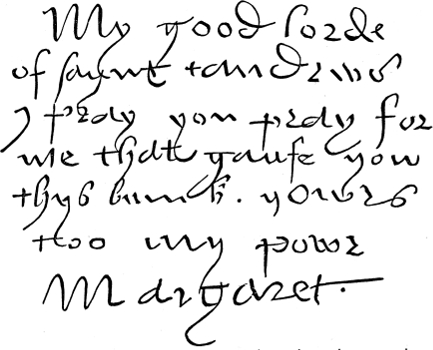
My good lorde of saynt andrews I pray you pray for me that gaufe you thys buuk. yours too my powr Margaret.
On the first leaf of the missal is likewise written, in an antique character, “This book was given by Henry 7 of England to his daughter Margaret, Queen of Scotland (mother to the Lady Margaret Douglas), who also gave the same to the Archbishop of St. Andrews.”
The Queen’s marriage with Angus determined the Council to depose her from the regency.[193] On this measure all but the immediate faction of Angus were agreed. “We have shown heretofore our willingness to honor the Queen,” observed Lord Home,[97] “contrary to the ancient custom of this kingdom; we suffered and obeyed her authority the whiles she herself kept her right by keeping her widowhood. Now she has quit it by marrying, why should we not chuse another to succeed in the place she has voluntarily left? Our old laws do not permit that a woman should govern in the most peaceable times, far less now when such evils do threaten as can scarcely be resisted by the wisest and most sufficient men.”
The majority of the Council agreed in this opinion, one of them quaintly adding, “that the point principally annoying to them was the fact, that the Earl of Angus, as head of the house of Douglas, was already great; the Queen’s marrying him had made him greater still; but, continuing her authority as Regent, now he was her husband, would make him far too great for the peace and safety of Scotland.”[194]
The Council concluded by solemnly deposing the Queen from the sovereignty of Scotland as Regent. Moreover, the Lord Lion, king-at-arms, was formally ordered to signify to Lord Angus “that he must forthwith appear before the Lords of the Council to answer for his boldness in marrying her without their assent and recommendation.”
When the Lord Lion, vested in his most awful paraphernalia, entered the Queen’s presence-chamber to perform officially the summons, the scene that ensued was extraordinary. Queen Margaret received him in the wonted state of regnant-majesty, supported by her juvenile spouse at her side, and by his stalwart grandsire, Lord Drummond, who was all-powerful in the neighborhood of Perth. The Lord Lion demanded to be admitted, not to the presence of the reigning sovereign of Scotland, but only to “my lady Queen, the mother of his Grace our King.” This was a terrible dereliction, the fruits of her recent deposition in council! Of course it produced great irritation in the tempers of all the Queen’s partisans, to say nothing of her own, insomuch that when the Herald-King approached the Earl of Angus to announce that he was summoned before the national council, Lord Drummond bestowed on him a thundering box-on-the-ear.[195]
The sacred ear of a Lion-King had never before met with such[98] a rebuke. He, Sir William Comyn,[196] “whom royal James himself had crowned,” he, attired in the solemn insignia of his office, which Henry VIII. himself, at the head of his victorious army in France, had respected, when he carried from his royal lord, James IV., a defiance à la outrance, and withal a most inconvenient declaration of war—he, to be cuffed and buffeted! How my Lord Lion made his retreat from the presence of the Queen and her uncivilized partisans has never been distinctly described, but a due notation was made of the outrage, as Lord Drummond afterward found to his cost.
The Privy Council forthwith deputed the Lord Lion to proceed to the Duke of Albany, in France, with the official announcement of his election as Sovereign-Regent on the Queen’s forfeiture, entreating him to come to the assistance of the kingdom, as beseemed the Prince of the blood nearest to the royal family.
The Queen gave her own version of the fray with the Lord Lion in one of her dispatches to her brother Henry VIII.; but she denies positively the box-on-the-ear—saying that all the trouble arose from my Lord Drummond having only “shaked his sleeve at a herald,[197] and gave him on the breast with his hand, because the said herald behaved himself otherwise than he ought to do, saying ‘That he came in message from the Lords to my Lady the King’s mother.’”
From the Queen’s narrative it appears that this singular scene took place at Stirling Castle, and she implies that the resistance was made on account of an attempt to take away her children rather than her new husband. However, her statement gives perfect authenticity to the historians who state that there was an assault made on the Lion King in her presence.[198]
The next outrage the Queen committed, by means of her young hot-headed husband, was on the Lord Chancellor Beton, Archbishop of Glasgow, who had expressed his disapproval of the wedlock of the Queen with Angus—which, indeed, by the will of James IV., unhinged the whole government of the kingdom. Worse confusion followed when the imperious bridegroom, at the instigation of Margaret, arrested the Lord Chancellor at[99] Perth, and tore from him the Great Seal of Scotland.[199] The nobility, justly incensed at the insult on the law, in the person of its dispenser, flew to arms. None sided with the Queen excepting her particular dependents and her husband’s clan and faction. Margaret, rather than Angus, deserves the blame of an action stupidly despotic, because she will be found to repeat the same folly more than once in the course of her stormy career, at a time when she was by no means amenable to his influence.
Strife and trouble beset Margaret Tudor from the hour when her imprudent love-match became public. But she fancied herself sufficiently strong in the support of her brother of England to defy any opposition the Scottish Parliament might meditate against the continuation of her reign as Queen Regent. There is reason to suppose that she had lavished on her young husband a great part of the treasure which the King her husband had confined to her keeping. In reprisal, the Scottish Council stopped her dower-rents, which proceeding she set forth as an act of injustice as flagrant as if she had not appropriated the national funds.
Little more than a twelvemonth had elapsed from the death of James IV. when she dictated a dispatch to her brother, in acknowledgment of his promised support, declaring “that his loving letters had arrived at her castle of Stirling, November 22; that she showed them to the lords of her party (chiefly the kin and connections of the Douglas family), to their great consolation.”
“My party-adversary,” adds Queen Margaret, “continues in their malice, and proceeds in their Parliament, usurping the King’s authority as I and my lords were of no reputation, reputing us as rebels.”
Hitherto the Scottish Parliament had acquiesced, for love of the late King, in his testament, which superseded the national laws of Scotland by making Margaret Queen Regent. Her words, above quoted, mark the period when the Parliament, following the lead of the Privy Council, took the sovereign power from her. Some degree of anarchy ensued, the Queen exercising regnant power at Stirling and Perth, while the Parliament ruled at Edinburgh—the Queen having possession of the persons of the[100] infant-sovereign and the babe his brother, while the Parliament had the Lord Chancellor, though not his Great Seal. The people, it may be observed, held the house of Douglas (with which the Queen identified herself) in exceeding detestation. They had suffered too much from the tyranny of those unscrupulous oligarchs, to bear them any good-will, whether they belonged to the “black” branch or the “red” branch of the same line, which last were the Angus-Douglases.
When Queen Margaret found that the people in general disobeyed her regal authority, she failed not to call in the fire and sword of the English to establish her own failing power, without much heed as to whether they would ever leave the country if they gained it.
“I beseech,”[200] she says to her brother, “that you would make haste with your army both sea and land, especial on the chamberlain (Lord Fleming). On that other side the Prior of St. Andrews (Hepburn), with the power of my counter-party (the Parliament), has laid siege to the castle of St. Andrews, which I would your navy would revenge, for it stands on the sea-side, fore-against Berwick by north.[201] I have sent my husband, Lord Angus, to break the siege, if he may, this 23d day (of November).”
Her husband displayed no remarkable prowess in his warlike expeditions. His next expedition was to relieve his uncle Gavin Douglas, besieged in the castle of St. Andrews, against John Hepburn, who had been elected to the dignity of Primate by the chapter of St. Andrews.
“I am at great expenses,” continues Queen Margaret’s dispatch,[202] “every day a thousand in wages, and my money is nigh hand wasted; if you send not soon other succors in men and money I shall be super-expended, which were to my dishonor, for I can get no answer of my rents, as I showed you before. All the hope that my party-adversaries have is in the Duke of Albany’s coming, which I beseech you to hinder in any way; for if he happens to come before your army, I doubt that some of my party will incline to him for dread. There is some of the lords[101] of my party who dread that your army shall do them scathe, and that their lands shall be destroyed with the fury of the army, wherefore I would that you wrote to them that their lands and goods shall not be hurt, and that they shall be recompensed double and treble.
“The King, my son, and his little brother, prospers well, and are right life-like children, thanked be Almighty God.
“It is told me that the lord-adversaries are purposed to siege me in this castle of Stirling. I would, therefore, that Lord Chamberlain Fleming be held waking in the mean time with the Borderers. I trow I shall defend me well enough from the others till the coming of the (English) army.
“I pray you to give credit to Master Adam Wilkinson in other things as it is written by him, and thank him for his good service, and the peril he was in for my sake in the ship that was broken (wrecked).”
The Lord Lion of Scotland, that worthy herald-king who had received the indignity of a box-on-the-ear from Lord Drummond, had embarked to carry the news of his ill-treatment by the Queen’s party to the elected Regent of Scotland, “and other messages,” as the Queen writes, “sealed with the Great Seal of Scotland, which seal they keep masterfully from me and my lords, and use it as if they were kings!” The Lion Herald was shipwrecked, as the Queen observes with no little exultation; and she says, in the presumption of her egotism, “God was of my party, seeing that he letted (hindered) the Lord Lion’s message, and furthered mine!”[203]
In the conclusion of this remarkable epistle she requests her brother to notice, “that if her letters were only signed Margaret R., and no more, they were mere state papers, either forged or forced from her.” She ends this genuine transcript of her mind with these words—“Brother, all the welfare of me and my children rests in your hands, which I pray Jesu to help and keep eternally to his pleasure. At Stirling, the 23d day of November. Your loving sister, Margaret R.” This addition of the words, therefore, “your loving sister,” was to prove the test of the authenticity of her letters. Subsequently Margaret perpetrated[102] a great deal of deceit and double-dealing under this preconcerted signal.
It is a little singular that the proud brother of Margaret Tudor manifested complacency at his sister’s alliance with the Earl of Angus. England had, in fact, found Scotland so formidable since the reign of the Bruce, and especially during the sway of her late great sovereign, that Henry VIII. and his Council were glad of any event which promised the distracting diversion of internal feuds to their active neighbor. Although Henry VIII. was never consulted by Queen Margaret or her second spouse on their union, he mentions it with approval in his state papers, and always acknowledged Angus as his brother-in-law.
The Queen spent the winter at Perth, from whence several of her letters extant are dated. Her meditations were how best to be revenged on the parliamentary lords who had deposed her from her reign as Regent Queen; and she resolved to take the first opportunity of escaping to England with her sons, knowing how wofully Scotland would be crippled by the detention of her sovereign in England, as in the instances of David II. and of James I.
Wolsey and her brother perpetually urged her to take this step. “It comforts my heart to hear your fraternal desire,” says Queen Margaret,[204] in one of her letters from Perth to Henry VIII.; “but it is impossible to be performed by any manner of fashion that I, or my husband (Angus), or his uncle Gavin, can devise. Considering what watch and spies there is daily where I am, I dare disclose my counsel to none but God! An’ I were such a woman that I might go with my bairn on mine arm, I trow I should not be long from you, whose presence I desire more than any man. I trust, dear brother, to defend me from mine enemies, if I had sufficient for expenses till the coming of your help; but I am so super-expended that I doubt that poverty shall (will) cause me to consent to some of their minds, which I shall never do against your counsel while I have a groat to spend. Wherefore I pray you to send me some money, for it is not for your honor that I or my children should want.”
Ever since the death of James IV. a great portion of the Scottish nobility and gentry had sedulously invited the banished[103] Duke of Albany to return to Scotland, and take upon him the executive department of the government. But Albany, though an exile in France, was exceedingly happy and beloved there. He was one of the most renowned warriors in Louis XII.’s Italian wars, and was, moreover, both by inheritance and marriage, the lord of some of the fairest provinces in that pleasant land. When he was invited to share the government with Queen Margaret, he positively refused, saying that “the King of France could not spare him; moreover, his possessions in Scotland were confiscated, and till they were restored he should not trouble himself with the country.” Unfortunately Queen Margaret was dowered on his earldom of March, which rendered such restoration difficult.
However, that clear ideas may arise relative to a prince whose career was for some years intimately involved with that of Margaret Tudor, here follows a rapid sketch of his parentage and position in France.
The Regent Albany was the son of Alexander, Duke of Albany, that brother of James III. who had been spirited up by Edward IV. to act the same part in Scotland toward his sovereign, King James, that Edward’s own brother, Richard of Gloucester, afterward performed in England. Albany had declared the royal children, his nephews, illegitimate, and withal did his best to wrest the crown from his brother, which he would have basely held of the English King as a vassal-prince. It is one of the stern lessons with which history is replete, if politicians were not too supercilious to heed them, to view Edward IV. deliberately planning, for the destruction of his Scottish neighbor, the prototype of the same species of treason which rendered his own family desolate, and caused the deposition and the murder of both his sons.
Alexander, Duke of Albany, having failed in his attempts, and being taken prisoner, was expecting hourly to be put to death in Edinburgh Castle, when, by the aid of his faithful and devoted page, he escaped from a great height by means of a rope. In the course of the escapade, the page fell to the ground and broke his leg, but Albany ran the greatest risk of detection by carrying him off on his back.[205] A man was naturally meant for good who could be, in moments replete with peril, thus alive to the feelings of gratitude and generosity.
[104]
The fugitive Scotch prince escaped to France, where he married the heiress of a princely house, Anne de la Tour.[206] He was killed by accident, in Paris, tilting at a tournament, 1486. He left one son by Anne de la Tour, John Duke of Albany, born in exile, who became fatherless at four or five years of age. This was the Regent of Scotland. He married a lady of his mother’s family—her niece—a great heiress, Agnes de la Tour, Countess of Auvergne and Lauragais. She made him count of the latter district, and gave him a great number of lordships. They were married in 1505. The Duchess of Albany was aunt to Catharine de Medicis, afterward Queen Regent of France, who finally became heiress to the vast possessions of la Tour Auvergne.
When Louis XII. died, his successor, Francis I., became desirous of obtaining influence in Scotland; he therefore urged his friend and comrade in arms to accept the offered government of that country. Albany was exceedingly unwilling to leave his wife, whose health was not strong; but after Scotland had restored him to his rank he had no farther excuse. Accordingly he sent his friend, Antony d’Arcy, Sieur de Bastie, together with his cousin the Earl of Arran (who had never dared to return to Scotland since his unlucky naval expedition), to take possession of the citadel of Dunbar in his name. De Bastie knew Scotland well. He had been a great favorite with James IV.; he had tilted at Queen Margaret’s marriage with that King; he seems to have inspired the generous mind of Albany with the greatest enthusiasm for the character of his royal cousin, James IV.
It was on the 18th of May, 1515, that the Regent Albany landed at Dumbarton, with eight ships full of French stores and some men-at-arms. Lord Home met him at the head of ten thousand horsemen, his March-riders.[207] He expected to be caressed as a powerful partisan; but the French cavalier de Bastie, had, it is supposed, explained to Albany that this treacherous chieftain had turned the day of Flodden against Scotland, and caused the death of James IV., for which Albany vowed at some day or other to punish him. As it was, he treated him dryly, and scarcely civilly; and when Home, who was dressed gayly in Kendal-green velvet, was endeavoring to make Albany understand[105] his value as a feudal chieftain, Albany made a quotation in Latin, to the effect that his immense train of followers was not adapted to a subject, and that a gorgeous dress ill became a mean and diminutive person.[208]
Lord Home had detested Queen Margaret and his infant sovereign, because all their friends suspected him of treachery at Flodden. He had hoped for mighty influence with the new Regent, who, being a Frenchman by birth and language, he hoped was ignorant of all reports against him, and only conscious of his power. Licensed at Albany’s contempt for his person and greatness, he withdrew in the full determination of setting up Queen Margaret’s title to the Regency, against Albany, with all convenient speed.
Meantime Queen Margaret advanced from her strong hold of Edinburgh Castle to meet the Regent, and do him all possible honor.[209] Perhaps the repulse that Albany gave to her enemy, Lord Home, had pleased her; it is certain that she at first was on very friendly terms with the rival Regent. Some flatterer had persuaded her that Albany was much disappointed because her marriage with Angus prevented him from offering her his hand; but how that matter was to be arranged it is difficult to say, as Albany had one good wife alive in France. The letters of Margaret perpetually dwell on this subject, more than could have been expected, considering the matrimonial ties by which each was bound.[210]
The Parliament at Edinburgh having, in July, 1515, solemnly invested the new Regent with the sword and scepter of state, Lord Drummond was called to account for his audacity in striking the Lord Lion of Scotland when performing the solemn behests of the Council; and, the crime being proved against him, the Regent sent him prisoner to Blackness Castle, and confiscated all his lands and goods. Gavin Douglas was committed to prison for the pretense he made to the Primacy, to the great tribulation of Queen Margaret, whose own version of the matter shall here be quoted. After mentioning the unaccountable alarm she was in lest she should have been forced by the Scotch to marry Albany, on which account she pretends that she took Angus, she proceeds to detail the dispute with the Lord Lion, saying “that[106] the Duke of Albany had made fair and pleasant semblance to her at his first coming; but now, by the advice of his council, was meditating to take her tender children from her keeping.”[211]
But the confiscation of Lord Drummond, and his incarceration, and withal that of her uncle by marriage, Gavin Douglas, were the points which more immediately afflicted her. “So,” she continues, “I went down from Edinburgh Castle sore weeping to Holyrood, where the Regent lodged, entreating him to let them out, as they were the principal members of the Council; but grace I gat none.”[212] It is said Queen Margaret asked grace for Drummond on her knees, weeping all the time. She finishes her dispatch, which seems addressed to the Scotch ambassador resident in London for the information of her brother, Henry VIII., by exculpating herself from “ever inviting this Albany, who had done nothing but vex and trouble her and her friends.”[213] “All her party,” she complains, “had deserted her, except her husband the Earl of Angus, and Lord Home.”
Thus, in the course of six weeks, the latter, from acting as her chief opponent, had become her partisan against the Regent.
The Parliament having joined the Queen in petitioning the Regent for clemency to Lord Drummond, he was pardoned by the Regent, and his estates were restored. It was the last political agitation in which the aged statesman engaged. The threatened severity impending over him had a remarkable effect in taming the Earl of Angus and his brother George, when Queen Margaret commenced a struggle with the Regent.
A more difficult undertaking than the deprivation of her political power was to wrest her children from Queen Margaret. The Regent evidently demurred on a proceeding in which the kindest measures taken could not fail of seeming cruel in the extreme. July had nearly passed away, yet Queen Margaret still held possession of her little sons at the castle of Edinburgh. Albany made his approaches with great caution, while the Parliament was sitting at Tolbooth. There the national council chose eight peers, and out of them Albany was to appoint four by lot; and from the four Queen Margaret was to choose three to intrust with the care of her royal infants.
The four peers went in solemn procession from the Tolbooth[107] (where the Parliament sat) up to Edinburgh Castle-gate. All the Guid Town followed them on foot, in immense concourse, to behold the exciting drama, in which their Queen and little ones played the principal parts. The gates were unfolded, and the people beheld the Queen standing within the entrance, holding the young King, with his hand clasped in hers; behind her was the nurse, with the infant Duke of Ross in her arms; near her stood her husband Angus, and her household made a half-circle in the rearward.[214]
The Queen had certainly drawn up her little force with great scenic skill, and it had its due effect on the good people of Edinburgh, who hailed the tableaux vivans before them with long and loud acclamations. When some degree of silence was restored, which was only when the populace had shouted themselves hoarse, Queen Margaret, seeing the approach of the delegates from Tolbooth, gave the words, with much majesty and command, of “Stand![215] Declare the cause of your coming before you draw nearer to your sovereigns.”
The four Scottish peers replied “that they were deputed by the Parliament, then sitting, to demand and receive their infant king and his brother.”
All the answer Margaret vouchsafed was, “Drop the portcullis!” To the consternation of the parliamentary deputies, the massive iron gate thundered down betwixt them and the royal group.
The Queen then addressed the lords commissioned to take her infants from her arms.
“This Castle of Edinburgh is part of my infeoffment! By the late King, my husband, I was made sole governess of it, nor to any mortal shall yield the command. But I require, out of respect to the Parliament and to the nation, six days to consider their mandate. For my charge is infinite in import; and, alas, my councilors be few!”
She then led away her little monarch from the gateway, followed[108] by her train; and the peers retired in great admiration of her beauty and high spirit.
Angus was by no means remarkable for the latter quality, or at least did not exert it in this picturesque historical scene. In great alarm, lest he might have forfeited life and lands by disobeying the Regent, then sitting in full national council, he had a notarial instrument drawn, attested by proper witnesses, affirming that he had desired the Queen to surrender the royal children.[216]
Angus sent this parchment to the Regent. From that moment Angus, it may be perceived, neutralized every effort the Queen made to place him in sovereign power by her side. It is likewise evident that, from the same period, Albany treated him as a fellow of no reckoning—one who was in action, as in years, “childish young,” according to Lord Dacre’s expressive phrase. In short, much analogy may be traced between the conduct and character of Angus and of his unfortunate grandson Darnley; only, if the conduct of the latter is really viewed without prejudice, it presents more courage and power of will. Both were the husbands of reigning Queens of Scotland at the age of nineteen.
Queen Margaret, perhaps, did not know how thoroughly her lord and master had succumbed to the authority of the Regent of Scotland, as it is likely that Angus consulted not his royal lady concerning his submissive message, which was accompanied by a promise that he would manage her so that the King and his brother should be yielded peacefully, before the six days she had asked for deliberation. The Queen, on the fifth day, made an offer to the Parliament, “that if the infant James V. and his brother were left to her care, she would maintain them on her dowry; and that she would submit that they should be committed to the custody of the Earl Marshal, of Lord Home, Lord Chamberlain, of Sir Robert Lawder of Bass, and of her husband, Lord Angus.”[217]
[109]
Margaret had anticipated that her proposal would be refused; she, in consequence, fled to Stirling Castle, whither Albany followed her at the head of seven thousand men. He summoned her to surrender (August 4).
Angus was not with the Queen at this juncture; for when she fled to Stirling, he retired to his titular county, following the proverb of his family, which was often on his lips, “that he would rather hear the lark sing in the open country, than the mouse cheep”—shut up within the walls of a fortress. All the answer the Regent vouchsafed to the notarial deed of obedience which Angus had sent him, was an invitation to join his muster at Stirling; and besiege his own wife[218]—a proceeding beyond the bounds of Angus’s intended submission, which merely meant a duteous care of self, by keeping out of harm’s way. As for marching with the Scottish Regent to besiege the lady-Queen his spouse, it was more than he dared do.
Queen Margaret, finding that her husband had decamped, had no wish to stand a siege in Stirling Castle from a warrior of the Regent’s military fame. So, giving the Regent intimation that she was ready to surrender her infants into his keeping, she presented herself at the gate of Stirling Castle, with her little James V. She put in his tiny hands the massive keys of the palatial fortress, and, with a nod, directed him to give them to the Regent.
Albany knelt and received the keys and the regal boy at once in his arms, and bestowed on him many caresses.[219] He treated Margaret with great kindness and attention, giving her leave to remain with her children as long as she liked, and to see them whenever she pleased; but she was not permitted to remove them from Stirling Castle; as the sudden march of Albany was occasioned by certain intelligence which convinced him that she had intended to abduct them to England on the night of August 4.[220]
The forced surrender, by the widow of Edward IV., of the royal children of England, bore an appalling resemblance to Margaret’s delivery of the royal infants James V. and the baby Alexander, to the Regent Albany. The whole world expected that James V. would disappear as speedily from this world’s scene[110] as his relative Edward V. Queen Margaret loudly proclaimed that such would be the case. Albany bore the angry imputations of the alarmed mother with exemplary patience. Nevertheless, her plots became incessant to further their escape into England.
A vigilant eye was kept on Lord Home by the Regent; for he knew that it was on this suspicious character that the Queen chiefly depended for the abduction of her little sons from Stirling.
The delicate situation of the Queen, her weakness at such times, when she always hovered on the brink of the grave, even when surrounded by all the care of her household, made her little calculated to undertake the perils and hardships attendant on her scheme. But she fully intended making the seclusion of her sick-chamber instrumental to her escapade.
In the course of the ensuing month, Margaret wrote the following letter to Lord Dacre:—[221]
“My Lord Dacre—
“I commend me to you as heartily as I can; and I have seen your writing, and understand at length; and I perceive that ye are not sykerly (certainly) informed in what state I stand in, for ye trow (trust) ‘that I may pass wherever I will wish.’ It is not true; but this bearer can show you the truth of all, and what my mind is, and how I am constrained to do against my will. And I pray you give him credence as ye would do to myself, for it is o’er-long to write—for I have great trust in this man.
“And send me your utter mind and answer in all thing, and God keep you.
“Written with my hand this Monday.
“Your friend,
“Margaret R.”
As a commencement to her operations, she wrote a letter to her brother, Henry VIII., which apparently was inspected by the Scottish Council; for it professes the greatest satisfaction at all the arrangements of the Regent, while all her other epistles manifest the utmost discontent. The Queen therein announced, that she meant to assume the state and dignity of “taking to her chamber,” for the birth of the child of Angus, similar to the ceremonial attending her confinements when she was Queen consort of Scotland. “Brother,” wrote Margaret, “I purpose, by the grace of God, to take my chamber, and lie in in my Palace of[111] Linlithgow, within this twelve days, for I have not past eight weeks to my time; at the which, I pray Jesu to send me good speed, and happy deliverance, and to have you, dear brother, eternally in his keeping.” Her date is, Edinburgh, August 20.[222]
The ceremonial of “taking her chamber” withdrew Margaret from the public eye for some weeks; and that period she meant to employ in stealing her infants, by the aid of Lord Home, and escaping over the Border, which purpose she distinctly declared to Lord Dacre.
The Queen was, to all appearance, settled at Linlithgow in her chamber, lined with tapestry, where every breath of air was excluded, even the windows covered up—excepting one, from which the tapestry was occasionally withdrawn, if the royal patient had a great wish for light and the free breath of heaven. According to the written ordinances of her grandmother, Margaret, Countess of Richmond, she was to be served by female officers, lady-chamberlains, lady-ushers, lady-sewers, pantlers, and butlers. Men, let their rank or near relationship be what they might, were only admitted to converse with the Queen, when immured in her chamber, on occasions of life and death. To this strange ordinance, commenced by a religious ceremony, the royal mother[223] of Queen Margaret submitted in Westminster Palace, when she herself was born; of course, the Regent Albany could not expect the daughter of the heiress of York to abate one jot of this regal seclusion in her own Palace at Linlithgow. Well he knew that, if he, or any other prying lord of the creation, had made inquisition into such sacred retirement, the tongues of every female in the island, south as well as north, would forthwith have been in a virulent state of activity, and the two kingdoms had resounded with the “wrongs of the Queen of Scotland.”
Under shelter, therefore, of her privileged seclusion, Queen Margaret deliberately went to work, and commenced her preparations for escape. First, she affected to be very ill indeed, on which her husband, Angus, came to Linlithgow to see her. The next night, she stole out from her palace with him and four or five servants, unaccompanied by any female. Within two or three miles of Linlithgow town, the Lord Chamberlain, Home,[112] met her, with an escort of horsemen, “hardy, well striking fellows,” as she describes them: thus guarded, they escaped to Tantallan Castle, the famous fortress of the Douglas, within a few hours’ ride of the English frontier.[224]
Before the Queen’s escape was discovered, Lord Home proposed that his rough-riders should fire one of the Duke of Albany’s towns, and some other “ruffling.” “When the Regent’s attention was drawn from Stirling garrison,” Home said “that he hoped he should be able to carry off the royal infants (to whom his state office of Lord Chamberlain gave him access), and after joining the Queen at his stronghold of Blackater Castle, they could from thence escape into her brother’s kingdom.”[225]
All succeeded, in regard to Margaret’s escape, according to her plan of action excepting the abduction of her children. Albany’s vigilance was not to be diverted from them; and the Lord Chamberlain, Home, by his scheme of arson and “other ruffling,” rendered himself an outlaw, but gained naught besides. Home escaped to Tantallan, where Margaret, Angus, and he remained till September 23, waiting the pleasure of Henry VIII.
The fatigues of her removal had a severe effect on the health of Queen Margaret; yet the failure of Lord Home’s attempt obliged her to flee from Tantallan in such haste, that she left her jewel-box and wardrobe there. She paused on the verge of England, not daring to enter unless invited formally by her brother;[226] but being worse every moment, she took sanctuary, half-dead, at Coldstream Nunnery, the lady-prioress of which was aunt to her own faithful comptroller of the household, Robert, or, as the Queen always terms him in her letters, Robin Barton.[227]
At Coldstream Priory the Queen remained long enough to receive the sympathizing visits of old Lady Home, mother to Lord Home, Chamberlain of Scotland. The Queen’s situation occasioning her great suffering, Lady Home came to give her comfort and matronly counsel concerning her health. But directly the Queen[113] went forward to England, an agent of the Duke of Albany, a Frenchman, called M. de Barody, in order to strike terror into her friends, seized poor Lady Home in a furious and cruel manner, set her upon a high-trotting nag, to her extreme peril and pain, carried her to the Castle of Dunbar, where he put her in the strongest prison-ward, and fed her on bread and water; “from which durance, if she be not speedily released, Queen Margaret,” said she, “verily believed, considering her feebleness of body, that the Duke of Albany’s Frenchman meant to be the death of old Lady Home.”[228]
The expected invitation of Henry VIII. at last arrived, which caused Lord Dacre to send an escort to Coldstream for Queen Margaret, for the purpose of conveying her as far as Morpeth Castle, his family residence, where she would have from his lady proper attention. At his baronial seat, he had appointed Sir Christopher Gargrave, or Gervase, to await her with “stuff,”—meaning all sorts of conveniences and comforts, which her considerate sister-in-law, Queen Katharine, had sent from London, for her accommodation and her expected confinement,[229] by the said Sir Christopher, a knight of the King’s bedchamber.
The welcome message of Dacre arrived at Coldstream almost in the last minute that Queen Margaret could be moved. So desperately ill was she taken on the road, that her convoy were forced to stop by the way, and hurry her into Harbottle or Hardbattle Castle, one of the grimmest and gauntest stone-donjons that frowned on the English frontier. It was just then garrisoned by Lord Dacre in person, who had commenced the fierce war on the Borders to which the arrival of the Duke of Albany in Scotland had given rise.
The portcullis of Harbottle was raised to admit the fainting Queen of Scotland; but not one Scot, man or woman, Lord Dacre vowed, should enter with her.[230] Here was a terrible situation for Margaret.
She was received into the rugged Border-fortress, October 5, and, after remaining in mortal agony for more than forty-eight hours, gave birth to a daughter, the Lady Margaret Douglas,[114] whose name is familiar to every one on the pages of general history, as the immediate ancestress of our present royal family.
There were the royal mother and daughter without female attendance, in a Border castle, surrounded by a wild and barren country, which was scoured on all sides by incensed Scottish moss-troopers. And the garrison of their rugged lodgment was not many degrees quieter than the enemies it kept at bay.
It has been shown that Lord Dacre had appointed all “the stuff” with Sir Christopher Gargrave to wait the Queen’s arrival at Morpeth, because small chance would there have been of its safe arrival at Harbottle Castle, with such troops of plunderers to intercept it on its way. Sir Christopher Gargrave, however, brought the letters from Henry VIII. and Queen Katharine to Queen Margaret; but she was too ill to read them for many days. In this exigence, Sir Christopher was ordered to wait her convalescence at Morpeth.[231]
The Queen exhausted her small remaining strength by dictating, on the third day after the birth of her daughter, a letter to her kinsman the Duke of Albany of an agitating nature. “She had been forced,” she says, “for fear and danger of her life, to depart from Scotland to the realm of England.” The letter was written after the baptism of the infant—this being evident by the quaint announcement of the child’s existence in these words,—“So it is that, by the grace of Almighty God, I am now delivered, and have a christian soul,[232] being a young lady.”
But Margaret could not be content with the information thus given to her cousin-Regent. She concludes her epistle with an angry exhortation, in God’s name, that he should suffer her, as his honor, and right, and good justice require, to have the whole rule and governance of Scotland, and of her tender children as their tutrix, according to the will of the late King of Scotland,[115] her spouse. The letter is not signed by the Queen, her state being very dangerous; and, indeed, the task of signifying her intentions, and entering into such agitating subjects, must have proved nearly fatal to her. It is dated October 10, 1515.
Lord Dacre has been considered remarkably insolent and neglectful in his manner of announcing the birth of the niece of his royal master; but the situation of Lord Dacre has not been properly considered. He was, in plain reality, much in the case propounded, by way of comic argument, to Dr. Johnson,—“If you were shut up in a castle with a new-born babe, what should you do with it?” And Lord Dacre, although not exactly alone with the royal babe, had aggravations of the case, of difficulty far beyond the power of Boswell’s imagination to conceive, being occupied in hourly repelling assault and siege—for the Scottish Borderers, in a state of extreme exasperation at the flight of their Queen, were hovering round the gray pile of Harbottle, ready to demolish all goers and comers from its gates, and make spoil or prey of all supplies brought within its walls. Moreover tidings came, ever and anon, that the Regent Albany, at the head of forty thousand Scotsmen, was in full march to beleaguer the castle. He had already captured all Queen Margaret’s jewels and fine clothes, at her deserted castle of Tantallan.
“Glad would we have been,” proceeds Dacre, “to have advertised your Highness of the Queen’s safe deliverance, but our causes (state) here was intricate, with so much cumber and business, that we could not ascertain your Highness of the same till this time, unless we should have sent up a post purposely for the said Queen’s deliverance, which we thought not greatly requisite.”
Poor Lord Dacre! most undeservedly are you blamed, while your moderation in using such a temperate word as “cumber,” to express the complication of troubles which had suddenly descended in the midst of Harbottle, is so remarkable, so praise-worthy. Let us coolly enumerate all that the hardy warrior had to try his patience. Assistance of the most delicate nature was indispensable, and no such requisites were at hand. A helpless baby was wailing for nourishment—its royal mother fainting between life and death within the walls of the castle, while inimical Border-riders were ranging without, ready to pounce upon and demolish every needful relay that approached Harbottle[116] of doctors, nurses, caudles, potions, baby-clothes, and cradles. Then there was a royal christening performed the day after the unexpected arrival of the smallest guest. The stout-hearted Lord Warden must stand excused in the eyes of all considerate readers of history, if he omitted some of the ceremonious expressions and observations suitable to the rank of his guests, mother and daughter, when the difficulties of the casualty are properly appreciated. But let him plead for himself in his own unsophisticated language.
“Forasmuch,” continues the Lord Warden,[233] “as the Queen’s lying here is so uneaseful, and costly, by reason of the far carriage of everything, we be minded to move her Grace to Morpeth, as soon as she conveniently may, after her Grace have sought the Church for her thanksgiving. It may like your Highness to signify your mind and pleasure unto her said Grace, how ye think ye will have her to be further ordered, that we may motion and move her accordingly. Sir Christopher Gargrave went to Morpeth immediately on the Queen’s deliverance, and, by our advice, hath continued there, with such stuff as your Grace hath sent to the Queen, your suster, till Sunday last past, which day he delivered your letter, and disclosed your credence, greatly to the Queen’s comfort. And forasmuch as the Queen lieth yet in childbed, and shall (will) keep her chamber these three weeks at least, we have advised the said Sir Christopher to remain at Morpeth until the Queen is coming thither; and then her Grace may order and prepare every part of the said stuff after her pleasure, and as to her Grace seemeth most convenient. And Almighty God have you our most dradde sovereign lord in his most blessed preservation. At Harebottell, the 18th day of October.”
About the same time, Lord Dacre permitted a congress of the Scottish lords, then in insurrection against the Regent, to assemble at Harbottle. They all signed a covenant, binding themselves to free the infant King of Scots and his brother Alexander from the control of the Duke of Albany; at the same time wresting the regnant power from him, and bestowing it on the Queen. The signatures of her husband, Angus the second prince of the blood, Arran, and the firebrand of mischief, Lord Home, appear to this state paper.[234]
[117]
No wonder Margaret’s life was in danger, when proceedings of such agitating tendency were transacted around her sick-bed. Before the Queen was sufficiently recovered to leave Harbottle, she received letters from the Scottish Regent and Council, in which her flight was discussed, and her return entreated. The conduct of Margaret at this juncture is discussed with no little sagacity by our great modern historian Tytler, to whose patient research and manly candor the world is indebted for justice done to that calumniated Scottish prince, the Duke of Albany. “Notwithstanding the infatuation of the mother of his sovereign, Albany was still anxious to make a last effort for a compromise: he addressed two letters to her on the same day (October 13), the first a manifesto from the Scottish Council,[235] commencing with these words,—‘Madame, we commend our humyle service to your Grace.’ The other,” continues Mr. Tytler, “was a private communication written with his own hand. The terms of both were moderate and even indulgent. The Council implored her to awake to her duty, declared their aversion to all rigorous measures, besought her to come back among them, and, as inducements, promised that she should enjoy the disposal of all benefices within her dower-lands; a benefice to her councilor, Gavin Douglas; and, lastly, the guardianship of her children, if she would solemnly promise that they should not be carried out of the kingdom. These proposals the Queen imprudently rejected, for what reason does not clearly appear. Albany’s whole conduct shows them to have been sincere; although Margaret, acting under the influence of Angus, Home, and Arran, had been taught to regard them with suspicion.”[236]
Albany, meantime, wrote to Henry VIII. that he did not in the least wish to harm or annoy the Queen; he repeated to the English monarch the advantageous terms he offered her, but without avail.[237]
The removal of Margaret and her little infant from the grim shelter of Harbottle Castle could not take place until November. When she removed to Morpeth Castle (where Lord Dacre’s[118] family usually resided,[238] with such degree of comfort as the warlike office he held permitted), she immediately suffered a long relapse of dangerous illness, greatly aggravated by agitation of mind, arising from several causes. Lord Home was making desultory war on his own country, committing excessive outrages on the Scottish border. He had caught the same Lord Lion at Coldstream with whom Queen Margaret’s party had commenced war by giving him that remarkable box-on-the-ear, and had reft from him the Regent’s letters to King Henry VIII.[239] Albany exchanged for his captive Lord Lion the old Lady Home, whose wrongs, as she returned from waiting on Queen Margaret at Coldstream Nunnery, have been related.
In the midst of this negotiation, which greatly agitated the sick Queen, and long before she had gained strength to bear the shock, her feelings were awakened from the dullness of political treaties to all the agonies of an absent mother. One of the sons she had left in Scotland—one of those tender little ones for whose possession she was then negotiating—fell sick of some infantine disorder, and expired at Stirling Castle, December 18, 1515.[240]
Margaret’s partisans thus spoke of his death,—“Alas! it is openly spoken and repeated, that the Duke of Ross, the King’s brother, died from want of things necessary for such a prince, or else was poisoned.”[241] Another says,—“Prince Alexander, a child beautiful and promising to admiration, died at this time, or was murdered.” Margaret’s grief is best attested by the long illness which succeeded the intelligence. When she recovered, rage found utterance beyond grief; and long and loudly did she accuse Albany of poisoning her little Alexander. Yet the very circumstance of the young King, his brother, remaining lively and healthy, is a sufficient vindication of their faithful relative. Much Margaret exclaimed, both with tongue and pen, regarding Albany’s guilt; many comparisons she drew between his proceedings and those of Richard III., his father’s friend and ally. Yet the princes of York vanished together; while the death of the baby-prince[119] of Scotland could do no good to Albany, as James V. lived and flourished.
A curious circumstance attended the sick Queen’s vehement accusations. Years afterward, when she was on remarkably loving terms with the handsome Regent, all her partisans renewed the vehement charge of murder which she raised at Morpeth against him, without perhaps having believed it herself—for it was a political outcry, like those which in subsequent centuries were used with more success as party-weapons against the Anglo-Stuarts.
A sorrow yet harder to bear likewise beset Margaret at Morpeth. Her husband, tired of waiting in attendance for her recovery, thought fit to accept the favorable terms offered him by the Regent, and, deserting her, decamped into Scotland. The time he chose for this escapade offended her as much as his mode of action, insomuch that she never forgave his conduct. It was on the very day when her life was despaired of, at Morpeth (January 17, 1515–16), that he perpetrated his desertion of her and his infant, signed the treaty with the Regent, and went back to Scotland. The poor Queen was suffering under the crisis of a typhus fever, from which she was not expected to recover.[242]
Her friend and priest, Dr. Magnus, ventured to offer his advice to Henry VIII. that he should “write comfortable letters to his sister and send for her; because she hath daily messengers coming out of Scotland, so that she is troubled in her mind, and put to study, to imagine and cast what answer to make to them.” Magnus was evidently her amanuensis in answering many of these dispatches, for he adds, “We have taken care that her letters to the Scottish Regent be so worded, that no good understanding shall ensue between them.” Yet he is evidently in dread lest Margaret should soon break through all his cunning diplomatic tricks of writing, and send to the Regent different matter; since he adds—
“Her Grace doth not make us privy to every thing, yet she as yet, as a great wise woman, resteth on this—namely, that she will do nothing without the consent of your Grace.”[243]
These representations had the desired effect, especially as they were backed by a gentle, and at that time an all-powerful pleader at the ear of Henry VIII., being his excellent Queen, Katharine[120] of Arragon, who ever showed kind and sisterly attention to Margaret Tudor.
Under her influence, Henry VIII. sent a frank invitation for his sister to come to his court at London for her solace. He thought proper to request her husband to accompany her. Angus thanked his brother-in-law, with many professions of humble gratitude, and promised to give his attendance on his spouse the day she set forward to the south.[244]
The first fine days of April brought to Morpeth Castle a gay and noble cavalcade, sent from London, with all things suitable for the accommodation of the languishing and destitute Queen of Scotland. One of Henry VIII.’s gentlemen of the bedchamber, William Blackwell, “clerk of his spicery,” escorted a large supply of silver vessels for Margaret’s use, with all proper officers to wait upon her on her journey. “Sir Thomas Parr, Katharine of Arragon’s equerry, arrived with the present from his Queen of her favorite white pony or palfrey, with her own easy pillion, to her sister Margaret.”[245] And to the care of Sir Thomas Parr, the tender and humane Katharine especially intrusted the care of her forlorn sister-in-law’s person.
Angus, it would seem (according to the assertion of his cotemporary. Hall the chronicler), had made his appearance at Morpeth, for the purpose of escorting his consort to her brother’s court; but some distrust subsequently seized on his fluctuating mind.
“When Queen Margaret was ready to depart, she asked for her husband. But he had not kept his promise, having departed to Scotland; which made her to muse on this sudden absence. Howbeit, the English lords greatly encouraged her to keep her own promise to the King her brother. So, when she was somewhat appeased, she set forward; and in every town she was well received.”[246]
Notwithstanding the deep mortification Queen Margaret had suffered before her countrymen, by the recreant desertion of her spouse at the commencement of her journey, yet it is evident, from the tenor of the following letter, that her spirits felt the pleasant change of a southern progress, from languishing on a sick-bed in a dismal northern donjon. She thus wrote to Henry[121] VIII. while resting at Stony-Stratford, on her London-ward journey.
“Dearest Brother—[247] As heartily as I can, I recommend me unto you, and let you wit (know) that yesternight I came hither, so being comforted of you in my journey in many and sundry wises (ways) that, loving be to our Lord God, I am in right good heal (health), and as joyous of my said journey toward you as any woman may be in coming to her brother, as I have great cause, and am most desirous now to come to your presence, and to have sight of your person, in whom, next to God, is mine only trust and confidence.
“Advertising you, dearest brother, (that) I have received this day a letter from my son’s ambassadors now in London, which letter I send you herein inclosed, and have addressed unto them mine answer severally in two sundry letters (copy whereof I also send unto you), that, upon notice had of the same, it may like you to command whether (which) of the said letters it seems best at your pleasure shall be delivered.
“And the Holy Trinity have you, my most dearest Brother, in tuition and governance. At Stony-Stratford, the 27th day of April.
“Your loving Suster,
“Margaret.
Endorsed—“Unto my dereste broder the King’s Grace.”
Her stages to London were very short and easy, for it was the sixth day after the date of this letter that the recorder of London, Edward Hall, thus notes her arrival—“The Queen of Scotland made her entry into London, May 3, 1516, riding behind Sir Thomas Parr on a white palfrey. She was richly beseen with a great company of lords and ladies.” She came first to Baynard’s Castle, and from thence she was convoyed by water to Greenwich Palace, where she was received right joyously by the King her brother, Queen Katharine, and the French Queen, her sister.[248]
One of the first questions demanded by King Henry was, “Where is my Lord of Angus?” He was perforce informed of the peculiar mode in which his brother-in-law had absented himself. Henry manifested his national antipathies, as well as his disdain for his sister’s injuries, by the exclamation—“Done like a Scot!”[249]
Many brilliant festivals were devised on account of Queen[122] Margaret’s visit. Among others, the King proclaimed a grand tournament in her honor, which took place May 19 and 20. Henry held the lists with his favorite and brother-in-law, Suffolk, very gayly attired; their housings and tabards were embroidered with golden honeysuckles, after which “they ran volant against all comers, very pleasant to see;” and in this volant course Henry knocked over, man and steed, Sir William Kingston, a tall and burly knight, a feat which mightily gratified all the loving lieges then looking on. And when night approached, Henry and his train went to Queen Katharine’s chamber, where the King disarmed; and when his helmet was removed, the Queen of Scots, and her sister Mary, as well as his own Queen Katharine, affected great surprise and pleasure at finding that the victorious knight, who had gained such renown by the overthrow of the gigantic Kingston, proved to be the King. Such was ever the etiquette of Henry’s tournaments. The royal party then sat down to a sumptuous banquet, prepared in honor of the Queen of Scots.[250]
Every individual of Margaret’s family surrounded her at Greenwich, for the purpose of welcoming her, by keeping the merry month of May as one continued festival. The reunion of the Queens of the house of Tudor with their brother and sister-in-law, has been commemorated by the artist who illuminated one of Henry VIII.’s music-books, still preserved in the Harleian Collection. On the first page are the arms of England; and beneath, the badges of Henry VIII. and Katharine of Arragon, the rose and pomegranate, richly illuminated; and opposite is the daisy or Marguerite and the marygold—one flower being the badge of Margaret Queen of Scotland, the other, of her sister Mary, Queen Dowager of France, then recently united to Charles Brandon, Duke of Suffolk. The date is 1516.
During the whole of the summer, Margaret kept up, by means of her letters, an active series of intrigues against the Scottish Regent. Although much incensed with her husband, she instigated him, by her correspondence, to aid the King, her brother, in the unworthy task of wounding and betraying Scotland for the promotion of their private ambition. Lord Dacre refers Cardinal Wolsey to Queen Margaret for information regarding a scheme of his to subjugate the Regent.
[123]
She betrayed all the private affairs of the Scottish government to her brother’s council, while Angus privily aided the unscrupulous warfare carried on by the general of the English boundaries. Such was the true but disgraceful position of Queen Margaret and her spouse, during her sojourn in England.
The intolerable aggressions carried on by the collusion of her husband with the English warden, had caused the Scottish Regent to talk of visiting the court of Henry VIII., for the purpose of civilly remonstrating on the mutual evils caused by such wicked warfare. The heart of Margaret leaped with joy at the very idea of her rival in empire thus putting himself in the power of her unscrupulous brother. But she fairly owned that the news was too good to be true.
“My Lord Cardinal,”[251] wrote Margaret to Wolsey, “I am gladder of the tidings that the King’s Grace (Henry VIII.) telled me of the Duke of Albany, that he will come hither, which I beseech God may be true, but I dread it be not.
“My Lord, I think (it) right long till I speak with you; for next to the King’s Grace my most trust is in you, and you may do me most good of any. And I pray you, my Lord, as soon as any body comes out of Scotland, that you will send me word, for I think long till I hear tidings.
“No more, but God have you in his keeping.
“Your friend,
“Margaret R.”
The Queen was right in her surmises. The Scottish Regent repented of his Quixotic proposal of visiting the court of Henry VIII. However, he behaved with knightly courtesy regarding that species of property belonging to Queen Margaret which is usually dearest to a lady’s heart. The master of Graystock College was commissioned by Lord Dacre to pass over the Border, and, according to an agreement made with the Scottish ambassadors, to receive, in the presence of the English Herald Clarencieux,[252] her plate and jewels, which had been captured at Tantallan by the Regent’s forces. Commissioners likewise, accompanied by Rothsay, the Duke of Albany’s herald, were to journey to Queen Margaret’s Scottish dower lands and gather in her rents and dues. If incessant complaints of poverty, and even[124] destitution, which form a species of begging chorus to all Queen Margaret’s numerous epistles, may be credited, she never received any of her Scottish immunities. But her word, either written or spoken, was not to be trusted, as the merest cursory view of her letters proves. Whether her revenues came safely over the Border can not be ascertained; but that her fine clothes and jewels certainly did, may be shown by an inventory of them which has remained for centuries in the Chapter House, Westminster. It is addressed to herself.
“Madame,—In our most humble manner we commend our service to your Grace. Your procurators, factors, and commissioners are here, and have shown to our good lord, my Lord Governor, and us, your letters under your seal and subscription manual for the receiving of your goods left by you in this realm, and also for raising and uptaking of the rents and duties of your lands, which your procurators, our said Lord Governor and we, have thankfully received, and well entreated, and shall so do to good and final end of all your matter, according to the tenor of the recess made by our Sovereign Lord’s ambassadors lately in England; and so it is that your said procurator has received the goods underwritten pertaining to your Grace—that is to say, a cheffroun[253] (cheveron), with a chain containing 57 links, weighing 1¾ oz. gross weight; one cheveron with points of gold, with 61 pearls in crammesy (crimson) velvet; a cheveron set with gold, of 21 rubies, 33 pearls; one bird of gold and two small beleis (bells), with heads and pendant of gold; one obligation of the Laird of Bass, containing 2 thousand marks, made to the Bishop of Caithnes as treasurer for the time to your Grace, or to any others his factors, subscribed and under the seals of the Lord Berwick, Sir Patrick Creichton of Cranstoun Riddale, and William Carmychell; one collar of gold, enameled with white roses and red, weighing 6 oz.; one collar of gold weighing 6 oz.; one piece of the Laird of Bass’ chain, containing x (10) links, weighing 42 oz.; one pair of sleeves of cloth of gold lined with crammesy (crimson) satin; one other pair of sleeves of cloth of gold; the King of France’s great diamond, set upon a red hat of silk; one ruby balatt upon a black hat, with three pearls; one piece of yellow satin containing 2 fr. ells; three other pieces of yellow satin; one piece of white taffeta; one piece of tawny satin ramanys; one lining of gown-sleeves of red velvet; one packet with letters closed of obligations of Kilmarnock and others; four codbers; five hats of silk; one partlet of gold-fret set upon crammesy satin, with 12 diamonds, 14 rubies, 25 pearls; one (partlet) of cloth of gold; one partlet of white taffeta with three pearls; one partlet of taffeta goldsmiths’ work; one pair of sleeves of black velvet; one busk with damask gold, with ten with gold-wire; certain ribbons and sewing[125] silk; one pair of beads coral gaudeit (garnished), with 6 pearls; one pair of beads of jasper with four gaudes; one pair of black beads; one pair of white beads; your Grace’s testament; two beasts of silver (probably Agnus Dei) with holy wax; one hede, or hide, of sewed work; four pieces of crisp (probably crape); one pomander (or scent ball), with silver; one stone of crystal; one coffer of bone; four books; one tergatt (perhaps target or shield) of gold of our lady.
“These goods following were delivered of before to your Grace in England:—
“One cheveron with a bird of gold, with 71 pearls; one cheveron with a chain of gold white enameled; one cheveron with a point, with setts of pearl; one cheveron set with goldsmiths’ work, with 35 pearls; one cheveron with leaves of gold, with 8 rubies and 18 pearls; one new chain of gold, containing 40 links and 5 knoppis, weighing 9 oz.; one pair of sleeves of gold-wire; one ruff of taffeta; one partlet of black velvet, with goldsmiths’ work, set with 30 pearls; and one patlat of damas gold.
“Your furrings (fur trimmings) in Sterling, because of the Bishop of Galloway’s being in the north, couth (could) not be gotten at, whilst now he is coming, and shall hastily (quickly) be delivered to your said procurators.
“As to the remainder of the goods asked by them, we understand that they are the King’s (James V.), and pertain to his grace, and that you may not ask them at this time by reason of the recess. And if you would ask them by reason of executory, whenever it please your grace to come in Scotland and accept the office of executor, with the charge that follows thereto by the law—that is to say, acquitting of the King’s debts,[254] we trust my lord governor shall be well contented; and we, for our interest, that you have all our sovereign lord the King’s goods, whom God assoil! except the heirship pertaining to our sovereign lord now, your son.[255]
“Madam, in all things your Grace’s pleasure charge us, you shall find us ready servitours, as knows God, whom have your Excellency in keeping.
“Subscribed by command and deliverance of us your servitours, the Lords of Council of Scotland, and in our presence; and given under the Great Signet at Edinburgh, the 29th day of September.
[126]
The duplicate of this document exists in the public records of Scotland,[256] entitled, “Inventory of the jewels and baggis,[257] being in the coffer taken furth at Tantallan, delivered to the Commissioners of the Queen’s Grace, now being in England. September 25, 1516.”
Sir Alexander Jardin had taken charge of Queen Margaret’s jewel-coffer, and earnestly demanded her receipt to his inventory, which is the Scottish duplicate of that now published from the Chapter House. “The great diamond given by the King of France, worth 8000 crowns of gold, and worn on a red hat,” being in the same place and order as in the English list. But the Scottish inventory has, in addition, the chapel furniture of the Queen, delivered to her priest William Husband, one of her commissioners, and to John Sympson, his assistant, who give their receipt to the Scottish Lords of the Council, by the hands of the Master of St. Antony’s, “for a book belonging to Queen Margaret, a vestment of cloth of gold, a vestment of green velvet, an altar cloth of gold tissue, a dessour of gold cloth, a lyer of velvet; a cushion of velvet, a chalice, and two cruets of silver, a silver sacring bell, and two other books.” These were sent the ensuing month, being Oct. 11, 1516.
So completely did Queen Margaret withdraw her personal property from Scotland, that Robert Spittell, her tailor in Edinburgh, had to surrender to William Husband, her priest, on Sunday evening, Oct. 12, 1516, all her fur trimmings, being two pair of ermine cuffs, three wide sleeves, and half a lining of ermine for a night-gown, seven edges of ermine, and four linings of miniver.
These furrings are mentioned in the Chapter House list as not attainable until the return of the Bishop of Caithness.
A relic of her visit to England, probably the same coffer mentioned in the Scotch inventory as the receptacle of her bagues or smaller jewels, has been preserved by the descendants of Lord Forester, as a gift of Mary Queen of Scots, which it might very well be, and yet have pertained originally to her grandmother, whose emblems are more distinctively expressed by the ornaments.[127] The fact that Queen Margaret’s personals were captured at Tantallan, as our documents assert, makes it appear that the casket with the Douglas bearings came from that stronghold, being of black oak and silver, beautifully carved all over with crowned hearts of Douglas, and flower-Marguerites surmounted with regal crowns. The initial M. frequently occurs, likewise crowned.
[128]
Margaret established in Scotland Yard Palace—Munificence of her brother—She tries to extort more cash—Her letters to Wolsey—Ballet danced before her at Greenwich Palace—She proposes to return to Scotland—Hindered by Evil May-day—Her letter to Wolsey—She intercedes for rebel apprentices—Commences her journey—Arrives at York—Her remarkable letter—She is Lord Dacre’s guest—Meets her husband at Berwick—Her anger at his conduct—Her arrival at Edinburgh—Denied access to her son James V.—Her note to Lord Dacre—Announces to Wolsey her intention of divorcing Angus (1517)—Her quarrel with Bishop Gavin Douglas—Her endeavors to recall the Regent Albany—Her complaints of poverty—Katharine of Arragon sends to persuade her from divorce—Queen Margaret’s brother traverses her plea at Rome—Her kind reception of the Regent on his return to Scotland—Flight of her husband over the Border—Margaret’s reputation attacked—Her letter of vindication—Reports of her marriage to the Regent Albany—Her rage against Gavin Douglas—Return of her husband to Edinburgh—Margaret pleads for his life with the Regent, who causes his abduction to France—Happy prospects of Queen Margaret—Her alarming illness with small-pox—Her letters to Wolsey and Dacre—Loss of her beauty.
When the season of Advent drew Henry VIII. to his great Westminster Palace, he caused to be prepared for his sister Margaret the antique residence of the Kings of Scotland, situated in that inclosure, or court, below Charing Cross, which still bears the name of Scotland Yard. Here she dwelt for some time, and was entertained with the utmost magnificence by her brother.[258]
Some fragments of the Scotch palace were lately to be seen from the water-side, consisting of very beautiful bay windows, which bore the traditionary designation of the Queen’s Treasury.[259] They were imbedded in buildings of more recent date. The entrance called the guard-room, altered, it is supposed, as a barrack for the Scotch guards of Queen Anne, remained till the middle of the last century, bearing marks of extreme antiquity.
Henry VIII., as can be proved from the State Papers,[260] extorted an oath from every Scotch traitor whom he seduced from his allegiance,[129] acknowledging him as suzerain of Scotland, in revival of Edward I.’s forged claims. It is therefore likely that his admission of his sister as Queen of Scotland in this long disused Scotch palace, had some connection with his meditated infringements on the national independence of the northern kingdom.
As for Queen Margaret herself, her thoughts were wholly intent on extracting from her brother’s prime minister funds for her expenses at the ensuing Christmas. She knew that the extravagant customs of the English court would require a great outlay for Christmas and New Year’s gifts. She mightily desired to give ostentatiously, but, at the same time, to make her brother be at the cost of her donations.
She was already munificently provided for at his expense, as may be ascertained by the commencement of her epistle to Wolsey at the close of the year.
“I am sorry to put the King to so great cost and charge as I do,” writes Margaret to Wolsey;[261] “howbeit I have been so in times past, I shall not be so in times to come. Nevertheless I think I should (ought to) be like his suster, to his honor and mine. Now, my Lord, you know Christmas-tide is near, and part of things I will (shall) need both for me and my servants; and I trust to get part of money out of Scotland, for you see they owe me much, and say they will cause me to be paid. An’ they do not, I have as great wrong as is possible! But my trust is that the King, my brother, will see me have reason (right). Therefore, I pray you, my Lord, let me borrow so much as two hundred pounds English. And I shall give you a writing of mine own hand, to cause my Lord Dacre to take off as much of mine of the first that is gotten. Now I shall trouble you for no more money, for I trust to get mine own, and I shall do the best I can with it. I pray you heartily, my Lord, to put me off no longer, for the time is short.” For the purchase of Christmas gifts she means, which naturally dates her dateless dispatch about the end of the year 1516.
The Queen was urgent for an answer from Wolsey, because in case he would not, or could not, advance the sum requested, she meant to lose no time in soliciting it from her brother in person—“for,” says she, “I trust his Grace will do as much for me, and[130] trust me for a greater thing, as the Lord knoweth, whom keep you.”
Neither Wolsey nor his master chose to make the advance. Margaret again wrote an importunate letter, as follows—
“My Lord Cardinal—I commend me to you, and I would fain have spoken with you, but ye were gone ere I could come to you, and therefore I must write to you my mind.
“My Lord, I beseech you to show your good mind to me as ye have done ever, but specially now, for now is the time.
“Me Lord, I pray you heartily to get me some money against New Year Day, for ye know well I must give part of rewards and other needful things, both for the King my brother’s honor and mine; and I shall not put you to no more trouble; but I beseech you heartily, my Lord, that I may have it to-morrow night at the farthest, for else I shall be disappointed. But I put my whole trust in you, and this bearer shall wait upon you for your answer, as our Lord knoweth, whom keep you.
“Margaret R.”[262]
Endorsed—“Onto my Lord Kardenall.”
The royal family celebrated the Feast of Kings at Greenwich Palace, where a grand pageant or ballet was performed in honor of Queen Margaret, of which the cotemporary city-chroniclers have left a picturesque description.
When the Queen of Scotland and her sister Mary were seated in state with their brother and sister, King Henry and Queen Katharine, in the hall at Greenwich, there was wheeled in a garden-artificial, called the Garden of Esperance, railed in with gold pales, a tower at each corner, and the banks set with “flowers artificial,” of silk and gold, the leaves cut out of “green satin,” so that they seemed “very leaves.” A pillar of antique work in gold rose in the midst of the garden; set with pearls and precious stones, beneath a gilded arch, or rainbow, stood a bush of red and white roses, all artificial, worked in satin. The clustered roses represented the royal brother and his two sister Queens, Margaret and Mary; near it was “a plant of pomegranates in honor of the Queen Katharine, being her device.” Twelve knights and their lady-partners sat in the garden and in its towers; they all came down and danced an elegant ballet before Queen Margaret and[131] the rest of the royal company, then ascended their stage again, when the pageant was wheeled out of the palace-hall.[263]
The Christmas of 1516–17, with all its festive days, came and went, but Queen Margaret received neither money nor goods from Scotland. At last the jewels and finery, according to the inventories, were safely delivered, as she acknowledges in a letter belonging to the spring of that year. The goods were escorted by her herald Ross, but the northern wardens had caught him, and detained him and Queen Margaret’s caskets, owing to informality in his passport. “I pray you, my lord,” wrote Margaret[264] to Wolsey, “deliver my servant Ross—the herald that brought my goods from the Duke (of Albany) and the lords of Scotland—for the sooner he is sped is the better for me, an’ they do me reason, as they say they will. Wherefore I pray you, my lord, hold him no longer.”
The Queen had been staying at Windsor with her royal brother the previous Sunday, where she had taken the opportunity of importuning Wolsey in person for money.
“As you will remember,” she says, “that I spoke to you upon Sunday to borrow a part of money of the King, my brother, while (till) I may get my own, which I shall pay to you again, which is no honor to me and I may remedy it. And, my lord, it is the first request I ever made to you; an’ I were a stranger you could do no less to me; and I shall think me ever beholden to you an’ you do so much for me at this time. I am loth to speak to the King my brother in it, because I trust you will do it for me.
“No more—but God keep you and your answer with this bearer.”
Her thoughts and views, in the beginning of 1517, were drawn toward the possibility of regaining sovereign power in Scotland, by the expected departure of the Regent Albany to France. She was likewise agitated and angered by various flying reports of the proceedings of her faithless spouse Angus.
Albany’s wife was in declining health at the close of the year 1516; her death even was expected. One day he rose up, in full parliament assembled at the Tolbooth, and, with an expression of agony in his voice and countenance, entreated permission of the three estates to return to France, that he might visit his[132] wife and console her, as she was very ill. They murmured and complained, as if their last hope was leaving them, but finally gave a reluctant consent.[265] Yet late in the spring he was still detained in Scotland. He did not like the navigation of its stormy seas, and would willingly have crossed from Dover. Once, when conversing with the English envoy—the herald Clarencieux—the Regent took a golden reliquary from his neck, and swore by the holy fragments within, “that he earnestly desired to visit Henry VIII. and England;” and added, “that if he spoke not truth, he abjured his part of Paradise, and devoted his soul and body to the infernal demons.” To his familiar friends he wished he had broken “all his legs and arms before he had stirred a step toward Scotland:”[266] no great wonder, when the incessant troubles are considered which the perversity of the leading spirits of Scotland prepared for him.
Meantime, the return of Queen Margaret to Scotland was settled, at the court of her brother, for the middle of May. It appears, by her letters, that she passed some time with him at Windsor Castle, from whence he went to Richmond. In the midst of all the festivities with which Henry and Margaret were at once greeting the approaching May of 1517, and bidding farewell to each other, that terrible insurrection against “free trade” broke out among the London apprentices, which has been noted in chronicle by the emphatic epithet of “Evil May-day.”
While the whole island was frighted from its propriety by the rebellion of the young Londoners, and while slaughters and strife expanded on all sides in the streets, it suited Queen Margaret’s convenience to go to town. She had business connected with her return to Scotland at her residence of Baynard’s Castle, and thither she chose to go despite of all Wolsey’s remonstrances that the city was no safe place to abide in. Intrepidity and impatience were, however, two leading qualities in the mind of the Tudor Queen of Scotland; she felt no fear of the London lads, and, with her customary importunity, she regularly worried Wolsey into giving her admittance; caring nothing for the proceedings of the flat-caps, who were doing their best to make London intolerable to all non-combatants.
[133]
The following letter affords a specimen of her importunity:—
[May, 1517.]
“My Lord Cardinal[267]—I commend me to you as heartily as I can, and wit ye, my lord, that I have spoken with James-à-Borrow, and he hath shown to me that ye and the Lords of Council would not that I should come to Bayner’s Castle to-day.
“My lord, I will do as ye think best; but I pray ye, my lord, as heartily as I can, gif (if) there be no trouble to-day, to let me come to-morrow. I trust to God there shall be no like trouble but that I may come to-morrow, for an’ it be well this night, I trust to God the worst be past.”
The trouble Queen Margaret here mentions clearly alludes to the apprentice insurrection, according to her idea of the orthography and pronunciation of her native language, as she continues—“an it be vell this nyght, I trast to God the varst be past.”
“For, my lord,” she concludes, “I have a sort of things to do that I must needs have done, that will be needful to me. I pray, my lord, let me have your answer by this bearer. And God have you in his keeping.
“Yours,
“Margaret R.”
Endorsed—“To my Lord Cardinal.”
The inconvenience which the angry London apprentices had caused to Queen Margaret did not prevent her from pleading for them when they were about to pay the penalty of their rebellion. She united her entreaties[268] to those of her sister-queens, Katharine of Arragon and the Queen-duchess Mary of Suffolk, all three throwing themselves at the feet of Henry VIII., and begging that further vengeance might not be wreaked on them.
It is probable that the time when Margaret joined in imploring the mercy of her brother for the unfortunate boys was on the 9th May, 1517, when Henry VIII. had arrived at Greenwich Palace, with all his family around him. The Lord Mayor and his civic train came from London by water that day, as suppliants to their sovereign, clad, instead of their gorgeous red robes, in the deepest mourning.[269]
[134]
“The Queen of Scots,” says her cotemporary Hall, “who had been a whole year at court and at Baynard’s Castle at the King’s charge, and was richly appointed of all things meet to her estate, both jewels, plate, tapestry, arras, coin, horses, and all things of her brother’s gift liberally, departed out of London to Scotland, May 18, with great riches, albeit she entered England in great poverty. All her charges, both going and returning, were made at our King’s cost.” Thus the “sort of things” Margaret had to do at Baynard’s Castle was no other than, securing this vast store of goods she had to convoy back to Scotland.
She took her little infant, Margaret Douglas, back to the north with her. This babe, always an object of interest to its uncle Henry VIII., afterward found a permanent home at his court.
Queen Margaret’s intended entry into Scotland was regulated by the movements of the departing Regent, who could not quit Scotland till summer, and then, as late as the end of May, he received a refusal from Wolsey to permit his land passage through England. The Queen, in the mean time, had advanced as far as York, from whence she wrote a remarkable letter to her brother, dated June 3. As Wolsey had entered into a long negotiation concerning the restitution of the income of her jointure by the Scotch government, Margaret found it needful to come to confession respecting the property she had received from James IV.
“Your Grace knoweth,” she writes to Henry VIII.,[270] “it is concluded between your council and Scotland that I shall have all that I have right to, pertaining to me, with one clause in it—that is, I giving again what I have pertaining to my son.”
“The King my husband,” she continues, “(whose soul God pardon!) ere he went to the field, gave me a letter of his hand, commanding to be delivered to me 18,000 crowns of weight that the French King (Louis XII.) did send, which was without the Council of Scotland’s consent. Also they (the Council) may claim any other things that I have which the King my husband gave me which were wrong.”
Thus Queen Margaret refused to own or give any account of[135] the treasure James IV. confided to her, excepting the French subsidy, which she could not have obtained but by means of the Treasurer, who of course produced to the Council her husband’s order. All that was unaccounted for she grasped as gifts.
“And I spent most part of it ere I came to your Grace,” she continues; “for I was not answered of my living, since the field (Flodden), to hold my house with. Therefore I beseech your Grace to command my Lord Dacre to see a sure way for me and Master Magnus ere I go in.”
That is, Lord Dacre was, by the terror of his master’s power, to overawe the Scottish Council into permitting her to retain the national treasure without giving any account of it, or making up the deficiency from her own funds; and, above all, that she was not to be molested concerning the defalcation. After all, she owns that Albany was the only person she feared in the matter, adding scornfully—“Now the Duke goeth away, I set not much by the remnant that is behind, for I know them and their conditions. The fear they have of your Grace will make them glad to please me.” In her postscript, Margaret mentions to Henry VIII. that the pursuivant of the Regent Albany had asked, in his name, to request of her brother that the peace between Scotland and England might be continued beyond St. Andrew’s Day, Nov. 30. “Sir,” she adds to her brother, “I trust you do remember that I spake to your Grace, when I went to Windsor this last time, that it (the peace) should not be continued long without my desire—for causes—But do as your Grace thinks best for me, so that I may know what you do (or intend) before the Duke (is aware of it), whether this peace be continued, so that I may have the thanks of Scotland!”
How well she deserved them, the general tendency of her correspondence best shows. She had, on her return northward, traversed the same track through which the reader formerly accompanied her magnificent bridal progress. But this time it was noted that she traveled with a train comparatively small and mean, forming a great contrast to her splendor when progressing to meet her first husband. Again she was the guest of Lord Dacre at Morpeth,[271] where she waited until the Regent Albany was clear of Scotland. He sailed from thence June 7, 1517.
[136]
At Berwick, Queen Margaret was met by her husband Angus. Englishmen, observes Hall the chronicler, little regarded him;[272] and as to the Queen, his spouse, she gave him any thing but a kind reception, having been informed that he had carried off a lady, and kept her in Douglasdale. After giving way to the expression of transports of jealousy,[273] she declared herself implacable, and pretty well kept her word, although, for the present, a sullen pacification took place, for she did not then discover the whole of her wrongs.
Margaret, on her arrival at Edinburgh, demanded access to her son; but he was immediately transported to Craigmillar, under the supposition that she had imported from England the infection of the plague of the sweating sickness. But by the courtesy of Lord Erskine, his personal guardian, the Queen had access to him at Craigmillar. Her frequent visits aroused suspicion that she meant to renew her attempts of stealing him to England; therefore he was removed in haste to the Castle of Edinburgh, and her access to him was denied.[274]
Directly after her arrival she wrote a hasty note to Lord Dacre; she has drawn out with her pen an inclosed corner, evidently meant to be addressed to her late hostess at Morpeth, the Lady Dacre:—
“My good Lady,—I pray you remembre upon me in your gud prayers, your lovenge frende,[275]
“Margaret the
Qwene of Scottox.”
To Wolsey she sent the news of her arrival and treatment in Scotland in the following epistle:—
“My Lord Cardinal.—In my most hartly wise I recommend me to you, and would be glad to hear from you. Pleaseth you to wit (know) that I am come to Edinburgh, and hath been very well received, saving the sight of my son the King, which I think right strange; and this (she means the bearer of her letter) will show you my mind, to whom I pray you give credence.
“My good Lord, next the King, my brother, my most special trust is in[137] you, and ye may do me the most good; and gif (if) so be this realm keep not to the King my brother, and you, their promise, I must needs call for help to his Grace and you. For I trust to rule me so that the King and you shall be content, for I will do nothing but I will axe counsel at my Lord Dakers (Dacres); and I pray you, my Lord, command him that he send often to see how I do and am entreated. But and ever (if) the Duke (Albany) come into Scotland again, here is no biding for me, and that this bearer can show you. No more, but God have you in his keeping. Written the 26th day of June with my hand.
“Yours,
Margaret R.”[276]
Mightily discontented was Margaret with her prospects in Scotland—much she protests, in a subsequent letter to her brother, “that she will never abide therein,” and remarkable is the ill-will she displays to her lord and master Angus. “If it please your Grace to wit (learn),” she says, “how the King your nephew does, he is in good health, thanks be to God. As touching myself, an’ it please your Grace to wit how I am done to since my departing from you, it hath been very evil.”[277]
But, to remunerate herself, she instigates her brother to make a seizure of the goods of the poor unoffending merchants of ships trading to England, that, by means of such piracy, the income which she had justly forfeited might be made up to her!
“Your Grace knows that you may of reason cause the ships of Scotland to be taken, and the goods in them, when they (the Lords of Council) fail to me that I be not satisfied; which I have suffered too long, considering that your Grace hath forborne so long to do any evil, and I am naught the better. Dearest brother the King, I trust your Grace will not let me be overborne, and I wot well ye will never get any good of Scotland by fairness. Nor I shall never, with my will, abide here with them that I know loves me not, which is proven daily; howbeit, do to me as your Grace will, for all my weal is in your hands.”[278]
Her resolution, expressed in the latter part of this paragraph, is the first intimation of a struggle, which consumed the prime of her life in unavailing endeavors to part from her husband Angus. “Also, please you to wit that I am sore troubled with my lord of Angus, since my last coming into Scotland, and every day more[138] and more, so that we have not been together this half year. Please your Grace,” continues Margaret, opening still further the detail of her spouse’s iniquities, “to remember, that at my coming now into Scotland, my Lord Dacre and master Magnus made a writing betwixt me and my Lord Angus for the security of me, that he might not have it in his power to put away nothing of my conjunct feofment (marriage jointure) without my will, which he hath not kept.”
Thus she reveals that Lord Dacre and her friend Magnus, before she entered Scotland, during her stay at Morpeth, had tried to secure her jointure, by inducing Angus to settle all upon her. Angus promised all they required, and did just according to his own pleasure. How he observed his agreement, the Queen herself shall say.
“The Bishop of Dunkeld, his father’s brother, and others of his kinsmen, caused the Earl of Angus to deal right sharply with me, to cause him to break this bond he made to me, which I would not do.”
Here is her first quarrel with her friend Gavin Douglas, the very same person for whom she had incensed and outraged the Church of Scotland, to force him by the mere dictum of her capricious will into the Primacy. The Queen complains that, at the instigation of Gavin, her spouse, Angus, went and received all her Ettrick Forest rents, established himself at her house of the Newwark,[279] and altogether kept her from giving her tenants their discharge or receipts. “My forest of Ettrick,” she says, “ought to bring me in 4000 marks yearly, and I shall never get a penny.”
“Much more evil,” she continues, “did Angus perpetrate, of which she would cause a servant of hers to report to her brother, as it was too long to write.” Then comes her resolution to divorce her recreant spouse, and kindly favor her brother with her company in England for the time to come. Of that, Henry VIII. and Lord Dacre, if not Wolsey, had had already enough. However, she says—
“And I am so minded that, an’ I may by law of God, and to my honor, to part with him, for I wit (know) well he loves me not, as he showeth to me daily; wherefore, I beseech your[139] Grace, when it comes to that point, (that of divorce), as I trust it shall, you will be a kind prince to me, for I shall never marry but where you bid me, nor never part from your Grace, for I will never, with my will, abide here in Scotland, And so send me your pleasure, and what your Grace will do for me, for all my hope and trust is in your Grace. I durst not send by land to your Grace for such causes, as I shall cause you to understand; and I beseech your Grace to write me your mind by this bearer, and God preserve you. At Edinburgh, your humble cyster, Margaret.”
The year passed away most unquietly to the Queen, and the whole country of Scotland. Albany had left the young King in the care of a commission of the Scottish lords, the chiefs of which were Angus and Arran. Very frequently, battles were fought between the turbulent nobles for precedence and power. Angus, who lived with the Queen uneasily, began to show abilities and courage which his first outset in life had not promised; but his valor and astuteness were only exerted to the furtherance of his selfish interests and passions.
The young lady he had abducted, and carried with him wherever he went, was the Lady Janet Stuart, daughter of Lord Traquair, to whom he had been troth-plight before Queen Margaret wedded him, and who had made him the father of a daughter (rival to the little Lady Margaret Douglas), called the Lady Jeane Douglas,[280] whose subsequent marriage with Lord Ruthven proved the origin of long troubles to Mary Queen of Scots, and her son James VI.
Queen Margaret, incensed at seeing Angus possess himself of her Ettrick Forest income, while his heart and company were given to another wife, pleaded this pre-contract as a reason for divorce. But, from the moment the Queen discovered the nefarious conduct of Angus, she set at work every means possible to bring the Regent Albany home to Scotland again, as he was the only person likely to control or punish her contumacious spouse. The battles and skirmishes perpetually fought between Angus and Arran made Scotland a most miserable country. It is useless to load biographical narrative with the perplexing detail of this ignoble scuffling to be uppermost.
Queen Margaret, meantime, pressed forward her divorce from[140] Angus, a proceeding which greatly scandalized her royal sister-in-law, Katharine of Arragon, who, in the summer of 1519, sent one of her ecclesiastics, Father Bonaventura, to condole with her on her matrimonial misfortunes, and advise her to bear them without making them public. Margaret was then at Perth, October 11, 1519. Father Bonaventura being too gentle to deal with Margaret’s determination to dismiss her husband, her brother himself dispatched Henry Chadworth, a very stern friar from his Queen’s convent at Greenwich, a great orator among that rigid order of Observants, to reprove Queen Margaret with vehemence; “to tell her that her ideas of divorce were wicked delusions, inspired by the father of evil, whose malice alone could prompt her to blame her husband, Lord Angus, or unnaturally to stigmatize the fair daughter she had by him.”[281] Chadworth amply fulfilled his commission, and thundered terrible denunciations against the heinousness of Margaret’s intended divorce. All these lectures and contradictions from her brother and his queen but hardened Queen Margaret’s wishes into obstinate determinations. She concealed her proceedings from the court of England, and made complaints to her dear kinsman Albany, imploring him to return and suppress her husband’s cruelty to herself and to the people of Scotland.
Her correspondence, chiefly carried on with England through Lord Dacre, became lamentable in the extreme, concerning her miserable destitution. “I stand in a sore case,” she says in one of her dispatches from Stirling Castle (without date, but probably written in the same year), “an’ I get not the King my brother’s help, and my Lord Cardinal’s; for such jewels as his Grace gave me, at my departing, I must put away for money. I have discharged all my servants, because I had naught to give them, scarcely finding meat for the day to sustain myself, and for that I is indebted to my faithful comptroller, Robin Barton, for very sustenance.[282] Lord Dacre, intercede that I may return to live in England, for the Lords of the Scottish privy-council prohibit me from seeing my son.” They declared, on their parts, that they had full conviction she meant to abduct him into England. “I had liever be dead than live out my life in Scotland,” Margaret continues. “Let no peace be kept between the realms till I is done justice.” Yet she had so inextricably entangled her affairs,[141] that it was almost beyond the power of any real friend to set them right.
“His Grace promised me,” she continues, “at my departing, that Scotland should never have peace from England without I were well done by, which is not done, for I was never so evil; wherefore I beseech his Grace, Henry VIII., to remedy it hastily (speedily), for all my hope and comfort is in him. And wit you, my Lord, this realm stood never as it doth now, nor never like to have so much evil rule in it, for every Lord prideth who may be the greatest party, and have the most friends; and they think to get the King, my son, into their hands, and then they will rule all as they will, for there is many against the Chancellor (Bishop James Beton), and think to put him down from his authority, and I am the most beholden to him of any here. And thus I see no good for my son nor me.”
As to Cardinal Wolsey, she earnestly reminds him of his promises which he made to her when she was in his house at her departing out of England, that “he would stand good lord and friend to her, for she is now at a sore point, being so much mistrusted, that she dares scarcely tarry long enough to write that very letter.” She concludes by entreating Lord Dacre to purchase of her “two cups of gold which Henry VIII. gave her when he parted from her, likewise some gold chains, as he had better have them than any one else, for they must be sold, and she is ashamed to let her want of money be public.”[283]
Soon after the receipt of this lamentable statement, Lord Dacre discovered the series of interested intrigues she had set at work for the return of the Regent Albany. He taxed her fiercely with her treachery to the English party; to which charge she replied in her usual style, the burden of her strain being, as of old, the urgency of taking care of self—which purpose she declares without the slightest idea of the natural effect it must have on the mind of the stern and uncompromising warrior to whom she addressed her missives.
The flatterers of Henry VIII. bestowed many praises on his sister Margaret’s great abilities, certainly without proper foundation. For with the most earnest desires for self-gratification, she was not clever enough to devise her dishonest schemes successfully, and was therefore always in difficulties. Let not any one[142] suppose that the analysis of a character of this species is an unprofitable study. The world abounds in Margaret Tudors, who pursue the vain idolatry of self-worship, though not quite as shamelessly, for it is not conventional to avow their purposes as broadly and openly as the Queen of Scotland does to Lord Dacre in the following letter:[284]—
“My Lord Dacre—I commend me heartily to you. And wit ye that I have received your writing from John Sympson, your servant, and understand it at length. And where (as) ye remember me in your writing of my labor and desire made unto the King’s Grace my brother, and to my Lord Cardinal (Wolsey), and their council, upon sundry considerations to them declared, and specially for the weal and surety of the King my son, and for the recovering of my authority in this realm, and tutrixship of the King my son, according to the testament of the King my husband—and that the Duke of Albany, then being in Scotland, should be removed into France again, and not return to Scotland.
“My Lord, all I did there I thought for the best, as the King’s Grace, my brother and his council knows; for I trusted that the Lords of this realm and I should have agreed well, and I to have brooked peaceably mine own, as they are bound to do by their hands and seals, and then they might not have no cause to excuse themselves to the Duke. Howbeit, I am not the betterer, for I was never so evil answered nor obeyed of my lands as I am since my last coming into Scotland, as I have oftentimes written to the King my brother, and to my Lord Cardinal and you.”
James IV.’s wise statistical improvements in his farms on the forest of Ettrick were eagerly appropriated by Margaret’s second spouse, the young Earl of Angus, who, as she has shown, detained that district as his portion of the prey, and kept it both from Queen and State whensoever his power was triumphant in Scotland. There is some reason to suppose that Queen Margaret, in her first fondness, had made over the life-interest of her Ettrick-dower to Angus, for it will be seen that, after all the mutations of his fortune, he died in possession of it.[285] When Margaret meditated divorce, and marriage to a new husband, like the child who cries for the cake devoured, she clamored to have her rich Ettrick lands again. These explanations Queen Margaret knew as well, or better, than her biographer, yet she proceeds as if she had been[143] impoverished by wrong of others, and not by her own ungoverned passions and extravagance.
“Howbeit,” she proceeds, “I gat no remedy; and I did show you, my Lord, in my writings which ye have, that an’ I get not shortly help, that I must do what the Duke of Albany and the Lords of this realm would have me do, for I have none here that will help me of my complaint nor do me justice; so that I may not live to my honor. As my living is here, I maun (must) cast me to please this realm.”
Thus her influence was, as usual, put up at a price for the best bidder, past benefactions being ever blank in Margaret’s computation. When she had received all she could obtain from her brother and England, she then stretched out her rapacious hands to Albany and France; and this course she pursued until, like many other greedy persons, she lost her market, owing to the utter contempt into which she sank in the estimation of all parties. Margaret was the example and forerunner of the hideous corruption and demoralization which occasioned intense suffering both to her native and adopted country for the ensuing two centuries. Very curious as psychological study is the historical tracking of these dishonorable traits in the effect they had on the people at large. The rapacity, falsehood, and contempt of the marriage-vow shown by the Queen of Scotland, and the King of England her brother, being imitated by their favorites and nobles, gradually spread downward, and corrupted the classes nearest to their influence. Like others of their race, the crimes and vices of Margaret and Henry have either been hushed into forgetfulness, or basely praised by those whose interest it was to follow their example, while those who were innocent have paid the penalty which the reaction of public feeling ever exacts, and have, withal, been loaded with calumny.
“Alway, my Lord,” continues Margaret, “when ye writ to me to know if I have sent any writing to the King of France, for the furthering of the Duke of Albany’s coming into Scotland, my Lord, there was a letter written into France to the King of France from me, by the special desire of the Duke of Albany and the Lords, which I might not deny (them), for they said it was for the veel (weal) of the King my son, and his realm.”
Thus Margaret took bribes from her brother to keep Albany away, and wrote, at the request of the Scottish council, to France to bring him back. She does not name her gains in this respectable[144] commerce, but her ensuing sentence of extenuation proves that she studied no motive but her pecuniary interest, or “livelihood,” as she often calls her income.
“My Lord, I pray you remember, that an’ ye were in another realm, where ye should live your life, ye would do what ye might to please them, so that they should not have any mistrust of you! And so must I. For an’ I should refuse to have written when I was desired, the Duke of Albany and the Lords would have thought I had stopped his coming, and there-through I might get evil. And thus I trust, my Lord, that the King’s Grace, my brother, and my Lord Cardinal (Wolsey), will remember as (how) I stand in this realm. And in the last writing I had from the King, my brother, he commanded me I should do nothing that the Lords might have any occasion to complain of me, which I trust I have done.”
But such were cautions regarding her personal conduct, which Henry knew was not highly in public esteem in Scotland; yet he did not mean his exhortations for moral correctness to be turned against him in political matters. All was one to Margaret, for the use she made of language was merely to deceive and equivocate. Then follows a clause, which is seldom absent from her letters, relative to pawning or selling her goods and chattels.
Between Scotch idioms and bad English, her next sentence is not very perspicuously worded, yet her meaning is sufficiently plain.
“An’ suppose it be evil to me, it is dishonor to the King’s Grace, my brother, as well as to me. But the unkindness that I find doth me more evil nor any thing in the varld, for I see well what point that ever it stand me on, I will get no help but fair words.
“My Lord, ye must pardon that I write so sharp, for it touches me near; and God kype you. At Edinburgh the fowentyn day of July.
“Your friend,
“Margaret R.”[286]
The Regent Albany landed at Garvloch, in Lennox, November 19, 1521, after five years’ absence; he proceeded by easy journeys to Linlithgow, where Queen Margaret received him with the utmost distinction and respect. They made a state-entry into Edinburgh together soon after, with every appearance of friendship, and even of affection. The Queen ordered the keys[145] of her fortress of Edinburgh Castle to be reverentially delivered to the Regent, as the possessor of sovereign power.
The English resident at Rome transmitted to his master the following intelligence—“The Queen of Scots sueth her husband, the Earl of Anguish, in cause of divorce and dissolution of matrimony. Her case is committed to the root (query, rota?) and the Duke of Albany promotes the same.”[287] It is a mystery what Albany’s intentions could be in this matter. In all probability, he was aware that Margaret and Angus were bound too tightly by the church to be separated while his regency was likely to last; and, meantime, he would fool Margaret to the top of her bent, in order to induce peace and quiet in Scotland till the young monarch came of age. Henry VIII. was as earnest in hindering his sister’s divorce from Angus as he was anxious, subsequently, to effect his own from Katharine of Arragon. Wolsey, after announcing to his monarch the respectable intelligence “that he had taken measures to encourage all Scotch rebels, so that they may continue divisions and seditions,” adds this clause for the discomfiture of Queen Margaret—“I have not only written to your orator in the court of Rome, to impeach and hinder the suit made in that court for a divorce between her and her husband, the Earl of Angus, but also caused the Pope’s orator here to write in the most effectual manner to his holiness for stopping the same, by means whereof the said divorce shall not proceed, when the Pope shall be informed that this divorce is to be procured only for marriage, to be made between Queen Margaret and the Duke of Albany, whereby the destruction of the young King of Scots shall ensue.”[288]
One question is utterly unexplained in all these agitations and intrigues to counteract the wedlock of Albany and Margaret—what was to become of the Regent’s own Princess? Agnes de la Tour Auvergne, without the encumbrance of armies and regal pomp, was one of the richest potentates in Europe. But it seems that the example of the divorce of Louis XII. and Jane of France had already injured public morality, and formed the precedent for the conduct of Henry VIII.
The Earl of Angus still remained in Edinburgh, contending[146] against Queen Margaret’s intention of divorcing him. He was considered the head of Henry VIII.’s party. Directly, however, the Regent of Scotland made his appearance with a strong French force of men, money, and ammunition, the leaders of the English faction decamped. Angus and his brother George took refuge on the Borders; they were reduced low enough to lurk at the Kirk of Steyle, in something like sanctuary. From thence, after certain conferences with Lord Dacre, Angus empowered his uncle Gavin (formerly made, by Queen Margaret, Bishop of Dunkeld) to go forward to the court of his dear brother-in-law, Henry VIII., for the purpose of negotiating with him; and withal, to tell tales of Queen Margaret’s evil doings against England, and of her attachment to the Regent.
The discussions of Queen Margaret’s spouse with Lord Dacre brought to light some remarkable imputations on her character. Lord Dacre thus wrote to Wolsey[289]—
“There is marvelous great intelligence between Queen Margaret and the Duke of Albany, as well all the day as mich of the night. In manner, they care not who knows it. And if I durst say it—for fear of displeasure of my Sovereign—they are over tender; whereof, if your Grace examine the Bishop of Dunkeld (Gavin Douglas) of his conscience, I trust he will show the truth.”[290] Lord Dacre likewise comments that “Queen Margaret had offered Angus her forest of Ettrick, worth 2000 Scottish marks yearly, to consent to her divorce.” Dacre, nevertheless, pronounced “her conduct with Albany scandalous.”[291] Nor did he confine the expression of his ill opinion to Wolsey and his royal master. Margaret herself received a letter from him, inveighing against her partial familiarity with the once hated Regent. His dispatches contain, in fact, worse accusations, since she might plead political reasons for her intimacy with the Regent; but he repeats the jealous recriminations of Angus, who affected a great degree of displeasure at the Queen’s proceedings with Sir James Hamilton, a notorious character for profligacy. Sir James is called in history “the bastard of Arran;” and possessed more power than is generally allotted to persons of illegitimate descent.
Angus had very early manifested personal jealousy of Sir James[147] Hamilton, who, notwithstanding a superabundant degree of ferocity, was not endowed with that high courage which was often the only respectable quality of knight-adventurers like himself. The young King of Scotland noticed, with early shrewdness, that Sir James Hamilton could never encounter the fierce looks of the Queen’s husband, Lord Angus, without turning away; or in the royal boy’s words, “showing the back seams of his hose.”
All these circumstances invest with no little interest the correspondence between Queen Margaret and Lord Dacre, in December, 1521, wherein he charges her roundly with riding away from Edinburgh Castle to her palace of Linlithgow, and in the dead of night, accompanied only by Sir James Hamilton.
It is but right to peruse Margaret’s answer to these terrible charges. Although she did not read Dacre’s gross accusation of her to Wolsey, yet she perceived, by what she calls his “sharp writing,” that he was inimical. Her letters are frequently too wordy and tedious for quotation, beyond her matter of fact, or that which she chooses to indite as matter of fact; but this letter,[292] written with an evident feeling of injured honor, bears the impress of more dignity of mind than Margaret ever manifested on any other occasion.
“My Lord Dacre—I commend me heartily to ye, and wit ye that I have received your writings, and onderstands them at length, which are right sharp, specially at the ending of them; wherein, in part, I have shown my mind to this bearer, because it were long to write, but, in part, I will make you answer in this my writing.
“My Lord Dacre, as to my Lord Angus, gif he had desired my company or my love, he would have shown himself more kindly than he has done. For now, of late, when I came to Edinburgh to him, he took my houses without my consent, and withheld my living from me; which he should not do of reason.”
Margaret complains that on this account she had incurred trouble, and the displeasure of all Scotland; and yet had had neither help from her brother “nor no love of my Lord Angus.” She adds shrewdly to Dacre—“Methinks, my lord, you ought not to deem this reasonable if you be my friend, as I trust you be.”
As to the reproaches regarding her partiality for the handsome Regent, she retorts that “his assistance was somewhat more than[148] fair words,” since solid benefits had been bestowed on her by him, both of his own money given to her, and the readiest money belonging to the King, her son; and if it had not been for this friendly supply, she must have sold or pawned her jewels and cupboard of plate.
After deliberately answering, paragraph by paragraph, the business departments of Dacre’s epistle, Queen Margaret thus meets his offensive charges:—
“My Lord Dacre, you should not give so lightly credit to evil tales of me as you do, when you know the truth; suppose you bear great favor to my lord of Angus, as I see you do. Howbeit, time was I have seen it far otherwise. I must bear me to please this realm (seeing I am living here), and have few friends but through my good behavior.
“Also you say I came out of Edinburgh in the night: but that was not so; for all the Lords (of the Council) knew of my coming away, and I saw no good to abide there. And where you say I am ruled by advice that will never do me good nor honor, my lord, I did never dishonor myself nor them that I am come of. Methinks you should not give credence to that of me, both for the King’s Grace my brother’s sake, and the King my father (whose soul God pardon); and I have done better for your cause than my lord of Angus hath done, or any of his. But I know well, when the Bishop of Dunkeld (Gavin Douglas) hath been with you lately, which hath caused you to write so sharply.
“As to Sir James Hamilton, I could not hinder him from riding on the way; but he convoyed (escorted) me not. It was the other lords that brought me from Edinburgh to Linlithgow, as is known. My lord, you also write sharply to me in your last article, saying that I do dishonor to myself in abiding away from my Lord Angus, and that I follow them that will be my destruction, and can not stand in the pleasure of the King’s Grace, my brother, and that I may not look for any favor from the King my brother’s hand for it is thought that I am sore abused under color of fair promises, which will bring me to the displeasure of God, and my dishonor and undoing at length. My lord, these is sore words, and unkindly, if this be the King my brother’s mind—I being his sister. That evil and false folk make such report of me, and credit so lightly to be given to the same, is right heavy to me; and I may think it strange that my lord of Angus can make the King, my brother, so displeased at me without any fault. Wherefore it is no marvel supposing others be unkind, considering that I took my lord of Angus against all Scotland’s will, whereby I lost the keeping of my son, and my house of Stirling, and my rule of the realm, which I had by right.”
From this passage it appears that the occupation of Stirling Castle was Queen Margaret’s right only as Queen Regent; but when she forfeited that dignity on her second marriage, Stirling, as she here observes, was lost to her.
[149]
“And all this,” resumes Margaret, “for his sake who now hath shown himself as unkindly to me as possible, which all the realm knows; holds my living from me as far as he may; and, above all things, he spoke open dishonor of me, which is no token of love: and I did neither displeasure nor dishonor to him, as is well known. My lord, this is no good way to cause me to come to my Lord Angus. Sith I took him at mine own pleasure, I will not be bosted (browbeat) into taking him now. Thus I must do the best I may to get friends, since his Grace, that I trusted most in, puts me by without a fault, which I shall never make to his Grace (Henry VIII.), as I shall write at length to him by a servant of mine. My lord, I trusted that you would rather have helped me at the King’s Grace my brother’s hand than hindered me. You must hold me excused that I write so plainly, for you have written right sharply to me. No more at this time; but God keep you. Written at Stirling, the xi. day of March.”
Margaret kept her word. She wrote in such indignation to her terrific brother, that he called all his Council to task, and demanded to see the copies of the epistles that had passed between Wolsey and the Lord Dacre. The antagonistic attitude assumed by Scotland, under the rule of Margaret’s new love, the Regent, was the best excuse that the prime minister and the Lord Warden of the Marches could offer for the outrageous charges they had brought against her. They had, however, carried their attacks too far.[293] Margaret contrived to enlist her brother on her side of the question. One day, with a lowering brow, he demanded the letter she had lately written to my Lord Dacre, murmuring “against the Scots for their evil entreatment of his sister,” he sternly ordered Wolsey to produce her correspondence,[294] and when delivered, he retired wrathfully for its private perusal.
Albany had deprived Gavin of the temporalities of the bishopric of Dunkeld, for the part he took in the insurgency of his nephew. Margaret boasted that the Regent had such good bearing toward her “that he had given her the profits of this rich bishopric,” only inferior to St. Andrews and Glasgow: moreover, the Regent had given an abbacy to her servant, and other benefices, for her help. “Wherefore,” continues this fickle woman, “I pray his Grace (Henry VIII.) right effectuously that he help not the said Gavin of Dunkeld, considering the great evil he has done to this[150] realm of Scotland by his council; for he has been the cause of all the trouble and dissension in this realm.”[295]
Then Margaret proceeded to express her personal anger, because Gavin Douglas “had made evil report of her, both in Scotland and England, falsely,” as she of course asseverates. “And since,” concludes she, in a climax of spite, “I helped him to get the benefice of Dunkeld, I sal now help him to lose the same! Considering the displeasure he has done me, both in word and deed, to my utter dishonor, all in his power, quhilk he can not deny, I trust your Grace will make him na help, na favor him!”.[296]
Her spouse wrote, nearly at the same time (December 12, 1521), a cautious letter to Cardinal Wolsey, dated from his place of sanctuary or concealment, the Kirk of Steyle. Not one word does the sagacious husband of Margaret say against her: she was, he knew, the mighty Henry’s sister, and that it would not be politic to speak of her according to the provocation she gave.
Gavin Douglas being “accrased,” as he says, or sickly with traveling, was ten days journeying between the Scottish Border and Waltham Cross, where he rested. When at length he had access to the royal brother of his undutiful niece, the Scottish Queen, his testimony regarding her proceedings, and of her new love, the Scottish Regent, occasioned an angry letter from Henry. The King disdained to address his remonstrance to the offending parties, but wrote at once to the Scottish Privy Council, telling them more of his mind concerning his sister and Albany than was perhaps consistent with her reputation.
One would think, as this angry manifesto of Henry VIII. proceeds, that every idea of divorce would ever have been abhorrent to the soul of that monarch. He denounces Albany as “contriving and heinously purposing the divorce of the Queen, our sister, from her lawful husband Angus, and purposing to contract marriage with her himself, whereby not only the person of our nephew is in great danger of being destroyed, but also our sister, Queen Margaret, is on the eve of ruin, to our great dishonor and displeasure.”[297] He advises the assembled estates to rid themselves of their Regent, “lest,” says he, “they should dishonor the[151] Queen, my sister, and provoke us to do you all the harm and damage we can (for which we should be sorry).”[298]
Lord Herbert of Cherbury is the only historian who cites Albany’s very natural retort to Henry VIII.’s revilings regarding his intentions of marrying Queen Margaret, of “How could he marry her, even if she were divorced from Angus, when he had a wife of his own?”
The Queen’s accusation of the learned Gavin Douglas as the person who had spirited up all his tribe against her, is certainly pretty well borne out by his letter written to Cardinal Wolsey, from “the Inn of Carlisle” (some house of reception for northern travelers in London). Throwing aside all his ecclesiastical caution, he gives vent to the vexation of heart which oppressed him when he found that his nephew, the Earl of Angus, tired of lurking in the purlieus of Steyle Church, had delivered himself up to the mercy of the Regent Albany, and returned to Edinburgh. When Bishop Gavin heard the news, in the last days of January—“I am,” wrote he, “aweary of mine own life, and promise to God and your noble Grace, as your humble servant and true Christian priest, that I sal never have or take way with the Duke of Albany, the unworthy Earl of Angus, or others that assist the said Duke. Nor never sal I pass to Scotland, but at your pleasure, as long as this wicket Duke is therein, or has rule thereof; and I trust my brother and friends will use my council.” And then Gavin Douglas bursts into contemptuous bitterness regarding his nephew Angus. “Albeit,” he continues, “yon young witless fool is running on his own mischief by the continual persuasion of wily, subtile men, showing to him, I doubt not, many feigned letters and wonderful terrors, and that the Duke of Albany should marry the Queen.” The letter concludes with mention of the poverty to which he was reduced.[299] Queen Margaret and Albany joined to urge the obedience of Gavin to the orders of the Pope, that he should speedily pass onward to Rome; but he passed nowhere excepting to his grave. He died of the plague, soon after he wrote the above letter, and is buried in the church of the Savoy.
[152]
As the Regent Albany had returned to Scotland at the loving invitation of Queen Margaret, it may be presumed that she was particularly exasperated at her brother’s proceedings, all which she considered were owing to the instigations of Gavin Douglas, then his guest in London. Her entreaties for money, which were ever the pre-eminent subject of all her communications with her brother, were met by him with scornful refusal. Worse than that, Henry, in return for all the letters and blandishments of Albany (sent by Gualtier, his secretary), wrote him a ferocious letter, charging him with “dishonorable and damnable abusing of our sister, inciting her to be divorced from her lawful husband, the Earl of Angus (with what corrupt intent, God knoweth).” Henry refused to grant Albany a renewal of the truce, which was to expire at the ensuing Candlemas; and roundly affirmed to him “that he would use every possible means to get him turned out of Scotland.”[300] These letters, and another long lecture on the general iniquity of divorce, were delivered to the Regent and Parliament of Scotland by Henry’s herald, Clarencieux, sent for that purpose.
The departure of Angus from the arena of public action at this period is one of the obscure places of history, on which, where a few gleams of light happen to fall, some amusing traits display themselves. It will excite no surprise to find that he had put himself in danger of the Regent’s justice, by many a lawless prank,[301] during the five years’ vacation which that potentate had allowed him. Although John Stuart, Duke of Albany, was a long-enduring and good-natured man, who never shed blood but on due deservings; although he preferred sacrificing a dozen rich bonnets, or toques, in a session of Parliament to immolating one human creature (for when unbearably exasperated he always snatched off his cap and flung it behind the fire), yet human patience has its bounds; and Angus well knew that the Regent had in former times made a wholesome example of the two Homes, out of his entire conviction that their treachery had caused not only the death, but the defeat of James IV. at Flodden.[302]
Angus had just lost his brilliant relative Gavin Douglas. Although that prelate died with a mind full of contempt for his[153] nephew, there is no doubt he would have done all in his power to aid him. Thus forsaken on all sides, he tried to revive the affection of Queen Margaret in his behalf. A very small portion remained, if her own passionate words—written long afterward—may be brought against her. It is always an ungracious and malicious task for a historian to find evil and sinister reasons for actions which are in effect kind and good. Notwithstanding all her vows of implacability, Margaret proved that cruelty and blood-guiltiness were not her vices. She actually pleaded with the Regent for her spouse so effectually, that he was forgiven all his treasons if he agreed to depart for France with his brother George. A comedy certainly occurred at their departure, of which the sole particulars are to be drawn from an anecdote in a cotemporary chronicle,[303] and that anecdote misplaced in chronology. It seems that Angus, after he had made a favorable agreement with Queen Margaret and Albany, lingered in Edinburgh contrary to his engagement. One night the Regent, resolving to make Angus fulfill his treaty by strategy rather than force, had the wine-cup out of which he and his brother George were carousing so potently drugged that they both fell into a profound slumber. They were then bound and taken to the vessel which had waited for them at Leith, and being carried on board in a state of unconsciousness, they were deposited in France, and remained some days in Dieppe Castle before they could guess where they were, or what was meant to be done with them. In a short time the good-tempered Regent gave an honorable turn to the banishment, by investing Angus with a diplomatic employment as resident-ambassador to the court of France. Albany, meantime, gave the herald Clarencieux an audience in reply to the public ratings which he had delivered from the King of England, his master, before the Council and Parliament. On the matter of the accusations Henry VIII. had loudly made regarding Queen Margaret’s intimacy with him, Albany spoke like a man of honor and a gentleman. With great delicacy he left the coarse Tudor’s taunts unanswered, except by saying, “He used clemency and mercy to the Earl of Angus, not for his own deserts, but principally out of respect for the Queen, whom he ever honored as[154] his sovereign’s moder.”[304] Henry VIII. was infuriated when he found how cleverly Albany had ridded Queen Margaret, himself, and the Scottish realm, of the head of the turbulent clan of Douglas. His rage showed itself against the unfortunate Scotch resident in England, by an edict which may excite a smile at first; but a moment’s thought will show that it was an outrage equally against the laws of nations and of Christianity. He made a proclamation that every Scotchman, of whatsoever degree, was to depart England forthwith, on foot, with a white cross marked on his outward garment.[305] Many a tragedy, many a strange adventure and hair-breadth escape of the poor souls thus branded as the victims of national spite, must this freak of the despot have originated. Who in the world of romance ever imagined such a journey as that of the homeward foot-march of Scottish subjects, through an inimical country, with Henry VIII.’s white-cross marks on their shoulders?
War, conducted with all the venomous hatred which such measures were likely to excite, broke out between the English and Scotch. But never had Queen Margaret been equally happy. Her husband was gone; there was no person likely to gather her Ettrick rents but herself; the Regent had not only taken off the distringa laid by the Council on the rest of the income of her jointure, but he had allotted to her a very handsome gratuity from the rich subsidies he had brought from France, and, in process of time, she deemed would certainly give her himself, for his fondness for her had raised the furious remonstrances of England, and proved the subject of that series of solemn sermons delivered by the herald Clarencieux before the Privy Council, and then before the Parliament of Scotland in full session. Angus had lost his feudal power, and with it the support of England; she should have her divorce; Albany’s wife would die by the time it was pronounced; she should marry the handsome chivalric Regent, and live happy in all the splendor of youth, beauty, and royalty for the time to come.
Scarcely could Queen Margaret have combined the hopes that promised her such a delightful futurity, when one dire disease dispelled the illusion. An illness which had hung over her all the autumn gathered strength in November, and, breaking out while she was resident with her son at Stirling Castle, proved the[155] confluent small-pox, from which she suffered with such severity that her death even was reported on the Borders.[306] The Queen, in the midst of her violent illness, was annoyed and harassed by the officiousness of Wolsey, who was urgent for the return of her hated husband, Angus, and for her reconciliation with him. Ill as Margaret was, and prevented from having recourse to her indefatigable pen, she dictated an answer to the Cardinal, acknowledging a letter from him (dated from Wolsey’s house beside Westminster the 12th of November, delivered by Clarencieux the English herald), which her illness prevented her from answering for more than a month. The Queen reproached Wolsey with Lord Dacre’s conduct, who, after he had received her letter of information respecting the forces and affairs of the Scotch, sent it again to her, to her great danger and displeasure—at a time, too, when the dismal illness of the small-pox was upon her; “and I was, and yet is,” as she says in her droll phraseology, “at malaise, and troubled with sickness.”[307]
Lord Dacre did pretty well as seemed good in his own eyes, neither can any one wonder at the insurmountable disgust with which Margaret’s treachery had inspired him; but sending back her spy-dispatches, at the risk of falling into the hands of the Scotch, must have originated in some blunder of his messenger. Margaret exclaims rather piteously on the subject: “It is no marvel that Scotsmen are unkind to me, when Englishmen are so unthankful!” She then continues her epistle to Dacre:—
“My Lord, as touching any matters between me and my Lord of Angus, I has shown my mind plainly to Clarencieux, to whom you will give credence (belief), beseeching you to take my part; and if there be any person who would solicit you to the contrary in that matter, that you would give them no credence, for I assure you that he and I shall never forgader (meet together), nor agree, for certain cause which ye shall understand hereafter. I am plain to you, therefore I beseech you to help us better to part than forgader; and doing this you will do me a singular pleasure.”
The “singular pleasure” thus entreated for by Queen Margaret of slipping her neck out of the matrimonial yoke which she had a few years previously assumed with impetuous eagerness, was a pleasure likewise much desired by a vast number of[156] other willful people in her dominions, on whom her example was likely to have the baneful effect of loosening all family ties, to the great misery of society in general.
“My Lord,” continued Queen Margaret, still addressing Wolsey,[308] “an’ it please you, commend me heartily to the King’s Grace, my brother, and thank his Grace for the diamond that his Grace sent me, and beseech his Grace to be good brother to me, as his Grace ever was. And his Grace, and you my Lord, must needs have me excused that I wrote not to his Grace and to you with mine own hand at this time, for because my hands and all my body be so full of the small-pox that I neither write nor sit, nor scantly speak, and hereafter when I may (can) I shall write with my own hand, at length, as please God, who preserve you evermore in prosperity.
“At Stirling, the 26th of December.
“My Lord, I have sent a token to the King’s Grace, my brother, by Clarencieux: it is a ring which his Grace Henry VIII. sent me afore.”
The beauty of Queen Margaret has been mentioned at times with adoration by statesmen and historians. She undeniably appears handsome in her portrait at Hampton Court, painted when she visited the court of England. No hint regarding her beauty ever appears in any correspondence after the winter of 1522, when she suffered so severely with the small-pox. Her pictures, when she recovered, prove that a dismal change had taken place in her person. The appearance and expression of Holbein’s portrait of her, in middle life, gives the idea to the beholder as if the sight of one of her eyes was covered by the growth called a pearl, causing an unpleasant obliquity of vision, and a sinister expression of countenance. Lord Dacre’s pen rests in peace after the brightness of Queen Margaret’s visage was thus dimmed and eclipsed. No more reports of the Regent’s alarming attentions, no more tales of the Queen’s coquetries with the Regent, no more lectures concerning the midnight escort of Sir James Hamilton, “whom the Queen could not hinder from riding on the road to Linlithgow when she traveled that way.”
[157]
Slow convalescence of Queen Margaret—Extends her protection to the Prioress of Coldstream—Queen’s personal jealousy of Regent Albany—Excites her son against tutelage—Her enmity to the Regent—Her treachery—Regent forbids her access to her son—Her letters on the subject—She mediates peace with England—Is importunate for money—Her jealous fury against Lord Fleming’s sister—Accuses Lord Fleming of poisoning the Drummond sisters—Her letter and interview with the Regent—Her speech to the Privy Council—Regent bids her farewell when he leaves Scotland forever—Margaret threatened with her husband’s return—Henry VIII. gives her money to pay guards—Margaret releases her son from tutelage—Her new favorite, Henry Stuart, lieutenant of the guard—Queen’s regency disputed by the Chancellor—She seizes the Great Seal and others—She gives all the seals to Henry Stuart—Her brother sends Dr. Magnus as envoy—Scenes and dialogues with her—Gives her a letter from Angus—Edinburgh wives in her presence-chamber—Nocturnal attack of her husband—Queen orders cannon to be fired—Retreat of her husband—Queen retires to Edinburgh Castle—Her conduct when there.
The painful effects of her recent malady kept the Queen several weeks at Stirling Castle in the winter of 1523; she could not be moved; and as the pestilence spread among her household there, the Privy Council took alarm for the life of the royal child, and caused his removal to his palace of Dalkeith. The Regent went to France early in the year 1523, to obtain aid of soldiers and ammunition.
Meantime, great movements took place in England against Scotland. An immense feudal militia advanced to the aid of Dacre for the invasion of the Scotch, or rather to watch if the Scotch meant to invade them. At this time the Queen remembered the obligations she owed to the Prioress of Coldstream, when, in sore distress (just before the birth of Lady Margaret Douglas), she took refuge at her priory. Robin Barton, her own faithful comptroller, appealed to his royal mistress regarding the cruel intentions of Lord Surrey to his aunt the Prioress; for Surrey had discovered that the holy lady of Coldstream (now Queen Margaret was on friendly terms with the Regent Albany) sent all sorts of intelligence relative to the proceedings of the[158] English army on the Border to the Scotch. The reader is behind the scenes, by knowing that the Prioress was aunt[309] to the Queen’s comptroller.
“I am informed, my Lord,” wrote Margaret to Surrey, “that you are come to the borders forenent Scotland, and there is a good friend and servant of mine, which wons nearest to your bounds of England, and is prioress of a poor abbacy of sisters, called Coldstream, and it appears to be in great trouble on both sides, and she is nearest to the strait, and that place has been troubled divers times before. I pray you, for my sake, that her place may be untroubled, and be brought in no strait by Englishmen, for they that are good servants and friends to me, methinks, should have favor of you for my sake, as I trust you will. I believe she has the King my brother’s protection to show, therefore you will show more kindly to her, I have not been cumbersome to you in my desires, and this is reasonable, and God keep you.”[310]
The favorable mind of Queen Margaret toward the Regent Albany changed remarkably before the month of June. She had received intelligence from some of her informers (probably of the English faction) which infuriated her temper with jealousy against him—personal jealousy it was, as it is easy to gather from her subsequent letters, regarding the sister of Lord Fleming; and her rage as a woman was aggravated by consciousness of that deplorable change in her beauty which the ravages of the small-pox in the previous autumn had effected. The scheme she devised for annoying the faithless Regent was to render her young son discontented with the wholesome restraints of his educational seclusion at Stirling Castle. How wisely and excellently that education was progressing, not only by the tuition of his accomplished preceptor, Gavin Dunbar[311] (lately appointed Archbishop of Glasgow, on the promotion of James Beton to the primacy of St. Andrews), but in the hours of recreation by his faithful servant, Sir David Lindsay, the works of that great poet will reveal.
It has been shown how gently and fondly David Lindsay bent his richly endowed intellect to amuse the royal babe, giving him[159] due exercise of body and mind, awakening his faculties by degrees, as he apportioned his information to the years of the tender Prince.
After awakening the young King’s natural love for melody, by the “springs” he played on his lute. Sir David gradually brought him to take delight in historical narration by imaginative tales, by ballad-lore and marvelous traditions; and even by the assumption of fancy and character-costumes. Sometimes the mirthfulness of the royal boy was awakened “by farces played on the floor.” Sometimes Sir David tried his courage by appearing as “a fiend or a griesly ghost in gray,” plans which would not be endured in modern times; but it is certain that proper care was taken by Sir David to obliterate superstitious terror instead of inducing it, since he was himself one of the most able combatants of the noxious superstitions which the increasing corruptions of the Roman Catholic church of Scotland had established in his country.
In Stirling Park the young King was solaced by the entertainment of various tame animals, whose tricks and playfulness were[160] encouraged by his faithful David Lindsay. In various of his works he mentions these playfellows of the lower creation, so pleasant to the amusements of those children who are wisely taught to treat them humanely, and not to gainsay their natural habits. James V. had been presented with a parrot or papingo, then a rare bird. Sir David Lindsay took charge of it, with other animal dependents of his young monarch, and the creature was an especial favorite. Indeed, she did not rely on the mere possession of what Sir David calls “her angel feathers green and gold, and of all the colors of the rainbow;” she had been given an education equal to any parrot who is on her preferment in the Pantheon in these days, when the march of intellect presses forward parrots equally with more presumptuous bipeds. The papingo could whistle the tunes to which the gymnastics of that period were performed, changing her measure from “plat” or “flat foot” to “foot before,” or from the first to the fourth dancing position. She could sing like the blackbird, crow like a cock, pew like the gled or kite, and chant as the lark, bark like the dog, and cackle as a hen, bleat as the lamb, and bellow as the bull, she could wail like the gowk or cuckoo, and cry and sob if she was vexed, besides,—
This “blessed bird,” as Sir David calls her, was so pleasant to him, that wherever he went he carried her on his wrist, as other gentlemen did their falcons. The poor papingo met with the usual ill fate of favorites—she escaped into the park, and was killed by the wild birds.
Sir David Lindsay founded one of his most popular poems on the mishap of the poor papingo; but under the names of the pye, the raven, and the hawk, the birds who killed her, he took his poetical opportunity of satirizing the abuses of the Regular Canons, the monks and friars. From the child’s play of James V., his parrot and his poet, was the impetus given to the religious revolution of Scotland; for the poem became popular, and the enormities in the government of church and state which called for reformation became known to all men.[314]
[161]
When the young King of Scotland had attained his eleventh year, Sir David Lindsay prepared for him entertainment[315] suitable to a higher degree of intellect, which according to his elegant delineation of the qualities of James he required.
The story, which is dressed up in the form of a vision, is, in truth, a dissertation on natural history, geography, and astronomy, very sweetly touched, and adorned with exquisite descriptive poetry. When Sir David Lindsay places under the consideration of the royal boy the starry spheres, he explains to him the reflected light of the moon, and speaks of her with no little elegance as
His descriptions of the planets are extremely poetical, by no means inferior to the celebrated passage in Schiller’s Wallenstein. Considering that the modern lights of science had not arisen, there are some passages in this beautiful astronomical poem which will startle the modern reader. Even Tycho Brahe was not then born, for James V.’s grandson visited that philosopher on his voyage to Denmark, half a century later.[319] In his sketch of geography it may be observed that Sir David includes none of the then new discoveries of Cabot, or Columbus, Pizarro or Cortez. After examining David Lindsay’s delineations of the calm and[162] rational course of life of the young royal student, it is scarcely possible to suppress expressions of indignation at Queen Margaret’s folly in interfering, for her own purposes, with the course of training calculated to form a wise and great King of a child whose ardent temperament was too apt to impel him into irreparable errors. Her letters to England prove her ill intentions in disturbing and irritating his fiery disposition by taunts unendurable to any spirited boy—that he was treated as an infant—held in captivity—made a tame slave—under pretense of educating him. When Margaret wrote to Surrey, she speaks much of her schemes to set her son at liberty. She unconsciously gives due credit to his training, for these are the expressions she uses herself concerning James V., then arrived at the discreet age of eleven years—wisdom or discretion being the quality most insisted upon for him by his discerning Queen-mother:—
“Of his age, my Lord,[320] I trow there be not a wiser child, nor a better hearted, nor that dare better take on him as far as he may: he wants nothing but help to bear him forth in his good quarrel. And I assure you, upon mine honor, that he loves not the Governor, the Duke of Albany,[321] nor no Frenchman, and that the King, my brother, will find, an’ his Grace will help him. And as to his coming forth at freedom, he will bide no longer in than Monday come eight days, without he be holden perforce by the Lords; and he saith plainly ‘that no good Scottishman will hold him in one house against his will.’ Whereof the Frenchmen that are here are right sore displeased, and maketh all the ways they can to stop it, by money-giving and other fair promises.”
The excitement the Queen had fomented in the mind of the young James V. had the effect which might have been expected. The royal boy became outrageous with passion, and struck one of his gentlemen through the arm with his dagger who resisted his attempts to break his captivity, as his foolish mother called his educational restraint. The young King threatened the porter with his dagger after this exploit, “because the man would not open the gates of Stirling Castle at his order.”[322] When all this uproar had been raised, the Queen could not find the money necessary to carry into effect her escape with her son. She[163] wrote to Surrey regarding money, in her usual strain:—“I have nothing now to uphold my honest expenses, without I lay my cupboard of plate in pledge, which is not to the King my brother’s honor.”[323] Surrey, in reply to her proposal of escaping over the Border with her son, proposes for her Grace to come to her house at Bonckle, under the pretense of mediating for the poor miserable Borderers, ruined by having all their corn burned. She was to bring with her all her best stuff, plate, and jewels; “and then,” continues he, “I, with a good power, will suddenly come and fetch your Grace, stuff, plate, and jewels away, otherways I can none devise; and whereas your Grace sent for a token a pair of beads to Lord Maxwell, trusting he would have suffered you to pass through his country into this realm, it was thought by me and my Lord Dacre not meet to be done.”[324] He wrote directly afterward to Wolsey, that the Queen of Scots had “altered her good mind to run away into England, by the reason of the gifts given her by the French.”[325] The French bribes were either not sufficiently high, or spent when the Queen-mother’s mischievous disturbance of her young son’s mind again commenced. In James V.’s childhood she regrets, in letters already quoted, that she was not a wayfaring woman, who could take her bairns on her arm and cross the Border to England and her brother with them. Now she worked with all her might on the passions of the King, eleven years of age, to elope with her from the toils and tasks of his school-days into the vicious liberty of his uncle’s court, which she painted in tempting terms, not dwelling, of course, on the life-long captivity which other Kings of Scotland, his ancestors, had suffered in the fair southern land.
The Regent Albany, to whom the turbulent conduct of his royal ward was duly reported, hastened his return to Scotland. He landed at Kircudbright, September 24, with a French force, to repel the alarming invasion threatened by the vast feudal army Henry VIII., under Surrey and Dacre, had mustered on the Borders. He soon guessed who was the instigator of the childish heroics of the young monarch at Stirling Castle—swaggering with his dagger, and striking it into faithful servants, who would not return the assault let it have been ever so murderous. Albany[164] would not visit the Queen, and, in consequence, her letters breathe fury against him, and she set herself to betray all his plans of defense of Scotland. Lord Dacre, although likely to be benefited as a general by such conduct, could not suppress the manly English feeling that rose in his breast against it; and many were the shrewd remarks he made on the sister of his formidable sovereign, when he wrote to the English Council. In revenge, Margaret made complaints of Dacre’s inactivity—that he had not that year crossed the Scottish Borders to do mischief, although she had given him perpetual information of the movements of the aids which the Regent Albany had brought from France for the defense of Scotland. Her machinations took the desired effect on the temper of her terrific brother, and a rating was dispatched to the Lord Warden, which would have been very alarming to a chieftain less bold in character and independent of station.[326] Wolsey wrote, by order of Henry VIII., reproofs to this effect, “that there were suspicions how little Lord Dacre esteemed the mind and opinions of his sovereign’s sister.”[327] Never were suspicions better founded; Dacre’s disesteem for Margaret’s mind, opinions, and, withal, her entire conduct, could not be more complete. However, urged by her detestable instigations to carry sword and fire into the unhappy country of which she called herself Queen, a mighty muster took place of all the northern English chivalry. Led by Dacre, this force advanced and burnt Jedburgh,[328] which had just been rebuilt by the Regent[165] Albany. It was in this campaign that Lord Dacre, according to his own remarkable letter, received more visits than were welcome from a personage with whom it will be allowed (when the general tenor of Border warfare is remembered) both himself and many of his martial auxiliaries were only too likely to become better acquainted. “The night on which the English camped in Scotland,” according to his coadjutor Surrey’s sneering dispatch, “sprites and fearful sights beset Lord Dacre’s host, and, moreover, the devil made six distinct inbreaks among their tents.” Whatsoever that potentate personally might have been doing by the lurid glare of the flames of Jedburgh, one thing is undoubted, that he was spiritually active when the following epistle was indited by Margaret; for surely never was such a one written before by the Queen of an invaded country to the General of its enemy.
“My Lord,[330] if England ever made them strong against Scotland, make them now right strong! For I assure you, since Scotland was Scotland, it[166] was never made so strong. And, therefore, I warn you look upon your weal and honor, for you will be right sharply assayed. But to show you of truth whether the Duke of Albany will pass to the Borders or to the west, I promise you, as yet there is none that knows, for the Duke will show his mind to no Scottish man.”
Again Margaret urges her base selfish interests, bargaining for payment from her brother; and then gives the following ruinous detail of the martial strength Scotland was employing to make head against her rich and powerful enemy.
“Now I will advertise you what he (Albany) hath brought with him, and this I promise you is truth. First, he hath eight-and-twenty cannons, and four double cannons that are far greater than any that was brought to Norham at the field.[331] Also, he hath great pavasies going upon wheels with the artillery, to shoot and to break the hosts asunder; and of these he hath many; and every one of them hath two sharp swords before them, that none may touch them. They have, besides this, great number of smaller artillery of all sorts, and much powder, and all with them that pertains to it, and twelve ships with victuals and wine. And of these they have sent four of their ships, with wine and flour and four great cannons, to the west Border.”
The Regent’s arrangements were excellent, but with this betrayal of his defense of Scotland’s independence, and of the traitress’s own son, his success was not likely to be remarkable. She seems, after thus injuring the country of which she called herself Queen, to have had some faint sense of the degradation of her position; for in her next sentences she affects nationality as an Englishwoman.
“I promise you, my Lord, they trust to win Berwick with other places, as they speak right plainly and despitefully, which doth me great displeasure. Wherefore I pray you, my Lord, to cause the King’s Grace (Henry VIII.) to look well to this matter, both for his weal and honor, and the weal of his nephew. For an’ they win any advantage now, my son and I are undone, he (the Regent Albany) will be so high in his mind. Think you surely I would not write this an’ it were not truth.
“I can do no more for my part, but advertise you of all things that I know, and that I shall not fail. Also, I hear say, that Richard de la Pole[332] should come shortly into England with a power, and that there is (are those) in England that will take his part—therefore, look well about you!”
[167]
Margaret’s feelings as Englishwoman and Tudor princess might be pleaded in excuse for her betrayal of Scotland, if she could permit her biographer to do so with justice; but the remainder of her epistle is devoted to the reiteration of her expectation of base remuneration for her intelligence. An interdict from the Duke of Albany, preventing Margaret from having access to her son at Stirling, followed fast upon this letter. A hurried little billet to her brother was her next communication.
“Queen Margaret to Henry VIII.[333]
“[October 2, 1523.]
“You shall wit that I am by force put away from the King (James V.), as in part you may see by other letters which this bearer will show you. Give credence to him, and answer for it so great need. In all haste,
“Written ye wit whom.”
Endorsed—“To the Right High and Mighty Prince, my dearest brother the King.”
It may fairly be guessed, that this mysterious note was written on the same day with Margaret’s letter of remonstrance to the Regent Albany, against the very necessary measure of denying her access to her son at Stirling Castle.
“You, my Lord, and the rest of the Lords, has ordained that I shall not abide with my son, but whiles (sometimes) come and see him; and if this be reasonable, or honorable, I report me (agree) to the deed; and I believe in God, that hereafter you shall have cause to bethink you of the good and true part I have kept to you.”
The readers of Margaret’s previous letters will be rather scandalized at this willful and unasked perjury. For even supposing that Margaret suspected that the Regent meditated sufficient mischief against James V. to induce the plots and plans she had been contriving since June, for carrying off her son over the Border, yet calling on God to witness her friendship to Albany must inspire those who know her real proceedings with disgust. The whole letter is in the peculiarly canting strain of her uncle Richard III., whose profuse use of the name of God, in all his diplomatic letters, adds hypocrisy to his undoubted sins, of which, with every charitable deduction, a long list remains.
The treachery with which Queen Margaret had betrayed the[168] whole of the defenses of Scotland, in her private letters to Surrey, raises infinitely more disgust, when contrasted with the grimace of her public letter of the 10th of November, asking truce for Scotland, because she should think herself happy, she says, “gif I might bring the same to good point, considering the great trouble that is like to be, and hath been, betwixt the realms; and I being so tender on both the sides, methink of reason there should none be so well heard as I.”[334] A greater potentate than either Henry VIII. or Surrey was hastening to declare a truce at the day she dated, November 10—even the wintry lord of storms and snow, before whose breath the petty array of human malice has often withered and fled.
Margaret’s mediation was probably the reason she was admitted to visit the King her son at Stirling, from whence her next letters are dated. Albany knew not quite as well as our readers the species of dispatches she wrote by every post to England. The following letter to Surrey was penned by her during the week in November which the indulgent Regent permitted her to spend with King James in Stirling Castle:—
“And as touching the King my son, thanked be God he is in good health, and I am with him in Stirling, and think not to be far from him in any danger that may come, if that I be not put from him by force. I beseech God if that you could see him, so that nobody knew of you but I, and then I trust you would be right well contented with him.”
Very dangerous would such visit have proved in the hostile towers of Stirling.
“And also, wit you, my Lord Surrey, the Governor Albany is in Edinburgh, and I saw him not since he came from the unhonest journey: but he thinks no shame of it, for he makes it his excuse that the Lords would not pass into England with him, and says they would have sold him in England; and therefore he hath begun the Parliament this Tuesday.”
Again the Queen repeats her soliciting clause, urging her usual plea, that, if she is not paid as the spy of the English, she must accept whatsoever the Scotch would give her; when, in good truth, she obtained all she could from both sides.
“Wherefore, I pray you, my lord, to do so to me that I need not to set by[169] (care for) the displeasure of the Duke of Albany; or else I must be content to follow his pleasure, whether it be against my son or not. For there is none here that will contrary his pleasure, suppose he do never so much evil. And you well know, my lord, that my living that I should live upon is here, and he may do with it what he pleases. And how I have been treated since my last coming out of England is well known, and have lived, not like a princess, but a sober woman, and fain perforce to take any money the Duke of Albany would give me, as I have written before, and gotten no answer.”
Queen Margaret, at the same time, continued her endeavors to be divorced from Angus, in the expectation of marrying the Regent. Whether she would have agreed with him better than with her other husbands, can not now be known: it is not likely; for his temper was fiery, and exhaled itself in eccentricities almost as amusing as the treatment George II. used to bestow on his hat and wig. “If any thing goes contrarious to the mind and pleasure of the Regent Albany,” wrote Lord Surrey to Wolsey,[335] October, 1523, “it is his customary manner to snatch his bonnet suddenly off his head, and throw it in the fire. No man dare take it out, and there it is burnt. My Lord Dacre doth affirm that, at his last being in Scotland, the Regent did burn above a dozen bonnets after that manner.”
Then, again, Margaret, who had persecuted, betrayed, and reviled the Regent for some months, seems as if nothing would content her but his utter ruin. In regard to the caprice which is usually quoted as the motive for Margaret’s actions, it evidently was a stronger feeling which made her selfish spirit blaze out into all the murderous violence of Tudor wrath, at the least matter that irritated her at this crisis. It has been mentioned that she was jealous of Lord Fleming’s sister and the handsome Regent, and this passion worked with all the headlong fury which afterward inspired her brother when the same torch had lit up the evil now dormant in his heart. Margaret, in the following letter to Surrey, accuses Lord Fleming of the murder of his wife Euphemia and her two sisters, one of whom was supposed to be the first wife of King James IV.; she likewise accuses Lord Fleming’s sister of being the Regent’s mistress. Nor is the fury of the Queen confined to the Fleming family and the Regent; a suspicion existed that the Prioress of Coldstream—whose dangerous locality on the Borders made her the friend and intelligencer[170] now of the English, now of the Scotch—navigating her affairs, poor woman, so as to avoid the rocks and whirlpools that beset her on either side—had betrayed some of Margaret’s correspondence. Surrey expressed his doubts of the Prioress’s sincerity; and Margaret, though never actively cruel before, only callous and selfish, now in her demoniac mood urges Surrey, if the Prioress fails in aught, “to cause her place to be burnt,” without having the least pity for the numerous helpless females who would be destroyed in a place of hospitality for the destitute in a rugged and savage country. Margaret was in a thorough state of exasperation when she wrote this letter, dated November 24. She had again been permitted to visit her son at Stirling; she then and there avowed her intention to remain with him in the royal fortress till put out by force.
“Thus, my Lord, I see great appearance of evil and danger to the King my son’s person, when they that be true lords to the King be put from him, and them that love the Governor (Albany) put to him, and that I know perfectly would have my son destroyed for pleasure of the Duke; and, most suspicion of all, they will not that I remain with him, but to come and go.”
Here it is needful again to recall the horrid tragedies which had taken place in Margaret’s own family, in order to plead her excuse for charges which seem monstrously wicked to those who know, by the common current of events, that James V. grew up, and thus proved that his guardian was faithful to his trust. Still Queen Margaret knew not the future, and she had not magnanimity sufficient to reason, that, if Albany had been false-hearted, the young King would have vanished from human ken soon after his brother the Duke of Ross died; but as he had been suffered to survive the natural infirmities of childhood, the inference might be very fairly drawn that no harm was intended against the royal boy.
“As yet,” she continues, “I am here with my son, and shall remain despite of the Governor (Albany), without that he take me away perforce. And therefore, my Lord, for God’s sake look well upon this matter, for now is time when such rules be begun for the utter destruction of my son, and that you will see some remedy to this, and to advertise me what I shall do; an’ if I and the Governor discord, what shall (will) be your part to me, and what help I shall get to bear me forth? For he (Albany) and I shall not long agree upon this.
“I set not by nothing in Scotland, an’ the King, my son, be not well.”
[171]
As before, Queen Margaret would have left young James V. to fulfill any destiny the Regent chose, if she could have induced the English commander-in-chief to have abducted her over the Border, and restored her to the pleasures and luxuries of her brother’s court. Perhaps Surrey, and Dacre as well, had had more trouble and perplexity than either honor or profit from her previous visit, as they were in no haste to avail themselves of her repeated proposals for escaping to them.
“Therefore, my Lord,” she proceeds, “I pray you, let me come to that realm (England), and devise the best way for me, and the King my son, as my trust is in you; and be not blinded no more with the Duke of Albany’s falsehood, and make no truce while this be (to be) remedied, for no sending without I send you a token.
“And haste me your counsel, I pray you; and cause the Prioress of Coldstream to send surely (safely) the answer to this bill, and send her word what you will do for her to keep her from trouble, if so she be true to me. For there is none that may so well and surely as she may convey letters betwixt; and if she fails to do it, that you will cause her place to be burnt. And this I pray you fail not to do, and God keep you!”
A benediction which certainly appears singularly out of place. The Queen was certainly in a fierce unfeminine humor when she wrote this letter. The reason of her exasperation appears as she concludes:—
“And God send your grace to help my son out of his enemies’ hands, which he will be daily in, now when these persons be put to him. For the Lord Fleming, for evil-will that he had to his wife, caused to poison three sisters, one of them his wife; and this is known of truth in Scotland. An’ if this (man) be good to put to the King my son, God knoweth! And another thing I know perfectly, that he would have my son dead. The Governor Albany and the Earl of Murray like such, for the Governor hath his sister now to his paramour!”
Thus, it is apparent that personal jealousy inspired the tone of this remarkable letter, and turned all the loving communication between Queen Margaret and the handsome Regent, which had excited the angry comments of Lord Dacre and the public remonstrances of his master, into wrath and acerbity.[336] Her suspicions of foul dealing to her son, and her murderous accusations of Lord Fleming, may all be attributable to the fact, which[172] bursts out, if not in her postscript, according to the usual rule, at least as the conclusion of the epistle—Lord Fleming’s sister had stolen the heart of Albany. No very reputable prize for any lady, as he was yet a married man. Two days afterward Queen Margaret wrote a reproachful letter to the Regent, in which she dwells much on her attachment to the French interest, and on her fidelity to Albany and Scotland, as especial virtues in her conduct and character. She was still with her son, although murmuring perpetually at the possibility of being deprived of his company at the pleasure of the Council.
The Regent arrived at Stirling, December 9, for the purpose of examining into the royal discontents. Before the Privy Council convened, he had a private interview with the King and Queen of Scotland. He approached her deferentially, excusing himself, lamenting “that she was displeased at him.”
The Queen answered, “I have cause, as further I will show before you and the Lords.”
The Privy Council sat the next day. Queen Margaret was present, and made a speech of some length. She complained “that the new custodians positively refused to undertake the charge their country had confided to them if she had access to her son at pleasure.” And very much in the right they were, as every person must agree who has read her correspondence of that autumn.
It would have been well if Queen Margaret had had some other reporter of her speech to the Privy Council than herself; for she adds, “And I discharged me of many other sharp words that were too long to write.”
The Duke of Albany, after the Queen’s speech, bluntly told the Lords of the Privy Council, “that if they would not stand to what they had agreed on, the responsibility must rest on them for any evil that ensued.” He sought an interview with the young King, in the presence of Queen Margaret, on the succeeding morning, December 11th. “He came to the King, my son, himself,” says Margaret, “and desired that he might speak with him and me. Then he showed to the King and me the order that was devised by the Lords and him, touching such persons as were to be about him (the King), and prayed him to be contented therewith.” The young King said, “If it was for his good, he would be contented.”
[173]
Margaret answered, “I have shown my mind before him and the Lords; and therefore I can say no more now.”
She had been warned that Albany had summoned eight hundred of his French auxiliaries to take the King away from her, to some abiding-place on the western coast of Scotland. “Wherefore,” she adds, “to eschew more evil, I thought, for that time, I would not contrary them (contradict them) as to the Lords that should be about him.” At a sitting of the Privy Council, which immediately followed the interview of Albany with his royal ward, the Queen made profession before all the Lords thereof, to the effect—“That, if it was for the good of the King her son’s person, she would be contented with their arrangements; and that she would be ane good Scotswoman.” But immediately after she retired from the council-board, she had an instrument drawn up and witnessed, to the effect “that she revoked any thing that she did at this time, for it was to eschew a greater inconvenience.” When Queen Margaret had withdrawn from the Privy Council, the Duke of Albany informed the Lords “that his ships were ready, and he desired their consent to pass to France without returning more.” His wish was earnestly opposed by the Privy Council; with difficulty he was prevailed on to stay and hold his Christmas at Edinburgh, and “to bide” till Candlemas in Scotland.
Margaret acknowledged to Lord Surrey the receipt of “two hundred angel nobles” from her brother, Henry VIII. A small sum it certainly was, and very hardly extracted, after months of pertinacious begging. The Queen took care to mention the opposite bidding of the King of France, of five thousand crowns for her interest and good-will, which, according to her account, she had disinterestedly refused. But assuredly, whosoever spent money in bribing Queen Margaret, made foolish bargains, as her double-minded letters can testify.
The Duke of Albany’s wife departed this life about the commencement of the year 1524.[337] Whether this circumstance made Queen Margaret more than usually gracious to the Regent is not clearly defined; or whether the disbursement of the five thousand French crowns had effected the pacification, can not be insisted[174] on; but she was again on very intimate terms with him on his return to Edinburgh, after the Border campaign. She met him at the gatehouse of Holyrood Palace, and great professions of kindness were exchanged on both sides.[338] Throughout the winter of 1523–4, Lord Dacre was inclined to renew his scandalous imputations on Queen Margaret’s conduct with Albany. The Duke of Norfolk was better informed. He complained of one Harry Stuart, a second son of the Lord of Avondale, a relative of the royal family, but a soldier of fortune, who had then a place in the royal household.[339] In her despair of Albany’s intentions to make her his wife, Queen Margaret bestowed some favor on Harry Stuart, enough to raise the indignation of the Duke of Norfolk, who was no other than the lately quoted correspondent of Queen Margaret, the son of the Surrey of Flodden Field, and the uncle of Anne Boleyn.
Margaret passed the winter and spring agitating her divorce from Angus; and in alternate hopes and fears as to whether Albany would marry her. “This present hour,” writes Lord Dacre to Wolsey,[340] “I am apprised by my secret espial out of Scotland, that the Lords continued together all Whitsun-week in Edinburgh; and were sitting in the Tolbooth the same Monday, Tuesday, Wednesday, and Thursday last, in council. The Duke entreated the Queen ‘to hold the young King in the Castle of Striveling (Stirling), and in the bounds devised for him, adjuring her not to confederate with her brother, Henry VIII.,” Margaret’s answer showed her sullen displeasure at Albany’s departure. “To which desires,” continues the spy, “the Queen denied him in part, saying—‘If he yode away, she must needs do the best she could for herself.’” In regard to the proposal of Albany to keep the young King in his regal fortress of Stirling, she condescended not to reply, meaning to act “directly contrarious,” according to her natural perversity; but the Lords sitting there, at council, observed, “They would do their best to keep the King’s Grace in, so far as they might solicit him.” The intention of Albany appears to have been entirely for the benefit of his young kinsman’s character and education. It will be soon shown by the testimony of Sir David Lindsay, the young King’s[175] faithful chamberlain, what wild work Margaret made by her willful contradiction of the Regent’s wise injunction. The Duke then expressed his desire to the assembled Lords “that Queen Margaret should be obeyed in all her rights.” The Lords answered and said, “All the pleasure and service they might do should be at her commandment.”[341]
Queen Margaret’s very ungracious reply did not in the least impair the knightly courtesy with which the Regent, her kinsman, still treated her. After taking leave of all the Scottish lords assembled for that purpose at the Tolbooth, he rode the same night to Linlithgow; he proceeded on the Saturday to Stirling, and remained there all the Sunday, where he privately bade farewell to Margaret and the young Sovereign, for whose welfare he had made great sacrifices. The Regent arrived on the Tuesday at Dumbarton; where, the wind serving, he embarked “and sailed out of sight forthwith;” and that worthy person, the “secret espial,” assured Dacre, “that if there were any return of him, he would certify of the same.”[342]
But there was no return of him. The death of Agnes of Auvergne, his richly endowed wife, made a great difference in the revenues of the Scottish Prince, who well knew, by experience, how useless it was to return empty-handed. The ruinous campaigns of Francis I., ending in defeat and captivity at Pavia, stopped the source of supplies which Albany had hitherto drawn from France. Above all, the prospect of some species of divorce, which Queen Margaret expected to rid her of Angus, must have alarmed the Regent, lest she actually would have been at liberty to claim, on honor, the hand that report had so often bestowed on her. Margaret Tudor, free to contract lawful matrimony for the third time, was as formidable an object to John of Albany, as her brother, Henry VIII., was some years afterward to all the unmarried Princesses in Europe. Scarcely had the Regent Albany bade his last farewell to the Scottish shores, when Queen Margaret hastened to disobey his earnest injunctions. She broke into the peaceful and virtuous seclusion at Stirling Castle, where her young son was successfully pursuing his studies under the regular tuition of Gavin Dunbar, and the admirable influences of David Lindsay.
[176]
One fortnight after the Regent’s departure, the Queen undertook the farce of a pilgrimage to St. Ninians, on the Galloway coast, where, in the middle of June, she met a convention of the lords of her faction, who promised assistance in her wise plan of setting her son at liberty; meantime, she continued to make the noble boy wild for his freedom and the assumption of his regal power. But Margaret scarcely had had time to congratulate herself on her own undisputed possession of the dignity of Regent (which Albany left entirely in her hands), when she had reason to be alarmed concerning one from whose presence she had been for some time released—even her own detested spouse, the Earl of Angus, who had escaped from the honorable exile in France, for which the good-natured Regent had commuted his offenses, and had been for some months entertained by Henry VIII. with favor. Henry deliberated setting loose his guest just as Queen Margaret imagined that all matters were proceeding according to her wish. She renewed her vehement complaints concerning Angus in her letters from Stirling to her brother,[343] July, 1524, commencing her remonstrances in this strain,—
“As to my part,” she says in her letter, “your Grace sal find no fault, but I am a vhaman (woman), and may do little but by friends.
“Also, dearest brother, I have seen your writing touching my Lord of Angus, which, as your Grace writes, is in your realm, and that ye purpose to send him here shortly, and that ye find him right wise, and hath ruled him well, and that he hath desired that a peace may be between these two realms, and that he will do his labor and diligence to the same, with many other good words of him, praying me to have him in my favor, and that he is well-minded of me, and beareth me great love and favor. Dearest brother, as to my Lord of Angus and me, when your Grace desireth me to take him into my favor, as yet he hath not shown, since his departing out of Scotland, that he desireth my good-will and favor, neither by writing nor word. But now he hath desired your Grace to write for him to me, knowing well that there is none that I will do so mickle for as for your Grace. But I trust, dearest brother the King, that your Grace will not desire me to do nothing that may be hurt to me your sister, nor that may be occasion to hold me from the King my son.
“I beseech your Grace pardon me of my evil hand (bad writing), for I am something not well disposed (indisposed), and therefore I have caused my hand to be copied, in adventure (in case) your Grace could not read my evil hand, and God preserve you. Written July 14.”
But the lady’s mind more particularly appears in her postscript,[177] which shows that she bears strong memory of the chasms the Earl’s rapacity had made in her jointure,—
“Dearest brother, please your Grace touching my Lord of Angus coming here, I would beseech your Grace to be well advised in the same as I have written of before and as touching my part, if he put hand to my gonrouffe (jointure) I will not be contented therewith, for I have but right sober thing (moderate means) to find myself with, and hath shown your Grace that divers times, and got but little remedy. Wherefore, now, an’ I be troubled with the Earl of Angus, it is your Grace that doth it, and then I will be constrained to look for other help, for I will not let him trouble me in my living, as he hath done in times past.
(Signed) “Your humble sister, Margaret.”
The oft-repeated threat that Margaret must look for other help was now of no avail, and was laughed at by Henry VIII. and his council. Francis I. was a captive, and Albany, with the most disinterested fidelity, was carrying on a dashing guerilla warfare for him almost to the gates of Rome.[344] Both Albany and his royal friend had ceased to be alarming to Margaret’s “dearest brother the King.” Though Albany had not given up all love for Scotland, and Queen Margaret wrote letters imploring his return, nevertheless the misfortunes of Francis I. forever severed the tie between him and the country whose scepter he had swayed so long.
The Archbishop of St. Andrews, who was Chancellor of Scotland, now became the object of Queen Margaret’s especial revilings, because he had opposed himself to what he terms “the young King’s erection,” being her old foolish plan of taking the boy from his studies, and giving him an unwholesome degree of liberty. It was remarkable that her alarm relative to the return of her husband did not produce some alteration in her plots and plans regarding her son. But of the result of her scheme of interrupting his education, she had not an idea. Consequently, the King was given a very evil degree of freedom in August, 1524, a few weeks after the Regent had placed before the Queen and the national council, solemnly assembled, the heinous folly of such proceeding, and the great injury it would do to the tender boy. What cared Margaret? Her selfish policy required that she should hold possession[178] of her son’s person, knowing that the Scottish people at large would follow whosoever had power over their young King, even as the bee-master is accompanied by the whole hive when he carries the royal bee about him.
Margaret had many undertakings to fulfill on which she had fixed her headstrong inclinations, and which she fancied would be conducive to her happiness. There was her divorce from Angus on the point of declaration. Out of pique for the desertion of Albany, she determined to marry a new husband, the young, handsome Harry Stuart, already mentioned, whom, perhaps, she would not have raised to the rather undesirable distinction of her husband, if the Scottish Regent had been kinder. Lord Dacre was completely exasperated at the proceedings of Queen Margaret; he could not control his aversion, even when his expressions militated against the interest of his party and country. Margaret, in return, told tales to her formidable brother of his Lord Warden’s contumacious expressions, not only against herself, but against all female royalty for her sake. These are her words,—“Also I complain to the King my brother of what my Lord Dacre does and says to my hurt, for he says to Scottish folk, ‘that he marvels that they will let any woman have authority, and specially ME.’ Quilk words should come of others, not of Englishmen. For, the more honor I get, England will have the more; and such words as these may do me mickle ill. Therefore I desire remedy to be found in that behalf.”[345]
Henry VIII., with a wonderful exertion of brotherly kindness, as Margaret thought, had enabled her to raise a guard of two hundred mercenary soldiers, had given her a month’s pay for them, and the promise of further payments. This aid, Margaret imagined, would oblige all events to run smoothly for her; as the barons of Scotland would scarcely be able to master regularly trained soldiers, this guard, ensconced within the walls of a fortress like Stirling, would secure her son to her; and the possession of her son would give her the absolute power in Scotland for which she had sighed and striven for long years. With great satisfaction she thus expressed herself concerning them in one of her letters to the Duke of Norfolk,[346]—
[179]
“I sent Patrick Sinclair to you, my Lord, touching the money that the King’s Grace my brother ordered to the King my son for two hundred men to be about his person, which money he hath not gotten. Wherefore I desire perfitely to know if this money shall be furnished or not, and thereupon I send this bearer to know what we shall trust to; whereof, my Lord, I pray you let me be advertised. I trust the King’s Grace my brother will not change his good mind to the King my son and me, but help us to bring our matters to a good end. Suppose it be costly to his Grace, it will be steedable (available) hereafter to his Grace (Henry VIII.) Let this said money be sent with this bearer, to keep the two hundred men about the King my son, these men to be chosen as I think best for the surety of the King my son, and not to be chosen by other men’s advices.....
“And as to the money that his Grace has given to furnish the two hundred men, I assure you, my Lord, it hath done great good to the King my son, and hath hindered much evil to be done, and it is not a month since it began.”
As Henry VIII. advanced to his sister only a month’s pay at a time for this guard, the gist of the Queen’s letter is, that the next month’s allowance may be advanced rather before the day of payment.
“And whereas the said money is spent before the month, it is to be considered that at that time the expenses would be greater than at another time, for we had great matters ado, but the expense may be holden in again as we think needful. And thus, my Lord, I trust you will send the money by this bearer, and shall order it to be well ordered to the weal and surety (safety) of the King my son.”
Queen Margaret was at Edinburgh when she wrote this letter, which perhaps dates about September, 1524. Although in view of the attainment of all her projects, the alarm was renewed in her mind that her brother meant to set her repudiated husband, Angus, loose in Scotland; for, as already related, Henry VIII. had invited him to change his residence from France to England in 1523, but he had not yet been permitted to approach his court. Impelled by the fear excited by the rumor of Angus’s return, Queen Margaret added this postscript to her letter,[347]—“Touching my Lord of Angus, I pray you to keep promise with me, for I trust the King’s Grace, my brother, will not fail in that he hath promised me; but, as yet, I hear the Earl of Angus is not yet past hope of the court, whereof I marvel.”
The Queen means hope of coming to the court of Henry VIII.[180] Angus had the daughter with him which Queen Margaret had borne him at Harbottle in the autumn of 1515. The child was the niece of the mighty English King, and, in the third degree, heiress to the crown of England, if Queen Margaret’s scheme of divorce from the father was nullified. Angus, who was nearly as selfish as his wife, knew the value of his daughter as a link of intercourse with his redoubtable brother-in-law, and therefore, kept her by his side.
Reports now began to reach King Henry that, since his sister’s disappointment of marriage with Albany, it was her intention to bring forward as her husband, and as the Keeper of the Seals of all the crown-offices in Scotland, young Harry Stuart of Avondale, whose name had for some time been connected disreputably with her own. In the greatest indignation at this disgrace to the royal families of England and Scotland, Henry VIII. not only had received his sister’s husband Angus at court, but was preparing a disagreeable surprise for her, which he intended should destroy all the fine plans she had projected for her future gratification. Without guessing the intentions of her brother, and greatly exulting in the prospects before her, Queen Margaret brought her son in triumph to Edinburgh, August 22, 1524; and, convening the next princes of the blood—the Earl of Arran, the Earl of Lennox—and all the great peers, she carried James V. in state to the upper chamber of the Tolbooth, and proposed to abrogate the authority of the Regent Albany.[348] The Chancellor of Scotland, Beton, Archbishop of St. Andrews, demurred to ratifying this act, as he knew that the Regency had been settled on Albany until the young King was eighteen; he therefore refused to affix the Great Seal to the instrument restoring to the Queen the regnant power, from which she had deposed herself by marrying. Queen Margaret sent her favorite, Harry Stuart, to deal with the Chancellor of Scotland, who fled; but the young guardsman followed him to his hiding-place, tore the Great Seal from him, and, by the orders of his royal mistress, haled him to prison, whither he conveyed for company the Bishop of Aberdeen, another of her opponents.[349]
The Duke of Norfolk was exasperated at the Queen’s despotism. He urged his royal master to send forward Dr. Magnus,[181] because, from his admonitions as a priest, the Queen might amend her private life, as she attended to no one like him;[350] also to send home directly the Queen’s husband, the Earl of Anguish. He wrote to Wolsey that the young lieutenant of the Guard, Harry Stuart, had in his keeping the Great Seal of Scotland, torn from the Archbishop Beton, the Privy Seal, and another called the Signet and the Quarter Seal; and, as if all these charges were not enough, the Queen had conferred on him the office of Lord Treasurer[351]—a curious accumulation of grave functions for one young guardsman. “The grudge,” continues Norfolk, “is universal against the Queen, as well for that she taketh so much on herself, and is only ruled by the Earl of Arran and this Harry; as also for her ungodly living, and for keeping her husband, the Earl of Angus, out of the realm. Henry Stuart,” presuming on Queen Margaret’s favor, and his command as lieutenant of the royal life-guard, “filled the Court with his swaggering and brawling. He had a desperate quarrel with the Queen’s confidential equerry, Patrick Sinclair; but in this dispute, as in every other, her Majesty partially espoused the cause of Harry Stuart, and gave ‘right sharp words’ to Patrick Sinclair, ‘because he had not brought her a letter from the Duke of Norfolk.’” Margaret sent one of her messengers, whom she calls “Jemmy Dodge” and “Jemmy Dog,” to complain to Norfolk, who wrote thus to Wolsey,—“When I heard of her displeasure, I sent the said Jemmy Dog to her with a letter. I am assured by him she was fully contented and satisfied, which is very difficult to effect.” He adds, dryly,—“Most specially if one advise her of that which might promote her own weal, which hereafter I shall forbear to do. And yet, if I had not sent Patrick Sinclair to her, advising her in no wise to suffer the young King to go from Edinburgh, I believe her authority would at this time have been right small.”
Margaret’s unbeloved spouse was excessively impatient to be home, as soon as he found that the man of whom he stood in awe, the princely Regent, had departed from Scotland, never more to return. He commenced his journey from London in the first days of October, 1524: he arrived at Brancepeth on the 16th[182] of that month, where he waited for a favorable opportunity to appear among his vassals on the other side of the Border.[352] The rumors of his approach inspired the Queen’s faction with alarm. The Earl of Arran, her Majesty’s prime-minister, took the liberty of their mutual descent from the Beauforts to write a letter to Henry VIII., setting forth the charms and graces of the young King of Scotland, his goodly “haviour,” his noble delectable form, his manly firm countenance, and other pre-eminent beauties.”[353] The Earl, who was at Linlithgow, the favorite palace of Queen Margaret, and wrote under her guidance, finishes by assuring her brother, “that if he suffers the Earl of Angus to re-enter Scotland, it sall not only be hurtable and annoy the Queen’s Grace, but break the peace between the realms of England and Scotland,” Not the least effect had all the remonstrances of Margaret and her ally Arran. Her husband was to return: such was the will of him who never altered his mind on any representation of others.
Margaret sent Norfolk a present of a hawk,[354] with promise of another speedily, thanking him, at the same time, for the good mind he bore her; but she bitterly lamented “her great dishonoring” at the threatened return of her husband. “Gif it be the King’s Grace’s pleasure to send in the Earl of Angus,” she adds; “yet he can not cause ME to favor him, or to let him be in my company!” She likewise sent one of her hawks to Wolsey; but she would have spared her hawks and her thanks if she could have read with us the comments of Wolsey and Norfolk on her “evil life,” and their discussions on her ignorant tyranny in tearing all the seals from the law dignitaries of the realm, and giving them to the custody of her swaggering guardsman, Harry of Avondale. Norfolk was not grateful for his hawk. In his next letter to Wolsey, he observes “that Queen Margaret was marvelous willful against the Earl of Anguish, and that she talked of throwing him into prison if he ventured to enter Scotland.”[355] Wolsey calmly but dryly advised the sister of his monarch to reconsider that determination. Meantime, he charged Norfolk not to detain[183] Angus on any consideration, but to “speed him onward across the Border.”
The Douglas faction were much elated at his approach, and they became extremely insolent and overbearing. Their first exploit was by no means offensive to Margaret, though an alarming breach of the law; for Douglas, Lord of Drommellar, slew the Lord Fleming on the threshold of St. Giles’s Church, Edinburgh. Fleming was the nobleman whom the Queen had particularly reviled in many of her letters, as the murderer of the Drummond sisters. Lord Fleming was the intimate friend of Albany; his son Malcolm was taken, and detained prisoner by the homicide. Such was the bad beginning of the Douglas domination.
The Queen of Scotland, about the middle of October, received by Roger Radclyffe, one of Henry VIII.’s gentlemen of the bedchamber, a piece of gold-tissue which her brother had sent her. At the same time he announced that Dr. Magnus was charged to open a commission to treat of a lasting peace between England and Scotland, which were nominally still at war. Rodger Radclyffe had presents for James V. from his royal uncle, and, being an accomplished cavalier, his mission was to make himself agreeable to the young monarch of Scotland, while on Dr. Magnus devolved the more difficult task of managing his mother.
The guards which Queen Margaret had established round the person of her son proved the bane of his youth. Those in the ranks, like the Scots archer-guard of the French kings, were the younger sons of noble houses; and the officers were from those great families which claimed descent from the crown—being the Earl of Arran (always a flighty character); Harry Stuart, the Queen’s favorite; and his brothers Andrew and James of Avonmore. Sir David Lindsay draws lively pictures of the temptations with which these military courtiers beset his young King.
Worse, far worse, were the ultimate proceedings of these gentlemen of the body-guard placed about her son by Queen Margaret. The court vice of gambling is pointed out by Sir David in these emphatic words:—
These corrupting lessons from the reckless swaggerers of his mother’s garrison, were but too readily imbibed by the young sovereign. It would be waste of words to point out that the faithful Sir David Lindsay was no favorite of the Queen Mother: he was too honorable and intelligent to suit either her or her satellites. His opinions concerning the lawless mercenaries who were to support the despotism she established, in the name of her boy-King, have been quoted. It is not likely that he limited his strictures to verse, Queen Margaret dismissed Sir David Lindsay from the personal attendance on the King at the time she interrupted his education in 1524. His inestimable services were only rewarded by a small pension, which the King, child as he was, took care should be regularly paid; and Sir David still had an abiding place under the royal roof in some retired nook of Stirling Castle. Bellenden, the learned translator of Hector Boece, was likewise dismissed by Queen Margaret from his place about her son’s person. But the good foundation early laid by these great men finally supported James V.’s character. At a future day, rising superior to the corrupting influences his careless mother had permitted to have access to her “tender fair young King,” he proved his own protector—and hers as well—at an age scarcely past boyhood. The growing partiality of the Queen Regent of Scotland for the gay lieutenant of her son’s guards, exasperated her haughty brother, beyond all the rest of her freaks and caprices. He was of course more than ever opposed to her long-urged divorce; and he deputed to Dr. Magnus, Archdeacon of the East Riding of Yorkshire, the delicate diplomacy of reuniting the refractory Queen to her banished spouse. Margaret (as Norfolk assures Wolsey) listened to no one for the weal of her soul as she did to Dr. Magnus. Her first care, before he opened formally his commission, was to send Harry of Avondale to let out the captives whom he had by her orders lately caught and imprisoned, after wresting from them the disputed seals. On the day of the state reception of the English ambassadors, the recently imprisoned prelates, Beton the Chancellor and the Bishop of Aberdeen, were to say high mass before the Queen Regent and her son, in all the pomp of their dignities, as if nothing had happened. “When Dr. Magnus presented letters from Henry VIII.[186] to the Queen and the young King, the trumpets and shaulms blew up, and did sound right pleasantly. The King and his moder passed to the mass at the Abbey Church of Holyrood;” the English ambassadors followed; “and were,” as Magnus observes, “placed with the best. In the mass-time, the young King, with his master,[361] Gavin Dunbar, was a good season occupied in looking upon the letters of his royal uncle, the King of England, so lovingly and in such cheerful manner, that, in our opinions, if he had been his own son he could not have shown more.”[362]
At that very moment Dr. Magnus knew full well that Angus had crossed the Border. As he expected the news would come that afternoon, Magnus thought it best to present the gifts which Henry VIII. had sent to propitiate Margaret. “Immediately we had dined at our own lodging,”[363] says Magnus, “we brought to King James his coat of rich cloth-of-gold, and the sword sent by the King, our master (Henry VIII.), whereof both the Queen’s Grace his moder and the young King were so glad, that forthwith it was put upon his said Grace, and was as mete as was possible,”—meaning that the coat fitted as well as it possibly could do. “The King of Scots wore his fine gold-cloth coat that afternoon in the sight of all his people, saying openly, as his Queen-Mother prompted him, ‘Ye may see how well the King mine uncle doth remember me with many things, yet I was never able to do his Grace any pleasure.’”[364] Then finding her Grace, Queen Margaret, to be very pleasantly disposed, Dr. Magnus requested to confer with her in her privy-chamber, or drawing-room. When he was alone with her, as he wrote to Henry VIII., “I first made your Grace’s loving commendations to her, showing how good and gracious you were disposed to be to her. I, Thomas Magnus, having sworn her Grace not to disclose the thing I would show her, I declared ‘that it was your Grace’s high pleasure to purpose marriage between my Lady Princess (Mary), and the young King of Scots.’ Her Grace, Queen Margaret, was right joyous thereof.” But then came a homily of reproof from Magnus, of how far she and the Earl of Arran had forgotten themselves, by each writing letters to King Henry, declaring, “that if the Earl[187] of Angus came back, no ambassadors would be received from England.” While the Queen was professing her penitence for her ill conduct to a brother who sent by his ambassadors the rich presents which were then glittering in the eyes of all beholders, a violent knocking at her withdrawing-room door was heard. Magnus anticipated what it meant, when he heard the messenger declare “he must speak immediately to her Grace on affairs of life and death.” Magnus watched Margaret’s countenance narrowly, while she heard the tidings. He saw, as he says, by its expression, “that the news was the arrival of the Earl of Angus in Scotland. She turned to me full of wrath,” he continues, “and disclosed the same. I confessed that so it was, showing it was not possible to be contrary.”[365]
Then comes the finest play of skill in the representations of Magnus to soothe the angry Queen. He talked of Angus’s lofty stature and grand figure, of how much his beauty was admired by all King Henry’s court—how much his manners and appearance were improved since his residence in France. And as to his returning to Scotland, “if the said Earl did offend her, had she not his life and body in her hands to kill him at her pleasure?”[366] He knew right well that whatever were the faults of Margaret Tudor, she was not personally cruel; by her follies and want of foresight she might cause the deaths of thousands, but she never doomed any one to punishment, even when it was well deserved. “Whereupon her Grace began roundly to incline (to relent), saying these words,—
“God forbid that my Lord of Anguish (as she ever called Angus), being so noble a man of this realm as he is, should be in any such danger for my sake!”
Thus Magnus talked the Queen out of her resolution to seize and imprison her spouse, just as Shakspeare has described the winning of her grandmother Elizabeth Woodville by Richard III.
“I can not be familiar with the Earl of Anguish,” observed the pacified Queen, “considering the displeasures he hath done me; yet I will follow your counsels, and send for the Earl of Arran hither, and let the Earl of Anguish stay on his lands until he know our mind. The Earl of Lennox (the third Prince of the blood), though sister’s son to Arran,” she added, “would go with Angus sooner than with his uncle.”
[188]
Magnus assisted her at council with her lords, and reconciled her with the Archbishop of St. Andrews, her late prisoner, whom the Queen indicated to him with the words[367]—“Here is the Archbishop of St. Andrews, late Chancellor, being a great wise man of high experience, having great substance of goods, and many friends, whom, if it were possible, I would win, trusting, if I could so, it should be right beneficial to me.” Magnus replied, “that he wondered, if it were thus, that the Queen had thrown him in prison for high causes and treasons, and had informed her brother of the same?” Moreover, Magnus added, “he knew that it had been represented to the Queen, that as the Archbishop was a sickly man, he would have died if she had kept him longer incarcerated; and, if she had not liberated him, the people would have released him without her leave.” The Queen observed “that as priests were more agreeable to priests, Magnus should invite the Archbishop to dinner with him next day, and at the same time sound him whether he would be amenable to Henry VIII., whose interest could make him a cardinal, if he could be drawn from the French party.”[368]
Thus closed the All Halloween, which left Queen Margaret in mighty good-humor, notwithstanding the fact that Angus, her spouse, had crossed the Border. The very next morning, although the English envoy had cajoled Queen Margaret into being forgivingly disposed toward her husband, yet, when she summoned him and his colleague to her privy-chamber, she met them with a lowering countenance, and declared herself of a completely contrary opinion to what she had professed the night before. The change of mind and purpose was attributed by Magnus to the machinations of Harry Stuart.[369]
A private letter was brought in from her husband addressed to her; she repulsed it indignantly, affirming that she would neither touch nor open it. It was placed before her nevertheless; but while Magnus was present she neglected it. However, as Angus sent a copy to the Duke of Norfolk, we can have the satisfaction of reading it.
“Madame—[370]In my most humble and lowly manner, I commend my service to your Grace.
[189]
“It will please your Grace to know, that I have been with the King your brother, the which is oone of the most cristened [one of the most Christian-like] Princes, and his Grace hath entreated me so marvelous well that he hath addetted me (indebted me) to do his Grace service and honor, so far as lyes in my power—mine allegiance excepted to the King’s Grace, my master (young James V.), and your Grace, and shall do the same as gladly as any other (can do) in all the realm of Scotland, if your Grace will accept it.
“For there is no manner of thing that may be well for the King’s Grace, my sovereign, nor to your Grace’s honor and pleasure, but I shall be glad to fulfill the same.
“Madame, if there be any of my unfriends (enemies) that, in my absence, have made sinister information of me to your Grace, I would beseech your Grace so that ye would stand so good and gracious lady unto me, that ye would be content that I may speak with your Grace, and if I have offended your Grace in any manner of way, I shall reform it at the sight and pleasure of your said Grace.
“Beseeching your Grace that ye will advertise me of your mind in writing, as that I shall be ready to fulfill the same. As knoweth God, who preserve your Grace eternally.
“At Boncle, the first day of November, by the hand of your humble servant,
“Angus.”
Angus’s letter, it may be observed, was addressed all to the Queen, and nothing to the wife. Margaret’s manner of receiving it was in complete consonance with the petty intrigue which was inherent in her character. Notwithstanding the contempt which she affected in Magnus’s presence, curiosity prompted her, when he was gone, to seize the epistle of her long absent spouse, open it, and read it.[371] She then had the letter sealed up, and, with an affectation of the dignity she did not possess, pretended to send it back unopened. Some means had been taken to insure the knowledge that the Queen had unsealed her husband’s letter, for Magnus speaks very positively that she had ascertained the contents. Magnus had greatly approved of this epistle, for it had been submitted to him before it was sent: he thus mentions it in one of his dispatches to Angus—“We have seen your letter, written to the Queen’s Grace, it being right singularly well composed, and couched for the purpose. We suppose sometime this day[372] to be with her Grace; at the which time, if we may come to the knowledge of her pleasure, concerning the effect of your[190] said letter, we shall be glad to advance your request and petition.”
Meantime Queen Margaret sent a message by the English courier, Appleby, of a very uncivil nature, to her brother, Henry VIII., which called forth something like a sermon from Wolsey, penned to the Duke of Norfolk, who was to let her know the danger and impropriety of offending England and King Henry at the same time. “Her insolent behavior,” said Wolsey,[373] “blemishing her royal house and blood from which she is descended, causeth the King’s highness to think that she is not only the most ingrate and unkind sister that ever was, to whom his Grace, neither in her tender youth nor since, hath ever given any cause.”
It seems the Bishop of Dunkeld, who had been lately imprisoned by the Queen, had heard of a plot (or had invented one), for assassinating Henry VIII. Margaret either treated it lightly, or else knew nothing about it, for it really seems to have been a specimen of the many mystifications regarding conspiracies which never were thought of by any one but the informers. If so, the whole proceeding was rather hard on Margaret. Wolsey continued to set forth the indignation felt by his Sovereign, that his sister knew of conspiracies against his life, and would not reveal them. “There hath been no matter,” he writes to Norfolk,[374] “which, in my life, I have seen his Grace (Henry VIII.) take more unkindly, or that more hath moved his royal and princely courage to think of the extreme high ingratitude, and unnatural dealing in any person, than her most strange answer given to Appleby, and the continual delay which the said Queen Margaret hath used in opening and disclosing a matter, as it is said, much to the danger of the King’s live (life) and person; so to satisfy her own malice, she would be contented to conceal, and not suffer to be discovered that thing which she might endanger her own brother’s life; and consequently, either to destroy her brother, her son, and herself, for revenging her own rancor and malice.” Wolsey concludes by hoping that Margaret may not hereafter have cause to be sorry she ever was born.[375]
The punishment ordered by Henry and Wolsey was, immediately stopping the payment of the two hundred mercenaries, of[191] which Queen Margaret and Harry Stuart had made such a fine use. But breaking with her did not suit the English policy. Norfolk says,[376] “pleasanter letters must be written to her, or the truce will be run out; and when the war is renewed, of which she will be glad, as the mischief done by the English borderers will all fall on the demesnes of her enemies.” He takes no notice of the conspiracy, but says, “he perceives the unsteadfastness of the Queen’s demeanor, and that he knows her love for young Harry Stuart is so much, that he can turn all as he list; and it shall be well done that Master Magnus, as a priest, gives her wholesome counsel for her honor in this world, and the weal of her soul in that to come, and be plain with her, as in his first instructions; and unless he sees some likelihood that she follows the mind of the Lord Cardinal, to be round with her, not sparing to tell her, that all the realm doth marvelously speak thereof, as I doubt not they daily do.”
All the old councillors had told Norfolk “that since the Queen had had the mercenary guard, she had not heeded the advice of the wise men of the realm, thinking that, with the strength of the said armed men, she would force every body to follow her mind, which ye shall see will be as Harry Stuart will have it, and that shall be naught for us.” Norfolk reviles her other chief councillor, the Earl of Arran. Among his other crimes, “he daily wore the French King’s order on his breast (that of St. Michael), which he was not wont to wear so often.” Then adds Norfolk, in the dry quaint style peculiar to him—“Whoever have him best, is no more sure of him than he that hath an eel by the tail.”[377]
Magnus declared, “that finding Queen Margaret entirely perverse, he had given her advice, as a priest, for the weal of her soul, and reformation of her manners, as no Queen was ever given before; but she showed little appearance of amendment.” Master Magnus strongly suspected that the Queen, in return, had contrived a little plot for his especial annoyance. She sent for him and his colleague to visit her at Holyrood; and when they passed through her Grace’s great chamber, they were beset by ten or twelve Edinburgh wives, all expert scolds, who pounced on the poor ambassadors as they went to the Queen’s privy-chamber, or drawing-room, and commenced exclaiming upon them at the top[192] of their voices. When Magnus and Radclyffe could get in a word or two above the din, to know the cause of this outburst of female eloquence, they found themselves accused, as representatives of the English government, of the capture of the husbands and goods of the aggrieved wives, notwithstanding peace proclaimed; “which mischief,” they said, “was done by the subtilty of Englishmen manning the barque of Sandwich.” “It was Hob-a-Barton,” says Radclyffe piteously, “Queen Margaret’s comptroller, and mightily in her favor, who had maliciously contrived the onset of the enraged Edinburgh wives in his royal mistress’s presence chamber.”[378] A rather curious instance of the class of persons allowed to approach thus near to royalty—for these enraged matrons were the wives of the crew of one merchant-ship.
Margaret, perhaps somewhat amused by the objurgations inflicted by the wives of Edinburgh on the ears of her brother’s ambassadors, was in a very good humor, and prepared for them a much pleasanter scene. She invited them to go with her that afternoon and see her son perform his manly exercises on Leith sands. Their description of what they saw there is addressed to the boy’s royal uncle, and is penned with a delectable quaintness which is far more characteristic than modern diction. It is written by Roger Radclyffe:—
“Now all things proceed more favorably than they did afore, by reason that in our poor suits, most humbly made to Queen Margaret’s Grace, there is for the time little that is contrarious to her pleasure. Insomuch that the Queen’s said Grace had us forth for solace (recreation) with the King’s Grace here, at Leith, and in the fields, to see him stir his horses, and run with a spear among his lords and servants at a glove.
“Also, by the Queen’s favor, we have seen his said Grace use himself pleasantly both in singing and dancing, and showing familiarity among his lords. All which his princely acts and doings be so excellent for his age—not yet thirteen till Easter next—that, in our opinion, it is not possible they should be amended. And mich more to our comfort it is, to see that in personage, favor, and countenance, and in all other his proceedings, his Grace of Scotland resembleth very mich the King’s Grace, our maister. And besides all this, his said Grace hath with most loving countenance[193] showed unto us that mich it pleased his Grace to hear of the good manners of England, and mich it displeaseth to see his subjects exercise the fashions and manners of France. And we being present saw his Grace reprove one of his servants for that cause.”
There was adroit flattery in this dispatch to Henry, who envied his sister her fatherless boy—envying, however, more the island-heir than the promising child. He was pleased to find the brave and forward James of Scotland reckoned the miniature of himself. Unfortunately there was more resemblance in his nephew’s impetuosity and willfulness than even in his red and white complexion, the warm hue of his curling hair, and his vigorous and active form.
The day after the “notable exclamation of the wives of Edinburgh,” as Magnus terms the scene in the Queen’s presence-chamber recently detailed, an audience was given by her to the English envoy, on the subject of the infringement of the laws of the ocean, which had naturally exasperated those faithful women. “At our coming,” says Magnus, “we found the Earl of Arran, and Hob-a-Barton the Comptroller, standing beside the chair of the Queen’s Grace in her privy-chamber.”[379] Magnus having shown the Earl a letter from Henry VIII., he was so deeply offended “that he retreated into the Queen’s antechamber; and although her Grace sent to him four times, he would not return.” Margaret, it seems, would not suffer any communication between Magnus and Arran, her prime-minister, but what she heard.
The Queen continued obdurate in repulsing all billets-doux and other blandishments from her husband. His first letter was dated from his castle of Boncle, situated within a few miles of the English border. When his epistle was returned to him, and he found his submissions were of no avail, but that Magnus and his spouse were at high dispute as to whether she would permit him to take his place in the Parliament then collecting at Edinburgh Tolbooth, he resolved to wait for no permission, but make his approach according to his own will and pleasure, which was by suddenly scaling the walls of Edinburgh with a posse of his faction. He then opened the nearest gate to an armed force, headed by his friends the Earls of Lennox and Kilmorris (Glencairn), the Lord[194] of Buccleuch, and four hundred Border cavalry.[380] The descent of these armed invaders into the midst of the peacefully sleeping city, it may be supposed, occasioned the greatest consternation. Queen Margaret heard of the arrival of her unwelcome spouse literally by “public outcry.” Directly Angus had made his formidable inbreak, he rode with his noble associates to the Market Cross, and caused his herald to make proclamation of his peaceable and amiable intentions, which every one understood were of course to last as long as everything went his own way.
Margaret, who never showed the spirit and courage of her Plantagenet descent excepting in times of sudden danger, was roused into heroism by the capture of Edinburgh. She wished to gain the strong fortress of the Castle, but found that her retreat would be cut off by her belligerent spouse; she therefore determined to keep him at bay as long as she could at her residence of Holyrood. There were two small cannon among the defenses of the portal of Holyrood Palace; these the Queen ordered to be loaded, and she gave notice that she would have them fired, if the mob raised by Angus’s partisans attempted any assault on the royal residence.
Magnus and Radclyffe, who were ostensibly of the faction of the Queen’s husband, immediately sought an audience of her, craving leave to speak with her, intending to make themselves mighty busy in the political storm then raging without and within old Holyrood. But Queen Margaret bade them sternly
“Begone, and not presume to intermeddle with Scottish affairs!”[381]
The uproar increasing without, Margaret gave the word to her cannoneers “to fire,” which was done forthwith; when the same species of execution took place which is invariable on such occasions. The mischievous disturbers of the public peace escaped all harm; while an old woman, a priest, and two merchant-mariners were slaughtered, who, poor souls, had done no other harm than looking on. A bad commencement of defense; but Margaret had never bent her thoughts toward the philosophy thus nobly expressed by Schiller in his Wallenstein:—
Strange that imagery, conceived in the highest flights of metaphysical poetry, should be frequently illustrated by simple facts, both in the records of the past and the history of Europe even at the present era.
At four in the afternoon the two intruding earls, Angus and Lennox, having acted according to their pleasure in Edinburgh all day, received the young King’s formal notice “to avoid.”[382] They thought fit to obey, and retired to Dalkeith.
All was hurry and din in old Holyrood the evening of November 26, 1524, after the failing light had seen the retreat of the Earl of Angus to Dalkeith. The Queen determined to retire forthwith from her palace, as she supposed that he would be back again directly he was somewhat recovered from the consternation occasioned by her resolute cannonade. Angus by no means possessed any superfluous stock of valor, as his Queen knew right well by former experience. Her Majesty’s first care was to secure all she held most dear, being her jewel-caskets and the young King her son; she then commenced her retreat to her stronghold of Edinburgh Castle. By torchlight, therefore, before morning, the Queen, the young monarch, James V., the officers and ladies of both their households, escorted by Harry Stuart of Avondale and his gay company of cavaliers[383] (who formed their body-guard), wended their way up to the gray citadel of Dunedin; and surely a very picturesque procession they must have made.
From thence Queen Margaret wrote a remonstrance to Wolsey, of which the following sentences contain the gist and pith: “Therefore, my Lord, I pray you consider how I am done to, and how daily the Earl of Anguish sets to take from me the King, my son; wherefore I marvel what pleasure it may be for the King’s Grace, my brother, to hold me in daily trouble. In your hands, God willing, I sal never come to any evil. And should I leave this realm, when any other princes understand how I am done to they will have pity on me. I can no more!”[384]
The consternation of Angus at the onslaught his consort had[196] effected with her cannon lasted much longer than she had calculated. He continued his retreat till he arrived at Tantallan, from which stronghold he indited an epistle to Wolsey, couched in bitterer terms than he had as yet dared to use against the royal sister of England, “Ye are deceived by the Queen,[385] the greatest ennomyse (enemy, probably) that I have in Scotland. Therefore, please your Grace, to give no credence whatever you hear report of me. For Harry Stuart and the Earl of Cassillis are cousins-german.” The Earl of Cassillis was at that time near the ear of the English prime-minister, being ambassador. Magnus, the priest-ambassador, notwithstanding the sharp reproof with which Margaret had repelled his intermeddling on the day of the Holyrood cannonade, wrote to Wolsey somewhat in extenuation of her proceedings: “Your Grace knoweth what a haught letter the Queen wrote when she heard the Earl of Angus would enter Scotland; therefore it is not to be thought but when the Earl was come, indeed, that her Grace should be some deal further moved.[386] The Queen,” he adds, “writeth much with her own hand, and sendeth forth by one Davy Wood to the King’s highness.”
Wolsey commanded that Margaret should be propitiated by a donation of £200, and that a sop of £100 should be thrown to her Cerberus, the Earl of Arran. Magnus, however, refused to fee Arran, and gave Queen Margaret only £100, who murmured at the paucity of the gratuity. But Magnus affirmed that she would “call fast for more money,” therefore he had saved back a supply to appease her future rapacity. The Duke of Norfolk was indignant at any consideration being shown to her, and spoke his mind with his usual bold roughness: “I think none worthy to bear any blame but only the Queen, who is so blended with the folly that I have often written of to your Grace, that to have her ungodly appetite followed she careth not what she doeth. And yet, for all her evil dealing, I greatly doubt not but that all shall come well to pass, in despite of those who would be to the contrary.”[387]
The astute veteran means well for the English faction by means of Angus.
[197]
Queen Margaret’s residence in Edinburgh Castle—Her dispute with Magnus—Employs Sir James Hamilton in her divorce—Groselle’s diplomacy touching her marrying Albany—Furious quarrel in her presence with Harry Stuart—Her familiar discussions with Angus on their own divorce—Opens Parliament as Queen Regent—Affronted by Henry VIII.’s Letter—Her fit of passionate weeping—Her influence over the young King—Her strange plea of divorce—Her mysterious absence—Required to carry on State affairs—Her son pleads her excuse—Her march from the North—Encounters Angus and her son—Her general deserts her—Her divorce pronounced in Scotland and Ancona—Its illegality—Queen Margaret declares Harry Stuart her husband—They are besieged in Edinburgh Castle—Queen surrenders him—She sends to England for blood-hounds—Retires to Stirling Castle—Leaves it desolate, and becomes a fugitive—Exchanges with her son Stirling for Methven—Her partisans aid the King in expelling Angus—Harry Stuart recognized by her son as her husband, and made Lord Methven—Escape of her daughter—Queen Margaret’s Letters on Angus’s exile—She goes to a Highland festival—Presides at an archery contest—Holds her forest-court at Ettrick—Her brother sends Lord W. Howard to announce his marriage with Anne Boleyn—Queen Margaret’s diplomacy—Betrays her son’s confidence—Is in disgrace with him—Complains of her son and husband to Henry VIII.—Her anger at his sending her daughter to the Tower—Her intent of divorcing Methven while her son is in France—Talks of re-marrying Angus—Her son stops her new divorce on his return—Her rage—Her letter on the birth of Edward VI.—Her friendship with her son’s consort, Mary of Lorraine—Margaret’s zeal for Catholicism—Sponsor to her grandson—Fatal illness—Confession—Death—Burial, &c.
The domestic disasters which followed Queen Margaret’s retreat to Edinburgh Castle were of a nature calculated to throw the imputation of “ill luck”—that ominous Shibboleth of the populace—over the whole tendency of her affairs. Such was the opinion of the lower classes, by whom she had hitherto been supported for the sake of their future protector, the royal minor, their sovereign. The ignorant, who never trouble themselves with the connection of cause and effect, found that the furious hurricane, which almost toppled down the stalwart old pile on Margaret’s head, had a great deal to do with her imprisonment of their prelates, and her forcible wresting of Great Seal, Privy Seal, Signet and Quarter Seal, by the strong hand of armed mercenaries, from those who had legally held them.
“The Queen, with the King, being at this time resident in Edinburgh Castle, there was so great a wind one Uphally (Epiphany?)[198] day, that the same blew down the whole battling stones (battlements) of David’s Tower, and raised fire in the Queen’s lodging within the Castle, that the same was almost all burnt.”[388] The stormy wind, which was assuredly no respecter of persons, whatsoever the dealers of judgments might declare, “cast down the Bishop of Galloway’s house upon him while he was saying divine service; yet his life was saved by special grace, for the whilk he thankit God, and made a solemn wow he would no longer be ane courtier, and so left the Queen’s court, and past home to his awn cure and see, where he remainit, acting according to his vocation.”[389]
No historian has dwelt on the danger which threatened Scotland of having Catherine de Medicis for a Queen. She being the daughter of the Duke d’Urbino and Marie de Boulogne, niece and heiress of Albany’s wife, the late Regent wished to secure her great riches for his young sovereign, James V. Henry VIII. sought to counteract the offer to the Scottish King of Catherine de Medicis and her enormous dower, by earnestly tendering the hand of his daughter Mary to him. It is probable that Queen Margaret’s remarkable coolness respecting this marriage arose from some pre-knowledge of the manner in which her brother meant to treat the mother of the Princess, his noble-minded wife, Katharine of Aragon. Margaret was, as Magnus slyly notes,[390] “very high-minded” concerning all the grand offers of marriage made to her son. But the real fact was, she had previously entered into a private agreement with Louisa of Savoy, when that Princess was appointed Regent of France, whereby she had sold the marriage of the young King James to her for her granddaughter, the little Magdalene of France. On one occasion, however, she openly boasted of having received a benefaction of thirty thousand crowns[391] from France, with which, according to her nature, she bitterly taunted the English ambassador, Magnus, saying, “It were long before I have so much from England.”
William Hetherington, one of her English officers in attendance behind her chair, took a part in the colloquy by exclaiming that “Your Grace should not speak so!”
[199]
“Oh,” replied Margaret, “I said as much or more yesterday to Magnus.”
The ambassador denied it; and declares that he made her confess “that, were it not for the love and dread which Scotland bore her brother, Henry VIII., she would have long since been put from the rule of her son, King James.”
“Of late was with me,” wrote Magnus, “Sir James Hamilton, a right proper gentleman, and one that hath the greatest rule with the Earl of Arran. He demanded of me ‘Whether I supposed the King’s Highness (Henry VIII.) could be content if there were a divorce between the Queen’s Grace and the Earl of Anguish?’” Magnus, to this delicate question, replied, “that he could make no answer excepting this, that he had never heard his King, or the English Council, speak of the matter.”[392]
The indefatigable Sir James Hamilton then convened a meeting between the Earl of Lennox, and other confidants of Angus and the Queen, to let them know “that, if her husband would aid her in procuring the divorce, she would not oppose his assumption of political power, and would permit a reconciliation between him and her prime-minister, the Earl of Arran.” While Margaret carried on the divorce matter, she was, at the same time, tantalizing the English ambassador by the attentions she paid to Groselles (or Courcelles), a secretary of Albany, left by him as captain of his fortress of Dunbar, and at the same time to take care of the French interest, by acting as a sort of resident minister. Groselles flattered her, renewing hopes that, if she were divorced, the Duke of Albany, now a widower, meant to commence a suit for her hand. The news was whispered to young Harry Stuart, or perhaps was vaunted to him by Margaret herself. His anger led him to adopt the English interest for a short time, the Queen having concealed that the real business of the castellan of Dunbar was to promote the marriage of either Catherine de Medicis or the infant daughter of Francis I. with James V.
One day the Queen was ill, and remained in her chamber all day—or rather she came not into the state-rooms, nor appeared before the public; nevertheless her majesty had all her attendants round her. Groselles was importunate for an audience, and was admitted to speak with her. Instead of paying the delicate attentions which the royal invalid expected as her due, he troubled[200] her with much disagreeable business; and happening to see some of her maids (his old acquaintances in the days when his master, the Regent Albany, swayed the destinies of Scotland), Groselles so far forgot the solemnity of etiquette as to laugh and chatter very familiarly with the damsels. The Queen made some indication of her displeasure, when Harry Stuart, glad of an opportunity of raising strife between her and Groselles, stepped from behind her chair, and proposed to him the agreeable choice of avoiding the Queen’s chamber or being cast down stairs.[393]
The unfortunate Frenchman soon after paid a visit to the levee of the King of Scotland. Magnus himself prevailed on James to order his expulsion from the privy-chamber, on which occasion young Harry Stuart was quite as active in forcing poor Groselles to make his exit. Magnus strongly commended Harry Stuart’s conduct on the occasion to Henry VIII. He owns, however, that some of the Scottish Lords showed great indignation. As to Groselles, he loudly proclaimed the want of courtesy at the Scottish receptions, and vowed “that he expected to be assassinated by the over-officious ruffling lieutenant of the guards, Harry Stuart.” Lord Cassilis,[394] lately the ambassador to England, and entirely of the English party, endeavored to enlist his cousin as a creature of Henry VIII. Magnus wrote—
“Since the coming home of my Lord of Cassilis (Jan. 8), his Lordship hath spoken with Harry Stuart in sundry cases for his own and the Queen’s honor, wherein my Lord saith the said Harry, his kinsman, hath done much good in these French matters. The Queen keeping her chamber, Groselles, upon importune suit, came unto her Grace and troubled her with much matter, wherewith her Grace was not content.”
Then follows another version of the throwing-down-stairs adventure, of which Radclyffe had given previously a more racy account.
The months of February and part of March were passed by the[201] Queen at Edinburgh Castle, “holding herself warily, and keeping guard lest her young son should be taken from her by the confederate Lords.” The childish despotism of Margaret had put her at issue with the clergy and government of the country: of course the chancellor and all the great officers of state were indignant at her interference with their functions, when, with her ignorant tyranny, she deprived them of their seals and insignia. Her Majesty now executed all state affairs lawlessly by the aid of her lieutenant of the guards. Long-suffering and loyal as the people at large were, in consideration of their youthful King, the conduct of the Queen-mother, they were forced to own, was not only noxious but ridiculous.
The divorce from Angus was the point she was laboring with headstrong energy. Once more she offered to give up her dower lands, to the value of 1000 merks per annum, and withal carried on the negotiation with Angus in person, using the utmost familiarity in discussing the divorce, and now and then affecting, in private, much friendship and kindness to him, just for the purpose of deceiving Magnus, who lectured her incessantly on her want of godliness in her projected divorce. Angus, meantime, had contrived to obliterate, or put out of her reach, all proofs of his subsequent private marriage with Lady Janet Stuart. It was that event which had incensed Margaret at first against her spouse.
At last Queen Margaret sent her steward, a priest whose sanctity was approved by Magnus, to treat with Angus; and after many messages, she condescended to come down from her stronghold of Edinburgh Castle to Holyrood and open Parliament, consenting that Angus and his faction might appear in their places. As Regent for her son, they agreed that Queen Margaret was to exercise all sovereign power: on the other hand, it was stipulated, by written treaty, to the following effect—
“Item, the Earl of Anguish sal bind him to the King’s Grace (James V.) under pain of the crym of lese-majesty, not to intromit (intermeddle) with the Queen’s Grace’s person, lands, and goods, even gif he is her husband, until Whitsontide next.”[395]
By that time Margaret hoped that her divorce would be accomplished.[396]
When the treaty was concluded, Queen Margaret and the[202] young King came in state, royally robed, from Edinburgh Castle, the Earl of Angus carrying the crown before them, and the Earl of Arran the scepter. They opened the Parliament, the Queen behaving with all gracious familiarity to her spouse,[397] as stipulated, and her favorites and ministers following her example. It was noticed, that when Queen Margaret opened Parliament, Harry Stuart attended her for three days most assiduously. The displeasure of the Lords of the Council, however, made him “avoid privily” (retire privately), and he went off to the Queen’s fortress, Stirling Castle, where he and his two brothers waited her orders.[398]
On a great alarm among the citizens of Edinburgh, that their young King was about to be carried off from Holyrood the night he came down from the castle, the Queen took him and resolved to stay with him in the very heart of the city, where they remained until they went a progress toward Perth, and finally took their abode at their palace of St. Johnstoun. Thither the English ambassador followed her, for the purpose of delivering to her letters from her brother Henry VIII. Of the reception of these he gives the following account:
“I required of the Queen’s Grace that I might speak with her apart; and so I did, in a privy-chamber. All folks avoided (retired) but only her Grace and myself; and thus I delivered her my King’s most honorable letters, which her Grace received in full honorable manner.[399] But after her Grace had looked over or read the first five or six lines of the same, her countenance altered in such manner that it was a full hour before her Grace could sober herself from excessive weeping; and long it was, and with much pain, ere that her Grace could read the letter to the end. Some words were between us; but howsoever I armed me with patience, though some deal cumbered to answer her.”
Margaret’s first comment when her passion of crying let her speak, was “Sure never was such a letter ever written to any noble woman.”
Magnus recommended patience, and to read Henry VIII.’s letter over more dispassionately, and to bring to mind her own aggravating epistle which had provoked it. But the Queen, with[203] many “haught and high words, expressed herself much against her brother’s honor, cried out on his wrong in sending the Earl of Anguish to torment her, regretted her own conduct for being too easy in regard to the said earl, and finally, declared she would send none ambassadors to England.”
Then the angry, sobbing Queen forbade Magnus to bring any more such letters from her brother for her to read; “for, if she did read any more, she was right sure it would be her death;” and long she raged at the patient man, accusing him of knowing the tenor of the letter, and of causing her vexation—“as there were matters mentioned, of which the information must have proceeded from him.”
The English ambassador left Queen Margaret with the promise that she should be urged no longer concerning her husband until after Whitsuntide, when she expected decision from Rome on her divorce. He went to the opposite party, and consulted with Angus, whose chief desire was, that an end might be put to the restriction Henry VIII. had laid upon him, not to seize upon any part of Queen Margaret’s dower lands, from which he had, since his return to Scotland, unwillingly abstained—avarice rather than ambition being his leading passion. He, with the lords of his party, discussed the character and conduct of the boy King. Some were afraid James V. would prove cruel; for, said they, “When Queen Margaret is angry with any of us, then she talks to her son privily, and makes him sad and pensive, and to look down, and gloom and glower upon us, using to us some sour and sharp words.”[400] The young King was devotedly attached to his mother, and was inclined to defy and hate her enemies, and to protect her, when she had been exciting him with tales of her wrongs. The Earl of Angus told Magnus, “That his young King was right well pleased with him in all matters relating to hawks and hounds; but of late the Queen had urged her son to view the matter of divorce as she wished;” that King James had earnestly asked him, when alone, “to be divorced from his mother, and had promised him boundless favor, when he came to his power, if he would consent.”
Strange it was, that such a subject should be discussed by either Margaret or her husband to a boy not fourteen. While these proceedings were grieving the sensitive feelings of national[204] honor, ever prevalent among the people of Scotland, their honest pride was somewhat soothed by the noble fidelity their late Regent showed to Francis I. “Here hath been rumors and bruits, that the Duke of Albany had won and rescued again the French King being right joyous tidings here, and as painful to me, to see and hear the same.”[401] Angus was sedulous in impressing on his royal brother-in-law of England an amiable description of his conduct toward his refractory spouse, Queen Margaret. “I have,” he says,[402] “please your Highness, shown humble suit and service to the Queen’s Grace, your sister; howbeit, it is not accepted, but she remains at Stirling away from her son, the King’s Grace (James V.), and is ruled against me with ane evil counsel, against the law of God and holy kirk; as God knows, I have kept my part toward her, as I promised your Grace, and to my Lord Cardinal, and aye abode at his and your commandment therein, and so shall continue.”
It is certain that if Queen Margaret could have proved the charge of previous marriage or pre-contract against her husband, she would not have had recourse to a pretext futile as that which, after great research, Dr. Magnus discovered was her plea for divorce at Rome. “The Queen’s Grace,” wrote he,[403] “continueth still at Stirling, and sueth fast for a divorce from the Earl of Angus, submitting her cause to be, that when she was married to the said earl, the late King of Scots, her husband, was alive; and that the said King was living three years after the field of Flodden or Brankston.” Notwithstanding this discovery, made by Queen Margaret, of the existence of the first husband, for the purpose of getting rid of the second, Dr. Magnus remained earnestly of opinion that the rights of the Earl of Angus should be recognized by his perverse helpmate. The character, indeed, that the learned Doctor is pleased to give the Queen’s repudiated husband for gentleness and submission, makes it doubtful matter if she could ever have changed for the better. “After my poor mind, and as I hear her Grace will say that ‘she dare not come hither (to Edinburgh), for dread that her Grace hath of the Earl of Anguish,’ whom, if it would please her Grace to accept into[205] her favor, she mought, without doubt, better order for his gentleness than I can rule any servant I have.”[404] Angus was in fact, at the very time, paramount and pre-eminent over the Scotch Parliament, then about to conclude its session. He was endeavoring to entice his contumacious spouse into his presence, by insisting that the peace between England and Scotland could not be concluded without her assistance. His party declared that “if she would not come, she must be deprived of her authority, which was to be first and principal of the council, and have the disposal of all benefices; that she had had all reasonable safe-conducts given, and if she would not attend, she must forfeit her dignities.”
The young King of Scotland, when this resolution was being passed into an act, spoke on the subject, to the admiration of all present. “I trust,” said the royal boy, “that the Queen, my mother, hath not so highly offended, that her Grace should lose, or be put from her authority;” therefore, he required “that the act might be respited, or put in some better train.” It was then resolved, that “if the Queen, within twenty days, repaired to the King her son, and follows the advice of the Council, and confirms the peace, the act against her shall be of none effect—otherwise to stand in full strength.”
Margaret’s plea was, as usual, fear of being in the presence of Angus; but it was generally whispered, “that the Queen was forced to retire awhile, on account of the birth of her first child, by Harry Stuart, with whom she had made secret marriage.” Before the month expired, the Parliament deprived the Queen of her authority, for not coming to open it; but, by the young King’s personal entreaty, “another twenty days’ grace were allowed her to come in.” Many evil reports were afloat, concerning her absence. Magnus again affirmed, “that as to being afraid of Angus, it was well known she might rule him as her servant, if she would be kind to him.”[405] All business was perplexed. Magnus wrote an urgent letter to her. He told her “he had consulted a most worshipful gentlewoman, late mistress (governess) to the young King, and a fast friend of her (Queen Margaret), who declared her conviction, that coming to the[206] Parliament at Edinburgh would neither bring the Queen-mother into difficulty or danger.” The young King, however, Magnus owns, thought differently; by which he guessed that her absence was concerted with her son. Margaret remained in the north of Scotland, deaf to all summons from Parliament, husband, brother, or son. The next news regarding her was that, January 11, 1525–6, she was marching southward with a small force of six hundred men, commanded by the Earl of Murray, and was expected to do a great deal of mischief to her opponents.[406] The approach of Margaret and her army took place January 20. She trusted that the Earl of Arran, who had previously withdrawn himself from Angus’s government, would have joined her with force sufficient to have taken the young King away from the Douglas faction. But her hated husband, instead of Arran, met her a mile from Linlithgow, accompanied by James the young King, and an overpowering army. Margaret’s general, the Earl of Murray, instantly went over to the force which ostensibly bore his King’s authority; while his men, taking their cue from their lord, fraternized with Angus’s troopers. The lords and gentlemen of Margaret’s party offered their services to Angus, and they all marched merrily to Edinburgh. “As for the Queen’s Grace,” wrote Angus to Dr. Magnus, “thare sal be na falt funden in me, but we sal agree shortly, as understands the King’s highness her son; all my lords here, and you that kens her part and mine as well as our sel.”[407] The rage of Margaret may be supposed at the turn of affairs quietly effected by her spouse, when she had been six months in the north, fomenting a revolution which was to destroy his power. Her letters to Wolsey, after this historical coup-de-théatre had been played against her, by the cool cunning of her husband, are for some months very dry and mysterious—their chief tenor being murmuring at Angus’s power, and urging that, by the help of the Archbishop of St. Andrews, she might have more authority over her son and his government.
When Queen Margaret wrote in great hurry, her orthography renders her letters more difficult to edit, than if written in a foreign language. At no time are her original lucubrations more uncouth than at this era. If these lines were suddenly placed before any one, there would be some difficulty in ascertaining[207] which among the tongues of Babel the writer was inditing—
“Gyff ve fynd the sayd Byschope of Saynt Tandroz be ony vay to be trw tyll owz, ve had lever hav hym, bot as zet I can not parsaff it. Ther for, vee man doo as ve fynd beast for owz, trostyng that the Kyng’s Grace, my brethar, vyl suple owz, and not lat owz vant.”[408]
By the elegant pronoun “owz,” Queen Margaret means “us;” and her hieroglyphics, as usual, include a bitter complaint of her husband, and an intimation that a subsidy would be acceptable to herself.
The Queen, the Earl of Lennox, and the Bishop of St. Andrews, secretly aided by the young King himself, commenced a struggle to overcome Angus. Although her prime-minister Arran, out of jealousy of his relative, the Earl of Lennox,[409] deserted to the side of Angus, the party increased every day. Lennox, in the last days of August, came to the Borough Moor, near Edinburgh, with two hundred picked men, and a few horsemen leading eight spare horses, upon which the young King and his train were to escape. The Master of Kilmorris entered Holyrood to inform the King. Angus learned his arrival. Before Kilmorris could be seized, young King James led him personally “through the coining-house,” and thus he got safely out of Holyrood. Angus forced the King to leave Holyrood, and put him under the guard of his brother George and forty men, at a house of the Bishop of St. Andrews, in the city, where he was watched night and day.[410] About a week afterward the belligerent powers came to collision: the King expressed a wish to visit his mother at her palace of Linlithgow, and the Douglas put a little army in motion to guard him on his short journey. Near Linlithgow, at the bridge, they encountered the Earl of Lennox and many other nobles of the Queen’s party, among whom were Harry Stuart and his two brothers. A fierce skirmish ensued. When the young King, who was kept back with the rearguard, manifested eagerness to ride forward into the fray, George Douglas, in whose charge he was left, thus addressed him, “Bide where you are, sir; for if they get hold of you, be it by one of your arms, we will seize a[208] leg and pull you in two pieces rather than part from you.”[411] A savage speech which the young monarch never forgot. The result of the skirmish was disastrous to Queen Margaret’s faction: the Earl of Lennox, her most respectable partisan, and the kinsman best beloved by James V., was treacherously slain by that promoter of all mischief, Sir James Hamilton.
Although full of sorrow, the Queen mounted her palfrey, and set out for Edinburgh, November 20, to open Parliament. The Earl of Angus leading the young King with him, met his contumacious spouse at Corstorphine: here he received her with the affectation of the utmost deference. Her train was small, and her attendance mean, for most of her friends were absent—some having been slain at the “battle of the bridge,” near Linlithgow, some being fugitives, and others prisoners to her husband. Harry Stuart was wounded; his brothers were reported slain. She rode by the side of her son to Holyrood, where she was inducted into the same apartments formerly occupied by the Duke of Albany when Regent. The young King lodged with her, and slept in a room over her bedchamber; excepting when he was hunting, he would never leave her company for a moment. “It is thought,” wrote Sir C. Dacre to his brother, “that if the Queen remains thus near her son, that the whole court will have a turn; for King James, since the death of the Earl of Lennox, has no affection for the Earl of Angus nor him of Arran.”[412]
The New Year’s Day of 1526–7 was certainly kept by the royal mother and son at Holyrood. Evidence exists of that very rare occurrence, a largess from the hand of the Queen. A cotemporary poet, Stuart of Lorne, one of her court versifiers, celebrates her bounty by a lay of gratitude so barbarous in its wording, that it is not easy to give an idea of more than two of its lines:—
Both Margaret and the King remained ill at ease—James V. in deep grief for the death of his beloved kinsman, the Earl of[209] Lennox, slain in the endeavor to take him from the hated control of the Douglas. Margaret, meantime, was meditating other enterprises. Among her plans she intended to use blood-hounds for the means of either attack or defense, making the odd request for a pair of these creatures trained to sit behind men on horseback. It was addressed to her old friend Magnus, then tutor to the young Duke of Richmond, in his magnificent establishment of Sheriffe Hutton, Yorkshire.
“Queen Margaret to Dr. Magnus.
“Right trusty and well-beloved Friend—We commend us to you in our most hearty manner, praying you right affectuously that you will get and send us three or four brace of the best ratches (harriers) in the country, less or more, for hares, foxes, and other greater beasts. With a brace of blood-hounds that are good, and will ride behind men on horseback.”[414]
Her note was written January 8, 1526–7, Dr. Magnus treated the Queen’s letter and message to Sheriffe Hutton as a mere pretense to spy out the particulars of young Richmond’s almost regal establishment there. Wolsey ordered Magnus to send the dogs; but that was not done until the succeeding year, when the fortunes of the royal family of Scotland obtained the ascendency in the struggle that ensued.
Margaret’s present object was to arrive at some decision concerning her divorce; for this purpose she affected to be on very friendly terms with Angus, and even had some amicable consultations[415] with him on the subject. Finding the delays of Rome interminable, she contrived to enlist Beton, Archbishop of St. Andrews, on her side, who summoned Angus to hear his divorce from the Queen pronounced according to the laws of the Church. He appeared on the day appointed at the Consistorial Court of St. Andrews, Then the Queen alledged “that he had been betrothed, and given his faith and promise of marriage to a noble lady (some say a daughter of the Earl of Traquair, and others of Earl Bothwell) before he had married her (the Queen), and so by reason of that pre-contract he could not be her lawful husband.” The earl confessed all. Upon which the archbishop pronounced sentence of divorce, making a proviso, “that the daughter born of the Queen should not suffer loss or disadvantage”[416] from the ignorance of her mother of the father’s pre-engagement.
[210]
The legality of this sentence was immediately disputed; the flaw appears to have been the uncertainty which of the two noble ladies, Janet Douglas or Margaret Hepburn, was Angus’s fiancée when he wedded the Queen. There is nothing definite, therefore, alledged in any of the sentences of divorce. Another passed later in the course of the same year, dated at Ancona, in which the Pope mentions the marriage as infirm and bad, but gives no specific reason why it was so.[417] Previously, however, to the Papal decision, we find that Turenne, the French ambassador at the Court of London, writes a most remarkable letter to the Regent Albany, dated May 1, 1527, in which he gives the following details of a conversation that passed between him and Henry VIII., on the subject of Queen Margaret’s desire of going to France to prosecute her divorce:—
“On Sunday,” says he, “the King of England sent for me; and after putting several questions, he demanded of me and my associates, ‘if we had informed the King his brother of what he told us through the Cardinal (Wolsey), touching his sister the Queen of Scotland, for that he understood she was meditating a journey to France, to endeavor to induce our King to use his influence with our Holy Father to get her divorced from Monsieur d’Angou (the Earl of Angus), in order to marry you.’ He told me it was most displeasing to him to learn the foolish and evil conduct of his said sister, for she made herself a shame and disgrace to all her family; declaring ‘that it was impossible for any one to lead a more shameful life than she did.’”[418]
The envoy replied that he was sure his King was the last person in the world to encourage so near a relation to the King of England in coming into his realm, against the will of her royal brother; and that the Duke of Albany was the last person to do any thing that was unpleasant to him. Henry then admitted that Albany was a wise and good Prince; adding, however, “that he thought his nephew was old enough to govern without further tutelage; but certainly, of all tutelage, that of the Queen his sister was the worst that young Prince could have.”
Previously to the papal sentence of divorce, Margaret had endeavored to act on that of the Archbishop; “and when she visited her son, who was at that time completely in the power of[211] Angus, she asked him leave to let Harry Stuart come to his court and remain with him.” The young King flatly refused, and Queen Margaret departed out of humor with her son, and apparently out of favor with him.[419] James V. was certainly highly displeased at the idea of the second step-father with which his Queen-mother had provided him: he had more than enough trouble with the first, who at that time held him virtually a captive, after having slain his best loved kinsman. Neither was it very probable that Angus, who ruled every thing at court, could permit Harry Stuart, his rival, to appear there as Queen Margaret’s acknowledged lord. On her next visit to her son, April, 1527, she required license for her new husband’s appearance there, which James totally refused, at the instance of Lord Angus, upon which the Queen again retired from court in disgust to Stirling Castle.[420]
It is surprising how little notice general history takes of Queen Margaret’s proceedings in the north of the island in that momentous year in which the divorce of Katharine of Aragon was first agitated. So far from pleading the excuse of his sister’s long-pending divorce, Henry was heartily ashamed of the false position in which he exhibited himself in the eyes of the courts of Europe, as if he aped Margaret’s disreputable proceedings. It is curious enough to find him urging Wolsey perpetually to delay his sister’s divorce at the Court of Rome, which was done with such success that, of course, he became furiously suspicious that similar means were used when his own turn came.[421] There is a letter from Margaret to Albany, dated March 23, 1528, in which she thanks him in the warmest terms, not only for having used his influence at Rome in furthering her affair, as she styles the sentence of divorce from Angus, but for furnishing her with the money necessary to obtain the completion of that business;[422] “for which services,” she says—
“I give you a hundred thousand thanks, and trust the time will one day[212] come when I may return the pleasure you have done me, and praying you, Monsieur my cousin, as the person I have more affiance in than any other man in the world, except my dearest son, both for the love of me, and to put an end of all the torments and tribulations I suffer, and for the happy advancement of all the other matters between you and me, that you will be pleased to expedite the completion of my sentence, and the process; to send to me into Scotland as quickly as possible, and to supply me with the money that will be needful and requisite, till God is pleased to grant me of his grace the means of recompensing you for the said moneys, and all the gratuities and benefactions you have aided me with in times past.”
She goes on to say—
“I am informed to-day by your servant and secretary, Nicholas Canyvet, that a captain named William Stuart, with another gentleman, have been sent by you to my son with all sorts of horses, and other beautiful presents, which I can assure you will be very agreeable to him; and I should have written to you for things of that kind a long time ago, if I had not been hindered as I have told you in my last letters, and forasmuch as I hoped to get a full answer to my last letters by the said captain, both from the King of France and yourself. The said news (about the divorce) are to me very joyous: all the letters that you may be pleased to send me, can be kept in charge by your secretary, the Dean of Dunbar, or by some other equal sure and secret channel, on the subject that you have written to me in your last letters. As to any other news, I must refer you to your servant Nicholas, desiring above all things to have my said sentence and process. Written at Striming (Stirling), this 23d day of March, by
“Your good cousin,
“Margaret.”
Postscript in the Queen’s own hand—
“Monsieur my cousin, I beg you to excuse the whole letter not being written by my own hand; but have me and my business in your remembrance. I remain, to the utmost of my power,
“Your good cousin,
“Margarite.”[423]
In the seal to this letter, Margaret impales the royal arms of Scotland with those of England. Margaret, on the promulgation of the above-mentioned Ancona divorce, being then at Stirling Castle, publicly declared herself married to Harry Stuart, and had him treated as her lord and husband by her whole household; on which intelligence the young King, in great displeasure, sent[213] Lord Erskine with a troop of soldiers to besiege Stirling. Margaret immediately surrendered her husband, who was forthwith marched away captive, and put into prison. He soon escaped from his captivity; and the next appearance of this gentleman is in Edinburgh Castle, the Queen having again retreated to that impregnable fortress, which was still garrisoned in her name as Queen Regent; and from thence she defied her first husband, and all his doings.
Angus considered it requisite to reduce her pride, for, in the course of the preceding year, he had found many symptoms of his own unpopularity. Every one in Scotland was looking forward to the majority of their young sovereign, who had now entered his seventeenth year. Although James V.’s moral character had been systematically impaired by the policy of Angus, and the base agency of Sir James Hamilton, yet great ability, and a latent principle of rectitude, were known to be inherent in the royal youth. He had been for some months separated from his mother, and his first interview with her was a strange scene, but such as she had played more than once in the course of her tumultuous career at the far-famed castled rock of Edinburgh. Angus marched there with a large force, and brought the young King along with him; and in his name, March 27, 1528, summoned Queen Margaret to surrender Edinburgh Castle and her pretended husband, Harry Stuart of Evandale, to the King’s mercy. As soon as the Queen saw that her son was actually present, she came down from Edinburgh Castle in great haste, accompanied by Harry, and his brother James Stuart. Falling on her knees before her son, Angus standing by, she humbly asked mercy “for her husband and his brother.”[424] They were, however, notwithstanding all her humiliations, led away as prisoners into the very castle she had just yielded. As for herself, she was treated by Angus with the grimace of great respect. The King her son rode by her steed in the pacific entry she made into Edinburgh—the leading power in the scene being her former husband, with whom she had afterward many private conferences and consultations.[425] Yet all the civil deceitfulness of Angus could not disguise from Queen Margaret the plots and plans he was[214] devising against her income and liberty. Soon after her surrender of Edinburgh Castle, she retired to her usual residence, Stirling Castle, but when there she received mysterious intimation from Archbishop Beton that she was not safe. She fled in disguise from it, dispersed her household, and, for the first time, Stirling Castle was left desolate, without garrison or inmates—as it is at present, the wisdom of which piece of state economy no historian who deals in facts can greatly commend.
What became of Margaret can only be guessed in the few vague words of Lindsay’s Chronicle.[426] “The Douglases,” he says, “ever took high upon them, and now they specially frighted Bishop Beton, so that he fled away and durst not be seen; and so did Margaret the Queen of Scotland, who gaed vagrant, disguised ane long time for fear of the Douglas faction. They took the King to St. Andrews, and, in his name, caused great search to be made for them. As for the Bishop, it was known afterward that he kept sheep in Boigremoir with ane shepherd’s clothes upon him.”
It is a grief to her biographer that Margaret’s disguise and occupations, when she “gaed vagrant,” can not be described with equal accuracy. But that close delineator, Dr. Magnus, at this time ceased to witness the scenes of her varied life. Dacre was dead; and Norfolk, that other state-paper chronicler, is too busy raising his niece to the throne-matrimonial of England, and shaking the long-established sway of the mighty Cardinal Wolsey, to have a thought to spare for Queen Margaret vagabonding in the wilderness. Whether she, as well as her ally Beton, kept sheep in the mosses and moors can not be asserted. One thing, however, is certain, her pen was forced to rest idle for a while. In truth, she is best to be traced in the plots that began to herald the coming revolution, which overthrew the power of Angus.
The worst feature of the Douglas domination was the murder of the proto-martyr of the Reformed Church of Scotland, the mild Patrick Hamilton, Abbot of Fern, who was burned at St. Andrews in 1527, being a victim to an agreement of reconciliation which took place between the usurpers and Archbishop Beton. Other horrid persecutions followed of the same nature, which formed precedents for continuation. The commencement of this bad[215] work, it is but just to observe, occurred when James V. was a prisoner to Angus, and his mother a fugitive.
The royal stripling now fast advanced to a period of life when his high spirit and princely courage could no longer be controlled. His mother’s servants, emboldened by his approach to manhood, crept out of their lurking-places, and, by degrees, brought military stores and provisions into her palace of Stirling Castle, till about May-day, 1528, it was found to be thoroughly garrisoned.[427] James V., being then in the course of his seventeenth year, resolved to deliver himself and his people from the Douglas yoke: he saw the advantage of having such a fortress as Stirling for his retreat when his project for a struggle with his first step-father, Angus, was ripe. However, he was forced to compromise with his mother’s passions and predilections; she had longed for the lordship of Methven wherewith to endow her favorite Harry Stuart, who had escaped to her, and was very active in arranging the approaching struggle for the King.
James V., being at Falkland Palace, contrived to negotiate with his mother the exchange of the Castle of Stirling, on which she still held claim during his minority, for his castle and demesne of Methven.[428] When the agreement was completed between the mother and son, young James rode over one night from Falkland to Stirling with a few of his most confidential servants,[429]—was admitted by the Queen’s garrison,—barred out all that were out, raised the regal standard over the lofty citadel, and issued his royal summonses for all his loyal lieges to attend him at Stirling—the faction of the Douglases being excepted as traitors. From that moment the young sovereign was free.
Methven was an ancient possession of the Kings of Scotland, and had been the dower-castle and demesne of the Princess Margery Bruce (daughter to the Great King Robert), who finally brought the crown of Scotland into the family of her husband, Walter Stuart. Methven is situated to the north of the Ochil Hills, and to the south of the Grampians, in the county of Perth, and is distant six miles from the town of Perth.[430] James V. kept faith with his mother, and in the year 1528, separated Methven[216] forever from the crown of Scotland, and settled it on her husband, whom he raised to the peerage by the title of Lord Methven, with entail on his heirs-male. Margaret, who became in time the mother of a son and daughter by Harry Stuart, took up her residence at Methven Castle, which may henceforth be considered her home when she did not occupy her suite of apartments at Holyrood or Stirling.
She had now obtained the end for which she had anxiously striven for more than eight years. Her son had acknowledged her divorce, by his recognition and favor to her dear Harry Stuart, who was, from a younger brother and needy courtier, raised to high rank, with the fairest barony in Scotland for his inheritance, and that of their children. Her inimical husband, Angus, was soon afterward chased out of the land into exile in England. Angus had impoverished the Queen by seizing, as her husband, the lands with which she had been richly endowed by the crown of Scotland on her marriage with James IV. It may be freely inferred that he was forced to yield up this prey, for on his flight to Henry VIII. the young King took possession of his vast property, and divided it among those who had aided in the overthrow of the Douglas power. It was not likely that the King forgot to restore his mother to her dower lands. But Henry VIII. treated his sister’s divorce from Angus with the utmost contempt, reviled her new spouse, speaking of him disdainfully as “Lord Muffin,”[431] while he called Angus his dear brother-in-law. Margaret was, however, relieved of the presence of her troublesome spouse for life: she was full of fondness and gratitude to Lord Methven for the assistance he had rendered her son, whom she persuaded to settle on him for life the castellanship of her dower castle of Doune, in the county of Perth. James V. likewise made his new step-father general of all his artillery—regarding him with constant favor, which he well deserved by his fidelity. Soon after Lord Methven obtained leave of his sovereign to relinquish Doune Castle in favor of his landless brother, James Stuart, who had served the King faithfully, and even been left for dead at the battle near Linlithgow, James V., with all the generosity of his nature, alienated Doune from the crown, and settled it on Methven’s brother, to the rage and indignation[217] of Queen Margaret, who did not mean to lose the income when she settled it on her new spouse. It was a first quarrel between her and her dear Harry Stuart; but the offense remained brooding in her mind until it broke out, long years afterward, according to the malicious nature of the Tudor race.
“All the time the Court was in Edinburgh, a nightly watch was kept about the King’s chamber, and even round his bed, by his lords and the Sheriff of Ayr. One night the King kept watch himself in array (armor), expecting an inbreak of the Earl of Angus and his party. Upon Tuesday last,” continues our authority, “the Queen, with the young King, removed to Stirling for greater security.”[432]
Angus thought fit to suppose that his daughter by the Queen was included in the proscription of all who bore his name, and when the young King marched to besiege Tantallan, the Earl fled from thence with her. Queen Margaret and James V., knowing that she was wandering from castle to castle on the English border, made sedulous exertions to recover her from her father, that she might be placed in the royal establishment; but without effect. The incidents of this lady’s eventful life and fortunes form the subject of a distinct biography.
Angus and his brother, George Douglas, finally retired with her to the English court. Before, however, the Douglases were admitted into England, they had to swear fealty to Henry VIII. as sovereign-paramount of Scotland.[433] That monarch, in return, gave the Douglas brothers seats at his privy-council, where, for many years, they continued to do as much injury to their native land as possible. Magnus, the fast friend of Angus, wrote to Margaret under the pretense of sending her “the loving commendations of his master, her right dear and tender nephew the Duke of Richmond and Somerset,” resident at Sheriffe Hutton, in Yorkshire (once the doleful prison-fortress of Margaret’s mother in the days of Richard III.). Richmond had lately sent to his cousin, the King of Scotland, the ratches, fox-hounds, and harriers she had asked for, likewise those accomplished animals “the blood-hounds, trained to ride behind men-at-arms on horseback,” whether on pillions like ladies is a question left to the decision of our learned friends the antiquaries.
[218]
“The dear and tender nephew” must have been a subject of great jealousy to Margaret, because his royal titles and great establishment plainly showed that, in case of failure of legitimate children, Henry VIII. meant to appoint him as his successor. The boy, however, was made by Dr. Magnus to plead, as by messages throughout a long letter penned by the latter in his name, “that his aunt, the Queen of Scots, would please to relent, and not utterly ruin a great noble of ancient blood like the Earl of Angus.” Margaret, who had returned to Edinburgh, wrote in answer, acknowledging the kindness of “the dear and tender nephew,” but explained[434]—
“How much she marveled that the King his father, and himself, had such great regard for the Lord Angus, when we that is his natural sister sustain such great dolor and wrong. Ve greatly marvel, considering his offenses made to us, he (Angus) has not applied him to give us good cause to continue gude princess to him, which had been his high honor and special duty, having remembrance of the great honor we did until him.”
The Queen then addressed a long family explanation to her nephew, Richmond, declaring the injuries done her by Angus, especially in tearing her “only daughter attouce (at twice) from her, who would not have been disinherited had she remained to her comfort.” Margaret makes a distinct paragraph to “her gude and right trast friend, Master Magnus,” assuring him that she bears no rancor to the said Earl of Angus; and as a proof that she wished him well, she advised him to keep safely in England out of the way of the King her son, and then in time he may recover his favor.
During the disturbances that had distracted Scotland while Margaret had been struggling for the regnant power with Albany and Angus, few notations exist of entertainments or fêtes. But as soon as the young King was invested with his premature authority, affairs took a different aspect. The most noted of the court fêtes was a grand Highland hunting given by Queen Margaret’s old friend, the Earl of Atholl, to her Majesty, in honor of the arrival of the Pope’s envoy at the court of Scotland. At Atholl the Earl received the Queen-mother, King James V., and the Pope’s envoy, in the forest, with a degree of splendor that,[219] as the young monarch declared, left him nothing to regret at Edinburgh Castle. “Atholl had prepared for the Queen and her son fair a palace, built in the midst of a green meadow; the structure was made of fresh boughs, neatly wattled with birks, which were green under and above.” This palace was divided in four quarters, and in each quarter a circular room like a block-house, “which was lofted the height of three houses; the floors were laid with green scarets, spreats, medworts, and flowers, that no man knew whereon he trod, but as if he were in a garden. The palace within was hung with fine tapestry and arras, and lighted with fine glass windows at all airths, and it was as pleasantly decorated as if it had been the palace-royal at home.”
“Further, this Earl gart make such provisions for the King and his mother Queen Margaret, and the ambassador, that they had all manner of meats, drinks, and delicates, that were to be gotten at that time in Scotland, either in burgh or land—that is to say, all kind of drink, as ale, beer, wine, both white and claret, malmsey, muscadil, ypocras, aquavitæ. Further, there was of meats, wheat bread, maise bread, and gingerbread; with fleshes, beef, muttons, lambs, venison, goose, grice (pig), capon, coney, crane, swan, partridge, plover, duck, drake, bussel-cock and pawnes (blackcock and moorfowl), and also the stanks (tanks or ponds) round about the palace were full of all delicate fishes, as salmons, trouts, eels, and all that could be gotten out of fresh water, all ready for the banquet. Syne there were proper stewards, cunning baxters (bakers), excellent cooks and potingers, with confections and drugs for the King and the Queen’s desserts. And the halls and chambers were prepared with costly beds, naperies, and vessels, according for a Queen; so that Queen Margaret wanted of her orders no more than when at home in her palace. The King and his royal mother abode in that wilderness at the hunting three days and nights, there being no town nearer than twenty miles on each side of them.” Among their bills of fare appears the item of “roasted termagants;” but this alarming dish is supposed merely to imply roasted ptarmigans. The Earl of Atholl expended one thousand pounds[435] per day on this regal fête in the solitudes of the Highlands. It is to be hoped that they were pounds Scots.
As Queen Margaret and her son paused on their homeward[220] journey, to cast a last look at their flowery palace in the wilderness, flames were seen to enwrap it of a sudden. The Pope’s envoy could not suppress an exclamation of surprise and regret. “It is the custom of our Highland-men,” replied the young King. “Be they never so well lodged at night, they burn their lodging the next morn.” The Queen and her son hunted in the Highlands at various stations till Michaelmas, at which festival they were the guests of Archbishop Beton at St. Andrews.
The young King entirely emancipated himself from the weak control of his mother when he attained his eighteenth year, the period of his majority. He then advanced to great honor one to whom he owed infinite obligations: this was Sir David Lindsay. In the course of the year 1530, James V. drew this inestimable friend of his infancy from retirement, by making him Lord Lion King-at-arms—not by the recommendation of his Queen-mother, as may very well be supposed.
A most flattering embassy was sent to Henry VIII. in the course of the next year, when he found that the young King’s government was too strong to be reversed. Lord William Howard appeared at the palace of St. Andrews, where was abiding the King of Scotland, with a train of threescore cavaliers, many of whom were noted as the most skillful in all games of manly sport, as shooting, leaping, wrestling, quoits, or casting of stones. Queen Margaret was witness to all the trials of skill to which the Englishmen challenged the Scots, and she ever took the part of her countrymen, and wagered on them. “But she and they always tint” says our chronicler, Lindsay of Pitscottie. At last, Queen Margaret betted against her son two hundred crowns, that six of these Englishmen would shoot better with the bow, than any half-dozen of Scotchmen, were they picked out of the whole kingdom, nobles, gentles, or yeomen. The challenge ran that the English were to shoot against them, “at riveris, the butts or prick-bonnet. The young King, hearing of this bonspiel[436] of his mother, was well content. And Queen Margaret laid down ane hundred crowns, and King James laid down the same; and ane tun of wine was to be expended on either side.”
The ground was chosen at St. Andrews, a town long famous for feats in archery. The Scotch archers were “three landed gentlemen and three yeomen, David Arnott of that ilk, David[221] Weams of that ilk, and Mr. John Wedderburne, vicar of Dundee. The yeomen were John Thomson of Leith, Steven Tabroner, and Alick Baillie, who was ane piper, and shot wondrous near.” The Englishmen who figured as their rivals, it may be supposed, were not worthy to be named by the Lindsay, for they were defeated at their far-famed national weapon; and Queen Margaret lost her wager, to the intense delight of every Scotchman present. She accompanied her son to the town of St. Andrews, where they were followed by all engaged in the archery-contest, the young King having determined to expend the whole of the two hundred crowns in a grand feast, at which the archers were to preside, both winners and losers. It was sufficiently rich to console the English for their defeat.
Lord William Howard’s real errand was to persuade the King of Scotland to receive the hand of the Princess Mary Tudor. The Queen of Scotland knew well that the Emperor could not induce her brother to keep Katharine of Aragon in her place as Queen, or the English heiress as Princess. And when they were degraded, what would her son James gain by wedding the illegitimated daughter, but the plea for raising a civil war with England, in maintenance of his Queen’s rights of succession? Margaret had stigmatized her own daughter with illegitimacy, and let her go forth a homeless wanderer on the face of the earth. She, a woman, had not felt feminine tenderness sufficient to plead against blemishing the good name and position in life of her own Margaret: how then could she expect her brother would refrain from visiting his Mary with a similar fate?
Queen Margaret knew her brother, if she did not know herself. She had preceded him by several years in the race of that worst species of profligacy, which scoffs at the sanctity of the marriage tie, and the happiness of the children deriving existence from such union; she therefore treated the disposal of the hand of her niece Mary to her son, nearly as contemptuously as any of the Princes of Europe would have considered a marriage with her own outcast daughter, Margaret Douglas.
Margaret came on the first of June, 1532, to hold a forest court for her dower-lands at Ettrick.[437] She demanded the keys of the fortress of Newark[438] from the castellan Buccleuch, who refused them until he knew King James’s pleasure on that matter. Queen[222] Margaret sent a sharp complaint to her son, who forthwith commanded Buccleuch to deliver the keys to her Grace. Directly it was done she gave them to Methven. Her train amounted to sixty cavaliers and twenty-four foot-runners. She stayed at the Abbey of Dryburgh; from thence she passed to Coldstream, and finished her summer progress at Holyrood. She had never received satisfactory possession of her rich Ettrick dower-lands at any previous time. Methven left his brother James with two hundred troopers, to guard the rights of his royal spouse in Ettrick; and for some few years Margaret found herself lady of her own lands.
Years had rolled on since Margaret had been favored with the slightest confidential communication from her brother Henry VIII. He had as deeply resented her divorce from the Earl of Angus, and her marriage with Lord Methven, as if he had set her the purest pattern of conjugal constancy. The political agitation in which his own repudiation of Katharine of Aragon had involved his own kingdom, he knew, had given unwonted strength to the government of Scotland, which became the rallying point for all discontented with the divorce of Queen Katharine and the disinheriting of Mary. If this state of affairs continued, Henry considered that very serious interruptions might occur to his wedded felicity with his new Queen. Meantime Margaret’s old friend and confessor, Dr. Magnus, earnestly pressed on his attention the policy of renewing his correspondence with Queen Margaret.
The reconciliation between Henry VIII. and his sister Margaret was wholly ratified by Lord William Howard (uncle to Anne Boleyn), who was appointed ambassador to Scotland in the autumn of 1534. His instructions bear an especial clause, directing him to gain the good graces of his King’s “dearest suster, the Queen-mother of Scotland.”[439]
The only portion of Queen Margaret’s long letter of reconciliation bearing directly on the previous coolness between herself and Henry VIII. occurs in these words:—
“Please your Grace,[440] howbeit in time bypast some misadvised persons have made unkindly report of Ws unto you, without cause of offense in us, we have and always sal indured and continued your most loving cystyr, intending[223] no less all time of our life, having sic confidence in you that ye will hold us the same. Your Grace is our only brother, and Owz your only sister; and since so is, let no divorce or contraire have place, nor no report of ill adviset alter our conceits, but brotherly and cysterly love ever to endure, to the pleasure of God and weal of us both. And trust no less in me than in yourself in all and sindrie things at our whole power, as pleaseth your Grace to command. Beseeching the eternal God to consarve you in everlasting grace.
“Written with our awn hand at Edinburgh, the 12 day of December instant, by your Grace awn and only
“Most lovyng and hummyll Cystyr,
“Margaret R.”
Queen Margaret addressed a longer and more familiar epistle to the all-powerful minister Cromwell, dated on the same day. She narrates more of actual occurrences than usual in her wordy epistles. The ostensible purport of the whole was to convey her loving greetings to her new sister the Queen of Henry VIII., and commend herself to her regard. Communications between Margaret, Queen of Scotland, and Anne Boleyn are rarities in history.
Queen Margaret addressed Cromwell by the title of “My Lord Sacriter,” meaning secretary, “and her dearly beloved friend,” informing him that she had,
“By our dearest brother’s the King’s servitors, Master William Barlow Prior and Thomas Holcroft, received the King our dearest brother’s most loving letters, with sundry other honorable tokens of remembrance, and also ane goodly letter, with ane loving token from our dearest cister the Queen (Anne Boleyn), which not only shall be to our honor, but in like manner unto his Grace and our dearest cistir, exhorting you most affectuously that ye will in our name thank his grace most heartily.”[441]
Margaret probably means that it will be an honor to Anne Boleyn to make peace and heal differences between the royal families of Scotland and England. She informs her brother’s secretary that she had summoned her son to receive the envoys; and although King James had been but a very short time convalescent of the infirmity of small-pox and fever, yet he had traveled at the rate of twenty miles each day for eight days; and at the last stage of twenty miles, being unable to proceed, had written to her, his mother, requesting her to send her spouse Lord Methven to convey the English envoys to him for audience.[224] Margaret declares that she had resolved to assist at this important congress, and great merit she takes: “That on the next morrow, being the most troublous weather that WE ever traveled into, WE com to our dearest son, with whom we communed and resolved, so that by the advice of us, and of no other living person, determined and concluded the meeting.” The meeting thus anxiously arranged and superintended by Queen Margaret, was to induce her son’s acknowledgment of her brother’s tardily announced wedlock with Anne Boleyn. The influence of the Queen-mother had evidently been bought with high bribes, and she now looked forward to the pleasing prospect of reaping golden harvests on every possible pretense whereon she could hang a supplication for cash. She proceeds to declare the opposition felt to Henry’s marriage with Anne Boleyn by the Chancellor Beton and the rest of the spirituality of Scotland.
There is reason to believe that the tumultuous passions of young James of Scotland only too eagerly seconded the recognition his uncle demanded of the divorce of Katharine of Aragon and the marriage of Anne Boleyn, for James himself was madly in love with the lady of Lochleven, well known in Scottish history as the mother of James, afterward Regent of Scotland. She was a married woman, but he came to the determination of having her divorced, and following the example of his uncle of England. His mother, whether she knew the scheme that had darted into his brain or not, impetuously carried forward her brother’s plans. Her letter to Cromwell described how the Catholic clergy in Scotland submitted “in silence to the recognition of Anne Boleyn’s marriage, save that they set a black friar to preach before her son in a sermon made expressly to condemn it covertly.” “Which friar,” proceeds Queen Margaret,[442] “we shall not stand content with, because his report in some part concerned our dearest brother and his realm, howbeit the same was colored and not expressly specifying his Grace nor his subjects. We shall remember him (the friar) as cause requireth, but assuredly the King, our dearest son, took no manner tent (heed) thereto.” Margaret concludes her letter to Cromwell with some exercise of generosity in the way of a present, to which, notwithstanding her alledged profusion, she was little addicted; her previous presents, mentioned in her numerous letters, cost her nothing, being the famous[225] falcons, natives of the Scottish isles, called by her “hawks.” Her gift to Cromwell was some kind of jewel. “And in rememberance ye will receive ane little token, and wear the same for our pleasure, as she that standeth to you your friend, at our power, and thinks her no less indebted hearing of your faithful and obedient service done to the pleasure, honor, and wealth of our dearest brother the King, and also your good mind to us, his Grace’s only sister.”[443]
The uncle of Anne Boleyn, Lord William Howard, soon after returned to Scotland, bearing the Order of the Garter,[444] with which it was the pleasure of Henry VIII. to invest James V. The investment is acknowledged by the Bishop of Aberdeen as taking place on March 4, 1534–5. Margaret soon after renewed her old petitions for cash, and by Lord William Howard sent a pressing intimation “that her good services deserved a pecuniary reward, which could be delicately tendered by her brother by way of indemnifying her for her losses on her dower-lands on the Marches.” In order to deserve her fees, she had contrived to elicit from her son intelligence of the secret orders he had given to his ambassador, Sir Adam Otterbourne, then resident at Hampton Court. How he was not to agree to his uncle’s “new constitution of religion,” and that he meant to change the place of meeting to Newcastle instead of York. Margaret wrote down instantly a minute of all her son had told her in confidence, and sent the particulars to her brother. A baser breach of trust she never made. She added, that Sir Adam was directed “not to press for answer in writing, but merely to report cleverly what was remarked.” All these intimations Margaret thought of sufficient moment to be forwarded by post to Berwick, whence they were to be speeded onward. Margaret professed “that her son loved Henry as his natural father,” the more doubtless for the failure of Anne Boleyn’s male heirs. Before the Queen-mother closed her letter, she pumped other articles of Otterbourne’s instructions out of her son; and she adds, “I spake with the King my son ere I directed this letter. Please your Grace to have it close and secretly kept. By my evil hand in haste. Off Edinburgh this 16 day of March.”[445] Lord William Howard, who[226] was again at Edinburgh in March 1535–6, informs his master[446] “that Queen Margaret, and many others beside, had told him that James meant to marry a gentlewoman of Scotland, the lord of Erskine’s daughter, by whom he was already the father of a son.”[447] Lord William then proceeds to give the erroneous tale that the King of Scots “hath found the means to divorce her from her husband, and there is great lamentation made in Scotland as far as men dare. No man was privy to that matter but Sir James Hamilton.” Again that evil person crosses the private history of the royal family of Scotland. Queen Margaret’s own good name had been compromised a dozen years previously, as shown in Lord Dacre’s dispatches. Since then he had assassinated Lennox, and now appears as his young King’s arch-tempter.
Margaret was in consternation at the ruin which her example and that of her brother was bringing on her son. James V. was on bad terms with her; he had discovered her treacherous correspondence, and threatened punishment. His rage broke out when his mother began to discuss his meeting with his uncle at Newcastle. “Her Grace hath been so very plain with him,” wrote Lord William, “that he is very angry with her. Your Highness hath cause to give her great thanks. I humbly beseech your Grace that Sir Adam Otterbourne (the Scottish resident ambassador) do not know that I have sartyfied your Grace that the marriage with France was broken off, or he will cause the King’s Grace your nephew to be angry.”[448]
The King of Scotland was angry, he raged at his mother; and Lord William sent word to his royal master that “the King would not go to York, which Queen Margaret and he had persuaded him to promise.” James V., in an angry interview with his mother, recalled that promise. She remained in consternation. What her son knew, or what he did not, she could not ascertain. Her immediate imprisonment was hinted; yet she was suffered to depart to Doune, near Menteith. Two days after she arrived there, she dated a letter to her brother, assuming “that her son’s displeasure arose because he would not meet his uncle at York, when he chose to appoint Newcastle, on account of the free sea adjacent.”[449]
[227]
Margaret’s perplexity continued even up to May 12, when she wrote an invitation for herself, that she might accompany her dearest son to wesy her dearest brother at the expected congress in England—“wesy,” it may be guessed, is used by Margaret in the sense affixed to the examinations of the late French passports, which many of our readers will remember they had to send to be visé. She owns in her letter that she has heard that Henry VIII. had such important business in hand, “that she could hardly expect him to answer whether he would be pleased for her to wesy him or not; but both she and Lord William were especially anxious for his answer.” No wonder they waited long for their answer, for Henry’s important avocations were connected with the demolition of his former idol, Anne Boleyn, being no other than trying, divorcing, and beheading her. The ambassador, Lord William Howard, who was the uncle of the unfortunate lady, was of course anxious to learn the result of the astounding tragedy. He speaks more, however, of Queen Margaret’s disgrace with the King her son; for his secretary, Barlow,[450] wrote the same day to Henry VIII., saying that “she was then in high displeasure (disgrace) with King James, he bearing her in hand, or accusing her of receiving gifts from her brother to betray him, with many other unkind suspicious words; by reason of which she, greatly discomforted, is weary of Scotland, and fully determined to come to England, so that it be your Grace’s pleasure. She hath signified her mind in writing unto your Grace, and likewise required us to solicit the same. Furthermore, the King of Scotland’s purpose of marriage with the divorced jantylwoman is by no means to be dissuaded, but, against the hearts of all his nobles, is like to be brought to pass (the French marriage taking none effect), whereof no small disturbance is like to rise within the realm.” Reports of Anne Boleyn’s imprisonment were spread in the Scottish court before May 13 (the date of his letter) came to a close. Lord William wrote to Cromwell concerning the astonishment it caused to the Queen and the Scottish court, and begged to have certain information, as he was asked every hour about the Queen of England’s imprisonment, and could give no “resolute answer, being ignorant.”[451]
[228]
Queen Margaret was not in the most easy state of mind: she had been sternly answered by her son on renewing her importunities for his meeting his uncle Henry VIII.:—“If,” said James V., “your brother means by your aid to betray me, I had liever (rather) it were done while I am in mine own realm than in England!”[452]
Every one who has observed the proceedings of Margaret Tudor will be rather surprised that her son had not addressed his remonstrance to her a few years earlier than the date of Lord William Howard’s letter. As it was, James, whose mind was in a tumult of passion, struggling with the temptation of his unworthy love, and the honest wish to do his duty to his people, was unwontedly severe to his mother; not that his severity by any means came up to her deserts, but she had never before been blamed by him. King James, in fact, was guilty of no severity to his mother, except a few well-deserved reproofs. He took measures, however, for the time to come, in his Council, that she had no power but what she obtained surreptitiously. His vigorous mind ultimately righted itself; the awful tragedy of his uncle’s lawless love for Anne Boleyn was not lost upon him; he broke his bonds “with the divorced jantylwoman”[453] (as Lord William Howard calls the mother of the Regent Murray); he determined to marry respectably; but, in hopes of matrimonial felicity, he resolved to see and converse with his wife before he wedded.
At the departure of Lord William Howard from Edinburgh, Queen Margaret was still there, in the Palace of Holyrood, but in disgrace with her son, who retired in wrath to Linlithgow. Henry VIII., doubly engaged in the destruction of his queen, and the wooing of her successor, had no time to write to his sister. Very piteously did Barlow, the secretary of the English ambassador, represent the case of Queen Margaret in these words, addressed to Cromwell, May 25:[454]—“Her Grace Queen Margaret hopes to receive some comfortable answer from the King, her brother, in relief of her sorrow, which is not a little now, and like to be much more grievous.” She wrote an urgent letter to her brother the day of Lord William Howard’s departure,[229] commending him and all his proceedings to Henry VIII.; but the star of Howard had met with its first obscuration in the disgrace of Queen Anne Boleyn.[455]
The projected alliance between the brother of Lord William and Lady Margaret Douglas, there can be little doubt, was communicated by him to the Queen-mother of Scotland during his embassies in 1536; which made her recognize in the premier ducal family of England a future family connection. Henry VIII. sent neither answer nor consolation to his sister, who remained in deserved disgrace with her son, not daring to renew her usual communication of his proceedings.
Some sudden urgency of pecuniary difficulty prompted her to demand the cash she considered that she had earned in the affair of Anne Boleyn’s recognition; for on July 16 she made a bold requisition from her brother of 20,000 merks, “to help her out of perpetual pain, as she had done all she could to further the visit of her son to England, but he could not be induced to come.”[456] As her letter gave not the slightest hint of her son’s voyage to France, which took place a few days afterward,[457] July 24, Henry VIII. and his cunning prime-minister, Cromwell, supposed Margaret had either lost the will or the power to be their spy effectually. They bestowed no cash, but expressed mighty astonishment wherefore she could want such heavy sums “when her state was so prosperous under the protection of her son and Lord Muffin.” In fact, it was utterly out of Margaret’s power to send any intelligence regarding the King, otherwise than might be gathered from any Scottish peasant crossing the Border; for her son kept his voyage in search of a wife a profound secret from the world in general,[458] and from his mother in particular. Margaret was left without power in the government, and was fain to reside on her demesnes in the west of Scotland.
Being thus under a cloud, and in disgrace with her royal son, she gave a portion of remembrance to that other child from whom her divorce from the father had estranged her. While residing at Perth, Queen Margaret heard of the severity with which her daughter had been treated by Henry VIII.; and that not only her unfortunate lover, Lord Thomas Howard, but even[230] the young lady herself was then suffering harsh imprisonment in the Tower for their steadfast adherence to their betrothment with each other. Exasperated by the whole proceedings of her brother and his ministers, Queen Margaret wrote, August 12, 1536, in earnest remonstrance regarding the ill-treatment of her child.[459] She wrote with more eloquence and spirit than usual, reproaching her brother with first encouraging her daughter in plighting her faith to Lord Thomas Howard, and then punishing them both with rigorous imprisonment. Margaret, in the course of her letter, demands with a high hand, that her daughter may be sent forthwith to her in Scotland—if done, “she will answer that her child will never trouble her brother more.” There is a little relief from the selfishness of Margaret’s usual conduct, to find the maternal feelings thus ardently breaking forth through the crust of diplomacy. Queen Margaret, as she afterward affirmed, was struck with such displeasure and indignation at her daughter’s incarceration in the Tower, that it put a stop to her intended journey into England, where she meant to have given her brother the honor and advantage of her society, for the purpose of being re-married to her former spouse, Archibald, Earl of Angus, then at his court.[460] Although she speaks angrily in another epistle, “that any person could believe such a thing of her,” yet, in a third dispatch, she mentions it with complacency. Shakspeare might well have apostrophized her in the words—
as he did her grandmother, whose conduct was more excusable.
Her maternal remonstrance was but a spark of high spirit just struck out by circumstances, and extinct forever. She soon recurred to her usual mean mendacity, while Henry VIII., in course of years, received the perpetual complaints of his sister much in the same spirit that pedestrians, on their beat daily, view the petitions of perennial beggars hourly asking relief on the same distress. Margaret perpetually urges her brother for money;[231] perpetually giving as reasons the ill-treatment of her son, or of one or other of her husbands. At this period of her life, she varied her complaints by telling tales of her son, and finishing up the picture of her wrongs with some dark touches concerning her third husband, Harry, Lord Methven.
Her supplication was answered by her brother, in civil terms it is true; yet a vein of quiet sarcasm runs through the composition.
“Dearest sister,[461] you shall understand, that like-as we would be right sorry to see that our good brother and nephew (James V.) should not use you in all things as beseemeth a natural and kind son to use his mother, so you may certainly persuade yourself, that in case we should certainly perceive that you were treated otherwise than your honor and the treaty of your marriage doth require, there shall, on our behalf, want no loving and kind office which we think may tend to your relief.”
In thus mentioning her marriage, her brother does not trouble himself with the two husbands she married while Queen Dowager, but merely with the marriage treaty which gave the Princess Royal of England the crown-matrimonial of Scotland.
“But, dearest sister,” continues Henry VIII., “by the report of Sir John Campbell, whom you recommended as your special friend, it appeared to us that you be very well handled (treated), and be grown to much wealth (weal), quiet, and riches; and, on the other side, by your account given our servant, Berwick, it appeareth otherwise. These tales be so contrary one to another, that we may well remain doubtful which of them we may believe. Perceiving also, by other information received from you, concerning your trouble and evil handling, both by our nephew, your son, and by the ‘Lord Muffyn,’ that either your state varies, or else things have not been well understood.”
Henry VIII., however, ordered Cromwell to call Lord Methven to account for his misdoings; but that noble only answered by asking Cromwell to assure the King of England “that his own simpleness was always ready to serve him in all humility before all princes in the world, excepting his own sovereign lord.” His letter was dated December 11, at Edinburgh.[462] Poor Lord Methven! His few lines were evidently penned in great astonishment as to how he had drawn on himself the wrath of the terrible brother of his queenly spouse.
[232]
All the advantage possible to be made of the Queen’s complaints of ill-treatment by her son and Lord Methven was taken by Henry VIII. He hated Methven, because he had reason to know that he was a most faithful servant to James V. But he affected to lend a pitying ear to his sister’s woful representations, and took the opportunity of sending Ralph Sadler to spy in Scotland during the absence of the King, under pretense of the necessity of secret conference on some delicate distress of his dearest sister, Queen Margaret. Sadler went to Scotland, and returned laden with packets of the Queen’s letters and verbal messages concerning a new divorce, as she had come to the resolution of dismissing Lord Methven. She looked long and vainly for answers. At last Harry Ray (the pursuivant called Berwick) came ostensibly to inquire about some friars who had escaped across the Borders, but in reality he was to have secret communication with Queen Margaret, and hear from her lips the condition of Scotland, and whether any mischief could be done in its young King’s absence.
Such was the gist of Harry Ray’s mission, which Margaret deemed was to expedite her second divorce and fourth marriage with “one John Stuart.”[463] For so both history and tradition name the cause of her meditated change of spouses. It must be owned the Queen was constant to the Stuart family. Her hand had already been given to King James Stuart—she had divorced her second spouse, with the hopes of marrying the Regent, John Stuart, Duke of Albany—she had actually wedded Harry Stuart, and she now intended to marry some commoner called John Stuart, if she could succeed in ridding herself of the spouse with whom she had passed the last twelve years. A tradition exists among some of the noblest families in Scotland, that Margaret’s fourth intended husband was no other than that strange character, John Stuart Earl of Arran, who, after effecting a revolution in the minority of James VI., vanishes suddenly from the historical scene in 1584. As Margaret was partial to very young men, Arran might have been her intended spouse in 1536, and yet not have seen sixty at the period of his death. He was one of the Scotch colony of Darnley-Stuarts bred in France, whose general code of morals did no great credit to their adopted country.
The interview between Queen Margaret and her brother’s agent[233] was conducted with the utmost caution. Harry Ray was requested to change his gay gaberdine for a hat and cloak after the fashion of Scotland, and to follow a friend of his, pertaining to Queen Margaret’s service, into the private apartments of royalty at Holyrood. At nine at night it was announced to him that Queen Margaret would give him secret audience. “And there,” he says, “I met her alone in a gallery, no person knowing of the interview but only her said servant.” The Queen at first said, “You are welcome; but I marvel that I hear no word of the letters I sent by Raufe Sadler. I trow my friends forget me! I pray you speak to my lord of Norfolk (the Duke), that he be so good cousin and friend as to remember the King, my brother, to be a kind and loving brother unto me, and to see some way for me, as I shall be a kind and loving sister to him, and at his commandment in all cases.”
Harry Ray, who was not the most diplomatic of all spies, replied, “I shall not fail to do the same;” and then bluntly added, “that the Duke of Norfolk desired her to show him some news.” Small hopes there were of any good to be gained by fishing in troubled waters at that time. Margaret’s answer showed that the Scottish people were unanimously obedient to the vigorous intellect of their young monarch, absent though he was.[464]
“There is not one lord in Scotland,” replied Queen Margaret, “that will speak to the King, my son, good counsel toward England, unless it be he take it of himself. All the lords and council here do verily believe that your ships be gone forth on the western seas, to the intent to seize the King my son. And now the Lords of the Scottish Council have sitten in counsel, for what purpose I know not; but upon their rising they sent away Rosey[465] herald into France, to the King thereof, thinking he would arrive before the departure of King James. The herald was to oversee the country of England as he went through it, and report the same to the King my son.”
The pursuivant said he should declare the same to the Duke of Norfolk, and away he went.
Queen Margaret had not yet spoken her mind to the messenger, as those who are acquainted with her furtive disposition can very well guess. Next evening, at the very same hour, the English pursuivant had again to throw off his gorgeous heraldic tabard,[234] and muffle himself up in Scotch plaid, before he followed his guide into the Queen’s private gallery in Holyrood Palace.
“There shall be nothing done in this realm,” said the Queen, “but the King my brother, and my lord of Norfolk, shall have knowledge of it. The Lords and all the commonalty of Scotland do suspect that ye will make war against them; and if it be so, let my lord of Norfolk make sure of the Commons.”
Margaret meant the common people of England. The destitute poor among them, in their extreme agony at the deprivation of support by the monasteries, without other aid being provided, had lately risen in the rebellion called the “Pilgrimage of Grace,” and were now daily sending invitations to the King of Scotland for assistance. The Berwick pursuivant rejoined, “Hath your Grace any suspect that they are not sure enough?”
“Nay,” answered Queen Margaret; “but I pray you show this unto him—and also, if ye intend war, say, that I pray my lord of Norfolk that he make no war until I and Harry Stuart be divorced. For if the war should be before the said divorce were made, the Lords of Scotland will suffer him to have my living.” There came Queen Margaret to her usual conclusion of self-seeking: war was to be made to square with her own pleasure and inclinations.
Margaret received no answer until the middle of May, when a dispatch arrived from Cromwell,[466] full of general assurances of how earnestly “the King, her brother, had travailed for her contentation in the solicitation of her honorable causes.” The wily minister mentions not the divorce, but presses her for intelligence from Scotland, and sends her a present “of cramp-rings,” as his respectable master had lately consecrated a batch of those useful and valuable articles. Taking artful advantage of Margaret’s grumbling invectives against her son, Henry VIII. had provokingly sent Ralph Sadler on a mission to him when the highly-favored guest and son-in-law of Francis I. The errand of Sadler was to remonstrate with the King of Scotland on the great cruelty of treating his mother so very ill that she was forced, by piteous bewailings, to awaken her brother’s compassion in her favor.[467] How infinitely exasperated James V. must have been may be considered, when the ill-treatment consisted only of his[235] disapprobation of his mother, then in her forty-eighth year, divorcing her third husband to marry a fourth—out of these four husbands three being then alive! According to Queen Margaret’s plea concerning James IV., the whole four might be considered in existence on the best authority!
The Queen, finding that her son and his fair French bride were embarked for return to Scotland,[468] hurried on her divorce from Methven. She had the whole process fairly transcribed, and it was on the very eve of promulgation when James V. landed.[469] When Queen Margaret met her son and his bride, all was joy and serenity for the first few days; which happy order of affairs even outlasted her letter dated June 7, 1537, and written to Henry VIII.,[470] “thanking him for the benefaction of £200,” which sum she had at length extracted from him, that she might appear queenly, for the honor of England, in the eyes of the royal daughter of France. Margaret likewise thanks her brother for sending his “secret servant, Master Sadler,” to her son in France, to complain how ill she was treated in Scotland; that she had spoken at length to James V., who sent an ambassador, the Abbot of Arbroath, to his uncle; and very earnest is Queen Margaret that, although the Scotch envoy was an ecclesiastic, her brother would not fall out with him, “but to take kindly to the said abbot, lest he should make evil report; and that he be well entreated, for he is great with the King my son; and let him understand that it is your will and pleasure that I be honorably entreated and obeyed of my living, seeing I am your Grace’s sister; and this being done, your Grace will be kinder to the realm of Scotland for my sake. These good words may do your Grace no hurt, and me much good; and with the help of God I shall deserve the same at my power.”[471]
As for her new divorce, it was progressing to admiration. “Pleaseth your Grace to know, that my divorce and partition is at the giving of sentence, and proved by many famous folk, to the number of four-and-twenty provers. An’ by the grace of God, I shall never have such a trouble again, and your Grace may be[236] sure I shall never do nothing but by your Grace’s counsel and commandment; for I may do your Grace both honor and pleasure better now as I am. Beseeching your Grace, if I have need, that I lack not your help and supply, which I trust I shall not fail to have, if I be wronged in any thing I have a right to.”[472] Unfortunately for the placidity of Queen Margaret’s temper, directly her proceedings reached the ears of her son, his first care, notwithstanding “all her famous folk, and four-and-twenty provers,” was to quash the whole of the fine scheme.
Long and loud were her invectives on his want of filial duty. It is strange, however, that throughout her correspondence she brings no charge against Lord Methven, excepting “that he spent more of her income than she thought right.” If such cause could be successfully pleaded for dismissing a lord and master, perhaps Queen Margaret’s example would be more generally followed. Tradition affirms, that Lord Methven had been privately married to a young widow, called the Mistress of Sutherland, by whom he had a family nearly the same age as the children he had by the Queen; and that this lady’s offspring were afterward mistaken for hers.
Margaret was on angry terms with her son during the short time his Queen Magdalene lived. Greatly injured she deemed herself, on account of the restriction he put upon the promulgation of “her sentence.” She expresses herself on the subject of her wrongs, in her epistle to “her cousin the Duke of Norfolk,” telling him she thought it—
“Great on kindness that when ye do send in this realm, that ye will not write or send to speak with me, that I may hear from you, and you to hear how I am entreated. For, since the departure of Master Sadler, I have gotten no word neither from the King’s Grace my brother, nor yet from you, which were greatly to my comfort to hear from.
“And, dearest cousin, I must make my complaint to you, how I am heavily done to in this realm, for I have optaynet (obtained) my cause of divorce betwixt ME and the Lord of Meffen, and it is so far past that the judge has concluded and written my sentence, ready to be pronounced this twelve weeks bypast; but the King my son has stoppen the same, and will not let it be given, contrary to justice and reason. And he promised, when I gave him my mains of Dunbar for a certain sum of money, that I should have the sentence pronounced.
[237]
“Thus, my Lord, I trust it be the King’s Grace my brother’s will, that I have reason done me and obeyed of my living. Suppose I may not write daily to his Grace, and seeing ye are so near these parts (he was at Sheriffe Hutton), your good writing and words would do me much good with the King my son, so that he may understand that his Grace my brother will not suffer me to be wronged, for I am daily holden in great trouble for the lack of my sentence!
“Therefore I pray ye, my Lord and cousin, that ye will make some errand here to the King my son, not saying I did advertise you; but that everybody speaks of it (the expediency of her divorce), that I should lack justice which is moder to him, which is to his dishonor.
“Thus, my Lord and cousin, ye may help me out of my trouble through your good writing, for an’ they trust the King’s Grace my brother will be displeased at this, they will remedy the same. As for me, I am holden in such suspicion for England’s (sake), that I dare send no Scottish man.
“Therefore I desire you to send some special servant of yours, that I may speak withal,—praying you, my Lord, to do this at my request, as ye will that I fare well; and as my special hest is in you, the sooner ye send it is the better for me.
“And I pray you, my Lord, that you will give credence to Harry Ray.
“And God have you in his keeping.
“Yours, Margaret R.”
Endorsed, without date of time or place—“To my Lord and cousin, the Duke of Norfolk.”[473]
In the midst of the angry controversy between the mother and son concerning her absurd divorce, the hopes that Queen Margaret had long cherished, that the English succession would eventually fall to her line, seemed to be destroyed by the arrival of the news that her brother had an heir born. The Queen dates her letter October 14, acknowledging the information of the birth of her nephew (afterward Edward VI.)—a date scarcely credible, as he was only born October 12.[474]
“Trusty and well beloved friend,” she wrote to Cromwell,[475] “I commend me heartily to you, and has received your writing from the King my brother’s servant, and the joyful tidings that ye have written to me, that God hath had the grace to send a Prince to the King’s Grace my brother; the which I assure you, next the welfare of the King’s Grace my brother, it is[238] the thing in the world most to my grace and comfort, praying God to preserve him in health and long life, as I shall pray daily for. Be the King my dearest brother in good prosperity, I trust I can not be evil. But ye shall understand I have been and is yet heavily troubled, as any jantlewoman may be; and I trust no princes are in that sort entreated.”
In another letter, dated October 30, Queen Margaret again mentioned the birth of her nephew Edward, with congratulatory expressions, and renewed her complaints of her son’s cruelty. Yet she acknowledges that she “was comforted to understand that, on the death of Lord Thomas Howard, her brother had released her daughter, Margaret Douglas, from the Tower.”[476]
A few days afterward, Queen Margaret wrote to Cromwell and to her brother. In the latter epistle she gives the following curious information,—“That though she had provided her judge with four-and-forty famous proofs, as cause of divorce between her and Lord Meffin,” yet her son had undutifully stopped the divorce, “and would not let it be pronounced. For no labor or soliciting by me, my son will not do it, for this cause, as he alledges, ‘that I would pass to England, and marry him that was Earl of Angus;’ and this Harry Stuart, Lord of Methven, causes him to believe this of ME![477] I had liever be dead,” adds Margaret, “for I am holden in great suspicion.” She is indignant at having no residence but a town to dwell in, being then abiding at Dundee.
James V. had at this time set his mind on obtaining a young lion, there being one in Flanders, which his gentleman, Thomas Scott of Pitgarno, had been sent to cheapen; but the agents of Henry VIII. bought it out of his hands. Scott very naïvely says, “My maister is a young Prince delighting in sic things for his pleasure; and he had assured him that, if his uncle knew how he delighted in sic pleasures (young lions), which are not gettable here, in my own simpleness I deemed that the King of England would have suddenly propined his purchase to him, his dear nephew.”[478]
Queen Margaret wrote formally to her brother, December, 1537, by Sir Thomas Erskine and the Abbot of Kinloss, to announce[239] the approaching wedlock of her son and Mary of Lorraine, Duchess of Longueville.[479] In a gossiping interview with Lord Wharton in the preceding October, she had sent to her brother some particulars she had gleaned from her son concerning the new bride’s complexion, stature, and jointure, which will be best related in the life of that Queen.
Queen Margaret never lost the slightest opportunity of begging from her brother, whether in rebellions or rejoicings, marriages or mournings, festivities or funerals; it was always requisite to his honor that some cash should be forthcoming. Her son’s marriage with the fair widow of Longueville gave occasion for one of her most importunate requisitions, not only for money, but for presents of plate.
“Dearest Brother,[480]—Pleaseth your Grace to consider now the coming into this realm of the lady, spouse to your nephew our dearest son; and with her comes sundry strangers, for the which, an’ it pleaseth your Grace, we think to address us at this time, according so far as we may, to the honor of your Grace and our noble progenitors.
“Wherefore, an’ please your Grace to be good brother to us, as to support part with money and some silver-work (plate) as pleaseth best your Grace to do, for we may be chargeable to your Grace before all earthly creature.
“Beseeching your Grace, in our most humble manner, of your Grace’s pardon hereunto, and that it please your Grace to advertise me by this bearer of your Grace’s will anent the same, in writing. An’ if it please your Grace to do such pleasure and honor to me, your Grace’s only faithful sister, your Grace shall more and more deem the same merited as in my possible power. Almighty God conserve your Grace eternally.
“By the evil hand (writing) of your Grace’s humble sister,
“Margaret R.”
From the time of Queen Margaret’s intimacy with her daughter-in-law, Mary of Lorraine, her importunity for divorce ceased. But she wrote another earnest petition to her brother for alms, by Rothesay Herald, promising never again to be “cummersome to your Grace, but to guide myself within bounds to your pleasure and my honor.”[481] Nevertheless she obtained nothing. She wrote again, May, 1540, but whether with better success can not be told: it was probably her last begging letter.
Readers of history have been willfully led, by certain party[240] authors, into the mistake of supposing that every bad Catholic was a good Protestant. A more fatal error for the cause of true religion can not exist; nor can the enemies of Christianity in general receive greater satisfaction than when they find iniquities defended under the plea that they are good for the advancement of some Christian sect or other. To call evil good violates the truth oftener than to represent good as evil; for, alas! poor human nature, in its feeble attempts to do good, too frequently mingles it with some pollution or other. But to represent such conduct as that of Margaret as zeal for reformation is at once an insult to truth and Christianity. After scandalizing all sincere Christians by her attempts to break her marriages, she affected, when she found sickness and age advancing, great piety as a Roman Catholic, to which religion she had been supposed to be inimical. “The young Queen is all Papist,” wrote Norfolk to the Lord Privy Seal, Cromwell,[482] “and the old Queen not much less, as I am informed she hath taken Harry Stuart again (Lord Methven). She is now at Stirling, and therefore Berwick (the herald of Henry VIII.) could not speak with her, whereof I am sorry.”
Queen Margaret authenticates the shrewd remark of her old correspondent, Norfolk, by inditing in the same year an odd letter, still extant in the State Paper Office, which must have been one of her Easter good doings, as it is dated March 1, 1540.[483] “The Queen recommends a poor religious man, Friar Joachim, sometime sacrist of the Holy Sepulcher of our Lord Jesus in Jerusalem, and now monk of the Abbey of Our Lady of Grace, situate betwixt the cities of Jerusalem and Damascus, lately come to Scotland with patent letters of the Patriarch of Jerusalem, to collect alms for the ransom of the abbot and monks of St. Basil, violently taken and holden in prison by the Saracen infidels in those parts.” Her Saracens, of course, are Arabs. The friar wished to pass through England home, but dared not, without Margaret wrote to her brother in his behalf. But how the redoubtable friar-expeller and monk-killer relished this supplication from his penitent sister has not come to light.
She aimed still at great influence in public life, and was mortified if she found herself disregarded. When Sir Ralph Sadler[241] came to Scotland from Henry VIII., in February, 1540, to negotiate with her son James V., he found her settled in her winter apartments at Holyrood. She was broken in spirit and infirm in health. Sir Ralph had been charged by her brother, Henry VIII., to visit the “old Queen,” and let her know how desirous he was to hear of her health and prosperity. On hearing this message she demanded of the ambassador if he had not a letter from his master, and was displeased and hurt when she found the King, her brother, had neglected to write to her. She said—
“Though I be forgotten in England, never shall I forget England. It would have been a small matter to have spent a little paper and ink on me, and much would it have been for my comfort. Were it perceived that the King’s Grace, my brother, did better regard me, I should be better regarded by all parties here.”
One of her letters to Henry VIII. alludes to political intelligence, which she had surreptitiously sent to him:—
“I trust,” she says, “you will stand my friend and loving brother in that I get no hurt in nothing that I write to your Grace, nor that you will write nothing concerning me, your sister, to the King my son without I be first advertised, and that it be with my advice. Praying your Grace, dearest brother, that it will please you to do this for me, your sister, and I am and shall be ever ready to do your Grace’s will and pleasure. But I am afraid that I put your Grace to great pain and travail to read my oft writing and my evil hand. Praying your Grace to pardon me of the same, and that it will please you, dearest brother, to keep secret any writings that I send, for otherwise it may do me great hurt; which I trust your Grace will not do to me, your sister, seeing I am remaining in this realm, as God knows, whom preserve your Grace. Written at Stirling the 12th day of May.”
Endorsed in a handwriting of the time—“The Queen Dowager of Scotland to the King’s Majesty, 12th of May, 1541.”
It is only too plain that Queen Margaret was playing the old game of execrable treachery, by sending intelligence to Scotland’s most formidable enemy, although the government was now in the hands of her son, instead of the “lords-adversaries,” or her “cousin Albany.” Thus was the ruling passion strong in death; for the same person who, in her first letter, wrote mischief-making gossip to her father concerning her husband, James IV., and Surrey, at a time when she was scarcely experienced enough with the pen to form the characters which conveyed her meaning, now[242] indites cautions, that her correspondence with her brother may not be discovered by “her dearest son.”
Wordsworth has, with his usual admirable skill in psychology, noted the identity of character between the boyhood and after-life of the same man, by the terse line, “The boy is father of the man.” And of Margaret Tudor may as truly be said—the girl was mother of the woman.
Queen Margaret was struck with palsy, Friday afternoon, November 20, at Methven Castle. She had no idea that her sickness was unto death, until a few hours before her decease. She was not under any alarm until Tuesday noon, when she sent for her son, who was at Falkland Palace. Finding she became worse every moment, she prepared for death according to the rites of the Roman Catholic church. Her conscience was uneasy regarding her spouse, Lord Angus; and she commanded the friars, to whom she confessed, “to sit on their knees before the King, her son, and beseech that he would be good and gracious to Lord Angus.” Queen Margaret, moreover, exceedingly lamented, and asked “God mercy that she had offended the said Earl as she had.”[484]
She likewise requested her confessors to solicit her son James V. for her, to be good to the Lady Margaret Douglas her daughter, and that he would give her what goods she left, thinking it right because her daughter had never had any thing of her. She had made no will previously to her mortal illness, and had neither time or memory to dispose of her property after she was convinced she should die. Whatsoever wrong Queen Margaret had done against her husband and daughter, she had not the satisfaction of receiving her son’s promise to right them as far as possible, for she expired before King James arrived at Methven Castle. The King ordered Oliver Sinclair and John Tennant, two gentlemen of his privy-chamber, to lock up all her property. At the time of her death the Queen left in ready money but 2500 marks Scots. Henry VIII. sent Ray, the Berwick Herald, to learn whether his sister was really dead, and whether she died intestate. The herald obtained the above information.[485]
[243]
James V. gave his mother a most magnificent funeral. He attended in person to lay her head in the grave, and accompanied her body from Methven Castle to Perth, with a long procession of his clergy and nobility. The burial-place of Queen Margaret was in the Abbey Church of St. John, belonging to the great Carthusian monastery, from which Perth occasionally takes the name of St. Johnston, being situated without the Southgate Port, on the south side of the street where King James VI.’s hospital has since been built. Her coffin was placed in the vault of James I., near his body and that of his Queen Jane Beaufort, founders of the Carthusian monastery. On its demolition by a mob at the Reformation, 1559, it is said that these bodies were transferred to the east end of St. John’s Church. Queen Margaret’s resting-place, with the other royal remains, is supposed to be under a large blue marble slab, carved in two compartments, with a royal crown of Scotland over each, adorned with fleur-de-lis. In confirmation of the falsehood purposely given out, that the family of Gowrie was descended from Margaret, some of them were interred in the royal sepulcher under this stone, particularly the young Earl James, who died in 1566.[486]
Margaret Tudor left two widowers; one the Earl of Angus, then an exile, residing with her daughter Lady Margaret Douglas at the court of Henry VIII. The other was Henry, Lord Methven. She was the mother of a son and daughter by Lord Methven. There is great mystery concerning their identity, as they were kept in the shade, owing to their mother’s manœuvers at the time of her second divorce. Both died early in life. A report is prevalent in history, that Lady Dorothea Stuart, the daughter of Queen Margaret, was the mother of the Earl of Gowrie’s numerous and ambitious family. The report was evidently encouraged by them, but was untrue; the Lady Dorothea was betrothed to Lord Gowrie, but died childless.[487] Burnet quotes a patent in[244] which James V. confirms the barony of Methven to Henry Stuart, his maternal brother, called the Master of Methven, who, with his father (then Queen Margaret’s second widower), was afterward killed, valiantly fighting at the battle of Pinkie, September, 1547.
Some of Margaret Tudor’s mistakes in government, it is possible, may be attributed to the fact that she is the first instance that occurs, since Christianity was established in the island, of regnant power being confided to the hands of a woman who was expected to reign as femme seule. She had no education, scarcely any religion, and was guided entirely by her instincts, which were not of an elevated character. Her misdeeds, and the misfortunes attributable to her personal conduct, gave rise to most of the terrible calamities which befell her descendants. Some persons among the aristocracy of Scotland followed her evil example of divorce, which caused long and angry litigation concerning the birthright of their descendants. The fearful feud between the houses of Arran and Darnley-Stuart was of this kind, which deeply involved the prosperity of her granddaughter, Mary, Queen of Scots. And that hapless Princess was likewise marked as a victim by the cold and crafty Ruthven, on account of his family interests being affected by Queen Margaret’s marriages and divorces.
A succession of tragedies, for three generations, was the consequence of Margaret Tudor’s indulgence of her selfish passions. Nor are the woes attendant on the contempt of the divine institution of marriage limited to the great ones of the earth. Many[245] a domestic tragedy, though shrouded in the obscurity of every-day life, may be traced to the same cause. Sorrow enters with sin; it desolates the peace of home; and unoffending children suffer for the evil of their parents, whenever persons are found to break, either by willful passions or litigious contest, the earliest law given by the Almighty.
[249]
Lineage of Magdalene—Curious record of her birth by her grandmother—Louisa of Savoy—Her christening—Her governess—Costly nursery-plate—Magdalene’s elder sister contracted to James V. of Scotland—Early deaths of Magdalene’s sisters—Death of the Queen her mother—Magdalene proposed as consort of James V. in place of her sister—Queen-mother of Scotland’s favorite opposes the match—Captivity of Magdalene’s father, Francis I.—Magdalene educated by her aunt, Margaret of Valois—Liberation of her father—Magdalene’s step-mother—James V. renews his proposals for Magdalene—Death of her grandmother—Francis I. offers Magdalene to James V.—Her rivals, the three royal Maries—James V. prefers Magdalene—Her ill-health—Forbidden to quit France—Her father offers Mary of Vendôme to James V. instead of Magdalene—James’s romantic expedition to France—Visits Paris and Vendôme incognito—Secret reports of his proceedings—Meeting between James and the Dauphin at St. Sophorin—Affectionate reception of King James by Francis I. at Lyons—First public meeting between James and Magdalene—Their mutual love—Her illness impedes their union—James accompanies Magdalene to Paris—Demands her formally in marriage—Her younger sister offered to James—He will have none but Magdalene—Her unexpected recovery—Marriage articles between James and Magdalene—Her portion—Her jointure as Queen of Scotland.
The history of Magdalene of France, the first consort of James V. of Scotland, affords a touching exemplification of the oft-repeated fact—
The Scotch, in their passionate regrets for the untimely loss of their midsummer Queen of forty days, have in sooth enshrined her memory in such an atmosphere of poetry as to render it difficult to speak of her in that simplicity of sober prose which befits historical biography.
The parentage of Magdalene de Valois was peculiarly illustrious. Her father was that chivalric and accomplished monarch[250] Francis I., King of France; her mother, Queen Claude, surnamed the Good, was the eldest daughter and representative of two reigning sovereigns—namely, Louis XII. of France, and Anne, Duchess of Bretagne, widow of Charles VIII. of France. Claude had been affianced in childhood to the Emperor Charles, when only Duke of Luxembourg; but the King, her father, to prevent the alienation of the duchy of Bretagne, of which she was the indisputable heiress, from the crown of France, gave her in marriage to Francis de Valois,[488] the heir of that realm; thus securing to her the prospective dignity of Queen-consort of France, and to her eldest surviving son by that marriage the sovereignty, from which she was barred by the Salic law. Francis succeeded to the throne of France on the death of Louis XII. in 1515. Queen Claude was very near her confinement with the Princess Magdalene, her fifth child, at the time she had to preside over the splendid fêtes and tournaments at the congress of Ardres, called the Field of the Cloth-of-Gold, in June, 1520. The courts of England and France separated on the 29th of that month; Francis and Claude returned to Paris, and subsequently retired to the royal new-built chateau of St. Germains-en-Laye, where, on the 10th of August, Magdalene first saw the light.[489] Her birth is thus recorded by the pen of her paternal grandmother, Louise of Savoy, in her curious chronicle of cotemporary events:—
“In August, 1520, on St. Lawrence’s day, at ten o’clock in the evening, at St. Germains-en-Laye, was born of the Queen my daughter, Magdalene, the third daughter of the King my son.”[490]
Francis I. having invited the republic of Venice to christen his new-born daughter, the Venetian ambassador, as the representative of that state, bore the infant princess to the baptismal font, and named her Magdalene. “God preserve the royal sire, the mother, and their children, in all prosperity!” exclaims their loyal cotemporary, Humbert Vellay;[491] concluding his sprightly chronicle with the remark,—“This written above was done before the sixth year of the reign of our King Francis.”
Anne Boleyn was in the service of Queen Claude at the period[251] of Magdalene’s birth,[492] and was, of course, present at the ceremonial of her baptism. Magdalene’s earliest preceptress was Madame de Brissac, the aunt of Brantôme the historian, and the wife of a brave mareschal of France. Some articles of plate belonging to the costly nursery toilet of the infant princess subsequently found their way into the royal jewel-house of Scotland, and are thus described by a Scotch cotemporary:—
“Twa lytill culppis of gold, made to Quene Magdalene quhane sho was ane barne.” In plaun English, two little cups of gold, made for Queen Magdalene when she was a child. “Item, ane bassing and laver, sic lyk maid for hir in hir barneheid; the tane of aget, the uther of jespe, sett in gold, with ane lytill flacone of cristalline of the samyne sorte;”[493] which, by interpretation, signifies, a basin and ewer, in like manner made for her in her infancy; the one of agate, the other of jasper, set in gold, with a little flagon of crystal of the same fashion.
Magdalene had two brothers older than herself, Francis the Dauphin, and Henry, Duke of Orleans, afterward Henry II. of France; and one younger, Charles, who succeeded to that title when Henry became Dauphin. She had also two sisters older, and one younger than herself.[494] These royal children of France were all remarkable for their beauty and amiable qualities. Of Magdalene’s elder sisters, the Princesses Charlotte and Louise, Brantôme thus speaks—“Death came too soon to allow the fair fruit of which the hopeful blossoms of their tender childhood had given such beauteous promise, to arrive at their full perfection; but, if those Princesses had been spared to reach maturity, they would have been no whit inferior to their sisters, either in intellect or goodness, for their promise was very great.”[495]
Two years before Magdalene was born, her future consort, James V., was engaged, by one of the articles of the solemn treaty for the renewing the ancient alliance between France and Scotland, executed at Rouen, 1518, to marry the younger of these[252] Princesses. The eldest, Louise, was promised to the Emperor Charles V., but death dissolved both contracts before the affianced brides were of age to ratify the pact. “Thus,” says the eloquent Brantôme, after his eulogium on their precocious endowments, “the beautiful rosebuds are as often scattered by the wind as the full-blown flowers of the same tree; but those that are torn away in their immaturity are regretted a hundred times more than those which have bloomed their day, and the misfortune is the greater.”
Independently of the reasons of state policy, which rendered matrimonial alliances with the united royal houses of France and Bretagne desirable, the princes of Europe were eager to secure consorts from the nursery of the good Queen Claude, who was considered a model of maternal wisdom and conjugal patience. Instead of exciting factions by complaints of the neglect of her royal husband, and the insolent treatment she experienced from his haughty mother, Louise of Savoy, she bore her wrongs with unruffled equanimity, and exerted her queenly influence only in the cause of virtue and religion. She sought and found her best consolation for her matrimonial infelicity in the performance of works of piety and charity, and devoting herself to the education of her children, and the moral government of her household, which was considered the most correct and best regulated of any court in Europe.
Magdalene was unfortunately bereaved of her mother when only four years old; but the first seeds of virtue had been implanted in her infant bosom—the bias toward good had been given; and doubtless this early and judicious training of the tender child in the right way was the foundation of all the amiable qualities for which she was afterward distinguished.[496]
Queen Claude died at Blois, on the 20th of July, 1524—a disastrous year for the royal house of Valois, marked by the revolt of the Constable Bourbon, and a combination of all the princes of Europe against France. The death of Magdalene’s royal mother had been preceded by a domestic conspiracy against King Francis, involving the intended destruction of his posterity. Brion, one of the King’s personal confidants, in his speech to the[253] Parliament of Paris, announcing the discovery of this treason, used the ludicrously chosen expression, “that the traitors had intended to make minced pies of the royal children of France.”[497]
In the autumn of the same year there was a proposal, at the suggestion of the Regent Albany, who, though he had quitted Scotland, still had considerable influence in the councils of that realm, for a renewal of the ancient alliance with France, according to the articles of the Treaty of Rouen. By one of these articles, Francis I. had engaged to give his younger daughter, with a fair portion, to the young King of Scots; and as that Princess was dead, it was now proposed that her next sister, Magdalene, should take her place, with a French province for her portion, and twenty thousand crowns per annum as a pension. James V., who was thirteen years old, had, in the interim, received an embassy from his uncle Henry VIII., offering to bestow the Lady Mary, his only child, and at that time reputed the heiress of England, in marriage—apparently a much more advantageous match, and more suitable to him in age than the petite Madame de France.
Jehan de Plains, one of the envoys from the French court, writes from Edinburgh “that the Scotch secretary of state boasts that the King of England had offered his daughter to King James, and that for the security of his person, if he would meet him at York, Henry had proposed to give up six of the most considerable persons in England as hostages.”[498] The droll blunder of the Scotch diplomatist, in having used the term gros personnages instead of grand—whereby Henry appears to offer six of the fattest persons in England as sureties for his good faith—is slyly recorded, but without comment, as the ludicrousness of the equivoque speaks for itself.
The Queen-mother of Scotland, intent only on serving her own purposes, encouraged both proposals, writing the most abject letters to her brother Henry one day, expressive of her deep sense of the honor proposed to her son, and the next to Francis, assuring him “of the delight it would give her to see a union between their dear children.”
The proposed marriage with Magdalene de Valois was far more popular with the people of Scotland than that with Mary[254] Tudor; and while the negotiation was pending, the citizens of Edinburgh lighted bonfires and made public rejoicings for the capture of Milan by Francis I. in the commencement of his Italian campaign,[499]—an ephemeral and deceitful success, which was too quickly followed by the fatal battle of Pavia, where the royal father of Magdalene was defeated with great loss, and taken prisoner. This disastrous event occurred February 25, 1525. Francis, who was severely wounded, announced the bitter tidings of his calamity to his mother in an autograph letter, containing only these memorable words,—“Madame, all is lost but honor”[500]—a sentence not more characteristic of the spirit of that chivalric prince than descriptive of the state of his realm. France was at that time in a perilous position, convulsed by the base practices of traitors within, and exposed to the attacks of powerful foes without.
The Imperial eagle, “with her two beaks, that she might the more devour,” hovered over the long-contested duchy of Burgundy, and the fair provinces of the south, on the one side; the lion of England was in readiness to assert his dormant but unforgotten claims to Normandy and Aquitaine, if not to the sovereignty itself, on the other; and even the Switzer was contemplating the annexation of a territory beyond the Alps.
The reins of government were in the hands of the most unpopular woman in France—Louisa of Savoy. The army was destroyed; the nobility dispirited by the loss of sons, brothers, or fathers; tears were in all eyes, and gloomy presentiments in every heart. Among the few, indeed, who were unconscious of the portentous aspect of the political horizon, and insensible of the perils that threatened to lay the throne of the Valois dynasty in the dust, were those whom it most deeply concerned—the children of the captive representative of that royal line.
One of the effects of the disastrous position of the fortunes of Francis I. was the nullifying of the treaty for the projected marriage between his daughter, Magdalene, and the young King of Scots. Up to that moment Magdalene’s grandmother, Louisa of Savoy, had kept up an affectionate correspondence with the Queen-mother of Scotland, for the continuance of the Scotch alliance, and the future marriage of James V. and the Princess[255] Magdalene; and of such vital moment did it appear to Louisa that she had actually agreed to allow Margaret Tudor, the said Queen-mother, a pension of 40,000 crowns per annum, for her good-will and assistance in this matter. Henry VIII., however, contrived to break the treaty, by offering his daughter Mary as a consort for the young James; and officially notifying to Louisa of Savoy, and her council of regency, that unless the contract between the Princess Magdalene and his nephew, the King of Scotland, were abandoned, he would withhold his promised aid for the liberation of Francis I. Louisa reluctantly yielded to the force of circumstances; and caused her secretary to write a friendly letter to Queen Margaret, resigning Magdalene’s claims to the hand of the King of Scotland, and signifying her acquiescence to his union with Mary of England.[501]
To Magdalene, the loss of a doll would have appeared a far greater misfortune than the matrimonial disappointment which her royal sire’s calamity involved. She was at that painful epoch happy in the cherishing care of her kind aunt, Margaret of Valois, the widowed Duchess of Alençon, better known in history by her subsequent title of Queen of Navarre. This accomplished princess, the only and tenderly beloved sister of Francis I., took upon herself the nurture and education of his motherless daughter, and more than supplied to her the place of the maternal parent, of whom Magdalene had been so early bereaved.
The mental powers of Margaret of Valois were, indeed, of a much higher order than those of the deceased Queen. Her sister-in-law, Claude, was a good woman, but Margaret was both good and great. Her learning, her genius, and lofty grasp of intellect, rendered her the most distinguished female of the age—an age which could boast of the daughters of Sir Thomas More, of Vittoria Colonna, Katharine of Aragon, and Katharine Parr. In the all-important matter of religion, too, the change from Claude to Margaret was doubtless highly beneficial to Magdalene; for Claude’s devotion to the practice and principles of the Papal church amounted to superstition, but Margaret’s enlarged mind made her a Christian of the church universal; and though she departed not from the faith in which she had been educated, she eschewed its abuses and exclusiveness. She raised her voice[256] against persecution, then the besetting sin of the monarchs of Christendom; and she protected with her all-powerful influence the champions of the Reformation.[502] The illustrious sister of Francis I. is supposed to have imbued the mind of her royal niece with the same liberal principles[503] that rendered herself the friend of religious toleration, not from political motives, as the watchword of a party, but on the divine grounds of Christian love and moral justice.
Alarming reports of the state of Francis’s health induced Margaret to consign her young pupil to other care for two months, in order to pay him a visit of sisterly sympathy and consolation. Francis was at that time incarcerated in a gloomy fortress in Madrid, debarred from air and exercise, hopeless of ever beholding his country or his children again. After languishing for several months in that painful state of “hope deferred which maketh the heart sick,” he was attacked with fever, which threatened to terminate his imprisonment and his life together. In this sad condition his faithful sister, on her arrival, found him. Her indignant representations induced the Emperor to visit his unfortunate captive. The company and tender attentions of his beloved sister, who had brought him cheering tidings of the fair promise of his children, contributed to restore Francis to health and spirits. The clear-sighted Margaret, however, after she had conferred with Bourbon, and visited the Emperor Charles at Toledo, perceived that there was no real intention of releasing her brother, unless on conditions derogatory to his honor as a gentleman, and his duty as a sovereign. She therefore devised a plan for his escape, which, if it had succeeded, would have completely outwitted the cold-hearted imperial jailer. Margaret had made arrangements without the castle which would have insured the success of her scheme, if an accidental quarrel between his only two French attendants had not ended in one of them, named Clermont Champion, betraying the project to the Emperor. That prince intended to revenge himself on the fair deviser of the plot by detaining her as a prisoner, the term of her safe-conduct having so nearly expired that he judged it would be impossible for her to reach France without its being renewed, which he had made up his mind to refuse. Margaret, however, having timely notice of this unchivalric design, left Madrid privately, and,[257] traveling night and day, succeeded in crossing the frontier of Navarre one hour before the expiration of the time specified in her passport.[504]
Margaret sought consolation for her unsuccessful efforts for her royal brother by resuming her maternal care of his young daughter, Magdalene. Francis finally purchased his liberty at the price of subscribing a most humiliating treaty, and giving up his two eldest sons, Francis the Dauphin, and Henry, Duke of Orleans, as hostages for its performance. Though Magdalene was too young to participate in the agitation and anxiety which these eventful changes excited in the bosoms of those nearest and dearest to her, the separation of her two elder brothers from the infant royal circle, to be sent into the hostile land of Spain, was a circumstance likely to fill her eyes with tears, and to awaken strange and mysterious apprehensions for those loved companions of her infant years. On the 18th of March 1526, Francis, escorted by fifty Spanish officers, arrived at Fontarabia, on the banks of the Bidassoa, which bounds the Spanish frontier, at the same moment that his two boys appeared with a similar escort on the opposite bank, under the charge of the Mareschal Lautrec. Both parties embarked simultaneously, and met in a large barge, which was anchored for that purpose in the center of the stream. There the exchange of the father for the sons took place. Francis, who appeared afraid of trusting his own feelings, folded his children together to his heart in a brief but passionate embrace, blessed them, then breaking from their innocent endearments, precipitated himself into the boat they had just quitted, and in a few moments landed on the French shore. His horse being in waiting for him, he mounted, and, waving his plumed cap above his head, shouted “I am a King once more.”[505]
At Bayonne he was met and welcomed by his mother, his sister Margaret, and his children, of whom Magdalene and an infant prince and princess, both younger than she, were all that now remained to Francis of his once numerous and promising family—at least in France, for the Dauphin and the little Duke of Orleans were now both in the possession of the Emperor. Regardless of the peril in which he was involving his princely boys,[258] Francis violated the treaty for the performance of which they were the hostages, and the war was resumed with redoubled fury. Reproaches, revilings, and defiances to decide the quarrel by single combat, were exchanged between him and the Emperor; till at last, finding it impossible to agree even as to the time and place of a personal encounter, they wisely referred their differences to female arbitration. Francis named his mother, Louisa of Savoy, Duchess of Angoulême, and Charles his aunt Margaret, Governess of the Netherlands, as their respective plenipotentiaries. These Princesses, neither of whom were celebrated for dove-like attributes, met at Cambray, and astonished all the statesmen and ecclesiastics of Europe by arranging between the bellicose rivals an amicable treaty, which, in memory of their mediation, was called the Ladies’ Peace. Francis agreed to complete his marriage with Charles’s sister, the Queen-Dowager of Portugal; and Charles to restore the sons of Francis, on condition of being paid two millions of crowns as their ransom. This peace, which gave a step-mother to Magdalene, was proclaimed in the autumn of 1529.
Hitherto Magdalene had resided with her aunt, Margaret of Valois, who had contracted a second marriage with Henry d’Albret, King of Navarre, and whose court was the resort of all that was brilliant and intellectual. Anne Boleyn was one of Margaret’s ladies, at the very time Magdalene was under the care of that accomplished Princess;[506] and though the great difference in age probably prevented any thing like friendship, they were certainly domesticated together for several years. Their acquaintance was thus necessarily of very early date, yet there was no similarity in manners or character between the young French Princess and the lively English maid of honor. The premature deaths of her mother and two elder sisters, combined with her own peculiar delicacy of constitution, had impressed Magdalene with the salutary conviction of the uncertainty of human life: the captivity of her royal father and brothers had shown her enough of the vicissitudes of fortune to induce habits of reflection even in childhood, and she is said to have been pensive and sensitive beyond her years.
Magdalene, after her father’s second marriage, resided with his Queen, Eleanora of Austria, who proved a kind step-mother;[259] and though she never succeeded in winning the love of her faithless lord, who probably could not forgive her for being the sister of his enemy, she conciliated the affections of his children.
There was an attempt in the spring of 1531, on the part of James V. of Scotland, to renew his suit for the hand of Magdalene, by sending James Hay, Bishop of Ross, and Master Thomas Erskine, Secretary of State, ambassadors to France, March 26th, for treating of marriage, says the cotemporary Scotch authority, “betwixt our King’s Grace and the said King of France’s dochter.”[507] Magdalene was, however, too young at that period to be betrothed to her royal suitor.
On the 22d of September, the same year, died Magdalene’s grandmother, Louisa of Savoy, Duchess of Angoulême. It was fortunate for Magdalene that she was educated by her noble-minded aunt, instead of being brought up under the influence of a princess of the vindictive temper and inconsistent conduct of her grandmother, who, while she scrupled not to kindle the fires of persecution against the Reformers, under the pretext of zeal for the Church, was in the practice of habitual disobedience to its prohibition against unhallowed attempts to pry into futurity.
James renewed his suit for the hand of Magdalene by his ambassadors in the spring of 1533, the Princess being then in her thirteenth year. Francis replied very affectionately by letter, expressing the pleasure and satisfaction it would afford him to complete the ancient bond of alliance between himself and the King of Scotland by this marriage. “Provided,” writes he to the latter, “you shall think good to wait till such time as our very dear and well-beloved daughter Magdalene be of sufficient age to complete the said matrimony now contracted between you; but if, in the mean time, either you or your subjects should think such delay injurious to your realm, then we will give you the choice among all our nearest relations, or any other match in our dominions, for a consort, promising to give such lady the rank of a daughter of our own, and to endow her suitably.”[508]
When Magdalene had completed her fourteenth year, her[260] father made a proposal through the Duke of Albany, who was residing in France, to carry the matrimonial treaty into effect by an immediate marriage between the affianced pair. No sooner did the Emperor Charles obtain, through his spies, an intimation of what was on the tapis, than he endeavored to traverse the negotiation, by sending an ambassador to invest King James with the order of the Golden Fleece, and, at the same time, to induce him to abandon the French alliance, and take a consort of his recommending.[509] Charles went so far as to offer him his choice between three Maries of his imperial blood—namely, his sister Mary, widow of Louis, King of Hungary; Mary of England, daughter of his aunt, Katharine of Aragon, by Henry VIII.; and Mary of Portugal, daughter of his sister Eleanora, consort of Francis I., by her first husband: this Princess was Magdalene’s step-sister. Though James was engaged to Magdalene, and preferred the French alliance to any other, he indulged in the impertinent curiosity of sending the Lord Lion King-of-Arms, and Sir John Campbell of Loudon, to take a view of the Princesses of the imperial blood, who had been offered to him by their august kinsman. His envoys were presented to two of the said candidates for the crown-matrimonial of Scotland, whom they reported as “fair gentlewomen, pleasant in beauty, and seemly in their behavior.”[510] James desired to see their portraits; but they proved so little to his satisfaction that he politely backed out of the negotiation by observing that “his cousin, Mary of England, would be, for many reasons, the most convenient match for him of the three Princesses the Emperor had done him the honor of proposing to his choice, only he doubted she was not in that potentate’s gift.”[511] Charles eagerly replied, by his ambassador, that, “if King James made choice of her, he would engage that she should be given to him.”
James, having no particular desire to contract matrimony in that quarter, evasively answered, “that a negotiation for her would be attended with too many difficulties and delays;” but lest he should incur the risk of appearing to slight the alliance of his Imperial Majesty, by refusing all his female relations in so uncompromising a manner, he made a complimentary exception in favor of the only one who had not been offered to him, by[261] saying, “That of all Cæsar’s nieces, Christina, the daughter of his sister Isabel, Queen of Denmark, would be the most convenient alliance for him.”[512] Charles, whose only object was to break the French match, entered, without the slightest scruple, into a secret treaty for the said marriage, declaring “that the Danish princess should have Norway for her marriage portion;”[513] although he had already betrothed her to another, and had no intention of giving her to the Scottish King, who, truth to tell, had as little design to wed her.
After several months had been wasted in this diplomatic deceit on the one hand, and idle coquetry on the other, James became seriously desirous of concluding his matrimonial engagement with the Princess Magdalene. But while he had been amusing himself in listening to the flattering offers of rival candidates for his hand, she had fallen into a languishing state of health, and manifested symptoms of the family tendency to consumption, inherited from the Queen her mother, which had previously cut off her two elder sisters prematurely. Francis, who was seriously alarmed for the life of his fair girl, and yet felt the importance of retaining the Scotch alliance, replied with unaffected regret, to James’s envoys, “that the Princess Magdalene was unhappily not in a state of health to be removed from her native air to a cold climate like Scotland; and as her physicians doubted whether she ever would be well enough to fulfill her engagement with their royal master, or strong enough to bear children if she did, he begged the King of Scots to relinquish all thoughts of her, as only likely to end in delay and disappointment; recommending him to transfer his addresses to the Lady Mary de Bourbon, the eldest daughter of the Duke de Vendôme, the first prince of the blood-royal of France.” In order to render this lady a more suitable match for the King of Scots, Francis offered to declare her his adopted daughter, and to endow her with a portion of a hundred thousand crowns.[514]
While Magdalene was supposed to be in a hopeless state of health, a matrimonial treaty was thus opened between the bachelor sovereign, whom, from her fifth year, she had been[262] taught to look upon as her betrothed husband, and her cousin, Mary of Vendôme. The negotiations proceeded so far, notwithstanding the vehement opposition of England and Spain, and the intrigues of the Hamiltons—who, being next in succession to the crown of Scotland, were unwilling that the King should marry at all—that not only was the assent of the King of France signified by letters under the Great Seal, but a part of the lady’s portion was actually paid down beforehand.[515]
James’s ambassadors to the court of Vendôme were, David Beton, Abbot of Arbroath, the Laird of Erskine, and that earliest of his friends and confidants, Sir David Lindsay of the Mount. These plenipotentiaries were much caressed by the Duke and Duchess, and reported Mademoiselle de Vendôme to be a lady of most excellent beauty, and all princely qualities that might be desired for the consort of their royal master. James, however, having the elements of a hero of romance in his composition, could not be content to see his future Queen through any eyes but his own.[516] Having devised a pleasant scheme for paying an incognito visit to the court of Vendôme, in order to obtain a view of the lady for whom he was in treaty, without being himself known, he embarked on the 23d of July at Leith, with a hundred of his nobles, knights, and gentlemen, keeping not only the object of his voyage, but his destination, a profound secret. It was whispered that the design was to proceed to the English court, to make a personal treaty of alliance with his uncle Henry, and to wed the Princess Mary. This delusion was presently dispelled when the vessel got out to sea; for, stormy weather arising, it became necessary to tack about, and the pilot inquiring whither he was to steer in case of being compelled to make some port, “Anywhere but to England” was the reply. When the royal purpose was understood, it proved so unsatisfactory to those on board that a secret council was convened among them after the[263] King had retired to rest, at which they all took the liberty of protesting against their sovereign’s marriage with the daughter of Vendôme, as neither so honorable or profitable for him and the realm as the English alliance. Those who had sisters or daughters went so far as to say, “That the King might do as well, if not better, at home.”[517] Finally, they came to the unanimous resolution of treating their sovereign as the property of the state, by ordering the captain of the ship to change the course of the vessel, and bring him back to Scotland. Sir James Hamilton of Fynnart, the King’s corrupt favorite, took upon himself the responsibility of the deed, by seizing the rudder and turning about the vessel with his own hand. When the King awoke, and came on deck, he was not aware of what had been done till he found himself on the coast of Scotland, instead of approaching the shores of France. He was then so exasperated at the trick he had been played, that he would have had the captain of the vessel hanged for his presuming to act in defiance of his commands, if great suit had not been made for his life; and, for the sake of the poor man’s wife and children, his Majesty was induced to pardon him.[518] The fact was, James found himself a single-handed person among a hundred men, who had made up their minds to oppose his will, and was forced to submit to the exigence of circumstances; but he never forgave those by whom his pleasure had been overruled. He is said to have treasured up his wrath against Sir James Hamilton, in particular, till an opportunity occurred of taking deadly vengeance for this act. At that time, however, he had no choice but to return to his realm. He proceeded to Stirling, summoned his council, and made bitter complaints of the presumption and impertinence of those who had hindered his voyage; vowing, “if it pleased God to lengthen his days, he would recompense them according to their deserts.”
Keeping firm to his purpose of matrimony, James, after arranging some home affairs which required his attention, prepared himself a second time for this romantic expedition. Authorities differ as to the place of his embarkation. Lindsay of Pitscottie declares it was at Pittenweem, others say Kirkcaldy; and that quaint cotemporary chronology, Diurnal of Occurrents, has the following apparently authentic notice of the event,—“Upon[264] the first day of September the King’s Grace took again shipboard at Leith with his nobles: that is to say, the Earls of Argyle, Rothes, Arran; the Lords Fleming, Maxwell; the Lairds Lochinvar, Drumlanric; the Abbot of Abberbrothok; the Prior of Pittenweem—with others, to the number of seven ships, where they got ane fair wind; and on the tenth day thereafter, the King landed with his company at Dieppe.”[519] By a fortunate contingency, the appearance of the Scotch fleet on the coast of Normandy at that particular juncture had an auspicious influence on the affairs of Francis I., who was then in great distress, the Emperor Charles having made an inbreak into Provence at the head of a formidable army. A prediction, moreover, was rife, “that France would be conquered that year, and her King led into captivity a second time.” This evil augury had greatly dispirited the French, who, at the first glimpse of King James’s squadron in the distance, feared it was an English fleet approaching for a hostile purpose; but when the vessels neared the shore, and they descried the red lion of Scotland on the flag of the King’s ship, joy succeeded the alarm; and a general report ran through the length and breadth of the land, that the King of Scotland had come to the succor of his royal ally, King Francis, with sixteen, nay, some affirmed twenty thousand, of the choicest chivalry in his realm—all men of approved valor.[520] This rumor is said to have been the cause of the Emperor’s sudden and unhoped-for retreat. James, who had a more agreeable object in view than engaging in Continental wars, landed privately at the new haven, Dieppe; assumed the dress of a serving-man; and, accompanied only by two or three of his most trusty confidants, posted to Paris, for the purpose doubtless of acquiring a little insight into the manners, customs, and fashions of that polite metropolis, before he ventured into the presence of the French Princess to whom his hand was engaged.
The Compotus of David Beton, Archbishop of St. Andrews,[521] bears record to sundry purchases made by the royal knight-errant,[265] while at Paris, for the decoration of his outward man, in contemplation of his resumption of his proper rank. One of these items is “four quhite fedderis (white feathers) to the King’s Grace’s own bonnet: cost twelve francs at Paris. The like sum was paid for four great feathers, to decorate his horse’s head when his Majesty should appear in the lists.” King James, during his visit to Paris, purchased a great pointed diamond, probably to loop his said bonnet, for which he paid 8787 francs, and ten shillings Scots. There is also in the compotus an item of moneys paid for fifty-five spears, bought at Paris for the King’s Grace. Some of these martial weapons were for the lists, and the rest for encounters of a more serious nature. Seventy-five francs were disbursed to the armorer of whom they were purchased; and thirty shillings Scots, over and above, by King James’s order, were distributed for drink-silver among the workmen who made the spears[522]—a royal act of courteous liberality, which possibly served to indicate to the shrewd operatives of Paris, unaccustomed as they were to receive such munificent largess from their master’s customers, the quality of the bonny Scot for whom they had been working. The following passage, from a letter addressed to Sir George Douglas by a priest called John Penman, evidently one of the spies of the disaffected Douglas party, and certainly a most sinister reporter of the proceedings of the disguised Sovereign,[523] affords a curious comment on the entries in the Treasurer’s Compotus.
“Now being here ordering himself so foolishly, running up and down the streets of Paris with only a servant or two, buying every trifle himself, he weening (supposing) that no man knoweth him, whereas every carter pointeth with the finger, saying ‘Là voilà le Roy d’Ecosse!’”
The event certainly proved that James’s incognito was very easily penetrated, even by the fair lady for whose sake he had assumed it. Leaving Paris, accompanied only by the keeper of his wardrobe, a gentleman of the name of John Tennant, whose servant he pretended to be, the royal adventurer traveled very privately to the ducal chateau of Vendôme, the picturesque ruins[266] of which still crown the vine-clad slopes of the Loire, rising above the flourishing town of the same name on the road between Tours and Chartres. This was the seat and territory of the elder line of Bourbon, the Duc de Vendôme being the next prince of the blood in the regal succession to the reigning family of Valois.[524] King James, instead of declaring himself, took the opportunity which one of the Continental fêtes or public days afforded to him and his pretended master, John Tennant, of mingling with the spectators and guests of humble degree at the lower end of the hall, fancying he should be able to make his observation perdue on the young Princess to whom his hand was pledged. Nature had stamped the impress of nobility too legibly on the graceful and majestic lineaments of James Stuart for him to pass unnoted in a crowd. The Princess whom he had come so far to look upon by stealth, having been inspired with scarcely less curiosity than his own to see what manner of mate she had promised to wed, had, it seems, procured his portrait, and the moment she saw him, though in a serving-man’s array, among the menial train at the lower end of her father’s hall, she recognized him by the likeness, and frankly advanced to greet him.
But the episode from beginning to end is best told by old Lindsay of Pitscottie, who informs us that the fair lady suspected in the first instance that the King of Scotland was in the company, wherefore, says our quaint chronicler—“She passed to her coffer, and took forth his picture, which she had gotten from Scotland by a secret moyen; then she knew the King incontinent, where he stood among the rest of the company, and past pertly to him, and took him by the hand, and said, ‘Sir, you stand over far aside; therefore, if it please your Grace to talk with my father, or me, as you think for the present, a while for your pleasure,[267] you may if you will.’ The King hearing this, was a little ashamed that he had disguised himself to be unknown, and syne was so hastly known by the moyen of that gentlewoman; then he passed to the Duke of Vendôme, and took him in his arms, and the Duke again made him due reverence, who was greatly rejoiced at the King’s coming, and so were all the rest of the Duke’s company: and then the King past to the Duchess, and embraced and kissed her, and so did he to the Duchess’s daughter, and to all the rest of the ladies; and syne excused him, why he was so long unknown to them, desiring their pardon therefore: but he was soon forgiven and brought unto their favor. Then there was nothing but merriness, banqueting, great cheer, music and playing on instruments, playing melodiously, with galliard-dancing in masks, and pretty farces and plays—all were made unto the King of Scotland, and all other pastimes, as jousting and running of great horse, with all other pleasure that could be devised. There was made by the Duke of Vendôme a fair royal palace, with all costly ornaments to decore the King’s honor, viz., the walls thereof hung with tapestry of cloth-of-gold, and fine silk; the floor laid over with green frieze; the beds hung with cloth-of-gold; and a pall (or state canopy) of gold, set with precious stones, was placed over the King’s head when he sat at meat, and the halls and chambers were perfumed with sweet odors, which were very costly and delectable to the sense. There was nothing left by the Duke of Vendôme that might be done to the King of Scotland’s honor: for he remained there the space of eight days, in great joy and merriness on both sides, and many great tokens given and taken by the King of Scotland and the Duke of Vendôme’s daughter, to wit, chains, rings, tablets with diamonds, rubies, with many other precious jewels, which was to their comfort and joy on both sides.”[525]
Yet the match came to nothing, for although the lady is allowed to have been “not only beautiful, but eminent in all princely exercises,”[526] there was something about her which did not please the fastidious taste of the regal wooer, for he retreated from the engagement with far greater precipitation than he entered it.[527]
John Penman, in his secret reports to Sir George Douglas,[268] makes the following sneering observations on James’s proceedings, after he had withdrawn from the ducal court of Vendôme, and was indulging his roving inclination in other quarters. The spy’s letter is dated Rouen, October 22:—
“As for tidings here, I am informed that the King will not have the Duke’s daughter (of Vendôme). The King, James V., is yet at Lyons, or else at Rouen, as yesterday I hear say he is somewhat crased.” Not meaning by this phrase any imputation on his sanity, but merely that he was in ill-health. The spy goes on to earn his fees by abuse of the young monarch, employed on the very reasonable occupation of choosing a consort to his mind: “He is the worst spoken of men by his own, both minions and gentlemen, where they dare speak it—that is the universal word. He hath beggared all Scotland, as they say, ere he came out of it. Some say he will desire the King of France’s daughter; others say he will desire naught but Dunbar,[528] a ship, and two or three horses. King James hath sent Richard Carmichael into Scotland with writings and tokens to the Lord of Lochleven’s wife, wherefore other somes (some others) say he shall (will) marry her.”[529]
It seems that James was expected at Rouen the very hour when his reviler was thus confessing all his sins to his enemies of the house of Douglas. “No man,” Penman continues, “can tell how soon he comes by post to put his foot in a ship, or (if he) tarries all this winter. There is with him Oliver Sinclair, Robert Gibbes, Andrew Wood, John Tennant, and James Maxwell of Rouen, and Monsieur Esturmail, steward of the Duke of Vendôme’s house; George Steele and his chapel is in Rouen; John Drummond, Henry Kemp, with all the residue, is in the New Haven.”[530]
While King James had been coquetting with the daughter of Vendôme, whose happiness was forever destroyed by his fickle courtship, the object of his first suit, the young fair Magdalene of France, and her royal father, were mourning over the tragic fate of the Dauphin Francis, a prince of the greatest hopes, and the darling of his country and family.
James had quitted the court of Vendôme for the ostensible[269] purpose of having a personal conference with the King of France, “which,” he said, “was indispensably necessary before he could take any definitive steps regarding his marriage,”[531]—a diplomatic speech which bore secret reference, not to the completion, but to the intended breach of his engagement to Mademoiselle de Vendôme.
Francis I. was then at Lyons with his Queen and family, employing the blessed interval of tranquility which the unexpected retreat of the Emperor had restored to France, in endeavoring by hunting and other active sports to divert his sorrow. Henry, Duke of Orleans, Magdalene’s second brother, who had succeeded to the dignity of Dauphin, met the King of Scotland one day at the Chapel of St. Sophorin, near Tarray, in the Lyonnois. This encounter, whether it befell by accident or a private appointment, was most affectionate; for as soon as the Dauphin saw King James, he ran to him and took him in his arms and welcomed him, says Lindsay of Pitscottie, “heartfully, and showed him that his father would be blyth of his coming, as it stood with him,” explaining that the King of France was still very sad for the tragic fate of his eldest son.[532]
Then the Dauphin made James accompany him to the castle where Francis was. When they arrived, they found he had retired to repose himself on his bed for his afternoon’s nap. The Dauphin, however, proceeded directly to the royal chamber, taking King James with him, and knocked hastily and loudly at the door.[533]
“Who is it knocks so fast to disquiet me in my rest?” asked Francis, from within.
“It is the King of Scotland come to see your Grace, and to give you comfort,” replied the Dauphin.
Francis, on hearing these words, sprang from his bed, opened the chamber door, and received his royal visitor in his arms, exclaiming at the same time “that he thanked God for sending so noble a Prince to be to him in the place of the son he had lost.” Then he assured James “that he already regarded him with affection, no less fervent than if he had been his own son,” and bade the Dauphin “entertain him with the same respect and love as if he were his elder brother, and to see that all his[270] servants were treated well, according to their degree.”[534] The arrival of the King of Scotland appeared to have the effect of rousing Francis from the morbid state of depression in which he had allowed himself to droop, ever since the death of the lamented Dauphin Francis. The melancholy monarch now resumed his wonted vivacity; and having determined to remove to one of his own palaces, which afforded greater capabilities for festive purposes, he gave the word for the trumpets to summon every one to horse, and that a steed meet for the King of Scotland’s use should be provided for him to mount, the royal stranger having waved all royal ceremonials of state by traveling post. The advent of a sovereign like James V., under such circumstances, created a wonderful sensation among the nobles and ladies of the French court, more especially the latter. They marveled at his boldness in undertaking so perilous a voyage in stormy weather, considering the roughness of the seas and the danger of the coast; that he should have ventured on such an expedition without asking for a safe-conduct from either the King of England or the King of France; and that he should be traveling in a strange land, not only without a military escort for the protection of his person, but attended by so few servants. There was no court in Europe where the spirit of knight-errantry was so highly appreciated as in that of the chivalric Francis I.; no man better qualified, both by nature and inclination, to enact the part of a royal hero of romance than the fifth James of Scotland. Gay, gallant, beautiful, and fascinating, he excited the most enthusiastic feelings of admiration in every breast, but in none more ardently than in that of the young delicate invalid, who had been accustomed to regard him, from her earliest recollection, as her affianced husband.
Magdalene, it seems, surrendered her heart at once to the accomplished sovereign to whom her hand had been pledged in her unconscious childhood. Lindsay of Pitscottie, who had his information from his distinguished kinsman, Sir David Lindsay of the Mount, one of the companions of James’s French adventures, tells us positively that the King of France left Lyons with the King of Scotland a few hours after the arrival of that Prince.[535] “That night,” says he, “they all raid to ane palace, called ——, and there remained. But yet, in the mean time, the King of[271] Scotland oversaw not to give due reverence to the Queen of France and all her dames, and in special to the King’s daughter, Magdalene, who was riding in ane chariot, because she was sickly, and might not ride on horse. Yet notwithstanding all her sickness and malice,[536] fra the time she saw the King of Scotland and spake with him she became so enamored of him, and loved him so well, that she would have no man alive to be her husband but he allanerlie,” meaning him alone.
There are instances where sickness, instead of marring, adds a touching charm to female beauty, especially in early youth, when the malady is of a consumptive or hectic character. This was the case with the Princess Magdalene of France, who is described by cotemporaries as a creature too fair and exquisite for this work-day world, in which she was to have but brief continuance. King James, beholding in her the realization of his beau-ideal of feminine loveliness and grace, determined to break through all contracts, treaties, and entanglements that might prevent their union, and to woo and win her for his Queen.
It would be an unphilosophical paradox to deny the possibility of love at first sight, that feeling proceeding not so much from the attraction of physical beauty as from the mysterious influence of an irresistible sympathy between two persons, which renders them necessary to each other’s happiness; yet it appears difficult to believe, that this “mountain of affection” could have been heaped up between James of Scotland and Magdalene of France in the brief interval from the unceremonious disturbance of her august sire’s afternoon nap, by the Dauphin announcing the arrival of the royal guest, and the transit of the whole party to the palace where they slept that night.
The fact is, that James had been several days at Lyons and its neighborhood incognito, as we find by the report of John Penman the spy, and others, before he allowed himself to be recognized by the Dauphin, and presented to the King of France.[537] His object was, doubtless, similar to that which led him to seek the court of Vendôme in disguise, in order to obtain an opportunity of making his observations privily on the Princess who had been recommended to him for a consort, before he bound himself to her by irrevocable ties. This was perfectly consistent with[272] the royal Stuart’s romantic temperament and love of adventures. He had of course seen Magdalene repeatedly during his sojourn at Lyons, and might even have attracted her attention sufficiently to satisfy himself that she would not be displeased by his appearing subsequently in a character privileged to play the wooer, even to the eldest daughter of the fleur-de-lys, for she had always said she would be a queen. Buchanan declares “that James and Magdalene had become attached to each other by messages.”
Among other evidences, not quite so romantic, of King James’s visit to Lyons, is the record of his purchase of a hat, doubtless of the most approved French mode, in preparation for his introduction to that brilliant court. From an entry in the Treasurer’s account of James’s personal expenses, it appears that ten crowns were disbursed for the said hat. Perhaps it was decorated with the quhite fedderis, previously procured in Paris, and worn by the royal gallant at his introduction to the Queen of France and her fair step-daughter, during that journey in the course of which he made himself so agreeable to Magdalene.
Francis conducted his royal visitor to Paris, with every possible token of respect. The dress James wore on that occasion is described, in his wardrobe inventory, under the head “Coittis,” as “ane cott (coat) of sad cramasy velvott, quhilk was the Kingis Grace’s enterie coitt in Pareis, reschit (raised) all o’er, with gold cuttit out, on plain clayth-of-gold, freinyeit (fringed) with gold, and all cuttit out, knit (closed) with horns, and lined with red taffate.” Fifty rich coats, of the greatest possible variety of colors and materials, are described in the same inventory as pertaining to this monarch, besides cloaks, gowns, and doublets by the hundred. Then he has dozens of pairs of hose or trowsers, which are enumerated under the heads of “reid hois, blak hois, purpoure hois, and quhite hois”—the quhite or white hose evidently bridal gear, made of white velvet, ornamented with gold fringes, or cut-work of gold cloth: some are only of white cloth, cut out and laid on white taffeta. One pair is of white velvet, with small fringes of gold, cut out upon red taffeta, and hipped with cloth of red.[538] In short, his wardrobe outdoes that of Henry VIII., and almost rivals that of his cousin, Queen Elizabeth.
He and his train were lodged with great magnificence in houses adorned with costly hangings, every thing being furnished[273] at the King of France’s charge, in the most munificent manner. Jousts, tournaments, and triumphs were made in honor of his coming. According to Lesley, “the King of Scotland showed himself, in jousting and exercising and feats of arms, as courageous and expert as any in all the realm of France, for the quhilkes (which) he was meikle praysit and commendit aboune the rest.”[539] “The court,” says Drummond of Hawthornden, “is changed into an academy of knightly exercise, King James proving himself equal, if not superior, to them all.”
James was not long before he made a formal demand of the Princess Magdalene for his queen, “as the lady whom he loved and delighted in above all others.” He had reason, however, to remember the quaint proverbial rhyme—
for it was very properly objected in reply to his suit, that he was bound, by a solemn treaty, to wed the Lady Mary of Vendôme—a treaty to which the King of France was a party; and neither as the sovereign or adopted father of that Princess could Francis, in honor, permit her to be rejected—even for his own daughter. The most awkward part of the business was the reckless manner in which James had trifled with the feelings of Mademoiselle de Vendôme, by his deceitful attentions to her, and exchange of love-tokens, during his recent visit to her father’s court; otherwise, he might well have excused his desire to wed the Princess Magdalene of France, by the strong plea that he was originally under contract of marriage to her, and that, as both Magdalene and himself were desirous of fulfilling that engagement, he could not, in conscience, marry Mary of Vendôme, or any other woman. The matter was seriously debated by the French Council, for James would take no denial; and the passionate attachment the Princess Magdalene had conceived for him rendered her very anxious to be permitted to become his wife. Then the service which the opportune arrival of James had effected, in causing the retreat of the invading armies of the Emperor, was taken into consideration; and also that his father, James IV., had been killed in battle in the cause of France;[274] therefore it was judged by the French Council, that, although he had done wrong to the Lady Mary of Vendôme, he could not reasonably be denied his ardent desire to fulfill his original engagement to the Princess Magdalene.[540] But those members of the Scotch Council who had arrived in Paris to assist in the negotiations for this alliance, which their royal master pursued with extraordinary eagerness, were not content that he, who was the last male of the royal house of Stuart in the direct line, should marry a Princess of too feeble a constitution to afford a reasonable prospect of her bringing heirs to the throne.[541] Then, too, the King of France, however desirous he was of cementing the ancient alliance between the two realms, by securing the accomplished King of Scotland for his son-in-law, was decidedly opposed to his marrying Magdalene, because her physicians had assured him “that she was not strong enough to travel to a colder climate than her own; and that, if she did, her days would not be long.” His paternal solicitude for the preservation of her life, therefore, induced him to state all these objections candidly to King James; offering, at the same time, to bestow her younger sister, the Princess Margaret, on him instead.[542] The royal lover would not hear of the exchange, but persisted in his suit for Magdalene, who was, according to the report of a quaint Scotch chronicler, “ane young lady of pleasant beauty, goodly favor, and comely manners, above all others within the realm of France.”[543] King James would have no one but her, sick or well, strong or weak; the Lady Magdalene was the mistress of his heart, and the more difficulties that were made, the more eager he was to call her his own.
As for Magdalene, she was deaf to all warnings. She had made up her mind to be Queen of Scotland were the clime more ungenial than Lapland, and the people greater barbarians than Muscovites. She would be content to leave her own vine-clad hills, and all the refinements and luxuries of her native land, to[275] share the fortunes of King James. Love, and the happiness of finding herself the beloved of the object of that first sweet passion which prevailed in her young heart over every other feeling, did that for the fair invalid which the skill of the physicians had failed to do—it recalled her apparently to life, and all the hopes and blissful expectations from which she had been previously cut off in the spring-tide of existence.
This favorable change is stated by Drummond of Hawthornden to have occurred at the very time her father was endeavoring to persuade King James to accept her younger sister, and to give her up on account of her constitutional malady. “But Magdalene,” continues that poetic chronicler, “by the glances of her princely wooer, regained her health; her body, as it were, following the temperature of her spirit, as it appeared to herself and her father; and King James continuing in his first resolution”—a matter of some importance, considering the fickle disposition of that royal lover—the marriage was contracted between them—that is to say, the marriage contract drawn, the substance of which is thus summed up by Lindsay of Pitscottie,—“That the King of Scotland should marry, and take to wife, in presence of God and holy Kirk, Magdalene, the King of France’s eldest daughter; and love her, and treat her according to her estate, and give her honorable living, and lands in conjunct-fee: and also the bond of peace contracted with France should be renewed again with those two Kings, to endure and stand forever, like as it was first contracted by their predecessors afore. And further, for cause of marriage and love that the King of France bore to the King of Scotland, he should deliver to him, with his daughter, within a year and day following, all and haill, the sum of a hundred thousand crowns of the Sun, besides any other thing or necessary pleasures that the King of Scotland would desire of him hereafter.”[544]
In addition to the portion insured by Francis to his daughter, he settled a pension of thirty thousand francs a year on her royal husband for life.[545] James dowered his consort with the earldoms of Strathearn and Fife, with divers other lands of the best rent[276] and quality in Scotland, and his beautiful new-built palace of Falkland. As a further pledge of friendship on the part of Francis to his future son-in-law, the town and castle of Dunbar, in which the Regent Albany had left a French garrison, were to be restored unconditionally.
While these arrangements were progressing, the Court of France had removed from Paris to Amboise, where both kings were sojourning, and Magdalene enjoyed a season of unclouded happiness in the society of her royal lover. The distinction with which that Prince was treated may be seen even by the unfriendly evidence of the spy Penman, who writes—“King James is much made of in France. He is put as the Dauphin was, with all the late Dauphin’s servants waiting on him.” The deep mourning which the Court of France was in for that lamented Prince did not prevent magnificent fêtes from being made in honor of the visit of the chivalric King of Scotland, whose presence, indeed, had done much to dispel the gloom which his death had caused.
The spy Penman kept a watchful eye on the proceedings of King James in France. He had secret intelligence with a youth named Gavin, in the royal service, who informed him of every thing that transpired, for in one of his postscrips he says, “Gavin comes nightly to me with news.”
The following extract contains a rich budget of the prying priest’s own especial gathering, addressed as usual to his patron, Sir George Douglas:—[546]
“After appointments made with your friends I returned again to Rouen, where, that same night, I heard an inkling of an appointment between the French King and the King of Scots, wherefore in the morning I was stirring[277] betimes, and posted to Paris to know the truth of every thing. One league beside Pontoise I met with the Abbot of Cupar and my Lord Erskine making haste to the New Haven, to pass to Scotland in one of the King’s ships, to receive the Castle of Dunbar with all its implements for the use of the King of Scots. Of a certainty the King of Scots shall marry Madame Magdalen, the French King’s eldest daughter. They shall be made handfast the 25th of November at Blois, or else at Amboise, where now both Kings be together. Their marriage will be in Paris with great triumphs. The same day in Paris will be married the Duke of Wondome’s daughter (which King James should have had) to the Count of Auvars.”[547]
The marriage contract between James V. of Scotland and Magdalene de Valois, was signed at the Castle of Blois (Nov. 26, 1536), and the lovers were solemnly affianced to each other. Their ages were very suitable; James was five-and-twenty, and Magdalene had completed her sixteenth year in the preceding August. The bridal-day being fixed for the 1st of January following, King James issued his royal letters of summons to such of his prelates and nobles as he thought proper to invite, requiring them to do their devoir by giving their attendance at the solemnization of his marriage, for which purpose they were to convene at Paris on the day appointed “in their best array, for the honor of Scotland, as they would do him a special pleasure and service.”
The Lords, both spiritual and temporal, to whom the King’s letters were addressed, being dutifully disposed, were well content to obey his requisition, and as many as he had sent for made themselves ready in all haste to come to him, “every ane very well furnished and attired,” says old Lindsay of Pitscottie, “according to their estates. And they that passed to France were six earls, six lords, six bishops, and twenty great barons, who were most familiar with the King. These all arrived at Paris at the appointed time, and were heartily welcomed by the King of France and his Council, and were entertained according[278] to their degree. Also the King of Scotland,” continues Lindsay, “was right rejoiced when he saw his subjects so obedient to do him honor and service.”
Francis I., desiring to offer very signal marks of honor to his royal son-in-law elect, ordained that the Parliament of Paris, with the president, secretaries, and all the officers and members of that body, should go in procession, clad in red robes, to offer a congratulatory address to the King of Scotland, and then head the cavalcade that was to precede that monarch in his state entrance into Paris, as the affianced bridegroom of the Princess Magdalene, and conduct him to the lodgings that had been assigned to him for the vigil of his bridal-day. This mandate was, however, very displeasing to that body, and a serious remonstrance was presented to the King of France at Fontainebleau, by a deputation of the members, objecting, in the first place, that the Parliament of Paris was not accustomed to offer such a compliment to any foreign prince or potentate, but only to the Kings and Queens of France; and they begged him to consider well the bad consequences that might result from such innovation of their ancient customs. In reply to this remonstrance, Francis I. told them, “that the King of Scotland, having come in person to prefer his suit for the hand of the Princess Magdalene, instead of sending procurators for that purpose, he particularly desired to treat him as one of his own family, and that the same honors might be paid to him;” adding, “that he considered King James of Scotland was entitled to far greater consideration than any foreign prince whatsoever; therefore he besought his Parliament to wave any etiquette that might prevent him from giving his faithful ally and dearest son-in-law this mark of respect.” The deputation also delivered a solemn protest against any alteration in the costume of the Parliament, stating that the Lord President, secretaries, &c., of that body were accustomed to wear black velvet robes, and hats of the same. The members occupied nearly a week in debating on this matter before they would submit to the royal pleasure. Finally, however, they assembled on Sunday the 31st of December, about one o’clock at noon, in the court of the palace, according to the King’s command, grandly arrayed in their new scarlet robes, and with velvet caps, those of the President and highest officials being furred with miniver (spelled in the original document menu vair). At two o’clock[279] they mounted their horses, and rode in solemn cavalcade, two and two, over the bridge of Nôtre Dame, and so to St. Anthony in the fields near Paris, where the King of Scotland was abiding with many princes and all the great lords of his realm. The President, notaries, and officers of the Parliament having been presented to the King of Scotland, and performed their complimentary obeisances, declared their errand—namely, that they had come in procession to conduct him to the Archbishop’s palace at Nôtre Dame, where he and his train were to sleep.
King James gave the members of this deputation extraordinary the most gracious reception in his power to bestow, by embracing the Lord President, but without making any speech in reply to their complimentary address, “because,” says the recording secretary, “he knew so little of the French language.”[548]
All due ceremonies, however, having been exchanged, the procession formed and preceded the royal bridegroom, who, attended by a fair and numerous company of princes, nobles, and knights, was brought to the Church of Nôtre Dame, where he was received with the honors meet for him, and lodged that night in the Episcopal palace, in readiness for the solemnization of his marriage with the fair Magdalene, which was appointed to take place at an early hour on the following day.[549]
[280]
Magdalene and James married at Nôtre Dame, Paris—Historical painting representing the nuptials—Description of Magdalene’s person and dress—Ronsard writes the epithalamium—Nuptial banquet—King James’s costly offering at the dessert—His New-Year’s gifts—Magdalene and James winter at Paris—Their popularity—Royal presents from the King of France to James and Magdalene at parting—Journey to Rouen—Francis I. gives security for Magdalene’s portion—Her letter to the Chancellor of France—Magdalene embarks with her husband for Scotland—Stormy voyage—English ships prepare to intercept them—They land at Leith—Royally welcomed—Popular action of the Queen—Arrival at Holyrood—Prospect of an heir to Scotland—Joy of the people—Queen Magdalene’s reception in Scotland—Improved state of her health—Her physician, Master Patrix—Preparations for her coronation—Magdalene’s relapse of illness—Goes to Balmerino Abbey for change of air—She rallies—Her letter to the King her father—Declares herself convalescent—Second relapse—Reports of Madame de Montrieul regarding the Queen’s sickness—Scotland inimical to her health—King James’s anxious care for her—Magdalene falls ill of a fever—Dies at Holyrood forty days after her landing—Grief of the King and his people—General mourning—Her epitaph by Buchanan—“Deploration” by Sir David Lindsay—Verses by Robert Firmyn, &c.—Her bridal dresses—Place other interment in Holyrood Abbey—Exhumation of her remains.
The nuptials of the royal lovers were solemnized in the Cathedral of Nôtre Dame, on the 1st of January, 1537, at ten o’clock in the morning, with unusual splendor. Seven cardinals assisted at the ceremonial; the Kings and Queens of France and Navarre, the Dauphin, the Duke of Orleans, with all the nobility of France, and the loyal portion of that of Scotland being present; besides an innumerable multitude of less distinguished, but not less lovingly disposed persons. Cold, indeed, must have been the hearts of the spectators of that marriage who did not rejoice in seeing the daughter of their good Queen Claude, over whom the shadow of death had so long impended, rescued, as it appeared, from the grasp of the grim tyrant by victorious love, and led in her nuptial splendor from the altar of Nôtre Dame, as the happiest of happy brides, by the royal knight-errant who had wooed and won her for his queen.
The portraits of Magdalene of France are very rare; that which forms the frontispiece of this volume is a carefully reduced original copy, engraved for the first time, expressly for this work,[281] by the courteous permission of the Earl of Elgin, from the whole-length figure of that Queen in the curious cotemporary painting of her marriage with James V., in his lordship’s collection at Broomhall in Fifeshire.[550] The following descriptive note of this fine historical picture may be interesting to some of our readers, especially those who are fond of ancient costume. Magdalene is very lovely; her features are small, regular, and delicate; her complexion fair, with light brown hair, which is simply and becomingly arranged in curls and plaits. She wears a small round cap, formed of a network of pearls and jewels. She is tall, slender, and graceful in stature, with a long throat, elegantly molded. Her countenance is indicative of feminine sweetness and sensibility, and there is something very maidenly in her attitude, as she stands with downcast eyes, bending her head slightly forward, and extending her hand to receive the nuptial ring. Her dress is white damask, embroidered with gold, fitting closely to her shape, finished at the throat with a small quilled double ruff, parted with a collar of gems. A cordon of large pearls is carelessly knotted round her neck, and descends below her girdle, which is of gems. The upper part of her sleeves is formed of three double frills or puffings, rising a little above the shoulders; below these epaulettes the sleeves are tight to the arms, and finished with small ruffles, and bracelets at the wrists. It is impossible for any thing to be more chastely elegant and becoming than this costume, which would not be at all unsuitable for a royal or noble bride of the present day. The bridegroom wears a short full mantle of dark blue velvet, furred with sable, and pantaloon hose of white satin. He is bare-headed, very handsome, of a noble presence, and his gay and spirited demeanor is quite in accordance with his character. The officiating cardinal is preparing to join their hands; his six coadjutors, in scarlet caps and capes, stand all-a-row, looking rather supernumeraries. Francis I. wears hat and plume, being the only person covered except the cardinals. He has a pleasant smile on his face, as if rejoicing in the happiness of his daughter and her gallant bridegroom, who looks a help meet for so tender a flower to cling to. Behind the Princess Magdalene are her three bride-maidens, arrayed like herself in white dresses trimmed with gold—only[282] their sleeves are green. Her train is supported by a dwarf fantastically attired, and wearing a hat with a feather in it. This painting is a beautiful work of art, and invaluable as a pictorial record of a most interesting historical event, with portraits of the royal actors in the bridal tableau, full of character and rich in costume.
The bridal epithalamium of the royal pair was written by Ronsard, the celebrated French lyrist, then a youthful page in the service of Magdalene’s youngest brother, the Duke of Orleans. He had been brought up in the family of her aunt, Margaret Queen of Navarre, at the same time that Magdalene, who was undoubtedly one of his earliest themes of inspiration, was under the care of that illustrious lady. The courtier poet has given a minute and glowing description of Magdalene’s charms in his epithalamium, and he also describes her royal bridegroom as highly gifted by nature.
Sir David Lindsay of the Mount, Lord Lion King-of-Arms, who was present at the marriage of his sovereign with Magdalene of France, most probably composed the following lines at that time, which he subsequently introduced into his Deploration on the untimely death of that young bride. The verse commences with an apostrophe to Venus and her “blind son Cupido,” assuring them, in his quaint rhymes, that in their courts they never had such a pair of leal or true lovers without dissimulation:—
The nuptial banquet which had been provided by the illustrious father of the bride, in honor of this event, exceeded in elegance and magnificence every thing of the kind that had ever been devised, and was, of course, intended to dazzle and astonish the nobles of Scotland, by a display of luxury and wealth to which they were supposed to be little accustomed. But the royal bridegroom, jealous of the honor of Scotland, had, with the noble spirit that was natural to him, prepared to vindicate his realm from the proverbial reproach of poverty, by providing a much greater surprise for the French nobles and their King; for he caused a course of covered cups to be introduced at the dessert, with the intimation “that they contained fruits that were the natural produce of his own country;” then, ordering the covers to be raised, he showed that the cups were full of gold-dust, and pieces of gold, which he distributed among the guests.[551] This precious ore was found, it seems, in the mines of Crawford Moor, which were then worked successfully by Germans.[552]
[284]
In the evening the banquet was in the grand hall of the palace, on which occasion the members of the Court of Parliament were among the invited guests, and attended in their red robes. After supper there were games, dances, and splendid masks.[553]
King James’s New-Year’s gifts to minstrels and musicians, on this occasion, were as follows,[554]—“Item given to the King of France’s trumpets for their New-Year’s gifts, twenty-two crowns; to his hautboys, twenty-two crowns; to his siflers (fifers), six crowns; to his cornets, sixteen crowns. To the Queen of Navarre’s hautboys, ten crowns.” Lastly, James gave a benefaction of twelve crowns to the tambourner of his royal bride. It was a well-calculated economy thus to unite the New-Year’s and the bridal gifts. The good people of Paris, who had watched with sympathizing interest the progress of this royal romance of love and wedlock, had their full share of pleasure in the fêtes and pageants which took place in honor of the bridal of “le beau Roi d’Ecosse,” as they styled King James V., with the eldest daughter of France, “for,” says Lindsay of Pitscottie, “there never was so great a solemnity and triumph seen in France in one day, as was then, since the time of King Charles the Main. For there was such jousting and tournaments, both on horse and foot, in burgh and land, and also upon the sea with ships; and so much artillery shot in all parts of France, both on the land and sea, in castles, towns, and villages, that no man might hear for the reard (roaring) thereof; and also the riotous banqueting, delicate and costly clothings, triumphant plays and feasts, with pleasant sound of instruments of all kinds; and also cunning carvers, having the art of necromancy, to cause things appear which were not, as, flying dragons in the air, shots of fire at other’s heads, great rivers of waters running through the town, and ships fighting thereupon, as it had been in bullering streams of the sea, shooting of guns like cracks of thunder: and these wonders were seen both by the nobility and common people.”
It should seem that the nigromancy, or rather the magic of art, which produced the effects thus naïvely described by our quaint chronicler, was the result of the combined efforts of the practical science of Scotch as well as French men; for he says, “All this was made by men of ingine for outsetting of the triumph[285] to do the King of Scotland and the King of France, their masteris, honor and pleasure.”[555]
Whether by “men of ingine,” Lindsay of Pitscottie means ingenious men, or civil engineers, we do not presume to decide, but it is certain that no artists of the far-famed pyrotechnic school of the present day could have more brilliant success, or give greater delight.
When Francis I. dispatched Pommeraye to the court of England with the ceremonial announcement of the marriage of his eldest daughter to the King of Scotland, the royal uncle of the bridegroom, Henry VIII., who had done all he could to traverse the alliance, behaved with signal discourtesy. He was four days before he would grant the ambassador an audience, and when he did, it was only to give vent to his angry feelings on the occasion of this alliance. Instead of a formal letter or pleasant message of congratulation, he said all manner of disobliging things, and dismissed Pommeraye without entering into any business.[556] Henry was doubtless deeply mortified at the superior good fortune of his nephew, who not only had contracted a most splendid alliance in every point of view, but had won the heart as well as the hand of the fairest and most amiable princess in Europe.
Instead of being, like other royal brides, hurried away to a land of strangers as soon as the nuptials were solemnized, the young Queen of Scotland was allowed by her indulgent husband to remain at her father’s court to grace the fêtes, and witness the pageants and rejoicings that took place in honor of their marriage. James was, indeed, too tender of her health to expose her to the perils of a wintry voyage, and the sharp air of Scotland, at that cold season; so, abandoning the cares of empire to his cabinet, he gave himself up to the delights of her society and the pleasures of her father’s court. It was impossible for Francis I. to have found a son-in-law more entirely after his own heart than the consort on whom he had bestowed his eldest daughter. There was, indeed, a remarkable similarity in character between James of Scotland and Francis de Valois, Both were animated with the like chivalric spirit—gay, gallant, adventurous, generous, and imprudent. Both were lovers of music, poetry, and the fine arts, were munificent patrons of literature, and possessed[286] exquisite taste in architecture—in short, a perfect sympathy in all their characteristics and pursuits united them. While the young King and Queen of Scotland continued in France, waiting for the arrival of the tardy spring, every thing that could be devised to render their sojourn agreeable was done. Such was King James’s influence with his illustrious father-in-law that he dispensed pardons to prisoners, and disposed of all the preferments in church and state in that realm, as freely as if they had been in his own; for Francis could refuse him nothing, and was entirely guided by his wishes.[557]
Four months having fled rapidly away while James was passing his time in this agreeable idlesse with his wedded lady love, the Scotch began to clamor for the return of their truant King, being also not a little impatient to see his bride.
Francis I. was very loth to part with his daughter, and no less reluctant to lose the pleasant companionship of his accomplished son-in-law; but as the separation was inevitable, he endowed them both with parting gifts of unexampled munificence.[558] To King James he presented two noble vessels of war, which he had had built and fitted out, victualed, and furnished with cannons, culverins, cross-bows, and other weapons, for the purpose of conveying him and Queen Magdalene to the shores of Scotland. One of these ships was named the Salamander, that being the cognizance or emblem which Francis had chosen for himself on his entrance into public life; the other the Morischer, a name not quite so easy to explain. The King of Scotland had two of his own in waiting at the New Haven, near Dieppe, “the ane of them,” says Lindsay, “was called the Marrivillibe (query, Mary Willoughby), and the other callit the Great Lyon, quhilk were the principal ships that brought the King and Queen through the sea. After this the King of France caused his maister stabler (master of the horse) pass to his curie (his stud) where his great horse(s) were, and waill (chose out) twenty of the best of them, and bairded them with harness, and presented them to the King of Scotland.”
Here the admirers of Sir Walter Scott’s poetry will be reminded of the lamentation of the royal hero of the Lady of the[287] Lake, James Fitz-James, over the dead body of his French hunter in the Trosach glen,—
Besides this goodly gift of choice horses from the royal ecurie of Paris, we are told that the King of France “gart his master of the armory gang to his guard-house and choose twenty stands of harness that were double overgilt and enameled, and gave them to his son, the King of Scotland. Then he called upon his daughter Magdalene, the Queen of Scotland, and caused her pass to his wardrobe with her gentlewomen and ladies, and take her stickis (measures) of claith of gold, velvet, and satins, damask, taffitis, and other silks, as many as she pleased, to make abulziements to clothe her and her Maries.”[559] This poetic designation for the maids of honor was thus, we find, in use nearly ten years before its application, exclusively, to the four youthful attendants and namesakes of Mary Queen of Scots.
The royal sire of Magdalene also gave her full liberty to select, from his regal storehouse of costly wares, “whatsoever she listed of tapestry hangings, and palls of gold and silk, or any other precious thing he had in his wardrobe.” The vivacity of the French ladies on this agreeable occasion, and their activity in selecting to the best advantage, caused no doubt a very animated scene—a scene that would furnish a charming subject for a painter. The responsibility of a historical biographer restrains me from filling up the outlines with a lively description of the consternation and expressive shrugs of disapproval with which those male dragons, the official guardians of this goodly gear, witnessed the extent to which the royal bride and her Maries availed themselves of the agreeable permission to help themselves to all they liked. To give our fair readers some idea of the valuables chosen by Queen Magdalene, we need only enumerate the following items:—
As to Magdalene’s dresses, they were rich and numerous beyond precedent; and besides all these, her father gave her “great gifts in jewellery, chains, rings, tablets, and all kinds of precious stones that were, or might be, gotten for gold or silver. Such substance was never seen in Scotland as this young Queen brought in it; for there was never the like in no man’s time in Scotland.”[561]
According to Balfour, Magdalene’s “tocher” or wedding portion was paid by her royal father to King James in ready money;[562] but Francis, however willing to do so, having been embarrassed during the greater part of his reign with expensive wars, and crippled with the payment of his enormous ransom, was not able to disburse the whole sum at once. He had handed over to James’s agents, in January, 1536, twenty thousand gold crowns of the Sun, as the first installment of the portion he had agreed to give him with his adopted daughter, Mademoiselle de Vendôme;[563] and that sum was, of course, now reckoned as a part of Magdalene’s dower, and deducted from the tocher James was to receive with her. For the residue, Francis surrendered some of his personal demesnes in mortgage to the royal bridegroom, which is certified by a document in the French archives, entitled—“Verification, by the Chamber of Accounts of Paris, of the cession of the county of Gienfaite to James V., King of Scotland, by Francis I., to complete the payment of 100,000 crowns promised to the said King of Scotland in his contract of marriage with Madame Madalaine de France, eldest daughter of the King. The said contract was executed at Blois the 26th November, 1536. Dated April, 1537, before Easter.”[564]
[289]
The scarcity of money in the French Exchequer, at this period, is also evidenced by a letter from Duplesys to the Chancellor of France, informing him “that he had wished to raise the sum of two thousand livres in the city of Rouen, to be employed in paying the expenses of the King and Queen of Scotland, and Madame Marguerite (Magdalene’s young sister), but that he had not yet received it.”[565]
The expenses of King James, both during his courtship and after his marriage with Magdalene, were defrayed by his royal father-in-law. From the 13th October to the end of January, they amounted to fourteen thousand six hundred and five livres and ten sous.[566]
When all the bridal fêtes and triumphs were ended, and the cold winter passed, the King of Scotland took leave of the King and Queen of France, and their court; “so also,” says Lindsay of Pitscottie, “did the Queen Magdalene, and her ladies, and all the rest of his nobility, with great drinking on every side.” It is to be hoped, notwithstanding this sweeping assertion, that the Queen and her ladies were exceptions from the general carouse in which the Courts of France and Scotland appear to have drowned their parting sorrows. Francis I. left his capital to join the army at the same time the King and Queen of Scotland commenced their homeward journey. The brief joyous interval of tranquillity, of which the arrival of James Stuart was the harbinger, was over; and the King of France was compelled to take the field in person once more. There is a letter from that Prince to his chancellor, dated “April 9, after Easter, 1537,” written from the camp at Hesdin, directing him “to give the King and Queen of Scotland security on some other lands besides those of the province of Maine, for the payment of the rest of the dower of the said Queen.”[567] There is also an order from Francis to his chancellor, desiring him “to pay to his daughter, the Queen of Scotland, the first quarter of her pension of thirty thousand livres, that she might be able, according to her desire, to provide herself before her embarkation with many things that were needful.”[568]
At Rouen, James and Magdalene were received with great[290] triumph and rejoicings. They spent several days in that city, and there King James executed a formal deed, revoking all the acts done in his minority, that were either against his conscience, or to the prejudice of the crown of Scotland.[569]
From Rouen the royal pair went down the Seine, as far as they could, on their way to Newhaven, near Dieppe. Magdalene wrote from Montvilliers to the Chancellor, Du Prat, to request his influence in behalf of Jehan de St. Aubin, her maitre-d’hotel, and Charles de Marconnay, her equerry, who were going with her to Scotland, and had left a suit-at-law, which concerned both, undecided. Her letter is dated May 7th.[570] The same day there is an entry made in the royal Compotus of moneys paid for thirty-three ells of yellow satin of Bruges; and also for red satin for the uniform of the Queen’s French band—consisting of “four trumpeters, four tambourners (drummers), and three quhislers” (fifers), who had attended her from Paris, and were to sail in the same ship with their royal mistress.
James and Magdalene were detained two or three days at Dieppe by unfavorable weather. At last they got a fair wind, “pulled up sails, and came swiftly through the seas,” says Lindsay of Pitscottie; but according to the reports of the English authorities, who were on the lookout, in the hope that adverse winds and waves would drive so rich a prize on their shores, the weather was stormy, and the passage long and dangerous. Not having a safe-conduct from Henry, with permission to land, James and his young Queen, whose situation required his most tender care, had to navigate the whole of our stormy north-east coast.
The Duke of Norfolk came from the castle of Sheriffe-Hutton to Scarborough, anticipating the pleasure of playing the wrecker on the occasion; for the winds were rough and adverse, and the ship containing James and his bride was seen tossing off Scarborough Head, within half-a-mile of which it was finally forced to anchor at six in the evening.[571]
“If God had sent such good fortune,” wrote Norfolk, “that the King of Scots had landed in these parts, I would so honestly have handled him that he and his bride should have drunk my wine at Sheriffe-Hutton, before he had returned to Scotland. I[291] was in some hope of this, for the wind was very strainable on Wednesday morning.”[572]
James and Magdalene remained in the storm all night at that uneasy anchorage off Scarborough. Many fisher-boats carried out the inhabitants of the Yorkshire coast to see the King. James conversed readily with them; to one English gentleman he said—“Ye English would have hindered my return, or I had been home forty days ere this. But now I am here, and will be shortly at home, whosoever sayeth nay.”[573]
A fierce inquiry was made by Henry VIII.’s council, regarding some individuals who went down on their knees to James V., entreating him to come into England, and deliver them from the tyranny they endured.[574]
The royal voyagers made the port of Leith,[575] Saturday, May 19, being the fifth day from their embarkation, and Whitsun-eve. They landed at the pier amid the acclamations of a mixed multitude of loving lieges of all degrees, who came to welcome their sovereign home, and to see their new Queen.[576] Magdalene endeared herself forever to the affections of the people by the sensibility she manifested on that occasion; for when “she first stepped on Scottish ground she knelt, and, bowing herself down, kissed the molds thereof for the love she bore the King, returned thanks to God for having brought the King and her safely through the seas, and prayed for the happiness of the country.”[577] This was indeed entering upon the high vocation, not like the cold state puppet of a public pageant, but in the spirit of a queen who felt and understood the relation in which she stood both to the King and people of that realm. A touching sight it must have been to those who saw that young royal bride thus obey the warm impulse of a heart overflowing with gratitude to God, and love to all she then looked upon.
The venerable Sir David Lindsay of the Mount, and other cotemporary poets, who were so soon to hang elegiac wreaths of mournful verse on the early bier of her who then stood among them in her fragile and almost unearthly loveliness, radiant with[292] hope, and joy, and happy love, called her “the pleasant Magdalene,” and “the sweet Flower of France.”
King James blithely conducted his Queen to his palace of Holyrood;[578] and, to increase the universal satisfaction which her appearance and manners had given, the auspicious news quickly spread through Edinburgh that she was likely to bring an heir to Scotland. Great were the rejoicings in consequence.[579] The ancient prediction “that the French wife should bring a child the ninth in degree from the left side of the stem of Bruce, that should rule England and Scotland from sea to sea,” was revived in anticipation of the offspring of James V. of Scotland by Magdalene of France, although it would only have been the eighth in descent from that illustrious stock.[580]
Magdalene was chaperoned from France by her governess, Madame de Montrieul, a French matron of the highest rank and most approved discretion, and attended by eight other ladies. She was also accompanied by a French prelate, the Bishop of Limoges, who, in a letter dated May 25, communicates to her royal father’s chancellor the news of the happy arrival of the King and Queen of Scotland in their own realm. He states, with great satisfaction, “that their Majesties were received by a splendid assemblage of the nobles of that country[581] at their coming into port.” That Magdalene’s health at this juncture, though amending, was still in a precarious state, may be gathered from a sentence in this letter, in which the prelate says, “they have hopes of the cure of this Princess, thanks to the care of her old doctor, Maitre Patrix.” This amendment was but a flattering rally, produced by the brief victory of mind over matter, the struggle of youth and happiness for life—vain struggle to overcome organic disease, and ward off the dart of death by an energetic determination of the human will not to be ill, and not to die.
Preparations for the public entrance, and the coronation of the young Queen, were commenced with great activity, and on a scale of magnificence much grander than had ever been witnessed in Scotland; King James being eager both to gratify his taste[293] for pageantry, and to do honor to his lovely and beloved consort, of whom he was no less proud than fond.
Sir David Lindsay of the Mount, in his poetic expostulation with Death, reproaches him with having spoiled all the splendid processions and sports that were to have taken place on this great occasion. Considering that the arrangements were made under the direction of that venerable bard, in his official capacity as Lord Lion King-of-Arms, his rehearsal of them, however rugged the verse may be, is valuable as a piece of authentic costume. He says,—
The Lord Lion, after reciting the order of the procession of the Provost, Bailies, the Lords of Session clad in purple, and the great Lords of Parliament, Barons, &c., clad in silk and gold, and the Lords Spiritual—
[294]
Then, last of all, attended by all the lovely ladies of Scotland, was to have come the Queen with great triumph, of whose dress and reception Sir David thus speaks:—
None of these grand arrangements were ever destined to take place; at least, not in honor of her for whom the preparations were commenced.
The ample supply of rich array and gems which Queen Magdalene had drawn from her father’s wardrobe and jewel-house had not satisfied all her desires in regard to her toilet. She had left a robe in France under the hands of the modiste, possibly the one she was to wear at her ensuing coronation. That her royal sire was to be at the expense of its making and garniture may be gathered from the following epistle, penned, it may be[295] presumed, directly after her arrival in Scotland. The paternosters she mentions are the large beads in rosaries. She thinks it necessary to make interest with the Grand-master of the royal household of France, whom she addresses as “mon cousin,” to keep her father in the mind to fulfill his promises of presents of pearls and fur for her new robe, and that these should be of the best quality.
Magdalene, Queen of Scotland, to her Cousin (the Grand Master of the Household of France).[586]
“Mon Cousin—Tell the King, I entreat you, that I commend myself very humbly to his good grace, and beg him to have me ever in remembrance; and remind him of the pearls he promised me. Send me also the paternosters to accompany my robe, for it has none. You have hitherto stood my good friend with the King, and I entreat you ever to continue so, and I will be always your good cousine,
“Magdalene.
“P. S.—I pray you to let the martin with which my robe is to be furred be beautiful.”
As Magdalene makes no complaint of indisposition in this letter, we may suppose that it was written during the delusive interval of convalescence which she enjoyed at her first arrival.
After the first pleasurable excitement, caused by the flattering nature of her reception in Scotland, was over, the young Queen began to flag. She could not conceal, either from herself or others, that she was ill at ease. The spring was cold and ungenial, and Edinburgh is about the worst place, on account of the prevalence of east wind and fogs in such seasons, to which a delicate invalid, with a hereditary tendency to consumption, could be brought from a milder climate. Neither of the palaces there were desirable residences for her; Holyrood was as much too damp and low as the Castle, on its lofty rock, was high and bleak. King James saw the expediency of removing her without delay. Being very anxious about her, he made his physicians hold a consultation, in order to select the most salubrious place in his dominions for her particular case. We should have thought they would have recommended the soft air of Rothesay, or the vale of Glasgow; but they decided on a bracing temperature,[296] as appears by the following quaint notice in Martin’s History of the See of St. Andrews;[587]—“Magdalene, Queen of James V., being a tender lady, the physicians choosed this place (St. Andrews), and the abbacie of Balmerinoch, as having the best airs of any places in the kingdom for her residence and abode.”
To Balmerino, therefore, or the sailor’s town, as its Celtic name signifies, a picturesque village on the Firth of Tay, Queen Magdalene was removed. She was lodged in the beautiful abbey which had been founded by her royal predecessor, Queen Ermengarde, the consort of William the Lion, out of gratitude for her restoration to health, in consequence of a temporary residence on that spot. The beautiful ruins of the abbey are still to be seen, situated on a gentle eminence above the bold rocky shores of the river Tay. Magdalene derived immediate benefit from the change of air; and perhaps, if she could have been content to remain quietly there for a few weeks or months, equally good effects might have resulted to her as had formerly been the case with Queen Ermengarde. But as King James could not be with her in this monastic house, her desire of his society induced her to return to Holyrood, where she could enjoy his company.
On the appearance of unfavorable symptoms, previous to her leaving Edinburgh, James had written to her royal sire, entreating him to send a very celebrated physician in his service, called Monsieur Francisco, to her assistance, as the skill of Master Patrix had ceased to alleviate her sufferings. Master Francisco was probably a Jew, for Francis I. had no faith in medical professors of any other persuasion. As an instance of his superstitious feelings in this respect, we are told that, when he was dangerously ill at Compiègne, he solicited the Emperor, Charles V., to send a celebrated Jewish physician from Spain to his assistance. The physician, on his arrival, avowed himself to be a Christian convert, to the great disappointment of the royal patient, who sent forthwith in haste to Constantinople for an unbaptized practitioner of the healing art, an Israelite by creed as well as descent; declaring, “that no one but a genuine Jew could effect his cure.”[588] The Christian physicians were, of course,[297] desirous of ascertaining by what occult secret the unbelieving brother succeeded in restoring the King to health. It was, however, simply a recommendation to the King to drink asses’ milk.
An original holograph letter from Magdalene to her royal father is preserved in the Imperial library at St. Petersburg, from which it appears that she was so much amended in health, since her anxious consort had sent for the said Monsieur Francisco, as to consider his arrival a matter of indifference. She writes according to the custom of the period, in the same formal and deferential style as that in which her cotemporaries, Mary and Elizabeth of England, address their unpaternal sire, Henry VIII.
Letter of Queen Magdalene to her Father, the King of France.[589]
“Sir—Since the King of Scotland requested you to send Master Francisco, the physician, there is a great amendment, thanks to God; for all my sufferings are abated: so that if he (Francisco) come now, he can only be allowed to contribute to my perfect cure, and that principally, sir, by the good news which I hope he will bring me of you. If you wish to be more fully informed of my proceedings, it can be through Monsieur de Limoges, according as you are pleased to require. He has been my very good director up to the present moment, doing all the service he can for me.”
Here an hiatus occurs—some words which, from the context, appear intended to give her royal parent a hint of her situation, having been obliterated. She concludes thus:—
“I entreat you, sir, very humbly to take this service agreeably, and to be pleased to have it in good remembrance; beseeching you also to have me in your good favor, to which, as humbly as I can, I commend myself.
“Sir, I pray God to give you a very prosperous and long life.
“Written at Edinburgh, the 8th day of June.
“Your very humble, and very obedient daughter,
“Magdalene de France.”
Superscribed—“Au Roi.”
It is somewhat remarkable that Magdalene should not have adopted the regal signature of Magdalene R., to which, as Queen of Scotland, she was entitled, instead of continuing to subscribe herself by her maiden style as a princess of France. This might, perhaps, be from inadvertence, and the force of habit.
[298]
Much to be regretted it is that Magdalene did not tell her own news, instead of referring her royal father to her cautious monitor, the Bishop of Limoges, for all particulars. These, of course, are forever buried in the graves of that prelate and his sovereign, Francis of Valois. Every thing regarding the brief reign of this fair daughter of the Fleur-de-lys in Scotland, that appears on the surface of history, is cloudless sunshine; but was it really so? James V. had formed illicit ties in early life, that were destined to have a baleful influence on his guiltless posterity; and it is scarcely possible that no roots of bitterness sprang up from these to alloy the cup of wedded love, and, by troubling the peace of his royal bride, to inflict some punishment on himself.
He had given his illegitimate son by the Lady Douglas of Lochleven the name of James Stuart, and treated him with almost the same distinction as if he had been the Prince Stuart of Scotland. The Exchequer records certify the fact of the royal array in which this youth was attired, and that a chair and canopy of state were provided for his use.[590] The like distinctions were also allowed by James to his illegitimate daughter, who is styled in these accounts “the Lady Jane;” and he had other children of the same class. That such connections were agreeable to the Queen can not be supposed; on the contrary, they could scarcely fail of being objects of jealous uneasiness to her whose love for her royal husband was of so passionate a nature as to render her reckless of her own life.
The particulars which Brantôme records of this lady are too curious to be omitted. After dwelling on the early promise and premature deaths of her two elder sisters, he says,—“The Princess Magdalene married the King of Scotland, from which destiny her friends had vainly tried to turn her. ‘Not, certes,’ said they, ‘but he is a prince both brave and beautiful; but then to have to go and live in such a barbarous country, and among a rude people!’”
“‘Nevertheless,’ replied Magdalene, ‘while I live I shall be a[299] queen, which has always been my wish.’” Her real words were probably his queen. Or the passage may bear the interpretation, “However short my life may be, as long as it lasts I shall be his queen, which has always been my desire.”
“When the Princess Magdalene was Queen in Scotland,” pursues Brantôme, “she found the country just as she had been previously told, and altogether different from our douce France. But Queen Magdalene gave no sign of regret, unless in this one exclamation, ‘Alas! I would be a queen!’ She covered her sadness and the fire of her ambition with such ashes of patience as she best might. Monsieur de Ronsard told me this, and he went with her to Scotland, leaving his service as page to the Duke of Orleans, who gave him to her, and he went to see the world.”[591]
The Duke of Norfolk had learned, by his spies, that James and Magdalene lived with such plainness that six dishes of food sufficed for the royal table. Instead of appreciating the wisdom of a dietetic rule in Magdalene’s state of health, and the real friendly kindness of her espoused lover in sharing her invalid repast, Norfolk considered it was an instance of miserly conduct, and insinuated to his court that James V., with his parsimony, was starving Magdalene to death, and that this simplicity of diet proceeded from no better motive than sparing his meat. “He doth keep so small a house,” writes the Duke to Cromwell, “that there is but only six messes of meat allowed at their dinner; and the Queen his wife not like to scape death, and that not long, as I am informed, by various ways.”
It is certain that Magdalene’s governess, Madame de Montrieul, and the eight noble French ladies by whom she was attended, were malcontent with the style of living at the court of Scotland; and from their report it should seem that they were entertained with the invalid fare that was prepared for their royal mistress, and shared by the King. The King secluded himself in the sick-chamber of his consort, so that there was no pastime or resort of nobles at Holyrood, which these French ladies considered very dismal.
“The Queen,” said Madame Montrieul, “had no good days after she came to Scotland, but was always sickly, with a catarrh, which descended into her stomach.”[592]
[300]
It has generally been supposed that Magdalene was in a decline when she married, and that the apparent amendment which took place, at the period when she first became personally acquainted with James V. of Scotland, and continued for a short time after her arrival at Edinburgh, was only one of the flattering fluctuations symptomatic of that fatal malady, and that the pleasurable excitement of her mind lent a deceptive support to her feeble constitution.
Her letter to her father, which must have been written after her return from Balmerino Abbey, appears conclusive evidence that at that period (June 8), she regarded herself as convalescent, and was looking forward with hopeful confidence to a perfect cure. She had then been twenty days in Scotland—in twenty days more her brief hours of life and royalty were to be summed up and brought to a close. One of the endemic catarrhs of the climate attacked her soon after, which terminated in a burning fever. She had no constitutional strength to struggle with an illness so sharp and violent. The preceding rally was but like the ominous flash of the wasted taper before it sinks in utter darkness. Medical aid proved unavailing; and, to the inexpressible grief of her husband and the people of Scotland, Magdalene expired on the 10th of July, forty days after she landed at Leith harbor.[593]
Up to that period the preparations had been rapidly progressing for her coronation, which was to have been a day of national gladness and festivity throughout the realm. All the principal towns in Scotland had provided pageants and popular demonstrations of loyalty, in honor of their fair young Queen, who had in that brief time rendered herself an object of universal affection. “This good lady,” says Bishop Lesley,[594] “through her loving countenance and comely behavior at her first arrival, won the love and hearty good-will of all the nobles of the realm, and the people also, and pleased the King so well in all ways, that there was never greater hope and appearance of wealth and all kind of prosperity within that realm, than did appear then. But Fortune, envying their felicity, would not suffer them to bide long together, and therefore caused Atropos to cut her thread, so that[301] about the month of June she was vexed with sickness of ane vehement fever, whereof she deceased the 10th day of July, and was buried in the Abbey Kirk of Hallierudhous, whereof the King took great displeasure, and therefore keepit him quiet ane lang time after.” Lindsay of Pitscottie tells us “that all the great blythness and joy of her coming was turned in great mourning, and all the play that should have been made was all turned in soul masses and dirigies; and such mourning through the country, and lamentation, that it was great pity for to see; and also the King’s heavy moan that he made for her was greater than all the rest.”
The early death of Magdalene was not only a misfortune to her royal husband, but a serious loss to Scotland, and even to Christendom, on account of the enlightened views she had received on the all-important subject of religion. Brantôme tells us that “she was very deeply regretted not only by James V. but by all his people, for she was very good, and knew how to make herself truly beloved. She had a great mind, and was most wise and virtuous.”[595] The first general mourning ever known in Scotland was worn for her, and her obsequies were solemnized with the greatest manifestation of sorrow of which that nation had ever been participant.[596] The lamentations for the premature death of this youthful Queen, and the hopes that perished with her, of an heir of Scotland, appear to have been of a similar character to the passionate and universal burst of national sorrow which, in the present century, pervaded all hearts in the Britannic empire, for the loss of the noble-minded Princess Charlotte of Wales and her infant.
The epitaph of this lamented Queen was written by Buchanan[597] in elegant Latin verse, of which the following is a translation:—
[302]
“Magdalene of Valois, Queen of Scotland, died in the xvi year of her age.
Buchanan makes Magdalene a year younger than she really was—for, as she was born August 20, 1520, she would have completed her seventeenth year if she had survived till the anniversary of that day.
Sir David Lindsay states her age more correctly in The Deploration of the Death of Queen Magdalene, of which the following lines may serve as a specimen:—
Sir David concludes his elegiac poem with this quaint stanza:—
In a curious MS. in the British Museum, with the name Robert Firmyn, 1585, at the foot of the page containing armorial bearings of some of the Kings of Scotland prettily executed in colors, there are the following quaint verses under those of James V.:—
In an old Scotch national protocol of the sixteenth century, containing various legal deeds of importance, some original Latin verses were discovered,[602] entitled, “Epitaphium Magdalene clarissime Scotorum Regine.” As in that by George Buchanan, the dead Queen appears to be uttering a warning voice from the tomb on the vanity of all earthly glories, but in this there is a prevailing tone of tenderness for her wedded Love, represented as surviving the dissolution of her earthly tabernacle, and even from heaven appealing to him for remembrance. Whoever this nameless bard of the sixteenth century might be, who for lack of paper penned his Epitaphium on Queen Magdalene on the leaves of a grave law-book, he formed an accurate estimate of the enduring nature of woman’s love. An English version is offered for the sake of readers not versed in the mysteries of Scotch Latinity of that period:—
A curious detail of the funeral pomps used at the obsequies of[305] Queen Magdalene exists among the Exchequer Records in the Register House at Edinburgh, with the expenses of the various items; but however precious such records may be to the archæologists, we are persuaded that a few particulars of the rich bridal gear she brought with her from France, will prove more acceptable to our fair readers than a lugubrious page of doole and diriges. Fortunately, a descriptive catalogue of the dresses of this splendidly-endowed Queen has been preserved among the royal wardrobe accounts of James V., entitled—“Ane Inventour of the claythis quhilk pertenit to umquhill Quene Magdalene, quhome God assoilzie, maid at Edinburgh the fourt day of December in the year of God jm. vc. fourty-twa yeires [1542], quhilk claythis were restand ondisponit [undisposed of] at the making of the said Inventour.”[603]
There is something touching—although the inventory was, of course, a mere matter of business, like the taking stock in a merchant’s warehouse—in the list of all this brave array pertaining to the deceased Queen, with the prayer for her soul insinuated par parenthesis by the clerk of the wardrobe, with the intimation, too, that these clothes were resting undisposed of at that date—five years and five months after her death. Precious relics as they doubtless were esteemed by the bereaved consort of her for whose sweet sake they had been hoarded, yet it appears from the said inventory that pilfering hands had been busy in abstracting certain portions of some of those royal robes, especially in the sleeve departments, which were always of very costly materials. This is the case with the very first article in the list.
“Item, in primis, ane gown of black velvott, lynit with quhyt (white) taffate, quhairof the sleves hes bein lynit with letuis (latticed ribbons), and the same taen forth.”
Again, there is “ane night-gown of cramasy satin, whereof the sleeves are harit (furred) with mertrikis (some costly kind of sable), quhilk has been all passimented, and the same taken off.”
“Item, ane short gown of sad cramassy velvet, lined with white taffaties, the sides with white letuis, which has been passamented, and the same taken away.”
The names of the materials of which certain of these dresses[306] are made and trimmed are somewhat mysterious: for instance, “there is ane night-gown of tweldore,” cloth of gold (toile d’or), we presume, “lined with white taffaty, getit(?) upon the edge with crimson velvet.” There is also—
“Ane kirtill of tweldore, with ane small geit of crimson velvet.
“Item, ane gown of cloth of gold the field of silver lined with white taffaty, and the body harit (furred) with peudenite.”(?)
She had, among other costly gear, “ane gown of frosted cloth of gold, fielded upon black, and lined with black taffaty; and a kirtle of violet satin all broidered o’er with gold, and lined with black taffaty.”
There is no end of her stores of costly materials, such as cloth-of-gold, cloth-of-silver, purple velvet, black velvet, blue velvet, white damask, violet satin, &c., which remained unmade at the time of her death, yea, and were resting still unmade when the above inventory was made, “in a coffer whereof,” says the official, “my Lord Treasurer has the key.”
Among some of the costly furniture which Queen Magdalene brought with her from France, were six stools for women to sit on, covered with sad cramasy velvet. This was the first introduction, in the court of Holyrood, of the tabouret seats for ladies privileged to sit in the presence of the Queen. Sofas or couches are mentioned in the wardrobe inventories of King James V., by the quaint name of “lyares,”—“Item, ane lyare (plainly something to lie on) of purpure velvett, with twa cushions of the same.”
The coffin of Queen Magdalene was deposited near that of James II. of Scotland, in the royal vault of Holyrood Abbey. Her bereaved consort directed that a space should be reserved by her side for his last resting-place. How soon he was destined to occupy it will be related in due course of chronology, in the succeeding biographies of his second queen, Mary of Lorraine, and their royal daughter Mary Stuart, Queen-regnant of Scotland. It is painful to be compelled to conclude the biography of Magdalene by recording the revolting fact that the sanctuary of her grave was subsequently violated by the rabble who, in the year 1688, plundered and defaced that national gem of ecclesiastical architecture—the Chapel of Holyrood. Not contented with the havoc they had perpetrated in chancel, choir, and aisle, they broke into the royal vault, tore the lids from the coffins, and[307] insulted the ashes of the illustrious dead.[604] The body of Queen Magdalene, which was then in perfect preservation, was rudely dragged from its depository, and profaned by ruffian hands. Arnot, the historian of Edinburgh, who saw it in 1776, says,—“The head of Queen Magdalene was then entire, and even beautiful:” it was, however, feloniously abstracted.[605]
What would have been the feelings of those who had wept over the early bier of this deeply regretted Queen, and enshrined her memory in an atmosphere of national veneration, if they could have imagined the possibility of insults being offered to her remains, that would have reflected disgrace on heathens in the lowest grade of barbarism!
The untimely death of Magdalene de Valois has been regarded as a national calamity; but, to herself, the early release from the splendid cares of royalty was probably a merciful dispensation. She would have felt that her diadem had thorns as well as roses, had her life and reign been prolonged. More fortunate than Mary Stuart, she was spared the pangs of experiencing the fickle nature of popular favor by dying before her subjects had time to discover her faults, or grow tired of her good qualities.
[311]
Personal acquaintance of James V. and Mary of Lorraine—Her descent from Charlemagne—Her father, Claud Duke of Guise—Her mother, Antoinette de Bourbon-Vendôme—Her birth—Her brothers, &c.—Marriage to Louis Duke of Longueville—Birth of her eldest son—Early death of her husband—Her deep grief—Renunciation of Paris and the world—Francis I. destines her hand for James V.—Birth of her posthumous son—Henry VIII. demands her in marriage—She declines his offer—His perseverance—She pleads her duty to her children—Death of her youngest infant—Henry VIII. continues his suit—Francis I. engages her to the King of Scots—Gives her a rich dowry—Her betrothal at Chasteaudun—Her marriage to King James by proxy at Nôtre Dame—Her voyage—Lands at Crail—Met by James V.—Reception at St. Andrews as Queen of Scotland—Her opinions of the people and country—Portraits of her and James—Particulars of her courts at St. Andrews, Linlithgow, Stirling, and Falkland—Birth of her son, James Prince of Scotland, May, 1539—Queen’s presents at her son’s baptism—She is alarmed by reports that her husband was lost at sea—His joyful return to her—His poem of Christ’s Kirk on the Green.
Of all the ladies James V. of Scotland had seen in France, with the exception of his lovely and beloved Magdalene, he had admired Mary of Lorraine, Duchess de Longueville, the most. Indeed, there is reason to believe that an impression was made on the susceptible heart of the errant monarch by the charms of this fair Duchess, previous to his introduction to the royal flower of Valois. Drummond of Hawthornden says,—“While James disported himself in France, he had made acquaintance with a lady rich in excellences, who, next to Magdalene, had the power of his affections, Mary of Lorraine, sister to Francis, daughter of Claud Duke of Guise, and widow of the Duke of Longueville.” Mary of Lorraine, however, was not the widow, but the wife of the Duke of Longueville, at the time she and James of Scotland first met, which in all probability was at the court of her mother’s[312] brother, the Duke of Vendôme, when the royal bachelor, King James, came in disguise to steal an unsuspected look at Mary of Vendôme, to whom his hand was plighted. Now, as Chasteaudun—one of the family seats of the Duke of Longueville—was in the immediate neighborhood of Vendôme, it is possible that the Duchess of Longueville was present at the very time when her cousin, Mary of Vendôme, recognized the King of Scotland by his likeness to his portrait. It has already been shown that James remained several days at that little court, though he was from the first determined not to fulfill his engagement with Mary of Vendôme, who did not please his fastidious taste. It may be asked what attraction detained him there, after he had made up his mind to break his engagement with the one cousin, if it were not the pleasure he felt in the company of the other. But Mary of Lorraine was the wife, the happy wife, of the Duke of Longueville, and the mother of his infant heir, with every prospect of passing years of domestic felicity in her own country, with those ties of virtuous affection. James must, therefore, have felt the uselessness of allowing his thoughts to dwell on her; and after he had once seen Magdalene, whatever impression had been made on him by the Duchess of Longueville, was superseded by an absorbing passion for that princess, which lasted long after the bonds of wedded love were severed by the inexorable hand of death.
By a singular coincidence, it happened that the beautiful Duchess of Longueville became a widow just one month and a day before James V. of Scotland was bereaved of his youthful Queen.
That mysterious affair called the Glammis conspiracy,[606] being an alledged plot against King James’s life by the sister of the banished Earl of Angus, gave cause to his sage counsellors to urge him to endeavor, by a second marriage, to provide for a peaceful succession to the crown by royal issue of his own.
The popularity, and indeed the pecuniary advantages which had attended James’s wedlock with a royal daughter of France, naturally disposed him to turn his thoughts to that realm for a second alliance, which might strengthen all the political advantages procured by his first marriage.
[313]
His thoughts, then, by a very natural association of ideas, recurred, not as they ought to have done, to the forsaken Mary of Vendôme, with the laudable resolution of endeavoring to atone to her for his breach of contract by offering her the reversion of his hand, but to her who had almost disputed his heart with Magdalene, the blooming Duchess of Longueville, who was, according to Balfour, “a werrey bewtiful lady.”[607]
“Her,” says Drummond of Hawthornden, “he thinketh for her stem, healthful complexion, and fertility—for she had been a mother—worthy of his love; and to try her affections toward himself, he directeth David Beton and the Lord Maxwell to negotiate this marriage.”
In rank, the Duchess of Longueville was some degrees beneath the first consort of James V., but in point of descent, the blood that flowed in her veins as a daughter of the Carlovingian house of Lorraine, was no whit inferior to that of Magdalene of Valois, and fully equal to that of the proudest of the royal families of Europe.
Not one of these, in any of its branches, ever attained to the power and dignity acquired by the mighty progenitor of Mary of Lorraine, whose widely-extended empire has only been paralleled in modern times by that of Napoleon. The ebb of that flood-tide of greatness, if less sudden, was equally remarkable, and affords a grand moral lesson of the mutations of earthly glory. But the details of the expulsion of the Carlovingian line from imperial greatness belong not to the biography of this Princess. We must refer the reader to the heraldic tables of the royal houses of France, and the chronicles of Lorraine, for the particulars of Mary’s descent and genealogy are too voluminous and complicated to be recorded here. Her father, Claud of Lorraine, the founder of the house of Guise, was the fifth son of René II. Duke of Lorraine, and Philippa of Gueldres. Through his maternal lineage he was related to James V., that monarch being the great-grandson of Mary of Gueldres.
Lorraine, the principality of Mary’s paternal grandsire, is situated with Champagne extended at its feet, Alsace and the Palatinate of the Rhine on one side, Luxembourg to the north, and Burgundy to the south. Its inhabitants partake much of the firm bold character of the Swiss. The country is mountainous, and[314] is enriched by the vine-clad river of the Moselle; its rocks are replete with mines of copper, silver, lead, and, above all, with iron. The Haute-Lorraine was the principal mineral district in France, and mining was carried on with considerable spirit there in the middle ages—a circumstance which was not forgotten by Mary of Lorraine; indeed it forms a remarkable feature in her Scottish annals, both as Queen-consort and Regent.
Her father, Claud of Lorraine, occupying only the martlet’s place, as the fifth son of a family whose imperial inheritance had dwindled down to an independent dukedom, found himself under the necessity of fulfilling the heraldic proverb by enacting the part assigned to cadets whose shield is distinguished by that migratory emblem.[608] Having no portion in the patrimonial lands of his family, the martlet of Lorraine sought and found fortune in the court of his maternal uncle, the Duke of Gueldres, and, by his good conduct and military talents, early inspired that Prince with a high opinion of his worth. The Duke of Gueldres engaging in the service of Francis I. in the memorable Italian campaign of 1515, Claud followed his banner over the Alps; when the Duke, hearing that the Brabanters had made a perfidious attack on his dominions, returned home in haste to repel them, and confided the command of the ten thousand men he had brought to augment the French army to his youthful nephew of Lorraine. The valor of young Claud turned the fortunes of the day for France at Marignan, where he rallied the panic-stricken lanz-knechts, and led them up to the charge again with resistless energy of purpose. In subsequent parts of the engagement he distinguished himself no less, but at length fell from his horse pierced with two-and-twenty wounds. His squire, Adam of Nuremberg, was slain defending him, but his life was preserved through the friendship of a Scotch gentleman in the Flemish service—a descendant, probably, of some protegé or servant of Mary of Gueldres, Queen of Scotland—one Captain Jamie Scott, who extricated his mangled and insensible form from among the dead and dying, and conveyed him to a tent, where his wounds were dressed; and in three months he was so well recovered that, in performance of a superstitious vow he had made during his illness, he performed a pilgrimage on foot, armed[315] cap-a-pie, to the shrine of St. Nicholas of Lorraine.[609] Francis I. rewarded him for his signal service on the day of Marignan, with the dukedom of Guise, and made him a knight of his own royal order of St. Michael. Young as Claud was, he was a married man at the period when he thus distinguished himself, if the date of his marriage with Antoinette de Bourbon, the daughter of the Count de Vendôme and Mary of Luxembourg, April 18, 1513, be correct.
Mary of Lorraine was the eldest child of this pair. She was born Nov. 22, 1515, at Bar-le-Duc, the capital of the Duchy of Bar. This castle was built by Frederick, Duke of Lorraine, on an almost inaccessible rock, round which the little river Onain rushes to precipitate itself into the Saux, one of the tributaries of the Marne. A small fragment still exists of this eagle’s nest, where the mother of Mary Stuart first saw the light.
As the Duchess of Guise did not bear a second child for upward of four years, Mary of Lorraine was for that period considered the heiress of the house—no mean inheritance, for the lands and honors of Aumale, Elbœuf, and Mayenne had been added to her father’s appanage. He was also made governor of Burgundy and Champagne. In 1519 the birth of his son Francis, who afterward obtained the soubriquet of Balafré, followed by five others,[610] and three daughters, reduced Mary to a less proud position in the eye of the world. But her beauty, her wit, her quick talents, and stately figure—endowments of which no change of fortune could dispossess her—marked her as a genuine descendant of Charlemagne, and procured for her general admiration as[316] she advanced toward womanhood. Naturally of a most affectionate disposition, so far from regarding the numerous train of brethren whose birth had not only cut her off from a rich inheritance, but reduced her portion to a paltry pittance, with invidious feelings, Mary loved them all too dearly; for it is possible that a Princess may carry the love of kindred and country to an excess fatal to her children, and thus it eventually proved with Mary of Lorraine, when Queen-Regent of Scotland. That she was proud of her parentage and kindred, brought up as she had been in an atmosphere of ancestral romance of history, is not surprising; and however unpopular, we may almost say unconventional, such feelings may be in England and Scotland, when allied with a name which has been irreparably sullied by its connection with the foul massacre of St. Bartholomew and the persecution of the Huguenots, it is full of chivalric associations for those of the same faith and nation.
“Let us,” says an eloquent French writer of the present day,[611] “enter the grand gallery of the Chateau d’Eu, and contemplate the noble portraits of the line of Guise. There we shall view that old Claud of Lorraine clad in his heavy cuirass, bearing his long sword, first dyed in blood at Marignan, having for his cortège and companions his six glorious sons; then we shall see Francis of Lorraine, rival of the Emperor Charles the Fifth, and conqueror of Calais; near him that Cardinal of Lorraine, eloquent as an orator, gallant and magnificent as a prince, yet an ambitious and cruel priest. And there is the grandchild of Duke Claud, Mary Stuart, angel of grief and poesy, whose charming head bore a crown-regnant, and yet fell beneath the axe of the executioner.”
It is remarkable that half of this numerous progeny of Claud Lorraine were devoted to the Church, or rather to her rich archbishoprics and abbacies. For of the six surviving sons of Claud of Lorraine, two were cardinals, and one a Grand-prior of Malta; of his four daughters, two were abbesses.[612] No wonder, therefore,[317] at the pertinacious vehemence with which the sons of the house of Guise championed the abuses of a Church which provided so well for their cadets.
The first husband of Mary of Lorraine was Louis, second Duke of Longueville, the great-grandson and representative of that illustrious Count de Dunois, who covered the stain of an illegitimate birth with the blazonry of his chivalric deeds. Dunois, le jeune et brave, as the national songs of ancient France style him, was the natural son of Louis, Duke of Orleans, brother of Charles VI. of France. His patriotic achievements, in assisting to deliver his country from the English yoke, won for him the honor of being legitimated, and ranked as a lawful scion of the royal house of France.
Noble domains had been bestowed on Dunois by Charles VII., but Chasteaudun, always called “the cradle of Dunois,” was his earliest possession;[613] and this was settled on Mary of Lorraine as her dower castle, and seems to have been ever a favorite residence with her. It is now a considerable town on the Loire. The principal building is a vast tower, ninety feet in height, built in the tenth century. From Chasteaudun the road descends toward the banks of the Loire. At a short distance is Vendôme, the seat of the elder line of Bourbon, which vicinity to her mother’s family endeared Chasteaudun to Mary; consequently it is the scene of most events that happened to her when she lived in France.
The great power and wealth of Mary of Lorraine’s first husband was derived from his mother, Marie d’Harcourt, Chatellaine of Tancarville, and as such hereditary constable chamberlaine,[318] and mareschale of Normandy. Tancarville, whose stately remains are familiar to every one voyaging up the Seine, as commanding the estuary narrowing toward Honfleur, was the commencement of a mighty chain of castles and wide domains which gave to their possessor the command of Normandy.
The illustrious descent of Mary from the mingled lines of Charlemagne and Bourbon, her noble person and powerful intellect, were the inducements which led the young Duke of Longueville to wed her. The Duke of Guise, her father, gave her fourscore thousand livres de tournois for her marriage-portion; but this sum was settled entirely upon herself, and remained at her own disposal,[614] as we shall see hereafter, as well as the estates and annuity in which she was jointured by the Duke of Longueville.
The nuptials of the Duke of Longueville and Mary were solemnized on the 4th of August, 1534. It was a marriage very suitable, in all respects, and probably one of mutual affection—for, contrary to the custom of the period, when premature wedlock was contracted by parents between boys and girls in their childhood, the bride and bridegroom were of reasonable age to know the state of their own affections. Mary was in her nineteenth year, and the Duke de Longueville about three or four and twenty. His elder brother was slain at the early age of sixteen, fighting under Francis I., at the disastrous battle of Pavia. By the death of that brother, Louis de Longueville had succeeded to the wealth and honors of the princely house, of which he was, at the time of his marriage, the head. Besides being a ducal peer, he was the Great Chamberlain of France, and expected to become, as his father had been before him, Governor of Normandy. Mary of Lorraine was very happy in her union with this Prince, and lived with him in great state, at his country palaces of Amiens, Rouen, or Chasteaudun. Ten months after their marriage, their conjugal felicity was increased by the birth of an heir. This event took place, October 30, 1535, at the castle of Amiens.[615]
The Duke and Duchess of Longueville were both present at[319] the bridal of James V. and Magdalene of France. Little did the Duchess imagine, when she, as the wife of the representative of the brave Dunois, and the eldest daughter of the house of Guise-Lorraine, proudly took high place among the great ladies of France, near the person of the royal bride, that the crown-matrimonial of Scotland—never to be worn by her on whose finger she saw the enamored bridegroom place the nuptial ring—was destined to encircle her own brow. Far less could she have believed, even if it had been predicted to her, that from her union with that Prince should proceed a line of sovereigns who would reign not only over the Britannic isles from sea to sea, but whose empire, far exceeding that of her mighty ancestor Charlemagne, should extend over India, a considerable section of America, and include vast portions of the habitable globe whose existence was then unknown. Before the anniversary returned of the day that witnessed the nuptials of James and Magdalene, all these apparently impossible events were in an active state of progression.
The dance of death, which followed so closely on the heels of the royal bride of Scotland, hurried away, even more suddenly, one of the noble spectators of the ceremonial, whom no one imagined would have preceded that fragile invalid to the grave—namely, the husband of Mary of Lorraine, Louis II., Duke of Longueville, who deceased June 9, 1537, in the flower of his age, after a brief but happy wedlock of less than three years.
The young widow, who was left with an infant son of twenty months old, and was looking forward to the birth of another fatherless babe at no distant period, was overwhelmed with grief. She withdrew from Paris, and shut herself up in her palace at Amiens, in the deepest seclusion, with the avowed determination of giving up the world forever, and appearing no more at that court, of which her wit and beauty had always rendered her one of the most brilliant ornaments. Having tenderly loved the husband of whom she was thus unexpectedly bereaved, Mary was doubtless in earnest when she made this declaration; but the royal blood of France, which was in her veins, rendered her dependent not on her own will, but that of her sovereign. She was the property of the state; and even before the birth of her infant, Francis I. gave her to understand, that the interests of her country required that she should enter into a fresh marriage in the course of a few months, and that she was destined to succeed[320] his own beloved daughter Magdalene as Queen-consort of Scotland, thus to become a bond of alliance between that realm and France. Some time elapsed before the widowed Duchess could be induced to signify her submission to this arrangement. Francis treated her demurs as perfectly childish and inconsequential, and gave her the rank of a daughter of France, by adoption, in order to render her a suitable bride for his royal son-in-law.
Meantime, the posthumous child of her late husband, the Duke of Longueville, was born, but lived only a few weeks. She named him, after his deceased father, Louis. His death proved an additional source of grief to her.[616] Scarcely had Mary left her lying-in-chamber, when the crown-matrimonial of England, as well as that of Scotland, courted her acceptance. Since the death of her husband in the preceding June, the Kings of England and Scotland had both become widowers, and both were candidates for her hand.[617] James had not only the advantages which his fine person, graceful manners, and being twenty years younger, gave him in the contest over his uncle, but a priority of claim, for the hand of the fair widow had been promised to him by the King of France several weeks before Henry was in a position to demand her; being at that time the husband of Jane Seymour. It appears that, as early as the first week in October, 1537, Margaret Tudor, the Queen-mother of Scotland, had informed the English ambassador to that court, Lord Wharton, that the matrimonial treaty between her son and the Duchess-dowager of Longueville was concluded—that the bride was lusty (meaning lovely) and fair—that she had a jointure of thirty thousand francs from the duchy of Longueville, and one surviving son by the late Duke.[618]
Some discussion had also taken place with Henry himself, on the subject of her journey through England, to which, previously to the death of his Queen, Jane Seymour, he had signified his consent.[619] In less than a month, however, after the unexpected decease of that lady in childbed, and while all the simple folk in England were possessed with the idea of his inconsolable grief for her loss, the royal widower began to amuse himself with almost daily conferences with the French ambassador, of which the[321] object was the selection of a fourth consort.[620] Having communicated to Francis I. his desire of choosing a princess of his lineage for his next queen, that monarch politely replied—“that there was not a maid or widow of suitable degree in France, but should be at his choice.”
The fact of the royal English Bluebeard’s modest requisition, that a bevy of the fairest and noblest of the French ladies should be conducted to Calais or Boulogne for his consideration, and the courteous reproof of Francis I. on that occasion, are too well known to require recapitulation here; however, Henry was assured that, if he would mention any lady in particular, she should be guaranteed to him. Henry, though well aware of her position with regard to his nephew, named the Duchess-dowager of Longueville.
Chatillon told him “she was promised to the King of Scotland.”
Henry intimated his knowledge of Mary’s demurs against entering into a second marriage, by rejoining with a significant emphasis, “She has not promised yet.”
He then insisted that Chatillon should communicate his wish to Francis I., observing, at the same time, “that he would do twice as much for that prince as the King of Scots could, if he would promote his suit.” Francis expressed his regret that the matter was impossible.
“How!” cried Henry indignantly to Chatillon, “did not your master say ‘that there was not a maid or widow of any degree in France, but should be at my service?’”
“Would you marry the wife of another?” was the rejoinder.
“She is not his wife yet,” persisted Henry, who had fallen in love with his nephew’s bride elect from the description he had received of her charms and amiable qualities from Mr. Wallop, one of his envoys to the court of France.[621] Her majestic height, and the noble proportions of her figure, were often the subject of Henry’s discourse.[622] “He is so in love with Madame de Longueville,” writes Chatillon, “that he is always recurring to it. I have told him she is engaged to the King of Scotland, but he refuses to believe it. He says ‘he requires such a queen as she[322] would make, that he admires a tall woman, and wishes for her in particular.’”
Henry spake, moreover, of “her gentle conditions” (disposition), having heard she had made a loving and dutiful wife to the Duke of Longueville; and, above all, he thought she would be likely to bring him male children, having borne two sons to her late lord. “Nevertheless,” returned the ambassador, “she is insured to the King of Scots; and if you take your nephew’s wife, the issue of such matrimony would be unlawful.”[623]
Notwithstanding this sensible remonstrance, Henry persisted in his attempt to supplant his nephew, by making a proposal in form to the widowed Duchess herself. She replied that “she was sensible of the great honor he was willing to confer on her, but she was so much absorbed in grief for the loss of her late husband that she had resolved never to take another, but to devote her life to his memory, and the care and education of her children.”[624] This was, of course, before the death of the baby Louis, as she speaks of the offspring of herself and the Duke of Longueville in the plural number.
Now, as the lady made no mention of an engagement to the rival royal suitor, Henry fancied, perhaps, that her rejection of himself, however positive, was merely the result of coyness, and a sort of ceremonial devotion to the memory of the deceased Duke, which would scarcely resist the persevering addresses of a Prince who could lay the queenly diadem of England at her feet. He made himself confident, withal, that a daughter of the aspiring house of Guise-Lorraine would scarcely wed the king of so poor a realm as Scotland, when she might become the consort of a sovereign of his power and importance. That Mary had any choice in the matter is doubtful; but it appears probable that, having previously expressed an insuperable reluctance to enter into a second marriage, and her acceptance of the King of Scotland being made public early in the new year (1538), she entered into that engagement at last not only in compliance with the will of her own sovereign, but to avert the possibility of being, by any change of politics, consigned as a state victim to the royal wife-killer of England, who had a daughter two years older than herself, and was already provided with a male heir to[323] his dominions. She had good cause to shelter herself under the protection of a matrimonial contract with her accomplished suitor, the King of Scotland, as quickly as was consistent with propriety; for King Henry, without paying the slightest regard to her own rejection of his addresses, continued even to the middle of February to demand her of her adopted father and sovereign, with the petulant pertinacity of a spoiled child, and even threatened hostilities with France, under the plea that Francis had promised to give him any lady in his dominions, and yet refused the only one he considered worthy of his choice. The ambassador told him his sovereign was willing to give him his only surviving daughter, Margaret of France; but as she was scarcely thirteen, Henry peevishly rejected her as too young. His excellency suggested a sister of the Duchess of Longueville, “who was,” he said, “much more beautiful than Mary;” but the royal widower could not be persuaded to listen to that proposal; and when the ambassador told him he could have “Mademoiselle de Vendôme,” he flew into a rage, and with characteristic brutality declared, “that he would not take the King of Scotland’s refusings.” This declaration is a proof that Lindsay of Pitscottie is mistaken in affirming that “the Duke of Vendôme’s daughter took sic displeasour at the King of Scotland’s marriage with Magdalene that she deceased immediately thereafter, whereat the King of Scotland was heavily displeased, thinking he was the occasion of that gentlewoman’s death.”
James entered into a lover-like correspondence with the fair widow of Longueville, and after many letters full of princely love and affection had been exchanged between them, the articles of marriage were agreed on.[625] The King of France, in quality of adopted father to Mary, gave a portion similar to that which he had one short year before bestowed on his own daughter Magdalene—namely, a hundred thousand crowns of the Sun.[626]
In the original draught of the preliminary articles of the “Project du Contract de Mariage,” between James V. of Scotland and Mary of Lorraine, her name is erroneously set down Margaret, but she is described “as the widow of the late Duke, and mother of the present Duke de Longueville.” The fortune given by her father, the Duke de Guise, is stated to be at her sole[324] disposal, and, with the royal portion accorded to her by her sovereign, the most Christian King, amounting to 150,000 livres de tournois. She is willing to concede to her future spouse, the King of Scotland, as her dower, and to pay to him, or his procurators, on the day of the solemnization of the marriage-ceremony, 100,000 of the said livres de tournois (which are in all other documents described as crowns of the Sun), giving security for paying the other 50,000 on the anniversary of that day. James, on his part, engages, in the event of his dying first, that a third of this sum shall be repaid to her if she brings him children; but if there be no issue, then half the money is to be repaid to her, or her heirs collateral. It is especially covenanted on behalf of the bride, that no portion of King James’s debts, either public or personal, are to fall on her settlement; and on the part of the bridegroom, that she is not to alienate, or carry away, any of the goods, furniture, or ornaments of any of the royal palaces of her said lord, the King of Scotland. She stipulates for jewels, rings, and all suitable decorations, being granted to her in number and value as shall be considered meet by her commissioners.
King James agrees to jointure her with a noble appanage in his realm, which she is to enjoy, after his death, for her sole and separate use; that is to say, the county of Fife, with the fair palace of Falkland garnished and fitted up with all proper furniture, decorations and utensils, for the term of her natural life, whether she brings him children or not. Furthermore, he dowers her in the county of Strathearn, the palaces of Stirling and Dingwall, the county of Ross, the lordships of Galloway, Orkney, and the Isles; and, whether she please to reside in Scotland or return to France, she is to enjoy all the revenues derivable from this magnificent jointure without let or hindrance.[627]
On the 22d of April, Mary of Lorraine writes to the Chancellor of France, thanking him for all the good services he had rendered her in her business. She begs him to have the guard of honor, which it had pleased the King to give her, speedily sent, because she could not be espoused till that matter was arranged.
[325]
She signs this letter already in the royal style—“Your good friend, Marie;”[628] and it is written at Chasteaudun.
King James’s ambassadors, for the conclusion of this his second matrimonial treaty with France, were the Lord Maxwell, the Lord Erskine, and Cardinal David Beton, Archbishop of St. Andrews. In consequence of Mary of Lorraine’s kindred with James, through their mutual descent from the ducal house of Gueldres, as well as her near relationship to the late Queen Magdalene, a dispensation from the Pope was necessary. The expenses of the journey for procuring this instrument, &c., are noted in the Exchequer records of Scotland at two hundred crowns. Sixty crowns are also disbursed, on this occasion, “in fees to Buchoel, and other secretaries of the King of France, for the contract of the King’s Grace’s marriage.”[629] These items are quickly followed by that of “ane ring with ane diamond, to be the Queen’s Grace’s spousing ring,” which costs three hundred crowns. Then there is the entry of “forty crowns, fees to officers and minstrels the day of the Queen’s marriage at Chasteaudun.” This, however, only means the ratification of the matrimonial articles; for all accounts agree that the grand ceremonial of her marriage, by King James’s proxy, the Lord Maxwell, was solemnized with great pomp in the church of Nôtre Dame, at Paris, in the presence of the King of France, her parents and kindred.
There is a beautiful historical painting of this ceremonial in the collection of the Earl of Elgin, at Broomhall, in Fifeshire, representing Mary of Lorraine in the act of giving her hand to Lord Maxwell, the gray-haired proxy of the gay and gallant James V. of Scotland.[630] She is represented in this picture as very handsome, with a classic line of features and fair complexion,[326] blue eyes and golden hair. Her figure is tall and commanding, but feminine, with the characteristic length of throat which is observable in her other portraits. Her dress greatly resembles that of her youthful predecessor, Magdalene of France, and is of the like material—white silk brocaded with gold.
Mary of Lorraine, though perseveringly wooed by two kings, had waited to complete her year of widowhood, before she would allow her finger to be encircled by the spousal ring of a second husband. Her royal lord, King James, lacked a month of paying the like complimentary mark of respect to the memory of his first consort; but he was probably apprehensive of being supplanted by his uncle Henry VIII., unless he took prompt steps for securing a bride who was so passionately coveted by that powerful monarch. There is no reason to suppose that Mary wavered for an instant in her choice between the rival Albion Kings. Fortunately for her, her duty to her country and her native sovereign prescribed that she should become the wife of the youngest, the handsomest, and the most agreeable of the twain. Had she been crafty and ambitious, as some historians have painted her, she would have chosen the most powerful, and rejected the matrimonial diadem of Scotland for the more brilliant destiny of a Queen-consort of England. But Mary avoided the glittering snare, and kept her faith to her royal Scotch lover inviolate. More important results than her own personal aggrandizement, or her own private happiness, were involved in her decision. If she had married Henry, it is very possible that descendants of hers by that monarch might now have been on the throne of England, instead of her posterity by James—but in how inferior a position! The consolidation of the realms of England, Ireland, and Scotland, in the strong unity of the triune empire of Great Britain, resulted from the failure of the line of Henry VIII., who by six wives left only three children, all of whom died without posterity. But if the fruitful Mary of Lorraine had filled the place subsequently given successively to three childless Queens—Anne of Cleves, Katharine Howard, and Katharine Parr, the Tudor succession would in all human probability have been continued. England and Scotland would, in that case, have remained under separate rulers, rivals and hereditary foes, rending each other like jealous blood-hounds, with profitless ferocity, instead of rising to national prosperity and greatness through a community of interests, and[327] the commercial relations with the rest of the world, which were established by the sovereigns of the much vituperated name of Stuart,—sovereigns in whom the elder royal line of those philosophical legislators, Alfred and Athelstane, was in the fullness of time replaced on the throne of England, bringing the once hostile realm of Scotland as their most rightful and righteously acquired inheritance; sovereigns who, eschewing the popular but fatal amusement of Continental warfare, sedulously cultivated peace as a science, and planted extensive colonies in all quarters of the world, as safety-valves for carrying off the surplus population which their pacific legislation encouraged.
Henry VIII. was so exasperated at the preference shown by Mary for his nephew of Scotland, that, when requested to grant permission for her to land on the coast of England, in the event of her encountering stormy weather on her passage from France to Scotland, he most ungraciously refused it. King James, warned by this manifestation of hostility, sent a strong fleet and numerous escort to convey his bride, and took the precaution of employing a vessel to survey the English coast before her embarkation.
The parents and haughty kindred of Mary were much elated at a marriage which exalted her to the rank of a crowned head; but to her it involved a sacrifice which could not be otherwise than very painful to the heart of a young mother, that of a separation from her first-born and only surviving child, the little Duke de Longueville, who was between two and three years old—a most attractive age. It was probably the idea of this separation which had rendered her reluctant to entering into a second marriage, since to the handsome and accomplished King of Scotland she could plead no objection.
After the spousal ceremonial had been solemnized, Mary was entitled Queen of Scotland, and was formally consigned to the care and keeping of the Lord Maxwell, King James’s proxy. Attended by a distinguished company of French nobles, and the guard of honor which had been assigned her by her own sovereign, she traveled from Paris to Dieppe with all the state of Queen of Scotland.[631] Annebaut, the Admiral of France, had commission to attend her with a French convoy, which joined the Scotch fleet in the New Haven at Dieppe. There Mary took[328] leave of the friends of her youth, and embarked with her royal retinue for her new country. According to some authorities, besides being disquieted, at her embarkation, by a fierce quarrel between the representative of her august consort, Lord Maxwell, and Cardinal Beton, the favorite and prime-minister of that Prince, the royal bride encountered a severe storm at sea. Lindsay of Pitscottie, who records the dispute, says nothing of the strife of winds and waves; on the contrary, we should infer that the passage was swift and prosperous, from his statement that, “as soon as wind served, he (Lord Maxwell) shipped the Queen, and syne pulled up sails, and sailed to Scotland the nearest way. But, because the Cardinal got no charge in the Queen’s home-coming, and was not letten in the ship with her, he was discontented with the Lord Maxwell, the Admiral, quhilk gendered hatred thereafter. Also the Queen landit very pleasant in a part of Fife called Fifeness, near Balcomie.”[632]
The honest naval peer, who, invested with the twofold dignity of King’s Proxy and Admiral of the fleet, found himself in circumstances to enforce his authority by compelling the haughty primate to submit to his arrangements for the voyage, had doubtless seen sufficient reason for this bold endeavor to preserve his royal mistress—at least for the time she remained under his charge—from the pernicious influence which the subtile ecclesiastic finally succeeded in obtaining over her mind, as well as that of King James.
It is worthy of observation, however, that Sir David Lindsay of the Mount, the venerable cotemporary to whom Pitscottie is supposed to have been indebted for most of his information on the matrimonial affairs of James V., makes no allusion to the affront the Cardinal received on this occasion, in his tragic historical poem on that statesman, where he makes him give the following boastful account of his proceedings:—[633]
The day on which Mary of Lorraine landed in Scotland was the solemn festival of Trinity Sunday, June 12, 1538,[634] three days after the anniversary of the death of her first husband, the Duke de Longueville. Hearing that her new consort, King James, was at St. Andrews, the distance being within ten miles, she determined to repose herself at Balcomie Castle, the seat of James Laird of Learmont, the Master of the royal Household, till the couriers, who were dispatched to announce her arrival in his dominions, should return with his Majesty’s instructions. But the fifth James of Scotland was not a prince to keep a lady waiting while he was sending messengers with ceremonial greetings, to allow time to his heralds and chamberlains to arrange a programme for their reception, according to the formal solemnity of courtly etiquette. The moment he heard the good tidings that she was so near, he called to horse, and with all his peers, spiritual as well as temporal—who had previously been convened “to meet at St. Andrews in their best array,” to do their devoir to their new queen—rode forth incontinent to give her personal welcome, and bring her on to that city.
The interval of three or four hours which must necessarily have passed over before the gallant bridegroom, however prompt in his movements, could arrive at Balcomie Castle, afforded the bride opportunity for rest, refreshment, and the performance of a toilet suitable to so interesting an occasion as her first meeting with her old acquaintance King James, in the character of his consort, to be followed by her public entrance, as Queen of Scotland, into the polite city of St. Andrews, which was then regarded as a far more civilized place than Edinburgh, being the seat of the arts and sciences, learning and poetry. Much is it to be regretted that no existing records enable us to gratify our fair readers with the precise details of the dress of Mary of Lorraine, on that important day of her life. The Treasury accounts of Scotland, however, bear witness that the King bought anent his[330] marriage with the lovely widow, “ane hat thrummit with gold,” which cost the King’s Grace eight crowns. It was decorated with certain “hostage federis” (ostrich feathers), costing him three crowns, likewise with “ane image with ane rubie to the King’s Grace’s bonnet.” There is also an entry “for two ells and a half of quhite claith to lay between the folds of the coat of Venice satin, rich with silver, of the King’s Grace.” The price of the “quhite claith,” which was only some sort of tailor’s lining, was but 2s. Scots the ell; but it serves to elucidate the fact that the gallant James wore for his wedding-coat white Venice satin, enriched with silver embroidery.[635]
That pleasant chronicler, Lindsay of Pitscottie, gives the following rich details of the reception of this Queen (Mary) at St. Andrews, and some of the pageants and entertainments that were devised and performed to do her honor. “And first, she was received at the New Abbey gate; upon the east side thereof there was made to her a triumphant arch, by Sir David Lindsay of the Mount, Lion Herald, which caused a great cloud come out of the heavens above the gate, and open instantly; and there appeared a fair lady most like an angel, having the keys of Scotland in her hands, and delivered them to the Queen, in sign and token that all the hearts of Scotland were open to receive her Grace; with certain orations and exhortations made by the said David Lindsay to the Queen, instructing her to serve her God and obey her husband, according to God’s will and commandments. This being done, the Queen was received into her palace, which was called the New Inns, which was well decored against her coming. Also the bishops, abbots, priors, monks, friars, and canons-regular, made great solemnity in the kirk, with masses, songs, and playing of the organs.”
In the same kirk—the then magnificent Abbey Church or Cathedral of St. Andrews—the marriage of the royal pair was publicly solemnized and affirmed, in the presence of the nobles and people of Scotland.[636] This event is recorded by a cotemporary chronicler in these words,—“And there the King’s Grace and the said Marie were spousit with great glory, where the[331] Archbishop of Glasgow, and many of the noblemen of Scotland, were present.”
What a contrast to the mournful desolation to which the despoiled and shattered remains of the fair cathedral are now reduced, must have been its appearance on the memorable festival of the Holy Trinity, 1538, when that goodly pair, James V. and his second French bride, were brought in solemn procession through the great western entrance up the central aisle to the high altar, for the confirmation of the proxy marriage which had been previously celebrated in the church of Nôtre Dame![637]
It is scarcely possible for the historical pilgrim to enter the grass-grown arena of ruins, where once the stately Abbey of St. Andrews rose in its august beauty, without moralizing on the changes that have varied the features of the place since the Culdee missionary, St. Regulus, in the fourth century, first planted a Christian church on the wild sea-cliff of the then barbarous location, which subsequently became the focus whence learning and gospel light irradiated the heathen darkness of Scotland. If that venerable tower which bears the name, and forms the sole surviving monument of its founder—and, like some indomitable chieftain of the olden time, proudly maintains his ground in a lost battle, when the younger and fairer brethren of the host he commanded lie scattered in the dust around him, could find a voice or pen to declare his reminiscences, what lights would break in upon many a dim and doubtful page of royal history! But as biographers are not warranted in overstepping the bounds of their documentary evidences, it is not for us to call up spirits from the vasty deep of past time, by repeopling the fallen nave, aisles, and galleries with gorgeous groups of the high and mighty of the land—the Saxon and the Gael—who were that day mingled with the burghers and loving commonalty of St. Andrews to witness the nuptials of their King; much less may we describe the brave attire and jeweled pomp of the fair and noble ladies, both Scotch and French, who graced the procession of the queenly bride: but this at least we may say, that such visions of purple and of pall, such cloth-of-gold, plumes, banners, and[332] blazonry, can never be seen in old St. Andrews again, save in poetic retrospect of her departed splendor.
When the royal pair had received the nuptial benediction from Cardinal Beton, the Queen retired with her ladies to change her dress, in preparation for the public banquet; and the King withdrew with his lords-in-waiting for the same purpose. According to old Lindsay of Pitscottie, we find that “the King received the Queen in his palace to dinner, where was great mirth all day, till time of supper. On the morn, the Queen passed through the town: she saw the Blackfriars, the Grayfriars, the old college and the new college, and St. Leonards; she saw the provosts of the town and honest burgesses: and when the Queen came to her palace, and met with the King, she confessed unto him ‘that she never saw in France, nor no other country, so many goodly faces in so little room, as she saw that day in Scotland; for,’ she said, ‘it was shown unto her in France that Scotland was but a barbarous country, destitute and void of all good commodities that used to be in other countries, but now she confessed she saw the contrary; for she never saw so many fair personages of men, women, young babes, and children, as she saw that day.’ At these words of the Queen the King greatly rejoiced, and said to her, ‘Forsooth, madam, you shall see better, please God. Ere you go through Scotland, you will see many good-like men and women, with other commodities that will be to your contentment.’”
Mary did not, however, if we may credit the report made by Madame Montrieul, the governess of her predecessor, the late Queen Magdalene, express herself quite so favorably to that lady of her new country as she did to King James. Madame Montrieul, with eight other French dames and maids-of-honor of Queen Magdalene’s household, had remained with honorable entertainment at the Court of Scotland from the time of their royal mistress’ demise, till the arrival of James’s second consort, when they were all prudently dismissed. Passing through England on their way home, they took the opportunity of visiting London, when, being questioned by one of Henry VIII.’s officers “how the new Queen liked Scotland,” Madame de Montrieul somewhat smiled as she answered that “the Queen of Scotland loved France the best.”[638]
[333]
Henry VIII. had certainly the wish to make Mary of Lorraine regret her refusal of him and acceptance of his nephew; for when these ladies were in London he had them paid the utmost attention, in expectation that they would report the superior riches and beauty of England when they wrote to the Court of Scotland. The Lord Mayor was ordered to provide them with ten great carps, ten great eels, ten great pikes, a portion of salmon and sturgeon, a certain quantity of tenches and breams, and all the good fishes that could be gotten, with ten sugar loaves, ten wax torches, and white wine and claret in abundance at their dinners and suppers.[639] They were to be lodged at the Lord Mayor’s; but St. Bartholomew’s fair being so near, there was no room for them. However, a meet lodging was provided, and a great banquet made for their entertainment, to which was invited the French ambassador. In return for all these attentions, the French lady was very communicative to the gentleman sent by Henry VIII. to carry her his greetings, and informed him all he asked concerning the death of Queen Magdalene, and the arrival of Mary of Lorraine. There is no doubt but Madame de Montrieul would have preferred the Court of the uncle to that of the nephew; for she descanted eloquently on the fruitfulness and fairness of England, the civility of the men, and the splendor of the palaces, commending Bridewell to the French ambassador above all she had ever seen. The ambassador had promised that she should see York Place (Whitehall Palace), which was far fairer, and for that intent he sent to the keeper of the same. Madame de Montrieul said “that she had a message from the Queen of Scotland to the King of England, if she happened to arrive at the speech of his Grace.”[640] What this message was has never transpired.
The mother-in-law of Mary of Lorraine, Queen Margaret, had been excessively importunate to her brother Henry VIII. for presents on the occasion of the royal wedding, but in vain; she could obtain no answer from England. One day, however, the bride of Scotland thought proper to ask Margaret “whether she ever heard from her brother, the King of England?” The question greatly irritated the royal dowager, and set her indefatigable pen to work in a letter of remonstrance to her brother, which is in[334] parts illegible, owing apparently to Henry having carried it in some letter-case or pocket-book about his person.[641] After lamenting the length of time since she had heard from him, Queen Margaret proceeds to say “that James V., her dearest son, is in good health and prosperity, that there is great love between him and the Queen his wife, and great honor done her; and she, the new Queen, is right richly become into this realm, having good friends who have looked greatly to her honor.”
Henry VIII. was to receive this intimation as a gentle rebuke for his churlish niggardliness to his own sister and her son on the occasion of the wedding, but nothing else could be expected from a rejected man. Margaret probably was kept in profound ignorance of this passage in the history of her brother and her daughter-in-law, or else, devoid of all tact as she was, she could not have dwelt on the married affection of James V. and Mary of Lorraine in the way she does here.
“I trust that she shall prove a wise Princess. Your Grace shall understand that, since her coming in this realm, I have been much in her company, and she bears her very favorably to me, with as good entreatment as may be, and hearty. And she asked at me, ‘when I heard any word out of your realm from your Grace?’ I said ‘it was but short time since I heard from you.’
“Now, dearest brother, since there is here another Princess than I (your only sister), I beseech your Grace that it may be seen and understood that you will be kind and loving brother to me, for that will be great reason to the King my son to do the like.”[642]
The royal records of Scotland bear witness that the Queen-mother received from her son the gift, on occasion of his marriage, of two hundred crowns, under the following notation—“Item, deliverit the penult day of June to the Queenis Grace, the King’s Grace’s dearest mother, iic cronis.” The next article notes, on July 28, “Forty crowns were deliverit to the auld Queen’s nurise, at the King’s command.”[643] The gift of two hundred crowns had evidently not satisfied the wants or wishes of Queen Margaret’s Grace. It is possible the deceased young Magdalene may be designated as the “auld Queen.”
King James and his new Queen prolonged their sojourn at St. Andrews nearly a fortnight beyond their honeymoon, for they[335] tarried in that festive city forty days, “with great merriness and games, jousting, running at the lists, archery, hunting, hawking, dancing, and masking, with all other princely disportes.”
Very curious cotemporary portraits of this royal pair are preserved in the historical gallery of his Grace the Duke of Devonshire, at Hardwick Hall. They are represented in the same piece, seated side by side in the front of one of those open balconies of state in which personages of their rank were accustomed to look down upon the jousts and games that were performed for their amusement. The King rests his hand on a large tasseled cushion, checked with gold; the Queen hers on one of purple velvet. Their armorial bearings are impaled in front of the balcony. Beneath the King is the inscription—“Jacobus quintus Scotorum Rex, ætatis suæ 28;” under the Queen—“Maria de Lotharingæ, in secundis nuptiis uxor, anno ætatis suæ 24.” This date certifies that the portraits were painted while they were bride and bridegroom. They were dressed, according to the etiquette of royalty under such circumstances, in the same colors, and almost in the same fashion; for the front of the King’s dress is cut square on the breast, to show a finely-plaited shirt, which resembles the Queen’s chemisette, and is finished with a jeweled band. Moreover, his Majesty’s sleeves are slashed and purfled below the elbows, precisely to correspond with those of his Queen, and he wears pearl beads, though not in such profusion. Both are in regal mantles furred with miniver. Her golden hair is tucked up under a little round French cap or hood, formed of rows of white plaiting and coronal circlets of gems. Some of her pictures have been mistaken for those of her daughter, especially those where the shortness of the upper lip amounts even to a defect, being, as in this portrait, too close to the nose for the harmony of just proportion. The royal escutcheon of Scotland, surmounted with two banners charged with the lion of that realm, is emblazoned above in the center of the double portrait. James is, as usual, very handsome and graceful, bearing a strong resemblance to the effigies of his illustrious ancestor, Edward III. Lesley gives the following lively description of the person and characteristics of James: “He was a man of personage and stature convenient, albeit mighty and strong therewith. Of countenance amiable and lovely, specially in his communication [while speaking]; his eyes gray, and sharp of sight, that whomsoever he did[336] once see and mark, he would perfectly know in all times thereafter. Of wit, in all things quick and prompt; of a princely stomach and high courage in great perils.”[644]
Among the dramatic representations which had been prepared by the courtly bard of the Reformation, Sir David Lindsay of the Mount, for the entertainment of the royal bride, were certain satirical comedies, castigating the abuses of that church of which the members of the house of Guise were the most bigoted champions. Mary of Lorraine and her illustrious consort, however, not only countenanced the pasquinades by their presence, but appeared to enjoy them.[645] Satires thus boldly pointed and publicly sanctioned, in a place which, for the last fourteen years, had blazed with the penal fires of persecution, denoted the spirit of the times; for neither royal favor nor the privileges attached to Sir David Lindsay’s office, as the Lord Lion of Scotland, would have protected him from ecclesiastical vengeance, if popular opinion had not been on his side. The spiritual despotism of the hierarchy of that period had exalted itself above the authority of the crown, in a manner peculiarly offensive to the monarch, as interfering with the exercise of his highest prerogative—mercy. On the memorable occasion when David Strahan, being condemned to the flames in the year 1534, asked the King’s grace, which James V., who was present at his condemnation, would willingly have granted, the bishop, insolently interfering, said, “that the King’s hands were bound in that case, and that he[337] had no grace to give to such as by their law were condemned;” and the barbarous sentence was executed in despite of him.[646]
Though Mary of Lorraine was not James’s first love, he was passionately devoted to her. Her initials M. R., surmounted with the Fleur-de-Lys, are introduced among the architectural ornaments of all his royal residences, and her name “Marie,” at full length, remains embossed in surviving characters round the pilasters of his lovely little hunting palace at Falkland, as a testimonial of his regard for her. This gallant inscription was perhaps made by James’s order during their sojourn at that sylvan retreat, after they left St. Andrews on their progress.[647] From Falkland, James conducted his royal bride to Stirling, where her portraiture was long recognized among the basso-relievos with which he caused the ceiling of the banqueting-room to be decorated. After spending several days in public festivities at Stirling, the royal pair proceeded to Linlithgow, which had been prepared and beautified for the reception of the Queen at a cost of four hundred crowns.[648] Mary, who appears to have been a princess of good taste, expressed her admiration of the exquisite gem of architecture, declaring “she never saw a more princely palace.” There they remained two or three days, and then proceeded to Dundee, where the Queen made her public entrance, and was magnificently treated by the town. On the 5th of August, she and the King honored with their presence the marriage of the Earl of Errol with the sister of the Earl of Lennox. “At St. Johnston (Perth), every man of them,” continues Lindsay of Pitscottie, “according to their ability, received their Queen and mistress as it became them to do.”
Meantime it seems Mary’s privy purse ran so low that she was under the necessity of anticipating the first quarterly payment of her income as Queen of Scotland, by obtaining of the King’s treasurer three hundred crowns on her note of hand, which transaction is evidenced in the following entry in his Compotus,—“Item, delivered to the Queen’s Grace, upon her obligation to render it again betwixt this day and the last day of Sept., 300 crowns.” The same records develop various amusing little[338] matters connected with the expenditure of this Queen, illustrative of the manners and customs of the court of Scotland, as well as the movements of the royal pair.
All the historians of the period agree that Mary of Lorraine spent the first year of her marriage with James V. at St. Andrews, yet the entries in the Compotus prove that she and the King were constantly changing their place of abode from one palace to another, and were seldom stationed long anywhere. Their tapestry, beds, plate, and other articles of furniture, were generally removed at the same time for their use, King James being possessed of more houses than goods, notwithstanding the rich plenishing his late Queen Magdalene brought with her from France. Mary of Lorraine brought little in comparison, and among those we notice hangings with the arms of Longueville, pertaining to her late husband.
At the King’s great hunting at Meggotland, several horse-loads of beds were brought from Peebles, also “the tapestry that lies under the King and Queen’s feet from Linlithgow to Stirling.”[649]
The Treasurer sent to Falkland Palace, Nov. 16, ten ells of green burge satin, to be ane gown to Senat the Queen’s fool. This functionary was a female; for the next article enumerates “14 ells of linen claith to be ‘her’ sarkis. Violet powder pokes (bags), to lay among the King’s claiths,” cost 6 shillings Scots. An ell and a quarter of purple velvet was provided to be “shoon” for the King’s Grace. “Ane ell of purple velvet to be covering to the King’s book, and ane poke to put it in.” Sewing gold, cords, fringes, knobs, and borders, are charged as ornaments to the said book and poke to put in; and for workmanship, £3 19s.
The Queen was likewise provided with velvet-bound books and ornamental “pokes to put them in.” The King’s Compotus testifies of purple velvet delivered to Helen Ross, one of the Queen’s ladies, “to cover ane matin book for the Queen’s Grace, and to make a poke to put it in of the same; moreover, she had red damask to line the said poke. David Chapman was paid ten shillings for binding and laying about the said matin book with gold. Helen Ross was given eight single hanks of gold, to border the book, and the poke, and knobs thereto, and silk to string[339] the poke with, besides costly workmanship to the amount of £3 10s.[650]”—all which, excepting the actual binding, was done by the Queen’s lady.
The expenses of the carriage of the Queen’s wardrobe, and those of her gentlewomen, give the intelligence that they “went furth of Falkland to Kirkaldy, December 16, after the Queen’s marriage. A barn was hired at Kirkaldy to deposit them therein, and two men had wage to walk the same,”—to watch, or walk as sentries, at the barn of Kirkaldy. Boats were hired at Kinghorn to ferry the Queen’s wardrobe over the water, and finally the royal party settled at Stirling. The King ordered chains of gold, gold rings, tablets, and other goldsmith’s work, to make his Christmas presents. For this jewelry he paid Thomas Ryne, goldsmith, £239 19s.; besides three chains and two hearts of gold for further New Year’s gifts, to the amount of £23. The court was at Linlithgow a month afterward, when the King sent to Edinburgh for a coffer of silver work, and other gear, to the Laird of Dunnis marriage.
James V., at Easter, new-clothed his illegitimate son, James, the boy Prior of St. Andrews, afterward Regent of Scotland, with a costly gown of gray Venice satin. The following largesses were, by the royal command, dispensed—“To Munsure Laffenze, the Francheman, the 9th day of March, quhilk came first in Scotland after Yule fra the King of Franche, in ane purse knobbed with gold, £400;” likewise to “Munsare de Moranvelay, master of the household to the Duke of Guise, in ane other silk purse, £300. Item, for the twa purses, eight shillings; and to the pursevant that came furth of France, called De la Plume,” a gift of £40.[651]
The King’s juggler, James Atkinson, was presented, by royal warrant, with “ane coat of red and yellow; price of the red, dymmegrane, 23s. per ell, and of the yellow, 20s.”
There are items of expenses disbursed, by royal charity, to “puir bedesmen at Pasche” (Easter). The succeeding March, the King and Queen were at Stirling, as there are charges for trussing (packing) and sending the “puir bedesmen’s new blue gowns to Striveling;” and there the royal personages must have held a Maunday, similar to the charity practiced by our Queen,[340] as there are charges for money, to the amount of £36 9s., “deliverit to the maister-almoner of Striveling Castle, and put in litel purses, to be given to the said puir bedesmen, ilk man 27s.”
In the merry month of May, the Queen was brought to bed, at St. Andrews, of a prince, to the great joy of the people of Scotland. King James triumphantly announced this auspicious event to Henry VIII. in the following letter:—
“Right excellent, right high and mighty Prince, our dearest Brother and Uncle—We commend us unto you in our most hearty and effectuous manner, signifying unto the same, that since it has liked God, of his great goodness, to have sent unto us, this 22d day of May instant, ane son and prince, fair and life-like, to succeed us and this our realm, we think it accords us well to make you participant with us of sic joyous good novellis, and that we have of our blood to this our realm, which may hereafter do pleasure to you and yours. Right excellent, right high and mighty prince, our dearest brother and uncle, we pray the blessed Trinity to conserve you in long life and prosperous state. Given under our signet, at our Abbey of Sanct Androis, the 22d day of May, the 27th year of our regime.”[652]
The hills of Scotland, by the joyful blaze of their beacons, sent far and wide over England the tidings that an heir was born to the northern kingdom. Many a bold Borderer on the English side was startled into warlike preparation. But the Duke of Norfolk explained to the English Council, “that the Queen of Scots bore a prince on the Friday last past, and that bonfires were made on all the hills on the Scottish border, which burnt in sign of rejoicing through Trinity Sunday.”[653]
The royal Compotus bears the charge of £40 given to George Elphinstone “for needful expenses when sent by the King to his royal uncle, Henry VIII. of England, with news of the birth of my lord prince.”[654] George was evidently the bearer of the foregoing epistle.
The christening of the infant heir of Scotland was celebrated with great triumph. He was named James. David Lindsay,[341] Lord Lion, and Janet Douglas his spouse, “by ane precept,” received on the occasion the large donation of £667,[655]—Sir David certainly for proclamations connected with his high office at the ceremonial and ensuing tournament; but the services of Janet, his spouse, are not so easily to be recognized. John Bog brought to St. Andrews fifteen ells of white taffety to be serviettes (towels) to hold the torches at the baptism of my lord prince.[656] Thomas Cragie, chaplain, was paid £12 6s. 8d. for painting the armorial bearings of my lord prince at his baptism.
How far the birth of that new and proudly welcomed claimant of her love, the fair young Prince of Scotland, consoled Mary of Lorraine for the continual separation from her first-born, which her marriage with King James had imposed, it is not for her biographers to decide, since none of her surviving letters unvail the state of her feelings on that subject.
The rending asunder the sweetest ties of nature are among the pains and penalties to which queens are frequently subjected, and such bereavements are no less terrible to them than to mothers of low degree; for although the stern restraints with which royalty is surrounded may compel queens to do violence to the tender clinging affections of woman’s heart, they can not extinguish the divine instinct which pervades the feminine portion of the creation, from the lowest link of insect life in which maternal solicitude is discernible—the ant—up to the last and most perfect of God’s works in the Garden of Eden, the sensitive creature whom His wisdom called into existence as a help meet for man.
The King proclaimed a tournament in May, in which he personally assisted, for notations occur in the royal Compotus that “the children of his stables” (horse-boys) received a gratuity of forty shillings, the day “the King’s grace ran at the lists.” The royal Stuart more worthily celebrated the birth of his heir by some judicious charities: twa kye, costing forty shillings, were given to twa puir women of Cowpar, whose husbands had been killed by accident.
The Queen paid John Tennant, her goldsmith, for making “sindrie chaffrons” and chains of gold, to the amount of £63, to give away among the ladies of her household at the end of May, evidently on occasion of the birth and baptism of the prince.[342] James V. made a tour of inspection of his coasts, sending a precept at the end of May to Dumbarton, that boats and ships, well-victualed, might be sent to the isles to meet him there. He ordered his working goldsmith, Mossman, to convert four ounces and a half of “gold of the mine into ane quhissel,” which whistle was at that time the emblem of supreme command in naval affairs; it was to have ane dragon enameled thereon, and weigh the weight he ordered, “unicorn weight.”
The Queen was terribly alarmed by prevalent reports that the King, who had sailed from Dumbarton on one of his famous surveying voyages in the middle of June, had been lost in one of the violent tempests which prevailed throughout July. Just as alarm was at its height, the royal mariner made safely the haven of a village near St. Andrews. Hearing of the anguish of the Queen, he flung himself on horseback without resting, and rode at fiery speed to St. Andrews, where he embraced her and his heir. His mother mentions the alarm in one of her letters to her brother, Henry VIII.[657]
Mossman, the goldsmith, had prepared for the royal James the gold whistle he had commissioned him to make, which he delivered to him “the penult day of July:” the workmanship cost £10 4s. This artist, likewise, converted six ounces and a half of fine silver into the elegant form of a clamshell, used by the King’s grace to keep his hawk’s meat in.[658]
Falcons from Scotland were considered in those days as acceptable presents to the proudest princes in Europe, and accordingly James sent presents of hawks to his Queen’s father, the Duke of Guise, to the King of France, and to the Dauphin. The hawks were carried in panniers on a hackney. Charges occur for the carriage of the falcons through France to Lorraine, and for canvas and rope with which their panniers, or, as the Compotus terms it, “mangers” were made and tied on the hackney steed.
James V.’s poem of Christ’s Kirk on the Green is supposed to have been written in the first happy year of his wedlock with Mary of Lorraine, during the occasional retirement of the royal pair at their favorite hunting Palace of Falkland. The genius of the royal James has procured him among the reading public, even in England, some celebrity as an author, but how few persons in the south can do any justice to the naïve and racy delineation[343] of character in his oft-named poem. Few, indeed, have any correct idea of its subject, the majority guessing from its title that it is a religious poem of monastic tendency.
The poetry of James V., or at least that which has survived the forgetfulness of time, is of an exclusively comic description, the fruits of his keen and clever observation when he roved his land in disguise, like Haroun-al-Rashid, for the ostensible motive of witnessing whether “his justice” was duly administered to his people. Many a well-known adventure, especially that commemorated in his comic ballad of The Gaberlunzie Man, proves that his Scottish majesty did not himself keep very rigidly the laws of morality. None of these incidents seem to have occurred during his married life, therefore their recital may be excused in the biographies of his Queens.
His poem of Christ’s Kirk, on the contrary, contains traits of the customs and amusements his French marriages had introduced in Scotland. It is a spirited delineation of the humors of a fair, or rather of a wake, held on a green near his own favorite Palace of Falkland.[659] The wake commenced the night of May-eve, on the vigil of St. Philip and St. James. It is still one of the fairs of Scotland, and the ruins of Christ’s Church, in the neighborhood, attest its locality. James V., the monarch of the poor, used the vernacular idioms of his people, in which he described the freakish fancies of a fray he witnessed at the wake on the green at Christ’s Kirk.
The King commences his poem by mentioning the sports of the people at Peebles, celebrated in a sprightly lay by his royal ancestor, James I., entitled Peeblis at the Ploy, or Play. James V. likewise alludes to his own chivalric games performed at the lists on Falkland Palace green; and in his assumed character of minstrel at the neighboring kirk fair, of course prefers the latter to every other kind of recreation. With the intention of making a specimen of the royal James’s style intelligible to the general reader throughout Great Britain, here is his commencing stanza in readable orthography,—
[344]
Whether “our Kitty” was some Cinderella pertaining to the royal household of Falkland, who thought it needful to be “washen clean” for the May-eve festival, we will not pause to question, for she is not the heroine of her royal master’s poem, but a maiden named Gillian, whose genuine Scottish style of beauty is thus depicted,—
The jealousy occasioned by the disdain of this yellow-haired lassie for all her wooers at the wake, excepting “her own sweet Willie,” occasioned a general skirmish, in which the Scottish peasants took to their bows and axes. The “town souter with his glittering hair,” and “the miller of manly make,” whom it would be no joke to meet in a fray, are evident portraits drawn with infinite fire and spirit: the whole is a valuable picture of the costume and manners of a semi-barbarous, but free and prosperous people.
The poem is supposed to have been written in the exuberance of the King’s joy at his happy wedlock with Mary of Lorraine.[662] His good-humored satire on the peasants at the Christ’s Green[345] wake choosing to imitate French dances, and their assumption of fashion, discarding the old tunes by the demand, “Minstrel, blaw up a brawl of France,”[663] are traits considered confirmatory of that tradition.
[346]
Delay of the coronation of Mary of Lorraine—She resolves to work the Crawfurd-muir gold mine—Her father sends her Lorraine miners—Her entry into Edinburgh—Her mother sends her a second band of miners—Her mother-in-law’s remarks—The Queen sets out on progress to the Highlands—Anger at the King’s delay in meeting her—His letter of explanation—The Queen goes with him to hunt in the Highlands—Her new crown from the gold of the mine, &c.—Her miners paid and sent home—Henry VIII’s message to her—Her reception of Sir Ralph Sadler—The Queen’s coronation—She takes her chamber—The King’s uneasiness at her absence, and horrid dream—Birth of her second son—Deaths of both her sons—Grief of the Queen and James V.—Queen Margaret Tudor consoles them—The Queen goes in progress to Aberdeen with King James—Long mourning for her children—Discontented at the King’s absence—His letters to her—War with England—The Queen’s pedestrian pilgrimage—Hopes of offspring—Takes her chamber at Linlithgow—King’s letter to her describing his illness—Disaster of his army at Solway—His sickness and mortal grief—The Queen expects the birth of another heir to Scotland.
Mary of Lorraine had been Queen-consort more than a year, and had borne to her royal lord “a fair life-like son,” yet she had not received the distinction of the crown-matrimonial of Scotland. It is evident that the beauteous descendant of Charlemagne did not approve of the regalia of Scotland sufficiently to wish to exhibit it before the crowds of her countrymen who meant to flock to her court at the period of her consecration.
Hitherto the famous gold mine of Scotland at Crawfurd-muir, the produce of which had excited such sensation at James V.’s nuptial feast, when he wedded Magdalene of France, had never been worked scientifically. From the secret intelligence gained by Wharton, Lord Warden of the Marches, for the information of the English Court,[664] it may be learned that native gold had formed important items in the Scotch treasury in the times of James IV. and the Regent Albany; but it had merely been gathered up in lumps, or washed from the soil, near the supposed mine at Crawfurd-muir. It was reserved for the enterprise of a queen desirous of a new and splendid crown to develop the mineral riches of Scotland; for this purpose she requested her[347] mother and father to send her miners from her own country, and it may be remembered that La Haute-Lorraine was the principal mining district in France.[665]
The Queen’s undertaking of working the Scotch gold mine now forms a prominent feature in the journal of that royal Compotus which aids us in throwing some light on the manners and customs of the era.[666] Nothing is more worthy of the attention of enlightened minds than comparisons between the infant struggles of science, and its gigantic progression in the present day.
The cost of the Queen’s miners, if the whole of it is charged in her husband’s expense-book, did not amount to a hundredth part of the treasure realized. The royal pair were, therefore, fully justified, if they wished for splendid ornaments on a grand ceremonial day, in adapting the natural product of their realm for that purpose, instead of expending a large and irrecoverable capital in a foreign land for baubles. Moreover, if the miners sent from France carried some portion of their earnings away with them, they could not help leaving behind them a certain portion of their knowledge for the benefit of Scotland.
The Queen made her first state-entry into Edinburgh June 10, 1539—on the anniversary of St. Margaret’s day. “Her Grace came in, attended by all the nobility in procession, first at the West Port, and rode down the High-gait Street to the Abbey of Holyrood-house, with great sports played to her Grace through all parts of the town. Both the King and Queen were honorably received, in the castle, and in the town, and also in the palace; where they were propined richly by the provost and community of the town, both with spices and wine, gold and silver;[348] and also great triumphs, farces, and plays made unto the Queen’s Grace at the expenses of the said town.”[667]
Mary returned to St. Andrews in July, where she spent the summer. In that month her Lorraine miners landed there, for the following entry occurs in the compotus of James V.—
“Certain expenses disbursed in convoying the miners furth of St. Andrews to Edinburgh, quhilk came fra the Queen’s Grace’s father (Claud, Duke of Guise), for hired horses to them and their expenses, 23s. 10d.”
The royal mining adventure was conducted with proper caution. The Queen obtained the assistance of an English miner, who, at the risk of his sovereign’s vengeance, “came forth from England and passed to Crawfurd-muir to vesy (view) the mynd,” for the consideration of £22. John Mossman, the ingenious artificer in goldsmith’s work to the court of Scotland, was the person who had the superintendence of the Lorraine workmen. His expenses commenced with the following notice:—
“Item, to John Mossman to make the miners’ expenses that came forth from Lorraine in passing to vesy (view) the mine.”[668]
After these preliminaries, the royal pair proceeded with a degree of regularity and earnestness in their mining undertakings which will excite some surprise in those who refuse to give people, in the medieval ages, the slightest credit for knowledge or sagacity in the great business of modern life—that of gold-hunting. The royal journal notes that, in August, 1539, was incurred expense for “the miners that came forth of France fra the Queen’s moder.” Thus the Queen’s father, Claud, Duke of Guise, sent one party of miners from Lorraine in the preceding spring; and another party was sent from France, in August, from his duchess, the Queen’s mother, Antoinette de Bourbon. These French miners did not work with common candles in the mine; James V. was at the expense of providing them with a species of light of a safer kind, called “work-lumeys,” which, it is noted, was on purpose for them “to work in the mine.” He likewise paid[349] for their expenses “in passing and vesying (viewing) the mines, and coming again to Edinburgh, and passing again to the said mine. John Mossman’s ticket, given thereupon, bears the sum in all, £15 11s.”[669] It will be owned that the manner of entering the items of “John Mossman’s ticket” has a very business-like appearance.
An interpreter was provided for the Queen’s French miners, being “ane Scottish boy that speaks French, quhilk passit with the French miners to Crawfurd-muir, to serve them till they get the Scotch language—the costs of the boy, 20s.”[670] The produce of precious ore which the Queen’s workmen raised from Crawfurd-muir does not appear in the royal Compotus kept by Kirkaldy of Grange for some weeks; meantime many matters of general interest are recorded therein. Charities of the most judicious kind, outlay for the encouragement of the arts, together with expenses for warlike ammunition,[671] mark the occupations of James Stuart and his consort at that happy period of their lives.
The royal musical band is remembered both for fees and sustenance.
“To the four minstrels that play on the viols, for their yearly pension, paid them quarterly, £200.
“Item, to the twa minstrels that play upon the Swesch talburn, £50.
“Item, to four minstrels that play on the trempets of war, £100.”[672]
Whether Scots pounds or otherwise, the salaries are high, for the Scots pound bore a respectable value in the days of James IV. and his son.
Although the Queen had borne a promising boy in the preceding May, the dowager, Margaret Tudor, and likewise the Scottish people, were importunate in their demands for more royal offspring. Queen Margaret murmured, in a letter to her brother Henry VIII., how her daughter-in-law had given out that she was likely to be again a mother, “but she is not, whereat the subjects of Scotland much grudgeth against her.”[673] This is the only complaint extant made by Queen Margaret of her[350] daughter-in-law. It was untrue, as well as unjust, for the sons of James V. followed each other quickly.
A grand progress connected with hunting in the Highlands was projected by the royal pair in the autumn of 1539. The Queen made a stately entry into Dundee the 1st of September, 1539; she had spent the summer at St. Andrews, and visited occasionally a place called Pitlethy, which either we fail to recognize among the Scottish seats of royalty, or the orthography of the treasurer, James Kirkaldy of Grange, has disguised it. He states that—“September 1st, was given for freight, at the ferry of Dundee, for the gear that passed with the Queen’s Grace, 3s.” Another entry proves that the Queen of Scotland made a particular toilet on the road before she entered. “Item, given for carrying the Queen’s wardrobe and coffers forth from Dundee to the place where her Grace put on her claiths ere her entrance in Dundee.”[674]
Mary of Lorraine expected her royal lord at Dundee according to promise. Three or four days passed by, but he came not; and the Queen, inspired with a feeling of jealousy on account of his absence, wrote him an angry letter. James answered it in French, to the following effect:—[675]
James V. to Mary of Lorraine, his Queen.
“I have received the letter which it pleased you to write to me. I found it very strange, being ill as I have been for these three days past.
“I entreat you to deem me a man of my word and promise, of which you will never find me fail. The rest of my reply I shall bring you myself immediately.
“Praying our Lord to give you long and happy life. Your son is very well, God be thanked.
“I am your serviteur and friend,
“James R.”[676]
The royal James was evidently resentful for reproaches without due deservings. The cause of his detention had been illness severe enough to fetter even his active movements. He shows, in[351] his reply, the hauteur of the sovereign, and the sense of injury natural to a lover unjustly accused. In the absence of dates of time and place, the supposition may be hazarded that the Queen was sojourning at Dundee,[677] and that the King wrote from St. Andrews, as he mentions the young prince, who resided there during his short life.
There is a coincidence between the King’s complaints of illness and an ominous entry in the Compotus of September, 1539, which commences for that month thus—“Given ten pounds to Raphael, Frenchman, to send to Flanders for drugs for the King’s Grace,” The health of James V. had not been strong since 1537. In the summer of that year an accident befell him in Stirling park, where he had been flung violently from his horse when hunting.[678] He had bruised his side severely; but, with his usual high spirit, made light of the injury. The above letter, together with the entry in the Compotus, are the first indications of serious malady, occurring from time to time, many months before the heart-breaking disaster at Solway, which hastened the progress of disease.
The King’s illness evidently delayed the hunting some days. The Queen went with him to Stirling Castle, from whence they adjourned to the Highlands, as may be seen by certain payments in the Compotus.
“Item, delivered to David Sibbald for carriage of the Queen’s Grace and her ladies, coffers, and bedding, from Stirling Castle to Glenarknay (Glenorchay), coming and ganging, and other parts where her Grace traveled the said month, as his account bears, £6 17s. 6d.;” likewise, “Item, the 24th day of September—Given to John Tennant to pay carriage-men for ten horses, with bedding, forth of Stirling to the hunting of Glenfynlaws, being forth (out) eight days, ilk (each) horse 2s.; and seven horses forth from Dunblane to the same hunting, £13 12s.”
The preparations for the coronation of Mary of Lorraine commenced as early as October 5th, when thirty-five ounces of “gold of the mine” were given out from the royal stores “for making the Queen’s crown.” The goldsmith was paid for fashioning and working the gold, and furnishing stones to set therein, ninety pounds.[679] Soon after, a crown was made for the King of the Crawfurd-muir gold. The notation of the payment made to the[352] goldsmith “for making and fashioning the King’s crown, weighing three pounds ten ounces weight—gold of the mine being given out to him—forty-one ounces and a quarter, the goldsmith being paid for his working it £30.” In this royal crown were set twenty-two stones, of which three were great garnets, and one great ammerot (emerald). “The crown,” adds the Compotus, “was delivered to the King’s Grace at Holyrood House, the 13th day of February following.” Thus the fact is undeniable, that the crown of Scotland is made from gold ore which was the native product of the country.[680]
The entries now become numerous of goldsmith’s work for fashioning ornaments which were to be worn at the approaching coronation. The metal of these jewels is especially noted as “gold of the mynd.” It is a circumstance worthy of remark, that, as soon as a sufficient quantity was procured for this purpose, the miners were sent back with payment and liberal rewards to their own country. The entries of their payment thus occur:—
“Delivered to George Carmichaell, son to the captain of Crawfurd, for expenses made on the twa French miners, being working upon the mynde of Crawfurd-muir, £15 15s.”
“Item, the 9th day of October—Given to the said miners, at their departing to France, at the King’s command, £80.”
The royal James, meanwhile, continued to provide a great store of costly gifts as presents for his guests and courtiers. Thomas Rynde, his goldsmith, received of him, at one payment, £282 3s., “for making chains, tablets, rings, carcanets, chevrons, and other golden work, as his account particularly bears, deliverit to the King’s Grace in Linlithgow.”
“Item, the 15th day of December—Given to the said goldsmith for making, and the fashion of ‘ane mertrick heid and feit’ (feet) enamaled made of gold of the mine, weighing five ounces and a half, delivered to the Queen’s Grace.”
The King and Queen had bracelets made of the same gold. The Queen had a rich belt wrought by the goldsmith out of nineteen and a half ounces of this gold, which belt was clasped with a large sapphire. The expense of raising the gold from the[353] mine at Crawfurd-muir seems to have scarcely exceeded one hundred pounds.
The Queen kept court with James V. at Holyrood, Christmas 1539–40. The royal accounts continue replete with the new dresses and jewelry, and other preparations for her consecration.
“Given to the sacristan of the King’s chapel, for carriage of the chapel-gear from Stirling to Linlithgow, at Yule (Christmas), and from Linlithgow for Edinburgh, for the Queen’s coronation, £5 6s. 8d.”
The King presented two of his Queen’s maids with new gowns. “Sibella Drummond was given, at the King’s Grace’s command,” says Kirkaldy’s Compotus, “thirteen ells of black damask to make her ane gown; and Helen Ross had likewise a gown the King’s gift.” James presented Thomas Melville’s wife with seven ells of fine French cloth, to make her a gown and kirtle. This present seems to be in reward “for keeping of certain pets, and nourishing of the same.”[681] The French children that kept the Queen’s mules were new clad in whole coats and half-coats of hose of French brown.
John Patterson charged thirty-four shillings for a case for the King’s new crown; and Thomas Arthur had half an ell of rich purple velvet given to him to make a cap for the inside of this new crown. John Mossman, the King’s goldsmith, received thirty-one ounces of silver to make a scepter for the Queen against her coronation; and four rose-nobles were given out of the treasury to gild the scepter. The fashion of the Queen’s scepter, and the making, cost as much as £7 15s. Other sums were expended on entertaining the Englishman who came (Feb. 4, 1539–40) to demand a safe-conduct for “Rauffe Sadillaris.”
In fact, in the early part of the year 1539–40, Henry VIII. dispatched Sir Ralph Sadler on an embassy to the court of Scotland, for the twofold purpose of destroying the credit of James’s favorite minister, Cardinal Beton, by showing certain intercepted letters from that ecclesiastical premier to his agent at Rome, which had fallen into the hands of the English, and of endeavoring to persuade James to replenish his exchequer by[354] seizing all the abbey-lands and church property. Sir Ralph is particularly enjoined, in his instructions, to visit and compliment the Queen, in his royal master’s name, “on the good, honorable, and virtuous life, which, from report, his majesty understood subsisted between her and the King his nephew;”[682] affording thereby a testimonial to the matrimonial felicity of James V. and his second consort.
Sadler informs Henry that he had an honorable reception, the Herald Rothesay being sent to welcome him and arrange for his lodging and accommodations; and two days after, Sir William Ogilvy, Captain Borthwick, and Sir David Lindsay of the Mount, the Lord Lion, came to conduct him into the King of Scotland’s presence. They brought him first into the Chapel Royal, where, as early as nine in the morning, he saw the King kneeling under his canopy of state, surrounded by his ministers and nobles, at his devotions. Room being made for the English ambassador to pass through the press of people of all degrees who thronged the chapel, he was conducted into a seat immediately behind the King. When the service was ended, King James rose from his knees; “and so soon as he saw me,” says his excellency, “he came from under his cloth of state, and full gently embraced me and welcomed me. I said that your Majesty commanded me to make your Grace’s most hearty commendations, and therewith presented unto him your Majesty’s letters. ‘Now, I pray you,’ quoth he, ‘how doth his good Grace?’ I answered, ‘that your Grace, thanked be God, was healthful and merry.’” The mirthfulness imputed to Henry by his politic representative was certainly very far from being a true description of his state of mind, which was at that time in a most splenetic access of moody discontent, on account of his disappointment in the personal appearance and manners of his newly-wedded consort, Anne of Cleves—circumstances that rendered the English Schriar perhaps more than ever disposed to envy his nephew the happiness he enjoyed with Mary of Lorraine, whom he had so eagerly coveted for his fourth queen. After many courtesies had been exchanged between King James and Sadler, his majesty appointed the morrow forenoon for giving him formal audience. “So,” continues the ambassador, “he made me a countenance, and committed me to them that were appointed to keep me company, and so went to[355] his chamber, as they said, to dine. Then quoth Captain Borthwick to me, If ye will tarry here in the chapel any season, ye shall see the Queen come to mass.’ ‘By my troth,’ quoth I, and I have in charge to make the King’s Majesty my master’s hearty commendations to both the Queens here’ (meaning Margaret the Queen-mother, and Mary the Queen-consort), ‘but I have forgotten to ask license of the King to visit and see them; and therefore I will not tarry now, but shall take another time for the same.’ Borthwick went to inform the King, and inquire his pleasure therein; but presently returned, bringing word ‘that the Queen was something crazed, and the King thought it better that he should defer his presentation till the next day.’”[683] The Queen’s indisposition was merely personal illness.
“The next day, being Friday,” pursues Sadler, “between nine and ten of the clock, they came all to me again, and said ‘that the King had sent them for me to come to his Grace.’ According whereto, I addressed myself with them to the court, and there they brought me again to the chapel, where the Queen, the King’s wife, was hearing a sermon in French, accompanied with a number of ladies and gentlemen. The King was not there; but, as I perceived, I was brought there on purpose to see the Queen, and to salute her from your Grace. I was placed in the same seat that I had the day before; and when the sermon was done, Captain Borthwick told me ‘that the King’s pleasure was I should speak with the Queen;’ and therewith the chief herald, Lindsay, went to the Queen and spake to her what I knew not, and then came to me and said ‘that the King had appointed me then to salute the Queen, according to my request the day before.’ Wherefore I repaired to her, and said ‘that your Majesty had given me in charge to make unto her your Grace’s most hearty commendations, and to congratulate the good, virtuous, and honorable life between her and her husband, of the continuance whereof your Grace would be most joyful and glad, as the proximity of blood between your Grace and your nephew, her husband, with the perfect amity between the same, did require.’ She answered, ‘that she was much bound to your good Grace that it pleased your Majesty to remember her with your gracious commendations, and that she did right humbly thank your Grace therefore; and what she could do to the interest of the amity[356] betwixt the King her husband and your Majesty, she would not fail to set forth the same from time to time with all her power.’ The ambassador politely replied, ‘that such furtherers as she was might do much good to both parties, in preserving the friendly relations that already subsisted.’” She prayed him, in return, “to make her right humble commendations to his sovereign, with assurance that the continuance of the amity should not fail by God’s grace,” and so dismissed him.[684]
From the same source we learn that the conduct of Mary of Lorraine, as a daughter-in-law, was so perfect as even to satisfy that notorious grumbler, Margaret Tudor, the Queen-dowager, who told his excellency “how well she was treated, and much made of by the new Queen.”
The following Sunday morning, as early as nine o’clock, Sir Ralph Sadler was conducted, by the heralds and officers of the guard, from his lodgings in the city of Edinburgh to the court at Holyrood, where, being brought into the Chapel Royal, he found the Queen again listening to a sermon. Whether Sadler had any taste for such morning occupations, in the cold month of February, or not, etiquette required him to tarry till it was over; and by that time six fine horses, which he was commissioned by his royal master, Henry VIII., to present as a token of his regard to King James, had arrived. Sadler was then brought into the presence of the Scottish sovereign, who, when informed of the present, and that the horses were in the court, replied: “‘I thank the King’s Grace, mine uncle, with all mine heart. Come ye on with me; we will go see them.’ And so he went into another chamber, where, out of a window, he looked into a fair court, and thither were the horses brought, which the King liked exceeding well, and praised wondrously. Christopher Erringston did ride them, one after another, afore him, and handled them very well. I did set them well forth,” continues Sadler, “both for their kinds and ages. He (James) praised much the Barbary horse and the Jennet; ‘and,’ quoth he, ‘I like them the better, because they be of mine uncle’s own brood. If the Barbary horse,’ quoth he, ‘were bigger, he were much too good; but, by my troth, he is a bonny beast, and so be they all.’ ‘Sir,’ quoth I, ‘your Grace may be sure that the King’s Majesty, your uncle, would not send them to you unless he thought them[357] a meet present for you.’ ‘By my soul,’ quoth he, ‘I thank much his Grace; and I assure you, his gentle remembrance and kindness is more pleasure and comfort to me than all the gifts and goods in the world;’ adding, that if the ambassador ‘would call to mind any thing King Henry took delight in or desired, between that place and Turkey, he would do his utmost to procure it for him, and that any thing within his realm should be at his command.’ Then he turned to his nobles, and began to praise the horses, and every man praised them much. Immediately after came in the master of the household, and told the King that his dinner was on the board. Wherewith his Grace went forth to his dining-chamber, washed, and sat down: and so,” continues Sadler, “bade the lords take me with them to dinner. The Cardinal (Beton) took me by the arm, and had me to the chamber where the lords used to dine. They made me sit at the highest place, and entertained me very gently.”[685]
Many, of course, were the deceitful compliments that passed on both sides. Sadler’s principal errand in that court was to destroy James’s confidence in his ecclesiastical premier; and well would it have been for Mary of Lorraine if he had succeeded in that object, and, by effecting the fall of the ruthless primate before she became entangled in his meshes, and identified with his cruel measures against the Reformers, averted the evils and enmities that were subsequently entailed on her and hers by his crimes. Unfortunately, Sadler’s attack on the character of Beton left him in a stronger position than it found him. One of those dramatic scenes and dialogues which, although they enliven history, are rarely related by historians of modern times, took place between the English envoy and the Scottish sovereign, when the former re-entered the privy-chamber after dinner. King James afforded Sadler no greater privacy, for conference, than that of withdrawing with him from the diplomatic circle into a window—one of those deep embowed windows such as may still be seen in the state apartments of the ruined palace of Linlithgow, which have been intended for convenient little tribunes, where not only two persons, but a whole party, might hold conferences apart from the rest.
Through all the ceremonious prolixity with which the English statesman relates the particulars of the colloquy to his own sovereign,[358] the characteristic grace and frankness of the Scottish King’s manners, seasoned occasionally with a sly dash of satire, is apparent. “I gave humble thanks,” says Sadler, “to his Grace, for the entertainment it pleased him to use to such a poor man as I. ‘Oh,’ quoth he, ‘I will not use you as a stranger, nor none that cometh from the King mine uncle. I know ye are a good servant to his Grace. I would all that had come betwixt him and me would report the truth always as I know ye have done, for I know that untrue reports of me to mine uncle have caused him to think unkindness of me where I was without blame.’” Sadler told him, that such as wished no good to either, would be ever devising evil tales on either side, to stir up unkindness betwixt them; for, added he emphatically, “I think there be some that would not have you over great friends.” “Marry,” exclaimed James, “I beshrew their hearts, whosoever they be; but,” and he strengthened his asseveration with an oath, “he is not in Scotland that dare bring me an evil tale of mine uncle, nor say any thing against his honor; for, may I ken any such within my realm, of whatsoever degree he be, he shall have no less punishment than if he faulted to us, for we shall ever take his (King Henry’s) cause as our own.”[686] Then Sadler protested his sovereign’s fatherly affection to King James, and, as a proof of it, referred to the information he had given of the Cardinal’s correspondence with Rome. James replied, “that he had discussed the matter with the Cardinal, who had shown him the copies of the said letters, and he could find nothing amiss in them.” Sadler slyly insinuated the possibility of some deception having been practiced, by saying, “Well, sir, if your Grace do see the original, then shall ye perceive if the double (copy) and it agree.” “Have ye the original here upon you?” inquired King James. “Yea, that I have,” was the response. “Take it out privily,” cried King James, “as though it were some other paper, and let me see it.” “The Cardinal was in the chamber,” observes Sadler, “and therefore think I he bade me take it out secretly. I took it forth of my bosom, and he read it softly every word, from the beginning to the end. And in one place of the letter, the Cardinal biddeth his agent ‘solicit that nothing might be done that might in any wise irritate the King’s Grace and his council against the liberties of holy kirk, considering the time is perilous.’[359] When the King did read those words, quoth he, ‘They dread me;’”—meaning his hierarchy and priesthood. “Sir,” rejoined Sadler, “they have their own abuses, and they fear lest your Grace should find them.” “By my troth,” said King James, “if they do not well, ye shall ken I will redress them.” When he had read the letter through, he gave it back to Sadler, telling him he had seen the copy of it and found nothing amiss. Sadler vainly endeavored to construe certain passages in it into treason; but not only did James excuse, but appear to approve of every thing his minister had said and done. Then Sadler proceeded to tender King Henry’s advice, that he should follow his example touching the suppression of the monastic establishments, or at least some of them—repeating the tempting observation which he had made in a former conference, of the great gain and profit that should accrue to the Crown, by taking the lands to the increase of his revenue. But James and his churchmen had come to a mutual understanding on that point, and he, being assured of their willingness to pay well for their security, replied with his usual gay frankness, “By my troth, I thank God I have enough to live on, and if we mister (need) any thing that they have, we may have it at our pleasure.” Sadler here objected to the idle lives of the monks, their vices and abuses; but the monarch laughingly interrupted him, by swearing “that he would redress those that were naught, and make them behave according to their profession.” “Sir,” retorted Sadler, “it will be hard to do;” but James, intimating that he was equal to that or any other department of his government, changed the discourse, and soon after dismissed him, the manner of which was very courtly, as described by Sadler, who says, “And so he gave me a gentle countenance with his cap in his hand, and bade Walter Ogilvie and Sir John Campbell to accompany me to my lodging.” In a former conference, Sadler had intimated to the royal Scot, “that King Henry had heard it reported that he had been turning his attention to the profits derivable from sheep, and other such mean things,” which his august uncle considered derogatory to the honor and dignity of his regal vocation; and thought it much better that he should enrich himself with the spoils of the Church than the fleeces of the numerous flocks he had gathered together, and was employing officers of his own[360] to tend on the waste crown-lands.[687] James, nettled by this family taunt, was betrayed into the weakness of denying the truly wise and paternal policy he was pursuing, in setting his subjects the example of attending to a branch of statistics which had proved a source of wealth in England and Flanders. “In good faith,” said he, “I have no sheep, nor occupy no such things—but such as have tacks (leases) and farms of me, peradventure, have such numbers of sheep and cattle as ye speak of going upon my lands, which I have no regard to. But for my part, by my troth, I never knew what I had of mine own, nor yet do. I thank God I am able to live well enough of that which I have, and I have friends that will not let me mister (want). There is a good old man in France,” continued he (affectionately referring to the parent of his late well-beloved and unforgotten Magdalene, Francis I.), “my good father the King of France—I must needs call him so, for I am sure he is like a father to me—that will not see me want any thing that lies in him to help me with. Nevertheless, I shall seek nothing of any man but love and friendship; and for my part, I shall hold my word with all princes, and for no man living shall I stain mine honor for any worldly good, by the grace of Jesu.”[688]
At this very time, it seems there were ten thousand sheep feeding in Ettrick Forest, under the conduct of Andrew Bell, the King’s shepherd, going as securely as if they had been feeding within the bounds of one of his own royal parks in Fifeshire.[689] He had so vigorously exerted his energies for the redress of wrong and robbery, either from the Highland Caterans or the Border thieves, that at this period of his reign the Scotch proverb, “The rush-bush keeps the cow,” was on the lips of every good-wife in the length and breadth of his realm.[690] It was under the auspices of this monarch that the seed was sown and fostered of the woolen manufactures, which in the fullness of time were destined to become a source of profitable employment to the population, both male and female, of Scotland. No wonder that the jealous Tudor tyrant looked on with an unfriendly eye, and endeavored to persuade his royal neighbor and kinsman to abandon the culture of the golden fleece, which might one day enable Scotland to compete with England in her manufactures.
[361]
James was firm in replying to the reiterated instances of Sadler, that he would not touch the Church property. Moreover, he was in some haste to rid himself of the presence of that shrewd English diplomatist, who, in his report to Henry VIII., says—“For as I understand the King here intendeth to dispatch me away shortly, because he would go abroad in his realm about his pastime—whereunto they say he is marvelously given, and specially to hawking, both to the heron and the river, and, as they say, he is a great toiler and laborer at the same. It is told me that he lieth here purposely till I be dispatched, because I should not follow him no further into his realm.”
The coronation of Mary of Lorraine as Queen-consort of Scotland took place Feb. 27, 1539–40. She was crowned by the Abbot of Aberbrothock,[691] no other than David, Cardinal Beton.
The Queen took her chamber at Stirling Castle not long after her consecration. In the ensuing April she bore a second fair son to James V. Her royal lord was ill at ease in her absence. Feverish nights of insomnolency, or dreams worse than the most complete unrest, afflicted him during his sojourn in the Palace of Linlithgow, where he had taken up his abode. Either there must have been some person capable of a course of long and skillful deception at that palace and its neighboring abbey, or else those strange coincidences, which give rise, in vulgar parlance, to the term “haunted,” were remarkable there. Be this as it may, it is certain that James V. was not less startled by supernatural terrors at Linlithgow Palace than his royal sire had been in its Abbey church, twenty-eight or nine years previously.
The old tempter of his youth, Sir James Hamilton of Finart, the man who had previously borne a questionable character in connection with his mother, Queen Margaret[692]—the same who had slain the Earl of Lennox, and who was deeply implicated in the disgraceful management of the King’s intrigue with the Lady of Lochleven—had not long before been executed, on a charge of conspiracy against his life. Whatsoever were the previous crimes of this man, it is generally agreed that he was innocent of the charge for which he suffered. Probably such was, when[362] too late, the impression on the mind of the King, for it was the shadowy form of Sir James Hamilton that troubled his rest.
The King thought he was still in his own apartment at Linlithgow, sleeping beneath the state-alcove, when suddenly within the curtains, at his pillow, stood the specter of Sir James Hamilton, brandishing a naked sword. The heavy moans of the King alarmed the attendants who slept near him. They hastened to his aid; he was found sitting up in bed, with horror imprinted on his countenance. “I have just seen the bastard of Arran,”[693] said he; “he stood even now at my bolster, and menacing me with a drawn sword, with which he smote off first my right arm, and then my left, telling me he would come back anon, and finish me.”[694]
Sore dismayed by this terrific fit of nightmare, which had assumed the guise of a spectral visitation and assault, King James thus revealed the cause of his disturbance to his gentlemen of the bedchamber. They, according to the superstition of the times, regarded it as ominous of ill, and predicted that it would be quickly followed by tidings of startling import—a prediction that, by a singular coincidence, was fulfilled, for the morning’s light brought a messenger from St. Andrews, to communicate to the King the painful intelligence that his eldest son, Prince James, was so dangerously ill that serious apprehensions of his death were entertained. The royal father hastened to St. Andrews with all the speed his impetuous temperature could exert, but ere he arrived the young heir of Scotland had expired. While King James was in the first agony of this sudden bereavement, a post came from Stirling, where the Queen lay in childbed, to let him know that his second son, and sole surviving hope, the infant Duke of Albany, was also smitten with mortal sickness, and not expected to recover. James rode off to Stirling without a moment’s delay; but again he was too late: the princely babe had already breathed its last sigh.[695]
Heavy as were the tidings that awaited him at Stirling—for the child died before he could reach that town—far worse were[363] those he brought from St. Andrews for the poor Queen in her lying-in chamber, who was mourning over the loss of her infant. Afflicting as such an event is always to a mother, it was not of course so severe a blow to her as the death of the elder Prince, who was nearly eleven months old; but the one calamity following upon the other rendered the twofold bereavement inexpressibly painful to her. The death of the two infant Princes “caused,” says Lindsay of Pitscottie, “great lamentation to be made in Scotland, but especially by the Queen their mother. Yet,” continues he, “the Queen comforted the King, saying ‘they were young enough, and God would send them more succession.’”[696]
The entry in the Compotus for “serviettes (or napkins) of white taffety of twa threads, wherewith to hold the candles at my Lord Duke’s baptism, April 24th” (the child was named Robert or Arthur), and, soon after, another entry of “ane cape of lead, bought of Andrew Yare at Stirling for 14s., which my Lord Duke was buried in,” close the earthly accounts of these short-lived hopes of Scotland. The princely infants were buried on the same day, in the royal vault at Holyrood; “and there was more dolor in all the land for their death than ever there had been joy for their birth.”
The Queen-mother, Margaret Tudor, remained at Stirling with her son and his consort during the first effervescence of their grief. She wrote to her brother Henry VIII. some account of the matter, but under charge of secrecy:—[697]
“Pleaseth you, dearest brother, here hath been great displeasure (distress) for the death of the Prince and his brother, both with the King my son and the Queen his wife; wherefore I have done great diligence to put them in comfort, and is never from them, but ever in their company, whereof they are very glad. Therefore I pray your Grace to hold me excused that I write not at length of my matters at this time, because I can get no leisure; but I trust ye will stand my friend and loving brother, and that I get no hurt in nothing that I write to your Grace, nor that ye will not write nothing belonging to me, your sister, to the King my son, without I be first advertised, and that it be with mine avise (my consent). Praying your Grace, dearest brother, that it will please you to do this for me, your sister, and I am, and shall be ever ready, to do your Grace’s will and pleasure.
[364]
“But I am afeard that I put your Grace to great pain and travail to read my oft writing, and mine evil hand, praying your Grace to pardon me of the same; and that it will please you, dearest brother, to keep secret any writings that I send, for other ways it may do me great hurt, which I trust your Grace would not do to me, your sister, seeing I am remaining in this realm, as God knows, whom preserve your Grace. Written at Stirling the 12 of May.
Your loving Sister,
“Margaret R.”
“To the King’s Grace, my dearest brother.”
Mary, though bereaved of the hopeful boys she had borne in such quick succession to King James, was not childless, for her first-born son continued to live and flourish, though far away, in his paternal castles of Amiens or Chasteaudun. He was now old enough to ask for his mother, and perhaps sufficiently intelligent to comprehend the reply of his attendants, that she had left him before he could remember her to be a Queen, and that one day he might be allowed to go and pay his duty to her in her royal court of Holyrood. How often must her heart have yearned after her absent one in the midst of all the pomp and pageantry of public games, and those unsatisfactory pleasures that have merriment but no joy!
In order to divert their minds from the painful loss they had sustained, the King and Queen made a progress through the principal towns in Scotland. Their first visit was to Perth, where the Queen was received very honorably, the principal nobles of that neighborhood hastening to testify their respect for her. From thence, accompanied by her royal husband, she proceeded to Aberdeen, where they were entertained with divers pageants and plays by the town, the new university,[698] and schools. They remained there fifteen days as the guests of the Bishop. Elaborate orations of welcome were addressed to the royal pair by the scholars and fellows at the colleges and schools, in Greek, Latin, and other languages; scientific exercises and philosophic discussions also took place on the occasion, all which were much commended both by the King and Queen, who appeared to appreciate the intellectual pleasures prepared for them by their learned and loyal lieges of Aberdeen.[699]
[365]
Mary of Lorraine was still in deep mourning for the loss of her infants, in November, 1540, when four yards of black velvet were given out of the King’s store to mend her chariot. It was for a new lining, and cost £11 4s. She spent December with the King at their favorite retirement of Falkland. Under the head of expenses disbursed upon the Queen’s Grace occur “fifteen ells of fine black lukis (which was Lucca or Luchese velvet), to be ane gown for her, costing £67 10s., sent to Falkland to her Grace.”[700]
At this period of mourning many superstitious observances are noted in the royal Compotus. The “gold of the mine” was again resorted to for the purpose of making a reliquary to “ane bone of St. Andrew.” The goldsmith, Mossman, likewise made a reliquary of fifteen ounces of silver for a bone of St. Mahago, and had withal “two rose-nobles to gild the same. Three names of Jacobus Quintus with the King’s arms and crown above the head, and two unicorns bearing the same.”[701] The King’s new shooting-jacket was made of black velvet this year, he being still in mourning for his infant princes.
The dowager Queen, Margaret Tudor, was always on excellent terms with her daughter-in-law. She had been persuaded by her not only to be a zealous observer of the Roman Catholic rites, but had, out of respect for her good opinion, relinquished a third divorce, had taken Harry Stuart again, and lived decorously for the brief residue of her days. After Margaret’s death, something like a serious misunderstanding took place between James and his consort.
Mary of Lorraine had heard, from some tale-bearers at her court, that her royal husband meant to absent himself from her longer than she deemed requisite after the performance of his filial duties at the funeral of the deceased Queen. The tone of a letter written by this princess to recall her wanderer, can only be guessed at by his reply. James’s epistle is stormy, yet a love-letter. Few as the lines are, they imply love to her, indignation[366] at certain mischief-makers, compliance with her will, denial of long absence, appointment for speedy return, and, above all, profession of being that rara avis—a humble husband.
“James V. to Mary of Lorraine, his consort.[702]
“Perth, Dec., 1541.
“I have received the letter which it has pleased you to write to me, for the which I thank you humbly; but those who told you I would not quit this place have falsely lied, because I have no thought but of being with you on Sunday. And touching my mother’s things,[703] I will not forget. Entreating you not to be so thundering[704] until you know the truth, praying you to be of good cheer until my return, which will be on Sunday, and praying our Lord to give you good life and long,
“Your humble husband,
“James R.”
It is probable that the robe and laces mentioned by the King in his next letter had reference to his mother’s “schois,” or things.
“James V. to Mary of Lorraine, his consort.
“Following your direction, I send you by this present bearer the robe and laces which I had promised you to send. My very humble commendations to your good Grace, praying you to take occasion to treat me well, and to keep the promise you have made me, as a woman of worth ought to do to him who always has deserved it, and will all my life by the aid of God. Entreating our Lord to give you good life and long,
“Your very humble husband,
“James R.”
In all the letters of the royal James to Mary of Lorraine there is a love-quarrel to be made up, or anger to be averted. It is undeniable that he did not prosper much when absent from his Queen, which must plead her excuse for writing cross letters when he made his escape for too long a time from her side.
[367]
Henry VIII. continued importunate for James to give him the personal conference at York which he had evasively promised by Sir Ralph Sadler. It is stated by the writers of the period that James would have kept the engagement, had he not been effectually dissuaded from it by his subtile minister, Cardinal Beton.[705] Henry owed James ill-will for declining the hand of his daughter, Mary Tudor, after her legitimacy had been impugned, and still more so for carrying off the matrimonial prize, Mary of Lorraine, for which they had both contended. Since his unsuccessful suit to her, Henry had wedded and ridded himself of two wives—one by divorce, the other by the axe. Mary of Lorraine had not only proved the most irreproachable of wives, but she had borne two fair boys in less than two years after her marriage to James. Both these hopeful princes had, it is true, been cut off by sudden sickness and death, yet there was every prospect that she would, in the course of a few months, repair that loss, for her pregnancy was again publicly announced, to the great joy of King James and his people. Henry, who had not yet succeeded in obtaining a sixth consort to his mind, and was frantically desirous of more sons, sorely envied his nephew’s wedded felicity, in the possession of so fruitful a Queen. He might not, perhaps—considering what queer pranks he was wont to play in his love affairs—have hesitated to make her a widow again, if James V. had accepted his pressing invitation to meet him at York, which he again reiterated by Lord William Howard; but James was too wise to trust him.
Hostilities soon after commenced with England, in consequence of Henry causing the seizure of a rich Scotch merchant fleet, for which James demanded satisfaction with becoming spirit. Henry not only would not relinquish his prey, but, without any proclamation of war, sent Sir Robert Bowes with an army of three thousand men to make a raid into Scotland, and burn and spoil the small towns on the frontier. James dispatched the Earl of Huntley to repel the invaders, who defeated them with great loss at a place called Halden Brig, in the Merse, and took their leader and six hundred prisoners (August 24, 1542).[706] After this defeat, Henry sent forty thousand men, under the command of the Duke of Norfolk, who, guided and abetted by the Earl of Angus, Sir George Douglas, and other traitor Scots, carried fire[368] and sword into the fair district of Tweeddale; but again James’s victorious general, Huntley, with inferior numbers, defeated and put the invading forces to flight. These successes naturally disposed the King of Scotland to make reprisals, by aggressions on the English border. His nobles were strongly opposed to this measure, and plainly told him they were not compelled to follow his banner out of his own realm; that their provisions were exhausted, and the season of the year too far advanced for the English campaign. James listened with fierce impatience to their objections, and retorted with sarcastic reflections on the change of spirit in Scotsmen who could allow their country to be insulted, and their villages burned, by the Duke of Norfolk and his followers, without daring to retaliate. He found they were determined not to fight against the foes of Scotland, but perfectly in the mood to react the scene of the bridge of Lauder on his confidential friends and adherents. Dissensions among the leaders of this revolt alone preserved the members of his cabinet from being butchered in cold blood, for disputes took place as to the selection of the victims whom to slay and whom to spare; or, to use the regretful expressions of Knox—“But because the Lords could not agree among themselves upon the persons that deserved punishment, for every man favored his friend, the whole escaped, and the purpose was opened unto the King.”[707] James was then glad to allow the armament to disperse in peace to their own homes, and with a swelling heart returned to Holyrood. He held his last council there on the 2d or 3d of November; his ecclesiastical premier took that opportunity of presenting to him a scroll, containing the names of more than a hundred of the principal nobles and gentlemen of Scotland who were either in the pay of England, enleagued with the Douglases in treasonable plots against his life, or tainted with heresy—the last accusation being, like the charge of sorcery, a convenient pretext for the perpetration of cruelty, spoil, and murder on persons inconvenient to the prevailing party in power. Appended to this scroll were the particulars of the possessions of the parties included in this sweeping denunciation. A similar paper had previously been presented to the King by the Cardinal and prelates, on James’s return from his memorable cruise round the[369] Isles, after the first accouchement of his Queen, on which occasion, some of his prelates had ventured to represent what profit, in a pecuniary point of view, might arise to the Crown from so many rich forfeitures. But the high-spirited monarch replied, with a generous burst of indignant feeling, “Pack you, ye javellis;[708] get you to your charges, and reform your own lives, and be not instruments of discord betwixt my nobility and me, or else I avow to God I shall reform you, not as the King of Denmark, by imprisonment; neither yet as the King of England doth, by hanging and heading; but I shall reform you by sharp whingaris (meaning by the slash of the sword), if ever I hear such motion of you again.”[709]
James, at the period when he gave this stern rebuff to his Lords spiritual, contemplated setting about the much-needed work of reforming the abuses of the church, which had become far more intolerable in Scotland than in England. But a sovereign who engages in a crusade like that should enter the arena with clean hands, and singleness of heart; and James, by thrusting his base-born sons into the priesthood, had been guilty of as great abominations as any of those which cried aloud to his wisdom as a legislator, and his justice as a king, for vengeance, or at least for purification.
But for his own share in the abuses of the tottering church, James might have established his throne in righteousness by becoming the champion of the Reformation on conscientious grounds. This palm his misappropriation of the fair priories of St. Andrews, Holyrood, &c., prevented him from seeking to win. Moreover, the ecclesiastical powers, perceiving the royal weakness, determined to circumvent the greedy nobles who were in wait for the spoils of the Church, by purchasing the protection of the sovereign at any price. They opened their treasuries, they laid oblations from their precious things at his feet, they pensioned him and bound him in their golden fetters till they induced him to sanction their persecutions.[710]
The affront James had received from his nobles at Fala Muir[370] threw him entirely into the arms of the priests, through whose means he was enabled to raise ten thousand men without the co-operation of his disaffected magnates. He then condescended to receive the scroll of denunciations which he had previously rejected, with a generous manifestation of contempt for the incendiaries by whom it was presented.[711]
The Queen, meantime, having again good hopes of repairing the loss of her children, thought to secure the life of her expected offspring by undertaking a pilgrimage on foot to Musselburgh, where there was a chapel dedicated to the virgin of Loretto,[712]—so called because a Scotch hermit had brought with him, from the celebrated shrine of Loretto in Italy, a copy of the Virgin’s picture. This he said he was commanded to do by a supernatural visitation, which, of course, he gave out to be divine. The King and several of his lords attended the Queen in her pedestrian expedition to the northern lady of Loretto. Some say they went barefoot: if so, this may account for the King’s subsequent serious illness.[713] The Queen’s pilgrimage occurred just before she took her chamber, a short time previous to the disastrous invasion of England.
King James, though he had many loyal barons on his side, had conceived a distrust of the aristocratic order altogether, and therefore determined to invest his favorite gentleman-in-waiting, Oliver Sinclair, with the command of the army which he had got together for the purpose of retaliating the insults of the English. This determination he kept a profound secret, and for some mysterious reason remained at Caerlaverock Castle, instead of proceeding with the expedition. One of those violent pulmonary attacks which occasionally precede consumption was in all probability the cause wherefore King James V. suddenly relinquished the command of the fine army he had gathered to revenge the English aggressions. A letter is extant to his Queen, apparently written after a recent parting. It has no date of time[371] or place, but from its incoherence, and complaints of illness, may be suitably placed at this crisis:—
“James V. to his Queen Mary, of Lorraine.[714]
“I have received the letter you were pleased to write to me, for which I thank you very humbly, assuring you that your man will not be oblige——[Here the sense breaks off abruptly—the writing was resumed after his recovery.] I have been very ill these three days past, as I never was in my life; but God be thanked, I am well. François will tell you the news here, and praying our Lord to grant you good life and long,
“Your humble husband,
“James R.”
Evidently the King’s convalescence was not lasting, yet his youth and high spirit gave him hopes of soon overtaking his forces, and leading them to victory. We consider, having carefully traced James V. through the fluctuations of a malady, so little understood in his era, that he appointed Oliver Sinclair,[715] the oldest and most trusted gentleman of his bedchamber, merely as locum tenens in the command, in order that he might resume it without delay when his health rendered it possible. Meantime the Scottish troops, supposing that their King was with them, and intended to be his own general, marched with spirit and order till they had crossed the Esk. So formidable was their demeanor, so unexpected their appearance on the English border, that great alarm was excited at Carlisle. However, the English wardens, Dacre and Musgrave, did their duty manfully: they gathered a hasty muster of about three or four hundred men, and advanced to reconnoiter the hostile array. Then Oliver Sinclair, being exalted on the spears of his followers, probably on a buckler, after the old Teutonic fashion, displayed the royal commission declaring him the King’s lieutenant-general of the army, and every man was exhorted to obey his orders. The nobles were[372] piqued at the preference being given to him whom they regarded “as a fellow of no reckoning,” and the loyal Lord Maxwell vainly endeavored to persuade them to fight for the honor of Scotland. Great murmuring and disorder took place, and such as were willing to do their duty called in vain on their inexperienced leader for his directions, crying, “My lord-lieutenant, what will ye do?”[716] Sinclair, unacquainted with the perilous nature of the ground, led his men into the slimy moss of the Solway: the tide was rising, as it does once in the twenty-four hours, with resistless force; panic and confusion ensued. He was taken prisoner without striking a blow, and the most disgraceful defeat that had even vexed a Scottish army befell on that disastrous day.
The King’s mind, which had been shaken irreparably by the death of his infant sons, and the excitement of the revolt of his nobles at Fala Muir, was now wholly subverted. Sleep forsook him, and he continually reiterated the melancholy ejaculation, “Oh fled is Oliver! Is Oliver ta’en?” or sunk into a sort of stupor which resembled a trance, from which he occasionally roused himself to smite his breast and burst into paroxysms of despair. The next morning, Nov. 25, he returned to Edinburgh, where he remained till the 30th, incapable of business, and concealing himself from every eye.
The Queen was then at Linlithgow, where she had taken her chamber, being in hourly expectation of her accouchement. Instead of visiting her in whose soothing endearments he might perhaps have found, as at the death of his two babes, some comfort, he avoided her presence, and, as if to prevent the possibility of her coming to him, the King stole secretly from his metropolis, and, crossing over to Fifeshire, went to Hallyards, the residence of his treasurer’s wife, the Lady Grange, an ancient and godly matron, by whom he was received with respectful sympathy. He had no one with him but Sir William Kirkaldy of Grange, her son, and some of the gentlemen of his bedchamber. At supper, his venerable hostess, observing his depression, began to comfort him, entreating him to take the will of God in good part. “My portion of this world is short,” he mournfully replied, “for I shall not be with you fifteen days.”[717]
[373]
When his servants came to inquire of him where he would please to keep his Christmas festival, he answered with a bitter smile, which Knox terms “ane disdainful smirk,”—“I can not tell—chuse ye the place; but this,” continued he, “I can tell you, ere Yule Day ye will be masterless, and the realm without a king.”
A low nervous fever was on him, attended with so much irritability that no one durst contradict him; but ever and anon he broke forth into his wonted lamentation,—“Fie, fled is Oliver!—is Oliver ta’en?”[718] These mournful words were probably intended as the refrain of some ballad lament which the poet king was involuntarily composing in his madness. Still retiring, as if from sheer perverseness, farther and farther from the place whither, if his mind had retained its natural tone, his conjugal and paternal feelings would have impelled him to hasten, he withdrew to his palace at Falkland, and took to his bed, with the prophetic declaration “that he should rise from it no more.”
The bitter sense of humiliation—the corrosive agony of spirit that had overwhelmed the mind, and was gnawing away the heartstrings, of the once gay and gallant James V., was felt, though in a less poignant degree, throughout the land. The disaster at Solway was worse than a recurrence of the fatal day of Flodden, because attended with national dishonor which the loss of that battle, where “groom fought like noble, squire like knight, as fearless and well,” was not: for at Solway Moss the Scotch, engulfed in the treacherous sands, or struggling with the fatal rising of the tides, had no opportunity of vindicating their country from the reproach of her thousands being overthrown, and her nobles led captive by a handful of hastily raised English militia. The loss, coolly considered, was not great, and might have been easily repaired; but the spirit of the King was broken, “and fearfulness and a horrible dread” had taken hold of the people.
Meanwhile the deserted Queen continued in the retirement of her chamber in the Palace of Linlithgow, awaiting the pains and perils of childbirth, agitated by almost hourly reports of the distressing state of her unhappy consort, and precluded by her own situation from hastening to his comfort. Mary of Lorraine was[374] at that period an object of affectionate sympathy to the people; for her conduct as a wife and queen had been unexceptionable; her position was now peculiarly painful, unsupported by the presence of mother, sister, or husband,—a widow already in every thing but the name, yet bearing up bravely under all her trials, for the sake of her unborn infant, the eagerly desired heir of the ancient realm of Scotland.
END OF VOL. I.
Harper & Brothers’
LIST OF NEW WORKS.
JUST PUBLISHED.


HISTORY
OF
THE UNITED STATES,
FROM THE FIRST SETTLEMENT OF THE COUNTRY TO THE
ORGANIZATION OF GOVERNMENT UNDER THE FEDERAL
CONSTITUTION.
BY RICHARD HILDRETH, ESQ.
3 VOLS. 8VO, MUSLIN, $6 00; SHEEP, $6 75; HALF CALF, $7 50.
We are confident that when the merits of this history come to be known and appreciated, it will be extensively regarded as decidedly superior to any thing that before existed on American history, and as a valuable contribution to American authorship. * * * These three stately volumes will be an ornament to any library, and no intelligent American can afford to be without the work. We have nobly patronized the great English history of the age, let us not fail to appreciate and patronize an American history so respectable and valuable as this certainly is.—Biblical Repository.
Mr. Hildreth has done well to bring his own earnest, downright, manly, and sincere mind to study the facts of American history, and to describe them to others from his own remarkable points of view, and in his own original way. We can not help acknowledging the great value of his services in giving us more complete, as well as very striking, and instructive, and entertaining views of the history of our country.—Christian Register.
* * * His work fills a want, and is, therefore, most welcome. Its positive merits, in addition to those already mentioned, are impartiality, steadiness of view, clear appreciation of character, and, in point of style, a terseness and conciseness not unlike Tacitus, with not a little, too, of Tacitean vigor of thought, stern sense of justice, sharp irony, and profound wisdom.—Methodist Quarterly Review.
We consider that Mr. Hildreth has done good service in the publication of this work. It is apparent that it must have cost him much pains and research, from the vast variety of facts, which are briefly but clearly stated, and afford both instruction and entertainment to the reader. We express our own conviction that the work will be found a very useful source of information for the student of American history, and a safe guide to direct him in his more full and profound researches.—Churchman.
Mr. Hildreth’s work will be a standard of reference for the student of American history, and will become a favorite in proportion as it is known.—National Era.
Addison’s complete Works.
Including the Spectator entire. With a Portrait. 3 vols. 8vo, Sheep extra, $5 50.
The Spectator in Miniature.
Selections from the Spectator; embracing the most interesting Papers by Addison and others. 2 vols. 18mo, Muslin, 90 cents.
Arabian Nights’ Entertainments.
Or, the Thousand and One Nights. Translated and arranged for Family Reading, with explanatory Notes, by E. W. Lane, Esq. With 600 Engravings. 2 vols. 12mo, Muslin, plain edges, $3 50; Muslin, gilt edges, $3 75; Turkey Morocco, gilt edges, $6 00.
Bacon and Locke.
Essays, Moral, Economical, and Political. And the Conduct of the Understanding. 18mo, Muslin, 45 cents.
Bucke’s Beauties, Harmonies, and Sublimities of Nature. 18mo, Muslin, 45 cents.
Chesterfield’s Works.
Including his Letters to his Son, complete. With a Memoir. 8vo, Muslin, $1 75.
The Moral, Social, and Professional Duties of Attorneys and Solicitors. By Samuel Warren, F.R.S. 18mo, Muslin, 75 cents.
The Incarnation;
Or, Pictures of the Virgin and her Son. By the Rev. Charles Beecher. With an introductory Essay, by Mrs. Harriet B. Stowe. 18mo, Muslin.
Blackstone’s Commentaries on the Laws of England. With the last Corrections of the Author, and Notes from the Twenty-first London Edition. With copious Notes explaining the Changes in the Law effected by Decision or Statute down to 1844. Together with Notes adapting the Work to the American Student, by J. L. Wendell, Esq. With a Memoir of the Author. 4 vols. 8vo, Sheep extra, $7 00.
Burke’s complete Works.
With a Memoir. Portrait. 3 vols. 8vo, Sheep extra, $5 00.
Letters, Conversations, and Recollections of S. T. Coleridge. 12mo, Muslin, 65 cents.
Specimens of the Table-talk of S. T. Coleridge. Edited by H. N. Coleridge. 12mo, Muslin, 70 cents.
Mardi: and a Voyage Thither.
By Herman Melville. 2 vols. 12mo, Muslin, $1 75.
Omoo;
Or, a Narrative of Adventures in the South Seas. By Herman Melville. 12mo, Muslin, $1 25.
Montgomery’s Lectures on General Literature, Poetry, &c., with a Retrospect of Literature, and a View of modern English Literature. 18mo, Muslin, 45 cents.
Boswell’s Life of Dr. Johnson.
Including a Journal of a Tour to the Hebrides. With numerous Additions and Notes, by J. W. Croker, LL.D. A new Edition. Portraits. 2 vols. 8vo, Muslin, $2 75; Sheep extra, $3 00.
Dr. Samuel Johnson’s complete Works.
With an Essay on his Life and Genius, by A. Murphy, Esq. Engravings. 2 vols. 8vo, Muslin, $2 75; Sheep extra, $3 00.
Cicero’s Offices, Orations, &c.
The Orations translated by Duncan; the Offices, by Cockman; and the Cato and Lælius, by Melmoth. With a Portrait. 3 vols. 18mo, Muslin, $1 25.
Paley’s Natural Theology.
A new Edition, from large Type, edited by D. E. Bartlett. Copiously Illustrated, and a Life and Portrait of the Author. 2 vols. 12mo, Muslin, $1 50.
Paley’s Natural Theology.
With illustrative Notes, &c., by Lord Brougham and Sir C. Bell, and preliminary Observations and Notes, by Alonzo Potter, D.D. With Engravings. 2 vols. 18mo, Muslin, 90 cents.
The Orations of Demosthenes.
Translated by Dr. Leland. 2 vols. 18mo, Muslin, 85 cents.
Lamb’s Works.
Comprising his Letters, Poems, Essays of Elia, Essays upon Shakespeare, Hogarth, &c., and a Sketch of his Life, by T. N. Talfourd. Portrait. 2 vols. royal 12mo, Muslin, $2 00.
Hoes and Way’s Anecdotical Olio.
Anecdotes, Literary, Moral, Religious, and Miscellaneous. 8vo. Muslin, $1 00.
Dendy’s Philosophy of Mystery.
12mo, Muslin, 50 cents.
Potter’s Hand-book for Readers and Students,
Intended to assist private Individuals, Associations, School Districts, &c., in the Selection of useful and interesting Works for Reading and Investigation. 18mo, Muslin, 45 cents.
Amenities of Literature;
Consisting of Sketches and Characters of English Literature. By I. D’Israeli, D.C.L., F.S.A. 2 vols. 12mo, Muslin, $1 50.
Dryden’s complete Works.
With a Memoir. Portrait. 2 vols. 8vo, Sheep extra, $3 75.
Woman in America;
Being an Examination into the Moral and Intellectual Condition of American Female Society. By Mrs. A. J. Graves. 18mo, Muslin, 45 cents.
Homes and Haunts of the most eminent British Poets. By William Howitt. With numerous Illustrations. 2 vols. 12mo, Muslin, $3 00.
Mrs. Jameson’s Visits and Sketches at Home and Abroad. Including the “Diary of an Ennuyée.” 2 vols. 12mo, Muslin, $1 00.
The Sacred Philosophy of the Seasons.
Illustrating the Perfections of God in the Phenomena of the Year. By the Rev. Henry Duncan, D.D. Edited by F. W. P. Greenwood, D.D. 4 vols. 12mo, Muslin, $3 00.
Mackenzie’s Novels and Miscellaneous Works: Comprising The Man of Feeling, The Man of the World, Julia de Roubigne, &c. With a Memoir of the Author, by Sir Walter Scott. Royal 12mo, Muslin, $1 00.
How to Observe: Morals and Manners.
By Miss Harriet Martineau. 12mo, Muslin, 42½ cents.
The Spoon.
With upward of 100 Illustrations, Primitive, Egyptian, Roman, Mediæval, and Modern. By H. O. Westman. 8vo, Muslin, $1 25.
Neele’s Literary Remains.
The Literary Remains of Henry Neele. 8vo, Muslin, $1 00.
A New Spirit of the Age.
Edited by R. H. Horne. 12mo, Paper, 25 cents.
Men, Women, and Books.
A Selection of Sketches, Essays, and Critical Memoirs, from his uncollected Prose Writings. By Leigh Hunt. 2 vols. 12mo, Muslin, $1 50.
Georgia Scenes.
With original Illustrations. 12mo, Muslin, 90 cents.
Hannah More’s complete Works.
With Engravings. 1 vol. 8vo, Sheep extra, $2 50; 2 vols., Sheep extra, $2 75.
Hannah More’s complete Works.
Printed from large Type. 7 vols royal 12mo, Muslin, $6 50.
Blunt’s Ship-master’s Assistant and Commercial Digest: comprising Information necessary for Merchants, Owners, and Masters of Ships on the following Subjects: Masters, Mates, Seamen, Owners, Ships, Navigation Laws, Fisheries, Revenue Cutters, Custom House Laws, Importations, Clearing and Entering Vessels, Drawbacks, Freight, Insurance, Average, Salvage, Bottomry and Respondentia, Factors, Bills of Exchange, Exchange, Currencies, Weights, Measures, Wreck Laws, Quarantine Laws, Passenger Laws, Pilot Laws, Harbor Regulations, Marine Offenses, Slave Trade, Navy, Pensions, Consuls, Commercial Regulations of Foreign Nations. With an Appendix, containing the Tariff of the United States, and an Explanation of Sea Terms. 8vo, Sheep extra, $4 50.
Miss Edgeworth’s Tales and Novels.
With Engravings. 10 vols. 12mo, Muslin. 75 cents per Volume. Sold separately or in Sets.
Mrs. Sherwood’s Works.
With Engravings. 16 vols. 12mo, Muslin. 85 cents per Volume. Sold separately or in Sets.
Louis the Fourteenth, and the Court of France in the Seventeenth Century. By Miss Pardoe. With numerous Engravings, Portraits, &c. 2 vols. 12mo, Muslin, $3 50.
The Philosophy of Life and Philosophy of Language, in a Course of Lectures. By Frederick von Schlegel. Translated from the German, by the Rev. A. J. W. Morrison, M.A. 12mo, Muslin, 90 cents.
Prescott’s Biographical and Critical Miscellanies. Containing Notices of Charles Brockden Brown, the American Novelist.—Asylum for the Blind.—Irving’s Conquest of Granada.—Cervantes.—Sir Walter Scott.—Chateaubriand’s English Literature.—Bancroft’s History of the United States.—Madame Calderon’s Life in Mexico.—Molière.—Italian Narrative Poetry.—Scottish Song, &c. 8vo, Muslin, $2 00; Sheep extra, $2 25; half Calf, $2 50.
Pursuit of Knowledge under Difficulties;
Its Pleasures and Rewards. Illustrated by Memoirs of eminent Men. 2 vols. 18mo, Muslin, 90 cents.
Pursuit of Knowledge under Difficulties;
Its Pleasures and Rewards. Illustrated by Memoirs of eminent Men. Edited by Rev. Dr. Wayland. With Portraits. 2 vols. 12mo, Muslin, $1 50.
Letters to Mothers.
By Mrs. L. H. Sigourney. 12mo, Muslin, 90 cents; Muslin, gilt edges, $1 00.
Letters to Young Ladies.
By Mrs. L. H. Sigourney. 12mo, Muslin, 90 cents; Muslin, gilt edges, $1 00.
The Doctor, &c.
By Robert Southey. 12mo, Muslin, 45 cents.
Percy Anecdotes.
To which is added, a Selection of American Anecdotes. With Portraits. 8vo, Sheep extra, $2 00.
The Writings of Robert C. Sands.
With a Memoir. 2 vols. 8vo, Muslin, $3 75.
Sismondi’s Historical View of the Literature of the South of Europe. Translated, with Notes, by Thomas Roscoe. 2 vols. 12mo, Muslin, $1 80.
Hon. J. C. Smith’s Correspondence and Miscellanies. With an Eulogy, by the Rev. William W. Andrews. 12mo, Muslin, $1 00.
England and America:
A Comparison of the Social and Political State of both Nations. By E. G. Wakefield. 8vo, Muslin, $1 25.
Letters of the British Spy.
By William Wirt. To which is prefixed a Sketch of the Author’s Life. 12mo, Muslin, 60 cents.
Paulding’s Letters from the South.
2 vols. 12mo, Muslin, $1 25.
Indian Tales and Legends;
Or, Algic Researches. Comprising Inquiries respecting the Mental Characteristics of the North American Indians. By Henry R. Schoolcraft. 2 vols. 12mo, Muslin, $1 25.
Cassius M. Clay’s Writings;
Including Speeches and Addresses. With a Preface and Memoir, by Horace Greeley. Portrait. 8vo, Muslin, $1 50.
Past and Present, Chartism, and Sartor Resartus. By Thomas Carlyle. 12mo, Muslin, $1 00.
Mathews’s Miscellaneous Writings:
Embracing The Motley Book, Behemoth, The Politicians, Poems on Man in the Republic, Wakondah, Puffer Hopkins, Miscellanies, &c. 8vo, Muslin, $1 00.
Verplanck’s Right Moral Influence and Use of Liberal Studies. 12mo, Muslin, 25 cents.
Raphael;
Or, Pages of the Book of Life at Twenty. By A. De Lamartine. 12mo, Paper, 25 cents.
Thankfulness.
A Narrative. Comprising Passages from the Diary of the Rev. Allan Temple. By the Rev. C. B. Tayler. 12mo, Paper, 37½ cents; Muslin, 50 cents.
Longfellow’s Poems.
A new Edition, enlarged by the Addition of “Evangeline.” 8vo, Paper, 62½ cents.
Harper’s Illustrated Shakespeare.
The complete Dramatic Writings of William Shakespeare, arranged according to recent approved collations of the Text; with Notes and other Illustrations, by Hon. Gulian C. Verplanck. Superbly Embellished by over 1400 exquisite Engravings by Hewet, after Designs by Meadows, Weir, and other eminent Artists. 3 vols. royal 8vo, Muslin, $18 00; half Calf, $20 00; Turkey Morocco, gilt edges, $25 00.
Shakespeare’s Dramatic Works.
With the Corrections and Illustrations of Dr. Johnson, G. Steevens, and others. Revised by Isaac Reed, Esq. With Engravings. 6 vols. royal 12mo, Muslin, $6 50.
Shakespeare’s Dramatic Works and Poems.
With Notes, by Samuel Weller Singer, and a Life of the Poet, by Charles Symmons, D.D. With Engravings. 8vo, Sheep extra, 1 vol., $2 50; 2 vols., $2 75.
Milton’s Poetical Works.
With a Memoir and Critical Remarks on his Genius and Writings, by James Montgomery. With 120 Engravings. 2 vols. 8vo, Muslin, gilt edges, $3 75; imitation Morocco, gilt edges, $4 25; Turkey Morocco, gilt edges, $5 00.
Cowper’s Poetical Works.
With a Biographical and Critical Introduction, by the Rev. Thomas Dale. With 75 Illustrations. 2 vols. 8vo, Muslin, gilt edges, $3 75; Turkey Morocco, gilt edges, $5 00.
Thomson’s Seasons.
With numerous engraved Illustrations. And with the Life of the Author, by Patrick Murdoch, D.D., F.R.S. Edited by Bolton Corney, Esq. 8vo, Muslin, gilt edges, $2 75; imitation Morocco, gilt edges, $3 50; Turkey Morocco, gilt edges, $4 00.
Goldsmith’s Poetical Works.
Illustrated by numerous Wood Engravings. With a Biographical Memoir, and Notes on the Poems. Edited by Bolton Corney, Esq. 8vo, Muslin, gilt edges, $2 50; imitation Morocco, gilt edges, $3 25; Turkey Morocco, gilt edges, $3 75.
[1] Chronicle of George Chastellaine.
[2] Lives of the Queens of England.
[3] Historie of Scotland—James Fyft.
[4] Speed’s Chronicle.
[5] Smith’s Westminster, 4to. p. 70.
[6] Leland’s Collection.
[7] The former House of Lords.
[8] Herald’s Journal in Leland’s Collection.
[9] Antiquities of Westminster, J. T. Smith.
[10] Herald’s Journal, Leland Collection.
[11] Antiquities of Westminster, J. T. Smith.
[12] See Henry Ellis’s Historical Letters, vol. i. p. 172, 2d series.
[13] Buchanan, vol. xi. p. 110. The dispensation for the wedlock of James and Margaret is dated Aug. 5, 1500. Rymer’s Fœdera.
[14] Lord Lindsay’s Christian Art, vol. iii. p. 348. His Lordship informs us that Mabuse was a profligate character, who lived long enough to be the subject of a curious anecdote. Many years afterward, when the Emperor Charles V. had arrived at man’s estate, that sovereign was to pay a visit to the Marquis of Vanderveren, in whose service Mabuse then was. The Marquis chose to array all his retainers in white damask. The painter requested to have his allotment of damask in his own possession, under pretence of devising some curious or quaint costume. The rogue bartered it at the tavern for drink, and did, indeed, devise a curious costume for himself, imitating damask on white paper. The trick had been whispered to his master; and the Emperor, who could not help admiring the ingenuity of Mabuse, made him approach his chair, which led to the open discovery of his imposition.
[15] See her description by Gavin Douglas, in his Palace of Honor.
[16] All the Scottish historians mention this circumstance—Buchanan, vol. ii. p. 112. Lindsay of Pitscottie quotes documents relating to it. The English historians say, the disputed legacy was left by Henry VII., who, in fact, had detained it in his possession after his son’s death;—there is no such notation in his will; but he had probably ordered Margaret’s legacy to be given up to her on his death-bed. That there was a legacy claimed by Margaret is testified beyond dispute by Dr. West’s dispatches.
[17] Bacon’s Life of Henry VII.
[18] Lesley’s History of Scotland, Bannatyne edition.
[19] Varillas quotes this bit of court gossip from Cardinal Cajetan, who dates the conclusion of the Scotch marriage treaty August, 1502.
[20] An important reason connected with the constitutional history of England may be given in explanation of the scanty nature of Margaret’s dowry, which was, in fact, supplied from the private resources of the King her father, that monarch having been disappointed of the supply which it was customary for parliament to grant in aid of the marriage of a Princess-Royal. The requisition of a subsidy for this purpose had been confidently made by King Henry, but was opposed by Sir Thomas More, then a beardless stripling, in a speech of great power and eloquence, and, for the first time in that reign, the crown was thrown into a minority on the matter of finance, for the subsidy was refused, to the infinite surprise and anger of the sovereign.—(Records of Parliament, Life of Sir Thomas More.)
[21] Tytler’s History of Scotland, vol. v. p. 11.
[22] Printed in the Appendix of Leland’s Collectanea, vol. iv. p. 258, from a MS. once in possession of Anstis Garter-King-at-arms.
[23] Somerset Herald’s Journal. Leland, vol iv.
[24] Ibid.
[25] This sentence is very singular, as it seems to bind James IV. for his whole life, in case of Margaret’s death, and appears therefore a strange innovation in the rites of marriage in the Roman Church, which never varies even in trifles. If the herald-chronicler had not recorded a reciprocal vow as made by Margaret to James, the author would have treated the obligation as a mistake of the transcriber.
[26] Meaning that they supped their porridge, broth, or whatever spoon-meat formed their earliest meal; tea and coffee being then unknown at royal breakfast tables in Christendom.
[27] A French knight or noble, whose name is evidently mis-spelled.
[28] One of the Scottish knights.
[29] Probably Moors or moriscos, although the term may mean simply masked persons, or morris-dancers.
[30] The affiancing of the Princess Margaret to the King of Scotland was declared to the citizens of London on the same morning that it took place, being proclaimed at St. Paul’s Cross. Te Deum was sung in the cathedral adjoining. Twelve hogsheads of Gascon wine were broached, and bestowed by Henry VII. on the populace. London blazed with bonfires at the same time that the pageants and ballets were performing in the hall of Richmond Palace.
[31] Supposed to be a chaufrette, used by the French to hold ashes, for the purpose of keeping the feet warm on the stone or brick floors.
[32] St. Patrick’s day, March 17, is mentioned by some historians as James IV.’s birth-day; yet not only the day, but the year of his birth, is variously quoted. Bishop Lesley’s History gives the above date. He could scarcely be mistaken in the year of the birth of his royal patroness’s grandfather. Lesley’s Hist., p. 39.
[33] Lindsay of Pitscottie, and history of Scotland, Encyc. Brit.
[34] Shaw is a skirting or belt of copsewood, intermixed with forest trees.
[35] This fragment of royal poetry in the fifteenth century is preserved in the original orthography, among other historical treasures, in the seventeenth number of the History of Noble Families (Drummonds).
[36] Lesley, Hist. Lindsay of Pitscottie. Buchanan, &c.
[37] Ibid.
[38] Lesley, p. 58.
[39] Lindsay of Pitscottie, p. 224.
[40] Lindsay of Pitscottie.
[41] Ibid.
[42] Tytler’s Scotland, vol. iv. p. 289.
[43] Probably disguisers or masks.
[44] Moreri, on the name Drummond, gives the fullest account of this curious private history. See also Tytler’s Hist. of Scotland, vol. iv.
[45] History of the Drummond Family, Part xvii. p. 10, in History of Noble British Families, published by Pickering. The value of this beautiful work is not limited to the rare anecdotes with which it is replete, although, as may be seen above, the biographer is indebted for incidents which it were vain to seek elsewhere. It is deserving great attention on account of its embellishments, being enriched with portraits and woodcuts of local scenery and with the most tasteful ornaments, designed and exquisitely tinted by the pencil of the accomplished Lady Strange.
[46] Letter of Queen Margaret Tudor, Cottonian Collection, Caligula, Brit. Mus. MS. B. 1. Holograph, Nov. 24, 1523.
[47] History of the Drummond Family, Noble Families, &c.
[48] “Item, the 24 day of June 1502, the King was at Drummond, given to Margaret Drummond, by the King’s command, twenty-one pounds. Item, to her nuriss (nurse), forty-one pounds. Item, June 1503, to the nuriss that brought the King’s daughter fra Drummond to Sterling, £3 10s.”—Mr. Tytler’s Appendix, vol. iv. History of Scotland. We have availed ourselves of Mr. Tytler’s deep research concerning this mysterious and romantic passage in history.
[49] John, Lord Gordon.
[50] Balfour’s Annals, vol. i. p. 27–30.
[51] In the Treasurer’s Compotus, date of February 1, 1502–3, is the following entry:—“Item, to the priests of Edinburgh, to do dirge and saule mass for Mergratt Drummond, £v.” Again, February 10, same year:—“Item, to the priests that sing in Dumblane for Margaret Drummond, their quarter’s fee, five pounds.”—Tytler’s Scotland, notes, &c. vol. iv. p. 359. The date of the death of James IV.’s first wife—a point unsettled—may be nearly ascertained by these extracts.
[52] Lesley, Bishop of Ross, Bannatyne, p. 71.
[53] Lesley, Bishop of Ross. Bannatyne, p. 71.
[54] Hall, p. 98. Hollinshed, History of Scotland, vol. i. p. 290.
[55] Leland’s Collectanea, vol. iv. p. 267–300. From the narrative of John Young, Somerset Herald, who was present.
[56] Leland’s Collectanea.
[57] John Young, Somerset Herald. Lord Derby was the husband of her grandmother, Margaret Richmond. Bouchier, Earl of Essex, was the nephew of her great-grandfather, Richard, Duke of York, claimant of the English crown; but the Bouchiers were not descended from the lineal heiress, Jane Mortimer.
[58] Most of the colleges thus mentioned by the Herald were collegiate churches.
[59] Somerset Herald’s narrative, in Leland.
[60] Her mother’s uncle and brother, Earl Rivers and Lord Richard Grey, had been put to death within the memory of man by the orders of Richard III. at Pontefract.
[61] John Barbour, Archdeacon of Aberdeen, wrote the great actions of Robert Bruce in the time of his son David, II. Many noble passages occur in his poems; and it is well worth encountering his rugged orthography to read them. He was just before the era of Chaucer, to whom he is perhaps superior as an original author. It was Barbour who wrote that grand apostrophe often quoted—“Oh Freedom is a noble thing!”
[62] Narrative of the Somerset Herald, in Leland’s Collectanea.
[63] Chambers’ Picture of Scotland, vol. i. p. 47.
[64] Leland’s Collectanea, vol. iv. p. 202. Young’s Journal. MS. of Anstis, Garter King.
[65] See her Letters, vol. v. State Papers.
[66] So written; but he means Dalkeith.
[67] Sir Ralph Sadler, in his Dispatches to the King of England, Henry VIII., in 1543, mentions Dalkeith Castle as a place of prodigious strength, in possession of the Earl of Morton. He says the donjon was called the Lion’s Den.
[68] Leland’s Collectanea. John Young, Somerset Herald, who was present, and describes the dress and appearance of James IV. as he saw him that day, August 3, 1503.
[69] Herald’s Journal. Leland’s Appendix.
[70] Leland’s Collectanea. Narrative of Young, Somerset Herald.—Anstis’ MS.
[71] Ibid.
[72] Leland’s Coll. Somerset Herald’s Journal.
[73] Leland’s Coll. Somerset Herald’s Journal.
[74] Ibid.
[75] Leland’s Coll. Somerset Herald’s Journal.
[76] Leland’s Coll., Somerset Herald’s Journal.
[77] Leland’s Collectanea. Narrative of Young, Somerset Herald, Anstis’ MS.
[78] Leland’s Collectanea. Narrative of Young, Somerset Herald. Anstis’ MS.
[79] Leland’s Col. John Young, Somerset Herald, &c.
[80] Leland’s Coll. John Young, Somerset Herald, &c.
[81] Who at this period occupied the station called “the lady mistress” to the daughter of Henry VII.
[82] Leland’s Coll. John Young, Somerset Herald, &c.
[83] A canopy is held over the head of the bride in the Catholic marriages on the Continent, even when persons of the humblest rank are married.
[84] Probably what is now called a side-board. As to the bed, state sleeping-chambers were constantly used as dining or supper rooms until the seventeenth century. All heralds’ journals will prove this fact. See the coronation of Elizabeth of York, &c.
[85] Additional MSS. Brit. Museum.
[86] John Young, Somerset Herald, &c.
[87] Ibid.
[88] Dunbar, like most poets, was not over-gifted with this world’s gear. He was destitute of all support at the commencement of one severe winter. In order to set forth his claims to royal bounty, he wrote a supplication in verse in the character of an old broken-down palfrey, who had grown gray in his King’s service, and needed shelter from the cold of the approaching Christmas, which his royal lord, he knew, was too humane to refuse to his creatures, either four-footed or biped. James the Fourth often answered his petitioners in verse; on this occasion he took the pen, and wrote off the following order to his Treasurer:—
“Responsio Regis.
“After our writing, Treasurer, Take in this gray horse, old Dunbar, Which in my aucht[89] with service true In lyart[90] changed is his hue. Go house him now against this Yule! And busk[91] him like a bishop’s mule; For with my hand I have endorst To pay whate’er his trappings cost.”
Dunbar, the poet-laureate of James IV., must not be confounded with another elegant poet, Bishop Gavin Dunbar, nearly of the same era, to whom Queen Margaret afterward confided the education of her infant son, James V.
[89] Aid.
[90] Gray.
[91] Adorn him with gay clothes.
[92] Leland’s Collectanea. Young’s Journal. Anstis’ MS.
[93] Ibid.
[94] Leland’s Collectanea. Young’s Journal. Anstis’ MS.
[95] This word, often used by the Somerset Herald, always bears the meaning of the French word honnette, meaning properly, orderly, decorously.
[96] Young, Somerset Herald, &c.
[97] Young, Somerset Herald, &c.
[98] Sir Henry Ellis’s Historical Letters, First Series.
[99] With these words, John Young, Somerset Herald, finishes his narrative. He doubtless returned with the Earl of Surrey to England.
[100] Lesley, Bishop of Ross, History of Scotland. Bannatyne, vol. xi. p. 71.
[101] See her letter before-quoted to Henry VII.
[102] Accounts of the Lord Treasurer; in the Register House, Edinburgh.
[103] Ibid.
[104] Lord Treasurer’s Accounts, Edinburgh Register House.
[105] This place, which has acquired melancholy celebrity as a state prison, has in later and happier days been graphically described by that accomplished lyrical poet, the late lamented Caroline, Baroness Nairne (author of “The Land of the Leal”), in her spirited historical ballad commemorating the preservation of the crown, scepter, and regalia of Scotland, in which these lines occur—
“On fair Kincardine’s rocky coast There’s few that dinna ken yet Dunottar’s Castle, bald and strong, Stands towering o’er the main yet.”
—See Musical Lays from Strathearn, now first published with the author’s name.
[106] Sir John Sinclair, Statistical Account, &c., vol. ii.
[107] Balfour’s Annals. He gives the date 1507, of the birth of Margaret’s first-born son.
[108] History of Galloway, vol. i. p. 422.
[109] History of Galloway.
[110] Bishop Lesley, History of Scotland.
[111] Treasurer’s Accounts, Register House MS., Edinburgh.
[112] Ibid.
[113] Lesley’s History of Scotland.
[114] Ancient Music of Scotland.
[115] So written, Cott. MS., Caligula, B. viii. f. 151.
[116] Cott. MS., Caligula, B. viii. f. 151.
[117] Lesley, p. 80.
[118] Lord Lindsay’s Lives of the Lindsays.
[119] Lesley’s History, p. 84.
[120] Lesley’s History, p. 84.
[121] Sir Henry Ellis’s Historical Letters, first series, vol. i.
[122] Ellis’s Historical Letters.
[123] Ibid.
[124] Dr. West’s letters are dateless; but Bishop Lesley fixes his embassy May 4, 1512. The date of a letter of Queen Margaret, on the same subject, is April 9th—therefore, it can not belong to this visit; but the controversy continued till the battle of Flodden.
[125] Archæologia.
[126] Beauchamp MSS., British Museum.
[127] The infant Prince’s governess.
[128] Some officer of the royal infant’s establishment.
[129] This is one of the Scottish melodies still found among ancient collections. The air is noted down in Ancient Scottish Melodies, published for the Maitland Club.
[130] Lesley, p. 86.
[131] Ellis’s Historical Letters, vol. i. series i.
[132] It is remarkable that, in all English documents or chronicles, the legacy is mentioned as that of her father.
[133] By the schedule of the effects.
[134] Cott. MS., Caligula, b. vi. f. 67.
[135] Lindsay of Pitscottie, folio, p. 108.
[136] This is from an old folio, the first edition from the British Museum. Dalyell’s edition gives the same, but less quaintly worded.
[137] “The greatest part of the treasure claimed by Queen Margaret consisted of woman’s jewels and ornaments, which were reported to be given by will to her by Arthur, her eldest brother.”—(Buchanan, vol. ii. p. 115.) Other Scottish annalists and historians assert the same; while the English cotemporaries, who had reason, a very few years after, to stand in dread of Henry VIII. (who would not have endured the publication of this proof that Arthur considered his sister nearer of kin to him than Katharine of Arragon), universally declare that the legacy was left by Henry VII.—whereas there is no such bequest in his will, as may be proved by the examination of that document, printed in the Testamenta Vetusta of our late learned and lamented friend, Sir Harris Nicolas.
[138] Lesley, History of Scotland, p. 89.
[139] The date of the Lord Lion’s declaration of war, and defiance of Henry VIII. in his camp, is July 26, 1513.—Lesley, p. 91.
[140] Lindsay of Pitscottie mentions her dream. Folio edition, British Museum.
[141] Life of John Lesley, Bishop of Ross. Mackenzie’s Lives, vol. ii. p. 551.
[142] Tytler, p. 56. Pinkerton, vol. ii. p. 96.
[143] Lindsay of Pitscottie.
[144] Tradition of Linlithgow.
[145] Groveling—to bend forward with the breast or stomach to the earth. An East Anglian phrase, still in use among the people of Suffolk.
[146] Lindsay of Pitscottie.
[147] Chambers’ Picture of Scotland, vol. ii. p. 63.
[148] Lindsay of Pitscottie.
[149] Supposed by Sir Walter Scott to mean Pluto.
[150] Sir Walter Scott asserts it in Marmion, but in poetic license.
[151] Lindsay of Pitscottie mentions him by name in his narrative of this curious legend. Some pages afterward, he calls him Provost of Edinburgh.
[152] Lindsay of Pitscottie. Dalyell’s Edition, p. 267, vol. i.
[153] Ibid.
[154] Lindsay of Pitscottie. Dalyell’s Edition, p. 267, vol. i.
[155] Hist. of House of Douglas, by Hume of Godscroft, p. 233.
[156] Ibid.
[157] Cott. MS. Calig. B. ii. f. 277.
[158] Ibid.
[159] Perfect Occurrents, p. 2. Bannatyne.
[160] Lindsay of Pitscottie.
[161] Lindsay of Pitscottie. Hume of Godscroft’s History of the Douglases, p. 233.
[162] The beautiful national lyric, Edinburgh after the Battle of Flodden, by Professor Aytoun, in his popular volume, ‘Lays of the Scottish Cavaliers’ affords a mournfully graphic picture of the grief that pervaded all hearts in the metropolis of Scotland on the arrival of the fatal news.
[163] John Higgins. “Mirror for Magistrates,” vol. ii. p. 411.
[164] Mackenzie’s Lives of Eminent Scots, vol. ii.
[165] Chambers’ Picture of Scotland, vol. ii. p. 55.
[166] Mackenzie’s Lives, vol. ii. p. 558. Drummond of Hawthornden, Hist. of Scotland.
[167] Scotland, Enclyclopædia Britannica, vol. xvii. Drummond of Hawthornden.
[168] Tytler, vol. v. p. 72. From Lord Dacre’s Dispatch, Calig. iii. B. British Museum. James V. was not eighteen months old at the time of his father’s death; for, after much inquiry, Pinkerton fixes the day of his birth as April 10, 1512. We have fixed April 11, from Bishop Lesley, as Mary Queen of Scots must have known her own father’s birth-day; and she was his informant. No two historians quote the day of his birth alike; in several instances even the year is matter of dispute. His father’s birth-day is as difficult to ascertain. It is probable these dates were left matters of mystery, in order to baffle the impertinent dealers in astrology, by setting at fault the calculators of nativities, who were the pests of Europe at that era. Pinkerton affirms, from Lindsay of Pitscottie, that the coronation took place at Perth—probably at Scone, near Perth.
[169] Lord Dacre’s Letter. Cott. MS., Calig. iii.
[170] Drummond of Hawthornden, p. 97. Buchanan, vol. ii. p. 125.
[171] Ibid.
[172] Drummond of Hawthornden, p. 228.
[173] Lord Stafford, one of the victims murdered by Titus Oates’ perjuries in the Popish Plot, concocted by the republicans in the seventeenth century, left to his niece, the night before his execution, a plain iron sword, and a large turquoise-ring, part of the personal spoils of James IV., long retained in the Howard family. The ring is said to be that of the Queen of France, which caused Queen Margaret’s jealousy; but if it be indeed Anne of Bretagne’s ring, that gem is strangely overvalued in chronicle at nineteen thousand crowns. These relics are now in the Herald’s College.
[174] Stowe’s Annals.
[175] Spalding Papers.
[176] Drummond of Hawthornden, p. 229.
[177] Mackenzie’s Lives, vol. ii. p. 558.
[178] Buchanan, vol. ii. Book xiii. p. 127.
[179] Ibid. vol. i. Book xiii. p. 130.
[180] Ibid.
[181] Cal. iii., B. British Museum.
[182] Ibid. Letter of Lord Dacre.
[183] Hume of Godscroft’s Hist. of the House of Douglas, p. 234.
[184] History of the Drummonds.
[185] Hume of Godscroft’s Hist. of Douglas, pp. 238, 239.
[186] Ibid.
[187] Ibid. 237.
[188] Mackenzie’s Lives, vol. ii. p. 558.
[189] Ibid. p. 302
[190] Gavin Douglas’s Palace of Honor.
[191] Lord Strathallan’s MS., quoted in History of Drummond Family.
[192] Harleian MS., Plutus 6986, f. 32.
[193] Life of Bishop Lesley. Mackenzie’s Lives, vol. ii. p. 559.
[194] Godscroft’s Hist. of the Douglases, p. 241.
[195] History of the Drummonds. Scott’s Hist. of Gowrie.
[196] Sir Walter Scott has owned to making an anachronism of twenty-seven years, by quoting Sir David Lindsay as James IV.’s Lord Lion.
[197] Memorial of Queen Margaret. Cott. MS. b. vi. f. 108.
[198] Lesley, p. 102. Strathallan MS. Scott’s Hist. of Gowrie.
[199] This happened soon after her marriage became public, according to Hollinshed’s History of Scotland, vol. i. p. 301.
[200] Cott. MS. Cal. B. i. fol. 164.
[201] Margaret’s geographical definitions are not very correct, but the words are hers.
[202] Cott. MS. ibid.
[203] Ibid. It seems probable that the personal violence Angus offered to the Lord Chancellor and his Great Seal occurred after the date of this letter, November, 1514, unless the Parliament had a new Great Seal made.
[204] Cotton MS. Calig., B. iii. f. 278. Queen Margaret to Henry VIII, Jan. 23, Perth.
[205] Douglas Peerage.
[206] Her mother was a princess of the house of Bourbon.
[207] Hume of Godscroft, who abuses Albany for his ungraciousness to Lord Home, his clansman.
[208] Hume of Godscroft.
[209] Lesley’s History of Scotland, p. 102.
[210] Ibid. p. 103.
[211] Cott. MS., Calig. B. vi. f. 115, British Museum.
[212] Cott. MS., ibid.
[213] Ibid.
[214] Cott. MS., Cal. B. ii. f. 281, July, 1515. Pinkerton and Tytler have referred to the letter of Lord Dacre to the Council: it is evidently from the information of Dr. Magnus, an English priest, usually resident at Edinburgh as Margaret’s confessor, and as the resident-minister for English affairs.
[215] Cott. Cal. ii. p. 348.
[216] The words of Lord Dacre’s dispatch are—“And the Earl of Anguish said, and showed openly, it was his woll and mind that the King and his brother should be delivered according to the decree of parliament; and thereupon desired to give an instrument, for fear of losing his life and lands.”
[217] Lord Dacre’s narrative to the council of England, Cott. MS. Calig. B. ii. 281. Aug. 1515.
[218] Lord Dacre’s Letter. Cott. MS. Calig. B. ii. 281. Aug. 1515.
[219] Pinkerton. Lesley, p. 108.
[220] Ibid.
[221] Cott. MS., Calig. B. vi. f. 84. Printed in the original orthography by Sir H. Ellis. Historical Letters, vol. i. p. 127. First series.
[222] Cott. MS.
[223] See the detail of the ceremonial of the Queen’s taking her chamber, Lives of Queens of England, Elizabeth of York.
[224] Lesley, History of Scotland, p. 103; likewise the Queen’s dispatch to Dacre by Robin Kerr, Calig. B. vi. fol. 85.
[225] Lesley, ibid. Pinkerton. Queen’s dispatch, Cott. MSS. ibid.
[226] Lesley’s History of Scotland, p. 104.
[227] State Papers, Magnus’ Dispatches, vol. iv. Printed history declares that she came from Tantallan to Berwick direct, and was from thence sent to Coldstream by the Captain of Berwick. Drummond of Hawthornden asserts this; but it is doubtful.
[228] Cottonian MS. Caligula, B. ii. p. 216. Such is the only wrong, much worth reciting, in the celebrated paper intituled, “Wrongs of the Queen.”
[229] Lord Dacre’s letter, Cott. MS. Calig. B. vi.
[230] Lesley, History of Scotland, p. 104.
[231] Lord Dacre’s letter, Cott. MS., Calig. B. vi. Printed by Sir Henry Ellis, vol. i. 265.
[232] Cott. MS., Caligula, B. vi. Before a babe was baptized in ancient times it was only ranked as a little animal, baptisms raising it to the dignity and privileges of a human being. At this day, if you ask a peasant in Bretagne, or a contadina of Italy, after the welfare of her new-born infant, if it is before baptism, she has no better term for it than “my creature.” But after baptism, until the child has begun to sin, it is viewed with great respect as a stainless Christian soul. Queen Margaret’s meaning is derived from such ideas.
[233] Ellis. Historical Letters.
[234] Pinkerton, vol. ii. The deed called a “band” is dated October 15, 1515.
[235] Tytler’s Scotland, vol. v. p. 294.
[236] Life of Bishop Lesley, Mackenzie’s Lives; confirmed by Cott., Calig. ii. f. 173. Wrongs of the Queen.
[237] Life of Lesley.
[238] Letters of Lord Dacre and Lord Scrope. Queens of England, Life of Katharine Parr.
[239] Lesley, p. 105.
[240] Life of Lesley. Mackenzie’s Lives.
[241] Wrongs done to the Queen, MS. Cott. Calig. B. ii. 173. Drawn up by Gavin Douglas.
[242] Lesley, p. 105. Mackenzie’s Lives, vol. ii. p. 562.
[243] Ibid.
[244] Hall and Hollinshed, vol. i. p. 837.
[245] Ibid.
[246] Mackenzie’s Lives, vol. ii. p. 562.
[247] Cott. MS., Calig. B. i. fol. 20. Edited in the original orthography by Sir H. Ellis. Historical Letters, vol. i. p. 129. First series.
[248] Hall’s Chronicle, black letter, eighth year of Henry VIII. Hollinshed, vol. i. p. 838.
[249] Ibid.; likewise Mackenzie’s Lives, vol. ii. p. 562.
[250] Hollinshed, black letter, folio, vol. i. p. 838. Hall, eighth year of Henry VIII. f. 49.
[251] Cott. MS., Vesp. F. iii. fol. 36. Edited in the original orthography by Sir H. Ellis, Hist. Letters, vol. i. p. 128. First series, August, 1516.
[252] Cott. MS., B. i. f. 150. Lord Dacre’s letter to Wolsey.
[253] The cheveron is the pointed hood like that worn by Elizabeth of York, and afterward modified to the fashion worn by Anne Boleyn: it was not worn by Mary Queen of Scots.
[254] The allusion here is to Queen Margaret’s faithless conduct in regard to her husband’s will. She took all his assets, and left his debts unpaid—conduct which proves her laxity in her religion, the Roman Catholics being exceedingly scrupulous regarding the debts of a defunct, and duties of an executor.
[255] The author fully agrees with Mr. Devon of the Chapter House, to whose friendship the publication of this curious MS. is owing. He says:—
“The modern endorsements being generally wrong, I have my doubts whether it is Queen Mary or Queen Margaret, sister of Henry VIII. I think, from the handwriting, it is the latter; but perhaps, from some internal evidence, you can determine. Queen Margaret, after her second marriage, came to England.
“However, such as it is I send it, and only hope it may prove interesting.
“Fred. Devon.”
[256] Edited by A. Macdonald, Esq., General Register House, Edinburgh, who has kindly favored us with a copy of his inestimable labors.
[257] Probably the French word bagues, formerly used not only for rings, but for all kinds of pendants and trinkets, p. 5, ibid.
[258] Stowe’s London; and Pennant’s London (improved), p. 107.
[259] Wilkinson’s Londona Illustrata, vol. i.
[260] Lord Dacre’s Dispatches vol. iv. State Papers.
[261] Cott. MS. Calig. B. ii. fol. 283.
[262] Cott. MS. Calig. B. i. fol. 202. Edited in the original orthography by Sir. H. Ellis. Historical Letters, vol. i. p. 130. First series.
[263] Hollinshed, black letter, vol. xi. p. 339. Hall, black letter, fol. 49.
[264] Cott. MSS.
[265] Pinkerton, vol. i. p. 169, from a Letter of Clarencieux, dated November 30, 1516.
[266] Ibid.
[267] Cott. MS, Calig. B. i. folio 251, printed in the original orthography, by Sir H. Ellis.
[268] Ancient Ballad on Evil May-day (Evans’s Collection), supposed to be written by T. Churchyard, cotemporary to the facts; Toone’s Chronology also records the matter of fact.
[269] It seems likely that it was on this solemn day of civic penitentials that the intercession was made by the three sister-queens, because the pardon was publicly granted by Henry VIII. sitting in judgment on the King’s Bench in Westminster Hall, May 19, 1517, the day after Margaret’s departure to the north. Hall’s Chronicle.
[270] Cott. MS., Calig. B. vi. There are several alterations in the paging of these MSS., in pencil, so that it is impossible to make a definite quotation.
[271] Her letter, Cott. Vesp. xiii. MS. It is useless to quote the folio, as the Catalogue does not agree with the MSS.
[272] Hall and Hollinshed, vol. ii. p. 844.
[273] Life of Lesley, Mackenzie’s Lives, vol. ii. p. 564, 565; likewise Lord Herbert’s Life of Henry VIII.
[274] Ibid.
[275] Cott. Vesp., xiii.
[276] Cott. MS., Cal. B. i. It is one of Mr. Nethercliff’s specimens among his ingenious and valuable fac-similes.
[277] Cott. MS., Calig. B. i.
[278] Ibid.
[279] She held courts at her Castle of Newark, in Ettrick, in the reign of her son James V.
[280] Hume of Godscroft, p. 249.
[281] Pinkerton, vol. ii. p. 174.
[282] Cott. MS., Calig. B. i.
[283] Cott. MS., Calig. B. i.
[284] Cott. MS., Calig. B. xi. fol. 195. Ellis’s Historical Letters, vol. ii. p. 276, second series.
[285] Letter of Mary Queen of Scots from France, Register Office, Edinburgh. Edited by Labanoff.
[286] Cott. MS., Calig. B. ii. fol. 195. Sir H. Ellis’s Historical Letters. Third series, vol. i. p. 287.
[287] Cott. MS., Calig. B. ii. fol. 195. Sir H. Ellis’s Historical Letters. Third series, vol. i. p. 287. Letter to Wolsey, October, 1521.
[288] State Papers, published by Commissioners, 1830. Part i. p. 91.
[289] Cott. MS., Cal. B. vi. 205. Dec. 1521.
[290] Ibid.
[291] Pinkerton.
[292] Cott. MS., Calig. B. vi. f. 232. Pinkerton has printed it at length in his Appendix.
[293] There is a terrible series of letters in the Chapter House, Westminster, against her from Wolsey’s correspondents, which might well raise the wrath of Henry VIII.
[294] Sir Henry Ellis, Historical Letters, third series, vol. ii. p. 53. No dates; but the circumstances agree with this epoch of Margaret’s life.
[295] Sir Henry Ellis, Historical Letters, third series, vol. ii. p. 289.
[296] Ibid.
[297] MS. Harleian, 1224, art. 25, translated from the French by J. O. Halliwell. Letters of the Kings of England, vol. i. p. 267.
[298] MS. Harleian, 1224, art. 25, translated from the French by J. O. Halliwell. Letters of the Kings of England, vol. i. p. 267.
[299] The letter is dated January 31, and must have been written in 1521–2. Original Letters, edited by Sir H. Ellis. Third Series, vol. i. p. 299.
[300] Letter of Henry VIII. to John, Duke of Albany. Cott. MSS., edited by J. O. Halliwell. Letters of Kings of England.
[301] Lesley, p. 117.
[302] Bishop Lesley, Hist. of Scotland, p. 122.
[303] Lindsay of Pitscottie. He, or his editors, have displaced Angus’ forced sojourn in France, but the circumstances are correct, since Angus was never sent there but once by Albany.
[304] Bishop Lesley’s History of Scotland, p. 118.
[305] Ibid. 191.
[306] Dispatches of Lord Dacre to Wolsey. Cott. MS., Cal. B. vi. f. 270.
[307] State Papers, vol. iv. Queen Margaret to Cardinal Wolsey, Dec. 26, 1522.
[308] State Papers, vol. iv. Queen Margaret to Cardinal Wolsey, Dec. 26, 1522.
[309] Mackenzie’s Lives. It likewise occurs in the State Papers. It seems a small circumstance, but it is a most important link in the life of Margaret Tudor.
[310] This note seems to be written in 1523, in March or early in April of that year.
[311] He was, as well as his namesake the other Gavin (of the house of Douglas), a poet of great estimation in his day.
[312] To walk or run alone. We render, as far as possible, our extracts from Sir David Lindsay into modern orthography, in hopes that our southern readers may admire him as much as we do.
[313] Cupbearer.
[314] The Complaint of the Papingo was written in 1529. Sir David Lindsay employed the leisure with which Queen Margaret had most ungratefully furnished him, by composing a series of naïve and charming reminiscences of the young King’s infancy and youth, which awoke all James’s affections, and caused the recall of his early friend to public life, by crowning him Lion King-at-arms in 1530.—Tytler’s Life of Sir David Lindsay.
[315] Sir David Lindsay’s Dream, written for the instruction of the young King.
[316] Of high genius.
[317] Julius Cæsar.
[318] Pompey.
[319] Cole MSS. British Museum.
[320] State Papers, published by Commission, 1836, vol. iv. p. 4. Margaret to Surrey.
[321] Of such ingratitude James’s letters, when he arrived at years of real discretion, entirely acquit him.
[322] State Papers, &c.
[323] Pinkerton, vol. ii. p. 480.
[324] State Papers, published by Commission, 1836. Vol. iv. p. 4.
[325] Ibid.
[326] Cott. MS., Calig. B. i. fol. 302. Printed by Sir H. Ellis in the original orthography. Historical Letters, vol. i. p. 204. First series, Sept. 1523.
[327] Ibid.
[328] It seems that, on the 25th of September, Lord Dacre had sent his kinsman, Walter Strickland, of Sizergh Castle, and his three hundred Kendal men, to attack the stronghold of Kerr of Fernihirst with artillery. To the surprise of all parties, after a desperate onslaught, Strickland and his “men of Kent-dale bold” were repulsed. On the whole, the Scots had the best of it in the desultory warfare of that day. Then, at night, the English camp was terribly discomfited by the invasion of some spiritual adversary, on whose inbreak they had not calculated. The mischief done, although gravely attributed to the foul fiend, was most likely effected by some clever rogues of Border horse-boys; for, as soon as it was dark, the whole of the horses of the English army broke loose into their camp, and, mad with terror, charged their masters; who, taking them for the Scottish cavalry, shot at them with their arrows and guns. They shot away a hundred sheaves of arrows in this strange combat. Fifty of the English steeds committed felo-de-se by galloping over a steep precipice, and more than two hundred and fifty thought fit to rush into the flames of Jedburgh, where they were caught by Scotchwomen, who, according to the proverb of “an ill wind that blows nobody good,” were seeking what they could find in the conflagration. They did not expect the horses of their enemies, but they were glad of all they could get, and led them away, though some “be right evil burnt” says Lord Surrey. “I think there is lost above eight hundred horses. I dare not write,” he adds sarcastically, “the wonders Lord Dacre and all his company do say they saw that night, of sprites and fearful sights; and universally all their company say plainly that the devil was that night among them six times.”[329]
Notwithstanding the earnestness of the Queen’s messages, urging the invasion of her adopted country. Lord Dacre camped but one night in Scotland, and then, according to the above document, he met with a strange reception. Assuredly that night was signalized by a combat unheard of in the annals of warfare, of an army against its own horses. It has been a fashion in history to decry Albany and his regency; but those who can appreciate his difficulties, from the divisions he encountered in the country, the formidable enemy he had on its Borders, and, worse than all, the treacherous espionage of Queen Margaret, who betrayed the most important proceedings of his council to the English, must allow Albany to have been a very great man, even to have preserved the Scottish monarchy for his young kinsman. The fact was, that he not only gave the English a warm reception when they crossed his frontier, but more frequently invaded them.]
[329] Cott. MS., B. ii. fol. 29. Printed by Sir H. Ellis. Historical Letters, vol. i. p. 217. First series.
[330] State Paper Commission, printed 1836, vol. iv. p. 310.
[331] She means Flodden by “the field.”
[332] Richard de la Pole, called the Knight of the White Rose, was Margaret’s near relative, the youngest and bravest of the semi-royal family of Suffolk, on whom the crown of England had been entailed by his uncle Richard III. He was first cousin to Margaret’s mother, Elizabeth of York.
[333] Cott. MS., Calig. B. i. p. 117.
[334] State Papers, vol. iv. p. 56.
[335] Cott. MS., Calig. B. vi. f. 315.
[336] The letter is dated Stirling, on St. Catherine’s Eve, being Nov. 24, 1523.
[337] Pinkerton. He speaks without any certain authority; but the death of the Duchess of Albany is mentioned in the Memoirs of Martin du Bellay as occurring about that time.
[338] Pinkerton.
[339] State Papers.
[340] Cott. MS., B. xi. f. 246. Printed in the original orthography, Ellis’s Letters, first series, vol. i. p. 241.
[341] Cott. MS., B. xi. f. 246.
[342] Dacre to Wolsey, State Papers, vol. iv. p. 83.
[343] Margaret to Henry VIII. State Papers, vol. iv. p. 81.
[344] See Historical Letters, edited by Sir H. Ellis. Second Series. Martin du Bellay, Brantôme, and all the French chroniclers of that era, speak with admiration of Albany’s personal conduct at this terrible juncture for France.
[345] State Papers.—Letter of Queen Margaret to the English Council, vol. iv. p. 118. At Edinburgh, Aug. 31, 1524.
[346] Cott. MS., Calig. B. vi. fol. 402.
[347] Cott. MS., Calig. B. vi. fol. 402.
[348] Perfect Occurrents, p. 9.
[349] State Papers, vol. iv. p. 148. Norfolk to Wolsey, Sept. 1524.
[350] State Papers, vol. iv. p. 148. Norfolk to Wolsey, Sept. 1524.
[351] Norfolk to Wolsey, Barnard Castle, Sept. 14, 1524. State Papers, vol. iv. p. 126.
[352] Wolsey to Norfolk, State Papers, vol. iv. p. 155.
[353] State Papers, vol. iv. pp. 157, 158. Arran to Henry VIII., Oct. 3, 1524.
[354] State Papers, vol. iv. p. 168. Margaret to Norfolk, Oct. 6, 1524.
[355] Wolsey to Norfolk, vol. iv. p. 181, Oct. 10, 1524.
[356] The Complaint, by Sir David Lindsay.
[357] The guard of two hundred men which Henry VIII. paid to be about his nephew James V., with no good purpose.
[358] Pluck the craw. Perhaps synonymous to being pigeoned by gamblers.
[359] Boast.
[360] Mock.
[361] Preceptor: he was afterward Archbishop of Glasgow.
[362] Magnus to Wolsey. State Papers, vol. iv. p. 208–9.
[363] State Papers, ibid. p. 209. Magnus to Wolsey, Nov. 2, 1524.
[364] State Papers, vol. iv. p. 209. Magnus to Wolsey.
[365] State Papers, vol. iv. p. 213. Magnus to Wolsey.
[366] Ibid.
[367] State Papers, vol. iv. p. 213. Magnus to Wolsey.
[368] Ibid.
[369] Ibid. p. 217.
[370] Cottonian MS., Calig. B. vi. p. 372. State Papers, vol. iv. p. 217, note.
[371] Magnus to Norfolk, State Papers, vol. iv. p. 228.
[372] November 4. Magnus and Radclyffe to Angus. State Papers.
[373] Wolsey to Norfolk, State Papers, vol. iv. p. 219.
[374] Ibid. 220.
[375] Ibid. 221.
[376] Norfolk to Wolsey, State Papers, vol. iv. p. 226, November 5, 1524.
[377] Ibid.
[378] Magnus to Wolsey. State Papers, vol. iv. p. 239, November 10. Sometimes Magnus holds the pen, sometimes Radclyffe, in the same letter, which they indicate by the words of, “I, Thomas Magnus,” or “I, Roger Radclyffe.” The person they call by the odd appellation of “Hob-a-Barton” is no other than Queen Margaret’s old servant, Robin Barton, comptroller of her household, often mentioned in her previous adventures.
[379] Magnus to Wolsey, Edinburgh, Nov. 10, 1524. Illustrations of Scottish History, p. 102—Maitland Club.
[380] Magnus to Wolsey. State Papers, vol. v. Nov. 26, 1524.
[381] Ibid.
[382] Magnus to Wolsey. State Papers, vol. v. Nov. 26, 1524.
[383] Ibid.
[384] Margaret to Wolsey, Nov. 28. State Papers, vol. iv. p. 264.
[385] Angus to Wolsey, Nov. 28, State Papers, vol. iv. p. 265.
[386] Magnus to Wolsey, Nov. 27. State Papers, p. 270.
[387] State Papers, p. 272. Norfolk to Wolsey.
[388] Lesley’s History, p. 130.
[389] Ibid.
[390] Magnus to Wolsey, Dec. 27. State Papers, p. 278.
[391] Documents relative to the history of Scotland in the archives of France.
[392] Magnus to Wolsey. State Papers, vol. iv. p. 307.
[393] Magnus to Wolsey. State Papers, vol. iv. p. 307. Jan. 24, 1524–5.
[394] The Earl of Cassilis, Scotch ambassador about James V.’s marriage with Mary Tudor, came home to Edinburgh from London, Jan. 8, 1524–5, therefore the scene between Harry and Groselles must have taken place between that date and Jan. 24, the date of Magnus’s letter edited by our learned friend Mr. Stevenson. Illustrations of Scottish History, p. 125–131. Maitland Club. Mr. Stevenson quotes the French envoy’s name as “Courcelles.”
[395] Magnus to Wolsey. State Papers, vol. iv. p. 278.
[396] Ibid. p. 331.
[397] Magnus to Wolsey. State Papers, vol. iv. p. 334.
[398] State Papers, p. 339. Magnus to Wolsey, March 9.
[399] Ibid. p. 348, March 31, 1525.
[400] Magnus to Wolsey, March 31, 1525. State Papers, vol. iv. p. 349, 350.
[401] Magnus to Wolsey. State Papers, April 16, 1525.
[402] Angus to Henry VIII., Edinburgh, June 8, 1525. State Papers, vol. iv. p. 378.
[403] Magnus to Wolsey, June 23, 1525. State Papers, vol. iv. p. 385.
[404] Dr. Magnus to Wolsey, State Papers, published by Commission, 1830, vol. i. p. 385, August 9, 1523.
[405] Magnus to Wolsey. State Papers, vol. iv. p. 400.
[406] Magnus to Wolsey, January 11, 1525. State Papers, vol. iv. p. 432.
[407] Angus to Magnus, January 20, 1525–6. State Papers, vol. iv. p. 438.
[408] State Papers, vol. iv. p. 403.
[409] Lennox disputed the legality of Arran’s divorces and marriages.
[410] September 4, 1526. Letter of Magnus to Wolsey. State Papers.
[411] September 13, 1526. Letter of Magnus to Wolsey. State Papers.
[412] Pinkerton, Appendix, vol. ii. Dec. 1526.
[413] Quoted by Warton as an ode in the Scots dialect by Stuart, for the New Year of 1527.
[414] State Papers, vol. v. Jan. 1526–7.
[415] Mackenzie’s Lives. vol. ii. p. 572.
[416] Ibid.
[417] State Papers, vol. iv. p. 490; April.
[418] Lettre de M. de Turenne au Duc d’Albany, en Archives du Royaume de France. Printed in Pièces et Documens Inédits, relatifs à l’Histoire d’Ecosse—unpublished.
[419] Correspondence of Dr. Magnus with Wolsey. Cottonian MS., March 6, 1526–7.
[420] Magnus to Wolsey, Calig. B. iii. p. 301.
[421] Lord Herbert of Cherbury alone mentions Margaret’s proceedings, but with great caution, though he wrote as late as the reign of James I.
[422] Pièces et Documens Inédits, relatifs à l’Histoire d’Ecosse—in the Archives of the Kingdom of France.
[423] Pièces et Documens Inédits, relatifs à l’Histoire d’Ecosse—in the Archives of the Kingdom of France.
[424] Lesley’s Hist. p. 140.
[425] Mackenzie’s Lives, vol. ii. p. 572, and State Papers. Magnus’s Letters, vol. v.
[426] Lindsay of Pitscottie, p. 329.
[427] Buchanan, p. 158, book xiv. Lesley, p. 139. Lindsay says September was the month.
[428] Godscroft, p. 257.
[429] Ibid. p. 256.
[430] Topographical History of Scotland, by S. Lewis, vol. ii.
[431] Letter of Henry VIII. Halliwell’s Letters of the Kings of England, vol. ii. p. 276.
[432] State Papers, vol. v. Letter of William Lord Dacre.
[433] Ibid. Lord Eure to Wolsey, vol. iv., Sept. 1528.
[434] Margaret to Magnus. State Papers, vol. iv. p. 533. Edinburgh, Nov. 21.
[435] Lindsay of Pitscottie.
[436] So written.
[437] State Papers, vol. v., June, 1532.
[438] Ibid. Newark near Ettrick.
[439] State Papers, vol. v. p. 2.
[440] Margaret to Henry VIII., Dec. 12, 1534. State Papers, vol. v. p. 10.
[441] Margaret to Henry VIII., Dec. 12, 1534. State Papers, vol. v. p. 12.
[442] State Papers, vol. v. p. 12.
[443] State Papers, vol. v. p. 13.
[444] Ibid. p. 20.
[445] Ibid. p. 30.
[446] Lord William Howard to Henry VIII. State Papers, April 25, 1536, vol. v. p. 41.
[447] Afterward celebrated in history as the Regent Murray.
[448] State Papers, vol. v. p. 41.
[449] Ibid. p. 43.
[450] Howard and Barlow, May 13. State Papers, vol. v. p. 47.
[451] Ibid. p. 48.
[452] State Papers, vol. v. p. 48.
[453] Howard’s Letter, State Papers, vol. v. p. 48.
[454] State Papers. Ibid. p. 52.
[455] State Papers, vol. v. p. 53.
[456] Ibid. p. 59.
[457] See Life of Magdalene, Queen of James V.
[458] State Papers, vol. v. 59.
[459] State Papers, vol. v. p. 50.
[460] Lord Herbert of Cherbury. Life of Henry VIII. Perfect History, vol. ii. p. 201. Lord Herbert is very correct in his history, having submitted to the guidance of the State Papers. He has evidently seen a few letters which have escaped modern editors. This might well be, as he wrote more than two centuries earlier.
[461] Henry VIII. to Margaret (Queen-mother of Scotland), edited by J. O. Halliwell, in letters of the Kings of England, vol. i. p. 275.
[462] State Papers, vol. v. p. 62. December, 1536.
[463] Scott’s “History of the Gowries.” Sir James Mackintosh’s England.
[464] State Papers, vol. v. p. 63.
[465] Rothesay Herald.
[466] State Papers, vol. v. p. 77. Cromwell to Queen Margaret, May 14, 1537.
[467] Pinkerton, vol. ii. p. 351.
[468] See the ensuing biography, Life of Magdalene of France.
[469] Cott. MS. Calig. B. i.
[470] State Papers, vol. v. June 7, 1537.
[471] State Papers, vol. v. June 7, 1537. It seems this envoy was the famous David Beton, afterward Cardinal, who was thus personally acquainted with Henry VIII.
[472] State Papers, vol. v. June 7, 1537.
[473] State Papers, vol. v. p. 103.
[474] The date has been questioned as a mistake, but more than one instance occurs in history similar, as some of Queen Elizabeth’s dispatches to Fotheringay; likewise the speed with which the news of that monarch’s death reached her successor.
[475] State Papers, vol. v. p. 120. Dated Oct. 14, 1537.
[476] Lord Herbert of Cherbury. Perfect Hist. vol. ii. p. 212.
[477] State Papers, vol. v. p. 119. Dundee, Oct. 16.
[478] Ibid. p. 126. Dec. 1, 1537.
[479] State Papers, vol. v. p. 127.
[480] Ibid.
[481] Ibid. p. 181.
[482] March 29, 1540–41, State Papers. Pinkerton’s Appendix, vol. ii. p. 499.
[483] State Papers, Royal letters.
[484] State Papers, vol. v. Nov. 1541.
[485] Ibid. Letter of Harry Ray. All historians place Queen Margaret’s death a year earlier; but this letter from the State Papers is decisive. Bishop Lesley falls into the mistake of the others.
[486] Fleming and Mercer’s MS. Chronicle, in Scott’s Lives of the Gowries.
[487] Burnet asserts the contrary; but, his errors being systematic, he and truth are seldom on the same side. The species of claim insinuated by the Ruthvens is thus expressed by one of their partisans, in the seventeenth century, quoted in Scott’s History of the Gowries:
“King James slew Gowrie without fear or shame, His brothers closely keepit in the Tower; And while they lived ne’er slept a quiet hour. Queen Margaret’s grandson nigher in degree, “Was Gowrie’s ruin, and King James’s plea.”
They were not descended from Margaret Tudor in any degree, either near or far, but only from Jeane Douglas, the daughter of her divorced husband Angus, by Lady Janet Stuart, his concealed wife; that lady being aunt to the unfortunate Lord Darnley, gave a nearness in blood to James VI., which he acknowledged to his own infinite trouble. Those historians who can find no motives for the attacks of the Ruthvens on Mary, Queen of Scots, and her son, will do well (if their object is indeed truth) to examine closely their mysterious alliances with the royal family. For if Darnley and his race were destroyed, and Queen Margaret’s divorce acted upon, Ruthven’s wife and children had claims on the great personal wealth of Archibald, Earl of Angus, to say nothing of his earldom, which was a disputed point.
[488] Chronicles of France and Bretagne.
[489] Chronicle l’Histoire de France, par Humbert Vellay, vol. iv. p. 292.
[490] Journal of Louisa of Savoy, printed in Gnichenou’s History of Savoy, tome v. Prennes, p. 461.
[491] Chronicle l’Histoire de France. Humbert Vellay.
[492] See Life of Anne Boleyn, vol. iv. Lives of the Queens of England.
[493] Inventory of Jewels, &c., pertaining to King James V., taken in November, 1542, Book of the Royal Wardrobe and Jewel House of Scotland, edited by Thomas Thomson, Esq.
[494] Royal Genealogies of France. Mezeray’s Hist. France. Les Vies des Dames Illustres de France.
[495] Les Vies des Dames Illustres de France.
[496] Tableaux Génealogiques de la Maison Royale de France. Par P. Lappe, p. 45. Other authorities date the death of Claude, October 26, 1524.
[497] Bacon’s Life of Francis I.
[498] Archives of the Kingdom of France, J. 965.
[499] Archives of the Kingdom of France, J. 965.
[500] Brantôme, Mezeray.
[501] Inedited Pieces relative to the History of Scotland in the Archives of France.
[502] Brantôme.
[503] Buchanan.
[504] Bacon’s Life and Times of Francis I.
[505] Brantôme. Du Bellay. Varillas. Robertson’s Charles V. Bacon’s Francis I.
[506] Lives of the Queens of England, vol. iv.
[507] Diurnal of Occurrents, in the charter-chest of Sir John Maxwell of Polloc, Bart. Printed for the Bannatyne Club.
[508] Bibliothèque du Roi, Collection Dupuy, dated Lyons the 23d day of June, 1533. From the privately printed copy of Pièces et Documents Inédits, Relatifs a l’Histoire d’Ecosse.
[509] Buchanan. Lindsay of Pitscottie.
[510] Lindsay of Pitscottie.
[511] Buchanan.
[512] Buchanan.
[513] Ibid. Tytler.
[514] This document, which is in Latin, is dated the 29th day of March, 1535, and is preserved in the archives of the kingdom of France, sealed with the Great Seal of that realm, in yellow wax.
[515] This fact is certified by a document in the Archives of the kingdom of France, dated January —, 1536, by which James V., King of Scotland, acknowledges to having “received from the treasurers of his Majesty Francis I. of France the sum of a hundred thousand livres, in twenty thousand gold crowns of the sun, as the first installment on the hundred thousand crowns promised to him by the King on the occasion of his marriage with Marie de Bourbon, daughter of the Duc de Vendôme.”
[516] Lindsay of Pitscottie. Diurnal of Occurrents. Lesley’s History of James V.
[517] Lindsay of Pitscottie. Buchanan.
[518] Ibid.
[519] Diurnal of Occurrents, p. 21. Printed for the Bannatyne Club.
[520] Lindsay of Pitscottie.
[521] My grateful acknowledgments are due to Alexander Macdonald, Esq., for the loan of his transcript of that highly curious document lately discovered by him among the Royal Exchequer records in the Register House, Edinburgh.
[522] Compotus of the Archbishop of St. Andrews, by courteous permission from Mr. Macdonald’s MSS. note-book.
[523] Copies of these letters, written in the old Scotch dialect and orthography of the period, are in the Cott. Coll., Calig. B. iii. 293, British Museum.
[524] Anthony Bourbon (the brother of Mary of Vendôme), who became titular King of Navarre by his marriage with Jeanne d’Albret, the daughter of Magdalene’s aunt, Margaret de Valois, was the father of the renowned Henry IV. of France by that marriage.
[525] Lindsay of Pitscottie.
[526] Chronicle of Drummond of Hawthornden.
[527] Buchanan.
[528] This fortress, furnished with artillery by France, was still kept for the Duke of Albany by a French garrison. Pinkerton, vol. ii. p. 339.
[529] MSS. Cotton., Caligula, B. iii. 293.
[530] Ibid.
[531] Lindsay of Pitscottie.
[532] Ibid.
[533] Ibid.
[534] Lindsay of Pitscottie’s Chronicle.
[535] Ibid.
[536] Only a quaint obsolete term for illness, literally mal-ease.
[537] See the previously quoted letter to Sir George Douglas, dated October 22.
[538] Wardrobe Book of Scotland.
[539] Historie of Scotland, by Lesley, Bishop of Ross. Printed for the Bannatyne Club.
[540] Mezeray. History of France, vol. ii. p. 526.
[541] Chronicles of Scotland by Lindsay of Pitscottie.
[542] Drummond of Hawthornden. Lesley.
[543] Perhaps the second Margaret of Valois was inferior to her sister in delicate and fragile beauty; but she bears a high character for virtue and learning among royal ladies. Margaret was the only one of the daughters of Francis I. who survived him. She was married at thirty-five to Philibert Emmanuel, Prince of Savoy.
[544] There is a beautiful copy of the articles of marriage, between James V. of Scotland and Madame Magdalene of France, in Latin, preserved in the Advocates’ Library in Edinburgh.
[545] Chronicles of Scotland. James V.
[546] The spy to whom we are indebted for the inimical anecdotes of James’s adventures in France, urges the Douglases to solicit Henry VIII.’s most effectual letters for their pardon and recall to Scotland, to be delivered to James V. on the day of his bridal, which, adds he, “is to be on St. Katherine’s day, if all promises are kept; nevertheless the letters of Henry VIII. should be with the King of France (who was to be the pleader in the case) the evening before the marriage. Cause the writings ye shall send me to be delivered in Depe (Dieppe) to George Hume.”
These directions could never be complied with, for some English person captured the dispatches while overhauling the Scotch messenger’s budget either by sea or land, and the copies remain in the Cottonian Collection with this significant endorsement—“The trew coppys of the Scottysh lettres, taken of lait from a Scott, good as I thinke to be seyn (seen).”
[547] Francis I. had contrived, it seems, to pacify the Duc de Vendôme for the slight his daughter had received, probably by pleading the uncontrollable love of his own girl to the King of Scotland, and the pre-contract, which, under those circumstances, would have prevented a lawful marriage between that Prince and any other lady. Moreover, he had been so obliging as to provide another consort of suitable rank for the Lady Mary of Vendôme, if she would have been content to espouse him; her truant lover, the King of Scots, had offered to bestow her upon him at the altar. But she indignantly declined all matrimonial overtures, and declared her preference of a convent.
[548] Registres du Parlement, 1536. Bibliothèque du Roi, Collection Dupuy, tome 325. Printed in Pièces et Documents Inédits relatifs à l’Histoire d’Ecosse. Unpublished.
[549] Ibid.
[550] Which formerly decorated the gallery of the Luxembourg Palace, and was purchased by the late Earl of Elgin in Paris, soon after the Revolution.
[551] Encyclopædia Britannica, Art. Scotland.
[552] The well-known tradition related by Sir Walter Scott has evident reference to this historical incident. “He (James V.) told some French nobles who were his guests on one occasion, that they should see served up, after dinner, the fruits of his country. They did not expect any very rich dessert, from the gray and cold aspect of the hills, but were agreeably surprised at the appearance of a charger full of his beautiful gold coins, called his Bonnet pieces, from his effigy struck thereon in the berret cap he usually wore. The coinage was considered to be of the brightest and purest gold ever seen in North Britain, and assuredly a more noble head and profile was never impressed on coin or medal than the likeness of James in his ordinary garb.”
[553] Records of the French Parliament, Dupuy Collection, Bibl. du Roi.
[554] Lord Treasurer’s Accounts, Register House, Edinburgh.
[555] Chronicles of Scotland, James V.
[556] Mezeray’s Hist. of France, vol. ii. p. 526.
[557] Encyclopædia Britannica, Hist. Scotland.
[558] Lindsay of Pitscottie. Lesley. Balfour.
[559] Lindsay of Pitscottie’s Chronicle, James V. These extracts are collected from separate editions and the MSS. in the College at Edinburgh.
[560] Balfour’s Annals of Scotland, vol. i. p. 266–7.
[561] Annals of Scotland.
[562] Lindsay of Pitscottie.
[563] MS. Archives du Royaume de France, Tr. des Ch. ii. 679, No. 50.
[564] Tr. des Ch. J. 679, No. 52. In the Hotel de Soubise, Paris.
[565] Tr. des Ch. J. 965, I. In the Hotel de Soubise, Paris.
[566] Ibid.
[567] MS. in the Archives of the Kingdom of France, J. 966. 5 Paquet.
[568] Ibid. J. 967. 2 Paquet.
[569] Lesley’s History of Scotland.
[570] Archives of the Kingdom of France.
[571] Norfolk to Cromwell, dated Bridlington, May 18, 1537. State Papers.
[572] Norfolk to Cromwell, dated Bridlington, May 18, 1537. State Papers.
[573] Miscellaneous Letters in the Chapter House, vol. viii. f. 67.
[574] Ibid.
[575] Clifford to Henry VIII. State Papers, vol. v. p. 879.
[576] Lesley.
[577] Lindsay of Pitscottie.
[578] Lesley.
[579] Ray’s Dispatches to the Duke of Norfolk. State Papers.
[580] Discussion in Lord Hailes’s Annals of Scotland.
[581] MS. Hotel de Soubise, J. 967. Third Paquet.
[582] Habiliment.
[583] Namely, presents to propitiate her.
[584] The royal colors of France, in honor of Magdalene’s paternal bearings.
[585] Being set up.
[586] Lettres des Rois, Reines, et autres Personnages des Cours de France et de l’Angleterre. Edited by M. Brequing, p. 66.
[587] Lettres des Rois, Reines, et autres Personnages des Cours de France et de l’Angleterre. Edited by M. Brequing, p. 191.
[588] Gaillard, vol. i. book viii. c. 3.
[589] Communicated, by gracious permission, by Mr. Atkinson, librarian to his Imperial Majesty the Emperor of Russia.
[590] Compotus of Kirkaldy of Grange.—“Moneys expended on Lord James, now Prior of St. Andrews, and the Lady Jane, his sister. Part of these were for making ane canabé to the Lady Jane, with nine ells of yellow, nine ells of green, and nine ells of red serge.” The French call a sofa canapé; but this article of furniture must not be thus considered, since charges occur for a knob to the head of the said canabé.
[591] Brantôme, Lives of the Princesses of France of his times, p. 302, 303.
[592] Ellis’s Letters, First Series, vol. ii. p. 108–9.
[593] Lindsay of Pitscottie. Lesley. Buchanan.
[594] Lesley’s Hist. of Scotland—James Fyft. Printed for the Bannatyne Club.
[595] Vies des Femmes Illustres.
[596] Buchanan, Hist. Scotland. Drummond of Hawthornden.
[597] The following entry in the Treasurer’s Accounts, the 21st day of August, 1537, “Item, to Master George Balquhanan at the King’s command ... xx lib.” certifies that the royal widower did not omit to reward the learned poet. Again, in July, 1538, upon the occasion of the commemoration services on the anniversary of Queen Magdalene’s death, Master George Balquhanan received a gown of Paris black, lined with black satin, &c., also £20 at the King’s commands; so that, considering the relative value of money in that century, he was much more nobly guerdoned for his pains than he would have found himself, belike, in the present day. It is, however, to be noted that the said Master George Buchanan was a courtier at that time, having been preferred, for his singular erudition, and, Knox adds, “his honest behavior,” to the place of tutor to the King’s illegitimate children, whom the great Reformer designates by a coarser name. While engaged in this office, Buchanan was the recipient of gowns, hose, bonnets, doublets, and various other gear from the royal wardrobe-stores, as early as February 16, 1536.—Treasurer’s Accounts in the Royal Record Office at Edinburgh, cited by David Laing, Esq. in his learned edition of the Works of John Knox, vol. i. p. 71.
[598] Meaning grafted.
[599] Or shall be.
[600] Bright, of course—a favorite term formerly; something like “inclyta” in reference to females.
[601] I am indebted to the research of that courteous and learned antiquarian, John Riddel, Esq., of the Faculty of Advocates, for the communication of the above and many other curious transcripts of inedited documents illustrative of the Queen of Scotland and their courts, for which grateful acknowledgments are due.
[602] By the same gentleman.
[603] Royal Wardrobe-Book of Scotland, edited by Thomas Thomson, Esq. of Shrub Hill, Leith.
[604] Arnott’s History of Edinburgh, 255.
[605] Ibid.
[606] Pinkerton, vol. ii. p. 347. Pinkerton, as well as our eminent cotemporary, Mr. Tytler, considers that James V. was really conspired against in this plot. See also Pitcairn’s Criminal Trials.
[607] Annals of Scotland, vol. i.
[608] The martlet is the heraldic sign of the fifth son, who, in the good old times, was landless, and therefore figured by a bird of passage.
[609] Brantôme, in his Life of Claud’s elder brother, Antoine, Duc de Lorraine, gives a somewhat different version of this heroic episode in the history of the father of Mary of Lorraine.
[610] More than one among the following list of brothers was closely linked with the fortunes of their sister Mary and her descendants. Francis, the well-known Balafré, born 1519, was consequently four years younger than Mary; Charles, afterward the celebrated Cardinal of Lorraine, and spiritual peer of France under the title of Duke of Rheims, born Feb. 17, 1524; Claud, Duke of Aumale, 1525; Louis of Lorraine, Cardinal of Guise, and Archbishop of Sens, born Oct. 1527; Francis (2) of Lorraine, Grand-prior of Malta, and general (admiral) of the galleys of France, born April 18, 1535; René Duke d’Elbœuf; Pierre and Philip, who died in infancy; Louise, born Jan. 1520, married Du Leroy, Prince of Chimay; Renée, Abbess of Rheims, born Sept. 22, 1522; Antoinette of Lorraine, Abbess of Farmoustier, born August 31, 1531.—Moreiri.
[611] Vatout.
[612] The elder Cardinal of Lorraine, Jean, brother of Claud, Duke de Guise, commenced this most evil family practice. An unexampled number of the abbeys and dignities of the Church being centered in his own person, the Benedictine historian slyly observes, “that the mere calling over the roll of his titles seemed like summoning together a great council of the Church, although, to the shame and woe of that Church, one rich and powerful man answered to every designation.” A clear idea of this worldly rapacity of the cadets of Guise casts light on the difficulties the female sovereigns of their house had to stem, and on their motives as ultra-partisans of their Church.—L’Art de Vérifier les Dates.
[613] Le Laboneur says, in his Memoires de Castlenau, tome ii. p. 655, “Louis XII, was greatly attached to the family of Dunois. He considered the debt of gratitude was immense, which not only France but his own line owed to their heroic founder, whom he called the ‘restorer of France,’ and supporter of the house of Orleans.” Francis I. confirmed all his predecessor had given to the representatives of Dunois, and added the dukedom of Longueville to their domains in 1505, with the hereditary dignity of Grand Chamberlain of France. The line of Dunois, and its representative, walked in processions with the princes of the blood, being recognized as princes of the house of Orleans.
[614] This fact is certified by the preliminary articles of Mary’s second marriage with James V. of Scotland. Printed from the original document in the Archives du Royaume de France, in Pieces and Documents relative to the History of Scotland, for the use of the Bannatyne Club.
[615] Letter of Jeanne, Queen of Navarre, to Marie of Lorraine.
[616] Moreiri.
[617] Dispatches of Chatillon, Bibl. du Roi.
[618] Wharton to Cromwell, October 4, 1537. State Papers, vol. v. p. 112.
[619] Ibid.
[620] MSS. Dispatches of M. de Chatillon, Bibl. du Roi, Paris.
[621] Chatillon’s Dispatches.
[622] Ibid.
[623] Chatillon’s Dispatches.
[624] Moreiri, vol. vi. p. 152.
[625] Chronicle of Drummond of Hawthornden.
[626] State Papers of France.
[627] Preserved in the Archives du Royaume de France (Tresors des Chartes, J. 680, r. 78). Printed in the original French, in an unpublished volume, for the use of the Bannatyne Club, of which I have been favored with the use by that distinguished antiquary, T. Thomson, Esq., of Shrub Hill, Leith.
[628] MS. J. 965, 1. Archives du Royaume de France.
[629] Compotum Davidis, Sancti Andreæ Archiepiscopi, &c., in Regno Franciæ, kindly communicated by Alexander Macdonald, Esq.
[630] This group forms the subject of the vignette on the title-page of the present volume of our royal biographies, the noble possessor having courteously allowed it to be copied and engraved for that purpose, for which our acknowledgments are gratefully offered, as well as for the like privilege accorded by his Lordship in regard to the portrait of Queen Magdalene, from the companion picture. Both these fine historical pieces originally decorated the royal gallery of the Luxembourg, and were purchased, after the Revolution at Paris, by that celebrated connoisseur in the fine arts, the late Earl of Elgin.
[631] Lindsay of Pitscottie. State Papers of France.
[632] Chronicles of Scotland, p. 375.
[633] See Tragedy of the Cardinal, Poems of David Lindsay, p. 254.
[634] Buchanan’s Hist. of Scotland. Diurnal of Occurrents. Balfour says she landed at Crail, June 19. Annals of Scotland.
[635] Royal Records in the General Register House, kindly communicated by Alexander Macdonald, Esq.
[636] Lesley, Hist. of Scotland, James Fyft. Buchanan.
[637] The reader who is unacquainted with the local scene described, is referred to the learned and most interesting History of St. Andrews, by the Rev. C. Lyon, for full particulars.
[638] Ellis’s Letters, first series, vol. i. p. 109.
[639] Ellis’s Letters, first series, vol. i. p. 107.
[640] Ibid.
[641] State Paper Office.
[642] State Papers.
[643] Compotus of St. Andrews.
[644] Many noble virtues also does this loyal cotemporary impute to his late lord, without mentioning one of his failings. These unhappily produced results of the most fatal kind. The following fact, related without comment, by Balfour, speaks volumes, and tells more against the sovereign than all the vituperations of Knox: “King James this year (1536) likewise gives to his four base sons the abbeys and priories of Melrose, Kelso, Coldinghame, and Holyrood House.” The eldest of those illegitimate scions of royalty was but eight years old. Did the most formidable schismatic ever inflict so deadly a wound on any Church as imposing such incumbents on her offices and lands? Lesley, as a bishop of the Church whose downfall the vices of this monarch were thus preparing, would probably have drawn the inference, if he had not fettered his pen by dedicating his History of Scotland to James’s royal daughter, Queen Mary, who had too much cause to rue her father’s early immoralities.
[645] Lives of the Lindsays, by Lord Lindsay.
[646] Knox’s History of the Reformation, edited by David Laing, Esq., vol. i. p. 60.
[647] Lindsay of Pitscottie.
[648] Treasury Accounts of Scotland, Register House MSS.
[649] Royal Records in the Register House, Edinburgh.
[650] Compotus, Kirkaldy of Grange, favor of A. Macdonald.
[651] Compotus of Kirkaldy of Grange.
[652] Original preserved in the State Paper Office, Westminster.
[653] State Papers, vol. v. p. 177. Norfolk to the English Council, May 25, the current date being 1540. But we are forced to abide by the date of the royal James’s letter herewith, if indeed a poet may be trusted with a date.
[654] The Compotus likewise bears date May 25, 1540. As the second boy was born in April the succeeding year, it must refer to the eldest.
[655] Compotus.
[656] Each ell cost 5s.
[657] State Papers, vol. v.; date very uncertain.
[658] Compotus.
[659] George Chalmers undeniably proves that this poem is not by James I., the royal author of the Quair, and Peebles at the Play, but by James V. Falkland Palace, he shows, did not belong to the Kings of Scotland until the reign of James II.
[660] Slender.
[661] Gillian, or Juliana.
[662] George Chalmers’ Poetic Remains of the Kings of Scotland, p. 146.
[663] Sibbald. The dance called brawl in England and Scotland is branle in France.
[664] State Papers, vol. v. Wharton’s Letter.
[665] The year before the Queen’s miners arrived, there-was “gold of the mine” in James V.’s treasury, according to the following entry,—“Delivered by the King’s command 36 crowns of weight, 4 ounces to mix with gold of the mynd ‘to make jantylwoman’s chaffrons with.’—Royal Compotus, April, 1539.” Chevrons were ornaments similar to the fronts of Anne Boleyn caps. It is probable that the successful execution of the gold frontlets gave the Queen the idea of obtaining sufficient Scotch gold for a new crown.
[666] It is to the learning and intelligence of our kind friend, Mr. A. Macdonald of the Register House, that the world is indebted for this curious feature in the scanty history of our early British statistics. Thanks are due to him for having dug this gold from the dim and dark mine of his rich Scottish records.
[667] Diurnal of Occurrents, p. 22. Printed for the Bannatyne Club, from the original MSS. in possession of Sir John Maxwell, Bart. of Polloc.
[668] Ibid. It is to be noted that the accountant always spells mine mynd; but the sense, as any reader may perceive from the above quotation, clearly indicates the right substantive.
[669] Diurnal of Occurrents.
[670] Ibid.
[671] Mons Meg receives some coats of red paint, and warlike stores are provided for the Salamander (Francis I.’s gift) and other vessels used by the royal surveyor for his famous coasting voyages.
[672] Compotus.
[673] State Papers, vol. v. Letter of Queen Margaret, Sept. 5, 1539.
[674] Compotus.
[675] From a small scarce tract, containing extracts from the Balcarras Papers, Register Office.
[676] In consequence of coincident dates in the royal Compotus, we venture to place this letter, which is the third according to the learned editor’s arrangement, as the first.
[677] Compotus. Her entry at Dundee was Sept. 1, 1539.
[678] Pinkerton.
[679] Compotus of Kirkaldy of Grange, treasurer.
[680] Compotus of Kirkaldy of Grange, treasurer.
[681] The services of this lady are not very intelligible, whether pettis may be translated into the modern English pets or whether both pettis and pets are derived from the French petits. Whatsoever they might be—whether kittens, lambs, birds, or dogs—they required care and nourishment.
[682] Sadler Papers, edited by Sir Walter Scott, vol. i. p. 12.
[683] Sadler’s State Papers, vol. i. p. 22.
[684] Sadler’s State Papers, Embassy to Scotland in 1540, vol. i. p. 10.
[685] Sadler’s State Papers.
[686] Sadler’s State Papers. Embassy to Scotland, vol. i. p. 42.
[687] Sadler’s State Papers.
[688] Ibid.
[689] Lindsay of Pitscottie, p. 237, old edit.
[690] Border Histories.
[691] Mackenzie.
[692] See the preceding Life of Margaret Tudor, where he is never very long absent from the scene.
[693] Thus Sir James Hamilton is always called by his cotemporaries in State Papers and letters.
[694] Spottiswoode’s Ecclesiastical History, 71. Likewise Buchanan, Mackenzie, and Knox.
[695] Lindsay of Pitscottie. Chronicles of Scotland, p. 391.
[696] Lesley.
[697] State Papers, vol. v. Margaret’s letter has been classed as pertaining to 1541. The editor of the State Papers gives a notation that it belongs to May, 1540.
[698] Founded by the King’s tutor, Bishop Gavin Dunbar.
[699] Some particulars of the reception of James and Mary will be found in the publications of the Spalding Club, from the MSS. records of the town.
[700] Compotus, December, 1540.
[701] Repeated instances occur, besides the above, of the supporters of Scotland being two unicorns, likewise that there was a royal plate stamp to signify the proper purity of gold and silver, called “the unicorn stamp,” often mentioned in the Compotus. It appears to have been similar in its use to the famous lion stamp impressed at Goldsmiths’ Hall, London.
[702] Register Office, Edinburgh. Balcarres Papers, from French original.
[703] “Et touschant le schois de ma merre” has been supposed to be “touching the choice of my mother,” and to refer to one or other of Margaret Tudor’s numerous spouses. But the word is evidently chose or choses, for in the right use of French plurals the royal James was not particular; he alludes by that word to some of his deceased mother’s personal effects.
[704] Foudroyé or foudrouyant is the French word. The sense of the sentence proves that it means violent displeasure.
[705] Buchanan. Pitscottie.
[706] Lesley, Tytler, Knox, Pitscottie.
[707] Knox’s Hist. of the Reformation, edited by D. Laing, vol. i. p. 80.
[708] A contemptuous term of reproach derived from the word javel or jifell, jail, and literally meaning jail-birds.—Glossary appended to Knox’s History of the Reformation, edited by D. Laing, Esq.
[709] Knox’s History of the Reformation. Laing’s Edition. Vol. i. p. 83.
[710] Knox. Tytler.
[711] According to Knox, this document was found in the King’s pocket after his death; but it is scarcely probable that the wily premier, Cardinal Beton, took no more care of his royal master’s private papers than to allow one that so deeply committed himself to fall into the hands of those whose vengeance it was calculated to provoke.
[712] Mackenzie’s Lives, vol. ii. p. 592.
[713] There are allusions to this superstition in the State Papers, vol. v.
[714] Original in French—edited from the Balcarres Papers, Register Office, Edinburgh.
[715] Oliver Sinclair was not a young favorite, but an old attached servant of the Crown. We find his name as a gentleman of the bedchamber when James V. was an infant. That he was a cotemporary of Sir David Lindsay will be allowed by those who have read the State Papers, where he is represented as employed in matters of the highest trust in Queen Margaret’s stormy regency.
[716] Knox’s Hist. Ref. Tytler.
[717] Knox’s History of the Reformation, vol. i. p. 90.
[718] Knox’s History of the Reformation, vol. i. p. 90.
Transcriber’s Notes:
1. Obvious printers’ punctuation and spelling errors have been
corrected silently.
2. Where hyphenation is in doubt, it has been retained as in the
original.
3. Some hyphenated and non-hyphenated versions of the same words have
been retained as in the original.
4. Where appropriate, the original spelling has been retained.