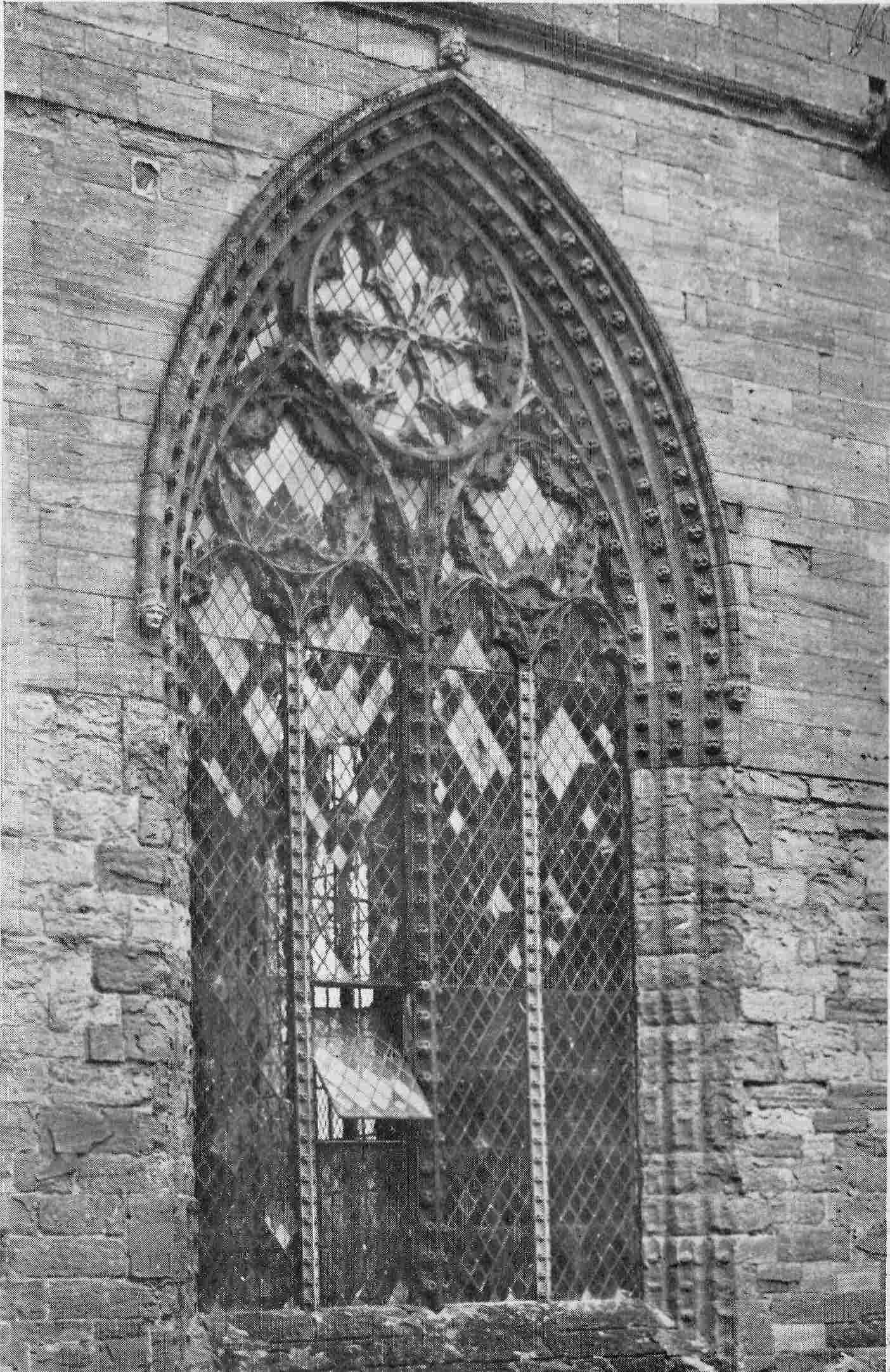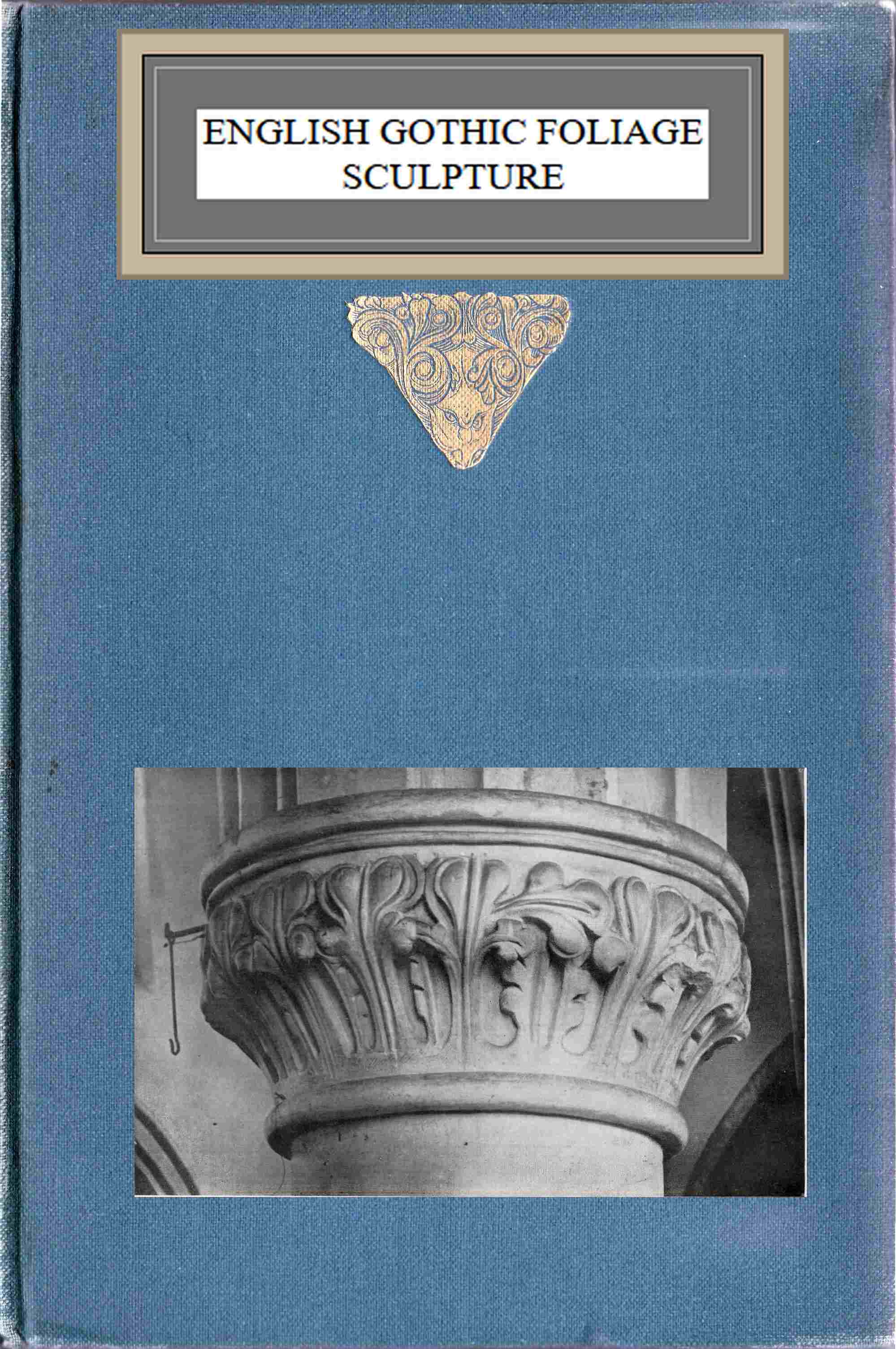
Title: English Gothic foliage sculpture
Author: Samuel Gardner
Contributor: Arthur Gardner
Release date: August 31, 2026 [eBook #79482]
Language: English
Original publication: Cambridge: Cambridge University Press, 1927
Other information and formats: www.gutenberg.org/ebooks/79482
Credits: Chuck Greif and The Online Distributed Proofreading Team at https://www.pgdp.net
CONTENTS
LIST OF ILLUSTRATIONS
ABBREVIATIONS
TOPOGRAPHICAL INDEX OF PLATES
ENGLISH GOTHIC FOLIAGE
SCULPTURE
CAMBRIDGE
UNIVERSITY PRESS
LONDON: Fetter Lane

New York
The Macmillan Co.
Bombay, Calcutta and
Madras
Macmillan and Co., Ltd.
Toronto
The Macmillan Co. of
Canada, Ltd.
Tokyo
Maruzen-Kabushiki-Kaisha
All rights reserved
BY
SAMUEL GARDNER
CAMBRIDGE
AT THE UNIVERSITY PRESS
1927
PRINTED IN GREAT BRITAIN
IT is my hope that this little treatise may serve to enhance the pleasure and interest of such visitors to our ancient Churches as care for architectural details, and that it may help them to follow the development of one of the most beautiful features.
With this object I have endeavoured to be clear and concise. This has necessitated the rejection of scores of illustrations which might have added to the attractiveness of the book, but would also have added to its complexity. In making my selection I have had regard in every case to certain points which are briefly hinted in the list of illustrations.
In suggesting approximate dates I have been guided mostly by the character of the work, but I have compared my suggestions with records when available. Appearances are often safer guides than doubtful records.
For about one-fourth of the photographs from which the illustrations are made I am indebted to my son Mr Arthur Gardner, F.S.A. The rest are from my own negatives.
S. G.
HARROW
January 1927
| LIST OF ILLUSTRATIONS | page ix |
| ABBREVIATIONS | xvi |
| CHAPTER I: INTRODUCTION | 1 |
| Pre-conquest and Anglo-Saxon work—Norman carrying on of Classical traditions—13th century Renaissance and progress—English and French development | |
| CHAPTER II: PRIMITIVES | 7 |
| Anglian crosses—Anglo-Saxon embryo of Stiff-leaf—Byzantine elements | |
| CHAPTER III: ROMANESQUE OR NORMAN | 14 |
| Shapes of capitals—Lombardic ornaments—Early experiments—French Corinthian—Scallops | |
| CHAPTER IV: EARLY ENGLISH STIFF-LEAF | 22 |
| Basis of trefoils—Two types, the solid mid-rib and the hollowed or cut-out—Traditional and Progressive—Course of development | |
| CHAPTER V: NATURALISTIC | 33 |
| The Return to Nature—Roses and Daisies, etc. | |
| CHAPTER VI: DECORATED | 39 |
| Globular waves and Ripples—Stone-carving gives way {viii}to Wood-carving | |
| CHAPTER VII: PERPENDICULAR | 42 |
| Squareness and drilled holes—Sprawling leafage—Final effort to return to Nature | |
| CHAPTER VIII: MATERIALS | 46 |
| Form v. Surface—Building stone—Purbeck marble—Wood | |
| CHAPTER IX: CONVENTIONAL ORNAMENTS | 53 |
| Dog-tooth—Ball-flower—Tudor-flower | |
| TOPOGRAPHICAL INDEX OF PLATES | 55 |
The figures on the right give the pages where the Plates are described or mentioned. Small print indicates points to be noted.
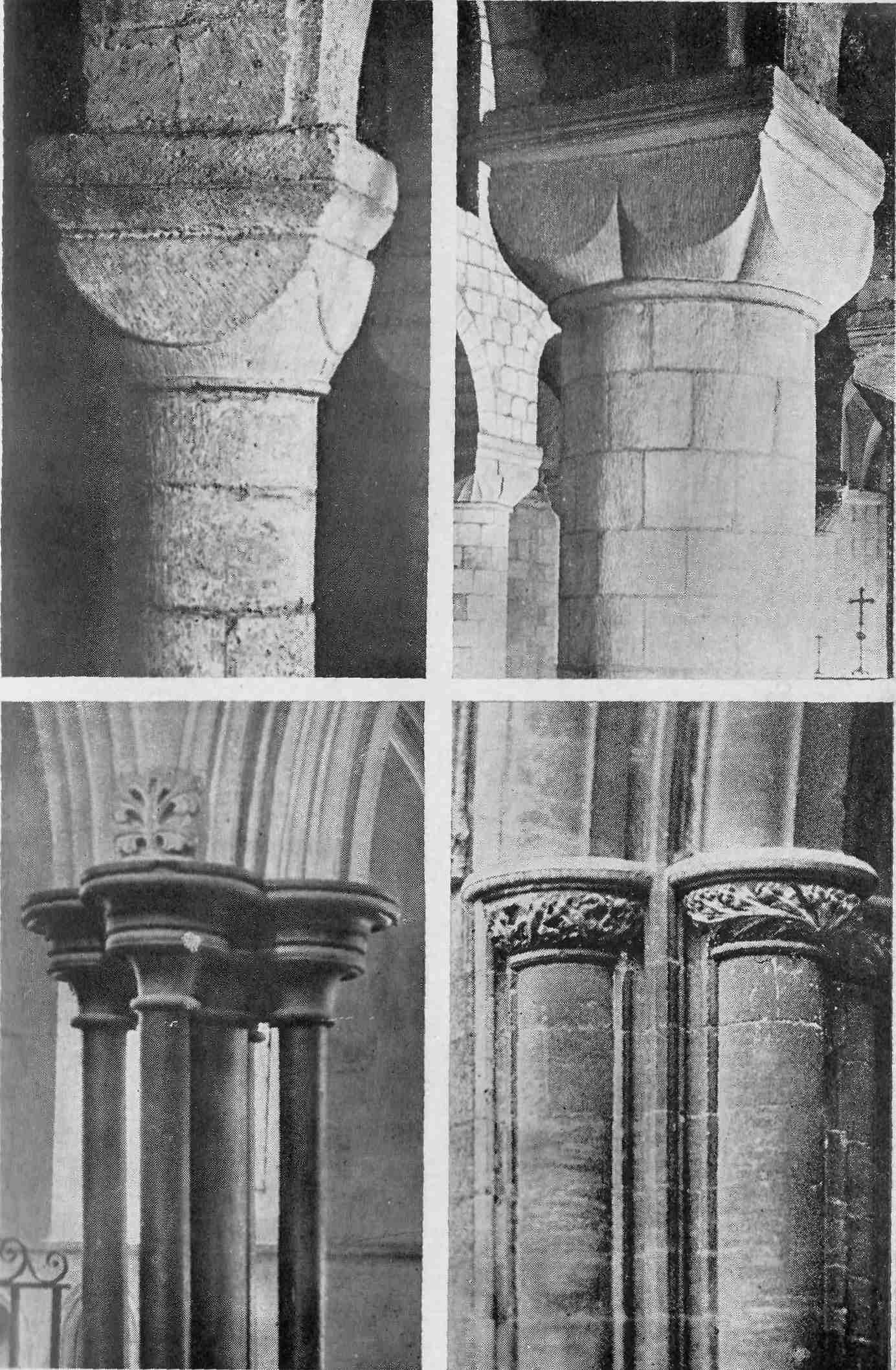
| 1 | Shapes of Capitals | 14, 15, 20, 39 |
| (i) Cushion (Winchester Crypt), (ii) Scallop (Tower of London), (iii) Bell (Boxgrove), (iv) Cup (Bury St Edmunds) | ||
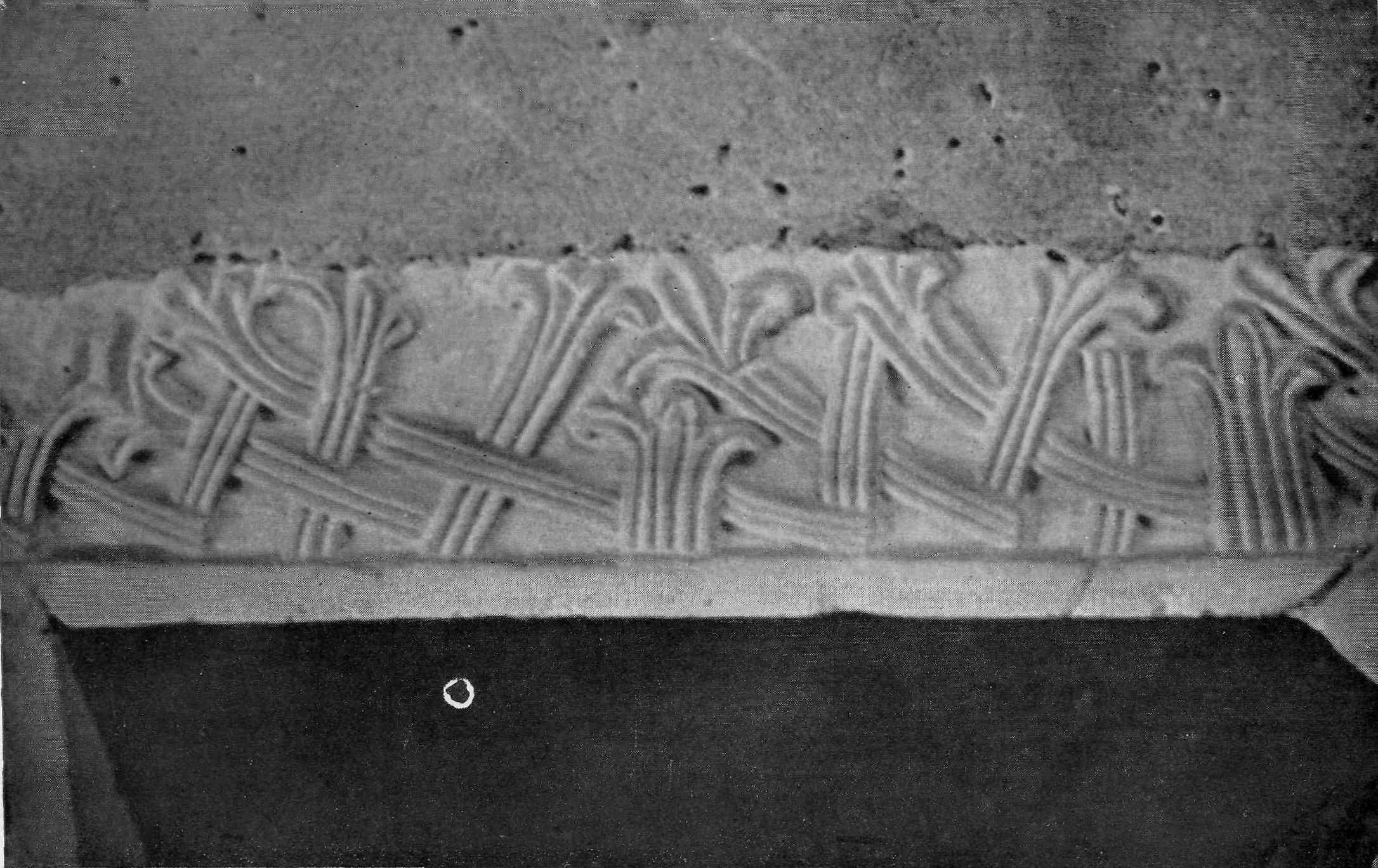
| 2 | Sompting, Sussex (String Course) | 11, 23, 25 |
| Saxon trefoils | ||
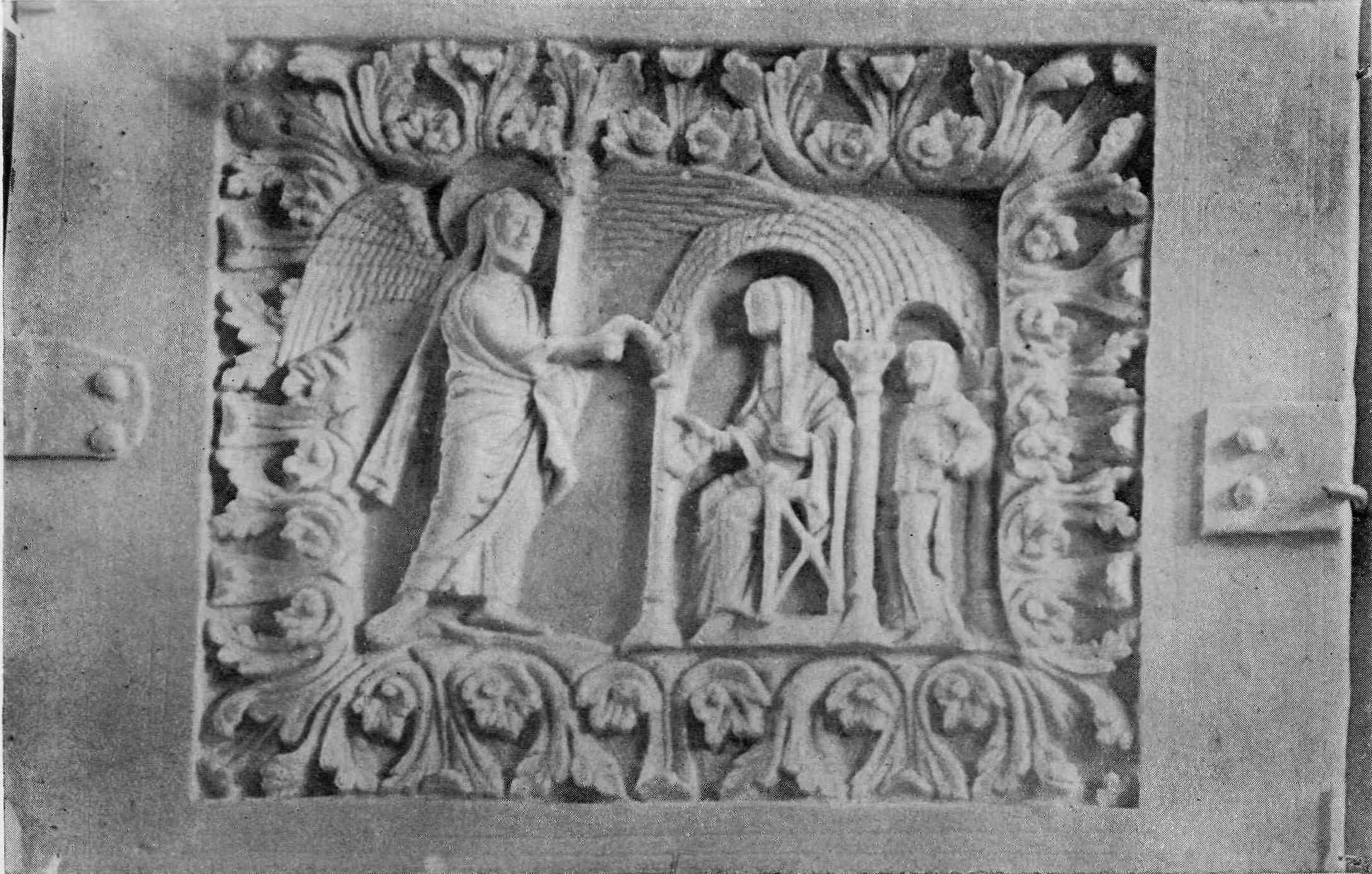
| 3 | Oxford Galleries (Ivory Casket) | 11, 26, 48 |
| Turned-over tips | ||
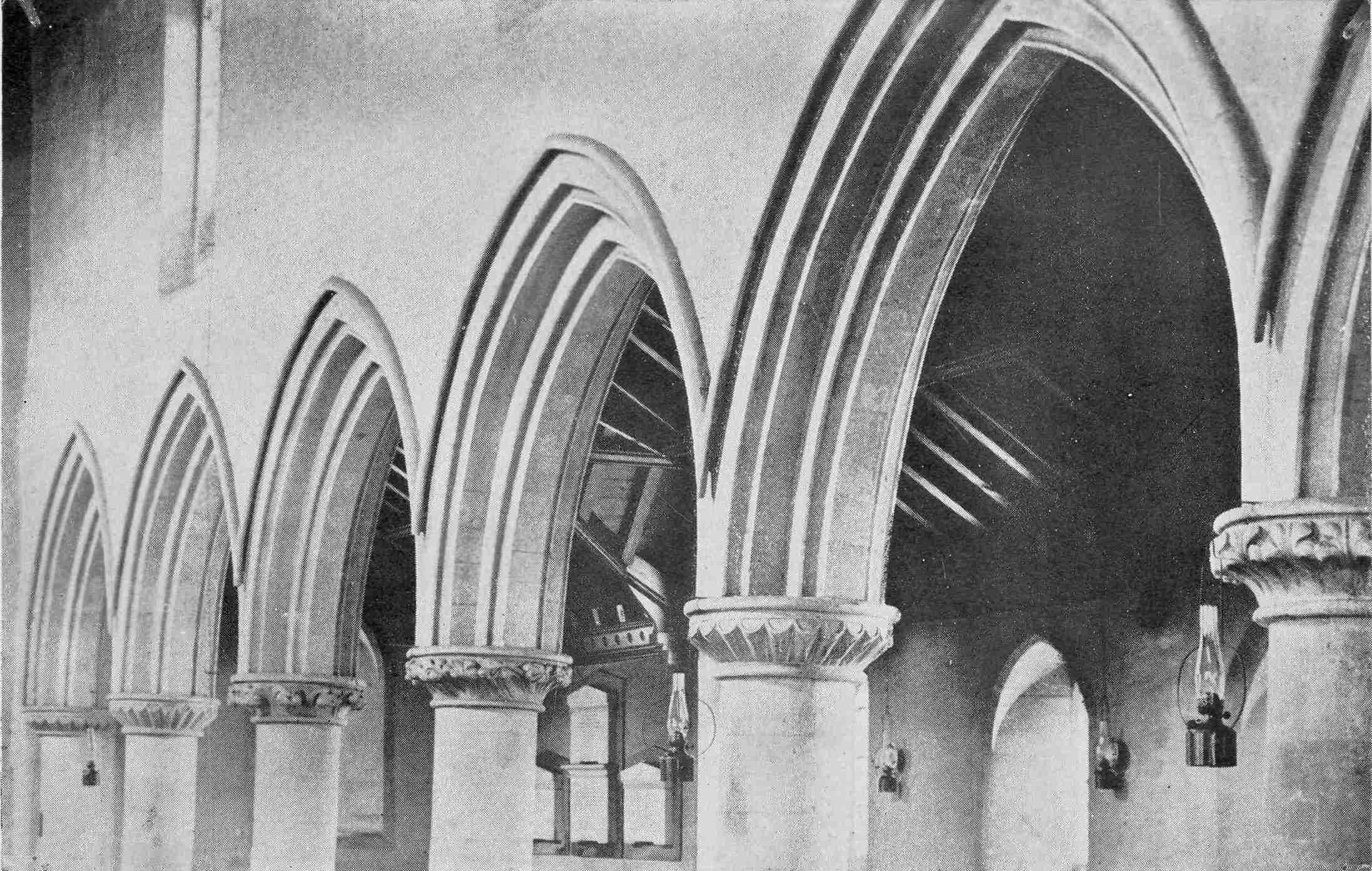
| 4 | Kimpton, Herts (Arcade) | 13, 22 |
| Alternate N. and E.E. caps. | ||
| 5 | Christchurch, Hants (Capitals) | 15 |
| Greek anthemion caps. | ||
| 6 | Hemel Hempstead, Herts (Capital) | 15, 36, 41, 42, 50 |
| Beaded strands and profile leaves | ||
| 7 | Northampton, St Peter’s (Capital) | 16 |
| Triple profile leaves | ||
| 8 | Aylesbury (Base of Font) | 16 |
| Triple strands and profile leaves | ||
| 9 | Oxford Cathedral (Capital) | 16 |
| Interlaced strands | ||
| 10 | Deerhurst, Glos (Font) | 17 |
| Saxon spirals and sprays | ||
| 11 | Deerhurst, Glos (Capital) | 17 |
| E.E. copy of font-sprays | ||
| 12 | Durham Cathedral Library (Trees) | 17 |
| Beaded straps | ||
| 13 | King’s Walden, Herts (Capital) | 18 |
| Transition water-leaf | ||
| 14 | Oxford Cathedral (Capitals) | 18 |
| Transition experiments | ||
| 15 | Canterbury Cathedral Choir (Capital) | 19 |
| French Corinthian | ||
| 16 | Broadwater, Sussex (Capitals) | 19 |
| A.S. type and French | ||
| 17 | Sompting (Capital) | 19 |
| Corinthian experiment | ||
| 18 | Canterbury Crypt (Capital) | 20 |
| Parallel leaves | ||
| 19 | Black Bourton, Oxon (Capital) | 21 |
| Curved scallops | ||
| 20 | Kimpton (Capital) | 21, 24 |
| Foliated scallops | ||
| 21 | King’s Walden (Capital) | 21, 24 |
| Scallops and parallel leaves | ||
| 22 | Romsey Abbey (Capitals) | 21 |
| Enriched scallops | ||
| 23 | Cuddington, Bucks (Capital) | 21 |
| A variety of scallops | ||
| 24 | King’s Walden (Capital) | 22 |
| Mid-ribbed trefoils | ||
| 25 | Hereford Cathedral (Capitals) | 2, 23 |
| Curved variation of Pl.2 | ||
| 26 | St David’s Cathedral (Capitals) | 23, 28, 31 |
| Hollowed trefoils | ||
| 27 | Bledlow, Bucks (Capital) | 23 |
| Alternate mid-ribbed and hollowed | ||
| 28 | Fountains Abbey (Capital) | 23 |
| Alternate mid-ribbed and hollowed | ||
| 29 | Kimpton (Capital) | 23 |
| Early stiff-leaf | ||
| 30 | Kimpton (Capital) | 24 |
| Early stiff-leaf | ||
| 31 | Minster, Thanet (Capital) | 24 |
| Solid and hollowed trefoils | ||
| 32 | Wells Cathedral, S. Transept (Capitals) | 25, 28 |
| Stiff-leaf varieties | ||
| 33 | Lincoln Cathedral, Nave (Capital) | 25 |
| Characteristic stiff-leaf | ||
| 34 | Hereford Cathedral, N. Transept (Capitals) | 25, 28, 53 |
| Convolutions and curved dog-tooth | ||
| 35 | Teversham, Cambs (Corbel) | 26 |
| Flat mid-ribs piercing tips | ||
| 36 | Eaton Bray, Beds (Capitals) | 26 |
| Wavy garlands | ||
| 37 | Ivinghoe, Bucks (Capitals) | 26 |
| Typical trefoils | ||
| 38 | Stone, Kent (Spandril) | 27 |
| Good specimen of late stiff-leaf | ||
| 39 | Westminster Abbey (Spandril) | 27 |
| The predecessor of Pl.38 | ||
| 40 | Lincoln Cathedral, Nave (Capital) | 27, 28 |
| Split trefoils | ||
| 41 | Wells Cathedral, W. Nave (Capitals) | 27 |
| Free treatment | ||
| 42 | Wells Cathedral, W. Nave (Corbel) | 28 |
| Cut-out trefoils | ||
| 43 | Wells Cathedral, W. Nave (Corbel) | 28 |
| Fronts and backs of leaves | ||
| 44 | Lincoln Cathedral, S.E. Porch (Foliage round statuettes) | 28 |
| Undercut arbours | ||
| 45 | Lincoln Cathedral, Choir Aisle Doorway (Foliage on mouldings) | 29, 39, 50 |
| Undercut sprays | ||
| 46 | Lincoln Cathedral, Choir Aisle (Capital) | 29 |
| Crockets | ||
| 47 | Lincoln Cathedral, E. Angel Choir (Capital) | 24, 29 |
| Extreme limits of stiff-leaf | ||
| 48 | King’s Lynn, Norfolk (Capital) | 29, 40 |
| Stiff-leaf with flowers | ||
| 49 | Lichfield Cathedral (Capitals) | 30, 53 |
| Cinque-foils and 2-leaved dog-tooth | ||
| 50 | Salisbury Cathedral, Chapter House (Capitals) | 30 |
| Crocketed trefoils | ||
| 51 | Salisbury Cathedral, Old Choir Screen (Capital) | 30 |
| Graceful free treatment | ||
| 52 | Wells Cathedral, W. Nave (Capitals) | 30 |
| The Wells development suggesting cornucopiae | ||
| 53 | Wells Cathedral, Nave (Capitals) | 31 |
| The Wells development suggesting cornucopiae | ||
| 54 | Ely Cathedral, Retrochoir (Capitals) | 32, 50 |
| Bulged centres appearing | ||
| 55 | Llandaff Cathedral (Capitals, etc.) | 32 |
| Local varieties | ||
| 56 | Weobley, Heref. (Coffin-lid) | 32 |
| Stiff-leaf cross | ||
| 57 | Southwell Cathedral, Chapter House (Capital) | 35, 40 |
| Naturalistic hops | ||
| 58 | Southwell Cathedral, Chapter House (Capitals) | 35 |
| Naturalistic hawthorn, etc. | ||
| 59 | Southwell Cathedral, Chapter House (Gable) | 35 |
| Naturalistic hawthorn, etc. | ||
| 60 | Hereford Cathedral, Cantilupe Shrine (Spandril) | 36 |
| Trefoils and cinquefoils | ||
| 61 | Winchelsea, Tomb (Panel) | 36, 41, 42, 50 |
| Oak | ||
| 62 | Oxford Cathedral, Shrine (Spandril) | 36 |
| Oak | ||
| 63 | Exeter Cathedral, Choir (Corbel) | 36 |
| Oak | ||
| 64 | Exeter Cathedral, Choir (Corbel) | 36 |
| Celery (?) | ||
| 65 | Iffley, Oxford (Door jamb) | 37 |
| Norman rosettes | ||
| 66 | Lincoln Cathedral, Choir Aisle Doorway (Mouldings) | 37, 53 |
| E.E. roses and dog-tooth | ||
| 67 | Fyfield, Essex (Window jamb) | 37 |
| Globular roses | ||
| 68 | Rochester Cathedral (Chapter House Doorway) | 37 |
| Heraldic roses | ||
| 69 | Erwarton, Suffolk, Font (Rose) | 38 |
| Later form of Pl.68 | ||
| 70 | Cambridge, St John’s College Gateway | 38 |
| Tudor roses, etc. | ||
| 71 | Beverley Minster (Capital) | 39 |
| Adhesive foliage | ||
| 72 | Winchelsea, Tomb (Panel) | 40 |
| Rippling leaves | ||
| 73 | Beverley Minster, Tomb (Capital) | 40 |
| Exaggerated bulgings | ||
| 74 | Ely Cathedral, Lady Chapel (Gable) | 41 |
| Seaweed type | ||
| 75 | Ely Cathedral, Lady Chapel (Capitals) | 41 |
| Elaborate type | ||
| 76 | Lincoln Cathedral, Easter Sepulchre (Panels) | 41 |
| Combined naturalism and ripples | ||
| 77 | Exeter Cathedral, Tomb (Decoration) | 41 |
| Globular excrescences | ||
| 78 | Patrington, Yorks (Capitals) | 41 |
| Sprawling foliage | ||
| 79 | Aldenham, Herts, Tomb (Spandril) | 36, 41, 42, 50 |
| Late ripples | ||
| 80 | St Albans Cathedral, Ramryge Chantry (Cornice) | 42 |
| Square leaves with holes | ||
| 81 | Ely Cathedral, Alcock Chantry (Cornice) | 43 |
| Square leaves with holes | ||
| 82 | North Cerney, Glos (Pulpit) | 43 |
| Conventional lilies | ||
| 83 | Oxford, St Mary’s (Cornice and Spandril) | 43 |
| Square leaves with knobs | ||
| 84 | Oxford Cathedral, Watching Loft (Decorations) | 43, 54 |
| Tudor flowers and vine sprays | ||
| 85 | Cambridge, King’s College Chapel (Mouldings of W. Doorway) | 37, 38, 44, 45 |
| Tudor rose and naturalistic leaves | ||
| 86 | Lincoln Cathedral (Corbel and Capital) | 48 |
| Purbeck marble foliage | ||
| 87 | Exeter Cathedral, Tomb (Panels) | 49 |
| Purbeck marble foliage | ||
| 88 | York Cathedral, Tomb (Spandril) | 49 |
| Purbeck marble foliage | ||
| 89 | Rochester Cathedral (Corbel) | 49 |
| Purbeck marble foliage | ||
| 90 | Peterborough Cathedral (Capitals) | 49 |
| Wood 13th cent. capital fitted into Renaissance arches | ||
| 91 | Exeter Cathedral (Misericord) | 50 |
| Wood stiff-leaf | ||
| 92 | Exeter Cathedral (Misericord) | 50 |
| Wood stiff-leaf | ||
| 93 | Exeter Cathedral (Misericord) | 50 |
| Wood stiff-leaf with knobs | ||
| 94 | Christchurch, Hants (Misericord) | 50 |
| Specimen of 13th cent. wood-carving | ||
| 95 | King’s Lynn, Norfolk (Misericord) | 36, 41, 42, 43, 50 |
| Specimen of 14th cent. wood-carving | ||
| 96 | King’s Lynn, Norfolk (Screen) | 50 |
| Wood canopies | ||
| 97 | Winchester Cathedral (Stalls) | 50 |
| 14th cent. wood leaves and fruit | ||
| 98 | Tong, Salop (Cornice and Screen) | 51 |
| 15th cent. wood leaves and fruit | ||
| 99 | Tong, Salop (Cornice and Screen) | 51 |
| 15th cent. wood leaves and fruit | ||
| 100 | Abergavenny, Mon. (Cornice and Screen) | 51 |
| 15th cent. wood leaves and fruit | ||
| 101 | Norwich Cathedral (Canopy of Stalls) | 51 |
| 15th cent. wood crockets | ||
| 102 | Mullion, Cornwall (Bench) | 52 |
| 16th cent. wood-carving | ||
| 103 | Crowcombe, Som. (Bench) | 52 |
| 16th cent. naturalistic work | ||
| 104 | Ely Cathedral, Galilee (Wall Arcade) | 53 |
| Dog-tooth in mouldings | ||
| 105 | Soham, Cambs (Chancel Arch) | 53 |
| 3-leaved dog-tooth | ||
| 106 | St Cross, Winchester (Arch over W. Doorway) | 53 |
| Elaborated dog-tooth | ||
| 107 | Dunstable, Beds (Mouldings) | 53 |
| Elaborated dog-tooth | ||
| 108 | Wells Cathedral, W. Doorway (Mouldings) | 53 |
| Elaborated dog-tooth | ||
| 109 | Leominster, Heref. (Window) | 53 |
| Ball-flower in mouldings | ||
| 110 | Exeter Cathedral (Screen Panel and Mouldings) | 53 |
| Stalked ball-flower | ||
| 111 | Tewkesbury Abbey, Tomb (Mouldings) | 40, 54 |
| Ball-flower | ||
| 112 | Purse Caundle, Dorset, Tomb (Spandril and Cornice) | 54 |
| Tudor ornaments | ||
The following Abbreviations are used:
A.S. Anglo-Saxon, N. Norman, Tr. Transition, E.E. Early English, D. Decorated, P. Perpendicular, N. North, S. South, E. East, W. West
ENGLISH
GOTHIC FOLIAGE
SCULPTURE
ENGLISH GOTHIC ARCHITECTURE has been rightly described as a great national living art. Gothic architecture existed as a living art over a great part of western Europe for nearly five hundred years. In each country where it flourished it developed national characteristics. In no feature was this more conspicuous than in foliage sculpture.
When we describe an art as national, we do not mean that its germs sprang into existence within the country, but that, once sown or planted, they took root there and grew up under the influences of national surroundings. By a living art we mean an art that is not mere copying, but one that manifests a natural growth and development of innate force. This does not exclude a power of assimilation of foreign elements. Just as a tree may produce a variation of fruit or flower by being grafted with a foreign shoot, so a national art may absorb and be influenced by foreign ideas. But so long as it possesses a self-contained force springing from its roots it remains a{2} national living art. Such was Gothic architecture in England from 1050 to 1550, if we include Romanesque origins and Tudor survivals.
If we go back further still than 1050 we find certain forms of carved foliage in use, but they are mostly more suggestive of the cast-off leaves of autumn than of spring buds. Most of them appear to be reminiscences or distant copies of forms to be found in decadent Byzantine or Roman sculpture. But, just as in nature the buds that will not come to maturity till the spring are found pushing off the autumn dry leaves, if we search we shall find among these rude and debased forms the embryo of a form destined to become the basis of that beautiful type of carving which is called Stiff-leaf, and which afterwards became the most perfect expression of our exclusively English Gothic foliage sculpture.
The Anglo-Saxon period was not one of steady progress. There were bright spots—times when and places where saintliness and learning shone for brief intervals, and there were schools of art where great excellence was attained in the illumination of manuscripts. There were also schools where considerable artistic skill and refinement were shown in sculptured reliefs. But the general impression{3} produced by a study of Saxon remains is that from time to time masons were introduced from the continent, who executed fairly good work, the influence of which faded away in the course of a generation or two. The constant incursions of the Danes were not favourable to any steady progress in art, and in the deteriorating copies of the work of foreign masons we cannot expect to see many signs of life.
At the same time we must remember that very beautiful art existed in Ireland under similar conditions. It may be that there is hardly anything left of numerous works of art produced in Saxon England. Many must have been destroyed by the Danes, and it is said that the Conqueror sent many away to France and to the Pope[1]. Of these some may be still in existence, but it is difficult to differentiate them from similar work produced elsewhere.
The Normans before and at the time of the Conquest, though they were great builders, and were inspired by a fresh impulse through the adoption of free-arch construction, were very poor sculptors. They had cast aside the dregs of Classical entablatures and placed their arches directly upon their piers or{4} columns, but they seldom attempted any sculptured ornament. When they did so, it was either a distant copy of Classical or, especially when human figures were intended, a rude and barbarous effort. Later on, as they became more skilled, two rival influences become apparent—the French, following Roman or Byzantine models, and the English, which was also reminiscent of Classical traditions but mixed with Norse and manuscript, and sometimes metal-work and wicker-work suggestions. The Classical traditions often seem more associated with Byzantine than Roman sources. It was from the English and not the French elements that our characteristic English Gothic foliage arose. The most constant feature of Anglo-Saxon sculpture was intertwining strands terminating in conventional half-opened leaves (Pls. 2 and 25) or trefoiled buds. From the trefoil was developed the Early English stiff-leaf foliage which soon ousted the French Corinthian, and for a hundred years maintained the style which may be regarded as our national style of Gothic foliage.
Towards the end of the thirteenth century the various permutations and combinations of the stiff-leaf convention had been exhausted, and for some ten or twenty years a pure{5} naturalism prevailed, but it then gave way to a fresh convention, called the Decorated, in which the naturalism was modified by a peculiar kind of waving and rippling which is easily recognised. This style continued in the west until the end of the Gothic period; elsewhere foliage sculpture in stone came almost to an end before the Perpendicular period, the straight lines and panelling of that style not lending themselves to floral decoration. On monuments and other rich work we sometimes find bands of vine-leaf or other foliage, generally coarse and square-cut. At the very end of the Gothic period there was some attempt to return to naturalism, but this was nipped in the bud by the invasion of Renaissance art (Pl. 85).
It is remarkable that, seeing how close was the connexion between England and France in the days of our Plantagenet kings, just when Gothic art on both sides of the Channel was in the full vigour of its youthful exuberance, the development was so different. In no features was this difference more marked than in the treatment of foliage sculpture as well as of mouldings. In northern France there is very little in the way of intermediate convention between the Romanesque Corinthian type of foliage, and a naturalistic representation{6} of leaves and flowers. In fact they were intermingled. There is no parallel at all to our English stiff-leaf, which is one of the chief glories of our national architecture, except, possibly, in a few instances in Normandy under English influence.
APART from some possible Roman fragments the earliest specimens of foliage sculpture worked in this country are to be found on the Anglican crosses. The dates of these crosses have been a subject of much controversy, but a consensus of latest authorities accepts them as genuine work of the seventh and eighth centuries[2]. On these the foliage sculpture, if it can be so called, consists entirely of twining sprays and occasional vine leaves and grapes. The earliest and best of these would appear to be the work of foreign masons. St Augustine is said to have brought with him some artisans from Italy, and St Wilfred (634-709) is known to have done so, and some of these crosses may well have been their work. The standing crosses are not numerous, but there are hundreds of fragments scattered about, mostly in Yorkshire. The character of this carving does not differ from specimens which are to be found all over the eastern portion of the Roman Empire—in Italy, Greece, Egypt and{8} Asia Minor. It is Byzantine or Coptic in origin. Although probably executed in England, and copied by native masons, it is rather cosmopolitan than national art. Some of the original specimens here compare favourably with sculpture of the same period in Italy and elsewhere. But there is little in this carving to indicate any life or originality. It is decadent Byzantine of the kind often called Lombardic because it was the kind of work that was produced in Italy after the Lombard invasion. The chief features of this style, besides the Byzantesque figures, are intricate knots of intertwined strands, and wavy sprays sometimes with biting beasts or pecking birds inserted among them. The figures when copied tended to become grotesque barbarisms. The knots were successfully copied up to the twelfth century. The strands, which tended to become grooved, survived in the intertwined or woven sprays of what is commonly called Anglo-Saxon sculpture and we find animals inserted in such twelfth-century work as that of Rochester west doorway, Ely Prior’s Doorway, and Kilpeck. The occasional vine-leaf and grapes did not lead to any further development, but a common form in this early work was a half-opened leaf in profile. This occurs frequently wherever this style of carving{9} exists, and it survived into the twelfth century.
Assuming that these Anglian crosses belong to the end of the seventh century, we cannot trace any progressive development through the eighth, ninth and tenth centuries. It was not a period of progress, but rather of decadence and destruction, in spite of bright spots here and there. Arts which could be carried on in the seclusion of monasteries or convents, such as illuminated manuscripts and fine needlework, were carried to great perfection in certain quarters, perhaps also ivory-carving, some good specimens of which are attributed to Anglo-Saxon sources (Pl. 3). It is, however, questionable to what extent stone-carving was influenced by these arts; whether, for instance, the wonderful spirals and convolutions of Irish manuscripts should be regarded as predecessors or followers of stone-carvings; but goldsmiths’ work, wicker-work, and iron and wood-work certainly suggested some of the designs. In referring to a cross-shaft of very rude work at Bishop Auckland, Sir Martin Conway says: “We find here, continuing, the traditions introduced by Italian craftsmen into the North of England at or about the time of Wilfred. Those traditions, the forms developed by Irish and English{10} craftsmen in goldsmiths’ work, illumination and perhaps also in wood-carving, and, finally, the influence of surviving works of Roman sculpture and decoration—these were the three factors by whose union the art of the Anglian sculptures was produced and is sufficiently explained[3].”
Between the period of the Anglian crosses and the eleventh century—a period of constant warfare and Danish incursions—we know little of any arts except the illuminations and needlework already mentioned, but towards the end of that period, the time shortly before or after the Norman Conquest, amid the dry bones of dead Byzantesque art we may discover some symptoms of a new living force. The grooved triple strands of Anglian art terminate naturally in a sort of trefoil. The trefoil is a bud-form ready to open further and to multiply its parts. It is therefore suitable as a basis for the decoration of curved or flat surfaces and to fill spaces of any shape. Apart from its obvious symbolism the trefoil had inevitably found its way into art in all ages. The thunderbolt of Zeus, the French lilies and the Prince of Wales’ feathers are all varieties of it. Once recognised as having these{11} capacities it was bound to be adopted and developed. But this recognition and application implies vitality and ambition—the elements of progress.
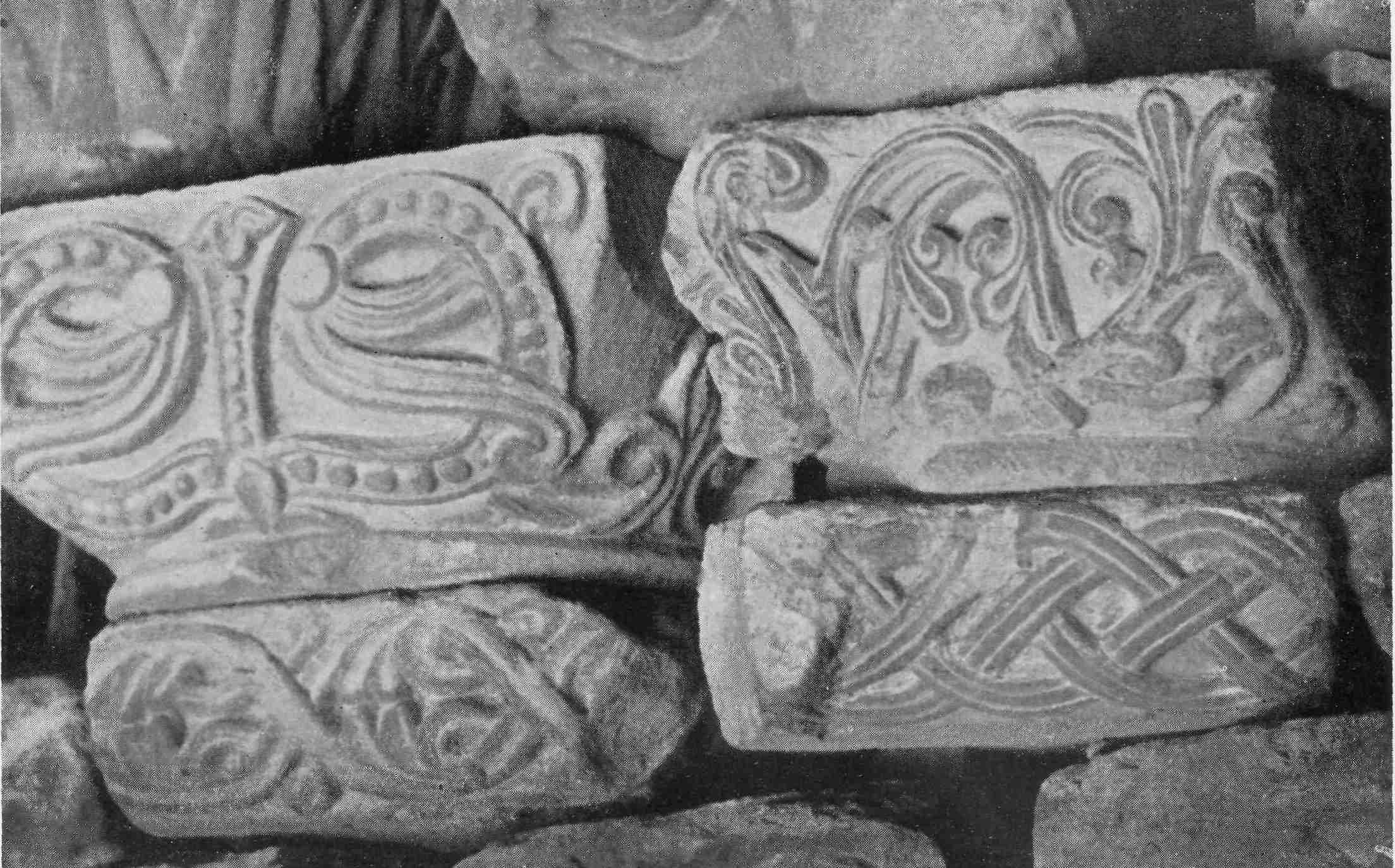
At Sompting, in Sussex, there is a string course, a portion of which has been carried over a piscina (Pl. 2). The triple strands are straight, or nearly so, and are interlaced like wicker-work. They terminate in trefoils which are of two kinds: (i) one with a solid mid-rib running up into the central lobe, and (ii) the other in which the central lobe is hollowed to look almost like a loop. These two kinds must be intended to represent (i) the back or lower surface of a leaf, and (ii) the front or top surface. It will also be observed that in one instance in the portion selected for our illustration, the tip of the central lobe is turned over from the margin, where there was not room for it to expand. This was no doubt a reminiscence of the turned-over tips of Acanthus in Corinthian capitals. In these features are contained the germs from which sprang later the famous Early English stiff-leaf sculpture.
In the Oxford Galleries there are some casts of ivories attributed to the Anglo-Saxon period, in which the borders contain foliage sculpture resembling the floreated borders of Anglo-Saxon manuscripts (Pl. 3), also the reliefs on{12} one of the slabs at Chichester have a row of what look like Greek anthemia. These slabs belong to what is called the Winchester school of sculpture, and they are supposed to be pre-Conquest in date. Similar anthemia are seen on a slab at Stepney. Other interesting remains are those of an ivory tau-cross and an ivory comb in the British Museum. These show trefoils of both sorts and one certainly curled over, also the half-opened leaves in profile. As we have said, these are all attributed to Anglo-Saxon art, and they are certainly very superior to any sculpture that we know to have been the work of Norman masons either prior to or shortly after the Conquest. These works, like the manuscripts and needlework, point to the presumption that in the eleventh century and perhaps earlier, there existed among our Anglo-Saxon forefathers monastic schools of art which reached a higher standard of vigour and refinement than was again attained until the Saxons had recovered from the degradation of the Conquest and were absorbing their conquerors into a blended nationality.
It is often difficult to be sure whether some of this sculpture is pre-or post-Conquest. The same Saxon masons, or their sons or pupils, no doubt retained something of their hereditary traditions when called upon to{13} serve under other masters. In some more remote districts the Conquest probably did not cause any cessation of building. But in the twelfth century we find English influences changing the Romanesque as first introduced into Anglo-Norman and then into the Transition into Early English. When strands are beaded, it is generally regarded as a sign that the work is post-Conquest, but we do not consider this indisputable.
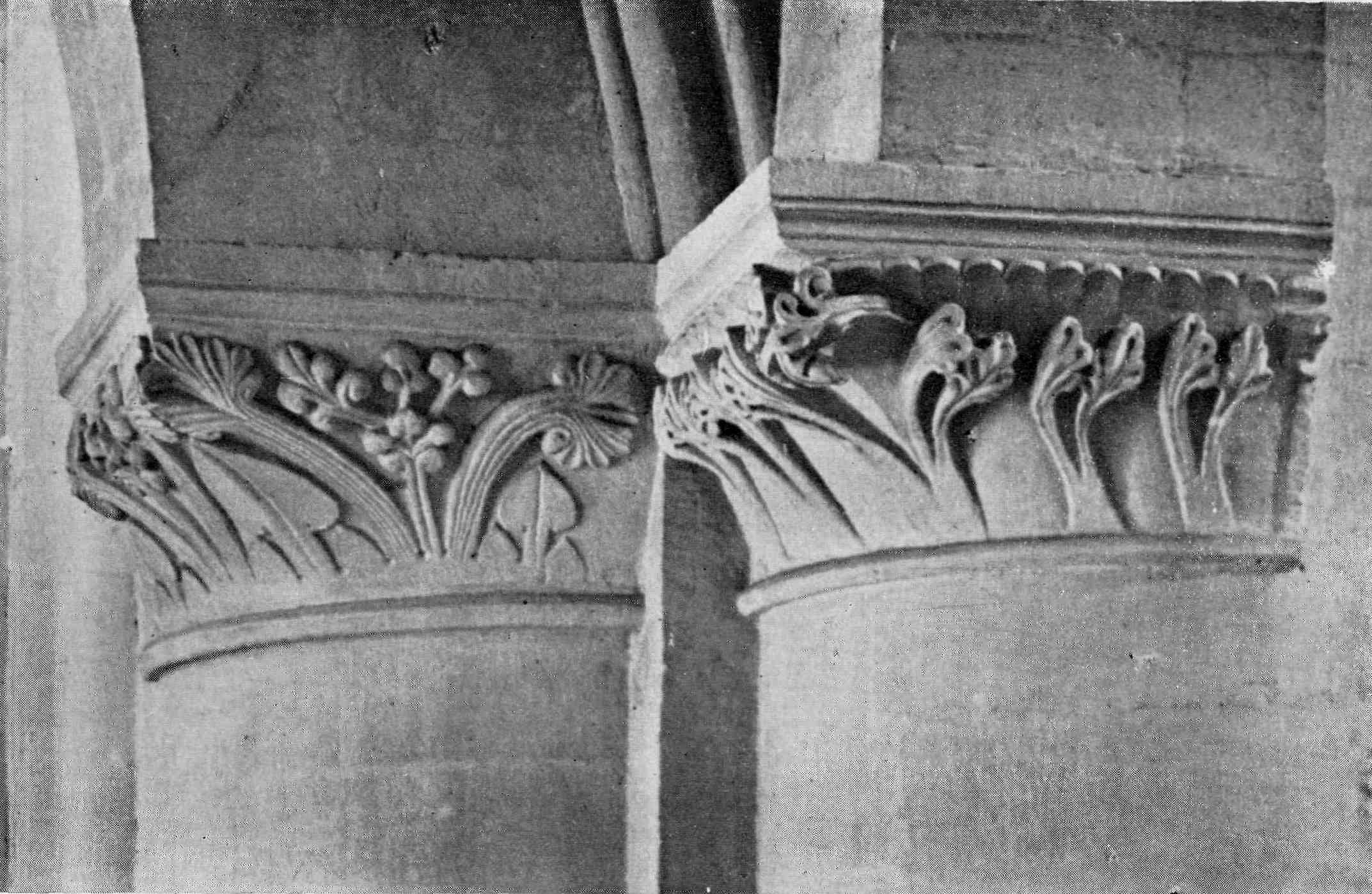
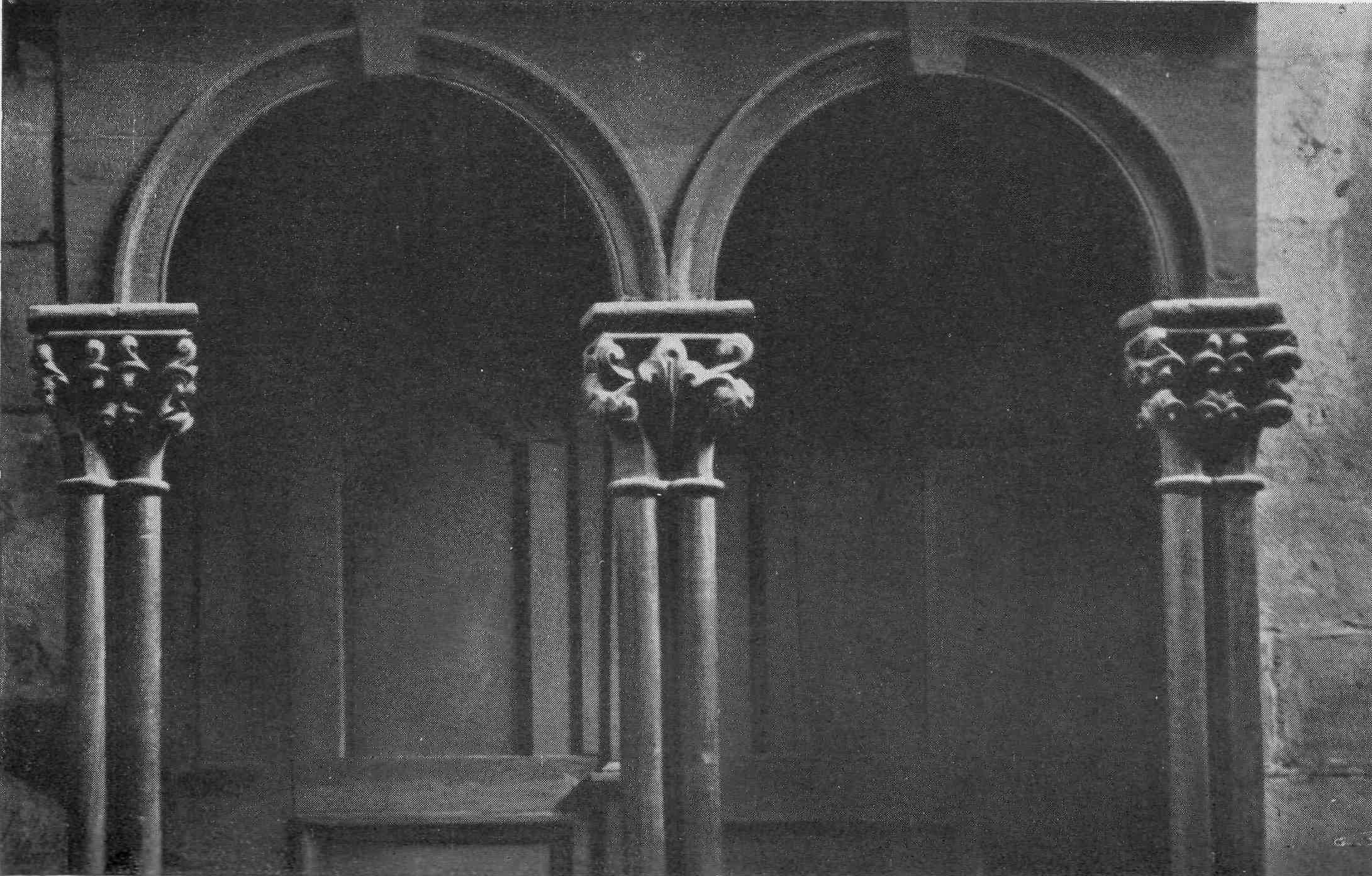
Setting aside the French Corinthian type introduced at Canterbury and elsewhere, from the period when the trefoil began to hold sway we can see two English rival forces competing, which we may call the Traditional and the Progressive. Sometimes masons of the two kinds were at work side by side in the same churches. At King’s Walden and Kimpton (near St Albans) (Pl. 4) the alternate capitals in the same arcade show these rivalries. The two were in competition towards the end of the twelfth century, and ultimately the English Gothic type became triumphant.
We have next to trace the development of Byzantesque and Romanesque foliage up to the period when the former ceased and the Early English stiff-leaf foliage became everywhere adopted in this country.
AS foliage sculpture is mostly concentrated on capitals, and sculpture to some extent is modified by the shapes of the surfaces which it ornaments, it will be well before going into sculptural details to note that English capitals are of four descriptions: (i) cushion, (ii) scalloped, (iii) bell, and (iv) cup-or bowl-shaped (Pl. 1).
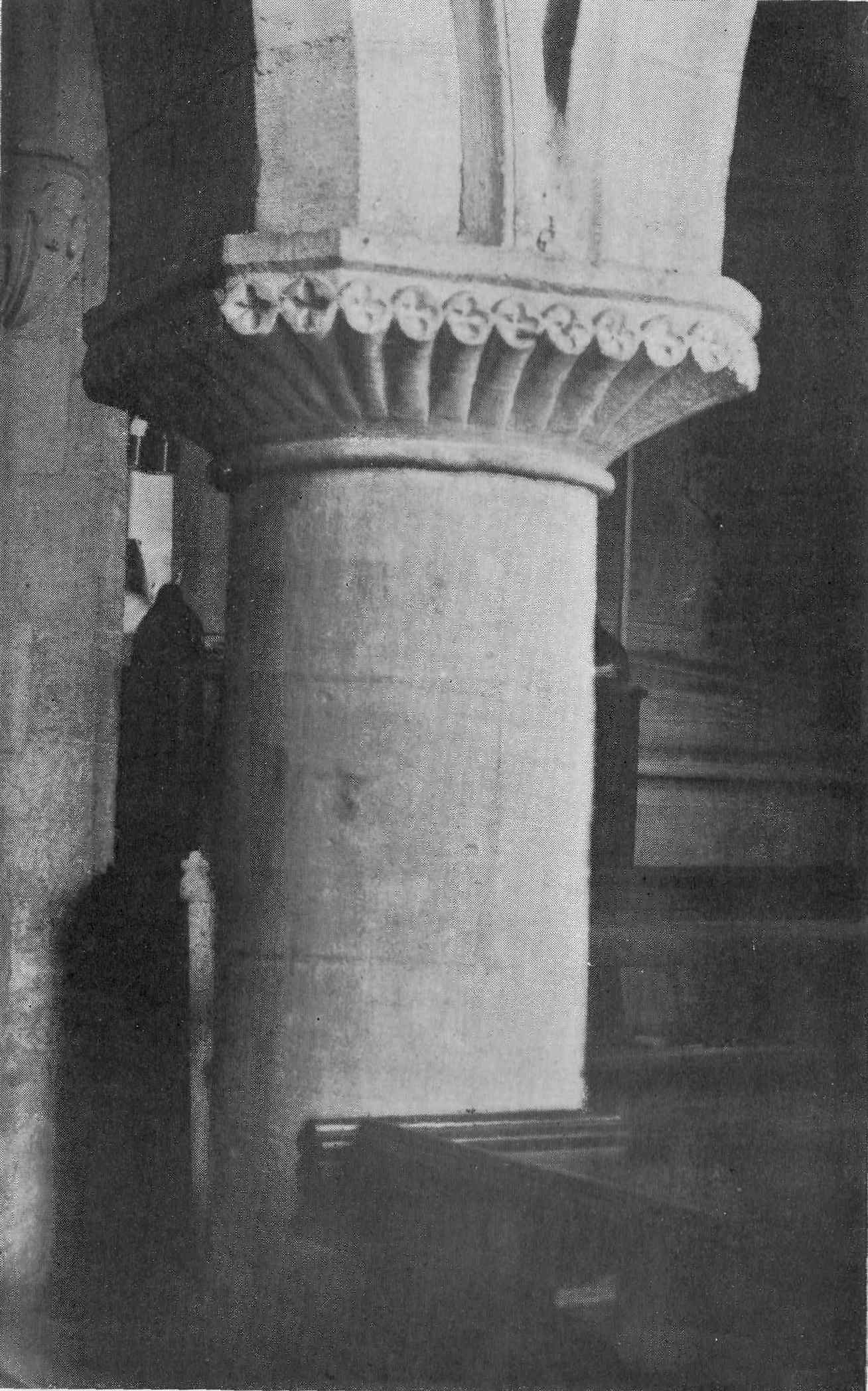
Norman are mostly cushion or scalloped, but those of the French Corinthian type are bells. Early English are mostly bells. Decorated sometimes revert not to the cushion, but to a modification of it, which we have called cup-shaped, the abacus being no longer square but circular, or octagonal (Pl. 71).
The cushion is a cube with the lower corners chamfered off in such a manner as to make the four sides semi-circular, the diameter being at the top. Below the semi-circles the chamfers slope in to the necking of the shaft.
The bell is the shape of a bell or trumpet-mouth. The profile of the capital is concave from the necking up to the larger diameter of the top adjoining the abacus.
In scalloped capitals the four sides of the capital, if square, or the circumference if{15} round, are subdivided into a series of semi-circles, instead of having one on each face as in the cushions.
Cup-shaped capitals are the opposite of bells, having a convex instead of a concave profile, say the shape of a tea-cup or bowl.
When Norman capitals are sculptured, whether with figure or foliage sculpture, the character of the sculpture is Lombardic or Romanesque. There is nothing especially English about it. The schools of carving being mostly either in or under the control of the monasteries, and the monasteries being cosmopolitan, the carving was so also, and followed traditions which were mostly Classical in origin, but modified by suggestions from painted illuminations, needlework, wicker-work, wood-carving, and metal-work, both in iron and precious metals. Through what are called the Dark Ages this type of carving had been kept up chiefly on sarcophagi and ivory crosses and caskets, upon which the best work is found.
Some cushion capitals at Christchurch have the Greek anthemion (Pl. 5) and others the profile leaf, carved quite after the Greek manner.
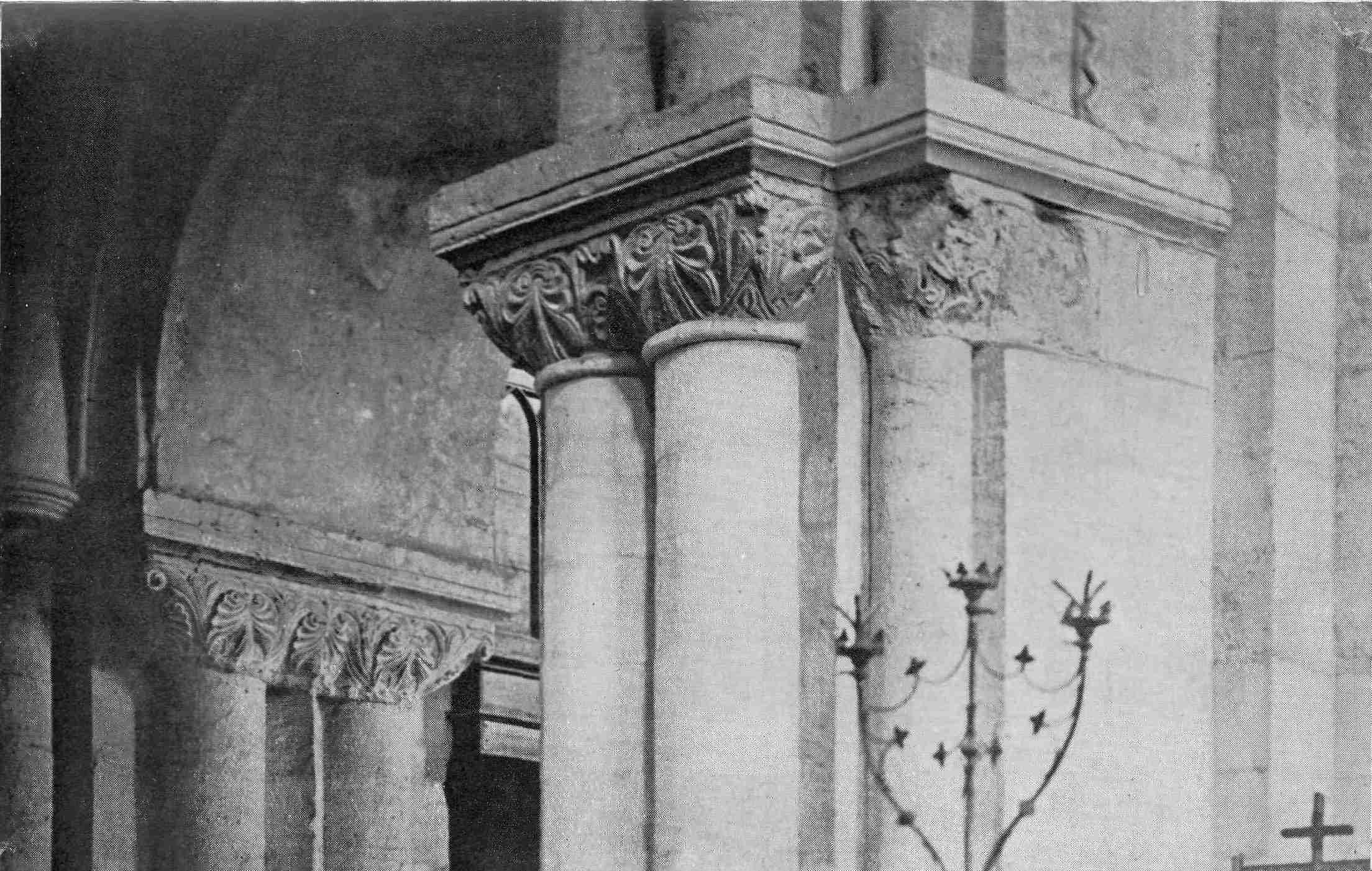
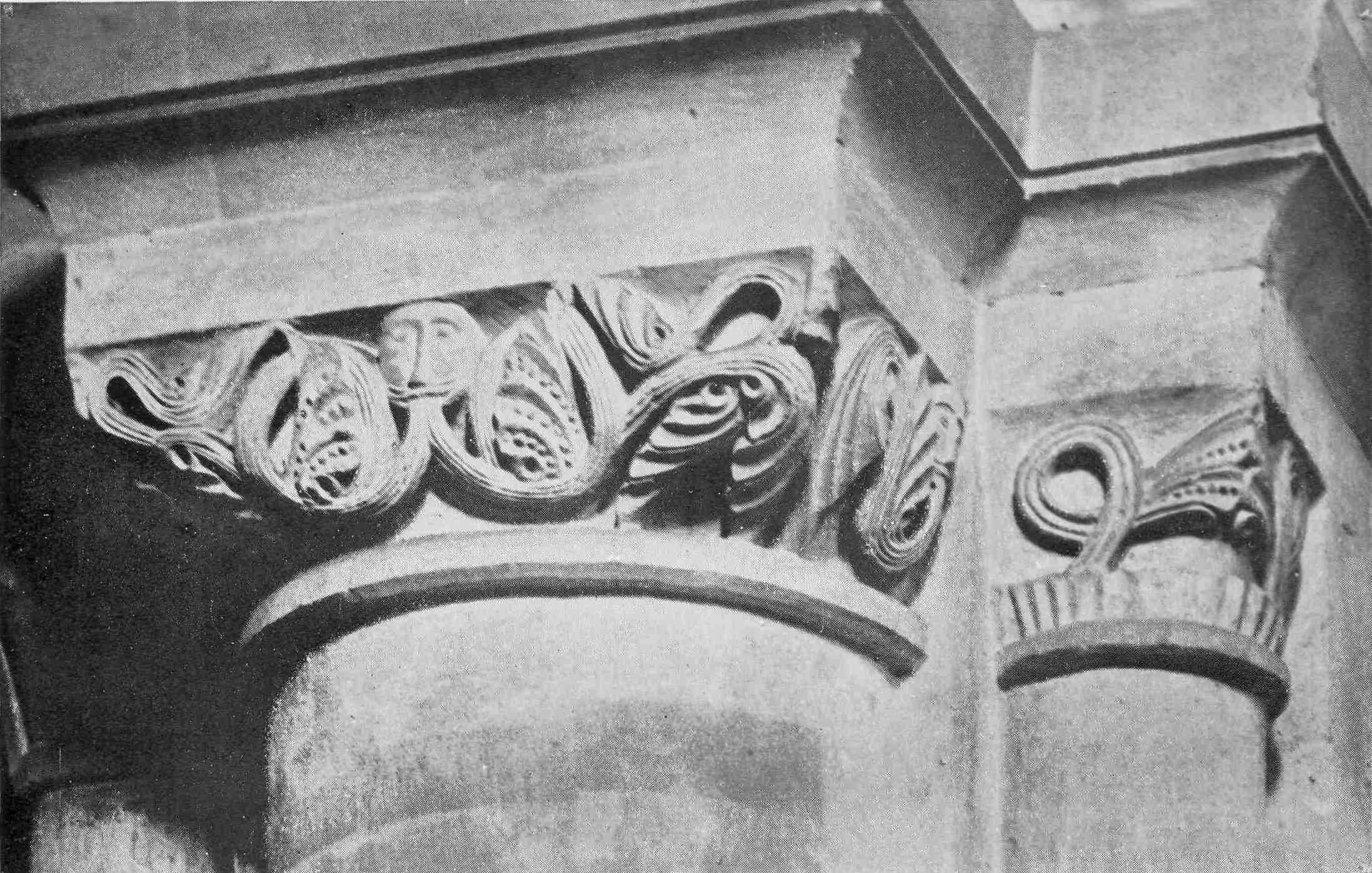
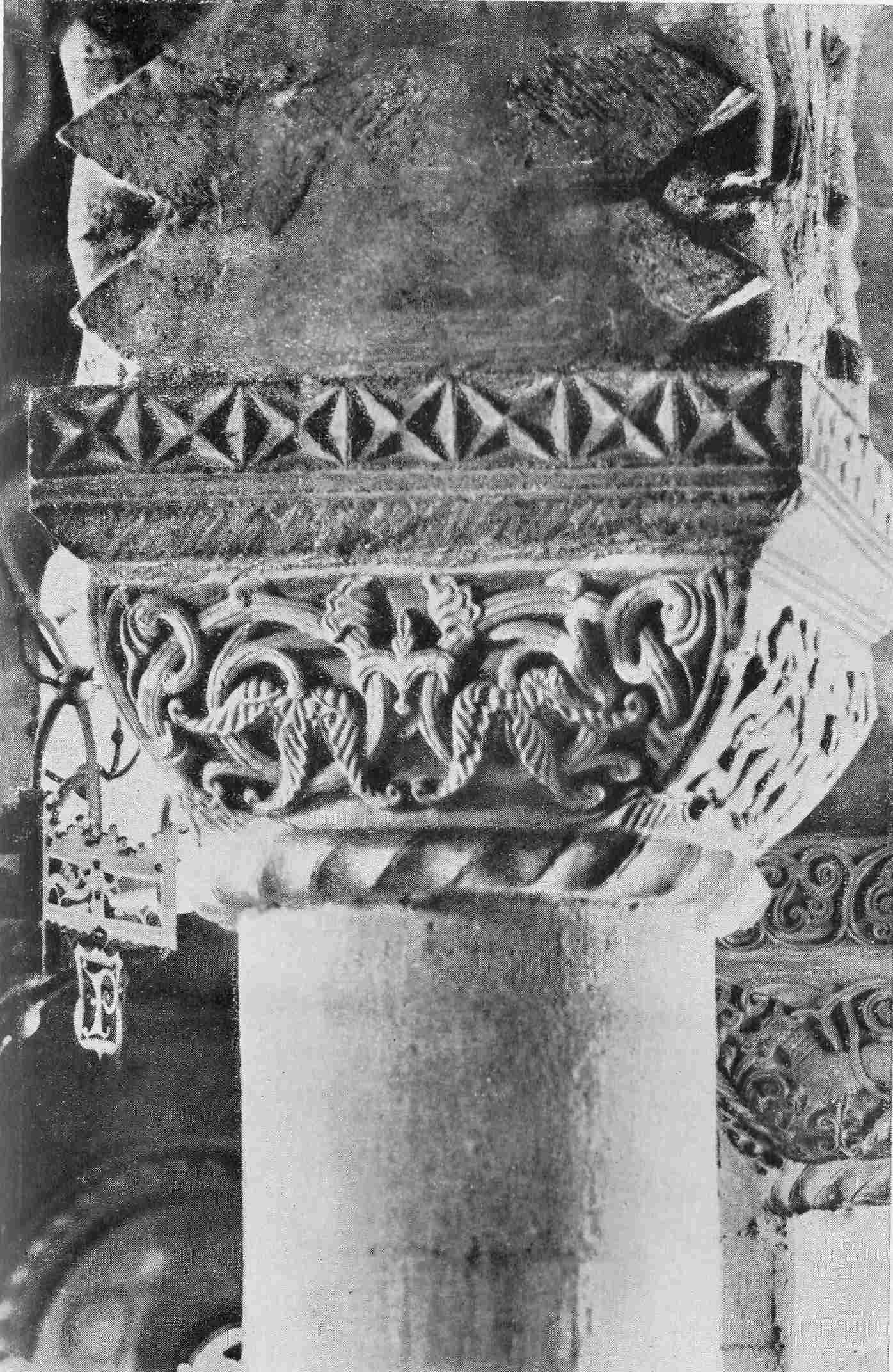
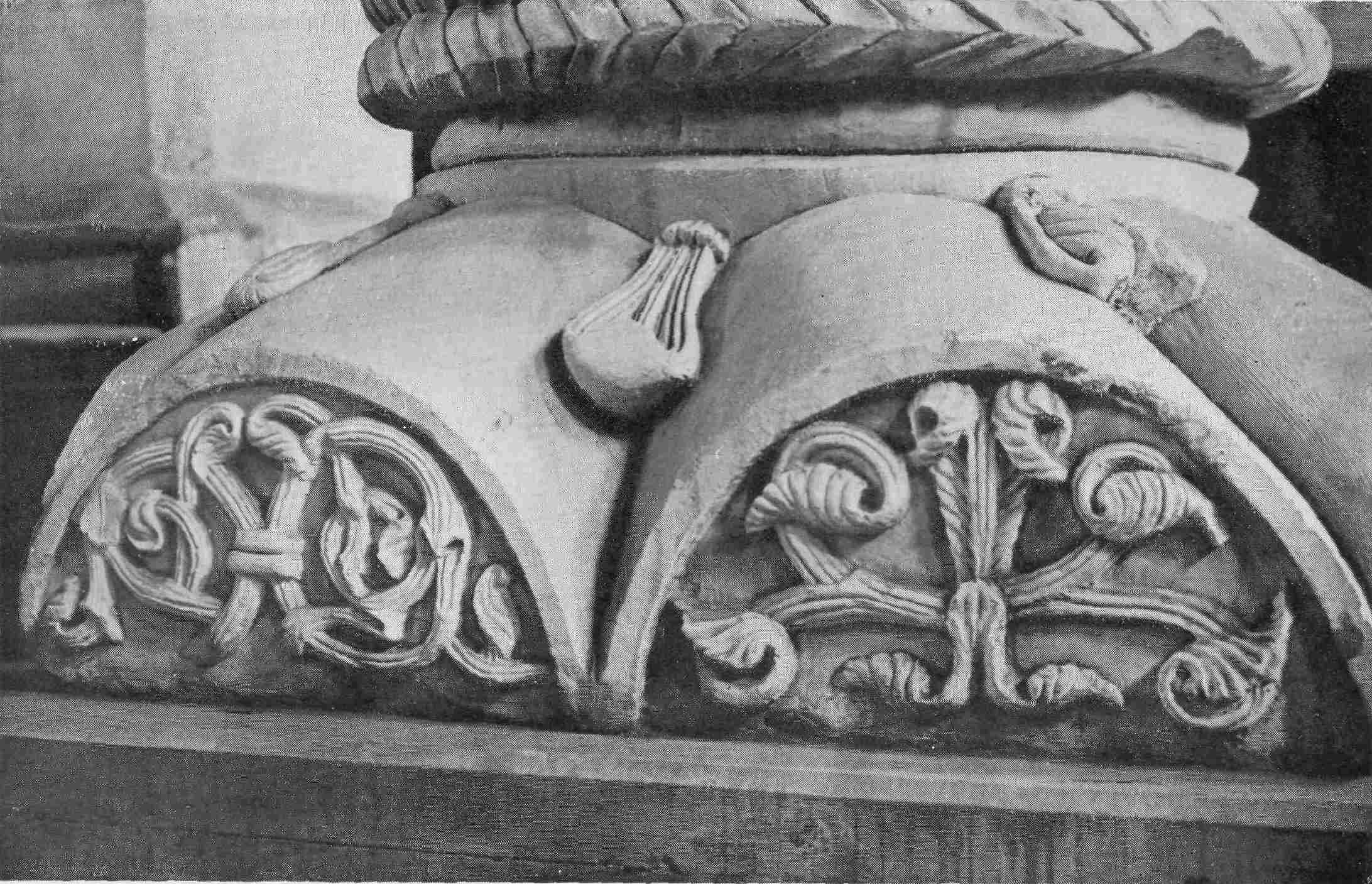
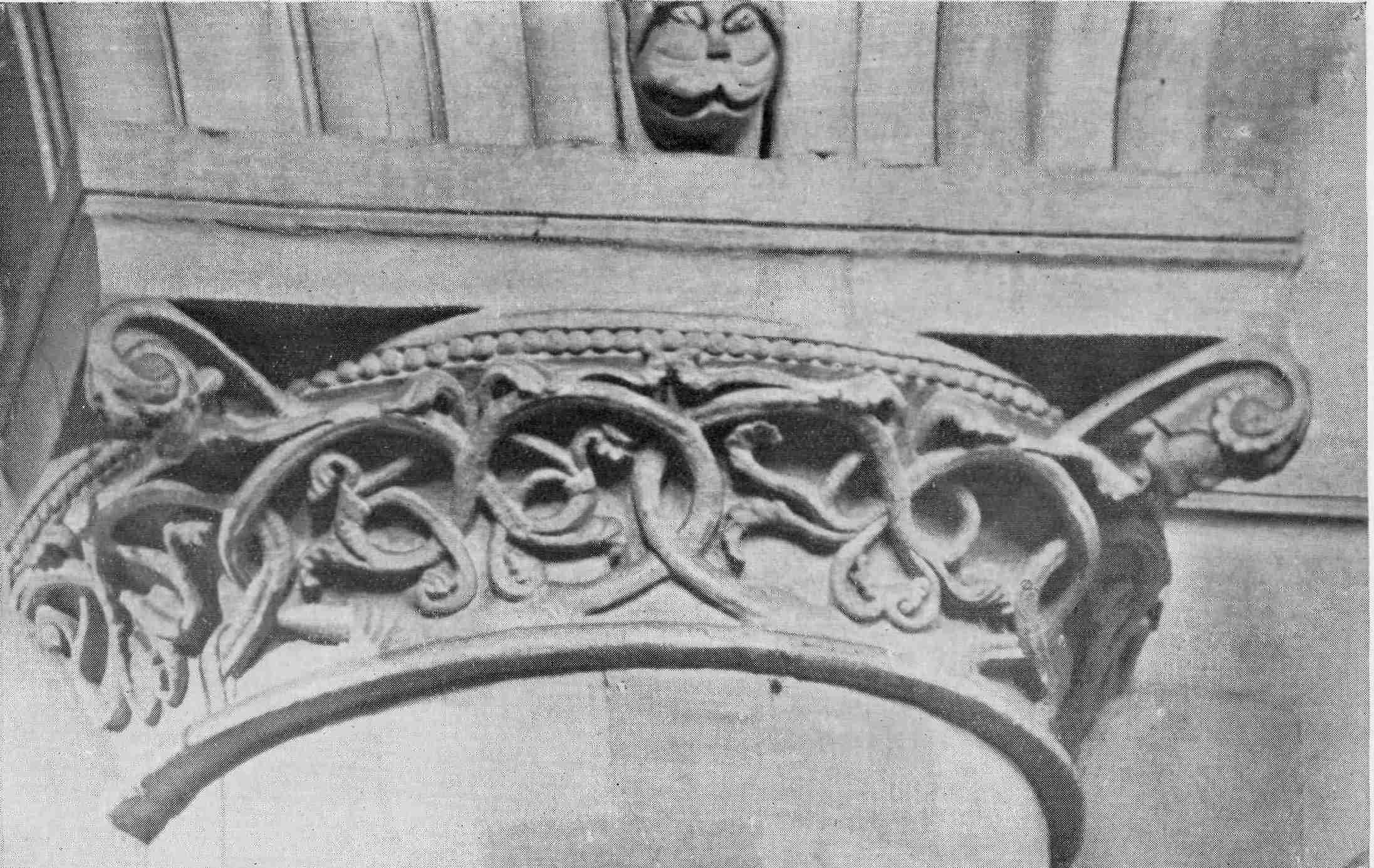
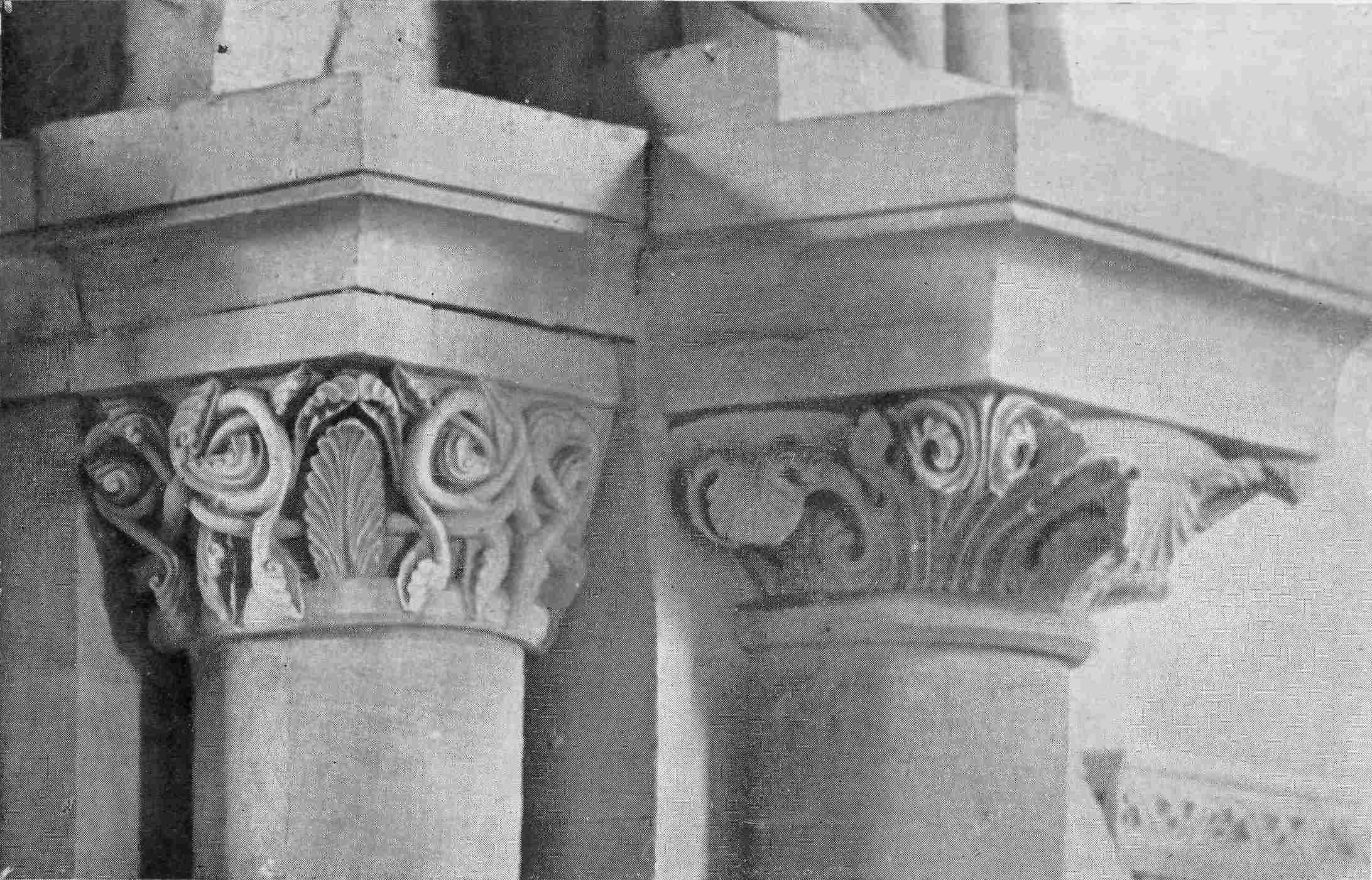
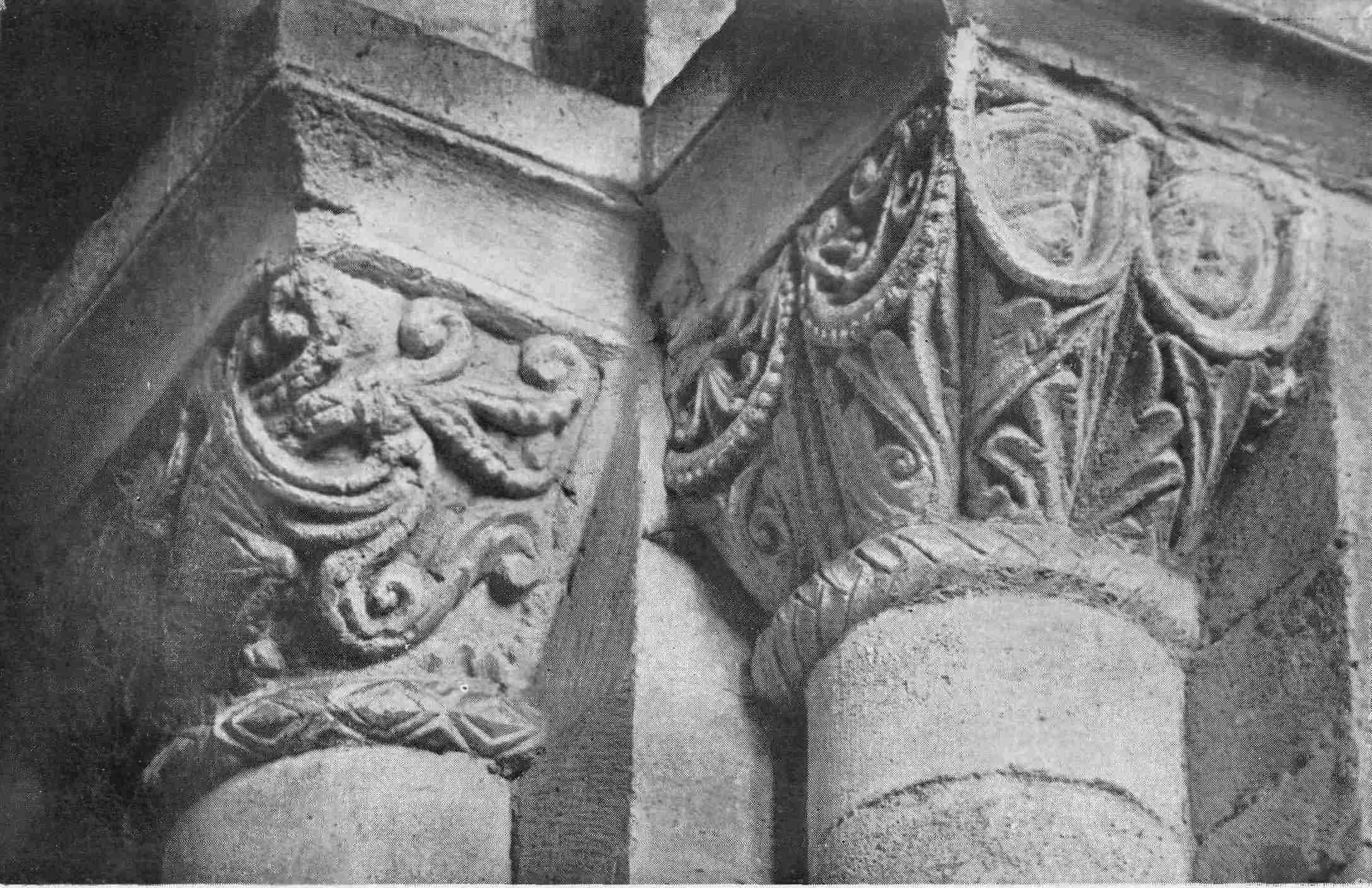
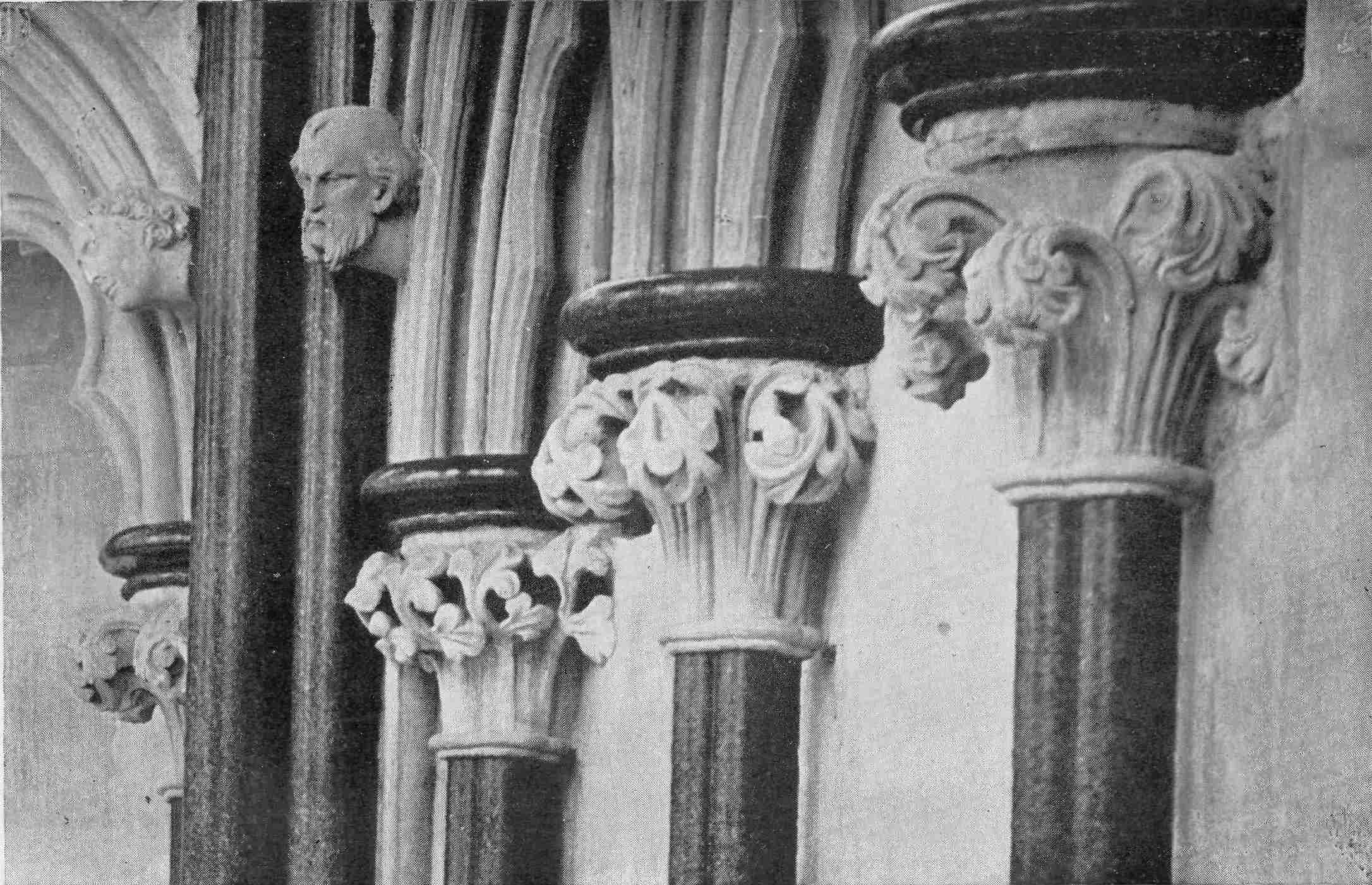
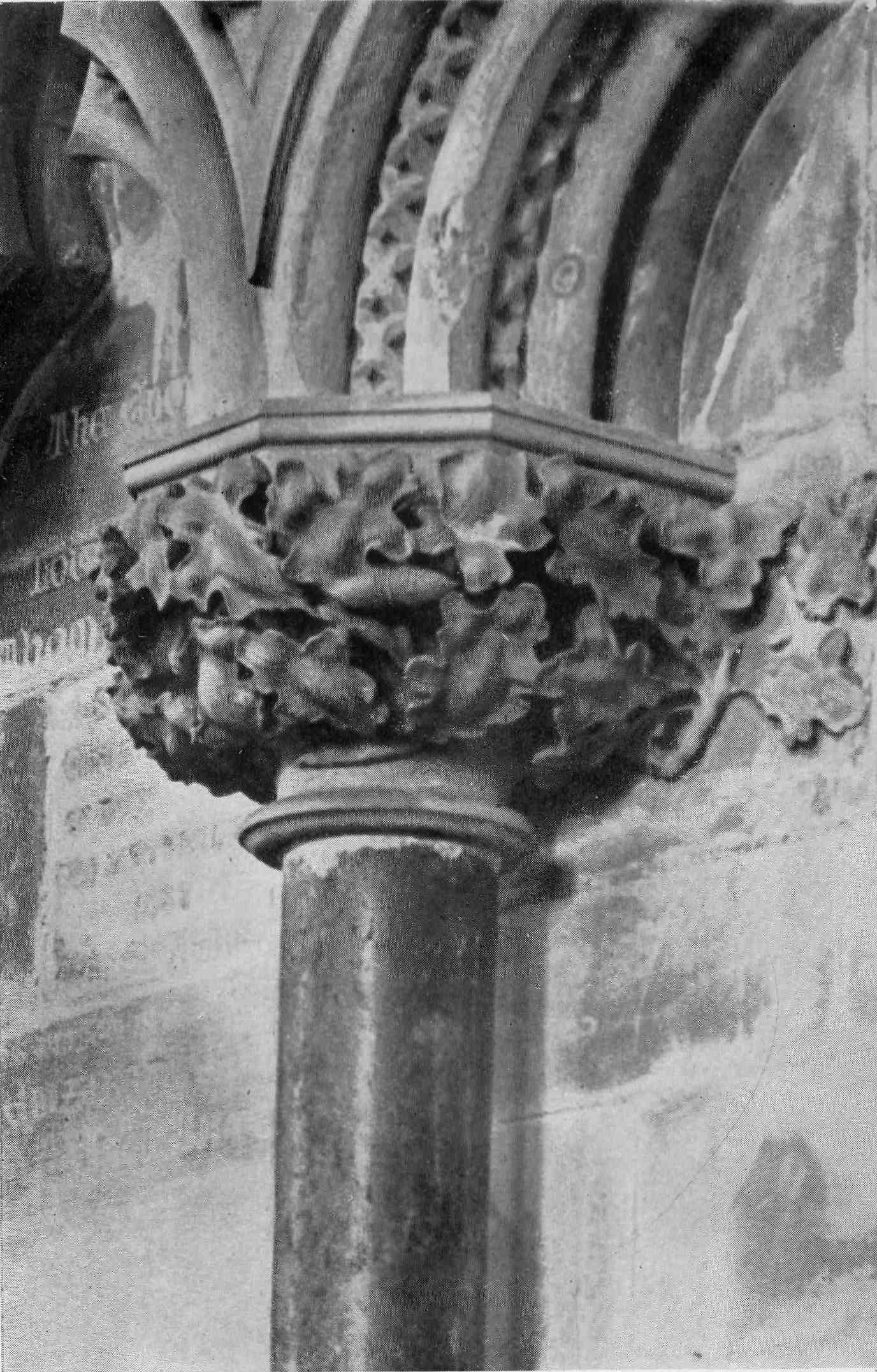
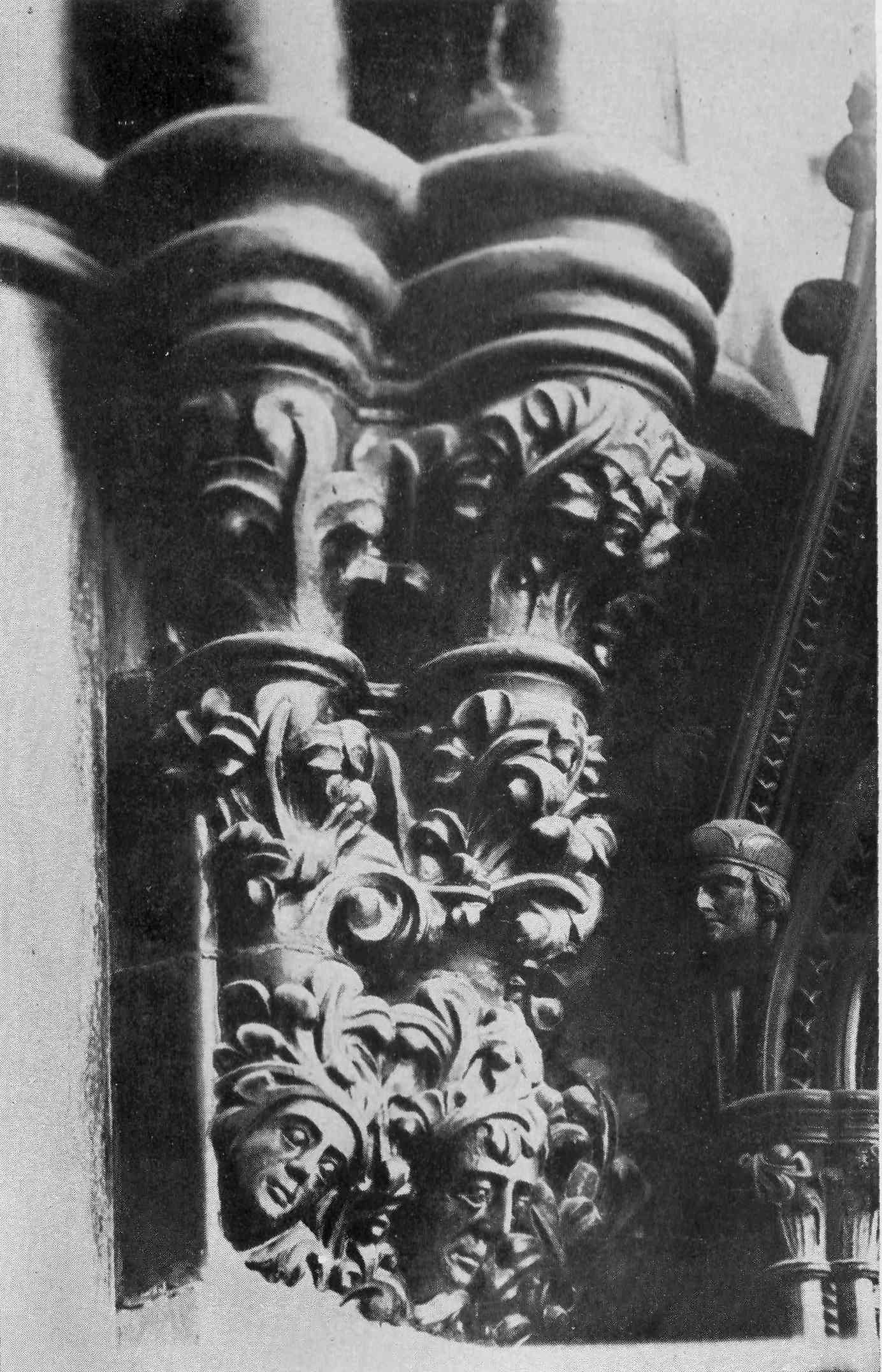
The chancel arch respond at Hemel Hempstead has strands coming out of the mouth of{16} a human face, with similar profile leaves, beaded (Pl. 6). At Hereford Cathedral there are interlaced spiral strands (beaded) mixed up with animals and Greek anthemia. At Durham the capitals of a doorway in the south aisle show winged monsters with long necks (beaded) intertwined with foliage, while on the abacus is a row of anthemia. The carving on the capitals is suggestive of Norse wood-carving. The same character belongs to some capitals from the ruins of Reading Abbey. A cushion capital at St Peter’s, Northampton, shows somewhat similar characteristics, but some of the sprays end in triplets of profile leaves (Pl. 7). Other capitals in the same church show animals mixed with the sprays which are sometimes bound together by what look like iron bands. Similar features appear on the base of the font at Aylesbury (Pl. 8). We might multiply instances of this class of foliage to almost any extent, but it does not lead us on to any further development. It consists merely of variations of the old tradition derived from Lombardic sources and exhibits no sign of vitality. We will therefore content ourselves with showing one more rather remarkable specimen from Oxford Cathedral. It puzzled antiquaries for a time, as it was thought to be pre-Conquest in date,{17} and yet it appears on the capital of a rather late Norman column, thus illustrating the continuance or revival of traditions in spite of the Conquest (Pl. 9).
The ornament on a doorway at Malmesbury consists of profile half-opened leaves just like those on the Christchurch capitals, but, arranged as they are here, back to back, they look more like halves of a Greek anthemion or palmette.
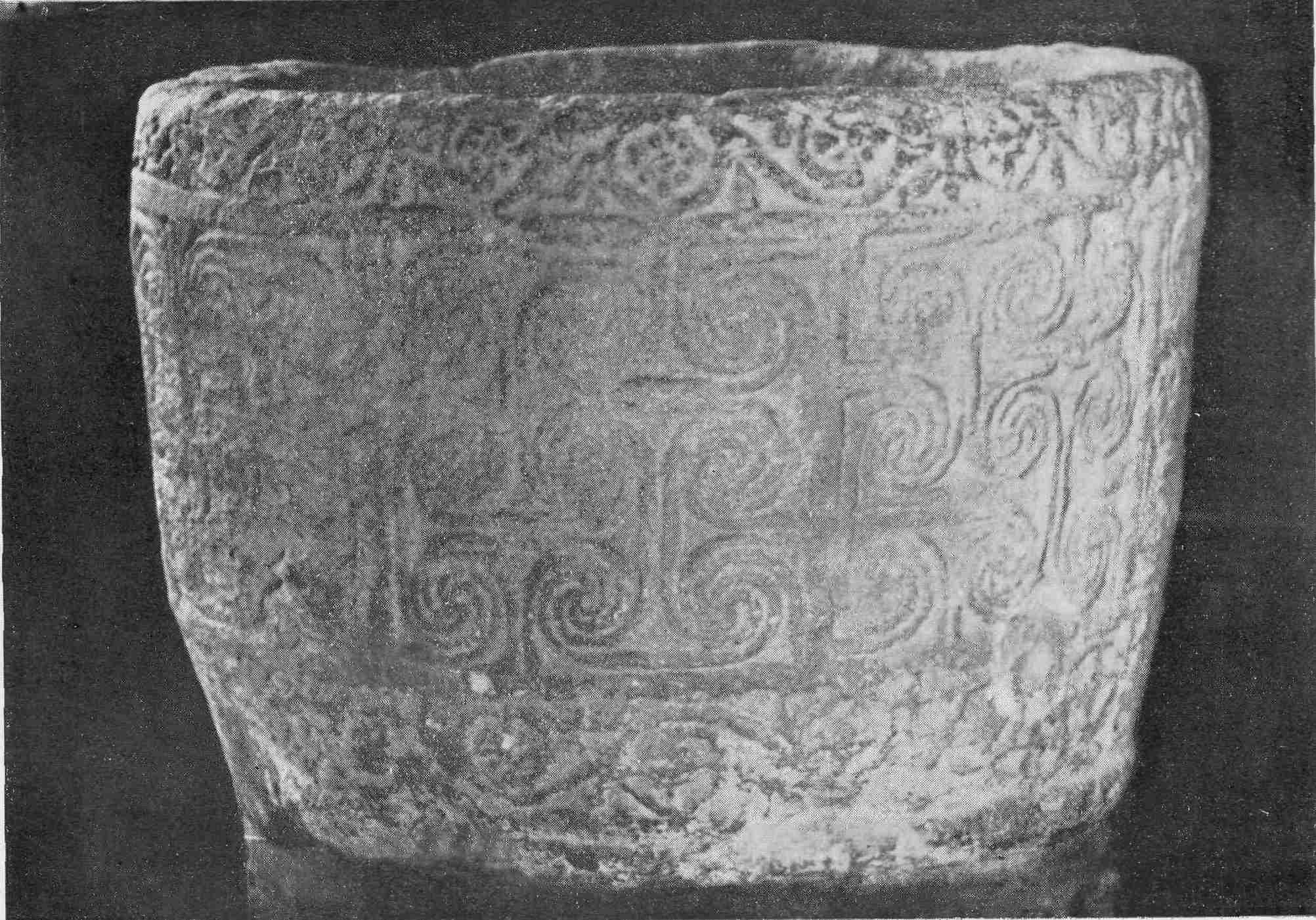
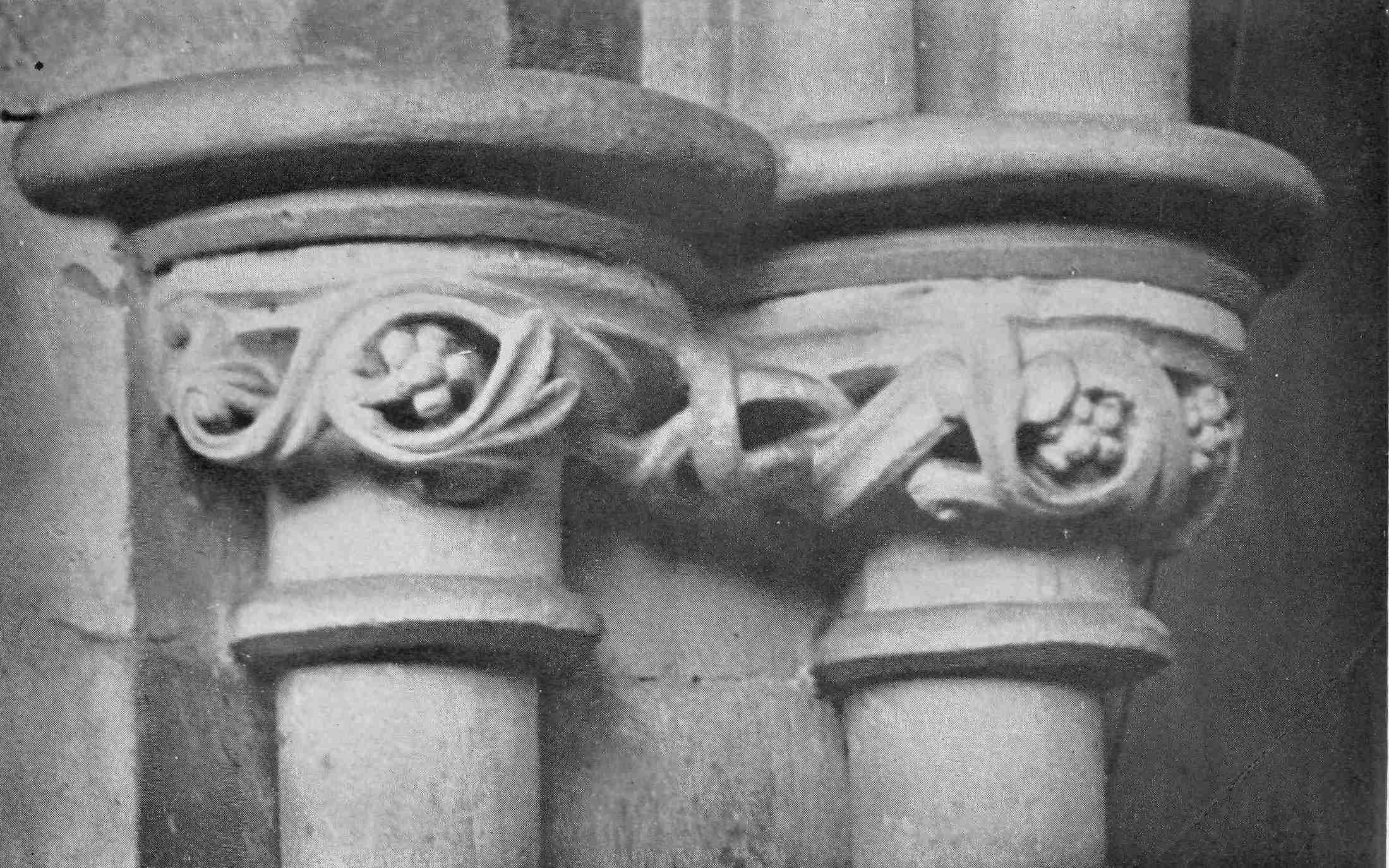
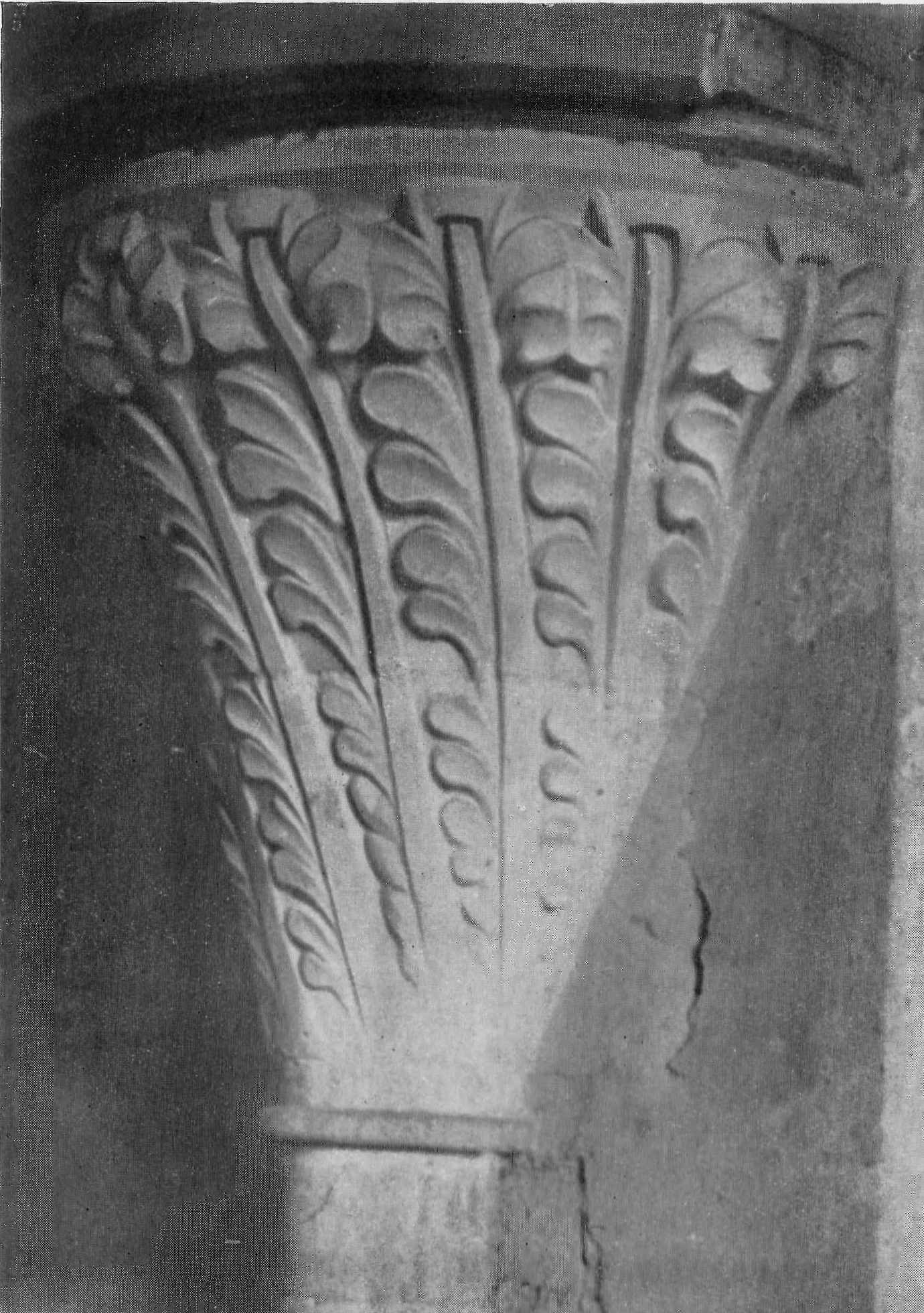
Fonts sometimes show foliage sculpture. At Deerhurst is a font usually considered Anglo-Saxon, on which the main part of the bowl is ornamented with spirals without any leafage, but the borders, above and below, have graceful sprays with leaves and flowers (Pl. 10). The type is interesting, especially as a thirteenth-century capital in the same church is evidently copied from it (Pl. 11).
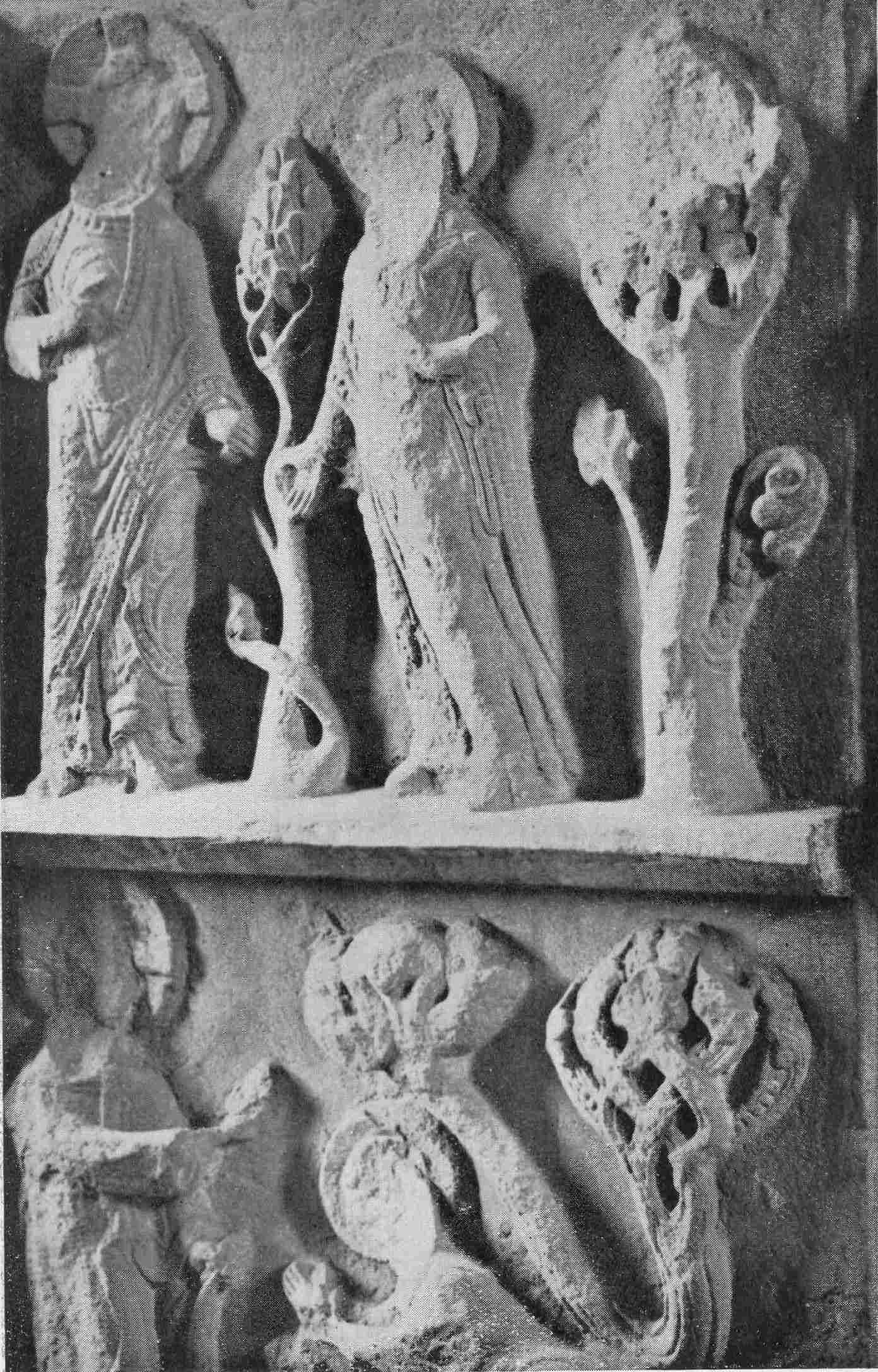
Somewhat similar, but more clumsy, sprays occur on fonts at St Stephen’s, Launceston, and Sidlington. In the Library of Durham Cathedral there are some fragments containing conventional representations of trees, which are a mixture of beaded straps and leaves, some attempts at naturalism, others conventional palmettes or “acanthus” leaves (Pl. 12).
A variety that stands by itself is seen at{18} King’s Walden. It is sometimes called water-leaf (Pl. 13). It also occurs under slightly different arrangement at Fountains, and at Oxford Cathedral it is combined with other experimental sprays.
These experiments at Oxford (Pl. 14) mark an important stage. Hitherto we have come across nothing in the way of novelty. All the designs have been copies—mostly debased copies—of Classical conventional forms. The masons at Oxford were tired of this and attempted something different. Their attempts were not altogether successful and did not lead to any further development; the only feature that survived or was afterwards revived was the rising of stalks from the necking.
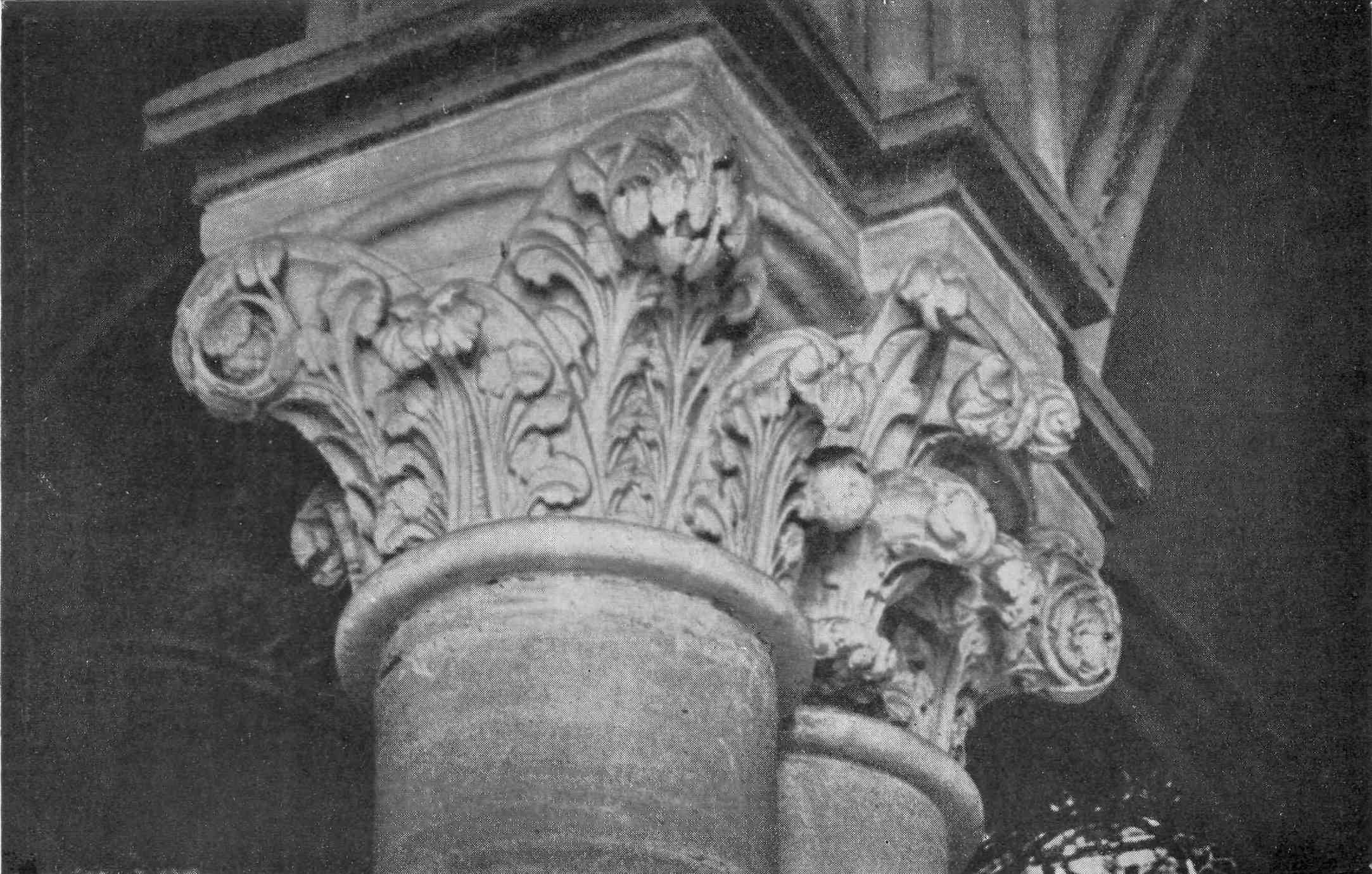
During the same period the re-building of Canterbury choir took place after the disastrous fire of 1174. The monks of Canterbury belonged to the Traditional rather than the Progressive school, and they entrusted the work to a French master-mason, William of Sens, instead of to English masons who were feeling their way to such work as within a few years is found fully developed in St Hugh’s choir at Lincoln. Up to this time the French masons had adopted the Roman Corinthian type of capital. This admits of considerable variety of details, and, after the middle of the{19} twelfth century, the French introduced not only Roman conventional foliage, but also foliage of a more naturalistic kind. The capitals in the Choir (Pl. 15) and especially in Trinity Chapel at Canterbury contain much of both kinds, well executed and highly finished. This Romanesque work is very beautiful, but it is not English, and has no place in the continuous development of English foliage.
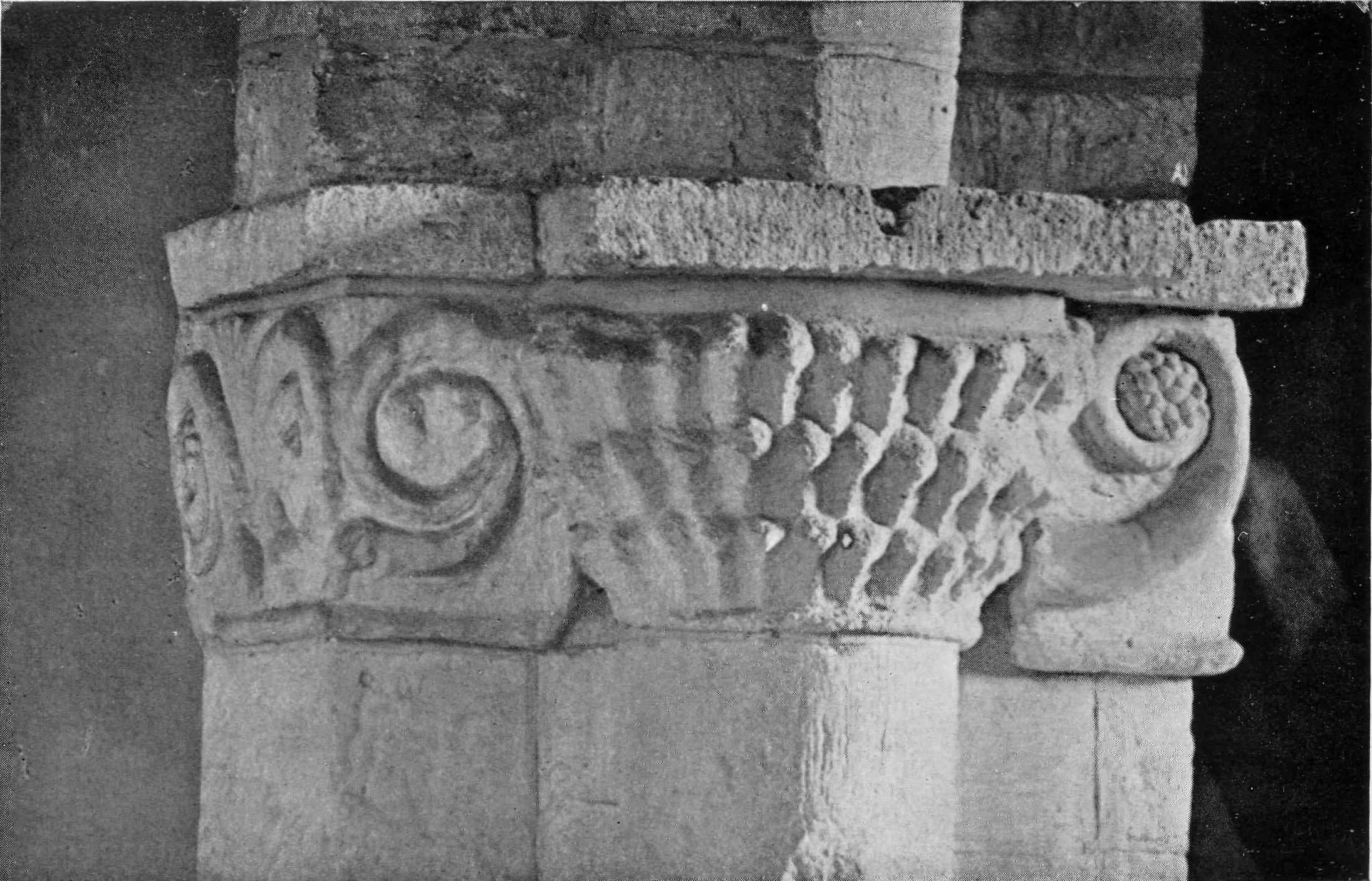
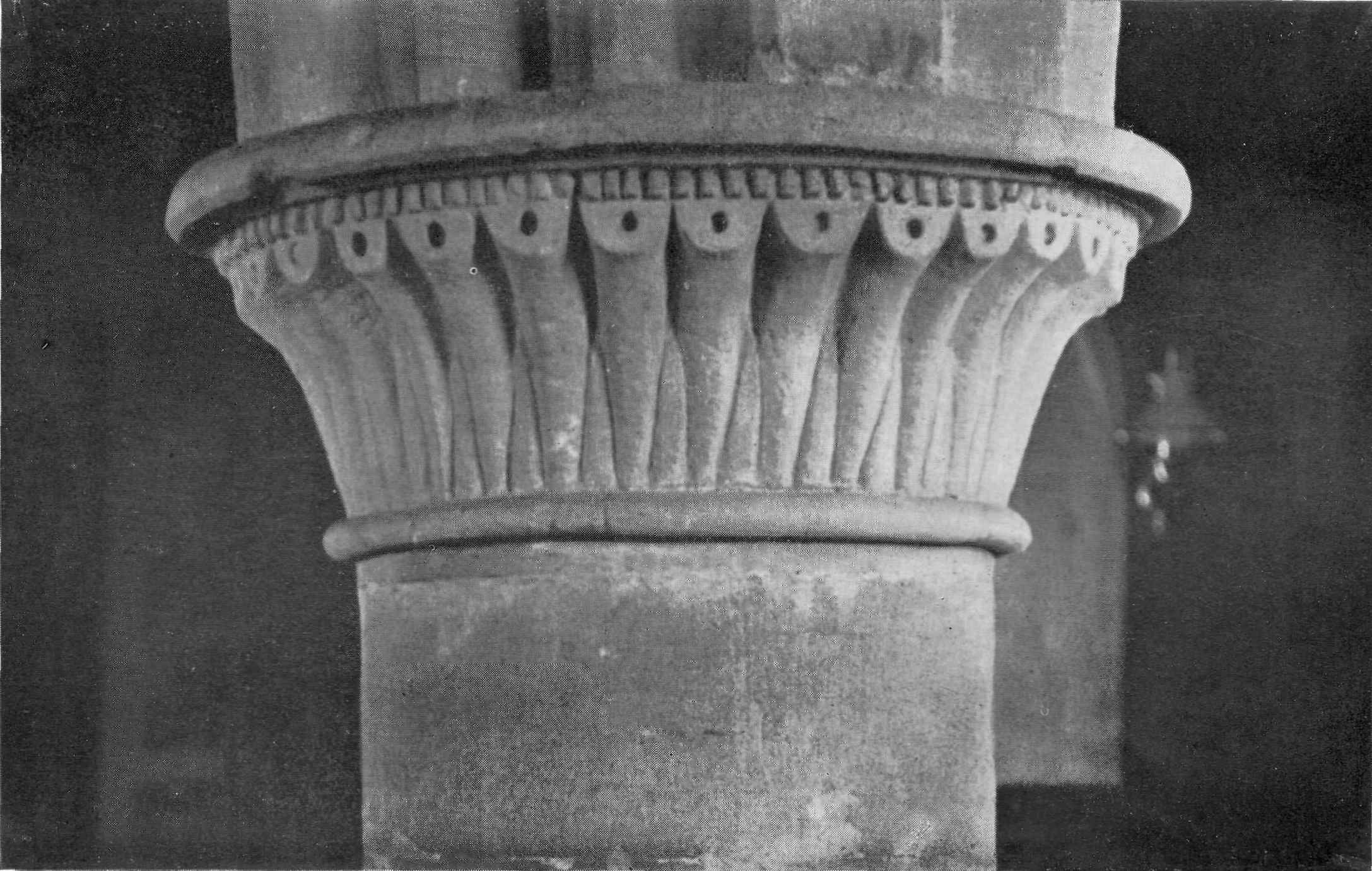
The French Corinthian type never made much progress in England. It requires the square abacus to be effective, and the square abacus was almost entirely abandoned here in favour of the round by the beginning of the thirteenth century. A rather good example occurs at Ducklington, Oxon, and an interesting juxtaposition of the Saxon type and the French Corinthian is to be seen at Broadwater, Sussex (Pl. 16). Before passing on to follow up the development of the stiff-leaf convention, it may be interesting to note some early attempts to copy Corinthian. On a respond of the tower arch at Sompting Church is a curious instance of this, probably pre-Norman in date. It consists of a triple row of crockets, apparently intended to copy acanthus, while the volutes resemble ram’s horns, perhaps placed upside down, with clusters of grapes encircled in them (Pl. 17). At Southrop,{20} Glos, is a very primitive sort of capital with volutes rising from a central stem, and below parallel leaves rising from the necking. In Canterbury crypt there are several such capitals (Pl. 18), some better and some worse executed. They appear to have been carved in situ on capitals that were originally cushions. The feature that is of most interest in all these early attempts is the parallel leaves rising from the necking. There is nothing new about this arrangement. It is, in fact, precisely similar to that on the Lysicrates monument at Athens, but it seems to have some affinity both to scallops and stiff-leaf stems.
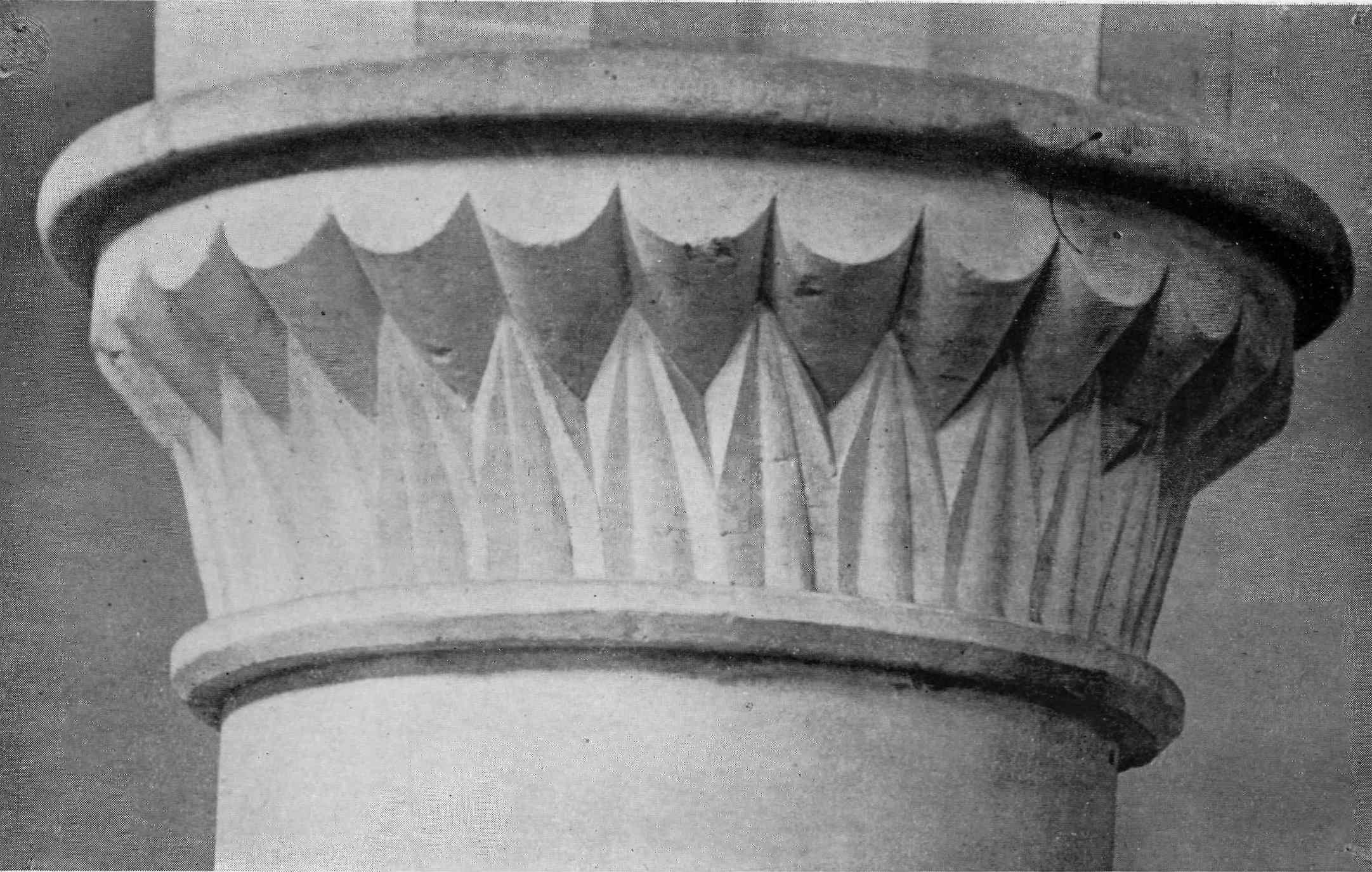
The scalloped form of capital is an English type. It is formed by dividing each semi-circular face of the cushion capital into two or more semi-circles, and carrying the channel between each semi-circle down to the necking, so that each convexity is a half-cone. A very simple example is a scalloped capital at the Tower of London, in which each face is bisected. The capitals illustrated in Pl. 1 and Pls. 19, 20, 21, 22, 23 will show the shape better than any amount of description. The nave capitals at Hemel Hempstead show the effect of scallops on large square capitals. In this case variety is given by cutting out the corners. The great round capitals at Malmesbury have{21} scallops with the semi-circles moulded. At Black Bourton, Oxon (Pl. 19), the scallops are curved and the semi-circles made circular and ornamented with quatrefoils. At Kimpton not only are the semi-circles moulded but the scallops themselves have great leaves cut upon them (Pl. 20). At King’s Walden, close by, spiked leaves rise from the necking between the scallops (Pl. 21). At Romsey there are some very richly carved scalloped capitals, with faces in the semi-circles and foliage all over the scallops (Pl. 22). At Cuddington a round capital has curved scallops, the semi-circles ornamented with a round hole, and plain sharply-pointed leaves rising from the necking between the scallops (Pl. 23).
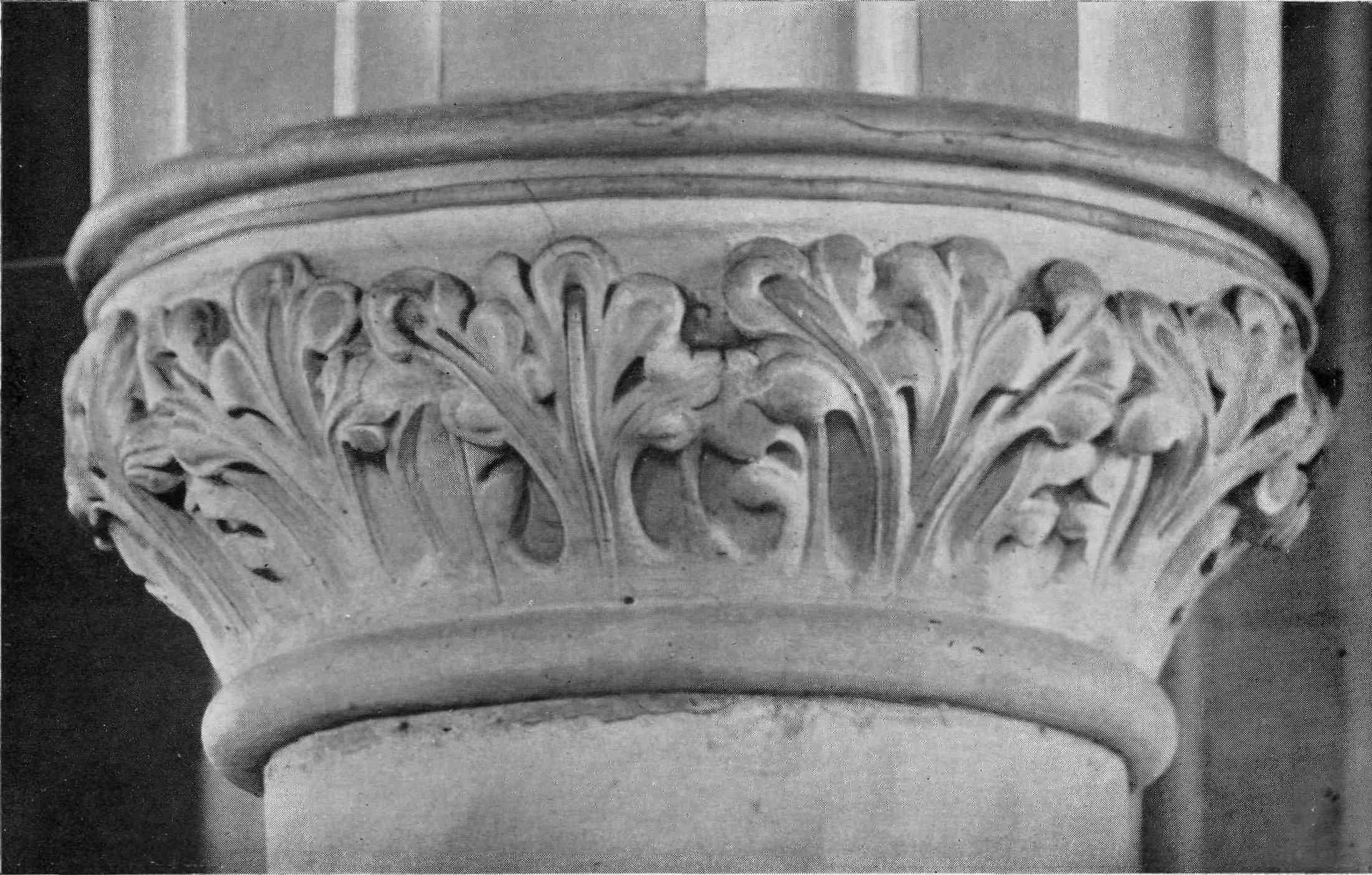
The chief significance of scalloping in connexion with the development of stiff-leaf is the rising of straight lines from the necking. We have already mentioned the Oxford experiments in which this feature is prominent.
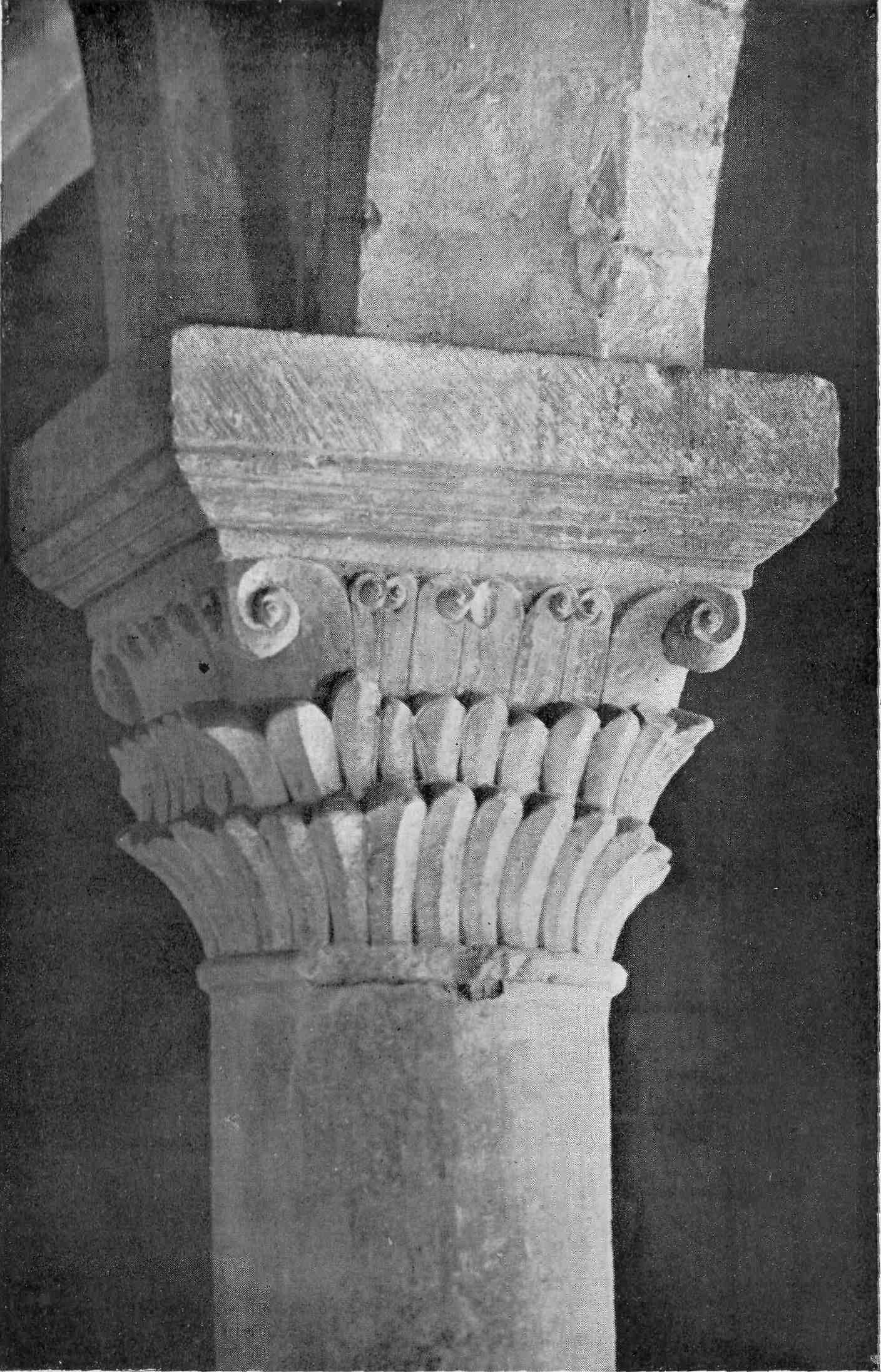
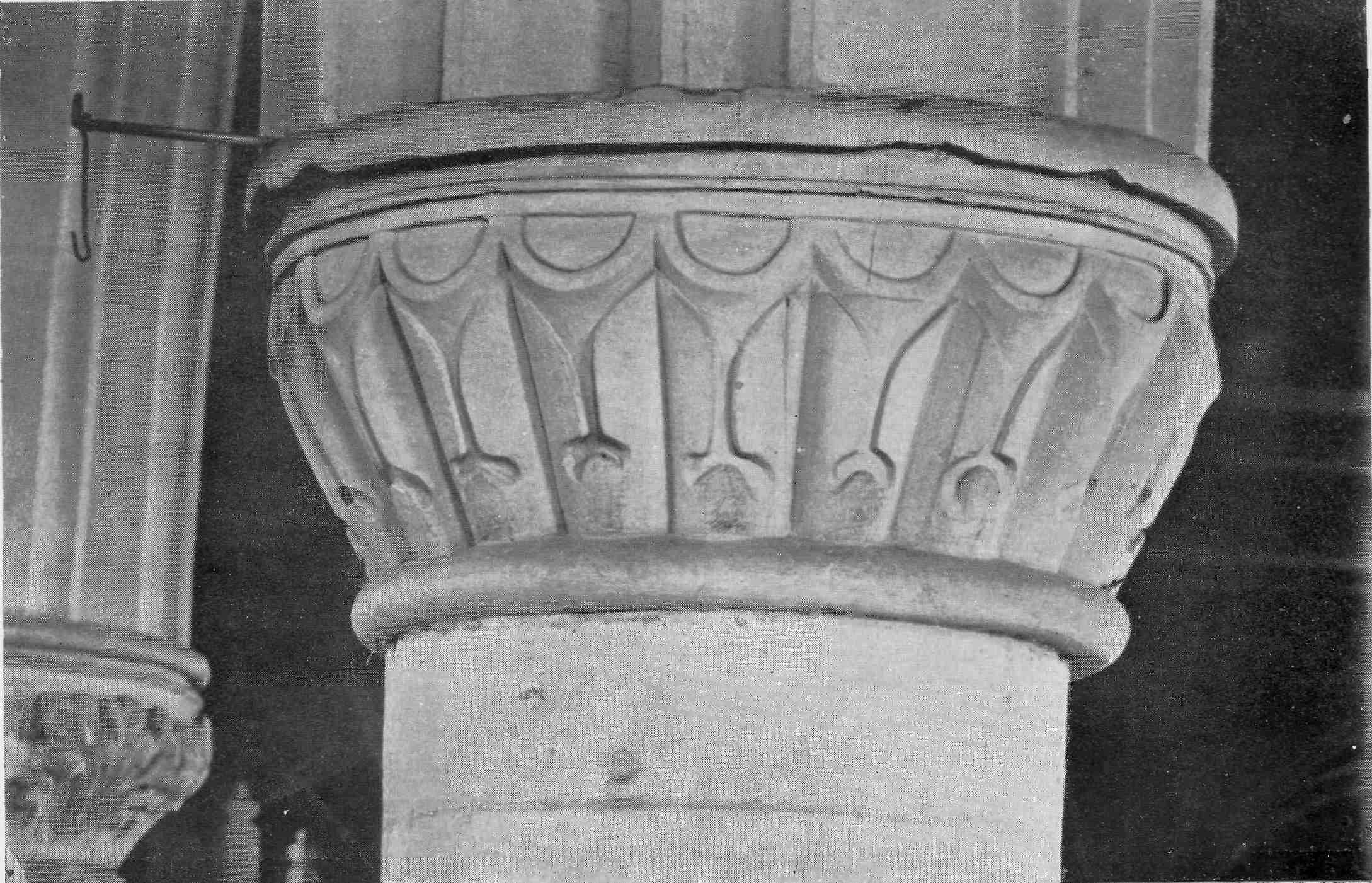
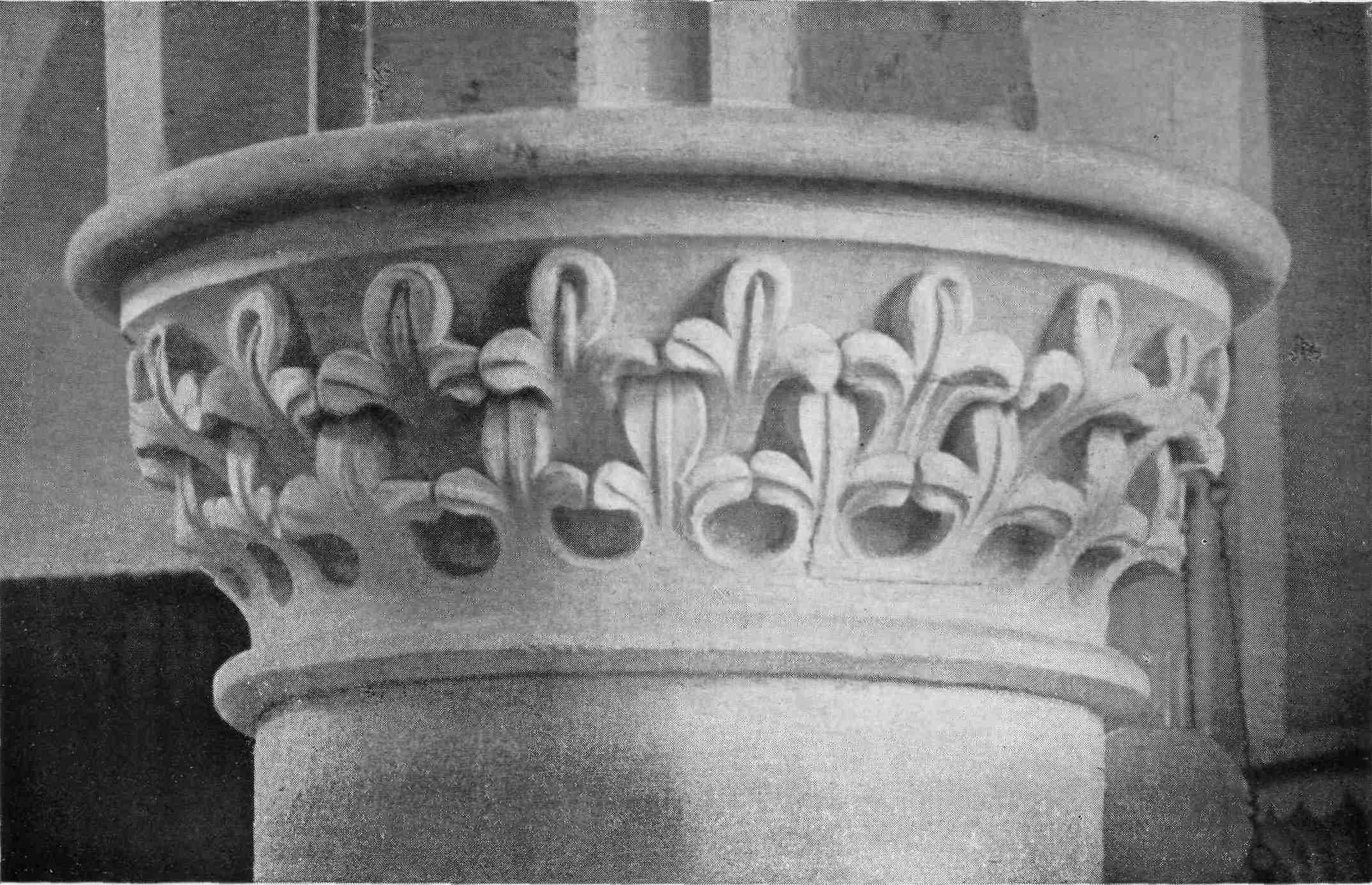
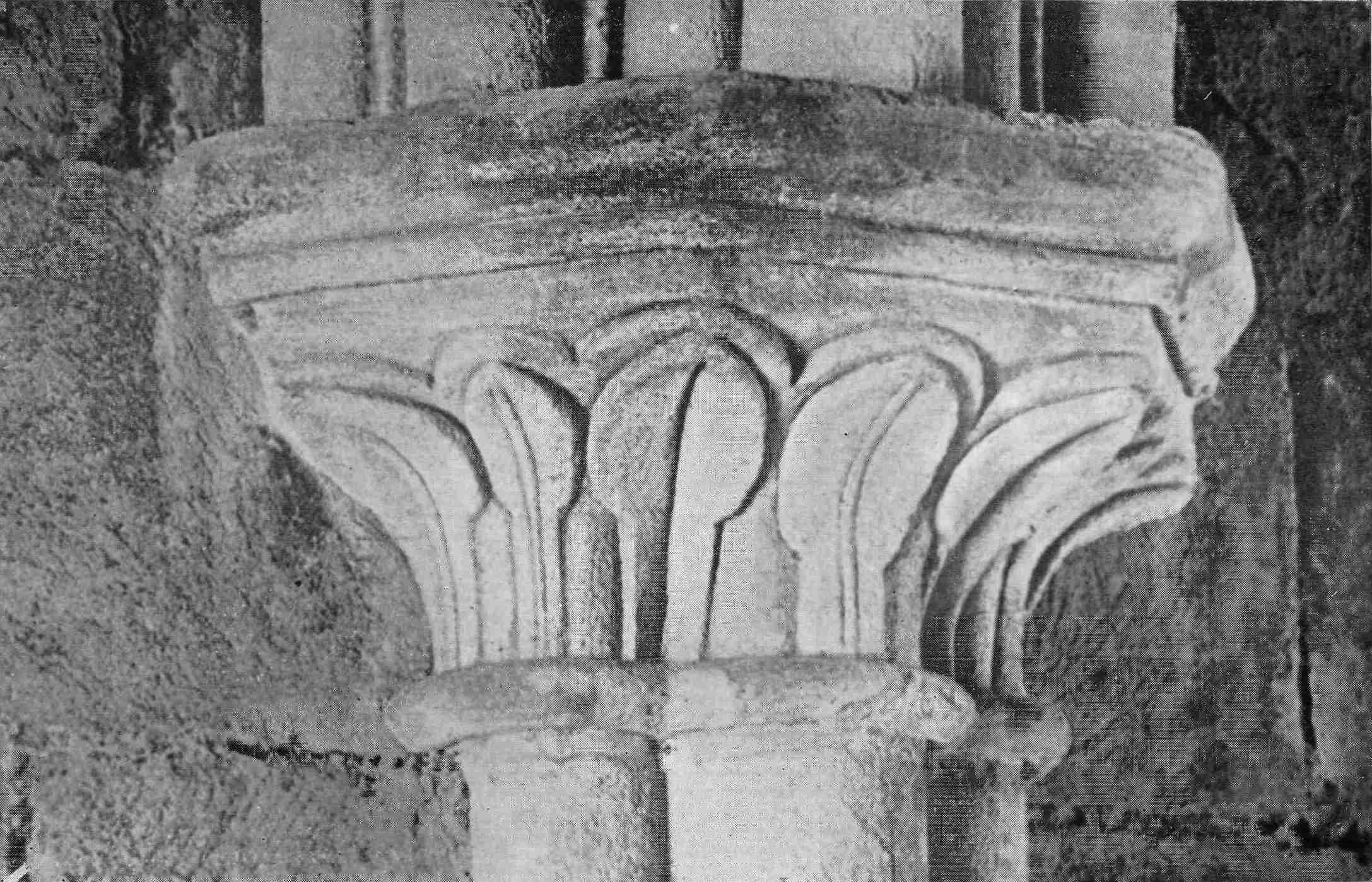
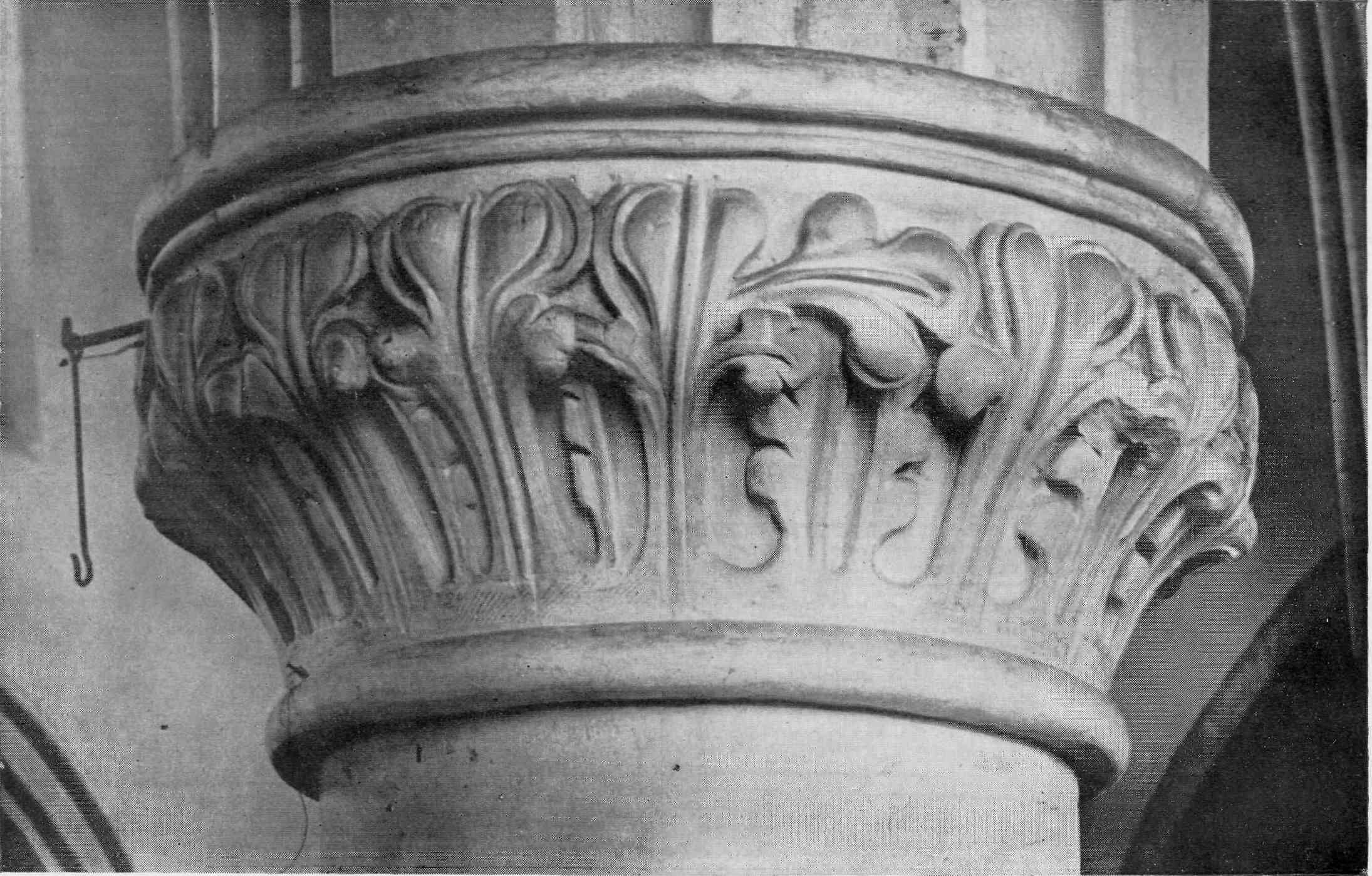
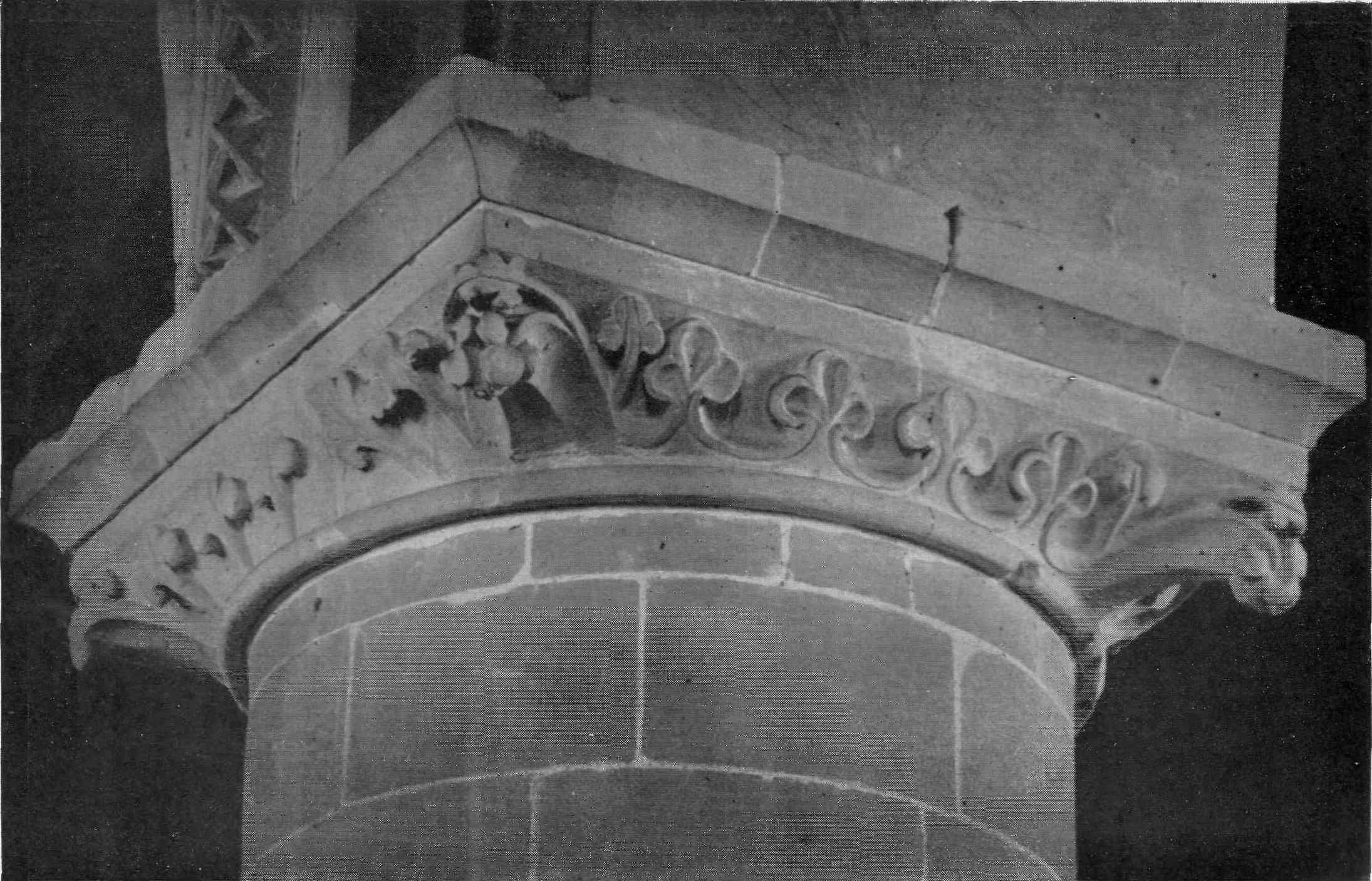
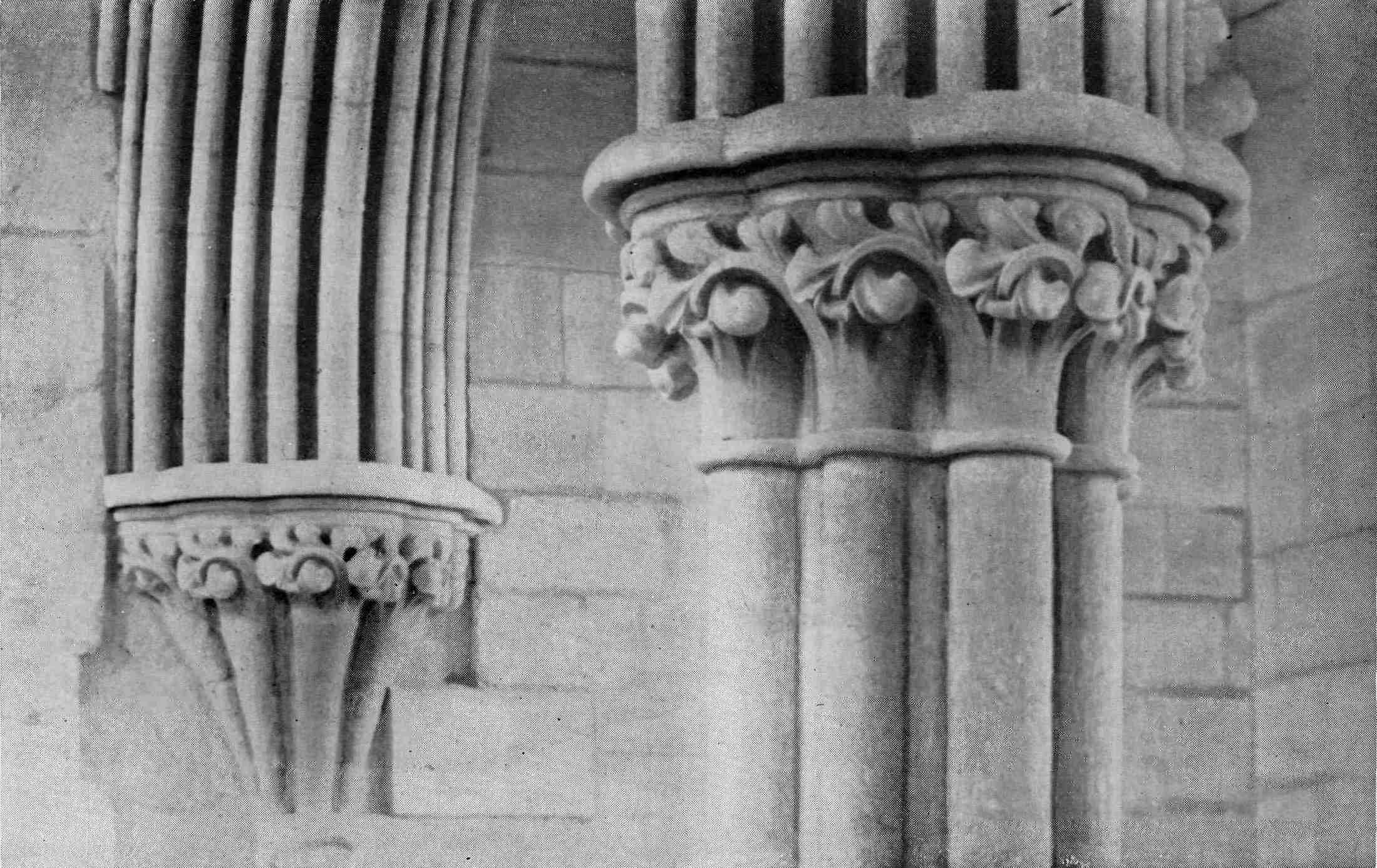
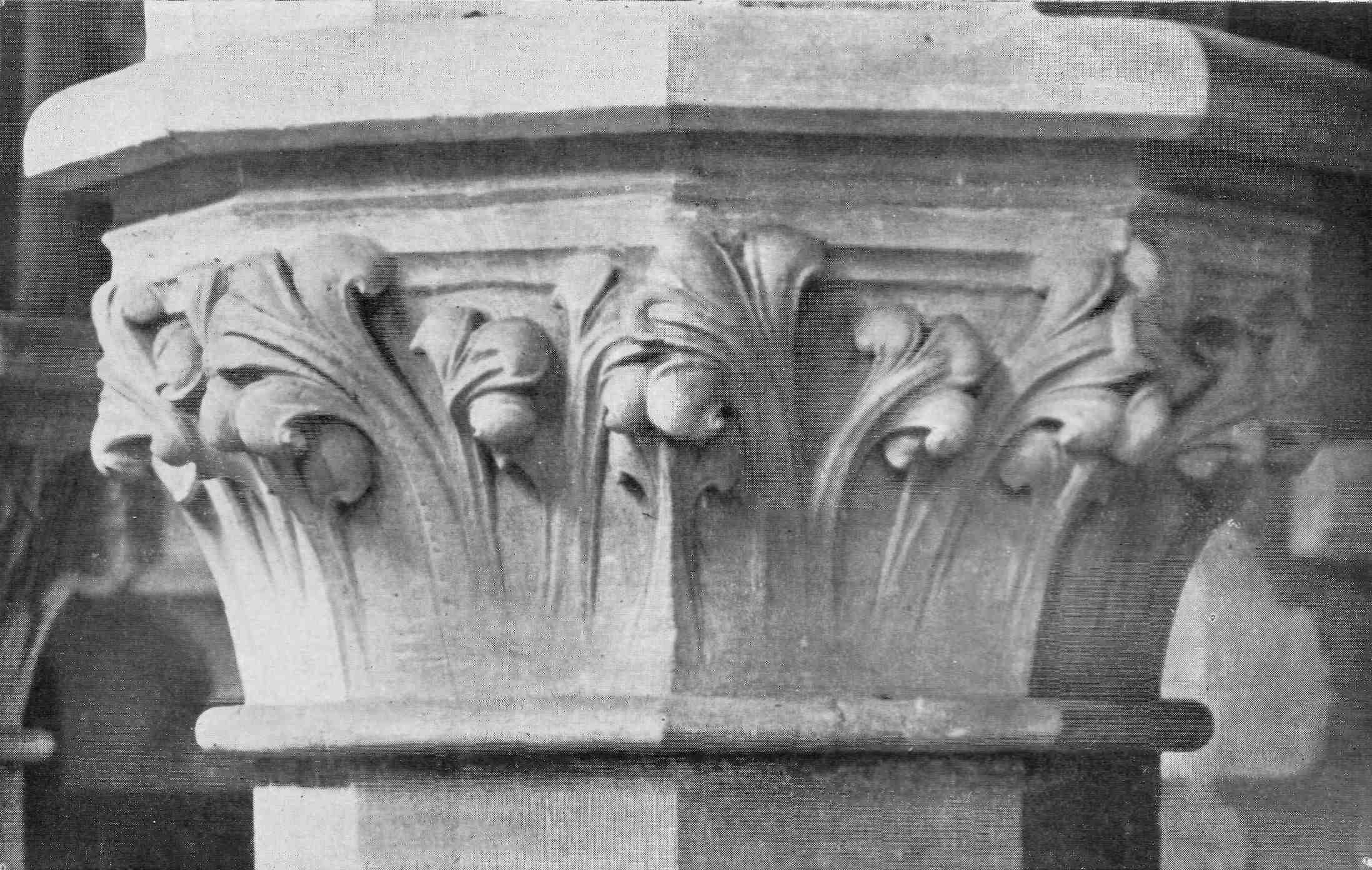
THE basis of the English stiff-leaf foliage, which dominated Gothic ornament here for nearly a century, is a trefoil of a very marked type. The period of its domination was from the end of the twelfth to near the end of the thirteenth century—the spring-time of Gothic architecture. It first appeared when the Saxon and Norman masons had got over their animosity and were working together, while inter-marriage was binding the two races into a new nation. The churches of King’s Walden and Kimpton afford most interesting examples of the time just preceding this fusion (Pl. 4). The masons of the dying Romanesque school were working side by side with those whom the new spirit of Gothic was animating, and who ventured on some of the earliest experiments in the coming style. It is seldom that we are able to find so concrete an example of an abstract type as the trefoils on a capital at King’s Walden (Pl. 24). Here is a double row of plain trefoils showing clearly the solid mid-rib in all three lobes, but appearing to press into, if not to pierce, the central lobe. This is the simple earliest development of the type mentioned on p. 11 as occurring in embryo-form{23} on a string course at Sompting (Pl. 2), and representing the under surface of a leaf[4]. The other type, representing the upper surface, is shown as plainly and simply on a capital at St David’s Cathedral. Here, instead of the solid mid-rib, the central portion of the central lobe is concaved into a hollow and looks almost like a loop (Pl. 26). These two distinct types may be called the eastern, or Lincoln, and the western, or Wells, types. But it must not be supposed that this rough classification is exact or exclusive. Trefoils of both kinds may be seen both at Lincoln and Wells, but the mid-rib type is certainly more common in the eastern counties, and the hollowed type is more frequently found in the west than in the east. A capital at Bledlow Church shows simple examples of both types placed alternately (Pl. 27), and at Fountains an early capital shows the same distinctive features of the mid-rib and hollow alternately on leaves that are not trefoils (Pl. 28). At Kimpton (Pl. 29) the development is rapid. The trefoils are in groups of three, and they are made to blend so as to make a continuous garland of leafage round the capital. But the masons who carved the Kimpton capitals were not content with{24} uniformity. There were two schools, as we have said before, working side by side; probably both of them had been at work on the great abbey of St Albans. There were the conservatives and the progressives; and the rows of capitals, apparently contemporaneous, contain some of the old decadent Romanesque type and some of the new experiments in stiff-leaf. The conservatives, not wishing to be outdone by their rivals, ornamented the Norman scallops as in the capital illustrated in Pl. 20, or like Pl. 21 in the neighbouring church of King’s Walden. The progressives varied the shapes of the trefoils and the character of the mid-ribs, which they sometimes carried up above the top of the central lobe instead of pressing into it. These variations will be seen in Pl. 30. In the last-mentioned a very remarkable piece of almost impudent experiment occurs. The spacing of the garland of trefoils round the capital not being accurately measured, when the last space had to be filled there was not room for a complete trefoil like the rest, so the mason had the temerity to push out a trefoil sideways to fill the gap. This is a crude and clumsy forerunner of such foliage as is to be found in the Lincoln Angel Choir (Pl. 47). At Minster in Thanet there are hollowed trefoils in a row on one face, and{25} convexed mid-ribbed trefoils on another (Pl. 31). A double row of leaves appears on some capitals at Wells, the monotony being broken by an experiment, not altogether successful, which is a singular and exceptional breach of the convention, and suggests an attempt at naturalism (Pl. 32[5]). It is, however, to be observed that, in this departure, the mid-rib and concave conventions are followed in the thin leaves substituted for the expansive trefoils. In the nave of Lincoln some of the capitals have a double row of trefoils bending about with considerable freedom and exhibiting very clearly some characteristic features (Pl. 33). In most of the sprays the mid-rib is prominent, and in most cases it dies into the leaf in a way which explains the origin of the apparent pressing in or piercing. The point of the leaf is seen plainly to curl over in the way of which we have the first example at Sompting (Pl. 2). It is true that in that example it is the concaved upper surface which is curled over, but it is suggestive. The curling of all the tips in this Lincoln example led to such convolutions as we find later in such capitals as those in the Hereford north transept (Pl. 34). The semi-circular excrescences between the stalks above the necking are an{26} early feature, seen also at Oxford, and elsewhere. This turning over of the tips is seen in the borders of Saxon ivories at the Oxford Galleries (Pl. 3). It is quite Classical in origin, and seems to be derived from the curling over of Corinthian “acanthus” leaves. A corbel at Teversham (Pl. 35) shows long flat mid-ribs apparently piercing the heads of the leaves like metal bands. This specimen looks like the work of an inferior hand who did not grasp the significance of the convention, but who slavishly copied it without understanding it. The occurrence of such exceptional examples only throws more light on the influence of style. It guided and kept within reasonable bounds the intelligent and artistic mason, but merely exercised a mechanical control over those less capable. We are reminded of the great sculptors of Ancient Greece who did the figure work, and the slaves who executed the patterns. The mason who did such work as this at Teversham would have been better employed at cutting dog-tooth ornament.
The trefoils exhibiting the mid-rib type are arranged in graceful wavy garlands at Eaton Bray (Pl. 36). Ivinghoe Church has a very good series of stiff-leaf foliage capitals, showing characteristics already described (Pl. 37).
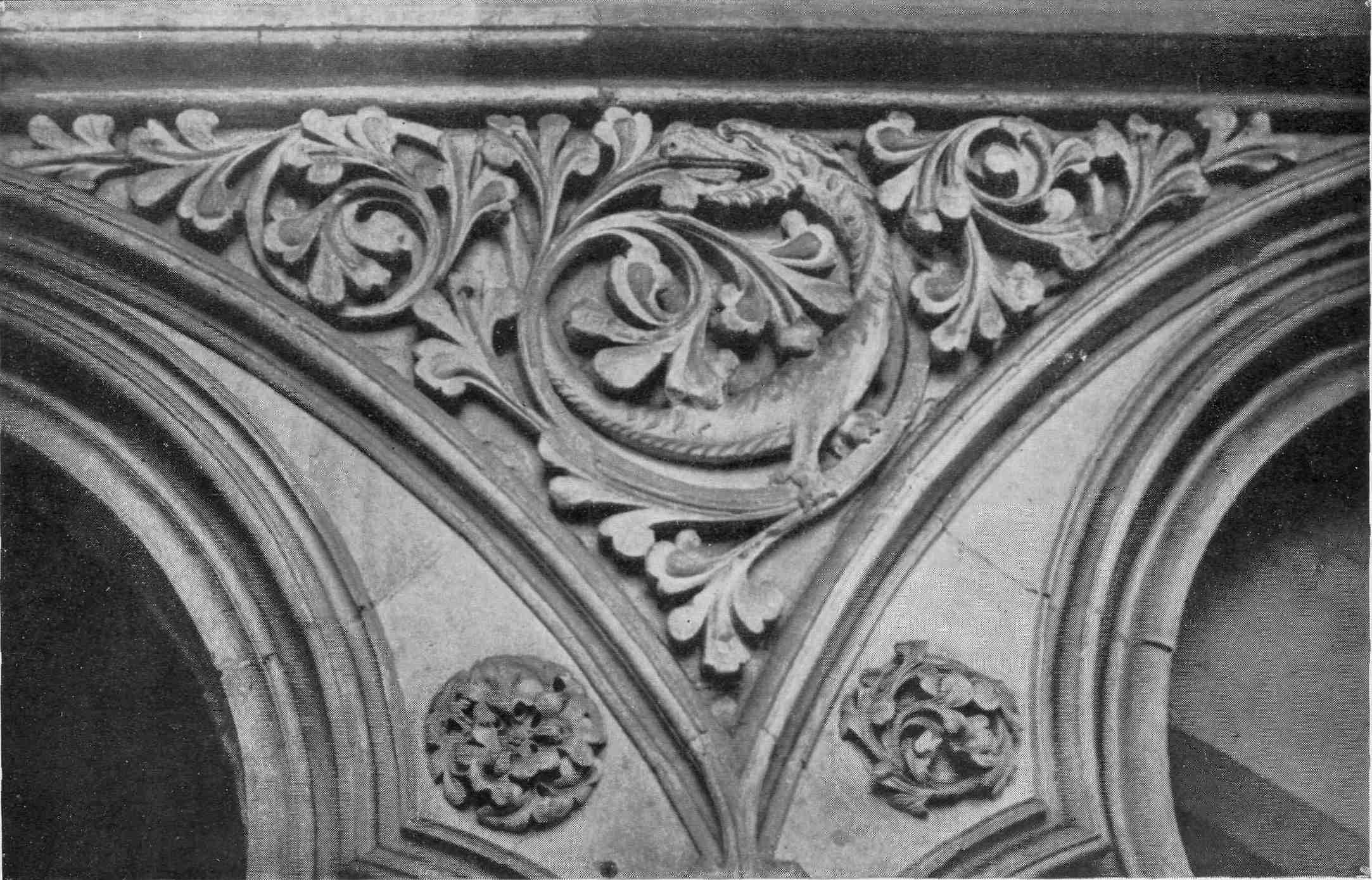
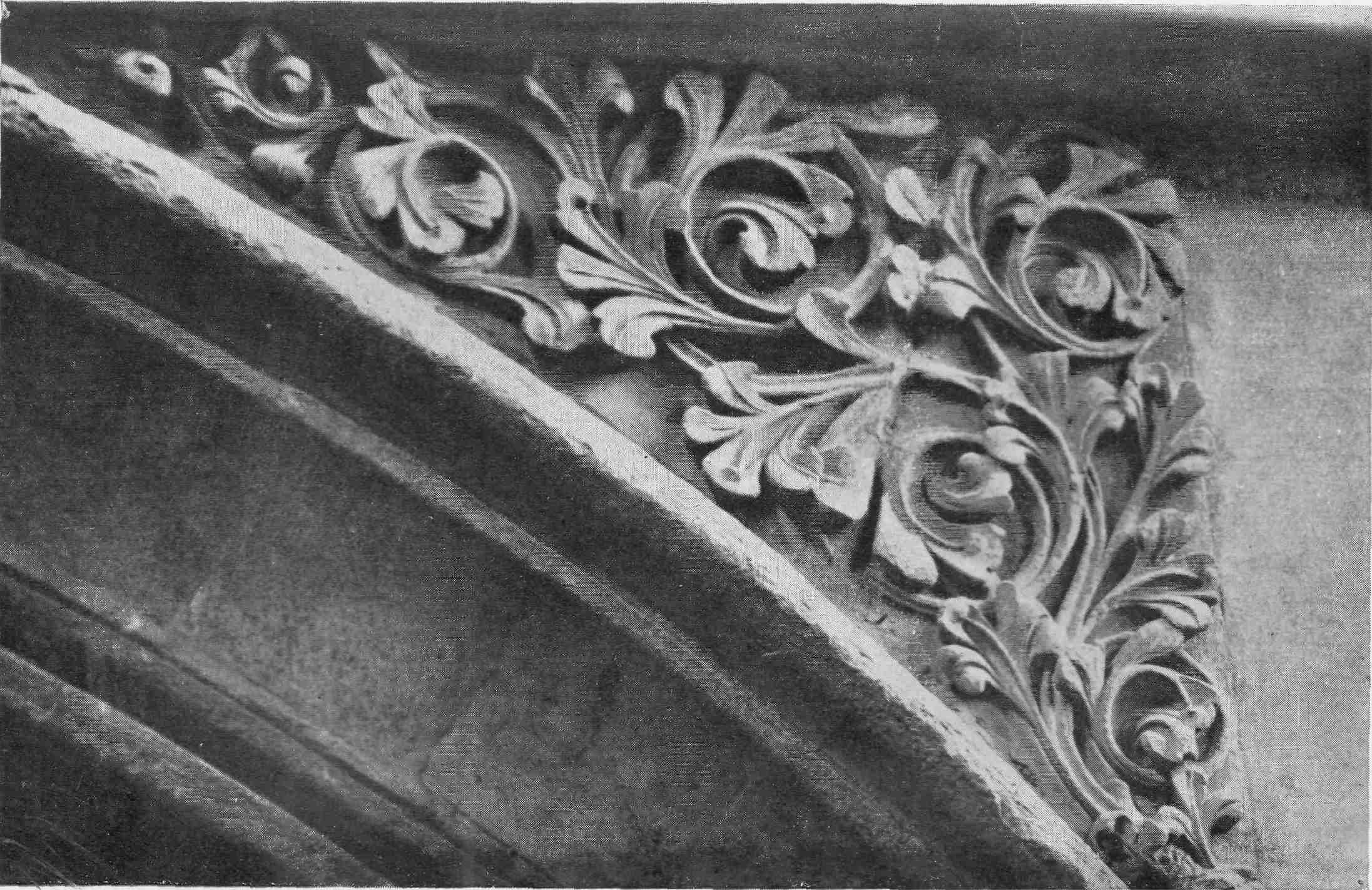
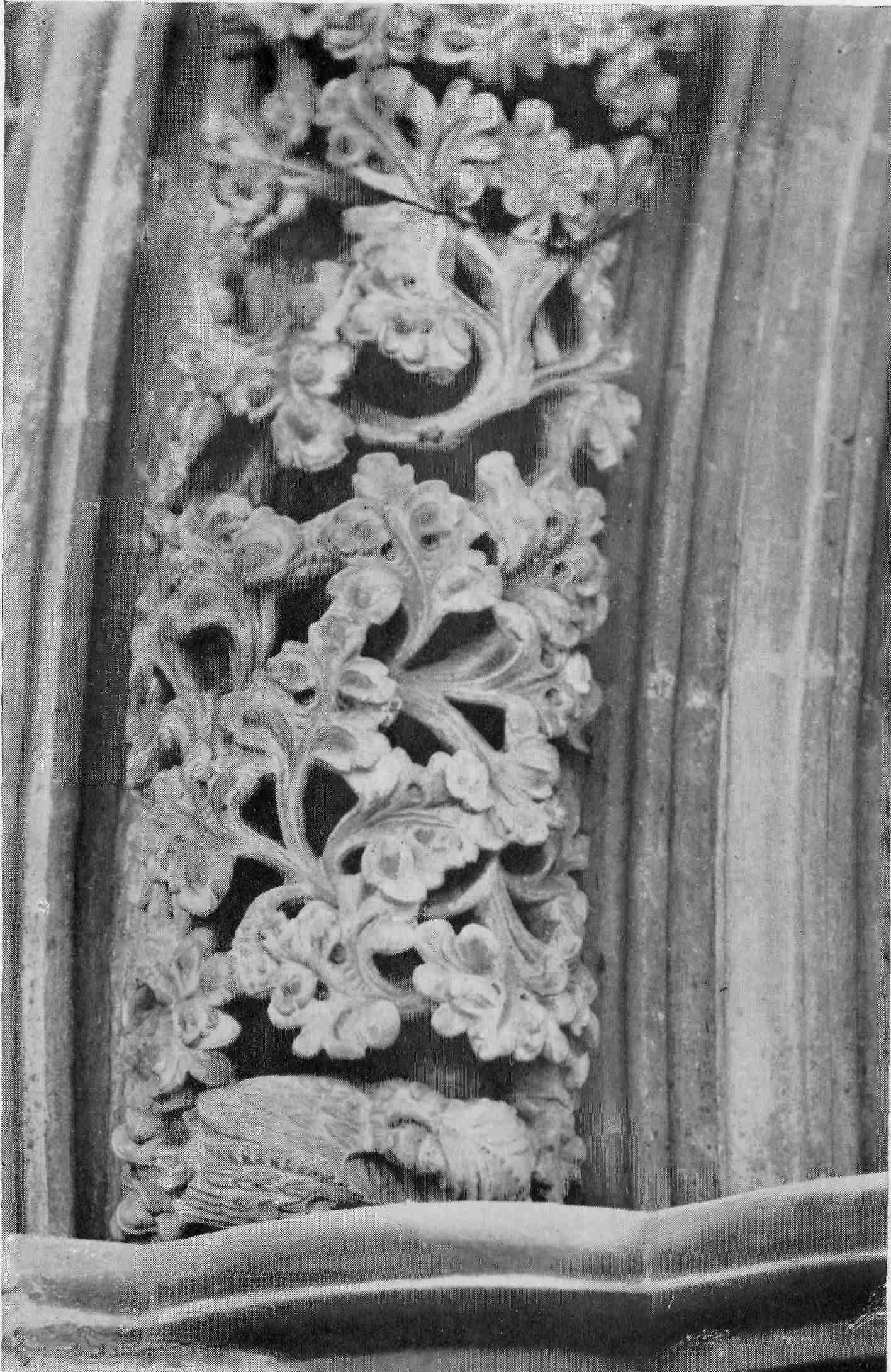
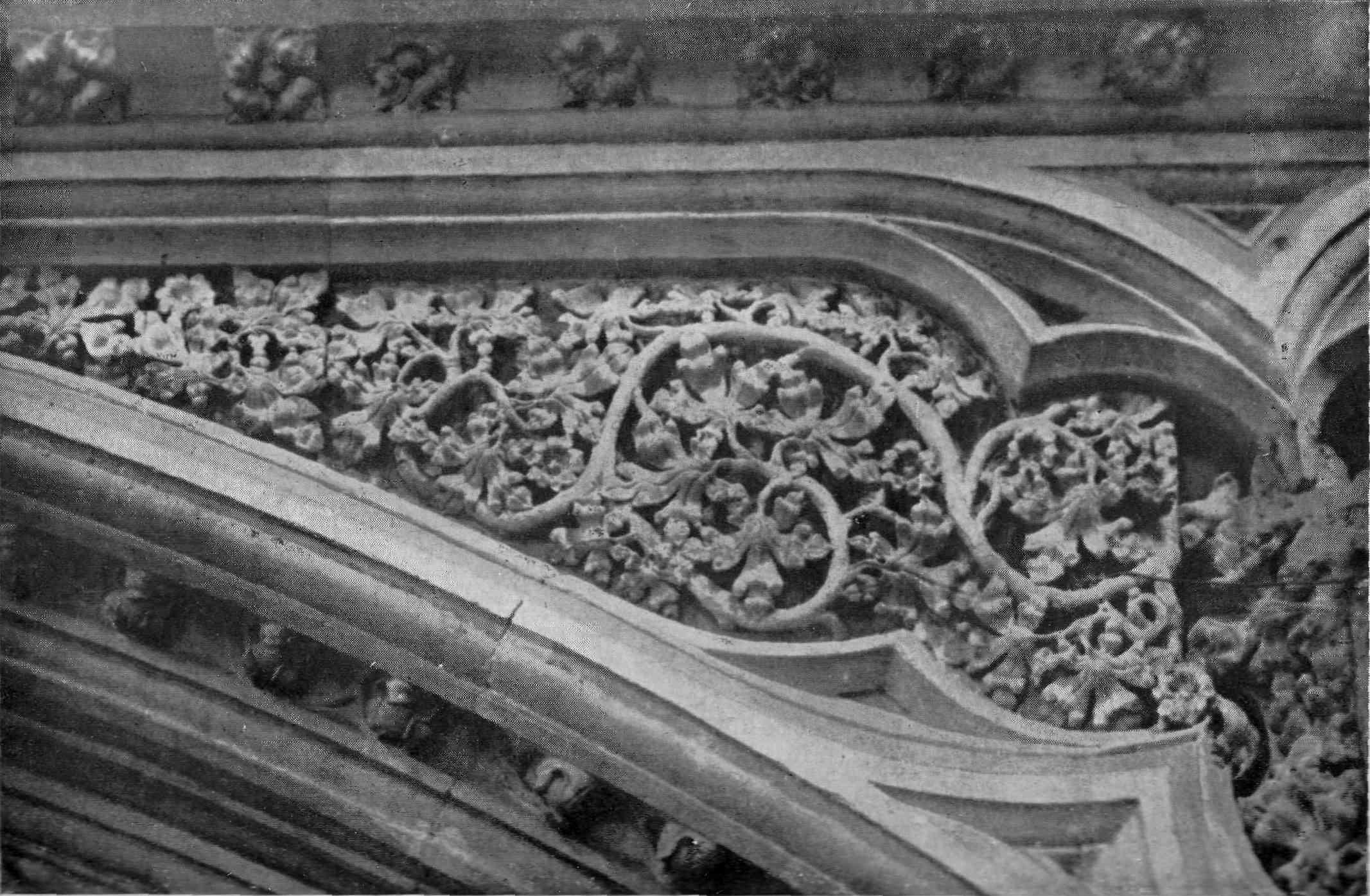
Perhaps the very finest specimens of mid-{27}thirteenth-century stiff-leaf are to be found on the spandrils of the wall-arcade round the chancel of Stone Church, in Kent (Pl. 38). The foliage is arranged in circling sprays designed to fill the spaces of the spandrils. The trefoils show plainly the mid-rib. Most of them have an extra lobe, and, in what we take to be the later ones, there is a tendency to emphasise the centres of the lobes by little swellings—a feature to be further developed in what is called the Decorated convention. These beautiful carvings at Stone are supposed to have been executed by the Westminster Abbey masons. It is therefore interesting to compare them with spandrils at Westminster which were probably the pioneers of those at Stone (Pl. 39).
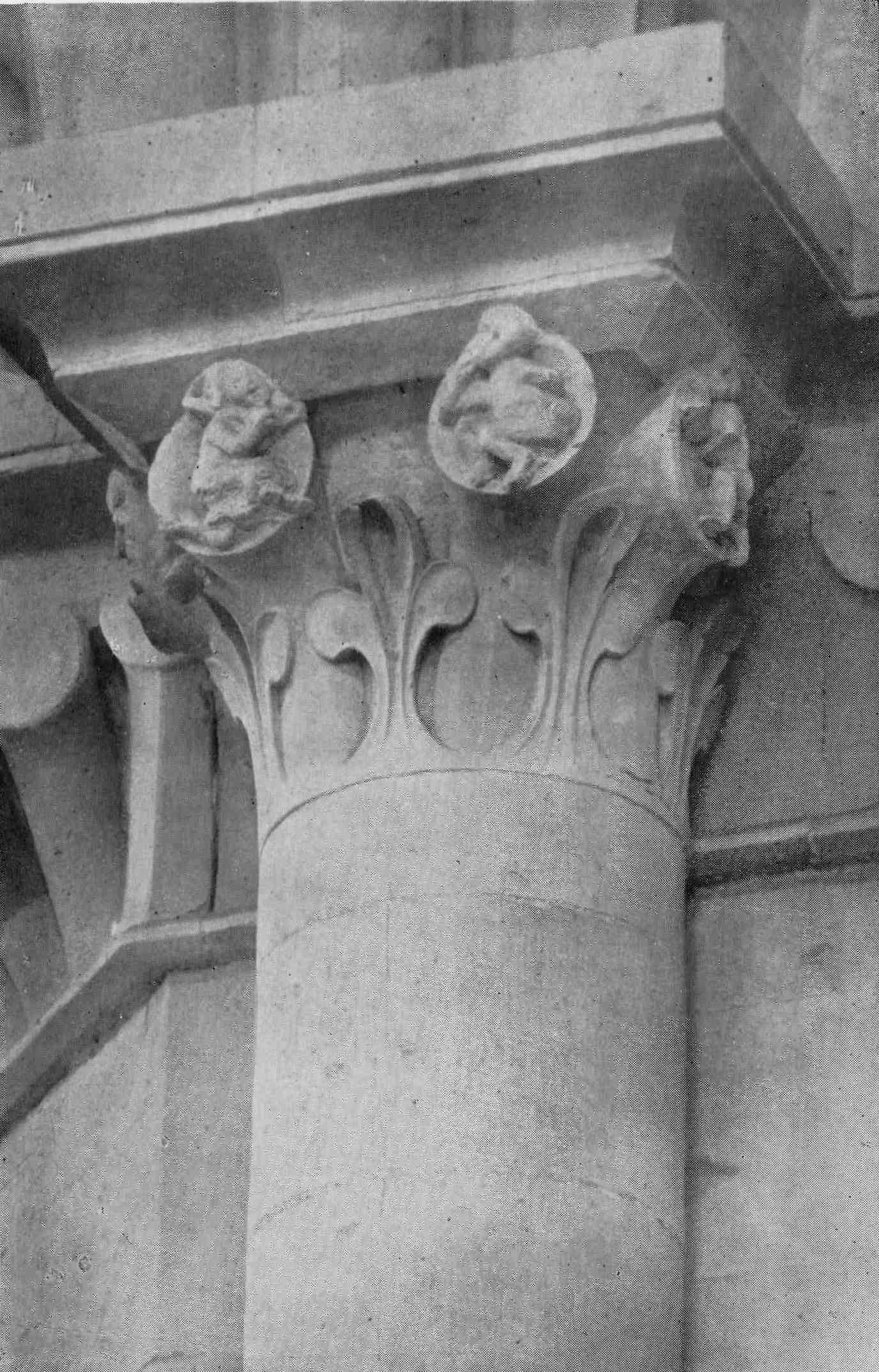
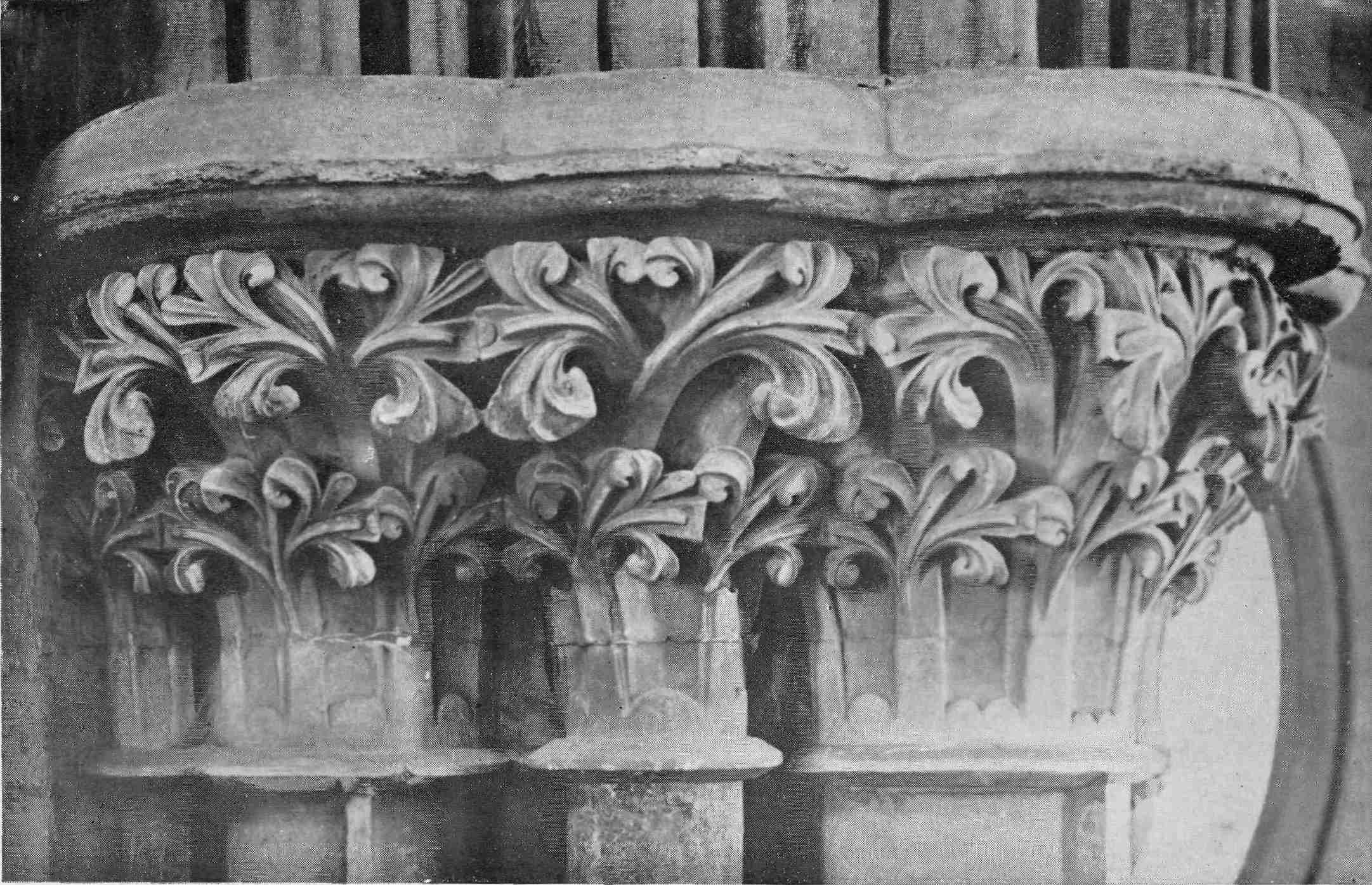
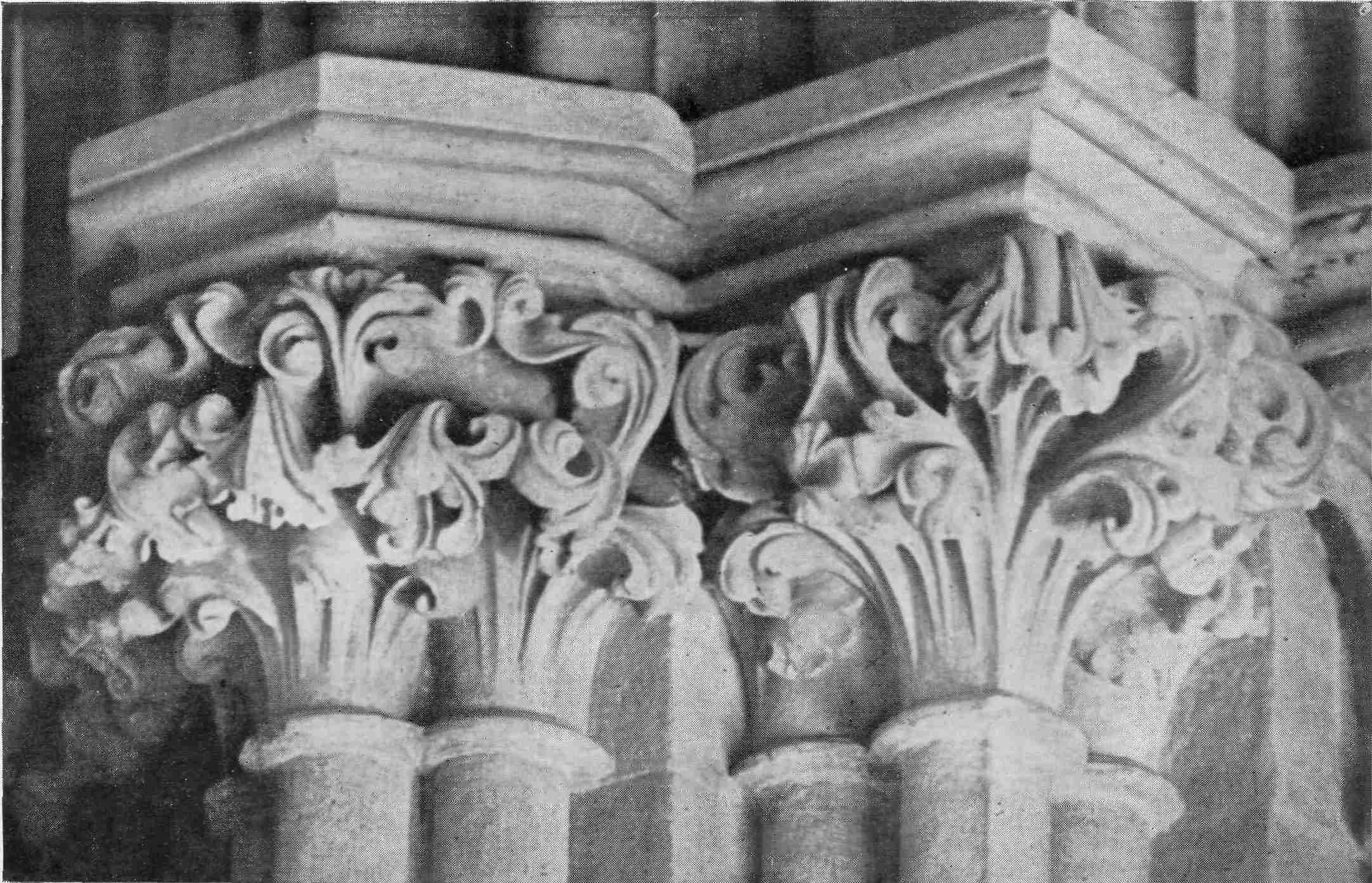
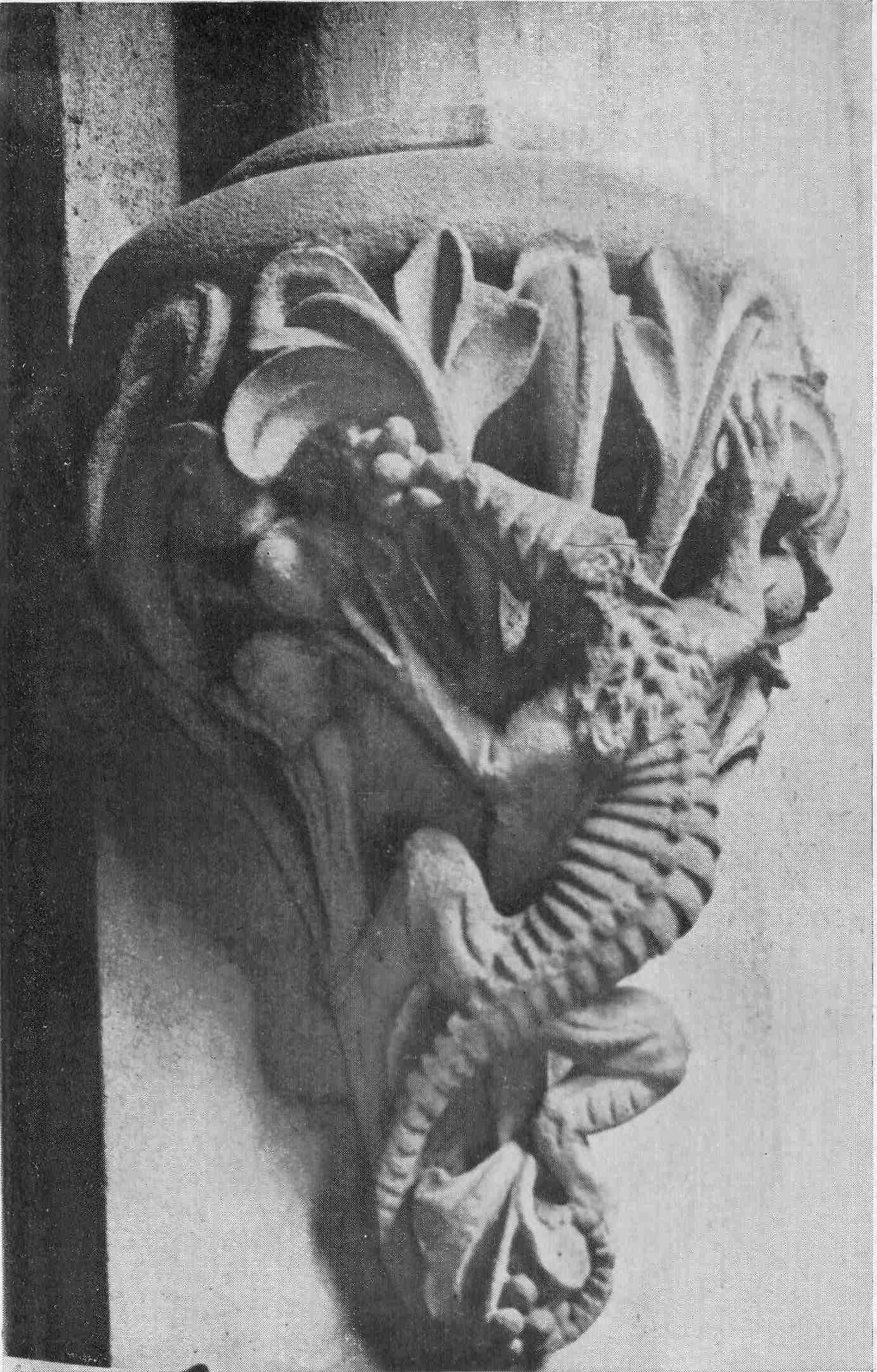
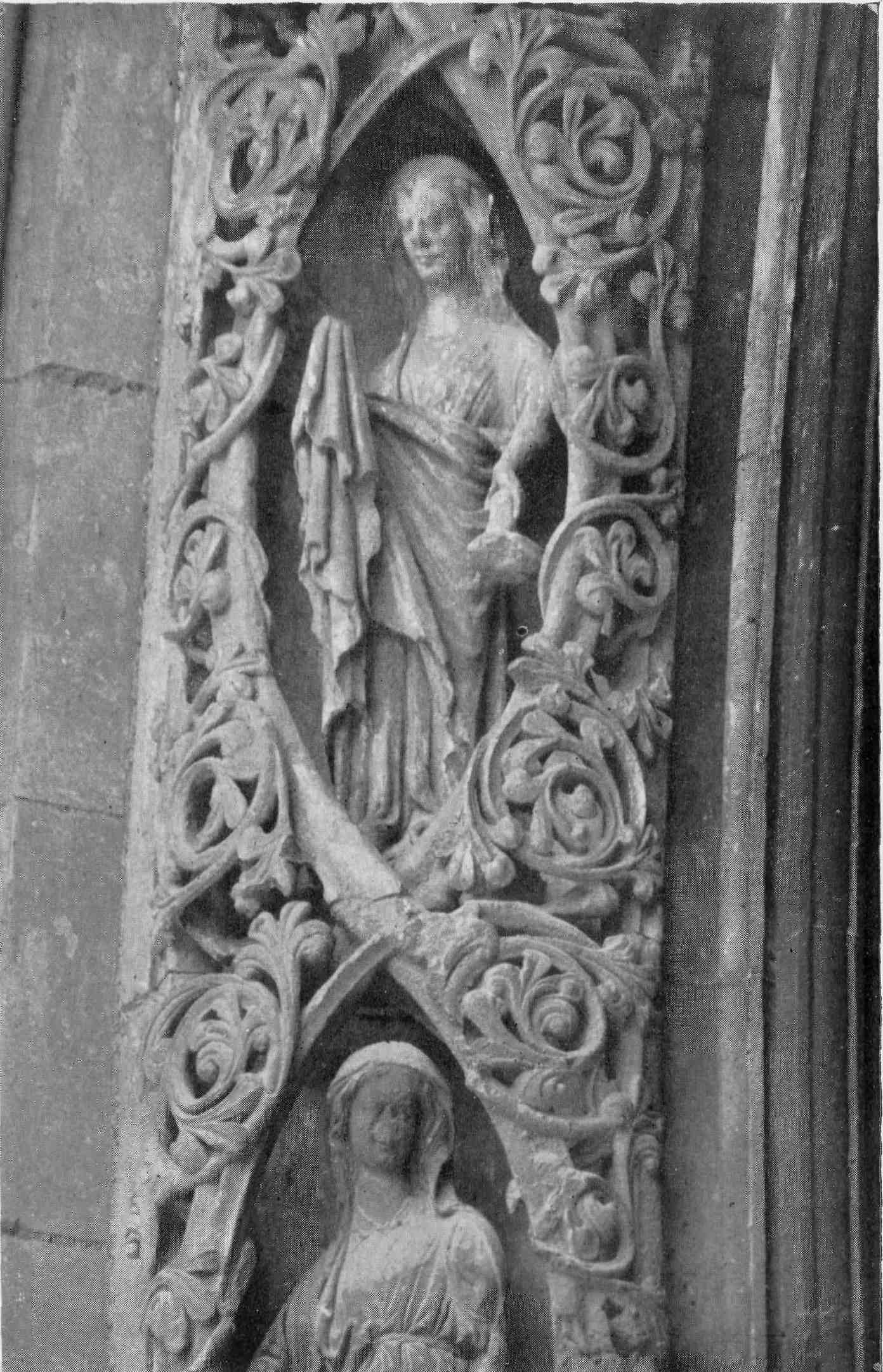
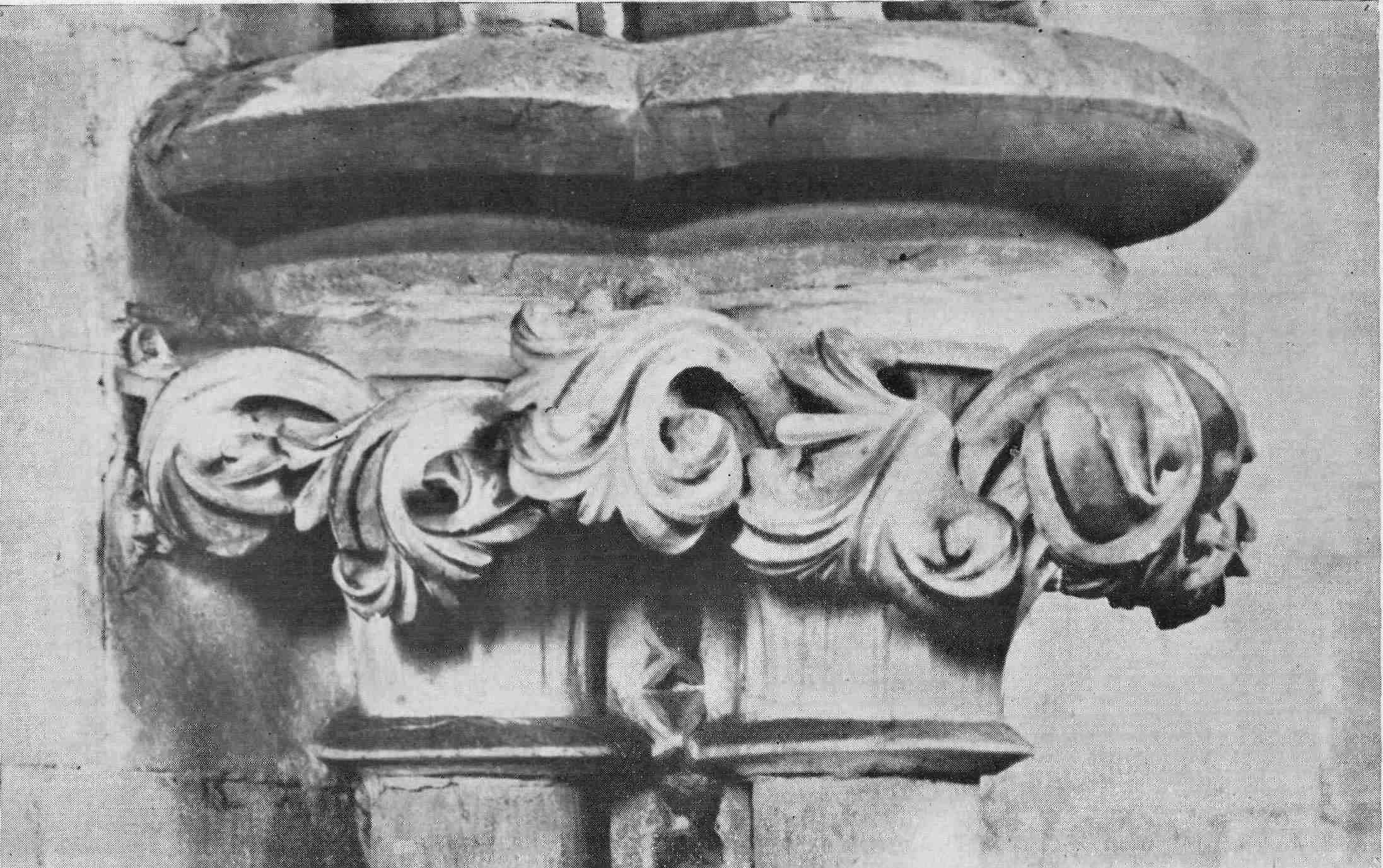
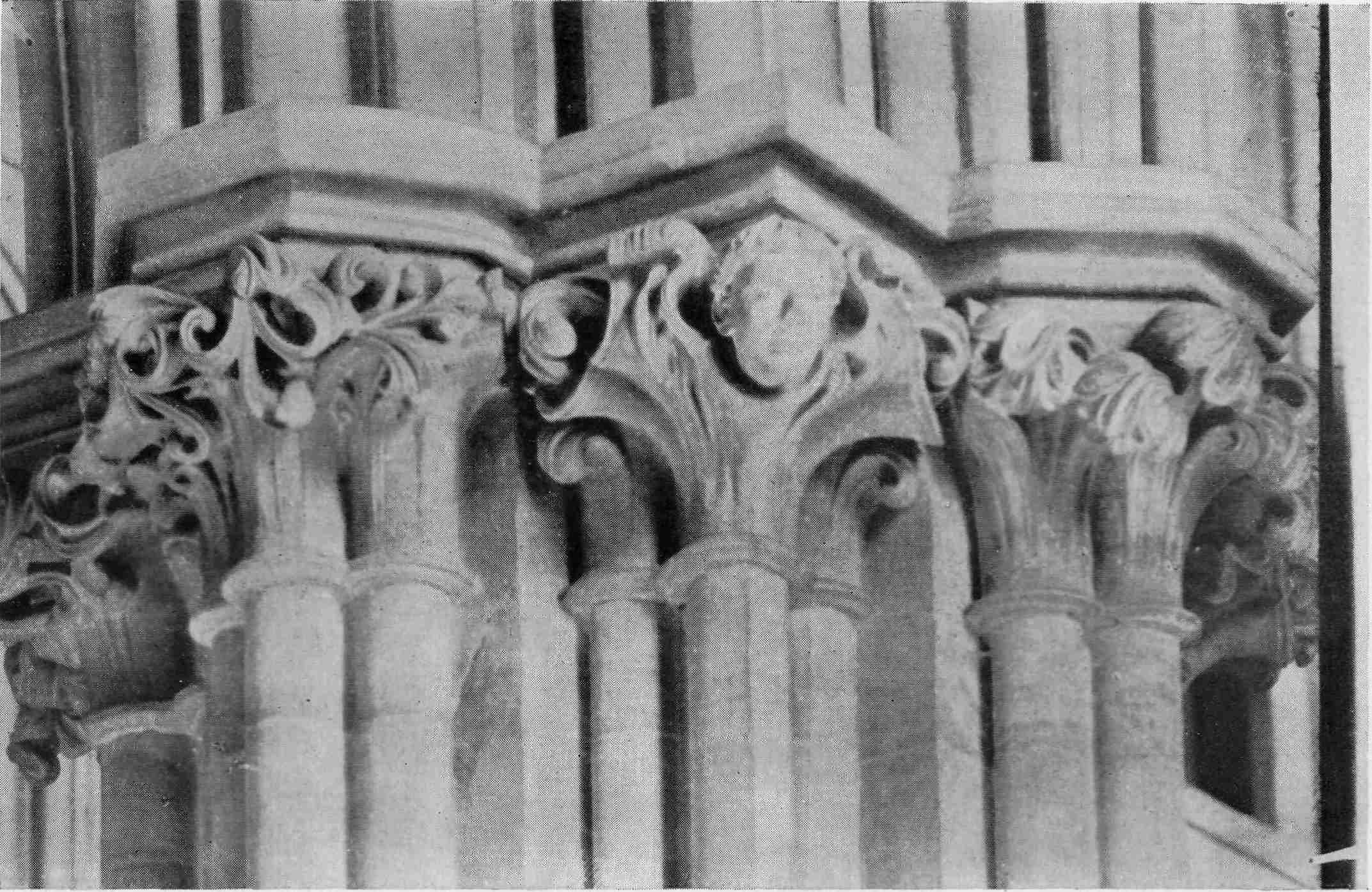
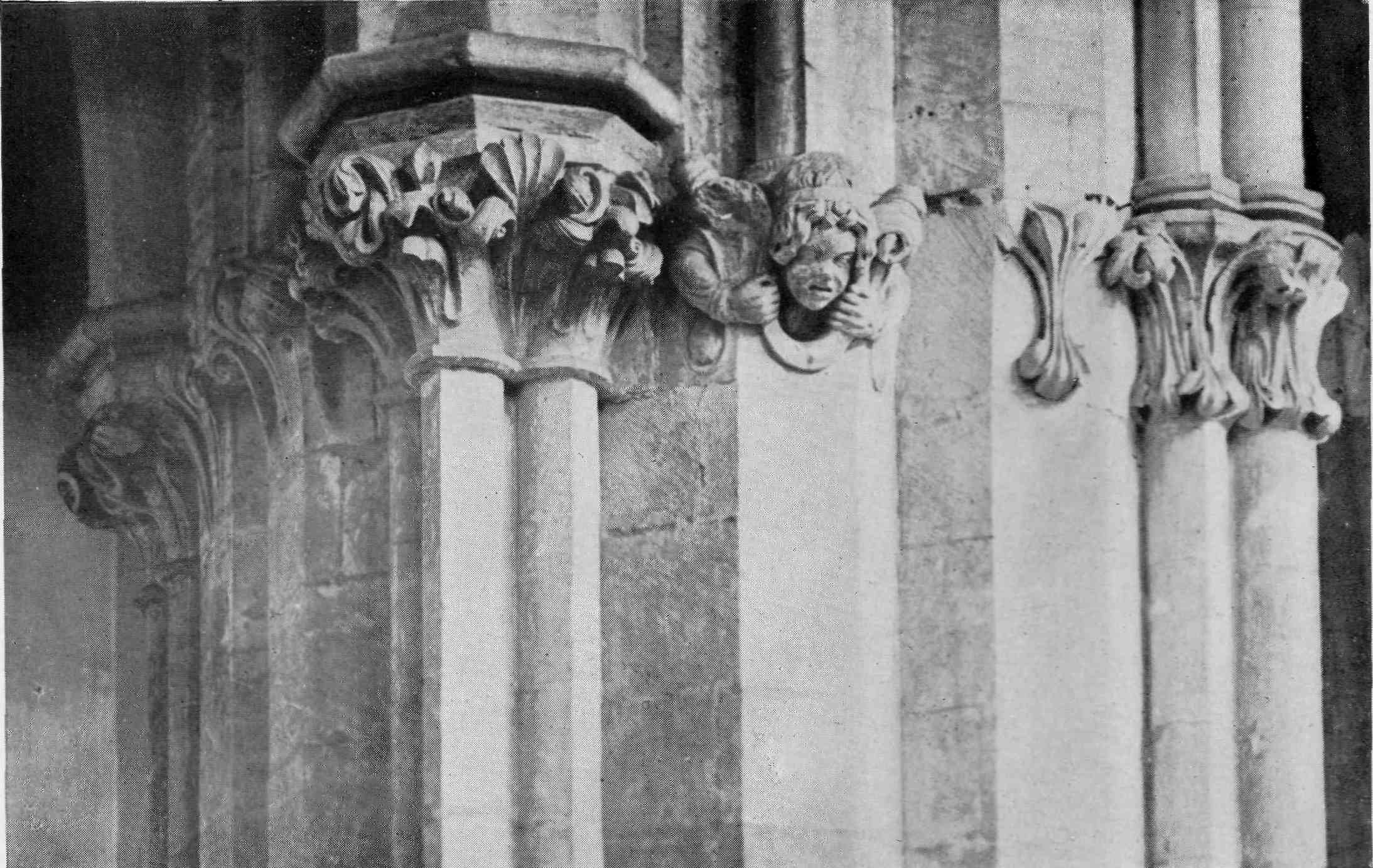
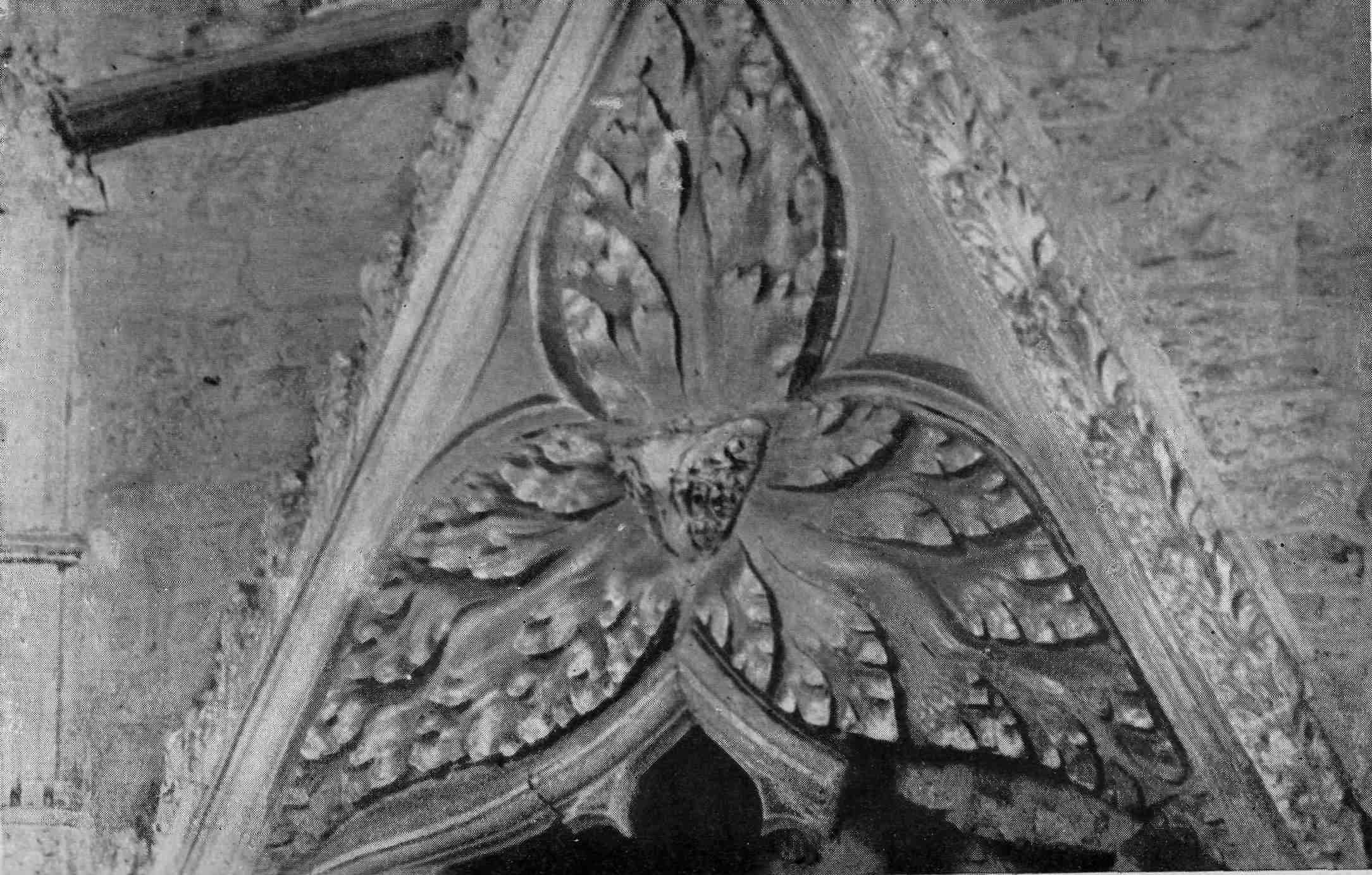
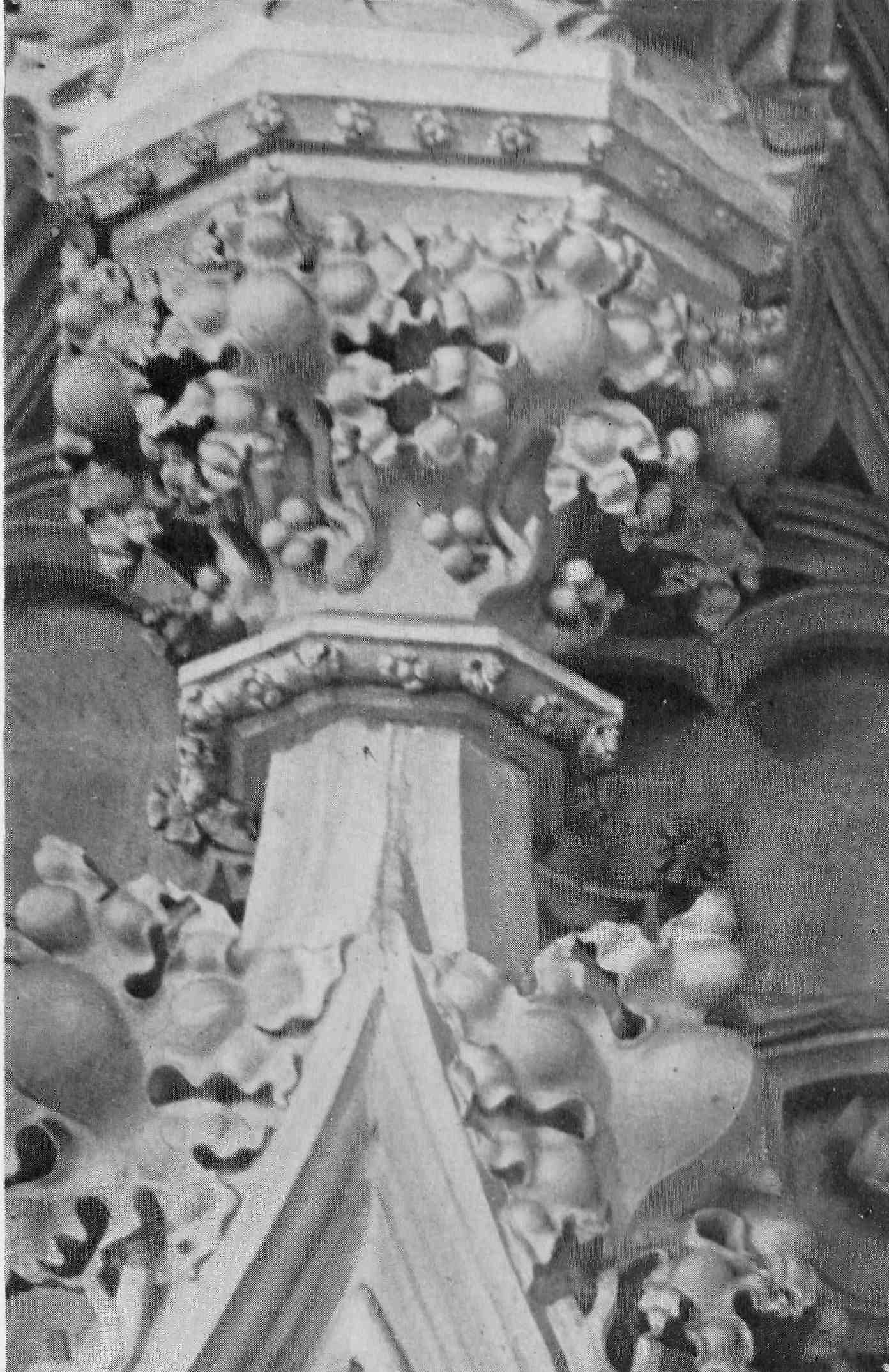
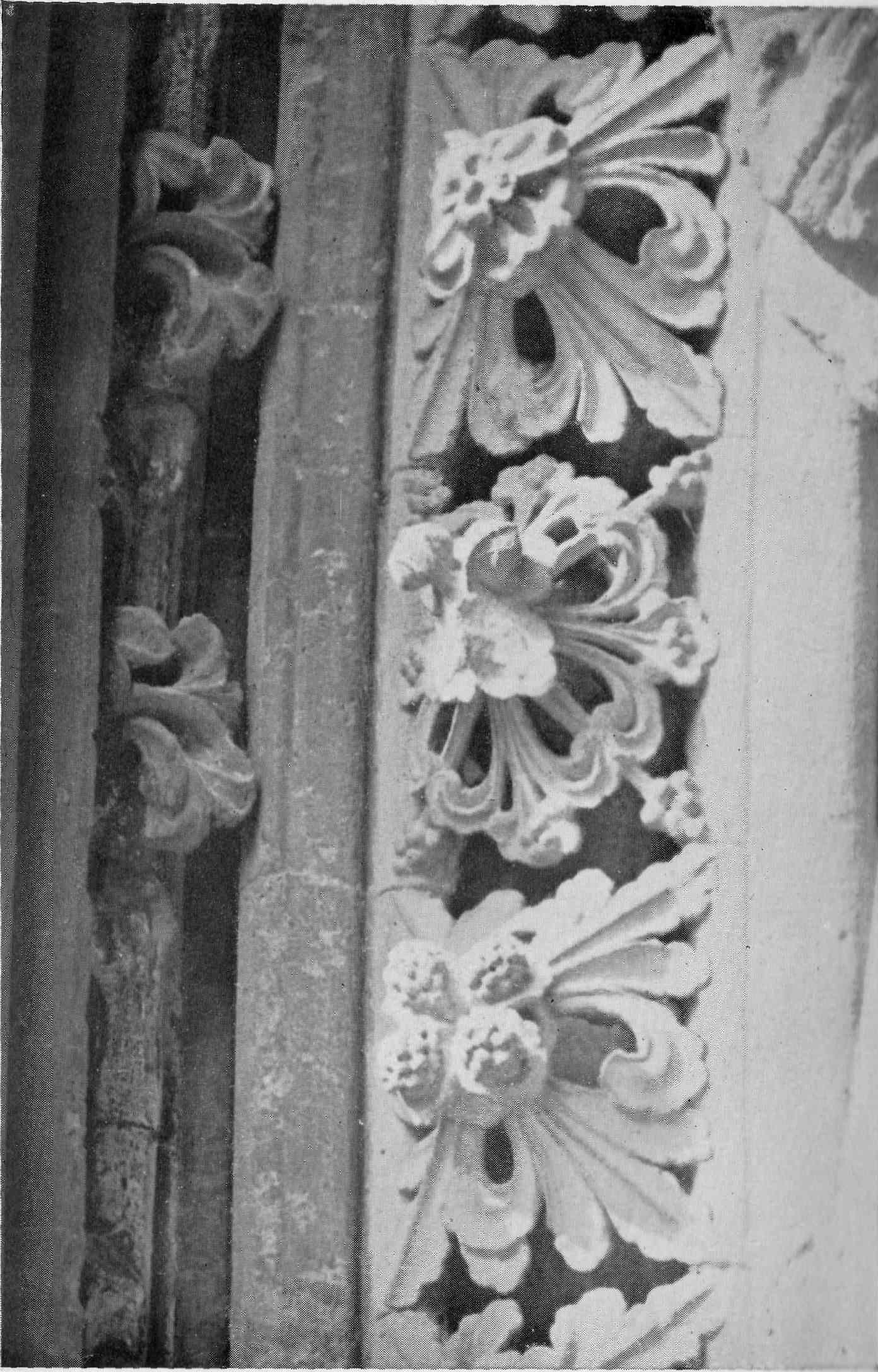
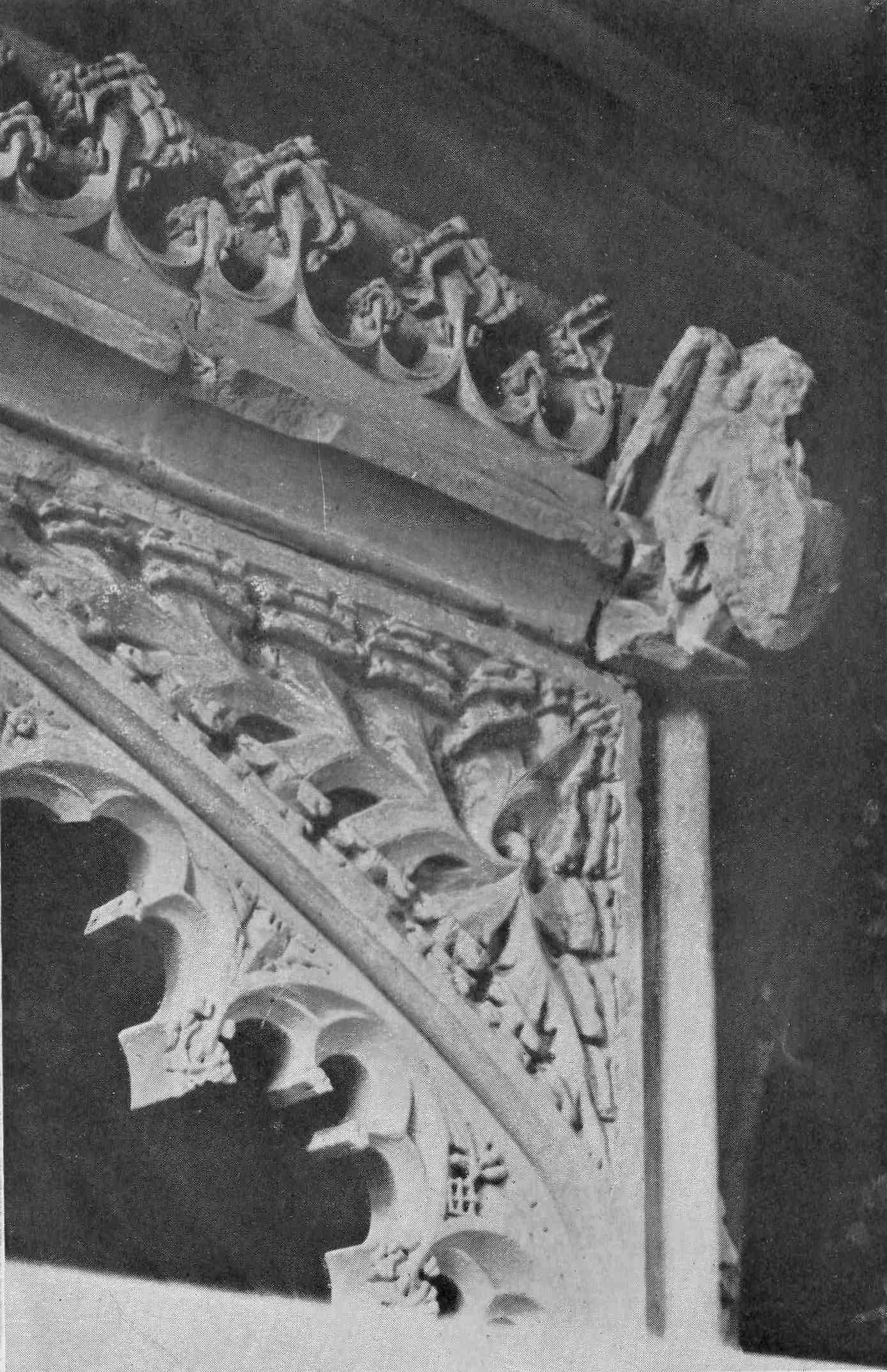
We have next to notice a variety of foliage in the nave of Lincoln, in which the leaves are split (Pl. 40). This indicates a weakening of the tradition. At West Walton some of the capitals suggest a reminiscence of volutes and crockets. At Wells, while the trefoil form is discoverable, there was much more freedom from convention. In a capital at the west end of the nave (Pl. 41), the solid mid-rib can be recognised turned over into a volute at a corner, while the turned-over tip survives in a modified form. Many of the sprays are twisted{28} into curves, some like those at Hereford (Pl. 34), others rather at random. In others animal forms are mixed with the foliage, and the whole treated in a very free manner. In a vaulting-shaft corbel of the transept (Pl. 42) there are a number of trefoils of the western type in which the hollowed portions of the leaves are actually cut out, turning them into loops. In the St David’s example we illustrate (Pl. 26) the leaves are similar, but not undercut. A corbel at Wells of a lizard biting fruit (Pl. 43) shows both kinds of trefoils, but the hollowed upper surfaces are not thus cut out. It would appear that the masons who carved the corbel shown in Pl. 42 had lost the sense of the origin of the hollows and were influenced by the desire, apparent in Pls. 40 and 32, to divide the leaves into strips. The Judgment Porch at Lincoln has some exquisitely undercut foliage forming bowers from which statuettes look out. This foliage exhibits all the grace of the Westminster and Stone spandrils, and stands out against the hollow of the moulding in a way that suggests ivory carving (Pl. 44). The mid-ribbed trefoil, often with one or more extra lobes, is much in evidence, also turned-over tips and occasional spiral curls, and here and there little round knobs, these last indicating the{29} approach to a later stage, which is reached in the sculptures on the doorways to the choir aisles at Lincoln (Pl. 45). In these the newer features of curls and knobs prevail, but distinct and separate trefoil treatment is difficult to find. In another small capital at Lincoln (Pl. 46), in place of trefoils we find curling-over crockets, generally showing a substantial mid-rib, but with the lobes split and twisted into convolutions which are bold and in a way impressive, but which are too prominent, and obscure rather than reveal the architectural function of the capital. This over-profusion of ornament is even more pronounced in a capital in the wall arcading under the east window of the Angel Choir (Pl. 47). Here one cannot help feeling that the mason deliberately selected much larger stones than suitable for the capitals in order to display his cleverness in working them into great crockets projecting far from the bell. The curves are graceful and the work is refined as well as bold, but the projecting foliage overbalances the comparatively small bell of the capital, and may be regarded as the extreme limit of the stiff-leaf convention. The style had reached a bubbling-over stage.
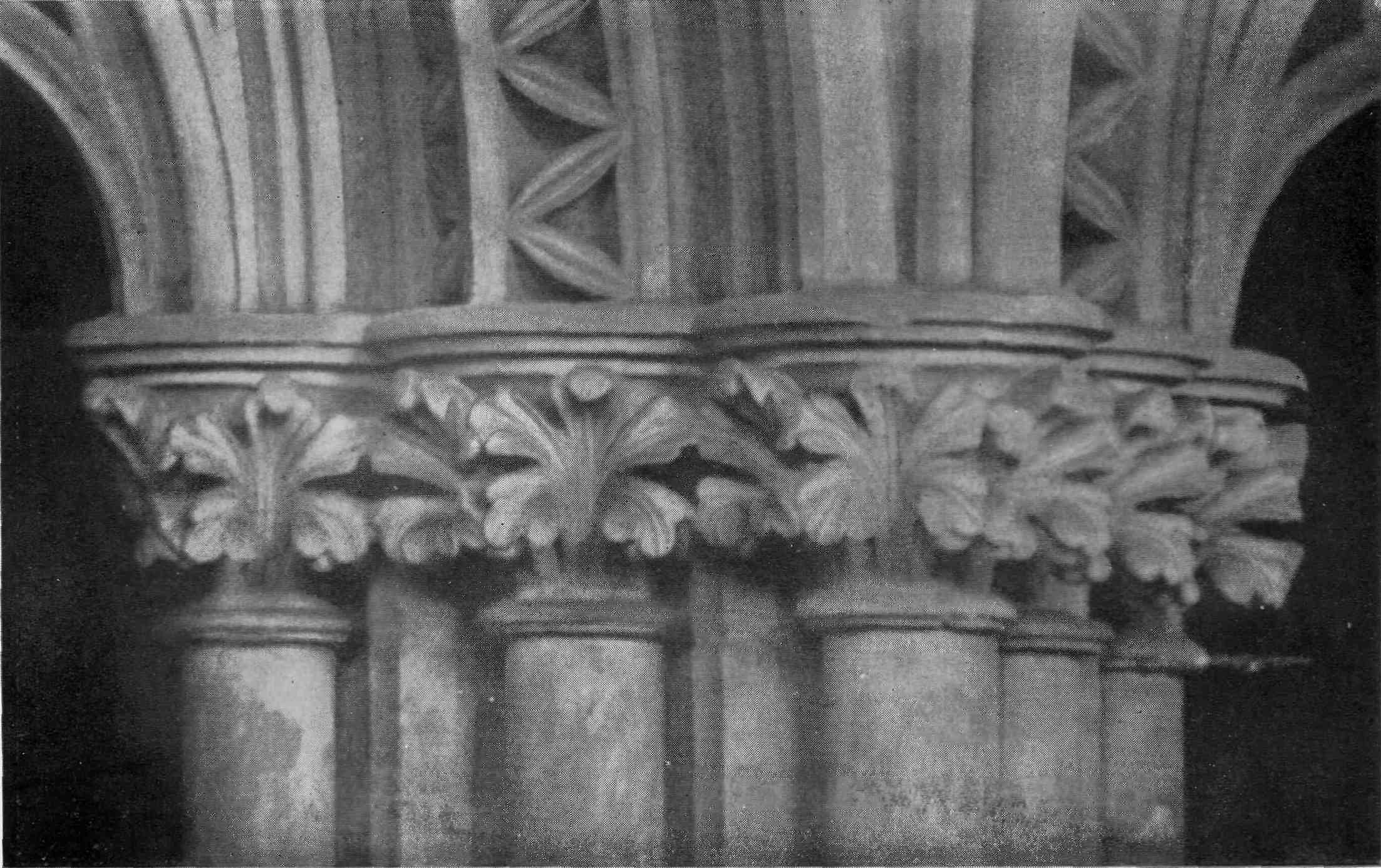
Before passing on beyond this limit we will turn aside to notice some other variations. At{30} St Margaret’s, King’s Lynn, there are some capitals one of which shows four-leaved flowers with a knob in the centre and on each petal. The trefoils between the flowers have the mid-rib, and are symmetrically arranged in pairs curled backwards to meet one another at the tips (Pl. 48). At Lichfield Cathedral some of the trefoils have grown into cinque-foils, the central lobe with a mid-rib rising to the abacus and there turning over in accordance with the early tradition. The side lobes are slightly indented into trefoils (Pl. 49). Some of the capitals in the chapter house at Salisbury are very characteristic (Pl. 50) though they may have been to some extent restored. They show trefoils forming crockets and used singly.
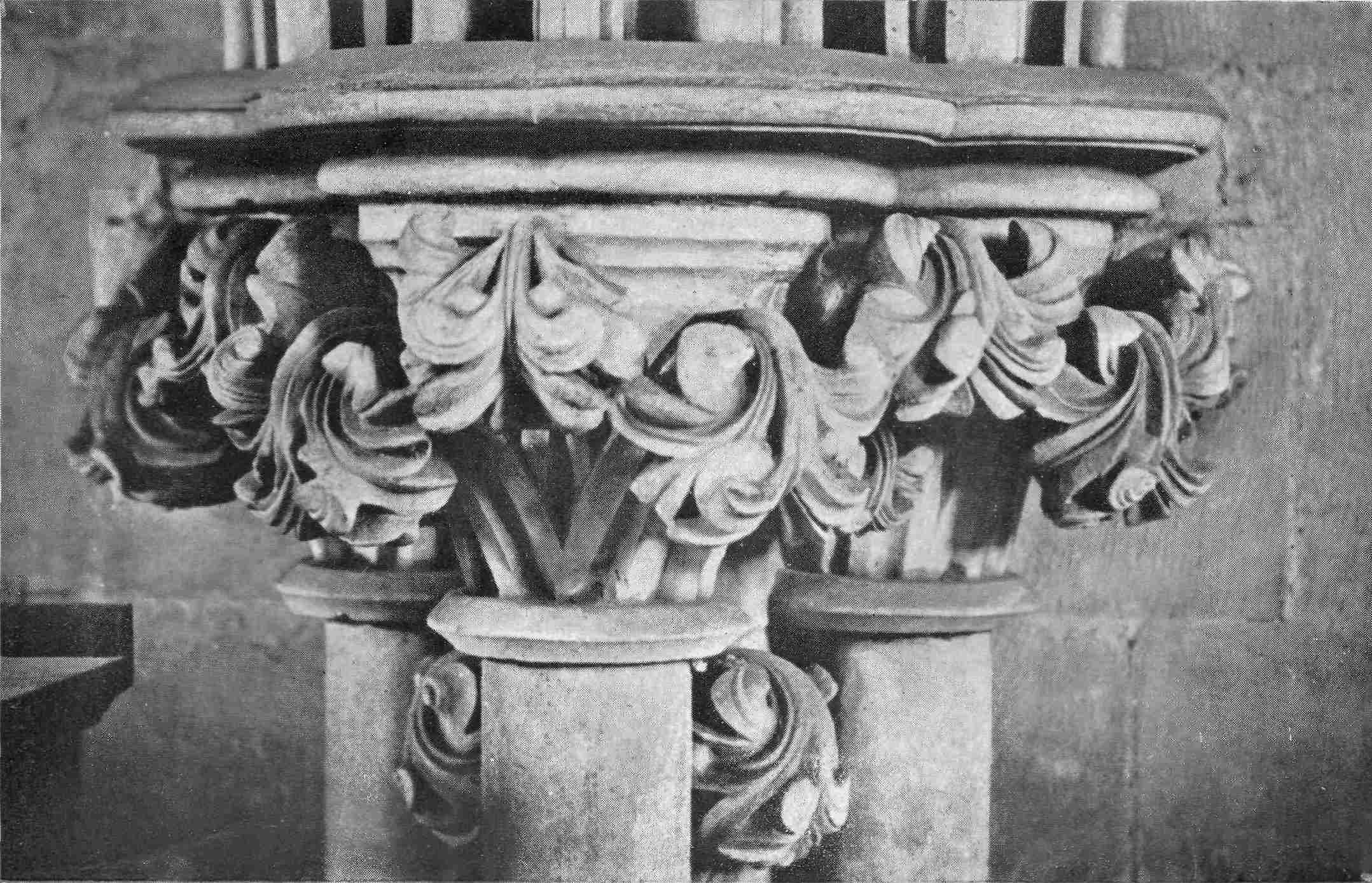
Perhaps the most beautiful and perfect specimen of the fully-developed stiff-leaf style is on the wall arcade of the ancient choir screen now placed in the transept of Salisbury Cathedral (Pl. 51). It has all the grace and refinement of the late Lincoln capitals, but is closer to the convention and is more restrained and architecturally suitable.
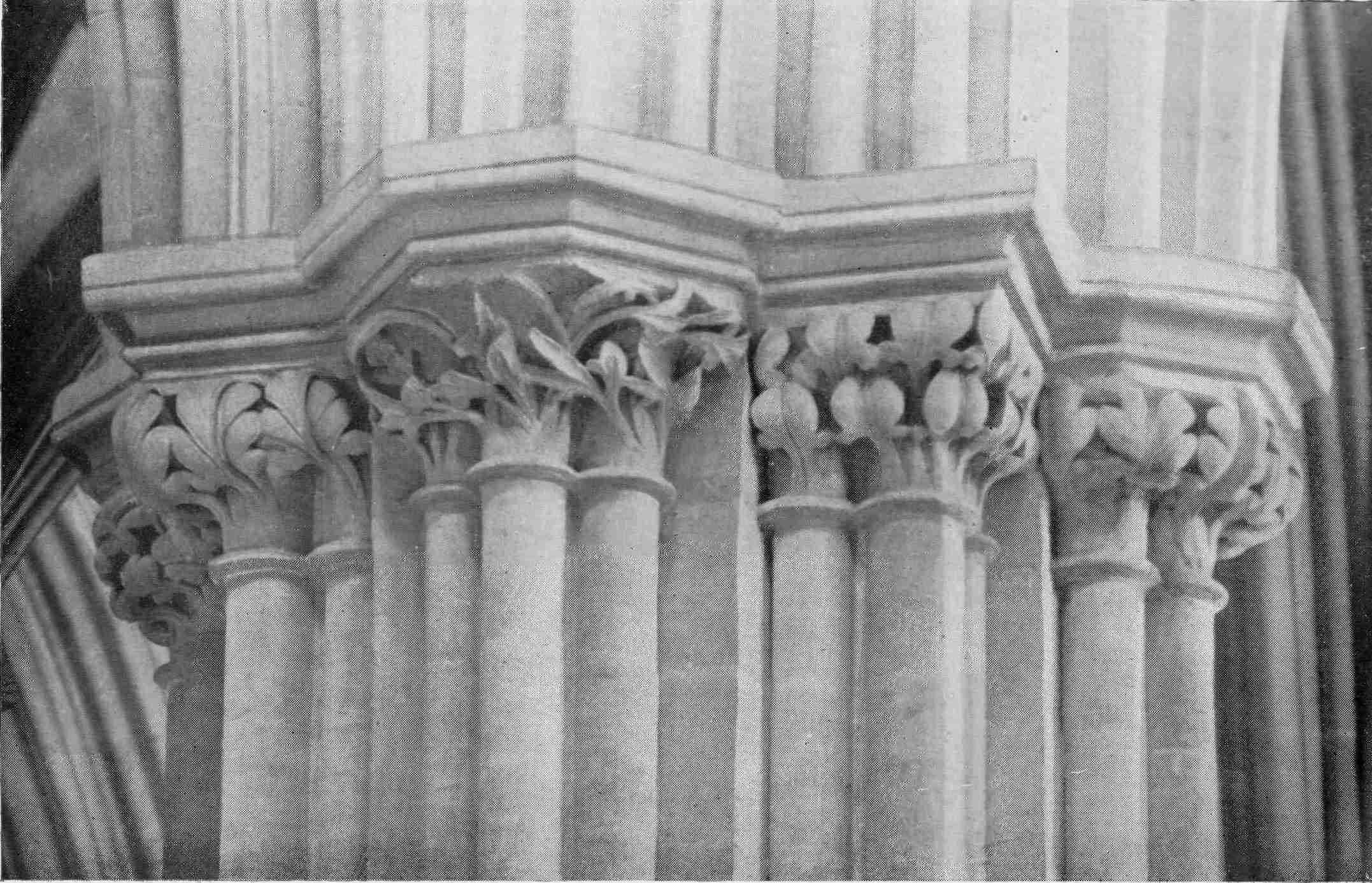
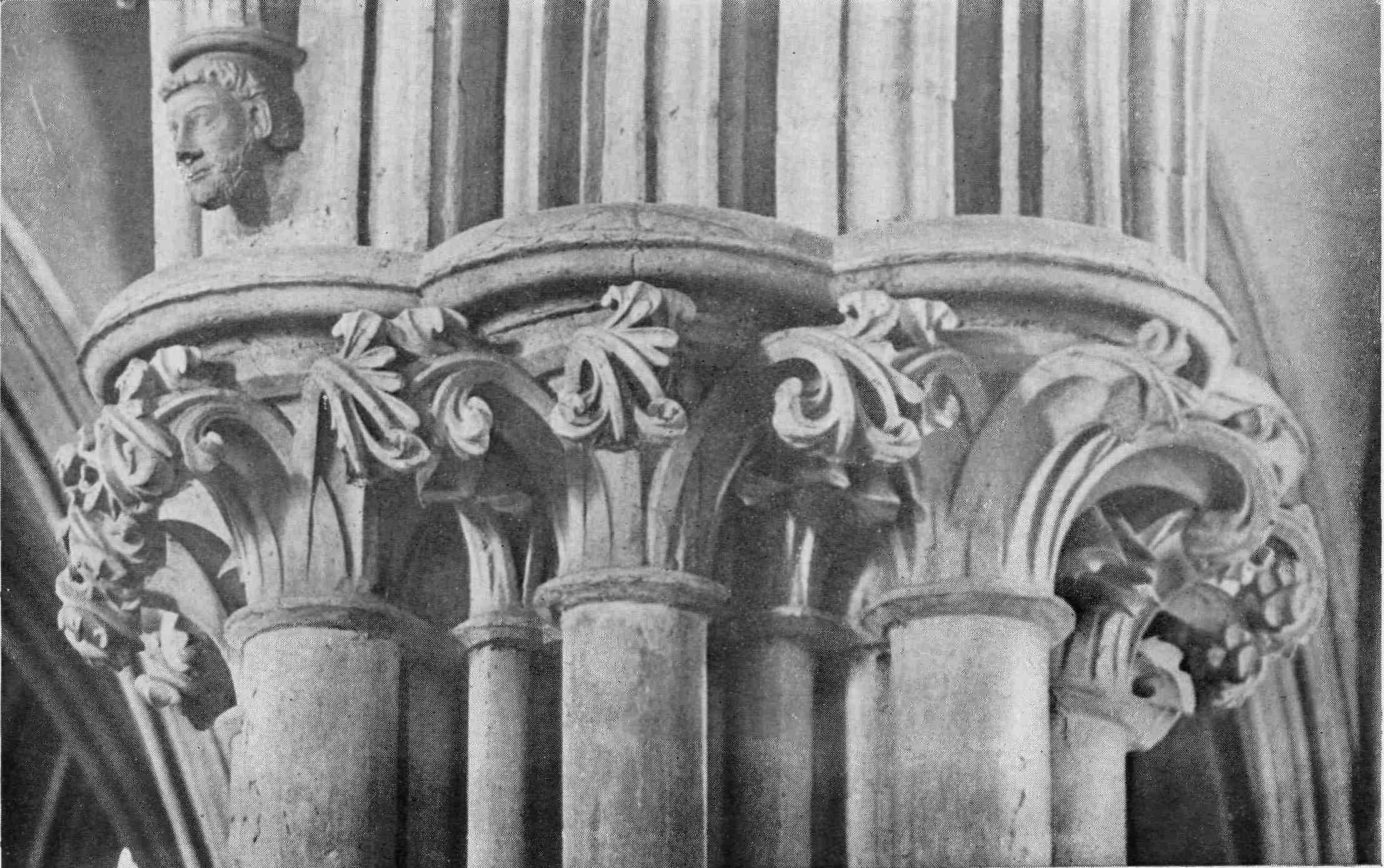
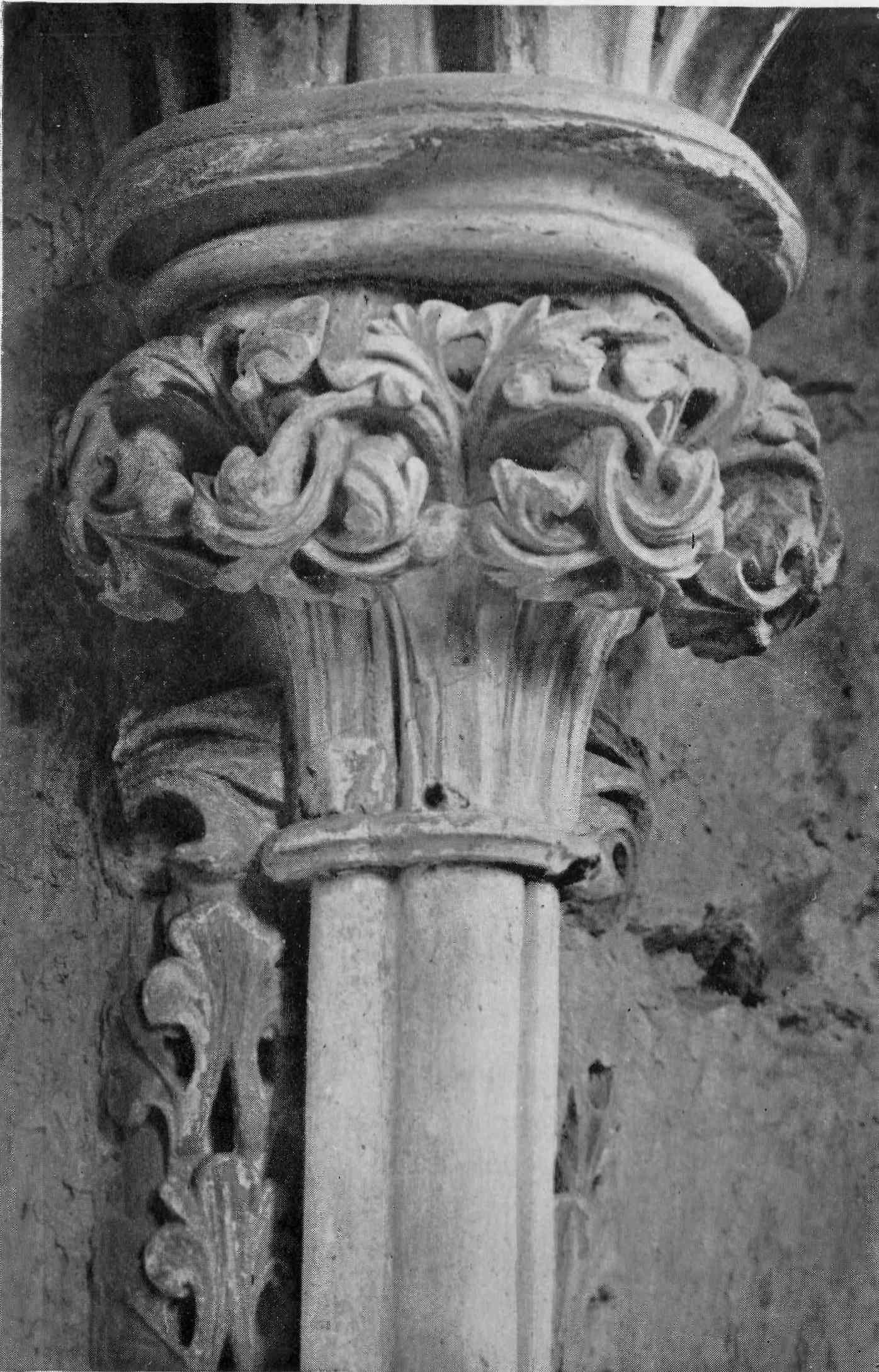
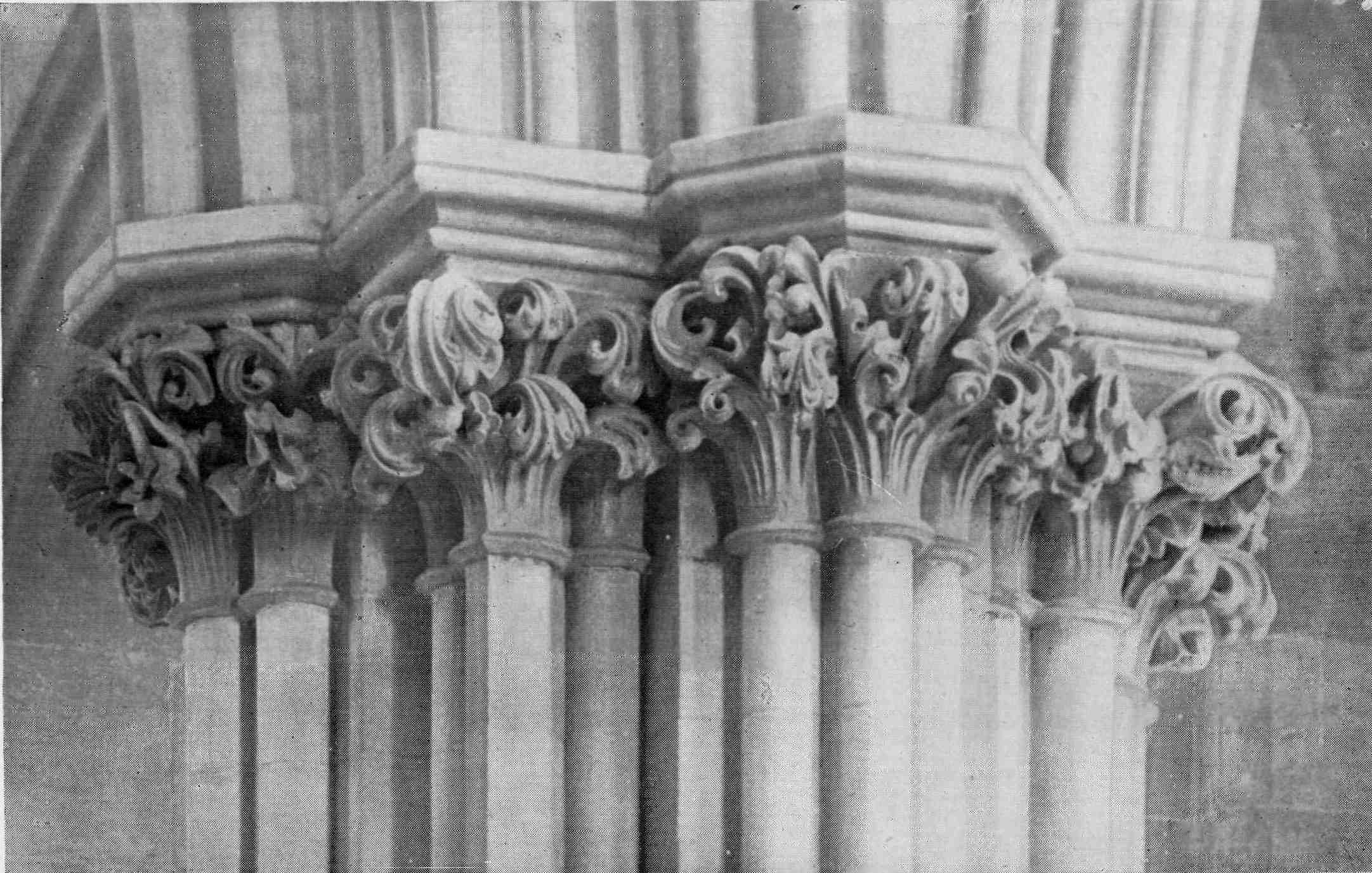
At Wells, where the development was on somewhat different lines, and where we find more of the hollowed or looped trefoils, the later capitals at the west end of the nave suggest a separate origin (Pl. 52). The stalks rising from{31} the necking blossom into luxuriant foliage or fronds of bracken. A connexion between these rising stalks diverging as they rise and blossoming at the top, and the scallops of Anglo-Norman capitals resembling cornucopiae, on the top of which luxuriant vegetation overflows, is confirmed by such a capital as that shown in Pl. 53. We would also refer to the capital at St David’s (Pl. 26) in which there is a similar suggestion.
It is impossible, within reasonable limits, to describe all the variations of thirteenth-century foliage. As we have remarked before, the convention or style guided and controlled, but did not enslave, the masons. In the earlier days of the style, before the masons had fully grasped the capabilities of the tradition, the experiments were in the direction of more rigid uniformity, but mastery over the style grew rapidly, and they soon found out how to employ their skill in new and graceful ways within the limits imposed by it. Towards the end of the period, say in the third quarter of the thirteenth century, they took more liberties and added new forms and treatment until they had exhausted its capabilities and grew tired of its control. Before passing on to the next stage we will briefly refer to one or two specimens of an unusual character.
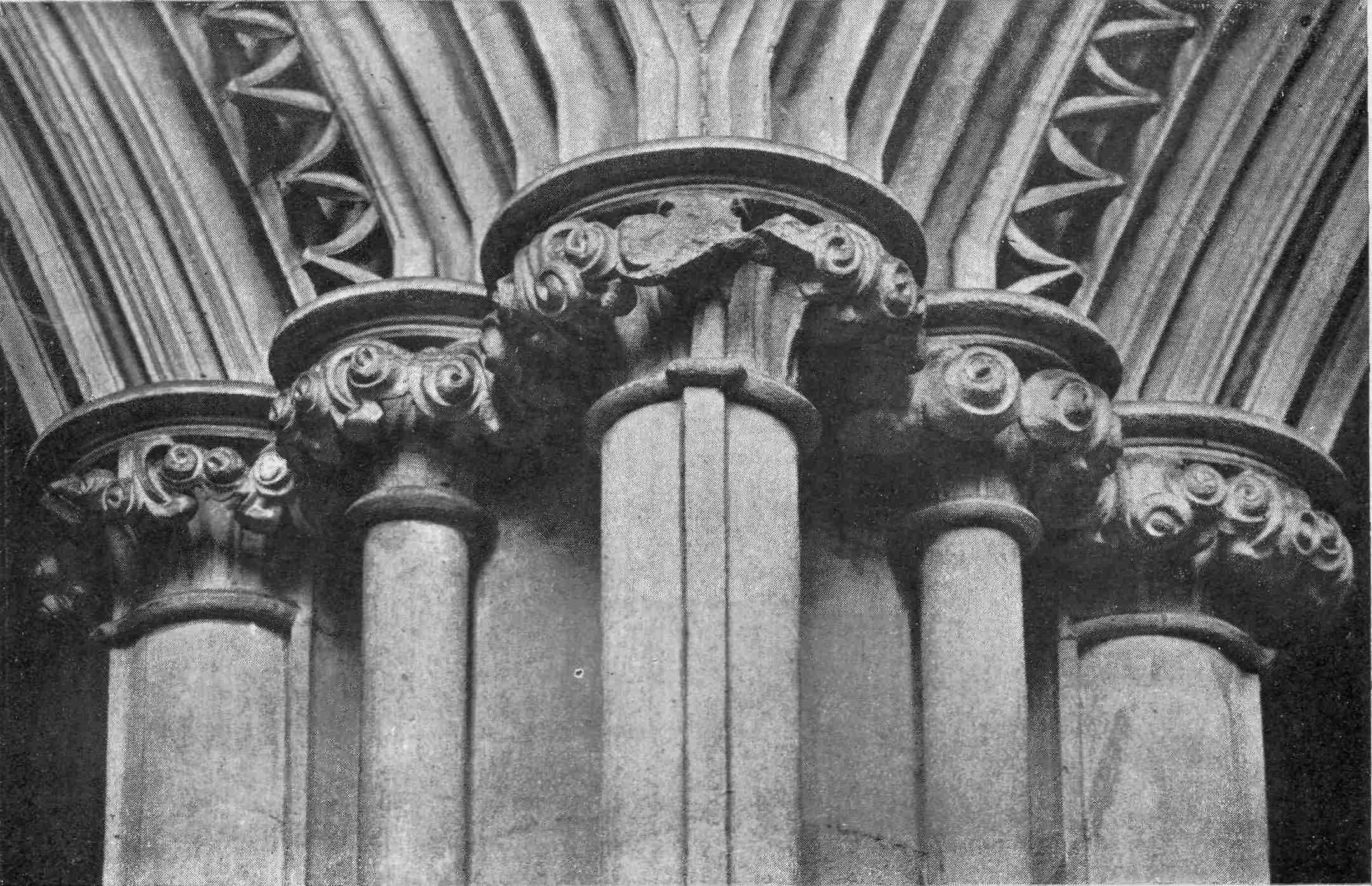
In the retrochoir of Ely (Pl. 54) the trefoils have lumps on every lobe almost like the bladders on seaweeds. This is an anticipation of the fourteenth-century convention, but the stiff-leaf features and thirteenth-century mouldings class these with the earlier style.
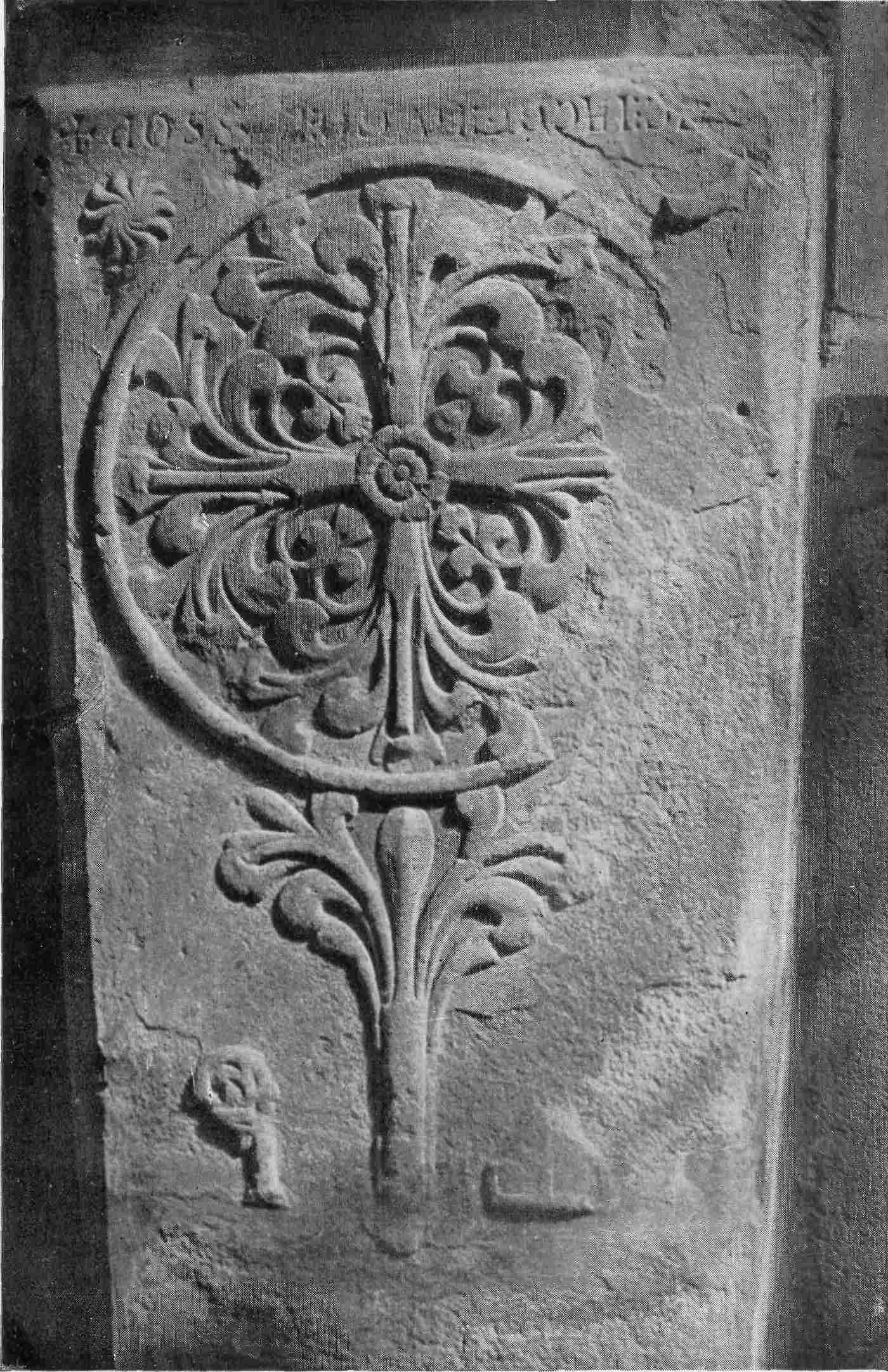
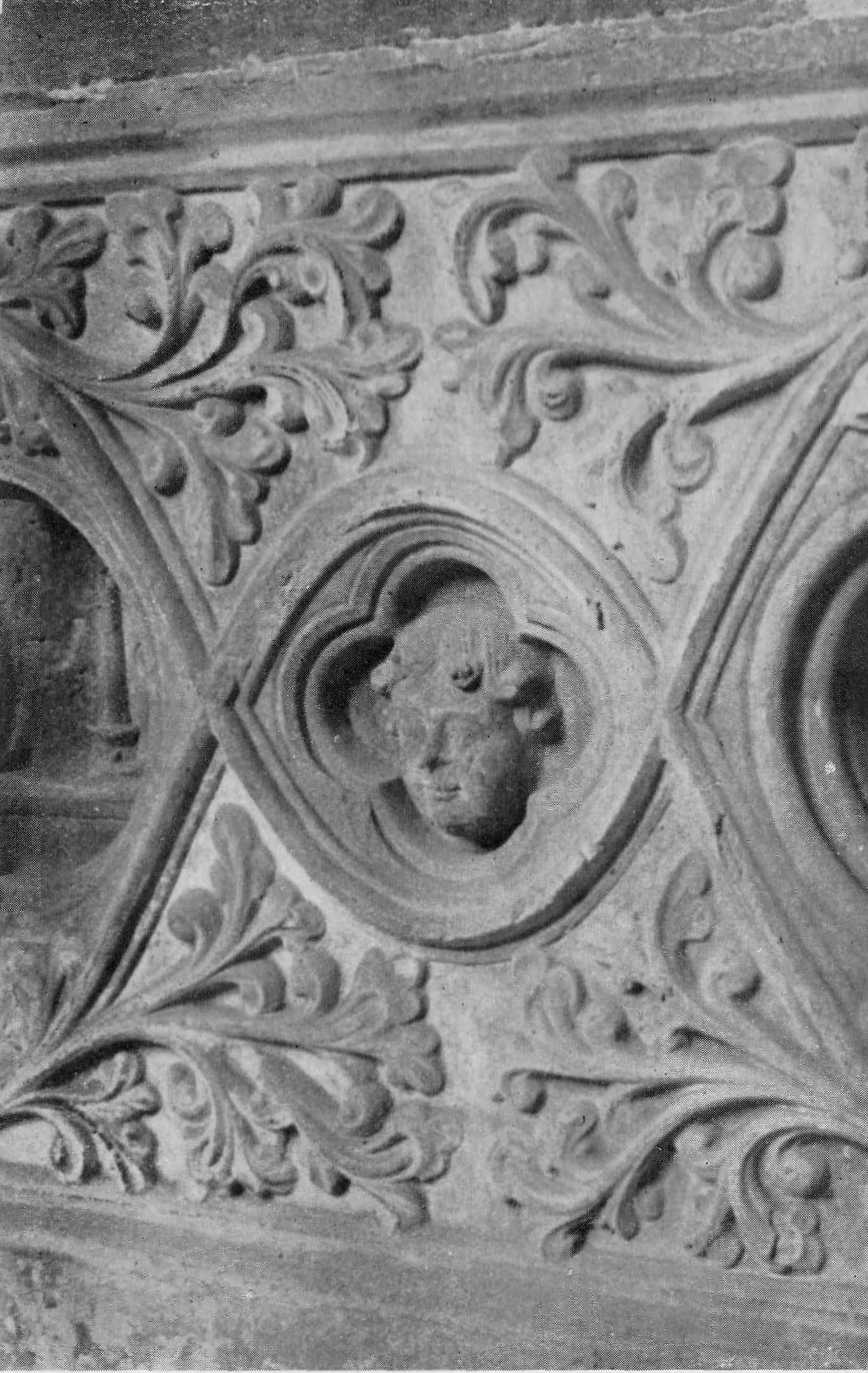
At Llandaff (Pl. 55) heads occur, and foliage different from any we have attempted to describe. Finally, we would mention a coffin-lid at Weobley on which the cross is formed of trefoils (Pl. 56).
THE stiff-leaf convention having reached its extreme development, and the resources of design and invention within its limits having been exhausted, the masons of the later part of the thirteenth century looked about for a fresh inspiration. They were skilled handicraftsmen and true artists, not content to plod on in the old ways, but seeking fresh opportunities of manifesting their cleverness. They began to feel the restrictions of the stiff-leaf convention to be fettering them in their self-expression, and no longer a guide and help.
Under these circumstances the next stage to be expected of such men was a return to nature. In all healthy living art there is from time to time this return to nature. Without this resource art cannot live and progress. As an example of the lack of this recuperative refreshment we may instance the designs of oriental carpets. Beautiful and satisfying as the arrangements of colour usually are, the designs are contemptible. If carefully examined it is sometimes possible to detect their origin, and they are found to be copies of copies of the art introduced by Alexander. They have been copied and copied without{34} understanding from age to age until they have become utterly degraded. We found something of the same sort in Saxon England. Skilled masons were introduced from the continent from time to time. They produced fairly good work and native pupils copied them, but mere copying soon led to decline and death.
The thirteenth-century masons, on the other hand, were full of life and energy, and, having liberated themselves from a convention which had become a prison, they took to copying natural leaves and flowers, and prided themselves on rendering these with the utmost skill and accuracy. They showed their taste in arrangement and their cleverness in details. They carried their naturalism so far as to represent not merely veins and minute structure, but even hairs and insects.
In France this naturalism came a little earlier, as the French masons passed direct to it from the Romanesque Corinthian foliage without any intermediate convention. For a short time, therefore, the English and French foliage were very similar. In England, however, this stage did not last long, but soon was followed by another convention—that of the Decorated or Edwardian style of the fourteenth century.
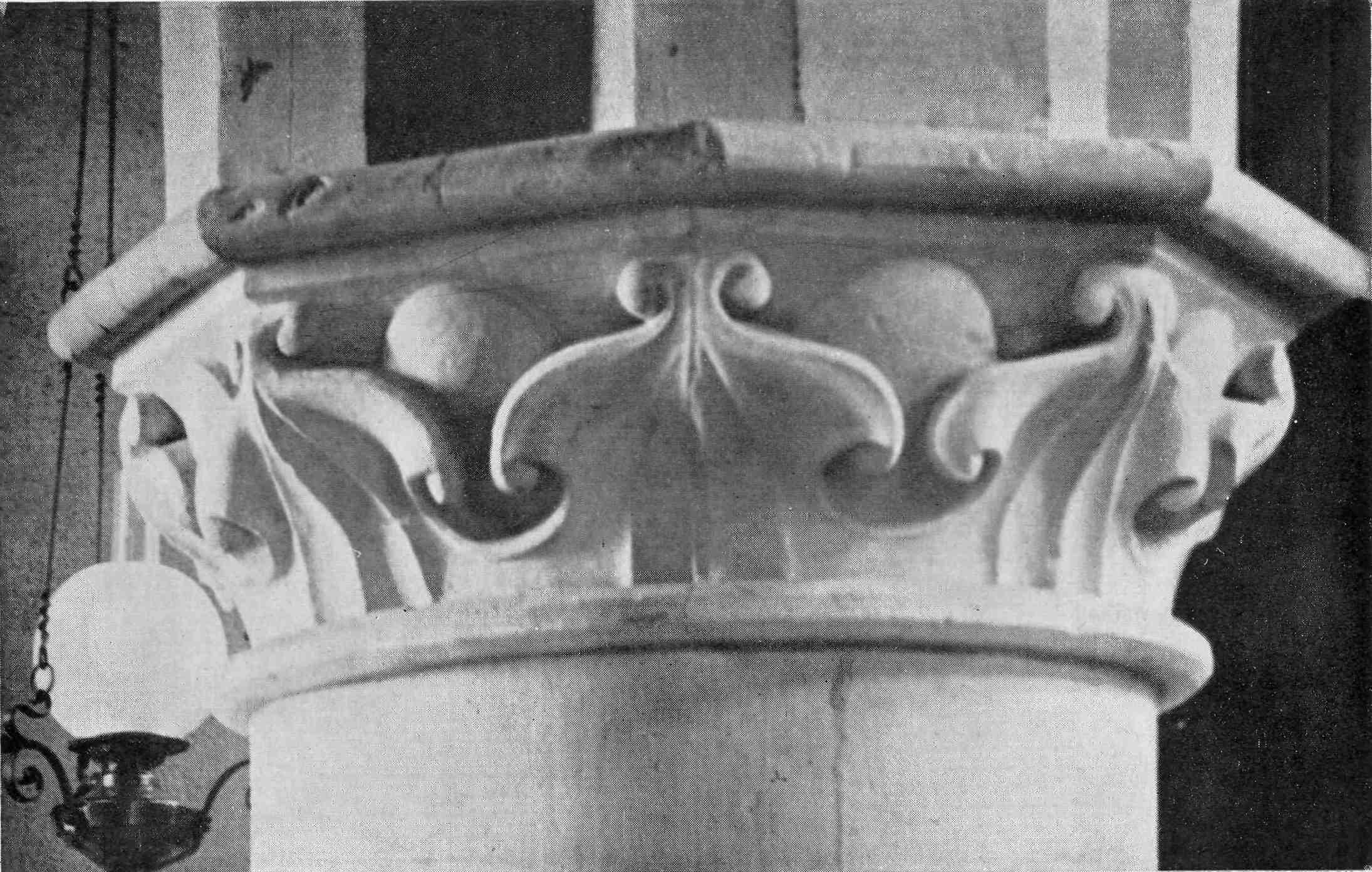
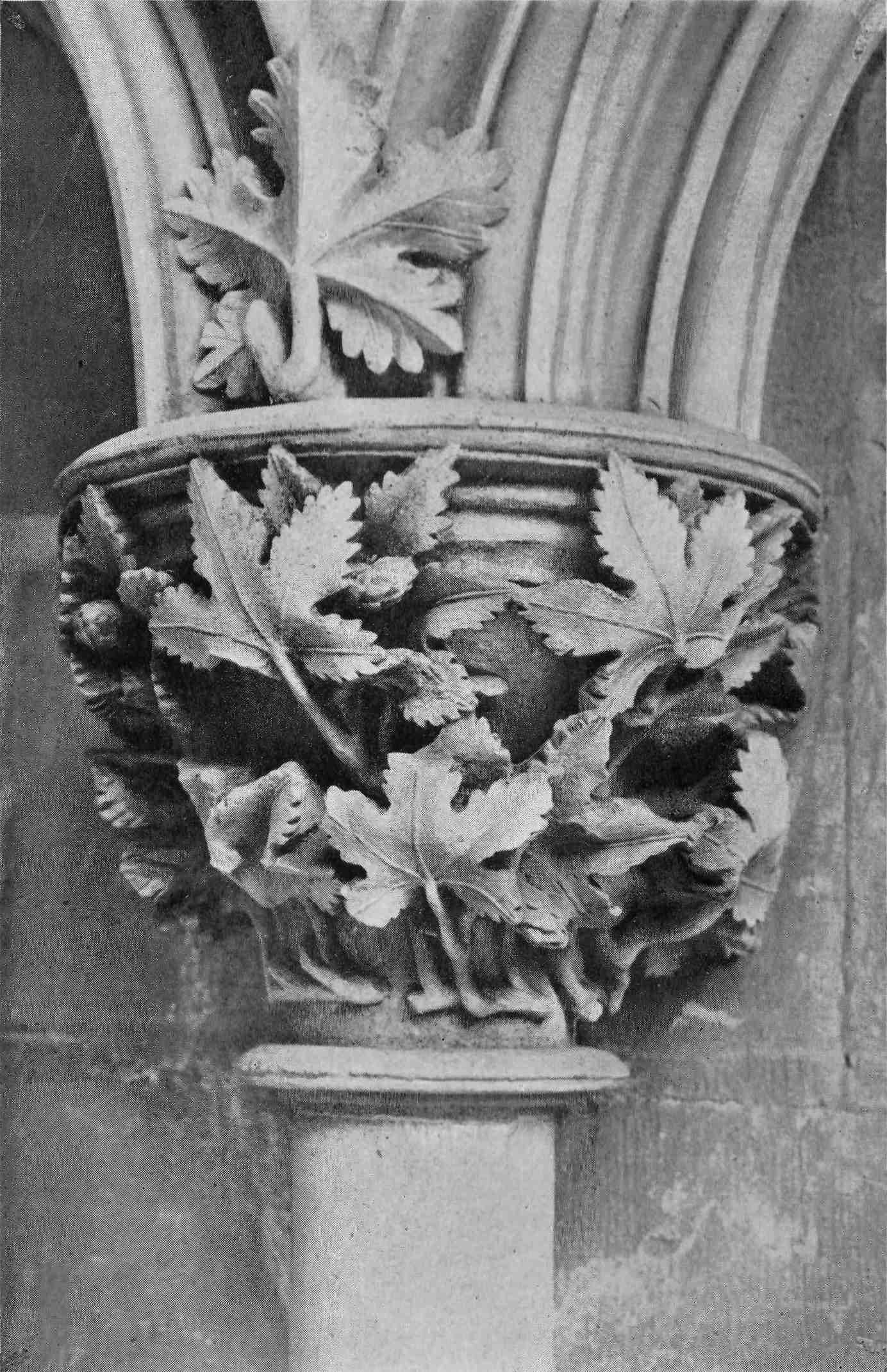
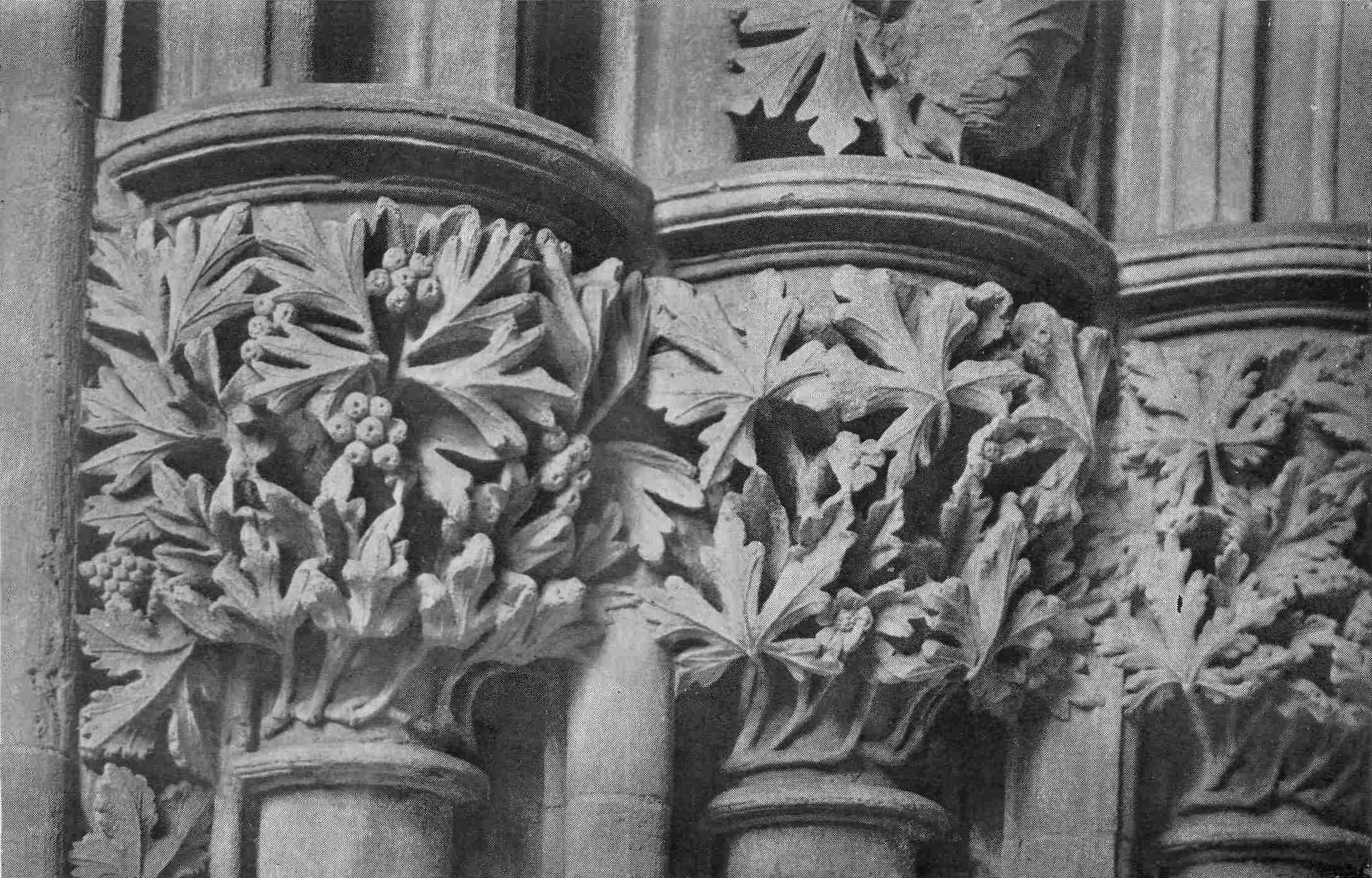
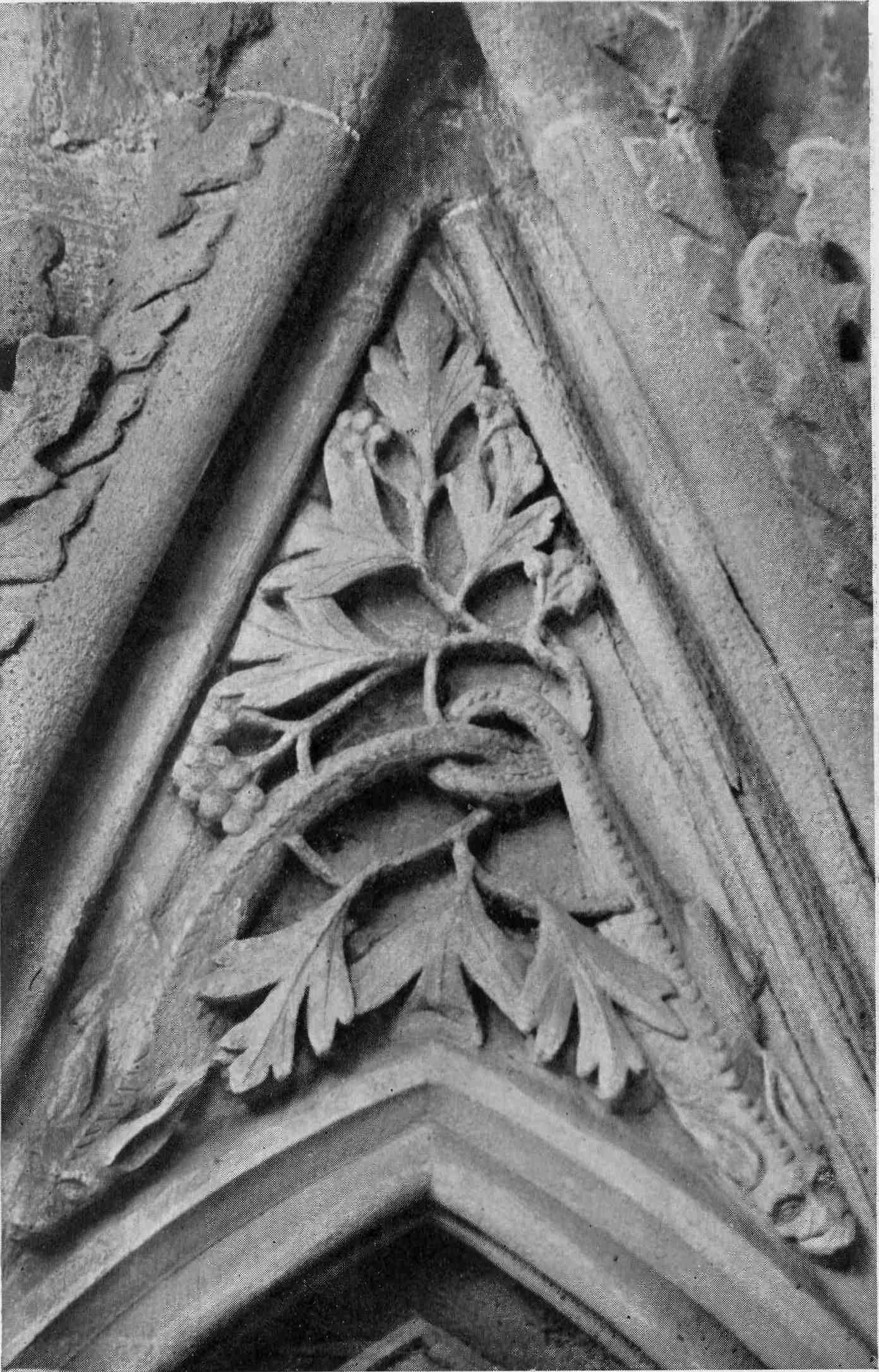
The best collection of naturalistic foliage is in the chapter house of Southwell Minster and its vestibule. In tympana and mouldings and on capitals here we find the leaves of oak, maple, vine, may, rose, hop, fig, etc., etc., delicately carved in exact imitation of nature. Instead of straight stalks rising from the necking of capitals the cut-off stalks belonging to each leaf appear to be stuck on to the bell above the necking. In fact the effect is as if leaves with their stalks had been plucked from the trees or plants, glued on to the bells and petrified there. The work is so cleverly done that it almost disarms criticism, and it has sometimes been regarded as the most beautiful and perfect type of Gothic foliage. Against this, however, it must be urged that they are of the nature of applied ornament rather than architecturally part of the building. They suggest a temporary adornment like beautiful clothing which is removable rather than a permanent portion of the structure. They do not impart a sense of rest and strength, but look as if a strong gust of wind might blow them away. These remarks apply specially to such a capital as that illustrated in Pl. 57, and the very charming group of capitals on the entrance doorway (Pl. 58). Some of the gables (Pl. 59) contain human faces or dragons{36} intertwined with the sprays of foliage. These, having a flat background, have a more solid appearance and are delightful.
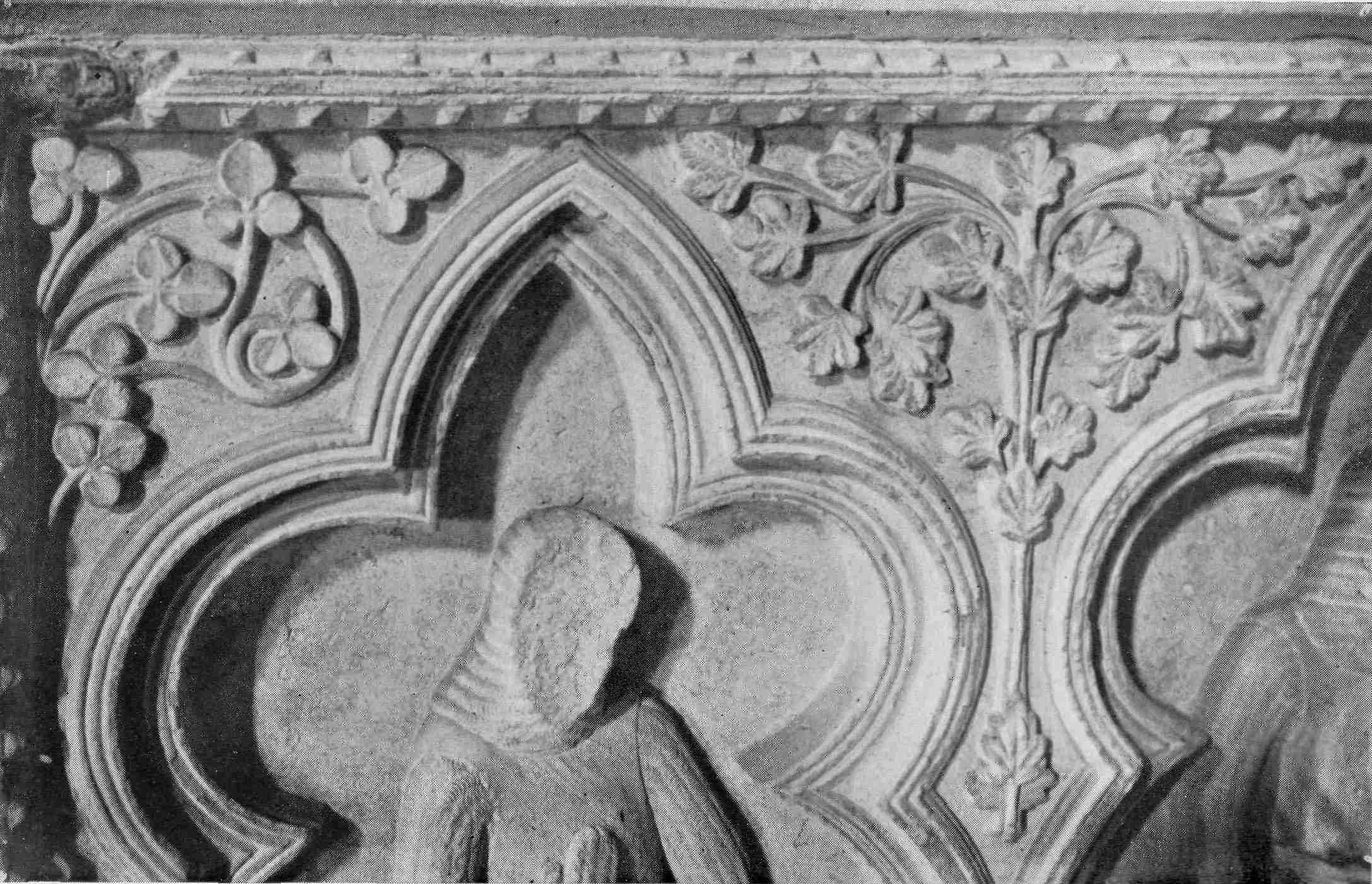
The Cantilupe Shrine at Hereford has naturalistic carving on the spandrils between the weepers’ housings. No two spandrils are alike. All are arranged with great taste, and gracefully fill the spaces they occupy (Pl. 60).
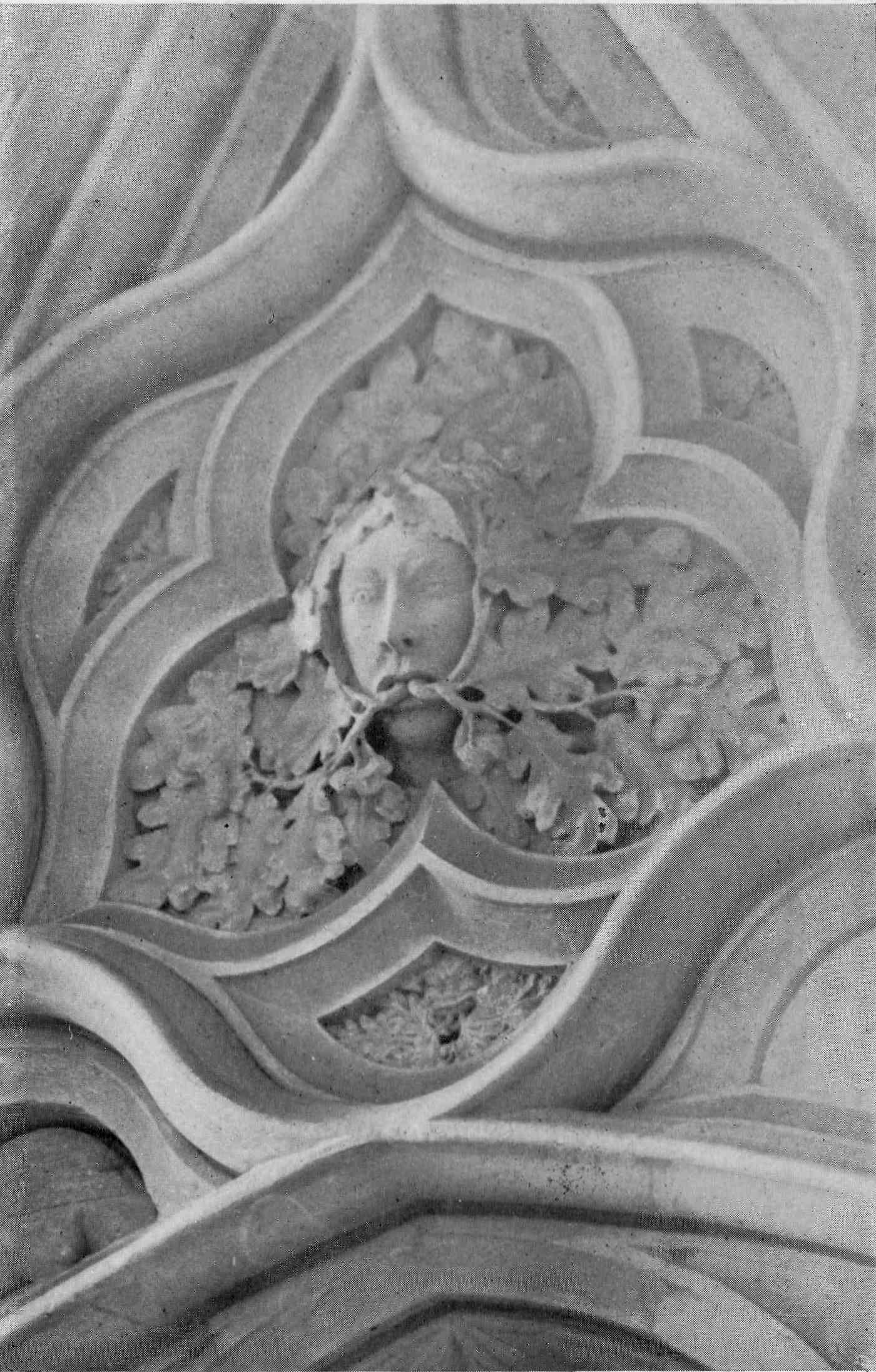
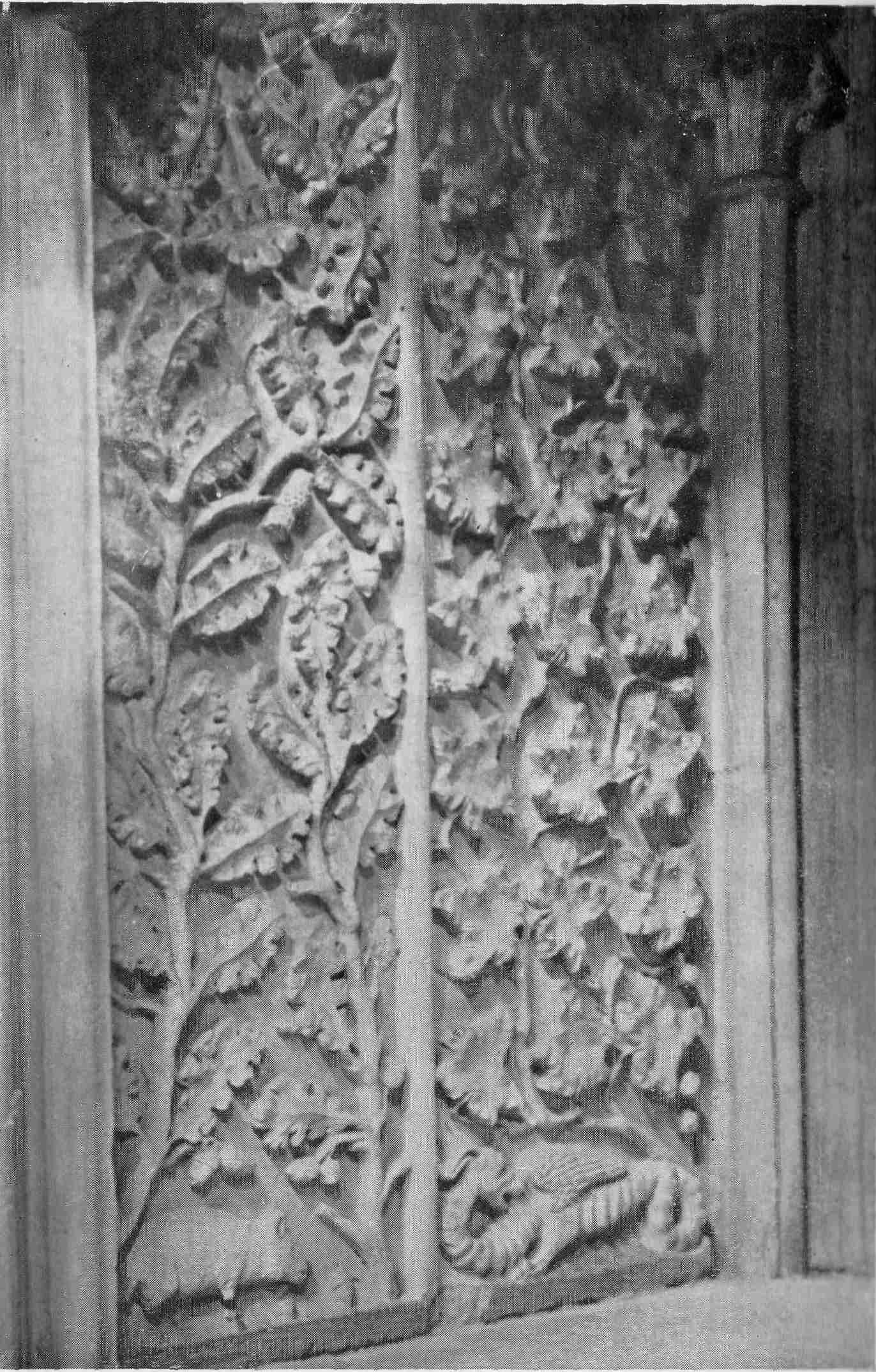
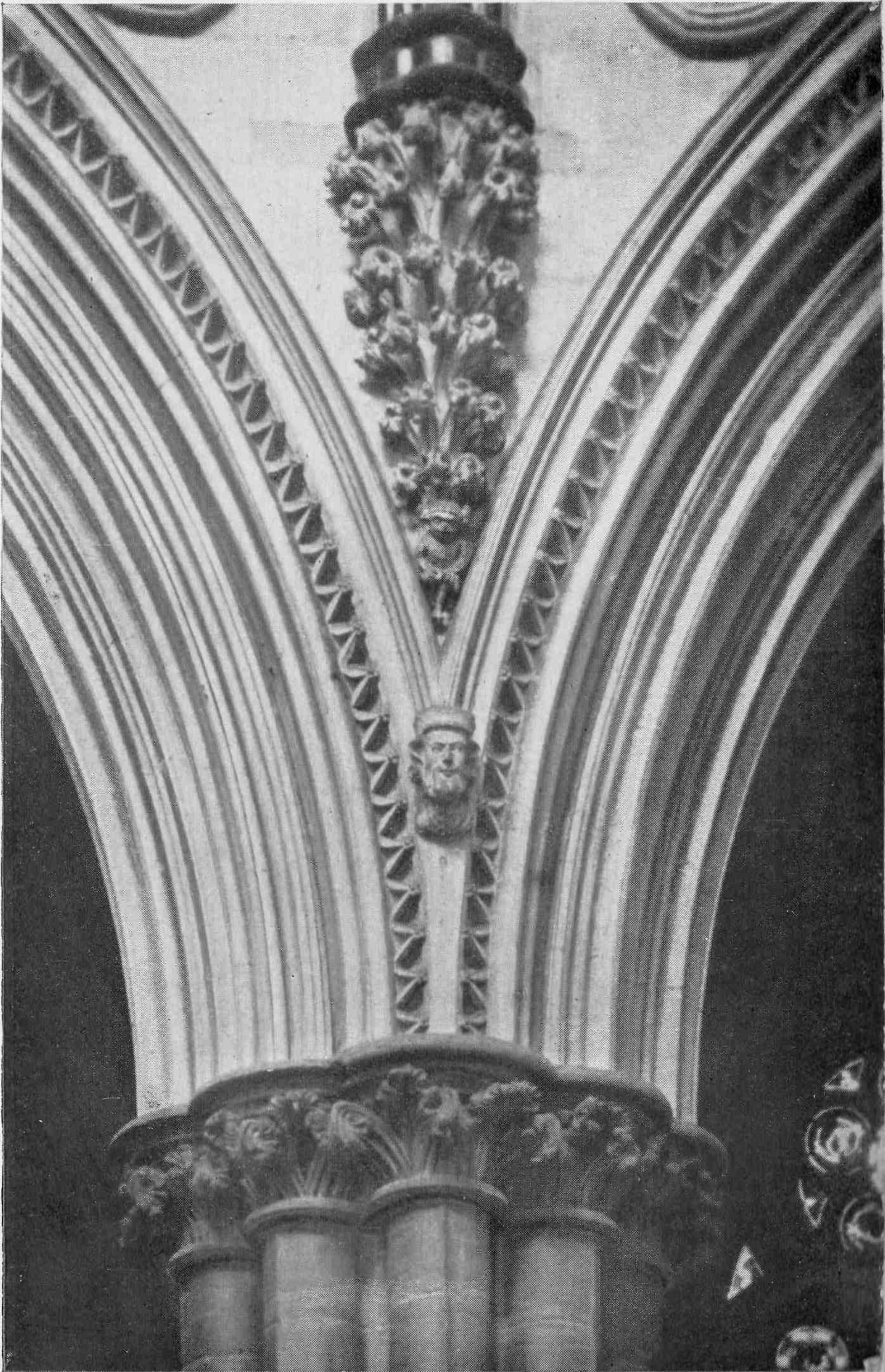
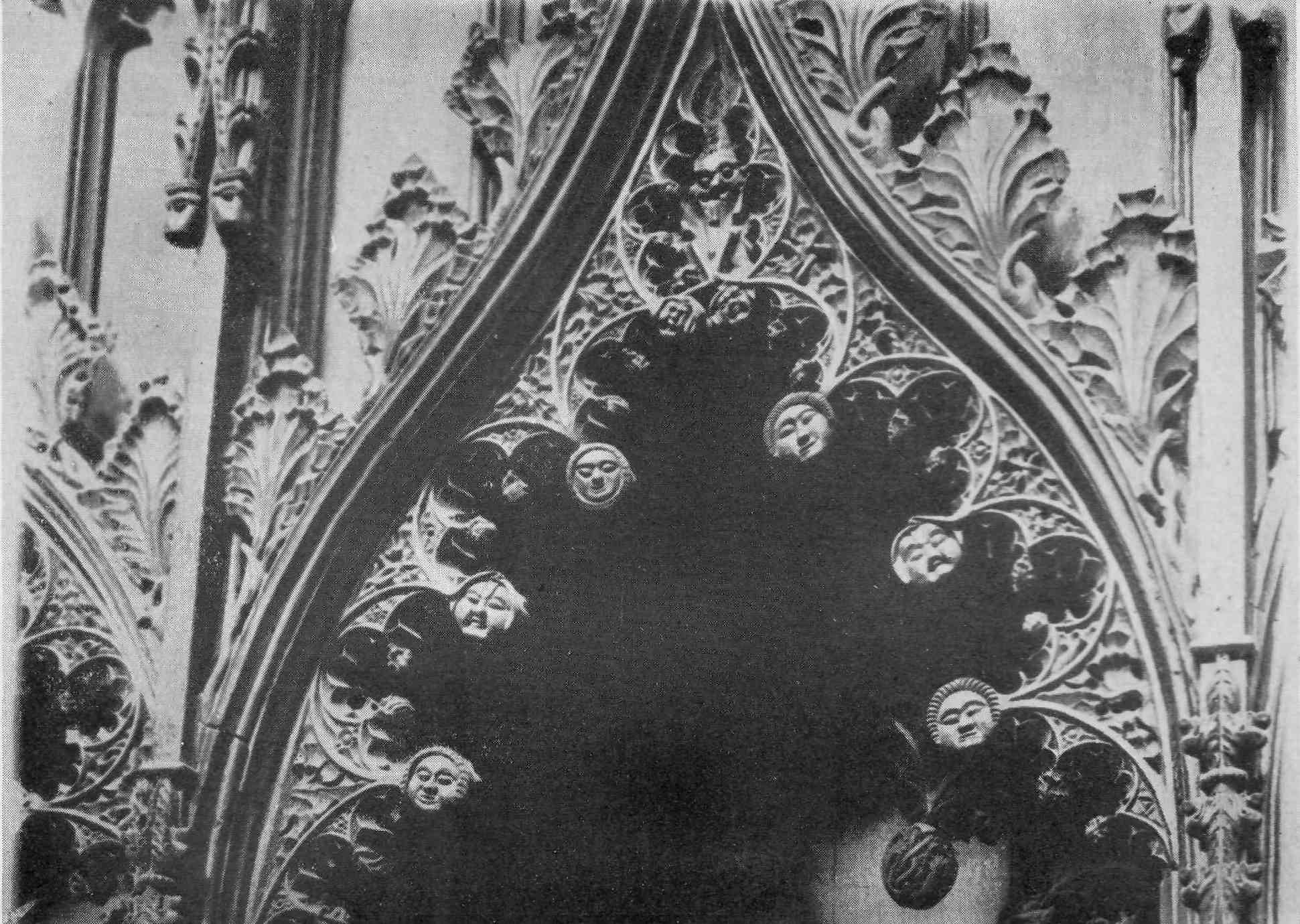
Heads among foliage belong to all periods, and the carving of a spray coming out of the mouth is a very old fancy. The earliest instance we have illustrated is the one at Hemel Hempstead (Pl. 6). Of this period one occurs on a tomb at Winchelsea (Pl. 61) where sprays of oak leaves come from the mouth of a well-executed face, and spread to fill the lobes of an ogeed trefoil panel. On the spandrils between the arches of the shrine of St Frideswide at Oxford, there are rather flat sprays of leaves of forest trees, with a face in their midst. This is thought to commemorate an episode in the life of the saint, when she was hiding in a wood (Pl. 62).
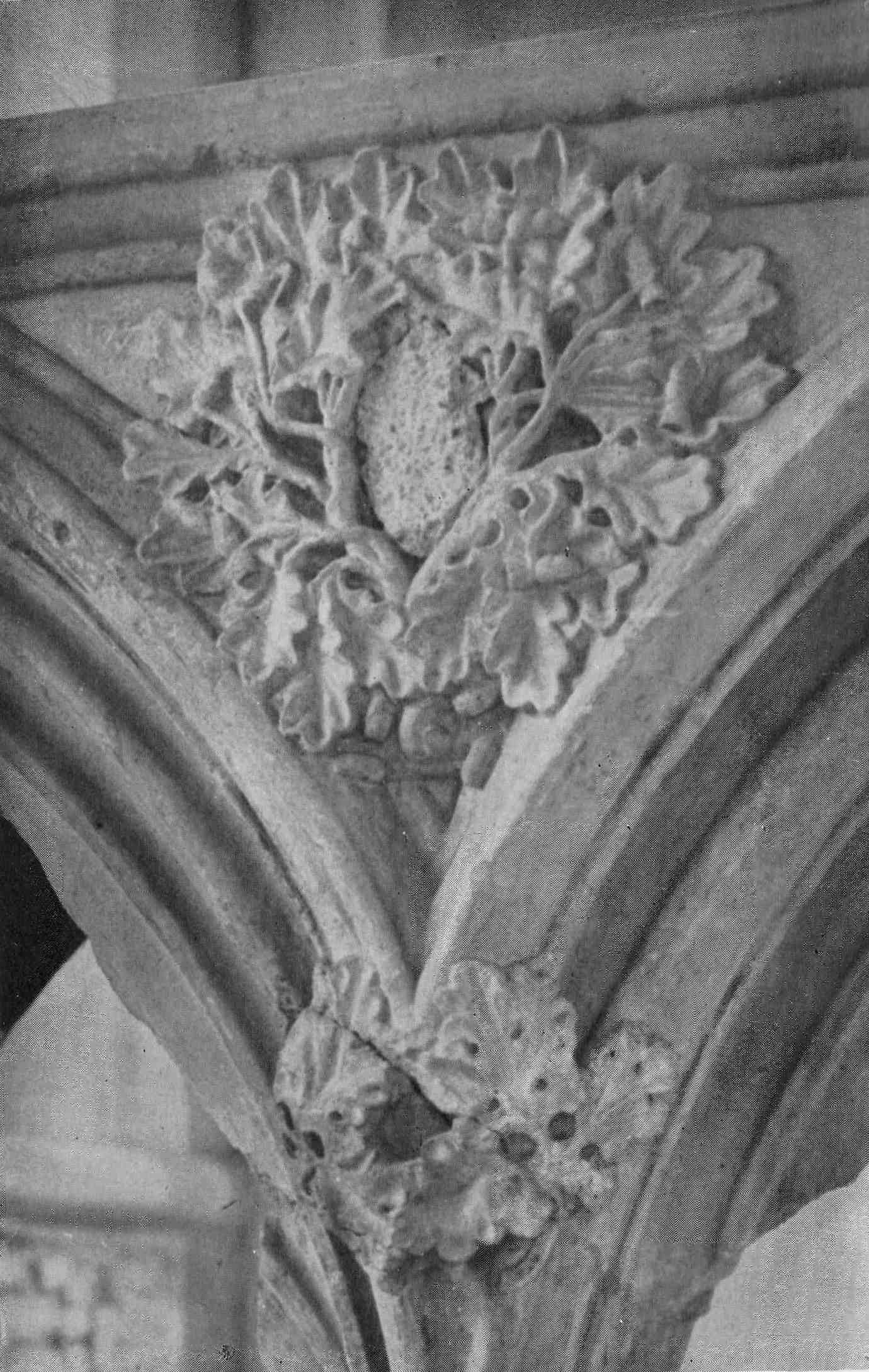
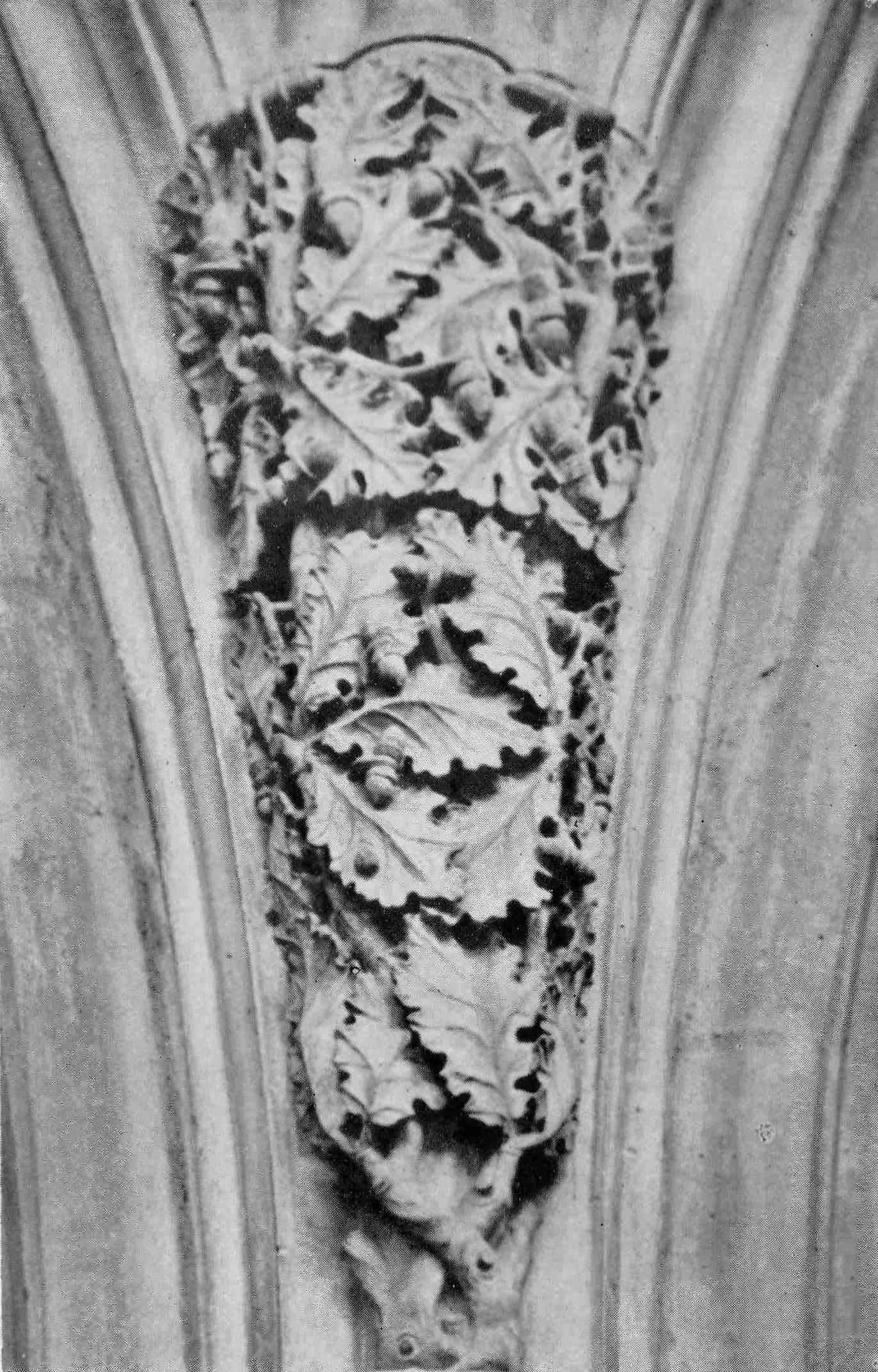
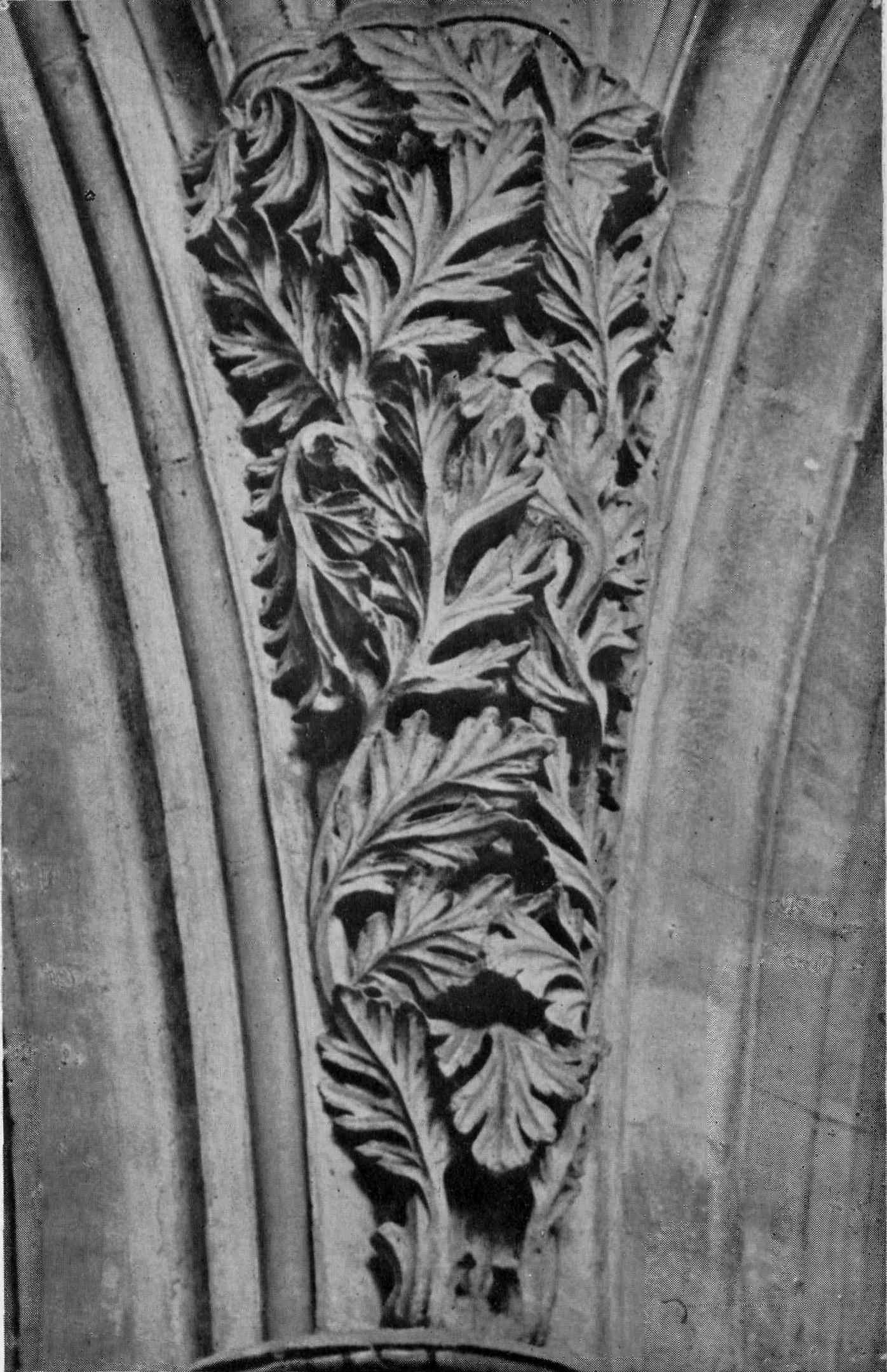
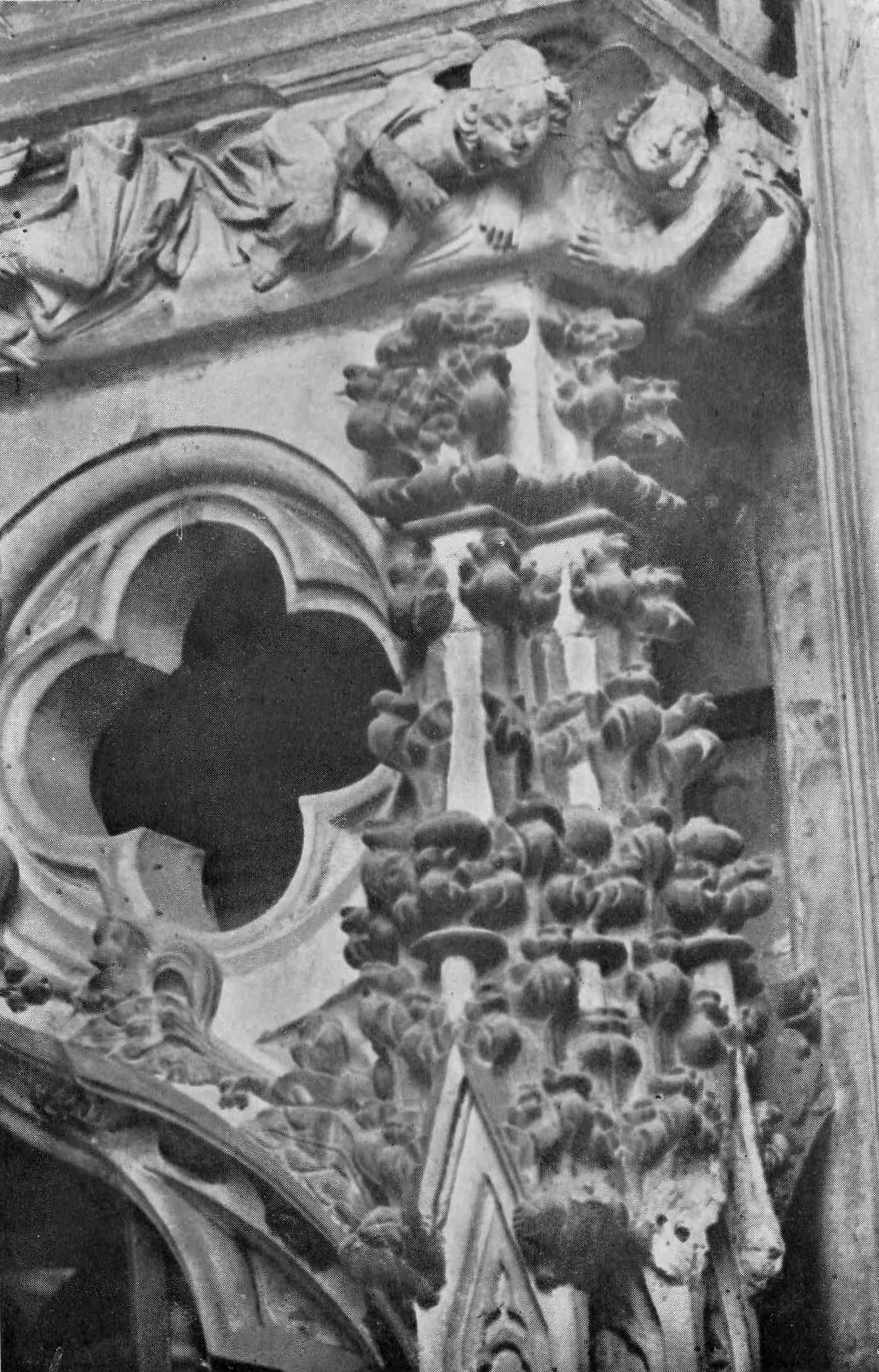
Among the best known examples of this style are the corbels of the vaulting shafts in the choir of Exeter Cathedral. The two corbels we illustrate (Pls. 63 and 64) show excellent naturalistic carvings of oak and wild celery(?) leaves. Among the oak leaves are acorns and oak apples.
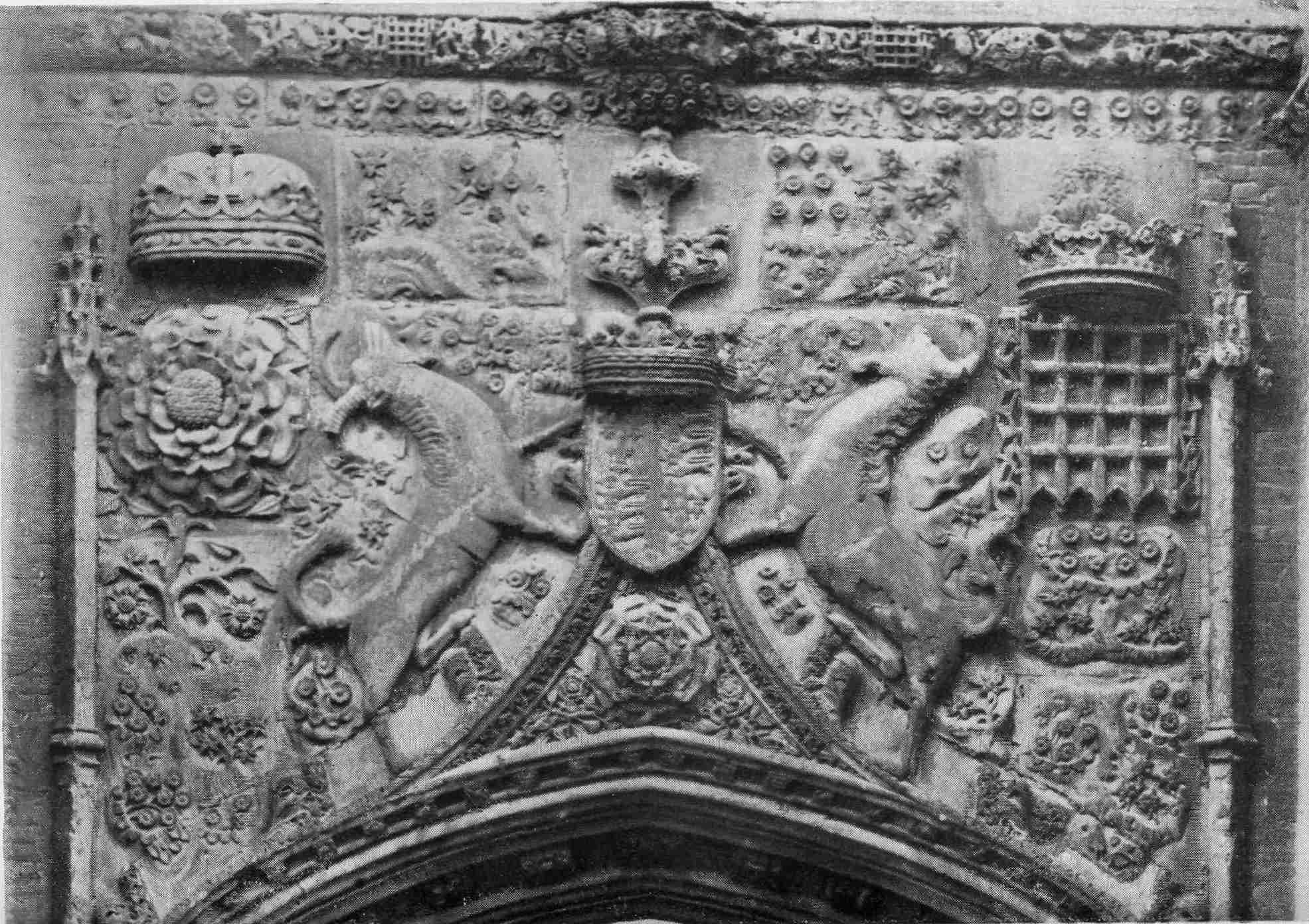
As we remarked above, the naturalistic period did not last long in England. Most of the examples were probably executed within the twenty years from 1280 to 1300. Although a new convention then began, a naturalistic treatment of details survived for a long time. We find occasional instances of it right up to the Tudor period, and a distinct revival of it, as on the west doorway of King’s College Chapel, Cambridge, was the last effort of the Gothic masons before they were swamped by Renaissance ideas (Pl. 85).
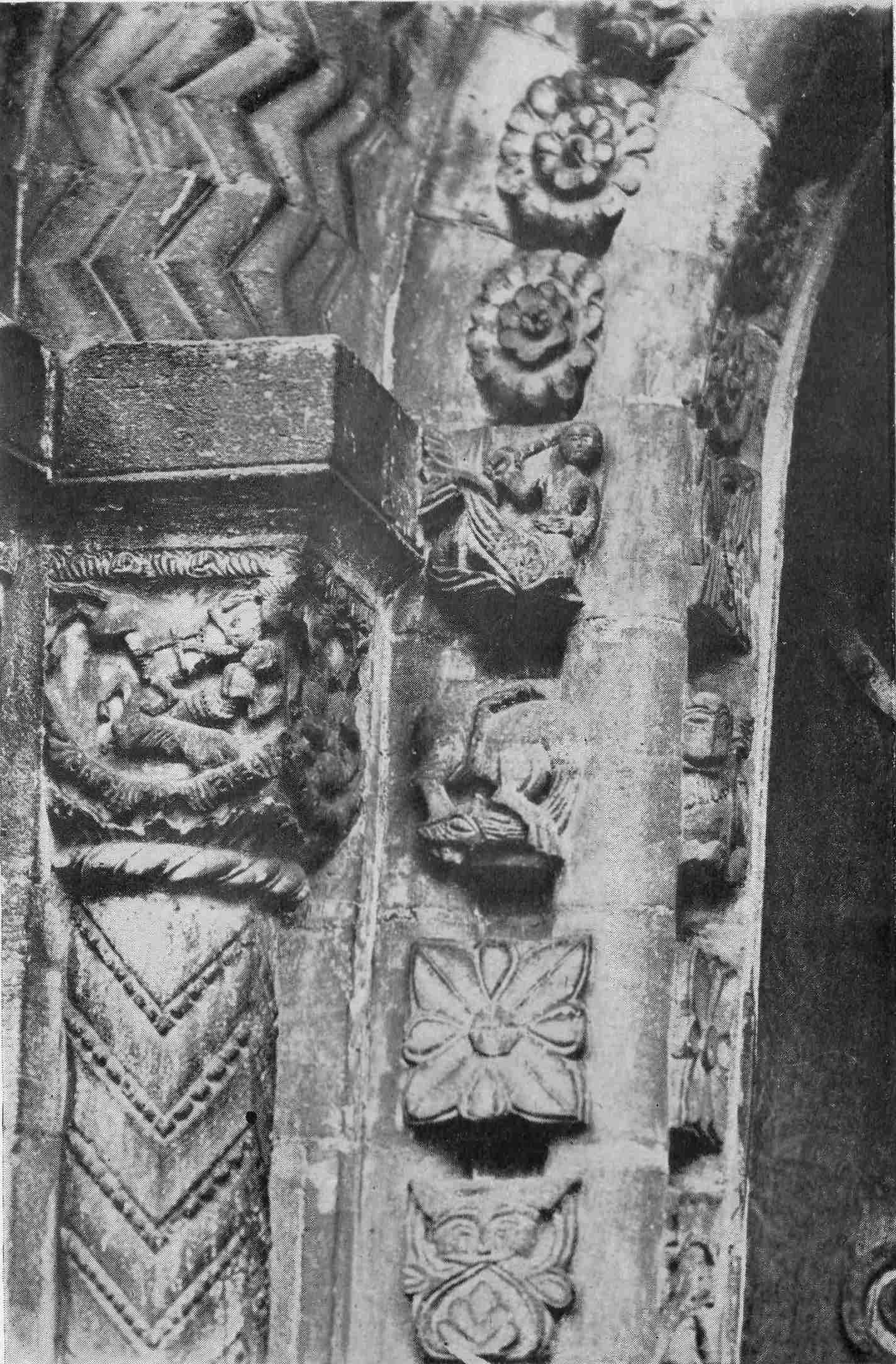
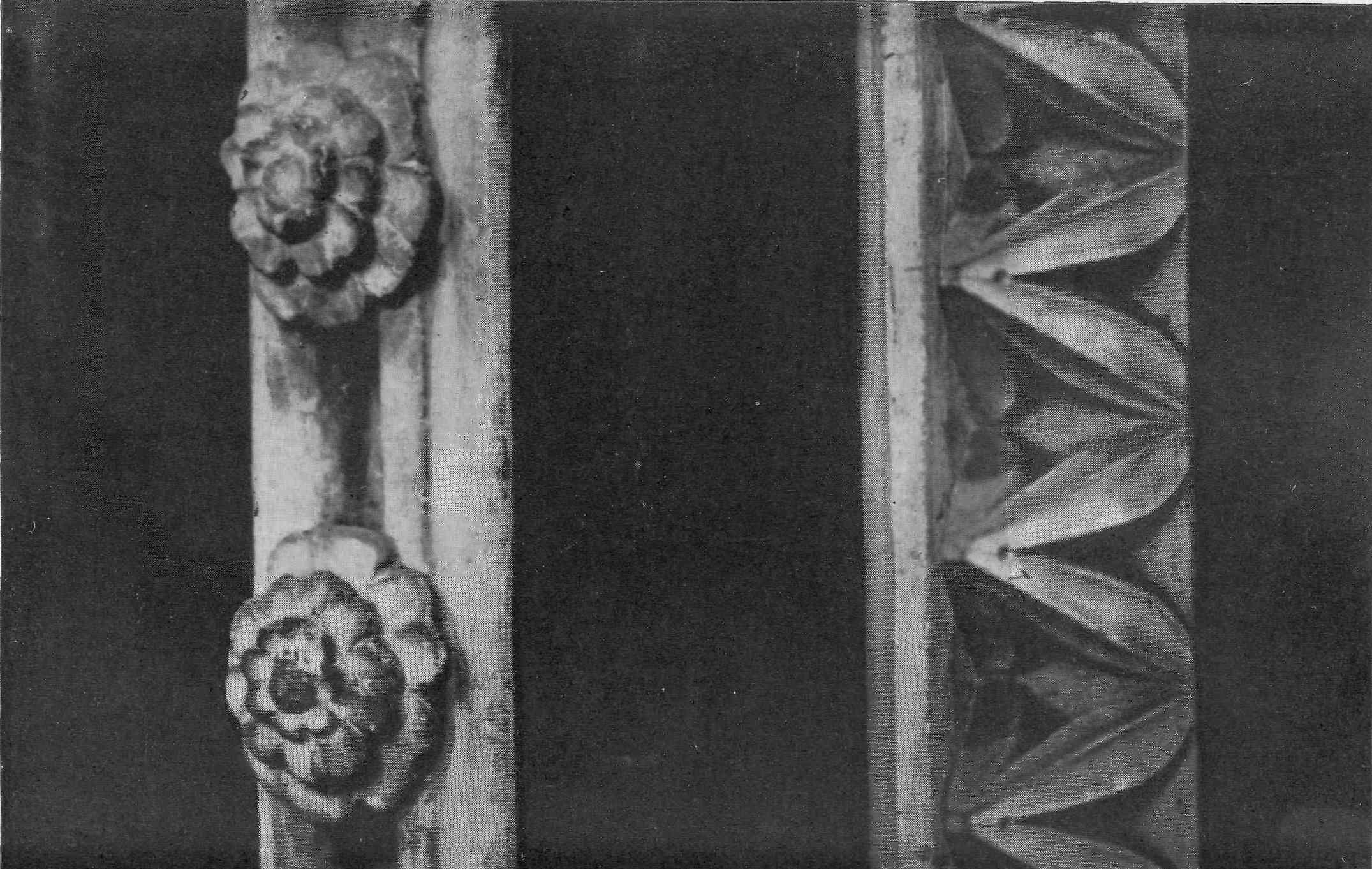
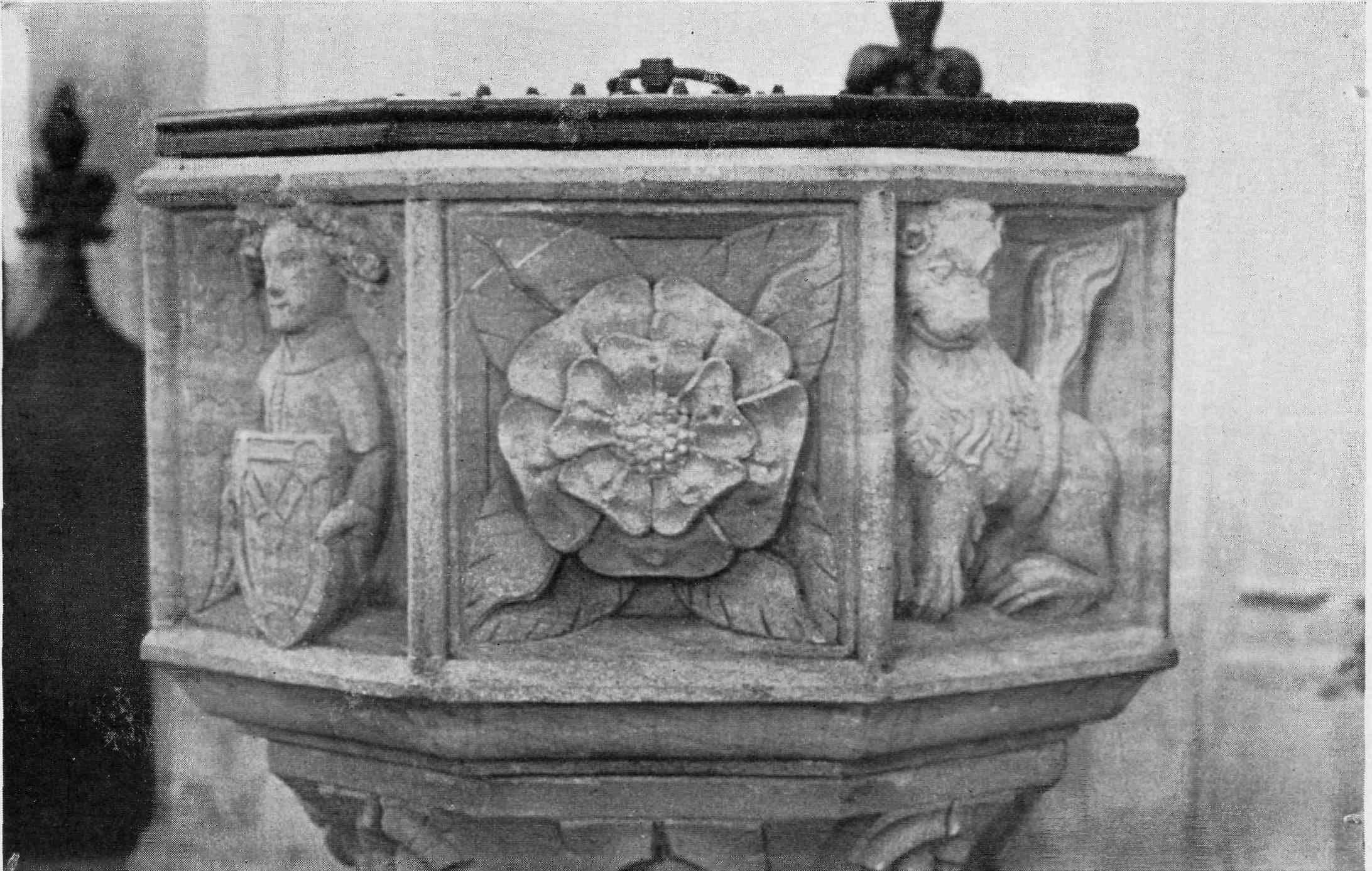
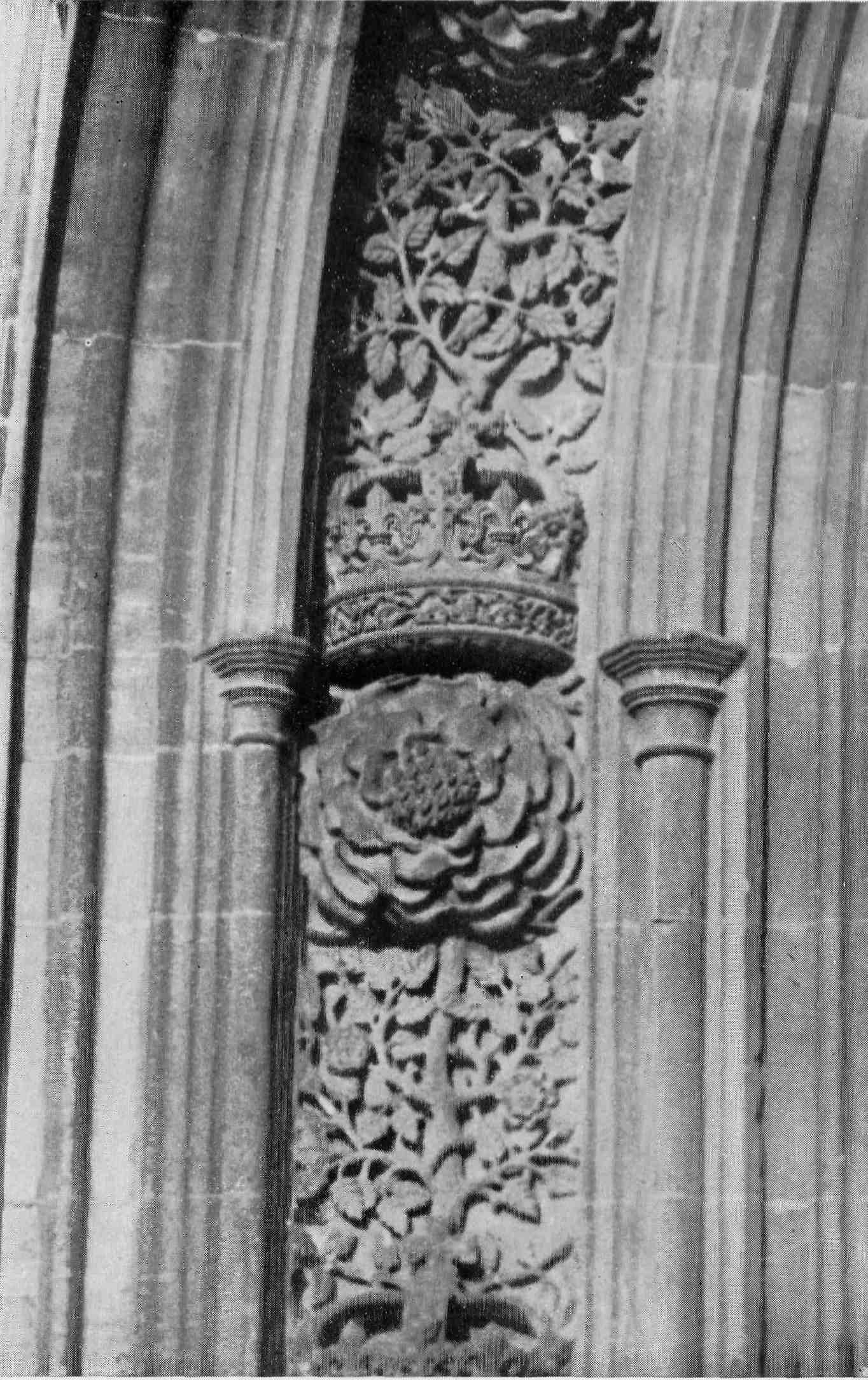
Before leaving this subject it may be interesting to compare the treatment of roses in the four centuries the work of which we are describing. In the twelfth century, the Norman or Romanesque style, we find a few specimens, such as those at Iffley (Pl. 65), where the petals are arranged in a double row round a central disc forming rosettes rather than roses. Of the thirteenth century Early English style there are some similar specimens, as at Lincoln (Pl. 66) on the doorways into the choir aisles, but here the petals are in triple rows. Of the fourteenth-century Decorated style some specimens, as at Fyfield, Essex (Pl. 67), are more globular, without any definite arrangement in rows. The roses on the chapterhouse doorway at Rochester are single with flat{38} petals, bulged in the middle (Pl. 68). On some of the late fourteenth or early fifteenth-century fonts, as at Erwarton (Pl. 69), there are large flat roses set in panels. They are of a conventional heraldic type. The petals are arranged formally in two rows round a central disc which is covered with knobs to represent stamens. The leaves are square-cut with rounded corners and indented outer edge.
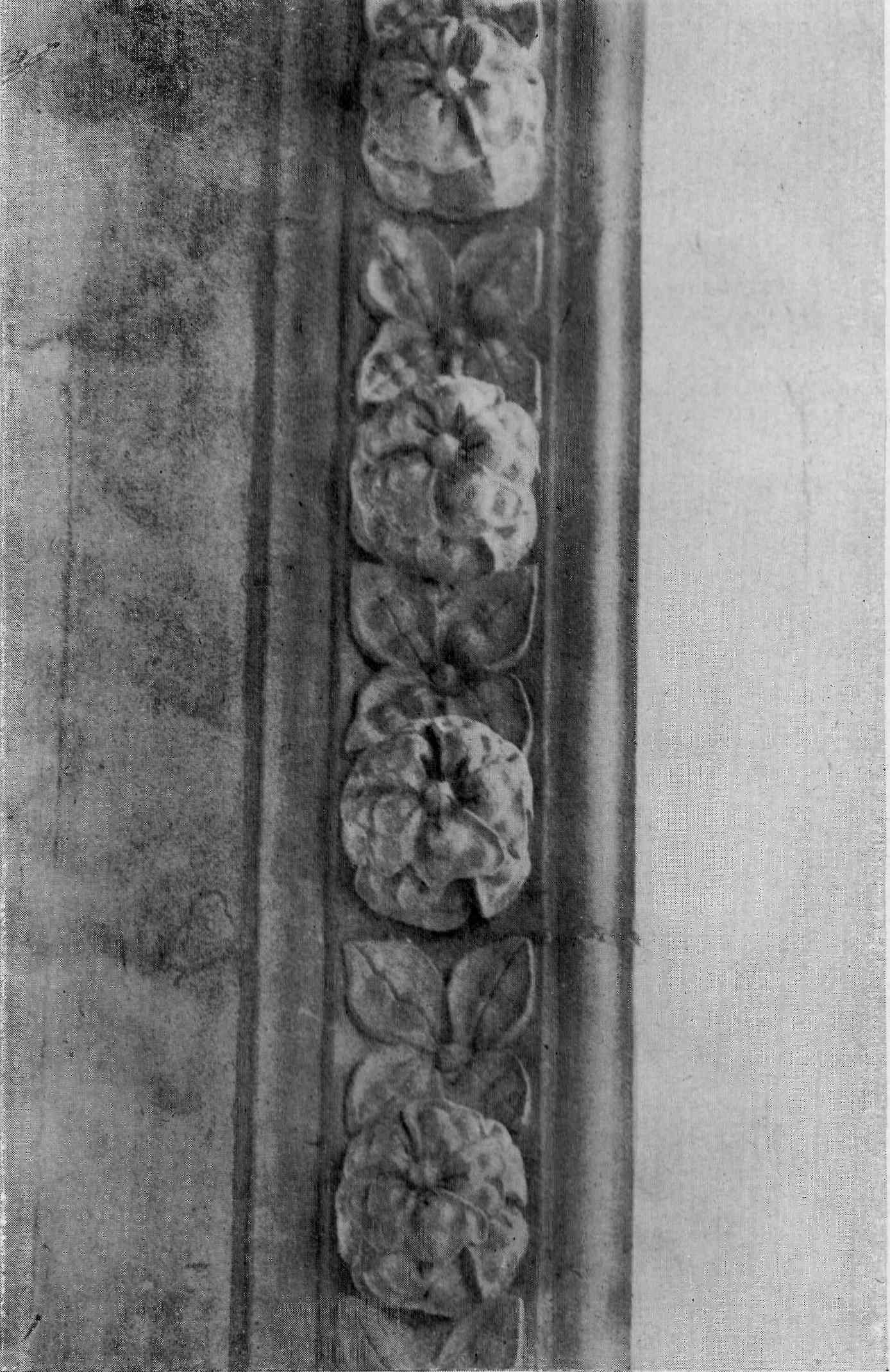
Tudor roses, as seen at King’s College Chapel, Cambridge (Pl. 85), are again more naturalistic, with several rows of petals and a large central disc. Cut stalks are seen between the outer petals. The gateway of St John’s College, Cambridge (Pl. 70), has some good specimens of Tudor roses together with a quantity of daisies, the emblem of the Lady Margaret. In describing these as naturalistic we must remember that there has no doubt been considerable development and modification of cultivated roses in the course of the centuries. Those of the twelfth, thirteenth, fourteenth and fifteenth centuries may have differed a good deal from those of to-day.
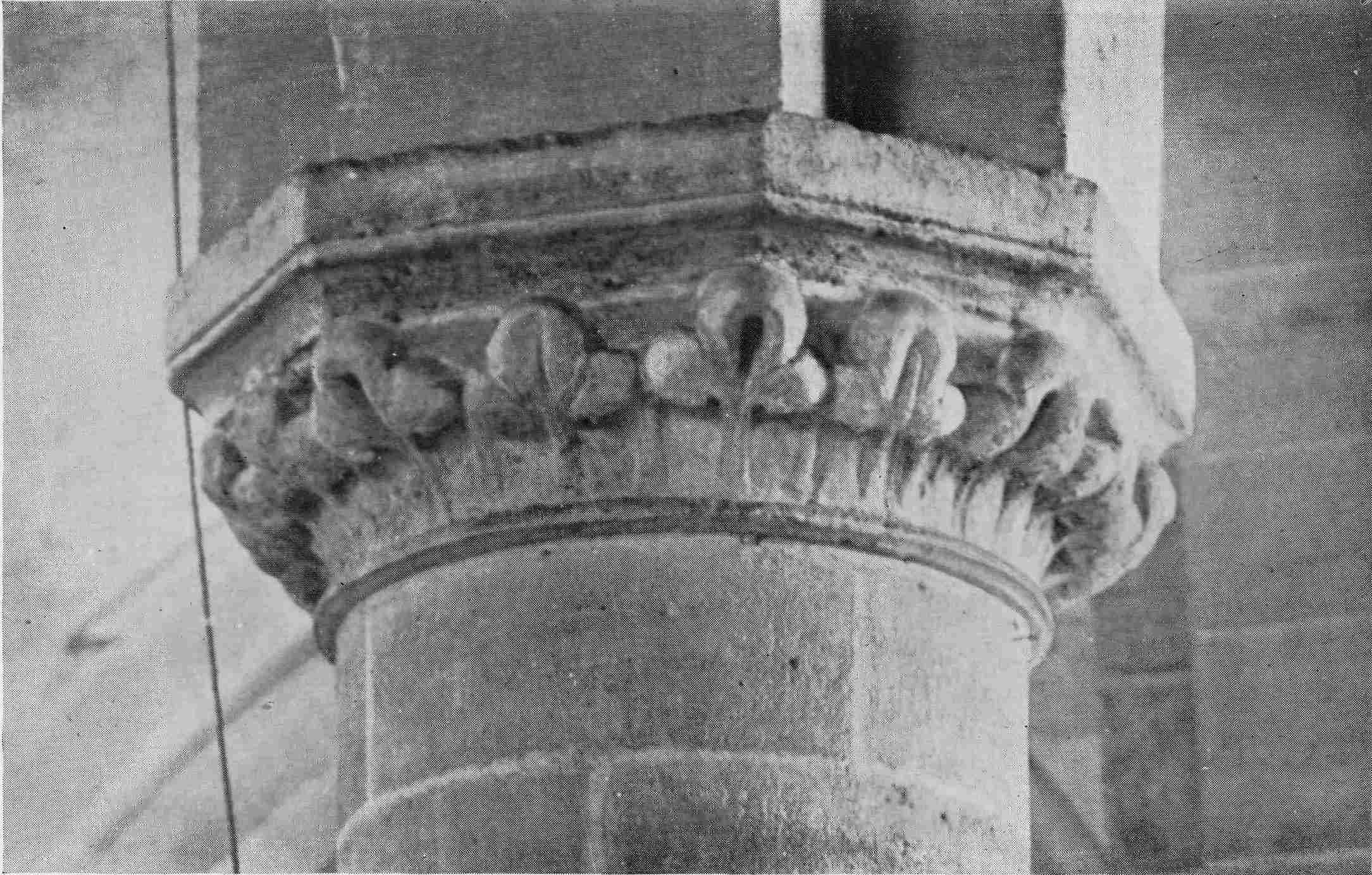
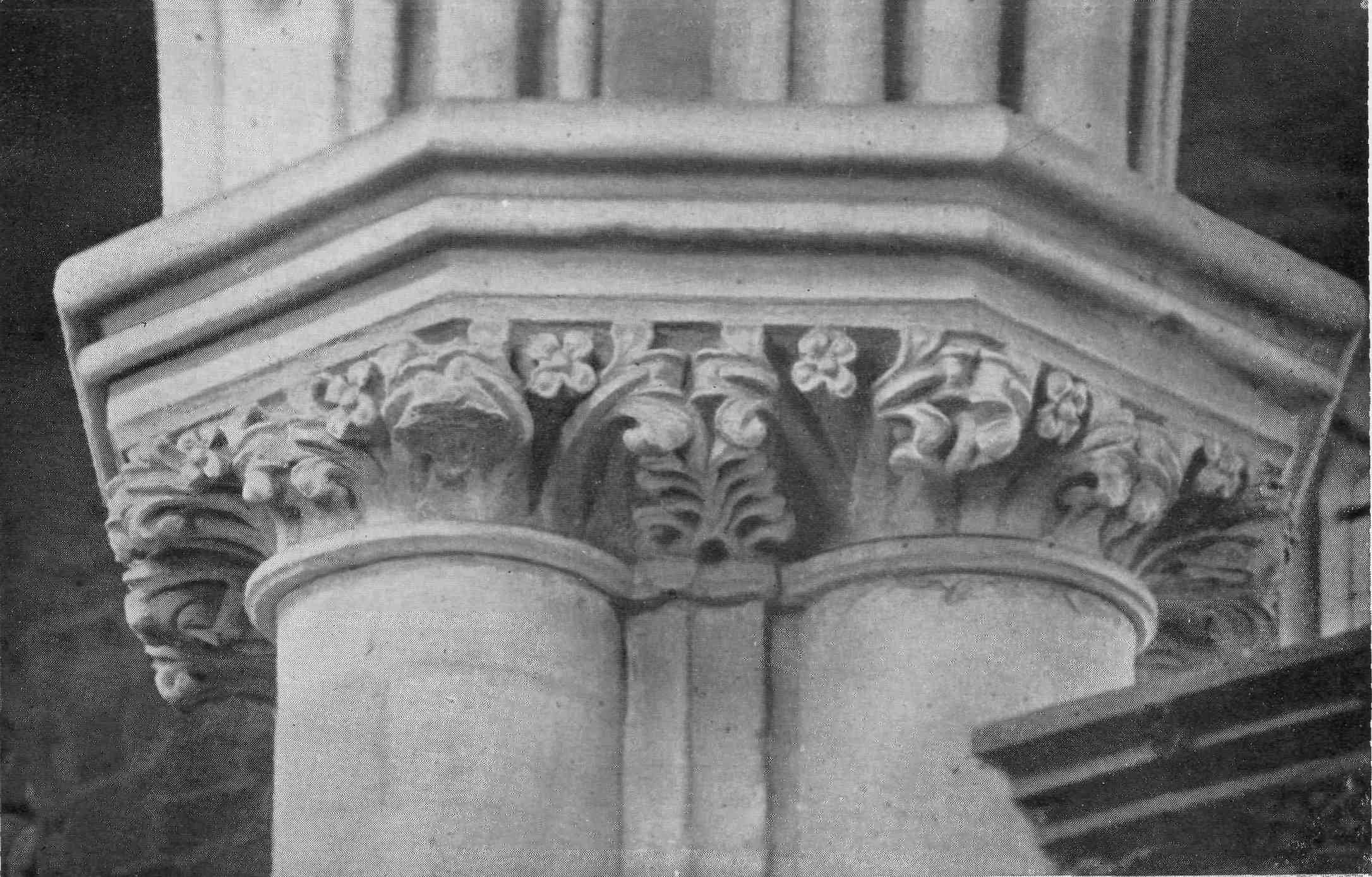
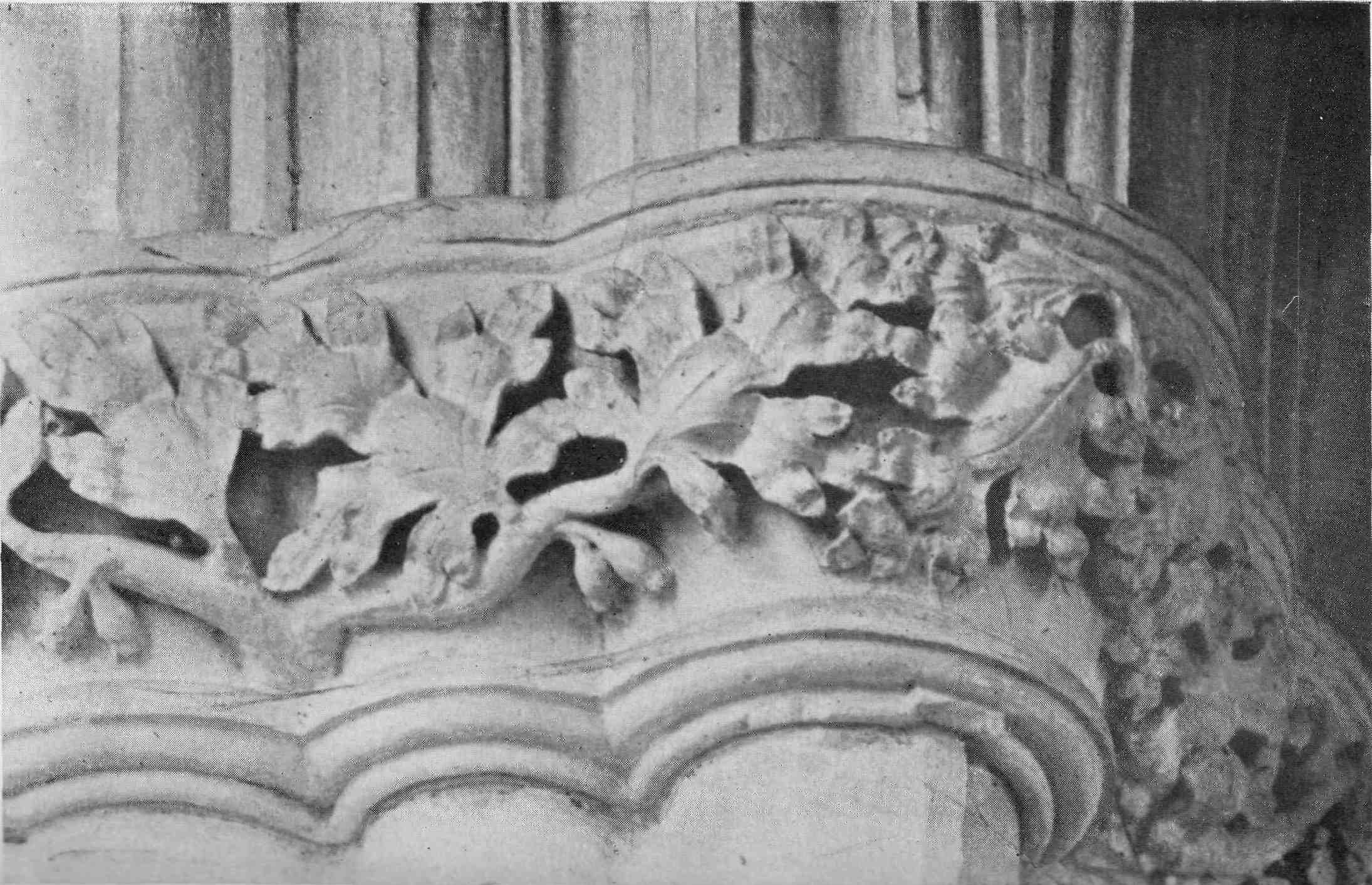
WHEN the masons grew tired of extreme naturalism, which happened after about twenty years, they invented, or rather there grew up among them, a new style or convention which is called Decorated or Edwardian, as it lasted through the reigns of the first three Edwards. Its peculiarities were an exaggeration of the knobs or globular waves on the leaves which we found beginning in the Angel Choir of Lincoln (Pl. 45), and a rippling of the edges. This last feature gave a suggestion of adhesion which was lacking in the naturalistic leaves, and accorded with the convex character of the carving. The Early English stiff-leaf foliage curled over outwards concavely like volutes, the Decorated foliage returned to the cushion-shaped or, rather, the cup-shaped capital (Pl. 1), and gave an appearance of solidity and support (Pl. 71). The leaves that lent themselves most fitly to this knob and ripple treatment were long thin serrated leaves like those of certain ferns and seaweeds. Fern leaves often exhibit very similar curves and ripples in nature, while the bladders on seaweed may have suggested the knobs. The most marked examples are the crockets{40} on the exterior of arched canopies or gables. In these the effect is to suggest that they are crawling like caterpillars up the arches (Pl. 111). There are some good specimens of these on the Percy Monument at Beverley. The crockets and finial on this Percy Monument show very plainly the characteristics we have described (Pl. 73). The globular swellings on the leaves are so exaggerated at Beverley as to look almost like apples or pears from a distance. The leaves here are not like those of ferns or seaweed, but are apparently conventionalised vine leaves, and, as such, should be compared with the naturalistic leaves on the Southwell capital (Pl. 57). Among the leaves are some small bunches of grapes. This mixing of fruit with leaves is also a feature of Decorated sculpture. It is seldom seen earlier though it is frequent later. In a few rare cases flowers appear among stiff-leaf foliage (Pl. 48), but fruit seldom or never. This period is the August time of Gothic—the fruit season. The stiff-leaf period is that of buds, the Decorated that of flowers and fruit, and the Perpendicular that of vines and grapes carved in wood.
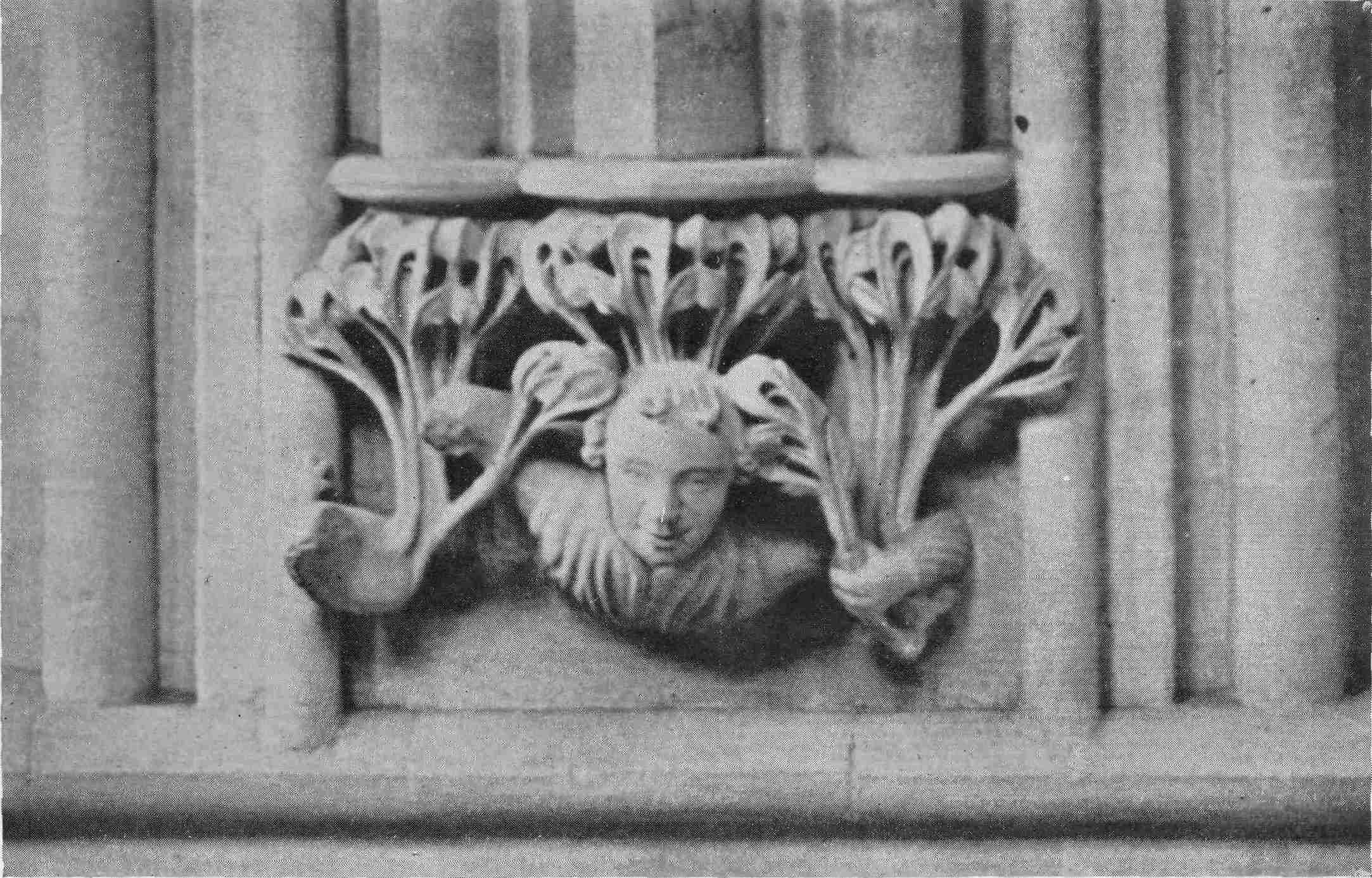
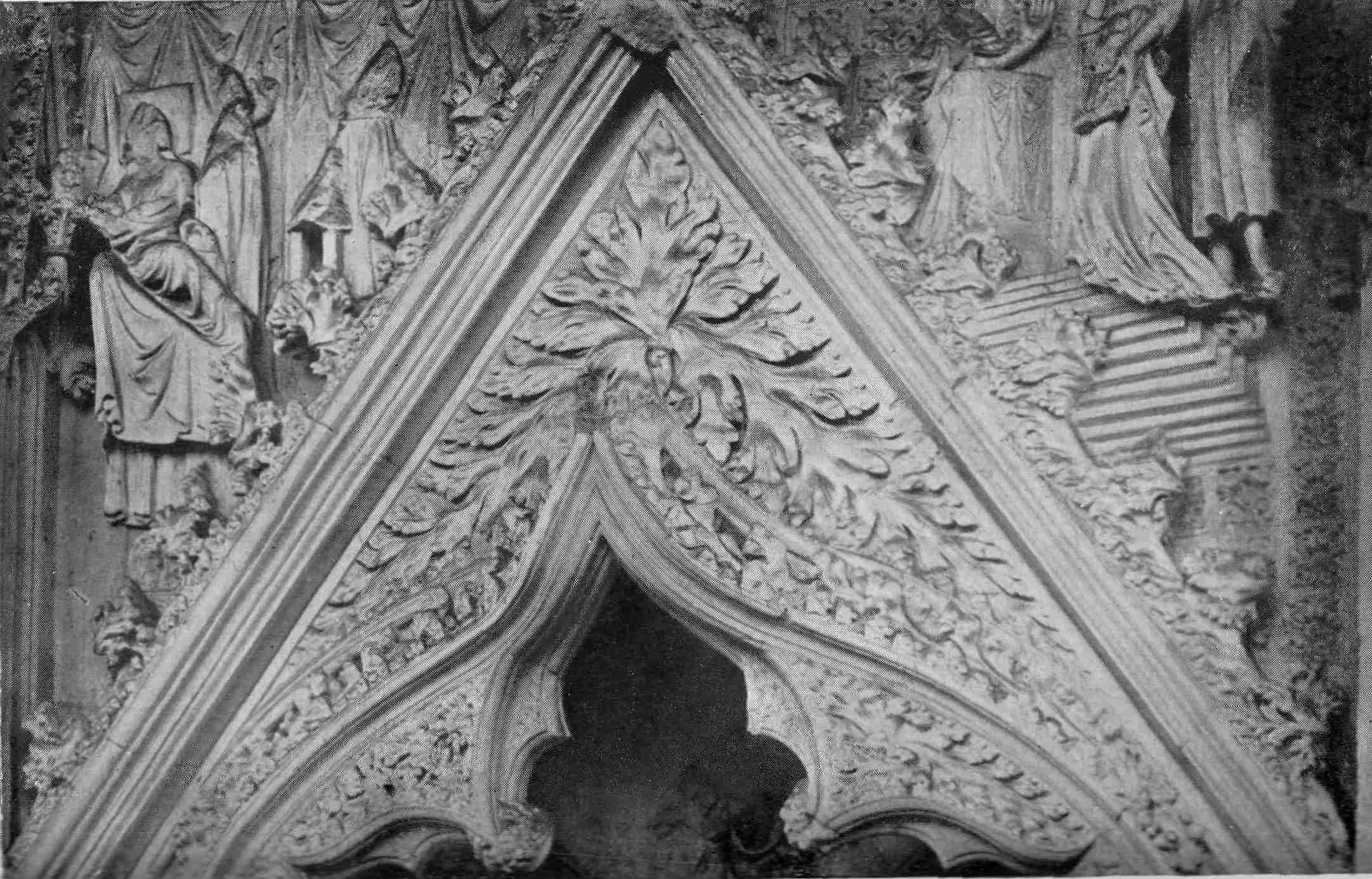
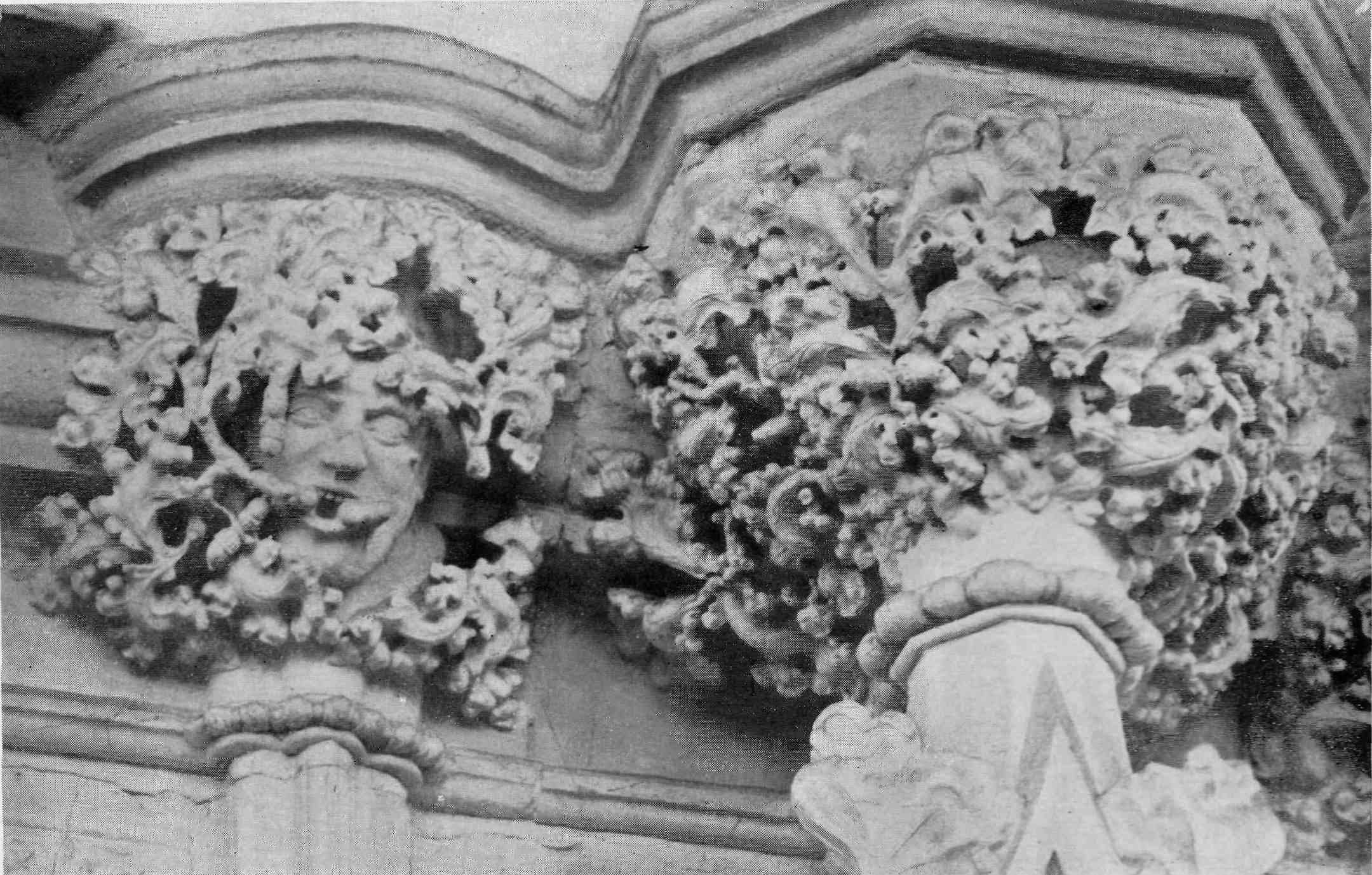
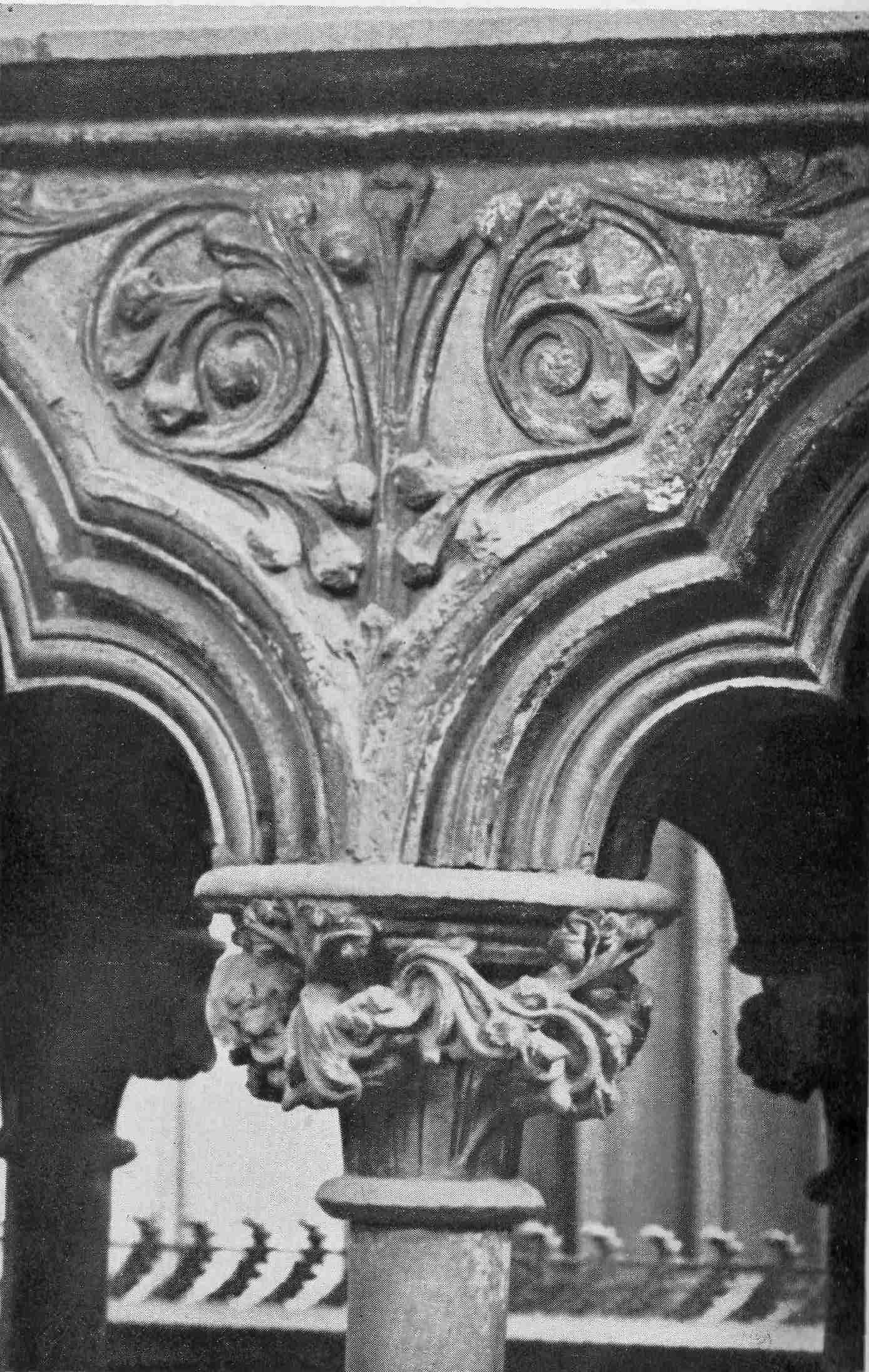
A very graceful arrangement of seaweed leaves occurs on a panel of a tomb at Winchelsea (Pl. 72), and a more elaborate one of the same sort on the tympanum of a gable in{41} the Lady Chapel at Ely (Pl. 74). In this chapel also a face occurs with sprays of Decorated foliage coming out of its mouth (Pl. 75). This reminds us of Pls. 6 and 61. The foliage on the Easter sepulchre at Lincoln is an exaggerated example of the crinkled edges of the Decorated leaves (Pl. 76), and a monument at Exeter is an exaggerated example of the puffed-out globular swellings (Pl. 77). Long, coarse, sprawling leaves showing bulgings and rippled edges are exemplified on capitals at Patrington (Pl. 78).
The Decorated type of foliage continued in use in the western counties right through the Perpendicular period. In the east foliage sculpture in stone almost ceased. The principal place for its exhibition being capitals, the reduction in size and importance of capitals led to its disuse. The small capitals of the period were mostly moulded, not carved. Such foliation as we have is chiefly on monuments. While stone-carving was becoming rare, or of a very coarse and decadent description, wood-carving was coming more and more elaborate. The best carvers, with a few exceptions, seem to have transferred their work from stone to wood. The building of churches gave way to their enlargement and ornamentation with wooden screens and alabaster monuments.
THE main feature in which Perpendicular foliage differs from Decorated is its tendency to squareness and to long sprawling leafage. The squareness culminated in what is known as the Tudor ornament. Drilled holes to emphasise the indentations of the leaves are also a frequent feature. As most of the foliation is of a decadent Decorated character with more or less marked tendencies of the kinds we have mentioned, it does not seem worth while to disfigure this volume with many illustrations of the decadence. We therefore select a few characteristic specimens only, and then pass on to the wood-carving.
At Aldenham there is a monument (Pl. 79) of doubtful date in a spandril of which is a human face with sprays coming out of its mouth—a fancy we have noticed before in both Norman and later work. The foliage is like the Decorated seaweed but more rippling and elongated.
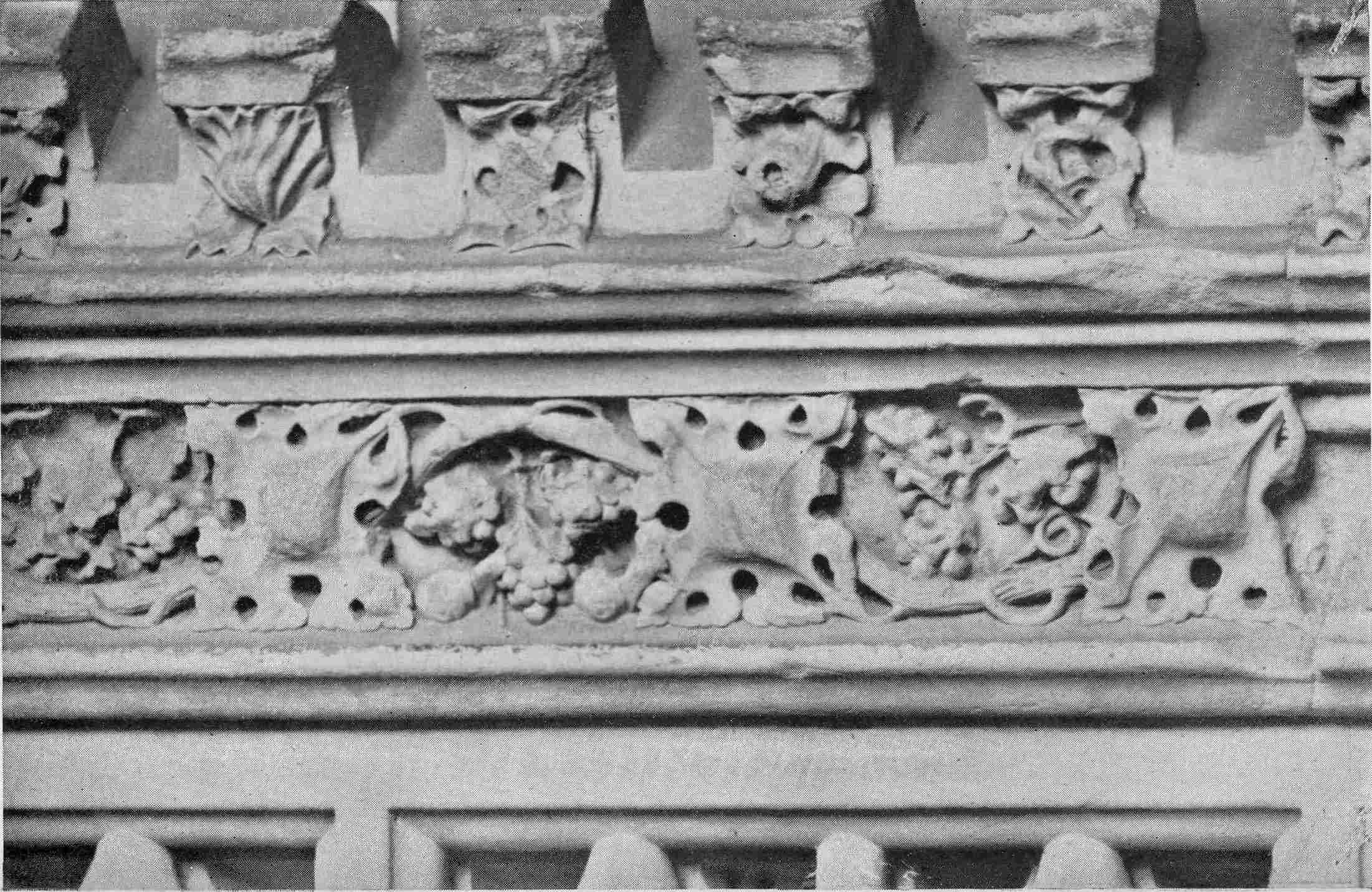
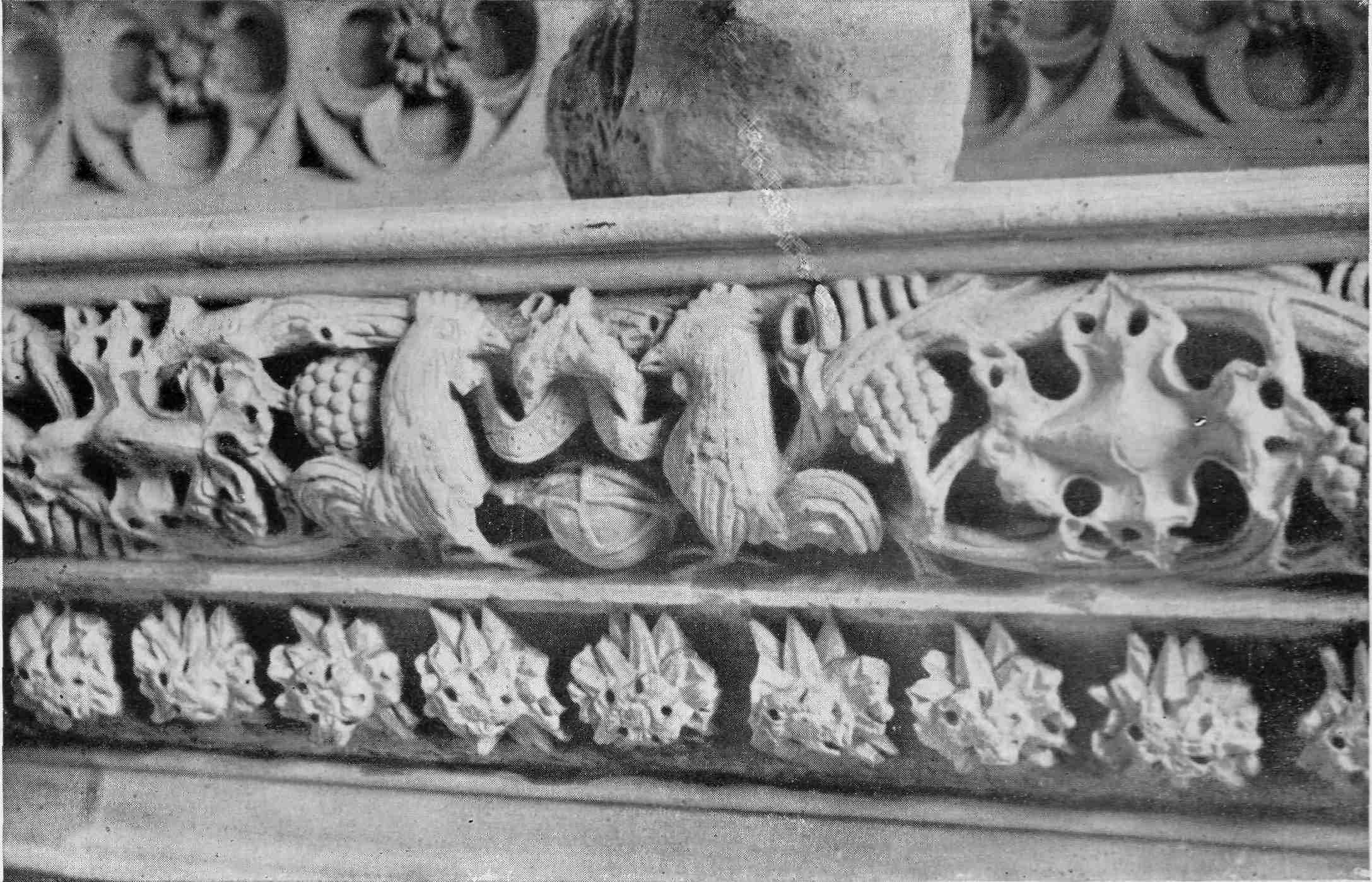
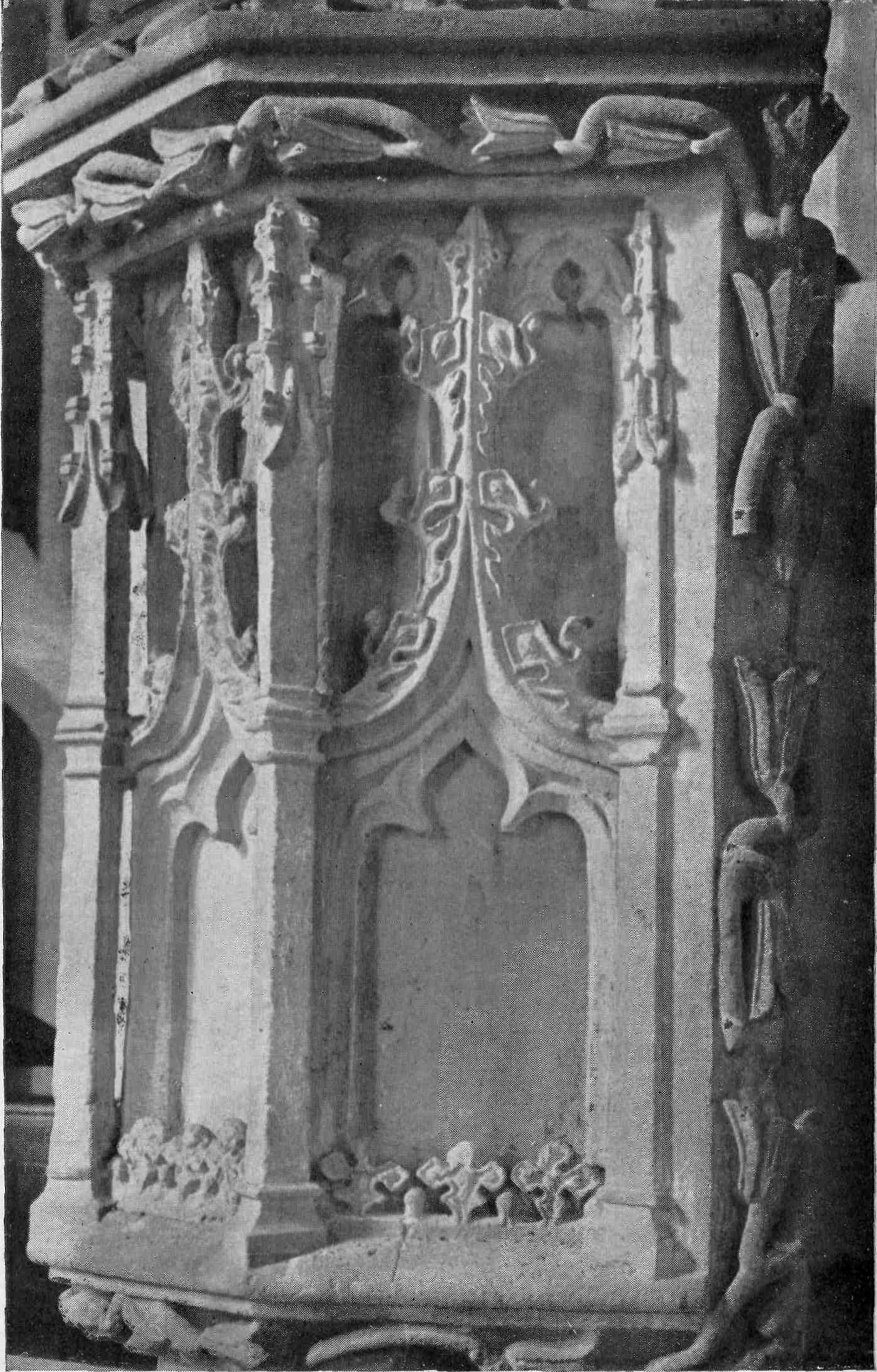
On the back of Abbot Ramryge’s Chantry at St Albans (Pl. 80) is a string of vine leaves and grapes of a very square type, and with numerous drill-holes. This was probably exe{43}cuted in the abbot’s lifetime. He died in 1524. The same class of vine stems and foliage is seen on Bishop Alcock’s Chantry at Ely (Pl. 81). He died in 1500. A pulpit at North Cerney, Glos, has some rather remarkable lilies on stiff stalks (Pl. 82).
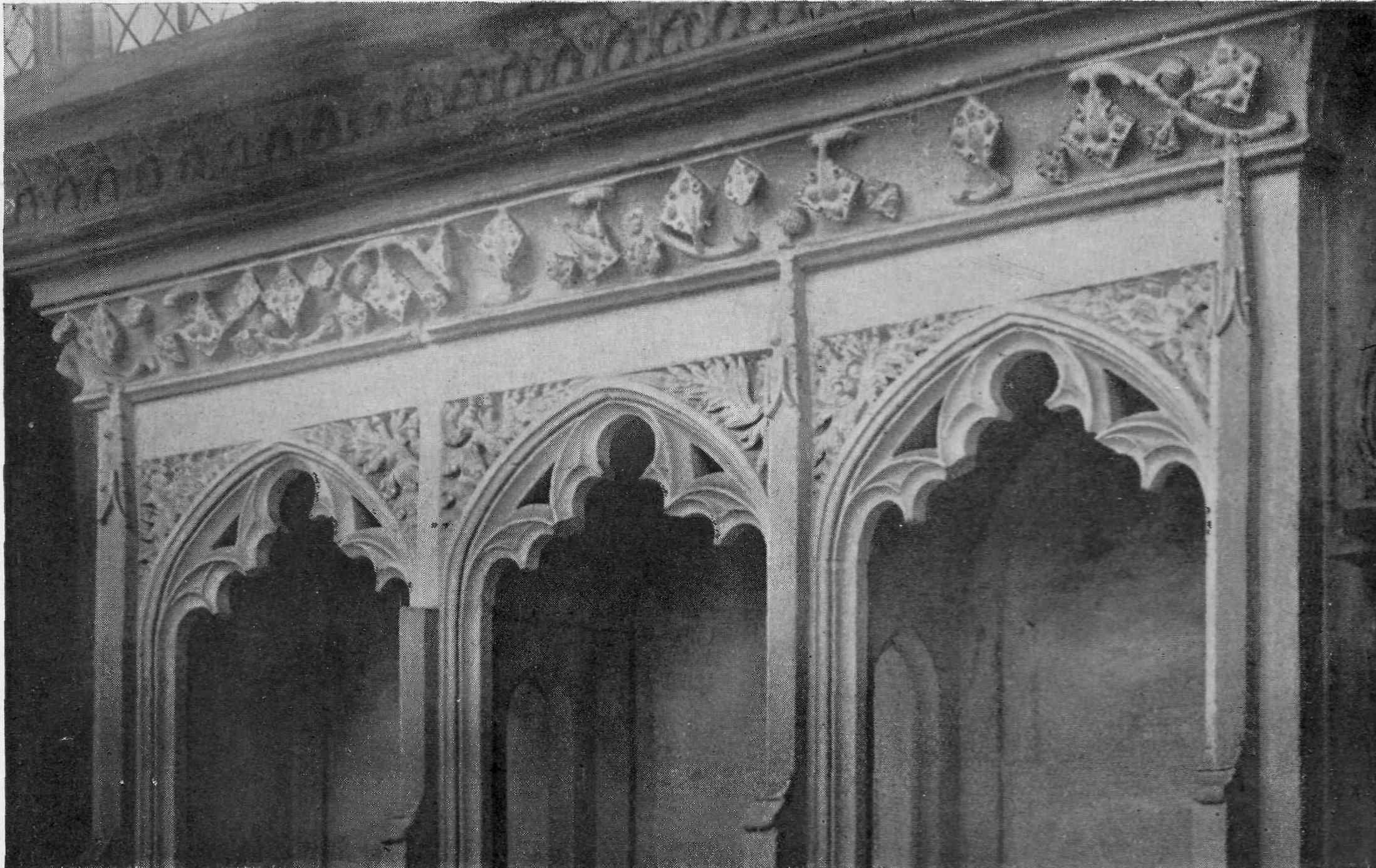
In the spandrils of the canopies over the sedilia at St Mary’s, Oxford (Pl. 83), there is foliage of a similar kind to that at Aldenham, but better executed. The cornice above has vine stems with leaves of a very square-cut conventional type, approaching the Tudor ornament in shape. The carving is much broken, but can never have been anything but poor and clumsy in design.
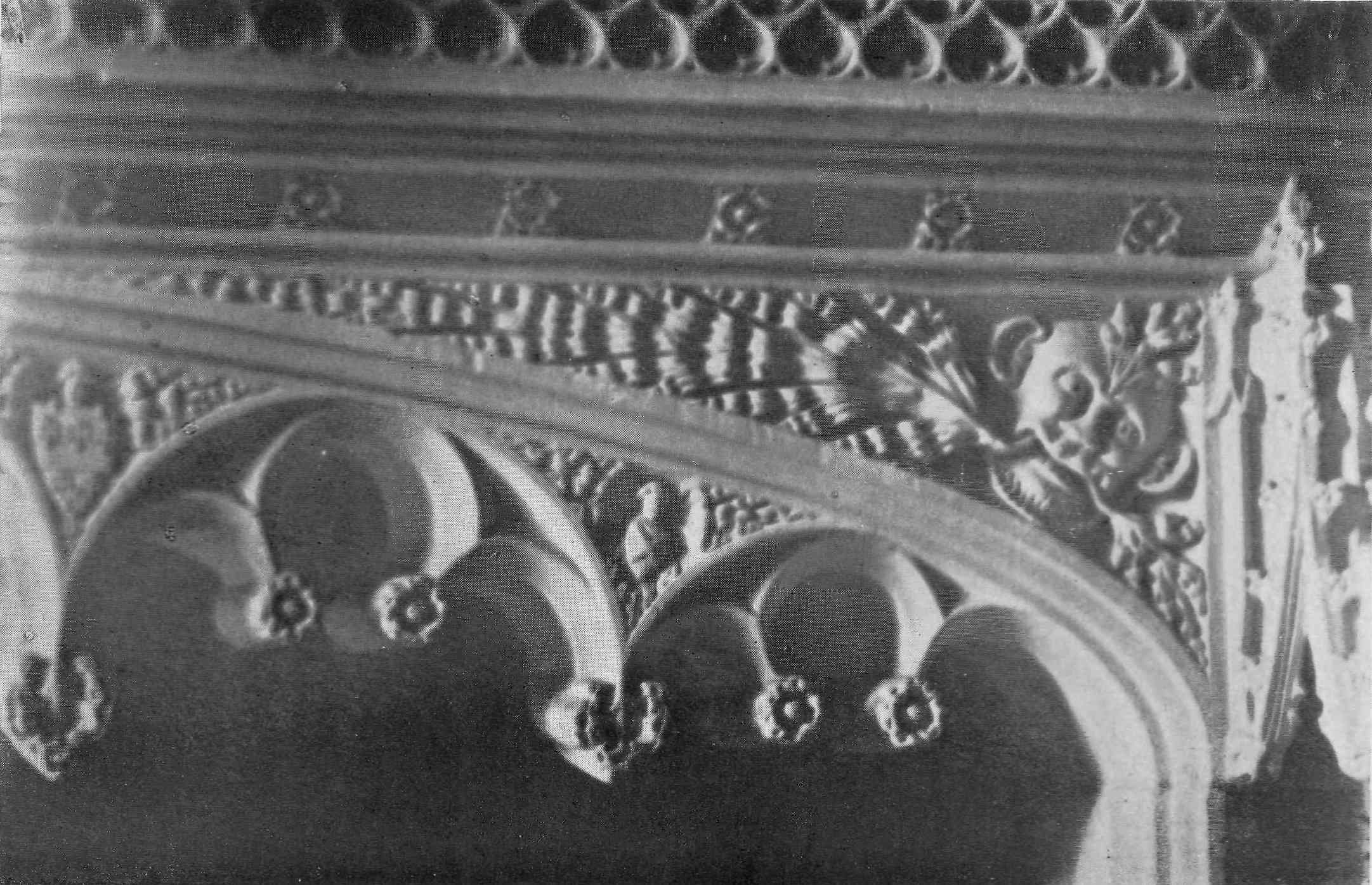
A much better specimen of this late and poor work is the watching loft of St Frideswide’s shrine in the Oxford Cathedral, the general effect of which is rich and ornate. A close examination, however, will show that the richness is caused by elaborate multiplication of similar ornaments and not by any excellence of design (Pl. 84). Below the openings is a row of Tudor ornaments, well enough executed, as much like one another as the dog-tooth of the thirteenth century or the ball-flower of the fourteenth. Above is an arrangement of tall finials forming crocketed pinnacles. Above these is a cornice of vine stems, with leaves{44} and grapes. This is much finer work than the others we have described, but there is a lack of grace in the curves of the stems, and the same design is repeated over and over again. On the top is another row of Tudor ornaments of a slightly different shape from those below.
It is refreshing at last to come to something more original and with more design about it. In the hollow of the mouldings of the west doorway of King’s College Chapel, Cambridge (Pl. 85), and in the spandrils above is some carving which is particularly interesting. Heraldic devices appear in English architectural ornament as far back as the reign of Henry III, when Simon de Montfort’s arms are sculptured on a wall arcade at Westminster. Many shields and arms appear on the Percy Monument at Beverley, but it is not until the Perpendicular period that armorial bearings became the chief features of monuments and not until late in the Tudor period that they appear on the walls of royal chapels. The shields were at first triangular and simple in outline. Towards the end of the Tudor period and the commencement of the Renaissance they developed into plaques with curvilinear edges, round indentations and curled-over projections, such as we frequently see placed on wrought iron gates. These plaques, we{45} would suggest, have a sort of family resemblance to such leaves as we saw on the Ramryge Chantry at St Albans. The royal masons who were employed at King’s College were very expert in the carving of armorial bearings—crowns, portcullises, the animal supporters, and Tudor roses. Great roses are carved on the walls both of the interior and exterior of King’s, but the feature to which we would specially call attention is the stems and leaves of these roses. It is true that the size of the roses makes the whole design top-heavy, and is almost like a caricature with a large head out of proportion to the body, but the stem and leaves are a new departure. They are naturalistic, and, being the work of skilled masons, they are well done. They are the very last effort of Gothic stone-carving and indicate a desire to break loose from the hard-and-fast convention, and return to nature for a fresh inspiration. What this might have led to we do not know, for Renaissance invasions nipped this effort in the bud, and Gothic art expired. It should be mentioned that these roses and leaves have been copied on the Houses of Parliament at Westminster.
SO far we have merely described the forms of sculptured foliage. It is, however, obvious that these forms must have been considerably modified by the materials in which they were worked. We may go further and state that not merely the sculptures, but the whole character of the building must depend to a great extent on the materials obtainable. In some cases, especially for great buildings like Canterbury Cathedral, the stone may have been brought from a great distance—even across the sea. But in most cases the buildings were constructed of materials that were readily obtainable, and we find both in England and France the finest and best buildings in greatest profusion in districts where good building stone was readily procurable.
The great difference between northern and southern Gothic, say between the architecture of England or Northern France and Italy, is the effect of materials and climate. In the sunny south, wherever bright marbles are obtainable, the architecture tends to depend more on colour and surface than on form, while in the comparatively cold and rainy north, where marble is scarce, the builders{47} had to depend on form almost entirely. A smooth polished surface would not be effective in ordinary building stone, so bold outline and deep shadows must be designed. And, truly, beauty of form is a higher and nobler art than beauty of polished surface and colour. Beauty of form depends more on art than on materials, though there is undoubtedly a great fascination in beautiful shining coloured surfaces.
Professor Prior[6] goes so far as to say that what is much wanted is a systematic survey to separate the various mason-crafts of the English quarry centres, to show their influence on the great tides of central style. He suggests that the country may be roughly divided into three areas for this purpose:
1st: the Upper Thames Valley, including the free large block stone of Box, Charlbury and Dunstable.
2nd: the regions of which Northamptonshire is the centre—Stamford, Peterborough and the Valley of the Nene. The Rutland oolite stone was more enduring than the Oxfordshire. Hence many illustrations of architecture are selected from this region.
3rd: the East Coast, where easy water carriage made good stone easily procurable.
Lincoln Cathedral containing our chief supply of thirteenth-century foliage sculpture, it is interesting to note that the stone came from a local quarry (oolite) and from Ancaster. Its warmth of tone and enduring qualities influenced the design and insured permanence. The Chilmark grey stone was eminently suitable for the refined mouldings of Salisbury, and the Doulting stone for the sculptures of Wells and Glastonbury, while Barnack quarries supplied three dioceses and six counties.
The principal supply of marble in this country came from the Isle of Purbeck. It is mostly used for slender shafts, but at Ely and Salisbury and also in the Trinity Chapel of Canterbury Cathedral and Westminster Abbey the main columns are built entirely of it. It is more usually moulded and not sculptured, but it is sometimes sculptured as at Lincoln (Pl. 86) on the capitals and corbels, and on fonts and tombs.
The stone for the choir of Canterbury was brought from Caen in Normandy. In Cornwall we find at Launceston and elsewhere sculptured granite.
One of our illustrations is of ivory carving (Pl. 3). While this is not strictly architectural work, it is closely related to it, and on account of the beauty and costliness of the material,{49} only the best carvers were employed upon it. It is chiefly on ivories and sarcophagi that the continuity of Classical and Gothic ornament may be followed through the dark ages of the decline of the Roman Empire up to the Norman revival.
Before leaving this subject, we illustrate a few more Purbeck marble carvings to note the effect of working in a harder material.
Pl. 87 shows some foliage on Bishop Marshall’s Tomb at Exeter.
Pl. 88 shows some foliage on Archbishop Grey’s Tomb at York.
Pl. 89 shows some foliage on a corbel at Rochester Cathedral.
These are all thirteenth-century work.
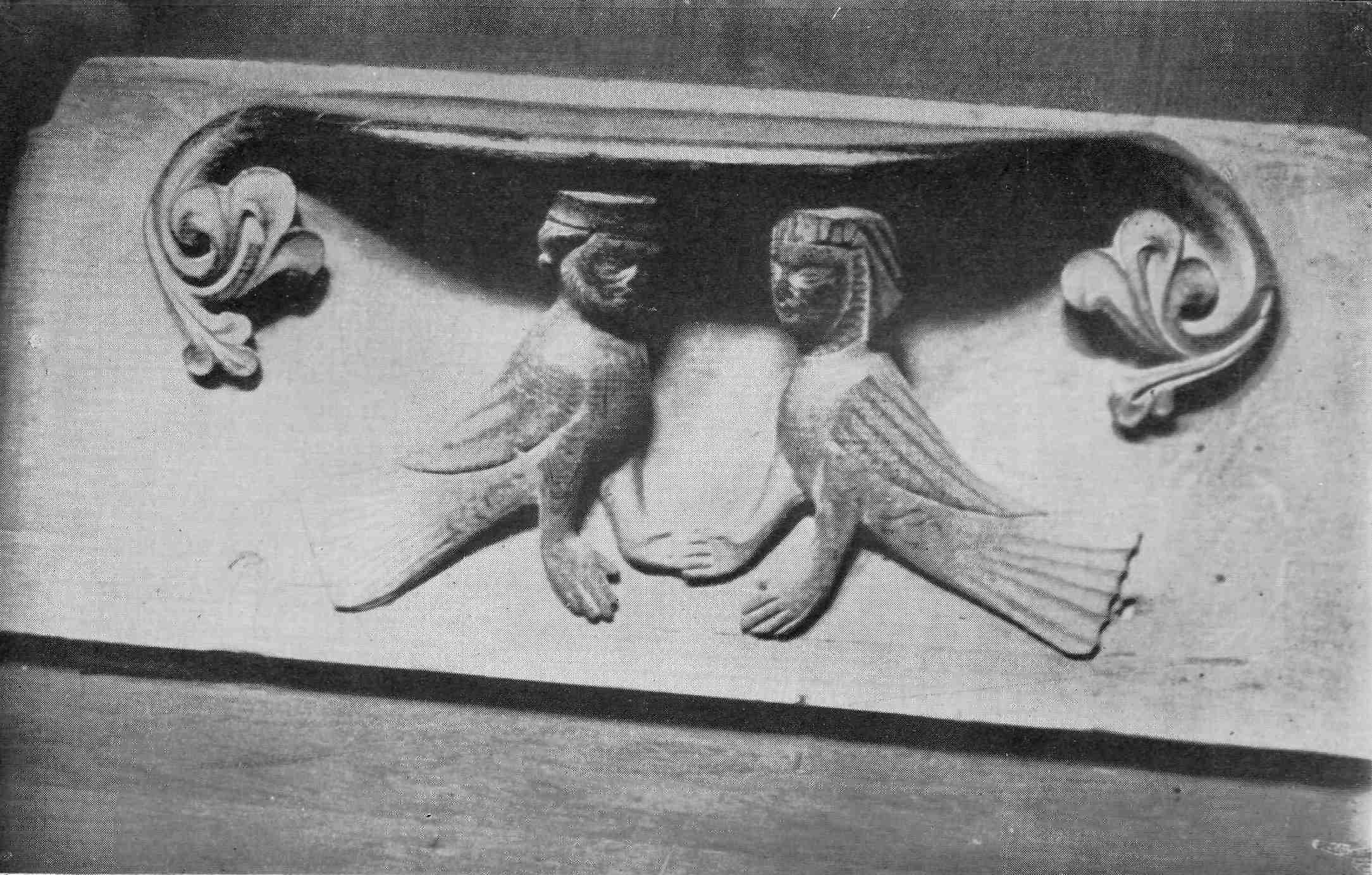
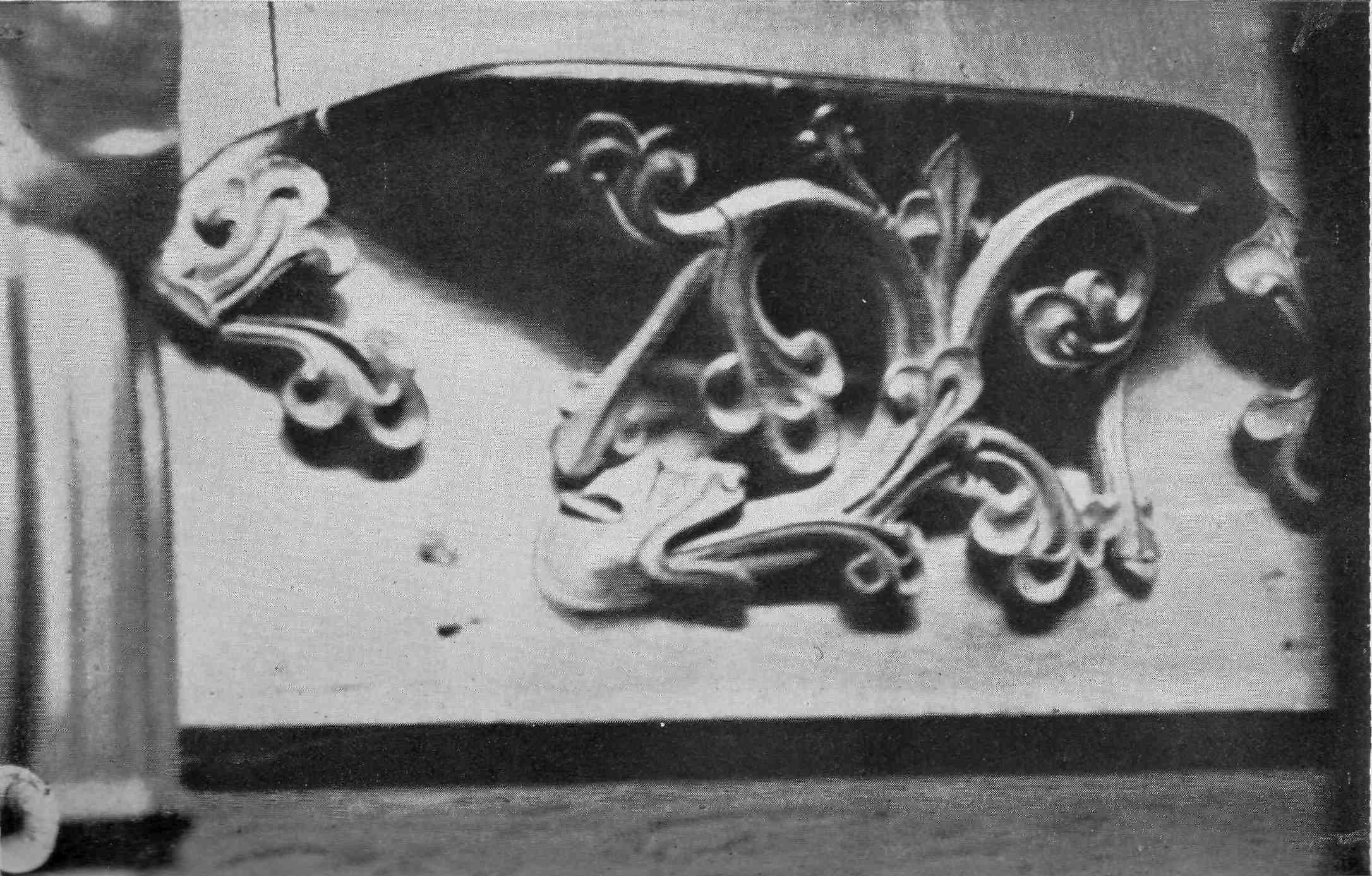
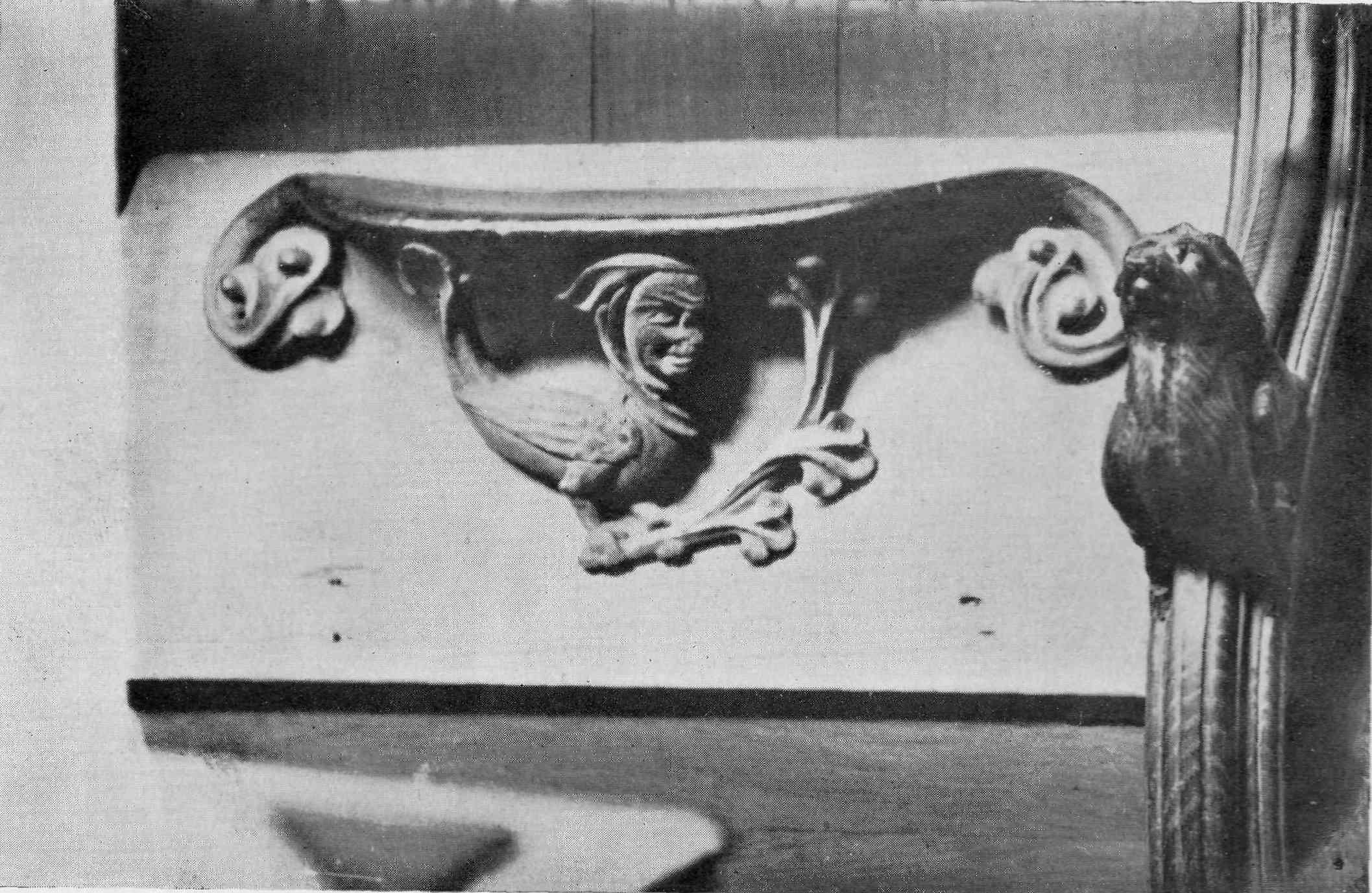
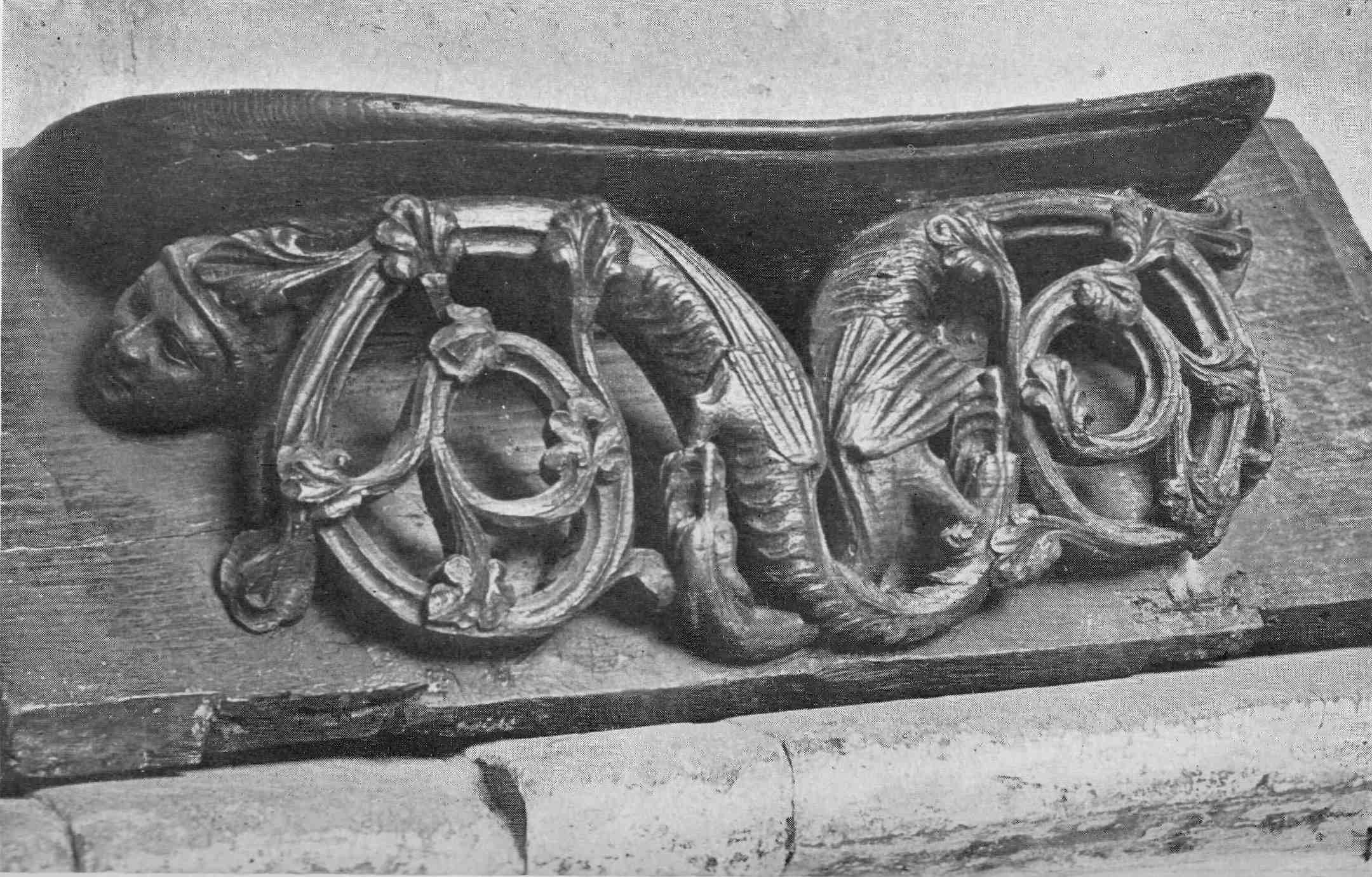
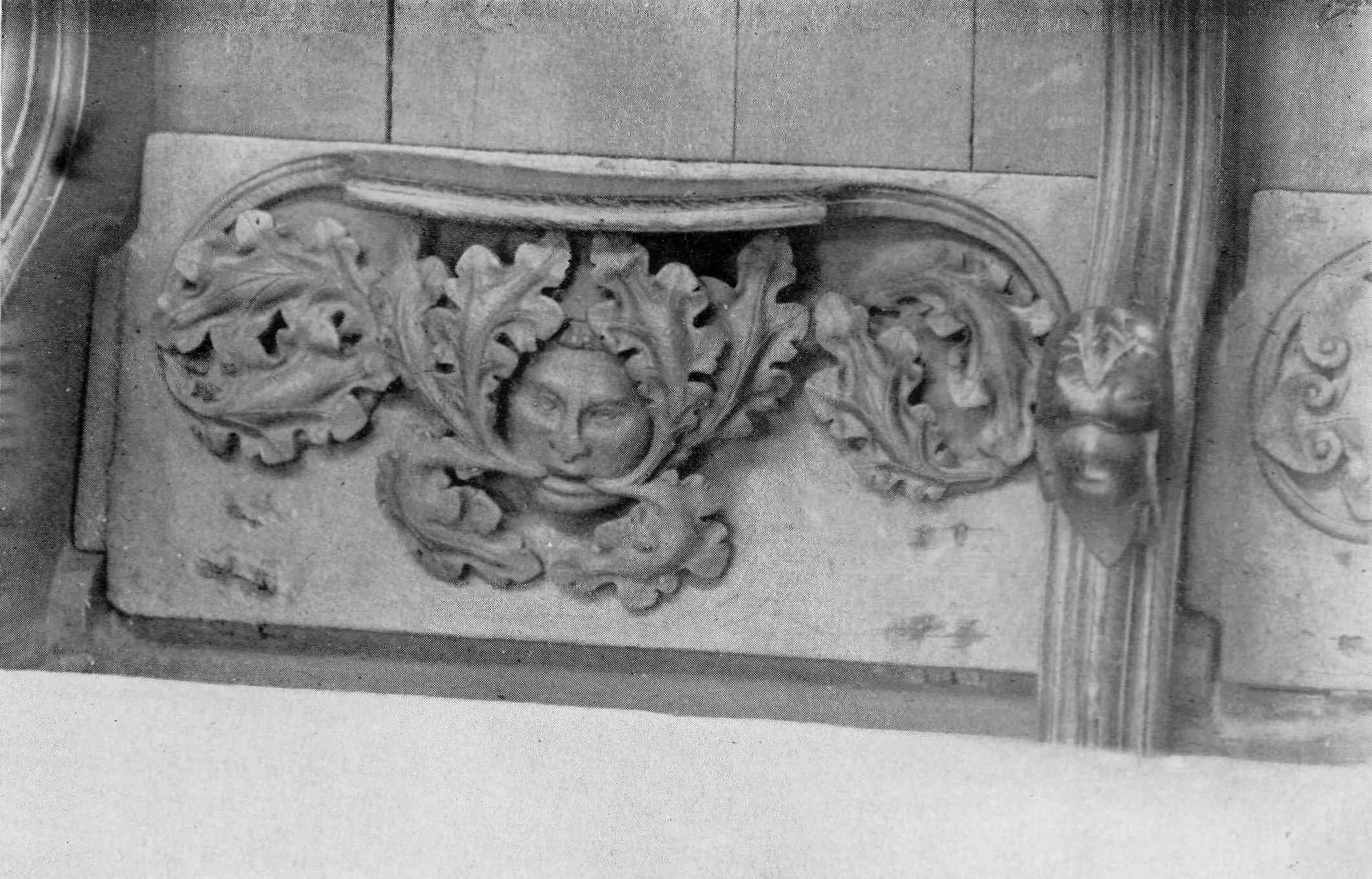
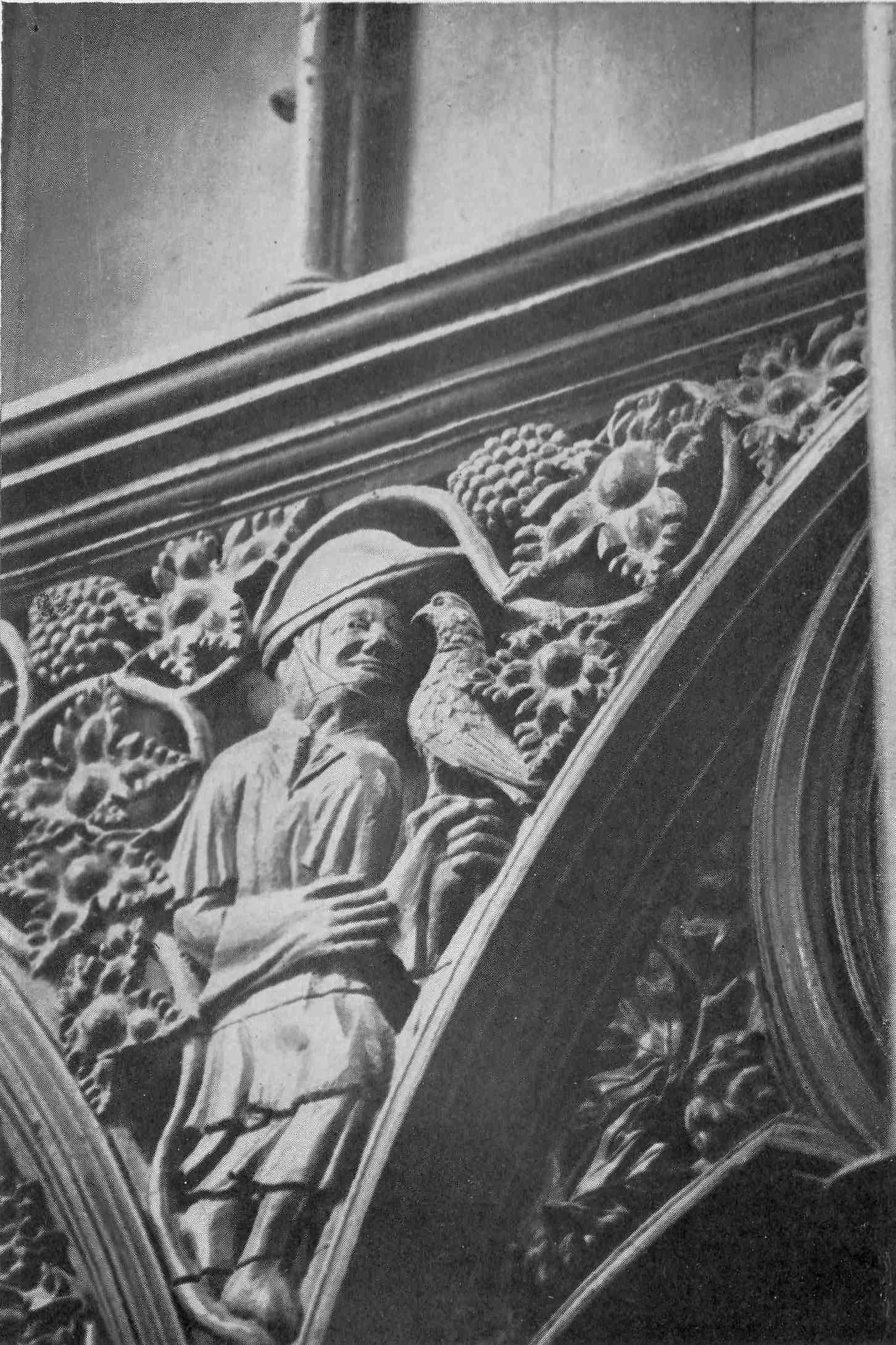
It remains to describe the progress of foliation in wood-carving. We are unaware of the existence of any such carving dating from before the thirteenth century. Some capitals of that date remain at Peterborough Cathedral, taken out of their original setting and used again, fitted into Jacobean canopies (Pl. 90). These specimens have a square abacus which determines the arrangement of the foliage, but it will be seen to consist of trefoils not grouped. Wooden capitals in good preservation are rare. More common are misericords of this period. There are several{50} at Exeter showing well the characteristic Early English trefoils (Pls. 91 and 92). One that is apparently a little later (Pl. 93) shows the blobs or round excrescences which we noticed at Lincoln (Pl. 45), Ely (Pl. 54), and elsewhere, at the period just before the naturalistic change. Christchurch also has a series of thirteenth-century misericords, one of which is perhaps the best example left of this period (Pl. 94). At St Margaret’s Church, King’s Lynn, there is a well-executed fourteenth-century misericord showing a face with Decorated foliage coming from the mouth (Pl. 95). The same fancy we have noticed before, at Hemel Hempstead (Pl. 6), Winchelsea (Pl. 61) and elsewhere.
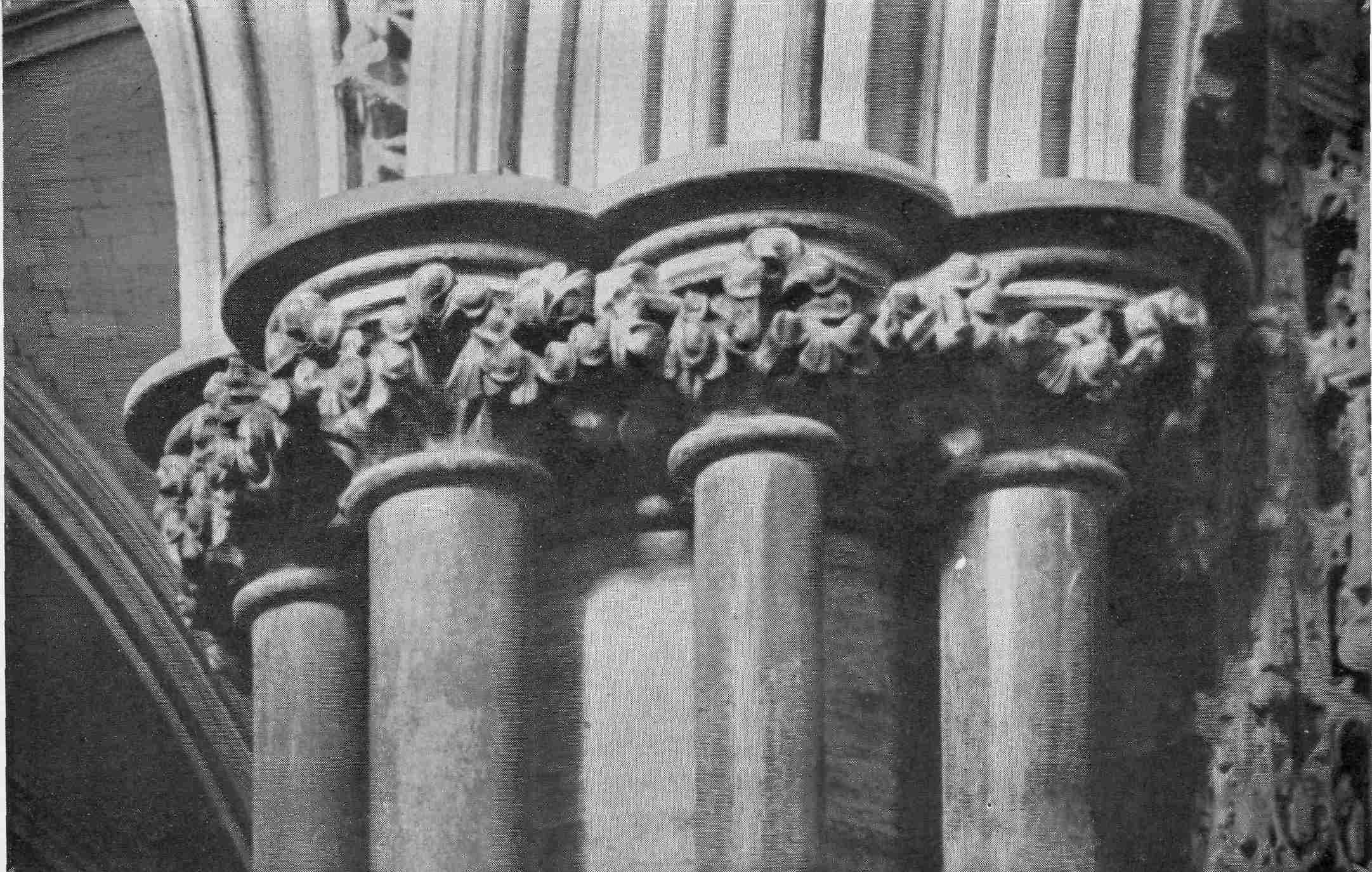
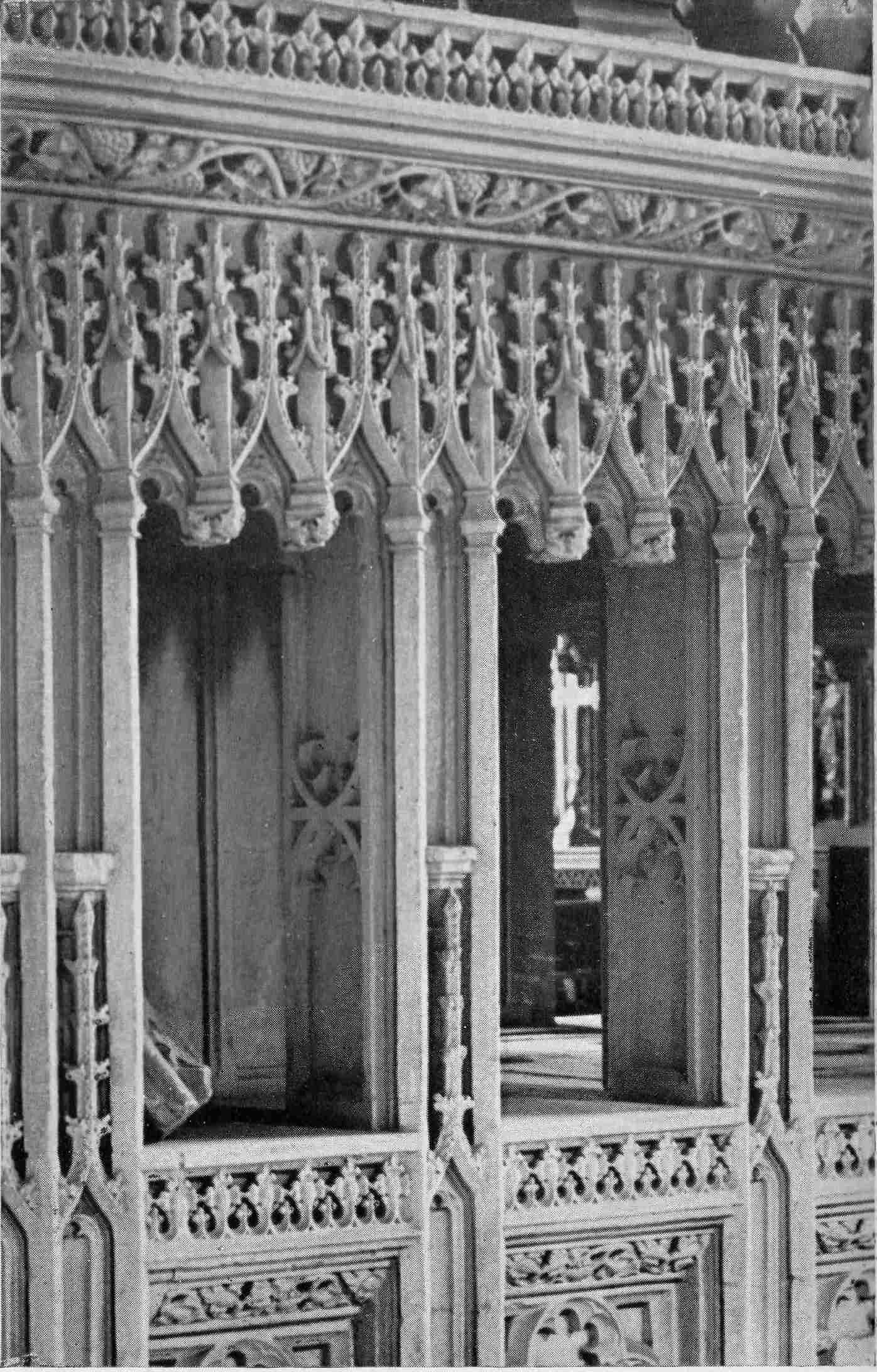
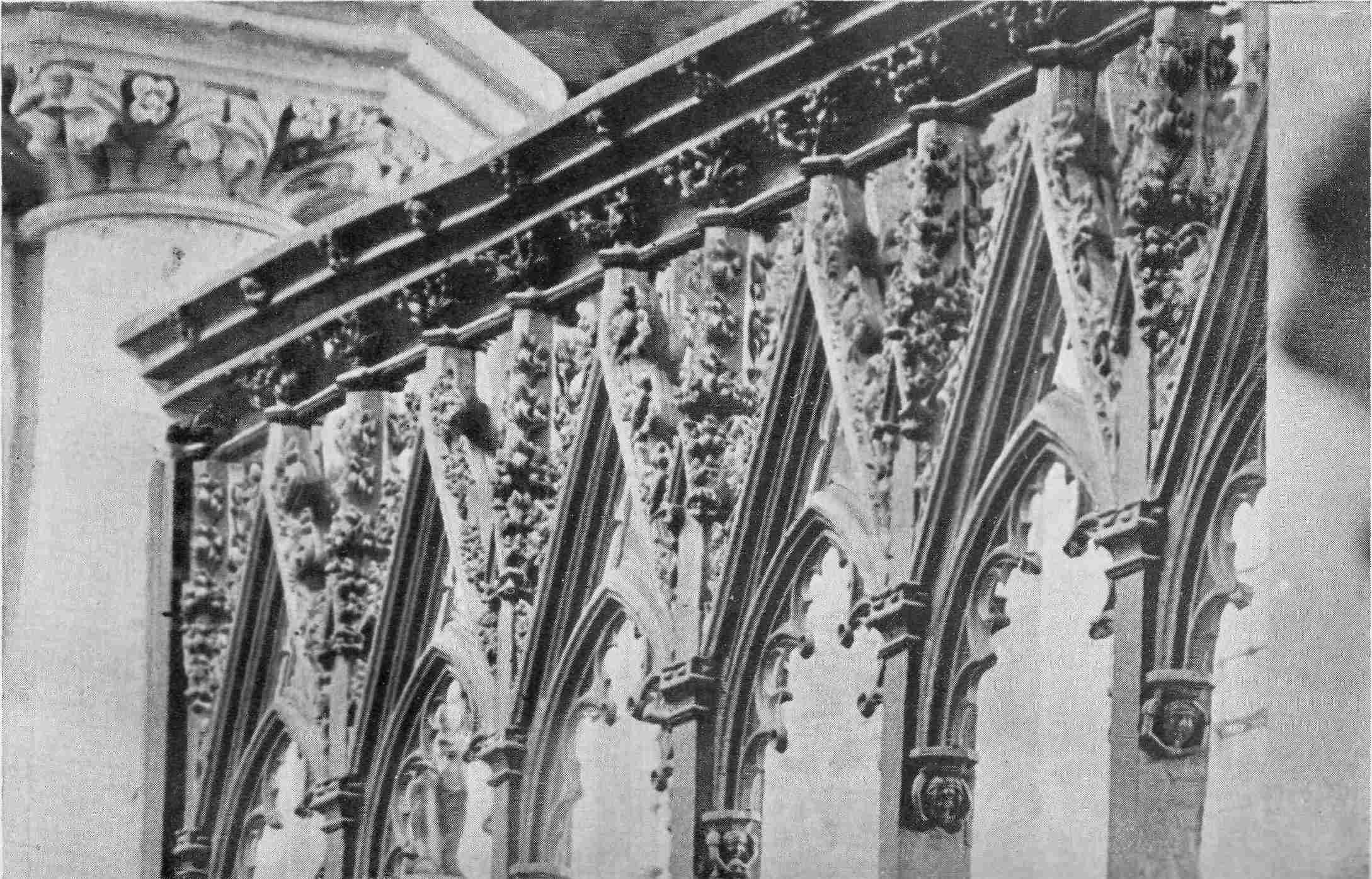
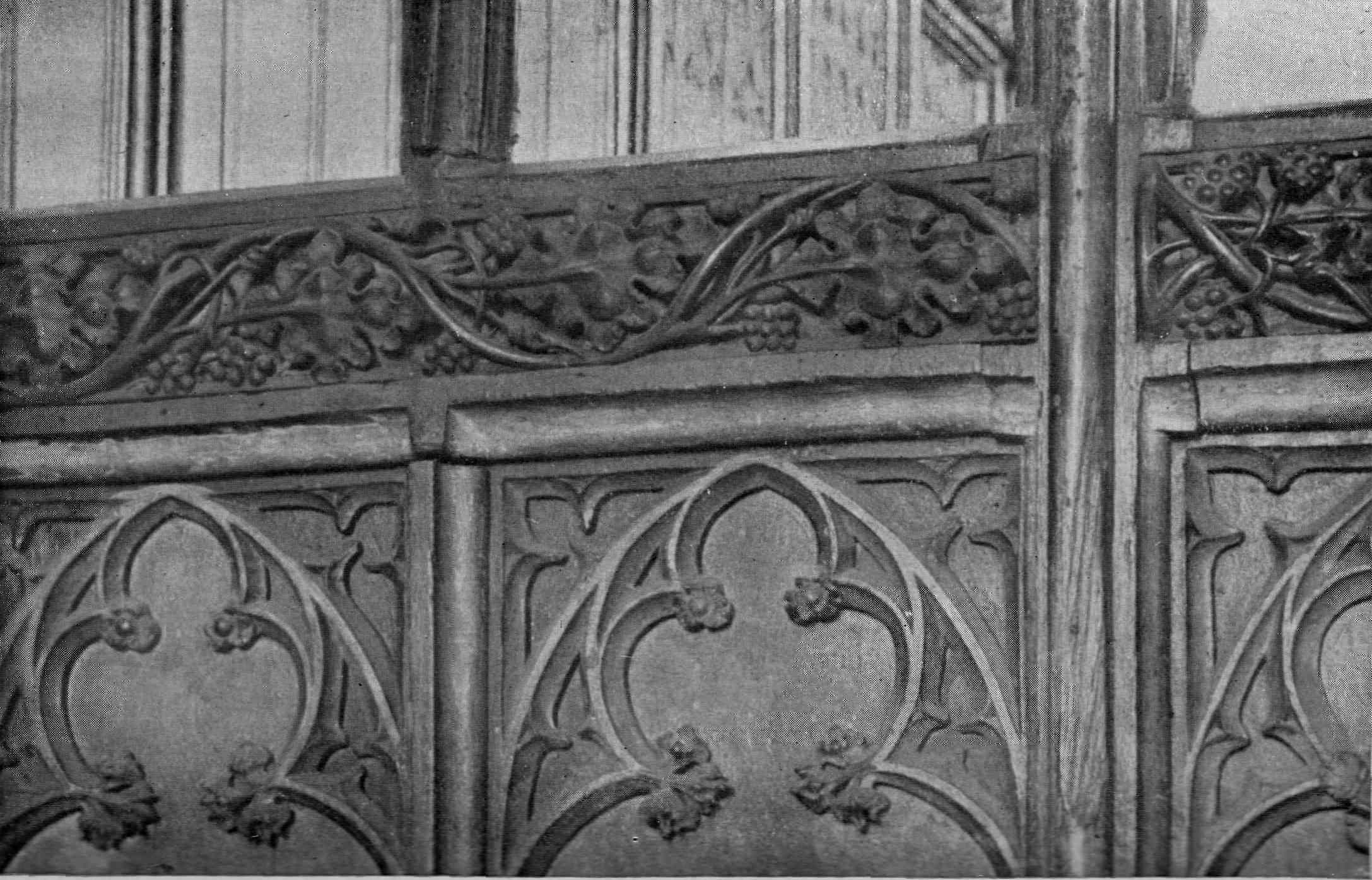
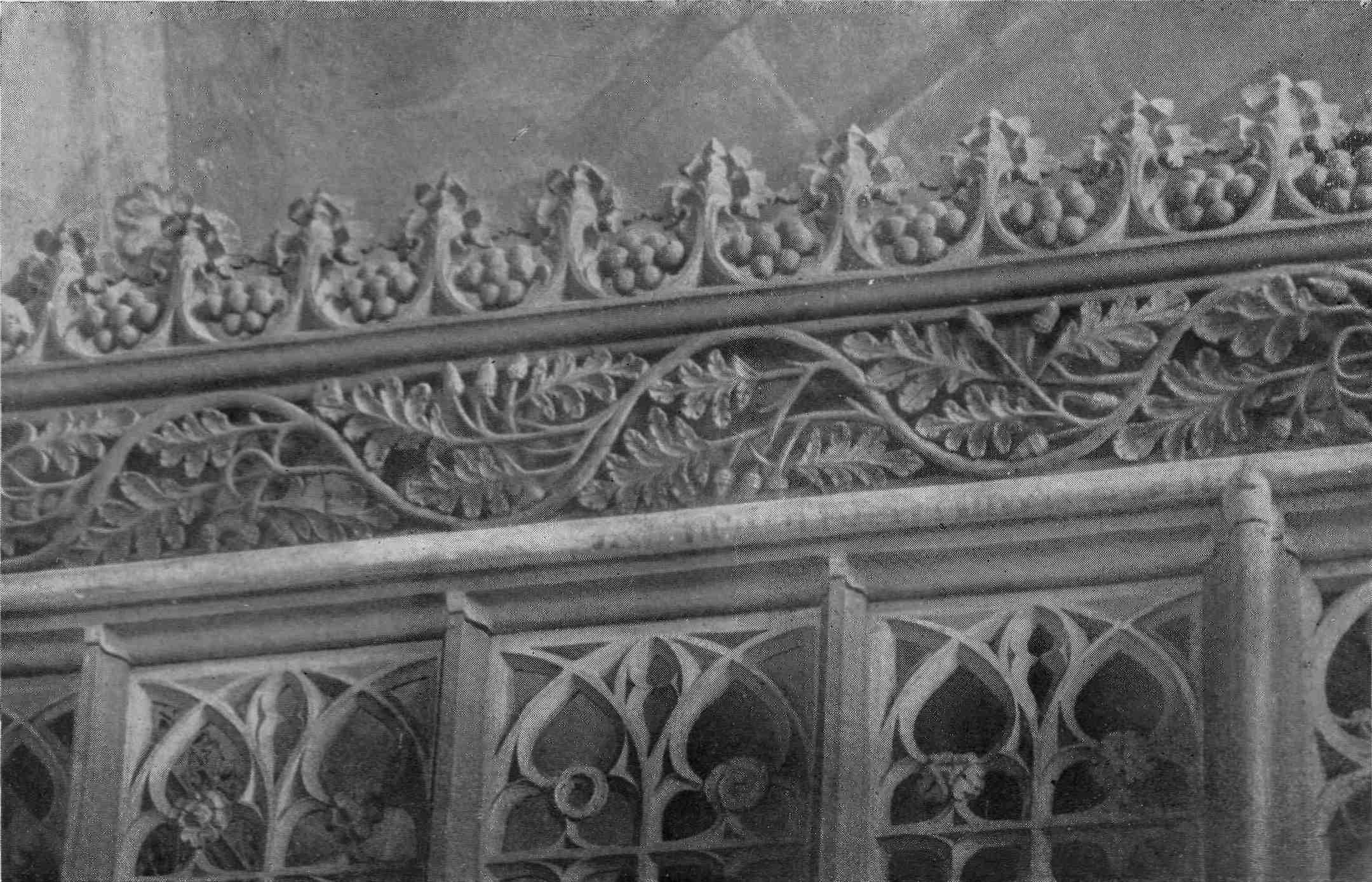
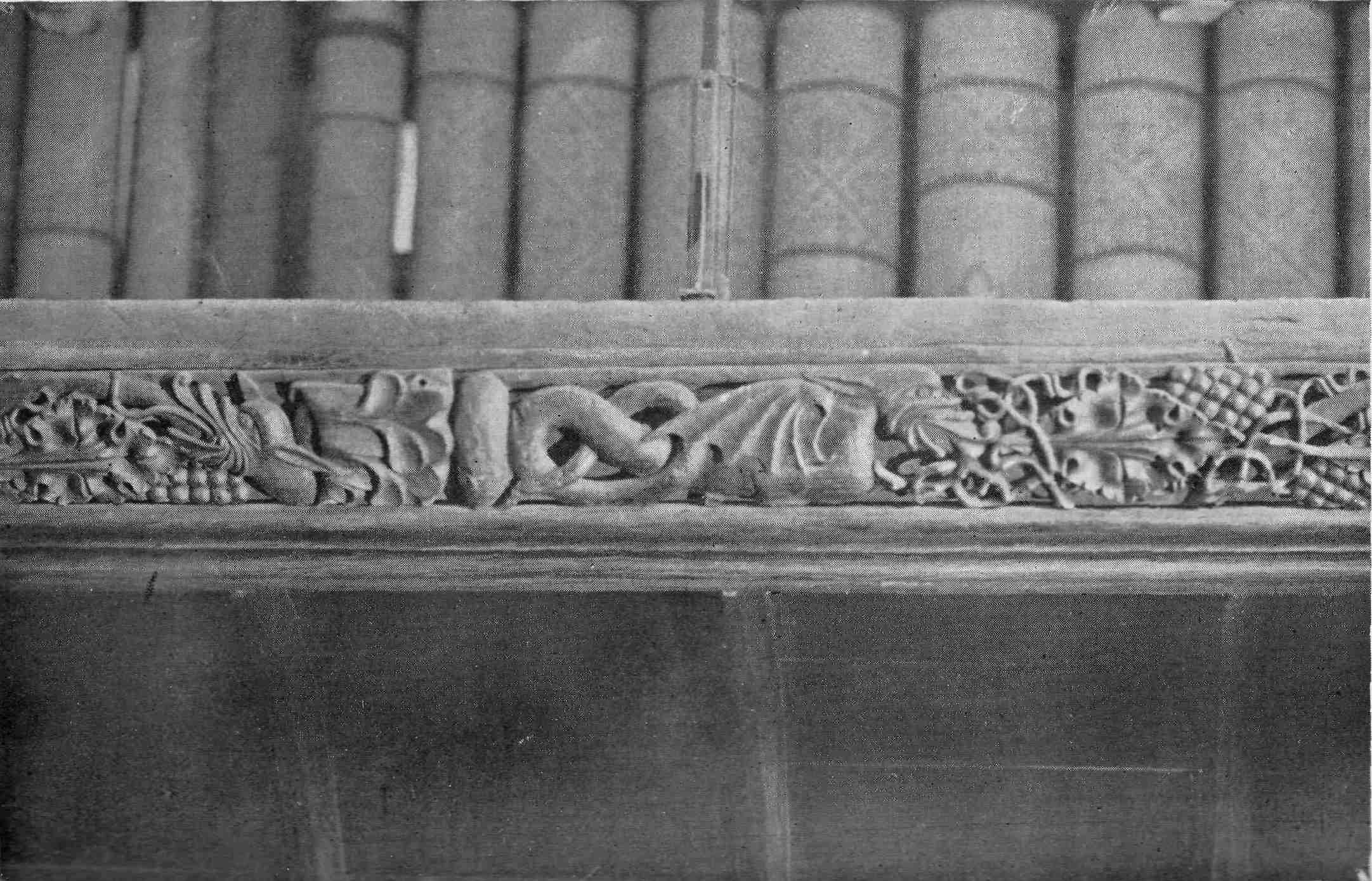
At St Margaret’s Church, King’s Lynn, there is a very beautiful fourteenth-century screen (Pl. 96). The foliage consists chiefly of crockets on gables and pinnacles. It is sharp-cut early Decorated work in this portion, and the leaves are almost naturalistic. Other portions of the same screen extend into the Perpendicular period. Our next illustration is of Decorated work from the canopies of the stalls at Winchester (Pl. 97). The favourite subject of wood-carving throughout the Decorated and Perpendicular periods is vine stems, leaves and grapes. In this instance{51} the stems are graceful—describing parts of circles[7]. The grapes are numerous and round, the leaves extremely bulbous and ripple-edged. In a vine string at Tong, the stems are still graceful, but the grapes are fewer in number and more symmetrically arranged (Pl. 98). The leaves are still bulbous and ripple-edged, but are more lozenge-shaped, and the bulbous lumps are arranged in a cross. At Abergavenny dragons are mixed with the vines (Pl. 100), the stems are more twisted in a naturalistic manner, the grapes have lozenge outlines and the leaves are lozenge-shaped with drilled indentations. On the bench-ends at Tong the cruciform arrangement of the bulgings and the straight edges of the grapes are even more marked. In another example from Tong the wavy stem arrangement continues, but the foliage is oak leaves and acorns (Pl. 99). Above is a row of Tudor ornaments with symmetrically arranged balls or grapes between them.
The crockets outside the ogee arches of the stall canopies at Norwich Cathedral are good examples of square-cut lozenge-shaped leaves with rippled edges and radiating veins (Pl. 101).
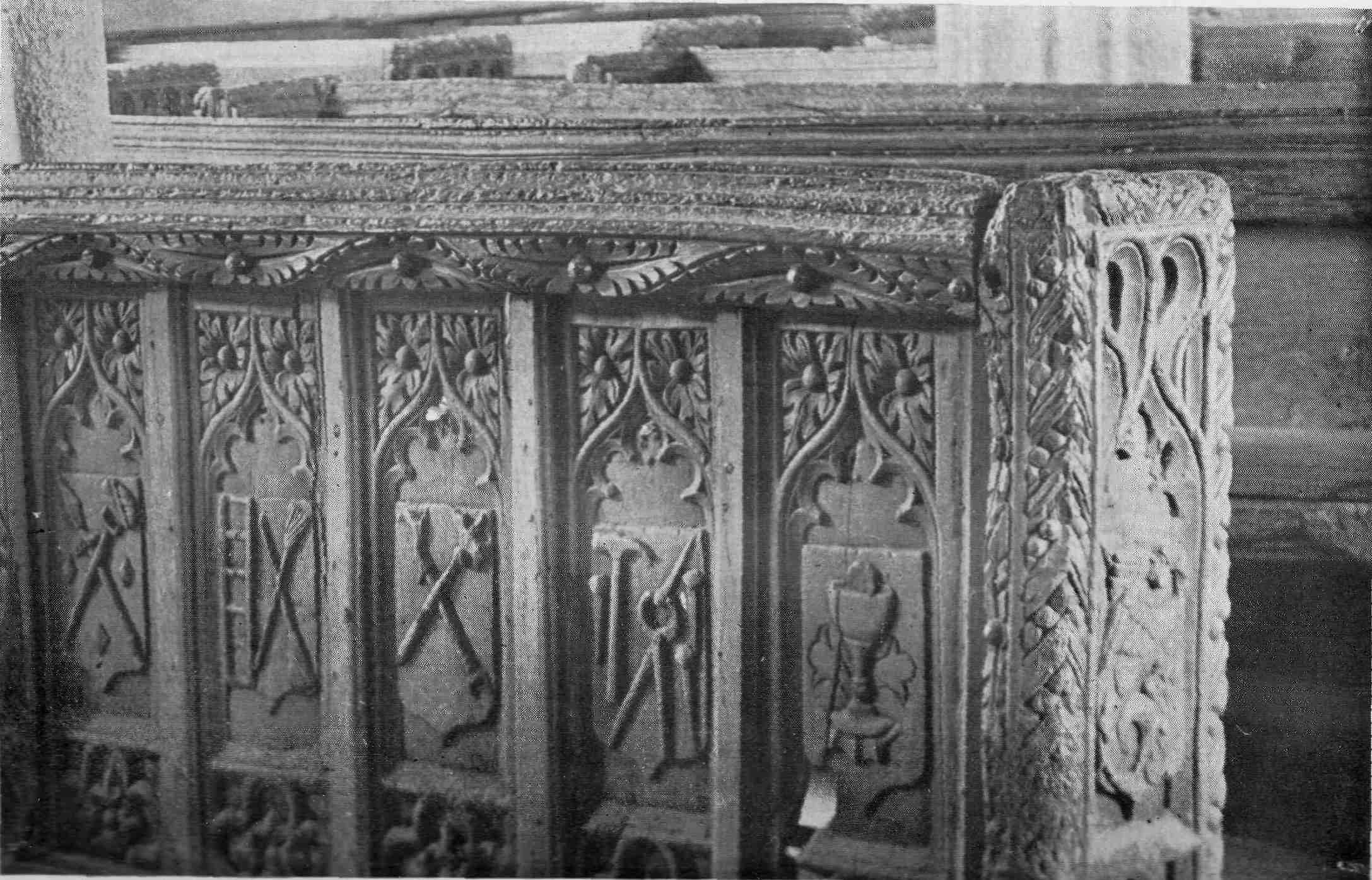
The pews at Mullion may be taken as a characteristic example of late Perpendicular carving in Cornwall. The indented edges of the long pointed leaves with a ball in the centre are frequent in this kind of work (Pl. 102).
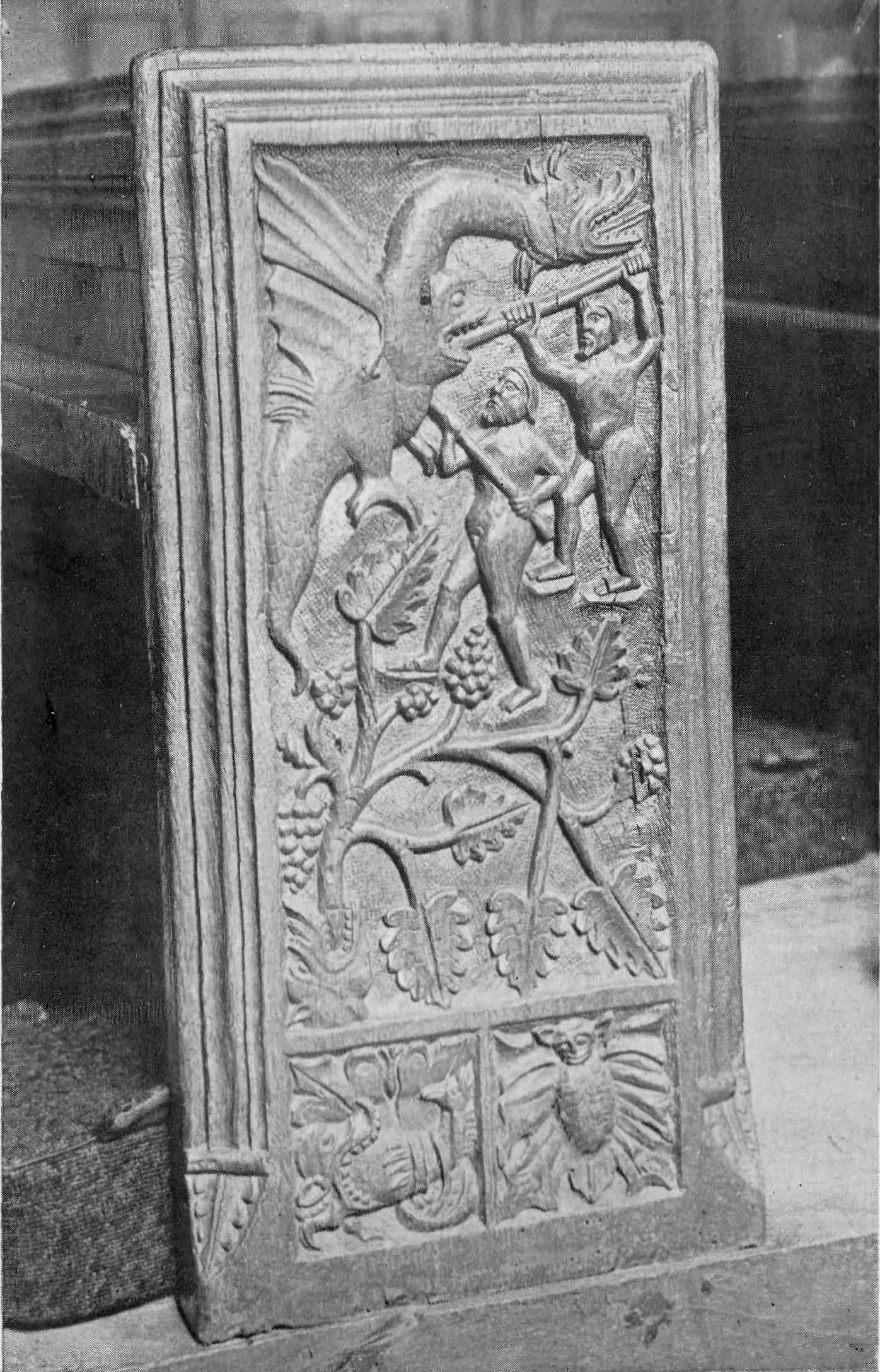
At the very end of the Gothic period we find in some of the wood-carving the same expression which we noticed at Cambridge—a desire to throw over convention and return to nature. Of this a bench-end at Crowcombe (Somerset) is a good example (Pl. 103).
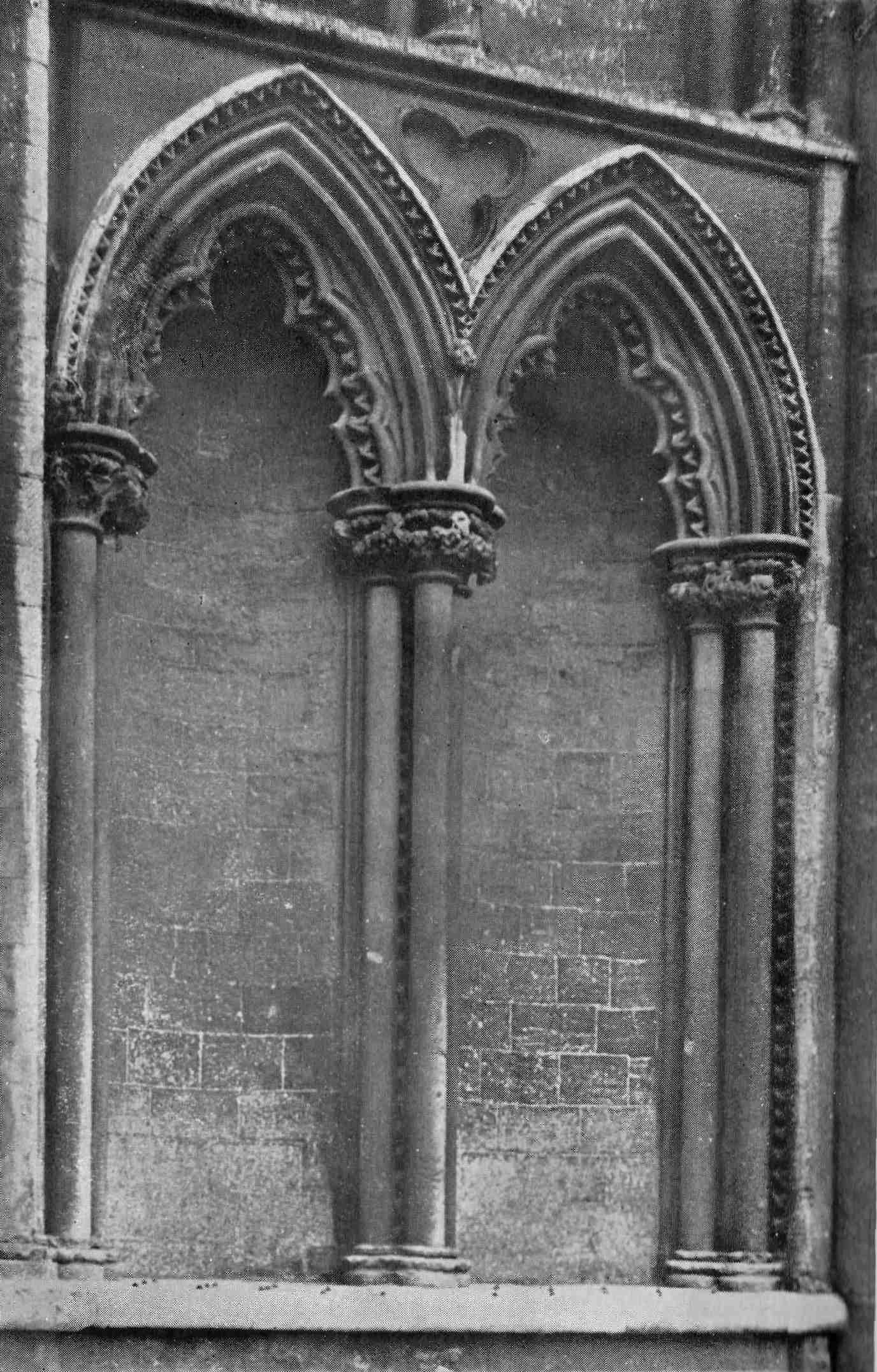
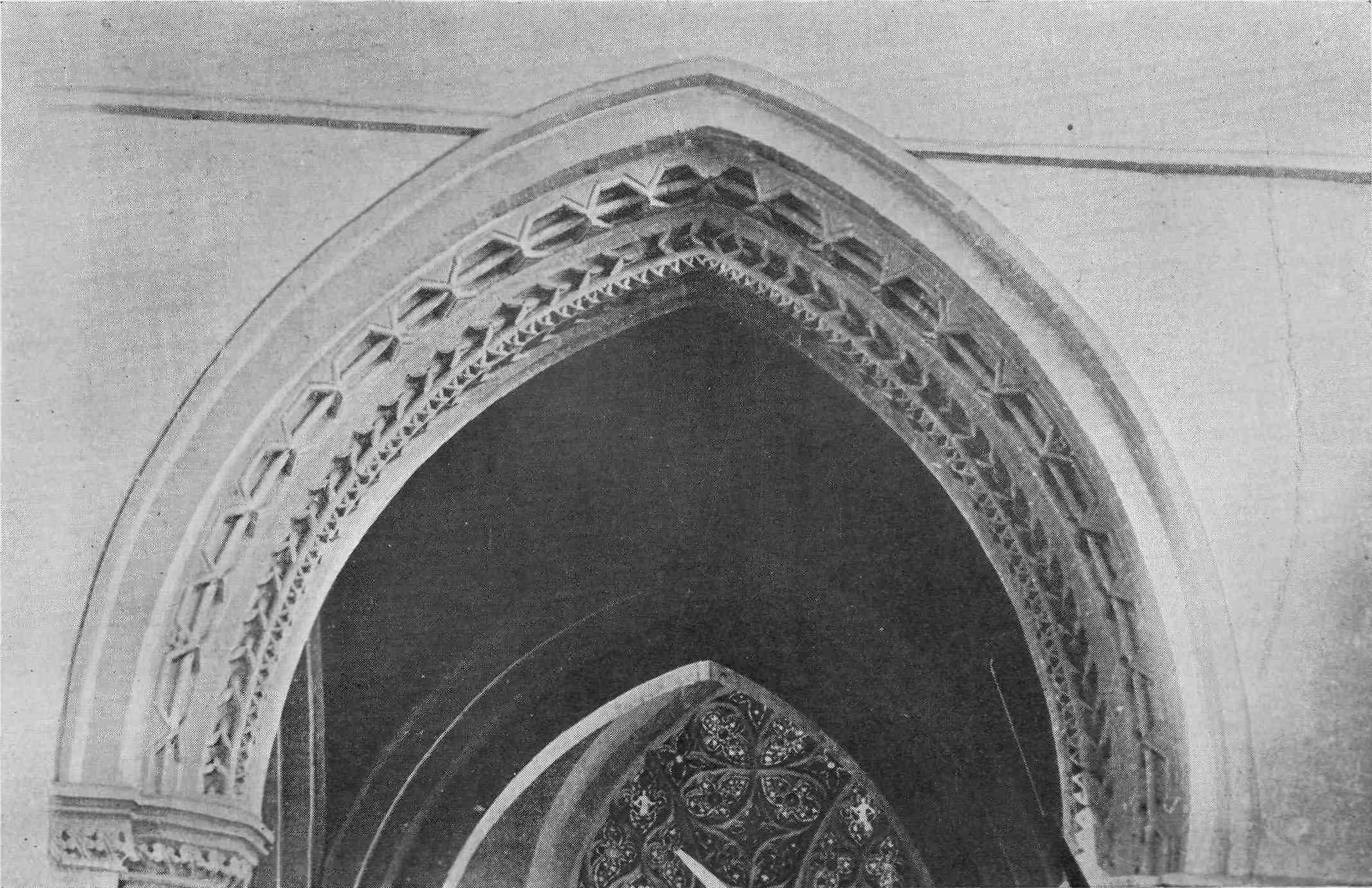
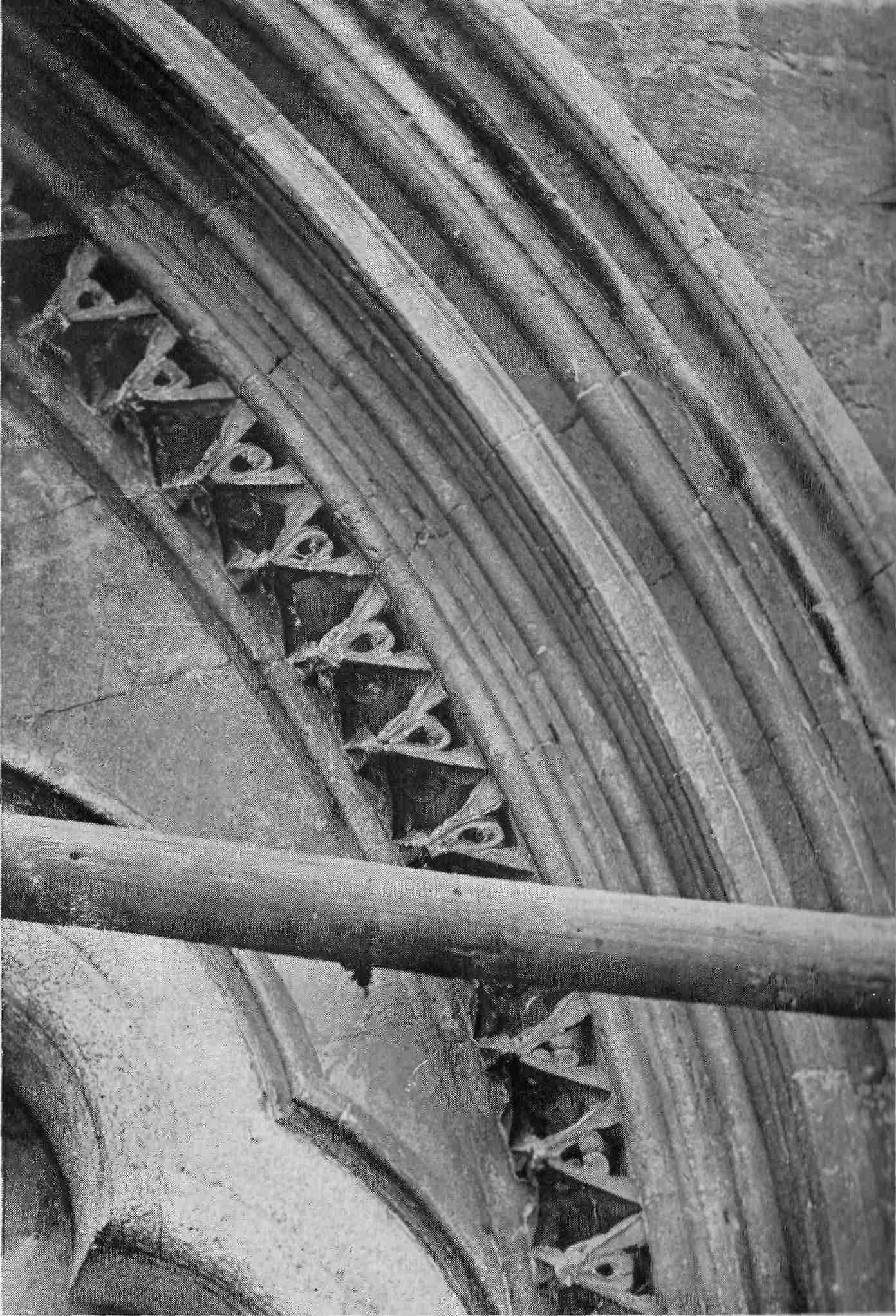
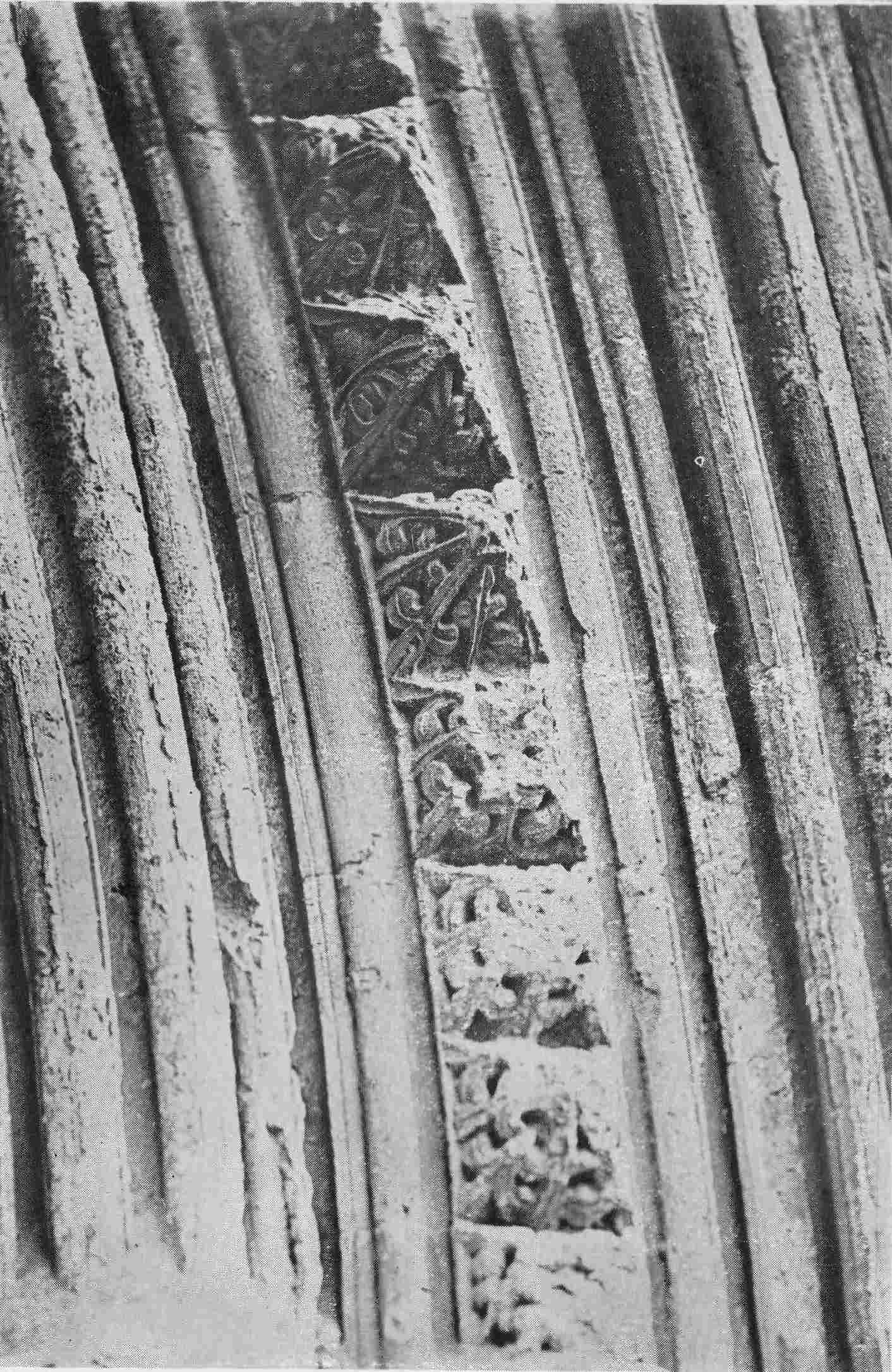
THE dog-tooth ornament is profusely used in rich thirteenth-century buildings, and is one of the clearest indications of date. It is often placed in the deep Early English mouldings as on the Galilee Porch at Ely (Pl. 104). It consists of a pyramid formed of four leaves, usually with a hole drilled where they divide. The example from Lincoln ambulatory doorway (Pl. 66) shows their character plainly. Sometimes they are curved, as in Hereford transept (Pl. 34), sometimes there are only two leaves, the other two being suppressed, as in the Lichfield triforium (Pl. 49). At Soham there are three leaves (Pl. 105). Sometimes they are elaborately enriched as at St Cross (Pl. 106) and Dunstable (Pl. 107). The most elaborate example of this sort of treatment is on the west doorway at Wells (Pl. 108).
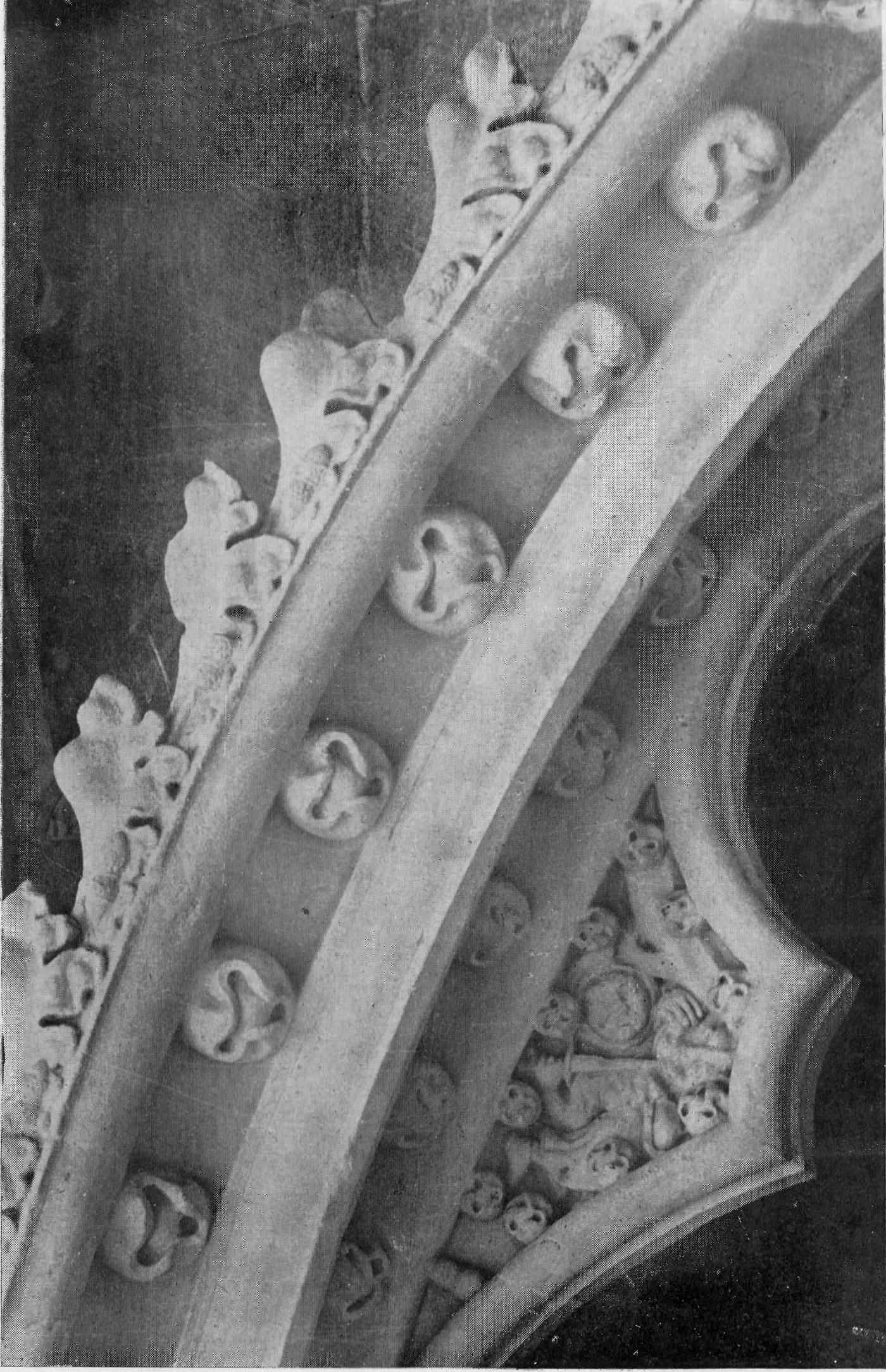
The ball-flower ornament is to the fourteenth-century work what the dog-tooth is to the thirteenth. A window at Leominster (Pl. 109) shows this well. Sometimes, as on the screen at Exeter (Pl. 110) the ball-flowers are{54} united by stalks. The character of the ornament is shown plainly in our example from Tewkesbury (Pl. 111). The ball is a bud form with three enclosing leaves, and there are three deep indentations between them.
The Tudor ornament fulfils a similar part in late Perpendicular work. It is well shown on the watching loft of the shrine at Oxford (Pl. 84), and in detail in our illustration from Purse Caundle (Pl. 112).
| Abergavenny | Plate 100 |
| Aldenham | 79 |
| Aylesbury | 8 |
| Beverley | 71, 73 |
| Black Bourton | 19 |
| Bledlow | 27 |
| Boxgrove | 1 |
| Broadwater | 16 |
| Bury St Edmunds | 1 |
| Cambridge | 70, 85 |
| Canterbury | 15, 18 |
| Christchurch | 5, 94 |
| Crowcombe | 103 |
| Cuddington | 23 |
| Deerhurst | 10, 11 |
| Dunstable | 107 |
| Durham | 12 |
| Eaton Bray | 36 |
| Ely | 54, 74, 75, 81, 104 |
| Erwarton | 69 |
| Exeter | 63, 64, 77, 87, 91, 92, 93, 110 |
| Fountains | 28 |
| Fyfield (Essex) | 67 |
| Hemel Hempstead | 6 |
| Hereford | 25, 34, 60 |
| Iffley | 65 |
| Ivinghoe | 37 |
| Kimpton | 4, 20, 29, 30 |
| King’s Lynn | 48, 95, 96 |
| {56}King’s Walden | 13, 21, 24 |
| Leominster | 109 |
| Lichfield | 49 |
| Lincoln | 33, 40, 44, 45, 46, 47, 66, 76, 86 |
| Llandaff | 55 |
| London (Tower) | 1 |
| Minster (Thanet) | 31 |
| Mullion | 102 |
| Northampton | 7 |
| North Cerney | 82 |
| Norwich | 101 |
| Oxford | 3, 9, 14, 62, 83, 84 |
| Patrington | 78 |
| Peterborough | 90 |
| Purse Caundle | 112 |
| Rochester | 68, 89 |
| Romsey | 22 |
| St Albans | 80 |
| St Cross | 106 |
| St David’s | 26 |
| Salisbury | 50, 51 |
| Soham | 105 |
| Sompting | 2, 17 |
| Southwell | 57, 58, 59 |
| Stone (Kent) | 38 |
| Teversham | 35 |
| Tewkesbury | 111 |
| Tong | 98, 99 |
| Wells | 32, 41, 42, 43, 52, 53, 108 |
| Weobley | 56 |
| Westminster | 39 |
| Winchelsea | 61, 72 |
| Winchester | 1, 97 |
| York | 88 |
[1] Freeman’s Norman Conquest of England.
[2] This question is argued at considerable length in Prior and Gardner’s English Medieval Figure Sculpture, Book II, Chapter I, and by Professors Baldwin Brown and Lethaby and Sir Martin Conway in various numbers of The Burlington Magazine.
[3] The Burlington Magazine, “A Dangerous Archaeological Method.”
[5] It may be a later insertion. Compare with Pl. 43.
[6] A History of Gothic Art in England, p. 252.
Typographical error corrected by the etext transcriber:
Anglian crosses=> Anglican crosses {pg 7}