The Project Gutenberg eBook of The Boer concentration camps of Bermuda
This eBook is for the use of anyone anywhere in the United States and
most other parts of the world at no cost and with almost no restrictions
whatsoever. You may copy it, give it away or re-use it under the terms
of the Project Gutenberg License included with this eBook or online
at www.gutenberg.org. If you are not located in the United States,
you will have to check the laws of the country where you are located
before using this eBook.
Title: The Boer concentration camps of Bermuda
Author: John A. Hassell
Release date: August 8, 2026 [eBook #79305]
Language: English
Original publication: New York: John A. Hassell, 1902
Credits: Tim Lindell, Hcx2012, and the Online Distributed Proofreading Team at https://www.pgdp.net (This book was produced from images made available by the HathiTrust Digital Library.)
*** START OF THE PROJECT GUTENBERG EBOOK THE BOER CONCENTRATION CAMPS OF BERMUDA ***
[Pg 1]
The Boer Concentration
Camps of Bermuda
By
JOHN A. HASSELL, M.E.
(Late Captain of American Scouts in the Boer Army)
NEW YORK
JOHN A. HASSELL, M.E. 5 Union Square
[Pg 2]
INTRODUCTION
Authentic information received since this pamphlet has been in preparation
amply confirms the statements made herein. The English press
continues its insidious practise of praising unstintedly the management
of the prison camps. Those who think the statements of the shameful
conditions are exaggerated should compare them with the information
which at rare intervals comes directly from these prisoners. Rev.
F. S. Ballentine, of Philadelphia, who was inside the Boer camps,
practically confirms everything that is told in these pages in an article
in the Outlook of November 9th. A letter sent to Boston by one of the
most prominent prisoners, Mr. Joubert Reitz, son of the Secretary of
State, and published in the Boston Globe of November 13th, urgently asks
for clothing and food. Reliable reports from these sources should be
more convincing than a hundred British commendations to the contrary.
An appeal to the benevolence of the American people is so much
more warranted because the Bermuda authorities do not seem to favor
local charity so much as they had the appearance of doing in the beginning.
The other day a Hamilton mob played havoc with the promoters
of domestic charity, and, with the connivance of the government, burnt
them in effigy. It now appears that the Governor of Bermuda refuses to
admit any second-hand clothing, ostensibly through fear of infection.
There is at present no report of an epidemic of a contagious disease
throughout the United States, and therefore this refusal seems a subterfuge.
The governor is no doubt alarmed over the sympathy aroused in
this country by previous appeals for the Boer prisoners.
To assist the Boer prisoners promptly the friends of those in confinement
will have to contribute new clothing, digestible food, like condensed
milk, and small tools, all of which can be of great use to the four
thousand prisoners.
The British government as well, in spite of the explicit article in the
Hague Conference providing for free entry for all articles for prisoners,
demand a duty of five per cent. on all articles sent to the Boer prisoners.
The Hague Conference provides in Chapter II., Article XVI., that
“gifts and relief in kind for prisoners of war shall be admitted free of all
duties of entry and others.”
[Pg 3]
The Boer Concentration Camps
of Bermuda
Ever since the Boer prisoners of war were transported from South
Africa to the Bermuda Islands, glowing accounts of the salubrious
condition of the prison camps there have appeared periodically
in the British press, and the benevolent treatment accorded
to their occupants has been highly extolled. One of the London papers
even stated that a great number of prisoners expressed a desire to be
allowed to return for the purpose of aiding the King’s soldiers against
their late compatriots. These reports, having found their way into American
papers, excited suspicion in the minds of a few friends of the Boers
here, as they were entirely in conflict with the tale told by David Duplooy,
the plucky young Boer, who escaped last July and arrived in New York
on the steamship Trinidad.[1] After a consultation of these friends in New
York I was asked if I would undertake to learn the truth by personal
observation. As I had held a commission in the Boer army, and had
taken part in the present war, this proposal was somewhat embarrassing
and the undertaking rather hazardous. My suggestion that a newspaper
correspondent might be intrusted with it, at little or no risk whatever,
found no favor, as it was doubtful whether any one with the avowed
purpose of investigating would be permitted to enter the camps; and on
account of my acquaintance with the “Taal,” the South African Dutch
spoken by the Boers, it was thought best for me to go. My friends’
entreaties and sympathy with my suffering comrades overcame all hesitation,
and in less than twenty-four hours I was resolved to go. Armed
with a passport, I secured passage on a steamer of the Quebec Line sailing
from pier 47, North River, New York, and with favorable weather
my mission was begun. The journey was uneventful, and on the fourth
morning the coveted islands hove in sight.
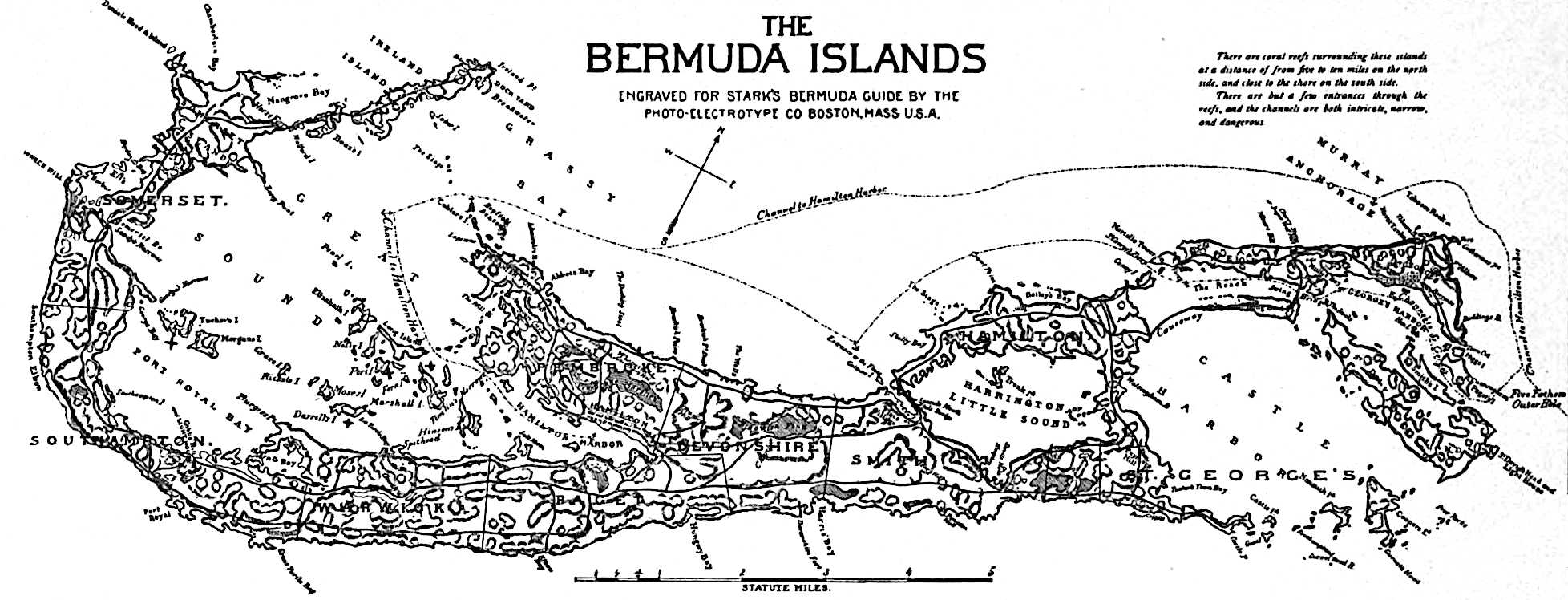
The Bermuda Islands, like some of the West Indian Islands—e.g.,
the Bahamas—are formed by a ledge of coral, which, peeping out above
the surface of the ocean, forms five large and hundreds of small islands
[Pg 4]and innumerable cliffs called “cays.” The five larger islands, St.
David’s, St. Georges, Main Island, Somerset, and Ireland, lie in one stretch,
assuming a shape which has been likened to a fish-hook, the opening of
which is toward the north. These large islands are surrounded on all
sides, and especially to the north, by innumerable small islands, and in
this way is formed a most effective fortification against an attacking fleet,
as they leave only one small channel along the north shore by which the
principal port can be reached. After rounding the enormous northern
reef with its miles of foaming breakers we approached St. David’s lighthouse,
the most northern point, where the channel commences.
The Bermuda Islands, as a whole, have been widely advertised as
the land of eternal spring, with a luxuriant tropical vegetation, with garlands
of sweet-scented flowers and balmy breezes. When the steamer
glides along the north coast through the tortuous channel the first impression
of the tourist must be a rude disappointment. This part of the
coast is a barren, naked bluff, battered, washed, and corroded by the high
breakers, which carry off all vegetation, except some weather-beaten,
stunted cedars that bend their trunks all in the direction of the prevailing
winds. Only here and there a green patch interrupts the monotony. The
scene, however, changes as soon as the ship rounds Spanish Point to
enter the circle of the fish-hook, a lovely land-locked lake called Great
Sound, the eastern corner of which is our point of destination, Hamilton
Harbor. Now, indeed, a foretaste is given to us of what tropical luxuriance
means—stately palms, swaying their green plumes in the sea-breeze,
orange trees, groves of flowering oleander and pomegranate embowering
white-roofed cottages and whitewashed houses. Such is the picture
which greets the view of the Northern tourist.
Being installed in one of the numerous hotels, I had now time to look
around and mature a plan by which I might attain my purpose of inspecting
personally the points of greatest interest. There are excellent roads
and pleasant walks and by-paths leading through all the larger islands,
which are so near together that bridges make of them a single island.
The white, calcareous soil and rock yield superior material for their construction,
and, together with the dazzling white houses and huts, form an
agreeable contrast to the dark-green foliage. When you stroll along these
private gardens, public parks, and open fields, with their palms, bananas,
sweet roses, and lilies, you soon perceive that this is an artificial make-up;
all the tropical vegetation has been imported, and only thrives under the
special care of the owner of the ground. Wherever vegetation is left to
shift for itself the only indigenous tree, the red cedar, springs up in more
or less thriving specimens. The soil is extremely porous, and while it
allows no formation of stagnant pools or lakes, it produces no grassy lawn
to cover the surface of the rock, nor is any well or spring to be found on
the islands. The population is entirely dependent upon rain-water collected
in cisterns.
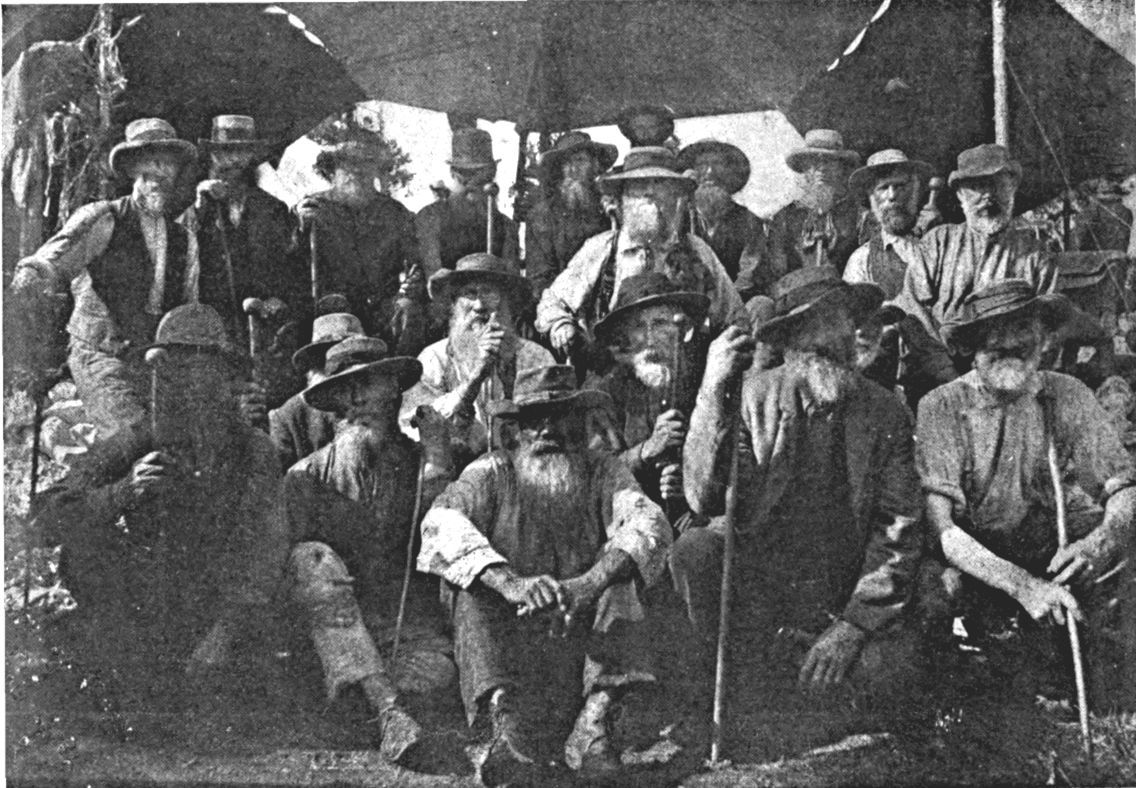
PRISONERS OF WAR ABOVE SIXTY YEARS OF AGE
[Pg 5]
My cautious inquiries about the prison camps met with a sorry disappointment.
With a certain shyness some of the small islands with which
Great Sound is dotted were pointed out to me, but the naked eye from
the mainland could not distinguish anything going on on their surface.
They are entirely out of the familiar routes of local traffic, and the average
visitor would not know of their existence unless made specially acquainted
by some native. The entire circuit of Great Sound is guarded
by a powerful system of forts, towers, and batteries, in which the majority
of the Bermuda garrison—more than two thousand men—is stationed.
Besides a number of men-of-war anchored in the harbor, there were three
special warships detailed near the prison islands, which kept up a close
watch during the day, and which also played incessant streams of electric
search-lights upon the islands and the surrounding waters during the
night. Indeed, four thousand of the most dangerous outlaws could not
be guarded more effectively than these young children and old men.
Every citizen approached on the subject of the Boer prisoners pretended
not to know anything, and the existence of martial law, under
which the prison islands are held, and copies of which were posted everywhere,
explained fully why all disclaimed any knowledge. The regulations
established for the safe guarding of the Boer prisoners include
among other provisions those which follow:
Martial Law.—Martial law is in force within the territory of Marshall’s,
Burtt’s, Darrell’s, Tucker’s, and Port’s islands. The following
are some of the offences against martial law:
1. Being within the martial-law zone without a pass;
2. Being within, or near, the Boer laagers without a pass giving
admittance to the enclosure;
3. Communicating in any way with prisoners of war except through
the commandant or the Assistant Adjutant-General for Prisoners of War;
4. Refusal to show a pass upon demand. One regulation provides
that “passes for the islands can be obtained only from the A. A. General
for Prisoners of War, and they will be granted only when good
reason can be given.”
Now, did I have good reason to get permission for a visit to the
prison islands? To seize the bull by the horns, I went straightway to the
Assistant Adjutant-General for Prisoners of War, Colonel Quayle-Jones,
telling him that, though an American, I had a great interest in refuting
those apparent untruths which were in circulation through a certain part
of the United States press. The colonel who, after fighting with his
Warwickshire regiment in South Africa, had been detailed with the
prisoners to Bermuda, to act as guard of their former opponents, proved to
be a civil, good-natured officer, but his categorical reply was: “We desire
to avoid anything sensational, and give no passes.” Indeed, this was, as I
learned from other parties, his stereotypic answer, and to my knowledge no
passes were given at that time. A reconnoitering excursion which I attempted
[Pg 6]in a boat toward the prison islands was cut short rather unexpectedly.
After hiring a boat, ostensibly for fishing, I let it drift with the
outgoing tide toward Darrell’s Island, situated near the middle of Great
Sound. The boatman pointed out to me the buoys anchored round the
island, warning me not to allow the boat to drift inside the line; but we
had not approached the line yet when a sharp sound of “zip!” with a
splash in the water and the peculiar, well-known “coo-ca” report of a
Lee-Metford rifle left no doubt that we had been sighted from the island,
and that the sentinel was not particular in respecting the line of the buoys.
The boatman did not wait for my order, but with all his might pulled
back toward the main shore, that he might not share the fate of a man
who in a similar situation had been shot through his wrist and had been
taken to the hospital.
Nothing was left to me, then, but to make, as a “tourist in search of
health,” the round of the islands, talking here and listening there, and
always, like Mr. Micawber, waiting for something to turn up.
I found that the better elements of the population, white as well as
colored, were in greater sympathy with the poor prisoners than their well-concealed
feelings would make one surmise. They had from the beginning
protested against the transportation of such an army of prisoners to
their small islands, foreseeing from the inadequate means of the Bermuda
Islands to what annoyance the prisoners and they themselves might be
subjected. There is a traditional spirit of independence in these old settlers
which was clearly demonstrated during our Revolutionary War,
when they openly sympathized with the efforts of the American patriots
to throw off the British rule, and materially aided General Washington
with large stores of powder, which was used with great effect at the siege
of Boston. And although the present inhabitants are loyal British subjects,
their emotions are not controlled or dictated at Downing Street,
London, by the Colonial Secretary, the Right Honorable Joseph Chamberlain.
A movement was started among the civilians to provide the destitute
prisoners with any of old cast-off things that a household could
spare. I found in St. George’s Parish a poster which, with the sanction of
Colonel Quayle-Jones, called for clothing, shoes, hats, chairs, shirts, caps,
coffee, milk, sugar, nails, tools, tin pails—in fact, every contribution was
acceptable that could be made use of by the poorer men and boys in
confinement. These public appeals resulted in the collection of a goodly
number of articles extremely useful to the prisoners; but how can it be
expected that a population of seventeen thousand, ninety per cent. of
which can be classed among the poor themselves, should provide only for
the most crying wants of four thousand almost naked prisoners? And
in spite of the praiseworthy exertions of some of the wealthier men—who,
for instance, furnished boards for shelter and the building of huts—these
efforts must fall decidedly short, because of the entirely disproportionate
number of donors and recipients. Even for their supply of
[Pg 7]drinking-water the prisoners, or, rather, the British government for them,
had to rely entirely upon private charity. The summer had been unusually
dry, and while machines for condensing sea-water, sent over from
England, were out of order, or while nobody understood how to work
them, the stores of the government had run dry, so that private owners
had to be appealed to for help.
Nor must it be understood that there was no sympathy for the unfortunate
Africanders among the official British class. Although all utterances
were most cautious and guarded, the better feelings of the heart
could not be entirely suppressed, and some good services to their poor
antagonists were done on the sly. Even the Governor’s niece, Miss
Katherine Elwes, could not help sending a fervent appeal for assistance
to Mr. Robert B. Roosevelt, of Lotus Lake, Long Island. This appeal
has been copied by several American papers. The most trumped-up and
heralded movement, however, the Association for Providing Recreation
for the Boer Prisoners of War, was a decided failure, or, rather, a cruel
mockery. Its work consisted in organizing picnic parties to the prison
islands, where, while indulging in their own sumptuous repasts and staring
from a proper distance at the prisoners of war like so many encaged animals,
they eloquently attempted to make proselytes of the hungry young
Boers by extolling the virtues of Chamberlain and Kitchener and the generosity
of His Majesty the King. A kindly looking officer was mean
enough to interrupt this benevolent performance by the rude remark that
the poor little innocents should never have been taken from their mothers.
Another office of the association was to arrange games for the entertainment
of the prisoners, and a game between the eleven at Bermuda and
the Boer eleven was advertised for a long time. Such a game has never
been played, nor was there any possible chance for it, since, as we shall
see later on, there was no room in the camps for such games, nor was
any Boer ever allowed on parole to leave the enclosure. The only diversion
which has ever taken place in one of the camps was a potato race
between the boys on Darrell’s Island.
As to the officers, there are individual men who, ashamed of the system
they must help to execute, are humane enough to alleviate clandestinely
some of the most acute suffering, but their strict orders from London
do not give them much scope for allowing their hearts to command
their actions. The more liberal of the officers are undoubtedly those who
have seen active service against their present wards, a fact which has been
borne out by their conduct in England. Considering that a chivalrous
man always appreciates the valor and fighting qualities of a gallant foe,
this can astonish none. Nor do they forget that their own men were
invariably treated by the Boers with the greatest consideration, even
friendliness, whenever they had fallen into their hands.
Tommy Atkins, the private soldier, is not altogether a very amiable
prison warden, nor does he take great pains to conceal his true feeling.
[Pg 8]It angers him that after all the chasing and hunting over the bleak veldt,
after losing many a good friend and comrade, he has to pace up and down,
loaded with a heavy rifle and cartridge-belt, to guard these very causes of
all his troubles. He was promised that these “dirty beggars” would
run away at the mere sight of him, and that inside of three months he not
only would make a triumphal entry into Pretoria, but soon after would
receive a still greater ovation upon his return to London. Now, instead
of carousing with his friends at home, he is chained by the unending war
to a lonely, rocky, sunburnt island, where he has ample time to compare
his scanty pay with the enormous daily war expense shouldered upon his
country. Consequently, he begrudges the prisoners their food paid for
by the government. He even figures up that it cost $200 apiece to transport
the “pig-headed beggars” to Bermuda, and that it will cost as
much again to take them back to South Africa. Once in a while human
nature asserts itself in an individual, and he admits that they are keeping
him hard up in tobacco, “as a feller can’t help feeling sorry for them after
all, but we won’t let any one escape alive—not we.” When we talked
about the children in camp they trumpeted the old hypocritical cant,
which pretends that transportation was necessary to save the children
from starving, as their devastated country was entirely unfit to nourish
them. But who devastated it, and thus deprived the people of all means
of subsistence?
As a whole, then, although I got a good many opinions in conversing
with different classes of people, there was nobody who could or would
advise me how to get nearer my main object. At last, however, my
good luck, which had not forsaken me in Africa, came in time to the rescue,
and after all my waiting something turned up. The general talk at
the hotel table almost inevitably drifted to the Boer war and the Boer
prisoners. One day the conversation became more heated, when some
one complained of instances of violence to which Bermudians had been
subjected by the military element since the proclamation of martial law.
I remember a particular instance of outrage to which a well-known resident,
Frederick Snape, had been the victim at the hands of some negro
soldiers. Another of the guests, whom I correctly guessed to be an official,
undertook to defend the measures, but in such a lukewarm, half-hearted
way that his disgust rather than his approval was evident.
Approaching this man after meals I succeeded in ingratiating myself into
his good graces, and found him a high-souled gentleman who felt deeply
for the Boers. He was willing to help in ameliorating their lot in any
way which would not compromise him publicly. Referring to the rumors
in American papers about the treatment of the Boer prisoners, I offered
my services to confirm or disprove them if I were permitted to visit the
camps. He assured me again that no passes were given out by the
authorities, but promised to introduce me to a friend, an army officer,
who could be instrumental in smuggling me into camp. An interview
[Pg 9]was arranged, and I was admitted. Without going into details I may
add that, thanks to the abject servility in which the common British soldier
is held by his superior, I got a chance to visit two more of these
islands.
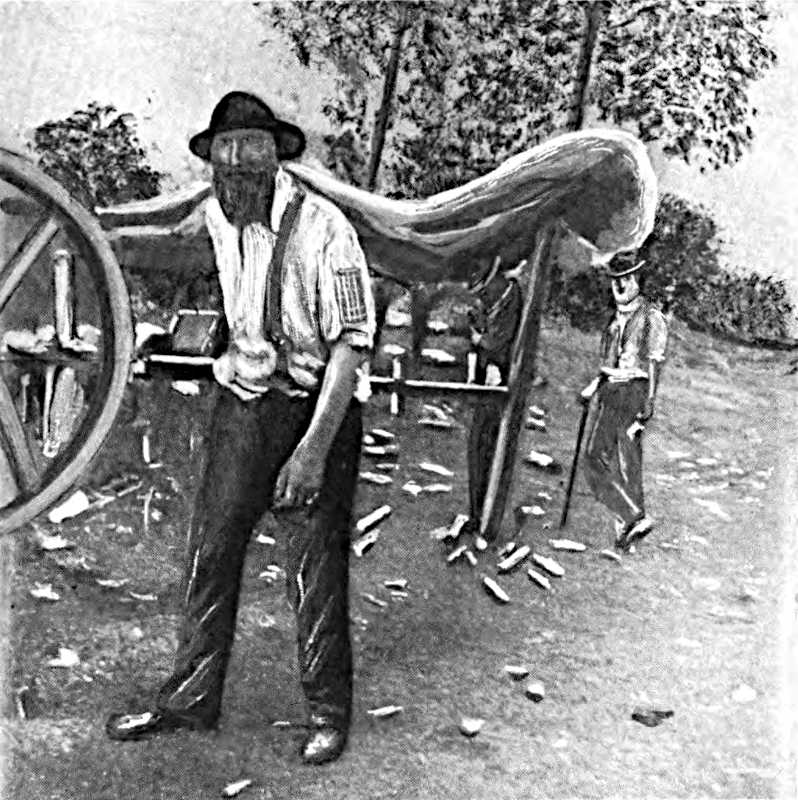
ONE OF THE OLDEST PRISONERS OF WAR—SEVENTY-SIX
YEARS OF AGE
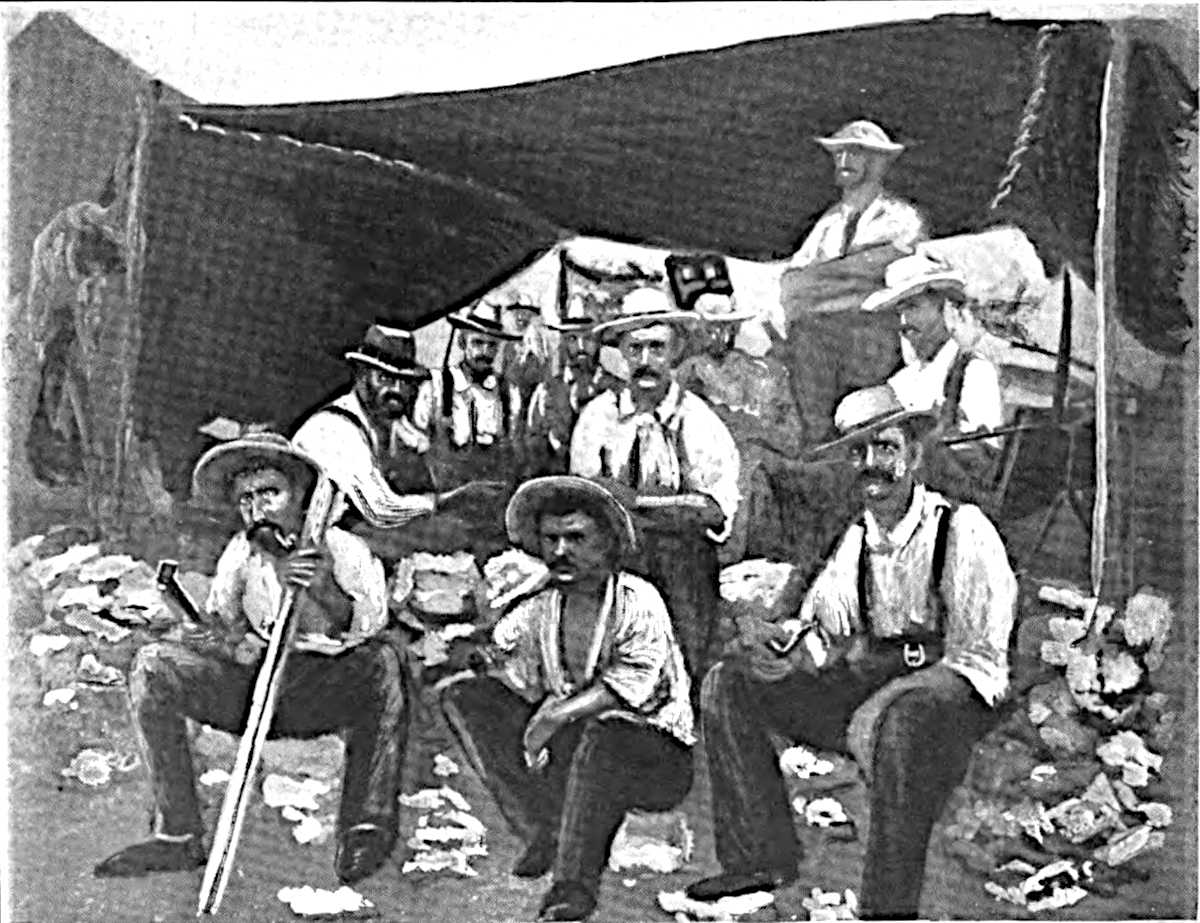
A GROUP OF UITLANDERS—PRISONERS OF WAR
PRISONERS OF WAR BELOW FIFTEEN YEARS OF AGE
The prisoners are confined on five small islands situated in close
proximity in the southern part of Great Sound—Marshall’s, Darrell’s
Burtt’s, Morgan’s, and Tucker’s islands, while Port’s Island, a little to
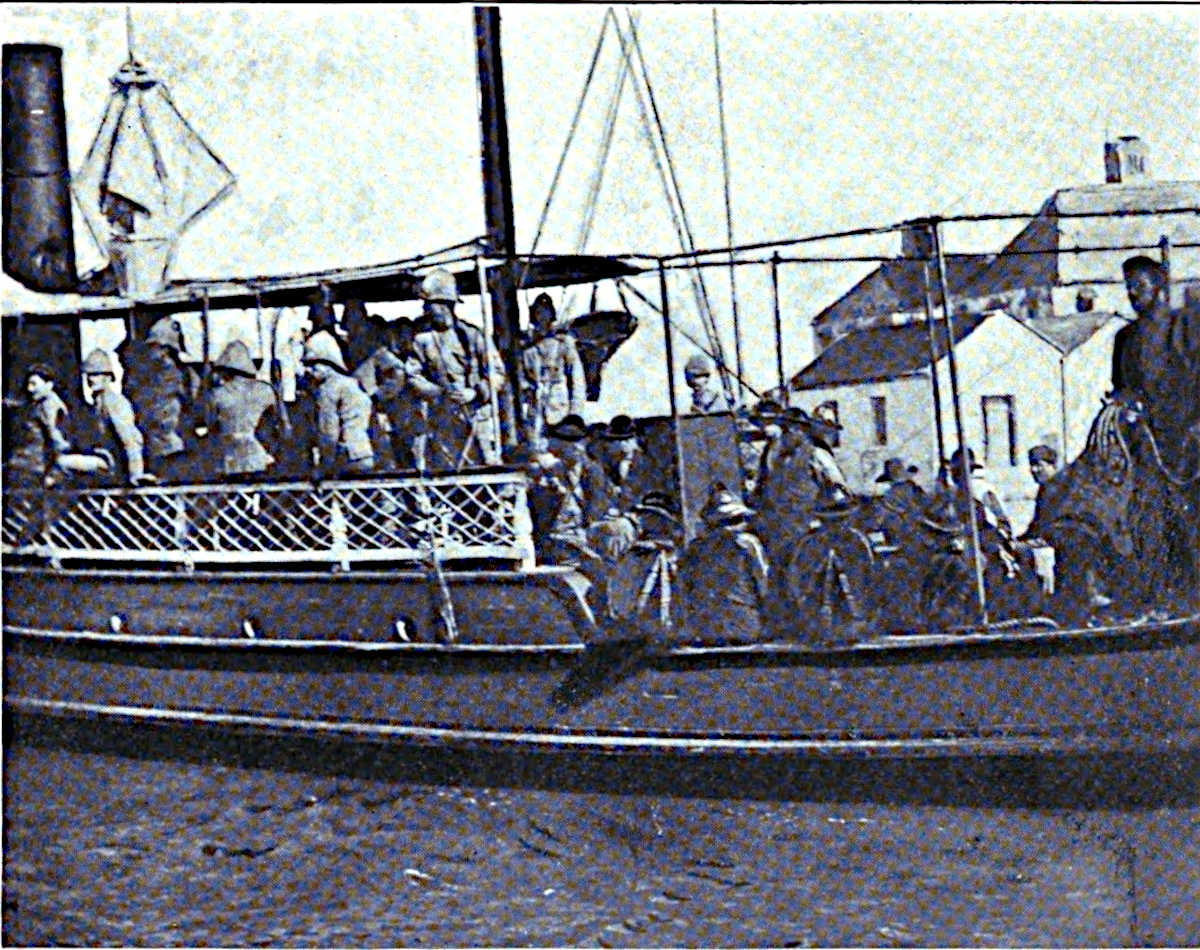
the north of Darrell’s, is used for hospital purposes. A short journey on
the duty boat carried me from Hamilton to Darrell’s Island, a distance of
approximately a mile; at any rate, you can not distinguish anything on
the island from the Hamilton wharf, nor are the prisoners able to see
anything that goes on at Hamilton. Darrell’s Island, which, with its
steep, rocky shores, has a temporary wharf for the tug-boat to land at,
is a perfect type of these numerous islets, which are grouped either in
Great Sound or surround the larger islands on the outside. They are
left without much cultivation, and consequently display no vegetation
but the native scrub cedar. In vain we would look here for the tropical
attractions so conspicuous in the surroundings of Hamilton, and even the
cedar trees, deriving but scanty means of sustenance from the compact
lime rock, have a hard struggle for existence. Their stunted and gnarled
forms abundantly prove it, and their bare, needly limbs give no shade
to the heated stony floor. The rock is easily corroded by the action of
the elements, and exhibits a honeycombed surface with sharp, craggy
protuberances, which tear shoes and boots to shreds in a short time—a
shoemaker among wealthy customers would make a fine living on these
islands. There are flowers, too, in these garden prisons—none, however,
but the yellow blossoms of the prickly-pear or cactus; unluckily, it is
armed with sharp thorns which pierce the naked foot of the unwary and
cause painful sores.
The prison islands range from about seven to fifteen acres in extent,
and have no higher elevation than eight or ten feet above the level of the
water. Any lively breeze, dashing the breakers against the shore rocks,
carries the briny spray across the islands; and residents assured me that
the north and northwestern storms, prevailing through the winter, have
the full sweep through Great Sound, and often wash clear over the surface
of the islands. About one-third of each island is partitioned off by
a triple network of barbed wire. The latter stretches across from water’s
edge to water’s edge, leaving the most desirable part, which is studded
with trees, for the use of the small garrison, while the prisoners are huddled
together in the more contracted and exposed area, about one thousand
on five—nay, on three—acres of ground. The prisoners are cautioned
not to lean against the wire fence, or even to touch it, as the sentries pacing
up and down on the outside have the order to shoot without warning.
There is no joking with this order. In another camp a young
man, Philip Cronje, while he was conducting a Christian Endeavor
[Pg 10]prayer-meeting, stepped back and unintentionally touched the wire fence.
He was instantly shot dead from outside by the sentry. The sanitary
arrangements are placed on flatboats anchored at the water’s edge, which
are liable to float off with any heavy sea; in fact, they have been carried
off and dashed to pieces. The drinking-water was brought in tanks
from the mainland, but is now distilled from sea-water—a questionable
improvement, as it is still warmer and flatter to the taste than cistern-water.
For washing purposes there is, of course, nothing but salt water
at the disposal of the prisoners.
To return to Darrell’s Island, it is considered the most important, as
here the flower of the Boer army is kept in close confinement—the able-bodied
men who were captured with their arms. Thanks to the arrangement
of my new friend, I was not asked for a pass, and could stroll around
unmolested. When I passed through the iron gate I perceived that
divine service was just going on—a most propitious moment for me to
walk around without attracting attention. The service was conducted
by the Reverend Albertyn, a genial clergyman from Cape Colony, who,
sacrificing an incumbency of $2,000 per annum, volunteered with his
brave wife to follow their Dutch friends into captivity, where they are
tolerated on soldier’s rations. These good people are not recognized by the
English clergy; they are shunned by most of the Bermudians, and but
few residents there treat them openly as worthy Christians. The authorities
regard their self-abnegation with distrust and envy, although Mrs.
Albertyn is a great help and comfort to the children. Their good services
will be cut short; they have to return home, and a young unmarried
man will take their place. The prisoners were intently listening to the
sermon with a devotion which is not equaled outside of a South African
congregation. And even without a clergyman they find great consolation
in singing their hymns and in fervently praying for hours. “I tell
you they can pray,” as one of the sentries bluntly said. “They pray
with their mouths and they pray with their hearts just as sincerely, until
we outside get tired of it and call out, ‘Oh, gag yourselves!’”
When I passed a remark on the ragged and unclean, if not to say
filthy, condition of all the prisoners, the Tommies answered: “Well, it is
no wonder. You ought to see their homes in South Africa—as clean as a
pin—but now some of them have been captured six, others twelve, and
some even eighteen months ago, and they never had a chance to change
their clothing. Do you expect them to be ironclad? To be sure, they
were used to dress in a different way. There are a good many well-to-do
and educated men among them—doctors, lawyers, officials, and tradesmen;
but how can our government keep them in good clothing, too?
They are welcome to buy clothes from the government if they have
money. Some had to cut up their blankets to cover their nakedness.
Once in a while we offered them some old piece of khaki, but do you
think those blokes would touch it? They were republicans, they said,
[Pg 11]and did not dream of donning the king’s livery. They even fight against
their dead being covered with the British Union Jack at burial. That is
downright impudence. Those stubborn, thick-headed Boers are as tough
as a knotty oak stick. You may break them in two, but you can’t bend
them one inch. This winter they will catch it. We did not expect to
keep them here all winter, but the war will not end, and we can’t shift
them now. Dysentery and enteric fever are unwelcome guests; we had
enough of it at the Cape, and it has commenced here. And, you know,
winter in Bermuda is no summer. Those miserable rainy days will soak
them before spring, and will finish what is left of them. I am afraid
there will not be stone holes enough for them.”[2]
The picture of Mr. Spansen Van Vuren, an old man of seventy-five
years, standing at a hand-lathe on Tucker’s Island, gives an average
sample of their ragged state. Most of the boys, and also of the men, are
without shoes or socks.
On Darrell’s Island there are two of the most dangerous enemies of
the British empire, Piet Cronje and Johannes Van de Veldt, neither of
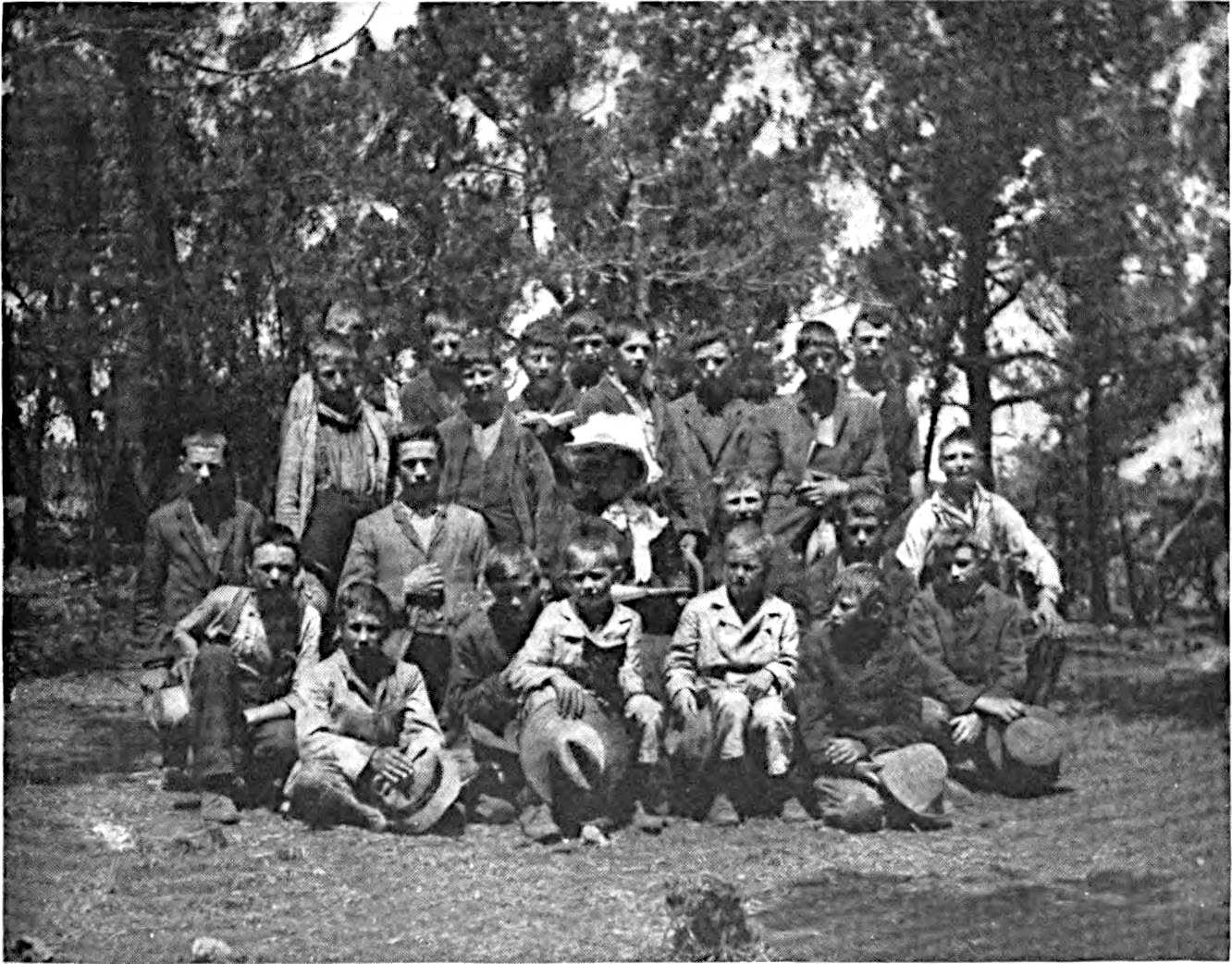
whom is quite eight years of age. It makes your heart bleed to hear
these little mites asking again and again when they shall return to their
mothers, and there are one hundred and eleven more of their companions
under sixteen years on this island alone.
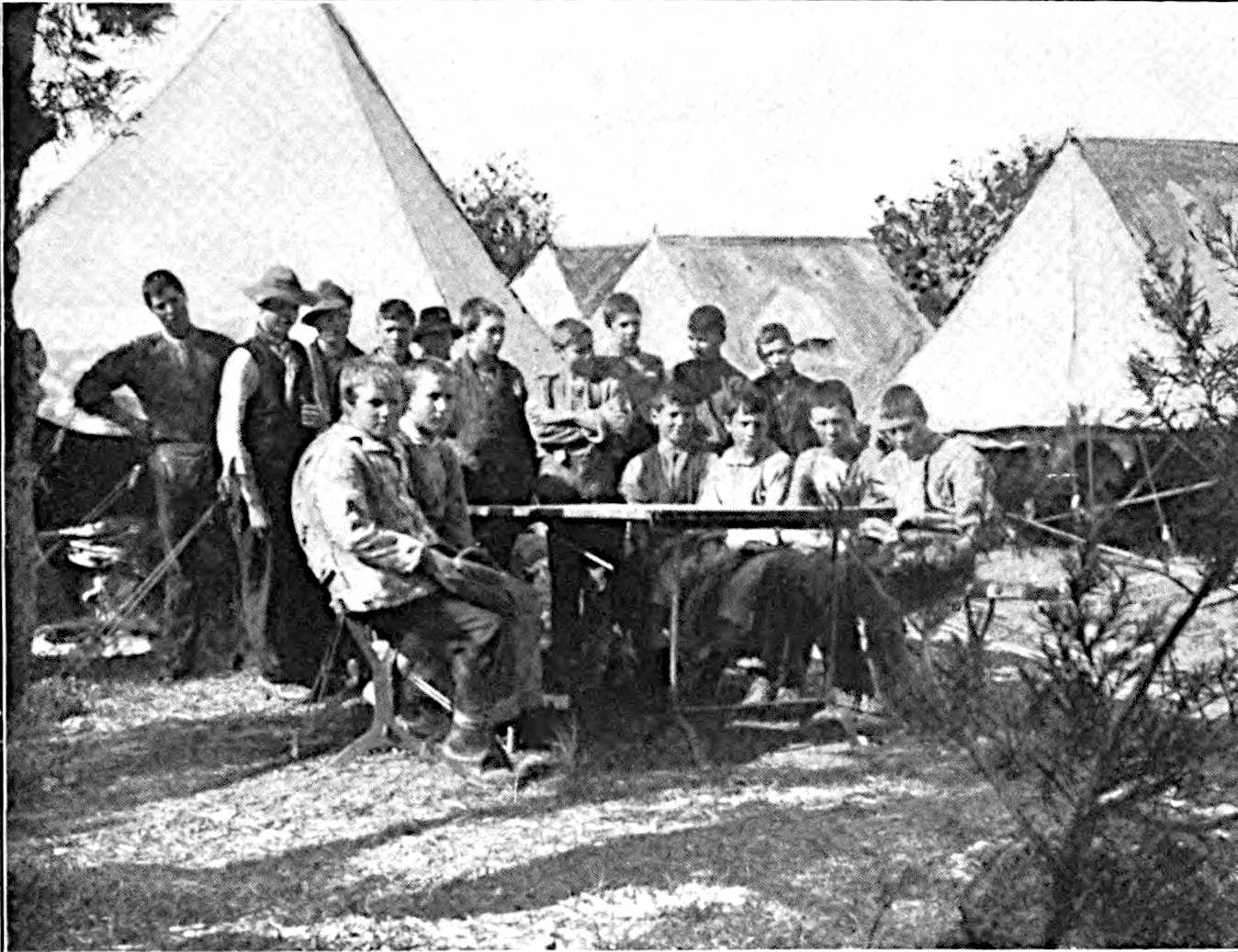
The tents, white canvas bell tents, each for seven occupants, are
erected on a nearly treeless spot, so close together that it is almost
impossible to walk between them, but the wind gets in between and blows
them down like card houses. How they will resist the winter gales is
hard to understand. The prisoners receive the same rations as the
private soldiers—that is, one pound of meat and one pound of bread a day,
some coffee and sugar, and some potatoes. They prepare their meals
themselves on field cooking-stoves erected for that purpose. This sounds
very ample, but the quality of the food furnished is mostly inferior. I
know very well that Bermuda butchers do not buy the best meat, even if
they have the chance; and how should the best material find its way into
the prison camps? A letter from a prisoner, published in the Boston Globe
of November 13th, asks for contributions to their table, as they are
entirely underfed. The food is monotony itself, and an absolute loss of
appetite is the result of too little change in nourishment. The British
soldier is compelled to pay a certain sum into the mess for the purpose of
making a variation possible, but the prisoners have no money to spend
for such a purpose. What little money they still have or make by selling
self-made toys and souvenirs is taken hold of by their caterer, a wealthy
merchant of Hamilton. The Boers complain bitterly that this man, who
has a monopoly of the prisoners’ canteen and is the only tradesman they
are allowed to deal with, takes undue advantage of them. Indeed, this
honorable merchant seems to imagine that the gold-mines of Johannesburg,
upon which he could not lay his hands, have come to him to
deposit their last output into his spacious pocket. For a shirt which sells
for one shilling sixpence he charges three shillings sixpence, and for a
pair of shoes which is regularly bought at four shillings sixpence he
[Pg 12]demands even twelve shillings sixpence. A change of diet, and especially
a more digestible one, is needed for the old men and the youngest
children.
How do they pass their time? They attend to cleaning and putting
their tents in order and prepare their plain meals. Besides, they try to
whittle all kinds of trinkets for sale to the tourists at Hamilton or generous
friends in the United States. They have a certain adroitness for
such work, but are in great want of knives and tools. There is still ample
time to spare, and reading or writing would be a suitable pastime. Are
they not allowed to have any reading-matter? Oh, yes; but it takes a
long time before Mr. Brown, the official censor, has passed all the stuff.
At the request of the prisoners, Postma and Pitton, the Dutch Consul of
New York, shipped on October 5th two boxes of Dutch literature, mostly
religious books, to the prisoners of war at Bermuda. They arrived in
due time, but up to this date they are waiting; the censor has been
unable to weed out the noxious stuff. Even American books and papers
do not find great favor; they might spread ideas too free for a man in
confinement, or they might contain some news of the South African War
which the British authorities think it unwise to have the prisoners read.
Even school-books which the authorities solicited for the young element
must not be American, but purely and intrinsically English, that
the young mind may not imbibe republican principles. Is it conceivable
that a government can be so naive and simple as to expect to make converts
by such childish measures! There is nothing like lack of mental employment
to weigh upon the mind and create despondency or produce
entire collapse. No better method than this was ever invented by a jailer to
irritate, harass, or chastise those entrusted to his care. It is true, there
was a chance offered to them not only to work but even to earn a few
pennies, and they refused it. It happened in this way. When, once a
week, a coal barge discharges its small cargo on the prison islands the
prisoners were asked to cart the coal off at the regal price of one penny an
hour. They refused to do so, because they calculated the government
having to pay half a shilling to their own sailors would save so many
dollars to carry on the war at their home.[3] At the same time, they claim
that neither their prison fare is sufficient to sustain a laboring man nor
are they able to undertake such dirty work, as they have no chance to
change nor to wash their clothes properly.
What has been said as to the conditions on Darrell’s Island is true in
regard to Burtt’s Island, where Mr. Hauptfleisch is commandant of the
camp, and of Morgan’s Island. The prisoners on Tucker’s Island are
treated with more consideration. They are mostly “uphanders”—that is,
men who either gave themselves up or signed a so-called “peace paper,” a
declaration of allegiance to the British government. A number of children
and most of the old men who were unable to take active part in
fighting are also confined on this spot. They receive certain favors, and
have the first choice of the goods donated to the whole. This is done by
the authorities to reward the good children and to coax others into submission.
Their commandant, though never an officer in the Boer army, is
young man, William Schonken. A characteristic incident connected
with the arrival of the transport Montrose deserves to be mentioned.
[Pg 13]When the vessel had disembarked her passengers on Morgan’s Island,
which is within hailing distance of Tucker’s Island, anxious inquiries
were made by the uphanders concerning relatives at home or in the concentration
camps. Shouting across the water, the new-comers soon discovered
that their neighbors were uphanders (also called “Khaki
Boers”), and since then, though the inquiries continued, not an answer
echoed back.
BOER PRISONERS TRANSPORTED FOR LIFE
The London authorities have done their utmost to humble the prisoners
and to “take the starch out of them,” but they are as undaunted as
ever. It is not only their pluck which makes them endure all hardships;
it is still more the confidence in the justice of their cause and trust in
God which renders them absolutely sure that in the end everything will
be righted. Thrice daily in their simple faith they lift their souls to the
Lord and thank Him from the bottom of their hearts for any success they
have achieved, but they just as humbly accept a reverse as a well-deserved
punishment. With the same tenacity, the foreign contingent,
the Uitlanders, cling to the Boer cause. There is quite a colony of
Americans, Englishmen, Scotchmen, Irishmen, Germans and Hollanders,
Protestants, Catholics and Israelites, in the same sad plight as the Africanders,
but they consider themselves burghers, and are just as spirited and
determined to see it through.
In sharp contrast to the favored prisoners of Tucker’s is a little group
of men of the same island who can be plainly seen from the mainland,
as they are confined on a perfectly bare spot. Their tents are enclosed
in a separate wire fence, and their mode of living somewhat resembles
the notorious treatment accorded to Captain Dreyfus on Devil’s Island.
They are two Boer lieutenants—a German, Horn, and a Frenchman,
De Courville—who are said to have attempted a mutiny on board the
steamship Armenian. They were put in irons, and are still kept so
during the night. They are allowed to walk up and down with their
guards, but not to enter into any conversation. Three other men in the
same enclosure are Alfred Martinus Joubert, of South Africa, and two
young married men of Rotterdam, George and Hendrik Indermauer, who
are treated with the same severity. Late in September they made an
unsuccessful attempt to escape from Darrell’s Island. Although reaching
the mainland and eluding their pursuers for three days, they finally had
to give themselves up and are now chained every night in solitary
confinement.
Still another body of thirty-seven men is isolated in the military
prison on St. George’s, wearing the prison garb, the “Broad Arrow”
of the government property on their backs. In fact, these unfortunate
men are as human chattels of the government. They are dubbed rebels,
or convicts, and are sentenced to prison for life. They are either natives
of Cape Colony or had signed the “peace paper,” a declaration of allegiance,
which they assert never to have read. It would lead too far to
explain how the Dutch element of Cape Colony, outnumbering by far the
English settlers, always considered itself as one and the same with their
brothers in the Transvaal, with whom they are connected by frequent
intermarriage and relationship. Let us quote no better authority on
this subject than Mr. Chamberlain himself. In a speech made in April,
1896, he stated: “These Dutch fellow-subjects in the Cape Colony are
just as loyal to the throne and to the British connection as, let me say,
our French Canadian fellow-subjects of the Dominion of Canada. But,
at the same time, they very naturally feel that they are of the same blood
[Pg 14]as the Dutchmen in the two republics, and they sympathize with their
compatriots when they think they are subject, or are likely to be subject,
to any injustice, or to the arbitrary exercise of force.” They found it
but natural to stand side by side with their kinsmen, but when captured
some had to suffer the ignominious death of Nathan Hale, while the
sentence of others was commuted to penal servitude and transportation
for life. These thirty-seven unfortunates, eight of them married, are
shut up in solitary, damp cells in a high-walled dungeon. They are
allowed to communicate with no one nor to receive any donations tendered
to them by kind-hearted friends.
When we see and hear of all the indignities heaped upon the Boer
prisoners of Bermuda, any civilized Christian may ask in astonishment
to what end serve all these cruelties. Is the British government not satisfied
to remove the captives seven thousand miles from their country, to
confine them on an island from which escape is well-nigh an impossibility?
Must they be treated like felons in strict isolation? The wit of the
average Englishman seems to be incapable of grasping the difference
between a prisoner or convict and a prisoner of war. And, moreover, the
larger part of these people are not even prisoners of war. They have
been kidnapped from their peaceful occupations because they had, in
British eyes, the misfortune of being born of Boer parents, or had committed
the crime of tilling and cultivating as Boer farmers a land which,
but for their toil and labor, would still be a barren desert. Notwithstanding
the English allegations that most of the children or old men
were captured in active contest, it ought to be stated that an accurate
counting among the Boers themselves revealed the fact that a large
majority of the old and young people—in fact, about ninety per cent. of
them—had been snatched away for transportation from their homes or
fields.
To sum up, what is the situation of the Boer prisoners of war as I
found it in Bermuda?
Four thousand persons, with more than twenty per cent. of old men
and children, huddled together on insufficient ground, absolutely excluded
from all communication, although escape is impossible, insufficiently
housed, scantily fed, left without clothing to face a raw winter, and tortured
by lack of employment. Can there be another name used for these
camps than that of the notorious infernos created in Cuba by General
Weyler, called by the euphemistic title of “reconcentrado camps”?
Nobody doubts the right of a power engaged in war to transport its
captives taken in battle to safe places in order to prevent their escape, but
every principle of international law is opposed to the same being perpetrated
on peaceable non-combatants; and what object can be served by
adding torture to confinement? Is it the expression of British blind wrath
over the unexpected prolongation of the dreamt-of military promenade to
Pretoria, or is it the outcome of a well-calculated system? “Though
this be madness, yet there’s method in’t.” Without question the government
could alleviate some of the hardships of its prisoners. The prisoners
of Bermuda could be scattered over the whole island group, or at least
be brought to habitable parts of the large islands, where proper shelter
could be provided. But why all this secrecy? Why this shutting up and
hushing up? Why are not even the officers permitted to go about on
parole, as has been the use of civilized nations at all times? Did the
escape of the single lucky and plucky Duplooy prompt these severe
measures? There has never been a war during which not an occasional
[Pg 15]flight of a prisoner has taken place; and from the standpoint of the jailer,
and as far as difficulties of escape are concerned, the Bermuda group is an
ideal prison. Well, they might come in contact with outsiders; some tourist
might catch a glimpse of the prison camps, and the shameful short-comings
of the English mismanagement might be divulged to the world at
large, or, as Quayle-Jones said, something sensational might leak out. The
British Ministry does not want any changes; it does not wish to ameliorate
at all the lot of their prisoners, for it is bound to a policy of extermination.
What else does the frightful mortality, reported from the concentration
camps of South Africa, imply but the coldly premeditated annihilation
of a heroic race of white Christians? Moreover, members of the
government, after utterly failing to conquer the Boers by force of arms,
have repeatedly avowed with cynical frankness that the only way to compel
them to lay down their arms is by making war upon their women and
children—that is, after deliberately destroying their means of livelihood
and sweeping them into camps under the hypocritical pretext to keep
them from starving, the authorities murder them by torture of hunger
and cold, in order to compel the submission of De Wet and Botha. The
whole civilized world stands aghast at this massacre of young human life;
and, at last, even the English clergy joins in the universal protest against
the wholesale murder.[4] At the reported rate of mortality all the reconcentrados
would die out within four years, and the members of the British
government, men of such moral perversion, like Chamberlain, or of senile
decrepitude, like Salisbury, would chuckle with delight, for, to use the
latter’s diplomatic language, “they are determined to remove their neighbors
so effectually that it will never require doing again.”
Can we do nothing to frustrate this fiendish resolution? An active
interference is out of question, and even the diplomacy of all governments
has long ago abandoned its futile efforts since McKinley’s offer of
friendly mediation was promptly refused by England. Nevertheless, after
getting rid of Weylerism in Cuba, must we tolerate, without even a protest,
the establishment of Chamberlainism and Kitchenerism at our very doors?
It is to be highly regretted that there is so much indifference in the
United States in regard to the future of the two South African republics.
The interest and enthusiasm excited during the first months of the wonderful
exploits of the citizen soldiers has given way to apathy. The
systematic misstatements and vilifications by the British press, which
for years previous to the war were the source of much prejudice
[Pg 16]against the simple farmer population of South Africa, have again been
launched with redoubled force into the press of the whole world, and have
found, without criticism, a too-willing reception by the American public;
and yet the heroic struggle of the two little republics deserves the candid
admiration of our people more than that of any other nation. Our forefathers
went to war for less weighty reasons and fought through the
same hardships, though against smaller odds and with the aid of a powerful
ally. Is it possible that our people have forgotten the storm of indignation
which swept over the United States when Senator Proctor gave out
his report with regard to the reconcentrado camps of Cuba? The billows
of rage rose high at that time, and it would not have needed the destruction
of the Maine to kindle the torch of war. Why do we not in this
case insist upon an investigation by some one in authority? Was it, then,
only because Spaniards were the perpetrators, and because we credited
them alone with an intimate acquaintance with the rack and all the
implements of the Inquisition? Why, the reports of Miss Hobhouse and
other impartial English witnesses have demonstrated that our Anglo-Saxon
cousins are no less shrewd and inventive than Torquemada himself.
Their methods, though more hypocritical, are more sweeping and
thorough. It took the Inquisition years to slaughter the hecatombs of
their victims for the glory of God. Chamberlain and Kitchener, however,
with the devastation of the country and the concentration camps,
accomplish it in so many months for the glory of the British empire.
Every one knows that millions—nay, the vast majority of our citizens—are
in warm sympathy with the brave champions of independence in
South Africa, and that it needs nothing but an initiatory step by somebody
to release the pent-up feeling and give expression to the unanimous
opinion of thousands. Why not, then, appeal to our chosen representatives,
our members of Congress, members of State legislatures, or municipal
authorities, to declare openly and in proper language our abhorrence
of the barbarous methods employed by the British government in warfare
and of the horrible massacres perpetrated by the same among their
so-called prisoners of war. A mere declaration of sympathy on the part
of our authorities would be of immense weight. A petition advocating
these principles is at present circulated throughout the United States,
and every citizen who not only abhors the cruelties of an unjust war but
who still more despises the base methods practised on old men, innocent
women and children in the prison camps, ought to put his signature to
such a petition.
While this agitation is going on, let us not forget, however, that
there are more pressing duties requiring immediate action—that there are
thousands of destitute prisoners of war almost within hailing distance of
our coast who appeal to us for protection against the vicissitudes of an
inclement winter, who without our prompt relief might duplicate in our
neighborhood the terrible death-rate of the South African camps. A
supply of clothing and digestible food is urgently needed.
Let us remember, when a chilly northwest wind, with rain and sleet,
drives us into our warm and comfortable houses, that the same blast may
fly across the ocean and chill four thousand naked prisoners to the marrow.
Many a boy, many an old man may be stricken to death, but his spirit
will be unbroken like that of the old patriarch who died in their camp
last summer. His two sons had been killed, but to his grandson who
still is fighting in Africa he sent his parting message: “Keep on
fighting for freedom. Never surrender! Never! Never!”
[Pg 17]
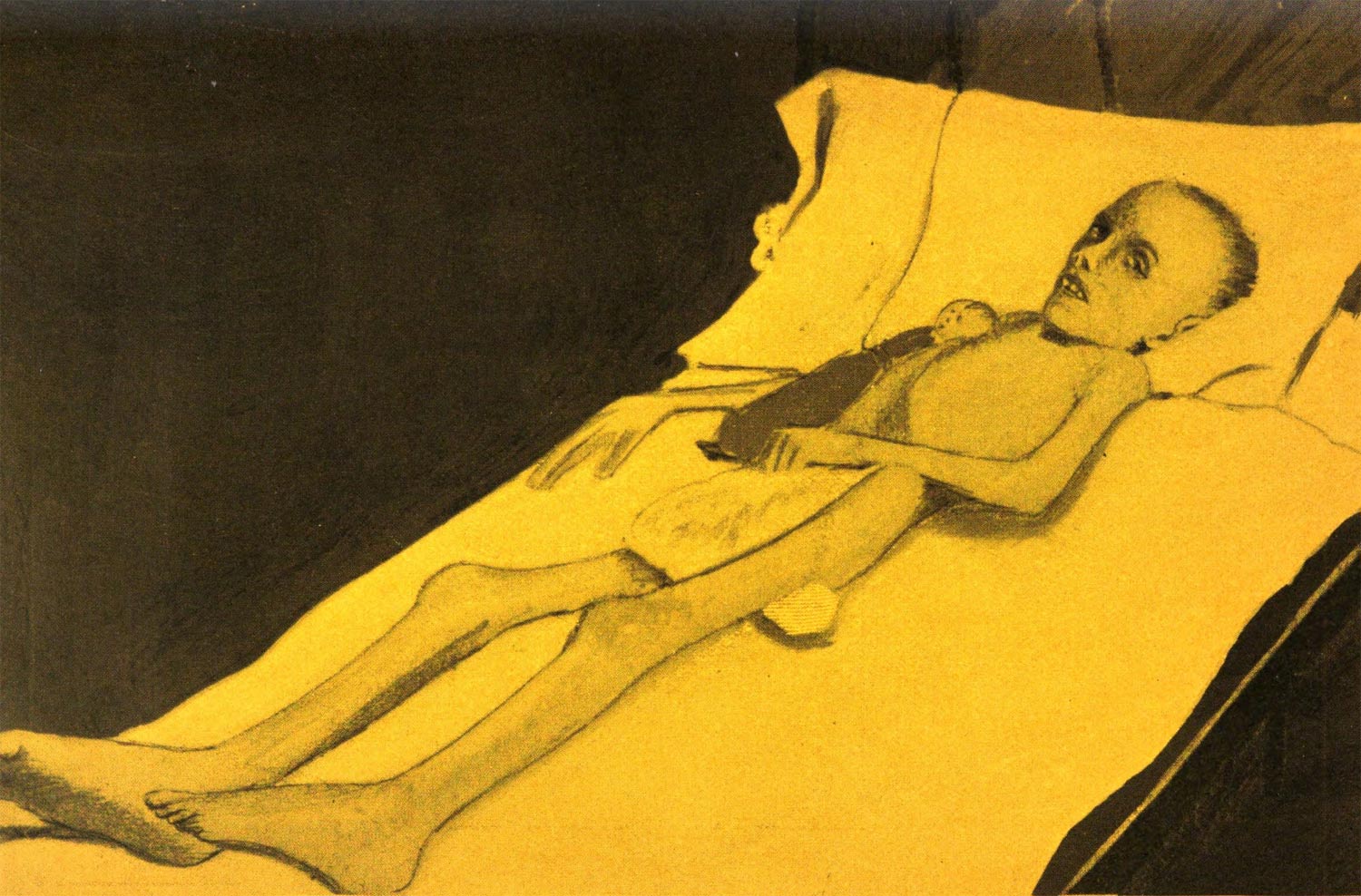
PHOTOGRAPH SENT HOME BY AN ENGLISH LADY FROM THE BOER WOMEN AND CHILDREN’S
CAMP AT BLOEMFONTEIN
She writes: “Lizzie Van Zyl, about 8 years old—one of our little skeletons. The legs are out of proportion. Several have
been emaciated like this. I fancy the food and the great heat of the tents doesn’t suit them. It is piteous to see the children.”
Any profit derived from the sale
of this pamphlet will be delivered
to the
BOER RELIEF FUND CHAS. D. PIERCE, Trustee and Treas. 136 Liberty Street New York
FOOTNOTES:
[1] Captain Fraser, of the Bermuda steamship Trinidad, has published in
Pearson’s Magazine for October, 1901, under the title of “A Garden Prison,” an
article in which he pictures the Bermuda Islands as a veritable paradise, and tries
to create the impression that the prisoners are foolish to escape from such a delightful
place. The good Captain himself had the misfortune to unwittingly aid Duplooy
in his escape, and his publication was evidently inspired to serve as an humble atonement.
Even the photographs accompanying the article are apt to be misleading,
as they were all taken before the arrival of the prisoners; and the picture of the
camp on Darrell’s Island, e.g., does not represent the Boer’s camp, which is decidedly
more dreary and barren. Compare the picture of a real camp on the cover of this
pamphlet.
[2] There is not sufficient soil in Bermuda to bury the dead; they are placed in
cavities of the rock, where, by the influence of sea-water, etc., bodies are said to
decay rapidly.
[3] There are evidently fine jurists among these prisoners who know the articles
of the Hague Peace Conference by heart. Article VI. of this document says that
“work done for the State shall be paid for according to the tariff in force for soldiers
of the national army employed on similar tasks.”
[4] An authentic picture of the misery in one of the South African concentration
camps is shown on the inside of the cover. It is a great consolation to the English
press that, according to the latest Blue Book, the causes of the appalling mortality
in the South African concentration camps are fully established. They are the dirty
habits and ignorance of the Boers, and their distrust of the British surgeons. The
only thing unexplained in this splendid exposition is: why did not their dirty habits
and ignorance kill all the Boers before they came under the benevolent guidance of
the British authorities? Why, on the contrary, were they able to raise families,
which in number and vigor excel those of any Christian nation? Least of all, the
Boers may be blamed for their distrust of the British army surgeons. One of these
amiable brutes suggested to the reporter of an Austrian paper that the best treatment
for the occupants of the camps would be to inoculate them with the plague
bacillus. He undoubtedly deserves to be kept in alcohol as a curiosity. But if we
are merely guided by the authority of an out-and-out Englishman, Mr. Mortimer
Menpes, in his “War Impressions,” a man who pretends to have nothing but the
highest praise for the surgeons, the medical men were principally occupied with
photographing and looting. This interesting activity, no doubt, left them little
time for their proper duties, and may explain the low esteem in which they are held
by the Boers, as well as by the medical profession outside of England.
Transcriber’s Notes
Perceived typographical errors have been silently corrected.
On Pg 6, two occurrences of “ostentatiously” have been corrected to “ostensibly”.
Illustrations have been moved nearer to the text to which they refer.