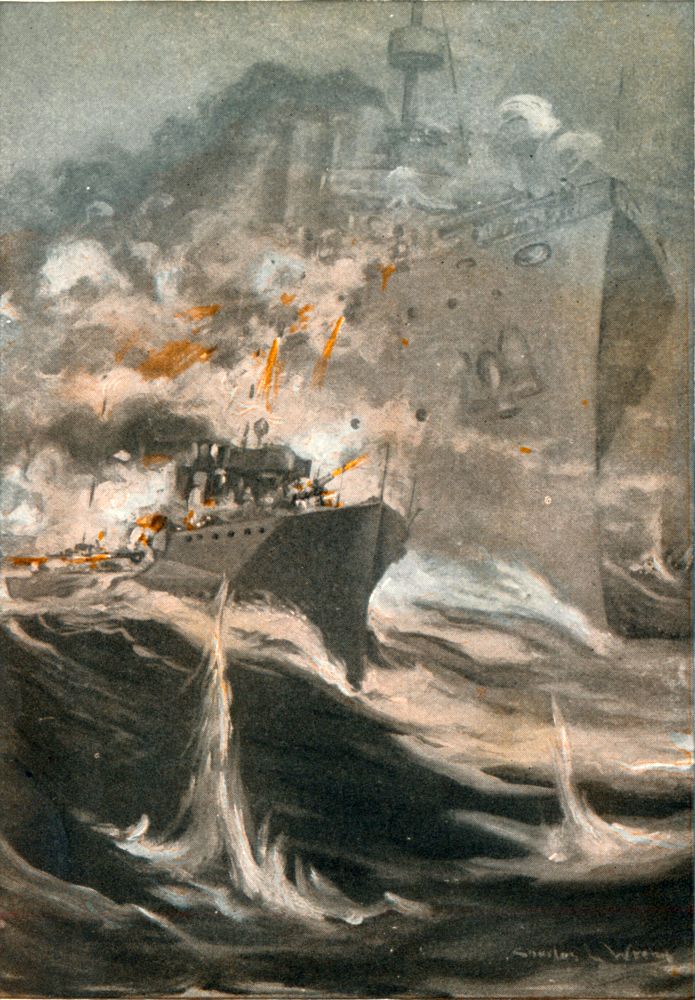
Title: Under the Yankee ensign
Author: Ralph Henry Barbour
Illustrator: Charles L. Wrenn
Release date: August 3, 2026 [eBook #79261]
Language: English
Original publication: New York: D. Appleton and Company, 1919
Other information and formats: www.gutenberg.org/ebooks/79261
Credits: Produced by Donald Cummings and the Online Distributed Proofreading Team at https://www.pgdp.net
UNDER THE YANKEE ENSIGN
BY
AUTHOR OF “FOR THE FREEDOM OF THE SEAS,” “THE HALF
BACK,” “THE SPIRIT OF THE SCHOOL,” ETC.
NEW YORK LONDON
1919
Copyright, 1919, by
D. APPLETON AND COMPANY
Printed in the United States of America
“Hello, sonny; who let you on board?”
The tall, stoop-shouldered sailor with the thin face grinned malignantly. His right sleeve bore a seaman gunner’s mark and a single enlistment stripe adorned the other. He was a dark-visaged man of nearly thirty, with deeply-set and crafty eyes under thick, scraggly brows. The boy who, at the challenge, had paused at the foot of the fo’c’sle companion, decided then and there that he didn’t like the man, but he replied quietly and amiably:
“The quartermaster. Do you know which of these bunks are empty?”
“Why, say, you ain’t thinkin’ of bunkin’ for’ard! Cabin boys always live aft, sonny.”
“If you mean me, I happen to be a seaman.” David Garson moved across the narrow fo’c’sle and [4]laid his canvas bag on a bunk that showed no evidence of occupancy. He was seventeen, but scarcely looked it, for he was not over tall for that age, and had a very boyish face. But his lack of stature appeared to be atoned for by a compact, well-proportioned body, and there was capability and self-reliance behind the youthfulness of his countenance. He was a nice-looking chap, although you wouldn’t have called him handsome, with brown hair and eyes, and a well-tanned skin showing above the low neck of his navy shirt.
“A what!” exclaimed the other, assuming deep incredulity. “My, ain’t it awful what war does? Snatches the babes right out o’ their cradles, don’t it? Where’d you leave your nurse, sonny?”
“Where you left your manners,” was the quiet reply.
“Is that so?” sneered the sailor. “Smart, ain’t you? Sort o’ precocious, eh? Bet your ma felt terrible about losin’ you. Bet you was the sunshine of the old home, wasn’t you?”
“What have you got against me?” asked Dave, puzzled.
“Not a thing! Not a thing! Only you’re too fresh, see? And I’m tipping you off that you want [5]to talk civil, or something painful might happen to you.”
“I see,” responded the boy, dryly. “Some one might mistake me for you.”
“Aw, cut it!” growled the other. “For two cents I’d hand you a wallop, you smart Alick! ‘Seaman,’ says you! I’ve swabbed deck with fellers twice your size, and I’ll do it again if you give me any of your lip!”
“Why don’t you let me alone if you don’t like my ways?” asked Dave. “I didn’t start anything.”
“You’d better not try to.” The gunner, who had followed across the fo’c’sle, stretched forth a big hand and gave the boy’s head an ungentle push that, while it did not hurt, sent the blood pouring into the tanned cheeks. Dave sprang from the edge of the bunk with blazing eyes.
“Keep your dirty hands off me!” he said in a voice that trembled in spite of his efforts to keep it steady. “I haven’t bothered you, and you’ve no call to bully me. Now let up!”
“Is that so?” asked the other, thrusting a grinning face closer. “Suppose I don’t? What would you do, you cute little thing? For two cents—”
[6]
“Lay off the kid, Chuck!” interrupted a peremptory voice.
Unheard by them, a short, squarely-built, tow-headed youth of about nineteen had descended the companion. He had a round, freckled face, pale blue eyes, a short, button-like nose, and square jaws that were just now rhythmically busy with a piece of gum. He came across the fo’c’sle with a sort of cocky swing of his broad shoulders and a wide smile. But the smile didn’t deceive either Dave or his tormentor. “Some day, Chuck,” went on the newcomer, “you’ll make a mistake an’ light on a guy that’s ’most half your size.”
“What’s it to you, Rooney?” demanded the gunner. “You mind your own business, or I’ll hand you something, too!”
“You an’ who else?” inquired the other. “Say, Chuck, you ain’t got enough up your sleeve to make a motion. The only thing you ever licked was a stamp, and that didn’t stick. Go on! Fade away! Beat it!”
“Maybe you can make me!” growled the gunner. But he was already making a slow retreat. “This baby-face got fresh with me, and I was telling him something for his own good. If he don’t [7]look out he’s going to run into something hard, see? And that goes double for you, Rooney!”
“Yeah, I know,” replied Rooney, sarcastically. “I been hearin’ that dope for a week. You’re just bluff, Chuck. You ain’t got nothin’ but talk.”
“I got enough to put you to sleep, you Bowery tough!”
“Tough’s the word, matey! Tough enough for you any old day.”
“Is that so?” The gunner edged with exaggerated nonchalance to the foot of the companion. “I’ll get you, just the same, believe me!”
“Sure you will—if my back’s turned,” was the untroubled reply. “But it ain’t goin’ to be turned, Chuck.”
“You think you’re smart, don’t you? I’ll fix you some time.” He climbed the companion, still muttering, and disappeared through the fo’c’sle hatch. The tow-haired one turned to Dave, chuckling.
“Ain’t he amusin’?” he asked. “What was he ridin’ you for?”
“I don’t know. He started it. Much obliged for—for—”
“Buttin’ in?” laughed Rooney. “That’s all [8]right, kid. Me an’ Chuck’s been yappin’ at each other ever since this boat left Norfolk. But nothin’ ain’t happened yet. Some time I’ll paste him one just to end the—the expense.”
“Suspense?” laughed Dave.
“That’s it.” The tow-headed youth grinned. Then: “Say, what’s your name?” he asked.
“Garson,” answered Dave.
“Mine’s Rooney; first name, Pete. I’m French.” He winked broadly. “What’s your other monicker?”
“Other—oh, David; Dave for short.”
“Sure! Like the feller in the Bible. An’ Chuck Morgan was playin’ Goliar, or whatever his name was. You come from down south, don’t you?”
“Maryland.”
“Yeah, I know. That’s the place they sing a song about. I knew you was from somewhere down yonder, because you talk different. How long you been in?”
“A little over three months. I left the Newport station a week ago Tuesday. I got up here this morning. Do you know if I can take this bunk?”
“Sure. Take any you like. If any guy kicks, send him to me. What watch you in?”
[9]
“Port,” replied the other. “Are you?”
“Yeah. Stow your duffel and let’s get out o’ here.”
“I suppose you’ve been in the navy a good while,” said Dave.
“Me? I joined a year an’ a half ago. ’Bout the time the Huns sunk the Sussex. That got my goat, an’ I figured we’d be goin’ into it pretty quick after that.”
“Have you been across yet?”
“No; this is my first sea duty, same as you. An’ say, kid, it’s goin’ to be some voyage, take it from Pete!”
“Is it? Why?”
“Why? ’Cause we’re goin’ over, that’s why!”
“Over! You mean this boat’s going to France?”
“Yeah, France or Paris or some place like that. They ain’t tellin’ it, but we know. We seen ’em load supplies, kid.”
“Why, that’s fine, isn’t it?” exclaimed Dave, eagerly. “But—but isn’t she awfully small to make the trip alone?”
“She won’t be alone. But she is small, all right, an’ that’s why I’m tellin’ you it’ll be some trip. [10]Take it from Pete, kid, food ain’t goin’ to be of no interest to a lot of us guys for a long time!”
“You mean we’ll be seasick?” said the other thoughtfully. “I suppose I shall. I’ve never been to sea much. I’ve sailed a boat all my life—”
“All that time!” marveled Pete, his blue eyes atwinkle.
Dave laughed. “Well, for five or six years, then, I reckon. But I’ve never been very far from land.”
“Nor me. An’ I’m tellin’ you straight that I ain’t cheerin’ much for it, either. Sometimes I wish I was back on my old job. It had its ups and downs, but it was pretty steady at that.”
“What did you do?” Dave inquired.
“Run an elevator,” chuckled Pete. “Down to the Endicott Building, on Broad street, in little old New York. That’s my home, New York. I was born there, an’ wasn’t never out of it till I signed up with Uncle Sam. Chuck Morgan called me a Bowery tough, an’ that’s what I am, I guess. Anyway, I was till one day a guy in a silk hat tried to get himself run over by a truck, an’ I snatched him out of it. He slipped me a ten, an’ asked did I want a job. I didn’t—much—but I didn’t want to hurt [11]his feelin’s, an’ so I told him yes. An’ first thing I knew I was workin’ steady liftin’ an elevator up with a rope. But it wasn’t much of a life for a husky guy like me. So when the war came along I ducked.”
“And do you like being in the navy?” asked Dave.
“Sure! It’s a great life. There ain’t nothin’ to do but work. Trouble is, though, there ain’t been no scrappin’. I been scrappin’ all my life, and I sort o’ miss it. But I guess it’s comin’, all right, now. Those Germans ain’t been doin’ a thing but askin’ for a wallop!”
“And they’re going to get it,” said Dave, grimly.
“There’s the truth, take it from Pete! Now, what’s your story?”
“I reckon I haven’t any,” replied Dave, smiling. “I’m here because I’ve always wanted to be in the navy, and because—well, a fellow feels as if he had to do something after the way the Germans have been going on. Of course, I couldn’t get in until I was seventeen, and I had hard work getting my mother to consent. There isn’t any one but me at home now, you see. Dad’s been dead some time, and my sister’s married and living in California. [12]But after mother saw how much I wanted to get into this she came around. The day I was seventeen I went up to Baltimore and enlisted. They sent me to Newport, and I was there three months. Then I went home on liberty for a week, and now here I am.”
“Guess it’ll be sort o’ lonely for your ma, won’t it?” reflected Pete. “Say, if I had a ma I wouldn’t be leavin’ her to go to no war, take it from Pete.”
“Oh, yes, I reckon you would. You’d go into this one, just as I did. It will be lonely for mother, I know—but I just had to do it! She was perfectly fine about it when she realized how I felt. Mothers are kind of wonderful folks, aren’t they?”
“I guess so.” Pete scowled. “I never had any. Not that I knows of. Oh, well, that’s all right, too. There ain’t no one to worry about me if I get my fool head blown off. Guess you an’ me’d better go topside. This tub’s due to pull out pretty soon, I’m thinkin’.”
[13]
A few months before, the craft on which Dave now found himself had been the pride of a wealthy New York man, and had seldom performed a more hazardous exploit than to bear its owner up and down the Hudson River between a palatial home and the city. To-day, shorn of gilt and draperies, made over, above deck and below, to fit her for her new requirements, it is doubtful if her former owner would have recognized her had he seen her lying beside a stone dock in the Brooklyn Navy Yard. The immaculate white of her hull had disappeared under coats of lead-gray, and the same dull hue covered all superstructure, masts, small boats, and standing gear. Even the canvas jackets that covered the bow and stern guns and the lookout cage on the foremast were gray. A deck-house had been erected abaft the mainmast, while atop the wheel-house a bridge now stretched from side to side, a [14]thing of pipe-iron and canvas. If one looked carefully over the bow one could just make out under the new paint the yacht’s former name, Meteor; but further back, in big black letters and numerals, was the legend: S C 944.
The 944 was a hundred and twenty-two feet over all, and had a beam and a draught that, while conducive to speed, had not been figured with deep sea voyaging in mind. Her twin oil-burning engines could send her along at a twenty-mile clip. She carried a complement of two commissioned officers and twenty-six enlisted men, most of whom, from captain down to mess attendant, were well under thirty. In fact, Lieutenant Cowan was but twenty-five, and the 944 was his first command; and his junior and executive officer, Ensign Hyatt, was still younger by two years. Even the engineering head, a non-commissioned officer holding the rating of chief machinist’s mate, was well on the under side of thirty. So, it will be seen, on the 944 enthusiasm took the place of hard experience.
But of enthusiasm there was plenty, as Dave discovered that first evening aboard. By that time they were somewhere in the broad waters of the Sound, while behind them trailed three other chasers. [15]The sweltering heat of the August day had given way to the fresh coolness of night, and a little southeast breeze, straight from the twinkling lights of the distant shore, played a soft tune in the aerial that stretched between the short masts. Dave had eaten his first “chow” on board—had, in a fashion, learned the ropes—and was now on speaking terms with most of the crew. They were, he thought, a nice lot, and he was already looking on the 944 as the Pride of the Navy, and congratulating himself on not having been relegated to the Pennsylvania or Arizona! And perhaps he had some excuse for self-gratulation, for on a boat of the chaser size officers and men are thrown nearer together than on the big ships, and while there is never any letting down of the bars separating ward room from fo’c’sle, the conditions of living make for a closer intimacy and a greater esprit de corps. Dave’s watch was below that evening, and he swung his legs from his bunk in the little fo’c’sle and listened to the chatter of the others, the swish of water along the side, and the steady hum of the engines. The port watch were bewailing the fate that had kept them on the wrong side of the “pond” until now. “Dutchy,” who was a big two-fisted Dane, [16]with a long body and short stumps of legs, lugubriously predicted in his slow and careful manner, that the war would be all over before they got across. Followed much speculating as to their destination. Mallory, second class radio man, held for Dover. Kennedy, gun pointer, said Bordeaux, having already made one trip to that port on an armed cargo boat. Pete Rooney favored Queenstown, principally, perhaps, because he had a hankering to set foot on the sod of his forebears. Todd, master-at-arms, third class, and British in everything save birth, would have it Plymouth. And some one else suggested Nantes. Dave was about the only one there who had no theory on the subject. He didn’t much care where they dropped anchor so long as it was “over there.” Every one seemed agreed on one thing, at all events, which was that it needed only their presence in French or British waters to bring the submarine menace to a speedy end, and Dave found himself confronted by a mental vision of Admiral Sims standing on the tip end of Ireland, shading his eyes and searching the horizon impatiently for sight of the 944!
Later, Dave and Pete climbed up and made their way along the dark deck to the lee of the after-house.[17] There, with the hulk of the three-inch gun black before them, and the light of the next chaser in line swaying astern, they became better acquainted. Fisher’s Island dropped away to port, and the 944 began to dip and roll, and presently they went back to the fo’c’sle and turned in.
Dave stood morning watch, and was on deck when the first light of day came up over the eastern edge of the world. The 944 was some fifty miles east of Cape Cod, and as the dawn brightened he saw that the four chasers had become four times four, and that a big gray cruiser, four-stacked, and bristling with eight-inch and six-inch guns, was hovering to southward. Most of the chasers were of one class, boats built for their work, capable and speedy looking 110-footers, but here and there a converted yacht, generally similar to the 944, lent variety. Signals fluttered from the flagship, and were answered, and by the time the first rays of the sun were leveled along the ocean the flotilla of tiny adventurers had formed in a hollow square formation, and, with the big cruiser leading, were tossing the foam from their bows. All that day they steamed eastward over a summer sea, for all the world like a lot of little gray ducklings following a [18]mother duck, and at night, with only stern lights showing dimly, they kept their places and dropped the miles steadily behind them.
On every craft lookouts watched from deck and cage, for while never yet had a hostile periscope poked itself above those waters, there was no knowing when such a thing might happen. Dave had his first trick in the foretop cage the second day out. He toed the ratlines and squirmed into the little gray canvas cask that was barely big enough to hold him. Sitting erect, his head just topped the rim. Twelve feet below was the flying bridge in front and the big, squatty funnel behind. The breeze sang in his ears and made elfin music in the aerial wires. It was rather jolly up there at first, but after awhile the sunlight hurt his eyes and he began to weary of the ceaseless swing of his perch as the short mast canted from side to side. The motion wasn’t as soothing as that of a hammock. Watching the other chasers and the big cruiser grew monotonous, and searching the empty ocean for enemy periscopes was horribly idle. It was an event when he could report: “Smoke two points off the port bow, sir,” or “Sail dead ahead.” He didn’t exactly wish for a submarine, perhaps, but he came near it toward the last [19]of his trick. He had two hours of it up there, and then slid down to make way for his relief.
Life those first two days was pleasant enough. He found his place and learned his duties, and became known to the rest of “the bunch” as “The Kid,” which title, since he was the youngest member of the crew, he was fairly entitled to. Pete Rooney figuratively adopted him, and as Pete was a popular and respected person, that fact was held to be in his favor. Chuck Morgan grouched, and gloomed at him, but Chuck was in the starboard watch, and they met not so frequently as they would have otherwise. The food was excellent, and the cook a wonder, and as long as the chaser behaved herself meals were jolly occasions. They had three days of perfect weather, with a light easterly breeze and a smooth sea, and then things happened.
Some time in the early morning of the fourth day Dave awoke from his dreams to find himself rolling from one side to the other of his bunk, and in danger of leaving it completely. The little boat was full of whines and creakings, while outside a northeast gale was howling loudly. The 944 soon showed her shortcomings as a rough weather craft, for her narrow beam and light draught, while excellent [20]for the purpose of pursuing submarines and eluding torpedoes, made her easy prey for a gale. Mess tables were of no use that morning, and even the Old Man and the luff ate breakfast with one hand and clung to something stable with the other. By that time the 944 was thrusting her sharp, arching bow right into the waves, and the big seas were roaring back across her deck. They donned their life-vests and stretched the lifelines, but even then getting from one end of the boat to the other was a slow and risky business. One by one the companion craft disappeared from vision in the murk. The gale increased in fury that night, and after a wave had smashed in the wheel house as though it had been cardboard, the 944 was swung about, tail to the storm, and went plunging and rolling south-westward.
The next day found them fighting hard. Portholes had been smashed and the lower deck was flooded half the time. Somewhere the seams had opened, and the hold fairly gurgled. The wireless went when the dynamo was flooded, and with that they lost their last touch with the flagship. On deck everything movable that had not been lashed tight had gone by the board, and much that still stood [21]was broken or twisted. They managed to keep the water from the engine room only by pumping ceaselessly, and Dave took his turn with the others at standing almost waistdeep in water and clearing waste and débris from the top of the pump to keep it from clogging. Following seas climbed over the stern and threatened to make an end of the little craft. The water poured down the wardroom stairs in cataracts, and clothes, shoes, books, and papers floated about there in wild confusion. The 944 carried two small boats, which were lashed in chocks amidships. These stood the pounding until, in the middle of the morning watch of the sixth day out, one of them broke loose and went banging to the rail.
Dave was one of those hurried to the rescue. Wrestling with a twelve-foot boat on a wet, slippery deck that stood at all angles, and under the hammering of a sixty-mile gale and giant seas, is man’s work, and so the half-dozen sailors found it. But they kept at it, holding tight when a wave thundered down on them, and then working like Trojans before the next, and they at last got the boat back in place, and were securing it with new lashings, when a warning cry sent them groping for holds. [22]The sea that came aboard over the starboard stern looked to Dave, in the faint light of a single lantern, as high as a house. He didn’t expect to survive it himself, and didn’t expect the 944 to. He took a strangle hold on the lifeline, crouched, and set his teeth.
Then he was down, with tons of water atop him, and his hold on the rope was torn away, and, choking and smothering, he was rolling helplessly across the canting deck. He tried to call out, but got only a mouthful of water for his pains, felt horribly frightened, and made frantic grasps with his hands.
After what seemed a very long time he found himself face down on the deck, with one hand clasped painfully about a boat davit and the lower half of his body suspended sickeningly over a void. He had no breath with which to call for aid, and scant chance in any case, for, with a crash that staggered the chaser, another seething cliff of water struck the counter and hurled itself forward. Dave heard a strangled cry in the darkness above the confusion of sound, and then, with a silent prayer for mercy, he flattened himself to the planks, felt the boat reel wildly, and knew that, despite his clasp [23]on the davit, he must go over the side when that weight of water struck him.
There was a brief moment of suspense, during which Dave’s thoughts raced at lightning speed, and then, with the noise of Niagara, the solid wall of water struck the stern house and came leaping over and past with wild, resistless fury. Dave’s last gasp of breath was driven from his lungs under the impact, his straining fingers were torn loose, and, in a roaring flood, he went, turning over and over, into the maelstrom of the seas.
[24]
Down he went, the dull roar of water in his ears. Then, even more quickly, he was shot to the surface. Instinctively he thrashed arms and legs. His lungs seemed bursting by the time his head was momentarily above the waves, and he could not have cried out had his life depended on it. All he could do was take a great breath of air as he went swirling upward on the crest of a sea. For an instant he opened closed eyes. Below him was a dim gleam of light, and even as he sank suddenly downward again into a trough he startledly realized that the 944 was almost within arm’s length. Then he was again buried under an avalanche of water and must needs fight for breath and struggle mightily, and when next he could blink the drops from his eyes the faint glow was above him but no farther away. By some strange whim of wind or current, he thought, he was being borne along with the boat! [25]At another moment the absurdity of the idea would have followed the thought, but not now. Now he accepted the miracle and made the most of it. Drawing a deep breath into the tired lungs, he shouted with all his remaining strength.
But that cry was whisked away on the gale and never reached the deck. A deluge of water, breaking over the boat, descended on him and sent him rolling over and over, gasping and choking. Then a mighty wave caught him up and again tossed him high in air, and it was then, thrashing and fighting to get his head above the surface, that one hand collided with a rope and the miracle was explained. He knew then why he had been so abruptly pulled from the depths and why he was still alongside the chaser. In some strange manner a line, probably one that they had been lashing the small boat with, had fouled itself around him and caught under his life-vest. At all events there it was, slackening and tightening, pulling him willy-nilly through the sea. He gripped both hands about it and held on tightly, while a warm flood of hope and thankfulness surged through him. Then he began to pull himself, hand over hand, half drowning under the battering waves. Fear that the line might come away at the other [26]end before he could reach safety stopped the beating of his heart once, but he kept on. At moments he was thrown high above the deck, at other times he wallowed far below it, and as the line jerked in his grasp he set his teeth and held his breath and went floundering with it, his hands and arms aching with the strain. Then, in the black darkness, he knew that the hull was beside him. A sudden roll of the boat left him dangling for an instant half out of water. He didn’t shout, for he needed every ounce of his strength for the task that remained. Twice his body was hurled with terrific force against the side and what little breath remained with him was hammered out. But he held doggedly to the rope and waited and after what seemed long, long minutes wave and boat combined to solve his problem. At the moment that the 944 rolled her port rail down a wave lifted him up. He pulled frantically on the line and then, releasing one hand, groped for another hold.
There was a horrible instant of despair during which his eager fingers encountered only empty air, but then, as the deck swung away and he felt himself dropping back into the sea, his fingers closed about a rail stanchion. He found a hold for his [27]left hand, too, as the 944 careened to starboard, and he felt his dripping body torn from the water and left dangling against the hull. For a second of time he hung there limp and still while the roll of the boat carried him up and up. Then, summoning what little strength was left in his tired body, he squirmed and pulled, reaching for new holds, finally working one knee over the edge and then holding himself there while the boat rolled back again and a torrent of water, bursting over the stern, tore at his straining hands. He wanted to gasp for help then, but there was no breath left, and his appeal was no more than a whisper. His wet clothing seemed to weigh tons, and he despaired of ever pulling himself to safety. And perhaps he never would have. But while he clung there like a limpet, hands fastened under his shoulders and he felt himself being lifted. Then the deck flung itself up at him and he knew no more.
When he opened his eyes again he was undressed and between the gray blankets of his bunk in the dimly lighted fo’c’sle. Figures moved about him hazily. Some one tried to make him drink something hot, and after muttered objections he swallowed a few mouthfuls and was horribly sick at his [28]stomach. He must have slept after that, for when he awoke again daylight was flooding the quarters. He felt absurdly weak, too tired to lift the hand that, unconsciously, had braced against the edge of the bunk while he slept, too weary to keep his eyes open. He dozed again and awoke a third time to find Pete gently shaking him.
“Here’s your grub, Kid,” said Pete. “Your orders is to drink this coffee and eat the chuck. Cook’s made you a fine mess o’ gruel. Want to sit up?”
Dave blinked and cast a puzzled look about the fo’c’sle. Yes, it really was the fo’c’sle, which was a mighty relief to him, since during his recent doze he had dreamed that he was fighting for life in the sea. Clothing swayed with every roll and toss and boots slid around the floor. Clinging to the frame of the bunk, Pete was balancing himself with difficulty and the coffee by some seemingly superhuman effort. He was alternately frowning anxiously at the aluminum cup and grinning at Dave. Dave shook his head, however.
“I’m not hungry, thanks, Pete,” he said. “What—who—”
“What—who yourself! Come on now an’ be [29]a sport, Kid. Orders is orders, you know. An’ say, if you don’t eat this chow cook’ll be in here with his cleaver. He’s in a nasty temper, anyway, what with makin’ coffee standin’ on his head. Take it from Pete, Kid, you’d better do as he tells you.”
Dave smiled and squirmed higher in the bunk, and, with Pete, braced against the side, aiding, managed to get nearly as much coffee down his throat inside as out. And he succeeded ultimately in swallowing some of the gruel and trying to look grateful, although he secretly thought it particularly vile. Pete refused him talk until he had made his meal. Then setting mug and pannikin on the deck, where they at once began to chase each other to and fro, he staggered to the end of the bunk, bumped his head resoundingly and sat down very suddenly.
“Well, now, how does it feel to be drowned an’ come to life again, Kid?” he inquired. “Say, you’re a lucky guy all right, do you know it? Jonah ain’t got nothin’ on you. You wasn’t never born to be drowned, I guess. If poor old Billy—”
Pete stopped abruptly.
“Who’s poor old Billy?” asked Dave weakly.
“Nobody,” growled Pete. “Tell me, Kid, did [30]you tie that line around you before you went over, or what?”
“No, I didn’t know it was there at first. I guess I was in the water five minutes before I happened to find it.”
“Five minutes!” said Pete, looking queer.
“Well, something like that. Why?”
“How long do you think you was gone from our midst altogether?”
“I don’t know, Pete. It seemed a long time, but I suppose it wasn’t more than ten minutes, maybe.”
“Huh! You was gone just about three minutes from the time the wave struck us till I hauled you in again!”
“Three minutes,” faltered Dave. “You’re fooling! Why—why, it seemed like twenty!”
“Sure, I guess it did, at that. After that sea flattened us out Myers shouts ‘Who’s gone?’ Well, we didn’t know because we was all pretty busy pickin’ ourselves out o’ the water. I was jammed so hard under the boat we was lashin’ I couldn’t scarcely get out again. Then Myers tells us to call our names, an’ we done so, an’ we seen that—that you wasn’t there. Leastways we knew it. So some one heaves over a life-buoy and Myers [31]tries to make the bridge to report, ’cause shoutin’ wasn’t no good. An’ about that time another wave strikes us an’ we had to hold on for our lives. That wave was about as fierce as the first one, too, and Billy—” Again Pete caught himself up. “Anyway, it was after that that I got to the side, with Mallory holdin’ on to me an’ the life-line, an’ sort o’ seen you hangin’ to the rail. It wa’n’t more than three minutes all told, Kid. We thought first you hadn’t never been clear over but had caught yourself at the rail. Then, when we got you back on deck there was the line snarled up with your life-vest and twisted around under your arms. Kid, you ain’t got no kick comin’ against your luck, take it from Pete!”
“No,” agreed Dave, gravely. Then, “Wasn’t Billy Groom with us last night there?” he asked.
Pete nodded.
“What—where is he now?”
“Billy? Oh, Billy’s—Billy’s around, I guess.” Pete spoke carelessly enough, but his eyes shifted from Dave’s. “Well, we’re glad to get you back, Kid, an’—”
“Was Billy drowned, Pete?” asked Dave in a small voice.
[32]
Pete frowned deeply, glanced at the other, looked away again, thrust out his lower lip and at last nodded silently.
“Gee!” murmured Dave.
“He went over in the next wave,” said Pete, scowling. “He never had no show in that sea. We slung him a ‘doughnut,’ but I guess it never came near him. I thought I wouldn’t tell you, ’cause it might make you sick again.” Pete eyed the other anxiously.
“It does—sort of,” muttered Dave. “I had all the luck, didn’t I? Groom was a better sailor than I’ll ever be, Pete. He had his rating badge. I guess it would have been fairer if—if he’d had the rope.”
“Aw, chase yourself!” growled Pete. “Billy was all right, sure. He was a corkin’ lad. We’re all sorry about him. But say, things don’t just happen in this world, if you get me, Kid. I mean”—Pete frowned deeply—“I mean things is all doped out for us beforehand. You was meant to have that line an’ poor old Billy Groom wasn’t. I don’t know why, but there it is. Maybe you was wanted to do somethin’ Billy couldn’t. I don’t know. Well, I got to beat it. The luff’ll be around pretty [33]soon to see how you are. If you don’t want to tumble out yet, don’t you do it. Take it easy, Kid.”
And so Dave took it easy, lying in the bunk and listening to the creaks and groans of the little craft and the rush and thud of the green seas outside, and wondered soberly at the ways of Fate.
[34]
The 944 never picked up her consorts on that trip, for with her wireless apparatus out of commission for three days she had no means of locating them even if they had been within range of her radio, which was doubtful. The day after Dave’s exploit and the drowning of Gunner’s Mate Groom the gale died out to some extent, and the wind shifted to the northwest, and the chaser’s course was changed accordingly. The morning of the seventh day out of New York brought fair weather, but the seas were still mountainous and the boat’s troubles were not yet ended, for only by keeping the bilge pump ceaselessly at work could the water be kept out of the engine room. Temporary repairs were made where possible, and the boat’s nose headed toward the nearest port. Fuel was getting low and the opened seams demanded attention. For two more days the 944 churned her way up [35]and down the long, green seas, bedraggled but still game. Then, late one warm, still afternoon, Dave, in the foretop lookout, picked up land, and before dark the tired little chaser’s anchor was dropped at Palma, one of the Canary Islands. That port, however, was only a temporary refuge, for, since it was a Spanish possession and therefore neutral, their visit was necessarily limited to twenty-four hours.
The next day, after getting oil, they set off again for Lisbon. Those were unfriendly waters and a sharp lookout was kept. But while they began to meet other craft as they neared the entrance to the Mediterranean nothing hostile came their way. Once a big Norwegian freighter exchanged signals with them and once a Portuguese destroyer, a queer, blue-gray, two-funnel ship, bore down on them and asked many questions. South of Cape St. Vincent the 944 passed close to a string of British transports and hospital ships being convoyed by five big black cruisers and a diminutive torpedo boat. The 944 received her first kind word then when the flagship, after a few fluttered questions, signaled: “Welcome to these waters!”
The chaser had the coast of Portugal in sight for most of that day and finally, picking her way very [36]slowly and respectfully through the mine fields at the mouth of the Tagus River, crept into Lisbon harbor and anchored, just at sunset, between a French destroyer and a big gray Portuguese battleship.
The 944 spent eight days at Lisbon, eight blissful, restful days, during which she was patched and calked and cleaned and painted, and during which twenty-seven sea-surfeited officers and men made the most of the opportunity to stretch legs ashore. Liberty was freely granted, and Dave and Pete, now fairly inseparable, saw the city from end to end. They rode in a broken-down taxicab for nearly two hours at the expense of a mere 2,000 reis (which, fortunately for their pockets, was only two dollars of American money), patronized street cars, which were so numerous that Pete remarked in a homesick voice that they had New York in the rush hours lashed to the mast, and they lunched and dined at numerous cafés in company with soldiers and sailors of several nations and a scattering of darker-skinned civilians. Lisbon was very colorful, very gay and very hot, and, save for the presence of the sailors and soldiers, the latter uniformed similarly to the French, no one would have surmised that a [37]world war was going on only a few hundred miles away. But even if Lisbon didn’t seem greatly interested in that struggle, she proved that war was not outside her philosophy by staging a small affair of her own. Dave never did hear any very satisfactory explanation of it, but he had a close view from start to finish.
It was the fifth day of the 944’s enforced sojourn there. She had gone onto the ways and had slipped off again and now, once more respectably gray and spotless, was lying near shore on the Lisbon side. There had been visits that morning. Officers from a Portuguese ship had come aboard, been entertained and gone off again. Dave and Pete with several others were trying to keep cool in the shade of the after-house, while from forward, where a handful of men were lying about in the bunks in preference to going ashore, the strains of “Somewhere in France” came faintly from the phonograph by way of the open ports. Dutchy sang the words under his voice. It was a quiet, peaceful scene, bathed in the hot sunlight of an August afternoon. A dozen or more warships of various sizes and nationalities were scattered about at anchor and many dozens of merchantmen and smaller fry swung [38]with the tide or clustered at the docks. And into this peaceful scene there suddenly obtruded the distant boom of a gun.
Later, all agreed that an atmosphere of unrest and expectancy had hung over the harbor that day, but it had been too elusive to deserve mention. Now, it seemed, whatever had been coming had arrived. Half a dozen startled and interested American jackies sprang to their feet and gazed toward the town. Then they gazed across the harbor for, just short of a big battleship lying near the farther shore, a spout of water arose from the harbor like a geyser. Within the next two minutes many things happened. The battleship began to fire broadside turrets, more geysers appeared and the air overhead was filled with the shriek of flying shells. Dutchy got half way down the forward companion before he found his nerve and came sheepishly back. To left and right of the battleship, destroyers joined in the fray, trying, with no discernible success, to land shells atop a battery that crowned a hill above the harbor. The distance was too much for the destroyers’ guns, or perhaps it was a matter of elevation that worked against them. Or it may be that, after all, they didn’t try very [39]hard. At all events it was only the battleship that was able to reply satisfactorily.
A dozen or more greatly mystified American jackies and one equally mystified lieutenant thronged to the stern of the 944 and gazed spellbound. What it meant no one could even conjecture, although Pete did finally offer a theory. “They’re crazed by the heat!” he murmured awedly. The shells from the hill were finding their targets now, and, although the battleship was doing some lively work, she was getting the worst of the exchange. Some five ships took part in the battle, four of them destroyers, and three were receiving hard treatment five minutes after the trouble started. As the 944 was not in range no effort was made to move her. The shells screamed over her, but none came near. The crew of one of the destroyers took to the boats, and then on the battleship the flag began to come down. But the shrapnel still burst about the big ship. By that time machine gun fire had opened from the arsenal on the harbor-side, and one of the small boats bearing sailors from the abandoned destroyer was raked, several casualties resulting. Along the docks interested spectators looked on unexcitedly. Three destroyers [40]were still firing at the shore battery but with scant success. That none of the ships returned the fire from the arsenal puzzled those on the 944, for the arsenal guns were now dealing havoc. Lieutenant Hyatt, who had been watching affairs from the stern of the chaser, suddenly turned and gave orders. The crew scattered and the lieutenant strode forward and climbed to the bridge. A minute later the chaser had her anchor up and was swinging slowly around.
Down the harbor she went unhurriedly and with much dignity until she lay broadside to the arsenal. As she approached the range of the guns the firing dwindled and stopped, for the American ensign fluttered above her, and however eager the troops behind the stone walls may have been to shoot down the sailors aboard their own ships they had no intention of starting international complications. The 944 dropped anchor once more and began to swing slowly around with the current. On deck, as the chasers had approached the firing zone, there had been some uneasiness and a very evident desire to retire to the protection of deck houses, but on the bridge, in full view, Lieutenant Hyatt, a cigar in his mouth, had strolled nonchalantly to and fro as [41]though he had never a care in the world and bullets had never been known to penetrate a white duck uniform.
The maneuver had puzzled the men at first, but when Lingard, boatswain’s mate, pointed across the harbor they saw the reason for it. One of the destroyers had pulled up her anchor and was slipping down toward the arsenal. At least two guns were manned, and the ship’s intention was as plain as a pikestaff. She had meant to run past and let go at the arsenal with her port guns, a feat that would have caused considerable havoc. Now, however, evidences of a change of heart were to be seen. The 944 had dropped anchor so close under the walls of the arsenal that the destroyer would scarcely dare to attempt to squeeze past on the shore side, while, if she attempted to fire from the other, she would very probably land a four-inch shell somewhere in the American boat. Lieutenant Hyatt seemed never to so much as glance at the destroyer, but it is to be suspected that he had a very fair idea of her actions, and possibly he was quite as much relieved as any one aboard when the long, gray craft changed her course and swung back toward the farther shore.
[42]
Shrapnel from the hill top followed her, but the aim was poor and there were no hits and the destroyer returned to her former anchorage and down came her flag on the run. The battleship and one destroyer had already capitulated and now the remaining two followed the example. In five minutes more the battle was over, in ten the sightseers along shore had returned to their interrupted affairs, and in twenty Lisbon harbor had settled down again into its wonted peacefulness.
When the liberty boat came back later the mystery was explained. The Portuguese navy, or so much of it as was in port, had decided to mutiny, the sailors concluding that they didn’t care to take any further part in the war. Seizing a time when many of the officers were ashore the crews had imprisoned the rest and declared their independence. It had taken the fort, however, less than twenty minutes to show them the error of their ways. What happened afterward to the mutineers those on the 944 never learned. Several were injured and many were conveyed later to the arsenal in irons, but their ultimate fate was not learned. Pete said he didn’t believe they’d shoot any of them because it was against the law to take the life of a crazy person, [43]and, he added, “if those poor nuts weren’t crazy I’ll eat my hat! An’ say, Kid, I’ll be a lot easier in what I call my mind when we pull out o’ here. I’m feelin’ sort o’ queer in the bean myself. It must be in the air!”
Four days later, having received her orders, the 944 slipped out of the Tagus and pointed her gray nose due north. No one aboard had any regrets, for Pete spoke for all when, looking back at the fading city, he said solemnly: “Them Portugueezers may be all right when you get to understand them, but they ain’t home folks!”
[44]
The chaser picked up Cape Finisterre the next afternoon and for an hour or more had the coast of Spain in sight. Then land fell away again and their course was laid for Ireland, and Pete was jubilant. A second day without event brought them fairly into the submarine zone and since, of officers and men, only Kennedy, of the after gun crew, had sailed those waters during war time, there was a good deal of poorly disguised excitement aboard. They never got very far from their life-vests and when any one had nothing else to do he leaned against something somewhere on deck and strained his eyes for periscopes. And, of course, with so much looking and so much expectancy something was bound to happen, and did.
Just at sunset that evening Stearns, on lookout duty forward, raised his voice in a shout that was part triumph and part alarm. “Submarine broad [45]off the port bow!” yelled Stearns. “Submarine, sir! You can see her plain!” Every one within sound of the lad’s voice flocked to the rail, while, on the bridge, Captain Cowan already had his glasses to his eyes. And there she was, as plain as the lookout had promised, some two miles distant, just awash and apparently motionless. The sun’s rays showed bright on the curve of her hull, and, while no conning tower was visible, she was unmistakably a U-boat. Even Kennedy agreed to that. There were two courses open to the 944. One was to get away from that place as quickly as her engines would take her and the other was to fight. To the credit of the chaser be it said that several seconds before the order came from the bridge, both bow and after guns had lost their jackets and two crews were very busy with breech mechanism and ammunition.
Captain Cowan put his mouth to the engine room tube, eager hands fastened on lifebelts, the 944 swept to port, the engines played a louder tune and the broad, slanting funnel poured black smoke. Soon the chaser was doing her best, or perhaps a little better, for down below engineers and firemen knew what the stake was and were working with a [46]will. Half a mile was swept astern. The submarine paid them no heed. At the bow gun the crew watched the bridge imploringly and growled impatiently over inaction. Finally:
“Ready, down there?” called the luff.
“Ready, sir!”
“Nineteen hundred yards!”
“Nineteen, sir!”
“Eighteen-fifty!”
“Right, sir!”
Then came a disgusted wail from the foretop: “’Taint a sub, sir! It’s a capsized boat!”
A moment of silent dismay followed. The 944 plowed on, ducking her bows and spraying the forward gun crew. Then, from the bridge: “The lookout’s right,” came the disgusted tones of the luff, “But you’ll never have a better target, men. Fire!”
Well, there was some satisfaction in that, and the crew made the best of it. Perhaps it was just as well that the target was not a U-boat, after all, for the first two shells dropped far short and the third was only a doubtful hit. But after that that floating hulk never had a chance. The after gun crew requested to be allowed to join in the festivities and [47]were given permission, and for a few minutes that small area of the North Atlantic was noisy indeed. The after crew claimed the honors later, and the subject afforded animated and even heated debate all the rest of the evening, but the question was never settled. The only thing certain was that the hull of a small schooner, possibly that of a French fisherman, was the recipient of some ten shells and finally sank gracefully from the scene.
That night there was a second alarm, but this time it was a glimmering fish that darted past the bow and caused the cry of “Torpedo!” The excitement had subsided by the time Dave had reached the companion, still fumbling with his life-vest. The rest of the night passed uneventfully, save for the sighting of two patrol boats.
Morning came with a calm sea and a silvery mist, and Dave was busy with pail and brush in the lee of the after-house when there came a startled cry from a lookout in the waist, echoed by others. Dave dropped his brush, straightened up and gazed about him. On deck everything looked normal. Then his eyes swept seaward and his jaw dropped. Not fifty yards away, spectrally visible in the ocean haze, rode a long, low shape that kept pace with [48]them and drew gradually closer. He had often and often speculated on what it would be like to find a U-boat alongside, and now he knew! For the first moment surprise crowded out all other emotions. He could hear and almost see the water running from the scuppers, and he did see the sudden appearance of the two guns, one forward and one aft of the conning tower, that arose as if by magic from the deck. Then he came to life and stopped being curious. Already the after gun crew was at stations and the chaser was a small hive of activity. And just then a voice came across the water through a megaphone.
“Surrender, sir, or I’ll blow you out of the water!”
On the submarine’s deck a blue uniformed officer was dimly visible, his face hidden by the megaphone. The two guns were now trained straight on the 944. The officer spoke in fair English and much to the point. On the chaser’s bridge there was a moment of hesitation. Then, however, the captain made his answer. It isn’t printable here. And as he replied the 944 swung abruptly on her heel, bringing her stern around, and her after gun barked.
That shell missed badly, principally for the reason [49]that the after gun muzzle could not be lowered far enough, and the U-boat replied instantly and with effect. Dave, hustling cartridges from the after-house, felt a blast of air in his face, there was a sharp crackling sound and he was rolling around in what seemed a world of flying fragments. His progress stopped under the small boat lashed forward of the house. Bewildered, he scrambled to his feet. Torn deck planking and splinters of wood met his gaze. A few feet away lay the box of cartridges he had been carrying. He felt dizzy and horribly confused. His left sleeve was torn from elbow to wrist and on his forearm a deep gash was oozing blood. The after gun was still firing, but the U-boat was no longer in sight. He made his way back, rescuing the cartridge box. Young Stearns came groping his way toward him, dragging one leg, supporting himself by the house.
“What is it?” asked Dave anxiously. “Are you hurt?”
“Leg,” answered Stearns, trying to smile. “Bust, I guess. I’m all right, Kid. Don’t mind me.”
He stumbled on, and Dave, feeling a little sick, made his way for the stern. Things were messy [50]there, but the gun had escaped damage. Two of the crew had been hurt, but not badly. One shell, it seemed, had struck the boat at the stern just above the water line, but the swing of the craft had to some extent deflected the force of the explosion. A second, from the submarine’s forward gun, had passed between the gun crew and the after-house. A third, it was believed, had missed narrowly, unless it had struck somewhere forward.
“Do you think we’ve lost them?” asked Dave, ripping off the cover of the shell box.
“Don’t know,” replied Kennedy. “We’re zig-zagging and making east, and if this fog holds we may fool her.”
“Silence!” commanded Briggs, gun captain, and firing ceased.
“We’re only wasting shells,” he said. “Keep your eyes open, fellows, for she may show up again. If she doesn’t put a torpedo into us, I’m willing to fight her all day with guns.”
“Sure!” agreed Kennedy. “We’d have got her then if the Old Man had stuck it out.”
“Don’t be a chump,” answered Briggs. “She had us broadside and would have sunk us with two shots. I don’t see yet how we managed to fool her.”
[51]
“We didn’t,” ventured Dave. “She fooled herself. That captain thought we were too surprised to know what to do.”
“That’s right,” some one else agreed. “It’s lucky for us we were doing a good fourteen, or we’d never have turned in time.”
“You men that are hurt, beat it forward and get looked after,” said Briggs. “Don’t be long, for we may be busy again in a few minutes. That means you, too, Kid. Go ahead, all of you.”
“Aw, we ain’t damaged,” grumbled one of the wounded. “Suppose she pops up again?”
“Do as you’re told,” replied Briggs, shortly.
Dave followed the other two and, in the fo’c’sle had his arm hastily bathed and bound up. The 944 was tearing off a good twenty miles an hour and still dodging from port to starboard and back again. But as Dave hurried back to the deck that erratic progress ceased and the chaser turned in a trail of foam and headed north once more. “If we had depth charges aboard, as we ought to have,” Dave overheard from the bridge, “I’d look for her, but as it is I think we’d better mind our business.” It was the captain speaking, and, although Dave couldn’t hear what Lieutenant Hyatt said he gathered [52]that the latter was not approving of running away.
The mist had amber gleams in it now, for eastward the sun was well out of the sea. Dave satisfied himself that no damage had been wrought forward, waved a hand to Pete, who, chewing his gum steadily, was nonchalantly posed against the bow gun, and returned to his station. Already it was possible to see a much greater distance, for the sun was striking through the mist and making the ocean world a glorious amber mystery. He entered the after-house and picked up another box of cartridges, and as he stepped back to the deck he heard a short, sharp yelp from aft, and then Briggs’s voice crying:
“Carry on!”
Then so many things happened at once that he could never, in memory, place them in sequence. The box of cartridges disappeared from his hands as if by magic, the after-house fairly melted into nothingness, and for the second time on the voyage Dave found himself going down through fathoms of roaring water.
[53]
After a seemingly interminable time Dave came sputtering back to the surface, breathless, dazed, feeling very much as if he had been shot from a mortar. His head rang and he was conscious of lameness in his arms. For a moment, satisfied to keep his head out of water, he trusted to the buoyancy of his life-vest and tried hard to realize what had happened. Failing, he took stock of his chances of rescue. At first they looked very slim. About him nothing was visible save the golden mist, which, seen from the surface, was slowly writhing under the first breath of a gentle breeze. Then the sharp bark of a rapid-fire gun shattered the silence. It came from his left. He started to strike out in that direction, but after a few strokes stopped. From back of him had come a second shot, and of the two the latter somehow sounded more like the bark of the 944’s three-inch guns. He swung about and [54]swam in the new direction, and as he did so a third shot rang out, and then a fourth, and he thought he could hear the sing of the shells. Two shots answered from the other gun, which now seemed in a new quarter. He judged that he was safely out of range and that the chaser and U-boat were engaged in a running fight. How either could be visible to the other in the mist he could not understand, not realizing that the mist, while heavy just above the water, was fast burning off above. The firing continued briskly for several minutes and then stopped, and by that time both guns sounded much farther away and he realized with a sinking heart that the 944 had abandoned him.
That knowledge and the fact that it hurt him horribly to use his arms stopped his labors and he let himself float. Fortunately, the sea was almost as calm as the proverbial millpond, as though the blanket of mist was holding it smooth. His life-vest held his shoulders just above the surface, and, he reflected, as long as the calm lasted, he would be able to bob about until hunger or exhaustion did its work. Somehow, the chance of being picked up didn’t enter far into his calculations. He seemed so absolutely alone and so tiny in that immensity of [55]ocean! Perhaps, he thought, when the mist cleared off his plight wouldn’t look so hopeless, but just now he was thoroughly despairing.
His thoughts jumped from one subject to another in a way that left his mind tired and confused, and he ended by trying not to think at all. That, however, was impossible, and he was soon back at it. He wondered whether his mother would give up the home at Sparrensville and join his sister and her husband in California, whether the 944 had escaped from the submarine, how Tom Stearns’s leg was, what Pete Rooney was doing, and whether Pete would miss him, whether there were sharks in those waters, what time it was—
Well, he could easily find that out, and he lifted his right arm to look at the little silver watch that had been strapped about his wrist. But it wasn’t there, and he remembered taking it off when his arm was being bandaged because the blood had trickled down and stained the leather. He had dropped it in a pocket, but he didn’t care enough now to search for it. Besides, he reflected dismally, the water had probably stopped it before this. For some reason that seemed the last straw, and he sniffed a few times and felt tears gathering in his eyes. Then the [56]absurdity of crying because his watch had stopped struck him and he laughed aloud, a trifle hysterically, and felt better. After all he wasn’t dead yet. Lots and lots of folks had been rescued in mid-ocean, and why not he? Hadn’t Pete declared just the other day that he was never born to be drowned? He began to take courage again. Things might have been worse, he told himself, with an attempt at philosophy. The water might have been much colder and ten times rougher, and it might have happened at night. Now the sun was making itself felt more every minute and its warmth was good. He was talking aloud to himself by this time, and the sound of his own voice was cheering. To prove that he was not altogether downhearted he pursed his lips to whistle.
The whistle didn’t come, though, for at that moment he heard a faint cry from the mist. It sounded so much like his own name that he feared for a second that his mind was wandering. But there it was again:
“Ki-i-id!”
He must be dreaming. Or had he only heard the cry of a gull? But he answered, putting all his breath in a long shout of “Hello!” Then he [57]waited, his heart beating so loudly that he feared he would not hear the response if it came. But he did. From afar trailed the faint thread of sound: “Shout ... again!”
He shouted, not only again but many times. They were seeking for him in a boat. His troubles were over or soon would be. He forgot the pains in his arms and shoulders and struck out vigorously toward the distant voice. It was nearer now, and its message was, “Coming, Kid!” It was Pete.
Through the golden haze, now fast thinning, the two voices drew nearer and nearer. Dave listened for the sound of oars, and was puzzled at not hearing them. Then Pete’s cheerful tones were almost at hand, and Dave, pausing in his swimming, strained his eyes to find him.
“Are you all right?” called Pete.
“Yes. Where are you?”
“Coming as fast as I can, Kid! It’s slow work, but—”
And then out of the haze not many yards distant something took shape, something just above the water that was never in the world a boat! Dave stared bewilderedly as into his vision floated the grinning countenance of Pete, freckles and all. He [58]was swimming and pushing ahead of him one of the chaser’s big life buoys!
“Get aboard,” called Pete. “Gee, that’s the craziest thing I ever tried to shove!”
“Where—where did you come from?” gasped Dave.
“Oh, I just dropped over for a swim. Lay hold of this, Kid, and rest yourself. Sure you’re all right? Gee, when I saw you take a backward flip over the side I thought you was a gonner! ‘Good night!’ says I. But you came up all right just before the fog hid you an’ I guessed you wasn’t dead yet. You and the deckhouse sort of went off together, Kid!”
“What happened?” asked Dave. He put his elbows over the canvas rim of the buoy and tried to get his breath back.
“Oh, nothin’ much, except that sub sneaked up on us again an’ exploded a shell in the after-house. Why you wasn’t killed is beyond me! I was comin’ along the deck when it happened. There was a bang and the house sort of melted away an’ I saw you doing a Kellermann into the ocean. That was some dive, take it from Pete!”
“But—but I didn’t see the U-boat!”
[59]
“No more did any one until she’d lammed two shots at us. Then Tracey, in the cage, yelled down that he’d found her an’ we got busy. I didn’t stay to help, though. I just grabbed this ‘doughnut’ and lit on my tummy.”
“You mean you jumped over? What for?”
Pete viewed him disgustedly across the life buoy. “Ain’t I told you I dropped in for a swim? Say, what would you have done? Just let me go floatin’ off to Africa?”
“Oh! But—but Pete, you oughtn’t to have! Now we’ll both drown!”
“Drown! Nothin’ doin’, Kid! I ain’t got no intention of drownin’. It’s too damp. Why, say, this thing’ll float us until the war’s over an’ the United States Army’s eatin’ breakfast in Berlin!”
“Well, it was—mighty fine of you,” muttered Dave. “And plucky, but you oughtn’t to have done it. I suppose they didn’t know I was overboard?”
“You didn’t say anything to the Old Man about goin’, did you?” asked Pete, dryly. “Even if they had known, you don’t suppose they’d have stopped to pick you up, do you? Not with that U-boat hammerin’ ’em to bits! They’d have dropped a life buoy over an’ let it go at that. Well, that’s what I [60]did. Only I went over with the buoy. You see, I argued like this. ‘The Kid’s alive all right,’ thinks I, ‘but he’s sure to have somethin’ missin’, like a head or a leg or somethin’, an’ he won’t be much good for swimmin’. So what he needs is a pal to sort o’ aid his failin’ steps, so to speak.’ Say, you ain’t lyin’, are you? You’re really all here?”
“Yes, I am really, Pete. I feel kind of bruised—”
“That’s funny, too! You was only pushed overboard by a dose of shrapnel. Some folks is easy hurt!”
Dave smiled. Then “Are any of the others wounded or—or killed, Pete?” he asked.
“None killed, I guess. Not when I left, anyway. Chuck Morgan got a splinter, and I think some of the guys at the after gun was messed up a bit, but I ain’t sure. We got away from the Fritz all right, I guess. Sounded so, anyway. They couldn’t keep up with the old 944. It seems sort o’ wrong to run away from ’em, but those subs has got bigger guns than ours, an’ a nasty way of shootin’ straight! Now the question is, Kid, what’s the program goin’ to be?”
Dave shook his head, gazing helplessly about him. [61]The mist was nearly gone, and what remained was writhing and twisting in the breeze. “I suppose all we can do, Pete, is sit tight and wait for some one to pick us up.”
“Sure, but we might send a radio,” answered Peter. “‘S O S to all ships, from steamer Doughnut, latitude—.’ What’s our latitude, Kid?”
“I guess you’d joke if you were dying,” grumbled Dave. Now that Pete was there to take command, Dave felt privileged to grumble a little.
“Well, I couldn’t grouch,” replied the other cheerfully. “That’s one sure thing, Kid. I don’t know whether we could both sit on this thing an’ paddle it with our feet an’ get anywhere. What do you think?”
“Would it hold us?”
There was no reply from Pete. He was staring intently across the water.
“What is it?” asked Dave eagerly.
“Well, if I saw what I think I saw,” responded Pete, “we won’t have to do no paddlin’.”
“A ship?”
“Yeah, sort of. A submarine. Maybe I was mistaken, but—no, I wasn’t neither. There she comes straight for us. See her? No, no, over this [62]way more. You’re looking too far to the left. Got her?”
“Yes,” murmured Dave. “Do you—do you think she’s German, Pete?”
“You bet she’s German, ’cause I know that murderin’ boat like I’d know my own grandmother if I had one. She’s the one we been scrappin’ with, Kid.”
“Maybe she won’t see us.”
“No fear! She’s spied us long ago. Well, I’d rather go aboard somethin’ else, but we can’t be choosey.”
“Maybe it would be better if we just—just slipped off and went down,” faltered Dave.
“What for? Think I’m scared of a bunch o’ fat Huns? Not so you’d ever know, Kid! Only thing botherin’ me is, how’ll I be able to take dinner with the captain, not speakin’ no German?”
[63]
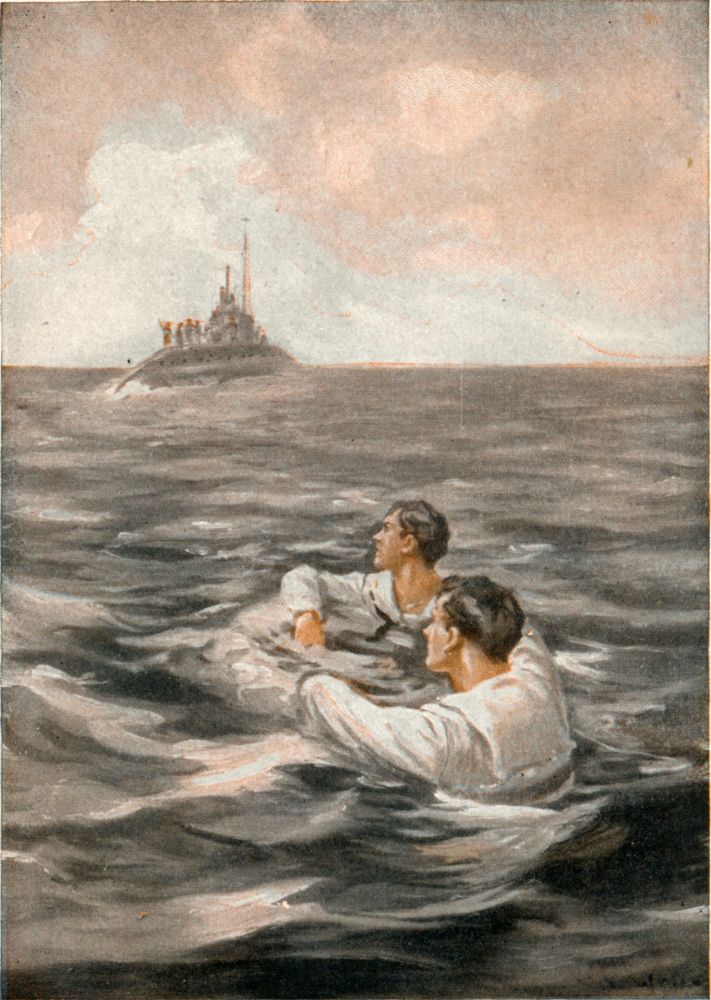
Silently they watched the U-boat’s approach. At first she had been only a low, grayish protuberance on the sea, all detail softened and obscured by the last wreaths of haze, but now, a few hundred yards distant, she was plain enough. They could see men on the deck forward of the queerly shaped conning tower and the sunlight glinting on the bow gun and the water curving away from the knife-like bow. Pete, watching thoughtfully, said:
“They’ll be askin’ us questions, Kid, if they take us aboard. They’ll want to know things it ain’t good for ’em to know. If we don’t say nothin’ they’re likely to bat us on the bean and drop us overboard again. I guess the best way’ll be to sort o’ string ’em along, eh?”
“Lie, do you mean?”
“Well, I wasn’t callin’ it that, but maybe it is. If you don’t like to do it, maybe you’d better leave [64]the jollyin’ to me. I ain’t got no conscience when it comes to deceivin’ a Hun an’ a enemy.”
“I don’t suppose it will be lying—exactly,” answered Dave. “Deceiving the enemy is—is different. Why don’t they sheer off a little? Are they trying to run us down?”
It did look so, for the U-boat came gliding on as straight for the two boys as though it meant to thrust its slender nose between them. At the last moment, however, when Dave was ready to throw himself back into the water, it swung slightly and its long gray hull passed a few yards away. On the bow was the inscription U-H-37. From the narrow deck a dozen sailors gazed down on them, mildly curious, while an officer, whose gold braid was tarnished and worn, stood beside the forward gun and a second and younger officer leaned against the curving base of the conning tower. Each, Dave observed, wore on his sleeve the two stripes and crown of a lieutenant. The submarine’s engines had made a very perceptible clamor during its approach, but now they were stilled, and the underwater craft slowed and stopped. It was the officer at the gun who spoke, and Dave thought he recognized him as the one who had shouted to the 944 [65]through a megaphone. He used no megaphone now, however, nor needed to, since only a dozen yards of water separated boat and life buoy.
“What ship you from?” he asked in good English.
“United States Chaser 944,” answered Pete.
“What you do in the water?”
“Shell knocked us in.”
“Want to come out?”
“You bet,” answered Pete, cheerfully.
The officer frowned mightily. “You talk to your officers like you talk to me, eh?” he demanded. “Suppose I go away and leave you there?”
“Sorry, sir,” apologized Pete. But Dave thought he didn’t look very sorry and feared for a moment that the U-boat commander would act on his own suggestion. Instead, though:
“Swim here and we take you on board,” he said. “You Americans have no manners. You are all pigs.”
They dropped off the life buoy and started for the submarine, but the commander stopped them sharply. “Bring with you that buoy,” he directed, adding grimly: “Maybe you need it again.”
A moment later, pulled aboard by some of the [66]crew, they stood on the steel deck and faced the commander. He looked to be about forty years of age, and had a very round face adorned by a broad nose over a grizzled mustache that ended in waxed points, and two sharp gray eyes under heavy, bristling brows. He looked not unamiable, and his first words were good-natured enough.
“You go below with this man and he will find you some dry clothing,” he said. “Then I will have a little talk with you.” A hatch mid-way between gun and conning tower was open and through this, one of the sailors, a squat, sullen-faced youth, led the way. A ladder ran straight down, and having descended it they found themselves in a surprisingly long white-enameled compartment, lined with bunks on each side. There was an indescribable odor down there, an odor that seemed to combine the smell of oil and of stale sea water and damp clothing. The bunks held only mattresses and tumbled gray blankets, and several were occupied. From a locker beneath one the sailor pulled out a heap of clothing which he spread out in silence on the floor of the narrow passage for their inspection.
“I don’t want any of the dirty truck,” growled [67]Pete. The sailor looked up and spoke crossly in German, but neither knew what he said. “Sure, that’s true enough,” said Pete, “but I ain’t hankerin’ for no disease, Dutchy.”
“I guess we’d better put them on until our own things are dry,” said Dave. “If we don’t they may shoot us or something.”
“Maybe you’re right,” agreed Pete. “Hello, look here!” He held up a blue cloth sailor’s cap, bearing the words, “H. M. S. Owl” on its ribbon. “What do you know about that? British, ain’t it?”
Before Dave could reply the sailor snatched the cap from Pete’s hand and tossed it into the locker, muttering angrily. Pete’s pale blue eyes snapped and Dave looked for trouble, but, restraining his resentment, the former stooped and picked up a suit of stained blue flannel and proceeded to doff his own wet clothes which were trickling water on the flooring. Dave followed his example. At that instant a terrific crashing and clattering assailed their ears and they started in alarm. But the sound was only that of the big Diesel engines taking up their task again. There was a perceptible tremor of the frail steel hull and through the open hatch above a fresh [68]current of air blew into the unfragrant quarters.
When they were dressed and their wet clothing had been taken charge of by the sour-visaged sailor they were led aft along the passage, past what appeared to be an officer’s stateroom, to the central station beyond. This was a compartment slightly longer than wide, under the conning tower. The walls were white, save where yellow rust stains showed, and were beaded with moisture. A ladder led upward to the tower and there was a bench at one side, but for the rest the place held only a vast and confusing array of machinery; huge valves, immense dials, steering wheels, compass, gauges, controllers, levers, and manifolds. A periscope terminated here, too, and against one curving steel wall a round clock ticked unheard above the roar and clatter of the engines. Pipes and cables and spreading wires were everywhere overhead and against the walls, and above the steering wheel a chart hung in a metal frame. There was but one occupant of the compartment when they entered, a petty officer, whose rating and branch mark, an anchor and cog wheel, surmounted by a crown, in silver, was unfamiliar to them.
As the boat was on the surface it was being controlled [69]from the conning tower. Two electric lamps cast a wan glow over the place, leaving it in a pale twilight through which the metal instruments gleamed mysteriously. Fore and aft the passage seemed to continue interminably, and aft, from which direction the clamor of machinery came, the big engines were partly visible. Pete strolled across and seated himself on the bench, but their custodian sprang toward him and broke into angry growlings.
“Oh, all right, sport,” sighed Pete. “But if you’d been pushing a life buoy all over the Atlantic Ocean you’d want to sit down, too.” He got up, in obedience to the man’s gestures, and interested himself in the reflector of the periscope, eyed by the sailor in sullen suspicion. Several minutes passed. Their ears began to ache with the ceaseless clamor of the engines, and the air, heavy with the odor of crude oil and battery fumes, was oddly oppressing. Then the hatch above darkened and the captain descended the ladder.
“Ah, you feel better now, yes?” he inquired genially. “So we have a little talk.” He seated himself on the bench and observed them with every indication of good will. “Your ship is a new ship, eh?”
[70]
“Yes, sir,” replied Pete. “Built two months ago.”
“And you are both seamen? Not what you call petty officers?”
“Seamen, sir.”
“The American navy is a very fine navy, I know. I have been in your wonderful country. You are building many new ships, I understand, to make war on us.”
“Yes, sir, quite a bunch of ’em,” answered Pete cheerfully.
“Yes, maybe fifty, eh? Maybe a hundred?”
“I don’t know how many. They ain’t tellin’ us.”
“So? Well, we know—we in Germany.” He chuckled deeply and winked at them. “We know much. You were on your way from New York when we met you, eh?”
“Yes, sir; Syracuse, New York.”
“Syracuse?” The captain frowned. “Where is that?”
“Just south of New Rochelle,” said Pete gravely.
“So? And you were going to—?” He paused, questioningly.
“I don’t know, sir. They forgot to tell us that. Somewhere across.”
[71]
“Maybe Queenstown?” asked the officer, slyly.
Pete shrugged. “Maybe. Or Dover. Or Plymouth. I don’t know.”
“How happened it that you were by yourself alone?”
“There was some more of us, but we got lost in a storm.”
“And the others? They were what you call chasers, like yourself?”
“Cruisers, sir; seven of ’em.”
“So? What were the names?”
Pete hesitated a bare instant. Then: “I don’t know ’em all, Captain. There was the Greenwich an’ the Chelsea an’ the Bronx an’ the Harlem.”
“You are lying, eh?” purred the officer. “There are no such ships in the American navy.”
“These is all new ones.”
“Ah, and how large are they?” asked the other, suspiciously.
“Well, middlin’ big, sir. I don’t know exactly. I guess the Bronx is about 8,000 tons. An’ the others is about like that.”
“Where did you part company with them?”
“Can’t say exactly. About two days out of Syracuse.”
[72]
“Where were they going to?” asked the officer.
“Same place we was, but I don’t know where that is.”
“Maybe they carried soldiers. Or maybe you had troop ships with you, too?”
“No, sir. Not this time.”
“How many soldiers have left your country to fight against us?”
“About a thousand,” answered Pete, unblushingly.
“A thousand! What you mean?” The captain scowled ferociously. “More, more than a thousand has come across! Many thousand! Stop your lying to me or I throw you straight into the ocean!”
“Well, that’s what I heard,” said Pete, untroubledly. “Maybe two thousand. You can search me.”
“Search you? What I search you for? What talk is it that you make?”
“That’s just a sayin’, Captain. What we call slang.”
“So? Well, don’t talk with me slang. What is the trouble with this man? Can he not talk?”
“Sure, he’s a fine little talker, Captain, but he [73]ain’t all there.” Pete dropped his voice confidentially and tapped his head and winked. “He is what we call ‘nutty.’ Get me?”
“‘Nutty?’ Crazy, you mean?” The captain observed Dave with new interest and in silence for a long minute. Then he nodded his head. “Yes, he looks not quite right. What is your name, you?”
“David Garson,” prattled Dave. “I’m eighteen years old and small for my age, but they say I’ll grow.”
“Small! Grow! What is he saying? Never mind. It does not matter.” The captain lost interest in Dave and returned to his questioning. For another quarter of an hour he put all kinds of inquiries at Pete and received all kinds of answers. Occasionally he looked suspicious, but on the whole appeared satisfied with the information. He asked about the sentiment in the United States regarding conscription, how many men were in training, when they were to be sent across, how many United States ships were operating in French and British waters, what their armament was, where they were based. And he wanted to know how America felt toward Germany, and whether she expected to win the war. [74]And, finally, he asked whether a certain German restaurant was still doing business in New York! In the end he said:
“Now I require you to give me your parole, your promise not to attempt to escape. Then you are treated fine and get plenty of food, and I put you ashore pretty soon. Well?”
“Nothin’ doin’, sir,” replied Pete.
“Eh? What you mean, nothing doing? Much will be doing if you do not do like I say!”
“That’s all right, too,” said Pete doggedly, “but you don’t get any promise like that from us, Captain. If we get a chance to beat it, we’re goin’ to beat it, take it from Pete!”
The captain frowned more ferociously than ever, and for a fearsome moment Dave, who had all through the latter part of the interview tried to look as vacant and unintelligent as he knew how, was horribly afraid that he would order them shot or tossed into the sea. But after an instant the captain’s frown vanished and he chuckled.
“You are brave, my man. Also you tell the truth, eh? Well, so be it.” He laughed good-naturedly. “You have my full permission to—what you say?—‘beat it’—if you can! But since [75]you do not give your parole, you must work for your living, yes. And if you do not work like you are told you will be punished. Maybe you like that better, eh?”
“Sure, we’ll work, Captain. Just as long as you don’t ask us to sink any of our own ships, we’re right on the job.”
“So? We shall see.” He spoke in German to the sailor. Then: “Go with this man,” he directed. “He will show you where are your bunks. You will go neither forward nor aft from the quarters. You understand?”
“Yes, sir.”
The captain waved his hand. “Vorwärtsgehen!” he ordered.
“Meanin’ heraus mit us,” muttered Pete.
[76]
The sailor indicated two upper bunks and left them by way of the forward hatch to their own devices. There was a table where the passage was widest, a greasy, much-stained affair that evidently came to pieces when not wanted and was stowed away somewhere. It was the only thing in the quarters that offered a seat, aside from the bunks, and Pete perched himself on it and looked about him.
“Well, here we are, Kid,” he said, cheerfully. “Say, I never expected to be entertained on board a German sub! What do you think about those bunks?” He nodded toward the two that had been awarded them. “Not what you’d call invitin’, eh?”
Dave shook his head. “I hate to think of sleeping in them,” he answered. “But I suppose we’ll have to.”
[77]
“I guess so. Others is doin’ it.” The fact was evident from the sounds that came from several of them. “Well, I’ll try anything once.”
“I guess they don’t mean to shoot us, anyway,” said Dave.
“No, they’ll hand us over to their friends on shore and we’ll kick our heels around one o’ their prison camps for the rest o’ the war, I guess.”
“But that’s fierce!” protested Dave.
“Yeah, ain’t it? Well, then, what we’ve got to do is find a way out o’ this.”
Dave looked uneasily about him. The compartment was illy lighted and the bunks were gloomy caverns, but a number held occupants, and there was always the chance that one of the latter might understand English. He reminded Pete of that fact.
“That’s right, too,” agreed the latter, sinking his voice. “Anyway, there ain’t anything we can do right now. I wish I had some chow. I’m starved. Wonder when they eat on this Pullman.”
“Maybe there’s a buffet on board,” suggested Dave, making a weak attempt at a joke.
“Sure, why not?” Pete slid off the wabbly table and went prospecting forward. The compartment was about forty feet in length and held twenty-two [78]bunks in two tiers, twelve on one side and ten on the other. At the forward end, in place of the last two bunks on the port side, stood an electric range, a cupboard for dishes, a small sink, and a big coffee tank whose copper surface glowed dimly in the half-light. There was also, below the cupboard, an ice box. To Pete’s delight the coffee, although the electric coil beneath the tank was not going, was still lukewarm, and he found two aluminum cups and held them under the spigot. There was no milk in the coffee, but it was sickeningly sweet. They were not fussy, however, and drank two cups of it. Then Pete discovered another cupboard across the passage and rightly suspected that it held food. But as it was locked he couldn’t profit by the discovery. They peered through the forward bulkhead door and were confronted by gray gloom through which loomed big tanks and huge pipes and long metal cylinders.
“Torpedo compartment,” murmured Pete. “If they catch us lookin’ they’ll shoot us through a tube, I guess.”
They went back, and finding an unoccupied lower bunk, made themselves as comfortable as they might against the supporting uprights. From the tiny [79]round hatch overhead a golden column of sunlight slanted down. From the engine room, far aft, came the deafening noise of the Diesels. There was a rather soothing side-to-side motion quite different from that of an ordinary boat.
“She must be a pretty big one,” said Pete. “’Most two hundred feet long, I guess. What was the number on her?”
“U-H-37.”
“What’s the H for, do you guess?”
“It’s the class number. The U stands for Untersee.”
“They wouldn’t have to tell us that,” jeered Pete. “Any one could tell it wasn’t a flyin’ machine. Wonder what it’s like when the crazy thing sinks. Blamed if I see how we’re going to get away from here, Kid. I talked sort o’ big to the cap., but I guess our chance of makin’ a get-away ain’t worth a whole lot.”
“S-sh!” cautioned Dave. There was a stirring in a nearby bunk, and slowly there emerged the lower body of a sailor. There was a prodigious yawn and then the rest of the man came into view. He looked to be about thirty, and was small and thin. The face that turned in their direction was [80]pale and tired and apathetic. Later they found the same true of most of the countenances seen on the boat. The man disentangled himself from a gray blanket, and thrust his feet into a pair of boots. Then, yawning again, he arose and came toward Dave and Pete. In front of them he stopped and stared hard. Then:
“Where’d you fellers come from?” he asked in good English.
“Your old man pulled us out o’ the water an hour or so ago,” answered Pete. “Say, I seen you before somewhere, ain’t I?”
“I don’t know. Maybe so. I lived in New York a good while. You come from New York?”
“Sure! Where was you in New York?”
“All around. I’m a waiter. I worked in ’most a dozen places there. I was there nine years.”
“Well, I seen you somewhere, all right. How do you like this job? Beats waitin’, eh?”
“It beats everything,” said the German with grim humor. “It is awful.” He scowled darkly. “Pretty soon I’m going to chuck it. Where did you live in New York?”
“All around.” Pete waved a hand vaguely. “Vanderbilt, Astor, Plaza—all them places.”
[81]
“You’re joking,” replied the other, without a smile. “What has happened? I went to sleep after we chased a little American yacht. Were you on that?”
“We was. Now we ain’t. It’s the fortunes o’ war. Say, what happened to her? Did you thugs get her?”
The man shrugged. “I do not think so. It was very foggy.”
“Fine! What time do we eat here?”
“Twelve o’clock. It ain’t eating, though. It’s just—just—” He shrugged his shoulders, at a loss.
“Don’t sound good to me,” said Pete, shaking his head. “Your captain told us we’d get treated fine an’ have plenty of food. If the chow ain’t good, I’ll leave. I give you fair warnin’, friend.”
The German didn’t seem to have a smile left in him, however. He only shook his head glumly. “They won’t let you go,” he said. “If you behave, maybe they’ll take you ashore, and you’ll go to a prison.”
“If we behave!” ejaculated Dave. “What will happen if we don’t?”
The German shrugged again. “I don’t know. [82]I guess the captain will throw you overboard and let you drown.”
“I don’t think I like your captain,” said Pete. “Drown is what we’d do, too, for the thief swiped our life-vests.”
“You mustn’t call the captain a thief. If he heard you he would punish you. I must go now. I hope all goes well with you. I like Americans. I have many good friends in New York.”
“You mean you had,” said Pete, gruffly. “If you like Americans, what in thunder are you fighting ’em for?”
“But it is not my country, America. I fight for my country.”
“Go to it, bo! It won’t get you much!”
“I hope he chokes,” growled Pete when the sailor had taken himself aft down the long, dim passage. “They make me tired, that sort. Come over to the U. S. A. and make a good livin’, an’ then, when trouble starts, beat it back here an’ try to strafe us. If I had my way I’d dump the lot of ’em in the harbor before they got a chance.”
“But there are lots that haven’t done that, Pete. Many German-born men are now good Americans.”
[83]
“Sure, that’s so. But guys like that gets my goat. Hello, what’s happenin’ now?”
“Tauch station!” came the command along the passage.
There was a sudden silence, for the moment more appalling than the former clamor, followed by a rushing sound of water on all sides. The light from the hatch was cut off and they heard the latter clanging shut. A man hurried into the compartment, climbed the ladder beneath the hatch and secured it with bolts. The rushing of water continued for a full two minutes and then stopped, and in the ensuing stillness they heard low voices of command from the central station. What the words were were beyond them, but the result was soon perceptible, for there came, instead of the noisy clatter of the oil engines, the low purr of the motors, the forward end of the submarine tilted downwards, producing a disconcerting effect on the boys’ stomachs, lights sprang into brilliancy up and down the compartment and they knew that the U-H-37 was submerging. Somewhere at hand an electric gong rang loudly. Mutters came from the depths of light-flooded bunks and, one by one, five occupants crawled forth.
[84]
“We’re diving,” murmured Pete in an awed voice. “I never thought I’d be scootin’ around under the ocean, Kid. Say, supposin’ they couldn’t get the blamed thing up again!”
The newly awakened sailors, a weary-eyed, listless looking lot, viewed the boys with a mild curiosity that had changed to indifference by the time they had donned their sea boots and shuffled out. The submarine was on an even keel now and, save for a slight sidewise motion, they could not have told whether it was going ahead, astern, or lying still. But the swing and the hum of the motors suggested progress. Pete’s countenance bore an uneasy look and he viewed the moist walls with a striking absence of enthusiasm.
“I didn’t count on this sort o’ thing when I enlisted,” he demurred. “Do you guess that captain knows what’s he up to?”
“Or down to?” suggested Dave. “I guess he’s done this before, Pete. Do you suppose we’re just under the surface, or way down?”
“Way down, because she was slanted a long time. Say, it’s sort o’ wonderful, ain’t it?” Pete grew more reconciled as nothing alarming followed the plunge. “Think of sailin’ along under the [85]ocean like this, with electric lights an’ beds—sort o’—an’, I hope, food! You got to hand it to ’em, Dave, these Germans. They’re cute, all right!”
“We invented submarines ourselves,” Dave protested, patriotically.
“Sure, I know that. An’ maybe that guy Napoleon invented war, but the Germans improved a lot on it, Kid! I guess the trouble with us fellers is that just as soon as we’ve gone an’ invented a thing we lose interest in it, an’ some other guy has to take a hold and fix it up shipshape an’ proper. Look at the flyin’ machine. We invented that, too, didn’t we? Well, they tell me that all the flyin’ machines we’ve got you could put in your eye.”
“But we’re building a lot of them.”
“Yeah, an’ submarines, too. That’s where the Huns have the edge on us, see? They ain’t buildin’; they’ve built!”
Presently another man crawled out of a bunk at the galley end of the quarters, yawned, and busied himself about the stove and food lockers. If he saw the prisoners he paid them no attention. Presently he donned a dirty white jacket that covered him to the knees, and began the preparation of the midday meal. Pete sniffed approvingly as the odor [86]of cooking began to permeate the already none too fresh air of the compartment.
“Wonder will it be beefsteak?” he said. “What’s it smell like to you, Kid?”
“Something horribly German,” replied Dave, disgustedly. “Maybe some of their beastly sausages.”
But it proved later to be neither beefsteak nor sausage, but a thin, watery stew that held many half-cooked vegetables and little meat. With it there was plenty of grayish bread and some greasy substance that was used as butter, but that had certainly never seen a cow. There was coffee, too, and, as dessert, dried pears stewed in molasses. Dinner was consumed by the crew in relays. The warrant and petty officers ate first and then the men. No one sat down to the table, although some perched themselves on the edges of the nearby bunks. There was little conversation. The men ate methodically and without apparent enjoyment, drinking cup after cup of the over-sweet coffee, now heated to boiling temperature. The air in the quarters was hot and stagnant and filled with all the odors of the boat and of the cooking.
As none offered food to Dave and Pete, they presently helped themselves from the bowls on the table [87]and presented their cups to the silent, phlegmatic cook for coffee. One or two of the sailors tried to talk to them in German, but soon desisted when Pete replied in English. There were black looks from some, but for the most part petty officers and men seemed absolutely indifferent to the boys’ presence there. Perhaps, thought Dave, prisoners were frequent aboard the U-H-37!
The afternoon passed slowly. The promised work didn’t materialize. Dave amused himself trying to read a German magazine that he found under a bunk, but what little he had learned of the language was not equal to the task. Pete whistled or hummed and frequently expressed a longing for chewing gum. Once the torpedo crew went forward and busied themselves mysteriously, but nothing interesting followed, and after an hour or so they returned, muttering gutturally as they passed. They didn’t see the English speaking man again until supper time, and then not to talk with. After washing his pots and pans the cook crawled back into his bunk and was seen no more until just before the evening meal. Pete said he guessed that if he had to be on a submarine, he’d prefer to be the cook. Once or twice water gurgled and rushed [88]through the pipes and the submarine tilted her nose up or down, but she didn’t get back to the surface. Dave had removed his watch from a trousers pocket before relinquishing his own togs, and now he managed to get it going again, setting it by guess work. It was a long, dull afternoon, unbroken by any incident of interest. Men crawled in and out of bunks, snored or read papers, made periodical trips to the coffee tank and paid no more attention to the prisoners than to so many flies.
Supper was worse than dinner because there was less of it. The atmosphere got staler and heavier with every passing hour, and Dave found that he could hardly keep his eyes open after he had consumed a small portion of tasteless canned meat. Even the coffee he drank failed to exert the usual wakeful effect, and after being banished from the bunk they had perched themselves on by the scowling owner of it, they climbed to their own dirty mattresses and stretched out. Dave stared a while at the white arch of steel above him, with its cluster of white pipes and yellow stains and trickling drops of water, and tried to realize the strangeness of his circumstances, but his eyes were too heavy to stay open and his brain too sleep-drugged to work, [89]and in a very few minutes he was sound asleep.
It seemed but a few minutes later, although it was in reality many hours instead, when he was awakened by the tocsin-like alarm gong. Up and down the long compartment, bunks were emptying. Hurrying feet echoed in the passage. He caught the word “torpedo” among others. Another bell rang, this time farther away, and with a tinkling sound. The junior officer, whom Dave had not seen since they had boarded the submarine, passed on his way to the forward torpedo compartment. From that mysterious chamber came strange sounds, the rushing of water in tanks, the sounding of grating metal, the rolling of heavy wheels, sharp words of command. He scrambled from his bunk and climbed to where he could awaken Pete. But Pete was already awake.
“What’s the silly row?” he demanded, blinking.
“I don’t know for certain,” answered Dave, excitedly, “but I think they’re going to make an attack!”
“Who is?” asked Pete, dazedly.
“Why—why, the Germans!”
Pete threw his legs over the side and searched [90]for his boots. “Are, eh? Well, this is no place for your Uncle Pete, Kid! Gangway!” He landed on the floor with a thud. “If one of our chasers gets to droppin’ depth charges around I want to be where I can run!”
[91]
“Do you suppose it’s one of our ships?” asked Dave, anxiously.
“You can bet it ain’t one o’ their own, anyway. Gee! I wish we could rock the boat, or somethin’, so they’d miss their shot! We’re slowing down.”
“How do you know?”
“I don’t know, but I sort o’ feel it, just as I sort o’ feel that we’re running just under, with the periscopes stickin’ out. Listen, Kid!”
The boat was strangely silent, for the motors were purring more softly and, with every man at his station, there were no footfalls echoing against the steel walls. Occasionally a short command came from the central station and now and then a click or the burr of sliding metal reached them. Silence and suspense wrapped the gleaming cylinder as it went gliding slowly and stealthily through the midnight sea. Dave’s watch, somewhere near correct, [92]showed the time to be shortly before three. The torpedo compartment emitted few sounds. Dave pictured the junior officer, finger on button, awaiting the command. Then there came a sound from the bow like none that Dave had ever heard, a sort of “Gr-r-rh!” such as a contented tiger might make. There was a barely perceptible shock underfoot and he knew that the death-dealing missile was on its way.
He waited, staring with wide eyes at Pete, but no sound reached them until there was a second growl from the torpedo compartment. Then the boat awoke to activity. The motors hummed more loudly, men hurried through the quarters, the submarine’s nose tilted slightly upward. The torpedo compartment was noisy once more.
“Whoever she is,” said Pete glumly “they got her. If they hadn’t they wouldn’t be goin’ up.” Dave nodded agreement, and Pete sunk his voice. “Kid,” he whispered, “are you game to take a chance?”
“Do you mean—escape?”
“Sure. If they get busy with that ship we might get away without their knowin’ it.”
“But where to, Pete? How?”
[93]
“I don’t know, but I’d a heap rather be floatin’ around in the ocean than here! If only we had those life-vests!”
“Wonder what they did with them.”
“Those these fellows wear are a lot better,” said Dave. “They blow them up. Do you suppose we could find a couple?”
“If we knew where to look.” Pete gazed around. “Trouble is they’re all wearin’ ’em. Maybe there’s extra ones aboard, though. Where would they keep ’em?”
“In the lockers, do you think?” There was a row of lockers under the berths on each side, and Peter, making certain that no one was approaching, stooped and pulled one open. But only a litter of clothing and boots rewarded him. Footsteps in the passage made him close the locker quickly and the German who had talked to them in English came toward them. For the first time his countenance held something approaching a smile.
“We got her,” he said. “She’s a big one, too.”
“What’s her flag?” asked Pete, resisting a desire to plant his fist in the middle of that smirking face.
“Italian, I think.” Then his lips closed tightly [94]and he glanced apprehensively behind him. “Maybe I should not tell you,” he muttered.
“Look here,” said Pete. “Suppose we get in trouble. What are we goin’ to do, this feller an’ me? Drown, eh? Can’t you find us a couple of those life preserver things like you got on?”
“There will be no trouble. The ship is already sinking and they are getting into the boats.”
“Yeah. But suppose a destroyer walks in on us? It’s a fine note for all you guys to have life-vests an’ leave us to sink! What would we do if we was attacked, eh?”
Dave always maintained that the sailor suspected their purpose and was not unwilling to aid them. At all events, after a moment of hesitation he answered: “All right. I’ll see if I can get some.”
He went aft and disappeared beyond the bulkhead. By now the submarine was rolling from side to side and pitching slightly, and it was evident to the boys that she was on the surface. In a minute the sailor was back with the desired life-vests. He handed them over with an air of secrecy. They were, unlike the bulky, cork-filled canvas life-belts of the United States navy, garments of some finely-woven, waterproof material that fitted about the upper [95]body beneath the arms and were held in place by one strap and a buckle which could be quickly adjusted and secured. A mouthpiece at the front was easily reached for inflation. Having put them on, the men blew them up sufficiently to secure buoyancy in the water but not enough to make them cumbersome or to hinder them at their work. Once in the water, it was possible to increase the inflation as desired. Having delivered the life-vests, the German hurried off again, and Dave and Pete quickly slipped them on.
“That’s better,” muttered Pete. “I ain’t much of a swimmer, an’ I feel a heap safer if I got one o’ these things on. Now let’s see how the land lays.”
They walked back to the central station. Two sailors were standing idly there, and they viewed the prisoners with scowling suspicion. Pete drew back. “That won’t do,” he said, as they returned. “If this hatch here was opened we might have a chance.”
“But they’ll see us,” objected Dave, viewing the hatch somewhat dubiously.
“Sure, but if it’s dark maybe they won’t notice us much. We’ve got the same togs as the rest [96]of these Huns. Anyway, we can’t get away as long as we stay down here, that’s sure, ain’t it?”
Dave acknowledged that it was, and for a minute or two they studied their predicament in silence. They were still short of a solution when a sailor entered and started up the hatch ladder. Pete nudged Dave, and they watched tensely. The sailor began turning the screws that held the clamps. Then he descended the ladder, said something in German that, whatever it was, sounded good-natured, and disappeared again. Pete started forward, but Dave held him back.
“Wait a minute,” he said. “Maybe they’ll open it from above.”
They did. The round cover creaked back, and they looked up against a blue, moon-lighted sky. From the deck came the trampling of feet and the murmur of voices. Pete led the way up the ladder, Dave close behind. Gusts of cool, fresh air met them. Then Pete’s head was through and he looked warily about him. Most of the crew were on deck. The forward gun had been raised from its housing. Some two hundred yards distant, right in the path of the moonlight, lay a great black hulk on which a few lights shone dimly. Pete nonchalantly stepped [97]through the hatch and Dave, his heart beating hard, followed. No one paid them any heed. About them on the narrow deck, the crew stood and gazed at the disabled ship, which, even in the uncertain light of the descending moon, showed herself to be sinking. There was a distinct cant from bow to stern. As the boys looked, a smaller object crossed the moon’s path, evidently one of the ship’s lifeboats drawing away. Suddenly, from the conning tower at their backs, a stream of white light shot across the ocean and a great round disc of brilliancy passed along the sinking steamship from bow to stern, and then slowly moved back to a point just aft of amidships where a gaping hole had been torn in the hull. Then the light went out as suddenly as it had appeared and the boys blinked in the succeeding darkness.
“Come,” whispered Pete, and tugged at Dave’s sleeve.
They pushed their way aft toward the conning tower. Once a petty officer peered closely in their faces as they passed, but the moonlight was behind them and it is doubtful if he recognized them. At least, he made no effort to detain them, and they went on. In the conning tower, as they knew, stood [98]the commander and the junior officer, but they put their heads down and Pete shuffled along as he had noticed so many of the crew shuffle, and they squirmed their way past the tower to port, on the narrow width of deck there, and saw, to their relief, that the after part of the boat was deserted, save for one dark form near the stern. As they drew near to him they saw that he had his back turned. Evidently he was a lookout, intent on searching the moonlit darkness for such disturbing factors as patrol boats. The submarine was still floating slowly toward the torpedoed ship, her propellers turning lazily under the stern overhang. The after gun had not been raised and the deck was clear, but just beyond where they paused for an instant in the shadow of the tower to kick off their boots a gleam of light was thrown upward through the after hatch. As they skirted the opening they peered down into a maze of engines and got a flare of hot, oily air in their faces. For some reason the U-H-37 was still operating with her motors.
In the gloom of the conning tower Pete had whispered: “If he makes any trouble, kid, leave him to me,” and now, as they went quietly aft, Dave was hoping that the lookout would not see them. Two-thirds [99]of the way from tower to stern the deck began to slope. Just short of the cigarshaped stern a small platform arose above the grade, and beyond it was what looked to be an auxiliary rudder. It was on the small platform that the motionless lookout was standing and it was beyond him that Pete intended to take to the water, since there the deck was but a scant foot above it and it might be possible for them to slide off without being heard. But to pass the lookout without being seen was, of course, impossible, and Dave wished that Pete would risk a splash rather than an alarm from the sailor. But that wasn’t Pete’s plan.
He led the way straight to the platform. When they were a few feet distant the lookout turned slowly, observed them and again turned away. But as they still approached he became curious and once more faced them.
“Was is?” he growled.
Pete replied with about all the German he knew.
“Heraus mit!” said Pete.
Then his fist shot out and up, there was a faint grunt from the lookout and he dropped to the curving side of the hull and rolled, like a log, into the sea.
[100]
“Beat it!” warned Pete. He threw himself down, grasped a protruding ring bolt and slid into the water. Dave was only the fraction of a second behind. The water was so cold that it took his breath away for a moment. Then he heard Pete’s voice again. “This way, Kid! Straight back!” Dave followed. The life-vest held him up wonderfully and yet left his arms free for swimming. He pulled even with Pete without difficulty, and side by side they put the yards between them and the submarine. Not a sound had so far come from the lookout, but now, behind them there arose a sudden commotion in the water and a wild shout of alarm. “Swim hard,” panted Pete. “If they come back for that guy they’ll get us sure!”
The sea was calm, with small, choppy waves that splashed their faces. Dave was horribly conscious of the moonlight about him and he imagined that from the submarine he and Pete must stand out so conspicuously that those aboard could not fail to see them. But the submarine was attending to other matters and had already drawn well away. The lookout continued to cry for help, but when Dave turned to look the U-boat still had her stern toward them and was apparently not troubling about him. [101]Probably, as they decided afterwards, the officers thought the lookout had tumbled overboard and that it would serve him right for his clumsiness to let him float around awhile. There was no danger of his drowning so long as he had his life-vest inflated.
They swam on and on, as straight away from the submarine and her sinking prey as they could direct their strokes, but it wasn’t long before it became evident to Dave that Pete was tiring. “I’m—all in,” panted the latter presently. “Maybe you’d better go ahead, Kid. No use in their getting both of us. I’m a punk swimmer, anyway.”
“Let’s rest awhile,” answered Dave. “I’m tired too.” That wasn’t very truthful, for Dave had swam from the time he was old enough to enter the water and was not so easily exhausted. “If they decide to come back and look for us, they’ll get us anyway. All they’ve got to do is throw that searchlight around.”
“All right,” agreed Pete. “We’ll float for a few minutes. Swimmin’ gets my wind somethin’ fierce!”
They let themselves go, just paddling enough to keep their heads up. The steamship was no longer [102]in the path of the moonlight, and at first they couldn’t locate her. Then, however, they did, and saw that she had tilted one end well out of water. A single dim light still showed. The submarine was not discernible, probably being lost in the shadow of the larger craft. Once Dave thought he heard the rattle of oars, but when he told Pete, and they both listened hard, no sound reached them save the splash of the waves.
“It’ll be daylight in an hour or so, I guess,” said Pete after a short silence. “We’d better get at it again, Kid. Come on.”
“Which way shall we go?” asked Dave. “If we knew where the life-boats were—”
“Yeah, but we don’t. Best we can do is to get as far away as possible. When daylight comes maybe we’ll see something. Say, an ocean’s a mighty big body o’ water, ain’t it? Are you wishin’ you was back on the sub, Kid?”
“No, I’m not,” answered Dave decisively. “We’re better off here. These life-vests will keep us afloat for days, I guess, and we’re certain to be seen by some sort of a ship before long. Spending the next year or so in a German prison camp didn’t appeal to me a bit, Pete.”
[103]
“Same here. This is a big chance we’ve taken, an’ maybe I was a mut to get you into it, Kid, but as for myself, why, I’m satisfied so far. This water ain’t feelin’ so cold as it did, an’ if only I was a decent swimmer I’d have no kick. If I give out, Kid, you beat it along.”
“Yes, I’m likely to,” said Dave. “Which direction is east, Pete?”
“Must be opposite where the moon is goin’ down, or nearly. More that way, I guess. Think we’d better set our course east?”
“Well, that’s where the nearest land is, I suppose.”
“Sure, unless we’re a lot closer to Ireland than we know of. All right, Kid, let her go! I’m feelin’ fine now.”
Keeping the moon, now well down toward the horizon, over their left shoulders, they struck out again, two tiny wisps in a wide, darkening world of water.
[104]
Time passed. They rested at intervals and, having rested, swam again. Gradually the fear of recapture passed. The moon was gone and the limitless expanse of ocean was dark and submarine and prey were swallowed in the gloom. They talked infrequently, conserving their breath for the struggle for life. Always they listened for the sound of oars and peered into the gray darkness with straining eyes. The small boats from the steamship must be within a few miles, they argued, and they longed for daylight. Gradually the eastern sky paled, then flushed with rose and the sea became dimly visible in that direction. They swam straight for the coming day, not hurriedly, but with slow, even strokes that required a minimum of exertion. Pete had got his second wind or had discovered a less exhausting way of breathing. Swimming with life-vests on was more difficult than had at first appeared, for the garments had a tendency to float [105]them too high in the water. Dave let some of the air from his, but it didn’t help much. As the sea and sky lightened they searched anxiously for boats, but, although now and then the crest of a distant wave, darker than others, set their hearts leaping, they saw none. Daylight came fast, having once announced itself. The western rim of the ocean faded from darkness to dusk, from dusk to pearly gray. In the east the tender tint of rose changed to yellow and, like a miracle, it was day! The orange rim of the sun pushed itself above the horizon’s curve and dyed the tips of the little waves with strange metallic colors. A tern cried overhead and swooped downward to splash against the water and go beating up again, having found its breakfast. But save for the bird, daylight came up over an empty world.
“Those boats must have gone in the other direction,” said Dave, as they rested again, with the pale sunlight dazzling their eyes with its long beams. “But I don’t see why, Pete. The nearest land must be the French coast, and that’s eastward.”
“Maybe the Huns sunk the lot of ’em,” replied the other grimly. “That’s a favorite trick of theirs.”
[106]
“But we’d have heard the guns,” objected Dave. Pete nodded.
“Yeah, that’s so, too. Well, I don’t know much about this part o’ the world, Kid. Ain’t there anythin’ but France lyin’ around here?”
“It depends on where we are, of course. I figure that we must be somewhere west of France and south of Ireland. Maybe we’re making a mistake in swimming east, Pete. Maybe we ought to go north. If we’re nearer Ireland—”
“I guess it don’t cut much ice which way we swim,” said Pete. “The best we can do is keep afloat. How you feelin’?”
Dave considered a moment. Then: “I’m tired,” he answered. “But I guess I’m good for another hour or two’s swimming.”
“I’m not. Besides, what good’s it going to do us, Kid? We’re just as likely to get picked up here as two miles away. Best thing for us is to take it easy and not get all tuckered. I’m beginnin’ to think we’d ought to have stayed where we was, Kid. It don’t look good to me.”
Dave said nothing. It didn’t look good to him, either. It would have been very easy for him to have given way to panic just then. But he took [107]a grip on himself and once more raised himself from the water and stared in all directions over the glinting waves. Something that was surely not a green crest caught his attention. It looked to be the better part of a mile away, and, having found it, he straightway lost it again between the waves. It was fully a minute before it came into sight a second time, and he saw that it was, if not actually a boat, at least some floating object that promised aid. They made toward it with weary muscles. It appeared to be drifting slowly southward, and presently they had to alter their course in accordance. Gradually it became clearer, and they could determine that it was not a boat, since it lay too low in the water. It seemed hours before they at length reached it. When they did it resolved itself into a hatch cover some eight feet long by six wide. It was painted buff and had a figure 3 in one corner in black. It was several minutes before Dave was able to pull himself over the edge and lie sprawling on the curved surface. Then he reached a hand to Pete, and the latter squirmed, panting hard, out of the water. They stretched themselves face down on the wet surface and lay there silent and motionless for a long time. The hatch made an unquiet raft, for [108]with their weights on it it lay low in the sea and tilted and tossed continually. It was never for an instant dry, since the waves washed across it, but they had no fault to find with it, you may be certain.
I think each of them drowsed a little, with the sunlight warming their chilled bodies, and then Dave sat up cautiously and Pete regarded him dazedly for a moment and grinned slowly.
“Not so worse, Kid!” he sighed. “A little damp, but Oh, boy!”
“If we could only hoist something, Pete,” said Dave. “I’m afraid we don’t show up very plain.”
“There’s nothin’ to hoist and nothin’ to hoist it on. We got to keep our eyes peeled an’ when we see a ship we got to stand up, one o’ us, an’ wave a shirt. You lie down an’ rest your hands an’ face, Kid, an’ I’ll be lookout for awhile.”
“No, you’re more tired than I am,” replied Dave. “You go to sleep and I’ll do the ‘spotting.’”
Pete demurred at first, but finally consented. “If I roll off, Kid,” he muttered, closing tired eyes, “fish me out, but don’t wake me, see?” In less than a minute he was snoring deeply, sprawled out on his back. Dave, swaying with the short toss of [109]the hatch cover, watched for smoke or sail, his own eyes threatening to close every moment. The sun climbed higher and higher. His watch had stopped again at a little after four, and he had to guess at the time and guessed half-past eight. A myriad of tiny black birds swept overheard, rising and falling, and disappeared against the blue of the sky. A gray mist hid the horizon now, but there were few clouds in sight. After an hour or so Pete awoke of his own accord and Dave slept. When he returned to consciousness the sun was well overhead.
“You know what’s goin’ to get us, Kid,” observed Pete, soberly, “is thirst. I could drink a bucket of water this minute and not know I’d had it.”
“Shut up,” said Dave. “I was trying to forget it. How long can a fellow go without water, Pete?”
“I don’t know. Seven days, is it? No, that’s a camel. Wish I was one o’ ’em! It’s gettin’ mighty hot, too, Kid. That don’t help much, take it from Pete!”
Talk lapsed. Thirst increased as the sun beat more hotly upon them. What breeze there was came from the southeast, and was too faint to afford much relief. They took turns at lying face-downwards [110]to relieve their eyes from the incessant glare and glitter of the dancing waves. The afternoon, between two and four, was more intolerable than the morning hours. They laved their heads and faces with salt water at intervals, or held their wrists under. There was no sleepiness now; only a languor that made movement, or even conversation, distasteful. After a long, long while their shadows began to lengthen across the raft and the breeze strengthened. Their mouths were dry and salty, and talking, when they felt any inclination toward it, was difficult. Peter said his tongue was getting too big for his mouth.
They searched the horizon continually, but without result. Once a faint smudge of something that might possibly have been smoke showed against the haze to the west, but it was gone almost before Pete had drawn Dave’s attention to it. Shortly before sunset the breeze dwindled again to a mere breath. They experienced no hunger, but had queer, sharp pains inside them. They were beginning to lose hope of rescue now, although neither said so. About eight o’clock Pete dozed off, and Dave, feeling very lonely and despondent, sat and watched the shadows grow in the hollows of the waves. The [111]change from the extreme heat of the sun to the chill of evening made him shiver in his damp clothes. He lay down to escape what breeze was stirring and the water that washed over the curving surface of the hatch seemed warm in comparison. He closed his eyes for an instant and must have slept, for when he awoke, startledly, the daylight had almost gone. Pete was leaning above him and shaking him hard.
“Wake up, Kid! We’re all right! See who’s here!”
Pete’s words were thick and difficult to make out, but the tone of them told enough to make Dave sit up quickly and peer about him in the gray twilight. Black against the lingering radiance of the western sky, so close that he could hear voices on deck, floated a long, slim destroyer, while, halving the distance, was a small boat, heading straight toward them.
Dave tried to speak, but for a moment his swollen tongue and dry lips made no sound. When he did make himself heard his voice was only a mumble.
“Is she—German?” he managed to ask.
“German!” babbled Pete, thickly. “No, sir, she’s good old U. S. A., Kid! And,” he added with [112]an attempted laugh that sounded like a croak of a raven, “we’re back home!”
“Back home?” repeated Dave, confusedly.
“Sure! A United States deck’s United States territory, ain’t it? And, listen, Kid, there’s water over there! Fine, wet water! Oh, boy!”
Ten minutes later their troubles were over. They were heaped under blankets in two narrow bunks and their parched throats had known the blessed joy of a few sips of water. A young medical officer with an ensign’s grade was in stern authority.
“You can have more presently,” he said. “Keep those blankets up to your chin, you freckled face fellow! What’s that? Food? Oho, I guess there’s not much the matter with you, then! Yes, you’ll get some broth after a while. Now just stow the talk and keep quiet.”
They must have obeyed, for when Dave opened his eyes again the destroyer’s engines were clattering and thumping busily and the ship was swaying at a fine rate. Some one was playing on an accordion further along the deck, and Dave, smiling contentedly, murmured the words to the merry tune: “Where do we go from here, boys, where do we go from here?” Then:
[113]
“Pete!” he called above the clamor of the engines and the creaking of the hull.
“Hello?”
“Awake?”
“Sure!”
“How are you feeling?”
“Dry! Hungry, too! I could eat a raw dog!”
“So could I,” answered Dave, and was quite convinced that he meant it. “What time is it, do you think?”
“Search me! And I don’t care. But if some guy don’t fetch me somethin’—”
“Pour this into your lockers,” said a voice. It was the medical officer again, and with him was a man in a soiled white jacket who balanced bowls of steaming broth. They ate ravenously—or drank, if you prefer—and then were allowed nearly a half cup of water apiece. And after that Pete found his voice again.
“Gee, but that was great, sir!” he said. “Do I get any more?”
“Yes, in the morning,” answered the ensign, dryly. “And in the morning you can tell me how you came to be floating around the sea on a hatch cover, wearing German uniforms!”
[114]
“Easy, sir! I’ll tell you all about it now.”
“No, you’ll go to sleep,” laughed the doctor.
“Yes, sir,” answered Pete very obediently. “But will you tell me what ship this is that we’re on, please?”
“This is the Lothrop. Where did you drop over from?”
“We was on Chaser 944, sir, an’—”
“The 944?” exclaimed the ensign. “Why, we convoyed her into Queenstown day before yesterday. She’d been in a scrap with a Hun, she reported, and was a bit knocked about. Lost her after-house and had a hole knocked in her side. Well, we’ll put you back on her in the morning, for we’re making Queenstown now. We’ve just picked up Fastness Light. Now you’d better go to sleep, the two of you. Good night, boys.”
“Good night, sir, and thank you!”
Presently: “Did you hear that, Dave?” asked Pete.
But there was no answer from the bunk above. Pete chuckled to himself. “The Kid’s asleep,” he muttered. “Won’t he be surprised when he wakes up an’ sees the little old 944 lyin’ alongside? Some boat, the little old 944, take it from Pete! Some [115]Kid, too. Plucky little guy. Him an’ me showed the Huns a trick, didn’t we, Petey? Huh? An’ we got a lot more tricks, too, ain’t we? Sure ... we ... have! Lots ... more....”
Then there was silence in the lower bunk.
The next day Dave and Pete were back on the “little old 944,” a 944 much the worse for wear, but displaying an air of consequence perhaps allowable in one who had in a mere handful of days braved destruction by the elements and survived two U-boat attacks. Only a few timbers indicated the former position of her after-house, the bow gun had been wrecked, there was a first-aid patch aft her beam on the starboard side, and one of the two small boats resembled a sieve more than anything else. There were lesser souvenirs of the engagements, besides, in the shape of broken railing, chipped woodwork, and a dented funnel.
There had been six casualties, the boys learned, exclusive of Dave, whose wound in the arm was now showing an intention to heal. Stearns was ashore in hospital with a fractured leg; one of the after gun crew, Malloy, was nursing a wound in [120]his thigh from which a nice big piece of shrapnel had been excavated. Chuck Morgan was wearing a bandaged head, and there had been three minor injuries to other members of the crew. The appearance of Dave and Pete had created a genuine sensation. The Lothrop’s boat had taken them across the harbor to where the 944 was lying, awaiting her turn in the dock, and they were nearly alongside before those aboard the chaser recognized them. Then an audience of incredulous Jackies lined the rail and stared. Only the presence in the small boat of a dignified young ensign deterred them from audible comments on the miracle. But when Dave and Pete had clambered on deck and the Lothrop’s boat had cast off again their shipmates swarmed about them and the air was full of questions. Even Chuck Morgan, looking, with his bandaged countenance, more than ordinarily unamiable, edged toward the group to listen.
Things were very confused for a few minutes, for half a dozen full-voiced fellows talked at once, but Dave gathered that he and Pete had been given up for good, and that their names had already been sent in as “missing.” No one, it seemed, had seen either of the lads go overboard, and the supposition [121]was that they had been done for by the explosion that had wrecked the after-house. The possibility of their having been thrown into the water without being killed had been entertained, but no one had thought well of their chances of rescue. If being thumped on the back and called perfectly insulting names in affectionate tones were indications of cordiality, then Dave and Pete were surely welcome. They broke away as soon as possible and reported to Lieutenant Cowan. Their appearance in the doorway of the little ward room caused the lieutenant’s eyes to stand out and left him speechless for the moment.
“Come aboard, sir,” said Pete, saluting and grinning.
“Why—why, hang it, you men; I thought you’d gone!” exclaimed the luff. “Where—where’d you come from? What happened to you? Come inside and tell your story.”
When they had finished, or, rather, when Dave had finished, for Pete left the narrative to him, the lieutenant shook his head helplessly. “It doesn’t sound possible, Garson,” he said, “but if you both swear to it, why, I’ll have to believe it. You certainly had a run of luck, though! What did you [122]think was going to happen to you when you escaped from the sub? Were you intending to swim to the Irish coast?”
“I guess we didn’t have any very special plan,” acknowledged Dave. “We sort of hoped to get picked up by one of the boats from the steamer, but we never saw any of them after we were in the water. The main thing, we thought, was to get away. We thought they’d probably put us in prison and keep us there for the rest of the war.”
“That’s what would have happened, of course. Thought you’d be of more use somewhere else, eh? Well, it was some risk, and you got out of a bad place pretty neatly when the Lothrop found you. We got a report this morning that two boatloads from the Indalia—that’s the freighter they sank—were brought into Ventry last evening. About forty in all. There’s a third boatful still to hear from. Now tell me about that sub. How big do you think she was?”
The boys answered the lieutenant’s questions for a good quarter of an hour before he released them, and their replies were jotted down on a sheet of paper and ultimately found their way up the hill to Admiralty headquarters. They were on their way [123]out when the lieutenant stopped them. “By the way, Rooney,” he said, “there’s just one thing more.”
“Yes, sir?”
“The next time a man goes overboard and you see him, if it’s during action you’re not to go after him. That’s not the game, my lad. Drop a life-buoy and report ‘man overboard’ to the officer of the deck, but that’s all. Your duty’s to stick to your station. Remember that hereafter. You, too, Garson. Attempting a rescue is fine, manly stuff, but it’s contrary to regulations. You are a necessary unit on your ship. When you leave your station you are interfering with the successful conduct of the ship. In time of action that is ordinarily inexcusable. To put it bluntly, men, it is better to lose one man by drowning than to have a second man away from his station. If the ship is not in action or preparing for action this does not apply. At such times the attempt to rescue a companion is permissible and commendable. You are still a new man, Rooney, and I shall overlook your—mistake. But—another time, remember! That’s all. Oh, by the way, get out of those German togs as soon as you can and sink them in the harbor!”
“Well, what do you know about that?” asked [124]Pete when they were out of hearing. “Called down for tryin’ to save another ‘gob’ from drownin’!”
“I guess he’s quite right, though,” said Dave. “What happens to one man doesn’t much matter, Pete. It’s the ship we’ve got to keep in mind.”
“Huh! I wonder would he say the same if it was him that went overboard?” Pete sniffed. “Well, he’s the boss. Let’s get out o’ these dirty German uniforms before some one shoots us for spies!”
Later they told their story to their shipmates, this time Pete rendering the narrative and doing it much more picturesquely than Dave could have. The story lost nothing in the telling, and there were times when Dave had to look away for fear that his expression might cause the audience to doubt the truthfulness of the yarn. Not that Pete departed far from facts, however, for the most that he did was embroider his tale, and so make it slightly more colorful and absorbing. Perhaps it didn’t matter much, in any case, for few of their fellows believed more than half of what they were told.
Dave and Pete remained heroes for several days, and Pete was called on so frequently to spin the [125]story of their capture, imprisonment and escape, that ultimately the story resembled the original narrative only in its underlying structure. On shore he was a welcome addition to all gatherings because of the yarn he could spin. The 944 went into dock two days after they rejoined her, and remained there most of a week. Even then she was not ready for duty, since a new bow gun was wanting and was slow in making its appearance. The Old Man and the junior officer growled impatiently, and watched with frowning brows the destroyers and chasers come and go. But the men, for the most part, were well enough satisfied with the entertainment afforded by Queenstown, especially since the “gobs” from other ships, returning from their six-day periods of sea duty, reported a discouraging dearth of German submarines. Dave and Pete saw all that was to be seen of Queenstown and the nearby countryside, read home papers, and wrote letters in the Y. M. C. A. hut, witnessed several games of baseball—there was keen rivalry between various ships for the supremacy of the make-shift diamond—and mingled with the men of other ships, British and French, as well as American. Queenstown harbor that summer was a busy place, with cruisers, [126]destroyers, sweepers, mine layers, and patrols coming and going at all hours, and a world of activity ashore consequent on turning a sleepy old port, rimmed with emerald green hills, into a modern naval base.
Life was not all liberty ashore, however, for the 944 had to have a new dress when her repairs were finished, and Dave learned how to wield a paint brush with a fair degree of skill. Finally, one showery summer afternoon the 944 snuggled up to a quay and a new three-inch gun was lowered aboard and secured to the bow platform, and Lieutenant Cowan and Ensign Hyatt smiled their satisfaction, and the crew, weary by now of the soft ease of life in port, smiled also. And the next morning the 944 weighed anchor and dropped down the harbor, past the forts, picked her way daintily through the hidden perils of mine fields and left Roberts Head astern.
The 944 carried two new men, in place of Groom and Stearns, and a number of queer looking steel cylinders which had been lowered aboard very respectfully and stored in the after-house. On the 944 they referred to them as “ash cans,” which they greatly resembled, but they were in reality [127]depth charges containing some two hundred and fifty pounds of the high explosive familiarly known as “T N T” and cunningly arranged to explode under water at a certain depth and calculated to vastly incommode a submarine within a given radius. These depth charges and a fine array of ammunition for the guns made the after-house a most undesirable habitation during an action, and it was generally agreed by the crew of the after gun that while it might serve well enough as a shelter in time of peace, in time of battle it was not likely to prove popular.
The two new members of the crew were both “rubber socks,” which means that they were inexperienced men on their first sea duty. Both, too, were reservists, and held seamen’s rating. At that time your regular navy man looked down rather condescendingly on the naval reservist, to put it mildly. Since then the latter has proved himself very thoroughly and the regular accords him respect. But in that first summer of our war with Germany members of the naval reserve had a rather hard row to hoe, and the new recruits aboard the 944, who had journeyed across in the steerage of a transport, were no exceptions, although in their [128]case their troubles didn’t last long. They were both youngsters. Dill, speedily nicknamed “The Pickle,” was short and rotund, with a round, good-natured countenance, a hundred and eighty pounds of guileless amiability. Carter was taller and far from stout, with a long, lean face and a down-east drawl. His overshirt sleeves were too short for his arms, which gave him an overgrown appearance, to which an unusually long neck contributed.
The 944 was out of sight of land toward evening, jumping about in a choppy sea, and Carter was groaning unhappily in his upper bunk. Dill was a better sailor, however, and took his “chow” with the rest of his watch. He was inclined to be a little bit too sociable, I think, a little bit too self-assured. It was only his way of letting his new messmates know that he was ready to be friends, but it didn’t make a good impression. He was viewed with pitying contempt at first, but as that failed to have its effect, Kennedy gave him a hint.
“Say, Jack, no offense, but if I was you I’d feed my face and not try to lead the conversation.”
“Why, I wasn’t,” disclaimed Dill, coloring. “What’s wrong with what I said?”
“Nothing, I guess; but why say it? You amateurs [129]are all right, but you want to come in slow; see? Don’t rush it. You’re a reservist, ain’t you?” The other nodded stiffly. “All right. Then when you’ve got anything to say, reserve it. Get me?”
Dill closed up tight then and looked rather unhappy, while the rest of the mess smiled—all, perhaps, save Dave, who felt sorry for the new chap. He had the enlisted man’s usual contempt for “amateur gobs” as they were called, but he wouldn’t have thought of showing it. Besides, there was something likable about Dill, and Dave surmised that much of his apparent ease of manner was assumed to hide a very natural feeling of embarrassment. After chow Dave sought him out and proceeded to get acquainted.
[130]
At first Dill, still smarting under Kennedy’s squelching, was suspicious, but presently he thawed out and they got on famously. As near as Dave could determine from Dill’s story, the latter had entered the Naval Reserve principally because he hadn’t wanted to return to college in the fall.
“I didn’t do very well last year,” he confided, “and I’d have had to make up two studies if I’d gone back. Besides, I’m no ‘grind,’ anyway. Haven’t enough brain, I suppose. So when this thing broke loose I put it up to my dad. Showed him I’d be more use ‘strafing’ Germans than faking along for a college degree. He said he guessed I was right. Said he understood it didn’t take much brain to shoot a gun and that I might make quite a success of it. Of course, he wanted me to enter the army. Was keen on having me go to Plattsburg, you know, and learn how to polish a sword. But, gee, I’d make a peach of an officer, [131]wouldn’t I? So I heard about the reserves and hiked down to Newport. They gave me the once over and said ‘Come right along in.’ Dad was mad at first. Said he didn’t want me to be a common sailor, and a lot like that. I told him I guessed I’d be a rather uncommon sailor, not knowing whether salt water was something to gargle with or to put in your eye, and he finally came around. I had two months of it at the Newport Station, and it was all to the merry. There were some fine lads there. Then they shipped a bunch of us to New London, where we bunked on a wharf and made steel nets. I was there about ten days when they yanked a lot of us away and shipped us over here on a transport. We were told we were to fill vacancies on the destroyers, and I was crazy to get on one of ’em, but I lost out. Still, this isn’t bad. I dare say that I’ll see just as much fun on this boat as on a destroyer, eh?”
“I think you may,” agreed Dave. “Did the other chap come over with you?”
“Carter? Yes. I didn’t know him, though. Never really noticed the chap until we landed on the dock here yesterday. He says he was at the station when I was, but I don’t remember him. [132]Guess I’ll go and see if I can do anything for him. He’s horribly sick, poor fellow.”
“I’ll go along,” said Dave. “Seasickness doesn’t seem to bother you much.”
“Me? No, I’ve never been sick yet. I read once that you had to have imagination in order to be seasick. Don’t know if it’s so, but I never did have any imagination and I’ve never been sick; and there you are!”
They found some half dozen men in the fo’c’sle, among them Chuck Morgan. One or two were reading, but the others were listening to Chuck and appeared to be amused at his remarks. As Dave and his new acquaintance entered Chuck was holding forth as follows:
“Yes, sir, there’s nothing better than a fine mess of salt pork and greens for seasickness. There’s something about ’em that just reaches the spot. You take a fine big chunk of pork, good and fat, fellers, and you put it in a kettle with some water and you let it boil slowly. When there’s about a half an inch of grease floating around on top the water you put in your greens and you boil the whole mess for about two hours. Then you slap a lot of the greens on a plate and cut off three or four slices [133]of nice juicy fat pork and you get some one to hold your head up for you—”
Chuck was interrupted by a heart-rending groan from the upper bunk behind him. He grinned broadly and winked at the audience.
“—And then you take one of those nice fat slices of greasy pork,” he continued, “and sort of chew on it—”
“Cut it!” Dill pushed his way around the table and confronted Chuck with blazing eyes. “You big slab-sided, wall-eyed, knock-kneed giraffe, you! You pin-head! You vitrified lump of paleolithic pulp! Just open your dirty mouth again, you button-eyed Swede, and I’ll bust you square open! You’ve got a cheek, anyhow, sitting up and making sounds like a man, you lacertilian skunk! You ought to be climbing a tree in a glass case, with a label on, you stuffed anthropoid ape! What do you mean by getting out and running loose? Back to the museum, you!”
Chuck Morgan’s face was a study. Blank amazement passed into a sort of awe as Dill rained words on him without pause. His mouth dropped slowly open and he gazed up at the fluent youngster in silent, fascinated bewilderment, as yet too stupefied [134]to be angry. As Dill ended, more for want of breath than lack of words, there was a brief instant of silence. Then a veritable howl of laughter arose in the fo’c’sle, in which Dave joined. Then Chuck’s mouth closed, a flood of red flamed into his lean, sallow face, and he jumped to his feet, overturning the bench.
“Who you calling an ape?” he demanded. He towered over Dill by six inches, but the recruit held his ground, paying no heed to the big, clenched hand that Chuck swung back menacingly.
“You, you arboreal quadrumane! And I’m paying you a compliment, too! Put that arm down or I’ll break it! You can’t scare me, you apotheosized protoplasm! You know what you are? Well, you’re a newt, a plain, ordinary newt! You’re not even a gecko! Just a newt!”
That was too much for Chuck. With a roar of rage he flung himself on Dill. “Newt, am I?” he shrieked. “I’ll show you—”
What happened next was as extraordinary as it was unexpected. Chuck went backward over the overturned bench and landed with a shock that for the moment deprived him of the powers of speech or action. Dill jumped nimbly after and shook a [135]stern finger above his prostrate foe. “Yes, sir, a newt!” he declared triumphantly. “An aquatic-tailed, amphibian newt! And don’t you deny it! Don’t you open your mouth to deny it! Don’t even think of it! You’re a common garden newt, always was, and always will be! Just newt! That’s you, just newt!”
The onlookers were holding their sides now, and the little fo’c’sle was noisy with laughter as Chuck, visibly shaken and perplexed by what had happened to him, slowly climbed to his feet and subsided on the edge of a bunk. He stared gloweringly at Dill, but there was profound respect in his gaze. Then, sensing the ridicule in the laughter, he snarled at the others:
“Oh, shut up,” he growled. “I’ll fix this kid all right, and I’ll fix you guys if you laugh at me! He’s crazy, he is!” He observed Dill again, wonderingly. “He—he don’t talk sense! But I’ll get him, see if I don’t!” Chuck arose stiffly and made his way around the further side of the table, his eyes furtively watching Dill. “No one can call me a newt and get away with it!”
“Don’t you dare say you aren’t!” thundered the youngster, shaking a finger across the fo’c’sle. [136]“Can you look me in the eye and deny it? You can’t do it! You’ve got every mark of a newt! Look at those ears! Look at that nose!” Dill’s voice arose triumphantly. “Look at those feet! Newt’s feet! Newt’s feet, by jiminy!”
“Aw, shut up, you—you—” Chuck’s voice positively wailed, but the right epithet failed him and he launched himself up the companion-way with incoherent sounds of rage. A broad smile enveloped Dill’s round countenance and he chuckled. Briggs, rubbing a sleeve across his streaming eyes, said chokingly: “Jack, you’re all right! After this you talk all you want to, ’cause you’ve certainly got the knack of it! I wouldn’t have missed Chuck’s face for a million dollars!”
“Yes, but say, kid, what did you do to him?” asked another. “You didn’t hit him, did you?”
“No, I just gave him a leg,” replied Dill, modestly. “I used to wrestle a bit in college.”
After that night The Pickle had no more troubles. And, since he let it be understood that Carter was a particular crony of his, no more did the second new member of the 944’s crew. Carter recovered from his illness the next day and, while he still looked extremely pale and shuddered at [137]sight of the morning beans and bacon, was able to go on duty. Chuck Morgan let The Pickle severely alone, but he was frequently seen observing the youngster surreptitiously in a puzzled way that showed he had not lost interest in him. No one aboard took Chuck very seriously, but Kennedy advised Dill to keep his eyes open. “He’s not likely to stand up to you, Pickle, but he might drop a cartridge box on your foot, or some little joke like that. He was asking me yesterday what a newt was.” Kennedy chuckled. “I didn’t tell him because I didn’t know. What is it?”
Dill explained and Kennedy looked disappointed. “Is that all?” he asked. “Well, Chuck thinks it’s something pretty fierce, I guess. He didn’t seem to mind the other things you called him, but ‘newt’ got right under his skin. I saw him looking at his feet to-day, too,” laughed Kennedy.
Dave liked Dill—his whole name it seemed was Robert Dunham Dill—and for a day or two Pete was strangely taciturn and moody. What his trouble was only appeared when he referred to Dill contemptuously as “your friend, the Rah-rah Boy.” It dawned on Dave then that Pete was jealous, and he set about working him out of it. But Pete was [138]not to be placated at once and it was another day or two before he returned to good humor. Even then, however, he refused to accept The Pickle on a friendly footing, and showed a tendency to pick a quarrel with that youth on almost any provocation. Matters reached a head on the fourth day of the 944’s sea duty.
Dill had several times amused the men by showing tricks of wrestling. He was very modest of his prowess and had to be coaxed a bit before he would perform. Then, with one or another of the men as adversary, he showed various holds and always deposited the opponent neatly on his back on the fo’c’sle deck when the time came. On the occasion mentioned nine or ten of the “gobs” were looking on, amongst them Pete and Dave. Briggs had managed to stave off defeat for the better part of a minute, but was eventually landed, to the huge delight of the audience. Whereupon Pete pushed forward.
“Come on, Percy,” he challenged. “Try me. I ain’t no Zbyszko, but I might show you a trick at that.”
Dill viewed Pete doubtfully, aware of the latter’s unfriendliness.
[139]
“What’s the matter?” sneered Pete. “Ain’t scared, are you?”
Dill shook his head. “No, but this is fun, and you don’t sound as though you wanted fun.”
“Sure, I want fun,” replied Pete, grinning. “I won’t hurt you, son. Come on an’ show me some o’ them pretty tricks.”
“All right,” answered Dill quietly, “if you insist.”
“Yeah, that’s me, Mister Insist,” said Pete flippantly. “Everything goes, eh?”
Dill’s eyes narrowed, but he nodded. “Just as you like. Ready?”
They circled for a moment in the narrow space of the fo’c’sle deck, eyeing each other warily. Then. Pete sprang in and they grappled. The audience was quite impartial and for a minute, while the two struggled for holds, they applauded first one and then the other. Pete was outweighed by The Pickle, but he soon showed himself a difficult problem for the latter. Twice Dill tried a fall only to have Pete squirm free. Then, locked again, heaving and panting, they struggled without advantage to either for a long two minutes. At last, though, Dill fairly lifted Pete from his feet, and they crashed [140]together to the deck, Dill on top. But Pete had managed to land on one hip, and now, like a human eel, he squirmed over on his face in spite of the other’s grasp. Twice Dill had him nearly over, but each time Pete pried himself back. The third effort succeeded, however, and Pete was being remorselessly flattened, when a shout of protest arose from the watchers.
“Foul there, Pete!” “Quit gouging!” “Cut out the rough stuff!”
But Pete, his right hand in Dill’s face, only grinned. Dill strove to pull his head away from the fingers that were clutching at eyes and nose, but failed. Then: “Don’t do that,” he panted.
“Why not?” answered Pete. “You said—everything went!”
“All right!” Dill’s response was heard only by his antagonist. But the others saw The Pickle come nimbly to his knees with arching back. Pete’s hold broke. Before he knew what was to happen he found himself turned heels-over-head, and he came slamming to the deck like a bag of potatoes and with a suddenness and force that bewildered him for just the fraction of time needed by Dill. Down came that youth with all his one hundred and eighty [141]pounds, and Pete’s body lay flat with the deck, both shoulders and hips down.
A roar of applause greeted the victory, and Dill sprang to his feet. The marks of Pete’s fingers were still on his face, and unconsciously he put a hand up to his nose. But he was smiling quite amiably as Pete arose. Knowing Pete’s quick temper, the audience waited for an outbreak from that youth. But Pete only pulled his neckerchief into place in silence.
“Try again?” asked Dill good-humoredly.
Pete shook his head, while one of his slow grins came over his freckled countenance. “I got enough,” he said. “You win, bo. That was some toss, take it from Pete. An’, say, if I hurt your face I’m sorry, see! Where I learned what I know about wrestlin’ you can do anything you want to short o’ usin’ a knife! That all right?”
“Sure!” agreed Dill. “It was fair. I agreed to it. If you had a bit more weight, friend, you’d be a mighty good wrestler.”
“Yeah, I’d be a wonder,” agreed Pete. “But some time you got to show me how you flipped me over, son. That was too quick for me to take any notes!”
[142]
“All right,” laughed Dill. “Any time you like.”
“I guess he ain’t so bad,” announced Pete that night to Dave. “Any guy that can keep his temper when he’s bein’ gouged is some lad. An’ he sure is some boy at that mat game, take it from Pete!”
After that The Pickle became one of them and the three hung very close together. Sometimes Carter, now known amongst his mates as “Yank,” made a fourth, but Carter never quite fitted into the small circle for some reason. Meanwhile I have got far ahead of my story, for all this time the 944 has been bucking the seas around “50-10,” and in the Summer of 1917 no patrol could do that for long without scaring up some sort of an adventure!
[143]
In August, although the United States was sending across destroyers and chasers as fast as they came from the ways or could be made from craft taken over from private ownership, the Allied patrol fleet in British and French waters was still woefully small for the work it had to perform. It was not until late in the following winter that it reached proportions measurable with its task. With several thousand square miles of sea to be constantly swept for enemy submarines and mines, troopships and freighters to be convoyed and a sharp watch kept on neutral shipping, the patrol fleet had its hands full. As a consequence many tiny boats all too frail for the duty imposed on them did heroic work that summer all the way from the Shetlands down to the Bay of Biscay, and when the history of the war is written some of the biggest feats will be credited to the smallest craft.
An area roughly triangular in shape containing [144]approximately 170,000 square miles of sea was the territory assigned to the United States flotilla under Admiral Sims. This area was plotted into squares and to each square was allotted one or more patrol units whose duty it was to guard the ocean contained within its imaginary sides. At the beginning British and French ships performed fully half of the work there, but as the United States increased her flotilla the Allies withdrew gradually, leaving more and more of the sea to the American light cruisers, destroyers and chasers. But in midsummer the area assigned to one pair of patrol boats was discouragingly large and getting in touch with an enemy submarine was more a matter of luck than good management. The patrols spent usually six days at sea and then returned to port for three. At all times when on duty each patrol was under orders of the flagship of the division, and only special duty put her “on her own.”
Find Black Ball Head, on the southwest coast of Ireland, on your atlas and follow straight south on the line of the tenth degree of longitude for slightly over a hundred miles and you will have reached one corner of that square of tumbling gray-green water assigned to the 944. A hundred and seventy miles [145]eastward lie the Scilly Islands; beyond, the entrance to the English Channel. Northward, nearing the Irish coast, the ocean bottom rises and in those shallow waters an ordinary gale raises a considerable rumpus. While there are many days when the ocean around “50-10” is as still and calm as an inland lake, there are many, many more when it is a tumbling welter in which a small craft pitches and tosses all ways at once.
For three days the 944 encountered a choppy sea, with alternate cloud and sunshine and early morning mists. Then the wind died and shifted half-way around the compass, and a smiling ocean, as blue as the Mediterranean and as peaceful as a mill-pond, greeted Dave’s waking eyes. Scrubbing deck that morning was a delight. The chaser merely courtesied to the waves, the sunlight danced on the water, and the southerly breeze, scarcely more than a zephyr, whispered of sunny Spain. Dave, bare of foot, with up-rolled trousers and not over-clean dungaree, dropped his bucket over the side and whistled gayly as he lifted it, full and splashing, above the rail. Being alive on such a morning was a veritable adventure of itself. From the galley came the heartening odor of coffee, an odor that, somehow, [146]on shipboard will follow a hungry sailor from billet-head to taffrail and even up to the crow’s nest. Cleaning deck didn’t take long on the 944, for there wasn’t much of it, and in a short time Dave was below doing valiant work with knife and fork. For once the mess table was down and usable and morning chow was eaten in quite a Christian manner. One could fill an aluminum cup almost full and not lose half the contents between spigot and mouth. Spirits were high this morning and appetites amazing.
At seven Dave climbed the shrouds and snuggled himself in the gray canvas cylinder above the bridge, relieving a hungry lookout to the joy of coffee, bacon and potatoes. In all directions empty sea rewarded Dave’s attention. The sun was well above the rim of the world and the dancing waves caught its rays and flashed them about like so many tiny mirrors. Small birds sped close to the laughing surface, peep-peeping as they passed, and presently three playful dolphins dashed across the bow, bringing a gasp to Dave’s lips and a spasm to his heart. A dolphin appearing so without warning suggests just one thing, and Dave’s lips were already forming the word “Torpedo!” when his second [147]thought whispered “Dolphin!” They kept the chaser company for longer than Dave’s trick in the cage, cork-screwing along without apparent effort, up and down, in and out, keeping their relative places as absolutely as though on exhibition drill. It may be that dolphins have their troubles in private, but to watch them one would never suspect it. No denizen of air or water appears so joyous and care-free.
An hour aloft, during which not so much as a distant smoke smudge marred the oyster-gray sky above the horizon, and Dave slid down again and found Pete and shared a half cake of chocolate in the after-house. Then came gun drill and when the canvas jacket was once more around Betsy Ann’s slender form the forenoon was half gone. Why the stern gun was called Betsy Ann no one seemed to know any more than why the bow gun was called The Colonel. Guns, like dogs, must have their names. Later Dave was curled up in the sun perusing a torn two pages of a month old New York newspaper which fluttered gayly in the breeze that roamed around the corner of the wheel-house. The 944 was loafing along at twelve knots and her engines hardly more than purred through the open [148]hatch. The splash of waves against the slim bow was soothing and sleepy. So quiet was the scene that when Mallory, radio man, put his head out of the tiny hutch and warbled something about his little gray home in the west Dave jumped alarmedly. Then Mallory’s song ceased abruptly and his shock head disappeared from sight and Dave heard the spit-spit-spat of the sparks again. A few seconds later a slip of paper was borne upward to the bridge and the 944 sprang into activity.
“S O S,” explained Briggs, straight from the wardroom. “American cargo boat fighting off a sub over there.” He waved an arm westward. “We’re going to have a look-see, Kid. Down on your marrow-bones and pray we get there before the fun’s over!”
“How far away is she?” asked Dave eagerly.
“A hundred and something. I didn’t get that. There she roars!”
Briggs listened approvingly to the increasing hum of the engines and cocked an eye funnel-ward. The smoke was coming heavier now, blacker and greasier. The 944 was swinging about and the waves were spraying the forward deck. Eighteen knots—nineteen knots—and the chaser was off on her [149]mission of rescue. In the wireless hutch Mallory had ticked off an answer:
“With you in five hours. Don’t surrender.”
Twenty minutes later the Agawam spoke again: “Please hurry. Enemy has range. Shells falling alongside. Course E N E.”
“It’s dollars to collar-studs,” observed Kennedy fretfully, “that some one else will get there first. Rotten luck, I say, to raise your first sub a hundred and fifteen miles away.”
“It isn’t our first,” denied Farrel, shellman.
“First since we’ve been on patrol, I mean. Stands to reason there’s patrols nearer than we are. We’ll fetch up a couple of hours too late.”
“And a good thing, too,” offered another. “A swell chance we’ve got with these three-inch pistols against the five-point-nines the Huns have! They can knock us into a cocked hat twenty minutes before we get the range.”
“Don’t worry,” said Kennedy. “They don’t all have those 15 centimeter guns. Only the big ‘fishes.’ Anyway we can outshoot ’em. Just give me a sight of a Fritz and I’ll bet a month’s pay that old Betsy Ann’ll have something to say to ’em!”
[150]
Mallory’s inquiry, “What’s the good word?”, flashed into the air shortly after eight bells, brought no answer, and gloom descended on ward room and fo’c’sle. There was but one explanation, which was that the Agawam had been very thoroughly “strafed” by the submarine. But there might be small boats to seek and, in any case, the 944’s duty was to hike along at her best speed, which was twenty-three ordinarily, but to-day, in a calm sea, was nearly a mile better. Chow was eaten rather perfunctorily and was interrupted with much discussion. None of them all was very hopeful. All agreed that it was a wild-goose chase they were on, with mighty little hope of even glimpsing the goose, and yet, when at shortly after 2 o’clock the foretop lookout called down: “Smoke dead ahead!” dejection was forgotten. They flocked to points of vantage, atop the boats, onto the railing, anywhere to lift their vision over the curve of the sea. But for long minutes only the man in the cage saw what he babbled of. “Black smoke, sir!” ... “Making east, north-east!” ... “Might be fire, sir! A lot of it!” The lieutenant poised impatient glasses to his eyes and waited. Then the cloud became visible from the deck, and—
[151]
“Large steamer, sir, afire for’ard!” shouted the lookout.
“Can you see the enemy?” called the Old Man.
“No, sir, not visible.” Then, after a long minute: “Enemy spotted, sir! Can see the flash of her gun about half a mile south of the steamer.”
“Clear for action!” called the lieutenant.
Up rose the fleeing steamer above the horizon, smoke clouds pouring back for leagues against the sky; masts, then funnels and, at last, long, dark hull. Glasses showed her plainly now. Through the brown haze of smoke pinkish flashes showed at times. The Agawam was still fighting bravely as she fled. Six miles lay between now. The Old Man looked despairingly at the telltale trail of smoke that flattened out from the 944’s funnel. No hope of low visibility with that advertisement above them! Below decks the engines raved and roared and a flood of hot, oil-laden air issued gustily from the engine room hatch and poisoned the deck. On the bridge the officers stood silent, eyes glued to binoculars, legs astraddle, one hand on the rail with knuckles showing white. Dave, lugging cartridge cases back to Betsy Ann, silently prayed for the impossible. Kennedy was muttering as he swung [152]the gun around until its length almost paralleled the chaser’s rail. The shell was in and the breech closed, but the lucky beggars for’ard would get the first chance. Four depth charges trudged out on the trucks, cards to be left in case the callers arrived too late.
“Bow gun,” was the call. “Ready down there?”
“Ready, sir!”
Into the voice tube then: “After gun. Are you ready?”
“Ready, sir!”
Silence and suspense. The distance was four miles now, but rapidly lessening. The submarine was showing flashes as her deck guns spat, the steamer fluttering signals and running her best of fourteen miles. Brown smoke was oozing from the forward hold or thereabouts and writhing back and down to hang in long, streaming clouds above the sunlit sea. Three miles! Then two! And the enemy paying as yet no heed to the interloper charging straight toward her. And now barely a mile intervened. Chaser, steamer and submarine made the three points of a triangle. The lookout warned: “They’re sighting on us, sir!” Far [153]ahead a column of water splashed in the sunlight.
The Old Man raised his straining hand from the rail beside him and lowered his glasses.
“Commence firing,” he said.
[154]
The Colonel barked and a three-inch shell sped across the water to where the U-boat was curving the waves from her knife-like bow in stern pursuit of the freighter. The shot was far short, though. Nor was the shell with which the submarine returned the compliment any more successful, for it struck the water well ahead of the 944 and went ricochetting harmlessly past. Then the submarine showed her teeth. Around went her stern and she swept down toward the chaser, a twelve-foot target now instead of a hundred-odd, her one gun firing fast as the 944’s course brought that craft nearly broadside on. But that was only for an instant, for then the chaser’s helm went over, too, and the boats drew near on opposite courses.
“Four thousand yards!” announced the bridge. And then: “Port your helm! Port! Steady!” Aft, Dave, watching with fast-beating heart, knew what the lieutenant had in mind to do, and instinctively [155]his hand went out for something to hold to. But, although the maneuver was well planned and well timed, the distance was too great, and the U-boat slewed around, and the 944, hoping to ram, slid harmlessly past. Not harmlessly, either, for bow and after gun were busy, and for one short moment the target lay before them point-blank.
There was a rending crash as the Betsy Ann scored and the sloping wave-breaker forward of the conning tower melted from sight, taking ventilating pipe with it. Dave saw one sailor throw his arms in air, stagger, fall and roll from sight. A second sank to his knees and reached gropingly for the deck. Then the conning tower intervened, for the U-boat was making away, stern-on, pursued by the chaser’s fire.
“Got her!” Kennedy shouted triumphantly. “Got her! Quick with that shell!”
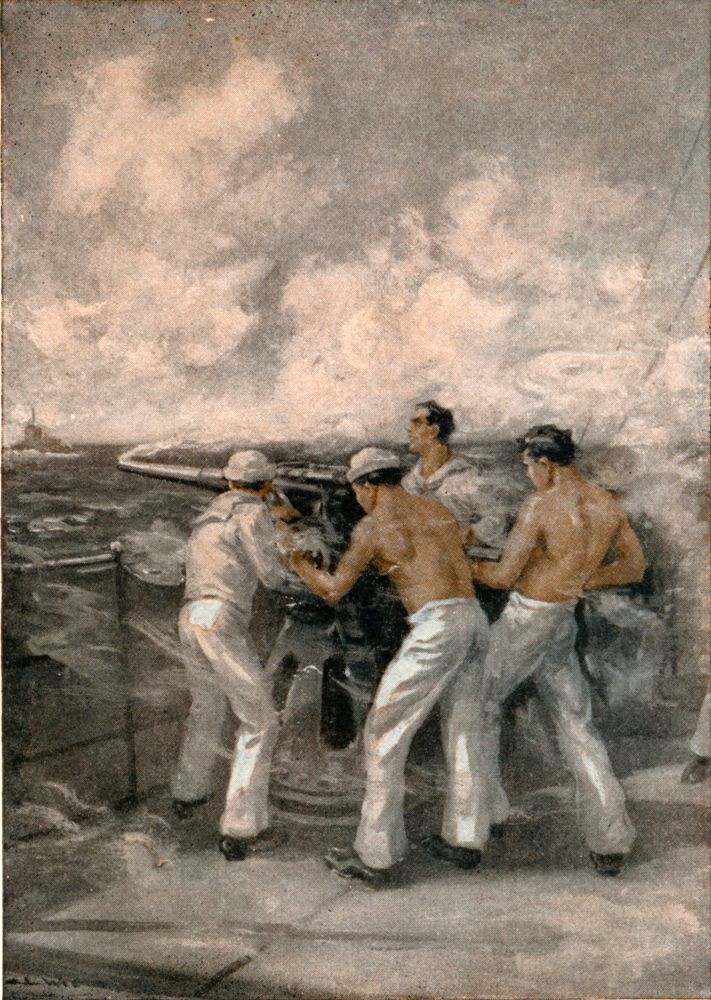
“Yeah, but she’s not much hurt,” said Pete. “She’ll go down now, take it from Pete! What did I tell you?”
The 944 was turning on her heel in pursuit, but the submarine had had enough. She was no match for the chaser in speed, even though, as German submarines went, she was small and fast, and [156]she recognized the fact at last. The Colonel was spouting the spray around her and there was one shot that seemed as if it must have been an underwater hit, and then the conning tower lessened in height above the waves, the stern lifted and, like a gray turtle sliding off a log, the U-boat went under. One last shot from The Colonel and the gun fire aboard the chaser ceased. But she still had a card to play, and at the rail the little crane was already swinging its burden outboard. Straight over the swirl of the submerging U-boat shot the 944. There was a splash as the depth charge struck the water. The 944 picked up her skirts and fled, and from her wake, a hundred yards astern, a great column of green and sudsy water shot twenty feet in air, hung an instant and fell in a sunlit cascade of foam. Around on her heel again came the chaser. Over went a second charge. Again the water columned upward. Twice more, and then, circling slowly, the 944 sought signs of victory.
Foam and bubbles alone marked the site of the explosions, and disappointment was audible along the deck. Then one of the men called attention to streaks of oil at a little distance, and a cheer broke forth. But triumph was short-lived, for the [157]lieutenant called down from the bridge: “That’s only shell ‘slick,’ boys. She got away.” He turned to the engine room telegraph, and the 944 picked up her feet again and made after the Agawam, now some two miles distant.
“What is shell ‘slick’?” asked Dave of Kennedy.
“Oil from the gas of an exploding shell,” was the answer. “If it bursts on the water or near it, it always leaves an oily smudge. In target practice we can generally tell where the shot’s gone by the ‘slick.’ I don’t know if these depth bombs would send up oil, but I should think they might. Half the yarns you hear about subs being destroyed are just bunk. There’s some oil floating around on the surface, and a lot of bubbles, and the other fellow shakes hands with himself and reports that he’s sunk a Fritz. Like as not the oil was from his own shells and the bubbles are just the bubbles that always rise when anything sinks carrying air with it. I used to believe all those yarns, but you’ve got to show me more than a smudge of oil and a few bubbles now.”
“Then you think we missed her, too?” asked Dave, disappointedly.
[158]
“Don’t think; I know. But at that, I’ll bet she got an awful jar when that T N T went off down there! Wouldn’t wonder if the boss’s mustache cup was knocked off the sideboard and all bust to pieces!”
They kept a sharp lookout, hoping against hope that the U-boat would come back and again try conclusions, or that a “pal”—for it is very generally believed that German submarines never operate alone—would take up the gauntlet. But the episode appeared to be closed, for they reached the steamer, which had now stopped her engines in response to the chaser’s signals, without seeing anything more of the foe. The Agawam had fared rather badly. She was a big cargo boat of some 5,000 tons displacement and from her depth in the water it was evident that she was loaded to capacity. She had carried a rifle forward and one aft, and there was a machine gun amidships. Bow and after guns had been put out of action by bursting shrapnel and only the machine gun remained of use, and that had been powerless at the range presented by the submarine. Those on the 944 counted six evident hits on the Agawam. Fortunately, only one shell had struck close to the water-line, due, perhaps, to [159]the fact that the steamer was unusually low and so presented but a small target vertically. Most of the damage had been above deck. The rail was torn away in three places for many yards, the amidship deck structure was a mass of splintered ruins and two boats were demolished. One of the three funnels was crumpled and showed daylight clear through it, and the wireless had been wrecked early in the engagement, which accounted for the Agawam’s silence after noon.
The most serious injury was from the one shell which had entered the hull just at the water and in line with number one hold. The explosion had set fire to her cargo there and smoke was still pouring forth in billowing clouds as the 944, sweeping alongside, hailed. The captain answered from the remains of a badly treated bridge. The sub had appeared at shortly after nine o’clock some three miles off the starboard beam and the Agawam had promptly changed her course and used all speed. But she was loaded too deep for speed and after a half-hour the U-boat had fired a shell that fell short. The Agawam had then returned the fire without success, as the sub was beyond range of her three-inch guns, and a running fight had ensued, [160]with the U-boat gradually finding her target. A lucky shot had soon put the after gun out of commission, and the bow gun had been knocked from its platform still later. The third mate, two members of the forward gun crew and one sailor had been killed and six men were wounded. The fire in the hold could be controlled, he thought, until they made port, if they could manage a temporary patch of the hull. Fortunately, the engines had not been damaged, and, more fortunately, a large consignment of shells, which made up a third of the cargo, was stowed in the after hold.
Lieutenant Cowan saluted. “I congratulate you, Captain,” he said heartily, “on the plucky fight you put up and on your escape. I’m sorry to say the dogs got away from us, sir. Now, in what way can I be of service?”
“Stand by me, sir, to Liverpool. Can you do that?”
“I’ll convoy you past the cape, Captain, and arrange for you beyond there. Is there anything else I can do for you?”
“You might lend me some men to clear up this mess and stick a patch over that hole. I’m short-handed a bit.”
[161]
“Certainly. Are you all right for medical supplies?”
“Plenty, thanks. My second mate is a bit of a saw-bones.”
The 944 slung over a boat and eight eager men crowded in. Dave was fortunate enough to be included. They toiled aboard the Agawam until nearly dark, by which time the deck was cleared of litter, the hole in the hull was patched with two-inch planking, and the after gun was restored to service. The bow gun was too badly wrecked for repairing. Just how badly the steamer had fared was not revealed until the 944’s party had climbed on board. Then a full view of the battered deck lay before them, and Dave marveled that the loss of life had not been far greater. There was scarcely a foot of deck aft of the bridge that did not show shrapnel scars. Dave talked with one of the forward gun crew, a chap of nineteen, who gave his name as Edmunds, and who was called Alvin by his pals, with whom he was trying desperately hard to reconstruct the gun with the spare parts at their command.
“We tried to get the captain to bear down on the Hun and fight him. We could have licked the [162]tar out of him easy. But he wouldn’t. Said his duty was to get his ship and cargo over. Maybe so, but it sure seemed a shame not to get Fritz’s scalp. That old tin fish stayed out of range most of the time, and when they gave us a chance they kept zig-zagging, firing over one bow and then the other. They didn’t make a target big enough to sight, hang ’em! But we got away, and I suppose we’d ought to be thankful for that. But, gee! I wish you fellows had ‘strafed’ ’em!”
“So do we,” said Dave mournfully. “We landed twice and knocked away their wave breaker, but then they went under and we lost them. And our depth charges didn’t seem to feaze them any, either. It was tough luck.”
“Those squareheads are a lucky bunch, anyway,” said Edmunds. “If it wasn’t for their fool luck the Kaiser’d be breaking stones up-river by now! Well, I hope we meet up with that particular Hun again some day. All I’m asking is a fair shot at her before I cash in. I’d give ninety days’ pay and a week in brig for that!”
And the rest of the crew growled agreement.
Shortly after 7 o’clock the boarding party returned to the chaser and the two craft started on [163]their way again, headed for Cape Clear. The 944 suited her speed to the Agawam’s, and through a clear, starlit night and over a calm sea they made their way at a trifle better than ten knots. Once a patrol blinked at them, but aside from that nothing transpired until, at sunrise, the green coast of Ireland arose from a turquois sea. Off Toe Head a small United States destroyer bore down, signaling, and the 944 was relieved of her charge. Waving “Good-by and good luck!” she swung about in a churning wake of foam and sped southward again. From the stern Dave and The Pickle watched the plucky Agawam fade from sight, her path marked by a trailing cloud of brown smoke from the burning cargo.
“Those Naval Guards on the merchantmen see some excitement, don’t they?” mused Dill. “I don’t know but what they stand a better show than we do to get action. Maybe we’d have done better if we’d gone in for that job.”
Dave smiled. “Don’t you consider that we managed to scare up a little action and excitement yesterday?” he asked.
“That?” The Pickle considered gravely. “Well, yes, I suppose you’d say so. Still, there [164]wasn’t much to it, now, was there? Look here, Kid, what I joined this war for was—”
“To escape college,” laughed Dave.
“Partly that,” The Pickle acknowledged, with a grin, “and partly to get a good whack at those—those blamed murderers! And my idea of a good time is to go after ’em where they live and knock the everlasting tar right out of ’em! Fight ’em to a fare-ye-well! This snooping around just waiting for them to stick their heads up so you can hit ’em is poor business. They don’t give you a show. They peek out, and if there’s anything bigger than a tugboat in sight they duck again. They certainly play it safe, don’t they?”
“I suppose they do. But they’re doing what they’re here for; and they’re doing it a sight too well to please me. Some one’s got to do the sort of thing we’re doing, Bob. It may be kind of disappointing, but it’s necessary, and it’s going to count.”
“Hope so,” grumbled Dill, “but it isn’t my idea of war. Still, if Uncle Sam wants it done, why I’m the lad for it. What he says goes!”
[165]
Followed a fortnight of uneventful existence. Back in Queenstown they made the most of the interims between sea duty, putting in all the time ashore that they could get, hobnobbing with “gobs” from the other ships, yarning and listening to yarns, rooting enthusiastically for this or that baseball team, reading and writing in the Y. M. C. A. hut, and exploring the neighboring villages and towns, for that was before the men were restricted to bounds. They found mail awaiting them, and a multitude of home papers and magazines, and Dave received a box of comforts from his mother that made him a bit homesick at first, and then cheered him up vastly. The three of them, Dave, Pete, and The Pickle, made that box look horribly empty in something under an hour!
The second period of duty on patrol brought nothing to liven the monotony. Fair weather held, and the six days outside were deadly monotonous, or [166]would have been had there not always been the hope of something happening to keep their spirits up. Gun practice saved the day for many of them. Dave was trying his best to qualify for seaman gunner, and to that end studied diligently in what books he could buy or borrow, and watched Kennedy closely, and asked so many questions that he threatened to become a nuisance. Chuck Morgan remained as affable as ever, but he stood in such respect of The Pickle’s vocabulary that he generally avoided that youth’s society. He tried picking on Pete once or twice, and Pete good-naturedly let him get away with it until Chuck ill-advisedly referred to Pete as a Sinn Feiner. Then the fur flew until friends of the belligerents took their lives in their hands and parted them just in time to save them from the eye of the junior officer. Chuck got slightly the worst of the encounter, but, as Pete pointed out aggrievedly, he hadn’t got nearly what he would have had the fellows let them alone! After that Chuck remained on good behavior for some time.
Their second stay at the base was cut short by one day, and the 944 slid out between the nets that guard the harbor entrance one twilight in company [167]with four destroyers and a second chaser, and turned her nose west southwest. “Convoy duty,” said Briggs hopefully. “Maybe we’ll land a scrap this time. Only, if we do,” he added dejectedly, “those destroyers’ll jump in and hog the show.”
Still, there was no charge for hoping, and the crew of the 944 dreamed beautiful dreams of a stand-up-and-knock-down shindy with a fine big Fritz. All that night and all the next day the six craft steamed westward in single-column formation, the gray destroyers in the lead and setting a sharp pace and the two chasers bringing up the rear. Behind the 944 was one of the 110-foot boats, narrow beamed, low decked, with a square stern. She looked ridiculously small for the work in hand, but they had to acknowledge aboard the 944 that she was certainly able and looked a heap like business. They had squally weather, with a rough sea, and the 944’s deck ran with water most of the time. As for the destroyers, reaching out in a long, slim, gray line ahead, they made no pretense of keeping dry. They simply buried their sharp noses into the chop and flung the seas over the swaying bridges and asked for more. In the graveyard watch of the second morning the engines ceased their humming, and [168]it was known that the convoys had reached the rendezvous. They pitched and slopped around until dawn, making headway and no more, and then went on again lazily, the lookouts peering ahead into a gray mist. It was the middle of the forenoon before smoke was sighted. Then out of the haze crept twelve big transports, asking hoarse questions with their whistles, and fluttering a babel of conversation by wig-wag.
Two of the ships were laden with marines and the rest with army troops, and as the destroyers and chasers sped past, under the high sides, to take their positions, the air was filled with cheers and the long decks fluttered with waving hats. Aboard the little 944 they clustered at the rail and grinned and waved back, and felt for some reason a bit chokey. Tier on tier of olive-drab forms loomed above them, so many that it seemed to Dave that every camp and cantonment back home must have been emptied aboard those big ships. Cheer after cheer followed them as they dashed by in a welter of spray, rather smartly they all hoped, and ducked across under the frowning bows of a big transport to take their position on the starboard flank. Signal answered signal, sirens screeched, [169]and, as Pete said, Donnybrook Fair had nothing on them. Yet out of the confusion order came swiftly, and an hour after the junction of transports and convoys big ships and little were on their way again, the troopships in line of twos and the convoys on each flank. Westward they set their course, and satisfaction possessed the fo’c’sle of the 944.
“Bordeaux,” guessed Briggs joyfully. “Great! They say it’s some town, fellows. A chap I met the other day told me you can get regular back-home pie in Bordeaux. And cake! Say, boy, I’m not eating a thing till we get there!”
Meanwhile, you may be certain, no lookout napped at his station. On convoys and transports sharp eyes combed the sea for the challenge of an upthrust periscope or the slinking form of a dripping conning tower. Over the rims of swaying cages, down from lofty crow’s nests, lookouts peered all hours at a yeasty ocean, while from decks as well spotters leveled their glasses. The Pickle chuckled as he joined Dave in the lee of the funnel that afternoon.
“I know just how those doughboys over there are feeling to-day,” he said, in answer to the other’s look of inquiry. “I’ve been through it. You talk [170]such a lot about the danger zone and get to thinking about it so much that when they pass you the word one night to sleep in your life-belts, and you know you’ve got there at last, you just naturally expect a torpedo to come flipping right into your bunk ’most any time. You don’t sleep a whole lot that first night, either. Maybe it is because life-belts aren’t as comfortable as pajamas, or maybe because every time a sailor stubs his toe at the far end of the ship you sit right straight up in bed and try to remember off-hand which way your boat is. Lots of us slept on deck that first night. They told us we mustn’t, but we did. There was something quite a bit cheering in the thought that when the ‘moldie’ struck us all we had to do was slide gently into the sea and strike out for Liverpool! Bet you they’re a nervous bunch over there just now.” He nodded toward the nearest of the big transports. “If some one drops a plate at mess there’ll be a rush for the decks that’ll make a subway crush look like a doll’s party.”
“I suppose you do feel sort of ticklish,” mused Dave. “Think what a prize one of those ships would be for a Hun. Imagine a torpedo bursting amidships yonder.”
[171]
“I’d rather not, thanks,” said Dill, dryly. “You’ve got a punk imagination, Kid.” After a moment he went on. “Funny about that steamer. When we first ran past her she looked sort of familiar to me, like an old friend who’s shaved off his mustache or—or parted his hair different. All daubed up with gray like that, she sort of puzzled me. Then I borrowed a pair of glasses and read her name on a lifeboat. She’s the old Everglades, and I’ve made three trips on her. Know her almost as well as I know my frat house. She used to run from New York to Savannah. See that timber arrangement on the upper deck almost at the end? Some sort of a signaling effect, I guess. Well, my stateroom was the one just for’ard of it. One, two, three—six from the thwartship passage. Seems funny to see her away out here and all smudged up with gray and filled with soldiers. Gee, war does funny tricks! I’ve had some mighty good times on that old ship,” he added with a chuckle.
Carter joined them, half seated himself on the narrow ledge about the funnel base without a word and bracing himself to the swing of the boat.
“How many troops do you suppose she has aboard?” asked Dave.
[172]
“Maybe fifteen hundred,” estimated Dill. “Maybe more than that. They’ve changed those ships all over inside and can pack ’em away like sardines. Gee, that’s queer, too! What are they doing there, fellows, all those guys in khaki? Where’d they come from? What’s it all mean, eh?” He shook his head in a hopelessly puzzled way. Carter viewed him in mild surprise, but made no answer. Dave nodded.
“It is funny,” he said. “Fifteen hundred American kids. Clerks and college boys and factory hands and day laborers a few months ago. Didn’t know whether a rifle was something to eat or a new game of cards. Now look at them! Yes, it’s—it’s mighty queer. What are they doing?”
“Making men of themselves,” said Carter evenly. “Going across the ocean to fight a horde of murdering cowards, and maybe get killed doing it. Going over to set things right again in this world we’re living in. Taking their chances for those that will come after them, the kids of to-day and all the kids to come. That’s what this war seems to me, fellows, a war for the—the future generation, so they’ll be free and happy. It doesn’t seem to make such a lot of difference about us folks, we that are [173]here now, does it? It’s our children and their children we’ve got to think about, isn’t it?”
“Blessed if I ever thought of it like that,” said Dill slowly. “But I see what you’re driving at, Yank. There’s something in it, too. I guess if we don’t settle this thing now, and for keeps, our kids’ll have mighty poor pickings. A war for the kids, eh? Well, maybe, Yank, maybe.”
“It’s wonderful, anyway,” said Dave, “all those boys picked up out of quiet, everyday, humdrum life and—and sort of melted over into soldiers and fighters in a jiffy. It—it makes you awfully proud that you’re an American, doesn’t it?”
“Sure,” responded Dill, more cheerfully. “Makes you want to flap your wings a bit and crow. Or—or blink your eyes and swallow!”
“I guess we’ve all always been proud of being Americans,” observed Carter quietly, “only we didn’t always know it.”
“Right-o,” agreed The Pickle. “And there’s only one thing that will ever make me change my mind about it.”
“What’s that?”
“Well, that’s—” He stopped and looked frowningly across the tumbling water. Then: [174]“Suppose we fall down on this job, fellows. Suppose that after all the boasting we’ve done, because we have done a lot of it; too blamed much, and you both know it; suppose that after all our talk of what we are going to do, we—don’t do it! That would be pretty sickening, wouldn’t it?”
“We will do it,” said Carter confidently. “We can’t help doing it. It’s in us. We do boast, but we don’t mean any harm. It’s just our way of showing our confidence, of being-what-do-you-call-it, optimistic. It’s just plain spirits. But we always make good our boasts, and that’s the main thing!”
“Hope you’re right,” commented Dill, unconvinced. “Anyway, I’m not hauling down my flag yet!”
That night they churned along under dark skies with never a glimmer showing, and the next day found themselves under a blue heaven again and bathed in the warm sunshine of early September. There were no alarms from the lookouts. The submarine might well have been a prehistoric myth for all the evidence they found. On the transports drills occupied much of the time, and from the 944 they watched the olive-drab figures assemble on the [175]deck of the Everglades for setting-up drill in the morning and saw them hurrying to the life-boats later. Toward evening they all slowed down while one of the troopships made engine repairs.
Finally, soon after dawn the next day, they raised the French coast and at noon were passing through the estuary of the Gironde River, picking their way in single line between the hidden mines and nets, guided by a diminutive French cruiser with a kaleidoscopic hull. Bevies of trawlers crawled from their path and big cargo boats churned past them, going seaward. The ocean breeze had departed and a languorous warmth wrapped them as they followed the course of the winding channel. Green meadows descended gently to the river banks and picturesque white plaster houses with impossibly red roofs peeked at them from under the trees. Dave’s first glimpse of France was a happy one, for Bordeaux has a peculiar charm of Old World quaintness and color.
The convoys anchored below the city, while the transports sailed on and up and finally out of sight, lost in a forest of roofs and masts. There was liberty that afternoon for all who wanted it aboard the 944, and Dave, Dill, and Pete went merrily [176]ashore and saw the town. And there was much to see, much that was as unfamiliar as picturesque and curious. There were squads of German prisoners at work along the docks, phlegmatic and evidently contented, loading and unloading transports and merchantmen and guarded by colorful French soldiers with phenomenally long bayonets fixed to their rifles. The streets were filled with donkey carts, each presided over by a woman, and women drove the street cars as well. Soldiers on leave were everywhere, hobbling about on crutches or bandaged somewhere and always cheerful, or so it seemed to the boys. They saw all they could crowd into a few short hours; the markets, and the warm-hued old buildings and the goats that were driven from door to door and milked and many, many churches, in one of which they viewed a fine collection of mummies!
America, however, was fast working a change in the old city, for docks and warehouses and camps were going up overnight and the khaki-clad boys from the U. S. A. were everywhere in evidence. Outside the town a veritable village of wooden buildings was nearing completion, a camp to which the new troops were marched from the transports and [177]quartered until they were sent off to the villages behind the lines. The 944 lay in the Gironde that night and then, at sun-up, churned off, in company with the other chaser, and headed for Queenstown.
Penmarch Point, the easterly tip of France, was abreast at sunset and some time in the early morning the Scilly Islands were passed. The other chaser had passed from sight with darkness and the 944, quite alone now and swinging along at some fourteen knots with only enough motion to deepen the slumber of the watch below, was approximately sixty miles west of Land’s End when the tragedy occurred.
[178]
Submarine mines are not, contrary to a general belief among folks ashore, deliberately released on the surface and allowed to float away in the hope that ocean currents will bear them into the path of shipping. That is a far too hit-and-miss method for the “efficient” Germans. Mines are expensive things to manufacture and the enemy does not knowingly waste them. What she does is release them, either from mine-laying submarines or from surface boats, with weight and buoyancy nicely adjusted so that they will anchor themselves and float at a given depth below water. The anchor, generally of the familiar mushroom type, is attached to a steel cable which unwinds until automatically stopped by a hydrostatic valve. The valve may be adjusted at will, and when the ocean depth is known it is a simple matter to plant the mine so that it will float at the desired depth below the surface, usually from eight [179]to twelve feet. Still, errors of adjustment are sometimes made and frequently the tide is not taken sufficiently into consideration. The air chamber is filled at a certain pressure in port, but this pressure frequently changes before the mine is laid, in which case the mine does not float at the desired depth. In high water and a strongly running tide the mine rises obliquely from the anchor. Consequently, when the pull of the tide ceases the mine straightens perpendicularly and often shows itself above water.
There are, however, such things as floating mines, as many an unfortunate ship has discovered to its sorrow; but they are mines that, in some fashion or other, have become separated from their anchors. Generally such mines, if picked up unexploded, show the cable to have been broken, just how is a matter of conjecture, although there are cases where the mine has become detached from the cable or the cable has come away from the anchor. Doubtless of the hundreds of thousands of mines planted by the countries at war, a fairly large proportion go astray. Scarcely a day passes that many are not found and either salvaged or blown to pieces, and the marvel is that more destruction is not caused by these irresponsible weapons. It is only necessary [180]to exert a nine-pound pressure against one of the several “horns,” or firing pins, which project from the body of the mine in order to explode the three, four or five hundred pounds of gun-cotton or trinitrotoluol within, and the slightest bump of a vessel’s hull is sufficient.
Why fate should have brought the 944 and a floating mine together at the entrance to St. George Channel is beyond me, but it did.
Dave was fast asleep in his bunk in that hour before the dawn, curled up very snugly and peacefully dreaming of— But he never remembered his dreams, for his waking was far too abrupt. He was conscious of a frightful grinding, crashing explosion, of being hurled through space, and of coming into violent contact with something very hard and unyielding. Darkness and confusion surrounded him. Succeeding the sound of the explosion, deep silence held for a long moment. Then cries of alarm, command and conjecture broke forth. Dave picked himself from the floor of the fo’c’sle, collided with some one, and made blindly for the companion. He made out Pete’s voice in the sudden babel of noise. “They’ve got us!” Pete was saying angrily. “The dirty Huns have got [181]us!” Dave pushed up the ladder and sprang toward the boats. Orders were coming now.
“Cut those lashings! Steady, men! Don’t rush! All together, now, heave! Make fast to the falls!”
The deck was canting and the port railing was under water when the boat on that side was swung outboard on its davits. From the waist clouds of white steam billowed spectrally in the darkness. After the first minute or two of confusion silence reigned aboard the chaser, a silence broken only by the rushing of escaping steam from the boiler room, the commands of the officers, and the orderly bustle of the men. There was little time to lose, for it was apparent at once that the explosion had done for the 944 and that she would remain afloat but a short while. Perhaps eight minutes elapsed from the moment of the catastrophe to the instant that the order “Clear away!” was given. The port boat had no difficulty, but the starboard, because of the chaser’s cant, was nearly overturned in lowering. One man went into the water, but was pulled out again. Having pulled clear, the two boats lay by. The lieutenant had returned to his quarters to secure the code books and papers, and those in the [182]boats awaited his return anxiously, the starboard boat lying close to the stern, ready to take him off. Fortunately, the sea was fairly calm and the night only moderately chill, for few of the men were dressed in more than their underclothes and life-vests. The 944 was settling rapidly, going down port side under and slightly by the bow.
The port boat, minus two of her complement of fourteen, drifted away, and Ensign Hyatt ordered them to paddle back closer to the other boat. The two vacancies were caused by the absence of Pruitt and Low, both of the engine room force. They and one other had been killed, although whether by the explosion or by escaping steam was not known. Many of the men on duty at the time had suffered injuries, but none seriously.
“She’ll sink in a minute now,” said Pete anxiously at Dave’s back. Both he and Dill were in the port boat and unhurt. “I wish the Old Man would hurry up.”
Then, almost before the last word was past his lips, there was a warning cry from the starboard boat, the oars backed water, and the gallant little 944 buried her nose and went from sight. There was a swirl of water that made the life-boats dance [183]for a minute like cockles, and then silence, emptiness, and darkness.
The two boats dashed forward across the spot, and the lanterns were held to sweep the water. But there was no sign of the lieutenant. Back and forth they paddled, calling and listening, and at last, when it seemed certain that the chaser’s commander had perished with his ship, a faint hail came from the darkness ahead of the port boat. The men bent quickly at their oars, and the lantern’s rays flickered anxiously. In a moment they saw him, a darker splotch on the waves, and presently, nearly exhausted, but clutching his precious papers, the lieutenant was pulled into the boat.
“I was half-way up the ladder when she dived,” he gasped. “She took me down with her and something caught my leg. I think I hurt it a little getting loose.” They had called to the other boat that the lieutenant was safe, and now the ensign shouted to them to pull across.
“You stay here, sir,” he said, “and I’ll change into the starboard boat. We’d better lay our course for the Scillies, I presume.”
“Certainly. St. Martin is the nearest. About thirty-four miles, I’d say. Make it southeast by [184]south, three quarters south. If this breeze holds we should make land by daylight.”
“Very good, sir. You’d better do what you can for your leg, hadn’t you?”
“It can wait, thanks. It’s nothing of importance. We’ll keep together if possible, I think.”
The ensign made his transfer to the stern sheets of the starboard boat, masts were stepped and the lug sails took the breeze and the course was set for the nearest of the Scilly Islands. In the port boat Lieutenant Cowan himself took the tiller. There was enough breeze to send the little boat along at a good four or five miles an hour, and so there was no need of using the oars. Spray flew in pretty constantly over the low gunwales and soon they were all shivering, as the water penetrated their scanty clothing. The wind came from the west, or very near it, and it was possible to hold her to her course fairly well. The dim light of the other boat gradually fell away to starboard and finally vanished, suggesting that she was not making quite as good headway. In spite of chattering teeth the occupants were cheerful. They all felt sorry over the loss of the 944, for they had become attached to her, and the deaths of their three shipmates weighed on [185]their minds, but they had had a miraculous escape from a very great danger, and that fact was enough to counteract on depression. The lieutenant was silent most of the time, doubtless dejected by the loss of his boat, and the men respected his feelings. But gradually a low tone of conversation succeeded the whispering, and at last, just as the first streaks of day showed in the east, some irrepressible started to whistle softly in the bow and soon they were all humming and then singing the song.
Even the lieutenant, his face looking grave and white in the gray half-darkness, joined in, although the lieutenant’s singing voice was nothing to boast of. They sang the anthem through to the last word—something that few, if any, of them would have been able to do six months before, gaining new [186]fervor as they went on. As one clear boyish voice started the first note of the final stanza, a flush of pink mingled with the dull gray of the eastern sky and tinged it with the soft colors of a dove’s breast, and day lay just below the watery horizon.
As the last lingering note died on the air Kennedy raised a hand and pointed eastward.
“That looks like smoke, sir, doesn’t it?” he asked.
[187]
An hour later the occupants of the port life-boat were safe aboard the British steam trawler Good Venture. Scalding hot tea had driven the cold from their bodies, and each had been provided with clothing of some sort from the slop-chest of the little ship. None of them had saved anything from the 944 save the apparel they had had on at the time, except that the lieutenant had managed to squirm into a pair of dress trousers and bring off the ship’s papers and the lead-bound book that held the secret code. Briggs remarked philosophically that it was a lucky thing pay day was so far past that few of them had possessed much money to lose! The Good Venture was a Grimsby boat, a stout-hulled, high-bowed little steamer, once painted gray but now showing as much red-brown rust as paint. She had two masts and a tall, slim funnel, forward of which was a high wheelhouse. She carried a mere handful of men—Grimsby fishermen all before [188]the war, and for some months after it, too, and now members of the Trawlers’ Naval Reserve. The master, a square giant of a man with a leather-hued face encircled by black whiskers, held the official title of skipper.
“I can’t land you, sir,” he informed the lieutenant, “afore the day after to-morrow, for I’m on duty; but if there’s the chance I’ll put you aboard a boat bound for port. There’s room for all and plenty to eat, and if there’s aught we can do for you ’twill be done with a will.”
The Good Venture had a rendezvous with a sister trawler further west, and search for the 944’s starboard life-boat was impossible. It seemed that she must be in sight, and yet, as the day broadened, there was no sign of her, and the Good Venture, which had steamed several miles from her course to pick up the lieutenant’s boat, swung back to her path of duty. It was generally agreed that the other boat had probably held closer to the wind and so got farther south, and that, in any case, she was in no danger and would, if not picked up beforehand, make one of the Scilly Islands without difficulty. It was, however, many months before Dave saw any of the starboard boat’s crew again, although [189]he learned a few days later of their safe arrival at Trescos.
The Good Venture, it appeared, was a mine sweeper, one of the Plymouth fleet, and had been across to Brest and was now rejoining her sister ship, the Arabella. The lieutenant was taken in charge by the skipper and the men were bunked forward in the commodious quarters. The Good Venture seemed to be something of a family affair, for the first mate was the skipper’s brother and two of the crew were cousins, while a third, a yellow-haired boy of surely no more than seventeen, was the skipper’s nephew. It was he, a shy, slow-spoken lad, who became Dave’s guide over the ship after all hands had partaken of a generous breakfast.
Pete and The Pickle went to sleep, as did most of the others, but Dave never felt more wide awake in his life as he climbed out on deck at the heels of the Grimsby lad. At first Dave had some difficulty in understanding the boy’s speech, as much because of the unfamiliar words used, as because of his Lincolnshire pronunciation. But by the time they had visited engine room and wheel house and seen what was to be seen and had come to rest beside the big winch, which wound and unwound the steel cable [190]used for sweeping, that slight difficulty had passed. Tom Garrity had the bluest of blue eyes and the yellowest of yellow hair, and, with his faded red jersey, made a colorful picture as he leaned against the winch and answered Dave’s questions.
“’Tain’t our place to do fighting,” he replied, “but there’s that gun handy-like and we’ve used it two, three times, an’ once we got a ’Un with it, too. That was in March o’ this year. We was sweeping with the Belle o’ Headon off Wight at the time. Admiralty telled of a new nest o’ eggs just laid thereabouts and us and the Belle set out one fine blowy day to pull them up. There was a bit o’ sea running an’ it was fair wet work, but we gets the gear out an’ starts along, the pair o’ us, an’ works for it might be three, four hours without getting a tug on the cable. It was a gray, misty day, an’ now and then it drizzles a bit an’ you can’t see far into it. But of a sudden we gets the Belle’s ’ooter, three times, which is the signal meaning ‘Submarine!’ The skipper couldn’t see nothing, though, and no more could us, but the Belle signals haul in and we hauls, an’ right in the middle off it pops a sub, not a cable-length off to port. All black and shiny-wet she was, a drippin’ water, and ’er ’atch opens and out [191]pops a officer, just like one o’ this ’ere ugly Jack-in-the-Boxes.
“’E didn’t carry no gun; a lot of ’em didn’t those days: ’twas the torpedoes as done the business for ’em. ‘Out o’ it,’ says the blighter. ‘Stop your engines and get in your boats afore I puts a torpedo into you.’ We was caught, do you see, with the cable ’alf in and no chance to run for it if we’d wanted to. The Belle couldn’t do nothing because we was between her and the ’Un. So the skipper ’e sings out to swing the boat over, and then ’e whispers to ’Erbert, that’s the mate, do you see, and ’Erbert ’e walks aroun t’other side o’ the ’ouse an’ beckons to the Belle to ease up on the cable. Then ’e tells Will, in the engine room, to put ’er ahead full steam, an’ so ’twas done. The skipper ’e makes a jump for the wheel an’ he slings ’er over an’ we comes around like a bloomin’ tee-totum an’ makes for the ’Un. ’E sees what we was up to an’ he yells a lot an’ ’e gets out o’ the way by a matter o’ inches an’ we goes slappin’ past ’is stern. But ’e wasn’t considerin’ o’ that cable, an’ it comes taut, do you see, an’ whangs up against the sub abaft the conning tower. The officer ’e ducks just in the nick o’ time, an’ it slips over an’ takes the after periscope [192]off short like a match stick an’ catches against the forward one. The skipper ’e laughs like ’e was ’aving a fit, an’ ’e couldn’t ’ardly slip the shell in the gun, but ’e did it, an’ ’Erbert ’e sights it an’ away she blazes.”
He pointed to the rail further aft. “There’s where she went,” he continued. “’Erbert had to point ’er so low she took six feet o’ the rail with ’er, but she done him in all right. Square into the ’ull she goes, right abaft the tower, an’ the noise was fair deafening. An’ the ’Un opens up till you could see ’er insides an’ turns over a bit an’ goes straight down like a lump o’ lead.”
“Golly!” exclaimed Dave. “And then what?”
Tom Garrity viewed him in faint surprise. “Then we went on sweeping,” he answered.
The Good Venture found her consort at five bells, stood close aboard and tossed a line across. The Arabella was slightly smaller than the Good Venture, but in other respects might have been built in the same yard and from the same model. This, however, was not the case, since the Arabella hailed from Lowestoft in time of peace. The winches rattled and the long wire cable splashed into the water. The two boats veered apart, the “kites,” [193]which are weighted timber frames to hold the cable at proper depth, were cast over, and all was ready for the day’s work. Abreast, keeping their relative positions as though they had never known another mission in life, the trawlers steamed slowly northward, between them some sixty fathoms of tough steel wire cable dragging below the choppy surface. At the bow two men watched intently, for it is poor policy to strike a mine, and at the winch were two more hands, ready to wind or unwind, as necessity required, and able to tell by reason of long months of experience when the cable made a “catch,” much as a fisherman knows when a fish tugs ever so gently at his line. Many miles northward steamed the two boats, then turned precisely and came back on a parallel course. And so it went all that day and never a mine was caught in the sweep.
The men from the 944 watched interestedly and, it must be confessed, a trifle uneasily. A sweeper must walk straight through a mine field, trusting to luck to get the “eggs” on the cable and not to bump them with her hull. The lookouts can seldom see a mine more than a very few feet under the surface, and then only when the surface is fairly “glassy,” and so there must be a special providence [194]to watch over the fortunes of the trawler fleet. Mine sweeping has been said to be the riskiest work of the war, on land or sea, and the long honor roll of men who have perished while engaged in it bears out the contention. Ship after ship has gone down with not one survivor to tell the story of the sacrifice.
“Why, it’s like this,” said the skipper in reply to a question from Kennedy, “if we misses ’em, we goes on. If we ’its ’em, we goes down.”
A fine, calm philosophy, but not especially reassuring to the Good Venture’s uninvited guests.
When darkness came the trawlers anchored within sight of the Irish coast, doused their lights and waited for morning and another day’s duty. In the fo’c’sle, an unusually large one, the crew of the Good Venture and the sailors from the 944 fraternized and swapped yarns until six bells. Then, to the lazy rolling of the creaking steamer, they dropped to sleep and slept hard until, long before daylight, they were routed out for breakfast.
The next day’s work was more eventful. Shortly after sun-up there was a cry from the winch man and the two steamers slowed down and the big cable was slowly wound in, bringing to the surface not one [195]but two gray-green objects. Caught by the cable against their anchor wires they bobbed about within a few feet of each other midway between the two trawlers and only the fact that one had been snagged further up on its wire kept them from bumping socially together.
On the deck of the Arabella a tall, thin man stepped to the rail and leveled a rifle. He was extremely deliberate and unexcited, it seemed. On the Good Venture the visitors watched from places of safety. The marksman’s first shot spat against the nearer mine but failed to strike a horn. The next shot, however, was immediately followed by a roaring explosion and a sudden churning of the water. Spray dashed high in the pale sunlight and when it fell neither mine was visible. The Good Venture’s skipper waved commendation, the cable was run out once more and side by side the two steamers went on. Twice again that forenoon the rifle barked from the Arabella, but each time only a solitary mine was on view. By noon the sailors from the 944 had lost much of their uneasiness and had given up haunting the rail and straining their eyes over the side. Familiarity had bred contempt, or, if not contempt, a philosophy akin to the skipper’s. [196]If they ’it, they ’it, and that was all there was to it.
Dave, Pete, and The Pickle lost interest in mine sweeping after chow and found a sheltered place amidships and talked. They speculated on what was to happen to them when they reached Queenstown, if they ever did. Thus far not so much as a fishing smack had approached near enough to be hailed and it looked very much as if they would have to remain on the Good Venture until she returned to Plymouth the next evening.
“Of course,” said Pete, “they’ll give the Old Man another command right away; leastways, as soon as they have one for him; but what’s to become o’ us? ’Tain’t likely we’ll be let lay around with nothin’ to do, is it?”
They agreed that it wasn’t, and Dave said: “I hope we can keep together, we three, but I don’t suppose we can.”
“Not a hope,” agreed Pete, “not a hope. Say, I wish they’d put me on a destroyer. That’s the life! Somethin’ doin’ all the time, Kid! Rampin’ an’ rarin’, that’s them! Skyhootin’ around all over the shop! A feller’s got some chance to be a hero an’ get his stripes on one o’ them.”
[197]
“I was hoping for destroyer duty too,” said Dill. “But they tell me they take only service men. No ‘rubber socks’ need apply.”
“Don’t you believe it,” Pete denied. “That was the rule, but they take anything they can get now. Have to. There ain’t enough real ‘gobs’ to man ’em all. Why, they’re even takin’ Reserves!” And he winked at Dave.
“They need a few to tone them up,” responded The Pickle untroubledly. “Guess I’ll run up and see Sims when I get ashore and ask him for a berth on one of the new destroyers.”
“Sure,” approved Pete. “Drop in about noon an’ take dinner. He’ll be tickled to death to have you. An’ you might mention my name to him, too.”
“And mine,” laughed Dave. “I’d advise you to get some other togs first, though, Bob. You wouldn’t make much of a hit at the Admiralty the way you are!”
The Pickle observed his attire judicially. He wore a faded brown sweater, much torn and moth-eaten, a pair of old gray trousers and shoes at least three sizes too large for him. For that matter, neither of the others could boast much of their [198]apparel. “How are we going to get uniforms, Pete?” Dill asked. “Will they give us new ones for the asking?”
“Sure! If they don’t I’ll disgrace ’em by sittin’ on the Admiral’s front doorsteps all day with a sign on me: ‘This is the way Uncle Sam dresses his sailors!’”
“They’d think you were a tramp, Pete,” said Dill, “and pull you in for impersonating a sailor. Say, I wish they’d quit dragging for these blamed mines and hike out for home. What sort of a burg is Plymouth?”
“How do we know?” asked Pete. “What do you take us for, perishin’ Britishers?”
“Well, how do we get to Queenstown, then?”
“Walk,” suggested Pete. “Seems to me these fellers might drop us at Queenstown or some place this side, so long as it’s Ireland. We ain’t but a dozen miles off now.”
“It’s a long dozen,” said The Pickle, stretching his neck to look over the rail. “Hello, there’s the whole English navy coming! Or—or something! Have a look, fellows!”
[199]
Southward a dozen columns of smoke showed, but the ships were still hull-down as the three boys leaned on the rail and watched. They went forward and found the skipper and “’Erbert” gazing through their glasses. Lieutenant Cowan joined them, limping slightly from the effects of the injury to his leg, and took the binoculars the skipper proffered. Slowly the distant ships came up over the rim of the sea, bearing northeastward.
“Cruisers and convoys,” said the lieutenant, returning the glasses, “and one destroyer. They’re not American, sir.”
“Nor British,” replied the skipper.
“French, likely,” offered the mate. “But they’re not making for France.”
“They’ll pass us well to eastward, Lieutenant,” said the skipper, “and I’m doubting they’d want to stop, but if you say the word, sir, I’ll ask them to take you aboard.”
[200]
The lieutenant hesitated. Then, perhaps catching the eager looks on the faces of Dave and his companions, he smiled and nodded. “Do so, if you will, skipper. I’d like to get back and make my report as soon as possible.”
Followed signals with the Arabella, and half an hour later the two trawlers, having reached the end of their southward journey, parted company and the Good Venture hurried eastward to intercept the long line of ships that were now in fair sight. There were seven in all, four of them medium-sized merchantmen, two light cruisers and one small destroyer. As they drew near every glass aboard the Good Venture was in service, for every one was puzzled over the nationality of the ships.
At length the skipper lowered his binoculars. “Got them now, sir,” he announced. “Italian. Likely they’re out of their course by reason of keepin’ wide of the coast along of Spain. There’s been submarines very active west of Biscay of late. Now then, ’Erbert, look alive with them signals!”
“’Erbert” got immediately busy and a few minutes later, by which time the Italian ships were some two miles away, the ensign and code pennant were run to the spreader. After a minute or two the [201]second cruiser answered and the mate bent on his signal flags with practiced fingers. “We want to speak to you,” announced the Good Venture. The cruiser answered “All right,” and wig-wagged to the destroyer, and the latter swung out of line and roared down on the trawler. As she came the skipper’s face was a study. “I say,” he appealed to the lieutenant, “’ow am I talk to the blighter, eh? It don’t ’appen that you know Italian, sir?” The lieutenant regretted that he didn’t. But he replied, “I’ll try him in French if you say so. He will probably understand.”
“Do that, sir. I speak French myself, in a manner o’ speaking, but it ain’t the sort an Italian would make out! And as for ’is own blinkin’ lingo, macaroni’s the only word I know.”
But, as it proved, the skipper’s alarm was unnecessary, for the young officer who roared across at them from the bridge of the destroyer spoke remarkably good English. The skipper sighed relievedly as he took the megaphone and answered, “We’ve got an American lieutenant and a dozen men, sir, from a submarine chaser as was blown up by a mine. Can you take ’em aboard?”
“With pleasure,” responded the other. “Please [202]ask them to be quick, sir. Will you use your boat?”
“Yes, I’ll get them over in ’alf a jiffy. Greatly obliged, sir!”
Before he went over the side the lieutenant reimbursed the skipper for the clothes they were wearing away, taking the money from a belt about his waist. (“Me for one o’ them things,” whispered Pete enviously. “If I’d had one I’d be in mighty near four dollars right now!”) The skipper at first refused to accept payment, but at last consented and the lieutenant followed the men into the small boat. It was, Dave reflected, a fortunate thing that there was almost no sea, for that little tender was loaded down to the gunwales and shipped water whenever any of them took a deep breath. They waved good-by to their friends aboard the Good Venture and were presently climbing over the side of the destroyer under the politely curious gaze of four officers and, it appeared, most of the ship’s crew. They soon discovered that knowledge of the English language was not general aboard the Valgrana and until they went ashore at Portishead the next morning they had to make known their wants and conduct their conversation in the language of [203]signs. But the petty officers and men with whom they came in contact were flatteringly cordial and made it clear that they were anxious to do anything and everything possible for the comfort of the visitors. One swarthy gunner’s mate was fortunate enough to speak a scant dozen words of English, and these, to the envy of his companions, he used incessantly, somehow managing to derive a vast amount of satisfaction thereby. “Uni’ Sta’es,” “Presidente Veelson,” “Betchoo life” and “Sure, Mike” were his best efforts. Italian food was strange but satisfying and the 944’s men were served by themselves and with some ceremony.
The Valgrana had had a brush with a U-boat on the way north and the incident was described to them eloquently by waving hands and shrugging shoulders and expressive grimaces, together with a torrent of strange words, but, for his part, Dave didn’t get a very clear idea of that engagement. The destroyer followed her companion ships up the Mersey the next forenoon and they dropped anchor off Portishead about eleven, and the lieutenant led his disreputable crew ashore and herded them in the waiting room of a railway station. And there they stayed, observed with vast interest by most of the [204]villagers, until they were piled into a train at about three and conveyed leisurely to Bristol. Owing to the fact that their mid-day meal had been extremely sketchy, they descended on a restaurant in Bristol like a horde of ravening locusts, and didn’t pause until they had worked devastation. How much their dinner cost the lieutenant Dave never learned, but it seemed to him that there could not have been much left in that money-belt afterwards!
They were billeted in a small and none too clean hotel for the night with permission to spend the evening as they liked but to be on hand at the station the next morning promptly at seven-thirty. As there wasn’t a cent amongst them, seeing the city promised to be a dull proceeding. However, Dave and Pete and The Pickle determined to make the best of a bad thing, and, if possible, derive some pleasure from an evening ashore. They were a trifle conscious of their unusual attire at first and were thankful when they reached a street sufficiently thronged to allow them to pass unheralded by all the small boys in sight!
“Being a fishwrecked shiperman isn’t what the stories make it out,” remarked Dill sadly. “I feel like something awful off a movie screen!”
[205]
“Gee, that would be great!” exclaimed Pete. “A movin’ picture show, eh?”
“Fine!” jeered Dill, “but just how do you think we’re going to butt in on a movie without a cent of money? We surely can’t get past on our good looks!”
“That’s all right, Pickle. First off, let’s find us a show. Do you guess these folks’ll understand United States?”
They did. At least the one Pete addressed himself to did, and he even walked a block with them to point out the way from the next street corner. They thanked him and followed the indicated course, Dave and Dill amusedly wondering what Pete had on his mind. A minute or so brought them to their destination and they pulled up outside while Pete looked the situation over. It seemed that in England a “movie” wasn’t a “movie” but a “cinema,” something that Pete objected to strongly. He likewise criticized the lamentable lack of flaming and enticing posters outside the entrance. Except for a few dim lights and a wicket doubtless indicating the presence of a ticket seller in the darkened depths beyond, they might easily have imagined themselves outside the entrance to anything save a “palace of [206]amusement.” Evidently the rush was over for, save for a few small boys who viewed our friends with growing interest, the place was deserted.
“Like the looks of it?” asked The Pickle finally.
Pete shook his head. “It looks bum to me,” he said, “but you can’t tell. It might be all right inside. Come on.”
“Where? What are you going to do?” asked Dave, holding back.
“See the show,” said Pete. “Put a front on now and follow me up.”
Pete advanced to the wicket, the others close behind. In the gloom beyond it sat a girl and Pete made a sketchy bow. “Evenin’ an’ everything,” said Pete. “Me an’ my mates would like to see the pictures, Miss.”
The ticket seller fixed her eyes on the ledge, and then, as nothing in the shape of money appeared there, she asked sarcastically: “Well? This ain’t a free show, your Lordship.”
“Sure, we know that,” replied Pete ingratiatingly; “but you see, Miss, it’s this way. We’re American sailors and our boat was blown up by a mine a couple o’ days ago an’ we ain’t got no money. You can search us, honest! But you just pass us [207]in, Miss, an’ we’ll be back an’ pay you, sure as shootin’. Or maybe we’ll send it to you.”
“American sailors, eh? You look it! Clear out before I ring for the doorman!”
“Honest, Lady—”
She must have rung, for the door swung open and a jovial and very red-faced individual in a white waist-coat and a top hat sidled into view.
“Now then,” he said cheerfully, “on your way, boys, on your way! Don’t be blockin’ the entrance an’ keepin’ the crowds back.”
“We’re the crowd,” explained Pete, “an’—” He stopped abruptly. Then: “Hello, Crim!” he blurted.
The man gazed at him in a puzzled way for a moment. Then recognition dawned slowly, and: “Why, ’tain’t—’tain’t ‘Rags’ Rooney?” he gasped.
“You got me, Crim, but lay off the ‘Rags’ stuff. I’m travelin’ first class now.” The two shook hands warmly. “What you doin’ here?”
“Showing Johnny Bull what a good cinema’s like, Rags. I’m running this joint. What’s your lay?” He looked curiously at Pete’s queer habiliments and then at his companions. Perhaps he was [208]thinking that his old friend’s objection to the name “Rags” was not sustained by the evidence!
Pete explained briefly and airily, and Gus Crimmins’s eyes stood out further than usual, which means that they became positively protrudent. “Think of that!” he exclaimed. “You in the navy, Rags. Why, say, the last time I saw you—”
“Pipe down!” interrupted Pete sharply. “Ain’t I told you I’m out o’ that? Don’t you know a swell when you see one?” He swung around on a heel and struck an attitude, and Mr. Crimmins joined heartily in the laugh that followed. Introductions followed, and then Mr. Crimmins said:
“Well, what are we standing here for, boys? Come on in and see the show.” He held open the door and they passed through into the darkened theater, Pete bestowing on the young lady in the ticket booth a grave wink ere he disappeared. “Come in the office,” whispered the proprietor hoarsely, “and sit down unless you want to see the pictures. They’re old to you fellows, though, I guess. There’s a good one of Fairbanks coming on at nine, though; ‘The Mixer,’ ever see it?”
They followed to the tiny office at one side of the foyer, although, for his part, Dave would have preferred [209]to have remained outside and watched the hilarious career of an elongated Frenchman who at the moment was clearing the roof of a Paris tram car of gendarmes by the simple expedient of kicking them into the street. Mr. Crimmins closed the door, found chairs for Pete and Dave, invited Dill to share the top of a little desk and beamed at his guests.
“Say, Rags—I mean—what’ll I call you? Pete, eh? Didn’t know in the old days you ever had a real name. Well, it’s good to see you guys. I get downright homesick sometimes for a sight of Catharine street and some of the old boys around there. I been away nearly six years now and I suppose the old town’s changed, eh? I ran a movie house in Syracuse and one in Harrisburg for a while and then a fellow told me there was big money over here and I thought I’d come over and see. Well, I ain’t done so bad, considering the war came along almost before I’d got well started. They’ll stand for most anything in this town, so long’s there’s a laugh in it. It’s the Wild West stuff they like best. They just eat it up. It don’t matter how old it is—older the better for that matter. I’m showing them stuff that’s so old the films are moldy! Now [210]tell me about you. Where’d you cop the swell duds?”
During the subsequent talk, carried on for the most part by the theater proprietor and Pete, Dave gathered that Mr. Crimmins at the time of his acquaintance with Pete had been conducting a dime museum in lower New York, his attractions consisting principally of a tattoed boy and a snake charmer. Also, Dave gathered that Pete was a decidedly “tough” youth, with a propensity for fights, impromptu or arranged. Mr. Crimmins recalled feelingly a certain occasion when “Rags” had disposed of the pretensions of one “Feather” Cronin to the east side championship in seven rounds in the loft of Hennessy’s stable. During these revelations Pete seemed embarrassed and stole deprecatory glances at his chums and smiled a bit shamefacedly when he found Dave grinning at him.
Afterward they went outside again and saw the inimitable Mr. Douglas Fairbanks play the part of an acrobatic Providence in a southwestern mining town. At parting Mr. Crimmins begged them to come back and accept the hospitality of the Crimmins domicile on the first possible occasion. “Want you to meet the missis, boys, and see the [211]kids. Say, those kids are all right, too. Three of ’em. Great little tykes. What do you say?”
They said they would, and then Mr. Crimmins shook hands all around, and they made their way back to their hotel through a darkened city, and lost their way three times in twenty minutes and might have been wandering around Bristol yet had they not encountered a gruff “Bobby” who, seemingly strongly inclined at first to arrest them as tramps, finally consented to give them the benefit of the doubt and direct them to their domicile. They slept like logs that night and the next morning started by train for Holyhead under charge of Quartermaster Barry. Lieutenant Cowan vanished and was not seen again until they had been back in Queenstown for several days. Kennedy said he guessed the Old Man was ashamed to be seen with them.
By the time the train—it was the fourth one they patronized that day—pulled unhurriedly into Holyhead they had, it seemed, visited every nook and corner of England—and parts of Wales! Still, they enjoyed it, for few of them had ever visited England and their journey took them past many interesting and picturesque places. At Holyhead they boarded [212]a small steamer, with some two hundred other passengers, mostly women and children, and late in the evening stole forth without lights and breasted the waters of St. George’s Channel. The distance to Dublin, for that was their destination, was only fifty-odd miles, they were told, but the Port Erin was old and decrepit and made the worst of a fairly rough sea. That wasn’t a pleasant night, for there were only a few berths and most of the passengers had to sit up or sleep wherever they could find a space in the crowded saloon. Many of the women were ill and the stewardess had her hands more than full. To Dave fell the duty of playing nurse to two small children, girls of four and five, while their mother, a young Irish woman, gave herself up frankly to the misery of seasickness. The Pickle lent awkward assistance, but Pete, in his own language, “ducked.” “I might talk to the King o’ England or the President,” he explained ruefully, “but kids get my goat right away. I never know what to say to them!”
The interminable voyage ended in the small hours of the morning, but no one landed until daylight. The three boys managed to snatch two or three hours of sleep after the Port Erin reached the harbor, [213]but at five-thirty they were seeking breakfast, and by seven were entrained again. They tried to get the quartermaster to miss a train so that they could look around the town, but he was visibly impressed with the importance of his duty and hustled them to the station at once. Irish railways strongly dislike straight lines, perhaps never having learned that they are the shortest distances between points. And the trains of Ireland are never bothered by the flight of time. It was pitch dark when the squad alighted at Queenstown and made their way to the new barracks, but the satisfaction of getting “home” again made up for everything.
The next day they presented themselves for new uniforms and outfits and received them, and they also, by some miracle of legerdemain on the part of Quartermaster Barry, received an advance of wages sufficient to add to the self-respect inspired by new togs. They had, I think, all been prepared to pose as heroes on their return, but, if so, they were disappointed, for by September such adventures as theirs had become unpleasantly common. The Pickle sadly opined that he guessed the only way to get your names in the papers was to be killed.
Efforts to discover what disposition was to be [214]made of them were vain. No one seemed at all interested in them. They took their place among numerous other unattached “gobs,” with title to bunks in the barracks and three meals a day. Their companions from the 944 disappeared one by one in a most mysterious fashion as the days passed, but the trio remained to kick their heels about the waterfront until—it was the fourth day after their return—an orderly appeared with a summons for Seamen Rooney and Garson to report to the admiral at headquarters.
[215]
At headquarters they waited for some time in an anteroom. Through a door at one side came the clicking of many typewriters and they could see a small army of clerks, naval and civilian, busily at work. Others shared their wait—several officers, an imposing gentleman with flowing side whiskers and much gold watch chain who had the unmistakable look of a man who had something to sell; an impatient, gruff looking chief machinist; a quiet chaplain with the rank of a lieutenant-commander, and a fussy little Irishman with a pronounced horsey aspect and—or so said Pete, who was sitting nearest him—atmosphere. Now and then a door at the end of the room opened and closed, they caught a brief glimpse of a broad desk-table, a visitor slipped out, and the group in the anteroom lessened by one.
Their turn came at last and the door closed behind them and they found themselves, caps in hand, [216]saluting a pleasant faced, elderly man with gray mustache and beard who, wearing a white service uniform, was seated at the broad desk they had glimpsed. At a second desk a younger man, a lieutenant-commander, was writing. The orderly who had admitted them awaited instructions and, after acknowledging the boys’ salutes, the commander of the American naval forces signaled for him to place a second chair beside the one that faced the big desk. Then, dismissing the orderly with a nod, he motioned to the chairs.
“Be seated, please,” he said. “I have some questions to ask you that will occupy some time.” A buzzer sounded outside and a stenographer entered, notebook in hand, and seated himself near by. Dave could have smiled at Pete’s expression of awe and embarrassment had he not experienced somewhat similar feelings himself. “I believe you men were on Chaser 944 before she was lost recently,” said the Admiral.
“Yes, sir,” answered Dave. It was plainly evident that Pete was not to be counted on at present for any conversation.
“And I think you had the somewhat unusual experience of being taken prisoners by an enemy submarine [217]and of later making your escape. Suppose you tell me how that happened.” He glanced encouragingly from Pete to Dave and then nodded at the latter. Dave, twisting his cap and clearing his throat, began an embarrassed recital of the events leading up to their capture. He made poor going of it at first, for the knowledge that his words were being transcribed to paper by the busy pencil of the stenographer worried him, but presently he managed to forget that and his tale grew more coherent. Once or twice Pete gulped and seemed on the point of joining in, but each time his courage failed him. When Dave had ended the Admiral began to ask questions. By that time Pete had found his voice and between them they managed to give more or less satisfactory replies to about half of what was asked. It dawned on Dave that they had been horribly remiss in not gathering more information about the U-boat during their presence aboard, and perhaps the Admiral thought so, too, but if so he was too kind to say so. He asked about things that neither Dave nor Pete had thought of observing, and toward the last their constant replies of “I don’t know, sir,” became discouragingly monotonous in Dave’s ears. Nevertheless the Admiral seemed to [218]be satisfied with what he had learned, and he nodded his head frequently with what they hoped was approval, and at last signed to the stenographer to leave.
More questions followed then, but they were purely personal.
The Admiral asked about their homes, their length of service, how they were getting on, and several other things, and the boys, who had forgotten their awe by now, answered frankly and interestingly. Then:
“I think you men showed commendable presence of mind and courage under the circumstances,” said the Admiral. “Some of the information you have supplied is useful, and I am glad to have it. Another time, if there should be another time, which I trust there will not be, it would be well to remember that no detail of an enemy ship, either of construction, armament, personnel or operation, is too small to be of use to our navy, and this is especially true of underwater craft, of which we know far too little, because of the fact that the enemy is continually making changes in design and armament. This is not a criticism, however. You did very well and showed pluck and good Yankee ingenuity in getting [219]out of a very awkward situation. You are without a ship at present?”
“Yes, sir.”
“I’ll see what can be done. I dare say you’d like to hang together, wouldn’t you?”
“Yes, sir.” This was Pete, grown quite confident. “An’ there’s another guy—I mean man—we’d like to have with us, sir, if it could be fixed. He’s a Reservist, name o’ Dill. He was along when we hit the mine.”
“I’ll make a note of it,” replied the Admiral gravely, scribbling on a pad. “The name is Dill, you say? The rest of it?”
“Pick—” began Pete, but Dave cut in hurriedly. “Robert D., sir,” he said. The Admiral nodded. Then Pete said: “Beg pardon, sir, but is there—would there—” He paused, floundering. The Admiral smiled twinklingly.
“Yes? Speak up! What else can we do for you?”
“Well, sir, I was wondering if there was a chance for us on one o’ the destroyers,” he stammered. “Him an’ me—an’ the other guy, too,—we’d kind o’ like to get on a destroyer, sir.”
“Why, I wouldn’t be surprised.” The Admiral [220]looked inquiringly across at the lieutenant-commander. “The Conklin is short, isn’t she?” he inquired.
“I believe so, sir. I’ll find out—”
“There’s no hurry, thanks.” He turned again to the boys. “I’ll do my best for you,” he said pleasantly. “Is that all?”
Pete grinned. “I guess that’s enough, sir,” he replied. “Thank you.”
“You’re welcome, Rooney. But I had thought of something else. I like the way you boys slipped out of the clutches of that submarine commander,” he said quite warmly. “By Jove, that appeals to me. I suppose you wouldn’t either of you refuse an advance in rating?”
They shook their heads dumbly.
“Very well. You’ll get it. Promoted to petty officers of the third class, Rooney and Garson. My congratulations to you. You’ll get your assignments in a day or two. That’s all. Good morning and good luck!”
Both Pete and Dave felt it incumbent on them to say something, but after a glance at each other they only saluted and made for the door, conscious of an amused twinkle in the Admiral’s eyes and a [221]broad smile on the countenance of the lieutenant-commander.
Outside the building Pete drew himself up haughtily, a wide grin on his freckled face, and saluted grandly. “Congratulations, Mister Garson,” he said pompously.
“Same to you, Mister Rooney,” responded Dave with equal empressment. Then they began to laugh, and Pete sent Dave staggering with a slap on the back, and they joined arms and went down to barracks very proudly.
It took them almost an hour to find The Pickle and the search led them over half the town, but they did discover him finally and joined him with set and serious countenances and very stiff backs and acted so strangely that The Pickle soon lost patience.
“Say, what’s wrong with you two?” he demanded huffily. “Swallowed a ramrod or what?”
“Are you addressing me?” asked Pete haughtily.
“No, I was speaking to that other donkey over there.” Dill indicated a patient, moth-eaten animal hitched to a diminutive cart. “But you may bray if you want to.”
“What extremely low manners these common [222]seamen have,” observed Dave to Pete. “To think that one has to associate with them, eh?”
“Awful!” Pete positively shuddered. “No respect for their superiors either, the ignorant goats!”
“Who’s my superior, you?” The Pickle laughed scornfully. “Just because you’ve been talking to the Admiral’s orderly up there you think you’re he-men, you pieces o’ gear!”
“Pieces o’ gear!” exclaimed Pete, horror stricken, appalled. “My word, Mister Garson. We ought to put him in the brig for that! A common, low ‘rubber sock’ referrin’ in such terms to petty officers of the United States Na—”
“Petty officers!” gasped The Pickle.
Pete nodded condescendingly.
“Well, what—do you—know—about that?” marveled The Pickle, awedly. “Petty officers!”
Dave tried to look unconscious of his new honor, but only succeeded in smirking.
“Well, sir, that explains something I never knew before,” mused Dill. “It sure does.”
“An’ what might that be, my good man?” inquired Pete, suspiciously.
The Pickle edged imperceptibly away. “Why they’re called ‘petty,’” he answered sweetly.
[223]
But The Pickle was honestly very pleased about it, and he had to hear the whole story from first word to last, for which purpose, now being the proud possessor of something like seven dollars of English money, he led them hurriedly away to the best of the small hotels that lie along the waterfront and seated them at a table. It wasn’t time for any recognized meal, neither breakfast, dinner, supper nor five o’clock tea, but that made no difference to them and they ordered a generous repast of chops and baked potatoes and ginger ale, and while it was preparing Dave and Pete talked a duet. And when they had reached their flight from the Admiral’s presence and brought the story down to date The Pickle filled a tumbler with the sparkling “wine of the country,” as he called it, and toasted them.
“To the two pettiest officers in the Service!” he shouted.
He was, or professed to be, incredulous of being assigned to duty with his friends, but ultimately he was forced to acknowledge that the Admiral had “made good,” for two days later Dave and Pete were promoted to gunners’ mates, third class, and Seaman Rooney, Garson and Dill were ordered to the destroyer Conklin.
On the 17th of September, 1917, word reached the British Admiralty to the effect that the Austrian torpedo boat destroyer Neusatz, which had been interned in the neutral port of Huelva, Spain, since shortly after the beginning of the war, had secretly refitted and, on the night of the 15th, slipped out of the harbor. As to her destination nothing was known, but the Admiralty assumed that she would seek to reach one of the German naval bases in the North Sea by keeping well to the westward of the British Isles and north of the Faroes. There was not the least doubt that the port authorities at Huelva had winked at the Neusatz’s escape, for Spain was then strongly pro-German. Orders were broadcasted to all Allied ships and to all agents in neutral ports warning them of the destroyer’s departure from Huelva and instructing ships to watch for and capture her and agents to report any [228]news of her. It was not thought likely that the Neusatz would maintain her character of an Austrian ship during her flight. Rather, the chances were that she would pretend to be Italian or Portuguese. But in any case she must not be allowed to escape, and in consequence there was much activity in various harbors on the 17th of September.
At Queenstown the activity especially concerned the two new American destroyers, Conklin and Wood, which had within a few days dropped their anchors off Spike Island at the completion of the voyage from the other side. They were sister ships, numbers two and three of the new Stockwell class, of 1,270 tons displacement, 321 feet in length and capable of steaming 33.60 knots. Their batteries consisted of four 5-inch .50 caliber and two 4-inch .50-caliber rapid-fire guns and they carried four triple 18-inch torpedo tubes. They had four funnels and two masts and were camouflaged with “sun-and-mist” colors, pale yellow clouding to sea-green and pearl-gray, so that even viewed from the waterfront a mile away they were scarcely distinguishable from sea and sky. Had it not been for the grimy lighters snuggled alongside the Conklin that recent graduate from the shipyard might easily [229]have remained undetected in the quivering glare of sunlight.
It was the half-hour after four, and one bell had just tinkled from the many ships, big and little, at anchor, when the Conklin’s winches hummed and the two big anchors came dripping from the mud. From two of the four funnels yellow-brown smoke became visible against the pale blue of the afternoon sky. Two long blasts of a siren pierced the comparative silence and the U. S. S. Conklin moved slowly down the harbor. Many short toots followed her from the Wood, and were answered in kind, and on the decks of the two ships caps waved a parting. Between the two forts that make a pretense of guarding the entrance the destroyer slipped, the calm water curving away in two long symmetrical waves from the high, stiff bow. On the bridge, low but set well forward, Captain Gannett and his executive officer, Lieutenant Chapin, stood together at the forward windshield and kept keen watch of the channel.
The “gate” of steel nets was open, but the space was narrow and certain egg-shaped objects were anchored in three depths below the surface to port and starboard, and the commander of a brand-new [230]ship would do ill to collide with one of them! The captain held the grade of commander and was phenomenally old for the destroyer service, having recently passed his thirtieth year! He had changed the gold leaf on his collar for the silver less than a month ago and was still a little conscious of promotion and secretly much concerned with the safety and well-being of his new command. In appearance he was short, stocky, blue-eyed and red-haired and held himself so straight that he seemed to lean backward.
Lieutenant Chapin was a good six years younger, a tall, athletic man with good-looking, regular features, dark complexion and steady brown eyes. They were already calling him “Beauty” on the lower deck. The Conklin carried two other commissioned officers, Lieutenant Penter, Junior Grade, and Ensign Whittemore, Medical Reserve. The first was head of the engineer department and the latter was the medical officer. One hundred and eighteen warrant and petty officers and men completed the ship’s complement.
The Conklin left the lighthouse on Roche’s Point to port and swung her nose toward Old Head. She was rolling a little now, and her high, knife-sharp [231]bow was tossing the waves away in cream-white foam. Kinsale and Clonakilty fell astern and presently Clear Island detached itself from the shore and the Conklin swung more to the west. Fastnet Rock came into sight, a dark, jagged tooth rising nearly a hundred feet straight up from the tumbling waters. The destroyer passed close to it on the seaward side, so close that those on deck could see plainly the form of the man who, from the lower gallery of the great stone tower, ran up the answering pennant to the Conklin’s signal. Strong currents and wicked tides surround the Fastnet Light, while under the water needle points and ridges of rock lurk treacherously. Four and a half miles out to sea, it is the first light that the east-bound mariner raises and the last seen on the westward passage. “Old First and Last” some call it. Its light, sweeping seaward from a height of 159 feet, can be caught twenty miles away on a clear night, and its sky reflection is visible much farther.
Dave, Pete, and Bob Dill, otherwise The Pickle, leaned against a starboard torpedo tube and looked at the lighthouse with interest. They had never been so close to it before, and perhaps never would be again, for the perils that lie in the neighborhood [232]of Roaring Water Bay are not often courted. “Must have been some job to build that,” observed Bob. “Took them four years, I think. The little round affair on the top of the rock is what’s left of the first light.”
“What happened to it?” asked Dave.
“Oh, they pulled it down when they built the new one, but it was just about ready to come down, anyway. It was an iron affair and the waves played hob with it.”
“The waves!” exclaimed Pete. “Gee, do the waves get up there?”
“So they say. How’d you like to ride one of them, Pete, and come down smack on one of those sharp summit rocks?”
“Must be some waves!” he grunted. “Does the guy that ran up the signal have to stay there all the time?”
“Yes. Want the job?”
“I do not! Gosh, think o’ bein’ up there in a real storm! I’d be scared to death!”
“I read a funny story about a fellow they sent out there to do some work when they were building it,” chuckled Bob. “He was a plumber and they took him out one morning and set him to work. [233]He was to live there till the job was done. During the day it wasn’t bad, because there were other workmen about with him, but when it came night they turned in and went to sleep. That was enough for him. He didn’t sleep a wink, they say, and was scared green, and when morning came he demanded to be put back on shore. They laughed at him and then they tried persuasion, but it didn’t do any good. He was going home, and he was going right off. So, finally, when he simply refused to do another stroke of work, they had to signal the mainland. It was too rough that day for the steamer, but there was the distress signal flying on the rock, and so a lot of huskies jumped into the life-boat and pulled out, taking a doctor along. When they got out there and found what was up they wanted to kill the plumber. However, they bundled him in and took him back, and it wasn’t until he had his two feet set firmly on land that he got his color back.”
“Well, I ain’t blamin’ him much,” said Pete. “I guess I’d a lot rather ‘go over the top’ than take that job.”
There was a faint gleam from the tall tower before it dipped from sight in the twilight, by which time the Conklin was off Mizzen Head and rolling a [234]good thirty degrees. They had no use for the tables at chow that evening, and every one ate as best he could standing, usually holding tightly with one hand to something stable. They passed a pair of British torpedo boats wallowing south-eastward just as darkness closed down and nearly walked into a trawler a few minutes later. Only the latter’s frantic, gruff protests saved her from a tragic fate, the Conklin rushing past her close astern as both ships sheered from course. All night the destroyer hugged the coast, cutting the corner but letting herself in for some rough going. The life-lines were strung along deck and one progressed by a series of hazardous rushes, clinging hard every moment and ducking under the seas that came aboard. Dave had the first watch, from eight till midnight, on deck, and climbed down at eight bells dripping water from head to foot. Sleeping was difficult, for it was his first night at sea on a destroyer and even the tiny 944 had never in her maddest moment rolled as did the Conklin. The destroyer drew but nine feet—a few inches under that, to be exact—and there was twice nine feet above the water line forward, and much weight on the main deck, and in consequence rolling was the ship’s long suit. But it wasn’t until [235]Dave spent his first hour in the foretop lookout cage that he learned what the Conklin was really capable of! But that night, braced in his bunk on the lower deck, just where he got the benefit of noise and stench from the engines, he despaired of sleeping, and it was not until he had rolled and pitched for a good hour that slumber finally visited him. When morning came he found that every muscle in his body ached from the efforts he had made, consciously and unconsciously, to keep in his bunk.
They were out of sight of land at sunrise, dipping along through long, even swells at standard speed. There was a blue sky overhead and a nippy west breeze sang in the stays and aerial. There was gun drill for all crews that morning and Dave and Pete, assigned to No. 2 and 5 guns, respectively, were busy. The Pickle was seeking to qualify as signalman. In the wardroom, at the big table, the officers spent much time poring over charts and evolving theories as to the whereabouts of the Neusatz, only they were calling her the Nuisance now. The chance of finding her before she slipped down into the North Sea around the Faroes or the Shetlands looked pretty slim. Once in the North Sea her chance for reaching safety was more than fair, [236]for, while a whole flotilla of patrols and scouts might be watching for her, the fogs were thickening over that stretch of troublous water these fall days and a much bigger ship than the Neusatz might run from the Shetlands to the Frisians, with good luck, and never be sighted. But the Old Man and the Executive and the Junior, and the medical officer, too, when he had a moment from his task of decoding the messages thrust in from the wireless house, pondered and scowled, and planned and kept the Conklin kicking her way northeast.
It was an empty ocean they sailed that day, and a big whale disporting himself in the distance was the only object to bring a flicker of interest to the lookouts. Toward midnight, though, a darkened cargo steamer answered their questions and slipped southward into the gloom. She would have made a fine target, as Pete pointed out, and it seemed too bad to let her go without a shot, he thought. The fact that, as Dave pointed out, being Danish made her a neutral had no effect on Pete. He was much in love with that No. 5 gun and wanted to see what she could really do. Besides, he complained, Denmark wasn’t really neutral, she just played at it.
Life on a destroyer was a good deal different from [237]what either Dave or Pete had fancied it. It was exciting, even when no excitement offered, for the Conklin had a fine, hearty way of throwing herself through the seas at anywhere from fourteen to thirty-three knots that always promised developments. The men aboard were in nearly every case picked “gobs,” and a fine, clear-eyed, upstanding lot they were. Most of them had seen several years’ service, some on destroyers, some on the larger ships, and not one that Dave ever found was willing to go back to the “high decks.” The destroyer service is hard and it’s dangerous, but perhaps those very facts make it attractive. At all events, it is a fact that your destroyer gob looks with contempt on dreadnoughts and cruisers and considers submarine work no better than child’s play. It took Dave many days to get fairly accustomed to being continually on the lurch. Moving about meant letting go of one thing to clutch another, and sleep when the Conklin was “rolling fifty” was a fine art to be attained only by hard experience. But he liked it, and so did Pete and The Pickle. Even being seasick—and they each had a bout of that during the first two days at sea—didn’t greatly dampen their enthusiasm. The Conklin was seldom dry [238]above deck forward of her second funnel, for she had a contemptuous way of slamming her bows under and spilling the waves far back along the fo’c’sle break. Even the bridge was wet in any save the smoothest seas, and the new winter clothing that had been issued before leaving port was something to glory in. Three hundred miles off the Hebrides in late September is a coolish part of the globe, and the apparel that made them look like Arctic explorers was never too warm for night watch on deck.
The wireless rained messages into the ward room and the decoding officer used up many a pencil those three days. But the best news that reached them was no news. From the fact that the Neusatz was not reported either captured or sighted it was evident that she was still at large and, it was fair to assume, as much the Conklin’s game as any one’s.
They began a series of east-and-west jaunts that took them a hundred miles or so back and forth south of fifty-seven. Once they went so far east that they heard heavy guns and had visions of a battle until listening told them of target practice. Now and then a scouting patrol passed and exchanged signals, but a gray destroyer in a hurry, with three funnels, [239]which was what every eye searched the horizon for, failed to show up. The Neusatz, it seemed, had vanished utterly. In the small fo’c’sle, two decks under, where, by the light of battle lanterns set close to the deck, the off-duty men played cards during first watch, and, safe from eavesdropping, spoke their minds concerning the officers, a theory was born. It was Nicky, QM2C, who evolved it somewhat painfully under his auburn thatch as follows:
“What that Nuisance has done is this, to my way o’ thinkin’, fellers. She’s gone a-raidin’.”
“Raiding!” scoffed Mullins, first class fireman. “How long could she stay at sea with only enough oil to last her three or four days? And ain’t she an oldish tub, never doing much better than twenty? What sort of a raider would she make?”
“She wouldn’t need oil for more’n four days,” answered Nicky. “She’s likely in the Bay of Biscay, putting in when she likes to one o’ them Spanish ports and gettin’ all the fuel she needs.”
“Ain’t Spain nootral?” demanded Mullins.
“In your eye! The Hun subs have been dodgin’ in and out o’ the Spanish harbors for months, and every one knows it. They goes in at night and gets [240]oil and mail and anything they like and slips out afore mornin’. What’s to prevent the Nuisance doin’ the same, hey?”
“There’s something in that,” observed Craigthorp, master at arms, third class, looking up from his cards. “If the Nuisance has such small oil tanks and can stay at sea only four days, where is she? Unless some one’s got her and hasn’t reported. Or she’s gone down. If she left Huelva on the fifteenth she must have run out of oil two days ago.”
“She could store oil in barrels,” suggested some one else. “She’d have to, anyway, to make the trip they say she’s making.”
“She’s raidin’ in the Bay of Biscay,” reiterated Nicky convincedly, “an’ some day you’ll find I’m right.”
“You better climb topside and tip off the Old Man,” jeered Mullins. “Maybe he’d like to know so’s he could beat it back down to Biscay. Anyway, you oughtn’t to keep valuable information like that to yourself. It ain’t fair to the Navy! Say, look here, you goat, a raider’d have about as much chance in those waters as—as you’ll have of goin’ [241]to heaven. Why, there’s a chaser down there for every ten miles o’ sea.”
“All right. You wait.”
Not being able to do anything else in the matter, they waited. And twelve hours later the mystery was solved.
[242]
It was a few minutes after two bells in the forenoon watch when the foretop spotter called down to the bridge through the voice tube: “Smoke broad off the port bow, sir!” The Conklin was steaming north-northwest, gradually coming about on the western end of her cross-sea patrol. On the bridge the executive and a quartermaster captain snatched binoculars and swept the hazy horizon. The executive officer turned to the tube. “Where?” he asked. “Can’t see anything down here.”
“Just a mo, sir!” answered the spotter glibly, too interested to be formal. “Now she’s coming thicker, sir. Broad off the bow, or a point or so—”
“Why don’t you say what you mean?” growled the executive fearsomely, as he turned again toward the indicated quarter. He saw it then, a few trailing streaks against the misty gray of the morning [243]sky. The QC had it too and silence reigned for a moment. Then:
“Better have a look,” muttered the lieutenant. Orders to wheel-house and engine room followed. The Conklin swung her bow toward the distant smudge and from her own stacks the smoke poured faster and blacker. She “picked it up” to twenty-eight and went boiling into the southwest. Hatches, round coal-holes just big enough to emit a man if he wasn’t too fat, spouted gobs and the deck grew animated with conjecture and hope. Gradually the distant smoke took shape and then the ship stood up out of the sea and mist and glasses searched her from stem to stern. The Old Man, summoned from below, gestured disappointedly.
“She’s not our meat,” he sighed. “Four funnels. The Neusatz has only three. I thought for a minute we’d found her.”
“Me, too,” grumbled the executive. “Wonder who she is?”
“Better ask her,” said the captain. “Looks Italian to me. But I don’t know what an Italian destroyer’d be doing up here. If it wasn’t for the four stacks I’d lay you ten to one she was the Neusatz.”
[244]
“She’s changing her course, sir,” called down the lookout. “Heading west’ard.”
“H’m, looks as though she didn’t want to play with us,” muttered the Old Man. “Run up your signals, please. Let’s find out about her.”
Presently the colored flags fluttered from the foremast. Several miles still separated the two destroyers, but when the bunting on the stranger broke out it was not difficult to read the signals through glasses. Nevertheless the lieutenant muttered and the signal men stared, and:
“Something wrong,” declared the executive.
“He’s crazy,” said the Old Man. “That doesn’t make sense. Tell him I want to see his papers.”
Again the Conklin spoke. Across the water the stranger kept on her way, heading straight into the west and losing no time. The Conklin roared and shook as she answered the challenge. Then tiny bits of bunting appeared in the distance and eager eyes read their message.
“Italian destroyer Sondrio, eh?” murmured the captain. “Why couldn’t he say so? I didn’t see any number there. What’s the Sondrio’s number, Mr. Chapin?”
[245]
“Twenty-four, sir,” replied the lieutenant, referring to the register. “Seven hundred and fifty tons, length 290 feet, speed twenty-seven knots, two masts, four funnels.”
“Sounds all right, but—”
“There’s something wrong with one of those funnels,” interrupted the ensign. “It’s got a list to port, sir. Isn’t in line with the others.”
“You’re right,” agreed the Old Man, staring through his glasses. “Must have been hit there.”
“Unless it’s a fine bit of camouflage, sir,” replied the ensign.
“Eh? By Jove, that’s possible! Guess we’ll have a closer look. Tell him to stop his engines.”
But the Sondrio was haughty. Three miles away, she answered that she was on special duty and in a hurry, and to prove the latter she straightway proceeded to leave that part of the world at the best speed she could manage. On the Conklin the Old Man grew red of face and sprang to the engine room tube, and in another sixty seconds the American ship was doing every inch of her 33.60 and the foredeck was a wet place and the bridge scarcely better. But the stranger still had a fair three-mile lead, and beyond her a bank of fog was moving [246]eastward and on the Conklin’s bridge uneasiness prevailed. Once in that fog the Sondrio might yet slip from them. Quarters was sounded and the gun crews, already hovering at stations, became busy. Ammunition boxes appeared as if by magic and were broken open, plugs swung back and bores were examined. The Conklin’s boilers roared and the long, slender ship plowed through the water at a speed that sent the wind tearing along her decks and flattened down the great clouds of oily smoke that poured from the funnels. She was gaining fast on the other ship, but that fog bank was drawing momentarily nearer and nearer. Ten minutes passed and the three-mile lead was cut to two. At Number One gun the crew watched and waited eagerly, for they were to have the first word when the time came.
Ten minutes more and the exec. was giving the deflection and ranges: “Seven thousand, five hundred!... Seven thousand!...”
The moments dragged. At last: “Are you on?”
“On, sir!”
“Fire!”
Number One spoke sharply and a five-inch shrapnel shell sped on its mission of destruction. From [247]the bridge they watched intensely. A column of water sprang up astern of the fleeing destroyer.
“Short!” muttered the Old Man. From the fire control came the correction. Number One’s plug closed behind a new charge. Again the sharp bark and another shell flew whining across the sea. But the other ship had all the luck that day, for the second shot was another miss, striking close alongside to starboard and drenching the deck but still missing. And then, as though by a miracle, the fleeing craft utterly vanished from sight, swallowed up by the onrolling bank of gray mist!
A third shell followed, while growls of disappointment arose from bridge and deck. “Good night!” exclaimed the ensign disgustedly. “Great Scott, what rotten luck! Down there, do you think you got her the last time?”
The gun captain turned a sorrowful countenance upward and shook his head. “No, sir, I don’t,” he answered.
Silence and suspense followed while the Conklin plunged ahead toward the oncoming fog. A breath of cooler, damper air rushed across the bow and then they were in it and, from forward, the after half of the ship melted into nothingness. The second [248]funnel disappeared and the first grew dim and spectral. “A regular North Sea particular,” growled the Old Man in disgust, walking the bridge from side to side. “It’ll last for days, or I miss my guess. We’ll take her north, gentlemen. It’s a bare chance that we may pick her up again when this lifts.” To the engine room went the order to slow down to twenty-seven, to the gun stations the order to secure. Half an hour later life aboard the Conklin was back at its former routine flow. But there was plenty to talk about now, and they didn’t neglect it. Chagrin was deep for a while, and there were uncomplimentary remarks passed bearing on the sighting of Number One gun. But hope returned at length. What had happened might happen again. The morning had proved that the Conklin’s mission was, after all, something else than merely slapping the waves, that life was capable of holding tense moments. In short, the incident, as disappointing as its outcome had been, had supplied a new zest, and when spirits once began to rise they rose high. By noon they were convinced that Fortune would lead them back to the Neusatz, for not a man aboard doubted now that the destroyer was in reality the craft they sought. Word of the suspicious [249]funnel had traveled below and aft and one of the signal crew averred with every sign of truthfulness that he had himself seen that funnel flap in the wind!
Followed a chill afternoon and night, fog-wrapped, mysterious, in which the destroyer, with “kettles all lit off for twenty-seven,” plunged recklessly northward. Lookout duty was a grand farce, for one’s own hand was invisible at the length of one’s arm when night came. The sea was flat and oily and the Conklin held herself as steady as an automobile on asphalt. But the fog seeped into every far corner of the ship and things grew clammy to the touch and the few lights along the lower deck shone dim and reddish in the haze. But all night the engines whirred and clanked and dripped oil and the big boilers sang a frenzied tune, and another day dawned two hundred and fifty miles nearer the Arctic. But one must take the dawn largely for granted, for the world was still a gray void, and if there was a sun it was well hidden. Somewhere east and north were the Faroe Islands, but for the rest there was only open sea. There was a new chill in the air to-day, and olive-drab sweaters showed above the V’s of overshirts. The Conklin was no [250]longer hurrying. Instead, like a man having an appointment for an hour he was not certain about, she lazed along in the gray emptiness and changed her course from time to time. Spirits showed reaction to-day. There was something peculiarly depressing in that fog. Optimism was no longer rampant. From ward room to aftermost storeroom you’d not have discovered a man who ever expected to see the Neusatz again. Life was horribly drear and dull and monotonous, and a submarine slopping up alongside would have been a heaven-sent relief. But there was never a periscope built that could penetrate that gloom, and so even that blessing was denied them. There was much growling, and chow was poor and a man was a fool to join the Navy, anyway. At least a hundred normally even-tempered, high-spirited young men rued the day they had signed enlistments.
But nothing lasts forever, even fog around 60 north latitude, and Dave, on graveyard watch that night, saw stars peek dimly down through the murk before he tumbled into his bunk, and found sunlight and a cold, fresh breeze awaiting him in the morning. Spirits arose again. Even if they had missed the Neusatz, and it was a safe wager that [251]such was the case, there were other ships afloat that needed attention, and life was not nearly so black—or gray—as they had painted it yesterday. Dave was swinging lazily from side to side in the canvas “bucket” of the foretop in the morning, viewing an empty sea with longing eyes. Looking down and back past the simmering funnels he could see the deck draped with damp garments drying in the sun. Nearer at hand The Pickle was earnestly wigwagging to an imaginary accomplice in the direction of Iceland, one of three of the signal crew who had yet to learn. On the bridge the QC was telling stories to the ensign. Everywhere ports and hatches were open to sun and wind, and the long four-inch gun on the fo’c’sle deck had been shorn of its canvas jacket and gleamed with an oily luster. The Conklin was taking life easy, and even the gobs lolling about aft had a sort of “nothing to do till to-morrow” air. Dave yawned and started a new survey of the encircling rim of the world. There was nothing to expect, only blue water, sunshot and dazzling in spots, a pale blue sky, and a horizon as clearly defined as though drawn with a pen. Even birds were absent up here, and flotsam scarce. A floating deck swab was something to talk of for five [252]minutes to-day. Northward, emptiness; eastward, emptiness; southward—
Dave’s eyes narrowed. He adjusted his glasses again. A moment passed. It might be a tiny cloud floating up above the ocean edge, but—
He ducked to the tube.
“On the bridge, sir. Smoke two points off the port bow.”
[253]
The Conklin’s bridge and deck awoke to activity. Men climbed to vantage points and gazed eagerly into the southwest. It was many minutes, though, before the little smoke streak was visible from the bridge, several more before it showed itself to the deck. Even then it was so faint that indecision held until Dave’s anxious eyes caught the faint silhouette of a ship’s superstructure above the blue rim of the sea and his voice carried the news in triumph to the bridge below.
After that the far-distant craft arose into view with amazing rapidity, but there followed a long period of suspense during which the lookout’s eyes ached as he sought to identify her as the destroyer they had lost in the fog. Meanwhile the Conklin was making straight for her, at less than half-speed, so that there might be as little tell-tale smoke as possible to be seen. Bows-on in a sunlit sea, the American ship’s deceptive hues of hull and masts and funnels [254]rendered her well-nigh invisible to the approaching craft, and it was not until the distance between them was less than a half-dozen miles that the latter showed that she had at last sighted the Conklin. As she lengthened in shape, swinging her nose northward, there were chuckles aboard the Conklin, and many believed that had the latter been able to shut off all smoke from her funnels the enemy would almost have walked into her arms! For all doubt as to the other ship’s identity was now dispelled. Bowden, chief master-at-arms, had taken Dave’s place in the cage and settled the question speedily.
“It’s her,” he had reported, with more emphasis than grammar. “It’s the one we chased Wednesday, sir!”
As she presented a broadside view it was clear, even at the distance, that there was something queer about her first funnel. Every one agreed on that, although none could say where the queerness lay. It was perfectly spaced with the other three, was of a like size and height, and yet, somehow, was far from convincing. If it was a dummy, as they believed, it was cleverly contrived, for the glasses showed smoke pouring from it as the destroyer sought to show her heels. But the Neusatz or Sondrio, [255]whichever she really was, was not the only craft with oil to burn, and the Conklin’s boilers answered the challenge in a trice, and the chase began.
Possibly the fleeing ship thought her twenty-seven knot speed to be equal to the steaming ability of her pursuer. If so, she was soon undeceived. At nine-forty general quarters was sounded on the Conklin and the battle ensign run up.
At ten-twelve No. 3 gun opened the engagement. The first shot fell short, but the range gradually decreased and soon all three bow guns were hurling projectiles at a distance of about six thousand yards. First blood went to No. 2 when a five-inch shell landed on the enemy’s hull just above the water line and slightly aft of her fourth funnel. By this time the Neusatz had got the Conklin’s range and shells from two starboard guns were dropping close. The first hit wrought havoc on the pursuer’s deck amidship, wrecking the torpedo battery and tearing a deep gash in the thin steel plating. Several of the crew of No. 4 gun were wounded, but only one seriously. A second hit a minute later caused slight damage to the Conklin’s port bow. The Neusatz was armed with four guns of approximately 4-inch bore. The Conklin was now steaming a quarter of [256]a mile abaft the starboard beam of the Neusatz and pounding away with three of her five-inch guns with deadly effect. The battle was too one-sided to remain long in doubt, for the pursuer was firing three guns to the enemy’s two and serving them more rapidly and with much better effect. When, shortly after the Neusatz’s second hit, a shrapnel shell from the Conklin crumpled the enemy’s first funnel, revealing a wreck of gas pipe framework and painted canvas, a laugh traveled the length of the American destroyer. The Neusatz seemed unable to hull her opponent effectively, her shots at first falling short and then sweeping over the deck. The latter caused superficial damage to funnels and structure, and one shell burst just aft the wireless house, carrying it away and wrecking a part of the wheel-house forward of it and seriously injuring three men. But that was the Neusatz’s last bull’s-eye, for an instant later her stern gun was disabled, and almost simultaneously a shell from No. 2 brought an end to the engagement by smashing its way through the waist and exploding in the engine room. Clouds of steam rolled upward through the midship hatches and a cheer arose from the Conklin that deepened as the red and white ensign which the [257]Neusatz had hoisted at the beginning of the battle came slowly down.
The Austrian ship looked very helpless as the Conklin bore down on her. There were torn gashes in her hull from stem to stern on the starboard side and her main deck was a litter of twisted or broken steel. Oddly enough, her bridge, although swept with shrapnel, was intact, and on it, behind the fluttering remnants of the canvas shields, her commander impassively watched the American ship swing out her boats. Beside him was the second in command. The crew was clustered forward near the shallow break of the forecastle, phlegmatic, silent, looking across with incurious gaze. From amidship steam clouds still billowed up from open hatches and at the stern a trailing ribbon of smoke told of a fire below deck. The Neusatz’s engines were idle and the crippled destroyer was losing headway as the Conklin ranged alongside and Commander Gannett, leaning from the side of the bridge, saluted his conquered adversary.
“What ship is that, sir?” he called.
The reply was as expected and in fair English: “The Neusatz, sir. To what ship have I surrendered?”
[258]
“The United States destroyer Conklin. Have you any boats you can use?”
“Not one.” The Neusatz’s captain, whose coat sleeve bore the two stripes and crown of a German senior lieutenant, betrayed his nationality by his careful, guttural delivery of the English words. He appeared to be about thirty-four or -five years old, was of medium height, rather thick-set and had a square, red-tanned face. “Our medical officer is killed,” he continued unemotionally, “and we have many wounded. Will you be so kind as to send a surgeon?”
“I will do so, sir. Are your engines disabled, Captain?”
“One is. The other I cannot say of. We are also on fire aft.”
“Please muster your crew amidship, sir, and I will take them off.” The captain saluted and turned to give his orders. The Conklin carried two boats and four rafts, and fortunately the boats had not been seriously damaged. They were already lowered and awaiting the word to pull across to the captive ship. Dave and The Pickle watched from the Conklin’s side as they traversed the fifty yards of water and drew up beside the Neusatz’s riddled [259]hull. One by one the Austrian crew climbed down and took their places and when the boats were filled they pulled back. Possibly the larger part of the prisoners were Austrian, but there were undoubtedly many Germans among them. As they reached the deck they were swiftly searched for weapons or papers and then passed below through the hatch. All told there were sixty-four who had escaped serious injury. Eleven dead were later given burial, among them a sub-lieutenant and a warrant officer. Fourteen others were badly injured and were transferred to the Conklin on stretchers. Counting the two remaining commissioned officers, who came off in the last boat, the complement of the Neusatz had been ninety-one, a number largely in excess of what the Conklin’s officers had suspected.
Dave and Pete were among the party that, following the transfer of the prisoners, boarded the Neusatz with fire equipment and spent a busy three hours fighting a stubborn blaze among the stores. That fire was too close to the ammunition to make the work comfortable and the detail experienced anxious moments. The task of fighting the flames was made more difficult by the fact that only one of the ship’s pumps could be used. Eventually, however, [260]the smoke-blackened and somewhat scorched fighters won their battle. Meanwhile artificers from the Conklin had been busy with the Neusatz’s engines and boilers and at five o’clock in the afternoon the ship was pronounced able to limp along in convoy of the victor. Temporary patches were made to the hull and the litter on deck cleared away. At dusk a crew of twenty-eight of the Conklin’s men and fourteen of the Neusatz’s went aboard, under command of Lieutenant Chapin, the engines were started again and the two destroyers pointed their bows toward Pentland Firth, some three hundred and eighty miles east-south-east.
It was then that Dave and Pete had their first parting, for Pete was among those assigned to the Neusatz and Dave was not. Dave watched his chum disappear over the side of the captured ship with envious gaze, for it seemed to him that getting that disabled craft to port was going to offer some thrilling moments. Pete waved a hand gayly before he passed from sight, and Dave and The Pickle waved back. The Pickle had managed to get in the way of a flying fragment of shrapnel and was rather proud of a bandaged hand and wrist. Dave, who had come through fifteen minutes of action at No. 2 [261]gun without so much as a scratch, felt himself lucky, but neglected. There were others aboard who had fared less fortunately. Three men had been killed outright on the Conklin, and one, First Class Electrician Williams, had since died of injuries. Besides these, seven men were seriously and several slightly wounded. The Conklin’s small sick bay was overcrowded and the injured overflowed into the lower deck passages. At dark the two destroyers were doing slightly better than nine knots toward the coast of Scotland.
[262]
“Where’d you get it?”
That was a pert, black torpedo boat, the next afternoon, jumping across the Conklin’s bows a half mile ahead and wigwagging flippantly from a perilous deck.
“About two hundred miles back,” replied the Conklin. “She’s the Neusatz.”
“Congratulations!” The torpedo boat was visibly impressed. Perhaps a bit disappointed, too, for she added: “Been looking for her myself.” Then, wallowing off: “Shall I report you?”
“Please do,” answered the destroyer. “Am making Wick.”
The torpedo boat said something more, but distance and intervening waves hid it.
They had had calm seas until nearly noon that day, but now, some 180 miles from the Firth, the northeast wind was tossing the waves high and the [263]Neusatz was making hard going and the bilge pumps were busy every moment. Lieutenant Chapin had managed to keep near the Conklin all night, no mean task in the darkness, and with a starboard engine continually demanding tinkering, and at dawn was only three miles to the southwest. The sea got up more toward evening and the sun went down in a bank of angry-looking purple-red clouds that by four bells in the first watch had covered the sky and hidden the stars. The wind freshened considerably and the Conklin rolled and wallowed hard, and there was much anxiety aboard for the smaller convoy. They picked up North Rona Island about midnight and left Stack Island to port shortly after daylight, and when Dave went off morning watch a hazy streak eastward was said to be the Orkneys. They made Turn Ness before noon and steamed into Pentland Firth. By that time they were in busy waters. Suspicious trawlers demanded their business and once a small gunboat labored near and held a long conversation. Past Stroma Island mine sweepers were working diligently and the Conklin was warned to keep well away from Duncansby Head. It was mid-afternoon when the two destroyers, victor and vanquished, came to anchor in Wick Bay, enthusiastically [264]welcomed by a small flotilla of patrols and trawlers.
There the prisoners were landed and the Neusatz handed over to the British Admiralty officer, and the Conklin took on oil. She laid at Wick that night, the Old Man, who had scarcely left the bridge a minute for forty hours, sleeping the clock around, according to rumor. The next day they were off again, back through the Firth and then down along the west coast of Scotland, in a blue-gray mist that held the Conklin to half speed or less until she was in the Minch and hid the coast from sight. After that the sun came back and there was much to see; islands that sent them wandering from their course and headlands that put them back again; glimpses of mist-draped mountains and firths and lochs stretching inland like broad blue ribbons.
Dave and The Pickle tried to follow their progress on a folding map that was eternally flopping itself back on its creases, and almost got lockjaw attempting to pronounce such words as Ardskinish and Kilchenichbeg and Maol-na-cala. There were more difficult ones, too, but they knew better than to attempt those. Pete didn’t take much interest in geography, preferring to put his back against something—most [265]anything answered—and fall asleep. For Pete, like all the others who had spent two nights and the better part of two days aboard the Austrian destroyer, was so far in arrears as to sleep that he despaired of ever catching up. Pete had twice attempted to describe that second night on the Neusatz and had twice been forced to give up for lack of a sufficient vocabulary. His attempts always ended with a hopeless shake of his head.
There was a U-boat alarm as they approached the North Channel, and the Conklin sounded general quarters and Pete became very nearly wide awake. But the periscope—if periscope it was that had greeted the lookout’s gaze—disappeared and Pete went promptly to sleep again, leaning against Number Five gun. They met a long column of empty transports off Belfast, American ships of many shapes and sizes, guarded by four destroyers, and the Conklin was able to talk to some one again in her own language. The naval guards on the transports waved their caps and semaphored ridiculous messages to the passing destroyer. The Conklin rounded Power Head the next afternoon and an hour later dropped her anchor off Queenstown again, and, oh, but the old town did look good to [266]her crew! They were heroes of no mean caliber when they went ashore, and they made the most of it. For three days they threw their chests out a good two inches beyond normal and put their shoulders back so far that you could instantly tell a Conklin gob a block away from his similarity to a pouter pigeon! It is fair to assume that the Old Man, too, felt a bit cocky as he went ashore to make his report to the Admiral, and none of the crew blamed him. The only question in their minds was whether he would be made a captain or jumped to a commodore. There were some who believed promotion to rear admiral was the least he could expect. As a matter of fact, all that did happen was commendation in orders; except that the British Admiral wrote out a compliment of his own which was posted on the bulletin board.
The Conklin underwent repairs and her gobs spent every possible minute ashore. There was mail for all hands, and many home papers to be read and not a few boxes to be opened. And there were many meals to be eaten in waterfront hotels, for it was surely a fine change to sit at ease in a chair and stretch your legs under a real table and not have the coffee spill down the front of your [267]shirt. And steak and onions, and hot, heavy puddings, were a vast improvement on bacon and stews and canned salmon. A day after the Conklin got into port the Wood returned empty-handed from her search, and the Conklin’s men lorded it over the Wood gobs and there was a fine battle behind a warehouse between husky representatives of the two destroyers in consequence. When the dust had subsided Conroy, seaman, U. S. S. Conklin, was lifted up tenderly and borne away for repairs, and the Wood’s crew held up their heads again now that honor was vindicated.
But the flesh-pots of Queenstown palled at the end of the third day, which should have been the last day, too, in port, and there were grumbles to be heard when it was rumored that the Conklin’s repairs would keep her tied to a dock another forty-eight hours. They watched the Wood up-anchor and depart jauntily, her men waving derisive farewells and shouting insulting messages as she steamed past, and they watched the Conyngham slide up the harbor fairly radiating vanity. The Conyngham had, to use Pete’s disgusted report, “gone and got her a little old eighty-foot sub and was so stuck-up you couldn’t talk to ’em!” That [268]was all right, too, but if there were subs to be had it was time the Conklin was getting hers. And she wouldn’t be satisfied with any half-portion U-boat, either. If she couldn’t bring in a regular man-sized boat she’d bring none. So declared the Conklin’s lower deck with appropriate emphasis, and meant every word of it. In consequence there was deep joy when the destroyer was at last again ready for sea duty, and the delight of steaming into Cork Harbor six days before was as nothing to the delight of steaming out again.
This time it was patrol duty, and the Conklin was assigned to a certain numbered square of the North Atlantic Ocean lying some 200 miles due south of Cape Clear. When their hunting ground was made known to them there was some disappointment aboard, for it was too far south for the lanes and too far west for German mine layers. It was felt that the admiralty was not giving them a fair show. The Pickle, however, suggested that perhaps as the Conklin was a newcomer she mustn’t expect the choice locations. “I suppose we have to take what’s left,” he said. “But we’ve got the satisfaction of knowing that the fellows who come after us will get worse places.”
[269]
“I’ll bet there’s a lot o’ favoritism in it,” said Pete, darkly. “Look what we went an’ done. Nabbed the Nuisance when the whole blame British navy and half of our own was tryin’ for her. An’ the Frenchies, too, maybe. Ain’t that something? What? Don’t that show we know our business? Well, then, what’s the idea of shovin’ us away out there where there ain’t nothin’ to see but whales an’ altroboses?” (Pete never could say “albatross.”)
“At that,” remarked Gooding, machinist’s mate, “we might make a find. Maybe the tin fish are leery of the old routes, now we’ve gone and cluttered them all up with patrols. Maybe we’ll walk right into a regular blooming convention of them.”
“Yeah,” assented Pete, sarcastically, “maybe we will. An’ maybe the best we’ll get’ll be the worst. Honest, fellers, I don’t believe there’s a quarter as many subs around here as they think there is. They see the same Hun two or three times in different places an’ they think he’s a different one each time. Stands to reason, don’t it, that if there was as many as they make out we’d see one now and then? I been fiddlin’ aroun’ here more’n a month an’ never seen but one.”
[270]
“I know fellows who’ve been over here since May and haven’t seen any,” replied Gooding. “So there you are. Cheer up, though, Pete. The luck may change.”
“All I’m afraid of,” Pete grumbled, “is that the war’ll be over before I have a chance to shoot the daylights out o’ one o’ the murderin’ things. Bet you if we do find one, Lanky, it’ll be off to port where I won’t get a whack at it! That old Kaiser’d ought to fix things so’s we’d a better run for our money. I always said he was a piker!”
“The best way to find a U-boat,” observed The Pickle wisely, “is to get on a transport. It isn’t us fellows they’re looking for, it’s the ships with troops on them, or cargo boats full of grain and ammunition and stuff. They’re wise owls, those U-boats. They don’t take any chances. That’s why they live to a ripe old age.”
“That’s no jest,” agreed Pete. “Safety first’s their motto. I seen in a New York paper the other day where they’d got twenty-four British ships one week a while back. That’s fierce, ain’t it? Maybe I’m wrong about it. Maybe there’s all the subs they say there is.”
“Those figures the British give out don’t take [271]any account of all the trawlers and sweepers and small boats that are sunk,” said Dave. “I guess they think that if they made a clean breast of it we’d get discouraged and quit.”
“The dirty, sneakin’, murderin’ scoundrels!” growled Pete. “Know what, fellers? Well, I’m goin’ to get me one o’ them U-boats before I quit, take it from Pete! I’m goin’ to get me one if I have to cruise round this old ocean for ten years! An’ stoppin’ the war ain’t goin’ to make no difference to me, either. I’ll be right on the job the day the kaiser and King George sit down to lunch together!”
[272]
They had the tail end of a southeast gale to buck against on their way out and the Conklin, though a much steadier ship than the older destroyers, did everything but stand on her stern. Dave put in a strenuous hour in the foretop between ten and eleven that night. Whether getting up to the cage or staying there after he was up was the worst he couldn’t decide. The destroyer was plunging straight into the huge seas, banging them down on her fo’c’sle deck in tons, slapping them against the bridge in the shape of blinding spray and even tossing the spindrift as high as the cage. She slid down into a trough, leaning far to starboard, climbed up from it, whipping her mast to port, and then crashed into a wave with a shock that made her tremble all down her slender steel length. “Rolling forty” she was that night. Dave held on with every muscle in his body as his roost dipped from side to side and then leaned [273]sickeningly backward or forward. An hour of it was all any mortal could stand, and he was longing for his relief before his trick was half over. Never a light peeked out of the gloom, and the rushing shriek of the wind drowned even the noise of the waves pounding aboard.
But getting below again almost made up for it. A cup of piping hot coffee in the galley—there had been a time when it would have kept Dave awake, but that was before he became a destroyer “gob”—warmed his chilled body, and he clung to a table and chatted with the cook who was deftly balancing himself while he scraped the dough for to-morrow’s bread from the great mixer. Then he shed his outer clothes and climbed into his narrow bunk and, holding himself there by his eyelashes, as the saying is, heard the water sweeping past beyond a thin steel wall and the steady hum of the engines and the roar of the big boilers and the Swedish oiler known as “Yonny” whistling “Pack All Your Troubles in Your Old Kit-Bag and Smile, Smile, Smile.” Dave heard other sounds, too, such as Merritt, of his gun crew, giving an unconscious imitation of a slide trombone in the bunk above, and the tramping of feet on the steel plates overhead [274]and, finally, the seven quick strokes of the ship’s clock in the nearer fireroom. After that he must have gone to sleep. At least he didn’t hear the watch changed, and when he awoke the daylight was struggling with the electric bulb in the thwartship passage.
The first day on patrol was a stiff one, for the gale subsided slowly and the great, tumbling green seas tossed the destroyer about incessantly. The life-lines were kept rigged all that day and coffee was the only hot thing obtainable, since cooking when the range slanted at forty degrees to port one minute and forty degrees to starboard the next minute was out of the question. But hot coffee there was in plenty, and some of the men, foresighted persons who had laid in supplies at Queenstown, boiled eggs at the steam vents. But nothing happened. Now and then a porpoise startled a lookout by his famous impersonation of a “moldie,” which is a torpedo in plain English, and terns and gulls squawked sorrowfully overhead or splashed at the foamy summit of a big wave. All day the Conklin ranged back and forth, up and down, sometimes passing the time of day with a distant patrol, but for the most part minding her own business very thoroughly, for the [275]sufficient reason that no other business offered.
There was less roll that night and sleep was not so much a gymnastic performance, and the second day broke warmer and stiller, with only long surges to climb up and down. The sun came out shortly after morning chow and dried the wet decks and made warm and cosy corners for idle gobs to re-read their latest home letters in. Life-lines came down along the deck and one could walk from jackstaff to stern post without risking life. Dave was hunched on the deck beside No. 2 gun, in a patch of sunlight, writing to his mother, when a rude interruption came in the shape of a sharp cry from the bridge above, and a moment later the sounding of general quarters. As he had his life-vest on already he had only to thrust paper and pencil into his pocket and climb to his feet to reach his station. Having done that he leaned from the port and had a look for the cause of the excitement. Nothing, however, showed on so much of the ocean as was visible from No. 2 gun port, and it was the Human Trombone—otherwise Alf Merritt—who supplied the desired information as he hurried to his station.
“Periscope about half a mile off the starboard [276]beam,” he explained a trifle breathlessly, being plainly anxious to tell it before the other arrived. “We all saw it. They say it’s a big one, the sub, I mean. There were two ‘sticks’ about twelve feet apart.”
The rest of the crew interrupted Merritt’s narrative and Dave was too busy with his duties to ask more.
The Conklin spouted heavy black smoke from her four funnels, swung around on her heel and raced westward. But the periscope was gone, had, in fact, disappeared too soon for a shot to be fired at it, and even depth charges were of questionable value. Dave had more than half expected to hear the rending crash of a torpedo, but either the sub had not discharged one or it had missed its mark. A single depth charge was dropped when the destroyer had reached the approximate location of the U-boat, but it was a forlorn hope and brought no reward. For three hours the Conklin ranged over a twenty-mile radius, the lookouts never so sharp-eyed, but the submarine refused to show herself again. Finally the search was given over in disappointment and disgust and the destroyer returned to her former profitless task.
[277]
Up in the wireless hutch a message was tapped off to the flagship a hundred miles away announcing the sighting of the U-boat and the incident appeared closed. Then, at half-past three in the afternoon, the same thing happened again.
This time the two periscopes were nearly a mile distant and remained in sight, moving slowly on a nearly parallel course with that of the Conklin for some two minutes, during which time the destroyer again spouted smoke and dashed to the fray. But, as before, the submarine was coy and dived long before a shell could be fired. The Conklin wasted four depth bombs and hung around until dark. As the second sub had been sighted seventy miles southeast of the first the impression aboard the destroyer was that they had landed in a nest of U-boats. Disgust at losing two chances in one day was mitigated by what seemed an excellent prospect of finding a third “fish”; and, as, every one knows, the third time is successful. The Conklin swept eastward to the edge of her patrol territory and ranged back again. At midnight a small chaser signaled from the darkness and asked for the latest news of the enemy. She, it appeared, had been dispatched to take a hand in the search. The Conklin replied [278]with her blinker and the chaser disappeared southward. Dave’s hour aloft came in the “graveyard watch” and he found more thrill than usual in his task. But his night glasses failed to show anything more than a far-distant light that flickered for a moment in the west and went out. It might have been a signal from a patrol or the stern light on an incautious steamer. At all events, it didn’t appear again and Dave climbed down the shroud disappointedly.
The next morning at an hour or so after the half-hearted dawn of a gray day the foretop lookout again electrified the bridge.
“Submarine awash broad off the port bow. About two miles, sir.”
The frenzied general quarters alarm hooted through the ship. Buckets and swabs, brushes and cloths were stowed and the crew sprang eagerly to stations. The Conklin swept her sharp nose around and went piling south southeast, leaving a cream-white path of tumbling foam behind her.
“She has no conning tower, sir,” called down the foretop spotter. “I think there’s some one on deck.”
“One of U-54 class,” commented the Old Man. [279]“I’ve got her now. Yes, down through the hatch again. Ready with that No. 2 gun? What’s the range?”
But even the five-inch was outdistanced as yet, and there was an anxious period while the Conklin fairly leaped through the sea. Every instant they expected to see the darker object, that looked like a sunning whale against the light and shadow of the tumbling waters ahead, disappear from their sight as mysteriously as it had appeared.
“Fourteen thousand yards,” announced the fire control.
“She’s stopped her engines, sir.”
“What’s your speed?” demanded the Old Man impatiently at the engine room tube.
“Thirty-three-forty-five, sir!”
“Hit her up! Bust her!”
“Thirteen thousand five hundred!”
“There’s something on the for’ard periscope, sir! Looks like a flag!”
“So there is! What do you make of it, lieutenant?”
“Flag, sir, and—and I think it’s white!”
“White! White!” sputtered the captain. “What’s it for? Who ever heard—”
[280]
“Yes, it’s white. It’s wet and is half wrapped about the ‘stick.’”
“Some infernal German trick, I suppose!”
“Shall we try a shot?”
“No—no. Hang it, you can’t fire on a white flag!” He called for slower speed and the Conklin eased up as she split her way through the dancing waves. The sun shot a long streamer of pale amber light through the gray clouds to eastward. “We’ll have to see,” muttered the captain. “She’s broad on, and I don’t think her class carries broadside tubes, but we won’t chance it.”
The Conklin swung to starboard and presently back to port and so continued the journey zig-zagging. The submarine drew nearer and nearer. She was lying motionless save for the pitching and rolling caused by the waves, with both periscopes extended and a piece of dirty wet white cloth fluttering weakly from the forward one. There was no sign of life aboard, but those on the Conklin realized uneasily that they were being closely watched through the periscopes. That the Hun was up to some trick was the general belief on bridge and deck, and when the Conklin slowed and finally stopped some yards away from the long, sinister, [281]gray steel hull every available gun was ranged upon it. The Old Man stepped to the edge of the bridge and put megaphone to mouth, and at that instant a round hatch opened in the middle of the slightly raised deck that took the place of a conning tower and a head appeared. The captain waited. The man climbed through and as he did so he raised his arms above his head in token of surrender. The Conklin looked on in surprise not unleavened with suspicion. On the heels of the first man appeared a second, and then a third, and a fourth, and each held his arms up and moved out on the unsteady deck to make place for others. How they managed to keep their feet on that wet, slippery, heaving surface was a marvel. Man after man appeared until the deck was clustered with them. Commander Gannett recovered from his amazement and raised his megaphone again.
“Where is your captain?” he asked.
There was no answer for a moment. Then a sailor pushed himself perilously forward. “Kamerad!” he shouted back. “Kamerad!”
“There isn’t an officer in the lot,” muttered the executive at the captain’s shoulder. “Deuced funny, eh?”
[282]
“Speak English?” bawled the captain, raising his voice in the unconscious way that one does in the circumstances.
Again silence. The men on the U-boat’s deck seemed to be talking among themselves. Then a regular chorus of “Kamerad! Kamerad!” floated across the water. The Old Man shrugged his shoulders.
“Lower a boat and see what their game is. Pass the word to the lookouts to keep their eyes peeled. There may be another Hun around. Have we any one aboard who speaks their rotten language?”
“Ensign Whittemore, sir.”
“Ask him to take charge and see what’s the matter over there. Never heard of a sub insisting on surrender like this. There’s something wrong somewhere!”
Over went Number One boat and the ensign and eight husky gobs sprang into it and were lowered away. “Let go!” ordered the officer in the stern sheets. “Give way!” The oars dipped and the boat headed for the submarine. The Pickle pulled an oar in that boat and we’ll let him tell the story now as he told it to a group on the lower deck afterward.
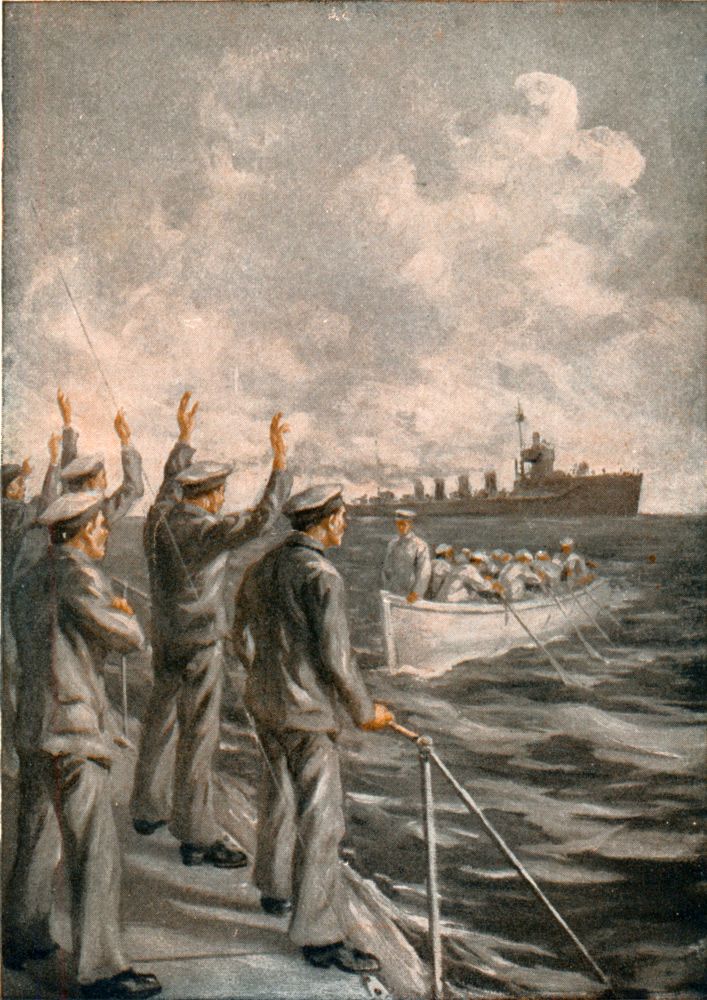
[283]
“They were a rum-looking lot, those squareheads,” began The Pickle. “They looked as if they hadn’t had a square meal for two weeks. Well, you saw them yourselves, so you know. But lined up on the deck there, with their hands up and looking down at us as if we were their long-lost brothers, they were sure a sorry, white-faced bunch. The way the skin was pulled over their cheek-bones and the way their clothes flapped around them got me! The ensign and Willet and I went down through the hatch and the minute we got our heads under we wished we hadn’t. The smell was frightful. It wasn’t just foul air or battery fumes; it was—well, we soon found what it was. The ensign took one of the men down with us, a sort of chief gunner I guess he was, and he was so weak he fell the last half-way down the ladder, and Willet had to pick him up and put him on his pins again.
“There wasn’t any sort of a conning tower, as [284]you saw, but you went right down straight into the central station. Things were in a fierce mess down there and it was half dark. On the floor alongside a desk with charts and papers on it lay the captain, dead as a doornail. He wasn’t a pretty sight, for some one had bashed his head in. The ensign turned to the Hun that was with us and pointed. I don’t know much German, but I managed to get some of what they said. ‘What happened to him?’ asked the ensign. The fellow shook his head. He was a stolid sort of chap, about twenty-three or four, I guess. ‘Who killed him?’ asked the ensign. Then the Hun said he didn’t know, although you could see he did. ‘That’s the captain,’ said the ensign to Willet and me. ‘They’ve probably done in the first officer too. We’ll see.’ He was a bit pale, was the ensign, and I didn’t feel any too good myself just then. The captain had been dead several days and it wasn’t very pleasant there. Why they hadn’t got rid of the body I don’t know, unless they were too weak to get it up the ladder. We found the next thing that the sub was a mine layer, for there were two wells on her, with mines in each ready to drop.
“It was Willet found the first officer. They’d [285]shot him in his berth while he was asleep.” The Pickle shivered. “Then we lugged the squarehead into the stateroom and showed him the body and he ’fessed up. As near as I could make it out his story was something like this. They’d left Zeebrugge twelve days before with orders to proceed to some place off France and drop mines. The first day they were out the men found that she was poorly provisioned. They were most all old U-boat men and knew what they were up against. So they talked it over and put it up to the captain. Told him they hadn’t enough grub aboard for a week, let alone three, and demanded that he return to a base and stock up proper. But the cap said he’d got his orders and wasn’t going to turn back and a lot more, and was pretty fairly brutal.
“Things went on for three days and then they sighted a merchantman without escort off the east coast of Ireland and they got orders to give chase. Well, they wouldn’t. They were half-starved already, not having had more than one day’s rations in four, and were desperate. So, when the Old Man threatened them with punishment for mutiny they thought they might just as well be hung—or shot—for mutton as for spring lamb, and when he drew [286]a revolver one of them laid him out from behind with a wrench. As he went down they grabbed the revolver and did for the first officer, who was asleep in his bunk.
“Then they were in a bit of a pickle, for they knew that if they took the boat back to Germany they’d get short shrift. They talked it over and decided that the only thing to do was to surrender to an enemy ship. So one of them, a sort of chief petty officer, took charge and they set out to get themselves pinched. But it wasn’t easy, because you see, just as soon as they’d show themselves the enemy would start in to plug them without asking any question. They tried the trick by wireless, but all they got was the merry ha-ha. Every one who picked up the message thought some one was trying to get gay with him, I suppose. So yesterday they tried us to see what we’d do. They’d been following us ever since early morning. Well, we didn’t act friendly and their courage gave out and they beat it. But they kept us in sight and tried again in the afternoon. They’d put up that white flag of theirs, but it was always wet when they came up and wouldn’t do much but wrap around the periscope. Finally, this morning, they decided that they might as well [287]get killed as starve to death. What do you know about that for a sea story?”
Although The Pickle had guessed at some of his details, he had got the facts concerning what was perhaps the strangest surrender ever made on the high seas correct enough. Meanwhile, however, the ensign had made his report to Captain Gannett and the Conklin got busy. The submarine’s crew, twenty-eight in all, were taken off, some of them so weak that they had to be lifted from deck to boat and from boat to sick bay, and the bodies of the two officers were carried up and unceremoniously buried at sea. After that, having very casually reported the capture by wireless, the Conklin made a hawser fast to the towing-hook at the submarine’s bow, and under orders from the flagship, set out for Queenstown.
“Huh,” said Pete that night, “I guess the Conyngham ain’t got anything on us, Kid! This prize we got’s a regular boat, an’ a mine layer at that. As our Limie friends say, ‘Wot price mine layer?’ Only they’d say ‘lyer’ instead of ‘layer,’ wouldn’t they? Guess the Conklin’s pretty bad, ain’t she? Guess she don’t do much for her country, eh? Two prizes in a week ain’t anything to be proud of, is it? [288]Say, Pickle, take a slant overside an’ see if the Hun’s still in tow. I wouldn’t want to lose her after the trouble she’s cost me.”
“You, you flat-foot! What did you have to do with it?” asked Dill.
“What did I have to—Say, didn’t you know that I had the little old Number 5 trained right on the geometricous center of that tin fish? If it hadn’t been for me those bloody-minded murderers would have killed you an’ all the rest of your boardin’ party! What did I do, says he! Huh!”
“Maybe you’ll begin to believe that there are such things as German submarines after all, Pete,” suggested Dave.
“Sure! I always did believe it. Only I say there ain’t so many as folks think. Why, look here, now, don’t what happened yesterday and to-day prove it? When we seen that submarine the second time every one thought she was a new one, didn’t they? Same thing this mornin’. I heard you fellers sayin’ ‘Gee, but that’s funny! Three in two days!’ Well, she was the same little Hun all the time, wasn’t she? Just followed us around she did. That’s what I was sayin’ the other day. Folks see the same sub twice an’ put it down for two!”
[289]
“You win,” laughed The Pickle. “What gets me, though, is how they managed to follow us last night in the dark.”
“I don’t believe they did,” replied Dave. “They knew we were on patrol and all they had to do was wait for us to come back on the next course.”
“That’s it, I guess. Well, anyway, it’s a queer business. What do you suppose will happen to those poor hoboes?”
“They’d ought to be shot at sunrise,” answered Pete, unfeelingly, “but they won’t be. They’ll be put in a nice, steam-heated prison camp an’ took care of till the row’s over. I don’t know as I blame ’em a whole lot for killin’ off the officers, if the officers were like what you hear tales of, but I don’t just admire ’em for it.”
“The Old Man got a fine lot of papers and books and truck like that,” said The Pickle reflectively. “He was as pleased as Punch about it and he and the executive are up in the ward room now having a lovely time with them. We got a copy of their secret code and a lot of interesting stuff. Looks to me as if the Old Man would find himself in about right with the Admiral pretty soon. Wait till we get ashore and rub it into the Wood crowd.”
[290]
Pete chuckled. “Yeah,” he said. “Wait till I tell Quinn, that slant-eyed, lantern-jawed cox o’ theirs. Maybe it won’t take the wind out of his sails.”
“It would be funny, though, wouldn’t it,” suggested Dave, “if the Wood got back there with a sub, too.”
Pete observed him disapprovingly and The Pickle with sorrow.
“Gee, you can think of more punk things to say, Kid,” remonstrated the latter. “Gloom must be your middle name.”
The Conklin glided into harbor the next morning very proudly and towed her grim, gray prize fairly under the noses of five American and one British destroyer before she came to anchor. On the main deck every gob who could get there stood negligently and boredly as congratulatory messages came from the bridges of the other ships. Their attitude asked plainly: “Why so much turmoil about a mere U-boat? It’s an old story with us.”
That attitude vexed the Plaisted’s gobs and they made derogatory remarks in voices inaudible to the bridge, but heard on the Conklin’s deck, and gestured [291]derision. “Where’d you get the old cook stove, Conk?”
“What’s that you’re towin’, partner? Some new kind of patent log?” “Did the Kaiser make you a present of it?” “Say, fellers, see what the cat’s brought in.” But the Conklin men only smiled in serene contempt. They could afford to let the envious world gibe.
The Wood wasn’t in port when the Conklin arrived, and so Pete had to wait two days for the pleasure of crowing over Coxswain Quinn. But perhaps it was worth waiting for, for if Pete’s condition when he returned to the ship that afternoon was any sign he must have had a thoroughly good time. He seemed very desirous of avoiding the gaze of the officer of the deck and plunged below so rapidly that he scraped some of the skin from his ribs. But a little more lost skin was of small moment to one who had already parted with so much! In short, Pete was a cheerful wreck, and raw beef secured from the galley and much plaster from his first aid kit failed to make him more than half presentable. But no questions were asked by the executive, and the Old Man, catching a glimpse of Pete the next morning from the bridge ladder, [292]only smiled and went on up. It was by that time generally known throughout the ship that the Wood would be short the services of a coxswain for one or two days. Neither Dave nor The Pickle were witnesses of that encounter, but those who were feelingly pronounced it the best battle of the war up to date!
The Conklin spent one more day of idleness and then pulled up her hooks and set forth again for her mission of “making the world safe for the democrats,” as Pete phrased it. But this time it was not patrol duty that called her. “Special and distant service” was the word that went around below deck.
[293]
The Conklin left Queenstown just at dusk and steamed straight across the mouth of the channel, and at daybreak was skirting the tip of the Cornish coast, with the Scilly Islands faint blurs to the westward. Later they passed Lizard Head in a sea so smooth that it was hard to believe the tales they had heard all their lives of the treacherous nature of that coast. The frowning cliffs of Cornwall were in plain sight for an hour, and then the tall white tower of Eddystone Light rose off the port bow. The Pickle, who seemed for some reason to be a walking compendium of lighthouse information, entertained Dave and Pete with the story of the Admiralty’s attempts, dating back nearly a hundred and fifty years, to build a beacon on that sinister reef which, some ten miles from the nearest point of the mainland, stretches for hundreds of yards across the ship thoroughfare and obstructs the approach to Plymouth from the channel side. [294]Many vessels have struck there. At one point the submerged ridge throws a few battered granite rocks above the eddying waves at low tide, from which fact came the name of “eddystones.”
“Away back at the beginning of things,” said The Pickle, gazing across at the slender tower, “a man whose name I forget got the notion that there ought to be a light on that reef and that he was the Johnny to put it there. So they told him to go ahead. Well, he stuck up a queer Chinese pagoda effect of wood and slathered it all over with carvings and gilt. Maybe his idea was to scare the waves away. Anyway, they say it was a fearsome looking contraption when it was done. It took him three or four years to do it, and when he had the wise guys around here said it wouldn’t stand the first hard gale. But this Johnny said he knew better and that he hoped he might be in the tower when that gale arrived. Every one gets his wish once in a lifetime, and it was this fellow’s turn to get his. When the gale did come he and five keepers were out there in the pagoda. When the folks in Plymouth looked out the next morning to see how the beacon had got through the storm there wasn’t any beacon.”
[295]
“Gee!” said Pete. “Did they drown?”
“So they suppose. Anyway, they weren’t around. After that another wooden tower went up and stayed quite a while; forty years, I think it was. It was built so well that it might be there yet if it hadn’t caught on fire from the lantern one day and burned down. They had trouble in building it that time because England and France were at war, and the French privateers kept them on the jump. One time a French boat caught them napping and took off the whole force as prisoners of war and carried them back to France. But when the king heard of it—Louis the Somethingth, I guess—he got peeved with the smart Alecks. ‘What those guys were doing was for our benefit as well as England’s. I’m at war with the perfidious Albion’—or words to that effect—‘but not with humanity.’ After which he handed himself a round of applause, had the smart Alecks put in the stocks and sent the lighthouse folks back to their little ledge with a lot of presents.”
“What sort of presents?” asked Dave.
“I don’t know; a couple of gold chains and a bag of ducats and a package of ‘fags,’ maybe; the usual thing. Read your history and find out. [296]That was number two lighthouse. Number three was of stone and stood up about a hundred and twenty-five years. Then the cement began to go west and they put up the present light alongside it. This one is a hundred and thirty feet from base to light. Anything else I can tell you about lighthouses?”
“Yeah,” said Pete, “you can tell me how much lighthouse keeping costs in England compared with light housekeeping in New York.”
“New York? Lighthouse keep— Oh, I get you, Pete! And that’ll be about all from you, son!”
Soon after they entered the English Channel, and during the day, keeping well in toward the English coast, passed numerous points of interest which, unfortunately, were too far distant to be more than faintly descried. Their course did, however, lead them close to the Isle of Wight and the entrance to Portsmouth Harbor. Pete made The Pickle’s life something of a burden to him by demanding information about every little lighthouse or beacon that they glimpsed. But if they saw little of the southern coast of England they saw a lot of the English navy in the shape of mine sweepers and layers, naval [297]tugs, patrols, torpedo boats, destroyers, and cruisers. And once, off the Bill of Portland, they passed within a half mile of a super-dreadnought steaming sedately down channel, a huge and wicked-looking sea mammoth indeed.
There was a deal of speculation as to the Conklin’s mission and destination and all sorts of guesses were made. The favorite one was that they were to rendezvous with a part of their own or the British fleet and make an attack on one of the German naval bases in the North Sea. Consequently, when, at dawn, they found the destroyer snugly anchored in the Thames estuary, with Taynham on one side and Sheppy Island on the other, they were a disappointed lot. Only the fact that London lay but forty miles distant by railway and the rumor that they were to stay where they were for several days, brought comfort. Nearby a group of small tugs and big launches were huddled around a stone quay from which a very busy signal station stuck up like a sore thumb. Now and then a tug or launch would put hurriedly away toward the sea, or a bevy of them would start off on some mysterious but evidently vastly important mission. There was no liberty for the destroyer’s gobs that day and they [298]spent a rather bored time watching the various craft coming and going past the point of the island. The next morning they went on up to Chatham, where there was a considerable British naval base, and snuggled up to a dock, alongside a small black cruiser. Then it was made known that the Conklin would remain at Chatham for two days and liberty was granted for thirty-six hours. Many took advantage of that to make the trip to London, and Dave and Pete were all for joining the party until they learned that The Pickle had other plans.
“You fellows go along,” said Dill. “It wouldn’t be much fun for me. I’ve seen the old town twice and, besides, I’m pretty nearly broke, and it costs like thunder to stay around London even over night.”
“Hadn’t thought of that,” mused Pete. “I’m about stoney myself. How about you, Kid?”
“I can lend you a couple of dollars,” answered Dave. “Bob, too, if he will come. But I’m not horribly rich just now.”
“Maybe we’ll have another chance to see the place,” said Pete. “It wouldn’t be much fun without plenty o’ ‘berries.’ Ain’t there some other place around here?”
[299]
“Come with me,” said The Pickle. “I’ve got some English friends at a little town called Gradford, about forty or fifty miles from here in Sussex. I suppose they’re still there, because English folks never move the way we do, and they’d be mighty glad to see you fellows. What do you say?”
Pete looked dubious. “I ain’t much on the society game, Pickle,” he replied. “Better leave me out, I guess.”
“Nonsense, the Wylies are just nice plain folks and you’d like them immensely. We met them in Switzerland one year and they stayed with us at Westport a couple of weeks summer before last. They made me promise to visit them the first time I was in England.”
“Yeah, an’ bring all your friends,” said Pete sarcastically. “I guess they’d be awfully chawmed, what? Say, you piece o’ gear, don’t you know folks in this country can’t get enough to eat themselves, without feedin’ three hungry gobs?”
“Oh, I guess it isn’t that bad,” laughed The Pickle. “English folks always have plenty of parsnips on hand.”
“Parsnips. Gee, I never could eat parsnips. You and the Kid take a chance. I’m off of it.”
[300]
“No, you’re not. Listen, Pete. I asked a chap on the cruiser about Gradford and he says there’s a train at eleven as far as Rochester. Then you change and go to Maidstone, and from there to—I think it was Turnbridge he said. Anyway, you change again there and go right on to Gradford.”
“Well, it would be a change, all right,” chuckled Pete. “How long does all this take you? Would you get there to-day or to-morrow?”
“About four this afternoon, he thought.”
“Gee, forty miles in five hours! I’d be afraid to travel as fast as that.”
“I guess the connections aren’t very close,” explained The Pickle. “Come on! Be a sport, Pete! You’ll go, Kid?”
“I’d love it, but—it seems sort of cheeky, doesn’t it, Bob? Would we stay overnight?”
“Sure! They’d be tickled to death to have us. There’s only Mr. and Mrs. Wylie and a kid son and a girl about ten. Nice folks, fellows. You’ll like them. Go on and get into your dress togs and pretty yourselves up. I’ll find out about the liberty boat.”
“Yeah,” answered Pete. “I’ll be so pretty you won’t know me. Got any freckle lotion, Kid?”
[301]
At nine-thirty they were dumped on shore, with an hour and a half to wait before their train left. That, however, didn’t bother them. Chatham proved a busy town and they found much to interest them. Not long before a German air raid had passed over the little city, leaving death and devastation in its wake, and their wanderings led them to the marine barracks now in process of reconstruction, which had been bombed with a loss of over a hundred lives. Pete had a good deal to say on the subject of that particular kind of warfare, but, while not uninteresting, it was too emphatic to bear repetition. Their train crawled out of the station at 11 and they found themselves in a crowded third-class carriage. English railway travel was novel to both Dave and Pete, and their frank conversations amused The Pickle all the way to Rochester. Here they found that they were in for an hour’s wait for the next train, which was to take them as far as Maidstone. A communicative official explained that in pre-war times they would have gone right through, but that nowadays travel was “fair disrupted.” But they were all in holiday mood and didn’t mind the delay. Rochester appeared a quiet place after Chatham, but they explored so much of [302]it as was not too far from the station and found plenty to see. The Maidstone train was late in leaving and it was one-thirty when they again changed. The station buffet supplied them with luncheon and at two-twelve they were on their way once more. There was one more change and one more wait, and finally, at just before five o’clock, they descended at a tiny station which the guard assured them was Gradford.
There was so little in sight from the platform save scenery that Pete cast a longing look after the disappearing train. An elderly man, who appeared to combine the duties of station agent, baggage agent and porter, listened to their inquiry with a hand cupped behind one ear. Then, in silence, he led them to the back of the station and pointed to a country road that went winding off toward the west.
“It be a matter o’ five mile,” he informed them. “Keep to that road till ’e come to another. Pay no heed to that, sirs, but keep straight along till ’e comes to a bridge. That be Gradbridge. The Wylies’ place be a mile beyond. Best ask your way, sirs, if so be you meet folks.”
“Five miles,” demurred The Pickle. “How about a carriage—I mean a trap?”
[303]
But the man shook his head, looking, Dave thought, a trifle disapproving. It appeared that there were no traps to be hired thereabouts and that the telephone was not yet in general use in that part of England. Ultimately they set off afoot. After all, as Dave pointed out, five miles wasn’t much of a walk for three husky “gobs,” and probably they’d reach their destination in plenty of time for dinner. Pete, however, showed scant enthusiasm and had a good deal to say about missing “ahfternoon tea.” Missing his tea, it seemed, always upset him frightfully.
It wasn’t a bad road, and it was certainly picturesque until, after a mile or so, it began to run between high banks that quite cut off any view. The evening was still and warm and a light mist hung over the countryside and they walked on into an amber glow from the setting sun. A forest gave them cooler air and they sat down by the way for a while and rested. So far they had met no one and when, presently, a two-wheeled cart rattled into sight it was quite a momentous event.
“Guess we’d better ask if we’re right so far,” said The Pickle, and got to his feet. But in spite of his very evident wish to speak, the occupant of [304]the cart, a heavy, dark-complexioned man with a long brown coat, applied the whip to the horse and dashed by them without drawing rein. A dozen yards beyond he glanced back over his shoulder and there was unmistakable alarm on his face.
The Pickle laughed. “Bet you a dollar, fellows, he thinks we’re Germans! Guess he never saw an American gob before in his life. If you had turned your back, Pete, he might have stopped.”
“If I looked as much like a Hun as you do,” replied Pete, “I’d drown myself. Come on an’ let’s get this over. I never could go parsnips before, Pickle, but these friends o’ yours won’t have half enough for me to-night!”
They found the branching road and, following directions, let it severely alone. There was a prosperous looking farm house a quarter of a mile back from the junction of the ways, approached by a long, narrow lane between head-high hedges. Dave was for going there and negotiating for refreshments, but, as The Pickle pointed out, it was just so much farther to walk. A dog barked at them from half-way up the lane, and insects—crickets, Dave said they were—were busy along the roadside. And once a far-off locomotive whistled shrilly. For [305]the rest, it was a strangely, almost oppressively quiet world they traveled. At last they reached the bridge, which was a small affair of stone and timbers over what looked like a fair-sized brook. The Pickle, however, remembered that the Wylies had frequently spoken of the River Grad and he guessed this was it.
“River, eh?” scoffed Pete. “Then you wait a minute.”
“Where are you going?” Dave asked.
“Goin’ to jump it,” was the reply as Pete clambered down a bank. “First time I ever found a river I could jump across.”
They dissuaded him from the attempt, pointing out that he couldn’t possibly do it in less than two and that the first jump would leave him awfully wet. A little further on—they were traversing an expanse of rolling country interspersed with copse and hedge-lined lanes that seemed to Dave typically English—the road branched. There was a signpost there, but the words were almost obliterated and the early twilight was scant aid to vision. While they hesitated a boy of perhaps fourteen appeared mysteriously through a hedge and stopped stock-still to regard them with amazement and curiosity.
[306]
“Hello, sonny,” said The Pickle. “Where do the Wylies live?”
The youth shook himself from his trance with an effort and said “Eh?”
The Pickle repeated the question and the boy shook his head.
“Come on, kid! Have a heart!” said Pete. “Don’t you live around here?”
“Ay, over there.” He pointed indefinitely toward the hedge.
“Then you must know the Wylies’ place?”
“Ay.” He seemed a most laconic youth.
“Fine! Where is it, then?”
“’Tis on this road, sir. ’E can’t miss it. It be a largeish house.”
“Well, why didn’t you say so?” asked The Pickle.
“’E asked me where they live.”
“Sure. They live in the house, don’t they? Why couldn’t you say so?”
The boy only stared, however. Possibly, they thought, the logic was too much for him, but later they recalled his silence with better understanding After they had progressed some fifty yards along the indicated road Dave glanced back. The boy was [307]following them at a distance. Finding himself observed, however, he slipped from sight. “He, too,” thought Dave, “believes we’re Germans!”
Ten minutes more brought them to the “largeish” house. It stood well back from the road, a stone residence that thoroughly deserved the boy’s description. Although only two stories in height, it covered much ground. It was a most attractive looking house, or would have been save for a certain aspect that brought a perplexed frown to The Pickle’s heated brow. They gazed at it in silence for a moment across the top of a low, well-trimmed hedge. Then Pete said:
“It don’t look quite right to me, Pickle. It looks—looks—”
“Nobody home,” murmured Dave.
“By jove, it looks like it,” muttered The Pickle uneasily. “What a sell if it’s so!”
Pete viewed him disgustedly. “What about those parsnips?” he demanded.
“Well, let’s find out,” suggested Dave. “No use spending the night here.”
They set their feet on a graveled drive and passed between clumps of shrubbery toward the entrance. No light showed, although it was now dark enough [308]to demand lights indoors, and there was something very inhospitable about the tightly-closed portal ahead. The Pickle mounted four wide stone steps and laid hold of an old-fashioned bell-pull. Somewhere distantly and faintly, a bell tinkled. They waited. The Pickle rang again. After that he knocked. And still later they made a circuit of the house and demanded admittance at two other doors with no better success. Then, standing on a moss-grown brick walk at one end of the house, they viewed its many darkened windows and its chimney-pots clustering against the twilight sky in despondent silence until Pete, with a world of sarcasm in his voice, observed briefly:
“Parsnips! Huh!”
[309]
Half an hour later they were tramping back again through the long English twilight, just able to make out the road ahead. They had sat despondently for a while on the stone steps of the deserted house and rested, a somewhat silent trio, while the daylight faded slowly and the coolness of evening settled over them. At last The Pickle had looked into a leather pocketbook and selected a small piece of cardboard bearing the inscription, “Mr. Robert Dunham Dill.” Borrowing a pencil from Dave, he had added the names of his companions to his and then, with a ceremonious bow, slipped the card beneath the front door. Pete had watched the proceeding ironically, and when The Pickle had remarked: “At least they’ll know we called,” he observed: “Huh! I know a better way to show ’em: Bust a window!”
Their plan was to find that farmhouse they had seen, or, failing that, some other house, and get [310]something to eat. Their luncheon had been scanty and they were terrifically hungry. Whether the farmhouse was this side or beyond the bridge no one was certain. Dave said beyond, The Pickle said this side and Pete refused to commit himself. The darkness increased slowly, but by the time they had been walking a quarter of an hour night was fully on them. Dave said there ought to be a moon, but there wasn’t, and meanwhile the low-lying mist increased the blackness of a cloudy, starless night. They stumbled on, keeping to the road by instinct rather than sight. The bridge and the river that Peter had wanted to jump were a long time in coming, and they had begun to trouble about the fact when they heard the gurgle of water ahead. They crossed the bridge and had gone some distance beyond when The Pickle observed worriedly:
“Does this road seem right to you fellows?”
“Yeah, why not?” asked Pete.
“Well, somehow it doesn’t seem to be going in the right direction. And it seems rougher than when we came the other way.”
“Now that you mention it,” said Dave, “it does seem rougher. And narrower, too. I was almost in a ditch a minute ago.”
[311]
“There wasn’t but one road,” Pete reassured them, “so this must be it. It’s a punk old road, but I guess it’s the right one.”
“There were some lanes,” said The Pickle doubtfully. “We might have got shunted off into one of them. Wait a minute, fellows. Let’s see what it looks like.” The Pickle lighted a match and tried to view the surroundings by its weak radiance, but the result was disappointing, and Pete impatiently bade him come on.
“Let’s find that farmhouse an’ get some chow,” he said. “You chaps may look at scenery if you like, but I’m just about starved to death.”
“Folks in dear old rural England go to bed a bit early, I fancy,” said The Pickle presently, “and maybe the lights’ll be out and we won’t be able to see it.”
“Bet you I’ll be able to smell it!” answered Pete. “If there’s food within a mile I’ll know it.”
A minute or two later Dave said: “Hark, fellows! What’s that noise?” They stopped and listened. Then: “Sounds like waves!” exclaimed The Pickle. “Great Scott, we must be miles out of our way! We’re going toward the coast!”
Followed a dismal silence. Then Pete remarked [312]with forced cheerfulness: “Fine! You can always find something to eat along the shore.”
“Pete,” said Dave earnestly, “if you spring that old one about the ‘sandwiches there’ I’ll kill you.”
“Wasn’t going to. I was thinking of clams.”
“What do you say?” asked The Pickle, dubiously. “Shall we go back or go ahead?”
“Ahead,” said Pete. “We’ll light a bonfire and maybe a boat’ll come and rescue us.”
“I think we might as well go on,” agreed Dave. “There’s likely to be a village along the shore, don’t you think?”
“I used to think that you found a village every half mile in England,” replied The Pickle sadly, “but we seem to have stumbled on the one part of the country where nobody lives.”
“Maybe it’s malarial,” suggested Pete. “I ain’t found any mosquitoes, though. Oh, come ahead, fellows. I’m getting used to it now. I’m beginning to enjoy it. I could walk forever.”
“You’re getting light-headed for want of food,” said Dave, as they went on. “And speaking of food, I’d give anything for a drink of water.”
“So would I,” said The Pickle. “If you hear anything like a brook sing out.”
[313]
But all they heard was the subdued sound of the waves. They were climbing a hill now and it lasted for a long time. They stopped to recover their breath and then went on again, and suddenly the beat and swish of the waves was louder and lights twinkled in the blackness and a rush of cooler air from the Channel smote them. They seemed to be on top of a hill, with the ocean a scant distance below. As they paused to peer into the darkness and speculate on the twinkling lights the moon peered for a moment from behind a cloud bank eastward and the scene was revealed.
Before them the road went winding abruptly down to a curving beach, two or three hundred yards distant. On either side stretched rolling moorland. The lights were from beacons or ships, all very far away across the water. To the right a lighthouse shot intermittent white beams athwart the sea. Then the moon slipped behind a cloud and they were again plunged in darkness.
“Well, I don’t know where we are,” said Pete, philosophically, “but I’m glad we’re here. See that reddish light over there? Well, that’s an all-night lunch, fellows, an’ I’m goin’ over to it.”
The Pickle seated himself on the ground and [314]stretched tired limbs. The others followed the example and for a minute they were silent. The waves boomed up from the beach and the fresh wind from the Channel blew in their faces. Finally Dave said: “Now what? We don’t want to stay here all night, I suppose.”
“I’m going down to dig me some clams,” said Pete. But he didn’t move. The Pickle sighed and laid himself flat on the turf beside the road. “Good night,” he murmured. Dave sat and watched the twinkling lights. Silence fell again. Presently he peered at the dial of his wrist watch. The hour was well after nine. Something suspiciously like a snore came from the darkness where The Pickle reposed. Dave’s head nodded....
Perhaps he slept for a moment, perhaps for many minutes. He didn’t know. He awoke with the sound of a gun in his ears and felt the earth tremble slightly beneath him. Eastward a long shaft of intensely white light bored into the heavens from some distant headland. Again the gun boomed. That, too, was to the east, perhaps three miles away. Perplexedly Dave’s gaze followed the broadening shaft of light, and the next instant the searchlight focused itself on the dim shape of an airplane high up in the [315]heavens. Then a second shadowy shape passed into its field of radiance, and a third. The shaft of light moved jerkily, back and forth across the night sky, at every jump revealing a tiny winged form against the clouds. The gun was firing hysterically now at intervals of a few seconds, or possibly a second gun had joined in. From the blackness behind Dave came The Pickle’s voice:
“An air raid,” it said. “And coming this way, fellows. They’re not more than a couple of miles off, I guess.”
“Any one seen a cellar around here?” asked Pete. “Say, those aren’t Zeppelins, are they?”
“No, bombing planes, I’d say,” replied The Pickle. “Look at the searchlights behind us, fellows.”
Toward the interior shafts of light were springing up from the earth, sweeping inquiringly hither and thither, waving, crossing in a wonderful display. The radiance shed a pale glow over the world, a glow that pulsed, waxing and waning as the light beams swung questioningly about. The raiders were almost overhead now, or so it seemed, and the watchers could see the shells from the anti-aircraft guns bursting below them. The humming [316]of the motors became faintly audible. The first searchlight had settled fairly on one plane and clung to it inexorably as it passed above the shore line. Under the white glare the plane looked like a yellow-gray dragon-fly in the far heights. That the shells were reaching the enemy seemed doubtful, for the latter flew straight on Londonward, perhaps nine in all. Inland, other guns joined the stabbing chorus and soon the firing from the coast toward the east ended. The humming whirr of the engines died away and the nearest searchlight swung slowly across the heavens, swept back and forth watchfully toward the south for a minute and went out. Northward the distant guns drummed incessantly, but gradually silence returned to the hill where the boys stood. They could no longer make out the faint specks speeding toward the great city, and the distant searchlights, following the foe, withdrew their radiance from the coast. Pete drew a long breath.
“Gee, I wouldn’t have missed that for anything!” he murmured. “It was wonderful!”
“Do you think they’ll get as far as London?” asked Dave.
“I wouldn’t think so, judging from the reception [317]they’re getting,” answered The Pickle dryly. “More than likely they’ll be coming back pretty soon, but I guess they’ll choose another course. How many—”
He ceased abruptly and wheeled in the darkness. Then, simultaneously with his companions, he threw himself to the ground as, out of the gloom of the night, something vast shot close overhead. They felt the silent rush of it, the wind of its flight on their faces. It was like some huge bird skimming close to earth. They saw it, but only as one sees uncertainly a darker object in the dark, and then it was gone. But from some distance away came a crackling of bushes where the moorland rolled westward from the road and with it a sharp snap as of breaking wood.
Dave found his fingers clutching The Pickle’s arm. Close beside him Pete was breathing hard. They stood there for a long moment with straining eyes and ears intent. Then, faint but unmistakably, came the sound of a human voice. It spoke cautiously and the words didn’t reach them, but it told them one thing beyond the shadow of a doubt, and Dave’s fingers tightened on The Pickle’s arm.
“Germans!” he whispered.
[318]
Kneeling beside the road there, with heads close together, they laid their plans.
“There’ll be two of them,” said The Pickle, “and they’ll be armed. And we aren’t. I’d give a hundred dollars for an automatic right now, but never mind. What we’ve got to do is to get near enough to rush them before they can draw. That oughtn’t to be difficult, because they’ll be trying to fix the machine. We won’t try it yet, though. Let them alone for a few minutes. They’ll be suspicious and watchful at first because they’re probably not sure whether any one’s about. If nothing happens for a while they’ll conclude that they’re safe.”
“What did they land here for?” asked Pete in whispers.
“Had no choice, probably. Engine went wrong or something like that, I guess. They must have fallen behind the others and probably volplaned the first chance they got after sighting land. When [319]they came down they smashed something. You heard it. Maybe a wing. Anyway, it will keep them longer. Now what about weapons?”
“What do you mean, weapons?” asked Pete. “I got mine with me, one on each arm.”
The Pickle and Dave smiled in the darkness. “All right,” agreed the former. “That suits me. It would be hard to find clubs or anything, anyway. My idea, fellows, is to go at them from three sides, but first of all we’ve got to locate them. If they’re in bushes we’ll have our troubles, for the pesky things’ll crackle.”
“Yes, and if the moon comes out again,” murmured Dave anxiously, “we’ll have more trouble.”
“I don’t think it will.” The Pickle was silent a moment, listening. Pete stirred uneasily.
“If we wait too long they may get away from us,” he objected.
“All right. Come on, then. We’d better lie flat when we get near them and crawl. Keep down now and don’t make a sound.”
Crouching, testing each step before they made it, the three crept back along the road, which was hardly more than a rutted path thereabouts. Gradually the voices of the airmen grew plainer in the [320]stillness, although they never spoke loudly. Nor did they waste many words. With the voices came the sounds accompanying the unseen task, the soft, harsh rub of metal against metal and, once, the sharp ring of a tool. The plane had probably landed on the edge of the road, which might have been dimly discernible from above, and had “taxied” diagonally off onto the moor for a distance of twenty or thirty yards, its progress doubtless impeded by the low bushes.
Having reached a position on the road opposite the enemy, the boys paused. At that instant a tiny light stabbed the darkness across the intervening space and while it glowed the boys made out the position of the plane and saw the forms of two leather-clad men beside the nearer of the two outstretched wings. They appeared to be examining the damage sustained in landing and did much muttering as the little pocket flashlight was moved back and forth, shining through the varnished texture of the wing like a candle in a yellow Chinese lantern. The shadows of the airmen swayed black and monstrous across the ground. Then the light went out.
The boys, who had hugged the earth closely and with bated breath, now eased their positions and [321]whispered softly again. Presently, had the two visitors from across the water been less absorbed in the task before them they might have heard faint sounds in the surrounding blackness not attributable to the breeze amongst the gorse. And then they might not have, for, after all, those sounds were loudest to those who caused them and might easily have gone unnoted by the airmen. Fortunately for the attackers the higher bushes were scattered and could be avoided, while the gorse was still green enough to bend beneath their weight without crackling. Ten breathless minutes passed slowly while the three boys, crawling like snakes, gained their positions. To Pete had fallen the most difficult task, that of circling the scene and approaching it from the farther side, and Dave and The Pickle were ready long before their illuminated watch dials told them that the time allowed for Pete’s detour was up.
Followed a few seconds of suspense.
Then from three different points of the compass came the patter of running feet, and the Germans snatched for their weapons and wheeled in alarm. Only their ears could aid them, for no eye could penetrate that darkness. To shoot at random would have been idle, and so, for just those few seconds [322]that meant so much to the attackers the airmen hesitated, and that hesitation was their undoing. With more time after the first warning they might have fled safely into the darkness, but the attack was so sudden, so unexpected that there was no time for escape. It was only when an unseen form leaped upon him from the night that one of the Germans fired. There was a flash of orange light and the bullet went whistling past the assailant. Then the German’s head jerked back as a fist caught him on the point of the chin and that single flash of his revolver was multiplied a hundred times to his vision. He stumbled backward against the slanted wing of the airplane with a grunt, hung there an instant and slipped to the ground. And then Pete was on him.
A yard or more away the other German was giving a better account of himself, for, with Dave and The Pickle both engaging him, he was holding them off after a fashion. Dave was clinging to a hand that held a revolver and trying to get an arm around the German’s neck to pull him to earth, while The Pickle, fighting blindly, stumbling and tripping, was fearful of striking friend instead of foe. The German didn’t fight silently. He growled like an enraged dog, and the things he said would not look [323]well if set down here in English. Being in German, they sounded horribly enough, but conveyed no meaning. Finally The Pickle found his bearings and, ducking under the flail-like blows of their antagonist, wrapped his arms about a heavy form, heaved, swayed, and then went crashing to the ground. Confusion reigned supreme for an instant, for the enemy and Dave and The Pickle were badly mixed up, but Dave managed to roll clear, the revolver at last in his possession, and The Pickle ended the struggle with a single blow against the temple of the man beneath him.
That brought a short, sharp engagement to a close. Two more or less unconscious Germans lay inert on the ground when Pete, having discovered the flashlight in a pocket of one of the two, illuminated the scene. A sailor’s yard-square neckerchief has many uses, and to-night three of them did excellent duty. With two they tied the hands of the captured Germans behind them and with the other trussed up one pair of feet. Two white handkerchiefs, knotted together, sufficed for the second pair. Then, out of breath, slightly bruised, but triumphant, they took stock of their victory.
They had, it appeared, captured a slightly damaged [324]Albatross bombing airplane, eight small but wicked-looking bombs, certain maps and papers of uncertain value and two perfectly good lieutenants of the German Flying Corps. They were perfectly good by reason of the fact that one was quite unconscious and that both were securely tied. The one who was not unconscious was doing much groaning as the boys returned from their inspection of the plane, but was not yet articulate. Seating themselves on the edge of the wing, the boys faced their next problem, which was, briefly: What next?
It dawned on them then that being in possession of an enemy airplane and in charge of two prisoners of war several miles from the nearest settlement and with no notion in which direction that settlement lay was a trifle awkward. And it was not until they had discussed the problem for a good ten minutes that Dave remembered the maps taken from the prisoners. By the light of the invaluable flashlight they examined them and to their joy discovered one to be a very detailed map of the southeastern counties, showing not only roads, railways, streams and towns but even detached houses and footpaths! The comprehensiveness of it fairly staggered them. By finding the Gradford station [325]and then the road they had traversed to the Wylies’ residence they were soon able to discover their present whereabouts and learn that by following a path along the shore they could reach the town of Alburnham in something under three-quarters of an hour, since the distance, after The Pickle had translated kilometers into miles, appeared to be just under three of the latter. And with the flashlight to aid there seemed no reason why the adventure should not be comfortably terminated in a couple of hours. It would not do for all three to make the trip to the village, and one would serve as well as two, and so very gravely they each produced a coin and, shaking it in a closed hand, slapped it down on a knee.
“Odd man goes,” said The Pickle. “Heads!”
“Heads!” echoed Pete.
“Tails!” said Dave. “Give me that torch.”
Not quite two hours later Pete and The Pickle, drowsing at their post, were aroused to full wakefulness by the chugging of a motor-car coming up the hill and the dull gleam of its lamps. Then, from the darkness emerged military and civil authority and Dave Garson, the former very wide-awake and agog with curiosity and the latter yawning and dull of eye. The prisoners were placed in the car, [326]the rest followed, there were many stern questions in English and helpless responses in German, and the motor shot off down the hill, bumping and swaying over the rutted road and—every last one of the heroes went to sleep.
Later the car stopped and all got out in the half-gloom of a village street. The prisoners disappeared through a doorway and a light appeared at a window. Then some one took Dave by the arm and impelled him through a second doorway. Pete and The Pickle stumbled sleepily behind. There was a dimly-lighted room with cots. Some of the cots were empty. A fussy little corporal in his shirt-sleeves kept talking and talking, and The Pickle, trying to unfold a gray blanket, got ensnarled in it and tumbled over a cot and rolled to the floor beyond. And Dave couldn’t untie one shoe-lacing and so gave it up. Some one said “Good night, Yank!” Dave had every intention of answering, but the words got mixed up and his tongue wouldn’t work.
A stout major interrupted them at breakfast the next morning and they had to tell their story from beginning to end while their tea grew cold. The major told them to go on with their breakfasts, but [327]how could they when he kept booming questions at them? Afterward two photographers enticed them out into the early morning sunlight and posed them against the gray stone wall of a barracks and took pictures of them. There was much praise for the boys, and the major in command presented them each with a souvenir of the adventure, Dave and The Pickle drawing the revolvers and Pete the pocket flashlight. At nine they were rolled off to a railway station in a motor ambulance driven by a young woman in khaki uniform, who got them to write their names in a little book she kept under the leather cushion of the seat. She explained that she tried to get the autographs of all distinguished persons she met, and was proudly exhibiting the signature of Lloyd George when the train came in and they had to hurry off. Pete spent much of his time during the first part of the journey in talking about that ambulance driver.
“When the war’s over I’m goin’ back there,” he said dreamily. “She was some kid, take it from Pete.”
[328]
Two days later the Conklin was steaming at twenty knots through the shallow waters of the North Sea. It’s a vile stretch of ocean in the best of weather, and the best of weather did not fall to their lot. The short, sharp waves drenched the decks, and the destroyer rolled and staggered and shook. Life that day was, in The Pickle’s phraseology, “nothing to write home about.” Drenched with icy spray, choked with the fumes of the black oil smoke that hugged the deck, wrapped in mist, the lookouts were a cold and unhappy lot. No, not unhappy, though, for big events impended and spirits were high.
Ahead and behind eight other destroyer craft were keeping the Conklin company. Four American and five British ships comprised the little flotilla that, hidden from each other by the wet and dreary mist, were speeding eastward toward the enemy’s stronghold. “Heligoland” was the word on every [329]lip that morning, for, although the bulletin told them nothing, their destination was no secret. They were off for a raid!
Of late German destroyers and submarines had been far too active against allied and neutral shipping in the North Sea, and the enemy must be taught a lesson. And for the teaching nine of the fastest and most powerful destroyers had been picked from the two navies and had rendezvoused the day before off The Helder. And now, lithe grayhounds of the sea, they were darting eastward for their prey.
Heligoland, that grim ocean fortress that stands thirty miles off the German coast, is to-day a veritable Gibraltar. Fortified at a cost of $50,000,000, it bristles with eleven-inch guns and forms an impregnable defense to the German bases behind it, and provides on its southward side a safe harbor for ships. In clear weather it must be given a wide berth by the enemy, but when the North Sea fogs close down about it, even its sharp eyes—giant searchlights that range for miles out to sea from the summit of the great cliffs—are powerless. And hidden by mist a destroyer may, if she chooses to dare the mines and nets that surround the rock, creep close under the guns without detection.
[330]
It was still early morning when the attacking ships reached the edge of the protected area and abandoned formation, for it is in the early hours of the day that the gray mists are thickest. The plan of the raid had been prepared beforehand, and now every unit knew its duty. The Conklin’s nose swung more to the north, in the direction of the Bight, that twenty-mile channel leading northward from the mouth of the River Elbe. Once a gray phantom hung on her starboard for a minute and then was dissolved in the all-encompassing mist. Lookouts strained their eyes as never before, their life-belts strapped about them. The engines roared and the seas dashed over the bows, making the decks a welter of water. Every gun crew was at its station; had been there for an hour, ever since the order of “Stand by!” had come in the chill darkness of early dawn.
Eastward a distant gun boomed and was followed by a second. One of the raiders had come in contact with the enemy. But from the Conklin not so much as a flash was to be seen. The firing grew continuous, a steady roar of sound. The Conklin was going more slowly now, for mines lay about her and the narrow channel she must keep to was [331]winding and uncertain. A half hour passed. The firing in the distance diminished. Then a heavier gun spoke, this time more to the north and nearer. The foretop lookout saw the rosy flare of it a few miles distant. Smaller, sharper guns barked in answer and a new engagement began. But the mysterious fog hid it as it hid aught else from the straining eyes on bridge and deck of the Conklin.
At the guns men murmured impatience. Were they to be the only ones without a bid for glory? What was the Old Man up to? Why didn’t he plunge across there and get a finger in the pie before it was all gone? But the Old Man was paying scant heed to the fortunes of the consorts. His eyes were glued to a chart and his lips never moved save to issue orders to the helmsman. Slowly but inexorably the destroyer crept on and on through the mist, her sharp nose twitching this way and that as the steering cables groaned under deck and the rudder moved from side to side. Eight knots now, and scarcely seeming to have headway in the tumbling, leaping seas. From a bow lookout came a warning cry:
“Mine close aport!”
The Conklin’s nose twitched to starboard and the [332]lookout’s hair stirred under his woolen cap as the floating engine of destruction was cleared by a few scant yards. Once more a similar warning came, and again the destroyer swerved aside just in the nick of time. A spotter amidships on the starboard side swore afterwards that the mine scraped the Conklin’s plates!
Then telegraphs became busy and the destroyer leaped forward again through sea and fog. Fifteen knots! Twenty! Twenty-six! A darker shape emerged from the grayness ahead and to port. The Conklin No. 3 gun broke the long silence. Somewhere a warning siren screamed eerily. Then a flare of rose-pink gleamed to port and, as the Conklin’s guns awoke, a shell screamed overhead. They knew then where they were, and every heart leaped with the thrill of that knowledge. They had crept through the mine field, and now they were plunging straight for the anchored ships in the wide-mouthed harbor, straight under the giant guns of Heligoland!
It was suicide, and they all knew it, from the Old Man on the bridge to the last oiler far below the wet, fog-draped deck, and every man of them gloried in it! Rushing on, firing until the gray shape was [333]lost in fog, the destroyer kept her course. Other shapes emerged now, ahead to starboard, aport—shapes small and shapes gigantic, vanishing at the vagaries of the mist, suddenly looming again. Every gun fired at sight of a target. The water dashed over the stern as a shell plunged into the waves. Here and there glares of quick, vivid light broke the gray wall. The Conklin went on and past, hurling her shells incessantly. Suddenly, ahead, a big gun spoke from the cliffs. And then another. The sounds dwarfed all other sounds. The Conklin whirled in a confusion of churning water and headed seaward again. Fair in her path lay the grim mystery of a huge cruiser, her funnels and masts high above the diminutive enemy. Straight on went the Conklin—a wasp attacking a bulldog! The cruiser’s small guns beat a tattoo against the Conklin’s deck and hull. A great shell from the shore batteries howled past. The destroyer, every funnel spouting smoke, raced past the cruiser so close that the dim lights behind open ports showed to the gun crews and they aimed for them. Roaring, firing, cheering, the Conklin blazed her way by. At the guns men worked in a sweating frenzy, shouting grimly when a shell went home, [334]laughing as grimly when the enemy got home on them. Then they were past, and astern a fearful rending of steel and timber shook the air and a wild uprush of flame and flying débris was visible for an instant. And then the gray gloom closed in again, hiding the tragedy!
“Lyddite explosion,” said the Old Man, briefly.
“One cruiser less in the Kaiser’s navy,” exulted the junior.
Below deck, men groaning from wounds heard and forgot their pain. At the guns they cheered wildly. They were handling ammunition now in the dark, for the lighting circuit had been broken. But the shells still came up and the guns still barked—all save No. 4, which would never speak again. Shot-riddled, one funnel gone, badly gashed forward above the water line, and dented in fifty places, the Conklin rushed on into a new danger. As the anchored ships dropped astern a torpedo sped across the destroyer’s bow. The submarines were in the game at last! Zig-zagging from side to side, doubtful of the channel, the Conklin raced ahead with every boiler roaring. Behind them the big guns boomed, dropping shells into that narrow path through which they must steer. Grimly firing from [335]the stern at the fleeting, shadowy shape of an enemy destroyer, the Conklin sought escape. Behind her a great gray battle cruiser was slowly settling beneath the waves and many an enemy ship was nursing her wounds, and only a miracle, it seemed, could deliver the Conklin from the enemy’s vengeance.
And yet the moments passed, and the great shells that went moaning into the sea failed of their mission. If torpedoes were launched from the skulking U-boats they, too, missed their target. Once, close aboard, an upheaval of the sea and a dull concussion showed where an anchored mine had been exploded, perhaps by torpedo, perhaps by shell. The Conklin held her life in her hands now. Around her lay unseen death, behind her coursed destroyers and submarines. But it was as the God of Battles willed it, and the gallant little ship, never slowing her engines, plunged fearlessly forward, turning and twisting. Sweaty, smoke-grimed lookouts peered from the bows and shouted hoarse warnings. On the battered bridge the officers stood tensely and waited. And then, somehow, she was through the mines and past the nets and the gray mist was beckoning her to its arms. Back, where the great grim fortress towered above the sea, the [336]guns boomed and growled with diminishing fury. And, maimed and scarred, with a toll of dead and dying below the long, drenched deck, the Conklin sped proudly westward, the Yankee ensign still fluttering in triumph from the masthead.
THE END
Transcriber’s Notes:
Except for the frontispiece, illustrations have been moved to follow the text that they illustrate, so the page number of the illustration may not match the page number in the List of Illustrations.
Printer’s, punctuation, and spelling inaccuracies were silently corrected.
Archaic and variable spelling has been preserved.
Variations in hyphenation and compound words have been preserved.