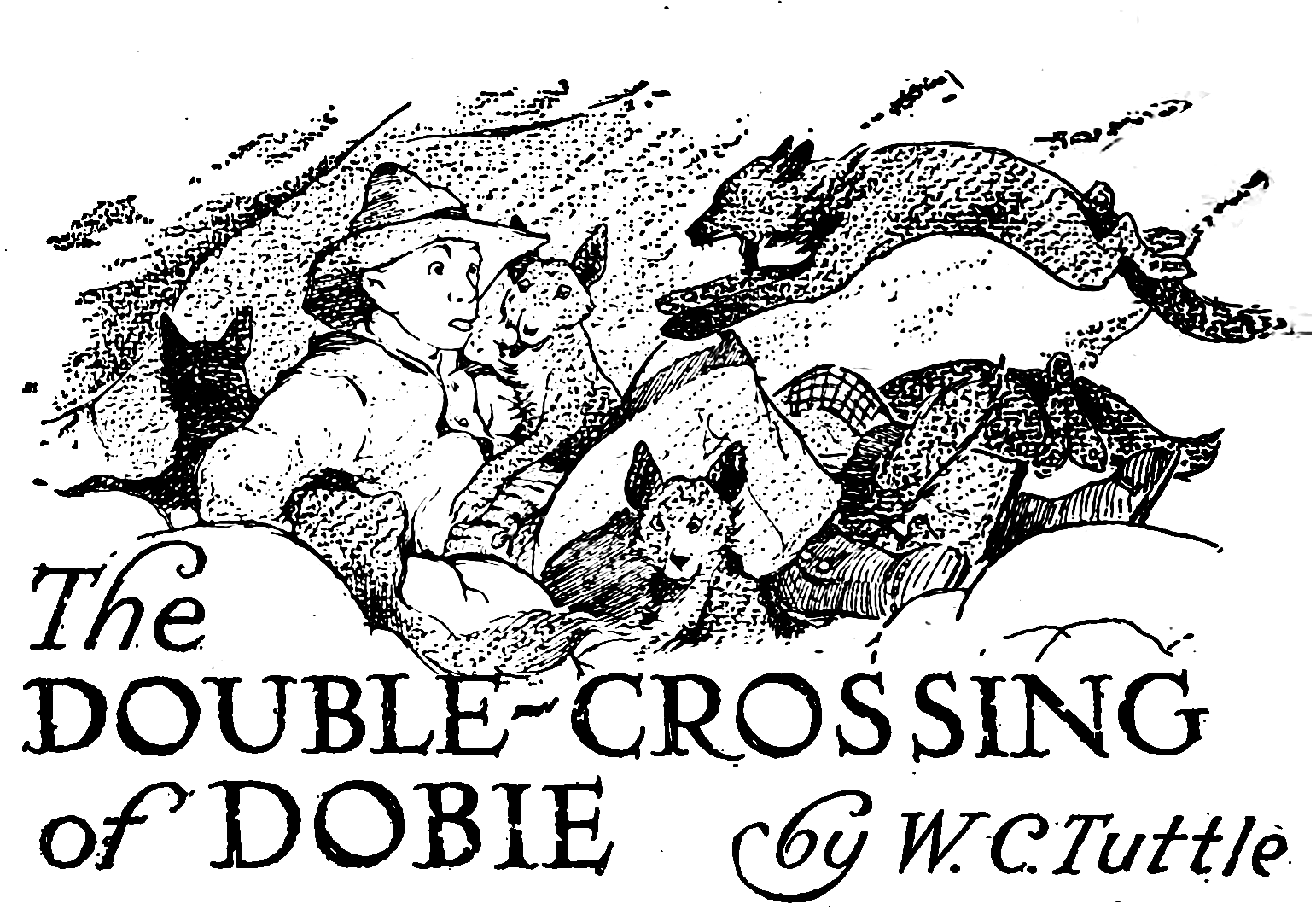
Title: The double-crossing of Dobie
Author: W. C. Tuttle
Release date: July 27, 2026 [eBook #79201]
Language: English
Original publication: New York, NY: The Ridgway Company, 1919
Other information and formats: www.gutenberg.org/ebooks/79201
Credits: Prepared by volunteers at BookCove (bookcove.net)
Pyrites, June 1.
DEAR HANK:
I reckon you’ll look at the top of this letter and say you’ll bet that Dobie is in a business in Pyrites, but, Hank, you are mistaken. If you know what rusticating is, that’s me. This town is only about seven miles from Mesquite City, Hank, but that don’t say much for the place if you have to run all them seven miles in the dark.
Hank, I never did have no luck. If the Government throwed the mint open for settlement, I’d be in jail. When they was passing the luck around, I must ’a’ been at the foot of the table and got a piece that nobody else had the stummick to tackle.
Remember the night that I got married, Hank? I ain’t referring to the boot with a spur on it that hit me on the head, but to the incident where “Shorty” Wells got too enthusiastic and hived seven shot into my leg. Remember what the preacher said? He said, “That is unfortunate.” It sure was, Hank. If Shorty had only held about four feet higher—oh, boy! Well, there ain’t no use yelling and hollering.
I ain’t kicking about anything I’m to blame for; so you don’t hear a yip out of me about my wife Emmeline. Of course, I thought the sun was rising for me when I married her, Hank, but I must have been facing the west. I don’t mind saying to you, Hank, that I made a mistake, and that don’t say nothing about the immensity of said mistake. Emmeline ain’t so bad all by herself, but she’s got some blood-relatives that mention Captain Kidd in their evening prayers. I’m only a puncher, Hank, but I’m a honest one.
Remember me writing you about Uncle Gabe Galesburg, Emmeline’s uncle? Hank, all that hombre needs is a knife in his teeth and a muzzle-loading pistol in his hand and a gang-plank to make folks walk down, and he’s got Captain Kidd, Captain John Smith and so forth pulling leather and looking for a soft spot to light on to.
He’s meaner than a loco longhorn, Hank, but he’s got one redeeming feature. He recognizes brains and ability when he meets them. He bought out the Manzanita stage line and took me in cahoots with him, which is as should be. He naturally made me the whole cheese, but, to hear him talk, you’d think he owned it lock, stock and barrel.
He gets so that he’s the fly in my axlegrease, but, as I don’t make it a practise to fight with my relatives, I keeps my face shut. Of course, he ain’t no relative of mine, except by marriage, but ignorance of the law ain’t no excuse. I got mad one morning, Hank, and I sure hopped him plenty.
“How comes it that I don’t handle nothing but a pair of lines around here when I’m supposed to be manager?” I asks. “Am I or am I not what I appear to be?”
Hank, you know I ain’t nobody to beat around about a thing. I go after action, and, when I pinned him down to it, he says:
“You are, Dobie. Anybody can see that.”
“Well,” says I, “when anybody comes in here and asks for the boss, you always speak up and ask what they want. Are you deaf?”
“Dobie,” says he, “I don’t wish to overwork you. I don’t want Emmeline’s husband to break down physically. I think a lot of her, Dobie.”
“Which proves that blood is thicker than water,” says I. “But I don’t want you for a minute to think that I’m water. I’m blood, iron and bone.”
“I’ll pass,” says he, “I don’t know much about corpuscles nor mineralogy, but I confirms part of your statement.”
Get the idea, Hank? Pin ’em down to facts. I wasn’t through with him yet, as you may see; so I continues like this:
“Then how comes it that I don’t know more about the business? Half the time I don’t know whether the load I’m hauling is worth two-bits or a million dollars.”
“Well,” says he, “you can figure it like this, Dobie: if it was only worth two-bits, I’d close up business and use the horses for bear-bait, and, if it was worth a million dollars, I’d put you in jail and drive it myself.”
I’m just telling you this, Hank, so you can see the kind of a hombre I’ve got for a pardner. Did you ever know a feller by the name of “Devil Creek” Davis? I asked him if he knowed you, and he said—
“The feller that everybody said stole the spotted calf from the Widder Heffliger over in Smoky Springs?”
I said—
“Yes, that’s him.”
Did you, Hank? I couldn’t say no, ’cause I didn’t know, and it makes it a lot better when you’ve got mutual friends. When was you over in Smoky Springs, Hank?
Devil Creek is a queer sort of a hombre. He don’t have much to say, but he don’t miss much of what’s going on around here. I don’t mean here, Hank, but over in Mesquite. He drifts into Mesquite on a pinto bronc, and me and him gets friendly.
Uncle Gabe stops using guards on the stage, ’cause they were an extra expense, and he said that, if we ain’t got no shotgunman aboard, nobody will think we’re carrying anything worth much, like seed catalogs. There has been a lot of holding up going on around this neck of the woods, and all the time I’m afraid I’ll get held up next.
One morning I’m due to go out, and uncle is in a big hurry to go over to see a feller on the forks of Gila Creek. When he pulled out on his bronc, me and Devil Creek went up to the Three Star saloon, while the horses finished breakfast.
Hank, you’ve played Black Jack, ain’t you? I laid down four-bits in the game. I got a ace and a jack, which is a “natural,” and then I let the dollar ride. I got a six and a five and drawed a ten and won again. Hank, I know I can bust any old game if I stop to figure out plays, but I can’t spare the time; so I says—
“I reckon I’ve got to go.”
Devil Creek says—
“When your luck is like that?”
And I says—
“I’ve got to take out that stage.”
“Soapy” Slade, the dealer, spoke up—
“I’d hate to own a business that can’t take care of itself long enough to let me play a little.”
Hank, I got a fine idea right there, like I mostly always do; so I says:
“Devil Creek, I deputize you to take that stage to Manzanita. You ain’t got nothing to do, have you?”
Well, he didn’t; so I gave him my gun and told him to go to it, ’cause the stage is all loaded and the team is filled with hay. I made up my mind right there, Hank, that I’d have a hundred or nothing out of that check-rack, and I was right. I only had fourteen dollars to lose, anyway; so I wasn’t as bad off as if I was flush.
I went down to the stage office, and pretty soon a feller comes out of the barn and slips into the office. He’s a woolly-looking pelican, Hank. He says to me:
“Gave my bronc a feed in the barn. Who are you?”
“I’m the owner of the hay,” says I, and he laid a dollar on the table.
“Been any strangers around here lately?” he asks, and I says no—nobody except Devil Creek.
“Ain’t seen nothing of a gent about five feet ten inches tall, sandy-haired, crooked nose and one squinty eye?”
“Mister,” says I, “I ain’t superstitious noways, but, if I do, I’ll sure make it a point to kill him.”
“Good!” says he. “He needs it. That’s a description of ‘Dynamite’ Carson. He’s the hombre what held up the U. P. Railroad a couple of weeks ago and punctured the sheriff’s earthly envelope. Worth a thousand, dead or alive, and I’d advise you to take no chances on making him a prisoner.”
Well, Hank, he fed his bronc and then drifted away. I asked him what was his business, and he said that detectives ain’t in the habit of coming into a country and announcing their business.
Hank, after he’s gone, I set right down and figured out what I could do with that thousand dollars. The description covers Devil Creek to a gnat’s appendix. I’m still figuring when the door opens and in comes Uncle Gabe. He looks at me foolish-like and then snorts:
“Dobie, what in —— does this mean? Where is that stage?”
I looks at my watch, and says—
“Ought to be about to Cinnamon Creek.”
Hank, that uncle of my wife is too excitable. I’m always as placid as a buffalo-waller, and, when he rears straight up, I just smile.
“Go on!” he whoops. “What’s the big idea, and who’s driving?”
“Cool off,” I advises him; “I was took sick at the last minute, and I hired Devil Creek to drive it for me. I had cramps.”
He snaps his fingers a few times and takes a chew.
“Cramps, eh?” says he. “Who is this Devil Creek person?”
“Well, somebody had to take it out, didn’t they?” I asks. “I was suffering something awful, and I grabbed at the first straw. What’s the use of being a manager if you can’t hire a man in a emergency?”
“I asked you what you knew about him?” he reminds me.
I rolls a smoke and pats myself on the chest. I’ve decided to let him in on that thousand; maybe the shock will kill him.
“Let me tell you something that will make you glad that you’ve got me for a manager. This here Devil Creek ain’t him at all—he’s Dynamite Carson.”
“Go ahead,” says he; “I don’t know either of them.”
“Dynamite Carson held up the U. P. Railroad a couple of weeks ago, and there’s a thousand dollars reward for him. Devil Creek ain’t Devil Creek at all—he’s Dynamite. Sabe? When he drives back here, we’ll put the deadwood on him and cash in on that thousand. What do you know about that?”
Well, Hank, there ain’t nothing startling going on around here to write about. I ain’t seen my wife for several days, ’cause I’ve been here that long and she ain’t here, but likely I wouldn’t know her if I met her on the street on account of my eyes. Her uncle chased me all the way over here from Mesquite, and since then I ain’t been physically able to eat much. It’s hard to eat when you can’t hardly see what you’re eating and, when you do, you ain’t got no teeth left to masticate with.
Wish I was back with the Cross in a Box outfit. I ain’t asking for no money, Hank, but a feller has current expenses what has to be met if he wants to keep his credit well. Write soon and remember that money speaks as loud as a long letter.
Y’rs resp’y and affectionately,
Dobie Dalton.
P. S. Hank, I forgot to tell you that there was four thousand dollars in money in the express box on that stage, and I ain’t never seen where the sheriff has caught Devil Creek or found the stage. Uncle said he had a good notion to bend me all out of shape, and he meant it—’cause he did.
Mesquite City, June 10.
DEAR HANK:
Honest to grandma, Hank, you ain’t got no cause to get sore. What do I care whether you stole a calf or not? You say no, and that settles it with me. Why talk about it any more?
I don’t care if you did steal it, Hank. It don’t make me no difference, Hank, ’cause, when I’m a friend, I’m a friend. I said yes, just like you would if a man asked you if you knowed the Boer War was over. You don’t know the Boers ever had a war, Hank, but you say yes to keep out of a argument. What’s a calf, anyway, Hank? If you want to steal from a widder woman, it’s your business. Of course, some folks would turn up their nose at you if they knowed you done that, but with me it don’t make no difference.
If you stole it to try and get a start in the cow business, Hank, I’m for you, but, if you stole it to get a poker stake from, I don’t approve—unless it was a game among friends. Sabe?
I wish I’d ’a’ kept my mouth shut about it, ’cause you crabbed all the way through your letter and never mentioned money. If you was so interested in calves, Hank, you might ’a’ shipped it to me. Calves bring good money here. Well, Hank, I thought I’d write so you would know I am back in Mesquite. The old town looks just the same. Me and Emmeline ain’t had no good chance to become reconciled as yet, and it seems to me that, when a dog is down, they all tries to kick him.
I tries to talk things over with her uncle, but he ain’t the kind of a hombre what listens to reason. I done my best, Hank, and that’s all any man can do. I says to him—
“You ain’t playing square with me and the public when you kicks me out of my business like this,” says I.
All he can say is—
“Dobie, I’d be doing the fair thing to the public if I kicked you so hard that when your soul and body met they’d have to be introduced.”
Uncle Gabe is emotional, Hank, and emotion is a feerocious form of insanity. He told me to go out and find that money and stage that I gave away and then he might get fond of me again.
What can I do, Hank? I ain’t no palmist what can look in my hand and see where Devil Creek left that stage. I ain’t seen my wife for a long time; so I went up to the house and knocked on the door. I says to her—
“Darling, can I walk in?”
“You ain’t crippled in the legs are you, Dobie?” she asks, and I can see that she has been told things that were better left unsaid. I went into the parlor and picked up the family album what contains the photygraphs. “Did you come to see the pictures?” she asks. “If that’s all you wanted, you can take the album with you.”
“Emmie, love,” says I, “you ain’t likely heard my side of the story yet.”
“One side is sufficient,” says she. “I wish I’d never seen you.”
“Well,” says I, “I knowed you’d take another’s word for it; so I won’t defend myself from unjust canard. You are tired of seeing my familiar face around here; so I won’t darken your door with it again until I can come back a vindicated hero. I may never see you again, woman; so fare thee a fond fare-thee-well.”
Hank, I had a lump as big as a door-knob in my throat when I said them words, but she acts cold as a rock when she says:
“Dobie, you’ve changed your face so many times lately that I ain’t got a chance to get tired of any one of them. I hope for your sake that you will either brace up and be a man or find somebody you can whip.”
Hank, I’m strong when it comes to facing the bitter world or my relatives by marriage, but I sure sheds tears when I left my sweet wife. I went down to the Palace saloon, and I runs across “Blizzard” Hughes. Bliz is filling his skin with hooch and his soul with misery. He sobs on my shoulder and buys a drink. I tells him my troubles, and we cries together.
“Tell you what I’ll do,” sobs Bliz; “I got a burro, and you can have him if you want him.”
I kissed Bliz on the nose and asks him what I’m going to do, now that I own a burro.
“Sympathy,” says he. “Nothing like hitting a woman’s heart-strings. I’ll bring that jassack up to Galesburg’s gate, and we’ll pack him up. Sabe? You wife will realize that she’s going to lose you, Dobie, and it will twang upon her heart-strings until she cometh to your loving arms. You get the plunder together, and I’ll do the rest.”
Hank, that was one hyiu idea. I got my stuff together, and, when I got up to the gate, I finds Bliz and the burro and a lot of innocent bystanders. That burro is the picture of misery, having both ears broken and hanging down like a weeping willer.
Me and Bliz shakes hands solemn-like, and then he introduces me to all the rest of the mourners. They all sympathizes with me over my troubles and expresses grief at losing me so soon, and then me and Bliz starts to pack up.
We ain’t got much to pack, but we sure packs it well. I reckon we’re there for over an hour. Emmeline don’t show up, but I can feel that she’s looking on from one of the windows. After we’re all through, Bliz says to me:
“Dobie, she’s likely too proud to come out here before all this audience; so you better go up to the house to see her. But before you go, I want to say good-by. I must say it before you start, ’cause it would be too hard for me to wait until you pull out. Good-by, Dobie, and good luck.”
Me and Bliz cries a little when we shakes hands, and the rest of the crowd takes off their hats respectful-like. Then I went up to the house. I hammers on the door for about five minutes before I gets a reply, and then Aunt Phœbe comes to the door.
“Emmeline?” says I in undertaking tones.
She says—
“Emmeline is taking a nap, and I will call her.”
In about ten minutes Emmeline came to the door, and I says—
“Darling, I am going away.”
“Do you want to take the photygraph album with you Dobie?” she asks.
“Look upon me, wife,” says I sad-like. “This may be the last time you will ever look upon my face.” I points at the packed burro and says: “Yonder stands my last friend, which will stick through thick and thin.”
“Yes?” says she. “Maybe the association will do you good. Latch the gate as you go out, please.” And then she shut the door.
Hank, I leave it to you if that ain’t a awful way to act in a case like that. I put all the misery I can into my walk, and, when I got to the gate, I finds her uncle with the rest of the crowd.
“Some jack,” says he. “Where you going, Dobie—flea-hunting?”
“He may be full of fleas, but he’s my friend,” says I. “He ain’t the kind what will quit you in the days of tribulations. He’ll stick.”
“Where you going?” he asks, and I says:
“I’m going to vindicate myself. It may take years, and it may take longer; but, when I come back, you will be proud of me. I say good-by to all of you and fare-thee-well.”
I picks up that rope, turns my face away from all that I love and went—as far as the end of the rope.
“Yes,” says Uncle Gabe, “he’ll stick. There ain’t no argument.”
Hank, do you think I could budge that animal? You’re wrong if you think so. That moth-eaten cross between an overgrown jack-rabbit and a paryletic wouldn’t move a peg. I walked around him and yanked, and then I walked around the other way and yanked, but the best I could do was to make him wink one eye.
“You think I can’t make him go?” I asks Uncle Gabe, who stands there grinning his fool face off.
“No,” says he. “Far be it from me to prophesy anything about you or a burro. He must like the place.”
“If he knowed you as well as I do, I’d ’a’ had to hog-tie him to make him stay here this long,” says I.
“Mules have ears,” says somebody. “Maybe he heard something about you.”
Hank, that made me mad. I’m slow to anger, as you know, but I walked right up and kicked that miserable specimen in the ribs.
“Get going!” I yelps in my strong voice, and then I places both of my brawny hands upon his rump and shoved hard.
I heard later that I moved the burro a little. I’m awful strong, Hank, and it has to be a heavy thing if I can’t move it.
Now I am up against it, Hank. Before he’d fix me up, I had to promise the doctor that I could get you to pay the bill. I told him to send you the bill. What could I do? A feller can’t run around and tend to business with three broken ribs dangling around inside of him, can he? There is a lot of ways to look at a situation like that, and I hope you pick out a good one. If you think it will be over twenty-five dollars, you can send me that much and play safe. I hope these few lines will reach you in better shape than I am, and I wish to remain,
Y’rs obediently,
Dobie.
P. S. That burro stayed there until the next day at noon. Nobody but Bliz can make it lead. One calf don’t make a rustler; so forget it.
Mesquite, June 16.
DEAR HANK:
Before I go any further, I’d like to tell you that I came very near being financially fixed so that I’d never have to insinuate to you again that I need money.
I never knowed one little spotted calf to cause so much argument, Hank. You act like I was going to tell the sheriff. I don’t care if you never heard of the Widder Heffliger or never expect to. I never did either until Devil Creek spoke of her.
Hank, you’re an awful josher when you say that you wouldn’t pay twenty-five dollars for all my ribs if they’d hang all the rest of my bones on for good measure. I ain’t asking you to buy my bones, but I sure do need money for repairs.
Hank, did you ever hear of “Bedrock” Bump? Sounds like falling down a prospect hole and is about as bad, but it’s a man’s name. Just a old prospector, Hank, but I don’t turn up my nose at no man just as long as his occupation is honest.
Bedrock’s troubles is financial like mine. He’s got a prospect and a prospective buyer, but the buyer knows something about minerals, and Bedrock ain’t got no mineral to show him. I know a lot about mines, Hank, like I do about mostly everything else; so I asks Bedrock what kind of a mine he’s got.
“Well,” says he, “it’s been assayed for everything except gold and ain’t showed a trace; so we’ll call it a gold-mine. It’s reasonable to suppose it must be some kind of a mine, or it wouldn’t be nothing but a hole.”
He introduces me to this mine-buyer, whose name is Archibald. I wishes him many happy dividends, and he treats us internally.
Me and Bedrock gets into executive session on the proposition and talks it over.
“If I wasn’t a honest man, I could sell this mine, and then me and you could live easy,” says he.
I says—
“Honesty should be tinged with a certain degree of self-preservation.”
I has a hard time getting him to see things my way, Hank. Not that I had a dishonest thought, though, ’cause you know the latter-day Daltons are as honest as a hot day is long.
He asks me if I knowed what “salting” meant, and I told him I knowed a plenty about it. There ain’t no place where a feller can buy gold; so he went over to the bank and got fifty dollars worth of five-dollar gold-pieces.
“Dobie,” says he, handing me the money, “use your own judgment but be discreet. Sabe? Don’t make her look too rich nor too poor. Use your own judgment.”
I sure did, Hank. It don’t do to make it too rich; so I held out twenty-five dollars for a rainy day. Not that I intended to keep any of it, but suppose anything should happen to Bedrock, who ain’t got no will made out nor nothing! Where would I be for all my trouble? I’ve been in business long enough to see that a man has got to look out for his own interests or lose trade.
Well, Hank, I fixed that mine and then notifies Bedrock. We has a drink while we waits for Archibald to show up.
“Dobie,” says he, “this may not be knowed as a honest way to do business, but I ain’t done no wrong. I handed you the gold, and, if you want to plant it on my property, it ain’t no funeral of mine, is it?”
“No,” says I, “and it don’t reflect on my character either. It ain’t me what is selling the mine. If I wants to cache gold, that’s my business, and I never showed him the place. It’s just a coincidence, Bedrock.”
Me and Bedrock has clean minds over it, which is a rare thing for men who sell mines. Bedrock met Archibald, and I went over to the Palace and horned into a poker game.
See how the deal was going, Hank? Here was a chance to clean up all my debts and not worry you any more about finances. I sure felt so good that, when I got cleaned like a shirt in a Chink laundry, I didn’t even have remorse. When you got a lot of money coming, you don’t worry about a few measly dollars. Well, I set there for quite a long time watching the game, when all to once I seen Bedrock stick his head into the back door and motion for me to come out. I follers him out back of a corral.
“Quick work,” says I. “How much do I get out of the deal, and how soon do I get what is coming to me, Bedrock?”
He takes off his coat and vest and hangs them over the corral fence. Then he spits on his hands and says:
“Dobie, you’re going to get yours right now. I ain’t a young man any more, and I’m a heap stiff in the knees, but I sure am willing to fight any man what ain’t got no more sense than to stick five-dollar gold-pieces into the cracks in a mine and expect a man to buy the property. First I’m going to lick you, and then I’m going to make you give back the money you held out on me.”
Well, Hank, there ain’t much going on around here. Bedrock was wrong about getting that money back, ’cause I lost it in that poker game. I’m glad, too, because he lied to me about his physical condition when he said he was stiff.
A dollar ain’t much, Hank, but a few of them would feel good around me right now. There’s a sign on the wall of the post-office what says that a money-order is the proper way to send same. Remind me to all the boys and tell them I’m doing the same as usual.
Y’rs obediently and sincerely,
Dobie Dalton.
Mesquite, June 20.
DEAR HANK:
I ain’t heard a word from you since the last time; so I take my pen in hand to let you know that, if you sent any money to me, we’re both loser, ’cause it ain’t never came as yet.
Also I write to let you know that I ain’t had no streak of luck lately. I went up to have a talk with Emmeline, but her uncle was there—which hampers conversation to some extent. I says to her:
“Emmeline, when you married me, you took me for better or worse, didn’t you?”
She says—
“The latter, Dobie.”
“Well, why don’t you get us a divorce if you don’t care to live with me?” I asks.
Then uncle has to put in his oar like this:
“I advised her not to. A divorce costs money, Dobie, and I figured that after a while you’d either change your ways or somebody would kill you. You can’t expect her to live with you while you act like you have since you came here.”
“I ain’t had a fair chance,” says I. “All I need is a chance. When do I take up the reins of business again, uncle?”
“The business is going good now,” says he, “and I can’t take a chance on changing my luck, Mister Joner.”
“That’s the second time you’ve called me by that name,” says I. “I ain’t traveling under no alias, and you know what my right name is.”
“I’m glad to hear there is something right about you,” says he, and the conversation lags to such an extent that I takes my hat and goes away.
When I got down-town, I runs across Jim Scott, who punches cows for the Bridle Bit outfit, and I admires his pinto bronc.
“Nice little painted horse,” says Jim. “Try him, Dobie.”
I ain’t had a good bronc between my knees for a long time, Hank, and I sure feel homelike. I rode off down the road a ways, and all to once I got to thinking. You know how my mind grasps at chances, Hank, and all to once this strikes me: why not try to find that lost stage?
I ain’t got a thing but my bare hands to cope with, Hank, but I’ve got mostly all of them skinned when it comes to daring. I swings off across the hills and swings in around the head of Cinnabar Creek. I drifts to the top of a high bluff, and below me on the creek I can see a ranch-house. Now, Hank, you can believe me if you want to, but out in front of that house is that lost stage with them four broncs hitched.
It sure proves that brains count. I slips off that pinto and sneaks down the hill. There ain’t a soul in sight, and, as I said before, I ain’t got no gun; so I sneaks around the corner of that house, hops aboard, kicks off the brake and throws the whip into them animals.
If you asks me, Hank, I can tell you that we drifted away from there. I looks back and sees two men come to the door, and, just as we dips over the ridge, a bullet comes along and hives up in the back of the seat. To be a hero you got to take chances, Hank; so I slips the leather to them broncs, and we sure covered territory.
Devil Creek must have had a pardner, ’cause it ain’t long until I sees two men on horses fogging along my back trail. I’m as good a driver as ever yanked a line, but it don’t make no never-mind how good a driver you are, Hank; you can’t outrun a saddle-horse.
I got every bit of speed them four buzzard-heads owned, but I can see it’s a losing proposition.
“Dobie,” says I, “you ain’t going to let them get this stage back again, are you?” And then I answers myself, “No, a thousand times—no!”
Maybe the idea ain’t so good as some I’ve thought out in my time, Hank, but you got to figure that most of my time is taken up trying to keep on the road.
I lopes them animals down to the bank of Trail River, which is carrying a Spring flood. I stops at the edge, hops out and unhooks the wheelers. Then I takes a rope and fastens it to the doubletree and to the end of the tongue, with a half-hitch, and then I hops on to a wheeler and swings the whole outfit into the river.
Hank, I sure took a chance, but you can’t win unless you do. And in about a second later we’re all going down the river like a steamboat. When we drifted out to the middle, I yanked on that rope, which cut the stage loose. The last I seen of that vehicle, it was hooked up with a cottonwood snag, and the whole works was drifting towards the Pacific Ocean.
I figured on throwing the harness off that wheeler and riding him to Mesquite and herding the rest of the team. See the idea? Well, Hank, that wheeler was a plumb docile animal in the water, but, when he got his hoofs on dry ground, he sure changed ends with me a plenty. I lit flat on my back in the sand and didn’t get up until a bullet comes along and made me forget physical discomforts.
Hank, I sure had a time dodging them outlaws, but I finally crawls into an old wolf den, and they missed me. I thought they had me once, Hank, ’cause I hears a shot real close, and the next minute a whole bunch of young coyotes whoops into that hole and hives up in my bosom.
Hank, I hears voices outside for a while, and them pups accepts me as part of the scenery. But pretty soon I has to sneeze. Never sneeze in the midst of coyote pups, Hank. I got bit in seventeen places to once. Them little whelps wasn’t satisfied with one bite, Hank. They tries it over and over again until I gets disgusted and hauls myself out of there and right into the face of the old lady.
She takes one look, yips like the devil had her and fades out of there, while I shakes her offsprings loose and went the other way.
Then I has to walk back to Mesquite, Hank. I made it by ten o’clock that night, which is awful good time for a man on foot with his hide full of teeth-marks. Also I made it without a whimper, Hank. When you comes to look at it, Hank, I must be a wonderful constitution to stand so much. Naturally I wants to break the news to Emmeline first of all; so I limps up to the house and finds her setting on the porch.
She looks me over in the light from the window and says—
“Dobie, you look like you had been some place and hadn’t come back yet.”
“Darling,” says I, “I am vindicated. I found the lost stage.”
She looks at me amazed-like, Hank, for a minute, and then she gasps—
“Honestly?”
“Well,” says I dignified-like, “if you mean that I done any crooked work, I can say no. I want you to be with me when I breaks the news to your uncle.”
“He’s still at the office,” says she. “I don’t know what he’ll think, but I’ll bet he will be surprized.”
“I don’t care much about what he thinks,” says I. “All I wish is to be vindicated before you. I don’t need to work for him, Emmeline. There is a plenty of openings for brains, and soon I’ll be able to pay him off for your board and room, and then we’ll be happy once again.”
We walks in on uncle, who is burning the midnight oil, and he looks at us surprized-like.
“I’ve got some good news for you,” says I. “Take it or leave it. You think I ain’t much, but I’m here to prove that you’re wrong. Today I took that stage away from where Devil Creek had it, and I fought my way against overpowering odds back to Trail River, where I was forced to ditch her in the river. Then I turned them broncs loose, and I done it all alone, too. If I’d had a gun I’d ’a’ brought them outlaws to judgment, but, as it was, I thought more about saving your property than I did about personal gains. What do you think of your nephew-in-law?”
Hank, the next time I aim to commit matrimony, I’m going to court the relatives. I often wonder why they put mental defectives into the loco-lodge and let demons like Gabe Galesburg roam at large and prey on society.
Hank, you’ve heard about a feller getting beat until he’s black and blue, ain’t you? Well, I’ve got that beat. Uncle Gabe beat me until I’m calloused. I ain’t so proud that I won’t take a job punching cows, just because I’ve been identified with a business. I don’t look down on no profession that is honest toil, and I’d be a valuable man to hire, as I can do anything that anybody can do and likely do it better than they can. Hoping to get a money-order soon, I beg to remain your obedient servant.
Dobie Dalton.
P. S. I forgot to tell you that it wasn’t Devil Creek that chased me. Old “Harmony” Hanson told uncle all about it before I got back that night. It seems that there was a sick man up there at that ranch, and the stage was up there to haul him out. Of course they blame me, but they ought to be glad he wasn’t in the stage.
Mesquite, June 25.
DEAR HANK:
I didn’t think for a minute that you stole that calf. I didn’t intimate no such a thing. Don’t you worry, Hank, I ain’t going to tell no sheriff, ’cause I ain’t got nothing but Devil Creek’s word for it, and I’d as soon take your word as I would his. If the sheriff finds it out and asks me, I’ll say I just heard it—that’s all.
There ain’t nobody to prove it, Hank, unless the widder saw you take it, which is careless if so. I’d advise you to forget it, Hank, as it must be quite a cow by this time—or dead and the money spent.
I spoke about you paying for my ribs, but you ignores same; so will say just let ’em drop. Nobody around here respects a cripple, anyway. Anything you can send me will be duly acknowledged at once, also appreciated according to size.
In my last letter I didn’t tell you everything; so I will tell you what happened later on.
When uncle got through with me, I found myself on the ground with my feet in the horse-trough. It is dark in the office. I can feel that I’ve been wronged deep-like; so like a stricken animal I crawled away into a hay-loft to die or sleep as the thing may be.
The next morning I’m dreaming that Uncle Gabe is chasing me with a bayonet, and, when I wakes up, there stands Harmony with a pitchfork in his hands.
“Ex-cuse me,” says he. “Did I stick you?”
“You’re excusable,” says I. “I’m used to it. What’s the good news?”
“Good news?” he repeats. “There’s a posse after you.”
“After me?”
“Uh-huh. I reckon so. Saw a bunch pull out a while ago.”
Hank, I’d forgot all about that pinto bronc. I set there on the hay and stares at Harmony. I reckon my physical condition touches his heart, ’cause he says:
“Dobie, I’d hate to be born without no brains, but it must be hard to be shy on luck, too. What you going to do?”
“I ain’t going to die in no hay-loft,” says I. “Can you stay here for five minutes, Harmony, and forget that you ever seen me?”
“Uh-huh,” he nods. “There’s a rangy roan down there in the last stall what belongs to me, Dobie. Turn her loose when you don’t need her, and she’ll come home. She’s got saddle-marks on her back.”
“I don’t wish to deprive you, Harmony,” says I.
“No depravity,” says he and goes to shoveling hay like he enjoyed it.
I slips down and looks at that mare. She looks like speed; so I slips a hull on her back. Hanging beside the stable office is a belt with a gun in the holster; so I drapes it around me.
Hank, I reckon them saddle-marks must have been harness scars, ’cause I don’t no more than fork that brute before she begins to show signs of nervousness.
I slaps her side of the head with my hat, and we went out of the stable door like a rocket and right into the bosom of the posse.
The posse didn’t have me, but they did have that stage I put into the river. They’re bringing it in with their ropes snubbed to its tongue, and, Hank, I’d rise to remark that there is something going on right there. That roan went deaf and dumb to all advice, and them other broncs seeems to get into the holiday spirit, too. I sees Bliz Hughes’ bronc try to get into the saddle with “Wayward” Wayland. Both animals went into the dirt, and my mount sunfishes right over them.
“Slim” Seeley’s gray went into the door of the stage far enough to knock Slim off into the street. Two of the Bridle Bit broncs got dry and went into a saloon amid much busting of glass. Then me and Jim Scott bucks back and forth into each other for a couple of hundred yards, when his animal stands on its head, and I went on alone.
Hank, I’d tell a man that bronc could buck. I sees a lot of familiar places, hears a cinch snap, and, when I woke up, I’ve got the smell of flowers in my nose. I’m laying on my back in one of uncle’s flower-beds, and there is my Emmeline standing on the porch looking down at me.
“Don’t grieve, Emmeline,” says I. “I’m in my right mind.”
“Thank Heaven!” she gasps. “Do you mean it, Dobie?”
“Don’t get excited,” says I, and she says:
“Who wouldn’t get excited at a statement like that if they knowed you as long as I have. Where are you going?”
Hank, I thought about that posse; so I got up and threw the sweet-williams out of my hair and says:
“I don’t know yet, wife, but I do know that this ain’t the end of my pilgrimage. If I don’t move soon, I’ll have some flowers over me instead of under me.”
“Dobie, for my sake be careful,” says she, and I says:
“You don’t think about nobody but you. How about my sake, eh?”
That’s the way to talk to them, Hank. I limped away from there as fast as I can. I figure that I’m better off in town, where there is places to hide during the day. I can sneak as soon as it gets dark. I’ve still got that gun on my hip, and I’m almost in the mood to use it. I climbs up on top of a shed back of the Palace saloon and lays down. Nobody can see me there; so I sort of relaxes.
Pretty soon I hears a noise below me; so I sneaks to the edge and looks over.
Hank, you can believe me if you want to, but right under me is Devil Creek, alias Dynamite Carson, or vicy versa. Right through my fertile brain flashes a thousand-dollar thought like lightning, and I rolls right off on top of him.
Hank, I lit right on top of his head, and we went into the dirt. I hit him so hard that he sort of acts dazed-like, and, like the coward he is, he reached for his gun. Well, Hank, that makes me mad; so I bent my gun over his head. I sure licked him a plenty.
“Now,” says I, “I’m going to vindicate myself and still have money enough to pay all my debts and not have to ask Hank for anything more.”
I picks that supine body up in my strong arms and packs him plumb down to the jail.
The door is open; so I packs him right in and dumps him down in the middle of the floor. There is the sheriff and Uncle Gabe setting there. I couldn’t wish for a better audience, Hank, ’cause a feller needs folks around when he’s heroing.
I leans on the table while I gets my wind back, and then I points at Devil Creek.
“Anybody else would have done the same if they had been me,” says I, ’cause I don’t wish no crown of bay-leaves.
Uncle looks at the sheriff and then says—
“I reckon there ain’t no argument there, Dobie.”
“This is the hombre what stole the stage,” says I to the sheriff just like he didn’t know about it. And then I puts my foot on Devil Creek’s head when he tries to get up.
“I’ve been falsely accused, and I want it canceled,” says I. “I hereby vindicates myself. Sabe?”
They nods foolish-like, and I continues—
“I didn’t find the stage or the money, ’cause he didn’t have it with him.”
“What stage was that?” asks the sheriff.
Hank, I’ve knowed a lot of ignorant officers, but they was all wise men beside this sheriff. I stood right there with my foot on Devil Creek’s head, and I told him all about it. I sure wised that hombre a plenty. I got so interested that I took my foot off Devil Creek’s head, and he sat up.
I told him about how I got Devil Creek’s description from a detective, and Devil Creek sort of grinned and says—
“He knowed I was after him, and he thought I’d be safer in jail.”
“But about the stage,” says the sheriff, and Uncle Gabe says—
“Dobie sure thought it had been stolen, and I thought so, too, until I got to Manzanita that night and found the horses in the stable and the money in the safe. After things were explained to me, I just decided not to say a word to Dobie about it. This man just wanted to go down the country, and driving the stage was as good an excuse as anything. I let Dobie worry about it, and I don’t reckon he knows yet that the stage wasn’t stolen.”
I looks at Devil Creek rubbing his head, and I says—
“Mister, would you mind telling me who thought you’d be safer in jail?”
“Dynamite Carson,” says he. “He’s in Deer Lodge Prison now. Didn’t you know about it, Dobie?”
“Who are you?” I asks. “I’d like to know that much.”
“Me?” he sighs and rubs his head. “I’m Pete McCoy, a U. P. detective.”
Well, Hank, there ain’t no news. You can see what chance a married man has when his relatives by marriage cross him that way, can’t you? Just then my wife comes to the door. She looks at me and then says—
“Dobie, what are you doing here?”
“Darling,” says I, “I’m just through wiping out a mistake. That stage was never stolen, which will please you to know.”
“I knew it all the time, Dobie,” says she. “Uncle thought it would be a good lesson to you; so we just let you worry about it. Is that all you’ve found out?”
Hank, it’s a long worm that won’t turn. The thought surges through my brain that I’ve been double-crossed by all my relatives by marriage, and it makes me sore.
“No, that ain’t all I’ve found out,” says I. I points at the detective and says, “Emmeline, you gets your hope—I’ve found a man I can whip.”
Well, Hank, there ain’t no news, as I said before. That bronc of Jim Scott’s pulled off his bridle and came home that night, and the posse wasn’t after me at all, Hank. It was just a bunch of punchers who happened to be coming to town and seen that stage anchored on a sand-bar; so they brought it in with them. Harmony is going to have a visit from me as soon as I get able to see, and I’ll ask him to explain why he mentioned a posse to me.
I’m going to take the job as barn-boss for Uncle Gabe. He said that a tired business-man ought to have a chance to recuperate and this employment will give my brain a rest. He also said that I was one man in the country that could be trusted with horses so long as I’ve got an interest in them.
Right now I ain’t in shape to do much tending to horses, as I can’t see no distance. Regards to all the boys. Emmeline sends love.
Very sincerely and truly yours,
Dobie Dalton, Barn-boss.
P. S. Hank, I forgot to tell you that I met that detective later on. Just the same I licked him the first time, Hank, and was man enough to carry him all the way to the jail. I was mad that time, Hank, and I can only fight when I’m mad, and maybe I wasn’t mad enough at him the last time. Aunt Phœbe says we’ll all get our rewards in heaven, but I’ll say this much to you, Hank: if there’s any railroad detectives, up there, I’m sure going to pass up any spirit that looks like a outlaw—or a relative by marriage.