Transcriber’s Note: New original cover art included with this eBook, and derived from the book's cover and title page, is granted to the public domain.
Title: Three-Base Benson
Author: Ralph Henry Barbour
Illustrator: George Varian
Release date: July 13, 2026 [eBook #79086]
Language: English
Original publication: New York: D. Appleton and Company, 1921
Other information and formats: www.gutenberg.org/ebooks/79086
Credits: Produced by Donald Cummings and the Online Distributed Proofreading Team at https://www.pgdp.net (from images generously made available by The Internet Archive/American Libraries).
Transcriber’s Note: New original cover art included with this eBook, and derived from the book's cover and title page, is granted to the public domain.
BY
AUTHOR OF “FOURTH DOWN,” “THE LOST DIRIGIBLE,”
“GUARDING HIS GOAL,” “UNDER THE
YANKEE ENSIGN,” ETC.
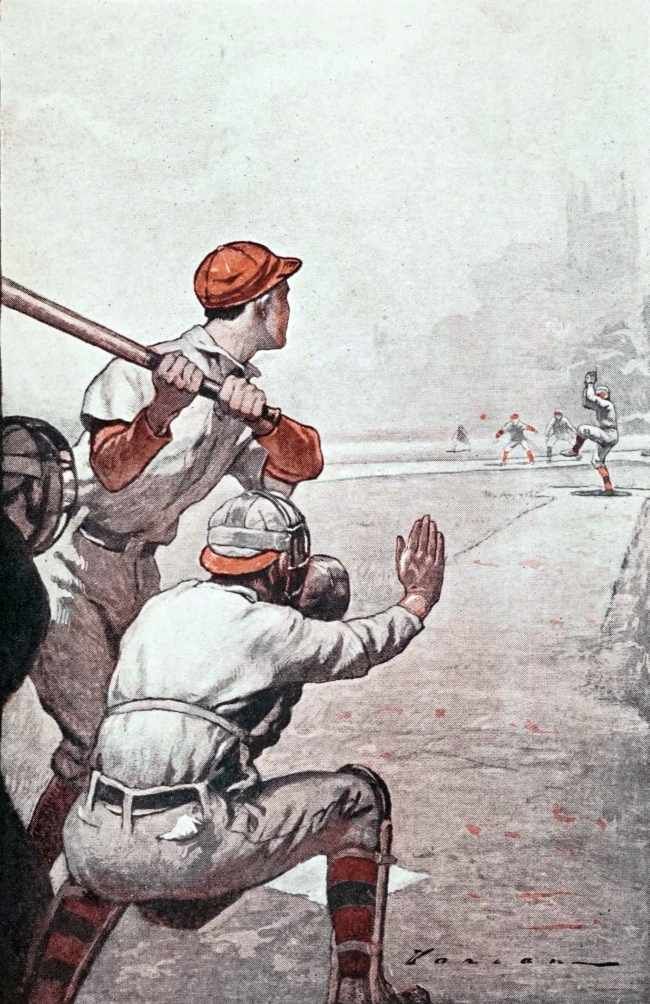
FRONTISPIECE
NEW YORK LONDON
1921
COPYRIGHT 1921, BY
PRINTED IN THE UNITED STATES OF AMERICA
| CHAPTER | PAGE | |
|---|---|---|
| I. | A New Boy Arrives | 1 |
| II. | Tom Assumes a Responsibility | 11 |
| III. | Jerry Upsets His Tea | 23 |
| IV. | The Hazing | 37 |
| V. | Jerry Spends Some Money | 49 |
| VI. | The Tryout | 59 |
| VII. | At the Batting Net | 72 |
| VIII. | Jerry Hires Out | 82 |
| IX. | The Major Gives Advice | 98 |
| X. | The Deserted Mine | 111 |
| XI. | Into the Depths | 121 |
| XII. | “Keep Your Chin Up!” | 129 |
| XIII. | Enemies Shake Hands | 145 |
| XIV. | Jerry Goes Along | 158 |
| XV. | In the Ninth Inning | 169 |
| XVI. | The Great Discovery | 184 |
| XVII. | The Cabin in the Woods | 195 |
| XVIII. | Jerry Issues Invitations | 206 |
| XIX. | Jerry Gives a Party | 220 |
| XX. | The School Gives Support | 232 |
| XXI. | “Three-Base Benson” | 243 |
| XXII. | A Victory and a Defeat | 255 |
| XXIII. | Coach Keegan Converses | 266 |
| XXIV. | Jerry Loses His Title | 277 |
[1]
THREE-BASE BENSON
A boy of sixteen, dark-eyed, fairly tall and of medium weight, set a very new-looking kit-bag on the floor in front of the news stand in the Baltimore station, shifted an overcoat to his left arm and selected a magazine. In the act of drawing a folding purse from a pocket his attention was attracted by a second youth who ranged alongside. The latter appeared of about his own age, but there all similarity ended. The newcomer was tall and angular and looked overgrown. He had a sallow face, with high cheek bones, pale blue eyes, under lashes and brows that were almost white, and a wide mouth. Underneath a snuff-colored felt hat with a low crown and a narrow, straight brim, his hair, which was a shade or two darker than his eyelashes, had recently been clipped close. Although evidently dressed in his best, his attire looked strange even in a place where strange attires are no novelty. Perhaps his clothes [2]had been made for a much larger person. In any case, they fell in loose folds from every part of his spare frame, almost covering his knuckles and wrinkling ridiculously above his shoes. In hue they were very like his hair, and they seemed made of some material in which cotton and wool combined, with the odds in favor of the cotton. A bluish gingham shirt was in evidence below a turned-down collar and a black bow tie, which, the first lad suspected, was attached to his collar-button by an elastic. Like his neighbor, he carried his overcoat over one arm and had set a new bag on the floor beside him. But the bag was an old-fashioned valise, aggressively yellow and palpably of imitation leather, and the coat was a khaki-colored army overcoat.
“Got any chewing gum, stranger?”
The man behind the counter offered a choice of many brands and the boy fished a handful of loose change from a capacious trousers’ pocket, purchased, smiled in a neighborly fashion at the lad beside him, showing a set of fine white teeth, and, taking up his bag, ambled off. Tom Hartley and the news stand man exchanged amused smiles, the latter shaking his head humorously.
“Right down from the mountains, I reckon,” he said. He himself pronounced the word “daown,” and Tom, fresh from a fortnight above Mason and Dixon’s [3]Line, smiled again, this time to himself. Then, adding the magazine he had bought to his burdens, he made his way through the near-by gate and along the platform to the waiting “train.” On that electric line they always called it a train, whether it consisted of one car or two. The afternoon travel out of the city had not set in and the two o’clock “Limited”—another word that always aroused Tom’s amusement—held but a handful of persons. He set his bag on a seat, draped his coat over it and went back to the small baggage compartment at the rear to see if his trunk was aboard. Of course it wasn’t. One’s trunk was never known to get on the same train that one traveled by, and had Tom seen it there he would possibly have fallen in a dead faint.
There were, Tom noticed on his way back, several of his school companions present, and to all but one he nodded and spoke. None was a sufficiently close acquaintance to demand more than a brief “Hello.” The single exception was a boy of eighteen, a big, good-looking fellow who, noting Tom’s arrival, turned his face toward a window with a sneering, contemptuous expression. To him Tom neither spoke nor nodded. He and Wayne Sortwell were acknowledged enemies, although neither could have offered a sufficient explanation for the fact. Meeting each other in the very [4]middle of the Sahara Desert, with no one else present, they might have nodded scowlingly, but on ordinary occasions they sedulously avoided recognition.
The car filled slowly. Tom, opening his magazine, hoped that leaving time would arrive before a colored “mammy” toting a pickaninny or a basket of marketing plumped herself beside him. He was spared that, although he was not fortunate enough to keep the seat to himself. At the very last moment, when he had congratulated himself and was settling down to a story in the magazine, he became aware of a disturbance beside him and looked up to see a flash of white teeth and the friendly twinkling of a pair of pale blue eyes under colorless lashes.
“Reckon I’ll have to sit in with you-all,” said the owner of the teeth. Tom murmured politely and drew himself toward the window, and the youth of the chewing gum incident lowered himself to the seat, very careful not to jostle his neighbor as the car swayed over the yard switches, set his valise between his feet, doubled his faded khaki overcoat over his gaunt knees and folded a pair of scarred and rugged hands on the coat. Observing from the corners of his eyes, Tom saw the boy’s jaws working rhythmically over his gum. Tom went back to his story. Evidently his [5]neighbor had the good sense not to attempt conversation.
Presently the conductor came, and Tom, yielding his own ticket to North Bank, saw with surprise that the boy beside him gave up a similar ticket. That this raw-boned, countrified fellow could be on his way to North Bank School was too ridiculous for credence, and yet, if he was not going to the school, where could he be going? Broadly speaking, the school was all there was at North Bank in the winter. In summer the houses and bungalows that lined the river were occupied, but at this time of year, the first week in January, only one or two would be open. Tom stole a puzzled look at his traveling companion, and at the same moment the latter turned his blue eyes on Tom. The blue eyes twinkled before Tom could look past and away, and the broad mouth curved in a likable smile. Unconsciously, Tom smiled back. If, he reflected, you lost sight of the fellow’s impossible attire, he wasn’t so bad!
“Reckon you-all are goin’ to the school,” said the boy questioningly. Tom nodded.
“I’m going to North Bank,” he agreed pleasantly.
“That’s what I thought. I’m goin’ there, too.” The blue eyes moved past Tom to stare calmly through the window.
[6]
“Oh!” said Tom, not thinking of anything better at the moment. His gaze swept the oddly dressed youth again. He hated to think what would happen when this new acquaintance was seen by his future schoolmates! After a moment he asked: “What class are you in?”
“The feller that wrote to Pap said I’d be in the third class. I ain’t had much schoolin’. Reckon I’m kind of old for the third.”
“How old are you?”
“Seventeen.”
Tom hesitated. Looking closely at the other he could see that his first guess of sixteen had been wrong. Now he could have accepted even eighteen as the chap’s age, for in spite of the boyish smile and the uncouth appearance there was a settled, mature expression in the face. “Well,” Tom said finally, “seventeen is a bit old for the third class, but I wouldn’t let that trouble you.”
The other shook his head placidly. “I ain’t reckonin’ to let it trouble me none, neighbor,” he said in his not unpleasant drawl. “I ain’t never goin’ to get any younger. Reckon that’s your class, too.”
“No, I’m in the second.” Tom, to his surprise, spoke almost apologetically.
“Are you? Well, then I reckon you-all can tell me [7]somethin’ about this class I’m goin’ in. Do they learn you pretty hard?”
“Learn you—oh, are the studies hard, you mean? No, I don’t think so. The regular stuff; algebra, English, Latin, geography and so on.”
“Mh-mh. Reckon that Latin’s goin’ to stump me, though. I never had any Latin. The feller that wrote Pap said I’d have to do a sight of work on that Latin so’s to catch up with the other fellers.”
“Third class Latin’s not very hard,” said Tom consolingly. “Coming in like this, though, in the middle of the year, makes it a bit stiffer. If you’d started in with your class, you know——”
“Mh-mh, that’s what the feller said. But I couldn’t of come last September. Pap didn’t have any one in the store and he couldn’t get any one, either, and so I had to stay by him. Seems like since the War nobody wants to do any work. Then some of the fellers didn’t come back at all. Gene Simpkins and Bill Tolliver was killed, and Lee Nash—nobody knows what happened to Lee. He just dropped out of sight. His mammy’s still lookin’ for him, but I reckon he’s a goner. A couple of the fellers got jobs in New York. Pap ain’t as young as he used to be and I sort of hated to leave him.”
[8]
“I see,” said Tom. “But he found some one finally, eh? Your father, I mean.”
“He ain’t my father. I never had any father, any rate not as I can remember. Nor any mammy, neither. Reckon I did have ’em once, but they died before I knowed ’em. Pap Huckins brung—brang me up, but he ain’t any kin of mine. I always called him Pap because I never had any real Pap.”
“Where do you live?” asked Tom.
“Huckinsburg, North Carolina. It’s named for Pap. Pap’s folks was quality before the war; the old war, I mean, where we-all fought you-all.”
Tom laughed. “You think I’m a Northerner, then, do you?”
The other smiled with twinkling eyes. “Reckon you must be,” he answered. “Any rate, you ain’t a Southron. Ain’t you a Yank?”
“I guess that’s what you’d call me. My name’s Hartley, by the way.”
“Pleased to know you.” The boy seized Tom’s hand in a crushing grip and shook it heartily. “My name’s Jerry Benson. I’m powerful glad to meet up with a friend, ’cause I reckon a lot of those high-toned fellers at school won’t have much use for a feller like me.”
Tom, a trifle dismayed, muttered something as he [9]surreptitiously examined his mangled fingers. Jerry Benson went on placidly.
“Reckon I ain’t really got any right at this school, seeing I’m a sort of country feller, but Pap allowed the best was the cheapest in the long run, and he knows a man over to Brattleville whose boy went to North Bank and so he made up his mind I was to go here too. I wanted to go to the school over to Major’s Run. It’s a right good school, too. But Pap, he’d set his heart on this place. Reckon there’s a heap of trouble ahead of me, don’t you?” The pale blue eyes were twinkling again and Tom had the thought that even if his acquaintance anticipated trouble he certainly didn’t look concerned about it!
“Well, I don’t know,” he began. “Perhaps a few fellows may rag you, but I guess they’re not worth considering, Benson. You see——”
“Say,” the other interrupted, “I’d sort of like you to call me Jerry. No one ain’t never called me Benson before, and it sounds unnatural. Reckon you didn’t say what your first name is.”
“Tom.”
“Mh-mh. Tom’s a good easy name to handle, ain’t it? Reckon you and me’s goin’ to be friends, Tom.”
[10]
What answer Tom would have made he never knew, for at that moment the car began to slow and the conductor’s voice came as a welcome diversion:
“North Bank! North Bank!”
[11]
Tom got separated from Jerry Benson on the way out, though it came about through no effort of his. However, that he was somewhat relieved I won’t deny. To have appeared on the platform of the tiny station in the rôle of sponsor to the uncouth North Carolinian would have required some courage! In all, six boys disembarked. The school carriage, a three-seated, covered conveyance known locally as a “hack,” capable of accommodating nine passengers and drawn by a pair of sleek black mules that were the pride of Cicero, the negro driver, was waiting, and into it clambered all save Tom. As the train had pulled up at the station Tom had descried Joe Kirkham there to meet him, and now, tossing his bag to Cicero, he elected to walk the short distance to school with Joe. He noted Jerry Benson question the driver of the vehicle and then climb into a back seat, as he did so sending a surprised glance after his newly-found friend. Tom experienced a pang of self-reproach at his desertion [12]of the other and, impulsively, he walked back and called to Jerry.
“I’m going to walk, Jerry,” he said. “See you later. Go to the Office and they’ll look after you.”
Jerry smiled and nodded as the carriage moved away, and Tom, aware of the amused expressions on the faces of the other boys, returned to the waiting Joe. Joe’s expression was less amused than bewildered.
“Who’s that fellow?” he gasped.
Tom explained as they began their walk, ending with: “He’s in for a tough time, I guess, Joke, and it’s sort of too bad, for he seems a decent chap. I feel rather mean for shaking him just now, too. The fellows will rag the life out of him when they see him.”
“Joke” chuckled. “Reckon they will,” he agreed. His nickname had evolved itself naturally from the sound of his first and last names and was not intended to indicate his character or habits, for although he was a cheerful chap he had no special gift for joking. “Some one,” he went on, “ought to make him get some decent clothes, first thing. Say, who’s he rooming with?”
“Room—” Tom stopped short, struck speechless by a horrible thought, and gazed at Joe in wide-eyed dismay.
[13]
“What’s the matter?” asked the other. “Lost something?”
“You don’t suppose he—they—” He swallowed and made a fresh start. “Joke, they might—might put him in with me!”
“With you? Gee, that’s so! I’d forgotten Tim was gone!” Joe stared back at Tom’s troubled countenance and a look of unholy glee overspread his face. Then he gave a whoop of joy and doubled up in laughter. “Oh, boy!” he gurgled. “Oh, me! oh, my! That’s rich!”
“Oh, shut up! Listen, there are two or three fellows in Follen without roommates, aren’t there? Birkenside’s alone, and that red-headed fellow who played on the scrub last spring, Joyce or Royce or something like that.” Tom was recovering his spirits.
“I know,” gasped Joe, “but—but something tells me you’ll be the lucky guy, Tom! You’ll win the prize! I fu-feel it!”
“You’ll feel my fist if you don’t shut up that cackling,” threatened Tom, starting on scowlingly. “Anyway, I won’t have him. They haven’t any right to. I—I’ll leave school first!”
“Yes, you will,” jeered Joe.
“I will! You see if I don’t!” Tom spoke very determinedly. After a moment, during which Joe, at [14]his side, viewed him with secret amusement, his brow cleared. “He’s only in the third class,” he said hopefully. “They’ll put him in Follen as sure as shooting. Gee, but I had a fright, just the same. I sort of took to the fellow, Joe, because he seemed sort of pathetic and all that, but I wouldn’t care a whole lot to have him for roommate.”
“Oh, I reckon you’ll get to like him,” chuckled the other.
“Dry up and tell me the news. Who’s back?”
“Not many. Lory and Danny and Billy Conger and a dozen or so others. The crowd won’t begin to get here until late. How’d you happen to come so early?”
“Got in New York at eight-forty; went down to the city with dad, you know; and thought I might as well take the nine o’clock as wait around. How did you know I’d be on that train?”
“Didn’t know, Tom, but just took a chance. There wasn’t much to do. Rod isn’t back yet.”
“Have a good time at Christmas?”
“So-so. Pretty quiet. We had some skating for a couple of days. Mother was sick for three or four days, though, and that kind of spoiled the fun. How about you?”
“Corking! I was in New York until Christmas [15]morning with dad and my sister. Went to two plays and three movies and had a lot of bully eats. What did you get, Joe?”
Joe enumerated his presents and Tom followed suit, and for the rest of the distance they swapped reminiscences of the holidays. The road wound picturesquely through the winter woods, the sunlight was warm and the air brisk. Here and there the entrance to some summer home appeared and occasionally a clearing gave them a glimpse of the Severn, very blue under the cloudless sky. So far the Maryland winter had been fairly mild and on the southern slopes the grass still held more than a hint of green. When they had walked unhurriedly something over a half mile a hedge of privet appeared at their left and a comfortable and commodious house met their gaze. From the chimneys blue smoke drifted away to the line of nearly leafless poplars that marked the boundary of the estate, and an automobile stood before the doorway.
“Hello,” said Tom. “The Laurences are here.”
“Yes, been here right along, Cicero says. If I had a house in the country like that I’d spend Christmas in it, too. It’s a lot more fun than being in town.”
“Ye-es,” agreed Tom doubtfully. “Still, you can have a pretty good time in the city. I mean a real [16]city, of course. I dare say it’s different in Philadelphia.”
Joe, who lived in Philadelphia, grunted, but refused the challenge. It was an old subject of debate between them, that matter of the superiority of New York and Philadelphia. A moment later the grounds of North Bank School came into view, adjoining the Laurence place. A small grove of trees hid the buildings until they were opposite the ball field. A wooden stand stood between the iron fence and the first base line and beyond it, interrupting their view again, was a similar but larger stand at the north side of the football gridiron. The school boundaries encompassed some six acres of field and woods. Near the center of the grounds was Founders’ Hall, a large and imposing brick building graced by a wooden tower that shone dazzlingly white in the afternoon sunlight. The sun shone, too, on the big bell in the open cupola, striking coppery rays from its surface. The Hall held class rooms, chapel, commons and offices within its three ivy-draped stories. On the side nearer the road the four dormitories were arranged in a half circle, their entrances facing the front of the Hall, their back toward the thoroughfare. At the farther end of the arc was McCrea House. Then came Baldwin, then Follen and, last, Ellicot. Although the Houses were [17]all of wooden construction, they differed in age, size and appearance. Follen, at the right of the entrance driveway, was the largest, a timber and cement edifice of many gables containing forty rooms. McCrea was a modest structure, the oldest of them all, and accommodated but thirty students. These five buildings, if we omit the stable, near by, the boathouse below the gently sloping bank, and the row of bathhouses beyond, comprised the plant with one important exception. The exception was the Sharples Gymnasium. This building, standing behind Ellicot House, its glassed roof almost shaded by the trees that followed the boundary on that side to the river’s edge, had been presented to the school by the parents of a former student who had died in the service of Great Britain in the first few months of the World War, as a bronze tablet beside the handsome entrance informed one.
Passing through the entrance, where an ivied gate house presented two inquiring windows toward the passers, the boys made their way to Founders’ Hall. A hail from the steps of Baldwin House, where three boys were loitering in the sunlight, delayed them an instant. In the Office, Tom signed the register, Joe waiting outside. As he laid the pen down the assistant spoke.
[18]
“Mr. Ledyard would like to see you a minute,” he said.
In the inner office the school secretary arose as Tom entered and shook hands heartily. He was a somewhat dapper little man with a carefully trimmed brown beard and keen dark eyes. “Glad to see you back, Hartley,” he said. “Sit down, won’t you? Well, you look as if vacation had agreed with you. No use asking if you’ve had a good time, I guess. Hm.” Mr. Ledyard cleared his throat, picked a filing card from his desk, glanced at it and put it down again. “What I had to say to you was this, Hartley. We’ve had a rather extraordinary fellow come to us. Perhaps I shouldn’t say extraordinary, though; out of the ordinary is better. He’s a boy named”—he glanced at the card again—“named Jeremiah Benson, from a small town in North Carolina. His parents died when he was a baby, as I understand, and he was adopted by a gentleman named”—another glimpse of the card—“Huckins. Mr. Huckins is placing the boy here. Frankly, he is rather unsophisticated and, using the word in the French meaning, gauche. I don’t think he is stupid; rather the contrary; but his schooling has been somewhat neglected and he has, I think, never been long outside his home village. A boy of his sort requires careful handling, [19]Hartley. He will run up against fellows of his own age who stand higher in class, who are more experienced and more worldly wise and who will, I fear, be tempted to ridicule his innocence and odd manners and even his appearance, for”—and here the secretary smiled reminiscently—“there’s no denying that he presented a somewhat uncouth appearance a few minutes ago. It’s no very difficult thing to wound the susceptibility of such a fellow, Hartley, and too many wounds will work ill. Naturally, the faculty can’t keep every student under constant care and supervision. Therefore the next best thing is to place Benson with some one who may, to an extent, provide the protection that we aren’t able to give, some one who will advise him and see that he gets along as smoothly as is possible. Of course he will have some battles to fight for himself. That’s proper. But the lad mustn’t be bullied and hectored and ridiculed too much. He mustn’t have his spirit broken. Now there are several vacancies in the Houses, Hartley, and several boys with whom I might have placed Benson. But after considering them all my choice fell on you.”
If Mr. Ledyard expected surprise or protest he was disappointed. Tom merely said “Yes, sir,” and waited for the other to proceed. From the first he had known [20]what was coming. Mr. Ledyard cleared his throat again.
“You may think this something of an imposition,” he went on, “but I hope you won’t look at it that way. I’d like you to realize that here is a chance to be of real service to a brother mortal and to your school as well. And I venture to say that you’ll be doing yourself no ill service, Hartley, for if this country boy comes through right, as I fully expect him to, you’ll be proud and happy because of your share in his development. The lad has plenty of fine qualities, I think. For instance, when we entered the War he walked sixty-odd miles to enlist in his country’s service. Because of his youth—he was only fifteen, I believe—he was turned down. Six months or so later, having passed his sixteenth birthday, he made the journey a second time. He frankly admits lying on this second occasion. He told the recruiting officer—he was trying for the Navy then—that he was seventeen. This time he would have succeeded had not the armistice been signed a day or two later. Of course, I don’t excuse the falsehood, but I can view it with leniency. I mention this incident, Hartley, only to show that there must be a great deal in the boy that is worth going after and cultivating. Now, what do [21]you say? How do you feel toward the obligation I’ve set you?”
Tom smiled. “I’ll do the best I can, sir,” he answered. “I ought to have told you before, I guess, that I’ve seen Benson. He was on the train with me and we got—got sort of acquainted, I rather took to him, sir, in spite of—of everything.”
“I certainly am glad, Hartley! Understand, please, that I’m not proposing a guardianship for you. Benson must hoe his own row. But you can make that row easier for him by advice and example. You see, my boy, I’ve a pretty fine opinion of you. We all have. You’ve been with us two years, nearly, and you’ve shown yourself clean and manly, cool-headed and sensible. In short, you’re the man for the job. And I’m mighty glad you’re assuming it cheerfully. Come to me with your problems if you can’t solve them alone and let me help. You may be sure that I’ll be watching all the time with a whole lot of interest. I’ve sent Benson over to Baldwin and you’ll probably find him awaiting you. Thanks, Hartley.”
The secretary stood up, smiling, with outstretched hand. Tom smiled, too, as he accepted the clasp, but smiled a trifle ruefully. “I hope I’ll prove up to the job, sir,” he said. “Anyway, I’ll do the best I know how.”
[22]
“I’m sure you will, my boy. Good luck to you!”
Outside, in the corridor, a bored and somewhat resentful Joe awaited him.
“Been having afternoon tea in there?” he inquired sarcastically. “Or have you and ‘Whiskers’ been rearranging the study course for the rest of the year? Gee-gosh, I thought you weren’t ever coming out!”
“He’s just been telling me,” replied Tom, “that he’s put that chap Benson in with me.”
“Benson? Who’s—you mean the country jay? Great Jumping Jehosophat, Tom! What are you going to do?”
Tom looked at his watch. “Just now,” he answered, “I’m going over and have a bath before the crowd gathers.”
[23]
“I reckon you’re wishin’ I was in Halifax,” said Jerry Benson.
Tom had had his bath, had unpacked his bag and now, wrapped in an old gray bath robe, was stretched on the window seat. Jerry, who had divested himself of coat and waistcoat, collar and tie and shoes, sat in a morris chair and looked anxiously across. Outside, noise and bustle told of new arrivals, and from within the House the tramping of feet in the corridors, the opening of doors and the sounds of talk and laughter suggested that most of Baldwin’s thirty-five rooms had recovered their occupants. The clock on Founders’ Hall pointed its tarnished gilt hands to twenty-two minutes past four and the shadows were long across the campus. Beyond the river, a blue-gray haze added mystery to the wooded distance and, straight away, the spires and towers of Annapolis pointed against a sunset sky.
Tom made no answer for a moment. Then he [24]swung his slippered feet to the floor, sat up and faced Jerry soberly. “No,” he answered, “I don’t, Jerry. You and I don’t know each other very well, and when a couple of fellows get put together in a room like this—strangers, I mean—it’s a good deal of a gamble. But if they’re both pretty decent they get on all right. It’s a case of give and take, though. You’ll have to put up with my queer ways and I’ll have to put up with yours; for the other fellow’s ways always are queer until you get used to ’em! I guess we’ll get along without much spatting, because I’m not what you’d call quarrelsome, and I don’t think you are. There’s one subject we’d better come to agreement on right now, though, and that’s the Civil War. I’m a Northerner, Jerry, and you’re a Southerner. My first year here I had fully six scraps about it. Suppose we settle it now.”
“All right,” said Jerry. “What about it?”
“Well, to begin with, each side thought it was dead right. That the way you understand it?”
“Yes.”
“And each side fought hard to win and fought bravely. That so?”
“That’s the way I learned it,” the other agreed.
“And one side made just as many mistakes as the other and played just as fair?”
[25]
Jerry nodded again.
“And the North won?”
“Sure did!”
“And it’s all over?”
“Yes, sir, it’s all over. It’s been over two, three years.”
“How long?” ejaculated Tom.
“Two, three years.” Jerry’s eyes twinkled. “Ever since the Big War came along and we got into it. Before that there was a heap of folks up in the hills didn’t know the other war was done!”
“I can believe that,” laughed Tom. “Some of the fellows here didn’t know it any too well when I came. Well, that’s settled. Now, that’s your side of the room, because this has been mine for a year and a half. If you want to put up some pictures over there I’ll move those out of the way. They belong to the fellow who was here before. He got sick just after Thanksgiving and went home, and he isn’t coming back.”
Jerry looked and shook his head. “I didn’t bring any pictures,” he said. “Those are real pretty, ain’t they?”
“I suppose your trunk’s coming up?” asked Tom.
“I didn’t bring any trunk,” answered the other. “I’ve got ’most everything I own in my bag. Pap [26]said I could buy things here better’n I could there. Reckon I’ll have to pay a sight more for them, though.”
“Have you got another suit in there?” Tom nodded at the yellow valise.
“Yes, but it’s my old one.”
“Let’s have a look at it.”
Jerry pulled it forth and presented it for inspection. Tom sighed with relief. Whatever its shortcomings might be, at least it was a civilized color. He nodded approval.
“Blue serge is always good, Jerry. If I was you I’d put it on instead of the one you’re wearing.”
Jerry viewed it dubiously. “It’s sort of worn out,” he hazarded.
“Never mind. Jerry, I don’t want to hurt your feelings, but that suit you’ve got on now won’t do here.”
“Won’t it?” Jerry looked surprised. “Well, it ain’t a very good fit, but I thought likely I could get a tailor to shorten the legs and sleeves a couple of inches.” He observed Tom questioningly.
Tom shook his head firmly. “I’m sorry, Jerry, but it isn’t only the fit. The color doesn’t suit you. You’re sort of light, you know, and you need darker things. Suppose you put that suit back in the bag to wear when you get home again and get another one in [27]Baltimore in a day or two. You could run up there Saturday.”
“All right, if you say so.” Jerry looked thoughtful but docile. “How much’ll a suit cost me, do you reckon?”
“I guess you’d ought to get a fairly decent one for thirty dollars.”
“Golly! That’s a heap of money, ain’t it? Say, this one only cost me eighteen!”
Tom felt like saying that it looked it, but he didn’t. Instead: “It pays to spend a little more, Jerry, and get a good one. It’ll last longer and you’ll get more satisfaction out of it.” He mentally reviewed his possible engagements. “If you like, I’ll go with you and help you pick one out.”
“Will you? Well, now, I’d be powerful glad to have you, Tom. I reckon those fellers in the city would skin the hide offen me!”
“And you’d better get a couple of shirts and some ties and a few things,” continued Tom offhandedly. “That is, if you can afford them.”
“Reckon I can. I’ve got ’most four hundred dollars saved up. Pap paid me three dollars a week in the store, though he didn’t have any right to, because he’s fed me and clothed me ever since I was two, three years old. And he’s payin’ for my schoolin’, too. But [28]I’m agoin’ to make it up to him when I get to earnin’ money, Tom. I’ve got fifty dollars on me right now. Pap said I’d better go heeled because there wasn’t any tellin’ what’d happen.” Jerry reached for the waistcoat of the obnoxious suit and unpinned three bills from an inside pocket. “Reckon that’ll buy everything, don’t you?”
“That’s plenty,” agreed Tom. “Now suppose you change your clothes and we’ll go out and look around.”
Jerry was still far from resembling Beau Brummel when the change was made, but the old blue serge suit, never very good even when new, was an improvement on the other. Unfortunately, it was almost as much too small as the other was too large, and Jerry’s bony wrists protruded from the sleeves shamelessly, while the end of the trousers left exposed two expanses of gray woolen socks. Tom made a mental note to the effect that if Jerry’s money lasted long enough socks and shoes should be included in Saturday’s purchases.
Tom didn’t spend an altogether happy hour between five and six that Thursday afternoon. Jerry, putting it as mildly as possible, attracted a good deal of attention, and very little of it was flattering. Tom had provided his charge with one of his own collars and an inoffensive blue four-in-hand tie, but Jerry’s hat had gone unnoticed until they were in the corridor, and [29]then Tom hadn’t the heart to drag the other back to the room and substitute one of his old caps for the snuff-colored felt. All that saved Jerry from open ridicule, possibly insult, at the hands of some of the younger and thoughtless fellows was the fact that Tom was beside him. Tom was well-known, well-liked and well-respected, and, to some extent, feared. Consequently most of the criticisms aimed at the newcomer were delivered in carefully modulated tones, and much of the laughter was of the silent sort.
Tom couldn’t determine whether Jerry was as unconscious of the impression he was creating as he appeared. More than once, passing some group of fellows, Tom was uncomfortably aware of the surprise, instantly changing to ill-concealed merriment, that greeted them. It didn’t seem quite possible that Jerry should fail to notice it, but nothing in his manner or expression showed that he did. Tom went through with his task conscientiously, showing the new boy over the grounds and through the Hall, pausing in front of each of the Houses to explain them, as, before McCrea: “Here’s where most of the first class fellows live, Jerry. It’s the smallest of the Houses. Only fifteen rooms. That’s Mr. Cranz’s study on the left there. Mr. Logan’s is on the other side of the entrance.”
[30]
“Teachers?” asked Jerry.
“Yes, Cranz is modern languages and Logan mathematics. We call ’em ‘faculties’ here instead of teachers.”
Later, in front of Follen: “Fourth class quarters. Mrs. Barry, the matron, and Mr. Ledyard, the secretary, are in charge here. Follen is the largest of the lot and has forty rooms.”
From the steps five irrepressible youths were staring wide-eyed at the strange boy in the queer hat, but Tom paid them no heed beyond a nod to those he knew. As the pair turned away giggles followed them and one shrill voice called: “Reckon there’s been a right smart o’ rain daown in the country!” This reference to Jerry’s “high-water” trousers evidently didn’t permeate to Jerry’s understanding, for he continued uninterruptedly the question he was asking.
It was black dark when they returned to Number 7 Baldwin and found Joe Kirkham lolling on the window seat there. “Hello,” he greeted, sending a quick side glance of curiosity at Jerry. “Where the dickens were you? I’ve been waiting half an hour here. Thought you said you’d be in.”
“Sorry, Joke. I forgot, and was showing Jerry around. Jerry, meet Joe Kirkham. Joe, this is Jerry Benson.”
[31]
“Right glad to know you,” responded Jerry, crushing Joe’s fingers in his big hand. “Reckon I seen—saw you at the station.”
“Very glad to know you, Benson. Yes, I was there when you came in. Tom been treating you right? Hasn’t borrowed any money from you or made you sign any papers? You’ll have to watch him, Benson!”
“Reckon I’d sign anything he told me to,” answered Jerry, with a twinkle of his blue eyes.
“Yes, I dare say,” complained Joe, with assumed bitterness. “He can get away with anything. Folks think everything Tom does is all right. Mighty good thing for him they don’t all know him the way I do!”
“That so?” Jerry brushed the nap of his felt hat very carefully against a sleeve and laid it on his chiffonier. “Reckon it’s safe for me to bunk in with him?”
“Well, I’d sleep with my watch and money under my pillow,” replied Joe. “How do you like the school, Benson?”
“I like it right well.” He fixed a serious gaze on Joe as he went on. “Reckon I’ll have to ask you to call me Jerry. I ain’t ever been called anything but that, you see.”
Joe’s half-bantering expression faded and he returned Jerry’s look straightly and gravely. “All [32]right, Jerry,” he answered. “Glad to. And my name’s Joe; only the fellows call me Joke. Coming to supper, you two?”
The students ate in a big and rather bare room on the first floor of Founders’ Hall known as Commons. Sixteen long tables, accommodating from twelve to fourteen, pretty well filled the floor there and the colored waiters often had difficulty in navigating the narrow spaces, a fact that made seats on the wider center aisle much sought. Both Tom and Joe were fortunate possessors of such seats, but Tom’s attempt to get Jerry a place at their table failed, and the former watched the new boy’s relegation to a distant board with misgivings. “They’ll rag the life out of him,” he confided to Joe. “And I’ll bet he’s half-starved, for he told me he only had a sandwich and a cup of coffee at noon.”
“Don’t you worry too much about that chap,” said Joe. “I may be all wrong, but it’s my opinion that your friend Jerry is mighty well able to look after himself. That fellow is no one’s fool, Tom, and I’ll wager that he can give as good as he gets.”
“Maybe,” said Tom, looking across the hall after Jerry, “but they’ve put him at Four, with Wayne Sortwell and Mansfield and that bunch. If Wayne gets started on him he’ll make it mighty uncomfortable for him.”
[33]
“Forget it, son, and pass the biscuits. Gee, I wonder if they made these before vacation! Say, Wayne came on the train with you from Baltimore, didn’t he? Did he speak to you?”
“No, nor I to him,” answered Tom dryly.
Joe laughed. “Gee, you two are certainly funny! You don’t either of you know what you’re mad about. Hello, Norry! Didn’t see you. What have you been doing to get so thin?”
Pete Norris, North Bank School’s prize fat boy, across the table contributed a grin as his share of the resultant merriment, and Joe returned to the previous subject. “Honest, Tom, Wayne isn’t such a bad sort. I don’t know him very well, but a lot of the fellows like him pretty well. And you’ve got to hand it to him for playing a good game of ball.”
“I haven’t anything against him—especially,” replied Tom. “I just don’t like him. And he just doesn’t like me. We’re satisfied, Joke, so you might as well be! Besides, whether he plays baseball well hasn’t got much to do with it, has it?”
“N-no, only as you’re both on the Nine it would make it easier and more—more pleasant if you got on together a little better. Well, it’s none of my business. Pass the biscuits, please.”
After supper they parted in the corridor, Joe to seek [34]a missing roommate who, up to the time of going to Commons, had failed to show up. Tom found Jerry awaiting him, a contented, undisturbed Jerry who sported a toothpick very frankly. Tom drew him forth into the night, away from the amused inspection of the fellows coming out of Commons. He wanted to know whether Wayne Sortwell and the others at Number Four table had tried to haze Jerry, but somehow he didn’t like to ask. What he did ask finally was: “Everything all right?”
“Fine,” replied the other boy with gusto. “The food’s right good. I was so hungry I mighty nigh foundered myself.” Jerry laughed softly.
“What?” asked Tom.
“Feller next to me played a joke on me. Put a lot of salt in my tea when he reckoned I wasn’t lookin’.”
“Oh! Well, they’ll do that sort of thing at first to a new boy. Best way is not to mind them, Jerry.”
“I didn’t. ’Fore I could drink it I hit it with my arm and it spilled all over his lap, and I had to have a new cup. Reckon I was pretty clumsy.”
Tom broke into a laugh. “I hope to goodness it was Hal Mansfield! What sort of a looking chap was he?”
“Well, he was kind of lean and wore glasses. Seemed like a right pleasant feller.”
[35]
“That wasn’t Mansfield,” said Tom, disappointedly. “But, whoever he was, it served him right. By the way, Jerry, I suppose you’ve noticed that folks around here have different ways from the folks where you live. I mean—well, now, for instance, up here they don’t use toothpicks in public.”
“That so? ’Tain’t manners, you mean? All right.” Jerry threw his toothpick away. “I’m obliged to you, Tom,” he continued. “I’ll be glad if you’ll tell me anything like that that ain’t right, because I know I’m right ignorant of such things.”
“You’re going to catch on mighty quick, Jerry. If I do call you down for little things like using a toothpick just you take it in good part.”
“Reckon I’d be a plumb fool if I didn’t,” said Jerry. “Say, the fellers at supper were talkin’ something about a party that the Principal was givin’ this evening. Was you plannin’ to go?”
Tom hadn’t been. Having sponsored Jerry so far, he felt that he was entitled to a recess until the morrow. But Jerry’s tone plainly implied that he would like to go, and Tom relented.
“Yes, Doctor Heidler gives a reception to-night. Would you like to go?”
“Well, I reckon so, if I’m dressed fancy enough.”
[36]
“Oh, it doesn’t matter what you wear. You’re all right. We’ll go, then.”
The fact that between eight and half past nine most of North Bank’s two hundred odd students crowded into the Principal’s none too commodious parlor and library and dining room in Ellicot House made Tom’s task easier, for Jerry’s eccentricities of attire were not so noticeable in a crowd. Mr. Ledyard was there and for awhile took the new boy in charge and introduced him to the Doctor. The Principal, a tall, very scholarly-looking man of middle age, appeared to take a great interest in Jerry, and Tom noted that they remained in conversation for several minutes. Later, there were sandwiches and hot chocolate, and Tom, at Jerry’s elbow, saw with relief that his charge handled plate and cup with, if not ease and dexterity, at least with none of the awkwardness that had spilled the tea at supper.
On the way back to Baldwin through a mild and starlit night Jerry broke a long silence. “Reckon,” he said, “I’m goin’ to like this place right smart, Tom. Folks are mighty neighborly, ain’t they?”
Tom tried to see his companion’s face, but it was too dark, so he said: “Yes,” after a moment, and wondered in the silence whether Jerry’s blue eyes twinkled.
[37]
Tom didn’t see much of Jerry the next day until afternoon, for they met neither at classes nor meals, but he feared that the North Carolinian was having his troubles. Yet when they did meet, at four, Jerry looked as unperturbed as ever and, although he confessed to some awkward experiences with the instructors—Mr. Troop, who taught geography and science, had openly ridiculed the boy’s ignorance—he said nothing of any difficulty with his schoolmates. Either, thought Tom, Jerry was singularly dense—which he didn’t appear to be—or he was remarkably forbearing and patient. It didn’t seem possible that he could have gone through the day without encountering a good share of openly expressed ridicule. Some light was thrown on the matter, however, when Tom met Joe in the gymnasium at five.
“Where’s Jerry?” Joe inquired, grinning.
“In the room. He’s got his coat and waistcoat off and his suspenders tied around his waist and he’s ‘wrastlin’’ with Latin. If he doesn’t tear all his hair [38]out first, he will get the decision. Jerry studying is an interesting sight, Joke. He gets hold of that short hair of his—or tries to—puts both elbows on the table, winds his legs around the chair and bores in. And every minute or two he groans like a lost soul!”
“Heard about him this morning, didn’t you?”
“Nothing especial. What do you mean?”
“He didn’t tell you then?” Joe chuckled as he stooped to lace his gym shoes. “Why, half a dozen fellows were standing outside the Hall between classes when Jerry came along. That smart Jordan—you know him; wears glasses and talks like a mouthful of hot mush——”
“Bet you he’s the fellow Jerry spilled the tea on!”
“All right. I haven’t heard about that. Well, Jordan puts his foot out as Jerry starts up the steps and he falls over it and spills his books. I came along just then and waited to see the fur fly. Jerry, though, picks up the books and smiles and is going on in when Jordan says: ‘Say, Whitey, can you fight?’ ‘Why, I reckon I can,’ says Jerry, ‘but I ain’t hankerin’ to.’ ‘I’ll bet you’re not,’ says another chap. ‘Never saw a towhead yet that had any scrap in him.’ ‘Well, I ain’t what you’d call agin it,’ says Jerry, mighty sweetly. ‘If any of you fellers is spoilin’ for a fight, I’m right obligin’. Tell you what, now, I’ll take the [39]biggest one first and then kind of work down to the little shoat that tripped me up.’ That made a hit with them, all except Jordan, and he didn’t like being called a shoat. ‘Pick your man, Country,’ some one called, and Jerry pointed. ‘I’ll meet him first,’ he says. ‘Take him all around, I guess he’s the biggest of you.’ Who do you suppose he meant?”
Tom, smiling, shook his head.
“Norris! Well, they all got to laughing then, and Norrie, who had just been looking on, didn’t take to the idea at all! And that ended it. Some fellow told Jerry he was all right and they let him alone and he grinned and went on inside. Jordan made believe he wanted to go after him, but I noticed he didn’t start until Jerry was out of sight! Now what about spilling the tea?”
Jerry was still “wrastlin’” with his Latin when Tom got back to the room after basketball practice. He had removed his shoes, too, during Tom’s absence, and looked, on the whole, as though he had spent a strenuous hour and a half. But he declared that he “reckoned he was gettin’ the best of the thing!”
After supper Jerry didn’t show up in the corridor, although a glance at his table proved he had finished and left, and, after waiting a few minutes, Tom went over to Follen House to see Anson Lord, who, besides [40]being the President of the First Class, was captain of the Nine. An hour’s talk of the baseball prospects and plans brought the time to almost eight. Back in Number 7 Baldwin, Tom found only an empty room, with no signs of recent occupancy. There was, however, a note propped up on the table against the base of the lamp, and Tom expected to find a line from Jerry explaining his whereabouts. Instead, however, it was signed “C. Falk.” Charles Falk, although a member of Tom’s class, was not a very close acquaintance, and Tom’s countenance expressed curiosity as he read the message.
“Dear Hartley: Some of the fellows are planning to haze that new fellow that’s rooming with you to-night. I don’t know any more. Thought you might like to know. Keep me out of it.”
Tom frowned as he stuffed the note in his pocket. Hazing, although strictly against the written laws of North Bank School, was sometimes indulged in. Usually it was mild in character and more a matter of fun than discipline. And usually it occurred at the beginning of the school year in September. But he didn’t doubt that Falk’s information was correct. There were plenty of fellows in school who would welcome such a subject as Jerry Benson for their attentions. [41]In fact, Tom wondered a little that the contingency had not occurred to him. He was not greatly worried, for, after all, the hazing wouldn’t be severe and Jerry had, he thought, proved fairly able to fight his own battles. But, after a minute of indecision, Tom put his cap on again and went unhurriedly downstairs.
Affairs of the sort were generally held in one of two places: either in the stable or down along the river. As the night was inclined to be chill, Tom decided that the stable was the more likely scene and so, passing around the corner of the house, he bent his steps across the grass toward where, close to the western boundary of the grounds, a dark object showed against the row of poplars along the fence. The fact that no lights showed didn’t fool him, for once or twice in his first year he had taken part in ceremonies there, and he knew that a lantern or two in the back room of the stable showed no glimmer in front. He went quietly as he neared the building and skirted the gravel road carefully.
The farther end of the stable held the carriage room, large enough to accommodate the Doctor’s small automobile and the three-seated vehicle that carried the students to and from the station. At the nearer corner, where Tom halted in the darkness, were the stalls. In the rear was a fairly large room used for harness [42]and the litter that usually accumulates about a stable. There was a stove there, but to-night there was no fire in it, as Tom saw when, peering in under the edge of an ancient carriage curtain that had been hung over the end window in lieu of a shade, he surveyed the scene inside. Two lanterns threw a dim and uncertain light about the room and on the faces of the dozen or more boys there. As Tom had suspected, they were all second class fellows save one, and most of them he knew. Somewhat to his surprise, Wayne Sortwell was not of their number. Purves Jordan, the boy whom Jerry had alluded to as “the little shoat,” appeared to be in charge of the ceremonies. The one occupant of the room not a second class fellow was, of course, Jerry Benson.
When Tom applied his eyes to the aperture between curtain and window frame Jerry held the floor and the others faced him in a half circle. To his relief, Tom observed that, so far at least, the hazing was good-natured on both sides. The subject was singing. Tom couldn’t hear the words, or but an occasional one, and the tune, if it deserved the name, sounded particularly funereal. From the laughter and frequent applause, however, the performance appeared to make a hit. Only Jordan, a tall, supercilious looking boy of seventeen, who wore spectacles over a pair of smallish eyes, [43]seemed displeased. Jordan was frowning. Jerry ended his croon soon after Tom’s arrival and bowed jerkily, and the audience clapped enthusiastically and cried “More!” Jerry made a reply of some sort, ran his fingers through his abbreviated locks and started off again. Jordan scowled and kicked impatiently at the oat bin against which he leaned. When Jerry had again finished Jordan demanded a dance.
“Come on, Whitey! Kick your heels for us! Let’s see some action!”
Jerry shook his head smilingly. Presumably he denied any ability of the sort suggested, for Jordan moved forward threateningly.
“Never you mind whether you can or can’t, you tow-headed North Carolina cracker! You try! Get that whip there, Gus. That’s the ticket!”
Jordan flicked a long-lashed coach whip in uncomfortable proximity to Jerry’s legs. Jerry remained unmoved and several of the fellows protested. Tom heard one boy say: “Oh, let him be, Skinny! He’s all right! Lay off him now!” But Jordan only grinned and swung the lash again, and this time it flicked Jerry’s legs. Tom, watching anxiously now, saw Jerry stiffen and turn toward the tormentor, and for the first time he spoke loud enough to be heard outside the closed window.
[44]
“I told you I can’t dance, and I mean it. And I ain’t going to. I’ve done what you fellers asked me and I’m getting kind of tired. Reckon you ain’t aimin’ at havin’ no unpleasantness.”
Jerry spoke firmly, but amiably still, and some good-natured laughter greeted his pronouncement. But Jordan sneered and drew the whip back. “You do as we tell you, Tarheels! You dance or you’ll be made to! Quick!” The lash swung again, this time with more force, and wound itself around Jerry’s frayed trouser legs.
For an understanding of what happened next, happened so suddenly, in fact, as to leave Tom gasping and blinking outside the casement, it should be stated that the door by which they had entered was in the back wall of the building, some ten feet from where Jerry stood, and that between it and him several sizable youths intervened. Also, that of the two lanterns one rested on the floor beside the stove and the other hung from a harness hook just over Jerry’s head.
The instant the whiplash encircled Jerry’s legs he dealt a swift blow to the lantern above him. There were cries and the sound of breaking glass as the lantern, leaving its hook, shot across the room and crashed against a farther wall. The fraction of a second later Jerry’s foot mistook the other lantern for a football [45]and black darkness fell! After that pandemonium reigned supreme. Tom heard cries and thuds and crashes, and the shrill voice of Jordan imploring all and sundry to “Stop him, fellows! Don’t let him get to the door!” But Jerry was already at the door, it seemed, for Tom heard it slam mightily and then narrowly avoided collision with a swiftly-moving figure that hurtled around the corner, laughing joyously as it went, and disappeared toward Baldwin!
Grinning broadly himself, Tom fled after, aware of pursuing footsteps until he was within the light that fell from the windows of the House. Once there, the pursuit halted behind him. He heard laughter and mutters in the darkness beyond the illumination, and, as he thought, the voice of Jordan snarling recriminations on his faithless henchmen. Jerry had vanished, but Tom found him a moment later when he tried the door of Number 7, found it locked, gave his name and was admitted.
Jerry, still smiling, had laid aside coat and vest and was already applying first aid to a lacerated cheek.
“Well,” asked Tom, simulating surprise, “where have you been? And what’s happened to your face?”
“Fellers caught me after supper and took me over to the stable yonder,” explained Jerry easily. “Asked me to sing and I sung. Then they wanted me to dance [46]and I wouldn’t. Feller in glasses swung a rawhide at me and I left.”
“I see,” said Tom, dryly. “And when you left you scraped your face against the door?”
“Scraped it against some feller’s fist, I reckon,” corrected Jerry. “Two, three of ’em aimed to stop me.”
Tom seated himself in a chair and gave way to laughter. Jerry smiled amiably back. He thought it pretty funny himself, although he couldn’t understand why Tom was so amused. After a moment the latter recovered enough to ask with some severity: “Didn’t you know those lanterns might have set fire to the stable, you crazy chump?”
“Huh? Where were you?” demanded Jerry in surprise.
Tom explained, and when he had finished Jerry answered the question. “Those lanterns always go out when you knock ’em over,” he said untroubledly. “Anyway, I reckon there was enough of those fellers to put a fire out!” He began to chuckle then. “Reckon that was a right surprised bunch when the light went out!”
“If they were half as surprised as I was,” commented Tom, “they sure were! How did they happen to nab you, Jerry?”
“Feller came along while I was waitin’ for you in [47]the hall and said you wanted to see me outside. I’d seen you at the table a minute before, but I didn’t think but what maybe you’d got by when I wasn’t looking. So I went out and there was a gang of ’em at the corner and they grabbed me. They were sort of laughing and I reckoned it was just a joke and didn’t put up any scrap. So it was, a joke, till that razorback with the spectacles got sassy with the whip. Before that I sung ’em all the songs I knowed—knew, and they were just enjoying themselves and I didn’t mind for shucks. But, golly, I wasn’t aimin’ to be any man’s mule, Tom! Maybe I was too hasty, but he got me sort of mad before that callin’ me ‘cracker’ and ‘towhead’ and such things. Think I ought to have been more—more patient, Tom?”
“No, I don’t,” laughed Tom. “You did just right, Jerry. Only, you ought to have handed Jordan a jolt on the way out!”
“Oh, I didn’t scrap none,” Jerry assured him earnestly. “I just was aimin’ to get out of there. I didn’t punch nobody at all, I just brushed by ’em.”
“I’ll bet you did! I heard you ‘brushing’!”
“Reckon they’ll be after me again to-morrow?” asked Jerry.
“No, they’ve had enough, I think. Don’t you worry.”
[48]
“I wasn’t aimin’ to do no—any worriting,” responded the other calmly. “I was just ponderin’.”
“About what?” inquired Tom, smiling broadly.
“About that feller with the whip. Did you-all say his name was Jordan? Well, I wouldn’t want to have any ruckus with him, because he don’t look right strong and healthy. Reckon he is?” Jerry viewed Tom with calm inquiry. “I wouldn’t want to do him any damage.”
“He won’t give you a chance, Jerry. He doesn’t want to fight. He’s just brave when he’s got a crowd around him. Here, you better let me doctor that cut for you. On the whole, son, you got off pretty cheap!”
[49]
Some one, not Jerry, told of the hazing episode, for not later than the following afternoon the story was all over school and fellows were laughing uproariously. A story always gains from retelling, and this one was no exception, and those who had taken part in the event at the stable came in for a lot of ragging. Most of them accepted it with good grace, but Jordan proved extremely touchy and more than once lost his temper completely. Jerry Benson became an object of even greater interest than before, but now it was not his strange attire or uncouth appearance that focused the limelight of publicity on him, but a suddenly won reputation for nerve and resourcefulness. The third class hailed him as a hero, for had he not, alone and unarmed, defeated the machinations of a dozen second class oppressors? The consensus of school opinion was to the effect that the handful of hazers deserved the ridicule that, for a time at least, would pursue them. After all, hazing was not only discountenanced by the faculty but by the student body [50]itself, and those who attempted it—especially if unsuccessfully—could count on little sympathy. The fact that a far more cordial feeling existed toward him on his return from Baltimore that Saturday afternoon was unnoted by Jerry, but Tom felt the difference and surmised the reason for it and was glad.
That Baltimore trip had resulted in the acquisition by Jerry of a new outfit from head to toes; hat, collars, ties, shirts, a neat dark brown suit, socks and shoes. The sum total of his expenditures was $50.30. This included his car fares but not the forty-four cents that went for chocolate nut sundæs. The sundæs were Tom’s contribution to the day’s program. Needless to say, Jerry’s fifty dollars was exhausted, and the thirty cents that went with it came from a small store of coins left from his travel money. But, after the first few minutes, Jerry had proved a good spender, even a reckless one. More than once Tom had had to restrain his enthusiasm for brightly-hued socks or rainbow cravats, and there had been five long minutes during which the fate of hat and shoes had hung in the balance while Jerry had hovered in fascination about a gorgeous bath robe that looked for all the world like the state costume of an Apache chief. Once embarked on a career of spending, Jerry cast discretion to the winds, and only the fact that his entire cash resources [51]were represented by the figures $52.27 saved him from the bath robe, a raincoat, a crimson silk muffler, a blue-and-yellow sweater and a pair of white buckskin shoes labeled “For the Southern Traveler.” The boys returned by the four o’clock “Limited” entirely surrounded by packages.
On the way from station to school, the burdens equally divided between them, Jerry observed with deep satisfaction: “Well, I reckon I won’t have to buy nary other thing for a right smart spell,” and looked to Tom for confirmation. Tom’s silence at last impressed him as ominous and he asked anxiously: “Ain’t that so, Tom?”
The other pursed his lips and did his best to break the news gently. “Well, you’re pretty well fixed, Jerry,” he answered kindly, “but, of course, there may be a few little things later.”
“Same as which?” asked Jerry perturbedly.
“Well, you ought to have a cap, for one thing. That Fedora is all right for Sunday and dress up, but the fellows generally wear caps around school.”
“You didn’t say anything about any cap,” challenged Jerry.
“They don’t have them in Baltimore. You get them in Annapolis. There’s a store over there has them made for the school.”
[52]
“How much do they cost?”
“A dollar seventy-five.”
Jerry breathed relief. “Reckon I can stand that, if there ain’t any hurry about it. I’ll have to draw some money out of the bank at home first, though. Anything else, Tom?”
“N-no, not right now. When warm weather comes you’ll need a straw and, maybe, a couple of pairs of white flannel trousers and a bathing suit and——”
“Reckon you’d better quit right there,” interrupted Jerry. “I’m feelin’ plumb bankrupt just listenin’ to you! What for those flannel pants, Tom?”
“Oh, everything: tennis, if you play it, and——”
“I don’t play tennis, leastways I never did. I don’t play anything except, maybe, baseball a little.”
“Baseball!” Tom became instantly interested. “How much baseball have you played?” he demanded.
“I’ve played right smart of baseball. I reckon us fellers don’t play it like you-all, but we have pretty good fun.”
“Where did you play? I mean, what position?”
“Me? Oh, I play ’most anywhere. I ain’t carin’.”
“Just like that, eh?” laughed Tom. “Well, then, what position do you play best? What do you like to do most?”
[53]
“Bat,” replied Jerry promptly. “I was a right smart batter.”
“Well, that sounds promising,” answered Tom amusedly. “We need a few right smart batters here, Jerry. Guess you’d better report for practice next month.”
“Reckon I’d have any show? Reckon they’d let me play with ’em?”
“They will if you can hit the ball, Jerry. Tell you what, we’ll get a bat and a ball some day and have a tryout. Want to?”
“Yes, but I got to tell you I ain’t much good on curves, Tom. You pitch me a straight ball and I’ll whang it, but those curves has me fooled.”
“All right,” Tom laughed, “I’ll feed you straight ones, at first anyway. If you can hit a straight ball now, Jerry, you’ll be able to hit curves later. How’s your throwing arm?”
“Mean can I throw a ball? Pretty good, I reckon. I got to tell you fair, Tom, I ain’t a professional.”
“If you were you couldn’t play here,” said Tom. “If you’re willing to learn, Jerry, and try your level best, why, I wouldn’t be surprised if you got on one of the teams. You’d like that, wouldn’t you?”
“Sure would! Reckon I’d try all right, Tom. And”—he stopped and viewed his companion anxiously [54]over the bundle that was balanced under his chin—“say, would I have to buy me a baseball outfit if I played?”
“I’m afraid you would, Jerry!”
Jerry’s face fell. “Golly, it costs a heap to get educated, don’t it?” he murmured.
“Twelve dollars will buy everything you’ll have to have,” said Tom, soothingly. “Anyway, we’ll have a tryout soon and see what happens. Maybe we—you’d decide to put off trying for the team until next year.”
But the tryout didn’t materialize for more than a fortnight and so Jerry’s baseball ability remained a mystery. The following Monday the mid-year examinations commenced and Tom was much too busy—and, if truth were told, anxious—to recall his promise. Fortunately for Jerry, he was exempt, for he was having quite all he could do to maintain his class standing. He toiled like a Trojan, however, a fact recognized by the instructors and placed to his credit against a debit of many failures. But he made progress, even if it was so slow at first as to be scarcely visible. After the first week or so his companions stopped laughing at his mistakes in class, partly, perhaps, because they were fewer and less amusing. That fortnight and more of examination periods helped him vastly, for it [55]gave him the opportunity to study without the continual interruptions of recitations. By the first of February, by which time mid-years were over and done with, Jerry was, so to speak, firmly established on his feet. Latin was still a bugaboo and algebra seriously interfered with the growth of his hair, but in the other third class courses he was holding his own quite worthily, to the satisfaction of his instructors and Mr. Ledyard, the latter watching the lad’s progress with a sympathetic interest unsuspected by any save Tom.
Tom had not forgotten the school secretary’s invitation to consult him on matters pertaining to Jerry’s welfare and progress, but so far no problem important enough to require advice had presented itself, and only once had Tom and Mr. Ledyard discussed Jerry, the occasion being a chance encounter on the campus. Mr. Ledyard had referred smilingly to the hazing episode, carefully avoiding the appearance of having official cognizance of it, and had dryly remarked that he thought any one picking Benson for an easy mark would find they had a Tartar. “Those eyes of his, Hartley, tell a lot more than his words do,” he said. “What does he do for amusement? Do sports appeal to him?”
“So far his chief amusement seems to be studying,” answered Tom. “He’s having a pretty stiff time of it, [56]I guess. I suppose he doesn’t know how to study yet. There is a good deal in knowing how, don’t you think, sir?”
“I certainly do. You can use a lot of waste effort in studying, just as you can in doing anything else. That will come to him, though. Meanwhile he appears to be keeping his end up remarkably well for a boy who has never had real teaching before. I was looking at his reports this morning and I was really surprised. But he ought to have something outside of his studies to interest him, Hartley, something to take his mind off them, in fact. How about basketball?”
“I don’t think so, sir. He wouldn’t make good there. He’s pretty awkward yet, and awfully muscle-bound. I guess his gym work will take that out of him, though. He told me once that he liked baseball and had played it some. I’m going to try to get him started in that as soon as we get going again.”
“Fine idea! I wouldn’t wonder if he proved rather good at it, Hartley. Ever notice how many really good players are country boys? The genuine raw-boned, fall-over-their-own-feet kind, I mean.”
Tom laughed. “I haven’t noticed it, sir, but maybe you’re right.”
“Well,” Mr. Ledyard smiled, “you’re not a case in [57]point, and that’s a fact. You’re one of our best, Hartley, and you’re a city boy, I reckon.”
“Sort of a small city boy, sir, so I don’t prove the argument or disprove it. But I’d like mighty well to see Jerry make good at baseball, and I’m going to help him all I can. He’s an awfully decent, straight chap, Mr. Ledyard, and as clean as a whistle. And the way he picks up things is a marvel.”
“What sort of things do you refer to?”
“Well, all sorts, sir. Take his way of talking. Of course, I liked it. I thought it was sort of—of amusing. But it was pretty ungrammatical, and lots of the fellows made fun of him and called him ‘Tarheel’ and all sorts of names. Well, he’s improved about a hundred per cent already in his talk; talks like any of the other Southern chaps now, I guess. And then there are lots of other things, like not using a toothpick and—and using a handkerchief——”
“You mean that when he came he didn’t—er——”
“Not at first.” Tom smiled deprecatingly. “He didn’t know any better, I guess. But he catches on mighty quick, sir.”
“Yes, I thought he was that sort. Well, I’m very glad he’s shaping up so well, Hartley. And I reckon you’re to thank for a great deal of it. I wouldn’t be one bit surprised if you and I and the school—and [58]maybe his country, too—were right proud of him some day. You see, I think there’s a lot in that boy!”
“So do I, sir,” agreed Tom earnestly. “And I believe he does, too; and that’s even more important, I guess!”
[59]
Winter in Maryland that year was unusually severe, and all through the latter part of January and well in February cold weather prevailed, with snow and ice enough to make winter sports possible. There was skating on the inlet for several weeks and half a dozen impromptu hockey teams combated for supremacy. Tom, who had learned skating on the frozen Hudson, captained the “Terrors,” and, largely because of his ability on the steel runners and his superior knowledge of the game, the “Terrors” virtually captured the school championship, although the “Wanderers,” formed of first class fellows from McCrea House, disputed their claim. Tom had successfully completed arrangements for a game with a team from Brackett School, in Baltimore, when a change of weather came and the ice, hard and firm one day, was mush and slush the next. That ended the skating season, for, although there was more cold and another snowstorm a week later, the inlet never again that winter presented a safe surface.
[60]
It was nearly the middle of February when Tom made good his promise to give Jerry a tryout. The ball field was too soft underfoot for use and so, one afternoon, the two descended to the batting cage in the basement of the gymnasium building. The cage was not large enough to be very practical, but it answered well enough for pitching and bunting. Tom, pulling off his sweater, warned Jerry against “slugging.” “Just meet the ball, Jerry,” he said, “If you lam it you’re likely to knock my bean off!”
So Jerry agreed to be gentle and Tom lobbed over some slow ones and Jerry swung very gingerly at them. The result was that he failed to connect with any. “What’s the matter?” he demanded. “They ain’t—aren’t curves, are they?”
“Of course not,” answered Tom. “The matter is that you bring your bat around so slow that the ball’s past before you get there. Swing quicker, but hold your bat loosely as if you were bunting. And swing shorter, too. Don’t hold your bat away around like that. Here, I’ll show you.” Tom illustrated, and Jerry, now somewhat vague of movement and unsettled in his mind, strove to profit by the advice given him. He hit one now and then, but seldom squarely, and at last he shook his head.
“I reckon I ain’t much good at this parlor baseball,” [61]he announced a trifle disgustedly. “Reckon if we were outdoors where you could speed ’em over I’d manage to bust a few, Tom.”
“Busting them’s all right,” answered the other, “but it’s well to know how to bunt them, too. The main thing, Jerry, is to be able to hit them. I’m putting these right over the plate and you’d ought to be able to get your bat in front of every one of them. You pitch me a few and I’ll show you how it’s done.”
They changed places and Jerry threw a straight, slow ball. Tom, without any swing, caught it on the face of his bat and sent it rolling back to the pitcher. He did the same thing a dozen times. Not once was Jerry able to get the ball against the wire net at the end of the cage.
“That,” said Tom, “is the best practice there is for a batter. You learn to watch the ball and keep your eye on it until the last instant, and whether you’re going to lay down a bunt in front of the plate or roll one down the base line or bust out a home run you’ve got to know where the ball is coming. Want to try it again?”
“Yes,” replied Jerry thoughtfully. “I reckon I see how it’s done now. You don’t swing none, Tom. All you do is hold your bat out and let the ball hit it!”
[62]
“That’s about it,” Tom laughed. “Here you are. Show me.”
Jerry wasn’t as successful as his companion, but he did fairly well, on the whole, and better yet when he was at last able to resist his desire to take a long swing. Then Tom instructed him how to hold his bat loosely so that the ball would drop almost dead in front of him. “But don’t try to bunt low ones, Jerry,” he warned. “If you do you’re likely to pop one up in the air and the catcher or pitcher will get it. High ones are the best to ‘lay down.’ I’ll show you what I mean. Here’s a low one. Try to bunt it.”
Jerry did, and missed it entirely. And so with the second. But he found the next offer, and it went almost straight in air, bounded from the netting overhead and landed back on top of his head!
“See what I mean?” laughed Tom. And Jerry, rubbing the spot where the ball had hit, ruefully “reckoned” he did. After a few more tries, they tossed the bat aside and Tom showed Jerry a few “hooks” and “floaters” and a “drop” that wasn’t half bad. Tom wasn’t much of a pitcher, but he had some deliveries that were novel to his audience. Some ludicrous efforts by Jerry to emulate the other ended the program. By that time they had warmed themselves up in good shape, and Tom discovered that the small [63]amount of pitching he had done had “caught” the unaccustomed muscles of his right arm. They wandered off then to the showers, a form of ablution unknown to Jerry, and a moment later a fearful howl from the next bath apprised Tom of the fact that all was not well there.
“What’s the matter?” he shouted above the hiss of the water.
“Matter!” replied Jerry aggrievedly from the corridor. “Why, I’m boiled alive! What sort of a contraption you call that?”
Tom put his head out and viewed an indignant and unclothed Jerry hopping about on alternate feet, while from the bath came a cloud of steam. Jerry was certainly somewhat red about the shoulders but, fortunately, he had not remained under the shower long enough to get scalded. Tom tried not to laugh as he went to the rescue and turned the water off, but the attempt wasn’t wholly successful, and Jerry, still smarting about the shoulders, observed him disgruntledly.
“I ain’t going in there no more,” he declared firmly if ungrammatically. “Golly, I mighty nigh burned the hide off me!”
“I told you not to turn the hot water faucet,” protested Tom. “Can’t you read, you silly goop? Here, try that now. Come on, it won’t hurt you. You [64]ought to take it plumb cold, but if it’s your first shower maybe you’d better not.”
Jerry finally allowed himself to be persuaded and Tom returned to his bath and listened smilingly to the gasps and grunts that came over the partition. While he was drying himself with one of Tom’s towels a minute or two later, Jerry acknowledged that shower baths had their merits. “They sure do make a feller feel good,” he said. “Reckon I’ll get me some towels in my locker so’s I can do it again, Tom.”
The baseball candidates were called for the last Saturday in the month, although just now there seemed little prospect of outdoor practice then. On the Thursday before the first gathering, however, Tom brought the cheering report that the field was almost dry, and, as the weather had been mild and sunny for more than a fortnight and promised to remain so, it began to look as if the period of indoor work would be brief. That afternoon Tom and Jerry had another bout of batting practice, but this time they went over to a corner of the baseball field where a big batting net stood. Already in places the grass was green close to the earth and the warmth of the sun gave promise of spring.
“Don’t go and bust them, Jerry,” cautioned the other, “because if you do you’ll have to chase them. Just hit them easy.”
[65]
So Jerry hit them easy and did fairly well until Tom began to sneak some curves over. Jerry swung wildly at several before it dawned on him that Tom was playing a joke on him. Then he smiled a little, with his eyes mostly, gripped his bat further back and waited. As the next ball sped toward him he glued his gaze to it until it was almost to him and swung mightily. There was a resounding crack and the sphere went arching off across the field!
Tom turned to watch it in silence. It would have been good for three clean bases in a game unless a fielder had managed to get his hands on it. Jerry seated himself on the ground and met Tom’s look very placidly when the latter at last swung about to view him. Tom looked the least bit silly and not a little surprised.
“I told you not to lam them,” he said. “You go and get that, son.”
But Jerry shook his head untroubledly. “Reckon that’s your fault,” he explained. “If that had been a straight ball, like you was—were supposed to give me, it wouldn’t have gone away off there, Tom. Reckon it’s up to you, neighbor!”
Tom grinned, hesitated and at last set off on his errand. Luckily, a small fourth class youth was crossing the field and saved Tom half the journey, and the [66]latter entered into negotiations with him when he threw the ball back. “Say, kid, want to field some for us?” The boy did and said so eagerly. He happened to be one of Tom’s devoted admirers, although the fact was not known to Tom. “All right then. Stick around about where you are and I’ll let Benson whack them as hard as he likes! Much obliged.”
The boy, who would have chased balls tirelessly all the afternoon without thanks, and considered it a privilege, was almost overcome with mingled pleasure and embarrassment, and later on that day recounted the Great Adventure many times to his cronies in Follen House.
“The kid’s going to field for us,” called Tom as he came back to the mound. “So you can hit them where you like, you wild Indian. Only don’t shoot ’em through the box! What’ll you have now? Straight ones or curves? I’ve got everything there is, son. Name your shot!”
“Give me anything you like,” answered Jerry grimly. “I’ve got my batting eye to-day!”
“Fine!” jeered Tom. “Hit this one, Babe Ruth!”
This one happened to be a slow ball that fooled Jerry badly, but he only smiled as he tossed the ball back, and gripped his bat more firmly. Again he swung, and a weak foul resulted. Then came two [67]clean misses and, at last, a scratch hit that Tom fielded himself. Curves and floaters and such deceptions were too much for the batsman, and at last he had to acknowledge it.
“I can’t hit those things yet, Tom,” he pleaded. “Give me some straight ones, will you?”
“Sure,” laughed Tom, “but you’ve got to learn to hit the curves, too, Jerry, before you run your batting average up to three hundred! Here you are, son. Bust it!”
And Jerry certainly busted it! The ball went well over the head of the volunteer fielder and would have cleared the bases nicely had there been any bases to clear. Tom looked after the ball and then turned to Jerry approvingly. “That was a whingdinger, Jerry,” he said. “You certainly can lace out the straight ones!”
When the ball came back Tom offered another with nothing on it and which, being breast-high, Jerry sent into deep left field with the speed of a cannon ball. “That’s better,” said Tom. “It’s the liners that count. But, look here, you always hit into left field. Can you put one into right or through center?”
Jerry looked doubtful. “Reckon I’d have to face different, wouldn’t I?” he asked.
“No, but you’ve got to meet the ball later. If you [68]hit the ball before it’s opposite you it’s going into left field; that is, if you’re a right-hand hitter, which you are. If you hit it when it’s dead in front of you it will go into center field. If it gets a little way past you before you hit it, it will go to right field. At least, that’s the theory. Sometimes, though, it doesn’t work out that way. You’ve got a good, clean swing, son, and don’t ‘chop,’ but I don’t believe you gain anything by holding your bat so far behind you. You have to bring it around a pretty long way before you meet the ball, and I’d say that it increased your chance of missing. Still, if you’re used to hitting like that maybe you’d better not try to change; anyway, not yet. Now try to drive this into right field.”
Perhaps because he was so intent on meeting the ball late, Jerry missed it entirely. But a second attempt proved slightly better, for, although the ball didn’t go into right field, it at least went to the right of left field, and Jerry was encouraged to try again. The next effort resulted in a pop fly that Tom ran under. Then a low delivery was hit squarely on the end of the bat and described a high arc into right field.
“A nice Texas Leaguer!” called Tom. “Want any more?”
“Yes, if you-all ain’t tired. I’d like to see can I make them go where I want them to. I ain’t never [69]aimed to put them anywhere in particular before.”
“Well, I guess I’m good for a dozen more before the old whip gives out,” laughed Tom. “I warn you, though, that I’m going to mix in a few slow ones now and then, Jerry, so watch out for ’em.”
Jerry’s “form” at the plate might well have elicited criticism. He stood away from the rubber with his feet spread far apart and the bat well behind him. It wasn’t a graceful posture. When he swung, he brought the bat around with a mighty sweep that completely carried him off his feet and, when he missed, left him facing third base. If he was so fortunate as to meet the ball he was already a stride or two on his way to first by the time the sphere was in flight. One thing he did not do, however, and Tom noted it with satisfaction. He did not, having taken his stance, shift his feet about or swing his bat in useless flourishes or once take his eyes from the front. But Tom smiled a little to think what Keegan, the coach, would say to Jerry when he observed his batting style!
The slow ones still fooled Jerry badly. He managed to get to every one, but the result in each case was unprofitable. Usually the ball, since Jerry struck too early, trickled away outside what would have been the third base line had they been on a diamond. But Jerry caught most of the groove balls and sent them [70]far afield, and the small boy in attendance was kept very busy indeed. To some extent Jerry found that he could give direction to his hits, and the fact opened a new and fascinating field of endeavor. As Tom pointed out on their way to the gymnasium, a batter who invariably hit to the same place, no matter how surely he hit or how far he made the ball travel, was at a disadvantage, for the opponent would shift its outfield to meet him.
“If the side needs a run with men on bases,” said Tom, “that kind of a hitter is mighty useful, because, although he flies out himself, he brings in a run, so long as there aren’t two men out already. But he doesn’t generally get a regular position on the team. He sticks around the bench as a pinch hitter. And he has to be pretty good at his job to be even a pinch hitter, Jerry.”
“Reckon there’s a heap more to baseball than I knowed—knew about,” said Jerry thoughtfully. “Reckon, though, if I try hard I can learn to bat the way you say, don’t you?”
“Yes, I do, Jerry. I think you’ve got the making of a good batter. I guess I’d better warn you, though, that the coach is going to make you change your style of batting when he gets here. They have a lot of cut-and-dried notions—the coaches, I mean—about how a fellow ought to stand at the plate and how he [71]ought to swing the bat and a lot of other things. And Keegan’s a great hand for having everything according to Hoyle.”
“Who’s he?” asked Jerry.
“Who’s who? Keegan?”
“No, the other feller you said.”
“The other— Oh, Hoyle? Well, Hoyle’s a fellow who once wrote a mess of rules for playing cards, Jerry, and when you say ‘according to Hoyle’ you mean according to—to accepted rules, in the regular way. Get me?”
“Hm-hm. I thought maybe he was one of those professional baseball players you read about in the papers, like that feller Ruth, or Speaker. Reckon a feller who plays cards ain’t much account when it comes to baseball, Tom. When’s this coach feller get here?”
“In about two weeks, Jerry. He doesn’t come until we start outdoors. He’s a mighty decent sort, Keegan, and you’ll like him. But don’t ever make the mistake of thinking you know better how a thing ought to be done than he does, Jerry. Keegan’s all right, but he’s a regular martinet. Don’t ever try to argue with him.”
“I ain’t aimin’ to, Tom,” answered Jerry soberly. “I’m a pretty small pig in this pen, and I’m willin’ to grow.”
[72]
The baseball candidates started indoor practice on the following Monday. It was dry work at first. Anson Lord, called “Pop” by his intimates, had theories of his own on the subject of preliminary preparations, and, as captain of the nine, he was in position to carry them out. Lord was, of course, a first class fellow, eighteen years of age and a crack first baseman. In appearance he was big and broad-shouldered, with a rather serious countenance lightened by kindly gray eyes and a contagious smile. That he was immensely popular goes without saying since he was First Class President, an honor that almost invariably went to a crew man at North Bank. Indeed, Lord and Loring Browne, who captained and rowed Number Two in the boat, had fought a close fight for the presidency in the fall. Pop’s preliminary training methods included tiresome exercises with dumb-bells and Indian clubs and even chest weights, and there was much grumbling among the new candidates. The older ones knew Pop too well [73]to demur. Besides, it was always, somehow, a pleasure to please Anson Lord!
Jerry performed uncomplainingly and unfalteringly at stunts quite novel to him, although, until Tom explained, he couldn’t see the connection between swinging a pair of Indian clubs and playing baseball! Perhaps Tom’s explanation was a trifle vague, but Jerry was satisfied with it. “The idea is to limber up your muscles, Jerry,” said Tom. “Develop ’em, too. Lots of those fellows who are trying for the nine couldn’t whip a ball from first to third to-day without getting a crick in their arms, let alone throwing from deep center to second! All that dumb-bell stuff is to develop the wrist and forearm muscles, because, Jerry, you’ve just got to be supple there if you’re going to play the game right. It is tiresome, but it’s good for you, son.”
“Oh, I ain’t complaining none,” said Jerry cheerfully. “I was just pondering.”
“Well,” Tom laughed, “ponder all you like, Jerry, but keep up the good work. I want to see you make the second nine, anyway, son. You can do it, too.”
“Reckon I’d a heap rather make the regular team,” answered Jerry, “and I’m agoing to if nothing don’t bust!”
The first day of March found the candidates outdoors at last. The frost was out of the ground and [74]a series of warm, sunshiny days with aiding breezes had dried the field and made it firm underfoot. Mr. Keegan arrived on the fifth of the month, a small, slight man, well under thirty, with movements like a steel trap and a sharp, decisive voice. But he was good-tempered and could laugh as well as frown, and the school liked him well enough to go to the little station in a body to give him welcome. Although Cicero was on hand with his stylish black mules and the “hack,” Joe Keegan elected to walk, and so with Rodney Keller—familiarly known as “Tub,” football center and baseball catcher—carrying his suit case, and Captain Lord and most of the other diamond warriors close about him, Coach Keegan made a fairly impressive return to the scene of his duties. There was some cheering and singing by the rank and file as the procession tramped along the sunlit road, and afterwards, from the steps of Ellicot, in which house the coach roomed while at the school, Mr. Keegan made a short speech which aroused his audience to such a pitch of enthusiasm that the few stay-at-homes came to their windows and, although unable to hear the address, cheered plaintively on every excuse. After that the baseball players hustled into their togs and were hard at work when the coach, transformed by a faded green sweater and a pair of old gray trousers, [75]arrived at the field for his first glimpse of the season’s material.
Whether he liked what he saw wasn’t apparent, but certain it is that he wasted no time getting into action. The experienced players were weeded forth and sent to the batting net and the green candidates lined up before him in a half circle. Coach Keegan looked them over deliberately and carefully during several moments of most respectful silence. Then he spoke crisply. “There’s one thing I’m going to have this spring, fellows,” he began, “and that’s instant obedience. When I say ‘Jump!’ you jump! I’ll forgive any of you for stupidity or rotten playing, but the fellow who doesn’t do as he’s told, and do it quick, is going to get into a mess of trouble! I guess I’ve made myself plain, haven’t I? All right. Now, the next thing. We’re going in for speed this year. We’re going to have the fastest team that’s playing ball below Mason and Dixon’s Line, fellows. Maybe we aren’t going to play as fine an article as some other teams, maybe we’re going to be punk, but, good or punk, we’re going to be fast! And the next two or three weeks are going to be devoted very largely to learning speed. If any of you fellows object to moving in a hurry, this is a good time to say so gracefully and get out. All right. Let’s get busy!”
[76]
When the scant hour of practice was over that afternoon every one knew that the coach had come!
A fortnight of vigorous preliminary work followed, the candidates practicing every week-day afternoon save Saturday from three-thirty to five. About forty fellows reported that first afternoon and of the number thirty-two were still in training a fortnight later, and of the thirty-two was Jerry Benson. Jerry was learning rather slowly. Teaching speed to him was, it seemed at first, a hopeless task. Jerry was deliberative of thought and speech and action. Having once started, he could travel fast, but he couldn’t shoot away from a mark, as some of the fellows could, like a sprinter at the sound of the pistol. Many times Coach Keegan got after him hard in words of one syllable, and at such times Jerry, blinking his blue eyes, took the reprimand in good-natured silence and looked so evidently anxious to please that the coach’s scolding usually ended in a tolerant “Oh, well, see if you can’t get some snap in it, boy!”
Mr. Keegan’s remarks on the occasion of his first sight of Jerry at batting practice were not at all what Tom had expected and predicted. Jerry had taken his turn at the net a number of times before it happened that the coach was present. Batting practice for the new candidates was under the direction of Rodney [77]Keller, and the coach’s supervision was more or less superficial. But one afternoon Mr. Keegan came to the net at the moment that Jerry stepped out of his place in the line of waiting batters, picked up a bat and faced Thacher, one of the second-string pitchers. Although Tub Keller had conscientiously tried to mold Jerry to the established form of batting, he had not, in view of the results Jerry was getting, insisted overmuch, and Jerry’s style had been modified but little; in fact, when he got thoroughly interested and quite forgot his instructions, he stood back, spread his legs widely and caressed his shoulder blades with his bat just as he had always done.
To-day, in spite of Tub’s matter-of-course “Feet together, Jerry!” Jerry spread himself as usual and faced Thacher intently, while the waiting line smiled or chuckled as they observed the coach’s frown of disapproval. Perhaps had Jerry known that Mr. Keegan was looking on he would have conformed more closely to the style approved of the coach, but he didn’t. Thacher was pitching straight balls, with an occasional change of pace for the more adept batters, and his first delivery to Jerry was a fast one that cut the outer corner of the plate. Jerry started to offer at it, changed his mind and watched it go by speculatively. He had suspected a break and had been fooled.
[78]
“Strike!” droned Tub, as the ball settled into his mitt. Mr. Keegan opened his mouth and took a step forward, and then, like Jerry, changed his mind and waited. Thacher grinned and winked, for he and Jerry were getting to be friendly antagonists at the net. Jerry answered the smile untroubledly and Thacher wound up again. This time it was a slow one that floated across knee-high, or would have had Jerry not swung and caught it fairly near the end of his bat. The ball sailed off in a long, low fly to deep center.
“A peach, Jerry!” said Tub. “Good for three bags, easy.”
Thacher grinned as he picked up another ball and Jerry dropped the bat and started to take his place at the tail end of the line. But Mr. Keegan stopped him.
“Hold on, Benson! Try another one,” he said.
Jerry picked up the bat again and, in deference to the coach’s presence, placed his feet fairly close together, trying to remember all the instructions that had been given him by Tub. Thacher, seeking revenge, let loose with a high ball that looked very much like a strike to the batsman. Perhaps Jerry’s judgment was slightly disturbed by the knowledge that the coach was watching. At all events, the ball played a sorry [79]trick and Tub had to step well to the right to get it. And Jerry swung hard and, having his feet close together, spun around like a top and landed at Tub’s feet, to the amusement of the audience, including, you may be certain, Thacher. Jerry smiled a trifle sheepishly as he unscrambled himself from Tub, the ball and the bat.
“Wait a minute,” said Mr. Keegan again. “Why did you change your position that time, Benson?”
Jerry couldn’t find an answer for a long moment. Then he said: “Tub says to put your feet together.”
“Does, eh? Well, does he tell you to hold your bat behind your back and swing like a hammer-thrower? How do you expect to hit anything that way? Don’t you know that you can’t swing your arms and your body half around the compass and keep your feet together? Now you hit the next one the way you’ve been hitting. Stand your own way, boy. Give him another, Thacher.”
Jerry felt somewhat embarrassed by so much attention, but permission to face the pitcher in his own style brought a return of confidence, and when Thacher hurled the next delivery, a fast ball right in the groove, he put every ounce into the swing and sent that sphere on the journey of its young life! Far into left field it sped, well behind the nearest fielder! The audience [80]said “Wow!” and “Some swipe!” and Thacher threw up his arms in token of surrender. As Jerry walked off, after an inquiring look at Mr. Keegan and a nod of dismissal, the coach turned to Tub.
“How often does he do that?” he asked the catcher.
“About twice out of three times, sir. There doesn’t seem to be much use trying to get him to stand right. When he does he misses ’em about every time.”
“I guess you’d better let him hit them the way he wants to,” replied the coach. “What was Thacher feeding him? Straight ones?”
“Yes, sir, mostly. Jerry gets fooled on the hooks.”
“Well, see that he gets hooks until they don’t fool him. No use wasting time feeding him straight balls. The boy’s a batter, and he ought to be taught to take everything that comes. Give him the third degree, Keller, every time he comes up. Make him hit the hard ones. That’s the only way to bring him along.”
So it was that the next time Jerry faced Thacher the latter got his instructions to fool the batsman to the top of his bent, and those of the squad who secretly envied Jerry his ability to “lace ’em” laughed gleefully to see him swing helplessly around while a fast drop or a wide hook smacked into Tub’s glove. But [81]that was just at first and there came a time when Thacher again metaphorically if not visually threw up his hands in token of submission. But that was much later, and before it came other things of moment happened.
[82]
North Bank’s basketball season came to an end with the deciding game against Cumbridge Hall which was played in the Sharples Gymnasium and was won by the visitors, 21 to 16. Tom and Jerry watched the contest over the balcony railing and were very much excited and rooted diligently with the others to the bitter end. Joe Kirkham, who played right forward and who, because Jackson was in difficulties with the office as a result of an inherent objection to studying, was acting captain, made a wonderful effort to pull down Cumbridge’s lead in the last period and played like a whirlwind. But, although the local five scored eight points to the Dark Blue’s three, the latter’s lead was not to be overcome. Joe was rather despondent after the game and Tom and Jerry lugged him over to Number 7 and fed him maple fudge until he had forgotten the defeat. Fudge was a weakness of Jerry’s, and the present supply had been laid in that afternoon when he and Tom had gone across to Annapolis to buy a cap. A few minutes before [83]ten Joe took his departure, comforted in mind and body.
The crew candidates, who had been at work at the rowing machines for a fortnight, took the water early in March, and the track and field athletes blossomed in scanty white raiment whenever a mild day permitted. Mild days were becoming frequent, too, by that time, and on one of them Jerry, in the interim between a ten and an eleven-thirty recitation period, pulled his new cap on the back of his tow-colored head in the approved fashion and wandered over to the empty athletic field. Spring was veritably in the air this morning and Jerry experienced dim longings that came near to causing him a slight attack of homesickness. Back home on such a day he might have slung his old shotgun over his shoulder and gone off up the hogback with a couple of disreputable hounds at his heels. There wasn’t a dog in Huckinsburg that wouldn’t follow at the sight of a gun. Down there the air would be warmer and softer, without the chill breath that blew in from the Chesapeake Bay, and some of the trees would be showing green buds and there might even be, here and there, a jasmine bloom. Jerry shook his head.
“Reckon it’s going to be right hard to stay indoors some of these days,” he muttered. And after a moment, [84]with a flicker of a smile in his pale blue eyes, he added: “Wonder what they’d do to me if I was to play hooky sometime!”
Pondering that, he thrust his hands into his trousers’ pockets and the right hand came in contact with the few coins that constituted his available assets. He drew them forth and looked at them ruefully. Seventy, eighty, ninety—a dollar and twelve! Saturday’s trip to Annapolis had been expensive. The cap and a pound of fudge and a couple of ice cream sodas at Moore’s had made an awful dent in his wealth. After the Baltimore visit he had sent home and subtracted a big ten dollar bill from his savings in the little bank, but there had been a lot of small expenses and here he was “plumb nigh bust again”! And now that it seemed fairly certain that he was destined to play baseball—for if the first or second nines didn’t want him the Baldwin House team was already bespeaking his services—he was confronted by the necessity of paying out ten or possibly twelve dollars for a uniform. Jerry shook his head again. If this sort of thing went on his savings wouldn’t look like much by the time he had finished at North Bank. Of course, during the summer he’d go back to the store if Pap had a place for him, but Pap had a fellow working for him now and [85]there wasn’t enough trade for two clerks except on Saturdays.
His musings had taken him to the corner of the school grounds, across the gridiron and the jumping pits and past the diamond, and now, confronted by the hedges, he was in the act of turning back toward the buildings when voices near at hand attracted his attention. A little way beyond, Cicero, the school’s general factotum, was busy with a pair of mammoth shears on the privet hedge that ran along the road, and, in conversation with him across the hedge of the adjoining property was a big, fine-looking man of middle age whom Jerry judged to be Mr. Laurence. He looked much like the men of his age that Jerry was used to seeing back home, save that he was dressed better and with far more care for his appearance. He wore a drooping brown mustache that showed a few gray hairs and a well-trimmed goatee below, and a wide-brimmed brown felt hat was pushed to the back of his head.
“No, sir, I don’t know no one at all right now, Major,” Cicero was saying. “Reckon I might find some one for you, though.”
“I wish you’d try, Cicero,” answered the other. “I’ve been advertising in the Annapolis Capital, but no one’s answered. What’s the matter with your folks? Don’t they want to work any more?”
[86]
The old darky chuckled. “Reckon they never did, Major! Only, sometimes they has to. It’s powerful hard to get a colored man to go to work in the spring, sir. Seems like if they get through the winter they ain’t worritin’ none ’bout spring!”
The Major laughed and turned away, flicking the hedge with the cane he carried. “Well, I wish you’d see if you can’t find some one,” he replied. “This place is going to rack and ruin, it is so!”
He went off in the direction of the comfortable residence that stood well back from the road, and Cicero, after watching him a moment, returned leisurely to his task of snipping the too ambitious twigs of the privet hedge. Jerry, leaning against the backstop in the corner of the ball field, pondered. After a minute or two he approached the negro, and Cicero, becoming aware of his presence, bobbed his old head and smiled broadly.
“Mornin’, sir, mornin’! Right scrumptious weather we’re havin’, sir.”
“Howdy,” responded Jerry. “Was that Mr. Laurence you were talking to, Cicero?”
“Yes, sir, that was the Major; Major Lucius Waiden Laurence. Mighty fine gentleman, the Major is, sir.”
“Wasn’t he asking you to find him some one to do some work?”
“Yes, sir, that was his complaint. He had a no-account [87]darky workin’ for him last fall and he done failed to return. Looks like colored folks ain’t wantin’ to work nowdays.”
“What sort of work does the Major want done?” asked Jerry.
“Mostly gardenin’. Says his hedges needs trimmin’, for one thing. And I reckon they does, too.”
Jerry referred to the big nickel watch that reposed in a waistcoat pocket. He still had twenty minutes of freedom. Near at hand was a gap between the poplars that invited, and in a moment Jerry had climbed the fence and was off across the broad lawn, Cicero looking after him with a deal of curiosity. The Major had not returned indoors, but was standing outside the garage behind the residence. He observed the boy’s approach with a hospitable smile and spoke first.
“Well, sir, what can I do for you?” he asked cordially.
“Howdy,” began Jerry. Then he swallowed and made a new start. “Good-morning, sir,” he substituted. The Major smiled more broadly.
“Howdy,” he returned. “You’re one of the school fellows, I reckon.”
“Yes, sir. I heard you talking to Cicero about a man to do some work for you. I ain’t—I haven’t [88]ever done no—any gardening sir, but I reckon I could. I reckon I could trim hedges, anyway.”
The Major looked surprised. “But look here, son,” he said, “how does it happen you’re looking for a job? First I ever heard of any of you boys working. Thought you were all too grand for that.”
“I can’t say about the rest of them, sir,” replied Jerry, “but I ain’t too grand. I always have worked, sir. And I was thinking that if I could do the work maybe you wouldn’t mind me having the job. I—I sort of need the money.”
“Bless my soul, go ahead!” said the Major heartily. “I reckon you can trim a hedge, like you say. If you can’t, get Cicero to show you how. You can’t make them look much worse than they’re looking right now, I’ll wager! When could you do it?”
“I’d have to work sort of between times, sir, all except Saturdays. I could work all Saturday afternoons. And I reckon I could put in about three hours other days.”
“Well, that sounds all right. What’s your name, son, and where do you come from?” Jerry informed him and the Major nodded approvingly.
“I thought you didn’t come from around here. North Carolina’s a fine state, Jerry, and I’ve got a heap [89]of friends down there. Now, what sort of wages are you looking for?”
“I reckon I’ll have to leave that to you-all, sir. Whatever you say. I ain’t experienced none, and so——”
“Fifty cents an hour, then?”
“Yes, sir, that would be all right. ’Course, if I don’t do like you want done——”
“I’m at liberty to fire you? Well, I reckon you’ll satisfy me, son. When do you want to begin?”
Jerry pondered. Then: “I reckon I could start in this afternoon at two. I ain’t—haven’t got any recitation to-day at two. I could work to half past three—nearly.”
“What happens at half past three? You don’t have any lessons at that time of day, do you?”
“No, sir, but there’s baseball practice, and I’m trying for the nine.”
“Are you really? Well, don’t let work interfere with your play too much, Jerry. Boys need a lot of play, I reckon. You come with me and I’ll show you where the tools are kept. If you don’t find what you need you tell me and I’ll see if we can get it. Keep track of your own time, son, and at the end of the week we’ll have an accounting. That satisfactory to you?”
[90]
It was, and Jerry said so, and after being shown the tool shed behind the house he took leave of his employer and hurried pell-mell back to school and that eleven-thirty class in English. Before dinner he took time to return to Number 7 and study his schedule of recitations. He found that on Tuesdays he would not be able to deliver the promised three hours, but he soon solved that difficulty. It would be easy enough to get up early some morning and make up that hour before chapel. Altogether, he could put in twenty hours a week at the Major’s, by working all of Saturday afternoon, and that meant the munificent sum of ten dollars! He didn’t lose sight of the fact that his gardening labors were going to cut into his study time a whole lot, but he believed that by staying at home in the evenings, instead of visiting around with Tom or Joe for an hour or more, he could maintain his present class standing, which, while nothing to boast of, perhaps, wasn’t so bad in view of his handicaps. As Tom was not at home Jerry had no opportunity of acquainting him with the news, nor did he see him during dinner time, and so it was that Tom first learned of his roommate’s new activity just before practice hour when Lory Browne, meeting him on the campus, remarked: “I see Jerry Benson’s got a new business, Tom.”
“That so? What is it?” Tom responded.
[91]
“Don’t you know or are you kidding?” asked the crew captain suspiciously.
“I don’t know what you mean, Lory, honestly. What’s Jerry up to?”
Lory chuckled. “Just now he’s trimming the Laurence’s hedge and a couple of dozen fellows are over there guying him. I supposed you knew.”
“Trimming the Laurence’s— What for?”
“Search me, Thomas. Thought maybe you and he had gone into partnership: Hartley and Benson, Gardening Contractors; Mawns Lowed—I mean——”
“Never you mind what you mean,” laughed Tom. Then, becoming serious: “Guess I’ll go and see what he’s up to,” he said. “You never know what that crazy guy will do next!”
Lory smiled, nodded, and ran up the steps of the Hall, and Tom went hurriedly toward the ball field where already a dozen candidates were whiling away the time with bat and ball. Beyond the backstop, where the line of tall, yellowing poplars that divided the school grounds from the Laurence property met the hedges that lined the road a group of boys, many of them in baseball togs, were amusedly watching the none too adept efforts of Jerry Benson who, having started at the school end of the Major’s hedge, was doing his inexperienced best to make it conform to the [92]prescribed shape. The gibes that floated across to the laborer were, for the most part, good-natured, for Jerry was generally well liked, even if his odd appearance and queer ways still occasioned secret amusement.
“How much do you get, Benson?” asked one of the audience.
“Does he have to shave it when he gets through cutting its hair?” inquired another.
“He’s not cutting hair, you lobster, he’s manicuring.”
“Hey, Jerry, there’s a place you missed!”
“Let me do some, will you?”
As a matter of fact, Jerry would have been glad to let some one else relieve him, for hedge shears are heavy and this particular pair was rusted and worked hard. His wrists were already lame and tired, and within the last ten minutes he had looked four times at his watch. But he was determined to keep going until a quarter past three, which would allow him plenty of time to change into his togs in the gymnasium and get back to the diamond at half past. At first he had good-humoredly replied to the remarks directed at him, but now he was letting the onlookers answer their own questions, which they seemed fully able to do. Tom looked and wondered, and while he looked a voice that hadn’t spoken before was heard. Wayne [93]Sortwell, dressed for playing, had joined the group a moment before Tom, and he had seen Tom’s arrival. His remark was meant more for Tom’s ears than for Jerry’s. In fact, it is doubtful if Jerry heard it at all, for his labors had carried him well down the hedge away from the others.
“Who’s the nigger cutting the hedge?” asked Wayne of no one in particular. “Gosh, he’s got white hair!”
“He isn’t a negro,” volunteered a small youth who stood close by, in all seriousness. “He’s Jerry Benson.”
“Get out!” scoffed Wayne. “Only a coon would do that sort of work. Maybe I can get him to black my shoes when he gets through.”
“He’s more likely to black your eye!” exclaimed Tom. “And I guess he would if he heard you, Sortwell.”
The latter turned and simulated surprise at Tom’s presence. Then he laughed. “Oh, I reckon not. He’d be glad to earn a nickel, probably.”
Some one advised him to “shut up,” but several laughed, and Wayne added contemptuously: “Don’t see why he works for the neighbors. He could pick up a lot if he started a shoe-shining stand!”
Tom’s long-nursed if ill-founded dislike of Wayne [94]Sortwell broke forth. With two strides, pushing aside the small boy who had spoken a moment before, he confronted Wayne with blazing eyes.
“Benson’s a friend of mine,” he said quietly.
Wayne Sortwell returned his look undisturbedly. “No fault of mine, is it?” he asked sneeringly. “You choose your own friends, Hartley.”
“Yes, and fight for them!” answered Tom.
Wayne’s eyes narrowed. “Threatening me, Hartley?” he asked.
“Exactly! You keep your dirty mouth closed about Benson or I’ll shut it for you!”
“I’ll talk as I like about Benson or any one else.” Wayne shrugged his shoulders. “And I’ll fight you, Hartley, any time you say. But not here.”
Several of the older boys present had interposed by that time. “Cut it out, you fellows,” begged Tub Keller. “You can’t scrap here in full sight of the school. Shut up, Tom! Wayne was fooling. Don’t be so touchy!”
“Tell him to let Benson alone then,” answered Tom hotly. “Benson——”
“What about me?” interrupted a drawling voice at Tom’s shoulder. “Here I am. Any one looking for me, Tom?” Jerry, still armed with his hedge shears, blinked inquiringly.
[95]
“It’s nothing at all,” said Tub soothingly. “Get your togs on Jerry, or you’ll be late.”
“Sortwell was inviting you to black his boots,” explained Tom, still unappeased. Wayne met Jerry’s inquiring look unperturbedly and smiled sneeringly. Jerry smiled, too, then.
“Reckon he was just foolin’,” said Jerry mildly. “He knows I wouldn’t do that. I’m aimin’ to earn a little money, but I’m right particular how I do it.”
Wayne shrugged impatiently. “I haven’t any quarrel with you, Benson. But if this fresh freak here thinks he can tell me what I’m to do he’s got another guess.”
“I’m telling you to let me alone and my friends alone,” retorted Tom, “and I’m ready to back it up, Sortwell. Any time——”
“Oh, dry up!” said Tub wearily. “Tom, you and Jerry hustle over and change or Keegan’ll have the hide off you. There isn’t going to be any scrapping to-day. I’ll lick the first fellow who starts anything!”
That brought a laugh, and, with Jerry tugging at his arm, Tom swallowed some of his wrath and, sending a last scowling, challenging glare at Wayne, took his departure. On the way to the gymnasium he narrated the story of the episode and Jerry listened calmly, swinging his shears thoughtfully the while. “Well,” [96]he observed when Tom had ended, “I reckon he ain’t used to seeing a white man do work like that, Tom. You can’t blame him a whole lot, either. He comes from Georgia, and I reckon down there nobody but a negro would do a job like clippin’ a hedge. They wouldn’t where I come from, either; leastways, not unless it was their own hedge. They wouldn’t take money for doing it, I mean.”
“Oh, piffle!” exclaimed Tom. “He talked like that just so’s I’d hear him and get mad. And I did. And if he tries it again I’ll knock him down, no matter where we are.”
“Reckon I’d rather you didn’t, Tom. I got a couple of arms and fists of my own, and I’ll tend to my own battles. What you got against Sortwell, anyway? Before this, I mean.”
“I don’t like him,” growled Tom.
Jerry smiled. “Don’t seem like a very good reason for having a feud against him,” he said dryly. “Better try to like him, Tom. Honest, it don’t do a feller any good to hate any one. It ain’t right. I’ve seen a whole lot of hatin’ back home, Tom, and it always brings a heap of trouble. ’Course, if a feller wrongs you, it’s different. It don’t help any to hate him, though, even then. Best way’s to fight him fair and start over again. Ain’t any one that ain’t—hasn’t [97]got more in him to like than he has to hate, Tom.”
“Sortwell hasn’t,” answered Tom convincedly. But he added, with a chuckle: “Maybe, though, if I could swat him a couple of times I might like him better!”
[98]
Jerry discovered to his dismay that afternoon that his manipulation of the hedge shears had not improved his baseball playing. His wrists were lame and his fingers so cramped that it hurt him to even swing a bat, and when it came to throwing a ball he was fairly out of trim. But he wasn’t discouraged, for he knew that by to-morrow the complaining muscles would be accustomed to their work. To-day, however, he came in for more than one criticism, and he was heartily glad when the five-inning practice game was over and he could get under a comforting shower. When he had dressed he looked about for Tom, but that youth was not in sight and so he went leisurely out to the steps and, as he would have put it, pondered. He had thought to go back to his hedge-trimming for the half hour remaining before darkness, but he gave up the idea, for his arms were much too tired. Presently he went back and deposited the shears in his locker again, replying good-humoredly to Larry Thacher’s request [99]for a hair cut. Going out again, he passed Wayne Sortwell in the corridor, and, having gained the steps, he waited until Wayne appeared and then, to that boy’s surprise, fell into step beside him.
“Well, how did it go to-day, Benson?” asked Wayne a bit embarrassedly.
“Poorly,” answered Jerry. “Using those shears sort of lamed me up.”
“I should think it might. Say, what’s the idea, anyway, Benson? Don’t you know the fellows here don’t do that sort of thing?”
“Meanin’ work out? Reckon I do, neighbor, but you see most of ’em’s got a right smart more money than what I have. Looks to me like it’s fairer to earn a little money that way than to make your folks pay it out to you. Me, I ain’t got any folks to do it, anyway, but if I had I reckon I’d feel like that just the same. Reckon I know how you fellers look at it, Wayne, but I can’t afford to be finicky.”
Wayne winced at the use of his first name, but beyond a quick glance of puzzled surprise he gave no sign. Instead, he walked on in silence for a long moment. Then, turning to Jerry, he said: “Look here, Benson, I did say something rather rotten this afternoon, and I’m sorry. I didn’t mean it, really. I only wanted to get Tom Hartley’s goat. I hadn’t [100]anything against you. If you want to cut Major Laurence’s hedge for him I reckon it’s no one’s business but yours. Reckon you’re right plucky to do it, knowing the way fellows feel about such things here. I’m sorry I said what I did, Benson, and I ask your pardon.”
“That’s all right,” replied Jerry. “I told Tom I reckoned you didn’t really mean to be insultin’. It didn’t worrit me none.”
“I didn’t. I just wanted to take Hartley down a peg or two. He’s spoiling for a scrap, and I reckon I am too.” Wayne laughed. “I wouldn’t be surprised if we had one before long.”
“What was it he did to you?” asked Jerry innocently.
“Did to me? When?” Wayne turned indignantly. “He never did anything to me, Benson, and if he says he did——”
“No, he never told me he did anything,” interrupted Jerry mildly. “Only, you hating him the way you seem to, I just naturally thought he had.”
Wayne grunted. “I don’t hate him, I reckon. I just don’t like him. I never did, Benson. He’s always been like he is now, stuck-up and sneery. Thinks he’s too good for a lot of us, I reckon, the blamed Yank!”
[101]
“If you wouldn’t mind calling me Jerry, ’stead of Benson, I’d like it,” returned the other. “I can’t get used to being called Benson. Funny, though, about Tom,” he went on without waiting for Wayne’s agreement. “He’s been right nice to me all along. You know, I wasn’t very sightly when I came here first, Wayne, and I did things all wrong, I reckon. Lots of fellers’d have yelled like anything if they’d had to take me in with them, and I don’t know if I’d have blamed ’em much. But Tom didn’t seem to mind a bit. He was right fine about it, first off and all along. Seems like maybe you ain’t got him just right. Maybe if you was to forget about not liking him and start over again——”
“Oh, he makes me sick,” protested Wayne. “I suppose I haven’t got anything against him, really, Ben—Jerry, but I just can’t stand him. Look here, did he ask you to—to——”
“No.” Jerry shook his head. “No, he don’t know I’m talking to you. Reckon he’s just about as queer as you are. He told me he didn’t have nary thing against you, either.”
“Well, he doesn’t like me,” growled Wayne.
“Reckon he don’t know you any better’n you know him,” answered Jerry, with a laugh. “Well, I got to leave you here.”
[102]
“Night,” said Wayne shortly. But after he had taken a few steps toward McCrea House he stopped and turned. Jerry had paused at the entrance of Baldwin and was looking thoughtfully across the darkening campus, his hands deep in his pockets. “Say, Benson—I mean, Jerry!” called Wayne. “Come up and see me some time.”
“Yes, I’d be pleased to,” Jerry replied cordially. Then he climbed the stairs to Number 7. Tom had not returned and Jerry settled himself for a half hour of study before supper. What with working for Major Laurence and playing baseball, he wouldn’t have any too much time for studying.
Four days later the hedge clipping was finished and the Major set him to work with a spading fork on the beds in front of the house and the vegetable garden behind. That garden looked depressingly large after three hours of labor had finished the flower beds and almost finished his back! But he consoled himself with the reflection that the more work there was the more pay there’d be, and the next morning he arose almost with the sun and was turning up the rich black loam before the smoke had begun to curl up from the kitchen chimney. The first Saturday brought him commendation from his employer and five dollars and [103]fifty cents in coin of the realm in return for a half-week’s labor.
Major Laurence, so Jerry learned, conducted a law business in Washington, but Jerry sometimes wondered when he attended to it, for at least four days in the week the Major was prowling around the grounds or sitting on the wide porch while the boy was at his labors. Now and then, to be sure, Jerry saw the big black automobile sweep out of the drive in the direction of the Capital or glimpsed it on its return, but he couldn’t help thinking that the law business, at least as conducted by the Major, provided a deal of leisure. Several times the Major sought Jerry and stood by and talked to him while he clipped or spaded, with the result that there very shortly developed something very much like a friendship between the middle-aged man and the boy. It wasn’t long before the former had learned about all there was to learn regarding Jerry, for he was a very easy person to confide in.
“What are you going to be when you get through your schooling?” asked the Major one afternoon.
Jerry leaned on his fork and pondered. “I don’t know yet, sir,” he answered finally. “I’m aiming to go to the university after I get through here, if I ain’t too old by that time.”
“How old are you now? Seventeen, you told me, [104]didn’t you? And you’ve got two more years here after this? Well, that would make you only nineteen. You’d be through when you were twenty-three, Jerry. What college are you going to?”
“North Carolina, I reckon, sir. I’ve been thinking maybe I could get enough education in three years to do me.”
“A boy that’s as willing to work as you seem to be ought to get a whole lot out of three years in college, son. Maybe if you buckle down to it you might get through in that time and graduate. It’s been done often enough. Ever think of the Law as a profession?”
Jerry shook his head as he patted the lump out of a forkful of loaf. “No, sir. I reckon I ain’t—haven’t done much thinking yet about what I’ll be. Reckon there’s heaps of time for that, sir.”
“Yes, maybe, but don’t put it off too long,” replied the Major. “When you mean to hit something, Jerry, it doesn’t do any harm to get your aim some while before you shoot. Snapshots often prove misses. The Law is a fine profession and there’s something about you, my boy, that makes me think you’ll do well in it. Don’t think that I mean it’s any easier to succeed in the Law business than in any other, though, for it isn’t. Whatever you go into, son, you’ll have to [105]work and work hard, and put your nose right down to the grindstone if you’re to win out. Well, you and I’ll see a lot of each other in the next two years, I reckon, and so there’s plenty of time to talk about this. But if I were you, Jerry, I’d make up my mind by the time I was through school what I meant to shoot at and begin to aim. You can’t afford to waste time, you know. Reckon it wouldn’t be wise for me to try to influence you now, but I’ll say this, Jerry Benson: If you do decide for Law you can count on me for help and advice. And I wouldn’t be surprised if there was an opening for a smart, hard-headed young fellow in my office in six or seven years’ time.”
The Major sauntered off, swinging his stick, before Jerry could find the words wherewith to thank him properly, and Jerry, skirting the asparagus bed with a busy fork, pondered deeply.
Two days later Jerry reverted to the subject. He was spading amongst the raspberry canes and the Major had paused to look on a moment. “I been thinking,” began Jerry, straightening and wiping a damp forehead with one sleeve.
“Have you, Jerry? Well, let me hear the result.”
“Well, I mean,” stammered the boy, “I been thinking about what you said day before yesterday, sir; about the Law.” The Major nodded encouragingly. [106]“Of course,” continued Jerry, “I might not be smart enough for it, but, supposing I was, sir, what sort of studying would be proper for me?”
“Now, you mean? Just what you’re doing, Jerry. A lawyer has to have a sound general knowledge to build on. But you won’t do yourself any harm, whether you go in for Law later on or something else, if you read all the history you can lay your hands on, particularly the history of your own country. And you’d better pay some attention to Latin, son.”
Jerry sighed as he dug his fork again. “Yes, sir, that’s what I supposed. I—I’m having right smart trouble with that Latin!”
The Major laughed. “Never mind, Jerry, you’ll master it. Don’t let it scare you, son. Don’t ever let anything scare you, no matter how big or ugly it looks. Walk right up to it. The nearer you get the smaller it’ll be. Troubles always look bigger from a distance. Just remember that, my boy.”
“Reckon that’s so, too,” reflected Jerry when the Major had continued his progress toward the garage where a young colored chauffeur with a soul above hedge-clipping and garden digging was grooming the car. “This garden looked mighty big and discouraging when I looked at it from round front and now it ain’t so big after all!”
[107]
North Bank played her first baseball game the Wednesday of that week at Fenwood, a dozen miles away, but Jerry neither took part in it nor viewed it. Instead, he worked all the afternoon at the Major’s and earned the respectable sum of a dollar and seventy-five cents. The same thing happened the following Saturday, save that North Bank played at home that day and Jerry earned an even two dollars. The first contest was a victory for the Light Blue, but on Saturday Mount Saint Anne’s nosed out in the ninth inning of a loosely played game, the final score standing 11 to 10. Thereafter Wednesday and Saturday games were in order, North Bank meeting the less formidable of the opponents of her season’s schedule and halving the victories fairly evenly.
The Sunday after the Mount Saint Anne’s contest was cloudy but warm, with a heartening odor of newly turned sod and of green things growing in the soft, moist air. After dinner, always a hearty meal on Sunday, Tom stretched himself on the window sill of Number 7 with a book in his hands and the afternoon breeze creeping in through the wide-open casement. Jerry tried to study, but the outdoors was calling loudly to him, and after a few minutes of wasted effort he closed his book, pushed back his chair and donned his jacket. He had got over the idea that mental concentration [108]necessitated the removal of most of his wearing apparel, including his shoes, but he still found it difficult to study with his coat on. Now, having got himself back into that garment, he thrust his hands deep into his trousers’ pockets and stared thoughtfully and in silence at Tom for a long moment.
Finally: “Let’s go for a walk,” he said.
Tom drew his eyes reluctantly from the page. “Wh-what?” he asked.
“Let’s go for a walk.”
Tom looked doubtfully through the window and longingly back at his book. Then he sighed. “What for?” he inquired.
“Just to be out,” replied Jerry, joining him at the window and gazing at the far wooded bank of the river. “I got a itching in my feet, Tom.”
“An itching, Jerry. Well, I can’t say I have. Still—how’d you like to paddle a canoe?”
“I’d rather walk, I’m sort of craving for exercise.”
“Well, canoeing’s exercise, isn’t it? How about rowing? Or what do you say to riding over to Annapolis on the train? You know you said you wanted to see more of the Naval Academy, Jerry, and this would be a fine day for it.”
[109]
“Train riding isn’t exercise,” said the other. “I’d rather walk, I reckon.”
Tom sighed again, deeply, dolorously, and laid down his book. “If you’d played through that baseball game yesterday, Jerry,” he said sadly, “you wouldn’t be so keen for exercise.”
“Wish I had. Reckon you didn’t do anything to tire you much, though, Tom. Two mean little hits ain’t awful wearing to the constitution, are they?”
“Maybe not, son, but trying to get those mean little hits was awful wearing! That fellow Bateman who pitched the first seven innings for them was a tough proposition! Well, all right, Jerry. Where’ll we go?”
“’Most anywheres. I ain’t particular. Let’s have a good tramp, though; five or six miles. Let’s——”
“Five or six—say, how do you get that way?” exclaimed Tom indignantly. “I’ll go for a walk with you, son, but I won’t enter any blooming Marathon!”
Jerry smiled. “’Twouldn’t hurt you none, Tom. You’re getting fat and lazy. Say we go up toward the Ridge, through the woods. Seems like, this time of year, I just got to get into the woods, Tom.”
“Woods!” Tom groaned as he swung his feet to the floor and viewed the other reproachfully. “Gee, roads are bad enough, Jerry, but woods are worse. [110]You certainly can think of some rotten ways of spending an afternoon! Sure you wouldn’t rather go canoeing?”
“Plumb sure,” answered Jerry mercilessly. “Come on and let’s get going. Golly, wish we had a dog!”
“What do you want a dog for? Better wish for a horse: I could ride that!”
“A dog’s a heap of company in the woods,” said Jerry musingly. “Back home——”
“I like your cheek,” Tom protested. “You ask me to go to walk with you and then you wish you had a dog for company! I quit you, son! Too much is enough! Here’s where I stay at home in comfort.”
He reposed himself on the window seat again and reached for his book, but Jerry pounced on it first. “No, you ain’t staying at home,” declared the latter, “you’re coming with me. Better put your old shoes on. We might find some hard walking.”
“If we don’t, I miss my guess,” muttered Tom. “And—I hope you choke, Jerry! Get away from here and let me up, you tow-haired tyrant!”
[111]
As Jerry and Tom left the house the sun came through the clouds for the first time that day and shone wanly while they struck across the road and started up a footpath that led windingly across a hillside field toward the Ridge, a mile away. Not having the comfort of a dog, Jerry cut a stick which, subsequently, he carried over his shoulder most of the time. He confided to Tom that he wished he could take his shoes and stockings off and go barefooted, but he received no encouragement. “Seems like,” he said, “a feller’s feet just sort of hanker to get loose in the spring!”
“Those feet of yours seem to be up to all sorts of stunts to-day,” scoffed Tom. “Awhile back they were itchy, and now they want to get out of your shoes! Did you go barefoot at home, Jerry?”
“When I was a little feller I did,” answered the other, half closing his eyes in retrospection and smiling. “Come warm weather, I’d shed my shoes powerful [112]quick, Tom. It’s a right nice feeling to get your feet into the grass in spring.”
“Maybe, son, but it isn’t a nice feeling to bust a toe against a rock! And I know, for I’ve done it in bathing.”
Jerry chuckled. “Golly, I seen—I’ve saw—seen the time when I had as many as four toes tied up on one foot! After awhile, though, you get so you don’t mind stone bruises. Looks like if we cut across here we’d save us some walking, don’t it?”
Tom look doubtfully at the woods toward which Jerry pointed. The trees, although still leafless, presented to him a fairly impenetrable appearance, and there was a good deal of underbrush between them. But something of Jerry’s pagan longing to be in the forest silenced his objections, and they left the path, jumped a small brook, and broke their way through a bed of briars. Seen in mass, the woods looked already green in their upper branches, while on the ground little tender leaved vines were pushing their way from under the carpet of brown leaves. Jerry stopped and laid a caressing hand on the bole of a big maple and looked upward as though seeking the face of an old friend. Although he said nothing, Tom understood and, smiling, watched the other in affectionate silence. After a moment Jerry tapped the old maple a couple of [113]times with his stick, not hard enough to break the bark but in much the same way as one might pat a friend on the shoulder or a faithful dog on the head. Then he went on, a happy light in his blue eyes.
“Golly, it’s great!” he said half to himself.
Tom, wrestling one trousers’ leg from the clinging embrace of a thorny creeper, grunted. “Isn’t it? I’m crazy about Nature, Jerry.”
Jerry turned and grinned back at him. “You like it about the way the negro liked work,” he said.
Scenting one of Jerry’s stories, Tom asked: “How was that?”
“Well, a white man engaged the town loafer to dig a tater patch for him and after the negro had been at work awhile the Colonel went out to see how he was getting on. ‘Well, Mose,’ he said, ‘do you like your work?’ The negro scratched his wool a minute, and then he said: ‘Colonel, I respecks this yere wuk. Yes, sah, I sholy does respecks hit! But, Colonel, I’s got to remin’ you-all o’ one thing, sah. The’s a pow’ful heap o’ diff’nce twixt respeck an’ likin’!’”
Jerry led the way, showing a remarkable faculty for finding the points of least resistance in the underbrush, and Tom plodded behind. Although the sunlight came and went and was never more than the palest of gold, the afternoon held a deal of warmth there in the [114]forest, and Tom’s brow was soon moist. The way led slantingly uphill and after a quarter of an hour of walking Tom called a halt and sat down on a lichened rock. “Guess I’m no woodsman, Jerry,” he sighed. “This sort of thing doesn’t seem to feaze you much, but it certainly gets me!”
“I told you you were getting fat and lazy,” chuckled Jerry. “There ain’t noth—anything like tramping up a hogback to take the kinks out, Tom.”
“To put them in, you mean,” replied the other, feeling of the muscles of one leg. “I guess, Jerry, I ate too much dinner to be in good shape for mountaineering.”
“Mountaineering!” jeered Jerry. “Golly, this ain’t a mountain. I’d sure like to have you back home, Tom. I’d show you some tramping that is tramping!”
But Tom shook his head gently yet firmly. “I hate to contradict you, Jerry, but you wouldn’t do anything of the kind. After this, the instant you set foot off the campus I quit you! Say, what’s that over there?”
Jerry followed Tom’s pointing finger and looked puzzled for a moment. Then: “Looks to me like it was a cave or something. Let’s go see.”
“You go,” said Tom. “I’ll believe anything you tell me.”
[115]
“That’s what it is,” called Jerry a moment later. “Come see.”
Tom arose protestingly and made his way through the woods to where, some sixty feet away, Jerry was peering interestedly into the mouth of an opening in the hillside.
“Ever hear tell of a mine around here?” Jerry inquired as Tom joined him. Tom shook his head. “Well, I reckon that’s what this is, or was. Look there, Tom. See that rail? Bet you there’s another one over here.” He kicked at the deposit of earth and leaves just outside the opening and was rewarded. “It’s a mine tunnel,” he went on somewhat excitedly. “Look here, Tom; see where they dumped the earth? See how the ground spreads here and how steep it is yonder? Wonder how far the tunnel goes. Wonder how they got the ore away. Must have been a road here once, but I don’t see any. Hold on, though! Down there at the foot of the dump—— Yes, sir, there was a road there once! See where all that second-growth timber’s growed up? It went right down thataway.” Jerry pointed and Tom followed with his gaze, doubtfully.
“I dare say,” he agreed. “Funny no one knows about it, isn’t it?”
“I reckon it’s been a long while since it was worked,” [116]said Jerry, “if ever it was. Maybe it didn’t amount to noth—anything after they’d dug the tunnel. Want to go in and see?”
“Sure! What do you suppose they were after, Jerry? Gold?”
“Gold? No, iron, I reckon. Wait a minute.” Jerry began to scratch about with his stick under the leaves and black humus at the edge of the bank. Presently he stooped and picked up a small piece of stone and nodded his satisfaction. “Iron,” he said, handing his find to Tom.
The lump was slaty-brown, even reddish-brown in spots, and looked to be a portion of a much larger nodule. It was very heavy for its size. “Clay iron, I reckon,” said Jerry. “I seen some of it before. Only it don’t seem like there’d be clay around here; it’s too high.” He dropped the stone in a pocket and went back to the mouth of the opening. Bushes had grown about it and a young maple had planted itself directly in the center as though to proclaim that Nature had again taken possession of its own. Perhaps had the boys heeded that warning against trespass it would have been better. But they didn’t. Jerry pushed aside the greening branches and made his way into the opening. Inside, whither Tom followed, the ancient shoring was still in place, and a dozen feet from the [117]entrance the rusted, flaked rails emerged from the litter of years and ran straight ahead at a gentle descent into the darkness. Jerry stopped and began to rummage his pockets.
“Reckon I ain’t got a match,” he muttered. “You got any?”
Tom searched and found a couple, rather to his surprise. “But two matches won’t last very long, Jerry,” he objected.
“That’s so. Reckon we’d better have a torch.” Jerry made his way outside again and, after a minute, returned with a long splinter of pine which, once afire, blazed merrily. “Reckon that’ll do us,” Jerry said, and went on again. The earth was fairly firm underfoot, between the two rails, and the shoring, in spite of evidently having been there many years, appeared sound. Jerry held the torch beside one of the posts that supported the roof girders. “Oak,” he said. “Reckon they’re good for another fifty years, Tom. Timbers are pine, though.” A little further he stooped and picked up a pickhead, rusted and blunt at both points. “Hand-forged,” he said, and pointed out the hammer marks to Tom. “Reckon the feller that made that’s been dead a right smart while.”
“Maybe they worked this during the Civil War,” [118]said Tom, “to get iron for guns and shot. Think that’s as much as fifty years old, Jerry?”
“Reckon it is. Reckon you hit the truth, Tom. Don’t know whether the Rebs or the Yanks held the country around here during the war, but it’s likely enough both of ’em needed iron. And look at those rails. You don’t see any rails like those nowadays. Want to keep on?”
“Yes, if that torch will hold out. Why didn’t you bring another?”
“Didn’t think to. Thought this tunnel would be only twenty or thirty feet deep. How far do you reckon we’ve come?”
“All of a hundred, I guess,” Tom said. They looked back, but only darkness rewarded them until Jerry, raising his eyes, caught a faint glimmer of light. “There’s the opening,” he said. “We been going downhill more’n I thought we had. We’ll go a little further. This splinter’ll last a good while yet.”
Although their eyes searched the tunnel as they proceeded, no more relics rewarded them. A roughly-rounded lump of the ore, larger than their two heads, dropped probably from an ore car, lay against one wall of the tunnel and Jerry stopped to examine it, turning it over not without difficulty. “There’s clay on it yet,” he asserted. “Must be a what-you-call-it—stratum?—of [119]clay under the Ridge, Tom, and these fellers, whoever they were, found it down below somewhere and then driv—drove this tunnel in here to get it. Reckon maybe we’d better go back now and finish some day when we’ve got a light. We might bring a couple of lanterns with us, Tom.”
“Hold your torch up a minute,” said the other. And, when Jerry had complied with his request: “Isn’t that the end of it there?” he asked.
“Looks like it was,” Jerry assented. “Let’s see.”
Some forty feet further along the tunnel ended in an enlarged space about four paces square. Jerry, in the lead, shouted a caution as he came to a sudden stop. “Look out, Tom, here’s a shaft!” he cried. “Better not get too nigh it!”
Tom paused at Jerry’s side, ten feet away from a square black gulf in the tunnel floor. The remains of a windlass stood above it, though the drum was missing, and over the edge two timbers projected, doubtless the end of a ladder. The rails stopped some six feet from the mouth of the shaft.
“Reckon,” mused Jerry, after a moment, “they missed their calculations, Tom, when they ran this tunnel in. Maybe the clay stratum dipped or something. So they set to and dug this hole. Wonder how deep it is.”
[120]
“So do I,” said Tom. “Let’s have a look. It’s safe enough, I guess.”
“Reckon so,” said Jerry. “It’s timbered, anyway.” He held his torch higher. “Looks all right, Tom, but I reckon we’d better not get too close. There ain’t any telling.”
Tom experimentally moved forward a yard. The earth was sound and solid underfoot, and he took another step. “It’s all right,” he said. “Coming?” Jerry shook his head. “Reckon I’ll stay here, Tom,” he answered. “If I was you I’d be mighty careful.” Tom laughed as he went on.
“It’s as hard as rock,” he said. “Wait! Hand me your torch. I want to see how deep it is.” Jerry gave it to him and Tom went forward again holding the torch above his head. Had he held it lower he might have seen the small nodule of ore that lay on the ground there, close to the edge of the yawning chasm. But he didn’t, and a yard from the opening he set one foot on it. He stumbled, cried aloud involuntarily and plunged forward. The torch shot from his hand and, in a trail of sparks, followed Tom from the horror-stricken gaze of Jerry.
[121]
Black, horrid darkness closed in smotheringly on Jerry as the light went out. Afterwards he seemed to remember having screamed in a frenzy of terror, but he was never sure as to that. Perhaps his voice, like his body, became for the instant paralyzed. At all events, it seemed to him minutes, although it was probably but the fraction of a moment, before the power of action returned, and with it the faculty of thought. Standing there in the darkness, he cried at the top of his voice:
“Tom! Tom! Are you hurt? Can you hear me? Tom!”
No answer came, though his heart was pounding so violently that it seemed to shake his whole body and the sound of it might well have drowned all else. Cautiously he lowered himself to hands and knees and cautiously he crept forward in the blackness until one shaking, exploring hand hung over the edge of the pit. Again he shouted, and now, as he had noted before, his voice came back to him in hollow echoes from the [122]depths of the shaft. But, amongst the sepulchral and ghostly voices was one that brought such a revulsion of feeling as to make Jerry’s heart nearly stop beating. It was no echo, but a distinct though faint answer to his hail, coming, as it seemed, from the very depths of the earth:
“Jerry!”
With a sob of relief, Jerry called again. “Tom! Can you hear me? Are you safe?”
“Yes!” The voice sounded stronger now. “I’m in water, holding on to a——” Jerry couldn’t get that word, for Tom’s voice grew faint again. Jerry waited a moment. Then: “I’ve hurt my arm, I think,” Tom went on slowly. “The left one. Can you get me out, Jerry?”
“Yes! Just you hold on a minute! Can you?”
“Yes, but—please hurry!”
“Coming, Tom!” Jerry reached for the end of the ladder, found the two uprights, drew himself toward them on his knees. Then, not without a prickling sensation down his spine, he laid himself face down on the tunnel floor, grasped an upright in each hand and pushed backward until his feet dangled over the void. Whether the ladder, if it really was a ladder, would hold him he did not know. But he groped with his feet for the top round, found it at last and cautiously [123]placed his weight on it. It held, and, breathing a little prayer, Jerry lowered himself into the shaft, his hands straining hard at their holds and his heart thumping sickeningly. It took courage to place absolute reliance on that unseen ladder, but after a moment of fearful indecision, he bent one leg and searched with his other foot for the next rung. He found it and lowered his weight to it. His head now was, he judged, below the level of the tunnel floor, for it was no longer possible to hold to the uprights, secured as they were directly to the wall of the shaft, and he was forced to grip the rungs. So close were these to the wall that there was scarcely space for his feet to lodge on them, and he wished mightily that he had thought to discard his shoes. The rungs were worn where years before other feet had trod them, but they still seemed stout, and gradually he found confidence, and courage returned.
After a minute or two he stopped and peered down into the black void beneath him. “Tom!” he called.
“Hello!”
“I’m coming down by the ladder!”
There was a moment’s silence, and then: “Is it safe?” asked the faint voice below.
“I reckon so. It’s all right so far. Can you hang on?”
[124]
“Yes!” But the voice, though courageous, quavered piteously.
“Just a minute more!” called Jerry reassuringly, although in his heart he knew that, even could he reach the bottom of the ladder, his task would be but begun. But he went on, a bit faster now, though testing each rung before he put his full weight on it. Suddenly his heart missed a beat. As he placed one foot on a crosspiece there was a snapping sound and it gave beneath him. In the silence there came the noise of a tiny splash as one fragment of the broken rung struck the water below. Jerry, startled, clung desperately there, and Tom’s voice came anxiously.
“What—happened? Are you—all right?”
“Yes!” Jerry’s voice shook a little in spite of his effort to keep it steady. “A rung broke, that’s all.” Already, kneeling now on the rung on which he had been standing, he was groping for the support next below the broken one. To his joy and relief it was there and firm. As he lowered himself to it Tom again spoke.
“Jerry! Listen! You’d better not try it. You’d better go back for—help.”
“It would take half an hour,” cried Jerry. “Could you—hold out, Tom?”
[125]
There was a long pause before the answer came. “I could—try,” said Tom.
“I’m coming down this way!” declared Jerry determinedly. “I must be halfway already! Tom, if you can’t hold on, if you have to let go, can you keep afloat for a spell?”
“I’ll try, Jerry. One arm’s—sort of—gone—back—on me.”
“I’m coming!” Jerry managed to make his voice sound fairly cheerful that time. Another rung and another. He dared not hurry too much, dared not trust a support until he had tested it well, but he made progress. By now, he judged, he had lowered himself a full forty feet. The last time he had spoken Tom’s voice had sounded much nearer. If the ladder held—Jerry couldn’t trust himself even to consider the other contingency—as much more time and effort should bring him to the bottom of it. What was to happen then he didn’t know. The ladder might stop short of the surface of the water, in which case he must somehow wriggle out of his garments and, tying them together, trust to reaching Tom in that way. Failing that—but there Jerry’s planning stopped. At the back of his mind, I think, lurked the grim determination to stand by Tom to the end, whatever the end might be. Returning to the school for aid was [126]clear outside his reckoning, for he well knew that with one arm injured beyond use, Tom could never stay afloat for the length of time necessary to reach the school and return. But Jerry’s planning went no further than an effort to reach Tom by hand or by improvised line. After that he could only hope!
After he had lowered himself by a dozen more rungs he spoke again. “All right, Tom?”
“All right!” was the answer, but Jerry knew that the other was almost at the limit of endurance, for the words came with a gasp that spoke of pain. Grimly Jerry found the succeeding rung. He had lost his cap long before and his forehead was beaded with a perspiration that lay chill upon it. His hands that grasped the rungs tightly were at once wet and clammy and in spite of himself he could not keep his muscles from trembling. Each time he bent a knee he feared that he could not straighten it again. It was as though not bone but water lay beneath the flesh. But he kept on, with slow and cautious haste. He must, he told himself exultantly, be close now to the flooded bottom of the shaft. And telling himself that, his heart sank sickeningly.
His groping foot found only space! Not only was the next rung missing, but the one beyond that, and, still searching, the fearful knowledge came to him that [127]just beneath him the whole ladder was gone! A surge of despair almost loosened his hold. He closed his staring eyes and a sob escaped him while his grip on the rung above him tightened frantically. Despair and terror both kept him silent and motionless for a long moment. Then with groping feet he made certain. On each side the upright was missing. He could feel the rough and splintered ends. The ladder had failed him after all!
Desperately he clung there, with a feeling of horrid faintness. What could he do? Although he had almost accomplished the descent, yet he was sure that far too great a distance intervened between him and Tom to be bridged by any means at his command. He feared to speak yet lest Tom would guess and give up his fight, feared to speak at all since, having spoken, he must finally tell the truth. Jerry thought hard and desperately, clinging there in the encompassing darkness, and seconds sped.
At last he spoke, and, strangely, his voice held no hint of discouragement or despair. He spoke, indeed, quietly and even cheerily, “Tom,” he said.
“Yes?”
“All right, just wanted to find out how far away you were. Reckon you’re about twenty feet from me now, eh?” Doubtless silence gave assent, for Jerry [128]went on. “Where are you, Tom? On this side of the shaft or the other? Can you tell where I am from my voice?”
“Yes,” answered Tom weakly, hesitatingly, “You’re on the other side. I’m hanging—to a spike here across the shaft.”
“Good! Keep your head down, Tom. Keep as close to the side as you can. I’m going to drop something in a minute and I don’t want it should hit you, understand, Tom?”
“What—is it?”
“I reckon it’ll be a piece of this ladder,” answered Jerry grimly. “It will be if I can break it loose. I can’t get no nigher to you, Tom, for there ain’t no more ladder!”
[129]
Jerry thought he heard a gasp from Tom, but he wasn’t certain, and after a brief instant of silence the latter spoke.
“You mean I’m—to lay hold of the—ladder?” he asked.
“Yes, if you get it under your shoulders it’ll float you. I’m going back up, Tom. I’ve got to get that pick, I reckon, to pry a length of this loose. Then I’ll drop it. It—it’s a chance, Tom, because if it hit you——”
“You shout before—you let go,” answered Tom, “and I’ll duck under—the water. I’ll take the chance, Jerry!”
“Good! I’ll try to drop it close to this side. Reckon, if you have that to keep you afloat there’ll be time to go get a rope. I’ll hurry, Tom.” Jerry was already climbing back up the ladder. “I won’t be long. You—you keep your chin up!”
“I’m—all right,” declared Tom gaspingly. “Don’t you worry—about me—Jerry!”
[130]
There was new hope and fresh courage in Tom’s voice, and Jerry, conquering rung after rung with fair speed, felt as if a ton weight had been taken from his heart. It would be, he realized, no child’s play to wrest one of those uprights from the shaft wall, but he was certain that, with the pick head to aid, it could be done. He tried to count the ladder rungs as he ascended, that he might know how great a length of rope would be needed, but his thoughts took his mind from the task and after twenty he lost count. Sooner than he expected his reaching hands encountered empty air and he was back at the tunnel level. He pulled himself over the edge and cautiously stood upright. Then, not daring to more than turn his head, he shouted back reassuringly that he was up, and Tom’s voice responded faintly. After that Jerry took four long paces and reached for the tunnel wall. It was there beside him, and counting his steps, he went back along the tunnel. He wished he could remember how far along the tunnel he had picked up the pick and set it down again. He had, he recalled, leaned it against the right-hand wall, facing the shaft, and presently, still counting paces, he crossed the track and, as he went, swept the space between floor and wall with his left foot. A moment later he stumbled over an obstacle and almost fell headlong. It was the fragment of ore, lying between [131]rail and wall. He had forgotten that, but now he remembered that they had found the ore after discovering the pick, and went on, certain that he had not passed the latter. And presently his foot struck it and knocked it over, and then he had it in his hand and had turned back toward the shaft.
He had counted seventy-one paces since leaving the shaft, and knew that they had been short ones. Now, returning, he tried to make his steps of the same length. But his eagerness to get back constantly lengthened them, and, realizing it, he paused when he had counted fifty, and pondered. The danger was in overwalking and sharing Tom’s fate. After a moment he went on slowly, testing the ground ere he set foot on it. Ten paces so, and he lowered himself to hands and knees and continued the journey in that manner. And finally, when he had begun to wonder if he had somehow got turned around and was crawling toward the tunnel’s mouth instead of toward the shaft, his hand fell on the edge of the opening, and, with a little gasp, he stopped. Exploring, then, he found the ladder ends, but before he set to work he called again down the shaft. Tom’s voice came back to him amongst the echoes and he shouted again cheerfully. Then, peeling off his coat and vest, he lowered himself, pick in hand, down the ladder. Presently he found the lower [132]end of the right hand upright, some dozen feet below the tunnel level. Shifting his feet well to the left of the rung he was on, he managed to get his left arm through behind a higher rung, and thus assured against losing his grip, he began his task.
What worried him most was the fear of losing his hold on the pick head, for without that his efforts would be useless, and every time he changed his grip on it his heart stood still. He had to hammer a blunt point many times against the outer edge of the rough joist before he obtained a purchase. Fortunately, the joist was pine or some other soft wood, and repeated blows finally yielded a crevice. Then, putting all his strength on the other end of the pick, he strove to pry the joist away from the wall. At first there was no give and his heart began to sink within him. Perspiration trickled down his forehead and into his eyes. If he could have had both hands to work with the task would have been far easier, but with only one the pressure he was able to exert on the lever was slight and for a long minute the joist resisted his efforts. Then, when hope had nearly vanished, there came a faint creaking sound and the pick head moved back toward the wall. With a heart that beat fast, Jerry strained with all the strength of his right arm, and, suddenly, [133]the joist gave easily and the pick, released, almost fell from his hand!
Had he had to force the old wrought-iron nails from the planks he would never have succeeded in his task, for they were many inches long, spikes rather than nails, and they held firmly. But the joist was old and soft and the long nails pulled through it as it was pried outward. Moving the pick a foot further along, Jerry again applied his strength. Now the task grew easier and the joist came away completely at the bottom and rested on the nail-heads. Before moving upward another rung, Jerry leaned downward and pried loose the rung below his feet. This was far simpler work, for the nails were shorter and came away readily enough from the loosened upright. After that, he paused for breath and sent a panting inquiry down through the blackness of the chasm.
“All right,” was the answer from below. “How much—longer?”
“Just a minute, Tom!” He fell to with redoubled effort. Once again in his eagerness to end his task, he nearly lost his hold on the pick, and he worked more cautiously then. But, although he spent far more than a minute completing the work, at last he was able to crawl over the edge again and lie for a brief instant tired and inert on the floor of the tunnel. [134]But that rest was only the matter of a few long-drawn breaths. Then he was kneeling by the edge of the shaft, pushing and prying, and a moment later the twelve-foot length of pine was free, dangling from his grasp. He steadied himself and called his warning.
“All ready, Tom! I’m going to drop it!”
“All right!” was the answer. From the depths came the sound of a faint splash. Jerry leaned over, held the joist as close to the wall as he dared, lest it strike the ladder in falling, and let go. A second’s silence followed. Then came a distinct, louder splash as the beam struck the water far below. Jerry waited a second and then called.
“Tom!”
“Yes! All right—Jerry—I’ve got it!”
“Will it hold you up?”
“I think——” There was a moment of silence. Then: “I’m on it!—It’s fine—Jerry!”
“I’m going for help, Tom. I’ll be back as quick as I can. Will you be all right?”
“Yes.” Tom’s voice sounded fainter than ever, as though reaction had him. “Don’t hurry.—I can stay—like this—for hours.”
“You won’t have to!” For the first time Jerry laughed. Reaction had him, too, and the laugh was [135]weak and trembling. “I’m off, Tom! So long! Keep your chin up!”
Greatly, then, Jerry longed for a match, anything to light the gloom of the long tunnel. He tried to run, but he was too weak for that, and he stumbled and staggered so that he had to slow his pace to a kind of jogging walk. Presently a white fleck brightened and widened and grew nearer and showed itself as the tunnel mouth, a roughly square opening bisected by a vertical black line that was the maple tree whose no trespassing sign they had failed to heed. Then he was out in the pale sunlight again, out with the friendly trees and the little green vines, free from the horrible nightmare of darkness back there. For a moment Jerry had to stop and shade his eyes, for the daylight hurt them intolerably. Then he was off, straight over the edge of the bank before the tunnel, running fleetly down the sloping hill, dodging between the trees deftly, avoiding the tangles with a faculty born of much wandering in the forests.
The school lay a mile or so away, in an easterly direction, and he kept the faint shadows of the trees across his path as he went, certain that by so doing he would emerge on the road west of the school or on the field over which they had started their journey. Perhaps in combating the instinctive tendency to bear [136]to the left he bore too much to the right, for when, in a few minutes, he came to the edge of the woods the curving red-clay road was before him, and the school buildings lay a quarter of a mile distant, the tower of Founders’ Hall gleaming white above the tree tops. But the road had been rolled hard by many wheels, and, although he was fast getting out of breath, he made good time. As he went he mentally listed what was needed: a lantern—two would be better,—a hundred feet of stout rope, plenty of matches and at least two more pairs of strong arms to pull on the rope.
On his right the trees ceased and the school hedge took their place along the road. There were the tennis courts and, just behind, the stable. And between courts and stable were two boys, walking slowly across the turf. On the instant Jerry’s plan to go straight to Doctor Heidler was abandoned. To find the Doctor would consume time, and time was precious. In the stable were lanterns, as he knew, and rope as well, and within hail was all the assistance he needed. He shouted and the boys turned inquiringly as Jerry leaped the hedge. Not until then did he recognize them. One, the taller of the two, was Wayne Sortwell. The other was Loring Browne. Too much out of breath now to shout, he waved, and they hurried toward him [137]as he made for the back of the stable, his haste and the fact that he was coatless and hatless plainly indicating something amiss.
“What’s the matter?” called Lory as they came.
“Tom!” gasped Jerry. “He’s fallen down—the old mine shaft! Got to have lanterns—rope! You fellows come along—pull him out!”
“Tom Hartley?” asked Lory as they hurried to the stable. “Where, Benson?”
“Old mine on the Ridge. ’Bout a mile. Find the lanterns. I’ll get some rope.”
He thrust the door open with a bang that nearly shook it from its hinges and plunged into the harness room. The lanterns had been rescued by Cicero after the hazing episode and fitted with new chimneys, and, although somewhat battered, they were ready for service, as Lory determined as he seized them. There was rope in plenty, rope of many lengths and sizes, and Jerry chose a new coil of three-quarter inch manila that hung on a wooden peg. “Got any matches?” he demanded. Lory and Wayne between them produced seven. “’S enough, I reckon. Come on!”
On the way Jerry supplied a brief story of the accident, avoiding superfluous details since he needed all the breath that was left to him. “But I never heard [138]of any mine,” marveled Lory as he trotted along. “Did you, Wayne?”
“No. Can Hartley come up without help, Jerry? How bad is his arm hurt?”
“’Fraid he’s busted it. I’m going down. I’ll have to tie the rope around him, I reckon.”
“Gee!” said Wayne. “That’s rotten! There goes the best third baseman we’ve had in years!”
“Guess you’ve done your share, Benson,” said Lory. “Better let one of us go down.”
Jerry shook his head. “I’ll go,” he panted. “Better not talk. Save your breath. Got to hurry.” He led the way into the woods and they trotted behind him as he wound between the trees. He was wondering whether he could find the mine again without a long search. He believed that he could, but there was always the chance that he might miss it at first, and that worried him. Taking his advice, the others toiled behind him in silence, soon finding that rowing and baseball training did not necessarily fit them for running uphill through a forest! It wasn’t long, though, before Jerry had to moderate his pace to a hurried walk, and soon after that he began to peer anxiously about him.
“Much farther, Jerry?” panted Wayne.
“Reckon it’s nigh here somewheres.” Jerry stopped [139]and looked around, seeking some remembered landmark. Then he gave a grunt of satisfaction. They were on the edge of a streak of younger growth trees that led uphill to the left, and Jerry followed it assuredly. A minute later the little plateau of mine dumpings loomed above them and he led the way up its bank and, without pause, plunged into the mouth of the tunnel. Inside, however, he stopped.
“Better light up,” he gasped.
Lory and Wayne obeyed, and then they went on. With the light of the two lanterns their progress was easy. Although Lory and Wayne wondered at what they saw they did so in silence, saving their breath for a better purpose. Near the end of the tunnel Jerry turned and took the lantern that Wayne carried. Then they were beside the shaft, its blackness looking strangely ominous in the flickering yellow glow. Jerry stepped to the edge of the hole, opened his mouth and closed it again without a sound. He stepped back and leaned tiredly against a wall. “You,” he whispered to Lory.
So it was Lory’s voice that awoke the very echoes of the dark abyss. “Tom!” he called. And then, when the echoes had died to faint whispers, “Tom!” he called again. “Tom!” They listened with loudly beating hearts, but no answer came from the dark [140]depths. Jerry groaned. Wayne shouted at the top of his healthy lungs. “Hartley! Tom Hartley!” But still, save for the mocking echoes, the shaft yielded only silence. Jerry stooped and fairly ripped off his shoes. “Lay hold on the rope, you fellers!” he gasped. “I’m goin’ down!”
But he was trembling so with fear and exhaustion that Lory pushed him back. “Not you, Benson,” he said firmly. “You’re all in. I’ll make it. Give a hand, Wayne.”
“Hold on,” was the answer. “I’m twenty pounds lighter than you, Lory. That’ll count in getting me up.” He threw aside his coat and vest and unlaced his shoes. “Better tie a loop in the end, Lory, and I’ll put my foot in it.”
Jerry sank back again against the wall, too weary to protest had he wanted to. But he didn’t, for he realized that Lory was right. In less time than it takes to tell it, Wayne was ready, a little nervous, I think, but eager nevertheless. Lory tested the remaining upright of the ladder and twisted the rope about it, letting the end of the latter hang a few feet over the edge of the shaft. Wayne lay down and squirmed backward, Jerry holding a hand, until he had found the loop in the rope with one stockinged foot. Jerry handed him one of the lanterns. Then:
[141]
“Lower away!” he said quietly.
“If you need help,” said Lory, “shout and I’ll come down, too. We can look after ourselves all right, I guess, until Benson finds some one to pull us up. And—and let’s know how he is—if you find him!”
“All right. Go easy at first. I’m likely to spin a bit, I reckon. Soon’s I get my bearings I’ll call and you can lower faster. Let go!”
Lory and Jerry, bracing themselves, let the rope pay out slowly. The one twist about the upright took much of the pull and their task was easy. After a moment Wayne called back: “All right, fellows! Faster now!”
They obeyed in silence. Only the rasping of the stout rope about the joist broke the stillness until, with something like a sob, Jerry said: “Reckon he couldn’t keep ahold of the timber, Lory. I—I oughtn’t never to have left him!”
“You did all you could, Benson,” was the reply. “Maybe Wayne’ll find him all right. Maybe he’s too done up to answer us. We’ll soon know.” But Jerry, staring miserably at the rope as it descended from sight over the timbered edge of the shaft, would not be comforted. At intervals a little sharp intake of breath showed Lory that he was suffering, and after another moment the latter spoke again. “You [142]couldn’t have helped any by staying down there with Tom, Benson. You did the one thing that could be done. Whatever happens, you mustn’t take any blame for it.”
“I oughtn’t have let him go near the edge,” answered Jerry miserably. “I was afraid to go myself and I let him go!”
At that instant there was a shout from far below. “Easy, fellows! Go slow! I’m down! Hartley’s here. I can see him! Slow!”
A long silence followed while the rope payed out inch by inch. Then: “That’s enough!” came Wayne’s voice faintly. Another silence, filled for Jerry with a horrible suspense and dread. Finally: “He’s all right,” called Wayne. “Just fainted, I think. I’m getting the rope around him. Lower a little more!”
There was a gasp from Jerry and a chuckle from his companion. “Guess the poor chap just sort of keeled over when he found he was all right,” said Lory. “We’ll have him up in a jiffy, Benson.”
“Yes,” said Jerry with a sniffle. “We—we’ll have him up right quick now. Reckon we can pull him, don’t you?”
“Surest thing you know,” answered Lory heartily. [143]“He doesn’t weigh much, anyway. Was that Wayne? Listen!”
“Haul away!” came the word. “But go easy fellows! All right!”
Lory had unslipped the turn about the upright and now, as they pulled, the rope bound badly against the edge of the timbering and made their work harder. Tom weighed about a hundred and forty, and to that weight was now added many pounds of water-soaked clothing, and the boys at the rope soon found that theirs was no slight task. Yet the rope came toward them slowly. Lory, eighteen and with muscles hardened by rowing, soon found the perspiration starting on his forehead. Jerry panted as he pulled, hand over hand. Suddenly Lory’s voice broke the silence there.
“Benson,” he gasped, “how are we going to manage when we get him up? One of us will have to pull him over the edge. Can one hold the rope alone?”
“Golly!” panted Jerry. “We never thought! We’ll have to work to the ladder there somehow and snag the rope round it.”
“We never could,” answered the other desperately. “Wait! Take a look behind you. Isn’t that timber away from the wall a bit?”
Jerry looked as bidden, but in the dim light of the lantern the shadow of the supporting beam made the [144]question one hard to answer. But, “I think so,” Jerry said. “We can find out if we move over that way together.”
They did so, shuffling across the tunnel floor until Jerry, bracing his feet against a rail, ran a cautious hand behind the prop. Then: “Yes!” he exclaimed triumphantly. “Kick the rope this way and I’ll work the end through!”
After a somewhat breathless moment it was done, and then, while, doubtless, Tom, if he was conscious, felt a most sickening sensation as he dropped back a foot or so in the shaft, they found new holds on the rope where it had passed around the prop. Although they stepped further back up the tunnel, the new arrangement had added more resistance, and the burden came toward them slower yet. Now they could feel the rope jerk at times as Tom’s body struck against the ladder. But the end of their task came at last, and holding the rope tightly around the upright, Jerry saw Lory rush to the edge and, exerting all his strength, heave the still unconscious body of Tom to the tunnel floor.
[145]
An hour later Tom was between the sheets of his bed, feeling, as he declared, quite comfortable, thanks, although his left arm was bound and wrapped and there was a strong odor of liniment in Number 7. The injury, said the doctor, was superficial. In falling down the shaft he had probably struck against the ladder, and while he might easily have broken a bone, he had, in fact, only sustained a bruise which, while it extended from shoulder to elbow and was already beginning to promise the color effect of an Italian sunset, would not trouble him after two or three days. It was rather the effect of the shock and the half hour or more in icy water that the physician feared, and so Tom was relegated to bed until the next morning, with stern instructions not to budge therefrom on any account. Wayne, too, had been dosed, under protest, but he had not been sent to bed. As for Jerry, he felt oddly played out, but he had fought shy of the doctor. Lame muscles did not, in Jerry’s judgment, call for medicine.
[146]
After the doctor’s departure Jerry drew a chair across to the side of Tom’s bed and lowered himself into it very cautiously, rather expecting to hear his legs and back creak like a rusty well wheel. He was surprised and relieved to find that they didn’t. Tom viewed him with an apologetic smile. “Rather a bother, aren’t I, Jerry?” he said. Jerry studied his hands a moment.
“Well, I reckon I can’t call you that,” he replied, “but you certainly had me worried, Tom!”
“I’m afraid I did.” Tom nodded gravely. “Had myself worried, too. I didn’t expect you’d get me out, Jerry; not until you heaved that beam down. I guess I couldn’t have lasted much longer.” He looked reflectively at the first and second fingers of his right hand. They were so swollen that he could bend them but a little. “Those fingers got so there wasn’t any feeling in them and they kept letting go of that spike without me knowing it. Guess that spike saved my life, for I don’t believe I’d have kept afloat. My clothes got so heavy I couldn’t stay up, and having only one arm to work with made it harder. I fancy I owe a debt of gratitude to the man, whoever he was, who forgot to drive the spike all the way in. Maybe the four o’clock whistle blew after he’d given it a couple of taps,” added Tom whimsically.
[147]
“The first thing that saved your life,” said Jerry, “was the water. If the shaft hadn’t been flooded you’d have been a goner the minute you struck the bottom.”
“That’s so. Guess I owe the fact that I’m in bed here to a number of things, including you and Sortwell and Lory Browne. How’d it happen that Sortwell fetched me up, Jerry?” Jerry explained and Tom looked thoughtful. “Mighty nice of him,” he said after a moment. “I wish you’d ask him to come up sometime this evening if you see him.”
Jerry nodded. “I’ll see him at supper. Doctor Heidler says we were right about that mine, Tom. It was dug during the Civil War to get iron for the Confederate Army. There was a furnace about three miles up the road where they crushed the ore and got the iron out of it. Then the Yanks came along and the Rebs covered the mine up with branches and the Yanks never found it. He says they mined that clay iron along the river and wherever they could get it. Says they’re still mining it some place around here and that it’s a fine ore for steel. Wonder if we was to pump the water out could we find some more of it down there, Tom.”
“What do you want it for?”
[148]
“To sell,” answered Jerry. “Maybe we could get rich.”
“And maybe we couldn’t,” laughed Tom. “I guess if there was any money in mining iron up there some one would be doing it right now.”
“Well, the Doctor says folks don’t know the mine’s there.”
“I know it,” replied Tom grimly. “And let me tell you, Jerry, you couldn’t get me back in that tunnel for a million dollars!”
“Hm-hm. Anyway, I reckon it’d take a heap of money to get it started again. We’d have to build a road and everything. How’s your arm?”
“Pretty fair. It hurts some, but it isn’t bad if I keep it still. Ouch!”
“What you move it for, if you knowed—knew it was going to hurt you?” asked Jerry. “Ain’t you got nary sense at all?”
“I’ve got a sense of feeling, all right,” laughed Tom. “Say, don’t think you’ve got to stick up here and play nurse, old man. I’m all right. Just find me something to read and run along.”
But Jerry shook his head. “I ain’t feeling awful lively,” he answered. “Anyway, I ain’t hankerin’ to do no running! Reckon I’ll sit around awhile.”
[149]
“I should think you’d be mighty near dead,” said Tom sympathetically.
“Well, I’m feeling some lame. You see, pulling on that rope was sort of hard. You wasn’t any feather, and all the time I was scairt to death for fear we’d let you drop!”
“And then you had to pull Sortwell up, too!”
“Yes, but he sort of helped himself; climbed quite a piece on the ladder.” Jerry chuckled. “Reckon we’ll have to chip in and buy a new lantern. Wayne, he dropped the one he had, coming up.”
“I guess that won’t break us,” laughed Tom.
After a moment Jerry asked somewhat embarrassedly: “Say, want I should read to you?”
“Read to me?” Tom’s tone expressed amusement, but then, realizing that Jerry was very much in earnest, very desirous of doing something to entertain him, he added: “Why, yes, I’d like it, Jerry. What have you got to read?”
“Reckon I can find something. Ever read about how the English folks come—came to Virginia?” Jerry picked up a volume of history and looked anxiously at Tom.
“I dare say I’ve read something about it,” answered the invalid, “but I guess I’ve forgotten most of it. Let’s have it. By the way, you’re going in heavy for [150]American history, aren’t you? I see a new book on the table about every day.”
Jerry nodded. “It—it’s mighty interestin’,” he said. “I didn’t know what a lot of history there was till I started readin’ up about it. It’s as good as a storybook, too. Take it from the time those Spaniards came, right along down, Tom, and it’s right excitin’ reading. I’ll begin where I left off this morning, about the settlement of Jamestown.”
“Fine!” said Tom. But there was a note of resignation in his voice. Yet, although Jerry mispronounced many words and read in a queer singsong fashion, Tom was surprised to find that he was enjoying it quite as much as Jerry was, and a whole hour fled by very quickly. Then, while twilight took possession of the room, they talked over what had been read and Tom discovered that Jerry held very sensible views on a great number of things.
When it came time for him to go across to supper Jerry pulled the table nearer Tom’s bed so that he might read by the light there, freshened his pillow and added a second from his own bed, drew the clothes straight in a fussy, painstaking and awkward way and acted for all the world like a nurse or an anxious parent. Even when he had piled all the available reading matter beside the bed and had placed a glass of water on [151]the table within easy reach and had the door knob in his hand he turned for a final critical survey.
“Ain’t anything else you want, is there?” he asked solicitously.
“No,” answered Tom gravely, “not unless it’s a basket of fruit and some calf’s-foot jelly. Beat it, you idiot! Any one would think I was dying, the way you fuss around here!”
Jerry only grinned. “I’ll come back with your supper just as soon as I can,” he said. “Reckon there’s anything you have a cravin’ for, Tom?”
“Not a thing but some food, and a lot of it. Only, don’t skimp your own supper, old son. I can wait.”
But he didn’t have to wait long, for almost, as it seemed, before he had got well started on a magazine story, there was a fumbling outside the door and Jerry was back with a napkin-covered tray. Then the chair beside the bed must be cleared and fresh water must be brought and, if Jerry could have had his way, Tom would have been fed by hand! But Tom asserted himself and drove the other away and got on very nicely, after Jerry had fixed a baked potato for him, with the five fingers available. And while he ate Jerry sat by and smiled broadly and told him all the school news he had managed to pick up and delivered several messages of condolence, ending with: “And I seen—saw [152]Wayne Sortwell, and he’s coming over after awhile.”
Tom’s evident enjoyment of his repast was visibly affected by the last announcement, and he paused with a fork halfway between plate and mouth to stare for an instant somewhat dubiously at Jerry.
“I say, Jerry, what am I going to say to him?” he asked.
“About what?” inquired the other innocently.
“Gee, you know! Last time I talked to him I was trying to punch his head. The—the situation looks a trifle embarrassing, what?”
“Well, I reckon Wayne ain’t holdin’ nothing against you, Tom. And I reckon you can’t be holding noth—anything against him, after what happened this afternoon. So I’d say there wasn’t much cause for feeling ticklish.”
“No, I suppose not.” Tom’s face cleared and the work continued its interrupted progress. “I guess all I’ve got to do is thank him. I rather wish it had been Lory instead of him, but I dare say it doesn’t matter.”
“Reckon he sort of wished it was Lory instead of him when he started down on that rope,” answered Jerry dryly.
“Oh, well, you know what I mean,” muttered Tom. “If you don’t like a fellow you somehow sort of [153]hate to have to thank him for anything, even saving your life!”
“Well, maybe if he does it a couple more times you’ll kind of get over disliking him,” said Jerry mildly.
“Oh, shut up!” laughed Tom. “Here, take this tray away, will you? I feel a whole lot better, Jerry.”
Jerry viewed the tray and nodded. “Reckon if you don’t,” he answered, “there’s been a heap of victuals wasted!”
About eight o’clock, after Jerry had made a trip to the Hall with the empty tray and returned, there came a knock on the door of Number 7 and Wayne Sortwell came in. Whether he or Tom was the more embarrassed Jerry couldn’t determine. Fortunately for both, however, Jerry’s presence removed some of the awkwardness from the situation. Wayne threw a somewhat fearful glance at the farther bed as the door closed behind him and then greeted Jerry most effusively, almost as if the two, friends of many years, were meeting after a long and cruel separation. Wayne found an awful lot of things to say to Jerry, and said them in a hushed, sick-room voice entirely inappropriate in a chamber where the supposed invalid had recently demolished a hearty repast. But at last, having exhausted Jerry as a subject and found a place [154]for his cap, he made his way circuitously to where Tom, smiling in a rather silly fashion, was secretly dreading his advent.
“How are you feeling, Hartley?” asked Wayne in a hoarse whisper.
“Fine, thanks.” Tom, to prove the fact, fairly roared the reply, and Wayne actually jumped. Jerry, looking on soberly enough, though secretly amused, retired discreetly behind a book. But, of course, merely concealing one’s face doesn’t render one deaf, and he had no trouble in hearing the rest of the brilliant dialogue.
“That’s great,” declared Wayne with much heartiness. Then ensued a distressing silence during which Tom cleared his throat and Jerry had difficulty in keeping from shuffling his feet for very nervousness.
“Of course,” said Tom finally, “my arm——”
“Yes, of course!” Wayne seized on the topic eagerly. “Gee, we thought you’d busted it. I said to Lory, ‘There goes a mighty good third baseman.’”
“What you really said,” remarked Jerry pleasantly, “was, ‘There goes the best third baseman in years.’”
“Did I?” Wayne laughed embarrassedly. “Well, something like that. I—we certainly were mighty relieved when the doctor said it wasn’t a break, Hartley.”
[155]
“Yes, so was I. I don’t mind it, really. It doesn’t hurt much. If I keep it still it’s all right.” He seemed most anxious to convince the visitor of his freedom from discomfort, and the visitor seemed quite as anxious to be convinced.
“That’s great, isn’t it?” he replied with vast enthusiasm. “I’d think it would hurt a whole lot. Jerry says the skin’s all sort of purple all the way down.”
“Sort of blue, more,” said Tom. “Guess I hit it on that ladder when I fell.”
“Must have. Well, it was certainly a mighty good thing you weren’t killed. Gee, that was a pretty deep hole! I thought I’d never get——” He stopped suddenly. Perhaps, since he had been unconscious, Tom didn’t know who had gone down for him, and in that case Wayne surely had no wish to enlighten him. “What I mean is I thought the hole didn’t have any bottom!”
“Yes.” Tom made a funny noise in his throat. Then: “I asked Jerry to ask you to come up here, Sortwell, so’s I could—could tell you how very much obliged—I mean how very grateful——”
“Oh, gosh, that’s all right!” interrupted Wayne hurriedly. “Any fellow’d have done it. Mighty glad to, you know. Funny if I wasn’t, I guess! It wasn’t [156]any stunt. Rather fun, really. Going down on a rope like that. Sort of fireman’s stunt, eh?”
Tom had waited patiently and now he went on. “Wanted to tell you that I’m awfully grateful, Sortwell. You saved my life——”
“Oh, rot!” exclaimed Wayne, laughing derisively. “Jerry did that. All I did was to slip down and tie a rope to you. Gosh, that wasn’t anything at all, was it, Jerry?”
“Reckon it was about what any fellow that had the courage would have done for a friend,” replied Jerry.
A moment of dense silence followed, while Jerry’s eyes danced behind the book. Then, somewhat explosively, Wayne said: “Sure! Well, I must be on my way. Mighty glad to find you so—so chipper, Hartley. See you again soon. I dare say you’ll be playing again in a week, maybe.”
“Before that, I think. The right arm’s all right, you know. Much obliged for coming up, Sortwell. I—I guess you understand that it’s rather hard for me to thank you the way I want to, and—and that I’m sorry I’ve been so——” Tom’s voice trailed into silence.
“Sure! That’s all right! I guess we were both sort of—of crazy, eh? Well, so long.”
[157]
Without seeing, Jerry knew that Wayne had extended a hand impulsively and that Tom had taken it.
“Good-night, Sortwell,” said Tom.
Wayne backed into the table, laughed uncertainly, found his cap and reached the door. Jerry got up and found the knob for him, and the visitor, with a “Good-night, Jerry,” was gone. Jerry closed the door and looked thoughtfully at Tom.
“Long time ago,” he said presently, “there was a feud between the Boyds and the Treadwells, and one day Tom Boyd shot at ‘Cub’ Treadwell and plumb missed him, and Cub, he didn’t miss. And some one went ahead to break the news to Tom Boyd’s wife while the others was toting Tom home. ‘Dead?’ she says. ‘Yes’m, plumb dead.’ ‘You say Tom missed him?’ ‘Yes’m, missed him bad.’ She didn’t say anything for a minute. Then she shook her head. ‘Well, I always told him that old gun warn’t no good to shoot with. Reckon it’ll larn him a lesson!’”
Tom laughed. “What’s that mean, you chump?”
“Nothing, except I’m like Tom Boyd’s wife. I believe in looking on the bright side of things.”
“Go ahead! Out with it!”
Jerry smiled whimsically. “I was just thinking that even if it hurted—hurt your arm, maybe that fall knocked some hate out of you.”
[158]
Still looking on the bright side of Tom’s misadventure, Jerry might have added that it had supplied North Bank School with a new interest, for within a week a plainly discernible trail had been worn through the woods to the mouth of the old iron mine, and, lest some other boy might emulate Tom’s exploit, the faculty had a barrier built around the shaft opening. Neither Tom nor Jerry, however, returned there that spring. They had seen quite enough of it. Besides, there were too many other matters compelling their attention. On Tuesday, by which time Tom was up and around without any ill effects from his plunge into the shaft, Jerry and Tom made a hurried trip to Annapolis and replaced the caps lost in the adventure. And Jerry, who had a well-nigh overdeveloped sense of responsibility, purchased also a tin lantern to take the place of the one which now lay under twenty feet of water at the bottom of the shaft. As it proved an awkward task to tie paper around it he told the clerk [159]he would take it without wrapping, and on the way to the station and thereafter he was an object of much interest, and an elderly gentleman, emerging from a bank as they hurried by, stopped Jerry to ask gravely: “My boy, are you emulating Diogenes?” And Jerry, missing the allusion and not wishing to miss the train, answered innocently and courteously: “No, sir, I’m Jerry Benson.” And a minute later, having reached the local just as it moved from the platform and tumbled into a seat, turned to Tom’s convulsed countenance and remarked in puzzlement: “What you-all laughing so at? What did he mean by asking me was I Émile Diogenes?”
Tom was back at practice on Friday, apparently no worse for his injury. And, by Friday, though scarcely before, Jerry’s muscles had recovered from their lameness and stiffness. He had put in a poor week at The Poplars, as Major Laurence’s place was called, for on Monday and Tuesday those same muscles had protested so loudly at the bare sight of a spading fork that he had had to humor them. The Major, to whom he made explanation and apology, had, however, heard of his exploit and showed no offense. Instead, he said several very nice, if embarrassing things to the boy and even called him a hero. For that matter, several others had called him the same thing; Doctor Heidler [160]and Mr. Ledyard and Mr. Hiltower, for instance; and he was becoming inured to it, although he didn’t really care much for the plaudits.
Saturday afternoon, rather to his surprise and not altogether to his liking, Jerry was taken away with the first team and substitutes to Warnerston, where North Bank was to play Bayside Academy. I think that Jerry’s plucky exploit had more to do with his inclusion in the party than his playing ability, for both Coach Keegan and Captain Lord were human and willing to bestow honor where it was deserved. But what troubled Jerry was the fact that if he was at Warnerston he couldn’t be in Major Laurence’s garden, and of the two ways of spending the afternoon, spading at fifty cents an hour appealed to him far more than sitting on a wooden bench watching his schoolmates play baseball. However, it was his first experience of the kind and he began to enjoy it the moment the seventeen boys and Coach Keegan boarded the train. Everybody was in holiday mood, and even the coach had lost his martinet ways for the time. Jerry shared a seat with Hal Thacher, the substitute pitcher, who was slated to start the game for the Light Blue, and they talked baseball most of the way. Or perhaps it would be more correct to say that Hal Thacher talked and Jerry listened, for Jerry didn’t know much about baseball [161]and Hal did. The train journey was brief, and at its end they climbed into four dust-covered motor cars and sped wildly over lumpy roads to their destination. Bayside was a small school picturesquely nestling amidst ancient trees on the edge of the Bay. The team and substitutes had changed into playing togs before leaving North Bank and so they stepped from the automobiles to the field, a broad expanse of well-kept turf, already green, that sloped slightly to the sparkling water. There was a long practice for all hands, toward the last of which the low wooden stands began to be sprinkled with spectators. Then Bayside appeared, an even score of clean-looking youngsters in white uniforms with cherry-and-black stockings that made North Bank’s gray-and-light-blue look rather faded.
The game started at half past two, at which time there was much warmth in the April sunshine. Jerry, relegated to an unshaded bench with the substitutes, would gladly have traded his gray cap for a wide-brimmed straw just then. Forrest Birkenside, the manager, copied the batting order in his big score book, and Jerry, beside him, read the names as he set them down: Jackson, ss; Lord, 1b; Conway, rf; McGee, 2b; Hartley, 3b; Sortwell, lf; Beech, cf; Keller, c; Thacher, p.
[162]
“Reckon it’s right hard keeping score, ain’t it?” asked Jerry.
Birkenside pursed his lips as he began to enter the opposing players on the opposite sheet. “N-no, not when you know how, Benson. You watch and you’ll see how it’s done.” The manager looked at his watch and set down some figures lightly on a corner of the page.
“What’s that?” asked Jerry interestedly.
“That’s the time we start, two-thirty-one. Have to put the length of the game down here when it’s over. Come on now, Andy! Let’s start something!” The latter exclamation was directed at Andy Jackson, the Light Blue’s shortstop, who, having pulled his cap to a satisfactory angle and rubbed his hands in the yellow dust of the box and then on the sides of his pants, now faced the Bayside pitcher confidently and awaited his fate.
Jerry had never yet witnessed a real game through, from start to finish, in the rôle of spectator, and he was very soon absorbed in the varying fortunes of the contesting nines. He found the gyrations of the opposing batter, a slight, earnest-looking youth, most fascinating, and mentally decided that both Grinnel and Thacher of his own team were sadly lacking in style. Embauer, the cherry-and-black-hosed youth, [163]veritably tied himself into a knot each time that he pitched, so long, that is, as the bases were empty. When, however, Jackson having flied out to shortstop, Pop Lord drove a screaming single between first and second bases, Embauer showed a new method and pitched from the shoulder, and word traveled along the bench that the best he had was a drop when men were on bases. Conway advanced Lord on a sacrifice bunt that the pitcher handled easily, and then McGee brought a whoop of joy from the North Bank bench by sending a long and high one into deep center. But, while Pop sped across the plate, the Bayside center fielder pulled down the fly and the teams changed places.
Thacher put himself in a hole at the outset and was finally forced to offer two straight balls, the second of which the Bayside batsman met squarely and lined into left field. It was a safe single and the Bayside audience, several hundred in number, cheered joyfully. Thacher struck out the next man and kept the runner on first. Then another hit came, one that McGee almost reached as it whizzed past him, and when the ball traveled back to the pitcher there were runners on first and third. A foul fly settled into Captain Lord’s glove at the edge of the seats, and, with two gone, North Bank breathed easier. But she was not to escape [164]unscathed, for, after the man on first had taken second unchallenged, a Texas Leaguer managed to get out of Conway’s hands. Since he had raced hard and far, the error was excusable, but it let in one run and would have let in a second if Conway hadn’t recovered quickly and hurled to the plate. As it was, the runner from second was finally put out on the base line after most of the Light Blue’s infield had taken a hand in his extermination.
North Bank went to bat in the second with the score 1 to 0 and retired with the score unchanged. Embauer, so long as he could tie knots in himself was a puzzling pitcher with a wide range of delivery. His fashion of changing pace when least expected netted him eight strike-outs ere the game was over. In the second inning he sent Hartley, Sortwell and Keller back to the bench ignominiously, while Beech owed his life to an infield error that enabled him to slide into first a brief instant before the ball got there. That decision caused dissatisfaction in the stands, but it didn’t affect the result of the game, for the Light Blue’s center fielder never got any further.
Hal Thacher recovered his effectiveness when Bayside came to face him and not a runner reached first. And in such manner the game went to the fifth inning. It was a contest of pitchers, and not an outfield player [165]had a chance. There were four errors, two on each side, and three hits, one of them a palpable scratch. But in the fifth the game broke. Tub Keller, first up for North Bank, caught the first offering of the hitherto well-nigh impregnable Embauer and sent it screeching over first baseman’s head for two bases. Thacher went out, third baseman to first. Jackson walked. Captain Lord, gripping his bat determinedly, waited until the score was two and three and then pounded a liner through the pitcher’s box and scored Tub, putting Jackson on third and himself on first. Conway flied out to right field and Jackson brought in North Bank’s second tally. McGee bunted down the third base line and beat the throw, and Pop Lord worked a delayed steal to perfection and was safe on third when the baseman dropped the ball. It was up to Tom to bring Pop in then, and Tom waited out two deliveries, a strike and a ball, while McGee went on to second. After that he fouled to left field, scoring the second strike, and fouled twice more, the second time barely escaping an out when the ball bounced out of the catcher’s mitt. But luck was with him, and when Embauer had tried to fool him on a drop that he wouldn’t even consider he reached out for a hook and got it fairly on the end of his bat for a low fly that sailed gracefully over first base and dropped to earth a few inches inside [166]the foul line, well out of the reach of any one. Jerry joined his cheer to that of the others on the North Bank bench as McGee followed Lord across the plate and scored the fourth tally! Tom went to second on the throw home, but he died there when Wayne Sortwell popped a short fly to third baseman.
“Reckon we’ve got the old ball game on ice,” chuckled Birkenside as he worked deftly with his fountain pen on the score. “Three runs ought to hold those chaps safe, eh?”
“Reckon so,” agreed Jerry, “but, as they say down where I come from, there ain’t no telling which way a pig’ll run. Reckon I’d feel a heap easier in my mind if this was the last inning, neighbor!”
The manager laughed. “Oh, well, I reckon we can hold ’em. Hal’s right there with the stuff to-day.”
“He’s surely pitching a nice game,” said Jerry.
But events soon proved the similarity between a ball game and a pig. In the last of the sixth Bayside suddenly bewildered her opponent by hitting Thacher hard and freely. When three clean hits had been registered and one run had crossed the rubber, Coach Keegan signed to Jack Grinnel, and he and Crocker retired behind the stand and the former warmed up. With one out and men on second and third, Thacher took command again and struck out the Bayside third baseman, [167]one of the opponent’s most dangerous hitters. Then, however, there came a soul-sickening whack and the ball went speeding far afield, and though Sortwell and Beech both did their utmost to get under it, it dropped safely to earth and went rolling toward the water as though it meant never to stop!
That was the only home run of the game and it cleared the bases and gave Bayside a lead of one tally. Thacher was hustled out of the pitcher’s box and Grinnel was hustled in, but the damage was done! The stable door was being locked after the horse was gone! Even Grinnel had his troubles in that inning, for there was still another out to secure and Bayside, having tasted blood, was not willing to eat meekly out of Grinnel’s glove. The next batsman waited cannily until the blue-stockinged pitcher had secured one strike and had three balls against him—for Grinnel was pretty wild at first—and then landed on one that came to him in the groove and smashed it at Tom Hartley so hard that the very best Tom could do was knock it down. It was Jackson who snatched it up and pegged it to first, but by that time the runner was safe. Followed a second hit that went between Lord and McGee, and there were two on and the Bayside stands were howling lustily. But the suspense ended a minute later when Grinnel induced the Bayside captain to send up a long [168]fly to left that fell gently into Wayne Sortwell’s hands. So ended a glorious or a tragic inning, depending whether you wore the cherry-and-black or the light blue.
But here was the “lucky seventh,” as Pop cheerfully proclaimed, and North Bank went after the game again. Jackson tried hard to deliver a hit, but only struck an easy one into shortstop’s glove, and Pop, loudly cheered from the bench, faced Embauer with the visage of an avenging Fate. After fouling off two, Pop unwisely went after a drop and Embauer put up a lazy hand and snuffed his candle. Conway struck out.
[169]
But if the seventh inning was no help to North Bank, neither did it add to Bayside’s tallies, for Grinnel settled down nicely and the Cherry-and-Black players went out in one, two, three order. Jerry, anxious and absorbed, gave a sigh of relief as the third man flung his bat disgustedly into the pile. But Bayside’s one run lead loomed very big as North Bank began the eighth, and it loomed still bigger some ten minutes later when Sortwell’s desperate effort to reach base ahead of shortstop’s peg failed dismally and the teams again changed places.
“Let’s hold ’em now,” called Pop as he pulled his glove on and went down to first. “We’ll get ’em next inning, fellows!”
Grinnel had a bad spell in that first of the eighth, for, after disposing of the first batsman with four deliveries, he pitched three balls in succession and set Bayside howling derisively. Then, steadying, he pitched a strike that cut the outer corner of the plate [170]and followed it with a slow ball that also registered for him.
“Right here, Jack!” called Tub Keller, holding his hands invitingly. “Put it over! He’ll never see it! Let’s have it, boy!”
And Jack put it over, or, at least he started it over, but, although it was a fast one, it had nothing on it, and the batter swung and found it and came to a stop, somewhat breathlessly on second base. The home team rooters cheered lustily then and the coaches, hurrying to their stations behind first and third bases, began a cross-fire that, whether or not helpful to the runner, was not designed to steady Jack Grinnel any. But Jack was too old a hand to let that sort of thing worry him much, and, after two attempts to catch the man on second napping, he gave his attention to the Bayside third baseman. He worked a strike on him and offered him a hook that was refused. Then came a second strike that, rather high, brought groans of derision from the local sympathizers.
“A nice one!” shouted Tub. “Let’s have another, Jack!” But when he knelt and gave his signal it wasn’t a high one he asked for, but a drop. And Jack, casting an incurious glance toward second base, hitched his cap, dug his toe and shot his arm out. The ball started for the inner corner of the plate, breast-high, [171]but it changed its mind on the way, seemed to lose every speck of ambition and just settled down and down until, after the batsman had ingloriously swung at it and missed it by four inches, Tub picked it out of the dust. It was North Bank’s turn to jeer, and she did it, and the Bayside third baseman, who had something of a reputation as a hitter, trailed his bat disconsolately to the opposite bench, and, casting a brief but venomous glance at the pitcher, began a muttered alibi.
“Last man!” called Pop Lord. “Let’s get him, Jack! Take your time! No one walks!”
And Jack did get him in the end, although he caused some anxious moments for Jerry and the others on the North Bank bench. Four fouls, long ones and impossible to reach, spoiled as many attempts on Jack’s part to register a third strike, and had all the appearance of hits until they landed. In the end it was a long fly to Beech in center that brought the eighth inning to an end and a heartfelt sigh of relief from Jerry.
“Here’s your last chance, fellows,” said Mr. Keegan as the players came in. “Let’s tie it up in this inning. That pitcher of theirs is getting wobbly and you can get at him if you really try. Don’t go after the long ones. There’s a good opening between first and second. Try to lam ’em through there. That second baseman’s as slow as molasses on hits that go [172]to his left. You’re up, Beech. Make him give you good ones. That umpire’s with you and you don’t have to take the bad ones. Pick out one you like and push it past second. Go to it, son!”
Ted Beech was a rattling good center fielder and, against certain styles of pitching, was a dependable batter, but to-day Embauer had held him hitless. Perhaps it was a realization of his failure to find the opposing twirler that put Ted on his mettle. He faced Embauer with a cockiness that was a challenge, and Embauer took a second and harder look at him and shook his head over the catcher’s signal. When he did nod and wind himself up and speed the ball away the offering was a wide hook that Ted judged correctly and let pass.
“Tell him to put them where I can reach them,” he said to the catcher. “Give him two fingers, partner.”
“Think you know our signals, do you?” grunted the boy in the mask. “All right, here’s two fingers for you.” He knelt, but whether it was two fingers or four he held out of Ted’s view, the latter never knew. What he did know, a moment later, was that the ball coming toward him looked like a straight one that would cut the outer corner waist-high. And he acted accordingly. He swung and did his level best to [173]“pull” the hit to the right of the pitcher’s box, and the next instant he had dropped the bat and was legging it to first while a shrill shout of joy followed him from the North Bank bench. It was a close shave, but he made it. The ball had started off straight for the alley between first and second, rising in its flight. First and second baseman went after it and it was second baseman who reached it. But his attempt to spear it left-handed only knocked it down and, while Ted and Embauer sped for the bag, the first baseman scooped it up. Had he tossed swiftly to the base the pitcher might have caught it, for he reached the bag ahead of Ted, but the baseman made the mistake of trying for the putout and the result was that of the three players who reached the sack almost together the baseman was last! When Ted had made the turn and returned, Embauer and the first baseman were having a very pretty exchange of compliments and the North Bank players were cheering and laughing uproariously.
Pop himself sped around to coach and Tub Keller walked to the plate. The Bayside pitcher was disgruntled as he stepped back to the mound, and he looked it. It is quite all right for a pitcher to look disgruntled, but a poor plan for him to feel so, as events proved. Tub scorned one low one that the umpire called a strike and then, shortening his bat, made as pretty a [174]bunt down the first base line as is often seen. Just inside the chalk mark it rolled and Tub was very careful not to interfere with it as he dug out for first. Had Embauer been a trifle quicker he might have tagged the runner on the way to base, but hurt feelings made him slow, and when, finally, he reached the trickling ball his chance of arching it over Tub’s head in time to get him was a forlorn one. Besides, about that instant the ball showed a disposition to roll over the line and change itself from a fair ball to a foul, and Embauer decided to let it. And, having reached that decision about the time Tub reached the base, he stood idly over the erratic sphere while it changed its mind and decided to remain fair!
Nothing is much more ridiculous from the opponent’s point of view than the sight of two able-bodied players crouching above the base line watching a ball that just won’t roll outside! And North Bank enjoyed the crestfallen looks of the Bayside pitcher and catcher immensely and hooted with glee. It was the wild appeals of the other infielders that finally induced the catcher to snatch the disappointing ball from the ground and shoot it across to third. But Ted Beech had reconsidered his plan to go on and scuttled back to second.
With two on and none out, Embauer felt the strain. [175]The united coaching efforts of Pop Lord and Tom Hartley at opposite corners of the diamond did nothing to restore his tranquillity. Nor did the fact that he now had to face an unknown quantity in the shape of Stevens, substitute fielder, who had taken Grinnel’s place in the batting list. Some pitchers may tell you that they dote on pinch hitters and “eat ’em alive,” and perhaps they do if they know the hitters. But when they have never seen them before, and when the catcher can’t offer any information, they are likely to be rather more uneasy than pleased. In the present case neither the Bayside catcher nor the Bayside pitcher knew anything as to Stevens’ likes or dislikes, and since the philosophy of successful pitching is to give the batsman what he doesn’t want and make him like it Embauer heartily wished that the opponent’s coach had let well enough alone.
There were even those on the North Bank bench who thought Mr. Keegan had done better to let Grinnel bat. Grinnel, like many pitchers, was an uncertain batsman who, when he did hit, hit for extra bases. Besides, with none out, it was felt that North Bank was in position to take a chance on Grinnel delivering a hit. But Coach Keegan wanted more than aught else to tie that score, and he was a great believer in going after what he wanted and not trusting to having some [176]one come along and hand it to him. With the score tied he would take as many chances as any one, but until it was he meant to waste no moves. So Grinnel went out of the game and Stevens went in, and Embauer shot over a first strike, something he was very fond of doing.
Stevens was undismayed, however, and swung his bat as confidently as ever. Embauer teased him with a drop that went as a ball and then followed with a high and fast one that looked good from the benches but didn’t satisfy the umpire. With the score one and two, the Bayside pitcher attempted to sneak one over knee-high. That happened to be the particular style of ball that Stevens adored, and he lifted it far and high into left field. Unfortunately for him, the left fielder was nimble and dependable and the ball settled into his hands. But his throw to third was too late to catch Ted Beech, and he and Tub moved up a notch each. That out appeared to comfort Embauer and he looked much easier in his mind as Jackson stepped to the plate. But Jackson headed the visitors’ batting list and, with men on third and second, Coach Keegan looked no less easy of mind than Embauer. There is no need to recount the rest of that ninth inning in detail, for there was a certain monotony about it that Bayside, at least, found uninteresting. Jackson hit [177]safely and so did Captain Lord. Conway walked. McGee hit to shortstop who fumbled and tossed wildly to second. McGee and Conway were both safe. So it went until, with a lead of five runs, Coach Keegan substituted Partridge and Royce for Sortwell and Beech. But even the substitutes managed to make good, Partridge reaching his first station after Embauer had cracked him in the ribs with the ball and Royce on an error by third baseman.
The Cherry-and-Black pitcher was plainly played out, but, although Bayside had been warming up a new twirler for ten minutes, he was not used. Doubtless the Bayside coach concluded that the game was lost beyond recovery and that Embauer might as well take his medicine. And pretty bitter medicine it was. Jerry felt sorry for the lad, he had pitched fine ball for eight innings. But Jerry didn’t let his sympathy for Embauer sadden him unduly. He was much too pleased with North Bank’s victory. With Partridge on second and Royce on first, Coach Keegan mentally ran over the available substitutes. More tallies were scarcely necessary, and he wanted to give as many second-string players a finger in the pie as he could. So he called Ted Beech back, much to that youth’s disappointment, and sent in Crocker. Crocker, a substitute catcher, was no wizard with the bat, and Bayside, [178]glum and disconsolate, essayed a feeble cheer when Embauer, with a brief return to form, put two strikes over on him in succession. But Crocker judged the next two correctly and picked out the fifth delivery for his attention. Straight at Embauer traveled the ball, and Embauer made a futile stab with his right hand. Deflected, the ball shot toward the first base line. First baseman and pitcher chased it. Crocker, although thickset, was fast on his feet, and reached the bag before second baseman was there to cover it. Once again the bases were full.
“Benson!”
Jerry looked down the line of chuckling players with a start. Mr. Keegan was beckoning. “Take a whack,” said the coach, nodding toward the plate. “Might as well clean up while you’re at it, Benson.” He spoke carelessly and, having spoken, returned to an interrupted conversation with Captain Lord. Jerry didn’t quite know what was meant by cleaning up, but the coach’s intention was clear. So he picked out a striped bat that held tender memories for him and went unhurriedly to the plate. Encouraging advice followed him.
“Bounce one off the pitcher, Jerry!”
“Make it a homer, kid! Flatten it out!”
Bayside was not too dejected to laugh when Jerry [179]took his stand at the rubber. Even the catcher managed a smile as Jerry spread his long legs and poised the bat along the back of his shoulders. If Jerry knew the cause of the ripple of merriment he gave no sign. After a brief glance at the pitcher he set his eyes firmly on the ball and never lost sight of it from the moment Embauer spread his fingers around it until it had passed from vision like a gray smudge to thump into the catcher’s mitt.
“Stri-i-ike!” announced the umpire.
Jerry considered with bent head. Then he nodded agreement. Some of his team mates laughed, and Tom called: “That’s only one, Jerry! He hasn’t any more!”
Nor had he, it seemed. The next delivery was wide of the plate and the following one was so wild that only a supreme effort by the catcher kept the ball from going past to the backstop. Friend and foe alike applauded the play and Partridge danced disappointedly back to third base. Embauer tried very hard to cut a corner with an outshoot and failed by an inch or two.
“One and three!” advised the umpire, holding his fingers aloft.
“Let him walk you, Jerry!” came the call from the bench. “Wait him out, old son!”
But Jerry knew nothing about being walked. He [180]never yet had gained his base in that fashion and didn’t mean to now. But Embauer didn’t know that, nor did the catcher, and so the former’s next effort was a fast and straight ball that tried to glide across the rubber about opposite the top button of Jerry’s gray shirt. Probably that ball got the surprise of its brief career just then, for Jerry’s eager arms brought the bat around swiftly and Jerry’s muscles concentrated on pushing the ball into the next county. Of course, he didn’t succeed, although for one short moment it did look as if he might, for the ball started off with all the enthusiasm in the world. And so did Jerry, his long legs twinkling as he raced for the base. North Bank roared encouragement and delight. Partridge waited, midway between third and home, ready to go on or back, and Royce and Crocker were on their toes. Far and high sped the ball. Left fielder and center fielder were running back, converging as they went. Then the flying sphere descended and Partridge returned to third and waited. After all, he would have plenty of time! Down came the ball. Then, on a sudden, the North Bank players on the bench arose as one man and howled gleefully. Too many cooks had spoiled the broth! The ball thumped to the sod midway between the two fielders, each of whom, as it appeared, had left the job of catching it to the other! [181]In trotted Partridge, in sped Royce, in raced Crocker. But now the ball was speeding to second baseman, and now it was traveling home, and at third Tub Keller reached forth and violently yanked Jerry back to the bag. Some there were who afterwards maintained that Jerry’s hit might have been stretched from a three-bagger to a home run, but Jerry was no Meredith, and, while a faster runner might possibly have reached the plate ahead of second baseman’s desperate peg, it is doubtful if he could have. In any event, Tub didn’t let him try, and Jerry, forcibly returned to the bag, sat down, blinking, and untroubledly strove to recover some of the breath he had left between the plate and his present station.
Then, perhaps only because the afternoon was waning and the visitors had a train to catch, the Bayside coach removed Mr. Embauer, who was accorded deserved applause from both sides of the diamond, and substituted a tall and lanky youth who, after passing Jackson, caused Pop Lord to fly out to right and Conway to fan helplessly, thus bringing to an end the most remarkable half inning in the records of either school. North Bank had sent fifteen men to bat and had scored eleven runs, for Jerry had raced home on Lord’s sacrifice fly. Manager Birkenside’s score book, so far [182]as one page of it was concerned, looked strangely crowded and confused!
The visitors went out for the last of the ninth with a much altered line-up. The new battery was Train and Crocker and an entirely new outfield was presented. The outfielders, however, might just as well have remained on the bench, for Bayside, in spite of a determination to reduce the enemy’s lead, failed to hit out of the infield and got only one man on base when McGee booted an easy one. The runner, with one out, worked a daring steal, but he never got beyond second, for Train had a nice command of the ball and it takes more than determination to earn runs. The last man went out, Hartley to Lord, and the long contest was over, the score 15 to 5.
Most of the way home on the train, while the rest of the crowd, tired and hungry but well contented, sang and roistered, Birkenside wrestled with his score, calling frequently for help. When, at last, he had added the final total and set it down in its proper compartment he poised his pen above a line that held the words “Length of game” and after a moment of mental reckoning set down the characters “2 Hrs., 43 Mins.”!
Jerry received no special commendation for that three-base hit of his. After all, it had only been saved [183]from a nice sacrifice fly by the stupidity of the fielders. For that matter, however, Jerry wasn’t expecting commendation, and so wasn’t disappointed. Tom tried to pretend that Jerry had distinguished himself nobly, but Jerry wouldn’t be fooled. “Reckon,” he said, “those fellers got the sun in their eyes or something. It wasn’t no safe hit, Tom.” One thing his performance that afternoon did do, though, was to convince Coach Keegan that Jerry might become a valuable asset to the nine as a pinch hitter, for, as he remarked to Pop Lord later, “The chap’s got an almighty wallop, Cap, and he isn’t afraid of anything you can pitch him!”
[184]
A week later Jerry finished his labors for Major Laurence. The garden had been dug from end to end and half a dozen minor jobs attended to, and Jerry was in possession of the munificent sum of thirty-one dollars and twenty-five cents; or he would have been if the purchase of baseball togs, a new cap, a tin lantern and some other articles hadn’t reduced his capital by half. A light-colored darky, released from oyster fishing, took over Jerry’s duties. But the Major enjoined the latter not to forget to come and see him now and then and Jerry promised. There had been several talks subsequent to that first one on the subject of the boy’s future and Jerry had already made up his mind to take up the study of Law as soon as might be, and, following the Major’s advice, had become a diligent and omnivorous student of history. When he had exhausted the possibilities of the school library the Major loaned him a twelve-volume history of the French Republic and Jerry finished the Spring term on it. There was a short recess in April and most [185]of the students went home. Jerry, however, remained at school and had a simply glorious time reading and taking long tramps in the woods. Occasionally there was a game of ball amongst the thirty odd fellows remaining, and at such times Jerry was greatly in demand because of his prowess with the bat and alternated between the opposing teams. On one occasion, ambling across to The Poplars one afternoon, he found the Major and his wife having tea on the wide back veranda that overlooked the river and the white buildings of the Naval Academy in the distance. Jerry was for taking himself off again, but that the Laurences wouldn’t hear of, and so he found himself sitting on the edge of a chair, drinking tea and eating biscuits and responding less and less embarrassedly to his host’s efforts to make him feel at home. Mrs. Laurence was small and dark, with a winning smile and a soft and pleasant voice, and Jerry didn’t hold out against her long. That afternoon proved one of the pleasantest he had ever known. He recalled afterwards that he had sometimes lapsed into the homely and ungrammatical speech of his preschool days, and was a bit ashamed. But he comforted himself with the thought that if he had talked very badly they wouldn’t have asked him to dinner two evenings later, which was just what they had done!
[186]
The dinner, although only his host and hostess were present with him, proved somewhat of a trial to Jerry. There were more forks and spoons and knives than he had ever seen collected on one table before and the food was far too various for his taste. But he struggled through somehow, eating, if the truth must be told, much less than he wanted to. Afterwards Mrs. Laurence played for them in the big, comfortable living room, and still later Jerry and the Major talked long of a great many subjects, and the Major, who had a remarkable fund of stories and anecdotes and a rare manner of telling them, kept the guest spellbound until he made the disconcerting discovery that the hour was long past nine.
But neither social diversions nor ball playing gave Jerry quite the pleasure he got from rambling through the forests or along the river. If he had only had a dog and a gun he would have been supremely happy. Or, failing the gun, just the dog would have satisfied him. The trees were out in full leaf by then and the woods were even lovelier, he decided, than they were back home. For one thing, there was a far greater variety of trees, many of which he didn’t even know the names of. The weather, with the exception of one day, remained warm and pleasant, and many an afternoon, with a volume of history under his nose, Jerry [187]lay sprawled on some sun-flecked bank above the blue river and alternately read and dreamed.
He missed Tom a good deal, and sometimes wished that he had accepted the invitation to go to New York with him. Usually, however, he didn’t, realizing that he neither had the clothes nor the money for such a visit. It was enough that Tom had been sincere in wanting him to go, had even got a trifle disgruntled when he found that he couldn’t shake Jerry’s determination not to. Mr. Ledyard had tried to be very friendly to Jerry—the secretary’s duties had kept him at the school during all but two days of the recess—but Jerry somehow didn’t take to Mr. Ledyard. Perhaps he suspected the secretary of patronage. He did spend one evening with him, but the friendship went no further. Some of the boys who remained, juniors most of them, were very nice and would have made Jerry welcome at their feasts and games, but Jerry was rather shy with strangers and his evenings were generally spent, quite contentedly, in Number 7.
It was two days before the end of the Spring recess that Jerry made his great discovery. He had secured leave for the whole day and, with three sandwiches stowed in one pocket and a cake of chocolate in another, he took to the road soon after breakfast. The [188]road followed the river in a general way and then, crossing the stream on a rickety wooden bridge, wandered off westward, gradually degenerating into a rutted and gullied pink-clay streak between woods and fields. Jerry didn’t stay with it so long, however, for the forest called him. Some two miles from the school he turned off and, skirting a tobacco field, entered the green slopes of the rolling country beyond. Presently he had to make a detour to avoid a large pond in which frogs were still croaking their morning exercises, and was soon halted by a stream that, he supposed, flowed into the river further along. It was only about eight feet wide, that quiet little brook, but the trees came close to it on Jerry’s side and there was no chance for a run, and without a run and a good takeoff Jerry was fairly certain to alight well short of the further bank. He contemplated removing his shoes and socks, but just then an alternative presented itself in the shape of a sapling which, broken just above the ground, needed but a few tugs and twists to wrench it loose. Jerry broke off the few upper branches and tested it. It seemed well-seasoned and quite strong enough to bear his weight for a moment. So he placed the splintered end in midstream, drew back as far as he could from the edge and sprang, his hands grasping the pole above his head. But the two steps [189]he had taken were not enough, and after dangling doubtfully a moment over midstream, he was lucky enough to land back where he had started from. He went further down the brook and found a place where, if he could manage not to stumble over a root, he might do better. This time he used the sapling as he had seen the pole vaulters use their poles, taking a short run of a few steps and, as he came to the edge of the stream, thrusting one end into the water and launching himself up and forward. Everything went beautifully until he had swung past the zenith of his flight. Then there was a smart cracking sound and Jerry descended with much velocity into the brook!
He struck flat on his back, or nearly so. At all events, he managed to get wet from head to feet, and a hidden log or stone—he didn’t think it worth while to determine which—came in violent contact with the small of his back, so that for an instant he wallowed about quite helplessly in the water. When he finally got his feet under him and staggered out he was a sorry-looking object. Rotted leaves, stirred from the bottom of the brook, were plastered over him and he had thrust his feet into the margin of mud and sand under the bank. For a moment he viewed himself in disgust. Then his eyes began to twinkle and his mouth curved in a wide grin.
[190]
“Reckon,” he chuckled aloud, “it would have been cheaper if I’d just naturally waded it!”
He rescued the sandwiches and chocolate and, removing the sopping paper, spread them out on a stone in the sunlight. Then he emptied his wet pockets of other treasures, his nickel watch, a knife, some change, a sodden handkerchief and a fortnight-old letter from Pap Huckins. These he likewise placed to dry. After that he stripped to the skin and adorned the branches of neighboring trees with his clothing. Fortunately, there were fewer trees on this side of the brook and the sunlight fell through in broad patches. Fortunately, too, the April morning was warm and, in the woods, still. Jerry trotted around a minute in a little patch of warmth and then considered his situation. It would be some time before his clothes would be dry. Meanwhile the morning air just lacked sufficient warmth to make standing around pleasant. He held his watch to his ear, found that it was still going bravely and saw that the time was but a little after nine. So far as he knew, there was no human habitation anywhere near him, and it would be quite safe to “project” about while his things were drying. So presently he went on, keeping along the side of one of the little knolls, more than once vainly trying to thrust his hands in his pockets. One knoll succeeded another, [191]and after awhile he made his way to the summit of one. If he had expected to find a view from there he was disappointed, for it gave him only the sight of green forest dipping and rolling on every side. He sat down for a minute, his back against the bole of a big poplar, and basked in the sunlight. But, while the sun held warmth, there was a faint breeze stirring up here and he was soon on his feet again. And, rising, something that wasn’t a tree trunk showed on the next hillside. He stared perplexedly, crouching and peering. It looked something like a weather-faded board fence, though what a fence should be doing back here in the forest he couldn’t conceive. In the end curiosity took him down one slope and up another and brought him in a minute in sight of a small cabin. There was a chimney at one end—he was facing the front of the cabin—formed of short pieces of wood and yellow clay. The door swung inward, held only by one leather hinge. A square opening beside the door was empty of glass or shutter. Before the cabin stood the remains of a stone fireplace. A dozen feet distant from where Jerry stood and reconnoitered a faintly perceptible path wound down the knoll in the direction of the brook. An untidy litter of empty cans had been mercifully hidden to some extent by fallen leaves.
[192]
Jerry was scarcely in condition to pay a call, but after a minute’s further contemplation of the cabin he decided that it was safe to take a nearer look, for the sagging door, the smokeless chimney and the empty socket of a window told their tale plainly. The trees atop the little hill had been cleared away to make room for the shack, and hidden though it was in the deep woods, the site was attractive. Sunlight fell gayly on the warped and splintered boards of wall and roof and the shadows of the young leaves traced a lacy pattern over them. Jerry approached the doorway with lively curiosity. There is something about a deserted habitation, no matter how old and decrepit, that hints of mystery and arouses speculation. Silently Jerry peered through beyond the half-opened door. Inside was twilight and stillness. Wide boards formed a floor, and on it lay a litter of discarded things: a rusty frying pan, a cotton jumper, some scraps of paper, an empty shotgun shell, a broken-bladed knife and many corncobs. The floor was dirty and stained, and even charred where, at one end of the single room, a tumble-down stove poked a crazy pipe into the chimney outside. Near the stove was a box nailed to the wall, evidently once used as shelves. But nothing else remotely resembling furniture remained. Jerry picked [193]up a half sheet of newspaper, yellow and crackly. It bore a date of three years previous.
Perhaps, he reflected, some one had once used the cabin for hunting. There were, so he had heard, quail and rabbits to be shot hereabouts. Indeed, he had seen more than one rabbit himself. He examined the door. A new hinge at the bottom would put it right. As to the two windows—there was one in the rear as well as the front—he could not see that they had ever been protected by anything save mosquito netting, tattered remnants of which still hung about the inner frame. Jerry wondered whom the place belonged to. After that he wished for a broom that he might clear it out, and still later he was making a mental list of necessary articles: a hatchet, some nails, a strip of leather, first of all. To Jerry a deserted cabin in the woods suggested but one thing and suggested that strongly—instant possession! Already he pictured himself frying bacon on the stove and subsequently curling himself up on a nonexistent bed of boughs. He tried again to thrust his hands into his pockets. Having hands in pockets was always a great aid to thought with Jerry. As the pockets were missing he made up his mind to go and get them. First, though, he pried off one of the warped lids from the little sheet-iron stove. Some charred embers were revealed [194]and, so far as he could determine, the stove was quite usable. He gathered an armful of dry wood before he recalled the fact that he had no way of lighting it!
[195]
“Reckon the feller that lived here had matches, though,” he reflected half aloud. “Maybe there’s one around somewhere.” Then began a most careful and minute search that ended after some time in the discovery of a match head and about a half inch of stick attached to it in a crack between two boards. It looked all right, too. He gathered the brittle, yellowed paper from the floor and laid it in the stove. Then he selected the driest and most resinous of the bits of wood and placed them carefully atop the paper. Finally, holding a wisp of the paper in his left hand, he anxiously drew the match head along the edge of the stove. The first attempt brought no result, but at the second there was a heartening little crackle and the match lighted. Jerry held the paper to it and then tucked the flaming torch down to the bottom of his pile. Success was instantaneous. So was smoke. By the time he had filled the tiny fire box with wood and slid the cover back on again it was necessary to seek the door. That something was [196]radically wrong with the draft was very evident, but that was a small matter just then. The important thing was that he had heat to dry his clothing, and leaving his newly-discovered residence he hurried back for his possessions. He found them without trouble and returned to the cabin. The fire was burning most enthusiastically, the top of the stove was red-hot in places and the smoke poured merrily from every crevice.
Choking but happy, Jerry improvised a rack of a maple branch and hung his clothes over it. Twice it fell to the floor, but eventually he got it to stay, one end on the box nailed by the stove and the other poked into a crevice of the end wall. Then he gathered more fuel and heaped it conveniently by the stove. It began to be unpleasantly warm inside and he took his knife and went out again. Finding a straight, stiff branch an inch thick, he fell to work and severed it from the parent stem. Then he trimmed off the twigs at one end and began to cut smaller branches some two feet long. When he had enough of the latter he pulled some creeping vines from the soft, leafy earth, bringing the brown roots with them. The roots he cut off and then, holding the shorter branches around one end of the stick, he bound them there with the pliable tendrils. When his work was finished he had a very satisfactory broom, and, returning to the smoke-filled [197]cabin, he set to work. Cobwebs, litter and dust were alike attacked, and presently he stopped, panting and gasping, and viewed with tear-filled eyes the result of his labor. The cabin looked quite respectable and Jerry’s heart warmed to it anew. With a bed over there—just a frame with branches and leaves piled on it—a couple of boxes for chairs and a table such as he could soon knock together with hatchet and nails, the place would be palatial! Perhaps Jerry didn’t use the word palatial, but it is what he meant.
Then he faced the problem of the smoky stove. There were no dampers save one halfway up the sagging pipe, and that experiment showed to be properly open. So he went outside and viewed the little chimney of cross sticks and clay. That, too, appeared to be all right save that the amount of blue smoke escaping from the top into the sunlight was about a quarter of what was going into the cabin! It was no task to squirm to the roof, and once there the mystery was solved. The opening of the chimney was choked with an accumulation of leaves and twigs, and when these were pulled out a veritable volcano of smoke followed. After that the little stove behaved very well, although it proved a most greedy consumer of fuel, and manipulation of the pipe damper appeared to have no effect on its appetite. However, fuel was plentiful and Jerry [198]didn’t begrudge it. By this time his clothes, if not actually tinder-dry, were fit to put on again, and he dressed, disposed his watch and other treasures in their various pockets and considered his next undertaking.
Without a hatchet, however, there wasn’t much he could do. He looked at his watch, still going in spite of its recent immersion in the brook, and found that the time was just short of eleven. The distance from school was not more than two miles, he judged. He could return there, borrow a hatchet and some nails from Cicero, and get back in time to eat his lunch in his own dwelling. For Jerry no longer thought of the cabin as any one’s property save his! So, making sure that the fire was safe to leave, he started out, following the path that led down the hillock. The path brought him, as he had supposed it would, to the brook at a place some twenty yards beyond where he had crossed it so sensationally. But here there was a tree trunk athwart the stream, and its worn surface showed that it had been frequently used as a bridge. It looked rather rotten, but Jerry took a chance on it and crossed safely. The path turned to the left and wound through the woods in the general direction of the road. In some places it was hard to follow, since it had probably not been used in some time, and young shrubs and weeds had taken possession. But his wood lore carried [199]him to the end and he came out on the road. He blazed a sapling at the entrance so that he might readily find it again and set forth for North Bank.
By the time he was back at the school his mental list of requirements had lengthened remarkably, and he spent nearly a half hour there collecting his articles. The hatchet and nails were speedily found, and so was a box of matches and a piece of harness strap, but a coffeepot and some coffee and a little sugar required time and diplomacy. Fortunately, the colored cook, an ancient, white-wooled darky, was good-natured, and Jerry’s explanation that he wanted to have a picnic in the woods and cook his own food aroused a sympathetic memory, perhaps. At all events, the colored woman found an old, discolored enamel-ware coffeepot after some search and poured a good half pound of coffee into it. The sugar went into a paper bag. Then Jerry became the recipient without intent of three eggs and a small slice of ham. At the cook’s suggestion, he made his way from the kitchen by the back entrance, thus escaping the likelihood of meeting the inquisitive gaze of such of the faculty as remained at school. He reached the stable by a circuitous route and gathered the rest of his load, which, at the last moment, was made to include an empty box. While he was within sight of the grounds—most of the boys were on the [200]ball field—he swung the box carelessly in one hand, but later, on the road, he emptied his other loot into it and placed it comfortably on his head. Of course he remembered when he was halfway back to the cabin that he should have provided himself with a knife and fork and spoon, but those were things that for the present could be fashioned with a jackknife. The return trip was not so easy, for the sun was considerably warmer and it tired his arms to hold the box in place. Occasionally he shifted the latter to one shoulder or the other and brought relief to aching muscles. He missed the blaze and had to retrace his steps quite some distance before he found it. The half shade of the woods was a welcome relief after the glare of the road and he set down his burden and himself and rested. It was nearly half past twelve when the cabin came into sight once more and well after that time when a new fire had been built—at the expense of many matches, since he had neglected to bring more paper—and the old frying pan, thoroughly cleaned with sand and water, held the slice of ham and one of the eggs. Jerry decided to save the other two eggs against a future visit.
Coffee-making was a crude and expeditious ceremony with Jerry. He dumped about two tablespoonfuls of the ground coffee and the eggshell into the pot, [201]half filled it with water from the brook, set it on the stove—and remembered that he had neither cup nor mug! That was a serious lack, but he decided that it wouldn’t keep him from having coffee for dinner; for he had begun to think of the impending feast as dinner rather than luncheon. Luncheon, anyway, was something Jerry had never heard of before coming to North Bank. At home a meal was one of four things, a breakfast, a dinner, a supper or a “snack,” and the present repast was far too hearty to deserve the name of snack. While the ham and egg frizzled cheerfully and the coffee began to ooze vapor from the blunt spout of the pot, Jerry set about fashioning utensils. A pointed stick served as a fork and a shovel-shaped stick as a spoon: he had a knife ready to hand. The empty box was placed bottom-up and became a table. On it Jerry spread his banquet: the sandwiches—a trifle soggy, but still appetizing—the cake of chocolate and, presently, the frying pan containing a sizzling slice of ham and a golden-and-white egg. The coffee pot, lid open, was placed at the doorway to cool while Jerry hungrily attacked the food. As the table was low, he took his place on the floor beside it. He wished that he had some drinking water, but there was nothing to hold it. Besides, he had somewhere read that it was not healthful to drink water with your meals!
[202]
So Jerry feasted, with the open door an oblong of golden sunlight and the window beside it a square of tender green, with the little stove cooling to an accompaniment of sharp cracking sounds and the ham still sizzling softly in the hot pan. He had set his “table” near the doorway for coolness, and presently, by the simple expedient of rolling over and rolling back again, he added the coffee to the repast. The first time he tried to drink it, after adding sugar and stirring it with his improvised spoon, he burned his lips against the rim of the pot. Even after that it was no easy matter, for the lid got in his way, but the coffee wasn’t half bad and he was satisfied. That meal tasted far better than had any meal for a long, long time, and when he had sopped up the last drop of ham fat with a last scrap of bread and drained the last drop of coffee—together with some of the grounds—he went out to the shade of the trees at the back of the hut and consumed his dessert. And when the cake of chocolate had gone the way of all else he went down the path and, sprawling on the log that crossed the brook, drank his fill of the cool, clear water.
Back at the cabin, he seated himself on the low sill and laid his plans, searching the near-by wood for material. Presently he was up again, hatchet in hand, and had set to work. The sun passed overhead and was [203]well down the afternoon sky by the time he ceased. But the cabin had suffered quite a transformation. The door hung evenly on two hinges and, although there was no way to fasten it from without, bolted securely from the inside. In the end away from the stove was a low bed formed of green maple wood. For this he had cut two and three inch saplings and with them worked out a design of his own. Instead of trying to set the bed on upright legs, he took two lengths about four feet long and spread them in a wide V. Then he crossed them with a third piece two and a half feet in length and securely nailed it there. He repeated the operation and had “headboard” and “footboard.” His next task, that of securing side strips to the crosspieces, was not so easy, for his workbench, which had been a dining table an hour before, was too low, but he succeeded finally. Then, his two V’s having been inverted into A’s, he was ready for his slats. As he had fitted the upper ends of the slanting pieces forming the sides of the A’s together as closely as was possible with only a hatchet and a knife to work with, and nailed them so, the danger of the legs of his bed spreading was obviated. The more weight that was placed on them the closer they pressed together at the apex. There was, however, a tendency on the part of the bed to sway endwise, and this feature [204]he had to remedy with braces running from side rails to legs, which to some extent marred the symmetry of the article. After that he laid inch-sized poles crosswise of the bed and, because the green wood split when he tried to nail it, bound them there with withes. In a way, while less secure, the withes were better since they allowed more play when Jerry experimentally stretched himself on the bed. Then he piled small branches atop his slats and went far afield for armfuls of bracken and ferns to top the whole. And when he had finished and again laid his now somewhat tired body down the result was so successful that he had hard work urging himself up again!
A table had been easier, though when the wood is green and your hatchet only fairly sharp, manufacturing furniture is something of a slow and tedious task, and long before he had finished the second article of his suit his arms were pretty tired. The table was not a very ambitious affair. It stood on four not overly straight legs, braced at the corners, and its top was formed of the bottom and one side of the empty box. When he set it up near the stove it wobbled badly, but, lacking a saw, he hadn’t the heart to tackle the task of making the legs even. That could wait for another day.
There was still work to be done, for coffeepot and [205]skillet confronted him, and he took them rather tiredly down to the brook and cleaned them, setting them at last against the front of the cabin to dry in the sun. After a rest, ambition returned and he spent ten minutes gathering firewood and piling it beside the stove. On his next visit, he reflected, he might be glad to find fuel ready to his hand, especially if it should rain meanwhile. Having neither pencil nor fountain pen with him, he couldn’t set down as he wished he might the list of things he meant to bring back the next time: a saw, another empty box—two if he could manage them—more nails, plenty of stout cord, a pail for water, a padlock for the door, two tin cups, fork, knife and two spoons, a cake of soap—the list was interminable! And, of course, he must have food as well! In the end he took a piece of charcoal, wrenched another board from the vanishing box and wrote down everything he could think of. He would carry the board home with him and so have the list to refer to. He ended the visit by rebuilding the stone fireplace out front, and finally, when the spring shadows were lengthening, closed the door from the inside, shot the wooden bolt and squirmed through a window, carrying hatchet and board. So ended Jerry’s perfect day; perfect save for one slight mishap. In carrying the board home Jerry tucked it under one arm and when, later, he tried to read his list there was nothing there to read!
[206]
Jerry arose the next morning very happy in the knowledge that he was the possessor of his own home. He had long since ceased to entertain the thought of any one else having the least claim to it. It was his, he considered, by the right of discovery, preëmption, possession and by every other right. Or perhaps it would be nearer the truth to say that he would have so considered had he given any thought to the matter. Which he didn’t. In the bathtub that morning he found his happiness dimmed by the reflection that he had no one with whom to share his pleasure. There was young Pringle, a decent fourth class lad whom he rather liked, but something told him that Archie Pringle would be unable to understand and sympathize with his enthusiasm for a weather-beaten, sway-backed, shack two miles from civilization. Jerry wished that Tom was there. Tom would kick like a steer at walking the distance, but, once there, he would like that cabin nearly as much [207]as Jerry did. Well, Tom would be back the next day, which was Thursday, and surely no later than Sunday Jerry could hale him off and exhibit his new treasure to him. Comforted by that thought, Jerry realized the fact that he was still in the bathtub.
Mr. Hiltower, to whom Jerry applied for another day’s leave after breakfast, showed mild surprise and some hesitation. “Aren’t you overdoing it, Benson?” he asked. “You were away all day yesterday, were you not?”
“Yes, sir.” Jerry would have liked to explain to the instructor, but he somehow feared that the latter wouldn’t understand much better than young Pringle.
“Hm,” mused Mr. Hiltower. “Going to the city?”
“No, sir, to the—the country.”
Mr. Hiltower seemed to find that slightly amusing. “Well, you oughtn’t to have to go very far to do that,” he chuckled. “What do you do in the country, Benson? Commune with Nature and all that sort of thing?”
“I just walk, sir, and—and sometimes I take a book with me and read.” Then, reflecting that possibly the reply was a trifle misleading, he added: “To-day I’m going to an old cabin back in the woods, sir. I found it yesterday.”
“An old cabin? Quite interesting! Well, well, all [208]right, Benson. Pursue your adventures, my boy. But see that you’re back by five.”
Jerry had his troubles that morning. By the time he had collected as many of the articles on the vanished list as he could remember and piled them into an empty soap box in the stable his movements had been observed by his companions and he had become an object of much interest. While he was endeavoring to induce a borrowed saw to live in peace at the bottom of the box with the hatchet and the cups and many other articles, the doorway was darkened and three inquisitive youths demanded enlightenment.
“What are you doing, Benson?” asked one.
“Putting some things in a box,” answered Jerry truthfully.
“What for? What are you going to do with them?”
“I’m going into the woods for the day. Going to camp.”
“Honest? Say, let me go along, will you?”
“Me, too, Benson!”
Jerry shook his head, “This is a one-man camp,” he answered coldly. “Anyway, I’m tramping too far for you fellers.”
“Oh, come on! Take me with you! I don’t mind [209]walking, and I’ll tote part of the stuff. What you got to eat?”
“Only enough for me, sonny.” Jerry’s load was ready and he removed it from under the eager eyes of the boys and put it on his shoulder. They followed him as far as the road, reënforced by several others from the tennis courts, plaintively begging to be allowed to accompany him. Jerry, however, was obdurate, even if smilingly so, and plaints became complaints and he took his departure pursued by gibes and insults. One small youth capped all the expressions of hostility by shouting shrilly: “Hope you sit on a snake!”
Another busy and happy day followed for Jerry. He performed a delicate operation with the saw that left the table without a limp, he made a short, low bench to sit on, he cleaned the stove and greased it, he tidied up outside and he transformed the soap box he had brought with him into a wood box by filling it with dry branches and twigs. He had brought no food to cook, but he had four sandwiches and another cake of chocolate and he made himself some coffee as before. This time he drank in a civilized fashion from a cracked cup that had no saucer—tin cups were not to be had short of purchase—but he wasn’t sure that the coffee tasted any better. The two eggs left [210]from yesterday he still treasured. The birds had apparently discovered that the queer little house was inhabited, for they were far more numerous than yesterday and Jerry divided his fourth sandwich with them, sprinkling the crumbs before the door. He had another visitor, too, in the small shape of a red squirrel who came almost to the door and there sat himself up on his hind legs and scolded roundly. Having neither nuts nor corn, Jerry offered him a piece of bread, but Mr. Squirrel would have none of it.
“Tell you what I’ll do,” said Jerry placatingly. “Next time I come I’ll bring you a potato. Like that, would you?”
The squirrel appeared to consider and then began to scold again as loudly as before.
“Well, then, I’ll see can I find some nuts for you,” said Jerry. “But you ain’t going to get anything by calling me names, neighbor!”
After his dinner he built a fire in the outdoor fireplace, just to see how it would burn, and was curiously observed by a bluejay from the top of a neighboring tree. The result satisfied Jerry, but the jay laughed derisively. To-day a volume of history had accompanied the boy, and about two o’clock he laid himself down on the slope of the little knoll and read, breaking off at intervals to gaze proudly at the cabin and to [211]think of new ways to make it more attractive and homy. When it came time to go back to school he felt rather forlorn. Leaving the hut was almost like leaving home. As he had not yet brought a padlock, he bolted the door from inside, as before, and emerged through a window. Then, the borrowed tools in hand, he set off with many a backward glance.
It was on that homeward trip that his Great Idea came to Jerry. It appeared first as a very small idea, a mere fancy, and it had almost disappeared into nothingness when Jerry grabbed it back, looked it over and began to build on to it. And as it grew Jerry’s eyes got rounder and rounder, and more than once he stopped short in the road and stared ahead as one who sees visions. At last, the idea having assumed a marvelous shape and a truly stupendous size, he ended the homeward journey at something just short of a trot, so eager was he to reach a piece of paper and a pencil.
Back in Number 7, in the hour that remained before supper time, he did much figuring, covering more than one sheet of paper with numerals and words and meaningless scrawls. Some of the things he figured on may sound strange and unrelated, as, for instance, the number of weeks remaining before school closed for the summer—which was eight—and the price of a smoked ham weighing twelve pounds at, say, forty-two [212]cents a pound! He did much more figuring, and in the middle of it, the supper gong rang and he had to leave his engrossing task with a sigh of regret.
His table companions were full of questions regarding his camping trip, but Jerry was unusually absent-minded and uncommunicative this evening. After supper he hurried back to the room and a half hour later he hurried down again and across to Ellicot House where he, not without trepidation, sought and obtained audience of the Principal. That conference lasted nearly twenty minutes and Jerry emerged from it with a smile and a warm and grateful feeling for Doctor Heidler. It was late when he crawled between the sheets that night and much later when sleep came to him. Even then his busy brain didn’t quite stop its work, for when he awoke in the morning he was conscious of having dreamed many weird and wonderful things, none of which he could recall, however.
At two o’clock the first of the returning students began to arrive and the silence and emptiness of the past ten days was over. Tom didn’t get back until a half hour before supper, and then he had so much to tell that Jerry, himself bursting with news, had to keep his mouth tightly closed lest he interrupt the other’s flow. Tom had had a corking time and Jerry had certainly missed it by not going north with him. It [213]was too bad, and Dad had been mighty sorry when he learned that Jerry hadn’t come. And Jerry must have had a pretty dull old time of it down here all alone!
And Jerry, who had enjoyed himself as he hadn’t done for a long, long time, had to keep still under such provocation as was contained in that last sympathetic statement!
But his time came at last. Supper over, he and Tom went back to the room, Tom to unpack his small trunk and Jerry to sprawl beside him and tell his adventures. Tom opened his eyes very wide and observed his chum with vast respect when Jerry told of that afternoon tea and of the subsequent dinner at the Laurence’s. And a minute later he stood engrossed, a dinner jacket in one hand and a pair of patent leather pumps in the other, while Jerry dramatically recounted his discovery of the deserted cabin. Perhaps he showed a slight disappointment when the narrative developed neither hidden treasure nor bleaching skeletons, but on the whole he was satisfactorily enthralled and enthusiastic. “And what are you going to do with it, Jerry?” he asked eagerly at the end.
“First thing I’m going to do,” answered Jerry, “is give a party Saturday evening.”
“A party? In the cabin? Great! Am I invited?”
[214]
“Yes, you and Joke and—and another feller. Reckon there ought to be four of us.”
“How would Tub do? He’s pretty good fun.”
“I—I ain’t—haven’t decided yet,” replied Jerry evasively. “I’ll find some one, though. We’ll go out about five o’clock, say, and that’ll give us an hour to cook supper.”
“Who’s going to cook it?” inquired Tom doubtfully.
“I am. I can cook right smart, Tom. Anyway, we wouldn’t have anything very fancy. Maybe just ham and eggs and coffee and the like. But it’ll taste mighty good after the walk, and eating it in the woods and all.”
“Sure! But—but how far did you say this cabin is?”
“Just a little piece.” Jerry’s eyes twinkled. “’Bout two miles.”
“Gosh! Don’t you know there’s a game Saturday, you long-legged, lopsided mountaineer? Think we’re going to feel like tramping two miles after beating St. John’s?”
“Maybe we won’t beat ’em,” replied Jerry calmly. “Anyway, we can take it easy. You’ll like it after you get there, Tom.”
“Yes, I guess so. Well, I’ll drag myself out there [215]somehow, Jerry. Joke’s coming up pretty soon and you can ask him. Maybe he can suggest a fourth.”
“We-ell, I sort of got a feller in mind, you see. Don’t know yet will he want to go. Reckon he will, though.” Jerry blinked innocently. “There’s a feller here name of Pringle I got to know right well while you were gone. He’s sort of a kid, but he’s nice.”
“Archie Pringle? I know him. Third class fellow.” Tom looked a wee bit dubious. “Sort of—sort of kiddy, isn’t he, Jerry?”
“Maybe so. I sort of like him, though.”
“Well, it’s your party,” returned Tom cheerfully. “You ask whom you like, Jerry boy. Here’s Joke, I guess.”
It was, and Joe, after hearing the story, accepted the invitation with alacrity. “Swell!” he said. “Gee, fellows, I’m crazy about outdoor eats! It’ll be more fun than a barrel of monkeys, won’t it? We’ll make a fire outdoors and sit around it and listen to the—the lapping of the waves——”
“Whoa!” said Tom. “Where do you get that stuff? There aren’t any waves in the woods, you chump!”
“That’s so!” But Joe was untroubled. “Well, then, we’ll sit and listen to the whippoorwills and feel [216]sort of lonely and sad and everything. Fine, Jerry, fine!”
“Your idea of a perfect time is mighty peculiar, I’ll say,” commented Tom. “Feeling sad isn’t among the things I dote on, son. That ham and eggs makes a bigger hit with me than listening to whippoorwills! Every one to his taste, though. You go the limit on loneliness and the rest of us will attend to the chow.”
“Oh, I’m never too lonely to eat,” said Joe cheerfully. “In fact, I’m always hungriest when I’m sad. Who else is going?”
“Just us three,” replied Tom, “and one other fellow. Jerry’s thinking of asking young Pringle.”
“Sure! He’s a nice kid,” said Joe. “We’ll let him wash the dishes. Good idea, that, Jerry!”
“I didn’t say I was going to ask Pringle,” observed Jerry. “Maybe it’ll be some one else. I ain’t decided yet.”
“Well, all I ask is, don’t get a fellow with a big appetite,” begged Joe. “I never had a meal in the woods yet when there was enough to eat. Seems as if I just can’t get enough!”
“There’ll be aplenty this time,” Jerry assured him.
The next day, which was Friday, Tom saw practically nothing of his roommate until after supper. He caught glimpses of him during practice, but glimpses [217]only, for Jerry worked with the scrubs that afternoon and there was no game. And afterwards he disappeared most mysteriously. Jerry, in fact, spent a busy day. In the morning there was a providential interim of an hour and a half between two recitations, something that occurred on no other morning of the week, and Jerry might have been seen footing it briskly out of the school grounds and down the road toward the station. Possibly he was seen, but certainly not by Tom. At the station, instead of raising the semaphore to stop the next westbound train, Jerry debouched from road to track and set off at a swinging stride. A ten-minute walk brought him to his destination, a small village which boasted, besides a half dozen houses, a real, sure-enough store where you could buy almost anything from a paper of pins to a disk harrow or a cabinet talking machine. Jerry was extremely busy in that store for more than a half hour, and when he finally emerged he was weighed down by a gunnysack whose sides protruded most significantly.
Jerry didn’t foot it back to North Bank, but caught the Annapolis train a minute or two later. On the way he looked thoughtfully into a leather bag-shaped purse, and what he saw appeared to bring him little pleasure. But when he had stowed the purse carefully [218]away in his pocket again some thought brought a satisfied, even happy look to his countenance. From the North Bank station he had to rely on his feet again and he slung the sack over his back and set out, looking not unlike a somewhat lanky and loose-jointed Santa Claus. Back at school, he went straight to the stable with his load. Cicero was there grooming Napoleon, the mule with the thickest tail—even Cicero could only tell them apart by their tails—and with him Jerry carried on a conversation of such length that he had just barely time to hurry up to Number 7 Baldwin House and retrieve his books for a half past eleven recitation. After dinner he again disappeared, though this time he went no further than the stable, and after baseball practice he was missing once more. Search at the stable, or anywhere else about the school, would, however, have failed to find him then, for he was seated on the front seat of the hack, beside Cicero, and the black carriage mules were stepping out smartly in the direction of the blazed tree that stood a mile and a half along the river road. In the back of the hack were two boxes, each well-filled with miscellaneous articles, and these, while Cicero waited in the road, Jerry carried along the trail to the cabin. He was back at school in time for supper, and, afterwards, was annoyingly secretive and mysterious when questioned as to his [219]whereabouts and his doings by Tom. Perhaps Tom was a bit more annoyed than he would usually have been, for he had managed to catch a throw from second on the tip of his third finger that afternoon, which is both an unwise and a painful thing to do.
[220]
It would be pleasant to tell how, with Grinnel pitching and Tub Keller behind the bat, North Bank triumphed decisively over St. John’s College that Saturday afternoon. It would be pleasant but untruthful, for the Cadets licked North Bank unmercifully, driving Jack Grinnel from the box in the third inning and causing the retirement of Hal Thacher in the eighth. The only thing that prevented the subsequent removal of Bud Train from the twirler’s mound was the conclusion of the game. If you don’t mind we won’t even set down the score. It wouldn’t do any good at this late day. Besides, North Bank subsequently found revenge.
It wasn’t that the Light Blue played so badly. She didn’t. Nor were Grinnel and Thacher much, if any, below their top form. The plain truth is that St. John’s played really remarkable ball that day, couldn’t seem to miss anything that was put across the plate and, beyond a shadow of a doubt, had glue on their gloves! And, as so often happens, Luck favored the [221]deserving. That hit in the third that brought about Grinnel’s downfall might easily have been an out if the ball hadn’t found a loose pebble a yard in front of McGee and, instead of bounding into his ready hands, gone off at a tangent and brought up almost in midfield! That stroke of Fate let in two runs and placed the batsman on second base, and caused Coach Keegan to beckon sadly to Grinnel. Again, in the sixth, when North Bank had scored one lone tally and Beech and Keller were on third and second respectively; when, with but one out, a safe hit would have scored two more runs, and Thacher had the opposing pitcher in the hole with three balls and one strike, the Cadets’ third baseman had to go and perform the miraculous and, in the unlovely but expressive words of Captain Lord, “spill the beans”!
Hal Thacher waited out the second strike and then, with every one talking at once and North Bank’s rooters shouting their heads off, he landed on the next offering. It started away from his bat as pretty a hit into left as you’d want to see, and it went fast and about a scant yard inside the foul line. Also, it looked from the North Bank bench too high to reach, and too far away, anyhow, from the baseman, and Manager Birkenside had his pen poised over the correct square in the score book when Fate again mussed things up. That third [222]baseman did a combined run and leap that ought never to be allowed outside a four-ring circus! And when he landed he somehow successfully defied all laws of equipoise and gravitation and came down on his feet. Considering what a great variety of other places he might have landed on just as well—and far more probably—the feat gained new glory. Having landed, he threw to shortstop, stepped to third and received the return throw, which, had there been none out, would have completed a triple play. As it was, it went for a double, although Birkenside grumblingly declared that every score book ought to contain a column headed “M,” for miracles!
Perhaps that completes the list of the absolutely outrageous buffets of Fate, but there remains an incident in the ninth which, while it had no bearing on the outcome of the contest, long since won by St. John’s, and perhaps cannot rightly be classed with the flukes, yet stands as added evidence of the partiality displayed that afternoon by the fickle Goddess of Fortune. With the score—but we were not going to mention that, were we? Well, anyway, with the score what it was and all hope of winning long since gone, Coach Keegan used the last of the ninth to try out some of the substitutes, and among them was Jerry. Stevens, batting for Conway, after Lord had made [223]the first out, shortstop to first, beat out a bunt and went to second on as bare-faced a steal as had ever been witnessed on the diamond. Royce, following, tried hard to bring Stevens home, but the best he could do was to dribble one slowly to the pitcher’s box. The pitcher wasn’t a quick fielder, and, although Royce went out at first, Stevens, taking another long chance, slid into third just ahead of the ball. Coach Keegan, who had already decided to let Tom have his turn, suddenly changed his mind and sent Jerry in. Jerry unlimbered and faced the foe and was at once put in a hole with two strikes and no balls, while Stevens danced about twenty feet off third and dared any one to put him out. Jerry was frankly puzzled by the Cadet pitcher’s offerings, but, after a third delivery had been declared a ball, he went for the fourth one. And he got it squarely and it traveled. It certainly looked safe enough, too; safe for three bases, anyway; possibly four. And North Bank cheered hilariously and Stevens stood impatiently on third and waited for the ball to land. Well, just to make a long story short, that absurd ball got caught in a wind or developed a curve or something, with the result that it came down where right fielder, by merely stopping in his frantic chase and putting up his hands, could catch it. That spoiled a good three-base hit and ended North Bank’s [224]rally and the game. Oh, I dare say it wasn’t a fluke, but you’ve got to acknowledge that there was some luck in it!
An hour afterward, four boys, walking along the westerly road, had a good deal to say about that game. No one, it seemed, was very well satisfied with it, although one, Joe Kirkham, the only one of the four who had not taken part in it, was able to discuss it with comparative cheerfulness. Oddly enough, however, his contributions to the conversation were not welcomed with much enthusiasm. “The trouble with you fellows,” observed Joe blithely, “is that you don’t wake up until about the ninth inning. Of course it’s a good thing to finish strong, but if you’d just cop a few runs now and then as you go along——”
“Joke,” said Tom severely, “you may know something about football and something about basketball—not much, maybe, but something—but when it comes to baseball, son, you’re not there at all! Consequently any further criticisms can be dispensed with.”
“I don’t know what you mean,” replied Joe in puzzled tones, “unless you want me to shut up.”
“That’s near enough,” answered Tom dryly. “You’re ‘warm,’ Joke.”
“You bet I am! Say, how much further is this [225]sylvan paradise of yours, Jerry?”
“Not more’n a mile, I reckon.”
“A mile? Gee, let’s get a move on, fellows! I’m starved!”
“I’d like to know what right you have to be hungry,” observed Wayne Sortwell. “All you’ve done, Joke, is sit in the stand and watch the rest of us.”
“Sure!” Joe grinned. “And maybe you think that isn’t hard work! Why, I can get tireder seeing you fellows try to play baseball than doing anything else I know of! I suppose it’s sort of—of sympathetic, Wayne. My arms get to aching terribly when I see you swinging at the ball and not hitting it!”
“Is that so?” asked Wayne, encircling Joe with an arm and getting a grip on him that made him yelp and squirm. “Just let me tell you that I hit that beggar twice to-day, Joke.”
“Then he—w-w-wasn’t—l-l-looking!” gurgled Joe, breaking loose and taking refuge at the other side of the road. “The only fellow that really hit him was Jerry, and if the wind hadn’t blown the ball over to the left he’d have had three bases.”
“Yes, that was a piece of silly luck for those fellows,” agreed Tom. “Ever notice, by the way, that old Jerry always hits about the same length? Jerry’s motto is: ‘Three bags or none’!”
[226]
“And usually it’s none,” commented Jerry. “Some feller always manages to catch the ball.”
“‘Three-Base Benson’ is his name,” said Joe. “‘Three-Base Benson, the Demon Slugger of North Bank School!’”
“You surely hit them an awful wallop when you do hit,” said Wayne, admiringly. “How do you manage it, Jerry?”
“I—I just sort of push them away,” answered Jerry vaguely, and the others laughed loudly and long.
“I’d love to see you really hit one then!” gasped Wayne. “I’ll say you’re some pusher!”
Wayne’s inclusion in the party had been a good deal of a surprise to Tom. He had not thought to ask Jerry who the fourth member was to be since yesterday, and when Wayne had joined them on the gymnasium steps after the game Tom had been a trifle embarrassed and had supposed that his erstwhile enemy had merely stopped to talk. Instead, however, Wayne had fallen into step with them, and here he was, and Tom as yet had had no chance to ask Jerry why. Not, though, that he minded having Wayne. The latter was quite all right, now that he knew him better, and so far the expedition had been as jolly as you pleased.
Baseball as a subject of conversation languished and Joe began to demand assurances from the host that [227]there was really food awaiting them at the cabin. “If,” he declared solemnly, “you get me away off there, Jerry, and don’t feed me, I—I’ll come back and haunt you. Because, boy, another hour without sustenance will do for me!”
“I ain’t saying you’ll have a regular dinner, with oysters and soup and trimmings,” said Jerry, “but I’m aiming to get you filled, Joke.”
“That’s all I ask, Jerry,” answered Joe gravely. “Fill me and I’ll ask no more.”
“If he fills you there won’t be any more,” said Tom. “I vote that the rest of us eat first, fellows, just so as to be certain of getting a taste anyway.”
It was nearly six when they left the road and, following Jerry, went in single file through the woods. Darkness, however, would not come for an hour yet, and by that time Jerry proposed to have the banquet spread. Perhaps his companions were a trifle disappointed when the cabin came in sight. It looked rather forlorn, rather melancholy in the gathering shadows. The whippoorwills were busy, too; at least three of the “pesky things,” as Tom observed; and their plaintive songs didn’t add any to the cheerfulness of the scene. Tom, though, exclaimed enthusiastically over the cabin, and if his enthusiasm had a slightly hollow sound Jerry didn’t notice it. In five minutes their first impression [228]had vanished, for the outdoor fireplace and the indoor stove had been laid ready for the match, and with the fires going the scene took on quite another appearance. Besides, there was much within the cabin to elicit surprise and praise. There was a real homelike look to the place. A long table, fully six feet by three had taken the place of Jerry’s first effort, and there was a box for every one to sit on. That table explained Jerry’s absence from the vicinity of school most of the morning and its top represented parts of three packing boxes. The small table stood under the wall cupboard and held Jerry’s cooking utensils, or many of them. Others hung ornamentally above it. The cupboard, reënforced with a middle shelf, held tin dishes and cups, knives, spoons and forks. Around the interior where walls and roof met Jerry had tacked evergreen boughs, and two lanterns stood ready for lighting.
“Gee, it’s simply great!” exclaimed Joke. “And—and, for the love of faculty, fellows, look at the bed!”
“Yes, and look at that ham!” said Wayne. “Say, what do you want me to do, Jerry?”
“Take this bucket and fill it with water at the brook,” responded Jerry promptly. “And you dig eight potatoes out of that bag down there, Tom, and wash ’em [229]and cut rings around ’em. And, Joke, you— Where’d he get to?”
“Here I am,” answered Joe, contentedly from the bed. “Don’t bother about me, Jerry, I’m all right.”
“You pile out of there,” laughed Jerry, “and set the table while I get the ham cut. How many slices will we need, Tom?”
“Let’s see it. Three’ll be plenty. One for you and one for me and one for Wayne. Yes, three’s enough.”
“Well, look,” said Joe earnestly, “how you going to cook the rest of it for me, Jerry? Won’t it be too thick?”
Wayne came back with the water bucket filled and preparations began in earnest. Jerry had agreed to do the cooking, and, although he found himself surrounded by three eager volunteers, he stuck to his agreement. “You fellers sit down and get hungry,” he ordered. “That’s all you need to do. ’Cepting some one might keep a look on that fire out there and see it don’t go out. I thought maybe after supper we’d like to sit around it a spell.”
Twenty minutes later the banquet was ready. Four slices of ham sizzled on four tin plates, two fried eggs reposed on each slice and two boiled potatoes, their jackets all ready to come off, flanked them. Coffee [230]steamed from tin cups and a huge pile of bread adorned the middle of the table. It was almost dark inside the cabin now and so Tom lighted the two lanterns and placed one at each end of the board, the odor of kerosene mingling perceptibly with the aroma of ham and coffee. Only one thing had Jerry forgotten, and that was butter, but with plenty of ham-fat no one missed it. Condensed milk did for the coffee, and Wayne swore by the graves of his ancestors that finer coffee had never been made.
For that matter, every item of the menu came in for exalted praise, and, I think, every item deserved it. Surely there never was a sweeter, tenderer, more juicy ham, surely eggs never tasted better than those and certainly no potatoes were ever taken from the pot at a more opportune instant! “Hungry?” responded Joe in response to an inquiry from Tom. “Hungry! Boy, I could eat a railroad spike! Toss me a piece of bread, Jerry, if you don’t want it all!” Tin cups were replenished and more bread was cut, and the last drop of fat was poured from the frying pans; for there were two now, since one would never have met the culinary requirements. And finally, sighing with repletion, the quartet leaned perilously back on their boxes and triumphantly surveyed a devastated scene. Wayne spoke the sentiments of all the guests when, after an [231]eloquent silence, he murmured fervently: “Some feed, Jerry, some feed! I’ll say it was!”
“I’m powerful glad you liked it,” answered Jerry.
“Liked it!” said Joe. “Honest, Jerry, that’s the best dinner I’ve ever eaten!”
“Same here,” said Tom dreamily, surreptitiously letting out his belt another hole.
“Well, now,” Jerry went on, “I’d like you to tell me something. Do you reckon there’s other fellers at school that would like such a feed?”
“Other fellows! Like it! ’Course they’d like it! Why not? But you can’t afford to give parties to all of them,” expostulated Tom.
“Could if they’d pay something,” said Jerry quietly.
“Pay? How much?” demanded Wayne.
“Maybe seventy-five cents apiece.” Jerry leaned forward, elbows on the table, and faced the others with twinkling eyes. “Reckon for seventy-five cents I could give ’em pie, too!”
[232]
“Glad you didn’t give us pie, too!” said Joe fervently, “But what’s the big idea, Jerry? Going into the restaurant business?”
“Sort of,” answered the host. “Way I figured it’s this. The fellers don’t have much chance to spend their money around school. Of course they can go to Annapolis, and now and then they can get up to Baltimore, but there ain’t—isn’t any place around school where they can buy cake or pie or candy and—and blow their money. Well, if they could make up a party of half a dozen, maybe, and come out here on a Saturday night and have a good feed and sit around by the fire, why, seems to me a lot of them would like to do it.”
“You bet they would!” asserted Wayne. “And I’ll guarantee to make up the first crowd, Jerry!”
“Ham and eggs and sweet potatoes and coffee, and maybe a wedge of pie, would be about all they’d get, [233]but they’d be hungry when they got here, I reckon, same as you fellers were. I figure I can feed six fellers for seventy-five cents apiece and make a little money doing it. And I’d like it, too. I like being out here and I like to cook things. That’s one reason I asked you fellers.” Jerry grinned. “I wanted testimonials from you-all.”
“Well, you can sure have one from me,” said Joe. “I think it’s a corking scheme, boy, and if Wayne doesn’t let me come with his bunch I’ll get up a crowd of my own!”
“Just Saturday nights, Jerry?” asked Tom.
“Yes. I couldn’t do it more’n once a week, Tom. Wouldn’t have time. And Saturday looks like the best day, don’t it?”
“There’s just one trouble with the scheme,” said Wayne sadly. “Faculty will get onto it and put its foot down. Faculty loves putting its foot down on our innocent amusements, Jerry.”
“’Tain’t going to put no foot down on this,” replied Jerry, substituting earnestness for grammar. “First thing I done—did was see Doctor Heidler, and he said I could do it. Said he thought ’twas a fine idea. Only—er—only restriction he made was that the fellers would have to be back by nine o’clock. He was mighty nice about it.”
[234]
“You win!” said Wayne. “Book me and five others for next Saturday night, Jerry.”
“Am I in?” asked Joe anxiously. “’Cause if I’m not——”
“Sure! And you, too, Tom, if you’ll come.”
“Glad to, thanks,” replied Tom. “But what are you going to do with all the money you make, Jerry?”
“I ain’t aiming to make such a heap,” said Jerry soberly. “You see, things are pretty high——”
“That’s the way they all talk,” sighed Tom, “from Broadway to—to North Bank, Maryland!”
“I’m figuring I can clear about two dollars and a half off a party of six fellers. What I make I got a good use for, Tom.”
“Bet you’re going to buy an automobile,” laughed Joe.
But Jerry shook his head gravely. “I—I’ve got a use for it,” he said.
“Hope you make a pile,” said Wayne heartily. “And I’ll advertise the scheme all I know how.”
“Me, too,” said Joe. “How would it do if I stuffed a pillow under my sweater to-morrow, and then, when fellows asked me how I got so fat, tell them I’d eaten supper out here? By the way, what are you calling the place, Jerry?”
[235]
“Just ‘The Cabin,’ I reckon. Sounds all right, don’t it?”
“I’ll say so. Of course you might pick on something more fancy, like—like ‘Forest Inn’ or ‘Bensonhurst-in-the-Woods’ or——”
“‘The Ham-and-Eggery,’” finished Tom. “Shut up, Joke, ‘The Cabin’ is the best. If I were you, Jerry, I’d put up a notice in the Hall.”
“That’s the idea!” agreed Wayne. “‘Eat at The Cabin! Ham and Eggs a la Jerry!’ Say, let’s work up a poster, fellows! Got a piece of paper, Joe?”
Joe hadn’t, but Jerry found a paper bag and smoothed it out, and Wayne pushed the empty dishes from a corner of the table and moistened the tip of a pencil. Then he looked around inquiringly. “What’s the catch line?” he demanded.
“‘Dine in the Woods,’” offered Tom.
“’Tain’t dinner,” objected Jerry. “It’s supper.”
“That’s so,” Wayne agreed. “How would this do? ‘The Cabin Calls You!’”
“Not bad,” said Tom. “Seems to me, though, there ought to be something about eats in the top line. You know how fellows are, Wayne.”
“Reckon that’s so. ‘Sup at The Cabin?’ That doesn’t quite get it, does it? Sup is a punk word. Wait a second!” Wayne frowned intently and then [236]began to write. Joe, looking over his shoulder, nodded applaudingly. Finally, Wayne read the result:
HAVE YOU HAD SUPPER AT THE CABIN?
If you Haven’t you’ve Missed a Treat! Ham-and-Eggs
and Sweet Potatoes, Coffee and Pie, Cooked
on a Camp Stove and Eaten Camp Fashion
Right in the Woods! Parties of Six
Accommodated on Saturday Nights.
ALL YOU CAN EAT FOR SEVENTY-FIVE
CENTS. GET IN LINE, FELLOWS!
Make your Reservations Now with Benson,
7 Baldwin House
“Swell!” declared Joe. “That’ll make their mouths water, I’ll bet! What do you say, Jerry?”
“Reckon it couldn’t be any better,” said Jerry gratefully. “I’m powerful much obliged, Wayne.”
“There’s just one objection that I can see,” said Tom.
“Oh, of course you’d find something wrong,” scoffed Joe. “What is it?”
“Well, I think it would be a good idea, in view of the fact that Joke will be here next Saturday, to scratch out that about ‘All you can eat for seventy-five cents.’ Anybody knows that you can’t give Joke all he can eat for any such price!”
[237]
“You dry up and blow away,” grumbled Joe, amidst laughter.
“Aside from that, though, you think it’s all right, Tom?” asked Wayne.
“Corking! Joe’s rather a dabster with a pen. Let him make a real poster.”
“All right! And I say!” Joe snapped his fingers excitedly. “We ought to have a picture of the cabin on it! Who’s got a camera?”
“I have,” said Wayne, “and that’s a peachy idea! Tell you what, Jerry, you and I’ll come out to-morrow and get two or three shots at it. Then we’ll take the film over to Annapolis Monday and have the fellow over there make some prints. He ought to do it in a day or so if we tell him we’re in a hurry.”
“We’ll all come out to-morrow,” said Tom. “I’ve got a camera myself somewhere. I haven’t used it for an age, and I’ll shoot a couple, too, and we can use the best of the lot. I’ll just bet you, Jerry, that this thing goes great! It’s a shame you didn’t find the place sooner, though, for there aren’t many Saturdays left.”
“Eight more after to-day,” said Jerry. “Maybe if fellers like it I can go on with it next fall.”
“Sure,” said Joe. “By the way, though, it would [238]be a beastly sell if the fellow who owns it came back and put you out!”
“Well, I asked Doctor Heidler about that. He didn’t know who built it, but he said the land belongs to some real estate company over to Washington and that they ain’t likely to care if I use the Cabin. Reckon whoever built it is moved away from here and ain’t likely to come back. Hope he don’t, neither, because I feel like it was my own now.” And Jerry’s gaze wandered almost affectionately about the little lantern-lighted room.
“Oh, you’re safe enough, I guess,” said Tom. “Say, what about that fire out there?”
Joe leaned back and looked through the open door. “It’s out,” he reported. “Anyway, we wouldn’t have time for it to-night, I guess.” He glanced at his watch and whistled. “For the love of faculty, fellows! It’s twenty-two minutes past eight! Here, let’s get at the dishes and beat it for school!”
“You don’t need to bother about the dishes,” said Jerry. “I’m aiming to come out some day and tidy up.”
“Nonsense,” declared Wayne. “We aren’t going to leave you with this mess. Shove me a lantern, Tom, and I’ll fetch some water. I know the way. You fellows get the table cleared.”
[239]
Twenty minutes later they passed out and Jerry turned the key in a new padlock. Then, with the aid of one of the lanterns, which Jerry cached at the end of the trail, they made their way out of the woods and soon were swinging along at a lively pace toward the school, Joe and Tom volunteering as an impromptu glee club and Jerry and Wayne walking together behind rather silently. They were silent partly because conversation would have been difficult with Tom declaring in bass and Joe in tenor that
And partly they were silent because Wayne had eaten heartily and was filled with contentment and Jerry was too busy laying plans to insure the success of his enterprise to do much talking.
The next afternoon, armed with three cameras, for Joe, not to be outdone, had borrowed one for the occasion, the four returned to The Cabin. (We might as well follow Jerry’s lead and capitalize it, too!) Much good film was wasted, as was afterward proved, especially as Joe was not acquainted with the instrument he brought and consequently didn’t discover until too late that the lens was blinded by a cute little round [240]stopper. Joe, having caught the picture in the finder, was quite satisfied and took six perfectly wonderful views of The Cabin. At least, we will presume that they were wonderful. There was nothing to prove otherwise when a perfectly empty strip of film was developed! Tom and Wayne, however, had better success, and the print that adorned the top of Joe’s poster two days later, one of Wayne’s, by the way, showed a most attractive and picturesque old hut steeped in sunshine and laced with the shadow-tracery of the overhanging trees. In front, by the open door, stood three boys. One held a frying pan, one a coffeepot and the other the major portion of a large ham, and each had tried his best to look as if he had recently supped to repletion. Unfortunately, since the picture was small, such detail as the latter was missing. For that matter, no one could have identified any of the three in the photograph. One, the figure at the extreme left, was slightly blurred owing to the fact that Joe had attempted to caress Tom with the frying pan at the instant that Wayne’s fingers pressed the bulb.
But the photograph was a success, and so, most assuredly, was the poster, and its appearance on the notice board in Founders’ Hall Tuesday evening created quite a sensation. In something under an hour it was known throughout school that the poster wasn’t a hoax; [241]that Jerry Benson, for the trifling sum of seventy-five cents—trifling, at least, if you had it or could borrow it—guaranteed to fill you quite full of ham and eggs and other perfectly delectable viands; and that if you wanted to get in on the fun you had to speak quick since the next two Saturday nights were already engaged!
The latter statement was no more than the truth, for in less than half an hour after the poster appeared Lory Browne, having listened to a glowing account of The Cabin and the brand of entertainment to be had there from Joe, had sought Jerry and secured the Saturday after next. To anticipate, since other things than Jerry’s catering enterprise must claim attention, the first few days saw the success of The Cabin assured. Every Saturday night was bespoken. And the proprietor’s reckoning proved very nearly correct, what error there was being on the right side. By purchasing potatoes by the bushel and eggs from a farm instead of at the store Jerry increased his profits so that after every entertainment he put away two dollars and fifty-eight cents. And no one who took supper at The Cabin was ever heard to say that he came away with any unoccupied space! The only thing that kept Jerry Benson from becoming, according to his idea, fabulously wealthy in a short time was the fact that [242]a week contained but one Saturday, for he had to refuse many parties. By the middle of May, not to have taken supper at The Cabin was almost an indication of social inferiority!
[243]
It was on the Wednesday following Jerry’s party to Tom and Joe and Wayne at The Cabin that he became a full-fledged member of the school nine. The ceremony was as simple as it was unexpected. Practice had begun, as usual, with work at the batting net, and Coach Keegan had paused and looked on for a longer period than usual. Five minutes after he had gone back to the plate the batting squad was dismissed and Jerry had sought the bench with other members of the scrub team to await orders. Mr. Keegan, observing Partridge and Leroy batting fungoes, called him as he passed.
“O Benson! Just a minute!”
Jerry had stepped aside from the squad and joined the coach.
“Benson, you go out there in center field and catch some flies. Show me what you can do. I’ll be watching you. And let me see how you throw in. Try one to the plate now and then.”
“Yes, sir.” Jerry unhitched a fielder’s glove from [244]his belt and trotted out to where Ted Beech held forth. Beech viewed Jerry’s advent dubiously, for he was none too certain of his position. But he managed a grin and moved across the field to share the territory. For ten minutes Jerry alternated with Beech in catching. He had learned by now to judge flies pretty accurately, and to-day, with not a breath of wind to deflect the ball, he had no difficulties. Throwing all the way to the plate, however, was another matter. He could get the distance, but when it came to putting the ball to the right of the catcher and so that it reached the latter at the first long bound Jerry experienced trouble. Yet he did rather well a couple of times, and perhaps he would have done better yet had he not felt that Coach Keegan was watching him every instant. It is probable that the coach wasn’t doing any such thing, but Jerry thought that he was, and thinking so made him self-conscious.
When the fielders were called in the coach met Jerry, and there was approval in his countenance. “Good work, Benson,” he said heartily. “Better have your arm rubbed well after practice. Look here, when you plug ’em at the plate, boy, start ’em off higher. Don’t try to get too much speed in them until you’ve been at it a while. It’s better to have the ball come in the right place, where the catcher can get it without moving [245]far from base, even if it takes an instant longer, than to have it come wild. A slow ball well placed is better than a fast one that takes the catcher out of position. All right. Oh, by the way, Benson, you’re on the first team after this.”
Coach Keegan nodded, and Jerry, not finding anything to say, nodded, too, and went over to the bench and sat down between Royce and Train and wondered if he understood Mr. Keegan correctly. Evidently, though, he had, for a minute later Birkenside, his red-covered memorandum book in hand, paused in front of him.
“Say, Benson, what are you playing?” he asked.
“I been fielding,” answered Jerry. “Most anywhere.”
“Well, thunderation, you must have a position! Coach says you’re taken to the first, but he didn’t say where you were to play.”
“Go and ask him, then,” advised Bud Train, between whom and the manager there was always friction. “Why trouble Benson? Don’t be so blamed important.”
Birkenside frowned and shrugged. “All right, I’ll put you down as a fielder, Benson. You’d better find out, though, where you’re playing.”
“That guy’s too blamed full of himself,” growled [246]Train, looking after the manager. “Weren’t you in center field awhile ago, Jerry?”
“Yes, he sent me out there.”
“Well, that’s where you’ll play, I reckon. Ted’s been hitting pretty punk this spring. Reckon, though, Coach’ll use the two of you. It’s your batting that’ll get you in, Jerry. You sure can hit ’em, boy!”
That Jerry could hit them was proved again that afternoon, for when the two nines took their places for the five-inning practice game Jerry was in center in place of Ted Beech. However, as Grinnel opposed the scrubs to-day there weren’t many chances for him. One long fly that he caught almost without taking a step and a long roller constituted his work. But when the second inning came around he managed to make himself very useful. Mr. Keegan had changed the batting order and Jerry found himself sandwiched in between McGee and Tom Hartley, fifth man on the list. The first had failed to score in the first inning, Jackson, Lord and Conway going out in order, and in the second McGee, first up, hit safely for a base. Sears, the scrub pitcher, apparently wanted to pass Jerry, but his catcher decided to give him a chance to fly out, and so Sears, following signals, offered two low ones that looked very doubtful to the batter but were called balls by Manager Birkenside, officiating [247]behind the mound. After that Sears wasted two and then tried to sneak one over. The offering was a bit lower than Jerry approved of, but it was certain to be a strike and so he let go at it and got it very nicely. Instead of proving a high fly, though, it just skimmed the second baseman’s head and went well into deep center and landed in a perfectly safe place, so that McGee scored unhurriedly and Jerry legged it around to third.
Again in the last of the fifth, by which time the first had the game on ice, with the score 7 to 2, Jerry found a second opportunity to distinguish himself with his bat. There was one down then and Conway and Lord were on first and second. This time both pitcher and catcher were agreed on the advisability of walking Mr. Benson, and Sears began to shoot them wide of the plate, while the first team laughed. But while the opposing battery were in agreement on the plan, Jerry wasn’t. Jerry had a queer notion that to be presented with a base smacked of ignominy, and when two balls had sped past him, wide of the plate, a hurt expression came into his countenance. He watched the third hopefully, though, thinking that perhaps Sears hadn’t intended to do him the injustice indicated. But the third ball, too, went wide, and Jerry, shifting unhappily on his wide-spread feet, looked reproachfully [248]down the path. Sears was trying to humiliate him, thought Jerry, trying to give him something he hadn’t earned! Well, he’d show him, by golly! And show him he did! Somehow, without stepping from the box, Jerry reached out for that fourth ball and got it. Perhaps Sears, being certain that the batsman had accepted the inevitable, was a trifle careless and put the fourth offering a bit nearer the edge of the plate. In any case, he lived to regret it, for Jerry found the ball near the end of his long bat and off it sped!
There were whoops of sheer delirious delight from the bench as the ball traveled into right field and Pop Lord and Dud Conway footed it for home. Right fielder never had a chance to make the catch, for the hit was hard, fast and low and only a few feet inside the white line, and sprint as he might, and did, the ball came to earth well away from him and then went bounding and rolling back. And while he gave chase Lord and Conway tallied and Jerry’s legs twinkled past second and on to third. It was a clean three-bagger that might, had the circumstances warranted it, been stretched into a home run, for the ball didn’t get to the plate until Jerry had spent a long moment on third. But, with only one man gone, the coacher held him there, and presently he trotted on to the plate when Tom smashed a single past his nose.
[249]
I think it was that afternoon that the title of Three-Base Benson, which had originated with Joe Kirkham, attached itself firmly to Jerry. At any rate, a day later it was in common use throughout the school, and Thursday’s practice was more largely attended than usual, the students having developed a desire to see the tow-headed North Carolinian perform. They were doomed to disappointment, though, for Jerry discovered that day that being a member of the first didn’t necessarily imply that he was to take part in the game. Beech played center field and Jerry adorned the bench all through the five innings. But Friday told a different tale and those who watched the contest saw Jerry bat true to form when, after striking out in the first inning, he came to bat in the fourth and arched a long fly into deep left. This time the scrubs’ outfielders were prepared, however, and the left fielder spoiled a nice hit by a running catch. Still, Jerry’s effort brought in two runs and went to his credit as a sacrifice, and every one agreed that had the fielder failed to get it it would have landed Jerry just about on third!
It became a firm belief amongst his team mates that he could only hit three-baggers. Just now and then during the balance of the season Jerry lined out a single or a double, and such performances were held as the exceptions proving the rule. And, of course, there [250]were a good many occasions when his appearance at the plate netted nothing, occasions when he either failed to connect with the ball at all or when some hard-hearted fielder spoiled his effort. But on the whole by the end of that merry month of May Jerry had proved himself a very dependable hitter, and, although he played in center less frequently than did Ted Beech, few contests with outside teams took place in which he was not introduced at some time in the rôle of pinch hitter. Coach Keegan’s specialty appeared to be sending Jerry in to bat when there were men on bases with one gone and runs sadly needed. On such occasions Jerry seldom failed to deliver a fly, either safe or sacrifice, long enough to bring in the tallies. What he seemed incapable of doing consistently was hitting liners. Jerry’s efforts were, nine times in ten, long, arching flies to the outfield that, caught or not caught, were the admiration of his mates and the talk of the school. And his fame as a “slugger” spread beyond North Bank, so that opposing teams played a deeper outfield when he came to the plate and opposing batteries showed a disposition to issue passes to him.
North Bank had a twenty-one game schedule that spring and by the last week in May was playing a very good article of ball. Until then she had lost and won about evenly; five victories, six defeats and two ties [251]was the record. But on the Saturday that she met St. John’s in Annapolis for a return contest she had hit her stride and the Cadets, still playing the sort of baseball that left her close to the top of the list that spring, went down in defeat, the score being 11 to 8, with North Bank on the long end of it. As in the first game between the two teams, Fortune’s favors were not scattered impartially. Perhaps they never are in a baseball game. To-day, certainly, North Bank got what breaks there were. There was a corking sixth inning when, with the score tied at four each, Pop Lord led with a two-bagger and Conway followed with another and McGee sacrificed him to third. Tom Hartley brought in the second run with a hit over third base and Wayne Sortwell waited for his base and got it. Beech dumped a pretty bunt in front of the plate and filled the bases. Tub’s best effort was a liner straight into first baseman’s hands. Then Thacher, who had pitched a fine game so far, was motioned aside by Mr. Keegan and a loose-jointed, tow-haired youth picked out the longest bat in the bunch and ambled to the rubber. But St. John’s had heard of Three-Base Benson and her outfielders spread and retreated.
There was no chance now for a sacrifice, and Jerry knew it. It had to be a real hit to do any good, and he wanted mightily to deliver it, for he realized that in [252]replacing Thacher with him Coach Keegan had taken a good deal of a chance. Grinnel was not available to-day and it might prove that Bud Train, already warming up back of the crowd, would not prove good enough. So Jerry wanted that hit and wanted it badly, and prayed fervently that the St. John’s twirler wouldn’t throw out and pass him. If he did, though, he would force in one run, and even that would be better than a strike-out for the visitors. But Jerry fixed his eyes on the opposing pitcher and mentally begged him to send them within reach. Perhaps the St. John’s twirler thought he could master the batter, or perhaps he hated to force another run across and preferred to take his chance. In any case he went to work very carefully, very skillfully, mingling low ones with high ones, close ones with wide hooks and changing his pace often.
Jerry let two go past and the umpire called the second against him. A third was too low. The fourth Jerry struck at and missed badly. It was two-and-two then. The next offer broke badly for the pitcher and made the third ball. Then, in a hole, the latter tried to outwit Jerry with speed. Jerry struck and the ball went foul into the crowd back of third base. Another ball followed it to the same place. Another tipped off his bat and banged against the backstop. The following [253]delivery was palpably a ball had Jerry let it pass, but he didn’t. He took it well above his shoulders and drove it straight into left center and the bases emptied as though by magic and Jerry raced like a tow-headed streak to third and plumped himself down on the bag without a questioning look at the coacher there. And St. John’s, missing the unconscious humor of it, wondered why North Bank howled with laughter!
Jerry died on third when Jackson was an easy out at first. In the eighth inning North Bank put two more runs over. In the ninth St. John’s, seven runs behind, started a rally that looked dangerous. Train, who had so far got by without punishment, began to slip and the tallies began to trickle across the plate. Jerry, in center field in place of Beech, had one chance to lose the game when, with four runs across two men out and the bases full, the St. John’s shortstop whanged out a fly that looked as if it never meant to land. Jerry had to go back for it, go back far and hard, and twice on the way he was forced to alter his direction since the ball for some unknown reason took new slants as its momentum lessened. But in the end he got it fairly in both hands and held it tightly, and, for fear that the umpire might construe a throw into a fumble, still held it when he reached the bench.
However, it was not St. John’s that North Bank was [254]chiefly interested in, and the decisive victory over the collegians, welcome as it was, was prized principally because of the promise it held forth of success in the Cumbridge Hall series. For Cumbridge was and always had been the Light Blue’s dearest and deadliest foe, and, no matter how many early defeats fell to North Bank’s share, a final triumph over the Dark Blue crowned the season with success. This year the first contest was to be played at Holly, the little town twelve miles south, the second Saturday in June, and the next contest was to be held at North Bank on the second Wednesday thereafter, the day before Class Day. Should a third game be necessary to establish supremacy it would be played the day following Class Day, in Annapolis. But this year North Bank firmly believed that no third contest would be required, for she had firm faith in her nine and a great thirst for vengeance over the enemy that, last year, had nosed her way to victory in the deciding game. And so, the second St. John’s game out of the way, North Bank set her gaze on the following Saturday.
[255]
Whereas Jerry’s close friends had been Tom and Joe alone up to the evening of his party at The Cabin, now a fourth was added in the person of Wayne Sortwell. The intimacy grew gradually. A few evenings after the party Wayne appeared in Number 7 Baldwin with Joe and two evenings later the quartet met again in Wayne’s room in McCrea at the latter’s invitation. I think Wayne at first really liked Jerry better than Tom, for the memory of the former antagonism remained and for awhile the two recent enemies met, in a manner of speaking, with hands on sword hilts. But distrust soon passed and it wasn’t long before Tom remarked regretfully one day to Jerry: “Too bad Wayne won’t be here next year, isn’t it?”
It was about that time that Tom had to pay a visit to the school office on a matter of no great importance, and, Mr. Ledyard happening through from the inner room, was invited into the secretary’s sanctum. “I [256]wanted to say a few words, Hartley, about your roommate,” Mr. Ledyard announced when Tom was seated. “I reckon you recall the conversation we had about him in the yard one day some time back.”
“Yes, sir.”
“Remember that I made the prediction that we’d be proud of Benson some day? Well, Hartley, the faculty is proud of him now. I don’t believe even you, who are thrown with him so much, realize what a hard row Benson has had to hoe or how pluckily he has gone at it. I’m thinking of his studies, Hartley, although he was faced by other difficulties, too, as you know. He came to us five months ago with about as much education as one year at grammar school would give him. He knew no Latin at all, very little mathematics and wrote English—well, I’d like to show you one of his first compositions, but it wouldn’t be fair to him. I remember the dismay and indignation in which Mr. Jones came to a faculty meeting soon after the term started. It would take Benson two months of the hardest sort of work to catch up with the third class Latin, he declared, and he was all for having him dropped to the fourth. Mr. Logan, though, while he reported a similar condition regarding Benson’s mathematics, declared stoutly that the boy showed eagerness and application and that he deserved a fair [257]trial. In the end we decided to let him remain in the third. For my part, I feared that dropping him just then would prove disastrous, would impose just the added bit of discouragement that, like the proverbial straw, would break the camel’s back. So we let Benson alone and he worked out his own salvation. The next time I spoke to Mr. Jones about the boy he had changed his tune completely. ‘I was all wrong, Ledyard,’ he told me. ‘That boy has got what is better than knowledge; he’s got the ability to learn!’ And he has learned. Look here.”
The secretary pulled out a drawer in the cabinet beside him and ran deftly through the cards filed therein. Then he took one out and laid it in front of Tom.
“That’s his May report, Hartley. We aren’t supposed to show these, but I want you to see because you’re as much interested in Benson as I am, I reckon. You needn’t mention having seen it. What do you think of those ratings? How is 69 in Latin for a boy who didn’t know there was such a language five months ago? And look at his mathematics. Of course 75 isn’t high, but when you consider that there’s card after card in that drawer showing as low as 60 and 65 for fellows who have been here two years, it’s pretty good. And 85 in history is fine, too. He’s going to pass safely in five out of seven studies, and I don’t believe [258]that the other two are going to be considered in his case.”
Mr. Ledyard returned the report card to its place and closed the drawer with an air of triumph. “Hartley, I don’t suppose you can understand the satisfaction we get from a case like Benson’s. It’s cases of the kind that make you think sometimes that you aren’t just wasting time at this sort of thing. Well, I’ve talked you to death. Is there anything I can do for you, Hartley?”
“No, sir, thanks. I just had to see about an extra course that I took up in January and had to drop.”
“What was it?” asked the secretary solicitously.
“First year Spanish, sir. I just didn’t have time for it, and it interfered with my other recitations twice a week. But I stuck it out four months and I won’t have to go back to it until the final term next year.”
“Oh, well, that’s no harm. Rather courageous of you to try it, I’d say. By the way, in case I don’t have another opportunity to speak of it, my boy, I want to thank you on my behalf and the faculty’s for your interest and efforts in Benson’s behalf. We all appreciate it, Hartley. We’ve watched events and we’ve liked what you’ve done, and we want you to know it.”
[259]
To Mr. Ledyard’s surprise this announcement of gratitude was met by Tom with an amused chuckle. Then, seeing the expression of amazement on the secretary’s face, Tom made a hurried and embarrassed apology.
“I beg your pardon, sir,” said Tom. “I—it’s nice of you to say that and feel that way, sir, mighty nice, only it—well, it sort of struck me funny, Mr. Ledyard!”
“How so?”
“Well, I don’t know that I can explain exactly,” replied Tom. “Of course I did try to help Jerry every way I could, and maybe I sort of made things a bit easier for him, but I guess the real truth is that he didn’t need nearly so much help as we thought, sir. And looking back on the whole business, it seems to me that Jerry’s done more for me than I’ve done for him!”
“You’re thinking of the time he got you out of the mine hole? Well, of course, that was very plucky, but I was referring rather to moral aid than physical, Hartley.”
“So am I, sir. I guess I can’t lay my finger, as you’d say, on any one thing to—to illustrate what I mean, Mr. Ledyard, but Jerry’s been a kind of an inspiration to me, sir. He’s so mighty straightforward [260]and clean-cut about everything. He’s the sort that seems to see at once what has to be done and just goes ahead and does it. He never straddles anything, if you see what I mean.” Tom paused doubtfully, but the secretary nodded.
“I think I do see, Hartley. There’s a good deal of the primitive in Benson. He sees right and wrong, for instance, as two well-defined objects. There’s no middle object, no blurring of the two, for him. Isn’t that about what you mean?”
“Yes, sir, and it isn’t only regarding right and wrong. The same thing applies to everything he does. Why, even when he plays baseball you see it. When he goes to bat he has just one idea in his head, and that’s to hit the ball as hard as he can hit it and make it go as far as he can. Of course, every fellow is like that more or less, but Jerry’s more! And I guess that’s why he most always gets a hit. That’s one thing I’ve learned from him—or maybe I ought to say learning; to go after a thing straight and get it, and not—not do a half-dozen other things on the way.”
“An excellent plan, Hartley,” said the secretary.
“Another thing is that Jerry’s mighty fair and—and kind-hearted,” resumed Tom thoughtfully. “I don’t suppose you knew anything about it, sir, but [261]Wayne Sortwell and I never pulled it off very well together.”
Mr. Ledyard shook his head encouragingly.
“There wasn’t anything real between us,” said Tom a bit sheepishly. “We—we just got an idea, each of us, that the other fellow was no good.” Tom paused to smile and shake his head in a slightly puzzled way. “It was funny, I guess we detested each other about as thoroughly as any two fellows could, and we’d never spoken a dozen words! Then, lately, Jerry got it into his head that we ought to make up and be friends. So he—he—well, he just went ahead and did it! We didn’t either of us know he was doing it, either, I guess. You see, sir, Jerry’s idea is that you can’t dislike any one. He says that if some one wrongs you you must punch his head or let him punch yours and after that you’re all square and can start over again!”
Mr. Ledyard laughed joyfully. “Hartley, that’s what I call a practical application of the Golden Rule, the Golden Rule established at last on a working basis! Why, if we’d all follow that plan—” he hesitated and Tom added slyly:
“There’d be a lot of scrapping!”
Mr. Ledyard chuckled. “I reckon there would, [262]but there’d be a heap less growling and backbiting. It’s good philosophy, Hartley!”
“Yes, sir, I guess it is. Well, that’s why I—why I grinned when you thanked me for looking after Jerry, sir. I didn’t mean to be impertinent. I just couldn’t help it, because it struck me all of a heap just then that the boot was on the other leg and I ought to thank Jerry instead of being thanked by you!”
“I reckon it’s been mutual, Hartley,” responded Mr. Ledyard smilingly. “Anyhow, I’m not going to retract my expressions of appreciation. If Jerry has helped you, you’ve certainly done well by him, and we all feel that way. And there’s my hand on it!”
Spring athletic activities were now at their height at North Bank. The track team had worked to a condition that promised supremacy over Cumbridge a few days later and the crews were showing the results of two months of hard work on the river. A few days before the first eight had held its own in a three-quarter-mile spurt with the Navy second crew and already had emerged victor from a three-cornered event with Bayside and West Shore. Lory Browne was waiting impatiently for the real struggle with Cumbridge, certain that this year’s crew was destined to repeat its last year’s triumph.
The game on the Wednesday following the victory [263]over St. John’s was played with Friends’ School, in Baltimore, and Jerry didn’t make the trip. The squad that went was small, for an easy contest was predicted, and the services of the hard-hitting substitute fielder were dispensed with. As matters turned out, Jerry was badly needed, for Friends’ showed unexpected prowess and the game was won until the ninth inning, when a batting rally by the visitors brought them victory by one run.
The track meet with Cumbridge Hall was held the Saturday afternoon that the nine met the Navy “Plebes” at Annapolis, and so Jerry didn’t witness it. His regret was tinctured with resignation, however, when, returning to North Bank, he learned that the Light Blue had met defeat by a bare six points. North Bank had won seven firsts but Cumbridge had more than made up by her capture of second, third and fourth places in numerous events. As for the ball game, it had been one-sided and uneventful, for Thacher had held the Plebes to three runs while Jackson, Pop Lord, McGee and Tom Hartley had each captured three hits and the visitors had literally run wild on the bases to a final tune of eleven runs. Jerry sat on the bench until the eighth inning, when Mr. Keegan began to use his substitutes. The game ended before his turn came at bat.
[264]
Final examinations began the next Monday and there were worried faces to be seen about school. Joe Kirkham dropped around at least once a day to confide to Jerry and Tom that he was absolutely certain to flunk. It always required a generous administration of sweet crackers or fudge to restore him to his wonted cheerfulness. In the end, since he did not flunk, the suspicion that Joe had designs on the larder of Number 7 seems permissible. Neither Tom nor Jerry worried much about finals. Tom was pretty certain of passing satisfactorily in everything, and Jerry—well, it wasn’t Jerry’s way to worry. He just buckled down harder than ever and worked instead of worrying. And the plan may be recommended, for Jerry went through finely, and, although he wasn’t an Honor Man, he deserved honor.
One afternoon Jerry and Tom, Joe and Wayne followed the crowd and found a vantage point overlooking the river a mile from school and saw the light-blue-tipped oars of North Bank flash across the finish mark two lengths and a half ahead of the Cumbridge shell. It was a close and exciting race for most of the two miles, with Cumbridge getting the water first at the start and leading by a good length at the half-mile flag. After that the Light Blue, rowing a slower but steadier stroke, wore down the rival’s lead until, at [265]the halfway flag, North Bank’s bow lapped the Cumbridge boat. In such manner the shells covered the next quarter mile. Then Cumbridge, spurting, again opened water between her and the enemy and at the three-quarter mark was more than a length ahead. But that spurt seemed to have taken all she had, for when, a few moments later, North Bank hit her stroke up a couple of notches without sacrificing power or rhythm and began to overtake the Dark Blue, she had little left to offer. A faster clip showed raggedness, and there was a good deal of splashing at the bow. In the last quarter mile North Bank lapped and then, while the cheers rang out from the shore and from the boats along it, slipped remorselessly past. A hundred and fifty yards from the finish line there was again open water between the stern of the North Bank shell and the bow of the rival boat, and from then on the distance widened, the Light Blue putting more power into her steady stroke as the end approached and the Dark Blue weakening and crossing the line far in the rear, with half of her men rowed out completely.
North Bank found consolation in the victory for the track team’s defeat and a good augury for success on the diamond. The school celebrated quite riotously that evening at a mass meeting at which Captain Browne and his men were cheered to the echo.
[266]
A week before the first game of the Cumbridge Hall series Coach Keegan began morning practice at the batting net. Final examinations, rigorous as they were, presented one advantage: they offered much spare time which, unless one needed to use it in preparation for the subsequent ordeal, could be profitably spent in exercise. As a rule only two or three players appeared at the field together, but in the course of the forenoon all the members of the team managed to get in a half hour or more of work.
One morning Jerry appeared at the field when only Coach Keegan was on hand. The latter was sitting on the bench in the early sunlight, hands thrust into the pockets of a disreputable brown sweater and his gaze fixed peacefully on the toes of his scarred shoes. In that attitude he was something of a surprise to Jerry, for never before had the boy seen the coach really quiet! Observing that, although bats and other [267]paraphernalia lay ready near the batting net, none of the pitchers were there, Jerry was minded to turn back or wander on towards the road. But at that moment Mr. Keegan glanced up and saw him and so Jerry kept on.
“Have to wait awhile, Benson,” said Mr. Keegan. “Train was to be here, but he hasn’t shown up. Guess he will be along soon, though. Sit down. How are you getting on with exams?”
“Right well, I reckon,” answered Jerry. “I mean I reckon I’ll pass all right. ’Course I haven’t been here very long and I ain’t—haven’t got started yet, as you might say.”
“You entered in January, didn’t you?”
“Yes, sir. You see, Pap couldn’t get any one to take my place in the store back home and so I couldn’t come no—any sooner.”
“Your father has a store? Where do you live, Benson?”
“Huckinsburg, North Carolina. ’Tain’t my father, though, has the store. I ain’t got any father. Pap Huckins, he took me when I was a little feller and looked after me.”
“I see. Like it here at North Bank?”
“Yes, sir, I like it mighty well. There’s a right fine lot of fellers here, Mr. Keegan.”
[268]
“Yes, that’s true. Where did you learn to play baseball, Benson?”
“Right here, sir, I reckon. I didn’t know much about it before I come—came here. ’Course I’d played at it, like. We fellers at home had a team and we’d visit around and play other teams, but we didn’t go in much for fancy doings. Just hitting the ball and running around the bases was about all we did, and the fellers that pitched didn’t know anything about ‘hooks’ and ‘drops’ and so on. They were pretty easy and I got so’s I could lambaste the ball pretty hard.”
“Well, it’s stood you in good stead, son. You’re certainly hitting with a wallop now. I understand the fellows have dubbed you ‘Three-Base Benson.’”
Jerry smiled. “Yes, sir, I reckon they have. Seems like I can’t hit anything but three-baggers—that is, when I do hit.”
“Which is pretty frequently,” remarked the coach, dryly. “You may have noticed, Benson, that I’ve never insisted on your learning to bunt. And I’ve let you keep your own style of batting. It isn’t quite the style we aim at here, but I was pretty certain that if I tried to teach you our way you’d make a mess of it. And I didn’t want to ruin a good free hitter by trying to teach him to cramp his bat. There are others who [269]can lay down a bunt or crack a nice little base hit, Benson, and so I’ve let you alone and you’ve developed just as I expected you would and wanted you to. You’ve got a fine eye for the ball and a mighty good wallop, and when you hit them they travel, son. Don’t you worry because they’re always three-baggers. I don’t!”
“No, sir, I won’t,” agreed Jerry gravely. “Reckon I might just as well keep on specializing, Mr. Keegan.”
“Right! You keep on specializing on three-base hits, Benson, and you’ll do finely,” laughed the coach. “I’d like to have a couple more specialists on the team! How do you like playing center field?”
“Fine, sir. Sometimes it gets sort of tiresome standing around out there and not doing much, but I reckon when we play Cumbridge there’ll be more action. ’Course, I ain’t expecting I’ll play in them—those games, sir, but whoever does’ll be kept busy, likely.”
“Maybe, though, if our pitchers work the way they should there won’t be much hitting, I guess. And I think you can count on playing in center in one of those games, Benson. You’ve tried hard and you’ve learned a lot of ball in a short time and I appreciate it, son. And I’ll see that you get your chance. When you do get it, see that you stand by me, Benson, and come through with the wallop!”
[270]
“Yes, sir,” replied Jerry earnestly and gratefully. “I’m aiming to do the best I can.”
“I’m sure of it, Benson. You saved that St. John’s game, I guess, and you may have a chance to save another before we’re through with Cumbridge. Here comes Train and a couple of the fellows. Now we’ll get to work. By the way, that Cumbridge pitcher, Tanner, uses a slow ball with a lot of stuff on it, and I’m going to get Train to imitate it the best he can so you fellows will know it when you see it. You want to be careful not to hit too soon at it, Benson.”
Four days later Coach Keegan’s foresight counted heavily in the result of the first game with the Dark Blue at Holly, for Tanner, Cumbridge’s first-choice twirler, pitched the contest through to the bitter end and that slow ball of his, which could either drop mysteriously out of the way of a swinging bat or hook out in a truly surprising manner, would have proved far more deadly had not the visiting team learned something of it beforehand. The whole school accompanied the nine to Holly and witnessed a remarkable game of ball that went to fourteen innings and resulted in a 3 to 3 tie.
A pitchers’ battle from start to finish, with Jack Grinnel opposing the lanky Tanner, the game had few stirring moments, perhaps, but never once lacked in [271]the kind of suspense that keeps the players keyed up to the top notch of efficiency and the spectators on the edges of their seats. All the scoring came in the first three innings, and after that, until the limit of time was reached that would allow the visitors to get the train back to North Bank, it became a test of endurance with the contest certain to go against the team that “cracked” first. Perhaps had the game gone to another inning the “crack” might have come, but as it was, although both Tanner and Grinnel had their weak moments when it seemed to their anxious adherents that the deluge was about due, both pitchers came through in triumph, Tanner with a record of nine strike-outs and Grinnel with seven. Each pitcher issued four passes and each hit two men with the ball. Sharp fielding did the rest. North Bank secured first blood in the second inning when Jackson led out with a scratch hit, Lord sacrificed him to second and McGee, after Conway had been thrown out, hit past third. In the last half of the same inning Cumbridge took the lead. Jack Grinnel passed the first man up. He struck out the next two, but couldn’t keep the runner on first, and two hits in succession, the latter for three bases and followed by a wild throw to third by Conway, gave the enemy three tallies. In the next inning North Bank, by a combination of two one-base hits, [272]a pass and two infield errors, tied the score. And that ended the game, although no one guessed it. After that what hits there were, were short and well sprinkled over the remaining eleven innings and only one man reached second base. The Light Blue made eleven hits off Tanner, only one of the extra-bases sort, and the Dark Blue got eight off Grinnel, one a three-bagger and one good for two bases. North Bank made four errors and Cumbridge three. And in such disappointingly indecisive fashion ended the first game of the big series, and North Bank took the train and departed in a downcast mood. But before school was reached the fellows had considerably cheered up, for some one had sagely pointed out the fact that all the Light Blue had to do was to win next Wednesday’s game in order to capture the series and the season’s championship. And even Jerry, who had never a look-in that afternoon, found life suddenly much brighter.
That night, in Number 7 Baldwin, Pop Lord and Wayne and Tom and Tub Keller looked the situation in the face and found much that was encouraging.
“We ought to be mighty glad we didn’t get licked,” declared Captain Lord. “As it is, if we win Wednesday, to-day’s game is as good as a victory, for the series goes to the team winning the first two games.”
[273]
“But we shan’t have won two games,” objected Tom.
“It amounts to the same thing, Tom. I talked with Keegan and he says so. Says the same thing happened four years ago, only the second game was tied instead of the first. We played them at Holly and they won and took the series. And that’s what we’ve got to do Wednesday.”
“They won’t start Tanner again, either, I reckon,” said Tub. “And that other pitcher of theirs, Thorogood——”
“What’s his name?” demanded Wayne Sortwell.
“Thorogood. And he is good, but he isn’t in Tanner’s class, and I’ll bet we can hit him.”
“Yes, but we’ll have to use Thacher,” said Tom. “Keep that in mind, old son.”
“What of it? Look at the records of the two. Thacher has won as many games as Jack Grinnel——”
“He’s pitched oftener, you chump!”
“Never mind, he’s all right. I know, too, for I’ve caught them both all season. Don’t you worry about Hal. Besides, if he wobbles, Jack will be ready to take his place. If we can hit Thorogood, fellows, we’ll cop the prize.”
“If!” muttered Wayne. “There’s a whole lot in an ‘if’!”
Pop Lord laughed. “Keep your head up, Wayne! [274]We’re going to do it! Remember we’ll be on our own grounds, with our own crowd behind us.”
The visitors had gone when Jerry returned from The Cabin that night. Tom, in pajamas, was stretched on his bed, propped by all the pillows he could find, writing a letter home. “Well,” he greeted, “did you have another successful society function at The Cabin?”
Jerry flopped tiredly into a chair, stretched his long legs in front of him and nodded. “Yes, I reckon so. They all seemed to like it. I’m powerful tired, though. Andrews brought out two extra fellers and we went short of eggs.”
“Going short of eggs does make one tired,” agreed Tom gravely.
Jerry grinned and shied his cap across the table. It landed on Tom’s chest and Tom removed it delicately with the tips of his fingers and dropped it to the floor. “Ugh,” he muttered, “it smells of fried ham!”
“What you doing?” asked Jerry wearily.
“Writing to dad. There’s something about you here, but I won’t tell you what it is. You might get a swelled head.”
“I ain’t wrote to Pap for more’n a week,” said Jerry dejectedly. After a minute or two he interrupted the busy scratching of Tom’s pen. “Tom!”
[275]
“Yeh?”
“Why you reckon Mr. Keegan didn’t let me play any to-day?”
Tom poised his fountain pen in air and frowned intently at it a moment before replying. Then: “Why, I figure it out this way, Jerry,” he said. “Keegan felt a lot like a fellow walking along the top of a fence. Just as long as he keeps going he’s all right. But if he stops to take a breath or change his feet or anything, over he goes! That game got to be mighty tiddly toward the end. Of course, if Keegan had run in some new chaps in the ninth, say, we might have broken through Cumbridge’s defense and copped a run or two, but on the other hand it might have worked the other way. To put new men in Keegan would have had to take others out and that might have broken the charm. You see, along toward the last of it about all he was hoping for was an even break, for Grinnel was getting pretty tuckered.”
Jerry nodded relievedly. “I thought maybe he reckoned I wasn’t good enough,” he said. “If that’s the way it was I don’t mind.”
“Well, that’s the way it was, boy,” answered Tom cheerfully. “By the way, you and Keegan were having a lot to say to each other going over on the train. Getting quite thick, aren’t you?”
[276]
“Reckon I might as well tell you about that,” replied Jerry after a moment’s hesitation. “You see, Joke was saying awhile back that the fellers on the team always had a sort of a—a banquet the night of the game.”
“I see. You were asking Keegan to let you have his ice cream if he didn’t want it!”
“And I thought,” continued the other, “it might—they might like to come out to The Cabin and have it there.”
“By Jove! Corking scheme, Jerry! What did Keegan say?”
“He said he’d fix it for them to do it.”
“But, gosh, there’ll be a regular mob!”
“Sixteen, he said, counting him. Cicero’s going to make two trips each way. He and I are going out an hour ahead and start things.”
“Cicero?”
“Mr. Keegan. He says he can cook. I didn’t want he should, but he said he’d like it. And, of course, with sixteen meals to get I’ll have to have help.”
“I should say so! Jerry, that’s a bully scheme, boy! And you’ll make a nice little bunch of money, too.”
“No,” answered Jerry, “I ain’t aiming to make no—any money on it, Tom. You see, I—I’m sort of giving the party.”
[277]
Save for the substitution of Royce for McGee on second, and of Thacher for Grinnel as pitcher, North Bank went into the second Cumbridge Hall game with the same team that had played before. McGee had a bad leg as a result of trying to block a runner in Monday’s practice game. His injury was not serious and there was no question of his ability to play should Royce not prove satisfactory. Jerry’s secret hope of getting in at center field was blighted when manager Birkenside read out the batting order. Ted Beech was again slated for the position and Jerry joined the benchwarmers, disappointed but uncomplaining.
Cumbridge had brought along a goodly proportion of her students and one whole section of the third base stand was vivid with dark-blue banners. Across the diamond, the North Bank color showed more profusely if less brilliantly and North Bank cheers were incessant as the warming up ended and the two rivals took their places, Cumbridge at bat and the Light Blue [278]in the field. Thacher threw in five wild ones to Tub Keller, the umpire called play and the first Cumbridge batsman took his place.
Hal Thacher caused his friends a lot of uneasiness that first inning, for he appeared to be suffering from stage fright and had much difficulty in finding the plate. He passed the first man up and put himself promptly in a hole with the second. Fortunately the latter, when he did hit, knocked out an easy fly to short left that Wayne Sortwell captured easily. Again Thacher pitched four balls and there were two on. Cumbridge cheered and shouted and stamped hopefully. In an effort to catch the runner on second napping, Thacher wheeled and pegged hurriedly to Jackson and the ball slammed into the dust and trickled into the field. Before it was retrieved the runner had slid to third. A moment later the man on first took second without challenge. With but one gone and men on third and second, the outlook seemed far from rosy for the home team, but Thacher settled down long enough to strike out the fourth batsman, and then, when the next man hit a weak one to the infield, to get the ball ahead of Royce and slam it to Keller at the plate in time for a put-out.
Thorogood, like Thacher, began with a bad inning, but, as in the other’s case, escaped punishment. [279]Jackson was hit in the ribs and took his base, Lord hit safely for one and Conway flied out to shortstop. Royce was passed, advancing the runners and filling the sacks, but Tom Hartley fanned and Wayne Sortwell was an easy third out, second to first. After that the contest proceeded uneventfully to the fifth inning. Both Thacher and Thorogood had found their stride and hits were scarce and runs entirely missing. In the fourth Conway reached third with two out and died there when Royce fouled out to catcher, and that was as near to a score as either team got in the first half of the game.
The fifth opened with Cumbridge’s hard-hitting left fielder at bat, and that youth, a canny judge of balls, waited until Thacher had to offer him something reasonable. And when he did he laced it into far center for three bases. That punishment seemed to grieve the Light Blue’s pitcher so that he had no heart for his work in the succeeding five minutes, with the result that two more singles were added to Cumbridge’s column and two runs came across. A fine double play by Jackson and Lord stopped the visitors.
North Bank went out in one, two, three order in her half of the inning, but in the sixth after holding the enemy she brought delight and confidence to her adherents by scoring her first tally. This came as the [280]result of a pass to Tub Keller, followed by a nice sacrifice fly by Thacher that placed Tub on second. Jackson fanned and then Pop Lord found something he liked and slammed it through the pitcher’s box and Tub scored. Lord went out a moment later in an ill-advised attempt to steal second.
There was no scoring in the seventh by either side, although Cumbridge got men on second and first before a batting rally was nipped by some fine pitching. That inning witnessed the replacement of Beech in center field by Jerry Benson and the return to his position in the infield of McGee as a result of loose playing on the part of the hard-working but inexperienced Royce. For Cumbridge just four men faced the pitcher in the seventh.
For North Bank, Conway started things with a bunt that placed him on first by a hair’s breadth. The umpire’s decision brought loud criticism from the visitors, but, since he was ten feet from the base and they at the other side of the diamond, it is fair to assume that he was in a better position to judge the play. At all events, that decision brought North Bank her tying run. McGee’s attempt to sacrifice resulted in his retirement, the ball dropping softly into second baseman’s hands. Jerry, amidst joyful acclaim from the Light Blue, faced Thorogood with a calm and earnest [281]expression and set his feet in their accustomed straddle. The outfielders, at the command of the shortstop, who was also Cumbridge’s captain, wandered further backward. Thorogood had heard of Jerry, as had his catcher, and, while the Light Blue’s rooters expressed dissatisfaction in numerous ways, the catcher stepped to the right and Thorogood threw out to him. There was no question of reaching any of those balls and Jerry had to stand there helpless until four of them had drifted past and the umpire motioned him to his base. For Jerry that was a heartbreaking and degrading experience, and he ambled to first with drooping head quite as though he were personally responsible for what had occurred.
It was left to Tom Hartley to deliver the hit that would bring Conway home and place Jerry on second, and Tom delivered it nicely in the shape of a screaming single just out of shortstop’s reach. But that ended the scoring in the inning, for Wayne Sortwell struck out and Keller lifted a fly to right field that retired the side.
There was no scoring in the eighth. For that matter, no one reached first base for either team. The rival pitchers were going strong again and two strike-outs fell to each.
The ninth started with the head of Cumbridge’s batting [282]list up. With one man out, a fly to short left eluded Sortwell and the runner, taking a desperate chance, went on to second and slid under McGee’s arm just as the latter swooped around with the ball. That, too, was a questionable decision, perhaps, in which case it evened up for the former one. When the dust had settled Thacher tried hard to strike out the Dark Blue’s captain. But, with two strikes on him and one ball, Jensen caught a hook on the tip of his bat and arched it nicely out of the infield just where no one, lacking wings, could possibly get under it. Captain Lord and McGee both tried for it, and Conway came in from right at top speed, but the ball fell safely to earth and the runner on second took third and was only prevented from going home by quick action on Lord’s part. As it was, he scuttled back to his base and was glad to reach it again. Jensen went to second on the first delivery. With men on third and second and but one out, North Bank’s chance to pull out safely looked very dim. But when, a few minutes later, the next batsman had hit weakly to shortstop and Jackson, after holding the runners, delivered the ball to Lord in the nick of time, the home team’s stock advanced many points. And presently the suspense was over, for, after knocking two fouls into the right field stand, the Cumbridge first baseman drove the ball straight at [283]Lord’s head and Pop, more than half in self-defense, put up his hands and it stuck there!
“Another tie game!” was the prediction of many in the stands as the teams changed places for the last half of the ninth inning. But on the North Bank bench that belief didn’t hold. “Go after them, fellows,” said Captain Lord earnestly, and “Let’s take this game now,” said the coach quietly. “Don’t let him fool you, boys. Make him pitch to you. You know what to do, Conway. Let’s have it!”
“Conway up!” called Birkenside. “McGee on deck! Smash it, Dud!”
Yet, although Conway twice tried his hardest to lay down a bunt that would allow his fast legs to take him to first ahead of the throw, he failed, and, with two strikes and two balls against him, the best he could do was a weak grounder that was easily fielded by the third baseman and pegged to first ahead of the batsman. The North Bank cheers, which had dwindled away with the cheerers’ trust in Dud, began again as McGee strode to the plate. But McGee repeated Conway’s fizzle with the first pitched ball! Again third pegged unhurriedly to first for the out. Cumbridge yelled wildly and triumphantly. Many less interested spectators were already dribbling toward the gate, sensing an extra-inning contest that would drag along interminably [284]without a decision. But North Bank was cheering again now, undismayedly, even with a new note of fervor, not only cheering but chanting! And the chant was this:
“Benson! Benson! Three-Base Benson! Benson! Benson! Three-Base Benson!”
“If he can deliver one of those wallops of his,” muttered Lord hopefully to Coach Keegan, “and get to third I’ll bet Hartley can bring him the rest of the way!”
“He will, I guess, if that pitcher will give him a chance,” was the reply. “If he knows his business, though, he will pass him, as he did before.”
But with two out, the bases empty and a tired arm at his side, Thorogood shook his head at the catcher’s signal for a throw out. He wanted to end the inning. He didn’t believe altogether in Benson’s ability as a hard hitter and felt fairly certain that, if he couldn’t dispose of him on strikes, he could make him hit a fly to the outfield.
Jerry, eying Thorogood anxiously, heaved a great sigh of relief as the first delivery, instead of passing wide of the plate, developed into a drop. In fact, he was so relieved that he didn’t even offer at it, nor show surprise or resentment when the umpire called it a strike. Instead, he grinned slightly, with his eyes more [285]than his mouth, took a firmer grip on his bat, spread his legs by another inch and waited. The cheers from the right field stand were continuous, designed, I fear, as much to discourage the pitcher as to encourage Jerry.
Another delivery went past, this time a palpable ball, wide of the plate. Then Thorogood tried another drop. It had worked before, so why not again? Jerry watched the wind up, watched the ball start from the pitcher’s hand, watched it speed toward him like a gray-white streak, watched it—— No, he didn’t watch it after that, for he had dropped his bat and was racing to first!
About him arose a thunder of shrill pæans of joy that, as he swung around first, dwindled to something approaching silence. But in another instant the shouting grew again, for far out on the green expanse of sunlit center fielder and right fielder had turned and were running back as fast as their legs would carry them! And around the bases went Jerry, past second and on to third, and would have stopped there in conformity to long custom had not Jackson waved and shouted him onward.
“Go on, Jerry!” roared Andy. “Go on, you idiot! It’s a home run!”
[286]
Some three and a half hours later Pop Lord arose at his place around the improvised table at The Cabin and held his tin cup aloft. They had eaten and sung and cheered and eaten more, those sixteen very happy banqueters, and now replete and comfortably weary, they had demanded a speech from the retiring captain.
“Fellows,” responded Pop, “and Coach Keegan. I’m a heap too tired to make a speech. I would if I could, but you’ll just have to excuse me, I reckon. All I’ve got to say is this. I’m mighty happy. And I’m mighty grateful to you fellows for the way you’ve worked with me to make this evening one of the jolliest of my short life. And I want to thank our host, on my behalf and on yours, for the corking feed he’s given us. After what he did this afternoon this banquet is laying it on, fellows, and we’re pikers if we don’t say so. So here’s a toast.” Pop waved his coffee cup in air. “To ‘Three-Base’ Benson——”
He stopped short and shook his head.
“That won’t do! To ‘Home-Run Benson,’ best of hitters and finest of hosts! Let’s hear it!”
And he did hear it. And so did Jerry, who, shorn of his title, nevertheless looked strangely content and happy.
THE END
Transcriber’s Notes:
Punctuation and spelling inaccuracies were silently corrected.
Archaic and variable spelling has been preserved.
Variations in hyphenation and compound words have been preserved.