Preface
Despite the thrilling nature of the story of which this book is designed to be an accurate record, no attempt has been made to embellish it with sensational statements. It is a plain recital of fact. Annie Edson Taylor is the only human being who has ever gone over the Falls of Niagara and lived to tell the story of her experience. Even in its plain way, this little book has the distinguishing feature of being a story thoroughly original; a story which no other one of the million of people on this earth can truthfully tell as Annie Edson Taylor has told it.
In the face of her wonderful accomplishment of having conquered the greatest waterfall in existence, Mrs. Taylor is not unmindful of the history of Niagara, and so it is her wish that this book be dedicated to the memory of the Indian maidens whose lives were sacrificed, as the legends of old tell us, in the days gone by, when it was the custom of the tribes to offer up their fairest daughters to the Great Spirit. As the world has progressed science and invention have demonstrated where mistakes were made in many fields, and it remained for Mrs. Taylor to show that the mistake of the Indian maidens was in trying to conquer Niagara in birch bark canoes instead of in barrels of Kentucky oak. We live to learn.
Niagara’s Voyagers
Ever since the early part of the nineteenth century Niagara has been the scene of perilous feats. Perhaps the earliest of these performances was the leap of Sam Patch in 1829. From that time on, at various intervals, men and women have journeyed to Niagara to win fame and fortune by doing some deed they hoped would make them an unusual attraction in the several fields they elected to enter to gain a living.
The most popular feat at Niagara for many years was to voyage through the Whirlpool Rapids in a boat or barrel or protected only by a life preserver. Possibly the feat of Joel Robinson of June 6, 1861, set the pace in this field of adventure. It was Robinson who piloted the steamer Maid of the Mist through the marvelous Niagara canyon and its rough waters to the more placid portion of the stream at Queenston.
The intrepid Capt. Matthew Webb, a man who had successfully swam across the English Channel, had the daring to try and pass through the wild, tumultuous, tossing waters of the Whirlpool Rapids unprotected, but instead of being a trip to fame, his was a trip to eternity. After Webb came many others, and it was then that the barrel voyager of the Niagara came into prominence. Protected by barrels several have made trips through the Whirlpool Rapids and Whirlpool, in fact this voyage long ago became lacking in interest.
These circumstances and conditions led several to look about Niagara in hopes of discovering some other route to golden fame. Of course, there was the Falls, that stupendous downpour of water 7 that drops the overflow of Lake Erie to the stream that runs so swiftly on to “Old Ontario.” The Falls of Niagara were there, and had been there for centuries, but even the ambitious men and women who desired to link their names forever with Niagara and its wonders, looked upon it as too great a proposition for them to trifle with; they wanted fame, they wanted dollars, but none of them sought death. And it was written all about Niagara, on the tongues and faces of the oldest and youngest residents, that whoever dare try and conquer this noble and sublime Cataract would surely go down to the grave—a grave marked by a monument bearing a statement of the occupant’s foolishness in presuming to pass over the precipice of Niagara and live.
When Annie Edson Taylor journeyed to Niagara and announced an intention of going over the Falls, the announcement commanded but little attention. Everybody looked upon it as a ridiculous ambition—a foolish idea—and the knowing ones guessed that when she had studied the chaotic nature of the waters in the three-quarter mile stretch of rapids above the Horseshoe, she would quickly conclude that her home was a more peaceful place in which to end her days. Nobody believed that a woman would require but a glance at the awful plunge over the Falls to convince her that death lurked in those waters, eager to continue the unbroken record of fatalities on the list of those who had involuntarily been caught in the suction of the upper rapids and swept over the frightful brink into the chasm below.
But Annie Edson Taylor lingered at Niagara. The date of her announced trip arrived. The wind was too high to allow the boatmen to reach the current necessary to escape the rocky reefs and to be swept over the Horseshoe, 8 and the world was amazed by the statement sent out from Niagara that night that Annie Edson Taylor was still determined to conquer the Horseshoe Fall of Niagara or die. It was then that the people of the locality got serious on the matter. Previous to this time there had been a vast amount of joking, all at Mrs. Taylor’s expense, but this woman’s will was terribly set, and even the Coroner of Niagara concluded that it was time for him to interfere in his official capacity.
On October 24, 1901, Annie Edson Taylor and her barrel were again taken out on the Upper Niagara, and the story that follows tells that she is the only person who has ever voluntarily made the frightful trip through the Upper Rapids of the Niagara, plunged over the Horseshoe Fall and floated on the foam-lashed, whirling waters of the Lower Niagara. When it was announced that Mrs. Taylor had successfully made the awful trip, the terrible drop into the gorge, the world was amazed, but none more so than the people who had passed their lives close by the Mighty Cataract, and who had come to believe that no human being could pass over it and live.
In the lines that follow Mrs. Taylor has herself told in a plain manner the story of her life and her victory at Niagara. Her deed singles her out from all the world, in that she has done what no other man or woman ever before attempted. How she became impressed with the belief that she could conquer Niagara is a mystery, but conquer it she did.
The Story of Her Life
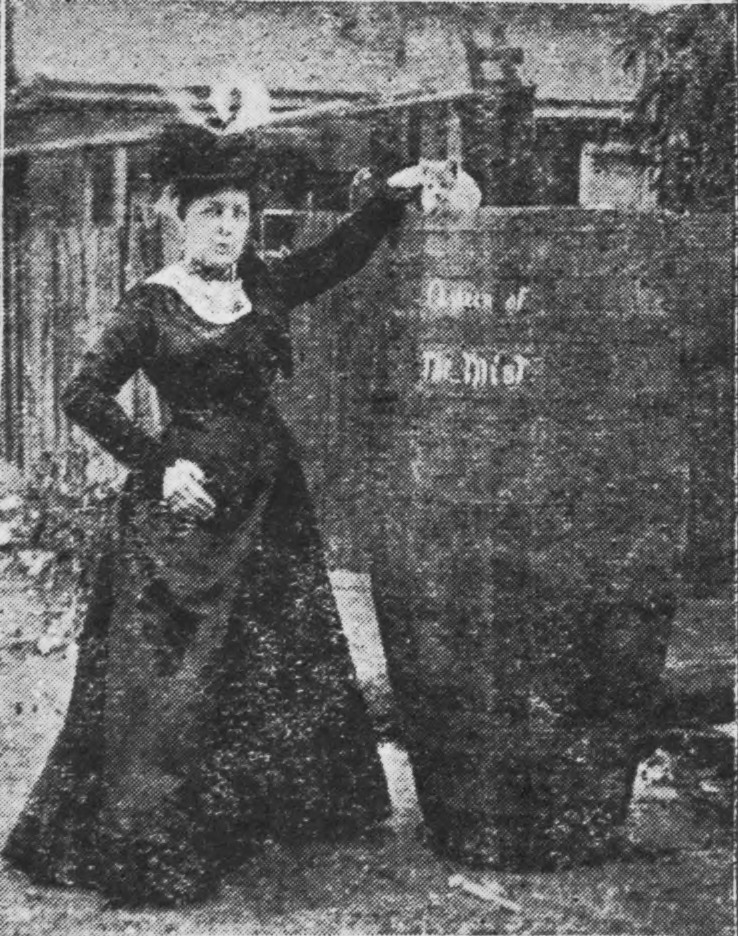
Mrs. Annie Edson Taylor, born October 24, 1855, near Auburn, N. Y., on the bank of Owasco Lake, the country seat of her father, Merrick Edson, who was of English descent, born in Massachusetts. Her mother, Lucretia Warren, was born in Albany, N. Y., and was connected with some of the oldest and best families of that day. Merick Edson owned large milling interests on Owasco River, which runs through the city of Auburn. In winter the family lived in the city, in summer on the farm, where little Annie went to the district school, and in winter to the city school. She was of a dreamy, imaginative disposition, fond of out-door sports and of books, especially those which run on adventures, such as “Life in Australia,” historical novels, and at the age when most girls were thinking of lovers, was reading Roman History and Plutarch’s lives.
Merick Edson, her father, died when Annie was about 10 years of age. From that time up to 14 life was uneventful. At that age she and two older brothers were sent by 10 their guardian to Charlottville, Schoharie County, to a seminary for boys and girls. This was an excellent school, discipline rigid, under the auspices of 24 selected teachers. There friendships were formed which changed the current of Annie’s whole life. Among the older girls was a Miss Jennie Taylor, a fine and accomplished scholar, who was chosen as a room mate for Annie.
Married at Eighteen
Later on she made the acquaintance of D. S. Taylor, who at the age of 18 became her husband. The marriage was blessed with one child, who died in a few days. Her husband died in a little over two years. Then it was that Annie realized the imperfections of her education and the folly of a too early marriage. In a few months she entered the Normal State School at Albany and became an indefatigable student, and at the close of three years graduated, taking her vacation with a married sister near Auburn. Among the many schoolmates to whom Annie became attached were two lovely Southern girls, the Misses Kate and Mary Kingsbury. The latter was of Annie’s age, and most intimate friend. Annie was invited to spend a year at their Southern home.
But, in the meantime, Miss Kate Kingsbury had contracted a most brilliant marriage with her cousin, and had gone to the faraway city of San Antonio, Texas. Annie concluded to go there for a year. After much opposition from her family and friends, one stormy day in October, 1880, she took ship from New York for Cuba, and after a month’s stay went from there to Galveston, and from Galveston by rail to Austin, the capital; thence by stage through to San Antonio. After meeting her friends, the Kingsburys, Annie took a position as teacher in the High School. During vacation she went to New Mexico with a 11 party of officers and their families, taking the overland route, where Capt. Nolan had a detail of soldiers guarding the building of railroads in the Shasta Mountains, and where every day the lives of the party were in jeopardy from Indians. On return to Texas, while rooming in Kingsbury Street, one night was chloroformed and her room searched for $3,000, which had been taken in for rents by Mrs. Taylor, who was acting as agent for the Kingsburys (who at that time were away).
Held Up by Robbers
On return North the stage was held up by a gang of robbers. In all, $3,000 dollars was taken from the male passengers. Mrs. Taylor had $800 concealed in the folds of her gown, on the robbers pressing a loaded pistol to her temple and demanding the money she had, said, “Blow away, I would as soon be without brains as without money.” They spared her life. This occurred between San Antonio and Austin, in a forest. After a year’s course in New York City, under the best instructors in dancing and physical culture, Mrs. Taylor went to Asheville, N. C., and immediately engaged in teaching those branches.
Just previous to that time she was in Chattanooga, Tenn., where I loaned $1,700 and it was lost in the boom in progress at that time, she was also burned out, losing all her household goods, holding no insurance.
Returning from Asheville, she spent a winter teaching in Washington, D. C. Returning to Auburn she spent the summer and autumn, and then went to Indianapolis. She taught dancing in La Fayette, Ind., in a young ladies’ school.
Shaken by an Earthquake
While in Asheville she visited Charleston, S. C., and 12 was there during the earthquake felt there. She then went to Bay City, Mich. She spent one summer at Sault Ste. Marie, Mich., teaching a system of piano music. A year later she returned to San Antonio, Texas, going from there to Mexico City, where she spent the month of December, then returned to San Antonio. Assisted by Rev. Walter Richardson, rector of St. Paul’s Church, and an eminent and cultured woman, a member of the church, Mrs. J. J. Stevens, she opened classes in physical culture, returning to Bay City the last of April, where she had been keeping house. She remained there until October 4, 1900, when she came to Niagara Falls.
How She Came to Go Over Niagara
The manner in which Mrs. Taylor got the inspiration to go over the Falls of Niagara, to perform a feat never before attempted by a human being, is best told by her in the following words:
For two years I had been constantly studying, when not occupied in teaching, what I could do to make money—to make it honestly and quickly. All kinds of schemes ran riot through my brain. Reading in a New York paper about people going to the Pan-American Exposition, and from there to Niagara Falls, the idea came to me like a flash of light, “Go over Niagara Falls in a barrel. No one has ever accomplished this feat.” I did not think it wrong, as there was nothing immodest in the act, nor did it involve the life of anyone but myself. I believe in prayer, and that God will answer if only there is faith. As my motive was not a selfish one, but to succor two friends, one who has little children, the other in delicate health, and to aid myself financially, I believed I would live. I was determined to live, to vindicate to the world God’s mercy and goodness. 13
Her Desire Was to Help Others
I frankly avowed what my purpose was, viz.: To aid two friends, raise money to help me pay a few small debts, and to enable me to sell some Texas land. Just how this was to be done I did not know, but thought a crowd would gather and a collection could be taken up. My great mistake was in selecting a manager, F. M. Russell of Bay City, who was well recommended, but who proved in every way unworthy the trust reposed in him.
She Designed Her Barrel
The idea came to me in August. I immediately set to work to shape a barrel, which I did, cutting it out of paper and sewing it together with twine. The dimensions were: 12 in. head, 34 in. middle, 15 in. foot. The barrel was 4½ ft. high, weight 160 lbs. It was made of white Kentucky oak, with ten hoops, each riveted every four inches. The barrel was made by Bocenchia of West Bay City.
Her Trip Over the Falls
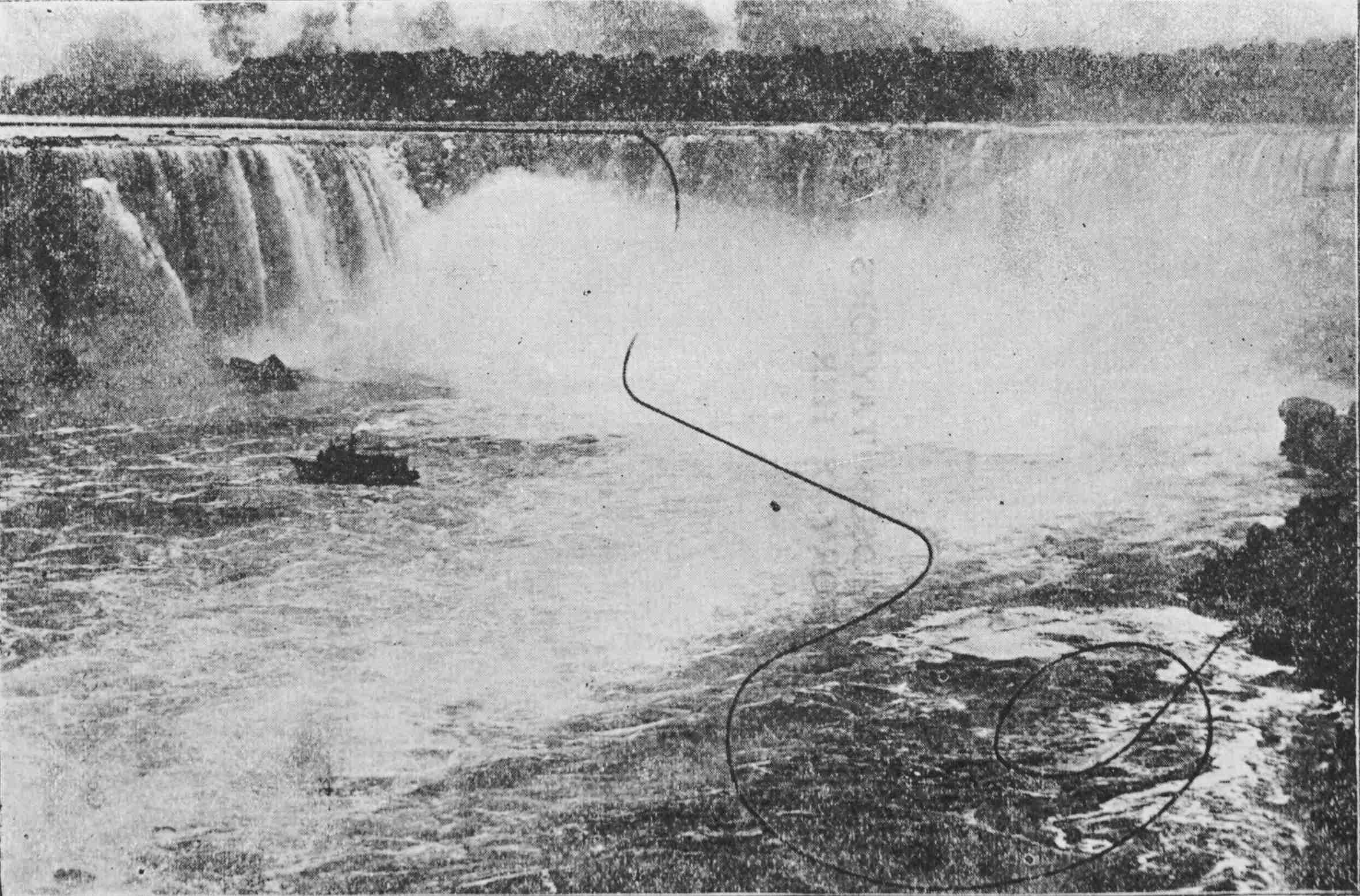
October 24, 1901, I left the shore from Buffalo Avenue in a boat, and was rowed by two men to Grass Island. I then took off my hat, street skirt and coat, and entered the barrel, the barrel being placed in the water. I then adjusted a woven strap around my waist, and a strap from the back went through an eye in the foot of the barrel, fastened to a buckle in front to my belt. This was to keep my head from violent contact with the barrel. I placed two cushions on my person extending down to the knees—one in the bottom of the barrel. When all was in readiness, the head of the barrel was screwed down perfectly tight. A tube inserted in the chines I held in my hand, and an air-pump was used to fill the barrel with fresh air. I then put a cork in the end of the tube I held in my hand. 14 All was now ready, and the boatmen towed the barrel out to the current, which they thought would carry me over the center of the Horseshoe.
I did not say, like Dante, on entering the barrel, “Who enters here leaves all hope behind,” but as I faced the inevitable, life or a horrible death in 50 minutes, my courage rose.
Cast Adrift
Thus, as the rap came on the barrel which told me I was cut loose, and no human power could avail me, for I was started on a trip no traveler had ever taken, my heart swelled, and for some moments I felt as though I were being suffocated, but I determined to be brave. By a supreme effort of will I calmed myself at once, and began earnestly to pray—if it was God’s will to spare my life, if not to give me an easy death.
The trip through the Rapids was nothing but a pleasant sensation. I could feel the barrel toss and often turning partly over, until I come to first drop over a reef, when the bottom caught for a moment. The barrel swerved, and for a moment I thought I would go head first, but with a jerk it loosened, turned foot down, and plunged to the bottom. I felt the water close over my head, but was not hurt. The barrel rose to the surface instantly, and pursued its course.
Toward the Mighty Cataract
Again the barrel swerved to the left, and I knew instinctively that should it pursue its course it would be dashed to atoms on the giant rocks near the Canadian shore. But God was good. The barrel paused, raised slowly on its head, then turned over on a rock and pursued its course down to the Brink of the Precipice. I tore the 15 cushion from my head, placed it quickly under my knees, and dropped to the bottom of the barrel.
As I reached the brink the barrel did what I predicted it would do, paused for a moment and then
Made the Awful Plunge
of 158 feet to the boiling cauldron below. I thought for a moment my senses were lost. The feeling was one of absolute horror, but still I knew when I struck the water of the lower river. The shock was not so great, but I went down, down until the momentum had spent itself.
Below the surface all was still. Not a sound reached me. Slowly I arose, but unfortunately on coming to the surface I came under the falling of water and was carried back of the sheet that tumbles over the precipice. It was then I began to suffer. The barrel was whirled like a dasher in a churn; lifted, I should think, four or five feet clear of the water, and thrown violently about, at the same time turned around and around with the greatest velocity, struck on the rocks, and each moment water was forcing itself in at the point where the anvil at the bottom had been imperfectly put on. As the barrel turned violently around and around the sensation was terrible.
Afloat on the Lower River
The barrel then shot out from the Cataract like an arrow from a bow, giving me a frightful lurch. After a short time I felt the barrel being drawn up to a rock. It was none too soon, however, as my strength was spent. When I realized I had been rescued my senses immediately left me. Like a person falling to sleep, I became unconscious.
Through the kindness of John Ross, chief engineer of the “Maid of the Mist,” and Mr. Williams of Canada, a 16 wrench was brought, the barrel opened, and the fresh air struck me.
A man’s voice exclaimed:
“The Woman is Alive!”
I answered, “Yes, she is, though much hurt and confused.” I was carried to my boarding house, and after suffering great pain was restored to my normal condition. The greater part of my life that remains to me will be devoted to doing good to others, for a woman, be she a true woman, can bless and glorify the lowest grade of humanity.
ANNIE EDSON TAYLOR.
Newspaper Men Were Witnesses
To Whom it may Concern:
This is to certify that Mrs. Annie Edson Taylor passed over the Canadian, otherwise known as the Horseshoe Falls, on October 24, 1901, and further that we were eyewitnesses of the fact having been present when she entered the barrel as well as when she was taken from it after having successfully made the trip.
CHARLES E. PERIGO,
City Editor, Cataract-Journal.
N. F. MADDEVER,
City Editor, Gazette.
Mayor Butler Certifies to the Trip
Niagara Falls, N. Y., April 1, 1902.
To Whom it may Concern:
This is to certify that on October 24, 1901, Mrs. Annie Edson Taylor went over the Horseshoe Falls at Niagara Falls in a barrel and survived.
MIGHELLS B. BUTLER,
Mayor.
Took Her From the Barrel17
Steamer “Maid of the Mist,”
Niagara Falls, N. Y., June 3, 1902
To Whom it may Concern:
I, the undersigned, certify that on the afternoon of Thursday, the 24th day of October, 1901, I personally, opened the barrel that had come over the Falls and found a woman inside in a fainting condition but after the admission of air she shortly revived. With the assistance of Harry Williams, proprietor of the Lafayette Hotel, and John Dunn, I took her out of the barrel and put her in a row boat and took her to the Canadian dock, where she was placed in a carriage and taken away. I have seen the woman known as Mrs. Taylor on two occasions since and can positively say she is the same person who was taken from the barrel at Bass rock eddy, on the shore of the Niagara River, below the Horseshoe Falls of Niagara.
JOHN ROSS,
Chief Engineer,
S. S. “Maid of the Mist.”
Saw Her Come Over the Horseshoe
Steamer “Maid of the Mist,”
Niagara Falls, N. Y., June 3, 1902.
To Whom it may Concern:
We, the undersigned, master and mate of the Steamer “Maid of the Mist,” plying on the Niagara River immediately below the Falls of Niagara, do hereby certify that on the 24th day of October, 1901, about 4 o’clock p. m., we being on board our boat directly under the Horseshoe Falls, saw a barrel come over the brink and drift down the heavy current close to the Canadian shore, fetching up in Bass rock eddy, it being about a quarter of a mile below the Horseshoe Falls. We saw the barrel taken from the water and the person of a woman taken from the barrel, and who (contrary to our expectations) was alive, and we confidently believe her to be the only human being that ever went over the Falls of Niagara and lived, and we can certify that the woman known to us since as Mrs. A. E. Taylor was the person taken out of the barrel.
R. R. CARTER,
Master S. S. “Maid of the Mist.”
WILLIAM THOMAS,
Mate, “Maid of the Mist.”
Maid Of The Mist
Of all the water trips in the world there is none that equals the voyage on the lower river in front of the
Falls of Niagara
The staunch and pretty steamers leave the docks at the foot of the inclined railways in the great free parks and pass through the spray clouds to
Rainbow Land
Passengers have the privilege of stop-over on the side opposite to their starting point and returning on any boat during the same day. Waterproof clothing is furnished as protection against the spray. The trip affords the most beautiful and unique views of the great Cataract, and no one who has not taken the trip has seen Niagara and its stupendous grandeur.
FARE, ROUND TRIP
INCLUDING WATERPROOF CLOTHING
50 Cents

FRANK LE BLOND, Manager
TRANSCRIBER’S NOTES
The date on the title page has been left as printed (“190 ”).
Minor punctuation errors have been corrected without comment.
Variant spellings of the same name have been retained as originally printed.
Original spelling has been retained except for the following probable typographical errors:
-
Page 6:
“tumultous” changed to “tumultuous”
“...through the wild, tumultuous, tossing waters...” -
Page 6:
“stupenduous” changed to “stupendous”
“...that stupendous downpour of water...” -
Page 7:
“commended” changed to “commanded”
“...the announcement commanded but little attention.” -
Page 7:
“choatic” changed to “chaotic”
“...she had studied the chaotic nature of the waters...” -
Page 8:
“belive” changed to “believe”
“...who had come to believe that...” -
Page 13:
“heigh” changed to “high”
“The barrel was 4½ ft. high, weight 160 lbs...” -
Page 13:
“stap” changed to “strap”
“I then adjusted a woven strap around my waist...” -
Page 15: “Lkie” changed to “Like”
“Like a person falling to sleep...”
New original cover art included with this eBook is granted to the public domain.