Title: Is man a free agent?
The law of suggestion, including hypnosis, what and why it is, and how to induce it, the law of nature, mind, heredity, etc.
Author: James Hawthorne Loryea
Release date: June 22, 2026 [eBook #78922]
Language: English
Original publication: Lansing, MI: Santanelli Publishing Co., 1902
Other information and formats: www.gutenberg.org/ebooks/78922
Credits: Bob Taylor, Tim Lindell and the Online Distributed Proofreading Team at https://www.pgdp.net (This file was produced from images generously made available by The Internet Archive/American Libraries.)
Photo by Rentschler, Ann Arbor, Mich.
IS MAN A FREE AGENT?
THE
LAW OF SUGGESTION
INCLUDING
HYPNOSIS
WHAT AND WHY IT IS, AND HOW TO INDUCE IT
THE LAW OF NATURE
MIND, HEREDITY, ETC.
BY
SANTANELLI
THOSE WHO SEE SHOULD LEAD THE BLIND
LANSING, MICH.
THE SANTANELLI PUBLISHING CO.
1902
BURNS & OATES, 28 ORCHARD ST., LONDON, W.
COPYRIGHT, 1902, BY JAMES H. LORYEA
ENTERED AT STATIONERS’ HALL
ALL RIGHTS RESERVED
Printed and Bound by
Robert Smith Printing Co.
Lansing, Mich., U.S.A.
“A friend in need is a friend indeed.” Oh! how true; touch a man’s pocket and you instantly touch his heart, which seems to be at the other end of the nerve. Like the elevator boy, I have had many “ups and downs,” but unlike him, I feel that my “downs” have been twice or thrice to every “up.”
Acquaintances I have by the score, friends but two, therefore am at least a hundred per cent better off than most of mankind. These two friends have had their faith tried many and many a time, yet were always ready to respond.
Many the hour, both day and night, have I thought of them; many the resolution have I formed, but my good intentions availed them not. ’Tis said that Hades is paved with good intentions, but they are of no commercial value and repay no material loans. Some day “when my ship comes in”—if it be laden with other than air castles,—I may have something other than good intentions to repay my true friends, Frank H. Doolittle, of Lansing, Mich., and Col. Le Gage Pratt, of East Orange, N. J. To them, with all my heart, is this book dedicated.
(J. H. Loryea.)
Lansing, Michigan,
January, 1902.
[Pg 7]
A word of itself puts no thought into action, though a series of word sense-picturing may. Thoughts are made up of associated ideas through the different senses; two senses must be affected to put a thought in action. I must arouse a sight memory (picture), a feeling memory (picture), as well as a sound through words, to have my reader gain a thorough understanding.
Though accredited with an extensive vocabulary and having a large dictionary at hand, I will have trouble in making you comprehend.
There are no synonyms, as no two things are the same. Therefore, all words used here must have but one meaning. The following words and phrases will be used to mean only the here-affixed definitions.
Suggestion, anything that arouses an action (environment, bodily or external).
Hypnosis, a simulated sleep, the subject having the “thought of sleep.”
Inspiration, a thought forced by an operator after Hypnosis has been induced. Man is ruled by suggestion; we inspire a hypnotized subject.
Personal suggestion, where a thought is deliberately forced upon a person free from Hypnosis—exemplified by Christian and Mental Scientists.
[Pg 8]
Post-hypnotic suggestion, a misnomer. It is a deferred action, and will not happen if the subject is actually awakened.
Inspired awakening, “the thought of being awake,” the opposite to Hypnosis,—“the thought of being asleep;” commonly known as the waking state.
Auto-suggestion, can only mean a “sleep walker.”
Pre-inspiration, an act decided upon by the subject to be done after Hypnosis has been induced, (erroneously called Auto-suggestion).
Mind, the consensus of all actions acquired during gestation, and seated in the Sympathetic System. As it is inconceivable for anything to happen without an intelligence to guide it, I believe that intelligence to be within all matter, call it Mind and show its action to be forced by external (the only kind) suggestion.
“Mind,” what is commonly believed to be the seat of intelligence.
Sympathetic System, all brain matter contra-distinguished from the cerebrum.
Thought, two or more associated ideas. Thoughts are forced not chosen.
Idea, a percept through any sense. Ideas transform into action.
Thinking, transforming of energy,—man only realizes.
Memory, registration of ideas. Man never forgets, but fails to recall.
Negation, an inconceivable word. Everything is positive; positive for or positive against.
Abnormal, impossible. Everything is normal or a natural result from the cause.
[Pg 9]
Objective mind, subjective mind, mere words.
Authority, a conceited juggler of words.
Bad, perverted good.
Good, natural response.
Hearing, seeing, smelling, tasting, feeling, the correlation of the different nerve-end stimuli of the respective organs.
Degenerate, above (plus) or below (minus) what is considered average man. Seemingly the same irritation may produce either extreme, subservient to external environment.
Everything is a combination of attributes; i. e., one thing an impossibility.
Matter is comprehensible only to the degree it affects the senses, and to be conceived must affect two senses. To be comprehended, three or more.
Form is comprehensible (when acquired) only when it affects sight and feeling.
Form is the outline of matter, and but transitory. Only matter is appreciable.
Man can conceive of nothing greater nor worse than his individual experience.
Will (will power), I cannot comprehend it, though everyone prides himself on possessing IT.
Instinct, a word used to express intelligence in animals, in contra-distinction from intelligence in man. Man reasons! Animals do not. (?)
Law of Nature, a phrase that conveys no meaning. If you can comprehend the phrase “Law of Nature” then you will know the Law of Suggestion, and it will be a useless waste of time to read the following pages.
Since man began assembling, some few have spent their lives in trying to comprehend the most incomprehensible of all beings,—man. The net result of all their work and discoveries has resulted in nothing but theory, and that not worth the candle. With all of our alleged knowledge the few truths we have are of but little value. The myriads of theories are so impracticable that I often wonder why and how the “authorities” obtain their titles. The authorities of a hundred years ago are the laughing stock of to-day.
Up to fifty years ago man was bled as a cure for every disease; to-day they claim he is full of bugs that require slaughtering and try to make of him a bacilli abattoir. They write tomes of books on “mind,” yet nowhere can I find it comprehensively defined. Everyone prides himself on his will power, yet I must own that such a thing which is so ambiguously defined is incomprehensible to me. Volumes are written as to hearing, seeing, smelling, feeling and tasting, and yet no one seems to be able to grasp the true significance of these terms.
Crime is punished, yet more penitentiaries are yearly required. Our alienists, truly foreigners to their subjects, know all (?) about the brain and with the greatest assurance pronounce upon man’s sanity, yet offer us no cure, and our institutions for the insane are too small for the ever increasing demands upon them. We know the effect, need [Pg 12]no experts, why does not some one demonstrate the cause.
In all sensational murder trials our most learned(?) and wise doctors(?) go on the stand as experts(?)—whatever that may mean—swearing directly opposite to one another, and still maintain their standing in their profession and the community. If they know anything, how is it possible for the truth to be in both of two contradictory assertions. They study in the same schools, from the same books and from the same “authorities,” yet one says “yes,” the other “no.” Verily, gentlemen, you must lack a true premise.
Effect, man comprehends fairly well, but as to cause our most learned scientists seem to have no conception. Now, dear reader, if you would know a bit of truth follow me. I am a graduate of no great college; am professor in no great institution; have been exposed(?) many times, yet truth is, was, and always will be, and year after year my following increases. If you will follow through the ensuing pages, unsophisticated as I am, I will try to teach you something about man—a mere machine; his every thought and action forced, possessing no will power, and in no way responsible for his actions. For twelve years I have studied nightly from ten to twenty-five hypnotized subjects and have found that they are ruled by the same general law as the non-hypnotized man. In other words, a hypnotized subject is a slowed-down machine which one knowing how, can watch each and every movement of, and thereby comprehend cause and effect. Through a hypnotized [Pg 13]subject we can learn how “normal” man is forced to act. Consequently, we can thoroughly analyze the whys and wherefores of every act performed by a subject while in hypnosis, during which time I believe the cerebrum to be entirely inactive.
The cerebrum is like the receiving or correlating mechanism of the phonograph; after the thought is registered in the ganglion of the Abdominal Brain it is then purely automatic and free from the cerebrum, which is the realizing brain. Everything we do and say is purely automatic—an effect. The babe at birth fails to withdraw its foot when tickled. After that action is associated with the peculiar sensation, the action always takes place when the sensation is produced, it being purely automatic, otherwise, a result or transformation of the cause. After the babe has learned to speak the word “papa,” whenever the environment forces the desire for father, automatically the word is said without any predetermination.
Everything in life is a combination of attributes; i. e., one thing an impossibility.
The attributes of which any object is composed are of interest to us only as they affect our senses. The word “tree,” if disassociated with our sense-impressions, would mean nothing, but when its form (sight) and use (feeling) are associated with its name (sound), we for the first time have a comprehension of what in the English language is known as a tree. A foreigner, unable to understand our language, coming to this country and being asked for a match would have no conception of what we were talking about; after we have associated [Pg 14]in his “mind” its form (sight), its use (feeling) and its name (sound), he would for the first time understand what was meant by the word match.
All matter to be conceived must affect two senses; to be comprehended it must affect three or more. A cigar cannot be thoroughly comprehended with less than five. It has form, equaling sight; use, equaling feeling; a name, equaling sound; taste and smell. It is not necessary for man to comprehend the material of which it is made, or the skill that made it. The last two are inconsequential to him, other than in producing the desired effect on the senses. Therefore, all matter equals in comprehension the degree to which it affects man’s different senses, and if man can only comprehend through the effect on his senses, that comprehension which is called a thought, must likewise be a combination; hence, I will define a thought to be two or more associated ideas, an idea being a percept through any of the senses. The more ideas associated the more comprehensive the alleged thought.
Matter is comprehensible only in the degree to which it affects the senses; to be conceived it must affect two, to be comprehended, three. Form is comprehensible (when acquired) only when it affects sight and feeling, and a child must not only hear the word “round” but also feel of the object. The same with “straight,” “square,” et cetera. The round object through sight must transform itself into a feeling memory. Form is the outline of matter, and as nothing but matter is appreciable [Pg 15]by man, the form of it conveys no impression except of the matter (feeling) within its boundary.
Nothing but matter is comprehensible to man.
The five senses to be impressed must be stimulated, and nothing but matter will produce the excitation necessary. Energy can move only through matter by disturbing matter; or, in other words, “nothing” is impossible and incomprehensible. Therefore, there is nothing appreciable but matter. Man can conceive of nothing that he has not experienced, and as all so-called thinking is but the correlation or passing through one’s mind the experiences associated, and as they have necessarily been the product of matter, nothing else is comprehensible. Consequently, man can conceive of nothing greater nor less than his individual experiences. It is impossible to lift him to your comprehension, you must drop to his.
If I speak to you of the “Law of Nature,” what sense-experience have you a memory of to be aroused by the utterance of the phrase “Law of Nature”? None. But if I tell you that the farmer ploughed the ground, sowed the seed, the Heavens gave forth rain; he then hoed around the seed, a sprout came up, and by more cultivation the sprout matured into a stalk of corn, the corn was then harvested; you would say “Ah, well, the farmer did all that. I fail to see what the ‘Law of Nature’ did,” because you can comprehend nothing that does not affect your senses.
While lecturing in New York City two years ago, a very estimable lady, whose children were reared in a nursery and lacked many of the usual [Pg 16]experiences of children of middle-class families, came to me and said:
“Mr. Santanelli, can you cure my boy of a very vicious habit?”
“Madam, what is the habit?”
“He enjoys putting the cat on the hot stove to see it dance.”
“Yes, madam.”
“How long will it take you?”
“One-quarter of a minute.”
My good reader, can you tell me what was done; if so, why? What ideas were associated in this lad’s mind as to the stove and cat? The different actions of the cat and nothing else. The stove being the force (suggestion) and the dancing of the cat the result, thereby arousing only a sight memory. The lad lacked a memory. The moment there was given him a feeling memory, he no longer cared to see the cat dance on the stove. His finger was held on the stove until it was blistered, which associated in his “mind” through the proper sense that heat produced pain, and substituted a memory of pain for the memory of the pleasure of seeing the cat dance.
While in New York City, on Sunday mornings I attended an independent church, whose minister or lecturer is beyond all question one of the cleverest logicians of the day. On one Sunday in particular he preached a sermon claiming that the right religion has yet to be offered man; that the foundation of all doctrines so far offered us has been based upon a material premise; that the right founder will offer us one built entirely upon a spiritual [Pg 17]basis. Such a thing is an impossibility, inasmuch as the spiritual is incomprehensible. The moment that one begins speaking of the spiritual he is using mere idle words, inasmuch as the spiritual has never affected any of his senses, hence he has no memory of its action; therefore, no ideas are properly associated, and the word possesses no meaning—his utterances are purely conjectural.
I speak to you of a “thingamagig,” which is mere sound, arousing no thought in your “mind.” I show it to you and thereby associate sound—thingamagig—with sight—its form. I then teach you its use—feeling—and you comprehend it. The two ideas will give you a conception, but it requires the third to get a comprehension. I touch you. Can you help thinking of it? I show you my watch, and you think of it. You hear a sound, you think of it; you smell or taste something, and think of it; you have no control nor in any manner can you prevent the consciousness or the realization of the senses so affected.
Man does not “think,” he realizes. Thinking is the transforming of energy (suggestion). I pinch you; it has happened and is registered irrespective of your “will power,” and when registered, you realize it. You see my hand move towards you; you see on my face an expression which arouses the thought (associated ideas) of being pinched, the alleged pain and the avoidance of it through the action of withdrawing your limb, which is but the transforming of the energy (suggestion) taken in through the eye and voiced in your action, all being done before you realize it, the transforming [Pg 18]being instantaneous and must be registered before you are conscious of (realize) it. The “mind” is the realizing intelligence, and the actual mind is like the transformer of electricity in the main power station that receives one kind of electric current and sends out another. Into what action the received current will be transformed, depends on the ideas (currents) previously associated. The degree of action and its rapidity depends on the number of senses affected and the degree of force. Therefore, your thoughts are forced on you by your environment, and are the transformation of the suggestion; hence, man is a creature of his environment. Now, as I have defined a suggestion to be anything that arouses an action, anything that affects any of your five senses must be a suggestion; therefore, man is ruled by suggestion.
Man is like a phonograph; each thought a wax cylinder; the ideas associated the indentations thereon (memory). One sense puts the cylinder in position, the second sense drops the pin into place on the cylinder where the tune is begun. No thought can be put into action unless two senses are affected. When a series of ideas are associated into a thought, and the thought is forced into action, each idea in its proper place is certain to appear and it is beyond the power of man to resist it.
I speak to you of a horse, immediately its form (sight), use (feeling), et cetera, appear to you, unconsciously.
A word of itself arouses no action. In conversation, the environment, the expression on the [Pg 19]speaker’s face, and the tone are the attributes that force the thought into action.
If one should go into the kitchen and tell Bridget, who is not afraid of losing her position, to remove the teakettle, she would ask, “Why?” Were it boiling over she would remove it, not because you told her, for you simply forced her to look at it; when she did so, seeing it boiling over, the removal of it was due to the conditions forcing themselves upon her through the eye. Had she no ideas associated as to a kettle boiling over, that its removal would stop it, there would have been no action.
I say to you, “Jump out of your chair,” and you remain seated. I ask you what was said, and you will reply that I said, “Jump out of your chair.” I deny saying any such thing. I said just what you did, because a thought is simply the transforming of energy. Thus an energetic wave affects the eye which is immediately transformed into the action associated with the expression perceived, or in this case, sound. If you had thought to jump out of your chair, the action would have taken place and you could not have avoided it. When I spoke the words, “Jump out of your chair,” the tone conveyed the opposite action; the expression on my face conveyed the opposite action, and the two senses affected put into action the thought of remaining in your seat. But, if with an expression of fear on my face and a tone of fear in my voice, I called to you “Jump!” you would have been out of the chair instantly, then looking at the chair [Pg 20]and seeing no reason for jumping, you would have asked why I told you to jump.
Everything in life is positive. Your hand is not “not up,” but is down. A man who is seated is not “not standing up.” If I say to you, “You cannot take your hand from your face,” I am really making the affirmation that you will keep it there. I start a party of hypnotized subjects at spinning their hands, and then tell them that they cannot stop. What do they do? They spin the faster, because if they cannot stop they must go faster. There is where I learned it. Every statement must necessarily convey and can only convey an affirmation.
If everything in life is a combination of attributes, sleep also must be a combination, but can man artificially induce sleep? No. Man never went to sleep, but sleep gathers round him. No two things in the world are the same, many things are similar. There are two matches on the table. Are these matches the same? They have the same form(?), the same name, the same use, but the material of which they are made is not the same. If it was, they would be one match. Therefore, real sleep can only be produced in one way, that way I do not know. What is called sleep I can pick apart, and find: First, that under ordinary circumstances, a person to be asleep must be in what is to them an easy position. Next, I find that in sleep “mind” is inactive. Next, the eye is either rolled up or converged, and then the eye is closed. The bringing together of these four attributes will result in what? If a thing is made up of [Pg 21]four parts, and we bring the four proper parts together, we will have the whole. If we bring but three together we will accomplish but three-fourths. An inactive “mind” I want; therefore, I must have a very “small” thought, and as thought is all action, if I can pre-supply the action of the thought and have the subject maintain it, I then will have an inactive thought. As all of the attributes of a thought are certain to take place, and I am trying to induce a condition similar to sleep, the thought of sleep is the thought required. Consequently, if I could lock in the “mind” the thought of sleep, I would be able to accomplish my purpose.
Note.—I call the thought of sleep and the thought that pain has ceased, blank thoughts, as they give forth no perceptible action.
If I tell you to sit up, the thought of sitting up is active to the extent of “sitting up,” after which the only action is that of holding or retaining the muscles in their present tension, which action is imperceptible.
The dimmer a sound grows to the ear, the dimmer will be the thought of it. The dimmer an object grows to the sight, the dimmer will be the thought of it. Therefore, if I place my subject in an easy position and hold an object for him to look at in such a location that his eyes are either turned up or take the proper converged position, I will have two attributes of sleep. If I hold the object in such a way as to tire the nerves of accommodation, and not the eye (because I would then be losing the easy position), the thought of his environment [Pg 22]would pass out of his “mind” through his eye as the nerves of accommodation failed to perceive the object gazed at. While that thought is fading away through the eye, if I would supplant it through the ear with the thought of sleep, the moment that I have succeeded in doing so, and have brought together an easy position, upturned eye, closed eye, the thought of sleep, we will have a simulated sleep, differing from real sleep only in this: In real sleep there is no thought; in hypnosis there is the thought of sleep, which nothing but the operator’s voice can change.
To show the mental difference between hypnosis and sleep, I have drawn a wheel (See Fig. 1) to represent the “mind,” each spoke representing a thought, which is made up of ideas (actions associated). When you are doing one thing you cannot do the second until you stop the first, otherwise you would continue doing the first all your life. The moment you stop the first, just before beginning the second, your muscles are positively inactive. This point in mechanics is known as the “dead center.” The eye can distinguish (comprehend) no object in motion. There must be a point of rest, or the eye must move with the object which relatively produces a point of rest. This is demonstrated by the moving picture machine.
Our scientists tell us that a wheel never stops in making a revolution. I always have and do still maintain that one-half of the wheel must stop going down before it can go up, and vice versa. If we will take a sixteen foot fly-wheel and lay off on it a square, we can see it stop. The piston of the [Pg 23]engine that moves it stops, and I maintain that when we can see the spokes of a bicycle wheel as it revolves slowly, is when the eye can measure the stoppage, but when the stoppage is so brief that the eye fails to perceive it, we fail to see the spokes. When you are thinking of one thing you must stop thinking of that before you can think of the second, for no man can do or think of two things at the same time.
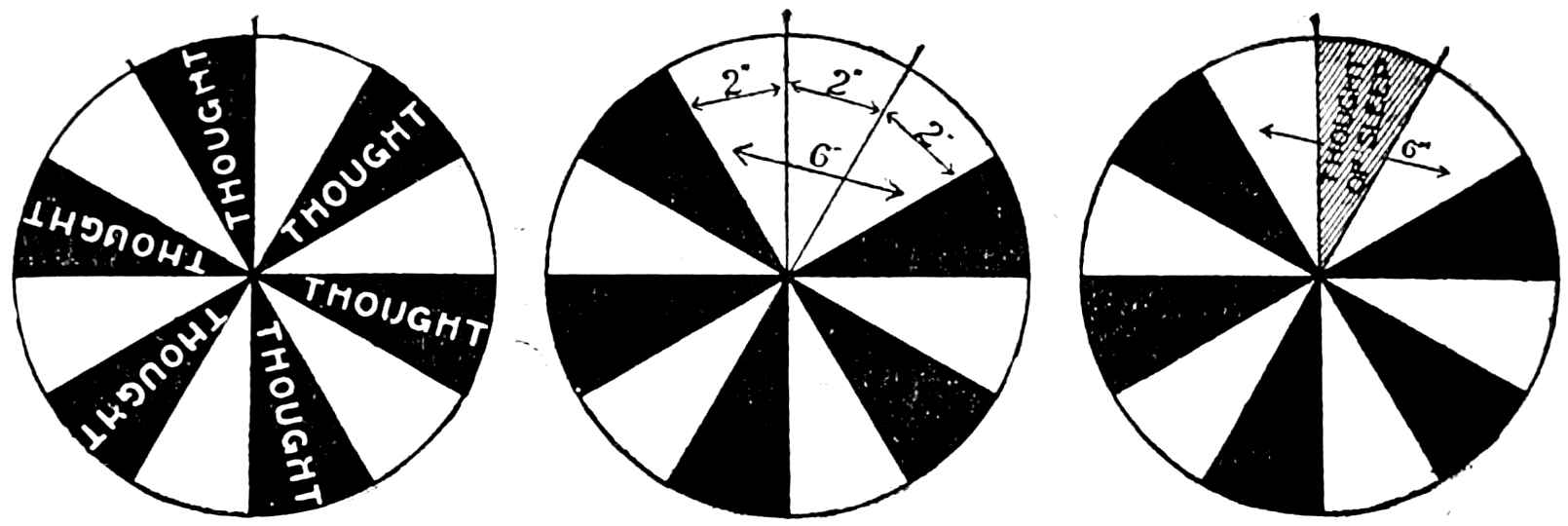
By referring to the wheels you can see there is a blank on either side of every thought. When a person is asleep the “mind” is empty, the thought having faded away and the two blank spaces having merged into one, and the “mind” is free of thought. Assuming that in sleep the two merged blanks on either side of the thought will occupy a space of six inches, in hypnosis we have a blank space on either side of the thought, occupying two inches each, and an inactive thought occupying two inches, making up the six inches required; but in three parts—a blank, an inactive thought, and a blank. The subject is in this mental condition: [Pg 24]First, the inactive condition of being awake—he has a thought; second, this thought being inactive (but of sleep), he has seemingly all of the attributes making up the condition of sleep, with the exception that the “mind” holds the thought; hence we can readily see that all action must necessarily be part of a thought, and will define hypnosis to be a simulated sleep, yet the subject has the most important attribute of being awake, he can accept and hold a thought. His condition is actually this: He cannot receive impressions but can respond with those already possessed. Thought will not respond to its environment and by my method thoughts can only be made responsive through the operator’s voice. If he were actually asleep and we attempted to arouse a thought, he would awaken. In hypnosis we can force the thought to remain at pleasure, therefore are enabled to deliberately study it and to find what attributes are necessary to force an action.
To recapitulate: In hypnosis there is the dummy thought of sleep, holding the space of an active thought; the key—the operator’s voice. The subject is free from his environment, therefore no shifting of thought, thus illustrating my previous statement that man does not choose his thoughts (action), but has them forced on him by environment (suggestion).
One is not asleep when dreaming, there being a thought in the mind; one is rarely over half asleep. A dream is the passing through the conscious mind (cerebrum) of a thought usually without the action taking place in the Sympathetic System—the [Pg 25]cylinder of a phonograph going “zip” instead of running at the usual speed. I might state here to the amateurs that if the subjects take on hypnosis through the suggestion of so-called magnetic passes, the operator’s touch will force into play certain actions if previously comprehended (associated) by the subject. Suggestion means anything that arouses an action. This is the law: Surround a man with every suggestion or attribute of sleep and he will be asleep; surround him with every suggestion of virtue and he cannot help being pure, and no credit is due him. Surround him with every suggestion of vice and crime and he will be a criminal, and in no manner should he be held responsible. Remember, though, that every suggestion has two positives, one for and one against, and the body is the closest environment (suggestion).
The subject holding the thought of sleep, and that thought being made up of a series of attributes, all of which I do not know, has every appearance of being asleep. First, he is relaxed. Why relaxed? Is the contraction of the muscles a voluntary unconscious or an involuntary unconscious act? The babe must learn to draw up its limbs, to sit, to crawl, to stand, to walk. Therefore, it must be acquired, and is the result of a feeling suggestion. Is man conscious of it? You suddenly pull a chair from under him, he seems to be very conscious that the chair is going. Therefore it is an enforced, acquired action, unconsciously done in response to the suggestion of the environment.
[Pg 26]
But a sleeping man is of little value to us. So we tell him that when he opens his eyes he will see a fly on the end of his nose, he will feel it biting, cannot brush it away, and to open his eyes. Is the man now in hypnosis? If hypnosis consists of an easy position, the thought of sleep, an upturned eye, a closed eye, he is not. As the subject has none of these attributes now, he cannot possibly be in hypnosis. He is now in a condition that I call “inspired,” meaning that the condition he is in was forced on him through the operator’s voice, instead of the natural suggestion of his environment. The man believes there is a fly on his nose; he sees it and is trying to brush it away. Perfectly rational, perfectly consistent. In fact, does he differ from the so-called normal—a word I cannot understand? If there was a fly on his nose and he felt it biting, he surely would think of it and try to brush it away. That is what he is doing now. Wherein does the subject differ from the ordinary? If the fly really alighted on his nose, the sense of feeling and sight would arouse the thought. Through hypnosis, that old thought is aroused through my voice; and, as his senses fail to arouse a thought, there is nothing to contradict my affirmation. The result thoroughly consistent, the man being in identically the same condition as when he held that thought, aroused and put into action through the proper senses. Therefore, it can be readily seen that the hypnotized subject is in a perfectly “normal” condition; save that he has had a thought aroused through hearing and emphasized through hearing which his environment [Pg 27]would have aroused and put into action through sight and feeling.
Memory is the registration of ideas. A hypnotized subject retains no memory of what has taken place in hypnosis; we have only turned off from the cylinder what was already there, and that conditionally. Why is it impossible to put any thought in the “mind” of a hypnotized subject? Because it is impossible to register through one sense that which the economy of man is made to receive through another. It is impossible to describe color to a man born blind; or sound to one born deaf. The comprehension of the girl, Helen Keller, in Boston, to me is quite an interesting problem. I unhesitatingly state that the girl is a mere automaton; she has no ideas, no thoughts in any manner, shape or form similar to those of her teachers. We associate color with a stimulation of the nerve-ends of the eye and sound with a stimulation of the nerve-ends of the ear. Therefore, anyone lacking the ability to receive these two sensations can have no conception similar to the one who does. Sight is the least trained of all our senses. A child or even an adult has to learn to read a picture. To one never having seen a picture, it is simply a blur of colors. A missionary in South Africa, showed the photograph of a cow to one of the native chiefs, who was the owner of vast herds; he looked at it and saw nothing. It took the missionary three days to make him comprehend. When he did, a smile illumined the chief’s face and he sent for other chiefs, showed it to them, and because they could not comprehend [Pg 28]at once what he failed to, he wanted to behead them, a proof positive that he was becoming civilized.
A man born blind and suddenly given his sight has no perspective. Perspective must be learned. The use (correlating) of the senses is acquired—must be learned.
No man does anything because he is told to. He must always have a reason, which I call a force. Nothing that we tell him to do can mean anything to him unless there are two ideas associated to give him conception, three to give him comprehension. The soldier whose officer commands to “shoulder” or “present arms” does so not because he is told, but because he knows that if he refuses or fails to do so, he will be punished; or he hopes for a reward. These are the incentives that force the action, the mere telling him to do a thing would not cause him to act.
The general public believes that all that is necessary to get a hypnotized subject to do something is to say to him, “Jump out of your chair,” and he will do so; but he will not. If his cerebrum was active, he would ask you why he should jump. But if we put the force there he will respond instantly. Therefore, if we say to him, “When you open your eyes, you will find the chair you are sitting on is red hot,” believing it to be hot, the action of getting away will take place at once, and he will jump out of the chair, not because we told him to, but because of the natural action to do so, forced by the suggested environment. In hypnosis the senses fail to convey ideas, therefore they [Pg 29]do not contradict the statement that the chair is hot.
Let us now look at the mental condition of the subject: First, in his so-called normal condition he sits on a hot chair; through the sense of feeling he has the thought forced on him, and he jumps because of his first associated action. The thought of heat is transformed into the action of getting away from it. If he had no previous experience with heat, the action would not have been there to be forced into play. I now hypnotize him, and tell him that when he opens his eyes he will discover that he is sitting on a hot chair; to open his eyes, he does so, he jumps and repeats everything he did when he actually sat on the hot chair. In what way does the man differ from the so-called normal? Normally, there was a chair, heat, the man, a thought and its action. In hypnosis we have the chair, the man, the thought of the coming into contact with the heat, and its action. What is wrong? The man or the environment? It is the environment. The difference is this: There is no hot chair. Therefore, nothing to force the thought of such and accentuate the action of jumping. As I have forced such a thought through the ear and that not being the proper channel, it makes no registration and consequently can only be a thought re-used, and hence no memory. I maintain a man is perfectly normal in body and mind, and will only do what he would have been forced to do had he received the thought through feeling, the result being identical with “normal.”
[Pg 30]
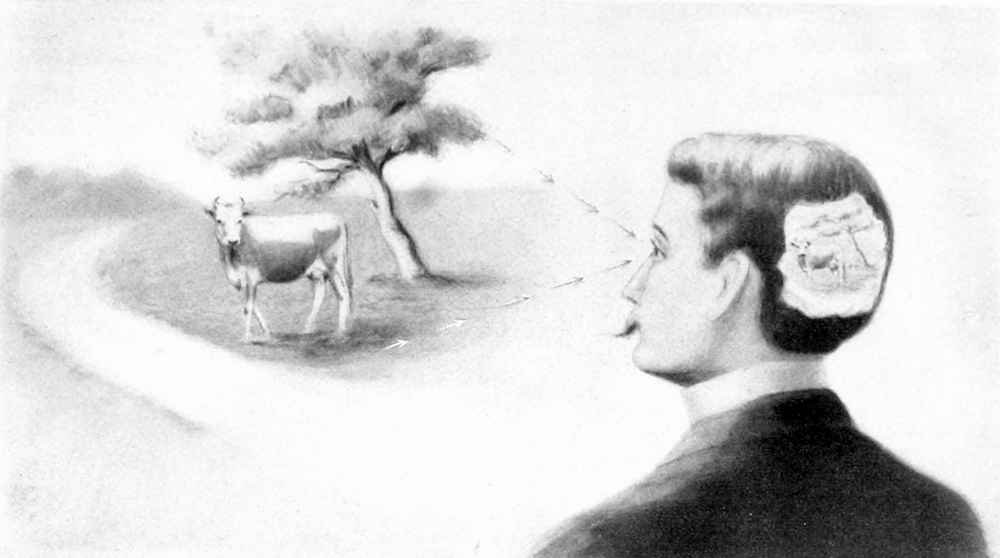
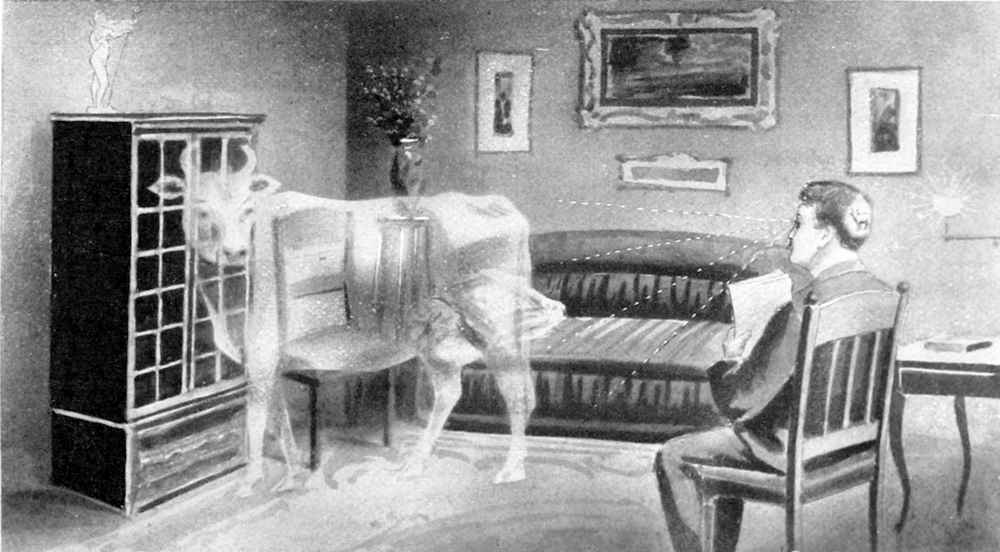
The automatic action of man is registered on the cylinder of the phonograph regulated by the picture taken. Man is also like a camera taking a photograph of his surroundings, which forces the cylinder of the phonograph into operation. In hypnosis the process is reversed and he becomes like a stereopticon, throwing out registered pictures. As it is impossible to light up a plate which is not there, we have another proof that nothing new can be introduced into the mind of a hypnotized subject. I can light up any plate upon which an impression has been recorded, but in no way can I change the detail. (Plate I.)
I shall next endeavor to show how one is ruled by environment (suggestion).
We will assume that there are present three ladies of the following turn of mind: one who never overlooks an opportunity to dance, to attend a ball, a party; number two, who was of the same disposition at a former time, but who now has the thought that it is a sin, and number three who has no conception of what a ball or party is like. We ask number one, while normal, to please get up and dance; she refuses(?). No, we have failed to force her. Being ruled by her surroundings she says, “This is no place for dancing.” She is here to listen to a lecture and she refuses(?). We hypnotize her and tell her that when she opens her eyes she will get up and dance. Will she? No, she will repeat the first answer, she refuses because, as yet, she has the same surroundings. She does not refuse, but responds to her environment which has all the suggestions positive against [Pg 31]dancing. We can make her dance. How? By taking her to a ballroom.
When she is in hypnosis, the process can be reversed, bringing a ballroom to her. Normally the thought should be aroused through the eye and accentuated through the other senses. We will revive the thought through the ear by telling her “when she opens her eyes she will find herself in a ballroom, will see her friends dancing, will hear the music and will see her partner standing beside her.” When she opens her eyes, she throws out a picture of a ballroom on her present surroundings and is perfectly normal, subservient to the picture thrown out. She seemingly sees, hears, smells, feels and tastes normally as to all things that pertain to the ballroom she has pictured. She has a ballroom thought placed there through her ear in lieu of through the eye, no other could she have were she in a ballroom. Seeing a partner by her side she accepts his arm and dances. If she should dance against a chair she would not see it, as it is not part of the picture, but through the sense of feeling she would respond to the suggestion which would force an action of apology as though she had bumped into another couple. (This completely exemplifies the action of man.) She is perfectly capable of carrying on a conversation and no one could tell she were not normal as to her inspired environment. She will do or say only what she would, were she in an actual ballroom. Every idea that is engraven on the cylinder will respond if forced. When no action is recorded there is no reflex(?) to respond and the action is omitted.
[Pg 32]
We will assume that this young lady is dancing in a certain ballroom where a young man stepped on the train of her dress; she turned and slapped him. If we call to her, “Your dress has been stepped on and torn,” will she turn and slap an imaginary man behind her? No. We will get no more action than a frown on her face, as we have failed to put the thought in action; the thought of her dress being torn was made up of the feeling of the pull, the hearing it tear, and perhaps the seeing of it (perhaps it was torn); three senses being affected. As we can deceive only the sight of a hypnotized subject, we can cause her to throw out a picture of a torn place in her dress, but as we failed to make her feel it tear, or to hear it tear, we have failed to put the thought in action by failing to affect two senses.
To further illustrate that a subject is “normal,” subservient to his picture and that the operator causes only the eye to be deceived, we will assume that there are on the stage a barber and a very fastidious young man, who takes a great interest in his shaving. We desire to put on a shaving act, that is, one man to sit in a chair, the other to put on him a barber’s apron, using a one pound paint brush and a large soup bowl full of lather to lather the customer’s face, and then to shave him with a wooden razor that weighs at least a pound and a half. Now, dear reader, which would you choose for the barber and which for the customer? No doubt, you would say, “Make the barber the barber and the fastidious young man the customer.” That would never do, for if you were giving an [Pg 33]exhibition before a public audience, within two minutes many of the spectators would swear that the barber was “faking.” The sense highest cultivated in a barber is that of feeling. He sees the picture, well and good, but when he tries to tip back the chair it fails to tip, therefore feeling contradicts his sight; when he picks up the paint brush, feeling again contradicts sight; in fact, everything he does, every feeling memory that is actually associated and pronounced in him, is being contradicted (Hudson’s subjective(?) mind), and a smile will appear on the face of the actual barber. But if we reverse them and cause the fastidious young man who knows all the detail through his eye, and not through the sense of feeling, he will, seemingly, most perfectly go through the entire process of shaving, as there is no memory of feeling to be contradicted by the actual contact with the tools furnished.
Again referring to the young ladies and the ballroom. Number two, although given the same inspiration, will wonder how she happened to attend, and is likely to ask for her wraps and desire to be taken home. What will be the appearance of number three when she opens her eyes? Her face will be a blank and her eye without expression, as we have failed to inspire her with a thought. Hence, we learn that all expression is the result (part) of thought. Having a thought of mirth, it is impossible to look sad, to speak firmly, or to give any action seriously.
Another point here; simulation is impossible. No person can simulate closely enough to force conviction, [Pg 34]as it is impossible to furnish all the attributes without having the actual thought. Tune a dozen violins to G, draw the bow over one and the others will respond; if one is not tuned to the note, there will be no response. Normal man, far more sensitive than the finest tuned instrument, cannot be deceived (made to respond). Let twenty subjects be inspired with laughter and among them one attempting to simulate, the audience will not laugh, that one discord will prevent a response. The indescribable tone must be there to force a result and this can only be when it is the result of a mirthful thought. Without the thought there can be no expression, therefore no person can simulate the inspiration. You read much about subjects who claim that they have deceived the public and the operator by pretending, or to use a common expression, they “faked.” Let me assure you that those persons deliberately lie. The man does not live who can so overcome and defy such a positive law. I have led into hypnosis over one hundred thousand persons and have yet to meet the one who could deceive a ten year old lad. The subject, to make you think he believes a fly on his nose through the particular contraction of the muscles of his face, the look in his eyes, and the gesture of brushing it away, must have that thought in his “mind.” The method of putting it there is what I call hypnosis. Call it whatever you wish, we hypnotists are the only ones who do this; and, furthermore, the only ones able to find these fellows who claim they are able to “fake.” [Pg 35]The ordinary layman does not find them; we find them. We call it hypnotism.
To illustrate that a subject is normal, subservient to his picture, and that the claim made by Hudson that we have two minds, objective and subjective, which discriminate (an impossibility), is incorrect: In the ridiculous side of this art, the operator strives to emphasize and make use of day-dreams. We will assume that there are twenty subjects on the platform, all strangers to me. I desire to have some of them play on brooms for banjos. I carefully look them over and choose those whose appearance would suggest that they were accustomed to attending parties, dances, et cetera, who have full foreheads and other signs of being musically inclined. I am not looking for those who play, as you will comprehend later, but for those who have envied some player, for those who have mentally taken the place of a player. If I should say to them, “When you open your eyes, you will find a banjo in your lap, and you will play for us,” and they open their eyes they would refuse, saying, “We do not know how to play.” Yet, if I build around them a positive picture, being careful to avoid any positive against their playing, I can force them to respond, if at any time they have had a desire to be a player. So I tell them that “When you open your eyes you will find yourself on the stage, there is a banjo in your lap, you are a member of a banjo quartette; the curtain is up and it is your turn to move your chairs down the stage, to tune up and in turn play and sing your best song to entertain the ladies and children.” [Pg 36]There being no positive against their playing, the day-dream will be reproduced. Of course, the result will be ridiculous, but that is what we desire. As to the mental condition of the players, each is his own thought of a banjo player; they respond to the audience, the applause. They could be allowed to go home as they are, yet if some one on the way should ask them to play they would be likely to do so. When they arrived home, they would carefully put away the supposed banjo, and the next morning would ask how that broom happened to be where it was. The subject is perfectly “normal,” subservient to his picture, it being, if he could tell it, “I am a banjo player. I am wide-awake; my conduct must be consistent with what I believe a banjo player to be.” Right here I will state that I lack the ability to properly describe the state of a subject; his cerebrum is not active, he simply responds, yet the explanation is not correct, but would be if the subject was using his cerebrum. For the ordinary reader the present explanation is the more comprehensible. In other words, a banjo player is a normal being, and although his clothes may not fit the subject, yet the subject will try his best to adapt himself to them. If one of the subjects should be a banjo player, a puzzled look will appear on his face the moment he tries to tune the instrument, and he will hand me the broom saying “I cannot play it; it has no strings.” The others would not attempt to play it if it had strings. Why? The moment the subject opens his eyes he is normal, subservient to his picture, and the first associated action of the player is to tune the instrument. [Pg 37]The capable player has a very decided memory of the feeling of the strings, his touch is normal; he can find no strings with his fingers although he can see them, but as he plays with his fingers they cannot be deceived, the force (cause, suggestion) is lacking, and his touch not being affected, no action is forced.
Those who do not know how to play have no feeling memory; they see the strings and indiscriminately finger them; and, as there is no suggestion to inform them that they are not players, they continue. If there were strings on the broom, the moment they touched them the idea that they could not play would be forced into action and they would refuse. Thus we can see that although the operator may be able to bring up the mental picture, he lacks the ability to furnish or make good the emphasizing attributes of the other senses that are necessary to force the completion of any act that is not extremely congenial to the subject, and no “abnormal” act is congenial.
I place a hypnotized subject at a table, a non-hypnotized man opposite to him, giving them a pack of cards, and they begin playing. The man opposite the subject undertakes to abuse him very severely. I stand behind the hypnotized subject and urge him on, till we get a quarrel. I hand him a pasteboard dagger and he stabs the man he is playing with. If he is given a steel dagger, he fails to close his hand on it. Why? First, there is no quarrel. His opponent lacks the tone; words without tone are ineffectual and put no thought in action. Therefore, the picture we have is one [Pg 38]of a simulated quarrel; and the pasteboard dagger, as it carries with it no ideas contrary to the picture, is readily used; but the moment we introduce the steel dagger, we introduce an attribute foreign to the picture, therefore inactive, there being no action for the transforming, through touch, of the suggestion of the dagger.
One more illustration: We desire to have the subjects go through the act of fishing. If I simply say to them “that when they open their eyes they will go fishing,” then tell them to open their eyes, they will not respond, as they are still on the stage, and there is no place thereon to fish. If I tell them that when they open their eyes they will find themselves alongside of a fishing stream, they will not respond even then; for, though man be alongside of a stream, he cannot fish without the proper attributes. Consequently, I must furnish each one with bait, hooks, lines and rods. These attributes, although ghosts, will force him to fish, provided he knows how. The subject sees no audience, neither can he hear one, for it is foreign to his picture. If a person from the audience should step up and take hold of the pole that is held by the inspired fisherman, he would not be seen; but, through feeling, the fisherman would have the idea that a big fish or a tree or a log had caught his hook and conduct himself accordingly. He sees the other fishermen, and will talk to them. I am only another fisherman, nothing more to him. If I were, the ideas associated would carry a picture of the stage. I can allow him to go home; he may show a string of fish that he does not possess, and might scold if [Pg 39]they were not cooked as ordered. Otherwise, he is perfectly rational, such as any fisherman; he is his thought of a fisherman, which is that of a rational being.
In all these scenes the subject is working in a picture (environment) of ghosts, furnished by himself and aroused in his mind through the voice of the operator. The thought cannot be changed by other than the operator; the senses are free only in relation to the thought, which, in most cases, makes the subject seemingly super-sensitive.
Man is as a piano keyboard, played on by his environment. When we touch “a”, “g” does not refuse to respond, but we fail to force it. To the degree that we strike a note, is to the degree that there is a response. Man responds according to the degree of the force (suggestion) on two or more senses.
A hypnotist is merely a guide—a leader—who teaches a subject how to hypnotize himself, and all sane persons can be taught to take on this condition. An operator stands in about this position: If I should go to a city a stranger, and, standing on the street corner, meet the brightest citizen and ask him to show me the way to the postoffice, he naturally would reply, “Certainly, follow me.” I reply, “I will not walk, neither will I ride.” Why, the man would look at me in disgust and ask how I expected to reach the postoffice. So it is with many who sit down to be hypnotized. They will not give the operator their attention, yet expect the operator to lead them where they will not follow. Still standing on the street corner, I meet [Pg 40]a half-witted lad, whom it has taken ten years to teach the way to the postoffice. I ask him to show me the way. He replies, “Certainly; follow me.” If I were insane, drunken, or half-witted, I would not be able to do so. I follow him and reach the postoffice, not because the half-witted lad has a stronger mind than the brightest citizen or myself, but he knows the way, is willing to lead me, and I, being capable of following do so, and consequently reach the postoffice. On the way, I noted the surroundings; the next time I can go there slowly without a guide, and after half a dozen trips can go as quickly as anyone in the town. So it is with the subject. I teach him how to take on hypnosis, and in a very short time he will require no prompting from the operator. It matters not whether you place the thought of sleep with your voice or by making passes over the subject, for the passes are feeling suggestion and will induce the same condition. You read of this wonderful “power” being exerted over the telephone. It is very simple. You have an office boy to whom you have taught the way to the postoffice. Being down town, it occurs to you that there may be some mail for you at the postoffice. You go to the telephone and ring up your office, tell the boy to go and get your mail. If the lad is so disposed, he will; otherwise, he will not, and you cannot force him. The same condition may be induced by writing to a subject, that when he “finishes reading this letter, he will go to sleep.” As hypnosis is self-induced, he can do so if so disposed.
If you lack a firm voice and assurance, you lack [Pg 41]the two most important attributes necessary to a hypnotist, and you should refrain from attempting to hypnotize. Your tone will fail to carry any suggestion other than a positive against you and will contradict the words you utter. If you have assurance and a firm voice, know what hypnosis is, that words of themselves put no thought in action, that it is impossible to bring out of the mind of a person what is not there, or to arouse any thought unless two senses are affected, you are prepared to learn how to teach a subject to take on what is known as “Hypnosis.”
The first thing necessary is that the following formula be learned word for word:
“Take an easy position. Put your hands together thus. I am going to ask you to look at the end of this pencil. If you will do so and think of it, your eyelids will get heavy and close, or, if I close them for you, allow them to remain closed; then your head will fall to the front, your hands will drop to your sides and you will forget where you are. When I want you to awaken I will (tell you) say ALL RIGHT and clap my hands. Do you understand me?
“At no time will you feel sleepy, but by giving me your undivided attention you will slowly forget where you are.
“Drowsy, sleepy, drowsy, sleepy, drowsy, sleepy; as you go deeper asleep your eyelids get heavy and close.” (Repeat until accomplished.)
“Drowsy, sleepy, drowsy, sleepy, drowsy, sleepy; as you go deeper asleep your head falls to the front.” (Repeat until accomplished.)
[Pg 42]
“Drowsy, sleepy, drowsy, sleepy, drowsy, sleepy; as you go deeper asleep your hands get heavy and fall to your sides.” (Repeat until accomplished.)
“This ear smarts, burns, stings and itches, and will stop only when you rub it a long time with your right hand. UGH! UGH! UGH!
“You open your eyes only when I tell you. You awaken only when I say ALL RIGHT and clap my hands (I tell you). Now mind!” (Repeat this.)
“You have an awful pain in this knee (thumb, when a lady), and it will stop only when you rub it a long time with both hands (right hand), UGH! UGH!” While he is rubbing it say, “When you look at it it will be a thousand times worse, now open your eyes.”
Knowing that Hypnosis consists of:
First, An easy position;
Second, Upturned or converged eyes;
Third, Concentration;
Fourth, Closed eyes;
Fifth, The substitution for the concentration of the “locked in” thought of sleep;[1] who are the easiest to hypnotize? Those possessing the greatest concentration.
Can the insane or half-witted be hypnotized? No; they cannot concentrate.
Therefore, choose for your first subjects, those with pronounced concentration, who are distinguishable by the fulness of their heads at the temples, and avoid those with big perceptives (shown by the large protuberance over the eyes).
[Pg 43]
Experience has taught me that the professional musician in a regular orchestra, the player of classic music; a telegrapher, a first-class stenographer, or those whose business requires concentration; and naturally slow correlators, are more readily lead into hypnosis.
Seat your subject in a chair and stand directly in front of him and repeat the following paragraph:
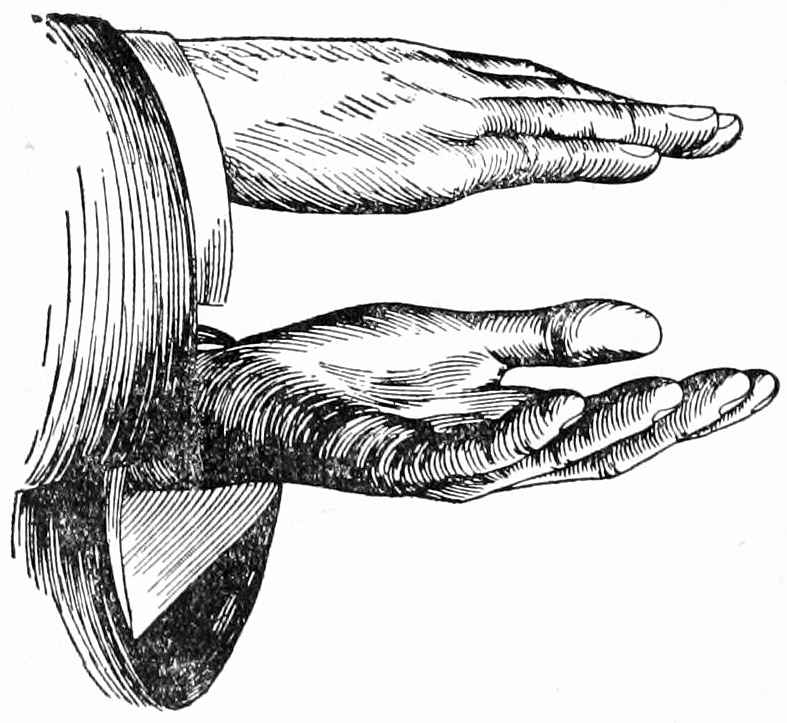
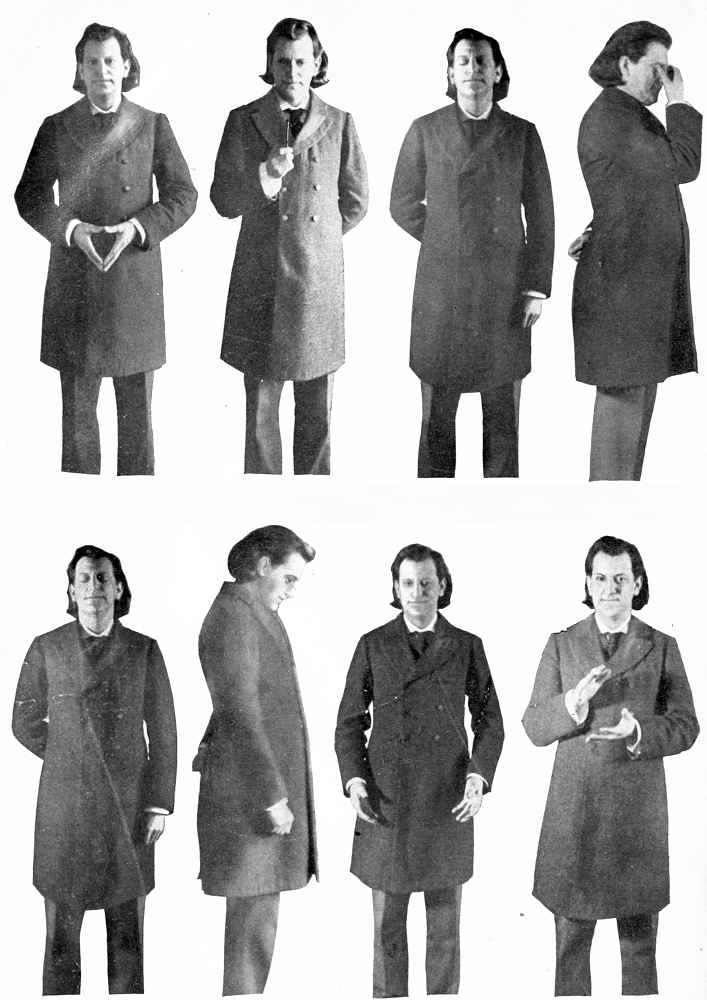
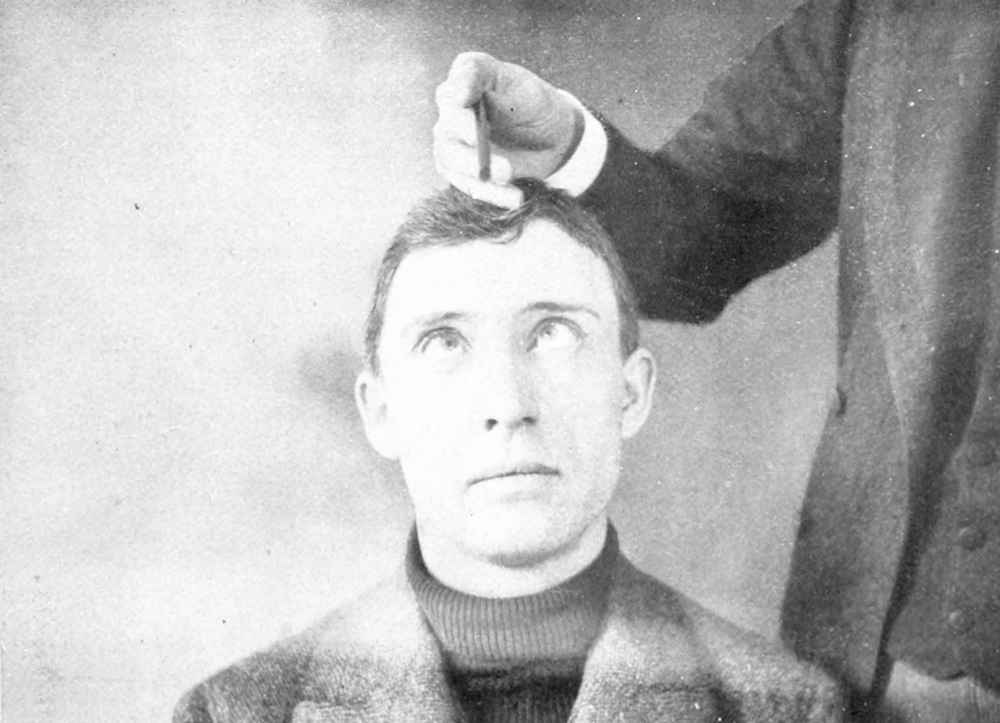
“Take an easy position. Put your hands together thus. (Plate II.) I am going to ask you to look at the end of this pencil. If you will do so and think of it, your eyelids will get heavy and close; or, if I close them for you, allow them to remain closed; then your head will fall to the front, your hands will drop to your sides and you will forget where you are. When I want you to awaken I will (tell you) say ALL RIGHT and clap my hands. (Suit the action to the word.) Do you understand me? At no time will you feel sleepy, but by giving me your undivided attention you will slowly forget where you are.”
If you desire to send a person to a place of which he knows nothing, as to the manner of going you must necessarily give him full directions, so nothing that is certain to occur can divert him. So it is with a subject; he must know what to expect and thus be freed of all fear that might be aroused when the attributes occur, which otherwise would cause an active mind. The falling of the eyelids, of the head and the hands should arouse [Pg 44]no thought other than the one you are suggesting to him through his ear, i. e., the thought of sleep.
As two senses must be affected to impress a thought, great care is necessary that whatever you say you actually do, so the prospective subject can see as well as hear it.
Special attention is drawn to the sentence, “If you will do so your eyelids will get heavy and close; or, if I close them for you, allow them to remain closed.” Only three in ten will close their eyelids; the other seven after giving you the stare for some five minutes, must have their eyelids closed for them. If you will note in the foregoing sentence, I have said nothing about the eyelids “not closing,” but have made affirmations and provided for the “not closing.” When you say to him, “Your eyelids will get heavy,” you must then close your eyelids. When you say, “remain closed,” your eyelids must be closed while saying the words. When you say, “or if I close,” while uttering the words “I close,” you must with your fingers close your own eyes, taking care to immediately remove the fingers; otherwise you would convey through his eye the idea that you will hold his eyes closed (suggested to him by seeing you hold your own eyelids closed). Hence, if you close them for him, when you remove your fingers, the subject will open his eyes. When you use the words, “head falls to the front,” your head must move forward; and when you say, “hands fall to your sides,” your hands must fall.
If you will notice, there are two ways of awakening mentioned here; one is “When I tell you;” the [Pg 45]other, “When I say ALL RIGHT and clap my hands.” (Which must be said with one breath.) You use “ALL RIGHT and clap my hands;” the doctor should use the other. The physician, desiring his patient to go away with some inspiration given him, simply says, “When you open your eyes you are awake,” and so and so is the case; for an inspiration given in hypnosis can only be responded to in hypnosis. The operator in the parlor entertainment, when he has finished the performance says, “All right,” and claps his hands.
Why do I desire the subject to put his hands together? To see them fall. The hands will unconsciously drift apart—the action will be entirely involuntary, and after a pupil has watched a dozen pairs of hands he will see that no one on earth can deceive him, as it is utterly impossible to simulate (consciously) an involuntary action. It is for the same reason that I desire the head to fall to the front—I wish to see it fall—knowing that when an action is part of a thought, to the degree that action takes place is to the extent that the thought is aroused in the “mind.” When the hands drop relaxed to the sides, I know that the subject has forgotten or lost his environment, and therefore is in hypnosis.
Now, I have told the subject exactly what would happen. If my pupil will carefully analyze the paragraph he will find that telling him to “Take an easy position” is the first attribute I desire. That to “look at the pencil,” if the operator holds it in the proper position, will force the eyes upturned, or converged; that if he thinks of the pencil he will furnish concentration. I then tell him as [Pg 46]to the closing of the eyes; and then, if I slip into his “mind” the thought of sleep, I will have accomplished my purpose and have induced hypnosis.
Now stand to the left of your subject, holding a lead pencil or your finger as in Plate III, and repeat verbatim in a firm voice:
“Drowsy, sleepy, drowsy, sleepy, drowsy, sleepy; as you go deeper asleep your eyelids get heavy and close.” (Repeat until accomplished.)
“Drowsy, sleepy, drowsy, sleepy, drowsy, sleepy; as you go deeper asleep your head falls to the front.” (Repeat until accomplished.)
“Drowsy, sleepy, drowsy, sleepy, drowsy, sleepy; as you go deeper asleep your hands get heavy and fall to your sides.” (Repeat until accomplished.)
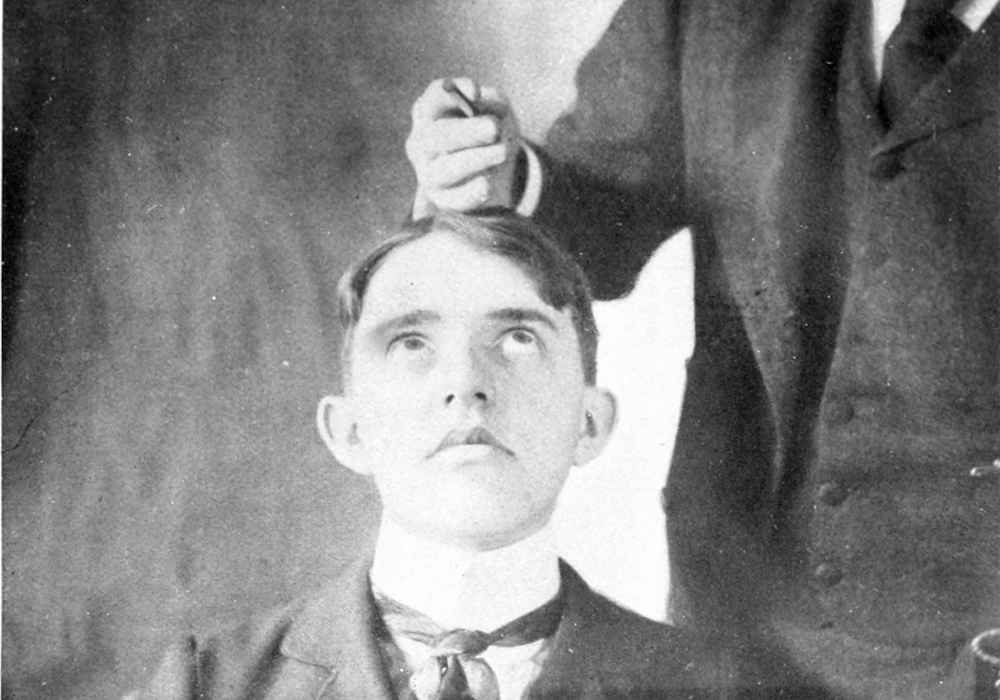
The sentence of “Drowsy, sleepy, drowsy, sleepy, et cetera, as you go deeper asleep your eyelids get heavy and close,” seems a long one. Why not make it shorter? Why not “Drowsy, sleepy, your eyes shut”? Is not that the same thing? No! “Drowsy, sleepy, et cetera, as you go deeper asleep the eyelids get heavy and close,” makes the closing of the eyelids one of the attributes of the thought of sleep; but when you say, “Drowsy, sleepy, your eyes shut,” you are trying to force into the “mind” of the subject two separate and distinct thoughts; i. e., to sleep—to shut his eyes—which is utterly impossible. Any operator who, in giving inspirations to the subject, leaves out his “and’s,” “as’s” and “but’s,” will fail, inasmuch as the ideas must be thoroughly correlated and be one thought, because thoughts may [Pg 47]of themselves become ideas, or ideas become thoughts.
We will assume that you held the pencil over the subject’s head for some half an hour and he failed to take on hypnosis. What is wrong? If he is not in an easy position (No. 1), that is your fault. Is his collar too high, is his head too far back, is his back too close to a radiator or fireplace, et cetera? Or, if a woman, is she laced too tight, do her shoes pinch, et cetera? Why is any easy position the first attribute of sleep? I mean by an “easy position” one in which the sense of feeling is not making discomfort a dominant idea; for if so, it is impossible to fade away the thought of the environment; therefore, before sleep can be induced, comfort through feeling must form itself into a natural attribute of sleep. The upturned eye (No. 2) is also for you to furnish. Are you holding the pencil in the proper place? If you strain the eye, you lose No. 1. Has the time come to close the eye (No. 4)? Is the subject concentrated? If not, you cannot accomplish No. 5.
It is a poor art or science if we must wait half an hour to discover whether the subject is concentrating or not.
Having fifteen to twenty-five subjects on the stage and a restless audience waiting for an entertainment, what could be accomplished if I had to wait half an hour for each subject, to discover if he was concentrating?
Every time one gets a new thought the eye blinks, although the eye may blink without a change of [Pg 48]thought; but never a change of thought without the blink.
Note.—Now, dear reader, when you stand before a mirror to experiment, remember that the making of another idea dominant is not changing the thought. You may think you can change without blinking, but it is like people believing that a person can go on the stage and “fake” for a hypnotist, both of which are directly against a set law and impossible. If the world could learn that those attempting to deceive, deceive only themselves, there would be fewer failures in life.
The moving of the eyeball shows the reviewing of the associated ideas and always occurs in those who have large perceptives (heavy projection over the eyes). They will think of the pencil but will divide and study its attributes, i. e., cost, color, form, et cetera, and are the subjects who require several drills. Their hands will fall stiffly to their sides (having taken on hypnosis about ninety-seven per cent). For complete hypnosis, the hands must fall limply.
If the subject gives you the “baby stare,” and you fail to hypnotize him you had better—well, I advise my pupils under such conditions to jump into the river and say, “Here goes nothing.”
The subject being in a collapsed state or relaxed condition of the muscles, we know he is in hypnosis, but as a great many will not accept any thought of sleep without being stretched out, it is policy to lay them on the floor, which nearly always consummates the required attribute. The proof that he is in hypnosis is that he is relaxed. [Pg 49]Perhaps he can simulate it; I can hold my arm relaxed? All right. Man can think of but one thing at a time; the subject’s eyes are closed. I take hold of his arm (he relaxes it); with my other hand I quickly lift his leg, and, if he knew how to simulate, he could not shift the action in time to deceive anyone.
A subject being in all the conditions of sleep is of no value to me,—the operator. I want one seemingly awake. Consequently, I want now to partially unbuild what I built. First, I give him what I call the “Ear Test,” the object of which is to find if I can replace the thought (cylinder) of sleep with another thought (cylinder) having a perceptible action to it. Therefore, I say to him, “Your right ear (touching it) smarts, burns, stings, itches, and will stop only when you rub it a long time with your right hand,” making with my mouth expressions of pain. If the subject rubs his ear, I have a demonstration that I have changed the thought. If I say to him, “Your ear smarts, burns, stings, rub it,” would I get any action? No, he would simply ask me which ear, if his cerebrum was active. Therefore, it is necessary for me to designate the ear, or properly, to state which ear, and touch it. I now tell him, “Your right ear, or this ear (touching it), smarts, burns, stings and itches, rub it.” Will he rub it? He will not, but will ask me why he should rub it, if his cerebrum was active, but if I said to him as above mentioned, “it will stop only when you rub it” he rubs it to cause it to stop, not because I told him to rub his ear, which I failed to do. Man does nothing because [Pg 50]he is told to. While he is rubbing the ear I call to him, “The pain has stopped.” Instantly he ceases to rub it. Is the subject now in hypnosis? No, because he has the thought that the “pain has ceased” instead of the thought of sleep. His muscles are contracted into the position he happens to be in, the eye can be turned down; the inexperienced would say he was in hypnosis, the same as when lying limp on the floor. My experience proves to me that he is not in hypnosis; he has the thought of “no pain” which is a blank thought similar to the thought of sleep, but you will find that the muscles are in a different condition.
The subject can only respond to my voice, he being free of his actual environment. My voice now being his environment, I must pull apart nearly all that has just been brought together. To open his closed eyes is the most powerful suggestion of being awake. If I could only teach the subject now to open his eyes, to turn them down and still respond to my voice only, he would be in the condition I desire. So I say to him in a firm voice:
“You open your eyes only when I tell you; you awaken only when I say ALL RIGHT and clap my hands (I tell you). Now mind!” (Repeat this.)
I then cause him to rub his knee in the same manner as I cause him to rub his ear, by designating the knee as follows: “You have an awful pain in this (touching it), the right knee, and it will stop only when you rub it a long time with both hands.” While the subject is rubbing, I say, “When you look at it, it will be a thousand times [Pg 51]worse. Now open your eyes.” If he opens his eyes and continues to rub it, he is practically my subject for the first time. In this way we play on him a psychological trick; first bringing up in his “mind” the thought of pain; then disassociating the opening of the eyes with the idea of awakening, and substituting for it the idea of more pain. We do not tell him that “When you look at it, it will be a thousand times worse; now look at it.” Because, if his cerebrum was active, he would refuse to look at it. We tell him to open his eyes, and if he opens them, he certainly will look at it. We now say to the subject, “Close your eyes, the pain has ceased;” then saying, “When you open your eyes you will find yourself on the floor. Naturally you will get up and sit on the chair. The moment you sit down you will discover that you have a very severe nose bleed; now open your eyes,” the “now” being necessary as a conjunction to connect it with the previous statement. Otherwise, the subject would be likely to take the sentence, “Open your eyes,” as a separate thought, do so and lie there on the floor with his eyes open. The subject opens his eyes, gets up, sits on the chair, and discovers his nose to be bleeding. Is this subject now in hypnosis? Decidedly not. His muscles are contracted, in response to his feeling (environment); his eyes are open and in the “normal” position; he is not necessarily in a comfortable position. Other than that his cerebrum is inactive, or that the thought of a nose bleed has been put into an automatic action through his ear, no sense will respond to his environment unless it [Pg 52]has a relationship to his present thought; he will continue to give action to all the variations of that thought until the operator’s voice changes it.
Words are of little value to explain the condition of a “hypnotized” subject or “normal” man.
I shall try to draw a sight picture to make you comprehend. You have seen a typewriter. On the keyboard is a pin marked “G”; fastened (associated) to that is a lever, to that, two more. On the end of the last is the type “G.” When the pin with the letter “G” marked on it is touched, three actions take place, and “G” is reproduced on the paper on the cylinder of the machine. (Analyze the action of lifting or taking hold of an object.) Until those three levers are properly fitted (associated), it will be impossible to get an impression on the paper by striking “G,” but the moment that they are properly associated, every time you strike “G,” “G” is reproduced on the paper and nothing else can be. “G” equals the energy exerted (suggestion) on the pin “G.” If we hit a space on the keyboard that has no lettercap, there is no response on the paper. Man is like a typewriter; when we hit the cap of a letter that has the proper actions associated, there is a response on the paper; when we offer him and he receives (he don’t receive), a suggestion of which he has no associated ideas, there is no response because there is no action to respond.
A hypnotized subject does not hear me, cerebrally. He only responds to me. A “normal” man both hears and responds. The consciousness of realization of seeing, hearing, et cetera, is only in the [Pg 53]cerebrum. The brain that retains the impressions and responds, is the Abdominal Brain—the Sympathetic System.
As a hypnotized subject is but as the keyboard of a typewriter, played on by and through his aroused memory of environment, so also must man be played on by and respond to his actual environment. In inspiring subjects with any condition, if we fail to emphasize or draw particular attention to less than two senses, the effect will be unsatisfactory.
Among the masses there has been a great objection offered to my work, inasmuch as the people remark that they could not tell if Santanelli’s subjects were hypnotized except by seeing them doing things that they knew would not have been done were they not hypnotized. Whereas, with all other operators they could see that the subjects were hypnotized because their faces and eyes showed it. Why? A comprehensive thought must express itself in the face and eye—a comprehensive and intelligent expression; but where the subject lacks a comprehensive thought he has that “dopy,” hypnotized (?) expression. Being a master of suggestion and thoroughly understanding how to build, I make my subjects thoroughly “normal,” subservient to their pictures. When they had the thought of “fly” it was so definite, all sense-pictures having been emphasized (aroused), that the man or the subject was in identically the same position or condition of “mind” that he was when an actual fly was on his nose. The secret is this: The other operators tell the subject that [Pg 54]when he wakes up, equaling my “When you open your eyes,” he would find a fly on his nose; something very indefinite. “Normally,” how would you know there was a fly on your nose? You would feel it. Is that enough? No. It might be a mosquito, it might be an ant, it might be a wasp. You look at it and then you know that it is a fly, and by-the-by, let me state here that man knows nothing, but believes much; for if the senses are imperfect, what he knows, he doesn’t know. I say to a subject, “When you open your eyes you will see a fly on the end of your nose,” covering two senses, the object itself (sight) and the place (feeling) which is irritated; “you will feel it bite and cannot brush it away.” Now, I have covered three (?) senses: The subject first feels the fly on the end of his nose, he sees it to be a fly, and he feels very comprehensively its irritation. Hence, he has no doubt. Could his “mind” be more active, could he be more positive if he were “normal?” No. “Dopy” subjects are the result of improper inspiration. If you say to a subject, “When you open your eyes you will find the chair is hot,” that is very indefinite. But if you say to the subject, “When you open your eyes you will feel the chair you are seated on is red hot,” he will get out quick. In the lesson I told you that if you left out your “and’s,” “as’s” and “but’s,” you would fail to get a good inspiration.
There are some ideas or thoughts which cannot be correlated or associated. If you tell a subject he cannot let go a cane, it necessarily follows he must hold on to it; hence, cannot drop it. If you [Pg 55]tell him it is red hot he will drop it, because it is against nature (?); i. e., experience, to grasp a red hot object, and not be able to drop it. If you tell him that he cannot let go the cane and it is getting warmer, hotter, you can produce an effect up to a certain degree; there will be a certain contraction of the muscles and a certain expression of pain in the face, but the moment that you make the heat dominant he will drop the cane every time if he is a man of ordinarily good correlation. If you have a thick-headed subject, there is no telling what the result will be. Man is wonderfully compounded and you will meet combinations some days that no man could build a philosophy on. The exceptions to the foregoing are the isolated cases where the subject has never experienced being severely burned. Perhaps dulled nerve-ends. (See Degenerates, pages 15 and 159.)
I unhesitatingly assert that I (which also includes my pupils) am the only operator who ever dismissed his subjects actually awake. If hypnosis is the thought of sleep, the antithesis to that must be the thought of being awake, and when we tell the subject he is awake he has the thought of being awake, just the same as we tell him there is a fly on his nose. The snapping of the fingers is of no value. To awaken, we must startle him, and if he is awakened properly, a post-hypnotic (?) suggestion is an impossibility. So I reiterate that any inspiration given in “hypnosis” can only take place in “hypnosis,” never minding what the quasi “authorities” tell us.
A subject suffering with headache comes to me [Pg 56]to be cured. If the subject has never been led into hypnosis it is impossible to hypnotize him the first time if he is suffering from the headache, inasmuch as No. 1, “Easy position,” cannot be acquired; the suggestion of pain forces a thought which cannot be faded away through the eye, and no thought offered in substitution is forceful enough to overcome it. But if he has learned how to take on hypnosis, it can be done so quickly that if the thought of pain is not too severe, it can be readily overcome. If the pain be extremely severe, hypnosis cannot be induced. I tell the subject that when he opens his eyes he will have no headache and be wide-awake, and he is now in the condition of believing himself to be awake with an idea of “no headache”—awake as in a looking-glass—but if he were actually awake, the cause that produced the headache, being still present, would get its natural response and he would feel the headache. Therefore, it can be readily seen that the subject is not himself truly. Yet, having the thought of being awake, he necessarily has all the attributes of the thought, and as far as one can perceive, is awake. Stand in front of a mirror. You see yourself? No, a reflection—a thought of yourself.
If I said “All right” and clapped my hands, the subject would be in the identical condition as when he came to me; i. e., feeling the headache.
I teach you to awaken the subject two ways; one by giving the inspiration that he is awake, and the other by saying, “All right” and clapping my hands. Now, my dear pupil, if I should clap my hands first, then say, “All right,” would the subject [Pg 57]awaken? No. Why not? Because that is not the way you told it to him (?). If I was personally giving you the lesson, I would say “rats.” What rules the subject? Your voice. If I clap my hands, could he hear it? Yes (?). If that be true, he could hear every sound; that constitutes being wide-awake. You mean “No.” He could not and cannot hear the clapping of my hands, but when I say, “All right,” as my voice rules and is his environment, the associated action is to listen for the clapping. But must I personally clap my hands? Yes (?). How can he distinguish the clapping of my hands from those of some one who is standing beside me? He cannot; anyone beside me could clap his hands, or a pair of clapsticks would be just as effective. He must be startled; and cannot be startled until I have used the words, “All right.”
Now, as you know how to induce hypnosis, know how to handle the subject by building an environment around him, taking care to name all of the senses necessary to enforce a response to the environment, you are a hypnotist (?). No. I have taught too many, and feel that you still fail to comprehend me.
You have a hypnotized subject in your room. We will assume it is up one flight of stairs. What will you say to him when you desire him to go to the postoffice? Now, mind, he doesn’t know the way to the postoffice, he is a stranger. Why, you would say to him, “When you open your eyes, you will go to the postoffice and get me a letter,” and the subject will fail to move; because, remember [Pg 58]this, a hypnotized subject is a blind man. He doesn’t take in impressions, he throws out pictures; but the other senses are of such greater importance, forcing through actions already acquired, that man, failing to comprehend the value of this law of attributes, overlooks the importance of the other senses. Treat a hypnotized subject as a blind man. He is now sitting in the center of my room up one flight of stairs, and I say to him, “When you open your eyes you will find yourself in my room. There is an important letter for me at the postoffice which I am desirous that you, as a good fellow, will go and get for me. The moment you stand up you will walk five feet to your left and you will come to the door, on the left side of that door is the knob; the door opens towards you. Passing out of the door for two feet you will find the head of the stairs; by putting your hands on the banister at your left, you can follow down the stairs. To your right is a door with the knob on the right, which opens towards you. You pass into that room four feet, then turn to the right, go three feet and you will find another door with a knob on the right, which opens towards you; go through the doorway and you will turn to your left; you walk two feet, then turn to the right and walk eight feet, when you will come to another door with the knob to your right. You will open that door and step on to the porch. After walking four feet you will come to three steps. By walking straight ahead eight feet, you will come to two more steps. You will then be on the sidewalk. You will walk twenty feet to reach the corner of [Pg 59]the street, turn to your right and cross the street, et cetera.”
Again, my pupil, you have a subject sitting in the center of the room, and wish him to go to the radiator on the opposite side of the room to comb his hair at an imaginary looking-glass. What will you say to him? Why, you will say to him, “When you open your eyes, you will go to the looking-glass just across the room from you and brush your hair (?).” The subject opens his eyes, but will not move. Why? Why do people brush their hair? Because it is disarranged. Therefore the first thing the subject must know is that his hair is tousled; then he must be told exactly where the looking-glass is and that on this affair is a comb and brush; or, in other words, you must name the sight for him, because through hearing and sight, in many cases we reach the identical result. You, reading this book, are really receiving sound impressions; I am giving you words through your eye. With a hypnotized subject, we are giving him sight through his ear. The more sense-pictures we specifically arouse, the more comprehensive the action of the subject; provided, the things he comes in contact with do not give him directly opposite suggestions.
We will assume that you are giving a parlor entertainment. You have led your subject into hypnosis, and have him back into his chair. He has the nosebleed. Now, pupil, what are you going to do? Hypnosis is the spoon with which you give your medicine. When you are tired of any action, conditionally awakened in said subject, induce [Pg 60]hypnosis again. Say to him, “Close your eyes, go deep asleep,” and now we are where we started from. We again have hypnosis; then tell him, “When you open your eyes, so and so will happen, or is the case.” If the man is standing up and you say to him, “Close your eyes, go to sleep,” or, “You are asleep,” he will fall over, because one of the attributes of sleep is the relaxed muscles. Therefore, when he is doing any action, associate with that action that it will be more congenial or comfortable for him to take his seat, then tell him to close his eyes, he is deep asleep, or you must step up beside him and catch him in your arms. Now, the necessity for this may not always be apparent. Many amateurs will say, “Not necessary;” but I am writing of a man or operator who is working clean-cut and is not allowing the subject to be “dopy,” half conscious (?) of his environment, half conscious of the inspiration given him. If the subject is completely lost to his environment, as he should be if the operator understands his business, he will drop over every time. Now, I know that many of these statements amateurs will deny, but I unhesitatingly answer that if they know their business and work correctly they can demonstrate every affirmation made here; that they all work with “dopy” subjects; that they do not and have not ever comprehended the Law of Suggestion; they do not get perfect or correct work from their subjects.
On the stage when I wish to conclude an action, I thoroughly awaken my subjects, allowing them to take their seats and enjoy laughing at the [Pg 61]others. As hypnosis is entirely a self-induced condition; that is, a man with ordinary intelligence can learn to take it on at once after the first time, I consequently awaken him. When I want to use them again, I tell them to put their hands together, close their eyes and go to sleep; they readily take on the attributes necessary; I repeat to them, “Drowsy, sleepy,” et cetera, a couple of times and they are in hypnosis, after which I inspire them with any thought I see fit.
As it is apropos, I shall here tell of two occurrences which will demonstrate the self-induced (pre-inspired, “auto-suggested”) condition as to hypnosis. While lecturing through Michigan in 1895, I preceded every exhibition with an hour’s talk on hypnosis, et cetera, carrying the story from night to night for the six nights. A majority of the drummers traveling through the country made it their special duty to hear and comprehend the entire six lectures. One of these drummers had a son fifteen years of age; his residence, a town in Ohio. One day he received a telegram from his wife saying that their son had been a subject for some hypnotist, who a week prior had exhibited in the town, and that the son now was in such a condition that every time she told him to go to school he fell asleep and could not be aroused, and nothing could be done with him. The father, having thoroughly comprehended my lectures, wired the mother not to worry, that he would go home. He did so. After getting off the train, he went to a harness shop and bought a buggy whip, arrived home and asked John why he didn’t go to school, [Pg 62]and John told him that the professor had left him in such a condition that he could not go to school. The father said, “Well and good; I will remove the effect of the professor,” and gave the boy a good horsewhipping; ever since he has attended school without the least sign of hypnosis.
Another: In L——, New York, a very bright lad of thirteen or fourteen years of age was on the stage with me three or four nights. On Saturday night his mother and sister came to me in the dressing-room and said they could do nothing with the boy, that every time they told him to chop the wood or draw water, he would fall over asleep, and they said they were going to have me arrested. I asked her if she would do exactly as I told her, informing her if she would she would have no more trouble with the boy. The mother, being a good, sensible woman, said she would. I told her to take the boy’s pants down, lay him across her lap face downward, and warm him with her hand, which she did. Some three weeks afterward I met her and she told me she had no further trouble.
A few years ago professors (?) in the dime museums of the large cities used to put subjects to sleep and, failing to awaken them, would send for physicians. The learned (?) doctors, after applying electricity, cautery, et cetera, in the course of eight or ten hours awakened (?) them, only they didn’t; the hypnosis passed off. Why is it that every operator excepting myself, and I state this unreservedly, has had trouble many a time in awakening his subjects. In a town in Illinois I arrived late. I was carrying one subject, and was [Pg 63]anxious to get as many local subjects as possible for my first night’s performance, as it is often very hard to get volunteers on the first night. Some amateur hypnotists came around and said they could get me some. At last they produced a most horrible specimen of humanity and asked me to hypnotize him. I remarked that I would not allow him on the stage; then they said. “As a favor to us, please hypnotize him.” I looked at the fellow and said, “Go to sleep.” He replied, “Magnetize me.” I said, “You fool, you know how to go to sleep; go!” He failed to do so. I made some passes over his face and he took on hypnosis, but he worked “dopy.” In about five minutes I got him to work with a clear eye. I said, “All right,” clapped my hands and he failed to awaken. Smiles appeared on the faces of the five amateurs standing around. Again I said to him, “All right,” and clapped my hands. He again failed to awaken. The amateurs continued to smile, some tittered. I readily perceived what I was “up against,” and I said to the subject, “—— you, when I say ‘All right’ and clap my hands, if you do not awaken, I will throw you out in the snowbank and leave you rot, you ——.” I said, “All right,” and clapped my hands and he nearly went through the ceiling. The amateurs stood around with their mouths open and said to me, “Mr. Santanelli, do you teach?”
“Yes, at twenty-five dollars a lesson.”
“Will you teach five of us for less?”
“Yes, one hundred dollars.”
And these clever amateurs paid me the one hundred [Pg 64]dollars. The subject they brought me was one that, after experimenting upon, was always left to lie on the floor from six to ten hours, as they could not awaken him and he had to “sleep it off.”
Now, to answer the question previously asked, “Why is it that I have never failed and all others do fail?” The reason is simply this: That when we put the thought of sleep into a subject’s “mind,” it must be done with a firm voice. That is the key. The moment we become doubtful or frightened, we have lost the firm voice; inasmuch as the voice is the utterance of the “mind,” and what we think, we say in tone and in action; if we are frightened and say, “All right,” to the subject and clap our hands, he doesn’t respond to it because we have lost the key; but if we never get rattled, there is no possibility of failing to awaken the subject. It may be that we will be obliged to use language expressed by dashes—such a case happened in a city in Arkansas. A young lady had been reading about the woman who had been asleep in St. Louis for thirty days, and whom none had been able to awaken. Of course, she was a neurotic. When I said, “All right,” and clapped my hands, she failed to awaken. Her friends in the parlor became greatly frightened, so I asked them to retire; then quietly informed the lady that if when I said, “All right,” and clapped my hands, she failed to awaken I would have to do things that would be very inelegant, seemingly ungentlemanly, and above all things I was not there to be made a —— fool of. I then said, “All right,” clapped my hands, and she was wide-awake. Keep your nerve, always treat a [Pg 65]hypnotized subject as a rational being, and there will be no trouble. If you are possessed of a doubt as to the subject awakening, you are lost; he may be awakened to the degree of “lack of doubt,” but not thoroughly. The operator’s voice is the thought (in action).
Man is like a piano keyboard, played upon by his environment; as we touch the keys, so is the response. Hit vigorously and there will be a corresponding result. When we strike key “A,” do the other notes refuse to respond, or have we failed to force (suggest) them?
My audiences have wondered why it is that when I get a subject whom some one else has operated on (as I call it “handled”), and he goes through many gyrations while going into hypnosis, that I say to him, “Now, my dear fellow, there is no need of this ‘monkey-shine.’ You go quietly to sleep; otherwise, you and I will have trouble,” after which I have but little trouble with the subject, and the people say, “That’s funny; I wonder if he was ‘faking?’ How can he talk to them as he does?” A hypnotized subject must comprehend; that is, his Abdominal Brain must respond and words when given him must arouse thoughts. The operator should know how to use words with the proper emphasis and construction.
The first attribute of all consciousness is “place,” and the subject, when he opens his eyes, is always in the place where he went to sleep unless that place has been changed by the operator. Therefore, first place the subject, then give him the attributes, naming each sense, thus: “When you open your [Pg 66]eyes, you will find yourself in a certain place, and you will see so and so, and you will hear so and so, and you will feel so and so,” covering feeling, seeing, hearing, and feeling as to minor attributes.
Assuming that we desire the subject to go through the actions of milking a table for a cow, the inspiration should be as follows: “When you open your eyes, you will find yourself seated on the back porch of a farmhouse. You will see a small cow before you in the yard. The cow requires milking; there is a milk bucket at your feet. You will be careful with the cow, inasmuch as she is very nervous, and as the flies bother her, she is likely to switch her tail. You must refrain from swearing as the ladies can hear any remarks which you make.” If you should say, “You must not swear as there are ladies in the audience,” what would be the result? The subject, when he opened his eyes, would sit still, because the word “audience” rearouses the thought of where he went to sleep. Only one picture at a time can be held in the “mind,” and that picture must be thoroughly consistent, for if at any time through the misunderstanding of correlation you step without the picture, you will either get no effect or a “dopy” subject.
If I hypnotize a subject can anyone other than myself awaken him? Decidedly not. What will awaken him? My telling him that he is awake (?) or my saying, “All right,” and clapping my hands. If anyone else tells him he is awake will he awaken? No. Because he does not hear (respond [Pg 67]to) them. As far as the general public is concerned, being in hypnosis consists only of taking a thought from the operator’s voice. If he could hear (respond to) anyone else, he could hear (respond to) all sounds and each and every sound would arouse some thought, and he would be wide-awake. The consciousness or realizing is “being awake.” Those put to sleep by magnetic (?) passes can be awakened by another operator, as the subject goes to sleep with his sense of feeling acute, and has been taught that when he feels upward strokes he will awaken. He has no way of distinguishing (?) who is the one that is making the strokes; yet a super-sensitive subject, very familiar with the operator, will unconsciously be able to distinguish, or, more properly, will respond.
What things can you most readily put a subject at doing? Things likely to occur to him at any time.
Reader, I am still afraid you are not a hypnotist.
We will assume that you are a gentleman and you have one of your companions, a gentleman, hypnotized, seated in a parlor that is filled with your lady friends. You desire him to take off his coat. What would you say to him? You would say, “When you open your eyes, you will find that your coat is on inside out.” What would he do? Being a gentleman, and in the presence of ladies, he would look abashed and might go into the hall and change his coat, but we desire him to take his coat off in the parlor before the ladies. What must we do? Give him a new environment. Tell him that when he opens his eyes he will find himself [Pg 68]in his bedroom, it is evening, and excessively warm. “Now open your eyes.” Is he now in the parlor filled with ladies, or is he in his own room? Man is ruled by his environment. First place your man, then give him the attributes.
In a city I visited last winter a doctor informed me that the year before a hypnotist had visited their city, given some very enjoyable performances, besides putting a man to sleep in a window; that he thought the hypnotist was a fraud inasmuch as that one day he was in the store where the fellow was sleeping, and the hypnotist said, “Doctor, feel of the man in the window, he is stiff.” The doctor said, “And when I felt of him I very decidedly felt him become rigid, which satisfied me that the operator was a fraud.”
That was not the case, the operator did not know how to give his inspiration; the subject necessarily is forced to respond to the operator when the operator’s voice is firm. When he said to the doctor, “Feel of him, he is stiff,” he told the subject, “When the doctor feels of you, become stiff.” But if he had said to the doctor, “The subject is stiff, feel of him,” when the doctor got hold of him he would have found him stiff.
The alleged fraudulent hypnotists are simply fools who do not know how to convince their audiences or handle their subjects. Subjects cannot “fake.” When you credit the hypnotist with being able to teach the element that goes on the stage to act their parts, you credit both with having more intelligence than our best stage managers and actors, and my experience teaches me that [Pg 69]their faces would instantly deny any such credence.
One “authority,” in Chicago, concludes his work by doubting hypnosis. Quotations from him show his lack of knowledge of the Law of Suggestion. The following example was the one that shook his faith most: The subject was lying in hypnosis on an operating table, and several spectators were challenged to awaken him. They tried many ways and failed, then asked if they might spit in the subject’s face. The “authority” said, “Yes, you may spit in his face if you wish.” They did so, and the subject immediately awakened, thus satisfying the “authority” that the subject had not been in hypnosis. Dear reader, need I explain this? If so, throw the book away or go and give yourself to the authorities having charge of a school for imbeciles.
In the “handling” of subjects two tones should be used, one for the inspiration, and one to emphasize (force) minor actions.
In my early days, while giving exhibitions in the South, at the conclusion of an entertainment a Southern gentleman came onto the stage with a friend and said, “Mr. Santanelli, this gentleman does not believe that young man was hypnotized. Will you “hypnotize” that nigger (pointing to one) and prevent him from picking up this one hundred dollar bill? If he picks it up, he can have it.” I “hypnotized” the negro, put the one hundred dollar bill at his feet and told him he could not pick it up. The negro immediately became cataleptic, rigid, and failed to move. I wanted him to stoop and put his hand on the bill and attempt to pick it [Pg 70]up, knowing that if he could not pick it up he must shove it to the floor, so I said “Oh, yes you can; go ahead, pick it up.” The negro failed to respond for a moment, then bent over and took hold of the bill; I saw that he had responded to my last remark as an inspiration, so I immediately called to him that he could not move. Cold chills passed up my back, as I could not afford to lose one hundred dollars; and, of course, would not have allowed my friend to do so provided I had it. Since then I always use two tones, for fear of the subject mistaking or not comprehending (responding to) the difference in the tones, I always finish in this manner: “Go ahead, pick it up. Go on, but you cannot.”
There are no stages in so-called hypnosis. The subject is either hypnotized or awake.
Catalepsy is not a stage of the hypnosis, it is simply an inspired condition. Any subject can be made cataleptic if he knows how to become so. The inspiration I give to produce catalepsy is as follows: “Put your feet together, put your hands to your sides. When I call ‘now’ you will take a long breath, pull your muscles together and you will be stiff, stiff as iron.” It is very rarely that a subject fails to respond to this. Sometimes they will draw their knees and arms up, not knowing how to become rigid in the position I give them. Many operators tell a subject to hold his arm up and then that he cannot take it down, and the spectator, noting the tightening of his muscles when he gets the inspiration that he cannot put his arm down, believes the subject to be “faking.” If the [Pg 71]operator will remember that all negations are affirmations against, and would first put the muscles at the tension or in the position he wants them and then deny, there would be no such action. Tell a subject to hold his arm up and close his fist; the muscles are now contracted, and by telling him he cannot put it down, you are really saying to him to keep the muscles in the position they are in. If you wish to produce a condition of the muscles, first put the muscles into the desired position and infer that he cannot release them, because if he cannot, he must hold the position.
How many ways are there of inducing hypnosis? Only one.
When I was in Utica last winter, on the second day of my return engagement, a lad called on me and said, “Mr. Santanelli, how many ways do you know how to hypnotize?”
I replied, “But one, my lad.”
He looked surprised, saying, “Why that is strange, I know of nineteen ways.”
“Good for you, lad. Can you lay them out on the floor as I do?”
“No, sir, that is the funny part of it; I cannot get any of them asleep. You have only one way; I have watched you nightly and so far you only failed to hypnotize two, and three-fourths of them were new ones every night. What is your way?”
“The right way.”
“Well, can ‘some’ of mine be right?”
“No, there is but one way, and that is the right way; that is the reason your nineteen ways are failures, none of them are right.” If hypnosis consists [Pg 72]of five attributes, the shortest, quickest method of bringing these five together is the right way. All others are wrong. A Chicago firm publishes fifty ways, or the promise of teaching fifty ways, to induce hypnosis. That is in the line of modern science (?).
“Still, Mr. Santanelli, I have hypnotized many subjects without using any of the attributes you name as necessary to hypnosis; how is that?”
“Very simple, my dear sir. First, you do not hypnotize; you lead another into hypnosis. After a subject has once been taught the way to the postoffice, he can go without any guidance on your part. Twenty-seven per cent of mankind are what is known as “sensitives”—somnambulists, sleep-walkers. Unconsciously knowing the way into hypnosis any method you use is satisfactory. You can tell him to go to the postoffice over the telephone, you can tell him every time he hears the whistle of the factory he will go to the postoffice; there are a hundred suggestions that may cause him to go to the postoffice. So it is with the sensitive, he knows the way; your method is nothing. You can only hypnotize (?) three in ten; with my method I can “hypnotize” one hundred of one hundred, provided they give me their attention.”
Auto-suggestion can only exist in the case of a sleep-walker, proven by the fact that he responds to no one’s voice. It is spontaneous, and is the nearest to being self.
In my experience, subjects have pre-inspired themselves with the thought of leaving the stage, [Pg 73]which each time was successful. The first happened in a little town in Tennessee. My reader must understand this, that a certain portion of my evening entertainments were always the same; that is, I laid the subjects on the floor, produced the catalepsy, built the “log-pile,” then caused them to rub their ears, then their knees, and then take a seat on the chairs. In the instance I have in mind, the young man, who was some twenty-two years of age, although not larger than a lad of twelve, came onto the stage several nights and proved himself to be an extremely clever subject. I think it was on the fifth night when he was laid on the floor, after having been used in the “log-pile,” he immediately got up and joined his companions in the orchestra seats. I was greatly surprised. No comment was made, but that night after I went to the hotel I did considerable “thinking,” and at last concluded as to how he succeeded in doing so.
I was so successful in the city that I remained over and played the following week, and on Wednesday night this young man and his friends were again in the opera house. I invited him to come onto the stage. He said, “No.” I asked him why, and he replied, “You will make it hot for me.”
“No, I will not. I would like you to come up and repeat the experiment.” He looked at me a moment and said, “This is not a trick?”
“No, I wish to see if you can repeat what you did last Friday. It is a matter of science. You [Pg 74]have proven your side of it, and I want to see what I can do with mine.”
The young man came onto the stage, took on hypnosis and when I awakened him, some thirty minutes later, and asked him why he hadn’t taken his seat, he looked puzzled, and said, “I don’t know.” I did; do you, dear reader?
The form of pre-inspired thought that this young man took was this: “After I am laid on the floor in the unbuilding of the ‘log-pile,’ I will awaken.” Now, mind, he was to awaken when he was laid on the floor out of the “log-pile.” I omitted putting him in the “log-pile,” therefore the suggestion that was to awaken him did not occur, hence no awakening. There is no effect without a cause (suggestion).
Last winter, in Erie, three subjects left the stage one night during the “statuary,” in the latter part of the second week of my engagement. They had watched the performances all of the first week and had been on the stage several nights, were good subjects, and this night took a pre-inspiration that at the fourth inspiration given in the “statuary” they would awaken. They did so, left the stage, said the whole thing was a “fake,” but failed to impress any of the audience.
I immediately caused a subject to do a little more difficult act than that, and one I inspired, instead of the subject taking a pre-inspiration. I told the subject that when he opened his eyes he would find he had a couple of dice and would throw craps, and that at the end of three minutes he would awaken, which he did. Afterwards he [Pg 75]pre-inspired himself with the thought that when he opened his eyes he would think of one of the most amusing incidents he ever witnessed, and at the end of a minute and a half would awaken. He did so, the audience holding their watches both times, and both times he awakened to the instant.
Any subject, after he has been in hypnosis four or five times, should very readily go into that condition with a pre-inspiration of awakening upon the occurrence of a certain event, and if the event takes place he will awaken, demonstrating nothing except the subject’s ability to accept a pre-inspiration.
All dime museum freaks, such as the human pin-cushions, poison eaters or snake eaters, work under pre-inspiration. In the course of time the merging of the “normal” into the pre-inspiration becomes second nature and can be very rapidly and almost imperceptibly done; still, an expert, understanding the “reflexes,” by closely watching the subject can comprehend that he is not in the so-called normal condition and may note the change.
It is this quick merging that has given many of the alleged exposers a standing with superficial newspaper men, who have accepted their word that they were not in “hypnosis” when they reproduced the work that the operator caused them to do on the stage.
The martyr burning at the stake is an example of pre-inspiration, the entire environment forcing and maintaining in the “mind” of the subject or [Pg 76]person the thought that he will not suffer and will have no pain. The snake dancing of the Mokis is done under “hypnosis”; also many of the endurance and religious tests of the adepts of the East.
How long will an inspiration last? The public fears, forever.
My experience is that great skill is required to force a thought to remain over one minute with a new subject working by himself. Training them to hold a thought (no; training sounds “faky,” develop them, sounds better) requires experience on the part of the operator. Lead into hypnosis a new subject, start him brushing a fly, if he continues for one minute you have a good subject. Put two working together, and you may keep them at work for two minutes. Three or more subjects working together will hold out for a long time. To work one subject alone is very hard. Three or more, easy.
You desire to cure a headache, to let your patient go home. If the patient is a “good” subject (has been in hypnosis often), perhaps it will be an hour until he again feels the headache. Only a nervous headache can be “cured” through hypnosis. In all other cases there is no cure, simply the producing of “no feeling.” Might just as well give the patient a dose of morphia.
“But, Mr. Santanelli, I am a doctor; you have taught me of the many ills that can be relieved through hypnosis. My patient is free from pain, yet I wish to force certain changes physically. The patient has never been hypnotized and the holding [Pg 77]of the thought for one minute is of no value to me. What is to be done?”
Induce hypnosis while the patient is lying on a sofa; return every five minutes and re-inspire by saying, “Stay deep asleep, deep asleep.” Keep the patient there for two hours, renewing every fifteen minutes during the last hour. You can rest assured that when the patient leaves he will retain the thought for an hour and a half. After that, the time will lengthen one-third with each inspiration up to twenty-four hours. None will hold an inspiration over twenty-four hours, but can so be trained or developed that a very slight suggestion will continue the inspiration. I am certain that subjects making the long sleeps in the windows, are re-inspired by the suggestion of their environment every twenty-four hours. If a subject is willing to sleep but twenty-four hours, can I force him to sleep forty-eight? No. The thought (action) is not there to be brought out, and I cannot play off from the cylinder what is not on it. Therefore, the operator is always “in the hands” of the subject, and the work is co-operative. Any subject can seemingly refute or destroy the claims of any operator.
Writing of training or developing a subject—what can be “taught” them? Absolutely nothing. We say to a subject, “When you open your eyes, you’re alongside a fishing stream; you see beside you bait, lines, hooks, et cetera, now open your eyes.” If the subject does not possess the ideas (actions) to be forced by the “ghosts” just mentioned, no action is possible. If there is no action [Pg 78]in the subject, i. e., ideas associated, no ghost to be aroused, then the subject must act (?). His cerebrum is inactive, he is possessed of absolutely no ideas relative to the thought; therefore, if unconscious (cerebrum inactive), he possesses no action, he would not know what to do. “From nothing only nothing can be produced.” Again, words mean nothing.
If I put three subjects in a photograph scene; one the photographer, one the dude, the other the girl, they having never been in a photograph gallery, I get no action. I rehearse it—all right. If the words and actions of all three are not perfect the act will fail. Theatrical companies rehearse a play at least six weeks and are on the road at least two months before the performance runs smoothly. In all the smaller cities where hypnosis is popular, local subjects and different ones every night the hypnotist must have, if he expects to make a living. Assuming that in the photograph scene I use two of my “horses” (subjects I carry with me) and one local man, my subjects do not know what he will do or what he will say. My rehearsal would have been useless. But in hypnosis I force them to see a certain environment, and all photograph galleries are so similar that if they have ever been in one, the general environment that is now constantly around them will force them as automatic beings to an ultimate end, which would be impossible if all three did not see the gallery. Seeing the actual environment and each guessing what the others would [Pg 79]do, would produce confusion. They all see the same general picture, therefore act in unison.
A hypnotic “horse” is simply a good subject who travels with a hypnotist, generally possesses a good singing voice, the ability to make stump speeches, or with a humorous personality. Never of any use after a year, as he gets so at home in “hypnosis” that the public will no longer accept him as “hypnotized.” What I call a good subject the public will not stand for. What the public calls a good subject I have no use for.
One season I had traveling with me a Swede named Carl, whom I used to inspire thus: “When you open your eyes, you will find yourself seated on the stage of the theater in La Crosse, Wis., to give the people a speech, as the boys have decided to run you for mayor, provided you tell them what you will do if elected, and your Swedish dialect is very pronounced.” (Note that the inspiration is in one sentence, properly correlated connected with “ands,” “buts,” et cetera; no possibility of it being made other than one thought.) “Now open your eyes.” Carl opened his eyes, made his bow and in the most pronounced dialect gave an illiterate, asinine speech that provoked roars of laughter. Carl could give but two speeches. Nightly the audience demanded a speech. While in Philadelphia, I had a speech written for Carl and had him learn it. Then I was stuck. How could I inspire him to get the speech that was written for him? If I said, “You will deliver the speech you learned,” he would have tried; I did, and the effect was worse than [Pg 80]bad. He simply did what he would have done had he not been hypnotized. He could not properly deliver it; it lacked personality, individuality and spontaneity. It was simply like a school boy, delivering, parrot-like, a speech of Henry Clay or Daniel Webster, and just as asinine. The only teaching is to allow the subject to watch many subjects in an act that sometime in the future you expect to put him in, that he may “absorb” some of the better actions.
In the cow act, milking a table for a cow, I use a feather duster as the cow’s tail to switch the milker in the face. One young man, who was very funny in the act, I nearly always used. After a few months, instead of watching the place for the cow’s tail, he watched (?) me and dodged every time he saw the duster coming towards him. He quickly learned (feeling) that he was hit from behind instead of by the tail of the cow, and I could no longer put him in the act. Professional subjects last but a short time, and when discharged, often make exposés (?).
What makes a man steal? Does he choose to steal, or is the stealing forced upon him? If a man’s actions are caused or forced on him by his environment, he steals because he responds minus to that environment. Why does he respond minus to this environment when others do not? Because his ideas (actions associated) are positive against, where the so-called normal man is positive for. If it takes ten parts to make the whole, and you possess nine, you lack the entirety. Therefore, the criminal steals the moment the ten [Pg 81]parts are brought together. Can he be made to steal in hypnosis? No. Why not? First, if the nine parts only were brought together and one was missing, he failed to steal. After we lead him into hypnosis, we are unable to furnish the other part, saying nothing about knowing what attribute to furnish. How about a confirmed criminal? If we tell him when he opens his eyes he will go down and break into a bank, he will say, “Go break into it yourself. Why should I steal for you?”
Man does nothing because he is told to.
What is a confirmed criminal? One who is a perversion, who accepts as good what other people believe to be wrong. I have had a great deal of experience with perversion. Young men will come onto my stage, be good subjects all the week, and when I leave they will claim they were “faking,” failing to comprehend that by claiming they were “faking,” they make themselves out most disreputable; that, instead of doing something great and clever, they assisted a traveling mountebank whose business it was to accumulate the money of their friends, that they deliberately went on the stage and assisted in swindling and robbing of their money those among whom they live; off from whom they live; which is the lowest and most contemptible thievery in the world. The traveling operator is naturally accepted as a mountebank; if he proves so, that is what is expected of him, but for a man to be a stool-pigeon or decoy to rob his own people and swindle them for very little or no compensation, is the [Pg 82]lowest of crimes. Any time a person tells you that he “faked” for some one else, look him in the eye and tell him he is a liar, and if you say it with firmness he will acknowledge the fact every time; the being does not live who can simulate it.
We will assume that a man who has been a subject of mine murders another. He is brought into court and confesses that he murdered the man, saying I hypnotized him and forced him to do so.
No crime has ever been committed in hypnosis.
This is the reason: man’s thoughts (actions) are made up, organized or correlated only in his “normal” state; to force him to commit murder it would be necessary to give him all the attributes while he was “normal.” The moment all the attributes had been associated, this man would that instant commit the murder; his not doing so is proof positive that some of the attributes were missing. The hypnotist, not being able to put anything in his “mind,” would be unable to furnish the attributes necessary.
“But, Mr. Santanelli, I have hypnotized a young fellow, a chum of mine, made him go to a friend’s house and steal a necktie.” O! no; you did not. You hypnotized your chum, and he, to make good an experiment, went and took the necktie. The taking of the necktie by your chum was not an act that would cause an arrest or conviction. In fact, it was not a crime in his “mind.” Hypnotize your chum and tell him that at midnight he will go down to the bank and break open the safe, and see if he will do so. Remember, words mean [Pg 83]nothing; you tell a man to steal something, that does not necessarily make it out stealing. Or, you tell a man to help himself to something and that may be stealing.
Parlor experiments are very flimsy premises to base a philosophy on. Why, the wonderful (?) acts done by my subjects on the stage during the past few months, knowing as I now do the actions, attributes, et cetera, and comprehending that I am deceiving but one sense, sight, and cannot impress the other senses necessary, to me these so-called wonderful acts are disgusting. The public still wonders and is carried away, because it does not comprehend a natural action.
I have a lady seated alone in a room with me—in a room with the door open. After leading her into hypnosis, I close the door; where is this woman? She went into hypnosis in a room with the door open and in the presence or in the company of a gentleman. With the door closed and locked, there is no advantage to me, inasmuch as she is in the room with the door open. As she will do nothing because I tell her, and as the consciousness of place can be aroused very readily, if I approach her, attempting an assault, the environment that she was last in and the physical force I begin to exert will force from her the same action that would be exerted were she not in hypnosis; she is simply a blind woman. The other senses will respond “normally.” There is no environment that I can arouse around her that will cause her to do anything that she would not [Pg 84]do under the same environment were she not in hypnosis.
A lady in hypnosis is on the operating table in a doctor’s office submitting to an examination. Can the physician rape her? Now, remember, she is on the operating table. Her position—her sensing—holds that environment. If physical force is exerted she will call for help, or she will defend herself. If the physician tells her she has no feeling, the organs will contract, this being the action of the thought of “no feeling.” If he tells her she is rigid—that is, cataleptic—there will be the same physical result. Therefore, it is impossible for a physician to take advantage of his patient in hypnosis.
Now, dear reader, as this question of taking advantage is of the greatest importance, as it keeps this art from being put to any practical use by the medical fraternity, inasmuch as husbands, fathers and brothers are afraid to allow their women to be hypnotized; as several persons have been sentenced to the penitentiary and many doctors are being blackmailed, I must illustrate and prove most conclusively that this thought of taking advantage is entirely wrong. We will build a case: Let us assume that one John Smith is a clever amateur hypnotist. He chums with one Bill Jones and his wife, and Bill works in a bank. Smith and Jones and his wife are greatly interested in hypnotism, Smith having hypnotized both Jones and his wife dozens of times. All at once the hellish thought of taking advantage of Jones’ wife takes possession of Smith. They meet [Pg 85]one afternoon and Jones says to Smith, “I have got to go to the city this afternoon, and will not be back until late. Go up to the house, dine with my wife and keep her company until I return.” Smith does so, that is, he goes to the house, and, after a few minutes’ conversation, he says to Mrs. Jones, “By-the-by, I have a little experiment I would like to make. Close your eyes and go to sleep.” She does. He then says to her, “When you open your eyes you are alone in your room with your husband. Now, open your eyes.” Can Smith take advantage of Mrs. Jones, and if not, why not? To put any thought into complete action at least two senses must be affected. The more senses affected the more active the thought (see barber and banjo players). She sees a picture of her husband, the room, et cetera, but there matters end, inasmuch as Smith’s touch is not the touch of her husband; Smith’s caresses are not the husband’s; therefore, although she sees her husband, Smith is unable to supply the necessary suggestion to force her to respond to his desires. The suggestions (minor attributes) he offers forces her to respond positive against the commission of the act. I think it is made plain that no advantage can be taken while she is in hypnosis.
Note.—All crime is committed free from hypnosis. The moment the accused acknowledges the commission of the act, he has confessed himself guilty, because all the attributes were furnished in the normal state and the act immediately committed, otherwise it could not have happened.
[Pg 86]
A very learned (?) writer on hypnotism for one of the New York evening papers claims that to be a hypnotist a man must be pure, that his purity elevates the subject; that a bad (?) hypnotist, a man with impure thoughts, degrades the subject. Bosh! Other than putting them at natural or congenial degrading acts, I fail to see how the morals of the operator affects the subject. We cannot pour out of a measure what is not in it. If the subject be pure, nothing but purity can be reproduced, and vice versa.
Is a constant repetition of hypnosis injurious? If to reuse one’s thoughts is detrimental, yes; but if the exercising of one’s thoughts is development, then hypnosis is the grandest developer of the “mind” within the use of man. We can only revive thoughts the subject has had. I know of at least a dozen young men who, when they came onto my stage, were to all intents and purposes practically useless to themselves and the world, could hold no position; but, after being on my stage every night for a week while I was in the city, and afterwards being used by my pupils, they are so far advanced mentally that they are to-day holding good positions and are reputable men in the cities where they reside, and who, had they never met me, by this time would have been in some institution for criminals.
“But, Mr. Santanelli, does it not destroy one’s will power!”
Now, dear reader, what do you mean by “will power.” I have heard that phrase so often, yet fail to comprehend it. I have met “strong-minded” [Pg 87]men; in fact, I meet the “strong-minded” man in every town I visit; he is always the same, a slow correlator, his wife makes the living; he is so busy caring for that “strong mind” of his that he fails to find or hold a position. In fact, he devotes his entire time to looking after that “strong mind,” and has no time for work.
I suppose we can define what the world calls will power to be lack of correlative ability, density, thick-headedness. From my experience, if what the world calls will power is something admirable to possess, we should make marble statues of the jackass, place them in our rooms and bow before them as the exemplification of the “strongest-minded” of creatures, the possessors of the greatest “will power.”
A few winters ago I was in Texas, and one afternoon heard a great deal of swearing in the street. Of course, that is not unusual in some parts of Texas. This profanity was very artistic, I should imagine, from a swearer’s point of view. I went to the window and, looking out, saw one of those “strong-minded” animals fastened to a cart. They were connected, the “strong-minded” animal having seemingly made up his mind not to move; and he would not, being “strong-minded.” They beat him over the head, they swore at him, and I remarked to my secretary, who was standing near, “I am glad I am not ‘strong-minded.’ If I was in that animal’s position, I would have had forced upon me the deduction that if I moved on they would stop beating me, and would move.” In a little while they built a fire under the animal, [Pg 88]and when the heat became intense, the most wonderful thing occurred, this “strong-minded animal,” of its own free will, free from any external suggestion (after the fire got hot), changed his mind and moved, and, as far as I know, he is moving yet.
One more illustration: When it becomes cloudy the man having the most ideas associated as to the ill that will come from getting wet, immediately goes under cover; when it sprinkles the man having the next most ideas associated gets under cover, and so until a downpour; if that deluge be hard enough, it will drive all men under cover or they will drown.
The general public believes that if you wish to cure a man of any habit all that is necessary is to hypnotize him and tell him what he will do, and he will do so under any conditions. Foolish, ignorant public.
Sensing is always mistaken for telepathy. If you care to perform the following experiment, choose a slim subject, with a narrow head and big perceptives. When you desire to make mental tests, always choose a subject of a nervous mental disposition. I mean by that the quick mental, the narrow-headed man with big perceptives. When you want to produce physical tests, choose a “skinny” subject, the physically nervous. For example, to produce three pulsations in the body at one time is very easily performed with a “skinny” subject. By-the-by, the best cataleptic subject is always a very thin fellow, one who looks as if he would break in two with the weight placed [Pg 89]upon him, inasmuch as when his muscles are contracted there is a solid structure; but with the phlegmatic or lymphatic people, there is too much intervening tissue and we cannot get the contraction and solidity that is possible with the other.
Seat your subject at a table; in front of him on the table lay down ten cards in a circle, face up. Have your subject go into hypnosis, and ask the spectators to stand around the table in a large circle, designating to them which card will be one, two, three, et cetera. Turn your back to the company and allow one of them to hold up his fingers, indicating the number of the card to be thought of; during which time the subject can be blindfolded, or any method you desire to use to be certain that he does not and cannot see. The moment they decide on the card have them tell you; you then tell them to very strongly will (?) that the subject shall push that card from out of the circle. Then say to your subject, “When you open your eyes, you will see on the table in front of you ten cards, beginning at your left, slowly pass your hand over all of the cards, and when you feel like pushing a certain card out of the circle, do so. Now, open your eyes.” Ninety-nine times out of a hundred, the subject will do this a half dozen times in succession, provided the spectators are anxious for the experiment to succeed and all think intently of the card. If the spectators are in another mood it will be impossible for the experiment to succeed. They will all acknowledge immediately that it is telepathy. It is nothing of the sort. It is what I call sensing, [Pg 90]perfectly unconscious to the subject; yet he receives several distinct suggestions, as all, having their “minds” intently set on this card, will to a great degree hold their breath; when the subject comes to the right card they will allow the breath to exhale, which produces a pronounced atmospheric disturbance when the subject arrives at the card.
Feeling is very definitely acted upon through the atmosphere. In fact, I am satisfied that a fairly sensitive subject—that means one whose nerve-ends are acute—can and does feel all fair sized objects; stoves, doors, book-cases and things of those kinds are perceptibly felt by a subject before he reaches them, thus forcing him to go around them.
Note.—What he really feels is the resistance to the volume of air he is forcing before him when it is obstructed by a large object.
In 1895 I accidentally discovered that I could make or produce the following effects, and for want of a better term call it a sixth sense, or minus one.
Lead your subject into hypnosis with his head falling well to the front; then place your thumb and second finger on each side of the wind-pipe; pressing the carotid arteries, and intently will (?) one of the following acts: that he should or will stand up, sit down, raise his right arm, lower it. his left arm the same; his two legs the same; open his eyes, close them, open his mouth, close it, stand up, sit down, evacuate or urinate. This is the limit.
[Pg 91]
Instead of holding your thumb and finger on his throat, hold well against his neck under his chin a broom handle or a cane, keeping your hand firmly clasped, with your thumb pressing lightly on the cane or handle, and if you are possessed of great concentration, you will invariably succeed; those lacking in concentration will fail. The experiment is only satisfactory to those who personally succeed.
If you will (?) that the right arm be raised and gaze intently at the left, standing where the subject cannot see if he could see, in nearly all cases the arm you are looking at will be raised, the same with the legs. Causing the subject to stand up or sit down, I do not think is fair, because if you are thinking of standing up the unconscious or involuntary action that is the result of the thought is certain to take place; the same with sitting down; I mean you will unconsciously yet very perceptibly lift him, or vice versa—the same as in alleged mind-reading. The degree of steadiness of your thought is exemplified in the moving or raising of the limb. If you think steadily the limb will raise steadily, if you think spasmodically, the movement will be spasmodic, in fact the action will be the exact reproduction of your thought. I have had friends with whom this act was no effort; they could take any subject and produce a quick response. I have had others who could hardly affect them. I can only get a movement in the limbs; the hand will twitch, the fingers will twitch, arm will move a little, but very little, I cannot [Pg 92]raise it, inasmuch as I lack the steady concentration.
This demonstration is a case of the operator’s cerebrum affecting the subject’s Sympathetic System or Abdominal Brain, as his cerebrum is inactive; or, in other words, this is an illustration which I lack the ability to make you comprehend. The cerebrum of a subject does not work. In this case the operator’s cerebrum is taking the place of the subject’s cerebrum.
Post-hypnotic suggestion (which I call a deferred inspiration) is a misnomer, inasmuch as no inspiration given in hypnosis (so-called), can happen except in hypnosis. We tell a subject that when he opens his eyes he will see and feel a fly on his nose, that produces an instant response, if we do not actually awaken him. We tell him that in five minutes, one hour, one day, six months, after he opens his eyes, a fly will alight on his nose, he will feel it bite, et cetera, it will fail if the time be deferred over two hours. But, if we say to him (and he must be an exceptionally good subject), “When you open your eyes, one week from to-day when the town clock strikes eleven, you will see and feel a fly on your nose, et cetera,” you will succeed, for you have really said, “One week from to-day when the clock strikes eleven, you will go into hypnosis; a fly, et cetera.” If he be a good subject, one that will hold an inspiration for several hours, and he hears the clock strike, you can see him take on hypnosis, then the inspiration. Remember, no operator other than myself and my pupils ever awakened [Pg 93]their subjects. They inspired them with the thought of being awake, the same as with the thought of a fly, and allowed the subjects to slowly pass into a “normal” awakening. If the subject is actually awakened there will be no “post-hypnotic” effect.
Sleeping suggestions in the hands of a clever mother are a most potent factor in guiding the child. Tell the child that when she goes to sleep to-night you are going to her bedside and talk to her; that she must remain asleep. After the child is asleep, go to the bedside and you will find her in an easy position, with inactive mind, upturned eye and closed eye. Now quietly and soothingly speak to the child, call her by name and say, “Bessie, remain asleep.” The moment that you have aroused the thought, you will have hypnosis, which your baby has shown by a long, deep sigh, or the movement of some limb. Then say to her, “When you awaken in the morning you will do so and so, you will have a good appetite,” or whatever inspiration you desire to give, and then quietly go out of the room. But mind, you cannot raise or force in action any thought which is not there, it must be within the comprehension of the child, and be something other than antagonistic. This is really the most delightful phase of the entire art of hypnosis.
Now, doctor, if you are at a bedside and desirous of inducing sleep in your patient, the patient not willing to be hypnotized, is it possible to do so? No. Yes; first, you give your patient a sleeping draught (?), then stand at the bedside [Pg 94]and watch him go to sleep, only he does not. I stand at the bedside and he does. How is it?
“Oh! you are full of magnetism.”
“There is no magnetism, there is nothing but suggestion.”
“But you suggest to your patient to go to sleep.”
“How do I suggest to my patient to go to sleep?”
“I do not know.”
To induce hypnosis, I must bring together five attributes. (Plate IV.) A shows where you stand at the bedside. In B note the position of the patient and where I stand, and see if the patient is looking in my eyes. Have I the attributes necessary? The picture is the only thing that will describe the method. While the patient is watching you, quietly tell him that the draught just given is becoming effective, that he is getting quiet, sleepy, et cetera.
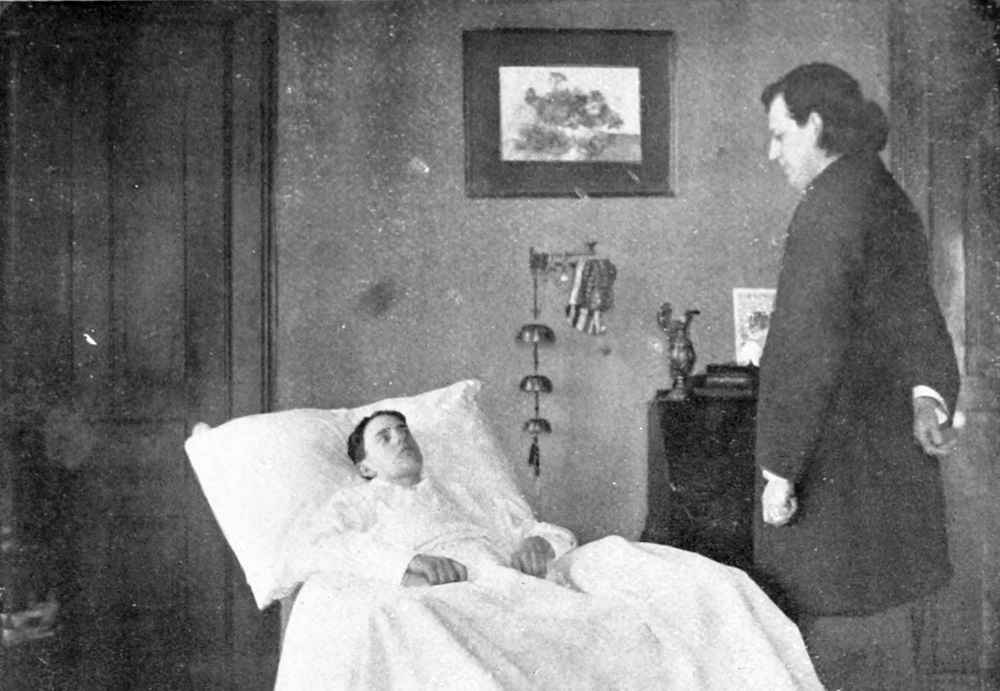
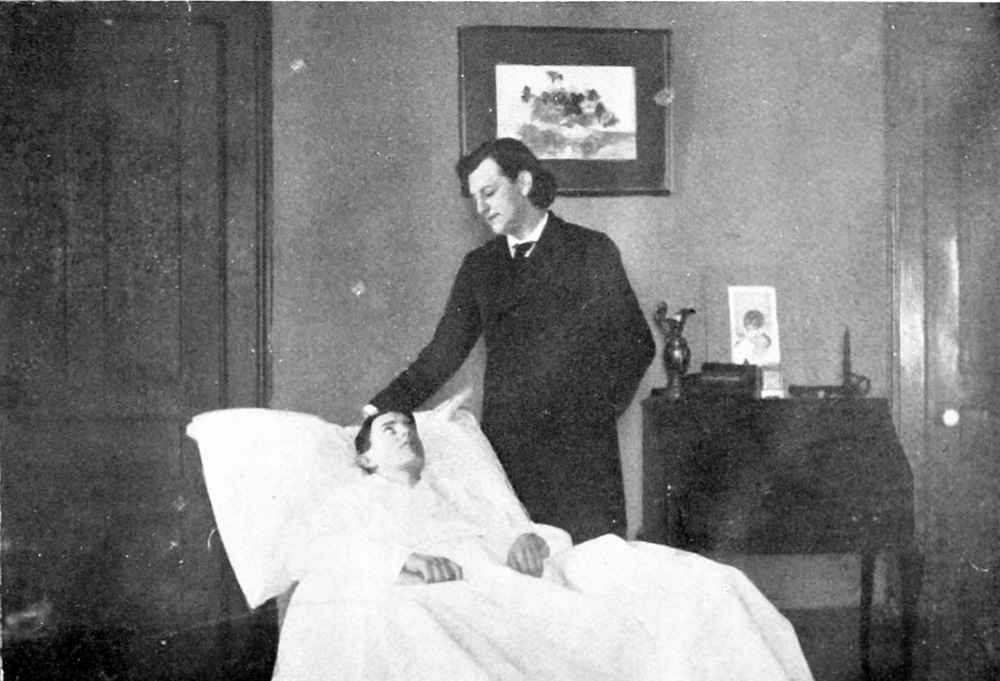
You will note that I use two words—“inspiration” and “suggestion.” I inspire a hypnotized subject. I suggest to him in the so-called normal state. A pupil writes me that Mrs. Jones has been suffering from headaches; he inspired her with the thought of “no headache” and she went away seemingly all right, which immediately informs me that he hypnotized her; but if he writes me that she called and he suggested to her “no headache,” I know that he did not hypnotize her. He may have stroked her head, assured her that the headache would pass away; he may have given her a blank pill, or even a drug. He used methods other [Pg 95]than hypnosis, but obeyed the law that is demonstrated in hypnosis.
It is claimed that the rope trick of the fakirs of India is performed through “hypnosis.” No. The first proof is that the spectators remember what they “saw” (?), whereas if they had been hypnotized, there would have been no memory of it after the “hypnosis” had passed off. This trick, if done, is the same as the sleight-of-hand performer makes you accept when he places a dollar with his right hand in his left and then causes it to disappear. He goes through the entire motion of placing it there except the actual doing so; that, he forces you to deduce; and if this rope trick of India is, it is simply the result of a master knowledge of suggestion that forces you to deduce the expected result.
Pain is a thought; the suggestion or cause exists. I pinch your arm; where do you feel it? In your arm? That is not true, because when you are chloroformed you do not feel it. You feel it in the brain. Oh, yes. In the brain; then it is thought. Baby comes crying to mother—she has hurt her hand; mamma kisses it and the baby goes away smiling; the mother being scientific (?), instead of nursing the pretty thought that a kiss from mamma will remove pain, teaches the child to be afraid, and adds attributes—including the doctor—and by and by the child has associated with the thought of doctor only a man who gives nasty medicine and hurts. Teach the children that pain is something to be laughed at; fail to add attributes to pain—arouse thoughts of “no [Pg 96]pain.” I would rather spank a child for getting hurt than to console it. If we spank it, it will think of the spanking, and will have a little more pain, perhaps; though not at the seat of the original trouble. I have seen children of ten years, in families of mental scientists, hold their fingers over burning matches until blistered, exhibiting no signs of pain.
You hypnotize a clever subject and tell him that he has no finger; you can then stick pins in it, burn it, and he will not feel it, because if he has no finger there is nothing to be hurt, a most beautiful demonstration; but, my dear hypnotist, do not try this on a fool, because he will “holler” unless you are smart. Tell him he has no finger, it is gone; then explain to the audience that as he has no finger, it is impossible for him to have pain from it; he cannot avoid responding to your inspiration, the audience thinking you are talking to them, when in truth you are talking to your subject; you can then stick pins in his finger and be safe.
Again, if you inspire the subject with the thought of “no feeling,” put a pin into him, and then commence talking to your audience about it, you will find your subject will begin to howl; or if, after you have withdrawn the pin and have a cowardly subject, you draw the audience’s attention to the fact that he might have the nerve to stand the putting in of the pin, but he could not control the flow of blood, saying “You will note there is no blood,” the moment you utter the word “blood,” blood will appear; but if the fellow is [Pg 97]unlearned and you use the word hemorrhage, he failing to comprehend, you are safe.
I could tell you of myriads of experiments which demonstrate beyond all question that the body is entirely controlled by the mind; that pain is a thought, and the thing we are most afraid of is that which our mothers, fathers, brothers, sisters and friends have done the best to build in our “minds.”
Pain is a bugaboo.
Your body is a house and an unwelcome neighbor calls. You try to smile; ofttimes do. You invite him in and treat him with the best you have. So let it be with pain, if he is going to enter the house, instead of running away, meet him and sit down and talk to him. You will forget his unpleasantness, because there is good in all, and if you are looking for good you can find it, but if you are looking for “bad,” you can find “bad.” A few years ago I failed to see any good in life, because I overlooked the good and was quick to discover the “bad.” To-day I can see much good and can overlook the “bad” and forget it; I feel sorry for it; I know it is a disease, and who, other than a degenerate (sensualist), can enjoy disease.
That the Sympathetic System receives sensations as well as responding, was first impressed upon me when I was giving little cross-road entertainments in the South. I arrived in town with a few handbills, hired a hall, distributed the bills, got a few people interested, hunted up a little negro boy, who, after being promised a quarter, agreed to go on the stage. The little [Pg 98]negro would have run if anybody had told him I was going to stick pins in him. I got him on the platform, and, after putting him through a performance of jumping out of hot chairs, and brushing flies off his nose, et cetera, I inspired him with the thought of “no feeling,” and, we will say, stuck a hat pin through his left ear, afterward taking him among the audience, allowing the doctors and others to examine him. I removed the pin, put him through more “monkey-shines” and ultimately awakened him.
As he started to leave the hall, the doctor said to him, “Did Mr. Santanelli hurt you when he stuck those pins in you?”
“No, suh; he done stick no pins in me, suh;” and the left hand rubbed the left ear. If I had pierced his right ear, he would always put his hand up to that ear. There was no question but that he was thoroughly unconscious of the pin having been put into him. Why and wherefore, then, was the hand always put to the proper place, if the Sympathetic System does not receive impressions? A hypnotized subject does not use his cerebrum.
In my “Living Statuary,” where I inspire the subjects with, “When you open your eyes you will juggle balls in the air; when I call now you will be stiff as iron, stone, you cannot move a muscle; now open your eyes;” they go to juggling, I call, “now,” and they are perfectly rigid in whatever position they are in when I speak the word, “now”; their eyes are immovable. It was here I first learned that the eye blinks every time one [Pg 99]gets a different or new thought. I tell the subjects to close their eyes, and their hands drop to their sides and they are limber. If one is not expert the subjects will fall. If a subject, during the “statuary,” is put to whistling, and I call, “now,” he will stop; when I release him he will complete the whistle. If he is uttering a word he will stop and when I release him he will complete the word, something that no “normal” being can do; the same with sneezing.
When the subjects are baseball pitchers I stop them in the middle of an action, and when I release them they complete the action. One evening, in Kentucky, the boys were defending themselves from an eagle; one of them had his coat off and started throwing it at the eagle; I produced the catalepsy, and when I released him out of that rigidity the coat passed or was thrown into the gallery of the theater. Where did he get the energy, how did he complete the action? The “mind” will hold but one thought at a time. When they open their eyes they are jugglers going through the actions they have seen jugglers perform. When I call “now” to them they think of rigidity, the action of which thought is catalepsy, when I tell them to close their eyes, they think of relaxation, yet complete the first thought, having a third thought in their “mind,” an utterly impossible thing to conceive, other than that action is received and executed by separate brain conditions. It was through noting these effects that in 1895 I preached an Abdominal Brain. At that time, having no comprehension as to what I [Pg 100]was talking about, but being familiar enough with actions of the subjects to note that it was an utter impossibility for all to be done with the brain system as now understood (?).
Now, dear reader, we have covered all the different phases of hypnosis, how and why it is, how to induce it, et cetera. This book answers all questions as to hypnosis if you have the comprehension to pick them out. On the premise here given you, I have yet to fail to give a logical and comprehensive explanation to the thousands of questions asked me by students, doctors, ministers, lawyers and laymen before whom I lecture.
You are satisfied if you comprehend; yet a most important question you have failed to ask me—not you who have not tried, but the amateurs. I lead into hypnosis Mrs. Santanelli and tell her when she opens her eyes she will find in her lap an object which she will describe to me; to open her eyes; she does so, takes up the object and describes it. While she is describing it, I say, “all right” and clap my hands; she awakens, and I ask her what she has been doing and she has no memory whatever. I have her again take on hypnosis, ask her what she was doing in the last “hypnosis,” and she tells me. Why is it the hypnotized subject has no memory of what has taken place in “hypnosis” when he is actually awake, yet while in “hypnosis” has a memory of the previous hypnosis? Why this contradiction, what does it mean? How is it that the subject does not see his present environment, but sees the environment of the picture I arouse for him? [Pg 101]Why this contradiction? I will explain it to you.
Memory is the registration of ideas. The subject, having no memory, proves that nothing has been registered cerebrally; again, it is impossible to register through one sense that which the economy of man intended to be registered through another. Therefore, we put nothing in through the cerebrum. When I talk to a subject he does not hear me cerebrally, if he did he would always remember what I said to him. The subject only responds to me.
Consciousness, realization, is cerebral. Sense-impressions pass through the cerebrum yet are actually registered in the Sympathetic System. Every cerebral nerve is accompanied by a sympathetic nerve. Many sympathetic nerves are alone. This makes the so-called brain system a two-wire system. I believe it to be a three-wire system. I say to a hypnotized subject, “You have no feeling in your finger” (touching the finger); the Sympathetic System immediately contracts the tissue over the cerebral nerve and insulates it; yet the Sympathetic System is conscious of any irritation that I make on the designated place, showing that it receives the impression free of the cerebrum. The Sympathetic System can work free and independently of the cerebral, but the cerebrum cannot work free of the sympathetic, because the sympathetic is the actual machinery that does the work, the cerebral brain simply being the realizing brain. In a hypnotized subject the cerebrum is inactive, as in hypnosis the impulse is received through and responded to by [Pg 102]the Sympathetic System. The experiment made by all students of decapitating a frog, irritating a nerve-end and the “normal” action taking place, proves my affirmation. A hypnotized subject is as a decapitated being. Feeling is never eliminated until death. Conscious feeling—yes. If the Abdominal Brain did not know what was taking place it would lose its control over the body, therefore, feeling as to the Sympathetic System cannot be obliterated.
Hudson’s philosophy of objective and subjective mind will not hold water, inasmuch as it is based on the premise than man is a free agent and can discriminate. Now, this subject is so thoroughly illustrated in the barber story, the banjo story, the story of crime, that really it is not worthy of discussion, although the entire public has seemingly endorsed a most false theory, manufactured to explain a condition that the alleged “authority” was not capable of explaining. We have but one mind; we are entirely creatures of our environment; our every action, our every thought, is simply the transforming into other action, of suggestion. The ability to discriminate is impossible.
Ofttimes men say that the ability to perform a mathematical problem is an example that man is a free agent and capable of thinking. Can a Fiji Islander, having no knowledge of figures, solve a mathematical problem? Can the son of the most brilliant mathematician do so until he has gone to school and had the ideas associated on his “cylinder?” Those who have the ideas properly registered will respond to the problem; they will [Pg 103]all work it out in the same way, getting identically the same result, proving that the problem was simply a suggestion that forced into action ideas (actions) already associated.
[1] It is necessary for the subject to comprehend this, though not necessary for us to tell him in the foregoing specific manner.
[Pg 104]
Now, dear reader, if you have comprehended the foregoing, in which I have tried to demonstrate to you that man is simply a machine, forced into action by his environment—this I have learned through hypnosis, which I consider merely a side issue to the Law of Suggestion, a crude and tyrannical use of suggestion—we will go a step further and try to understand the body of man, which is his closest environment. To do so it will first be necessary to explain what you call the “law of nature” or “hand of God.” After I have made you comprehend that, I shall then be able to discuss mankind in general.
If we drop a plum seed, peach seed, apple seed and a grape seed in six square inches of earth what will grow from them? Each of its kind. Why? One says the “law of nature,” another says the “hand of God.” I ask what is meant by these terms, as neither has affected me through my senses, and a sickly smile comes on your lips, and you say, “Don’t you know?” I plead ignorance and reply, “No,” then you won’t talk with me because I fail to know something that you do not know. Then you ask me why, and I tell you the “Law of Suggestion.” You say, “Why, there must be an intelligence to respond to that law.” As it is impossible to conceive of anything happening without an intelligence (associated action) to guide it, every action of all matter is guided.
[Pg 105]
Note.—I will state that all matter contains mind (which word will be used from now on without the quotation marks), and all mind gives expression in matter. Matter is the expression of mind—transformed mind—the utterance of mind; it is the material reproduction of mind; there can be no matter without mind, no mind without matter. Other than matter is incomprehensible.
This intelligence is acted upon by suggestion. There is mind in the rock, otherwise the rock would not disintegrate (respond to the suggestion of the elements). There is mind within wood. You say, “No, water rots wood.” Water does not rot wood. It forces (suggests) a latent (memory) action in wood to produce or transform into rot. As long as the suggestion is kept from the wood, that action will not take place; the moment the suggestion is applied, the intelligence within the wood responds. All changes are an advancement and good (natural response).
All suggestions are transformed. You of the “law of nature” and the “hand of God” claim that intelligence is external and everywhere; I claim it to be internal and everywhere, that all matter contains within itself intelligence (mind). Then you ask me what is mind and in turn I ask you this question: What is maturity? When does a boy become a man, a girl become a woman, and when is fruit ripe? When the seed is accomplished. As the seed is the last thing accomplished to complete the entirety of all attributes required, all of the preceding actions, i. e., responses to suggestion of the development of the tree that has taken [Pg 106]place are registered within the seed. Therefore, the complete memory must be in the last thing accomplished—the seed; and I will define mind to be the consensus of all actions acquired during gestation, not a so-called reasoning intelligence, but a memory of response to suggestion, as to heat, cold, different elements of the earth, to guide the commingling into the reproduction of its kind. If the natural suggestions do not occur, a reproduction is an impossibility.
To illustrate, if plenty of sunshine is required and the suggestion of sunshine is lacking, the entire fulfillment of the suggestion required cannot or will not be accomplished. If iron or some certain element in the soil is necessary to force a certain action, and is lacking, the response necessary will not take place. In the spring time, when warmth, et cetera, surrounds the trees, the buds are forced out. If frosts occur, contraction takes place and the buds are pinched off, the entire action of the tree being in accordance with the environment (suggestion). To the degree of the suggestion is the degree of response, identical with the action of man.
Genesis, Chapter XXX, 37-40, reads as follows:
37. And Jacob took him rods of green poplar, and of the hazel and chestnut tree; and pilled white strakes in them, and made the white appear which was in the rods.
38. And he set the rods which he had pilled before the flocks in the gutters in the watering troughs when the flocks came to drink, that they should conceive when they came to drink.
[Pg 107]
39. And the flocks conceived before the rods, and brought forth cattle ringstraked, speckled and spotted.
This simple law, the law of environment (suggestion), was in some degree known to Jacob. Therefore, what is, was, and always will be. There is nothing new in the world, only new to our comprehension. Darwin showed us that animals most like their environment, or those which responded closest to (were part of) their environment survived, while the others were destroyed. Man, being a creature of his environment, survives to the degree he responds to or is part of that environment. In the Arctic region animals are white as of their environment; in the reeds they are striped, therefore look like the reeds and are not easily distinguishable from them; up in the tree tops they are spotted. The negro from exposure to the sun was made black. If the white man goes into the sun he becomes what we call “tanned”; that tan can, in time, become very dark. The negro, therefore, is black only as a result of his environment.
Man, not being a perpetual motion machine, must obtain energy elsewhere than through or from his food as our scientists (?) tell us. The energy required to digest the food must be greater than all the energy in the food, otherwise it could not overcome the resistance; therefore, it is self-evident that our energy does not come from the food. Any condition that overcomes resistance sends out an energetic wave; every time we breathe, blink our eye, talk or move, we send out [Pg 108]an energetic wave, which can be transmitted only through matter. Life is energy, always moving and being reinforced as it passes through new matter; and I believe those energetic waves are received in the spleen, passed to the solar plexus and from the solar plexus passed to the extremities through the Sympathetic System. It is through the absorption of this energy—which is life—that keeps man going. When a man dies the machinery of his body—the Sympathetic System—fails to respond, to receive, to exert, or transform the energy.
The first part of a child formed is the Sympathetic System. A girl has reached maturity when she can reproduce; i. e., when she monthly gives forth an egg. In that egg is a memory action of building the Sympathetic System, when fertilized by an element of the male. Bear in mind that the element of the male is only a fertilizer.
The Sympathetic System centers are developed at the end of eight weeks. (See Gray.)
Now each ganglion acquires a specific memory from the same ganglion of the mother, and out of the blood of the mother builds over itself the form of the child. Therefore, when the child is born it contains within itself the intelligence that built it; i. e., mind. Every six months this intelligence rebuilds the entire tissues of the body.
The child when born has no cerebral knowledge. It must learn to see, hear, smell, feel and taste. It has no reflexes other than of contraction. All other actions are acquired after birth. The heart action was learned from the mother; also the respiration, [Pg 109]which action can very easily be changed. It must learn to take the breast. It has no control over its bowels or bladder. The pupil of the eye does not dilate, contract, nor blink at light. The child’s limbs will not draw away from heat or irritation. If the rectal sphincter be severely dilated a response in the throat will occur. This same action can always be repeated with a chloroformed patient, showing that the noise is simply a response at the other end of the nerve.
From the taking of the breast the child must learn to digest food, to respond to its environment. The moment a child readily does so, it is said to have displayed intelligence.
Physicians differ as to the length of the period after children are born into the world before they can see, hear, smell, feel and taste. There is much discussion, and many volumes have been written as to the length of time after a child is born before its senses are established. After much reading, I finally ask what is meant by seeing, hearing, feeling, smelling and tasting; and none of the writers have comprehensively answered. Therefore, why this discussion? What are they talking about?
I will define the senses to be the correlation of the different nerve-end stimuli. Give a new-born child soft, sweet, soothing sound-stimulus, then harsh, discordant sound-stimulus, and the moment a memory of these two extreme nerve-end contacts with sound waves is established, the child will be able to give expression to the degrees of all subsequent stimuli of the auditory nerve-ends. The same with smelling, tasting, et cetera. Sight, [Pg 110]unless associated with feeling, conveys no form expression. A child, to be taught the meaning of round, must not only see it but feel it. The same with other forms. The child is now learning to respond to its environment.
Mind is the tenant of the house it lives in—the body. That house is always wasting; mind rebuilding it. When mind rebuilds correctly, we have a healthy body; when incorrectly, we have what is called sickness. Mind can only build as of itself, as it responds to its environment, and consequently must be a reproduction of that environment, modified by the acquired memory learned from the mother. Therefore, the house in which it dwells is the exact representation of its tenant—matter being the expression of mind.
Food is taken into the body to rebuild the house. If a man takes possession of a new brick house and starts in to replace with bad bricks as it wastes away, at the end of six or seven months he will live in a bad brick house. If he replaces with rotten lumber he will live in a rotten lumber house at the end of a period. Hence, man partakes of the nature of the food he eats.
Now, if mind be worried so that he builds awry, his house will be awry; and if his house be awry and he finds his error and corrects it, he will re-establish the symmetry of his dwelling. (Rational treatment—the orificial surgeon and personal suggestion.)
Thus mind rules and builds the body, but a time may come when the body becomes so awry that it rules the tenant. In health, mind rules; after [Pg 111]severe illness the body may. Mind cannot choose to correct its error, it can only respond; the suggestion must change. Error can only be distinguished, when known, in comparison with good. Unhealthy surroundings must be changed. The closest environment—the body, may require the knife.
It is inconceivable for anything to happen without an intelligence to guide it. I have shown the intelligence that built the body—that keeps rebuilding the body—but our learned (?) physicians seem to think that the body of man is a dunghill in which seed may be sown and foul vegetation grow, forgetting that nothing in the body can happen without an intelligence to guide it—that the body is a result, and there is no cause within the tissue itself.
Every nerve has two ends. When there is an irritation at one end, there is a response, or so-called reflex, at the other. Oh! why has this thought never occurred to our “learned authorities?” Our worthy doctors are forever trying to remove the effect, never reaching the cause. If a man’s blood is out of order, does the bad blood cause illness, or is the illness and bad blood the result of the imperfect transforming of food by the intelligence whose duty it is to perform such functions?
When I first showed my ability to produce in a hypnotized subject three pulsations at one time, the doctors declared it to be a trick; that it was an impossibility; that the heart only controlled the circulation. If our most learned (?) men would only think (and such a thing were possible), they [Pg 112]would readily see the futility of such claims. If I am rightly informed, there are several miles of vascular piping in the body, and the heart of itself is not strong enough to pump the blood that distance; if it were, the frame of the body is not strong enough to maintain the resistance to such an action. The truth of the matter is, that the heart is simply the governor, i. e., regulator, that starts the rhythm of the pumping, and different nerve centers (mind) take up and carry on the action. Our doctors tell us that a man dies because the heart stops beating. No, he dies because the intelligence that forces the heart to beat stops working.
Man is a tube lined with a series of insulated electric wires. These wires run from orifice through ganglia of Abdominal Brain to orifice. Every nerve has two ends; irritate one end and through the action of its ganglia a response will occur at the other. Our doctors treat the response, paying no attention to the cause, although they talk nothing but cause.
From a series of experiments that I have made, I am satisfied that the body is rebuilt every six or seven months. The Abdominal Brain in the embryonic child is complete at the end of two months; and, as the child is born at the end of nine months, the first attempt of the Sympathetic System, the Abdominal Brain (mind) built a complete child in seven months; although a child born at eight months is seemingly complete. If mind in its first attempt can build a child in seven months, why should it take longer to build a second time, particularly [Pg 113]when it has a freer hand and environment to work in?
Our doctors start on the premise that man’s eyes, lungs, heart and all vital organs live forever, unless bugs get in and destroy them. I cannot accept any such statement. For the sake of argument we will say that all organs and tissue are rebuilt every six months. I care not if every six years, but we will assume that they are rebuilt every six months, constantly wasting and constantly being replaced. The doctors will tell us that a cataract grows on our eye. I deny that, maintaining that the eyes are replaced every six months, and when there is a cataract, the ganglion of the Abdominal Brain (mind) is so irritated that it builds an imperfect eye, an eye with a cataract. The doctor with his knife removes the cataract, and ninety-nine times out of a hundred it grows (?) back. The Mental Scientists, the Christian Scientists, the Faith Curists and the Hypnotists remove the cataract. How? By causing the mind to stop building the cataract and resume its previous building of a healthy eye. I have cured dozens of cases of astigmatism and myopia, and several cases of cataract simply through personal suggestion and orificial surgery.
Many people come to me saying “Mr. Santanelli, I have been wearing eye-glasses for a year. Can you cure me?”
“Yes.”
“How many hypnoses will it take?”
“None.”
“Why, what will you do?”
[Pg 114]
“I will take you to my surgeon, and have the proper orificial work performed.”
“And will that cure me?”
“Certainly.”
Another comes to me and says, “Mr. Santanelli, can you cure me?”
“How long have you been wearing glasses?”
“Ten years.”
“How old were you when you began wearing glasses?”
“Twenty years.”
“Yes, I can cure you.”
“How long will it take?”
“I do not know.”
“What will you do with me?”
“I will send you first to an orificial surgeon and have the cause removed. Then I will break up the nerve habit.”
“What is that,—the nerve habit?”
“Why, I mean this, that until you were eighteen, your ganglia (mind) built good eyes, when, through an irritation, it developed into building a pair of bad eyes, called astigmatism, myopia, et cetera. You get two pairs of eyes a year, in eighteen years you get thirty-six pairs of eyes; and up to that time the ganglia (mind) has the memory of building good eyes, in twelve years it builds twenty-four pairs of eyes; after the cause of building bad eyes is removed, I must force the memory of thirty-six to overcome the memory of twenty-four, which is not a very difficult task; but if you came to me ten years later, it would be nearly impossible for me to cause a memory of thirty-six [Pg 115]to overcome a memory of forty-four. Where the nerve habit or new memory is not too pronounced, through personal suggestion I can readily revive the first memory. It is through the lack of knowing how to overcome this that our orificialists fail in many cases. This is the greatest use of so-called hypnotic suggestion—the breaking up of nerve habits.”
The same argument holds good as to the lungs, and in all early stages of heart trouble, et cetera.
The doctors tell us that when we have consumption, bugs are nesting in and eating our lungs; but why, most wise (?) gentlemen? Life is indestructible, and if you will use microscopes powerful enough you will always find life (bugs). When man is most dead (?) and burned to a handful of ashes, drop a little acetic acid on them and you will find there is life, movement; and life is simply energy.
I maintain that man gets a new pair of lungs every six months, and when the ganglion that controls the building of the lungs transforms the food into healthy lungs, we lack consumption; that when it makes an imperfect transformation we have the so-called diseased lung, the germ, which is the mal-transformation of food containing life or energy.
But few male Jews have consumption, although they are improperly circumcised. Circumcise all consumptives, both male and female, and see how quickly you will achieve a result.
I will show a genital lesion in every woman with an undeveloped bust. Amputate the labia minora [Pg 116]of a young woman and see how quickly her bust will develop and her respiration be facilitated—a marked result in less than two weeks.
I treat all eye trouble by removing the irritation from the other end of the nerve. It is a rare case where the cause and effect are at the same place. The fool ideas offered as to light, printing, et cetera, in our schools, being the cause of so much bad eyesight among the students, is all rot. Circumcise them, our mothers are breeding a sexually irritated generation of both sexes. If the Jews had properly circumcised their women there now would be no necessity of doing so with the men.
Moses insisted on two laws. The Jews to-day cannot tell you why those laws are enforced. As to the pork I will explain later, as to the circumcision they have not been able to offer a rational explanation.
Why is it there are so few Jews in the penitentiaries, insane asylums, who are cancerous or consumptive among the males? Why are the Jews a money-making race? Oh, they inherit it. No. A Jew is but a human being, he is the same as you and I; he is ruled by the same Law of Suggestion. It is first, because he is circumcised, secondly, because he is clean, and third, his Abdominal Brain (mind) is not worried or irritated. Consequently, he is full of life and energy, and his brain works in a “normal” manner. He eats clean food, producing the same result and, therefore, is equipped to do business with a “normal” mind, he is free from the “abnormal,” therefore, not a criminal, not a [Pg 117]candidate for the insane asylum; his thoughts are healthful and therefore he looks forward to a long life, to a large family, to the care of them, and to the necessity of acquiring the means whereby they can live: he is nearly “normal.” The law of Moses, although unexplained by his followers, was a law of health; a healthy mind is always the result of a healthy body, or a healthy body is the result of the healthy mind, impossible to find one each way.
When food is impure, the ganglia whose duty it is to transform and make pure blood, is working awry, and nothing done to the blood will purify it as to the health of man. Inasmuch as the ganglia will continue to make bad blood, why treat the blood?
A man’s bowels are constipated and the doctor gives him a drug. Does the drug empty the bowel? No, the drug does not. Why is the bowel not working properly? Because the ganglia that control secretion and peristalsis are not doing their duty, and nothing but those ganglia can empty the bowel. Therefore, the drug is simply a suggestion that stimulates these ganglia and causes them to renew their action of secretion and peristalsis. Catarrh, asthma, heart trouble, rheumatism and functional diseases are all a result of irritation at the other end of the nerve. The idea of trying to drug or treat the heart for its imperfect action is ridiculous.
My intelligent reader now asks where the other end of these nerves are? How is it the doctor [Pg 118]has not discovered them? I will tell you why, my good reader.
Our doctors have failed to discover the end of the nerve, inasmuch as they are “scientific” and do not know how to “think.” They reason deductively, which is not reasoning. From a true premise no deduction should be necessary, inasmuch as the cause and effect are perceptible. Reasoning, so-called, is required when only an effect is perceptible, and one has to go back to the cause. The moment the cause is found no more reasoning is required. The cause and effect are so closely associated that when we comprehend the cause, we must comprehend the effect. Inductive reasoning is the only true reasoning, and our scientists (?) know nothing of this, they much prefer to assume a cause and force a deduction to fit the effect known. How many inductive reasoners has the world produced? Not fifty, and I include all great thinkers in the fifty. Our doctor is a good, clean (?) man; his patients are good, clean (?) people, and they greatly dislike to think of anything that is “naughty,” forgetting that all “naughty” things are a perversion of good things; and that the being who appears the most “nice,” at heart is the worst. Little children are taught that it is awful to hear anything mentioned about their privates. In many states physiology is barred from the public schools, as it is something awful for man to understand himself. As everything suggests positive for or positive against, the real modest person is simply the positive opposite to the real vulgar person, both having the same thought, [Pg 119]only one gives action in blushing, et cetera—alleged modesty—while the other gives action in vulgar expressions. The truly pure being would be neutral—no ideas associated as to bad.
Dear reader, one can have no thought without its expression (for that is all a thought is), and alleged modesty deceives no one, least of all one versed in human nature.
In all my years of experience (and I can read a face like a book—I know my nerve-ends), I have met but three really healthy women, and they were Southerners; and no healthy men.
Some one speaks in public of a woman’s leg, many cast their eyes down and others blush; some laugh. The sexual look appears in the eyes of others. Let us analyze the thoughts of these four classes of people. When “leg” is mentioned, the first party would not cast his eyes down unless he had “bad” ideas associated; the second would not have blushed if he had good ideas associated; the third would not have laughed, nor the sexual look have appeared in the eyes of the fourth, had they not all proportionately associated the same ideas. Now, the ideas are mostly acquired,—particularly in the first three—by the parents telling them not to think of this, not to do that, and the entirely false thought of modesty, or something “bad” was associated and placed in their minds through their “bad” mother telling them they must not do or think of these things. Remember, all things in the world are good, and man has created the bad. Life keeps moving onward, which is good, and no matter which way it moves it is always onward and [Pg 120]always good, and the “bad” is produced by the “not’s,” the “don’t’s,” and the “mustn’t’s.” Therefore, I define “bad” to be perverted good.
The nerve-ends of all the upper orifices and the heart and lungs, terminate in the genitals and the rectum. You will rarely find only one orifice of the head responding to nerve-end irritations. I always find two—the eyes and ears, eyes and nose, et cetera.
I have cured stutterers, all classes of eye trouble, all kinds of nervousness in both sexes by removing the sexual irritation; but as this book is written simply to give the reader a general idea of suggestion, I will keep this subject for a book to be written later, intended for doctors and mothers only.
In 1895, while claiming in my lectures that we must have an Abdominal Brain—otherwise there was no logical explanation as to many of the conditions I was producing through hypnosis, in Lansing, Michigan—Doctor William D. Cooper drew my attention to the wonderful results Dr. E. H. Pratt, of Chicago (the father of orificial surgery), was attaining by operating on the lower orifices, and intimated that perhaps he was reaching the Abdominal Brain. This intimation prompted me to visit Dr. Pratt and learn of his work, which in time resulted in my believing that the Sympathetic System was my much sought Abdominal Brain, and much study and experiment has resulted in the foregoing synopsis.
If man is ruled by his environment, it naturally follows that his body must be his closest environment; [Pg 121]as the body is, so is the “mind;” as is the “mind,” so the body. Therefore, blackguarding, sensuality and prostitution are physical diseases. If man’s thoughts are forced on him through his five senses, it follows that, if he has a sexual irritation, sexual thoughts will always dominate. Therefore, instead of passing laws against those “sins,” hospitals should be established and convicted invalids sent there to be properly treated.
Prostitution is a curable disease. The orificial surgeon can remove the physical suggestion, and the hypnotist can break up the nerve habit.
If we put a clean woman in a dirty house, and keep the house dirty for a certain length of time, that woman will become disgusted and have no desire to clean up. Put a dirty woman in a clean house, keep the house clean for a period, and that woman will become ashamed and acquire habits of neatness. So it is with the mind and the body. When the body becomes foul, the mind degenerates and vice versa. The food is the material out of which the body is made, and foul food builds a foul body and “mind,” notwithstanding the false theories of our alleged scientists.
Man’s stomach is the hopper of a mill, made to grind and digest certain foods. If man partakes of food to re-establish his body, his present eating must be radically wrong, because at least three-fourths of the food taken into the stomach is passed off through the bowels; if he ate proper food, ninety-five per cent of it should be turned into tissue and the waste should be correspondingly small. What fool man does to-day is to put [Pg 122]all kinds of indigestible food (?) into his hopper, and when the mill tries to grind, it breaks down; he then sends for his doctor and expects him—if he could—to repair the mill so that he can go on trying to grind flint with machinery intended to grind wheat only.
Remember this, a child’s stomach is gradually taught to digest coarse food. In other words, it must learn to transform the different foreign elements passed into the stomach. No argument offered can substantiate the necessity of flesh-eating. The strongest animals in the world, proportionately, are the ox, the ass and the elephant, strict vegetarians; and each and every pound of their flesh represents an equal proportion of vegetable strength, a concentration of many times its bulk of vegetable matter, and vegetable life was before animal life. The vicious animals in the world are the lion, the tiger, and all flesh-eating animals. In certain parts of the Orient are horses that eat flesh, and are so vicious that only the most expert can handle them. If you desire to make your dog vicious, chain him up and feed him on flesh.
The life of modern man is one of confinement, and in every pound of flesh he eats he takes into his system a hundred times more energy than it is possible for him to give voice to. Being possessed of this concentrated energy, he can get rid of it only by giving it a counter-irritant or energy absorber in the form of liquor, sensuality and brutality.
During the Greco-Turkish war, the non-meat-eaters [Pg 123]and abstainers from alcohol paid but little attention to wounds similar to those that sent the meat-eaters to the hospital. Similar wounds that sent them to the hospital, caused the death of the others.
The hog is a scavenger, living on filth and transforming filth into its body, which is simply a concentrated form of filth. Lazy man takes this filth into his stomach, transforms it into his flesh, and wonders why he is syphilitic, cancerous, diseased, lazy and sluggish. I have given health to many families by causing them to cut pork and lard from off their bills of fare. All fat is filth. All four-legged scavengers easily go to fat. Feed kine on “slops” and they go to fat.
The lady with the blotched face goes to her physician, and he advises her to avoid eating pastry. For Heaven’s sake! What can be healthier than flour and fruits? What, then, must be the only thing that is detrimental? Why, the lard, the shortening in the pastry.
My experience and investigations have shown me that the majority of the poor people, who can barely get money enough together to buy a little “sow-belly” and meal, are always the lazy, indolent, worthless class of people, whose entire tissue is made up of hog meat, and consequently have very sluggish brains. I have yet to meet a confirmed pork-eater with an active mentality.
For three years I abstained from eating flesh, two years of which was the most delightful existence I ever experienced. Having a clean tenant in a clean house, my thoughts were pure, my actions [Pg 124]pure; but found I lacked the energy to keep up the race with the over-wrought, pell mell, flesh-eating environment. I firmly believe that there is no case of syphilis so severe but proper dieting will re-establish a healthy condition.
Since my experiments of putting subjects to sleep for seven days, many dyspeptics have taken up the fast cure and have demonstrated beyond all question that much good is consummated by total abstinence from food. Our doctors are daily killing their patients by feeding them. When mind requires food, food will be demanded. There is never danger of a patient starving to death.
Mind responds to the suggestion of matter. Our doctors tell us that we are vast sewers, filled with bugs that are devouring one another; that the more chemicals, the more putrid matter they can put into us the better we are. First, they warn us to beware of the pus of a sore, yet take the pus of cow-syphilis—cow-pox—and put it into the pure body of a helpless babe to prevent its getting a harmless disease, a disease that any first-class homeopath laughs at, small-pox—a disease that is non-contagious, non-infectious, as is proven by vaccination, which fails to produce small-pox—Oh! the scientists (?). This was demonstrated beyond all question last summer by a physician in Wisconsin eating the virus and spreading it all over his face; he fed it to at least thirty of his patients and none contracted the disease. Small-pox decreases with the advancement of sanitation.
Strange to say, our doctors marvel at the increase of syphilitic affections, of tubercular conditions [Pg 125]of the body and of the bones, of the prevalence of hip disease, yet fail to see that it comes from the inoculation of these innocent children with cow-syphilis. I would unhesitatingly kill any member of a board of health or any officer who would enforce the inoculation of any of my family with this syphilis, and the jury does not live that would convict me. The body being rebuilt every six months, the so-called immunizing could only be effective for that period. Now, my scientific (?) friends, as I have taught you something that is irrefutable, have the boards of health force a law that all shall be poxed every six months. What a lot of idle doctors would be kept busy.
These philosophers (?), these scientists (?), fill horses with disease and take the serum, fill it full of drugs to keep it from spoiling (?), “shoot” it into the arms of helpless babes to cure them of diphtheria, and when they die of lockjaw and other diseases produced by the poison so injected into their blood, the doctors suddenly discover that they got hold of the wrong toxin, otherwise the children would have recovered. Never! A lie given to protect a fool theory.
Now, as the body is rebuilt every six months, and there is an intelligence building the body, an intelligence that is making the blood, an intelligence than is transforming this blood so made into tissue, what in the mischief have bugs to do with disease? The germ is life; impossible to find life without germs or germs without life, and the germ is simply a transformation of form of life; if the intelligence within the body is surrounded with [Pg 126]suggestions of health, forcing it to perform its functions in a natural and proper way, it will make the correct transformation which is known as health; but if the rhythm of its work is interfered with, it will make mal-transformations which are recognized as germs of this, that, and the other disease. The removing of the germ is of no consequence, inasmuch as the intelligence (mind) still builds more germs. Remove the cause, allow the intelligence that built to rebuild correctly, and the “specific” germs will disappear. Killing the germs is like to a man who is annoyed by a hen laying an egg on his porch every morning, and he sends the servant out to destroy the egg. If you want to stop the laying of the egg on the porch, remove the hen.
Good blood and bad blood are results of the building of the intelligence (mind) that makes the blood, and any bugs or anything of that kind you find in your blood are simply the badly or goodly made blood. Our doctors seem to think that man is built and rebuilt without an intelligence to guide that building; that he is a compost heap in which seeds lie that in time develop and grow, overlooking that the body is a result, that anything on or in the body is a result, and that the entire result is guided by the all-wise intelligence of mind, this mind being subservient to and part of the Law of Suggestion—its environment.
Mineral, vegetable, animal, human mind is the same (either singly or collectively); i. e., a conditional reproduction of its environment (suggestion). (1), The primitive element (environment), [Pg 127]forces (suggests) a reproduction in (2), vegetable result; 1 and 2 forces (suggests) a result (3),—animal life; and 1 plus 2 plus 3 forces (suggests) a result (4),—man. Thus the Law of Suggestion keeps up an individual and combined transformation, always progressing yet ever in variable form, resulting from the individual changes in the several attributes (suggestion) back of or lower than itself.
“Man is made in the image of his Creator.” Yes; but, dear reader, not as you interpret it. Man is the interpretation, the consensus, the result of the transforming of his environment, the exemplification of the Law of Suggestion; he is good, God. Mind, the intelligence within, learned from the mother, responds to the external forces, suggestion, the all, God, that forces material life ever onward into something else. We are but one of the MANY forms of God, good, the Law of Suggestion that embraces ALL. Remove from or add one atom to this world and it will end, a thing incomprehensible. What is, was, and always will be.
I place a cantharides plaster on the left arm of a man and blister him. In time the blister heals. I afterward hypnotize him, put a postage stamp on his left arm and tell him that it is a cantharides plaster, and in twenty-four hours or less I have the blister. What made the first blister? What made the second? Well, the first blister was made by the cantharides plaster. No, sir; it was not. The first blister was suggested by the plaster, which caused the ganglion that built the tissue of [Pg 128]that area of the arm to accomplish a condition called a “blister,” that action, being associated with the cerebral memory of the name “cantharides plaster,” was aroused in the hypnosis through the word “plaster” and the ganglion built the second blister as it did the first. Can I reproduce this blister on the right arm? No. Why not? Because the ganglion of the right arm has no such memory. I can only produce it on the place where the memory was established through its proper channels, through feeling. Here is where the mistake has been so often made by operators trying to perform the blister test; trying to revive a memory where none exists.
A man has a wart on his finger; the doctor says the wart grew there. No, it did not grow there. It is a result. It is burned off with an acid or caustic, and grows (?) back; then the doctor says he did not get to the roots (?), that if he had taken the roots out, it would stop growing. (Just as if a man was a well-manured heap, and you could grow things in him.) An old woman comes along, cuts a few white hairs out of a black cat’s tail, mutters some cabalistic words over it, and behold, in time the wart disappears! Why? Because she reaches the mind. The mind stopped building the wart and began building healthy tissue. The doctor cuts it off, but seldom reaches the mind.
No result can be produced in the body until the mind is reached. Drugs are nothing but suggestions. We will assume that a man’s bowels are constipated and the doctor gives him a dose of [Pg 129]calomel. Does the calomel move the bowels? Yes. Good. If I put into a glass jar some food with some calomel, will it “move”? What is constipation? Why, it is lack of secretions, lack of peristalsis. Does the peristalsis work of itself? Does the secretion work of itself, or is there an intelligence that guides and makes the secretions, that guides and forces the peristalsis? This being a fact, the intelligence that guides or rules the secretions and peristalsis has ceased to do its work, and the calomel simply irritates these ganglia or brain centers and stimulates them to renew their former action. If they accept this suggestion the patient is cured; if they fail to do so, more suggestion must be given, and in many cases the ganglia refuse to accept the suggestion at all and the doctor looks wise and gives you a handful more of “stuff.”
The Mental or Christian Scientist, or hypnotist can cure constipation. How does he do it? Let us first analyze and find the attributes of constipation. First, there is the cerebral attribute, its name, constipation; associated with that are the two mind actions of peristalsis and secretion. Those three are now associated in the “mind” of man, and the law is that if I lock a thought in the “mind” and start it in action, every one of its attributes in its proper place is bound to act. Therefore, if I will lock into the mind of a hypnotized subject the thought that his bowels are loose, or will move, or arouse any thought there that has associated with it the action of peristalsis and [Pg 130]secretions, and hold that thought there long enough, the result is certain. It is for this reason that a personal suggestion or an inspiration in hypnosis has but little effect on a young child. The moment it has cerebral attributes associated with sympathetic attributes, and the operator knows how to emphasize them, he can get the desired result.
The Christian Scientists tell the patient that he is not sick; then if his mind could reason it would say, “If I am not sick, in what condition am I?” But you should say to your patient, “You are sick, and so and so will happen,” and if the memory is there to be aroused the action will take place. Remember, in hypnosis or any mental treatment, you can only revive memories, words of themselves mean nothing, hence skill is required to force the proper thought; but just as certain as the proper thought, no matter how aroused, is put in force just that certain will the action take place.
I believe that the only cure for cancer is personal suggestion, inasmuch as the cancer does not grow in the body of man, but the mind that is building that area of the body is building cancerous, instead of healthy, tissue; that a suggestion or an inspiration will be found that will re-establish the original healthy building. Our doctor cuts the cancer out and says it grows back. It does not grow back.
Personal suggestion, when attempted, must affect the proper senses; in hypnosis the operator names the sense-pictures. When we talk health to [Pg 131]a patient, we must look and act health, as well as show it in our tone. If we doubt, we are wasting our time, inasmuch as we can only do as we think. Faith, confidence and sincerity are the principal attributes of a “mental healer.”
[Pg 132]
When our neighbors desire to account for there being a black sheep in the family, having charity towards all, they immediately state that he inherited it—whatever that may mean. They travel back generation through generation and if they go far enough they can always find what they want, and claim that this taint came from a forefather. For Heaven’s sake, if we are the epitome or digest of all the good and ill that our forefathers have been doing, clear from the time they were monkeys, what a conglomeration we should be at the present time.
According to our alienists; a very good word, it always reminds me of foreign—strange, I don’t know—and they are strong on heredity, we inherit (?) insanity, ill health, goodness, badness, et cetera. Heredity is a word that means nothing, therefore explains nothing, and is a very good word to use by our scientific (?) friends when somebody asks a pertinent question.
The Abdominal Brain of the child learns from the same brain (mind) of the mother to reproduce as of the mother, modified by the material out of which to build (condition of the mother’s blood), and the present external environment (suggestion) of the mother.
As is proven by birthmarks, cerebral impressions have a positive effect on the Abdominal Brain action. A child looks like its father simply [Pg 133]through the sense-impression on the mother. A mother may bear a child having the features of her husband’s dearest friend and yet be a physically pure woman. A child having the features of a woman’s husband is not proof that he is its father. I would go even a step farther, and say if I were on a jury to pass judgment on a white woman who gave birth to a black child, and it was shown that the woman was of proper moral character, et cetera, I would unhesitatingly believe and decide in favor of the woman being physically pure, although the child was black.
The story of Jacob illustrates this, and breeders of animals prove it, year after year. If I dared, here, to discuss this subject properly, I could quote instances without number all tending to prove my claim. The element of the male is only a fertilizer, nothing more, and nothing is inherited from the father, per se. The egg of the mother contains a memory (mind) of building the Abdominal Brain, which action is aroused by the element of the male. The moment the Abdominal Brain (Sympathetic System) is built, it acquires its intelligence direct from the Sympathetic brain centers of the mother, tempered by cerebral impressions. It is for this reason that our alleged scientists fail to “produce” life.
Why is it that two children of the same mother possess absolutely different traits? They both have the same (?) environment? How is this possible? The environment is not the same. First, the external environment is always changing, if in nothing else, there is the change of the seasons. [Pg 134]The food differs, the mental state of the mother differs, etc. In fact, at no time are we the same, we are always changing, moving on, nillynally, reflecting the constant change of our suggestion.
In a piano factory one hundred pianos are turned out, seemingly built of the same material, by the same hands, and yet no two are identically the same in value or quality. How is this? No two things are the same. After the pianos are completed a man assorts them, then a more skillful one; and last, the expert comes in and decides on the relative value of the instruments. So it is with children born, each varying and time assorts them. Those born with superfine feeling nerve-ends will quickly learn to withdraw from coarse wraps, while those born with dulled nerve-ends will be attracted to the contact of the rough wraps, each through its natural state (mind) responding positively to the suggestion.
A child born with the nerves of hearing super-sensitive, will gather more ideas as to sound and develop itself into a musician; the same with sight, a child super-acute as to distinguishing form and color, is certain to develop into a painter, draftsman, or enter some pursuit that will give expression to his superabundance of ideas of this one sense.
A mother possessed of a certain sexual irritation will produce a child having a redundant, superfluous, or abnormal condition, which, in time, will result through its irritation into a condition similar to the mother’s. Or, if the father be in a condition to impress the mother, in ninety [Pg 135]times out of a hundred, the impression so produced on the mother will be reproduced in the child, physically. Here is the heredity. But a surgeon knowing (?) what is “normal,” has it in his power to remove the irritation or redundant tissue, and thereby put the child in a “normal” condition. How many male Jews do we find suffering from consumption? Not because their mothers did not have consumption, but as the cause of the consumption is removed from them.
A child, being born with a sound pair of lungs, could not possibly have inherited consumption, as the mind has but the one memory. To have inherited consumption would have meant to inherit a memory of building an imperfect pair of lungs. But the child did inherit a genital irritation which would result, in later years, in worrying the ganglia and cause (force) them to build an imperfect lung. Thanks to the discovery of orificial surgeons, many of these irritations are known, which, if removed at birth, will destroy the alleged inheritance.
A mother has astigmatism; baby is born with good eyes, and, mind you, that babe is getting a new pair of eyes every six months. It is strange that the ganglia which, according to the theory of our alleged scientists, should have inherited a memory of building bad eyes, should, after building thirty or forty pairs of good ones, suddenly recollect that it has forgotten to do what it inherited, and start in building bad eyes. The truth of the matter is this: The irritation that was inherited had not, until after a number of years, [Pg 136]grown to be of sufficient importance as to disarrange the rhythm or memory action of the ganglia (mind) that build the eyes.
So it is with every one of the alleged inherited diseases. I do not believe that a mother, living on pure food, could transmit syphilis to her child. It is simply the furnishing of the mind of the child improper material out of which to build its body. A child born with a deformity, no mind treatment will cure; because the “normal” memory is not there to be re-established, for in hypnosis, or through what they call suggestive treatment, only memories can be revived. Where there is no memory there is nothing to revive.
A child is born into the world with its cerebrum inactive. In a short time consciousness, or registration of ideas through the cerebrum, begins, and the child now must respond to external suggestion as well as internal (physical). The child, being born into a new environment, must learn through suggestion to adapt itself to (become part of) that environment. If it succeeds in doing so, it will be the survival of the fittest, and live. If it fails it will die. The environment by which it is surrounded is the environment of the mother; the habits (manner of responding) of the mother are now being transferred to the child. As the child progresses in life, its accumulation of associated ideas are in response to its environment, and are but the gathering together of the reproduction of the mother, subject to changes or modifications of the present external environment, called the advancement of “civilization.”
[Pg 137]
When the girl reaches womanhood she marries, which is the beginning of new creatures. Ah, if our women could only appreciate the magnitude of the responsibility that they take on their shoulders when they get married, if they could but learn that marriage is not for the gratification of sensuality, brutality and puppy-dog love; but the beginning, the starting point, the sending forth into the world of beings who will carry on the good or ill that this young mother suggests to them (surrounds them with). Is it not a sin, a shame, that women, not understanding themselves, lacking in knowledge that is unmistakably possessed by animals, are allowed to marry? No woman should bear children until she has learned as to how to bear them. A dog is her own midwife, as is also a squaw; but civilized (?) woman, being unprepared, has to send for a doctor. Truly, this is proof positive of the advancement (?) of man. The young mother, differing from the lower (?) animals, does not know what to do with the child, now she has it.
The ignorant bring forth the most young. The rich place the child in the inexperienced hands of an ignorant nurse. Nurses for new born babes should be thoroughly schooled, and be the highest paid of all employés, for they can make or damn the future of the child, inasmuch as the first response to its environment are, and should be, under the guidance of the nurse. Give me a child until it is eight years of age, and I will promise much for its future.
The wife carries into her new home the same [Pg 138]environment that her mother was possessed of, because she had no means of learning other. Mother’s sanitation, mother’s style of cooking, mother’s mode of abusing her neighbors, of having two manners in the family—one for company, all are hers and in the new home. If that environment resulted in certain moral traits in her brothers and sisters, why will not this environment repeated produce the same result in her children? It will, and the inheritance is not in the blood, but in the environment. This you may rest assured of, that where the father dictates the environment of the home, or his mother comes and does so, the inheritance will be entirely on the side of the father, and vice versa. But, if you wish to be rid of the inheritance, send for the old lady who has reared a family of children lacking in all the disagreeable attributes which are creeping into your family. Allow her to have full sway in the household, and see how quickly the heredity will disappear, and how uncomfortable you will all be for the time being. She will turn the house topsy-turvy, thereby forcing laws of sanitation which you declared you could never endure; she will change the entire regimen of the table, cause you to eat food that you affirmed you could never eat, and will throw out the food which you were certain you could not exist without. In fact, everything that you avoided she will bring into the house, and those things to which you were most partial, will be immediately eliminated.
Let us build a story. Let us follow a young [Pg 139]man from the country through a generation and see the effects.
John Smith is a farmer, and, being like most farmers, dislikes manual labor, not so much as his father, who is a very hard-working man, and desires that John will not have to work as he has. So he sends John to a business college and gives him a thorough (?) course in business (?). And now John becomes imbued with the thought that he should not soil his hands, that he must go to the city and be a “real fellow.” John’s mother—good woman—has told John that he should not steal, that he should go to church, has taught him his prayers; hence, John is a good boy, having been surrounded with a healthy environment. He goes to the city and takes a job of keeping books in a store.
Probably, in a week or ten days, the well-meaning minister comes around and invites John to attend services, which he does, and ninety-nine times out of a hundred, John sits in a back pew, awfully lonely, thinking of mother and, perhaps, paying but little attention to the sermon.
The trouble lies here: The stores close early, and John, not working hard now, and being full of energy which he cannot give vent to in his present occupation, does not respond to sleep until ten or eleven o’clock at night, and does not know what to do during the hours between the closing of the store and the time that sleep gathers around him. Some of the other clerks invite him to play pool and billiards, which games of themselves are perfectly harmless; but as a rule, the [Pg 140]only place that you can find the appliances for the game is connected with a bar room. John, being ruled as all men, animals and plants are, by suggestion, goes, watches the game, and, in time, learns to play it. The saloon is warm, no one interferes with him, he has money, his companions drink, John drinks soda-water. In a little while his stomach rebels at the “soft stuff,” his curiosity is aroused and he takes a drink.
We will assume that John is a reader; he is anxious for knowledge and is willing to read. He is a member of the Y. M. C. A., but those good people, so afraid that the secretary will fail to get sleep enough, insist on his closing their establishment at nine or nine-thirty, and poor John, having an hour and a half on his hands knows where he can go to find warmth, good-fellowship, and perhaps congeniality; although he does not drink while there. On Sundays, when time hangs heavily, the good Y. M. C. A. people, so afraid of the soul of their secretary, close the place and turn their fellowmen adrift, feeling that it is much better to save the soul of one secretary than those of a thousand of their fellowmen, forgetting that the good that one secretary can do would make a great big mark in favor of both himself and the Y. M. C. A. with the Supreme Ruler (?).
But the devil and his followers are wise. They know how to cater to man, and at the times when all other places are closed, the side door of the saloon is always open, and in there is warmth, and reading matter, and enjoyment, and poison.
I remember my experience in New York City. [Pg 141]I had no love for liquor, was wildly desirous of reading, found that the Y. M. C. A. on Twenty-third street was a very congenial place. My time was my own; I slept late mornings and, consequently, remained up late nights. Every night, at nine-thirty or ten o’clock, the bell rang and I was sent into the street. As it was cold, and damp, and uncomfortable, I was naturally forced to go where there was warmth, and in the saloons I found all comforts for physical man, and the only thing expected of me was that I spend a reasonable amount at the bar, so that the landlord could pay rent, pay for the gas, pay his employés and buy diamonds. Many is the drink, many the glass of beer I drank, not because I desired it, but to make a return for the environment furnished me. If the Y. M. C. A.’s would only learn, taking lesson from the saloon-keepers, to run their association rooms in opposition, by offering all physical comforts with the mental food, and keeping their establishments open at the time all others are closed, allowing the wanderers—those without homes—a refuge, they would accomplish more good in one year than they are accomplishing now in one hundred, with their strict adherence to antediluvian rules.
Idleness is the workshop of the devil. When a time of idleness is, give the people something to do, but the first thing they must have is a place—“first place your subject, then give him his attributes.” If you would make converts, if you would lead man into the pathway of goodness, give him a place (environment). But if a man is [Pg 142]accustomed to a homely place, a “swell” place of meeting is always a suggestion against you, forcing him to feel uncomfortable. Give him an environment which will be his ideal and at the same time not above him. After you have caught your bird by giving him a place, you may cause him to do many things, but it is impossible to catch him without a proper “cage.”
John is thus forced to visit the saloons, and he drinks whisky. Now, whisky is one of “nature’s” gifts. If our temperance advocates would only force the lawmakers at Washington to enact a pure food law compelling all saloon people to sell pure liquor, our insane asylums and penitentiaries would be plenty large enough to supply the demand. The adulteration of food, and lack of knowledge to prepare it, is doing more to fill our insane asylums and penitentiaries than all the “bugs” in Christendom. The taking into our stomachs of impure liquors and adulterated foods produces irritations that result in insanity and crime.
John takes into his stomach an irritant called whisky. In the course of time he takes enough of it to produce a reaction, and some morning wakes up lacking an appetite. He goes to the store. One of his fellow clerks says, “Old man, what is the matter? You look broke-up.”
“Yes, I am; I couldn’t eat any breakfast.”
The fellow clerk, meaning well, asks, “Why not take a cocktail?” and John now takes a cocktail, a combination of two poisons, the whisky plus the bitters, which, being an irritant, stimulates the [Pg 143]secretions, and the nerve-ends begin reaching forth for food upon which to do their natural work. In a little while John gets into such a condition that he cannot do without his cocktail.
About this time, John, being frugal and of gentlemanly demeanor, meets a fool girl, who marries him. Any woman who marries a man who drinks intoxicants is a fool, and I say it unreservedly. John and Mary get married and start a home of their own in a small town where they can be closer to “nature” than in the large cities, which are entirely artificial.
Mary, having a clever mother, has learned to cook and knows how to do her own housework; but, strange to say, for some reason, her cooking does not suit John. Why, Mary often wonders and talks with her mother. After some six months, when Mary and John have become thoroughly acquainted, he informs Mary that she does not know how to cook; that every time he eats one of her meals he is subject to a fit of indigestion, which is true. Mary learned to cook for people with “normal” digestions, but John, having an “abnormal” digestive apparatus, so induced by the liquor, cannot digest the plain food of his wife’s cooking. He prefers to eat in a night restaurant, which caters only to the drinking element, and, obeying the law that “like cures like,” or similia similibus curantur, the food is highly seasoned, and on the table are all kinds of condiments; or, in other words, John, to digest his food, must partake of such food as is full of counter-irritants.
[Pg 144]
Mary, being a dutiful wife, and grieving because John cannot digest meals prepared by her, has a long consultation with her mother. For the sake of novelty, we will assume that this mother-in-law, differing from the others, is a good, rational, sensible woman, who informs Mary that the best thing she can do is to visit this night-lunch establishment and discover, if possible, why it is that the food cooked there is more digestible than hers. Mary does so, and the first thing she finds, ninety-five times out of a hundred, is that the place is what she calls filthy, and wonders how food prepared in such a kitchen is digestible. Assuming that the proprietor of this night-lunch is a man who means well, he imparts to Mary the information that he is very liberal with all kinds of spices in the seasoning of his food; that on his table are nothing but the hottest of pepper sauces; that his biggest expense is for condiments, and that all of his customers use them freely. So Mary goes home, has a long “think,” goes to her grocer and says, “Send me every condiment in the place that is hot.” He does so and Mary prepares on a certain Sunday—which is generally the feast day—a dinner full of spices, places the bottles of condiments on the table, and begs John to dine at home once more. John does so, uses freely of the condiments, smacks his lips, and for the first time in several months kisses his wife, saying, “Mary, you have hit the scheme.”
Mary, like a good and loving wife, continues to fill John’s food full of “hot stuff,” and the “hot stuff,” being a counter-irritant, stimulates the [Pg 145]secretions and digests John’s food, keeping him in good humor, and Mary believes she has entered her Elysium. At first Mary cannot partake of the food she cooks for John; but, as constant association will reconcile one to anything, in time she learns to partake of this food, with the result that she becomes an invalid. The irritations produce an abnormal condition that may be noticed in many ways, ill-temper, nervousness, a desire for something which is not gratified until some fool doctor first administers a drug to her. The moment she has learned of the counter action she becomes a drug fiend. If this fool doctor fails to be the family physician, she is saved from that, yet is nervous, irritable and sickly.
A child is now born into the family. The father, being full of counter-irritants, digests his dinners in good humor; the mother, being full of irritants, is in bad humor, and baby is attracted to the caresses and expressions of good-will on the father’s face. Father takes a spoonful of soup so hot with condiments that it would make a salamander wince, and gives baby a taste; this continues until in a short time baby is sickly, and a demand is made for a doctor, whom they expect, with drugs far more vicious than the condiments, to re-establish a healthy condition in baby that has been destroyed through the use of food prepared for a drunkard father, instead of for a child just learning to digest and assimilate food.
Time goes on; the sickly wife, the undeveloped child—perhaps more children—all drain on the purse, keeping the doctor in wealth and affluence. [Pg 146]No! because the poor doctor rarely gets bills paid in full; but, at any rate, the drain is such that John, seeing nothing but bills payable in front of him, drinks the harder.
The first child which, perhaps, is a boy, at the age of fifteen, being irritated and desiring something that he cannot explain or gratify, takes a drink of liquor, and behold, a change takes place. The counter-irritant soothes and quiets that hitherto unsatisfied longing. Having once acquired the knowledge through the proper sense, that a drink of liquor will produce a quieting effect, it is not long before the boy becomes a drunkard, and the good kind neighbors and the all-wise (?) scientists claim that he inherited it from father. No! He inherited the environment of a drunkard father, which was certain to produce by reaction the cause that made his father’s present environment.
A daughter born into the family, acquiring the surroundings and attributes of a drunkard father, marries and carries into her home the same environment. Why, then, will not her family respond in the same way? Or, if the husband’s desires are gratified, why will not that environment, which the father carries from his home, produce on his children the same result as it produced on him. Therefore, our heredity is one of environment.
I have spoken of the external environment, environment proper, of the body. As our body is our closest environment, the state in which our body is, is the state of our mind, i. e., our actions.
[Pg 147]
In looking over the paper this evening I see that some great (?) French scientist has made a record of a large number of criminal children, and traces back (?) and lays the entire fault—the cause of their criminality—to inherited alcoholism, their fathers and forefathers were drunkards. It is strange, if that were the case, that the children did not refuse the breast and make a demand for gin. A milk punch would have been refused by them. The child is satisfied with the breast until it is placed in the same physical condition as explained in the story of John and Mary. The philosophy of latent tendencies, of the desire for the unknown, laying dormant in the cerebrum for years and all at once asserting themselves, is rot.
Study environment; learn the Law of Suggestion, the suggestions that force results; learn cause; learn how to respond properly to cause, and effect will take care of itself. All is good, all is consistent, results are always in accordance with the suggestions; therefore, nothing is “abnormal.” Study the suggestions (cause), and you will find that the result is good, correct, as to the positive forced either for or against.
Sex is entirely the result of the mental condition of the mother. Breeders of animals seem to show that it is during the latter part of the menstrual period, when, through the physical irritations, a desire for the male is dominant in the mind of the female, that she conceives a male offspring. A couple of years ago a great (?) French scientist claimed it was the food that decided the sex of a child. That was simply suggestion, a prospective [Pg 148]mother eating a special food trying to bring forth a male; the constant suggestion was what did it, not the food. You will find, as a rule, the exceptions easily explained, but not here, that the “nervous, irritated” women have families of boys, while the lymphatic and phlegmatic women have families of girls.
A thought constantly in the “mind” is either from a rational external suggestion or a mind suggestion. The idiosyncrasies shown in a child as birthmarks, monstrosities, are from instantaneous, severe stimulus, causing the cerebral impression to dominate and disarrange the proper mind action.
Degeneracy I will define to mean other than the general acceptance of “normal.”
A degenerate can be plus or minus, or of each; both being the result of a mal-condition of the body.
If the nerve-ends of an organ are irritated, the corresponding orifices to these irritated nerve-ends may be super-sensitive, hence up to a certain point will be super-acute as to sight, hearing, smell, tasting or feeling. I class them as degenerates plus, and include all genius, poets, painters, musicians and phenomenal freaks; otherwise as possessing an orificial lesion. Of all so-called genius, the history and lives of these men demonstrate them to be physically unsound, producing thereby a super-sensitive perceiving condition. This accounts for all of them having “failings,” many of which, perhaps, are not known to the public until after their death. The treatment [Pg 149]of Oscar Wilde was an outrage. He was a sick man, a curable man, and one of the brightest minds of the day.
We will now speak of the degenerate minus, one whose nerve-end irritations has dulled his senses. Why is a man cruel? Because the act which we call cruelty does not arouse in his mind a memory of the suffering inflicted upon the object of his torture. That man’s sensibilities, through proper orificial work, can be restored, and he will lose his seemingly brutal nature. Putting the man in the penitentiary will not make his nerve-ends any more sensitive.
The same with children who do not object to being whipped; their nerve-ends are dull, they cannot comprehend or appreciate pain the same as the alleged normal mind.
Degeneracy minus is really due to the physical condition of man, the nerve-ends of his senses being so dulled that he fails to properly or normally receive impressions.
In a store window across the street is the lithograph of a blind violinist who is to appear here this week. The paper last evening stated that his hearing is so sensitive that if he hears a discord he immediately faints, (lucky for him that he is not rooming in this house; he would be in a constant faint). In the previous pages I told you that all orifices are connected; that two in the head always respond to the irritation of the other end of the nerve. In this case the eye is inactive, dead, the ear super-sensitive. ’Tis very plain. These two extreme responses are daily demonstrated, [Pg 150]with your “real nice” person, and the gross. Same cause, practically the same thought, only “extra fine” instead of “extra coarse.” You get either of two positives from every suggestion, positive for—plus; positive against—minus.
Every suggestion forces either one or the other of these positives. We will assume that there are two men standing on the street corner, one whose ideas are so associated with everything connected with drinking, that it is abhorrent to him; with the other everything is congenial. A third party approaches and says, “Let’s have a drink,” which arouses in the “mind” of the first party all of his ideas contrary to drinking and he refuses, not of his own choice, but because the ideas associated in his mind are forced into play. The second man immediately accepts, because his ideas associated are all positive for and in favor of such an act.
The same lesion will result in either a prude, a masturbator, or a prostitute; different modifications forced by external environment.
Cesare Lombroso tells us much as to statistics, but offers no cure. I have but little use for that kind of science.
If the reader will comprehend the foregoing, he will readily see that degeneracy is simply physical, as I have just described. My experience with orificial surgery has proven to me that these conditions can be changed.
That man inherits aught else than a physical condition is false, and he can inherit that only directly from his mother; the male ancestors are eliminated.
[Pg 151]
Degenerates breed degenerates in several ways. The degenerate mother passes the degeneracy or mal-transformation and also her environment to the daughter. The degenerate is forced to the gross, the coarse, responding naturally and readily to a coarse environment; in fact, everything affecting the senses that is repulsive to the refined, is attractive to this coarse nature. Taste is vitiated; coarse, decayed, cheap food is palatable. He lives in a foul atmosphere, and, consequently, builds his house out of the “foul,” and as the body, so is the mind, foul from environment. Clean your cities, “cleanliness is Godliness”; it is of God,—good. Instead of for penitentiaries, spend the taxes on clean environment and food for the poor, thus lessening crime and insanity. Putting a man in a penitentiary results in nothing but an expense to the state. If this man was sent to a hospital and he was put in a proper physical condition, his new body and mind (he gets one every six months) would be built out of better material; in a few years the rebuilding out of good material, with pure food and good sanitation, the degenerate would be in a fair way to become a moral man.
I feel as certain as that I am sitting here, and hope ere long to prove, that I can take a young child of the most degenerate parentage, showing a vicious and degenerate nature, and in five years make a reputable being of him.
A writer in one of the New York evening papers, who professes to be a hypnotist, has written many words concerning the cures he has made [Pg 152]on some degenerates. I deny them to be cures, inasmuch as the cause was never removed. An alleged hypnotic cure, the removal of the cause through hypnosis, I doubt. You may break up the habit, but my experience has proven to me that some new habit replaces it. All cause must give voice in effect, remove one effect and another will appear. I have cured hundreds of people of stuttering through hypnosis alone, but have always found that a new nervous trouble appeared. To-day, I will treat no stutterer by personal suggestion until he has submitted to an orificial operation.
I doubt if drunkenness or morphinism has ever been permanently cured through hypnosis. These diseases are of the secretive nerve-centers. Telling the subject that he will not desire these things, or substituting some other desire in their place, will not deceive the Abdominal Brain (mind) when it wants something and knows what. If, through hypnosis, an operator can learn of an inspiration that will stimulate the proper secretions, the patient can be very readily cured. Taking morphine or liquor from a man does not cure him; stimulate the secretions and he will be freed from the desire or need for the poisons.
The criminal, being a sick man, should be sent to a hospital. If a man suffering from delirium tremens be brought before a judge, he should be sentenced to the hospital until pronounced able to work, then put to work for a period decided by the physician. The patient should first rest in the hospital for a week, then be put on the operating [Pg 153]table and the cause of his disease removed; then, two weeks later, when he has recovered from the operation, be put at some light work and given proper food and work until he is re-established. From the day he goes to work his family should weekly be paid by the state for the work done. Thus no one would suffer and all gain. A healthy man would be gained both to the state and to his family. So with all criminals, remove the cause and surround them with a healthy body and external surrounding of “normal” work, not iron bars and walls, but freedom of health.
Note.—My experience with the deaf, dumb, and blind, particularly where the cause was given as resulting from scarlet fever, measles, et cetera, is that the so-called cause was based only upon the assumption of a follower of an ignorant philosophy. I challenge those in charge of institutions for the deaf, dumb and blind to produce an inmate that has no orificial lesion, providing the result was not caused by a direct lesion in the organ affected.
If our all-wise legislators would pass a law imposing a fine and punishment on anyone who had diphtheria, typhoid fever, or consumption, would that lessen the extent of disease? Penitentiaries do not lessen crime. Man is not a creature of choice, but of environment. When he responds opposite to what we call normal, it is because his machinery is working wrongly; he is sick, and instead of penitentiaries we should have hospitals. Our thoughts are forced on us through our environment; and our bodies are our closest environment; [Pg 154]as our body is, so are our thoughts (actions).
Prostitution is a disease. If a person has a sexual irritation what thought will always be dominant, what ideas will permeate every thought? That of sexuality. Remove the irritation and we will have a person “normal” to external environment, barring for a short time the recurrence of the old associated ideas (nerve habit). By orificial operations, I have also cured young men of blackguarding, smutty story telling, swearing; they making no effort to be cured, after the operations they ceased to give voice to these expressions.
A few weeks ago I visited a family in which was a child some eight years of age, showing in her face perfect health, hence purity, the father and mother carrying in their faces every sign of degeneracy (minus). The more I studied the child, the more I became satisfied that she was not of her seeming parentage. By the time dinner was finished, I had firmly concluded that either that child was not theirs, or my philosophy was an entire failure. A half-hour later, the father, through a series of questions forced upon him, remarked that the child was not theirs, that it had been adopted when it was a few weeks old.
Dear reader, I have proven comprehensively to myself all that is written in this book; it may not be perfect, but it is on the right track.
All confirmed criminals, if they live long enough, go insane, become cripples or pronounced invalids, showing that their criminality [Pg 155]was only one of the early attributes of a physical disease. Lombroso tries to show that epilepsy is the ultimate development of a criminal, but I cannot accept that. I unhesitatingly affirm that cigarettes, grief, anger, disgrace, et cetera, never were the cause of insanity; the body was ill and the so-called cause, at most, only hurried the result. The “excessiveness” is a demonstration of the disease. (No well being has an excessive temper, et cetera.)
[Pg 156]
Suggestion, anything that arouses an action.
The following incidents will make my meaning clearer than all the dissertations that could be written. This book is not to teach you how to specifically apply suggestion, but to open your eyes to the power that rules—cause—suggestion.
Man’s closest environment is his body.
A few summers ago, I spent some four months with a family in Ohio, studying particularly a three-year-old daughter of the woman employed to do the housework. The child dined at the table with the others of the family, was very fat, having chops like a monkey and eyes like a pig, and the mother made it her special duty to stuff the child. When the child’s eyes wandered around the table more food was given her, and when she said she had enough her mother insisted on her having a little more. I asked why this was, and the mother replied that she had had a hard time getting enough to eat, so she was going to be sure that the child had enough. I said, “Madam, you are ruining the child, you are making of her a hog.”
She replied, “No, the child is all right.”
The child simply was a two-legged hog.
The day’s routine was something as follows: Being accustomed all my life to staying up nights, I rarely fall asleep until daylight, and get the better part of my sleep in the forenoons. At nine [Pg 157]a. m., I would hear, “Lily, Lily, come in out of that, or I will spank you.” In a few minutes a repetition would occur, and I would hear Lily being spanked. The child seemed to enjoy the spanking, and it simply wallowed in the dirt. At noon the mother would change the child’s frock, complaining of the many frocks soiled and how dirty she became, stuffed her little belly full of food and put the child on the sofa to sleep, which it would do until about four p. m. The child would then get up, wallow in the dirt, soil another slip, and at night the mother would stuff her again. After supper the mother would undress her, wash her and put her to bed. At about one a. m., we would hear, “Mamma, mamma, dink, mamma.” The mother, who ate as vigorously as the child, slept like a hog and was hard to arouse. So little Lily would call, “Mamma, mamma, dink, mamma,” until the mother awoke and gave her a drink of water; the child would then sleep till morning. The same repetition day in and day out. Lily’s greatest pleasure was rolling on her belly in the dirt.
In about a month the mother took a vacation of two weeks, leaving the child with the family. I immediately asked the lady of the house if she would treat the child my way for a couple of weeks and see what would be the result. She acquiesced. “First of all, place on the child’s plate a reasonable amount of food, about one-quarter of what the mother is in the habit of giving her, and the moment the child’s eyes wander around the table to see something to tempt her appetite, [Pg 158]dismiss her.” We began, and that night Lily feebly called for a drink; after that she failed to call, inasmuch as the stomach was not full of undigested food to cause a feverish condition. In five days Lily stopped rolling in the dirt. Instead of dirtying five frocks, she soiled but one, and that not very badly. Instead of sleeping in the afternoon, she was wide-awake; the pig look left her eyes, they became bright; the fulness of her chops began to disappear. Up to this time it had been impossible for her to control her bladder. One spanking settled that. In a week Lily was an entirely different girl, and a very pretty child. At the end of the second week, when the mother returned, her first remark was, “My goodness, how beautiful and nice Lily is looking.” But in two or three days the mother went back to the old regimen—Lily must not be starved, and I suppose by this time she is a big hog.
To look at the mother, the scientists (?) would say it was inherited from her. No; it was her mother’s ways—the environment. The environment given the child by her mother was her inheritance.
Why did Lily wallow in the dirt? Because she had learned that the irritation caused by rubbing her abdomen against some object would relieve the congestion; that the cool earth relieved the feverish congested condition of her abdomen, which came from overloading her stomach.
Lily loved to be spanked. Why? Because the spanking drew the blood from the congested parts and was a relief, and she always felt better after [Pg 159]this operation. The same congested condition was the cause of her not being able to control her bladder action. When the congestion was removed, the child could do as others. Therefore, the child being in the condition that she must be in now, it is plain to see she inherited nothing but an environment which was possible in the early stages to correct.
If the child is a degenerate, a criminal, it should not be punished. It is doing only what its environment forced upon it. Many children enjoy being punished. Why? For the same reason that Lily enjoyed it. Many children have no fear of a whipping, simply because the nerve-ends of feeling are so dulled that they fail to receive the effect usually produced. Those children should be sent to a surgeon, who generally can remove the cause. Their food should be changed. I know of a case of a very estimable lady who had two of the handsomest and sweetest little children I had ever seen. She came to me and said, “Mr. Santanelli, I have two beautiful children, but they are the two meanest young ones in the city, they are quarreling with everybody; they are vicious. I have whipped them, I have punished them in every manner, but I cannot cure them. What can I do with them? Can they be cured?”
“Yes, madam; it is very easy. You simply have two little animals. What do you feed them?”
“Oh, in the morning we have a little ham and eggs, bacon or a little steak, at noon a little cold meat of some kind, and at dinner hot meat of some kind.”
[Pg 160]
“And you wonder that your children are as they are? What can you expect. You are feeding them on flesh. Their bodies are one mass of concentrated energy. Their digestive organs are all worried, irritated and overtaxed; they are in a naturally vicious mood. Take meat from their bill of fare, particularly the pork, and you will find you have no trouble with your children.”
The mother did so, and some three months afterwards wrote to me that the change was marvelous; the children were what she hoped them to be.
Dear reader, were you ever hungry? Do you know what hunger is? As everything is a combination of attributes, what are the attributes of hunger? Hunger, as we know it, is entirely artificial. A child is born and put to the breast, and the “good” mother does her best to force the child to fill itself; in a short time the child learns never to release the breast until its little abdomen is distended, and soon associates the feeling of distention as one of the attributes necessary before the cessation of filling up. As the child progresses, it learns or associates the ideas as to eating at certain hours; being in an uncomfortable (not comfortable now) but an “abnormal” condition, to always eat until its clothes are too tight, until it has a distention about the stomach; when these conditions are present it is not hungry, at all other times it is (?).
If you think a minute, you would conceive that what we call hunger is false—acquired; few of us have ever experienced real hunger. I believe that [Pg 161]real hunger is only when the digestive apparatus is forced by the mind to manifest an action with which we are unfamiliar, and even that action, or the necessity of the action is mostly acquired, learned of the different foods, the kinds of foods, the temperature of the food, and builds up an artificial or false memory condition.
Everything man does after birth, other than the replacing of his body, is acquired. Any action connected with the cerebro-spinal system is acquired and responsive to present environment (suggestion). It can be trained in any way, provided we know what environment to place around it.
Theoretically, a healthy man should digest one hundred per cent of all food taken into the stomach, and the quantity of such food should be at most one-tenth of the amount he now consumes. He can be taught to live on anything. His digestive apparatus, if taken in time, can be taught, within a certain limit, to be satisfied and to properly take care of himself by any simple combination.
Speaking of the acquisition of habits, sleep is nearly all false and acquired; aside from the inactivity of the “mind,” sleep is greatly false. A babe falls out of bed, man does not, provided he is sober. Some require a soft bed, some a hard one, some need a high pillow. A monkey must learn to wrap his tail around the branch of a tree, the chicken to hold on to the roost with its feet. How much of man is inherent? I think nothing other than the building of his body.
Some three years ago in Cleveland, Ohio, I [Pg 162]placed an advertisement in the morning papers asking for the services of a young lady to travel with me and assist in hypnotizing, receiving some two hundred answers. Knowing well my nerve-ends, and being able to read the physical conditions, thereby the mental conditions, of a woman, by the “reflexes” in her face, I chose one, refusing several whom I had much rather have engaged, but whose faces told me that their troubles were such that, in the ordinary experience of mankind, they had responded to their deplorable suggestions, therefore, were not such as I desired. The face of the young lady whom I engaged plainly indicated her purity, inasmuch as I deduced from it that her purity, physically at least, had to be. I hired this young lady on the condition that the first time I desired her to go on the surgeon’s table for an operation she would do so, telling her her troubles. The girl’s eyes opened in astonishment, and she asked if I could look into people, wondering how it was possible for me to state the condition of her health, as I had, without asking her questions.
Note here, dear reader, that I am different from a doctor. When you go to the doctor, you tell him what is the matter with you, and then he prescribes. It strikes me that a real doctor could tell you what is the matter with you.
Now, my troubles began. The girl’s mother undertook to blackmail me; then the girl’s father; then her brother; and then the newspapers of Cleveland were full of stories about Santanelli hypnotizing and stealing away a young lady. The [Pg 163]would-be professional men who were hypnotists (?) had an excellent opportunity of telling the newspaper reporters what they didn’t know about hypnosis, what was possible, and what was not possible; but I, being a good (?) showman, did not object to all this valuable advertising, and found a good many of my friends ready to assure the young lady that it was a terrible thing; that, now she was in my power, there was no telling what I would do with her. For some strange reason, probably because the young lady was possessed of what is usually called “common sense,” failed to accept their advice, and after they had locked her up in the Home of the Good Shepherd and her good minister refused to extend a helping hand, I sent word to her to promise anything demanded, which she did, and was taken “home”; on that night she jumped out of a second-story window and disappeared.
The young lady joined me and soon became an adept as a hypnotist, and to me an exceptionally interesting study. She had graduated from one of the best seminaries in Ohio, was full of alleged learning, and hated above all things “love” poetry and married men (to her women that had more than two children were beasts), in her opinion, the most disgusting thing in the world was kissing, and she failed to understand how people could tolerate pets. If you will note, she objected to, or was positive against, anything that had at the root of it connubial love (sexuality). Ask her why she disliked these things and she could give no comprehensive answer. It was only after six [Pg 164]weeks’ study that I discovered the key-note to be a perverted love nature. Now, dear reader, remember a perversion is not always bad, it is other than the accepted “normal.”
In Kentucky, I placed this young lady on the surgeon’s table and she was operated upon, my diagnosis being pronounced perfect by the surgeon, who, when I made it known to him, laughed at me, stating that I was some kind of a fool. After he had made a physical examination, he wondered greatly at my ability to “look into” people, as he called it. The most important trouble was an undeveloped uterus, which was properly curetted. I might note here that the young lady, although not being hypnotized, was, in the first quarter of a minute after the chloroform cup was placed over her face, completely unconscious; that several times during the operation when I remarked to the surgeon who was giving the anesthetic, to “crowd it, and she would do so and so,” the moment that the cup was replaced she immediately responded. At the completion of the operation she was laid on the bed, and I remarked that in one minute she would be herself, and in that time she was. Here is a case of “suggestion,” pure and simple. I had never attempted to hypnotize this young lady, inasmuch as I was ever expecting to again be the object of an attempt at blackmail.
This girl was not anesthetized by the chloroform; the suggestion of the chloroform emphasized by her perfect confidence in me, knowing the result desired and being of an intelligence [Pg 165]capable to respond, took on the entire condition at the suggestion of the chloroform.
One hour after the operation my wife told her that, as she was now comfortable, she—my wife—would go down and have supper, and the young lady turned to her, saying, “Mrs. Santanelli, will you kiss me before you go?” My wife dropped the glass that was in her hand and remarked, “Why, you don’t want me to kiss you?” And the young lady said, “Yes.” Later the same night, she turned to my wife and said, “Mrs. Santanelli, do you know, I believe I did not mean all I said when I laughed at you for caring so much for your little dog that died.”
Lady visitors came, and the young lady seemed much hurt if they did not kiss her on departing.
The girl made a quick recovery, traveled with me for several months, during which time her entire nature and disposition changed. Those things that she had so disliked were now reasonably liked. At one time I was a bit frightened, being fearful that perhaps I had stirred up irritations that would result in a much more detrimental manner than had been the ones removed, but I can say that the good expected was accomplished.
The sudden change was brought about through the inflamed and now counter-irritated parts that previously had produced the positive against, and now were forcing thought positive for. If her mental state and its explanation to you is comprehensible, you can readily understand how it is possible for me to state that in many cases of insanity, perversions, et cetera, I can positively name [Pg 166]the lesion or cause, and it is always orificial—excepting injury to the brain centers.
Insanity is a physical disease, there are no mental diseases.
So-called mental diseases are the result of a physical disease, and the disease, per se, is not mental. Many of the so-called insane cases of mothers are the result of scars in the cervix. I have had examinations made where surgeon after surgeon had denied the existence of a scar, I still insisting, and in the end found a surgeon capable of discovering that which I persistently maintained; after removal, complete mental recovery has always followed.
I have never known of a case with a fear of dying, a feeling that everyone hates one, that one has no friends, sometimes going to extremes as to “spirits,”—seeing and hearing them, et cetera,—where there was not a scar in the cervix, always the result of improper delivery.
Loss of memory, where there is no lesion in the head, will always be found the result of an enlarged or shrunken prostate. The prostate gland in man may be compared as to its reflexes with the uterus in women. Loss of memory in old age among men is always accompanied by, or the result of, an “abnormal” prostate. Remember, reader, every nerve has two ends; at one end is cause (suggestion), at the other is result (response).
The negro problem of the South could readily be adjusted by enforcing the law of Moses. The negro’s body is built of sow-belly—his brain likewise. [Pg 167]Give him proper orificial treatment, thus removing the suggestion of sensuality, and your negro will be a harmless, valuable citizen.
They are burned for rape, yet that fails to lessen the number of assaults. If burning fails to stop it, surely “mind” has nothing to do with the act. The history of rape cases is that the ones assaulted are, as a rule, children, old women and those whom a “normally” passionate man would fail to be attracted to, proving that this so-called reason is lacking when the assault occurs. Hence, I again affirm that we are not free agents, we are ruled by our environment; our bodies are our closest environment; crime and insanity are physical diseases.
In France they have erected monuments to one Pasteur, a discoverer of bugs, who claimed that by “shooting” more bugs into us, he could prevent a disease that man never has experienced. Hydrophobia in man is purely a suggested disease, none of the symptoms being like those of a dog suffering from rabies. There are several cases on record which have been cured by personal suggestion, and it is strange to me that a child of ten being bitten by a dog, should not develop rabies until reaching the age of forty or forty-five. That bug must have been an extremely slow worker or propagator of a following. Statistics show that “hydrophobia” in man increased seven-fold after Pasteur’s discovery (?) was made known to the world. Many doctors in America have written to the authorities and begged that the establishment of Pasteur institutes be prohibited on this account.
[Pg 168]
The scientific world claims that animals do not reason, they have instinct. All my animals have demonstrated beyond any question they can reason (transform sense-impression into action).
I owned a donkey last year, and like all good donkeys, she was “strong-minded.” We desired to teach her to go up stairs. When the wise (?) persons of the company gathered around with whips and clubs, I asked what that was for, and they replied, “That is the only way you can make a donkey do anything.” After thinking it over for a few minutes, I realized that most donkeys looked as intelligent as at least forty per cent of mankind, and nightly I was able to cause them to do many things through what I call the Law of Suggestion, so it might be possible to make Miss Donkey comprehend. I will not bother with details, but in seven minutes Miss Donkey climbed the stairs, and then she climbed down. Next time she went up with practically no urging, and I find, through my little experience with four-legged donkeys, that if the teacher possesses equal intelligence to the donkey, it can be made to comprehend.
On Christmas, a few years ago, I gave my wife a little dog, a puppy, saying to her, “Keep this dog in the room. I am anxious to discover what he has inherited. I believe that he acquires most of his actions, hence will either have to imitate us or work a way out himself.”
At the end of two years, this dog, which was a thoroughbred black-and-tan, lacked all of the dominant actions of an ordinary dog. His first mouse [Pg 169]was a surprise, the first rat scared him. He developed into a clever ratter. Why? The dog had inherited, physically, a big bunch of muscles at the back of his neck, and early learned that the exercising of them was pleasing. His greatest pleasure was to be “ragged”—to play in a manner to exercise his neck. After he was taught that killing mice put those muscles in action, he liked to kill mice, not as cruel man does, for the pleasure of killing, but to respond to a suggestion forced by the construction of his neck.
The mistake the investigating world makes is in overlooking the fact that man can comprehend nothing that he has not experienced. All that he can do is to compare (“think”), and as his ability to receive sense-impressions is entirely different, either as to acuteness or dullness, from lower (?) animals, he is in no position to more than guess, and it will be a poor guess at that. The atmosphere is full of sounds he never hears. Musical notes make from sixteen and one-half to four thousand two hundred and twenty-four vibrations each second; when the vibrations are greater or less he fails to comprehend them. All forms of life differ as to the amount of vibration they will respond to, this graduation being necessary to keep up the constant transformation of energy (life). This energy is constantly being “passed along.” When there is a deficiency, epidemic or plague appears.
Man’s senses are not made up in degree of fineness of composition as other animals, therefore, he fails to comprehend (other than seeing the result) [Pg 170]and calls that action he fails to comprehend “instinct.”
Man cannot smell as (not like) dogs do; see, as birds do; nor hear as all lower animal life does. Animals communicate, they do all that man does, except that their senses are differently balanced, and therefore, not comprehensible to us. The beavers in building their dams, bees, in storing their supplies, could not accomplish their work without intelligent communication. Dogs communicate, also understand words when properly associated with tone and expression.
A few winters ago in a city in Texas, I met a bishop, and oh! he was a bishop so different from any minister I had ever met. He was in a promising field, for in this city they attempted to murder me because I was a hypnotist.
At the conclusion of my first evening’s performance, I went into the railroad eating house to get a cup of coffee. Four men were seated a few chairs to my left, and through every method possible other than using physical force, they tried to induce a quarrel. Being naturally quick-tempered, and thinking over the matter later, I wondered what it was that caused me to refrain from beating some of them with my cane. After finishing my cup of coffee, I started to leave the saloon, when I was met by a number of the reputable citizens, who exclaimed, the moment they saw me, “Thank God! you are alive.” In answer to my inquiries as to what they meant, they hurried me over to the hotel and told me that the four men who had been passing all kinds of comments while I was drinking [Pg 171]my coffee, intended to get me into a quarrel and kill me. What was it that kept me from accepting their challenge? Instinct? No. Luck? No. The all-wise hand (law) of Providence? Yes. Man’s thoughts are forced, not chosen. A thought is action. What was there about them that forced the action of keeping quiet on my part? It was the tone in their voices that was positive against my interfering; it aroused in me an unconscious action of reserve. This I will better explain by relating the following oft-occurring incident:
We read in the newspapers of an engineer having felt that a certain bridge was unsafe and, on reaching it, stopping his train, finding, upon investigation, that the bridge had been washed away, he claiming to know of no reason for his surmise except that when he was within five miles of the bridge, a peculiar nervousness took possession of him, which very rapidly developed into a feeling that the bridge was insecure. The explanation is very simple. From long association and habit, a locomotive engineer unconsciously realizes (as a hypnotized subject) the peculiar sound caused by the train passing over the rails when everything is in perfect order; the break in the bridge causing a sound different from the one he was accustomed to hear. This unconscious noting of the change naturally “suggested” something out of order with the track, and as the bridge was a very pronounced idea in the engineer’s mind, it is the first thing that the disturbance of the rhythm would “suggest.”
[Pg 172]
To revert to the bishop: He was a small man, smoothly shaven, and one who did not hesitate to visit saloons and other places that ministers are supposed to refrain from. When he came into the parish, it was extremely poor; in fact, it did not seem possible, with such a poor parish, such a small following and in such a wild town, that any headway could be gained. Notwithstanding this, when I met him he had been there about a year, and had already succeeded in accomplishing more than many ministers with wealthy congregations had been able to do in ten years. He preached practical sermons; or, in other words, showed them how to be better men, and omitted telling them twice on Sunday how they were bound to be burned in hell-fire. His sermons were interesting, comprehensive, and always had a moral which it was unnecessary for him to elaborate, but which his hearers could naturally deduce.
When he took charge of this fold he began requesting and inviting the young men who were loafing on the street corners and in the saloons to come down and hear him preach, and naturally they refused. After succeeding in inducing a few to hear him, the young men, the boys, became interested, and as he preached for their benefit, but in an unobtrusive, comprehensive manner, they liked to listen to him. When they came to church they were met with a royal welcome and a smile, and when he bade them good-night there was a pleasant, manly look on his face, and he was not constantly hammering at them “the good of their souls.”
[Pg 173]
One evening he had a number of young ladies of his congregation meet at a residence and suggested to them that they give a little party, a little candy-pull which they thought would be “real nice,” and then he named the young men who should be invited; the young ladies thought that was “horrid.” He told each young lady whom she must stop on the street, when and where, to invite to attend the party. The young ladies at first objected, but he carried his point and something like the following took place:
Bill Jones came from the machine shop on the way to the saloon to get a drink before going home to supper. Miss Brown stepped up and said, “How do you do, Bill? We are going to have a party down at Miss Smith’s next Thursday evening, and we would like you to attend.” Bill was dumbfounded. He didn’t know what to say; in fact, he said nothing. The young lady went on and in a couple of minutes, apparently by accident, the minister appeared and said, “How do you do, Bill? What’s the matter, you look kind of broke-up?”
“Well, what do you think? Miss Brown just invited me up to a party at Miss Smith’s house, what do you think of that?”
The minister said, “You’re going, are you not?”
“No, I guess I ain’t going.”
“Would you like to go?”
“You bet.”
“Well, why don’t you?”
“I can’t go in these duds.”
“Ah! Is that the best suit you’ve got?”
[Pg 174]
“Well, pretty near.”
“You are making good money in the machine shop are you not?”
“Yes.”
“What do you do with your money?”
“Well, I have to pay my board, and after I do that and pay the saloon keeper, I ain’t got anything left.”
“So that is the reason that keeps you from attending the party?”
“Yes.”
“Well, you get paid next Saturday night, don’t you?”
“Yes.”
“If you had a new suit you would go?”
“Yes.”
“Why don’t you go and get a suit?”
“Why, I haven’t money enough.”
“Won’t the merchant trust you?”
“No; the only man that trusts me is the saloon man, and he won’t trust me for much.”
“Now, Bill,” the minister said, “if you would like to go, I will fix it so that you can get a suit.”
“How?”
“If you will promise me you will pay so much every week until the suit is paid for, I will go on your bond down here at the clothing store.”
“Will you?” says Bill.
“Yes,” replied the preacher.
And the preacher took him over to a member of his congregation who owned a clothing store, and said to the merchant, “I will go good for a suit for Bill.” Bill went home to supper, forgetting [Pg 175]to take a drink, and was pleased to think he was going to Miss Smith’s party.
On Saturday night, Bill, with his week’s wages in his pocket, from force of habit, started for the saloon, but on the way there, for some reason or other, met the minister, who said, “How do you do, Bill?” and Bill said, “How do you do?” The minister went right on, not asking Bill if he was going to pay for the suit, or anything else. He went around the corner and watched Bill go directly into the clothing store and make a payment on his account.
My friend, the bishop, did this with some fifteen or eighteen young men whom he had picked out; he attended the party, which was very successful, standing around to see that the young ladies entertained their guests properly; and behold, on the next Sunday all of these young men were at church, and the preacher still refrained from telling them of hell-fire, but preached a common-sense sermon that was comprehensive to them, of how man could progress through the world.
The saloon men began to object, the money that they were in the habit of getting was now being given to the merchants, and the more they objected—as a negative is always an affirmation against—it caused the young men to “think.”
As they had no place to congregate other than the street corners or the saloon, the minister went to the members of his congregation, whose trade had now picked up through the divergence of the weekly salaries that had been going to the saloon-keeper, and demanded of them that they [Pg 176]pay the rental of a little house which was then empty; that they pay for the subscription to a certain number of magazines. The minister and some of the members of his congregation fitted up a set of club rooms in this house and invited the young men there, but the boys were a little loath at first to attend, expecting to hear nothing but preaching. Instead of that, they met a jolly good fellow in the minister, and the evenings were spent their way, with the exception of swearing and gambling, the young men learning after a few weeks that it was possible to have a minister around and still have a good time.
As winter progressed, a club was formed, the dues made very light, the money being handled by the minister, and the club in a short time became self-supporting.
As the minister’s congregation grew larger, the merchants profited, the young men began to appreciate that they profited, and through practical suggestion, he had succeeded in building up a congregation out of material which a majority of our ministers would have considered hopeless. He did not tell them what to do, but surrounded them with an environment which forced them to do what he knew such environment would.
A lady in New York City, after taking a lesson from me, said, “Now, I have learned the mechanical part of this art, can I hypnotize and cure my brother who has ‘gone to the dogs’ through liquor?”
“No. What must be done? First, in the ‘normal’ state, you must associate in his mind [Pg 177]through the proper senses the desire to be cured; then, if you will re-establish his physical condition, you can assist in his cure; but all ideas must be associated—that is, registered—while the patient is in his ‘normal’ condition.”
On the stage are several bright lads; they smoke cigarettes. One comes to me and says, “Mr. Santanelli, will you cure me of smoking cigarettes?”
“Certainly,” I reply, and in four or five days he is cured.
The mother of another comes to me and says, “Mr. Santanelli, will you cure of smoking cigarettes, my boy Jack, who is on your stage?”
“Does he wish to be cured, madam?”
“No.”
“Then I cannot cure him.”
How is this, reader? It is impossible to bring out of the mind what is not there. The first lad, desirous of being cured, has the thought there to be put in action. I induce hypnosis and say to him, “After you open your eyes, every time you think of smoking a cigarette, a nasty taste will come into your mouth; and every time you put a cigarette in your mouth you will vomit.” Now, the moment the lad thinks of a cigarette the nasty taste aroused causes him to think, “Mr. Santanelli’s inspiration is working.” If he puts a cigarette in his mouth and vomits, he says, “Good, Mr. Santanelli has succeeded both with the nasty taste and the vomiting.” But the boy who does not want to be cured of the habit thinks of the cigarette and the nasty taste comes in his mouth and [Pg 178]he says, “I will fool Mr. Santanelli, I will be able to smoke soon,” and then he puts the cigarette in his mouth and if he does throw up, he says, “Well, never mind, by and by I will fool Mr. Santanelli;” and in an hour or so he again thinks of it and smokes one; the result is that my inspiration has aroused and forced into action the positive against me, and I have only succeeded in effecting a temporary substitution.
A good minister once came to me and said, “Mr. Santanelli, many members of my congregation are hard drinkers, and I have preached and preached and preached to them of the sin of drinking, yet they drink just the same. What other suggestion (?) can I give them? What can I do for them?”
I replied, “My good father, you make two mistakes. First, your sermons are such as fail to arouse comprehensive thoughts in the minds of your hearers; secondly, you try to put in through one sense (hearing) that which the economy of man intended to be received through another. Thoughts not in existence cannot be brought out. You fail to put into the “minds” of your hearers the thought of the ill of drinking. No thought can be formed through affecting less than two senses, and it requires three to obtain an effective result. Now, you quote me Pat Murphy, and say Pat has taken the pledge and you have lectured and lectured to him, yet he continues to drink. If I were you, and desired to cure Pat Murphy, I would do as follows: I would meet Pat Murphy some evening after work, talk with him pleasantly and walk [Pg 179]or drive by Mike O’Hara’s house. Mike works along with Pat. I would pass comments as to Mike having his house paid for; of the neatness of the yard; as to the appearance of his children. In fact, I would cause Pat to see the condition of Mike’s house. I would then enter Pat’s home, ask him what rental he was paying; if the landlord would not fix the house up if he was asked; ask Mrs. Pat what cloth for the dressing of her children was worth a yard. I should then say something about Pat getting the same wages as Mike, and there would be no need of saying anything whatever about drinking, as every question asked would arouse a positive against it, in pictures of Mike’s prosperous condition, resulting from abstaining from drink; and I will promise you that the next time Pat went into a saloon there would be a picture aroused in his mind which would cause him to bring home a little of his money; or, in other words, by putting them in through the proper senses, I would have established a series of ideas positive against drinking, and the suggestion that formerly aroused the thought of drinking, would with a little careful nursing, be forced to respond positive against it.”
If a man should meet an Indian who had seen nothing of civilization, how could he describe to him comprehensively the strength and power of a locomotive? It would be necessary to associate an idea common to the Indian with an idea common to the locomotive, thus: as the Indian is thoroughly familiar with the horse and its strength, associate in that Indian’s mind an idea that the [Pg 180]pale-face had a horse twenty times larger than his, a thousand times stronger; that it ate coal; that breath came in clouds from its nostrils; that it traveled in a carefully arranged pathway, that it drew twenty large tepees, and although you would not have formed in the Indian’s mind a correct picture of a locomotive, he would have a conception of a locomotive’s power and strength. A drawing made of a locomotive would produce an impression through the eye, which, with the Indian’s comprehension of its power and strength (association of ideas), would enable the Indian, when he first saw a locomotive, to deduce what it was. First, by its form, or the “suggestion” produced by seeing the escape of steam and smoke, or the drawing of the cars. Or, if he had never seen the form, seeing it move on the pathway or track would suggest to the Indian the story of the big horse as told by the pale-face. Note that two senses, feeling and sight, have been affected.
In Tennessee, a couple of winters ago, I met the doctors of a city, who, being good, true Southern gentlemen, proved themselves to be good fellows. They all laughed about one doctor in the city, a man who knew nothing of “bugology,” who had one of the largest practices, in fact, the largest practice in the city, tired out two horses every day, owned a great deal of property, and was a very busy man.
After making a number of inquiries concerning this man, I concluded I would like to meet him and asked one of his friends to take me over and introduce me. I went over in the afternoon; the doctor [Pg 181]had just finished with a little surgical case and was washing his hands. He was over six feet tall, had on a suit of clothes that was made for somebody; or, if they had been made for him, he had changed his shape; the material was of the best, but the fit was quite English. Upon being introduced, the doctor looked at my feet, my legs, my abdomen, my chest, my face, put out his hand and said “Hello, Santanelli, I like you,” and asked me to go out to his home and take dinner. I informed the doctor that I could not, that I was too busy, but would dine with him some other time. He said he would be glad to have me, and I left.
I was in the city several weeks, becoming quite friendly with the doctor, being in his office one day when a lady came in with a little boy, the lady badly frightened, the lad likewise. The boy had been bitten by a dog and the mother had heard of Pasteur and his wonderful discovery (which he failed to make), and was afraid the boy was going to shun water, foam at the mouth and do a lot of very disagreeable things that dogs are popularly supposed to do and men do not, and asked the doctor to “do something,” which he did, and the little boy was awfully scared and cried. He sent the boy home all wrapped up, smelling very strongly of iodoform. I turned to the doctor and said, “Doctor, what do you think of hydrophobia?”
He replied, “I think it’s all rot, but they wanted something done, and I did it.”
“Why,” said I, “I have a better cure than yours for hydrophobia.” He wanted to know what it was, and I told him if any of my children (provided [Pg 182]I had any) should claim they had been bitten by a dog, I would take them across my knee and spank them.
“Why would you do that?” he asked.
“I am one of those foolish people who believe in suggestion. A little boy is bitten by a dog, he tells his mother what has happened and the look on her face forces on him the thought that something awful has happened, perhaps to himself; he feels nothing but a little smarting, and his mother goes to the doctor; she is frightened all the time, tells the neighbors about it and they become frightened and the little boy is more scared; when he gets to the doctor’s office and watches him treat the wound, he is still more scared, and when it is all bandaged up he is most scared; he has about him the odor of iodoform and it is constantly reminding him that he has been bitten by a dog; then he has to have the wound redressed several times, and the result is that he does nothing but ‘think, think, THINK’ of being bitten by the dog, and by and by somebody tells him what to do—to shun water and foam at the mouth and have hydrophobia—and seventy times out of a hundred he does so. Very strange, isn’t it? A child bitten by a dog when five years of age, sometimes dies of hydrophobia when he is fifty, but still the scientists (?) tell us that a bug did it. What a procrastinator that bug must have been.”
It so happened in a few days that another lady came in, with her little boy who had been bitten by a dog. The doctor said to the mother, “Madam, I would spank that young man.” The mother [Pg 183]wanted to know why, and he said, “I would spank him for fooling with the dog.” The mother did so. The result was that the boy who had his wound dressed had quite a sore hand before he got through, and the boy who got the spanking, and hadn’t been bitten on the place he was spanked, stopped thinking of being bitten by the dog, and failed to have an irritated wound.
One afternoon I went riding with the doctor, and he told me that he was a farmer’s son, that he had wanted to study medicine because he thought it was easier than ploughing, so went to work for a doctor, took care of his horse, studied medicine, went to college, and at last graduated; when he came back with his diploma he had eight dollars, knew a real nice girl, got married and started in. To-day he owns one of the largest factories in the city, a great deal of real estate, and is trying to make a few hundred thousand for his last child. He informed me that he was not much of a doctor, wasn’t even a good enough doctor to kill his patients; that he kept them alive and got his pay; that there were lots of good young doctors in town, who, when they came down the street, kept doffing their hats to the germs they met, inasmuch as they were familiar with all, and knew each and every one by name; that he had his hands full caring for his patients, without being bothered by germs, inasmuch as he didn’t know a germ when he saw one; he had heard about them, but they didn’t bother him.
Becoming very much interested in the doctor, I asked him if he would take me out calling with him [Pg 184]some afternoon, and he said he would. If you have never gone driving with a physician, it is an experience worth undertaking, inasmuch as the doctor generally drives you to the outskirts of the town and lets you hold the reins while he goes in and gets warm and visits his patient. The doctor gets warm, comes out feeling comfortable, takes the reins from you and goes on a piece; while you are shivering with the cold, he talks to you, visits some more patients, and, after you have ridden with him for an hour or two, you wish you were home.
But with this doctor it was different; he drove up close to one house, and said to me as he was getting out of the buggy, “You don’t want to go in here; they have got a little typhoid fever, it don’t amount to much,” and went in. He stopped a few moments then came to the door followed by some young ladies and they were all laughing and joking. I asked how he found the patient. “I think he is better,” said the doctor; and he got in and drove to another place, letting me hold the reins again. The next place he drove to was a little cottage; when we got in front of it, the doctor hollered, “Whoa,” to the horse (you would think he was the butcher or milkman), gave me the lines, went to the front door, and pulled the bell in a manner which led one to think he was going to pull the knob clear off, when some one came to the door and let him in. Pretty soon he came to the door and hollered, “Santanelli, tie up the horse and come in, I want to introduce you to these people.”
I went into the house, a nice little cottage where [Pg 185]everything was neat and trim. There a young mechanic was sick abed, and his young wife, together with two nice little children, were in the room. The doctor said, “This is Santanelli; they say he can hypnotize. I don’t know whether he can or not. I like him, he’s a pretty good fellow. This fellow in bed here thinks he is sick, but I don’t think so. Santanelli, are you hungry?” I said I was not. “Well,” said the doctor, “this woman makes the best pies and cakes in the country,” and with that he went into the kitchen, and in a few minutes came back with the measure of his mouth in a pie, and likewise in a cake in his hand. He offered me some, but I refused. After eating what he wanted, he placed the rest on the mantelpiece, and pretty soon said, “Come on, Santanelli, let’s go.” The sick man said, “Doctor, hold on. Ain’t you going to do something for me?” The doctor stopped, scratched his head, and said, “The best thing you can do is to go to work in the morning,” and started. The man said, “Ain’t you going to give me some medicine?” The doctor found a mutilated prescription blank in one of his pockets, wrote on it, dropped it on the floor and said, “If you don’t get better, you might get up and go down to the drug store, and have this filled. I think the best thing you can do is to go to sleep now, and go to work in the morning.”
I visited several other places with the doctor and he treated them all the same way. And you, good reader, wonder how such a man had any practice. Well, I thought over it a few minutes, but it is readily understood. The doctor looked health, [Pg 186]acted health, and when they heard his merry voice at the front door, a suggestion of health entered the house, and when the patient heard his vigorous ring, there was a suggestion of strength in it, and by the time the doctor had entered the sick-room the several suggestions of health had already preceded him. The doctor talked in a cheery voice; he was hungry, he looked hungry; all these suggestions had their effect upon the sick man. He went into the kitchen and got something to eat, came back, ate it and enjoyed eating it, and the sick man received these suggestions. Then he started to go away, which had its effect on the sick man who said, “Give me something for my money,” the doctor writing a prescription which he dropped on the floor, saying, “If you are not better, get up and go down and get it filled; good-night. Come along, Santanelli.” His tone was healthy and this doctor gave forth every suggestion of health.
But that is not what the “world” wants. When the “world” is sick, it responds to the Law of Suggestion, and wants to be surrounded with sickness; and the doctors who are wise (?) do this, charge big fees and have a small and select practice, culled from the few they fail to kill.
A doctor should look the doctor (?); he should carry the sign of his profession on his face; should be dignified looking, having the look that is always associated with doctors or sickness; he should have a medicine case (the larger the better) in his hand, and should have a carriage that everybody knows is the doctor’s; in other words, every suggestion [Pg 187]of sickness must surround him, then he is surely a dignified doctor. He drives cautiously to the front of the house; quietly times his step; gently rings the bell, and goes into the sick-room still giving forth every suggestion of sickness as he takes off his gloves. If he is an up-to-date doctor, he will immediately disinfect them; he takes off his coat and disinfects that; then he disinfects his hair and hands, so that all will be free and clear of bugs. In the meantime the patient responds to the suggestion of sickness through a sick man coming to him; that is, a man carrying the thought of sickness. The doctor then goes to the patient and pounds him all over the chest, puts his ear down to hear the heart beat, and then puts a thermometer in the patient’s mouth to find out if he has a fever—sorry a doctor who cannot tell a fever without a thermometer,—and the patient, while holding this in his mouth, has a suggestion of sickness forced on him through feeling, a suggestion of sickness forced on him through his eye by the person of the doctor, and the expression he sees steal over the doctor’s face intimates that the thermometer is going to register more than “normal.” The family is about him in the room, magnifying in their’s the expression which they reflect from the doctor’s face; and the doctor goes to the window with the thermometer and frowns—ninety-nine times out of a hundred because he cannot read the thermometer, but the frown and expression on his face is magnified by those around the bedside, the man accepting the suggestion beyond all question, thinking “I am very sick.”
[Pg 188]
Then the doctor wants all the usual environment banished, noise must be stopped, the bed must be changed, the blinds pulled down, and everything that will force the thought of sickness must be arranged. The doctor then writes out three or four prescriptions, and does so writing at a table beside the sick man—because it is a magnificent suggestion to convince him that he is sick—the doctor then handing the prescriptions to one of the family, leaving behind a most encouraging thought by saying, “If he is not better in two hours, send for me.” This doctor brought the thought of sickness into the house and magnified that thought while there; when he left, he implanted in the “mind” of the patient, “Be worse in two hours.” (Isn’t the day at hand to change this?)
Suggestion is anything that arouses an action. Modern medicine loses much of its effectiveness if it possesses any, through our doctors making the medicine “nice” to take, by using syrups, capsules, et cetera. As it requires two senses to put a thought in action, and the sense of taste is practically unaffected, a great factor in the result desired is thereby lost. “Nasty” medicine is far more effective than “nice” medicine.
How many children are there who, when mamma promises or threatens to send for the doctor, begin to cry? To cry when offered the services of the one who should do them the most good. Why has this child such ideas positive against the doctor? If he be what is claimed, the child should smile at the thought of doctor. How [Pg 189]many among the laymen of to-day “smile” when they think of a doctor? The ideas associated with the word “doctor” are abhorrent.
This last summer in Ontonagon, Michigan (and, dear reader, you would never be able to find the place if I told you where it is), I hypnotized a lad of ten and stuck him full of pins. That night the family physician was seated in the second row of seats in the theater. I brought the lad from off the stage, told him to go to sleep, that he had no feeling in his ear, and although he went into hypnosis, he had plenty of feeling in the ear, and would not take the inspiration. I awakened him; he was trembling all over. On the stage I told him to go into hypnosis, but he was afraid. After assuring him that I would not put any pins into him, he did as I requested. After the performance I asked him what was the matter, and he replied, “I didn’t care about your sticking pins in me when the doctor ain’t there; but,” he added, “I am afraid of the doctor, the doctor always makes trouble.”
“Isn’t he the family physician?” I asked.
“Yes,” he replied, “but I am afraid of the doctor.”
Why this association of ideas so contrary to the doctor. Whose fault is it, the doctor’s or the profession’s? No. Because the grandest profession in the world is that of medicine (?). (Rather, that of healing.) He who ministers to the sick, and will give them a sound body, a good body, a clean body, therewith a clean “mind,” can do more for the world than the spiritual (?) adviser. Why is it, when the minister calls on us, that the children [Pg 190]and nearly all of the family go out? The minister as a rule does not seem to be welcome. Why is this? His profession, next to that of the doctor, is the noblest, the grandest, still the children very rarely welcome him. There must be something wrong. It is this: they arouse thoughts antagonistic to themselves, instead of the thoughts they desire. This is done by using negative (telling the people what not to do, instead of surrounding them with suggestions of what they should or what they can do).
Man, being ruled by his environment, is the reproduction of that environment; the wise (?) doctor, examining a child’s throat, says, “Ah, the child has diphtheria,” and he locks up the family of six or eight in the house to keep the disease from spreading (?). No; but in an attempt to murder the others of the family. The environment forced on the child the diphtheria, and he locks up the healthy people in that environment to see if they get the disease and die or not. The same with small-pox and every alleged contagious disease; they lock the people in the environment that produced the result, expecting them not to get well. Why is it the doctor, who does not live in that environment, very rarely gets the disease, unless the disease is caused by the environment of the entire city?
“I am a Jew (doctor). Hath not a Jew (doctor) eyes? Hath not a Jew (doctor) hands, organs, dimensions, senses, affections, passions? Fed with the same food, hurt with the same weapons, subject to the same disease, healed by the same means, [Pg 191]warmed and cooled by the same winters and summers, as a Christian (the sick) is? If you prick us, do we not bleed? If you tickle us, do we not laugh? If you poison us, do we not die? * * * If we are like you in the rest, we will resemble you in that.”—Shylock, Act III. Scene I.
If he is safe (and rarely does he contract the disease), why are not the others of the family safe if removed from their present environment? If you wish to isolate them, build a hospital, a pest house, or whatever you wish to call it, in the most sanitary portion of the city, then move these people to that healthy environment, and see how quickly the disease will die out, and how few of the remainder of the family will “catch it.”
Yellow fever was very prevalent in Santiago; the moment the environment was changed through the establishment of good sanitation, the yellow fever disappeared. It has long been observed that when the frost comes in the South, yellow fever disappears; cold kills the yellow fever germs (?). Oh! our wise (?) doctors. Take a man suffering with yellow fever and put him in cold storage and the germs will quickly die (?); so will the patient. When the frost comes, a latent mineral element is released by its action, and the moment that element once more permeates the atmosphere and man gets his natural allowance, he no longer has the mal-transformation or yellow fever, but gets a “normal” or healthy transformation and well being.
If our doctors would study the environment, the [Pg 192]elements necessary for health, there would be more well people on the face of the earth.
Epidemics are caused by the lack of an element, and when the demand is greater than the supply, those most in need fall by the wayside. The moment the supply and demand are equalized, some wise (?) doctor discovers a cure (?) for the alleged epidemic. During all the epidemics at least ninety per cent die from fear. I think it was in 1893, during the cholera epidemic in France, that for ten days, successively, a reporter on the New York World ate the germs of cholera and seemed to thrive on them. A homeopathic doctor rarely loses a cholera patient if he can get the case in any of its early stages. More men die of pseudo disease than real disease, but that is only something for the learned (?) scientists to wrangle over; he dies, whether it was through cholera or pseudo cholera, it makes no difference; he dies.
I once took in charge a subject who had suffered from a severe form of Southern malaria; his blood had been examined by a physician and pronounced most healthy. I hypnotized him, forced on him the thought of the malaria and in two days he had perfect malaria, even to the protoplasm in the blood.
Our hospitals and prisons carry with them every suggestion positive against the result sought. The patient lies in a ward of the hospital, thinking sickness; the prisoner, in jail, thinking crime. Hospitals should suggest health. There should be healthy doctors, sunlight and flowers, and live animals (other than bed bugs); but our hospitals of [Pg 193]to-day have sick doctors, the majority of the nurses are sick, and the whole environment is one against just what the doctors are striving to accomplish.
The history of the so-called advance in medicine travels side by side with the advance in sanitation.
Rational medicine has made no progress. We have gained anesthetics, and skilled butchers, who can cut neatly and cleanly. Hunchbacks now walk straight, but live no longer. Other than the “orificial” thought (and that is the surgeon’s), I deny any advancement.
The Law of Suggestion balances itself. The sexually degenerate die off as consumptives, et cetera, conditionally failing to reproduce, while those in health continue the race.
Civilization carries with it filth. If the germ theory be right, the first thing that our wise (?) boards of health should do is to abolish sewers, pipes that lead to a cesspool where the germs are propagated, and from there conducting them into our bedrooms, our ballrooms and our offices, thereby committing murder by distributing these alleged germs that they seem so anxious to destroy. If the germ theory be true, abolish sewers. Primitive races, races that lived out of doors, and did not congregate in great numbers, were free from disease. Man, civilized (?) man, always leaves disease in his wake. Doctors are needed only in modern civilization.
Our soldiers, before being sent to Cuba, were vaccinated—polluted with cow-syphilis—and, although the papers and army reports tried to keep the knowledge from the public, small-pox was prevalent [Pg 194]among these vaccinated soldiers, the excuse being that the vaccination “didn’t take.” Tommy-rot.
Man, being a creature of his environment, can find about him all that is necessary for his welfare; and, if he would obey the law discovered by Darwin, by Herbert Spencer, he would find that he who is most apt, who is most quickly assimilated with his environment, is the one who will survive the longest.
The government murders our soldiers in the Philippines and in Cuba by feeding them with hog meat, “embalmed” beef, and food-stuffs that grow only in the temperate zones, while all round them are the necessary and proper foods to keep them in health in their present environment. Natives in the tropics eat but little of flesh, little of the elements that are found in the foods of the colder climes; yet our soldiers, unaccustomed to the enervating environment of the tropics, are fed on flesh, a food necessary (?) to keep men alive in a cold climate. It is simply murder; there is no excuse for such stupidity.
Why is it that those who live in the Southern climes eat so much of red-peppers, spices, et cetera? For the reason that the heat of the atmosphere, draws all of the energy and circulation to the surface of the body to induce perspiration, the evaporation of which cools the skin. The stimulation of the hot spices is a counter-irritant and draws the blood to the stomach, giving it the energy necessary to perform its proper function. Our soldiers in the Philippines are fed with the [Pg 195]most indigestible food, unprovided with the irritants necessary to produce the required digestion, and although our newspapers fail to tell the public, our army insane asylums are being filled at a rate that is appalling. The meat trust and the ignorance of our doctors are decimating the ranks of our soldiers far more rapidly than the Filipinos could were they furnished with arms. Eat of your environment if you would be of that environment and survive.
In a certain hospital in Chicago an old maid, a patient, had undergone a successful operation, but was firmly convinced that she would die. Her old maid sister visited her and agreed with her that she would die. Every time she saw the doctor she told him she would die; and, at last, losing patience (not “patients,” though sometimes he did) one evening, after she had repeatedly informed the doctor she would die, he turned to her and said, “Damn you, die!” and went down stairs. About forty minutes later the nurse called the doctor and said, “She did it.”
“Did what?”
“As you told her.”
“What was that?”
“She has died.”
The question is did the body force the thought, or did the external environment force the thought, which resulted in death?
Another time, a young lady living at home became ill. Her physician concluded that drugs would be of little avail, and hired a robust, rosy-cheeked, romping tomboy of a nurse, to whose [Pg 196]presence the family objected. The doctor insisted, and the patient got well. The family still hold that the doctor made a grave mistake in forcing them to endure the presence of this nurse, who was a suggestion of health in appearance, in tone, and in manner; and her constant attendance on the patient was more potent through its effect on the patient’s senses than all the medicine in Christendom.
The Mental Scientists believe in telepathy, claiming that if all the neighbors wished health to the sick one, they would get a telepathic effect of mind upon mind. This explanation will not hold water. What you think, you look, you do. Therefore, if you think health, you communicate that suggestion to the patient through the patient’s senses, for in no other way can he receive the impression. It is open (direct), personal suggestion—nothing telepathic about it.
The same with Christian Science, pure and simple suggestion; for it matters not what the method, so long as the thought is put in action, whether by praying or exhortations (facial expression and tone). The necessary attributes are desire and sincerity on the part of those offering the suggestion. Let there be one insincere person in the party and that one can produce a stronger positive against the others than twenty can counteract.
I have known many cases where the individuality and personality in touch, accompanied by tone, has been so forcible that fever in a child has been allayed within a minute. Personally, I have [Pg 197]gone to the bedside of a stranger, and in less than one minute re-established a circulation throughout the entire lower limbs, the patient at the time being what the doctors call delirious.
The snapping, snarling little house dog has never been known to bite a person who would hold his hand still when the dog bit at it. The manner in which you place your hand on an animal, the suggestion of the touch, is the secret of success in handling snakes. When one is afraid of the snake, the touch tells him so; when one is not, he knows.
It is said that if we will stare a lion or a savage dog in the eye he will not bite us. This is wrong. Of course, in most cases if we stare at them we are not afraid, but if we stare at them and are afraid, my experience is, the bull-dog will “go for” us.
Horses and pet animals are “spoiled,” made vicious, et cetera, by the ineffectual attempts to force them to “mind.” Animals are like babies, if we make them comprehend through the proper senses, and are just, little trouble is required to force them to understand.
Mental healing is possible where cerebro-spinal (conscious) memories are associated with sympathetic memories; it will be, or is, through cerebro-spinal (conscious) memories that we arouse sympathetic memories in mental healing. The sympathetic must have a memory of “normal” or healthy action. Sickness is the unhealthy action of the Sympathetic System. After hypnotizing a subject, if we can lock a thought in the “mind” through a word (cerebro-spinal) or a series of [Pg 198]words that will arouse the associated action desired in the Sympathetic System, we can produce a cure. Therefore, all diseases having a name (cerebro-spinal), a recognized result (cerebro-spinal), and the unconscious actions of the sympathetic that produces these conditions, become workable the moment they are associated.
Imagination is a word I do not like, inasmuch as what a man imagines he believes, and what he believes, is. If one looks at a color, and is color-blind, one will believe that the color is such as the impression given, notwithstanding what one’s neighbor says. Therefore, I deny imagination as accepted by the general public, and say what a person believes is, so far as he is personally concerned. A man is just as sick as he believes himself to be, and just as well as he believes himself to be; because, if his thought is of health, all the attributes of which he is possessed that makes health are certain to take place. If he believes himself to be sick, the memory actions of that sickness are bound to occur.
I do not believe in the philosophy of absent treatment, yet the so-called absent treatment is successful with many patients. That cures are produced through telepathy and by an operator sitting down every day and thinking of the welfare and good of his patient for an hour, to me is “tommy-rot.” If we can make the patient believe or accept that we are going to “will” him well, and every afternoon or morning he will deliberately take a certain position, sit in a certain place and try to make himself passive, a result can [Pg 199]be accomplished. It is only suggestion, however. All is suggestion, and it must come through the senses.
Superstition, the relic of unenlightened (?) days.
If you were a hypnotist, you would wonder when those unenlightened and non-superstitious days ended. Ninety-nine out of every hundred of the people who tell us they do not believe in hypnosis are so deathly afraid of it that they will not look the operator in the eye. They are not afraid of what he claims, but of the great big phantom that they, in their ignorance, have built around the art. The moment they succeed in comprehending what I claim, they are of my most ardent followers. Superstitious; who is not? I believe I will have bad luck if I go to the theater without my cane (because on these nights it rains and I take my umbrella). Ben Johnson used to touch every post he passed. People will not re-enter their homes for something they have forgotten. The little superstitions are limitless, the big ones “more limitless.”
The superstition that surrounds medicine and disease is appalling. The superstition and jugglery that permeates the profession of medicine and law, is the Sympathetic System, the Abdominal Brain of their very existence. Remove superstition from these two professions and little is left. Yesterday’s paper states that the board of health of Liberty, Sullivan County, New York, has had passed an ordinance placing consumption in the same class with small-pox, scarlet fever, diphtheria and other contagious (?) diseases, and prohibiting [Pg 200]any hospital or sanitarium for consumptives within the village limits. Violation of the ordinance is punishable by the fine of fifty dollars for the first offense, and for each subsequent offense the penalty is discretionary with the board, but is not to exceed one hundred dollars. Having established the superstition that small-pox (when not preceded by cow-pox, inoculated by a high priest of medicine, who procured his “charm” by mutilating a calf or cow), scarlet fever, et cetera, are “contagious,” to further his mummery, he prohibits the consumptive from living elsewhere than where he dictates, and the non-superstitious (?) public submits to the dictates of these high priests who worship at the shrine of bugs, and start their mummery by taking from a patient a “culture,” then go into a sacred chamber, amid a lot of mysterious paraphernalia, to incant and decant. Returning with a very grave face, they tell you that the bug is there, but they know of a bug that can catch your bug and kill him (and perhaps you); that they will now let loose the bug they have caught by chasing some other bug through a horse, a goat, a dog, a rabbit, a guinea-pig and a monkey. So they “shoot” the bug into your blood; and, behold! if you fail to be impressed (suggested to) through this mummery, you go to some other doctor. Pick up a daily paper—read—why be sick? The advertisements tell you of bugs discovered, a sure cure. If these licensed “doctors” can do as they claim, why so much legislation?
Now, reader, you are not superstitious. Oh! [Pg 201]no, you are “scientific.” If you can show any difference between the “science” of to-day and the mummery of the “dark ages” you will enlighten sincere and anxious students who are striving to enlighten their fellow man.
Here, reader, are a few of your superstitions:
That you can comprehend more than three units at one time.
That other than matter is appreciable.
That man is a free agent.
That man is possessed of “will power.”
That man is just.
That law is justice.
That “justice” is achieved by hounding a supposed criminal.
That prosecuting attorneys prosecute criminals from a sense of duty only.
That the verdict of a jury is always just.
That punishment prevents crime.
That legislators represent the people.
That legislation should be invoked against all things not understood.
That newspapers print the truth only.
That a diploma makes a doctor.
That medical statistics are reliable.
That drugs of themselves cure.
That there are contagious diseases.
That vaccination prevents small-pox.
That quarantine prevents the spread of disease.
That boards of health are useful in preventing disease.
That medical experts are possessed of knowledge.
[Pg 202]
That two “experts,” who swear directly opposite to one another, are both experts.
That modern science is scientific.
That an “authority” knows whereof he talks.
That the experts on hypnosis who write for the New York papers know whereof they write.
That the psychologists who investigated the phenomena (without the phenomena) of Mrs. Piper are psychologists, or even thinkers.
That Mental or Christian Scientists are fools.
That the ten commandments have benefited mankind.
That attending church will reserve for you a place in heaven (?).
That a professor of Christianity will not “do” his neighbor.
That in attempting to simulate you deceive others than yourself.
That there are idolatrous religions.
That sensuality is love.
That blushing is a sign of purity.
That colleges graduate practical men.
That physical and mental traits are inherited, per se, from the father.
That one is born with a thirst for liquor (yet takes milk straight without an objection).
That the American public desires to be deceived.
That there is more than one way to hypnotize.
That man can travel, build a following, and earn a living through fraudulent methods only.
That the performing of orificial work, particularly [Pg 203]circumcision, is a sin, for, “What God gave, no man should take away.”
Note.—This being true, although the Nazarene was circumcised, the cataract should not be removed from an eye, because “God” gave man the cataract. A child, born blind, deaf or dumb, should not have its senses established, because “God” has made the child that way. An individual God would be too busy to look after us as separate beings; but God is good, and what God does is perfect. If a personal God made each one of us, we would be in His image, each of us would bear His features, and therefore be perfect physically, perfect mentally; but God is the Law of Suggestion, and those of us who have been circumcised find that we are better than those who claim they should keep all that “God” gave them. If we can better the animal’s physical condition, so then should physical condition be changed in man, as the necessity for circumcision is a result of the irritation of the mother, her irritated ganglion teaching the ganglion of the child to build redundantly.
Stupid superstition is as rife to-day as it was in the alleged “dark ages.”
Back of what the “scientists” claim to be pure superstition, is a grain of truth. I believe there is some truth in palmistry, telepathy and clairvoyance, and it is proven that there is efficiency in fetishes, amulets, charms, et cetera, though I have yet to observe a case of either telepathy or clairvoyance that I considered a demonstration of phenomena. It is possible for one familiar with [Pg 204]human nature to foretell to a reasonable extent, or predestine personal actions. If a right-handed man is lost in a forest and we meet him, we can tell him that he is moving in a circle to the left, because he will step a little further with his right foot.
So-called superstitious people have a right to their superstitions; they were sick, procured their charm and got well. It is well-known that a patient, lacking confidence in his physician, receives but little benefit from his treatment (charm). When our non-superstitious people call on the doctor and he fails to cure them; he then berates their lack of superstition.
Let us follow a “superstitious” lady who desires to get rid of a wart on her finger. Auntie brings the washing some Saturday evening, and notes the wart on madam’s finger. She says, “Lawd, lady, why don’t you get rid o’ dat wart?” and madam replies that she has consulted several doctors, but they cannot get the roots out; the wart always grows back. Auntie informs her that an old mammy she knows would charm that wart away; she has seen her do so lots of times; it is easy. Madam becomes interested, so she thinks it over and all the time she is thinking about going to mammy’s cabin, she is holding in her “mind” the thought of getting rid of the wart. She dresses very plainly one afternoon, and starts for mammy’s cabin, all the time nervous and afraid that somebody will see her and know where she is going. Therefore, she is thinking all the time of getting rid of that wart. Timidly knocking at the door, [Pg 205]she goes in, filled with awe and fear, and notes the surroundings. After talking with her, mammy has her sit down, takes her hand, makes some cabalistic passes, telling her just exactly what she must do, and that at a certain time, exactly, she must do a certain thing; if she will do so for a certain length of time, the wart will surely disappear.
The woman, after watching mammy’s work and manipulations, returns home, still afraid of being observed by her neighbors, and at last sits down with a sigh of relief, thankful that the ordeal is over, not realizing that for the past two hours her mind has been set on getting rid of the wart. Now her curiosity is aroused; will the wart disappear? Every time she feels the wart, it arouses in her “mind” the thought of its disappearance; and every little while she goes to the light to see if the wart has really vanished. In time it does. If this is not a practical case of suggestion by reaching the mind, I do not know what is. I fail to see the superstition, as the wart disappears by suggestion. Madam does not care whether it was suggestion, or what it was, she knows the wart was on her hand, and remembers the learned (?) doctor’s failure, realizing that mammy has done what the doctor failed to do, and is happy, or, as the doctors say, she is now extremely superstitious. No! What you think is, what you believe is, as far as you are personally concerned.
Our psychologists are always talking of emotion. Emotions are extremes and the same nerve-ends are stimulated to produce the two opposite emotions. Sadness affects certain muscles of the face [Pg 206]and forces the tear ducts to pour forth tears. Extreme mirth produces the same result.
The myriads of deductions, as to emotion, made by our psychologists are entirely false. We have five ways of receiving ten extreme ideas, and to the degree of emphasis or stimulus (suggestion), and of the ideas already associated, do the emotions respond.
I believe the Sympathetic System and the cerebro-spinal system to be of one Abdominal Brain. The cerebro-spinal receives the impressions and carries them to the sympathetic ganglion, which receives unconsciously and can perform this function free from the cerebro-spinal, but the cerebro-spinal can do absolutely nothing without the sympathetic. In other words, it is inherent with, and cannot be disassociated from the sympathetic.
You see, hear, smell, feel or taste something repulsive, and immediately become sick at the stomach. The cerebro-spinal simply registers the memory of the sense-stimuli, but the nerve-ends that receive this are beyond all question sympathetic, the cerebrum being simply a side issue, and like the registering mechanism of a phonograph; so, instead of being sick through a reflex action, which I cannot comprehend, it is all direct. So-called reflex action has never been comprehensively explained to me. All action is direct.
If matter is the expression of mind, so-called magnetism must be an expression in matter that attracts other matter. Therefore, a person possessed of a pure body will have a pure mind, [Pg 207]consequently, a pure expression in his face, attracting the pure, and vice versa. That this is true, I have proven.
There was a time in my life when pure women, children and babes were afraid of me, and would not look at me. I decided to “clean house,” and after my surgeons had finished with me, acquired the thought that man partakes of the nature of the food he eats. I was in Kansas, where they fed us on ham and eggs or bacon and eggs for breakfast, roast pork for dinner, and cold ham and sausage for supper; at last I concluded I was a hog, and began experimenting. Desiring to cease drinking liquor, I stopped eating pork, and, strangely, the amount of liquor I consumed proportionately decreased. I then quit eating flesh, and in eight months, with no effort on my part, ceased drinking liquor.
Before this, I had reached such a stage that when a gentleman invited me to his home I would refuse; being afraid to meet the ladies of the family. In a city in Arkansas I played an engagement of one week, returning after a couple of weeks, and had to lay off one night. That night I was invited to a children’s party. I was afraid to go, but went after my friend insisted. The children, of course, knew who I was; they began talking to me and I forgot myself. For a time I was thoroughly unconscious of my environment, recovering to find that I was in the middle of the parlor on my knees with some dozen little girls around me, some with their arms about my neck, and the tears were rolling down my cheeks; then [Pg 208]I realized that I had “cleaned house,” that the brutal nature had passed away, and the “magnetism” with which I had been blessed as a lad, had partially returned; had returned to the extent that the children had seen in my face and responded to the love I now had for them. This is the pleasantest memory of my life.
After that I used to smile and speak to the babes as I passed them on the street, and they always smiled in return. A year before this time, if I looked at a baby it was certain to cry.
To further prove this thought, about a year afterward, I met a party of ladies in a hotel parlor, became very angry, and dismissed them. Going onto the porch of the hotel (this was in the South), I saw a baby in a carriage. When I spoke to the baby it began yelling, and would not stop until I left. Upon meeting the baby the next day, when I was in a good humor, it was pleased to see me, thus showing that personal magnetism is simply the expression in matter of mind. Therefore, the foul mind gives forth foul expression, which is immediately responded to by those of the same type.
To cultivate personal magnetism, cultivate purity. The orator or the actor who magnetizes (?) his audience is simply a person possessing much expression, and who unconsciously tells his story by affecting two senses. The non-magnetic man is the one who affects only one—the ear,—but the man who affects both the eye and the ear, who is full of expression and gesture, is the most magnetic always.
[Pg 209]
My dear reader, you are a hypnotist, why is it that people in the front pew of a church, particularly if the altar be high, so readily fall asleep? Easy position, upturned eye, concentration, and monotony in the voice of the minister. There is but one way to hypnotize, and that is by bringing the proper five attributes together. The making of “passes” is simply using the deaf and dumb language to a person. They suggest through feeling what the comprehensive hypnotist suggests through the ear. Downward passes mean sleep, therefore every time the subject feels the downward passes he thinks of sleep and goes to sleep (?), or is in hypnosis, with the sense of feeling keen and acute, waiting for the upward passes. When the upward passes are made, he awakens, because that is associated with and forces the thought of awakening.
A thought consists of two or more associated sense-impressions.
My dear reader, you love your mother, your father, your brother, your sister and wife (if you have one), and children if you are so blessed. Just think of the all-wise provisions that the “scientific” world has made for your welfare.
You or I knew a young man, a boy. We knew him playing in the street and going to school. His father possessed a little money and did not wish the boy to perform manual labor, so at eighteen or nineteen years of age he is sent to a medical college. Now, mind, this boy has no practical knowledge of anything. He has had no experience, whatever, in the world. He is a suckling, [Pg 210]and spends four years in this college listening to words, watching the professors of anatomy demonstrate (feeling-sense), watching operations by old men, visiting the hospital and watching the doctors prescribe. His actual experience consists of cutting up one cadaver, perfunctorily; the proper dissection of one cadaver would have taken him at least four years. It would be necessary for him to dissect at least a dozen before he could properly become familiar with the structure of the human body.
At the end of the fourth year, being still a boy, he graduates by answering a lot of questions—words associated with words, necessarily carrying with them no comprehension—and this boy, after taking the oath to be honorable, which as yet he is too young to comprehend, is given a parchment which entitles him to assume the treatment of the most vicious diseases, to reduce the most intricate dislocations, to assist “nature” in bringing new beings into the world; to have entrée to our homes under all of the most delicate circumstances, and thus come into possession of the skeletons in our closets; to be sent for when our dearest relative is likely to pass away. This boy—inexperienced as to all things worldly—is entitled by law to this right. Is it sensible, is it just?
To further strengthen this injustice, the law designates to whom (experience not being a factor) we shall go when we are sick; failing to do so, we shall be punished. All other contracts, to stand before a court of law, must be equitable; a just [Pg 211]consideration must be given. What consideration do we get in return for being forced to go to this man with a parchment? Does he guarantee to cure us? Will he cure us? Does he cure us? Can he cure us? If he fails, why should we not have redress?
Again, we know of a person who is of mature age, who knows life, who knows from experience right from what the world calls wrong, and through the proper senses, how to treat disease; who is capable of handling diseases—proving his capability by past deeds,—and why should we not go to him? Why should he be punished for treating us? Why should we be punished for accepting his treatment?
If the graduates, at the end of four years, were possessed of any actual knowledge, if they could demonstrate any other than an ocular one of displaying their diplomas, I would have nothing to say. I do not believe that the Supreme Court of the United States will sustain any such law, inasmuch as the Constitution gives us the right to choose whom we shall have dealings with. The wise (?) legislators, knowing nothing of medicine, and little of farming, unhesitatingly dictate to the world to whom the sick shall go for relief.
The Nazarene cured by suggestion. The Christian Scientists cure by suggestion; the Mental Scientists cure by suggestion; the so-called Faith Curists cure by suggestion; the Hypnotist cures by suggestion, and what cures the physician accomplishes are by suggestion; but a wise medic whispers into the ear of the farmer legislator—who [Pg 212]is another of the modern superstitions, as we believe him to be a representative man, a maker of laws for the good of men,—this medic whispers in his ear, “These other people do not cure.” Then who does? It is passing strange that, with all his curing, he has to force the people to patronize him while all the other scientists fall under the ban of the law.
In this country of alleged freedom, let the curists fight their own battles, let them live by the deeds they do. In all other affairs that is the law, but a man’s life is so dear to the legislators—who are always standing around the lobbies with their hands behind them—that they cannot allow man to care for his own life, it is not precious enough to him; he is not capable of “choosing” to whom he shall go; he must be saved from himself; he must go to a man with a parchment and have that man pour a serum—the putrefaction of disease of horses, cows, dogs, goats and rabbits into his blood, to kill a poor little bug. If the patient dies, and a post-mortem is held, the doctors state that the bug was there; other doctors state that they are right, the diagnosis was correct, the bug was there. The doctors put it there. The taking of human life is nothing.
Now, dear reader, I am not railing at the doctors personally, but at their pseudo philosophy. They mean well, poor, helpless creatures, they learned (?) what their tutors taught (?) them. They saw surgical operations, they obtained (?) through the eye that which should have been acquired through feeling. Their wise preceptors had a law made; [Pg 213]and now, as they have listened four years and can answer questions, they are given diplomas which entitle them to go forth to fight the mighty hosts of bugs. They are fortified with the “jaw-bone of an ass,” and the world looks on and says, “Hallelujah!” For some reason they accept what old Doc. So and so said, take it for granted, fail to investigate and try to succeed. They have no true knowledge with which to work. To show how false the present theory of medicine is, when a man is suffering from indigestion he is given pepsin, which merely digests the food in the stomach, failing to reach any cause whatever. A bucket has been filled with water; the water is thrown out and the bucket again placed under a spout, with the expectation of its remaining empty. They do nothing but attempt to remove effect, never once reaching cause.
The “rational” school of medicine is the most irrational; purely attempts at drug suggestion without any certainty as to the result, contradicting their own consciences every day, deceiving the general public by asserting that they produce disease through inoculation with germs; and right here I unhesitatingly deny that they ever produced a tubercular lung in a rabbit or guinea-pig with any germ they inoculated him with, and assert that they kill him with septicemia or blood-poisoning, by introducing into his blood foreign matter. They know the exact manner in which he will die, they find his lungs full of bugs; his entire body is full of bugs because they filled him with them. Allow me to furnish the rabbit and my doctors to watch [Pg 214]the experiment, and I will give one thousand dollars to any doctor who will produce the disease, per se, in my rabbit or guinea-pig through inoculation with his bugs. They must produce a tubercular lung, not a sound lung filled with bugs.
I know of dozens of cases of diphtheria (?) where the membrane, when examined by the bacteriologist of the Board of Health of Brooklyn, N. Y., and pronounced true diphtheria, were not diphtheria in any shape or form, and dozens of cases where they pronounced it not diphtheria, that were, beyond all question, notwithstanding the test (?), true diphtheria. This wrangling over the word “true” is all “tommy-rot”; whether it is true or not, the patient dies, no need of wrangling over whether it is true or pseudo.
If I were a doctor, not merely a man with a “sheep-skin,” but a real doctor, a man who had goods to deliver, a man who could say, “I will cure, or accept no pay,” I would have an office of three rooms and have all my skeletons in the first room; reversing the usual arrangement of our present wise doctors, it should be a gloomy room and I would hire sick people—awfully sick people—to sit around the room so that when a patient entered he would have sickness suggested very strongly, and would know that he was sick; and after the sick people had told him how awfully sick they were, their “minds” being full of sickness, and he had that thought of sickness thoroughly emphasized, I would have him step into another room that had minor surgical instruments on display and lesser suggestions of sickness. Then I would invite [Pg 215]him into my office where I would be sitting in the shadows so that he could not readily perceive the involuntary and unconscious expressions that would appear in my face as he told me of his illness. My office would be bright and full of flowers, and birds, and pictures of health; no stuffed animals, but live ones; I should try to have a smile on my face, and the moment he took a seat, responding to the suggestion of the present environment, he would say to me, “Why, doctor, I feel better already.” And he would feel better, because from every suggestion of sickness I should have carried him into a room that was full of every suggestion of health. No drugs, no odor of drugs, no instruments, no death’s head calendars; but life, in expression, in plants, in flowers, in birds, in animals; I would have surrounded him with health. And, good reader, he could go away with no drugs, but with a memory of that office that would make him feel better.
[Pg 216]
Man’s thoughts are made up of the association of the different nerve-end stimulation of the senses. His comprehension is to the extent of his correlated experiences, and all that is possible for him to do is to compare. (See Indian story, p. 179). His fund of experiences with which to compare is to the degree of the fineness of his nerve-ends to receive all variable impressions so affecting them. To try to convey to you my thought, I will use general terms and expressions, thus: to say to you what you call “thinking” is nothing but comparing. (Thinking is the transformation of energy and afterward realizing the transformation.)
Words of themselves force no action; they are meaningless. A word is supposed to be a symbol to arouse a sense-memory. To understand the use and application of words it is necessary for us to comprehend the action of words in arousing sense-memories. Psychology—as yet a meaningless word—has been the cause of many well-intending non-thinking people writing books that are termed psychologies, which name conveys the thought of irrational, incomprehensive theorists, never holding to a premise, massing a myriad of words, explaining (?) something that they themselves do not understand, and, consequently, cannot explain, fully demonstrating Talleyrand’s expression, “Words were given to hide thoughts.” [Pg 217]I believe—and, dear reader, it is only a belief—that I possess an average amount of so-called human intelligence, and I have yet to read a psychology that I can comprehend the least portion of.
Writing words, after stating that words of themselves mean nothing, I will be paradoxical, and with words try to say something, a thing that few people succeed in doing. If the people in their business and social pursuits would always say something—making affirmations,—there would be fewer lawsuits, much less misunderstanding; in fact, no misunderstanding whatever; but man utters words, and, intuitively comprehending that words are meaningless, makes his own deduction; if he deduces correctly we call him clever, bright; if incorrectly, a fool.
Those of you who have had experience with employés can readily comprehend how hard it is to say something, or to have the employés comprehend that you have said something.
One season there was with me as treasurer a college graduate. When he was engaged, I said, “You have not been hired to do the thinking, but to do as I say.” In the first city we visited, I told him to take a package of school tickets to the public schools and give them to the children. He was back in ten minutes.
“Where have you been?”
“To the school.”
“Did you give out the tickets to the pupils as I told you?”
“Yes, sir.”
[Pg 218]
“Truly, you can work fast. Now tell me what you actually did?”
“Oh, I handed the tickets to the teacher, and she said she would give them out to the pupils.”
“Then you did not give the tickets to the pupils, as I told you?”
“Well, I did the same thing.”
At another time, I told him that every evening after the performance he should write to the manager of the company, who was ahead, stating the receipts, and to put the letter in the postoffice. A few evenings later, he was in my room when one of my subjects was sent out to get some refreshments.
The treasurer turned to the boy and said, “Harry, post this letter for me, will you?”
Harry said, “All right.”
I interfered and said, “No”; turning to the treasurer, I continued, “Is this what I told you to do?”
“Yes, sir.”
“What did I tell you to do?”
“To send a letter to the agent every night.”
“Is that all?”
“Oh, you said for me to put it in the postoffice, but Harry can do it just as well.”
“No, not just as well; because if the letter fails to reach its destination, it is impossible to place the blame. You failed to do as I told you; Harry is in no way responsible; he may do by you as you have done by me, fail to post it.”
Another season I had a treasurer with me who did as he was told. One evening the manager of [Pg 219]the theater in which we were playing, turned to my treasurer and said, “Here is your share of the money; no need to count the tickets.”
The treasurer had been at the door, seen the tickets sold and was thoroughly convinced that all was right, yet had been told to always count the tickets. He began doing so, and the manager of the theater said, “What is the use? It is just a waste of time. I do not care to rob you; here’s your share of the money.”
The treasurer answered, “Mr. Santanelli told me to always count the tickets, and I shall do so.”
At the conclusion of the count, my treasurer remarked to the manager of the house that his tickets called for thirty dollars more.
“Impossible,” replied the manager of the opera house.
“I know nothing of that; I have tickets here representing thirty dollars more than you claim you have,” replied my treasurer.
After much worrying, the treasurer of the opera house suddenly remarked, “By George, I forgot the advance sale.”
Now, the treasurer of the hall was honest, but if my treasurer had not done as he was told I would have been out twenty-four dollars.
Everything in life is affirmative; all else is incomprehensible. “Don’t” is a positive against you. If I say to you, “Don’t do that,” I mean, “Keep still,” or to do something else. When I speak to you of “long,” what do you think of, dear reader? Long? Oh, no; you think of short, because it is the realization of short and the comparison [Pg 220]of that with long which makes the difference. When I say to you, “Smith is fat,” you think of lean. Now, if I say to you, “Smith is not fat,” I arouse and put in action in your “mind” the thought of a lean man. If I say to you, “The man is fat” you think of lean, but fat is the dominant idea. Grammarians will tell us the following sentence is correct: “See the young man put to sleep in the opera house Monday night; after which he will be taken to Smith’s show window, where you may see him sleeping; and, on Wednesday, see him awakened in the opera house.” It is entirely incorrect. It is like putting the right glove on the left hand; it does not fit. The proper writing of the sentence would be: “See the young man put to sleep in the opera house on Monday evening; see him awakened on Wednesday evening; and, in the meantime, see him sleeping in Smith’s show window.” The idea I am trying to convey is this: That when I talk of putting a person to sleep, the first idea aroused is of his awakening, and the two extremes should be placed side by side, the modifications to come afterward. Where the modifications come between the two extremes it is very difficult of comprehension and for the hearer to remember; but if the extremes are placed side by side the glove would be snugly fitted to the hand that it was made for. To acquire this art is very difficult after being schooled as we have. I fail to obey it in this book.
I speak to you of one hundred dollars; do you comprehend what I am talking about? What sense-picture have I aroused in your mind? One [Pg 221]of a piece of paper with a figure one and two ciphers in the corner, and the other associated figures; nothing more.
The “mind” can comprehend but three units at one time.
For years I have wondered why the unaccountable three has appeared in every art and science. To-day it is perfectly comprehensible to me, because man can comprehend but three.
If you doubt this, look at the signs when going down the street; we comprehend two or three letters the moment we glance at them, but if there be four or five, we at once comprehend the first three and then the balance, if the group does not contain more than six. Some learn to do this very quickly.
If we are looking at a party of three on the street corner, and I ask you how many there are, you will immediately tell me; if there are six, you will say six, provided they are divided into groups of three; the same with nine; but, if they are in one group, they must be counted; or, in other words, separated into groups of three.
A little experimenting will very readily demonstrate this. It is so simple and easily conceived—if you will make a series of fair experiments—that I wonder why our alleged scientists have not discovered it ere now. Any quantity over three is abstract; it is a mere term. If I speak of one hundred thousand feet of lumber, what picture am I arousing in the “mind?” None. A man who is accustomed to handling lumber might conceive the space it would occupy. If he is a wood-chopper [Pg 222]he might conceive the energy and time necessary to cut and saw this lumber; but to conceive it as one hundred thousand feet is utterly impossible.
We hear of speculators in Wall Street buying a million bushels of wheat, and look wise, believing that we comprehend what was said. We have no comprehension; nor has he who purchased it. Perhaps the men who have large grain elevators have a conception of it as to bulk, as to the space it would occupy, measured by the eye, but no comprehension is possible.
I speak to you of space, an incomprehensible word; I speak to you of spirit; that is also incomprehensible. Form is merely the outline of matter, and it requires two senses to acquire conception—sight and feeling—or, in other words, two forms of feeling. Man can comprehend only by associating what he has seen, smelled, tasted, heard or felt. It is impossible to register through one sense that which the economy of man built to register through another; hence, it is impossible for me to give you through the ear a smelling, tasting, sight or feeling memory; but one already possessed may be readily aroused.
Words arouse memories indefinitely. When used in association with the affecting of other senses, words put thoughts in action that form new combinations or associations, thereby forcing new forms of thought. Taking up the illustration of man being a camera, taking a picture, the hypnotized subject being a stereopticon throwing out a picture, the “mind” can only hold one of these pictures at a time, and a negation always [Pg 223]forces the opposite picture into place. It is possible, however, to take a minor attribute of a picture and make it dominate the picture. The art of doing this is what is called proving to, or convincing persons, and forcing them to think your way. (Making the indefinite definite.)
To illustrate, we will take the fishing scene. I tell the subjects that when they open their eyes they will find themselves alongside of a fishing stream; that they will see beside them, bait, lines and hooks; that there are some fine fish in the stream they are welcome to if they can catch, and they commence fishing. But, if I say to them, “You must not swear,” or “refrain from swearing, as there are ladies in the audience,” the word “audience” revives the picture of where they were when they went into hypnosis; consequently, I have lost the thought I attempted to give them. But if I keep within the picture and say, “there is a party of ladies fishing a little way down the stream,” the subjects will fish.
Now, reader, can we still keep them within the picture of the fishing scene and force them to cease fishing? I suppose you would say no, inasmuch as they are surrounded with all the attributes of fishing, and, not being free agents, they would be forced to fish. Very true, but an attribute which, of itself, must be a combination of other attributes, can be so divided—emphasized—that it will practically rule the picture. Therefore, if I would add to the fishing scene a very severe rain storm, carrying with it the disagreeableness of being wet, the danger of sickness, a place of cover, [Pg 224]et cetera, it would force these fishermen to seek shelter, and still be within the fishing picture.
If I were a lawyer, never would I try to prove or show a negation, or the negative side of a case. Defending a criminal, I would accept every fact proven by the prosecution, accepting its premises “good,” and would build on it better, best.
We will assume that a young man has been arrested for beating his mother, and the mother appears in court with a bruised face, black eye, et cetera. Knowing the jury can comprehend nothing they have not experienced through their senses, we must arouse in them sense-memories with which they are thoroughly familiar; that we must always impress two senses; that when we picture to them with words the hovel wherein he was reared, we must also speak of feeling, of smell; otherwise the mere mention of a hovel, a sight picture, will lack in effect; but if we properly associate with the sight picture feeling memories, smell memories, we will have succeeded not only in arousing a thought but have put it in action. As the defendant’s attorney, I would admit that the boy beat his mother, and state that it was the natural outcome of the environment. I would show the early surroundings of the boy, and the way his mother guided and allowed him to adapt himself to those environments to his injury; that as he grew up she continued to cultivate and allow to accumulate ideas and actions perfectly consistent with the beating given by her son. Inasmuch as no other result could possibly happen under such environment, nothing else could be expected [Pg 225]of the young man; he responded as all others would under like conditions. This argument, being thoroughly developed by the association of the different sense-pictures, would create a sympathetic feeling for my client, and could not do otherwise than cause the jury to comprehend that the action was the natural outcome; or, to put it very brutally, the mother deserved what she got.
If you were a customer, desiring to buy goods of me, and I should say to you, “This is the best thing on the market,” what would you be thinking of? That there are bad things on the market. Then, what proof have I that this is the best? As a good, wise purchaser you will go to some other store to look around, and I prove myself to be a very bad salesman by the use of one word.
If I was an insurance man, and some one told me that he had insurance in another company, and I said that it was bad, what would you be thinking of? “Who in the mischief has any good?” But if I should say to him, “That company is good, but we have something a little better,” always taking our opponent’s side as good—then better and best, we are keeping within the picture; then, if we can take the minor attributes and split them up, they can be made to dominate the picture as the rain storm did the fishing scene, and thereby carry conviction.
If you were a writer of accident insurance and had climbed to the top of a high building, there meeting a carpenter, I suppose you would say to him, “It would be quite dangerous to fall from here.” I would not; but would look him in the [Pg 226]eye, then at the ground and ask how far it was, and the other ideas would be immediately forced into action. I might then say something about how often people fall, or ask him if he ever fell. I will promise you that by following out this line, if, in ten minutes he was asked to be insured, and had the money, he would be.
The art of talking is to know what and how to accentuate, to force the listener to make your argument himself. The mere statement of fact produces no result; but suggestion, properly applied, will cause the hearer to evolve what you evolved, to separate the attributes that you have separated, and, by so doing, will convince himself (realize). He will have emphasized through the proper channels the associated attributes favorable to you. Always talk in affirmatives, using a positive for, and thus hold the picture in your hearer’s mind.
An actor does not act. He leads his auditors; they do their own acting. How is it possible for Bill Jones, who has never experienced the different emotions that Hamlet is supposed to have had, to reproduce them? How can his mind reproduce something that he has not experienced? Acting, so-called, carries with it no conviction, nothing real. The successful actor is one who can force his auditors to do their own acting. The attributes, scenery, music, costumes and word-picturing, merely arouse a memory in the auditor. I have seen “Camille” played by an actress and company talking entirely in Italian, and enjoyed it better without comprehending a word, than any [Pg 227]performance of that play I had ever witnessed in the English language. If our actors would devote more study to emphasis and leading their auditors, they would succeed far better than they do at the present day by trying to simulate (trying to reproduce something they have never experienced), which is an impossibility.
Many of the incongruities in the Bible are now comprehensible to me, the translators failing to convey the original through the translation. For example, take a correct translation of the Lord’s Prayer, and see how different the meaning from the one you have learned:
“Our Father Who are in Heaven, we hallow Thy name that Thy Kingdom may come and that Thy will may be done, here upon earth, even as it is in Heaven. Give us, day after day, our necessities, and forgive us our debts as we ought to forgive our debtors; leading us out of temptation and delivering us from evil. For Thine is the power as also the kingdom, forever and eternity. Amen.”
Note the entire absence of negation.
The word “don’t” is the cause of more sin than his Satanic Majesty ever conceived; for, in fact, this word is the devil.
The ten commandments have been the cause of, and are responsible for, more sin than they have ever prevented.
I was born in the extreme west, in Oregon. My grandfather walked across the plains in 1840, and was well acquainted with the Indians. He, with other pioneers, always had a great dislike for missionaries. [Pg 228]I asked him why, and he said they caused all the trouble with the Indians. How was that? The Indians were good and peaceable as long as the white man treated them justly. When the missionary came among them and said, “Don’t steal,” the Indian asked, “What is ‘don’t steal’”? and the good missionary explained it to him; the Indian said, “Why, I never thought of that, guess I will try it.” The advent of missionaries is always associated in the “minds” of the early pioneers with the beginning of thievery on the part of the Indians.
The mother says to her children, “Now, little ones, I am going out. I want you to be good, and, while I am gone, don’t play with the fire.” Up to this time the thought of fire was composed of the attributes that it gave forth heat, that it would burn. In fact, these were the only attributes they had of fire other than the comfort to be derived from its heat. For the first time, the mother now associates with the thought of fire that it is something to be played with, and the moment she goes out, responding to her suggestion, the thought of playing with the fire is aroused in the “minds” of the children, and they begin playing with it and are burned, perhaps to death. According to the just laws of to-day, that mother should be arrested for infanticide. She has unintentionally killed her children by speaking the words, “Don’t play with the fire,” and is just as guilty of their death, as though she left a can of nitroglycerin for them to play with. If we wish children to keep from the fire, we should say to them, “Now, little ones, [Pg 229]move all your toys over in this corner of the room; I want you to play here until I come back.” We have said something. It was all affirmative. We told them what we desired them to do, not what we desired them not to do. Every time we use the word “don’t,” we make a positive affirmation against ourselves. Mothers are so small-minded that they believe their daughters to be as experienced as themselves—in bad—always harping to them “Don’t do this, that and the other,” things that up to this time the girls never thought of. Many girls are ruined by their mothers trying to make them good through their “don’ts,” arousing a series of ideas just contrary to those desired.
Why is it that ministers’ sons are proverbially “bad”? Because sin is being instilled in their minds by the constant mention of sinful acts, preceded by the word “don’t,” the good father always striving to find “badness” which he tells the son not to do, thus telling him of sins hitherto unthought of.
Tell the children what to do; it is quicker and comprehensive. Say something. Oh! if I could only get the mothers and teachers to comprehend that a negative is always an affirmative against, or the opposite to what you are trying to say. Learn to say something. Here is a common expression, “I will not see you until to-morrow.” That is not what you intend saying, you intend to say that you will see me to-morrow. You have no way of being certain that you will not see me before, and may see me a dozen times before to-morrow, [Pg 230]but what you mean to say is that you will try or endeavor to see me to-morrow.
A child is playing in the street, and you say to it, “Don’t play in the street.” Is that what the child desires to know? No. What the child desires to know is where it may play; again, you say to the child, “Don’t stand out in the rain,” but what you intend to say is, “Come in out of the rain.” Say something and perhaps your hearer will comprehend you, but when you use a negative you are saying nothing (?), and “nothing” is incomprehensible.
The tone in which a word is uttered is of more importance than the word itself. To illustrate: A mother says to her child, “If you don’t stop that, I’ll whip you.” The child continues, seeing in the mother’s face an expression which, associated with the tone, plainly says “continue,” as they have forced a continuance of the thought, being positive against the words uttered. After a few years, the mother says to her husband, “We must remove from this locality, as the neighbors’ children are teaching ours to lie.” (Do you see it?)
Many times have I lectured before the pupils of the normal schools in many states, and must say that I found the mode of teaching the most ridiculous attempt at instruction imaginable. If I had a ten-year-old boy, reared with me, who did not possess more actual knowledge than any of the pupils I have lectured before in the normal schools, I would be tempted to spank him, or to send him to an institution for the imbecile. These poor would-be teachers, having no experience in [Pg 231]life, seated day after day on a bench, having words poured into their ears without the association of the other senses, it being impossible to get a conception with less than two, or a comprehension without affecting three senses—and one sense only, their hearing being affected, the words poured into their ears are merely idle ones, and then these poor creatures are supposed to go out into the world to teach children that, which they, themselves, have failed to comprehend. Not the fault of the teachers, but the fault of the scientific (?) manner of teaching. Our teachers show us (through the eye) how to do something which they do through the feeling-sense. Our eyes cannot accept feeling memories. You show (?) me how to pare an apple? No, you allow me to see you pare an apple. Schools, other than those of manual training, are failures.
Here is a suggestion that will make a fortune for some ingenious lover of children. Make a set of the letters of the alphabet in pieces, each to fit only in its proper place; have the joints of a pronounced angle, curve or square, so that the child can be taught to fit, correlate, “think”; to learn that an acute angle will not fit a right angle or circle, et cetera. The moment the child has learned this, it has learned to “think,” and not before. When this has been learned, the child will instantly, from out the heap, pick the parts (attributes) that form the letter. Reader, if you had such an alphabet, you could not instantly do so. You are not a ready thinker.
Pictures are false, one has to be taught to read [Pg 232]them. Showing a child a picture of a cow, saying “cow,” associating form (?) and sound, starts the thought, but not of the real cow. After a child has seen a real cow, the picture may recall the true memory. A picture is only a word. Writing arouses sound memory, and a picture arouses sight memory, but the real thing must first be registered in the memory.
I knew a lad of twelve years exceptionally bright, who went into the country, looked at a cow for five minutes, and said, “That must be a cow.” This lad had exceptionally fine tutors and opportunities for learning, yet it took him five minutes to deduce that he was looking at a cow. The suggestion of the environment did more to force the conviction than anything that he had seen pictured.
Tell the children what to do. All thoughts are composed of sense impressions, therefore impress the proper senses. I may watch a blacksmith for a lifetime, yet cannot make a horseshoe until my sense of feeling acquires the proper memory. Three senses must be affected to form a comprehensive thought.
Can a man remain in business and sell goods which he fails to deliver? Can a merchant who has no goods to deliver accumulate money enough to establish himself in the respect of business men? Can the manager of an opera house afford to pay fifty dollars a night expenses for a week, and allow a man who has no goods to deliver to occupy his house? Can an established printer for a one-third cash payment afford to print an entire order, if the [Pg 233]party he is printing for has no goods to deliver in order to pay his bills? Can a man with no goods remain in a state for a year, in a town for a week and earn a living? Prima facie, whose word carries the most weight, the proprietor of a store or one of his cheap hirelings? Many of my hirelings have exposed (?) me. During my first two years on the road it was a common occurrence every time I refused to raise salaries for somebody to expose (?) me. To date, two of them are in the penitentiary for life, another a paralytic; or, in other words, those who made the alleged exposés were all degenerates. Why is the word of the employé having nothing at stake, taken in preference to that of the proprietor, whose money and reputation are at stake? It is not, except by the degenerates, who are prone to believe everything “bad.”
After my New York City engagement, the most sensational exposé (?) was effected. The fellow who did so thought I had then left for Lansing, Michigan. I met his first attempt, which was a failure. After I did leave, he succeeded in furnishing the New York papers with some sensational stories. The exposés (?) were made as to the sleeping act (hibernation). The first proof of the falsity of his statements is that he never made a sleep for me. Only these sleeps were made during my Eastern tour, viz.: In New York, Kilmer; Hartford, Conn., Stevenson; New Haven, Conn., Slinker; Meriden, Conn., Leonard; Bridgeport, Conn., Kilmer; Willimantic, Conn., Mahoney.
My advent in New York was as follows: I arrived in New York City with some six subjects, [Pg 234]and opened in the Herald Square theater one afternoon, before about six hundred doctors; demonstrating with my subjects many things that were contradictions to what the medical profession taught, particularly the three different rates of pulsation, simultaneously. The subjects were stripped to the waist, allowing no possibility of trickery, and this test done some three or four times with each. Some of the doctors claimed that the subjects were trained. Even now, I will admit that for the sake of argument, but it still proves my point, that the heart does not control the circulation; otherwise it could not be trained. Just so, some people say the subjects are not hypnotized. Still, if they were not hypnotized they are in a condition, and whatever that condition is, I call it hypnotized. I will not fight for the term, words mean but little.
I then opened at Hammerstein’s Olympia theater. My managers informed me that when people in New York City visited the theater, they went to see a show, not to take part in it; that volunteers were impossible; that I had better get some subjects. I put an advertisement in one of the papers, had many applicants, and on a Sunday afternoon I hypnotized some sixty, put them to work and picked out the better ones, to whom I paid one dollar a performance. Now, if they were “fakers,” they demonstrated themselves to be more clever than any actors in New York City, and they should have been drawing three hundred dollars per week; but, through the “fake,” or whatever you want to call it, I possessed the ability to make great [Pg 235]actors out of this raw material in one hour, and at one dollar per night. You, gentle reader, say, “Ah, you are clever.” No, when you claim that you say I am a fool, because it is certain that if I could so teach people, Manager Frohman would hire me at an enormous salary as a stage manager to furnish him with actors at one dollar per night. I am very certain that if I am so clever, and could rehearse and teach these subjects to do as they did in the brief time I had, the schools of acting in New York City would pay me a large salary to either work for them or to keep out of the business.
This degenerate, who made the alleged exposé, was the chum of a Bowery professor then giving exhibitions in a dime museum in Fourteenth Street. His chum failed to teach him to take on hypnosis. After thirteen hours, an hour each day, I succeeded in teaching this fellow to take on hypnosis, after which he proved to be a clever subject. I took him on the road with me, and in two of the cities we visited, had to send him out of town to prevent his being arrested. To-day, the police of Bridgeport have, pigeon-holed, a criminal warrant against him.
In his exposé, he claims to have visited Europe; to have been used in exhibitions by Charcot and others. I doubt if he has been six miles at sea; and Charcot gave none but private demonstrations, and those with only inmates of the Hospital Salpetriere. He went to the newspapers and stated that he was not hypnotized; that he was “faking,” and asked the reporters to say to him, “Drowsy, sleepy, et cetera,” as Santanelli did; that [Pg 236]he would go to sleep, stick pins into himself and become cataleptic. I can teach any subject to do this thing in three minutes, in fact, I can do it myself through a pre-inspiration, and at no time do I need to thoroughly lose consciousness. Later on, he made a twenty-four hour sleep to show that he could simulate it.
Now, dear reader, did you ever wake up on a Sunday morning too late for breakfast and try to go to sleep, to lie there until lunch-time. I will promise that before lunch-time you will get up. You cannot lie awake five minutes with your eyes closed. You cannot lie abed all day if you are well and awake. I will give a thousand dollars to the man who, free from hypnosis or drugs, will sit in a crowd for three minutes without opening his eyes.
This clever lad told how the bed was full of tubes to supply him with food; how ham sandwiches were handed to him. Oh, no; I am too clever for anything like that, if I had wanted to feed him, would have given him food in capsules or tablets. Just imagine a man eating ham sandwiches lying on his back for seven days. If not digested, they would kill him; if digested, the functions must be active.
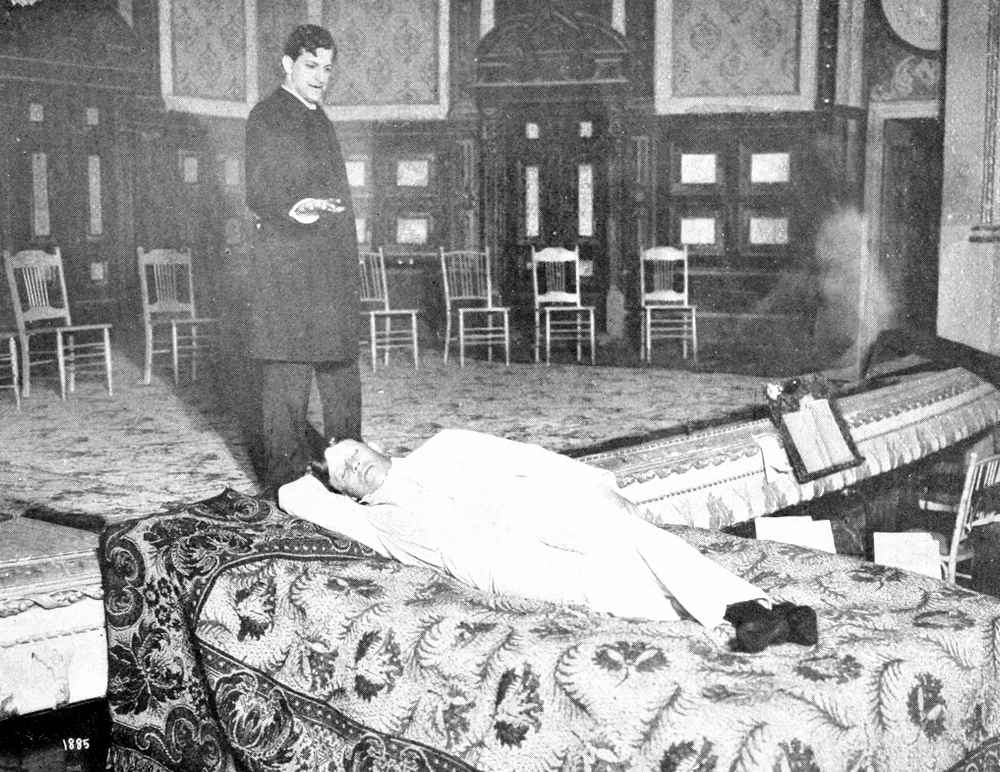
Now comes the strange part. This clever (?) fellow, like the clever (?) public, told all about the eating, never once mentioning thirst. Man can go fifty or sixty days without food, but must have liquids. Being for seventy-two hours without water or liquids will always produce insanity, except through hypnosis. In these exposés nothing has ever been said as to the method used to give [Pg 237]them water. Nothing has been said as to the emptying of the bladder. If food is taken into the stomach and digested, the secretions must be at work; if the secretions are at work, the bowels will move. These things were all overlooked in these exposés; the stories were told of tubes in the bed, as to procuring food, et cetera, but nothing was said of how the subject’s system was freed of the waste from the food given him.
A story was told of his lying in a cage; this act I have never performed, but have proposed it, agreeing, if the profession desired such a test, to lay a naked subject on a sheet on a bed, put a cage over all, and seal it to the floor so as to demonstrate that nothing was passed to the subject; but the wise and learned medical profession cared for no test that demonstrated, through suggestion, the possibility of suspending hunger, thirst, bowel and kidney action; such knowledge they did not care to learn as it contradicted their teachings.
During the New York sleep, made by Kilmer, he was watched night and day by relays of students from Bellevue Hospital. When arrangements were being made, one student, who hoped to graduate that spring, insisted on having charge of the entire affair, which, finally, was agreed upon. I had nothing to do with the arrangements, which were made by my manager, whom I had only known a week. If it were a “fake,” it is strange that I should allow the details to be handled by a stranger. This would-be doctor took charge of the sleeper, stayed up some forty-eight hours, when off watch, hiding in a box to catch us feeding [Pg 238]him. On the Wednesday night when he stood before the audience and told them that the experiment was fair, and that I had done as claimed, he was very angry. When he took charge, he told his chums that he would expose the fraud and thereby get a big advertisement for himself when he began practicing, but when he found out there was no fraud to expose, he regretted the loss of sleep and the time wasted; and later presented a bill to me for services rendered, which bill as yet is unreceipted.
The thought that a man with a “fake” would, could or dared to open at Hammerstein’s with the proposition that I made is ridiculous. The sleeper to be examined, weighed, and watched from being naked to putting on a sound pair of silk tights, a silk shirt, a pair of silk pajamas, to lie on a large mattress covered with a crumb cloth (all previously examined), and for no one but the committee to touch the subject, I not going nearer than five feet from him (giving my exhibition on the stage would bring me that close). The thought of it being other than genuine could only appear in the “mind” of an ignoramus, or some one looking for newspaper notoriety.
During the test of a twenty-four hour sleep made for the New York Herald (no test being of any value of less than seventy-two hours), the wise doctors who knew nothing of hypnosis, tested this subject as to his feeling. For Heaven’s sake, what has feeling to do with hypnosis? They stuck pins into him, they dropped water on his eyelids; they put him through all kinds of torture, but through [Pg 239]pure fortitude (?) he stood it. When this is possible all laws of suggestion can be overcome. When “normally,” a man can control what the doctor calls his reflexes, he is worthy of more money than he got out of the alleged exposé.
One wise (?) doctor called to him that there were rats in the room, and because the subject did not respond, said he was not in hypnosis, because the hypnotized subject responds to “suggestion.” Why, if the subject could hear and respond to him he would be awake, because that is what constitutes the waking state. The subject did not hear him, did not respond to him, thereby proving that he was in hypnosis. After the subject was awakened, they asked him if he did not suffer severe pain while they dropped water on his eyes; and, like a good liar, he said, “Yes,” the answer being put into his mouth by the question asked. Why, if he suffered from the dropping of the water on his eyelids the reflexes would have acted, the doctors would have seen it, and the subject could not have endured it. But this subject knew what he was up against, that the doctors were not testing him as to hypnosis, but were simply there to prove their views as to suggested anesthesia, he taking the pre-inspiration that he would sleep for the twenty-four hours and suffer no pain, which he did. The wise (?) doctors named everything that he did and then asked him a question; or, in other words, they put the answers in his mouth, which he gave them, taking his word for it that he could endure pain and suspend his reflex actions without hypnosis. These doctors knew this to be an impossibility, yet [Pg 240]the desire for newspaper notoriety was so strong that they pretended to accept this degenerate’s word. Assuming that he could do so, proved nothing. Lack of feeling is not hypnosis. How can a man prove or disprove something which he knows nothing about? I, myself, could prove no hypnotist to be a fake; all that would be possible for me to do would be to force the hypnotist to produce a phenomenon that would be satisfactory to me.
I perform many operations on hypnotized subjects. The two severest are the stretching of the rectum and the cutting around the tender phrenum. With the first I always get a groan, with the other a very pronounced reflex action, and yet when the subject awakens he remembers nothing of it. The extent of pre-inspiration I do not know, but in my long years of experience, have met with but three, viz.: no feeling, rigidity, awakening.
These alleged exposés have all been good advertising, inasmuch as intelligent people are in no hurry to take the word of one who has nothing at stake against one who has everything.
The wisdom (?) of the general public is highly amusing. If you want to feel sorry for mankind stand in front of a show window where a subject is asleep. A certain percentage of these know he is not asleep, “because he is placed there;” the next is certain he is not asleep because he moves (no man moves in his sleep); and some ladies are certain to go by and claim he is not asleep because he breathes. These three are the chief explanations as to why the subject is not asleep. Everybody [Pg 241]asks how he is fed, and will he not be hungry when he awakens? No one appreciates the absence of thirst. If everything is a combination of attributes, a condition or combination must be produced in the subject that has these functions suspended. The suspension of hunger and bowel action are easily explained, but I have no explanation to offer as to the suspending of thirst and kidney action, knowing only that with a subject who has perfect confidence in me I can suspend the four functions for a period of seven days and longer.
My subject will awaken in a bright and strong condition; his bladder will be perfectly empty and the first drink of water he takes will pass through him within ten minutes. The subject is lying in hypnosis, with the thought that he will have no hunger, no thirst, no bowel or kidney action, and will awaken on the seventh day. This thought being locked in the “mind,” the action that is part of it is certain to take place.
This sleeping act was suggested to me in Xenia, Ohio, by a child asking about the picture of a bear sleeping all winter in a cave. It occurring to me that if a bear could “sleep” all winter, a man could sleep a week. I experimented and succeeded.
While lecturing in New York City, as a rule I concluded my lecture by giving some demonstrations with a subject, and also having a subject pre-inspire himself with the thought of “no feeling,” and stick pins into himself, demonstrating my claims as to the so-called Auto-suggestion of the alleged exposers. After doing this at a lecture [Pg 242]one night, an old “horse” came upon the platform and informed me that he could stick pins into himself. While I was getting my wraps, the president of the society for whom I was lecturing wagered this young man that he could not do so. The young man did and won the money. What is the use of trying to teach the people anything? After you read this book, I am afraid that you will know but little more than you did before you started, as it is impossible to put in through one sense what “nature” intended to put in through another. It seems that the president of this society, although seeing the demonstration made, was not satisfied until he had lost a five-dollar bill. The same with you reading this book unless you take a subject (providing you are capable), and demonstrate to yourself the truth I have told, you have simply absorbed a lot of words, which, of themselves, mean nothing. I know one very brilliant man who, notwithstanding he acknowledged that expression was the result of thought, that there could be no expression without thought, turned around and asserted that he believed a subject could “fake.” What to do with such people, how to convince them I do not know. Man’s comprehension is only to the extent of his experience. Try to simulate and see if it is possible; try to laugh and put the real ring into it, and see if you can; try to cry and see if you can get the tone.
I spend months conceiving a condition possible to be produced in a subject, sometimes doing much experimenting to find the proper inspiration to give him to produce the result desired, and any [Pg 243]hypnotist who will have the inspiration taken in shorthand, can repeat the experiment, stealing the result of my thought, yet they never give me credit for any of my originations. I did the sleeping act a year before any hypnotist ever dreamed of reproducing it. In fact, until they had taken subjects who had traveled with me and had learned how to give the inspiration, they were doubtful as to its being accomplished, and, with the general public, believed it to be a trick. They are welcome to the inspirations, yet it is no more than just that they should give me credit for them.
In the Middle States, many wise (?) doctors are every day expecting me to kill some subject with my crazy (?) experiments. They wonder how I have continued so long without doing so, failing to appreciate that I possess knowledge of a law, and am not, like them, working in the dark; that my physiology is correct, and neither myself nor the subject I am experimenting with are taking any chances.
I direct the temperature of a subject so low that an ordinary clinical thermometer will fail to register it, thus proving that the accepted theory that combustion produces the heat of the body is wrong. When I reported this to a certain hospital, the wink was passed around, none of them daring to contradict me, inasmuch as they knew I had always succeeded in making good my claims. It happened the night that one of the internes, who was quite a clever amateur, had begun his vacation, and he accomplished in twenty-four hours what I did in twenty minutes; yet I had to conceive it was [Pg 244]possible to do so. Our physiologists are wrong from beginning to end, and I state this unreservedly.
In New York, when I explained that “no feeling” was produced by the sympathetic nerves closing over the cerebral nerve-ends and insulating them, it was declared, “Very ingenious, but very unscientific.” Thank Heaven for that! All drug anesthesia is produced by congestion, by forcing the Sympathetic System to insulate the cerebro-spinal nerve-ends or centers, and I challenge the scientific (?) world to demonstrate otherwise.
Dear reader, a superficial reading of this book is time wasted; read and reread, and every time you will find more truths. Can you comprehend them, now they are offered you? The simplest of words have been used, my best has been done to comprehensively correlate the thought offered; yet you must keep referring back, and if you persist, some day the entire philosophy will dawn upon you, and you will say, “Oh, how simple (all truths are simple), why did I not comprehend at first?” Because a new set of attributes has had to be separated so that you could perceive, then conceive, and, lastly comprehend them.
Comprehension—look it up in the dictionary; and, if you can comprehend the definition, you can do more than I. What is comprehension? It is the comparing, realizing, having memories to be aroused with which to compare those of which I am writing. If our memories are slight, our comprehension will be correspondingly slight. To understand or comprehend anything, its attributes [Pg 245]must be parted and associated with those of our sense impressions. The larger the number of the attributes “appreciated,” the greater our comprehension. We have been taught Law of Nature, Hand of God, Free Agency, Responsibility, Will Power, all of which are incomprehensible, inasmuch as we have no sense impressions with which to compare them; consequently, they are but incomprehensible words.
Nothing but matter is appreciable, as all impressions received or forwarded can act only through matter.
Space, eternity, beginning and end, destruction, are mere words. Destruction of matter is an impossibility, and what you call destruction is but the dissolution of form, nothing else.
Man is individual only as to form; all of which he is composed is from his environment, of which he is necessarily a part. The individual parts that compose his entirety to-day will be different to-morrow, for even our alleged scientists tell us of waste; we know in part of the supplies—food, yet we fail to comprehend the Law of Suggestion.
As we subsist on all lower (?) matter, gaseous, mineral, vegetable and “animal,” we surely are of all of them. As an individuality, our importance is no greater nor less than that of a grain of sand on the sea shore.
Why, then, should we live? We have never been dead, neither can we die. We have always been, are, and always will be, inasmuch as that of which we are composed has always and ever will exist. We are a part of the Universe (the matter) that [Pg 246]for a time in this form will abide. Our so-called consciousness is not of itself greater than that of other “living” matter. We are simply a conglomeration of lesser form of life, and nothing more. By what right, through what sense proof, do we dare to place ourselves above That of which we are; That, that gave us our parts, attributes; That, that continues to supply and relieve us, lest we disintegrate? How dare we claim to be other than of our environment; of the whole, the all, God, good?
We have no conception or comprehension of spirit, soul; they are but words. The soul, the spirit, if it be, must naturally be of the ALL. And yet we dare to assume it to be inherent in ourselves, and to be separate gods of our own. No, no, that cannot be; like Caesar we are too ambitious, and like Caesar, we will fall.
This may seem harsh; yet truth, though it hurts, never injures.
He who comes among us with something “new,” is a disturber, and, therefore, should be crushed. The Nazarene was crucified, not by the Jews, although they were afraid of him. They said, “He is of us, and a disturber. We will suffer if He continues.” Pontius Pilate, representing the authorities at Rome, killed Him for disturbing the accustomed ways.
Gallileo was banished.
Jean Jacques Rosseau was pursued from hamlet to hamlet; yet were it not for him, there would be no United States of America, or Republic of France. He gathered the thought and gave it to the world.
[Pg 247]
Hahnemann was driven from pillar to post, yet the truth he discovered is and always will be.
Life is a broad highway where the masses follow; perhaps twice, and never more than three times in a century, some one strays away, out of the highway, and starts over the mountain. The moment he has gone far enough for the masses to see him, they call, “Come back, you fool, you will be lost!” and if he fails to turn, they stone him “to attract his attention,” or to kill him lest he be lost and die. The world, the masses, are kind (?), they want to protect the “fool” from destroying himself; they would rather destroy him. After the “fool” has successfully crossed the mountain, another “fool” follows in his pathway; soon more “fools” follow, and at last the masses go, each and every one saying, “I knew he would cross all right, he was too ‘smart’ a fellow to attempt crossing if he was not sure of getting there.”
This is history.
Why was this book written? I am a fatalist, believing that what is, was to have been; that our duty is to impart, to lead others over the path we have discovered, and if we can only make that pathway clear to a few “fools” who will follow as we have gone, I believe I will have responded to my suggestion. I believe myself to be blessed with at least “fair” conception, and to quote from Omar Khayyam:
[Pg 248]
I love man, and, through my hypnotic experience, found that he was not as described by our scientific thinkers (?), so began to study him in my unscientific way, and having learned somewhat of him, am forced to offer to the world this thought as to the Law of Suggestion.
First, place your subject, then give him the attributes. Reader, this book is written to place you. Should more attributes be desired, they will be furnished you.
Man does not choose; he knows of no ill until he has conceived of good. He must be led; and it is the duty of man, after conceiving, to lead his fellow man.
ALL RIGHT!