Large-size versions of illustrations are available by clicking on them.
![[Cover]](images/cover.jpg)
The Story of Cairo
First Edition, April 1902
Second Edition, April 1906
All rights reserved
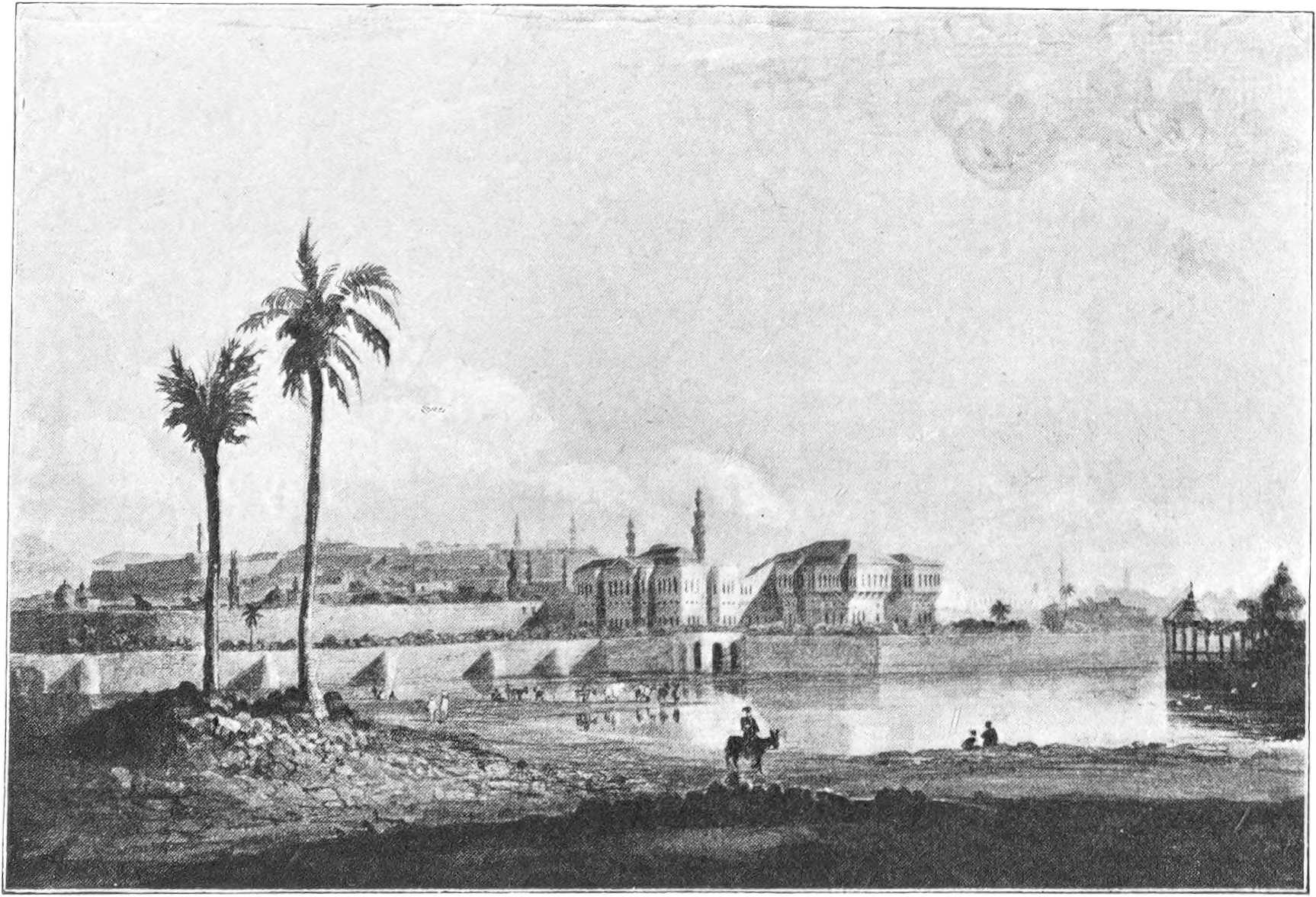
Cairo from the South-west: the Lake of the Elephant (Birkat-el-Fil)
The Story of Cairo
by Stanley Lane-Poole
Litt.D. M.A. Professor of Arabic
at Trinity College Dublin
![[Decoration]](images/title.jpg)
London:
J. M. Dent &
Co.
Aldine House 29 and 30 Bedford Street
Covent Garden W.C.  1906
1906
[vii]PREFACE
CAIRO is in the fullest sense a mediæval city. It had no existence before the Middle Ages; its vigorous life as a separate Metropolis almost coincides with the arbitrary millennium of the middle period of history; and it still retains to this day much of its mediæval character and aspect. The aspect is changing, but not the life. The amazing improvements of the past twenty years have altered the Egyptian’s material condition, but scarcely as yet touched his character. We have given him public order and security, solvency without too heavy taxation, an efficient administration, even-handed justice, the means of higher education, and above all to every man his fair share of the enriching Nile, χρυσορρόης in the truest sense, without which nothing else avails. For all these, and especially the last, the peasant is grateful in his way, when their merits are pointed out to him; but not so the Cairene. The immediate blessings of the irrigation engineer are not so prominently brought to bear upon his pressing wants, and for the other reforms of the Firengy he cares very little. I should be sorry to draw any discourteous comparisons with “the Ethiop,” but whatever time and association with Europeans may do for the comely, and to my taste none too swarthy, skin of my Cairo friend, I am convinced that he will keep his old unregenerate mediæval heart in spite of us all.
Happily for purposes of study (I am not treating of[viii] ethics), the East changes very slowly, and the soul of the Eastern not at all. The Cairo jeweller, who will chaffer with you for an hour over a few piastres, though he mixes reluctantly, shrinkingly, in the crazy, bustling twentieth century life of Europe that rushes past him, is not of it. In his heart of hearts he looks back longingly to the glorious old days of the Mamlúks, to which he essentially belongs, and regrets the excitements of those stirring times. What good, he asks, comes of all this “worry”? Justice? More often a man had need of a little injustice, and a respectable tradesman could usually buy that from the Kady before these new tribunals were set up. As to fixed taxes and no extortion, that is chiefly a matter for the stupid fellahín; and after all the old system worked beautifully when you shirked payment, and your neighbour was bastinadoed for your share. Then all this fiddling with water and drains and streets; what is it all for? When Willcocks or Price Bey have put pipes and patent traps and other godless improvements into the mosques, will one’s prayers be any better than they were in the pleasant pervasive odour of the old fetid tanks? The streets are broader, no doubt, to let the Firengis, Allah blacken their faces! roll by in their two-horsed ‘arabíyas and splash the Faithful with mud; but for this wonderful boon they have taken away the comfortable stone benches from before the shops, and the Cairo tradesman misses his old seat, where unlimited keyf and the meditative shibúk once whiled away the leisure of his never pressing avocations. No; pure water and drains, and bicycles and tramcars, and a whole array of wretched little black-coated efendis pretending to imitate the Káfirs may be all very well in their place, but they are ugly, uninteresting things, and life at Cairo has been desperately dull since they came in.
[ix]In one of the suggestive essays in his delightful book on “Asia and Europe,” Mr Meredith Townsend has shown how interesting life must have been in India before England introduced order and all the virtues. The picture might have been drawn in Cairo with trifling alterations. Life undoubtedly was interesting in the old unregenerate days. There were events then; something to see and think of, and possibly fly from; plenty of blood and assassination, perhaps, but then you could always shut and bar the strong gates of the quarter, when the Mamlúks or the Berbers, or, worst of all, the black Sudánis, were on the war-path. Now the gates are taken away, and there are no cavalcades of romantic troopers, beautiful to behold in their array, to ravish your household and give colour to life. In those days it was possible for any man of brain and luck to rise to power and wealth, such wealth as all Cairo could not furnish in these blank and honest times; promotion was ever at hand, and the way was open to the strong, the cunning, and the rich. What were a holocaust of victims, an orgy of rapine, even the deadly ravages of periodical plague and famine, in comparison with the great occasions, the gorgeous pomp, the endless opportunities, the infinite variety of those unruly and tumultuous but never tedious days?
This is what the true Cairene meditates in his heart. His ideas, for good or ill, are not as our ideas; they date back from the Middle Ages, like his dress, his religion, his social habits, his turns of speech, his calm insouciance, his impenetrable reserve, his inveterate negation of “worry.” Outside the official class he is still the same man whom we saw keeping shop or taking his venture to sea in the faithful mirror of the Arabian Nights. Even his city preserves its mediæval tone. Much has been destroyed by time or innovation,[x] but the European fringe is still a fringe, and the old Muslim city for the present defies western influences. It has been rebuilt time after time, and every fresh rebuilding will take away more of its charm; but enough remains to show us what Cairo was five hundred years ago. The crowded streets of the old quarters, the immemorial character of the houses and markets, above all the historical monuments, carry us back to the Middle Ages.
The aim of these pages is to clothe the vestiges of the mediæval city with the associations that lend them their deepest interest. Many of the buildings of Cairo, especially the later mosques of the Mamlúk period, are exquisitely beautiful, and may be admired as works of art without regard to their history. But there are many more, ruined courts, crumbling arcades, mere fragments of walls or inscriptions, which appeal rather to the archæological than the æsthetic sense, and must be almost meaningless until their story is revealed. In tracing the growth of Cairo I have tried to surround the remains of its buildings with the atmosphere of their historic associations. Mere topography has charms for the antiquary alone; it is only when the material growth of a city is interwoven with the life of its people and the character of its rulers that topography acquires an interest for all. At the same time I have sought to keep closely to the subject—the growth and life of the city. This is no general history of Egypt, and many things are passed by because they bear no intimate relation to the development of its capital.
The authorities upon which I rely are sufficiently cited in the footnotes. The greatest Arabic source is of course the elaborate Khitat of el-Makrízy, frequently referred to as “the Topographer,” who wrote in the early years of the fifteenth century, but used various topographical and historical works of much[xi] earlier date, many of which are not otherwise accessible. The remarkable accuracy, completeness, and research of his detailed description of Cairo need no praise of mine: they are universally recognised. Other writers, such as el-Mas‘údy, Násir-i-Khusrau, ‘Abd-el-Latíf, Ibn-Gubeyr (the extracts from whom I owe to the kindness of my friend, Mr Guy le Strange, the historian of Baghdád, and our most learned authority on the geography of the caliphate), Ibn-Sa‘íd, Ibn-Dukmak, es-Suyúty, Abu-l-Mahásin, el-Isháky, el-Gabárty, fill up the picture, and add valuable, personal, and contemporary touches. Lane’s “Cairo Fifty Years Ago” has the merit of presenting an account of the city as it was in 1835, before the Europeanizing movement begun by Mohammad ‘Aly, and carried to the extreme by Isma‘íl, had had time to work much change in the characteristic aspect of the town. In archæology I am especially beholden to the researches of MM. Max van Berchem, Ravaisse, and Casanova. One exception I must note to the generally full references to my sources. There is something repugnant, if not to modesty at least to the sense of propriety, in frequently citing one’s own books. Writing constantly on the subject of Cairo, its art, its monuments, and its history, for many years past, it was inevitable that I should sometimes repeat what I have said before: indeed, when we have written what we have to say in the best shape that we are able to devise, it seems mere affectation to try to seek a different form of expression. I have therefore quoted, but sparingly, from my “Art of the Saracens in Egypt” (published for the Committee of Council in 1886), my “Cairo Sketches” (3rd ed., Virtue, 1898), my “History of Egypt in the Middle Ages” (Methuen, 1901), and any extracts to which no footnote is appended must be understood to refer to[xii] one of these books, generally the “History.” I trust I may be permitted to say that for a more complete account of the history than would be possible or desirable in the present volume the student should consult the last of the three books above cited. Were there any other work in English of similar scope I would gladly substitute its title. For a much more detailed narrative of the history of the Copts than could be here included the reader may turn to Mrs Butcher’s “Story of the Church of Egypt” (2 vols., Smith, Elder & Co., 1897), a work full of sympathy and appreciation for a neglected and persecuted community, though open to criticism in its Mohammedan relations.
I have not troubled the reader with an elaborate system of transliteration of Arabic names. An acute accent is used merely to show where the principal accent falls, not necessarily to indicate a long vowel. The vowels are to be pronounced as in Italian, and the letter g is employed to represent the Arabic consonant that in Cairo is pronounced hard (as in get), but elsewhere usually soft (as j in jet). Those who are curious to know the exact transliteration should turn to the index, where every Arabic word is given in roman letters with diacritical points and distinction of the long vowels.
The illustrations have been chosen with a view to showing the mediæval city as far as possible before it suffered its European change. Nothing could be better for this purpose than the drawings made between 1826 and 1838 by Robert Hay of Linplum and by his companion Owen B. Carter (about 1830), the originals of which are preserved in the Print Room of the British Museum, and some were lithographed in Hay’s “Illustrations of Cairo.” These represent the mediæval remains as no modern sketches could depict[xiii] them, but Mr J. A. Symington has skilfully supplemented them, when no older drawings could be obtained.
In conclusion I should wish to draw attention to what I have said in the last chapter on the subject of the Commission for the Preservation of the Monuments of Arab Art. To its vigilance and unremitting labours during the past twenty years we owe the fact that the mosques and other remains of Saracenic architecture are secure from demolition, and, as far as the conditions admit, guarded from decay. Never in the history of Cairo have its monuments been in such safe keeping, and everyone must be grateful to each member of this invaluable committee. In the last five years, since Lord Cromer used his influence to improve its financial position, the Commission has been enabled to undertake very comprehensive works of scientific restoration, and all who visit Cairo should make a point of examining the results of its labours and inspecting the collections gathered under the care of its chief architect, Herz Bey, in the Museum of Arab Art.
STANLEY LANE-POOLE.
Trinity College, Dublin,
January 31st, 1902.
[xv]CONTENTS
| CHAPTER I | |
| PAGE | |
| The Two Cities | 1-31 |
| The European and the Egyptian Cairo, 1—Oriental Scenes, 2—The Conservative Tradesman, 6—His Shop, 7, and Home, 9—The Zuweyla Gate, 10—A Private House, 11—The Mandara, 14—Bedrooms, 17—Daily Life, 18—Women’s Life, 19—Cairo Festivities, 22—The Hasaneyn, 23—The Mohammad ‘Aly Street, 27—View from the Citadel, 28. | |
| CHAPTER II | |
| The Town of the Tent | 32-58 |
| Successive Cities at Cairo, 32—Arab Conquest, 34—Treaty of Amnesty, 35—The Ancient Misr, 36—Babylon and the Mukawkis, 37—The Copts, 38—Foundation of Fustat, “the Tent,” 40—Settlements of the Arab Tribes, 42—The Mosque of ‘Amr, 42—The Fortress of Babylon, 48—The Coptic Churches, 53. | |
| CHAPTER III | |
| The Faubourgs | 59-90 |
| The Caliphs’ Governors, 59—Helwan, 61—Treatment of Christians, 61—Monasticism, 62—Conservatism of the Copts, 64—The ‘Abbasid Faubourg el-‘Askar, 65—‘Abbasid Governors, Ibn-Memdud, 66—‘Abdallah ibn Tahir, 67—The Caliph Mamun in Egypt, 68—Persecutions of Muslims and Copts, 69—The Turkish Governors, 70—Their encouragement of Art, 71—Ahmad ibn Tulun, 72—The new Faubourg el-Katai‘, 75—The Aqueduct, 77—Mosque of Ibn-Tulun, 78—Sources of Saracen Architecture, 85—Ibn-Tulun’s Wars, 86—Khumaraweyh’s Palaces, 87—Egypt recovered by the Caliphs, 89—The Castle of the Ram, 90. | |
| [xvi]CHAPTER IV | |
| Misr | 91-112 |
| Misr-Fustat the Commercial Capital, 91—The Madara’y Ministers, 92—The Ikhshid, 93—Mas‘udy in Egypt, 95—The Island of Roda, 96—Divines at Misr, 97—Poets, 98—Kafur’s Court, 100—Mohammedan Revels, 102—Kafur’s Government, 103—Misr in the 10th and 11th Centuries, 104—Nasir-i-Khusrau’s Description, 107—The Burning of Misr, 110—Partial Recovery, Ibn-Sa‘id’s Description, 111. | |
| CHAPTER V | |
| Cairo | 113-163 |
| The Shi‘a Revolution, 113—The Fatimid Caliphate, 116—el-Mo‘izz, 116—Conquest of Egypt, 117—Foundation of el-Kahira, Cairo, 118—Effects of the Revolution, 119—The Copts under the Fatimids, 120—el-‘Aziz, 121—The Azhar University Mosque, 123—The Palace-city, 125—The Great Palace, 127—The Gates of Cairo, 129—Bab-Zuweyla, 129—William of Tyre’s description of the Fatimid Court, 130—The Port of Maks and the Fleet, 132—Wealth and Art and Luxury of the Fatimids, 133—Mosque of el-Hakim, 137—The Caliph Hakim, 139—The Hall of Science, 142—Apotheosis of Hakim, 142—Military Tyranny and Loss of Provinces, 144—Cairo in 1047—Cutting the Dam, 145—el-Yazury, 146—Spoliation by the Turks, 147—The Seven Years’ Famine, 148—Bedr el-Gemaly, 149—The Second Wall and Gates of Cairo, 150—Armenian Ministers, 154—The Rule of Vezirs, 157—Murders and Military Despotism, 158—Ibn-Ruzzik, 159—Fatimid Architecture, 159. | |
| CHAPTER VI | |
| Saladin’s Castle | 164-192 |
| Causes of the Invasion of Egypt, 164—Turks and Crusaders, 167—Shawar and Dirgham, 168—Amalric and Shirkuh in Egypt, 169—Saladin Vezir, deposition of the Fatimid Caliph, 170—Saladin’s Campaigns, 172—His Work at Cairo, 173—The New Walls, 174—The Citadel, 175—The Dike of Giza, 180—Risings at Cairo, 181—The Head of Hoseyn, 182—Saladin establishes Medresas or Orthodox Colleges, 183—Ibn-Gubeyr’s Account, 184—The Hospitals, 186—Characteristics of Mosques and Medresas, 187—Results of the Restoration of Orthodoxy and encouragement of Learning, 190. | |
| [xvii]CHAPTER VII | |
| The Dome Builders | 193-254 |
| Saphadin el-‘Adil, 193—Great Famine, 194—Invasion of Crusaders, 195—Frederick II and Kamil, 196—The Mamluk System, 197—Queen Sheger-ed-durr and the Bahry Mamluks, 198—Crusade of Louis IX, 201—(i) The Turkish Mamluks, 202—Their Wars against Mongols, 203, and Franks, 205—Revival of ‘Abbasid Caliphate, 206—Beybars, 206—The Mamluk Court, 209—Turbulence of Emirs, 210—The House of Kalaun, 211—En-Nasir, 212—Toleration of Christians, 216—Popular Fanaticism, 217—Incendiaries, 218—Nasir and Abu-l-Fida, 220—Artistic Production, 220—Mosques, 223—Emirs’ Mosques, 224—Early Mamluk Style of Architecture, 227—Sultan Hasan, 228—His Great Mosque, 231—(ii) The Circassian Mamluks, 235—Corruption, 236—Wars, 237—Cultivated Tastes, 238—Architecture, 238—Kait-Bey, 241—His Buildings, 245—Mosque intra muros, 246—Wekala, 249—Mosques of Emirs and of Kady Ibn-Muzhir, 250—The Modified Medresa, 250—Buildings of el-Ghury, 253—Ottoman Conquest, 254. | |
| CHAPTER VIII | |
| The City of the Arabian Nights | 257-286 |
| Expansion of Cairo, 257—Rise of Bulak, 258—Suburban Mosques, 259—The Approach from Bulak, 260—The Thousand and One Nights redacted in Cairo, 261—The Transit Trade of Egypt, 263—Merchants’ Inns, 265—The Khan el-Khalily, 266—The Khan of Mesrur, 269—The Wekala Kusun and the Flower Market, 270—Streets and Quarters, 271—The Art of Silver Inlay, 272—Cairo Metal Work, 277—Venice, 279—Wood-carving, 281—Meshrebiya turning, 284—Characteristics of Saracenic Art, 285—Men of Letters in the Mamluk Period, 286. | |
| CHAPTER IX | |
| Beys and Pashas | 287-314 |
| Mamluk Emirs (Beys) still in power, 287—Pasha helpless, 288—Street Fights, 289—‘Othman Bey, 289—Rudwan el-Gelfy, 290—The Sharaiby family, 292—Libraries, 295—State of Learning, 296—Fanaticism and Superstition,[xviii] 297—Mosques of the Ottoman Period, 298—‘Aly Bey, 298—‘Abd-er-Rahman Kiahya, 298—Mohammad Bey Abu-dh-Dhahab, 301—Mohammad ‘Aly, 302—Confiscation of Wakf Trusts, 302—The Commission for the Preservation of the Monuments of Arab Art, 303—Report to Lord Cromer, 303—Preservation, 305—Restoration, 309—Lord Cromer’s Action, 313—Grants from the Public Debt Commissioners and the Egyptian Government, 313. | |
| Rulers and Monuments of Cairo | 317-322 |
| Table for converting Hijra Years into Anni Domini | 323-327 |
| Index | 329-340 |
[xix]ILLUSTRATIONS
| PAGE | |
| Lake of the Elephant: Birkat-el-Fil. | |
| O. B. Carter (c. 1830) | Frontispiece |
| Court of a Private House. | |
| J. A. Symington (1902) | 15 |
| The Citadel. | |
| J. A. Symington | 29 |
| Court of the Mosque of ‘Amr. | |
| J. A. Symington | 45 |
| Gate of Kasr-esh-Shema‘ (Babylon). | |
| O. B. Carter | 51 |
| Tower of the Mosque of Ibn-Tulun. | |
| O. B. Carter | 73 |
| Within the Mosque of Ibn-Tulun. | |
| J. A. Symington | 81 |
| Detail of Ornament in Mosque of Ibn-Tulun. | |
| J. A. Symington | 84 |
| Street in Old Misr. | |
| J. A. Symington | 105 |
| Ruined Mosque of el-Hakim. | |
| J. A. Symington | 135 |
| Gate of Succour: Bab-en-Nasr. | |
| O. B. Carter | 151 |
| Minarets over Gate of Zuweyla. | |
| O. B. Carter | 155 |
| Mosque of el-Guyushy. | |
| O. B. Carter | 161 |
| Plan of Cairo before 1200. | |
| After Ravaisse, etc. | 165 |
| Castle of the Ram: Kal‘at-el-Kebsh. | |
| O. B. Carter | 177 |
| [xx]Plan of Medresa. | |
| After Murray | 190 |
| Island of er-Roda. | |
| Robert Hay (c. 1830) | 199 |
| “Joseph’s Hall”: Palace of en-Nasir in Citadel, with his Mosque in background. | |
| Robert Hay | 213 |
| Aqueduct and House of the Seven Watermills. | |
| Robert Hay | 221 |
| Mosque of Sultan Hasan. | |
| O. B. Carter | 225 |
| Gateway of Sultan Hasan’s Mosque. | |
| O. B. Carter | 229 |
| Tomb-Mosque of Barkuk and Farag. | |
| J. A. Symington | 233 |
| Eastern Cemetery: so-called “Tombs of the Caliphs.” | |
| J. A. Symington | 239 |
| Mosque of Kait-Bey. | |
| J. A. Symington | 243 |
| Tomb-Mosques. | |
| J. A. Symington | 247 |
| Tombs of the Mamluks. | |
| J. A. Symington | 251 |
| Sketch-plan showing growth of Cairo. | |
| After E. W. Lane (1835) | 256 |
| Slave Market. | |
| O. B. Carter (figures by H. Warren) | 267 |
| In the Darb-el-Ahmar. | |
| J. A. Symington | 275 |
| Street near Bab-el-Khark. | |
| O. B. Carter | 293 |
| A Muslim Graveyard. | |
| J. A. Symington | 315 |
| Map of Cairo | At end |
[1]The Story of Cairo
![[Decoration]](images/decor1.jpg)
CHAPTER I
The Two Cities
THERE are two Cairos, distinct in character, though but slenderly divided in site. There is a European Cairo, and there is an Egyptian Cairo. The last was once El-Káhira, “the Victorious,” founded under the auspices of the planet Mars, but it is now so little conquering, indeed has become so subdued, that one hears it spoken of as “the native quarters,” or even in Indian fashion as “the bazars.” In truth European Cairo knows little of its mediæval sister. Thousands of tourists, mounted on thousands of donkeys, do indeed explore “the native quarters” every winter, but these do not belong to European Cairo; birds of passage they are, not inhabitants. The true resident, who has his cool shaded house and breezy balcony in the Isma‘ilíya quarter, surrounded by hundreds of similar comfortable villas, does not by any chance ride donkeys, and is only dragged to “the bazars” rarely and with obvious reluctance by the importunity of some enthusiastic visitor. But even in European Cairo there are signs that another Cairo, an Oriental, Muslim Cairo, exists not far away. Let the English colony keep never so closely to itself and[2] ignore “the native quarters,” except as objects for just government and wise reforms, it cannot walk abroad, or even open its ears in its own chambers, without becoming conscious of the true Oriental world in which it lives but of which it is not. Go to the Post Office, a few minutes’ walk from most of the hotels, and you are at once in a medley of East and West.
A German nursemaid, accompanied by the little daughter of the family, is asking for letters at the arrivée window, and an old sheykh in kaftán and turban is negotiating a money-order or a registered letter at the next bureau. Over the way a row of public letter-writers sit at their tables on the sideway, gravely imperturbable, awaiting illiterate correspondents. In the street, omnibuses and tram-cars rumble by, blowing strident horns; but the passengers who sit on the seats beneath the awning are not Europeans—they are Egyptians, efendis, clerks, shopkeepers, sheykhs, often simple fellahín come to town on business and driving in from Bulák or Kasr-en-Nil. On the footpaths—always uneven and often muddy, in curious contrast to the roads, which are kept clean by circular brushes and little girl scavengers—the European element, Greek, German, Italian, chiefly, is intimately blended with the Oriental: Sudány women closely veiled with the white burko‘, which sets off their swarthy brows and black eyes to advantage; Egyptian girls in blue gowns and black veils hanging loose and allowing the well-formed neck and line of cheek and chin to be seen, whilst concealing the only part a woman scrupulously hides in the East, her mouth; horrible blear-eyed old harridans, veiled with immaculate precision, squatting in rows against the house-fronts; Bedawis striding along in the roadway with the striped kufíya wound round their heads;[3] strings of camels tied together, laden with bersím, the rich fodder of Egypt, and driven by the smallest of urchins; petty Government clerks, or efendis, clad in stambúly and tarbúsh, hunched up on donkey-back; all classes and ages and sexes mingled together in a jostling, perspiring, but good-tempered crowd; and everywhere the pungent pervasive odour of the East.
Even in the European quarters you still meet the veritable Eastern sights and sounds. As you look out of your hotel window you will see a native musician sauntering by, twanging the lute of the country; then a sound like the tinkling of baby cymbals informs you that the sherbétly is going his round, with his huge glass-jar slung at his side, from which he dispenses (to the unwary) sweet sticky drinks of liquorice juice or orange syrup in the brass saucers which he clinks unceasingly in his hand. Late at night sounds of Eastern life invade your pillow: the “rumble of a distant drum” tells you that a wedding party is perambulating the streets, and if you have the curiosity to sally forth you will be rewarded by one of the characteristic sights of Cairo, in which old and new are oddly blended. Probably a circumcision festival is combined with the wedding to save expense; and the procession will be headed by the barber’s sign, a wooden frame raised aloft, followed by two or three gorgeously caparisoned camels—regular stage-properties hired out for such occasions—carrying drummers, and leading the way for a series of carriages crammed with little boys, each holding a neat white handkerchief to his mouth, to keep out the devil and the evil eye. Then comes a closed carriage covered all over with a big cashmere shawl, held down firmly at the sides by brothers and other relations of the imprisoned bride; then more carriages and a general crowd of sympathizers. More rarely the bride is borne in a cashmere-covered[4] litter swung between two camels, fore and aft; the hind camel must tuck his head under the litter, and is probably quite as uncomfortable as the bride, who runs a fair chance of sea-sickness in her rolling palankin. In the old days the bride walked through the streets under a canopy carried by her friends, but this is now quite out of fashion, and European carriages are rapidly ousting even the camel-litters. But the cashmere shawl and the veil will not soon be abandoned. The Egyptian woman is, at least in public, generally modest. She detects a stranger’s glance with magical rapidity, even when to all appearance looking the other way, and forthwith the veil is pulled closer over her mouth and nose. When she meets you face to face, she does not drop her big eyes in the absurd fashion of Western modesty; she slowly turns them away from you: it is annihilating.
As soon as you have turned your back on the European suburb and the hotel region, and escaped from the glass shop fronts and Greek dealers of the Musky, the real Eastern city begins to dominate you. It is quite easy to lose oneself in the quaint old streets of Muslim Cairo when only an occasional passer-by reminds one that Europe is at the gates. A large part of Cairo is very little spoilt: it is still in a great degree the city of the Arabian Nights.
In that stall round the corner who knows but that the immortal Barber is recounting the adventures of his luckless brothers to the impatient lover on the shaving stool? At this very moment the Three Royal Mendicants may be entertaining the fair Portress and her delightful sisters with the story of their calamities, and if you wait till night you may even see the “good” Harún er-Rashíd himself—though it is true he lived at Baghdád—coming on his stealthy midnight rambles with prudent Ga‘far at his heels and black Mesrúr[5] to clear the way. A few streets away from the European quarters it is easy to dream that we are acting a part in the moving histories of the Thousand and One Nights, which do in fact describe Cairo and its people as they were in the Middle Ages, and as they are in a great measure still. In its very dilapidation the city assists the illusion. The typical Eastern houses falling to ruins, which no one thinks of repairing, are the natural homes of ‘Efríts and mischievous Ginn, who keep away god-fearing tenants. But if in its ruined houses, far more in what remains of its glorious monuments does Cairo transport us to the golden age of Arabian art and culture. Among its mosques and colleges and the scanty remnants of its palaces are the purest examples of Saracenic architecture that can be seen in all the once wide empire of Islam. Damascus and Ispahan, Agra and Delhi, Cordova and Granada, Brusa and Constantinople, possess elements of beauty and features of style which Cairo has not, and they enlarge and complete our understanding of Arab art; but to view that art in its purity, uncorrupted by the mechanical detail of the Alhambra, unspoilt by the over-elaboration of Delhi, we must study the mosques and tombs of Cairo.
The blessed conservatism of the East has happily maintained much of the old city in its beautiful ruinous unprogressive disorder. There are of course new houses and rebuilt fronts and even glass window-sashes; the exquisite meshrebíyas with their intricate turned lattice work are nearly all gone to make way for Italian persiennes, and the stone benches in front of the shops have disappeared in deference to the modern exigencies of carriages. But the general aspect of the streets has not seriously altered in recent years, and the people who press through the crowded lanes, or sit in their little cells of shops at the receipt of[6] custom, are unchanged. They dress as their ancestors dressed ages ago; their ideas and education are much what they always were, though the new schools are gradually infusing more modern notions; they are still as calm and easy-going and procrastinating as ever. The only conspicuous change is the dethronement of the time-honoured shibúk,—the long pipe of meditation and stately leisure and “asphodel and moly” and all that is implied in the ineffable dreamland of keyf,—in favour of the restless undignified cigarette; but nargílas and cocoa-nut pipes for hashísh are still in full play among the lower classes. The tradespeople are the conservative element in Egypt, as everywhere else. The upper classes are becoming every year less Oriental in outward appearance and habits. They dance with “infidel” ladies, wear Frank clothes, and delight in the little French pieces played in the Ezbekíya garden. Even their national coffee cups are made in Europe, and save for the red tarbúsh, and certain mental and moral idiosyncracies difficult to eliminate and unnecessary to describe, the Egyptian gentleman might almost pass muster in a Parisian crowd. It is the tradesman who recalls the past, keeps up the old traditions, and walks in the old paths. The course of the world runs slowly in the working East, and the Cairene shopkeeper has placidly stood still whilst the Western world joined in the everlasting “move on” of modern civilization.
“We shall find this stand-still mortal in one of the main thoroughfares of the city. Leaving the European quarter behind, and taking little note of the Greek and Italian shops in the renovated Musky, we turn off to the right into the Ghuríya—one of those larger but still narrow streets which are distinguished with the name of shari‘ or thoroughfare. Such a street is lined on either side with little box-like shops, which[7] form an unbroken boundary on either hand, except where a mosque door, or a public fountain, or the entrance to another street interrupts for a brief space the row of stores. None of the private doors or windows we are accustomed to in Europe breaks the line of shops. For a considerable distance all the traders deal in the same commodity—be it sugar-plums or slippers. The system has its advantages, for if one dealer be too dear, the next may be cheap; and the competition of many contiguous salesmen brings about a salutary reduction in prices. On the other hand, it must be allowed that it is fatiguing to have to order your coat in half-a-dozen different places—to buy the cloth in one direction, the buttons in another, the braid in a third, the lining in a fourth, the thread in a fifth, and then to have to go to quite another place to find a tailor to cut it out and sew it together. And as each dealer has to be bargained with, and generally smoked with, if not coffeed with, if you get your coat ordered in a single morning you may count yourself expeditious.
“In one of these little cupboards that do duty for shops, we may or may not find the typical tradesman we are seeking. It may chance he has gone to say his prayers, or to see a friend, or perhaps he did not feel inclined for business to-day; in which case the folding shutters of his shop will be closed, and as he does not live anywhere near, and as, if he did, there is no bell, no private door, and no assistant, we may wait there for ever, so far as he is concerned, and get no answer to our inquiries. His neighbour next door, however, will obligingly inform us that the excellent man whom we are seeking has gone to the mosque, and we accordingly betake ourselves to our informer and make his acquaintance instead.
“Our new friend is sitting in a recess some five feet square, and rather more than six feet high, raised a[8] foot or two from the ground; and within this narrow compass he has collected all the wares he thinks he is likely to sell, and has also reserved room for himself and his customers to sit down and smoke cigarettes while they bargain. Of course his stock must be very limited, but then all his neighbours are ready to help him; and if you cannot find what you want within the compass of his four walls, he will leave you with a cigarette and a cup of coffee, or perhaps Persian tea in a tumbler, while he goes to find the desideratum among the wares of his colleagues round about.
“Meanwhile, you drink your scalding aromatic coffee and watch the throng that passes by: the ungainly camels, laden with brushwood or green fodder, which seem to threaten to sweep everything and everybody out of the street;—the respectable towns-people, mounted on grey or brown asses, ambling along contentedly, save when an unusually severe blow from the inhuman donkey-boy running behind makes their beasts swerve incontinently to the right or left, as though they had a hinge in their middle;—the grandees in their two-horse carriages, preceded by breathless runners, who clear the way for their masters with shrill shouts—“Shemálak, ya weled!” (“To thy left, O boy!”) “Yemínik, ya Sitt!” (“To thy right, O lady!”) “Iftah ‘eynak, ya Am!” (“Open thine eye, O uncle!”) and the like;—the women with trays of eatables on their heads, the water-carrier with goat-skin under arm, and the vast multitude of blue-robed men and women who have something or other to do, which takes them indeed along the street, but does not take them very hurriedly. In spite of the apparent rush and crush, the crowd moves slowly, like everything else in the East.
“Our friend returns with the desired article; we approve it, guardedly, and with cautious tentative[9] aspect demand, ‘How much?’ The answer is always at least twice the fair price. We reply, first by exclaiming, ‘I seek refuge with God’ (from exorbitance), and then by offering about half the fair price. The dealer shakes his head, looks disappointed with us, shows he expected better sense in people of our appearance, puts aside his goods, and sits down to another cigarette. After a second ineffectual bid, we summon our donkey and prepare to mount. At this moment the shopman relents, and reduces his price; but we are obdurate, and begin riding away. He pursues us, agrees almost to our terms; we return, pay, receive our purchase, commend him to the protection of God, and wend our way on.
“But if, instead of going on, we accompany our late antagonist in the bargain to his own home, we shall see what a middle-class Cairene house is like. Indeed, a middle-class dwelling in Cairo may sometimes chance to be a palace, for the modern Pasha despises the noble mansions that were the pride and delight of better men than he in the good old days of the Mamlúks, and prefers to live in shadeless ‘Route No. 29,’ or thereabouts, in the modern bricklayer’s paradise known as the Isma‘ilíya quarter; and hence the tradesman may sometimes occupy the house where some great Bey of former times held his state, and marshalled his retainers, when he prepared to strike a blow for the precarious throne that was always at the command of the strongest battalions. But all Cairene houses of the old style are very much alike: they differ only in size and in the richness or poverty of the decoration; and if our merchant’s home is better than most of its neighbours, we have but to subtract a few of the statelier rooms, and reduce the scale of the others, to obtain a fair idea of the houses on either hand and round about.
[10]“The street we now enter is quite different from that we have left. We have been doing our shopping in the busy Cheapside of Cairo, and in full view of the lofty façade of the mosque of the Mamlúk Sultan El-Muáyyad. Its two minarets stand upon a fine old gate called Bab Zawíla (or commonly Zuweyla), which people now-a-days generally prefer to call the Bab el-Mutawélly, because it is believed to be a favourite resort of the mysterious Kutb el-Mutawélly, or pope (for the time being) of all the saints. This very holy personage is gifted with powers of invisibility and of instantaneous change of place: he flies unseen from the top of the Kaaba at Mekka to the Bab Zuweyla, and there reposes in a niche behind the wooden door. True believers tell their beads as they pass this niche, and the curious peep in to see if the saint be there; and if you have a headache, there is no better cure than to drive a nail into the door; while a sure remedy for the toothache is to pull out the tooth and hang it up on the same venerated spot. Perhaps pulling the tooth out might of itself cure the ache; but the suggestion savours of impiety, and at any rate it is safer to fix the molar up. The door bristles with unpleasing votive offerings of this sort, and if they were all successful the Kutb must be an excellent doctor.
“The street thus barred by the Bab Zuweyla is, for Cairo, a broad one; and shops, mosques, wekálas (or caravanserais), and fountains form its boundaries. In complete contrast, the street we are now to enter, as we turn down a by-lane and then wheel sharply to the left, has no shops, though there is a little mosque, probably the tomb of a venerated saint, at the corner. Its broad bands of red and white relieve the deep shadows of the lane, each side of which is composed of the tall backs of houses, with nothing to vary the[11] white-washed walls except the closely grated windows. On either hand still narrower alleys open off, sometimes mere culs-de-sac, but often threading the city for a considerable distance. In these solitary courts we may still see the meshrebíyas which are becoming so rare in the more frequented thoroughfares. The best lattices are reserved for the interior windows of the house, which look on the inner court or garden; but there are not a few streets in Cairo where the passenger still stops to admire tier upon tier and row after row of meshrebíyas which give a singularly picturesque appearance to the houses.
“The name is derived from the root which means to drink (which occurs in ‘sherbet’), and is applied to lattice windows because the porous water-bottles are often placed in them to cool. Frequently there is a little semi-circular niche projecting out of the middle of the lattice for the reception of a kulla or carafe. The delicately turned nobs and balls, by which the patterns of the lattice-work are formed, are sufficiently near together to conceal whatever passes within from the inquisitive eyes of opposite neighbours, and yet there is enough space between them to allow free access of air. A meshrebíya is, indeed, a cooling place for human beings as well as water-jars, and at once a convent-grating and a spying-place for the women of the harím, who can watch their Lovelace through the meshes of the windows without being seen in return. Yet there are convenient little doors that open in the lattice-work if the inmates choose to be seen even as they see; and the fair ladies of Cairo are not always above the pardonable vanity of letting a passer-by discover that they are fair.
“In one of these by-lanes we stop before an arched doorway, and tie our donkey to the ring beside it. The door is a study in itself. The upper part is[12] surrounded by arabesque patterns, which form a square decoration above it, often very tasteful in the case of the older doorways. Sometimes the wooden door itself has arabesques on it, and the inscription ‘God is the Creator, the Eternal,’ which is a charm against sickness and demons and the evil eye, and also serves as a memento mori to the master of the house whenever he comes home. There is no bell, for the prophet declared that a bell is the devil’s musical instrument, and that where a bell is the angels do not resort—and sometimes there is no knocker, so we batter upon the door with our stick or fist. It generally takes several knockings to make oneself heard; but this is not a land where people hurry overmuch—did not our lord Mohammad, upon whom be peace, say that ‘haste came from the devil’—so we conform to the ways of the land, and console ourselves with the antithetic text, ‘God is with the patient.’ At last a fumbling sound is heard on the other side, the doorkeeper is endeavouring to fit a stick, with little wire pins arranged upon it in a certain order, into corresponding holes bored at the end of a deep mortice in the sliding bolt of the door. These are the key and lock of Cairo. The sliding bolt runs through a wooden staple on the door into a slot in the jamb. When it is home, certain movable pins drop down from the staple into holes in the sliding bolt and prevent its being drawn back. The introduction of the key with pins corresponding to the holes in the bolt lifts the movable pins and permits the bolt to be slidden back. Nothing could be clumsier or more easy to pick. A piece of wax at the end of a stick will at once reveal the position of the pins, and the rest is simple.
“Within is a passage, which bends sharply after the first yard or two, and bars any view into the interior from the open door. At the end of this passage we[13] emerge into an open court, with a well of brackish water in a shady corner, and perhaps an old sycamore. Here is no sign of life; the doors are jealously closed, the windows shrouded by those beautiful screens of net-like woodwork which delight the artist and tempt the collector. The inner court is almost as silent and deserted as the guarded windows which overlook the street. We shall see nothing of the domestic life of the inhabitants; for the women’s apartments are carefully shut off from the court, into which open only the guest rooms and other masculine and semi-public apartments. After the bustle of the street this quiet and ample space is very refreshing, and one feels that the Egyptian architects have happily realized the requirements of Eastern life. They make the streets narrow and overshadow them with projecting meshrebíyas, because the sun beats down too fiercely for the wide street of European towns to be endurable. But they make the houses themselves spacious and surround them with courts and gardens, because without air the heat of the rooms in summer would be intolerable. The Eastern architect’s art lies in so constructing your house that you cannot look into your neighbour’s windows, nor he into yours; and the obvious way of attaining this end is to build the rooms round a high open court, and to closely veil the windows with lattice blinds, which admit a subdued light and sufficient air, and permit an outlook without allowing the passing stranger to see through. The wooden screens and secluded court are necessary to fulfil the requirements of the Mohammedan system of separating the sexes.
“The lower rooms, opening directly off the court, are those into which a man may walk with impunity and no risk of meeting any of the women. Into one of these lower rooms our host conducts us, with polite entreaty to do him the honour of making ourselves at[14] home. It is the guest-room, or mandara, and serves as an example of the ordinary dwelling-room of the better sort. The part of the room where we enter is of a lower level than the rest, and if it be a really handsome house we shall find this lower part paved with marble mosaic and cooled by a fountain in the middle; while opposite the door is a marble slab raised upon arches, where the water-bottles, coffee-cups, and washing materials are kept.
“We leave our outer shoes on the marble before we step upon the carpeted part of the room. It is covered with rugs, and furnished by a low divan round three sides. The end wall is filled by a meshrebíya, which is furnished within with cushions, while above it some half-dozen windows, composed of small pieces of coloured glass let into a framework of stucco, so as to form a floral pattern, admit a half-light. The two sides, whitewashed where there is neither wood nor tiles, are furnished with shallow cupboards with doors of complicated geometrical panelling. Small arched niches on either side of the cupboards, and a shelf above, are filled with jars and vases, and other ornaments. The ceiling is formed of planks laid on massive beams and generally painted a dark red, but in old houses the ceilings are often beautifully decorated. There are no tables, chairs, or fireplaces, or indeed any of the things a European understands to be furniture. When a meal is to be eaten, a little table is brought in; if the weather be cold a brazier of red-hot charcoal is kindled; instead of chairs the Cairene tucks his legs up under him on the divan—an excellent method of getting the cramp, for Europeans.
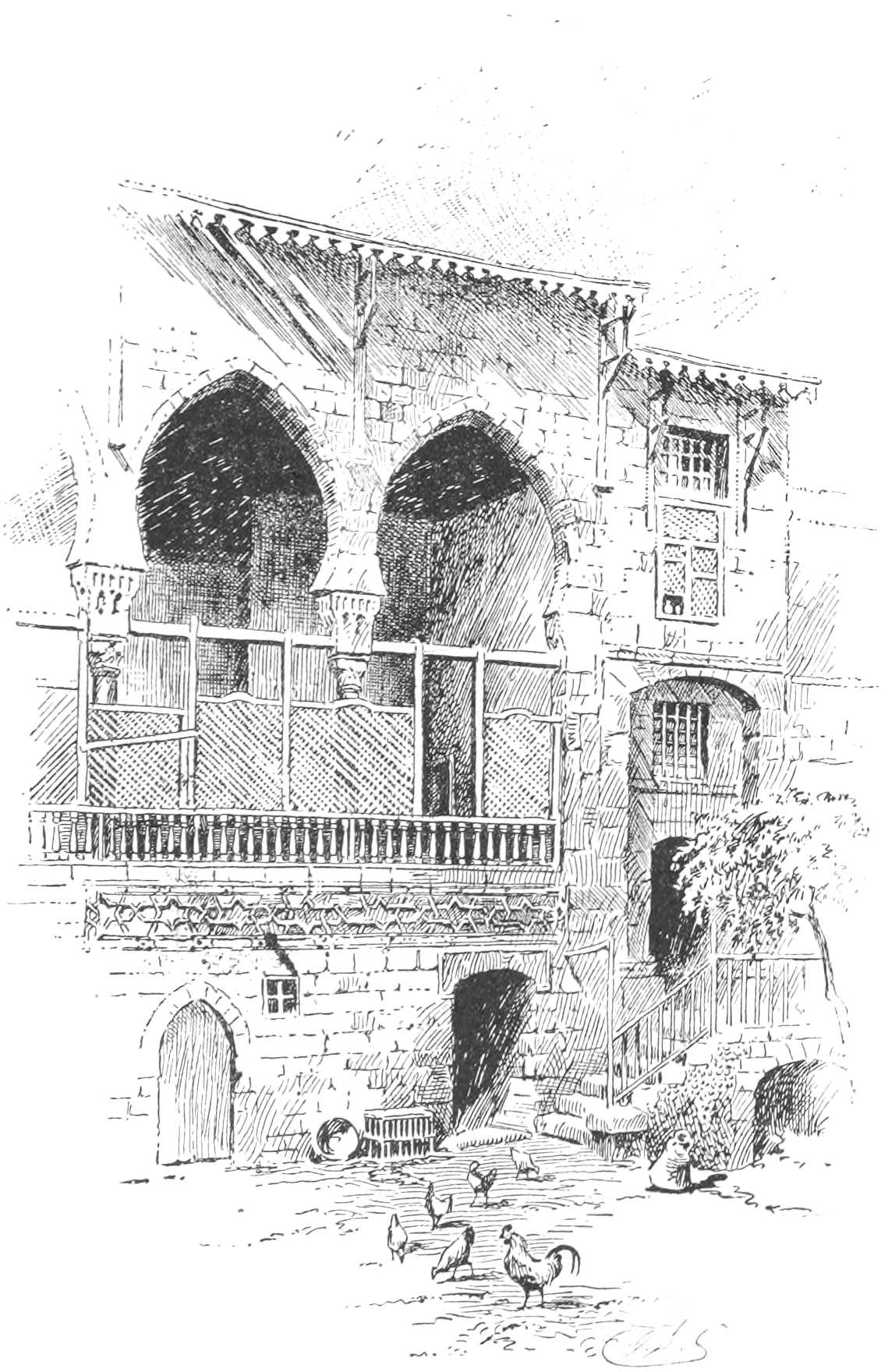
COURT OF A PRIVATE HOUSE
“There is often another reception-room, raised above the ground, but entered by steps from the court, into which it looks through an open arched front; and[17] frequently a recess in the court, under one of the upper rooms, is furnished with a divan for hot weather. A door opens out of the court into the staircase leading to the harím rooms, and here no man but the master of the house may penetrate. ‘Harím’ means what is ‘prohibited’ to other men, and what is ‘sacred’ to the master himself. The harím rooms are the domestic part of the house. When a man retires there he is in the bosom of his family, and it would need a very urgent affair to induce the doorkeeper to summon him down to anyone who called to see him. Among the harím apartments there is generally a large sitting-room, like the mandara, called the ká‘a, with perhaps a cupola over it; and in front of the ká‘a is a vestibule, which serves as a ventilating and cooling place, for a sloping screen over an open space on the roof of this room is so turned as to conduct the cool north breezes into the house in hot weather; and here the family often sleep in summer.
“There are no bedrooms in a Mohammedan house, or rather no rooms furnished as bedrooms, for there are plenty of separate chambers where the inmates sleep, but not one of them has any of what we conceive to be the requisites of bedroom furniture. The only fittings the Cairene asks for the night consist of a mattress and pillow, and perhaps a blanket in winter and a mosquito-net in summer, the whole of which he rolls up in the morning and deposits in some cupboard or side room; whereupon the bedroom becomes a sitting-room. There is another important department of the harím—the bathroom—not a mere room with a fixed bath in it, but a suite of complicated heated stone apartments, exactly resembling the public Turkish baths. It is only a large house that boasts this luxury, however, and most people go out to bathe, if they care to bathe at all.
[18]“The inhabitants of a house, such as that described, lead a dreary monotonous life; fortunately, however, they are not often conscious of its emptiness. The master rises very early, for the Muslim must say the daybreak prayers. A pipe and a cup of coffee is often all he takes before his light mid-day meal, and he generally reserves his appetite for the chief repast of the day—the supper or dinner—which he eats soon after sunset. If he is in business he spends the day in more or less irregular attendance at his shop, smokes almost incessantly either the new-fangled Turkish cigarette, or the traditional shibúk, with its handsome amber mouthpiece, its long cherry-wood stem, and red-clay bowl filled with mild Gébely or Latakía tobacco. If he has no special occupation, he amuses himself with calling on his friends, or indulges in long dreamy hours in the warm atmosphere of the public bath, where the vapour of the hot-water tanks, and the dislocation of each particular joint in the shampooing, and the subsequent interval of cooling and smoking and coffee, are all exceedingly delightful in a hot climate. When he goes out, a man of any position or wealth never condescends to walk; as a rule he rides a donkey, sometimes a horse; but the donkey is far the more convenient in crowded streets. Indeed, an Egyptian ass of the best breed is a fine animal, and fetches sometimes as much as a hundred guineas; his paces are both fast and easy, and it is not difficult to write a letter on the pummel of one of these ambling mounts.
“While their lord is paying his calls or attending to his shop, the women of his household make shift to pass the time as best they may. In spite of popular ideas on the subject, Mohammedans seldom have more than one wife, though they sometimes add to their regular marriage a left-handed connexion with an Abyssinian or other slave-girl. Efforts, however, are being made[19] to put down the traffic in slaves, and if the trade be really suppressed, as it is already in law, the Cairene will become monogamous. The late Khedive himself set an excellent example in this, as in most other respects, and the better sort of Muslims are, to say the least, as moral as ordinary Christians. Facility of divorce is the real difficulty. Men will not keep several wives, because it costs a good deal to allow them separate houses or suites of rooms, and plurality does not conduce to domestic harmony; but they do not hesitate to divorce a wife when they are tired of her, and take a new one in her place. It is said the caliph ‘Aly thus married and divorced two hundred women in his time; and a certain dyer of Baghdád even reached the astonishing total of nine hundred wives: he died at the good old age of eight-five, and if he married at fifteen, he would have had a fresh spouse for every month during seventy years of conjugal felicity. Divorce was so easy that there seems no great reason why he should not have married nine thousand. One lady is said to have reduced the fatiguing ceremony of wedlock to extremely convenient dimensions. The man said to her Khitb, and she replied Nikh, and the wedding was over! Thus did she marry forty husbands, and her son Khárija was sorely puzzled to identify his father. A governor of Upper Egypt was no mean disciple of these illustrious leaders; but the habit has become more and more uncommon.
“There would be much more excuse for the women to demand polyandria than for the men to ask for polygynaecia; for while the husband can go about and enjoy himself as he pleases, the women of his family are often hard pushed to it to find any diversion in their dull lives. Sometimes they make up a party and engage a whole public bath; and then the screams of[20] laughter bear witness how the girls of Egypt enjoy a romp. Or else the mistress goes in state to call upon some friends, mounted upon the high ass, enveloped in a balloon of black silk, her face concealed, all but the eyes, by a white veil, and attended by a trusty manservant. These visits to other haríms are the chief delights of the ladies of Cairo: unlimited gossip, sweetmeats, inspection of toilettes, perhaps some singers or dancers to hear and behold—these are their simple joys. They have no education whatever, and cannot understand higher or more intellectual pleasures than those their physical senses can appreciate: to eat, to dress, to chatter, to sleep, to dream away the sultry hours on a divan, to stimulate their husband’s affections and keep him to themselves—this is to live, in a harím. An Englishwoman asked an Egyptian lady how she passed her time. ‘I sit on this sofa,’ she answered, ‘and when I am tired, I cross over and sit on that.’ Embroidery is one of the few occupations of the harím; but no lady thinks of busying herself with the flower-garden which is often attached to the house. Indeed, the fair houris we imagine behind the lattice-windows are very dreary, uninteresting people; they know nothing, and take but an indifferent interest in anything that goes on; they are just beautiful—a few of them—and nothing more.
“In truth the Egyptian ladies cannot venture to give themselves airs; they suffer from the low opinion which all Mohammedans entertain of the fair sex. The unalterable iniquity of womankind is an incontrovertible fact among the men of the East; it is part of their religion. Did not the blessed Prophet say, ‘I stood at the gate of Paradise, and lo! most of its inhabitants were the poor: and I stood at the gates of Hell, and lo! most of its inhabitants were women?’ Is it not, moreover, a physiological fact that woman[21] was made out of a crooked rib of Adam; which would break if you tried to bend it, and if you left it alone it would always remain crooked? And is it not related that when the Devil heard of the creation of woman, he laughed with delight, and said, ‘Thou art half of my host, and thou art the depositary of my secret, and thou art my arrow with which I shoot and miss not!’ It is no wonder that a learned doctor gave advice to his disciple, before he entered upon any serious undertaking, to consult ten intelligent persons among his particular friends, or if he have not more than five such friends, let him consult each of them twice; or if he have not more than one friend, he should consult him ten times, at ten different visits; if he have not one to consult, let him return to his wife and consult her, and whatever she advises him to do, let him do the contrary: so shall he proceed rightly in his affair and attain his object. Following in the steps of this pious Father, the Muslims have always treated women as an inferior order of beings, necessary indeed, and ornamental, but certainly not entitled to respect or deference. Hence they rarely educate their daughters; hence they seek in their wives beauty and docility, and treat them either as pretty toys, to be played with and broken and cast away, or as useful links in the social economy, good to bear children and order a household.”[1]
The fatal blot upon Muslim society is this contempt of women, which far more than counterbalances the good effects of the Mohammedan doctrine of the equality of all true believers in the sight of God, and the ease of manner and independence of opinion which result from the sense of fraternity in the sacred bond of Islám. The picture we have drawn of the daily life of the Cairene is perhaps too sombre, and we[22] should watch our tradesman at his revels in order to understand the brighter side of his life. It is true these excitements are strictly connected with his religion, but so are the Roman Catholic holidays, and if one must dissipate it is soothing to the conscience to do it under the auspices of a saint. The Muslim, however, takes an unnatural delight in pious celebrations. The wedding guest of Cairo has his own importunate Ancient Mariner in the Khatma or recital of the entire Korán, from cover to cover, which a worthy bridegroom frequently provides for the entertainment of his friends. When the people of Cairo wish to go in for serious dissipation they visit the graves of their relations, and then, in houses expressly reserved for cheerful mourners, they listen to the chanting of the holy book. Voilà un terrible humeur d’homme! Tristes as we are said to be in England in our manner of amusing ourselves, even an Ibsen audience would stand aghast at the Muslim’s staid diversions. He certainly makes the most of curiously unpromising materials. The feast of St Simon and St Jude does not perhaps suggest exhilaration to an unimaginative Englishman, but your Cairene will intensely enjoy, in his sedate way, the holidays of his religion. There are plenty of them, and a Cairo Mólid or “birthday” is not a one-day’s festival, like mere Christian feasts, but lasts sometimes as long as nine days at a stretch. Every tourist knows some of them, such as the Kiswa or Holy Carpet procession, and the passing of the Mahmal with the pilgrim caravan to Mekka, and they are worth seeing, if they happen to fall within the “season”—for the Muslim year still retains the unreformed lunar calendar, which shifts continually and carries the feasts round with it. There is hardly a week in the year however without some special rite or spectacle. It may be the Ashúra or[23] 10th of Moharram (the first month), when people eat cakes in honour of Hoseyn, the martyred son of ‘Aly, and pay their homage at the mosque of the Hasaneyn, where the martyr’s head is supposed to rest, and watch the amazing antics of the dervishes. “Since Hoseyn, in whose honour it is held (combining with his elder brother, Hasan, to form the ‘Hasaneyn’), is especially the saint of the heretical Persians, and has given rise, through no merit of his own, to more schisms in the Mohammedan world than any other person, it is strange that the Cairenes, who are almost all orthodox Sunnis, should pay such particular reverence to this feast. But the truth is, they are glad of any excuse for a holiday; and, after all, was not our lord Hoseyn the grandson of the Prophet? and is he to be given over wholly to those heretical dogs of Shi‘a? Whatever the argument, Hoseyn is deeply revered in Cairo, and his Molid is one of the sights of the capital that most delight the European visitor. Nothing more picturesque and fairylike can be imagined than the scenes in the streets and bazars of Cairo on the great night of the Hasaneyn. The curious thing was that in the winter after Tell-el-Kebír, when I stood—for riding was impossible—in the midst of the dense throng in the Musky, and struggled into the by-street that leads to the Kady’s court and the mosque of the Hasaneyn, there was not a sign of ill-humour or fanaticism in spite of the presence of many Europeans. A more good-natured crowd was never seen. It might have been expected that at least some slight demonstration would have been made against the Europeans who wandered about the gaily illuminated streets; but English ladies walked through the bazars, English officers and tourists mingled in the throng and even reached the doors of the sacred mosque itself without the slightest molestation or even remark. Once or twice a woman[24] might have been heard sarcastically inviting some Christian to ‘bless the Prophet’; but if the Christian charitably replied, ‘God bless and save him,’ she was nonplussed; and even if he did not know the proper answer, nothing came of it. The general good-nature inspired by the festival obliterated all memories of war and heresy, and it may safely be asserted that no English mob could have been trusted to behave in so orderly and friendly a manner in the presence of a detested minority.
“The scene, as I turned into one of the narrow lanes of the great Khan El-Khalíly, or Turkish bazar, which fronts the mosque of the Hasaneyn, was like a picture in the Arabian Nights. The long bazar was lighted by innumerable chandeliers and coloured lamps and candles, and covered by awnings of rich shawls and stuffs from the shops beneath; while, between the strips of awning, one could see the sombre outlines of the unlighted houses above, in striking contrast to the brilliancy and gaiety below. The shops had quite changed their character. All the wares which were usually littered about had disappeared; the trays of miscellaneous daggers and rings and spoons and whatnot, were gone; and each little shop was turned into a tastefully furnished reception-room. The sides and top were hung with silks and cashmeres, velvets, brocades, and embroideries of the greatest beauty and rarity—costly stuffs, which the most inquisitive purchaser never managed to see on ordinary occasions. The whole of the sides of the bazar formed one long blaze of gold and light and colour. And within each shop the owner sat surrounded by a semicircle of friends, all dressed in their best, very clean and superbly courteous—for the Cairo tradesman is always a gentleman in mien, even when he is cheating you most outrageously. The very man with whom you haggled hotly in the morning will[25] now invite you politely to sit down with him and smoke; at his side is a little ivory or mother-of-pearl table, from which he takes a bottle of some sweet drink flavoured with almonds or roses, and offers it to you with finished grace.
“Seated in the richly-hung recess, you can see the throng pushing by—the whole population, it seems, of Cairo, in their best array and merriest temper. All at once the sound of drums and pipes is heard, and a band of dervishes, chanting benedictions on the Prophet and Hoseyn, pass through the delighted crowd. On your left is a shop—nay, a throne-room in miniature—where a story-teller is holding an audience spell-bound as he relates, with dramatic gestures, some favourite tale. Hard by, a holy man is revolving his head solemnly and unceasingly, as he repeats the name of God, or some potent text from the Korán. In another place, a party of dervishes are performing a zikr, or a complete recital of the Korán is being chanted by swaying devotees. The whole scene is certainly unreal and fairylike. We can imagine ourselves in the land of the Ginn or in the City of Brass, but not in Cairo or in the nineteenth century.
“Outside the khan, dense masses of the people are crowding into the mosque of the Hasaneyn, where specially horrible performances take place, and where the tour of the shrine of Hoseyn must be made. Near by, a string of men are entering a booth; we follow, and find tumblers at work, and a performing pony, and a clown who always imitates the feats of the gymnasts, always fails grotesquely, and invariably provokes roars of laughter. In another booth Karakúsh is carrying on his intrigues: this Egyptian Punch is better manipulated than our own, whom he nearly resembles; but he is not so choice in his language or behaviour, and we are glad before long to leave a place where the jokes[26] are rather broad, and certain saltatory insects unusually active. People of the lower class however care nothing for these drawbacks; they laugh till their sides ache at Karakúsh’s sallies, and whatever they see, wherever they go, whomever they meet, whatsoever their cares and their poverty, on this blessed night of the Hasaneyn they are perfectly happy. An Egyptian crowd is very easily amused: the simplest sights and oldest jests delight it; and it is enough to make a fastidious European regret his niceness to see how these simple folk enjoy themselves upon so small an incentive.”[2]
This is what one goes to Cairo to see, the real Eastern life in its Eastern setting. A scene like this repays one for many dreary calls, many tepid dances in the region of hotels. You may get hotel life, club life, polo and tennis, and even golf, excellently at Cairo—the European Cairo—but these things are common to all “winter resorts.” In the “bazars,” among the people, you get something that the Isma‘ilíya quarter cannot give, that no other place can quite rival, something that painters love and that kindles the imagination. After all, the most interesting things are always the unfamiliar, and the first plunge into Egypt is a revelation of fresh ideas, new tones in colour, and the pungent odours of a strange native life.
It is in the “bazars” that one feels most the shock of contact with the unfamiliar; but, in a less intimate yet deeply impressive way, to drink in the full inspiration of the Muslim city one must climb to the ramparts of the Citadel about sunset and slowly absorb the wonderful panorama that spreads below and around. Unhappily, to get there one usually passes along the most terribly defaced street in all Cairo. The worst[27] destruction took place, one is thankful to remember, before England took the reins of Egypt. It was Isma‘íl, under French influence, who made that unspeakable atrocity, the “Boulevard Mohammad ‘Aly,” which cut through some of the most beautiful quarters, ruined palaces and gardens, and chopped off half of a noble mosque in order to preserve the tasteless accuracy of its straight line. Along its side are ranged mean and uneven offices and tenements, neither Europeanly regular nor Orientally picturesque. Old wine and new bottles are in close connexion. A Muslim school elbows a “Grog Shop for Army and Navy.” Under the shadow of the stately mosque of Sultan Hasan an Arab barber is cutting hair with a modern clipping machine. A gaily painted harím carriage, guarded by eunuchs, stands at the door of the mosque: on the panel is a sham coat-of-arms, that last infirmity of Turkish minds—though for that matter heraldic bearings were used in Egypt at least seven hundred years ago. Solemn sheykhs pace slowly along without any sign of surprise at these strange sights. Overhead the guns boom out a salute, for it is the Great Festival, the ‘Id el-kebír, from Saladin’s Citadel; but the garrison are not stalwart Turkmáns or wild Kurds, in picturesque garb and with clanking spear and mace, such as the great Soldan led against Richard of the Lion-heart, but British “tommies” unbecomingly attired in khaki. The Citadel itself is an arsenal of modern arms and stores, and English officers rule where once the Mamlúk Beys were massacred. Old and new are ever clashing in the mediæval fortress, and Private Ortheris mounts guard over the mosque of a Mamlúk Sultan.
But once we stand on the ramparts the flaring contrasts vanish and the jarring note is still. All in that wide range beneath the eye is of the East Eastern. The European touches are too small at such[28] a distance to mar the purely Oriental tone. Countless domes and minarets, a glimpse of arched cloisters, a wilderness of flat-roofed houses, yellow and white and brown, with sloped pents to admit the cool breezes below; a patch of green here and there, with dark-leaved sycamores, revealing some of the many gardens of the old city, and beyond, a fringe of palms and a streak of silver where “the long bright river” rolls sleepily on between its brown banks; in the distance, against the ridge of the Libyan horizon, in the carmine glory of the sinking sun, stand the everlasting pyramids, “like the boundary marks of the mighty waste, the Egyptian land of shades.” One after the other the tall forms of slender minarets separate themselves from the bewildering chaos of roofs and domes, and display their varied grace. Each has its story of victory or exile, of famine and invasion, of learning and piety, to tell. On the right, northwards, the fine towers of Muáyyad above the Zuweyla gate recall a hundred deeds and legends of that famous portal, once the main entrance of the caliphs’ palace-city. Beyond them rise the minarets of the Nahhasín, a perfect gallery of Saracen art, and again beyond, the turrets of Hákim’s great quadrangle. In front in the foreground stands Sultan Hasan, the largest and most imposing of Mamlúk mosques, and a little to the left one looks into the vast arcaded square of Ibn-Tulún, with its queer corkscrew tower overhanging the billowy mounds that reveal where Fustát lay a thousand years ago. Still more to the left a line of arches shows where the aqueduct that has brought water to the Citadel for five centuries stretches to the Nile, and behind we can look down upon the cluster of ruined domes and minarets of the southern Karáfa—the “Tombs of the Mamlúks”—and catch a glimpse of the old fortress of Egyptian Babylon and[31] the mosque of the conqueror ‘Amr. Looking over the Mamlúk minarets we can see the dim outlines of the cairns of Dahshúr and the conspicuous form of Sakkára’s step-pyramid, separated from the Saracen domes by only fifteen miles of space but five millenniums of time; and as the glow of the sunset fades away the evening clouds gather in the west and the desert beyond takes up their shades of grey and blue like a vast mid-African ocean.
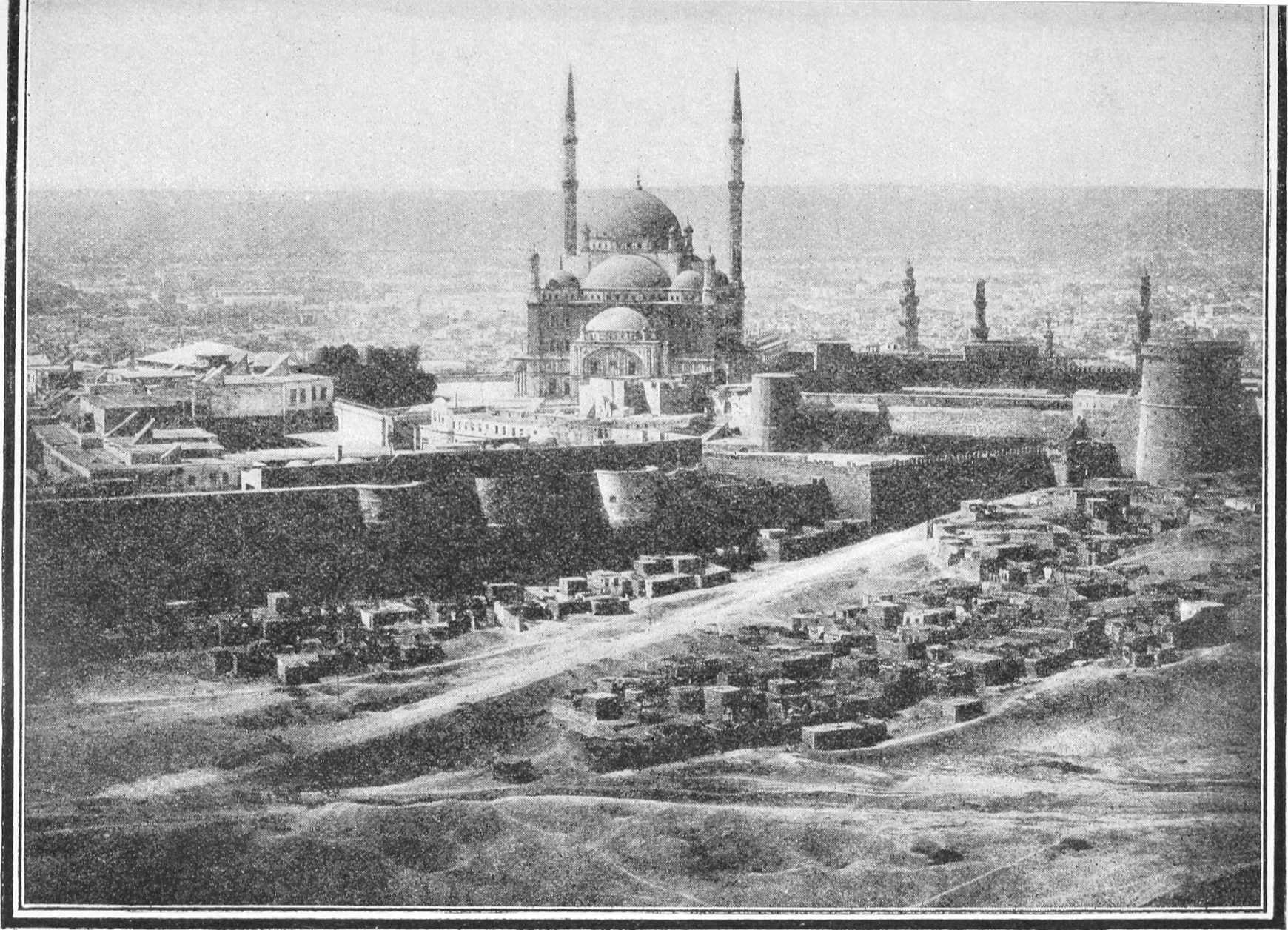
THE CITADEL
Here we realize Cairo for the first time as a city of the Middle Ages, and more than that, a city with an heritage from the dawn of history. It is true it has not the exquisite setting of the seven-hilled queen of the Bosporus; it is not even built about the Nile, which the silts of centuries have breasted away from the walls it once laved: but as one looks out from the battlements of the Castle one perceives that there are other oceans than those of water, and that the capital of Egypt can have no more fitting frame than the deserts which are her shield and the pyramids her title-deeds to her inheritance from the remote past. “He who hath not seen Cairo,” said the Jewish hakím, “hath not seen the world. Her soil is gold; her Nile is a marvel; her women are as the bright-eyed houris of Paradise; her houses are palaces, and her air is soft with an odour above aloes, refreshing the heart: and how should Cairo be otherwise when she is the Mother of the World?”
[32]CHAPTER II
The Town of the Tent
IN the view from the Citadel one sees an essentially mediæval city, but of all the Arab buildings there is not one that in its present state dates back to the Arab conquest. Before the Muslims invaded Egypt in 640 there was no Cairo, and strictly speaking there was none till three centuries later than that, when the Greek general laid the foundations of the palace-city of the Fátimid caliphs and it received the name el-Káhira, which Europeans twisted into Cahere, Caire, and Cairo. But this is merely a pedantry of terms, and one might as well restrict London to the City and refuse the name to Westminster and Mayfair. There was a Muslim capital from the days of the conquest, and though it was not called Cairo it was close to the present city, which is merely an expansion of the original town. The history of its growth will appear as we study its several stages and monuments, and for the moment a bare enumeration of the successive foundations will suffice. First rose the original Arab settlement, Fustát, the Town of the Tent, in 641. To this was added in 751 a north-eastern suburb, the official residence of the governors and their troops, hence named el-‘Áskar, “the Cantonments.” A new royal faubourg, or small city, was built still more to the north-east by the first independent Muslim King of Egypt, Ibn-Tulún, about 860, and was known by the[33] name of el-Katái‘, “the Wards,” because it was divided into separate quarters for different nations and classes. So far the three towns were practically contiguous, and ‘Askar and Katái‘ were but the Chelsea and St James’s of the City, the commercial capital, Fustát.
The fourth foundation was still further to the north-east, and a considerable vacant space was left between it and the almost destroyed faubourg of Katái‘, in order to preserve the safety and seclusion of the sacred caliphs for whom it was built in 969. This last was the true Cairo, el-Káhira, but it was not the commercial and residential capital, any more than ‘Askar or Katái‘ had been. Fustát, resting on the Nile bank, was still the emporium of trade and the metropolis alike of business and of culture, whilst Káhira was but a palace, a barrack, and a seat of government. When the mediæval chroniclers, such as William of Tyre, write of “Macer”—meaning Masr (properly Misr) the usual Arabic name both for Egypt and for its capital—they refer not to Káhira but to Fustát, or as it was commonly called Misr-el-Fustát. The Emír or Caliph or Sultan might dwell and rule at any suburb he pleased to build, but the old capital remained the real metropolis throughout. There the Kádis sat in judgment in the “Old Mosque”; there the coins of the realm were issued; and there resided the bulk of the citizens who were not attached to the palace. It was only when Fustát was deliberately burned in 1168, to save it from giving cover to the Crusaders, that Káhira took its place as the real capital as well as the official centre of Egypt.
Saladin was the creator of Cairo as we know it. It was he who planned the wall that was to enclose not only Káhira but the Citadel and what remained of Katái‘ and Fustát, and from his time began the building over the space intervening between the[34] Citadel and the palace of Káhira which gradually filled up the Cairo which we now see. The growth of the city thus consisted mainly of three successive expansions towards the north-east, accompanied by decay of abandoned suburbs, and ending in a general enclosure of the chief inhabited portions. Since the days of Saladin, whatever remained of Fustát has vanished, and only a straggling village called Masr-el-Atíka or “Old Masr,” and known to Europeans as “Old Cairo,” has risen near its site, which is easily traced by the immense rubbish-heaps. On the other hand a new town has grown up between Káhira and the Nile under European influences, but with this, pleasant winter city as it is, the Mediæval Town has nothing to do.
The narrative of the Arab invasion of Egypt is in many points exceedingly obscure, owing to the circumstances that the Arabs did not begin to write history till more than two centuries later, and that our only almost contemporary authority, John, bishop of Nikiu, has come down to us in a corrupt translation. The Arabs under the command of ‘Amr ibn el-‘Asy entered Egypt not more than 4000 strong in December 639, in the caliphate of ‘Omar, the second successor of the prophet Mohammad; and after taking Pelusium and Bilbeys by siege, and fighting a battle with the Romans at Umm-Duneyn, a suburb which stood near the present ‘Abdin palace, attacked the city of “Misr” or “Babylon of Egypt.” This city was a northern extension or successor of the decayed but then still existing Egyptian capital Memphis, about twelve miles distant from the present Cairo, and had grown up under the protection of the Roman fortress of Babylon. It was evidently strongly defended, for the Arab general had to summon reinforcements, till his army mustered 12,000, before he could attack it.
[35]“‘Amr divided his forces into three corps, one of which he posted to the north of Babylon; the second was stationed at Tendunyas [probably the Umm-Duneyn of the Arabic writers], and the third withdrew northwards to Heliopolis, in the hope of tempting the Romans out of their fortifications, upon which the other two corps were to fall on their rear or flank. The manœuvre succeeded. The Romans marched out of their fortifications, and attacked the Saracens at Heliopolis, but, being themselves taken in rear by the other divisions, were routed and driven to the Nile, when they took to their boats and fled down the river. Upon this the Muslims occupied Tendunyas, the garrison of which had perished in the battle, except 300 men, who shut themselves up in the fort, whence they retired by boat to Nikiu. The taking of Tendunyas was evidently followed by, or synonymous with, the taking of the whole city of Misr, except its citadel, which was blockaded; for John of Nikiu, from whose almost contemporary chronicle this account is taken, mentions no subsequent siege or conquest of the city of Misr, but only the reduction of the fortress.”[3]
Whatever this city of Misr or Tendunyas may have been, it vanishes from history as soon as it is conquered. The last we hear of it is in the treaty of capitulation granted by ‘Amr, which ran as follows:—
“In the name of God, the Compassionate, the Merciful, this is the amnesty which ‘Amr ibn el-‘Asy granted to the people of Misr, as to themselves, their religion, their goods, their churches and crosses, their lands and waters: nothing of these shall be meddled with or minished; the Nubians shall not be permitted to dwell among them. And the people of Misr, if[36] they enter into this treaty of peace, shall pay the poll-tax, when the inundation of their river has subsided, fifty millions. And each one of them is responsible for [acts of violence that] robbers among them may commit. And as for those who will not enter into this treaty, the sum of the tax shall be diminished [to the rest] in proportion, but we have no responsibility towards such. If the rise of the Nile is less than usual, the tax shall be reduced in proportion to the decrease. Romans and Nubians who enter into this treaty shall be treated in the like manner. And whoso rejects [it] and chooses to go away, he is protected until he reach a place of safety or leave our kingdom. The collection of the taxes shall be by thirds, one third at each time. For [sureties for] this covenant stand the security and warranty of God, the warranty of His Prophet, and the warranty of the Caliph, the commander of the faithful, and the warranty of the [true] believers. . . . Witnessed by ez-Zubeyr and his sons ‘Abdallah and Mohammad, and written by Wardan.”
The Arab historians connect this treaty—which has all the appearance of being an authentic document, literally copied—expressly with the surrender of the city of Misr after the battle of Heliopolis; but as Misr means Egypt as well as its capital the document itself only proves that the Arab conqueror accorded very generous terms to the people of Egypt; it says nothing explicit as to the town of Misr, the name of which was shortly to be transferred to Fustát, whilst the place thereof was known no more. The only explanation seems to be that the Egyptian city decayed as the Arab town grew, and that the population migrated to the neighbouring and more prosperous settlement. The remains of walls south of “Old Misr” may represent part of the site. The disappearance[37] of an Egyptian town is unhappily far from unprecedented. Memphis itself has vanished, all save a few traces of walls and fallen statues; “hundred-gated” Thebes survives only in her temples; and the reason is that the ancient Egyptian built his abode of perishable sun-dried brick, and lavished his massive stone work only upon the tombs of the great dead and the temples of the immortal gods.
Whatever became of the city, a fortress of Babylon stands to this day. Its reduction cost the Arabs a seven months’ siege. The battle of Heliopolis was won in the late summer of 640, and it was not till April 641 that the fortress was conquered. A leading part in the surrender of the place is ascribed to a mysterious personage, “the Mukawkis,” as the Arabs termed the governor of Egypt.[4] According to the Arab traditions it was he who negotiated the treaty cited above, which secured to the Egyptians freedom of religion and security of life, and when the Byzantine emperor Heraclius repudiated the treaty, the Mukawkis stuck to his word and threw in his lot with the Arabs, whose valour and simple earnestness deeply impressed him. When his envoys returned from an embassy to the Saracens’ camp, he asked them what manner of men the Muslims were, and they answered, “We found a people who love death better than life, and set humility above pride, who have no desire or enjoyment in this world, who sit in the dust and eat upon their knees, but frequently and thoroughly wash, and humble themselves in prayer; a people in whom the stronger can scarce be distinguished from the weaker, or the[38] master from the slave.” Such a character was new to the Egyptians, who had long suffered under the corruption and luxury of the Eastern Roman Empire, and, whatever part the Mukawkis personally may have played in what has been called the betrayal of Christian Egypt, it is certain that the population abetted the invaders.
Although Christianity had been the official religion of Egypt since the Edict of Theodosius in 379, there was still a strong leaven of the old local cults, and, more important still, there was a vigorous tendency to nationalism both of church and state. The rule of Byzantium had never been gracious to the Egyptian province; the Orthodox Church had been tyrannous; and when at the Council of Chalcedon in 451 the Eutychian heresy maintained by the Egyptian bishops was formally condemned, the schism became irrevocable. From that time forward there were two churches in Egypt, the State Church (or Orthodox Greek), supported from Constantinople, and known as the Melekite or “Royalist,” and the national church, afterwards called Jacobite, and generally known as the Coptic Church. Copt is etymologically the same word as Egyptian (Greek, Aiguptios; Arabic, Kibt and Kubt; English, Copt), and the Coptic Church means nothing less than the Church of Egypt as separated by the adoption of the heresy of Eutyches. The Egyptian Christians were as much Copts before as after the Council of Chalcedon; but it was their devotion to a metaphysical definition, which very few of them could possibly understand, that made them a distinct church, and to this they owe at once their misfortunes and their historical interest. By their adhesion to the first Nicæan doctrine of the single nature of Christ they exposed themselves to persecution and courted isolation, and sharing in none of the developments of the[39] other churches, they preserved in their scanty and neglected community, unchanged for nearly fifteen hundred years, the ancient tradition and ritual of the fifth century. It was their implacable hatred of the Royalists that threw them into the arms of the Muslim invaders. By the advice of their exiled patriarch they helped the Arabs from the moment of their setting foot upon Egyptian soil. Eager to rid themselves of Byzantine rule, and still more of the Royalist hierarchy, they embraced they knew not what as a preferable alternative; and after the Mukawkis, aided, according to tradition, by a catholicos (probably Cyrus, Royalist patriarch of Alexandria), had succeeded in obtaining a generous amnesty from the Arab general, the Copts rendered every aid to the Muslims, assisted them with labour at bridge-making, and brought them supplies. They soon discovered that they had only exchanged masters, but the Arab, despite his haughty assumption of superiority and his occasional outbursts of persecution, was a gentler tyrant than the Roman of the Lower Empire.
Deprived of all support from the population, the Roman garrison of Babylon surrendered in April 641. The Delta was quickly overrun, and the Romans fell back upon Alexandria, which, distracted by factions and deprived of competent leaders, yielded to panic, and eagerly accepted ‘Amr’s magnanimous terms. By the surrender of the Roman capital in October 641, the Arab conquest of Egypt was complete. There was no further resistance worthy the name. The Muslims spread over the land up to the first cataract of the Nile, and Egypt became a province of the caliphate.
On his return from Alexandria ‘Amr founded the Town of the Tent. The great port on the Mediterranean was no suitable capital for Arab tribes,[40] whose inexperience magnified the terrors of the deep. Alexandria, moreover, was liable at the period of Nile inundation to be cut off from the centre of Arab power at Medina, and the caliph ‘Omar, not yet inspired by dreams of a vast Muslim empire, was chiefly anxious to keep in touch with the army of Egypt. ‘Amr indeed wished to retain Alexandria as the capital. “Behold an abode made ready for us,” he said. But when the caliph heard of it, he asked, “Will there be water between me and the army of the Muslims?” and the answer was, “Yes, O commander of the faithful, there will be the Nile,” so he set his face against Alexandria. He regarded the new conquest as a barrack rather than a colony. ‘Amr accordingly was bidden to choose a more central position, and found it some ten miles north of the remains of the ancient capital of Memphis, on the site of the camp which lay before the castle of Babylon. An old canal, the Amnis Trajanus, had formerly connected Babylon with the Red Sea at Suez, running past Bilbeys and the Crocodile Lake, and this was immediately cleared of silt and reopened, so that tribute and corn were sent by water to Arabia, and close relations were thus maintained with the caliph.
The Town of the Tent owes its name to a pretty legend, which may very probably be true. When ‘Amr led his Arabs against the old capital of Egypt, he pitched his tent on the spot where his mosque now stands. After the surrender of the castle of Babylon he marched upon Alexandria; but when the soldiers went to strike his tent, they found that a dove had laid her eggs within and was sitting on her nest. ‘Amr at once declared the spot sacred, and ordered them not to disturb her; and when on the return from the conquest of Alexandria the army set about building quarters for themselves, ‘Amr bade them settle around his still[41] standing tent, and the first Arab city of Egypt was ever afterwards known as el-Fustát, “the Tent,” or Misr-el-Fustát, or simply Misr. The whole space between the Nile and the hill Mukattam, on a spur of which stands the present Citadel, was bare at that time. There was nothing but “waste land and sown fields,” and no buildings except some churches or convents, and the Roman fortress of Babylon, or Babelyún, known to the Arabs to this day as the Kasr-esh-Shema‘ or “Castle of the Beacon,” because (says the Topographer, el-Makrízy) “this Kasr was illuminated on the summit with candles [in Arabic shema‘] on the first night of every month,” to serve as a kalendar; but it is possible, as Dr Butler has suggested, that the name is merely a corruption of Kasr-el-Khemi, the “Castle of Egypt,” and that the beacon story was invented to explain it.[5]
Why ‘Amr did not occupy the old city of Misr we[42] do not know: everything connected with that vanished town is a mystery. Elsewhere the Arabs had no scruple about taking possession of older cities, such as Damascus and Edessa; but in Egypt they preferred to take fresh ground. Misr may have been too small; or it is possible that the caliph’s orders that they were not to acquire property and take root in the country led to the original occupation of the bare stretch of land between Babylon and the Mukattam hills. The first settlement undoubtedly resembled a temporary camp rather than a city. They wanted plenty of space to separate the various tribes who composed the Arab army, and who, despite their Muslim brotherhood, were liable to recall their ancient jealousies. The site they chose was ample and almost unencumbered. The tract was known as the three Hamras or “red” spots[6]—the Nearer, the Middle, and the Further Hamra—apparently from the red standard which was set up in the midst.
The Arab clans divided the three tracts amongst them and laid out their settlements, from the fortress to where the mosque of Ibn-Tulún now stands. In the midst was the general’s house, and close to it rose the first mosque built in Egypt, the “Mosque of Conquest,” the “Crown of Mosques,” as it was proudly called, but known later as the “Old Mosque,” and now as the Mosque of ‘Amr. It was originally a very plain oblong room, about 200 feet long by 56 wide, built of rough brick, unplastered, with a low roof supported probably by a few columns, with holes for light. There was no minaret, no niche for prayer,[43] no decoration, no pavement. Even the pulpit which ‘Amr set up was removed when the caliph wrote in reproach, “Is it not enough for thee to stand whilst the Muslims sit at thy feet?” For it was the duty of the conqueror to recite the prayers and preach the Friday sermon in this humble building. It soon became too small for the growing population of Fustát, and was enlarged in 673 by taking in part of the house of ‘Amr; and at the same time raised stations—the germ of the minaret—were erected at the corners for the muézzins to recite the call to prayer. Twenty-five years later the entire mosque was demolished by a later governor who rebuilt it on a larger scale. So many and thorough have been the repairs and reconstructions that there is probably not a foot of the original building now in existence. What we see to-day is practically the mosque rebuilt in 827 by ‘Abdallah ibn Táhir, and restored by Murád Bey in 1798, just before he engaged the French in the “battle of the Pyramids” at Embába. It is four times the size of the original mosque, and different in every respect.[7]
The “Old Mosque,” as the Topographer calls it, was intensely revered in early times. It was there that the chief Kady held his court, and learned men congregated in its arcades. It was a rallying point for orthodoxy in times of schism and obtrusive heresies. When Fustát was burned in 1168 the mosque escaped, though much injured, and Saladin restored it; “where he found wood and stone he left marble.” But it was as hopeless to maintain its popularity, when the town it belonged to was in ashes, as it would be to induce the dwellers in Belgravia to[44] attend the services at Bow Bells. Fustát mostly in ruins, the congregation dispersed, and the mosque of ‘Amr fell upon evil days. Ibn-Sa‘íd, a Moorish traveller of the thirteenth century, found the sacred building covered with cobwebs, and scrawled over with the ribald graffiti of loafers and vagabonds, the remains of whose victuals littered the floor. There were few worshippers, and much unseemliness. “Musicians, and ape-leaders, and conjurers, and mountebanks, and dancing-girls,” says the historian Gabárty in the eighteenth century, desecrated the court, and so decrepit did the building become that even these abandoned it. If Murád Bey had not been “anxious about his soul,” for very good reasons, and made peace with his conscience by spending some of his ill-gotten gains upon the pious work of restoration, the “Crown of Mosques” would have disappeared altogether. In the early part of the nineteenth century it was still a favourite place of prayer for the people of Cairo on the last Friday of the Fast of Ramadán. “It is believed that God will receive with particular favour the prayers which are offered up in this ancient mosque; therefore, when the Nile is tardy in rising, and the people fear a scanty inundation and a consequent scarcity, the principal Sheykhs and Imáms and learned and devout Muslims of the metropolis are ordered to betake themselves to the mosque of ‘Amr to pray for an increase of the river, together with the priests of the various Christian churches and their congregations, and likewise the Jews; each of these persuasions arranged by itself, without the mosque. Public prayers were thus offered up for rain in this consecrated spot by Muslims, Christians and Jews, in a time of unusual drought about twenty years ago [i.e. 1825-8], and on the following day it rained.”[8]
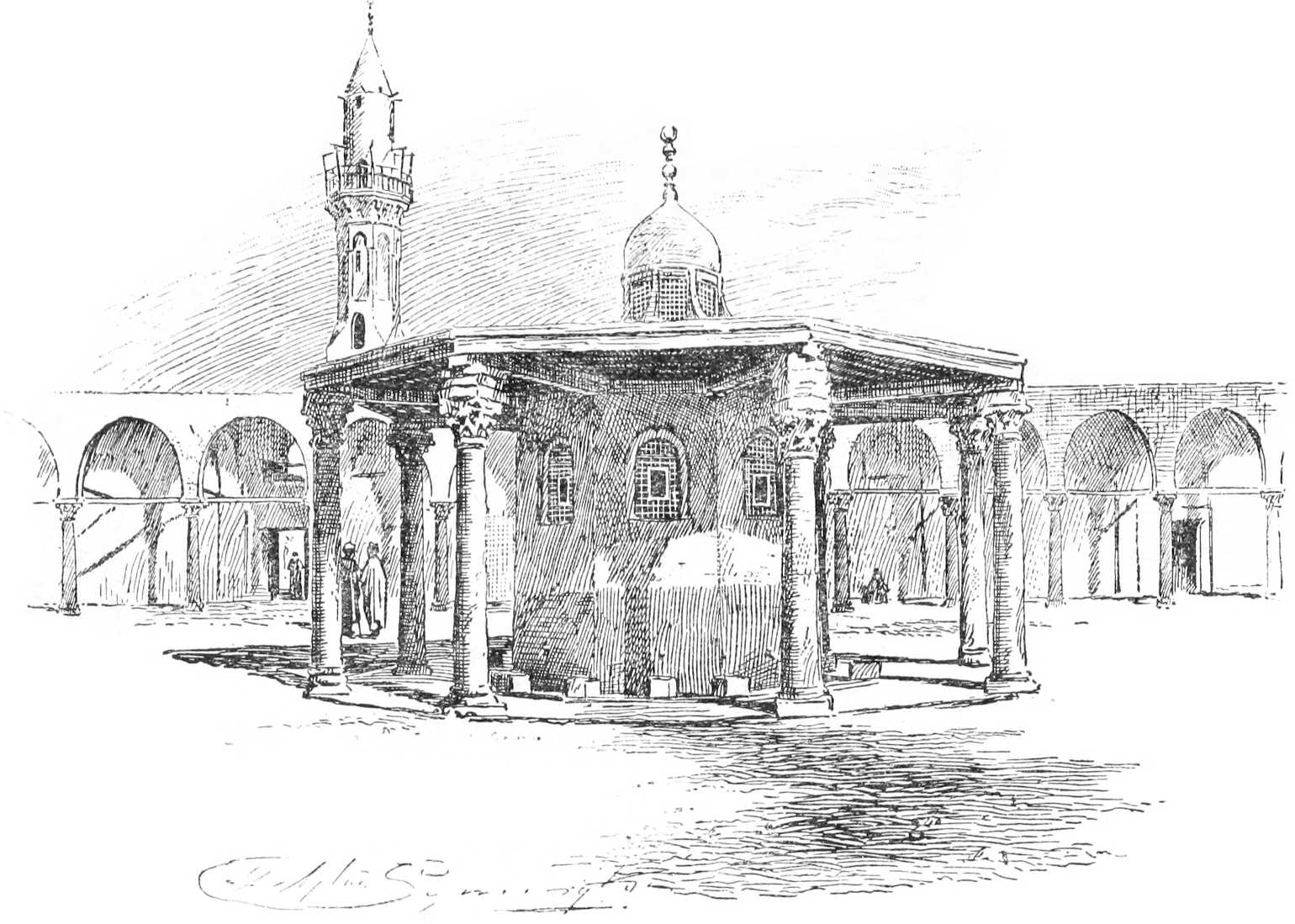
COURT OF THE MOSQUE OF ‘AMR
[47]The outside of the oldest mosque in Egypt is not impressive. Among the rubbish-hills that mark the site of the Town of the Tent, its long grey walls, without windows or the least attempt at ornament, look dreary, and the two plain minarets are equally unpretentious. But within, despite decay and the loneliness of neglect, the vast empty court of some forty thousand square feet, surrounded by colonnades, and the forest of columns supporting the roof of the east end, the special place of prayer, wholly dominate all mean details. Crowded with worshippers in the rhythmic bowings of the Muslim ritual it must have been a wonderful and solemn vision. The arches are of various ages, and the columns, taken from churches, show the most diverse capitals, not always put the right side up; the arcades do not run parallel to the walls, like cloisters round a cathedral close, but open at right angles into the court. Wooden beams stretch from column to column to support hanging lamps, of which eighteen thousand were lighted every night in former times, and the effect in the long vistas must have been superb. Those nights of illumination are long over, and the conqueror’s mosque is a melancholy ruin, the loneliness of which appeals to the imagination to people it with the zealous groups of scholars and divines, fanatics and doctors learned in the law, fakírs and holy men, who once bowed before its deserted kibla. Not even the mark of the blessed Prophet’s kurbág on the grey marble of the pillar, which, urged by the blow—despite all considerations of chronology—flew through the air from Mekka when ‘Amr was building the mosque, nor the twin test columns between which only true believers can squeeze (and even a Turkish soldier stuck and almost died), avail to attract worshippers to the old shrine except on very special occasions. Yet it is prophesied that the[48] fall of the mosque of ‘Amr will be the sign of the downfall of Islám, and it is strange that a superstitious people are not more careful of their omens.
The original mosque of the Arab conqueror has gone, but at least its representative stands on the hallowed site. One cannot say as much for Fustát, the Town of the Tent, which he founded. Whatever may remain of this great city, which was the capital and the river-port of Egypt for five centuries, lies hidden under the wilderness of sand-hills which cover the débris and kitchen-middens of the mediæval town. Here, after a strong wind has stirred the sand, you may sometimes chance to pick up curious fragments of glass and pottery, Roman lamps, coins, glass-bottle stamps with inscriptions recording the names of eighth century governors, and such-like relics of what was once Fustát. Of its houses, its governors’ palaces, its baths and schools, not a stone or brick remains. The “granaries of Joseph” certainly date back at least to that later Joseph, Saladin, for Benjamin of Tudela saw them in 1170; but Masr-el-Atíka, or “Old Cairo,” is built on land which was covered by the Nile in the days when Fustát was the capital. The rest is desolation. We shall catch many glimpses of its history in chapters to come, and read the descriptions of it written by Persian and Moorish travellers from the east and the west, but such descriptions do not enable us to realize the vanished Arab city.
One monument, however, of the age of the conquest still survives, but it is not Arab. The Roman fortress of Babylon, the “Castle of the Beacon,” stands where it once overlooked the Muslims’ tents and saw the Arab capital growing up beneath its walls. To understand why it was called Babylon, or as some say Bab-li-On, “the gate of On,” we must go to Mataríya, a few miles north of Cairo, where stands[49] a solitary obelisk, sole relic of On or Heliopolis, the “City of the Sun.” In the plain of Mataríya, before this lonely stone, the Turks fought the final battle that won Cairo from the Mamlúks in 1517, and here Kléber gained his victory in 1800 over the Turks. There stood the famous temple of On of which Potipherah, the father of Joseph’s wife, was priest; here Pianchi, the Ethiopian priest-king, eight centuries B.C., washed at the “Fountain of the Sun,” and made offerings of white bulls, milk, perfume, incense, and all kinds of sweet-scented woods, and entering the temple “saw his father Ra [the sun-god] in the sanctuary.” Heliopolis was the university of the most ancient civilization in the world, the forerunner of all the schools of Europe. Here, in all probability, Moses was instructed by the priests of Ra in “all the wisdom of the Egyptians”; here, too, Herodotus cross-questioned the same priesthood with varying success; here Plato came to study, and Eudoxus the mathematician to learn astronomy; and here Strabo was shown the houses where the famous Greeks had lived. Of this seat of learning and focus of religion nothing but the obelisk remains. “The images of Beth-Shemesh” (the “House of the Sun”) have indeed been “broken,” and “the houses of the Egyptians’ gods” have been “burned with fire.”[9]
Beside the obelisk is an ancient sycamore, riven with age and hacked with numberless names, beneath which tradition hath it that the Holy Family rested in their flight into Egypt, and it is hence known as the “Virgin’s Tree.” Near by is a spring of fresh water—a rare sight in this brackish land—which, it is said, became sweet because the Bambino was bathed there. From the spots where the drops fell from his swaddling[50] clothes, after they, too, had been washed in this sacred spring, sprang up balsam-trees, which, it was believed, flourished nowhere else. There is no evidence for these fancies, and, of course, the sycamore is but a descendant of the supposed original, as it was not planted till after 1672. But the circumstances that a temple was built by the Hebrew Onias for the worship of his countrymen near here, and that Jewish gardeners were brought here for the culture of the balsam-trees, give the tale a certain fitness.
Heliopolis is no more, but its guardian fortress, the “gate of On” still defies time and the restorers’ hands, and the name of Babylon of Egypt, applied to the capital (Fustát) as well as the fort, appears frequently in the mediæval chronicles and romances. When Richard Cœur de Lion defeated Saladin, the romance relates,
Whether or not there is any foundation for the tradition reported by Strabo and Diodorus that the castle was first built by exiles from the greater Babylon of Chaldæa, the present fortress dates from the third or possibly the second century of our era. The exterior is imposing, though the walls have been injured, and the sand has buried their feet. The greater part of the oblong outline is still sufficiently distinguishable, and five bastions and two circular towers are well preserved. The walls are built in the usual Roman manner, five courses of stone alternating with three of brick—the origin, probably, of the striped red and yellow decoration of the Muslim mosques and houses—and their massive aspect even now makes one realize how much the capture of such a stronghold must have meant to the early Arabs.
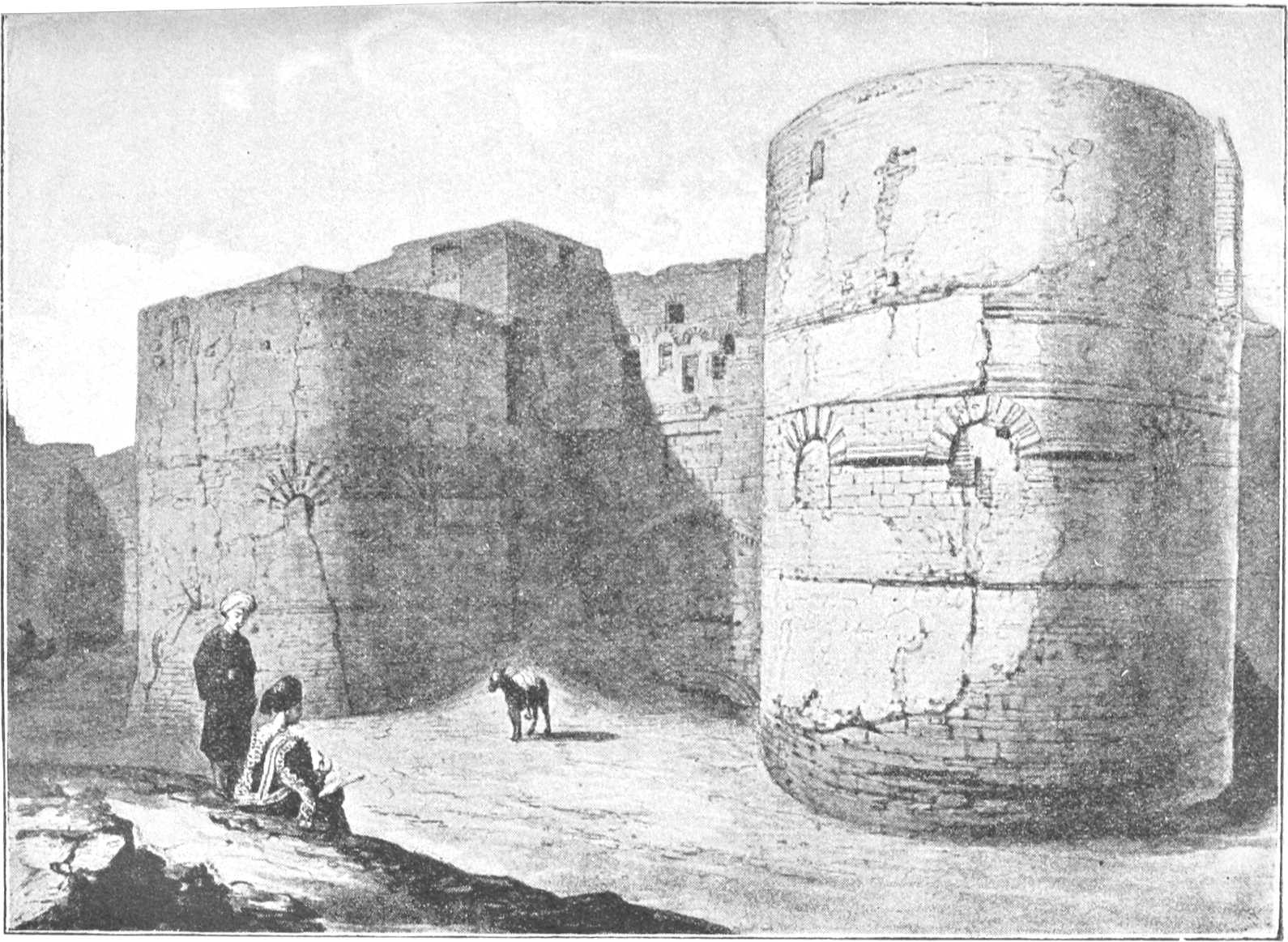
GATE OF KASR-ESH-SHEMA‘
[53]When we enter the stronghold the strange character of the fortress grows upon us. Passing through narrow lanes, narrower and darker and dustier even than the back alleys of Cairo, we are struck by the deadly stillness of the place. The high houses that shut in the street have little of the lattice ornament that adorns the thoroughfares of Cairo; the grated windows are small and few, and but for an occasional heavy door half open, and here and there the sound of a voice in the recesses of the houses, we might question whether the fortress was inhabited at all. Nothing, certainly, indicates that these plain walls contain six sumptuous churches, with their dependent chapels, each of which is full of carvings, pictures, vestments and furniture, which in their way cannot be matched. A Coptic church is like a Mohammedan harím—it must not appear from the outside. Just as the studiously plain exterior of many a Cairo house reveals nothing of the latticed court within, surrounded by rooms where inlaid dados, tiles, carved and painted ceilings, and magnificent carpets, glow in the soft light of the stained windows, so a Coptic church makes no outward show. High walls hide everything from view. The Copts are shy of visitors, and the plain exteriors are a sufficient proof of their desire to escape that notice which in bygone days aroused cupidity and fanaticism.
After passing through a strong gateway, and traversing a vestibule, or ascending some stairs, you find yourself in a small but beautifully finished basilica, gazing at a carved choir-screen that any cathedral in England might envy. In the dim light you see rows of valiant saints looking down at you from above the sanctuary and over the screens, and great golden texts in Coptic and Arabic, to the glory of God; while above, the arches of the triforium over the aisles show where other treasures of art are probably to be found.[54] The general plan of a Coptic church is basilican, but there are many points of wide divergence from the strict pattern; the Byzantine feature of the dome is almost universal, and sometimes the whole building is roofed over with a cluster of a dozen domes. The church consists of a nave and side aisles, waggon-vaulted (exactly like the early Irish churches, and like no others), and very rarely has transepts, or approaches the cruciform shape. The sparse marble columns that divide the nave from the aisles generally return round the west end, and form a narthex or counterchoir, where is sunk the Epiphany tank, once the scene of complete immersions, but now used only for the feet-washing of Maundy Thursday. The church is also divided cross-wise into three principal sections, besides the narthex. The rearmost is the women’s place, whom the judicious Copts put behind the men, and thereby prevent any disturbance of devotions much more effectually than if the two sexes were ranged side by side as in some Western churches. A lattice-work screen divides the women’s portion from the men’s, which is always much larger and more richly decorated, and the men’s division is similarly partitioned off from the choir by another screen, while the altars, three in number, are placed each in a separate apse, surmounted by a complete (not semicircular) dome, and veiled by the most gorgeous screen of all, formed of ivory and ebony crosses and geometrical panels, superbly carved with arabesques, and surmounted by pictures and golden texts in Coptic and Arabic letters.[10] During the celebration the[55] central folding doors are thrown back, the silver-embroidered curtain is withdrawn, and the high altar is displayed to the adoring congregation, just as it is in the impressive ceremonial of St Isaac’s cathedral at St Petersburg. The carved doors and the silver-thread curtain, the swinging lamps and pendent ostrich eggs, prepare us for something more gorgeous than the nearly cubical plastered brick or stone altar, with its silk covering, and the invariable recess in the east side, which originally had a more mystic signification, but is now only used for the burying of the cross in a bed of rose-leaves on Good Friday, whence it will be disinterred on Easter-day. The Coptic altar stands detached from the wall of the sanctuary, which is often coated with slabs of coloured marble, like the dados one sees in the mosques, or with mosaic of the peculiar Egyptian style; while above are painted panels or frescoes representing the twelve apostles, with Christ in the midst in the act of benediction. Over the altar spreads a canopy or baldacchino, which is also richly painted with figures of angels. The central sanctuary with its altar is divided off from the side altars by lattice screens.
A curious part of the furniture is the Ark, which holds the chalice during the rite of consecration; and scarcely less interesting is the flabellum, or fan for keeping gnats off the chalice, which is often exquisitely fashioned of repoussé silver. Similar fans are represented in the Irish Book of Kells. There is never a crucifix, but reliquaries are not uncommon, though their place is not on the altar. The Coptic church[56] forbids the worship of relics, but every church has its bolster full of them, and the devout believer attaches considerable importance to their curative properties. Sometimes the most beautiful object in metal-work in a Coptic church is the silver textus-case—corresponding to the Irish cumhdach—in which the copy of the Gospels is supposed to be sealed up, though generally a few leaves alone remain inside. It is often a fine example of silver chasing and repoussé work, and is reverently brought from the altar where it reposes to the officiating deacon, who places it on the lectern while he reads from another copy. The lectern itself is a favourite subject for decoration. That from the Mu‘állaka church, now in the Coptic cathedral at Cairo, is covered with the beautiful inlaid and carved panelling which is familiar in the doors and pulpits of mosques.
Of the six churches contained within the fortress of Babylon, three are of the highest interest; for, though the Greek church of St George, perched on the top of the round tower, is finely decorated with Damascus and Rhodian tiles and silver lamps, the Roman tower itself, with its central well, great staircase, and curious radiating chambers, is more interesting than the church above it. Of the three principal Coptic churches, that of St Sergius, or Abu-Sarga, is the most often visited, on account of the tradition that it was in its crypt that the Holy Family rested when they journeyed to the land of Egypt. The crypt is certainly many centuries older than the church above it, which dates from the tenth century. The church itself is notable for a fine screen, and close to it a remarkable specimen of early Coptic figure-carving, with representations of the nativity and of warrior saints in high relief. Another example of this style of deep carving exists in the triforium of the church of Saint Barbara.
[57]Besides Abu-Sarga and Kadísa-Barbára, there remains a third and very interesting Coptic church to be mentioned. This is suspended between two bastions of the Roman wall, over a gate with a classical pediment and a sculptured eagle. It is called from its position the Mu‘állaka or “hanging” church. It is remarkable in many ways, partly for being the oldest of the Babylon churches, and partly on account of the entire absence of domes. The Mu‘állaka has other peculiarities: it has absolutely no choir—the daïs in front of the shallow eastern apses has to serve the purpose; and it is double aisled on the north side.—The carved screen in the north aisle has the unique property of being filled in with thin ivory panels, which must have shone with a rosy tint when the lamps behind were lighted. The sculptured pulpit is especially beautiful; it stands on “fifteen delicate Saracenic columns, arranged in seven pairs, with a leader.” Not the least curious part about the “suspended” church is its hanging garden, where the bold experiment of planting palms in mid air has succeeded in perpetuating the tradition that it was here that the Virgin first broke fast with a meal of dates on her arrival in Egypt.
This is not the place to enter into the doctrine and ritual of the Coptic church. The appalling Lenten fast of the Copts, which lasts fifty-five days, and involves total abstinence from food from sunrise to sunset during each of those days, no doubt suggested the only less rigorous Muslim fast of Ramadán. The Coptic sacrament of matrimony has certain elements of the grotesque in it; but most of the ceremonial of the church possesses a dignity and the sweet savour of antiquity which must redeem any minor absurdities. No one can stand unmoved in a Coptic church during the celebration of the Mass, or hear the worshippers[58] shout with one voice, just as they did some fifteen hundred years ago, the loud response, “I believe This is the Truth,” without emotion. Through fiery persecution they have clung to their truth with a heroism that is only the more wonderful when we consider their weakness; and however partial and ignorant their interpretation of truth, we cannot withhold the respect that is the due of those who have come out of great tribulation and remained steadfast to their faith.
[59]CHAPTER III
The Faubourgs
BY the Arab conquest in 640 Egypt became a province of the caliphate, and was ruled, like the other provinces, by governors appointed by the caliphs. The first four successors of Mohammad retained Medina, the Arabian city of his adoption, as their seat of government; but after the murder of ‘Aly, the fourth caliph, the dynasty of the Omayyads transferred the centre of power to Damascus. From Damascus therefore came most of the thirty governors who held rule over the land of Egypt during the ninety years of the Omayyad caliphate. Some of them were sons or brothers of the reigning caliphs, and most were naturally court favourites, inexperienced in the art of government, and ignorant of everything save their religion and their language. The object of the sovereign pontiff at Damascus was to get as much revenue as he could out of the subject provinces, and Egypt especially was regarded in the light of a valuable milch-cow. ‘Amr, the conqueror, was the first governor, and from his new capital of Fustát he sent out his officers and collected about £6,000,000 from a population estimated at from six to eight millions. When the old warrior died at the age of ninety and was buried in the Mukattam hills he is said to have left seventy sacks of dinárs[11] or something like ten tons[60] of gold, which his conscientious sons declined to inherit.
However this may be, it is certain that the governors looked chiefly to the revenue, and did little for the country but draw the not very burdensome land and capitation taxes, and accumulate such pickings as might be safely diverted to their own use. A governor whose average tenure of office was three and a half years, and whose future livelihood often depended wholly on his savings, was under serious temptation to make the most of his brief opportunities. There were good wális and bad, but the shortness of their tenure and their absolute dependence upon the caliph at Damascus restricted their powers and energies, and they generally contented themselves with keeping order and rendering tribute to their pontifical Cæsar. The position was not easy. There were some thousands of Arab soldiers at Fustát and Alexandria and some other towns, constantly increased, however, by the troops brought into the country by successive governors; but all the rest of the population was Christian and resolved to remain so. Indeed, any wholesale conversion was much to be deprecated, since it implied the loss of the poll-tax of a guinea a head which was levied only from non-Muslims. Still, it was dangerous to be in so marked a minority, and we find that about ninety years after the conquest, a governor, despairing of any considerable accession of native Egyptians to the Muslim ranks, was driven to import 5000 Arabs into the Delta. It was only by very slow degrees and after much intermarriage and many partial immigrations that Egypt became Muslim, and for a long time the Arabs were practically confined to the large towns.
Fustát itself must soon have attracted a numerous Coptic population from the decaying Egyptian towns in the neighbourhood, not only in wives for the conquerors,[61] but in officials. All the details of government were naturally in the hands of the subject people. The desert Arabs knew nothing beyond the patriarchal rule of the clan, and they adopted everywhere the system they found prevailing in a conquered territory. Roman offices were translated into Arabic equivalents, and the Copts, a race of born clerks and accountants, managed all the departments. For half a century the government books and public documents were written in Coptic. Usefulness does not necessarily compel toleration, and the Christians did not always escape persecution in spite of their official services. They were better treated, however, than is sometimes imagined. Grateful for their assistance in the stress of the invasion ‘Amr granted privileges to the Jacobites and recalled their exiled patriarch. Another governor allowed the Copts to build a church at Fustát beside the bridge that connected the capital with the island of Roda, and a third, ‘Abd-el-‘Azíz, son of the caliph Marwán, bought the monastery at Tamweyh from the monks for over £10,000 when he wanted a country house. He went there in order to be cured of elephantiasis in the sulphur springs of Helwán, between Cairo and Memphis, and it is curious to consider how nearly this modern health-resort (now moved further towards the desert) became the capital of Egypt. ‘Abd-el-‘Azíz was so charmed with the climate of Helwán that he built mosques there (695), a palace, known as the “Golden House” from its gilt dome, and a glass winter-garden, planted trees, made a lake and aqueduct, and constructed a Nilometer. Hitherto the lower Nile had been measured at Memphis, but in 716 a new Nilometer was set up on the island of Roda, where a second was afterwards built at the upper end of the island in 861. Subsequent governors, however, did not share the ideas[62] of ‘Abd-el-‘Azíz either in regard to the charms of Helwán or in relation to the Copts, and we read of a vexatious system of passports, badges for monks, fines and tortures, and destruction of sacred pictures, which excited such indignation that the people rose in rebellion in the east of the Delta, and the Christian king of Nubia marched into Egypt to demand the release of an imprisoned patriarch.
These Muslim persecutions were not a whit more cruel than the contemporary Christian persecutions of the Jews, but this does not make them the more defensible. The monks seem to have especially excited the fanaticism of the early Muslims, whose puritanism found no place for monastic rules. In later times the Shí‘a caliphs of Cairo took very kindly to the Coptic monks, but it was not so in the cruder and fiercer age of the Arab conquests. Monasticism was a potent force in Egypt from very early days. The followers of St Mark in the third century had settled in scattered communities all over the Delta, and had already begun to formulate what is known as “the Egyptian rule.” We do not yet know how much we owe to these remote hermits. Some have held that Irish Christianity, the great civilizing agent of the early Middle Ages among the northern nations, was the child of the Egyptian Church. Seven Egyptian monks are buried at Disert Ulidh, and there is much in the ceremonies and architecture of early Ireland that reminds one of still earlier Christian remains in Egypt. Everyone knows that the handicraft of the Irish monks in the ninth and tenth centuries far excelled anything that could be found elsewhere in Europe; and if the Byzantine-looking decoration of their splendid gold and silver work and their superb illuminations can be traced to the teaching of Egyptian missionaries, we have more to thank the Copts for than[63] has been imagined. That Arab architecture owes to them much of its decorative charm is among the commonplaces of the history of art.
Such considerations naturally could not influence a people so wholly dead to artistic ideas as the Arabs. To them the Coptic monks were merely candidates for clerkships and owners of secret hoards to be squeezed for the benefit of the faithful. Any thought of fellowship or amity was out of the question, and the fact that persecution was not more general and consistent must be ascribed to the indolence or good nature of individual governors, and to the prudent maxim that deprecates the slaughter of the goose that lays golden eggs. Now and again we read of cruel massacres and tortures, and destruction of churches, and next we hear of permission granted for the building or restoration of a church. We find the Copts quietly meeting in the fortress of Babylon, which they always occupied, to elect a patriarch; and almost at the same moment appear notices of humiliating sumptuary rules, a distinguishing garb of some ridiculous colour, and wooden effigies of the devil hung over Coptic doors. Every now and then some rising, or a mere street quarrel, would be made the pretext for a wholesale massacre, when many churches were razed to the ground.
In spite of persecution, in spite of the apostasy of the weaker brethren, the Church still preserved a painful existence. There is something truly heroic in the constancy of these ignorant people—for the Coptic priesthood was never famous for learning—to the faith of their forefathers. They still persevered in the celebration of the rites of their religion, though the loop-holed walls, massive doors, and secret passages of their surviving churches testify to the perils that attended such solemnities. From time to time many[64] of them waxed rich, as the gorgeous adornments of these churches show; for their masters could not do without their skill in reckoning and scriveners’ work. Aided by this monopoly, and supported by a dogged adherence to their ancient faith, the Copts present to this day the curious spectacle of a people who have stood still for ages, and, through many centuries of varying persecution, have preserved their individuality and their traditions. They are still a people apart, less mixed with alien blood than any other inhabitants of the Nile valley; their features recall those of the ancient Egyptians, as we see them on the monuments, much more than do the faces of the Muslim population. And not only in person but in language the Copts are a remnant of ancient Egypt. Their tongue, preserved in their liturgy and recited to-day in their churches, is the lineal descendant of the language of the hieroglyphics and of the Rosetta stone. For ordinary purposes of course they use the Arabic of their neighbours, but the sacred speech of their religion is still partly understood by the priests, and retains its place of honour before the Arabic translation in the services of the church. By another curious freak of conservatism they preserve this ancient language, not in the script that belonged to it—the cursive development of the picture writing of the monuments—but in the bold uncial character of early Greek manuscripts. A people of the race of the Pharaohs, speaking the words of Ramses, writing them with the letters of Cadmus, and embalming in the sentences thus written a creed and liturgy which twelve centuries of persecution have not been able to wrest from them or alter a jot, are indeed a curiosity of history.
The Omáyyad caliphs were superseded by the ‘Abbásids in 750, and Fustát was the scene of the final struggle. Marwán, the last caliph of the fallen[65] dynasty, fled to Egypt, and setting fire to Fustát and the bridge that joined it to the island of Roda, escaped to the west bank. His precautions were vain. The ‘Abbásid general and the men of Khurasán soon found the means of crossing, and Marwán’s head was sent round the towns in evidence of the change of power. Usurpers have an invincible repugnance to dwelling in the houses of the usurped. The ‘Abbásid caliphs left Damascus and built themselves a famous new capital at Baghdád; and their governors in Egypt, abandoning the House of the Emírate at Fustát, established a new official suburb, a Versailles of the Egyptian Paris, on the place where the pursuing army had encamped, and named it el-‘Askar or “the Cantonments.” The site was a little to the north-east of Fustát, on a part of the Further Hamra, which had been occupied by three tribes at the time of the Arab conquest, but had since been abandoned and become desert. Here a faubourg grew up, which extended from Fustát to the hill of Yeshkur, on which the mosque of Ibn-Tulún now stands. A mosque was soon built, and a palace for the governor as well as barracks for his troops. Streets and quarters and large mansions clustered round the new fashionable centre, where the sixty-five wális who represented the ‘Abbásid caliphs for 118 years had their seat of government. One of them, Hátim, in 810 built himself a summer palace called the “Dome of the Air” (Kubbat-el-Hawa) on a spur of the Mukattam, where the Citadel of Cairo is now built, and thither the emírs of Egypt often resorted to enjoy the cool breeze. The new faubourg was merely the quarter of the officials and court circles, and did not diminish the importance of Fustát as the metropolis of Egypt.
Not a trace is left of this suburb, and the record of[66] the governors who lived there is almost equally fleeting.[12] They had a more difficult task than their predecessors under the Omayyads, and had to suppress insurrections of Mohammedan schismatics as well as risings among the Arab tribes and the Copts. Fustát bore unpleasant witness to the revolts in the thousands of rebels’ heads that were exhibited, and the courage of hesitating heretics was damped by the sight of their leader’s skull hung up in the mosque of ‘Amr. The history of the century from 750 to 860 is one long chronicle of “sedition, privy conspiracy and rebellion, false doctrine, heresy and schism,” but the disturbances hardly affected the prosperous capital. The vagaries of some of the governors were much more vexatious to the quiet citizens. Abu-Sálih ibn Memdúd, in 779, was a middlesome martinet, who showed great energy in putting down brigandage in the country, and was so satisfied with his measures that he convinced himself of the impossibility of theft in the towns. Confiding in this belief he ordered the people of Fustát to leave their doors and shops open all night, with no more protection than a net to keep the dogs out; he abolished the office of the watchman who used to guard the bathers’ clothes at the public baths, and proclaimed that if anything were lost he would replace it himself. It is said that when a man went to the bath he would call out “O Abu-Sálih, take care of my clothes!” and no one would dare to touch them. Such security argued great vigilance on the governor’s part, but his absurd laws of dress and general interference irritated the people, and his severity was worse than the evils it put down.
A story is told of the famous caliph Harún-er-Rashíd, which would scarcely invite respect for his nominees.[67] One governor of his time, Musa the ‘Abbásid, “was a man of great official experience, and well-disposed towards the Copts, whom he allowed to rebuild their ruined churches. When it was reported that he was harbouring designs against the caliph [whom, as one of the family, he might possibly succeed], Harún exclaimed, with his usual levity, ‘By Allah, I will depose him, and in his place I will set the meanest creature of my court.’ Just then ‘Omar, the secretary of the caliph’s mother, came riding on his mule. ‘Will you be governor of Egypt?’ asked Ga‘far the Barmecide. ‘Oh, yes,’ said ‘Omar. No sooner said than done, ‘Omar rode his mule to Fustát, followed by a single slave carrying his baggage. Entering the governor’s house (at ‘Askar), he took his seat in the back row of the assembled court. Musa, not knowing him, asked his business, whereat ‘Omar presented him with the caliph’s dispatch. On reading it, Musa exclaimed in Koranic phrase, ‘God curse Pharaoh, who said, Am I not King of Egypt?’ and forthwith delivered up the government to ‘the meanest creature.’”
On the other hand a really capable ruler was sometimes sent from Baghdad. Such was ‘Abdallah the son of Táhir, governor of Khurasán in northern Persia (where he afterwards founded a dynasty), whose task in Egypt was to drive out a troublesome multitude of refugees from Spain, who had seized Alexandria, and, joined by a hot-headed Arab tribe, set the government at defiance. ‘Abdallah, in the course of his mission, was compelled to attack the preceding governor, who refused to be superseded, and Fustát was blockaded (826). A curious incident of the leaguer was the arrival one night in the invader’s camp of a thousand slaves and a thousand slave girls, each of whom brought a thousand dinárs in a purse. ‘Abdallah refused the[68] bribe, and starved the garrison out. Unfortunately, when his work was done he returned to Persia, and Egypt lost a rare example of “a just and humane governor, a man of learning, and a staunch friend to poets.” A reminiscence of his rule may still be tasted at any Cairo hotel in the ‘Abdalláwi melons which he first introduced. A greater than he visited ‘Askar when the caliph Mamún, son of Harún-er-Rashíd, and himself a noted patron of learning and philosophy, came in person in 832 to put down a determined revolt of the Copts in the Delta, and did the work so thoroughly and so relentlessly that there never again was a national movement amongst them; and partly by their conversion to Islam, partly by the settlement of Arabs on the land and in the villages, instead of only in the large cities, Egypt began at last to become preponderantly a Mohammedan country. It was the first time that an ‘Abbásid caliph had visited the Nile, the praises of which poets had constantly been dinning in his ears; and when el-Mamún surveyed the view from the “Dome of the Air,” he was frankly disappointed. Using the same phrase from the Korán as the superseded governor, he exclaimed, “God curse Pharaoh for saying Am I not king of Egypt? If only he had seen Chaldæa and its meadows!” “Say not so,” rejoined a divine, “for it is also written, ‘we have brought to nought what Pharaoh and his folk reared and built so skilfully,’ and what must have been those things which God destroyed, if these be but their remnants!”[13]
The caliph’s visit, if it put an end to Coptic insurrection, brought other troubles in its train. His interest in metaphysical and theological speculation, which encouraged the study of Greek philosophy at Baghdád, led him among other things to adopt the doctrine of[69] the createdness of the Korán, which was flat against all orthodox Muslim theory. The hated doctrine was made a test question for the kádis or theological judges, and the consequences to those who indulged conscientious scruples were distressing. A non-conforming chief kády of Fustát was shorn of his beard—the worst indignity he could suffer—and whipped through the city on an ass. The orthodox professors of the Hánafy and Sháfi‘y schools were driven out of the mosque of ‘Amr in disgrace. The contumely was the less deserved inasmuch as in those days the judges were the one healthy feature of the Egyptian government. Upright and incorruptible, as a rule, and independent of the governor, the chief kády, who may be called the lord chancellor and primate of Egypt in one, was a firm if narrow interpreter and administrator of the sacred law, and would resign his office sooner than submit to his judgments being overruled. He was not, however, disposed to check his people’s fanaticism, and the suppression of the Christian revolt was followed by worse persecution than ever. An orthodox reaction began after Mamún’s death, and a new caliph issued a number of petty regulations for the humiliation of the Copts (850). They were ordered “to wear honey-coloured clothes with distinguishing patches, use wooden stirrups, and set up wooden images of the devil or an ape or dog over their doors; the girdle, the symbol of femininity, was forbidden to women, and ordered to be worn by men: crosses must not be shown, nor processional lights carried in the streets,” and so forth. The object of course was to furnish opportunities for fines and extortion.
There is no need to dwell further upon the period of Arab rule at Fustát and ‘Askar. The Arab governors left little trace, and though it is to be regretted that not a single specimen of their buildings has come down to[70] us, as links in the history of Saracenic art, it is not probable that these edifices were remarkable. The Arabs have never done anything in art by themselves. What is called “Arab art” in Spain was due to a mixture of other and more gifted races, and in Egypt we find no Mohammedan art until the caliphs began to appoint Turks as Governors. One hears a great deal about the misgovernment of the Turk in the present day; but be it good or bad, it is never denied that he can govern. In the Middle Ages it would almost appear that the Turks were the only people who possessed the art of governing. The greatest ruler of Western Asia in the eleventh century—the Seljúk emperor, Melik Shah—was a Turk. The so-called Moghuls of India, Babar and Akbar, were Turks. When Europe was split up by jealous and ignoble rivalries, the great Turkish sultans of Constantinople wielded power from the Danube to the Indian Ocean, and from the Caucasus to the Atlas. Most curious it is that wherever there was Turkish rule in the Middle Ages, art and letters flourished. Indeed, in many parts art can hardly be said to have reawakened till the Turk came to inspire it. It was not that he could do anything notable himself in art or letters, for at least among the Turkish rulers of Egypt—and with an interval of less than two hundred years its rulers have been almost all Turks for the past eleven centuries—it would be hard to point to many who were distinguished for cultivation; it was rather that their strong hand preserved the order that is essential to the work of culture, and their unscrupulous levies produced the money, that was needed for the beautiful and grandiose buildings in which they loved to see their power and wealth reflected. Many of them probably had a genuine love of art, most of them were fond of luxury and display, and delighted to surround themselves with the[71] costly products of exquisite workmanship; and a good many, no doubt, believed that the endowment of sanctuaries might expiate the sins of a life, remembering the words of the Prophet, “Whosoever builds for God a place of worship, be it only as the nest of a grouse, God buildeth for him a house in Paradise.” Whatever the cause, the fact remains that the influence of the Turk is found in the artistic energy of every part of the East from the Bosporus to the Ganges. It was to the Turks of Delhi and Agra that we owe the Kutb Minár, the Taj, the intricate graces of Fathpur Sikri; Turks built the Atala Mesjid at Jaunpur, the mosques of Ahmadabad, of Gaur, of Bijapur; Seljúk Turks were the founders of the noble buildings of Kóniya, Kaysaríya, Sivás, and other cities of Asia Minor; Othmanly Turks built the shrines of Brusa and the imperial mosques, second indeed, but only second, to St Sophia at Constantinople. In Egypt we find the same thing: the first example of distinctively Saracenic art appears only when the Turk assumed the sceptre. Up to 856 every governor of Egypt was an Arab, and, with the doubtful exception of the mosque of ‘Amr, not a single monument attests their public spirit. From 856 the governors were Turks, and twenty years later rose the mosque of Ibn-Tulún, the first and most remarkable monument of Arab art in the country.
It would take us far from Cairo to explain how the Turks came to be rulers of Egypt. The movement was part of that overflow of the peoples of Central Asia which has been going on from the beginning of history; but it was assisted by the policy of the caliphs. Alarmed at the growing power of provincial dynasts in Persia, and threatened by turbulent Arab tribes in Mesopotamia, the ‘Abbásids imported a guard of mercenaries recruited from the slave markets of the Oxus, and for a while rejoiced in the protection of these stalwart young Turks.[72] The old question, Quis custodiet? soon arose, and the luxurious and effeminate caliphs of Baghdád realized too late that in purchasing these valiant slaves they had virtually condemned themselves to slavery. The Turkish captain of the bodyguard became the maire du palais of the Baghdád roi fainéant, the offices of State were seized by the Turks, and the government of the western provinces was confided to their friends. At first they contented themselves with the profits without the cares of office, and a series of Turkish emírs, living at Baghdád or elsewhere in Mesopotamia, held the fief and drew the surplus revenue of Egypt through Arab deputy-governors. But in 856 the deputy as well as the fieffee was a Turk, and in 868 the Turkish fieffee Bakbak sent his stepson, Ahmad ibn Tulún, to govern Egypt as his representative.
Ahmad, the son of Tulún, was thirty-three years of age when he arrived at Fustát, and combined in a remarkable degree the military and administrative ability of his race with the culture of his adopted civilization. He had studied under the learned professors of Baghdád, and even journeyed to Tarsus for the benefit of special lectures. In matters of Arabic philology and Koranic doctrine he was critically expert. But beyond this he was a man of boundless energy, an unerring judge of character, who knew how to choose and use his subordinates. His justice, if stern, was incorruptible, and his generosity was superb. “Give to every one who holds out the hand” was his motto, and every month he devoted a thousand dinárs to charity. He came to Egypt penniless, save for a loan from a friend; but when he died he left ten million dinárs in the treasury, an immense establishment of slaves and horses, and a hundred ships of war. Yet he accomplished his economies without increasing the taxes. Indeed he abolished various imposts, and his revenues were due chiefly to[75] the pains he took to encourage cultivation and to give the fellahín better security in their land. For the first time since the Arab conquest Egypt became a powerful and sovereign State. Ahmad soon threw over all save a nominal dependence on the caliphate, and after overcoming intrigues and subduing three rebellions in Egypt, he marched into Syria, and occupied the whole country as far as Tarsus and the Euphrates, fought the armies both of the caliphate and of the Romans of the Cilician frontier, and united under his sole authority the broad stretch of territory from Barka in Libya to the borders of the Byzantine empire in Asia Minor, and from the Euphrates to the first cataract of the Nile.
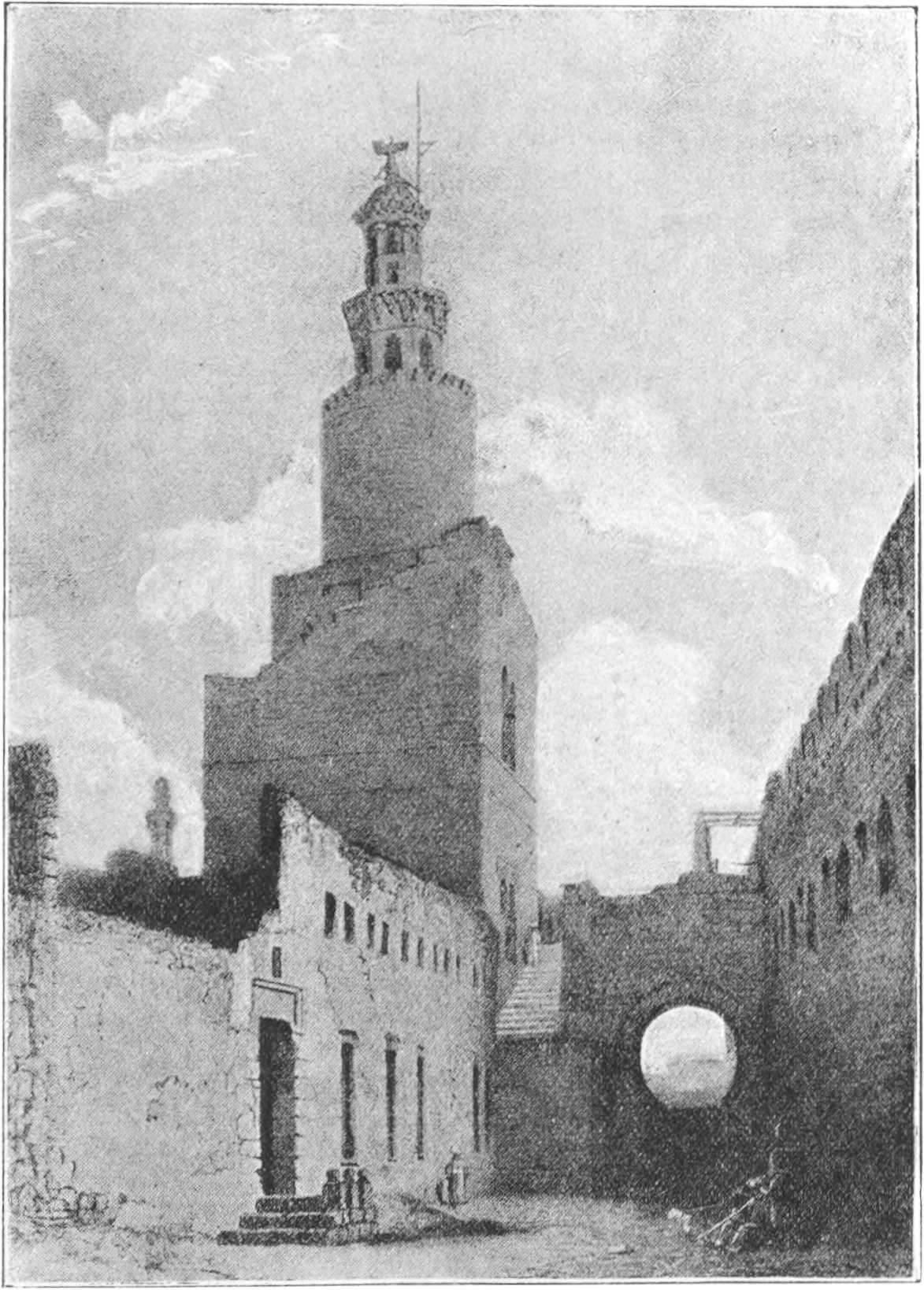
TOWER OF THE MOSQUE OF IBN-TULUN
Side by side with this imperial policy Ahmad expended infinite labour and wealth upon the embellishment of his capital. “The government house at el-‘Askar, the official suburb of Fustát, was too small to house his numerous retinue and army. He was not content, either, with a mere governor’s palace. In 870 he chose a site on the hill of Yeshkur [at the north-east extremity of ‘Askar, next to the House of the Emirate], levelled the graves of the Christian cemetery there, and founded the royal suburb of el-Katái‘, or ‘the Wards,’ so called because each class or nationality (as household servants, Greeks, Sudánis) had a distinct quarter assigned to it. The new town stretched from the present Rumeyla beside the Citadel to the shrine of Zeyn-el-‘Abidin, and covered a square mile. The new palace was built below the old ‘Dome of the Air,’ and had a great garden and a spacious enclosed horse-course or Meydán adjoining it, with mews and a menagerie; the government house was on the south of the great mosque, which still stands, and there was a private passage which led from the residence to the oratory of the emír. A separate[76] palace held the harím, and there were magnificent baths, markets, and all apparatus of luxury.”[14]
The generals and officers built their houses round about, and great mansions soon covered the new site. The bazars were even better than at Fustát, well built and filled with choice wares. The Meydán, where Ahmad and his captains played mall or polo, became the favourite resort of the town, and if one asked anybody where he was going the answer was sure to be “To the Meydán.” It was entered by a number of gates, restricted to special classes, such as the Gate of the Nobles, the Gate of the Harím, or named after some peculiarity, as the Gate of Lions, which was surmounted by two lions in plaster, the Sag Gate, made of teak, the Gate of ed-Darmún, so called because a huge black chamberlain of that name mounted guard there. Only Ahmad himself could ride through the central arch of the great triple gate: his 30,000 troops passed through the side arches. On review days he stationed himself on a daïs and watched the crowd come in by the Polo Gate (Bab es-Sawáliga) and pass out by the Gate of Lions, above which he had a balcony, whence on the night of the great festival he could survey the whole faubourg and see what the people were about. The view from this belvedere reached to the gate of Fustát and to the Nile, and it was a favourite resort of the emír.
The palace was supplied with water from a spring in the southern desert by means of an aqueduct, the traces of which may still be seen—not that of many arches running from the Citadel to the Nile, which belongs to a much later date. The people, in Eastern fashion, naturally found fault with the quality of the pure water to which their own muddy wells and turgid[77] Nile had not accustomed them. Rumours of this reached Ibn-Tulún, and he sent for the learned doctor Mohammad Ibn ‘Abd-el-Hakam to resolve these suspicions. “I was one night in my house,” he related, “when a slave of Ibn-Tulún’s came and said, ‘The emir wants thee.’ I mounted my horse in a panic of terror, and the slave led me off the high road. ‘Where are you taking me?’ I asked. ‘To the desert,’ was the reply; ‘the emir is there.’ Convinced that my last hour was come, I said, ‘God help me! I am an aged and feeble man: do you know what he wants with me?’ The slave took pity on my fears and said, ‘Beware of speaking disrespectfully of the aqueduct.’ We went on till suddenly I saw torch-bearers in the desert, and Ibn-Tulún on horseback at the door of the aqueduct, with great wax candles burning before him. I forthwith dismounted and salaamed, but he did not greet me in return. Then I said, ‘O emir, thy messenger hath grievously fatigued me, and I thirst; let me, I beg, take a drink.’ The pages offered me water, but I said, ‘No, I will draw for myself.’ I drew water while he looked on, and drank till I thought I should have burst. At last I said, ‘O emir, God quench thy thirst at the rivers of Paradise! for I have drunk my fill, and know not which to praise most, the excellence of this cool, sweet, clear water, or the delicious smell of the aqueduct.’ ‘Let him retire,’ said Ibn-Tulún, and the slave whispered, ‘Thou hast hit the mark.’”
The monument which has immortalized Ibn-Tulún, however, is his mosque, the only building of all his sumptuous little city that has survived the buffets of civil war and the slow detrition of neglect. It is the most interesting monument of Mohammedan Egypt, and forms a landmark in the history of architecture. Two features specially distinguish it: it was built[78] entirely of new materials, instead of the spoils of old churches and temples, and it is the earliest instance of the use of the pointed arch throughout a building, earlier by at least two centuries than any in England. They are true pointed arches, with a very slight return at the spring, but not enough to suggest the horse-shoe form. The Topographer relates how Ahmad lighted upon a treasure in the Mukattam hills, at a place called “Pharaoh’s Oven,” and resolved to build with it a mosque large enough to hold the vast congregations that then overcrowded the mosque of el-‘Askar. He chose for the site the flat-topped rocky hill of Yeshkur, a sure place for prayers to be answered, since it was believed to be the spot where Moses held converse with Jehovah. Here the foundations were laid in 876 (263 A.H.), and two years later the work was finished and public prayers were held in the presence of the emír. Ibn-Tulún was at first in a difficulty how to procure the three hundred columns needed to support the arcades, but his architect, who was a Christian and doubtless a Copt,[15] and was at the time in prison for some offence, wrote to him that he would undertake to build him a mosque of the size he required without columns. He was brought before the emír who said, “Woe to thee! what is this that thou sayest respecting the building of the mosque?” “I will draw the plan for the prince,” answered the Christian, “that he may see it with his eyes, with no columns save the two beside the kibla.” They brought him skins and he drew the plan. Such a[79] design was evidently quite new in mosque building, but Ahmad saw its merits at once, arrayed the designer in a robe of honour, and gave him 100,000 dinárs to carry out his plan. When it was done he gave him 10,000 more, and the total cost is stated to have amounted to 120,000 dinárs or about £63,000. The use of brick arches and piers, instead of marble columns, was due partly to the emír’s reluctance to deprive the Christian churches of so many pillars, but even more to his anxiety to make his mosque safe from fire. He was told that if he built it of “mortar and cinders and red brick well burnt” it would resist fire better than if constructed of marble, and the fact remains that the mosque has withstood the conflagrations that devastated the rest of the faubourg. The adoption of the new plan of brick piers, instead of columns, led to the employment of the pointed arch, and the exclusion of marble suggested the plaster or stucco decoration which still preserves its original admirable designs.
Five rows of arches form the cloister at the Mekka or south-east side, and two rows on the other sides; arches and piers are alike coated with gypsum, and the ornaments on the arches and round the stone grilles or windows are all worked by hand in the plaster. The difference between the soft flexuousness of this work, done with a tool in the moist plaster, and the hard mechanical effect of the designs impressed with a mould in the Alhambra is striking: it is the difference between the artist and the artisan. On the simple rounded capitals of the engaged columns built at the corner of each arch there is a rudimentary bud and flower pattern, and on either side of the windows between the arches facing the court, which also are pointed and have small engaged columns, is a rosette, and a band of rosettes runs round the court beneath the crenellated parapet.[80] The inner arches are differently treated. “Round the arches and windows runs a knop and flower pattern, which also runs across from spring to spring of arch beneath the windows, and a band of the same ornament runs all along above the arches, in place of the rosettes, which only occur in the face fronting the court; over this band and likewise running along the whole length of all the inner arcades is a Kufic inscription carved in wood, and above this is the usual crenellated parapet. The arcades are roofed over with sycamore planks resting on heavy beams. In the rearmost arcade the back wall is pierced with pointed windows, which are filled, not with coloured glass, but with grilles of stone forming geometrical designs with central rosettes or stars.”[16]
The general form of the mosque is similar to that of ‘Amr as restored, the form of every mosque in Cairo from the ninth to the thirteenth century. The great square court, covering three acres of ground, gave room for the largest assembly, whilst the covered arcades offered shelter from the sun to the ordinary congregation and to the groups of students, ascetics, and beggars who have always made their home in mosques. The south-east arcade or liwán, with its deeper aisles, was the special sanctuary,[17] where the mihráb or niche in the wall showed the direction (kibla) of Mekka, towards which the prayers of the faithful must turn, and the pulpit (minbar) and platform (dikka) gave the[83] preacher and the precentors vantage to make their voices heard throughout the crowd of worshippers. So far there is nothing original about the mosque. The form may have been adopted by the Arabs from ancient Semitic temples, or the great court may represent the atrium of the Byzantine basilica and the liwán the basilica itself, only supported on pillars instead of vaulted roofs, with a relic of the apse in the concave mihráb; but it was too obviously suited to the requirements of the climate to need any curious derivation.
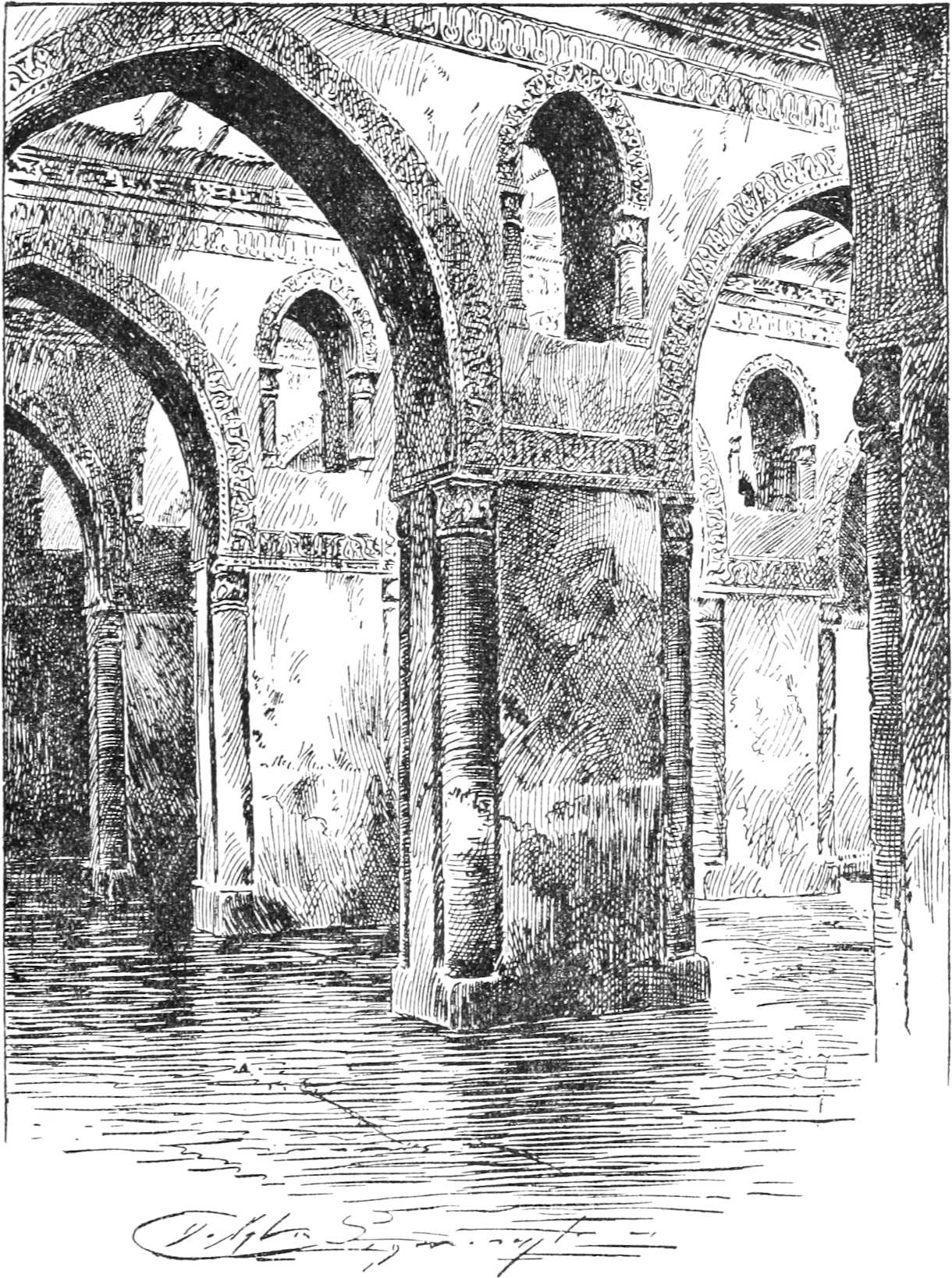
WITHIN THE MOSQUE OF IBN-TULUN
The dome and minaret, so characteristic of later Cairo mosques, are here wanting. The odd-looking corkscrew tower with external winding staircase, like the Assyrian ziggurat, has a fellow in the tower of Samarra on the Tigris, from which it was doubtless copied, but the upper part has probably been restored; though the tower of Ibn-Tulún was certainly in existence in 1047, when it is mentioned by Násir-i-Khusrau. But it is hardly a minaret in the common sense of the term.[18] There is no dome, because the dome has nothing to do with prayer, and therefore nothing with a mosque.[19] “It is simply the roof of a tomb, and only exists where there is a tomb to be covered, or at least where it was intended that a tomb should be.[84] Only when there is a chapel attached to a mosque, containing the tomb of the founder or his family, is there a dome, and it is no more closely connected with the mosque itself than is the grave it covers: neither is necessary to a place of prayer. It happens, however, that a large number of the mosques of Cairo are mausoleums, containing a chamber with the tomb of the founder, and the profusion of domes to be seen, when one looks down upon the city from the battlements of the Citadel, has brought about the not unnatural mistake of thinking that every mosque must have a dome. Most mosques with tombs have domes, but no mosque that was not intended to contain a tomb ever had one in the true sense. The origin of the[85] dome may be traced to the cupolas which surmount the graves of Babylonia, many of which must have been familiar to the Arabs [and still more to the Turks], who preserved the essentially sepulchral character of the form and never used it, as did the Copts and Byzantines, to say nothing of Western architects, to roof a church or its apse.”
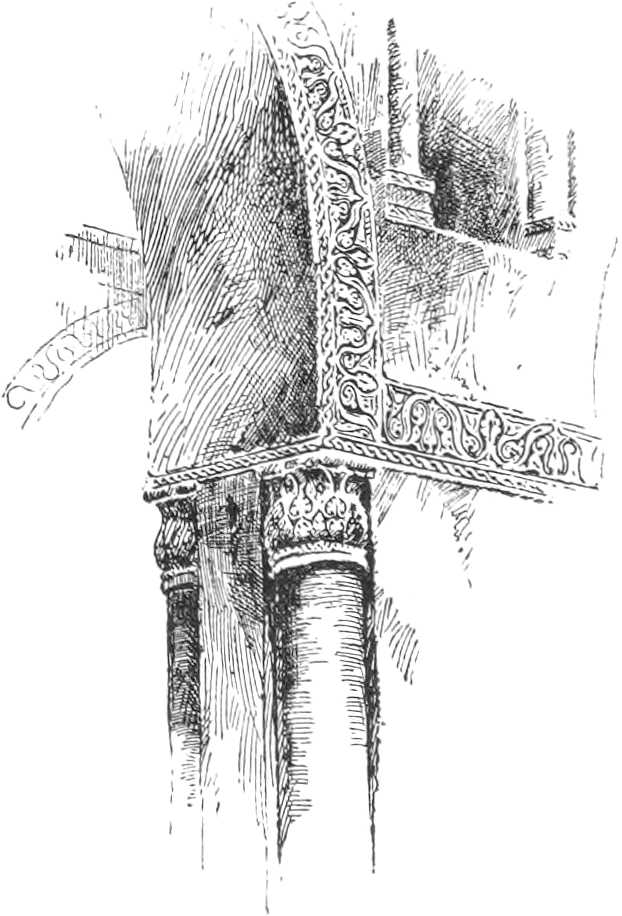
DETAIL OF ORNAMENT IN MOSQUE OF IBN-TULUN
But if there is little originality in the shape of the mosque, its pointed arches and its decoration are worth studying. Pointed arches occur also in the second Nilometer on the island of Roda, as rebuilt in 861, some fifteen years earlier than the mosque of Ibn-Tulún, and the architect of this building is stated to have been a native of Ferghána on the Iaxartes. There is nothing to prove that this arch was derived from the Coptic style. On the other hand the bold and free plaster decoration, designed by the Coptic architect, was undoubtedly borrowed from the ornament of his countrymen. The Arabs have never been artists or even skilled craftsmen. They imported Persians and Greeks to build for them and decorate their houses and mosques, but above all they employed the Copts, who have been the deft workmen of Egypt through thousands of years of her history. A comparison of the plaster work of Ibn-Tulún with the Coptic carvings preserved in the Cairo Museum of Antiquities and those from the tombs of ‘Ayn-es-Síra in the Arab Museum shows clearly the source of the floral decoration, which belongs to the Byzantine school of Syria and Egypt. The Kufic inscriptions carved in the solid wood are a purely Arab addition, and one that afterwards developed into a leading decorative feature in Saracenic art.[20] The geometrical ornament[86] of the open grilles is also Byzantine, as M. Bourgouin has established in his exhaustive treatise on the entrelacs, but it is not certain that they belong to the original building, and the star polygons suggest that the grilles may have been part of the later restoration.[21]
Home interests did not interfere with Ibn-Tulún’s imperial ambitions. He played a conspicuous part in Mesopotamian politics, and almost succeeded in getting the caliph into his hands. The oppressed head of Islam would have gladly escaped from his tyrannous brother el-Muwaffak, but the scheme failed, and Egypt lost the opportunity of becoming the seat of the caliphate. The result was that the ambitious emir was publicly cursed in every mosque of Mesopotamia. He also failed to capture the sacred city of Mekka, but his reign ended in some glorious campaigns against the Roman emperor, in which the Egyptian forces defeated the enemy near Tarsus, killed (it is said) 60,000 Christians, and captured immense spoils of gold and silver crucifixes, jewels, and sacred vessels. The success turned the general’s head, and Ahmad himself had to march north to bring his viceroy to obedience. “It was a severe winter, and his opponent dammed the river, flooded the country, and nearly drowned the besieging army at Adhana. Ibn-Tulún was forced to retire to Antioch, where a copious indulgence in buffalo milk, following upon the exposure and privations of the campaign, brought on a dysentery. He was carried in a litter to Fustát, where he grew worse. In sickness the fierce emir was a terror to his doctors. He refused to follow their orders, flouted their prescribed diet, and when he found himself still sinking, he had their heads chopped off, or flogged them till they died. In vain Muslims, Jews, and[87] Christians offered up public prayers for his recovery. Korán and Tora and Gospel could not save him; and he died in May, 884, before he had reached the age of fifty.”
His sumptuous capital received many notable additions from his successor Khumáraweyh, who fully shared his father’s passion for splendid building as well as his imperial policy. He enlarged the palace, and turned the Meydán into a garden, which he planted with rare trees and exquisite roses. The stems of the trees were thought unsightly, and he coated them with sheets of copper gilt, between which and the trunk leaden pipes supplied water not only to the trees but to the canals and fountains that irrigated the garden by means of water wheels. There were beds of basil carefully cut to formal patterns, red, blue, and yellow water-lilies and gilliflowers, exotic plants from all countries, apricots grafted upon almond trees, and various horticultural experiments. A pigeon-tower in the midst was stocked with turtle-doves, wood-pigeons, and all sorts of birds of rich plumage or sweet song, who made a cheerful concert as they perched on the ladders set against the walls or skimmed over the pools and rivulets. In the palace he adorned the walls of his “Golden House” with gold and ultra-marine, and there set up his statue and those of his wives in heroic size, admirably carved in wood, and painted and dressed to the life with gold crowns and jewelled ears and turbans. In front of the palace he laid out a lake of quicksilver, by the advice of his physician, who recommended it as a cure for his lord’s insomnia. It was fifty cubits each way, and cost immense sums. Here the prince lay on an air-bed, linked by silk cords to silver columns on the margin, and as he rocked and courted sleep his blue-eyed lion Zureyk faithfully guarded his master. Long after the[88] palace had disappeared people use to come and dig for the costly mercury that had formed the emir’s cradle.
There was also a pavilion as large as the “Dome of the Air,” with a new device in curtains, and splendid carpets, and a view over gardens, town, and Nile. In another kiosk, built by his father, men chanted the Korán, proclaimed the hours of prayer, and recited verses sacred and profane, pious and amorous, tristes et gais, tour à tour, whilst the prince sat at table with his ladies, surrounded by musicians. As the solemn call to prayer echoed through the merry din, he would lay aside his cup and bow his head to the earth in prostration, for he was an orthodox though very irregular Muslim. The Topographer[22] expatiates for pages on the wonders of Khumáraweyh’s menagerie of lions and lionesses, leopards, elephants and giraffes; his vast stables, for which whole districts were set apart to grow the necessary fodder; the lavish luxury of his kitchen, which cost £12,000 a month; and the splendour of his household troops, recruited from the predatory Arabs of the Delta. So brave, so terrible, and so gallant a figure was this superb prince that his subjects dared not speak, much less sneeze, as he passed by. It is melancholy to think that of all this glory nothing remained after a few years but the traces of the quicksilver.
“Neither the lion nor his bodyguard of vigorous young Arabs could save the voluptuous prince from the jealousies of his harím. Early in 896 some domestic intrigue ended in his being murdered at Damascus. His murderers were crucified, and amid loud lamentations his body was buried beside his father’s, not far from his stately palace, under Mount Mukattam. Seven Korán readers were engaged in reciting the[89] sacred book at the tomb of Ibn-Tulún, and when the bearers brought the body of Khumáraweyh and began to lower it into the tomb, they happened to be chanting the verse, ‘Seize him and hurl him into the fire of Hell.’”
His dynasty did not long survive him. Two young sons were ill able to withstand the efforts of the caliph to recover the rich provinces of Syria and Egypt which Ahmad and his son had held in sovereign power for thirty years. In 905 the ‘Abbásid general, Mohammad ibn Suleymán, entered Katái‘, massacred the black troops of the Tulúnids, and demolished the beautiful faubourg. ‘Askar became once more the seat of government, as it had been under earlier ‘Abbásid emirs, but Katái‘, what was left of it after the invading army had plundered it for four months, gradually decayed; its hundred thousand houses (if we are to believe the historians) fell by degrees, and the prodigious famine and anarchy of the time of Mustansir in the eleventh century finished the ruin. We shall hear of this terrible reign of chaos in a later chapter; but though it is anticipating the course of the story the final destruction of the two faubourgs must be noted here. These quarters had become so ruinous by 1070 that a wall was built all the way from the new palace of Káhira to Fustát—or in other words from the Gate of Zuweyla to near the mosque of ‘Amr—in order that the caliph, when he rode out, might not be distressed by the sight of the dead cities. The ruins of Katái‘ and ‘Askar became as it were a quarry from which people got the materials for building elsewhere; the whole space between the new Cairo and Fustát reverted to a state of desert, except for a few gardens and country houses, and though, after 1125, the people began to build houses outside the gate of Zuweyla, the rest of the site of the faubourgs[90] remained unoccupied, save about the mosque of Ibn-Tulún, down to the day when Makrízy wrote in 1424.
It was no wonder that the place beside the hill of Yeshkur, known as the “Castle of the Ram,”[23] where “Pharaoh’s Seat” once stood, and Abraham slew his sacrifice, became the haunt of the Ginn. In the eighteenth century an ancient sarcophagus, belonging to a lady of the XXVIth Dynasty, still occupied the site of the Mastaba Fara‘ún, and anything brought there, were it but a handful of dates, immediately turned into gold. But now the alchemy is exhausted, the sarcophagus is in the British Museum, where no such miracle has been known to happen, and even the Ginn have deserted the spot.
[91]CHAPTER IV
Misr
ON the downfall of the House of Tulún Egypt reverted to the dependent position of a province of the Baghdád caliphate. “The Wards” having been laid low by the conquerors, the new governors took up their residence in ‘Askar, but the name was soon dropped, and the “cantonments” became merged in the city of Fustát or Misr. During the whole time of the rise and decay of the official suburbs, Misr, the real metropolis of Egypt, had been increasing in prosperity. The segregation of the troops and palace officials at the faubourgs, whilst depriving the towns-folk of a certain amount of trade, relieved them from the violence of the black soldiery and the tyranny of the bureaux, and left them free to pursue their commerce. A large part of the Indian and Arabian trade with Europe, which afterwards developed to great importance, passed through Misr, and the quays were laden with the wares of many foreign lands. It is true, for thirty years after the ruin of the Tulúnids, Egypt and its capital were a prey to military despotism, and the caliphs’ generals, weakly controlled from distant Baghdád, did what seemed best in their own eyes. These were wild times in Misr, when a hotheaded youth, el-Khalángy, upholding the claims of the fallen dynasty with the enthusiastic approval of the mob, drove out the hated troops, seized the capital[92] and Alexandria, and even defeated a fresh army from Baghdád, till, after eight months of amazing impudence, he was betrayed and executed (906). As if this were not enough diversion for a generation, the schismatic Fátimid caliphs of Kayrawán offered the good people of Misr the spectacle of an African army marching through Egypt, and even attacking the camp across the river at Gíza, where the Baghdád army of occupation, under the command of Dukas the Greek, lay timidly intrenched. The Africans were at last driven out (920), but the state of the country did not improve. The Turkish governor had to quarter his troops in his own palace for his protection, and, when he died, “his son was hooted out of the country by the army clamouring for arrears of pay; the treasurer Madará‘y was in hiding; rival governors contended for power, mustered their troops, and skirmished over the distracted land; and a fearful earthquake, which laid many houses and villages low, followed by a portentous shower of meteors, added to the terror of the populace.”
The people who profited most in the confusion were the lords treasurers, who seem to have done what they pleased with the revenue. Three members of the talented family of Madará’y, taking their name from their original village of Madaráya, near Basra on the Tigris, successively held the lucrative post of treasurer or comptroller of the taxes, and one of them enjoyed this office not only under Khumáraweyh and his two sons, but also under some of the caliphs’ governors, and afterwards under two of the succeeding dynasty. In spite of several reverses of fortune, Mohammad Madará’y contrived to scrape together the not contemptible income of over £200,000 a year, without counting his rents. But if he largely received, he greatly gave. Every month he distributed a[93] hundred thousand pounds’ weight of meal to the poor; he freed many thousands of slaves, endowed charitable and religious foundations, and spent from £60,000 to £80,000 on each of his twenty-one annual pilgrimages to Mekka; for he was a devout man, diligent in prayer and fasting, with the Korán ever in his hand. It was said of his vast charity during the pilgrimage that there was not a soul in Mekka who did not sleep in repletion by his beneficence. Madará’y and the great judge Ibn-Harbaweyh, who used to receive seated even the state visits of the governors, were two bright exceptions in a crowd of petty tyrants.
At last another strong Turk took the reins. If Mohammad “the Ikhshíd,” who derived his title from his ancestors the kings of Ferghána on the Iaxartes, did not leave any monument in Misr to rival that of his great predecessor Ibn-Tulún, and if his cautious policy was content with a kingdom extending no further than Damascus, instead of to the Euphrates, he at least restored order in Egypt, kept the African invaders at a distance, waged on the whole successful war in Syria, and maintained kingly state in his beautiful palace in the “Garden of Kafúr,” west of the present Nahhasín. A delightful trait of chivalry is recorded in his war with Ibn-Ráik, a Turkish chief, who dominated Syria for a time. This emír was “so distressed to find the corpse of one of the Ikhshíd’s brothers among the slain that he sent his own son to his adversary as an atonement, to be dealt with as he chose. Not to be outdone in generosity, the Ikhshíd clothed the intended sacrifice in robes of honour, and sent him back in all courtesy to his father. Of course the youth married the daughter of his chivalrous host.”
In the summer of 935 the people of Misr saw the procession of the Ikhshíd’s war-vessels advancing up the Nile from Damietta, and occupying the island of[94] Roda, which was connected with the city by a bridge of boats; and in August the troops entered the capital and plundered it for two days, till called to order by their stern master. After the anarchy of the past thirty years the firm if rapacious hand of the new ruler was a grateful change, and the enthusiastic son of el-Khaláty, who jumped upon the carved wooden horse that stood before his palace, and let fly a pigeon sweetly anointed with musk and rosewater at the new emír, expressed the sentiments of the people.[24] The Old Mosque of ‘Amr recovered its former importance as the chief place of worship, and the Ikhshíd furnished it with beautiful new rush-mats, lamps and perfumes, and himself attended the service in state on the last night of Ramadán, clad in white, and followed by five hundred squires carrying maces and torches. On the following day, the Lesser Festival, he held a review, after the example of Ibn-Tulún. The army, numbering 400,000, marched by all day long, followed by the household corps of 8000 mamlúks in shining armour, beneath the daïs at the gate of the Government House. On the second day of the feast the emír attended the prayers at the mosque, and held open house for the people. When the caliph sent the Ikhshíd an official robe of honour, with necklace and bracelets, the streets and bazars were decked with rich cloth and rugs, and the doors of the Old Mosque were covered with gold brocade, as the emír dressed in his new robe pranced in stately procession to the Wednesday prayers.[25]
Those were glorious days in Misr, and the people[95] almost forgot the immense confiscations and severities of the new régime in the enjoyment of its refulgence. Arabic literature began to flourish in the capital beside the Nile, though still far from rivalling the intellectual supremacy of the caliphs’ city on the Tigris, where Persian influences had produced a quickening of varied studies that were long in finding their way to the more orthodox capital of Egypt. Arabic learning was still in its infancy in the days of the Ikhshíd. Poetry indeed had never died, though it had become mannered and imitative; but history had only begun to be written, science was scarcely touched upon save in the distorted form of astrology, and the great names of Arabic literature had hardly begun to make themselves known. The lives of the Prophet were gradually being enlarged into wider histories, and two of the earliest and the most famous chroniclers, Tabary and Mas‘údy, were contemporaries of the Ikhshíd. Mas‘údy indeed visited Egypt in 942, and though, greatly to our loss, he does not describe the capital as he saw it, he gives a vivid account of the “Night of the Bath,” a Christian festival adopted by the Muslims, which shows us how the people of Misr could make merry. “The Leylat el-Ghitás,” he says, “is one of the great ceremonies and the people all go to it on foot on the 10th of January. I was present in 350 [942 A.D.] when the Ikhshíd lived at his house called “The Elect” in the island that divides the Nile. He commanded that the bank of the island and that of Fustát should be illuminated each with a thousand torches, besides the illuminations of private people. Muslims and Christians by hundreds of thousands thronged the Nile on boats or looked from kiosks over the river or from the banks, all emulous for pleasure and outdoing each other in their display and dress, gold and silver vessels and jewels. The sound of music was heard all about, with singing and dancing.[96] It was a splendid night, the best in all Misr for beauty and gaiety. The doors of the separate quarters were left open [instead being barred as usual at sunset], and most people bathed in the Nile confident in its power [on that night] of preventing and curing all illnesses.”[26]
The traveller tells how people came to the Ikhshíd and begged to be allowed to dig for treasure, the clue to which they said they had found in ancient manuscripts; but when permission was given the treasure-seekers found only caves full of statues of bone and dust—in short, they had opened some mummy-pits. Mas‘údy mentions the two Nilometers on the island of Roda, which he calls “the island of the shipbuilders;” the first built by Osáma and still in general use; the second made, or rather restored, by Ibn-Tulún, being used only for very high Niles; and he saw the bridges connecting Misr with the island and the island with Gíza on the west bank. He met merchants from Constantinople at Misr, but of the city itself he tells us nothing. From Ibn-Sa‘íd and others, however, we learn that the Ikhshíd built a new dockyard at Misr, which took the place of the inconvenient docks on the island of Roda, where a garden and pleasure-house were laid out instead; and it was characteristic of his parsimony that when the estimate was laid before him he exclaimed, “What? Thirty thousand dinárs for a pleasure-garden!” and immediately cut the cost down to five thousand. As the dockyard of Roda was superseded by that of Misr, so was the latter replaced by the port of Maks, a mile lower down the river, in the next generation. The Ikhshíd’s economical pleasure-house on the island has left no traces; but Roda was a favourite resort of[97] successive rulers, and his building was doubtless pulled down to make way for the Hawdag or “litter-pavilion” of el-Amir and the more elaborate constructions of the Ayyúbids.
The great business of men of learning in those days was the interpretation of the sacred law as laid down in the Korán, in the traditions of the Prophet, and in the decisions of the canonical theologians. A Mohammedan lawyer was necessarily a divine, since the law depended on revelation, and the earliest scholars of Misr were chiefly theological jurisconsults. Of the four recognized schools of orthodoxy—the Hánafy, Máliky, Sháfi‘y and Hánbaly—the Málikis and the Sháfi‘is each had fifteen porticoes in the mosque of ‘Amr, to only three for the Hánafis, and the great court rang with their disputes. To us their distinctions may seem trivial, but to the Muslims of that age they were quite as vital as the filioque was to the Orthodox Eastern Church or the difference between ἐκ and ἐν to the Copts. The divines waxed so furious in their arguments in the Old Mosque that the Ikhshíd was obliged for a season to take away their rush mats and cushions and close the mosque except at prayer time. Mosques were then, as some are still, the academies of Islam, and not merely divinity schools. In the old days before Mohammad the Arabian poets used to recite their verses at the great fairs before critical audiences of their countrymen. In Mohammedan times the criticism of authors was equally public but in a different fashion. “When a man had produced something he thought particularly good, he hastened to the mosque to share it with his critics. He was sure to find them there, doctors learned in the law, poets, commentators, seated cross-legged on their carpets in the arched porticos round the court, expounding the refinements of style to a circle of squatting students. To this audience he[98] would recite his latest achievement, proud but tremulous. It must have been a searching ordeal, for the listeners were some of them rivals and all of them keen critics, on the alert for the least flaw, the slightest halt in the rhythm, the smallest lapse from the purity of the classical idiom. They had, too, a way of expressing their opinions which was more forcible than kind. There was a hot debate, much citing of precedents and quoting of the Masters, exploring of memory, and examination of texts. The new comer defended his diction and produced his authorities; the rest cut him up in remorseless verbal vivisection.”[27]
It was not only theology that echoed in the Mosque of ‘Amr in the days of the Ikhshíd. Though the long list of worthies whose biographies Ibn-Sa‘íd unrolls in his “String of Trinkets of the Fustát Bride” consists preponderantly of lawyers and divines, men primed with serried precedents and tenacious of the authentic tracing of traditions, these were not all. There were the family of Tabátaba, famous descendants of ‘Aly, poets every one, whose verse is full of the love of nature and of love itself, and not a little of the joys of wine, always forbidden but not the less dear to the poets of all ages of Islám. Did not one of these poets sing something like this?—
[99]There was Abu-l-Fadl of the distinguished family of el-Furát, who, though a mighty authority on traditions, did not disdain, any more than many other learned doctors, to write a good verse now and then, though his vein might be serious:—
Even Mansúr the lawyer condescended to a somewhat staid vein of verse, though it was he who stirred up such a turmoil by his pronouncement on the question of the legal maintenance of divorced wives in the days of governor Dukas that he had to be protected by troops, and there was a terrible scene of swords drawn and knives about his bier when the people believed that he had been murdered by a judge who disagreed with him. The Kády el-Bakár, the aged court poet, had such a fund of delightful anecdote that the Ikhshíd would often send for him of an evening and beg for a story, “were it only a finger’s length.” It was this genial old bard who wrote the lines about the morning cup and the enjoyment of that good comrade, life, ending
Misr had its merits in this respect, for ez-Zeyneby wrote:—
The celebrated author el-Musébbihy comes rather[100] later, for he was not born till 977, but his work is typical of the tenth century in Egypt. Thirty books he wrote, numbering nearly forty thousand pages, and their subjects ranged over poetry and criticism, the history of Egypt and religion, treatises on wine and joviality, on choice repasts and cookery, on astrology and demons, dreams, wishes and oaths, anecdotes and maxims, besides subjects that are best described as “curious.” Literature owed much to the pleasure-loving court of the Abyssinian slave Kafúr (i.e. “Camphor”), who after the Ikhshíd’s death in 946 ruled the land for twenty-two years, first as regent over his late master’s two sons, who lived and died in luxurious and inactive obscurity, and for the last two or three years as titular prince of Egypt. There are few quainter figures in history than this jolly black eunuch, with his huge paunch, his bandy legs, and his immense cloven underlip, of which his guest, the poet el-Mutanebby, last of the classic Arabians, made such fun when he found that his panegyrics of the black prince brought him less returns—large as they were—than he expected. “Kafúr was at once the Lucullus and the Maecenas of his age. He had contrived to acquire some cultivation, as most clever slaves did, and he loved to surround himself with poets and critics, and listen to their discussions of an evening, or make them read him the history of the caliphs of old.” Serious scholars attended his réunions. There might be seen el-Kindy, the chronicler of the “Excellencies of Egypt” (Fadáil Misr), to whom Makrízy owed so much; el-Bakhtary the learned grammarian, as well as Ibn-el-‘Ásim, whose light lyrics won him the title of the “castanettist of the soul.” Kafúr could appreciate them all. Like all blacks he delighted in music. He had control of vast sums of money, and he scattered it liberally among his[101] literary friends, who repaid him in fulsome flattery. When the “castanettist of the soul” explained in choice verse that the frequent earthquakes of the time were due to Egypt’s dancing for joy at Kafúr’s virtues, the pleased Ethiopian threw him a thousand dinárs. On his table, “Camphor” was lavish; he had the black’s jolly sensuality. The daily provision for his kitchen consisted in 100 sheep, 100 lambs, 250 geese, 500 fowls, 1000 pigeons and other birds, and 100 jars of sweets. The daily consumption amounted to 1700 lb. of meat, besides fowls and sweets, and 50 skins of liquor were allowed to the servants alone. A favourite drink was quince-cider, for which the kády of Asyút sent 50,000 quince-apples every season.[28]
In spite of a stern and unimaginative religion, in spite of fatalism and all its paralysing effects, the mediæval Arabs managed to enjoy life, just as their forefathers of the desert did. The wonderful thing about this old Mohammedan society is that it was what it was in spite of Mohammedanism. With all their prayers and fasts and irritating ritual, the Muslims of the Middle Ages contrived to amuse themselves. Even in their religion they found opportunities for enjoyment. They made the most of the festivals of the faith, and put on their best clothes and made up parties—to visit the tombs, perhaps, but to visit them cheerfully—and they “tipped” all their servants that they too might go out and amuse themselves in the gaily illuminated streets filled with dancers and singers and reciters, or in the mosques where the dervishes were performing their strange and revolting rites. Such diversions gave a relish to life,—even though a man had his destiny inscribed in the sutures of his skull and some ascetic souls found a consolation in staring[102] at a blank wall till they saw the name of Allah blazing on it.
But the great amusement of the mediæval Muslim was feasting. It is true the Arabs did not understand scientific cookery or æsthetic gastronomy; they drank to get drunk and ate to get full. We read of a public banquet where the table was covered with 21 enormous dishes, each containing 21 baked sheep, three years old and fat, and 350 pigeons and fowls, all piled up together to the height of a man, and covered in with dried sweetmeats. Between these dishes were 500 smaller plats, each holding seven fowls and the usual complement of sweetmeats. The table was strewn with flowers and cakes of bread, and two grand edifices of sweetmeats, each weighing 17 cwt., were brought in on shoulder poles. A man might eat a sheep or two without being too remarkable. And if he ate hugely, he washed it down with plenty of wine, in spite of all the Prophet’s laws. The Arab’s cup held a good pint, and he refilled it pretty often. Hence the majority of the banquets described in the Arabian histories end under the table, or would do so if there were any tables of the right kind.
There are redeeming points, however, in all this gluttony and sottishness. The Arabs did not tope moodily in solitude. They liked a jovial company round them, and plenty of flowers and sweet scents on the board; they dressed very carefully, and perfumed their beards with civet and sprinkled themselves with rosewater; while ambergris, burning in a censer, diffused a delicious fragrance through the room. Nor was the feast complete without music, and the voices of singing-men and singing-women. A ravishing slave-girl, with a form like the Oriental willow and a face like the full moon, sang soft sad Arabian melodies to the accompaniment of the lute, till the guests rolled[103] over with ecstasy. And rarely was a banquet considered perfect without the presence of a wit—such a wit as no longer exists; no mere punster, though he could pun on occasion, but a man of letters, well stored with the literature of the Arabs, able to finish a broken quotation, and of fine taste in his compositions and recitations. It was, indeed, the heyday of literary men. So intense was the devotion of the caliphs and vezírs to poetry and song, that they would refuse nothing to the poet who pleased them. A beggar who gave an answer in a neatly-turned verse would have his jar filled with gold; and a man of letters who made a good repartee was likely to have his mouth crammed with jewels, and his whole wardrobe replenished. One poet left behind him a hundred complete suits of robes of honour, two hundred shirts, and five hundred turbans.
But Kafúr was much more than an epicure and a dilettante. Strong as a horse, but gentle as a giant, his hard work and unfailing good-humour were phenomenal. He was no mean statesman and devoted much time and pains to the management of public business, working often far into the night, and then throwing himself on his knees, crying, “O God, give no created thing power over me!” His justice, clemency, open-handedness, and piety were renowned, and though he left immense wealth in gold and precious stones, slaves and beasts, he used his possessions in a large-minded and charitable spirit. He died in 968, and on his grave at Damascus was written—
[104]The warlike epitaph was not very apposite, for Kafúr, brave as he was, cannot be described as a successful general, in spite of two victories in his earlier days in Syria. It was to the credit of his statesmanship and his officers that the whole of the kingdom, now extending to the northern frontier of Syria and including the Higáz with the holy cities of Mekka and Medína, was preserved in undiminished prosperity and rarely ruffled peace throughout his regency and reign, and this in spite of several bad Niles and consequent scarcity, portentous earthquakes, and a disastrous fire which consumed 1700 houses in Misr in 954. The big black eunuch knew how to keep order. Unhappily, like most great autocrats, he left no successor, and the weakness of the government of the new prince, the infant grandchild of the Ikhshíd, invited the invasion which the Fátimid caliphs had long been preparing.
We have no description worth quoting of the city of Misr during this prosperous period. The traveller Ibn-Hawkal gives a brief account of it a little later (978), and estimates its size as about a third of Baghdád. He notes its handsome markets, its narrow streets, with brick houses of five and even seven storeys high, large enough for two hundred people to live in, and the gardens and pleasure-grounds surrounding the city. The Mosque of ‘Amr in its midst was still the most striking of its buildings, which shows that there were as yet no great palaces or government houses. Kafúr’s own palace was outside, probably in the park called the “Garden of Kafúr,” though at one time he built a new palace, at the cost of 100,000 dinárs, by the pool of Karún, near the mosque of Ibn-Tulún; but the miasma from the stagnant water soon caused its desertion. The capital was of course very differently situated from the present Cairo. The Nile had then[107] hardly begun the slow shifting of its bed towards the west which resulted in the formation of the island of Bulák or el-Gezíra. The river in the Ikhshíd’s time flowed under the walls of the castle of Babylon, skirted el-‘Askar, and passed by the points now known as the Bab-el-Luk and Bab-el-Hadíd.[29] All the districts of Masr-el-‘Atíka, Kasr-el-‘Eyny, Kasr-ed-Dubára, and Bulák were then under water, and the capital spread along the banks of the Nile and stretched inland to near the mosque of Ibn-Tulún.
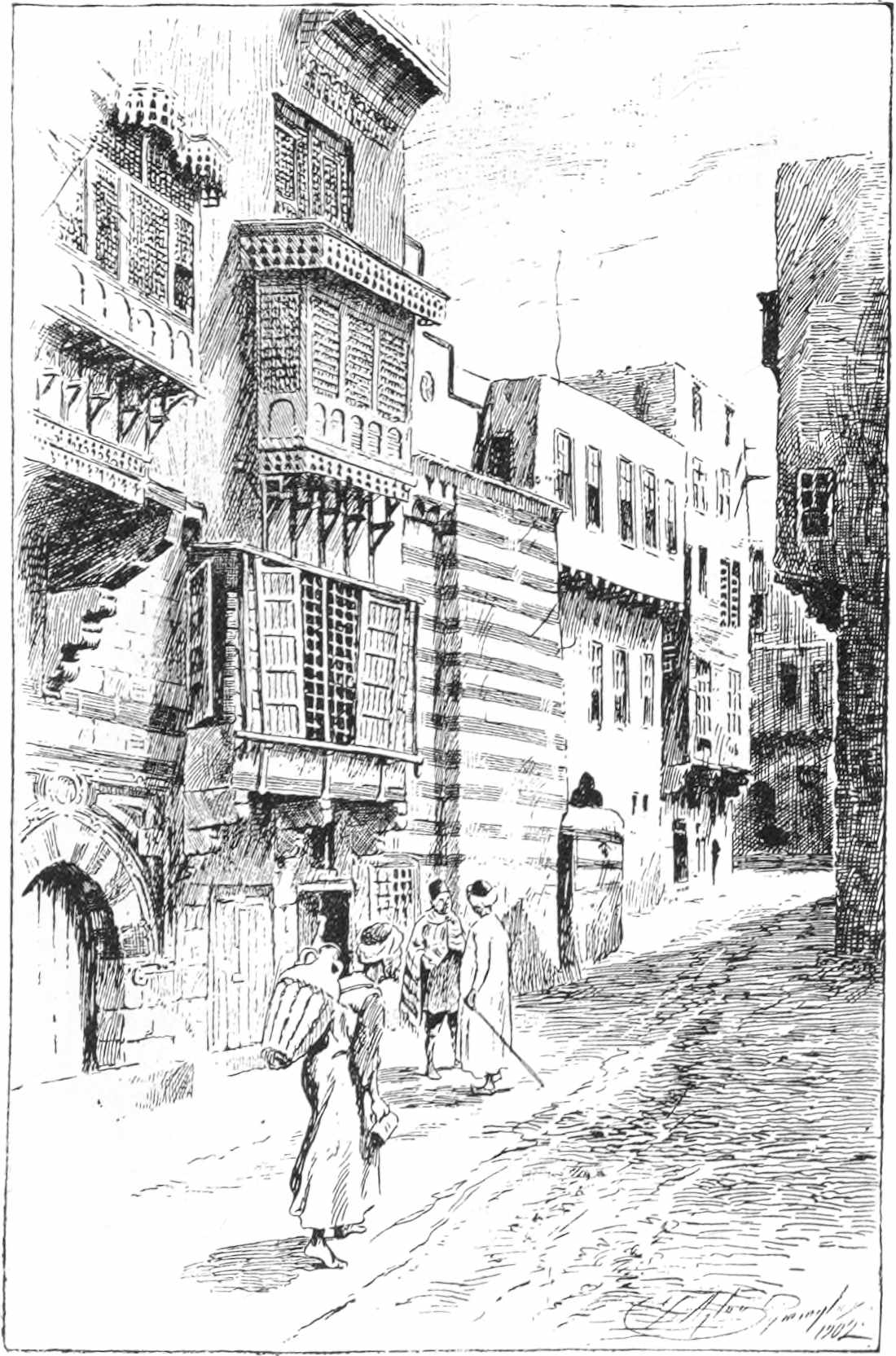
STREET IN OLD MISR
The best description is that of the Persian Násir-i-Khursau, who visited Misr in 1047, eighty years after Kafúr’s death, it is true, but it is not probable that very important changes had taken place in the interval. He knows nothing of el-Katái‘, and from his description of Misr as a city built on high ground, and other indications, it is evident that in his day “the Wards” faubourg was included in Misr and that there were still houses there in spite of the devastation that followed the fall of the House of Tulún. The mosque of Ibn-Tulún “on the outskirts of the town” was then as now surrounded by a double wall more solid than any the traveller had seen except at Amid and Mayyafarikin, and a minaret was certainly standing at that time.[30] There were altogether seven mosques in the old city, of which that of ‘Amr was the chief, with its mihráb covered with white marble on which was engraved the entire text of the Korán, and its court crowded with professors and students and a multitude of people of all kinds, who used it as a general meeting place for business. It had lately been purchased by the Fátimid caliph Hákim, of whom we shall hear presently, for 100,000 dinárs (the mosque of Ibn-Tulún had cost him only 35,000), and he had made some restorations[108] and presented a magnificent silver lamp carrying seven hundred lights. So huge was this work of art that a door had to be broken down to get it into the mosque. The chief kády still held his court there.
Outside, the gates opened into the bazars. On the north was the Street of Lamps, the like of which the traveller had seen nowhere else; he was amazed at the cut rock-crystal, tortoise-shell, and other delicate work he saw there displayed, besides ivory tusks, ostrich feathers, and other products of the Sudán and Abyssinia. On one day, to be precise, the 18th of December 1048, he counted the following flowers and fruits and vegetables in the markets of Misr: red roses, lilies, narcissi, bitter and sweet oranges, lemons, apples, jasmine, melons, dastbuyas, bananas, olives, dates, grapes, sugar-cane, mad-apples, gourds, badrangs, onions, garlic, carrots, and beetroot, though they belonged to different seasons: “but Egypt,” he adds, “is a land of great extent which produces the fruits both of hot and cold climates, and the products of all the provinces are brought to the capital and are readily sold in the markets.” Pottery he found manufactured of so fine a quality that he could see his hand through it, and so skilfully coloured that it resembled the iridescent fabric called bukalamún. There was also a green transparent glass of costly price. (All this is amply confirmed by the fragments which have been found among the rubbish heaps of the old city.) He saw great bowls of Damascus copper; one woman owned five thousand of them which she let out at a franc (dirhem) a month at the borrower’s risk. He was pleased to discover that there was no need to carry one’s bottle or paper to the bazars of the druggists or ironmongers: they themselves supplied the wherewithal to contain their wares; and what was more extraordinary, the shopkeepers[109] sold at a fixed price, instead of haggling for a bargain, and if one of them cheated he was set on a camel and marched through the bazar to the ringing of a bell, crying aloud, “I have deceived and am punished! May the like chastisement befall other liars!” All the shopkeepers rode on donkeys from their houses to their shops, and asses stood for hire at the street corners to the number (he was told) of 50,000. Only soldiers rode horses.
The city stretched along the Nile bank, and kiosks and pavilions overlooked the river, whence one could draw up water by a rope. Sakkás carried it then as now in great pitchers on their backs, or on camels. Some of the houses were seven storeys high, and on the top of one of these was a terrace garden of orange and other fruit trees, watered by a sákiya turned by a bull that had been conveyed to the housetop when a calf. The houses were so large (30 cubits square) that 350 people could occupy a single house. Some of the covered streets and bazars had to be constantly lighted by lamps, since no sunlight penetrated to them. To cross to the island there was a bridge of thirty-six boats, but at that time there was no second bridge connecting Roda with Giza, and one had to take a boat or ferry. Fortunately there were more boats to be had at Misr than either at Baghdád or Basra. The inhabitants of the city, says Násir-i-Khusrau, were enjoying great prosperity in 1048, and in honour of a royal accouchement they decorated the town with such splendour that he would not hope to be believed if he described it. Indeed, he never knew so peaceful and orderly a country as Egypt, and tells the story of a rich Christian he met at Misr, who owned innumerable cargoes and vast estates, and who, when appealed to by the vezír in a year of scarcity, informed him that he had enough[110] corn in his granaries to supply the capital for six years. The rents of the occupiers of a single khan or inn, called the Dar-el-Wezír, brought in 12,000 dinárs a year, and there were said to be two hundred such buildings.
The city which the Persian philosopher described in 1047-8 was probably little changed in the remaining century of its prosperity. The foundation of Káhira, or Cairo proper, had once more separated the official and court circles from Misr, eighty years before the visit of Násir-i-Khusrau, and yet the old capital retained its flourishing position as the commercial metropolis. There is no reason to suppose that it decayed during the hundred and twenty years that were left to it. We have already anticipated the course of history, in describing Misr in the eleventh century, and it will be well to finish the subject by relating its destruction in the twelfth. In 1168 Amalric, the Latin King of Jerusalem, advanced upon Cairo, intent upon the conquest of Egypt, which the Crusaders believed to be essential to their safety in Palestine. In November he took Bilbeys, and stained his name by massacring every man, woman, and child. Fear of similar atrocities and the danger of affording the invader valuable cover close to Cairo induced Sháwar, the vezír of the Fátimid caliph of Egypt, to order the burning of Misr. On the 12th of November, “twenty thousand naphtha barrels and ten thousand torches were lighted. The fire lasted fifty-four days, and its traces may still be found in the wilderness of sandheaps stretching over miles of buried rubbish on the south side of Cairo. The people fled ‘as from their very graves’; the father abandoned his children, the brother his twin; and all rushed to Cairo for dear life. The hire of a camel for the mile or two of transit cost thirty pieces of gold”[31] in that crisis of[111] panic. The smoke rose in dense black clouds to the sky, and compelled the invaders to camp at a distance. The cruel measure may have been necessary, though Cairo was saved by other means; but as we look out upon the desolate sandhills that mark the site of the vanished Town of the Tent and recall the peace and prosperity witnessed by the Persian traveller, it seems as if a thousand Crusaders in Cairo would be a lighter sacrifice than the loss of the old city of Misr.
Though the town never really recovered from the fatal day of its burning, it must not be supposed that no efforts were made to rebuild it. People are not so easily transplanted from their old seats, and as soon as the Crusaders were driven away the inhabitants began to search for their blackened homes and tried to make them fit to live in. Ibn-Gubeyr, the Spanish Arab, who visited Misr in 1183, only fourteen years after the great fire, found a less melancholy scene than we should be led to expect from the account of the fifty-four days’ burning. He was comfortably entertained at the Inn of Master Worthy (Funduk Aby-th-Thaná) in the Street of Lamps,—so called because formerly inhabited by nobles who had each a lamp before his door—which still stood close to the Mosque of ‘Amr, and though there were sad signs of the late destruction, the people had rebuilt many of the ruined houses, “and the new buildings are in continuous lines which form a great city with the remains of the former town lying beyond and all around it, close by, showing how great was its extent in earlier days.”[32] The attempt to restore the old city did not succeed. A sign of the diminishing population is seen in the fact that although ten colleges were founded in and about Misr by Saladin and his[112] successors, in the belief that the town would recover, not a single mosque for congregational worship was built there after the great fire. Cairo was rapidly taking its place, and when Ibn-Sa‘íd visited Misr about 1240 he was distressed at its blackened walls, ruined houses, and general state of dirt and neglect. There were still plenty of people in the narrow crooked streets, and pedlers hawking their wares among the students and children in the Old Mosque, which was covered with cobwebs and littered with refuse; the slovenly quays of Fustát were still frequented by much shipping, and there were sugar and soap factories still at work.[33] But the ruin was universal, the final decay had set in, and the glory of Misr was transferred to Cairo.
[113]CHAPTER V
Cairo
THE foundation of Cairo proper, as distinguished from the earlier city of Misr and its faubourgs, marks a revolution infinitely more profound than a mere change of dynasty or shifting of site. The Fátimid conquest, which created the new city, was a revolution in religion, in statecraft, and in culture. The theological differences that had turned the mosque of ‘Amr into a bear-garden in the time of the Ikhshíd were hair-splittings compared with the breach between the old orthodoxy and the heresy of the newcomers. In its inner essence, Shi‘ism, the religion of the Fátimids, is not Mohammedanism at all. It merely took advantage of an old schism in Islám to graft upon it a totally new and largely political movement. The schism arose out of the succession to the caliphate, and resolved itself into the old antagonism between the theories of popular election and divine right. The orthodox party (or Sunnis) held that the election of the first three caliphs, Abu-Bekr, ‘Omar and ‘Othmán, was constitutional in Islám; the Shí‘a maintained that the divine right of succession to the Prophet’s mantle rested with his own family, that is to say with his daughter Fátima’s husband ‘Aly and their offspring, the only surviving descendants of Mohammad. ‘Aly in turn became the fourth caliph, but he was bitterly opposed, and in the end murdered; his children,[114] the Prophet’s grandsons, were ousted from the succession; one of them, Hoseyn, endeavouring to assert his rights, was defeated and slain, and the tragedy of the “martyrdom” at Kerbela has ever since excited the deepest passions of the Shí‘a at the annual representations of the Persian Passion Play in the month of Moharram.
The ruthless persecution of the “holy family” by the Omayyad caliphs stimulated an enthusiastic sympathy with their misfortunes, but since none of their descendants showed any political genius, the occasional risings in favour of the ‘Alids were scarcely more important than the last attempts in Scotland to revive the claims of the Pretender. The movement would probably have died out as an element in politics, and become a mere tradition or sentiment, but for the new development given to it in the ninth century by an obscure Persian, half conjurer, half eye-doctor, named ‘Abdallah, son of Meymún. This man, who abhorred the Arabs and their caliphs, devised a scheme by which the very religion of Islám should become the instrument of its own destruction, and the Persians should recover their power by the unconscious aid of their conquerors. His doctrine, whilst making use of the ‘Alid sentiment of divine right, was such that not only the enthusiasts who still wept over the tragedy of Kerbela, but all shades of dissenters from rigid Mohammedanism might embrace. He taught that God has always been incarnate in some spiritual leader or “Imám,” such as Adam, Abraham, and so on to ‘Aly. The world has never been without an Imám; but—and here came the stroke of genius—the Imám is not always visible in the flesh. The series of spiritual leaders descended in apostolic succession from ‘Aly was broken, but not the less was there a hidden Imám, who would reveal himself to mankind in his[115] own good time. When he appeared all would recognize “the Mahdy,” and abandon the self-styled caliphs who usurped his authority. Meanwhile those who awaited his coming must strive to prepare men for it. Though the Imám be hidden, his doctrine must be zealously preached, and in the absence of the mysterious being in whom the secrets of the Most High are deposited, his missionaries must go forth and call men to the truth.
A widespread and admirably organized propaganda was instituted; a secret society, skilfully graduated in advancing degrees of initiation, worked underground throughout the Mohammedan world, but with special success in Arabia, Mesopotamia, and North Africa. The dá‘is or missionaries were carefully chosen and trained to teach such doctrines as their converts could bear. To the rude and uneducated they would preach what seemed the plain lessons of the Korán, always coupled with the imminent approach of that mysterious and attractive personality, the Mahdy. To the philosophic they would use arguments suited to their special views, and leading them up through the progressive stages of initiation, would finally land them in a philosophy of complete negation. These missionaries had nothing in common with Muslims: they were atheists among themselves, and all things to all men. Their aims were political—to upset Islám through itself, to dispossess the Muslims, and to grasp their power. They made use of all forms of religion indifferently; all were equally false to them, and all were serviceable tools to their purpose. They cared not what means they used to secure proselytes, to whom they confided only so much of their system as they could safely assimilate. They employed the hallowed name of ‘Aly, and preached the immediate advent of a Messiah, not because they believed in either or in any caliphate[116] or spiritual incarnation, but because if the multitude is to be made to dance one must harp on some string, and these strings happened to twang harmoniously in the ears of the people.
Three signal successes rewarded the brilliant propaganda of the Shí‘a (or Isma‘ílian) missionaries. The first was the Carmathian domination of Arabia, Mesopotamia and Syria, in the ninth and tenth centuries; the second was its offshoot, the Fátimid caliphate of North Africa and Egypt; the last was the dreaded Wehmgericht of the Isma‘ílians or “Assassins” in Persia and the Lebanon. Here we have chiefly to do with the second, though both the Carmathians and the Assassins had their influence upon Egypt.
The Fátimid caliphate, taking its name from ‘Aly’s wife, the daughter of the Prophet, was the most powerful and conspicuous result of Shí‘a proselytism. Among the credulous Berbers the missionary had an easy field of conquest, and when he produced a reputed descendant of ‘Aly and Fátima in the person of “the Mahdy” ‘Obeydallah at Kayrawán, the Arab capital of what is now called Tunisia, in 910, the revolution was triumphant. The whole of Barbary, from Fez in Morocco to the frontier of Egypt, which he twice invaded, bowed before the sway of the Mahdy. Inheriting by conquest the possessions of the Aghlabid dynasty of Tunis, who for more than a century had been the great naval power of the central Mediterranean and held Sicily, Sardinia, Corsica and Malta, the Fátimid fleets ravaged the coasts of France and Italy, plundering, burning, and kidnapping wherever they went. The fourth caliph of the Mahdy’s line, el-Mo‘izz, the conqueror of Egypt, was a singularly able, upright, politic, and intelligent man, an orator, a linguist who knew Greek as well as Arabic and the Berber tongue, and to all appearance a just and honest Muslim[117] of the Shí‘a sect.[34] There was so careful a distinction between esoteric and overt doctrine among the Shí‘a that it is impossible to be certain, but the probability is that Mo‘izz, like most of his successors, did not share the extreme views of the advanced degrees of the initiate, but held Koranic doctrines tempered by ‘Alid views and allegorical interpretation.
Such was the Fátimid caliph who, after a progress throughout his African dominions, and carrying his arms even to the shore of the Atlantic (959), at length resolved to achieve the conquest of Egypt, which his grandfather had vainly attempted, and which was the goal of his own ambition. The barren land and unruly tribes of Barbary were not to be compared with the fertile valley and splendid commerce of Egypt, and his plans were carefully laid for the invasion. The conquest was an easy triumph. Gawhar, his Roman slave from the Eastern empire, led his 100,000 men from Kayrawán in February 969. Alexandria capitulated on liberal terms. The Egyptians, exhausted by a distressing famine followed by plague (of which more than half a million people died in and around Misr), led by no competent chief, despoiled by a mutinous soldiery, and influenced by secret sympathizers with the Fátimids, made scarcely an effort to resist. There were a few skirmishes at Giza, and then Gawhar forced the passage of the Nile, the defenders fled, and the women of Misr implored mercy. A full[118] amnesty rewarded submission, pillage was interdicted, and the Fátimid army rode into Misr on the 5th of August.
“That very night Gawhar laid the foundations of a new city, or rather fortified palace, destined for the reception of his sovereign. He was encamped on the sandy waste which stretched north-east of Fustát, on the road to Heliopolis, and there, at a distance of about a mile from the river, he marked out the boundaries of the new capital. There were no buildings, save the old ‘Convent of the Bones,’ nor any cultivation except the beautiful park called ‘Kafúr’s Garden,’ to obstruct his plans. A square [about 1200 yards each way] was pegged out with poles, and the Maghraby astrologers, in whom Mo‘izz reposed extravagant faith, consulted together to determine the auspicious moment for the opening ceremony. Bells were hung on ropes from pole to pole, and at the signal of the sages their ringing was to announce the precise moment when the labourers were to turn the first sod. The calculations of the astrologers were, however, anticipated by a raven, who perched on one of the ropes and set the bells jingling, upon which every mattock was struck into the earth, and the trenches were opened. It was an unlucky hour: the planet Mars (el-Káhir) was in the ascendant; but it could not be undone, and the place was accordingly named after the hostile planet, el-Káhira, ‘the martial’ or ‘triumphant,’ in the hope that the sinister omen might be turned to a triumphant issue. Cairo, as Káhira has come to be called, may fairly be said to have outlived all astrological prejudices. The name of the ‘Abbásid caliph was at once expunged from the Friday prayers at the old mosque of ‘Amr; the black ‘Abbásid robes were proscribed, and the preacher, in pure white, recited the khutba for the Imám Mo‘izz, emír el-muminín, and invoked blessings[119] on his ancestors, ‘Aly and Fátima and all their holy family. The call to prayer from the minarets was adapted to Shí‘a taste. The joyful news was sent to the Fátimid caliph on swift dromedaries, together with the heads of the slain. Coins were struck with the special formulas of the Fátimid creed—‘‘Aly is the noblest of [God’s] delegates, the vezír of the best of apostles’; ‘the Imám Ma‘add calls men to profess the Unity of the Eternal’—in addition to the usual dogmas of the Mohammedan faith. For two centuries the mosques and the mint proclaimed the shibboleth of the Shí‘a.”[35]
But the change was far more than a substitution of one creed for another: indeed, thanks no doubt to the politic tolerance of the conqueror and the discreet avoidance of extreme Shí‘a doctrines, the people accepted the new régime without any outburst of orthodox fanaticism, except when the new comers flaunted the Moharram festival in memory of the Kerbela “martyrs” in their very faces. The majority remained unconverted to the new formulas; at least they welcomed the restoration of orthodoxy two centuries later with equal phlegm. The real change was political. Cairo was no longer the capital of a province of the old caliphate, or even of a virtually independent principality connected with that caliphate: it was the capital of a rival Power, and that power a Mediterranean Empire. It is true the empire soon lost its outlying African provinces and European islands, and shrank to the dimensions of the principality of Ibn-Tulún; but the strength and the wealth and commerce of the Fátimid kingdom were something new. The rivalry between Cairo and Baghdád, between the vigorous young caliphate of the Shí‘a and the decaying hierarchy of the Sunnis, had far-reaching[120] effects in politics and in civilization. The naval power and European connexions of the Fátimids introduced a new element into foreign policy, gave a stimulus to trade, and modified in various ways the civilization of Egypt and Syria.
On the other hand undoubtedly the isolation of Cairo tended to a development of a separate culture which was not to its advantage. Heresy cut it off from the great centres of intellectual life in the Arabian world, from Baghdád, Damascus and Cordova. The old intercourse, which brought students and professors of all parts of the Muslim empire together in the mosques of every great city, was impossible in a capital where the mosques were in the hands of heretics. Hence Cairo was out of intimate touch with the progress of Muslim studies in the eleventh and twelfth centuries, and few of the leaders of Arabic thought or literature were found under Fátimid rule. In some branches, such as philosophy and physical and medical science, one would expect to find good results from the influence of Shí‘a free-thinking, and undoubtedly some progress was made, especially by Jewish and Christian physicians; but these exceptions do not outweigh the general loss entailed by isolation from the rest of the intellectual world. A little later the heretics of Cairo might have profited much by their intercourse with Europe, but in the tenth and eleventh centuries Europe had little to teach.
The class that gained most by the change of government was that of the Christian Copts. Hitherto they had had their ups and downs according to the disposition and rapacity of different Arab and Turkish governors; but with the advent of the Fátimid caliphs they entered upon a period of unusual toleration and even favour. The new rulers, with one notorious[121] exception, were exceedingly well disposed towards their Christian subjects, and many churches were built or restored during their reigns.
The caliph el-‘Azíz, son of Mo‘izz, who reigned from 975 to 996, had a Christian wife, two of his brothers-in-law were Melekite patriarchs, and the Jacobite patriarch Ephraim and Severus bishop of Ushmuneyn were his particular friends. The bishop was encouraged to come to the palace and discuss theology with the chief kády, and the patriarch was allowed to restore the church of St Mercurius (Abu-s-Seyfeyn, “the two-sworded”) outside Misr. “In ancient times,” we are told by an Armenian writer, “there had been a church dedicated to Saint Mercurius, on the bank of the river, but it was ruined and turned into a storehouse for sugar-canes. Then, in the time of this patriarch, enquiries were made about the creed of the Christians, whether they believed in the truth or in a lie. So the Christians assembled and went out to the mountain, and the Muslims and Jews went out at the same time on account of a certain event. Many of the Muslim sayyids came forward, and prayed, and cried Allahu akbar, and implored the assistance of God, but no sign appeared to them. Then the Jews followed them, and still no result followed. Then the patriarch came forward, and the tanner, for whom God had performed a miracle, followed him; and all the orthodox people followed them. They prayed to the most high God, and burnt incense, and cried Kyrie eleison three times; and God showed his wonders, and the mountain moved: namely, that part of the Mukattam hills which is near the hill of Al-Kabsh, between Cairo and Misr. This miracle took place through the faith of the tanner, who had plucked out his eye in the presence of Al-‘Aziz and the chief men of his government and the kadis of the[122] Muslims. When Al-‘Aziz had witnessed this great miracle, he said: ‘It is enough, O patriarch; we recognize what God has done for you’; and then he added: ‘Desire of me what thou choosest, and I will do it for thee.’ The patriarch, however, refused with thanks; but Al-‘Aziz begged him to ask for something, and did not cease until the patriarch had asked for a certain church which had fallen into ruin. So Al-‘Aziz commanded that this church should be restored for the patriarch, and it is said to have been the church of Saint Mercurius.”[36] The patriarch would not accept the offer of money for the restoration, but paid for it himself, and the work was carried out under a guard of the caliph’s troops to protect the Christians from the “common people of the Muslims,” who had no patience with such concessions to the “polytheists.”
One of the vezírs or prime-ministers of ‘Azíz was a converted Jew, another was the Christian Ibn-Nestorius. The Muslims naturally resented this unusual toleration, and lampooned the caliph, but the harím was on the side of the Christians, and as usual had its way. Even under the caliph Hákim, the exception referred to, who certainly at one time persecuted the Copts cruelly, the great posts of state were still held by Christians; and though there was much confiscation and extortion under the vezír Yazúry in the middle of the eleventh century, it seems to have arisen more from fiscal necessities than from religious antipathy. The great influence of the Armenian vezírs in the latter part of that century evidently promoted a good feeling, for in the twelfth we find the caliph Háfiz receiving lectures in history twice a week from the Armenian patriarch, and several of the later caliphs would visit the shaded gardens[123] of Coptic monasteries, where they were hospitably welcomed by the monks and made suitable returns for their cheer. We read of handsome contributions for the support of convents and churches. The far from exemplary caliph Ámir even had a monk for his right-hand man, and used often to use a pavilion which he had built at a monastery near Giza as a hunting lodge, paying 1000 dirhems to the monks at every visit. He took pleasure in standing in the priest’s place in their church, but scrupulously entered backwards in order to avoid the appearance of bowing when passing through the low door. The last of the Fátimid caliphs, el-‘Ádid, had also his favourite monastic retreat in the convent of the Virgin some miles out of Cairo, where he would take the air and gaze upon the “blessed Nile.”[37]
If the churches were cared for, the mosques were not neglected; and though the Fátimid period is not rich in the multitude of mosques erected by private benefactors which distinguishes the later Mamlúk period, it boasts at least the two greatest congregational mosques (gámi‘) of Cairo proper, both of which were among the early preoccupations of the new dynasty. Gawhar’s first step, after beginning the walls of the palace-city of Káhira, was to lay the foundations of the mosque which stands to this day, known to all the world as el-Azhar, “the Resplendent.” The day of its foundation was Sunday the 3rd of April, 970, and it was finished on the 24th of June, 972. In 988 it was specially devoted[124] to the use of the learned and became what it has been ever since, one of the chief Universities of Islám. Here to this day multitudes of students gather from all parts of the Muslim world, from the Gold Coast to the Malay States, each nation to the special riwák or portico assigned to its use, and here they receive from learned sheykhs instruction in the various branches of the old Arabic curriculum—theology, exegesis, traditions, jurisprudence, grammar, prosody, logic, rhetoric, algebra, etc. Over nine thousand students still (1901) attend the lectures of 239 professors in the Azhar, and not one of them is called upon to pay a piastre in fees. The learned men of Cairo and many foreign cities willingly impart their knowledge without reward, and eke out a living by private tuition and copying manuscripts. The foreign students not only pay no fees but receive rations of food from certain bequests. One may regret the limited scope and fanatical tendency of the Azhar lectures, but at least it is a noble example of free education, open to the poorest, no matter what his race or language, and given to all without distinction of class. The knots of students sitting round their master in earnest attention, or swaying to and fro as they commit his dicta to memory, are a spectacle not easily forgotten. In every detail they carry us back to the Middle Ages of Arabic culture, and show us a zeal for learning, neither tainted by prize-hunting nor cramped by examinations, which may teach even Western universities something that they lack.
Very little of the Azhar represents the original building. It has been repeatedly restored, and was largely reconstructed in the eighteenth and the middle of the nineteenth century, and, though there are some fine Kufic friezes and keelform (Persian) arches characteristic of the Fátimid period,[125] its present aspect is modern. The square court, however, covers the same ground as it did when in 973 the caliph Mo‘izz, after making his splendid entry, preceded by the coffins of his ancestors, into the new city built by his faithful general, and totally ignoring the old metropolis then en fête for his reception, himself conducted the prayers on the festival following the fasting month, delivered the Khutba or sermon with his wonted unction, and then headed the procession of his troops, escorted by his four sons in armour, and preceded by two elephants, back to the palace which Gawhar had prepared for him. The fortified enclosure which has given its name to Cairo, though sometimes called el-Medína, “the City,” was never intended to be an Egyptian metropolis. It was to be the residence of the caliph and his court, his slaves and officials, and his African troops. The public of Misr had no access to it; none might pass through the gates without a permit, and even ambassadors from foreign states were obliged to dismount and were led into the palace between guards after the Byzantine custom. Káhira was in fact a royal compound or enclosure, not a public city. Its high walls and guarded gates symbolized the seclusion and mystery in which the sacred person of the caliph was wrapped, and its familiar epithet “the Guarded City” (el-Káhira el-Mahrúsa) illustrates its privacy.
The original walls were built of large bricks, nearly two feet long and fifteen inches broad, and the thickness of the walls was such that two horsemen could ride abreast upon them. The Topographer in 1400 measured the last fragment of this first wall, and says that none of it afterwards remained to be seen.[38] The original enclosure was about 100 feet smaller every way[126] than the later enclosure built in 1087, and we may easily realize the length of the city of Gawhar by remembering that the present Bab-el-Futúh (with the mosque of el-Hákim) and the Bab-Zuweyla (with the mosque of el-Muayyad) stand a little outside the original enclosure; whilst its breadth extended from the Bab-el-Ghureyyib beyond the Azhar on the east to the Khalíg or canal on the west. The western boundary running beside the canal is still recorded in the street called Beyn-es-Sureyn, “Between the walls,” at the top of the Musky. The enclosure was thus about 1200 yards each way, and formed an area of less than half a square mile.
About the centre was the square called Beyn-el-Kasreyn, “Between the Palaces,” a name still preserved in the original site in part of the street known as the Coppersmiths’ Market (Suk-en-Nahhasín), now flanked by several noble mosques of much later date. The name explains itself: the square, which was far broader than the present thoroughfare, and formed a parade ground on which ten thousand troops could be marshalled, separated the two palaces which faced it, and served as the meeting place of the city. The Great Palace of Mo‘izz lay on the east—the Khán-el-Khalíly stands on a corner of its vast ground, and the Hasaneyn at another corner—and the Lesser West Palace, built by ‘Azíz a little later, faced it on the other side (where the Máristán of Kalaún occupies a portion of its site), and on the back looked upon the spacious “Garden of Kafúr,” where the Ikhshíd once had his pleasure-house. Makrízy devotes nearly two hundred pages to the description of these wonderful palaces. “We read of four thousand chambers;—of the Golden Gate which opened to the Golden Hall, a gorgeous pavilion where the caliph, seated on his golden throne, surrounded by his chamberlains and gentlemen-in-waiting (generally[127] Greeks or Sudánís), surveyed from behind a screen of golden filigree the festivals of Islám;—of the Emerald Hall with its beautiful pillars of marble;—the Great Diván, where he sat on Mondays and Thursdays at a window beneath a cupola;—and the Porch where he listened every evening while the oppressed and wronged came below and cried the credo of the Shí‘a till he heard their griefs and gave redress.”
These various buildings composing the Great Palace were not the work of a single year or of one ruler. Gawhar began the palace on the same night that he marked out the foundations of the city, in July 969; two gates were finished in the following March, and a wall was carried round the palace in 970-1. Writing of the wall three-quarters of a century later, Násir-i-Khusrau says that from outside the city the palace of the caliphs looked like a mountain, by reason of its lofty mass of buildings; but when one drew near one could see nothing of it on account of its high wall.[39] This original palace was designed by the caliph Mo‘izz himself, but it did not comprise half the splendid halls described by the Topographer. The next caliph ‘Azíz built the “Golden Hall” and the “Great Diván,” as well as the smaller Western Palace and the Pearl Pavilion in Kafúr’s Garden. Later caliphs and vezírs added and altered, and the “Splendid Palaces” (el-Kusúr ez-Záhira), as they were collectively called, included numerous separate mansions or suites of rooms of various dates. The Great Palace alone had ten gates, besides a subterraneous passage by which the caliph could cross on his mule, led by slave girls, to the Western Palace, which was specially reserved for the harím. In the eleventh century there were twelve thousand servants in the Palaces, and including[128] the women the inmates were reckoned at thirty thousand.
M. Ravaisse has reconstructed the Fátimid palaces, and even drawn plans of them from the Topographer’s descriptions, in two elaborate memoirs,[40] and though some of the details must be regarded as tentative and open to revision, the general results probably represent the actual arrangement of the Fátimid city. According to these interesting researches the Great East Palace comprised principally three large quadrangles of unequal sizes forming three quarters of a square, the fourth or N.E. quarter being occupied by the Court of the Festival, an open space between the Great Palace and the Palace of the Vezírs, where the people could make merry on the ‘Id days. This Great Palace, flanked by the Vezirate and the Azhar, covered the space from the present Khan-el-Khalíly and Hasaneyn to the Gemalíya street (where the monastic mosque of Beybars the Gashnekír stands). The various halls, apartments, and court offices were arranged about the quadrangles, and stables and stores formed outbuildings. On the other side of the Beyn-el-Kasreyn, the West Palace ran from where the Maristán now stands to the Hárat Bargawán, with two wings jutting forward at each end to enclose the Beyn-el-Kasreyn; whilst the space between the West Palace and the west wall was filled by the spacious Garden of Kafúr with its various kiosques looking on the canal. The rest of the city enclosure, outside the palaces, was occupied by the quarters (Hára) of the various divisions of the Fátimid army, such as the Gawdaris, the Deylemis, the Kitáma, the Barkis, the Utúfis, the Zawíla, and the north and south Greek quarters (Hárat-er-Rúm), and so forth. The gates of the city were[129] the (old) Gates of Succour, Bab-en-Nasr, and of Conquests, Bab-el-Futúh, on the north; the Gate of the Bridge (B.-el-Kántara) leading to Gawhar’s bridge over the canal, the B.-el-Farag, also called the Gate of the Sha‘ríya (a Berber tribe), and the Gate of Sa‘áda, named after a general of el-Mo‘izz, and the Wicket Gate (Bab-el-Khawkha) on the west, opening to the canal; the old double Gate of Zuweyla[41] on the south; and on the east the Burnt Gate (B.-el-Mahrúk, so called because burnt down by some fugitive Mamlúks in the thirteenth century), the New Gate (B.-el-Gedíd, built by Hákim), and the Gate of the Barka troops (B.-el-Barkíya), now known as the B.-el-Ghureyyib.
Some of the modern superstitions connected with the Gate of Zuweyla have been mentioned before, but it has always been a haunted spot, and the fact that executions took place just outside did not improve its reputation. The Topographer records that the original gate, which stood beside the “oratory of Shem, the son of Noah,” consisted of two arches, one of which was known as the “Gate of the Arch.” This was the gate through which el-Mo‘izz entered when he made his state progress into the new city of Káhira, and all the people followed his example: but the other arch was considered unlucky and no one cared to go under it. “This [second] gate no longer remains,” says Makrízy, “nor is there any trace of it, but the place where it stood is called el-Haggarín, where musical instruments, as drums, lutes, and such-like are sold; and it is still notorious among the people that whoever passes that way will not accomplish his wishes. Some say that the reason of this saying is because it is the place of sale for musical instruments,[130] which are held in disrepute, and the abode of musicians and male and female singers; but the case is not as they pretend, for the saying was current among the people of el-Káhira from the time when el-Mo‘izz entered, before this place was a market for musical instruments and the haunt of the disorderly.”[42]
Such topographical details are chiefly interesting to the antiquary. We must search the records of travellers for more graphic descriptions. Strangers unfortunately were rare in so jealously secluded a sanctum as the Fátimid palace, and there are consequently few travellers’ pictures to add to the researches of the Topographer. The Persian Násir-i-Khusrau was indeed admitted in 1047, but he is disappointingly discreet in his account, and we gain only a confused but gorgeous impression of the great throne-room with hunting-scenes carved on the gold throne, which was screened by gold lattice and approached by silver steps. The best description occurs in William of Tyre’s account of the mission of the Crusaders in 1167, when Amalric was posing as the protector of the caliph, though it may well be that the palace had greatly changed in the two centuries that had passed since its foundation. “The introduction of Christian ambassadors to the sacred presence, where few even of the most exalted Muslims were admitted, was unprecedented; but Amalric was in a position to dictate his own terms. Permission was granted, and Hugh of Cæsarea with Geoffrey Fulcher the Templar were selected for the unique embassy. The vezír himself conducted them with every detail of oriental ceremony and display to the Great Palace of the Fátimids. They were led by mysterious corridors and through guarded doors, where stalwart Sudánis saluted with naked swords. They reached a spacious court, open[131] to the sky, and surrounded by arcades resting on marble pillars; the panelled ceilings were carved and inlaid in gold and colours; the pavement was rich mosaic. The unaccustomed eyes of the rude knights opened wide with wonder at the taste and refinement that met them at every step;—here they saw marble fountains, birds of many notes and wondrous plumage, strangers to the western world; there, in a further hall, more exquisite even than the first, ‘a variety of animals such as the ingenious hand of the painter might depict, or the license of the poet invent, or the mind of the sleeper conjure up in the visions of the night,—such, indeed, as the regions of the East and the South bring forth, but the West sees never, and scarcely hears of.’
“At last, after many turns and windings, they reached the throne room, where the multitude of the pages and their sumptuous dress proclaimed the splendour of their lord. Thrice did the vezír, ungirding his sword, prostrate himself to the ground, as though in humble supplication to his god; then, with a sudden rapid sweep, the heavy curtains broidered with gold and pearls were drawn aside, and on a golden throne, robed in more than regal state, the caliph sat revealed.
“The vezír humbly presented the foreign knights, and set forth in lowly words the urgent danger from without, and the great friendship of the king of Jerusalem. The caliph, a swarthy youth emerging from boyhood,—fuscus, procerus corpore, facie venusta,—replied with suave dignity. He was willing, he said, to confirm in the amplest way the engagements made with his beloved ally. But when asked to give his hand in pledge of faithfulness, he hesitated, and a thrill of indignation at the stranger’s presumption ran through the listening court. After a pause, however, the caliph offered his hand—gloved as it was—to Sir Hugh. The[132] blunt knight spoke him straight: ‘My lord, troth has no covering: in the good faith of princes, all is naked and open.’ Then at last, very unwillingly, as though derogating from his dignity, the caliph, forcing a smile, drew off the glove and put his hand in Hugh’s, swearing word by word to keep the covenant truly and in all good faith.”[43]
There is no doubt that the Fátimid caliphs were the most sumptuous monarchs that ever ruled in Egypt. Mo‘izz himself was no sybarite. He attended personally and assiduously to the details of administration, looked to the justice of the law courts, managed the army upon which his power depended, and built a new dock at Maks, lower down the river than the former dockyards of Roda and Misr, and near the present Ezbekíya. Maks remained the dock and port of Cairo until the shifting of the Nile bed brought Bulák to the surface. Six hundred ships were soon afterwards built there, and some of Mo‘izz’s vessels were seen in 1047 by Násir-i-Khusrau beached at Maks, and were found to measure about 275 feet in length by 110 feet in the beam.[44] But hard-working and prudent as he was, he loved display. He would go in state to cut the dam of the canal, and spent large sums on the brocaded covering for the Kaaba at Mekka—the holy city now acknowledged his supremacy—which was exhibited to the people at the annual Feast of Sacrifice. The palace buildings were all planned by his own hands; Gawhar had only been his clerk of the works; and the profusion of the new[133] city argued the luxurious taste and the prodigious resources of the caliph. The wealth of the Fátimids recorded by the historians seems almost incredible. We read of two daughters of Mo‘izz, one of whom left about a million and a half in gold (2,700,000 dinárs), whilst the other’s numerous jewel-rooms and coffers, containing, among others, five sacks of emeralds, 3000 silver vessels, and 30,000 Sicilian embroideries, exhausted forty pounds of wax in sealing them up for her executors. Mo‘izz himself bought a silk curtain from Persia for nearly £12,000, on which the countries of the world were depicted and their cities; and his wife spent much treasure in 966 on her mosque in the Karáfa, designed by el-Hasan the Persian and decorated by Basra painters.
One advantage of heresy was the toleration of artistic ideas that were abhorrent to the orthodox, and the Fátimids encouraged, if not portrait painting, at least the representation of human beings in art, which was held to be distinctly forbidden by the Prophet.[45] The mosque of the cemetery called the Karáfa, however, transcended anything ever attempted before in Egypt, if we except the stories of Khumáraweyh’s palace in “the Wards.” Its plan was the ordinary square quadrangle surrounded by cloisters, like the Azhar, but the decoration was remarkable. The fourteen square doors leading into the liwán or sanctuary were surmounted by arches resting on triple marble columns, painted blue, red, and green; the ceilings were also painted in various colours by artists from Basra. Opposite the middle door was an arch on which a bridge was painted, with steps of various colours, which looked real. Painters used to come to[134] see it, but they could not copy it. We read of two rival artists, el-Kasír and Ibn-‘Azíz of Chaldæa, protégés of the vezír el-Yazúry, who painted figures, the first of a dancing girl in a white dress, standing against the black background of an arch, seeming as though she stood inside it, and the second a similar girl in red who appeared to be standing out in front of a yellow arch. There was in a house in the Karáfa a picture by el-Kettámy, one of the decorators of this mosque, which represented Joseph in the pit so that he seemed to stand out in relief.[46]
The money to pay for the outgoings of the palace, with its twenty to thirty thousand inmates, and all the luxury it implied, was partly obtained by a more rigorous collection of the taxes and arrears than heretofore, and by the substitution of a central tax office in the old emírate house next to the mosque of Ibn-Tulún in place of the wasteful and corrupt system of local collectors and tax-farmers. In a single day the city of Misr (still in its prime) contributed from £26,000 to £62,000 in taxes, according to the season. All taxes had to be paid in the new Fátimid coinage, and the ‘Abbásid money was put out of currency.
The next caliph el-‘Azíz was noted for his judgment in gems, and set a number of new fashions in gold-thread turbans, jewelled harness scented with ambergris, and gold-inlaid armour for his horses, and luxuries for the table, such as truffles from Mukattam and fish fresh from the sea. Like Khumáraweyh he was fond of strange beasts, and imported birds and animals from the Sudán. But he shared with his father the statesmanlike qualities that no luxury could enfeeble. He built a fleet to fight the emperor Basil; personally waged a successful campaign in orthodox[137] Syria, which never became reconciled to the Fátimid supremacy; and he gave Egypt an interval of unbroken peace. His name was commemorated in the Friday prayer in the mosques from Arabia to the Atlantic, and he never failed to stand before the people in the Azhar and conduct the service as their spiritual as well as temporal head.
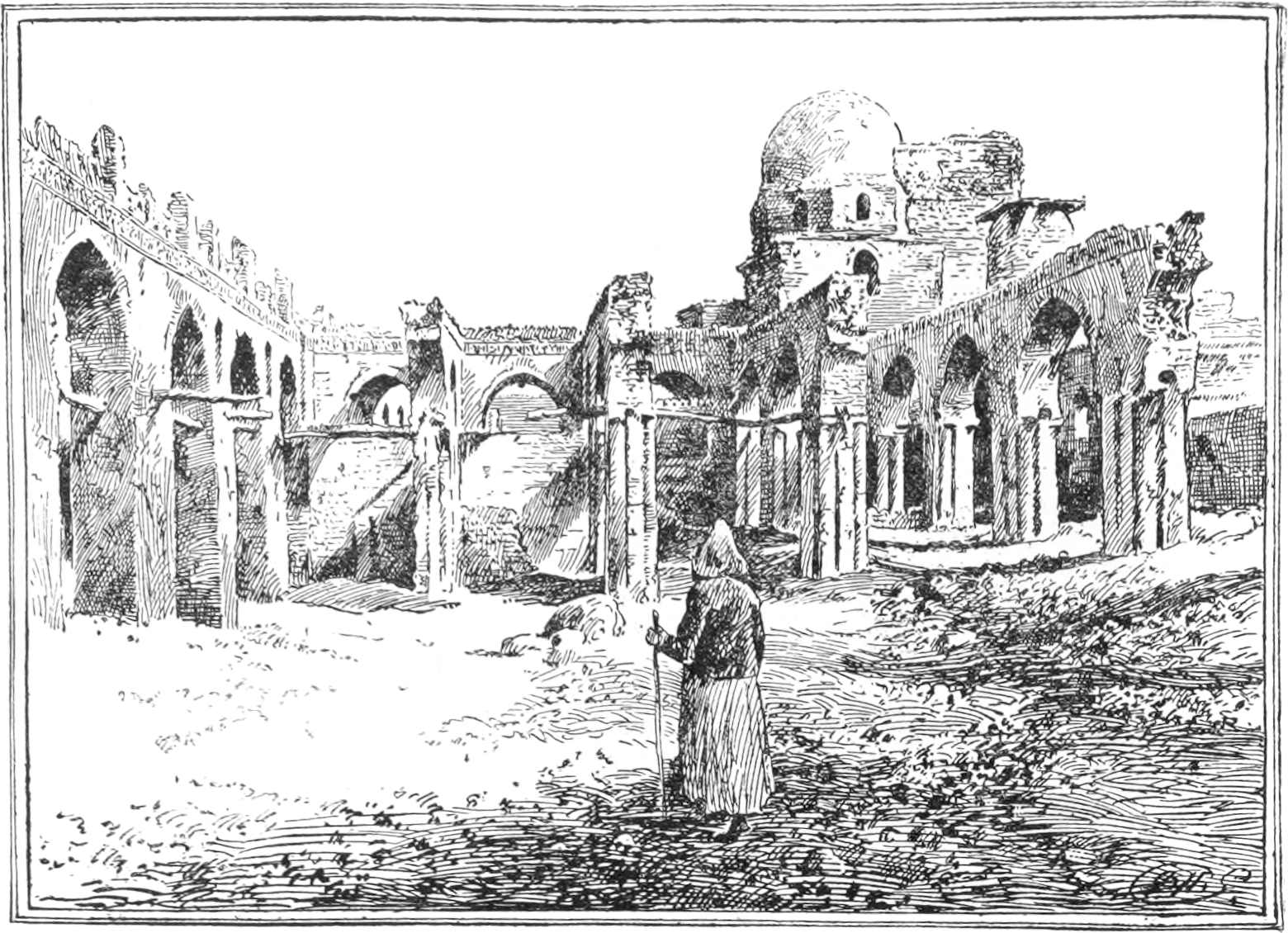
RUINED MOSQUE OF EL-HAKIM
The mosque known as el-Hákim’s owed its foundation at the close of 990 to el-‘Azíz and his vezír Ibn-Killis, who completed it sufficiently to hold the Friday prayers there a year later. The decoration, minarets, and other accessories were not finished till the reign of his son el-Hákim, who set the work in hand in 1003, and placed the final inscription on the pulpit in March 1013. Hence this second congregational mosque of Káhira, originally known as the “New Mosque” or “The Brilliant” (el-Anwar, in obvious imitation of the name of el-Azhar), took its most usual title from el-Hákim. In the course of its history it has suffered even worse indignities than the Old Mosque of ‘Amr. When the Crusaders occupied Cairo in 1167 they turned part of the mosque of el-Hákim into a church. Under the Ayyúbid restoration of orthodox Islam, the Azhar was disused for a time, as being the chief seat of heresy, and the mosque of el-Hákim became the official place of worship. Afterwards it seems to have been used for stables, and in the summer of 1303 it was terribly shattered by a great earthquake, and restored in the following year by Beybars the Taster. By the time that the Topographer wrote his account of it about 1420, the mosque was again in ruins, by fire and neglect, and its roof was crumbling piece by piece. Since then it has fallen on still more evil days. Its court has served in turn as a rope-walk, a drying ground, a common throughfare, a playground, which you entered through a café, a brewery, or a[138] bead factory. The only honourable use it has been turned to is that of a Museum of Arab Art, which for the past twenty years has occupied part of the arcades of the east end, where the noble arches and Kufic inscriptions still preserve something of their ancient grandeur, and formed a fit shrine for many beautiful and curious works of Saracenic art.
Melancholy as this vast empty court surrounded by decayed walls and ruined arches appears in the present day, there are points of great interest in the mosque of el-Hákim. The arches are the only exceptions to the Persian shape (“keelform”—two arcs terminating in tangential lines at each end) which is otherwise universal in the architecture of the Fátimid period. This is doubtless due to its early date and obvious imitation of the mosque of Ibn-Tulún. Still more remarkable are its minarets, commonly called mibkharas or censers from their peculiar shape. The heavy square bases, however, have nothing to do with the original minarets, the lower parts of which, built of carefully dressed stone, with traces of Fátimid inscriptions, may still be traced inside these ugly buttresses. A minute examination made by Herz Bey and M. van Berchem established beyond a doubt the fact that the brick minarets belong to the hasty restoration of 1304, after the earthquake. Beybars did not trouble to rebuild the minarets in their former style, but put brick tops, and probably shored up the old bases with the clumsy cubical casings which have puzzled so many archæologists and suggested strange theories of the early forms of minarets. The cubes may be later, however, and may have had some connexion with the military defences of the neighbouring city gate. The remains of the original stone minarets inside these casings are specially interesting since they are the only definite evidence we possess (save the small brick minaret of the mosque el-Guyúshy)[139] as to the construction of minarets of the Fátimid epoch, of which Makrízy was evidently unaware when he wrote that no stone minarets were erected previously to that of Kalaún in 1284. They are precisely similar in construction to the later Mamlúk minarets, starting from a square base, changing to an octagon, resolved into a cylinder. A spiral staircase within led up to windows whence the muezzins chanted the call to prayer.[47]
The caliph Hákim is one of the best known characters in Egyptian history, yet a character so contradictory and bizarre that his biographers are inevitably reduced to the weak conclusion of explaining his conduct by the unsatisfactory solution of mania. He was the only son of the exemplary ‘Azíz and his Christian wife,—the sister of two patriarchs,—and is another witness to the truth of the saying that clergymen’s relations are no better than other folk. Emerging from the upper branches of a fig tree at the age of eleven to enter upon the dazzling lustre of the throne, the boy had an unfortunate training. His governor, the Slavonian eunuch Bargawán,—whose name is still to be read in one of the lanes off the Beyn-el-Kasreyn—amused himself in the Pearl Palace in the Garden of Kafúr, whilst the Berber and Turkish troops fought each other in the streets. One of Hákim’s early experiences was the presentation of the Berber general’s head by the victorious Turkish guard. It was but a short step to the murder of the regent, and after four years of very lax tutelage the youth of fifteen assumed full powers.
“As the young caliph came more before the public, the eccentricities of his character began to appear. His strange face, with its terrible blue eyes, made[140] people shrink; his big voice made them tremble. His tutor had called him ‘a lizard,’ and he had a creepy slippery way of gliding among his subjects that explained the nickname. He had a passion for darkness, would summon his council to meet at night, and would ride about the streets on his grey ass night after night, spying into the ways and opinions of the people under pretence of inspecting the market weights and measures. Night was turned into day by his command. All business and catering was ordered to take place after sunset. The shops had to be opened and the houses illuminated to serve his whim, and when the poor people overdid the thing and began to frolic in the unwonted hours, repressive orders were issued; women forbidden to leave their homes, and men to sit in the booths. Shoemakers were ordered to make no outdoor boots for women, so that they might not have the wherewithal to stir abroad, and the ladies of Cairo were not only enjoined on no account to allow themselves to be seen at the lattice-windows, but might not even take the air on the flat roofs of their houses. Stringent regulations were issued about food and drink. Hákim was a zealous teetotaller, as all Muslims are expected to be. Beer was forbidden, wine was confiscated, vines cut down, even dried raisins were contraband; malukhíya (Jews’ mallow) was not to be eaten, and honey was seized and poured into the Nile. Games, such as the Egyptian chess, were prohibited, and the chessboards burnt. Dogs were to be killed wherever found in the streets, but the finest cattle could not be slaughtered save at the Feast of Sacrifice. Those who ventured to disobey these decrees were scourged and beheaded, or put to death by some of the novel forms of torture which the ingenious caliph delighted in inventing. A good many of these strange regulations were no doubt inspired by a genuine reforming[141] spirit, but it was the spirit of a mad reformer. The lively ladies of Cairo have always needed a tight hand over them, but who could expect to restrain a woman by confiscating her boots? The prohibition of intoxicating liquors, gambling, and public amusements, was in keeping with the character of a sour and bitter puritan, and was doubtless intended as much to improve the morals as to vex the souls of his subjects. But the nightly wanderings, the needless restrictions and harassing regulations concerning immaterial details, were signs of an unbalanced mind. Hákim may have meant well according to his lights, but his lights were strangely prismatic.”
It is difficult to discover the method in this madness. At first Christians were tolerated; then, about 1005, began a course of contemptible persecution, petty annoyances, foolish badges and liveries, and other humiliations, followed by wholesale confiscations and destruction of churches. But the Muslims fared almost as ill. Vezírs, whether Christians or Muslims, were indiscriminately assassinated or executed. The great Gawhar’s son was treacherously murdered in the palace. Officials of all grades and all creeds were barbarously tortured and wantonly killed. A distinguished general, after putting down a rebellion which kept Egypt in a tumult for two years, happened to disturb Hákim when he was cutting up a murdered child, and paid for his indiscretion with his life. Yet at the very time when these horrors were being enacted, the young caliph was busily superintending the decoration of the mosque that bears his name,[48] and also founding the remarkable institution called the “Hall[142] of Science” (Dar-el-‘Ilm), in the precincts of the Great Palace, where learned men of all shades of opinion met together and discussed everything under the sun with the resources of a well-appointed library. These meetings of a parliament of religions recall the debates of Akbar’s later “Hall of Worship” at Agra, nor is this the only point of resemblance between the two sovereigns, contrasted as they are in most respects. Akbar allowed himself to be worshipped as a deity, and Hákim came at last to a similar result, and both were led to it by Shí‘a influences.
No doubt those long lonely rides on his grey ass about the desolate Mukattam hills, those nights in the observatory on the slopes where he worked out his astrological chimeras, ministered to a mind deeply imbued with the mystical teaching of the Shí‘a. He was the Imám, through whom God revealed Himself to the ignorant world; he was the only possessor of the divine secrets; it was an easy step, and a logical, to argue that he was the incarnation of the deity—that he was God. It took more than twenty years to bring him to this point, but aided by the preaching of some Persian mystics he arrived there about 1018. It is true his preachers had poor success in their mission of proclaiming the divinity of Hákim. One was set upon and murdered to the joy of the orthodox; others desecrated the Old Mosque of ‘Amr with their blasphemy, and the people rose and slew them; Darazy, who afterwards gave his name to the strange sect of the Druzes in the Lebanon, was hunted to the palace and with difficulty saved by the caliph’s personal interposition and ready lie. Nobody accepted the new doctrine, monstrous to orthodox ears; and probably the bulk of the people were not even moderate Shí‘a but really Sunnis of the old school. Misr was in an uproar, and within an ace of a revolution;[143] but the negro troops did their savage work, the old capital was looted, houses were burst open, young girls dragged away, and a reign of terror silenced the outcry. The tortured people gathered in the mosques and prayed for help.
Help came, but from an unexpected quarter. The black troops had gone too far, and their rivals, the Berbers and Turks, less out of humanity than mere jealousy of power, joined together in suppressing the common enemy. Even Hákim lost his control over the army. He also set a powerful influence against him in the harím. He slandered his sister’s chastity. The Princess Royal refused after this to stand between her brother and his fate. A conspiracy was formed and when, on the 13th of February 1021, Hákim took one of his accustomed rides to the hills, dauntless and unconcerned as ever, he never returned. His ass and his coat, slashed with dagger cuts, were found, but his body had disappeared. For a long time people fearfully expected his return, as the Druzes in the Lebanon do to this day.
After so horrible a nightmare Cairo stood in sore need of rest. It came, but not at once. Military tyranny was succeeded by the corrupt rule of a court clique; a terrible famine in 1025 drove the starving people to highway robbery; the treasury was exhausted, the very slaves of the palace mutinied, and Syria was in open revolt, whilst the new caliph, Hákim’s son, amused himself with singers and dancers and bricked up young girls to starve to death in the mosque. The luck of the Fátimids was not yet exhausted, however; and good Niles, a vigorous suppression of the Syrian rebellion by an energetic viceroy, and a temporary quieting down of the soldiers’ jealousies, gave Egypt a quarter of a century of comparative tranquillity. The valley of the Nile was now[144] almost all that was left to the Fátimids. Their great Barbary dominions had completely fallen away by 1046, and the old Mediterranean supremacy had departed for ever. Syria was held with difficulty by force of arms, and though Arabia, from Medina to the Yemen and Hadramawt, yielded homage to the Egyptian caliphs, its Shí‘a emír was nothing less than an independent sovereign. The extraordinary fact that for forty weeks in 1058-9 the Fátimid caliph was prayed for in the mosques of orthodox Baghdád[49] testifies to political intrigues in the eastern caliphate rather than to any real access of power to the Fátimids.
In Egypt, however, they were still undisturbed. A new caliph, el-Mustánsir, a baby of eight months, succeeded to the throne in 1036, and kept it, by no special virtue or effort of his own, until 1094, and his long occupation—it can hardly be called reign—comprised alternations of surprising prosperity and desperate distress. In spite of the evil influence of his mother, a Sudány black, who imported many of her savage compatriots to overawe the capital, the country enjoyed exceptional tranquillity in the middle of the eleventh century. We have the evidence of Násir-i-Khusrau, in 1047-9, who states unconditionally that Egypt was then in affluence, and that he had never known such tranquillity and security as he saw there. The caliph Mustansir was exceedingly popular, and no one went in fear of violence or rapacity from his government.[145] Order reigned supreme, and the very jewellers and moneychangers did not trouble to shut the doors of their shops against thieves. The shops in Cairo itself were reckoned at over twenty thousand, and all were the property of the caliph, and paid him from two to ten dinárs a month. He owned, it was said, 20,000 houses, five or six storeys high, let out in lodgings, at monthly rents averaging eleven dinárs (or £70 a year). The houses were well built of good stone, not brick, and were separated by delightful gardens. There were then no city walls (the first walls having fallen to ruin, and the second not built till forty years later), but the lofty houses themselves, says the traveller, were almost like fortifications, and each palace or mansion was a castle by itself.[50] There was a space of a mile between Cairo and Misr, covered with gardens and country-houses, but flooded at the time of the inundation so that it looked like a sea.
The Persian saw one of the great ceremonies of the Cairo year, the cutting of the dam of the canal at Misr by Mustansir in person. The caliph rode at the head of ten thousand horsemen, whose saddles and harness and horse-armour were adorned with gold and precious stones, with silken housings embroidered with the caliph’s name. Led camels bore litters richly decorated, and even the mules had their share of jewelled harness. Regiment after regiment the army[146] defiled towards the mouth of the canal: Berbers of the Kitáma tribe, 20,000 strong, descended from the veterans of Mo‘izz; Maghrabis, 15,000; Masmúda, 20,000; Turks and Persians, called “the Easterns,” though born in Egypt, 10,000; Bedawis from the Higáz, 15,000; Sudány blacks, 30,000; slaves, chamberlains, officials of all ranks, poets and doctors, princes from Morocco, from the Yemen, from Nubia, Abyssinia, Asia Minor, Georgia, Turkistan, and even the sons of a sultan of Delhi, whose mother had settled at Cairo. The caliph himself, a handsome and amiable-looking young man, clean shaved, and dressed in a long robe of pure white, rode a mule without any ornaments. Three hundred Persians of Deylem on foot, dressed in Greek brocade, formed his escort, carrying axes and pikes. A great dignitary bore the parasol of state beside him, and eunuchs burned incense on either hand. All the people fell on their faces as the caliph passed to the silken tent at the mouth of the canal, and as soon as he cast a javelin at the dam they fell to with pick and shovel, and the Nile flowed in. Then all the world went sailing on the river in great joy, headed by a boatful of deaf and dumb for the sake of luck.
The Persian was fortunate in the time of his sojourn in Egypt. Very evil days were in store for it, in which Cairo suffered its first spoliation since its foundation a century before. For nine years (1050-8) an able vezír, el-Yazúry, kept the upper hand over the various factions. He did his best to deal with the ever-recurring menace of famine, and it is possible that the ruins of “Joseph’s granaries” near Masr-el-‘Atíka, which Benjamin of Tudela mentions as early as 1170, represent the storehouses for corn which he laid up against years of scarcity. In those days there was no Willcocks or Scott Moncrieff to plan barrages[147] and dams, and make the great river the servant of the poorest felláh. If the Nile at the season of inundation did not rise above the lines on the Nilometer at Roda known by the ominous names of the degrees of Munkir and Nakír, the two angels of the grave, a famine inevitably ensued, and with the famine came too often plague, and misery and hunger led to disorder and crime. The cause and effect recurred with the regularity of a machine. Yazúry’s granaries staved off the danger for a while at the capital; but after he was poisoned in 1058, there was no one to control the warring factions. Forty changes of vezírs in nine years show the instability of the government. The caliph listened to the advice of anybody, and men of straw formed his council. The real rulers were the Turkish troops, who united with the Berbers and drove the hated Sudánis out of Cairo. The blacks established themselves in Upper Egypt, where their license terrified the people and prevented cultivation; the Berbers, expelled in turn, overran the Delta and deliberately destroyed the irrigation system in order to starve the fellahín. Meanwhile the Turks looted the capital, despoiled the beautiful palaces of the caliphs, dispersed their priceless collections[51] of works[148] of art, precious stones and jewellery, and worst of all broke up their incomparable library of 100,000 manuscripts—some of them books which orientalists still search for in vain—and used these treasures of learning to mend their boots, to light their fires, or even threw them wantonly out on the rubbish heaps.
Upper and Lower Egypt being held by predatory bands of Sudánis and Berbers, the capital was cut off from supplies when the great famine began in 1066. Seven years it lasted without a sign of relief, and Egypt was nearly ruined. Terror of the disbanded troops in the provinces paralysed the fellahín, and nothing was done to mitigate the effects of the low Niles or to sow for the next season. Cairo and Misr, deprived of their usual supplies from the provinces, felt the scarcity most severely. We read of £8 being paid for a loaf of bread, of a house bartered for a quarter of flour, of ladies of quality throwing away their useless jewellery which no one would take in exchange for food, and of horses, asses, and even dogs and cats, bought at high prices and hungrily devoured. Soon there was not a beast to be killed, and the caliph’s stable was brought so low that his starved grooms could only muster three sorry nags. The people began to kidnap and eat each other. Human flesh was sold by the butchers. Then came the plague and mowed down every soul in house after house with its sudden secret scythe. Famine and plague are no respecters of persons. The great suffered alike with the poor. Proud noblemen tried to earn a crust of bread by serving in the public baths.[149] The caliph himself, despoiled by the Turks and deserted by his household—even his wife and daughters fled to Baghdád to escape the pest—owed his daily rations of two loaves to the charity of a scholar’s daughter.
Those seven lean years of indescribable misery and crime had never before been approached in Egypt. At last they came to an end. The harvest of 1073 was bountiful, the leader of the Turks was “cut in pieces small,” and a great vezír came to the rescue of the tottering State (1074). This was Bedr el Gemály, for whom the caliph sent in his distress. Bedr was an Armenian, but not a Christian, and began his career as a slave. His marked ability had raised him to such high offices as the governorship of Damascus and afterwards of ‘Akka (Acre). He was the man for the crisis, and by a fortunate omen a Korán reader was actually reciting to the caliph the verse, “And God has helped you with Bedr——”[52] when Bedr entered the presence. “Had you read any more,” cried the delighted caliph, “your head would have been cut off.” The famous general made short work of the Turkish oligarchy. The leaders were all killed, by a treacherous but salutary trick, in a single night. The reign of terror in Cairo was over. Bedr was appointed commander-in-chief, vezír of the sword and pen, chief kády, and director of the Shí‘a propaganda—generalissimo, prime minister, cardinal, and lord chancellor in one. He first brought back order in the capital, and then marched through the provinces, defeating, slaughtering and subduing Berbers, Sudánis, and Arabs, till law reigned supreme from Alexandria to Aswán. The peasantry, restored to peace and security, laboured their lands again, the revenue rose[150] by leaps and bounds, and for twenty years the country enjoyed plenteous prosperity.
Cairo benefited incalculably by the large and noble policy of the great Armenian. For a century since the days when ‘Azíz built the West Palace and the Pavilion of the Pearl, there had been few important additions to its architecture. Hákim, indeed, had finished his father’s mosque, and built the Hall of Science. Mustansir’s favourite residence was his country palace at Heliopolis, where he had a kiosk modelled after the holy but distinctly ugly Kaaba of Mekka, with a pool of wine to represent the well of Zemzem; and there he made merry, with exceedingly unorthodox sarcasms upon the black stone and bad water of the Arabian original. With the rule of Bedr, Cairo once more heard the sound of the trowel. In view of the recent invasion and spoliation of the city by insurgent troops the first necessity was to fortify it for defence. The old wall of sun-burnt brick had practically disappeared in the growth of the town which now spread outside the three gates built by Gawhar. These gates were now taken down and rebuilt of stone (1187-91) so as to enclose a larger area—the Greek Quarter at the south, for example, was now taken within the wall—and a new wall of brick was carried round the city. It was afterwards enlarged by Saladin, but some of the wall of Bedr still remains. On the north it still connects the Bab-en-Nasr with the Bab-el-Futúh, and extends to a bastion about 330 feet west of the latter, and to a re-entering angle some 200 feet east of the Bab-en-Nasr. There is also a piece of the wall among the houses near the Bab-Zuweyla on the south face of the enclosure, and as late as 1842 a portion of the west wall was still to be seen at the west side of the Ezbekíya.
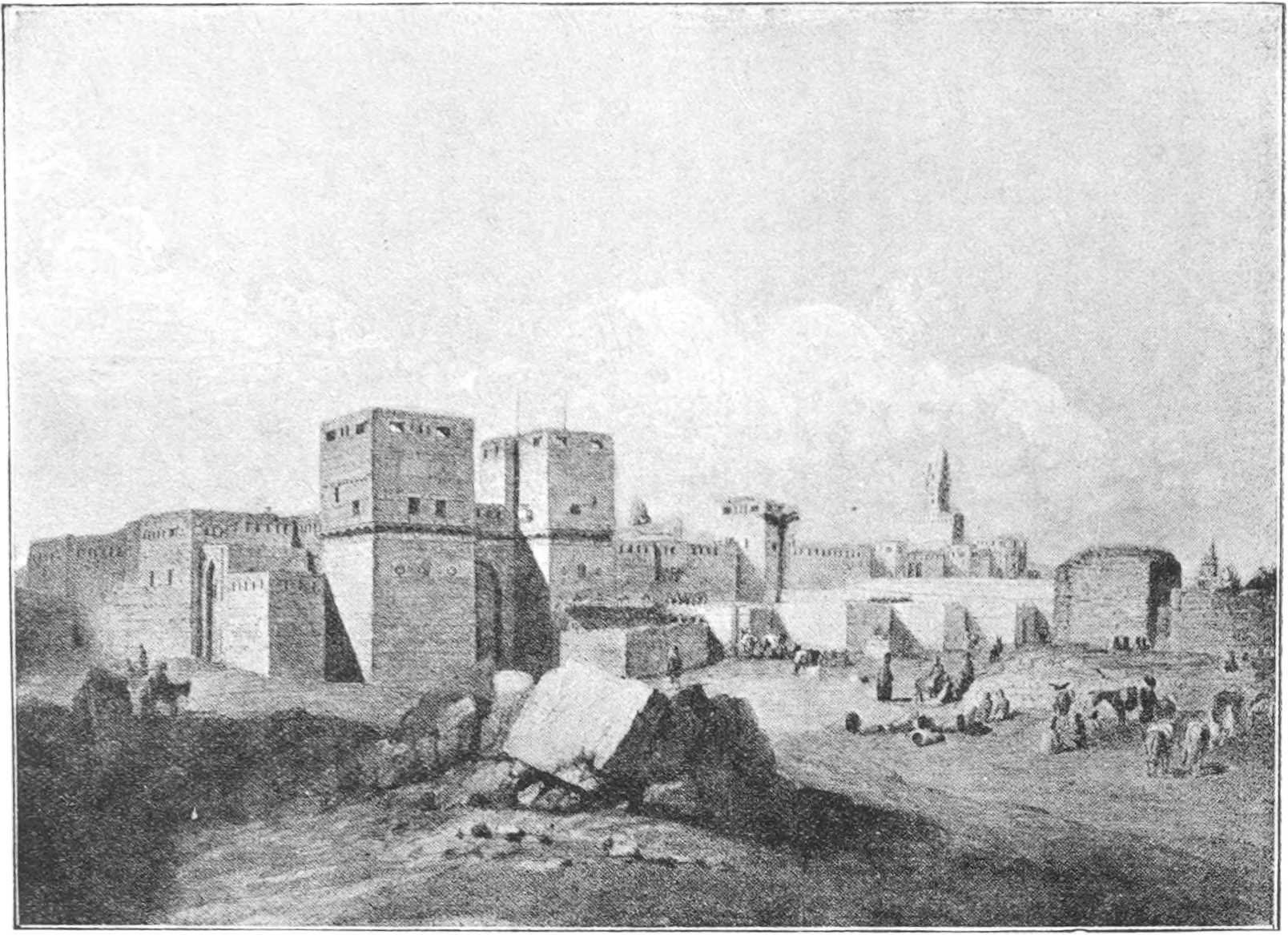
GATE OF SUCCOUR: BAB-EN-NASR
[153]The three great gates stand practically unchanged, though the towers of the Zuweyla gate were shortened to receive the minarets of the mosque of el-Muayyad in the fifteenth century. These gates are the most impressive monuments of the Fátimid period, but they are Byzantine, not Saracenic. According to the Armenian chronicler Abu-Sálih, a Copt, “John the Monk,” planned the walls and gates for the Armenian vezír; but whatever share he had in designing the lie of the walls, he could never have been the architect of these Norman-looking gates.[53] The Topographer is evidently right in stating that they were built by three brothers from Edessa—a city full of Armenians where Bedr, with his Syrian experience, would naturally seek his architects—each of whom built one gate. The statement is amply confirmed, not only by the style, which clearly belongs to the Syrian-Byzantine school, but also by various mason’s marks in Greek letters, Ζ, Η, Η’, etc. In short, as M. van Berchem has pointed out, the gates and enceinte of Cairo belong to what is called the Templars’ (as distinguished from the French) style of military architecture,—“the great Byzantine and Saracenic school of which the chief characteristics may be traced in various countries and at divers epochs, at Constantinople, Nicæa, Brusa, Adalia, and the Pamphylian cities, in the old Arab fortresses of northern Syria, in the style of the Templars and the military buildings of the post-crusade Saracens, such as the enceinte of Jerusalem,” etc. The leading features of the style are square bastions and square or round headed openings, contrasting with the Persian arches of the Fátimid mosques and the round bastions of Saladin’s[154] wall. The curtains run to a thickness of eleven to thirteen feet, and contain archers’ chambers and other apparatus for defence. The gates consist of a vaulted passage, with round arch, between towers containing an ingenious arrangement of shooting floors and connected by a cross-passage above the arch, with a place for launching stones or grenades upon the enemy. A fine spiral staircase, admirable cornices, some sculptured shields, and a magnificent Kufic inscription[54] adorn the Bab-en-Nasr. The inscription (like another on the Bab-el-Futúh) expresses the Shí‘a creed, but has nevertheless sustained eight centuries of orthodox rule in Egypt unchanged. The three great gates are noble monuments of one of the greatest vezírs of mediæval Cairo.
For nearly sixty years Egypt enjoyed the inestimable benefits of Armenian rule. Bedr died in 1094, the year also of the caliph Mustánsir’s death, but the vezír’s son el-Afdal succeeded to his father’s power, and governed Egypt till 1121, when he was assassinated by order of the caliph Amir. Afdal’s son Abu-‘Aly held supreme power in 1131 in the name of “the expected Mahdy,”—thus reverting to the old Shí‘a theory of the hidden Imám and ignoring all claims of the Fátimid dynasty. When he in turn was murdered on his way to the polo field, Yanis, an Armenian slave of Afdal’s, became vezír, and after him Bahrám, an Armenian Christian, retained the office until 1137. By this time the growing influence of the Armenians had led to their holding every post worth having in all the government departments, and their excessive assumption of authority led to a natural reaction. Bahrám and 2000 of his fellow-countrymen were expelled, and the heyday of the Armenians was over. They deserved well of the[157] country, and had ruled, on a whole, both wisely and large-mindedly. Firm and yet mild, the virtual sovereignty of Bedr and his son had rendered immense services to Egypt. If they accumulated vast wealth—Afdal is said to have left over £3,000,000 in gold, and the milk of his herds of cows was farmed in one year for £15,750—they earned their fortunes by hard and intelligent work; they were just and generous, and the Copts had much to thank them for. Even Abu-‘Aly, with his eccentric revival of the doctrine of the concealed Imám, who actually figured on the coinage, inherited the wise tradition of his father and grandfather, and showed himself tolerant and mild, a good friend to the Christians, and a patron of learning.
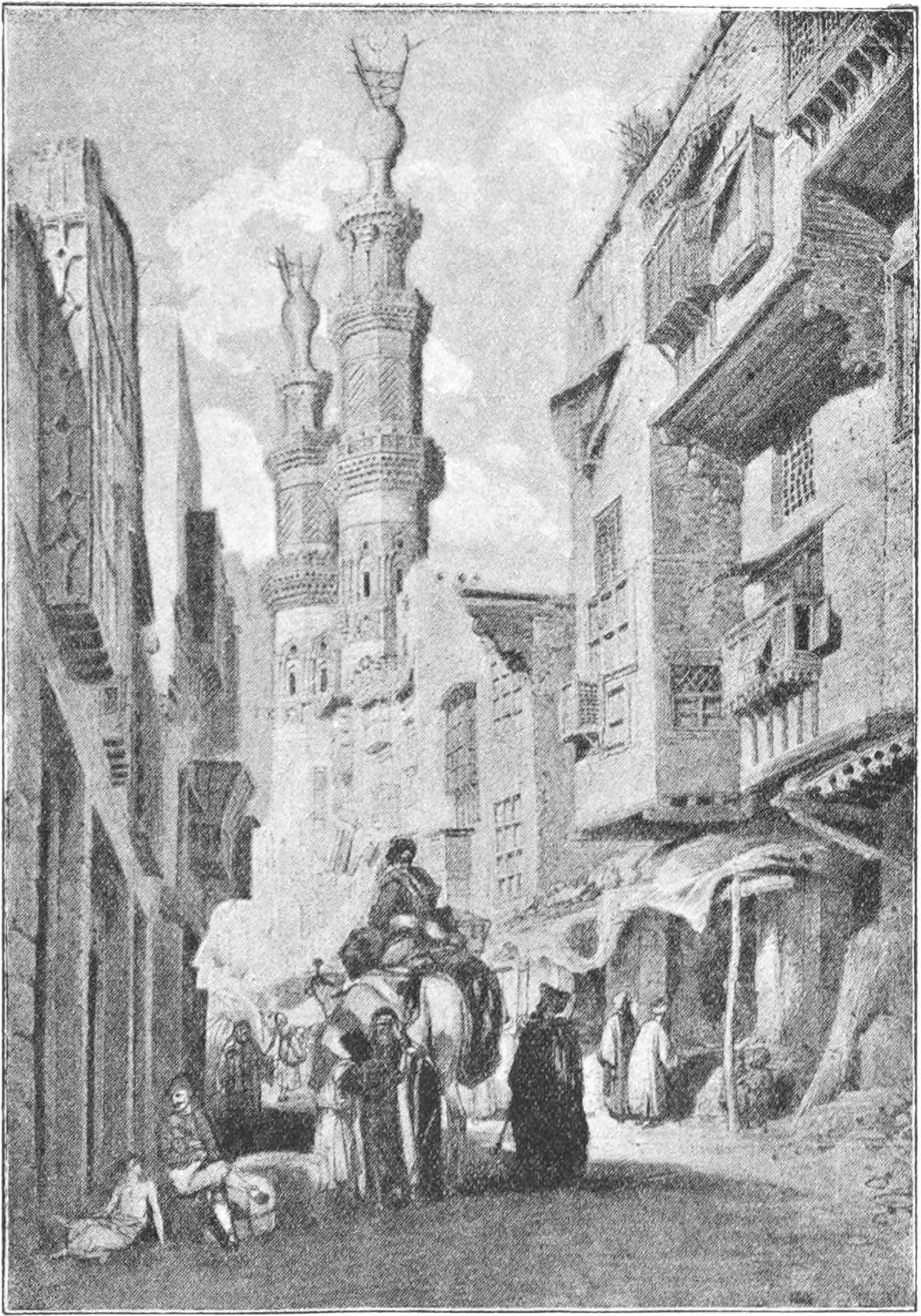
MINARETS OVER GATE OF ZUWEYLA
From the time of Bedr, Egypt, it will be realized, had become a country ruled no longer by caliphs but by vezírs. It was the old story of the Merovingian major domo translated into Arabic. Indeed, since the terrible despotism of Hákim no caliph had exercised personal authority in the great affairs of state, except el-Amir, who tried for a few years to be his own prime-minister, with the help, however, of the monk Ibn-Kenna, but the experiment was not a success. The monk became too inflated, and was scourged to death. El-Ámir’s cruelty made him detested, and one day as he was riding back from the Hawdag, or “Litter,” the country-house on the island of Roda in which he consulted the desert tastes of his Bedawy bride, he was assassinated by some Isma‘ílian Assassins (1130). He had at least the virtue to found a mosque, the Gámi‘ el-Akmar (Grey Mosque), in Beyn-el-Kasreyn. After this the caliphs resigned themselves to a succession of vezírs, who were themselves the instruments of military factions. The spiritual sanctity and seclusion of the Fátimid pontiffs were still observed, as we have seen in the description[158] of the embassy of the two knights, but one must believe that this reverence had degenerated into something like a farce. The murders of Ámir and Záfir; the early imprisonment of Háfiz, and his later thraldom to his drunken negro guards, who killed the gallant Rudwán, vezír, soldier, and poet, in front of the Grey Mosque, and who made the caliph poison his own son by the hands of his Christian physician; the awful scene of bloodshed in the very palace, amid which the baby Fáïz was exhibited to the trembling court as their spiritual Imám[55]—these do not point to any real reverence for the mystical caliphate of the Shí‘a. Fainéant caliphs had long been known at Baghdád, and their rivals on the Nile were equally shadows of a mighty name.
The last horror was too much even for the long-suffering people of Cairo. The murder of the caliph Záfir shortly after the murder of the Kurd vezír Ibn-es-Salár; the massacre in the palace; the peculiar unnaturalness of the crimes on the part of a kinsman and boonfellow; the atrocious brutality of exposing the child-caliph of four years to the terror of such a scene of blood and anguish, roused a storm of vengeance. The new vezír, ‘Abbás, the instigator, fled from a hail of stones, and was killed near the Dead Sea; the actual assassin, Nasr, was delivered up by the Templars of Palestine, for a blood-money of £30,000, to the women of the palace, who tortured him, and sent him through the streets of Cairo, maimed and blinded, to be crucified alive at the Bab-Zuweyla. In their desperate straits the women had sent locks of their hair to the governor of Ushmuneyn in Upper Egypt, and the emír Talái‘, son of Ruzzík, responded gallantly to[159] the appeal (1154). Waving the eloquent tresses he rode into Cairo, followed by an Arab guard, and when he had assumed the vezirate in the Dar-el-Mamún,[56] the capital recovered its confidence. Talái‘, who followed the custom of recent vezírs and styled himself “king,” el-Melik es-Sálih, was the last buttress of the falling dynasty. He was a man of culture, a poet, accessible, generous, and politic. His mosque, still to be seen near the Bab-Zuweyla, bears witness to his pious munificence. He tried his best to turn aside from Egypt the storm that was threatening from the political complications in Syria and Palestine; but the palace women found that they had called to their rescue an austere moralist, and ungratefully put him to death. “His last words were a regret that he had not conquered Jerusalem and exterminated the Franks, and a warning to his son to beware of Sháwar, the Arab governor of Upper Egypt. The regret and the warning were well founded. Sháwar deposed and executed the vezír’s son Ruzzík at the beginning of 1163, and within the year the Christian king of Jerusalem was in Egypt.”
Before turning to the invasion of Cairo by the Crusaders, the conquest by Saladin, and the end of the Fátimids in the death of the last caliph el-‘Adid, a few words must be said on the remains of the city which the falling dynasty had created and maintained in exceptional splendour. Of all their buildings only the three great gates, part of the walls, and the remains of four[57] mosques, bear witness to the Fátimids.[160] The palaces have utterly gone: they were not used by their successors, and gradually fell to ruin. “O censurer of my love for the sons of Fatima,” wrote Omára, the poet, before 1174, “join in my tears over the desolate halls of the twin Palaces.” The Hall of Science, the Dar-el-Mamún, the Palace of the Vezírs, and all the other mansions and pleasure houses of the Shí‘a caliphs and their court have disappeared. There was no wanton or general destruction: the buildings were simply deserted and neglected under the new orthodox régime, and neglected houses soon fall to ruin. Of the few remaining monuments, the oldest that can be regarded as authentic is the mosque of el-Hákim—for the Azhar retains little of its original architecture or decoration. The Akmar mosque in Beyn-el-Kasreyn built by the caliph Ámir is remarkable as the first mosque built of stone: the earlier mosques were all of brick. Only the façade, however, is of stone, well-shaped and joined, and finely sculptured. The interior arches are of brick on marble pillars. “Small and ruined as it is, it has the feature, unique among Fátimid mosques, of a fine façade (unfortunately hidden by a formless erection which the Monuments Commission has vainly sought to obtain power to remove), very unlike the ordinary plain exterior of the early mosques, and deserving special notice for the shell ornament of its fluted niche, the rosette of open tracery composed of inscriptions and ornaments, and the side niches, surmounted by a Kufic frieze.”[58] Two inscriptions giving the name of el-Amir and the date 519 A.H. (1125) belong to the foundation, and two others record the restoration of the mosque by the emír Yelbugha es-Sálimy in 799 (1396), but this restoration fortunately made but[163] slight alterations in this interesting building. The mosque of the vezír Talái‘ ibn Ruzzík, near the Bab-Zuweyla (1160), though much dilapidated, shows a notable advance in decorative skill, and the rich detail of its arabesques is scarcely surpassed by any later work. Fátimid decoration is well illustrated by several important examples in the Museum of Arab Art. Especially to be studied are the panelled doors with fine foliate carving and inscriptions (of el-Hákim) from the Azhar mosque; and the three mihrabs or prayer niches, two of which came from the Azhar (one bears an inscription recording its erection there by el-Ámir in 1125), and the third from the chapel of Seyyida Rukeyya of about 1135. The last is a marvel of intricate geometrical panel-work and arabesque and Kufic ornament.
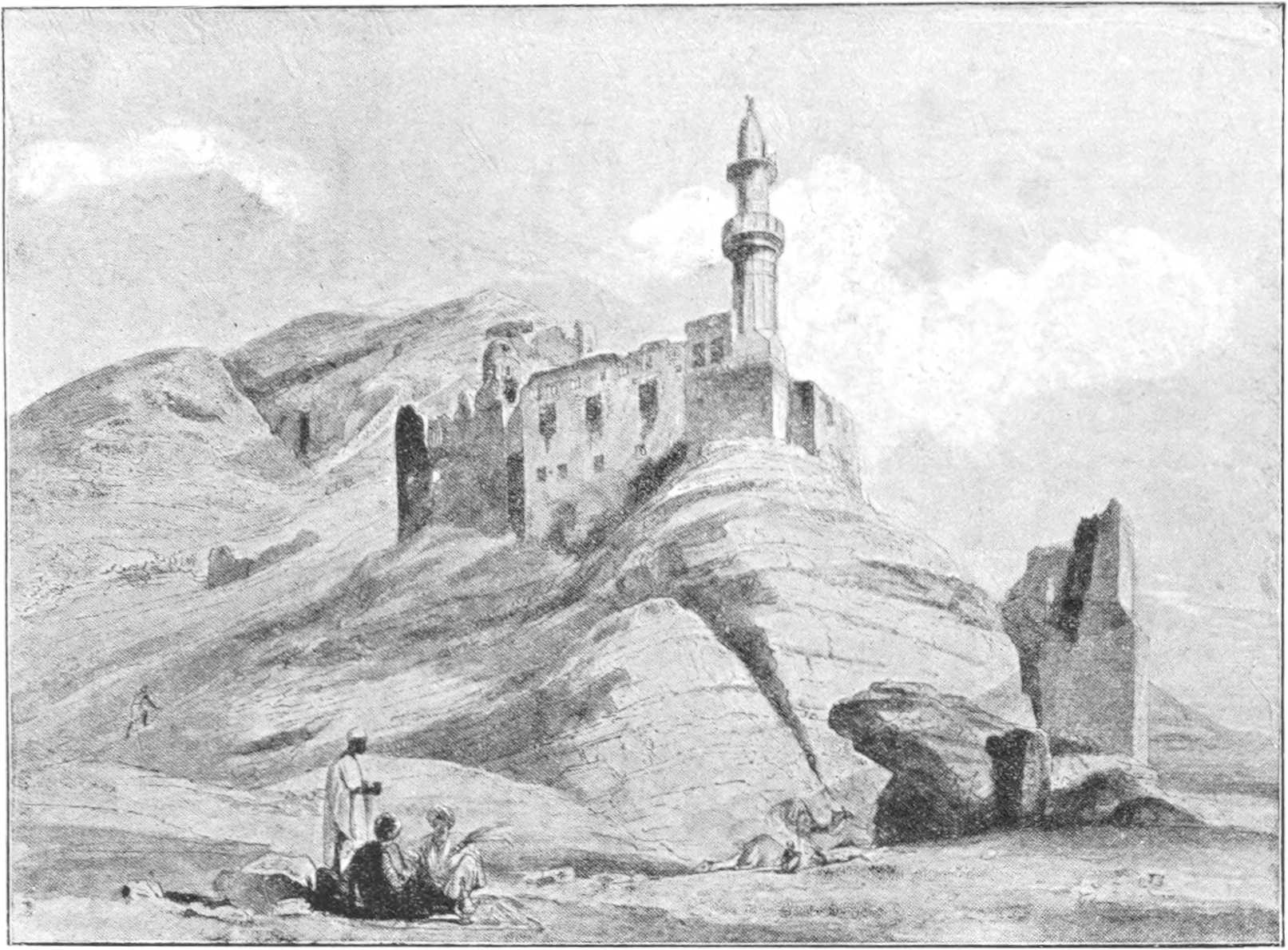
MOSQUE OF EL-GUYUSHY
Unhappily, if heterodox opinions encouraged artistic development, they also led to the destruction of its achievements. Had the Fátimids not been heretics, their beautiful palaces with their thousands of exquisite works of art might have been preserved by their successors. As it was, they all bore “the mark of the Beast,” and the pious folk of later times were only too eager to efface all memories of the schismatic caliphs who had lavished their fabulous wealth with admirable taste upon the embellishment of their city.
[164]CHAPTER VI
Saladin’s Castle
CAIRO at the beginning of the thirteenth century was a very different city from the Fátimid royal compound. It covered a much larger space, included a number of new buildings of a character unknown in Egypt before, and it possessed a citadel. All these changes were due to Saladin, though he did not live to see them completed. To trace in detail the causes which led to the invasion of Egypt by the Crusading king of Jerusalem and the expulsion of the Franks by the armies of Nur-ed-din, sultan of Damascus, would carry us far away from our proper subject. The principal element in the political situation was the partition of the Fátimid province of Syria between two new and aggressive powers, the Crusaders and the Seljúk Turks. The gradual infiltration of Turkish officers into the Baghdád caliphate had ended in a great invasion of this race, led by the Seljúks, who not only subdued the whole of Persia and Mesopotamia in the middle of the eleventh century and made the ‘Abbásid caliph their tool, but overran the Fátimid dominions in Syria, which had always been loosely held, took possession of Damascus in 1076, and were only prevented from invading Egypt by the bribes and warlike preparations of the Armenian vezír Bedr el-Gemály. The Seljúk empire broke up at the close of the century; but its Syrian fragment, under the brilliant leadership of the Atabeg Zengy and his son[167] Nur-ed-din, was little less formidable to the Fátimid authority than the undiminished empire of the Seljúks. Meanwhile a fresh complication was introduced into Syrian politics by the beginning of the Crusades, the recovery of Jerusalem by the Christians in 1099, and the establishment there of the Latin Kingdom. Step by step the Fátimid garrisons were driven south. The Armenian Afdal, Bedr’s son, after attempting negotiations, fought a series of campaigns in Palestine, but the advance of the Crusaders was not to be stayed. Tripolis fell in 1109, Tyre followed in 1124, and after a long interval Ascalon, the last Fátimid outpost, surrendered in 1153. The Crusaders now touched the Egyptian frontier, and their fortresses at Karak and Montréal, by the Dead Sea, intercepted communications with Syria.
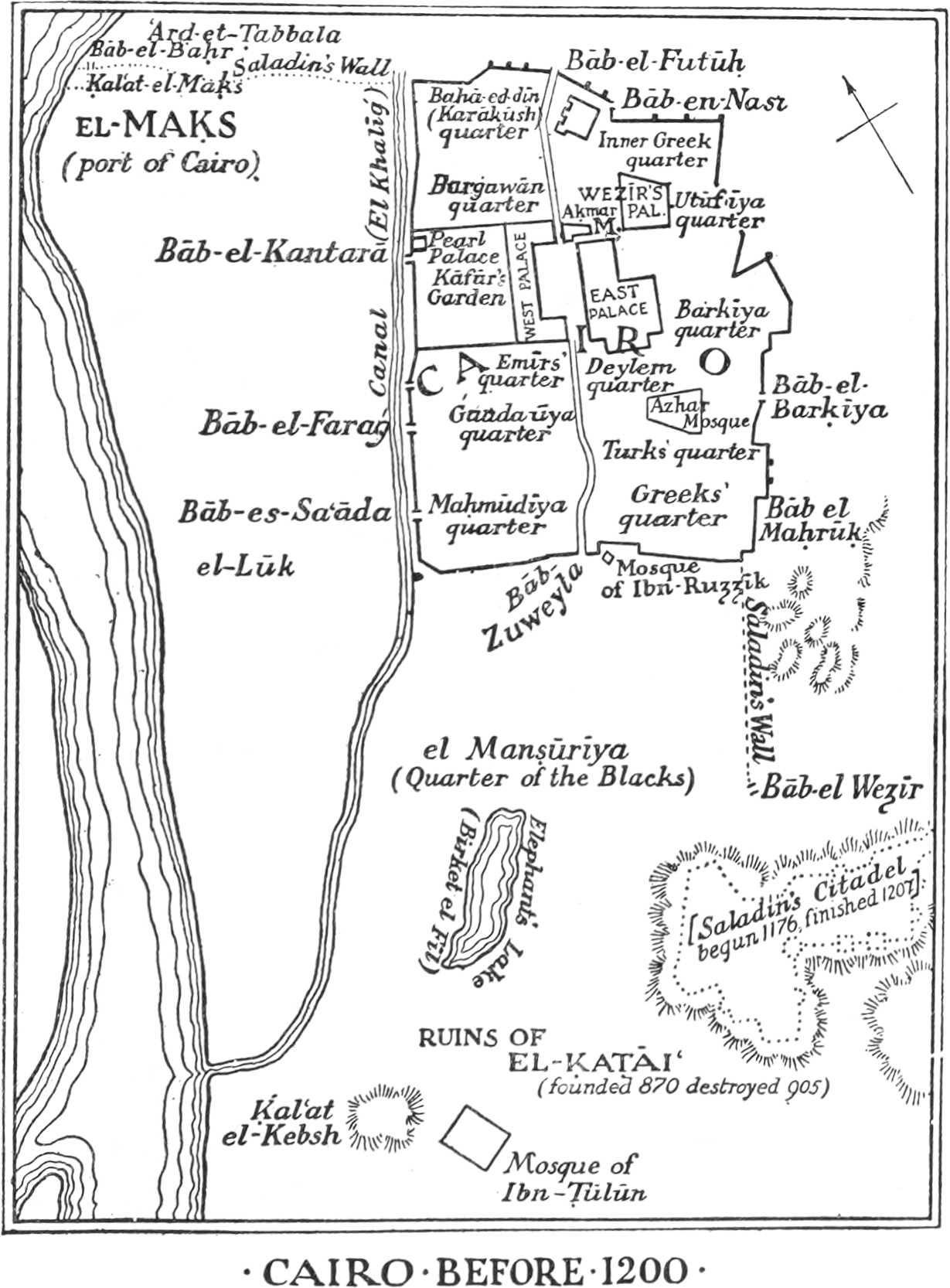
CAIRO BEFORE 1200
Of the two powers, the Latin Kingdom of Jerusalem and the Turkish Sultanate of Damascus, neither was strong enough to crush the other. Egypt was the key of the situation. If either power could obtain possession of the Nile, it would take its rival on the flank and win the mastery. The natural combination would of course be between the two Muslim states of Damascus and Cairo; but religious sectarianism barred the way. Nur-ed-din was a zealous Muslim of the orthodox school, and would have no traffic with Shí‘a heretics. The vezírs Ibn-es-Salár and Talái‘ did indeed open a diplomatic correspondence with the king of Damascus, but received little encouragement. It was not till his hand was forced by the actual presence of a Crusading army at Cairo that Nur-ed-din at last sent his troops to Egypt. The interference was due to the quarrels of rival vezírs who were struggling over the remains of the Fátimid power. One of these, Sháwar, expelled by Dirghám, appealed to Nur-ed-din, and Dirghám sought the alliance of Amalric, the king[168] of Jerusalem, who had already invaded Egypt to claim the yearly subsidy—annua tributi pensio as William of Tyre describes it—which the decrepit Fátimid government had recently paid as blackmail to its Christian neighbour. Sháwar returned in 1164 supported by a Syrian army commanded by Shirkúh, with his nephew Saladin on his staff. Dirghám, defeated at Bilbeys, made another stand at Cairo, where he held the Fátimid city whilst Sháwar and the Syrians occupied Misr. Popular as Dirghám had been—he was a brave Arab, who had fought the Crusaders at Gaza and commanded the Barkíya battalion of the Fátimid army—he ruined his cause by laying hands on the wakf (pious benefactions) to meet his military necessities. His followers fell away, and the caliph withheld his countenance. The final scene was tragical:—
“Driven to bay, for the last time he sounded the ‘assembly.’ In vain ‘the drums beat and the trumpets blared, ma-sha-llah! on the battlements’; no man answered. In vain the desperate emir, surrounded by his bodyguard of 500 horse, all that remained to him of a powerful army, stood suppliant before the caliph’s palace for a whole day, even until the sunset call to prayer, and implored him by the memory of his forefathers to stand forth at the window and bless his cause. No answer came; the guard itself gradually dispersed, till only thirty troopers were left. Suddenly a warning cry reached him: ‘Look to thyself and save thy life!’—and lo! Sháwar’s trumpets and drums were heard, entering from the Gate of the Bridge. Then at last the deserted leader rode out through the Zuweyla Gate: the fickle folk hacked off his head, and bore it in triumph through the streets; his body they left to be worried by the curs. Such was the tragic end of a brave and gallant gentleman, poet, and paladin.”
[169]As soon as Dirghám was disposed of, the treacherous Sháwar turned upon his deliverers, and called in the aid of Amalric to drive away the Syrians. After a prolonged conflict, an armistice was eventually arranged, and both armies, Christian and Syrian, retired from Egypt without immediate result. But the invasion was the beginning of a permanent occupation. On their return to Damascus the Syrian troops described the weakness of the Fátimid rule and urged upon Nur-ed-din the importance of the conquest of Egypt. The cautious sultan was slow to move, but when the news came that Amalric was again intriguing with Sháwar, the Syrian army set out a second time for the Nile and crossed it just as the Crusaders came up (1167). Amalric, however, succeeded in getting possession of Cairo, and made the treaty with the caliph which was the occasion of the memorable audience of the two knights described above (p. 131). Shirkúh, on the other hand, overran Upper Egypt, and Saladin held Alexandria for seventy-five days. Then another truce was arranged, and the two armies went back respectively to Syria and Palestine. The Franks, however, left a Resident at Cairo and manned the guards of the gates, quartering a garrison in the mosque of el-Hákim; and the representations of these spectators of the weakness and distraction of the government of Egypt brought Amalric back in the following year with the definite intention of annexing the land. This breach of faith, followed by a barbarous massacre at Bilbeys, so alarmed the Egyptians that they sent urgent entreaties to Nur-ed-din—the caliph even plied him with the touching argument of tresses of his wives’ hair—and for the third time, at the beginning of 1169, Shirkúh and Saladin arrived in Egypt. This time they stayed for good. Amalric retired without even giving battle; Sháwar, after plotting the murder of his rescuers, was[170] arrested and executed; Shirkúh was appointed vezír, and on his death two months later Saladin was invested with the robe of office in March 1169.
As vezír of the Shí‘a caliph and at the same time viceroy of the orthodox king of Damascus, Saladin’s position was clearly untenable, and though he carried on the business of state for two years in this anomalous situation it was obvious that the Fátimid caliphate must come to an end. The last of the Fátimids was dying, and the opportunity was taken to make the necessary change. At the Friday prayers on the 10th of September 1171, the ‘Abbásid caliph of Baghdád was duly proclaimed in the mosques of Cairo. A similar ceremony is described by an Arab traveller from Spain twelve years later.
“In one of these Friday Mosques,” says Ibn-Gubeyr, “the Sermon was preached to-day. The Preacher herein followed the Sunny rite, beginning his sermon with an invocation conjointly for the Companions, the Followers and their fellows, also for the Mothers of the Faithful, who are the Wives of the Prophet, and for his two noble uncles Hamza and el-‘Abbás;—further, he preached so fine a sermon and so moving a discourse that hard hearts were humbled and dry eyes shed tears. He delivered his sermon robed in black, as is the ‘Abbásid rule; for he wore a black cloak over which hung a taylasan or veil of fine black linen, such as in Spain would be called an ihrám; his turban also was black, and he was girt with a sword. As he ascended the pulpit, he struck a blow on the step with the ferule of his scabbard, when he first began to go up, such as the congregation might hear, and as though it were a call to silence, and in the midst of his ascent he struck another blow, and when he reached the top, a third; after which he pronounced the blessing, turning first to the right and then[171] to the left, standing there between two black banners that had white marks on them, which were fixed in the upper part of the pulpit. On this occasion, further, he invoked a blessing first on the ‘Abbásid caliph, who is en-Násir-li-dini-llah, the son of el-Mustady, and next he prayed for the restorer of his power, Yúsuf, son of Ayyúb, who is the Sultan Saladin, and then for his brother and heir apparent, Abu-Bekr, who is named Seyf-ed-din (Saphadin).”[59]
The congregation who first heard this bidding-prayer in 1171 showed little surprise, and there was scarcely a murmur. The Shí‘a propaganda had probably been attended with little success in Cairo, and the bulk of the people retained their leanings to the orthodox creed, in spite of two centuries of dominant heresy. At least, the revolution was accomplished without a shock. The last of the Fátimid caliphs passed away without hearing of his deposition. His relations were kept in luxurious captivity, and his slaves and household dispersed. The palaces were too magnificent for Saladin’s modest wants, and he quartered the officers of his army there, and himself occupied the House of the Vezírs. The great library of 120,000 books, which had been studiously collected since the dispersal of the earlier library a century before, was given to the learned chancellor, Kády el-Fádil. The treasure was distributed or sold. The palaces and every memory of the Fátimids gradually disappeared, save their mosques, and orthodoxy once more reigned supreme in Egypt.
The career of the great champion of Islám was made chiefly outside Egypt. Of Saladin’s reign of twenty-four years—for reign it was from the beginning, though[172] nominally subject to the king of Damascus for the first five years—he spent but eight at Cairo, and his greatest triumphs, as well as his few reverses, took place in Syria, Mesopotamia, and Palestine. When he left Cairo on the 11th of May, 1182, and the great officers of the court came to his stirrup to bid him farewell, as the cavalcade halted by the Lake of the Abyssinians, a voice was heard above the music and the singing: “Enjoy,” it cried in the classical lines of an Arab poet,
The evil omen came true: there were no more ox-eyes in Egypt for him, and Cairo saw him never again. He conquered the land of the Euphrates; held kingly state at Damascus, which he had annexed after the death of Nur-ed-din; won his great victory at Hittín over the Crusaders; recovered Jerusalem, sacred to him as well as to Christians, and brought all the Holy Land to his feet; and fought the long duel with the chivalry of Europe which wavered about ‘Akka for two years, and ended in the running fight with Richard of England that has made Saladin a household name even in Europe. After the last dash upon Jaffa and its repulse, the treaty of peace was signed, and in the following March, 1193, Saladin died and was buried at Damascus.
“The Holy War was over; the five years’ contest ended. Before the great victory at Hittin in July, 1187, not an inch of Palestine west of the Jordan was in the Muslims’ hands. After the Peace of Ramla in September, 1192, the whole land was theirs, except a narrow strip of coast from Tyre to Jaffa. At the Pope’s appeal all Christendom had risen in arms. The Emperor, the Kings of England, France and Sicily,[173] Leopold of Austria, the Duke of Burgundy, the Count of Flanders, hundreds of famous barons and knights of all nations, had joined with the King and Princes of Palestine and the indomitable brothers of the Temple and Hospital, in the effort to deliver the Holy City and restore the vanished Kingdom of Jerusalem. The Emperor was dead, the Kings had gone back; many of their noblest followers lay buried in the Holy Land: but Jerusalem was still the city of Saladin, and its titular king reigned over a slender realm at Acre. All the strength of Christendom concentrated in the Third Crusade had not shaken Saladin’s power. When the trials and sufferings of the five years’ war were over, he still reigned unchallenged from the mountains of Kurdistan to the Libyan desert, and far beyond these borders the King of Georgia, the Catholicos of Armenia, the Sultan of Koniya, the Emperor of Constantinople, were eager to call him friend and ally.”[60]
Brief as was Saladin’s residence at Cairo, none of its rulers has left more lasting traces of his influence. It is to him that the capital owed the form and extent it has borne ever since, until comparatively recent times. Its most conspicuous feature, the Citadel, was Saladin’s creation, and its most pervasive architectural form, the Medresa, was his introduction. All these changes were due to his initiative, and when, after eight years, he went away, and thenceforth continually called upon Egypt to send its contingents to his yearly campaigns, he left behind him officers and kinsmen who carried out the great works he had begun. These works were partly defensive, and partly religious. The defensive works were the Citadel, the new wall, and the great dike, and all three are original features. Hitherto the various rulers of Egypt had[174] contented themselves with building official or royal suburbs, each half a mile or so further to the north-east. Even the Fátimid “city” of Káhira, as we have seen, was an official and palatial residence of the caliphs, not a metropolis of Egypt. Saladin was the first to elaborate a comprehensive plan of a great capital. Instead of following the example of earlier sovereigns and building a new suburb, he resolved to unite the existing inhabited districts within one great wall, and to crown the whole by a citadel. The burned city of Misr was then struggling to rise from its ashes, like the phœnix, and renew its youth: Saladin resolved to help it. The scattered settlements upon the site of the ruined faubourgs were also to be gathered in, and the port of Maks was to be joined to its city by a wall, as Peiraeus was to Athens. The enclosing wall was to be of stone, and to prolong the defences of Bedr the Armenian to Maks on the west and to the hill of Mukattam on the south, and thence to run round the remains of the old Town of the Tent till it touched the Nile.
The great scheme was never completed: its author was busy on his Syrian campaigns, and probably his representatives at Cairo had enough to do to raise men and money for his support without carrying out more building than was absolutely necessary. It is also possible that further reflection convinced him or his deputies that the plan of enclosing so decayed a town as Misr was hardly worth the cost of a couple of miles of wall. What was actually accomplished was this: the wall of Bedr on the north was prolonged from its terminus at the canal to the Nile, where the fortified tower of Maks was erected; on the east the old wall was prolonged southwards to the Bab-el-Wezír, near the wall of the new Citadel;—the Sultan’s death stopped the work before a junction had[175] been made, and the south and west walls were not even begun. A large part of Saladin’s walls still stands: though often lost among houses, they can be traced between the canal and the Iron Gate (Báb-el-Hadíd, formerly called the Bab-el-Bahr, or Nile Gate, beside the fort of Maks, which has disappeared), where the contrast between the last square bastion of the Fátimid wall and the neighbouring rounded bastion of Saladin’s curtain, with its bosses, watch-towers, and loopholes, is clearly marked. The same characteristics are seen on the east wall which separates the city from the Káit-Bey cemetery, until a modern style appears at the Bab-el-Wezír.[61] A portion of the wall at the N.E. angle, with the Burg ez-Zafar, lies outside in the desert, showing that here only has the modern city shrunk within its twelfth century limits.
The walls were but a development of the earlier enceinte of Bedr. The Citadel was a new idea. It may have been partly inspired by Saladin’s dislike to the palaces so intimately associated with the schismatic caliphs, for though he did not live to dwell in the Citadel, except for a brief visit, there can be no doubt that he intended to make it his residence, as his successors did. But the obvious explanation of the fortress is to be found in his Syrian experience. There every important city had its Kal‘a or castle, and nothing could be more natural than that Saladin, looking with a soldier’s eye at the jutting spur of Mukattam, should at once have recognized it as the proper place for a citadel. It is true that whilst commanding Cairo from its height of 250 feet, the fortress is itself commanded by higher positions on Mukattam; but this would hardly injure its efficiency in days of stone-slings and short-ranged mangonels. It was a strong enough[176] position for twelfth century engineers, and no pains were spared to make it impregnable from beneath, in case of an insurrection in the city. The work was begun in 1176-7 under the direction of the eunuch Karakúsh, one of Saladin’s most faithful emírs, who in spite of great services and warlike deeds has by a strange freak of fortune come to be associated with the ribald antics of Karakúsh, the Oriental Punch. It was not till six years later that the founder’s inscription was set up which still surmounts the “Gate of Steps” (Bab-el-Mudarrag) in the original (west) part of the Citadel, where we read how “the building of this splendid Castle,—hard by Cairo the Guarded, on the terrace which joins use to beauty, and space to strength, for those who seek the shelter of his power,—was ordered by our master the King Strong-to-aid, Saláh-ed-dunya wa-d-din (Saladin), Conquest-laden, Yúsuf, son of Ayyúb, Restorer of the Empire of the Caliph; with the direction of his brother and heir the Just King (el-‘Adil) Seyf-ed-din Abu-Bekr Mohammad, friend of the Commander of the Faithful; and under the management of the Emír of his Kingdom and Support of his Empire Karakúsh son of ‘Abdallah, the slave of el-Melik en-Násir, in the year 579” (1183-4).
The smaller pyramids of Giza were used as quarries for the stone, and the masonry was executed in part by Frank or European prisoners taken in Saladin’s wars. The Spanish traveller Ibn-Gubeyr, who visited Cairo in 1183, saw the building in progress. “Both the workmen,” he says, “whose forced labour is employed for building the Citadel and their overseers are Christian prisoners of war of the Franks; their number is so great as cannot be reckoned, and but for them there would be no means of carrying out these works, for only they can support the toil and heavy[179] labour of sawing the marble, dressing the great blocks of stone, and of quarrying the fosse which encompasses the wall of the Citadel, which fosse is cut like a ditch in the solid rock with crowbars, a wonder of wonders for ever. Elsewhere there is another building of the Sultan which is being carried out by the Frank prisoners who work here; but even those of the Muslims, who give their service in these and similar public works, must do it at their own cost, for there is no pay given to any who work here.” Corvée labour was no new thing in Egypt, however strange it may have appeared to a visitor from Spain.
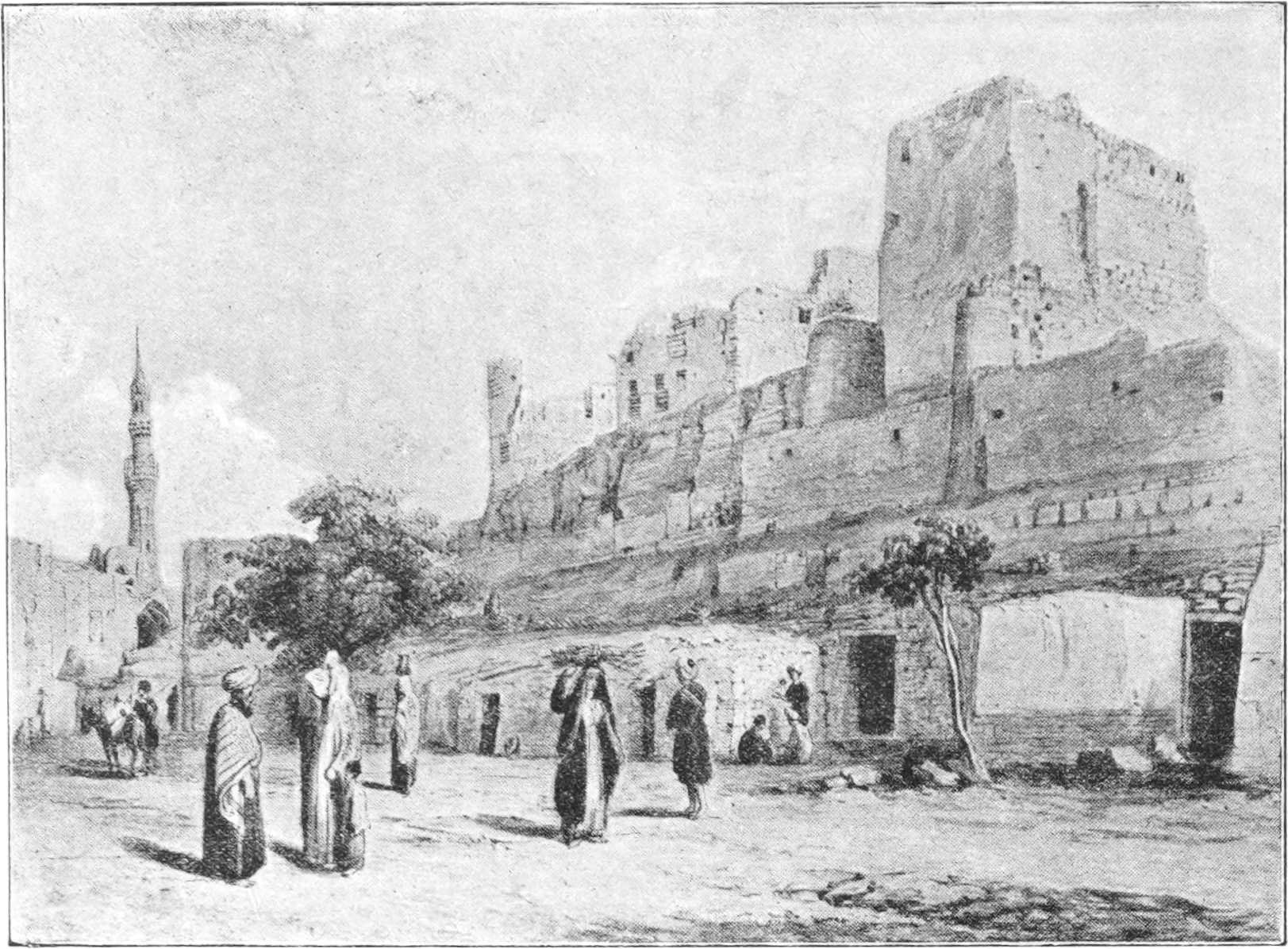
CASTLE OF THE RAM: KAL‘AT-EL-KEBSH
The Citadel was not finished till 1207-8, when Saladin’s nephew el-Kámil was king. As the chief residence and stronghold of every successive ruler down to 1850, it has been frequently altered and enlarged by several of the Mamlúk Sultans, and finally by Mohammad ‘Aly Pasha, and none of the mosques or vestiges of palaces on it belongs to Saladin’s age. The old mosque was built by en-Násir in 1318; the more conspicuous mosque with slender Turkish minarets was begun by Mohammad ‘Aly in 1824. The “Hall of Yúsuf,” believed to be Saladin’s, was part of a Mamlúk palace. The interior towers are not original, and the gateway opening on the Rumeyla was built in the middle of the 18th century. Still there is much remaining of the original structures, besides the famous “Well of the Winding Stairs,” 280 feet deep, which was excavated by Karakúsh. Saladin’s walls are still preserved in a large part of the enceinte, though it needs some architectural knowledge to distinguish them from later additions and restorations, and some of the internal passages and constructions date from the foundation. The prevalent use of round, slightly truncated, and well-projected bastions, commanding a long stretch of the curtain, the absence of interior[180] chambers or low loopholes in the curtain, and the arc brisé or square openings, besides certain technical peculiarities in the masonry, reveal the original work, and associate it with the Franco-Syrian rather than the Byzantine school.
The last work of defence was the great dike of Giza on the west bank of the Nile. Ibn-Gubeyr describes it as a gigantic undertaking. “The Sultan,” he says, “to his glory and as a lasting work that shall serve the need of the Muslims, has begun to build a great dike of arches to the westward of Misr, and at a distance from it of seven miles. This forms a continuation of the embankment which, beginning opposite Misr, runs along the side of the Nile like a hill that has been flattened on the ground: after traversing which you come at the end of six miles to the dike continuing it. This dike consists of forty arches, each of the largest size of bridge-arches, and runs in the direction of the delta which extends thence to Alexandria. It is a wonderful work, and such as only a king of great foresight would emprise, as a precaution against sudden attack by an enemy from the Alexandrian frontier at the time of the inundation, when, the land being under water, the usual road becomes impassable for troops. The dike thus forms a causeway available at all seasons of need.”[62] The object of this defence is evident. Saladin had not forgotten the history of the successive Fátimid invasions from the Libyan side, when there was nothing to stop them from marching straight to the Nile, and he determined to be forearmed. Ibn-Gubeyr mentions that there were fears of an attack from the Almohades, who after subduing all Morocco and southern Spain, had conquered Algeria, Tunis, and Tripoli in 1158, till the frontier of their victorious leader ‘Abd-el-Mumin[181] actually touched the western border of Egypt. Saladin did well to take precautions, though the threatened invasion never came.
These defensive works against external enemies were accompanied by other measures taken with a view to internal order and content. It must not be supposed that the new régime had no difficulties to contend with. However well disposed the mass of the people may have been towards a ruler who showed himself so magnanimous, generous, and yet indomitable as Saladin, the traditions of two centuries were not to be uprooted in a day. The partisans of the Fátimid family were numerous and active. Before the death of el-‘Ádid, there was a formidable rising of the black troops, abetted by the caliph himself, and Saladin had hard work to put it down. The Sudánis were at last driven to bay and slaughtered for two days till they cried quarter, when they were banished the city. The part called el-Mansuríya, outside the Zuweyla Gate, that had been covered with their barracks, was utterly burned down, and the site turned into gardens; so that a few years later, when Saladin rode from the palace to the new Citadel, he passed between trees and flowers, and standing at the mosque of Ibn-Tulún he could see the Gate of Zuweyla with no building intervening. Other conspiracies followed, supported by the Franks who threatened Alexandria, and stern measures were needed before the new sultan felt his power secure. So long as there was a strong party sympathizing with the captive survivors of the fallen dynasty there would always be danger.
How zealous the Shí‘a still were may be judged by the scene described by the Spanish traveller in the famous shrine which preserved the head of the martyr Hoseyn, in the mosque adjoining the Great Palace of the Fátimids. “The Head is preserved[182] in a chest of silver buried underground, over which a mighty building has been erected such as any description thereof must fail to portray, for the understanding cannot compass it. Its walls are tapestried with brocades of various kinds, and it is set round with what are like great columns, the same being white candles, though some are of smaller size, the most being set in candlesticks of pure silver or of silver gilt. Above are suspended silver lamps, and the whole of the part above this is set with the like of golden apples, and so arranged as to resemble [the chapel at Medina where the Prophet is buried called] er-Roda; and by the beauty and magnificence thereof it rivets the sight, for herein are all kinds of rare variegated marbles wonderfully wrought in mosaic work such as no imagination can depict, nor can he who would describe it attain thereto with any description. The entrance to this chapel is through a mosque that is the equal of it in regard to the pleasure of the eye and the rare sight that it affords, for all its walls are of marble after the fashion above described. To the right of the chapel (where the Head is), and to the left of it, are two chambers, through which you enter the same, and each of these is in every particular similar to this last, and curtains in brocade stuff of wondrous workmanship are here hung on all sides. But the most curious of the many things that we saw was on entering this most blessed mosque; for a stone is set in the wall facing him who enters, which is so extremely black and lustrous that the whole person is reflected therein, as though it were in an Indian steel mirror newly polished. And we saw the people kissing this blessed tomb (where the Head of Hoseyn is buried), embracing it with their arms and prostrating themselves upon it, after which they would lay their hands on the pall that covers it and then, crowding[183] one on another, circle round, praying, weeping, and supplicating Allah—to whom be praise—for the blessing that pertains to this holy grave, humbling themselves before Him in such fashion as melts the heart and overcomes the feelings of the spectator; for this is a wonderful matter and a sight that is awful in its aspect. May Allah cause us to benefit by the blessing vouchsafed to this holy Oratory!”[63]
Such a demonstration, recalling the hysterical emotions of the Persian Passion Play, shows that twelve years after the deposition and death of the last Fátimid caliph Shí‘a fanaticism was still ardent in Cairo. Saladin’s mode of dealing with it was characteristic of his statesmanship. Despite his gentle and chivalrous nature he was quite capable of fierce persecution “for righteousness’ sake.” A Muslim of the Muslims, rigidly orthodox, and deeply imbued with the puritanical ideas of the theologians with whom he loved to converse, he had no toleration for heretics and infidels. The grievous confiscation and destruction which the Copts and their churches suffered in the orthodox reformation showed that Saladin’s magnanimity did not extend to matters of faith. But in the case of the Shí‘a he had to deal with a more powerful and dangerous movement, which had two centuries of dominance behind it, and he met it not by overt persecution but by a counter propaganda. The people of Cairo must be taught the true religion, and then there would be little fear of heresy. At the time of his accession there was not a single college in Egypt where orthodox theology was taught. This want was at once supplied, and Saladin began the foundation of those Medresas or theological colleges which have ever since been the leading architectural feature of Cairo.
[184]In 1176 he established the first Medresa ever built in Egypt. It was next to the shrine of the Imám Sháfi‘y, the founder of the school of orthodoxy to which most Egyptian Muslims have since belonged. The tomb-mosque may still be visited in the wilderness of graves to the south of Cairo, but the college has long disappeared. In 1183 the shrine is described as “a magnificent oratory of vast size, and strongly built, standing opposite to a Medresa,” so large and so surrounded by buildings as to resemble “a township with its dependencies. Over against it is the hammám with all other needful offices, and the building and additions are still going on at a cost not to be counted. The Sheykh Negm-ed-din el-Khabushány himself oversees it, being imám of the mosque, a pious learned man. The sultan of the land, Saladin, has munificently supplied all that is required therefor, commanding that the buildings shall be well cared for and beautified, and all expenses set down to him. . . . We met this Khabushány and gained the blessing of his prayers—his fame had reached us even in Andalusia. We visited him in his mosque and also at his private dwelling within the precincts, a small house with a narrow court, and here he offered up prayer for us when we left. In all Egypt we did not meet his equal.”[64]
[185]Besides the Sháfi‘y College, Saladin built a medresa close to the stronghold of the enemy, the shrine of Hoseyn, turned the old palace of Mamún into the Seyf-ed-din college for the Hanafy divines, and built another for the Sháfi‘is and a fifth for the Málikis in Misr. In recording his benefactions one must not forget his hospitals. Everyone knows the Maristan or hospital of the Mamlúk Sultan Kalaún in the Suk-en-Nahhasín, but it is not generally known that this noble[186] institution was anticipated by Saladin. To quote Ibn-Gubeyr again:—
“Among the famous institutions of this Sultan which we saw was the Maristán or Hospital, which stands in the city of Cairo. It is one of the great palaces there, spacious and magnificent, and the Sultan has been prompted to the meritorious deed of establishing this hospital solely by the hope of gaining favour with God and recompense in the world to come. He has appointed here an administrator, a man of knowledge, in whose charge a provision of drugs has been placed, with power to compound potions with these according to diverse recipes, and to prescribe them. In the chambers of this palace couches have been placed, which the sick folk make use of as beds, these being fully provided with bed clothes, and the administrator has under him servants who are charged with the duty of inquiring into the condition of the sick folk morning and evening, and these last receive food and medicines according as their state requires. Opposite this hospital is another, separate therefrom, for women who are sick, and they also have persons who attend on them: while adjacent to these two hospitals is another building with a spacious court, in which are chambers with iron gratings, which serve for the confinement of those who are mad, and these also are visited daily by persons who examine their condition and supply them with what is needful to ameliorate the same. The Sultan himself inspects the state of these various institutions, investigating everything and asking questions, verifying the statements with care and trouble even to the uttermost; and in Misr also there is another hospital, exactly after the pattern of the one just described.
“Between Misr and Cairo stands the great mosque called after its founder, Ahmad ibn Tulún, which is[187] one of those from ancient times used for the Friday prayers. It is admirably built and very spacious, being at the present day set apart by the Sultan as a dwelling-place for strangers from the Western lands, where they may abide and hold their assemblies, the Sultan having provided monthly rations for their support. And one of the most remarkable matters related to us is this which we heard from a person cognizant of the facts, namely, that the Sultan allows the strangers entirely to govern themselves, and lays no hand on any one of them, for they elect from among themselves their governor, and to his rule they conform, submitting to his judgment in all cases of disputes that arise in their affairs. They are people who seek to live in piety and peacefulness, being solely occupied in the worship of the Lord, and thus, through the favour of the Sultan, they may gain grace enabling them to hold the better part in the way of righteousness. Indeed there is no one either of the great mosques, or of the lesser mosques, or any one among the diverse chapels that are built over the tombs of saints, neither any of the various colleges or schools, but is the object of the grace of the Sultan, and aid in money from the public treasury is freely given to all who frequent these places, or have their abode there by reason of necessity, in relief of their needs.”
The institution of the Medresa by Saladin marks a conspicuous change in the architecture of Cairo. Hitherto the mosques had been of one form only, that of the Gámi‘ (commonly pronounced gama, and meaning a place of assembly) or congregational mosque, where alone the Friday prayers (gum‘a) and sermon take place. The form was specially adapted to the meeting of large congregations. There was the ample east end or sanctuary, where a considerable number of worshippers could kneel under cover; and in case of a[188] great crowd, as on certain festivals, there was the great open court where a multitude could prostrate themselves towards the kibla. The arcades round the court served for professors to hold classes, and as shelter for fakírs and mendicants; but these are no essential parts of the gámi‘, which, as its name implies, is a place of congregational worship. There were only four such buildings when Ibn-Gubeyr visited Cairo, and these were the gámi‘s el-Azhar, el-Hákim, Ibn-Tulún, and ‘Amr. The few others that existed, such as el-Akmar and es-Sálih Talái‘, and perhaps two or three less important and probably ruined, though built in the gámi‘ form and used at one time for congregational worship, fell into disuse when the death of their founders or some other cause removed them from the list of fashionable churches. New gámi‘s were always being built from time to time, as we shall see in the next chapter, and they always formed, and form, the leading mosques of Cairo; but they were not by any means the only kind of mosque.
The word mosque itself comes, through the old Italian meschita (Span. mesquita) and later moschea, from the Arabic Mesgid, which means a place of worship, but does not imply a congregation. Comparatively few mosques were known as mesgids, and such as bore the name were small buildings used chiefly for private prayer.[65] Another term, more commonly employed, is[189] Záwiya, which means properly an ingle or nook, but in its application to mosques differs hardly at all from mesgid, unless the not unusual assignation of a záwiya as a hospice for poor students or devotees constitute a difference. Both the mesgid and the záwiya were comparatively insignificant edifices, and it may be doubted whether any ordinary visitor to Cairo has noticed a single example of either, except as a decorative feature in a by-street.
The buildings which everyone knows and which everyone calls “mosques” are really colleges, medresas. They include most of the famous architectural gems of the city—such as Sultan Hasan, Barkuk, Ibn-Muzhir, Násir, Kalaún, and so forth, and they differ altogether from the gámi‘ both in form and object. They were not intended or used for congregational worship, but were expressly built for the purpose of theological training; and this purpose radically influences their form. Instead of the great open court where vast congregations could muster on Fridays, there is only a small central square, and in most cases this was originally covered by a flat roof of painted planks and joists, with perhaps a small cupola or skylight in the centre. The sides, instead of being surrounded by long arcades or cloisters, are formed of four transepts each spanned by a single lofty arch. The transept towards the east, forming the liwán for prayer, is deeper than the other three, and is furnished with mihráb, pulpit, tribune, and other accessories for worship; since worship takes place there, or may do so, though not as a rule the regular Friday congregations of the gámi‘. Each of the four transepts was[190] originally assigned—or ready to be assigned—to one of the four orthodox schools, Sháfi‘y, Máliky, Hánafy, and Hánbaly, and in each there might be found a group of students following the instruction of the professor of the particular school. These professors and students often had lodgings in the college, and there were also a variety of lecture rooms, libraries, laboratories, and other adjuncts built in the spaces that intervened between the cruciform interior and the rectangular exterior. The subjoined sketch representing the later medresa of Sultan Hasan (1359) will give a general idea of the arrangement.
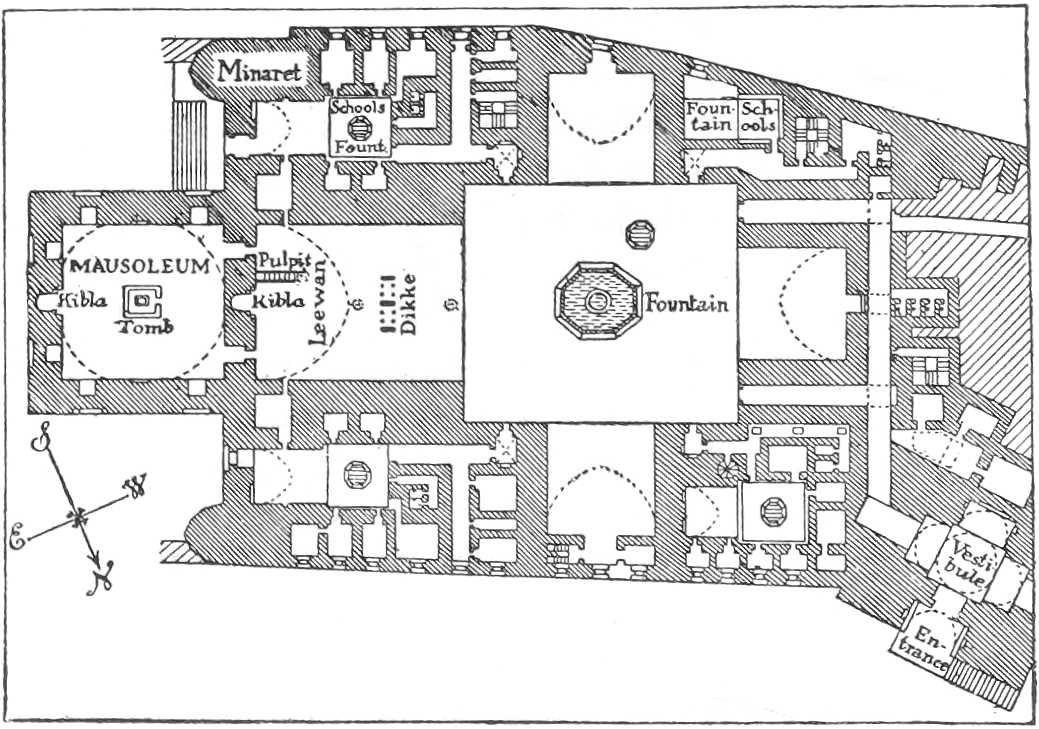
PLAN OF MEDRESA
This then was Saladin’s method of counteracting heretical tendencies by building and endowing a number of orthodox colleges—state-supported theological seminaries or divinity schools. The idea was not his own: he brought it with him from Syria, where his former sovereign Nur-ed-din had been[191] zealous in founding similar colleges for Hanafis at Damascus and other cities; and Nur-ed-din himself only followed the example of the pattern of the age in Asia, the great Seljúk Sultan Melik Shah, whose vezír, the scarcely less famous Nizám-el-Mulk, the friend of ‘Omar Khayyám, had established the splendid Nizamíya college at Baghdád. The introduction of colleges into Egypt, however natural and inevitable in the pupil of such masters, was little less than a revolution in culture as well as in architecture. The old stigma of heresy removed, and these new colleges founded, the wave of intellectual commerce once more flowed to Cairo from all parts of the Muslim world. The chief control in Egypt during Saladin’s long absence was vested in his brother or son, subject to the counsels of his chancellor, the Kády el-Fádil, an Arab of Ascalon, a learned scholar and a wise man, whose very ornate dispatches concealed a vast amount of sound sense. Under his influence foreign students began again to frequent the mosques of Cairo, and Egypt rejoined the comity of Islám. Professors from remote cities of Persia or even from beyond the Oxus met the learned men of Cordova and Seville. In 1176, for example, there arrived “a stranger from Xativa in distant Andalusia, drawn eastward by the fame of the revival of learning: it was Ibn-Firro, who had composed a massy poem of 1173 verses upon the variae lectiones in the Korán, simply ‘for the greater glory of God.’ This marvel of erudition modestly confessed that his memory was burdened with enough sciences to break down a camel. Nevertheless, when it came to lecturing to his crowded audiences, he never uttered a superfluous word. It was no wonder that the Kády el-Fádil, chief judge and governor of Egypt under Saladin, lodged him in his own house and buried him in his private mausoleum.[192] The presence of such philosophers tempered with cool wisdom the impetuous fire of the predatory chiefs. Many of the great soldiers of that age delighted in the society of men of culture. Nur-ed-din was devoted to the society of the learned, and poets and men of letters gathered round his court; whilst Saladin took a peculiar pleasure in the conversation of grave theologians and solemn jurists.”[66] “I found him,” wrote ‘Abd-el-Latíf, the Baghdád physician, “a great prince, whose appearance inspired at once respect and love, who was approachable, deeply intellectual, gracious, and noble in his thoughts. . . . I found him surrounded by a large concourse of learned men who were discussing various sciences. He listened with pleasure and took part in their conversation.” It was not the least of Saladin’s titles to fame that he brought the collegiate mosque to Cairo. The training of the medresa may have been narrow and bigoted, but it was the system of the whole Muslim world, and its adoption put Cairo in touch with the thought of the other leading centres of Islám.
[193]CHAPTER VII
The Dome Builders
1. THE MAMLUKS OF THE RIVER
SALADIN had raised Cairo once more to the rank of an imperial capital. By his fortifications he had strengthened it against attack, and by his theological foundations he had united it to the great comity of Muslim culture. He had no doubt added seriously to the responsibilities of future rulers of Egypt, who found themselves engaged in controversy, diplomacy, or war with the minor rulers of Syrian cities, members of Saladin’s kindred, as well as with the Franks of the coast of Palestine, who had not yet abandoned the dream of “Gerusalemme liberata,” and were now fully aware that the road to the Holy City, circuitous as it might seem, lay through Egypt. It is no part of the story of Cairo to relate the campaigns waged by Saladin’s brilliant brother, el-‘Ádil Seyf-ed-din—“the noble Saphadin” of the Talisman, the friend of King Richard, who actually gave the accolade of Christian knighthood to one of Saphadin’s sons, as Humphrey of Toron had given it before to Saladin himself. Succeeding, after a brief interval, to his brother’s empire in 1200, el-‘Ádil soon showed that the loss of the hero was not irreparable. He had loyally served Saladin as his right hand for a quarter of a century, and for another quarter of a century he[194] held together the empire which his nephews and cousins were doing their best to shatter into fragments. He prudently kept on terms with the Franks by the cession of a couple of ports in Palestine, and such hostilities as took place in spite of his concessions did not lower his prestige. He is described by one who knew him as a man of immense experience and information and much foresight, physically robust and high-spirited, and capable of eating a whole lamb at a meal. A contemporary Arabic poet dwells on his extraordinary alertness and personal control of every part of his wide dominions—
Even his vigilance, however, could not avert that periodical calamity of mediæval Egypt an insufficient inundation of the Nile, and its usual concomitants plague, pestilence, and famine. This happened in 1201 and was repeated in 1202, and the results were exceptionally disastrous. We have the appalling narrative of an eye-witness of undoubted veracity and professional experience for this time of horror:—
“The Baghdád physician, ‘Abd-el-Latíf, who lived at Cairo for ten years (1194-1204), attending the professors’ lectures at the Azhar mosque, records the terrible experiences of the famine. The distress was so desperate that the inhabitants emigrated in crowds, whole quarters and villages were deserted, and those who remained abandoned themselves to atrocious[195] practices. People habitually ate human flesh, even parents killed and cooked their own children, and a wife was found eating her dead husband raw. Men waylaid women in the streets to seize their infants. The very graves were ransacked for food. This went on from end to end of Egypt. The roads were deathtraps, assassination and robbery reigned unchecked, and women were outraged by the multitude of reprobates whom anarchy and despair had set loose. Free girls were sold at five shillings apiece, and many women came and implored to be bought as slaves to escape starvation. An ox sold for 70 dinárs and corn was over ten shillings the bushel. The corpses lay unburied in the streets and houses, and a virulent pestilence spread over the delta. In the country and on the caravan routes flocks of vultures, hyenas, and jackals mapped the march of death. Men dropped down at the plough, stricken with the plague. In one day at Alexandria an imám said the funeral prayers over 700 persons, and in a single month a property passed to forty heirs in rapid succession. The depreciation of property was disastrous. Owing to the decrease of population, house-rent in Cairo fell to one-seventh of its former price, and the carvings and furniture of palaces were broken up to feed the oven-fires. Violent earthquakes, which were also felt throughout Syria and as far north as Armenia, shook down countless houses, devastated whole cities, and increased the general misery.”
The invasion of John de Brienne, who captured Damietta, kept Egypt in a tremor of anxiety for three years (1218-21); but el-‘Adil, who died at the beginning of the trouble, left a singularly able successor in his son el-Kámil; the Crusaders departed in ignominy; and when some years later the emperor Frederick II. himself “took the cross” and came[196] to Palestine, the prudent sultan not only let the emperor crown himself in Jerusalem without striking a blow, but actually concluded (1229) a general defensive alliance with Frederick against even the Franks of Syria. The Holy City was surrendered to the Christians with the road to it, but the Muslims retained the sacred enclosure of the Mosque of ‘Omar, which was all they cared for. The treaty was the most singular ever concluded between a Christian and a Muslim power; but it must be remembered that the Pope had called Frederick “a follower of Mohammad,” and the emperor’s correspondence with the Arab philosopher Ibn-Sab‘in and the metaphysical debates he held with Kámil’s ambassadors point to “emancipated views” that in the case of less eminent people commonly conducted them to the stake. Frederick was much admired by Muslim writers, and for his part Kámil had shown himself broad-minded. He had entertained the emperor’s envoy, bishop Bernard, at Cairo, released the poor prisoners taken in the “Children’s Crusade,” and loyally stood by his treaty. It is not surprising that good Muslims regarded him in much the same light as the bishop of Rome held the emperor. They were wrong, however, for Kámil was a thorough Muslim, and had only treated with the “infidel” in the cause of peace. His college, the Dar-el-Hadíth or Kamilíya, some relics of which still stand in Beyn-el-Kasreyn, bears evidence to his zeal for orthodox Islám, whilst his father’s intellectual powers shone in the son when he took part in the meetings of the learned at his palace on Thursday evenings. To him Cairo owed the completion of the Citadel, where he took up his residence, and Egypt was improved in cultivation by his assiduous superintendence and enlargement of the canals and dikes.
The new régime of the Ayyúbids or successors of[197] Saladin had introduced something besides an imperial sway and a revival of orthodox learning: it had brought with it a feudal system that dominated Egypt, for better or for worse, for six hundred years, and vitally affected the social conditions, arts, literature, and material aspect of Cairo. The Mamlúk period may be said to begin with Saladin. It is true of course that there had been mamlúks, i.e. white slaves, long before, and many of them had attained to power. Ibn-Tulún, or at least his father, was a mamlúk, and many of the later governors belonged to the same class of emancipated slaves whether Turks or Greeks, from Turkistan or from Asia Minor. Under the Fátimid caliphs slaves had risen to the highest rank. Gawhar, the founder of Cairo, was a Greek or a Slav—it is not certain which—and we have seen how the Armenian slave Bedr became practically master of Egypt. Slavery in the East is no disgrace; on the contrary the relationship ranks far above mere hired service. The slave is regarded almost as a son, and we find an amusing instance of this feeling in the undoubted slur that attached to a famous emír (Kusún) in the fourteenth century, because he had the misfortune not to be a slave, like the rest of his world. The Fátimid armies were full of such mamlúks, and they acquired rank and lands. But the system had not reached the completeness that we see under Saladin’s successors. The great champion of Islám was brought up in the mamlúk system, as organized by the Seljúks and their followers, whose power rested upon a military basis formed by hired or purchased troops, paid by grants of fiefs, lands, castles, towns, or even whole provinces, held on strict condition of military service. The higher feudatories sublet parts of their fiefs to minor vassals, who had to furnish a certain number of men to their lord, just as he had to bring his contingent to aid[198] the sultan in his wars. This system was adopted in all the provinces governed by officers of the Seljúk empire. Nur-ed-din, who sprang from the Seljúk officers, carried it out in Syria; Saladin, trained under Nur-ed-din, brought it to Egypt, where the land and villages were parcelled out among the generals of his armies, who lived on them during the winter, and joined their overlord at the head of their retainers each year as soon as the campaigning season opened.
We find this feudal system in force in Egypt from the arrival of Saladin and his Turkish troops down to the accession of Mohammad ‘Aly in the nineteenth century. It took a dominant place in Cairo when el-‘Adil’s grandson, es-Sálih, established a picked battalion of mamlúks in the new palace and barracks which he built on the island of Roda, opposite Misr. From their quarters on the river (el-bahr) they were known as the Bahry or Nilotic Mamlúks. Their splendid valour at the battle of Mansúra, when under the leading of Beybars they drove back the finest chivalry in Europe, decided the fate of the disastrous Crusade of Louis IX. Thenceforward they ruled Egypt for a century and a half, and in spite of much lawlessness, tyranny, intrigue, and slaughter, the reign of the Bahry Mamlúks is among the glorious pages in the history of Cairo. Their triumph at Mansúra was not the less remarkable because they were then under the sovereignty of a woman. Queens are rare in Mohammedan history, for the blessed Prophet had a prejudice against them; but among the three or four Muslim women that have held the sceptre, queen Sheger-ed-durr—“Spray of Pearls” is the translation of her charming name—holds the first place. She was only a slave, and her lord and husband, es-Sálih, grandson of el-‘Adil, died in the midst of the campaign with the Crusaders; but she at once took[201] command, kept the sultan’s death secret till his son could be fetched from the other end of the empire, controlled the government, organized the defence, gave instructions to the generals and governors at her levees, and with wonderful courage and wisdom held the state together. When the heir arrived (1250) she surrendered her regency, but on the assassination of the brutal young man by the exasperated mamlúks within two months, “Spray of Pearl” resumed her authority, and honourably observed the treaty of ransom with St Louis, who probably owed his life to the high-minded queen.
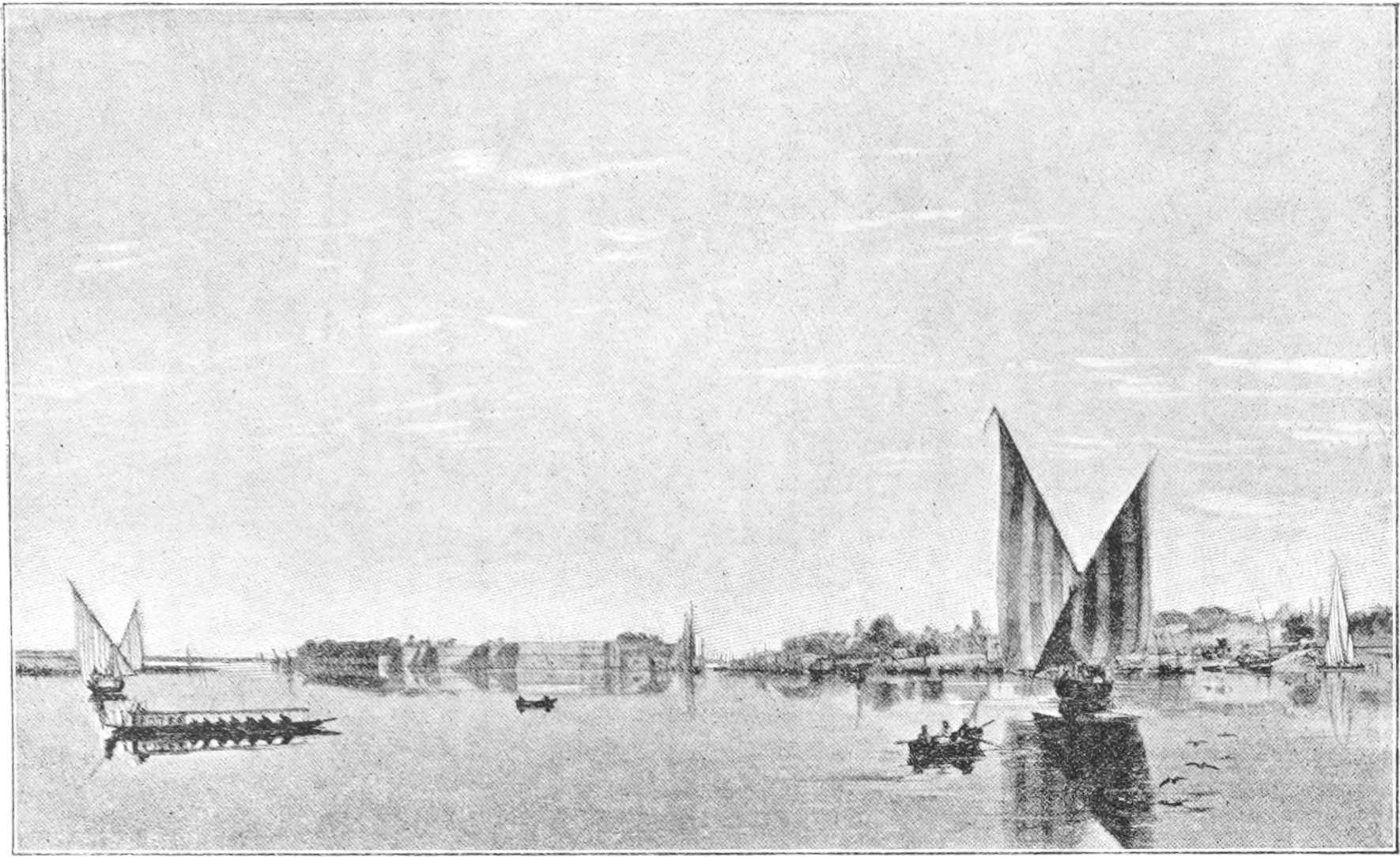
ISLAND OF ER-RODA
She possessed great qualities, and she had the title, such as it was, that was conveyed by her having borne a son to the late Ayyúbid sultan. The baby was dead, but she still based her claim to rule upon her motherhood, and her signature and her coins[67] bore a string of feminine titles ending with “Mother of the victorious King Khalíl,” though the little “king” had never been conscious of his royalty.
She was not long left to rule alone. The idea of queenship was too repugnant to Muslim prejudices, and the caliph of Baghdád interfered with all the authority of a pope. “If they had no man among them,” he wrote to the emírs of Cairo, “he would send them one.” So the commander-in-chief, Aybek, was chosen to marry the queen, and a joint-king, a child of Saladin’s kindred, was appointed to keep up the figment of the departed dynasty. But “Spray of Pearls” still ruled, in fact though not in name. She kept her hold on the exchequer, and evidently treated her new husband with scant respect. Like a true[202] woman however, she could be jealous; she made him divorce another wife, and when Aybek ventured to propose a fresh marriage with a princess of Mosil the queen gave way to a regrettable act of resentment; having lured him by fair words to the Citadel—the facts unhappily cannot be softened—she had him murdered in the bath (1257). Her punishment was speedy and terrible. In three days all was over. The mamlúks shut her up in the Red Tower, where she vindictively pounded her jewels in a mortar that they might adorn no other woman, and then she was dragged before the wife whom she had made Aybek divorce, and there and then beaten to death with the women’s clogs. For days her body lay in the Citadel ditch for the curs to worry, till some good Samaritan buried it. Her tomb may still be seen beside the chapel of Sitta Nefísa, and a pious hand of these latter days has shrouded it with a cloth on which the Arabic name of “Spray of Pearls” is worked in gold.
The rule of the Bahry Mamlúks now began, without further pretence of joint-kingship with one of Saladin’s house, though not without opposition and intrigue from members of the family in Syria, nor without hostility from the Arabs of Egypt, who got up a national movement and were put down with great severity. The bare list of the twenty-three sultans of the Bahry dynasty—all Turks, and most from Kipchak—who succeeded Aybek and ruled from 1257 to 1382 is misleading unless one takes the conditions of their rule into account. Of the twenty-three, only four reigned for any considerable period, and the four reigns of Beybars, Kalaún, en-Násir, and Hasan, account for more than half the sum of all the twenty-three reigns. A sultan was nothing more than the chief mamlúk, elected by his comrades, primus inter pares indeed, but with a distinct understanding that they were his peers. For example,[203] when Lagín was elected sultan by a conspiracy of the emírs, they marched at his stirrup and did him fealty, but they made him swear, and then swear again, that he would remain one of themselves, act only by their counsel, and never favour his own mamlúks to the detriment of the rest: and when he broke his oath by making a favourite, they murdered him. It was only a very strong man who could hold the dangerous position for long, as Beybars did, partly by the prestige of his brilliant campaigns in Syria; and after the strong man’s death, which as likely as not happened by design, his son would be set on the throne as a stop-gap whilst the rival emírs tried their strength, arranged their combinations, and bought off competitors. Then the strongest of them, or the most diplomatic, would remove the warming-pan and ascend the throne, to hold it as long as he could; after which the same process would be renewed.
We must at least give the mamlúks their due as a splendid soldiery. Four times they had to meet the most formidable of all possible invasions, the repeated advance of the Mongol hordes led by Ginghiz Kaan’s successors, and four times they rolled them back. Kutuz was the first to bear the brunt. Hulagu’s Mongol envoys came to Cairo with insulting demands of submission: Kutuz cut off their heads and hung them up at the Zuweyla Gate; then marched into Syria, routed the Mongols in a glorious victory at Goliath’s Well in 1260, and rid the land of them. Beybars swam the Euphrates at the head of his troops and defeated the Mongols at Bira in 1273; then turning west he slew seven thousand of the enemy at Abu-lusteyn and seated himself on the Seljúk throne, which they had usurped, at Cæsarea of Cappadocia. Kalaún stemmed another invasion in 1281. Mustering every man he could enrol, mamlúks of the guard, Turkmáns,[204] desert Bedawis, Arabs from the Euphrates and the Higáz, backed by the steady veterans of the old principality of Hamáh which still owned a prince of Saladin’s blood, the sultan won a decisive battle at Emesa, and freed Syria once more from the locust-cloud of devouring Mongols. Again they returned in the time of his son en-Násir, and this time the Egyptian army sustained a terrible reverse at the battle of the Treasurer’s Ghyll near Emesa in 1299. Damascus was lost, and the Mongol envoys appeared at Cairo to treat for the respectful submission of the sultan. But the mamlúks had not lost heart; the armourers of Cairo were busy, recruits were pouring in, and remounts were in such demand that the price of a horse rose at a bound from £12 to £40. Syria was in a panic, after an orgy of Mongol license; but the great emírs, Beybars Gashnekír and the other mamlúk chiefs, rode proudly on to victory. Once more the opposing armies met, in the plain of Marg-es-Suffar, in 1303, and for the fourth time, and the last, the Mongols were driven out of Syria. “Násir returned to Cairo in a wave of glory. Messengers had announced the news, and the emírs vied with one another in setting up costly pavilions, or grand stands, richly decorated and furnished, along the route of his procession. Workmen were forbidden to do anything but set up these triumphal erections. Rooms along the route were let at from £2 to £4 for the day. Silken carpets were laid in the street; and the proud sultan rode between the brilliant façades and admired the nobles’ pavilions, while troops of Mongol prisoners in chains, each with a fellow Mongol’s head hanging from his neck, completed the triumph. So noisy were the rejoicings and so deafening the tumult of drums and music throughout Egypt, that nothing short of an earthquake sobered the people.”
Nor was it the Mongols alone who felt the edge of[205] the mamlúks’ steel. Beybars the Great—a blue-eyed Turk from Kipchak afflicted by a cataract which caused him to fetch but £20 in the slave market—despite his humble beginnings, had the courage and the zeal of a second Saladin. He waged the Holy War for ten years in Palestine, where the Franks were disposed to league with the Mongols. He seized and razed Cæsarea and Arsúf in 1265, and dragged their defenders in cruel ignominy to Cairo, where they were paraded with reversed banners and broken crosses. Jerusalem had been recovered from the Christians twenty years before, but the embers of Crusading zeal still smouldered feebly on the coast and at a few inland fortresses. Beybars resolved to extinguish the last flicker. Jaffa fell in 1268, Belfort surrendered, and Antioch, the Christian capital of northern Syria, was stormed and burnt to the ground; three years later the great fortress of the Hospitallers, Crac des Chevaliers, lowered its flag, and the Teutonic knights lost Montfort.[68] Even Cyprus, whence the Franks got their supplies, was invaded by the mamlúk fleet. The mountain fastnesses of the dreaded Assassins were seized and disarmed, and the Wehmgericht sank into impotence. Before Beybars died his commands were obeyed from the Pyramus and the Euphrates to the south of Arabia and the fourth cataract of the Nile. The Holy Cities of Mekka, Medina, and Jerusalem were his; he held the ports of Sawákin and ‘Aydháb on the Red Sea; the Arabs of the desert were his servants, the chiefs of Barbary paid him tribute; the great Khan of the Golden Horde on the Volga was his sworn ally and sent him his daughter in marriage[206]—Mongol though he was, Baraka Khan was the inveterate foe of the Mongols of Persia who had overrun Syria;—embassies were exchanged with the Eastern Emperor, who permitted a mosque to be restored at Constantinople, while Beybars supplied him with a patriarch; diplomatic and commercial relations were established with Manfred of Sicily, James of Aragon, Alfonso of Seville, Charles of Anjou. To crown his glory he revived the old ‘Abbásid caliphate, extinguished at Baghdad by the Mongols in 1258; brought a meek representative of the sacred line to Cairo and housed him in great state in the Citadel, as the supreme legitimate pontiff of Islám, and humbly received at the caliph’s hands the purple robe and black turban and golden chain and anklets which betokened a sovereign recognized by the spiritual power. Henceforward there was ever a caliph at Cairo—however fainéant—till the Ottoman conquest and the assumption of the caliphate by the Sultans of Turkey in 1538.[69]
A great soldier and a consummate if perfidious diplomatist, Beybars was also an able and laborious administrator. Under him the land was quietly if not quite godly governed, and his energy was unbounded. He seemed to be in several places at once, so rapid and secret were his journeys, and it was a favourite device of his to lie hidden in the Citadel for days together, watching his deputies, when he was believed to be in Syria all the time. “The greater part of his reign was spent in campaigns outside Egypt, but he generally passed the winter months at Cairo, whilst his troops rested and rains or snow hindered marching,[207] and he devoted these intervals to improving the country and the capital. It was not only in founding and restoring mosques and colleges, or rebuilding the Hall of Justice at the foot of the Citadel, that he showed his public interest. He enlarged the irrigation canals and dug new ones, made roads and bridges, fortified Alexandria and repaired the pharos, and protected the mouths of the Nile from the risk of foreign invasion. He revived the Egyptian fleet, built forty war galleys, and maintained 12,000 regular troops—not reckoning, one must assume, the Arab and Egyptian militia or occasional levies. His heavy war expenses entailed heavy taxation; and though with a view to popularity he began his reign by remitting the oppressive taxes imposed by Kutuz to the amount of 600,000 dinárs a year, he found himself compelled to increase the fiscal burdens as his campaigns developed. Yet we read more often of old taxes repealed than of fresh duties imposed, and his treasury was filled less by the imposts of Egypt than by the contributions from the conquered cities and districts of Syria, the tribute of vassal states and tribes, and the valuable custom-dues of the ports.
“His government was enlightened, just and strict. He met the severe famine of 1264 by measures at once wise and generous, by regulating the sale of corn, and by undertaking, and compelling his officers and emírs to undertake, the support of the destitute for three months. He allowed no wine (though the tax on it used to produce 6000 dinárs a year), beer, or hashish in his dominions; he attempted to eradicate contagious diseases by scientific isolation; he was strict with the morals of his subjects, shut up taverns and brothels, and banished the European women of the town; though, personally, he was addicted to the Tatar kumiz, and was suspected of oriental depravity. He was no sybarite, whatever his vices; no man was[208] more full of energy and power of work. If his days were often given to hunting or polo, lance-play or marksmanship, his nights were devoted to business. A courier who arrived at daybreak received the answering dispatches by the third hour, with invariable punctuality.” Sometimes over fifty dispatches were dictated, signed and sealed late in the night, after a fatiguing march. There was a mail twice a week carried by relays of horses, besides a well-organized pigeon-post.
It was no wonder that such a man was adored by the people, who thought him the ideal of a gallant and generous soldier-king, and who still listen with delight to the romance in which the story-teller of the cafés of Cairo clothes the great deeds of the ever popular Záhir Beybars. Even the devout admired a king who endowed religious foundations and held an even balance between the four contending schools of orthodox divines, from each of which he nominated a separate kády. Only the emírs and officers dreaded one who, if he was true as steel to a good servant, never forgave a bad one, and whose restless suspicion watched their every move. It was inevitable that some day one of the many grudges should be paid off, and after seventeen years of a resplendent reign Beybars died in 1277 by a cup of poison which he had apparently made ready for another.
Beybars was the true founder of the mamlúk power and the organizer of the mamlúk system. Since the day when he led the charge of the Bahry guard against Louis of France at the battle of Mansúra, he had sedulously watched over the army, stimulated recruiting from fresh blood, and encouraged good service by liberal distribution of fiefs. His was the foreign policy maintained in Egypt for many years, and his court formed the pattern for succeeding kings.[209] A very magnificent and ceremonious court it was, where the sultan sat surrounded by the great officers of state and of the household,—Viceroy, Commander-in-chief, Major domo, Captain of the Guard, Armour-bearer, Master of the Horse, Cup-bearer, Taster, Master of the Wardrobe, Grand Huntsman, Polo-bearer, Slipper-holder, Lord of the Seat; the Master of the Halberds with his Gentlemen at Arms; the Adjutant-General with his thirty Lords of the Drums, each followed by forty troopers and a band of ceremony of ten drums, four trumpets, and two hautbois; the eunuch guards, equerries and chamberlains, secretaries and court physicians, judges and divines. All these functionaries had their allowances, fiefs, or appanages; a lord of the drums, for instance, would draw an income of about £16,000 a year; and the expenses of the royal household may be judged by the estimate that 20,000 lbs. of food were daily prepared in the larder, and that the daily cost in meat and vegetables in the time of en-Násir was from £800 to £1200.
The great officers of the court and of the army were of course the most powerful men next to the sultan, and each deemed himself a fit successor to the throne. On their loyalty, and especially on that of the bodyguard, a brigade of several thousand picked men who held in fief a large part of Egypt, rested the safety and power of the sultan, who stood more or less at their mercy. Each of the great lords, were he an officer of the guard, or a court official, or merely a private nobleman, was a mamlúk sultan in miniature. He, too, had his guard of slaves, who waited at his door to escort him in his rides abroad, were ready at his behest to attack the public baths and carry off the women, defended him when a rival lord besieged his palace, and followed him valiantly as he led the charge of his division on the field of battle. These great[210] lords, with their retainers, were a constant menace to the reigning sultan. A coalition would be formed among a certain number of disaffected nobles, with the support of some of the officers of the household or of the guard, and their retainers would mass in the approaches to the royal presence, while a trusted cupbearer or other officer, whose duties permitted him access to the king’s person, would strike the fatal blow or administer the insidious cup; and the conspirators would forthwith elect one of their number to succeed to the vacant throne. This was not effected without a struggle; the royal guard was not always to be bribed or overcome, and there were generally other nobles whose interests attached them to the reigning sovereign rather than to any possible successor, except themselves, and who would be sure to oppose the plot. Then there would be a street fight; the terrified people would close their shops, run to their houses, and shut the great gates which isolated the various quarters and markets of the city; and the rival factions of mamlúks would ride through the streets that remained open, pillaging the houses of their adversaries, carrying off women and children, holding pitched battles in the road, or discharging arrows and spears from the windows upon the enemy in the street below. These things were of constant occurrence, and the life of the merchant classes of Cairo must have been exciting. We read how the great bazar, called the Khan-el-Khalíly, was sometimes shut up for a week while these contests were going on in the streets without, and the rich merchants of Cairo huddled trembling behind the stout gates.
There were fine doings of this kind when Ketbugha deposed the child-king Násir, for a time. The Ashrafis—or mamlúks of the late sultan, el-Ashraf Khalíl—raised a revolt and besieged the Citadel.[211] Then Ketbugha’s troops rode out to quell the tumult and slashed through the ranks; the rebels were blinded, maimed, drowned, beheaded, nailed to the gate of Zuweyla; and so a new reign began (1294). A plague followed, when seven hundred corpses were carried out of one gate of Cairo in a single day. A fresh conspiracy was formed, Ketbugha fled, and the viceroy Lagín was elected sultan in his place. The streets which had lately been shambles were now en fête with decorations, for the new sultan was a generous man and promised to remit taxes; bread was cheap and Lagín was popular.
The idea of hereditary succession was wholly foreign to the mamlúk system; yet it presented the only correction to these scenes of violent supercession, and after a time some sort of hereditary title seems to have been established. Kalaún had been succeeded by his son Khalíl, and then by a younger son en-Násir Mohammad in 1293, and though the last, as a mere child, was temporarily deposed, he came back in 1298 after the murder of his brother-in-law Lagín. After another trial of usurpation by Beybars Gashnekír (the Taster) in 1308, Násir was restored and began a third reign which lasted thirty-one years (1310-1341), and after his death his incapable descendants sat on the throne, with little or no real authority, till the close of the dynasty. Thus from 1279 to 1382 Egypt was ruled, except for six or seven years, by members of one family, the House of Kalaún. The founder of this family, whose history refutes the theory that these foreigners were unprolific in Egypt, was himself a notable figure, a brave general, a prudent statesman, and a great encourager of commerce. His passports to traders were in force as far as India and China, and he did all he could to develop the commerce of Egypt. Like most of the mamlúk sultans he was a notable[212] builder. It is extraordinary how these men of war, in the midst of alarums and intrigues, took a delight in architecture. The brilliant queen, first of the mamlúks, built (1250) the tomb-mosque over her husband Sálih, which still stands on part of the site of the old palace of the Fátimids in Beyn-el-Kasreyn. Beybars founded a college in 1262 on another part of the palace called the “Hall of the Tent,” and also a great mosque outside the Bab-el-Futúh in 1267-9, both of which still exist, though the college is a ruin, and the mosque was used, infandum! as a bake-house for the French troops a century ago, and recently as a slaughter-house for the British army of occupation. Kalaún, stirred by a dangerous illness, vowed to build a hospital, and his Maristán is still to be seen in the Nahhasín, though no longer used for its original purpose: it was a madhouse less than a hundred years ago. It stands beside his mosque and tomb, the latter notable for its exquisite plaster tracery and red granite pillars, and for the oddly decorated stone minaret and fine inscription. Ibn-Tulún and Saladin had built hospitals, and Kalaún carried on the good tradition of these pious benefactors. Cubicles for patients were ranged round two courts, and at the sides of another quadrangle were wards, lecture rooms, library, baths, dispensary, and every necessary appliance of those days of surgical science. There was even music to cheer the sufferers; while readers of the Korán afforded the consolations of the faith. Rich and poor were treated alike, without fees, and sixty orphans were supported and educated in the neighbouring school. People still visit the tomb where the good sultan and his son en-Násir lie buried, to touch their clothes in sure belief that they will be cured of sundry diseases and disabilities.
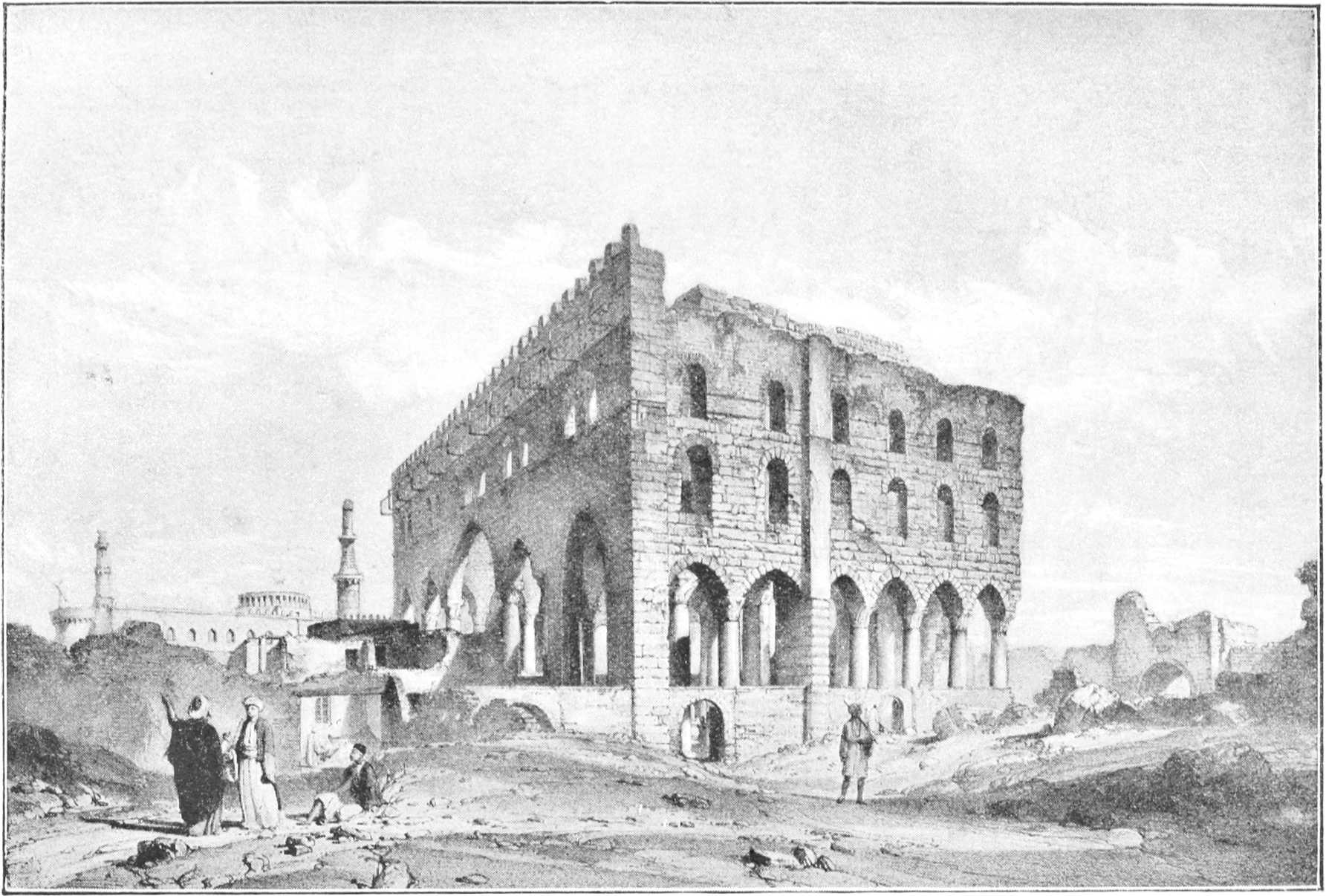
“JOSEPH’S HALL”: PALACE OF EN-NASIR IN CITADEL, WITH HIS MOSQUE IN BACKGROUND
The long reign of en-Násir was a golden age of mamlúk architecture. However much this sultan may[215] have profited by the sense of tranquillity which hereditary title inspired, he owed his long tenure of the precarious throne partly to his personal qualities. “This self-possessed, iron-willed man—absolutely despotic, ruling alone—physically insignificant, small of stature, lame of a foot, and with a cataract in the eye—with his plain dress and strict morals, his keen intellect and unwearied energy, his enlightened tastes and interests, his shrewd diplomacy degenerating into fruitless deceit, his unsleeping suspicion and cruel vengefulness, his superb court, his magnificent buildings—is one of the most remarkable characters of the Middle Ages. His reign was certainly the climax of Egyptian culture and civilization.” He carried on the traditions of Beybars and Kalaún; maintained the alliance with the Golden Horde and married a princess from the Volga, the lady Tulbíya, whose tomb may still be seen, with that of another of his wives, in the eastern cemetery; he preserved the normal boundaries of the empire, from the Pyramus and Euphrates to Sawákin and Aswán, and arranged, if not alliances, diplomatic connexions with the emperor of Constantinople and the king of Bulgaria, as well as the rulers of Abyssinia and Arabia. He married eleven daughters to the highest nobles, and each wedding cost him half a million. Násir was not only a statesman; he was a farmer, trainer, and sportsman, who would pay £4000 for a horse, kept a systematic stud-book, knew all his horses’ pedigrees, prices, and ages, and broke in three thousand fillies every year with Bedawy grooms, for the races in which he and his emírs took the keenest possible interest. He kept thirty thousand sheep, and imported the finest breeds from abroad, and like most of the sultans he was devoted to falconry. Ibn-Batúta, who saw him in 1326, describes Násir as a king “of noble character and great virtues,” beneficent to pilgrims and assiduous[216] in his duty of sitting in appeal twice a week to hear causes and complaints in person. Under his rule Egypt thrived; vexatious taxes were repealed, a new survey of the land was made, millers and bakers who tried to raise prices in bad years were scourged, and when his son-in-law, the great emír Kusún was reported to him for extortion, the sultan smote him with the flat of his sword and flogged his factor. Prices were kept down by his vigilance, wine-bibing and immorality were severely punished, and if Násir recouped himself by sweeping confiscations among the nobles, and cut down the “tall poppies” remorselessly, the people gained by the new method, and prospered exceedingly.
Even to the Copts Násir was indulgent, though the Christians were never so well used under mamlúk rule as they had been under the Fátimids and in the time of el-Kámil. At the time of Saladin’s invasion there had been a great destruction of churches, due rather to the burning of Misr and the turmoil of war than to any fanaticism of the conquerors. Saladin himself was no friend to Christians; he was too rigid a Muslim to be tolerant; but he did not persecute them. The flight or expulsion of the Armenian patriarch and his followers was more probably the result of the close association of the Armenians with the Fátimid government than of religious bigotry. But the Holy War in Palestine, though waged against the Latin branch of the church catholic, reacted unfavourably upon the Copts, and Saladin’s brother el-‘Adil was stern and tyrannical towards his Christian subjects. His son el-Kámil often interceded for them successfully, and when he came to the throne of Egypt himself, he displayed a spirit of toleration rare indeed in that age. He received St Francis of Assisi courteously, when the good friar came to teach him the truth as he perceived it, and the Christians of Egypt unanimously[217] regarded Kámil as the kindest ruler they had ever known. His son es-Sálih seems to have followed in his steps during his short reign, for he wrote to Innocent IV to express his regret that he could not converse with the Dominicans by reason of his ignorance of Latin.
The Crusade of Louis IX naturally upset these amicable relations, and it is not surprising that the Muslims wreaked their vengeance upon many churches in Egypt. Nor was the temper of the succeeding mamlúk sultans, excited by repeated victories over the remnant of the Franks in Syria, conducive to a good understanding with their Christian subjects. The new colleges founded by Saladin and his successors were working a change in Cairo, and a fanatical spirit was encouraged by the teachers of these divinity schools, whose influence grew stronger as time went on. In 1280 all the Coptic scribes employed at the war-office were dismissed and their places supplied by Muslims. In 1301 the old humiliating sumptuary rules prescribing distinctive dresses and the like were revived. In 1321 occurred a series of outbreaks which brought terrible persecution on the Christians. The disturbance began when en-Násir’s workmen, digging a lake called Nasir’s Pool, near the Lion’s Bridge (west of the Lúk and close to the mosque of Taybars) undermined the church of ez-Zuhry, which en-Násir had commanded to be respected. Without the knowledge of the government the people rushed to the church one Friday after prayers and utterly demolished it. Thence they went to the church of St Mina in the Hamra and sacked it, and did the like to the “Church of the Maidens” by the seven watermills, dragging out the nuns, and pillaging and burning everything. The sultan was indignant when the smoke of the burning churches told the tale of disaster, and sent troops at[218] once to coerce the mob. Meanwhile news arrived of the destruction of two other churches in the quarters of Zuweyla and of the Greeks, and it was found that the mob was attacking the Mo‘allaka in the fortress of Babylon. Here the sultan’s troops happily arrived in time to protect the church. There was evidently a popular excitement difficult to quell. Wild fakírs got up in the mosques and shouted “Down with the infidels’ churches! To the foundations! To the foundations!” The same thing was going on all over Egypt; at Alexandria, at Damascus, at Kus, churches were burning.
A month later mysterious fires began to break out at Cairo. One after the other great conflagrations burst forth, and a strong wind carried the flames far and wide. People went up the minarets and cried to God, thinking that the whole city would be burnt down, and there was groaning and weeping over the loss of homes and possessions. Every effort was made to extinguish the fires. All the water-carriers were impressed, and twenty-four emírs of the highest rank worked at the head of the lines of men carrying water from the baths and cisterns, and demolishing acres of fine houses to clear a space round the burning buildings. The street from the Deylem quarter to the Gate of Zuweyla ran with water like a river. No sooner was one fire extinguished than another began. Almost every day witnessed a fresh conflagration.
It was noticed that these fires were apparently aimed at mosques, and that they were the work of incendiaries was evident from clothes soaked in oil and pitch and naphtha that were discovered. A Christian was caught at the mosque of ez-Záhir with packets of naphtha and pitch, which he was lighting in the mosque. Put to the torture he confessed that the conflagrations were the organized work of Christians.[219] Two monks, under torture, admitted that they had set the fires afoot to avenge the destruction of the churches. The Coptic patriarch was called in, and, with tears, denounced the incendiaries as wild enthusiasts who were paying off the foolish church-destroyers in their own coin. He was sent back to his house in honour. The populace however were in no mood to see a patriarch respected, and would gladly have torn him in pieces, but for the sultan’s guard. As it was they burned four monks from the Melekite “Convent of the Mule” (el-Kuseyr) in the Mukattam hills. Two Christians caught in the act of arson were by the sultan’s orders burnt alive in a pit in the presence of an exulting multitude, and an innocent Coptic secretary, passing by, only escaped being thrown to the flames by hasty apostasy. The mob was becoming dangerous, and the sultan, who, though much alarmed, had done his utmost to calm the people, took strong measures. Troops were sent through the whole of Cairo with orders to charge the crowds and spare none. The news had preceded them, and they found the bazars closed and the streets deserted. Not a man was to be seen between the Citadel and the Gate of Succour. Some two hundred were arrested near the Nile, and brought before the sultan, who ordered them to be executed or to lose their hands. In vain they pleaded innocence; even the emírs interceded for them; en-Násir was resolved to make an example of somebody. Gallows were set up all the way from the Gate of Zuweyla to the Rumeyla, and there the unlucky Muslims were hung by their hands in order to teach other people not to raise an uproar.
The result of this excitement was the revival of the old regulations as to dress which Násir had endeavoured to drop since 1301. Any Christian found riding a horse or wearing a white turban might be[220] killed at sight. The Copts were compelled to wear blue turbans, to carry a bell round their necks at the baths, and to ride only the ass, and that with the face to the tail. The emírs were not allowed to employ Christian servants, nor were the Copts any more to hold posts in the government offices. They hardly dared to show themselves abroad, and a great many became Muslims. This was probably the worst persecution since the days of el-Hákim, three centuries before, but it must be admitted that there was grave provocation on both sides, and that the outrages sprang from popular fury, not from the fanaticism of the rulers. Similar persecution, though scarcely on so large a scale, went on throughout the mamlúk period, and the Copts, who had perhaps waxed over-fat and kicked during the tolerant epoch of the later Fátimids, paid dearly for their past favour. They were gradually reduced to the state of suffering insignificance from which they are only now being to some extent raised.
Whilst churches were being thus destroyed mosques were rising with amazing prodigality. There never was such a harvest for the builder and the architect as in the reign of en-Násir. The sultan set the example himself. He was a man of fine taste and high culture, the patron of scholars, and the intimate friend of the learned historian Abu-l-Fida, whom he restored to the princedom of Hamáh, which had been held by his family since the days of his ancestor, Saladin’s brother. It was an age of brilliant artistic production, and the immense sums spent by the sultan and his emírs on building and decorative works show that the wealth of the country was vast, and was nobly expended. Some of Násir’s own furniture has been preserved—there are two exquisite inlaid-silver tables of his in the Arab Museum at Cairo—and his two chief buildings, the college in Beyn-el-Kasreyn (1304), next to the[223] Maristán, with its Gothic gateway brought from ‘Akka by his brother Khalíl, and the old mosque (1318) in the Citadel, are worthy memorials of his taste, though unhappily they show but few traces of their original splendour. The great dome which once surmounted the Citadel mosque has fallen in, and most of the marble mosaics which adorned the kibla have vanished, as well as the iron grille which enclosed the sultan’s place of prayer (maksúra). There is still a range of clerestory windows all round the mosque, but the tracery and stained glass is almost all gone; yet the ten great granite columns, and the marble mosaics on the south wall, and other relics, show what the mosque must once have been. Its most remarkable feature is the coating of the minarets with green tiles, which may probably be ascribed to the Tatar influence of Násir’s wife, who belonged to the royal family of the Golden Horde. That the Citadel mosque is not wholly destroyed is due to the care of Colonel C. M. Watson, C.M.G., who rescued it from the degradation of an army storehouse, and removed the wooden partitions which had been set up when the beautiful building was converted into a prison. There was once a “Hall of Columns” belonging to Násir’s “Striped Palace” of black and white stone in the Citadel (which cost, it is said, twenty millions, but the figure is incredible), which still stood three quarters of a century ago; the fortress was largely rearranged and added to in his reign, and the aqueduct which brought the Nile water to the citadel, though commonly ascribed to Saladin and probably a reconstruction of some Ayyúbid conduit, was Násir’s work (1311), afterwards restored in stone by el-Ghúry. He also built a mosque beside the shrine of Seyyida Nefísa, the Kubbat-en-Nasr near the Red Hill, and other chapels.
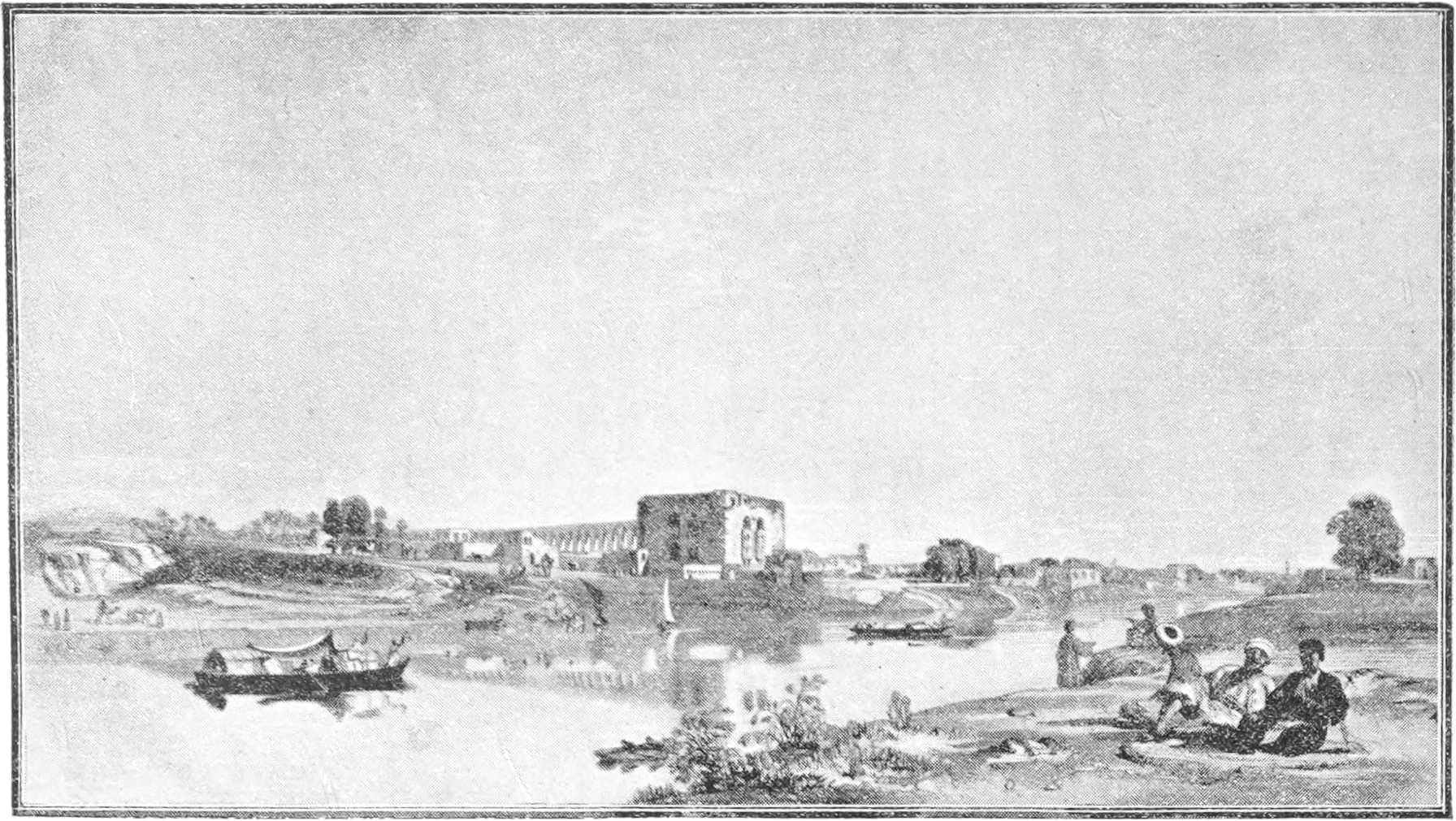
AQUEDUCT AND HOUSE OF THE “SEVEN WATERMILLS”
Where the sultan led, the court followed. The[224] emírs of that day were never content till they had built a mosque, a college, or a tomb-chapel, to celebrate their piety and lay up riches where they stood most in need of a balance. The Moorish traveller, Ibn-Batúta, who was at Cairo in 1326, was impressed by the zealous emulation of the emírs in founding mosques and monasteries for recluses, such as the Khankah or convent of Beybars Gashnekír, still standing, and he gives a curious account of the monastic rules.[70] One cannot count the colleges (medresas), he says, and he is lost in admiration of the great hospital of Kalaún, with its excellent apparatus and drugs, and its revenue amounting, he was told, to 1000 dinárs a day. More than forty mosques and colleges were erected between 1320 and 1360—more than a fourth of the total number recorded from the Arab conquest to the time of Makrízy—and many of them still survive to bear witness to the munificence of the great nobles of the time. Such are the mosques (gami‘) of the emír Hoseyn (founded A.H. 719, A.D. 1319), Almás, the chamberlain (730), Kusún (730), Beshták (736), Altunbugha el-Maridány, the cupbearer (740), Aslam, the armour-bearer (746), Aksunkur (747), Arghún el-Isma‘íly (748), Mangak, the proconsul (750), Sheykhú (750); the colleges (medresa) of Almelik, the polo-master (719), Sengar el-Gáwaly (723), Ahmad, the master of the ceremonies (Mihmandár, 725), Akbugha, the major domo (734), Sarghitmish, captain of the guard (757); the monasteries (Khankáh) of Kusún (736), el-Gáwaly (723), Sheykhú (756); besides the mosque of “the Lady Miska” (a slave of Násir’s named Hadak, 740), the college of Násir’s daughter, the Lady Tatar el-Higazíya (761), and the great mosque of his son Sultan Hasan facing the Citadel (757-60).
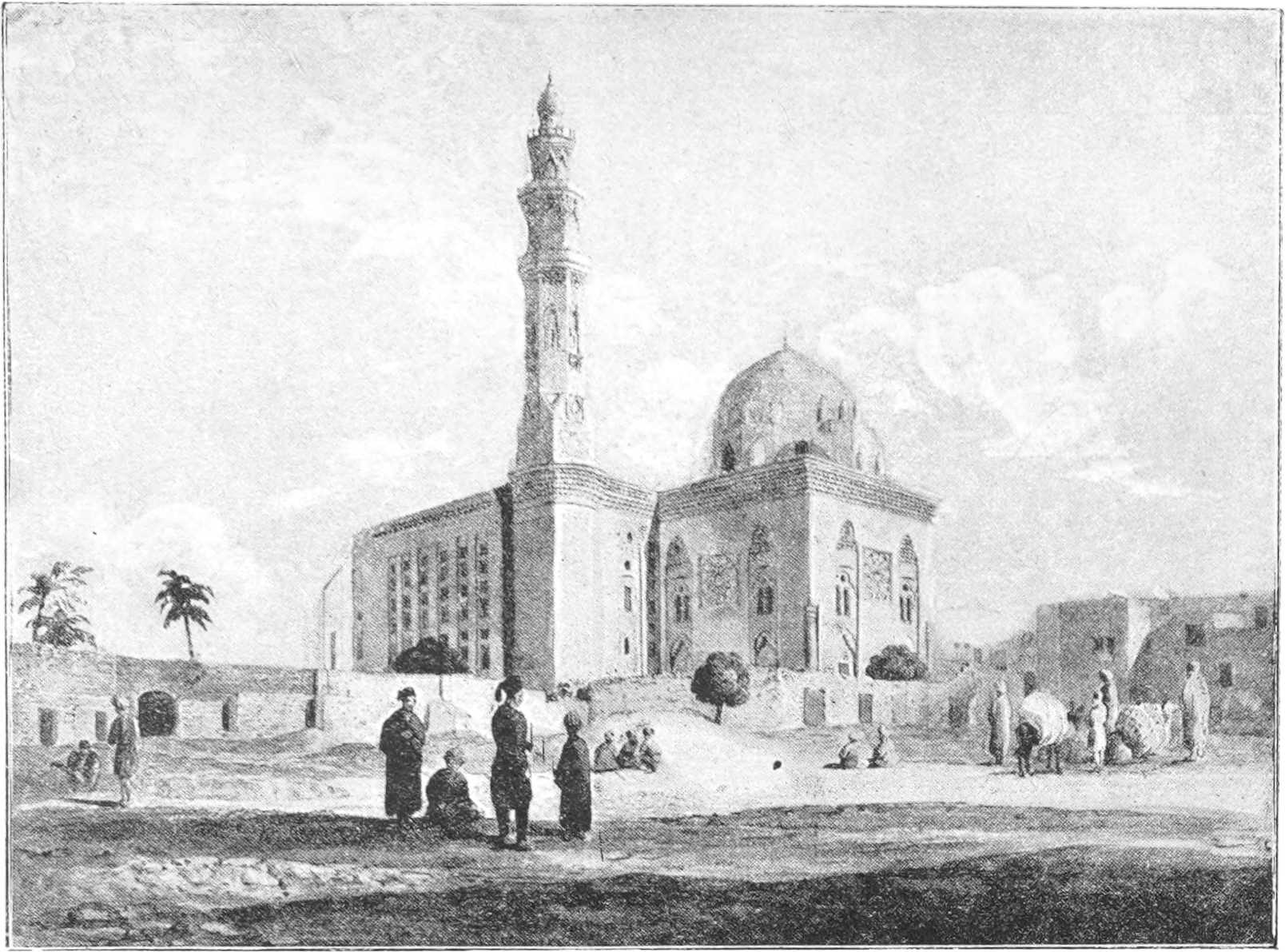
MOSQUE OF SULTAN HASAN
[227]To describe these mosques of the Násiry epoch in detail would demand a whole volume. Some of them indeed are sadly ruined and present but fragments of their original building. Some, like Aksunkur’s and el-Isma‘íly’s were restored, the one with much taste by Ibrahím Agha in 1652; the other, with none, fifty years ago by one of the Khedivial family. But even in what remains of the original work of the twenty-one mosques enumerated above there is so much variety in plan, in treatment of the parts, and in decoration, that no verbal description can take the place of ocular study on the spot. Almost every one of these buildings deserves separate and attentive examination. Three features, however, may here be signalized as characteristic. The old mosques had no external decoration; their enclosing walls were plain, and only in the late Fátimid mosque el-Akmar do we find the beginning of a façade. The mamlúk mosques, copying no doubt the buildings of the Crusaders in Palestine, generally present fine façades, with sunk panels, portals in recess, and decorative cornice and crownwork. The next characteristic is the development of the minaret, which becomes more graceful, is built of well-faced stone, and shows delicate articulations and gradations of tapering from the square to the polygon and cylinder, with skilful use of “stalactite” or pendentive treatment of angles and transitions and supports for the balconies. The third is the construction of large domes. Hitherto small cupolas over the mihráb or above the entrance were the utmost achievements of the earlier architects. The feature of a great dome was introduced by Saladin’s successors, for example in the dome of the tomb-mosque of esh-Sháfi‘y in the Karáfa, and probably in other edifices, but too little remains of the Ayyúbid period to permit of very exact definition.
The mamlúks were dome-builders par excellence.[228] A large proportion of their mosques and colleges were also the founders’ tombs; the tomb-chapel adjoined the main building, and the dome, as we have said, is pre-eminently a sepulchral canopy. From the mamlúk period begins that adornment of the city with those beautiful bulbs which still form its dominant architectural note. From the plain dome with a small cupola on top comes the fluted dome, and next the dome covered with ornament, chevrons, arabesques, or geometrical entrelacs, all chiselled in the stone. The most elaborate ornament belongs to the work of the Circassian sultans of the fifteenth century, but already in the fourteenth the dome had taken its place among the leading features of Saracenic architecture.
As an example of the fourteenth century style we cannot do better than take the great mosque of Sultan Hasan, which includes most of the characteristics of the Násiry epoch, and displays them on the grandest scale. Sultan Hasan,—who sat on the throne from 1347 to 1351, was deposed by the emírs, and then restored from 1354 to 1361,—was far from an interesting or estimable character, and his mosque was his one good deed. It was built between 1356 and 1359 (A.H. 757-760) and is said to have cost him 1000 dinárs a day, but one distrusts the round figures of Eastern chroniclers. The sultan was so charmed with his masterpiece that he cut off the architect’s hand in the vague idea that its loss would cripple his genius and prevent his repeating his success. The mosque is of the usual form of medresa, a cross formed of a central court and four deep transepts or porticoes, and the founder’s tomb may be compared to a lady-chapel behind the chancel or eastern portico. The outside does not of course reveal the cruciform character of the interior, since the angles are filled with numerous[231] rooms and offices.[71] The prevailing impression from without is one of great height, compared with other mosques. The walls are 113 feet high and built of fine cut stone from the pyramids, and have the peculiarity, rare in Saracen architecture, of springing from a socle. Windows—two with horseshoe arches, the rest simple grilles—slightly relieve the monotony of the broad expanse of wall; but the most beautiful feature is the splendid cornice built up of six tiers of stalactites each overlapping the one below, which crowns the whole wall. There are some graceful pilasters or engaged columns at the angles, and a magnificent portal set in an arched niche, 66 feet high, vaulted in a half sphere which is worked up to by twelve tiers of pendentives. Bold arabesque medallions and borders, geometrical panels, and corner columns with stalactite capitals, enrich this stately gate.
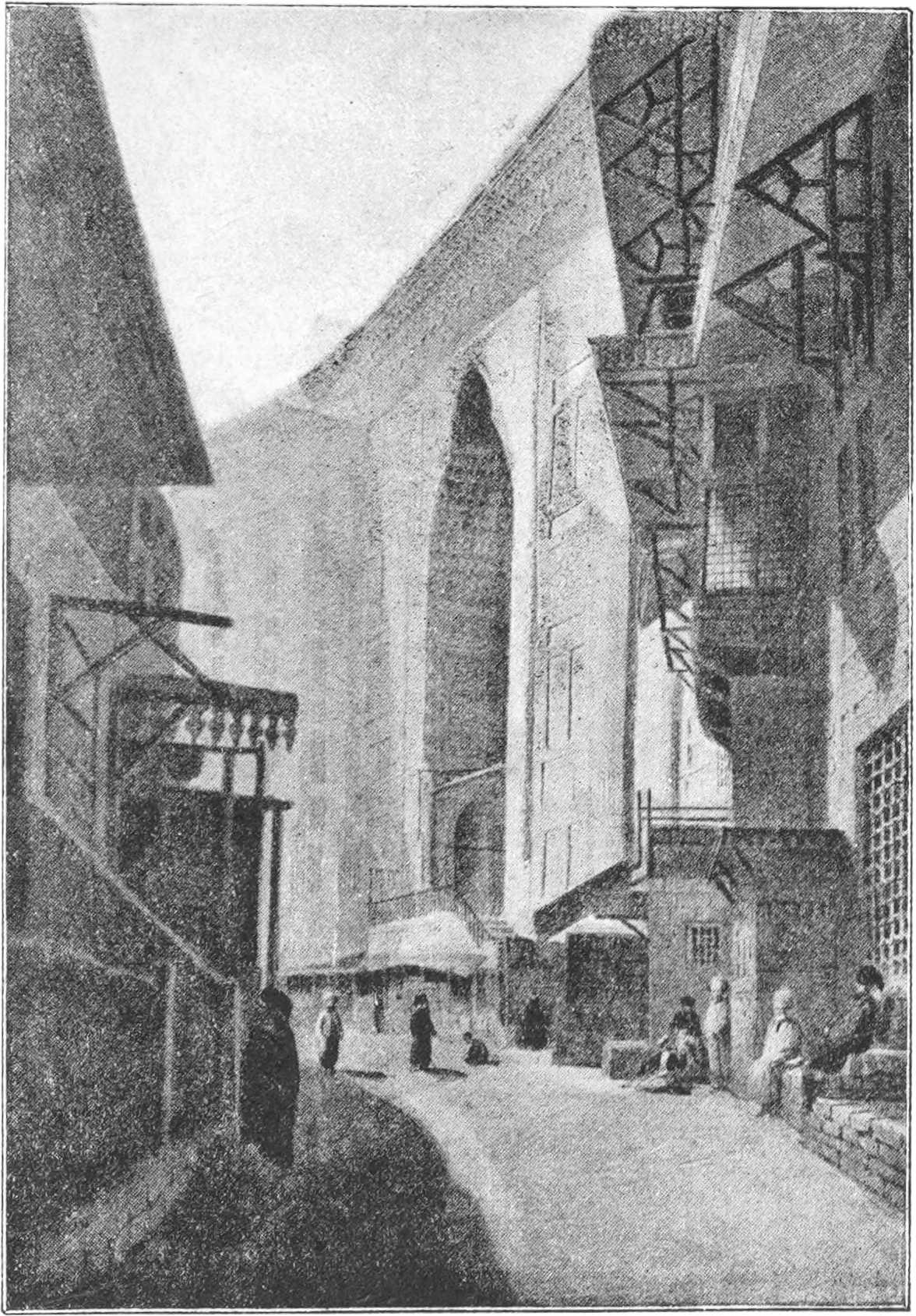
GATEWAY OF SULTAN HASAN’S MOSQUE
Inside, the first impression again is of size rather than detail. The great span of the four arches—that at the east is 90 feet high and nearly 70 wide—is unmatched in Cairo, but the plaster coating of the interior of the transepts detracts from the general effect, nor are the mosaics and marbles, handsome as they are, equal in delicacy of design or harmony of colour to many others in the mihrábs of earlier and later mosques. The black, white, and yellow panels are too garish, and so is the colouring of the pulpit; but the concave niche itself is singularly rich in decoration, and the tribune, instead of being as usual an unpretentious wood platform, stands upon graceful stone columns of alternate drums of coloured marbles. A fine Kufic inscription forms a frieze round the top of the walls. The tomb-chamber, entered from the sanctuary by[232] a noble door plated with arabesques in bronze, is surrounded by a marble dado 25 feet high, above which is the Throne-Verse from the Korán carved in wood, whilst the angles are gradually worked up to the circle of the dome by stalactites also carved in wood and much decayed. In the centre is the plain marble grave of the founder. The dome itself is comparatively modern, and quite unworthy of the great mosque. The original great dome, admired by Pietro della Valle in 1616, collapsed in 1660. There were to have been four minarets, but scarcely was the third built when it fell (1360), crushing some three hundred children in the school below. Thirty-three days later Sultan Hasan was murdered. Of the two that then remained, one minaret became ruined and was rebuilt too short in 1659. The great bronze lanterns and many of the enamelled glass lamps are preserved in the Arab Museum; and the fine bronze-plated entrance door was removed by el-Muáyyad to his own mosque in 1410.
The mosque of Sultan Hasan suffered greatly from its position. Its wide terrace-roof was an excellent post of vantage for cannon and musketry during the constant émeutes of the Mamlúk period, and shots were frequently exchanged between it and the Citadel down to the time of Mohammad ‘Aly: some of the balls may still be seen in the masonry. Barkúk found the mosque so dangerous as a place of attack that he demolished its handsome steps and closed the great door. At one time it remained closed for half a century, and the students and worshippers had to slink in by a window or a side-door. The tall minaret was even used in the middle of the fifteenth century to support a tight-rope stretched to the Citadel on which a European gymnast disported himself to the tremulous delight of the populace. In a quieter situation the mosque might have escaped injury, but even as it is,[235] scarred with bullets and lopped of its original dome and minarets, it remains the most superb if not the most beautiful monument of Saracenic art in the fourteenth century.
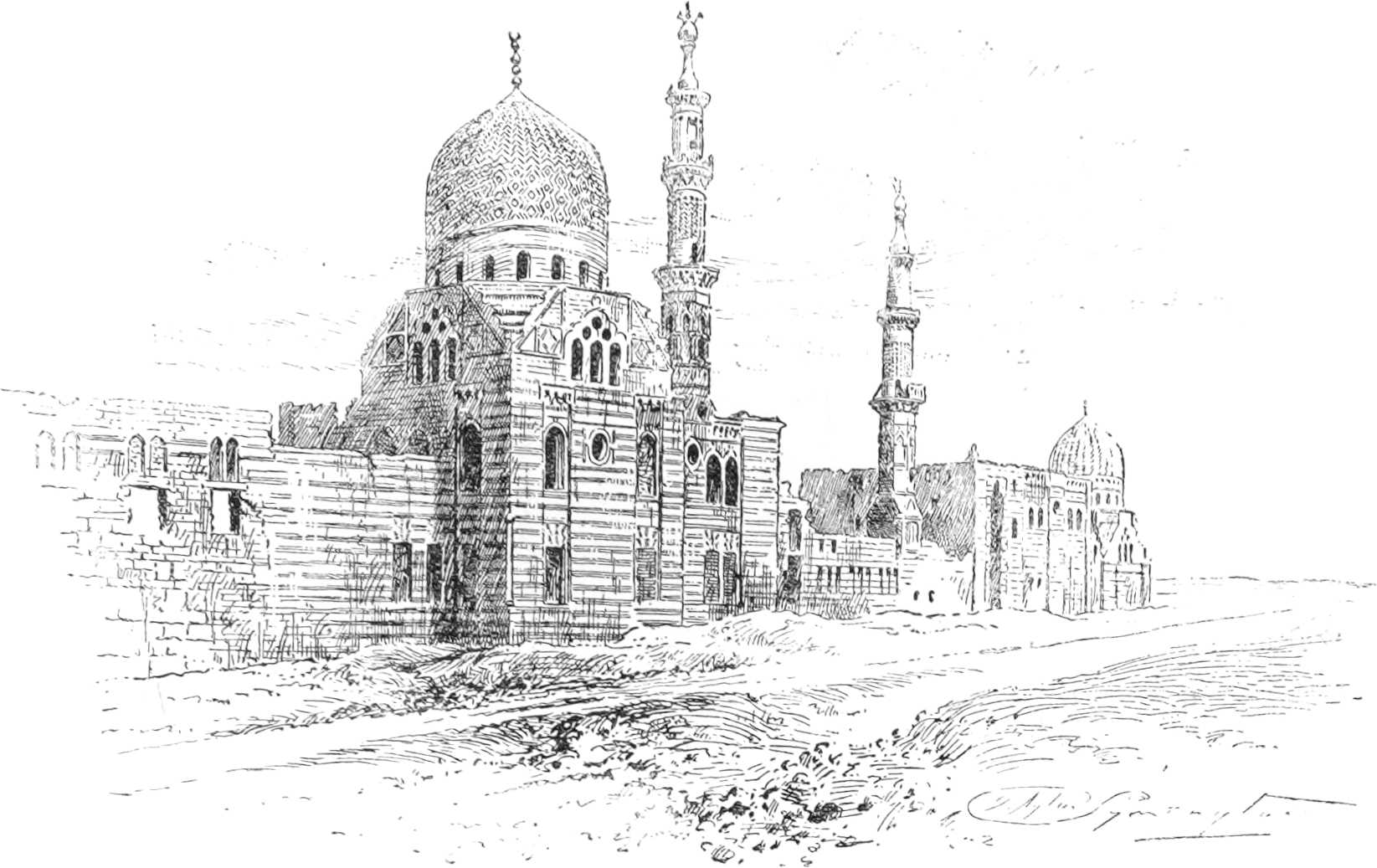
TOMB-MOSQUE OF BARKUK AND FARAG
2. THE MAMLÚKS OF THE FORT.
When the feeble descendants of en-Násir, after enduring rather than enjoying a mock sovereignty for forty years under the tyranny of a series of powerful emírs—Kusún, Sheykhú, Sarghitmish, and the rest—gave way to the usurpation of the emír Barkúk in 1382, the change made little difference in the government of Egypt. The hereditary principle was gone, indeed, and was never reaffirmed until the latter part of the nineteenth century; and the new dynasty consisted of isolated emírs, who sometimes bequeathed their throne to a son until some other emír deposed him, but who never founded a royal house like that of Kalaún. The new line was known as the Burgy Mamlúks, or “slaves of the fort,” because they belonged to a brigade of troops which had been quartered in the Citadel ever since their original enrolment by Kalaún a century before. They are also called the “Circassian Sultans,” from their common race, for none of them were Turks, though two were Greeks. There was little to choose, however, in character, between the Circassians and their Turkish predecessors, and the change on the whole was for the worse. The sultans of the new line were even more at the mercy of the leaders of military factions than before. The mamlúk guard of each king formed a distinct party, calling itself after his throne-title—as Ashrafy, Muáyyady, Násiry—and after his death or deposition they remained a separate factor in politics and contributed to the bloodshed, confusion, and intrigues of[236] the period. The sultans could scarcely restrain their own soldiery, much less these formidable relics of their predecessors, and the frequent changes of rulers show how unstable the royal authority had become. Six of the twenty-three Burgy sultans reigned for 103 out of the total of 134 years covered by the dynasty, leaving but thirty-one years for the remaining seventeen, or less than two years apiece.
The character of the rulers was much the same as before, but everything was on a meaner scale. There was hardly one warrior-king among them, and this accounts in a large degree for the lack of the prestige that had kept a soldier like Beybars or Kalaún on the throne. The Circassians were not soldiers but schemers; they relied less upon success in war or personal courage than on ruse, chicanery, and corruption, to retain their hold of power. The Greek Khushkadam excelled the rest in his adroit management of the contending factions and the heavy bribes he extorted in the sale of public offices. The governorship of Damascus cost its possessor 45,000 dinárs in fees to the sultan, and his previous post was sold to another man for 10,000. Ministers of state were put out of the way if their enemies made it worth the Greek’s while, and the ceremonious visits of this ingenious sultan were apt to be expensive to those he honoured with a call. Throughout the domination of the Circassian dynasty corruption reigned unchecked; justice was bought and sold; and even the Sheykh-el-Islám, the religious chief justice, stole trust-money. The soldiers, who were purchased white slaves, Greeks, Circassians, Turks and Mongols, ran riot in the streets, insomuch that decent women dared not leave their houses and the fellahín feared to bring their stock to market lest it should fall a prey to the mamlúks or the government. In the country the population diminished[237] under the oppression of the troops; in the capital there was seldom peace or order, and sometimes rival factions pounded each other from the Citadel ramparts and the opposite roof of Sultan Hasan’s mosque, barricaded the streets, and made cockpits of the bazars, where processions of rebels nailed to camel-saddles till they died were no uncommon sights.
In spite of this corruption and violence the Burgy sultans contrived not only to preserve the power of Egypt but even to enlarge its dominions and greatly extend its trade. They withstood the invasion of Tamerlane boldly in 1399, though in the end they found it politic to accept his terms; but at least the great conqueror never ventured to attack Egypt. They fought several campaigns in Asia Minor, where for some time they secured the submission of Karaman, Cæsarea, Iconium, and Larenda. They even conquered Cyprus—a nest of the pirates who disturbed the Egyptian shipping—in 1426, with a fleet of galleys built at their port of Bulák, not long risen from the Nile; and King James of Lusignan, captured at the battle of Chierocitia, was brought in triumph to the Citadel of Cairo, with the crown of Cyprus and his disgraced standards, and made to kiss the ground before the Sultan Bars-Bey. He was ransomed by the Venetian consul and European merchants, and rode through the streets and bazars in great state, after becoming a vassal of the Egyptian king. Cyprus paid tribute until the end of the Circassian dynasty, but several attempts upon Rhodes in 1440-4 were successfully repelled by the knights. To the end of the dynasty the Egyptian frontier still extended north as far as the Pyramus and Euphrates.
Among the strange anomalies of Oriental history none perhaps is more surprising than the combination of extreme corruption and savage cruelty with exquisite[238] refinement in material civilization and an admirable devotion to art which we see in the mamlúk sultans. The Circassians were not inferior to their Turkish forerunners as great architects. Personally some of the second line of sultans were men of considerable culture. Barkúk, Muáyyad, Gakmak, and Káit-Bey were fond of learned society and literary talents; Bars-Bey, though he knew little Arabic, liked to listen to Turkish histories read to him by el-‘Ayny; and Timurbugha the Greek was a philologist, historian, and theologian. They were also good Muslims, fasted regularly and even supererogatorily, abstained from wine, made pilgrimages, and insured their place in the next world by building mosques, colleges, hospitals, schools, and every kind of religious establishment, in this. El-Muáyyad, for example, though utterly unable to control the disorders of his time, “was personally a devout man and a learned, a good musician, poet, and orator, scrupulous in the observance of the rules of his religion, very simple and unpretentious in his dress and mode of life, bearing himself in all religious functions as a plain Muslim among fellow worshippers, and robing himself in common white wool in mourning for the pestilence that ravaged the land.” The eastern arcade of his splendid mosque (1415-21) is still preserved in the Sukkaríya street, and a number of boys may there be seen at their lessons under the brilliant gold inscriptions and frescoes of the sanctuary, which has been carefully restored by Herz Bey, who discovered traces of the original polychromy beneath the whitewash of ages. The minarets of the mosque are built on the flanking towers of the Zuweyla gate. There is also a ruined hospital (el-Maristán el-Muáyyady, 1418), near the Citadel, that commemorates his pious benefactions. Bars-Bey’s great mosque, the Ashrafiya (1423), is still a place where congregations[241] meet, at the corner of the Musky, where one turns into the Ghuríya. Barkúk built (1386) an exquisite medresa in Beyn-el-Kasreyn, which has recently been restored by Herz Bey; and his tomb-mosque with the two domes, begun by himself but completed by his son, the Sultan Farag, in 1410, is one of the most picturesque features in that beautiful group of fawn-coloured domes and slender minarets, the eastern cemetery. But the gem of the group is the perfect tomb-mosque (1472) of Káit-Bey, which represents the highest achievement of the later mamlúk school. The admirable arabesques of its shapely dome, the skilfully graduated transitions of its stately minaret from square to octagon, and from octagon to circle, with every ingenuity of stalactite concealment of angles, and the fine inlaid marbles in the liwán, are treasures of indestructible beauty even after centuries of neglect and spoliation.
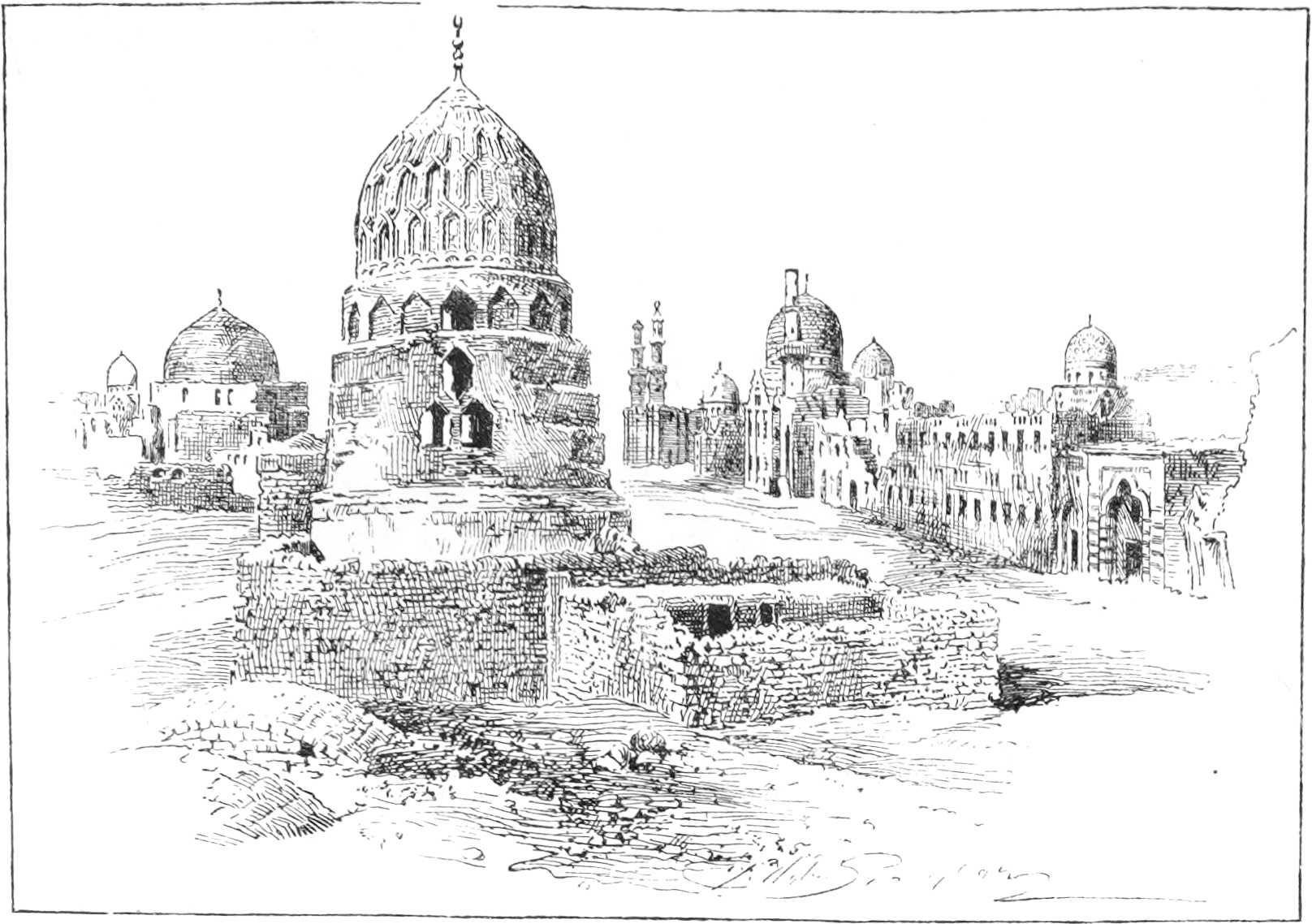
EASTERN CEMETERY: SO-CALLED “TOMBS OF THE CALIPHS”
Káit-Bey, whose long reign of twenty-eight years (1468-96) was phenomenal in this quickly changing dynasty, had worked his way up from the usual humble beginning. Bought by Bars-Bey for twenty-five guineas, he had passed from master to master, and rank to rank, till he became commander-in-chief, under the Greek Timurbugha, of an army which cost the state nearly £300,000 a year—a very large military budget for the fifteenth century. “He was an expert swordsman, and an adept at the javelin play. His career had given him experience and knowledge of the world; he possessed courage, judgment, insight, energy, and decision. His strong character dominated his mamlúks, who were devoted to him, and overawed competitors. His physical energy was sometimes displayed in flogging the president of the council of state or other high officials with his own arm, with the object of extorting money for the treasury. Such contributions and extraordinary taxation were absolutely necessary for the[242] wars in which he was obliged to engage. Not only was the land taxed to one-fifth of the produce, but an additional tenth (half-a-dirhem per ardebb of corn) was demanded. Rich Jews and Christians were remorselessly squeezed. There was much barbarous inhumanity, innocent people were scourged, even to the death, and the chemist ‘Aly ibn el-Marshúshy was blinded and deprived of his tongue, because he could not turn dross into gold.
“The Sultan had the reputation of miserliness, yet the list of his public works, not only in Egypt, but in Syria and Arabia, shows that he spent the revenue on admirable objects. His two mosques at Cairo—one outside among the so-called ‘Tombs of the Caliphs’ (1472), the other near Ibn-Tulún (1475)—and his wekálas or caravanserais are among the most exquisite examples of elaborate arabesque ornament applied to the purest Saracenic architecture. He diligently restored and repaired the crumbling monuments of his predecessors, as numerous inscriptions in the mosques, the schools, the Citadel, and other buildings of Cairo abundantly testify. He was a frequent traveller, and journeyed in Syria, to the Euphrates, in Upper and Lower Egypt, besides performing the pilgrimages to Mekka and Jerusalem; and wherever he went he left traces of his progress in good roads, bridges, mosques, schools, fortifications, or other pious or necessary works. No reign, save that of en-Násir ibn Kalaún, in the long list of mamlúk sultans, was more prolific in architectural construction or in the minor industries of art. The people suffered for the cost of his many buildings, but a later age has recognized their matchless beauty.”[72]
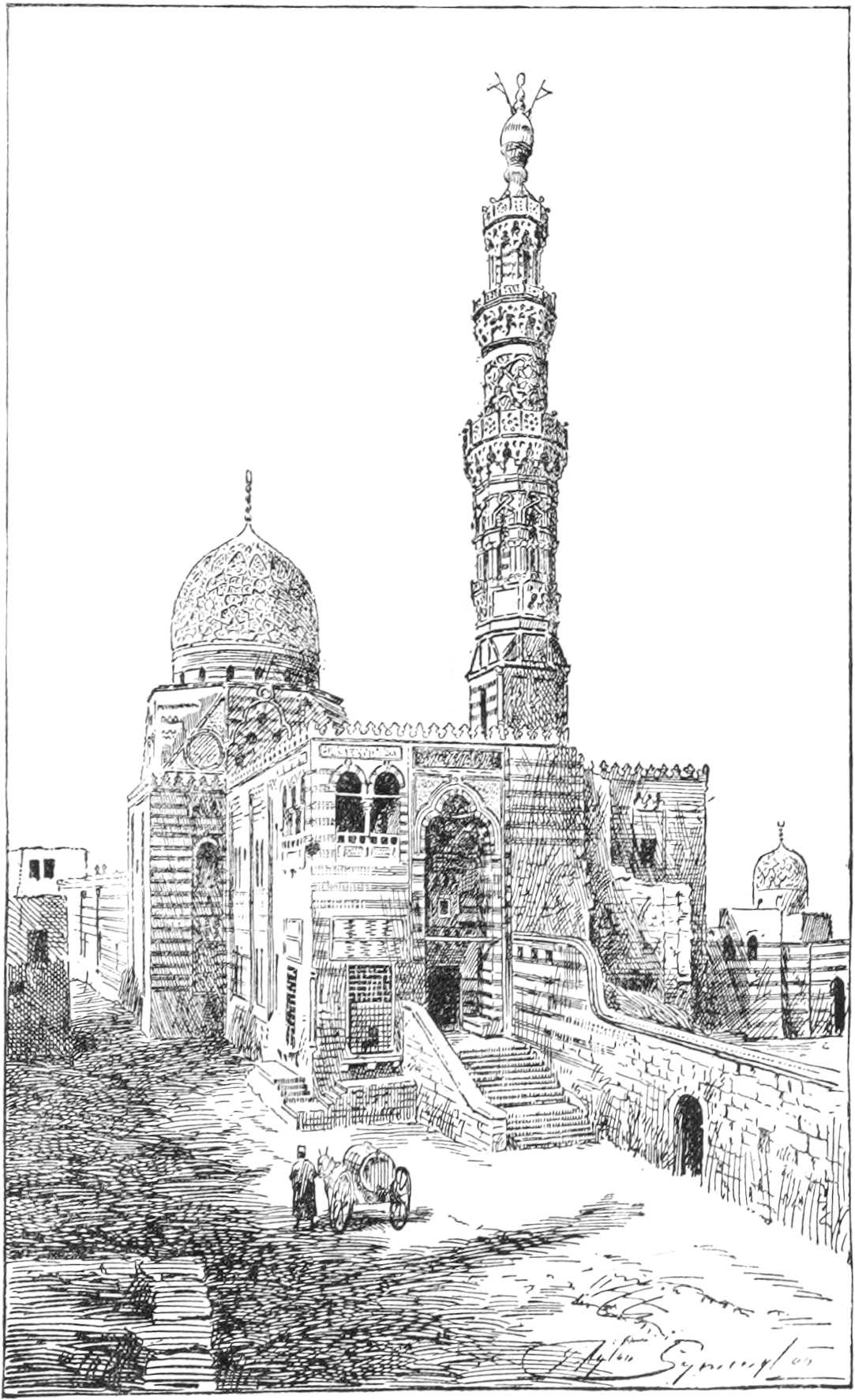
MOSQUE OF KAIT-BEY IN EASTERN CEMETERY
In the buildings of Káit-Bey and his contemporaries we see the perfection of the art of pure arabesque and elaborate geometrical ornament. In the early days of[245] Saracenic architecture the ornament was worked in soft gypsum or plaster, and the use of a tool (never a mould) in the soft material gave extraordinary freedom and boldness to the lines—for example, in the scroll-work of the mosque of Ibn-Tulún. Plaster continued to be the base of decorative friezes and borders throughout the Fátimid period: it may be seen in the original arcades of the Azhar and in the eastern sanctuary of el-Hákim. The most exquisite specimen of plaster ornament, however, is seen in the tomb-mosque of Kalaún, where the borders of the arches that supported the original dome, and of the clerestory windows above, are formed of a delicate lace-like tracery in plaster foliate designs, broadly treated and worked into a pattern so continuous that it is almost impossible to break off at any middle point. After en-Násir, who also used stucco, however, it was generally abandoned in favour of stone, though we still see admirable examples of plaster decoration in the dome of Aksunkur and the beautiful designs in the cupola of el-Fadawíya. In the mosque of the Sultan Hasan all the sculpture except the Kufic frieze is in stone, and as the material is unyielding we find at once a certain hardness of treatment, a loss of freedom in the lines, and a tendency to substitute geometrical design for the pure arabesque of earlier work. The stone pulpit erected by Káit-Bey in 1483 in Barkúk’s tomb-mosque is one of the finest examples of geometrical chiselling in Cairo. Its side view is triangular, like the wooden pulpits of other mosques, but instead of carved or inlaid wooden panels making up the designs on each side, the whole is of stone slabs, admirably joined, and chiselled with geometrical figures produced outwards, so as to cover the whole surface with a network of interlacing lines forming a star-like pattern, the interstices of which are filled with floral arabesques. Similar carving enriches[246] the walls of the staircase and the canopy of this unique pulpit.
Káit-Bey was the most scrupulous of all Cairo architects: he allowed no detail of his numerous edifices to be neglected, and the wealth of ornament which he lavished upon them was all cut in limestone or marble.[73] One may realize the richness of this decoration in his mosque within the city, near Ibn-Tulún’s, where the chief arch is formed of twenty-three blocks of stone on each side, alternately red and white, and every one of the white blocks is covered with arabesque or geometrical designs, no two of which appear to be alike. The arabesques consist of the usual trefoil surrounded by very beautifully intertwined foliage conventionally treated. The geometrical patterns, though at first sight composed of irregular pentagons and hexagons, are all symmetrically arranged, and form one elaborate design. On the spandrils of the arch will be noticed medallions—there are many such in Cairo—containing the name of the Sultan and a benediction upon him. A broad band of Koranic inscription, separated by arabesque patterns, runs as a frieze under the sculptured cornice. The general effect of the whole is wonderfully rich, and there is hardly a space that is not filled by some delicate design. Even in his wekálas, or inns, Káit-Bey was no less careful in details. Few buildings in Cairo are more fertile in varied designs than his wekála in the street on the south side of the Azhar. The interior, unhappily, is deserted and in decay, but once, no doubt, it was richly ornamented. The façade is still in good preservation, and deserves[249] careful study by all who wish to understand arabesque and geometrical ornament at its best.[74] When we say at its best, some objection may be taken to the fact that certain designs are systematically repeated in reverse, in contrast to the honest way of the older artists who scorned to repeat themselves. But by the time of Káit-Bey the beauty of uniformity had been realized, and it was seen that a certain symmetry and recurrence of the designs really improved their effect. This change was part of the general tendency towards symmetrical finish and architectural proportion, which distinguishes the later from the earlier Mamlúk style. There is, however, abundant variety in the numerous panels of arabesque and geometrical ornament which form the borders above the thirteen shops of the inn front, in the superb arched gateway in the centre, and in the beautiful engaged column in the corner, next the sebíl or fountain, with its carved drums and stalactite capital. In its original state this wekála must have been a noble building: even as it is, one may call it almost a text-book of Saracenic decoration.
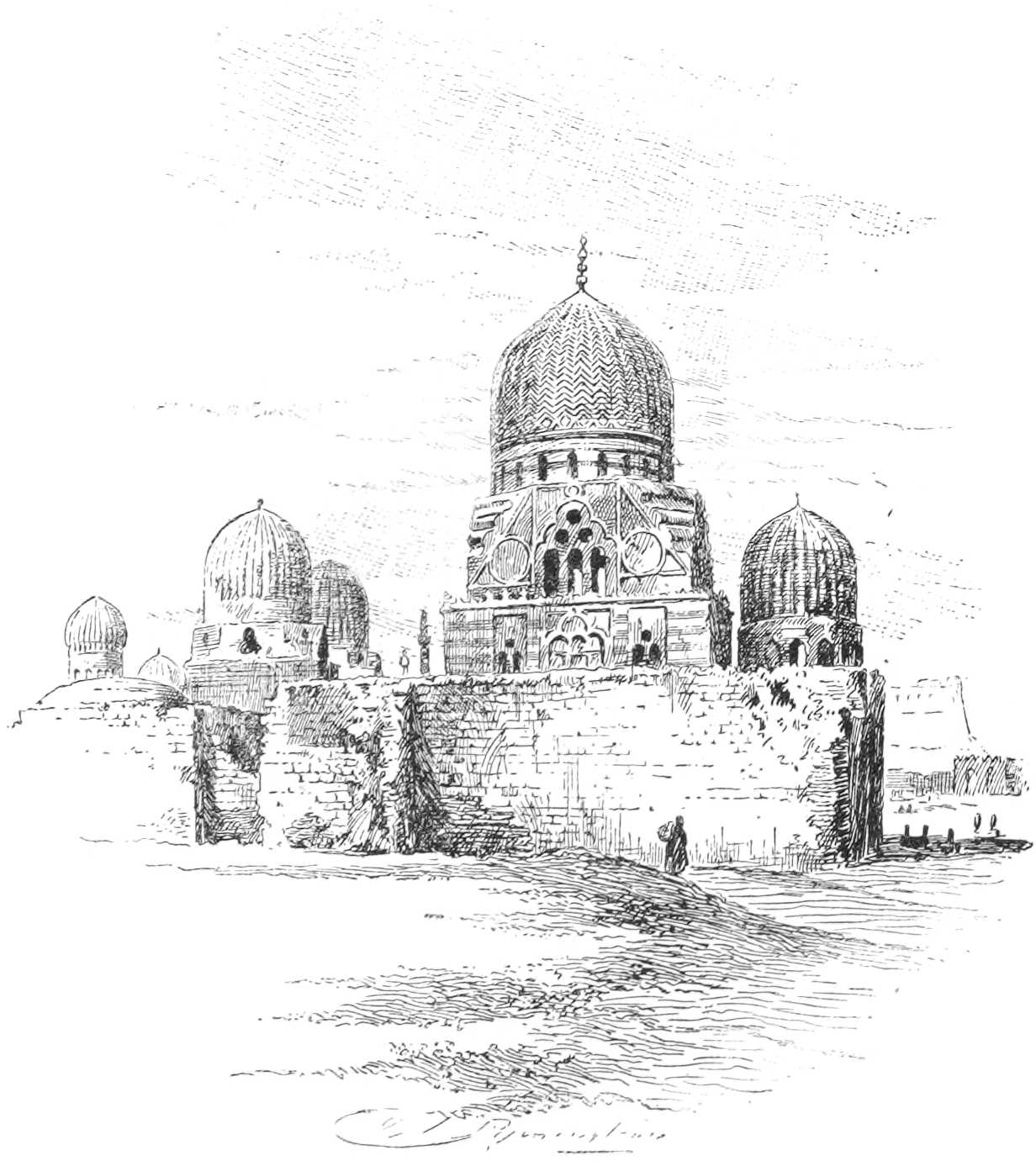
TOMB-MOSQUES
Indeed the epoch of Káit-Bey was almost a repetition of the great building epoch of en-Násir. The Circassian mosques are usually the favourites with architects as well as with the unprofessional sight-seer: their exquisite proportions, delicate minarets, beautifully sculptured domes, elaborate stalactites in portals, cornices, and wherever angles had to be masked, and their rich marble mosaics and incrustated kiblas, are perfect in taste and disposition. Besides the two exquisite mosques of Káit-Bey, those of the emírs Ezbek el-Yúsufy[250] (1495), Kheyr Bek (1502), and the Master of the Horse (emír akhór) Kany Bek (1503), are full of fine work, whilst for a little gem of the best Circassian type nothing is better worth seeing than the Medresa of Kady Abu-Bekr ibn Muzhir or Mazhar (1480) which has been restored with exceptional skill by the Commission for the Preservation of the Arab Monuments, whose architect, Herz Bey, has devoted the greatest pains to tracing the original colours and designs and faithfully reproducing them. Another careful restoration is that of the mosque of the emír Kagmás el-Isháky (1481), and both show conspicuous improvement upon the earlier experiments in restoring the Barkukíya medresa.
It is to be noticed that, in the majority of the medresas of the fifteenth century, the original cruciform shape is considerably modified. The medresa, though still a college, gradually usurped the position of the gámi‘ or congregational mosque. Friday prayers were held in the medresa, since few new gámi‘s were erected—the most important were those of Muáyyad, Bars-Bey and Ezbek—and the court and the eastern transept (sanctuary or chancel) were enlarged, whilst the side transepts became smaller, and even dwindled to mere recesses. Probably the reduction of the side transepts was due in some measure to the fact that only two of the four orthodox schools, the Sháfi‘y and the Hánafy, had any great following in Egypt, and there was thus no necessity for the retention of the original plan of four separate lecture halls. The result is that we find under the Circassian Sultans that a compromise has been made between the gámi‘ and the medresa, and the form of the latter has been modified to suit the requirements of the former. This modified medresa form is almost universal in the Circassian period of architecture, and the salient features—the[253] enlargement of the sanctuary and the diminishing of the side transepts—is particularly conspicuous in the medresa of Kagmás.[75]
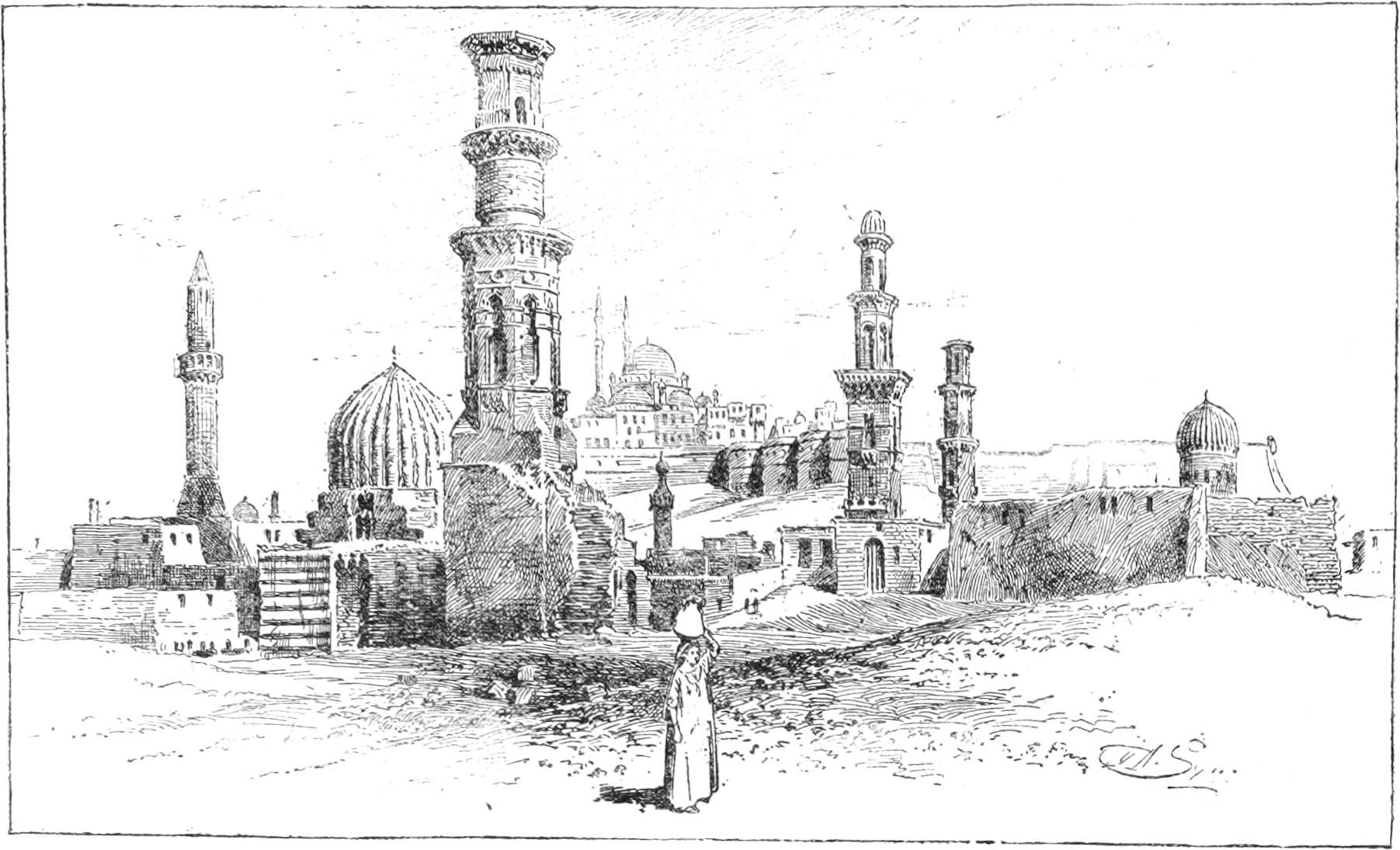
TOMBS OF THE MAMLUKS
Even to the end, when the Ottoman conquest was obviously at hand, the Circassian mamlúks retained much of their vigour and all their aesthetic powers. There are few more interesting figures in their line than the old sultan el-Ghúry, called to the throne in 1501, after four incompetent rulers in as many years had succeeded Káit-Bey. He was a man of bold decision and boundless energy. He restored order in the anarchy of Cairo, levied ten months’ taxes at a stroke to replenish his treasury; taxed water-wheels, boats, camels, Jews, Christians, servants, every possible source; increased the customs-dues, confiscated vast estates and levied enormous death-duties. Having restored the revenue, and earned an evil name for extortion, he proceeded to spend it on great public works. Canals, roads, fortifications on the coast, the strengthening of the Citadel of Cairo, the improvement of the pilgrims’ route to Mekka, these were among his good deeds. His college (1503) and tomb-mosque (where, however, he is not buried) still face each other at opposite sides of the street that bears his name, the Ghuríya, though badly mauled by the injudicious restoration of thirty years ago. He also built a minaret for the Azhar, the mosque of the Nilometer on the island of Roda, the Sebíl-el-Muminín or Fountain of the Faithful in the Rumeyla, the watermills at Masr-el-‘Atíka, and restored the aqueduct to the Citadel. He was sumptuous in his court, and generous to poets and musicians, whilst he mulcted the heirs of his nobles and robbed orphans of their dower. Fully alive to the importance of the[254] Indian trade, then menaced by the Portuguese, he furnished a fleet in the Red Sea and sent it to India, where with the help of the governor of Diu it defeated the interloping senhors under the younger Almeida in an engagement off Chaul in 1508. Finally, but too late, he led his army into Syria to do battle with the advancing Ottomans, and fell fighting at the age of seventy-six on the fatal field of Marg Dábik, near Aleppo, where the desertion of the two wings under Kheyr Bek and el-Ghazzály left the old sultan alone with his bodyguard to be trampled under the horses of the troopers he vainly tried to rally (24th August, 1516). An engagement near Heliopolis to the north of Cairo completed the rout of the mamlúks. Tumán Bey tried to make a stand against the invaders at the Bab-en-Nasr, but Selím took him in the flank, and after hand to hand fighting in the streets, the Citadel was stormed, Tumán was crucified at the Gate of Zuweyla, and Egypt became a province of the Ottoman Empire.
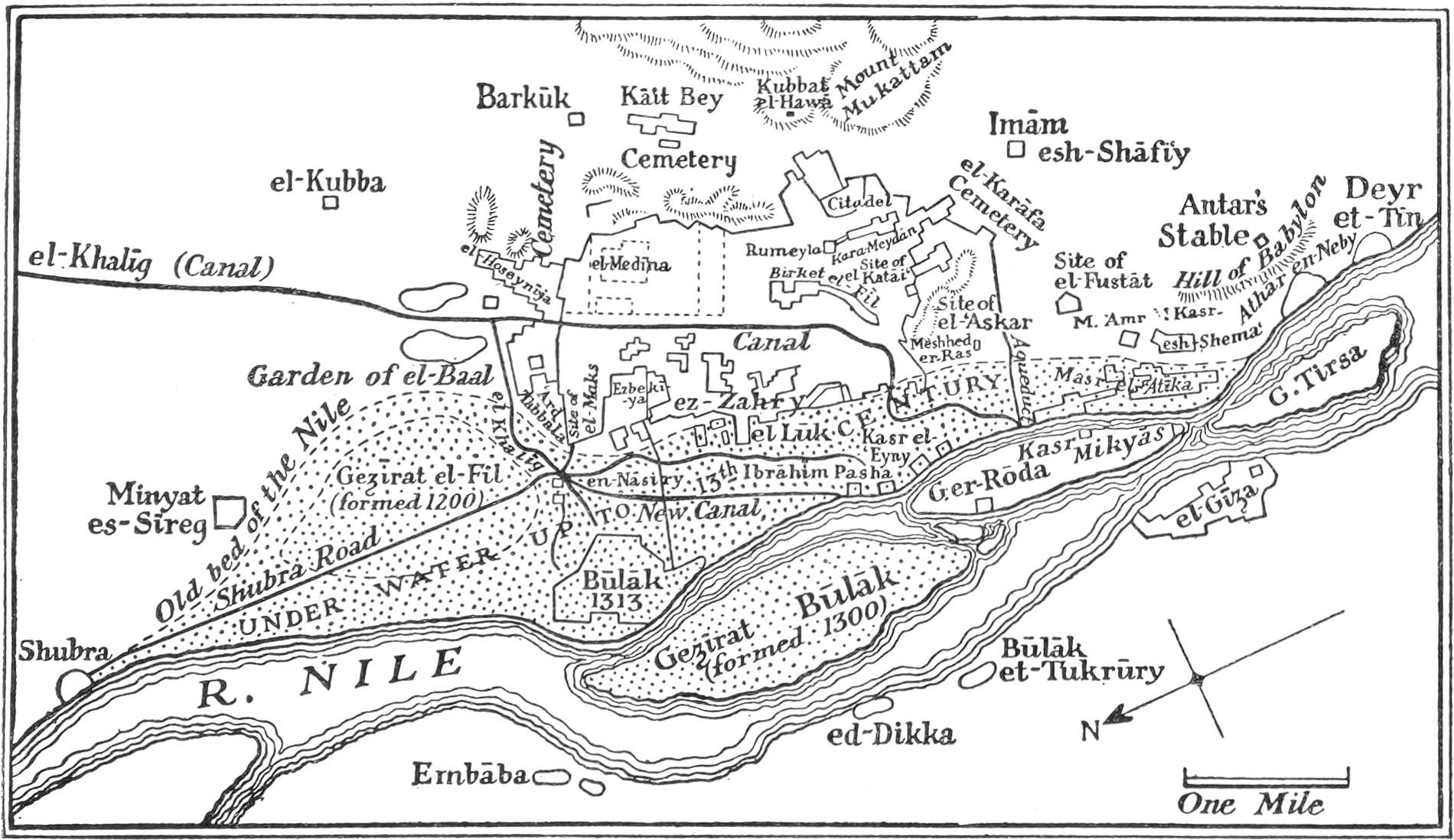
SKETCH PLAN SHOWING THE GROWTH OF CAIRO
[257]CHAPTER VIII
The City of the Arabian Nights
IN the preceding chapter we finished the story of Cairo as the capital of an independent state, and described some of the beautiful buildings with which the Mamlúk Sultans and nobles adorned the city. But the life of a town does not consist in the doings of the court, and we should form a very incomplete picture of mediæval Cairo if we looked no deeper than the Sultans and their mosques and colleges and tombs. Though trampled under the hoofs of the dominant troopers, the city had a vigorous life of its own, a life of prosperous commerce, of social enjoyment, and of literary culture. Cairo society was no longer the limited palace coterie cooped up within the high walls of the Fátimid palaces. It spread on all sides save the east. It had flowed out beyond the northern gates, and formed the new suburb of the Hoseyníya, where many mosques and chapels grew up. It had spread to the west over the space between the old Fátimid wall and the Nile, and the river had conveniently receded and allowed the new port of Bulák and a whole colony of houses to be formed on what had been the Nile bed till the wreck of the good ship Elephant helped to make a sand bank, called the Elephant’s Isle (Gezírat-el-Fil), which altered the river’s course and provided an excellent building site. To the south the space between the Fátimid walls and the Citadel and the mosque of Ibn-Tulún, where only gardens and summer villas and pools[258] flooded at high Nile had been seen in Saladin’s day, was now covered with houses, among which rose the domes and minarets of the mamlúks.
The expansion of the city may readily be traced in the Topographer’s careful record of the building of mosques, which necessarily implies a neighbouring population. The mosque of Yúnus (c. A.H. 719) and of Ibn-et-Tabbákh (“the son of [Násir’s] cook,” 746), in the quarter of el-Luk, point to the recession of the Nile which formerly ran close by. In the same way the foundation of the mosques of Ibn-Gházy (741) and et-Tawáshy (745) on the outside (or west) of the old Bab-el-Bahr, and the Záwiya of Abu-s-Su‘úd (c. 724) outside the Bab-el-Kantara, point to a westward extension, though here the land was not formerly under water. The great expansion to the north, caused by the upheaval of the Elephant’s Isle, before 1200 A.D., and the emergence of Bulák a century later, may be fully traced in the annals of the mosques. Makrízy tells us that the Elephant’s Isle was flooded only at high Nile, and during the rest of the year it was a links of sandbanks and coarse grass, where the mamlúks used to practise archery, in their unhappy ignorance of golf. But as the Nile receded “people began in 1313 to erect houses, in consequence of the improvements made in that part by en-Násir,” who had dug the new canal then known as the Khalíg en-Násiry and now as the Isma‘ilíya, which drained the tract; “and a proclamation was made in Káhira and Misr inviting every one to build there without delay. So the emírs and soldiers and merchants and common folk built houses there, and Bulák was created at this period.”[76] He adds that water was drawn from the Nile by a sákiya wheel which stood on the spot where the mosque of el-Khatíry was afterwards built,[259] which shows that the river has not retreated much since, for it still runs very near this mosque, which was founded by Aydemir in 737 on a site which was under water thirty years before. Other mosques at Bulák were those of Ibn-Sárim and el-Básity (817).
Behind or east of Bulák, on what is now called the ‘Abbasíya road, was a plot of land beside the Elephant’s Isle, known as Ard-et-Tabbála or the “demesne of the tamburina,” because it was presented by the caliph Mustansir to a singing girl who celebrated the glories of the Fátimids to the accompaniment of her drum. There also houses began to be built, and the mosque of el-Keymakhty was founded there, on the New Canal, in A.H. 790. Before this another mosque, that of el-Asyúty, had been erected about 740 on the Elephant’s Isle, as well as that of Sarúga on the New Canal near the Pool of er-Ratly. Still further to the east we find a number of mosques rising in the new quarters outside the old city walls. Such were the gámi‘s of Almelik (732) and Ibn-el-Felek in the Hoseyníya quarter, those of Akúsh and Ibn-el-Maghraby on the canal outside; the convents of Yúnus, Algibugha (c. 750) and Ibn-Ghuráb (798), and the Záwiyas of el-Ga‘bary (c. 687), Nasr (c. 719), el-Kalendaríya (c. 722), and el-Khiláty (c. 737), outside the Bab-en-Nasr, all of which testify to the expansion of the city towards the north.
Cairo had in fact attained much the same dimensions as it measured fifty years ago, before the new European suburbs near the Nile were developed. There was probably little difference either in outward aspect or in the life of the middle and lower classes between the Cairo of the fifteenth century and the city which Europeans such as Wilkinson, Burckhardt, Lane, John Phillip, and Hay visited and described or painted in the first half of the nineteenth. Some of Hay’s and[260] his companion’s, O. B. Carter’s, drawings, sketched about 1830, are here reproduced, and they may fairly be taken as true representations of a town which still retained its essential mediæval characteristics.
How different Cairo must then have appeared to the newly arrived visitor, who landed at Bulák after coming through the Mahmudíya Canal from Alexandria and then ascending the Nile. There was a mile’s ride from the river bank at Bulák to the Bab-el-Hadíd by which you entered Cairo at the north-west corner, and instead of the crowded villa suburb of to-day, there was scarcely a house to be seen. “Two principal roads,” writes Lane,[77] “of nearly the same length lead from Bulák to Cairo; the northern, which is somewhat irregular, but is the chief route of commerce [there were of course no railways then], leads to the Bab-el-Hadíd; and the southern, after having crossed two canals, enters the western side of the Ezbekíya. We pass the picturesque mosque of Abu-l-‘Ola on our right as we enter the latter road. The French, during their occupation of Egypt, raised this road, intending also to continue it through the town as far as the Citadel. It is straight and wide, but very uneven, and wanting a row of trees on its southern side to shade it. It is raised a few feet above the level of the plain, so as to be above the reach of the inundation. On either side during the inundation are marshes and inundated fields. These, as soon as the waters have subsided, are sown with corn, beans, trefoil, etc. Here and there are clusters of palm trees, and a few sycamores and acacias. The plain was formerly bounded on the east by extensive mounds of rubbish [doubtless the ruins of Maks], behind which the capital was nearly concealed. The road crosses two canals, over each of which is a stone bridge. . . . Along the western side[261] of the second canal, on the right of the road, is a long ridge of rubbish. From the top of this ridge, about a quarter of a mile from the gate of the Ezbekíya, we obtain a view of Cairo.”
This was how one approached Cairo in the first half of the nineteenth century. The description reads drearily enough, but it has the merit of showing what the place was like before the European builder took it in hand. When the traveller plodded along the uneven road between the bean-fields in 1835 he was traversing precisely the same scene as had been trodden by the mamlúk horsemen for centuries, and he was approaching a city which was still to all intents the city of the Arabian Nights. There is no manner of doubt, from internal evidence, that it was in Cairo that these famous tales took their definite shape. Their origins have of course been traced to a large extent in Persia and India, but their final form and colour are Egyptian. Though many of the scenes are laid at Baghdád, where the famous Harún er-Rashíd played so conspicuous and erratic a part, it is obvious to any student of the topography that the writers were very imperfectly acquainted with the caliph’s city. It is Cairo that they know and describe, whatever names they please to give to their scenes. There are incidental touches that make it probable that the Arabian Nights assumed their present form, in all essentials, before the middle of the fourteenth century. The latest historical personage mentioned is Saladin, and there are many reasons for believing that the tales were collected and written very nearly in their final shape during the revival of letters that ennobled the golden age of mamlúk civilization on the Nile. The society they describe is precisely what we know of mamlúk times: it is orthodox Muslim society of the Cairene type.
[262]It may be wondered that there should be any speculation at all about the date of so famous a book; but the explanation is simple. Scholars and learned men in the East have always looked with contempt upon stories such as these, which are wholly devoid of the literary preciosity which was the special pride of the true man of letters. Hence they did not deign even to mention the Thousand and One Nights, save in two or three slight references which do not determine the date of the existing redaction. The Nights were written for the people, for the audiences who gathered in the coffee-shops to listen to the professional reciter, for the large uneducated middle class of Cairo. This is what constitutes their special merit in the eyes of the student of mediæval Egypt. The doings of kings and emírs we learn from the detailed pages of Makrízy and many other scholarly writers: it is from the Thousand and One Nights that we gain our insight into the life of the people—a life divided from that of the great by a gulf over which the Oriental historian rarely leaps. The tales are above all the adventures of merchants and shop-keepers. We are introduced no doubt to caliphs and sultans and vezírs, as well as to the ginn, ’efrits and márids and other members of the spirit-world; but the real actors in the stories are traders, men who keep shop and who have ventures upon the seas, and often make voyages themselves. Sindibad might easily have heard many of his own adventures from the lips of the motley crowd that gathered on the quays at Misr from all parts of the known world. Ibn-Sa‘íd stood and watched the shipping in 1246 and noticed vessels arriving from all lands: “as for the merchandise from the Mediterranean and the Red Sea that comes to Misr it is past describing; here is it bonded, not at Cairo, and hence it is distributed throughout Egypt.” What was true[263] of Misr and Maks was also true of their successor, the fourteenth century port at Bulák. It was from Bulák that ‘Aly of Cairo, after spending all his inheritance making merry with his wife on the island of Roda, took ship for Damietta and set forth on his quest of a new fortune. The constantly recurring references to commercial voyages and great profits are exactly what would occur to a people whose wealth was made not only by a prodigiously fertile soil, but by a copious foreign trade.
What the transit trade of Egypt was worth in mamlúk times may be judged from a few facts. A single vessel clearing cargo at Alexandria paid £21,000 in customs. The great Italian republics found it necessary to maintain consular agents in Egypt, and that there was a wealthy colony of European merchants is shown by their being able, headed by the consul of Venice, to guarantee the king of Cyprus’s ransom of £100,000. The Venetians had enjoyed special privileges in Egypt since the time of el-‘Adil, in 1208, who allowed them to build a mart (funduk) of their own at Alexandria; the Pisans had a consul there; and the concessions to Venice were renewed in 1238. On the other side, in the Red Sea, there were the ports of Suez, Tor, Koseyr, ‘Aydháb, Dehlek and Sawákin, where the mamlúk sultans levied customs of a tenth ad valorem. The Indian trade had greatly developed under the later mamlúk sultans, and there was much rivalry and a tariff war between the Arabian and Egyptian ports in the Red Sea in the effort to secure the heavy customs dues, which were pressed beyond the customary tenth. In 1426 we read of forty vessels from India and Persia paying £36,000 in duties at Gidda, the port of Mekka, which, like Yenbu‘, was then Egyptian. Nor were[264] the government duties limited to importation. There were certain monopolies: sugar, pepper, wood, metalwork could be sold only at government warehouses, at government prices, subject to duty. A consignment of pepper that was bought at Cairo for fifty dinárs was sold to Europeans at Alexandria for one hundred and thirty under government regulations. The Venetians, after vain consular remonstrance, sent a fleet to Alexandria to bring away all their merchants, and Bars-Bey was obliged to reduce his exorbitant terms.
How much store the Circassian sultans set by the transit trade between India and Europe has been seen in the vigorous effort made by el-Ghúry to crush the Portuguese in the Arabian Sea as soon as he realized the dangerous rivalry of the Cape route. Indeed the transit trade must have been a chief source of wealth. As Mr Cameron, our consul at Port Sa‘íd, has well put it, the mamlúk sultans, “masters of both Egypt and Syria, held the ports and caravan routes between Europe and her Indian trade, and levied customs dues on every bale of Oriental produce which arrived from the Persian Gulf and the Red Sea for transfer to the harbours between Alexandria and Alexandretta and for transhipment to Venice. Until the discovery of the Cape route in 1498, and its subsequent development, they enjoyed the monopoly of the entire volume of Indian trade with the Levant; and Venice, by her commercial capitulations with them, was their sole agent on the continent. Let us try and estimate what this monopoly meant. An Arab merchant like Sindbad the Sailor, . . . buys £10,000 worth of raw silks, nutmegs, pepper, indigo, cloves, and mace in Persia or at Calicut and lands them at Basra or Suez. The sea route up the Persian Gulf would be shorter than the voyage up the Red Sea; but the caravan road[265] from Basra to Aleppo would be more perilous than the short journey across Egypt. At landing, the customs would amount to some £4000 [this is much above the mark], and the goods would then be worth, say, £20,000. A second Arab merchant on the Mediterranean coast [or perhaps at the wharves of Bulák] would sell the consignment for £30,000 to the Venetian, who would have to pay another £5000 customs dues before he could clear his cargo. Thus, whether in customs or in tolls, or in presents to local governors and escorts, a quarter of the £35,000 paid by the Venetian would go to the mamlúk sultan and aristocracy merely for the privilege of transit.”[78]
It was not the government alone that made the profit. The Cairo merchant who brought the precious bales from India and the Spice Islands, or at least bought them from the Indian traders at the Red Sea ports, made his fortune too. The Thousand and One Nights are full of such successful ventures. Did not the Second Sheykh, who led the Two Black Hounds, describe how “we then prepared merchandise and hired a ship and embarked our goods, and proceeded on our voyage for the space of a whole month, at the end of which we arrived at a city where we sold our merchandise, and for every piece of gold we gained ten”? Such fortunate speculations were no doubt of everyday occurrence, and the trade represented by these ventures did not all go out of the capital: a large part found its way into the bazars to be retailed to the good people of Cairo and to minister to the luxurious tastes of the thousands of hangers-on to the mamlúk court. We can form but a meagre notion of the mediæval funduk from the present bazars. A funduk, or khan, or wekála—there is little difference between the three terms—is a great collection of warehouses and shops, generally[266] surrounding a court, but sometimes more like a covered arcade, where the merchants keep their reserves of stores, and where traders find lodgings for themselves and stabling for their beasts between their journeys. One great mediæval khan is still familiar to every tourist—the Khan el-Khalíly or “Turkish bazar,” built by Garkas el-Khalíly, the Master of the Horse of Sultan Barkúk in 1400 on the site once occupied by the graves of the Fátimid caliphs, whose bones were dug up and carted away on asses to the rubbish-mounds outside the eastern Gate. Another khan, the Hamzáwy, or cloth market, is also well known; and two of Káit-Bey’s wekálas, the façades of which are finely ornamented with arabesque panels and intricate geometrical designs, and wooden medallions carved with the sultan’s name, still remain beside the Azhar and in the Surugíya. When Lane described Cairo in 1835 there were about two hundred wekálas, and even now one can scarcely pass down a street without finding one of these big courts surrounded by rooms—the inn of the east—opening out through a tall gateway.
In the fifteenth century the khans of Cairo were busy marts of the merchants; and the mamlúk emírs, who had clear ideas as to the value of house property, emulated one another in building handsome wekálas, every room of which might be expected to bring in a substantial rent. There was the khan of Mesrúr, one of the most famous. The young man in the Story of the Humpback “put up” there, and stored his merchandise, and after a night’s rest took some of his goods and went to the “kaysaríya of Garkas,” another famous market of mediæval Cairo dating from Fátimid days, to sell to the merchants. “Do as other merchants,” said the sheykh of the brokers to the stranger; “sell thy merchandise upon credit for a certain period, employing a scrivener, a witness, and[269] a moneychanger, and receive a portion of the profits every Thursday and Monday: so shalt thou make of every piece of silver two—besides thou wilt have leisure to enjoy the amusements of Egypt and its Nile.” So the young man followed his advice and left his goods to be sold for him, whilst he lived joyously at the khan of Mesrúr, breakfasted on wine and chicken and mutton and sweetmeats, and perfumed himself elegantly, till he met the damsel at the shop of Bedr-ed-din, the gardener, and there happened what fate had decreed, to be a warning to such as would be admonished. That the young man should have his hand cut off by the executioner at the Gate of Zuweyla was exactly what might be expected in the days of the mamlúks. This khan of Mesrúr (or rather two khans, one large and the other small) was built on a part of the site of the Fátimid Great Palace where the slaves used to be sold, by Mesrúr, a favourite slave of Saladin, who left it as a legacy for the benefit of the poor. The larger building had a hundred rooms, and was the chief resort of merchants from Syria,—“the most renowned and greatest of the khans,” says the Topographer, but its prosperity declined after the tribulation of Syria at the hands of Tamerlane, “its honour departed and many of its apartments were ruined.”
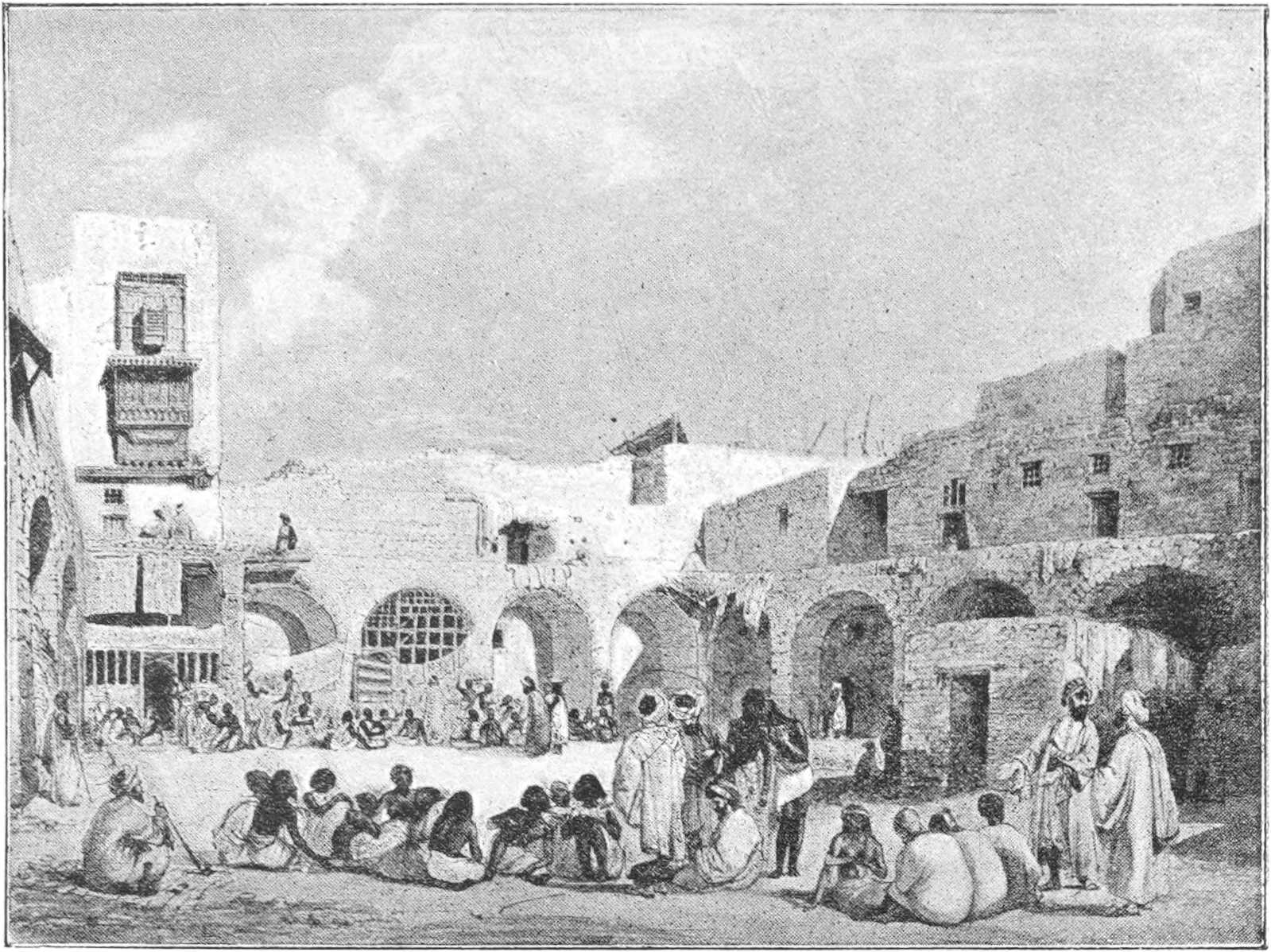
SLAVE MARKET
Another famous khan was that of Bilál, a slave of es-Sálih, the grand-nephew of Saladin, so favoured that the sultan Kalaún used to say, “God have mercy on our late master es-Sálih! I used to carry the slippers of this eunuch Bilál whilst he went into the presence!” The slave was very rich and abounded in good deeds, many poets praised him and were amply rewarded, and among his worthy acts was the building of the khan, where the merchants would deposit their chests of great value. “I used to enter this funduk,” says Makrízy, “and lo! around it were chests piled, little[270] and great, so that only a small space was left in the middle, and these chests contained gold and silver enough to amaze one.” Then there was the “Khan of the Sebíl,” outside the Bab-el-Futúh, founded by Saladin’s vezír, Karakúsh, for “sons of the road,” poor wayfarers, who were received without payment; and the Wekála Kusún, built by Násir’s son-in-law, near the mosque of el-Hákim, where Syrian merchants stored oil, and sesame, and soap, and preserves, and pistachio-nut, almonds, syrups, and the like, every store-room being let by the emír’s order at no more than five dirhems of silver, without extortion, and no one being turned away. It was a busy place in Makrízy’s time, very popular on account of its cheapness, full of people and bales of goods, and noisy with the shouts of the porters. There were 360 lodgings above the store-rooms, all occupied, and 4000 people lived there. The Tatar devastation of Syria ruined this khan too. Opposite the Zuweyla Gate stood the fruit-market where the produce of the gardens round Cairo was sold; it was roofed over, like most of the bazars in former days, to keep off the rays of the sun, and the fruit, which smelt like the gardens of Paradise, was tastefully arranged and decorated with flowers and sweet herbs.[79]
There were many more great buildings of this kind, the history of which is related by the laborious Topographer, whose descriptions enable us almost to reconstruct in imagination the city of the fifteenth century. Cairo was a sumptuous and beautiful place in those days. The old mamlúk palaces—of which we have but relics in the huge blank walls of Beshták’s palace, the fine gateway of Yeshbek’s dar next to Sultan Hasan’s mosque, and the better preserved mansions of Káit-Bey and of the emír Mamáy (known as[271] the Beyt-el-kady)—were then in their full glory. The various quarters were still separated by their strong gates barred at night. The súks were shaded by matting or wooden roofs, and the lattice-windows with their delicate tracery overhung the streets. Makrízy enumerates and describes 37 Háras or quarters, 30 districts (khutt), 65 streets (darb), 21 by-streets and alleys (zukák and khawkha), 49 squares or places (rahba), 50 markets (suk), 23 great markets (kaysaríya), 11 hostelries (khan, funduk, wekála), 55 famous palaces and mansions (kasr, dar), 44 public baths (hammám), 28 closes and gardens (hakar, bustán), 11 racecourses (meydán), and numerous pleasure-houses or belvederes (manzara).
Many of the streets still run in their old places, and some of their names survive, such as the Salíba or cross-ways, Beyn-el-Kasreyn, Beyn-es-Sureyn, Harat Bargawán, Suk-es-Siláh, Khan-el-Khalíly, Darb-el-Asfar, Habbaníya, Khurunfísh. The old quarters of Cairo have changed much less than the old parts of London; but the reason is melancholy. London has changed because it has grown; Cairo remained comparatively unaltered because it was slowly decaying. The loss of much of the Indian trade, the dependence upon Turkey, the misrule of pashas and mamlúk beys, all tended to reduce the prosperity of the city which had flourished exceedingly under the Turkish and Circassian sultans.
With decline of trade came decline in the arts. There is still a little good work made in Cairo in brass chasing, jewellery, and silk weaving, but it is a poor relic of what once went on there. One has only to visit the Arab Museum to realize what magnificent work the artists of Cairo produced in the mamlúk period. The arts were closely related to the mosques, which attained their greatest perfection of ornament in[272] the same period, and the chief objects in the museum were once parts of the decoration or furniture of the mosques. The beautiful inlaid and chased silver and brass tables, with delicate designs in open tracery, Koran cases, lamps and chandeliers, bowls, censers, candlesticks, enamelled glass lamps with inscriptions in blue picked out with carmine and gold, generally came from mosques and centre round the fourteenth century. The carved panels inlaid with ivory and ebony and choice woods once enriched the doors and pulpits of the mosques, and the cast bronze bosses and cut brass filigree work belong chiefly to the same period. There are many admirable examples of these arts in the South Kensington Museum, and the British Museum possesses an unsurpassed collection of Saracenic metal work. There is unhappily no “Market of the Inlayers” now at Cairo, as there was in Makrízy’s time. This silver and gold inlay of arabesques and inscriptions on a brass base was one of the most elaborate and characteristic of Saracenic arts. It was not Egyptian in origin, but derived from the old Sasanian silversmiths of Mesopotamia. The oldest specimens we know came from Mosil on the Tigris, which was a famous home of metal-workers, within reach of the mines of the Taurus country. No doubt these Mosil smiths were attracted to Cairo in the flourishing days of the mamlúk sultans, or even earlier. At least it is certain that some of their finest work was done for the Egyptian market, and even bears the names of well-known Cairene rulers and emírs. There is the casket, for example, engraved with the name and titles of el-‘Adil II, Saladin’s grand-nephew, who sat on the throne of Egypt from 1238 to 1240, and was succeeded by es-Sálih, the husband of “Spray of Pearls.” It is in the Mosil style of the earliest period; the sides are ornamented with dotted eight-foils[273] (exactly resembling the ornament on the silver coins of the family of Saladin) containing hunting scenes, a combat with a lion, a horseman with falcon on wrist (which is covered with the falconer’s glove), etc.; the intervening ground is decorated with fine arabesques, and an inscription on the bevel of the lid gives the name and titles of the sultan. On the top are personifications of the six planets (of Arabian science) surrounding the sun (the seventh):—the Moon, a seated figure holding a crescent; Mercury, with his writing materials; Venus, a woman playing on the lyre; Mars, a warrior brandishing a sword and holding a bleeding head; Jupiter, a throned judge; and Saturn, patron of thieves, with his bludgeon and purse. Outside these is a band of the twelve signs of the Zodiac, represented much in the usual manner. On the bottom of the box is an inscription stating that it was made “for the royal wardrobe of el-‘Adil.”
The hunting-scenes and representations of human figures and animals are characteristic of Mesopotamian silver work, and we see medallions of two-headed eagles on a splendid inlaid perfume-burner in the British Museum, “made,” as the silver letters inform us, “by order of his excellency, the generous, the exalted lord, the great emír, the honourable master, marshal, warrior for the faith, warden of Islám, mighty, heaven-supported, victorious, Full Moon of the Faith Beysary, mamlúk of ez-Záhir (Beybars),” etc. The date must be before 1279, and the vessel carries us back to the days of Kalaún and the beginning of mamlúk splendour. Beysary was one of the greatest and most sumptuous of the early mamlúk emírs, and his perfume burner was typical of the luxurious refinements of his palace. He valued his comfort more than ambition, and twice refused the precarious honour of the throne during the unsettled period succeeding[274] Kalaún’s death, when the sultanate was open to the strongest emír. Even so he could not escape the consequences of being wealthy and distinguished, and in spite of his retiring character he was suspected of pretensions to power, fleeced of his treasures, and often confined to the dungeons of the Citadel. His palace, which stood in Beyn-el-Kasreyn, covered four acres, and possessed the richest mosaics and the handsomest carved doors in Cairo. Bedr-ed-din Beysary was indeed the most sumptuous man of his time. He loved to surround himself with beautiful things, and his slave body-guard was the best appointed of the day. No fortune could support his lavish extravagance. He not only spent upon himself, but gave prodigally to all who asked him. Hospitality was his foible, and his gifts to the poor ran in round sums of five hundred or a thousand dirhems (say francs) to each applicant. He would daily distribute three thousand pounds of meat, and a single present consisted of a thousand pieces of gold, five thousand bushels of corn, and a thousand hundredweight of honey. One of his mamlúks used every day to draw ninety pounds of meat and seventy rations of barley, which it is to be presumed neither he nor his horses could possibly digest. Naturally Beysary was perpetually in debt. The constant amount of his liabilities is placed at 400,000 dirhems, for as soon as one debt was paid off, the generous soul hastened to contract another of the same figure. A considerable part of his expenditure must have gone in table equipage, for it is recorded that he never drank twice out of the same cup; and as Makrízy mentions that at one time this thirteenth century epicure was wholly given over to wine and hazard, the number of cups required must have been considerable. But a great and cultivated emír needed more than cups for his comfort: he must[277] have inlaid tables on which to put the broad brass tray incrusted with chased silver and gold, which carried his service of the forbidden fruit of the grape; he must have his beautiful hall lighted by candles placed in elaborate stands, covered with silver inlay; his very tubs and cooking-pots must be chased with arabesques and complicated designs, and his palace must be perfumed with incense rising from perfume-burners on which the artist had engraved representations of horsemen at the chase, hounds and quarry, falcons and waterfowl, and all the decorative subjects of the Saracen silversmith.
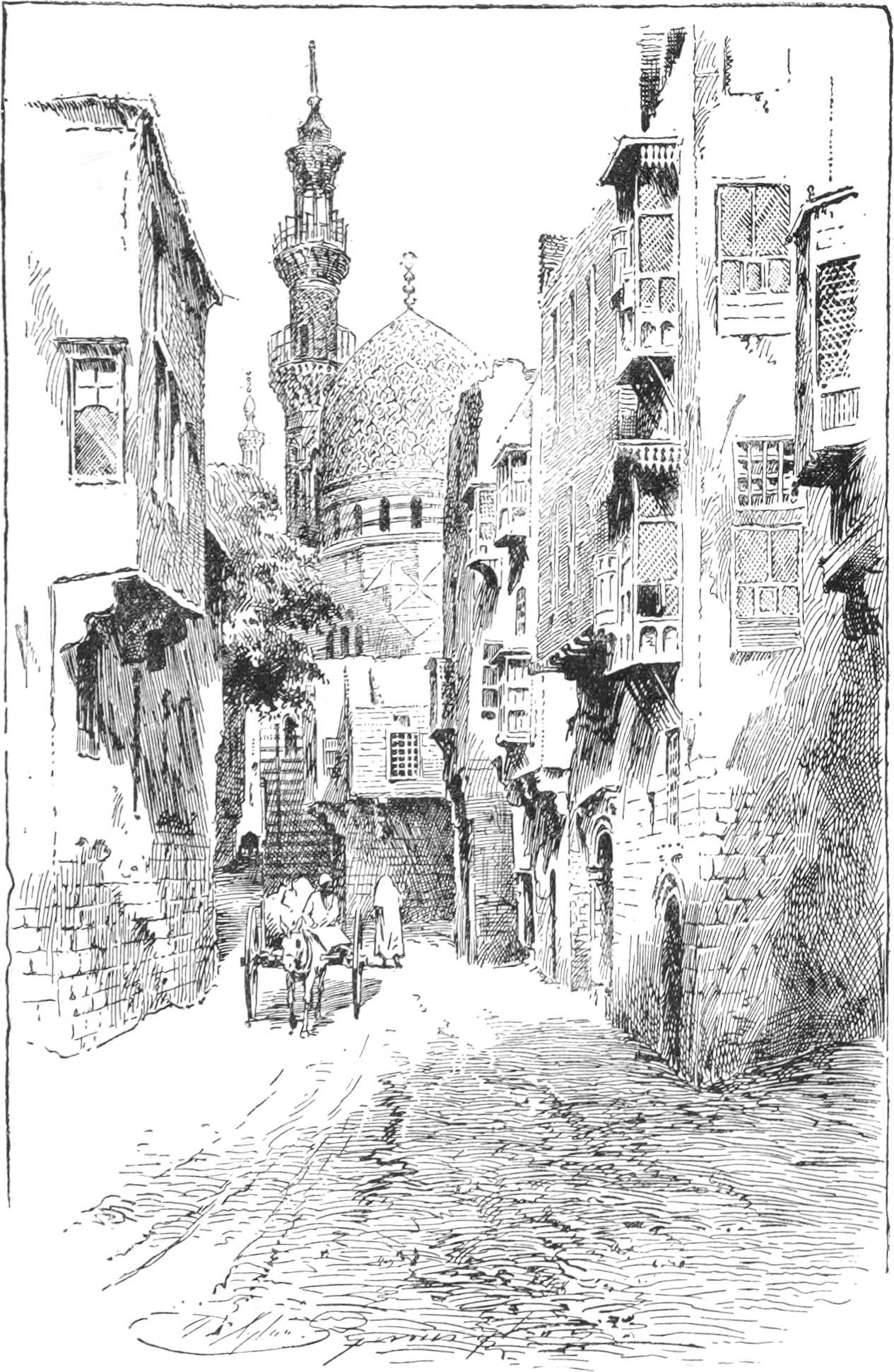
IN THE DARB-EL-AHMAR
The earliest and finest examples of metal work connected with the names of Cairo kings and nobles are of Mosil origin, though very probably made in Cairo in the “Market of the Inlayers” by artists who had been attracted to the court. There was undoubtedly an early Fátimid art of a similar character, but beyond a very few rare examples, such as the Bayeux casket at Paris and some specimens of cut crystal at Venice, we know almost nothing of its style. Under the mamlúk sultans, however, Cairo soon acquired a school of her own, which seems to have possessed traditions coming from a different source than that of Mosil. The Cairo style is what we see on the numerous trays, bowls, cups, censers, and other vessels of the mamlúks of Egypt of the fourteenth and fifteenth centuries, preserved in our museums and private collections. Some points of resemblance to the Mosil work may be noticed, but the new elements are very distinct. The figures of horsemen and seated princes have for the most part disappeared, as it was natural they should when the Turkish princes became habituated to the puritanical prescriptions of Islám concerning the treatment of living things in art; but borders representing beasts of the chase, and a ground covered with[278] wild duck and other fowl, still remain. The prevalence of the duck, which was easily explicable in the swamps of Mesopotamia, finds another raison d’être in Egypt, for the founder of the line of sultans who ruled in Cairo for nearly a century was a Turk of Kipchak, whose name, Kalaún, means in his native Mongol tongue “duck.” We may compare Abbot Islip’s plastic puns on his own name in his chapel in Westminster Abbey. The ornament of the mamlúk metalwork is essentially different in style from that of Mosil. The inscriptions are arranged in broad bands, with large surfaces of silver inlay, divided by medallions filled with the sultan’s name on a fess, or else by some heraldic coat of arms borne by the owner, among which the cup and polo-stick (indicating the court offices of cup-bearer and polo-master), the lozenge, and a curious imitation of a hieroglyphic inscription common on the ancient monuments of Egypt, but doubtless unintelligible to the copyists, are the most usual. Round the medallions are belts of flowers and leaves, reminding one of the designs of Damascus tiles; and similar leaves and flowers, interspersed with birds, cover the ground. The execution is no less admirable than the design. There was no scamped work among these Saracen smiths. They cut away the whole design in the brass, and undercut the edges to hold the thin plates of silver or gold, to be hammered and burnished in, which formed the design; and they chased with the graver every plate of silver, were it only a pin’s head in size, with wings or eyes or floral scrolls—a work of infinite labour; and then they covered the interstices, where the brass showed, with a black bituminous composition which set off the precious metal to advantage. Much of the silver and coating has been lost by wear and time, and it is difficult to realize the beauty of the original state of[279] most of the vessels and trays that have come down to us; but a careful examination only reveals more fully the exquisite skill, care, and fine honest workmanship that no time or injury can destroy.
This art of silver inlay, like architecture and wood and ivory carving and every other variety of æsthetic expression, culminated in the wonderful efflorescence of art and culture in the reign of en-Násir, Kalaún’s son, in the first half of the fourteenth century. Whenever in any museum we see a fine specimen of metalwork, we may be almost sure to find the name of a Násiry emír—that is a courtier or mamlúk of en-Násir—in its inscription, and sometimes even the name of the sultan himself.
The Topographer tells us that in his day, in the early part of the fifteenth century, this beautiful art had fallen into disrepute. It used, he says, to be a favourite taste, and “we have seen inlaid work (keft) in such quantities that it could not be counted; there was hardly a house in Cairo or Misr that had not many pieces of inlaid copper,”—he means brass. A stand of inlaid bowls and plates ranged on a frame of carved wood and ivory was a usual part of a bride’s trousseau, and cost as much as two hundred dinárs. But, he adds, “the art is now lacking in Misr; . . . the demand for this inlaid copper-work has fallen off in our times, and since many years the people have turned away from buying what was to be sold of it, so that but a small remnant of the workers of inlay subsists in this market.”[80]
The art was not dead, however; it had merely passed on elsewhere. The heritage which Cairo received from Mosil was bequeathed to Venice. We have seen that the Venetians were the European agents of the Egyptian merchants, and it is not too much[280] to say that Venice was half an oriental city. Italy was full of Eastern influences. We know that a twelfth century poet lamented that Pisa was “delivered over to Moors, Indians and Turks”; that there was a via Sarracena at Ferrara, and Lucera was deeply tinged with Muslim traditions, dating from Frederick II’s importation of Saracen archers. But Venice felt this influence most of all. Her commerce and colonies brought her merchants into relations with the artistic work of the East; her ambassadors brought home the splendid gifts of the mamlúk sultans; and she soon began to import the artists as well as the art. The opus Salomonis or Jews’ work was the name given to this Saracenic style, often referred to in early romances. Chaucer had heard of it, for he writes in Sir Thopas:—
Especially did Venice excel in the chasing of great salvers in the Saracenic manner, though with considerable differences both in design and in technique. The silver is applied chiefly in narrow threads instead of broad plates, and the designs are chiefly arabesque, whilst the forms of the vessels show marked improvement upon the somewhat crude outlines of the Cairo silversmith. Native Italian artists began to copy the art introduced by Mahmúd the Kurd and his Saracen comrades. They called themselves Azzimine, i.e. workers in the Persian style all’ Agemina—for it has long been the fashion to miscall every form of Saracenic art Persian—and we read of Italian artists, such as Giorgio Ghisi Azzimina of Mantua, and Paulus Ageminius, who excelled in the art which had been imported from Egypt.
We have singled out the silver-inlay from among[281] the arts of mediæval Cairo because it is a branch in which the development can be traced with certainty by a series of dated examples. But the chief decorative arts of the mosque builders were wood-carving and marble mosaic. The beautiful panelled work of mosque pulpits and doors, originally suggested, no doubt, by the necessity of small surfaces in a hot climate where warping had to be prevented, are among the most characteristic forms of Cairo ornament; and the use of variegated marbles in the mihrábs of the mosques produces a rich (if sometimes rather glaring) effect, which was imitated in the dados of the houses of the nobles, now unhappily for the most part destroyed. The extensive use of wood in Cairo architecture is the more remarkable when it is considered how little suitable wood grows in Egypt. On the other hand the dry climate, though it warps, preserves timber for centuries. The original wooden ties of the pillars of Ibn-Tulún’s mosque have stood for more than a thousand years and are still sound, and a portion even of the ceiling of the arcades has been preserved. This wooden ceiling shows that in the ninth century the same method was used as is seen in all periods of Saracenic art previous to the introduction of European styles. It consists of joists of palm trunks sawn in two, with the three exposed sides faced with planks to square the outline. The hollows between the squared joists were divided by cross pieces into shallow compartments or “coffers.” In private houses the joists were often left uncovered in their natural half-round shape. Whether planked or left in the round, the joists and the coffers between were coated with plaster, generally laid on canvas, and the plaster was painted with arabesques in deep blue, carmine, and gold. These coffered ceilings, which may still be seen in many houses, have a wonderfully rich effect with their deep tones of red and blue,[282] lighted up by gold outlines; and the transition from the ceiling to the walls is skilfully masked by arching and stalactite pendentives, richly painted with similar designs. Inferior to the coffered ceilings, but still very effective, are those composed of boards nailed flat across the joists and covered with a thin coating of stucco, worked into arabesque and floral patterns, and then painted and gilt; or with a geometrical design formed by appliqué strips of wood, gilt shaded with red, the interstices being filled with arabesques in painted stucco.
Wood-carving had ample opportunities for display in the pulpits, Korán desks, interior doors and cupboards of mosques. Some of the oldest examples, from the mosques of Ibn-Tulún and el-Hákim, may be seen in the Arab Museum at Cairo, and the deep volutes carved in the panels are clearly of Byzantine origin, resembling the still earlier but undated panels found in the tract of ‘Ayn-es-Síra, south of Cairo. In the thirteenth century the style alters. Instead of the bold foliate designs we find more intricate and delicate ornament distributed in much smaller geometrical panels. A peculiarly beautiful example is the Sheykh’s tomb-casing of 1216, of which one side is in the Museum at South Kensington, and the other three in the Arab Museum. Another is the carved casing of the tomb of es-Sálih Ayyúb (1249):—“the little panels are formed into hexagonal stars and delicately carved, and here appears the representation of fruit-stalks, which is a common feature in thirteenth century wood-carving. The mihráb or prayer niche from the chapel of Seyyida Rukeyya, which belongs probably to the same century, deserves special notice for its characteristic ornamentation of stems branching out of a vase.”[81] But it was under the Mamlúk Sultans, and especially in the great[283] period of en-Násir that wood-carving attained its most exquisite development. Woods of different colours were employed to produce the effect of relief, and inlay was largely adopted in place of carving in the solid block. Sometimes each little carved panel was set in a frame of ebony beading, which was itself carved, and often consisted of two or three distinct frames, one outside the other; whilst the central design was hardly ever the same in two panels out of many hundreds. The amount of careful work demanded in carving and putting together a large surface of this intricate panelling must have been immense. Many beautiful examples may be seen in the mosques, and even finer are the carved doors in wood and ivory panelling in the Coptic churches of Babylon, from which there can be little doubt that the Muslims learnt the art; but to see Mamlúk carving at its best one need not leave London. A large number of the very finest specimens were taken away from their lawful guardians during the reign of the Khedive Isma‘íl, and even earlier, and have found their way to the Museum at South Kensington. There we may study at leisure some of the rich yet not over-elaborate arabesque carvings abstracted from the pulpit set up in the mosque of Ibn-Tulún by Lagín in 1296; others of extraordinary beauty from the mosque of el-Maridány, 1339, absurdly set in the top of a French table; others, probably from the pulpit of the mosque of Kusún, also set in coarse modern framework, but preserving all the delicate grace of the arabesque carvings absolutely intact; and finally the complete pulpit bearing the inscription of Káit-Bey, but from what mosque is not known. The whole forms a singularly rich and beautiful exhibition of Saracenic wood-carving of the best period.[82]
[284]There are differences and even decadence in the series, however, and a careful study of the designs will show that the art reached its highest point in the carvings of el-Maridány, i.e. immediately after the reign of en-Násir. Sheykhú’s pulpit of 1358 is not so good; Sultan Hasan’s is of stone; el-Muáyyad’s of 1420 is distinctly inferior; and even Káit-Bey’s, prince though he was of Cairo builders, is not to be compared with the work of the middle of the fourteenth century. The designs have become less spontaneous, the lines are harder and more mechanical, and (as in stone carving) there is a tendency to repetition utterly foreign to the earlier work. Part of this may be explained by the introduction of ivory as the material for the inlaid panels, for ivory, though capable of even more delicate carving, is less easy to work in flowing lines. But the main cause was probably the preponderating attention given to carving in stone. No sooner does stone become the predominant material for decoration than wood-carving, like stucco-tooling, falls into comparative neglect. The middle of the fourteenth century was the parting of the ways. Stone became the favourite material, and the carvers of wood, if they did not lay aside the graver for the stone-chisel, at least moulded their style upon the harder outlines of the sculptors, and the result was deterioration.
If wood-carving decayed after the middle of the fourteenth century, another branch of woodwork was notably developed. One charming feature of the exterior of a Cairo house is the meshrebíya of delicate turned tracery. There is no reason to doubt that this kind of work is very old, but whether by reason of its fragility or the frequent conflagrations that afflicted the city, no ancient examples have been preserved. The few wooden lattices that still remain in the older mosques are of quite a different style: they are made[285] of stout clumsy quarterings, divided into compartments filled by square or round upright balusters, such as are seen in the tomb of Kalaún. Others are mere grilles of large open squares, with no pretension to artistic design. A finer kind is seen in Lagín’s pulpit in the mosque of Ibn-Tulún (1296), where the mesh is close and the knobs are inlaid and carved. It is curious that the true meshrebíya, with its varied designs and lace-like effect, first appears in the screen of the sanctuary in the mosque of el-Maridány, which also shows the highest development of wood-carving. As the one art decayed, the other improved. There are fine examples of meshrebíya work of the early part of the fifteenth century, as in the pulpit of el-Muáyyad, but it attained its greatest perfection in the age of Káit-Bey, of which a fine specimen is preserved in the pulpit of Abu-Bekr ibn Muzhir. Most of the house meshrebíyas are comparatively modern, though it is impossible to fix their precise date. Their inevitable disappearance is an æsthetic loss that nothing can replace; but it must be admitted that they formed the most dangerous conductors of fire from house to house and street to street that the ingenuity of man could well devise.
There is this to be said about every branch of artistic work of mediæval Cairo, whether it be architecture, carving in wood or stone, metal chasing, or glass—it is always distinctively original. The Saracens brought no art with them; indeed they appear to have been singularly lacking in the æsthetic sense. They learned their arts from their foreign subjects, yet they invariably introduced an element of differentiation which marks their work as characteristically Saracenic. They learned their metal chasing from Persia, but they soon made it their own; they copied Byzantine and Coptic wood-carving, and added the essential personal equation[286] which constitutes a distinct art; they found glass making and blowing in Egypt, acquired the secrets of enamelling and gilding from Constantinople, and then produced a style of enamelled lamps totally unlike any other in the world. It is not only a variation in design or shape that makes the difference: the whole character of the work, in every branch of Saracenic art, is distinct and absolutely sui generis. They were not only wonderful assimilators, they also had the genius of development on original lines. Perhaps the strangest part of the matter is that the highest development was achieved in the troubled times of singularly uncultivated and sanguinary foreign masters. Yet the age of the Mamlúk Sultans was the Saturnian age of Mohammedan Egypt in art and also in literature. For it must not be forgotten that some of the greatest names in Muslim theology, jurisprudence, criticism, and history were associated as kádis or professors with the mosques and medresas of Cairo, and that the mamlúk period produced or encouraged such writers as Ibn-Khaldún, Nuweyry, Ibn-Dukmák, Makrízy, Ibn-Hagar, el-‘Ayny, Ibn-‘Arab-shah, Abu-l-Mahásin, es-Suyúty, and Ibn-Iyás, who either were born in Egypt, or, like Abu-l-Fida, spent many years in Cairo. The fifteenth century was perhaps the most prolific period in Egyptian literature, and this activity was more than rivalled in the neighbouring province of Syria under the same sultans.
[287]CHAPTER IX
Beys and Pashas
NO one has had the heart to write the history of Egypt during the three centuries of its subjection to the Sultans of Turkey, from its conquest by Selím the Grim in 1516 to Mohammad ‘Aly’s foundation of a virtually independent dynasty in 1805. The annals of this period are monotonous, and the great figures of the earlier mamlúk period are wanting. The whole action seems to be played upon a smaller stage by inferior performers. The incentives to public spirit supplied by foreign wars were withdrawn from a merely provincial government, and the profuse expenditure and sumptuous luxury of a sovereign court no longer stimulated art and handicrafts or quickened the emulation of the emírs. The cramping influence of dependence and the grasping fiscal policy of the Ottoman empire destroyed much of the old magnificence of the mamlúks. Yet there was no such vivid contrast between Cairo under the pashas and the city that Makrízy describes as has sometimes been imagined. Everything in the East changes by almost imperceptible degrees, and the mills of God in Egypt grind with the tedious slowness of the creaking sákiyas of the country. Deterioration there was, but it came very gradually. The emírs were still the dominant power, and the chief difference was that instead of a sultan elected by themselves they had over them a pasha appointed[288] by the Sublime Porte. The pasha’s authority was checked by a council of mamlúk emírs—or beys, as they came to be called—and he was frequently deposed by them or by the intrigues of the mutinous soldiery. Though a pasha might arrive with a suite of twelve hundred persons, and scatter handkerchiefs full of gold coins on festal occasions, he could seldom make head against the military oligarchy. The chief mamlúk, or sheykh-el-beled (mayor of the city) as he was entitled, was a far more powerful personage than the pasha. The emírs were much what they had been under the Circassian dynasty: they were not the same men, because Selím had massacred as many as he could catch, but they were similar—Turks, Georgians, Circassians, risen from slavery to office and rank,—and they maintained great state in their palaces beside the Ezbekíya lake or on the Birket-el-Fil, in the Crossway, or the Street of Arms; were followed by large bands of retainers, and carried on their jealousies, civil wars, and street fights with as much fervour as before. A new element of discord was introduced by the Turkish battalions of ‘Azabs and Janizaries in the Citadel barracks, and the commanders of these troops became the most powerful emírs in Egypt. But these too were of precisely the same character as the earlier mamlúks, and save for the absence of a controlling influence such as a strong sultan sometimes exerted, but a delegated pasha almost never, there was little to choose between the state of Cairo under the new régime and its anarchic condition under the impotent direction of most of the later Circassian kings.
Egypt in fact was still ruled by mamlúks. Its pashas were perpetually changed, and lived in terror of their own garrison; the emírs held the real power, and used it in the old way for their own benefit and for the ruin by exile or execution of their rivals. They[289] formed themselves into powerful cliques, such as the Kásimis and the Fikáris, and their retainers fought each other in the streets, and besieged the government ‘Azab troops for months together. They had already discovered that the Citadel could be commanded by artillery on the hill behind. We read in Gabárty’s chronicle of bands of troops fortifying themselves in the mosques of Ibn-Tulún, Almás, Mahmudíya, and so forth, and discharging cannon balls from the adjacent minarets. The anarchy at times was indescribable; streets were deserted, houses plundered, and no man dared to go as far as Bulák or Old Misr; then followed an interval of tranquillity assured by the temporary supremacy of some great lord. It is difficult to discover any very notable distinction between these later emírs and those of the golden age of mamlúk civilization. Their opportunities were less, because they could no longer carry on wars in Syria or Asia Minor in their own behoof, for the contingents that were constantly drafted in Egypt for foreign service were merely employed as an insignificant part of the Ottoman armies. But their characters, occupations, and tastes appear to have been much what they had been for the preceding two centuries. There was a difference in degree but not in kind: they were not as a rule such big men with large opportunities as their forerunners, but in race, in character, in action, they were the same.
Indeed some of them were remarkable personages fit to compare with those of the old school. ‘Othmán Bey Dhu-l-fikár, for example, in the first half of the eighteenth century,—after playing a bold part in the faction fight that centred round his patron Dhu-l-fikár Bey and Cherkes Bey, and seeing eleven emírs of rank done to death in the palace of the Defterdár, himself narrowly escaping with a sabre-cut in his turban,—became[290] the most eminent noble in Cairo, with power to raise his own mamlúks to the rank of emír. He was chief of the pilgrimage (emír-el-hagg), one of the most coveted posts in Egypt, in 1739; and when ‘Aly el-Gelfy the deputy[83] was assassinated, ‘Othmán Bey deposed the pasha and appointed Rudwán to be deputy over the ‘Azab battalions. ‘Othmán was the first emír who ventured to invite the pasha of Egypt to a feast in his palace, and the other nobles were completely subject to him. He held a court in his own house to decide causes of complaint, and, incorruptible himself, he severely punished any cases of extortion or oppression that came before him, watched the market-inspector closely, prescribed a fixed tariff for bread and other necessaries of life, and insisted on the due payment of pious benefactions to their proper uses. Lofty in character, of noble ideas and thoughts, just, able, disinterested, of honest life, and proud as Lucifer, he left such an impression behind him, when the intrigues of his rivals banished him from Egypt, that he created an era: one heard people say, “such a thing happened so many years after the departure of ‘Othmán Bey,” or “I was such and such an age when ‘Othmán Bey left.”
Rudwán el-Gelfy, just referred to, was another notable figure of the eighteenth century. Whilst he and another deputy, Ibrahím, held office, the country enjoyed absolute peace, food was cheaper than was ever known before, and plenty reigned in all classes. In those days every great man kept open house twice a day, noon and evening, in a spacious hall to which all might enter. The lord and his guests sat at the head[291] of the table, and his mamlúks and followers lower down, as it were “below the salt,” and it was held disgraceful to refuse admission to any stranger who presented himself. On feast days great dishes of rice and honey or milk were distributed to the poor, and sweetmeats were served on Fridays and festivals. One of Rudwán’s houses was on the Ezbekíya, on the border of the lake (as it then was, at least at high Nile). Its halls were surmounted by cunningly designed domes, in which gold arabesques on a blue ground harmonized with stained glass of many colours in charming combination. He built kiosks in a garden beside the canal, where he had laid out a lake and cascade, and there, when his ambition was satisfied, he took his pleasure, which savoured, it must be confessed, of debauch. Indeed Rudwán was no stern moralist, like ‘Othmán Bey, but allowed a considerable licence to the fair ladies of Cairo. The police had his orders not to disturb them or baulk their admirers,[84] and “Cairo then resembled a land of gazelles, a paradise of houris and darlings; its inhabitants drank their fill in the cup of delight, as though there were no reckoning to be paid on the day of judgment.” No wonder that poets sang his praises in such verses as “the Impurpled Wine” and “the Perfume of Paradise.” Rudwán’s palace is no more to be seen in the Ezbekíya, but his gate, the Bab-el-‘Azab, leading into the Citadel from the Rumeyla, preserves his memory. His end was tragic. Conspirators surrounded his house in the street of Kusún, and bullets began to pour in whilst he was engaged in the meditative process of having his head shaved. He fought while he had strength, and then, with a broken leg, struggled on horseback and fled to die in upper Egypt. He was the last great commander of the ‘Azabs.
[292]It was not only the emírs who owned such splendid houses as Rudwán. Another house on the Ezbekíya belonged to a famous merchant, Ahmad esh-Sharáiby (the apothecary), whose family had produced emírs and owned mamlúks. They possessed immense wealth, and they used it as high-minded, honest gentlefolk. Learned men frequented their house, which was full of rare manuscripts as well as ordinary works of reference. Whatever book was in the market, if it was not in their library they bought it regardless of the price; and once there it was immediately placed at the disposal of every visitor. A scholar was sure to find any book he required in the Sharáiby library, and he was at liberty to carry it off on loan, or even to keep it altogether; for the princely merchants would never think of asking its return, but would merely seek out and buy another copy. From the scholar’s point of view it seems impossible to improve upon this system. The members of this family were more than enlightened book collectors and book lenders: they were strict observers of the austere rule of the Málikis, tenacious of sound morals, and exclusive in their connexions. They married only among their own large family circle, and their daughters never left the house except when they were married or borne to their grave. It was well to be cautious in days when the luxurious Rudwán was encouraging amatory adventures, and when a party of high-born dames, riding out to “smell the air,” as Cairo ladies do now, at the proper season, were set upon near the Ezbekíya and stripped of their jewels and every garment they had on. But the Sharáiby folk, though strict, could unbend. When marriage feasts were afoot, for example, they gave splendid entertainments, but so careful were they of their daughters that they waited till all the guests were[295] safely engaged in prayer at the mosque of Ezbek[85] opposite the house, and then hurried the bride off to her husband’s abode under guard of a discreet body of matrons: after which there was plenty of gunfiring and torch waving, and all was merry.
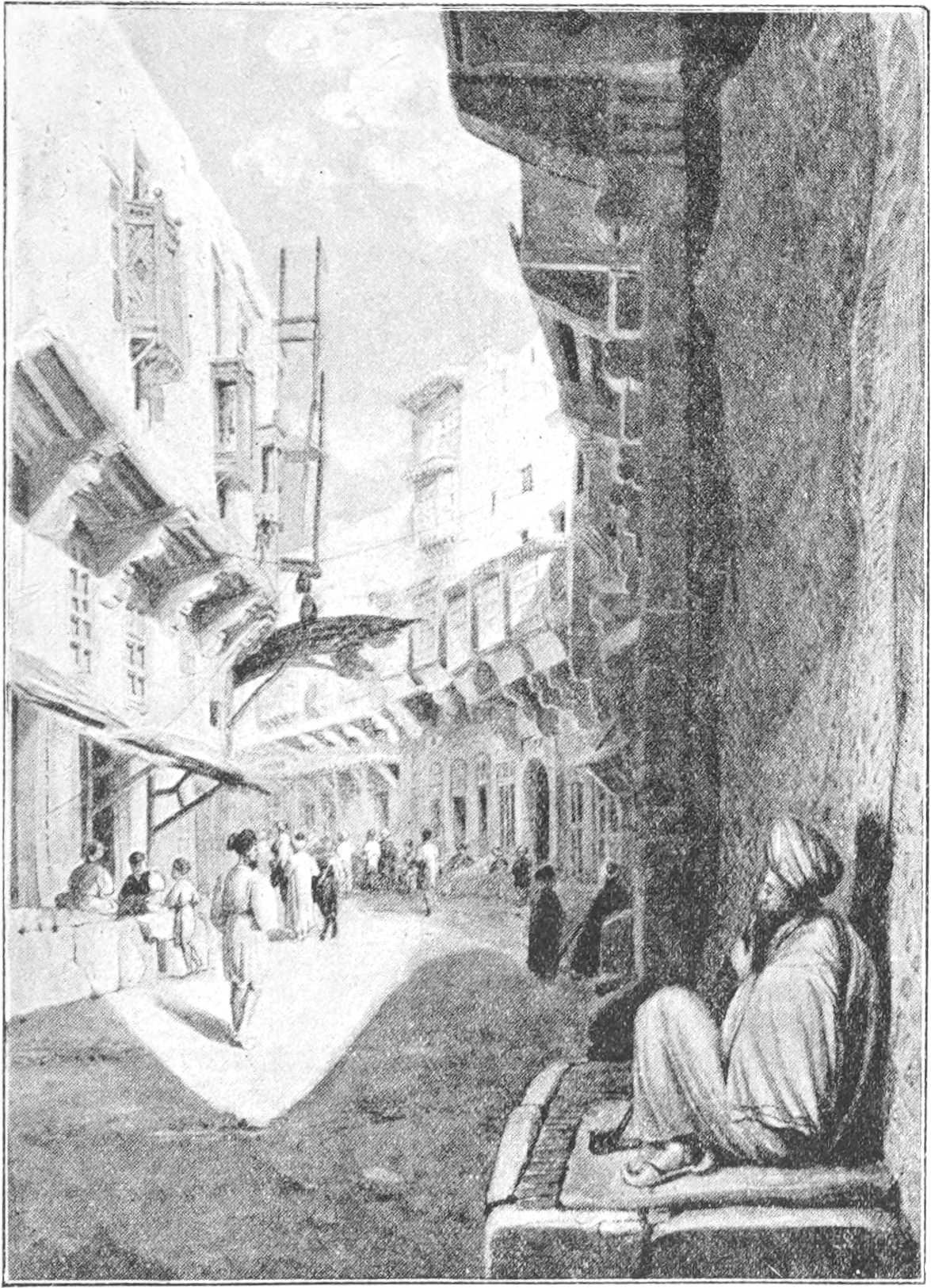
STREET NEAR BAB-EL-KHARK
The family had the custom of appointing one of their number trustee of all their property and business. It was his duty to collect the rents, gather the harvest and crops, receive the profits of their ventures, and pay all expenses, including the family’s dress and pocket-money. At the end of the year he drew up his balance sheet and paid each member his share. This excellent plan was not likely to last for ever, and one is not surprised to learn that at last the younger members quarrelled over the accounts, and the joint-stock company broke up in disorder. This was no doubt an exceptional family; but there were many of the kind, and there are some yet in Cairo, sterling honest folk, who walk in the old paths and guard a severe self-respect.
The zeal for books displayed by this family casts an interesting light upon the education and learning of the times. During the earlier mamlúk days many important libraries had been formed in Cairo, partly from the spoils of Syrian mosques, and if we are to take as evidence the long biographies of numerous sheykhs, professors, divines, historians, and poets, related with enthusiastic admiration by el-Gabarty, there was a vast deal of intellectual energy expended in Egypt in the seventeenth and eighteenth centuries, though perhaps it was hardly in the first rank of original genius. He reports a curious conversation, however, in 1750, between Ahmad pasha, a governor of mathematical tastes, and the sheykh ‘Abdallah esh-Shubrawy, of[296] the Azhar. The pasha remarked that he had continually heard of the wonderful merits of Egypt as the home of learning, but he would like to see the results. “True, O my master,” replied the sheykh, “Egypt is as you have heard, the mine of sciences and knowledge.” “But where are they?” asked the pasha. “As far as I can see, you know nothing but law and metaphysic and other less important studies, and disdain practical science altogether.” The sheykh had to admit that at the Azhar they did not teach mathematics, beyond arithmetic, which was useful for the law of inheritance. “How about astronomy?” suggested the pasha. “It is needed for the hours of prayer, times of fast, and many other things.” The sheykh admitted that few studied astronomy, which demanded special aptitudes, and instruments, and physiological conditions, and a “sweet and tranquil disposition,” for its proper pursuit; but he said he could find the man whom the pasha wanted, though not in the Azhar. When the man appeared, it seems his arithmetical problems delighted the governor, who gave him a fur cloak, which the sage afterwards sold for 800 dinars. He drew beautiful sun-dials, on marble, to show the hours of prayer, with appropriate mottoes, and two of these were set up in the Azhar and on the roof of the mosque of the Imám esh-Sháfi‘y.[86] One gathers from this anecdote, as well as from the lists of works described by the historian, that study in Cairo at that time was rather zealous than profound, and that learning was decidedly in its decadence.
Religion, on the other hand, was more powerful[297] than ever. The annals of the pashalik are full of references to the influence of the Azhar professors and of the seyyids, and we hear of something very near a revolution when a Turkish preacher got up in the mosque of el-Muáyyad and fulminated against the invocation of saints, a popular accretion which is certainly no part of the creed of Mohammad. The preacher urged the crowd to demolish the cupolas over the saints’ tombs, and the orthodox professors of divinity had much trouble to silence him and appease the crowd. There was often a very severe regulation of public behaviour in deference to religious notions, and we find, for example, a stern prohibition of smoking in the streets. Police marched up and down three times a day, and if any smoker was caught he had to eat his pipe-bowl. An old custom, mentioned by Násir-i-Khusrau (above, p. 109), was still in force: a man who had falsified documents was paraded on camelback through the streets, whilst a crier proclaimed, “Behold the punishment of forgers!” The Cairenes were clearly very superstitious, and when in 1735 a circumstantial rumour went round that the Resurrection would certainly take place on the next Friday, in two days’ time, they bade each other last farewells, and wandered about the fields and roads saying good-bye to the land they loved, whilst the people of Giza, moved by a superstition which ran in their minds from ages long before Islám was discovered, bathed hysterically in the Nile, both men and women. There was nothing but panic and repentance and prayer till Saturday—when behold! nothing had happened.
An age that attached so much importance to religion was not likely to neglect its shrines. It is a mistake to ascribe the ruin of so many of the mosques of Cairo to the period of the Turkish pashas. On the contrary, the danger was that they might be “restored” out of[298] all knowledge. Cairo is full of “Turkish” mosques, that is Turkish of the Othmanly style, which, if they cannot compare with the buildings of the earlier mamlúks, are nevertheless very creditable examples of their kind, and far superior to anything built, say, in England, during the past century. Indeed the mosques of Seyyida Safíya (1604) and of Mohammad Abu-dh-Dhahab (1774), are exceedingly noble buildings, and that little gem of Turkish mosaic work, el-Burdeyny, is beautiful in its own way. The architects of the Ottoman period abandoned the medresa style introduced by Saladin, which, as we have seen, had lost much of its original cruciform plan when the medresas were used as congregational mosques under the Circassian Mamlúks; but, whilst reverting to the older and simpler plan of the gámi‘, they modified it by substituting cupolas of Byzantine form for the level ceilings which formerly covered the sanctuary. In fact, the Ottoman mosque is practically a basilica. A special feature of the mosques and restorations of the Othmanly period is the introduction of faïence. The medresa of Aksunkur was restored by Ibrahím Aga in 1652, and the whole east wall covered with fine blue tiles, chiefly of the Damascus style, with a few so-called Rhodian, probably from Constantinople. It was not often that restoration proved so successful, and one has frequently to deplore the patching of Turkish additions upon the old masterpieces. Ahmad pasha restored the then dilapidated mosque of el-Muayyad in 1690; another pasha built the Arba‘ín mosque by the Karameydan Gate in 1704; Ahmad the deputy restored the Fátimid mosque of ez-Záfir, known as el-Fakahány, in 1735.
But the prince of restorers was ‘Abd-er-Rahmán Kiahya (Ketkhuda), who enjoyed great influence before the time when ‘Aly Bey—himself the restorer of the dome of the tomb-mosque of Imám Sháfi‘y and builder[299] of the Bulák bazar—deposing the reigning pasha made himself king of Egypt from 1768 to 1772. ‘Abd-er-Rahmán’s father, ‘Othmán Ketkhuda, had architectural tastes. Out of his very ill-gotten gains he built his mosque, school, and fountain by the Ezbekíya lake, and on the day of opening filled the great central basin and all the ewers he could collect with sherbet for the congregation. He also built the school for the blind at the Azhar, and other benefactions. His son, however, far surpassed him. Every tourist knows his little sebíl—elegant like its founder, who was dainty in person and dress, and very fair—at the end of Beyn-el-Kasreyn, with its tiles, and open arched school above; but this was the least of his works. He built a mosque outside the Bab-el-Futúh, and another by the Bab-el-Ghureyyib, with a cistern, fountain, and school; a great reservoir, with fountain and school, near the Ezbekíya cemetery, for the sakkas or water-carriers; rebuilt the chapels of Seyyida Zeyneb and Seyyida Sekína, and erected others near the Karáfa Gate, in the Musky, in the Hoseyníya quarter, and in the ‘Abdín street, etc. Of his restorations the best known is that of the Azhar, which owes its present aspect largely to ‘Abd-er-Rahmán’s work. He put in fifty marble columns supporting groins of faced stone covered with costly woods; erected a new mihráb and pulpit, built the two archways, one with a school for orphans above it, the other with a minaret; set up a tomb in the court, added libraries, reading-rooms, kitchens, and other apartments for the benefit of students from Upper Egypt; enlarged the Taybarsíya and Akbughawíya medresas attached to the Azhar, and built the splendid portal between them, opposite the wekála of Káit-Bey; furnished riwáks (or partitions) for students from Mekka and from the Sudán; and settled rents in trust for the maintenance of these[300] benefactions, besides giving every day in Ramadán to the Azhar kitchen a large quantity of rice, butter, oil, and meal for the evening refreshment of the students after the day’s fast. ‘Abd-er-Rahmán also restored the mosque of the Imám Sháfi‘y, and paved the corridor with variegated marbles; repaired the tomb of Seyyida Nefísa and the Maristán of Kalaún (then a madhouse), but after pulling down the dome he neglected to rebuild it, and merely boarded it over, and so it remains to this day. He took great pains to trace the bequests left by the founder and his successors to the hospital, and succeeded in recovering the title-deeds and restoring the revenues. By whatever means he acquired his wealth, and it was said the means were not above suspicion, there was no end to this man’s charitable acts. At winter time he distributed woollen clothes to crowds of the blind, who always abound at Cairo, and also to the muezzins to protect them from cold when chanting the nightly calls to prayer. The poor clamoured about his door in the evenings of Ramadán, waiting for the plates of food which were never refused, and after the meal they went away happy with two loaves and two paras ready for next day’s breakfast. Altogether, ‘Abd-er-Rahmán Kiahya built or rebuilt eighteen mosques, besides chapels, fountains, schools, bridges, and every sort of edifice. He had an architectural passion, and fortunately excellent taste in its gratification, and the people well named him “the great benefactor.” He died at Cairo in 1776 at a great age, after twelve years’ exile in Arabia; for all his charity could not protect him from the suspicions of ‘Aly Bey. All the ‘ulema, professors, students, and poor of his numerous benefactions, escorted his splendid funeral to the Azhar, where he lies in the tomb which he had built near the south gate.
The last great mosque built during the period of the[301] pashalik was that of Mohammad Bey, known as Abu-dh-Dhahab, or “father of gold,” from his munificent way of scattering gold coins among the crowd. He was the favourite and trusted mamlúk of the great ‘Aly Bey, and he rewarded his patron by manœuvring his downfall and exile, and finally accomplishing his death. He was a brilliant soldier, fought successful campaigns in Arabia and Syria for his master, and achieved extraordinary popularity by his delightful manners and open hand. Egypt had peace whilst he held the reins of power, and the Sublime Porte, whilst appointing pashas as before, wisely left the real authority in the hands of the capable and popular emír. In 1774 Mohammad Bey founded his handsome medresa opposite the Azhar, and there he lies in his tomb. It was built on the plan of an earlier mosque at Bulák (the Senaníya), and was “a marvel of architecture and richness: gilded ceilings, marble porticoes, and stupendous dome, with bronze dormers admirably worked,” etc. There were porticoes for the Hanafis, Málikis, and Sháfi‘is, and celebrated doctors came to profess the law there, and, contrary to the usual custom, received salaries, some as much as 150 paras a day (you could sometimes buy a pound of meat for 2 paras), and none less than 10 paras a day and an annual gift of 50 bushels of corn. On the day of opening the great man clothed the divines with cloaks of sables or white fur, according to their rank—a handsome form of university hood.
Mohammad Bey’s is the last of the great mosques of Cairo, with the exception of Mohammad Aly’s sumptuous and very effective mosque in the Citadel, where it forms a conspicuous feature in the view from every side. This, however, is too obviously a foreign importation, a child of Stambúl, to harmonize with the true Cairo style, and, though it is perhaps a narrow[302] prejudice, we confess we can never quite reconcile ourselves to Ottoman architecture in the old mamlúk city.
Enough has been said to show that it was not during the rule of pashas and beys that the mosques of Cairo suffered damage or demolition. They were well cared for. Their evil day came when Mohammad ‘Aly, a second but more successful ‘Aly Bey, made himself master of Egypt and inaugurated a new régime, compared with which the rule of the sternest of the mamlúks was mildness itself. It was Mohammad ‘Aly, who, in 1808-1810, laid hands on the Wakfs or religious endowments, which the piety of many centuries had placed in trust for the maintenance of the mosques and colleges of Egypt, and amidst the tears and curses of all the ‘ulema of Cairo, deprived them of the right to control the sacred monuments confided to their charge. From this act of confiscation, when title-deeds were lost or destroyed, and trust-funds confused and malversed, dates the most serious decay of the monuments of Cairo. The Europeanizing movement of the nineteenth century, inevitable, and in many ways most desirable as it was, brought with it a large destruction of mosques and other historic buildings which impeded carriage-traffic or stood in the way of the new streets and squares which the viceroys of Egypt planned with little or no regard to existing antiquities. The Shari‘ Mohammad ‘Aly was the most flagrant example of a street cutting its way remorselessly through historic monuments, but similar vandalism occurred in almost every part of the city, and the department which attends to the alignment of the streets has often exercised its powers in the narrowest spirit of county-councildom. That much worse has not happened is wholly due to the vigilance and firmness of the[303] “Commission for the Preservation of the Monuments of Arab Art,” an official body in which happily large powers are vested, and to which we owe the maintenance of a multitude of Saracenic monuments of every class and all periods, which, but for its timely interposition, would now have disappeared or have been on the high road to ruin. It is impossible to over-estimate the excellent and patient work of the Commission. The seventeen annual reports it has issued—solid volumes, with plans and illustrations—form a library of valuable information, and testify in every page to the care and sense of responsibility shown by the members. I may here be permitted to quote a report on the results and methods of the Commission which I made at Earl Cromer’s request in 1895, and which was published in his annual survey of the progress of Egypt presented to Parliament in 1896.
The Athenæum, London, December 12, 1895.
“My Lord,—In accordance with your Lordship’s invitation, I have the honour to submit a few remarks on the work of the Commission for the Preservation of Arab Monuments, of which I made a detailed examination in the summer of this year.
The Commission was instituted by Decree of His Highness the late Khedive on the 18th December, 1881. Its duties were:—
1. To make an inventory of the Arab monuments of Egypt which possess historical or artistic interest.
2. To watch over the preservation of these monuments, and report to the Minister of Wakfs such repairs as were considered necessary for their maintenance.
3. To prepare plans for such repairs and scrupulously superintend their execution.
4. To see that plans of all the work executed should[304] be preserved in the Ministry of Wakfs, and to indicate any fragments or detached objects which should be transferred to the Museum of Arab Art.
Political disturbance prevented much being done before the close of 1882; but when I made a general inspection of the Arab monuments of Cairo in January to March 1883, the Commission was in working order. I was then able to see the beginning of its labours, and am therefore in a position to compare the state of the monuments at the time when the Commission first took them seriously in hand with their present condition after the Commission has been over twelve years at work.
I can state with confidence that, comparing the general state of the mosques in 1883 and 1895, they are in a far safer and better preserved condition now than they were twelve years ago. Several monuments that then seemed inevitably doomed to destruction have been strengthened and supported, and, generally speaking, weak places have been detected and repaired, whilst a more vigilant supervision and protection against vandalism and robbery now prevail. These happy results are especially due to the energy and archæological or technical knowledge of the late Rogers Bey, of Franz Pasha, and of his Excellency Yakub Artin Pasha, whose name will always be honourably associated with the intellectual progress of Egypt. Some of their French colleagues have also rendered useful services from time to time, and the presence on the Commission of successive Under-Secretaries of Public Works, and notably at the present time of Mr [now Sir] W. E. Garstin, has proved a valuable source of strength. The most vital appointment under the Commission is, of course, that of the Architect, who surveys the monuments, recommends such repairs as are necessary or desirable, and personally superintends their execution.[305] Since the creation of the Special Department (Bureau Spécial) of the Commission, which was separated at the beginning of 1890 from the Bureau Technique of the Wakfs, Mr Max Herz [Hon. F. S. A.] has been the Architect in charge of the work of the Commission, and it is bare justice to say that to his industry and considerable technical and archæological attainments much of the present improved manner of supervising and preserving the monuments is undoubtedly due. Herz Bey joins to the technical training of an architect a familiarity with the history of Arab art, together with a genuine enthusiasm for his work. His “Catalogue of the Arab Museum,” published this year in French, but shortly to be reissued in an English translation [published, 1896], furnishes proofs of an extensive study of the periods of development of Arab or Saracenic art, and of the literature, Arabic and European, relating to this subject; and the complete restorations he has made of a few of the smaller mosques are evidence of his insight into Arab construction and decoration, of his technical skill, and of his scrupulous fidelity to the original design. On this vexed subject of restoration, however, I shall have something to say later; but whatever may be thought of the principle, it is impossible to doubt that in the appointment of Herz Bey the Commission has been exceptionally fortunate.
Preservation. It must never be forgotten that the prime duty of the Commission is the preservation, not the restoration, of the monuments. A fairly complete list of the monuments which, on historical or artistic grounds, ought to be preserved has been drawn up by Sub-Committee 1, and the first obligation laid upon the Commission is to watch over the preservation of every monument in this list. So far as my[306] observation went, its members are clearly alive to this obligation, and have endeavoured to fulfil it as far as their limited funds permitted. To enumerate the long catalogue of repairs, from the stablishing of the entire walls of a mosque to the removal of whitewash or dirt from a carved inscription or a mosaic, would extend these notes to an undue length. The details may be read in the excellent Annual Reports of the Commission, which, if they are scarcely as prompt in their appearance as they might be, leave little to be desired in point of accuracy or completeness. Much more, however, remains to be done, and many of the repairs already executed can only be regarded as temporary cheap make-shifts, pending the possibility of more thorough works when finances permit. The adequate and enduring preservation of the monuments is essentially a question of money. The Commission and its Architect know what ought to be done, but they cannot do it without an increased staff and a larger budget.
Meanwhile, there are two or three points to which the attention of the Commission should, I think, be specially and immediately directed, since they can be dealt with even on the present insufficient annual grant.
1. In cases where a thorough repair would be too costly to be undertaken on the present budget, there is a mode of preservation, in a literary and artistic sense, which ought to be invariably adopted when there is any risk of further immediate decay. The great mosque of Sultan Hasan is an instance in point. In such a case, where many thousands of pounds would be required for substantial preservation, the Commission cannot at present entertain the plans which have been drawn up for so elaborate a work. But what they can do is to prepare an exact record of the[307] present state of the mosque, to draw full architectural plans and elevations, photograph every detail of ornament or inscription, reproduce mosaics and other coloured decoration in the colours of the originals, and generally to make it possible at any time to reproduce the entire mosque in its true proportions and exact details of ornament.[87] To students of the history of Arab art such a record would be invaluable, whilst it would make the task of preservation possible even should want of funds postpone the work till the mosque had fallen into much more lamentable decay. To prepare such records would necessitate an increase in the staff of the Commission, but if the memoirs were published, with adequate historical introductions and explanations, the sale would probably repay a large part of the expense. At the same time, these records should not of course be regarded as a substitute for actual preservation, or as a reason for deferring necessary repairs. They should be used merely as a safeguard against the total or partial obliteration of a monument by a sudden catastrophe (which might happen any day to one of the minarets of Sultan Hasan), not as a ground for refusing to avert the ruin.
2. Another and much simpler precaution should be taken in the case of the numerous small mosques of Cairo which are more or less roofed in. These have generally windows of open tracery, or grille-work, and often a small opening in the centre over the court. The central opening should be covered with glass to keep out the weather, and the open windows should invariably be furnished with wire-netting outside to exclude the birds, which do much mischief in the[308] interiors. All covered-in mosques require frequent inspection with this view, and every cranny which could admit rain or birds should be carefully stopped.
3. A more expensive but absolutely necessary step is the compulsory expropriation of the shops or booths which cling like limpets to the façades of many of the mosques. The proprietors of these shops use the mosques behind as dust-bins, and throw their refuse and broken crockery through the windows. The appearance of the mosques, both inside and out, is seriously impaired by these excrescences which narrow the street (e.g., the Suk-en-Nahhasin), impede traffic, and prevent the façades of the mosques being seen in their true proportion and effect.
In order to avoid the risk of any historical monument being overlooked and neglected, it would be well if the Commission were to divide Cairo into a certain number of definite quarters, and that the scheduled monuments in each quarter should be periodically visited by the Sub-Committee of Inspection and the architect at least once a year. The number of monuments in the list is so large, that it might be impossible to arrange more than one or two inspections of each in every season. Such visits should be recorded, with notes on the condition of each monument, in a special book.
An important question is that of the private monuments, whether mosques, houses, sebils, wekalas, or other buildings. The Government apparently has no power either to compel owners to maintain and preserve the historical buildings which they inhabit or let, or to force them to sell. The few mediæval houses still standing in Cairo are artistically more valuable than the mosques maintained by private wakfs, for they form almost the sole remaining examples of the domestic style of Arab art. It is greatly to be wished[309] that they could be brought under the control of the Commission, and if due compensation were made for ejectment or interference, the owners would have little ground for complaint.
Restoration.—The Commission has not confined its labours strictly to preservation, it has also undertaken the complete restoration of several monuments. There is a well-founded prejudice in artistic and archæological circles against restoration of any and every description; but I believe that an examination of some of the recent restorations carried out by Herz Bey would remove these natural and generally just apprehensions. This architect’s principle, as he explained it to me, appears sound and reasonable. It is this. No unique monument (e.g., the Mosque of Ibn-Tulun) or monument belonging to an architectural period of which there are very few examples (e.g., the Fátimid Mosques), must on any account be restored; preservation is the only possible treatment for such cases, and nothing more must be done than is absolutely necessary for the stability of the building, and its security from weather and other injury. But when there are numerous mosques of the same period, nearly resembling one another in style, and often even in detail of ornament (e.g., at the period of Kait-Bey), then a few may safely be selected for complete restoration at all points, so as to present as nearly as possible their original appearance, as when first opened for public worship. Herz Bey has given a few examples of his theory of restoration in mosques of a well-represented period. They are not equally successful, and it is evident from the latest specimens that experience has taught him much, especially in regard to colour. But I think the most rigid opponent of restoration would find very little to criticize in the careful and beautiful manner in which the little mosque of [Kády] Abu-Bekr ibn[310] Muzhir in the Bargawan has been restored to almost its original condition; and whatever may be said about the tampering to which the mosque of el-Muayyad was subjected under a former régime, there is no doubt that the inscriptional frieze and the painted ceiling have been restored as perfectly and as scrupulously as skill and knowledge could attain. I can assert from personal observation that nothing can exceed the care and precautions which are observed by the architect of the Commission in order to make sure that he has really discovered the original design and colouring beneath centuries of dirt and whitewash, or the pains he takes to reproduce them faithfully. And I may here observe that the staff of the Commission includes workers in metal and wood, who are able to copy the designs so accurately, that it is almost impossible to distinguish them from the originals. (They are not yet successful in stained glass, however.) This merit has the obvious drawback that, unless great care is taken, the details of the monuments (e.g., the bronze bosses and plaques on doors, or the wood and ivory carvings and inlay work of doors and minbars) may be falsified.
In recent restorations of Arabic inscriptions the inscription itself is made to tell the date of its restoration; but many small details of ornament are not distinguished at all from the original work whose gaps they supply. This defect calls for immediate correction before the distinction is forgotten by the restorers themselves. Every plaque of metal or panel of wood or mosaic should bear an unmistakable distinguishing mark, such as the date of restoration in Arabic cyphers; and detailed plans of all restored monuments should be preserved in the archives of the Commission, in which the new portions should be clearly distinguished by colour or shading. If this[311] rule is carefully observed I confess I can see nothing but advantage in the complete restoration of a limited number of mosques under the restrictions already mentioned. When the work is executed with the skill and honesty which one observes in the case of the Mosque of Abu-Bekr ibn Muzhir, there is no falsification but rather preservation in the most complete and satisfactory sense. The beauty of these restored mosques seems to appeal to the eyes of the worshippers, and there is no doubt that the Mosque of el-Muayyad has been far more frequented for prayer since its liwan was restored to something of its original beauty and richness of gold and colour. This is a consideration to which the Ministry of Wakfs can hardly fail to attach considerable importance. At the same time there is possibly some risk of the vital work of preservation being sometimes neglected in order that restorations, which are naturally more interesting and effective to both the architect and the public, should be carried out.
At present there are five mosques in course of restoration,[88] viz., those of Zeyn-ed-din Yahya, near the Musky; Gami‘-el-Benat; of Asunbugha, in the Darb-es-Sa‘ada, and of Kagmas el-Ishaky; besides el-Muayyad and Abu-Bekr ibn Muzhir, which may be regarded as finished. Two of these mosques, however, are private wakfs, and are being paid for by private persons. Still, in my opinion, enough restoration has been undertaken for the present, and the chief attention of the Commission should be directed for the next two or three years to a fresh and complete examination of all the monuments on their list with a view to their thorough preservation. At all events the selection of a new mosque for complete restoration should be a subject of anxious thought, and should not[312] be lightly undertaken. Restoration, it must be remembered, is costly, and cannot judiciously be embarked upon so long as the funds of the Commission are scarcely sufficient for preservation alone. . . .
Such, my Lord, are the conclusions which suggested themselves to me after my inspection of the results of the Commission’s labours. I have confined my remarks to Cairo, because I had no opportunity this year to examine the work that has been done in other towns of Egypt. In Cairo, as I have endeavoured to show, the Commission has done excellent work, and has accomplished a great deal in face of inadequate funds and frequent obstruction and opposition. The few suggestions and criticisms I have ventured to make are trifles in comparison with the quantity and generally high quality of the work of preservation and restoration carried out under the authority of the Commission. In my opinion the Wakfs and the Public Works together should raise the annual budget of the Commission to £10,000, and then leave it to manage its own affairs, as it is fully competent to do. Were it possible to create a Ministry of Fine Arts, which should include the Archæological Directorate as well as the Commission, the Giza as well as the Arab Museum, this would probably be the most satisfactory course. But the consideration of so thorough a reconstruction is beyond the scope of the Report which your Lordship has asked me to submit.”
To these remarks I have nothing to add. All subsequent observation has confirmed the belief that the Commission has done and is still doing a noble work for the monuments of Cairo. The passages omitted in the preceding extracts related to the financial status of the Commission, and the result of these recommendations is thus stated in Lord Cromer’s[313] covering report, which also strongly supported the various suggestions offered for the better protection of the monuments, and added some excellent provisions for the inclusion of the Coptic churches in the field of operation of the Commission. Lord Cromer wrote:—
“I have for long been well aware that the grants heretofore obtained from the Wakf Administration were inadequate, and that, if greater activity was to be displayed in this branch of the Administration, additional expenditure would have to be incurred. Indeed, one of the main objects I had in view in consulting Mr Stanley Lane-Poole was to obtain suggestions from him as to the best method of spending more money, supposing it to be available.
“On receipt of Mr Stanley Lane-Poole’s Report, I placed myself in communication with the authorities of the Financial and Public Works Department with the result that a proposal was made to the Commissioners of the Public Debt that they should grant a sum of £20,000 from the Reserve Fund at their disposal to be spent under the direction of the Preservation Committee during the years 1896 and 1897. I am glad to say that this proposal was received by the Commissioners in a very friendly spirit. The money has been granted, and the details of the expenditure now alone remain to be settled. . . .
“I should add that, in addition to the £20,000, which is to be spent exclusively on works of different sorts, the Egyptian Government has consented to give a permanent grant of £1000 a-year from the Treasury in order to provide for the additional staff which will without doubt be required.”
The effects of this munificent addition to the funds placed at the disposal of the Commission have been far-reaching. The list of monuments that have benefited by the timely succour is too long to quote,[314] but the repairs effected in the great mosque of el-Maridány at a cost of £4000 must be specially mentioned: it was a work greatly needed, and the money has been well spent. Every visitor to Cairo is struck by the difference in the condition of the mosques since the Commission took them under its charge. Many which seemed doomed are now safe; others have their lives at least prolonged; and no fragment of Arab art, no vestige of the city wall, no piece of carving or inscription, is beneath the watchful care of the Commission. When a monument cannot be preserved, such fragments of ornament or inscriptions as remain are carefully gathered and transported to the Arab Museum, which itself is evidence of the good work that has been done in the past twenty years. These years have indeed been fruitful in serious labour to repair the injury which natural decay, and unnatural confiscation, neglect, and vandalism have worked in the past upon the relics of mediæval Cairo.
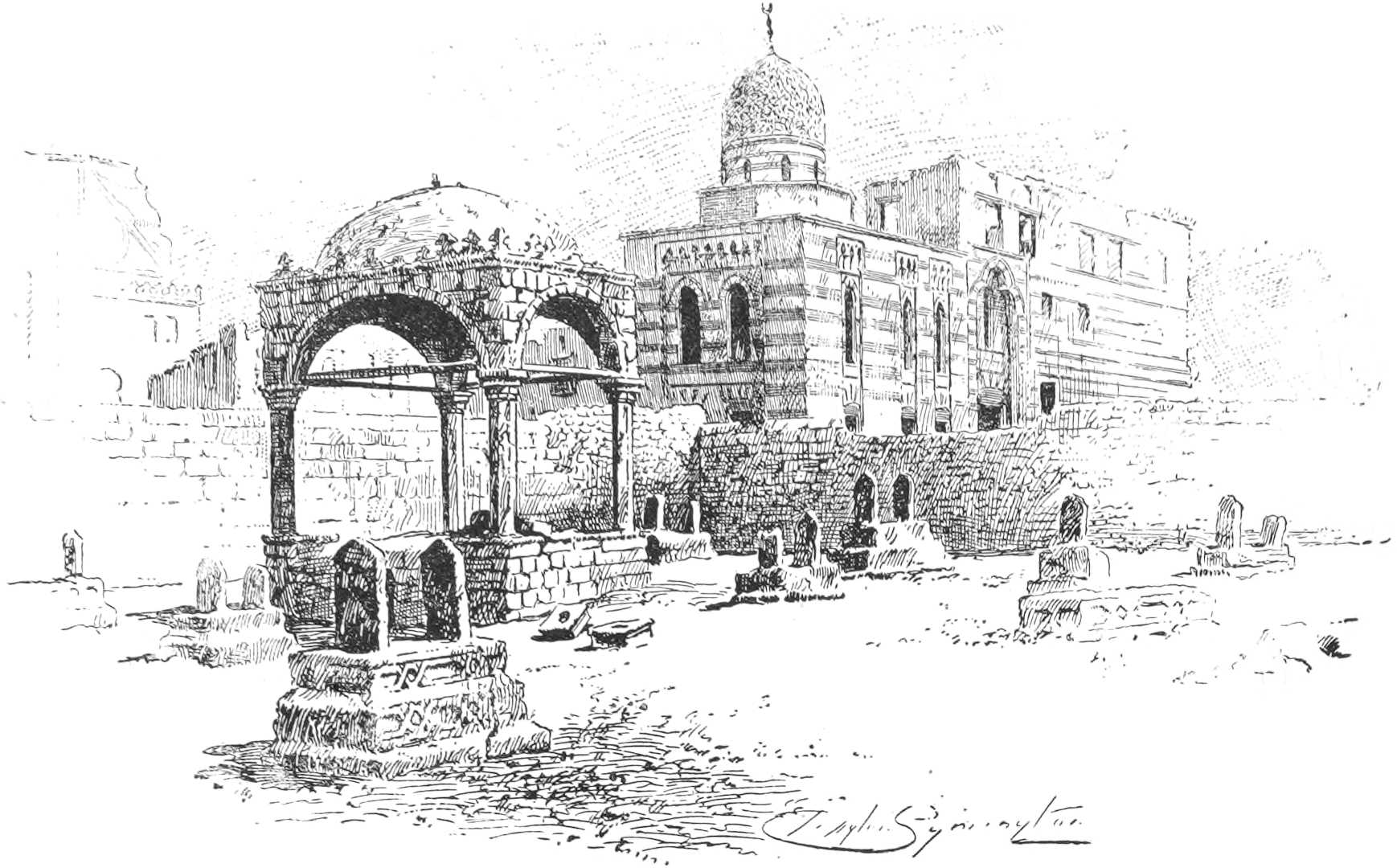
A MUSLIM GRAVEYARD
[317]RULERS AND MONUMENTS OF CAIRO[89]
| 1. ARAB PERIOD | ||||||
| A.D. | A.H. | A.H. | ||||
|---|---|---|---|---|---|---|
| 640-868 | 20-254 | Ninety-eight governors under caliphs of Damascus and Baghdād | †Mosque of ‘Amr | 21 | ||
| Town of the Tent (el-Fusṭāṭ) | 21 | |||||
| First Nilometer at er-Rōḍa | 98 | |||||
| Faubourg el-‘Askar | 133 | |||||
| *Second Nilometer at er-Rōḍa | 247 | |||||
| 2. TURKISH PERIOD | ||||||
| HOUSE OF ṬŪLŪN | ||||||
| 868 | 254 | Aḥmad ibn Ṭūlūn | Faubourg el-Ḳaṭāi‘ | 256 | ||
| Palaces of el-Ḳaṭāi‘ | 256 ff. | |||||
| Māristān | 259 | |||||
| *Mosque of Ibn-Ṭūlūn | 263-5 | |||||
| 883 | 270 | Khumāraweyh b. Aḥmad | Palaces of el-Ḳaṭāi‘ | 270 ff. | ||
| 895 | 282 | Geysh b. Khumāraweyh | ||||
| 896 | 283 | Hārūn b. Khumāraweyh | ||||
| 904 | 292 | Sheybān b. Aḥmad b. Ṭūlūn | ||||
| CALIPHS’ GOVERNORS | ||||||
| 905-934 | 292-323 | Thirteen governors | ||||
| HOUSE OF EL-IKHSHĪD | ||||||
| 934 | 323 | Moḥammad el-Ikhshīd | Palace in Kāfūr’s Garden and at Rōḍa | |||
| 946 | 334 | Abū-l-Ḳāsim Ūngūr b. el-Ikhshīd | Māristān at Fusṭāṭ | 346 | ||
| 960 | 349 | Abū-l-Ḥasan ‘Aly b. el-Ikhshīd | Mosque of el-Gīza | 350 | ||
| 966 | 355 | Abū-l-Misk Kāfūr | ||||
| 968 | 358 | Abū-l-Fawāris Aḥmad b. ‘Aly | ||||
| [318]3. FĀṬIMID PERIOD. | ||||||
| 969 | 358 | el-Mo‘izz | Foundation of el-Ḳāhira | 358 | ||
| Great East Palace, etc. | 358 | |||||
| *Mosque el-Azhar | 359 | |||||
| 975 | 365 | el-‘Azīz | West Palace, etc. | |||
| *Mosque of el-Ḥākim | 380-403 | |||||
| 996 | 386 | el-Ḥākim | Mosque of Rāshida | 393-5 | ||
| „ el-Maḳs | ||||||
| 1021 | 411 | eẓ-Ẓāhir | ||||
| 1036 | 427 | el-Mustanṣir | *Mosque el-Guyūshy | 478 | ||
| *Bāb-en-Naṣr, *Bāb-el-Futūḥ, *Second wall, *Bāb-Zuweyla | 480-484 | |||||
| Mosque of Nilometer | 485 | |||||
| 1094 | 487 | el-Musta‘ly | ||||
| 1101 | 495 | el-Āmir | *Mosque el-Aḳmar | 519 | ||
| Several mesgids (Yānis, Kāfūry, Bāb-el-Khawkha) | ||||||
| *Mihrābs of Azhar and Seyyida Ruḳeyya | ||||||
| 1131 | 524 | el-Ḥāfiẓ | ||||
| 1149 | 544 | eẓ-Ẓāfir | †Mosque el-Afkhar | 543 | ||
| 1154 | 549 | el-Fāiz | ||||
| 1160 | 555 | el-‘Āḍid | *Mosque of eṣ-Ṣālih Ṭalāi‘ | 555 | ||
| 4. HOUSE OF SALADIN | ||||||
| 1169 | 565 | en-Nāṣir Ṣalāḥ-ed-dīn (Saladin) ibn Ayyūb | Mosque of Negm-ed-dīn Ayyūb | 566 | ||
| College Nāṣirīya | 566 | |||||
| „ Ḳamḥiya | 566 | |||||
| „ Ḳuṭbīya | 570 | |||||
| „ Ibn-el-Arsūfy | 570 | |||||
| „ Suyūfīya | 572 | |||||
| Citadel and 3rd Wall begun | 572 | |||||
| Māristān | 575 | |||||
| College el-Fāḍilīya | 580 | |||||
| 1193 | 589 | el-‘Azīz, son of Saladin | Mosque of Ibn-el-Benā | c. 591 | ||
| College Ushkushīya | 592 | |||||
| 1198 | 595 | el-Manṣūr b. el-‘Azīz | „ Ghaznawīya | |||
| 1200 | 596 | el-‘Adil Seyf-ed-dīn | „ ‘Ādilīya | |||
| „ Sherīfīya | 612 | |||||
| 1218 | 615 | el-Kāmil b. el-‘Ādil | Restor. of M. of Shāfi‘y | 607 | ||
| *College Kāmilīya | 622 | |||||
| „ Fakhrīya | 622 | |||||
| Zāwiya Ḳaṣry | c. 633 | |||||
| M. Ibn-esh-Sheykhy | c. 633 | |||||
| 1238 | 635 | el-‘Ādil II. b. el-Kāmil | College Ṣayramīya | c. 636 | ||
| „ Fāizīya | 636 | |||||
| 1240 | 637 | eṣ-Ṣāliḥ Ayyūb b. el-Kāmil | „ *Ṣāliḥīya | 639 | ||
| Mosque, etc., of er-Rōḍa | ||||||
| 1249 | 647 | el-Mu‘aẓẓam Tūrān-Shāh b. eṣ-Ṣāliḥ | Zāwiya Khaddām | 647 | ||
| [319]5. TURKISH MAMLŪKS | ||||||
| 1250 | 648 | Queen Sheger-ed-durr | *Tomb of eṣ-Ṣāliḥ | 648 | ||
| 1250 | 648 | el-Mo‘izz Aybek | College Ḳuṭbīya | 650 | ||
| „ Ṣāḥibīya | 654 | |||||
| 1257 | 655 | el-Manṣūr ‘Aly b. Aybek | ||||
| 1259 | 657 | el-Muẓaffar Ḳuṭuz | ||||
| 1260 | 658 | eẓ-Ẓāhir Beybars | *College Ẓāhirīya | 660 | ||
| Meshhed el-Ḥoseyny | 662 | |||||
| College Megdīya | 663 | |||||
| Mosque el-Afram | 663 | |||||
| *Mosque eẓ-Ẓāhir | 665 | |||||
| College Muhedhdhibīya | ||||||
| „ Fārikānīya | 676 | |||||
| 1277 | 676 | es-Sa‘īd Baraka b. Beybars | ||||
| 1279 | 678 | el-‘Ādil Selāmish b. Beybars | ||||
| 1279 | 679 | el-Manṣūr Ḳalā’ūn | *College Manṣūrīya and Māristān Ḳalā’ūn | 684 | ||
| Zāwiya el-Gemīzy | 682 | |||||
| „ el-Ga‘bary | 687 | |||||
| „ el-Halāwy | 683 | |||||
| Convent el-Bunduḳdārīya | 688 | |||||
| 1290 | 689 | el-Ashraf Khalīl b. Ḳalā’ūn | *Gate from ‘Akka | |||
| 1293 | 693 | en-Nāṣir Moḥammad b. Ḳalā’ūn | ||||
| 1294 | 694 | el-‘Ādil Ketbughā | ||||
| 1296 | 696 | el-Manṣūr Lāgīn | Restor. M. of Ibn-Ṭūlūn | 696 | ||
| College Ṭafagīya | c. 698 | |||||
| „ Mangūtimurīya | 698 | |||||
| 1298 | 698 | en-Nāṣir, second reign | „ *Nāṣirīya | 699-703 | ||
| „ Karāsunḳurīya | 700 | |||||
| „ Gemālīya | 703 | |||||
| Restor. of Ḥākim, Azhar, Ṭalāi‘ | 703-4 | |||||
| Mosque of Ṭaybars | 707 | |||||
| 1308 | 708 | el-Muẓaffar Beybars Gāshnekīr | *Convent of Beybars | 706-9 | ||
| 1309 | 709 | en-Nāṣir, third reign | *College Ṭaybarsīya | 709 | ||
| Zāwiya of el-Ḥimṣy | 709 | |||||
| Mosque of el-Gāky | 713 | |||||
| *Citadel palace, aqueduct | 713 | |||||
| College Sa‘īdīya | 715 | |||||
| Convent of Arslān | c. 717 | |||||
| *Mosque of Citadel | 718 | |||||
| *Mosque of emīr Ḥoseyn | 719 | |||||
| *College Ālmelikīya | 719 | |||||
| *College Gāwalīya | 723 | |||||
| *Tomb of Ordūtegīn | 724 | |||||
| *College Mihmandāriya | 725 | |||||
| „ Buktumurīya | 726 | |||||
| Mosque of el-Khazāny | 729 | |||||
| „ *of Almās | 730 | |||||
| „ el-Barḳīya | 730 | |||||
| [320]*Mosque of Ḳūṣūn | 730 | |||||
| „ of Sārūgā | c. 730 | |||||
| *College Aḳbughawīya | 734 | |||||
| *Tomb of Tāshtimur | 734 | |||||
| *Palace of Beshtāk | c. 735 | |||||
| *Convent of Ḳūṣūn | 736 | |||||
| „ at Siryāḳūs | 736 | |||||
| †Mosque of Beshtāk | 736 | |||||
| „ Aydemir | 737 | |||||
| „ et-Turkmāny | 738 | |||||
| „ *el-Māridāny | 740 | |||||
| 1341 | 741 | el-Manṣūr Abū-Bekr | sons of en-Nāṣir | „ *Sitta Miska | 740 | |
| „ Ibn-Ghāzy | 741 | |||||
| 1341 | 742 | el-Ashraf Kuguk | ||||
| 1342 | 742 | en-Nāṣir Aḥmad | ||||
| 1342 | 743 | eṣ-Ṣāliḥ Ismā‘īl | Mosque of eṭ-Ṭawāshy | 745 | ||
| 1345 | 746 | el-Ḳāmil Sha‘bān | „ Ibn-eṭ-Ṭabbākh | 746 | ||
| 1346 | 747 | el-Muẓaffar Ḥāggy | „ *Kuguk | 747 | ||
| 1347 | 748 | en-Nāṣir Ḥasan | „ †Āḳsunḳur | 747 | ||
| „ †el-Ismā‘īly | 748 | |||||
| „ *Ḳutlubugha | 748 | |||||
| „ el-Asyūṭy | c. 749 | |||||
| *Convent of Umm-Anūk | c. 749 | |||||
| „ Algībughā | c. 750 | |||||
| *Mosque of Mangak | 750 | |||||
| „ *Sheykhū | 750 | |||||
| College of el-Kharrūba | 750 | |||||
| *Cistern of Lāgīn | 750 | |||||
| College Ḳaysarānīya | 751 | |||||
| „ Ṣaghīra | 751 | |||||
| 1351 | 752 | eṣ-Ṣāliḥ Ṣāliḥ b. Nāṣir | ||||
| 1354 | 755 | Ḥasan, second reign | *Convent of Sheykhū | 756 | ||
| College Fārisīya | 756 | |||||
| „ *Ṣarghitmishīya | 756 | |||||
| „ *Sulṭān Ḥasan | 757 ff. | |||||
| „ Bedīrīya | 758 | |||||
| „ *Ḥigāzīya | 761 | |||||
| „ Beshīrīya | 761 | |||||
| 1361 | 762 | el-Manṣūr Moḥammad | grand-sons of en-Nāṣir | „ Sābiḳīya | 763 | |
| 1363 | 764 | el-Ashraf Sha‘bān | *Tomb of Ṭulbīya | 765 | ||
| *Mosque of Sha‘bān | 771 | |||||
| *College Bubekrīya (Asunbughā) | 772 | |||||
| *College of Gāy el-Yūsufy | 775 | |||||
| „ Baḳrīya | c. 775 | |||||
| 1376 | 778 | el-Manṣūr ‘Aly b. Sha‘bān | „ Ibn-‘Irām | 782 | ||
| 1381 | 783 | eṣ-Ṣāliḥ Ḥāggy b. Sha‘bān (dep. 1382, restored 1389-90) | Tomb of Umm-Ṣāliḥ | 783 | ||
| [321]6. CIRCASSIAN MAMLŪKS | ||||||
| 1382 | 784 | eẓ-Ẓāhir Barḳūḳ | *Tomb of Anas | 783 | ||
| [interrupted 791-2 by Ḥāggy] | *College of Aytmish | 785 | ||||
| *College of Barḳūḳ | 788 | |||||
| *Mosque of Zeyn-ed-dīn | 790 | |||||
| *College of Īnāl Ustāddār | 795 | |||||
| „ Maḥmūdīya | 797 | |||||
| „ *Muḳbil Zemāmīya | 797 | |||||
| „ Ibn-Ghurāb | 798 | |||||
| 1399 | 801 | en-Nāṣir Farag b. Barḳūḳ | M. of Ibn-‘Abd-eẓ-Ẓāhir | 803 | ||
| *College of Sūdūn | 804 | |||||
| „ Mahally | c. 806 | |||||
| 1405 | 808 | el-Manṣūr ‘Abd-el-‘Azīz b. Barḳūḳ | *Convent and Tomb of Barḳūḳ and Farag, and College of Farag | 803-13 | ||
| 1405 | 809 | Farag, second reign | *College of Gemāl-ed-dīn | 811 | ||
| Mosque of Hōsh (Citadel) | 812 | |||||
| 1412 | 815 | el-Musta‘īn (caliph) | „ Birket-er-Raṭly | 814 | ||
| 1412 | 815 | el-Mu’ayyad Sheykh | M. of eḍ-Ḍiwa (Citadel) | 815 | ||
| Mosque of el-Bāsiṭy | 817 | |||||
| „ el-Ḥanafy | 817 | |||||
| „ ez-Zāhid | 818 | |||||
| *Māristān of el-Mu’ayyad | 818 | |||||
| *Mosque of el-Mu’ayyad | 819-23 | |||||
| *Coll. of ‘Abd-el-Ghany | 821 | |||||
| Mosque of el-Fakhry | 821 | |||||
| *Coll. of Ḳāḍy ‘Abd-el-Bāsiṭ | 823 | |||||
| 1421 | 824 | el-Muẓaffar Aḥmad b. Sheykh | ||||
| 1421 | 824 | eẓ-Ẓāhir Ṭaṭar | ||||
| 1421 | 824 | eṣ-Ṣāliḥ Moḥammad b. Ṭaṭar | ||||
| 1422 | 825 | el-Ashraf Bars-Bey | *College of Bars-Bey | 827 | ||
| *Mosque of Gāny-Bek | 830 | |||||
| *College of Feyrūz | 830 | |||||
| *Conv. and tomb of Bars-Bey | 835 | |||||
| 1438 | 842 | el-‘Azīz Yūsuf b. Bars-Bey | ||||
| 1438 | 842 | eẓ-Ẓāhir Gaḳmaḳ | *College of Taghry-Berdy | 844 | ||
| *Mosque of Ḳāny-Bey | 845 | |||||
| 1453 | 857 | el-Manṣūr ‘Othmān b. Gaḳmaḳ | *M. and tomb Ḳāḍy Yaḥyā | 848-50 | ||
| *Mosque of Gaḳmaḳ | 853 | |||||
| 1453 | 857 | el-Ashraf Īnāl | *Coll., Conv., tomb of Īnāl | 855-60 | ||
| 1461 | 865 | el-Mu’ayyad Aḥmad b. Īnāl | ||||
| 1461 | 865 | eẓ-Ẓāhir Khūshḳadam | *Tomb of Gāny-Bek | 869 | ||
| *Mosque of Nūr-ed-dīn | 870 | |||||
| *Mosque of Sūdūn | c. 870 | |||||
| *College of Ḳānim | c. 870 | |||||
| 1467 | 872 | eẓ-Ẓāhir Yel-Bey | ||||
| 1467 | 872 | eẓ-Ẓāhir Timurbughā | ||||
| [322]1468 | 873 | el-Ashraf Ḳā’it-Bey | *Mosque of Timrāz | 876 | ||
| *M. of Ezbek b. Tutush | 880 | |||||
| *Palace of Yeshbek | 880 | |||||
| *Ḳā’it-Bey’s Coll. and tomb | 879 | |||||
| „ *Coll. in town | 880 | |||||
| „ *Wekāla by Azhar | 882 | |||||
| „ *Sebīl | 884 | |||||
| „ Wekāla, B. en-Naṣr | 885 | |||||
| „ *Wek., Surūgīya | c. 885 | |||||
| „ *Faḍawīya cupola | c. 886 | |||||
| „ *Palace and mekān | 890 | |||||
| „ *Restor. of S. gates | 890 | |||||
| „ *Coll. at er-Rōḍa | 896 | |||||
| *Mosque of Gānim | 883 | |||||
| *Coll. of Abū-Bekr b. Muzhir | 885 | |||||
| *Mosque of Ḳagmās | 886 | |||||
| *Coll. of Ezbek el-Yūsufy | 900 | |||||
| 1496 | 901 | en-Nāṣir Moḥammad b. Ḳā’it-Bey | *Palace of Mamāy (Beyt-el-Ḳāḍy) | 901 | ||
| 1498 | 904 | eẓ-Ẓāhir Ḳānṣūh | *Tomb of Ḳānṣūh | 904 | ||
| 1500 | 905 | el-Ashraf Gānbalāt | ||||
| 1501 | 906 | el-‘Ādil Ṭūmān-Bey | ||||
| 1501 | 906 | el-Ashraf Ḳānṣūh el-Ghūry | *Tomb el-‘Ādil Ṭūmān-Bey | 906 | ||
| *Mosque of Kheyr-Bek | 908 | |||||
| *Coll. Ḳāny-Bek emīr akhōr | 908 | |||||
| *Coll. of el-Ghūry | 909 | |||||
| †Tomb-mosque of el-Ghūry | 909 | |||||
| *Tomb of Sūdūn | c. 910 | |||||
| *College of Ḳāny-Bek Ḳarā | 911 | |||||
| Restoration of aqueduct to Citadel | 911 | |||||
| 1516 | 922 | el-Ashraf Ṭumān-Bey | ||||
| 1517 | 922 | ‘OTHMĀNLY CONQUEST OF EGYPT | ||||
CAIRO.
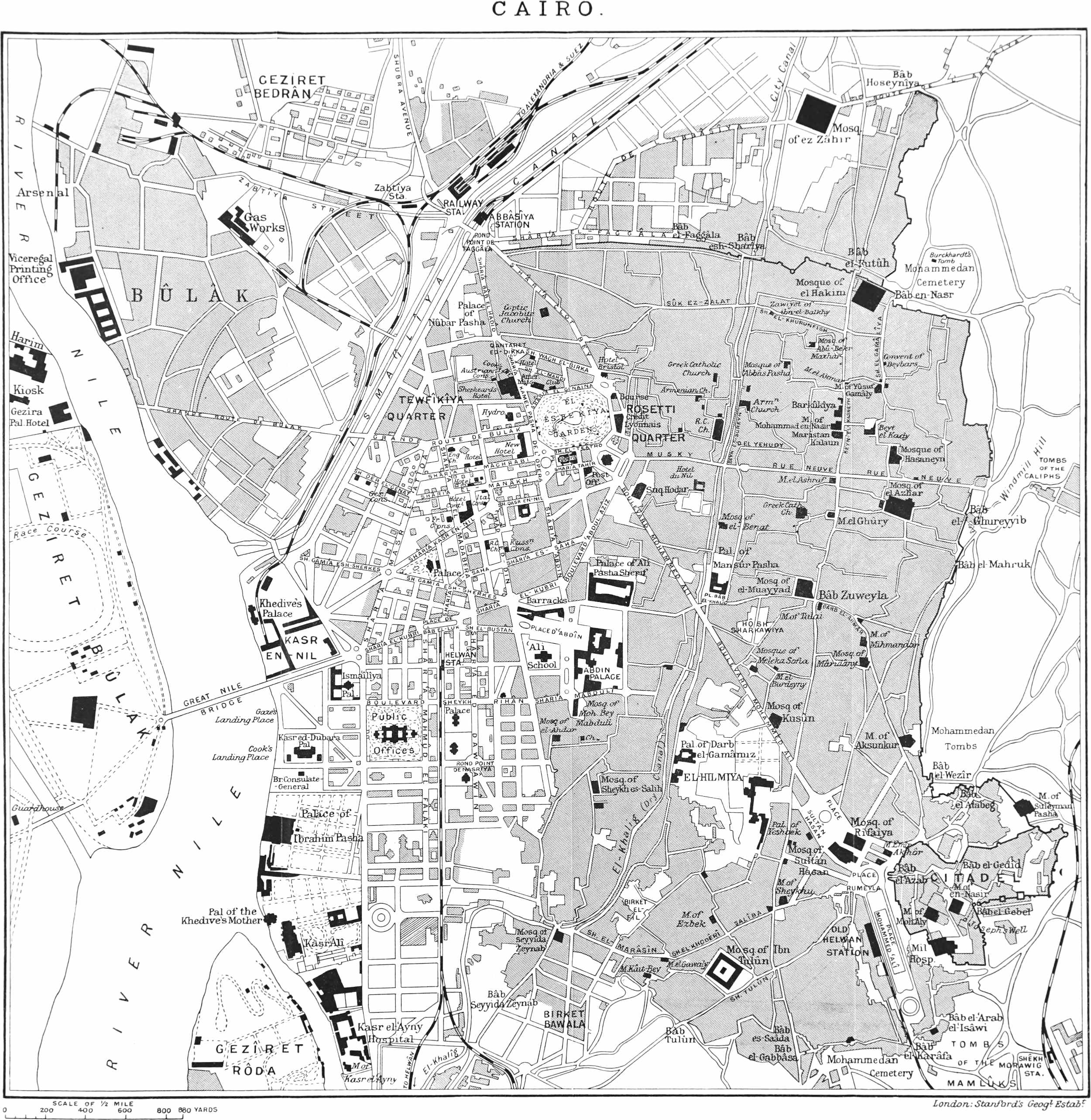
[323]TABLE FOR CONVERTING HIJRA YEARS INTO ANNI DOMINI.
| A.H. | A.D. | BEGINS | |
|---|---|---|---|
| 1 | 622 | Jy. | 16 |
| 2 | 623 | Jy. | 5 |
| 3 | 624 | Ju. | 24 |
| 4 | 625 | Ju. | 13 |
| 5 | 626 | Ju. | 2 |
| 6 | 627 | My. | 23 |
| 7 | 628 | My. | 11 |
| 8 | 629 | My. | 1 |
| 9 | 630 | Ap. | 20 |
| 10 | 631 | Ap. | 9 |
| 11 | 632 | M. | 29 |
| 12 | 633 | M. | 18 |
| 13 | 634 | M. | 7 |
| 14 | 635 | F. | 25 |
| 15 | 636 | F. | 14 |
| 16 | 637 | F. | 2 |
| 17 | 638 | Ja. | 23 |
| 18 | 639 | Ja. | 12 |
| 19 | 640 | Ja. | 2 |
| 20 | 640 | D. | 21 |
| 21 | 641 | D. | 10 |
| 22 | 642 | N. | 30 |
| 23 | 643 | N. | 19 |
| 24 | 644 | N. | 7 |
| 25 | 645 | O. | 28 |
| 26 | 646 | O. | 17 |
| 27 | 647 | O. | 7 |
| 28 | 648 | S. | 25 |
| 29 | 649 | S. | 14 |
| 30 | 650 | S. | 4 |
| 31 | 651 | Ag. | 24 |
| 32 | 652 | Ag. | 12 |
| 33 | 653 | Ag. | 2 |
| 34 | 654 | Jy. | 22 |
| 35 | 655 | Jy. | 11 |
| 36 | 656 | Ju. | 30 |
| 37 | 657 | Ju. | 19 |
| 38 | 658 | Ju. | 9 |
| 39 | 659 | My. | 29 |
| 40 | 660 | My. | 17 |
| 41 | 661 | My. | 7 |
| 42 | 662 | Ap. | 26 |
| 43 | 663 | Ap. | 15 |
| 44 | 664 | Ap. | 4 |
| 45 | 665 | M. | 24 |
| 46 | 666 | M. | 13 |
| 47 | 667 | M. | 3 |
| 48 | 668 | F. | 20 |
| 49 | 669 | F. | 9 |
| 50 | 670 | Ja. | 29 |
| 51 | 671 | Ja. | 18 |
| 52 | 672 | Ja. | 8 |
| 53 | 672 | D. | 27 |
| 54 | 673 | D. | 16 |
| 55 | 674 | D. | 6 |
| 56 | 675 | N. | 25 |
| 57 | 676 | N. | 14 |
| 58 | 677 | N. | 3 |
| 59 | 678 | O. | 23 |
| 60 | 679 | O. | 13 |
| 61 | 680 | O. | 1 |
| 62 | 681 | S. | 20 |
| 63 | 682 | S. | 10 |
| 64 | 683 | Ag. | 30 |
| 65 | 684 | Ag. | 18 |
| 66 | 685 | Ag. | 8 |
| 67 | 686 | Jy. | 28 |
| 68 | 687 | Jy. | 18 |
| 69 | 688 | Jy. | 6 |
| 70 | 689 | Ju. | 25 |
| 71 | 690 | Ju. | 15 |
| 72 | 691 | Ju. | 4 |
| 73 | 692 | My. | 23 |
| 74 | 693 | My. | 13 |
| 75 | 694 | My. | 2 |
| 76 | 695 | Ap. | 21 |
| 77 | 696 | Ap. | 10 |
| 78 | 697 | M. | 30 |
| 79 | 698 | M. | 20 |
| 80 | 699 | M. | 9 |
| 81 | 700 | F. | 26 |
| 82 | 701 | F. | 15 |
| 83 | 702 | F. | 4 |
| 84 | 703 | Ja. | 24 |
| 85 | 704 | Ja. | 14 |
| 86 | 705 | Ja. | 2 |
| 87 | 705 | D. | 23 |
| 88 | 706 | D. | 12 |
| 89 | 707 | D. | 1 |
| 90 | 708 | N. | 20 |
| 91 | 709 | N. | 9 |
| 92 | 710 | O. | 29 |
| 93 | 711 | O. | 19 |
| 94 | 712 | O. | 7 |
| 95 | 713 | S. | 26 |
| 96 | 714 | S. | 16 |
| 97 | 715 | S. | 5 |
| 98 | 716 | Ag. | 25 |
| 99 | 717 | Ag. | 14 |
| 100 | 718 | Ag. | 3 |
| 101 | 719 | Jy. | 24 |
| 102 | 720 | Jy. | 12 |
| 103 | 721 | Jy. | 1 |
| 104 | 722 | Ju. | 21 |
| 105 | 723 | Ju. | 10 |
| 106 | 724 | My. | 29 |
| 107 | 725 | My. | 19 |
| 108 | 726 | My. | 8 |
| 109 | 727 | Ap. | 28 |
| 110 | 728 | Ap. | 16 |
| 111 | 729 | Ap. | 5 |
| 112 | 730 | M. | 26 |
| 113 | 731 | M. | 15 |
| 114 | 732 | M. | 3 |
| 115 | 733 | F. | 21 |
| 116 | 734 | F. | 10 |
| 117 | 735 | Ja. | 31 |
| 118 | 736 | Ja. | 20 |
| 119 | 737 | Ja. | 8 |
| 120 | 737 | D. | 29 |
| 121 | 738 | D. | 18 |
| 122 | 739 | D. | 7 |
| 123 | 740 | N. | 26 |
| 124 | 741 | N. | 15 |
| 125 | 742 | N. | 4 |
| 126 | 743 | O. | 25 |
| 127 | 744 | O. | 13 |
| 128 | 745 | O. | 3 |
| 129 | 746 | S. | 22 |
| 130 | 747 | S. | 11 |
| 131 | 748 | Ag. | 31 |
| 132 | 749 | Ag. | 20 |
| 133 | 750 | Ag. | 9 |
| 134 | 751 | Jy. | 30 |
| 135 | 752 | Jy. | 18 |
| 136 | 753 | Jy. | 7 |
| 137 | 754 | Ju. | 27 |
| 138 | 755 | Ju. | 16 |
| 139 | 756 | Ju. | 5 |
| 140 | 757 | My. | 25 |
| 141 | 758 | My. | 14 |
| 142 | 759 | My. | 4 |
| 143 | 760 | Ap. | 22 |
| 144 | 761 | Ap. | 11 |
| 145 | 762 | Ap. | 1 |
| 146 | 763 | M. | 21 |
| 147 | 764 | M. | 10 |
| 148 | 765 | F. | 27 |
| 149 | 766 | F. | 16 |
| 150 | 767 | F. | 6 |
| 151 | 768 | Ja. | 26 |
| 152 | 769 | Ja. | 14 |
| 153 | 770 | Ja. | 4 |
| 154 | 770 | D. | 24 |
| 155 | 771 | D. | 13 |
| 156 | 772 | D. | 2 |
| 157 | 773 | N. | 21 |
| 158 | 774 | N. | 11 |
| 159 | 775 | O. | 31 |
| 160 | 776 | O. | 19 |
| 161 | 777 | O. | 9 |
| 162 | 778 | S. | 28 |
| 163 | 779 | S. | 17 |
| 164 | 780 | S. | 6 |
| 165 | 781 | Ag. | 26 |
| 166 | 782 | Ag. | 15 |
| 167 | 783 | Ag. | 5 |
| 168 | 784 | Jy. | 24 |
| 169 | 785 | Jy. | 14 |
| 170 | 786 | Jy. | 3 |
| 171 | 787 | Ju. | 22 |
| 172 | 788 | Ju. | 11 |
| 173 | 789 | My. | 31 |
| 174 | 790 | My. | 20 |
| 175 | 791 | My. | 10 |
| 176 | 792 | Ap. | 28 |
| 177 | 793 | Ap. | 18 |
| 178 | 794 | Ap. | 7 |
| 179 | 795 | M. | 27 |
| 180 | 796 | M. | 16 |
| 181 | 797 | M. | 5 |
| 182 | 798 | F. | 22 |
| 183 | 799 | F. | 12 |
| 184 | 800 | F. | 1 |
| 185 | 801 | Ja. | 20 |
| 186 | 802 | Ja. | 10 |
| 187 | 802 | D. | 30 |
| 188 | 803 | D. | 20 |
| 189 | 804 | D. | 8 |
| 190 | 805 | N. | 27 |
| 191 | 806 | N. | 17 |
| 192 | 807 | N. | 6 |
| 193 | 808 | O. | 25 |
| 194 | 809 | O. | 15 |
| 195 | 810 | O. | 4 |
| 196 | 811 | S. | 23 |
| 197 | 812 | S. | 12 |
| 198 | 813 | S. | 1 |
| 199 | 814 | Ag. | 22 |
| 200 | 815 | Ag. | 11 |
| [324]201 | 816 | Jy. | 30 |
| 202 | 817 | Jy. | 20 |
| 203 | 818 | Jy. | 9 |
| 204 | 819 | Ju. | 28 |
| 205 | 820 | Ju. | 17 |
| 206 | 821 | Ju. | 6 |
| 207 | 822 | My. | 27 |
| 208 | 823 | My. | 16 |
| 209 | 824 | My. | 4 |
| 210 | 825 | Ap. | 24 |
| 211 | 826 | Ap. | 13 |
| 212 | 827 | Ap. | 2 |
| 213 | 828 | M. | 22 |
| 214 | 829 | M. | 11 |
| 215 | 830 | F. | 28 |
| 216 | 831 | F. | 18 |
| 217 | 832 | F. | 7 |
| 218 | 833 | Ja. | 27 |
| 219 | 834 | Ja. | 16 |
| 220 | 835 | Ja. | 5 |
| 221 | 835 | D. | 26 |
| 222 | 836 | D. | 14 |
| 223 | 837 | D. | 3 |
| 224 | 838 | N. | 23 |
| 225 | 839 | N. | 12 |
| 226 | 840 | O. | 31 |
| 227 | 841 | O. | 21 |
| 228 | 842 | O. | 10 |
| 229 | 843 | S. | 30 |
| 230 | 844 | S. | 18 |
| 231 | 845 | S. | 7 |
| 232 | 846 | Ag. | 28 |
| 233 | 847 | Ag. | 17 |
| 234 | 848 | Ag. | 5 |
| 235 | 849 | Jy. | 26 |
| 236 | 850 | Jy. | 15 |
| 237 | 851 | Jy. | 5 |
| 238 | 852 | Ju. | 23 |
| 239 | 853 | Ju. | 12 |
| 240 | 854 | Ju. | 2 |
| 241 | 855 | My. | 22 |
| 242 | 856 | My. | 10 |
| 243 | 857 | Ap. | 30 |
| 244 | 858 | Ap. | 19 |
| 245 | 859 | Ap. | 8 |
| 246 | 860 | M. | 28 |
| 247 | 861 | M. | 17 |
| 248 | 862 | M. | 7 |
| 249 | 863 | F. | 24 |
| 250 | 864 | F. | 13 |
| 251 | 865 | F. | 2 |
| 252 | 866 | Ja. | 22 |
| 253 | 867 | Ja. | 11 |
| 254 | 868 | Ja. | 1 |
| 255 | 868 | D. | 20 |
| 256 | 869 | D. | 9 |
| 257 | 870 | N. | 29 |
| 258 | 871 | N. | 18 |
| 259 | 872 | N. | 7 |
| 260 | 873 | O. | 27 |
| 261 | 874 | O. | 16 |
| 262 | 875 | O. | 6 |
| 263 | 876 | S. | 24 |
| 264 | 877 | S. | 13 |
| 265 | 878 | S. | 3 |
| 266 | 879 | Ag. | 23 |
| 267 | 880 | Ag. | 12 |
| 268 | 881 | Ag. | 1 |
| 269 | 882 | Jy. | 21 |
| 270 | 883 | Jy. | 11 |
| 271 | 884 | Ju. | 29 |
| 272 | 885 | Ju. | 18 |
| 273 | 886 | Ju. | 8 |
| 274 | 887 | My. | 28 |
| 275 | 888 | My. | 16 |
| 276 | 889 | My. | 6 |
| 277 | 890 | Ap. | 25 |
| 278 | 891 | Ap. | 15 |
| 279 | 892 | Ap. | 3 |
| 280 | 893 | M. | 23 |
| 281 | 894 | M. | 13 |
| 282 | 895 | M. | 2 |
| 283 | 896 | F. | 19 |
| 284 | 897 | F. | 8 |
| 285 | 898 | Ja. | 28 |
| 286 | 899 | Ja. | 17 |
| 287 | 900 | Ja. | 7 |
| 288 | 900 | D. | 26 |
| 289 | 901 | D. | 16 |
| 290 | 902 | D. | 5 |
| 291 | 903 | N. | 24 |
| 292 | 904 | N. | 13 |
| 293 | 905 | N. | 2 |
| 294 | 906 | O. | 22 |
| 295 | 907 | O. | 12 |
| 296 | 908 | S. | 30 |
| 297 | 909 | S. | 20 |
| 298 | 910 | S. | 9 |
| 299 | 911 | Ag. | 18 |
| 300 | 912 | Ag. | 29 |
| 301 | 913 | Ag. | 7 |
| 302 | 914 | Jy. | 27 |
| 303 | 915 | Jy. | 17 |
| 304 | 916 | Jy. | 5 |
| 305 | 917 | Ju. | 24 |
| 306 | 918 | Ju. | 14 |
| 307 | 919 | Ju. | 3 |
| 308 | 920 | My. | 23 |
| 309 | 921 | My. | 12 |
| 310 | 922 | My. | 1 |
| 311 | 923 | Ap. | 21 |
| 312 | 924 | Ap. | 9 |
| 313 | 925 | M. | 29 |
| 314 | 926 | M. | 19 |
| 315 | 927 | M. | 8 |
| 316 | 928 | F. | 25 |
| 317 | 929 | F. | 14 |
| 318 | 930 | F. | 3 |
| 319 | 931 | Ja. | 24 |
| 320 | 932 | Ja. | 13 |
| 321 | 933 | Ja. | 1 |
| 322 | 933 | D. | 22 |
| 323 | 934 | D. | 11 |
| 324 | 935 | N. | 30 |
| 325 | 936 | N. | 19 |
| 326 | 937 | N. | 8 |
| 327 | 938 | O. | 29 |
| 328 | 939 | O. | 18 |
| 329 | 940 | O. | 6 |
| 330 | 941 | S. | 26 |
| 331 | 942 | S. | 15 |
| 332 | 943 | S. | 4 |
| 333 | 944 | Ag. | 24 |
| 334 | 945 | Ag. | 13 |
| 335 | 946 | Ag. | 2 |
| 336 | 947 | Jy. | 23 |
| 337 | 948 | Jy. | 11 |
| 338 | 949 | Jy. | 1 |
| 339 | 950 | Ju. | 20 |
| 340 | 951 | Ju. | 9 |
| 341 | 952 | My. | 29 |
| 342 | 953 | My. | 18 |
| 343 | 954 | My. | 7 |
| 344 | 955 | Ap. | 27 |
| 345 | 956 | Ap. | 15 |
| 346 | 957 | Ap. | 4 |
| 347 | 958 | M. | 25 |
| 348 | 959 | M. | 14 |
| 349 | 960 | M. | 3 |
| 350 | 961 | F. | 20 |
| 351 | 962 | F. | 9 |
| 352 | 963 | Ja. | 30 |
| 353 | 964 | Ja. | 19 |
| 354 | 965 | Ja. | 7 |
| 355 | 965 | D. | 28 |
| 356 | 966 | D. | 17 |
| 357 | 967 | D. | 7 |
| 358 | 968 | N. | 25 |
| 359 | 969 | N. | 14 |
| 360 | 970 | N. | 4 |
| 361 | 971 | O. | 24 |
| 362 | 972 | O. | 12 |
| 363 | 973 | O. | 2 |
| 364 | 974 | S. | 21 |
| 365 | 975 | S. | 10 |
| 366 | 976 | Ag. | 30 |
| 367 | 977 | Ag. | 19 |
| 368 | 978 | Ag. | 9 |
| 369 | 979 | Jy. | 29 |
| 370 | 980 | Jy. | 17 |
| 371 | 981 | Jy. | 7 |
| 372 | 982 | Ju. | 26 |
| 373 | 983 | Ju. | 15 |
| 374 | 984 | Ju. | 4 |
| 375 | 985 | My. | 24 |
| 376 | 986 | My. | 13 |
| 377 | 987 | My. | 3 |
| 378 | 988 | Ap. | 21 |
| 379 | 989 | Ap. | 11 |
| 380 | 990 | M. | 31 |
| 381 | 991 | M. | 20 |
| 382 | 992 | M. | 9 |
| 383 | 993 | F. | 26 |
| 384 | 994 | F. | 15 |
| 385 | 995 | F. | 5 |
| 386 | 996 | Ja. | 25 |
| 387 | 997 | Ja. | 14 |
| 388 | 998 | Ja. | 3 |
| 389 | 998 | D. | 23 |
| 390 | 999 | D. | 13 |
| 391 | 1000 | D. | 1 |
| 392 | 1001 | N. | 20 |
| 393 | 1002 | N. | 10 |
| 394 | 1003 | O. | 30 |
| 395 | 1004 | O. | 18 |
| 396 | 1005 | O. | 8 |
| 397 | 1006 | S. | 27 |
| 398 | 1007 | S. | 17 |
| 399 | 1008 | S. | 5 |
| 400 | 1009 | Ag. | 25 |
| 401 | 1010 | Ag. | 15 |
| 402 | 1011 | Ag. | 4 |
| 403 | 1012 | Jy. | 23 |
| 404 | 1013 | Jy. | 13 |
| 405 | 1014 | Jy. | 2 |
| 406 | 1015 | Ju. | 21 |
| 407 | 1016 | Ju. | 10 |
| 408 | 1017 | My. | 30 |
| 409 | 1018 | My. | 20 |
| 410 | 1019 | My. | 9 |
| 411 | 1020 | Ap. | 27 |
| 412 | 1021 | Ap | 17 |
| 413 | 1022 | Ap. | 6 |
| 414 | 1023 | M. | 26 |
| 415 | 1024 | M. | 15 |
| 416 | 1025 | M. | 4 |
| 417 | 1026 | F. | 22 |
| 418 | 1027 | F. | 11 |
| 419 | 1028 | Ja. | 31 |
| 420 | 1029 | Ja. | 20 |
| [325]421 | 1030 | Ja. | 9 |
| 422 | 1030 | D. | 29 |
| 423 | 1031 | D. | 19 |
| 424 | 1032 | D. | 7 |
| 425 | 1033 | N. | 26 |
| 426 | 1034 | N. | 16 |
| 427 | 1035 | N. | 5 |
| 428 | 1036 | O. | 25 |
| 429 | 1037 | O. | 14 |
| 430 | 1038 | O. | 3 |
| 431 | 1039 | S. | 23 |
| 432 | 1040 | S. | 11 |
| 433 | 1041 | Ag. | 31 |
| 434 | 1042 | Ag. | 21 |
| 435 | 1043 | Ag. | 10 |
| 436 | 1044 | Jy. | 29 |
| 437 | 1045 | Jy. | 19 |
| 438 | 1046 | Jy. | 8 |
| 439 | 1047 | Ju. | 28 |
| 440 | 1048 | Ju. | 16 |
| 441 | 1049 | Ju. | 5 |
| 442 | 1050 | My. | 26 |
| 443 | 1051 | My. | 15 |
| 444 | 1052 | My. | 3 |
| 445 | 1053 | Ap. | 23 |
| 446 | 1054 | Ap. | 12 |
| 447 | 1055 | Ap. | 2 |
| 448 | 1056 | M. | 21 |
| 449 | 1057 | M. | 10 |
| 450 | 1058 | F. | 28 |
| 451 | 1059 | F. | 17 |
| 452 | 1060 | F. | 6 |
| 453 | 1061 | Ja. | 26 |
| 454 | 1062 | Ja. | 15 |
| 455 | 1063 | Ja. | 4 |
| 456 | 1063 | D. | 25 |
| 457 | 1064 | D. | 13 |
| 458 | 1065 | D. | 3 |
| 459 | 1066 | N. | 22 |
| 460 | 1067 | N. | 11 |
| 461 | 1068 | O. | 31 |
| 462 | 1069 | O. | 20 |
| 463 | 1070 | O. | 9 |
| 464 | 1071 | S. | 29 |
| 465 | 1072 | S. | 17 |
| 466 | 1073 | S. | 6 |
| 467 | 1074 | Ag. | 27 |
| 468 | 1075 | Ag. | 16 |
| 469 | 1076 | Ag. | 5 |
| 470 | 1077 | Jy. | 25 |
| 471 | 1078 | Jy. | 14 |
| 472 | 1079 | Jy. | 4 |
| 473 | 1080 | Ju. | 22 |
| 474 | 1081 | Ju. | 11 |
| 475 | 1082 | Ju. | 1 |
| 476 | 1083 | My. | 21 |
| 477 | 1084 | My. | 10 |
| 478 | 1085 | Ap. | 29 |
| 479 | 1086 | Ap. | 18 |
| 480 | 1087 | Ap. | 8 |
| 481 | 1088 | M. | 27 |
| 482 | 1089 | M. | 16 |
| 483 | 1090 | M. | 6 |
| 484 | 1091 | F. | 23 |
| 485 | 1092 | F. | 12 |
| 486 | 1093 | F. | 1 |
| 487 | 1094 | Ja. | 21 |
| 488 | 1095 | Ja. | 11 |
| 489 | 1095 | D. | 31 |
| 490 | 1096 | D. | 19 |
| 491 | 1097 | D. | 9 |
| 492 | 1098 | N. | 28 |
| 493 | 1099 | N. | 17 |
| 494 | 1100 | N. | 6 |
| 495 | 1101 | O. | 26 |
| 496 | 1102 | O. | 15 |
| 497 | 1103 | O. | 5 |
| 498 | 1104 | S. | 23 |
| 499 | 1105 | S. | 13 |
| 500 | 1106 | S. | 2 |
| 501 | 1107 | Ag. | 22 |
| 502 | 1108 | Ag. | 11 |
| 503 | 1109 | Jy. | 31 |
| 504 | 1110 | Jy. | 20 |
| 505 | 1111 | Jy. | 10 |
| 506 | 1112 | Ju. | 28 |
| 507 | 1113 | Ju. | 18 |
| 508 | 1114 | Ju. | 7 |
| 509 | 1115 | My. | 27 |
| 510 | 1116 | My. | 16 |
| 511 | 1117 | My. | 5 |
| 512 | 1118 | Ap. | 24 |
| 513 | 1119 | Ap. | 14 |
| 514 | 1120 | Ap. | 2 |
| 515 | 1121 | M. | 22 |
| 516 | 1122 | M. | 12 |
| 517 | 1123 | M. | 1 |
| 518 | 1124 | F. | 19 |
| 519 | 1125 | F. | 7 |
| 520 | 1126 | Ja. | 27 |
| 521 | 1127 | Ja. | 17 |
| 522 | 1128 | Ja. | 6 |
| 523 | 1128 | D. | 25 |
| 524 | 1129 | D. | 15 |
| 525 | 1130 | D. | 4 |
| 526 | 1131 | N. | 23 |
| 527 | 1132 | N. | 12 |
| 528 | 1133 | N. | 1 |
| 529 | 1134 | O. | 22 |
| 530 | 1135 | O. | 11 |
| 531 | 1136 | S. | 29 |
| 532 | 1137 | S. | 19 |
| 533 | 1138 | S. | 8 |
| 534 | 1139 | Ag. | 28 |
| 535 | 1140 | Ag. | 17 |
| 536 | 1141 | Ag. | 6 |
| 537 | 1142 | Jy. | 27 |
| 538 | 1143 | Jy. | 16 |
| 539 | 1144 | Jy. | 4 |
| 540 | 1145 | Ju. | 24 |
| 541 | 1146 | Ju. | 13 |
| 542 | 1147 | Ju. | 2 |
| 543 | 1148 | My. | 22 |
| 544 | 1149 | My. | 11 |
| 545 | 1150 | Ap. | 30 |
| 546 | 1151 | Ap. | 20 |
| 547 | 1152 | Ap. | 8 |
| 548 | 1153 | M. | 29 |
| 549 | 1154 | M. | 18 |
| 550 | 1155 | M. | 7 |
| 551 | 1156 | F. | 25 |
| 552 | 1157 | F. | 13 |
| 553 | 1158 | F. | 2 |
| 554 | 1159 | Ja. | 23 |
| 555 | 1160 | Ja. | 12 |
| 556 | 1160 | D. | 31 |
| 557 | 1161 | D. | 21 |
| 558 | 1162 | D. | 10 |
| 559 | 1163 | N. | 30 |
| 560 | 1164 | N. | 18 |
| 561 | 1165 | N. | 7 |
| 562 | 1166 | O. | 28 |
| 563 | 1167 | O. | 17 |
| 564 | 1168 | O. | 5 |
| 565 | 1169 | S. | 25 |
| 566 | 1170 | S. | 14 |
| 567 | 1171 | S. | 4 |
| 568 | 1172 | Ag. | 23 |
| 569 | 1173 | Ag. | 12 |
| 570 | 1174 | Ag. | 2 |
| 571 | 1175 | Jy. | 22 |
| 572 | 1176 | Jy. | 10 |
| 573 | 1177 | Ju. | 30 |
| 574 | 1178 | Ju. | 19 |
| 575 | 1179 | Ju. | 8 |
| 576 | 1180 | My. | 28 |
| 577 | 1181 | My. | 17 |
| 578 | 1182 | My. | 7 |
| 579 | 1183 | Ap. | 26 |
| 580 | 1184 | Ap. | 14 |
| 581 | 1185 | Ap. | 4 |
| 582 | 1186 | M. | 24 |
| 583 | 1187 | M. | 13 |
| 584 | 1188 | M. | 2 |
| 585 | 1189 | F. | 19 |
| 586 | 1190 | F. | 8 |
| 587 | 1191 | Ja. | 29 |
| 588 | 1192 | Ja. | 18 |
| 589 | 1193 | Ja. | 7 |
| 590 | 1193 | D. | 27 |
| 591 | 1194 | D. | 16 |
| 592 | 1195 | D. | 6 |
| 593 | 1196 | N. | 24 |
| 594 | 1197 | N. | 13 |
| 595 | 1198 | N. | 3 |
| 596 | 1199 | O. | 23 |
| 597 | 1200 | O. | 12 |
| 598 | 1201 | O. | 1 |
| 599 | 1202 | S. | 20 |
| 600 | 1203 | S. | 10 |
| 601 | 1204 | Ag. | 29 |
| 602 | 1205 | Ag. | 18 |
| 603 | 1206 | Ag. | 8 |
| 604 | 1207 | Jy. | 28 |
| 605 | 1208 | Jy. | 16 |
| 606 | 1209 | Jy. | 6 |
| 607 | 1210 | Ju. | 25 |
| 608 | 1211 | Ju. | 15 |
| 609 | 1212 | Ju. | 3 |
| 610 | 1213 | My. | 23 |
| 611 | 1214 | My. | 13 |
| 612 | 1215 | My. | 2 |
| 613 | 1216 | Ap. | 20 |
| 614 | 1217 | Ap. | 10 |
| 615 | 1218 | M. | 30 |
| 616 | 1219 | M. | 19 |
| 617 | 1220 | M. | 8 |
| 618 | 1221 | F. | 25 |
| 619 | 1222 | F. | 15 |
| 620 | 1223 | F. | 4 |
| 621 | 1224 | Ja. | 24 |
| 622 | 1225 | Ja. | 13 |
| 623 | 1226 | Ja. | 2 |
| 624 | 1226 | D. | 22 |
| 625 | 1227 | D. | 12 |
| 626 | 1228 | N. | 30 |
| 627 | 1229 | N. | 20 |
| 628 | 1230 | N. | 9 |
| 629 | 1231 | O. | 29 |
| 630 | 1232 | O. | 18 |
| 631 | 1233 | O. | 7 |
| 632 | 1234 | S. | 26 |
| 633 | 1235 | S. | 16 |
| 634 | 1236 | S. | 4 |
| 635 | 1237 | Ag. | 24 |
| 636 | 1238 | Ag. | 14 |
| 637 | 1239 | Ag. | 3 |
| 638 | 1240 | Jy. | 23 |
| 639 | 1241 | Jy. | 12 |
| 640 | 1242 | Jy. | 1 |
| [326]641 | 1243 | Ju. | 21 |
| 642 | 1244 | Ju. | 9 |
| 643 | 1245 | My. | 29 |
| 644 | 1246 | My. | 19 |
| 645 | 1247 | My. | 8 |
| 646 | 1248 | Ap. | 26 |
| 647 | 1249 | Ap. | 16 |
| 648 | 1250 | Ap. | 5 |
| 649 | 1251 | M. | 26 |
| 650 | 1252 | M. | 14 |
| 651 | 1253 | M. | 3 |
| 652 | 1254 | F. | 21 |
| 653 | 1255 | F. | 10 |
| 654 | 1256 | Ja. | 30 |
| 655 | 1257 | Ja. | 19 |
| 656 | 1258 | Ja. | 8 |
| 657 | 1258 | D. | 29 |
| 658 | 1259 | D. | 18 |
| 659 | 1260 | D. | 6 |
| 660 | 1261 | N. | 26 |
| 661 | 1262 | N. | 15 |
| 662 | 1263 | N. | 4 |
| 663 | 1264 | O. | 24 |
| 664 | 1265 | O. | 13 |
| 665 | 1266 | O. | 2 |
| 666 | 1267 | S. | 22 |
| 667 | 1268 | S. | 10 |
| 668 | 1269 | Ag. | 31 |
| 669 | 1270 | Ag. | 20 |
| 670 | 1271 | Ag. | 9 |
| 671 | 1272 | Jy. | 29 |
| 672 | 1273 | Jy. | 18 |
| 673 | 1274 | Jy. | 7 |
| 674 | 1275 | Ju. | 27 |
| 675 | 1276 | Ju. | 15 |
| 676 | 1277 | Ju. | 4 |
| 677 | 1278 | My. | 25 |
| 678 | 1279 | My. | 14 |
| 679 | 1280 | My. | 3 |
| 680 | 1281 | Ap. | 22 |
| 681 | 1282 | Ap. | 11 |
| 682 | 1283 | Ap. | 1 |
| 683 | 1284 | M. | 20 |
| 684 | 1285 | M. | 9 |
| 685 | 1286 | F. | 27 |
| 686 | 1287 | F. | 16 |
| 687 | 1288 | F. | 6 |
| 688 | 1289 | Ja. | 25 |
| 689 | 1290 | Ja. | 14 |
| 690 | 1291 | Ja. | 4 |
| 691 | 1291 | D. | 24 |
| 692 | 1292 | D. | 12 |
| 693 | 1293 | D. | 2 |
| 694 | 1294 | N. | 21 |
| 695 | 1295 | N. | 10 |
| 696 | 1296 | O. | 30 |
| 697 | 1297 | O. | 19 |
| 698 | 1298 | O. | 9 |
| 699 | 1299 | S. | 28 |
| 700 | 1300 | S. | 16 |
| 701 | 1301 | S. | 6 |
| 702 | 1302 | Ag. | 26 |
| 703 | 1303 | Ag. | 15 |
| 704 | 1304 | Ag. | 4 |
| 705 | 1305 | Jy. | 24 |
| 706 | 1306 | Jy. | 13 |
| 707 | 1307 | Jy. | 3 |
| 708 | 1308 | Ju. | 21 |
| 709 | 1309 | Ju. | 11 |
| 710 | 1310 | My. | 31 |
| 711 | 1311 | My. | 20 |
| 712 | 1312 | My. | 9 |
| 713 | 1313 | Ap. | 28 |
| 714 | 1314 | Ap. | 17 |
| 715 | 1315 | Ap | 7 |
| 716 | 1316 | M. | 26 |
| 717 | 1317 | M. | 16 |
| 718 | 1318 | M. | 5 |
| 719 | 1319 | F. | 22 |
| 720 | 1320 | F. | 12 |
| 721 | 1321 | Ja. | 31 |
| 722 | 1322 | Ja. | 20 |
| 723 | 1323 | Ja. | 10 |
| 724 | 1323 | D. | 30 |
| 725 | 1324 | D. | 18 |
| 726 | 1325 | D. | 8 |
| 727 | 1326 | N. | 27 |
| 728 | 1327 | N. | 17 |
| 729 | 1328 | N. | 5 |
| 730 | 1329 | O. | 25 |
| 731 | 1330 | O. | 15 |
| 732 | 1331 | O. | 4 |
| 733 | 1332 | S. | 22 |
| 734 | 1333 | S. | 12 |
| 735 | 1334 | S. | 1 |
| 736 | 1335 | Ag. | 21 |
| 737 | 1336 | Ag. | 10 |
| 738 | 1337 | Jy. | 30 |
| 739 | 1338 | Jy. | 20 |
| 740 | 1339 | Jy. | 9 |
| 741 | 1340 | Ju. | 27 |
| 742 | 1341 | Ju. | 17 |
| 743 | 1342 | Ju. | 6 |
| 744 | 1343 | My. | 26 |
| 745 | 1344 | My. | 15 |
| 746 | 1345 | My. | 4 |
| 747 | 1346 | Ap. | 24 |
| 748 | 1347 | Ap. | 13 |
| 749 | 1348 | Ap. | 1 |
| 750 | 1349 | M. | 22 |
| 751 | 1350 | M. | 11 |
| 752 | 1351 | F. | 28 |
| 753 | 1352 | F. | 18 |
| 754 | 1353 | F. | 6 |
| 755 | 1354 | Ja. | 26 |
| 756 | 1355 | Ja. | 16 |
| 757 | 1356 | Ja. | 5 |
| 758 | 1356 | D. | 25 |
| 759 | 1357 | D. | 14 |
| 760 | 1358 | D. | 3 |
| 761 | 1359 | N. | 23 |
| 762 | 1360 | N. | 11 |
| 763 | 1361 | O. | 31 |
| 764 | 1362 | O. | 21 |
| 765 | 1363 | O. | 10 |
| 766 | 1364 | S. | 28 |
| 767 | 1365 | S. | 18 |
| 768 | 1366 | S. | 7 |
| 769 | 1367 | Ag. | 28 |
| 770 | 1368 | Ag. | 16 |
| 771 | 1369 | Ag. | 5 |
| 772 | 1370 | Jy. | 26 |
| 773 | 1371 | Jy. | 15 |
| 774 | 1372 | Jy. | 3 |
| 775 | 1373 | Ju. | 23 |
| 776 | 1374 | Ju. | 12 |
| 777 | 1375 | Ju. | 2 |
| 778 | 1376 | My. | 21 |
| 779 | 1377 | My. | 10 |
| 780 | 1378 | Ap. | 30 |
| 781 | 1379 | Ap. | 19 |
| 782 | 1380 | Ap. | 7 |
| 783 | 1381 | M. | 28 |
| 784 | 1382 | M. | 17 |
| 785 | 1383 | M. | 6 |
| 786 | 1384 | F. | 24 |
| 787 | 1385 | F. | 12 |
| 788 | 1386 | F. | 2 |
| 789 | 1387 | Ja. | 22 |
| 790 | 1388 | Ja. | 11 |
| 791 | 1388 | D. | 31 |
| 792 | 1389 | D. | 20 |
| 793 | 1390 | D. | 9 |
| 794 | 1391 | N. | 29 |
| 795 | 1392 | N. | 17 |
| 796 | 1393 | N. | 6 |
| 797 | 1394 | O. | 27 |
| 798 | 1395 | O. | 16 |
| 799 | 1396 | O. | 5 |
| 800 | 1397 | S. | 24 |
| 801 | 1398 | S. | 13 |
| 802 | 1399 | S. | 3 |
| 803 | 1400 | Ag. | 22 |
| 804 | 1401 | Ag. | 11 |
| 805 | 1402 | Ag. | 1 |
| 806 | 1403 | Jy. | 21 |
| 807 | 1404 | Jy. | 10 |
| 808 | 1405 | Ju. | 29 |
| 809 | 1406 | Ju. | 18 |
| 810 | 1407 | Ju. | 8 |
| 811 | 1408 | My. | 27 |
| 812 | 1409 | My. | 16 |
| 813 | 1410 | My. | 6 |
| 814 | 1411 | Ap. | 25 |
| 815 | 1412 | Ap. | 13 |
| 816 | 1413 | Ap. | 3 |
| 817 | 1414 | M. | 23 |
| 818 | 1415 | M. | 13 |
| 819 | 1416 | M. | 1 |
| 820 | 1417 | F. | 18 |
| 821 | 1418 | F. | 8 |
| 822 | 1419 | Ja. | 28 |
| 823 | 1420 | Ja. | 17 |
| 824 | 1421 | Ja. | 6 |
| 825 | 1421 | D. | 26 |
| 826 | 1422 | D. | 15 |
| 827 | 1423 | D. | 5 |
| 828 | 1424 | N. | 23 |
| 829 | 1425 | N. | 13 |
| 830 | 1426 | N. | 2 |
| 831 | 1427 | O. | 22 |
| 832 | 1428 | O. | 11 |
| 833 | 1429 | S. | 30 |
| 834 | 1430 | S. | 19 |
| 835 | 1431 | S. | 9 |
| 836 | 1432 | Ag. | 28 |
| 837 | 1433 | Ag. | 18 |
| 838 | 1434 | Ag. | 7 |
| 839 | 1435 | Jy. | 27 |
| 840 | 1436 | Jy. | 16 |
| 841 | 1437 | Jy. | 5 |
| 842 | 1438 | Ju. | 24 |
| 843 | 1439 | Ju. | 14 |
| 844 | 1440 | Ju. | 2 |
| 845 | 1441 | My. | 22 |
| 846 | 1442 | My. | 12 |
| 847 | 1443 | My. | 1 |
| 848 | 1444 | Ap. | 20 |
| 849 | 1445 | Ap. | 9 |
| 850 | 1446 | M. | 29 |
| 851 | 1447 | M. | 19 |
| 852 | 1448 | M. | 7 |
| 853 | 1449 | F. | 24 |
| 854 | 1450 | F. | 14 |
| 855 | 1451 | F. | 3 |
| 856 | 1452 | Ja. | 23 |
| 857 | 1453 | Ja. | 12 |
| 858 | 1454 | Ja. | 1 |
| 859 | 1454 | D. | 22 |
| 860 | 1455 | D. | 11 |
| [327]861 | 1456 | N. | 29 |
| 862 | 1457 | N. | 19 |
| 863 | 1458 | N. | 8 |
| 864 | 1459 | O. | 28 |
| 865 | 1460 | O. | 17 |
| 866 | 1461 | O. | 6 |
| 867 | 1462 | S. | 26 |
| 868 | 1463 | S. | 15 |
| 869 | 1464 | S. | 3 |
| 870 | 1465 | Ag. | 24 |
| 871 | 1466 | Ag. | 13 |
| 872 | 1467 | Ag. | 2 |
| 873 | 1468 | Jy. | 22 |
| 874 | 1469 | Jy. | 11 |
| 875 | 1470 | Ju. | 30 |
| 876 | 1471 | Ju. | 20 |
| 877 | 1472 | Ju. | 8 |
| 878 | 1473 | My. | 29 |
| 879 | 1474 | My. | 18 |
| 880 | 1475 | My. | 7 |
| 881 | 1476 | Ap. | 26 |
| 882 | 1477 | Ap. | 15 |
| 883 | 1478 | Ap. | 4 |
| 884 | 1479 | M. | 25 |
| 885 | 1480 | M. | 13 |
| 886 | 1481 | M. | 2 |
| 887 | 1482 | F. | 20 |
| 888 | 1483 | F. | 9 |
| 889 | 1484 | Ja. | 30 |
| 890 | 1485 | Ja. | 18 |
| 891 | 1486 | Ja. | 7 |
| 892 | 1486 | D. | 28 |
| 893 | 1487 | D. | 17 |
| 894 | 1488 | D. | 5 |
| 895 | 1489 | N. | 25 |
| 896 | 1490 | N. | 14 |
| 897 | 1491 | N. | 4 |
| 898 | 1492 | O. | 23 |
| 899 | 1493 | O. | 12 |
| 900 | 1494 | O. | 2 |
| 901 | 1495 | S. | 21 |
| 902 | 1496 | S. | 9 |
| 903 | 1497 | Ag. | 30 |
| 904 | 1498 | Ag. | 19 |
| 905 | 1499 | Ag. | 8 |
| 906 | 1500 | Jy. | 28 |
| 907 | 1501 | Jy. | 17 |
| 908 | 1502 | Jy. | 7 |
| 909 | 1503 | Ju. | 26 |
| 910 | 1504 | Ju. | 14 |
| 911 | 1505 | Ju. | 4 |
| 912 | 1506 | My. | 24 |
| 913 | 1507 | My. | 13 |
| 914 | 1508 | My. | 2 |
| 915 | 1509 | Ap. | 21 |
| 916 | 1510 | Ap. | 10 |
| 917 | 1511 | M. | 31 |
| 918 | 1512 | M. | 19 |
| 919 | 1513 | M. | 9 |
| 920 | 1514 | F. | 26 |
| 921 | 1515 | F. | 15 |
| 922 | 1516 | F. | 5 |
| 923 | 1517 | Ja. | 24 |
| 924 | 1518 | Ja. | 13 |
| 925 | 1519 | Ja. | 3 |
| 926 | 1519 | D. | 23 |
| 927 | 1520 | D. | 12 |
| 928 | 1521 | D. | 1 |
| 929 | 1522 | N. | 20 |
| 930 | 1523 | N. | 10 |
| 931 | 1524 | O. | 29 |
| 932 | 1525 | O. | 18 |
| 933 | 1526 | O. | 8 |
| 934 | 1527 | S. | 27 |
| 935 | 1528 | S. | 15 |
| 936 | 1529 | S. | 5 |
| 937 | 1530 | Ag. | 25 |
| 938 | 1531 | Ag. | 15 |
| 939 | 1532 | Ag. | 3 |
| 940 | 1533 | Jy. | 23 |
| 941 | 1534 | Jy. | 13 |
| 942 | 1535 | Jy. | 2 |
| 943 | 1536 | Ju. | 20 |
| 944 | 1537 | Ju. | 10 |
| 945 | 1538 | My. | 30 |
| 946 | 1539 | My. | 19 |
| 947 | 1540 | My. | 8 |
| 948 | 1541 | Ap. | 27 |
| 949 | 1542 | Ap. | 17 |
| 950 | 1543 | Ap. | 6 |
| 951 | 1544 | M. | 25 |
| 952 | 1545 | M. | 15 |
| 953 | 1546 | M. | 4 |
| 954 | 1547 | F. | 21 |
| 955 | 1548 | F. | 11 |
| 956 | 1549 | Ja. | 30 |
| 957 | 1550 | Ja. | 20 |
| 958 | 1551 | Ja. | 9 |
| 959 | 1551 | D. | 29 |
| 960 | 1552 | D. | 18 |
| 961 | 1553 | D. | 7 |
| 962 | 1554 | N. | 26 |
| 963 | 1555 | N. | 16 |
| 964 | 1556 | N. | 4 |
| 965 | 1557 | O. | 24 |
| 966 | 1558 | O. | 14 |
| 967 | 1559 | O. | 3 |
| 968 | 1560 | S. | 22 |
| 969 | 1561 | S. | 11 |
| 970 | 1562 | Ag. | 31 |
| 971 | 1563 | Ag. | 21 |
| 972 | 1564 | Ag. | 9 |
| 973 | 1565 | Jy. | 29 |
| 974 | 1566 | Jy. | 19 |
| 975 | 1567 | Jy. | 8 |
| 976 | 1568 | Ju. | 26 |
| 977 | 1569 | Ju. | 16 |
| 978 | 1570 | Ju. | 5 |
| 979 | 1571 | My. | 26 |
| 980 | 1572 | My. | 14 |
| 981 | 1573 | My. | 3 |
| 982 | 1574 | Ap. | 23 |
| 983 | 1575 | Ap. | 12 |
| 984 | 1576 | M. | 31 |
| 985 | 1577 | M. | 21 |
| 986 | 1578 | M. | 10 |
| 987 | 1579 | F. | 28 |
| 988 | 1580 | F. | 17 |
| 989 | 1581 | F. | 5 |
| 990 | 1582 | Ja. | 26 |
| 991 | 1583 | Ja. | 25* |
| 992 | 1584 | Ja. | 14 |
| 993 | 1585 | Ja. | 3 |
| 994 | 1585 | D. | 23 |
| 995 | 1586 | D. | 12 |
| 996 | 1587 | D. | 2 |
| 997 | 1588 | N. | 20 |
| 998 | 1589 | N. | 10 |
| 999 | 1590 | O. | 30 |
| 1000 | 1591 | O. | 19 |
* Here the change to the Gregorian New Style occurs.
[328]INDEX
[Cross references are within square brackets.]
- A.
- ‘Abbās, Fāṭimid vezīr, 158.
- ‘Abbāsids [Caliphs].
- ‘Abdallāh ibn Meymūn, Shī‘y, 114.
- ‘Abdallāh ibn Ṭāhir, governor, 43, 67.
- ‘Abdallāh ibn ez-Zubeyr, 35.
- ‘Abd-el-‘Azīz, governor, 61.
- ‘Abd-el-Ḥakam, Ibn, historian, 77, 185.
- ‘Abd-el-Laṭīf, geographer, 191, 194.
- ‘Abd-er-Raḥmān Kiaḥya, 298-301.
- ‘Ab’dīn, 34, 299.
- ‘Abid-esh-shera, 145.
- Abī-th-Thanā, Funduḳ, 111.
- Abū-‘Aly, vezīr, 154, 157.
- Abū-Bekr [Muzhir].
- Abū-dh-Dhahab [Moḥammad Bey].
- Abū-l-Fidā, 220.
- Abū-l-‘Ola, mosque, 260.
- Abū-Sarga, church, 56.
- Abū-s-Seyfeyn, church, 121.
- Abū-s-Su‘ūd, mosque, 258.
- Abulusteyn, 203.
- Abyssinians’ lake (Birkat-el-Ḥabash), 172.
- Academies, 97 [Medresa, Mosque].
- Acre [‘Akkā].
- Adhana, 86.
- ‘Āḍid, el-, Fāṭimid caliph, 123, 169, 170, 181.
- ‘Ādil, el-, Seyf-ed-dīn, Ayyūbid sultan, 176, 193-5, 263.
- ‘Ādil, el-, II., casket, 272.
- Afḍal, el-, Fāṭimid vezīr, 80, 154, 157.
- Ageminius, 280.
- Aghlabids of Tunis, 116.
- Aḥmad [Ṭūlūn].
- Aḥmad Pasha, 298.
- Akbar, emperor, 142.
- Aḳbughāwīya, medresa, 224, 299.
- Akhdar, el-, mosque [Fakahany].
- Akhōr, emīr, master of the horse, [Ḳāny Bek].
- ‘Akkā (Acre), 149, 172, 205, 223.
- Aḳmar, mosque, 157, 160, 227.
- Aḳsunḳur, Mamlūk emīr, mosque, 223, 227, 245, 298.
- Aḳūsh, Mamlūk emīr, mosque, 259.
- Alexandria, 39, 40, 67, 117, 169, 180, 181, 195, 207, 263.
- Alfonso, of Seville, 206.
- Algibughā, Mamlūk emīr, mosque, 259.
- ‘Alids, 114 ff.
- Almās, Mamlūk emīr, mosque, 224, 289.
- Almelik, Mamlūk emīr, mosque, 224, 259.
- Almohades, 180.
- ‘Aly, caliph, 19, 113, 119.
- ‘Aly Bey, 298-301.
- ‘Aly el-Gelfy, ketkhudā, 290.
- Amalric, k. of Jerusalem, 110, 130, 167-9.
- Ambassadors, 125, 139-2, 204.
- Amber, 94.
- Amīr [Emīr].
- Āmir, el-, Fāṭimid caliph, 97, 123, 157, 160, 163.
- Amnis Trajanus, 40.
- ‘Amr ibn el-‘Āṣy, conqueror of Egypt, 34-43, 59, 61; mosque, 33, 42-48, 66, 69, 89, 94, 97, 104, 107, 111, 142, 185, 188.
- “Antar’s stable,” 41.
- Anthropophagy, 148, 195.
- Antioch, 86, 205.
- Anwar, el-, mosque (el-Ḥākim), 137.
- Aqueducts, 76, 77, 223, 253.
- Arab conquest, 34 ff.; tribes, 42, 60, 66, 67, 88.
- Arabia, 144.
- Arabian Nights [Thousand and One Nights].
- Arch, keelform or Persian, 124, 138; pointed, 8, 85.
- [329]Archery, 258.
- Architects, Christian, 78, 153.
- Architecture—
- Byzantine, 54, 83, 85, 153.
- Franco-Syrian, 153, 175, 180.
- Saracenic (Arab), 4 [Medresa, Mosque, Palace].
- Turkish (Ottoman), 298-301.
- Arḍ-eṭ-Ṭabbāla, 259.
- Arghūn el-Ismā‘īly, Mamlūk emīr, mosque, 224, 227.
- Ark in Coptic church, 55.
- Armenians, 121, 122, 149-157, 216.
- Armour, 94, 125; horse-, 134, 145.
- Army, 34, 37, 42, 60, 76, 88, 89, 91, 92, 94, 109, 117, 139, 143, 144, 146, 147, 149, 158, 173, 197, 198, 203-5, 207, 209, 210, 235, 241, 288.
- Arsūf, 205.
- Artīn Pasha, Ya‘ḳūb, 304.
- Arts, Saracenic, 271 ff.
- Ascalon, 167.
- Ashraf, el- [Bars-Bey, Sha‘bān].
- Ashrafīya mosque, 233, 250.
- Ashrafy mamlūks, 210.
- ‘Ashūra (10th Moḥarram), 22, 23.
- ‘Aṣim, Ibn el-, poet, 100.
- ‘Askar, el-, official faubourg, 32, 75, 89, 91; mosque, 65.
- ‘Aṣmat-ed-dīn [Sheger-ed-durr].
- Assassins (Ismā‘īlīs), 116, 137, 205.
- Astrology, 118, 142.
- Astronomy, 296.
- Asunbughā, Mamlūk emīr, mosque, 311.
- Aswān, 215.
- Asyūṭy, el, mosque, 259.
- Aybek, Mamlūk sultan, 201, 202.
- Aydemir el-Khaṭīry, 259.
- ‘Aydhāb, port on Red Sea, 205, 263.
- ‘Ayn-eṣ-Ṣīra, 85, 282.
- ‘Ayny, el-, historian, 238.
- Ayyūb [Ṣāliḥ].
- Ayyūbid dynasty, 196, 170-201.
- Azab troops, 288-291.
- ‘Azab [Bāb].
- Azhar, el-, university mosque, 123-125, 163, 188, 245, 253, 296, 297, 299.
- ‘Azīz, el-, Fāṭimid caliph, 121, 122, 126, 127, 134, 137.
- ‘Azīz, Ibn, painter, 134.
- Azzimina, 280.
- B.
- Bāb (gate)—
- Bāb-el-‘Azab, 291.
- B.-el-Baḥr or el-Ḥadīd, 107, 175, 258, 260.
- B.-el-Barḳīya or el-Ghureyyib, 126, 129, 266, 299.
- B.-el-Farag, 129.
- B.-el-Futūḥ, 126, 129, 145, 150-154, 188, 299.
- B.-el-Gedīd, 129.
- B.-el-Ḳantara, 129, 145, 166, 188, 258.
- B.-el-Ḳarāfa, 299.
- B.-el-Kharḳ, 293.
- B.-el-Khawkha, 129.
- B.-el-Lūk, 107, 217, 258.
- B.-el-Maḥrūḳ, 129.
- B.-el-Mudarrag, 176.
- B.-en-Naṣr, 129, 145, 150-154, 188, 219, 254, 259.
- B.-Sa‘āda, 129, 188.
- B.-el-Wezīr, 174, 175.
- B.-Zuweyla (Zawīla), 10, 80, 126, 129, 145, 150-154, 158, 159, 168, 181, 188, 203, 211, 218, 219, 238, 254, 269, 270.
- Babylon, fortress, 34, 37, 39, 40, 41, 48-57, 63, 107, 218.
- Baghdād, 65, 72, 91, 92, 104, 119, 144, 148, 158, 164, 190, 201, 261.
- Baḥr [Bāb].
- Bahrām, Fāṭimid vezīr, 154.
- Baḥry (Turkish) Mamlūks, 198-232.
- Baḳār, el-, Ḳāḍy, 99.
- Bakbak, 72.
- Bakhtary, el-, 100.
- Balsam, 50.
- Banquets, 101, 102.
- Baraka, khān of the Golden Horde, 206.
- Barbara, St, church, 56.
- Bargawān, Fāṭimid emīr, 139; quarter, 128, 145.
- Barḳīya quarter, 128; troops, 168.
- Barḳīya [Bāb].
- Barḳūḳ, Mamlūk sultan, 235, 238, 266; medresa, 241, 250; tomb-mosque, 241, 245.
- Bars-Bey, el-Ashraf, Mamlūk sultan, 237, 238; mosque, 238, 250.
- Basil, emperor, 134.
- Bāsiṭy, el-, mosque, 259.
- Baṣra, el-, painters from, 133.
- Bastions, 153, 179.
- Bath (ḥammām), 17, 66, 148, 184.
- [330]Bath, Night of the (Leylat-el-Ghiṭās), 95.
- Bāṭilīya quarter, 145.
- Baṭūṭa, Ibn, 215, 224.
- Bāzār (market, sūḳ), 24.
- Beacon, Castle of the [Babylon].
- Bedawīs, 146, 157, 215
- Bedr-el-Gemāly, Fāṭimid vezīr, 80, 149-154, 157, 164, 174, 175.
- Bedrooms, 17.
- Beer, 140, 207.
- Belvedere (manẓara), 90.
- Benāt, Gāmi‘-el-, 311.
- Benjamin of Tudela, 48, 146.
- Berbers, 116, 139, 143, 146, 147, 148.
- Berchem, M. van, 86, 138, 139, 153, 175, 253, 296.
- Bernard, bishop of Palermo, 196.
- Bersīm, 3.
- Beshtāk, Mamlūk emīr, palace, 270; mosque, 224.
- Beybars, eẓ-Ẓāhir, Mamlūk sultan, 198, 203, 205-9, 218, 273; mosque, 207, 212, 218.
- Beybars el-Gashnekīr (taster), Mamlūk sultan, 128, 137, 138, 144, 204, 211; convent, 128.
- Beyn-el-Ḳaṣreyn (square “between the two palaces”), 126, 128, 139, 157, 160, 188, 196, 212, 220, 273.
- Beyn-es-Sūreyn (street “between the two walls”), 126.
- Beysary, Mamlūk emīr, 273, 274.
- Beyt-el-Ḳāḍy, chief judge’s court, 271.
- Bilāl, khān of, 269.
- Bilbeys, 34, 40, 110, 168, 169.
- Bīra, el-, 203.
- Birkat-el-Fīl (elephant’s lake), 288.
- Birkat-el-Ḥabash (Abyssinians’ lake), 172.
- Black robes, 118; troops [Sūdānīs].
- Boats, 95, 109, 146.
- Brass work [Metal work].
- Brick, used for piers, 79.
- Bridal procession, 3.
- Bridges, 65, 96, 109.
- Brienne, John de, 195.
- Bronze [Metal work].
- Buḳalamūn, 108.
- Būlāḳ, 237, 257-260, 263, 299, 301.
- Burdeyny, el-, mosque, 298.
- Burg-eẓ-Ẓafar, 175.
- Burgy (Circassian) Mamlūks, 228, 235-254.
- Burko‘, 2.
- Bustān, 271 [Gardens].
- Butler, A. J., 37, 41, 54, 123.
- Byzantine architecture, 54, 83, 85, 153.
- Byzantine empire [Constantinople, Romans].
- C.
- Cæsaræa, 203, 237;—205.
- Cage for caliph, 144.
- Cairo proper [Ḳāhira].
- Caliphs [‘Aly, ‘Omar].
- „ ‘Abbāsid, 64-72, 86, 91, 94, 118, 144, 164, 170, 201, 206.
- „ Fāṭimid, 92, 116-171; graves, 266.
- „ Omayyad, 59.
- „ Tombs of the, 241, 242.
- Cameron, D. A., 264, 265.
- Canals (Khalīg), 40, 132, 145, 146, 207, 258, 260.
- Cantonments [‘Askar].
- Carmathians (Ḳarmaṭis), 116, 117.
- Carpet, Holy (Kiswa), 22.
- Carter, O. B., 260.
- Carving [Wood-carving].
- Castle of the Beacon [Babylon].
- Castle of the Mountain [Citadel].
- Castle of the Ram, 90, 121.
- Catholicos, 39.
- Ceilings, painted, 281, 282.
- Cemetery, eastern, 241, 242.
- „ southern [Ḳarāfa].
- Censers, 138, 273.
- Charles of Anjou, 206.
- Chaul, naval engagement off, 254.
- Cherkes Bey, 289.
- Chess, 140.
- Chibouk [Shibūk].
- Christians [Architects, Armenians, Copts].
- Circassian Mamlūks, 228, 235-254.
- Citadel, 27, 65, 175-180, 196, 223, 232, 237, 242, 253, 288, 290.
- Cloisters in mosques, 47, 79.
- Coins, 59, 119, 201, 301.
- Colleges, 111 [Medresa].
- Commerce, 262-270 [Trade].
- Commission for the Preservation of the Monuments of Arab Art, 160, 303-314.
- Conquest, Mosque of, 42.
- [331]Constantinople, 173, 215, 298.
- Convents, 118, 123, 128, 259.
- Coppersmiths’ bāzār [Sūḳ-en-Naḥḥāsīn].
- Copts, 38, 39, 44, 61-64, 68, 109, 120-123, 157; churches, 53-57, 61; art, 55, 62, 85; persecutions, 61-3, 69, 122, 141, 183, 216-220.
- Corbett, E. K., 43.
- Corvée labour, 179.
- Court, Mamlūk, 209.
- „ of house, 13.
- Cromer, Earl, 303, 313, 314.
- “Crown of Mosques,” 42.
- Crusades, 110, 111, 137, 164-173, 176, 181, 195, 196, 198, 201, 205, 217, 227.
- Cumhdach, 56.
- Cyprus, 205, 237.
- Cyrus, patriarch of Alexandria, 37, 38.
- D.
- Dā‘īs, Shī‘a missionaries, 115.
- Dam of canal, cutting the, 132, 145, 146.
- Damascus, 59, 65, 88, 93, 103, 108, 149, 164-173, 204, 236; tiles, 56, 278, 298.
- Damietta, 93.
- Dār (mansion, hall), 271.
- Dār-el-‘Adl (Hall of Justice), 207.
- Dār-el-Ḥadīth (Hall of Tradition), 196.
- Dār-el-‘Ilm (Hall of Science), 142, 160.
- Dār-el-Ma’mūn (Ma’mūn’s palace), 159, 160, 185.
- Dār-el-Wezīr (Palace of Vezīrs), 128, 160, 171; also a khān at Miṣr, 110.
- Darb (street), 271.
- Darmūn, ed-, gate of, 76.
- Defterdār, palace, 289.
- Dehlek, Red Sea port, 263.
- Deylemīs, quarter, 128, 145, 146, 218.
- Dhahab, Abū-dh- [Moḥammad Bey].
- Dikka (tribune of mosque), 80.
- Dīnār (half-guinea), 59.
- Diodorus, 50.
- Ḍirghām, eḍ-, Fāṭimid vezīr, 167, 168.
- Disert Ulidh, 62.
- Divorce, 19, 99.
- Docks, 96, 132.
- Dome, in mosques, 83-85, 228; in Coptic churches, 54.
- Dome of the Air (Ḳubbat-el-Ḥawā), 65, 68, 75.
- Dominicans, 217.
- Donkeys, 109.
- Druzes, 142, 143.
- Dukas, 92, 99.
- E.
- Earthquakes, 92, 104, 195.
- “Easterns, the,” 146.
- Edessa, architects from, 153.
- Embāba, battles at, 43.
- Emesa, battles at, 204.
- Emīr Akhōr, master of the horse, [Ḳāny Bek].
- Emīrate or Government House, 65, 75, 94.
- Emīrs, Mamlūk, 209 ff., 224, 235 ff.
- Epiphany tank, 54.
- Eudoxus, 49.
- Euphrates, 75, 205, 215, 237.
- Europe, trade with, 91, 263-5.
- Eutychius, 96.
- Evetts, B.T.A., 122, 123.
- Ezbek ibn Tutush, mosque, 295.
- Ezbek el-Yūsufy, mosque, 249, 250.
- Ezbekīya, 150, 260, 288, 291, 292, 295, 299.
- F.
- Fāḍil, el-, Ḳāḍy, 171, 191.
- Faïence, 298 [Tiles].
- Fā’iz, el-, Fāṭimid caliph, 158.
- Fakahāny, el-, mosque, 159, 298.
- Falconry, 215, 273.
- Famine, 117, 143, 148, 194, 195, 207.
- Farag, Mamlūk sultan, 241.
- Farag [Bāb].
- Far‘ūn, Maṣṭaba [Pharaoh].
- Fasts, 44, 57, 94.
- Fāṭima, 113, 116, 119.
- Fāṭimids [Caliphs].
- Felek, Ibn-el-, mosque, 259.
- Ferghāna, architect from, 85.
- Feudal system in East, 197, 198.
- Festivals and festivities, 22-26, 94, 101-103, 128, 146, 204.
- Fieffees or grantees, 72, 197.
- Fiḳārīs, 289.
- Fīl (elephant) [Birkat Gezīrat].
- [332]Fires, 104, 110, 218.
- Firro, Ibn, 191.
- Flabellum, 55.
- Fleet, 72, 93, 116, 132, 134, 207, 254.
- Flowers, 87, 108; market, 270.
- Forgers, 297.
- Fortress, 175 [Citadel].
- Fortress, Roman [Babylon].
- Fountain [Sebīl].
- Franz Pasha, 304.
- Frederick II., 195, 196, 280.
- Fruits, 108, 270.
- Fulcher, Geoffrey, 130-132.
- Fum-el-Khalīg [Dam].
- Funduḳ (hostelry), 111, 263-271.
- Furāt, Ibn-el-, poet, 99.
- Fusṭāṭ (Miṣr, Maṣr), 32, 36, 40-48, 50, 59-61, 64-69, 76, 86, 89, 91-112, 132, 134, 148, 174, 185, 186, 279.
- Futūḥ [Bāb].
- G.
- Ga‘bary, el-, mosque, 259.
- Gabarṭy, el-, historian, 44, 289, 295, 296.
- Gāmi‘ (congregational mosque), 123, 187.
- Gardens, 20, 57, 87, 89, 93, 96, 109, 145.
- Garkas el-Khalīly, 266.
- Garstin, Sir W. E., 304.
- Gāshnekīr (taster) [Beybars II].
- Gate [Bāb]—of Succour [Bāb-en-Naṣr], of Conquests [Bāb-el-Futūḥ], of the Bridge [Bāb-el-Ḳanṭara], of Iron [Bāb-el-Ḥadīd], of el-Ḳaṭāi‘, 76.
- Gawdarīya quarter, 128, 145.
- Gawhar, Fāṭimid general, 117-127, 132, 141.
- Gedīd [Bāb].
- Gelfy, el-, 290.
- Gemālīya, 128.
- George, church of St, 56.
- Gezīra, el- (island of Būlāḳ), 107.
- Gezīrat-el-Fīl (island of the elephant), 257, 258.
- Ghāzy, Ibn, mosque, 258.
- Ghurāb, Ibn, mosque, 259.
- Ghureyyib [Bāb].
- Ghūrīya street, 6, 159, 253.
- Ghūry, el-, Ḳānṣūh, Mamlūk sultan, 253-4, 264; mosques, 253.
- Gidda, 263.
- Giorgio Ghisi, Azzimina, 280.
- Gīza, el-, 41, 92, 96, 109, 117, 123, 176.
- Gīza, el-, dike of, 180.
- Glass, 108, 232, 272, 286.
- Golden Horde, 205, 206, 215, 223.
- Golden House, 61;—87.
- Governors under caliphs, 59-72.
- Granaries, 48, 146.
- Greeks, 49, 75, 236, 238, 241.
- „ quarters of the, 128, 150.
- Grey mosque (el-Aḳmar), 157, 158.
- Gubeyr, Ibn, 111, 171, 176-187.
- Guyūshy, el-, mosque, 139.
- Gypsum, decoration in, 79, 85.
- H.
- Ḥadīd [Bāb].
- Ḥāfiẓ, el-, Fāṭimid caliph, 122.
- Ḥagg, Emīr-el-, 290.
- Haggarīn, el-, 129.
- Hair, appeal by, 158, 169.
- Ḥakar (close), 271.
- Ḥākim, el-, Fāṭimid caliph, 122, 137, 139-143; mosque, 107, 126, 137-139, 160, 163, 169, 188, 245, 282.
- Hall of Columns, 223.
- „ of Justice, 207.
- „ of the Ḳāḍy, 271.
- „ of el-Ma’mūn, 159, 160, 185.
- „ of Science, 142, 160.
- „ of Tradition, 196.
- „ of the Vezīrs, 128, 171.
- „ of Yūsuf, 179, 223.
- Ḥamāh, 204, 220.
- Ḥammām [Bath].
- Ḥamrā (“red” place), 42, 65, 217.
- Ḥamzāwy khān (cloth-market), 266.
- Ḥanafīs, 97, 301.
- Ḥanbalīs, 97.
- Ḥāra (quarter), 128, 271.
- Ḥarbaweyh, Ibn, 93.
- Ḥarīm, 17-21.
- Hārūn-er-Rashīd, ‘Abbāsid caliph, 66, 67, 147, 261.
- Ḥasan, Mamlūk sultan, mosque of, 190, 228-235, 237, 245, 284, 306, 307.
- Ḥasaneyn, mosque and festival, 23-26, 128, 181-183, 185.
- Hawdag, 97, 157.
- Ḥawkal, Ibn, geographer, 104.
- Hay, Robert, 259, 260.
- [333]Heliopolis (On), 35, 37, 49, 118, 150, 254.
- Helwān, 61.
- Heraclius, emperor, 37.
- Herz Bey, Max, 138, 160, 231, 238, 250, 282, 305 ff.
- Ḥigāz, el-, 104, 204.
- Ḥigāzīya, Ṭaṭar el-, mosque, 224.
- Historians, 286.
- Holy family, 49, 56.
- Holy War, 172, 173, 205, 216.
- Horse-armour, 134, 145.
- Horse, statue, 94.
- Ḥoseyn, the martyr, 23, 114, 147, 181-183, 185; festival, 23-26.
- Ḥoseyn, Mamlūk emīr, mosque, 224.
- Ḥoseynīya quarter, 257, 259, 299.
- Houses, 9-17; 109, 145, 290, 292, 308.
- Household of Mamlūk sultan, 209.
- Hugh of Cæsarea, 130-132.
- Hūlāgū, Mongol of Persia, 203.
- Humphrey of Toron, 193.
- I.
- Ibn. See under second name.
- Ibrāhīm Aga, 227, 298.
- Iḥrām, 170.
- Ikhshīd, el- Moḥammad, 93-100.
- Illuminations, 23, 24, 95, 101.
- Imām (preacher or precentor), 170, 171, 297.
- Imām, Shī‘a doctrine of the, 114-116, 154.
- Incarnation, 114-116, 142, 143.
- Incrustation [Metalwork].
- Indian trade, 91, 211, 254, 263-5.
- Industries, 271 ff.
- Inlaying, 272 ff.
- Inscriptions, 80, 85, 124, 138, 154, 160, 163, 245, 246.
- Investiture, 94, 206.
- Irish art, 54-56, 62.
- Irrigation, 196, 207, 253.
- Ismā‘īlīs (Shī‘a), 116, 157, 205.
- Ismā‘īlīya canal, 258.
- Ismā‘īly [Arghūn].
- Italy, relations with, 263, 280 [Venice].
- Ivory carving, 284.
- J.
- Jacobites, 38.
- Jaffa, 172, 205.
- James of Aragon, 206.
- James of Lusignan, 237.
- Janizaries, 288.
- Jerusalem, 167, 172, 193, 196, 205.
- Jews, 44, 50, 86, 120, 121, 122.
- Jews’ work, 280.
- John de Brienne, 195.
- John the Monk, 153.
- John of Nikiu, 34, 35.
- Joseph’s granaries, 48, 146.
- Joseph’s Hall, 179, 223.
- Joseph’s Well, 179.
- K.
- Ka‘a, 17.
- Ka‘ba, 132, 150.
- Ḳāḍy, 33, 69.
- Kāfūr, Ikhshīdid vezīr, 100-104.
- Kāfūr, Garden of, 93, 104, 118, 126, 128, 139, 188.
- Kagmās, Mamlūk emīr, mosque, 250, 311.
- Ḳāhira, el- (Cairo proper), 118 ff.
- Ḳā’it-Bey, el-Ashraf, Mamlūk sultan, 238, 241-250; medallion, 246; mosques, 242-249, 284, 285; pulpits, 245; palace, 270; wekālas, 246, 249, 266.
- Ḳal‘at-el-Gebel (Castle of the Hill) [Citadel].
- Ḳal‘at-el-Kebsh (Castle of the Ram), 90, 121.
- Ḳalā’ūn, el-Manṣūr, Mamlūk sultan, 203, 204, 211, 212, 269, 273, 278; Māristān, 126, 300; minaret, 139; mosques, 212, 245, 283, 285.
- Ḳalendarīya, el-, mosque, 259.
- Kāmil, el-, Ayyūbid sultan, 179, 195, 196, 216; medresa Kāmilīya, 196.
- Ḳanāṭīr-el-Gīza, 180.
- Ḳanṭara [Bāb].
- Ḳāny Bek, emīr akhōr (master of the horse), 250.
- Ḳarāfa, southern cemetery, 184, 185, 227; mosque of, 133, 134 [Bāb].
- Ḳarāḳūsh, vezīr of Saladin, 176, 179; khān, 270.
- Ḳarāḳūsh (Punch), 25, 176.
- Ḳarmaṭīs [Carmathians].
- Ḳārūn, pool of, 104.
- Ḳāsimīs, 289.
- Ḳaṣr (palace), 289.
- [334]Ḳaṣr-el-‘Ayny, 107.
- Ḳaṣr-ed-Dubāra, 107.
- Ḳaṣr-esh-Shawk, 145.
- Ḳaṣr-esh-Shema‘, 41 [Babylon].
- Ḳaṣr-Yūsuf (Joseph’s Hall), 179, 223.
- Ḳaṣreyn [Beyn-el-Ḳaṣreyn].
- Ḳaṭāi‘, el-, Ṭūlūnid faubourg, 33, 75, 76, 89, 107.
- Ḳayrawān, 116, 117.
- Ḳayṣarīya (great market), 266, 271.
- Keelform arch, 124, 138.
- Kells, Book of, 55.
- Kenna, Ibn, monk, 157.
- Kerbelā, 114, 119.
- Ketkhudā (kiaḥyā, kikhyā), 290, 298, 299.
- Kettāmy, el-, painter, 134.
- Keymakhty, el-, mosque, 259.
- Khabushāny, el-, 184.
- Khalangy, el-, 91.
- Khalāṭy, el-, 94.
- Khalīg [Canal].
- Khalīl, el-Ashraf, Mamlūk sultan, 210, 211, 223; ‘Akka gate.
- Khalīly, Garkas el-, 266 [Khān].
- Khān (inn), 109, 265-271.
- Khān el-Khalīly, 24, 126, 128, 210, 266.
- Khāriga, 19.
- Kharḳ [Bāb].
- Khaṭīb (preacher), 170, 171, 297.
- Khaṭīry, el-, Aydemir, mosque, 258.
- Khaṭma (recital of Ḳor’ān), 22, 25.
- Khawkha, 271 [Bāb].
- Kheyr Bek, 254; mosque, 250.
- Khilāṭy, el-, mosque, 259.
- Khumāraweyh ibn Aḥmad ibn Ṭūlūn, 87-89, 92.
- Khūshḳadam, Mamlūk sultan, 236.
- Khuṭba (bidding-prayer, sermon), 170, 171.
- Khuṭṭ (district), 271.
- Kiaḥyā (Kikhya), 290 [‘Abd-er-Raḥmān, ‘Othmān, Ruḍwān].
- Ḳibla (point towards Mekka), 78, 80.
- Kieman, Casr, 41.
- Killis, Ibn, Fāṭimid vezīr, 137.
- Kindy, el-, historian, 100.
- King, title of Fāṭimid vezīrs, 159.
- Kiosks, 95, 109, 291.
- Kipchak, 202, 205.
- Kiswa (holy carpet), 22.
- Kitāma, 146; quarter, 128.
- Kléber, general, 49.
- Knighthood conferred on Muslims, 193.
- Ḳor’ān, 67-69, 88, 97, 107, 149, 185, 212, 232, 246.
- Ḳubbat-el-Ḥawā [Dome of the air].
- Ḳubbat-en-Naṣr, 223.
- Kufic [Inscriptions].
- Kufīya, 2.
- Ḳulla, 11.
- Kumiz, 207.
- Ḳuseyr, el-, convent, 219.
- Ḳuseyr, Red Sea port, 263.
- Ḳūṣūn, Mamlūk emīr, 197, 216, 235, 291; mosque, 224, 283, 296; wekāla, 270.
- Ḳuṭb [Mutawelly].
- Ḳuṭuz, Mamlūk sultan, 203, 207.
- L.
- Labour, forced, 179.
- Lāgīn, Mamlūk sultan, 211; his restoration of mosque of Ibn-Ṭūlūn, 80, 83, 283, 285.
- Lamps, 108; enamelled glass, 232, 272.
- Lamps, Street of, at Miṣr, 108, 111.
- Lane, E. W., 259, 266.
- Larenda, 237.
- Lattice [Meshrebīya].
- Lectern, 56.
- Le Strange, Guy, 111, 171.
- Leylet-el-Ghiṭās, 95.
- Libraries, 148, 171, 292, 295.
- Lions’ Bridges, 42, 217.
- Literature, 95, 98-100, 103, 120, 124, 295, 296.
- Līwān (sanctuary, S.-E. end of mosque), 80.
- Lock, 12.
- Louis IX., crusade of, 198, 201, 217.
- Lūḳ [Bāb].
- Lunatics, 186, 300.
- M.
- Macer [Miṣr].
- Mādarā’y, el-, treasurer, 92, 93.
- Maghraby, Ibn-el-, mosque, 259.
- Mahdy, el-, doctrine of, 115, 116, 154, 157.
- Maḥmal, 22.
- Maḥmūd el-Kurdy, 280.
- Maḥmūdīya canal, 260.
- [335]Maḥmūdīya mosque, 289.
- Maḥrūḳ [Bāb].
- Maḥrūsa, el-, 125.
- Maidens’ convent, 217.
- Maḳrīzy, el-, topographer, 41 et passim.
- Maḳs, el-, port of Cairo, 96, 132, 174, 175; mosques, 141, 189, 260.
- Maḳṣūra (royal pew), 223.
- Mālikīs (orthodox school of theology), 97, 185, 292.
- Mamā’y, palace of Mamlūk emīr, 270.
- Mamlūks, 197-301.
- Ma’mūn, el-, ‘Abbāsid caliph, 68.
- Ma’mūn, el-, Fāṭimid vezīr [Dār].
- Mandara (manẓara, guest-room), 14.
- Manfred, 206.
- Mangak, Mamlūk emīr, mosque, 224.
- Manṣūra, el-, battle, 198, 208.
- Manṣūrīya, el-, quarter of Sūdānīs, 181.
- Manṣūrīya medresa (Ḳalā’ūn), 83.
- Manẓara (belvedere), 90, 271.
- Marble mosaic, 246.
- Marg-Dābiḳ, battle, 254.
- Marg-es-Suffar, battle, 204.
- Māridāny, el-, Mamlūk emīr, mosque, 224, 283-285, 314.
- Māristāns, 126, 185, 186, 212, 224, 238, 300.
- Marshūshy, el-, ‘Aly, 242.
- Martyrs, Place of, 185.
- Marwān, last Omayyad caliph, 64, 65.
- Maskat vines, 99.
- Masmūda, 145, 146.
- Maṣr (for Miṣr, name of Egypt and of its capital), 33 [Fusṭāṭ, Miṣr].
- Maṣr-el-‘Atīḳa (old Miṣr, “Old Cairo”), 34, 36, 41, 48, 107, 146, 253.
- Maṣṭaba Far‘ūn (Pharaoh’s Seat), 90.
- Mas‘ūdy, el-, historian, 95, 96.
- Maṭarīya, el-, 48; battle, 49.
- Medallion of Ḳā’it-Bey, 246.
- Medīna, el-, 104, 144, 182, 205.
- Medresa (academy, college), 111, 173, 183-192, 224, 250, 298 [Mosque].
- Mekka, 22, 86, 104, 132, 205, 253, 263, 299.
- Melekites (orthodox Greek church), 38, 39, 121, 219.
- Melons, ‘Abdallāwy, 68.
- Memdūd, Ibn, 66.
- Memphis, 34, 37, 41.
- Menageries, 75, 88, 134.
- Menāẓir-el-Kebsh (belvederes of the ram), 90.
- Mercurius, St., 121.
- Mercury, lake of, 87.
- Mesgid, 188 [Mosque].
- Meshrebīya, 5, 11, 284, 285.
- Mesopotamia, 86, 115, 116.
- Mesrūr, khān of, 266, 268.
- Metal-work, 108, 271-280, 310.
- Meydān (racecourse), 75, 271.
- Meymūn, Ibn, 114.
- Mibkhara (censer), 138.
- Mihmandār (master of the ceremonies), Aḥmad, Mamlūk emīr, mosque, 224.
- Miḥrāb (niche for prayer in mosque), 80, 83, 163, 231, 299.
- Mina, St, 217.
- Minarets, 43, 83; of Ibn-Ṭūlūn, 83; of el-Ḥākim, 83, 138, 139; of Ḳalā’ūn and Āḳbughā, 83; of el-Mu’ayyad, 153, 238; of Sultan Ḥasan, 232, 307.
- Minbar [Pulpit].
- Miska, Sitta, mosque, 224.
- Miṣr (Maṣr), 34-36, 41, 42 [Fusṭāṭ].
- Missionaries, Shī‘a, 115.
- Mo‘allaḳa, el-, church, 56, 57, 218.
- Moḥammad, the Prophet, 20, 95, 113.
- Moḥammad ‘Aly, viceroy, 179, 302; mosque, 301; street, 302.
- Moḥammad Bey, Abū-dh-Dhahab, 301.
- Moḥammad el-Mādarā’y, treasurer, 92, 93.
- Moḥammad ibn Suleymān, ‘Abbāsid general, 89.
- Moḥammad ibn ez-Zubeyr, 36.
- Moḥarram festival, 22, 23, 119.
- Mo‘izz, el-, Fāṭimid caliph, 116-119, 125-127, 129, 132, 133, 147.
- Mōlids (birthday festivals), 22.
- Monasteries, 61, 123, 128.
- Mongols, 203, 204, 236.
- Monks, 62, 123, 219.
- Monopolies, 264.
- Mosaic, 246.
- Mōṣil artists, 272 ff.
- [336]Mosques:—
- Abū-dh-Dhahab [Moḥammad Bey], 301.
- Abū-l-‘Olā, 260.
- Abū-s-Su‘ūd, 258.
- Aḳbughā, 224, 299.
- Akhdar [Fakahāny].
- Aḳmar, 157, 160, 227.
- Aḳsunḳur, 223, 224, 227, 245, 298.
- Aḳūsh, 259.
- Algibughā, 259.
- Almās, 224, 289.
- Almelik, 224, 259.
- ‘Amr, 42-48, etc. [q.v.].
- Anwar [Ḥākim].
- Arghūn el-Ismā‘īly, 224, 227.
- Ashraf, 238, 250.
- ‘Askar, 65.
- Asunbugha, 311.
- Asyūṭy, 259.
- Aydemir [Khaṭīry].
- Azhar, 123-5, etc. (q.v.).
- Barḳūḳ, 241, 250.
- „ and Farag, 241, 245.
- Bars-Bey, 238, 250.
- Bāsiṭy, 259.
- Benāt, 311.
- Beshtāk, 224.
- Beybars, Ẓāhir, 207, 212, 218.
- Beybars, Gāshnekīr, 128.
- Burdeyny, 298.
- Emīr Akhōr [Ḳāny Bek].
- Ezbek ibn Tutush, 295.
- Ezbek el-Yūsufy, 249, 250.
- Fakahāny, 159, 298.
- Farag [Barḳūḳ].
- Felek, Ibn-el-, 259.
- Ga‘bary, 259.
- Ghāzy, Ibn, 258.
- Ghurāb, Ibn, 259.
- Ghūry, 253.
- Guyūshy, 139.
- Ḥākim, 107, 126, 137-9 (q.v.).
- Ḥasan, 190, 224, 228-37, 245, 284, 306.
- Ḥasaneyn, 128, 181-185.
- Ḥigāzīya, 224.
- Ḥoseyn, emīr, 224.
- Ibrāhīm Aga (Aḳsunḳur), 227, 298.
- Ismā‘īly [Arghūn].
- Ḳagmās, 250, 311.
- Ḳā’it-Bey, 242-9, 284, 285.
- Ḳalā’ūn, 212, 245, 283, 285.
- Ḳalendarīya, 259.
- Kāmilīya, 196.
- Ḳāny Bek, emīr Akhōr, 250.
- Ḳarāfa, 133, 134.
- Keymakhty, 259.
- Khaṭīry, 258.
- Kheyr Bek, 250.
- Khilāṭy, 259.
- Ḳūṣūn, 224, 283, 296.
- Maghraby, Ibn-el-, 259.
- Maḥmūdīya, 289.
- Maḳs, 141, 189, 260.
- Mangak, 224.
- Māridāny, 224, 283-5, 314.
- Mihmandār, 224.
- Miska, Sitta, 224.
- Moḥammad ‘Aly, 301.
- Moḥammad Bey, 300.
- Mu’ayyad, 232, 250, 284-5, 297, 311.
- Muzhir (Mazhar) Abū-Bekr ibn, 250, 285, 309-311.
- Nāṣir in Citadel, 179, 223.
- „ Naḥḥāsīn, 220, 223.
- Naṣr, 259.
- Nefīsa, Seyyida, 202, 206, 223, 300.
- Rāshida, 141.
- Ṣāliḥ Ayyūb, 212, 282.
- Ṣāliḥ Ṭalāi‘.
- Ṣarghitmish, 224.
- Ṣārim, Ibn-, 259.
- Sāriyat-el-Gebel, 185.
- Sārūgā, 259.
- Sennānīya, 301.
- Sengar el-Gāwaly, 224.
- Seyf-ed-dīn, 185.
- Shāfi‘y, Imām, 184, 225, 296, 298, 300.
- Shem, 129.
- Sheykhū, 224, 284.
- Ṭabbākh, Ibn-eṭ, 258.
- Ṭalāi‘ ibn Ruzzīk, 163, 167.
- Ṭawāshy, 258.
- Ṭaybars, 217, 299.
- Ṭulbīya, 215.
- Ṭūlūn, Aḥmad ibn, 77-86 [q.v.].
- Yūnus, 258, 259.
- Ẓāhir [Beybars].
- Zeyneb, Seyyida, 185, 299.
- Zeyn-ed-dīn Yaḥyā, 311.
- [See also Table of Monuments, pp. 317-22].
- Mu’ayyad, el-, Mamlūk sultan, 238; mosque, 10, 126, 232, 250, 284, 285, 297, 298, 311.
- Mudarrag [Bāb].
- Muedhdhin or Muezzin (prayer crier), 43.
- [337]Muḳaṭṭam, el-, hills, 41, 42, 59, 65, 88, 121, 134, 142, 175, 219.
- Muḳawḳis, el-, Roman governor of Egypt, 37-39.
- Mule, Convent of the, 219.
- Murād Bey, 43, 44.
- Mūsā el-‘Abbāsy, governor, 67.
- Muṣallā-l-‘Id (oratory of the Festival), 141.
- Musebbiḥy, el-, author, 99, 100.
- Museum of Arab Art, 85, 138, 163, 282, 304, 305, 312.
- Museum, British, 272, 273.
- „ South Kensington, 272, 282, 283.
- Music, 102.
- Musky street, 6, 126.
- Mustanṣir, el-, Fāṭimid caliph, 144-154, 259.
- Mutanebby, el-, poet, 100.
- Mutawelly, Ḳuṭb el-, 10 [Bāb-Zuweyla].
- Muwaffaḳ, el-, ‘Abbāsid, 86.
- Muzhir (Mazhar), Abū-Bekr ibn, Ḳāḍy, mosque, 250, 285, 309-311.
- N.
- Naḥḥāsīn [Sūḳ].
- Narthex, 54.
- Nāṣir, en-, title of Saladin, 176.
- Nāṣir, en-, Moḥammad, Mamlūk sultan, 90, 204, 209-228; mosque in Citadel, 179, 223; mosque in Naḥḥāsīn, 220, 223; artistic epoch, 279, 282, 284.
- Nāṣir, en-, pool of, 217.
- Nāṣir-i-Khusrau, philosopher and traveller, 83, 107-110, 127, 129, 132, 144, 145.
- Naṣr [Bāb, Ḳubba].
- Naṣr ibn ‘Abbās, 158.
- Nefīsa, Seyyida, 202, 206, 223, 300.
- Nestorius, Ibn, Fāṭimid vezīr, 122.
- Niche of mosque [Miḥrāb].
- Night of the Bath, 95.
- Nikiu, John, bishop of, 35.
- Nile, change of bed, 107, 257, 259; festivals, 95, 96, 132, 146.
- Nilometers, 61, 85, 96, 147; mosque of, 253.
- Niẓām-el-mulk, Seljūḳ vezīr, college of, 190.
- Nubians, 35, 36, 62.
- Nūr-ed-dīn, sultan of Damascus, 167, 190, 191, 198.
- O.
- ‘Okba, 185.
- Old Cairo [Maṣr-el-‘Atīḳa].
- ‘Omar, caliph, 34, 40.
- ‘Omar, secretary, 67.
- ‘Omāra, poet, 160.
- Omayyads [caliphs].
- On, 49 [Heliopolis].
- Osāma, treasurer, 96.
- Osāma ibn Munkidh, Arab chief, 158.
- ‘Othmān Bey Dhū-l-Fiḳār, 289, 290.
- ‘Othmān Ketkhudā, 299.
- ‘Othmānly (Osmānli, Ottoman) Turks, 49, 206; mosques, 298-301.
- P.
- Palaces, Fāṭimid, 126-8, 130, 131, 160; Mamlūk, 223, 270, 274, 288-290; Ṭūlūnid, 75, 76, 87, 88.
- Patriarchs, 37, 38, 61, 62, 121, 122, 219.
- Paulus Ageminius, 280.
- Pavilions, 88, 127, 139.
- Pelusium, 34.
- Perfumes, 102, 134, 273.
- Persia, Mongol khāns of, 203, 206.
- Persian arch, 124, 138, 153; art, 133, 280; troops, 146.
- Pharaoh’s Oven, 78; Seat, 90.
- Physicians, 86, 120, 128.
- Pictures, 53, 55, 133.
- Pigeon post, 208; tower, 87.
- Pilgrims, 22.
- Plague, 117.
- Planets, 273.
- Plaster-work, 79, 85, 245.
- Plato, 49.
- Pococke, R., 41.
- Poets, 98-101.
- Polo, 76.
- Pottery, 108.
- Preacher, 170, 171, 297.
- Professors, 97, 107, 124, 297, 300, 301.
- Pulpit (minbar), 43, 57, 80, 283, 284, 299.
- Punch (Ḳarāḳūsh), 25.
- [338]Q.
- Quicksilver Lake, 87.
- R.
- Raḥba (square), 271.
- Rā’ik, Ibn, 93.
- Rain, prayers for, 44.
- Ram, Castle of the, 90.
- Ramaḍān, fast, 44, 57, 94.
- Ramla, er-, Peace of, 172.
- Rashīd [Hārūn].
- Rāshida, mosque at, 141.
- Raṭly, Birkat-el-, 259.
- Ravaisse, M., 128.
- Red [Ḥamrā]; tower, 202; sea, 205.
- Rents, 145, 195, 266, 270.
- Restoration of mosques, 309-312.
- Revenue, 59.
- Review, 94.
- Rhodes, 237; tiles, 56, 298.
- Riwāḳs (partitions in Azhar), 291.
- Rōḍa, er-, Island, 61, 65, 94-96, 109, 132, 157, 198.
- Rogers, E. T., 206, 304.
- Romans (Eastern Empire), 34, 35, 39, 58, 86.
- Ruḍwān, Fāṭimid vezīr, 158.
- Ruḍwān el-Gelfy, 290, 291.
- Ruḳeyya, Seyyida, 163.
- Rūm, Ḥārat-er-, 128, 145.
- Rumeyla, 75, 179, 219, 253.
- Ruzzīk, 159 [Ṭalāi‘].
- S.
- Sa‘āda [Bāb].
- Ṣafīya, Seyyida, mosque, 298.
- Sāg (teak wood), 76.
- Sa‘īd, Ibn, 44, 94, 96, 112, 262.
- Sāḳiya (water-wheel), 258.
- Saḳḳa (water carrier), 109, 299.
- Saladin (Ṣalāḥ-ed-dīn), Ayyūbid sultan, 33, 159, 164-193, 198, 212, 216.
- Sālār, Ibn es-, Fāṭimid vezīr, 158, 167.
- Ṣalība (crossway) street, 288.
- Ṣāliḥ, eṣ-, Ayyūb, 90, 198, 212, 217, 269; tomb, 212, 282.
- Ṣāliḥ, eṣ- [Ṭalāi‘].
- Ṣāliḥ, Abū-, 122, 153.
- Salomonis opus, 280.
- Sanctuary [Līwān].
- Saphadin [‘Ādil].
- Sarga, Abu-, 56.
- Ṣarghitmish, Mamlūk emīr, 235; mosque, 224.
- Ṣārim, Ibn, mosque, 259.
- Sāriyat-el-Gebel, 185.
- Sārūgā, mosque, 259.
- Sawākin, 205, 215, 263.
- Schefer, C., 107.
- Schools or sects of Islām, 97, 190, 208, 300.
- Screens, Coptic, 53-55, 57.
- Sebīl (street fountain), 249, 253, 299.
- Sebīl, khān of the, 270.
- Sekīna, Seyyida, 299.
- Selīm, ‘Othmānly sultan, 254.
- Seljūḳs, sultans of western Asia, 164, 167, 190, 203.
- Sennānīya, es-, mosque, 301.
- Sengar el-Gāwaly, mosque, 224.
- Sergius, St, 56.
- Severus, bishop of el-Ushmūneyn, 121.
- Seyf-ed-din, college, 185 [‘Ādil].
- Seyfeyn, Abū-s-, 121.
- Sha‘bān, el-Ashraf, Mamlūk sultan, 90.
- Shāfi‘īs, 97, 185, 301.
- Shāfi‘y, esh-, Imām, mosque, 184, 225, 296, 298, 300.
- Sharā’iby family, 292.
- Shāri‘ (street), 6.
- Shāwar, Fāṭimid vezīr, 110, 159, 167-169.
- Sheger-ed-durr, ‘Aṣmat-ed-dīn, Mamlūk queen, 198, 201, 202, 212.
- Shem, son of Noah, muṣallā of, 129.
- Sherbetly, 3.
- Sheykh-el-beled, 288.
- Sheykh-el-Islām, 236.
- Sheykhū, Mamlūk emīr, 235; mosque, 224, 284.
- Shī‘a, 113-120, 180-182.
- Shibūk, 5, 288.
- Shipbuilders’ island, 96.
- Shīrkūh, 168-170.
- Shops, 6-9, 24, 108, 145.
- Shubrawy, esh-, Aḥmad, 295, 296.
- Silversmiths, 272 ff.
- Slaves, 197, 236, 269, 288.
- Slavonians, 139.
- Smoking, 288.
- Spain, refugees from, 67.
- Statues, 87.
- Stone-work, 138, 139, 245, 284.
- [339]Strabo, 49, 50.
- Streets of Cairo, 271.
- Striped decoration, 50.
- Striped Palace (Ḳaṣr-el-Ablaḳ), 223.
- Stucco-work, 79, 85, 245, 284.
- Sūdān trade, 108, 134; students, 299.
- Sūdānīs, black troops, 75, 89, 127, 130, 143, 144, 146, 147, 148, 181.
- Suez, 263.
- Sūḳ (bazar, market), 271;—Sūḳ-en-Naḥḥāsīn, 93, 126, 185.
- Sukkarīya (sugar bāzār), 159, 238.
- Sun-dials, 296.
- Sunnīs (orthodox Muslims), 113, 119.
- Superstition, 297.
- Surūgīya, 266.
- Syria, 75, 89, 93, 137, 143, 144, 164-173, 175, 196, 203-207, 217, 301 [Damascus].
- Syrian trade, 269, 270.
- T.
- Ṭabary, eṭ-, historian, 95.
- Ṭabāṭabā poets, 98.
- Ṭabbākh, Ibn-eṭ-, mosque, 258.
- Ṭāhir, Ibn, 43, 67.
- Ṭalāi‘ ibn Rūzzīk, Fāṭimid vezīr, 158, 159; mosque, 163, 167.
- Ṭamweyh, monastery, 61.
- Ṭarsūs, 72, 75, 86.
- Ṭawāshy, eṭ-, mosque, 258.
- Taxes, 36, 60, 72, 134, 207, 216, 241, 253.
- Ṭaybars, Mamlūk emīr, mosque, 217; medresa, 299.
- Ṭaylasan, 170.
- Templars, 158.
- Ṭendunyās, 35.
- Tent [Fusṭāṭ]; state tents, 148.
- Textus case, 56.
- Thedosius, edict of, 38.
- Thousand and One Nights, 261-263.
- Throne, ‘Abbāsid, 144.
- Tiles, 56, 298, 299.
- Tīmūr (Tamerlane), 237.
- Tīmūrbughā, 238, 241.
- Tombs, 83, 84, 89, 101, 184, 185, 228 [Mosque].
- Ṭōr, eṭ-, 263.
- Trade, transit, 91, 262-265.
- Treasurers, 92, 93.
- Treaty, Arab, 35-37.
- Tripolis, 167, 205.
- Truffles, 134.
- Ṭulbīya, wife of en-Nāṣir, 215.
- Ṭūlūn, Aḥmad ibn, 72-87, 197, 212; faubourg and palace, 75-77; mosque, 77-86, 107, 187, 188, 245, 281-3, 285, 289; Nilometer, 96.
- Ṭūmān-Bey, 254.
- Tunis, 116.
- Turkish governors, 70 ff.; troops, 139, 143, 147-149.
- Tyre, 167.
- Tyre, William of, 33, 130-132, 168.
- U.
- ‘Ulamā (learned men), 300, 302.
- Umarā, Hārat-el- (emīrs’ quarter), 145.
- Umm-Duneyn, 34, 35.
- Umm-Khalīl, 201.
- Umm-Kulthūm, 185.
- Ustaddār (major domo).
- ‘Uṭūfīya quarter, 128.
- University [Azhar].
- V.
- Valle, Pietro della, 232.
- Venice, consuls, 237, 263-265; art, 277, 279, 280.
- Vezīrs’ Palace, 128, 171.
- Vezīrs, Fāṭimid, 147 ff.
- W.
- Waḳf (religious trusts), 302-5, 311-313.
- Wālīs [Governors].
- Walls of Cairo, 118, 123, 125-128, 150.
- Wardān, 36.
- Wards [Ḳaṭāi‘].
- Watermills, the Seven, 42, 217.
- Watson, Colonel C. M., 223.
- Wekāla (hostelry), 265-267.
- Well in Citadel, 179.
- Wine, 98, 99, 102, 140, 207.
- Women, 4, 11, 18-20, 117, 121, 122, 140, 141, 144, 159, 160, 198, 201, 202, 212, 215.
- Wood-work, 281-285, 310.
- [340]Y.
- Yānis, Fāṭimid vezīr, 154.
- Yāzūry, el-, Fāṭimid vezīr, 122, 146-148.
- Yelbughā, Mamlūk emīr, 160.
- Yenbu‘, port of Mekka, 263.
- Yeshbek, Mamlūk emīr, palace, 270.
- Yeshkur, hill, 65, 75, 78, 90.
- Yūnus, mosque, 258, 259.
- Z.
- Ẓāfir, eẓ-, Fāṭimid caliph, 158; mosque, 159.
- Ẓāhir, eẓ-, Fāṭimid caliph, 148, 298.
- Ẓāhir, eẓ- [Beybars Barḳūḳ].
- Zawīla or Zuweyla [Bāb]; quarter, 128, 145, 218.
- Zāwiya (chapel), 189, 259.
- Zemzem, 150.
- Zeyneb, Seyyida, 185, 299.
- Zeyneby, ez-, poet, 99.
- Zeyn-ed-dīn Yaḥya, mosque, 311.
- Zeyn-el-‘Abidīn, 75, 185.
- Ziggurat, 83.
- Zikrs, 25.
- Zodiac, 273.
- Zubeyr, ez-, 36, 185.
- Zuhry, ez-, church, 217.
- Zuḳāḳ, 271.
- Zureyḳ, 87.
- Zuweyla [Bāb].
TURNBULL AND SPEARS, PRINTERS, EDINBURGH
FOOTNOTES:
[1]See my Cairo Sketches (Virtue, 1897), 120-140.
[2]See Cairo Sketches, 174-5.
[3]See my History of Egypt in the Middle Ages, 4.
[4]On the very obscure subject of the Mukawkis see Dr A. J. Butler’s recent paper in the Proc. Soc. Bibl. Archæology, 1902, in which he seeks to identify the Mukawkis with Cyrus, the patriarch of Alexandria. This identification, however, finds no support from any Arabic authorities.
[5]Dr Butler’s suggestion is rather strengthened by Pococke’s statement that in his time the Kasr-esh-Shema‘ was also known by the name of “Casr Kieman.” It is not, however, quite certain that this Kasr-esh-Shema‘ represents the principal part of Babylon. There was another Roman building on a rocky hill, formerly washed by the Nile, south-east of the Kasr-esh-Shema‘, which according to several Arabic writers quoted by Makrízy was the town of Misr or Babylon besieged by ‘Amr, and contained the fortress known as Kasr Babelyún. Possibly the remains of this are commemorated in “Antar’s Stable,” of which massive foundations exist. See Lane, Cairo Fifty Years Ago, 146. Traces of walls beside the bed of the Nile have been noticed south of Masr el-‘Atíka, and it is probable that here we have vestiges of the vanished pre-Muslim city of Misr, guarded by its two forts. That Misr was a northern extension of the old but decayed capital, Memphis, is not so impossible as it seems. The distance it is true between the present ruins of Memphis and the fortress of Babylon is over ten miles, but it must be remembered that Memphis once had a circuit of seventeen miles, and stretched as far as Giza.
[6]In later times the Hamra became known as the quarter of the “Lions’ Bridges” (over the canal), so-called from the lions sculptured on them, and the quarter of the “Seven Watermills,” referring to the machines for raising the Nile water to the aqueduct. Makrízy, i. 286.
[7]See Mr E. K. Corbett’s exhaustive and masterly essay on “the History of the Mosque of ‘Amr at Old Cairo” in Journal of the Royal Asiatic Society, N.S., xxii., 1891.
[8]Lane, Cairo Fifty Years Ago, 142, 143.
[9]Jeremiah xliii. 13.
[10]See Dr A. J. Butler’s Ancient Coptic Churches of Egypt (i. 86-9), which for the first time presents a thorough and scholarly account of these wonderful monuments. Dr Butler’s zeal and research need no praise of mine to augment their value, but I cannot resist this opportunity of saying how grateful every one who is interested in the art of Egypt must be to his admirable and laborious investigations of every detail of Coptic antiquities. His work is the highest authority we possess on this fascinating subject, and from it much of this description is derived.
[11]The dinár was a gold coin of about the weight of a half-guinea.
[12]For the annals of the governors see my History of Egypt in the Middle Ages, 18-58.
[13]Korán, xliv. 50, and vii. 133; History, 37, 38.
[14]See History, 60-71; Makrízy, i. 313, 315.
[15]He is called by Makrízy merely a Nasrány, Christian, but had he been a Greek he would certainly have been given the epithet Rúmy. El-Mas‘údy gives a long account of the conversations of an aged and very intelligent Copt of Upper Egypt, a great favourite with Ibn-Tulún, who used to spend much time in his company and learned many curious things from the ancient man.
[16]See Art of the Saracens in Egypt, 54-59. The grilles are probably of later date.
[17]The liwán of the mosque of Ibn-Tulún has been considerably altered since its foundation. The vezír Bedr el-Gemály made some repairs in 1077, after the injuries inflicted during the troubles of el-Mustansir’s reign; and his son the vezír el-Afdal built a mihráb in 1094; but the chief restoration was made in 1296 by the Mamlúk Sultan Lagín, whose pulpit still stands in the mosque and bears his inscriptions.
[18]Makrízy says (Khitat, ii. 284) that the minaret of the small mosque of Akbugha included in the Azhar buildings and erected in 1331 was “the first minaret built of stone in the land of Egypt after the Mansuríya” of Kalaún; from which we infer that Kalaún’s minaret (of 1284) was the first stone minaret known to the topographer. He would probably not call the tower of Ibn-Tulún strictly a minaret, and he evidently knew nothing of the stone minarets of the mosque of el-Hákim (see below, p. 138).
[19]There is a small cupola over the niche, but this, like the pulpit and most of the decoration of the liwán, belongs to the restoration by Lagín in 1296. The central domed ablution tank is also a later addition, replacing the original marble basin resting on columns under a roof.
[20]There are some remarkable specimens of arabesque woodcarving from the mosque of Ibn-Tulún in the Cairo Museum of Arab Art.
[21]See M. van Berchem, Notes d’Archéologie Arabe, Extr. du Journal Asiatique, 125 (1891).
[22]Makrízy, i. 318 ff.
[23]This curious building, of which a drawing is given on p. 177, was built (very probably on an ancient foundation) by Saladin’s great-nephew es-Sálih about 1245, and was used as a royal palace. Here the ‘Abbásid caliph Hakim was installed by Beybars. En-Násir rebuilt the Castle (or Belvedere) of the Ram in 1323, and the emír Sarghitmish lived there and built the gate and round towers. It was partly destroyed by el-Ashraf Sha‘ban, and then used for tenements. Makrízy ii. 133.
[24]Ibn-Sa‘íd, ed. Tallqvist, Arabic text, 14.
[25]The Ikhshíd had a passion for amber, and people used to give him quantities of it at the New Year and Spring festivals, and he would sell it for great sums. After his death his widow’s house was burnt down, and with it £50,000 worth of amber (Ibn-Sa‘íd).
[26]Mas‘údy, Murúg, ii. 364, 365. He met the historian Eutychius at Misr, and it was there that he finished the work entitled Kitáb et-Tenbíh in A.H. 345.
[27]See my “Arab Classic,” in Among my Books, 90.
[28]See History, 88, 89, and Dr Tallqvist’s excellent edition of part of Ibn-Sa‘id, 78 ff.
[29]See Makrízy, ii. 177, 114, 115, 163, 185, etc.
[30]Nasir-i-Khusrau, Safar Náma, ed. Schefer, 145 ff.
[32]Ibn-Gubeyr, ed. Wright, 51. I owe this reference to Mr Guy le Strange.
[33]Quoted in Makrízy, i. 341.
[34]As evidence may be cited his complete breach with the Carmathians, although they were the source of the Fátimid revolution. Twice they invaded Egypt shortly after the Fátimid conquest, in 971 and again in 974, and even laid siege to Cairo, and forced their way through one of the gates. The invincible hostility of Mo‘izz to these Arabian brigands had doubtless a political basis, but had he held the advanced views of the Shí‘a propaganda he would hardly have quarrelled with its grand master.
[35]See my History, 103, 104.
[36]Abu-Sálih, ed. Evetts, fol. 35.
[37]There are numerous notices of this intimacy between the caliphs and the Coptic monks in the work of the Armenian Christian Abu-Salih, written between 1173 and 1208, and excellently edited, translated, and annotated by Mr B. T. A. Evetts with the assistance of Dr A. J. Butler (The Churches and Monasteries of Egpyt, Anecdota Oxon, 1895): see especially foll. 7b, 34b-36, 40b, 46b, 84a.
[38]Makrízy, i. 377.
[39]He is clearly referring to the palace wall, for he distinctly says that the city wall did not then exist. Ed. Schefer, 128.
[40]Mémoires de la Mission archéologique française au Caire, tomes i. and iii., to which every student of the Fátimid palaces should refer.
[41]Zuweyla is the popular pronunciation; the correct form is Zawíla, the name of a Berber tribe.
[42]Makrízy, i. 381.
[43]William of Tyre, Historia rerum in partibus transmarinis gestarum, lib. xix., cap. 19, 20, epitomized in my Saladin, 86-88. The embassy is not recorded by the Arabic chroniclers.
[44]Safar Náma, ed. Schefer, 126. Broad-bottomed tubs we should call these ships.
[45]For details of Fátimid art and industries, see my Art of the Saracens, 10, 163, 201, 241, etc.
[46]Makrízy, ii. 318.
[47]See M. van Berchem, Notes d’Archéologie arabe (1891), 27-36.
[48]El-Hákim also built the “Oratory of the Feast” (Musalla-l-‘Id) beside the Bab-en-Nasr, a mosque at Maks beside the Nile, and another in the district called Ráshida to the south of Katái‘, near Mukattam. See History, 126.
[49]It was even believed that the ‘Abbásid caliph would be sent a prisoner to Cairo, and his Fátimid rival had a gilt cage constructed for him, and spent a couple of million dinárs in preparing the West Palace for his expected guest. The ‘Abbásid throne and royal robes and turban were actually deposited in Cairo, and remained there till the time of Saladin, who restored the robes, but the throne was kept, and afterwards set up in the mosque of Beybars the Gashnekír. See History, 139.
[50]Násir-el-Khusrau states that the city was then divided into ten quarters, namely, the Hárat Bargawán, H. Zuweyla, H. el-Gawdaríya (certain troops originally from Barbary), H. el-Umara (of the emírs), H. ed-Deylima (Persians), H. er-Rum (Greeks), H. el-Batilíya (originally some of Gawhar’s veterans), Kasr-esh-Shawk (a subsidiary palace), ‘Abid-esh-Shera (bought slaves), H. el-Masámida (Masmúda Berbers). He mentions only five gates: the Bab en-Nasr, B. el-Futúh, B. el-Kantara, B. Zuweyla, and B. el-Khalíg.
[51]Makrízy gives an inventory of the caliph’s objets de virtù far too long to quote. It includes (apart from immense stores of precious stones, plate, crystal and gold vases, rich brocades and cloth of gold, and all kinds of pottery), cups of bezoar engraved with the name of Harún er-Rashíd, enamelled plates, the gift of a Roman emperor to ‘Azíz; the sword of the Prophet, the breastplate of the martyr Hoseyn, the sword of Mo‘izz, and quantities of jewelled daggers, javelins, and other arms; inlaid gold dishes, inkstands, etc.; chess boards worked in gold on silk, with gold and silver, ivory and ebony pieces; steel mirrors, amber cups, a table of sardonyx, a peacock of gold with eyes of ruby and feathers of enamel, an antelope spotted with pearls, and a turban, the jewels of which weighed 17 lbs.; thirty-eight state-barges, one of silver; the caliph Záhir’s tent of gold thread resting on silver poles, and the marquee of Yazúry, a mass of exquisite designs which took fifty artists nine years to complete, the pole of which was 120 feet high, and the circumference of the tent nearly 1000 feet.
[52]The verse of course refers to the battle of Bedr in the early career of Mohammad.
[53]Abu-Sálih, f. 51a, Makrízy, i. 381. See the admirable Notes of M. van Berchem (1891), 37-72, for an architectural examination of the walls and gates.
[54]Published by Mr H. C. Kay, Journal R. Asiatic Soc., N.S., xviii., from a squeeze which he and I caused to be taken with some difficulty when we were at Cairo in 1883.
[55]The scene is described by the Arab prince Osáma, who was at Cairo at the time, and was a friend of ‘Abbás, the murderer both of the vezír and of the caliph. See Derenbourg, Vie d’Ousama, 205-260.
[56]This palace, founded by an earlier vezír, was turned into a college by Saladin. It stood near the present mosque of el-Ashraf in the Ghuríya street.
[57]The mosque of ez-Záfir, founded by that caliph in 1129, still exists at the corner of the Sukkaríya, and is known as the Gámi‘ el-Fakihiyín (or el-Fakahány), but it was entirely rebuilt in 1735.
[58]Herz Bey, Catalogue of the National Museum of Arab Art, edited by S. Lane-Poole, xxiv.
[59]Ibn-Gubeyr, ed. Wright, 46, 47. This and the following extracts from the travels of the Spanish Arab are translated by Mr Guy le Strange.
[60]Saladin, 358-360.
[61]See M. van Berchem, Notes (1891), 55, 68-70.
[62]Ibn-Gubeyr, ed. Wright, 49. See Makrízy, ii. 151, on the “Kanatír el-Giza.”
[63]Ibn-Gubeyr, ed. Wright, 41, 42.
[64]Ibn-Gubeyr, ed. Wright, 44, 45. This intelligent traveller to whom we owe so many interesting details of Saladin’s period, gives a curious description of the great Karáfa cemetery to the south of Cairo, which is one of the few places that carry one back to the days of the Arab conquest. Here lie the bones of most of the early warriors and poets and divines of the Town of the Tent, though nothing but tradition identifies their graves now. In Ibn-Gubeyr’s time the identification was evidently doubtful, for he declines to be responsible for what he has taken from the histories, though he adds, piously, that “their authenticity is above suspicion, if it please God.” Passing by such legendary tombs as those of the Prophet Sálih, and Reuben son of Jacob, and Pharaoh’s wife Asiya, we find descriptions of fourteen tombs of the male descendants of ‘Aly and five women, each in its own beautiful chapel with its keeper and endowment. Among them were Zeyn-el-‘Abidín, the son of the martyr Hoseyn, Zeyneb his great-granddaughter, and Umm-Kulthúm, the daughter of the sixth Imám Ga‘far es-Sádik. There were also the tombs of ‘Okba, the standard-bearer of the Prophet, of Abu-l-Hasan his goldsmith, of Sáriya of the Hill (who is also commemorated by a mosque in the Citadel, though there is nothing to connect him with Egypt), of two sons and a daughter of the caliph Abu-Bekr, of the son of ez-Zubeyr the general under ‘Amr, of Ibn-‘Abd-al-Hakam, of el-Gawhary; besides such notabilities as the Man of the Water-Pot, famous for wonders, the man who quoted the Korán when he was laid in his grave, the man who never spoke for forty years, and the bride to whom a miracle was vouchsafed when she unveiled to her husband. There was the Place of the Martyrs, where are buried the warriors who fell fighting for Islám under Sáriya, and the plain was dotted all over with the mounds of their graves. “All the buildings of the Karáfa, whether mosques or chapels, give hospitable shelter to all learned and pious strangers, as well as to mendicants, each building being provided with a grant of money, paid monthly on behalf of the Sultan, and the same in the case with the colleges both of Misr and Cairo. It was told us that the sum of those grants exceeded 2000 Egyptian dinárs a month, which is equal to 4000 Morocco dinárs; and as to the great mosque of ‘Amr at Misr we were informed that its revenues amounted to about thirty Egyptian dinárs a day for its upkeep and the salaries of the guardians, precentors, and Korán readers.”—Ibid. 42-6.
[65]Makrízy describes only nineteen mesgids (apart from those in the Karáfa cemetery), as compared with eighty-seven gámi‘s; and all the nineteen seem to have been unimportant. They were chiefly of Fátimid or Ayyúbid foundation, and situate outside the Zuweyla, Nasr, Kantara, and Sa‘áda Gates, or in the garden of Kafúr, though three were in or near Beyn-el-Kasreyn. None of them is standing now. Makrízy enumerates twenty-five Záwiyas, all but one being Mamlúk foundations, of which seven were outside the Bab-en-Nasr or B. el-Futúh, four outside other gates, five at or near Maks. In short, mesgid would appear to be applied in the Topographer’s time chiefly to the earlier suburban chapels, and záwiya to outlying chapels of the Mamlúk period.
[66]Saladin, 20.
[67]The only coin known of Sheger-ed-durr is in the British Museum (see my Catalogue of Oriental Coins, iv. p. 136). Her surname was ‘Asmat-ed-din, “Defender of the Faith,” and her title Sultán. “Sultana” is not an Arabic title.
[68]The extinction of the Crusaders was completed by the conquest of Margat and Tripolis by Kalaún, and the storming of ‘Akka by Khalíl in 1292: the few remaining cities fell immediately, and the work of the Crusaders was wiped out.
[69]The tombs of two of the ‘Abbásid caliphs of Egypt and some of their relations were discovered by E. T. Rogers Bey in 1883, close to the mosque of Sitta Nefísa at the southern side of Cairo.
[70]Ibn-Batúta, ed. Defremery, i. 71-4.
[71]See plan, p. 190. Compare the elaborate work of Herz Bey, La Mosquée du Sultan Hasan, full of admirable photographs, drawings, reconstructions, and plans.
[72]History of Egypt in the Middle Ages, 344.
[73]Marble was not commonly used before the thirteenth century, when it began to be veneered on portals. It is best seen in tessellated pavements and mural mosaics. The latter, composed of pieces of various coloured marbles, were either set in mortar or let into a solid marble slab.
[74]When I was in Cairo in 1883 I made paper squeezes (strengthened by layers of plaster of Paris mixed with glue) of the whole of the ornament of this wekála, and plaster casts made from these squeezes may now be examined in one of the galleries of the Museum at South Kensington.
[75]See M. van Berchem, Corpus Inscr. Arabic., 533 ff., for an exhaustive discussion of the development of the plan cruciforme déformé.
[76]Makrízy, ii. 130, 131.
[77]Cairo Fifty Years Ago, 34, 35.
[78]D. A. Cameron, Egypt in the Nineteenth Century, 14, 15.
[79]Makrízy, ii. 91 ff.
[80]Khitat, ii. 105.
[81]See Herz Bey, Catalogue of the Arab Museum, 47, 48, a little handbook which is invaluable to students of Saracenic art.
[82]See my Art of the Saracens, 111-150, for detailed descriptions of these exquisite carvings.
[83]By “deputy” is meant the Ketkhuda, commonly pronounced Kiahya, or in Egypt Kikhya, who was the deputy of the pasha, and often corresponded loosely with what we should call Minister of the Interior or Home Secretary.
[84]Gabarty, ii. 124-143.
[85]Pulled down in 1869. It was built by the famous emír Ezbek ibn Tutush, from whom the Ezbekíya took its name.
[86]M. van Berchem describes some curious sun-dials in his Notes d’Archéologie arabe (1892), 13-18. One was set up in the mosque of Ibn-Tulún in 696 (1296) by Lagín; another may still be seen in the mosque of Kusún, and is dated 785 (1383); a third exists in the tomb-mosque of Inál, and bears the date 871 (1466).
[87][This has been done in the case of Sultan Hasan in the sumptuous work, La Mosquée du Sultan Hassan au Caire, par Max Herz Bey, published by the Commission, 1899.]
[88]All these are now completed.
[89]Monuments still standing, or of which parts still remain, are distinguished by an asterisk. An obelus † indicates a restoration on the same site. b stands for ibn (son). Tables for converting Hijra dates into A.D. are given at the end.