Captain Billy’s Whiz Bang, Vol. III. No. 32, April, 1922
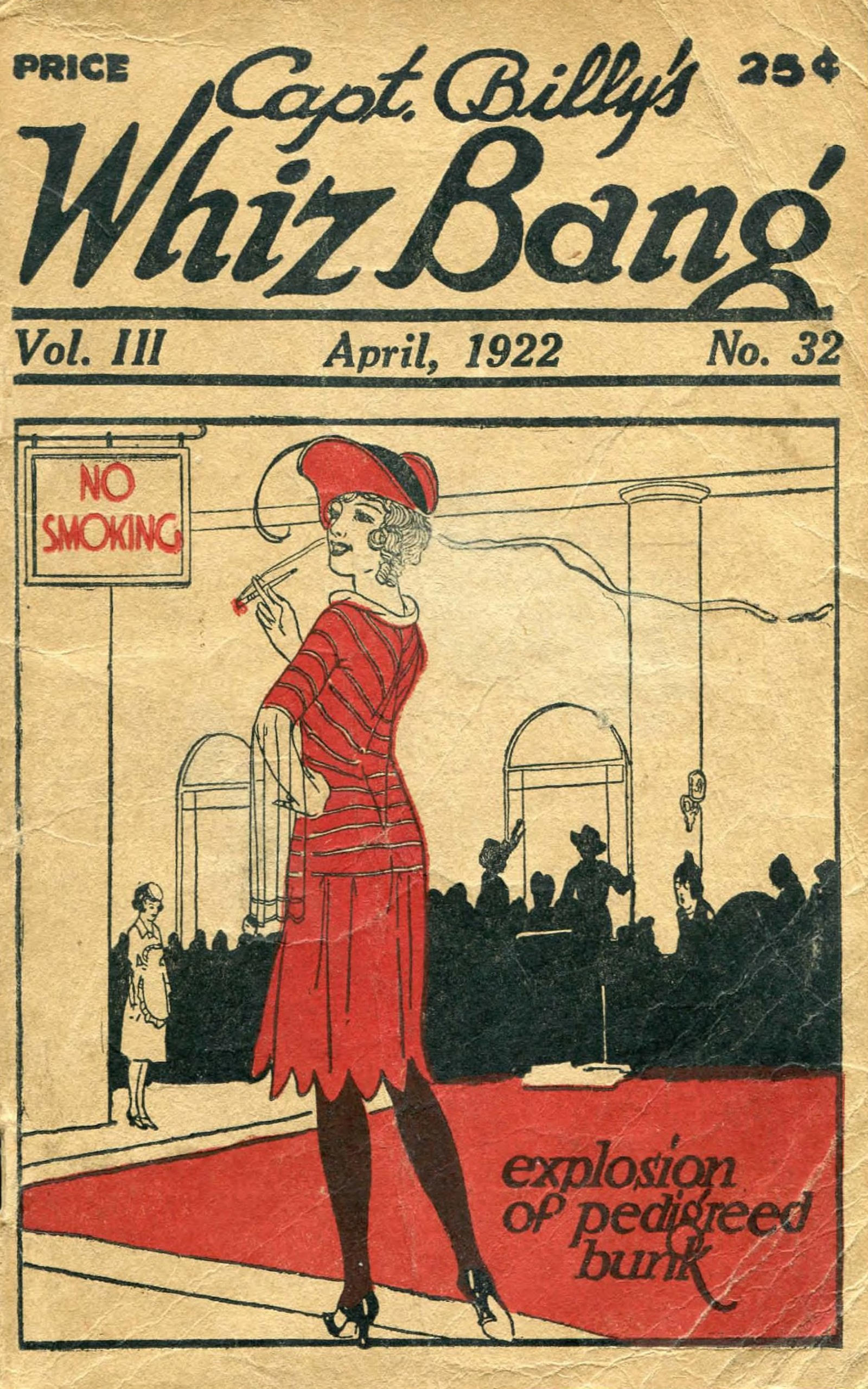
The Winter Annual
(See inside back cover)
CONTENTS
- Drippings from the Fawcett
- Girl in Blue Velvet Band
- Face on the Barroom Floor
- Frankie and Johnnie Blues
- Shooting of Dan McGrew
- Wedding of the Persian Cat
- Ace in the Hole
- Booze Fighter’s Dream
- Diary of a Divorcee
- Fable of the Bull
- Highty Tighty Aphrodite
- Golightly Highballs
- How to Kiss Deliciously
- Hunting the Wily Pole Cat
- Mohammedan Bull
- Our Own Fairy Queen
- Tool House on the Farm
- The Old Smokehouse
- Questions and Answers
- Gila Monster Route
- Pasture Pot Pourri
- Hooch Cure Blues
- Dying Hobo
- Lasca
- Sam’s Girl
- Toledo Slim
- Evolution
- Poppies
- After the Raid
- The Harpy
- The Suicide
- Tarnished Goods
- Separation
- Little Red God
- The Ladies
- Limber Kicks
- Naughty But Nice
- To the Girl
- Rural Mail Box
- Tired Hired Man
- Life’s a Funny Proposition After All
[1]
Captain Billy’s
Whiz Bang
America’s Magazine of
Wit, Humor and
Filosophy
APRIL, 1922 Vol. III. No. 32
Published Monthly
W. H. Fawcett,
at Robbinsdale, Minnesota
Entered as second-class matter May 1, 1920, at the postoffice at Robbinsdale, Minnesota, under the Act of March 3, 1879.
Price 25 cents $2.50 per year
ONE DOLLAR FOR THE WINTER ANNUAL
Contents of this magazine are copyrighted. Republication of any part permitted when properly credited to Capt. Billy’s Whiz Bang.
[2]
“We have room for but one soul loyalty and that is loyalty to the American people.”—Theodore Roosevelt.
Copyright 1922
By W. H. Fawcett
Captain Billy’s Whiz Bang employs no solicitors. Subscriptions may be received only at authorized news stands or by direct mail to Robbinsdale. We join in no clubbing offers, nor do we give premiums. Two-fifty a year in advance.
Edited by a Spanish and World War Veteran and dedicated to the fighting forces of the United States
[3]
Drippings From the Fawcett
Readers of this little bundle of farm-yard foolishness and filosophy may have gotten a kick out of some of our jabs at the movie colony that hangs out at Hollywood—on the Pacific Coast near Los Anglaise.
There are estimated to be about 30,000 people engaged in the motion picture industry in Hollywood and environs. Out of this crew there are a lot of lame-brains, a goodly sprinkling of nincompoops, who flaunt their peccadillos with a too-apparent wish to have them noticed and press-agented. They wear brass-band clothes, ride around in noisy cars with license tags like “Fatty” Arbuckle’s “606,” and live noisy lives.
By the very nature of their employment they are in the public eye and everything they do comes under the public’s microscope. Every move they make is published to the eager world by their zealous press agents. A home-brew party in a bungalow comes forth a “Neroesque orgy in a mansion,” as Waldemar Young put it. And yet, goodness knows, they probably have enough of the real kind—and we envy them.
[4]
However, what are we coming to, is that the noisy movie people have their prototypes everywhere in society and its numerous substrata, and we for one are not going to make any scavenger’s holiday out of the William Desmond Taylor murder mess in Los Angeles.
Taylor appears to have been an artist of high calibre—hard-working, earnest, capable and a gentleman. But he permitted himself to be murdered—and he was a movie director. Consequently the public immediately put Taylor on trial. They dragged his name through the mud, swishing, swashing. Having put Taylor on trial, it was found that he had taken a stage name—a common thing in the movie and the fight game. But when a man gets murdered he ought to be more careful.
Man of mystery, “Dual life.” Perhaps yes and perhaps no.
But a lot of buncombe, any way you look at is—Imbecilic, puerile. That’s what we think of the campaign of calumny against the motion picture colony growing out of the Taylor murder.
The other day we read a statement from Frank Mayo, a movie actor, who burst out with this denunciation: “The Hollywood film colony is a pernicious influence. [5]Scatter it, abolish it, burn it up—I say.” Mayo ought to be ashamed of himself. We might just as sensibly orate Robbinsdale—burn it up, scatter red pepper in every front yard and squirt formaldehyde through every key-hole. Somebody tried to rob the Robbinsdale bank and got killed at it.
As we have hereinbefore set forth, there are a lot of tramps in Hollywood—just as there are a lot of undesirables in Robbinsdale, in Minneapolis, in Chicago. And there are just as many honest, decent men and women in the picture business as in the ranks of the sanctimonious reformers, even if they do not go around mouthing the scavenger’s chant “I am holier than thou.”
If Mayo had said: “Run out the undesirables,” we might have joined with him in a hearty “amen.” But it is childish and surely unfair to damn the good with the bad.
The mayor of Los Angeles insists that the actresses and actors of Hollywood are fine citizens, good neighbors and respectable ladies and gentlemen. Adolph Zukor, who is head of the Famous Players, declares: “There is no more immorality in Hollywood than in the New York Stock Exchange”—not much of a boost for Hollywood but a powerful statement just the same.
[6]
Finally, you find Hobart Bosworth throwing the responsibility squarely in the faces of an audience that listened to him: “You think that we of the motion picture world are rotten. Through the confessions of the box office we know that you, the public, are rotten.”
Mayo’s statement is not true. The man who agrees with him has forgotten that things exist because certain definite forces have brought them into being—and Hollywood, even though rotten to the core, burnt up or scattered would arise again somewhere else. The mayor of Los Angeles spoke half the truth, at least. The motion picture people are folk like all the rest. Bosworth is blind. He is angry when he should be sympathetic, despising when he should be greatly moved by the pathos of the spectacle.
If there is weakness in the movie picture colonies the imperfections are not the result of viciousness and immorality in the public that Bosworth calls “rotten.” It is the effect of loneliness and frustrated hopes that sends the starved ones to the movies. It is no small thing in each human being—that longing for beauty and the allurements of wealth, love and triumph. But the sum of all this longing combined and packed into the streams that flow toward Hollywood is stupendously powerful.
It makes life what it is in the motion pictures, brings out the noise in those who have not had proper advantages and makes puppets [7]of men and women who ought to be just “plain folk” and ruins their lives.
But so far as William Desmond Taylor is concerned—We are unable to see that the movies made a puppet out of him. He was in life respected by his associates—a leader, a man of ideals. And that is why the little old Whiz Banger refuses to be stampeded with the gang that is burrowing in the Hollywood garbage can, seeking delicacies of juicy, ripe dirt to twist their long tongues around.
We’ve heard the story of the lions and the lionesses, tigers and tigresses, and bears and bear cubs, but not until we became a guest on board the U. S. S. Niagara in Havana harbor of Lieutenants Parsons and Faga did we really discover the superintelligence of wild animals. The first member of the crew we met was a jovial gob, Jack Sellers, who introduced us to his Pride and Joy, the mascot, a big black bear.
“This bear is very intelligent,” vouchsafed Sellers. “You know we sailors sleep in hammocks on the decks. In the middle of the night when the bear gets cold he sneaks around and steals blankets off the sleeping gobs. He carries the blankets to a secluded spot on the ship and piles them evenly, one on top of the other, until he gets forty or fifty. He then retires for [8]a comfortable nap on his downy bed. When the gobs are awakened from the chill and find their blankets missing they immediately search for Bruin. Would you believe it, that bear won’t let any jackie take his bedding until he first smells him and then sniffs at the pile of blankets? When he finds the rightful owner he pulls out his blanket from the pile and gives it to him.”
Woof! Woof! Woof!
A New York poet who knows the yearnings of a demi-virgin’s heart gave this verse the title “Naughty—But Nice,” a plagiarized version of an original poem under that title which was published in an early issue of the Whiz Bang and the Whiz Bang Winter Annual. The New York Times, in publishing this verse, believes a more fitting title would be:
It Can’t Be Done
[9]
“Dear Billy,” writes Chris Corey, a Minneapolis pill pusher, “You are always writing jokes about other tradesmen but nothing about we druggists. Now, you know we all handle the Whiz Bang and are great boosters for it, so please give us a joke about the pill pounders.”
All right, Chris, here’s one, having to do with your recent convention of druggists in Minneapolis—The chairman rapped with his gavel, “You are out of order, sir!”
“I beg your pardon, Mr. Chairman,” responded the speaker, “I never felt better in my life.”
They have a new way of catching whitefish at Breezy Point in the winter months. The fisherman repairs to the frozen over river with a hammer, a saw and a can of peas. He cuts a hole in the ice, sprinkles the peas around the edge of the hole and when the fish comes up to take a bite he hits him over the head with the hammer.
Americans in Cuba for the most part are strictly business. I hadn’t been in Havana twenty-four hours until fellow citizens tried to sell me the Malecon; Morro Castle; the Almendares; a boneless elephant; some finless fish; fiddlers’ soup; and a throatless frog. I’ll tell you our brother Americans in Cuba are great for business.
[10]
“Humor”
The following is a vivacious little conceit, entitled “Humor,” culled from Laura Benet’s “Fairy Bread.” (Thomas Seltzer.)
Turn ’im Loose, Judge!
Judge—Are you guilty or not guilty?
Prisoner—I was going to plead guilty, yer honor, but my lawyer has convinced me that I am innocent.
[11]
The Boys in the Back Room
“Vat will you haf?”
“Vat haf you got?”
“Ve haf some nice ha’f and ha’f.”
“You haf? Ha’f vat and ha’f vat?”
“Ha’f ha’f of vun per cent dark and ha’f ha’f of vun per cent light.”
“Vell, I think I’ll haf to haf a seegar.”
“Maud kicked the bucket,” said Gus, as he sadly surveyed the spilt milk.
Sob Stuff
Dear Capt. Billy Fairfax—I’m on a visit from the East. Fell in love with a Western girl. For the past six months I have been faithful to her, I thought my love was returned and never looked at anyone else. Took her around the country some and to different places of amusement. Finally on a beautiful moonlight night I took her in my arms. Oh, my, I can see her now—her beautiful face, Oh, those eyes, those nose, those mouth, those beautiful hair.
I kissed her and she closed her beautiful eyes. She was happy I thought. Things went on fine but as I had not been in the town long I didn’t know much of what had been going on. Then to my sorrow I found there was someone else, a guy with a super-six and a tin ear. I was broken-hearted, she had lied, used me for a fool. Then this shy, modest thing I had trusted crushed me by telling others she had never cared for me and also laughingly told them of my lovesick talk. What do you think of that for honor and decency? She continues to talk and my life is a miserable affair.
Please advise me what to do, because if my wife ever hears what this girl has to say she’ll “raise ’ell.”—Pete Olson.
[12]
Iowa Frivol Pulls This One
An optimist is a man going up the river with a canoe, a girl, a basket, a blanket and a couple of pillows.
A pessimist is the same man coming back.
She was so bow-legged she could wear a pair of parenthesis for stockings!
The Height of Ambition
I sure got a fine job since I came out of the Army.
What’s that.
Well, you know the fellow that hammers underneath the passenger cars, well, I help him listen.
Ancient Stuff
El—“What did you give the baby when it was christened?”
Ella—“A silver spoon.”
El—“Was it a good one?”
Ella—“I’ll say it was. It had ‘Blackstone Hotel’ on it.”
Ikenstein—“Your new stenographer iss a beaut. Can she spell?”
Rubenstein—“Vat hass that to do vid it?”
Speaking of stingy people, I knew a fellow that had two teeth extracted and then wanted the price of his board reduced.
[13]
Hollywood Flirtations
(The following item was written a few days before the tragic death of Mr. Taylor. Miss Normand at this time is reported the last known visitor to Mr. Taylor’s apartment before the slaying.)
Mabel Normand is tripping the light fantastic at the Cocoanut Grove very often. Sometimes it’s William D. Taylor, Lasky director, and we also hear that Mack Sennett gave her a wonderful birthday party and many presents. When the girls get Mabel to talk in the seclusion of her own boudoir, the sly gal brings out a little bag just dangling full of nice diamond solitaire engagement rings. When she gets a new one she gives the bag a toss and giggles! That’s how seriously Mabel takes this matrimony stuff!
An ironic fact has put May Collins into the very dressing room at the Mayer studio formerly occupied by Mildred Harris. May, you know, has been often reported as engaged to Charlie Chaplin, Mildred’s noted ex. Miss Collins, it is said, found a picture of Charlie in a remote drawer of the dresser, wiped off the dust and stuck it in the mirror for her own perusal!
[14]
Bebe Daniels’ grandmother, her mother and Jack Dempsey all deny that Bebe and Jack are to wed. Reporters have even interviewed the family cat on the subject, but the news tip has fallen flat all around!
And, speaking of Charlie Chaplin, his leading lady, Edna Purviance (who was one of Charlie’s early loves as well) is reported engaged to Paul Hunter, wealthy business man and polo player of Pasadena.
Lucille Carlisle again will be leading lady for Larry Semon. She formerly was engaged to marry Semon, but suddenly the engagement was declared off; she left the studio and nothing had been heard of her for several months. Now it appears that all is again sweetness and light between Miss Carlisle and the comedian.
Whiz Bang will soon invade a new territory. We believe that the Laguna Beach and La Jolla artist colonies have been too long neglected in our zeal to disclose those little personal affairs out in Hollywood. While fair and winsome Hollywood nobly tows a few barges of stuff, Whiz Bang’s astute investigators have discovered naughty Laguna Beach doing just terrible things and getting away with it because there are four hours of muddy automobile road away from any sort of [15]town. La Jolla has this week confirmed some of our suspicions in the bathing suit marriage which took place when Del Carmen and Sarah Andrews plighted their serious (?) troth in the trough of the ocean. Artist like, they just wanted to be “different.”
Of course you wouldn’t think an artist who paints with a brush could be as lowbrow as those Hollywood actors, but you just ought to be in on some of the parties staged down at sneaky little Laguna Beach. An artist colony (many of them people of national reputation, too), resides there permanently in a little world of their own. Judging from several little Bohemian affairs visited by Whiz Bang’s official chaperone, we would judge that everyone’s in love with best friend’s wife, and best friend doesn’t even care! Sandals, and loose sloppy clothes and no haircuts usually travel with freedom of thought. That’s why it’s hard to believe that some of Hollywood’s most athletic, healthiest, best groomed and best clothed actors are steeped in sin!
The Hollywood Chamber of Commerce and the Motion Picture Producers’ Association have just joined forces to combat magazine and newspaper propaganda tending to paint Hollywood as a modern Babylon. Whiz Bang suggests the simple expedient of throwing loads of mud at somebody else (perhaps Laguna or La Jolla), thus diverting the scandal hungry [16]eyes of the nation away from Hollywood long enough to pull a few more good parties.
Charlie Chaplin and Douglas Gerrard gave a lovely dinner party in honor of Mme. Anna Pavlowa, husband and company on their recent visit to Los Angeles. This year’s party was drier than the last, but Douglas, we haven’t forgotten that party you gave in Anna’s honor about two years ago! The Wilshire district and Los Angeles “upper ten” gave a smart tea in the afternoon at the residence of a well-known society woman. Everyone in society was there and poor Anna shook hands and said polite things until her patience was almost at an end. So, when Douglas’ party was pulled off that evening ’tis said Anna cut loose, enjoyed a lot of naughty stories and vowed she preferred Bohemians! You know Douglas can tell ’em, too!
It was only two weeks ago that we thought we saw Mabel Normand dancing at the Cocoanut Grove with F. Richard Jones; chief director under Mack Sennett, but Mabel “bawled” out a morning sheet for insinuating such a thing, so maybe it isn’t true! Anyhow, Mrs. F. Richard has just filed suit for divorce. She asks $1,000 a month alimony, claiming hubby earns $100,000 a year. Mutual jealousy seems to have caused the break-up.
[17]
“Billie” Rhodes, comedy star of picturedom, has filed a divorce action against William Jobelmann, a theater publicity man. She charges he drank, even stealing a bottle from her own private stock to appease his desire. This, says Billie, capped the climax and she asks her freedom.
Mrs. Thelma Morgan Goetz, pretty English actress, has just divorced Ronald Goetz, formerly a captain in the English army. They are both members of Hollywood’s film colony. “He made a wonderful lover,” complained the wife, “but not a good husband. He wanted his fling—he craved variety.”
Paramount opened its Wilshire district studio just recently. Was it for this reason that the Los Angeles police department found it necessary to open a Wilshire station the same day?
When a woman puckers up her lips to be kissed she is just setting her trap.
“Youth must have its fling,” said the Scotchman, as he started his bag-pipe working.
[18]
Torch’s Best One
She (to fair friend)—“I’m not going with Bill any more.”
Fair Friend—“Why not?”
She—“He knows too many naughty songs.”
Fair Friend—“Does he sing them?”
She—“No, but he’s always whistling them.”
Song of the Tire Chain
Girls may smoke. However, the correct way to light a match still remains a man’s privilege.
In Valparaiso
Why so sad, Diogenes?
I was going up College Avenue looking for an honest man, and, alas, someone stole my lantern.
“That pianist sure claws a mean batch of ivories.”
“Yeh, he sure beats a nasty can!”
“Now do be sure to come and see us soon, won’t you?”
“Yes, we will. We’ll call on you the first time we go slumming.”
[19]
Soliloquy of a Hooch-hound
When my soul becomes clogged with evil deeds, my mind and conscience inundated with hideous hallucinations, and my heart dry and acrid with the pain of living, I imbue my soul, my heart, my mind with King Alcohol.
Then, as the morning breeze dissipates the fog, the kindly King cleanses my soul; as the sun dries and purifies the stagnant swamp, so Alcohol transforms the morass of my mind into a verdant meadow; as the spring rains change the desolation of winter into flowers and grain, so my lord and master changes the cynical, skeptical desert of my heart into an oasis of compassion and philanthropy.
That’s why I drink.
The Diff’unce
Special For the Clergy
“Father,” explained the visitor to the priest, “I ask penance for the sin of bootlegging.”
Father Kelly was puzzled and telephoned the superior father for advice.
“What shall I give a bootlegger, Very Reverend Sir?” the priest inquired.
“Don’t give him more than five dollars,” came the answer. “That’s all I ever pay.”
[20]
London Post Toastie
“Oh, what a naughty little boy,” cried the kind lady, “to beat and kick his poor mother like that!”
“Take no notice of the choild at all,” responded the proud mother. “Bliss his little heart, he must do everything he sees his father do!”
Lodge Notice
The Bootleggers’ Benevolent Association of America.
Meets every Thirsty night at Wood-Alco Hall. At our next meeting the following officers will be installed:
F. U. Selloyl, High Muck-a-Muck of the Mash.
I. Rob. Sellers, Bearer of the Boot.
Formal D. Hyde, Lord of the Leg.
R. Ott Gutt, Licker of the Labels and Seals.
A special lecture on “Making Moonshine with the Materials at Hand” will be given, with Prof. Ray Sinn at the Still.
Spring Sports
Standing in the barnyard and watching the cows come in.
[21]
Questions and Answers
Dear Captain Billy—I am a young man, fifteen years old, and I am going with two girls, one fourteen and the other twenty-seven. Do you think it possible to love both of them at the same time?—Willie Bohy.
No, Willie, not if they know it.
Dear Cap’n Bill—When the silverware for your meal consists of more than three pieces, which side do you start on, the right or left?—Konnick Essen.
Start at either side, Konnick, but be sure and have one piece left for the dessert.
Dear Capt. Bill—Of late I have been having trouble with my lungs and thought perhaps you could suggest a remedy.—Ada Clock.
Dear Ada—Merely open a window and throw out your chest.
Dear Capt. Billy—Please give us the definition of Booster, also Knocker.—Isin Yet Tu.
A Booster is a man with something to sell, and a Knocker is one who bought some of it.
[22]
Dear Capt. Billy—What is the difference between a dawnce and a dance?—Iowa Bill.
The difference between a dawnce and a dance is one dollar and fifty cents and three fights.
Dear Capt. Billy—What is a goblet?—Frank Furter.
A small sailor.
Dear Capt. Bill—My little boy has worms; what would you suggest?—Alvie.
Feed him fish, fish like worms.
Dear Capt. Billy—Percy, my sixteen-year-old son, says his greatest ambition is to sing tenor in a glee club. What shall I do?—Worried Mama.
The case is hopeless. You never should have named him Percy.
Dear Doctor Bill—One night at a party I met a fellow and he had to escort me home. When we got to a dark place he pushed me into a mud puddle and ran. Do you think he loves me?—Sis Hopkins.
There can be no question of it.
Dear Captain Whiz Bang—I very much enjoy hunting, but also believe in the protection of wild animal life. What shall I do?—Daniel Boone of Kokomo.
Always use blank cartridges.
[23]
Dear Capt. Billy—Since I enrolled at the University, I have heard the girls talking about dates. Tell me what a date is and how to acquire them.—Iowa Girl.
Dates grow in Palestine, Arabia, and other Oriental countries. They also flourish on the walls of telephone booths and in pool halls. Send me your picture and you will hear from me soon or I will return the picture.
Dear Capt. Billy—Can you recommend a stiff drink?—Bill Eltinge.
Embalming fluid.
Dear Capt. Billy—What is your idea of an ideal job?—Abie Friedman.
Pork inspector for the City of Jerusalem.
Dear Capt. Billy—What fish does a girl like most?—A. John.
Her ring.
Dear Capt. Billy—Do you believe in reincarnation?—Havana Eggie.
Can’t say as I do. However, should I ever be reincarnated my hopes are to be either a colored man or a Hebrew. A colored man, you know, doesn’t want anything much and a Hebrew usually has all he wants.
They called the baby Fish-hooks—it was such a “catchy” name.
[24]
The Ace of Tragedies
“It was in the spring of 1896,” related the grizzled veteran of the Yarn-Stretcher’s Club, according to the London Post, “that I was out in the Wild West. I was on a jury that was trying a man for homicide. I hated to think of the fellow being hanged, so I stuck out against the other eleven jurymen for five solid days and nights. My obstinacy was rewarded. One by one they gave in, and we returned into Court and returned a verdict of ‘Not Guilty.’ The only thing that spoiled my satisfaction with the result was that some of the citizens had lynched the prisoner the first day we were locked up.”
And he sighed, reminiscently, as he took another gulp of his whisky-and-soda.
Toole’s Best One
Small boy (handing grocer two cents)—“I want two cents’ worth of bananas.”
“We have no bananas,” said the grocer, not wanting to monkey with two cents.
“What’s them?” said the boy, pointing to a bunch of bananas.
“Pineapples,” the grocer replied.
“Well, gimme two cents’ worth of pineapples.”
Southern Hospitality
Does you all like yore entatanment wit or witout?
[25]
Walking with a Purpose
I love to walk.
Last Sunday I took the most wonderful stroll.
I went for quite some distance through the park, thoroughly enjoying every breath of the cool, crisp air. I felt like a new man as I hastened onward, increasing my speed at every step. I walked on and on, drinking in the beauty of all about me. It was wonderful.
Finally I picked her up.
Coffin Nail Epitaph
Our Monthly Proverb
A stitch in time gathers no moss.
In the vernacular of the Bowery,
“DE OILY BOID CATCHES DE WOIM.”
A Warning to Flappers
Our Latest Song Hit
“A Cat Has Nine Lives, But a Bull Frog Croaks Every Night.”
[26]
Our Chestnut Rack
Two Irishmen held up a Scotchman, who had put up a terrific battle, but finally was overcome. After the two Irishmen had gotten Sandy’s pocketbook, which was tied up with a stout string, they ran away.
Unwinding the string and poking his fingers into the corners of the thing, Pat finally located a solitary five cent piece. Looking at it a moment in silence, he turned to his companion and said, “My gausch, Mike, suppose he’d had a dime, he would have killed both of us.”
To Molly of Havana
Our Monthly Motto
“A girl in your arms is worth two on the ’phone.”
“Did you hear the joke about the spoiled mulligan?”
“No.”
“’Stoo bad, ’stoo bad.”
[27]
Motorcycle Mike
Mike and Pat went motorcycle riding one evening. All of a sudden they had a collision. Two hours later Pat recovered consciousness in a hospital and learned that Mike had been killed.
“He should have been dead long ago,” remarked Pat, wryly, “he saw two bright lights ahead of him and the dang fool said to me: ‘Watch me sneak through there.’”
At Havana Races
Pardon Me—
“I beg your pardon,” cried the convict as the governor passed his cell.
I wish I was the Warden’s daughter.
How come?
There’s always men hangin’ around.
“My wife’s tongue is so long she doesn’t have to use a towel to wash her face.”
[28]
The Traveling Man
I register, most any old hotel, some bug cage, fire trap with glue plant smell. In darkened hall I seek the number on the door, and find the bed—a sea of tumbled rags, used many nights before. And often I must lend my aid to drowsy, hook-worm chambermaid, who spreads and shakes and smoothes and tucks and toils and sweats to make it well—then I jump in and tear it all t’ell!
Song of Newlywed
For verily he that sitteth upon a toad stool shall arise again.
“Might as well hitch my wagon to a star,” said the drunken teamster, as he passed his rope around the lamp-post.
[29]
What Is All the Noise About?
The barber is shaving himself.
But why the argument?
He is trying to talk himself into having a massage.
Blank Verse
He went in to church the first time and they threw water on him; the second trip they threw rice on him; the third time was the charm; they threw dirt on him.
Back Porch Cross Fire
“Fire, Fire,” said Mrs. McGuire.
“Where, Where?” said Mrs. Blair.
“Downtown,” said Mrs. Brown.
“S’ help us and save us,” said Mrs. Davis.
The Penalty
I never looked up my family tree but I know that I’m the sap.
[30]
’Twas Sweet of Her
“Sweetheart,” gushed his bride, “the grocery stores were all closed today, and—”
“I suppose I don’t get any dinner,” he cut in, eyeing his true love hungrily.
“No, my darling,” she gurgled, “the confectionery was open, and I’ve made you some nourishing jelly bean soup.”
In the Army
We went to a fair the other evening for the benefit of the church and took chances on everything but did not win a prize. About twelve o’clock, as I was leaving a friend told me to stick around and I did for an hour and one o’clock.
Wild Guy
Boo Hoo, Blooey
She—When I die you’ll never find another woman like me.
He—Well, you can take it from me, I’m not going to try.
True
Confessions
A Fawcett Publication
$10,000 Short Story Contest!
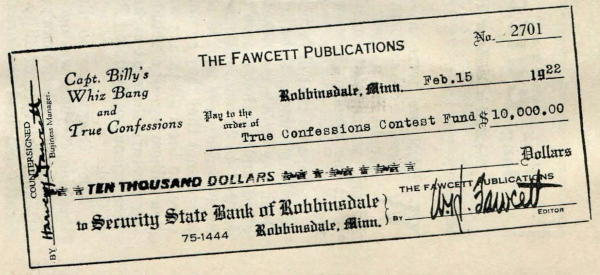
Within a few weeks True Confessions, a Fawcett Monthly magazine, will make its appearance on the news stands of the United States and Canada with a new purpose and new ideas. We live in the field for distinctively interesting based-on-fact stories of 1,000 to 10,000 words, and offer contributors—
- Two grand prizes of $1,000 each.
- Two second prizes of $300 each.
- Two third prizes of $200 each.
- Twenty prizes of $100 each.
- Fifty prizes of $50 each.
- One Hundred prizes of $25 each.
The contest is divided into two sections. The first section closes June 30, 1922 and manuscripts which fail to win prizes in the first section will be entered in the second section automatically, and thus early contestants will have a second chance. The second section closes Oct. 1, 1922.
FIRST SECTION |
SECOND SECTION |
(Contest closes June 30, 1922) |
(Contest closes Oct. 1, 1922) |
|
|
Suggestions: Confessions of a Magdalene, Confessions of a Jimmy Valentine, Confessions of a Maniac, Confessions of a Dope Fiend, Confessions of Faithless Love, Confessions of Hate. All stories must be unusual. True Confessions will not consider cut and dried fiction. We will take our readers into the inner chambers of real life. Unless otherwise requested, writers’ names will not be published. All manuscripts not prize winners will be purchased at space rates upon acceptance.
Further information will be supplied on request. Manuscripts should be addressed to—
W. H. FAWCETT, Editor,
True Confessions
ROBBINSDALE. MINNESOTA.
[31]
Whiz Bang Editorials
“The Bull is Mightier Than the Bullet.”
When we were a soakey-nosed kid in Grand Forks, North Dakota, our teacher taught us a poem headed “Abou Ben Adhem,” which went something like this, “Then count me among those who love his fellowmen.”
It appears that old Abou Ben Adhem hadn’t been listed among those in the angel’s Book of Gold, having a sure ticket through St. Peter’s gates, and for that reason the old fellow merely wanted to be charted among the Dead Game Sports who were square to their fellows; who judged not that they be not judged; that, being pure, to them all things were pure. The Abou Ben Adhem legend concluded by the angel making a return the next night and listing this old time legendary Sport on Page One of the Book of Gold.
Riley Grannan, who died in April, 1908, at Rawhide, Nevada, was one of these Dead Game Sports, and while we can’t all be angels and see through the eyes of Billy Sunday and Doctor Crafts and lead the ordained exemplary life, [34]we can take a tip from the life of Riley Grannan and be Dead Game Sports no matter what path in life we follow.
Although it has been fourteen years since he passed into the Great Beyond, his kindly deeds and noble character centralizes conversation on the Havana race track and at all other turf gatherings.
Just a few brief explanatory remarks before we publish from an old issue of a Nevada newspaper the story of Grannan’s burial. This Dead Game Sport was a famous race track plunger and his bets ran as high as $200,000 on a single race, and the following is respectfully dedicated to “The Gang”—that bunch of carefree fellows who follow the lure of the turf. Riley Grannan was one of them in life, and no greater tribute could be paid him than that found in the desire of the “gang” that these, the last words spoken over his bier, should be preserved. None can read them without gleaning some inspiration, for they cannot fail to strike a harmonious chord upon the heart-strings of the coldest soul. As chronicled by Jeanne C. Grainger—
Rawhide, Nev., April 15, 1908—Half shielded under an oil-cloth blanket, lodged in a common express wagon, the casket of Riley Grannan was carried recently down dusty Rawhide avenue and along Nevada street from the tented establishment of the camp’s undertaker to an improvised memorial chapel, a variety theatre at the rear of a saloon.
There congregated a throng in silks and corduroys, women of metropolitan costumes, miners covered with [35]high-grade grime, prospectors sun-tanned, brokers, bankers, merchants, promoters, owners of saloons, bartenders, gamblers, rounders. Tears that were shed dropped from the eyes of all. Again, as always in mining camps, class forgotten, all men were equal.
A solemn hush came down upon the little playhouse where last night and tonight, jostling crowds drank and smoked while listening to doubtful wit from the coarse jesters, men and women on the variety forum. Hovered about the bier of Riley Grannan, race track plunger of national renown, was as solemn a group of sincere mourners as ever gathered to pay final tribute.
Solos were offered by Mrs. Hedricks, once an actress of wide fame, now wife of the editor of a Rawhide daily paper, and by Jack Hines, miner of Alaska, and leaser of Rawhide. Punctuations came with resounding blasts from a score of mines on the mountains just above. Saloons were closed and the streets were silent throughout the service. At its end a solemn cortege trudged with the remains, destined by automobile to travel thirty miles to Schurz, there to go aboard the cars to Riley’s brother in Kentucky.
Unique beyond experience and dramatic beyond compare was the eulogy pronounced by H. W. Knickerbocker, once a clergyman, then a mine operator of Goldfield, later a Rawhide pioneer. Hardly orthodox, but wholly in keeping with the scene and the mute desires of the dead, was the orator’s appearance. The once pulpit exponent stood beside the lily-laden bier, his eyes bedimmed with tears, his voice choked with a fraternal emotion, he was shod in high boots and clothed in the rough garb of a miner. A stenographic report of the eulogy follows:
“I feel that it is incumbent upon me to state that I now occupy no ministerial or prelatic position. I am only a prospector. I make no claims to moral merit whatever or to religious authority except it be the religion of the brotherhood of man. I wish to be taken only as a man among men, feeling that I can shake hands [36]and style as my brother the most humble of you all. If there may come from me a word of moral admonition, it springs not from a sense of moral superiority, only from the depths of my experience.
“Riley Grannan was born at Paris, Ky., about forty years ago. He cherished all the dreams of boyhood. Those dreams found their fruition in phenomenal success financial. I am told that from the position of a bellboy in a hotel, he arose to be a celebrity of world wide fame. Riley Grannan was one of the greatest plungers the continent has produced. He died day before yesterday at Rawhide.
“That is a brief statement. We have his birth, and the day of his demise. Who can fill the interim? Not I. Who can tell his hopes and fears? Who knows the mystery of his quiet hours? Not I.
“Riley Grannan was born in the sunny southland of Kentucky. He died in Rawhide. That is the beginning. That is the end. Is there in this picture of what Ingersoll said at the grave of his brother, ‘Whether it be near the shore, or in mid-ocean, or among the breakers, at the last a rock must mark the end of one and all.’
“Born where brooks and rivers run musically through prolific soil, where magnolia gladiflora, like white stars, glow in a firmament of green, where lakes, the greensward and the softest summer breezes dimple the wavelets, where the air is resonant with the melody of a thousand sweet-voiced birds and redolent of the perfume of blooming flowers, that was the beginning. Riley Grannan died in Rawhide, where in winter the tops of the mountains are clothed in garments of ice and in summer the blistering rays of the sun beat down upon the skeleton of the desert.
“Is there in this a picture of universal life? Sometimes, when I look upon the circumstances of life there comes to my lips a curse. I relate to you only my views. If these run counter to yours, believe that what I say is sincere. When I see the ambitions of man defeated, when I see him struggling with mind and body to accomplish [37]his end, when I see his aim and purpose frustrated only by a fortuitous combination of circumstances over which he can exert no control, when I see his outstretched hands about to grasp the flag of victory, and to seize instead the emblem of defeat, I ask, ‘What is life?’ Dreams, awakening, death. Life is a pendulum betwixt a smile and a fear. Life is but a momentary halt within the waste and then the nothing we set out from. Life is a shadow, a poor player that struts and then is heard no more. Life is a tale told by an idiot, full of sound, signifying nothing. Life is a child-blown bubble that but reflects the shadow of its environment and is gone, a mockery, a sham, a lie, a fool’s vision, its happiness but Dead Sea apples, its pain the crunching of a tyrant’s heel. Omar says it better when he says: ‘We are but a moving row of magic shadow shapes that come and go, around with a sunny lumined lantern held in midnight for the master of the shore, but helpless pieces of the game we play on the checkerboard of night and day; hither and thither moved or checks or slaves, and one by one back into the closet laid. The ball, no question, makes of eyes or nose, but here or there, as strikes the player, goes. But he that tossed you down into the field; He knows, He knows.’ He knows, but I don’t. That’s my mood. Not so with Riley Grannan.
“If I have gauged his character correctly, he accepted the circumstances surrounding him as the mystic officials to whom the universe had delegated its whole office concerning him. He took defeat and victory with equal equanimity. He was a man of placid exterior. His meteoric past shows him invincible in spirit and it is not irreverently that I proclaim him a dead game sport. When I use that phrase I do so filling it as full of practical human philosophy as it will hold. Riley Grannan fully exemplified the philosophy of those fugitive verses, ‘It’s easy enough to be happy when life goes along like a song; but the man worth while is the man who will smile when everything goes wrong; for the test of the [38]heart is trouble, and it always comes with the years; and the smile that is worth the homage of each is the smile that shines through tears.’
“There are those who will condemn him. They believe that today he is reaping the reward of misspent life. They are those who are dominated by mediaeval creeds. Them I am not addressing. They are ruled by the skeleton hand of the past. They fail to see the moral side of a character lived outside their puritanical ideas. Riley Grannan’s goodness was not of a type that reached its highest manifestation in ceremonious piety. It found its expression in the handclasp of friendship. It found its voice in the word of cheer to a discouraged brother. His were deeds of quiet charity. His were acts of manhood.
“Riley Grannan lived in the world of sport. My words are not minced because I am telling what I believe to be true. It was the world of sport, sometimes of hilarity, sometimes worse. He left the impress of his character upon us all, and through the medium of his financial power he was able with his money to brighten the lives of all who knew him. He wasted his money, so the world says; but did it ever occur to you that the men and women of such class upon whom he wasted it are yet men and women? A little happiness brought into their lives means as much to them as happiness carried into the lives of the straight and the good. If you can take one ray of sunshine into the night life and thereby carry a single hour of happiness, you are a benefactor. Riley Grannan did this.
“God confined not his sunbeams to the nourishing of potatoes and corn. His scattering of sunshine was prodigal. Contemplate. He flings the auroral beauties round the cold shoulders of the north. He hangs the quivering picture of the mirage above the palpitating heart of the desert. He scatters the sunbeams like shattered gold upon the bosom of a myriad of lakes that gem the robe of nature. He spangles the canopy of night with star jewels and silvers the world with the reflected beams from on high. He hangs the gorgeous crimson [39]curtain of the occident across the sleeping room of the sun. ‘God wakes the coy maid of the morning to step timidly from her boudoir of darkness, to climb the steep of the orient, to fling wide the gates of morning and to trip o’er the landscape, kidding the flowers in her flight. She arouses the world to herald with their music the coming of her King, who floods the world with effulgent gold.’ These are wasted sunbeams. Are they?
“I say to you that the man or woman who by the use of money or power is able to smooth one wrinkle from the brow of human care or to change one moan or sob into a song, or to wipe away a tear, and to place in its stead a jewel of joy, is a public benefactor. Such was Riley Grannan.
“The time has come to say goodbye. For the friends and loved ones not here to say the word, let me say goodbye, old man. We will try to exemplify the spirit of your life as we bear the grief at our parting. Words fail me here. Let those flowers, Riley, with their petaled lips and perfumed breath, speak in beauty and fragrance these sentiments too tender for words. Goodbye.”
Something Wrong
Little Willie—Ma, is Pop taking you out to dinner tonight?
Mother—Yes, then to the theatre.
Little Willie—What’s the matter?
Help! Help!
“Burglars! Burglars!” cried Jones, sticking his head out of the window and yelling like mad.
“What’s the row, mister?” asked a passerby.
“For heaven’s sake, friend, send a burglar here—there’s a policeman in my cellar.”
[40]
Speaking of Colors
My nose is red only when I blow it; then it’s blew.
“My dear man,” said the kind lady, “don’t you know that whisky kills more men than bullets?”
“I don’t dispute your word one bit,” the tramp replied, “but for my part I would rather be full of moonshine than bullets any day.”
She Said Thusly
Manslaughter me with kisses, daddy, then crucify me with love.
Let us now sing that plaintive melody in three keys, Ikey, Jakey, and Whiskey. The last key is where you get the spirit of the song.
Beautiful Optics
George Washington washed the country and the reformers dried it.
“Do you like Shakespearean roles?”
“Our baker never handles them.”
They told me my flivver was twenty horsepower but I’ve only been able to locate four plugs.
[41]
Smokehouse Poetry
In one of our first issues Whiz Bang published ’Ostler Joe, but our circulation was comparatively small at that time and as a result many who sought the poem were disappointed. Many requests for it, coupled with our inability to supply back copies, will bring the poem back to these pages next month. ’Ostler Joe was originally published under the name of “Phryne’s Husband” and is a story of a broken home.
Absolution
By E. Nesbit.
Do It Now
Vale Murdum Peride Vitam
This farewell message in verse was left by Dr. Sommers of St. Louis, who took his own life at the Physicians and Surgeons College.
By Dr. Osmund Sommers.
If a thing is worth having, it’s worth fighting for.
On that principle the institution of marriage is founded.
[47]
Knickerbocker Spice
New York is so dull in comparison with the Hollywood film colony, with its mad quest for joy at any cost, that we are rather ashamed to present the more or less dull events of the month.
The once-so-gay film parties—alas—are very circumspect these days. Although a recent one nearly resulted in newspaper headlines. It seems that the affair was given in honor of a star on a visit from the coast. Said star’s younger brother brought along a feminine friend who imbibed the stuff that Mr. Volstead thought he had absolutely prohibited. Probably it wasn’t exactly the stuff, for the lady became violently ill. With memories of the Arbuckle episode before them, the guests hastily departed. The visitor recovered but the party was as ruined as the heroine in the old-time melodrama.
Most of the screen players seem to be planning to go abroad. Nobody can tell exactly when one’s letters or telegrams or something may be unearthed after some [48]quiet little informal murder in Hollywood. Here we might add that the vogue for monogrammed nighties has completely disappeared.
We can’t exactly blame anyone for going, not when we hear of the giddy, carefree life on the other side—if you have the necessary wherewithall. For instance, a chap just back from Paris told me the other day of the Bal des Quatz Arts, the annual student art revel of the Latin Quarter.
Tickets are hard to get, for the real Quarter inhabitants decline to let it develop into a sightseeing affair. However, a friend secured the tickets and the two chaps invited a duo of pretty little models of the studios. Everyone was supposed to go in Carthaginian costume—whatever that is. The Americans secured attire claimed by the renters to be strictly 100 per cent Carthaginian and then they went around after the models. Mimi and Fleurette were waiting when they drew up in one of those queer Paris taxis. And Mimi and Fleurette were attired in conventional cloaks. Dainty dance slippers gleamed from beneath. The Americans had been wondering what a feminine Carthaginian costume would be and they were disappointed—momentarily.
Mimi and Fleurette expressed hunger on reaching the hall and the Americans gallantly proferred a supper invitation. Imagine their surprise when Mimi and Fleurette tossed aside their cloaks and revealed that their costumes [49]were simple golden belts. Nor were the feminine costumes of other young women in and about the two models any more elaborate.
Later, at the ball itself, the Americans found reproductions of famous statuary groups posed by living models, the elect of the studios. It goes without saying that the statuary later came to life and danced with the others all night.
The ball concluded with a beauty contest. And it was a real beauty contest, for there were none of the advantages or camouflages provided by the modiste. “Not even a beaded eyelash was permitted as a costume,” my friend tells me. The festivities concluded when everyone went out on the boulevard and plunged into a nearby fountain. After that the Carthaginians retired to their studios and garrets. A pleasant time was had by all.
Yes, Paris has its attractions. Ruby de Remer, the famous screen beauty, has just returned from that piquant village with trunks and trunks of black negligee, the latest vogue in France. You should have viewed those gleaming black robes de nuit!
Another tale we hear is of a lavish and decorative nest belonging to a well known manager and located beneath his theater in New York. The place is beautifully furnished with treasures from the Continent and Asia. Divans of fabulous value adorn the [50]place. So do incense burners from the Far East, tapestries that date back to the middle ages and jeweled keepsakes that may have belonged to rajahs. Back of the place is a modern kitchen, where suppers are prepared for the manager’s guests. It is all very atmospheric— But words fail us. We leave you to draw your own picture. Soft music, soft divans, soft viands....
Then there’s Erich von Stroheim’s million dollar movie, “Foolish Wives,” for instance. This has been a picture after the censors’ own heart. The hero is a degenerate Russian count who drinks perfume, lives with two pretty adventuresses, ru-u-ins a serving maid, tries to capture an American ambassador’s wife and is only prevented by a fire, and ends by being killed when he climbs into the bedroom of a half-witted peasant girl. The ambassador’s wife, by the way, leaps from a balcony to escape the fire and has the first premature baby ever noted in the films. You can imagine how the censors tackled this material.
The baby must have puzzled them. They apparently are found on the back porch—or somewhere. The censors didn’t seem to know what to do about it, for the premature child was shown at the film premiere. Later it disappeared.
The producers themselves cut some 200,000 feet out of von Stroheim’s original negative to [51]get the story down to these ornate essentials. It is said that someone has offered the producers $50,000 for the cut out portions, with a view towards showing them in sections of Europe and South America where the cinema flickers can’t be too strong for ’em.
The theatrical events have not been at all intriguing. The stage year, which started with such a sprightly trend that police intervention not only seemed likely but actually occurred, has petered out to a mild termination. Even a reformer wouldn’t be horrified at anything among the late events—at least not much.
Of course, there was Lillian Lorraine’s return, after we had read columns and columns about her paralysis from an injured or broken spine. In “The Blue Kitten” Lillian wears costumes that reveal her spinal column to be in fine form to the last vertibrae.
A Problem in Figures
I’m not the soda jerker in this drug store, madam, I’m the head bartender.
He—I dreamed I proposed to a beautiful girl.
Dizzy Blonde—What did I say.
[52]
John D.’s Art
“Have you an oil painting of John D. Rockefeller?”
“No, ma’am, no one has. He has never been done in oil.”
Ay, There’s the Rub
“Waiter,” growled a customer, “I should like to know the meaning of this! Yesterday I was served with a portion of pudding twice the size of this.”
“Indeed, sir!” replied the waiter. “Where did you sit?”
“By the window,” answered the customer.
“Oh, that explains it!” said the waiter. “We always give the people at the window a large helping. It’s a good advertisement!”
College Humor
He (trying to make conversation)—“Have you many fast friends?”
She (Indignantly)—“Sir! I’m not that kind of a girl.”
[53]
Purple Cow’s Best One
Cleo—“When Bill danced with me last night he kept letting his hand slip down my back.”
Patricia—“I hope you rebuked him.”
Cleo—“I did; I told him to keep it up.”
“Liza, what fo’ yo’ buy dat odder box of shoe blackin’?”
“Go on, nigga’, dat ain’t shoe blackin’; dat’s ma massage cream.”
Flamingo
(Dennison University.)
That sure is horse meat they serve in that restaurant.
Why, how do you know?
Well, I ordered a steak and just as I took a bite some teamster on the street hollered “Whoa” and that meat stuck right in my throat.
Was the dance a success?
Yes, roughly speaking.
Froth reports a successful banquet at a University of Pennsylvania fraternity house. A couple of the alumni were revenue officers.
Manicure Story
“There is a divinity that shapes our ends, rough-hew them as we may.”
[54]
Let Us Sing
Put away the tweezers till our eyebrows meet again.
“Fleeced again,” said the lamb, as he kicked at the high top boots.
Stevie has a stiff job. He’s working at the morgue.
“I could live on limburger cheese alone.”
“You’d have to.”
Old maids always imagine there is a man in the house at night. But married women know better.
Good Morning, Eve!
So Eve looked over her shoulder at the Serpent and said, “I’d take your Juicy Fruit if you weren’t so wrigley.”
[55]
Our Monthly Motto
Love one woman at a time, all children, and some men.
I ran into a girl with my Ford—made a hit—so I picked her up.
Pete and I had quite an argument the other day which we’ll let our readers settle. He insisted that there were more women than men married last year.
Another Soap Song
Wife—Jakey! Jakey! dars a burgular under the bed.
Jakey—Sh-Sh-s-s-s, not a word; ve vill charge him for the night’s lodging.
“Golightly” Morrill writes that the girls in Egypt have plenty of speed but no control.
When I got off the train at Miami the red cap was assuring—“Carry yo’ bag, Boss? Never bus’ a bottle yet.”
Add Fairy Tales
“I was so lonesome, dear, while you were away that I went to bed every night at nine o’clock.”
[56]
The Psychology Test
Puppet prints for the first time the results of the astounding psychological tests recently made by Prof. Ivan Awful Line, for Puppet. Anyone giving good reasons why these answers are correct will be awarded the Helium Medal for irresponsibles, the Sacred Cross of the Pink Polecats and the Ragged Ribbon of the Remingtons.
First Question. What would you do if you found yourself in an airtight room containing a mad dog, a rattlesnake and a pair of sleigh-bells?
Answer. Invariably you would grasp the rattlesnake by the hind leg and rattle him, thus scaring the dog. Now you have the dog rattled. Now toll the bells for a period of 93 seconds, and at once determine what the bells told. Then, at the psychological moment, sleigh the dogs with bells—I. C. S.
Second Question. Supposing you had nothing to eat for three years. Suddenly you come upon a grocery store. On the outside of the store is a stand containing large, juicy, red apples. You steal one, and looking up, see a policeman. What would you do?
Answer. Run into the store, jump on a scale, and get a weigh.
Third Question. An Indian with a club foot, unable to walk, is stranded in the Sahara Desert sixty-two and three-thirds miles from a Child’s Restaurant, with one pancake in his possession. How will he keep from starving?
Answer. In the absence of a Child’s Restaurant, he can eat a man’s lunch by the following means. First detach the Indian club from his foot, and with it puncture a large hole in the pancake. He can now eat the pancake, have the hole of it left, and have the Sahara for desert.
[57]
Pelican Stuff
Does she dance badly?
Yes, if the chaperones aren’t looking.
My girl is so dumb she thinks an aspirin tablet is writing paper.
Sun Dodger says you always can draw the Queens if you have got the Jack.
Oh, That’s Fine
Lieutenant—Whoinell put these flowers on this table.
Sergeant—The Commanding officer, sir.
Lieutenant—Pretty flowers, aren’t they.
San Francisco dentist married a manicure girl and now they are fighting tooth and nail.
Hang This On the Door Knob
The Creator gave you two ears and only one tongue, so you could hear twice as much as you say.
How Careless of Him
(From the Clearville Independent.)
FOUND: at my home on 1820 Hunt avenue, gentleman’s sterling cigarette case. Owner may have same by calling again.
—John Snow.
[58]
Ikey’s Mental Race Track
Ikey, our Jewish farm hand, was telling us the other night how smart his father was. He said his old man’s fortune was started as the outcome of a train wreck in which both his father and mother were in.
“Vy, fadder had sich a qvick mind that ven he saw mudder vas not hurt in the wreck he kicked her so hard in the face that he collected twenty-five tousand dollars damages.”
When woman was made out of man’s rib someone pulled a bone.
My wife can make it so good now at home that she calls it “the beer that makes Milwaukee jealous.”
I’ve got the Bakery Shop Blues because I kneed the dough.
The Punch Bowl
“Marion certainly must be a good girl.”
“Why so?”
“Her name came up in the barber shop last night and no one knew anything about her.”
Resident—“Ah, a letter from my wife.”
Visitor—“But there’s no writing on the paper.”
Resident—“No, we’re not on speaking terms.”
[59]
Simple Arithmetic
Deacon Jones recently flivvered his eleven children to our village photographer.
“How much you charge for a photograph?” he asked.
“Eighteen dollars a dozen,” replied the cameraman.
“Good-bye,” said Jones, as he hustled his youngsters outside, “I’ll be back next year.”
A Chafing Dish
“Phat’s a chafing dish?” asked O’Brien of O’Toole.
“A chafing dish,” answered O’Toole to O’Brien, “is a fryin’ pan thot’s got into society.”
The Bull Colossal
It takes a diplomat to enter a barber shop and come out with no more than he went in for.
I hate to play billiards with three balls as I dislike to make fun out of any one’s business.
The great man waved aside all objections. “Let ’em in,” he cried, pointing to a delegation from the barbers’ union. “I knew ’em when they were little shavers.”
[60]
Animal Tales
I thought you told me that dog of yours at the house was a good rat dog.
He sure is, Sam, he sure is.
Well, how come, when I passed there this morning that the dog was drinking milk out of a bowl with ten or eleven big rats drinking out of it, too?
Are you sure that was my house?
Sure am.
Well, you sure it was my dog?
Positively.
Well, then, you see those are our rats, but let any strange rats come around and he will take care of them all right.
When a fellow is allowed to muss a girl’s hair he considers it a net gain. She considers it a net loss.
Old Stuff
At twenty a kiss is an experiment, at forty a sentiment and after that—a compliment.
“I believe in specialists, b’heck,” said Hep White. “When my heart is bad I go to a heart specialist. When my lungs are bad I go to a lung specialist,—”
“Them’s my sentiments, too,” interrupted Mrs. Wilkins. “Take my boy, Jimmie. When his tonsils bothered I took him to a regular tonsorial artist.”
[61]
Doggonit
A farmer friend of mine was standing in the road with a gun tucked under his arm and an old dog at his side. He was directly in the path of a motor car. The chauffeur sounded his horn, but the dog did not move—until he was struck. After that he did not move.
The automobile stopped and one of the men got out and came forward. He had once paid a farmer $10.00 for killing a calf that belonged to another farmer. This time he was wary.
“Was that your dog?”
“Yes.”
“You own him?”
“Yes.”
“Looks as if we’d killed him.”
“Certainly looks so.”
“Very valuable dog?”
“Well, not so very.”
“Will $5.00 satisfy you?”
“Yes.”
“Well, then, here you are.” He handed a $5.00 bill to the man with the gun, and said pleasantly, “I’m sorry to have broken up your hunt.”
“I wasn’t going hunting,” replied the other as he pocketed the bill.
“Not going hunting? Then what were you doing with the dog and the gun?”
“Going down to the river to shoot the dog.”
[62]
Rubbing It In
“My dear,” remarked Smith as they were absorbing the beauties of the Grand Canyon. “Nature is marvelous! Stupendous! When I gaze at this vast expanse it makes me think how puerile, how insignificant man is.” “Huh!” sniffed his better half. “I knew that before we ever came here.”
Men are like kerosene lamps; they are not over bright, usually turned down, most always smoke, and generally go out at night.
Then Maw Used the Rolling Pin
Little Johnny—“Maw, what did Paw mean when he said to that man: ‘You’ve got a good figure?’”
Mama Hopkins—“I suppose he meant that he got a good price for some land he sold.”
Johnny—“Say, Maw, does Paw’s stenographer sell land, too?”
Good Yarn
“Darn sox!” exclaimed the young married lady as she threw the yarn in the work basket.
Proficiency
(From Langsford (Pa.) Leader.)
On Thursday and Friday evenings of next week, “The Busy Liar,” a comedy from start to finish, will be given. The local members have been practicing for a long time.
[63]
Insurance Bull
We knew a man with an automobile, who said he was a careful driver—
AND HE WAS!
He said he would never injure anyone—
AND HE DIDN’T!
He said if anything happened, it would be the other fellow’s fault—
AND IT WAS!
That didn’t prevent the other fellow from demanding damages—
AND HE DID!
Our man said it was not his fault and that he would not pay anything—
AND HE DIDN’T!
The other chap said: “I’ll sue you!”—
AND HE DID!
Our friend’s lawyer said: “We can beat him in court”—
AND THEY DID!
Whereupon our friend said: “Ha, Ha, I win!”—
AND THEN
He paid his lawyer a fee of $100, plus expenses, and ran his car the rest of the year at his own risk.
FOOLISH—WASN’T HE?
The Meat Boy’s Love
Men admire women for their beauty; respect them for their virtue; adore them for their intelligence and love them because they can’t help it.
[64]
Our Rural Mail Box
Ina Ficks—The father always holds the gun while brother gives the bride away.
Shilliday—Sorry, we can’t use your story entitled “I am onions for you, kid.” It’s too strong.
Willet Hert—Gyp, the fortune teller, can get you in touch with departed spirits.
Lonely Wifie—Don’t worry about your husband while you are away. The chances are he isn’t having a good time alone.
Will E. Koppitt—When you are sitting in an apartment and see a pretty ship go by it is either time to clear the deck or pull in your periscope.
Helen Butte—You win, Helen. Your sweetheart should get a job at herding sheep this summer.
Pedigreed Follies of 1921-22
256 pages of fun. The gems of 25 early editions of Capt. Billy’s Whiz Bang. Stories, toasts, poems, drippings and pot pourri comprise this greatest Whiz Bang book.
Only a Few Left
If your newsdealer’s supply is exhausted, pin a dollar bill, or your check, money order or stamps to the coupon below and receive this peppy collection.
Whiz Bang,
Robbinsdale, Minnesota.
Gentlemen:
Enclosed is dollar bill, check, money order or stamps for $1.00 for which please send me the Winter Annual of Captain Billy’s Whiz Bang, “Pedigreed Follies of 1921-22.”
Everywhere!
Whiz Bang is on sale at all leading hotels, news stands, 25 cents single copies; on trains 30 cents, or may be ordered direct from the publisher at 25 cents single copies; two-fifty a year.
One dollar for the WINTER ANNUAL.