THE SHADOW SHOOTER
Open Range—Rides Over the Hill Again
“H-e-e-y! What the hell is the matter with this here thing?”
“Soapy” Weed’s voice began a deep bass, rising in a swift crescendo until it hit a note far above the range of anything below a soprano.
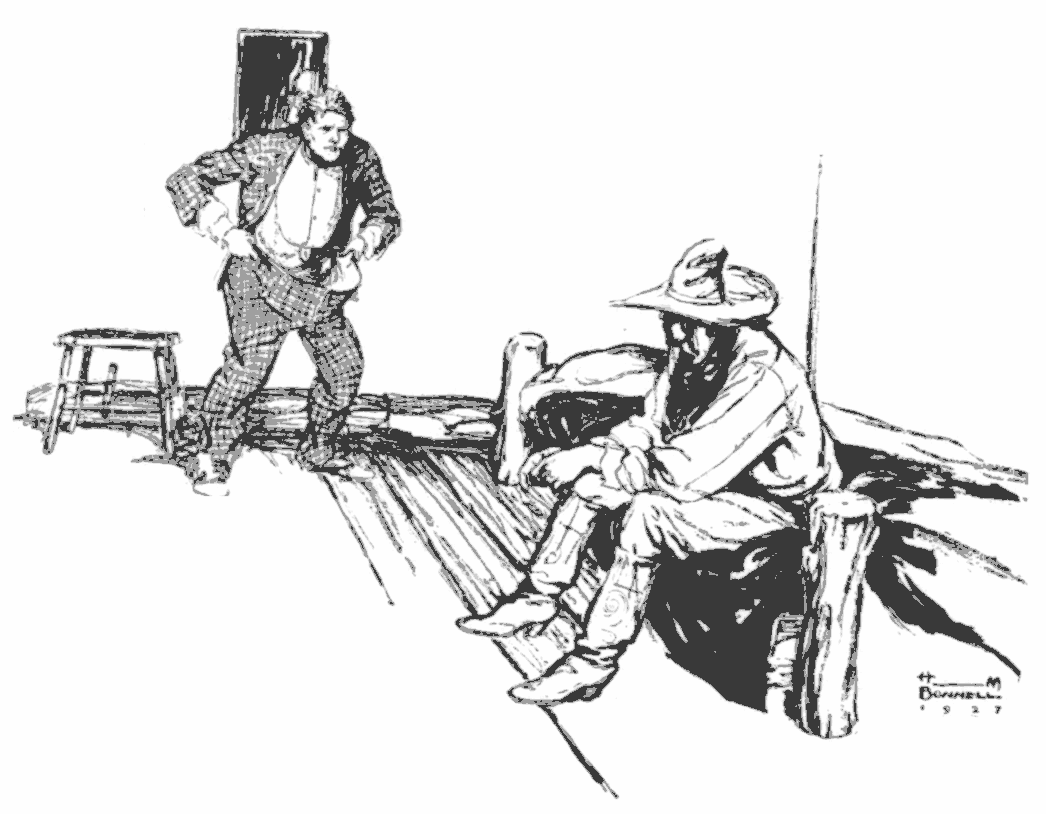
Soapy stood in the middle of the AH bunk-house, full in the light of two oil lamps. Balanced on the edge of a table was a packing-case which bore the imprint of a popular mail-order house and at his feet was a smaller case of the same kind.
Soapy’s stubby nose was beaded with perspiration and his blue eyes were filled with anxiety. He was of medium height, weighing possibly a hundred and fifty pounds. His hair was of a sandy hue and just now it flared as though in a gale, attesting to the fact that Soapy had shortly emerged through the neck band of a white, stiff-bosom shirt, which was so new and so stiffly starched that the deed had only been accomplished by a supreme effort.
Over the shirt he wore a glaringly new checked suit, the sleeves of which came far above his wrists and the shoulders were far too narrow. Both hands clutched with a death grip on the waist-band of the checked trousers, which were inches and inches too large around the waist.
Seated on a bunk was “Cling” Heffner, a giant of a cowboy. He had been nicknamed “Clinging Vine,” but this had been shortened to plain “Cling.” He was slightly bald, square-faced, with a crooked nose and huge mouth surrounded at each end by deep grin wrinkles—like a gash in parenthesis.
He surveyed Soapy critically.
“Well—holee gee!” he breathed. “You don’t fit ’em, Soapy.”
“And is that all yuh can say?” asked Soapy wearily.
“It’s good-lookin’ cloth, Soapy. I never thought that there sample would ever make up—”
“Oh, damn the cloth! Look at this, will yuh?”
Soapy tried to cross his arms, but the effort was futile. And when he let loose of the waist-band his trousers fell to the floor. He leaned forward and glared at Cling, making no effort to recover the trousers.
“Yuh need suspenders, Soapy.”
“Yea-a-a-ah?”
Soapy kicked the offending trousers against the door of the bunk-house, and Cling grinned widely.
“You look like one of them there quail birds without any tail feathers, Soapy; honest yuh do.”
“Do I?” Soapy was sarcastic. He leaned against the table and glared at Cling. “You measured me for that suit, feller.”
“I follered directions.”
“You did, like hell! Here’s what yuh done. I wear a thirty-nine coat and a thirty-one waist-band. And dang you, Cling, yuh got them figures down on the wrong blanks. Thirty-one coat! My God, that wouldn’t fit a chickadee! And a horse ain’t over thirty-nine around the waist.”
“Some horses are, Soapy. Aw, don’t git hot. Lemme see them pants, will yuh? I can take a tuck in the rear. What’s eight inches, anyway? ’S far as that’s concerned, yuh can gather it up inside yore belt. I admit that the coat fits tight. Sa-a-ay! Eight inches will jist about make it. We’ll take eight inches out of them pants and set it between the shoulders of the coat. Git me a pair of shears and a needle.”
“Na-aa-a-aw! For God’s sake, Cling! You can’t do it. What do you know about sewin’? I’m ruined.”
“Howsa hat?” asked Cling.
Soapy groaned and lifted a pearl-colored fedora from the smaller case, gazing at it critically.
“Put her on, Soapy.”
Carefully and with both hands Soapy lifted up the hat and placed it atop his head, where it sat without visible means of support, except gravity.
“Pull her down,” said Cling.
“Pull hell!” He reached up savagely, clutched the hat in his right hand and flung it as far as the confines of the bunk-house would permit.
“I think you’ve swelled since we took yore measure,” said Cling solemnly. “But if that hat’s a seven and three-eighths, I’ll eat it.”
Soapy sat down heavily on a bunk and held his head in his hands while Cling proceeded to dress himself in a fairly new suit of robin’s egg blue, which bagged so badly at the knees that it looked as though Cling was getting ready to do a broad jump.
“You better shake a laig, Soapy,” said Cling, as he surveyed himself in the cracked mirror. “You’ve got to go out to the IS ranch, yuh must remember.”
“Yeah, I remember,” said Soapy, lifting a doleful face. “I also remember that you took my measure for that dang suit, and yuh got me a thirty-one coat and thirty-nine pants. What kind of a figure do they think I’ve got? And a six and seven-eights hat! Cling, some day, I’m goin’ to kill you.”
“I’m sorry,” drawled Cling sadly. “I’d hate to git killed by a friend, ’specially when I’ve got so much to live for. There’s two things I want to do before I die, Soapy. One is to draw an inside royal flush, and the other is to smash Tuck Hayward right square in the beak.
“I’ve done drawed about seven thousand dollars’ worth of them inside royals in my life, and none of ’em took. If yuh crave hard enough, I’ll let yuh wear that red necktie of mine, Soapy. It’s got soup on the lower aidge, but yuh can button yore vest over it. Aw, cheer up, pardner. Climb into yore raiment. Tell Yvonne that yore suit never showed up.”
“She didn’t know I was gettin’ one.”
“Well, that’s fine. You look like hell in a fedory hat, anyway. Ain’t it enough glory to take Yvonne LeClere to a dance, without addin’ a checked suit? My God, she’s a pretty girl! Why, I’d—I’d take her to a dance if I never had a thing to wear, Soapy.”
Soapy sighed deeply and began putting on the suit he had worn for Sunday best for three years. Its original color had been black, but time and lack of proper care had changed it to a sickly green. However, Soapy retained the dress shirt and added a high collar, which caused him to act as though he had a stiff neck. Added to this was the red tie, with the soup spots on the lower “aidge.”
The tie immediately climbed to the upper edge of the collar and stayed there, in spite of Soapy’s efforts to make it stay down.
“I shore look like hell!” snorted Soapy.
“Not as she has been propounded to me,” said Cling seriously. “Yuh look a little stiff around the neck—tha’sall. Don’t set down hard or you’ll slice yore ears off. Mebby after yuh sweat a little she’ll loosen up. C’mon, we better get goin’.”
They went out to the stable and saddled their horses. Johnny Colburn and “Slim” Benito, the cook at the AH, had already gone to Chongo. Old “Ace” Hart, owner of the AH, was too old to care about attending a dance. It was payday on all the ranches, and the boys of the AH always said that Ace was so sorrowful on that day he must stay at home and hang crape on himself.
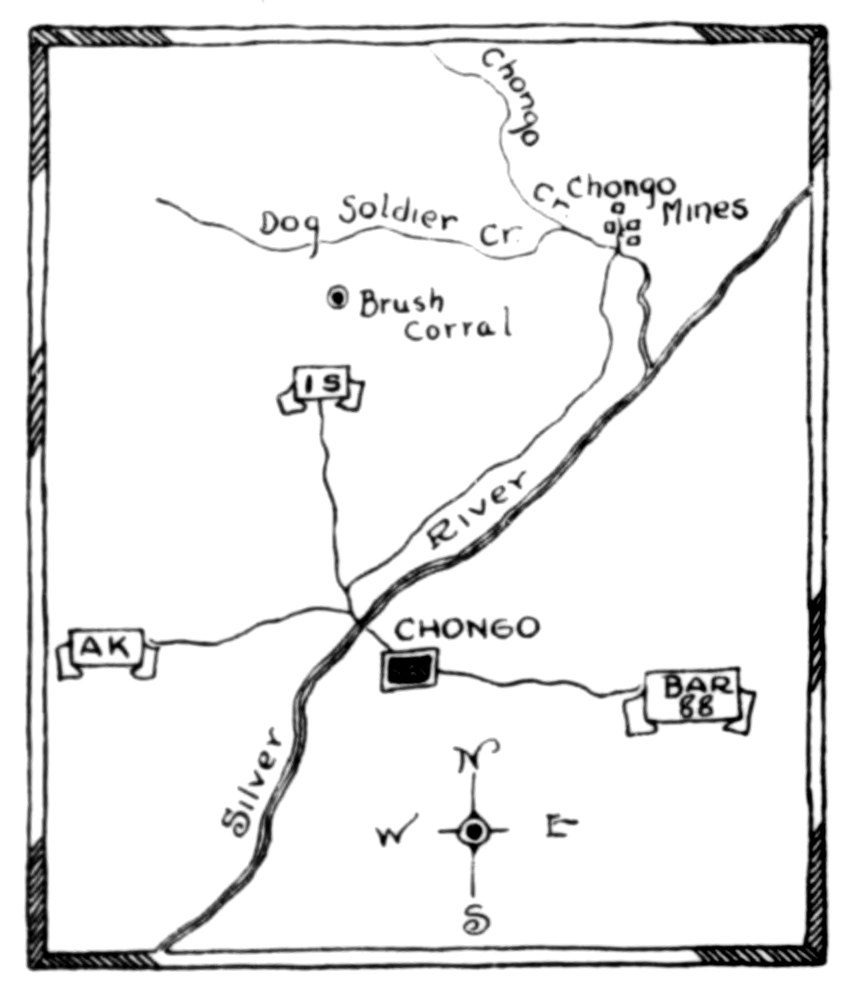
Soapy and Cling mounted their horses and rode away toward Chongo town but separated at the forks, Cling riding south across Silver River to the town, while Soapy rode north to the IS ranch to bring Yvonne LeClere to the dance.
The IS was located about four miles north of Chongo, while the AH was about the same distance from town, slightly north of east. Soapy was not in a good humor, due to the misfit of his new suit and hat. It had taken him quite a while to accumulate that forty dollars which they represented, as Soapy was not a frugal soul and forty a month does not allow for much saving.
“She’s a total loss,” he told his horse. “Won’t even make good cleanin’ rags for a six-gun. If old P. T. Barnum was alive he’d shore pay a whoppin’ salary to the man who could fit into that suit. Thirty-one coat and thirty-nine pants! And a hat fit for a peanut! But that’s what yuh get for lettin’ a waddy measure yuh.”
And then Soapy’s thoughts drifted away from the suit and centered on Yvonne LeClere. He couldn’t for the life of him quite understand why Yvonne should accept his invitation to the dance; why he was favored above the rest. Soapy was not at all vain or egotistical. He could look at himself in a mirror and see himself as others might see him. He was neither handsome, graceful, intellectual nor wealthy; just a forty-a-month cowboy trying to get along. He had known Yvonne before her father sent her away to school, where she had stayed four years, but they had never been intimate friends. She had been sort of a wild kid, with big black eyes, red lips and a mop of unruly black hair. She rode like a wild thing; rode any horse she could mount, much to the amusement of old Frenchy LeClere, who swore great oaths that Yvonne could ride better than any puncher in Silver River Valley.
Old Frenchy was proud of Yvonne. His eyes always snapped when her name was mentioned.
“She’s de LeClere blood,” he would declare, striking himself on his broad chest. “Better man den Joe. Joe—well, she’s not so good. She’s not bad boy—Joe; jus’ wild.”
Silver River Valley had its own opinion of Joe LeClere. Joe was five years older than Yvonne, who was barely twenty. He was dark, with black eyes and a cruel mouth. And he was wild, was Joe LeClere; wild rider, wild drinker, wild gambler. He trailed with a wild crowd.
Frenchy LeClere did not remonstrate with Joe, because Joe was of age now. But one day when Joe was eighteen his father knocked him down with the neck-yoke of a wagon. After doctoring him back to consciousness he said:
“W’en I say somet’ng, I mean no! No, she’s not yes. Nor she’s not maybee. Me, I’m not like strike child wit’ feest; so I’m tak’ neck-yoke and hit you so—hard, maybee you remember for t’ree year more that I am boss. After dat I’m don’ give hell. You can’ go way and say I’m don’ raise you right, by God!”
And Joe had remembered to the best of his ability. In spite of his wild blood, he had a lot of respect for his big, spade-bearded, white-haired father. The neck-yoke probably did much to gain this respect.
Soapy rode in at the ranch-house and Frenchy LeClere met him at the doorway, his broad figure back-lighted by a huge lamp on the table.
“Ho, ho, ho, ho!” he laughed rumblingly. “By gosh, ’ere’s de cowboy come for you, Yvonne! Shak’ leg! Come in, Soapee. H’all polish up, eh?” He slapped Soapy on the shoulder so hard that the cowboy half flinched.
“Hyah, Mr. LeClere!” he grinned.
The old man lifted his bushy brows and stared at Soapy.
“So-o-o? Mistaire LeClere, eh?”
“Gotta be polite,” grinned Soapy.
“Biccause you tak’ my girl to de dance, eh? You never mind be polite to me; you be polite to her.”
“Shore thing, I will,” said Soapy seriously.
“Rest de feet, eh?” grinned Frenchy LeClere, indicating a chair.
Soapy sat down on the edge of the seat, while the old man sat down in an ancient rocker, which creaked ominously under his weight.
“Joe at home?” asked Soapy after a silent moment. The old man frowned slightly, but finally lifted his brows and looked at Soapy.
“She’s not here—no. Joe she’s spend mos’ time in town. I dunno,” he shook his head sadly. “She’s h’all right biffore de railroad come to Chongo. Railroad bring de gambler, de women. Mak’ new building, too. Chongo grow beeg. I’m sorry. We ’ave de nice li’l town, h’everybody happy; now she’s h’all go to hell, I’m guess.”
“I don’t like it myself,” said Soapy earnestly.
“Bimeby comes de barb-wire, nester, mebby sheep.”
“I’ll pull out ahead of that.”
“You are yo’ng; you can go some place. But I am old and I mus’ stay. I’m t’ink Yvonne he’s coming now. You bring de buggy?”
“By golly, I never thought of it! I ain’t never taken—”
“Never min’; you tak’ my rig, Soapee. You talk wit’ Yvonne w’ile I’m hitch up de horse.”
And before Soapy could protest against it, Frenchy went out through the rear of the house. A moment later Yvonne came in. She stopped just inside the room and smiled at the speechless Soapy.
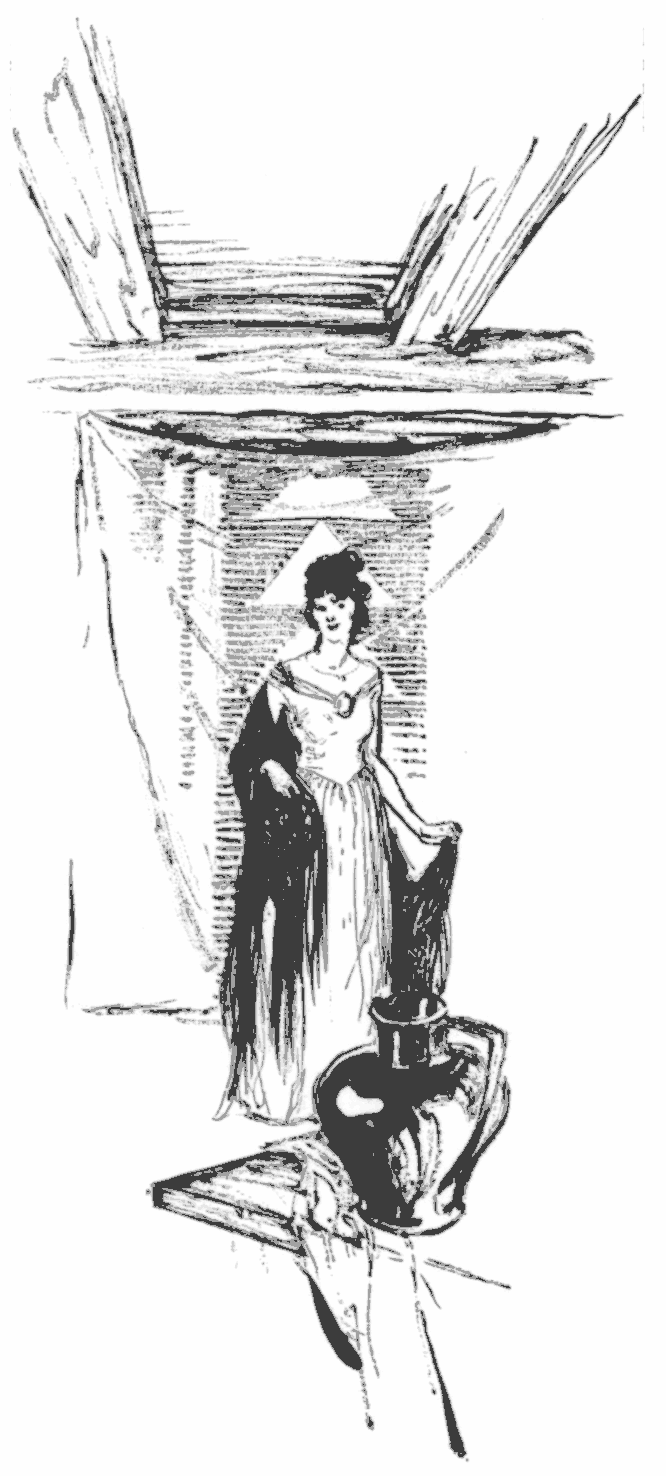
She was wearing a flame-colored silk dress which fit her perfectly, a black lace mantilla gracefully draped over her head and shoulders, causing her to look more Spanish than French. Her big eyes sparkled and her red lips parted to show a flash of white teeth as she smiled at the dumbfounded cowboy.
“How do you like me?” she asked.
“My God!” breathed Soapy. “You—well, I’ll—hello, Yvonne.” He smiled foolishly and blinked at her.
“Oh, hello, Soapy.”
“Gosh! I—say, I saw a picture once that looked just like you.”
“Yes? Where’s Father?”
“He’s—uh—say, Yvonne, I plumb forgot to bring a rig, and he—he’s gone out to hitch up one.”
Yvonne laughed softly and crossed to an old mirror.
“You are not used to taking ladies to dances, eh?” she said, not turning her head.
“I shore ain’t. Gosh, that’s a pretty dress, Yvonne. You’ll have all them Chongo women green with envy. I—I—” he looked down at his suit—“I ain’t—yuh see, I got a new suit today. Had her shipped from Chicago. But Cling Heffner measured me for it and he shore got the figures shifted. They sent me a thirty-one coat and thirty-nine pants. What you think of that?”
Yvonne laughed with him and turned from the mirror.
“Never mind clothes,” she said. “You look fine.”
“I guess I don’t look fine, but I shore feel fine. I reckon I know how Cling would feel if he ever drawed a royal flush in the middle.”
“That’s luck,” she said.
“Shore—so is this.”
“What do you mean, Soapy?” She looked straight at him.
“Why, me gettin’ a chance to take you to a dance. I’ll bet there’s men in Chongo that would give a leg to have my chance.”
Her eyes clouded a trifle and she turned back to the mirror.
“Don’t be foolish,” she said. “I—I didn’t want to go with any of the men from Chongo. This is my first dance here since I came from school, you know.”
“Yeah, that’s right. Well, I shore had a horseshoe with me when I asked yuh to go, Yvonne. By golly, you shore do look fine. If that danged suit had only—”
“That’s Dad yelling that the rig is ready,” interrupted Yvonne. “We’ll go out through the kitchen.”
They found Frenchy LeClere out there with the single rig, and he held the horse while they got in the buggy.
“I’ll leave my bronc here,” said Soapy. “Thank yuh a lot, Mr. LeClere.”
“Have good time,” LeClere laughed as they drove away.
It was moonlight, but Soapy held the horse down to a walk. He was conscious of the fact that he had eaten onions for his supper. The buggy seat was small, which forced them to sit close together.
“I wish we was drivin’ to the moon,” said Soapy.
“To the moon? My, my! That is a long way, Soapy. Why, it would take a million years to drive to the moon.”
“Time jist don’t mean nothin’ to me, Yvonne; I wish there was a road up to it.”
For many years the town of Chongo had been a cow-town, drowsing away in Silver River Valley; nothing more or less than a one-street village, seemingly content to stay as it was, only growing more weather-beaten each year.
Then came the railroad, a branch line, of course, to wind its way up Silver River to Chongo town. And with the railroad came a change in the county seat, bringing it to Chongo, which was in the center of the county.
And simultaneous with the advent of the railroad came the silver strike on Chongo Creek, twelve miles northeast of the town. All these things caused Chongo to boom, and boom it did—to a certain point. Came more saloons, two big gambling houses, honkatonks. A race-track was built just outside the town, where the local cow-horses fought for quarter-mile honors each Sunday. The stakes were usually horse-for-horse, with betting as a side issue. In other words, the winning horse won all the rest of the horses in the race.
Tuck Hayward was one of the big men of Chongo. He owned the Box 88 cow-outfit and the Silver Streak saloon and gambling-house. The gambling-house had been built after the railroad started construction and after Tuck had received the contract to furnish meat to the railroad construction camps.
Frenchy LeClere had tried hard for this contract, but he did not understand politics as well as Tuck; so Tuck got the contract and laughed at Frenchy LeClere. All of which did not please Frenchy, whose herds were dwindling slowly but surely from some unknown cause.
“Fat” McAllister, the sheriff, scouted the idea that some one was stealing IS cattle, but the old man was insistent; and he thought he knew more about it than the sheriff did. Frenchy appealed to the Cattle Association and received considerable correspondence but no action.
After the big silver strike on Chongo Creek Frenchy LeClere tried to get the contract to furnish meats to the mines but found that Tuck Hayward had already taken the contract and was killing his beef at the mines.
Tuck Hayward was a big man physically, inclined to stoutness, although not yet forty years of age; cold-blooded in all his dealings, inclined to bluff his way through life, hampered somewhat by a high-pitched voice which did not blend well with the rest of his make-up.
His crew consisted of “Dunk” McLeod, Hal Cornes, Len Asher, Mike Dalhart and “Kid” O’Neil. Asher and Cornes spent most of their time at the Chongo camps, handling the butchering.
O’Neil was fairly new to Silver River Valley; a small, sinister-looking person with thin, dark face, keen eyes, sharp nose and a mop of coarse black hair. But the kid was a cow-hand of the first water, quiet and unassuming, until full of liquor, when he became both loquacious and dangerous. He had worked a while for Frenchy LeClere, but the old man had fired him, and he had gone to work for the AH, only to start trouble in a bunk-house poker-game and get fired again. Tuck Hayward took him on at the Box 88, where he seemed to be getting along all right, after two bad starts in the valley.
In Tuck Hayward’s private office at the rear of the Silver Streak sat Hayward and Joe LeClere. It was a tiny office, barely large enough to contain an old roll-top desk, a small, fire-proof safe and a couple of chairs, besides Tuck’s big leather-covered swivel-chair.
The desk top was littered with silver ore samples, a half-empty bottle of liquor and other odds and ends. Tuck was wearing a gray suit which fitted him to the bursting point, a blue shirt and a scarlet tie, looped through a huge ring, set with a five-carat yellow diamond.
There was nothing gaudy about Joe LeClere. He wore a black shirt of coarse material, an old gray vest, over-alls tucked in the tops of his boots, and on his knee rested a well-worn black sombrero. His cartridge belt was studded with silver rivets, tarnished to blackness, and the butt of an old single-action Colt protruded from his scarred holster.
Joe had been drinking but was not drunk, and his somber eyes studied the big face of Tuck Hayward closely.
“Who’s bringin’ yore sister to the dance tonight, Joe?” asked Hayward.
“I dunno,” indifferently.
“Dunno, eh?”
“She never told me.” Joe was still indifferent.
“You knew I asked her to come with me?”
“So did Kid O’Neil.”
“The hell he did! How do yuh know that?”
Joe rubbed his nose reflectively.
“I heard him.”
“Yea-a-ah? You heard him, eh? What did she say?”
“’Bout the same thing she told you, I suppose.”
Hayward spat viciously and helped himself to a cigar from a box on the desk. He did not offer one to Joe.
“You couldn’t expect her to go with you, Tuck,” said Joe softly. “You and the old man—”
“Oh, to hell with the old man!”
“Well,” said Joe resignedly, and after a short reflection:
“Yuh couldn’t expect her to go with O’Neil. He got drunk the day she came home from school and tried to kiss her. She slapped hell out of him and when she got through the old man pitched him out on his head.”
“I didn’t expect her to go with Kid O’Neil,” coldly.
“Did you expect her to go with you, Tuck?”
“Why in hell do yuh suppose I asked her, you damn fool?”
Joe laughed shortly and his right hand twitched just a trifle. Hayward rolled the cigar between his lips reflectively.
“Joe, have you any idea how much money you owe me?”
Joe started slightly.
“I—I never figured on it much, Tuck.”
“Uh-huh; I didn’t think yuh had.”
Tuck reached in his desk and brought out a much-thumbed ledger, which he perused thoughtfully. Then he closed it and put it back in the desk. Joe’s eyes were uneasy and he began to realize that his credit had been too good at the Silver Streak.
“You ain’t closin’ down on me, are yuh, Tuck?” he asked uneasily.
“Not yet; but you’ve got to go easy.”
“You can’t very well—” began Joe softly.
“Drop that, Joe!” Tuck’s voice had a dangerous ring.
“I didn’t mean to say that,” said Joe weakly.
“Yo’re damn right yuh didn’t. Don’t never pull anything like that again on me. I’ll cut you off any old time I feel like it. You’d be a damn sight better off if I did. You drink too much rot-gut, Joe. Taper off, will yuh? I guess that’s all. Find out who brought yore sister to the dance.”
“Oh, all right,” said Joe, getting to his feet. “I’ll let yuh know, Tuck.”
He walked out into the gambling-room and came down past the long bar where two bartenders were filling the wants of those present. Cling Heffner was at the bar and Joe stopped beside him.
“Goin’ to the dance?” asked Joe, accepting Cling’s invitation to have a drink.
“Might wiggle a hoof or two,” grinned Cling, “if I can git some girl to dance with me.”
“Didn’t you bring a pardner, Cling?”
“Hell, no!”
“Rest of the boys in from the AH?”
“Johnny and Slim are around somewhere, I reckon. Soapy went out after yore sister.”
“Soapy did?”
“Yeah—the lucky devil.”
Joe laughed shortly and motioned for the bartender to pass out the glasses again.
“She’s shore an attractive girl,” said Cling.
“Seems to be the general opinion. Well, here’s how.”
Cling happened to be a fairly good two-fisted drinker; so they had several rounds of the potent bar-whisky, which, added to what Joe had already imbibed that evening, caused Joe to grow expansive.
“You folks lost any cattle?” asked Joe.
“Kind of a funny question, ain’t it?” inquired Cling.
“Funny?”
“Oh, I heard that the IS claims a steady loss. Fat Garnette was out and talked with Hart about it. Fat don’t believe it. He says yore old man’s full of prunes. Where would a rustler dispose of cattle? Yuh never could ship stolen cattle out of here. Brand inspection is too close. Even a butcher has got to produce a branded hide.”
“I know all about that, Cling. Well, here’s luck.”
As they finished their drink Kid O’Neil and Mike Dalhart came in, evidently coming from the dance hall, because neither of them wore a hat. They came to the bar and ordered their drinks, O’Neil standing next to Joe LeClere.
“Aw, I’d forget it if I was you, Kid,” advised Dalhart, as he filled his glass to the brim.
“Yeah, but I’m not goin’ to forget it,” growled the Kid. “I’m as good as Soapy Weed, by God! She turned me down for that screw-nosed waddy, didn’t she? And then she won’t dance with me. ‘Thank yuh kindly,’ says she. Huh! No damn Canuck female can make a fool out of me, I’ll tell yuh that, and I don’t care who knows it.”
The Kid swallowed his liquor at one gulp, slammed the glass on the bar and turned toward Joe LeClere. He had spoken loud enough for Joe to hear every word and now he scowled at Joe, as much as to invite him to comment on his words.
Joe’s right hand was hanging at his side, his left elbow on the bar, and without any shift of his body he brought up his fist in a sweeping smash, landing it full on Kid O’Neil’s nose. The Kid’s face seemed to flatten under the impact of the blow; then it jerked sideways, and Kid O’Neil struck his chin on the bar as he promptly went to his knees on the rail.
Joe sprang back, his numbed right hand dropping to the butt of his gun, as Cling sprang between them, throwing one arm around Kid O’Neil’s shoulders while with the other he removed the Kid’s gun from inside the waist of his pants.
The Kid struggled to his feet, his face bathed in gore, trying to find his gun, to stop the blood. The place was in an uproar for several moments until Tuck Hayward arrived and took charge of the situation. The bartender gave the Kid a towel. Hayward demanded an explanation of the trouble and Cling told him what the Kid had said.
Hayward grunted angrily as Dalhart tried to alibi the Kid.
“His nose is busted,” said one of the cowboys. “Better get a doctor, Tuck; he’s losin’ a lot of red ink.”
Some one went for the doctor and Cling took Joe outside.
“I could love yuh for pokin’ him, Joe,” said Cling, “but I’d honestly advise yuh to go home. Dalhart is ready to lie for the Kid and the rest of the Box 88 will back his play. I know you’ve got plenty nerve, Joe; but yo’re badly outnumbered. I’ll tell Soapy about it and he can do as he pleases.”
“I won’t run,” said Joe stubbornly.
“Nobody expects yuh to. Oh, do as yuh damn please about it, of course. I’m not yore guardian. Only, the Kid is a bad hombre and he won’t forget that punch.”
“I guess I’m kind of a damn fool,” said Joe bitterly. “I’m much obliged to yuh, Cling, and I’m goin’ home. You tell Soapy I went home, will yuh?”
“Shore, I’ll explain it all to him. I just want yuh to know I’ve got a lot more respect for yuh since yuh hit that geezer, Joe. If you’d cut loose from Tuck Hayward, yuh might do well before yuh die of old age.”
“Well, I’ll see yuh later, Cling.”
“Shore. Good night.”
Cling went back to the saloon and gave the Kid’s gun to the bartender. They had taken the Kid to the rear of the room, and as Cling passed the gun across the bar the doctor came in. Some one directed him to the back of the room and Cling followed.
Quite a crowd had gathered, but they made way for the doctor, who made an examination and declared the Kid’s nose was broken badly. Hayward and the doctor took the Kid to Tuck’s private office and locked the door. The Kid was mad enough to bite the doctor but gritted his teeth and let him bandage and tape until the doctor was satisfied that the nose would eventually assume its former shape, although just now it resembled a purple summer-squash, if there is such a vegetable.
Tuck paid the doctor his fee and let him out of the office, while the Kid swore nasally and tried to smoke a cigaret.
“I’ll ged hib for thad,” he declared. “No dabd Canug cad hid me ad ged away wid id.”
“You talk a lot,” sneered Hayward.
Some one knocked on the door. It was Dalhart, but Tuck did not let him in.
“Joe pulled out for home,” said Dalhart.
“All right,” replied Tuck. “Let him go.”
“Pulled oud, eh?” grunted the Kid. He felt of his waist-band. “Where’s my gud?”
Tuck reached inside the desk and drew out a Colt.
“Here’s one, O’Neil.”
“Thags.”
“Much good it’ll do yuh, though.”
“Thad so. You wadch. I’d goid oud and ged hib.”
The Kid got to his feet, shoving the gun inside his waist, while Tuck opened the door. Nothing more was said. Tuck saw the Kid walk swiftly down through the crowded room and through the front doorway. Then he closed and locked the door again.
In the meantime Cling had gone over to the dance-hall where he had found Soapy and told him what had happened. Soapy’s eyes snapped angrily.
“Let’s go over and finish the job,” he suggested. “No, I’m not exceptin’ all of the Box 88.”
“Don’t cover too much territory,” grinned Cling. “Anyway, you ain’t got no war with the Box 88. It was natural for Dalhart to back the Kid.”
“I suppose that’s right. C’mon over and ask Yvonne for a dance.”
Yvonne laughed and shook hands with Cling, accepting his invitation to dance, while Soapy ducked away and headed for the Silver Streak. He was almost to the front of the place when Kid O’Neil came out. Several men were there, but Soapy paid no attention to them. He stepped in front of the Kid, who stopped short.
“It was a lucky thing for you that it wasn’t me who heard what you said, O’Neil. You got enough to stop yuh, I guess; but I want you to get this straight. If you ever mention a certain lady again, I’ll pistol whip yuh into hell in a hurry. You don’t hear with yore nose; so I guess yuh got that straight. Yo’re a runty pup of a mangy coyote and if yuh wasn’t already crippled in the face, I’d bend yuh so badly you’d talk behind yore own back.”
But the Kid did not reply. His nose was one big ache—and he had something else on his mind. So he turned and walked down toward the Silver Streak hitch-rack. Soapy watched him for several moments and then turned and went back to the dance-hall.
Soapy didn’t go back to the saloon again. He talked the matter over with Cling and decided to follow Cling’s advice. Some of the Box 88 gang were dancing but none of them paid any attention to Soapy.
An oyster supper was served in an adjoining hall at midnight and at about three o’clock in the morning Soapy took Yvonne home. The moon was low over the hills and a chill wind was blowing from the north.
“Still want to ride to the moon, Soapy?” asked Yvonne.
“Just as much as ever,” he laughed. “This shore has been my big night, Yvonne. I never danced so many times in my whole life.”
“It has been a wonderful night. I hope Dad didn’t stay up to wait for us. He’s always worried when I’m out.”
“Nothing could happen to yuh, Yvonne.”
“I know. But Dad isn’t so trustful of folks. He said he was glad you were taking me to the dance.”
“Gosh, I didn’t know he liked me.”
“Maybe he don’t, Soapy, but he said you’d probably stay sober enough to drive the horse back home.”
“Well, for gosh sake! Anyway, I never took a drink. Did you feel the same way about it, Yvonne?”
“No, Soapy; I went with you because I wanted to.”
“Well, that kinda takes the sting out of what yore Dad said. Anyway,” bravely, “I’m glad yuh let me go with yuh, no matter what the reason was. I’m satisfied, Yvonne.”
“It’s nice of you to say that, Soapy.”
“It wasn’t nice; it was true. Most folks have to lie to say nice things. And I meant what I said about the moon.”
They drove through the ford at Silver River and over the long mesa which stretched far beyond the IS ranch. Half a mile from the ranch-house they drove along a line of old cottonwoods where the moonlight filtered through the foliage, silvering the hard-packed road.
Soapy helped Yvonne down at the front door and told her good night before stabling the horse.
“Come over again soon, won’t you?” she asked.
“Try to keep me away, Yvonne.”
He stabled the horse and found his own animal in one of the stalls, the saddle hanging on a convenient peg. In a few minutes he rode back past the ranch-house and waved at a lighted window.
Soapy was in no hurry. He wanted to ride slowly and think it over; wanted to poke along and dream. He knew there would be no work at the AH that day. Old Ace Hart never expected any one to be on the job the day after pay-day.
He was about half-way back along the cottonwoods when his roan horse snorted suddenly, its ears pricked forward, and stopped. Soapy sat up quickly, his eyes jerking to a focus, as he peered off to the right. It seemed as though he could see a horse, its head down, standing there in the shadow.
Quickly he dismounted to investigate. There was a horse with the bridle-reins tangled about its feet. Soapy lighted a match and looked at the animal. It was a stubby sorrel, wearing a stock-saddle and bearing the Box 88 brand.
“That’s kinda darned funny!” exclaimed Soapy aloud. “What’s a Box 88 horse doin’ over here?”
He untangled the reins, and without any warning the horse jerked away from him and went trotting down the road.
“Well, go to hell, if yuh don’t like my company,” laughed Soapy.
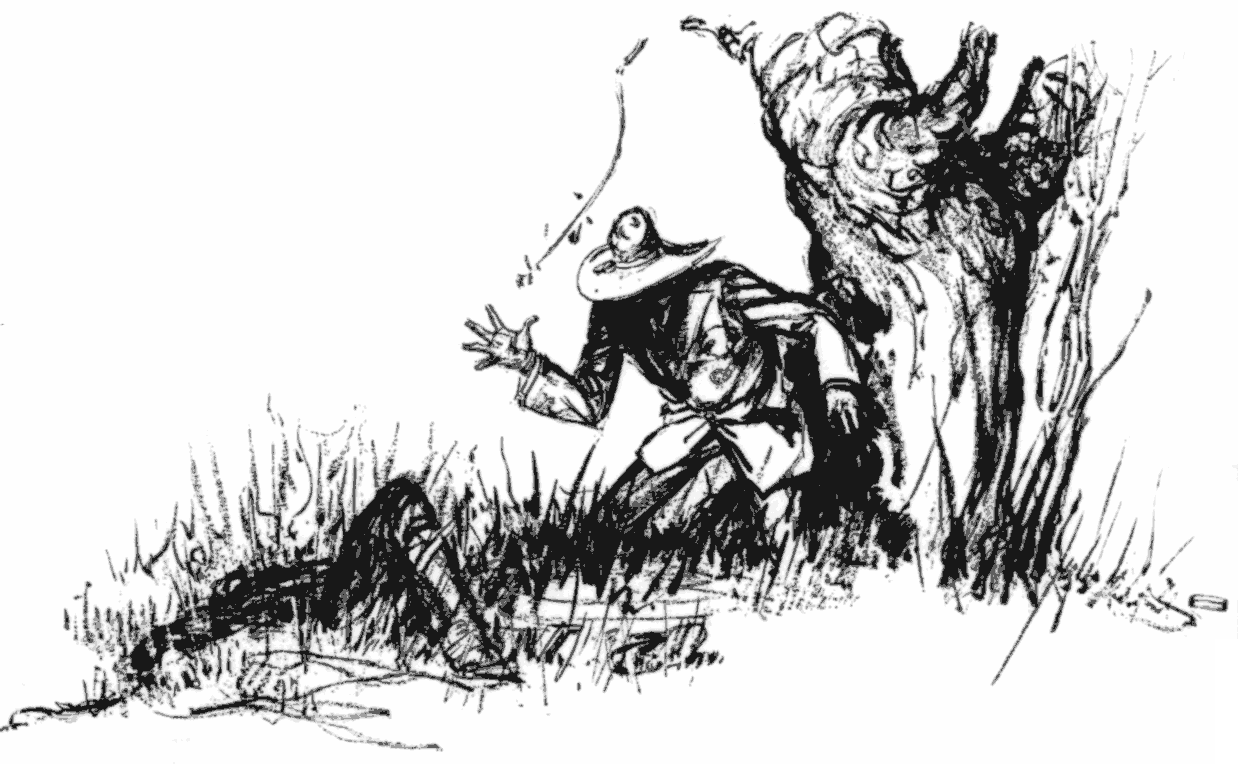
He started back to his horse, stumbled over something and almost fell headlong in the weeds. It was something that felt soft under the impact of his toe. Quickly he regained his balance and turned back. He scratched another match, half-kneeling down to look, and the match burned to his fingers.
Finally he got back to his feet, his knees shaking. He took off his hat, put it back on—and took it off again.
“Good God!” he said—and it was a prayer, not profanity. “Kid O’Neil, and he’s dead as a gimlet-handle. Somebody shot him from behind.”
Soapy walked back to his horse. He didn’t know what to do—he had never seen many dead men. With shaking knees he mounted his horse, intending to go and find the sheriff, but as he turned his head he saw the tiny glimmer of a light at the IS ranch.
“He follered Joe LeClere,” said Soapy half-aloud. “Him and Joe fought it out, and—” Then Soapy realized that the Kid had been shot from behind.
“My God, that’s plain murder! Joe LeClere—”
Soapy swallowed heavily as his hands groped for his cigaret papers. He wanted inspiration and he wanted it badly. He knew that Kid O’Neil had followed Joe, probably with the intention of getting even with Joe for that smash in the nose. All of which was entirely ethical. An eye for an eye. If Kid O’Neil had followed Joe out there and they had shot out their grudge, leaving Joe as sole survivor, it would have been perfectly all right. No jury would hesitate on such a verdict—that is, no cow-town jury. But Kid O’Neil had been shot from behind!
Soapy slid off his horse and went back to the body. The big Colt gun was still wedged between the Kid’s body and the waist of his pants. Soapy drew it out. Not a shot had been fired. Soapy felt his dislike for the Kid oozing away.
“Never had a chance,” he muttered. “Shot down like a dog. This is shore a tough lay-out, and I wish Cling was here to tell me what to do. They’ll hang Joe just as sure as God made little apples—if they find the body here on the IS.”
Soapy looked back toward the ranch-house, but there were no lights in it now. Suddenly he was filled with inspiration. He dropped the gun, went over to his horse and led the animal to the body. Luckily he was riding a gentle horse. Soapy didn’t usually ride gentle horses.
Kid O’Neil had been a small man, but to Soapy he now seemed as big as the Cardiff Giant, and it was only through a supreme effort which left Soapy weak-kneed and gasping for breath that he was able to place the body across the saddle. He took his lariat and roped the body securely. Soapy wasn’t going to take any chances on having to put the body on the horse again.
The moon had faded out now and in the eastern sky was a decided hint of the coming dawn. Soapy examined the lashings carefully and then swung up behind the saddle. He had made up his mind to dump the body along the road somewhere across Silver River and let the sheriff do a lot of guessing as to who had killed the Kid.
But he reckoned without the roan, which had never been ridden double before. As Soapy’s spurs rattled in against its flanks the startled roan threw down its head, jerking the reins from Soapy’s hand, and began pitching in a most approved fashion, but hampered somewhat by the double burden.
Soapy’s first thought was of the corpse, which had not been lashed on with the intention of withstanding a bucking contest, and at about the fifth jump he slid off, hoping to run the animal into the trees and get the reins again. But when Soapy hit the earth he stumbled and went end over end while the roan headed straight down the road toward Chongotown.
Soapy got to his feet and began running awkwardly down the road, following the horse and its grisly burden. Soapy was not a fast runner and the high heels of his shoes bothered him to a great extent. For a while he ran on his toes and then he grabbed his hat in one hand and began to gallop. But the roan also galloped, and its gallop was faster than Soapy’s.
And in this manner they reached the crossing of Silver River—the horse reaching there about a hundred yards ahead of Soapy and splashing straight through the ford, while Soapy flopped down on a rock, cursing the roan back to the first generation of all roan horses.
There was a decided rise on the road a quarter of a mile beyond the river, and it was light enough for Soapy to see the roan top this rise, still hurrying toward Chongo town.
“Soapy Weed, you shore raised hell,” wailed Soapy. “They say that dead men tell no tales, but this one is tied on my horse with my rope. I reckon I better walk home, pick up my thirty-thirty and head for the hills.”
He limped up from the river and stopped at the top of the bank. The moon had paled, but there was still a faint indication of it left in the dawn.
“Moon,” said Soapy whimsically, “yo’re a long ways away from here, but if there was a road up to yuh, I’d shore as hell start walkin’.”
But, in the absence of such a road, he turned and limped on toward the AH ranch.
“Fat” Garnette had been so nicknamed because he most certainly was not. He was over six feet tall, built like a bed-slat and swore he could hide behind a six-by-six scantling. He had a long nose, weary-looking eyes and a sense of humor. But his sense of humor did not include “Weary” McMillan, his deputy.
Weary was fat, bow-legged and used hair-oil. Fat detested hair-oil while Weary reveled in it. Weary didn’t have enough hair to bother plastering it down, but plaster it he did. “Chuck” Haverty, the jailer, said that if Weary paid as much attention to the inside of his head as he did to the outside, he’d soon work himself up to a point where he’d be at least half-witted.
Chuck Haverty was about sixty, with no hair at all, and did all his chewing on two teeth which didn’t meet.
Weary had been to the dance and, inadvertently, to hear him tell it, had imbibed too much liquor. He didn’t need to tell Fat about it because he came in the rear of the office and proceeded to fall over Fat’s cot. The fall shook the office so hard that a picture of “Washington Crossing the Delaware” crashed down and the glass was shattered.
“Who the hell told you to charge?” asked Fat, sitting up in the dark. Weary did not reply.
“Why in hell don’tcha light the lamp?” Fat demanded.
“Can’t,” gurgled Weary. “I’m layin’ on my hands. Whaz-zamatter, Fatty?”
Fat got up, lighted the lamp and extricated Weary, who was really doubled up in such a way that he couldn’t use either hand. Weary sank down in a chair, made a few ineffectual attempts to remove a boot, gave up the idea with a gesture of despair and blinked owlishly at Fat, who had crawled into bed again.
“Wha’ do yuh know ’bout Kid O’Neil gettin’ his nose busted?” asked Weary. “How’s that for good work?”
“Suits me,” growled Fat, who knew all about it.
“O-o-oh, me too. Fine! Didja hear ’bout Soapy Weed?”
“What did he do?”
“Declared war on O’Neil. Met him in front of the Silver Streak and told him if he ever spoke about Yvonne LeClere ag’in he’d fry his ears in axle-grease and feed ’em to the buzzards. Oh, Soapy shore waxed indign’t, as they say. Growed b’ligerent, in other words.”
“What did the Kid say?”
“He didn’t say. I reckon he had e-nough. Anyway, Tuck Hayward said that he went home to rest his nose. He’ll shore salivate Joe LeClere, I’ll betcha.”
“Oh, go to bed and stop yawpin’, Weary.”
“Oh, all right.”
Weary sighed deeply, stretched out and began snoring. Fat got up, threw a blanket over him and went back to bed. It was daylight in Chongo town. Fat tried to turn over and go to sleep again, but he could hear a chorus of voices, argument, plenty of loud talk and profanity. The voices were coming nearer, and then a heavy fist beat upon the door.
Fat rolled off his cot and went to the door, where he found Slim Benito, the cook at the AH, Mike Dalhart, of the Box 88, Barney Johnson, keeper of the Chongo livery-stable, Hansen, the blacksmith, and several others.
“Slide into yore pants, Fat,” ordered Johnson. “Kid O’Neil has been murdered.”
“Kid O’Neil? How do yuh know? Where did he—”
“Yuh can’t come without no pants!” snorted Benito, shoving the sheriff back. “Put on p-a-n-t-s, sheriff.”
“Oh, yea-a-ah. Jist a minute.”
In a few moments Fat was with them. They led him down beside the livery-stable corral, where Soapy Weed’s roan was tied to the fence, still bearing the body of Kid O’Neil.
“I found the horse there a few minutes ago,” said Johnson. “Nothin’ has been touched, except that I tied him to the fence.”
Fat walked around the animal, examining the body. The roan was still muddy from river water and dust.
“Soapy Weed’s roan, ain’t it?” asked Fat.
“The one he most always rode,” said Benito. “I dunno what one he rode last night.”
“He drove old Frenchy LeClere’s single rig to town last night,” offered Dalhart. “Probably left his roan at the IS.”
“Might as well take the body down to the coroner’s office just thisaway,” decided Fat, beginning to untie the rope.
“Yuh can see he’s been murdered, can’t yuh?” asked Johnson. “Bullet went in the back of his head and came out jist about the temple.”
“I reckon we can all see that far,” said Fat grimly.
They led the horse down to the coroner’s office and waited until one of the men went to the doctor’s home and routed him out.
Old Doctor Plumley had been many years in the Silver River Valley and he gave his decisions in short, snappy sentences.
“Killed instantly. Shot from behind. No question of its being murder. Hold inquest tomorrow morning. Bring him in the office. Sheriff, keep that horse, saddle and rope.”
“Yes, sir,” said Fat meekly, and led the animal back to his own stable where there happened to be an empty stall.
Slim Benito went with the sheriff. He thought a lot of Soapy Weed and he wanted to find out what the sheriff thought about the matter. But the sheriff didn’t say.
Frenchy LeClere came to town and was greeted with the news. Nobody had told him about the fight between Joe and Kid O’Neil until after he had been told several times of the murder. He went down to see the sheriff and to get a straight version of the whole trouble.
LeClere had been awake when Soapy had brought Yvonne home, and he swore to the sheriff that he had heard no shots fired before or after Soapy had left. But the sheriff had nothing to say. Fat worked on the theory that it was better to keep your mouth shut and let people think you might be dumb than to talk too much and let them be sure of it.
After LeClere left him the sheriff saddled his horse and headed for the AH ranch, wondering what alibi Soapy would have. He was possibly half a mile beyond the river ford when he met Soapy, who was coming toward town, riding a blaze-faced sorrel.
The sheriff drew up and waited for Soapy, who tried to affect a nonchalant air but failed miserably.
“I was just comin’ in to see yuh, Fat,” he said quickly.
“Yeah?” drawled the sheriff, sitting sideways in his saddle, his eyes frankly curious now.
“Oh, shore,” said Soapy earnestly. “Early this mornin’ I was comin’ back from the IS ranch, headin’ back to town, and I found Kid O’Neil down there by the river—dead.”
Soapy indicated “down there” by a sweep of his hand, which might have included the river from its source to its mouth.
“You found him, eh?” queried the sheriff.
“Y’betcha!” Soapy had more confidence now. “Well, like I just said, I found him down there on the rocks, dead as a gimlet-handle. I—I didn’t want to leave him there, yuh see; so I roped him onto my bronc and piled on behind him, but my roan wasn’t broke to ride double and I lit all folded up, as yuh might say, while the damn horse went across the river and headed for town.
“I shore didn’t want to get wet all over; so I walked back to the ranch, got me a horse and was just comin’ in to tell yuh about it.”
Soapy was all out of breath when he finished. Fat looked him over calmly.
“You know just where yuh found him, Soapy?”
“Oh, shore. It was—gosh, lemme see. It wasn’t daylight yet, but I—oh, shore, I can find the place.”
“C’mon and show it to me.”
“Uh-huh.” Soapy wet his lips. Now he realized that he had let himself in for something but he was game.
They rode back, and the sheriff’s quizzical eyes watched Soapy trying to pick out the exact spot along a gravel bar. Finally Soapy decided that this was the place. The old boulders were bleached white and the gravel was clean.
“Right here’s where he was layin’, Fat.”
“Ain’t no blood around there,” said Fat.
“By golly, that’s right! Not a drop. Well, I—I’ll tell yuh somethin’, Fat; he wasn’t bleedin’ when I found him.”
“Wasn’t, eh? Do yuh see any fox-tail around there?”
“Well, there ain’t any,” said Soapy wonderingly.
“Nope; there ain’t. That’s what makes it look funny. Yuh see, Kid O’Neil’s clothes were stickin’ full of fox-tail tops. Looked like he had been rolled in it.”
“Is that a fact?” Soapy had difficulty in clearing his throat. “Well, well! Where’d he pick that up, do yuh suppose? I didn’t see none of it on him at the time. Mebby the horse rolled with him.”
“Not likely, Soapy. You knew he’d been murdered, didn’t yuh?”
“I didn’t look very close, Fat.”
“Uh-huh. When yuh found the body, why didn’t yuh leave it where it was and notify me?”
“Well, I—yuh see, I wasn’t exactly sure he was dead. I said to myself that he ort to see a doctor; so I piled him on my bronc, and—”
“A while ago yuh knew he was dead, Soapy.”
“No, yuh see—but I was pretty well satisfied that he might be dead.”
Fat laughed softly and shook his head.
“Go ahead and tell the truth, Soapy.”
“I’m tellin’ you the truth.”
“Oh, all right. C’mon to town with me, Soapy; you’re under arrest. I’ll take yore gun, if yuh don’t mind. Butt first.”
Soapy passed his gun to Fat and with a sinking heart he rode beside the tall sheriff.
“You goin’ to slam me right into a cell?” asked Soapy as they rode in to Chongo town.
“I’ve got to do it, Soapy; Kid O’Neil was murdered.”
“Mebby he got what was comin’ to him.”
“Mebby; but the law don’t allow for that.”
They rode down to the jail and Soapy was locked in a cell, after which the sheriff stabled Soapy’s horse and went to visit the prosecuting attorney. Frenchy LeClere was still in town, but he rode home as soon as he heard of Soapy’s arrest. Before he left the coroner asked him to bring Yvonne and Joe to the inquest, as they would be asked to testify.
After the sheriff and prosecutor had conferred over the matter the sheriff proceeded to find every one who had seen the fight between Joe and the Kid and all who had heard what Soapy had told the Kid, and notified them to attend the inquest.
“Are you tryin’ to hang the murder on Soapy Weed?” asked Tuck Hayward ponderously.
“I’m tryin’ to hang it on the guilty man,” retorted the sheriff. “And not only that—I expect everybody to tell the truth at that inquest.”
“I’m not to testify, am I?”
“You’ll tell what you know about it, Tuck.”
“What I know won’t do yuh much good.”
“It ain’t of any interest what yuh know—it’s how much of it yuh tell.”
“I wonder just what yuh mean by that remark, Fat?”
“Oh, I’m just tryin’ to be smart, I suppose. I never had a murder case before; so I’ve got to act smart.”
But after he had gone away Tuck Hayward scratched his head and wondered just why the sheriff had said that.
“Oh, I’ll tell the truth,” he muttered. “Why not; it’s nothin’ to me.”
“We was just standin’ there at the bar havin’ a drink, and all to once Joe LeClere smashes O’Neil in the nose. There wasn’t no reason for—”
“Yo’re a damn liar and you know it, Dalhart.”
Cling Heffner stood up and shook an accusing finger at Mike Dalhart, who had been sworn as a witness. Dalhart got up from his chair, eyes snapping.
“You can’t call me no liar, Heffner!”
“I done called yuh one, Dalhart.”
“Wait a minute,” begged the sheriff. “You can’t fight in here. Set down, Cling. Dalhart is under oath.”
“Lot of good that does him. That geezer would lie with a Bible in both hands and one in his mouth.”
The coroner rapped sharply on his desk with a carpenter’s hammer.
“Cease this wrangling. Let the witness proceed.”
“Just a moment, if you please,” said the prosecuting attorney, getting to his feet. “Perhaps the witness does not know that there is such a thing as perjury. You have sworn to tell the truth, Dalhart. If you give false testimony and it can be proved, there is a severe penalty.”
“I ain’t lyin’,” wailed Dalhart. “You make Heffner keep his mouth shut, will yuh? Or I’ll do it.”
“You couldn’t shut nothin’,” said Cling disgustedly. “If you want trouble, just leave that chair and come on outside. Yore lyin’ testimony won’t help the case any; so yuh might as well quit.”
“Sheriff, will you stop this bickering?” asked the coroner angrily.
“Are you goin’ to quit it, Cling?” asked Fat.
“When that ossified mud-cat quits lyin’—yes.”
“Are you goin’ to quit lyin’, Dalhart?”
“By God, I ain’t been lyin’!”
“Go ahead and testify—and you better not lie.”
The crowded court-room chuckled. It was a small room, crowded to suffocation and with only a few chairs. Soapy sat with the sheriff beside a table, at the end of which presided the coroner. The witness stand was an old rocking-chair which had lost its rockers.
Frenchy LeClere, Joe and Yvonne were there. Some one had kindly provided LeClere and Yvonne with chairs. They were very serious over the inquest and kept their eyes on Soapy, who eyed Dalhart malevolently. The testimony up to this point had not implicated Soapy in any way, as it merely covered the trouble between Joe and Kid O’Neil.
“Then you claim that Joe LeClere had no cause to strike Kid O’Neil?” asked the coroner.
“I never heard anythin’ said that would give a reason.”
“Tryin’ to alibi with his ears,” said Cling softly enough for every one to hear.
Dalhart was dismissed and Tuck Hayward called to the stand.
Tuck didn’t see the fight nor did he seem to know what had started it. He testified to the effect that he and the doctor took O’Neil to the Silver Streak office, where the doctor repaired O’Neil’s nose.
“Did O’Neil tell you where he was goin’, when he left your office?” asked the coroner.
“Yes,” said Hayward. “He said he was goin’ home.”
The room was silent for several moments, and then the coroner said:
“Did Kid O’Neil have a gun?”
“I don’t know,” lied Hayward. “I suppose he did.”
Cling was called to the stand and was able to remember just what O’Neil had said about Yvonne.
“Did he mention her name, Heffner?”
“No, he didn’t. But he said, ‘That damn Canuck girl.’”
“You took O’Neil’s gun away, didn’t you?”
“Sure—and gave it to the bartender.”
“I’ve got the gun,” said the sheriff. “The bartender gave it to me today.”
Cling was dismissed after testifying as to what time Soapy arrived at the AH ranch after the dance, and Yvonne was called to the stand.
She knew nothing about the trouble between Joe and O’Neil nor that Soapy had spoken harshly to O’Neil that night. She said that Soapy took her home and she saw him ride away from the ranch-house.
“Did Kid O’Neil ask to take you to the dance?” queried the coroner.
Yvonne flushed quickly as she nodded her head.
“Yes, he asked me several days ago.”
“And you refused, of course?”
“Certainly.”
“Did any one else invite you to the dance?”
“Mr. Hayward.”
Tuck grinned sourly.
“Was Kid O’Neil angry because you refused him?” asked the coroner.
“I suppose he was.”
Yvonne was much relieved to have the coroner excuse her.
“Soapy Weed, do you wish to testify?” asked the coroner.
“Shore.”
“You are not obliged to testify, of course.”
“Tha’sall right,” grinned Soapy. “If I tell the same story often enough I’ll get her down pat enough to believe it myself.”
Everybody laughed, except the LeClere family and Soapy. His story was substantially the same that he had told the sheriff. He mentioned the fact of the Kid’s clothes being full of fox-tail grass and that the rocks did not have any blood on them.
“Did you see any gun on the person of O’Neil?”
“Nope. He was there in the tall grass and—”
Soapy stopped short, staring straight ahead.
“What tall grass?” asked the sheriff quickly.
“Tall grass?” echoed the coroner.
“I reckon that’s all my testimony,” said Soapy evenly.
He got out of the chair and sat down at the table. He had made a dangerous slip, and as his eyes swept the faces in the room he realized it fully.
The jury was out only about five minutes, and Soapy was led away to stand trial for the murder of Kid O’Neil.
“Now, maybe you’ll tell the truth,” said the sheriff, as he snapped the cell door shut.
“Damn it, I almost did!” snorted Soapy. “Didja ever hear the story of the Good Samaritan, Fat?”
“No; what did he do?”
“Minded somebody else’s business and got away with it—the lucky stiff.”
“What’s that got to do with you, Soapy?”
“Nothin’, except that it goes to prove that lightnin’ ain’t the only thing that don’t strike twice in the same place.”
“Oh, I think yo’re a damn fool, Soapy Weed.”
“Think so? Hell, I know I am.”
The county buried Kid O’Neil in the little Chongo cemetery about a mile from town, and there were no mourners. He had not been liked by anybody. The sheriff, coroner, minister and several boys from the Box 88 were the only ones at the cemetery.
The machinery of the law moves slowly in Silver River Valley, and Soapy Weed would be obliged to languish in the jail for six weeks before coming to trial. The boys from the AH visited him every few days. Yvonne wanted to visit Soapy, but her father objected; so she sent messages by Cling, which cheered Soapy, although he was sure that those verbal messages were colored rather highly by Cling.
The sheriff was dubious about the guilt of Soapy Weed. He had a feeling that Soapy knew something about the murder but was unwilling to tell. The sheriff was not a detective.
This was the second murder since he had been elected; the first one having passed into the limbo of forgotten things, it seemed. A cowboy by the name of Charley McFee, working for the Box 88, had been found dead about half-way between the Box 88 and Chongo. He had been shot through the heart.
McFee had only been with the Box 88 two days. Evidence proved that McFee had started for town alone. Dalhart, Cornes and McLeod had left the ranch earlier in the evening, leaving McFee, Hayward and Joe LeClere at the ranch. It seemed that Hayward and Joe had decided against going to town and McFee had started alone.
Joe was not working for the Box 88, but had gone out there to sober up, after a particularly violent spell of drinking, because he didn’t want his father to find him. Hayward had just acquired the Silver Streak saloon, where Joe got all his liquor, and perhaps he had felt a certain responsibility.
At any rate, there was nothing to connect any one with the killing; so it was forgotten, except to be recalled as a mystery when men talked of killings.
About a week after the killing of Kid O’Neil two cowboys rode out of the north, where there was neither road nor trail. Below them stretched the valley of Silver River, a long, green strip of foliage marking the course of the river, the lower valley fading away to a cobalt haze in the far distance.
The going was rough and they traveled slowly, threading their way among the greasewood and stunted firs. Finally they came out on a bare knoll where they drew rein and proceeded to roll smokes.
One man was extremely tall, with rather a long face, lean cheek-bones, slightly hooked nose and a wide mouth.
The other cowboy was much shorter, but wide of shoulder; his face was blocky of contour and deeply graved with wrinkles, and he had wide blue eyes which seemed to look upon the world with amusement.
A damp lock of hair hung down his forehead, and he shoved it aside with his wrist as he leaned across to light his cigaret from the tall cowboy’s match. The tall cowboy removed his sombrero, disclosing the fact that he had slightly sandy hair and a pair of steady gray eyes.
Both men were dressed in range clothes. Their shirts showed signs of many washings, the mufflers around their throats were mere strings and their bat-wing chaps had seen much service. They wore battered Stetsons, well-worn cartridge belts, sagging from the weight of heavy Colt guns, and tied behind the cantle of their saddles were their war-bags—the wardrobe trunks of the range country.
These two were “Hashknife” Hartley and “Sleepy” Stevens, wanderers of the range; always looking for the other side of the next hill, finding adventure without looking for it.
The tall one was Hashknife, christened “Henry” in his early infancy, when his father rode the Milk River ranges, bringing the Gospel to bunk-house and chuck-wagon; a range preacher who made it a life mission to fit men to live rather than to die.
Sleepy hailed from Idaho. These two had met at the old Hashknife ranch, and the wanderlust had driven them out together to go up and down the land, sharing one another’s joys and woes. Always they had gone seeking peace and had found war. Fate seemed to have thrown them into troublous places and times, where they had ridden neck and neck with death, winning by the proverbial eyelash, at times—but winning.
Together they had stepped out of smoke-fogged rooms, their ears dulled from the crash of guns, and looked at one another in amazement. Death had struck at them from beside the roads they had traveled, but always their proverbial luck had saved them until they had become confirmed fatalists.
And now they were heading down into Silver River Valley, which was the other side of the hill they had just crossed. It was a strange country. They had heard of it, heard of Chongo town; and now they were going to include it among the places they had seen.
Hashknife rode a tall gray horse which he called Ghost, and Sleepy rode a blue roan which he had lately acquired and which he had named Rattler, possibly because of its habit of striking back at his leg.
“Big country down thataway,” observed Sleepy after they had smoked silently for a while.
Hashknife nodded slowly.
“Big country, Sleepy. Ain’t she blue down there where she fades out? Makes a feller kinda wonder what’s down there. It kinda reminds me of Twisted River. See that smoke away off there to the left? I reckon that’s the silver mines on Chongo Creek.”
“Smoke from the concentrators, I reckon. Pretty big camp, if they employ around five hundred men.”
“Four big plants, Sleepy. Well, I reckon we might as well head for town. Ought to be some roads down here if we keep goin’ long enough.”
Sleepy nodded, ground the lighted end of his cigaret against the knee of his chaps and picked up his reins. Hashknife led the way down the side of a small ravine, avoiding the heavy brush. At the bottom of the ravine they struck a cowtrail, deeply rutted and ankle-deep in dust.
The trail wound around through the brush as it dropped lower and lower. Suddenly Hashknife drew up his horse. They had come to the end of the trail, it seemed, as it stopped against a barrier of solid brush.
“Brush corral,” said Hashknife, swinging his horse around to the left.
Ahead of them a cow bawled softly. The brush was not so heavy here and the tall gray moved easily around the brush corral. Sleepy got a whiff of wood smoke and was about to speak to Hashknife when the gray stepped out through the brush into a small opening.
Sleepy was close behind, the blue roan crowding against the rump of the gray, which had stopped short. Fifty feet ahead of Hashknife stood a man. He had been bending over a little brush fire when the gray came through the brush, but now he sprang across the fire, whirled and drew a revolver, shooting almost from his hip.
It was so unexpected that Hashknife ducked as the bullet sang over his head. Now the man straightened his arm and his second bullet thudded into the swellfork of Hashknife’s saddle. Two inches higher and Hashknife would have been a first-class casualty.
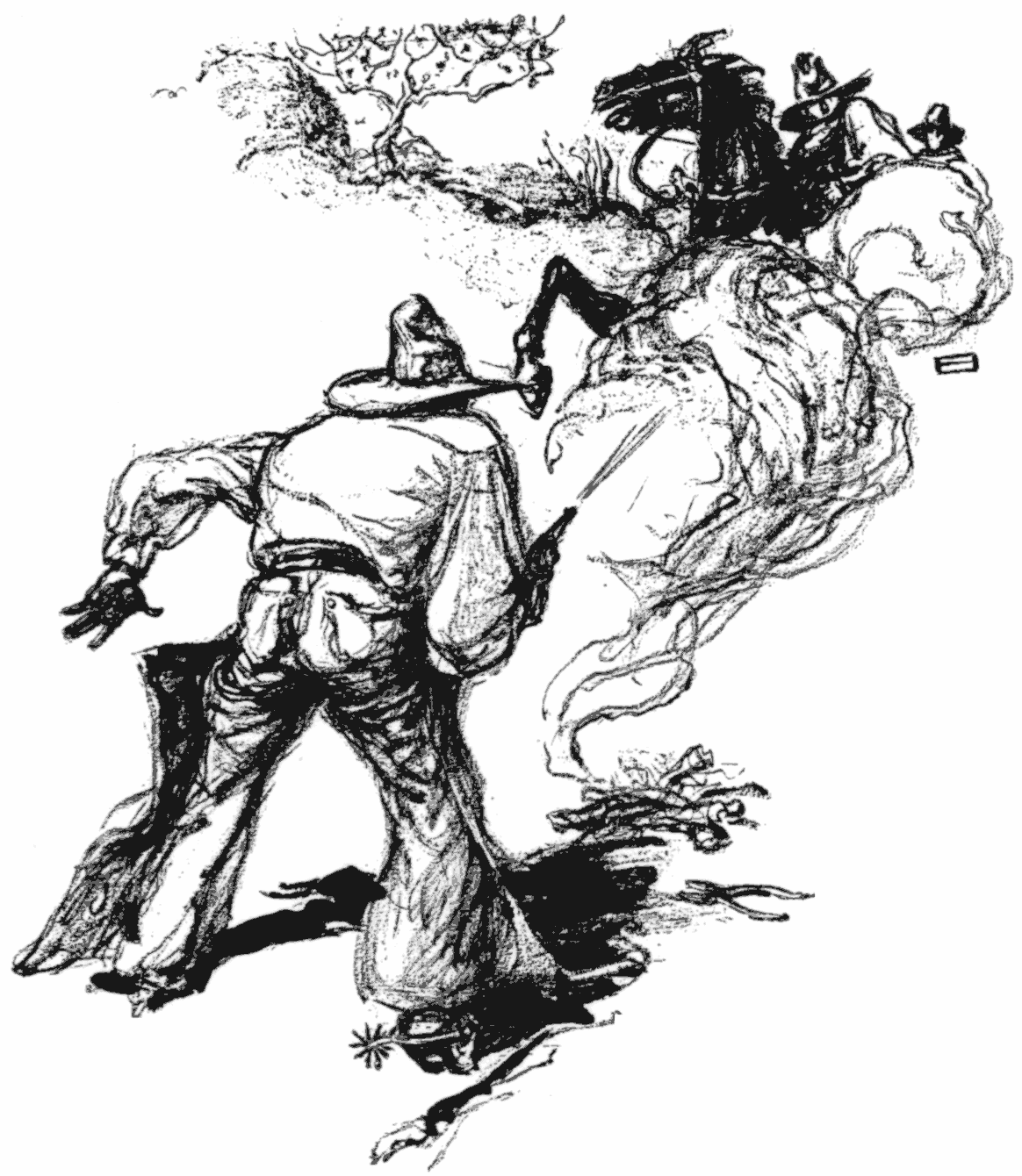
Hashknife jerked sideways and drew his gun as the man whirled and darted for the protecting fringe of brush, and at the crack of Hashknife’s six-shooter the man went sprawling, his gun flying from his hand.
Sleepy spurred into the opening, gun in hand, and rode down on the man, keeping him covered.
It was Joe LeClere. He sat up, squinting painfully at Sleepy, who was a total stranger to him. Hashknife dismounted and picked up Joe’s gun.
“Kinda sudden, ain’t yuh, pardner?” he asked Joe.
“Aw, what the hell!” growled Joe sullenly.
“Hard as a picnic egg,” grinned Sleepy. “I’ll betcha he’s a killer in his own home town.”
“Got yuh in the leg, eh?” said Hashknife, looking at Joe’s left leg, where the crimson stain showed through his overalls just above his boot-top. “Bone busted?”
“I don’t think so,” growled Joe. “Damn bullet knocked my leg loose and tripped me.”
“Good thing it did; I might have shot again.”
Joe rubbed a wrist across his forehead reflectively. He was in a bad position. Hashknife walked over to the brush corral, where eight head of steers were slowly moving around. He read the brands on all of them and noted that they were all wearing the mark of the Box 88. He came back to the fire, where a short piece of half-inch iron rod lay beside an old pair of pliers.
“Some artists use canvas and some use cow-hide,” said Hashknife. “This’n was a cow-hider. I’ll betcha he was goin’ to do some pyrography on them poor cows. How about it, feller?”
“Aw, go to hell!” grunted Joe.
“Run yore own errands,” said Hashknife bluntly. “Where’s yore bronco?”
Joe pointed to the west end of the corral, where his sorrel drowsed in the shade. Joe’s rifle was there too, and Hashknife brought it back with the horse.
“All set to do battle,” he grinned. “Can yuh get up?”
Joe got to his feet, but was unable to walk well. The bullet had passed through the calf of his left leg and made a painful wound. He managed, however, to mount the horse. Hashknife tied up the reins and put a rope on the horse.
“I can handle my own horse,” growled Joe.
“Shore yuh can,” smiled Hashknife. “That’s why I ain’t goin’ to let yuh. I’ve got quite a hobby of collectin’ rustlers and I take no chances.”
“I wasn’t rustlin’.”
“I see yuh wasn’t; but mebby the owners of them cows might like to know what yuh really was doin’. Yo’re pretty young for this kinda work. And workin’ alone too. Which is the shortest way to Chongo?”
Joe refused to offer any information. Hashknife mounted and led Joe’s horse while Sleepy brought up the rear. They followed cattle trails down across the hills for a couple of miles until they came in sight of the IS ranch.
“This here jigger is losin’ plenty blood,” observed Sleepy. “We better stop at that ranch and fix him up.”
“Yore motion carried unanimous,” nodded Hashknife, and swung in toward the old ranch-buildings.
The loss of blood had weakened Joe to a point where he did not care to protest, and he was clinging with both hands to the saddle-horn when they pulled in past the corrals and rode up to the house.
Hashknife dismounted and stepped up on the porch just as Yvonne opened the front door. He stopped short and looked at her in silence for several moments. Then—
“Ma’am, we’re strangers here,” he said slowly. “We just had a run-in with a potential cow-thief and had to drill him a little; so we stopped to see if we can’t fix him up a little before we take him on to town.”
Yvonne stared at him, frowning slightly. “A cow-thief?” she said.
“Yes’m. Oh, he ain’t serious, but losin’ a little blood.”
Yvonne stepped out on the porch and looked at Joe and Sleepy. Joe’s face was very white and he was not looking at her. She glanced quickly at Hashknife and in a flash he understood. Except for the mouth, they looked alike, Joe and Yvonne.
She went slowly down the steps and up to Joe.
“Joe, what is it?” she asked. “Tell me, Joe. My God, Joe, what have you done?”
Hashknife and Sleepy exchanged quick glances. Yvonne turned to Hashknife, tears in her eyes.
“What happened?” she asked. “Oh, don’t be afraid to tell me.”
Hashknife shut his lips tightly and walked past her to Joe.
“Let me help yuh off, pardner,” he said. “We’ve got to fix up that leg.”
He helped Joe off the saddle and half-carried him to the porch, where he let Joe sit down. Carefully he removed Joe’s boot while Yvonne stood over him, her hands clenched at her sides.
“Tell me about it,” she begged. “What did you say about him stealing cows? Whose cows? Oh, can’t you talk? He’s my brother—don’t you understand?”
“Will yuh get me some hot water and clean cloths?”
“Yes, I—I—” Yvonne stepped to the porch level, but stopped, looking down the road. About two hundred yards away were a team and wagon, coming toward the house.
“There’s Dad,” she said chokingly. “Oh, what will he say? Joe, can’t you prove—”
“Put on some water,” said Hashknife, softly, “and let me do all the tellin’.”
Joe groaned and leaned back on his elbows. Between his physical and mental sufferings he was about to collapse. Old Frenchy LeClere drove his team to the front of the house, sprang down and came quickly to the porch, looking intently at Joe. He looked sharply at Hashknife as he said:
“Somet’ing she’s gone wrong?”
Yvonne had come back to the doorway now.
“Accident,” said Hashknife slowly. “He was gettin’ a drink at a spring back in the hills. He said he leaned his rifle against a rock and the horse knocked it down. Lucky for him that the bullet only went through his leg.”
Joe was staring at Hashknife, his jaw sagging, while Sleepy’s mouth twisted to a grin and he began rolling a cigaret.
“By gosh, Joe, you mus’ be more careful!” exclaimed the old man.
He turned to Hashknife and held out his hand.
“I am LeClere,” he said. “Mos’ everybody she’s call me Frenchy. Joe, she’s my son.”
“My name’s Hartley,” smiled Hashknife. “Pardner’s name is Stevens.”
“I’m glad you fin’ my boy,” LeClere told Hashknife thankfully. “You sure no bone busted, eh?”
“No bones busted,” assured Hashknife.
“By gosh, she’s look w’ite, eh? You need bandage pretty bad, eh? I’m hitch up de buggy and tak’ you to doctor.”
“Yore daughter is gettin’ us some hot water and bandages,” said Hashknife. “We’ll fix him up and then take him to a doctor. It isn’t bleedin’ much now.”
The old man hurried into the house.
“Thank yuh,” said Joe weakly. “That was square of yuh.”
“Try playin’ square yourself,” replied Hashknife. “You can’t beat that game. I’d like to take you down and turn yuh over to the sheriff, but—” Hashknife shook his head as Yvonne and the old man came out, bringing the water and bandages.
Joe sagged back and shut his eyes while Hashknife cleaned the wound and bound it up. The old man hitched up the single rig and drove up to the porch as Hashknife finished.
“I’ll take him down,” offered Yvonne. “I’ve got to go to town, anyway, Dad.”
The old man finally agreed and they helped Joe into the buggy.
“You come out see us sometime?” asked the old man.
“Shore,” grinned Hashknife.
“Good. Come soon. Yvonne, she’s a good cook.”
“Thank yuh, Mr. LeClere.”
Hashknife shook hands with him and he and Sleepy rode away beside the buggy, the old man waving at them from the porch. After they were out of sight he stabled Joe’s horse and came back to the porch, where Hashknife had left Joe’s rifle, a thirty-thirty carbine.
He sat down on the porch, holding the gun in his hands. He had always been rather particular about the condition of his guns, while Joe never seemed to care what shape they were in. He levered out the cartridges, counting them over. The gun was fully loaded. It seemed rather strange that Joe should have put in a fresh cartridge after being shot. It wouldn’t be the natural thing to do.
Then he threw open the action, stuffed the end of a white handkerchief inside the breech and peered down the barrel. The bore was as bright as polished silver. Slowly he put the handkerchief in his pocket and closed the gun. For a long time he sat there with the rifle across his lap, the cartridges in his closed right hand, which dangled over his knee, and his eyes almost closed under his shaggy eyebrows.
“Somebody she’s lied,” he said half-aloud. “Yvonne she’s act funny; Joe she’s not say much. I’m wonder how Joe get shot, eh?”
Finally he went into the house and put the gun away.
Hashknife and Sleepy did not go to the doctor’s office with Yvonne and Joe, but headed for the livery-stable, where they put up their horses.
“Looks like a live town,” observed Sleepy, as they left the stable.
“Ought to be, with the biggest building in town devoted to gamblin’,” said Hashknife.
As they stopped in front of the Silver Streak McLeod and Dalhart came out. They merely glanced at the two strangers and went on up the street. Hashknife looked after them for several moments, but finally he followed Sleepy into the place.
An alert bartender was ready to supply their wants, and Hashknife asked him whether he noticed the two men who had just gone out.
“That was Dunk McLeod and Mike Dalhart, both from the Box 88. McLeod is the foreman for Hayward.”
“Who is this Hayward?” asked Hashknife.
“Owner of the Box 88. Also owns this Silver Streak place.”
“Oh, I see,” thoughtfully. More men came to be served; so the conversation was not renewed. Sleepy hooked his elbows over the bar and calmly surveyed the place.
“Dalhart and McLeod,” said Hashknife thoughtfully. “Does either name sound familiar, Sleepy?”
“Not to me. I knowed a Dalhart down in Texas and I knowed a McLeod in Idaho.”
“Well, I didn’t know either of ’em, but there was somethin’ about one of them jiggers that was familiar. Probably mistaken, though. Quite a place, eh?”
“Plenty de-vices for separation,” smiled Sleepy. “Roulette, chuck-luck, stud, draw, craps, black-jack and slot-machines.”
Tuck Hayward and Fat Garnette came to the bar together. They were discussing Soapy Weed and neither of them paid any attention to Hashknife and Sleepy.
“You think Soapy is merely coverin’ up somebody?” asked Tuck.
“I shore do,” nodded the sheriff, and gave his order to the bartender.
“Who, for instance, Fat?”
“Quien sabe?”
“Joe LeClere?”
“I never said any names. Well, here’s down yore neck.”
“’S a go. Well, I dunno. Of course, Joe busted the Kid’s nose that night and the Kid was crazy mad about it.”
“The Kid got what was comin’ to him, Tuck.”
“Sure, he did. And I’d hate to see Soapy hung for somethin’ he didn’t do.”
“As far as that’s concerned, I don’t believe they can convict Soapy. The prosecutin’ attorney don’t think so either, but he’ll shore try hard. That coroner’s jury held him because his story went hay-wire. Soapy’s hardheaded. I’ve tried to get him to slip me the truth, but he won’t do it.”
“Is the old Frenchman still yellin’ about stolen cows?”
“Not lately,” smiled the sheriff.
Hayward laughed and left the bar. The sheriff glanced sharply at Hashknife and Sleepy, realizing that they were strangers in Chongo.
“Howdy,” he said, nodding shortly.
“Pretty good,” said Hashknife. “Have a drink, sheriff?”
“Smoke a see-gar, stranger.”
He bit the end off a dried-out weed, tucked the end of it back beyond his wisdom teeth and waited for them to finish.
“Just get in?” he inquired.
“Fifteen minutes ago. Rode over from Keeling.”
“Hell of a hard ride, wasn’t it?”
“Somethin’ of about that denomination. Wasn’t that Hayward with you a few minutes ago?”
“Yeah, that was him.”
“Owns a big outfit?”
“The Box 88 is a pretty fair layout.”
“I wonder how he’s fixed for punchers?”
“Never heard him say. He lost one a week ago.”
“Quit?”
“Murdered.”
“Yeah?” Hashknife looked at the insignia of office on the sheriff’s vest. “Makes it kinda tough for you, eh?”
“Oh, I dunno. We’re holdin’ a man for trial.”
“But you don’t believe he’s guilty.”
The sheriff looked keenly at Hashknife.
“How do yuh know that?”
“Heard yuh tell Hayward.”
“Oh, yea-a-ah, I forgot about that. Well, I’ve got to be movin’. See yuh later.”
“Shore; so-long.”
Hashknife and Sleepy crossed the street to a store, where they met Yvonne. She was carrying out some packages, and they helped her put them in the buggy.
“How was the leg?” asked Hashknife.
“The doctor said it wasn’t dangerous. I will pick Joe up and take him home on my way back. Oh, I don’t know how to thank you for lying about that.”
Hashknife considered her gravely, but his gray eyes smiled as he said softly:
“Ma’am, I’m not addicted to lyin’; so I just ask yuh to accept that as the truth.”
“It is good of you,” she said. “You don’t know how good it was to hear you tell Dad what you told him out there. It may be a lesson to Joe.”
“I shore hope so, ma’am.”
“My name is Yvonne LeClere, Mr. Hartley. Everybody calls me Yvonne.”
“That’s fine,” smiled the tall cowboy. “My friends call me Hashknife.” He indicated Sleepy. “Call him Sleepy. He thinks he’s handsome and bright, but he ain’t; so don’t take him seriously.”
Yvonne laughed and picked up the lines.
“I want to add to Dad’s invitation,” she said. “Come out to the ranch and see us.”
“Yes’m, we shore will, Yvonne. Tell Joe to take care of the leg.”
“I shall tell him many things,” she said soberly.
“Not too much,” he warned. “This has been a hard day for him.”
They watched her drive down toward the doctor’s office, and she waved at them as she turned the corner.
“Mamma mine!” exclaimed Sleepy. “That’s some girl.”
Hashknife nodded slowly.
“I reckon she’ll do, Sleepy. Let’s go and fold ourselves around some food and then get a room. I could sleep about ten hours and feel more like a man.”
“Well, there won’t nobody have to rock me; that’s a cinch, Hashknife. I don’t see how any punchers can work diligently with a girl like her in the vicinity. I know I couldn’t.”
“Somebody has probably had an option on her for a long time, Sleepy.”
“I suppose,” sighed Sleepy. “Anyway, I’m not so hard-hit that I can’t eat and sleep; so let’s me and you find where henfruit and hawg-leg gets familiar. C’mon.”
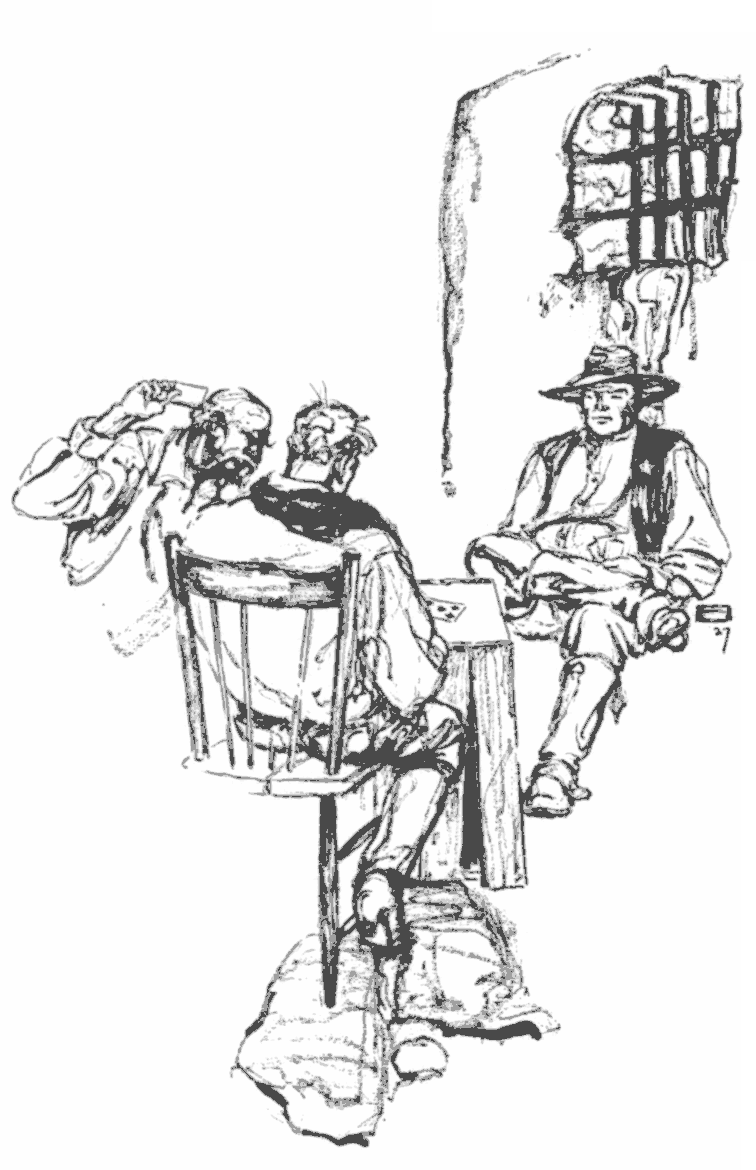
“And then he said—who played that jack? You, Soapy? Come to father. That gives me game. He said he leaned his gun against a rock and laid down to get a drink—— No, it’s Chuck’s deal. I dealt last time. He leaned his gun against the rock and when he laid down to get a drink, his horse—— You bid two? Betcha you’ve got the ace, deuce. Pass.
“Well, the horse knocked the gun down and it went off and the bullet went plumb through his left leg. You bid three, Chuck? Bid ’em high and sleep in the street, eh?”
Weary McMillan grinned and leaned back against the wall of the cell, waiting for Chuck Haverty, the jailer, to lead. The latter and Weary were having their daily game of pitch with Soapy Weed, and Weary had brought the news of Joe LeClere’s accident.
“Who told yuh all this?” asked Soapy.
“Doc Plumley. Yvonne brought Joe in yesterday to have his leg dressed.”
“Didja see her, Weary?” asked Soapy.
“Nope. Gimme low, game. You go back two-bits, Chuck. Don’t never depend on a five-spot bein’ low in a three-handed game, pardner. It was kinda luck for Joe that them two strange punchers came along and heard the shot. They helped Joe to the ranch. Didja see ’em, Chuck?”
“I seen ’em,” nodded Chuck, digging up a quarter, which he placed under the cigar box containing their chips.
“I got to talkin’ with the tall one,” said Weary. “Said his name was Hartley. I think the other is Stevens. Pretty salty-lookin’ pair of geezers, them two. If I was lookin’ for trouble, I don’t reckon I’d choose the tall one. Yore deal, Soapy. All I need is two points to take the dinero.”
“Sluff to me, Chuck,” said Soapy.
“Like hell!” wailed Chuck. “You only need two points. I’m the one to sluff to, ’cause I need five. You sluffed a ten to Weary that time, tryin’ to set me, when I’m low man. If you hadn’t been a prisoner, I’d ’a’ poked yuh in the snoot.”
“There’s some advantage in bein’ a prisoner, Chuck. But I’d much rather be free and take a chance on you pokin’ me.”
“Then why don’tcha tell the truth and get out?” asked Weary. “Yo’re an awful sucker, accordin’ to me. You never killed Kid O’Neil no more than I did.”
“They’re goin’ to try me for it, Weary.”
“Shore. And a damn fool cow-jury might hang yuh too.”
“That kinda ruins my game, Weary. What are yuh biddin’?”
“I’ll chance a couple.”
“With the ace, deuce, probably,” sighed Chuck. “I’ll shoot the whole works—four.”
“And get set higher than a kite,” grunted Soapy.
“With the ace, king, jack, trey? Anybody got the deuce? No? There’s my four. I catch Soapy’s ten on the second swing—sabe? Gimme that dinero. Any old time yuh bid and make four yuh win the pot.”
“If I was as lucky as you are, I’d be out of jail,” sighed Soapy. “That was my last two-bits.”
“I’ll stake yuh,” said Chuck.
“Suppose they find me guilty?”
“Game’s over,” said Chuck seriously. “I plumb forgot about the trial.”
“I reckon yore name’s McHaverty,” said Soapy. “You shore act Scotch.”
That same morning Hashknife and Sleepy rode away from Chongo town, heading north. They did not stop at the LeClere ranch but swung in to the north of it. Hashknife had noted many landmarks on their trip into Silver River Valley and he had little difficulty in finding the spot where they had met Joe LeClere.
But the Box 88 cattle were gone, the brush corral empty. Hashknife did not expect this. His idea in coming out there was to release those steers.
“Do yuh think they busted loose?” asked Sleepy.
Hashknife shook his head and pointed at the ash-heap where the fire had been built. A man had attempted to obliterate all indications of the fire and had left a heel mark deeply punched in the dirt.
“We never touched that fire, Sleepy,” said Hashknife.
“That’s right. I reckon Joe wasn’t workin’ alone, after all. I just been thinkin’ that this country might not be healthy for us. The geezer who came back here must know that we stopped Joe LeClere, don’tcha think?”
“Kinda looks thataway.”
They rode back down the valley and swung in at the IS ranch again. Yvonne was sweeping the front porch as they rode up and she came out to them, carrying her broom. She looked like a pretty Gipsy with her head bound in a scarlet bandanna.
“How’s Joe?” asked Hashknife.
“He’s still in bed,” she replied. “I guess his leg is pretty sore. He hasn’t much to say. Dad tried to question him last night.” She shook her head sadly. “I don’t believe Dad takes any stock in the story about Joe being shot accidentally.”
“Why not?” asked Hashknife suddenly.
“Well, he asked Joe how he happened to reload his rifle and who cleaned it after the shot.”
Hashknife smiled sourly and looked at Sleepy.
“We shore overlooked that point,” he admitted. “That’s too danged bad. What did Joe tell him?”
“Nothing. Said he was too sick to talk about it. Dad went to town this morning. Won’t you come in a while? I was just finishing my work, you see.”
They dismounted and sat in the shade of the porch.
“Will you tell me all about what happened yesterday?” she asked.
“No,” replied Hashknife. “You go ahead and believe I told yore Dad the truth.”
“That lets you out of anythin’,” added Sleepy. “Yore Dad can’t prove that we lied, yuh see. If it comes to a show-down, I’ll swear I cleaned that gun and put in a cartridge.”
“Dad wouldn’t believe that. He’s had so much trouble with Joe! He tries to believe in Joe; but Joe drinks hard all the time and gambles when he can get the money. It’s only been in the last year or so. Before that Joe was fine.”
“We’ve heard quite a lot about this Kid O’Neil,” said Hashknife. “We didn’t like to ask questions, yuh see, but I’d kinda like to hear about him. We know they’ve got a man by the name of Soapy Weed in jail and that O’Neil was shot from behind. What was it about the body comin’ to town on Weed’s horse?”
Yvonne told them the whole story as well as she could, including the evidence at the inquest. Hashknife questioned her about Kid O’Neil’s activities prior to the shooting, and she told him of how the Kid had hired out to her father when he first came into the Valley.
“I wasn’t here when he came,” she said. “He had been here about a week when I came back from school. He got drunk and tried to kiss me and I slapped his face. When Dad found it out he kicked O’Neil off the ranch.
“Then he went to work for the AH outfit, but they had some trouble over there and he lost his job. After that he went to work for the Box 88 and he was with them until he was killed.”
“Kind of a tough hombre, eh?”
“Yes, he was.”
“Did you know McFee, the man who was murdered about a year or so ago near Chongo?”
“No, I never met him. He was only in the valley a short time. Joe knew him, I think. I guess they never had any idea who killed him.”
“Probably not. I wonder if we could see Joe?”
“Why, sure.”
They followed Yvonne into the house and found Joe in a bedroom that opened off the living-room. He was propped up in bed, smoking a cigaret, and did not seem overjoyed to see them. He admitted that the leg was very sore and that he had not slept well.
“You remember a feller named McFee who was killed near Chongo?” asked Hashknife.
Joe started suddenly and almost dropped his cigaret.
McFee had been a cowboy on the Box 88 for only two days when the murder occurred. Nobody had known him and the mystery of his death had never been solved and he had been almost forgotten.
“What about McFee?” Joe asked shortly.
“I just wanted a description of him.”
“Oh!” Joe puffed violently on his cigaret for several moments.
“He was kinda chunky and broad-shouldered if I remember right. Dark eyes and a pug nose. Oh, yeah! He had a scar on his upper lip that kinda puckered the skin. Looked as though it might have been stitched.”
Hashknife nodded slowly, his gray eyes thoughtful.
“Yuh don’t know where he came from, do yuh?”
“Nope; he never said. What do you know about him?”
“Not a thing.”
“What’s the idea of askin’ about him?”
“I had a friend named McFee and I wondered if this was the same person.”
“Was he?”
“I guess not.”
But this did not seem to satisfy Joe. He shot a sharp glance at Sleepy, whose innocent blue eyes told him nothing.
“Did the doctor say how soon yuh could walk?” asked Hashknife.
“Nope. But I’ll be out in a day or so. What are you fellers doin’ over here? Expect to get jobs?”
“Thought we might strike the Box 88 for jobs.”
“Yea-a-ah?”
“They lost a man the other day I understand.”
Joe began rolling another cigaret. Finally he looked at Hashknife and said:
“What are yuh goin’ to do about—what yuh discovered yesterday?”
“What do yuh mean?”
“You know —— well what I mean!”
“Oh, yeah! Nothin’. Next time yuh leave a rifle layin’ around loose tie yore horse away from it.”
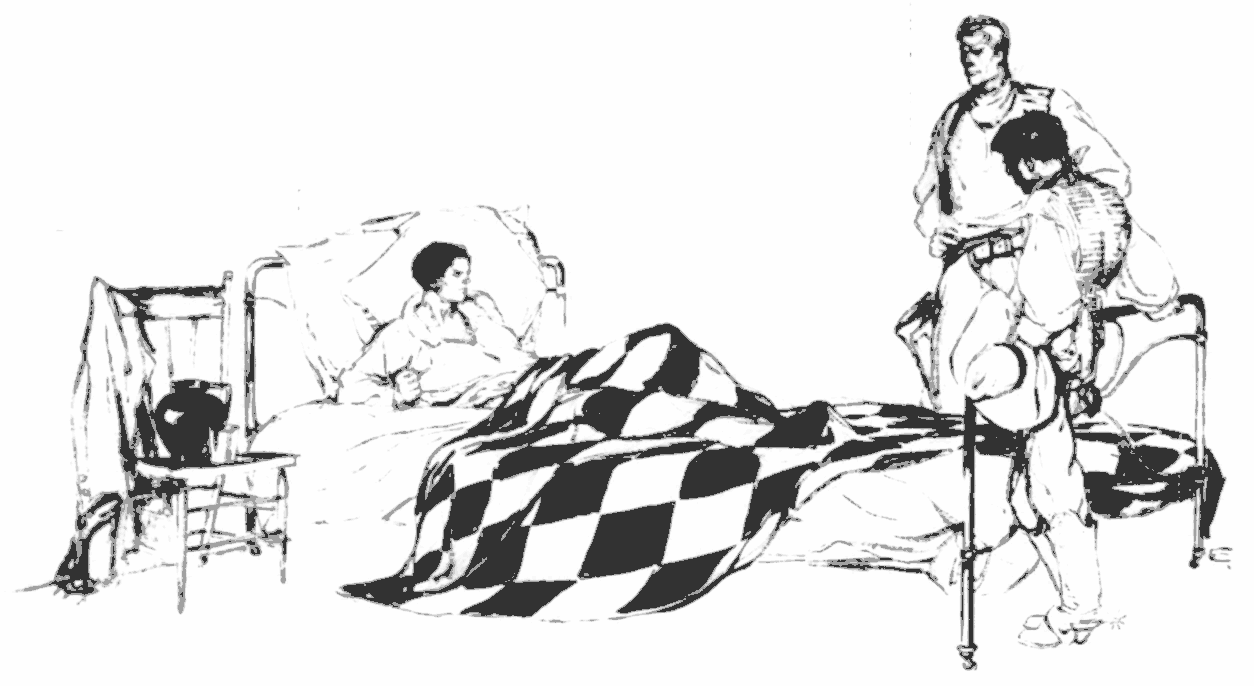
Hashknife got up abruptly and walked out of the room with Sleepy following close on his heels. They went out on the porch where Yvonne joined them.
“Won’t you let me apologize for Joe?” she asked. “He doesn’t seem to understand that—that there isn’t some motive behind you protecting him this way. I—I guess he hasn’t much faith in humanity.”
“He’s pretty young to lose faith in humanity,” said Hashknife slowly. “But you don’t need to apologize nor thank us. We didn’t do it with that idea in view.”
“Oh, I know that. It was just the good in your heart.”
“Mebby that’s it. Well, I reckon we’ll ramble along.”
“Can’t you stay for supper?”
“Not very well. Mebby some other day, but we thank yuh just the same.”
“You are always more than welcome, Hashknife.”
“That’s fine,” he smiled. “It’s great to be welcome and we appreciate it more than you know. We’ll probably see yuh again in a few days.”
They mounted their horses and headed back for Chongo town over the dusty road.
“Why did yuh ask about McFee?” queried Sleepy. “You didn’t never know him, didja?”
“Not as McFee. See if yuh can’t remember a puncher with a scar on his upper lip. Kind of a puckered scar.”
Sleepy rode along squinting his eyes against the glare from the yellow dust. Something stirred in his memory and he saw a heavy-set cowboy with a scarred upper lip. The man was squatting at a camp-fire drinking coffee from a tin cup and the firelight illuminated the scar.
Sleepy lifted his head and looked at Hashknife.
“McFee was his name,” he said as though they had discovered his identity. “He was workin’ as a deputy for the sheriff of Piney River and he stopped at our camp.”
“Good boy!” exclaimed Hashknife. “That’s Charley McFee. It shore had me pawin’ my head. He was trailin’ a murderer that night. Thanks for the memory.”
“Yo’re welcome,” grinned Sleepy. “But what good is it?”
“Mebby it’s no good but it gives a place to start. McFee was a stranger here—almost.”
“Why the almost, Hashknife?”
“Somebody knew him. He wasn’t here long enough to cause an enmity that would end in murder. He was killed by the one man who knew him.”
“What do yuh think of Joe LeClere?”
“That’s hard to say. Joe was goin’ to alter the brands on them Box 88 animals, I think. But Joe ain’t alone in the deal. I had an idea he was workin’ alone but I guess not. Somebody went up there and turned the steers out of that brush corral after we brought Joe home.”
“I reckon Joe is a bad boy. He shore threw lead at you.”
“Yeah and he danged near got me too. I’m glad I got him in the leg.”
“Didn’t yuh shoot at his legs, Hashknife?”
“Don’t be foolish. With a man tryin’ to kill me? I shot to stop him, tha’sall, Sleepy.”
It was like Hashknife to depreciate his own ability with a gun. But neither of them claimed to be good shots. In their wanderings up and down the earth they had encountered split-second gunmen who when the showdown came failed to split the second.
Hashknife had always said, “If yo’re in the right yuh don’t have to split a second; just shoot straight.”
Just outside Chongo town they met Frenchy LeClere. He nodded pleasantly but did not stop his team. They stabled their horses and wandered down to the sheriff’s office where they found Weary and Chuck. Fat had ridden out to the Box 88.
“I’m glad yuh came,” declared Weary. “I’m plumb tired of talkin’ with folks I know.”
“Meanin’ me,” said Chuck sadly.
“Meanin’ everybody in Chongo.”
Hashknife laughed and stretched out in a broken-back chair; Sleepy squatted against the wall and rolled a cigaret.
“We were out to the IS ranch,” offered Hashknife.
“Thasso? How’s Joe?” asked Weary.
“Gettin’ along all right, I reckon. They seem to think that somebody is stealin’ their cows.”
“Seem to!” snorted Weary. “That’s all it amounts to. Old LeClere makes me laugh. He’s been kickin’ to us for a year. We investigated but didn’t find anythin’ to prove that his cows are fadin’ away.”
“Has the Box 88 lost any?”
“I sh’d say not. Nobody stealin’ cows around here. Where would they dispose of ’em if they did rustle a few? You’ve got to show the hides of every cow yuh kill. Every month we go out to the silver mines and inspect the hides that the Box 88 save. Every hide that’s shipped out of this here range must be inspected by the sheriff.”
“The Box 88 has the meat contract for the mines?”
“Sure. Hayward keeps two men out there all the time to handle the stock. They kill a lot of beef in a month and I reckon Tuck Hayward makes a mighty good profit. He used to ship a lot of beef east but not since the railroad built in here. Yuh see he furnished the railroad camps with meat too. Hell, he ain’t a cattleman no more; he’s a butcher.”
“What kind of a lay-out is the AH?”
“Fine. Old Ace Hart is a prince. He never gets anywhere, as far as money is concerned but he don’t care. Ace is one of the old-timers and he’s satisfied as long as he can make enough to pay off the boys and keep eatin’. Hayward is a money-getter. He makes plenty money on beef and he ain’t in the gamblin’ and liquor business for his health. Not that he don’t shoot square. I wouldn’t say that about Tuck. But the percentage is shore heavy.”
“What’s yore opinion of the killin’ of Kid O’Neil?” asked Hashknife.
Weary laughed and shook his head.
“Search me. We’ve got a prisoner charged with the crime.”
“Somethin’ like the killin’ of McFee, wasn’t it?”
“Yo’re plumb full of questions, ain’t yuh?” grinned Chuck.
Hashknife grinned back at him and nodded.
“Yuh got to be if yo’re goin’ to know things, Haverty.”
“If yo’re goin’ to damn sure,” said Chuck seriously.
“Come to think of it, I reckon yo’re right,” said Weary. “McFee was shot in the back jist like O’Neil was.”
“And he was workin’ for the Box 88 too—eh?”
“Just what are you drivin’ at, Hartley?”
“Did you know McFee?” asked Hashknife, ignoring Weary’s question.
“I did not. Nobody seemed to. He rode in and took a job with the Box 88. Never was here before. All we knew was that his name was Charley McFee; so we buried him out on the hill with the rest of the folks. He rode to town alone that night and never got here.”
“Kinda funny, wasn’t it?” mused Hashknife. “I wonder if anybody knew he was ridin’ alone the night he was killed!”
“I guess not. Hayward said that him and Joe LeClere was intendin’ to ride in with him but changed their minds. Joe was out there soberin’ up. He dang near had snakes. Cornes, McLeod and Dalhart had come to town earlier in the evenin’. None of ’em saw McFee after they left the Box 88.”
“Do yuh reckon somebody killed him for what money he might have had on him?”
“Not a chance, Hartley. Hayward loaned him five dollars before he left the ranch and he still had it in his pocket when we searched the body.”
“O’Neil wasn’t robbed, was he?”
“He never had anythin’. Spent it faster than he made it.”
Hashknife slowly rolled a cigaret, pondering over all this information. Chuck Haverty looked at Hashknife with amusement.
“Run out of questions?” said Chuck softly. “Hartley, you’d make a good lawyer.”
Hashknife smiled at Chuck, who was grinning.
“I’m afraid not, Haverty,” said Hashknife. “I like to see everybody get a square deal.”
A little later they left the office and went to a Chinese café for their supper. Mike Dalhart and McLeod were at the rear of the café eating a meal and both of them glanced up at Hashknife and Sleepy as they came in. They sat down near the front of the room with Sleepy facing the rear.
After a few minutes Dalhart said something to the waiter, who nodded, and Dalhart went out through the kitchen. McLeod waited a while and then came to the front of the room and paid for two meals.
He then nodded shortly to Hashknife and Sleepy as men do to strangers and went out. McLeod was rather a big man with iron-gray hair, possibly fifty years of age. He stopped outside and looked around as though looking for Dalhart, who came through an alley and met him.
Dalhart was of medium height, dark-skinned as an Indian, with small, close-set eyes and an aggressive chin. He was quick of movement and walked with a decided swagger. They went to the Silver Streak where McLeod sat down in a poker game. Dalhart stood around until Tuck Hayward showed up and they went to Tuck’s private office together.
Tuck shut the door tightly and turned to Dalhart.
“Well, what do yuh know, Mike?” he asked.
“Not much. We stopped at the IS. Didn’t see Joe. Yvonne told us the same thing we heard here—that Joe shot himself accidentally or that the horse kicked over the rifle and shot him through the leg. I talked with the doctor and he said it was a clean wound. Yuh can’t tell me that a thirty-thirty, with a mushroom bullet—”
“That ain’t what I want to know, Mike. Did she say anythin’ about these two strange punchers?”
“She said they found Joe and helped him home. I’ll bet if Joe had been hit with a thirty-thirty he’d ’a’ lost his whole leg. Say, who in hell are these strange punchers?”
“Said their names are Hartley and Stevens.”
“Hartley and Stevens, eh?” Mike’s eyes narrowed perceptibly. “Where are they from?”
“I dunno; never talked with ’em. You know ’em?”
“Not me.”
“How soon will Joe be out?”
“The girl said in a couple of days. Say, she’s a dinger, Tuck. If she was my girl—”
“Which she ain’t, Mike,” coldly.
“No, that’s true as hell. Well, I reckon that’s all, Tuck.”
“All right; thanks, Mike.”
“Yo’re welcome.”
Dalhart had a drink at the bar and then went out to his horse. He was riding out of town when Hashknife and Sleepy came from the café. He turned and looked at them but they were not looking in his direction.
They did not stop at the Silver Streak but went on down to the Chongo Saloon where they found an unoccupied pool-table and started a game. It was their favorite relaxation.
“Didja ever see this Dalhart person before?” asked Hashknife, squinting down the length of his cue when the game was well started.
“I don’t reckon I have; have you, Hashknife?”
“I’m just wonderin’ how good yore memory is.”
“Who is he?”
“Well—he’s Mike Dalhart of the Box 88 I reckon.”
“You reckon?”
“Yore bust,” smiled Hashknife.
It was another week before Joe LeClere was able to get around. Even then he was unable to wear a boot. Hashknife and Sleepy had been out to the IS ranch several times but had not talked with him. Yvonne had never mentioned the cattle-stealing incident and Joe felt sure that his father had believed Hashknife’s lie as to how he had been hurt. Yet there was something wrong. He caught his father looking queerly at him several times.
Did the old man suspect something? he wondered. Frenchy LeClere was keen-eyed in spite of his age. Joe tried to dismiss the thought but it persisted. His enforced stay at the ranch had cleansed his system of liquor and when the craving subsided at times he swore to himself that he was all through with the stuff.
He cursed the stuff bitterly to himself. Twice within a year he had been on the verge of delirium tremens. So far gone in fact that he hadn’t remembered what he had done. It was like a nightmare. Hayward had warned him that if he got a third attack it would finish him. Joe had no desire to see any more little green devils with red hats. Next time he would drink moderately, he promised himself.
Yvonne seemed changed too and Joe wondered whether it was because Soapy Weed was in jail. He couldn’t understand why Yvonne would choose Soapy, who had nothing in the world, when Tuck Hayward, who had everything, desired her.
He sat on the porch of the ranch-house and smoked innumerable cigarets, wishing he was in Chongo town where there was something going on. Yvonne came out and sat on the steps near him. She was doing a small piece of embroidery work and he watched her needle going in and out.
“Where’s Dad?” he asked. Yvonne shook her head but did not look at him.
“He rode north this morning,” she said, “and he carried a rifle.”
Joe blinked thoughtfully.
“What about him carrying a rifle, Yvonne?”
“I don’t know, Joe. He said he talked with the sheriff yesterday about losing cattle.”
“And the sheriff didn’t believe him?”
“I guess not. He said it was up to him to furnish evidence. I don’t know what evidence he needs. The last round-up shows that we have lost a good many head, Joe.” Yvonne turned her head and looked at him. “What were you doing with those cattle the day you were shot?”
Joe smiled crookedly.
“Not a thing. I was a fool to start anythin’.”
“You must have been doing something, Joe.”
“Do yuh think so? Well, I wasn’t. There wasn’t any evidence to show that I had done anythin’. What could I do to a Box 88 animal, even if they did find a runnin’-iron?”
“Then why did you start trouble with them?”
“Jumpy, I reckon,” grinned Joe and then sobered quickly. “Who are these two men anyway? What are they doin’ here?”
Yvonne shook her head.
“I don’t know, Joe. Nobody seems to know. They make friends with everybody. You can’t help liking them.”
“Can’t, eh? I remember one of ’em shot me in the leg.”
“But you shot at them first, didn’t you?”
“Oh, sure! I don’t blame ’em.”
Joe rubbed his leg carefully, squinting away from the smoke of his cigaret.
“You ain’t never been in to see Soapy, have yuh, Yvonne?”
“No,” softly.
“Do you think he killed Kid O’Neil?”
“No.”
“Then who did?”
“Haven’t you any idea, Joe?”
“What idea would I have?” quickly. “What are you drivin’ at, anyway?”
“Joe, the night O’Neil was killed you wasn’t home. You came here after Soapy Weed left.”
Joe dropped his cigaret as he leaned forward, his lips shut tightly for a moment. Then—
“You ain’t tryin’ to put that on me, are yuh?”
Yvonne folded her hands in her lap, staring straight ahead.
“I’m not trying to put anything on you, Joe. You are my brother and I—but Soapy didn’t kill him. He—Joe,” she turned and looked up at him—“I think Soapy Weed tried to protect you. He was taking the body away when his horse got away from him.”
“Tried to protect me!” sneered Joe. “What the hell! I’m nothin’ to Soapy Weed.”
“You never considered me, did you, Joe?”
“Considered you? You mean that for you—is that yore idea of it? He was tryin’ to protect you?”
“I wonder.”
“Well, I’ll be damned! So you think yore brother murdered Kid O’Neil, eh? My God, you’ve got a lot of respect for me! Kill Kid O’Neil, eh? I busted his nose because he said things about you, didn’t I? Sa-a-ay! This ain’t somethin’—who else has this fool idea?”
“I’m sure I don’t know, Joe. It was my idea.”
“Well, that’s shore a sweet idea, I must say.”
Joe leaned back in his chair and rolled a cigaret. His hands shook slightly and he gnawed at the corner of his lower lip.
“Well, why don’t-cha go down and tell this to the sheriff? He might fall for it and let yore sweetheart loose. You can’t tell me that any man would be fool enough to stay in jail to protect his girl’s brother.”
Yvonne got to her feet, her eyes blazing. “Joe,” she said, her voice shaking, “you have associated with that crowd around the Silver Streak until you haven’t a shred of common decency left. Now you take back what you just said.”
“I ain’t got a thing to take back, kid. Go ahead and tell the sheriff. He’s fool enough to fall for anythin’. But if Soapy Weed ain’t guilty they’ll have a hell of a time tryin’ to put the deadwood on somebody else.”
Yvonne walked past him and went into the house shaking with anger. Joe grinned crookedly as he lighted a cigaret. At least he had his sister’s opinion. Some one was coming up the road on horseback and he recognized Tuck Hayward.
“Now, what the hell does he want?” wondered Joe.
Tuck rode up and dismounted, dropping the reins. His tall bay was broke to stand to dropped reins. Tuck grinned as he came up to the porch carrying a paper-wrapped parcel.
“Hello, Joe!” he grinned. “Able to be around, eh?”
“Just about,” grunted Joe glancing back toward the open doorway. Tuck caught the signal and nodded as he handed Joe the parcel.
“Thought yuh might be dry,” said Tuck. “Here’s a quart.”
“Dry! My God, I’ve spit cotton for a week! Thanks, Tuck.”
“Tha’sall right,” Tuck sat down ponderously on the step. “How’s the leg?”
“Gettin’ good. Be ridin’ day after tomorrow.”
“Good. I been intendin’ to come out and see yuh but I’ve been pretty busy. So the leg is almost healed, eh? Didja have a steeljacket bullet in that thirty-thirty?”
Joe shot a keen glance at Hayward before he said:
“Didn’t mushroom, I guess.”
“I guess not,” said Hayward softly and Joe flushed angrily.
“What are yuh drivin’ at, Tuck?”
Tuck glanced at the doorway and shook his head.
“Not a thing, Joe. Least said, soonest mended.”
“Is that so? Did that Hartley—” Joe stopped short, and Hayward looked at him curiously for a moment before he asked:
“What about Hartley?”
“Nothin’.”
Joe realized that he had made a slip. Hayward’s eyes bored into him and he turned away.
“I heard that Hartley and Stevens found yuh,” said Tuck.
“Yeah; they helped me home.”
“What else do yuh know about ’em, Joe?”
“Not a damn’ thing.”
“Uh-huh! Well, I’m glad yo’re gettin’ better. Come down as soon as yuh can.”
“I’ll be down in a day or so, Tuck. Thanks for the quart.”
“That’s all right. Where’s the Old Man?”
“Out in the hills. How’s all the gang?”
“Same as ever. Well, I’ll be goin’. See yuh later.”
Tuck mounted and rode away while Joe limped back into his bedroom where he locked the door and picked up a corkscrew. His good resolutions had vanished. He swore softly, filled a water-glass half-full of the amber liquid and sat down on the bed.
During the week Hashknife had talked several times with Soapy Weed. In fact Hashknife had been included in the daily pitch game in Soapy’s cell and had come to the conclusion that Soapy was either innocent or a hard customer. He had stuck to his story of finding the body near the river with such persistency that Hashknife was inclined to believe him.
Weary had told Hashknife about Soapy’s slip at the inquest in which he had mentioned finding the body in the weeds and Hashknife had talked it over with Fat Garnette.
“I don’t sabe yore interest in this case, Hashknife,” said Fat.
“Just a humane interest,” said Hashknife. “I don’t believe in soakin’ an innocent man.”
“Neither do I. But what can yuh do with a young fool like Soapy?”
“Do you suppose that Soapy is protectin’ Joe LeClere?”
“How do yuh get that?” asked Fat.
“Soapy Weed took Yvonne LeClere home from that dance. Joe had busted O’Neil’s nose that night and you all admit that O’Neil was a tough hombre. Suppose he followed Joe home and Joe laid for him. Suppose Soapy found the body, realized that it would incriminate the brother of his girl and decided to move it to a safer place.”
“Ain’t it funny?” sighed Fat. “I’ve pictured it just that way but I was afraid to mention it. Joe LeClere murdered O’Neil and before he had time to get away with the body Soapy and Yvonne came along in the buggy; so Joe ducked. On the way back from the house Soapy finds the body and packs it on his horse. The horse gets away from Soapy and comes to town. By God, it’s as clear as anythin’!”
“Clear to you,” grinned Hashknife. “But the thing to do is to get Soapy to admit where he found the body.”
“Which he won’t.”
“No, I suppose not. You say O’Neil had no gun?”
“Wasn’t any on the body. The bartender at the Silver Streak had the Kid’s gun.”
“Hm-m-m, that’s different. But would the Kid go after Joe LeClere without a gun?”
“Not likely. But we’ve no proof that he did go after him. Tuck Hayward says he told the Kid to go home.”
“The Kid was of age.”
“Yea-a-ah—sure!”
“Would Joe know that the Kid followed him?”
“By God, you can find more things to talk about!” wailed Fat. “Build up a case and then tear it down.”
“That’s the thing to do, Fat. Common-sense tells us that Soapy Weed would have no reason for killing the Kid unless the Kid attacked him. If Joe knew that the Kid was on his trail he might bushwhack him. Joe drinks heavy and he might not want to swap lead with the Kid, who was a gunman, accordin’ to local talk.”
“I never seen him do any shootin’, Hashknife. Dang it, if Soapy would only tell where he found the body we might figure somethin’ out of it; but he won’t, darn him!”
“Let’s me and you ride out to the IS, Fat. We might get a chance to talk with Joe and yuh never can tell what a man might let slip.”
“Shore; I’ll ride out with yuh.”
Sleepy was in a poker game at the Chongo Saloon; so the two rode away from town without him. Fat showed Hashknife the spot where Soapy claimed to have found the body and they examined it closely. No rain had fallen since that day but they were unable to find even a boot-print.
“Was there any blood on Soapy’s saddle that mornin’?” asked Hashknife.
“Not a bit.”
They rode on to the double line of trees which extended along the last half-mile of the road. Here the road was bordered on each side by a strip of grass and weeds possibly fifteen feet across.
“Plenty weeds,” said Hashknife thoughtfully. “Dusty weeds. Plenty fox-tail, Fat.”
“Weeds,” said Fat. “Yeah, there’s—by golly, do yuh suppose that this—”
“Lots of ’em!” smiled Hashknife. “Never find anythin’ in all these. Still it’s worth a look. You ride down that side and I’ll ride down this. Cut about the center.”
“But yuh never could find where a body laid this late in the game,” protested Fat. “Like huntin’ for a needle in a hay-stack.”
“Just like it. But let’s see what we can find.”
Each took a side of the weedy strip and rode slowly along, scanning the ground closely. The task seemed hopeless. The mass of timothy, fox-tail and various weeds was almost knee-deep to their horses; a harsh dust-covered tangle. They rode nearly to the ranch-house before turning back into the road.
“No chance to find anythin’ there,” declared Fat.
“Not even if yuh knew what yuh was lookin’ for, which I don’t.”
“Well, we looked,” smiled Hashknife. “I’m always willin’ to look.”
He turned in his saddle and looked back at the dusty strips of weeds along the trees.
“Soapy mentioned weeds,” he said thoughtfully. “Deep weeds, didn’t he say? Well, there they are.”
“Lotta good it does anybody,” grunted Fat. “There’s Joe on the porch.”
Joe was leaning against a porch-post as they rode up and it did not require a keen eye to discover that he was as drunk as the proverbial boiled-owl. His eyes were shot with red streaks and his lips sagged in a derisive grin.
“Whasha want?” he demanded belligerently.
“Hello, Joe!” grinned Fat. “How’sa leg?”
“None of yore damn’ business. Who’s yore long-geared friend, eh? Shorry I can’ give yuh a drink. I drunk it all. Tuck Hayward brought me quart t’day. He’s a frien’, I’ll tell yuh that! Whasha want, Fat Garnette?”
“Set down; yo’re drunk!” grunted Fat disgustedly.
“Set down when I damn please!”
“Stand up then. Where’s Yvonne?”
“Tha’s some more of my business,” owlishly. “’F yuh want to know so damn’ bad, she’s settin’ on the corral fence. She said I wasn’t fit to stay in the house with. Ain’t that a nice thing for a sister to shay?”
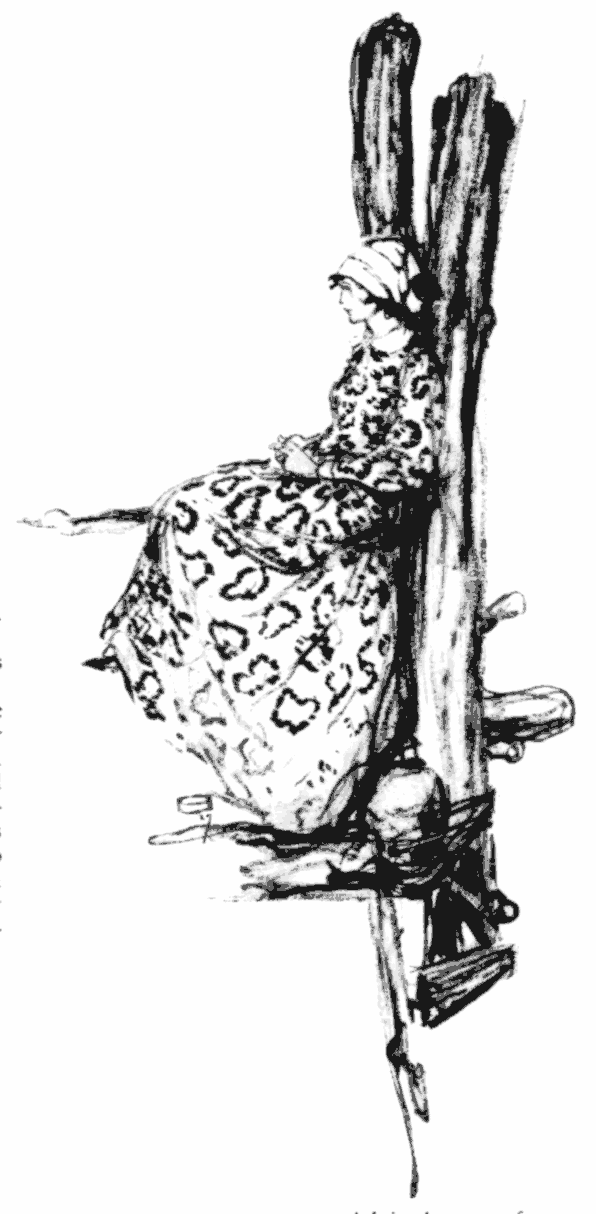
“I reckon she knew what she was talkin’ about,” replied Fat while Joe staggered over to the corner of the porch where he could see the stable and a corner of the corral. He chuckled drunkenly and headed for the doorway.
“Here’s my pup-paternal anchestor; so I guess I better hunt a li’l hole and crawl in.”
He disappeared within the house as Frenchy LeClere and Yvonne came from down by the corral talking earnestly. They caught sight of the sheriff and Hashknife.
“Hello folks!” called Fat waving his hand.
“By gosh, de sheriff!” exclaimed Frenchy. “And Meester Hart-lee! Well, well!”
He glanced at the porch and seemed relieved to note that Joe was not in evidence. They all shook hands but Frenchy did not invite them to dismount. They knew why Yvonne seemed very quiet and had nothing to say.
“Joe, she’s get along fine,” offered Frenchy. “I’m s’pose she’s lie down jus’ now and tak’ rest.”
“We just rode past to see how he was comin’ along,” said Hashknife. “He’ll be out in a few days, won’t he?”
“Oh, for sure!” replied Frenchy.
They were visibly relieved when Hashknife suggested to Fat that they had better be going along and Fat accepted quickly.
“Come out again, won’t you?” asked Yvonne. “Please do. We are glad to have you.”
“Thank yuh, Yvonne,” smiled Hashknife. “We shore will.”
As they rode away they noticed that Frenchy and Yvonne went quickly into the house.
“Joe will get merry hell,” grinned Fat. “The Old Man has a terrible temper.”
“He deserves it,” declared Hashknife. “Too much liquor. Tuck Hayward ought to get a good kick in the pants for bringing whisky out here to the boy.”
“I reckon that’s right.”
They rode along the strip of weeds but were making no attempt at a further search when suddenly Hashknife drew up his horse, turned him around and rode back a few steps. Quickly he dismounted and walked a short distance through the tangle of weeds where he picked up an object.
“Whatcha find?” asked Fat, reining back through the weeds.
Hashknife held it out to him—a heavy Colt revolver.
“I got a flash of the sun on it,” he said.
“Fully loaded!” said Fat. “Forty-five.”
Hashknife was squatted on his heels examining the grass and Fat dismounted beside him.
Together they looked the spot over and Hashknife found a mat of old leaves about as large as his hand apparently glued together. He examined it closely and got to his feet.
“What is it?” asked Fat.
“I think we found where Kid O’Neil went down and out. Unless I’m badly mistaken, that bunch of leaves is stuck together with gore.”
“It ain’t red,” declared Fat.
“Yuh didn’t expect it to stay red, did yuh? Plenty of fox-tail here too. Do yuh recognize that gun?”
“No. Nothin’ on it to show who owned it, Hashknife.”
Hashknife wrapped the leaves in a handkerchief and mounted his horse, while Fat put the gun in his pocket. They rode back to Chongo and turned the leaves over to Dr. Plumley, who confessed that he was not exactly a chemist but that he could determine whether it was blood or not.
But Hashknife did not wait for an analysis. They went to the jail where they found Sleepy and Chuck Haverty in the cell with Soapy Weed, arguing over a seven-up game. They went in and Hashknife sat down beside Soapy. Hashknife had the gun, which he placed on the little table.
“Didja ever see that gun before, Soapy?” he asked.
Soapy examined it closely, shaking his head.
“Never saw it before in my life. What about it?”
“That’s the gun Kid O’Neil had when he was killed.”
Soapy looked closely at Hashknife who was examining the gun again.
“How do yuh know that?” asked Soapy wonderingly.
“Because we found the spot where you found the body. It was just a little ways this side of the IS ranch-house, on the north side of the road. The weeds are deep there, Soapy. And it might interest yuh to know that Joe LeClere got drunk today and made things so unpleasant that Yvonne was obliged to go out and set on the corral fence.”
Soapy’s eyes snapped angrily.
“That dirty bum! If he—” Soapy stopped.
“Were you tryin’ to protect Joe LeClere?” asked Hashknife.
Soapy settled back on the cot, his eyes thoughtful.
“I reckon I might as well tell it all now. It had to come out sooner or later. I wasn’t tryin’ to protect Joe but I did want to protect Yvonne. She’s his sister, yuh know.”
“You didn’t see Joe kill him, didja?” asked Fat quickly.
“No. I was comin’ back from takin’ Yvonne home and I saw a horse. It had the reins tangled in its feet. It was a Box 88 horse. I untangled it and the darn thing broke away. Then I fell over the body. I didn’t know what to do. But I knew it would cinch Joe; so I put it on my horse and got on behind. The darn bronc bucked and I was scared of losin’ the body. Yuh see, it was a hell of a mean job gettin’ it on.
“Well, I fell off and the bronc ran away. I chased him plumb to the river. It put me in a bad fix. When Fat arrested me I thought it would end at the inquest, but I made a fool break about that deep grass and they soaked me in here. I never shot O’Neil and I don’t know who did.”
“But you felt sure that Joe LeClere did,” said Hashknife.
“I was afraid he did,” amended Soapy.
Hashknife stretched and began rolling a cigaret.
“What’s the next move?” asked Fat anxiously. “Shall I arrest Joe LeClere, Hashknife?”
“You better talk it over with the prosecutin’ attorney. Personally, I don’t think there’s a thing that they can put on Joe. It’s just circumstantial evidence. Joe’s rep would be against him. Probably a jury would convict him.”
“What about me?” asked Soapy anxiously.
“You’ll stay here until we get a better man to fill yore cell,” said Chuck.
“I reckon that’s about the size of it,” agreed Fat.
“Anyway they won’t hang me,” grinned Soapy.
“They’ve never hung anybody around here for bein’ a damn fool,” declared Chuck.
“That’s a lucky thing for the population, I suppose,” said Fat seriously.
Hashknife supposed that Fat would tell what the prosecuting attorney had to say about it, but he didn’t see anything of Fat until late that evening when Fat rode in with Joe LeClere and put him in jail.
Frenchy LeClere and Yvonne came in shortly afterwards, rather dazed over the sudden turn of events. Joe was half-sober and in an evil frame of mind. He cursed Fat and everybody until Fat locked him in a cell and left him to sober up.
The prosecuting attorney had talked with the judge, who advised turning Soapy loose, and as Soapy came from the jail free at last he came face to face with Frenchy LeClere and Yvonne. He stopped short and stared at Yvonne, who walked past him without a sign of recognition. Soapy almost fell down.
“Well, what do yuh know about that?” he wailed to himself. “They turned me down like a white chip.”
He headed for the Silver Streak where he found Hashknife and Sleepy.
“Yo’re loose, eh?” grinned Hashknife.
“Loose as hell!” snorted Soapy. He lowered his voice.
“Met Frenchy and Yvonne and they never recognized me.”
“That’s kinda funny, ain’t it?” queried Hashknife.
“Mebby you think it is—I don’t! Do yuh reckon they blame me for Joe bein’ in jail?”
“You didn’t put him there, Soapy.”
“I shore didn’t. By golly, I’ve got to find Fat. If he lied about what I said I’ll salivate him.”
And Soapy hurried across the street looking for Fat, who was in his office talking with Yvonne and her father. But Soapy didn’t go in. He walked past, looked through the open door and then sat down on the wooden sidewalk fifty feet past the office door.
Fat was having rather a strenuous time.
Frenchy wanted to know the reasons for everything and Fat was obliged to tell him that Joe had been under suspicion for quite a while but that they had needed a confession from Soapy as to where he had found the body before they could act.
He told them about finding the evidence near the IS ranch-house.
“I never hear no shot that night,” declared Frenchy. “I’m t’ink Joe come straight home that night.”
“You think he did?”
“I’m don’ know for sure,” sighed Frenchy. “Well, I’m s’pose we mus’ do our bes’. No use to kick. When you have trial?”
“I don’t know, LeClere. I suppose he’ll have to have a hearing and then be bound over to the superior court.”
Yvonne had nothing to say. She knew that Joe was not in the house that night when Soapy took her home, because she saw him ride in at daylight.
She and her father came from the office and went up the street together, going in the opposite direction from Soapy, who got to his feet and went to the office door. Fat glared at him because Fat was in a bad humor just then.
“What the hell do you want?” asked Fat.
“What did you tell ’em about me, Fat?”
“I dunno what yuh mean.”
“Oh, the hell yuh don’t! They never spoke to me.”
“Didn’t, eh?”
“No, they didn’t. They acted just as though I was a plumb stranger. Never even recognized me.”
“Well, what in hell can yuh expect, with ten-days growth of whiskers on yore face? Go get a shave, you bo-hunk!”
Soapy’s hand went slowly to his face, which had not felt a razor since the day before his arrest.
“Well,” he said slowly, “thanks, Fat!”
Joe LeClere had his hearing the following day and quite a crowd assembled in the little court-room. Joe was sullen and eyed the crowd angrily. He glared at Hashknife as though he blamed Hashknife for his incarceration. Soapy Weed was sworn in and told exactly what happened that night as far as he was concerned. He admitted trying to shield Joe.
The sheriff told of finding the spot where O’Neil had been killed and exhibited the gun as evidence. Following him came Doctor Plumley, who testified that the handful of leaves had been clotted together with blood. Quite a number of employees of the Silver Streak were present, including Tuck Hayward and McLeod, his ranch foreman.
Joe refused to testify but he did get to his feet and single out Hashknife.
“Yo’re the one that framed all this!” he shouted. “You put me in jail with yore damn meddlin’. Who in hell are you? You better keep yore damn long nose out of my business—or you’ll wish yuh had.”
“Shut up!” snapped the sheriff, jerking Joe down in his chair. “If you’ve got anythin’ to say, be sworn and tell it under oath.”
“I’ve got plenty to say!” snapped Joe. “When it comes down to cases I can say a hell of a lot.”
His eyes roamed the room and he laughed harshly.
And so the judge bound him over to the next term of court and the prosecuting attorney filed a charge of first degree murder against him. There was much speculation as to what Joe had meant about having plenty to say.
In celebration of Soapy’s release he and Cling proceeded to imbibe plenty of hard liquor. They tried to get Chuck Haverty to join them but Chuck was duty bound to stay at the jail. It was only a small building, located about fifty feet behind the sheriff’s office, and a small room at the front was used as a home for the jailer.
Soapy hugged Chuck, cried on his shoulder, told him he was the finest jailer on earth and that they owed him a real good time; but Chuck remained loyal to his job, although he hankered to join the two cowboys and cut loose.
“He was jus’ like a father t’ me, Cling,” sobbed Soapy. “Jus’ like a father and mother t’ me. Oh, he’s lov’ble person, Cling! Shake hands with Chuck, will yuh? Oh, you’ll jist love him; he’s part Scotch—the finan’shl part!”
“Shert’ly glad to meetcha,” said Cling solemnly. “So glad you were kind to our li’l soap weed. Won’t you come and let us buy you a snifter of demon rum?”
“Aw, hell, I can’t leave here!”
“Isn’t he profane?” applauded Soapy. “Didja ever hear a man use pr’fanity better ’n that, Clingin’-Vine? He’s a wunnerful pitch player. Oh, jus’ wunnerful! Ought to be a claim-agent. Claims everythin’; high, low, jack and the game.”
“Go home and sober up,” growled Chuck.
“There y’are!” exploded Soapy. “Tha’s one side of his nature I never rec’gnized. I judged him wrong. I thought he was a hail feller, well met; and the son of a horned-toad tells us to go home and shober up. C’mon! I’m shert’nly disappointed in him. But he’s good to his captives. Oh, my, he’s so good!”
“Aw, go to hell!” snorted Chuck.
Soapy and Cling went to the Chongo Saloon where they essayed a duet. Soapy had a barber-shop tenor which strangled him badly at times, while Clingin’-Vine sang in a mournful baritone with many a quaver and jiggle in his voice.
“Just break the news to Mother,” they sang tearfully, as they leaned against the bar.
Fo-o-o-or, I’m not comin’ ho-o-o-ome.
Just say there is no-o-o-o other—
Then they broke down and cried while the sleek-haired bartender snorted disgustedly and polished the bar with great vigor. He was also sentimental and that barber-shop chord was something he loved.
“I can’t stand it,” sobbed Soapy. “My heart’s too full for shong.”
“Yore stummick is, yuh mean,” said the bartender callously.
“Tha’s a inshult,” declared Clingin’-Vine tearfully.
And so they locked arms and weaved their way outside where they headed for the Silver Streak. The games were running full blast. They leaned against the bar, imbibed another drink and proceeded to regale the world with:
Nothin’ but shorrow I shee-e-e-e.
I am nobody’s darling,
Nobody cares for me-e-e-e.
It didn’t get over so well because the two-piece orchestra, consisting of a violin and a tin-panny piano, were playing “The Irish Washerwoman.”
The singers realized that their efforts were spoiled; so they went back to the little orchestra platform where they sat down together. Several cowboys were dancing with the “girls” and after the dance was finished some one invited the orchestra to have drinks.
The fiddler placed his instrument on the platform near Soapy and headed for the bar. A few moments later Soapy and Cling were out behind the saloon and Soapy had the fiddle and bow.
“The ques’n is,” propounded Cling, “just what in hell did yuh steal that fiddle for, Soapy?”
“The answer to yore overpowerin’ ques’n, Clingin’-Vine, is thish: We need ’companyment to our shong. I never re’lized it so much before.”
“Well, tha’s great, Soapy! But why in hell didn’t you steal the fiddler too?”
“Don’t need ’em.”
“You can’t play no fiddle, Soapy.”
“The hell, I can’t! Ee-magine that, will yuh? I can play anythin’ I can get m’ hands around. I took two lessons on one of these whine-boxes. C’mon!”
They went around several buildings and finally emerged on the street below the Chongo Saloon where they sat down on the sidewalk. Soapy tucked the fiddle under his chin and proceeded to make a lot of wailing discords.
“Rec’nize it, Clingin’-Vine?” he asked.
“Not ’zactly, Soapy; what is she?”
Soapy cuffed his hat over one ear and sang softly:
As we went bobbin’ ’round.
“Do yuh rec-nize it now, Cling?”
“Well,” sighed Cling, “I’ll take yore word for it. But I will shay thish much; either yore voice or that damn fiddle is way to hell off the tune.”
“It ain’t me, Cling—it’s you. Yore ears ain’t percolatin’ right f’r music.”
“Pos’bly. Now what’ll we do?”
“I jus’ got lovely insp’ration; let’s sherenade Chuck Haverty. Whatcha shay? Le’s give ’m a treat.”
“Oh, lovely! C’mon.”
It was with difficulty that they got to their feet. Soapy dropped the fiddle and they bumped together in trying to recover it. Soapy got a heel through the top of it but they didn’t mind that.
“Prob’ly make it shound better to me,” said Cling.
“Oh, always! Tha’s the firsth thing I’d do if I got me a new fid’l. The very bes’ musicians always step on a fid’l the firs’ thing. I ’member when I was playin’ with a big orc’restra—”
“Big what?”
“Orc-rest-ree.”
“Where and when, Soapy?”
“Tha’s the trouble with you,” sighed Soapy. “I wish I hadn’ brought up that subject. Look out! Didn’ you shee that hitch-rack? When you shee a hitch-rack comin’ toward yuh, don’ try to jump it. Duck under it like I did.”
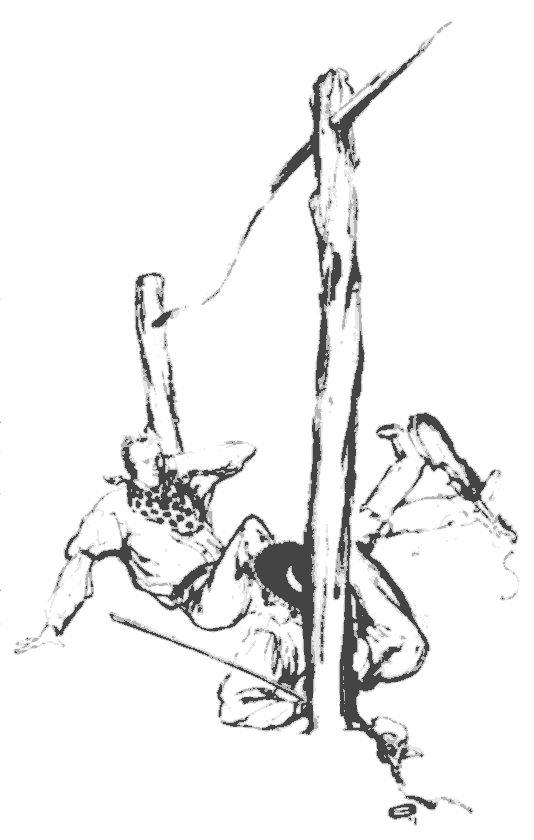
Soapy crawled around on his hands and knees, recovering the stolen fiddle, while Cling sat on the edge of the sidewalk and nursed his nose. They finally got on the sidewalk and went past the sheriff’s office to the alley which led around to the jail.
They managed to reach the front steps of the jail where they sat down together. The fiddle had been all knocked out of tune but they didn’t mind. Soapy sawed dolefully on the loosened strings while both of them sang mournfully. It was a terrible musical effort.
For possibly ten minutes they sawed and sang but nothing came of it. Their last few drinks had begun to take active effect and their final song was a series of squeaks and vocal discords.
“Do you shuppose we shung him to sleep?” asked Soapy.
“Tha’s about the shize of ’t. Let’s go and wake ’m up.”
The door was unlocked, so they went in. But there was no sign of Chuck Haverty. Cling smashed the lamp in trying to light it and Soapy fell down across his fiddle, breaking the neck completely off it, and they ended their evening when Cling fell across Chuck’s bed and Soapy went to sleep with his head pillowed on the broken fiddle.
“No, the sheriff ain’t here. He went to the mines early this mornin’ and he won’t be back before this afternoon. You say somebody stole yore fiddle? Well,” Weary braced one elbow against the side of the office doorway and rubbed his touseled hair vigorously, “I dunno nothin’ about it. Now, if it was a stolen cow or a horse—”
“Well, it ain’t—it’s my fiddle.”
The fiddler from the Silver Streak spat angrily and considered the sleepy deputy who stood barefooted in the doorway with only a pair of over-alls over his red underwear. He had just got out of bed.
“Yeah, it’s yore fiddle,” admitted Weary. “After listenin’ to you playin’ it, Andy, I’d look for a deaf man if I was you. Nobody with two good ears would ever steal that fiddle.”
“It cost me seven dollars and six bits.”
“Which was pretty high for that kind of a fiddle.”
“Who do yuh reckon would steal it, Weary?”
“Somebody prob’ly played a joke on yuh. One of the boys prob’ly took it.”
“Yeah, that might be. I went to take a drink last night and when I came back it was gone.”
“Well, you’ll find it. A fiddle ain’t somethin’ yuh can get rid of. Ain’t very many fiddles in this country. Didja have yore initials cut in it or anythin’?”
“Yuh don’t do things like that to a fiddle. Might ruin the tone.”
“Aw, hell! You could shoot yore initials in that one with a buffalo-gun and never hurt the tone. But I’ll keep an ear cocked, Andy. I’d recognize that fiddle, y’ betcha!”
“Thank yuh, Weary.”
Weary watched him go up the street, shook his head and went back to dress.
“This here country is goin’ to the dogs,” he told the four walls of the office. “When they start rustlin’ fiddles I’m all through. And that kind of a fiddle!”
He buttoned up his shirt and drew on his boots. Weary wore boots a size too small and they gave him misery in the morning. He stomped around the office for a while, picked up his hat and went back to see Chuck. They usually ate breakfast together, after which Chuck carried a tray of food to the jail.
Weary walked right in, stopped short and looked around. Cling Heffner was sprawled across Chuck’s bed while in the middle of the room was Soapy Weed, lying across the smashed fiddle. Just beside Soapy was the oil-lamp, just a pile of smashed glass now amid a huge ring of kerosene.
Both men were snoring industriously. Weary rubbed his chin and considered them gravely. There was the missing fiddle—what was left of it. But there was no sign of Chuck. There was a half-barred door leading down the jail corridor which was always kept locked, but when Weary turned the knob the door swung open. There was no one in the corridor.
“Chuck!” called Weary, but there was no response.
Weary walked down the short corridor and leaned against the bars of Joe LeClere’s cage. Joe was lying in the middle of the floor, instead of on his cot. Weary snorted with indignation and walked back to Chuck’s room where he surveyed the wreckage and the two sleeping men.
“Drunken lotta bums!” he snorted virtuously. “Slipped the bottle to our prisoner, didja? Gotta good notion to kick yuh both out in the alley where yuh belong. I suppose Chuck is over at some saloon cryin’ on the bartender’s shoulder.”
Weary went outside, slammed the door shut and headed up the alley, telling himself that he was going to talk plenty strong to Chuck Haverty. Of course he wasn’t Chuck’s boss but that didn’t matter. The idea of making a barroom out of a perfectly respectable jail! Chuck would hear about it in plain language.
Chuck wasn’t in the Chongo Saloon. Nobody in there except a couple of swampers and a bartender. At the doorway of the Silver Streak he met Sleepy who had just come over from the hotel.
“Seen anythin’ of Chuck?” asked Weary.
“Not this mornin’, Weary.”
“Ain’t in the Silver Streak?”
“Wasn’t ten seconds ago. Yuh don’t mean to say you’ve lost yore jailer, do yuh?”
“Kinda looks like it,” grunted Weary and proceeded to tell Sleepy about Cling and Soapy and the busted fiddle.
Sleepy laughed at Weary’s description of the fiddler bewailing his loss.
“I was here when he missed it,” chuckled Sleepy. “Accused everybody except Tuck Hayward of stealin’ it. I wondered who got it. Come to think of it, I did see Cling and Soapy over there by the orchestra but I never connected them with the disappearance of the fiddle. Did Fat say what time him and Hashknife would be back?”
“Afternoon, I reckon. Fat was goin’ to check up on a shipment of hides from the Box 88 and Hashknife went with him.”
“I know about that part of it. Yuh say Soapy and Cling slipped some liquor to Joe LeClere?”
“Shore did! Fat will give Chuck hell for this, y’ betcha.”
“Mebby we better get that fiddle and bury it before the owner of it finds out who got it.”
“Aw, to hell with it! I hope he makes Soapy and Cling pay a month’s salary for bustin’ it. And that don’t mean the fiddler is any friend of mine either. Chuck would have been respectable if them two geezers had stayed away from him. They’d corrupt anybody.”
They walked back across the street and sat down in the office to have a smoke.
“Do yuh suppose Yvonne LeClere is stuck on Soapy?” asked Sleepy.
Weary cocked one eye at Sleepy and grinned widely.
“Not me!” laughed Sleepy. “I’m female proof.”
“Me too!” sighed Weary. “I dunno about Soapy. He kinda had the inside track, it looked like t’ me. But yuh never can tell about a woman. I had a girl turn me down for a bat-eared shepherd once. Fact! Ever since then I’ve kinda steered away from ’em. Gee, he shore was bat-eared!”
“Marry her?”
“Shore did.”
“Had money, eh?”
“Had ten dollars I loaned him, if yuh call that money. It was so much he never paid me back. That was seven years ago and they’ve got two sets of twins and a couple singles. I’ve seen ’em all and every kid has got bat-ears.”
“Marriage is a serious thing,” smiled Sleepy.
“If yuh don’t think so jist take a look at them twins and singles. Six of ’em to feed and clothe! I’ll betcha it’s serious. It shore would crimp a salary like mine. But if I had ’em I’d pin back their ears while they was young. If a feller with ears like that ever moved to a windy country he’d have to carry a rudder.”
In the meantime Hashknife and Fat rode to the mines on Chongo Creek. Hayward had notified the sheriff that he was going to ship hides in a few days and they had to be inspected by the sheriff’s office.
They found Cornes and Asher at the butchering corrals. Cornes had met Hashknife and now he introduced him to Asher, a skinny, long-nosed cowboy. The two went on about their work while Hashknife assisted Fat in checking over hides. It was not a long job and they found every hide branded with the Box 88. The sheriff tagged each bundle with an inspection card. Neither he nor Hashknife was interested in the mines; so they started back as soon as their work was finished.
“Didja ever find anythin’ besides a Box 88 hide?” asked Hashknife curiously.
“Twice,” replied Fat. “Once it was an AH and the other time it was an IS. They got in by mistake and were killed. But both owners were paid the market price and the hides were returned. Oh, Tuck Hayward is square as a dollar in his cow business! I dunno much about his gamblin’ games.”
Hashknife was gravely thoughtful. He had examined every one of those hides and had noticed certain things that puzzled him greatly. LeClere swore that he was losing stock—and Hashknife believed him. But where were they going? And what was Joe LeClere going to do with the Box 88 stock he had in that brush corral? Why was he heating a running-iron? What in the world could he do with a running-iron on a Box 88? To change that brand to any other brand on the range would be impossible. If he boldly vented the brand and ran on another it would be a plain case of suicide. As far as Hashknife could find out, the IS had no vent-brand. That is, a brand to use in case an animal is vented, showing that the IS came by the animal legally.
And apparently Tuck Hayward was a friend of Joe LeClere. Hashknife had puzzled over it ever since he had been in the country and he was no nearer to a solution now.
“How do yuh account for LeClere losin’ cattle?” he asked the sheriff, as they rode back to town.
“I don’t account for it, Hashknife. The old man is loco.”
“His round-up tally has showed short twice now.”
“His tally, Hashknife. I know what his last tally showed and I’ll check up myself next round-up. I don’t believe he ever had any cows stolen. Nobody else has lost any.”
“Mebby yo’re right. It looks that-away, Fat.”
“I know I’m right.”
And while they rode back to Chongo town Soapy Weed opened his eyes and stared at the ceiling. His mouth was apparently full of ashes and there was a dull throb in the back of his head. After due deliberation he raised up and looked around.
Beneath his left elbow were the remains of that fiddle and he squinted at them curiously. He looked at Cling’s feet dangling over the edge of the cot. His head turned and he looked at the half-open door where the sunlight glared through.
He spat dryly and rubbed his eyes.
“I must have fallen asleep,” he said huskily.
“Ditto.”
He turned and looked at Cling who was sitting up with a queer expression in his face.
“Ditto, eh?” said Soapy.
“Yeah—ditto. We both fell asleep. Lemme see—”
“Where’d this damn fiddle come from, Cling?”
“Don’tcha remember, Soapy? We stole it at the Silver Streak.”
“That’s right. Oh, yeah, I remember now! What time is it?”
“Forgot to wind m’ watch last night, and it stopped.”
“Must be almost noon,” squinting at the sunlight.
“Funny thing they ain’t found us,” yawned Cling. “Wonder where Chuck is? My God, did we upset that lamp, Soapy?”
“Lamps,” said Soapy seriously, “don’t usually fall down and break themselves. My God, this fiddle is a wreck!”
“So’m I. Oh, what a head! What did we drink, do yuh s’pose?”
“We drank anythin’. I’m hungry.”
“I’m not. Waugh!” Cling got to his feet and went over to the doorway. “No water close, I don’t reckon. My God, I’m ninety per cent dryer than Death Valley in July!”
“C’mon,” sighed Soapy wearily. “No use stayin’ here.”
He kicked the fiddle under the cot and led the way out through the narrow alley to the street. Weary was in the office door and looked them over pityingly,
“Drunken bums!” he said solemnly. They stopped together and made wry faces at him. Sleepy came and stood beside Weary, a grin on his face.
“Yo’re gonna get hell,” declared Weary. “Wait’ll Fat gets back.”
“Since when did it become a penitentiary offense to get drunk in Chongo?” asked Soapy.
“I suppose yuh got Chuck drunk and left him in an alley,” said Weary.
“Yo’re crazy as hell! We never even seen him.”
“Addin’ lies to his other crimes,” said Weary sadly.
Soapy spat dryly and looked longingly across the street.
“I need water,” said Cling. “Need lotsa water. Let’s go down to the livery-stable pump and drink her dry.”
“Where’s Chuck?” asked Weary.
“We never seen him,” said Soapy indignantly. “What’s all the fuss about anyway?”
“I suppose you’ll deny that yuh slipped a bottle to Joe LeClere?”
Soapy shut one eye and looked at Cling.
“Remember anythin’ like that, Cling?”
“Not me. My thinker ain’t so clear, but I’ll be damned if I remember any such a thing as that.”
“Yuh remember stealin’ the fiddle, don’tcha?”
“What fiddle?” asked Soapy innocently.
“There yuh go,” wailed Weary. “What fiddle? Why, the one yuh was sleepin’ on.”
“Didja see me on any fiddle, Cling?”
“’F yuh ask me anythin’ about it I’d say that Weary is fit to herd sheep. C’mon, Soapy; this conversation makes me awful dry.”
They wandered across the street and down to the livery-stable, where they took turns at pumping water over one another’s heads.
“I know just how they feel,” grinned Sleepy, rolling a cigaret. “It don’t pay.”
“It shore don’t,” agreed Weary. “Gosh, I wish Chuck would show up! He’s supposed to pack some food to the prisoner.”
“Probably the prisoner don’t feel like food.”
“Prob’ly not. Oh, I dunno! I guess it’s Chuck’s business.”
“Chuck’s a good feller, Weary.”
“Shore! But—well, mebby I better kinda clean up things. I’ll see if Joe is in any mood to eat. Want to go along?”
They closed up the office and walked around to the jail. Chuck was not in evidence. Weary picked up the remains of the broken lamp and threw them outside. Sleepy examined the fiddle and declared that it was ruined forever.
“We’ll hide it,” said Weary. “But, by golly, I’ll see that Soapy and Cling pay the fiddler for it!”
They walked back through the corridor and peered in Joe’s cell. Joe was lying in the same position as when Weary last saw him. It was still a little dark in the cell.
“Wake up and pay for yore lodgin’!” yelled Weary. “Hey! Joe! Time to get up!”
But Joe didn’t move. Weary looked at Sleepy, who was peering closely.
“What’s the matter with the damn fool?”
“Have you got a key to this cell, Weary?”
“Chuck’s got ’em.”
“This don’t look right to me,” said Sleepy seriously.
“Yuh don’t think he’s hurt or sick, do yuh, Sleepy?”
“He acts like a dead man.”
“Well, that ain’t—hey? Joe! Wake up, can’tcha?”
“Let’s see if we can’t find Chuck.”
They went outside and looked around. Weary was visibly nervous.
“I dunno where to look. Damn it, what do yuh reckon has gone wrong?”
Sleepy led the way over to the sheriff’s stable, which was large enough to take care of four horses. Two horses were still in the stalls. But Chuck was not there. At the rear of the stable was a small pole corral where the owners kept their hay. Sleepy shoved his way between the hay and the rear of the stable and there they found Chuck Haverty tightly bound and effectively gagged.
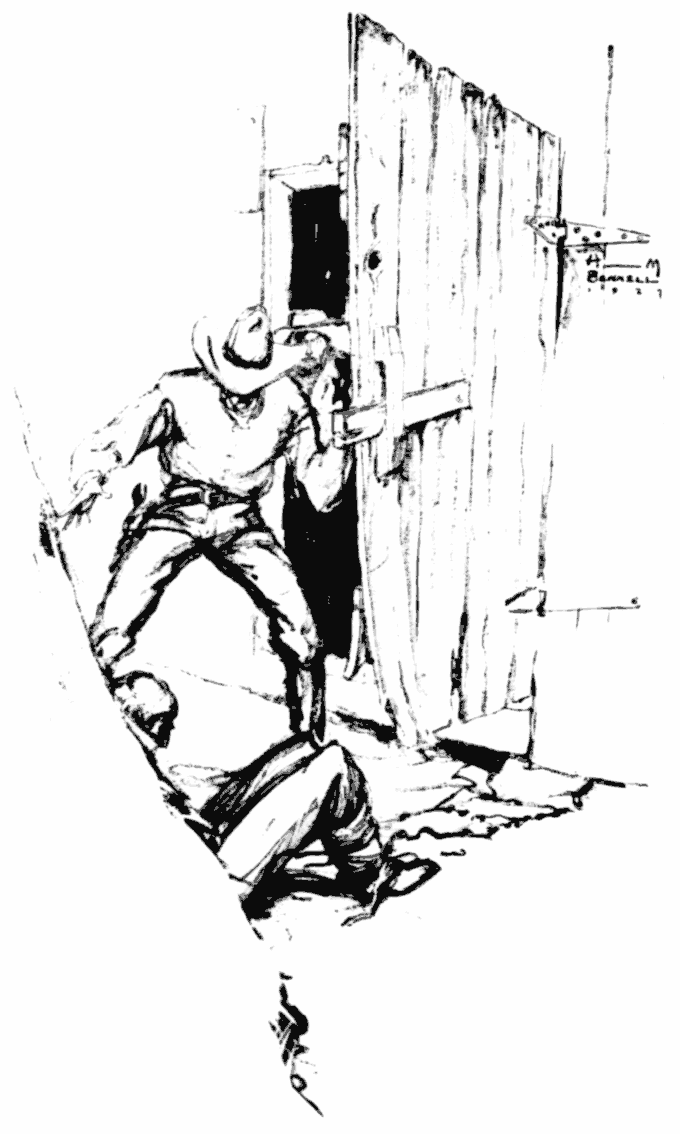
There was blood on his face and neck from a bruise on the side of his head but he was conscious. Quickly they cut the gag loose and stripped off the ropes. Chuck made no effort to get up; so they braced him against the hay and waited for him to get his voice back again. The corners of his mouth had been bruised by the gag until they bled and it took him quite a while to articulate at all. He grimaced with agony as the returning circulation sent streamers of pain through his arms and legs. Five minutes passed before he was able to stagger back to the jail where Weary unearthed a small bottle of liquor Chuck emptied.
“Can yuh talk now, Chuck?” asked Weary.
“Can try it,” mumbled Chuck painfully. “What happened?”
“You’ll have to tell us; we don’t know.”
Chuck shook his head painfully.
“I dunno. Somebody called to me, and I stuck my head out. I guess they sapped me on the head. I woke up out there in the hay.”
“Was that last night, Chuck?”
“About nine. I was goin’ to bed.”
“Where are the keys to the cells?”
“Under the mattress on my bunk.”
Weary lifted the mattress and found the keys. Chuck sat down on the bunk and held his head in his hands while Weary and Sleepy went back and unlocked Joe’s cell.
“My God, he’s been shot!” exclaimed Weary. “Look at the blood, will yuh? What the hell has been goin’ on, anyway?”
“He ain’t dead,” said Sleepy, after they had turned Joe over. “Must have been shot quite a while ago, judgin’ from the dried gore on his shirt. Better get the doctor quick as yuh can.”
“You stay here, will yuh, Sleepy?”
“Shore thing. Get goin’.”
Weary dashed out after the doctor and Sleepy went back to Chuck, who listened vacantly to what Sleepy told him.
“I dunno,” wailed Chuck. “I’m sick as a fool. They busted me in the cranium, didn’t they? And they shot Joe? That’s a hell of a thing to do. Where’s Fat?”
“Him and Hashknife are out at the mines, checkin’ hides. You say yuh heard somebody callin’ yore name, Chuck?”
“Yeah. I thought it was some of you boys. But I didn’t see ’em. I stuck my head out, thasall.”
Sleepy walked out on the little step and saw Hashknife and the sheriff riding up to the little stable. He called to them and they rode over. In a few words Sleepy told them what had happened, and while they were examining Joe Weary and the doctor came in.
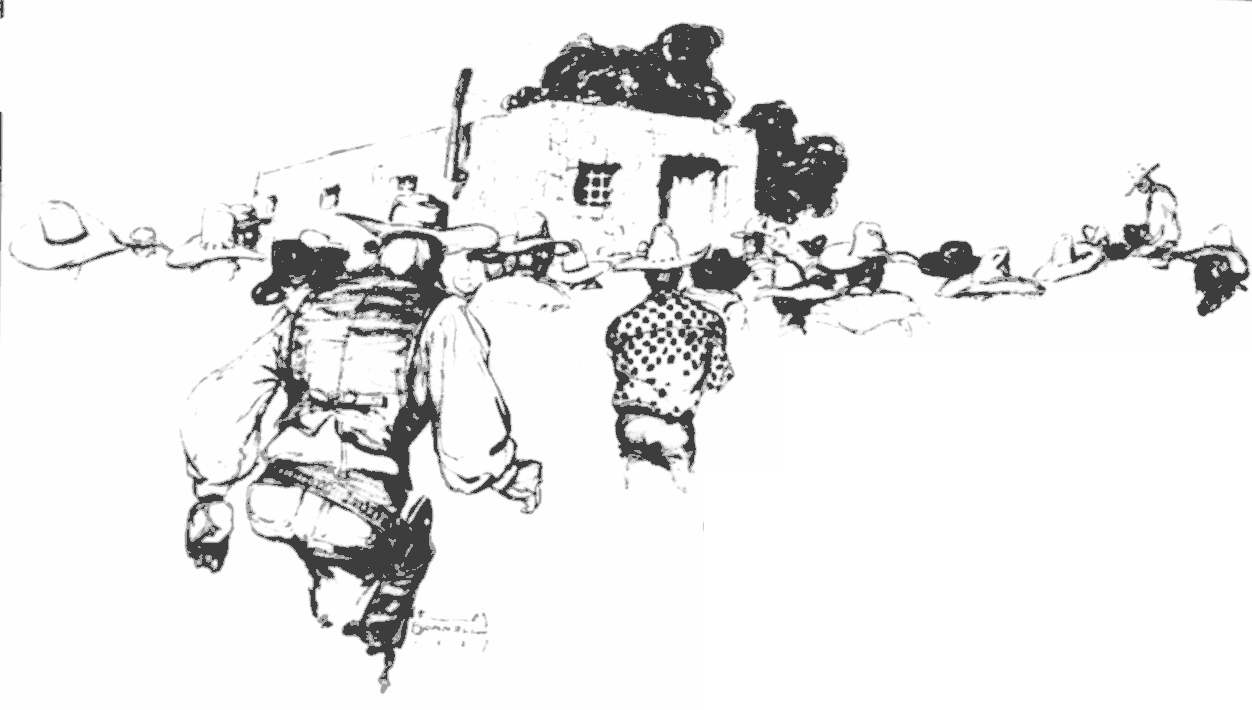
They moved Joe to the front of the building for the doctor to make his examination and a few minutes later it seemed as though half the town of Chongo was in front of the building, trying to find out what had happened. Sleepy went out and told them what the trouble was all about. In the meantime the doctor had ordered Joe to be taken to his office. They put him on the cot and carried him down there, with Chuck trailing along to get his head fixed up.
Joe LeClere was badly hurt. A bullet had passed through his left side a few inches above his heart and the doctor was a bit dubious. Over a dozen hours had elapsed since the bullet had been fired.
Hashknife found the bullet on the cell floor. It was a forty-five, with the nose only slightly battered. Doctor Plumley spent considerable time over the wound and after Joe was in bed he patched Chuck Haverty, who needed a couple of stitches in his scalp.
Soapy and Cling lost no time in coming to the sheriff with their story. They admitted that they had gone to the jailer’s with the intention of serenading Chuck with the fiddle and that they hadn’t found Chuck. They had had no idea what time of night it was but they had been sure it was only a short time after they had stolen the fiddle.
This would place the time of the shooting between nine and nine-thirty. No one had heard the shot fired but that was easily accounted for, as the corridor had probably been closed and the shot fired at close quarters. Outside the sound would probably have been only a jarring thud. And the shooting had been done while Chuck was still knocked out and probably in the hay and just a short time before the serenaders arrived.
Soapy and Cling chipped in and paid the fiddler what the fiddle had cost him, after Weary had sworn to the price as told to him by the fiddler, Andy Elders.
Fat was gloomy. It was rather a discredit to the sheriff’s office to have somebody knock out his jailer and shoot down a prisoner in his cell. It established a precedent which did not exactly suit Fat, who went around uneasily, his hands shoved down in his pockets, chewing an unlighted match.
He sent Weary out to notify Joe’s father and sister and Weary cursed Fat all the way out to the ranch. The job wasn’t one to please Weary. Hashknife and Sleepy sat on the Silver Streak hitch-rack and smoked calmly while the rest of the town discussed the latest development in the local crime wave.
“What do yuh know for sure?” asked Sleepy.
“Don’t know a darn thing,” said Hashknife. “But I do know it’s goin’ to take more luck than brains to find out who shot Joe.”
“Somebody wanted him out of the way, don’tcha think?”
“Very evident,” dryly.
“How many in the gang?”
Hashknife smiled sourly.
“I’m no mind-reader, Sleepy. We looked over all them hides and they belonged to Box 88. Of course the Box 88 wouldn’t make any fool moves. They’d be suckers to show a wrong hide. Fat thinks they’re on the square and I can’t find a thing to prove they’re not. If I only knew what Joe LeClere was goin’ to do with them Box 88 cows he had in that brush corral! Now Joe is pretty badly shot up and the doctor don’t think he’s got a chance to pull through. He’s the one who could put me on the right track. I’ll bet he knows who shot him. Or he’d know who might shoot him. It’s all a muddle, I tell yuh.”
“And the man who pokes his nose into it is liable to get what Joe got,” said Sleepy.
“He’s the third one,” said Hashknife. “Three times and out.”
“You think there’s any connection between this shootin’ and the other two, Hashknife?”
“I dunno. There might be. All three men were shot with a gun.”
“You think yo’re pretty damn smart, don’tcha?”
“No, I don’t,” grinned Hashknife. “I know I’m not.”
Hashknife and Sleepy were down at the sheriff’s office when Frenchy LeClere and Yvonne came in. Weary had told them the whole story with embellishments.
Frenchy had little to say but there was misery in his eyes. He loved Joe in spite of Joe’s wild ways. Hashknife shook hands with the old man and with Yvonne. Fat went with them to the doctor’s office. Joe was unconscious. The doctor seemed more hopeful than he had been at first.
“It was a clean hole,” he told them. “Went through a thin shirt and I don’t think any of it went inside. He’s got a fighting chance.”
“She’s look awful w’ite,” whispered Frenchy, shaking his head. “By gosh, I’m like to fin’ de man who shot her! You fix her up, Doc, eh? I’m like to take her home.”
“Can’t move him now, Mr. LeClere. Might be fatal.”
“I suppose not. You t’nk she’s get well?”
“I hope he will.”
“I’m hope so too, Doc. She’s good boy—jus’ wild. I’m hire good lawyer for her. If she’s die now—always Frenchy LeClere’s boy be murderer.”
“He isn’t going to die, Dad,” whispered Yvonne hopefully.
He patted her on the shoulder but there were tears in his eyes as they walked out. They met Tuck Hayward just at the doorway and the big man was sympathetic.
“I just heard about it,” he told them. “Went out to the ranch last night and just got in. How is he?”
“Mebby she’s live,” said Frenchy. “Pretty bad!”
“Gosh, that’s tough! Joe’s a good boy. I’ll go in and have a talk with the doctor.”
Frenchy and Yvonne walked up the street together to where their team was hitched. Frenchy went into a store to make some purchases and while he was there Soapy Weed came down the sidewalk. Yvonne smiled wistfully at Soapy and his heart missed a whole beat. He had expected her to turn him down.
“Hello, Yvonne!” he said softly. “Gosh, I’m sorry about what happened! Didja see Joe? How is he?”
“Not very good, Soapy. I didn’t know whether you’d speak to me or not, after I didn’t come to the jail to see you—and all that.”
“Oh, that didn’t make no difference, Yvonne!”
“I should have come, Soapy. I realized you were protecting Joe all the time—and me.”
“I didn’t do very much good. It was all right until Hashknife and Fat found the gun. They had me cinched and I had to tell the truth. I was shore glad to get out, but it was tough on Joe. And now look what’s happened to him!”
Yvonne nodded wearily.
“If Joe dies they’ll never know who killed O’Neil.”
“Do yuh reckon he knows?” asked Soapy quickly.
“I don’t know.”
“Well, let’s hope he don’t die. I mean, we’ll shore pull for him to get well. Joe’s all right. Can’t I come out and see yuh, Yvonne? Gosh, I’d shore like to!”
“Why don’t you, Soapy?”
“Well, I am coming! Gosh!”
“But don’t bring a fiddle.”
Soapy’s ears turned scarlet. He tried to speak but his tongue refused. Then—
“We—Weary told yuh? Oh, that ornery sheepherder!”
Yvonne laughed softly.
“He mentioned it,” she said.
“He would! Well, I reckon I didn’t play it well.”
“He said you didn’t.”
Frenchy LeClere was coming from the store and Soapy was glad of the interruption. He wanted to tell Weary what he thought of him.
“Hello, Soapee!” said Frenchy. “How you come, eh?”
“Swell—elegant!” grinned Soapy.
“You play de feedle now, eh? Feedle music ver’ good. Sometime you come out and play de feedle for de ol’ man, eh?”
Soapy opened and shut his mouth several times. Then—
“I’ll be out—sure!”
Soapy headed straight for the sheriff’s office where he found Weary, Fat and Chuck. They were discussing the shooting of Joe LeClere and welcomed Soapy warmly.
“I dunno nothin’ except what I’ve told yuh,” he declared, when they wanted him to repeat what had happened. “Ask Weary. He knows more about it than I do.”
“I wasn’t there,” said Weary.
“Well, you know all about it, judgin’ from what I heard. You shore spread that fiddle story around,” sneered Soapy. Weary’s face broke into a wide grin.
“I never told anybody except Frenchy and Yvonne. I had to tell it all, yuh see. And I had to tell ’em about the fiddle.”
“Yuh would! Things like that are a duty to you.”
“All I told ’em was that you got drunk, stole a fiddle, tried to serenade Chuck and then fell down and used the fiddle for a piller. That ain’t much, is it?”
“Well, I don’t know of a damn thing yuh left out.”
“I forgot to tell ’em that you paid for the fiddle.”
“You would! Any damn redeemin’ feature you’d leave out.”
“That ain’t no redeemin’ feature,” laughed Weary. “You paid up when yuh was caught with the goods.”
“That’s all right,” grinned Soapy. “Wait’ll I get a chance to deal you a bum hand!”
Hashknife and Sleepy were at a restaurant when an idea suddenly occurred to Hashknife. He laid down his knife and looked intently at Sleepy as he said:
“You remembered the time we met McFee, didn’t yuh?”
“Sure.”
“He was deputy sheriff of Piney River and he was on the trail of a horse-thief.”
“That was it. He said the man’s name was Welton or Holton or—”
“Belton! ‘Bitter River’ Belton, he called him.”
“That’s the baby!” exclaimed Sleepy. “That’s memory for yuh! But what good does that do us?”
“Quien sabe? as they say below the line.”
They finished their meal and sauntered down to the depot where a tired-looking depot agent fought flies with an old palm-leaf fan and tried to amuse himself with an old magazine. Hashknife secured a telegraph blank and wrote out the following message:
SHERIFF OF PINEY RIVER WYOMINGIF POSSIBLE WIRE ME COMPLETE DESCRIPTION OF BITTER RIVER BELTON WANTED BY YOUR COUNTY ABOUT TWO YEARS AGO STOP MUST BE COMPLETE FOR IDENTIFICATIONGARNETTE SHERIFF
Hashknife paid for the wire and they went back up the street.
“What in hell has Bitter River Belton got to do with this proposition?” queried Sleepy.
“Not a thing, I’ll bet! Just a hunch, Sleepy. When yo’re stuck as solid as I am you’ll play hunches.”
“I don’t see where Belton could figure—”
“Neither do I, Sleepy. Go on and forget him. He’s just a name as far as we’re concerned—but don’t mention it.”
“Oh, all right! I always travel in the dark in these things. I don’t know why yuh don’t never tell me anythin’.”
“Life is just travelin’ in the dark, Sleepy. We all do. We don’t know what it’s all about. And when we’re dead—take yore pick of resurrection, reincarnation or the end of things. I knowed a feller who believed in reincarnation. He was sure he’d come back in a different form. And I’ll be a liar if I don’t believe he did. About five years after his death I met a polecat. Well—aw, go ahead and laugh! There’s lots of things we don’t know about.”
“I feel better about it now,” laughed Sleepy.
The next morning Joe LeClere was still alive and the doctor was still hopeful. Yvonne rode in early to see how Joe was getting along and Hashknife and Sleepy rode home with her. She tried to appear hopeful but it was no use.
“Dad worries so much,” she said. “He’s afraid Joe will die and that he will never get cleared of that murder charge. Dad doesn’t believe Joe is guilty of course.”
“Do you?” asked Hashknife.
“I don’t believe he killed O’Neil but I believe he knows who did kill him. The morning O’Neil was killed Joe didn’t come home until daylight. He wasn’t home when I got back from that dance.”
“Does the sheriff know this, Yvonne?” She shook her head quickly.
“You are the only one I’ve told.”
“Then he wasn’t at home when Soapy Weed found the body, eh? That looks bad. Where do yuh reckon he was?”
“He didn’t say.”
“Your father doesn’t know this?”
“No. He would be the last person I’d ever tell. Oh, I want him to keep his faith in Joe!”
“Yeah, I suppose that’s best. But why did you tell me all this, Yvonne?”
“Because—well, I don’t just know, Hashknife. You played so square with me that day—the first time I ever saw you. You saved Dad a big heartache. If he had known that Joe was a rustler it would have killed him, I think.”
“Thank yuh for the confidence, Yvonne. I’m doin’ everythin’ I can to save Joe. It’s one awful jumble though.”
They rode in at the ranch and Hashknife unsaddled her horse while she went in the house. Frenchy came down to them and was questioning Hashknife about Joe when Yvonne came out on the porch and Sleepy went up to her, leading his horse.
“I don’t know, Hart-lee,” sighed the old Frenchman. “Joe she’s not so very strong and she’s bad hurt.”
“He’ll be all right, Mr. LeClere,” assured Hashknife. “You quit worryin’.”
“I guess I worry all my life ’bout Joe,” wistfully.
“Aw, Joe’s all right.”
“It is nice from you to say good t’ing of Joe—when you know better.”
Hashknife looked sharply at him, wondering what he meant.
“You try to save de old man,” said Frenchy softly. “You tell me Joe she’s h’accidently shoot herself.”
He lifted his eyes and looked at Hashknife.
“You know it is not true, Hart-lee. I’m fin’ dat gonn has not been shoot and de mag’zine she’s full of shells.”
“Oh, yeah!” sighed Hashknife, trying to think of a reasonable alibi. “Well, yuh see, we cleaned—”
“Non, non!” the old man shook his head quickly. “I’m go back to de spring where Joe says she’s got shot. I’m h’examine spring ver’ close. Nobody she’s got shot dere. Bimeby I ride up de cañon and somet’ing led me to a brush corral. She’s full of Box 88 cows. I turn him loose. Now, w’at you say?”
“Well, old-timer,” said Hashknife slowly, “I ain’t got a thing to say. I done what I thought was for the best.”
“I know, Hart-lee. You are w’ite man. You never tell nobody ’bout my Joe. I’m glad to know man like you.”
“Shucks!” said Hashknife. “It wasn’t none of my business. And anyway I shot him. He shot first of course.”
“I know. I never h’ask Joe. I’m jus’ let it go. But I want you to know I ’preciate w’at you do for me.”
“Well, yo’re shore welcome, Mr. LeClere!”
They walked up to the porch and talked with Yvonne a few minutes before they mounted and rode away. Hashknife told Sleepy what the old man had found out and Sleepy whistled softly.
“He’s no fool, Hashknife. Yuh can tell by his eyes that he’s a smart man. But ain’t it hell to see the hurt in his eyes? When they get old—and get hurt—”
“That’s the worst of it, Sleepy. I can see my old dad in most every white-haired man I find. He had his failings the same as every one. But he was awful human. Mother was human, too. My God, she had to be to raise a family like she did! They’re both gone now. I wasn’t there when they went away.”
“That was my fix,” sighed Sleepy. “Where are we goin’?”
“Out in the hills, just ridin’ I suppose. I get tired of town and I want to look at cows and horses.”
They rode far back into the hills, just drifting along. At times they would draw up their horses to look at range stock, sometimes just to look at the panorama of the hills slumbering in the afternoon sun. They did little talking. Wild horses threw up their heads from afar and looked at the two riders until a suspicious stallion led them away on a wild chase farther back into the hills.
Range cattle eyed them suspiciously but allowed them to ride in close. Hashknife was reading brands as they went along, the IS, AH and the Box 88, of which the Box 88 predominated.
They had ridden out on a flat mesa, where several head of stock were crossing near them and Hashknife began taking down his rope.
“Let’s take that roan steer, Sleepy,” he said, pointing to an animal which had just passed them.
Sleepy shook out his rope, swinging to the right, as Hashknife, swinging a wide loop, rode to the left at a gallop. His first cast encircled the animal’s head and Ghost sat back quickly, whirling the surprised animal around. Sleepy, riding in close, deftly roped its hind legs and a moment later the big steer was stretched out on its side, bawling softly, while Hashknife dismounted and came along his rope. They had thrown the animal on its left side, exposing the Box 88 on its right shoulder.
Hashknife leaned over the animal, examining the brand closely. It was a Box 88 but seemed to have been made rather recently. There were no other marks on the animal.
“What did yuh find?” asked Sleepy.
“Fresh brand on an old steer. Looks and feels all right.”
Neither of them saw two riders come over the edge of the mesa behind them and neither was aware that another human was within miles until they heard McLeod of the Box 88 say:
“What in hell is the big idea?”
Hashknife straightened up suddenly. Within fifty feet of them sat McLeod and Asher, looking them over curiously. It was rather an embarrassing position for Hashknife and Sleepy.
“Oh, hello!” said Hashknife easily.
“That’s a Box 88, ain’t it?” queried McLeod coldly.
“Yeah,” nodded Hashknife.
“Then what in hell are you two jaspers doin’ with him? I’d like to know.”
Hashknife smiled softly.
“We thought we knowed this critter,” he said slowly. “He was too shy for close inspection; so we used a rope.”
“Sounds damn fishy to me.”
“Don’tcha like fish, McLeod?”
“Never you mind what I like; and I don’t like yore explanation, Hartley.”
Hashknife walked over to McLeod, who eyed him angrily.
“That’s the only explanation we’re usin’ today, McLeod.”
“The hell it is!”
“Just that—and no more.”
“Oh, yea-a-ah!”
McLeod looked Hashknife over closely. He intended telling this lanky cowpuncher what he thought of people who get free with their rope, but there was something in those level gray eyes which caused him to hesitate. He looked at Sleepy, who was lolling sideways in his saddle a half-smile on his face, resting his right hand on his hip just above the butt of his gun.
“The sheriff might be interested in this,” said McLeod.
“He might,” nodded Hashknife. “He’s shore soakin’ up all the information he can get.”
“We been wonderin’ about you,” said McLeod meaningly.
“Yeah?”
“Wonderin’ what yo’re both doin’ around here.”
“Found out anythin’ yet?”
“Well, yuh can draw yore own conclusions. You’ll probably hear more about this later.”
“If there’s anythin’ I can help yuh out on—don’t hesitate to speak about it.”
McLeod grunted, turned his horse around and he and Asher rode away, disappearing over the edge of the mesa. Hashknife looked at Sleepy and they both laughed foolishly.
“Hell of a situation!” snorted Hashknife as he removed the ropes and let the steer go its way.
“A damn dangerous situation!” said Sleepy.
“Mebby more than you think, cowboy! I reckon we better go back to town before we get into any more mischief.”
They rode off the mesa and headed back for Chongo town while McLeod and Asher swung further to the east, forded the river about two miles above the town, taking a short-cut to the Box 88. McLeod was properly indignant. He told the wide world that he didn’t want strangers roping Box 88 cattle in the hills.
“Why didn’t yuh bawl that tall puncher out good?” asked Asher innocently.
“Didn’t I?”
“Well, yuh didn’t scare him none, Mac. He don’t look like a person yuh could scare very easy.”
“I reckon he’s salty,” agreed McLeod. “But he can’t get away with that kind of stuff, y’betcha.”
They found Tuck Hayward at the ranch with Mike Dalhart and McLeod lost no time in telling Tuck what they had seen and what had been said.
“What’s it all about?” queried Tuck.
“I dunno. They had the steer tied down when we walked in on ’em.”
“Why didn’t yuh smoke ’em up, the dirty thieves?” asked Dalhart.
“Well, they hadn’t stole anythin’, Mike.”
“What the hell kinda evidence do you have to have?”
“I’ll run my end of the business, Dalhart.”
“You keep out of this, Mike,” ordered Hayward.
“Oh, all right!”
Dalhart and Asher went down to the bunk-house, leaving Hayward and McLeod to talk it over.
“Just what did they seem to be doin’, Mac?” asked Tuck.
“Stevens was on his horse and Hartley was lookin’ at the brand. I dunno what it was all about but they shore felt cheap when we moved in on ’em.”
“Scared ’em, eh?”
“Like hell! You try to scare ’em, Tuck!”
“You say they felt cheap?”
“Well, you know what I mean. I reckon we better keep an eye on ’em.”
“It was a Box 88 they was lookin’ at?”
“Shore was!”
“I wish I knew what the idea was, Mac. Well, I reckon there wasn’t any harm done; so we won’t say anythin’ about it. I may mention it to the sheriff. As long as they didn’t have no fire nor runnin’-iron—”
“No, they didn’t, Tuck. But I don’t like their curiosity.”
“Well, just forget it. Did the sheriff check over that bunch of hides at the mine?”
“I reckon he did. Asher said that Hartley was out with Fat and they tagged all the hides.”
“Hartley was out there, eh?”
“That’s what Asher told me.”
“Mm-m-m-m! Well, I’ve got to go back to town, Mac.”
“How’s Joe LeClere?”
“Still alive. Doctor said he had a fightin’ chance.”
“Who the hell do yuh suppose shot him, Tuck?”
“I haven’t the slightest idea,” laughed Hayward. “Queer proposition! Well, I’ll see yuh later, Mac.”
Hashknife told Fat Garnette about the steer-roping incident as soon as he got back to town.
Fat didn’t seem to see any reason why Hashknife should throw a Box 88 steer until Hashknife explained that the brand looked too new.
“You ain’t tryin’ to put anythin’ on the Box 88, are yuh?” Fat wanted to know.
“Just curious,” smiled Hashknife.
“Curiosity killed the cat, yuh know, don’t yuh?”
“I’ve heard since that it didn’t. How’s Joe?”
“Still alive.”
Fat cuffed his sombrero over one ear and spat violently.
“I can’t make head nor tail out of it. If there’s one more killin’ I’ll be fit for the bug-house. What we need is a detective. As much as I hate the breed, I reckon we need one. I’ve been talkin’ to the prosecutin’ attorney for an hour or more and I’ll be damned if I don’t think they blame me for everythin’. The county commissioners had a meetin’—and they blame me.”
“I don’t blame yuh, Fat. I’m as much at sea as you are.”
“You? What the hell is it to you? Yo’re not a sheriff. They even wanted to know who you are. I couldn’t tell ’em. I tell yuh, I’m gettin’ so thin that my pants won’t stay up. Gotta wear suspenders, I suppose. Ain’t protectin’ society! I suppose they think I’m protectin’ murderers. By golly, I’ll resign—that’s what I’ll do! To hell with the job!”
Hashknife laughed and slapped Fat on the shoulder.
“Stay with ’em, pardner; you’ll win out.”
“Yeah, I’ll worry myself into a grave.”
Chuck Haverty had recovered from his busted scalp and he wanted revenge.
“Show me the geezer that petted me on the head and I’ll give yuh a first-class corpse,” he declared.
“Prob’ly stubbed yore toe and butted yore head against the door,” said the unfeeling Weary. “Yo’re a hell of a jailer.”
“I suppose yuh think I shot Joe and then tied myself up.”
“Wouldn’t put anythin’ past yuh, Chuck.”
“Well, I didn’t. Weary, ain’t you got no idea who might have done it? My God, some of us ort to figure out who done it! Fat is goin’ around fightin’ his hat all the time. Mebby if we steal his hat he’ll start thinkin’. Where is he?”
“I seen him and Hashknife together a while ago and they was headin’ for the Chongo Saloon.”
Chuck started to walk toward the door when the tired-eyed depot agent came in, bringing a telegram.
“A wire for the sheriff,” he said, handing it to Weary.
“Don’t suppose there’s an answer but I’ll wait and see.”
Weary tore it open and scanned the contents. It was from Evans, sheriff of Piney River, and said:
BITTER RIVER BELTON DARK SKINNED FIVE FEET TEN WEIGHT ABOUT ONE FIFTY SMALL BROWN EYES THREE MOLES TOGETHER ON UPPER LEFT WRIST AND A DEEP SCAR ON LEFT ELBOW STOP CONVICTED OF SECOND DEGREE MURDER HERE BUT ESCAPED STOP ADVISE IF YOU HAVE HIM
As Weary was puzzling over the telegram Tuck Hayward came in.
“I don’t reckon there’s any answer,” said Weary. “Fat ain’t here now. If there’s an answer he’ll come up to send it.”
The depot agent nodded and went out as Weary turned to Tuck with a grin.
“Ever hear of Bitter River Belton, Tuck?”
“Bitter River Belton? Don’t reckon I ever did, Weary.”
“Neither did I. Listen to this.”
Weary read the telegram to Hayward and Chuck.
“I don’t sabe it,” declared Weary. “Sounds as though this here Piney River sheriff thought we had him.”
“Does sound that way, Weary. Where’s Fat?”
“Around town somewhere. I seen him and Hashknife headin’ for the Chongo a while ago.”
“Oh, all right! I’ll see him later.”
Hayward turned and walked from the office while Weary read the telegram over again.
“Sounds loco to me,” said Chuck.
“Shore it does! The Lord’s Prayer would sound loco to you.”
“Well, do you make sense out of it?”
“You mean this telegram?”
“No, the prayer.”
“Wait’ll I hear it, can’tcha? I’m goin’ to find Fat.”
He found Fat and Hashknife at the Chongo Saloon and gave Fat the telegram. Hashknife got one look at it and smiled.
“Answer to one I sent, Sheriff.”
“One you sent?”
“I signed yore name to it. Got action quicker. Lemme read it.”
Hashknife read it carefully, tore it into small bits and threw them in a cuspidor.
“What’s the idea?” asked Fat wonderingly. “I get a telegram and you tear it all to hell.”
“Don’t worry!” smiled Hashknife. He turned to Weary.
“Forget it, will yuh, Weary?”
“Oh, sure!”
“Yo’re the only one that seen it, Weary?”
“Just me and Chuck and the depot agent and Tuck Hayward.”
“My hell!” exploded Hashknife softly. “Why didn’t yuh paste it on the front door? Oh, that’s all right, Weary! It was my fault; I should have told yuh all about it.”
“Well, what does it mean?” demanded Fat. He had only an indistinct memory of what it contained.
“Shootin’ at shadows,” smiled Hashknife. “Playin’ a hunch. Don’t ask me any more, boys. Fat, I’ll play yuh that game of pool now.”
“Make it three-handed and spot me half the string,” said Weary.
“You go back in the office and keep Chuck from gettin’ killed,” ordered Fat. “And if there’s another murder before this game’s over write out my resignation and I’ll sign it.”
“I’ll have three of ’em written out,” grunted Weary.
“Well, I’m a fool-hen if this ain’t got me doin’ a whirligig!”
Fat Garnette cuffed his sombrero so lustily that it flew across the room. On the table in front of him was a large envelope which he had just opened and the objects of his exclamation were scattered around the desk-top. These objects happened to be at least a dozen printed reward notices, all alike.
Hashknife was tilted back in a chair near the door, looking over a copy of the state brand register. He shut the book and looked at Fat.
“Another murder?” he asked.
“Murder be damned! Look at this—will you?”
He handed Hashknife a notice which stated that five thousand dollars’ reward would be paid for the arrest and conviction of the man or men who murdered Jack Shields, alias Kid O’Neil. It was signed by the secretary of the Cattlemen’s Association.
“What’s wrong about it?” asked Hashknife mildly.
“Oh, nothin’ of course. Who in hell was Kid O’Neil to be worth five thousand? And this county is offerin’ two thousand for the scalp of the geezer who shot Joe LeClere. And Joe’s got to stand trial for killin’ O’Neil. Didja ever see such a mulligan? It’s damn’ evident that the Cattle Association don’t believe Joe killed the Kid.”
“Not necessarily. Yuh see, it says for conviction.”
“But who in hell was O’Neil? Was he a cattle detective?”
“Looks thataway,” said Hashknife, scanning the notice.
“Gosh, he was a wild one!”
“If he was Jack Shields he was playin’ wild. I’ve heard about him, Fat. The poor devil played wild to get in on the inside of things.”
“You knew him, Hashknife?”
“Not personally; but I’ve heard about him.”
“Uh-huh.” Fat recovered his sombrero and sat down. “I’ve been doin’ a lot of thinkin’ about that telegram yuh got day before yesterday. What was it all about, Hashknife?”
“I can’t tell yuh yet. Maybe it don’t mean anythin’. It was just a shadow I shot at, thinkin’ there might be a man around here who made the shadow. Just a hunch, Fat.”
“Yo’re a shadow shooter, eh?”
“Somethin’ like that.”
“Uh-huh!” thoughtfully. “Well, it’s worth two thousand to find the man who shot Joe. And it’s worth five thousand more to find the man who shot O’Neil.”
“Was there any reward for the killer of McFee?”
“Nope. Wasn’t anybody much interested in him, I reckon.”
“Did you say they were goin’ to move Joe out to the ranch?”
“That’s what they say. It’s so hard to get a nurse and the doctor thinks he can stand the trip. He was conscious this mornin’ for a while but he don’t seem able to talk. Some of the boys are helpin’ Frenchy fix up sort of a stretcher to take him home on. I reckon he’s goin’ to get well, after all, and I’ve told the doctor to not let anybody question him. If Joe knows who shot him I want to know it first.”
“That’s right—if he’ll tell.”
“Why wouldn’t he tell?”
“I dunno.”
“Sometimes you make me tired, Hashknife.”
“Sometimes I make myself tired,” smiled Hashknife.
“I’ll betcha. Well, I suppose it’s up to me to post up these notices.”
Fat dug in a desk drawer, bringing forth a broken-handled hammer and a box of carpet tacks.
“Betcha this O’Neil notice will shock the folks, Hashknife.”
“Prob’ly will. Might get a little action, though.”
“Action hell! Make a lot of ’em laugh at me for puttin’ Joe LeClere in jail. Still he might be guilty, yuh know.”
“Might be. How did it ever happen that Tuck Hayward didn’t get in on the silver mines, Fat? He’s quite progressive.”
“Wasn’t lucky, I guess. He did have a claim back on Dog Soldier Creek. That’s a tributary to Chongo but a long ways from the big mines. He done quite a lot of work in there but it never panned out. Mebby he still owns it.”
“Silver proposition?”
“Shore. He had a crew of men in there for a while. They built cabins and all that kinda stuff. Dog Soldier is almost a box cañon back there. The creek don’t amount to much except in high-water.”
“Rough country, eh?”
“Y’betcha. Well, I’ve got to tack up these notices.”
That afternoon they took Joe home. The doctor assured the prosecuting attorney that Joe would not be in shape even to think of escaping from the law for at least a month; so the law was satisfied. Joe needed more nursing than the doctor could give him and there were no nurses in Chongo town.
There was much speculation over the reward notices. The sheriff made it a point to tack both notices together in the saloons where they were much discussed; Hashknife made it a point to listen in on some of these conversations but was not enlightened to any extent.
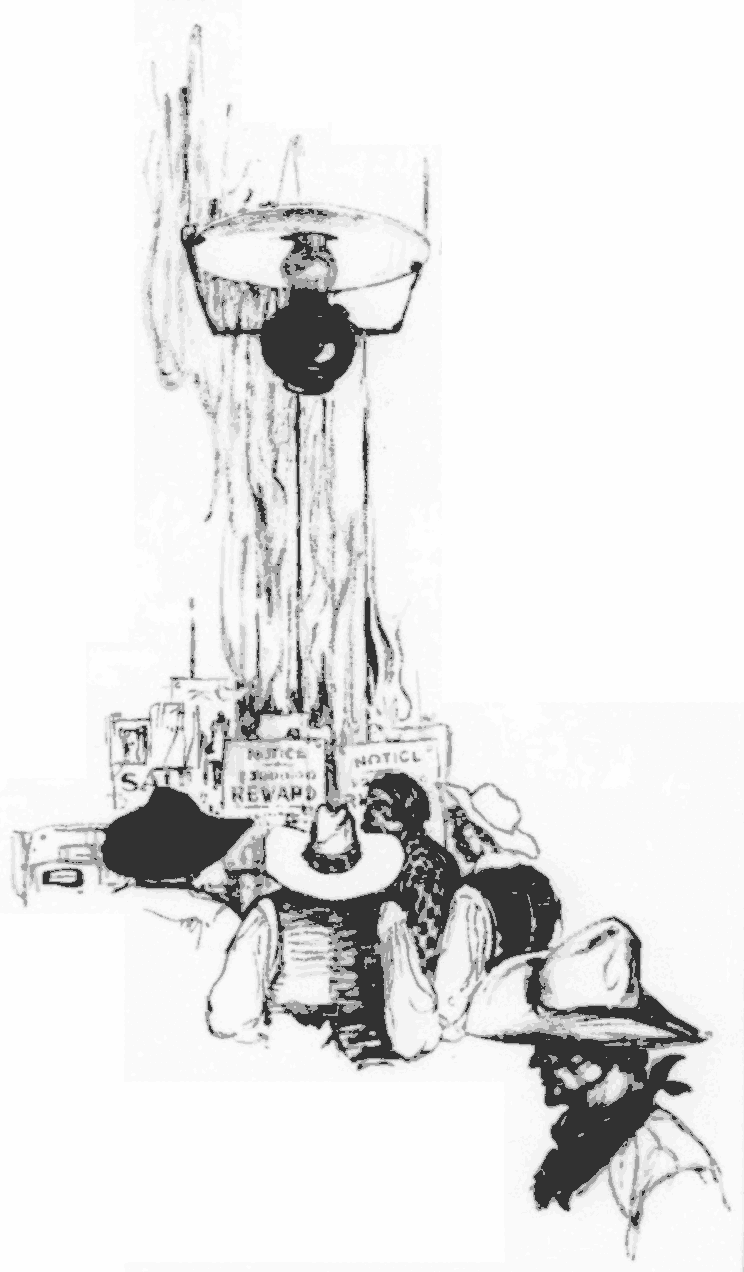
Later in the evening he met Tuck Hayward in the Silver Streak and found the big man in a genial mood. He invited Hashknife to have a drink with him and they discussed the reward notices.
“I don’t quite sabe that Association notice,” he told Hashknife. “It looks as though O’Neil had been a detective, and if he was he was a wild one. Fat tells me that you knew him.”
“Only by reputation, Hayward. Jack Shields was a good man. He had handled a lot of tough cases for the Association.”
“What do yuh suppose he was lookin’ for out here?”
“I dunno.”
“Kinda funny. Fat told me quite a while ago that you and Stevens were lookin’ for jobs. I was shy one man after O’Neil was killed but I figured to get along without him. Yesterday Dalhart and Asher quit me. They been wantin’ to head for Arizona for quite a while. Now I’m needin’ a couple of good men and if yuh want to go to work just say so. I need one at the ranch and one at the mine. Asher worked out there.”
“I dunno,” said Hashknife thoughtfully. “We’ve got a notion to head for Arizona ourselves. The winters are kinda bad around here, they tell me.”
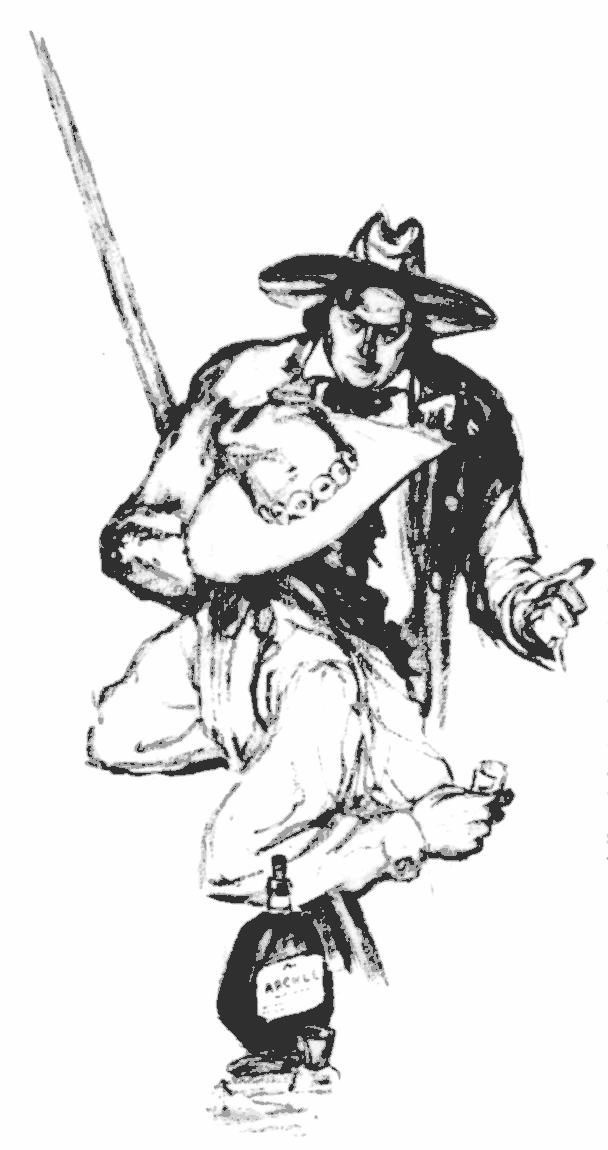
“Yeah, they are bad. If yuh don’t care for blizzards yuh wouldn’t like the winters here. It’s pretty high, yuh know.”
“I been figurin’ on that,” said Hashknife. “But yuh never can tell about us. If we decide to stay we’ll take yuh up. What part did Dalhart and Asher head for?”
“Down around Springerville, I think. They wasn’t sure.”
When Hashknife left the Silver Streak he met the sheriff near the saloon.
“Want to go down and see Joe?” he asked. “Weary was just down there and he said that Joe was conscious. They’re not goin’ to take him home until tomorrow and I thought he might talk a little.”
Hashknife went down with him and the doctor cautioned the sheriff against too much conversation. Joe looked very thin and weak, in spite of a heavy growth of black whiskers.
“Glad to see yuh doin’ so well, Joe,” said the sheriff.
“I’ll be fit to hang!” whispered Joe.
“Forget that, Joe.”
“Hard thing to forget, Fat.”
“I know. Did you see the man who shot yuh?”
“No,” whispered Joe weakly. “It was too dark. I thought it was Chuck when I came up to the bars.”
“Why would any one want to kill yuh, Joe?”
Joe shook his head on the pillow. Only once did his eyes shift to Hashknife and then merely for a second.
Perhaps he knew Hashknife didn’t believe him.
“Yuh might like to know that the Cattle Association is offerin’ five thousand for the man who killed O’Neil.”
Joe’s eyes opened slightly.
“His name was Shields,” said the sheriff. “He was a cattle detective.”
“O’Neil was a cattle detective? I don’t believe it, Fat.”
“Well, he was, Joe.”
“I’ll be damned!”
Hashknife smiled softly, realizing that Joe did not know before that O’Neil was a detective. He had been afraid that Joe knew O’Neil was a detective but Joe’s astonishment was painfully real.
“They’re offerin’ two thousand reward for the man who shot you,” said Hashknife.
Joe frowned heavily as though not understanding.
“Yuh know,” grinned Fat, “it’s quite a crime to break into a jail and shoot prisoners.”
“Two thousand reward for the man who shot me!” said Joe slowly. “Can yuh imagine that?”
“You might collect it, Joe,” suggested Hashknife.
“No chance, Hartley. I don’t know who shot me.”
“I think that is enough for today, gentlemen,” suggested the doctor. “We can’t take any chances, you know.”
“Sure!” said the sheriff quickly. “Much obliged, Doc.” They left the place and sauntered up-town.
“Well, that didn’t help much,” sighed the sheriff. “Joe don’t know any more than we do.”
“Not much, I guess. Hayward offered me and Sleepy jobs today. Dalhart and Asher have quit the Box 88 and headed for Arizona.”
“Thasso? Are yuh goin’ to accept the jobs?”
“Don’t know. We may go to Arizona later on; can’t tell yet.”
“Hayward is a good man to work for.”
“Prob’ly a better man to work for than against.”
“I don’t know what yuh mean, Hashknife.”
“I don’t believe I do either,” smiled Hashknife.
“Well, you say the funniest things!”
“Yeah, I guess I do—but I’m the only one that ever gets much of a laugh out of ’em. They sound silly to other folks.”
“Like shootin’ at shadows, eh?”
“That ain’t funny; that’s pretty—serious.”
“Well,” sighed Fat, “I can’t figure yuh out.”
“Nobody can but me, Fat; I own the answer-book.”
Hashknife drifted back to the Silver Streak and sat in on a game of draw where Hayward was playing. Hayward must have known that Hashknife went down to see Joe because he asked Hashknife how Joe was feeling.
“He’s doin’ fine,” replied Hashknife easily. “We asked him whether he knew who shot him; but he didn’t. At least he says he don’t know. Personally I think he’s a liar. He’s afraid to tell.”
Hayward looked sharply at Hashknife but made no comment.
“Mebby he wants to get well and do his own killin’,” suggested Johnny Colburn of the AH.
“That may be his idea,” smiled Hashknife. “Anyway, I’d bet better than even money that Joe knows who shot him.”
“What gave yuh that hunch?” asked Hayward, examining his cards closely.
“I dunno. Give me three cards.”
“Two!” said Hayward. “Funny how yuh get a hunch of that kind. Pass the bet.”
“Not so funny. Pass here.”
Hashknife played out his chips and drew out of the game.
“If yuh decide about them jobs let me know, will yuh?” asked Hayward.
“Shore—thanks!”
“Say!” said Johnny Colburn. “Do yuh think Joe would rather get hung than tell what he knows?”
“Not little Joe,” laughed Hashknife. “He’ll talk when the time comes. Self-preservation is the first law of nature, yuh know. It’ll be worth while listenin’ to what he’ll tell.”
“Be worth about seven thousand to the man who gets into action first,” grinned Johnny. “He’ll tell who killed O’Neil and who shot him. Seven thousand dollars’ worth of talk.”
“Suppose he killed O’Neil himself?” said Hayward.
“Well, he didn’t shoot himself—that’s a cinch, Tuck.”
“And they can’t convict him of killin’ O’Neil,” said Hashknife. “As far as I can see there wasn’t enough evidence against him to hold him for trial. He whipped O’Neil, didn’t he? On the spur of the moment he busted O’Neil’s nose. He left town before O’Neil was patched up. He didn’t even know O’Neil was going to follow him. It was dark that night. I know there was a moon, but that wasn’t sufficient for Joe to have seen O’Neil comin’ and known who he was. You’ll say that O’Neil and Joe might have met and Joe shot O’Neil when his head was turned. Nothin’ of the kind. If O’Neil was mad enough to kill Joe—and he was mad enough if he followed him—he wouldn’t talk it over and turn his head. If Joe had cause to fear a cattle detective he might have killed O’Neil—but Joe didn’t know O’Neil was a detective. Now where’s yore case?”
“You should have been a lawyer—or a detective,” laughed Hayward. “Stick around and we’ll elect yuh sheriff next term. How would that job suit yuh?”
“I might do that, Hayward,” seriously.
“I’ve always wanted to wear a shinin’ star and have an office.”
“Fat ain’t doin’ much for the county,” laughed Johnny. “All he does is walk in circles like a pup gettin’ ready to lay down; walk in circles and fight his hat. Chuck sets on the end of his spine and tells what he’ll do to the man who sapped him that night—and Weary cusses both of ’em.”
“What else can they do?” queried Hayward. “There’s nothin’ to work on. Yore deal, Johnny.”
“There’s always somethin’ to work on,” said Hashknife.
“Show me somethin’,” challenged Hayward.
“You’d like to collect that seven thousand, eh?” laughed Hashknife. “No chance, Hayward!”
“Well, I’ll bet you won’t collect it either, Hashknife.”
“Not all of it,” smiled Hashknife as he walked away.
“Now what the hell did he mean by that?” queried Colburn.
“Just a smart remark!” growled Hayward. “Yore deal, Andy.”
The next day being Saturday Slim Benito, cook at the AH ranch, came to Chongo town. Slim didn’t come to town often because he was saving his money. Slim was short, fat and good-natured. He detested liquor in every form but like many other men he drank to be sociable. And Slim was sociable. After the second drink he became expansively sociable. He threw away his purse and put the money loose in his pocket where it would be handy.
Slim didn’t come in early in the day, as he waited for Soapy and Cling who were going to help Frenchy take Joe out to the ranch. Frenchy had made a canvas sling for the wagon bed and had piled it deep with straw and blankets.
The doctor had advised taking Joe back after sundown to escape the heat, and it was still an hour of sundown when the three AH boys came to town. Soapy and Cling were not averse to taking a few drinks, so they also grew sociable along with Slim.
“I’m a whipper-will,” declared Slim, “and this is my night t’ sing. I feel loose and free like a wagon-wheel which has done slipped off the axle on a down grade.”
“Yo’re a grand man,” agreed Soapy. “If yuh live long enough and have good luck yuh might be a grandfather. But if you keep this up, Slim, you’ll be drunk.”
“I can hold as much liquor as any livin’ man,” declared Slim. “But I only drink to be sociable. I hate the stuff. I hate the stuff, I tell yuh! Wine is a mocker; so drink whisky. If it wasn’t for bein’ sociable—sociable, yuh know—”
“Do you have to be sociable?” asked Cling.
“I’m accust’md—accust-um-dud—”
“Oh, yo’re accustomed to bein’, eh?”
“Oh, certn’ly!”
“Well, you better coil up yore rope,” advised Soapy. “In three more drinks you’ll fold up like a blanket, Slim. Far be it from me to advise a friend—but go easy. We don’t want to have to carry yuh home.”
“Is thasoo? Well, well! You’ll carry Misser Benito home? You? Shay, lemme tell yuh, par’ner—”
“Listen, Slim!” begged Cling. “Me and Soapy have got to be goin’. Now have a pleasant evenin’ but keep sober.”
They walked away, leavin’ Slim to goggle after them from beside the bar. Finally he turned to the bartender.
“I bub-bought sheven or eight drinks,” he said thickly. “They never bought none, di’ they? And now they run out on me. Aw ri’! I’m a lone wolf fr’m now on. I hate liquor but I mus’ be shociable. Lets me and you have li’l drink.”
“All right!” grinned the bartender. “But I’d advise yuh to quit long enough to get yore eyes in focus. You can’t see anythin’, Slim.”
“You know how ol’ I am, barten’er? Don’tcha? I’m fifty. And any damn man who ain’t sheen a plenty by the time he’s fifty ain’t got no use f’r eyes anyway. Here’s my shincere regards. May you choke to death on a diamond!”
“Why on a diamond, Slim?”
“Oh, tha’s jus’ my idea of a firs’-class, high-tone death. Fill’m up and you think of one.”
Soapy and Cling kept away from the Silver Streak. They had imbibed a sufficient amount to cause the world to have a rosy tinge, as it were. They lost a few dollars at the Chongo Saloon and then went to a restaurant where they met Chuck and Weary.
“Didn’t recognize yuh without a fiddle,” said Chuck seriously. “What are yuh doin’—all in-cog-neeto, as it was?”
“Go to hell, you iron-headed bastile-tender,” replied Soapy. “Hello, Weary! How’s crime?”
“Seems to be doin’ well,” grinned Weary. “How come that you drunkards ain’t in the gutter before this?”
“We’re not gutterin’,” grinned Cling. “Fact of the matter is this: Me and Soapy came in to help Frenchy take Joe out to the ranch this evenin’.”
“You’ve got a swell chance,” grunted Weary, removing his elbows to give the waiter a chance at the table.
“What’s the matter?” asked Soapy.
“Joe had a re-lapse. Yep—this afternoon. Fever and chills. Guess he got well too fast. Anyway, the doctor won’t let nobody see him and it’s a cinch they can’t move him this evenin’, so yuh might as well go gutterin’.”
“That’s kinda hard luck. Anyway, we’ll see Frenchy when he comes in, so he’ll know we kept our word.”
“Prob’ly floor him,” said Chuck. “He won’t look for yuh.”
“Oh, he’ll look for Soapy,” laughed Cling. “Soapy has to stand in with the old man.”
They argued and laughed through their supper and it was dark when they finished. Then Soapy and Cling went down to the doctor’s place to see whether Frenchy had arrived yet. He was not there and the doctor told them that it would be impossible to move Joe. He refused to let them see Joe; so they went back.
In the meantime Slim Benito had ceased to be a whippoorwill. After a crying spell, induced by the knowledge that he was a “lone wolf” without a friend in the world, he became a trifle savage, which is a wolf trait.
Slim carried a heavy Colt gun inside the waist-band of his trousers and the bartender eyed this weapon with great disfavor. He had been a bartender for so many years that he was well able to read drunken character and he tabulated Slim as being dangerous. And when Slim decided to drink alone it looked worse than ever.
“I’m wild,” he told the bartender seriously. “Come from a wild family. Never was a male Benito that wasn’t fit to be tied. We’re snappin’ turtles.”
“Sure,” agreed the bartender. “Tough family.”
“Meaner ’n dirt.”
“A lot meaner.”
“Meaner ’n hell.”
“Oh, yuh bet!”
“Screamin’ mean,” Slim’s eyes flashed.
“Fightin’ fools,” agreed the grinning bartender.
“Gun-fighters, y’betcha!”
Slim’s lips curled back at the mere suggestion and his right hand yanked the gun from his waist-band.
Crash! The first shot struck squarely in the center of the back-bar mirror and the splintering of the big glass was almost as loud as the report of the gun. The bartender just let loose and went flat to the floor.
Wham! The next shot swept through a pyramid of glassware, sending it skyward in a sparkling shower.
“Yee-hoo-o-o-o-o!” screamed Slim.
Bam! Another bullet smashed through a side case and into a stock of fancy liquor, including several bottles of champagne which exploded merrily.
Then Slim whirled around, the gun at his hip. The saloon was in an uproar. Players ducked for any old kind of a shelter while Slim stood there in a fog of powder-smoke yelling at the top of his voice.
Bam! A bullet ripped through the cloth of a roulette table.
Crash! Another went accidentally and almost shot Slim in the foot.
“Yee-ho-o-o-ow-ee-e-e-e!” screamed Slim and went weaving out through the open doorway swinging the smoking Colt in his right hand. He bumped into a porch-post, staggered sideways and would have fallen if Soapy and Cling hadn’t grabbed him.
Soapy got the gun and they dragged Slim into an alley while men came running out of the saloon swearing, asking questions. Slim was speechless, helpless. He had gone through three stages of inebriation, the sociable, the maudlin and the fighting, and now he was unconscious.
“Stick here with him,” whispered Soapy. “I’ll find out who he killed.”
Soapy went around to the saloon where a crowd, including the sheriff, were examining the extent of Slim’s damage. The back-bar was a wreck, as was the big mirror.
“This kind of stuff has got to quit,” declared Hayward. “By God, that mirror cost me a lot of money! And look at it! Look at them glasses! And he was shootin’ around at everybody. You put him in jail, Fat.”
“I s’pose I’ll have to, Tuck. This place shore is a wreck. Where’d he go?”
Nobody seemed to know. One man thought he saw Slim go out through the front door but he wasn’t sure because he was down behind the pool-table.
“I’ll find the damn fool,” declared Tuck.
Soapy ducked back to Cling and Slim. Slim was propped against the wall snoring heavily.
“We’ve got to keep him away from the sheriff,” declared Soapy. “All he done was to smash the mirror and wreck the back-bar, and they want to put him in jail.”
“Yeah! And they’ll find us here—that’s a cinch! What’ll we do with him, Soapy? He can’t ride.”
“C’mon!”
They picked up the limp Slim and carried him through the alley, circled the rear of the Silver Streak and came in past the hitch-rack where some of the men were looking to see whether Slim had taken his horse.
“Horse is still here,” declared a voice and the men went back toward the front of the saloon.
“My God, this geezer weighs a ton!” panted Cling. “His feet ain’t draggin’, are they?”
“Mine are,” grunted Soapy. “What’ll we do with him?”
“Drop him somewhere in the dark.”
But they kept on going, praying that they would not meet any one. Down a side street they went where the lighted window showed the doctor’s office. Just ahead of them was the black bulk of Frenchy LeClere’s wagon and team.
“I’ve got a idea,” panted Soapy. “Here’s a hide-out.”
Cautiously they went over to the wagon and with a supreme effort they dumped Slim over the side of the wagonbox and into the stretcher which had been made for Joe LeClere. They pulled the blankets from under him and covered him up completely.
Frenchy and the doctor came outside, talking softly, and the two cowboys lost no time in making a sneak around the other side of the town, coming back to the street near the sheriff’s office.
In front of a general merchandise store they met the sheriff.
“Where yuh been?” he asked.
“Do yuh mean all our lives?” asked Soapy innocently.
“I mean just now.”
“Oh, we was down to yore office, Fat. Somebody said yuh had captured Slim Benito.”
“You knew I was lookin’ for him, eh?”
“We heard yuh was. Didja find him?”
“I didn’t. Where was you when he shot up the saloon?”
“We was down at the Chongo. Yuh see we didn’t want to associate with Slim, so we went down there. Honest, he ought to be hung.”
“Yeah,” growled Fat. “I s’pose so.”
Fat wasn’t at all convinced that Soapy and Cling hadn’t had a hand in helping Slim to safety. Cowboys are notoriously faithful to their own outfit, even when in the wrong, and especially where the law is concerned.
And down in his heart Fat didn’t blame them. He had been a cowboy before he was a sheriff and he knew. It wasn’t because of any outrage against the law that he wanted Slim but because he was afraid Slim might break forth again and do some bodily injury to some one.
“I thought Slim was too drunk to shoot,” he said. “I seen him fifteen minutes before he broke loose and he was hangin’ onto the bar with both hands.”
“Did he take his horse?” asked Soapy, who already knew that they had found the horse at the hitch-rack.
“No, he didn’t take it. He’s still in town.”
“Well, if we see him we’ll tell him that yuh want him.”
“I know yuh will, Soapy. He’ll have to work all the rest of his life to pay for the damage he done over there.”
The sheriff walked on and the two cowboys sat down on the sidewalk and chuckled joyfully. They heard Frenchy’s wagon rumbling along over on the side street and saw the dark bulk of it as Frenchy swung his team to the right and headed for the IS ranch.
“My God, wait’ll Slim wakes up!” laughed Soapy. “He’ll have to walk home.”
“And if Frenchy discovers him I’ll bet Frenchy will just about pile off that wagon and start runnin’,” choked Cling.
“I’ll betcha! Gosh, that was a good scheme, Cling! We shore got old Slim out of the clutches of the law that time. I hope he gives us credit when he finds out what happened.”
“Oh, he shore will! He don’t know it now but we’re the two best friends he’s got. Let’s go over to the Silver Streak and inspect the damage.”
Hashknife and Sleepy had been playing pool at the Chongo when Slim started shooting and there was so much noise in the place that they didn’t hear the shots at the Silver Streak, which was a block away. But as soon as they heard about the shooting they quit playing and went up to view the damages, which seemed very complete as far as the mirror was concerned. Things had quieted down, although the sheriff’s office was still on the trail of Slim Benito.
Hashknife and Sleepy left the Silver Streak and went to their room at about ten o’clock and at about two o’clock in the morning Fat Garnette hammered on their door.
“Somethin’ has gone wrong,” he told Hashknife. “Put on yore clothes, both of you, and come down, will yuh?”
“Now, what the hell has busted?” wondered Sleepy as he put on his boots. “This town shore does do things!”
“Looks thataway.”
On the sidewalk in front of the hotel they found the Sheriff, Weary and Yvonne LeClere.
“Sorry to get yuh out of bed,” said Fat apologetically, “but Yvonne just came in and she says her father started for here early this evenin’ and he ain’t never got home. We found out that he showed up at the doctor’s place to get Joe. But Joe ain’t so well, so he didn’t get him. The doctor says he left there all right—but where is he?”
“That’s queer,” mused Hashknife.
“It is queer,” agreed Yvonne nervously. “I couldn’t stand it any longer, so I saddled a horse and came down here.”
“Where could he go?” asked Sleepy.
There was plenty of activity at the Silver Streak and as they were talking Soapy and Cling came from the doorway. They stopped on the edge of the sidewalk for a moment but came on across the street, evidently curious about the little group in front of the hotel.
“Well, what kind of a meetin’ is this?” asked Soapy as soon as he recognized those of the group.
“Did you see anythin’ of Yvonne’s father tonight?” asked the sheriff.
“N-no, I—I—”
“We seen him pullin’ out,” said Cling. “At least we saw a team and wagon. What’s wrong?”
“Well, he never got home; that’s what’s wrong.”
“Never got home?” Soapy’s voice was hoarse. “What do yuh mean that he never got home?”
“My God, yo’re thick!” snorted Weary.
“Oh, yeah!” said Soapy as though it was all explained. He stepped in close to Cling and said hoarsely, “He never got home.”
“I heard he didn’t,” foolishly.
They were both thinking of Slim Benito in the bed of that wagon.
“What do yuh think we ought to do, Fat?” asked Hashknife.
“Go and hunt for him, I suppose. He can’t be on the IS road or Yvonne would have seen him. And I dunno where else he could possibly be. Dang it, yuh can’t lose a team and a wagon!”
“Yuh might lose one,” said Hashknife, “but you’d have a hard time misplacin’ one. We’ll get our horses, Fat.”
Soapy and Cling went across to get their horses at the hitch-rack and Yvonne walked down to the office with Fat and Weary to wait for them to saddle.
“What do yuh make of it, Soapy?” asked Cling seriously.
“My God, I don’t know! Slim was too drunk to do anythin’, wasn’t he? Yuh don’t suppose he took the team away from the old man and went to the AH, do yuh?”
Soapy put his foot in the stirrup before he answered.
“Don’t ask me to guess. I hope they’re all right.”
“Yuh couldn’t kill Slim—he was too drunk.”
They rode down to the office and in a few minutes Hashknife and Sleepy joined them. As soon as Fat and Weary had their animals saddled the seven of them rode out of town toward the IS ranch. It was too dark for any investigation, but as the LeClere wagon had been the last one over the road it was easy, with the aid of lighted matches, to see that it had not turned off on the road to the mines or to the AH.
Their investigations showed that the wagon had been headed for the IS, and as that ranch was the end of that particular road that fact was conclusive evidence that somewhere between the AH fork and the IS ranch they should find the team and wagon.
North of the Silver River crossing the road climbed up along the side of a hill where the ground sloped for perhaps a quarter of a mile off to the left ending in a narrow ravine. At no place on the road was what might be termed a dangerous spot. From the top of this hill the road ran fairly level to the ranch.
They traveled slowly to the ranch-house, the dusty road giving them no clues as to whether the wagon was still ahead of them or not. But it was not at the ranch-house. They rode all around the premises and came back to the house where they dismounted and went inside.
“Wait until daylight,” advised Hashknife. “In a couple of hours it will be light enough to see what we’re doin’.”
“I think that is the thing to do,” agreed Yvonne. She was greatly worried but went to work in the kitchen making some coffee for the men.
“I’d rather be doing something,” she said when Hashknife begged her not to go to all that trouble. “And a cup of hot coffee will taste good.”
“Didja find out from the doctor how Joe was?” he asked.
“He was sleeping but still had fever. Oh, I don’t know!” she said helplessly. “It seems as though everything happens to us. Even if Joe does get well—”
“You forget that,” advised Hashknife. “He’ll get well and they’ll turn him loose.”
“I wish I thought so, Hashknife.”
By the time they had finished breakfast the dawn was showing in the east. Yvonne insisted on riding with them.
“I’m glad she’s goin’,” Weary whispered to Hashknife. “If there’s anythin’ wrong I’d be the one to have to pack the bad news to her. This way she’ll see it with us.”
“You shore think pleasant things, Weary.”
“I’m protectin’ my own feelin’s,” grinned Weary.
They mounted their horses and rode back toward town, watching both sides of the road to see if the wagon had left the ruts.
“What kind of a team was yore father drivin’?” asked Sleepy.
“Roan team,” said Yvonne.
“Gentle?”
“Not gentle, Sleepy, but well broke. Joe broke them and he likes speed.”
“Might run away?”
“Oh, if they had a good chance, I suppose! They never have run away though.”
It was at the top of the slope above the river that they found the wagon tracks. The iron-shod wheels had cut deeply where the wagon had swung off the road and there was a deep gash in the side of the hill where the vehicle had slewed around on the slope.
The hill was about fifteen per cent grade with clumps of greasewood and sage. The track of the wagon was plain, as it had nearly torn a big greasewood out by the roots and evidently carried it along.
They spurred off the road and scattered out. It was Weary who found Frenchy LeClere sprawled on his back half under a greasewood. Weary’s yell brought them to the spot and they lifted the old man out into the open.
He was alive, but badly hurt and unconscious. It was impossible for them to determine just how badly he was hurt, except for a nasty scalp wound which looked as though it might be more than skin-deep.
“Weary, you get the doctor as fast as yore bronc can run,” ordered Fat. “Soapy, you and Cling head back to the ranch and bring down the horse and buggy.”
Weary spurred back up the hill while Soapy and Cling mounted at a much slower gait. They didn’t want to go. They wanted to stay and look for Slim Benito but there was nothing for them to do now except to go after that buggy.
“I feel just like a murderer,” said Soapy as they rode swiftly back to the ranch.
“Same here! Why didn’t we let ’em put Slim in jail?”
“He’s prob’ly deader ’n hell.”
“Cinch! I’ll betcha the team up-ended plumb in the bottom of that cañon. Of course he’s dead. But keep yore mouth shut. Nobody knows we put him in that wagon.”
“But they’ll know we did,” wailed Soapy. “Murder will out—sure.”
“Well, it won’t out so damn quick if yuh keep yore mouth shut. Take a reef in yourself, Soapy, yo’re tremblin’!”
“I don’t feel well. Guess them eggs didn’t set well.”
“Well, they can’t cinch us for murder. We didn’t know the team was goin’ to run away.”
“A damn lawyer can make most anythin’ out against yuh, Cling. You ain’t got a chance in the world.”
“I’m all through doin’ good for folks.”
“Same here. From now on, I’m hard as hell.”
Sleepy rode down to the river and came back with the crown of his hat full of water which they used to bathe the old man’s face. Yvonne sat there in stony silence staring at her father who occasionally groaned softly.
“Maybe he ain’t hurt so bad,” said Hashknife hopefully.
“Nothin’ we can do until the doctor gets here.”
“Maybe we better take a look and see what happened to the team and wagon,” suggested Sleepy.
“Why don’t you fellers do that? No use of all of us stayin’ here.”
Hashknife and Sleepy mounted their horses and rode down through the greasewood, following the tracks of the wagon, which seemed to have come most of the distance on two wheels, judging from the deep rut.
Then they found where it had overturned, and from there to the bottom of the little cañon it had rolled over and over, finally smashing down between a tree and a ledge of rock.
Both horses were dead, piled up together fifty feet away from the wrecked wagon. There was no use going down the steep bank to examine them.
“Gee, that was a nasty wreck!” exclaimed Sleepy. “Mebby the old man went to sleep and the team ran away with him.”
“Looks thataway.”
They had turned their horses to start back up the hill when a querulous voice said:
“What in hell is goin’ on around here, anyway—I’d crave to know?”
There was no one in sight. Hashknife and Sleepy looked at each other, both wondering whether the other had heard.
“I’d crave to know what in hell is goin’ on,” said the voice distinctly. “It’s shore got me guessin’. And how in hell do yuh git out of a damn greasewood when yo’re upside down and all hung up. I don’t guess I’ve got anythin’ busted.”
“Where are yuh, pardner?” asked Hashknife.
“You start guessin’ and I’ll put in with yuh. All I can see is greasewood and a little sky. Damn little sky too.”
“He’s in that big greasewood,” said Sleepy. “There’s his hat.”
“I ain’t near no damn hat!”
“I’ve got him spotted,” said Hashknife, pointing at a particularly big greasewood.
They dismounted and between the two of them they were able to disentangle Slim Benito, who had evidently been pitched head first into the clump. His clothes were all torn and he flapped like a scarecrow in the breeze as he gravely considered Hashknife and Sleepy. His face was scratched and one eye badly discolored. He looked around at the landscape wonderingly.
“Yuh know,” he said slowly, “this is one of the queerest dreams I ever had. Funny how yuh dream! Now I never was even thinkin’ of you two fellers before I went to sleep. Soapy says that dreams come from a disordered liver. My God, the shape mine must be in!”
“You ain’t dreamin’,” said Hashknife.
“Thasso? Huh! Don’t tell me! What in hell am I doin’ out here, if I ain’t dreamin’? How’d I get here?”
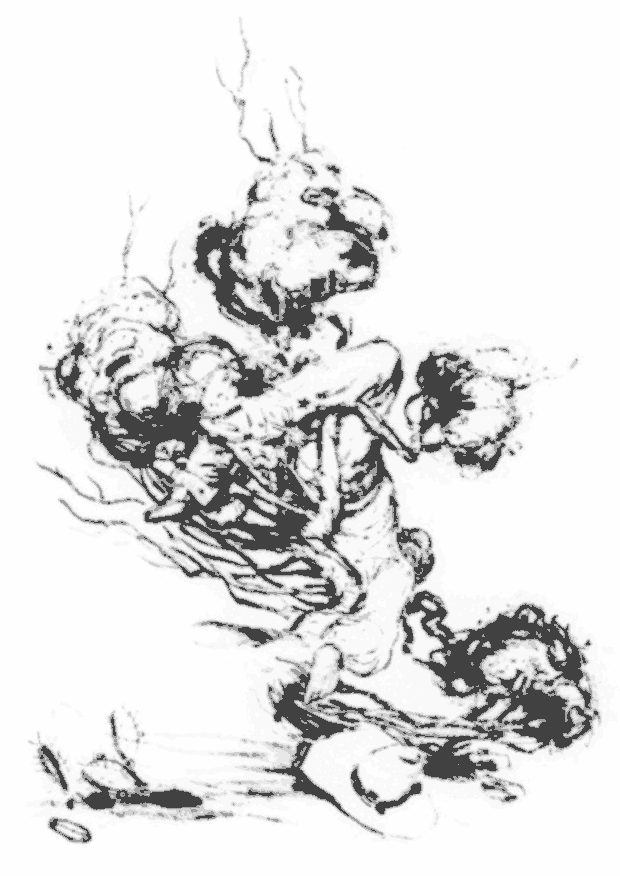
“You’ll probably be asked that same question.”
“Well, I hope somebody can answer it. I can’t!”
“It might refresh yore memory if I told yuh that old Frenchy LeClere is further up the hill badly hurt and in the bottom of the cañon just below us is a smashed wagon and a dead team of horses.”
Slim looked blankly at Hashknife.
“What’s that got to do with me?”
“I don’t know. I’m just tellin’ yuh.”
“Well, that’s all right.”
“You don’t know how yuh got here?” asked Sleepy.
“I don’t. And by God, I don’t even know where ‘here’ is!”
“This is off the IS road north of the river crossin’.”
“Yea-a-ah?”
“Are you the cook from the AH ranch?” asked Hashknife.
“I was—the last recollection I had. Name was Benito.”
“You shot up the Silver Streak last night.”
“I did?” Slim’s eyes opened wide. “Oh, yea-a-ah!”
He shut both eyes and frowned heavily.
“I ’member somethin’ about that. Did I kill anybody?”
“I reckon not,” smiled Hashknife. “But it wasn’t yore fault that yuh didn’t. They tell me yuh handled that six-gun as though it was a hose.”
“I’m a rotten shot,” confessed Slim. “Drunk or sober, I can’t shoot straight. Tell me more about Frenchy LeClere.”
“I’ll let the sheriff tell yuh. He’s up there.”
“Well, that’s kind of yuh! Mebby he knows how I got out here. Yuh didn’t see my horse, didja?”
“I think he’s still at the hitch-rack where yuh left him.”
“Thasso? Well, I reckon I flewed out here.”
They found Fat and Yvonne beside Frenchy. Both of them stared foolishly at Slim, who sat down on the ground beside them holding his head in his hands. It had been a hard climb up the hill and he was not in first-class physical condition.
He made no comment, while Hashknife told them about finding Slim in the greasewood clump. Fat studied Slim for quite a while. Then:
“Was it you who scared LeClere’s team off the grade, Slim?”
“I dunno anythin’,” said Slim wearily. “All I know is that I woke up in that greasewood and started talkin’ to myself. Mebby I did scare the team. I won’t swear to anythin’, Fat.”
“Find out what time LeClere left the doctor’s house and what time Slim shot up the Silver Streak,” advised Hashknife. “He’d have to have a little time to get here.”
“Mebby that’s the best thing. Slim, where didja go after yuh shot up the saloon?”
“I don’t know. It’s all hazy and kinda faded out. I shore must have been awful drunk.”
“Well, we couldn’t find yuh, Slim. You shore disappeared in a hurry.”
The doctor arrived with Weary before the rig came from the IS ranch and made a swift examination.
“Bad cut on the scalp, broken collarbone and possible concussion. I think we better get him to town.”
Hashknife walked over the wagon tracks and looked the place over. From where Frenchy had lain to the road there were no greasewood of any size and no rocks. In fact the ground was rather soft. He examined the greasewood under which they had found Frenchy but there did not seem to be anything that would cause such a scalp wound.
Slim had stretched out on the ground paying no attention to what was going on around him and Yvonne and Fat were busy helping the doctor. Hashknife walked up to the road as Soapy and Cling came along. Cling was driving the buggy horse while Soapy rode his horse and led Cling’s mount.
Before either of them had a chance to ask any questions Hashknife said:
“We found Slim Benito, boys. It’s too bad yuh put him in that wagon last night.”
“My God!” exploded Soapy. “He—he ain’t dead, is he?”
“Almost. He said yuh put him in that wagon.”
“A-a-aw, we had to get him away,” wailed Soapy. “My God, we didn’t know that team was goin’ to run away.”
“Well, he’s all right,” grinned Hashknife. “He didn’t know how he got there, so I just made a guess. I had to know, yuh see?”
“I—I see,” faltered Soapy. “Yuh say he’ll get well? Didja say that, Hashknife? Didja?”
“He ain’t hurt; he’s sick. Too much liquor and standin’ on his head in a greasewood clump. You hold that horse, Cling, and we’ll bring the old man up to the buggy. Don’t look foolish, Soapy. I haven’t told anybody.”
Hashknife went back down the hill and helped carry the old man up to the buggy. Weary climbed in beside Soapy and held the old man in his arms while the rest of them mounted, after the doctor had invited Slim to ride back in his buggy.
Sleepy rode beside Yvonne while Hashknife and Fat lagged back to talk things over. Hashknife told him that Soapy and Cling had put Slim Benito in the wagon, which accounted for Slim being where they found him.
“So that’s the how of it, eh?” grunted Fat. “How didja find that out?”
“Told ’em they did and they admitted it. Never ask a man if he did somethin’—accuse him! Act as though yuh knew he did. They fell for it quick. So that’s that. Now what do yuh think of the runaway?”
“I guess the old man went to sleep or somethin’ scared the team off the grade. Once off that road, they couldn’t stop, Hashknife. That heavy wagon would crowd them too much.”
“You saw the condition of the old man, Fat?”
“Sure I did.”
“He’d been thrown clear of that wagon. The tracks are twenty feet from where he lay against that greasewood. There wasn’t any dirt in his hair. There ain’t a snag or a rock that would cut him that-away and there ain’t a sign of anythin’ that would show he had bumped that greasewood where we found him. What do yuh make of that?”
“I dunno what yuh mean,” blankly.
“Somebody tried to kill Joe in the jail, didn’t they?”
“Yeah, they—” Fat hesitated and stared at Hashknife.
“Do yuh mean—somebody smashed the old man?”
“Feelin’ sure that Joe was the man in the stretcher,” nodded Hashknife. “Thought they had killed the old man and tried to make it look like a runaway.”
“My God, do yuh think that, Hashknife?”
“Don’t it look thataway to you?”
“With you pointin’ things out like yuh have. Why, I never thought of such a thing!”
“Well, don’t mention it to anybody, Fat. Let ’em think it was a runaway.”
“But my God, we’ve got to stop such things, Hashknife!”
“If we knew why they were done we could stop ’em. Joe could tell but won’t. If Frenchy lives mebby he can tell who slugged him. You get hold of the doctor and have a talk with him. No matter how favorable things are for the old man, have the doctor circulate the report that he can’t possibly live, that he’ll never wake up. That old doctor is pretty square and I think he’ll do it for you. It’ll mean a lot. Yuh might tell Yvonne because there’s no use worryin’ her.”
“Sure!” nodded Fat. “Doc will do it, I reckon. He can easy keep anybody from seein’ the old man. I’ll see him as soon as we hit town. I don’t sabe yore game but I’m for yuh.”
“Here’s the game, Fat. If the folks who slugged the old man knew he’d recover—they’d high-tail out of the country. That is, if he recognized ’em. And we want to keep the population intact until we know.”
“Oh, that’s right! I never thought of that.”
“If I lived around you very long I’d consider myself a brainy man,” smiled Hashknife.
That kind of news travels fast and inside of twelve hours every one in the Silver River range knew that old Frenchy LeClere had been mortally injured in a runaway. Many of the old-timers came in to see him but the doctor refused them admittance.
He told them that nothing in the world could be done for him because of a double fracture of the skull and that it was only a question of time until he would pass out without regaining consciousness.
But Yvonne knew that her father had a fine chance of recovery and insisted on being at his side. Joe was better. Hashknife and Fat talked with him and told him what they thought had happened to his father.
“You think that somebody thought I was in that wagon?” he asked.
“That’s a cinch,” said Hashknife. “Now, Joe, we want you to tell us what yuh know.”
“I don’t know anythin’,” was all they could get out of him.
“He’s afraid to talk,” said Hashknife after they left the room.
“I don’t believe he knows anythin’ to talk about.”
“They tried to kill him to keep him from talkin’.”
“That’s just yore theory, Hashknife. Yo’re one of them jiggers who think they can’t be wrong. When I’m wrong I admit it.”
“Yeah—and it keeps yuh busy all the time.”
“Busy doin’ what?”
“Admittin’ it.”
Slim Benito kept away from Silver Streak after he got to town and headed for the ranch as soon as he found his horse. Soapy and Cling also went straight home that day. Neither Hashknife nor Fat told anybody how Benito had got out there in the greasewood, although Hayward tried hard to find out how it had happened. He was still bewailing his smashed mirror and glassware and swore that Slim would pay dearly for shooting up the place.
It was the second day after the runaway and Hashknife was sitting in the sheriff’s office when he suddenly got to his feet and walked outside. Fat and Weary stared after him but Sleepy smoked quietly, eyeing Hashknife through the open door.
“What stung him?” wondered Weary aloud.
“Moved awful quick,” grinned Fat. “What’s the matter with him, Sleepy? He ain’t spoke a word today.”
“He’s thataway sometimes,” said Sleepy slowly. He uncoiled from his chair and followed Hashknife outside.
Hashknife was leaning against a post staring at the ground. After a while he looked sideways at Sleepy and his eyes were smiling, although his mouth was grim.
“Sleepy, I’ve been a dumb fool,” he said softly. “What in hell has been the matter with me?”
“Ain’tcha feelin’ well, cowboy?” asked Sleepy.
In answer Hashknife took the stub of a pencil from his pocket, drew out an old envelope and on it made a few cabalistic marks which looked very much like cattle brands. Then he moved his pencil slowly over one of them; a look of understanding came to Sleepy’s eyes and he grinned.
“Don’t talk about it,” said Hashknife softly and Sleepy nodded with complete understanding.
“C’mon!” said Hashknife.
They walked straight down to the doctor’s home and in through the old gate. They stopped at the front steps when they heard voices around at the little side porch. Yvonne was speaking and they thought she was talking to the doctor, but as they stepped around in range of the softly pitched voices they found that the other speaker was Soapy Weed.
Both men stopped short without being seen nor heard. Yvonne was talking and Hashknife touched Sleepy on the arm.
“Oh, I’m sorry about it all, Soapy!” she said. “I like you awful well but I can’t marry you. Don’t you see it is foolish to even think of such a thing? You’ll find plenty of girls, Soapy.”
“Don’t want ’em,” flatly. “Is it because I ain’t makin’ much money, Yvonne?”
“Money isn’t everything.”
“’Cause I got drunk?”
“You are not a drunkard, Soapy; you can quit.”
“I ain’t much to look at, Yvonne. Do yuh think I threw yuh all down on that O’Neil proposition?”
“No, Soapy. I think it was wonderful of you to do what you did for us. But I can’t think of marriage now. Joe sick in bed, accused of murder; Dad unconscious—and he may never get well. Can’t you see I—”
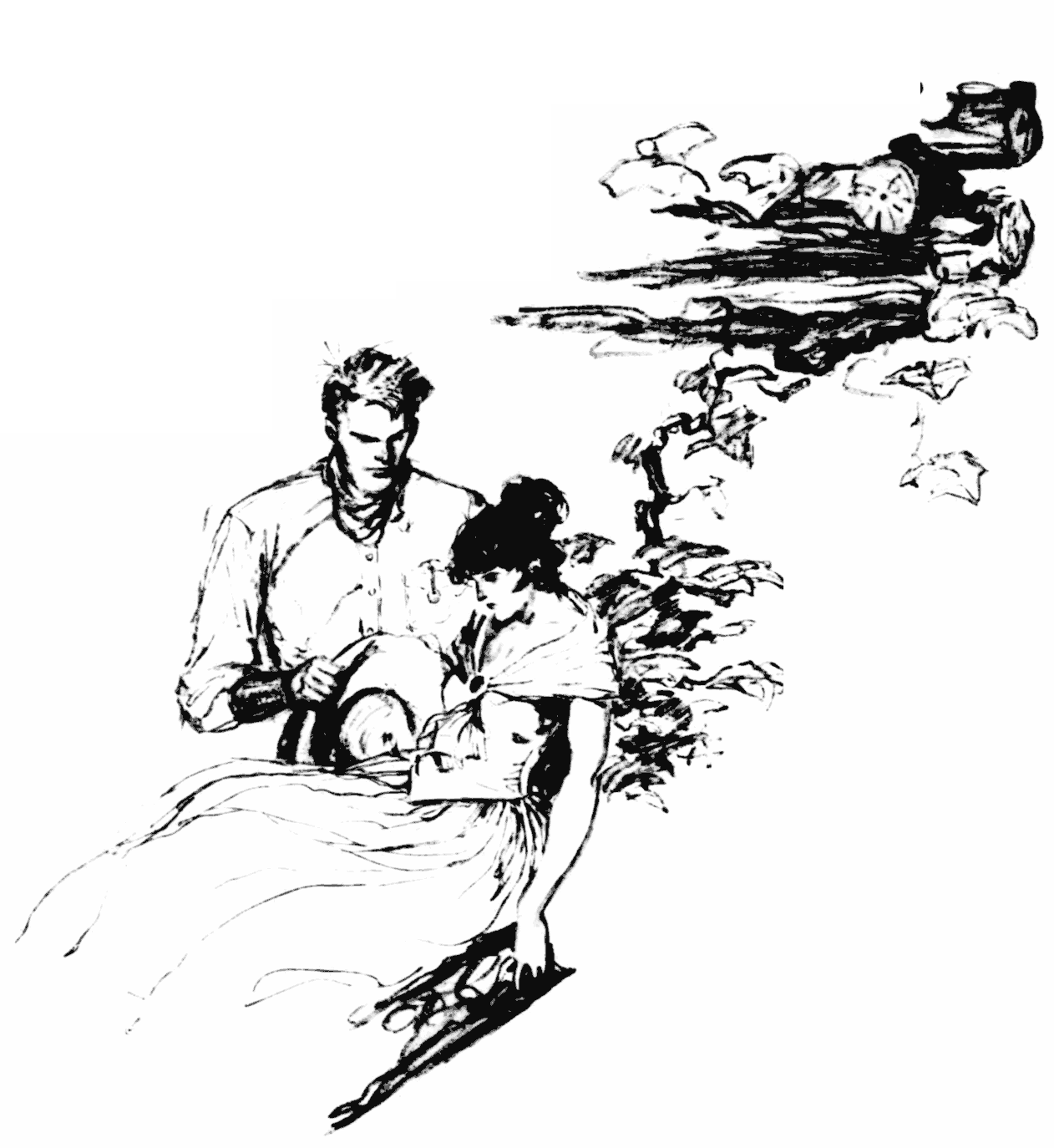
“Yeah, that’s right. Say, Yvonne—if Joe was cleared and yore dad was all well again would yuh talk it over with me again?”
“Soapy, I’d do most anything if that might happen.”
“Well,” sadly, “I wish I could do it. It would shore be worth a lot to me—worth everythin’. Mebby I could get Ace Hart to lemme have that place on Opal Creek, and if I could get somebody to lend me a few hundred dollars we could start a brand of our own. The old place would stand a lot of fixin’, I know. But I could shore fix it. I’ll ask him about it, Yvonne. Gee, I’d like to have you—and be a cattleman instead of just a common waddie! It’s a swell place over there. Yuh know I was christened Jim, don’tcha? We’d make it the JY place. Use our two initials and connect ’em.”
Yvonne laughed softly.
“Oh, don’t laugh, Yvonne! By golly, I can do it! I’d never drink nor play poker any more.”
“Would you take up knitting, Soapy?”
“Well, I might not do that. Say—you watch me, Yvonne! I—I wish somethin’ would happen to clear Joe.”
“I’ve been praying a long time,” said Yvonne softly.
Hashknife shoved Sleepy back along the walk almost to the gate and then they went around the house making plenty of noise. Both Yvonne and Soapy leaned out beyond the few vines as they came around the corner.
“Howdy, folks!” said Hashknife softly. “How’s yore pa, Yvonne?”
“Still unconscious, Hashknife. The doctor is out for a little while. Won’t you sit down and wait for him?”
Hashknife grinned at Soapy and shook his head.
“No, I don’t reckon we will, Yvonne. Me and Sleepy thought we’d make an early start into the hills in the mornin’ and I was wonderin’ if we might stay at yore ranch-house.”
“Well, you certainly may! It isn’t locked, so just make yourself at home out there.”
“You ain’t leavin’ the country, are yuh?” asked Soapy.
“Not exactly. How’s everythin’ at the AH, Soapy?”
“All right.”
“Yo’re a pretty capable boy,” said Hashknife seriously, “and I been wonderin’ why yuh didn’t figure out to start a little herd of yore own, Soapy. That’s the only way to do it. Yuh could start small and grow big. Yo’re young and this is a big range. Why don’tcha do somethin’ like that?”
Soapy blinked foolishly and looked at Yvonne who was not looking at him at all. His ears grew red and he shifted his feet uneasily.
“Well, I dunno,” he said vacantly. “Might be done.”
“They all start thataway, Soapy,” said Sleepy.
“Yeah, I know, but it takes a little money to start.”
“Not much. Think it over. Thanks for the house, Yvonne.”
“Oh, you are certainly welcome!”
“So-long, Soapy.”
“Sure! Same to you, Hashknife.”
Sleepy chuckled half-way down to the livery-stable but Hashknife was serious.
“He’ll think yo’re a mind-reader, Hashknife.”
“Let him think it. I believe in boostin’ a good idea. You go over and borrow a couple of rifles from Fat.”
The following morning before daylight Hashknife and Sleepy were riding away from the IS ranch, traveling in a northeast direction. Hashknife had sketched a map from the big one in the sheriff’s office, which gave a fairly good idea of the country.
They did not follow any of the marked trails but headed straight across country. For the first few miles they were able to make fairly good time but the character of the country soon changed and they were obliged to pick their way at a more leisurely pace.
The sun came up over the Chongo Creek hills flooding the valley with opal colors as they climbed higher into the rocky hills, heading for a spot between the Chongo Creek mines and the mouth of Dog Soldier Creek. They worked their way around old slides and up through thickets of jack-pines to the top of a big mesa where they stopped for a while to study the country.
“We’re too far north,” decided Hashknife. “I think that line of dark pines over there marks Dog Soldier. Chongo Creek mines are southeast of us. But I reckon we’re just as well off. We’ll swing off to the left a little and see what this mesa amounts to. Anyway, it’s easier goin’ than we’ve had.”
They gave their horses a breathing spell and continued on up the mesa where there was enough open country to give them a good view to the north and west.
Suddenly Sleepy spoke sharply to Hashknife and they drew up. Far to the northwest were two riders, silhouetted against the sky for possibly a minute before they disappeared.
“Goin’ west,” said Hashknife. “I wonder who that might be travelin’ so early up here! Might be a couple prospectors of course. Still it might pay us to foller.”
“That’s my idea,” agreed Sleepy.
They turned their horses and rode northwest, keeping a keen eye on the skyline above and beyond them. The riders were traveling west in a line which would bring them to a point well to the north of the IS ranch. Hashknife and Sleepy traveled slowly and it was fully half an hour before they saw the riders again.
This time they were swinging to the southwest traveling along the sloping side of a cañon among the jack-pines. They were still too far away for identification.
“Ridin’ painted broncs!” said Sleepy as they drew up in a clump of pines and watched the two riders cutting along the hillside.
“Black-and-white pintoes,” agreed Hashknife. “They circled the head of the cañon, leavin’ us high and dry. We’ll have to circle it too, I reckon, if we want to follow ’em.”
“Have you seen a pinto since we’ve been here?”
Hashknife shook his head.
“Not a paint, Sleepy! We’ve got to circle the cañon because there’s slide-rock on each side. C’mon!”
It took them an hour to reach the spot where they had last seen the two riders, who had finally swung back to the top of the ridge traveling west again. It was useless to attempt to trail them, so it was just a case of hit or miss now.
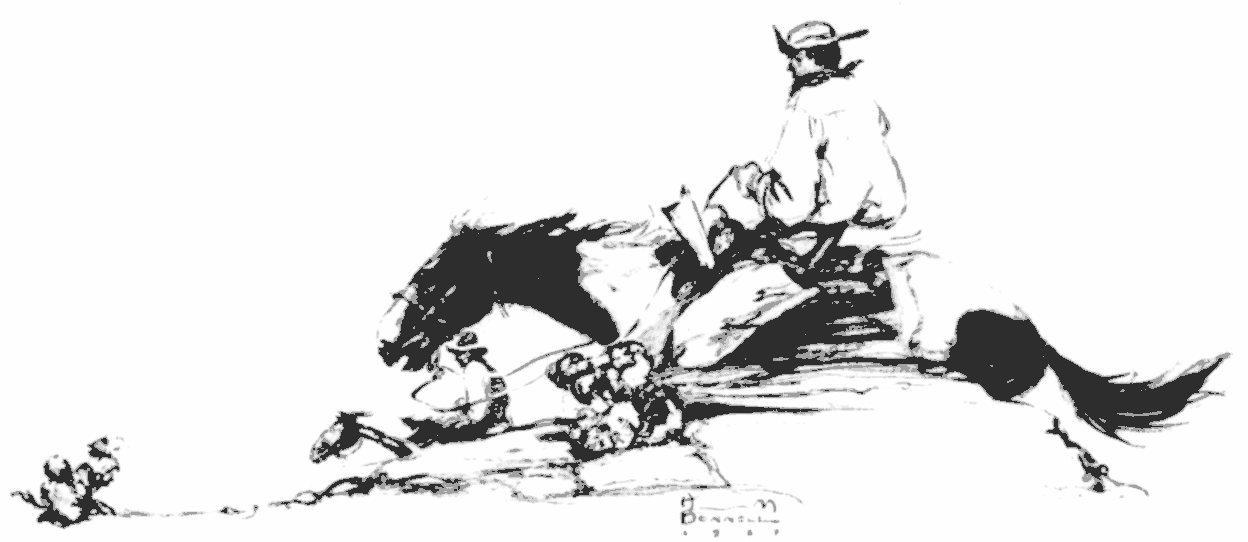
They swung back higher in the hills, which would give them a chance to circle the heads of the cañons, and picked their way slowly along while the sun rose higher over the Silver River range. The cañons were plentiful and most of them were brushy. There were no cattle in that end of the range and trails were scarce.
Mule deer moved out of the thicket ahead of them, bounding a short distance away only to stop short and look at the riders who paid little attention to them. A little black bear, surprised in the act of digging for grubs, squalled like a baby and went up a steep bank throwing gravel with all four feet.
“And men go out to kill things like that!” said Hashknife as the little fellow up-ended over a log and out of sight in a berry thicket.
“And brag about it!” grinned Sleepy. “We ought to swing further south, pardner. This is pretty primitive up here.”
“I reckon it’s a wild-goose chase, Sleepy, but there’s no use goin’ back now. We’ll kinda prospect this part of the country and get back to the ranch before dark.”
For the next two hours they trailed through the hills, ready to give up the task as a hopeless one when they suddenly crossed a cattle trail running northeast and southwest. As far as they were able to determine the cattle had nearly all been traveling northeast. The trail led through thickets of jack-pines and they followed it to the summit where it spread into many smaller trails, all bearing in the same general direction.
“Don’t tell us much,” said Hashknife, “except that quite a few cows have headed for the higher ground where the grazin’ ain’t so good. Mebby they’ve gone on a diet.”
“Let’s see what the other end of the trail looks like,” suggested Sleepy.
Hashknife nodded in agreement and they rode back down the trail, which was plainly visible for about a mile beyond where they first picked it up, and ended at the bottom of a swale near an old water-hole spring.
“Might be that there’s a mesa up there where the feed is good and they travel back and forth to this water,” said Hashknife as they swung down and had a drink of the sweet cold water.
They were sitting on the grassy bank enjoying a cigaret when Hashknife’s attention was attracted by a glint of metal in the brush above the spring. He worked his way over to it and came back with a tin can in his hands. It was an old can which at one time had contained pears but at the bottom of which was a black gummy substance which proved to be paint. Hashknife dug some out with a stick and examined it closely.
“Paint or tar,” said Sleepy, sniffing in the can. “Looks like the stuff they brand sheep with.”
“Probably is,” agreed Hashknife and threw the can aside. “Well, I reckon we might as well travel along.”
They followed down the swale for a quarter of a mile until a granite outcropping forced them to turn to the left and came out of the swale onto a broken side hill where cloudbursts and erosion had cut deep fissures through the landscape. It was a hard place to travel around, so they rode down one of the narrow fissures, which towered high on each side and were so narrow that their knees scraped against the soft dirt of the sides.
The end of the fissure was partly blocked by a big greasewood, which forced them to turn sharply to the right hugging the bank. No trail was there and the ground was so soft that the tall gray, which was in the lead, had to maneuver its feet quickly to get a foothold. In doing so he dislodged a big stone which rolled a few feet and crashed into a clump of dry brush. Hashknife leaned heavily toward the bank to give the animal the advantage of his weight on that side, when a bullet smashed into the bank just over his twisting shoulder and the pinnacles echoed back the whip-like report of a thirty-thirty.
With a quick slash of his spurs Hashknife forced the gray to plunge ahead to the protection of a greasewood while Sleepy jerked his roan back and dismounted quickly, swinging the horse back into the fissure behind the big greasewood clump. Swiftly he drew his rifle from its scabbard and ran back to the mouth of the fissure.
In the meantime Hashknife had dismounted, taken his rifle and was crouched behind the brush peering down the hill.
“All right, pardner?” called Sleepy.
“Fit to be tied,” said Hashknife. “Watch ’em, cowboy.”
Another bullet crashed through the greasewood causing Hashknife to sag a little lower and a moment later Sleepy’s rifle sent more echoes across the broken country.
“I’ll betcha you’ll keep yore head down next time!” snorted Sleepy.
“Can yuh see anybody?” asked Hashknife.
“Not now. I shore sprayed dirt in that geezer’s face. Had him in the old notch, but this darn gun shoots low at that distance. Make it a hundred and fifty, Hashknife. Can yuh see their corral?”
“Can’t see anythin’. Is there a corral?”
“I can see part of it. Some cows down there.”
Hashknife snaked along behind the brush until he came to an outcropping of granite where he slid in close and got his first view of the country below. It was more like a pot-hole than a cañon, and Hashknife could see its value to a rustler as the country on three sides was very broken and from no place except on the very rim would it be possible for any one to see what was going on down there.
Just against the opposite side, using an angle of the bowl as two sides, was a brush and rope corral in which were eight or ten head of cattle. The rustlers were in the brush east of the corral as there was little cover on the west end.
As Hashknife sized up the place Sleepy shot twice in rapid succession and two shots smashed through the brush near him. Both sides were shooting smokeless powder but Hashknife had a fairly good idea where the men were, so he rested his rifle over the rock and sent three bullets searching through the tangle of brush in the pot-hole.
A yell of derision answered his third shot and a bullet mushroomed against the rock beside him.
“Give ’em hell!” yelled Sleepy. A moment later he shot again and swore roundly.
“Didja miss him?” asked Hashknife quickly.
“It was a horse. No, I didn’t miss. Thought it was a man.”
The rustlers were sore now. They opened up and sent bullet after bullet against Hashknife’s rock and through the brush over Sleepy’s head.
“Watch for ’em makin’ a break,” warned Hashknife.
“I’ll break ’em if they do,” replied Sleepy. “I’ve got one of ’em all fixed to walk home.”
“Didja kill a horse?”
“Unless they’ve trained a pinto to lay down when a shot is fired.”
After that it became a case of watchful waiting with neither side willing to expose themselves. Hashknife propped his sombrero on top of the rock but it remained there in perfect security for fifteen minutes.
“Are yuh sure they ain’t pulled out?” he asked Sleepy.
“Dead sure. They’ve got another horse in the brush but I can’t locate him. Stick tight! They know where we are.”
The advantage was with Hashknife and Sleepy because of their elevated position, but the brush was thick and there were at least two acres of it. They made themselves comfortable and watched the brush while the cattle bawled in the corral as they milled around.
Noon came and still there was no movement in the brush. They were patient waiters—these two drifting cowboys. Time meant nothing to them. Hashknife was in such a position that he could not take his horse away without exposing himself.
The sun traveled down across the sky and the shadows began stretching to the east.
“Do yuh reckon they’ve dodged us?” asked Hashknife.
“Don’t believe it. I’ve watched awful close. Their idea is to stick until dark, I reckon; then we will lose ’em.”
Sleepy wriggled back along the fissure to his horse where he untied the coat he had carried on his saddle. Then he came back and fitted a stick between the sleeves like a coat-hanger. He slipped the butt of his rifle between the collar and the stick, hooking the stick against the rear of the lever. Then he put his sombrero on the butt of the rifle and cautiously lifted this above the brush.
Whap! A bullet scarred the stock of the rifle between the sombrero and the coat collar and went splattering into the bank behind Sleepy.
“Still there!” laughed Sleepy. “And how that geezer can shoot! That bullet would have killed a man who wore as small as a number twelve collar.”
But Hashknife did not reply because he had cuddled the butt of his rifle against his lean cheek and his gray eye was notching the gold bead front sight against an indistinct object. Then came the spiteful crack of the rifle followed by a stirring movement in the brush. But before Hashknife could pump another shell into the chamber the object had disappeared.
“I nicked that jigger,” he told Sleepy. “At least I think I did. He shore moved away quick.”
Whether the shot nicked any one or not, it served to anger the men in the brush and they spewed lead at both Hashknife and Sleepy, who kept down until the fusillade was over.
Then followed an hour of inactivity. The sun was getting low in the west and it began to look as though the rustlers would be able to hold out until after dark when it would be a simple matter to get away.
“They know they’ve got us stuck,” said Sleepy. “We can’t get down to ’em—that’s a cinch!”
So there was nothing to do except to wait. Sleepy tried drawing their fire again with the dummy but they refused to rise to the bait. Time passed swiftly now and the sun sank below the western range.
Hashknife knew the period of twilight would be brief; that within an hour the rustlers would be able to leave the pot-hole in the hills without interference. He fumbled in his pockets for cigaret-papers but suddenly jerked his hands up and gripped the rifle.
Something was moving over by the farther side of the brush. It was a man, humped over low, moving slowly. As Hashknife lined up the sights the man ran swiftly across an open space of not over fifteen feet. Swiftly the muzzle of the gun turned and the report awoke the sleeping echoes. The man’s feet seemed to jerk from under him and he fell in the open, but with a rolling flop he was out of sight.
“One baby down!” exclaimed Hashknife.
“Didja wing one?” asked Sleepy anxiously.
“Legged him, Sleepy.”
“Good work.”
Fifteen minutes later Sleepy wailed, “Gettin’ so dark I can’t see to notch my sights.”
“Same here—but neither can they.”
“There they go!” yelled Sleepy. “Off to the right! Two on one bronc!”
Sleepy sprang to his feet and fired his rifle as rapidly as possible. But the light was bad and when his rifle clucked on the empty chamber the riders were out of sight. Hashknife came clawing his way back to Sleepy.
“They’re gone!” complained Sleepy. “I never knocked a feather out of ’em. Dang the light anyway!”
“Well, that settles the cat-hop!” sighed Hashknife. “Let’s go down and look at that horse.”
It was impossible for them to ride down into the pot-hole, so they left their horses where they were and went down on foot. Sleepy led the way to the dead horse which had been killed instantly. It looked like a black-and-white animal until a close examination disclosed the fact that it was a white horse with the black spots painted on.
“A reg’lar painted horse,” laughed Sleepy. “Look at the brand, will yuh?”
“An AH horse,” said Hashknife. “I expected that.”
The saddle was a well-worn, narrow fork affair without a distinguishing mark of any kind. The men went over to the corral and looked at the stock. There were six IS, two Box 88 and one AH animals in the corral. Sticks had been piled up for a branding fire but the rustlers had become alarmed before touching a match to it.
Hashknife opened the corral and let the animals out. He wanted to keep them there for evidence, but there was no feed or water, so he turned them loose. He and Sleepy went back to their horses, led Ghost along the treacherous side of the hill to the deep fissure, where they rode away on the back trail to the swale again.
It was dark by this time and there was no trail, but Hashknife led the way out of the swale near the spring and they headed down across the hills toward Chongo town.
Fat Garnette didn’t know where Hashknife and Sleepy had gone. He wasn’t at the office when Sleepy borrowed the two rifles from Weary without telling Weary what they intended doing.
“He jist borrowed ’em,” said Weary. “I supposed it was all right.”
“It’s all right,” said Fat. “Only I’d like to know where my rifles go.”
Later on that day Fat met Hayward, who asked him where Hashknife and Sleepy were.
“Dunno a thing about ’em. They borrowed my two best Winchesters yesterday evenin’ and Weary says they rode out of town. The danged fool never asked ’em where they were goin’.”
“Kind of a funny move, wasn’t it?”
“I s’pose it was. They do make funny moves—and tell yuh nothin’. Sometimes I get tired of it, Tuck. They’ve hung around my office ever since they’ve been here. Yuh can’t help likin’ ’em but I dunno why in hell they stay here. They seem to have money and they don’t ask any odds of anybody, so I reckon it’s their business.”
“Oh, shore! How’s Frenchy?”
“I’m just goin’ down there. Yuh know he can’t get well.”
“Do yuh think that’s a fact?”
“Doctor says so. He might be wrong. I’ll let yuh know how he is when I come back.”
Yvonne met the sheriff on the front porch and he could see that she was excited.
“He’s conscious,” she said joyfully. “And he isn’t suffering. The doctor says he’ll get well.”
“Gosh, I’m shore glad, Yvonne! I wonder if I could see him.”
“I think so.”
They found Frenchy LeClere, heavily bandaged, looking very weak. The doctor smiled at the sheriff and offered him a chair.
“He’s looking pretty good, eh?” smiled the doctor. “Regained consciousness ten minutes ago. No sign of concussion now.”
“That’s great! How are yuh feelin’, Mr. LeClere?”
“I don’t feel much,” he whispered.
“You’ll be fine. Do you know what happened?”
“I’m try to think. She’s like dream.”
“Sure yuh didn’t go to sleep and let the team run away?”
“Non! Two men she’s ride up beside me in de dark, one man on each side. I’m t’ink dey go for to pass me and I’m jus’ say ‘Hello,’ w’en one man mus’ have hit me with rifle. I’m seem to see rifle. Mebby first time she’s hit me on de shoulder. I feel h’awful pain and I’m theenk I’m fall off de wagon and den I don’t feel no-t’ing.”
“And you didn’t see who the men were?”
“Non. But I see one t’ing. One man she’s ride pinto. I’m see de spot. Other man I’m don’ know, biccause I’m not see him so good.”
“Ridin’ a pinto horse, eh?”
“Did you ever hear of such a thing?” exclaimed Yvonne. “Why, we all thought Dad had been hurt in the runaway!”
“Not all of us,” replied the sheriff. “Hashknife doped it all out right away. Comin’ in from out there he told me just what happened.”
“But how did he know?” asked the doctor quickly.
“Readin’ signs. The men who did it thought Joe was in the wagon. They wanted to kill him, so they thought they would kill him and make it look like a runaway. I guess they thought Joe would be killed in the runaway, or maybe the team ran away before they had a chance to investigate the contents of the wagon-box.”
Frenchy relaxed and closed his eyes. Yvonne was staring at the floor.
“De same men w’at shoot Joe in de jail?” whispered the old Frenchman.
“Must be! Doc, I reckon I better get a couple of men to stay down here.”
“You mean to guard the place?”
“Y’betcha. I’ll see if I can find two.”
“Soapy would come and maybe—” began Yvonne.
“Shore!” grinned Fat. “I’ll see him.”
Fat went back to the main street and crossed over to the Silver Streak where he met Tuck Hayward.
“The old man is still the same, Tuck,” he said.
“Still unconscious, eh?”
“Yeah. Say, Tuck, do you know anybody around here who rides a pinto horse?”
“Pinto?” Tuck motioned for the bartender. “No, I don’t, Fat. What do yuh want to know for?”
“Just wonderin’. I don’t know of a single one, do you?”
“Somebody wantin’ to buy one?”
Fat shook his head as he filled his glass.
“No-o-o, I don’t think so, Tuck. Here’s regards!”
They drank and turned from the bar.
“I haven’t seen any pinto horses around here,” said Tuck.
“Neither have I. Well, I’ll see yuh later.”
Hayward walked to the doorway and watched Fat cross the street. The big man’s face twisted thoughtfully and he shoved his hands deep in his pockets, his shoulders hunched.
“Pinto horses, eh?” he muttered. “I wonder what in hell he meant.”
He walked back the length of the bar then stood and looked over the room. The livery-stable keeper was having a drink at the bar and nodded to Hayward.
“Seen Hartley today?” asked Hayward.
“Not today. Him and his pardner rode away last night—or rather yesterday evenin’.”
“Pullin’ out of the country?”
“Don’t think so. Anyway, they didn’t say anythin’ about pullin’ out. Packed a couple of rifles, I noticed. Hope they ain’t gone for good ’cause they owe me a few dollars’ feed bill.”
“Mebby they went huntin’,” suggested the bartender.
“Might have.”
Hayward frowned and lighted a cigar.
Fat found Weary and Chuck at the office and to them he confided what Frenchy LeClere had said. Fat also told them that Hashknife had advanced the same idea the day they had found Frenchy unconscious under the greasewood.
“How in hell did he know?” queried Chuck.
“Brains, you hard-head!” declared Weary. “Hashknife does a lot of thinkin’, I tell yuh. He’s smart.”
“Ain’t no smarter than the rest of us.”
“Ain’t he?”
“Well, if he is, why in hell don’t he find out who has done all the dirty work around here for the past year? Why don’t he pin the hornet on somebody, I’d ask yuh? If he’s so damn smart why don’t he tell me who petted me on the head that night? I’d pay to know.”
“How much would you pay? Four bits, I suppose.”
“I’d pay, y’betcha!”
“And then what would yuh use for money? And what good would it do yuh? You’d never go gunnin’ for nobody, Chuck. You’d jist about find out who done it and tell ’em that they done a hell of a good job. They did—only they didn’t hit hard enough.”
“The hell they didn’t! Hard enough to suit me.”
“Well,” said Fat moving in on the argument, “I wish they’d bring my Winchesters back. If they don’t come back I’ll make Weary pay for them two guns, y’betcha!”
“Oh, they’ll come back!” declared Weary. “I’ll bet they had a good reason for takin’ ’em. And what’s more, I don’t want that Hashknife notchin’ a sight on me. His eyes are too keen. By golly, I’m scared to think evil around him!”
“Oh, he ain’t no mind-reader, Weary,” said Chuck.
“Well, you better think clean around him, pardner.”
“Why? Who’s he to make me think clean? I can think jist as dirty as I want to.”
“You would!”
Fat laughed and leaned back in his chair.
“Guess I’ll separate you fellers. Weary, you get hold of Soapy Weed and see if he can get off the AH for a few days. If he can’t I’ll deputize him—and he’ll have to. I need a couple of men to guard the doctor’s place.”
“Guard it?” asked Weary. “What’s the idea?”
“There’s been two attempts to kill Joe and one attempt to kill his father. We don’t want it to happen again.”
“Yuh want me and Soapy?” asked Weary.
“Shore! If Soapy is willin’.”
“Willin’? Say! That bat-eared waddy would sell his soul to be near Yvonne.”
“All right; you find him.”
It was well after dark when Soapy and Cling rode in from the AH. A little later Weary found Soapy in a store and told him what Fat had said.
“Gee, that’ll be great!” exclaimed Soapy. “We better have Fat deputize me right away or old man Hart won’t stand for it. He says me and Cling are spendin’ too much time in town.”
“Fat’s eatin’ supper. You show up in an hour and he’ll deputize yuh, Soapy.”
“I’ll be there if I live.”
Soapy went across to the Silver Streak to find Cling and tell him the news. Cling was at the bar with Hayward and several other men, and Soapy told Cling, after drawing him aside. Cling had imbibed several drinks and was incredulous.
“Aw, yo’re crazy!” he blurted. “What’s the idea of guardin’ the doctor’s place? I suppose you framed it up yourself.”
Cling had spoken loud enough for the men at the bar to hear.
“What’s the idea of guardin’ the doctor’s place?” asked Hayward.
“Some fool idea of Soapy’s,” laughed Cling.
“No such a damn thing! Didn’t somebody try to kill Joe? And didn’t somebody try to kill Frenchy?”
“Frenchy was hurt in a runaway,” said Hayward.
“Rats!” snorted Soapy. “That’s all yuh know about it.”
“Well, he was hurt in a runaway,” declared Cling.
“He was, like hell!”
Soapy turned and walked out of the place.
“He’s crazy as a sheepherder,” laughed Cling.
“Is Frenchy conscious?” asked one of the men. “I heard he couldn’t live and that he never would speak again.”
“That’s what I heard,” said Hayward slowly. “I’m goin’ down and find out for myself.”
He walked away from the bar and went down to the doctor’s place and the old doctor met him at the front door.
“Hello, Doc!” said Hayward pleasantly. “I heard that LeClere had regained consciousness.”
“I heard that also,” smiled the doctor. “But I should be in a position to know the facts of the matter, don’t you think, Hayward?”
“I should think you would be, Doc. How is Joe?”
“Doing nicely. No fever now but very weak.”
“Well, that’s good. Thanks, Doc!”
“You are very welcome.”
Hayward walked half-way back to the saloon before he realized that the doctor had not denied that LeClere had regained consciousness.
“I’m a damn fool,” he told himself. “Why didn’t I ask him whether LeClere was conscious? He merely said that he was in a position to know the facts. And what are the facts?”
He went back to the saloon no wiser than he had been before.
Soapy could hardly wait to be deputized. Fat gave each man a sawed-off shotgun and sent them down to the doctor’s house to report on duty. It amused the doctor but he really was glad that the sheriff had taken such precautions.
Yvonne was visibly relieved. Two men with riot guns will give any place a sense of security. Soapy grinned and sat down with the gun across his lap.
“Bring on yore trouble,” he announced and after he and Yvonne were alone for a few moments he said:
“Gosh, this is the best job I ever had! Fat says we’ll be here until both yore dad and Joe are able to take care of themselves. That’ll be at least two weeks.”
“That will be fine, Soapy.”
“Say! I spoke to Hart about that place on Opal Creek.”
“What did he say?”
Soapy started to grin, smoothed his face and cleared his throat harshly.
“We won’t discuss that part of it, Yvonne. I told him he wanted to keep me down. But I’ll get it. Gee, just think of two weeks down here! This is my idea of a job.”
Fat came down to see how they were getting along.
“One of yuh stay in Frenchy’s room and the other in Joe’s room. Don’t let anybody in except Yvonne, the doctor or myself. And if either one of yuh goes to sleep I’ll can yuh off the job.”
“Suppose somebody tries to get in?” asked Soapy.
“Didja think I gave yuh that gun for a crutch?”
Yvonne questioned Fat about Hashknife and Sleepy but he knew nothing about them. She told him that they were to have stayed at the IS ranch the night before, but she didn’t know just what their reasons were for staying out there.
“I don’t pretend to know what the long-geared cowboy has under his hat,” said Fat soberly. “He shore gets under my hide sometimes. Well, I’ll see yuh later, folks. Yvonne, you see that Soapy sticks to his job. He can’t think of more than one thing at a time and that ain’t work.”
She promised to keep Soapy on the job and Fat went away with a grin on his face.
It was about eight o’clock when Hashknife and Sleepy rode into Chongo town and stabled their horses. They did not bother to take the rifles back to the sheriff’s office but went straight up the street to the Silver Streak where Sleepy planted himself near the front door while Hashknife went down to the doctor’s office.
The doctor answered the knock and Hashknife asked him to step outside.
“Ain’t been anybody here for yuh, has there, Doc?”
“Not today, Hartley. Is somebody sick?”
“Mebby. If anybody calls for yuh will yuh let me know before yuh go?”
“I don’t understand what you mean, Hartley, but I’ll do it.”
“That’s fine. How are the patients?”
“Getting along fine. Mr. LeClere is conscious but I’m a little afraid to have you talk with him. He talked with the sheriff today. Your theory was correct, Hartley. Two men came along that night, passing on each side of his wagon, and one of them struck him with a rifle barrel.”
“Did he recognize either of them?” anxiously.
“No, he didn’t. But he is sure that at least one of the men rode a pinto horse.”
“Gee, that’s fine! See yuh later, Doc; and I’m much obliged.”
Hashknife hurried back to Sleepy, told him the latest news and they went into the Silver Streak. Several of the games were running full blast and Tuck Hayward was dealing the stud game.
Quite a number of men were in from the mines spending their hard-earned wages over the green cloth. Several railroad men were there, a couple of cattle buyers and a number of the business men of the town. Cling Heffner was there playing roulette and they saw Johnny Colburn in a chuck-luck game, his hat in one hand, his nose beaded with perspiration. It was not often that Johnny was winner and the excitement was almost too much for him.
Hayward saw Hashknife and Sleepy come in and he looked at them curiously. Hashknife stood behind him. It made Hayward nervous. He twisted in his chair and gave other evidence that he did not like to have anybody stand behind him. Finally Hashknife moved away and Hayward shot a baleful glance in his direction.
The sheriff came in and seemed surprised to see Hashknife and Sleepy. He walked over to them and whispered what he had learned from Frenchy LeClere. Hashknife told him he had already talked with the doctor and listened while the sheriff told about posting the two guards at the doctor’s home.
“Fat, would you be all set for trouble if somethin’ broke tonight?” asked Hashknife softly.
The sheriff looked at him curiously but replied quickly, “Most anythin’, Hartley.”
“Fine! And don’t ask questions when it comes.”
“Well, what’s in the air? Gimme an idea, can’t yuh?”
“Not yet. Stay around here and act natural.”
“All right.”
Fat hitched up his belt, reached for his papers and began rolling a cigaret. That was his idea of acting natural.
Hashknife took a chair against the wall about midway of the room and relaxed. He was tired from the ride and the gun battle and he needed to relax for a while. There was nothing sure in his plans. He was playing a hunch again—“shooting at shadows,” he called it.
Sleepy wandered around the room watching the games while Fat appeared to grow interested in the roulette wheel where a small crowd of miners were losing their money. There was plenty of activity but nothing out of the ordinary. Men came and went but the crowd stayed about the same size all the time.
It was about ten o’clock when McLeod, foreman of the Box 88, came in. He had a drink at the bar, rolled a smoke and sized up the place.
Hashknife studied the man from under the brim of his big hat. McLeod needed a shave and a hair-cut badly. He bought another drink and engaged the bartender in conversation.
Hashknife glanced toward the door and saw Soapy Weed coming in. Soapy walked slowly past the bar, nodding casually to Fat, who gawped after him, inclined to reprimand him for leaving his post of duty.
After a slow survey of the room Soapy came over to Hashknife and spoke softly. Hashknife merely nodded.
Soapy sauntered away. He stopped to look at the games but finally went outside.
Hashknife glanced at Hayward, who was looking in his direction, and wondered whether Hayward had seen Soapy bring him a message.
A waiter started from the bar with a tray of glasses. McLeod said something to him. The man nodded and as he placed the glasses on the table spoke to Hayward, who said something in return, and then walked away with the empty tray. In a few moments another dealer came to the stud table and relieved Hayward.
Hayward yawned heavily, lighted a cigar and walked back to his private office where he went inside. McLeod turned from talking with the bartender and started for the door. In a moment Hashknife was on his feet signaling to Fat and the two walked out behind McLeod, who had stopped on the edge of the sidewalk.
The sheriff didn’t know what was to be done. His jaw sagged with surprise when Hashknife stepped in beside the big foreman of the Box 88, deftly removed McLeod’s gun from its holster and shoved it against the astonished cattleman’s ribs.
“What in hell is goin’ on here?” demanded McLeod hotly.
“Just this, McLeod. Yo’re under arrest. You take him to jail, Fat.”
“But—but—” faltered the sheriff.
“Give me back that gun, you damn fool!” snarled McLeod. “What’s all this talk about arrestin’ me? Make that damn fool give me back that gun, Fat.”
“Take him to jail, Fat,” begged Hashknife. “It’s no joke. My God, don’t hold up the game!”
“All right, Hashknife. Yo’re under arrest, McLeod. Give me his gun, will yuh?”
“Well, by God, somebody will smart for this!”
“You will, McLeod. Don’t take a chance with him, Fat. If he makes a break, shoot him.”
The arrest had been made so quietly that it had not attracted any attention. As McLeod started across the street with Fat Hashknife stepped to the right and went swiftly back through the alley, coming in behind the Silver Streak.
The light from Hayward’s office partly illuminated two saddle-horses which were standing a few yards from the building, the bridle reins dragging. Speaking softly to them, Hashknife stepped over and stripped off the bridles from both horses. He gave one of them a slap with the reins and both horses trotted away in the night.
Some one was yelling out on the street. Hashknife heard the sound of pounding feet as a man came running down the alley. Quickly he stepped in against the building as the man came into view and jerked to a stop, whirling around in the light from the window which was at Hashknife’s shoulder.
The man was McLeod, hatless, a gun in his hand. Recognition seemed mutual and the guns of the two men spat together, throwing a shower of sparks in the dark. From behind Hashknife came the crackle of broken glass as the heavy bullet bored through the window of Hayward’s office.
But McLeod was falling forward, pitching on his face in the dirt, arms outspread. It seemed as if he was still falling when Hashknife darted to the back door of the saloon, opened it quickly and stepped inside.
The saloon was in an uproar. The crash of the two shots had stopped all activities and to add to the climax Fat Garnette was staggering in, his face covered with blood and dirt. Down the middle of the room he staggered, looking for Hashknife to tell him that McLeod had had a concealed gun with which he had struck Fat over the head before he had escaped. But Hashknife was not paying any attention to the sheriff. He was still at that back door which was wide open.
Suddenly the door of Hayward’s office swung open and Mike Dalhart, the cowboy who had gone to Arizona, stepped out.
Dalhart was hunched forward, his hat pulled low over his eyes, a six-shooter in each hand. A trapped wolf would have been a nursing lamb beside Dalhart. The sheriff saw him and stopped short. The gun in Dalhart’s right hand jerked to his hip, covering the sheriff.
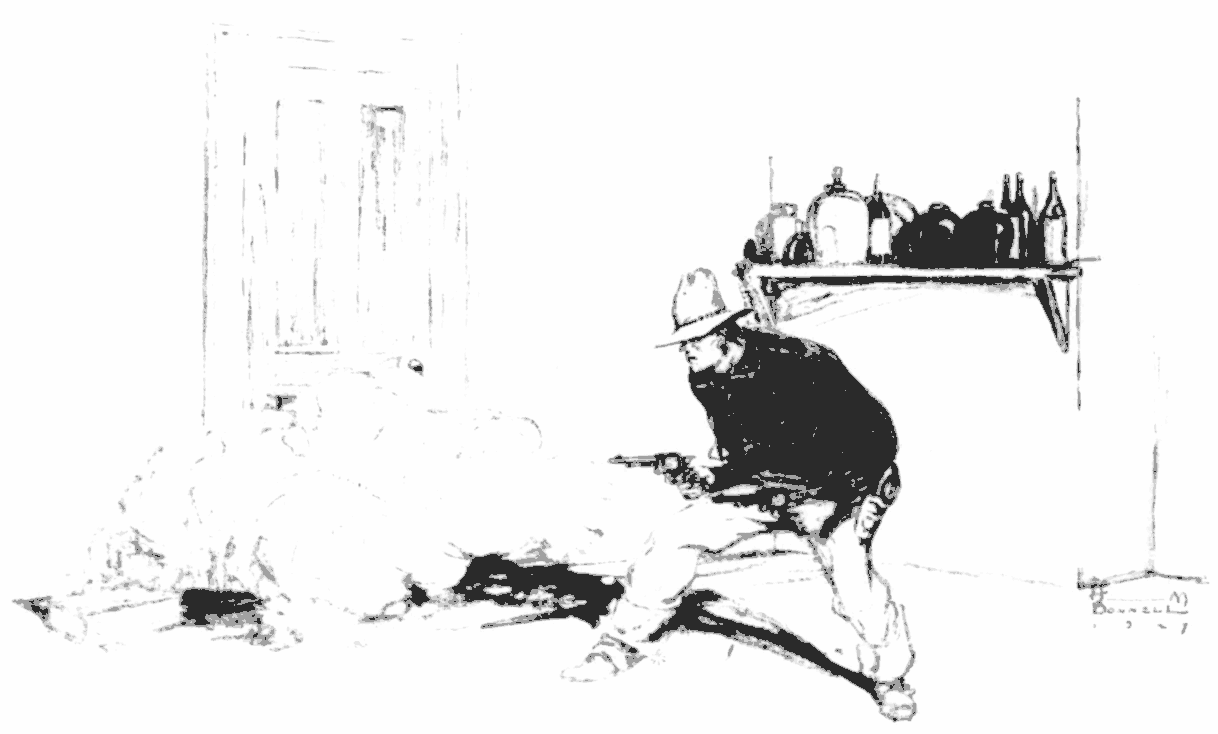
“Over here, Bitter River!”
Hashknife’s voice snapped like a whip and Dalhart whirled, both guns spouting flame, shooting too swiftly for deadly accuracy.
Hashknife’s gun thundered in response and as Sleepy’s gun spat flame from about the center of the room Dalhart jerked sideways, dropped the gun from his right hand, went back on his heels and fell against the door of the office, sliding to the floor in a heap.
Hashknife ran to him quickly and flung the office door open. Hayward was lying on the office floor, flat on his back with one arm flung across his face. Hashknife stepped back into the saloon as the crowd, panicky from the killing, surged forward, choking in the powder fumes.
Fat Garnette came forward, his face white where it wasn’t red from gore, and stopped near Hashknife, trying to ask questions with his hands.
Dalhart wasn’t dead. He tried to lift his head from the floor and cursed bitterly at Hashknife.
“Who shot Hayward?” asked Hashknife.
“Bullet through the window,” said Dalhart chokingly.
“McLeod got away,” said Fat hoarsely.
“He’s out behind here,” said Hashknife. “He shot at me and his bullet went through the window. I guess he killed Hayward. Some of yuh prop Dalhart up and give him a drink.”
Some one got a bottle at the bar, another man went after the doctor, while the rest stood dumbly in their tracks, shocked, staring with amazement at Hashknife, who was the coolest man in the place.
Dalhart managed to take a big drink of liquor but he knew as well as they that his minutes were numbered.
“Yore pardner’s out at the Box 88, ain’t he?” asked Hashknife.
“So it was you, eh?” whispered Dalhart. “We wasn’t sure. Yes, he’s out there with a broken leg. Damn him! If it hadn’t been for him—I came to get a doctor and to settle up with Hayward. I was goin’ to get out.”
“You killed McFee a year ago, Dalhart. It was you who killed O’Neil and it was you who shot Joe LeClere. I can understand why yuh killed McFee. He recognized yuh as Bitter River Belton. Yuh killed O’Neil because yuh found out he was a cattle detective, but I’ll be damned if I can figure out why yuh tried to kill Joe LeClere.”
“That fooled yuh, eh?” whispered Dalhart weakly. “I’m glad somethin’ fooled yuh. I think Joe knew I killed O’Neil and I was afraid he might tell at his trial. Hayward didn’t think so because he had the deadwood on Joe. It was Hayward who found out who O’Neil was. He furnished O’Neil a gun to kill Joe with that night, but Joe didn’t go home.
“That McFee job was funny.” Dalhart was getting so weak that they gave him another pull at the bottle.
“Joe almost had snakes. He started to town with McFee but he was so loco he went back. Me and Hayward made Joe believe he killed McFee and the damn fool still thinks so. That’s what Hayward had on Joe. He forced Joe to steal cattle from his father for Hayward.”
“Made him change the IS to a Box 88, eh?” asked Hashknife.
Dalhart nodded and closed his eyes.
“Yeah. And we done the same thing. We threw ’em into a box cañon off Dog Soldier and grazed ’em back there until the brands had healed. When we knocked old Frenchy off Hayward wanted us to make a big clean-up and we just got started when you showed up.”
“You stole a pair of white horses from the AH and painted black spots on ’em.”
Dalhart grinned and started to say something as the doctor came bustling in. He knelt at Dalhart’s side—Dalhart was still smiling. The examination was brief.
“I don’t see how he lived ten seconds,” said the doctor—and passed on in to look at Hayward.
McLeod was still alive. Some of the men carried him in. He cursed everybody and refused to commit himself in any way, even after he was told that Dalhart had confessed.
Soapy and Weary had deserted their post of duty and were outside the saloon with Yvonne when Hashknife and Sleepy came out. They had only heard snatches of information and they almost assaulted Hashknife.
“Joe is clear,” Hashknife told them. “There ain’t a thing they can hold him for. But I’ve got to have somethin’ else cleared up and Joe can do it. C’mon!”
“You say Joe is clear?” asked Yvonne, almost afraid that she had not heard correctly. “He isn’t guilty?”
“Not of murder. Oh, it’s all right, Yvonne! Don’t cry. For gosh sake, won’t somebody take that riot-gun away from Soapy and let him take care of Yvonne?”
They walked down to the doctor’s office and went in with Soapy and Yvonne far in the rear. Joe was half out of bed, trying to put on some clothes, but found himself too weak.
The man who had come for the doctor had blurted out some information that was of vital importance to Joe LeClere.
Hashknife lifted him back into the bed and Joe stared at them with frightened eyes.
“Lay down and listen to me,” said Hashknife. “To begin with, you didn’t kill Charley McFee.”
Joe opened his eyes wide and his mouth sagged for a moment. He tried to speak but merely swallowed and looked up at Hashknife.
“Dalhart killed him,” said Hashknife. “He confessed. And he killed O’Neil too. Didja know that, Joe?”
“I—I thought he did. But—but Hayward said he’d have me hung for murder if I told. It was Dalhart who tried to kill me.”
“We know that, Joe. He admitted that part of it. He said that they had the deadwood on you and Hayward made you steal cows from yore father. Is that the truth, Joe?”
Joe’s eyes shifted from face to face. Yvonne was leaning close to him and he looked square at her as he said:
“You think I’m a rustler, but I’m not. Hell, how I hated Hayward! But he could have had me hung. They thought I was stealin’ Dad’s cows but I wasn’t. I’d corral a lot of Box 88’s and rebrand ’em. Run the hot iron over the original brand and not do it too well and then turn the animals over to whoever was in charge of the work at the mines. They also kept the rebrands back on Dog Soldier. I swear to God that I never stole a cow from Dad.”
Tears were running down Yvonne’s cheeks as she turned to Hashknife. Joe was crying too, but most of his tears were from weakness and reaction.
“Oh, he isn’t guilty of anything!” she choked. “Don’t you see he is cleared of everything, Hashknife?”
“Yea-a-ah, I see he is,” said Hashknife seriously. “But if the chance ever comes, after he gets well, I’ll kick him a couple of times for my own satisfaction.”
“Why—what for?” asked Weary.
“For givin’ me the toughest problem I ever worked on. I’ve been here all this time tryin’ to figure out just what he was goin’ to do with them Box 88 cows we found him with that mornin’. There wasn’t a darn brand in this state he could make out of that Box 88—and I never once thought he might be double-crossin’ a thief.”
“If you wa-want to do the kickin’ right now I’ll let yuh,” said Joe seriously. “The rest of you folks get out because I’ve only got on one of Doc’s nightgowns.”
“And I’ve lost my good job,” sighed Soapy.
“You ain’t even started on yore good job,” said Hashknife. “Yvonne, go in and tell yore dad that the kid is all right. Yore dad knows all about them cows that Joe was goin’ to brand, but he don’t know why.”
“And you did it,” said Yvonne. She took hold of Hashknife’s sleeve and looked at him. “You did all of this just for us.”
And then she kissed him square—on the mouth—ducked aside and ran to her father’s room. Hashknife looked foolishly around and headed for the door.
“I could do the same thing to yuh,” said Soapy.
But Hashknife didn’t accept. He walked out followed by Sleepy and Weary, who was still walking around in a daze.
They went to the sheriff’s office where they found Fat and several other men. McLeod was not dangerously hurt. They had him on a cot in one of the cells while some more of the men were getting a rig at the livery-stable to go out to the Box 88 after Asher, who was out there waiting with Cornes for the doctor to come.
Fat had washed the blood off his face and head but he was far from presentable yet. McLeod had struck him over the head with a six-shooter, knocked him down but not quite out.
“I don’t understand it all yet,” complained Fat. “How didja figure all this out, Hashknife? I don’t get head nor tail out of it. You called him Bitter River, didn’t yuh? Wasn’t that the name in that telegram from Piney River?”
“That was the shadow I shot at,” smiled Hashknife. “McFee used to be a deputy sheriff down there. He was here two days and was murdered. The only time I ever met McFee he was chasin’ a man by that name—Bitter River Belton. I took a chance and the description fit Dalhart, except for the moles which I didn’t see. That established a killer for McFee.
“I knew that O’Neil was a detective. Rustlers will kill a detective, yuh know. LeClere was losin’ cattle, so I had to find out who was stealin’ ’em. Yuh can change an IS to a Box 88 by usin’ the I for part of the Box and makin’ the S into an eight and addin’ another eight. They both brand on the right shoulder. It took me a long time because I was workin’ on the wrong angle. I thought Joe LeClere was a crook and a cow-thief. Hayward said that Dalhart and Asher had pulled out for Arizona but I didn’t believe it. Then I heard about Hayward havin’ some claims on Dog Soldier and it struck me that Dog Soldier was the answer, but me and Sleepy never quite got there.
“We saw two men on pinto horses and later on we ran into ’em in a big pot-hole in the hills, where we spent the day swappin’ lead. Sleepy killed one of the pintoes and I got one rustler in the leg. But they got away from us just at dusk on one horse, and then we found that the dead pinto was an AH with the black spots painted on.
“I knew that one of the men was hurt, so I figured he would need a doctor. The rest of it was luck, I suppose. Soapy brought me word that McLeod asked the doctor to go to the Box 88 to see a sick man. McLeod tipped Hayward off that some one was in his private office, so I had Fat arrest McLeod while I handled the rest.”
“I’d say yuh shore handled it,” said Fat. “You’ve got plenty reward comin’ to yuh, Hashknife—but you earned it. Seven thousand is a nice stake.”
“I get two thousand of it—that’s all! Have yuh got a telegraph blank around here, Fat?”
“Sure. Top drawer of that desk.”
As Hashknife wrote the telegram, Ace Hart of the AH ranch came in. He had heard the story at the Silver Streak.
“I want to meet Hartley,” he said. “By grab, I want to meet the man who smoked up Chongo town! Never heard anythin’ like it. Where is he?”
Fat introduced them and they shook hands solemnly.
“Soapy and Cling talked a lot about yuh, Hartley.”
“Nice pair of boys,” said Hashknife.
“Nice, hell! Wilder ’n hawks!”
“Soapy told me you’ve got a place on Opal Creek.”
“He did, eh? Told me about it too. Damn fool! Had an idea I’d give it to him. Talked about startin’ a herd. Ain’t got a damn cent!”
“If he had about a thousand dollars would yuh feel like lettin’ him and his wife have the place?”
“Thousand—him and his wife? What-cha talkin’ about?”
“Would yuh, Hart?”
The old man cuffed his hat over on the side of his head and squinted at Hashknife.
“If he had a thousand and a wife—yeah.”
“Make out a deed tomorrow and I’ll speak to the preacher.”
“I don’t understand yuh, Hartley.”
“Are you still shootin’ at shadows?” asked Fat.
“Not if the county will pay that reward and if Yvonne LeClere will stick to her word.”
“Well, the county will pay it tomorrow, Hashknife. I can’t speak for the Association, but they’ll pay, I’m sure.”
“I’m sorry I can’t collect that end of it, Fat.”
He handed Fat the telegram, which was directed to the Secretary of the Cattlemen’s Association and read:
CLOSED CASE TONIGHT COMPLETE CONFESSION MURDER OF MCFEE AND SHIELDS BY BITTER RIVER BELTON ALIAS MIKE DALHART A KILLER FROM PINEY RIVER STOP ACCEPT OUR RESIGNATIONS AS THIS JOB KEEPS US TOO LONG ON ONE SIDE OF THE HILLH. HARTLEY
Fat read the telegram through carefully and then looked quizzically at Hashknife.
“Cattle detectives, eh?”
“Were,” corrected Hashknife while Sleepy grinned widely.
“So that’s why yuh can’t collect the five thousand. Say! You ain’t goin’ to pull out of here, are yuh? This Silver River country needs yuh, Hartley—it sure does.”
“Not now, Fat. Yo’re all set for a peaceful existence. Read the last line of that telegram again.”
“This job keeps us too long on one side of the hill! I thought that was code, Hartley.”
“Our code, Fat.”
“Uh-huh. Well, yuh won’t leave before tomorrow, will yuh?”
“Can’t. Got to collect money, get a deed from Hart and talk to a preacher. By the way, if yuh see Soapy Weed tell him he’ll find us at the restaurant eatin’ our first meal of the day. So-long Fat.”
Weary found Soapy and Yvonne at the front gate of the doctor’s place and he said to Soapy:
“I dunno what it’s all about, Soapy, but Hashknife Hartley asked Ace Hart to let yuh have that place on Opal Creek and Ace said yuh could if yuh had a thousand dollars to buy stock with—and a wife. Hashknife said he’d furnish the money and the preacher. Him and Sleepy are at the Chink restaurant right now eatin’ a meal.”
Weary turned on his heel and headed back for the main street while Soapy and Yvonne stood there in the moonlight staring at each other.
“The place on Opal Creek and a thousand dollars,” muttered Soapy foolishly. “Hart said I could have it if I had—Yvonne, don’t you see what it means? Yore father will get well and Joe is cleared of everythin’. Hart gives me the place—Oh, don’tcha see what it means? Yvonne, all I’ve got to do now is to furnish the wife?”
Yvonne reached out and touched Soapy on the sleeve, and they both looked up at the full moon, high up over the Chongo Creek hills.
“There’s a road to the moon tonight, Soapy,” she said softly.
“That’s right, honey! It’ll take us all our life but we’ll travel her—if yuh want to go with me.”
“I’ve always wanted to see the moon,” she replied.
Somewhere a cowboy was singing:
Till my wings get a lit-tul stronger.
But they didn’t hear him—and they were not looking at the moon.
- This story appeared in the January, 1928 issue of McClure’s Magazine. This story is believed to be in the public domain in the United States. Please note that copyright status may differ in other countries.
- The cover image was produced by the transcriber and is released into the public domain.