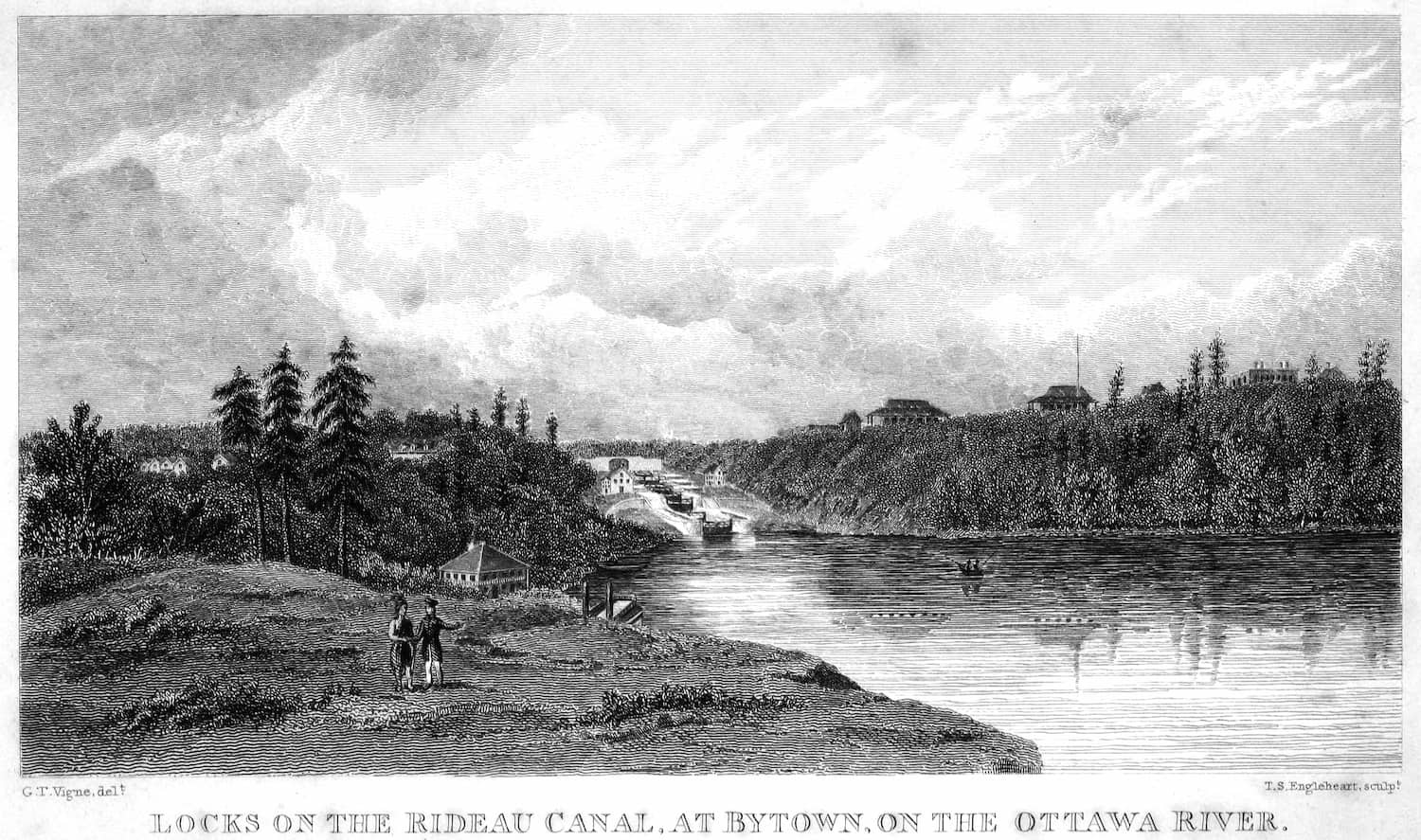
G.T. Vigne, delṭ T. S. Engleheart, sculpṭ
LOCKS ON THE RIDEAU CANAL, AT BYTOWN, ON THE OTTAWA RIVER.
Published by Whittaker & Co. April 10, 1832.
Title: Six months in America, vol. 2 (of 2)
Author: Godfrey Thomas Vigne
Release date: May 26, 2026 [eBook #78758]
Language: English
Original publication: London: Whittaker, Treacher, & Co., 1832
Other information and formats: www.gutenberg.org/ebooks/78758
Credits: Chris Miceli and the Online Distributed Proofreading Team at https://www.pgdp.net (This file was produced from images generously made available by The Internet Archive)
Some minor changes to the text are noted at the end of the book.
G.T. Vigne, delṭ T. S. Engleheart, sculpṭ
LOCKS ON THE RIDEAU CANAL, AT BYTOWN, ON THE OTTAWA RIVER.
Published by Whittaker & Co. April 10, 1832.
SIX MONTHS
IN
AMERICA.
BY
GODFREY T. VIGNE, ESQ.
OF LINCOLN’S INN, BARRISTER AT LAW.
VOL. II.
LONDON:
WHITTAKER, TREACHER, & CO.
AVE MARIA LANE.
1832.
LONDON:
Manning and Co., Printers, 4, London House Yard,
St. Pauls.
[Pg 1]
I now left Washington to proceed to Harper’s ferry. The English and American ideas of the picturesque are widely different. The Englishman, who sees enough of cultivation in his own country, travels to other lands in search of wilder scenery, and gazes with delight on the immense forests of America. The American would readily dispense with the romantic, and wonders that every body is not like himself, an admirer, by preference, of a rail-road, a canal, or a piece of newly cleared [2]ground. Excellent as these are in their way, I really believe that the Americans, of the middle and lower class, regard them not merely with reference to their beneficial effects, but as the ne plus ultra of the beautiful. When I inquired which was the prettiest road towards Harper’s ferry, “Go by such a road,” was the reply; “it runs by the side of the canal, sir.” However, it so happened that the canal-road lay also along the bank of the Potomac, and the scenery certainly was very pretty. At a distance of two miles from the road, and thirteen or fourteen from Washington, are the Great Falls of the Potomac. I did not turn out of my way to see them; I have seen a great many, and purposed visiting Niagara.
After all I had heard, I must say, that I was disappointed with Harper’s ferry. The Shenandoah and Potomac rivers unite at the [3]foot of the Blue Mountains, through which they have forced, or rather worn a passage; but the rivers are of the same width. The mountains, composed of limestone, and schistose rocks, are of moderate and uniform elevation, and they appear to be perfectly acquiescent, while the stream glides in silent triumph over its smooth though rocky channel, without the least appearance of exasperation.
I visited the United States’ arsenal, containing 70,000 stand of arms. The chief armourer was an old Englishman, who served at the battles of Alexandria and Trafalgar. I observed that, with the exception of the ramrod and touchhole, which was of brass, every part of the musket, lock, barrel, and bayonet, was browned. They were not ranged in order, as in other arsenals, but were kept in boxes, so that there was no display whatever. From the [4]arsenal I proceeded to Captain Hall’s manufactory of patent rifles. With one of these, after a little practice, a man may load and fire eight or nine times in a minute. The arrangement is very simple. The barrel appears to have been divided from the breech with a fine saw. The breech is raised by means of a hinge and a spring, which is struck by the hand, and when loaded is immediately shut down, so as to form part of the barrel, similar to that of a screw pistol. The great advantage gained by the invention of this rifle is, that with it a soldier can load, and defend himself with his bayonet at the same time.
There are also some large saw mills here well worth the attention of the traveller.
I proceeded up the well-cultivated valley of the Shenandoah, and arrived at Winchester, a neat and considerable town; thence to a good [5]inn in the middle of the forest. In my way I crossed the sandy ridge and the Capon Mountains, though they hardly deserve such a name, being, to all appearance, scarcely higher than the Wrekin in Shropshire. I breakfasted at Romney, a pretty village on the south bank of the Potomac. A little farther on, the road is frowned upon by an overhanging rock of bastard lime-stone: its appearance is very singular. The strata are disposed in arches one within the other, so that, with the aid of fancy, its surface may be thought to resemble the solid frame-work of a stupendous bridge. The highest arch, to which the others are parallel, is nearly semi-circular with a radius of 270 feet.
When the mail, in which I was travelling, arrived at the north branch of the Potomac, we found it so swollen by the late rains that a passage seemed not only dangerous but impracticable. [6]The coachman, however, a cool and determined fellow, crossed over on horseback; he then returned, placed one of the passengers on the near leader, and resolutely drove his four horses into the torrent, which was sixty or seventy yards in width, running like a mill-race, and so deep that it reached nearly up to the backs of the horses. I was with him on the box. The inside passengers pulled off their coats, and prepared to swim. The water forced itself into the coach; but we reached the opposite bank without disaster. On the preceding evening the coachman had only prevented the mail from being entirely carried away, by turning the horses’ heads down the stream, so that the coach and horses were swimming for nearly thirty yards. I think the American coachmen, in general, are good drivers: the horses are well adapted to their work, and in fine condition: in [7]summer they are allowed any quantity of oats they can eat, and in winter a little Indian corn is mixed with them. It is too heating to be much used in the stable during the summer months; one feed of Indian corn is supposed to contain as much nourishment as two of oats. The coaches stop every five or six miles, and the horses drink at least half a pail of water; they could not work without it on a hot day. The roads in the country would puzzle the most experienced English coachman; they are often execrably bad,—and require making, not mending,—with the roots of trees sticking up in the middle of the road. The expense of finishing good roads through the forest would be enormous, far too great to be borne at present; but in the neighbourhood of the large towns I have sometimes seen them in a state of inexcusable neglect.
[8]
Cumberland is delightfully situated in the valley of the Potomac, surrounded by lofty hills, out-topped by the distant Alleghany, which had appeared in sight towards the close of the day.
Virginia is famous for its breed of horses. Till I passed through that state I had not seen a horse with at all the shape and figure of an English hunter; but in Virginia I have seen horses on the road, and brood mares in the pastures, displaying a great deal of blood and symmetry. In all parts of the Union which I visited, a well-bred horse is termed a “blooded horse:” but the Americans are quite at liberty to use what terms they please. Besides the paces usually known in England, the horse in the United States is valuable according to his performances as a square or natural trotter, a pacer, or a racker. A racker is a beast that [9]can trot before, and canter behind, at the same time. The recommendations of a pacer are, that he moves his fore and hind legs on the same side at the same time, like a cameleopard. When hiring a hack, you are questioned as to which you would prefer. As there is no fox-hunting, a fast trotter is considered the most valuable animal next to the racer. A horse that can trot a mile in two minutes and a half, is not thought very extraordinary.
At Cumberland I joined the high road or “turnpike,” between Baltimore and Pittsburgh, and soon afterwards I began the ascent of the Alleghany for the second time. The road passes over Keyser’s ridge, one of the highest parts of the mountain, rising to a height of 2800 feet above the level of the western rivers. The mountain presented the same distant and interminable [10]forest view that I beheld when I passed over it in Pennsylvania; but in that state, there were more patches of cultivated land to be seen here and there in the vicinity of the high road. Silence and tranquillity to a degree I never before witnessed, are, I think, the prevailing characteristics of the American forests, where the Indian is no longer an inhabitant. They are dark, but never gloomy, excepting where they are composed of pine trees: they are solitary, and are silent as the grave, without inspiring horror. They are curious and interesting to the European traveller. In Europe the eye is frequently attracted by the ancient relics of feudal grandeur, or the formidable structures of modern, and more civilized warfare. But the wild scenery of America is dependent for its interest on nature, and nature only; the mountain pass is without banditti, the forest is without fastness, [11]and the glens and glades are quiet and legendless. I was never tired of the forest scenery, although I passed through it day after day. The endless diversity of foliage always prevents it from being monotonous. Sycamores and tulip trees of most gigantic dimensions, are to be seen on the banks of the smaller rivers, or creeks, as they are termed in the United States. With the more stately trees of the forest are mingled the sassafras, the gum-tree, the hickory, and many others that are new to the European eye. But the most beautiful sight is afforded by the wild vine that entwines itself round the acacia, and covers every branch of it with a green tile-work, extended in festoons to the nearest trees; like those which are to be seen in the vineyards of Italy.
Soon after passing the Alleghany, I was shown the remains of an old entrenchment in a [12]meadow on the left of the road: it was formed by Washington, then a Colonel in the British service, when pursued by the Indians after the defeat of General Braddock. A little further on, on the right hand, on the bank of a small stream, I saw the spot where the General was buried on the 9th of July, 1755; having neglected the precautions recommended by Colonel Washington, who offered to scour the forest alongside his line of march with the provincial troops; he was attacked by the Indians in a defile on the banks of the Monongahela, when within about ten miles of Fort du Quesne, at Pittsburgh, then occupied by the French, and which he was marching to besiege: his bravery was of little use; all the officers about his person were killed, he had five horses shot under him, and at last he himself received a mortal wound. He was conveyed away by his retreating soldiers; [13]but soon afterwards died, and was buried in the middle of the road, and the wagons and horses were allowed to pass over his grave, in order to conceal the spot from the pursuing Indians. With his dying breath he acknowledged to Colonel Washington the error he had committed in not following his advice. He presented him with his horse, and gave his parting injunction to an old and faithful attendant to enter into the service of Colonel Washington, and remain with him till the day of his death. Fort Du Quesne was afterwards taken by General Forbes, and the name was changed to Fort Pitt, in compliment to the British minister. The magazine and part of the wall, are all that remain of it at present, and are to be seen near the point of confluence of the rivers at Pittsburgh.
At Washington town, I attended a black Methodist meeting; they are to be found in [14]every considerable town in the Union, but I had never seen one before. The preacher was a half-cast, or quarteroon, as the negroes call them, and he and his congregation were all ranters; he talked the most incoherent nonsense, and worked himself up to such a pitch of frenzy, that his appearance was almost that of a maniac. At intervals I was nearly stunned by the noise he made; and I could not help thinking of the speech of the frogs in the fable, who said to the boy as he pelted them, “It may be very good fun for you, but we really find it exceedingly disagreeable.”
As I approached Pittsburgh the forest became less extensive, and the country exhibited a more general appearance of cultivation, although it may be broadly asserted that the Americans are at least fifty years behind us in agriculture; yet there are many gentlemen’s estates on which [15]more than ordinary care and labour have been bestowed, and which, consequently, are far in advance of others. I observed some good farming adjacent to the road. Some part of the country I am speaking of, might have been mistaken for the more wooded parts of England, had it not been for the worm or zigzag fence which is in universal use throughout the United States, and offers but a poor apology for the English hedge row, although they are sometimes composed of cedar logs.
Pittsburgh is built on the confluence of the Alleghany and Monongahela rivers, both of them being about a quarter of a mile in width, whose united streams form the Ohio. They are both passed by a fine wooden bridge.
The city contains 12,000 inhabitants; but if the suburbs are included in the calculation, its population will amount to nearly 23,000. It [16]may be called the western capital of Pennsylvania. It manufactures annually about 18,000 tons of iron, and the same quantity of steel. It has also an extensive manufactory of cotton and glass. Bituminous coal is found in the greatest plenty in the neighbourhood, and in consequence of the smoke and black dust from the manufactories, the shopkeepers complain that it is impossible to keep any thing clean. I entered Pittsburgh on the 4th of July, on which day, as every one knows, the Declaration of Independence was signed at Philadelphia. It is, of course, always and universally a day of rejoicing in the United States. The militia are called out, a public dinner is always given in every town and village in the Union, and an appropriate oration is delivered by the appointed orator of the day. I regretted I did not arrive in time to be present at the dinner, which had taken place [17]under the shade of some trees on the opposite side of the Alleghany, but I heard a great number of sentiments delivered, without being drank. Any bystander wrote an idea upon a slip of paper and handed it to the orator, who read it aloud to the company. They were all more or less patriotic, but usually couched in the most ridiculous bombastic language. The cause of reform in England, was a frequent theme of eulogy. William the reformer was applauded as being more glorious than William the Conqueror. Henry Brougham was coupled with Henry Clay, and a drunken Irishman requested “parmission to give a woluntary toast,” and lauded his majesty to the skies, in terms which I cannot pretend to recollect.
On this day died, at New York, James Monroe, the fifth president of the United States, having twice held that office from 1817 to 1825. [18]His eulogy was spoken by Mr. Adams, who appears to be the orator-general upon such occasions, and who, in the true spirit of republicanism, thinks it no degradation to take his seat as a member of congress after having once filled the president’s chair. Mr. Monroe was five years of age at the date of the Stamp Act. At an early age he joined the standard of Washington, when others were deserting it. He was present at the celebrated passage of the Delaware at Trenton, was wounded in the subsequent engagement, and was afterwards present in the actions of Brandywine, Germantown, and Monmouth. He took his seat in the federal congress in June 1783, at the age of twenty-four. He was at first opposed to the adoption of the articles of the constitution, believing them to be imperfect, and of little remedial efficacy; although he was decidedly in favour of [19]some important change in the existing government under the articles of confederation. Mr. Monroe was appointed by President Washington, the minister plenipotentiary to the court of France, and was received with splendid formality by the national convention; but being unsuccessful in his negociations, he was recalled, and Mr. Pinkney appointed in his place. He was afterwards appointed governor of Virginia. When Napoleon had 20,000 veterans assembled at Helvoet-sluys, ready for embarkation to Louisiana. Mr. Monroe was sent over by President Jefferson on a special commission. On his arrival, the war between Great Britain and France was rekindling, and the danger to Louisiana was averted. In conjunction with Mr. Pinkney, the then United States’ minister at Madrid, he concluded the treaty by which Louisiana was ceded to the United States, in [20]the year 1803. This state was in the possession of the Spaniards from 1762 till 1800, when it was again ceded to the French, the original settlers. The United States paid 15,000,000 of dollars for it; Mr. Monroe afterwards went to England as minister plenipotentiary, he was present in Paris at the coronation of Napoleon. He returned to the United States in 1807, and became secretary of state in 1811, and afterwards secretary at war. In 1817 he was elected president, and was re-elected in 1821 without opposition. His opinion on the subject of internal improvements, was, that a power of establishing a general system of internal improvement had not been delegated to congress, and he returned a bill to the house, in which it originated, with a justification of his exercise of prerogative, in an able and elaborate exposition of the reasons for the refusal of his assent. It [21]is a very singular fact, that Mr. Monroe is the third out of four deceased presidents, who have died on the 4th July. The circumstances attending the deaths of Presidents Jefferson and John Adams were very extraordinary. A committee of five was originally appointed to draw up the articles of the constitution. Jefferson and Adams were selected as a sub-committee, and were in fact the real framers of the constitution. These two gentlemen died on the 4th of July, in the same year, and the news of their decease arrived at exactly the same time on the same day, at Philadelphia, where the Declaration of Independence was signed.
From Pittsburgh I rode to Braddock’s field. It was pointed out to me about three hundred yards from the bank of the Monongahela. The ground has been considerably cleared since the action took place; but it seems to have been [22]admirably adapted to the Indian mode of warfare, on account of the undulating surface of the field, that enabled the Indians, with the aid of the forest with which it was then covered, to lie in ambush, and fire without being perceived. When, as a child, I used to read the account of this sanguinary conflict, as narrated by the highlander in the history of “Sandford and Merton,” little did I dream that I should ever stand upon the field of battle.
From Pittsburg, I proceeded for fifteen miles down the western bank of the Ohio to Economy, a German settlement, under the superintendence of Mr. Rapp, conducted on a system somewhat resembling that of Mr. Owen of Lanark. The members call themselves the “Brothers;” and have a community of property. Any person, of any country, however poor, may become a member, by conforming to the rules, and submitting [23]to learn one of the trades or other occupations which are taught in the society. If he be weary of its regulations, he is at liberty to leave it, and takes with him, from the public fund, all that he brought into it: his earnings, during his stay, becoming general property. It is open on the same terms, even to the entirely destitute. The town is regularly built, and extremely neat: there are 4000 acres of land belonging to the establishment, cultivated by the members, and at the expense of the society; they have a good museum, an admirable band, and public concerts twice in the week. The “Brothers” are chiefly Lutherans, from Wirtenberg, where I understood they originally attempted to form a society of the same kind, but it became obnoxious to the government, and was suppressed. Mr. Rapp himself is a Lutheran clergyman, and preaches the doctrine of [24]brotherly love. His first settlement was on the Wabash river, several hundred miles to the south; but he sold the place to Mr. Owen, whose philanthropic exertions were, as usual, unattended with success. Mr. Rapp occasionally goes to Philadelphia, in search of recruits amongst the latest importations from Germany; and it will be readily believed, that he enlists none but his own countrymen to undergo this voluntary confinement, and second schooling. It is scarcely necessary to mention, that marriage and a continuance in the society, are incompatible. It is said, that Mr. Rapp’s system has been sufficiently successful to cheat him into the idea, that his calling, if not of the prophetic, is, at least, of the patriarchal order.
At Economy, I joined the passing steam-boat for Maysville. For about a hundred and fifty miles of its course, the average width of the [25]Ohio is not greater than that of the Thames at Vauxhall bridge. It is often very low; and not navigable for steam-boats. The water is then extremely clear; but when I saw it, the river had been swelled by the late rains, and was very muddy. The surface of its unruffled and rapid stream was nearly covered by trunks of trees, which had been washed down by the torrents from the forests, and rendered it often necessary to stop the engine, in order to prevent accidents to the paddles. In our passage down the river we passed, amongst others, Blennerhasset’s Island, so called from its having been the residence of a person of that name, who had involved himself in the supposed conspiracy of Colonel Barr, who, in 1806, fitted out an armed expedition on the Ohio, with which he intended either to make a hostile incursion into the Spanish territories, or, according to the more [26]general belief, to make himself master of New Orleans, with a view to the formation of an independent power. Blennerhasset had beautified the island at a great expense, but his property was confiscated by order of government.
We passed Wheeling, a town containing about 6000 inhabitants, and manufactories of the same kind as those at Pittsburg. At this place, it is said, that the Baltimore and Ohio rail-road is to come in contact with the river.
Maysville is a much prettier town, with a more picturesque situation; and looks well, in spite of its red houses. I ascended a hill whence I had a fine view of the Ohio, which is here above a quarter of a mile in width. It is observable of its banks, that they never rise to any height, directly from the water, on both sides of the river at the same time. If they are abrupt on the one side, the opposite shore is sure to [27]display a fine strip of cultivated land intervening between the hills and the river, in the back ground. Near Portsmouth, on the Ohio, is a slip of ground containing 4000 acres, the whole of it planted with Indian corn, but it is hidden from the view of the steam-boat passengers by the trees on the margin of the river.
About twenty-four miles from Maysville, on the road to Lexington, is a very fine sulphureous spring, called “the Blue Lick.” There are several houses in the neighbourhood for the accommodation of visiters, who resort thither for the benefit of the water.
Lexington is the neatest country town I had yet seen in the United States; the streets are regular and spacious, and delightfully shaded by acacia trees, which are planted before every house: it contains about 6000 inhabitants. Although comfortable and cheerful in its appearance, [28]Lexington is the only place of note in the United States, whose prosperity, for several years, has been on the decline. It could boast of excellent society; but being an inland town, and supported only by the surrounding country, it is now paying the penalty for having enlarged itself beyond its means of supply. One additional cause of its decline is the great increase of steam navigation on the Ohio and Mississippi, which affords so much greater facility to travellers going to New Orleans than the land route, which runs through Lexington. A college which had been established here did not answer the expectations of its founders, and a few years since was unfortunately burnt.
Till lately the greatest confusion prevailed through the whole of Kentucky, in consequence of the complicated state of titles to landed property, which has considerably retarded the [29]advance of its prosperity. Lands were sold by the government of Virginia before the separation of Kentucky from that state, without having been previously surveyed and marked out. The consequence was, that four or five different persons entered with their warrants of possession, as purchasers of the same lots, where, in many cases, their interest had already been sold and re-sold. The endless litigation occasioned by this state of affairs produced a law, limiting the time of action to seven years, after which the occupier was to remain in undisputed possession of the property.
The system of country banks has been still more ruinous to Lexington, and the state of Kentucky generally. They were first established towards the end of the year 1817. The persons principally connected with them were members of the legislature; about forty of them were opened [30]with, of course, a very limited capital, but an unlimited supply of paper. The establishment of the branch bank of the United States obliged them to pay in specie, and the consequence was the greatest embarrassment in their affairs. The directors enacted what laws they pleased, to save themselves from the impending ruin: they abolished imprisonment for debt, and passed what were called stay laws,—general and particular enactments, which extended the time of payment; a desperate mode of proceeding, and which only served to plunge them deeper in the mire. Those who were of opinion that payment of debts, contracted at a time when paper was the only currency, could not now be demanded in specie, contrived to get a law passed establishing a new court, filled by judges whose opinions coincided with their own, and who were removable at pleasure. The decisions [31]of this court were at variance with those of the old one, and a new and old court party immediately arose. The judges of the new court, however, immediately resigned. Public and private credit is still at a low ebb, and the ultimate ruin of many of the leading families in the state, who are connected with the banks, appears, I was informed, almost unavoidable.
A rail-road to Louisville is shortly to be commenced, which will, no doubt, much benefit the town and surrounding country. At the distance of a mile stands the English-looking residence of Henry Clay, Esq., whose public services are too well known to need any remark here.
I visited several caves in this neighbourhood; that called Russell’s cave, distant about six miles, is most worthy of attention. It is three quarters of a mile in length, formed in a [32]rock, composed of innumerable strata of marine shells, embedded in lime-stone. The action of water, occasioning an immense pressure, is evident at first sight. A delicious spring issues from the cave, which unfortunately was so swollen as to prevent my entrance. Three miles hence, I observed two Indian forts. The larger is surrounded by a trench, which is now about seven feet deep and three quarters of an inch in length. In the swollen one the ditch is considerably deeper and more distinct, encircling it on every side, excepting where an entrance, wide enough to admit a carriage, has been left untouched by the spade.
At Lexington, I was much amused at the master-aping manners of the slaves. They give themselves great airs. On Sundays they either hire hacks, or more commonly ride their masters’ horses. I saw dozens of them, attended by [33]their females, playing the agreeable on horseback, and “doing a bit of park” “à la militaire.” The slaves of the southern states are a very happy race. In some places their numbers constitute a “plaie politique,” equally troublesome, and far more formidable, than the system of poor laws in England. In many places they far outnumber the whites, who are obliged to use great precautions, and restrict their slaves in many particulars. About twenty years ago a conspiracy was formed by the negroes at Lexington: a house was to be set on fire, and whilst every one repaired to the spot, they were to take possession of a large stand of arms kept at the inn, and the defenceless crowd were to be fired upon. The bank was to be plundered, and the town burnt. The conspiracy was discovered by a negress, who, on the preceding evening, told her master that the leaders were [34]below, in deliberation, and that if he would listen, he would be convinced of the truth of what she said. He did so, and they were taken into custody.
There are still such animals in existence as slave merchants, but they are not numerous. Slaves are purchased in different parts of the country, and sent down the Mississippi to the sugar plantations at New Orleans. An able-bodied young negro is worth three hundred dollars, and the merchant is encouraged in his brutal traffic by a sure market, and a profit of at least thirty-five, and frequently of forty or forty-five per cent., after deducting the necessary expenses for food and clothing, and making allowances for losses by death and accident. Three or four years back, one of these men and his assistants were murdered on the Mississippi by a cargo of slaves, who spared no torture [35]that could be applied by means of fire and steel.
In Virginia, if a black is freed by his master he is presented as a nuisance by the grand jury, and generally is not allowed to remain in the state. In Kentucky, a freed man cannot leave his native county without quitting the state entirely; and a master who emancipates his slave, is obliged to give security to the county for his maintenance. Even a white man, who would be called a vagrant in England, is there liable, not only to be taken up but to be sold, for two or three months, to the highest bidder, who has the power of treating him as a slave, if he refuse to work. When any ship arrives at Charleston in South Carolina, the police immediately go on board, and have the power of arresting the black cook, or any free negro they find there, who is placed in confinement till the [36]ship is ready to put to sea again. So jealous are they of the presence of a free negro, that a master is not permitted to emancipate his slave without sending him out of the state; and if a slave has left South Carolina, in the capacity of valet with his master, and has once obtained his liberty, by setting foot in a free state, he is never allowed to return. At Washington, the sound of the slave auctioneer’s hammer may be heard within a short distance of the capitol. In Virginia, the country of Hampden-Sydney College, the slave population amounted, in 1830, to 469,724, being larger than that of any other state, and bearing a proportion to the whites of rather less than four to six. In Georgia there is a county, most appropriately called Liberty County, where the slave population is to the whites as five to one.
The slave children are not instructed to read [37]or write at the expense of their masters; if they enjoy these advantages, they have been taught by persons of their own colour. If they could write, they would forge their pass-papers, and run away; and those who can, are always ready to do this for those who cannot. The slave population could not be educated, and remain long in a state of bondage. Its march of intellect would be stronger and more terrible than the fire in the vast American forests which it would traverse: to check it is impossible, and flight is unavailing; so that the only means of avoiding destruction is to add vigour, and give direction to the flame.
Chè più facil sarìa svolger il corso
Presso Cariddi alla volubil onda,
O tardar Borea allor che scote il dorso
Dell’ Appennino, e i legni in mare affonda.
The apparent advantage of procuring labour [38]for nothing is often far outweighed by the consequences arising from the idle and careless manners of the slaves, and the expense incurred in their maintenance. Two white men will easily perform the work of three negroes, when the weather is not intolerably hot. They do as little as they can for their masters; but on a holiday they will work for each other like real slaves. Even an unaccustomed eye would recognize a slave district by the slovenly appearance of the farms, and of every thing connected with them. The residence of the slaves is usually at some little distance from the dwelling-house of their master. The quarter, as it is termed, consists of a number of small huts, with a larger house for the overseer, and will sometimes contain three hundred or four hundred negroes, with their families, and all more or less distantly related to [39]each other. An arable farm will scarcely pay, unless its superintendent be a man of skill, firmness, and perseverance. So much depends upon him, that if he be a person of that character, a good farm, one year with another, will return a profit of eight or ten per cent.; but it is usually not so large, and is never equal to the emolument of an attentive agriculturist in the northern states, where slaves are unknown.
By the last census, the total population of the United States was 12,856,165: of these 2,010,436 were slaves, existing only in what are termed the southern states, of which Maryland is the most northerly. It is said, that supposing an inclination to secede from the Union should be prevalent in the southern states, the danger they would incur from their inability to defend themselves against their black population, would be a sufficient reason for their [40]thinking twice on the subject. There can be no doubt, that the slaves, with an offer of liberty, would prove a most formidable weapon in the hands of an enemy. This, however, is not very likely to take place, at least not as yet. Before I quitted America a partial insurrection had taken place in Virginia, in which sixty or seventy persons were brutally massacred by the negroes; and it is most probable that the state legislature will consider of some measures by which the superabundant slave population may be effectually disposed of. Their attention will probably be directed to the colony of Liberia, on the windward coast in Africa, hitherto supported exclusively by the funds and management of the colonization society, which provides vessels for the transportation of slaves manumitted on condition of their departure for that place. Within the last few years two or three hundred negroes [41]have been annually sent out of the country in this manner. The capital of the colony, which is defended by a garrison, is called Monrovia, because it was founded during the presidency of Mr. Monroe. The blacks support themselves by traffic with the natives, and by cultivating the soil.
I really think I had not seen more than one or two ponds in the United States, before I entered the state of Kentucky; there, they are common enough, and plenty of bull-frogs may usually be heard grunting in the mud on their margins. With the aid of a little fancy, there is certainly some truth in the assertion, that the noise they make resembles the words “blood and ’ounds,” repeated in a very deep and coarse human voice.
I confess that I had formed an erroneous [42]idea of Kentucky, at least, of that part of it through which I passed. Contrary to my expectations, I found the land as much cleared as in any state I had previously seen. The soil is very rich in many parts; and will produce five or six crops of Indian corn or wheat, in successive years, without the assistance of manure. It is a positive fact, that the grazing farmers will not unfrequently pull down and remove the sheds in the fields, sooner than incur the trouble and expense of clearing away the quantity of manure that has accumulated in them. Labour is dear, and land is cheap; so that a farmer who can clear good fresh land whenever he pleases, has no inducement to be at the expense which is necessarily laid out on a farm in England, before it is rendered sufficiently productive. The dressing of land, by laying on manure or otherwise improving it, would, in Kentucky, be considered [43]generally, a waste of labour. Hemp is the staple article of produce in this state.
The finest specimens of American forest scenery are to be found in Kentucky: the oaks and sycamores, in particular, grow to an immense size, and throw a delicious shade on the soil beneath; which is often free from all kinds of underwood, and covered with a carpet of greensward,—affording the finest pasture ground imaginable to great numbers of cattle, which are constantly grazing there. I was forcibly reminded of the beautiful description in the opening scene of “Ivanhoe.”
I had resolved to visit the great Mammoth cave in Kentucky, distant about 120 miles from Lexington, on the right of the Nashville road. I accordingly proceeded in that direction, and soon arrived on the banks of the Kentucky river. I considered this ferry as a most beautiful specimen [44]of Indian scenery. The river is here seventy or eighty yards across, and flows with a dark and quiet stream, between two very high cliffs, whose bold, bare, limestone fronts are seen to great advantage, as they rise above the mass of forest, that intervenes between their base and the water. It bore some resemblance to Swinsund ferry, on the frontier of Sweden and Norway, although certainly inferior.
Shaker’s town is occupied as the name implies, by persons of that sect. One of their number, which amounts to a few hundreds, is an architect, and this accounts for the superior build of their houses. From Glasgow, a cross road conducted me to Bell’s tavern, a solitary house standing at the meeting of the Lexington and Louisville roads, to Nashville, in the midst of what are called “the barrens.” These barrens, it is supposed by many, were originally [45]Prairies, or “Pararas,” as they are called by the lower class of Americans, but are now principally covered by dwarf oaks. Wild turkeys, deer, pheasants, and the bird called the barren hen, which is also the prairie hen, and the grouse of the northern and middle states, are found in the barrens; cougars, wolves, foxes, &c. are also to be met with there. At Bell’s tavern, which, by the way, is a very comfortable little country inn, I procured horses and a guide, and set out for the Mammoth cave. After an agreeable and shady ride of seven miles, I arrived at a small lonely log house tavern, built about a hundred yards from the mouth of the great cave. There are several smaller caves in the neighbourhood; but the only one of these I visited was the white cave; of no extent, but curious, on account of the number, and diversified shape of its stalactitic formations, formed [46]by the depositions of water, dropping through the limestone rock.
Immediately in front of the inn, begins a narrow path winding down a dark ravine, which conducts to the cave. Its entrance is overshadowed by the dark foliage of the surrounding trees, and its appearance altogether is exceedingly gloomy, and calculated to inspire a feeling of horror. The presence of two beautiful humming birds very much heightened by contrast the effects of the scene. They were darting in all directions, as quickly as the eye could follow; sometimes passing with the greatest rapidity across the mouth of the cave, or remaining for an instant, motionless in the air, as they sipped, on the wing, of the water that was incessantly dripping from the projecting rock. I could not but think of the incantation scene in “Der Freychütze.”
[47]
The very sudden encounter of cold air at the mouth of the cave, is more agreeable than safe during the hot weather. Not that the air itself is damp or unwholesome; on the contrary, it is particularly dry and healthy. I have been told of its acting as a febrifuge, and can easily believe it. A great quantity of salt-petre was made there during the late war. The works still remain, but have not been used for many years. The salt was procured by pouring water over a wooden trough, filled with the earth from the cave, which, when saturated, was allowed to run off; was then boiled, and the salt separated by vaporization. By this process, two pounds of salt-petre were procured from one bushel of earth. The air is so highly impregnated with the saline particles, that meat, butter, cheese, and many other substances, after remaining a short time in the cave, become of a bright red [48]colour, and are unfit for use. I was attended by an old man, and two boys, sons of the landlord, each of us carrying a small lamp, with an additional supply of grease to trim them. The rock is very low near the entrance, but soon expands to a magnificent size. The average width and height may be about seventy feet, but in some places it is more lofty, and far wider. I first visited an antechamber, and walked a mile before I reached the end, where there is a small but curious waterfall, that has worked its way into the side of the rock in a serpentine direction. Sulphur, red and yellow ochre, may be picked up there; and gum borax, sulphate of magnesia, and sulphate of soda, are found adhering to the walls in considerable quantities, but not in every part. We returned from the antechamber and proceeded up the principal part of the cave. The roof and sides were but little [49]broken, and in general their evenness and regularity of angle were surprising. The walking was very good at first; but our passage was soon impeded and rendered fatiguing, by the enormous number of loose blocks of limestone, that were heaped up on every side. At intervals we came to a small pyramid composed of broken fragments, raised by the aborigines, who have left traces of their existence throughout the whole of North America. I pulled down one of them, and found only the remains of a fire; similar marks are to be seen on the bare rock in many parts of the cave. Pieces of cane with which Kentucky originally abounded, within the memory of many now living, were strewed around, having evidently afforded the fuel with which these fires were fed. In some places the face of the rock had been slightly worked, but for what purpose will for ever remain undetermined. [50]The floor of the cave is generally parallel with the surface of the ground above, as no great rise or fall is perceivable throughout its entire direction. At about the distance of a mile and a half from its mouth, the cave takes a majestic bend to the left, and two miles further we arrived at what is called “the cross roads.” From this large and gloomy expanse, four distinct caverns branch out in different directions. The glare of our lamps was just sufficiently powerful to display the opening on the left. It looked as black and dismal as darkness could make it, and was formed by vast fragments of rock, thrown together with a confusion equalling that at the pass in the Pyrenees, usually known by the name of Chaos. We clambered over them, and after half an hour’s walking, we arrived at what seemed to be the termination of the cavern; but, in the [51]corner on the left, is a kind of natural chimney, through which we climbed to another chamber. It did not much differ from the other parts of the cave, excepting that it is much wider in proportion to its length, and the roof blacker. A solitary bat was clinging to it, and was the only living animal I saw in the cave. No others inhabit this mansion of utter darkness. The small pyramids of stone, and the marks of fire, were very numerous. We explored the other branches of the cave in succession. At intervals the huge blocks of limestone rose nearly to the roof, and seemed to set progress at defiance; but, after mastering the summit, we were enabled to continue, till we reached another and similar difficulty. The cave never appeared to such effect as when seen from the top of one of these eminences; because its downward dimensions were not visible by the light of the lamps, and [52]a bottomless pit was an easy conjecture. The most terrific place is what is called the cataracts; here, the floor sinks away to a greater depth, and a large chasm is formed on one side by gigantic mis-shapen rocks, fearfully disposed over the head of the explorer, as he gladly descends to refresh himself with a draught of the pure, delicious water, that falls from the roof. I thought I had never before seen anything so unearthly, excepting perhaps, the crater of Vesuvius. We subsequently entered a smaller part of the cave, which is gradually contracted into so narrow a passage, that we were obliged to crawl on all fours. It led us, in a few minutes, to the brink of a large black pit, down which I tossed some fragments of stone, and we heard them descending from rock to rock, for the depth, I should judge, of 150 feet. In this manner I visited three, and I have [53]reason to believe, all the four extremities, of the principal branches of the cave. I had been told that it was as much as twelve miles to the end of the cavern which I entered through the chimney, and that the cave itself had been explored for more than fourteen. The guides make it out to be more than double its real length. I was more than six hours under ground, and moving almost incessantly, during which time, as nearly as I could calculate, I walked but nine or ten miles. The extreme ends of the principal branches, I should say, were between four and five. There are several smaller chambers, which I did not visit, but I heard that they contained nothing new, or different from the others; and feeling greatly fatigued, was glad to emerge into the open air. I found it requisite to pause at the entrance: there is no intermediate temperature between the cool, [54]but not chilly air of the cave, and the sultry atmosphere of noon. The sensation was extraordinary; with both my arms extended, one hand would be warm, at the same time that I would gladly withdraw the other from the contact of the colder air of the cave. Those who do not take the precaution of waiting a few minutes, are almost invariably attacked with giddiness, or a fainting fit.
I had erred in believing that the huge bones of the mammoth and other quadrupeds at present unknown, had been found in this cave; and in imagination I had listened to the dying cries of agony sent forth by those stupendous animals as they struggled in the thundering billow of the deluge that had risen, and rolled into their hiding place, and reduced them to a state of frenzy and desperation. But it has received its name of the “mammoth cave” [55]only on account of its superior size and extent: the term being frequently applied where size or importance is intended to be designated. For instance, the branch bank of the United States at Cincinnati, is called the Mammoth bank. None but human bones have been found in this cave. These were often dug up by the saltpetre manufacturers, and were usually found lying side by side, but separated and covered over by a rough slab of limestone. I was informed that upwards of a hundred skeletons had been there unearthed; and it is probable that more are still remaining in different parts of the cave. In general they are not larger than those of the ordinary race of men. They are doubtless the remains of some of that ancient nation, whose very name is unknown; whose customs and occupation are unrecorded; whose chiefs and heroes remain [56]unchronicled, and whose existence is to be traced only in the monuments of death or warfare.
The manner in which this and the other caves in Kentucky have been formed may, perhaps, be more than conjectured. They are all composed of secondary limestone, resting on a substratum of sand,—a singular formation, but one that is common in this part of America. The sand may have been gradually dislodged by the action of water; a theory which the sloping nature of the ground between the cave and the Green river, only a few hundred yards distant, does not contradict. A gentleman informed me that he had lately witnessed a similar process. He had for a long time watched the increase of a small sand bank, that had been forming in a stream on his own property in the lower part of Kentucky,—and upon further examination he found, as he expected, [57]that a cave had been gradually hollowed out by the action of the water behind it. The whole of this country and the region watered by the Mississippi, is diluvial, and in many places marine shells and the fossil remains of marine animals have been found in great abundance.
In the neighbourhood of the cave, there are a great many wild turkeys, and a tolerable sprinkling of deer, but both were difficult of approach at that season of the year. I was exceedingly anxious for a shot at a wild turkey, but committed a great error in loading with ball only; and although I contrived to get three or four fair shots on the ground, and on the wing, yet I confess through eagerness to have missed them. Once I contrived to near a brood, but had the mortification, although close to them, to hear them rising one by one on the other side of [58]a thicket; and when I did pull at the last bird, my gun, which was loaded with shot, missed fire through the badness of the copper cap. After vainly toiling through the forest in search of a deer, for one whole August day, I was poacher enough to drop down the Green river in a canoe, in the vicinity of the cave, at two in the morning, in order to get a shot at one whilst feeding upon the moss at the bottom of the river. A light was placed at the head of the boat with a board behind it. I sat in the middle of the canoe, which was paddled forward by a man at the stern; both of us being as silent as possible. The darker the night, the better; the deer stand gazing at the light, till the canoe almost touches them; they appear as white as a sheep, and the aim of a Kentucky rifle is usually too true, at any reasonable distance, to render the death of one of them an uncertainty. [59]But I was again unfortunate. I had been disappointed in the attendance of an experienced hunter, whom I had engaged to go with me, and my companion, who was a novice, allowed three deer that were standing close to us, but not distinguishable by me among the tall sedge, to run off untouched by the random shot I sent after them. The back-woodsmen are excellent marksmen, their rifles are long and heavy, carrying a very small ball, often not bigger than a large pea. With these a good shot will alternately hit and miss the head of a squirrel at sixty yards distance.
I returned to Bell’s tavern with the determination of advising every travelling friend who visited Kentucky, by no means to leave that state without having seen the Mammoth cave; and I think that a sportsman, well provided with dogs, guns, &c., might well spend [60]a week in a very satisfactory manner by taking up his quarters at Bell’s tavern. When we had forded the Green river, the coachman addressed a man on the opposite side, and asked him how his wife was, “Thank ’e, I guess, she’s smartly unwell this morning,” was the reply.
Louisville is about ninety miles from the cave. For the last twenty, the road runs along the banks of the Ohio, passing through the most magnificent forest of beech trees I had ever beheld. There is nothing remarkable in the appearance of Louisville. It is a large and regularly built town, containing 11,000 inhabitants. From this place the larger steam-boats start for New Orleans. Those that come from Pittsburgh are of smaller dimensions, on account of the shallowness of the water. The course of the Ohio, from Pittsburgh to Louisville is about 600 miles, and thence, to its [61]confluence with the Mississippi, is nearly 300 more. The length of the Mississippi, from its junction with the Ohio, is 1200. The falls, or rapids of the Ohio, are immediately below Louisville, and part of them may be seen from the town.
I had been very desirous of seeing St. Louis and the Missouri; but the season was too far advanced, and that part of the country is exceedingly unhealthy during the summer heats. Steam-boats run thither constantly, in three days, from Louisville. There is also a land conveyance, which occupies nearly the same time on the journey, and passes through the great Prairies, in Indiana and Illinois. Wild turkeys are there very plentiful; quails and Prairie-hens are frequently to be seen from the road in great abundance; and I would strongly recommend any traveller who is fond of shooting, [62]and who will put up with very indifferent accommodation, to proceed for about one hundred miles, or even less, by this road, into the Prairies, for the purpose of shooting. It must, however, be added, that he will probably kill much more than he can either eat or carry away.
That there is a great quantity of game in some parts of America is indisputable; but it is equally so, that it is fast decreasing in others. Unless some attention be paid to preserving, deer will become extremely scarce, except in the unsettled country; and the breed of wild turkeys will be extinct, as they are not found much to the west of the Mississippi and Missouri rivers. Go where you will, you are told there is plenty of game of some kind; but the sportsman who relies on this information at this season of the year, while the trees are yet thick with foliage, will be surely disappointed. I [63]have occasionally stayed for a day at different places, where I had been induced to believe that I should find some sport; but I seldom found any game, although I always took with me some person well acquainted with the woods. The want of dogs must certainly be taken into consideration.
The inhabitants of Kentucky may be called the Gasçons of America. They have a humorous, good-natured, boasting, boisterous peculiarity of language and manner, by which they are known in all parts of the Union. To a stranger, they are courteous and hospitable; but amongst themselves, they quarrel and fight, like the Irish, for fun; or merely to see which is the best man, without any provocation; and they evince great partiality for their own state—which they familiarly denominate “Old Kentuck,”—perhaps more than the inhabitants of any other in the Union.
[64]
Kentucky was originally used by the Indians as a hunting-field, and for no other purpose. The neighbouring nations agreed never to build upon it.
From Louisville, I proceeded in a steam-boat to Cincinnati, in eighteen hours. About forty miles on this side of the town, we passed the mouth of the stream, so well known by the name of the “Big Bone Lick,” on account of the number of the bones of the mammoth and other animals that have been frequently dug up in its vicinity. There is a sulphur-spring, and a house for the accommodation of visitors. Our distinguished countryman, Mr. Bullock, whom I saw at Cincinnati, had been lately residing on the spot for three months, and had had twenty men constantly employed in digging. He had discovered, amongst other animals, the bones of a smaller and distinct species of migalonyx; [65]an animal having partly the generic character of the armadillo, and partly that of the sloth, and nearly equalling the rhinoceros in size. But the most remarkable remains were those of a young colt, and a gigantic horse, that could not have been less than twenty-four hands high. Unfortunately, however, for the advancement of science, they were all destroyed by a fire, which took place about three weeks before my arrival. The fossil remains of about thirty animals, now supposed to be extinct, have been found at the Big Bone Lick; and Mr. Bullock conjectures that there are no more remaining. That the animals did not perish on the spot, but were carried and deposited by the mighty torrent, which it is evident once swept over the face of the country, is probable, from the circumstance of marine shells, plants, and fossil substances having been found, not only mixed with the bones, but [66]adhering to them, and tightly wedged into the cavities of the skulls—“those holes where eyes did once inhabit,” were often stopped up by shells or pieces of coral, forcibly crammed into them.
From the Big Bone to the Blue Lick, a distance of about sixty miles, there is a buffalo-path. Those animals existed in great numbers in this part of the country, within the memory of many individuals now living. They passed from one favourite spring to the other in vast herds, always pursuing the same path, seldom turning to the right or left, and overturning very young trees, or any slight obstacle that might occur in their line of march. They have, however, long been killed off from the eastern side of the Ohio, and Mississippi; not being seen nearer than within fifty miles of St. Louis. They are found in innumerable herds in the widely extended plains of the Missouri, and [67]towards the region of the rocky mountains. The Indians kill a great many of them, for the sake of their skins, which sell in Philadelphia at four dollars a piece, while that of a bear may be purchased for three. They are so numerous, that this traffic occasions no perceptible difference in the size of the herds. An Indian will drive an arrow so hard that the point will appear on the other side of the buffalo. At certain seasons of the year, their tramping and bellowing may be heard at a vast distance on the plains, by putting the ear to the ground; and in this way, if heard in the morning, incredible as it may appear, it will sometimes be evening before the hunters can come up with them. The bonassus, exhibited some years ago in London, was merely the common American buffalo; which is, strictly speaking, the bison, or animal with the hump, and not the buffalo. [68]The bison is found of different sizes and under different names in Africa, in Asia, in the island of Madagascar, and on the Malabar coast; and exists, as we have seen, in immense numbers in North America; and it will associate with, and breed with tame cattle: but the real buffalo, which has no hump on the shoulder, is not found in the New Continent, but is common in India, and in Africa, near the Cape. I have also seen them in the Pontine marshes, where they are used for agricultural purposes. A marked difference between the buffalo and the bison, from the different varieties of which, it is supposed, that our domestic animals have descended, is to be observed in the fact of the tame cattle refusing to breed with the buffalo, and in the period of gestation in that animal being extended to a whole year.
The navigation of the Ohio and the Mississippi, [69]is often rendered dangerous by the trunks of trees, or snags, as they are called, which, in floating down the stream, get entangled and stick fast in the mud at the bottom; presenting a most formidable, and frequently unseen point near the surface of the water. Our steamer ran upon one of them, but was soon got off again by means of a long spar of wood that was dropped into the water, and then used as a lever, with the side of the boat for a fulcrum, by means of a rope wound about the capstan and fastened to the top of the spar. In the midst of the confusion, an American stepped up to me, and said, “Stranger, I guess we’re in a bad fix!” To be in a good or a bad fix is an expression very commonly made use of in cases of dilemma. Speaking of a man placed in the stocks, for instance, a common American would remark, that he was in a “bad fix,” without the least [70]fear of committing a pun, even at Philadelphia, where the disease is very prevalent. The American error is detected in the formal and decided accentuation of particular syllables in several common words, and in the laughable misuse of many others; and not in any mispronunciation of the language, generally. The word Engine, for instance, is pronounced Engīne; favourite, favourīte; European, Eurōpĕan, &c. A patois, or provincial dialect, such as is heard in the more distant counties in England, is unknown amongst the natives of the United States; and the similarity of language to be heard in every part of the Union that I visited, could not but attract my attention as an Englishman. To travel by the mail, for two or three hundred miles, and to sit beside a coachman who spoke as good English as the one with whom I first started, had certainly, at least I thought so, the effect of shortening the distance.
[71]
The education of the poorer classes is very much attended to, excepting perhaps, in the more western states, where the inhabitants think they can get on just as well without it. In the Atlantic states, there is not one person in five hundred (I am speaking of native Americans), that cannot read and write. The mail would often stop opposite a solitary log-house, in the midst of the thickest forest, and throw down a newspaper, which was immediately picked up, and spelled over with the greatest avidity. Most of the back-woodsmen can talk with all reasonable correctness of the state of Europe generally, but the reform bills in England, and the Liverpool rail-road, were always amongst the most prominent subjects of eager inquiry. An Englishman cannot travel a mile in a stage coach in the United States, without being asked whether he has been on the Liverpool [72]rail-road. In Europe, and in France particularly, it is, “Have you seen de tunnel under de Thames?” It is the usefulness in forwarding the prosperity of a country that suggests the American query: whilst with the Frenchman, the use is entirely out of the question; he thinks merely of the magnitude and the novelty of the undertaking, and never fails to remark, that the engineer was a native of France. A great proportion of the inhabitants of the eastern states are Dutch and German. They are very numerous in different parts of Pennsylvania, where they have the character of being good and industrious farmers; but in other respects, they are very ignorant and opinionated, refusing the education that is offered to them gratis for their children, who are, of course, far behind the young Americans in intelligence. I have often, when passing through the forest, [73]stopped to ask a cottager’s child of what country he was. A very frequent answer was, “Please, sir, father’s an Irishman, and mother’s Dutch;” and “I was raised here!” The latter expression is very commonly used when the place of nativity is inquired after. I have been frequently addressed with, Where were you raised, stranger? I guess you’re from the old country? There are about half-a-dozen words in constant use, to which an English ear is unaccustomed, in the sense they are meant to convey, such as—“to fix, to locate, to guess, to expect, to calkilate, &c.” The verb “to fix,” has perhaps as many significations as any word in the Chinese language. If anything is to be done, made, mixed, mended, bespoken, hired, ordered, arranged, procured, finished, lent, or given, it would very probably be designated by the verb “to fix.” The tailor or bootmaker who is receiving your [74]instructions, the barkeeper who is concocting for you a glass of mint-julep, promise alike to fix you, that is, to hit your taste exactly. A lady’s hair is sometimes said to be fixed, instead of dressed; and were I to give my coat or my boots to a servant to be brushed, and to tell him merely “to fix” them for me, he would perfectly understand what he had to do. There is a marked peculiarity in the word “clever.” In America, a man or woman may be very clever without possessing one grain of talent. The epithet is applied almost exclusively to a person of an amiable and obliging disposition. Mr. A. is a man of no talent! no! but then he is a very clever man! According to their meaning, Buonaparte was terribly stupid, and Lord North was a very clever fellow indeed.
To say nothing of their oaths, their expressions are sometimes highly amusing. I [75]have heard a horse described as a “raal smasher at trotting,” and a highway robbery considered as a “pretty middling tough piece of business;” with a vast number more of the same kind. I beg it may be understood, that I mean these remarks to apply chiefly to the middle and lower classes of Americans: the language of every one is perfectly intelligible, and as I have before remarked, there is no patois: I think it should rather be called a “slang.” There is also much less of the nasal twang than I had been taught to expect in American parley. Still I was informed, that many Americans when they hear a man talk, will instantly mention with certainty the country in which he has been long resident, being able to detect some words, accents, or expressions peculiar to each state. The English language does not contain words enough for [76]them. The word congressional is a fair coinage from “Congress,” like the word parliamentary from parliament. But a member of congress is said to be deputized; and a person in danger, to be jeopardized. I remember that about two years ago being in the Jardin des Plantes, I was nearly “cameleopardized” by the giraffe that kicked at me. In New York I observed that a gunmaker had put up over his door, “Flint and steel guns altered and percussionized.” Although the meaning of all this is perfectly understood, still it is American, not English; and although the English language be in use, yet the very un-English construction and distorted meaning of many sentences, render it so different from the language spoken in good society in England, that I do not think it can safely be dignified with the name of good English. But the English spoken in [77]the first circles in all the larger cities of the Union, is usually very good: so that between the language of the English and the American gentleman, the difference is exceedingly slight; but still there is a difference here and there, by which I think any person of observation, who had been in the United States, could decide upon the country of the speaker, unless of course he had resided in England. I should however add, that I have in a few instances met with gentlemen whose language and pronunciation would have deceived any one.
At Baltimore whilst taking a sketch, I told a drunken ill-favoured old nigger, that I would take his picture. He accordingly placed himself in attitude, and I soon hit him off with the camera-lucida. He was very much pleased, and showed the picture to his coloured friends, the slaves, who were working near me. He [78]soon returned with an old black as ugly as himself, and said, that this man wished to have his “title” taken too.
We arrived at Cincinnati, the emporium of commerce, and the largest city in Western America, containing 30,000 inhabitants, and thirty different places of worship. In appearance it differs from most of the larger towns in the United States, on account of the great improvement that has taken place in the colour of the houses, which, instead of being of the usual bright staring red, are frequently of a white grey, or a yellowish tint, and display a great deal of taste, and just ornament. The public buildings are not large, but very neat and classical; I admired the second Presbyterian church, which is a very pretty specimen of the Doric. The streets are handsome, and the shops have a very fashionable air. The [79]principal trade of Cincinnati is in provisions. Immense quantities of corn and grain are sent down the Ohio and the Mississippi to New Orleans. Part of it is consumed by the sugar planters, who are supposed to grow no corn, and part is sent coastwise to Mobile, or exported to the Havannah and the West Indies generally. In the United States, the word “corn” is applied exclusively to the Indian corn or maize, other grain is specified by name as in England. The quantity of flour received in 1831 at New Orleans, amounted to 370,000 barrels, about 150,000 barrels more than had been received in any former year. A great quantity of flour had also been shipped to England, but it is very often soured by the warmth of the water in the Gulf of Mexico. In 1828, the quantity of sugar produced at New Orleans was 88,878 hogsheads of 1000 pounds each, and in 1827, [80]the number of sugar plantations was seven hundred, in which an aggregate capital of 45,000,000 of dollars was invested.
Cincinnati has displayed more wisdom than her opposite neighbour in Kentucky. A speculative system of banking was carried on about the same time, and was attended with the same results as those I have before noticed when speaking of that state. Credit was not to be obtained, commerce was at an end, and grass was growing in the streets of Cincinnati. But the judicature, with equal justice and determination, immediately enforced by its decisions the resumption of cash payments. Many of the leading families in the place were, of course, ruined, and at present there are not above five or six persons in Cincinnati, who have been able to regain their former eminence as men of business. But it was a sacrifice of individuals [81]for the good of the community, and fortune only deserted the speculators in order to attend upon the capitalists, who quickly made their appearance from the eastern states, and have raised the city to its present pitch of prosperity.
Cincinnati professes to have two excellent inns, both of which give promise of every comfort: the table was very good, but my rest was destroyed, not merely disturbed, by the worst of vermin. A clean bed, be it but of straw, is a sine quâ non with an English traveller; and as I did not feel perfectly well after breathing the unhealthy fogs of the Ohio, I had consoled myself with the idea of a comfortable sleep for that night at least. But I was wofully disappointed, being nearly in a fever; and when I was permitted to close my eyes for a few minutes, I dreamed of the most unconnected [82]subjects,—bullfrogs, and universal suffrage, for instance.
I started by the mail, in order to cross the country to Lake Erie. Before we were out of the town, the near leader became unmanageable, and the coach was overturned in the open street. I was on the box, and expected to be kicked to pieces, as I fell close to the horses; but providentially they all four galloped off with the two front wheels, and no one was hurt. It was scarcely day-light—no one was up—the coachman went after the horses, and it fell to my lot to deliver the coach of her nine inside passengers, who scrambled out one by one through the window, guessing and ‘calkilating’ the whole time.
By the evening, we had reached the Yellow Springs; a fashionable watering place, taking its name from the colour imparted to the rocks [83]by the water, which is chalybeate. A large boarding house for the accommodation of visitors is the only building of consequence in the neighbourhood.
At Centreville, about twenty miles from the springs, is, or rather was, for it has been partly destroyed, a remarkably fine Indian fort; being a deep ditch lying between two raised banks, and inclosing a space of three quarters of a mile in circumference, on which the town is built. On the outside is a large mound, which had been lately opened, and was found to contain a number of human bones.
At a distance of nine miles from the springs, on the Sandusky road, stands Springfield, a small thriving town, which like most of those in this part of the country, is exceedingly neat and clean. In the neighbourhood is a considerable number of English settlers, chiefly farmers from [84]Yorkshire. There is no doubt that any man who is able and willing to work for his livelihood, can always, in two or three years, make himself master of a farm, in the back woods, in this or any other part of the Union. The average value of uncleared land, is a hundred dollars for eighty acres. A single man can every where earn at least twelve dollars a month. Provisions are exceedingly cheap; a sheep or a deer, can be purchased for a dollar; wheat may be about two shillings the bushel, and an acre of Indian corn, which is only one shilling the bushel, will produce twice the quantity that is raised on an acre of wheat. It is unfortunate that the common class of British emigrants are too much disposed to believe that a land of liberty is identified with a land of promise, and that when they emigrate to America, no difficulties will ever present themselves. The consequence [85]is, that exaggerated accounts of their first troubles, bearing no proportion to their real privations, are frequently sent home to their friends in England: but I am convinced from my own observation, and occasional colloquy with my emigrant countrymen, that it must be a man’s own fault, however poor he may be at first, if he be not, in a very few years, to use a common phrase, completely above the world; be his occupation what it may. The English and Scotch commonly travel a long way into the western country, where they become farmers and graziers; the Irish prefer remaining in, or near the principal towns, and what is very unusual in Irishmen, they find employment as road-makers, canal-diggers, or bricklayers. Witness the result of free, and protecting institutions.—Fifty years ago, the population westward of the Alleghany did not [86]exceed 15,000; now it amounts to 5,000,000! The population of priest-ridden Mexico has not increased for centuries.
Columbus, the capital of the state of Ohio, contains nearly 4000 inhabitants. Its appearance is very promising, but there is nothing in it to detain the traveller.
At Mansfield I was obliged to remain a day and a half, in consequence of the late rains having rendered the streams impassable. Fortunately I placed myself in very good quarters, at the inn or tavern, where I met with the greatest civility and attention, and far more comfort and cleanliness than is often found at a country inn in the United States. I passed a whole morning unsuccessfully with my gun in the woods. “Well, stranger, are you going gunning this morning?” “Yes; and pray what game is there in the forest here?” [87]I inquired. “Why, sir, there is robin, and some turkey, and considerable squirrel, about sundown.” The robin is a very common bird of the fieldfare genus, with a red breast, a little larger than our redwing. However, I met with no turkey, and contented myself with seeing my companion hit or “scare” (terrify) the squirrels with his rifle. Sassafras, sarsaparilla, and ginseng, are found in these forests. The latter root is so plentiful as to be an article of commerce; great quantities of it are sent to the coast, and exported to China, where, as is well known, it is very highly prized, being considered a panacea.
The last five miles into Sandusky, or Portland, lie over a small prairie; but it is not a good specimen, as the herbage is short, and copses of stunted trees are frequent. Prairies are either dry or wet. The wet prairies are, [88]in fact, nothing but a marsh covered with long grass, and have been so from any indefinite period of time. Of the dry prairies some may have been originally wet, and some may have been cleared by the Indians, for the purpose of using them as hunting fields. But the former supposition, if the fact could be ascertained, would probably, in most cases, be found to be the true one.
The shores of the lake at Sandusky are exceedingly flat. I was fortunate in finding a steam-boat there, which was going to Detroit, Green bay, and the Saut de St. Marie, at the entrance of Lake Superior, and would afterwards return to Buffalo. The “Superior,” as she was called, was, I think, the most comfortable steamer I had yet entered; her upper deck, about one hundred and twenty feet in length, was of great width, and afforded a most excellent [89]promenade. We had on board upwards of sixty passengers, many of whom were ladies; and there was plenty of room for us all, with the advantage of an excellent table, and a small band. The lake afforded us a supply of most delicious fresh water. Soon after leaving Sandusky we passed in sight of Put-in-Bay, in the Bass Islands, forming one of the finest natural harbours to be found any where. Commodore Perry lay at anchor there on the night previous to the 10th of September, 1813, on which day he gained his victory over our fleet in the vicinity. Night soon closed in upon us. We passed Malden, or Amherstburg, as it is more usually called. The British squadron lay at anchor there previously to its engagement with Commodore Perry. A boat pushed off in the darkness, and asked to be taken in tow. “Who are you?” very properly asked the captain. [90]“We, British!” was the ludicrous answer of some French Canadians, and the steamer passed on. A company of the 79th was stationed at Malden. In the morning we found ourselves at Detroit: this place was a considerable French settlement so long ago as the year 1759, when it fell with the Canadas into the possession of the British, and is now increasing with a rapidity to which it is fairly entitled by its situation, on the outlet of the great lakes. The French unquestionably displayed their usual tact and foresight in their choice of the different points of communication in the extensive chain of forts which was originally continued from the Canadas to the Mississippi—the proof is, that all of them are of great importance at the present time. A similar but more enlarged instance of this, the highest grade of military strategy, is to be found in the vigorous and persevering policy of Great [91]Britain, which has secured to her a chain of fortresses by which, as a gallant American General-officer expressed himself to me, “She has check-mated the world.” The master mind of General Bernard, the elève and aid-de-camp of Napoleon, and perhaps the first engineer now living, whom I had the honour of meeting at Washington, has displayed itself in the very extensive and accurate military surveys, which he has taken in almost every part of the United States. The fortifications which he has constructed, have rendered the estuaries of the United States altogether inaccessible to an invading fleet. General Bernard, as is well known, has lately quitted the service of the United States, and returned to France.
The wharfs and buildings at Detroit extend along the river side for about a mile, and exhibit much of the bustle of a commercial town. [92]The streets are spacious and regular,—the largest is more than half a mile in length, and contains some excellent shops and a capital hotel. That part of the bank upon which the city is built, is slightly elevated above the rest of the country, and commands a view which, although generally flat, is far from being uninteresting. The farms are laid out in narrow slips of land, which run parallel to each other, and at right angles to the river, reaching to the edge of the forest, distant about two miles from the city. By this means the first settlers were enabled to build their habitations within a short distance of each other; they had a smaller space of road to keep in repair, and afforded each other a mutual support against the sudden attacks of the Indians. At Detroit, the American General Hull surrendered to General Brock during the last war, but the city [93]was subsequently retaken, previously to the battle of the Thames.
We entered the lake of St. Clair,—about thirty miles in length, and twenty five in breadth; we passed a considerable distance from its banks, but they appeared to be very flat and uninteresting. On the right is the mouth of the river Thames; made remarkable by the victory obtained over the British by a superior force under the American General Harrison. The celebrated Indian chief, Tecumseh, fell in the engagement; and the importance of this victory to the Americans was felt by the dissolution of the hostile Indian confederacy consequent on the death of their leader.
On the left of the entrance to the river St. Clair, is a large wet prairie: on the right are several islands, forming to all appearance but [94]one extensive morass, and abounding in wild fowl. As the channel became narrower, we perceived that the American banks were far more settled than those on the Canada side; but they soon alike presented nothing but a dense mass of forest trees, at a slight elevation above the water.
After moving on for about thirty miles, we arrived at Fort Gratiot at the head of the river; it contained a small garrison, just sufficiently strong to resist an attack from the Indians. The pay of an American private is eight dollars a month, with an allowance of one ration per diem; but his duties are far harder than those of the British soldier, which accounts for the frequency of desertion. A lieutenant in the army receives but sixty dollars a month, after deduction for subsistence, forage, fuel, quarters, and expenses for servants. The pay of a captain [95]after the same deduction, amounts to about eighty dollars a month. The stipend of a naval captain amounts altogether to four thousand four hundred dollars a year; his cabin is furnished better, and the allowance for breakage is more liberal than that of an English officer of the same rank.
I here saw an Indian dance: the performers, an old man and his sons, advanced towards us, on a forest path, looking like wood demons, jumping and racing with each other, and uttering a small shrill cry at intervals; they were nearly naked, bedaubed all over with clay, and began the dance with light clubs in their hands: sometimes they writhed on the ground like snakes, at others they shook their clubs at each other, and used the wildest and most extravagant gestures. The old Indian beat time on a small skin stretched across a piece of hollow [96]tree. When stooping to the ground and looking upwards, his features and figure reminded me of the celebrated statue of the “Remouleur” at Florence.
The whole of this part of America is inhabited by the Chippewas, by far the largest tribe of Indians on the shores of the great lakes. The waters of Lake Huron had been agitated by a furious north wind, and headed directly on the mouth of the river; the current was running with such velocity, that the steam boat did not effect her passage without a long and very severe struggle, and when at last fairly out on the lake, she made so little progress that she was obliged to put back. Some of the passengers amused themselves with fishing, and caught some black bass; as for myself, I proceeded with two Indians in a canoe to the morass opposite the fort, which abounded in [97]wild fowl of all kinds; I contrived to shoot several ducks, notwithstanding the unseasonable cries raised by the Indians in token of their delight, on seeing a bird fall. Their quickness of sight and hearing answered nearly all the purposes of a water spaniel, when I could not immediately find a wounded bird. At length we made another attempt, and entered the vast expanse of Lake Huron. The coast on the right stretched away to the north nearly at right angles; and we gradually lost sight of it. Our course was along the western shore, where the banks were, or seemed to be, a little higher; but still very low, appearing nowhere to exceed thirty feet in height. The unbroken and interminable forest, with which they are covered, contains more game than any other part bordering on the lakes, being less frequented by [98]hunters. The American elk (the wapiti of the Egyptian Hall), the moose, and common deer are found there, with plenty of bears, wolves, and other wild inhabitants of the forest; the moose has the power of remaining under water for a very long time, and, when in danger, has been known to plunge into a pool, and remain at the bottom for more minutes than I care to mention here.
We steered directly for the Saut de St. Marie, at the foot of Lake Superior, and distant two hundred and twenty miles. One mile of the coast on any of these lakes will give a very tolerable idea of the whole of them, with, of course, some exceptions. Yet although there was but little variety in this respect, the voyage was exceedingly interesting. The fineness of the weather, the cool breeze so refreshing after the sultry heat to which I had been exposed, the [99]comparative absence of musquitos, and the ever present recollection that we were sailing on the great lakes of North America, where, comparatively speaking, so few had been before me, gave a tone to the excursion that compensated for more commanding scenery. As we passed Saganaw bay, we were very nearly out of sight of land. The Mannito, or Spirit islands were the next objects that presented themselves to our view: these are supposed by the Indians to be inhabited by spirits, the word mannito in the Indian language, signifying spirit. We then passed Drummond Island, which during the last war contained a British fort and garrison, but has been since abandoned. Some ruins on the large island of St. Joseph were visible from the steam boat; they were the remains of a fort, which was suffered to fall to decay, previously to the fortifications being erected on [100]Drummond’s Island. On the American bank, near the entrance of the river St. Marie, we observed a spot called the Sailor’s Encampment. The forest had been partially cleared away, and there was no vestige of humanity remaining. Some years ago, a sloop was wrecked there; the crew suffered incredible hardships, and many of them died from want, before the survivors contrived to make their escape. We entered a cluster of small islands at the mouth of the river, and I thought this the finest piece of lake scenery I had yet witnessed; as far as I could judge en passant, they appeared to be chiefly composed of gneiss, lying in large masses of rock, resembling those that are so common in some parts of Sweden. In comparing these with the islands of Killarney, and Loch-Lomond, I should remark, that the full rich foliage did not seem complete without the arbutus; and [101]the dark tint of the fir trees, with which they were covered, was not relieved as in the Scottish lake, by the exquisitely delicate appearance of the weeping birch.
It was a remarkably fine evening: as the steamer passed rapidly on, her paddles seemed to take infinite pleasure in defacing the astonished surface of the water, and splashed away through the liquid crystal with as little ceremony as if they had been propelling a mere ferry boat. Every thing besides was hushed and tranquil: the very passengers, who had all assembled near the forward part of the deck, were intensely gazing upon the scene around them; and watched in almost breathless silence, as the vessel rounded each bend in the deep, but comparatively narrow river, that developed in quick succession some new and more beautiful object at every turn. Suddenly we heard the screams [102]of a party of Indians, who had descried us from their wigwams on one of the islands, and were paddling after us in a canoe with all their might. One of them was a chief, who displayed the flag of the United States. In the course of the afternoon, we had been amusing ourselves by shooting with rifles at a bottle attached to a line about forty yards in length; this had been left hanging from the stern, and the endeavours of the Indians to catch hold of the string afforded us no little amusement. Their faces were deeply stained with the red extract from the blood root (Sanguinaria Canadensis); they were in the best possible humour, and their wild discordant laugh, and the still wilder expression of their features, as they encouraged each other to exertion with quickly repeated and guttural exclamations, enabled us to form some idea of their animated appearance, when excited to [103]deeds of a more savage description. By dint of the greatest exertion, they contrived to seize the string; they held on for a moment by it; it snapped, and the canoe was instantly running astern at the rate of seven or eight knots. They again had recourse to their paddles, and used them with redoubled energy; we then slackened our pace for a minute or two, and threw them a rope, by which they soon pulled themselves under the stern. We conversed with them through the medium of an interpreter, and made them presents of bread and spirits. They seemed very thankful, threw us some pigeons which they had killed, and fired a feu-de-joie with their fowling-pieces at parting.
The next morning we came in sight of the Saut, resembling the inclined plane of a large artificial dam. The scenery, though not grand, was decidedly curious and picturesque. [104]On the right are the Canadian settlements, and the original establishments of the north-west company: the left bank is lined by a succession of small neat-looking country houses and white cottages. Near the Saut stands the fort, large enough to contain three companies; but then garrisoned, I believe, with but eighty men. Every thing about it was in excellent order: before our drawing up to the landing-place, we were boarded by several Indians with moccasins (leathern sandals), belts, tobacco pouches, and bark work, for sale.
The Saut de St. Marie most effectually prevents any vessel from ascending the river to Lake Superior, excepting such as are light enough to be towed up. As the steam-boat could not proceed farther, we embarked in canoes on a small canal, which has been cut from the fort to the river above the Saut, and [105]paddled away for the entrance of the lake. Immediately after I had started, my canoe began to leak; she was instantly drawn on shore by the Indians close to a wigwam, and turned keel upwards. A light-coloured pitch, extracted from a species of pine, was boiled in about ten minutes. A piece of canvass was then besmeared with it, and laid over the leak on the outside. Another layer of pitch was followed by another piece of canvass, and then a third and last plaster of the pitch was spread over the whole. In a quarter of an hour she was again launched perfectly water tight. These canoes are of a light and most elegant construction. They are made of birch bark extended over a slight frame of cedar, and fastened or rather sewed to it, by the flexible roots of the young spruce tree. They are usually about fifteen feet in length, and can carry seven or [106]eight persons without danger. Some of them, however, are much larger.
The land on each side of the river presented much the same appearance as that we had hitherto seen. Lake Superior may be fairly said to commence at the Point aux Pins, a flat sandy promontory, distant about six miles from the Saut. Beyond it, the surface of the water is suddenly enlarged to a width of three or four miles; and though the open expanse of the lake is not visible from the Point, yet the high and abrupt ridges of land that rise immediately at the entrance of the lake, and the clear expanse of cloudless sky that was extended beyond them, clearly informed us, that the mighty inland ocean was near at hand. Lake Superior is six hundred and seventy miles in length—of course a vast deal larger than the British Channel,—the water is as clear as [107]crystal, and cool in the hottest weather. Being chiefly supplied by land springs, the quantity of water that falls over the Saut is much greater than that which is poured into the lake by its tributary rivers and streams, which are comparatively small and insignificant. The sailors in the steam-boat would occasionally peel a large potatoe, and throw it in advance of the boat, and by the time she arrived at the spot where it fell, the potatoe has sunk to the depth of thirty or forty feet, but from the clearness of the water, its shape and colour were perfectly distinct.
Of all the different places we touched at on our voyage, the Saut had the strongest claims on our time and attention. We were much mortified at being obliged to leave it the same afternoon. The captain determining to return, contrary, I believe, to the wish of [108]every one on board. Only one or two canoes that had started earlier than the others, were able to proceed farther than the Point aux Pins.
In our way back to the steamer, every canoe shot down the Saut. This is an exceedingly dangerous experiment, except when they are guided by people who have been long accustomed to the management of them. The Saut, which is the only outlet to the waters of Lake Superior, may be about one-third of a mile in width, and about half-a-mile in length; the fall in that space being about twenty-four feet. The canoes, with the paddles fore and aft, soon began to feel the effect of the current, and were immediately after carried forward with great velocity. In many places the waters were without foam, and perfectly transparent, and the large loose rocks at the bottom were distinctly seen; many of them rise nearly to the surface, [109]but were avoided by the remarkable dexterity of the steersman, where the slightest want of skill must inevitably have overturned the canoe. The descent occupied between three or four minutes. The rapids on the left bank were evidently more furious, and are very seldom descended.
The Saut de St. Marie was originally occupied by the French as a military and trading port. At the foot of the rapids there is, I was informed, some of the finest fly-fishing in the world: the trout are very fine, in enormous quantities, and rise very freely. But our inexorable captain cared for none of these things. White-fish (supposed by some to be of the salmo genus), are also exceedingly plentiful. Their flavour is remarkably fine and delicate.
The next morning we approached the island of Michilimackinac, signifying in the Indian [110]language, the Great Turtle; and so called from its outline bearing a supposed resemblance to that animal when lying upon the water, though I cannot say that I could discover so flattering a likeness. When within a short distance it appeared to be diamond-shaped, with an angle projecting towards us, and the sides regularly scarped by the hand of nature. Apparently about the centre of the island rises what in America is called a “bluff;” a word which is provoking from its absurdity, and constant recurrence in American descriptions of scenery. What is a bluff?—I asked, and so would any other Englishman: “A bluff, sir! don’t you know what a bluff is? A bluff, sir, is a piece of rising ground, partly rock, not all of it, with one side steep, but yet not very steep, the other side sloping away, yet not too suddenly; the whole of it, except the steep [111]side, covered with wood; in short, sir, a bluff is a bluff!” The word, I think, may do well enough to express a small rough rocky hill, but sometimes it happens that a bluff is highly picturesque, and then to talk of a most beautiful bluff, is something like talking of “Beauty and the Beast.” As a substantive, and, in the sense in which it is used in America, the word is exclusively their own, and it really would not be fair to call it English. Nevertheless, there is, and shall be, “a bluff” in the midst of the island of Michilimackinac, rising to the height of more than three hundred feet above the waters of the lake, which have been ascertained to be about six hundred feet above the level of the Atlantic. On the left side of the island is the town, and above it appeared the fort. In the bay were several trading sloops, smaller craft, and [112]Indian canoes; and the sun shone brilliantly on the whole of this enlivening scene, which we saw to the best advantage. The town may contain about eight hundred inhabitants, exclusively of the garrison. The Indians are sometimes to be seen in great numbers, even to the amount of one thousand or one thousand five hundred, who live in wigwams close to the water’s edge. A wigwam, or Indian village, is a collection of small tents constructed of matting and birch bark. The day before, we had met twenty-two canoes in the open lake, each containing seven or eight Indians, who were going from Mackinac to our settlement at Pen-y-tang-y-shen, on Lake Huron, to receive their annual presents from the British government.
Mackinac is the rendezvous of the North-West American missionary establishment. It contained six missionaries; of whom four were [113]Presbyterian, one a Catholic, and one of the Church of England, and a large establishment for the instruction of one hundred children, of whatever persuasion.
A very curious and regularly shaped natural Gothic arch, on the top of a rock at the north-eastern side, elevated about two hundred feet above the level of the lake; a huge isolated calcareous rock; and a small cave called Skull Cave, are the natural curiosities of the island.
The principal trade is the fur trade, which is carried on there to a great extent, chiefly through the medium of Canadian voyageurs. The fort, which is kept in admirable order, commands the whole town, but is itself commanded by another eminence in the woods behind it. During the late war a strong party of British and Indians pushed across from Drummond’s Island, with eleven pieces of cannon, and [114]being favoured by the darkness of the night, contrived to gain this eminence, distant half-a-mile, without being perceived by the Americans in the fort, who had not received notice of the war having broken out. They beat the “reveillée” as usual in the morning, and were exceedingly astonished to hear it immediately answered by the British, who were above them. Resistance would have been useless, and the fort surrendered. The remains of the old British fortification are still to be seen upon the hill: it is called Fort Holmes, after Major Holmes, a gallant American officer, who was advancing to retake it, and met his fate at the head of the attacking column. Mackinac was given up to the Americans by the treaty of Ghent, in 1814. There was originally a French fort and settlement on the main land of the Michigan territory. The first British garrison who occupied [115]it were murdered by the Indians, and the fort and settlement were afterwards removed by the British to the island.
I amused myself with shooting pigeons, which are to be found on the island in great numbers. I was quite surprised at the extraordinary facility and quickness of eye, with which my guide, half Indian and half Canadian, discovered them sitting in the thickest foliage; his sight seemed to me to be far keener than that of an English sportsman when looking for a hare. The woods with which the island is covered, are principally composed of hazel and maple; I could have fancied myself in a Kentish preserve, but that wild raspberries were in great abundance in the open spaces.
In the evening I went to see the Indians spear fish by torch light. A lighted roll of birch bark, emitting a most vivid flame, was [116]held over the head of the boat, where the Indians were stationed with their spears. The water was excessively clear, and the fish were attracted by the light, and several of them were instantly pinned to the ground at the depth of four or five feet.
About ten miles north-east of Mackinac are the St. Martin’s islands; one of them abounds in gypsum. At about the same distance from Mackinac and on the main land, I was informed that there was a remarkably fine trout stream that would amply repay the fly-fisher for his trouble in going there. There is no fly fishing at Mackinac, but very fine fish are to be taken with a bait: they have pike, bass, white-fish, and what are called salmon-trout, in great perfection. As to these last, I very much question whether they are of the salmo genus at all; as they never rise at a fly. They [117]certainly are not what are called salmon-trout by English sportsmen, nor are they the large butt-trout of the English lakes. I saw a boat-load containing a dozen that had been caught in one night weighing from fifteen to twenty pounds each; they more resembled in every respect the fish called the salmon in the Lake Wenner in Sweden, and which I have seen taken of an enormous size below the falls of Trollhätta. The meat at this season (August) was white, but well flavoured. I was informed that it becomes of a reddish colour in October or November.
Mackinac is an excellent market for Indian curiosities.
Our next destination was Green bay, on Lake Michigan. On our way we passed several fine-looking islands,—all thickly covered with forests, and apparently uninhabited. A fort [118]and a flourishing settlement are to be seen at Green bay; but there is nothing attractive about either, and the country is very flat and uninteresting, except to a sportsman. There are plenty of wild fowl to be found at Duck creek, about three miles off, and I proceeded there in hopes of shooting some, but did not fall in with them until it was too late to have much sport. However, I chanced to meet an old Indian who had been more successful, and I carried back to the steam-boat two silver ducks, which answered every purpose, as no questions were asked. My guide had been enumerating to me the different wild animals to be found in that part of the forest, and I chanced to ask him, if foxes were plentiful; his answer was amusing, “Yes, sir; there is considerable fox.” In the very darkest part of the forest, about two and a half miles from the mouth of the [119]creek, was the residence of an Indian doctress and fortune-teller. I landed there out of curiosity to have my fortune told; but her manner, her language, and the substance of what she said, differed in no respect from that of a common English gipsy woman. She shuffled a dirty pack of cards, and told me of the fair lady and the dark lady, the false friend and the true friend, the treasure to be found and the journey to be taken, with the same chapter of accidents and unavoidable dangers. I purchased some of her medical herbs: the principal plant was sarsaparilla. I observed wild rice growing in great abundance on the margin of the stream.
By passing up the river at Green bay, a traveller may proceed in canoes down the Wiskansaw river to the head of the Mississippi, having only to pass over one mile of terra firma; [120]so that with this single exception, the whole distance from Quebec to New Orleans may be travelled by water.
We left Green bay, and returned to Mackinac, and passed the day much in the same manner as before. Our evening’s entertainment was rather of a novel description. A Catholic priest, whom we had previously left at Mackinac, and who was known to be an eloquent man, was going to preach in the chapel, and accordingly many of us went to hear him: he had come to the island for the sole purpose of holding a religious controversy with some of the Presbyterian clergy. The expected meeting did not however take place; and having been, or fancying himself to have been very much wronged, he entered into a long explanation of the whole affair. He read letters and papers, and commented upon them in his robes [121]from the altar; he made a long tirade, in which sarcasm and ridicule were successively prominent, and wound up his speech more suited to the bar than the pulpit, by accusing his adversary of telling a “thumper.” Whether he was in the right or the wrong was little to the purpose: in common, I believe, with every one that heard him, I thought the whole proceeding was exceedingly disgraceful.
We now steered again for Fort Gratiot, and passed to Detroit and Lake Erie. From Detroit to Buffalo it is three hundred and fifty miles. We touched at several posts; and in short, after a voyage of one thousand eight hundred and ten miles, performed in nineteen days, we arrived at Buffalo, and fired a salute of twenty-four guns, one for each state. The distances the steam-boat had passed over were as follows. From Buffalo to Detroit, three hundred [122]and fifty miles; to Fort Gratiot, seventy-five; length of Lake Huron, two hundred and twenty; from the mouth of the river St. Marie to the Saut, and back to the Lake, one hundred miles; thence to Mackinac, forty miles; to Green bay, one hundred and eighty; back to Mackinac, one hundred and eighty more; thence to Fort Gratiot, two hundred and forty; to Detroit, seventy-five; to Buffalo, three hundred and fifty; total, one thousand eight hundred and ten miles. The voyage altogether had been very pleasant, and the weather so favourable that quadrilles were danced on deck almost every evening. On one night only, the surface of Lake Huron was agitated by something like a squall, and the rolling of the steam-boat was exceedingly disagreeable. I had nothing to complain of, but the conceit and untameable insolence of the stewards; which were remarked, [123]and I have no doubt will be remembered, by many of the warmest admirers of liberty and equality who were on board.
Buffalo is a large, thriving and cheerful town, containing about fourteen thousand inhabitants. The principal street is spacious and handsome, and of great length.
And now for Niagara, the diapason of fresh waters! An hour’s drive brought me to the village of Black Rock, where the Niagara river is about half a mile in breadth, and runs from the lake with a very strong current. Opposite to Black Rock are the remains of Fort Erie, unsuccessfully besieged by the British in 1814.
I proceeded along the side of the river. Its rapidity soon ceases, and it presents a surface as still and as calm as that of a lake. A turn of the road brought my voiture to a small inn, close to the field of battle of Chippewa, fought [124]during the last war. At this spot, which by the road is about four miles distant, we were within hearing of the deep hollow roar of the cataract, and first saw the spray that arose from the gulph beneath. Both are sometimes perceptible at a far greater distance. The moon was just rising, and threw a faint, pale light over the river, which is here expanded to a breadth of several miles. There was scarcely a ripple to be seen; the whole sheet of water was tranquil and resigned: the stream appeared to cease flowing, while all nature, hushed and breathless, listened with it to the distant thunders of the cataract. This scene is continued for about a mile further, and thence the tale is soon told. The bed of the river begins to slope, and the agitation of the waters indicate the commencement of the rapids. The mighty stream rushes forward with ungovernable violence—its confusion [125]and exasperation are increased every instant—it nears the brink of the precipice in a state of frenzy—and bounds over it to its destiny of mist and foam, in unexampled volume, and with terrific impetuosity.
This stupendous fall has been frequently and well described; and I do but trespass on your patience in remarking, that it is divided into three parts by two islands—a larger and a smaller one. Including these, the bed of the river immediately above the fall is suddenly narrowed to about three quarters of a mile. The fall of the rapids above, commencing near the village of Chippawa, two miles from the brink of the cataract, is estimated at ninety feet. On the American side, the river is precipitated from a height of one hundred and sixty-four feet: on the Canadian bank, the fall is about ten feet less; but contains by far the [126]greater quantity of water, the precipice having been worn into the form of a vast crescent by the “green water,” (so called on account of its brilliantly transparent colour when the sun shines on it), which falls from the middle of the river in a solid mass, not less than five or six feet in thickness, and is driven forwards with an impetus that hurls it into the gulph below, at a distance of fifty feet from the base of the rock.
The finest general view is, I think, to be obtained from the top of Mr. Forsyth’s hotel (where, be it added, having just entered the British dominions, we drank his Majesty’s health in a bumper, at the table d’hôte), because the whole surrounding country and the rapids, which of themselves are worth a long journey, are seen at the same time. The bottom of the fall it is true is not visible; but I believe the view [127]will not be thought the less magnificent on that account, as it is very possible from that spot to imagine the height of the fall to be even greater than it really is. I may also be allowed to remark, that I think the immediately surrounding scenery is sufficiently in keeping with the grandeur of the cataract, although I am aware that many are of a different opinion. The country is on the same level both above and below the fall, as the river precipitates itself into a channel which it has formed in the solid, but soft fetid limestone, and which, as is usually contended, has been hollowed out by the receding cataract, all the way from Lewistown, distant seven miles.
This fact has been sometimes doubted, but it would appear, without much reason. It has been ascertained that an irregular ledge of rock is extended between the lakes Erie and Ontario, [128]at a varying distance from either of them; sometimes piercing through the soil that covers it, and in many places jutting out with salient and re-entering angles, like an immense fortification; and it has been supposed that the Niagara river has found its way into one of the ravines formed between them, which has thus become the bed of the river, towards lake Ontario. This theory, however, is very much weakened, if not entirely overthrown, by the observations of our countryman, Lieutenant Owen, who, when employed on the government surveys in the years 1815, 16, 17 and 18, contrived to force his boat nearer to the foot of the falls than any person had ever done, and ascertained by repeated soundings, that the nearly constant depth of the river from Lewistown to the falls, was about two hundred feet, excepting in limited spaces, where it did not exceed forty-five [129]feet. These spaces or points he conceived to be composed of granite “in situ,” or of some other rock, which being harder than the soft lime-stone of which the bed of the river is generally composed, had offered a proportionably greater resistance to the regular action of the falling element.
Having first stripped off my clothes, and enveloped myself in an oilskin dress, I followed a guide, who conducted me under the fall. This is a service of some danger, as a single false step in some places might prove fatal. As we crept along the side of the rock we encountered a most furious gust of wind, that increased in violence till we were fairly behind the sheet of water, and arrived at what is called the Termination Rock. Here we remained for a few minutes, gasping for breath, stunned with the noise, and drenched with a shower of spray. If [130]I wished to speak I was obliged to put my mouth close to the ear of the guide, and to raise my voice to the utmost; and it was with the greatest difficulty that I could look upwards for a moment, and glance at the tumbling element, as it rushed over the edge of the rock that towered high above our heads, and then fell into the abyss within arm’s length of us, with the rapidity of lightning.
About half-a-mile below the fall, the river is crossed in a ferry-boat. On the American side a wooden bridge of admirable construction conducts the visiter to Goat Island, the larger of the two which divides the fall. A walk of a few minutes will lead him to another bridge, thrown from rock to rock, till it actually overhangs the edge of the principal part of the cataract. I am fully persuaded, that when any one who has seen the fall from this spot asserts [131]that he is disappointed, it is but a proof of insufferable affectation, or what Johnson would call “stark insensibility.” It is possible, that some flat-souled Dutchman, who would think of nothing but how he might turn the course of the river by a dam; or some passionless manufacturing Yankee, who would “guess it to be a pity that such an all-mighty water power should remain unemployed,” might regard the scene, when viewed from any other point, and remain unmoved by its grandeur; but it is next to impossible to look upon it from this bridge, and not be affected with something like awe and astonishment. Let the atheist—and, if he will, with wine and warmth in his bosom—repair to this spot, as is usual, by moonlight, when one-half of the cataract is in shade, and the other glistening with more than snowy whiteness,—he may there gaze in security, and [132]enjoy the sublime without terror; but should one thought of annihilation trouble him—should he covet the pinion of the bald eagle as he fearlessly glides over the abyss, or envy the finned tribe that can live and revel in the boiling gulf beneath—let him reflect, that his reason is with him, the undoubted substitute for these physical advantages; his reason, alike the promoter of his happiness and the medium of his misery. Then, turning to a more tranquil scene, let him gaze on the silvery spirit-like beauties of the lunar rainbow; let him observe the worlds upon worlds that throng the heavens above him, declaring the existence of their Creator as they roll onward in eternal obedience to his will, but in silent amazement at his meaning; and let him ask why his reason should be, as it were, so tantalized by his senses. Had no lesson been intended, the firmament [133]might as well have been placed far beyond the reach of mortal sight, and perhaps the little he can see and know of it may teach him to believe in, and hope for, another and happier home, by proving to him, at once, how much must be withheld from him, and how much must remain to be enjoyed.
I am not aware whether the experiment has ever been tried, but I should conceive that the effect of a Bengal light sent up from this bridge, on a dark stormy winter’s night, would be exceedingly fine.
At about two miles below the fall, the river again becomes a torrent. I proceeded along the edge of the chasm through which it rages, in order to visit “the Whirlpool,” whose deep and gloomy appearance well repaid me for a very hot walk.
I procured a hack, and rode to the abyss in [134]the side of the river, known by the appellation of the “Devil’s Hole.” I followed a party who had descended the ladders before me; we all, as I learned afterwards, took a wrong path to the right, which soon conducted us to the edge of a small but impassable precipice, and under the impression that we had seen all that was worth seeing, we re-ascended the ladders and returned to Niagara, after having enjoyed a very fine view of the river from the bold flattened rock, that is projected on the left hand.
The road by which I passed down the Canadian side of the river, for the purpose of joining the steam-boat on Lake Ontario, at but a very short distance from Niagara, lies over the field of the murderous and severely contested battle of Bridgewater, or Lundy’s Lane, which was fought on the night of the 25th of July, 1814, and terminated without much advantage [135]to either party. A few miles further on, to the left, is a heavy-looking pillar, erected to the memory of General Brock, who was killed early in the battle of Queenston, October 13, 1812, in which the Americans were forced to repass the river with great loss, whilst several thousands of their militia were idly looking on from the other bank.
Near the mouth of the river, on the Canadian side, is Fort George; on the American bank stands Fort Niagara, in which the notorious William Morgan, who wrote a book, in which, as I have before remarked, he revealed the secrets of freemasonry, was confined under false pretences, previously to his being murdered by some fanatic masons, and afterwards, as it is supposed, pitched into the lake, or the Niagara river.
I am afraid I shall be excommunicated by my American readers, as I visited neither the [136]Erie nor the Welland Canals; not even the Locks at Lockport, or the Deep Cut, or the Mountain Ridge. The Welland canal, however, is unquestionably a great national work, and reflects much credit upon the spirited individuals by whom it was undertaken; by its means, the obstacles presented to navigation by the falls of the Niagara, have been effectually overcome, and a communication opened between the lakes Erie and Ontario.
Ontario is one of the deepest of the lakes; its mean depth being about six hundred feet. It has been ascertained that the bottom of lake Erie, which is two hundred and seventy miles in length, is six feet higher than the surface of lake Ontario. The distance between the two lakes is thirty-five miles, in which space the river Niagara is supposed to fall about three hundred feet, which is therefore the depth of lake Erie.
[137]
I embarked in a splendid steam-boat, “the Great Britain,” proceeding to Kingston, at the other end of the lake. I could not but remark, that although a finer vessel, her table was by no means so well supplied as that of the American boat in which I had made my excursion to the great lakes.
During the short time we remained at Kingston we were entertained by the band of the 66th, which gave us the national airs of England and America in the finest style: the principal British naval establishment and dockyard on the lakes, is at Kingston. I observed two first-raters and a large frigate on the stocks. The St. Lawrence, of one hundred and twenty guns, which made one cruise at the end of the last war, was rotten, and half sunk in the water. There were several smaller vessels in ordinary, but those on the stocks are not to be proceeded with, according to the stipulations of the treaty of Ghent.
[138]
Immediately afterwards, we entered the thousand “islands,” extending for sixty miles up the river St. Lawrence. There are in fact, twelve hundred of them, and although certainly very picturesque, are without variety, and much resemble those on the lakes, being flat and thickly covered with trees. Their number is not of course perceived, as they lie so closely together along the side of the channel that they appear more like points or promontories from the main shore.
I quitted the steamer at Cornwall, and entered a large boat with a number of ladies and gentlemen who, like myself, wished to descend the rapids. In our way to Montreal we were obliged to change our mode of travelling by land and water, no less than four times in one day. The river above Montreal is full of rapids. The most formidable of these are called the [139]Long Saut and the rapids of the Cedars. We passed down two or three of minor consideration, and then commenced the descent of the “Long Saut.” Our boat was carried along at a great rate for several miles, and soon approached the only part that can be considered dangerous, where the river was running with appalling violence. The waves as soon as they are formed, do not subside and then swell up again at regular distances, but dart furiously onward, racing and crowding upon each other in a most extraordinary confusion of spray and foam, that rises to a height of four or five feet, and splashes over the sides of the boat, to the great discomfiture of the ladies’ dresses, and the very serious looks of the gentlemen. The boatmen directed our attention to the rapids of the “Lost Channel” on our left, from which we were divided by an island. They are far more dangerous [140]than those we were passing, and at a distance of half-a-mile, we could see that the river was most terribly agitated. The “Lost Channel” receives its name from the number of persons that have perished there. In the old French war, three hundred British troops were lost in the torrent; the first boat took the wrong channel, the others followed, and all went to pieces. The floating bodies first intimated to a French garrison on the river below, the surprise that had been intended for them. The boatmen are of course usually experienced persons, and if sober there is no danger; but it is not always that they are so. At one place our tipsy pilots allowed the boat to swing across the stream: fortunately the worst of the rapids were passed, or an accident might have occurred. Both the Long Saut and those of the Cedars which we saw from the road, are [141]certainly more boisterous than those at the Saut de St. Marie, on account of the greater body of water in the St. Lawrence, but the descent at the latter is more rapid as the fall is far more precipitate in proportion to its length.
I entered a steam-boat on the banks of the Ottawa, which although a noble-looking stream in other respects, is dark and dirty in comparison with the St. Lawrence. The latter river seems not to relish the alliance. A sudden change is perceivable in the colour of the water, the line of junction being distinctly observable; and for scores of miles down the St. Lawrence, its clearer waters confine themselves to the eastern bank, while those on the western are discoloured by the “Ottawa tide.” I afterwards ascended the Ottawa. We arrived at La Chine, and proceeded by land to Montreal. The mountain behind it was already in sight, but [142]the city itself by this road, remained hidden till we were within a very few miles of it. I passed through it the same evening, intending to see it on my return. The Hercules, a very fine steam-boat, carried me to Quebec in about twenty hours; touching at “the Three Rivers,” eighty-four miles from Quebec, and ninety-six from Montreal. Six miles from Quebec, we passed the mouth of the Chaudiere river, celebrated for its falls, which are situated about three or four miles from the spot where it empties itself into the St. Lawrence, whose banks, every where interesting, become still more so on approaching Quebec, being thickly lined with Canadian villages. Every cottage is white; the churches are of the same colour, with their spires covered with tin, and are frequently to be seen at a great distance out-topping the neighbouring forest and glistening [143]in the sunbeam. In some places the river is two miles in width; but at Quebec it is narrowed to about a mile, which adds to the beauty of the view by making the lofty banks appear higher than they really are. On the left are seen the fortifications on Cape Diamond, the most elevated spot in the vicinity of the city. On the right is Point Levi. At different distances down the river are Cape Tourment and the Beaufort mountains, and the Isle of Orleans, dividing the river into two channels—that on the left being dangerous for any but very small vessels. The city itself was not visible till the boat was standing in for the landing-place. Numerous merchant ships were lying at anchor in different parts of the river; whilst rafts, ferry-boats, and smaller craft, were moving in all directions. The Government-House, or Castle of St. Louis, was the most [144]prominent object: below it on the right, is the old parliament house. The space which intervenes between these buildings and the water, is occupied by the lower town, which like all lower towns, is far more dirty and lively than the upper ones, where some of the streets are dull and even gloomy. The only two large steeples in Quebec, are those of the Protestant and Catholic churches. The upper town is surrounded by a strong rampart, and cannon are planted in every place where they could be used with advantage in case of a siege. The whole city is commanded by the fortress on Cape Diamond, which it is supposed, when finished, will be impregnable. The interior works occupy a space of about six acres, and are advanced to the edge of the precipice, where it is about three hundred and fifty feet in height. In 1775, the American General Montgomery [145]and his two aides-de-camp were killed by the same cannon-shot at the water’s edge beneath the fort.
I think I shall never forget the appearance of the view from the ramparts. It is very beautiful and inexpressibly enlivening. In looking down the river, the isle d’Orleans is on the right; in the extreme distance is Cape Tourment; while on the left is a gently sloping bank, exhibiting all the varied hues of extensive cultivation, between thirty and forty miles in length, and from two to five and six miles in width, and reaching from the margin of the water to the foot of the Beaufort mountains. The most conspicuous villages are Indian Lorette, Charleburg, Beaufort, and the Chateau Richer, easily distinguished by their light steeples covered with tin. Beside these, many hundreds of white cottages are scattered over the plain; and the road to Montmorenci is [146]entirely lined with them. I was reminded by the prospect, of the highly cultivated garden that environs a city on the eastern coast of Spain. Olive trees and vineyards, it is true, there were none; but olive trees and vineyards are not missed at a great distance, and the Charleburg country is backed by the fine range of the Beaufort mountains, which although not of the highest elevation, can yet boast of a very picturesque outline; and being thickly covered with a noble forest, have at least one advantage over the barren rocks that usually rear their heads in the vicinity of a Spanish “vega.”
On the south side of the city, at a distance of two miles, are the plains of Abraham, and at their further extremity, is Wolfe’s cave. The view from the bank above is scarcely less enchanting than that I had so lately turned from. On the western horizon are seen the mountains which by the late decision of the king of the [147]Netherlands are to form the boundary line between the Canadas and the United States. The intermediate landscape is most delightful; large yellow patches of cultivation rescued from the apparently endless forest, are espied in different directions, each surrounding some thriving village in the interior, whilst the opposite banks of the river are fringed with Canadian cottages, as white as lime and brush can make them; and the intervening and majestic waters of the St. Lawrence having at length escaped from the turbulence of the rapids, are seen flowing beneath, as calmly and as silently, as when, during the darkness of a night more than seventy years ago, the gallant Wolfe was floated on the retiring tide to his victory and his grave.
Till within a year or two, the stone close to which he breathed his last, was remaining on the field; but the proprietor, a person of infinite taste, has had it removed, part of it having been used for the purposes of the builder, while other [148]parts of it are constantly undergoing a process of subdivision for the benefit of the curious.
A plain, but very elegant stone obelisk, worth a dozen such as Washington’s monument at Baltimore, or General Brock’s at Queen’s Town Heights, had been lately erected to the memory of Wolfe and Montcalm. The idea of paying this late tribute to the memory of those illustrious soldiers, originated with Lord Dalhousie. A singularly chaste classical inscription from the pen of Dr. Fisher, the editor of the Quebec Gazette, will be engraved in front of the monument. It is as follows:
WOLFE——MONTCALM.
Mortem. Virtus. Communem.
Famam. Historia.
Monumentum Posteritas.
Dedit.
A. S. 1827.
[149]
A longer inscription will be placed on the other side of the monument. An aged nun is now living in the Ursuline convent at Quebec, who remembers having held a taper when the remains of the chivalrous Frenchman were lowered to his grave in the chapel vault. I saw a small oval slab of marble, which was shortly to be fixed in the wall near the spot where he is buried. It bore the following inscription:—“Honheur á Montcalm: ledest in en lui derobant la victoire, l’a recompensé par une mort glorieuse.”
Quebec was taken from the French in the reign of Charles I., 130 years before the death of Wolfe, but being thought of little value, was given up in the same reign to Louis XIII., by the treaty of St. Germain.
At Lorette are to be purchased the best Indian moccassins, and other leathern curiosities, at the house of Mere Paul. The three Huron chiefs who visited England in 1825, and who [150]were introduced in the first circles in London, may now be seen, any hot day, sober or intoxicated, just as it may happen, sitting perhaps in the dust, before the doors of their cottages. They take great pleasure in showing the medals and portraits they received in England, and the queen, or wife of the principal chief—a short, dumpy, masculine woman—occasionally comes to Quebec to sell moccassins, and has no aboriginal antipathy to a glass of gin. She constantly wears in her bosom (and very close to it too) a silver medal, presented to her husband by the Lord Mayor. There is some good woodcock shooting at Lorette, and a very pretty waterfall,—the foam spreading itself over the rocks, so as to resemble the finest lacework.
On looking up the course of the St. Lawrence, from this very interesting village, a wide opening is discerned in the distant bank, once apparently the channel of the river, which at some time as is supposed, by a junction with the [151]mouth of the river St. Charles, made an island of the promontory on which Quebec now stands.
The Canadian cottages are in general extremely neat, the windows, in particular, being remarkably clean; and occasionally a tall pole or flag staff, is placed in front of one of them, to indicate the residence of an officer of militia.
Of the falls of Montmorenci, I will only remark, that they are well worth the ride, or the walk, or the sail to them. The splendid view of Quebec, the river, and the surrounding country, that is enjoyed from the ground above them is a sufficient recompence; and no stranger should leave Quebec without paying them a visit. The same may be said of the falls of the Chaudière. They are in fact much finer than those of Montmorenci, and within riding distance.
At Chateau Richer there is one of the best snipe grounds in the Canadas. In October they may be shot in extraordinary numbers, but should the sportsman be disappointed in finding [152]his game, he may proceed to the falls of St. Anne, distant twelve miles. I mention this, supposing him to be a regular water-fall man. I had ceased to be so since I had seen Niagara. The different accounts I heard of Lake Charles prevented me from going there. Some told me it was full of cat-fish, and large frogs, which eat the little ones; others called it a beautiful lake, and that good trout-fishing was to be had there. I certainly eat some small ones, which had been caught there, of a most delicious flavour.
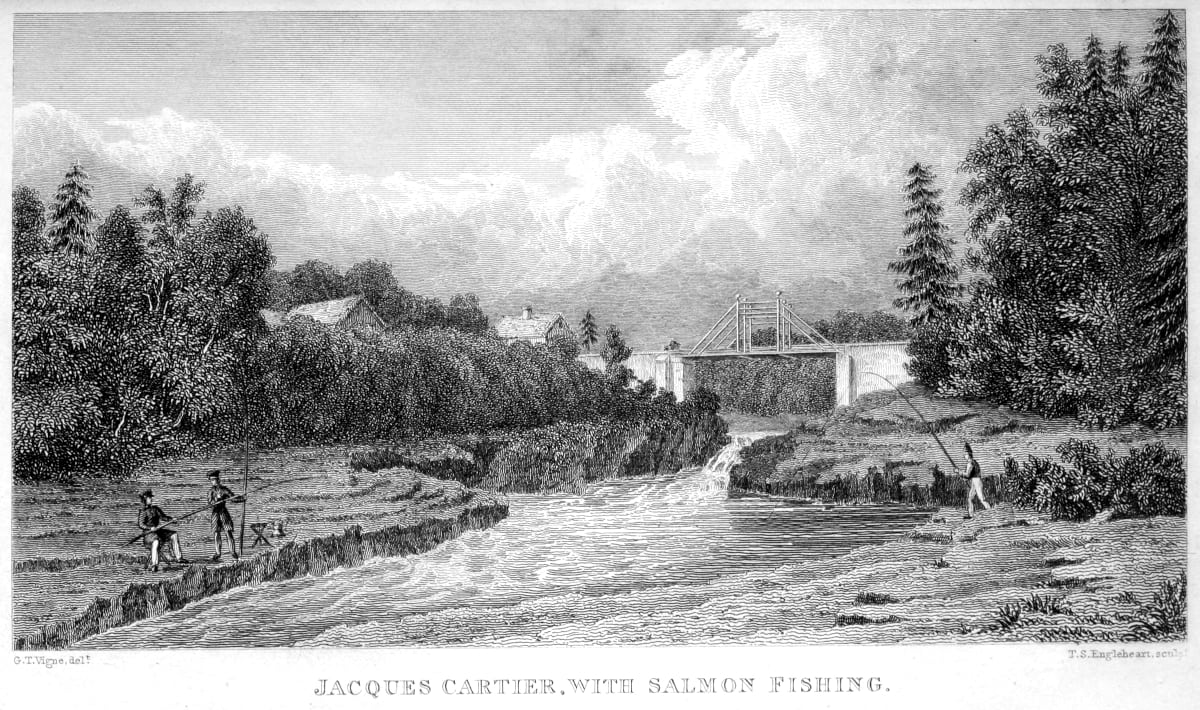
G. T. Vigne, delṭ T. S. Engleheart, sculpṭ
JACQUES CARTIER, WITH SALMON FISHING.
Published by Whittaker & Co. April 10. 1832.
The attractions of Jâques Cartier, twenty-seven miles from Quebec, were not to be so trifled with. This is the finest place for salmon fishing in the Canadas, and a very pretty spot into the bargain. All is as it should be; there is a small, but clean and comfortable country inn: the landlord throws a fly beautifully; his sister, a very pretty Canadian girl, waits at table; and the mother broils the salmon à merveille. The river, at all times a [153]torrent, and now very much swollen by two whole days’ rain, was rushing with the greatest fury through the narrow channel it has worn for itself through the solid rock. The bridge, which is close to the inn, is a very neat government work. Under it is a hole, forty or fifty feet in depth; and when the river is low and clear, salmon may be seen lying there in great numbers. But the season was too far advanced, the weather too cold, and the river too high; and my friend and I, seeing that we could not expect sport, returned, having killed but one salmon a-piece in the course of the afternoon. A fine open ledge of rocks extends along the side of the river, affording some excellent fishing stations. The place is named after Jâques Cartier, who first sailed up the St. Lawrence in 1535, and founded the city of Montreal. He is said to have wintered there, at the mouth of the river which bears his name. On his return [154]to France, he was of course coolly received, as he brought no precious metals. He sailed a second time, with orders to establish a colony on the St. Lawrence, but having had the misfortune to quarrel with the Indians, he returned to his native country to die of a broken heart.
The Canadian peasantry are of the middle size, or under it. Although they breathe some of the purest air in America, their countenances are worn, and unhealthy in appearance. They may be said to be smoke-dried, being seldom without a pipe in their mouths, and in winter they shut themselves up in their cottages, and breathe an atmosphere of tobacco fumes. I am not of course speaking of the athletic progeny of British settlers, when I affirm that a tall, fine hale-looking man is rarely to be met with. Nevertheless, the French Canadians are a brave, hardy, independent race, and happier, I should imagine, than any peasantry in the [155]world. They pay no taxes, or just sufficient to keep the roads in repair. Most of them have small farms, and find a ready market for the produce; and those who have no land of their own, can easily find employment with those that have. They never give away money, but are exceedingly hospitable in other respects; and the poor Irish emigrant, who is travelling barefoot and pennyless to the place of his destination, is sure of a meal at any cottage where they have one to give. There still remains much of the French naiveté in their character, and at a few miles from Quebec, they know and care as little about the proceedings of government, as the Irish peasant did, and does now, about Catholic emancipation. Without meaning to detract from the merit of their charity, it may be remarked, that there is something like a spirit of conciliation, if not of apprehension, mixed up with it, for they are afraid that the “Bas de soie,” [156]as they call the stockingless Irish, will finally drive them and their descendants from house and home.
The population of Upper Canada, which I did not visit (my time being occupied in the unexpected voyage on the Great Lakes), is about 250,000. That of Lower Canada may be estimated at 500,000; but the amount in both provinces is rapidly increasing. Sixty thousand emigrants had landed at Quebec in 1831, before the river was frozen up, being more than double the number that arrived in 1830. Many of them brought out considerable sums of money. One morning, during my stay at Quebec, an old Scotchman, who had lived about fourteen years in the Canadas, returned from Scotland with ninety of his countrymen, whom he had persuaded to follow him: he himself bringing with him several thousand pounds, and the others possessing one, two, [157]or three hundred pounds a-piece. Two thousand of the emigrants that arrived in Upper Canada, were small farmers from the North of England.
The soil of Upper Canada is as productive as any in the world, so that the emigrant has no occasion to pass into the United States, in order to obtain a better, unless he proceed to particular spots where he would be liable to catch a fever and ague, and where the excessive heats together with the moisture and richness of the soil, render it so hastily prolific, that it is often a matter of great uncertainty whether a crop will arrive at perfection. The strong natural prejudice in favour of the British flag; the fact that the British manufactures can be purchased after payment of a very trifling duty of two per cent., whereas they must have paid an average duty of 30 per cent., if coming viâ the United States: that lands of equal fertility, and possessing equal advantages of situation, are sold at one half the [158]price that is paid in the United States: that the climate of the Canadas is most decidedly the healthier of the two; are additional and substantial inducements to a permanent residence in the British colonies. Good land in the best situations is sold by the Canada land company at from 10s. to 15s. the acre: their sales for the year 1831, having amounted to 100,000 acres at an average price of 10s. per acre. One-seventh of the lands in every township in the United States is reserved for the payment of the clergy; and the agent for the clergy reserves, is authorized to sell 100,000 acres a year at 15s. an acre.
The nature of uncleared land is known by the timber which grows upon it. Where a great variety of timber abounds, the soil is generally a black loam. A clayey soil is known by the great proportion of firs intermixed with other trees, but when they grow alone, it is found that sand usually predominates. This is also the case where there are none but oaks and chestnut [159]trees. Potatoes and turnips succeed better than any other crop on newly cleared land.
Both in the United States, and the Canadas, great quantities of sugar are made from the maple tree. The molasses are an excellent substitute for sweatmeats. In the month of March, a notch is cut in the tree, and a small pipe of wood is fastened into it, through which the sap runs into a wooden trough that is placed to receive it, and in this manner from five to seven pounds’ weight of sugar may be obtained annually from one tree. The process of boiling and preparing the sugar takes place in the forest.
The agents of the Canada Land Company, on the arrival of emigrants at Quebec or Montreal, for the season of 1832, undertake to convey them free of expense to York or the head of Lake Ontario, in the vicinity of the choicest lands, provided the emigrants pay a first instalment in London, Quebec, or Montreal, or two shillings an acre upon not less than one hundred acres: [160]and the Company’s agents in all parts of the Upper Province, will give such emigrants every information and assistance in their power. Should emigrants on their arrival at York not settle on the Company’s lands, the money paid by them will be returned, deducting the actual expense of conveyance. At York there are large buildings expressly appropriated to the reception of emigrant families previously to their finding employment; and both the government and the Canada Land Company have waggons drawn up on the wharfs, in order to convey them and their baggage from the place of landing.
I cannot add any thing new to the particulars given in the printed papers relating to emigration, which are issued both by government and the Canada Land Company; to say nothing of the “Wiltshire Letters,” or the “Hints to Emigrants,” published at Quebec. These may all be purchased for a few pence, and the information they contain is, of course, derived from the best [161]sources. Their instructions and advice on the subject of imposition, which might be practised upon emigrants at their first arrival, will be found most useful.
Wheat at the Canadas, according to the distance from the place of export, varies from 3s. to 5s. 6d. the bushel; beef (winter) 2½d. the pound, (summer) 3½d. to 4d.; mutton in the winter is 2½d. the pound, in summer it is a little dearer; potatoes are from 1s. to 2s. the bushel; a goose or a turkey may be purchased for 2s. or 2s. 6d., and a couple of fowls for 1s. or 1s. 6d. Ship-carpenters can earn from 5s. to 7s. a-day; labourers 2s. 6d. to 4s. a-day; handicraft tradesmen from 5s. to 7s. 6d. a-day; house-servants receive from 26s. to 36s. a-month, with food; females from 15s. to 30s. a-month, with food. In Quebec and Montreal, excellent board and lodging may be obtained in the principal hotels and boarding-houses at 20s. to 30s. a-week. A labourer or mechanic would pay 7s. to 9s. 6d. [162]a-week, for which he will get tea or coffee, with meat for breakfast, a good dinner, and supper at night. An excellent private dwelling-house may be rented at from 100l. to 150l. a-year unfurnished; shops according to their situation at from 30l. to 100l. A farm of 100 acres with 20 or 30 acres clear, with a dwelling house, may be purchased in the Canadas for 150l. to 300l. according to the situation. There are, I believe, few persons who would not allow that emigration should be encouraged, at all events as a temporary remedy, and the rage for building discouraged, provided it can be done by just and legitimate means. The British government have an emigrant agent at Quebec; it encourages emigration, and finds co-operation and assistance in the Canada Land Company and the Emigrant’s Hospital at Quebec. Yet if the timber trade in the Canadas were suddenly destroyed by the measures which are said to be in contemplation, the immediate consequence would [163]be, that the efforts of government in regard to one object would be neutralized by its own acts with reference to another. At present, there are from six hundred to eight hundred ships employed every summer in the timber trade. They sometimes carry out a cargo of coals, or salt, both paying a very insignificant freight (coals sell in Quebec at 26s. the chaldron) or more usually go out as it is termed in ballast, and thus afford facilities of emigration at an exceedingly cheap rate, to thousands whose absence from Great Britain is an advantage to both countries, as far as population is concerned; and who otherwise benefit the mother country by affording an additional market for her cotton and other manufactures, which they soon find the means of purchasing. In destroying the Canada timber trade by a sudden increase of duties, she is depriving herself of all these advantages. She would bring sudden ruin upon a numerous class of [164]individuals who have large capitals invested in saw mills, and other buildings connected with the trade; she would deprive thousands of the means of buying and selling land; a number of ships would be thrown out of employment; emigration would be stopped, or at least greatly impeded for want of the facilities which are now given; England would not gain in the affections of the Canadas; she would lose a rapidly increasing market, and the benefit of a fine race of British peasantry, who would be ever ready to fight in defence of their newly adopted country.
The timber is cut in the winter, before the sap rises. Suppose then that the new duties were imposed, that the trade had consequently ceased, and that next year a war, by which the Baltic would be closed, should break out about the month of March, no timber would have been cut and prepared in the Canadas, and there can be no doubt that Great Britain would be obliged [165]either to purchase inferior timber, cut in the summer, and prepared at a great additional expense, or remain without a supply of timber for sixteen months. It is said, and with truth, that clearing, for the sake of the timber only, rather impedes than assists the progress of cultivation,—a few trees only being selected on a given space, which are squared on the spot, while the lumber and branches are left to present additional difficulty to the farmer by becoming entangled in the underwood; and it has been also remarked, that the annihilation of the trade would benefit the Canadas, by augmenting the capital and labour that is annually expended in agricultural purposes, and that the additional quantity of exported wheat, would soon make amends for their temporary loss: but it should also be considered, that the white-pine, which forms much the largest proportion of the timber exported from the Canadas, is in many places found on a rocky and sandy soil, which is not [166]available for the purposes of cultivation, and moreover that the quantity of wheat exported, is already increasing with the tide of emigration to an incalculable amount.
In a mercantile and political view, it would be better that the Canada timber trade should not be interfered with; but if any increase of the duties be resolved upon, it should certainly be gradual. One reason why the Canada timber is not so much liked as that which comes from the Baltic, is, that it is not so well squared and finished off for the market. In the first year, a gradual increase of duties might remedy this defect, by encouraging competition, while at the same time both the British government, and the Canadian capitalist, would be enabled to see their way more clearly.
A great proportion of the lands in Lower Canada is divided into seignories, which were originally granted by the French crown, under the feudal tenure. No seignory has been created [167]since the conquest in 1759: but when crown lands have been disposed of, they have been granted in what is termed free and common soccage, and laid out like the old seignories, of which there are about two hundred, in a direction of N.N.W. by E.S.E., nearly at right angles with the banks of the St. Lawrence. The seignor then made grants or “concessions” to his under tenants, which by the old French custom were thirty acres in length, by three, fronting the river. This measurement, however, is now often departed from. The seignor receives from his tenants an annual rent of a very trifling amount, which is not redeemable: he is, also, entitled to a mutation fine, called “lods et vents,” being one-twelfth part of the money paid by the purchaser of land within the seignory. The old French law compels the tenants to bring their wheat to be ground at the seignor’s mill. This custom has been sometimes objected to, but no complaint can be reasonably made on [168]the score of its being an injury to the farmer. It imposes no burden, because he can have his wheat ground at his own door, and if the seignor’s mill does not perform the work properly, he may take it to another.
In the Canadas, the civil and criminal laws of England are in force generally, subject to provincial alterations. The old French law, which was in existence previously to the year 1663, is still the law of property, with some exceptions, in Lower Canada. None of the laws enacted in France since that period, extended to the colony unless enregistered there. This is the reason why the ordinance of 1673, for the better regulation of trade, is not in force. The criminal laws of England were transplanted into the colonies, by 14 Geo. iii. c. 83, and, of course, none passed since that period can become law in the Canadas, unless they are particularly specified and included in their provisions. Properly speaking, the Canadas have no commercial code. Great [169]confusion sometimes arises respecting the decisions according to the English custom of merchants, and those made under the old French code, and actions at law are frequently settled according to what appears to be the principle of natural justice, rather than according to established precedent. This surely conveys a reflection upon the wisdom of the provincial legislature; but the fact is, that the mercantile community is not sufficiently represented in the house of assembly for Lower Canada.
Lower Canada is divided into three judicial districts—of Quebec, the Three Rivers, and Montreal, the boundary line being drawn nearly at right angles with the St. Lawrence.
There are but three courts of justice—the Court of Appeal, the King’s Bench, and the Summary Court. The governor sometimes sits as president of the Court of Appeal; but the chair is more often filled by one of the chief justices. The court is formed by all the members of the executive council.
[170]
The Court of King’s Bench is divided into a superior and inferior court. The latter has jurisdiction only where the matter in dispute is of the value of ten pounds or under. There are a chief justice and three puisnè judges at Quebec; the same at Montreal, and a district judge at the Three Rivers. When the superior court is held at this latter place, it is held by one of the chief justices, two puisnè judges, and the district judge. The summary courts have jurisdiction over property to the value of one hundred francs, and are held once a month before a commissioner appointed by the provincial government, on petition from the country inhabitants. Quarter sessions are held regularly before three magistrates, with much the same power as in England, for the punishment of offences against the criminal law; and petty civil cases may be disposed of daily by one or more magistrates. A magistrate is required to have property of the real actual value of 300l., and the oaths upon taking office are very strict.
[171]
A barrister may act as an attorney and solicitor at the same time,—which, as in the United States, appears to have originated in the impossibility of making the profession pay, without such an arrangement. Pleadings may be written in either language, and English and Canadian French are spoken almost indiscriminately in the courts. I have observed great and unavoidable confusion in the inferior court of King’s Bench—the judges, counsel, solicitors, clients, and witnesses all talking occasionally at the same time in either language, just as it may happen; and in the midst of the uproar, the Stentorian voice of the officer of the court may be heard as he endeavours to restore tranquillity by calling out Silence! (English), Silence! (French), in quick succession. But the proceedings in the superior court are conducted with all the decorum of an English court of justice; and the old jealous British lion, painted in the king’s arms over the heads of the judges, [172]frowns grimly upon the scene, with a pair of eyebrows sufficient to inspire even ermined dignity itself with awe and veneration. Many of the powers belonging to a court of equity, are exercised by the court of King’s Bench under the old French law. It grants injunctions by a process termed a sequestre. It takes care of the property of minors, and appoints curators of the persons and property of lunatics. The law of entail by a limitation, called a “substitution fidei commissaire,” is well known in Lower Canada, but seldom acted upon.
The attention of the legislature has of late been called to the state of the law of dower and mortgage, both of which are often productive of great confusion and actual injustice. Supposing there has been no renunciation of her dower by the marriage contract, the wife upon her marriage is entitled to a dower of one-half of the estate of inheritance then in the possession of her husband; and this dower is of itself an estate [173]of inheritance which descends to her children, supposing they take nothing by the “communautè,” an arrangement by which the wife is entitled to one-half of all property real and personal, acquired subsequently to the marriage. A communautè may exist with a settlement or without one, as in the case I have proposed. At the death of the wife in the life time of the husband or vice versâ, the law permits the children to elect—between one-half of the property in communautè to be enjoyed immediately, and the real estate which would have formed the dower of the wife had she survived her husband, which is not to be divided amongst them till after the death of the surviving parent. It sometimes happens that the husband and wife have joined in the sale of the estate, perhaps for the present benefit of the children, and with their knowledge. This sale, however, cannot deprive the children of their estate of inheritance in the dower after the decease of the wife, and [174]although it is justly reckoned disgraceful for the children to claim the estate from a purchaser under such circumstances, yet it is sometimes done in cases where there was nothing left to be divided in communautè. A gentleman informed me that such an instance had occurred to himself. He had purchased an estate, and had been in possession about twenty years. It had been sold by the husband and wife upwards of forty years; but they were both still living, and he was much surprised one day at being informed by the children, that at the decease of their mother, they intended to come upon him for the amount of the dower, as there was no prospect of receiving any thing by the communautè.
Till lately, under the then existing law of mortgage, a purchaser could seldom be sure of buying an unincumbered estate; a previous possessor in want of money might have been before a notary and have borrowed of a dozen different persons, on what is called a tacit mortgage. No [175]title deeds were required by the lender, but all the property of the borrower is liable for the amount borrowed; and claims of this kind were constantly made upon estates even after the possessor, who had taken all pains to clear them off, had reason to think himself secure in the enjoyment of them. But by a bill that passed the legislature in 1828, newly purchased property is cleared against creditors who do not put in their claims within four months, the rights of widows and minors forming an exception.
No writ can issue to secure the person of a debtor in the common gaol until all his property real and personal has been sold, the real property having been advertised in the Gazette for four months. At the expiration of that period, attempts are sometimes made by a fraudulent debtor or his friends, to evade imprisonment by a purchase in the debtor’s name of real property to a trifling amount, which must be again advertised, and so on; although of course wherever the [176]attempt to defraud can be made apparent, the courts of justice will interfere. In cases of a commercial nature where a judgment has been obtained, the debtor has the right of being enlarged, upon giving security that he will not leave the limits of the city.
In general, the Canadian farmers when old and unable to work, make over their property by a notarial writing to one of their sons, on condition of his paying a certain sum of money to his other children; a custom which has the effect of preventing too great a division of real property. In the deed, which is rather curious, it is stipulated that the old man is to be supported by his son; that he is to receive from him a certain quantity of tea, sugar, and tobacco; he is to be furnished if necessary with a horse to ride to chapel on Sundays and festivals; and when dead a certain number of masses are to be said for his soul.
The governor of Lower Canada is assisted by [177]an executive council, composed of any persons whom he chooses to recommend to his majesty for appointment. The legislative council, of which the members are also appointed by the king for life, and the Lower House, or House of Assembly, consisting at present of eighty-four members. The Chief Justice is the Speaker; and the puisnè judges of Quebec are members of the Legislative Council; but it is in contemplation to procure an act of Parliament to remedy this unconstitutional arrangement. Independently of the objection that could be urged against it as an abuse, the judges find ample employment for their time in their other avocations. They were placed there as a matter of course when the colony was in its infancy; but the reasons have ceased as the colony has increased in wealth and population. The Legislative Council is composed of the principal officers of the province, and other persons of consideration. Their [178]number is unlimited, but is usually about thirty. The members of the House of Assembly are elected in the same manner as the members of the House of Commons in England. Quebec and Montreal return four members each. There are but two boroughs; William Henry or Sorel returning one member, and the “Three Rivers” returning two members. The other members are returned by counties, but no qualification whatever is required of any. This is an advantage in a young country, where society is comparatively small, and wealth is so often separated from talent. The qualification necessary for a voter is real property to the annual value of forty shillings. In the towns the payment of ten pounds a-year rent is sufficient, and single women are allowed to vote. The sittings of the Legislative Council, and the House of Assembly, do not usually occupy more than ten weeks in the year, commencing about the middle of January.
[179]
By far the larger proportion of the House of Assembly are of the radical persuasion. Like the rest of the old French Canadians, they have a strong negative attachment to the British government: because they are satisfied with the protection they enjoy, and are aware that they could not exist without it; but their proceedings evince little actual gratitude or affection for the mother country. Their grievances, whether they are those that really do exist, or those that are to be traced in the imaginary discontents of a few leading demagogues, being frequently discussed with more than constitutional jealousy, and with more petulant vehemence than is merited by the redressing and conciliatory spirit of the British government. And yet when we consider the events that are passing in Europe, it is not singular that such should be the conduct of a people, of whom it is said, that when a constitution was first talked of, they would have preferred that their [180]country should have continued under the direction of a governor and council, or rather under that of a governor alone.
During the last session a bill passed the house of assembly, for an allowance to the members of 10s. a-day, beside their travelling expenses, but was rejected by the legislative council. Nevertheless when the Supply Bill came under consideration, the house of assembly tacked on the desired amount for the payment of their members, and the bill in that state was most inconsistently consented to by the legislative council.
Another instance of unconstitutional irregularity may be mentioned. The 31st of Geo. iii., c. 31, declares who shall be qualified to sit as members of the assembly, but it creates no disqualification to sit and vote in persons accepting offices of trust and profit, after their election. By this act also, no bill reserved by the governor for the royal signature shall have any force or [181]authority within either province, unless his majesty’s assent thereto shall be signified within the space of two years from the day on which the bill shall have been presented for his majesty’s assent by the governor. In the year 1830, after various proceedings in the same matter, a bill for the disqualification of persons accepting government offices, until re-elected, from sitting in the legislative assembly, was passed by both houses, and the governor thought it of sufficient importance to reserve it for the royal assent. Two years, as we have seen, is allowed for the signification of his majesty’s pleasure, and if no answer is given in that time, the bill passes into a law forthwith. The bill was sent to England, and long before the time had expired, the impatient house of assembly entered a resolution on their journals, that any member accepting an office under government shall be considered as vacating his seat ipso facto, with the capability of being re-elected. As to the justice of the [182]case, there can be no doubt; but when they themselves had commenced the application in a constitutional manner, their subsequent attempt to fly in the face of the prerogative does not reflect much credit on their loyalty.
The net revenue of Lower Canada for the year 1830, was 128,345l. 3s. 4d., being an increase of 5200l. over the preceding year. The bulk of this sum is at the disposal of the provincial legislature; and is expended in the country on internal improvements of every kind. The proposed civil list for the year 1831 amounted to 19,500l.; but 14,000l. of this is all that is asked of the province by the royal message, besides a reservation by virtue of the prerogative, of what are termed the casual and territorial revenues of the crown, such as the rents of the Jesuits’ estates, rents of the king’s posts, &c. &c., which, to use the words of the governor’s message, of the 23d of February, 1831, can operate in no degree as a tax upon the people, or tend [183]either in their nature, or in the mode of their collection, to impede or impair the prosperity of the province. But nevertheless the committee of the house of assembly have resolved never to compromise what they call the natural and constitutional right of watching over and controlling the receipt and expenditure of the whole revenue. Will they object when the remuneration of their clergy is thrown upon them, as is contemplated by the British government?
It would be tedious, and far beyond the limits of this work, to enter into a detail of all the grievances complained of by the house of assembly; many of them have been, or are in the way of being, remedied, and they may be found in the report of the committee of the house of commons on the affairs of the Canadas, in 1827. They complain in their petition to parliament that the affairs of the province were growing worse under the existing government; that the value of land was diminished; that there [184]was a waste of the public revenue; that the enactment of beneficial laws was rejected by one branch of the legislature composed of persons dependent on the government; that the creditor of the government had not sufficient remedy; that sufficient security was not required of persons having the disposal of the public moneys; that the independence of the judges was not sufficiently consulted; and they asked for the appointment of a resident agent for the colonies, in England, &c. &c.
One of the schemes at present in agitation in the house of assembly is the entire dissolution of the legislative council; a measure which that more loyal body do not exactly relish, and on the 31st of March, 1831, they passed a number of resolutions expressive of their loyalty, and respectfully setting forth their grievances at the same time. In the report of a special committee of the house of assembly appointed for taking into consideration the governor’s message, [185]in which his majesty, relying on the liberality and justice of the legislature of Lower Canada, invites them to consider the propriety of making some settled provision for such portion of the civil government of the province, as may upon examination appear to require an arrangement of a more permanent nature than those supplies which it belongs to the legislature to determine by annual votes; it was resolved, that as information relative to the expenditure of the sum demanded for casual expenses, and divers services, and of the manner in which the rents of the Jesuits’ estates, and the other casual and territorial revenues, are applied, was still refused by the British government; they had therefore deemed it inexpedient to make “aucune allocation permanente ulterieure pour les depenses du gouvernement;”—the legislative council, in their resolutions noticed above, having expressed a cordial disposition to concur with his majesty’s government in making such an arrangement.
[186]
The Jesuits’ estates, the convent, and the seminary, hold the city of Quebec in signory. The convent of the Jesuits is now converted into a barrack, and forms one side of the market-place in the upper town. By the way, I should recommend any traveller to visit the market-place in the lower town, where he will see some of the old French Canadians, with their long pig-tails tied up with eel-skins. The order of the Jesuits was suppressed at the conquest of the colony by the British. Government took possession of the estates belonging to them, and has since enjoyed the whole revenue, amounting to about 2500l. per annum; and though frequently applied to by the provincial legislature, has thought fit to conceal the manner in which it has been employed. Amongst other expenses, those incurred in the building the episcopal church, were, it is said, defrayed from this source.
Before I quitted Quebec, I was present at a ball, given by a lady and gentleman who had [187]been united for the first time that day fifty years, and were again married on that morning by a Catholic priest.
I returned from Quebec to Montreal by the John Bull steam-boat, probably the largest river boat in the world. Montreal is considerably larger than Quebec, and contains 50,000 inhabitants. Its front towards the river will be much improved by a fine quay which is now building. The principal objects are the convents and the new Catholic cathedral, a very large and handsome specimen of the simple gothic; but its internal decorations do not correspond with its majestic exterior. The view from the mountain of Montreal, nearly 700 feet high, is of the same kind, but I think inferior to the view from the ramparts of Quebec. The city is nearly two miles distant, and is seen to great advantage lying along the bank of the magnificent St. Lawrence, whose [188]broadly expanded waters can be followed by the eye for many a league, both above and below the city. On the opposite side, the country is one vast flat plain, from which the isolated mountain of Chambli, and another peak at a few miles distance, abruptly arise; and by relieving the monotony of the view, have the merit of giving it a decided tone and character, to which it would not otherwise be entitled. The horizon is formed by the bold outline of the distant mountains of Vermont, and those of the eastern part of the state of New York.
I left Montreal to make an excursion up the Ottowa. The beauty of this river, the situation of Bytown, and the Rideau canal, were themes of admiration with every one who had seen them. I went on board a steam-boat at the village of La Chine, and in a few hours we were in sight of St. Ann’s, and alongside the rapids, which we passed by means of a short [189]canal. About this spot the clear but dark-coloured “Ottowa tide” is chequered by many a green isle, if they can be so called, when clothed, as I saw them, in the diversified and brilliant colours that characterise the foliage of the American forest during the autumn. Every variety of green can be discerned—from the darkness of the fir, to the silvery leaf of the poplar or the willow—while the unaccustomed eye is delighted by the bright yellow of the fading hickory, and the admirable finish which is given to the picture, by the broad patches of deep and actual crimson of the sumach and the soft maple. I must again repeat, that I have seen nothing of the kind that can equal the surpassing beauty of an American forest in “the fall.” It may with justice be compared to the brilliancy of a bed of tulips. We entered the lake of the Two Mountains, so called from two lofty hills on the right. On the top of one of them, Mount Calvary, is a chapel [190]built by the Jesuits, and connected with the Indian village on the margin of the lake by a line of chapels, placed at intervals in the pathway. Its sudden appearance in the bosom of the forest, is extremely effective and picturesque. Immediately behind the Indian village is a large bank of white sand, which in the distance may be easily taken for a well-cleared stubble field. At Carillon we were obliged to leave the steam boat, and proceed by land to the town of Grenville, along the side of the canal, cut for the purpose of avoiding the rapids of the “Long Saut,” which, when the river is swollen, are said to be exceedingly violent, even more so than those of the St. Lawrence. I found the banks on both sides of the river were cleared and cultivated to a degree that far exceeded my expectations, whilst the unfinished canal gives employment to several hundred poor emigrants, who were living chiefly in log-houses along the road-side, ranged amongst many other dwellings of a better description.
[191]
The Ottowa, although perceptibly inferior to the St. Lawrence in width and volume, is still one of the largest second-rate rivers in North America. Below Carillon, which is thirty-five miles from St. Ann’s, I observed nothing excepting the foliage I have mentioned, that an acquaintance with American scenery had not rendered familiar; but on approaching Grenville a lofty range of hills, containing rich mines of plumbago, ranges very majestically on the north bank of the river, which in many places is widened to a surface equalling that of a small lake, with its shores broken by majestic headlands. Soon afterwards, cultivation comparatively ceases, and the river bears a resemblance to the wilder part of the Ohio above Louisville, excepting that the forest trees on its banks and islands, are not so lofty as those of the latter river.
Bytown is 65 miles from Grenville and 120 from Montreal. It is divided into an upper and [192]lower town; containing many excellent houses. Thirty years ago, there was scarcely an habitation in the vicinity, excepting that of Philemon Wright, Esq., a Bostonian, and one of the best farmers in Canada, who with singular enterprise and sagacity, foresaw that at no very distant period it must become a place of importance, and as the Americans would say, “located himself” in the untouched forests of the Ottowa. A new world has sprung up around him, and he now predicts, with great appearance of truth, that Bytown will become the capital of the country: a glance at the map will shew the justice of his reasoning. The Ottowa or Grand river, runs through the country for about 500 miles above Bytown. In its course it is joined by several considerable streams, by means of which a water communication can be extended to Hudson’s bay on the north; and on the south it is connected with Lake Huron, which is not more than 100 miles distant, through the medium [193]of Lake Nipisany; and as the Saut de St. Marie, at the foot of Lake Superior, is said to be 800 miles nearer Montreal than to New York, it is highly probable that a considerable proportion of the product of the country around the great lakes, even from the further part of Lake Michigan, will find its way to the Ottowa.
The pretty, unpretending fall of the Rideau, so called by the French from its resemblance to a white curtain, is seen on the left immediately before the boat rounds the headland that conceals the locks of the celebrated Rideau canal, which are suddenly presented to the view, lying in a slope, between two lofty and precipitous banks, nearly perpendicular towards the river. That on the right is 160 feet in height, composed of limestone. On the area of the top, which may be from 500 to 600 yards in circumference, are the barracks and the hospital. It will probably be the site of an impregnable fortress, which might be built for 60,000l.; an [194]expense which should not be spared, when it is considered that the splendid works on the canal, at present unfortified, might be destroyed in half-an-hour. The locks themselves, eight in number, are magnificent in every respect, and reflect the highest credit on the engineer, Colonel By. In length they occupy a space of 1260 feet, and from the surface of the river to the top of the bank there is a perpendicular rise of 84 feet. Each lock is 134 feet long, 33 wide, and 17 in depth. The canal, for several miles above Bytown, is supplied by the Rideau river, and before it reaches Kingston on Lake Ontario, a distance of 140 miles, a head of water is obtained by means of thirteen dams of different dimensions, the largest being 300 feet wide and 65 deep. The navigation is continued by means of these dams, as there is not above seven or eight miles of excavation throughout the whole distance.
On the supposition that military stores are to be sent from Montreal to supply the troops in [195]Upper Canada, or a fleet on Lake Ontario, it is intended that they should pass through the channel behind the island of Montreal, which is not yet rendered navigable; that they should proceed up the Ottowa, ascending the rapids by means of the Grenville canal, and upon arriving at Bytown, be forwarded to Kingston along the Rideau, which thus affords a method of communication infinitely shorter than any land conveyance,—an additional advantage arising from its great distance from the American frontier, and proportionate security from hostile incursion. Although the Rideau canal is principally a military work, it will be of the greatest importance in a commercial point of view, on account of its affording a direct means of conveyance by its communication with a number of smaller streams that intersect it at intervals, and which will enable the settlers who live many miles from the banks to forward the produce of their farms, with certainty and celerity. The difficulty and [196]expense of conveyance was originally a great drawback upon the use of British manufactures in the Upper Province; they paid a freight from Quebec of 5l. a ton; but by means of the Rideau canal, the freight has been reduced one-half. Land, according to its situation on different parts of the canal, was selling from two to five dollars the acre; crown lands at a fixed price of 1l. the acre. On application to any of the crown land agents, a ticket may be obtained, containing a permission to cut timber on a certain space of ground, on payment of a duty to government of one penny the foot.
On the opposite side of the river stands the village of Hull. A winding road about a mile in length conducted me to the bridges thrown over the fall of the Ottowa, which according to the usual appellation bestowed by the French upon any fall of magnitude in the Canadas, is termed the “Chaudiere,” or “boiler.” The bed of the river is divided into five channels [197]formed in the solid rock, with more or less of a fall in each of them. The largest may be about thirty feet in height, and from its greater violence has worn away the precipice for a considerable distance behind the others, which project and recede in a most singular manner, whilst the river not contented with so many ways of escape, rolls over the bare ledge of the rock that is extended between them, so that its eager waters are tumbling in all directions. The whole width of the stream immediately at the head of the fall, is more than half a mile. It was not particularly full when I saw it, but was darting through the bridges with extreme violence. In the spring, when the river is swollen by the melted ice and snow, the whole of the rocks are so deeply covered by the flood, that there is little or no fall to be seen even at the Chaudiere, as the principal fall is called; and I could easily conceive that the rush of water at that season of the year must be tremendous. The whole scene was exceedingly [198]curious; and although rather disappointed at first sight, I felt myself amply repaid for my excursion to Bytown. When it was first understood that a bridge was to be thrown across from rock to rock, an old American who had known the river in its fury, and firmly believed that such a scheme was impracticable, was heard to predict with great emphasis, and corresponding action, that some day or other “it would go right slit to immortal smash.” Many of the poor Scotch emigrants answered to my inquiry as to their destination, that they were “ganging to Perth;” a thriving town, about fifty miles above Bytown, and situated between the Ottowa and the Rideau canal. Thirty miles on the river above Bytown, is the settlement on the Lake “des Chats.”
On the evening of the fatal field of Culloden, the unfortunate Prince Charles Edward presented himself, wearied and alone, at the door of a hut, and requested sustenance and momentary [199]concealment; the inmate, a poor tailor, who recognized his person, mounted guard at the door whilst his illustrious guest was sleeping within, on a pallet of heather. He was soon aroused by the tailor, who awakened him by exclaiming in Gaelic, “My prince, core of my heart! save yourself, for the enemy are upon you.” A party of cavalry were galloping towards the hut, and the prince had just time to escape through a small back window, and reach the Morven mountains. For his greater comfort in repose he had deposited his sword upon a bench in a corner of the hut; and in the precipitancy of his flight he had forgotten to take it with him. The tailor had just time to conceal it, by removing the earth and burying it under the heather. The cavalry demanded the prince, saying that they had information that he had taken refuge in the hut, and carried off the tailor as their prisoner, who was afterwards confined in Edinburgh castle. In the mean time the sword [200]still remained where he had buried it, but the hut became a heap of ruins. Whilst the “Clan and Disarming Act” (afterwards repealed by the exertions of the Duke of Montrose) was in force, he dare say nothing about the sword, but upon his death-bed in Breadalbane, the poor tailor informed his cousin, Finlay Mc Nauton, where the sword was to be found. He searched and found it, in the spot where it had lain from 1745 to 1784. The belt and scabbard were rotted with moisture, and the blade of course nearly covered with rust. It is the real old Highland basket-hilted claymore. On the rust being removed, the burning heart of the Bruce surmounted by the crown of Scotland became visible on the blade. Between them is engraved “Le Chevalier.” On the reverse are the words, “Vive le Roi,” extending the whole length of the blade. Finlay Mc Nauton joined the veteran battalion, and died at Gibraltar, the sword being still in his possession. Upon his death, it [201]passed with the rest of his effects into the hands of John Mc Nauton, his brother, who is still alive at a very advanced age in Glengary, the oldest settlement in Upper Canada. Who would expect to hear that this sword, positively the most classical object in America, is now, as it were, lying in state on the banks of the Lake “des Chats,” in the wild forests of the Ottowa, not less than 150 miles from Montreal. Mc Nab of Mc Nab, the nephew and representative of the late laird, founded the settlement with the advice and under the auspices of his kinsman, the Earl of Dalhousie, the late governor of Lower Canada. He has collected around him about two hundred of his clan, whose forefathers followed his ancestors in the hour of battle, and have now gone with him in the day of their distress to clear and cultivate the wilderness of the Ottowa under his superintendence. He has possession of the sword, and never shows it to a stranger but in the presence of his piper, who [202]is ordered to play the whole time. It was given to him by John Mc Nauton, who added in Gaelic, that “some damned long-legged fellow of a Sassanach had asked him for the sword and offered him money for it, but that he would never disgrace the clan of Mc Nauton by giving over that sword to an Englishman.”
The boundary line between Upper and Lower Canada leaves the St. Lawrence about 28 miles below Cornwall, and after running in nearly a straight direction, comes in contact with the Ottowa river at Point Fortune, opposite to Carillon. It pursues the course of the river for many a league beyond the habitations of civilised society; and then strikes off to Hudson’s bay. During the last session, an Act was passed in the provincial Parliament for the appointment of Commissioners to ascertain its exact direction, in order to satisfy the borderers, who complained of being subjected to the laws of either province alternately. The idea of an [203]union of the two Canadas has apparently been dropped for the present. Perhaps the majority of the British inhabitants in both provinces would be in favour of such a project, or at all events would not offer much opposition to it; but the French population in Lower Canada would display a most violent aversion to any change of the kind. The old French law would of course be superseded by the laws of England subject to provincial alterations, and the French Canadian influence in the government would decline in proportion to the importance of the British interest in the House of Assembly, which would be increased by the accession of delegates from the Upper Province. Upper Canada would have no objection to a port of entry, by which her share of the duties on imports would be exactly regulated by the quantity she consumed. Every ship trading to the Canadas must of course discharge her cargo either at Quebec or Montreal. By the arrangement, [204]solicited and obtained by Upper Canada in 1822, no duties can be laid on goods imported or passing into Lower Canada without the consent of both provinces, or by the British parliament; and the just proportion of the duties due to each province settled by arbitration, and its share paid over to the Upper Province. The proportion it now receives by the existing regulation is 25 per cent.; but this it will be seen must be increased, when it is considered that by far the greater number of the settlers resort to the Upper Province, that the French Canadian peasantry usually prefer the coarse cloth of their own manufacture, and that therefore the bulk of the imports from Great Britain must find their way to the northern shore of Lake Ontario.
It is probable that much confusion would ensue for a length of time after an union should take place, and it is equally so, that the Canadas themselves would eventually be gainers by the measure; but the more serious question is, [205]whether it is not better for the mother country to have two parties there, instead of one; and whether it would be politic in Great Britain to promote an arrangement that would render the colonies far more independent than would be consistent with their allegiance to their mother country. As it is, the French Canadian interest is really on the decline, and the British population is wonderfully increasing. Every thing considered, the Canadas are improving with a rapidity not surpassed by any country upon earth; and I humbly conceive, that experimental interference should be deprecated, because it would lead to a certain interruption of their present career of prosperity, for the sake of a distant and not certain advantage.
I returned to Montreal. When a traveller approaches Montreal he naturally turns his eye to the mountain behind it, and feels surprised that there is no fortification by which a city of [206]so much importance, and so near the American frontier could be commanded,—strictly speaking, a fort should be built on the top of the mountain, and at La Chine, and on Nun’s island, by which, together with the batteries on St. Helen’s island in the river, immediately opposite to the city, the passage of the St. Lawrence would be effectually defended. But, when it is considered that the top of the hill, or mountain, is three miles from the city; that it requires eleven pounds of powder to throw a thirteen-inch shell to the distance of one mile; that all the fortifications in the world would not preserve the Canadas to us, if the natives were against us; that the Americans could never take Montreal so long as the Canadians would fight on our side; that there is a prospect of a lasting peace between Great Britain and the United States; and finally, the probability that before another half century has passed away, the Canadas will cease, by a bloodless negociation, to be a British colony—an [207]enormous expense may well be spared, by leaving the city in its present state.
The picturesque island of St. Helen’s, contains a small garrison, and a large quantity of military stores. On the angle of the saluting battery on the south-west corner of the island, the French flag waved its last in the Canadas.
I left Montreal, after having discovered that there was a pack of fox-hounds kept close by, and that they hunted regularly, and occasionally on by-days. They had not been long organised, but promised very well. I was also present for one day during the races. The course is two miles in length, and in excellent condition, being railed off the whole distance. I saw one race, which was admirably contested; but the ground was not well attended, and the others did not go off with spirit. I was told, however, that there was a great prospect of improvement, as the Canadians were beginning to be fond of the sport. The excitement would have been much [208]greater if it had lasted but two days instead of four; and a public ball afterwards would not have been amiss.
I then crossed the river in a steam-boat to La Prairie, distant nine miles from Montreal. A miserably bad road conducted me to Blair Findie, and subsequently to the very pretty village of Chamble, where orchards and corn-fields were to be seen on all sides. Both these places, particularly the former, are well known to the Canadian sportsmen as the favourite haunt of the woodcock—perhaps the best in America. They are found in great numbers in the low birch woods around Blair Findie, where a good shot will sometimes kill above twenty couple in a morning, and I heard that in one instance as many as eighty couple were killed in two days by two guns.
The beginning of October is the best season for shooting all kinds of game in the Canadas.
The American woodcock is considerably [209]smaller than the European bird, seldom or very rarely exceeding eight ounces in weight, and its plumage is, I think, handsomer. The spots of brown on the back are larger and deeper, and the breast, instead of being marked with dusky bars, is of a fine almond colour. Their flavour is similar. The American bird when flushed, rises very rapidly, with a small shrill quickly repeated whistle, and seldom flies beyond a distance of one hundred yards. Sportsmen who do not mind the heat, will find the shooting exceedingly good in the month of July, when the woodcocks first return from their southern haunts for the purpose of breeding. In the northern States and the Canadas, they may be shot till the first fortnight in November has elapsed, after which they retreat to a warmer climate for the winter. No pheasant, partridge, or quail, is strictly speaking found in North America. The partridge, so called in the States, is the quail of the Canadas: but although on [210]account of its size and general appearance it might easily be mistaken for the latter bird, it is in fact a species of the new genus, “ortyx.” The difference between the real quail and the ortyx of America, like that between the long and short-winged hawks, consists in the structure of the wing: in the one, the second feather is longest; in the other, the fourth, which evidently unfits it for taking a long flight. The “ortyx virginianus” has become naturalized in Suffolk, and has been shot near Uxbridge. A species of the genus coturnix, or real quail, has been found near the Straits of Magellan. The pheasant of the States is the partridge of the Canadas, and is in fact a very handsome species of grouse, feathered down to the toes, and having in a great measure the habits of the capercaily, living entirely in the woods, and treeing readily when put up by a small dog. I have before noticed the grouse, or barren, or prairie hen. In the Canadas there is also a darker coloured species, [211]called, the spruce partridge. A large grouse, nearly allied to the capercaily in size and colour, is found near the Rocky Mountains; and although five or six different kinds of grouse are to be found in North America—including, I believe, the ptarmigan—yet the black and red game of Scotland are not among them. A smaller species of red grouse is plentiful in Newfoundland.
The same animal is called a hare in the States, and a rabbit in the Canadas. It never burrows; its usual colour is that of the European hare and rabbit mixed, and the meat is dark, like that of the European hare. A larger species which turns white in the winter, and is termed on that account, the varying hare, is more common in the Canadas than in the States, but is no where plentiful. I would here remark that any traveller who brings his gun with him, and has a decided wish to see some American shooting, should bring his own dog with him; any that he [212]can depend on for general purposes, be it of what breed it may.
America offers a fine field to the ornithologist, and even a traveller who is usually careless of the study of natural history, cannot fail to be delighted with the variety of beautiful birds which he will see in merely passing through the American forests, more particularly in those of the States. Red birds, blue birds, and yellow or Baltimore birds (a species of starling), will frequently fly across his path; turtle doves are constantly alighting in the road before him; a large, magnificent species of woodpecker, with a red crest, usually termed the woodcock, will sometimes make his appearance; a great variety of the same genus, particularly a small species with a marked plumage of black, white, and crimson, are almost always in sight; he will be startled and deceived by the mew of the catbird,—and his eye and ear will be attracted by the brilliant plumage of the blue jay, the singing of the [213]mocking-bird, the melodious flute-like whistle of the wood-thrush, or the instantaneous buz of the passing humming-bird. Considering the wildness of the country, I was very much surprised at the scarcity of the larger birds of prey; a small brown vulture, commonly misnamed the turkey-buzzard, is however an exception. I never saw but one bald eagle in America: he was beating for his prey over the mountain of Montreal; his snow-white head and tail being discernible at a great distance. They are more numerous on the sea coast, near the haunts of the fish-hawk (osprey). When this latter bird has taken a fish, the bald eagle who has been watching his movements from a neighbouring height, will commence a most furious attack upon him, will force him to drop his prey, and frequently seize it before it can disappear under water. The bald eagle is the national emblem of the United States. It was well remarked by Dr. Franklin, that the wild turkey would [214]have answered the purpose better, being exclusively indigenous to North America, and having an innate and violent antipathy to red coats.
Chambli is a large, straggling village, containing perhaps 5000 inhabitants, of which 4000 are communicants at the Catholic church. The Catholic doctrine, divested of the pomp and absurdity of ceremony, being no where more strictly adhered to, than amongst the peasantry of Lower Canada. The houses are scattered around what is called the basin of Chambli—a lake about three miles in length and two in breadth, formed in the Richelieu river. A canal is now forming, which in a few years will contribute very much to the prosperity and importance of the village of Chambli and the surrounding country. When finished, the course of navigation between lake Champlain and the St. Lawrence, at present impeded by the rapids at Chambli, will be safe from interruption; so that the produce of “the townships,” as the [215]lands granted by the crown are termed, will be conveyed directly to Quebec instead of passing through Montreal.
An old fort built by the French is standing at the foot of the rapids. The situation is selected with their usual judgment, it being scarcely assailable from the water. Chambli has also barracks for 1000 horse, and 15,000 infantry, but at present they are unoccupied.
I would recommend every one who has time at his disposal, to ascend the Belleisle mountain, distant eleven miles from Chambli. It is principally composed of granite, and rises abruptly from the plain to a height of more than 2000 feet. From the top may be seen the finest view in the Canadas. The eye roams on every side, over a vast extent of country, and the uniform direction of the “concessions” or lands held in signorie, contributes not a little to the singularity of the prospect. On the north, the St. Lawrence is visible on a clear [216]day as far as the “Three Rivers,” which is half-way to Quebec; on the south and east, are the mountains of New York and Vermont. The city of Montreal, at the distance of seventeen miles to the westward, would appear like a white streak on the banks of the river; but that the superior height of the towers of the cathedral are distinctly relieved by the dark wooded sides of the hill, whose elevation is much diminished by the distance. The Richelieu river appears to run at the foot of the mountain, and the whole of its course is visible from lake Champlain to the St. Lawrence. The mountain itself is exceedingly picturesque; a small and very pretty lake being embosomed in its well-wooded recesses, like that of Tarni near Tivoli. The ascent from Chambli occupied a day; but I thought myself amply repaid for the time I had expended, and the fatigue I had undergone. I proceeded to St. John’s, and took the steam-boat for lake Champlain. [217]In a few hours we passed the old fort at Rouse’s point, which by the late decision of the king of the Netherlands, on the boundary question, is now in possession of the Americans, although it stands on the Canadian side of the river. By the treaty of 1783, the boundary line between the United States and Lower Canada was imperfectly defined as extending “from the north west angle of Nova Scotia (now New Brunswick) to that angle which is formed by a line drawn due north from the source of the St. Croix river to the Highlands; along the said Highlands which divide those rivers that empty themselves in the river St. Lawrence from those which fall into the Atlantic ocean.” But as the land had never been surveyed, so that the position of these Highlands might be ascertained, and it having always been disputed which were the rivers referred to, commissioners were appointed at the treaty of Ghent, to determine the true boundary, and as they could not [218]agree, the king of the Netherlands was proposed as an arbitrator. Two lines were laid before him, on one of which he was to decide; one drawn by the Americans on the north of the Temisconata lake, and the other by the British 300 miles to the south of it. His majesty, however, in his award followed neither of them; but has drawn a line between them to the river St. John, transferring to the United States about six millions of acres; and has brought the most northerly point of the boundary for sixty miles within thirteen miles of the St. Lawrence, whilst 200 miles below, it strikes off to the south-east after having approached within fifty miles of Quebec. The old French Canadian settlers on the St. John and Madawaska settlements, and who, like the rest of their countrymen, have a mortal antipathy to the Americans, are exceedingly annoyed at being thus transferred into the dominion of the States; but as both Great Britain and the United States are dissatisfied [219]with the decision, it is probable that some other arrangement will be made.
We then passed the isle Aux Noix, the British naval establishment on lake Champlain, I observed several schooners on the stocks, remaining, like the ships at Kingston, as they were at the close of the war, and several old gun boats that appeared to have taken part in it. The expenses of the fort, which effectually commands the passage from the lake, are the same as those of a frigate; and, as such, are placed on the naval establishment instead of the military.
Upon entering the lake, the shores appeared extremely flat and uninteresting. We touched at Plattsburg, and passed over the scene of Mc Donough’s victory over our fleet in the last war. We then arrived at Burlington, and at nine o’clock the next morning I started to cross the New England, or Yankee States, on my way to Boston. The coachman drove six-in-hand, [220]and in a very workmanlike manner, without locking the wheels, but descending several hills so steep that as a Yankee expressed himself, It was like driving off the roof of a house. A detailed description of the road is unnecessary: it wound through the beautiful and well cultivated valleys of Vermont and New Hampshire, running for many miles along the banks of the Onion and Connecticut rivers; whilst the forests on the hills around were every where clothed in their splendid autumnal garb, and overshadowed some of the prettiest and happiest looking villages I ever saw in any country; the houses being chiefly white, with green blinds, and otherwise displaying an excellent taste in design. Whole fields were strewed with enormous pumpkins, and others were covered with broom corn, which is no bad substitute for oats. We passed through Montpelier, and skirted the rocky mountain of Monadnoc, stopping to look at the Bellow’s fall, on the Connecticut river, and [221]afterwards arriving at Concord, where the fire of the British troops was returned by the Americans for the first time during the revolutionary war, on the 19th of April, 1775. General Gage had sent them to seize and destroy some stores which had been secretly collected at Concord. They succeeded in their attempt, but were subsequently obliged to retreat. The fight took place at the north bridge, about three quarters of a mile from the bridge over which the road now passes. The inhabitants are proud, and justly proud, of this event.
At Lexington, six miles nearer to Boston, stands a plain monument to the memory of the militia men who were fired upon and dispersed by the British troops on the same morning, previously to their advance upon Concord.
I entered Boston by the light of innumerable lamps, that plainly marked the direction of its many bridges, and took up my quarters at the Tremont hotel,—decidedly, taken altogether, [222]the best house in the United States. The table and the bed-rooms were equally good, which is not the case at any other I had seen. In appearance it more resembles a government building than a hotel. Breakfast, dinner, tea, and supper are served up, as usual, at a certain hour; and although that hour at breakfast time is liberally extended, yet if it happens that a person be detained too long, he must either go without his dinner, or put up with cold and disfigured viands placed before him with an ill grace by a tired waiter, or pay extra for a meal expressly served up for him; as the hotel charges are two, or two dollars and a half a-day, and it makes no difference whether he attends the table d’hôte or not.
The principal theatre is exactly opposite the Tremont. The front is ornamented with Ionic pilasters supporting an entablature and pediment. The interior is tastefully arranged, but is seldom visited by the first circles.
[223]
The Indian name of Boston was Shawmut, its first English appellation was Trimountain, and its present name was given in 1630.
At an early day after my arrival, I took the opportunity of ascending the capitol, which stands on the most elevated corner of “the Common.” The Common, according to the usual English signification of the word, deserves a better name, as it is the prettiest promenade in the States. It contains about seventy-five acres, disposed in a sloping direction from north to south, varied by other eminences, of which the most conspicuous is formed by the not yet quite levelled remains of the British fortifications of 1775. It is surrounded by trees, and the best houses in Boston; some of them being large and handsome, and not the less deserving of the epithet because they are of a stone colour, or any other than that of red brick. But at Boston generally I observed greater taste in this respect than in any other of the cities which I visited. On one [224]side of the Common is a mall, or promenade, formed by parallel avenues of fine elm trees; but yet, notwithstanding the beauty of its situation, it is deserted by the Boston belles for the gay glitter of the fashionable shops in Cornhill or Washington street.
To the best of my recollection, every capitol or state-house that I have seen, or of which I have seen a picture, is surmounted by a dome or cupola,—that of Boston is particularly conspicuous; but the smoothness of its exterior is but ill assorted with the richness of the Corinthian columns in the facade: it should be grooved like the dome of St. Paul’s. The present heavy appearance of the cupola at Washington would be very much improved if it were altered in a similar manner.
The capitol at Boston contains a very fine statue of Washington, by Chantrey. From the top is obtained a fine panoramic view of the whole city, with the bay, its islands, and their [225]fortifications; its bridges, wharfs, and enormous warehouses. On the north is the memorable Bunker’s Hill, with part of the fine obelisk that is to be; the navy-yard, and the suburb of Charlestown. The bay of Boston, like that of New York, is fondly thought by some of the inhabitants of each city to be as fine, if not superior in beauty, to that of Naples;—whether they have seen it or not, is of little consequence; the bay of Boston, with its flat treeless islands and headlands, shall be as fine as the bay of Naples, and so may it remain!
The city resembles Baltimore more than any other in the Union: as a collection of buildings it is prettier, but I prefer the environs of the latter city, to the more distant hills that form the amphitheatre of Boston; which is too large to add much effect to the landscape.
Boston contains 70,000 inhabitants, and the first bridge and the first canal in the United States were constructed there. It appeared to [226]me the neatest city in the Union; and although there is no edifice particularly striking, yet there are many that are handsome, and there is an air of civic importance pervading every street in the place, so that the eye does not easily detect the absence of any object that is necessary to complete the appearance of a place of such pretensions as Boston. The Fauneuil Hall, named after the founder, who lived a hundred years ago, must not be forgotten. It is the cradle of American liberty; because, within its walls, were held and heard the consultations and the eloquence of those who more than fifty years back were first aroused to resentment and resistance by the obstinacy of the government of England. It contains an original full-length portrait of Washington in his regimentals, by Stewart. The figure is excellent, but the horse is very indifferently executed. The other ornaments in the hall, are emblematical of the purposes to which it is applied. Public meetings [227]and dinners are held there, and the company usually leave behind them the decorations that have been mottoed for the occasion. The name of “Skrzynecki” was very conspicuous, among a multitude of others.
Societies have always been in vogue among the young Bostonians. The objects of some of them are ridiculous enough. Many years ago a sum of 500l. was raised by subscription for the purpose of converting the Jews in England. At a much later period, a self-constituted college of young fellows sent a diploma to the Emperor of Russia; another gang, who called themselves “the Peace Society,” sent a deputation to the same august personage, requesting him to become a member. His answer was very gracious, and was accompanied by a valuable diamond ring. A Massachusett’s farmer, hearing of this, immediately packed up and dispatched to him an enormous turnip (“considerable vegetable”) as a specimen of American agricultural [228]produce. He received no diamond ring; which was not a fair return, as it was quite reasonable to suppose that, as of yore, the head of a “noble Swede” would not be an unacceptable present to the Autocrat. A pair of colours, which ought to have been worked by the fair hands of the Boston belles, were lately forwarded to the Poles through the hands of General Lafayette; and before I quitted the United States, a meeting favourable to the Poles was held at New Orleans, and “an army in disguise,” consisting of no less than twenty-nine volunteers, was waiting at New York in order to sail to their assistance. The delay, I understood, had arisen on account of a dispute as to the place of embarkation, because, in case of their triumphant return, the city that last held them would be entitled to the whole honour of the expedition.
I was present at a meeting in the Fauneuil Hall, held for the purpose of adopting resolutions, and electing representatives to attend the [229]grand meeting on the Tariff question, which was held on the 26th of October, at New York.
The literary institutions at Boston are very numerous, and the number of booksellers’ shops is quite surprising. Upwards of 60,000 dollars are annually expended in public education, and perhaps an additional 150,000 may be the amount laid out in private establishments. There are fourteen infant schools in the city, and sixty primary schools affording the means of education to about 4000 children. The next in order are the grammar-schools and the Latin school, from which the boys are qualified to go to Cambridge (Harvard) university. Upon entering the infant schools, the first questions I chanced to hear were very national, characteristic, and amusing. “When goods are brought into a country, what do you call it?—Importing goods! and when goods are taken out of a country, what do you call it?—Exporting goods!” with a most joyous and tumultuous emphasis upon the distinguishing [230]syllable of either answer. Cambridge, or Harvard University is about three miles from Boston, and situated within a large enclosure. The centre building, amongst several others detached, and standing apart, is of stone, and contains the lecture and dining rooms, and a library of 37,000 volumes, the best in America. I was shown nothing remarkable in it, excepting a valuable manuscript of the aphorisms of Hippocrates. I also saw the apartment containing the philosophical apparatus, and another in which there was a very good collection of minerals. I could not refrain from a hearty laugh at the contents of a paper which was wafered on the outer door of the library, and which I was malicious enough to copy whilst the librarian was absent in search of the keys. “Missing, the first and second volumes of the catalogue of books in the library of Harvard university! If the person who borrowed will return them immediately to their place on the table, he will [231]oblige all those who have occasion to consult them, and no questions will be asked.”—(Signed by the Librarian).
The whole annual expenses of an undergraduate do not amount to more than 250 dollars; for this he is boarded, and instructed by the lectures of different professors on every subject, from divinity to “obstetrics” and medical jurisprudence. Christianity is respected and promoted in its broadest sense, not according to the tenets of any particular sect: the professor of divinity being obliged to declare his belief in the Scriptures, as the only perfect rule of faith and manners, and to promise that he will explain and open them to his pupils with integrity and faithfulness, according to the best light that God shall give him, &c.
Massachusetts is the only state of the Union in which a legislative jurisdiction is made for the support of religion. In every other, a person is at liberty to belong to any sect, or none if he [232]pleases; but in this state the constitution compels every citizen to be a member of some religious order, or pay for the support of some teacher of religion, although in making the choice it allows him to follow the bent of his own inclinations.
With respect to the salaries of clergymen it may be mentioned, that in the large cities they vary from one to three thousand dollars, and from five hundred to a thousand in the more populous country parishes, exclusively of perquisites. Every clergyman is paid by his own congregation; so that his engagement with them is a kind of contract.
At Boston, I attended the Unitarian chapel, in order to hear the celebrated Dr. Channing, whose preaching was so popular during his residence in London a few years ago. His language was very fine, his accent purely English, and his manner more subdued than that of American preachers in general, who are usually too [233]oratorical to be impressive. I was fortunate in hearing an exposition of his doctrine. He considered Christianity as only a kindred light to nature and reason; that the germs or seeds of the different excellences in the character of Christ were to be found in the bosom of every man, but that he alone possessed them in an eminent degree; and that the doctrine of the atonement had its foundation in the fears of guilty mankind, &c. &c. The extraordinary eloquence of the preacher did not however make me a convert to his tenets; yet it riveted my attention for more than an hour, and I came away with the impression that he was one of the very finest preachers I had ever heard; although I was not shaken in the conviction, that where there is no settled form of prayer, the principal part of the service must necessarily be the sermon, and that the sermon, if it be at all worth hearing, instead of containing religious admonition, is usually filled [234]with a discussion on controverted points of doctrine.
The medical college at Boston is a department of Harvard university. There has been and still is, as in England, a difficulty in obtaining subjects for dissection in the United States. It is remedied by different laws in different states: the more usual provision being, that the bodies of persons who die in almshouses, or by the hands of the executioner, or who are unknown, shall be given up for that purpose.
When at Boston, I was favoured with the sight of an admirable picture just finished by Mr. Alston; the scene being taken from Mrs. Radcliffe’s novel of the Italian, where the assassin, who is obliged to commit murder at the instigation of the monk, is terrified by the fancied apparition of a bleeding hand. The monk, with a stronger intellect and more determined purpose, is raising the lamp that he may be enabled to see more clearly into the darkness of the vault. [235]A better flame and a more murky atmosphere were never painted. The outline of the figures is extremely good, and the terror in the countenance of the murderer is finely contrasted with the cool, stern, and incredulous gaze of the monk.
Mr. Alston, who is the first, if not the only historical painter in America, has been employed for many years upon a very large picture, which is not to be seen by any one till finished. The subject is Belshazzar’s Feast; and the figures are as large as life. He intends to rest his reputation on the success of this painting, which will not see the light till he himself is perfectly satisfied with it. Many parts of it are said to have been repeatedly altered. On one occasion when it was threatened by fire, Mr. Alston requested a particular friend to assist him in its removal, but made him walk with his back towards the picture, that he might not catch a glimpse of it.
[236]
Lowell, the Manchester of America, is twenty-seven miles from Boston, and may be visited in the way from Burlington to Boston. Twelve years ago there was scarcely a house in the place; and only eight years ago it formed part of a farming town, which was thought singularly unproductive, even in the midst of the sterile and rocky region with which it is surrounded. At present it contains 8000 people, who are all more or less connected with the manufactories; and thirty-three large wheels, which are the movers of all the machinery in the place, are turned by means of canals supplied by the prodigious water-power contained in the rapid stream of the Merrimack river. There is no steam-power there, and consequently little or no smoke is visible, and every thing wears the appearance of comfort and cleanliness. At present there are 50,000 cotton-spindles in operation at Lowell, besides a satinet and carpet manufactory. A good English carpet weaver [237]who understands his business, may earn a dollar a-day; but the calico weaving is chiefly performed by females, whose general neatness of appearance reflects the greatest credit upon themselves and their employers. No less than 40,000 additional spindles had been contracted for, and workmen were employed upon them in the large building called the machine-shop, which of itself is well worth the attention of the traveller. The vast buildings belonging to the Merrimack and Hamilton companies, are very conspicuous from the road by which the town is approached from Boston, particularly the latter, which are ranged along the side of the canal. As yet there is, I believe, no linen manufactory in the United States. Lowell contains the most extensive cotton-works; but as a manufacturing town merely, its population and business are perhaps trebled at Pittsburg on the Ohio. The scenery about Lowell is not deficient in interest [238]and beauty, but it scarcely merits further description.
The prices of provisions at Boston for the last two or three years have been as follows: the best beef has sold at eight or ten cents (nearly five-pence halfpenny) the pound; mutton from six to eight cents: venison from ten to twenty-five cents; salmon from ten to twelve cents, and other fish from two to four cents. Butter from fourteen to sixteen cents; cheese fourteen and a half; coffee from thirteen to fourteen cents. Tea of course varies in price according to its quality; the best tea in all the larger cities selling from about one dollar and a quarter to two dollars a pound. Before the East India Company entered into the Canada tea trade, the colonies were supplied from the United States. But now the course of smuggling, which from the nature of the country it is morally impossible to prevent, is decidedly [239]in favour of the Canadas. The duties on tea in the United States have been reduced nearly fifty per cent, since the 31st of December, 1831; but still the duties in the Canadas are very much lower; the best gunpowder tea, for instance, paying a duty of twenty-five cents, whilst in the Canadas it pays but four pence, and hyson tea paying a duty of eighteen cents in the United States, and but sixpence in the Canadas, &c. The Americans have petitioned for a further reduction in the duties; but it appears that none will be made as yet. If the American government would allow the tariff duties and the national debt to expire at the same time, it is not difficult to foresee, that as it is the amount of duties which governs the trade, the provinces would again be supplied from the United States, unless the British government should lower their duties also; and then if this were to be done, and the United States and the Canadas were on the same footing, as the East [240]India Company are supposed to purchase their teas as cheaply as they can be purchased, no fear need be entertained by the Canadas that any advantage will be gained over the British trade with regard to the expenses of importation. And in addition to this, the rapid means of communication with the Upper Province, afforded by the Rideau canal, will, it is supposed, bid defiance to hurtful competition on the part of the Americans, when either the time or the cost of conveyance is considered. The course of the tea trade between the United States and the Canadas has been so much in favour of the British colonies, that the East India Company intend this year to send out four ships to Quebec and Halifax, instead of two as heretofore. Many of the old contraband traders have amassed large fortunes: the consumer, whether royalist or republican, having been by no means averse to render assistance where it was obviously for his own benefit to do so.
[241]
At Boston, Philadelphia, and Baltimore, house rent is about fifteen per cent. cheaper than at New York, where the rent of a good house, situated, for instance, on a par with those in Gloucester-place in London, would amount to one thousand or one thousand two hundred dollars a year; but counting-houses and other houses taken for their convenient situations with reference to commercial purposes, would rent in either of the largest cities just mentioned, at a higher rate than in London.
The assessment or tax upon houses varies in the different cities, from five to eight dollars in the thousand.
At Boston, the wages of an in-door male servant are from ten to eighteen dollars a month; of females from one and a quarter to two dollars a week.
The expense of keeping a horse at livery in either of the larger cities is about ten dollars a month; but if groomed by a gentleman’s own [242]servant it may be done for half that sum exclusively of the groom’s wages. Hay has been very abundant in Boston market for the last two or three years, and has sold at from ten to fifteen dollars the ton. Oats at forty-five to fifty cents the bushel, wholesale price.
In Boston a carriage and a pair of horses, including the coachman’s wages, &c., may be kept at an annual expense of three hundred and fifty dollars, about 80l.
I shall ever feel grateful for the hospitable reception I met with at Boston. The society is excellent—the Bostonians more resembling the English than the inhabitants of any other city I had visited; and the bearing and appearance of some of them being so aristocratical that they have much ado to keep one another in countenance. The governor of Massachusetts is entitled “his excellency,” and the lieutenant-governor is addressed as “your honour.” The belles of Boston dress exceedingly well, better [243]perhaps than any others in the Union; Philadelphia and Baltimore not excepted. At New York, as I have before remarked, the colours of their dresses are far too gaudy, and certainly ill-judged as to the manner and the time of wearing them.
I believe that there is in England a very mistaken idea of American society; as I have frequently been asked, what could not but appear to me the most unfair and absurd questions on this subject. With us the term “yankee” is generally one of ridicule, if not of disdain; but to apply it in that sense to all the members of society in the United States, is far too indiscriminate to be just. There is, as I have before remarked, an aristocracy in every city in the Union; and, perhaps, as many as four or five different sets or circles, notwithstanding their boasted equality of condition. As far as I have been able to judge from what I have seen and heard, the American ladies are certainly not (generally speaking) what in England [244]would be called accomplished—in music and drawing, for instance: and still fewer of them are entitled to the appellation of “a blue;” but if exceedingly pretty features, elegant dress and manners, and agreeable and sprightly conversation are to have the same weight with us in forming an opinion of the state of society in America, that we should allow to them if speaking of society in England, I cannot but affirm that the refinement of first circles in the larger American cities is very far advanced, and much farther than it has credit for in England. Gentlemen, who are such from feeling, from habit, and from education, are to be met with in every part of the States; men who are quite distinct from the tobacco-chewing, guessing, calkilating, fixing, locating, expecting, and expectorating yankee, whose very twang, even in the merriest moments, has something in it that is absolutely provoking to the ear of an Englishman, and in whose presence one is often tempted to exclaim, “Be [245]their constitution what it may, for heaven’s sake let us have something gentleman-like!”
I would here earnestly recommend every traveller in the States, never to leave any thing to be done by another which he can reasonably do for himself; and never to defer any arrangement which had better be made over night, in the expectation that all will go smoothly in the morning, unless of course he have with him a confidential European servant. With ordinary care there is not much fear of losing any thing by theft; but the Yankees are often as careless of the property of others, as they are careful of their own. Above all things, let him, as “Bob Short” has it, “be sure to keep his temper.” Anger is of not the slightest use, and a man may as well be out of humour with his mantelpiece, as with a Yankee. Independence is visible in the countenance both of the Englishman and the American: but in the one, it is stamped as it should be on the forehead; with [246]the other, it is more often entwined in the curl of the nether lip. Never take the corner inside a coach on a rainy day, you’ll be wet to the skin: carefully avoid comparison between any thing that is American, and any thing that is European, particularly if it should be English. I have several times received a friendly caution from Americans themselves on this head. There are liberal minded men in the States who will talk like gentlemen on every subject; but I believe there is nothing unjust in the remark that jealousy of England and English arts, and English improvements, and English manufactures, may be reasonably classed as the most prominent of their national failings,—and that out of what may be designated as steam-boat acquaintance, there are not fifty men, from Maine to Louisiana, who can listen to such a comparison without biting their lips.
I left Boston, as I did Baltimore with regret, and proceeded to Providence, the capital of [247]Rhode Island. In the way, I passed through Pawtucket, a very considerable manufacturing town on the banks of the Blackstone river.
Providence contains nearly 20,000 inhabitants, several manufactures, and some exceedingly good private houses. In the neighbourhood, by the assistance of a friend, I procured some excellent woodcock shooting. Upon my return, I chanced to be standing with my gun in my hand near the bar of the inn, when a very decent looking American cooly removed a cigar from his mouth, and most civilly addressed me with, “Well, stranger! how do you prosper in gunning?”
At Providence I embarked for New York in the splendid steam-boat, the President, passing by Newport, a large and populous place, much resorted to on account of the sea breeze, which is said to be cool and refreshing during the greatest heats of summer. The Providence river is one of the finest harbours in the Northern [248]States, and the best station for ships of war; as a junction could be effected with a fleet from the Chesapeake in less than forty hours, with the same wind that would be adverse to a ship sailing from Boston harbour, and would perhaps prevent a junction in less than ten days: the next morning I found myself once more at New York—standing just where it did when I first left it; and after the lapse of a day, I embarked in a steam-boat to proceed up the North or Hudson’s river. The extreme rapidity with which we were hurried through the water soon carried me into the midst of the most superb river scenery I had yet beheld in America. I congratulate myself upon having deferred this excursion to the end of my tour instead of seeing it at first, and would recommend every traveller to do the same, because all that will be seen afterwards of the same description will probably lose by a comparison. The western bank soon presents a perpendicular of trap-rock, so denominated [249]on account of its basaltic formations and general appearance, “the palisades,” continuing for nearly twenty miles along the river, and forming a natural wall or precipice, which varies from twenty feet to 500 feet in height, nor is the elevation sensibly diminished by the great width of the stream. On the east or opposite bank, at a distance of twenty-five miles from New York, my attention was excited by the beautiful situation of a small village embosomed in woods and still farther concealed by a projecting headland. Upon inquiry I found it was Tarrytown, where Major Andrè was made prisoner, and its appearance immediately became doubly interesting. Whether he was or was not a spy, cannot, I think, be determined without an answer to the inquiry, “suppose he had succeeded?”—but whether the cause of freedom would have thriven the worse for the generous dismissal of a noble-minded enemy, or whether the memory of Washington would have descended [250]to posterity the less untarnished in consequence of such an action, are questions which are still less problematical. Major Andrè was executed at Tappan, on the other side of the river, standing on the boundary line between the states of New York and New Jersey.
The penitentiary at Sing Sing, is the next object of attraction; it is built by the convicts themselves, in the shape of a rectangle, 40 feet by 480. The system of solitary confinement adopted there, is the same as that of Auburn in the western part of the state of New York. The prisoners are confined separately, and are brought out to work together in the lime-stone quarries immediately adjoining the prison, but are never allowed to utter a syllable to each other. It would appear that under all circumstances this system is not more likely to prevent crime, than that which is pursued in Philadelphia; and on the other hand, with regard to the reformation of a prisoner in after life, I [251]should humbly conceive the latter mode to be preferable; because as one prisoner is never seen by another, it is very clear he cannot be recognized, but can commence a new life without risking a sneer from a former companion in confinement.
I had lately enjoyed the agreeable society of two French gentlemen, who were travelling for the French government, with instructions to visit the different prisons in the United States in which the system of solitary confinement was adopted, with a view of ascertaining whether it was practicable in France. They informed me, that as far as they had seen, they were of opinion that the system could be adopted, were it not for the expense to be incurred in those alterations which would be necessary. A criminal condemned to imprisonment in France is turned in amongst a number of other persons, is fed during the period of his detention, and comes out of the prison just as he entered it.
[252]
We soon came in sight of Westpoint, at the commencement of “the Highlands,” and the most beautiful part of the river. This spot was selected in the year 1802, as the site of the military college of the United States. The buildings connected with the establishment are situated on a small plain, elevated about 160 feet above the surface of the river. The venerable ruins of Fort Portnam, are conspicuously perched upon an eminence 440 feet higher; but the ascent is still continued behind them. The whole of the ground belongs to government, the immediate vicinity of the college being within the jurisdiction of the courts of the United States.
The dress and appearance of the cadets is extremely neat; consisting of a slightly braided jacket, and trowsers of grey cloth: their number is about two hundred and sixty. The academic staff is composed of thirty-three officers, and gentlemen who act as professors and assistant [253]professors. The cadets are instructed in almost every branch of science, but in no language, excepting French. They are publicly examined every year, in the presence of fifteen visiters, who are invited to attend, and have an allowance made them for their travelling expenses. Amongst other places, I visited the drawing academy, and another apartment, in which were several cadets studying fortification. When there, I could not avoid remarking that on one of the tables, by the side of the drawing utensils, lay a half demolished roll of tobacco. The disgusting habit of chewing tobacco is common in every part of America; even the men in the upper classes are not entirely free from it: but it surely might be discontinued (by express prohibition, if necessary) by the officers and cadets of the most gentlemanly establishment in the Union, and against which, laughable as it may appear, objections have been raised on account of the [254]aristocratical ideas which the young men bring with them into society.
The annual expenses of each cadet, do not exceed three hundred and fifty dollars. He is examined at the expiration of four years: if he does not pass, he is allowed another year of grace. There are usually on the average about a hundred candidates for admission on the list, and about thirty are annually accepted: a preference being given to the sons of revolutionary officers, or of those who served in the last war. Out of the whole number admitted, I was informed that more than half of them leave the college from incapacity, disorderly behaviour, or other reasons, before their time has expired; and that about one-fourth of them usually take their leave within a year after the commencement of their studies. Every cadet must have attained the age of fourteen before admittance, and is originally intended for the army; but in the [255]event of his not getting a commission, the education he has received, amidst the present and universal confusion of rail-roads and water-powers, will ensure him three dollars a day for his services as a civil engineer. The cadets form on parade every day at one hour before sunset, and have a very soldier-like appearance, occasionally practising the guns at a target on the opposite side of the river. The band, towards the maintenance of which each cadet contributes twenty-five cents a month, is said to be the best in the States. If a young man does not distinguish himself, he will probably remain in the ranks of the cadet corps during the four years of his probation; but if he display more than ordinary abilities, he may become a corporal after the first, and a sergeant after the second year; and may subsequently get his commission as second lieutenant in the army.
Kosciusko served in the American ranks during the war of Independence. His cenotaph [256]is a very conspicuous object at Westpoint; and at a picturesque spot which he is said to have frequented, and is known by the name of Kosciusko’s Garden: a small fountain, regarded at this time with peculiar reverence, bubbles up through a plain marble slab, and trickles over the letters of his name, as if it wept its all to his memory.
Cannon are cast at the foundry on the east side of the river, nearly opposite to Westpoint. On that side also, a mile or two below, is the house which was occupied by Arnold when he was carrying on his traitorous correspondence with the British officers. The spot where he held his conference with Major Andrè, is overshadowed by a small grove of trees, easily distinguished by their superior height. I understood, at Westpoint, that General La Fayette during his visit in 1824, had said he was dining with Arnold, when he received from Major Andrè the letter which informed him of his [257]capture, and that Arnold immediately made some excuse for leaving the table, and escaped, as is well known, by running down a very steep bank, and ordering some boatmen to row him to the British sloop of war which brought Major Andrè, and was then lying in the river awaiting his return.
The American musquet carries but eighteen balls to the pound. The charge of powder is also proportionably less. A general officer who served in the last war, informed me that having observed the shoulders of the British prisoners, he frequently found them black for a month after their capture; and not being satisfied with the smallness of the charge of powder which had been already diminished by an order from the American head-quarters, he himself, then a colonel, went round to every man in his regiment, previously to an engagement, to see that it was still further reduced according to his own [258]order. The men were thus convinced of the necessity of reserving their fire, and of taking a steady aim, so that, perhaps, one shot in ten took effect, instead of one in sixty; the number usually allowed in European warfare. He also informed me, that during the obscurity of the night, and the confusion which took place at the battle of Lundy’s-lane, he observed a regiment forming on his flank, and being unable to discern immediately whether they were British or Americans, he jumped upon the top of a fence for a better view, and immediately became a mark for a volley of British musquetry, of which every shot passed over his head. This no doubt was partly caused by the old method of “making ready;” in consequence of which the musquet was frequently discharged before it was brought to the shoulder, from the perpendicular position in which it was held. The British troops suffered more severely than they otherwise would have done on account of the colour of their [259]uniforms, the least portion of which so easily exposed them to the rifle of the back-woods man.
Soon after quitting Westpoint we passed the town of Newburg, leaving the Catskill mountains on our left. I did not visit the hotel at the top of them, as the season was too far advanced, and everybody had left it. The view from it is said to be, and must be, magnificent. We then arrived at Albany, which has been for thirty years the capital of the state of New York; it is a handsome and thriving city, containing about 20,000 inhabitants.
Every traveller should contrive to be at Albany on Sunday morning, in order that he may proceed to Shaker’s town, about eight miles distant, and attend the public worship of the sect. At Lebanon, in the same state, there is a larger establishment, but it is more out of the way. Their mode of worship is certainly the [260]most extraordinary that is adopted in any Christian community. About fifty men and fifty women were arranged en masse with their faces towards each other, and with an intervening space of about ten feet. The service commenced by an elder coming forward between them, and delivering a few words of exhortation. Several others followed his example at intervals during the service; one, more eloquent than the rest, who was descanting on the proper government of the passions and the abuse of talent, thought fit to illustrate his argument by a quotation from Gay’s fable of “The Grecian youth of talents rare.” Hymns were then sung by them in their places, each of them shaking the whole time. They then performed a regular dance, holding hands, advancing and retiring, to a most uproarious tune, sung by a few of them formed in a small circle, who gave the words and the tune to the others as they afterwards paraded in pairs around the room, singing very loudly the whole [261]time—hopping heavily, first on one foot, then on the other—flapping their hands the whole time before them, with their elbows stuck into their sides, and looking for all the world like so many penguins in procession. It was not till the end of the service that they all fairly fell on their knees, and sung a hymn, as if they were asking pardon for their vagaries.
I really think I had never seen such a curious collection of heads and features: the chin and lower part of the face were generally very small, giving to some an appearance that was perfectly idiotic, whilst others displayed a more subdued modification of that wildness of gaze which might have distinguished the fanatic companions of Balfour o’ Burley: but there was scarcely one among them, either male or female, whose features were not remarkable on one account or other.
From Albany I proceeded to Schenectady, in the rail-road carriage, which whirled me forward [262]with a rapidity very little inferior to that with which I had been carried between Liverpool and Manchester, but by no means so silently or so smoothly, as the rattling was very loud. Thence I went to Utica, a town that at present contains 10,000 inhabitants, but intends at some future period to be the capital of the state of New York. Its pretensions are founded on its present prosperity, arising from the Erie canal, which passes through it in its way from Albany to lake Erie, its central situation, and the gradual westward movement of the surplus population of the more eastern cities.
From Utica I visited the Trenton falls, fifteen miles distant. I was very much disappointed: there was not much water in them, and they appeared more like artificial cascades than a natural cataract. The trout fishing in the West Canada creek, on which they are situated, is, I conceive, the best recommendation for a visit to the Trenton falls. Possibly Niagara had [263]spoiled me for every waterfall. It is, I think, the author of the “Diary of an Invalid,” who remarks that having seen St. Peter’s, he should be contented with his parish church ever afterwards. I thence proceeded to Saratoga, the Cheltenham of America: but the company which throng to it from all parts of the Union, being its only attraction, and the season being over, I passed through it without stopping there more than an hour. The vicinity of Ballston Springs, which are near it, are much prettier. The waters of both are saline and chalybeate at the same time. The guide books are so filled with accounts of the marches, counter marches, successes, distresses, and final surrender of General Burgoyne, that I make no apology for merely remarking, that he surrendered to the American General Gates at Schuylersville in the county of Saratoga on the 17th of October, 1777. From Saratoga, I proceeded to Lake George, passing by Glen’s falls, so admirably described in Mr. Cooper’s [264]novel of the Last of the Mohicans. Unfortunately for me the steam-boat on the lake was laid up in ordinary, and I was obliged to content myself with a ride for a few miles along the banks. As far as I could judge, I thought the scenery equal to that of the finest of British lakes, generally, with the exception of Loch-Lomond. It is thirty-six miles long; but it has no where the majestic breadth of the famed Scottish lake. Its mountains are not so lofty as Ben Lomond, and it has not the weeping birch of the highlands of Scotland, or the arbutus of the lakes of Killarney; but it can boast of an unrivalled clearness of water, a most delicious perfume from the gum cistus (vulgo, sweet fern) which grows abundantly on its margin; and the autumnal foliage reflected on its surface is certainly far more beautiful and brilliant than any thing of the kind that Great Britain can display. Cultivation was to be seen in many parts; but there were no splendid country seats, and the [265]majestic beauty of this lovely lake must be contented to remain destitute of those unrivalled ornaments, so long as democracy holds sway over the mountains that surround it.
At the head of the lake stands the village of Caldwell, and near it are the ruins of Fort George and Fort William. It would far exceed the limits of this work, were I to take notice of the numerous battles that have been fought during the last eighty years in the vicinity of Lake George; for an account of the massacre that took place after the surrender of Fort William-Henry, by Major Monroe, to the French troops under the command of the Marquis of Montcalm in 1757, I will again with pleasure refer you to the “Last of the Mohicans.”
I should mention that there is excellent bass fishing in the lake, and that all necessary information &c. may be obtained at the lake tavern at Caldwell. The bass is taken with a spinning minnow, and when hooked affords for a short [266]time, even more sport than a salmon; but is much sooner exhausted.
Sandy Hill was my next destination. In my way, I passed over the ground where General Burgoyne surrendered, and in a few hours again entered a steam-boat, at Albany, with the intention of returning, for the last time, to New York.
Before I went to America, I had no idea in how short a time a meal could be dispatched; but to see “bolting” in perfection, it is necessary to go on board an Albany steam-boat. The cabin is cleared as much as possible, the breakfast is laid, and the free negro stewards are placed as guards at the top of the stair-case, to prevent any gentleman from walking in before the bell rings. As the hour draws near, conversation is gradually suspended, and the company look as if they were all thinking of the same subject. Groups of lank thin-jawed personages may be seen “progressing” towards [267]the door, and “locating” themselves around it, in expectation of the approaching rush, listening to the repeated assurances of the black stewards within, that no gentleman can by any possibility be admitted before the time. At length the bell rings, and the negro guards escape as they can; if they are not brisk in their motions, they stand a chance of being sent headlong down stairs, or jammed in between the wall and the opened doors. In less than a quarter of a minute, 150 or 200 persons have seated themselves at table, and an excellent breakfast of tea, coffee, eggs, beefsteaks, hot rolls, corn cakes, salted mackerel, mush, molasses, &c. is demolished in an incredibly short space of time. The crowd then slowly re-ascends the staircase—and three-fourths of them are quite surprised that they should be afflicted with dyspepsia! The music which usually accompanied the feasts of the ancients, will never be revived by the Americans [268]who are more likely to exclaim in the beautiful language of Euripides,
Σκαιοὺς δε λεγων, κοὺδὲν τι σοφοὺς,
Τοὺς προσθε βροτους, ουκ ἄν ἁμάρτοις,
Οἵτινες ὕμνους επὶ μὲν θαλίαις,
Επὶ τ’ εἰλαπίναις, καὶ παρὰ δείπνοις
Εὕροντο, βίου τερπνὰς ακοάς.
ἵνα δ εὔδειπνοι
Δαῖτες, τι μάτην τείνουσι βοάν
Τὸ παρὸν γαρ ἔχει τέρψιν ὰφ’ αυτοῦ
Δαιτὸς πλήρωμα βροτοῖσιν.
Whilst I remained at New York, I employed my time in visiting the dock-yard, the race-ground on Long Island, and other places which I had left unseen. The race-ground is inclosed with a high paling, and although well kept, is not on so large a scale as might be expected.
The Americans believed that their horse, [269]Eclipse, was faster than his celebrated English ancestor, till a paper appeared in their Sporting Magazine, proving that had they run together, their horse, which is undoubtedly a very good one, particularly up hill, would have been thoroughly beaten. They have a mare, named, I believe, Arietta, which is said to be exceedingly fast for a mile, and is coming to England, to try her speed at Newmarket.
The Americans boast that they are able to raise an army of cavalry at a moment’s notice; and they refer you to the backwoods, and tell you that a boy can ride almost as soon as he can walk. This is true enough of their riding to plough, or to church, or along the road; but I do not remember to have seen a horse take a leap in the United States but once,—and he had no rider on his back. It is very rarely that an American is seen with a good seat on horseback. I should say, generally, that the Americans [270]were bad riders, excepting the New Yorkers,—and they are Americans. I think they are the worst I ever saw. They have neither a military seat nor a fox-hunting seat, nor a Turkish seat, nor even what Geoffrey Gambado would term “the mistaken notion;” but they ride up and down the Broadway with the toe almost invariably very much below the heel; and the back and shoulders, like the “genteel and agreeable” of the same author, of course inclined forward: at the same time it must be confessed, that as they have neither cavalry nor fox-hunting, it is not surprising that they cannot ride.
I witnessed an extraordinary exhibition, purporting to be a burlesque upon the militia system, and got up with no inconsiderable share of humour. A person on horseback, masked, in the uniform of Napoleon, wearing a small figure of him on either shoulder, and carrying an enormous [271]tin sword, headed a band of ragamuffins, habited as their wit and ingenuity dictated to them. Pasteboard, pumpkins, spits, and hay-bands, with a hundred other things of the same kind, being put in requisition to aid the spirit of buffoonery, and assist in ridiculing the militia. The only motto among the many that was good and pointed, was “soldiers in peace, citizens in war.” But the whole scene, although acted on a less serious occasion, was worthy the days of Anacharsis Klootz.
I cannot forbear to relate an instance of that mock modesty of which the Americans are sometimes accused. I was at a ball, and was guilty of joining in a quadrille. When the time for the “dos a dos” arrived, I advanced to perform that part of the figure in the same manner as I should have done at a ball in England; but I found that the lady, who was dancing opposite to me, receded instead of coming forward, and [272]my movement had attracted considerable attention. I felt that I had committed some error, and my partner, who had travelled a great deal in Europe and had often danced quadrilles in France and England, kindly hinted to me, with a slight archness of smile, that I had made a mistake.—“We do not dance the dos a dos here; we have left off that part of the figure!”
Two circumstances contributed to render my voyage home agreeable: one was, that I sailed in the splendid new ship the “North America;” the other, that she was commanded by Captain Macy. As the steam-boat slowly towed us from the wharf, I felt gratified and grateful for the kindness I had met with in America; and I unhesitatingly affirm, that if an Englishman be treated otherwise it must be his own fault. I looked at the retiring city: I thought the houses were not so very red, after all; and I tried to persuade myself that the bay of New York was [273]as beautiful as the bay of Naples: but I found that I could not show my gratitude at the expense of what appeared to me to be the truth; namely, that it is and must ever remain very far inferior. Partiality is apt to elicit some very contrary opinions. The New Yorkers think their bay equal in beauty to the bay of Naples: when the Dutch had possession of the country, they called it the New Netherlands. But these are trifles, and as such I hope they are pardonable.
I advise you to go to America: at this period there is no country equally interesting, nor one so likely to remain so, till it falls to pieces, probably within less than half a century, by its own weight. If you are an ultra-tory you will, perhaps, receive a lesson that may reduce you to reason; if you are a radical, and in your senses, as an Englishman and a gentleman, you are certain of changing your opinions before you [274]return; and you may prepare yourself accordingly. You will be gratified by visiting a land, that come what will, must ever remain a land of liberty, which the Saxon blood alone is capable of enjoying. So little, it may be remarked, do the French understand the term, that it is only since the last revolution that they have acquired the “droit de l’initiatif,” or the right by which any member of the chamber of deputies can by himself bring in a bill or “projet de loi,” whenever he pleases; a right which the members of the house of commons in England may be said to have enjoyed for two centuries. Previously to the late changes in France, it was necessary that a number of members who wished to introduce any measure into the chamber, should petition the king for leave to do so; otherwise, as is well known, it was brought forward by the minister alone. You will be gratified by seeing so much of what may be termed [275]the aristocracy of nature in the primæval forests, the vast lakes and majestic rivers of North America; and still more so by having visited a land where man is supposed to be more his own master than in any other civilised part of the world, and where his energy meets with co-operation in the natural resources of the country, and commands success at the hands of his fellow men. You will then be able to form an opinion whether the state of society be more or less enviable than that to which you have been accustomed; whether the fine arts are more likely to flourish; whether men in their public or private characters as husbands, as fathers, as brothers, as gentlemen, are better, more honest, or more amiable than among yourselves; or whether the government under which they live is more calculated for the encouragement of true religion, the shelter of virtue, the enjoyment of life and liberty; or, if fair allowance be made [276]for the advantages incidental to a new country, whether it is better adapted for the advancement of national prosperity, than the institutions of your native land.—Go to America, canvass the pretensions of the Americans, and then judge for yourself.
THE END.
Manning and Co., Printers,
4, London House Yard, St. Paul’s.