Transcriber’s Note: New original cover art included with this eBook, and derived from the book's cover and title page, is granted to the public domain.
Title: The Adventure Club with the fleet
Author: Ralph Henry Barbour
Illustrator: Edward C. Caswell
Release date: May 26, 2026 [eBook #78754]
Language: English
Original publication: New York: Dodd, Mead and Company, 1918
Other information and formats: www.gutenberg.org/ebooks/78754
Credits: Produced by Donald Cummings and the Online Distributed Proofreading Team at https://www.pgdp.net (from images made available by the HathiTrust Digital Library).
Transcriber’s Note: New original cover art included with this eBook, and derived from the book's cover and title page, is granted to the public domain.
THE ADVENTURE CLUB WITH
THE FLEET
By
AUTHOR OF “LEFT END EDWARDS,” “LEFT TACKLE THAYER,”
“THE ADVENTURE CLUB AFLOAT,” ETC.
WITH ILLUSTRATIONS BY
NEW YORK
PUBLISHERS
Copyright, 1918, by
DODD, MEAD AND COMPANY, Inc.
| CHAPTER | PAGE | |
|---|---|---|
| I | STEVE BRINGS THE NEWS | 1 |
| II | JOE CHANGES HIS MIND | 14 |
| III | AT THE TRAINING STATION | 26 |
| IV | LAND HO! | 41 |
| V | OVER THERE | 55 |
| VI | THE U.S.S. WARREN | 65 |
| VII | SEA DUTY | 76 |
| VIII | WITH THE “SUICIDE FLEET” | 91 |
| IX | BACKS TO THE WALL | 107 |
| X | THE ALLIES TRIUMPH | 121 |
| XI | THE ARMADA | 131 |
| XII | “ALLO, SAMMEE!” | 141 |
| XIII | THE WARREN’S FIRST KILL | 152 |
| XIV | LETTERS FROM HOME | 163 |
| XV | OVERBOARD! | 174 |
| XVI | THE FLOATING MINE | 185 |
| XVII | ABOARD THE SUNDSVALL | 195 |
| XVIII | THE SIGNAL FROM THE FO’CSLE | 208 |
| XIX | H.M.S. LINNET | 219 |
| XX | THE BATTLE IN THE FOG | 231 |
| XXI | THE ZEPPELIN RAID | 244 |
| XXII | OLD FRIENDS COME ABOARD | 256 |
| XXIII | ON BOARD THE 3-U-9 | 268 |
| XXIV | THE WARREN DROPS ANCHOR | 288 |
[1]
THE ADVENTURE CLUB WITH THE FLEET
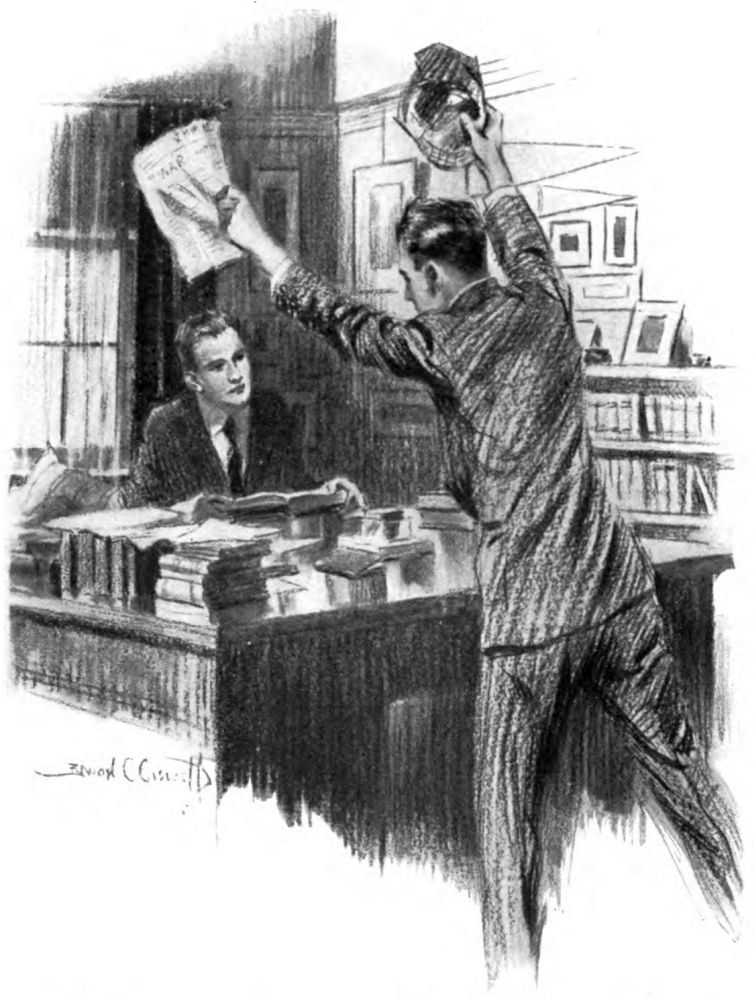
Steve Chapman turned from Chapel Street into the quieter thoroughfare, metaphorically speaking, on two wheels, bounded up the steps of the fourth house in the row, took the first flight of stairs on high, raced along the corridor, skidded a bit at the last portal on the right and, finally, setting all brakes, came to a standstill in the centre of the floor, while, as the door swung back against the wall, every picture in the study jarred askew.
“War’s begun!” he announced breathlessly. “President Wilson has signed! We’re in it at last, Joe!”
Joe Ingersoll regarded his room-mate calmly across the desk, one hand holding open the book he had been studying. “But why wreck the premises?” he asked mildly. “What do you think you are? The German Army in Belgium?”
[2]
Steve, subsiding against the back of the Morris chair, strove to regain his breath and wither the other with a glance, a not particularly successful effort. “You make me tired,” he declared. “Where’s your patriotism, you block of wood? I nearly break my neck to get the joyful news to you, and you sit there like—like——”
“Calm yourself, Steven. I’ve known it for at least ten minutes. The newsboys have been yelling their little hearts out around the corner there. Let’s see the paper, though.”
“I’ve a good mind not to,” grumbled Steve. But he tossed the crumpled “extra” to the desk and then hurried around to where he could look over his chum’s shoulder. The New Haven paper had done itself proud in the matter of type. Three lines of big, black block letters swept across the upper half of the sheet, proclaiming:
WAR DECLARED AGAINST GERMANY
VOTE IN HOUSE IS 373 TO 50
PRESIDENT SIGNS DECLARATION
“Yes, we’re in it,” said Joe, laying the paper down, “and I’m wondering——”
“What?” asked the other, impatiently.
“Whether to be glad or sorry,” ended Joe soberly.
[3]
“Sorry! Great Jumping Jehosophat! Do you mean that after all we’ve stood for from those—those barbarians——”
“I know, Steve, but war is serious business. Look what it has cost the others already: millions of men and billions of money: and——”
“Oh, forget the money part of it, Joe, for the love of Mike! Why, that’s all I’ve been hearing for a year! ‘How much will it cost us?’ What’s money against human life and—and human liberty? And——”
“And the war’s no nearer won than it was three years ago,” continued Joe imperturbably. “You’ve got to think of the cost, Steve. I’m as keen as you are for licking the hide off those Huns, but I can’t get up and cheer about this. Not just this minute, anyhow. It will be a long, hard grind, old man.”
“Maybe, but just you wait until we land a couple of millions of our chaps over there! Wait till our ships get a whack at theirs! We may be slow at starting, but, by the Lord Harry, when we do begin you’ll see the fur fly!”
“I hope so, but it’s going to take time to get those two millions together, Steve. And as for our Navy, it’ll be months before it is ready to whack anybody. Don’t get it into your head that [4]Germany’s licked because a crowd of legislators in Washington have voted ‘yes’ on this war resolution and the President has written his name at the bottom of it. We’re about as ready to make war on Germany as—as the Freshman Nine is to lick the ’varsity!”
“It could do it in a minute if it had a decent first baseman,” replied Steve, grinning. “Knocking the Army and Navy is fashionable, I know, but I don’t believe either of ’em is as badly off as the ‘sob sisters’ tell us in the magazines. Why, if you believe all you read we haven’t a regiment that isn’t shot to pieces or a ship that isn’t ready to be scrapped. Piffle! Our Army’s as good as we need for a starter and our Navy’s as good as the next fellow’s. And, what’s more, we’ve got the money to build ’em both as big as we need ’em!”
“Who’s talking money now?” asked Joe, smiling. “Of course we’ll get an army together after a while, and when we’ve got it it’ll be a real one. I’ll bank on that. And when our Navy is ready to fight it’ll fight, believe me! But it will take time and money and, I’m afraid, men before either one is fit to start in. I guess all we can do for the next six months is supply money and food to the Allies.”
[5]
“Meaning the other Allies,” corrected Steve. “Remember we’re one of ’em now.”
“Yes, that’s so. We’re in it, too. It seems—funny, doesn’t it?”
“Funny? It seems mighty good! I say, Joe, this will make a difference around here, won’t it?”
“Here in college? Well, I don’t know. Yes, I suppose there’ll be a lot of fellows missing in the Fall.”
“In the Fall? I mean right now, old scout! I know a dozen fellows at least who will be beating it in a few days. There’s Han, for instance. He’s said all along that he’d enlist as soon as we entered the fracas. I wish I’d done what he did and gone in for the Naval Reserve. He will fall into a soft snap, I’ll bet. Maybe he will be a lieutenant or—or something.”
“Admiral, likely,” said Joe dryly. “I wouldn’t worry about lost opportunities, Steve. Next Summer will be plenty of time to start in.”
“Next Summer! Start in!” exclaimed the other, observing his companion incredulously. “Where the dickens do you suppose I’ll be next Summer?”
“Where?”
“Well, not around these diggings, anyway. In [6]the trenches, maybe. Anyhow, in training camp. So will you.”
“Not likely. They’re going to draft them from twenty-one up, and as you and I are only eighteen——”
“Draft! Who’s going to wait for the draft? ‘Not I,’ said the Fly! Nor you either, I hope.”
“Do you mean that you’re going to volunteer?” asked Joe.
“Surest thing you know,” answered Steve stoutly.
“You’re too young.”
“I’m eighteen, and I’ll be nineteen pretty soon. There are lots of chaps in the Army no older than that.”
“You’ll have to go into the ranks then.”
“Of course I shall. I don’t expect to be made a General, you idiot! At least, not right off. Do you mean to sit there and tell me that you haven’t thought of enlisting, Joe?”
“I have thought of it often,” was the calm reply, “and I long ago decided not to. There’s time enough. They’ll draft me when I’m old enough——”
“Why, you piker, the war will be over before that!”
“And, besides, I want to finish college. Oh, I [7]don’t say that I won’t enlist if things go badly. But there’s plenty to do here just now. You don’t want Harvard to beat us in baseball, do you?” he ended, smiling.
“I don’t give a hang whether she does or not,” answered Steve disgustedly. “I never heard such tommyrot in my life! Of course you’re going into it, man! Every fellow that has a drop of red blood is! I’ll bet you there won’t be a handful of the students left in a month! Why, it’s dollars to doughnuts there won’t be enough fellows left in either the Yale or Harvard freshman team by June to play! Take a tumble to what’s up, Joe. Hang it, man, we’re at war!”
“I know, but it isn’t war of my making. And if I go into it before I’m twenty-one it will be because I see the necessity of it and not because I’m just excited, as you are, Steve. I don’t believe I’m more of a coward than the average fellow, but I don’t care a whole lot about filling a cosy little grave over in France just yet. There’s time enough for that, Steve.”
“You sound like a bloomin’ pacifist,” snorted Steve. “Or a slacker. If every fellow talked the way you talk——”
“You’ll find a lot of fellows think that way if they don’t talk it. And if you take my advice, [8]Steve, you’ll sit tight and wait for college to close. Then go to Plattsburg or somewhere and get a second lieutenancy. Fellows like you don’t go in as privates.”
“Wait be blowed! Suppose the bloomin’ war was over by the time I got a commission? I’d look an awful ass, wouldn’t I? Why, hang it, I’d be kicking myself all the rest of my days if they settled the Kaiser’s hash without my help! A fellow can go to college any old time, Joe, but only about once in a hundred years does he get a chance to ‘horn in’ in a big scrap like this! Besides, you’re dead wrong about this private soldier business. It’s fellows like me who are privates, and mighty good ones, too. No, sir, I’d rather be a doughboy right now and get action than wait around for a second lieutenancy and miss the fun!”
“Well, don’t lose your shirt,” laughed Joe. “The war will wait a day or two for you.”
“I’m not taking any chances on it,” growled Steve. “It would be just my blessed luck if old Kaiser Bill threw up the sponge about the time I started across. Look here, Joe, you aren’t in earnest about not going, are you?”
Joe nodded. “Dead earnest,” he answered.
“That’s beastly,” grumbled the other. “I’ve [9]been thinking right along that you and I’d be together and have some dandy times.”
“You talk as though this war was a picnic,” objected Joe.
“I don’t mean to. I know it’s a pretty serious business, just as you say it is. But a fellow can’t help being a bit excited about it, and glad that he’s on hand to help out. It is helping out, you know, Joe, this enlisting, and that’s why I can’t get your point of view. The country needs fighters, old man.”
“The country will have all it will need, Steve, without me. I’m no soldier and never could be. I’d never have any stomach for poking a bayonet through another man. I’d probably quit first and get court-martialed. There are plenty of chaps who are cut out for the job. Let them have the first whack at it.”
“That’s rotten!” declared Steve hotly. “Sitting back and letting the other fellow do your work! If I felt that way I’d never acknowledge it.”
“Yes, you would, just as I do,” replied Joe, without affront. “Look at it sensibly, Steve: forget for a minute that you’ve just heard about war being on and are all excited. You know plaguey well that everyone isn’t called on to go [10]into the trenches. A lot of fellows want to go for the excitement of the thing——”
“It isn’t only excitement,” denied Steve warmly. “There’s—there’s such a thing as patriotism, Joe!”
“Call it patriotism, then. I won’t say it isn’t that with a good many. Anyway, why not let those who want to fight go and fight and let those who don’t want to, stay at home until the first lot find the job too big for them? Seems to me that’s perfectly fair and perfectly sensible. Maybe there’s something wrong with me, Steve, but I’d throw a fit if I had to shoot a man or run a bayonet into him.”
“I don’t suppose any fellow would find much fun in it,” agreed Steve, frowning, “but when you think of—of the Lusitania and of how the Germans have shelled defenceless women and children in life-boats and—oh, hang it, Joe, shooting’s too good for them!”
“I suppose it comes back to the old question of whether it is right to commit murder in revenge for murder.”
“Murder! War isn’t murder! You’re a crazy pacifist!”
“I guess I am—sort of. At least, it goes against the grain with me, Steve, to shoot a man [11]named Smith because a man named Jones who happens to be of the same nationality as Smith has killed one of my countrymen. Oh, I dare say my reasoning’s all wrong, but that’s the way I feel about it.”
“You bet your reasoning’s wrong! It’s punk! You want to do less reasoning, Joe. That’s the trouble with you, anyway: you have to mull things over instead of stripping off your sweater and diving in. There are times, old scout, when a fellow’s heart is a lot better guide than his brain!”
“Well, suppose heart and brain are agreed?” asked Joe, smiling. “Mine are. My heart tells me it won’t stand for killing folks and my brain tells me to keep out of it as long as I can. I know this doesn’t sound heroic, Steve, but I guess I wasn’t cut out for a hero. I’ll do my share behind the trenches gladly, but I don’t want to either shoot or be shot at.”
“You’re talking absolute drivel,” grumbled the other. “If every fellow wanted to stay behind the trenches——”
“But they don’t. That’s the point I’m trying to make. There are lots of them who are crazy to get into the trenches. Let them. I’m not. So let me stay back.”
[12]
“If I didn’t know you I’d think you were yellow,” said Steve disgustedly.
“But you do know me and you know that I’m not,” responded Joe equably. “I don’t think it’s cowardice, although I know mighty well that my knees would knock together and I’d be sort of sick inside me if I had to crawl out of a trench and walk into machine-gun fire. But I hope I’d keep going. No, I don’t believe it’s exactly cowardice, Steve. I don’t know what it is. I just know that I don’t want to fight, not a little bit.”
“What gets me is that you’re a natural-born scrapper,” said Steve, plainly puzzled. “You fight harder than any chap I know in a game.”
“War isn’t a game. Perhaps that explains it,” answered Joe doubtfully. There was silence for a long minute. Then Steve exclaimed:
“It doesn’t, though. You don’t see things in the right way, Joe. This war isn’t just—just a war of revenge. We’re not going after Germany because she killed our men and women and children and blew up some of our shipping. There’s a heap more than that in it, Joe. We are fighting for a principle, for Liberty and—and Civilisation. We’re going into it because if we don’t go into it Belgium and France and England and maybe [13]the whole world will become just a rotten mess of German Imperialism. We’re fighting for World Freedom, Joe. This war’s a—a righteous war, I tell you! Can’t you see that? And if you do see it can there be any question of your duty and my duty? I’m not much of a spieler, and maybe I don’t get it over, but if you felt the way I feel about this thing you wouldn’t sit there and talk about the Freshman Nine and—and letting the other fellow do the job for you! If I could——”
Steve’s eloquence was suddenly interrupted. Footsteps sounded in the corridor outside and, as he turned inquiringly, a figure appeared in the doorway, the figure of a big, rangy youth of nineteen with a good-looking, good-natured face who, hands in pockets, surveyed the scene with a gravely quizzical smile.
“Go on, Steve,” said the newcomer encouragingly. “You’re in fine voice.”
[14]
“Hello, Han!” cried Steve Chapman. “We were just talking about you. Come on in.”
“It’s the first time I ever heard anyone get eloquent on the subject,” responded George Hanford as he swung across the room and lowered himself onto the window-seat. “It sounded like a debate as I came up the stairs.”
“Steve was talking war,” said Joe.
“Oh! Well, he’s not the only one. What do you think of it, Steve?”
“I think it’s great! I’m for it, Han. What about you? Are you going now or——”
“Now. I dropped around to say au revoir. I’m off at four.”
“Not really?” exclaimed Steve. “Gee, I wish I were going! Where do you go to?”
“Brooklyn Navy Yard. After that——” He spread his hands expressively. “I’m hoping they’ll stick me on something that’s going across, though.”
Steve got up and strode excitedly the length of [15]the study and back. Joe thoughtfully picked a hole in the blotter with the point of a pen. “I wish I’d gone into the Naval Reserve,” said Steve coming to a stop in front of Han’s outstretched feet. “The Army’s no good. They’ll keep us here for months, they say, and drill us until the blooming war’s all over.”
“Yes, I guess the sailors will have the call,” agreed Han. “I hear that we’ve had ships with steam up and bunkers full and crews aboard for two weeks all ready to start over. Hope to goodness I’m lucky enough to get on one of them. So it’s the Army for you fellows, eh? Going to join now or wait till term’s over?”
“I’m going to enlist as soon as I hear from the folks,” replied Steve eagerly. “I wired dad half an hour ago. Joe has some silly notion that it isn’t polite to skewer a German and says he’s off it.”
“Joe?” Han smiled. “Don’t worry about him. He’ll be in it quick enough. You couldn’t keep him out of a scrap if you tried.”
“That’s what I thought,” said Steve ruefully, “but he’s gone and got a lot of fool pacifist notions into his noodle. I wish to goodness you’d talk to him, Han!”
But Han shook his head. “No thanks. If he [16]really feels that way the best thing to do is just let him alone until the poison works itself out. He’ll come around. I had queer ideas myself a year or so ago. Didn’t approve of war much. Considered it a return to barbarism and all that, you know. Do yet. But, of course, we’ve got a duty to perform and we’ve got to perform it the most practical way. And the quickest way. That means war. We’ve tried soft words and we’ve tried argument. We’ve given ’em all the rope we could. Only thing left is to knock the tar out of ’em.” Han spoke quite dispassionately.
“That’s just it,” agreed Steve. “We’ve been patient long enough. I’m for action. I wonder if I could join one of those Canadian regiments and get across this Summer, Han.”
“Guess so. You’d have to lie, though, and say you were a British subject. Personally, I’d a heap rather fight under the old Stars and Stripes. Look here, why don’t you go in for the Navy?”
“Eh?” Steve stared a moment. “By Jove! Could I?”
“Don’t see why not. You like the water, too.”
“Rather! Why, I never thought of the Navy! I wonder—look here, how old do they take you?”
“Seventeen up. You have to have your [17]parents’ permission if you’re under eighteen. You’re eighteen, aren’t you?”
“Yes. By Jove, that’s an idea! Hear that, Joe? Tell me about it, Han. What do I do? Where do I go to see about it? How soon——”
“Easy on! You enlist for four years usually, but I believe they’re taking ’em now for the period of the war. You can search me as to what that means! You’ll have to start in as an apprentice seaman, I suppose. After that you can try for different things. You’ll get seventeen dollars and sixty cents a month——”
“I don’t care about the wages,” interrupted Steve impatiently. “Where can I join? Would they take me?”
“Jump at you, son. Of course you’ll have to pass an examination, but they aren’t so strict in war time, and you’d get by anyhow. You must be five feet, four inches and weigh not less than a hundred and fifteen at your age. Then, if you don’t have varicose veins or curvature of the spine or about ninety other things, including deafness and colour-blindness, you sign a blank and get shipped to a station for training. I don’t believe, though, that they’ll waste a heap of time in training the fellows ashore. There are too many places to fill. Sound all right?”
[18]
“Great! But could I do it? Be a—an apprentice seaman, or whatever you called it? Is it hard?”
“It’s a man’s work, Stevie, but it’s no harder than being in the Army. If you take hold and learn you’ll get on like a house on fire. After awhile you’ll get to be a second-class seaman, and then a seaman, and after that you’re in line for a third-class petty officer’s job. You can be a yeoman or a gunner’s mate or a master-at-arms or, if you like, you can be a painter! That is, of course, if you make good.”
“What are you?” demanded Steve.
“Ensign.”
“Fine! What’s an ensign?”
“It’s a start,” replied Han gravely.
“Yes, but is it like a lieutenant or what?”
“It ranks with a second lieutenant in the Army. Only,” added Han, with a twinkle, “it’s a heap more important.”
“I’m awfully glad, Han,” said Joe, looking up from his preoccupied task of digging holes in the desk-pad. “That’s fine. Of course you’ll get sea duty right off. It isn’t as if you were just a beginner.”
“That’s what I am, though. All the training I’ve had you could put in your eye. They made [19]me ensign in the Reserve because I was too big for anything less, and didn’t know enough to be anything more! I’ll have to learn just as you fellows will. There’s one thing to remember, Steve, and it’s this. Once we get into this mess there’s going to be a vacancy on your ship right often. If you don’t come home a lieutenant it’ll be your own fault, I guess.”
“Unless he shouldn’t come home at all,” observed Joe quietly.
“Well, don’t buy any flowers yet,” replied Steve flippantly. “Where can I enlist, Han? New York? Brooklyn?”
“If you can drag your feet as far as Chapel Street——”
“Honest? Of course! I remember seeing the place now. Look here, I wonder if I ought to send another telegram. Maybe dad wouldn’t stand for the Navy. He’s skittish about having me drowned.”
Han laughed. “Rather have you blown up by a trench bomb, eh? Well, everyone to his taste. Did the Government take over the Adventurer?”
“No,” answered Steve. “They say she’s too small. I believe fifty feet over all’s the limit.” He had paused at a window and, with hands thrust deeply into trousers pockets, was staring [20]thoughtfully across the roofs to where, high above the big hotel, the Stars and Stripes was snapping in the April breeze. Han broke the silence with a quiet chuckle.
“Say, fellows, when we formed the Adventure Club almost a year ago we didn’t know what a whacking big adventure we’d get into, did we?”
“No,” replied Joe, “somehow the war didn’t seem especially near home then. I wonder why. Anyone who thought much about it might have known we couldn’t keep out of it much longer. I suppose we were too kiddish to realise.”
“We were only a year younger,” objected Steve, without turning.
“Yes, but I feel a lot more than a year older,” said Joe. Han nodded.
“We’re living fast these days. By the way, I got a note from Phil yesterday. He and Harry Corwin are down at Newport News and expect to make a trip across pretty soon on one of the armed liners. Phil’s qualifying as gun-pointer.”
“Phil!” exclaimed Joe. “Great Scott, think of that old sober-sides doing that! And Harry’s with him, eh? Some fellows have all the luck!” he ended disconsolately.
“Any of the other Adventure Club fellows in it?” asked Joe.
[21]
“Wink Wheeler’s training somewhere down south for the Aviation Service and Cas Temple’s driving a flivver over in France. But you knew that. I dare say there are others in it by now.”
“Neil Fairleigh’s training for something out in Kansas or Missouri or somewhere. Nick Taylor had a letter from him awhile back. Well, that’s seven out of thirteen accounted for,” added Steve.
“I make it eight,” corrected Han. “Phil and Harry, Wink, Cas, Neil, you, Joe and myself.”
“Eight if you count Joe,” said Steve rather ungraciously. Joe flushed but said nothing, and Han pulled his length from the window-seat. “Well, I’ve got a thousand things to do, fellows. Good luck to you, and here’s hoping we’ll meet over there before long.”
“We’ll make a date for Berlin the third Thursday in September,” laughed Steve.
Han shook his head, smiling. “Don’t fool yourself, son. This thing’s only started. Good-bye, Joe. When you get ready to come in you’d better consider the Navy. Maybe if you work it right you can make the same ship with Steve.”
“I’d like the Navy,” answered Joe quietly as he shook hands. “If I do——” He paused, and then: “When I do,” he went on, “I’ll try for that. Good-bye, Han, and all the luck in the world to [22]you. If you aren’t wearing epaulettes before the war’s over I’ll be disappointed in you.”
“Thanks, Joe, but if I get my two bars I’ll be satisfied. I’ll let you hear from me if there’s anything to write, and you might drop me a scrawl now and then. I’ll send an address as soon as I get one. So long!” Han paused on the threshold and looked back for an instant while his smile faded and a very sober expression came over his face. “The Adventure Club has found its Great Adventure, fellows,” he said softly. “Let’s all do our best to make good.”
After Han had gone there was silence for several minutes in the room. Joe was bent over his book again, but I don’t think he was studying. Steve had gone back to his contemplation of the windy Spring sky and the gay flag tugging at its halyard. It was he who broke the silence at last.
“I hope old Han comes through all right,” he said.
“Yes,” agreed Joe.
“He’s one of the best.” Steve turned and reached for his cap. “I’ve got to run over to the library a minute. If that telegram comes, Joe, look after it, will you? I’ll be back pretty soon.” At the door he, too, turned, and: “I say, Joe,” he began.
[23]
“Yes?” asked the other.
“Nothing. What are you doing this afternoon?”
“Practice at three-thirty. We’ll probably get outdoors again today. This wind ought to dry the field up pretty fast.”
“Oh! Well—so long.”
Steve clattered downstairs and the door below banged behind him. After a moment Joe arose and crossed to a window. Steve, hands in pockets, was swinging diagonally across the street, not at all in the direction of the library.
“He’s going to the recruiting place,” thought Joe. Raising his eyes, his glance fell on the flag streaming its red and white stripes against the blue sky. He stood there a moment looking at it intently and then, with a faint sigh, went back to the desk. From the main street came the shrill cry of a passing newsboy:
“Wuxtry! Wuxtry! President Wilson declares war with Goimany! Wuxtre-e-e!”
Steve’s telegram came shortly after luncheon. When he had read it he passed it over to Joe. “Do your duty as you see it (Joe read) and God bless you. Mother and father.”
[24]
Twenty minutes later Steve was answering the questions of the Recruiting Officer.
When Joe returned from freshman baseball practice at dusk two notes lay on the corner of his chiffonier and he took them to the window. One, merely a sheet of paper once folded and with a corner turned down, was from Steve.
“Pal: I’m running up to town for the night. Back early in the morning. I’m off to Brooklyn Navy Yard day after tomorrow. Better be sorry for the Kaiser now! Steve, U. S. N.”
Joe reread it and then thoughtfully laid it down and took up the second note. This was enclosed in a sealed and fully addressed envelope and, since it bore no stamp, had evidently been delivered at the house by messenger. The writing was unmistakably Han’s, big, round and boyish. He tore the end from the envelope and pulled forth the single sheet of paper, not a little curious as to what Han had found to write about so soon. There was neither greeting nor signature to that missive, and Joe frowned perplexedly as he began to read:
“To such a task we can dedicate our lives and our fortunes, everything that we are and everything that we have, with the pride of those who know that the day has come when America is [25]privileged to spend her blood and her might for the principles that gave her birth and happiness and the peace which she has treasured.
“God helping her, she can do no other.”
When he had read it the second time he refolded it slowly and pushed it into an inner pocket. Then, turning out the light, he went into the bedroom and threw himself on his bed and, hands under head, stared straight up at the darkening ceiling. An hour passed. Outside the lights grew brighter along the streets. The roar and hum of the little city lessened. At last Joe arose and made his way to the study window again. Darkness enveloped the town above the roofs, but, faintly illumined against the night sky, the Stars and Stripes still waved and fluttered. Joe brought his heels together, straightened his body and raised his right hand to his forehead in salute.
[26]
Three days later instead of two, since severing connections with the college was not quite such a casual ceremony as Steve had supposed, the two boys found themselves at the Newport Training Station, full-fledged apprentice seamen in the United States Navy. They had duly satisfied the examining officer that they were eighteen years of age, had successfully passed medical inspection, had been shorn of all but a scant half-inch of their hair, had gone through a disinfecting bath and had been “shot” in the arm with anti-typhoid serum. And then, to their dismay, they discovered that they were not free to come and go about the Station, but—and this was something that Han had failed to mention—were due to remain in Detention Camp for three long weeks! The officer in charge seemed to prefer to allude to their habitation as the Recruit Barracks, but after the first few days both boys could have easily found a name much more fitting than either of those!
[27]
“It’s silly rot,” declared Steve one afternoon as the cheers from the ball field floated across. “Just as though we’d be likely to bring any contagious disease with us! We don’t come from—from the slums!”
Still, there wasn’t a whole lot of time to bewail the imprisonment, for they, together with an ever changing throng of brother recruits, had plenty to do to keep them busy. There was the visit to the dentist to start with and then the exciting event of receiving their outfits: blankets, uniforms, brushes, underwear, sewing materials, soap, bathing trunks, towels and various lesser articles: and of appearing for the first time in the “blues.” Joe was critical of the fit of his trousers and for the first day continually glanced dubiously at the flapping fullness around the tops of his stout Navy shoes. But secretly they were both as proud as Punch, even if Joe did remark flippantly that if the outfit really cost Uncle Sam sixty dollars, as rumour had it, Uncle Sam was getting stung! Whereupon Steve gravely called his attention to the undoubted excellence of the bone buttons included in the sewing kit.
If they had thought to be done with academic studies they were mistaken, for every day there was “school.” But all the instruction was not [28]academic, for they were taught also how to wash their clothes and mend them, and their first essays in these twin arts were laughably ludicrous. “Suds drill” to lads who had never got closer to the labour of washing their clothes than—infrequently—filling out a laundry slip was startlingly novel! Nor did either of them show skill and grace in the manipulation of needle and thread. Steve had so many punctures in his fingers at the end of the first week that it hurt him to touch anything! For two days life looked rather doleful. The inoculation produced lassitude, and the food, good but plainer than they were used to, failed to appeal to them. But all that passed presently and soon they were as prompt with their mess kits as any, and roast beef and mashed potatoes and creamed carrots and cottage pudding, or their equivalents, found enthusiastic welcome. Since misery loves company, sociability reigned in Detention Camp. Steve and Joe made many acquaintances of many sorts, for the recruits that packed the barracks were of numerous races and from widely different walks in life. Many of them, indeed, were from the country, but far more were city boys. Of the latter the majority were surprisingly strong and healthy looking, and, as Joe remarked in some [29]surprise, “stacked up better than the hayseeds.” College and preparatory schools had provided fully thirty per cent of the crowd, and of the balance another thirty per cent were boys who had learned or were learning a trade. Naturally the chief subject of conversation was the duration of training. Many held the opinion that the usual three months would be cut in two at least. All sorts of tales were told to indicate that they would be smelling powder in a month, stories of “greenhorns” being rushed aboard ship after three days at the Station, of thousands of practically untrained Jackies reaching Brooklyn and Charleston and Newport News weekly from the Great Lakes Station.
“Take it from me,” declared a big, raw-boned youth named Breen who had graduated two weeks before from the front end of a New York trolley car, “they can’t do without us, fellers. They’ve got the ships, see, but they ain’t got the men. An’ say, we’re needed over there, believe me!” He jerked a carroty head in the general direction of the main barracks which might or might not be also the direction of the coast of France. “I’ll bet you my shoes we’ll be chasin’ them U-boats inside of six weeks!”
“Some of us may,” agreed a little dark-skinned, [30]black-eyed boy who had scraped past the doctor only by stretching his neck until it ached, “but there’s a lot of us’ll be kickin’ our toes around receivin’ ships most of the Summer. Say, where’s this Atlantic Squadron you hear tell of? What’s it doin’ to save the Country?”
“Patrollin’ from Newfoundland to Cuby, o’ course. But I hope I don’t get stuck on that.” Breen shook his head gravely. “They won’t never see no fun. Fritz ain’t sendin’ any U-boats this way, take it from me. The Allies is keepin’ him busy at home.”
“What about the submarine they sunk in the Narrows the other day?” asked someone.
“Aw, tell it to Sweeney!”
“That’s right! I got it straight from a fellow who knows. There was a Swedish ship come in and passed inspection and was making for the harbour when a patrol boat decides to give her the once-over and sees a cable dragging astern. So he signals to a torpedo boat and the torpedo boat stops the ship and investigates. ‘I’ve been examined and my papers are all right,’ says the Swede captain. ‘You shut your face,’ says the torpedo boat commander. So then they gets the winch going on that hawser and pulls up a German submarine which was thinking to get into [31]the harbour and blow things right and left. Then they shoots the whole lot——”
“Yes, an’ one of ’em was the Crown Prince himself!” jeered Breen. “Sure, I know. You hear a lot of that stuff. It listens fine, too. Like this here destroyer Smith who seen a U-boat up the coast yesterday or the day before. What she seen was a porpoise, I guess. Take it from me, Jack, them Germans ain’t takin’ no chances. They never have an’ they never will. That’s their efficiency, see?”
“What about those raiders like the whats-its-name that——”
“Easy, kid, easy! We wasn’t in the war then. You don’t see no raiders rompin’ around now, do you? You bet your life you don’t. Take it from me, bo, nothin’ doin’, nothin’ doin’!”
So they took it from him, and went to bed.
Unless connected with the ever interesting subject of the prospect of getting afloat the war was discussed but little, considering what they were there for. Baseball was a far more likely topic. Whether the Giants would come through this year, whether the Red Sox could “repeat,” what Mathewson would do with the Reds—all those questions appeared to concern the hundreds of embryo sea fighters far more than the world [32]struggle that had called them together. On the whole there were few dull moments in camp, and lots and lots of busy ones. Day by day the faces changed as some went on to the main barracks and new recruits took their places. The British War Commission landed, followed a few days later by the French, and there was much talk of “Papa” Joffre. In the harbour destroyers dropped anchor and weighed again, launches sputtered over the blue water, a submarine from the New London base paid a visit and departed after an excited exchange of signals, submerging as she passed the point. Breen took his wisdom to the main barracks and a broad-shouldered chap who had been a telephone lineman until a fortnight ago succeeded him as camp mentor. Joe put on three pounds of weight, and Steve two, while their appetites grew daily. And on the first of May they ended detention and moved their kits to the main barracks.
They signalised this event by obtaining leave and hurrying to their homes in New York. They felt a little bit conscious of their uniforms, and tried very hard to attain the swagger of the experienced Jackies. It didn’t help Steve to feel at ease when he was mistaken in the Terminal for a porter by a near-sighted old lady, and Joe had [33]unmerciful fun with him all the way uptown. That was a hurried visit, but it did them both good. Joe received a scrawl from George Hanford in which Han announced his assignment to the Carthage, scout cruiser, then at Newport News. “We’re looking for a move any moment,” wrote Han. “It’s full steam at six hours with us, and that means something. We’re not supposed to write about our movements, but you’re in the Service now, praises be, and so I guess it’s all right. I wasn’t able to find out where you’re stationed, so I’m sending this to the home. Write me when you get this and tell me how you’re getting on. We’ve got a fine set of officers on this ship and we’re all crazy to start something. Say howdy to old Steve and tell him to write.”
Joe’s fame had preceded him and he was hustled out to try for one of the baseball nines. He didn’t exactly cover himself with glory that first afternoon of practice, probably because one of the busiest and hardest days he had ever put in had taken the edge off his zest for physical exercise. When one arises at five in the morning and goes to his hammock at nine it is possible for quite a number of things to happen to him. It was hard for Steve and Joe to relish the sound [34]of reveille at first. Five o’clock seemed a most unchristian hour at which to tumble out. For that matter I’m not certain that they ever came to care an awful lot for that first bugle call, although they did ultimately accept its summons with a fair degree of equanimity. At five-thirty they had to be ready for muster, and from that time until seven they were busy cleaning up themselves, their clothing and the barracks. Breakfast was finished at eight, when followed periods of drill, study and instruction until three in the afternoon, with the exception of an hour for dinner at twelve. Between three and six their time was their own unless there was extra duty or they were back in their work. The evenings were theirs until nine when the bugler sounded lights out. The routine on Saturdays and Sundays differed, and on the afternoons of those days liberty was granted to the recruits not under restriction.
Meanwhile they were learning, first, subordination, and, second, seamanship. Perhaps they were a bit more amenable to authority than the general run of their fellow recruits, since they had experienced the discipline of football and baseball training during five years at school and college. At least they seemed to find it easier to [35]obey orders without hesitation and without question than did many of their companions, just as it troubled them much less to salute some youngster scarcely older than they whose sleeve happened to bear stripes and chevrons. That thing of saluting was a fine puzzle to them for awhile, as was the matter of insignia. Joe became almost pop-eyed watching for sleeve braidings or shoulder straps and his constant, haunting fear was that he would meet an Admiral and fail to salute. He didn’t know what the penalty for that would be, but, judging by the punishment for far less serious crimes, he presumed it might easily be decapitation! More than once both he and Steve, in the earlier days of their service, missed a bit of gold braid or an inconspicuous star and were brought sharply up by the wearer. In the end they adopted the scheme of Breen, now enthusiastically seeking to qualify for the electrical school.
“Don’t take no chances,” advised Breen. “I don’t. If I see a feller comin’ along that ain’t got up just as I am I salute him. If he’s an officer, all right. If he ain’t, all right too. He’s so pleased you can see his chest stick up. I ran across a chauffeur over by the gate the other day and saluted him fine. He didn’t mind, and it [36]didn’t hurt me none. Let me tell you something, Jack. Don’t get this here ‘too-proud-to-salute’ bug. It don’t work, see? A feller was whining around barracks the other day about havin’ to salute fellers that wasn’t no better’n he was. Said he was willin’ to salute an Admiral and a few high muckamucks, you see, but he didn’t see why he had to show respect to a rough-neck carpenters’ mate. Well, I told him why. I says: ‘Bo, you ain’t salutin’ the feller in the uniform. Maybe he ain’t no better’n you are. You’re salutin’ the uniform and what it stands for. Get it? Them little didoes on his sleeve means authority, an’ it’s authority you’re flippin’ your hand to. An’,’ I says, ‘take it from me the sooner you gets that inside that solid concrete dome of yours the better,’ I says. Ain’t I right?”
Steve bought a small book containing, amongst other things, a full list, with pictures in colours, of all insignia of rank in the Army and Navy and studied it diligently, but at the end of a week he sadly acknowledged that he couldn’t tell a Rear-Admiral from a Pay Officer, unless the latter was working at his job!
Barring Saturdays and Sundays, Steve and Joe spent an average of eight hours a day in drilling, beginning with setting-up drill in the morning and [37]ending with afternoon parade. In between there were other drills of many sorts, boat drill, gun drill, splicing and tying, steering, rifle practice and so on. And then, lest their muscles might possibly grow at the expense of their lungs, there was singing school one evening a week. Amusements were not forgotten. Moving pictures, concerts and lectures occurred frequently. On the whole, life was both busy and happy, and, after the first period of homesickness that assailed many boys was over, it would have been hard to find one who regretted his presence at the Training Station. Only, and this was a widely prevalent sentiment, they didn’t want to stay there much longer! Everyone’s ambition was to find himself afloat.
“What gets me,” confided Steve one day to Joe on the way back from a ball game, “is the way these fellows stack up. Do you know, Joe, taking them as they come they’re a mighty decent lot.”
“Well, why not?” asked his chum.
“No reason, I suppose, only—somehow you get the notion that Uncle Sam’s sailors are a sort of tough gang. I know I always thought so. I had an idea that when you got out of jail after picking someone’s pocket or busting another chap’s head [38]with a cobblestone that the first thing you did was sign on in the Navy. Guess I was wrong, though. These chaps are as decent and—and intelligent as you’d meet anywhere. Don’t you say so?”
“I certainly do, Steve. And they should be. They aren’t bums. They’re just average American fellows, most of them from good homes and schools. Even those who haven’t had much schooling seem to know what is decent and what isn’t. There’s the fellow they call Abie in our company. He says he never saw the inside of a school house until a year ago. Grew up in the Ghetto. Well, Abie’s got more common decency and more genuine American spirit and patriotism than half the chaps we know here. Know what I think, Steve?”
“Shoot!”
“Well, I think this country’s all right just as long as you run across fellows like Abie. It’s easy enough for you and me to feel patriotic and be willing to fight for the Flag, but when it comes to a little half-size Polish Jew who has lived here only ten or twelve years and by rights oughtn’t to know whether the Revolutionary War was a prize fight or a moving picture, why, gee, I think it’s wonderful!”
[39]
“Right-o!” agreed Steve. “Abie’s a mighty plucky little cuss. We’ve got some fine fellows in our company. I guess,” he added naïvely, “it’s the best company here, eh?”
“Sure to be,” laughed Joe. “One’s own company always is.”
Steve laughed. “That’s so, I suppose. Just the same, it is a good one. And there’s all kinds in it, from Abie to that chap Manders who came back from leave last week driving his own whopping big Fiat. He’s going to take me over to New London Sunday if we can get off. He’s got a brother over there in the Submarine School. He’s a lieutenant or something. I’ll get him to ask you along. Say, know something?”
“A little,” confessed Joe, “but I’m willing to learn.”
“Well, I’ll bet you that if someone got up some time and yelled ‘Now then, fellows! A cheer for the N. T. S.!’ you’d hear every school and college yell between Maine and Texas! Only you wouldn’t, on account of there being so many!”
“I know one college yell you wouldn’t hear,” said Joe.
“What one?” asked Steve suspiciously.
“Vassar!”
“My word, but you’re the smart guy! Chin [40]up! Here’s something with stripes coming! Maybe he’s an Admiral. Act pretty!”
“An ensign, you idiot,” said Joe as the officer returned their salutes and passed. “When did you say Manders was going over to New London?”
“Next Sunday. It’ll be a corking trip. That car of his goes about a million miles a minute without turning a hair.”
“You mean without casting a shoe,” chuckled Joe. “Don’t forget to tell him about me. Maybe we can get a look into one of the subs.”
That they didn’t was not the fault of Lieutenant Manders. It was entirely due to the fact that on a certain Tuesday afternoon toward the last of May their company and two others were ordered to be ready to entrain the next morning at six o’clock, and that when Sunday arrived Steve and Joe were many miles distant from Manders and his pea-green Fiat!
[41]
Joe leaned against the rail and gazed none too happily over leagues and leagues of tumbled grey-green water. Overhead the sun had been in hiding since dawn, but of late an occasional path of amber light had momentarily shot through the dun clouds and turned to jewel colours the crests of the rushing seas. Today the big liner was steady enough, but for the first forty-eight hours she had rolled and pitched a deal more than Joe had liked, with the result that a good half of that period had been spent by him in his bunk. It hadn’t been a pleasant time, for he and Steve and all the other men from the Training Station had been assigned to steerage quarters, and the steerage bunks were not what they might have been. Just now, however, what with a more settled condition of his stomach and the occasional glints of sunshine across a less boisterous sea, life looked a lot more attractive. Drill that morning, held on the far from ideal drill ground of the after [42]main deck, had been a trying proceeding for him, and only the fact that the “Luff” in command of them had almost tearfully begged for a decent turn-out had prevented him from again claiming exemption. It was the first drill with arms since leaving port, and the fact that a certain exalted personage of the United States Army who wore three stars on the collar of his service jacket was, together with his Staff, watching that drill had made it very necessary indeed to show the best they had. The drill, in spite of causing Joe much unhappiness at the time, had set him up a lot and just now he was tentatively considering the matter of dinner. Not having eaten anything of consequence for nearly two whole days, his interest was only natural.
To starboard, so close that Joe could see the movements of the lookouts in her fighting tops, ploughed a big lead-grey battleship, a high-bowed, one-funnelled monster that had joined the liner sometime and somewhere that first night of the journey. Joe didn’t know her name, nor, if you believed them, did anyone else. It was remarkable how little anyone knew—or professed to know—about anything these days! Ahead of the liner transport steamed a smaller warship, a cruiser with four funnels and masts that didn’t [43]match. Some said she was the Montana, but as no two persons could agree on the identity of the battleship Joe didn’t have much faith in the correctness of this guess. A second cruiser flanked them off the port and two fussy little torpedo boats wallowed about, well in advance, like sportive dolphins. Those convoys were a great comfort to Joe, although he sometimes doubted that they would have time from their signalling, in case of a submarine attack, to be of any service, for all day long, and way into the night as well, the big battleship signalled to the cruisers, the cruisers signalled back, the torpedo boats wig-wagged a bit on their own hook, and, not to be entirely out of it, the liner semaphored whenever the thought occurred to her. All of which, in view of the fact that there was a continual hissing and buzzing in the wireless room, suggested that there was a whole lot of conversation going on in that part of the Atlantic Ocean!
The transport, which only a few months ago, had been a crack liner plying between New York and an English port, carried a varied human cargo at present. There was, first of all in importance, the Army Officer and his Staff, and with them a small regiment of orderlies and clerks. Then there were a number of Navy officers who [44]appeared to be sharing the work of navigation with the officers of the liner, several hundred bronze-cheeked, capable-looking boys in olive-drab whose hats bore the red-and-white cord of the Engineer Service, two hospital units, very proud in their new uniforms, four gun crews to man the five-pounders at bow and stern, the detachment of seamen to which Joe belonged, numerous civilians, amongst whom were a full dozen war correspondents, and the regular personnel of the steamship. The big liner, however, was very far from crowded, although at Halifax, before she had been towed out of the harbour, her decks had fairly teemed with passengers. That farewell to America had been rather stirring. Joe recalled the choky sensation that had been his as whistles on the assembled craft had bellowed hoarse good-byes to them and as, in the outer harbour, the sailors on the British cruisers had waved and cheered, while on one of the ships the band had played “The Star-Spangled Banner.” Before all that there had been a long and tiresome trip on a train that had been frequently side-tracked, during which they had slept as best they might in day coaches and, when passing through towns, with curtains lowered at all windows. They had had a half-day at Halifax [45]before boarding the liner, but had not been allowed off the big dock. And now, after nearly three days of tumbling and tossing, they were far out on the broad Atlantic bound for a port unknown. They were, though, getting used to official secrecy. Not once since they had left Newport early one fog-drenched May morning had they known their next destination. Steve had questioned the quartermaster in charge of the detachment after they had entrained. The quartermaster was a good-natured chap, popular with all and without any “side,” and in response to Steve’s inquiry he had lowered his voice to a confidential whisper.
“We’re not supposed to tell,” he had replied, “but if you won’t let it go any further——”
Steve had promised.
“Well, then, we’re going——” the Q.M. looked cautiously around the crowded car—“to an Atlantic port!”
After that Steve gave it up and joined with the others in singing “Where Do We Go From Here?”
That, however, they were off for foreign service was no great secret, for they had had extra clothing issued to them, and that could mean nothing else. They had been excited and jubilant, [46]and, at the same time, more astonished than they were willing to show. Why they, “greenhorns” to a man, had been selected instead of some of the fellows with months of training behind them was a problem. Of course they pretended that it was because they had shown exceptional ability, but secretly they greatly feared that an error had been made and were scared to death that someone in authority would discover the fact and summon them back to the Station. There was a distinct feeling of relief when the train started away!
They were having some sort of a drill on the battleship now. Joe could see the sailors and marines swarming the decks and thought he could hear a bugle. That was scarcely probable, however, as the big ship was some distance off and the wind, as proved by the smoke from the funnels, blew in a direction away from the liner. He had made up his mind that it was fire drill they were busy with over there when someone ranged himself at his side. It was Steve, looking very healthy and hearty. Joe slightly resented the fact that his chum had not experienced more than a qualm of seasickness.
“We’re getting into the U-boat zone, they say,” announced Steve, “and tonight we’ve all got to [47]sleep in life-preservers. What do you know about that?”
“I’ll bet they’ll be mighty uncomfortable,” commented Joe. “How long do we stay in the zone?”
“Oh, right along until we make port, I guess. They say up forward that we’re going to Bordeaux. I don’t know if it’s so, though.”
“I know if it’s so,” replied Joe pessimistically. “It isn’t!”
“How do you know?”
“Common sense, Steve. We thought we were going to Boston when we started from Newport and we went to Halifax. If we think we’re going to Bordeaux we’re certain sure to bring up at—at Liverpool, or any place we don’t expect.”
“Well, maybe we won’t bring up anywhere,” said Steve cheerfully, “if we meet up with one of those torpedoes. We’ll just stay where we are, perhaps.”
“I’d hate to be a U-boat around here,” answered Joe, peering forward for a glimpse of the plunging vanguard of business-like torpedo boats. “I guess I wouldn’t have much chance.”
“Oh, not in the daytime,” agreed the other, “but at night a sub could sneak up, I guess, and take a shot and get away with it.”
[48]
“How would they know where we were at night? There isn’t a light to be seen on any of us. Fact is, it makes me feel a lot more uneasy to know that a big bunch of steel like that over there is almost treading on our heels every night than it does to think about U-boats. Suppose we lagged a little and that battleship or one of those cruisers tried to climb aboard over our rail? I think we ought to show a light astern, anyway.”
“Oh, that’s all right. The captain stands there every night and smokes a cigar, you see. All the other ships have to do is watch the end of his cigar and they know where we are! There won’t be any more night signalling, I guess. I say, watch this, Joe!”
Four sailors came along the deck and paused at a life-boat which rested on chocks nearby. In a very business-like way they proceeded to swing it outboard after which they secured it with new lashings to the davits, tested the falls and passed on to the next.
“Safety first!” murmured Steve. “Looks like business, what?”
Joe nodded soberly. “I guess I’m not going to mind sleeping in my life-preserver as much as I thought,” he said. “Also, I’ll bet that tomorrow [49]morning when we have our next boat drill I’ll be the first one at station!”
Steve laughed. “Good thing we didn’t have to abandon ship yesterday, eh? What would you have done, Joe?”
“I’d have stayed right there in my bunk,” was the prompt reply, “and gone down with the ship. When you’re sufficiently seasick I guess a torpedo would be a—a happy relief!”
“Fine! You’d have got your name in despatches as a bloomin’ hero. I guess if anything happened right now Abie would be the hero. He’s been as sick as a dog ever since we passed Devil’s Island Light, poor chap. I asked him a few minutes ago if there was anything I could do for him and he said: ‘Yes, go away and leave me alo-o-one!’”
“Does a fellow get over being seasick, or—or what?” asked Joe. “What’s the good of being a sailor if you have to lie in your bunk when the fun’s going on?”
“Oh, you get over it pretty soon,” answered Steve, comfortingly. “Remember how jolly sick you were on the Adventurer that time off the Isles of Shoals? Well, you weren’t bothered again all the rest of the voyage. The fact is, I rather wish I’d been laid up already and had it over with, [50]because I’m plaguey sure I’ll have to have mine before I’m through.”
“I hope you’re right. I mean about getting over it. Suppose we went to one of those chasers or torpedo destroyers! Gee, you can get seasick just watching one of those tubs!”
“I wish they would put us on one of ’em,” said Steve devoutly. “What I’m afraid of is that we’re going over for shore duty. Crocker says we’re taking over one of the English bases and he thinks we fellows will have to get things ready there. That’ll be perfectly vile, won’t it?”
“Better than Newport,” said Joe. “We’ll be around where things are doing, anyway. Say, isn’t it ’most dinner time?”
“Pretty near.” Steve grinned. “You must be feeling better, old scout.”
“I’m mighty hungry, if that means anything. Let’s go down and be on hand, eh?”
“All right. We haven’t had our French lesson yet. Maybe there’ll be time for it. Come on.”
“I can’t study French on an empty stomach,” grumbled Joe, following the other down a companion-way. “Besides, I know what beef is, and coffee and bread. And I can say une table and une plat and une tasse, and I know that a newspaper’s a journeaux—no, that’s two newspapers. [51]Well, anyway, I know enough French to get along with.”
“Never mind how much you know,” replied Steve sternly. “You get your little book and behave yourself.”
“Some day,” murmured Joe, “that little book—I mean petite livre is going to accidentally fall overboard into le mer, which will be tres beau!”
That afternoon the sun came out gloriously and life was well worth living again, and the next morning the sea had calmed to such an extent that the sorely-tried Abie crawled out of his bunk and subsided in a sheltered corner of the deck, hope once more visible on his pale countenance. By way of varying the monotony the crow’s-nest watchers got up a submarine scare which brought joy to the crew of the after gun and caused a wild commotion below decks until the suspected periscope proved to be only an empty nail keg. Again, just at sunset, the two torpedo boats suddenly swerved northward, with smokestacks belching, and, at a distance of several miles, fired three shots between them. Whether they had really seen anything was never known on the liner. Sleeping with cork life-preservers strapped around one proved no more comfortable than Joe had predicted, but orders were orders and, [52]after all, one did feel a certain sense of security that almost atoned for the discomfort.
They had a most exasperating way of holding boat drill at a different time every day on that transport. Only let a chap get settled to a game of seven up or high-low-Jack and the fire bell rang alarmingly and he had to tumble up on deck with his life-belt, donning it as he went, and take his station by the particular boat to which he had been assigned at the commencement of the voyage. The only thrilling feature of boat drill was that you could never be absolutely sure until you had reached the deck that this time the alarm wasn’t something more than just make-believe, that it didn’t really mean “prepare to abandon ship!”
But no untoward incident marred the peacefulness of that trip across. If the German submarines sighted the expedition they took good care to keep out of view, so far as those on the liner ever knew, at least. And finally one afternoon the lookouts in the forward crow’s nest broke into full cry: “Smoke two points off the starboard bow!... Smoke dead ahead!... Smoke broad off the starboard bow!... Smoke one point off the port bow!”
There was a wild rush from below as the message went around that the British convoy was [53]sighted. Fast they came, four grim black destroyers, punching the seas into spray before them. Signals then from one of the pack, answered from the battleship; gay-hued bunting fluttering in the sunlight. The new convoy swung around without pausing and took positions, and the big lead-coloured battleship and the cruisers and one of the torpedo boats put their helms over and went back the way they had come, their duty done. Joe, watching them grow smaller and smaller, sighed.
“They’re going back home, Steve,” he murmured.
“Yes, the poor things! It’s hard luck, isn’t it?”
“Oh!” Joe considered that phase of it a moment in silence. Then he smiled. “I guess you’re right,” he said. “And maybe they aren’t really as pleased as they look. But the stern of that nearest cruiser certainly did look happy!”
The remaining torpedo boat fell in behind and did her best to keep up with the procession, but it was evident from the smoke she belched that she was having no easy task, for the new convoy set a hard pace for an old-fashioned coal-burning craft like her.
Fair weather carried them through another day [54]and then there was a fog. But there came no alteration of the speed, and the liner fairly shook with the reverberations of her big engines. The next morning the fog was gone again and just after six bells the lookouts once more brought a thrill to those within sound of their excited voices.
“Land ho!” was the cry that came down from aloft. “Land ho, sir! Two points off the starboard bow!”
On the bridge below the four officers, two of the Navy and two of the ship, who had had their glasses levelled for some time on the faint streak along the horizon only nodded. It was some time before what looked like a cloud bank resolved itself into what Steve called “honest-to-goodness land,” but when it did a cheer went up from the men lining the rails, and a magic word passed from one to another:
“England!”
A few hours later the transport dropped her anchors in Plymouth harbour.
[55]
The rest of that day they spent most of their time hanging over the taffrail and watching the disembarking of more fortunate passengers and the lightering of much unsuspected freight which appeared miraculously through the great hatches, boxes and bags and firkins, barrels and crates and bales: foodstuffs, ammunition, machinery, clothing, copper ingots, telephone insulators, two railway locomotives, a veritable flock of automobile trucks, cases of picks and shovels, and, probably not the least important of many things, several small and heavy wooden boxes with rope handles which were conveyed from the transport under a guard of a chubby-cheeked corporal and four privates of the Engineers. The Army representatives went early ashore and, as those still aboard the liner could plainly see, were received with honours on the quay. Steve and Joe bitterly bewailed the fate that held them captive while history was being made ashore there! They could see the lines of British Tommies drawn up beyond [56]the landing stage, the flashes of colour from officers’ uniforms.
“Just our rotten luck,” groaned Steve. “I suppose they’ll keep us herded on board this silly old hooker and finally dump us ashore at some out-of-the-way place where there’s nothing but a million dollars’ worth of landscape and a pile of lumber!”
But Steve was wrong, for although they remained aboard the rest of the day and all that night, their three companies of Bluejackets, all that were left except the ship’s crew and a few of its officers, they disembarked the next morning, bright and early, and, landing at a big stone pier, were marched through the streets of the city to a wooden barracks which had evidently been but recently vacated for them. What became of the Engineers they never knew, for there was no sign of them that day or on any other day of their stay in Plymouth. There were plenty of hearty English cheers for them as they marched to their quarters and so long as they stayed in the town they, to use their own expression, “owned it.” The officer in command was liberal with leave and they had a good time. They fraternised speedily with the British Jackies with whom the city was filled and under their enthusiastic pilotage, “saw [57]the sights.” The harbour was a never-failing source of interest, for within it and all the way down the sound to Penle Head, merchantmen, transports, mine-layers, trawlers, destroyers, chasers and lesser fry lay at anchor or hurried about important business. There were submarines there, too, but they were elusive and only once did either Steve or Joe set eyes on one. The boys shopped, spent hours in the “Y.M.,” which was English for Young Men’s Christian Association, writing home or eagerly perusing the ancient American papers and magazines on file and promenaded along the Hoe. Steve wrote a letter to his folks, and, of course, mailed dozens of picture post-cards, and Joe followed suit. Joe also wrote to George Hanford, addressing it “U.S.S. Carthage, Newport News, Va.,” being certain that the Carthage was no longer there but equally certain that the letter would ultimately catch up with Han wherever he might be.
Two days after their arrival one of the three companies was marched away in the direction of the railway station and after that inroads were made on the remainder nearly every day until, after a week in Plymouth, only a handful of their force remained and Steve and Joe, impatient for [58]action, made plaint to the friendly quartermaster, the only petty officer left.
“You’ll move pretty soon,” was the consoling reply. “Don’t worry. In fact, if I were you, I’d drop around to the Y.M.C.A. before night and write your home letters. You may not have as good an opportunity again for awhile.”
Cheered by that, they followed the advice, and were afterwards glad that they had, for in the middle of the next forenoon the word came to pack kits and at one they were marching back through the town, all that was left of their band, thirty-odd in all, toward the water front. There they boarded a small, snub-nosed steamer, a mine-layer by profession but for this occasion doing duty as a transport, and together with two companies of British infantry, set sail down the sound. About them darted tiny despatch boats, while a grim-looking torpedo boat swung out into mid-stream as they passed and a few minutes later swished past them to take up her position ahead and act as convoy. Soon they were cautiously picking their way through the mine fields and skirting the cliffs and green uplands of Cornwall. Behind them, a tall stone shaft against a sunlit sky, the Eddystone light-house faded from sight. Later they swung around the famous [59]Lizard Head, and by that time Steve and Joe knew whither they were bound.
“Queenstown, my lad,” informed a jovial British sergeant who had made their acquaintance soon after sailing and who had indefatigably pointed out the landmarks to them.
“Queenstown?” repeated Steve vaguely. “That’s in Wales, isn’t it?”
“Ho! ’Ark to the bloomin’ Yankee!” laughed the Sergeant. “It’s in Ireland, Queenstown is. South coast, my laddie, and not ’arf bad. They say you chaps are takin’ it over for a naval base. Sounds a bit odd, eh? Bloomin’ Yankees a-flyin’ the Stripes-and-Stars——”
“Stars-and-Stripes,” corrected Steve gently.
“Whatever it is,” accepted the Sergeant untroubledly, “from one o’ our ports! This here war’s a queer bit o’ business, now ain’t it? I arsks you!”
“Well, we’ll make a decent place of it by the time we’re through,” said Joe. “We’ve tackled tougher jobs than Queenstown!”
The Sergeant was inclined to be indignant until a twinkle in Joe’s eye put him right. Then he chuckled and clapped a broad hand on the boy’s shoulder. “That’s your bloomin’ Yankee swank, eh? Well, listen to me, laddies; if you’ll [60]clear out some o’ those blarsted Irish rebels while you’re there you’ll be gettin’ the thanks o’ the nation presented to you on a silver platter! An’ there’s no two ways about that!”
“Sinn Feiners, you mean?” asked Steve. “Are there any of those in Queenstown?”
“They’re all over the shop,” was the disgusted reply. “Cork’s the worst, though, around where you’re goin’. There’s Lands End there, do you see? And over there are the Scillies.”
“Sillies?” asked Steve, observing a group of Tommies across the deck as he obeyed the Sergeant’s tug at his arm. “Is that what you call them?”
“What else would I call ’em? There’s St. Mary and St. Agnes and a lot more the names of which I don’t know.”
“It’s the Scilly Islands he’s talking about,” explained Joe. “I see them, I think. What are those funny looking boats over there, sir?”
“Mine sweepers at work. And there’s a sub lyin’ hove to, just awash, beyond ’em. Passin’ the time o’ day, likely. Every time I look at one o’ those things I thank my lucky stars I’m in the Army!”
Their craft was not a very fast traveller and it was nearly midnight when it crept into Cork [61]Harbour, bearing a freight of rather cold and very hungry humanity. The few lights of Queenstown twinkled beckoningly and they were all eager to feel the land under foot again. They disembarked on a darkened quay and, parting from their friends the infantrymen, stumbled over a rough, cobbled street that led them along the outskirts of the town and finally reached the destination, a new barrack building, smelling strongly of fresh pine. Hot coffee was all they had that night, but by that time they were far too sleepy to want more, and soon after arrival they were fast asleep.
The next morning they breakfasted luxuriously amongst friends from their own land. The number of United States sailors and marines already on hand quite staggered the boys. Save for the new buildings already erected or in course of construction they might easily have thought themselves back at home at one of their own naval bases. United States marines paced back and forth on guard duty, sailors were everywhere, officers hurried about and, high over one building, the Stars-and-Stripes fluttered in a stiff breeze. And that was not all to make them feel at home, for in the harbour lay a small flotilla of their own destroyers and chasers, as well as a big [62]Navy collier which was unloading supplies, while, farther out, a grey scout-cruiser was anchored. There were British boats, too, and one green-grey destroyer which the boys later learned was Japanese. Every variety of naval craft was there, from submarine to battle cruiser, including destroyers and torpedo boats and chasers, sweepers, trawlers and layers and a shrill-voiced, chug-chugging swarm of launches.
Their first day on Irish soil was scarcely a pleasant one so far as weather was concerned, for a chilling breeze blew and showers descended at dishearteningly regular intervals. But Steve and Joe had small time to think of weather, for as soon as breakfast was eaten they were hurried away to a long shed where they were set to loading ammunition on lighters. It was evidently important work, for all hands were at it, sailors and marines alike, while a worried-looking ensign trotted around and urged them on. But it was done by the middle of the afternoon and then Steve and Jack and others of their depleted company returned to barracks, very tired and stiff, with full intention of applying for leave to see the town. But their Q.M. had other ideas.
“Orders, men!” was their greeting. “Buckman, Spencer, White and Conner report aboard [63]destroyer Chauncey right away. She’s sailing at five. Smythe, Foster and Chapman report aboard Chaser 17. Corson, Levinskey, Ingersoll and Strauss to the destroyer Warren. Get a move on, all of you, and hustle down to the first landing. Don’t forget your outfits.” The Q.M. folded the list in his hand, nodded and turned away.
Steve and Joe were gazing at each other in consternation. “I’m going to ask him,” blurted Joe as the officer made for the door.
“So am I,” said Steve. They hurried after the quartermaster, saluted and blurted out their request almost in chorus.
“Couldn’t you let us go together, sir?” they asked anxiously. “We don’t care where we go, sir,” added Joe, “just so that we’re on the same boat.”
“Yes, I guess so,” answered the officer. “Here, let’s see.” He pulled his list out of a pocket and found his pencil. “You both report to the Warren.” He raised his voice. “Levinskey!”
“Yes, sir.”
“You report aboard Chaser 17 instead of the Warren. Get it?”
“Yes, sir.”
“All right. Well, good-bye, you fellows, and good luck to you. Be a credit to my training.” [64]He shook hands, smiling, and then as the boys thanked him turned and made his way across the yard in the rain. Steve heaved a sigh of relief.
“Gee,” he said, “that was a narrow squeak, Joe! The Allies came mighty near losing the war then!”
[65]
What is now the torpedo boat destroyer is only the old torpedo boat grown bigger, stauncher, speedier and far more powerful. This country no longer makes the torpedo boat, for the destroyer does all that it could ever do and a hundred per cent beyond. It was Great Britain who launched the first torpedo boat back about 1878. Those early examples of the craft were diminutive affairs, some sixty feet long by seven wide and displaced not over twenty tons. Their armament was usually two torpedo tubes and their speed never higher than sixteen knots. For shallow water operations, however, they proved successful, and gradually they developed until in 1890 they were displacing eighty tons and had a speed of from eighteen to twenty-two knots.
In our own Navy the craft did not appear until 1886, when the Stiletto slid down the ways at the Herreshoff Yard at Bristol, Rhode Island. The Stiletto made quite a sensation then, even though she was only eighty-eight and a half feet in length, [66]had a displacement of thirty tons and did eighteen knots. But the Stiletto proved the entering wedge, for five years later we had torpedo boats of one hundred and twenty tons and, in 1901 of two hundred and eighty tons displacement. The next step was the destroyer, as she was called for brevity, and at the time of the war between Russia and Japan these ships—no longer “boats,” if you please—had attained a speed of thirty knots and were of five hundred tons displacement. In that war the Japanese used their torpedo craft to excellent advantage, even though their policy was to take no unnecessary risks with them, and the destroyer’s place in naval warfare was clearly established. The construction of destroyers had a boom everywhere, and in this country we were turning out ships of four hundred and twenty tons like the Bainbridge, Decatur, Chauncey and Paul Jones. These ships were two hundred and fifty feet in length, could make twenty-eight knots and for armament carried two eighteen-inch torpedo tubes and seven small rapid-fire guns. Whereas the old torpedo boat was designed to attack larger ships, acting in flotilla strength and under cover of darkness, the new destroyer was intended primarily to run down the torpedo boat and sink it with rapid-fire [67]guns. But torpedo tubes were also provided so that the destroyer might likewise take the place of the torpedo boat in attacking larger ships. For a while the smaller craft was retained as a defensive weapon and the larger craft built as an offensive weapon, although neither was limited to its specialty. The torpedo boat, because of light draft and low visibility, readily became a weapon of offence, darting out from shallow waters to attack enemy cruisers and battleships with its torpedoes and, with good fortune, returning unscathed. On the other hand, the offensive destroyer became a weapon of defence when it stood by the attacking fleet and guarded it from the depredations of the smaller boats.
Finally, however, the development of the torpedo did away with the torpedo boat entirely, or, I should say, with the building of them, for most navies still have and make some use of torpedo boats turned out from ten to twenty years ago. (Our own Dupont, launched in 1897, was in commission in reserve at the beginning of the war and, doubtless, is doing its bit bravely enough somewhere today.) As the accuracy and range of the modern automobile torpedo increased the necessity for small boats decreased, since the torpedo could be fired at a far greater distance. [68]Consequently the torpedo boat’s tonnage grew and the destroyer’s tonnage was forced to keep its relative advantage. In our Navy the jump was from two hundred and eighty tons to four hundred and twenty, and with that jump the torpedo boat ceased and the destroyer appeared.
At present time our larger destroyers are of about eleven hundred tons displacement—although we hear rumours of still larger ships being built. The destroyer must be able to cruise for weeks at a time without return to base, and for that reason must be sufficiently large to carry immense quantities of fuel and stores. Today one of our newer destroyers can take on enough oil on this side to make the run to England and back without replenishing her tanks. As to speed, the Jacob Jones, the latest destroyer of which specifications have been made public, made thirty knots an hour, developing about seventeen thousand horse power. Others, however, laid down after the Jacob Jones, are said to be able to steam at thirty-five knots and a fraction.
The activity of the submarine in the present war has had its influence on the destroyer. The torpedo as a weapon against the submarine is of no consequence. The destroyer trusts to the fire of its small guns or to ramming, when the [69]submarine is on the surface, and to depth-charges when the submarine is submerged. As the all-important task of the American Navy at present is to combat the German U-boat, our destroyers, which, with light cruisers and “chasers,” are best adapted for such warfare, comprise the bulk of our offensive fleet. In consequence of the duty they have to perform the tendency is toward an increase of gun power, and the destroyers now being turned out carry many more rapid-fire rifles. Seaworthiness, speed and a large range of action are also requisites, and these features, too, are receiving attention.
The present day automobile torpedo is an outcome of the spar torpedo of Civil War times. The spar, or outrigger torpedo, was fixed at the end of a pole and exploded by contact with the hull of an enemy ship or by use of a firing battery at will. It was by such a contrivance that the Housatonic was sent to the bottom off Charleston by a Confederate submarine boat, with the accompanying loss of the submarine’s crew. Other successful uses of the spar torpedo were made during the Civil War and later. Robert Whitehead invented the “fish” torpedo which, in improved shape, still bears his name. It has played a prominent part in the present war. Another [70]torpedo, used by our Navy, is the Bliss-Leavitt. The diameter of the automobile torpedo varies from eighteen to twenty-two inches, with an extreme length of twenty-one feet. Essentially it is a submarine boat self-propelled. It consists of five parts: warhead, air-flask, depth control mechanism, steering gear and engines. In the warhead is a charge of high explosive, from two hundred to five hundred pounds, according to type or size, which is detonated by a firing mechanism. The explosive may be either gun-cotton, which is ordinary cotton treated with nitric and sulphuric acids, or trinitrotoluol, familiarly known as TNT, which is formed of hydrogen and carbon treated with nitric acid. The detonating mechanism is merely a firing pin which goes through the centre of the explosive charge from front to rear and is seated in a percussion cap located back of the charge. At the nose of the warhead the firing pin terminates in a safety device known as a butterfly nut. A second safety appliance reaches through half the diameter of the warhead and holds the firing pin in place so that it cannot strike against the percussion cap.
The air-flask is a strongly constructed steel tank which is filled with compressed air used to [71]operate the engine and all other mechanism of the torpedo. The depth control mechanism is worked by water pressure and is adjustable by a spring before launching. It allows the torpedo to be run at any desired depth. Its principal parts are a pendulum and a hydrostatic piston controlling horizontal rudders. The steering gear consists of a gyroscopic compass which influences vertical rudders and keeps the torpedo on its course. The engine is operated by compressed air which takes the place of steam. A reducing valve decreases the pressure of the air to that required. An alcohol flame heats the air as it enters the cylinders and also produces steam from the water in a combustion flask. The air and steam are mixed and the resulting expansion provides the force to drive the engine. In several types of torpedoes the engines are reciprocating, but in the Bliss-Leavitt, or Bliss, as it is frequently called, are placed turbines that drive two propellers.
The torpedo is forced from the torpedo tube by means of compressed air. On a destroyer these tubes are set up much like a gun, and singly, in twos or in threes. Before the torpedo is placed in the tube the safety pin is removed and the butterfly nut is loosened. The breach-block of the [72]tube is closed and compressed air is turned into the tube behind the torpedo, which, however, is kept from being forced out at the muzzle by a lock. When the catch of the lock is released the torpedo is forced from the tube. At the same time the interior mechanism of the torpedo begins its work and, at about forty knots an hour, the missile flies toward the target. On striking the target the firing pin, from the tip of which the butterfly nut has now dropped off, is forced back against the percussion cap and the high explosive charge is detonated and the ship is sunk or crippled. Since, however, the speed of the ship, its course and the speed of the torpedo itself all enter into marksmanship, the torpedo is not counted an accurate weapon at long ranges, and even at short ranges misses frequently occur.
The boys had frequently debated the possibility of assignment to a destroyer, but, since it was a recognised rule in time of peace that only service men should man such ships, they had ultimately decided that their ditty boxes were not likely to be stowed on one. A chaser, or, possibly, a light cruiser would probably be their fate. But now, having as Steve phrased it, “made” the Warren, they weren’t certain whether to be pleased or not. They had heard weird yarns about life on a destroyer, [73]and Joe, haunted by the fear of seasickness, was filled with disturbing thoughts as they hurried off through one of the soft, warm showers of the south of Ireland to the landing. Half a dozen whale boats, dingeys and launches were clustered there, but inquiry developed the fact that there was no boat from the Warren amongst them. They were discussing the chance of finding a boat to hire when a petty officer in the stern sheets of a launch hailed them.
“Where do you boys want to go?” he asked.
“The Warren, sir.”
“Jump in. I’ll drop you.”
They thanked him and entered the little launch which held four seamen and so much dunnage that there was scarcely place for their feet. They waited there in the soft rain for a few minutes longer, during which time other tenders departed or arrived, and during which Steve and Joe vainly sought to determine which of the long grey shapes seen dimly through the mist was the Warren. Finally a brisk young ensign hurried up, jumped aboard and the launch wheeled about and plunged gayly into the haze. They heard the petty officer explaining that he had offered to put the two boys aboard the Warren, and saw the ensign nod and view them appraisingly. Then one of the [74]grey shapes loomed up before them and a moment later they were clambering up the side. They reported to the officer of the deck and were sent below. Going below puzzled them at first, for nothing looking in the least like a companion-way was in sight. Fortunately a white cap appeared above the surface of the main deck at that moment and they discovered a round hatch.
“A fat man would have a peach of a time getting through this,” remarked Steve as he led the way to the second deck.
Ten minutes later they had had their names entered on the ship’s roster, had been assigned to their bunks—for there are no hammocks on a destroyer—had stowed their belongings, and, in charge of a good-natured and informative youth of twenty-one or -two years of age, whose single chevron was topped by the crossed cannons of a gunner’s mate, and whose name they later discovered to be Hearn, were learning the ship. Many of the men, Hearn explained, were still absent on leave and wouldn’t be back until the next day.
“You see, it’s generally six days on patrol and three in port, and the Old Man’s fine about granting liberty. Last time another fellow and I got three whole days and pretty nearly saw this little [75]island from top to bottom. And, say, it’s all right, too. I’ve been hearing all my life about the beauties of Ireland, but I never believed in ’em much. Well, say, it’s all true, fellows. You want to take a trip up to County Clare the first chance you get. It’s as pretty as a picture, believe me.”
Their knowledge of warships was confined largely to that gathered from infrequent visits to battleships and cruisers lying flag-bedecked in the North River. The present ship was something far different. There were no flags, save the jack fluttering at the fore, nor anything else that could be termed the least bit ornamental, for the Warren had been stripped before leaving on her voyage across and only the absolutely essential things remained. Gone were boats and davits, awnings and stanchions, and in most cases the steel ventilators were now mere canvas funnels. What struck the boys most of all was the intensely business-like appearance of the destroyer, and after that her look of power and seaworthiness.
[76]
The Warren was one of the Paulding class, just short of three hundred feet in length, with a twenty-seven foot beam and a draught of eight feet. (“Eight above and eight below,” explained Hearn, “and a lot of her weight topside, shipmates, so she’ll roll pretty.”) She was not a new ship, for she had been launched in 1912, nor was she as speedy as the larger ships. (“She’s done her twenty-eight and a half, though,” defended their guide, “and can show her heels to a lot of ’em.”) She had two masts and four funnels and everything about her, from stem to stern, foretop to keel, was grey. (“They’re painting some of ’em these camouflage colours,” said Hearn, “and a fine sight they are, too. There was a Frenchie in here the other day that looked like a blooming butterfly, believe me. They had her striped zig-zag with all the colours of the rainbow and then they’d painted wavy lines across that. Maybe you can’t see her any distance, but when she’s close up, believe me, you [77]can’t see anything else! She’s a three-ring circus: and she’s got a name like a clown!”) Forward was the forecastle and here were mounted, one on each beam, two of the five three-inch rapid-fire rifles with which the Warren was armed. Above, on the forecastle deck, was a third gun. The bridge, gained from the forecastle deck, was in turn topped by a searchlight platform, while aft of it was a diminutive chart-room. Beneath the forecastle was the officers’ quarters, the captain’s cabin extending across the width of the ship. Aft of that were four staterooms, the wardroom mess and the officers’ galley.
Amidships on the main deck stood a fourth three-inch rifle and, to starboard and port, two twin eighteen-inch torpedo tubes. (“They’re making ’em in triplets now,” observed Hearn. “Three tubes together instead of two. That’s going some, ain’t it?”) Astern there was another twin torpedo tube and the last of the rapid-fire rifles.
Below the main deck were the men’s quarters, the two boiler-rooms, each holding its pair of big oil-fired boilers, the turbine room, the petty officers’ quarters and storerooms.
“She’s awfully like a toothpick, isn’t she?” asked Joe dubiously as he surveyed the long and [78]narrow deck from the stern taffrail to the distant break of the forecastle.
“She sure is,” Hearn agreed. “She’s just eleven times longer than she is wide, friend. And that’s some fine, believe me!”
“I think it would be finer,” said Joe, attempting a weak joke, “if she was a little bit wider. What do you do when two fellows have to pass on deck?”
“One of us hangs over the side,” chuckled the gunner’s mate. “It’s those fine lines, kid, that make her nifty. You wait till she hits her gait in a smooth sea and just watch her slip along! Fifteen thousand horse power, she has, and when those turbines get to nagging her three propellers, why, say, she walks a bit, believe me!”
“But—but in rough weather,” hazarded Joe anxiously, “isn’t she—er——”
“You said something,” laughed Hearn. “She sure is. I’ve been aboard this porpoise when she was doing thirty-five.”
“Thirty-five?” questioned Steve.
“Yep, thirty-five degrees off vertical. That’s swinging, son, believe me! They say they sometimes go forty-five in extra rough weather, and that’s going through an arc of ninety degrees, but I’ve never seen that performance yet, and I don’t [79]want to. Thirty’s bad enough. Take it on the foretop lookout when she’s switching over from one side to the other and doing it in around six seconds and you’ve got about all you want! And the worst of it is that you don’t ever know what sort of a kick she’s going to do next. She’s got more different motions than a cat and can do any seven of ’em at once. When you get back to the base you’re so stiff in your muscles that you can hear them creak!”
“It must be fierce,” marvelled Joe. “And don’t you ever get seasick?”
“Seasick! You’d better believe it. Last trip we had half the bunch flat, men and officers, and the junior luff wasn’t any use for two days.”
Joe groaned dismally. “I’ll last about ten minutes,” he said. “I—I guess I’ll get out of here while there’s time.” He looked anxiously about as though contemplating a sudden plunge into the water and a swim ashore.
“You’ll have it, all right,” said the gunner’s mate consolingly, “but you’ll get over it, I guess. Most of ’em do. Fact is, you don’t have much time for being sick. There’s too much to do. And, anyway, a fellow might as well be up and around as trying to hold himself into one of those bunks by his teeth and toes and eyelashes. It’s [80]all right to be seasick when you’ve got a nice wide berth and a steward to wait on you and the old hooker’s only playing a bit, but on one of these tin cigarettes the best thing to do is to forget it.”
“Have you ever been seasick?” asked Joe dolefully.
“Me? I’ve been so sick I hoped the ship would sink! But you get sort of out of the habit after a while. The first week or so is bad, but then you kind of swallow hard and do your work and it don’t bother you much. Of course, there are some that never do get over it. About one fellow out of every dozen has to quit the destroyers and go back to the big ones.”
“I’m that one, I guess,” said Joe. “Why, I can get seasick just watching a goldfish swim around in a glass bowl!”
“You’ve got a swell chance of sticking around here, then,” laughed Hearn. “Say, how’d you fellows manage to get aboard here, anyhow? You’re apprentices, aren’t you?”
Steve told all he knew of the process, which wasn’t much, and the petty officer nodded. “I guess they’re taking most anyone on nowadays,” he said. “No offence to you fellows. Generally it’s only service men who get on destroyers and torpedo boats. But there’s a heap of Reserve [81]fellows in the fleet now, I hear, and I suppose they haven’t got enough service men for the jobs. How long were you at Newport?”
Steve told him, and he whistled long and loudly. “Gee, that’s rushing things a bit, ain’t it? First thing you know you’ll be warrant officers at that rate! It usually takes some years, but things are happening fast just now. They tell me half these dinky little chasers that are bobbing around here are manned by amateur yachtsmen and ferryboat captains and the like. I suppose it’s all right, and at that they’re a sporting bunch, but it sort of grouches a fellow who’s been in the Navy five years to see greenhorns without any experience getting fat berths and big pay. Oh, well, if we just hand it to the Huns, it don’t matter.”
“Have you seen a submarine yet?” asked Steve eagerly.
“Dozens of ’em. We got four last week and just missed a fifth.”
But there was a tell-tale twinkle in Hearn’s eye, and Steve said: “No, really, have you?”
“Well, I’ll tell you. The first two days we were on patrol the lookouts reported exactly fourteen periscopes.”
“Really!” exclaimed Joe. “And—and did you get a shot at any of them?”
[82]
“Just one. And we missed that by twenty yards on account of being so excited. Still, it was just as well, as it turned out, because it wasn’t anything but floating spar.”
“Oh! And the others? Were they spars, too?”
“No, the others were mostly imagination. Maybe one was a porpoise. Yes, sir, we sure sighted a lot of periscopes those two days! The Old Man threatened finally that he’d drop the first man overboard who so much as whispered ‘periscope!’”
“The Old Man’s the captain, isn’t he?” asked Joe.
“Yep, Lieutenant-Commander John W. Stanford, Esquire, bless his old heart! As the British gobs say, he’s a little bit of all right.”
“What’s a gob?” asked Steve.
“You are if you stay aboard. It’s a name they have for the destroyer men.”
“Oh. Who are the other officers?”
“Lyke, first luff. He’s executive officer. The junior luff’s name is Putnam. He’s boss of the engines. Then there’s Connell, who’s ensign. That’s the lot, and all pretty good.”
“How many others?” asked Steve.
“Non-coms? About ten, I guess. And eighty-six [83]men. Or was last cruise. You fellows will make eighty-eight if the rest all show back.”
“That’s a lot,” marvelled Steve.
“Well, there’s a lot of work on one of these things, son. We have to have all sorts, just like a dreadnought, only not so many of a kind: machinists, oilers, firemen, boilermakers, shipfitters, water tenders, electricians, painters, cooks, stewards, bakers and so on. Those are all artificers. Then there’s the seaman branch. And there’s a surgeon and—and—— Well, if there’s anything we haven’t got, just mention it to the Old Man and he’ll fix it for you.”
“We will,” laughed Steve. Joe asked: “Do you think we’ll get our chance now that we’re assigned to service?”
“You’ll either be advanced to seamen, second class, or seamen if you stay around here,” answered Hearn. “Unless,” he added with a grin, “they make you admirals!”
“I don’t care much what they do with me,” said Steve, “so long as they let me stay here. Of course I’d like to get my advance, but I should worry. What I want is to get a crack at the enemy. Have you met any Germans yet?”
“Yes,” answered Hearn dryly. “We’ve got a couple on board.”
[84]
“Germans!”
“Well, they were till they got naturalised. Now they’re rip-snorting Americans.”
“Oh, but I meant enemy Germans,” Steve explained.
“No, I haven’t seen any of that sort yet, I guess. Yes, I have, too. When I was at Liverpool a month ago there was a bunch of them—prisoners, you know—standing on the dock. They were being taken to some place, I guess. They were a sorry looking lot, mostly no older than you fellows, and what they had on wouldn’t have tempted a hobo. Still and all, they looked fairly cheerful. Guess they thought it was a lot better than fighting over there in those dirty trenches. Say, I’ve got a friend who deliberately volunteered for the Army last month. Got a letter from him the other day telling me about it. He’s in a training camp somewhere up around Boston. And, say, that chump never showed any insanity before!”
“Insanity?” repeated Joe. “Oh, you mean——”
“Sure! What’s he go and enlist in the Army for when he could be sitting around on a nice clean ship with nothing to do but work? It gets me, honest it does! Why, those blokes have to [85]live up to their knees in mud: sleep in it, mind you: eat it almost: and all they see is a mess of barbed wire and an airplane now and then. Gee, think of sticking around in a trench for days at a time with nothing doing! Course he isn’t up against that yet, but he will be by Fall, I guess. And, another thing, fellows, that silly chump’s as likely as not to get killed!”
“Well, he might get killed in the Navy, mightn’t he?” asked Steve, smiling.
“Shucks, no. This is the safest job there is. Of course a fellow gets his now and then, but it’s a nice, clean death, and you’re so busy when it happens that I’ll bet you never know it! I wouldn’t join the Army for a million dollars!”
That night Steve and Joe ate their first destroyer “chow” and slept for the first time in narrow bunks between the thin steel walls. The food was good, and, since they were tremendously hungry, they enjoyed it. And the bunks were comfortable enough under the present circumstances, but Joe secretly wondered how he would ever manage to stay in his, much more sleep in it, when the destroyer performed those alarming tricks that Hearn had told of! They found their companions among the enlisted men a jolly and singularly care-free lot. They had expected to [86]be joshed some, possibly mildly hazed, but were agreeably disappointed. The others took it for granted that the boys were full seamen, and, since they had each tucked their blue caps with the tell-tale Training School ribbon out of sight, there was nothing to undeceive them. It was only when, after supper was over and they were sitting around in quarters, a chap asked Joe what his last ship had been that the truth came out. Joe confided the facts humbly and not very loudly, and his neighbour laughed.
“That’s it, eh? Well, you’ll get your new rating in a day or two. Bound to. I want to tell you, though, that you and your friend were dead lucky to walk on board a destroyer as easy as that. There are fellows on the big ones that would eat their caps to get into the ‘Suicide Fleet,’ and especially on this fly-by-night!”
“Really? Is the Warren an especially good ship?”
“Is she? You bet she is! She’s the best in the fleet, bar none. There are some that are bigger, but we’ve got the best shots and the best officers in these waters. And the best all-round lot of men, too. You just wait a month or so and they’ll be hearing back home about this little cuss!”
[87]
“I hope so,” murmured Joe. “And I hope you’re right about the new rating.”
As it proved, he was, for the next morning the fact of advancement was made known to them and they received cap ribbons bearing the legend “U.S.S. Warren” and were entered on the roster as second-class seamen at the munificent wage of thirty-five dollars and ninety cents a month. The wages didn’t excite them very greatly, partly because so far they had each received slightly over sixteen dollars all told since enlistment, and, as Steve sagely remarked, what was the good of earning thirty-five dollars if you never saw any of it? Both were assigned to the starboard watch and both had their first taste of deck washing, and by noon that day they had found their places to some extent and were trying their best to look their parts.
The rain stopped during the morning and a gentle breeze blew from shore, bearing with it a fragrance of damp meadows. But that fragrance had a hard time getting recognised on the destroyer, for the ship had a fine healthy odour of her own, an odour composed of burning oil, of hot iron, of paint, of cooking food from the ever-busy galley, all merged into one heavy and never-forgotten bouquet. The Warren remained at [88]anchor until afternoon, taking on oil and ammunition and supplies of all sorts. There were not many idle moments for the new members of the crew. By noon the last of those who had been off on shore leave were back and it was no secret that the destroyer would sail before night. Joe viewed the immediate future gloomily, but that didn’t keep him from following the general example of “filling up bunkers” at dinner, since once out on patrol the galley seldom bothered itself with hot meals. “You get canned salmon or beef,” volunteered a small, tow-haired youth who looked no more than seventeen while claiming twenty, “and the only hot stuff is coffee. If you’re on to the tricks you can sneak some eggs and boil ’em at the steam vent. But your best bet, friend, is to eat all you can hold in port.”
Just before sunset the Warren’s engines began to sing a louder tune and presently winches clattered and the anchors came dripping up. Simultaneously two other destroyers, one a far bigger boat than the Warren, showed similar indications of departure, and presently the water began to ripple past the bows, the smoke above the funnels took on a darker tinge and the destroyer moved down the harbour, slowly at first and then faster, playing a hoarse tune on her siren as she signalled [89]for the “gate.” Behind her at respectful distances came the companion ships, looking, head-on, like thin grey wedges of steel.
“See those barrels strung out ahead there?” asked a youngster in response to Joe’s question. “Well, those are the net floats. The lower edge of the net’s anchored to the bottom, all except the gate net. Those two trawlers you see are opening it for us to get through. After we are through we’ve got to steer a tight course, for there’s mines laid everywhere outside, and it isn’t healthy to slap one of ’em with your nose.”
“I should think, though,” Steve objected, “that if the mines are high enough in the water to get us that a U-boat could slip past underneath.”
“Oh, there’s three layers of ’em, and a Fritz would have to be mighty lucky to squeeze between ’em. They say that they have a sort of burglar alarm effect running from the net to the shore station, so if anything pokes its nose against it a bell starts to ringing. But I don’t know how true that is.”
“Are there mines all around here? Outside, I mean.”
“No, excepting floating ones that the Huns push off up in the North Sea or drop over from their ships. You find them now and then. You got [90]to watch for them, kid. The Jarvis, I think it was, sent down three last trip. When you find ’em you blow ’em up.”
“Shoot at them?” asked Joe.
“No,” answered their informant gravely, “you run down on ’em and the Cap leans over the side and biffs one of the horns with a monkey-wrench. It’s more certain that way. You might miss ’em with the gun.”
“I suppose that was a fool question,” laughed Joe.
“Sure, number 71,698.” The other smiled. “You’ll be asking worse ones than that, though. I did.”
Once outside the nets, with the guard ships only darker blotches against the darkening sea and the sky still light beyond Kinsale Head, the Warren dug her nose into the water and ploughed southward at a merry clip. For awhile the companion boats were visible, but eventually they melted into the night.
[91]
High up on the foretop, on a narrow perch slung within a grey canvas cylinder that barely allowed elbow-room, Steve was on lookout duty. His eyes just topped the steel-hooped rim of his nest and a brisk breeze flattened back the brim of his white cap. It was his first go at it, and he was a little excited, a little proud and terrifically anxious. It was still early morning of the second day of patrol duty, so early that the odour of coffee was still floating up from the galley below. The Warren was loafing along at some twelve knots an hour, but even so she rolled considerably and the cage swung from port to starboard and back to port, describing a good twenty degrees of an arc. Around him in every direction stretched a waste of grey-green water, a-sparkle in the sunlight save where, under the ship’s starboard side, a broad copper-hued shadow kept pace with her. Straight below, the foreshortened figure of an officer moved about the bridge. Forward of him the three-inch gun pointed an inquiring nose [92]across the bow, gleaming dully. Turning his head, Steve could look into the cavernous mouth of the forward smokestack from which a yellow-grey vapour poured. White-capped forms moved briskly about the deck or lounged in the sheltered places. Somewhere astern was Spain, somewhere ahead, Ireland. For the rest Steve only knew that the Atlantic Ocean was beneath him—and doubtless a great deal of it, too—and that his eyes, after only twenty minutes up here in his dizzy perch were already aching with the strain.
Southeastward was the worst, for there the sunlight played queer pranks with the waves and dazzled the sight so that, to use Steve’s metaphor, muttered to himself, a dime’s worth of imagination would have easily created a whole covey of periscopes, to say nothing of subs themselves! Now and then he closed his eyes for a moment, while dark red spots glowed behind his lids, but only for a moment since he was eternally haunted by the fear that the other lookouts, or the officers on the bridge there with their glasses, would see something that he didn’t. More than once his heart missed a beat as, just for a breathless instant, some freak of sunlight conjured a distant periscope or the dark hollow of a wave took on [93]the semblance of a dripping steel hull emerging from the sea. But it was wonderfully interesting, horribly exciting, and he wouldn’t have swapped that swaying steel-hooped cylinder for the steadiest bunk on the lower deck. In another half-hour or so his watch there would be over, for an hour of such eye-strain is all one can stand, and “one on and three off” is the rule for lookouts. The fear that he might miss something turned to the fear that there might be nothing for him to miss. He fairly ached for the sight of some object in that wide expanse of water. Even a floating log or wisp of wreckage would have answered; anything so that he might send his voice down to the bridge and prove that he was “on the job!”
The sun crept higher and the breeze, fresh and salty from the southwest, grew stronger and hummed a tune on the wireless aerial and slapped a line briskly against the mast. A flock of tiny blue-black birds swept across the bow, circled and spread low above the waves, melting into the irradiance of the sun. The navigating officer climbed the bridge ladder, sextant in hand, for his eight-o’clock observation. The appealing odour from the galley brought a wistful sigh from the foretop lookout. And then, on the heels of the [94]sigh, came a gasp. Just on the edge of the luminous track of the sunlight was a spot. Steve stared intensely. The spot was lost to sight, danced into vision again, a tiny black something that was never a wave in the world! He closed his eyes, opened them again and looked. It was gone! No, it was there, further to the left! It was no periscope, for it was too far away, perhaps a full two miles, and it was not periscope shape. It looked—almost—like——
Steve placed his mouth to the tube, and: “Small boat broad off the port bow!” he called.
The navigator unceremoniously tucked the sextant under his arm and two pairs of glasses swept into the sunlight.
“What distance?” called the Lieutenant. “I’ve got her! Empty, I think.” Steve put his head above the cage’s rim. Dimly he was aware of the mild commotion below and aft as the crew on deck piled to the port rail. Even an empty boat is an event after thirty-six hours of nothing. On the bridge the officers were still staring through their glasses, conversing in words too low for Steve to hear up in his roost, but the destroyer’s head was coming around and the smoke from the forward stack was heavier and greasier. Steve looked back at the dark speck. [95]Already it seemed nearer, and as the Warren turned the green, sun-flecked water from her sharp bow the object of her concern took form and shape. Minutes passed and Steve again hailed:
“She’s not empty, sir!”
There was no answer, but a slight wave of the executive officer’s hand said very plainly: “Don’t bother me. I’ve got eyes of my own.” Steve relapsed into his cage. The boat came nearer and nearer, a veritable cockle-shell of a craft. Oars glinted and a figure swung slowly back and forth until, realising that help was coming and that further exertion was unnecessary, the oars were shipped. The boat held three men—no, four, for one was huddled in the bottom.
“Fishermen,” called a voice from the rail below.
“And Frenchies,” said another.
“Been strafed, I guess. They must——” The breeze blew the rest of it away. Now Steve could almost look down into the row-boat, and the destroyer’s speed slackened and the voice of her engines died to a mere hum.
“Ahoy the boat!” called a megaphoned voice from the bridge. “Row alongside and we’ll take you on!”
A babble of unintelligible language issued from [96]three throats and floated down-breeze. One of the men waved a wooden bailer vehemently, but his eloquence of gesture was wasted. The “exec” shrugged his shoulders, but beckoned understandably and with a renewed torrent of speech the fishermen seized their oars and rowed tiredly for the slowing destroyer. Steve watched them come over the side, limp, pale and wet, Bretons as he knew by their picturesque costumes. Two of the rescuers leaped down and lifted the fourth occupant to the reach of willing hands. And then a quick command and the Warren picked up her gait again, turned to her former course and lounged away, leaving the little fishing boat empty and pathetically alone.
When Steve’s relief came, ten minutes later, he hurried down and, between gulps of beautiful hot coffee and mouthfuls of wonderful canned beef, got the story from Hearn, GM3c, which, interpreted, meant gunner’s mate of the third class.
“They’re togging themselves in dry clothing now,” explained Hearn. “No one could understand a word they said until Carrick, the little Q.M. got at ’em. Say, he talked French like a frog-eater. He says, though, that the lingo these fellows talk is a sort of Bowery French.”
[97]
“Why didn’t they call me down?” asked Steve, his mouth full of bread and beef. “I’d have talked to them all right.”
“Sure,” replied Hearn. “Just like I did. Well, anyway, they’ve been floating around for three days now. The Trois Freres was their boat, a little fishing schooner, or whatever they call a schooner in these foreign parts, and the Huns popped up alongside ’em one fine morning and—yes, sure it was U-boat. I said so, didn’t I? The Germans took every blessed thing aboard, including a catch of mackerel and all the food and all the money; even took the knives out of the men’s pockets, the great big hogs! Then they bombed the schooner and set those four chaps afloat in that two-by-twice dory, only they don’t call it a dory.”
“Bateau,” suggested Steve gravely.
“All right. Anyway, they were almost a hundred and fifty miles from land, and they had no food, and only one pair of oars. It was a mighty lucky thing the weather was decent, wasn’t it?”
“Yes, and a lucky thing I sighted them. If it hadn’t been for me——”
“Yah, you! Everyone aboard saw that boat long before you did, you chump.”
[98]
“Sure! And you just didn’t mention it for fear of making a noise and waking up the other lookouts, eh?”
“That’s it,” laughed Hearn. “Seen that sidekick of yours today?”
“Only for a second,” replied Steve anxiously. “He said he was feeling better. Why?”
“Just wondered. Last time I saw him he asked me to get him some poison from the doctor. I guess he will get over it pretty quick, though.”
“Gee, I hope so. I’m afraid they’ll be firing him when we get back to Queenstown.”
“There’s a rumour around this morning,” answered Hearn, “that we’re to go west and do something important in the convoy line. If it’s so it means that we’re to bring in some of our troops, I guess.”
“Honest?” exclaimed Steve. “Are they sending them over so soon?”
“That’s what I hear. Regulars, you know. I hope it’s so, and I hope we get a look at ’em. Well, I’ve got to get busy. How do you like spotting?”
“Fine,” replied Steve. “But, it surely plays hob with your eyes. Mine feel as if they were full of sand.”
“I know.” Hearn nodded sympathetically. [99]“Better climb in your bunk and close ’em awhile.”
First, though, after cleaning his mess kit, Steve paid a visit to Joe who was still prone in his bunk. “How are they coming, old man?” he asked. Joe opened one eye and gazed at him doubtfully.
“I—I guess I’m pretty nearly all right now,” he answered faintly, “but I’m scared to death to get up yet. I’m afraid it’ll come back. She isn’t rolling so much, is she?”
Steve, holding tightly to a stanchion, shook his head. “No, she’s as quiet as a kitten with a ball of yarn,” he said gravely. “How do you feel about a little broth?”
“Go away,” murmured Joe unhappily.
“Well, I don’t want to seem cruel, Joe, but if I was you I’d make an effort before long and try to report for afternoon watch. Did you hear about the Frenchies we picked up?”
Joe shook his head and looked mildly interested, and so Steve narrated with much detail the sighting and rescuing of the four fishermen.
“I suppose,” said Joe weakly, “you think you’re a wonderful little lookout, don’t you?”
“You’re jealous,” retorted Steve untroubledly. “Anyway, I got ’em before any of the rest did. [100]Frankly, I don’t know what they’d do on this old tin tub if it wasn’t for me.”
Joe grunted and closed his eyes again. Then he opened the left one with an effort and fixed a wavering gaze on his chum. “Steve,” he muttered, “I was willing to die for my country when I started out on this grand career, but I didn’t think it would take so long!”
The Warren patrolled an empty sea the rest of that day and at night, with all lights out, ploughed untiredly through the darkness. The next morning a British trawler was sighted and the four Brittany fishermen, clad in their own picturesque clothes again, were transferred to her. Shortly after that the destroyer turned her nose westward and went piling into a tumble of green sea that climbed aboard the bows and rattled like sleet against the canvas wind-shield of the bridge. The slender ship tossed and rolled and plunged, shivered and shook and rattled, and from her four grey stacks the oil smoke went streaking to windward in long scarfs. The engines hummed loudly and the air between decks fairly reeked of petroleum. In the hungry hour before dinner Steve and Joe and two others were huddled in the lee of the second stack. Joe, pale but determined, was keeping his eyes glued to the deck. [101]He had eaten that morning for the first time since the Warren had left Cape Clear behind her and, to use his own words, accompanied by a sickly smile, had done so not in vain. He had confided to Steve that if he once got safely ashore again he was going to ask for a transfer to the Army. Also that he hoped his folks would be willing to live abroad after the war was over, since he would never have the courage to go back to America so long as ships were the only means of getting there! Truso, second-class fireman, off duty, let his gaze roam aft to where, near the stern turret, were ranged a dozen or so depth bombs, villainous looking steel cylinders each containing some three hundred pounds of trinitrotoluol.
“Ever think what would happen to us,” mused Truso, “if a ‘moldie’ struck us astern? It’s a pleasant thought, is it not? There’s a good two tons of ‘truly rural’ back there, fellows, and it wouldn’t do a thing but spread us out for the matter of a mile. Bet you they wouldn’t find enough of the Warren to put in a locket!”
“What’s the good of worrying about that?” asked Hearn. “If a German torpedo hits us most anywhere we’ll be perching on clouds.”
“’Twouldn’t more’n knock off our stern,” said Higgins, comfortingly. Higgins was a radio man, [102]a tow-headed fellow of nearly thirty, whose rating badge on the left sleeve of his jumper showed the three chevrons and rays of an electrician of the first class and, also, two service stripes. “Leave her half her length and she’ll toddle home. I was on the Warrington back in 1912 when a schooner ran foul of us and took our whole stern away aft of the fourth stack. We steered into port with the engines, all hunky. That’s what your watertight compartments do for you.”
“Two Summers ago,” chuckled Truso, “we were cruising off Maine in the Beale, a sister ship to this hooker, in a fog. First thing we knew, biff-bang goes everything forward that’s standing, bridge stanchions, mast and number one stack, including our exec, who was on the bridge. Well, sir, it was nothing on earth but a dizzy old hay schooner. She’d swept her bowsprit right clean over us, taking everything in the way. ‘What you tryin’ tew dew?’ shouts the skipper, an old geezer of about sixty with a bunch of chin whiskers as long as my arm. ‘Run me daown?’ Well, I’d hate to tell you what our Old Man said to him, but I remember that he offered to kill him and not charge him a cent for it!”
“Was it a steel bowsprit?” asked Steve.
“Steel? Naw, nothing but a piece of spruce [103]wood. If it wasn’t for splinters, I guess they’d make these things out of spruce instead of steel. They’d ought to, seeing the way that bowsprit raked us clean!”
“What’s the news in the world, Jack?” asked Hearn of the radio operator.
“Nothing much doing last night. Same old story. H.M.S. Something or other wants H.M.S. Whatshername to relieve her of escort; tramp steamer reports floating mine; some fellow reports a schooner on fire off Penmarch; Cassin says she sighted a periscope and fired three shots and ‘thinks she hit,’ and so on. There were orders this morning, though. Came just as I switched off. Didn’t hear them decoded, but I have a hunch.”
“Well, open up. What’s the game? Why all the good old smelly fuel going up in smoke?”
Higgins winked solemnly. “Rules is rules, Sammy. You go ask the Old Man, or stick your head in the wardroom and ask the M.D. Bones is a great little confider, he is. There’s chow, praises be! I’m going to swallow mine lying down. Holding on today won’t get you anything. Observe the poor blighter in the foretop. He’s got a fine healthy swing up there!”
That afternoon there were two false alarms [104]which supplied instant and hectic excitement but nothing else. Oddly enough the excitement was invariably shown by all hands in a more than usually quiet and contained demeanour. Steve and Joe found it quite natural to speak more slowly than ever when word came down from the foretop that a periscope was sticking up somewhere and to saunter to the side with an exaggerated carelessness. But that didn’t alter the fact that inside they were terrifically jumbled, and that they were always afraid their voices might break into a squeak if they spoke. One of the reported periscopes quickly resolved itself into nothing and the other into a floating spar. Later, the Warren resumed standard speed, fourteen knots. Toward evening two trawlers waddled past, homeward bound, and that ended the day’s sensations. But shortly after four bells, in the middle of the “graveyard watch,” the engines began to hum again and the news leaked from wardroom to second deck that they were off in answer to an S O S to find a sinking cargo boat, a good two hundred miles south. With all four boilers steaming at just under twenty-nine knots, and the Warren fairly throwing herself in and out of the seas, sleep was impossible. One could only brace every muscle and hope to stay in the [105]bunk. On deck—topside in the vernacular—one dodged along the sloping spray-drenched surface in the manner of a monkey climbing about his cage. In the wireless hutch Higgins, receiver clamped to his ears, listened and wrote as the blue sparks darted and sputtered, while at the wardroom table, with the lead-backed code books open before him, the ship’s surgeon worked under the small-focussed light and turned the messages into King’s English: “Please hurry, going down fast”: “Broadcast submarine reported eight miles southeast, steamers keep off”: “H.M.S. Spindrift struck by mine, latitude —, longitude —; no danger, relay east”: “All ships. Fresh-laid mine adrift ten miles E. S. E. Trawler notified.”
Once a sister destroyer blinked at them across leagues of tumbled water, she, too, evidently on the errand of succor. The Warren had outdistanced her by daylight and about breakfast time was alone, searching the wastes for sign of ship or survivors. All day she doubled and crossed and never found so much as a floating spar until, just as a red sun sank past the rim of the watery world, a stove-in life-boat, almost awash, was picked up by the lookout and run down. That was all they ever found of the steamer and neither [106]Steve nor Joe ever learned the fate of those aboard her, although the popular verdict on the destroyer that evening was that the small boats had got away long before the Warren had reached the scene and were either making for the French coast or had been taken in tow. There were orders from the flagship then and the Warren limped back the way she had come at a twelve-knot gait, her oil-tanks much too low to waste fuel on speed. A day later she zig-zagged her way past the cape and dropped anchor off Queenstown just as the lights began to show ashore.
[107]
The boys applied for three days’ leave and got—one. But they were no worse off than more deserving members of that oil-scented crew. “Back by daylight tomorrow,” grumbled Higgins, adjusting his neckerchief with extreme nicety and flicking an invisible speck from his blue shirt. “That means they’re going to chop our stay short. Well, a day’s better than nothing, but, just the same, a fellow never sleeps enough the first night ashore to get any rest. I’m going to beat it to a hotel and hire a husky guy to rock the bed all night! What do you say to a run up to Cork, fellows?”
chanted Tommy Truso. “I’m wid yez, byes! Erin go bragh! Come on till we get the first train that do be goin’.”
They set forth, five of them; Steve, Joe, Truso, Higgins and Sam Hearn, all very carefully attired [108]in their best shirts and trousers and caps. And they sang on their way ashore and sang as they made for the station and, later, still sang as they sat in the railway carriage and rolled leisurely north to Queenstown Junction and then past Glounthaune and Little Island and Dunkettle and Tivoli. Of course they travelled first class. “When in Ireland remember you’re an American,” said Higgins.
“True for you, me bye,” agreed Truso. “And be the same token, shpind yer money.” And to set a good example, Truso sought out the guard on arrival and tipped him a perfectly good United States half-dollar, much to his surprise and evident approval. Higgins censured Truso for spending American money when he had English.
“Why didn’t you slip him a couple of shillings, Tommy? He’d have been just as pleased, and you’d have saved your real money.”
“Why, isn’t English money as good as ours?” asked Joe.
“They say so,” replied Higgins doubtfully, “but I’m not sure about it. Anyway, it hasn’t any eagle on it!”
They climbed into a ramshackle outside car, although Steve and Joe would have much preferred to walk, and said so. But Truso reprimanded [109]them sternly. “We’d all rather walk,” he said, “but it isn’t done. The United States Navy, my boy, must uphold the traditions. Let the ‘Limies’ walk, and the Frenchies, but if you come from the little old U.S.A. you’ve got to ride. Cast off, driver! And look out for mines!”
Steve and Joe were, naturally, all eyes, for this was their first visit to Ireland. Hearn had warned them that they’d find Cork uninteresting. “If you’ve ever been in Newark, New Jersey,” said Hearn, “you don’t need to see Cork.” But they didn’t find it uninteresting, for there were many strange features to attract them. Nevertheless, Steve announced that he didn’t believe he would care to live there. There were many sailors and soldiers on the streets: in fact, it would have been difficult to have looked in any direction at any moment from any part of St. Patrick Street and not have seen a uniform. There were British Army officers, khaki clad and flourishing their swagger sticks, British Naval officers, far less “cocky,” it seemed, but equally important looking, privates and Jackies galore, the latter both British and American. And now and then a French sailor, decidedly more picturesque, was sighted. At brief intervals they passed other carriages bearing other parties of men from the [110]American fleet, and then the proper procedure was to cheer at the top of the voice. Doubtless there had been a time when the presence of United States sailors in Cork had awakened interest and, possibly, alarm, but now their wildest and most vociferous cheers caused no apparent surprise or comment.
St. Patrick Street was, the boys decided, “pretty nifty,” but aside from that one thoroughfare there was little to impress them. The smaller streets, more like alleys than streets, were likely to be dirty, and the houses for the most part were depressingly ugly.
“Dublin’s the real town,” said Hearn. “This place is punk.”
There wasn’t much to see, but they saw it in the course of a two-hour ride. It was the driver, a wisp of a man with two pale blue eyes and a wheedling way with him, that suggested a visit to the one historic church that is left in the old city, and so they climbed the hill, pitying the decrepit horse all the while, through slums that, to quote Tommy Truso, had the New York Ghetto backed off the map. St. Anne Shandon wasn’t much to look at, after all, although they found the tall tower, topped with its fish weathervane of some interest, and the fact that Father Prout had found [111]inspiration in the chimes to write “The Bells of Shandon” did not, in Higgins’ opinion, pay for the trip. Back in the heart of the city, they paid off their jarvey, grandly declining to haggle with him over a charge of just thrice the legal fare, and sought dinner.
What impressed the boys most, perhaps, was that, aside from the presence of the soldiers from the garrison and the sailors from the port, one would never have guessed that just across the Channel men were fighting and dying by the thousand. Cork showed no effects of the war. Food was ridiculously cheap, viewed by American standards, and evidently plentiful. There were, of course, plenty of flags flying, but it was apparent that war was the last thought in the minds of the rather colourless inhabitants of that town.
After an excellent dinner they took another car, an “inside car” this time, the difference between inside and outside cars being merely that in the first, one sits over the wheel with his feet hanging down in the centre and in the other he reverses the process. The drive was a pleasant one, and this time their jarvey was no more than a boy and had a loose tongue and a ready wit. Hearn and Higgins had visited the ancient ruins before, but they were new to the others and they fell in love [112]with “The Groves of Blarney” at first sight. They went all over the castle and, you may be sure, didn’t fail to kiss the Blarney stone, each in turn hanging over the old battlement while the others held firmly to his feet. They went back to the city in a “moisture,” as the jarvey called it, although they would have called it a drizzle, and a fairly hard one, and spent the hour before supper in making a tour of the shops. Steve and Joe were for returning to Queenstown for supper, but the others wanted that meal in Cork, and the majority ruled. Also, said Truso, there was a fine movie theatre there, only, he added, “they call it a cinema or something.” So they had supper at a second and smaller hotel and did very well, although the food was neither so well cooked nor so well served as at the first hostelry. But they were hungry and not over-critical.
After supper they asked their way to the theatre and set forth. Perhaps they didn’t follow directions, but in any case they were soon cruising along a dimly lighted street that looked most unpromising. The inhabitants appeared to be all on the sidewalks or in the gutters, and they were an unsavoury lot, the boys thought. It was Hearn who first passed the word that trouble was brewing.
[113]
“Get onto the bunch of thugs trailing us,” he said in a low voice. “Me for the bright lights again, fellows. Some of these Sinn Feiners have it in for us Americans good and hard.”
Steve looked back with interest. If those were Sinn Feiners, he thought, they were rather disappointing. There was nothing in the least romantic about the ten or a dozen men who were following them. Save that they were dressed differently—and not nearly so well—they looked very like a group of street-corner loafers at home. Nevertheless, there was something threatening in their appearance, or, perhaps, in the way in which they followed with slouching steps and eyes fixed on the sailors.
“What have they got against us?” asked Steve in surprise.
“They’re agin’ England,” explained Truso, “and pro-German to a man, and now that we’ve joined in with England they don’t love us. Take the first turn, Sam, and let’s get out of this place.”
“Sinn Feiners or no Sinn Feiners,” growled Higgins, “if they get funny with me I’ll knock their blocks off.”
“Yes, you’d have a fine time doing it,” jeered [114]Hearn. “There are nearly a dozen of ’em. Come on around here.”
But the street they entered was less reassuring than they had hoped, a winding, narrow, poorly lighted, cobbled passage, with darkened warehouses on either side.
Hearn, leading the way with Joe, stopped. “This won’t do, my hearties. Let’s turn back and go out the way we came. If those guys make any cracks, get in the first punch. Come on now.”
They swung around and faced the muttering group that had followed them. The unexpected manœuvre caused confusion in their ranks and some backed against the house wall and a few stepped into the street. With a swagger, Hearn led the way past and the others followed. Steve glancing around carelessly began to wish himself safely back on the Warren, for the faces that met his in the dim light were frankly, savagely antagonistic. He breathed freer as he put a dozen paces between him and the Sinn Feiners. Tommy Truso was whistling, but for the rest the encounter was made in silence. Here and there, up and down the street, vague figures lounged before the shabby houses, but this end of the thoroughfare was darker and more empty than the other. [115]The five had gone a dozen yards before a sound came from the enemy. Then:
“Up the Huns!” cried a hoarse voice, and a stone went past their heads and struck against a house beyond them. Joe started to run, but Hearn’s voice rang out sharply.
“Come back here! Stand up to ’em! The Navy doesn’t run, kid!”
Joe, whose flight had been sheerly impulsive, stopped and stepped back to the others. Another stone flew toward them and the queer cry was repeated from a dozen throats.
“Spread out,” said Hearn softly. “Watch for those stones. Now, then, walk backwards. It’s ‘retreat in good order’ for us, I guess.”
“Retreat nothing!” growled Jack Higgins. “Let’s bust up the Micks! Come on, Sam! Where’s your pep? Rush ’em!” And Higgins suited action to word. The assailants had stopped some twenty yards away and were gathering missiles from the littered street. But when Higgins started toward them they closed their ranks again, and Truso and Steve, who sprang first after their comrade, had a vision of a dark line of swearing, taunting, growling men as they raced to Higgins’ support. Hearn and Joe followed [116]instantly, then Hearn shouted a cheering “Ata boy!” as he ran.
The odds were big, but there was nothing for either Steve or Joe but to do their parts. The Irishman loves a fight, and these glowering, growling men were Irish, and there was no sign of hesitation in the way in which they broke forward toward the foe. But, and this is a lamentable fact, those of them who had seized on stones or sticks forgot to drop them.
“Watch out for rocks, fellows!” bellowed Truso.
Then the trouble began. Steve, trying to remember all the skill he had ever known, engaged the first form that met him. A moment later the street was a battle ground. Two to one was the odds, but there were three at least of the American bluejackets who had long since learned to fight with their fists, while Steve and Joe, although they had had few encounters, at least knew something of the science of the game. Blows fell and were blocked, feet tramped and slipped, grunts and cries filled the air. At first it was a massed melee in which foe struck at foe wherever discerned, but after a moment the battle separated into units. Up the street came, at first a dribble and then a stream of spectators. But they were [117]not all spectators, either, for more than one of the newcomers leaped into the fray and took sides with their compatriots. Cries of “Kill the Americans!”, “Up the Huns!” broke out. Steve, caught under the jaw by a powerful fist, stumbled and went back on the pavement. Instantly a foe was on him, astride his chest, and blows were being rained at his face. Steve struggled and kicked and finally pulled his antagonist forward and managed to get an arm around his neck. Then, with short-arm jabs, they fought for each other’s head. Struggling forms stamped about them and once someone stepped on Steve’s ankle and fell, sprawling to the ground. Then came a rallying cry from Sam Hearn:
“Warren this way!”
Steve somehow squirmed from beneath his adversary and rolled aside, springing the next instant to his feet. Hearn and at least one other of his crowd had backed against the house wall and were managing to hold the enemy at arm’s length. Steve could see more than one club waving in the air, while at the further side of the street, inside the fringe of shouting spectators, new recruits to the Sinn Fein ranks were groping along the gutter for missiles. Near at hand a swaying bunch of four figures parted for an instant and [118]Steve caught a glimpse of Truso fighting fiercely against a trio of the foe. Steve darted forward and swung his fist and the nearest of the three doubled up at the knees and fell in a heap. At the same moment Truso, wrenching free from the grasp of a big, round-faced lad, struck out straight and another fell.
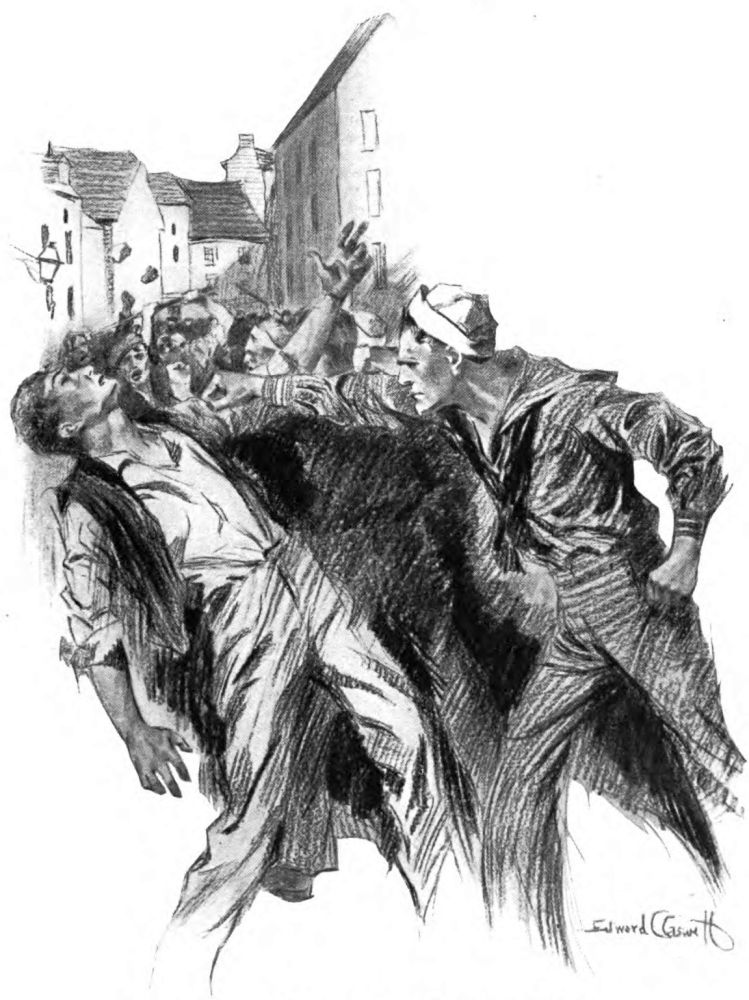
“Come on!” cried Steve. “Get to the wall, Truso!”
“Hello!” gasped the other. “All right. I’m with you!”
But it was no easy task, for three of the enemy engaged them, and they were separated from Hearn and the others by more. The latter, however, were giving their attention to the three against the wall, and at last, bruised and breathless, they plunged through the enemy and lined up with their comrades. Higgins was a madman. Steve had never seen anyone fight as he fought there in that illy-lighted Cork street, his back to the wall. His fists shot back and forth like machinery, and all the time he kept up a steady flow of taunts:
“Come on, you scum! Where’s the next nose? Sinn Feiners are you? All right, you dirty blackguards, take that! Now cheer for Germany!”
At any other time Steve would have laughed, [119]but just now he was much too busy. If the enemy had numbered a dozen at the start, it now numbered twice that many. Their antagonists were three deep in front of them, and only the fact that they had their backs to the wall and so need meet attack from only one quarter saved them from serious injury that night. Hearn’s “Ata boy! Give it to ’em!” arose above the tumult. Steve caught a swift glimpse of Joe, pale, bleeding at the nose, fighting steadily beyond Hearn. Then Higgins, at Steve’s left, groaned and slid gently down to the pavement, and Steve, with a maddened growl, stepped astride him and planted bleeding knuckles in the soft face of a squat Irishman. But the fight couldn’t go on much longer, and they all realised it. The odds were ridiculous now. At intervals a stone or block of wood struck the wall above them and fell with unpleasant effect.
“Shall we—make a run—for it?” gasped Truso.
“We can’t,” answered Steve. “Higgins is laid out. I’m—standing over—him. Aren’t there—any cops in—this town?”
A blow got past Steve’s guard and sent his head back against the wall and he saw a million stars. He couldn’t fight any longer, he told himself [120]dazedly. But he did, although weakly. And then, when it seemed that he would just have to drop on top of Higgins and go to sleep, a cheer arose above the tumult and the onlookers were swept aside as a half-dozen bluejackets raced on the scene.
[121]
With joyous shouts the rescuers fell upon the enemy’s rear. Taken by surprise, the Sinn Feiners found themselves between two fires, for Steve, Joe, Truso and Hearn put new life into their blows, while the newcomers set to work with a fine enthusiasm. Pandemonium reigned supreme for a brief space and then the tide of battle turned. The more recent recruits to the Sinn Fein ranks turned and fled precipitately, while the onlookers, discerning the outcome of the engagement, began to cheer the sailors. The original attacking party fought valiantly and desperately, but they had not escaped punishment and were unable to cope with the reinforcements. Down they went, one after another, or, turning to defensive tactics, retreated across the street in the hope of finding escape through the circle of spectators. But the rescue party was having too good a time to lose their prey so easily, and when, a scant three minutes after their arrival, the battle [122]was won, the foe, almost to a man, was accounted for. And it was not until then that the rescued ones made the discovery that their new friends were not countrymen, after all, but British bluejackets!
H.M.S. Challenge said their cap ribbons.
“Well, I’m blowed!” exclaimed Hearn. “Much obliged, Limies. They had us going when you broke up the party.”
“The dirty thraitors!” responded one of the rescuers in a fine, rich brogue. “Sure, it’s been a dale of pleasure we’ve had, my friend. And I’m thinking ’twas a lucky job we came along. What’s your ship, boys?”
“Warren, destroyer.”
“I know the Warren,” spoke up a smaller chap with a pronounced Cockney twang. “She was in Plymouth when we were there larst month.”
The onlookers had gathered around the victors, displaying a scant concern for the vanquished who, picking themselves up from the cobbles, vanished most unobtrusively. Steve administered to Higgins as best he could and was quickly rewarded by a groan from his prostrate comrade. Then Higgins opened his eyes—or one of them, for the other didn’t respond to the effort—and looked dazedly about him.
[123]
“Hello,” he muttered. “I’m all right now. Give me a hand.”
Steve obeyed and Higgins came to his feet, swayed dizzily and then, with a bellow, made for the crowd, fists up. But Steve clutched him and held him back. “They’re gone, Higgins,” he cried. “It’s all over. Some Britishers butted in and——”
“Gone!” exclaimed Higgins in heart-broken tones. “Gone? The dirty cowards! Where’d they go?” He looked about him eagerly, but Steve, laughing, although it hurt him horribly to do it, pulled him toward the others.
“We’d best get out o’ this before they rouse their friends and come back again,” one of the British bluejackets was saying. “Come on, Yankees. What was you doing up this here alley, anyhow?”
“Looking for the movie house,” said Truso. “We lost our way somehow.”
“Rather! You’re near a mile from a theatre. I say, old pal, you need patchin’ up a bit, the whole bloomin’ lot of you. There’s a bit of a hotel down the road a way, ain’t there, Bill?”
“There is. Come on, fellows. I’ll show you the w’y.”
They pushed past the gathering which, now of [124]considerable size, was loudly sympathetic in its comments, and trailed by a dozen or more boys whose curiosity was still unsatisfied, retraced their steps for several blocks and then swung into a wider thoroughfare and, guided by the small cockney whose sleeve insignia showed him to be a gunner’s mate, presently reached a small hotel. Inside they took stock of their casualties. None of the five had escaped visible mementos of the engagement. Higgins, with one eye almost completely closed and a deep gash on his cheek which, as Hearn observed, could never have been made by a bare fist, was the most disreputable looking of them all, but everyone showed one or more contusions. Joe’s lip was bleeding profusely, Steve had a lump on his forehead and a swollen mouth, Truso had a nose that was already nearly twice its normal size and Hearn had a lump on his forehead as large as a small egg. These, together with swollen and bleeding knuckles, were the visible signs of the recent combat, but there were sore spots that didn’t show, and Steve, although he made no mention of it, felt as if his head was inhabited by a swarm of bees! Nor had their allies escaped punishment, for the Irishman proudly displayed a fine long gash on a cheek bone, the Cockney was already peering with difficulty [125]from his left eye and one of the others had a swollen jaw. Hearn and Truso had lost their caps and the attire of all had been roughly used.
The Challenge men performed like Red Cross nurses, commandeering the services of the host and his buxom wife and all the supplies on hand, which, fortunately included arnica. Wounds were bathed and bound up and swollen hands were swathed in bandages, and presently, having abandoned the idea of moving pictures in favour of taking the next train to Queenstown, they all made their way to the station.
“’Tain’t the first time,” informed one of the Challenge’s men. “Only larst week a lot of us was up here and had a set-to with a bunch of them scoundrels. They heaved stones at us, first off, and we didn’t pay any attention to them for a bit. They were marchin’ along with their flags and banners quiet enough till they seen us. Then ’twas ‘Up the Huns!’, whatever they might mean by that, and they started heavin’ stones at us. We’ve orders to keep out o’ trouble, of course, and so we ducked for the shops and got inside. But when they started heaving bricks through the windows it wasn’t fair to the shopkeepers and so we went outside again. ’Twas a Saturday night and so there was a lot of us around and it [126]wasn’t long before we was having a rare old time of it. It wasn’t ’arf lively for awhile! Then the Bobbies took a ’and, and the provost guard from the garrison came along and we called it off. There was more than one Sinn Fein head broken, I’m thinking.”
At the station they found a crowd of their own compatriots and as many from the British ships waiting for the train, and their advent was hailed with shouts of approval and expressions of envy. A big, raw-boned boatswain’s mate from the Cassin was all for returning to the scene of trouble and inviting renewed hostilities, and his companions had difficulty in persuading him to board the train. On the way back “Yankees” and “Limies” mingled and fraternised, and there was much vocal harmony and a great deal of noise, all of which stood for good-fellowship. Steve and Joe tried to do their share of the singing, if only for the honour of the United States Navy, but the effort was far too painful. Before eleven, having parted from their friends of the Challenge with hand-shakes and renewed expressions of gratitude, they were back on the Warren relating their adventures to a small but attentive audience grouped about Number Two gun.
In the morning they had to face authority in [127]the persons of the officers, and they were a bit doubtful of the result. But, save for stern disapproval, that melted to amusement when they had passed, there came no sign from the Old Man or the luffs. About the middle of the forenoon a French destroyer, one of the “Harlequin Fleet,” came limping into harbour with her port bow badly stove in. She passed close to starboard of the Warren and the captain of the latter hailed through the megaphone in his choicest French. Those on the deck grinned as the Frenchie’s commander, gesticulating regret, even despair from the bridge, responded in excellent English: “Pardon, sair! A thousand pardons! I deed not understand what monsieur ask.”
Browny, machinist’s mate, second class, guffawed and had to stuff his cap in his mouth. On the bridge Captain Stanwood coloured, and then, with a smile for the joke on his pronunciation, politely repeated his question.
“No, no,” responded the French officer, leaning far over the rail and expressing denial with head and hands and shoulders. “We ware not torpedoed, sair! We were collisioned by a—a—what you say?—a——” His voice grew fainter as the distance between the destroyers lengthened and the listeners thought they were [128]doomed to never know what had happened to the fantastically decorated French ship. But after another moment of agonised effort on the part of her commander the completion of the sentence floated across the water:
“By a r-r-rottan chasseur! Merci, m’sieur!”
“What’s a rotan shasur?” demanded Smitty disappointedly.
“Rotten chaser, of course,” giggled a neighbour. “Where’s your French, you ignoramus?”
“Say,” observed a tall chap with the crossed quills of a yeoman, “if Frenchie gets as excited as that in telling the yarn what do you suppose he was like when the chaser hit him?”
That afternoon the Warren slipped out to sea again, followed by a sister ship, and zig-zagged her way through the mine field. Sealed orders had come aboard, so the rumour went, and they were off for “special duty” and wouldn’t see port again for a week. There was some grumbling over shortened leave and a vast amount of conjecture as to their errand. Hopeful ones guessed a rendezvous with the British North Sea fleet for an attack on the German naval base at Zeebrugge, the pessimists a return to American waters. The next morning, however, it was plain that the North Sea was not [129]their destination, for the compass showed the Warren headed east, while, ahead and astern, Steve counted five more destroyers tossing spray from their knife-like bows. It was standard speed all that day and for two days and nights following. The weather was of the kindest, and the Warren, try as she might, could not roll enough to make her happy. Joe, still fearful on leaving Queenstown, gradually plucked up hope. Save for a qualm or two the first evening he felt no indications of seasickness and began to get a bit cocky about it. The destroyers steamed in column of two sections, with the flagship leading the Warren. All day signals fluttered and the wireless sputtered. Higgins, supposed to know a vast deal of what was in the wind, only grinned and shook his head.
The single event to jar the monotony of steady steaming occurred the second night out. That was fairly exciting, for the General Quarters alarm sounded just before midnight, and Steve, warmly tucked in his bunk and sleeping beautifully, reached the deck half-awake with the sensations of one aroused by an especially strident alarm-clock. But the affair was a good deal of a disappointment, for after Number Four gun had barked once—fortunately missing its mark—the [130]supposed Hun proved to be a British steam trawler who had been slow in answering questions! “Missed us!” she signalled. “Now go to bed again!”
The next morning the mystery was dispelled, for the bulletin board announced: “This ship will meet the first contingent of American forces to operate in France and convoy them to Bordeaux.”
[131]
That was the twenty-second of June. All that day the destroyers held their course, hidden from each other at times by fog and drizzle. In the forecastle the talk was all of the transports that were somewhere ahead there churning their way to the rendezvous laden with khaki. They wondered how many ships they would find, who the convoyers were, how many soldiers were aboard. It was all very exciting and thrilling, and “Spud” Doolan, first-class shipfitter, played “The Star-Spangled Banner” and “Hail, Columbia” on his harmonica with more than usual feeling. Steve determined to be on hand when the transports were sighted, and hoped hard that he might be on foretop lookout duty. But he wasn’t, as it turned out. That night, in a light fog, the Warren picked it up to twenty-one or -two knots and went slithering around on the scouting line, managing to roll a fair thirty-odd and make it necessary to brace oneself in the bunk. Then, in the morning, when the transports should have [132]been in plain sight, they weren’t, and Steve going aloft to the canvas cage at seven had fond hopes and nearly popped his eyes out in the effort to pierce the haze and pick up the top of a mast. But save for the other members of the party, the ocean was bare and he was below again, drinking coffee outside the galley door, when word came down that smoke was showing. Almost instantly the blowers sang a shriller note, the steering engine groaned and, above-deck the four funnels fairly spouted black smoke. Joe came sliding and dodging along the wet deck and joined Steve and others at the forecastle break. Only dim glimpses for a minute or two, and then from the ocean haze burst, startlingly near, the long length of a troop-ship. And then another—and another—three, four, five—— But it was useless to try to count them. And then the Warren was fairly amongst them, signals fluttering, blowers roaring a merry tune—for it was wise to make a smart appearance with the Admiral looking on from the cruiser—and from every deck of every ship came a great cheer that went on and on, arose and fell and arose again, while hats waved and hoarse whistles bellowed. Steve, looking with a lump in his throat, tried to cheer back with the others, and fluttered his white cap, and [133]thought there could never really be in all the world as many khaki-clad American soldiers as looked down upon them as they sped past. Later he learned how comparatively few the transports held, but this morning, gazing at rank after rank of them, they seemed to him to number into the hundreds of thousands! Such cheering as greeted the destroyers! Such waving of broad-brimmed Stetsons! Such grinning of countless faces leaning down from high decks! The cruiser, flagship, four-stacked and a bit cluttered aft; a towering German prize with her name gone but still legible; two fruiters—seaworthy looking craft; and liners built for more fashionable passengers; these comprised the armada that was making history with every turn of its screws.
“I wouldn’t have missed this for a million dollars,” said Joe in a voice so low that Steve barely heard it above the noise of that meeting. “It—it’s wonderful!”
Steve nodded. He didn’t want to speak just then for fear that the other would suspect the lump in his throat and the moisture in his eyes. But he did speak presently when, having cut her way through the heart of the formation, the Warren turned on her heel with a smartness and precision that brought a gleam of gratification to [134]the face of the captain, and took up her station to port. Then Steve said in a growl meant to disguise the fact that his voice held a tremour: “It’s the—the biggest thing I’ve ever seen, Joe, and maybe I’ll never see a bigger. I’ll never forget it, I guess.”
“Not likely to,” answered the other. “I wish some of the rest of the fellows were here to see it with us. It would please old Han, wouldn’t it?”
Steve nodded, and stealing a glance at his chum, was relieved to find that youth’s eyes frankly wet. And, looking beyond, along the line of faces, he saw more than one tear trickling down a weather-tanned nose and more than one Adam’s apple working convulsively up and down in a lean throat. “Phil and Harry might be aboard one of those for all we know,” he said. “Han said they were handling a gun on a liner, didn’t he?”
“Expected to, I think. Funny if they were on one of those transports, though. Funny if they were looking at us this minute; or we were looking at them, eh?”
“Yes. How many soldiers are there there, do you suppose?”
“About a million, I’d say! They’re regulars, aren’t they?”
[135]
“Yes. That ship over yonder, though, is filled with marines. I noticed as we passed her.”
“Good old Billy Blues,” murmured Joe. “How’s the song go?
With the destroyers steaming girdle-wise about the troop-ships, the engines were tuned to standard speed—fourteen knots an hour—and code signals fluttered. Joe, qualifying for signalman, had a busy time of it for awhile. The transports hid themselves at times in the mid-ocean haze to emerge again like shadows on the curtain of mist. At supper time below there was evident an unusual seriousness, although every man-Jack of them tried his best to carry off the scramble for food with the customary levity. They were all thinking of the serried thousands in khaki on those troop-ships and what their appearance on French soil meant. And Browny voiced the thought of many when he remarked, potato poised on the end of his fork:
“There’s a lot of those guys will never be sailin’ back again, fellows.”
[136]
“That’s right,” someone agreed, “but you can say the same of us, I’m thinking.”
“’Tain’t the same,” answered Browny, shaking a lugubrious head. “Those fellows have got to go ‘over the top.’ ’Tain’t the same, I’m tellin’ you.”
“Maybe the war’ll be over by the time they get ready to butt in,” said Truso. “Tame the U-boats, son, and what’s Germany got left?”
“That’s so,” another agreed. “The old war’s going to be settled right out here on the briny, fellows, and we’re the little cut-ups that are going to settle it!”
“Forget it! Fritz won’t give in so easy.” Hearn impaled another potato and dipped into the butter. “It’s going to take a lot more of those fellows in khaki than we’ve got our hands on yet. There’ll be a lot of little white crosses with ‘U.S.A.’ on ’em sprinkled around France before Billy Kaiser’s on his back. Well, we’re in it, and I’m hoping the folks back home get it into their thick heads after awhile and buckle down to the job. One thing’s sure, though. Those cheerin’, grinnin’ boys are going to make us mighty proud we’re Americans before they’re through!”
[137]
“That’s no dream,” agreed someone. “Here’s to ’em!” And he drained his coffee.
There were alarms galore during the following two days. Warnings of skulking submarines lying in wait reached them and more than once the course was changed. By day it was no uncommon sight to see a destroyer spout smoke and rush off into the distance and to hear a “three-inch” bark. But always the object fired at proved harmless. The troop-ships kept their places in the lines, some with an evident effort, and gradually the coast of France grew near. Then came a still evening when a following breeze held the heavy smoke from the stacks straight in air like so many black pencils against the glow of sunset, and that night, slowing down and feeling their way through the mine fields, the flotilla caught the land-smell.
And then an umber sail in the growing light, a Breton fisherman ducking her way over hidden perils with the careless gaiety of a butterfly. Then more sails, of a dozen colours, floating casks and skimming birds, and the loom of the green-clad shore of France magically in sight. A French cruiser sallied out and did the honours, a small and exquisite two-stacker on whose decks the red tassels of the men’s caps made dots of [138]colour. From the Warren they could even see the closely-trimmed beards of her officers. Subsequently a fussy gunboat lay in wait, and then, slowing down, the American ships formed in single column and, guided by the gunboat, nosed into the estuary.
Sardine fishing boats, with sails of bright blue and faded pink were passed. Vividly green farms lay sloping to the river, dotted with century-old trees. Every promontory held a glittering light-house, each as thoroughly foreign to the eager eyes of this American legion as the high, red-roofed houses that presently stood, sentinel-like, amidst the fields. Overhead two airplanes sailed majestically. Slowly, dignifiedly the long columns steamed up the picturesque river. The news had evidently already reached the city, for on one bank motor cars were speeding toward them. Even at that distance one could see the white flutter of handkerchiefs. And over all the Summer sunlight fell and drenched the armada with a golden glory. And this was France—at last!
Finally the city itself came into sight around a long curve of the river, and a poplar-lined esplanade kept them company, while a forest of masts and cranes marked the dockyards. About them [139]now a covey of small boats, steamers, launches, row-boats were gathered. The moving-picture industry was alert on the deck of a tipsy little side-wheeler. The column parted and the troop-ships went slowly on up toward the basin, while the thousands along the sea-wall waved and cheered and shouted blessings and greetings in a language that lamentably few aboard the flotilla could understand. But the meaning was plain enough, and on the transports the lean-faced, khaki-clad men waved and cheered and shouted back, and joked, too, although some of them could more easily have wept.
One by one the troop-ships disappeared into the basin to be warped through the gates of the lock to the inner basin and there unloaded. On the cruiser, astern of the Warren, the boatswain’s pipe shrilled and an orderly commotion ensued. Down the ladder stepped the Admiral and took his seat in a blue-grey gig, the sun glinting on an inspiring amount of gold bullion. Then off sped the gig to the landing, while the cheers grew shriller and the Admiral’s hand came stiffly to salute. The Warren’s hooks were down now, and wistful eyes sought the shore, but whether liberty was to be granted or not was something none could say. The strains of a band floated down [140]from the outer basin. Overhead a graceful airplane circled in the sunlight. And in such manner, after nearly a century and a half, America paid the first installment of her debt to France.
[141]
Joe had all the luck that day, for no liberty was granted until late afternoon, and Steve had to remain aboard the destroyer and see from there what he could of the doings ashore until most of the doings were done. But Joe got off in the motor dingey when the junior luff went ashore, through a bit of good luck, and although he had to remain in the boat with the rest there were things to be seen from the landing. The third troop-ship was entering the lock as the Warren’s boat bumped her fender, and the crowd in the street alongside cheered as spiritedly as though they had not already welcomed two ships in such manner. Cries of “Allo, Sammee!” punctuated the shouting. On the decks that towered almost overhead the smiling American lads cheered with a fine abandon and tried out their French. Gifts of all sorts were tossed from street to decks: candy and cigarettes in abundance, and even fruit. Slowly the water rose in the lock and then the upper gate swung open and the transport passed [142]through with much shouting, much hustling of giant hawsers. Already the next ship was nosing at the lower lock, and, when the water level had sunk again, she swung magnificently in, a veritable floating city inhabited by nearly three thousand eager-eyed, hat-swinging boys in khaki. Her decks were thronged, the rails lined four and five deep and even the lower rigging was crowded with olive-drab and blue. When the big ship was recognised as a former German liner, one who had borne the name of a member of the royal house of Hohenzollern—they could still read the name although its letters had been removed—the throng cheered louder than ever. With lines of men carrying the great hawsers she moved slowly on until she filled the lock from gate to gate, with her topmost decks towering high above the surrounding buildings. The lock gate was closed and the hawsers were made fast, while from street and decks and every available spot on shore and aboard ship a cheer went up to the blue sky. And then there was a scurrying and pushing on the forward deck and the band took its place there. The tumult died away and the leader raised his baton high. A pause, and almost a silence over the great throng, and then the music swelled forth and one by one the boys in khaki stiffened and [143]stood at attention and, below, every Frenchman raised a hand in the military salute and stood so while the strains of “The Star-Spangled Banner” swept out over the silent throng.
When the last note had died trembling on the air the silence held for a good minute, and then wave after wave of cheering arose and passed along the street and was thrown back by the buildings and crashed up against the great hull of the liner. For many minutes it went on, until the leader again held his baton aloft. Silence fell once more, while hands again went to salute, but this time the silence lasted but a moment. Here—there—on all sides voices joined the music, ever swelling until the stately tumult of it was heard far across the bay. On the transport the soldiers sang, too, or lacking the words, hummed. And so for the first time in history an American band played and American soldiers sang the Marseillaise in France!
It was early the next morning that those on the destroyers heard the bugle blow in the upper basin and knew that the United States Expeditionary Force was setting foot on French soil. At moments, from the Warren, they could glimpse lines of moving olive-drab figures on shore. Most of the fellows sought and obtained liberty that [144]morning, but by the time they were on the scene half of the big troop-ships had discharged their quotas and the great army camp outside the town that had been for more than a fortnight awaiting occupancy was at last a soldier city. Steve and Joe stood for a good hour in the shadows of the basin-side buildings and, pushed and jostled good-naturedly by a huge throng of onlookers, watched squad after squad of their brothers-in-arms march down the gangplanks, fall into rank in the street and go sweeping off across the bridge with a light springy step that was fine to see. Many times the two boys shouted a greeting to a smiling man in the ranks merely because their eyes and his met understandingly and they saw his face light as he recognised the Navy blue. Once only did either of them glimpse an acquaintance, although it seemed that they must know personally every one of the khaki-clad fellows that passed, so familiar were the lean, cheerful, alert countenances. Up through the town they went in columns of fours, trailing out like a long dust-brown snake, and as one regiment disappeared another followed in its track.
Once Joe drew Steve’s attention to a squad of grey-clad German prisoners who were being marched down the basin to the coal-yards. Six [145]French soldiers carrying long rifles with fixed bayonets were in charge and they didn’t permit any loitering. But even so it was possible to read the perplexed looks of the prisoners as they found themselves confronted by the line on line of American soldiers, troops which they had been assured over and over again by their government would never reach Europe!
By a little after twelve o’clock the last of the contingent had marched away over the rise and the great ships were empty of khaki and ready for re-coaling and the return voyage. Joe had been especially interested by the Marines and had watched them rather enviously, confiding to Steve that he guessed he wished he had enlisted there instead of in the seaman branch. “They’re going to get right into the thick of it, I’ll bet,” he said. “Besides, Steve, land duty gives a fellow a chance to get over his seasickness sometimes.”
“Huh, all those chaps are going to do is guard duty, I guess,” derided Steve. “If that’s your idea of a Summer vacation it isn’t mine, son. I’d rather be where there’s something doing.”
“I know,” sighed Joe, “but sometimes I wish they’d put the Warren on wheels and send her ashore. It’s the eternal rolling that has me beat.”
[146]
“Shucks, Joe, you’re doing fine! Why, you weren’t sick once this trip.”
“N-no, but there were lots of times when—when I could have been! And I’m always scared that I will be. Well, if I can’t stick it out I’ll try the Army. I guess there’s some place I can wiggle into.”
“Oh, don’t be a piker! Stick to the Navy, old scout. It’s the only real thing.”
“Only reel thing, I guess you mean,” sighed the other. “There’s Tommy and Jack over there. Let’s go over.”
With Truso and Higgins they saw the town and ate a most remarkable dinner at a queer little café that was crowded with soldiers and sailors of half a dozen nations. They made the acquaintance of an Italian non-com officer—they never could agree as to his exact rank—who talked surprisingly good English, a fact later explained when he mentioned having been a produce commission merchant in New York until the war broke out. He asked a good many wistful questions about the city of his adoption, many of which the boys were unable to answer. Afterwards he told them a good deal of war news—they had been singularly ignorant of what had been going on during the last month. The King of Greece had abdicated—as [147]Higgins remarked later, without saying a word to them—the United States Liberty Loan had been gloriously oversubscribed: the Italians had taken Corno Cavento from the Austrians (Steve determined to look the place up on the map but never did): an American commission had been sent to Russia. After saying good-bye to their new acquaintance they bought numerous French newspapers which none could read intelligently and reported back on the Warren. They had all wanted mightily to go out and see the American camp, but there wasn’t time, and they promised themselves to do it tomorrow. But when the morrow came the Warren was thrusting her knife-edge bow into the green waters three hundred miles away from red-roofed Bordeaux.
They had taken on only enough fuel for a slow return to the base and it was nearly noon on the twenty-ninth when they sighted the Scilly Islands to starboard. Two of the other destroyers accompanied them and stayed in sight until afternoon. Then, when Steve looked for them from the foretop cage, they were gone. The Warren zig-zagged through the Channel mine fields and dropped her hooks in Queenstown Harbour at sunset.
Ashore the next day, they learned that the [148]American and English fleet commanders had forbidden men from the ships to go up to Cork because of the Sinn Fein demonstrations. Consequently they were doomed to make the best of Queenstown, and Queenstown’s best was not very exciting. The town was little more than a single street running along the water and many steep and narrow lanes ascending the hill on which the town was built. The business part seemed to consist principally of hotels and steamship offices and to be inhabited by sailors from the Seven Seas, soldiers, marines and shabbily-clad citizens, whose sole purpose in life was to loaf. But they saw what few sights there were: the big white cathedral on the summit of the hill which has been in course of erection so long that no one appeared to be sure of the date of its beginning. And they ferried across to Monkstown, a whole dozen of them, and saw the castle on the heights that cost but fourpence, as the story goes. They got the narrative from a willing and garrulous old patriarch in return for a shilling. Doubtless they’d have got it with quite as much detail for a sum no larger than the cost of the old castle. Shorn of much verbiage, the story was that back in sixteen hundred and something one John Archdeckan was called to the war in Flanders, and his [149]good wife decided that it would be a fine thing to erect a castle during his absence and have a sort of surprise party when he got back—if he ever did! So she got an army of labourers together and arranged to pay them good wages for the job on condition that they bought all their food, drink and clothing from her. When the castle was finished she cast a balance and made the, to her, annoying discovery that she had come out fourpence shy! Hearn offered the comment that he guessed Mrs. Archdeckan had never really enjoyed her home after that, but another of the party opined that the lady hadn’t got swindled after all because if the worst came to the worst she could have turned it into a fine fire-proof garage. Their guide and informant seemed a trifle peeved at their levity, much of which he fortunately couldn’t understand, and so Tommy Truso tipped him a Canadian dime which pleased him vastly, not knowing, as Tommy remarked with a chuckle, that “the thing’s no good south of Portland, Maine!”
That afternoon mail came aboard and Steve and Joe had letters galore and more newspapers than they would ever have time to read before the war ended, and last, but far from least, a box of eatables. But the letters were the best, for they [150]made home seem for the time very near. Steve received a letter from George Hanford which had been posted from Halifax. Han was on the way over when he wrote. The Carthage was swinging at anchor off Falkland, N. S., awaiting some transports. As the letter was dated the twelfth of June it was more than probable, as Steve and Joe agreed, that the Carthage was now somewhere in British waters.
“It would be dandy to run into old Han some day, wouldn’t it?” exclaimed Joe.
“Yes, if it didn’t sink us,” agreed Steve. “I wouldn’t suggest it to the Old Man, though.”
“You know what I mean,” laughed Joe. “I wonder if there’s any news of his ship around here.”
They didn’t find any, however. The whereabouts and movements of ships were carefully guarded those days. Theoretically at least, the crew of one ship was not supposed to know so much as the name of another even though they happened to be anchored within cable’s length of each other! Joe was assured, however, that some fine day they would come across Han, and when they did—well, there’d be a lot of talking done!
The Warren was to remain four days instead of three at the base this time in order to make [151]up to the men one of the days they had been deprived of before. Hearn was for getting forty-eight hours’ liberty and making a trip to Dublin, but for some reason the Old Man wasn’t agreeable to the idea. There was baseball each afternoon on a make-shift diamond and some exciting contests were pulled off. The Warren took on a team of marines and, with Truso pitching, Joe playing first base and a yeoman named Harris catching, put it all over their opponents. Two days later, however, the Warren had to lower its colours before the better playing of a nine from one of the other destroyers.
Finally at dusk one warm July evening the Warren’s winches rattled, her anchors came up from the mud of the harbour, the twinkling lights of Queenstown dropped astern and she slipped through the net gate and steamed out into the darkness to take up once more the patrol of her particular square section of the ocean, three hundred feet of quivering steel eager for work and danger.
[152]
It was shortly after eight bells the next afternoon that the wireless room picked up the SOS that turned the destroyer on her heel and sent her churning away toward the sunset with “all kettles lit off for twenty-eight.” Somewhere a hundred-odd miles away an American freighter was trying to run away from a U-boat, or so the lower deck got it. The Warren spouted smoke and stank of oil and the seas smothered the bows as she raced on. From the dizzy foretop the lookout peered eagerly into the sunlit wastes ahead. Gun crews gravitated toward their pets and watched and waited anxiously.
“If only the Hun won’t run this time!” exclaimed Lieutenant Lyke as he alternately held his glasses to his eyes and glanced upward toward the spotter on the foretop.
“Any word from the steamer, sir?” asked one of the men at the Number Four gun.
“She was all right twenty minutes ago. They’d let go one torpedo at her and missed her. She [153]thinks they’re outsteaming the Hun. Why doesn’t that blind-eyed gob up there see something?”
It was almost dark night when the word came down the tube that smoke lay off the port bow, and half an hour later still when the Kenyon, a Great Lakes grain ship, from the looks of her in the darkness, was signalled. She was ploughing on desperately and, as the Warren ran up, reported that the U-boat had presumably given up the chase and submerged an hour ago in such-and-such latitude and longitude.
“Good luck!” called the Old Man. “We’ll have a look for her!”
The Warren darted on again and the Kenyon, with a cheer from the gun crew at the stern, plugged off at her sixteen knots into the night. With all lights doused and boilers doing something like twenty, the Warren began her search. Somewhere within an hour’s steaming a German submarine was hiding. She might be poking along submerged or doing her fourteen awash or, less probably, lying snugly somewhere on the bottom. And wherever she was it was the Warren’s part to find her if it was possible.
By two bells in the first watch, nine o’clock, the night was as black as a pocket. On the destroyer [154]never a gleam of light was to be seen save in the shrouded wardroom where the decoding watch worked tirelessly by the dim glow of a lowered lamp, under the swaying salt-and-vinegar caster, on the messages shoved through the tiny trapdoor that led to the radio hutch. That and the radium-lighted compass-dial alone mitigated the gloom, and neither could have been detected a dozen feet away any more than a thousand feet away the ship herself could have been separated by human vision from sea and darkness. Spotters were everywhere, and night-glasses swept the tumbled expanse of ocean. The groan of the steering cables sounded from time to time as the destroyer swung her long, lithe form to starboard or port, covering the radius as carefully and minutely as a hound searching for scent.
Three bells struck on the wardroom clock. Then four. The tired lookout in the foretop scrambled down and the relief took his place. Most of those off duty were on deck peering into the gloom. A hard wind blew when the Warren headed eastward and at such times the white spume flew high and far. Joe, who should have been tucked in his bunk, for it was his watch below, leaned with Steve in the shelter of the port torpedo tube and ranged the seemingly empty sea [155]as eagerly as any. A gunner’s mate of the torpedo watch, beside them, grumbled incessantly and said unpleasant things about an enemy who wouldn’t face the music. And suddenly what they had been so long hoping for and had about concluded could not happen came to pass. The tocsin of the General Quarters alarm sounded!
Steve raced forward to Number Four gun, strapping on the life-vest he carried. The hum of the engines sounded higher as from the bridge came the order for full speed. The Captain hurried from the wardroom passage and sprang up the ladder.
“Man Number Four, bow, gun!”
From below the few men off watch swarmed up the lower deck ladder. Plugmen and pointers raced to duty. The sight-setter pulled on his leather head-gear with fingers suddenly all thumbs. The cover was ripped from an ammunition box and a loader caught a shell in his arms and shoved it home. Then silence and expectancy.
“Can you see her?” was the anxious question. But from the forecastle only darkness met the straining gaze. “Seven thousand, five hundred yards!” came the word. The gun muzzle nosed upward. “Seven thousand yards!” The muzzle dropped again. And then, magically, a glare of [156]white light sprang from above and shot radiantly over the ocean, encompassing in its broad path a something that lay like a glistening wet bottle far off in the sea.
“Are you on, down there?” came the cry.
And, after a moment that seemed ages long: “All ready, sir!”
“Six thousand, five hundred!”
“Stand by to fire!”
Another moment of aching impatience, and then:
“Fire!”
A three-inch shell flew toward the distant goal, and ere the bark of the gun was passed the shellman had pushed another charge into the breech. The trainer turned his wheel a fraction as the word came down: “Missed!”
“Skinned her, though!” muttered the plugman.
“Fire!”
Again Number Four barked, and, almost simultaneously a second gun echoed. A roar of triumph went up and travelled back along the deck.
“Got her!” said the gun captain calmly. “Fire!”
Once more the shriek of a shell echoed from across the deck. In the glare of the searchlight [157]the wet bottle was almost gone from sight, for she had started to submerge the instant that fierce glare had reached her conning tower. Only the tower was above water now, and, even as they looked, that went under quickly, as though some mighty hand had seized the hapless craft from below and pulled her down.
“Cease firing!”
The already loaded gun was opened and a shellman withdrew the cartridge case, while a cheer arose from the crew.
“Two hits to us!” sang the pointer elatedly. “Two hits to us, boys! A fair hole aft in the superstructure and another through the tower!”
“Well done, Number Four gun!” came the message through the tube. “We’ve sunk her.”
“Sure, we’ve sunk her!” muttered the plugman. “That’s what we aimed to do. There’s one less devil-fish in these waters, boys!”
“Will they all drown?” asked Steve awedly.
“With half the Atlantic Ocean pouring in on ’em? They’re dead rats already, Jack. Was any of them trying to get out, boys?”
“I didn’t see any,” someone answered. “They didn’t have time. They’d closed their lids to go down and then we put one through her shell. It was water rushing in that sank her at the last.”
[158]
Meanwhile the Warren was ploughing on, searchlights glaring about her path. Presently the engines ceased their roar and suddenly the destroyer floated into a calm expanse of oil-smeared water. Once a great bubble broke under the destroyer’s bow, but after that there was no sign of the tragedy, although the searchlights played over the scene for several minutes. Oil lay in vast pools that rose and fell on the waves and spread themselves in strange patterns. The smell of it was heavy on the air. Steve, looking down from abaft the forecastle break shuddered and felt a little sick. Then the lights went out as suddenly as they appeared, for there was no knowing that another underseas craft was not around, and the Warren, swinging about, poked her nose again into the wind. The hum of the engines became higher and the thin steel frame of the ship took on its tremor once more. Behind them as they hurried back to the patrol area only an oily stretch of water was left to tell the story.
Down in the forecastle they talked it over from start to finish. Incidents seen and forgotten in the tenseness of the moments were recalled, usually with laughter. There had been some “dumb” work here and there, but it was excusable, for this was the Warren’s first real encounter [159]with the enemy. Now and then a soberer word was given to the crew of the submarine lying fathoms deep back there. Steve heard no expressions of pity nor any of callousness. There was very evident elation aboard the Warren, but it was elation for work well performed. There was a business-like tone to the talk, some of which he could scarcely follow, so filled it was with “elevation” and “trajectory,” “deflection” and “range,” that made him wonder if he would ever become so seasoned as to forget the horror of such a thing in scientific discussion. But he was not, he found, the only one aboard whose thoughts dwelt with those lives so suddenly snuffed out. Joe talked about it later as they sat swinging their feet from his bunk.
“Somehow,” he said thoughtfully, “it seemed worse because we didn’t even see them. Though,” he added, “I don’t know why it should. They didn’t have a fair chance, Steve.”
“Neither did the folks on the Lusitania, Joe.”
“I know.” Joe nodded, frowningly. “Of course, it’s war. And war’s no parlour entertainment, but—somehow, I’d feel better about it if those chaps had fired a shot at us or—or something.”
“Maybe you wouldn’t. Maybe you’d be feeling [160]a lot worse,” replied Steve, dryly. “You would if they’d happened to place a torpedo against our hull. We certainly caught them napping. Hearn says they don’t often steam around on top for long at a time. That fellow had evidently given up the chase of the freighter and gone below, and then, not seeing anything around, had come up for a quick run to some place. Perhaps he had word of another ship to blow up and was trying to get to her. That was a peach of a shot we made with Number Four.”
“Wasn’t it? Right through her plates, they say.”
“Where were you when we were firing?”
“On the blinker. Nothing doing, though. Gee, she’s beginning to roll again. Guess I’ll tumble in and get a few hours of sleep.”
“Me, too, only I don’t believe I can sleep much. Guess I’ll go topside for a bit first and see what’s doing. Good night, Joe.”
Steve returned to a darkened deck to find the Warren fairly racing into the wind. He still had his life-belt on, and now he unstrapped it as he made his way aft to where some of the men were gathered abaft the stern gun turret. That was a favourite lounging place in a head wind. Tonight, however, although Steve found four or five [161]dark figures gathered there between turret and torpedo tubes, it was not very sheltered. As he seated himself on the uneasy deck a shaft of weak light fell on them and was gone. Steve turned with the rest and saw, miles away, a ship’s blinker at work.
“Too late, my hearty,” chuckled someone. “What’s she saying, Bob? Is she a Limie?”
“No, one of ours. Get your old head out of the way till I see if I can read it. I’ve lost her name. Wants to know what’s up and have we seen an enemy sub around here. There goes the luff with his come-back. Hope he tells it straight.” The winking light across the darkness went out, but presently reappeared. “Dot, dash, dot, dot—what’s he trying to say?” muttered the unseen Bob. “Oh, he’s extending his blooming congratulations. He’s a polite dub. ‘Report me to flag-ship.’ Sure thing. ‘Good night!’ Say, he’s the chatty party, ain’t he? Bet you they’re mad as hatters over there because they got around too late. It’ll teach ’em to hustle when they’ve got the little old Warren to beat out! Well, I’m going to hit the hay, fellows. Tomorrow’s another day. If we find another tin fish, Jimmy, wake me early, for I’m to be Queen of the May.”
[162]
Bob stumbled off. Steve sat on a while longer, listening to the talk, and then he, too, crept down through the hatch and went lurching to his bunk where, in spite of his doubts, he fell promptly asleep and didn’t awake until the watch was tumbled out in the first grey of morning.
[163]
They picked up a line of transports the next forenoon being convoyed by five black Limie destroyers and exchanged signals. “Canadians,” was the report below deck. They didn’t get close enough to have a look at them, but turned southward before the last of the troop-ships had emerged from the mist. It alternately rained and shone that day, and a stiff wind sang in the aerial. Steve worked at cleaning Number Four gun in the morning, and in the afternoon began his turn in the foretop. There was only an empty sea until shortly before supper when a tiny British chaser that looked no larger than the Adventurer, in which he and Joe and others had made a memorable voyage last Summer, bore down for a chat. A chipper-looking Reserve Lieutenant wearing much gold braid, had a good deal to say, all of which was Greek to Steve, and then the chaser turned in her length and went jauntily off again, tossing about like a dish-pan.
[164]
“I’m glad I’m not on her,” said Joe thankfully. “Think what she must do in a gale!”
“I’d rather not,” replied Steve. A machinist’s mate beside them laughed reminiscently.
“When we were in Brest, a month ago maybe, there was a sort of a ferryboat-lookin’ contraption lyin’ near us. She was a single-stacker and burned coal. They’d tore off a cabin above-deck—you could see the saw marks through the black paint—and they called her a chaser or a patrol or something she wasn’t at all by rights. They’d mounted a five-pounder forward and a rapid-fire aft. You had to sort of look at her twice to see was she bow-on or stern-on, and then it didn’t seem to make much difference.”
“French?” asked Joe.
“Naw, British. Well, there was a luff in charge of her that must have been sixty if he was a day: nice, cheerful, pink-cheeked old geezer with white whiskers that danced when he talked. Him and me got into a bit of talk—we was lyin’ close to—and he tells me he’s been runnin’ the Channel for five or six months in that ferryboat thing. ‘You must have seen some weather,’ I says. ‘Why, yes, that’s so, my man,’ says he. ‘An’ we been wrecked two or three times—I forget just how many.’ ‘Wrecked!’ I says. ‘Not in that, [165]sure-ly!’ He nods. ‘Yes, but you’d never know it, would you? That’s what comes of havin’ a fine, staunch boat under you,’ he says, as proud as you please. ‘There’s few destroyers as would have gone through what this boat’s been through!’ An’ he looks around that wooden fresh-water jitney like she was the Royal Sovereign. Say, fellers, that’s what I call a dead game sport, eh?”
The boys agreed heartily, and the machinist’s mate, tearing the wrapper from a package of chewing gum and offering the delicacy, added: “An’ say, let me tell you somethin’ else funny. This old geezer tells me that before the war he never crossed the English Channel that he wasn’t as sick as a pup, but since he’d got his commission and had been floppin’ around in that pocket dreadnought of his he hadn’t missed a meal! How’s that for mind over matter, or whatever you call it?”
The Warren found no further adventures, although she remained on patrol five days longer. Of course there were the usual alarms that came to nought, and there was a three hundred mile scamper one night to assist a French scout cruiser who had bumped her nose into a mine. But other ships were nearer, and the Warren arrived [166]too late to aid. The cruiser had sunk in forty minutes without loss of life. Every day they spoke ships, but anything German was beyond their good fortune. They might easily have considered that in sinking one submarine they had done their duty for that time, especially as the officers were unanimous in the verdict that the destroyed craft had been one of the latest and biggest of the German underseas fleet. But that adventure had only whetted their appetite and as the last twenty-four hours of sea duty began they bemoaned their luck and said scathing things of the lookouts, accusing them, for instance, of going to sleep in the foretop cage. There was one brief gleam of hope about midnight when they sent a shell across the bows of a suspicious-looking steamer who failed to answer signals. But she proved to be only a Norwegian cargo boat making for Huelva. The next day they were creeping through the mine fields again, with the misty green Irish coast beckoning, and in the afternoon the destroyer sent her anchors rattling down into the mud of Queenstown Harbour. More mail and newspapers awaited them, and it was in a New York paper that Joe found the first mention of any of their friends at the Training Station. There had been a fire at “a United States naval [167]base” and among those mentioned for heroic conduct in fighting flames adjacent to munition stores was Abraham Libinsk. Joe looked up and called across to Steve:
“What was the name of that Polish chap at Newport? Abie, they called him.”
“Abie? Abraham, I guess. Oh, his last name? Search me, Joe. I heard it often enough, but——”
“Libinsk?”
“Yes, that was it. It had about twenty-seven letters in the original, but he shortened it because the recruiting officer couldn’t get it right; or didn’t have time; I forget which. What about him?”
Joe read the dozen lines aloud and Steve nodded. “Just what I expected. That chap’ll come out of this fuss with gold stripes, I’ll bet!”
There was news of other friends, as well. Steve had a much-travelled letter from Neil Fairleigh written at “an Atlantic port.” Neil, a member of the Adventure Club, had just got his corporal’s chevrons and was evidently extremely proud of the fact. They were, he wrote, off to France in a few days. “I’m in the Field Artillery, and it’s great work. We’ve got a splendid lot of fellows. By the way, I had a letter from old Wink just [168]before I left the West. He’s down in Texas learning to fly and he’s as sore as a boil because they aren’t going to let them go across until late in the Fall. I suppose you heard that Cas Temple ‘got his’ last month. He’s in a hospital in Paris and is doing finely, I hear. Write me sometime, care American Expeditionary Forces, and tell me what you know. How’s Joe? And Han? Remember me to them, please. I suppose you’ll be thinking about coming in after college closes. Maybe I’ll run across you over there sometime. Looks like the old Adventure Club is due to see some real stunts, what? Don’t forget to write. Letters are great things these days. Yours till Berlin falls, Neil.”
And there was a funny scrawl from another member of the club, Perry Bush. Perry was still at preparatory school where they had left him the year before but was ardently patriotic and militant. They were drilling at Dexter, he wrote: had six companies: and he was a lieutenant. And as soon as school was over he was going to enlist somehow. “I’m only seventeen, you know, but I look a good deal older, don’t you think I do, Steve? They say you can pass if you fib a little and put false heels in your shoes. I know a fellow who’s a month younger than I and he [169]joined the National Guard last Fall and now he’s in France I guess. I saw by the Yale News that you and Joe had joined the Navy. I’d like that, too, but they say they keep you in training six months and the war might be over by that time. I wish you’d write and tell me what it’s like and whether you think I’d have to stay in training camp or wherever they send you very long. It’s drill time now so I’ll close with best wishes to you and old Joe from yours truly, Perry.”
“Perry’s punctuation,” laughed Joe, returning the letter, “is no great compliment to Dexter Academy, is it?”
“He’s too good-natured,” said Steve. “He doesn’t like to overwork the poor little comma. How are your folks, Joe?”
“Fine. Dad writes that he’s been up at Albany for three days. They’ve made him something-or-other on some commission that has to do with food.”
“Hope he knows more about it than you do, then! Mother writes that she has knitted so many sweaters this Summer that she can’t bear the sight of a needle. Wants to know if I need a new one. Well, I don’t, but I’m going to say that I do, for there are a dozen chaps aboard this ship that would like one, I guess. Mother seems [170]to have an idea that we dress like the soldiers and wear sweaters and wristers and woollen helmets. I dare say she’d be horribly disappointed if I wrote her that the only time I can wear a sweater is when I’m on liberty: and then it’s generally much too warm.”
“You let the Old Man see you hiking around with that sweater on and you’ll get what for, Steve!”
“Then you tell him to make over this Irish weather. For a warm place you can get colder here than any spot I ever found. If they’d have a little more sunlight it would be all right, but these ‘moistures’ and fogs simply seep right into a chap’s inmost being!”
“Well, put up that raft of newspapers and let’s get ashore and stretch our legs. Tell you what I’ll do with you, Steve: I’ll walk over to Ballycottin with you.”
“Bally which?” asked Steve suspiciously.
“Ballycottin.”
“How far is it as the horse flies?”
“Oh, about twelve or fourteen miles.”
“Irish or American?”
“What’s the difference?”
“About twenty-six hundred and forty feet, as near as I can determine. Haven’t you noticed in [171]this country that when a native says a place is a mile away it’s always a good mile and a half? You show me this bally place on the map first, old top.”
“Haven’t got a map, but it really isn’t awfully far. We can get a ride back maybe.”
“Yes, maybe. And maybe not so. Pick out a place on a tram line, Joe, and I’ll talk business with you.”
“Well, come ashore, anyhow. I’m fed up with this old oil tank. I want to smell real smells.”
“Get Hearn’s ball and we’ll go over to that thing they call a diamond. Say, maybe there’s a game on this afternoon. Let’s go and see, eh?”
They found a contest about to begin when they arrived, and, not caring particularly whether the destroyer crew or the supply ship crew won, they joined a perfectly neutral group of British tars and Tommies and had more enjoyment listening to the comments than in watching the game. A tall Australian chap in khaki who walked with a perceptible limp and whose pallour suggested a recent return from “Blighty,” was, perhaps, even more amusing than his English friends, for he undertook to explain the points of baseball in a drawl that would have done for a Texan cowboy [172]and from a knowledge far from ample. But the audience took it all in and for the rest of the contest tried their best to reconcile what they had learned with what they saw, with scant success. Later, when the supply ship’s team ran wild on the bases and piled up a six run lead Steve and Joe took the part of the under dog and joined the destroyer’s forces and cheered vociferously until, in the last half of a startling ninth inning, the destroyer came from behind and nosed out the game by a run. Even the Britons forgot their stoicism and yelled during that finish, and Joe overheard a small English midshipman observe that for a game that wasn’t cricket it wasn’t half bad!
Life at the base wasn’t exciting. At sea they all looked forward to getting back into port, but once in port they longed to be outside again. There was the constant fear that “something big might be pulled off” while they were kicking their heels along the water-front. There were always startling rumours to be picked up in Queenstown. They almost never proved true, but they made something to talk about, and one could always hope that this time it was really so that the British Admiralty had finally consented to try smoking the German Fleet out and that there’d [173]“be fur flying around Helgoland this time next week!”
Tales of tragedies came into port every day: British dreadnoughts sunk, American transports torpedoed, thousands drowned. Fortunately these rumours were as idle as those others, usually traceable to Dublin, that credited the German Emperor with having evolved another perfectly good peace proposal. Life wasn’t dull, but there was an exasperating sameness about it, and by the end of the second day in port the Warren’s crew—and her officers, as well,—began to look forward impatiently to the time for up-anchoring. There was a certain amount of satisfaction to be had from swapping yarns with the “gobs” from the British chasers or from ships of their own fleet, and some tall tales were told around Queenstown that Summer, but telling wasn’t doing, and after twenty-four hours on shore or lying in harbour there came an ache for the whistling winds and the feel of the trembling decks. After all, their business was to “raus” the Huns, and lying in port was only a waste of time!
The Warren filled her oil tanks again, loaded a few boxes of cartridges and many, many boxes of food supplies and presently stole forth again.
[174]
“The Huns have got a new trick, they say,” remarked First-class Electrician John Hempsell Higgins, taking a two-by-two bite from a slab of bread and washing it down with a mouthful of steaming coffee from a tin cup.
“Uh-huh,” responded Grover, yeoman of the second class. “They’ve got more tricks than a prestidigitator. What’s the latest? Giving poisoned candy to kids?”
“It’s a new way to drop mines,” said Jack Higgins. “They——”
“Is that all?” said Sam Hearn, piling his mess kit.
“Dry up, Sam. I got this from the ensign. It seems there’s been three new fields planted in the last two weeks right under our noses and no one’s been able to find out how it’s done. A few days ago a Limie gob was making Lorient, I think it was, and ran square into a mine field. She scraped three or four before she knew it and then went smash into one and lost everything forward [175]of her stacks. They weren’t floaters, either: they were anchored mines in three depths. What do you know about that?”
“Don’t believe it,” said Grover. “It couldn’t be done.”
“It was done, though, sonny. And it was done in two other places besides. Maybe more, Connell says.”
“Connell’s been reading the Berlin Murderzeitung,” scoffed Hearn.
“How do they do it?” asked Joe.
“Nobody’s certain yet, but we’ve all got orders to watch for a neutral ship that might have mines instead of cargo.”
Hearn whistled expressively. Then: “Do you believe it?” he asked.
“I wouldn’t believe it of anyone except the Germans,” replied Higgins dryly.
“Heaven help that ship if she’s caught,” said someone fervently. “It’s a fine trick, though. It’s so cunning it makes me think it must be so. It’s just what the Germans would do if they thought of it.”
“Well, I guess they’re doing it,” replied Higgins. “If we don’t pay a lot of polite attention to lone cargo boats this trip I’ll be mightily mistaken.”
[176]
“I hope we find her,” said Hearn grimly. “It would be a sweet task to shove in the cartridge that’d blow her higher than Haman!”
“It wouldn’t be hard to do,” said Meyrowitz, of the torpedo watch, reflectively. “A neutral ship could lay to for engine repairs, or something, right under a shore battery and lower any number of mines she wanted to without anyone the wiser. Or she could do it at night, running slow. What was that Norwegian steamer we fired across the other night, Sam?”
“I forget: Peruna, or something like that, I think.”
“Varuna,” corrected Grover. “I saw it on the log. Do you think she might have been the one?”
“No telling,” said the torpedo man. “She was mighty slow answering signals.”
“She was too far out,” suggested Hearn.
“Maybe, but I’ll bet you anything you like that if we catch up with the Peruna again she’ll have a visit,” offered Higgins. “Hi!” He made a clutch at his cup as the Warren swung far to port. “She’s breezing up, fellows. The foretop spotters will need gyroscopes tonight, I’m thinking.”
Jack’s prophecy came true. By supper time [177]the destroyer was wallowing along at ten knots in a southeasterly gale that piled the waves over the forward deck and tossed the ship about like a chip in a maelstrom. It was the boys’ first experience of a real storm, and Joe, for one, was in the depths of despair. “I’ll be sick as sure as shooting,” he told Steve. “She must be rolling fifty this minute!”
“Not quite so bad as that,” consoled his chum. “Best way is not to think about it.”
“That’s easy to say,” groaned Joe, “but how the dickens can you help thinking of it when your tummy’s trying to turn over inside you? And I’m on ‘graveyard watch’ tonight, too.”
“You’ll be better on deck than below,” said Steve. “Let’s get some grub.”
Joe agreed half-heartedly, but managed to fortify himself with a generous allowance of “submarine turkey,” which is only a poetic name for canned salmon. The only way to eat that evening was to wrap an arm around something and hold on tightly. Joe said he wished, for once in his life, that he was a monkey so he could hold on by a tail! By the middle of the evening the gale was much worse and the Warren seemed to be trying her best to shake loose her plates. The motion was about as bad as it could be, for the [178]destroyer tossed her nose high in air as she climbed up a long sea, flirted her tail as she slid down into the trough, her propellers racing, and all the time rolled fearsomely and shook and shivered. Progress along even the lower deck was a series of quick, staggering runs, while life above was a series of hair-breadth escapes from drowning either in the great seas that came aboard or by being washed over the side. The ship’s veteran, a boatswain who went by the name of “Baldy” and who was well into the latter forties, regaled the forecastle with tales of destroyers that had broken clean in two from “sagging” between wave-crests and offered the gloomy reminder that the Warren was an old ship and built on the old lines. Joe, listening, jumped apprehensively whenever a heavy sea thundered across the deck overhead and was, on the whole, rather an unhappy youth that night. Since his watch began at midnight he should have been in bed long since, but he was afraid to lie down for fear that seasickness would conquer him. The destroyer branch has no use for men who are subject to that malady and such are quickly transferred to the larger ships, and Joe by this time would have been absolutely heart-broken had he been forced to leave the Warren. So, his countenance [179]strained with the effort of striving to keep his thoughts from his middle latitudes, he sat on and listened to “Baldy’s” gruesome yarns under the dim light of the forecastle lantern.
Once he drowsed for a few minutes, but real sleep was practically out of the question. The wind howled and the seas surged and every joint in the destroyer squeaked and groaned. And all the while the deck slanted violently to port, back to starboard, up, down again. One braced one’s feet against whatever was stable or wrapped an arm around a stanchion and did one’s best not to think too much. And yet at such times life went on much as usual. In stoke hold and fire room machinists, firemen, oilers toiled at their tasks amidst a roar of burning oil. In the galley the cook, grey life-preserver strapped about him, balanced himself dexterously and sliced slabs from great loaves. In the foretop a lookout swung through an arc of fifty degrees, huddled in a canvas cylinder, and prayed for his relief. In the wardroom the decoding officer worked on the messages from the wireless hutch. Behind the wind-shield of the bridge an officer swayed to and fro in darkness and flying spume. Below, mutters and groans issued from bunks where men off duty tried to catch scattered periods of forgetfulness. [180]On such a night a destroyer is little better than a slender steel cylinder filled with clutching men in grey canvas life-preservers, a reek of oil and a roar of boilers.
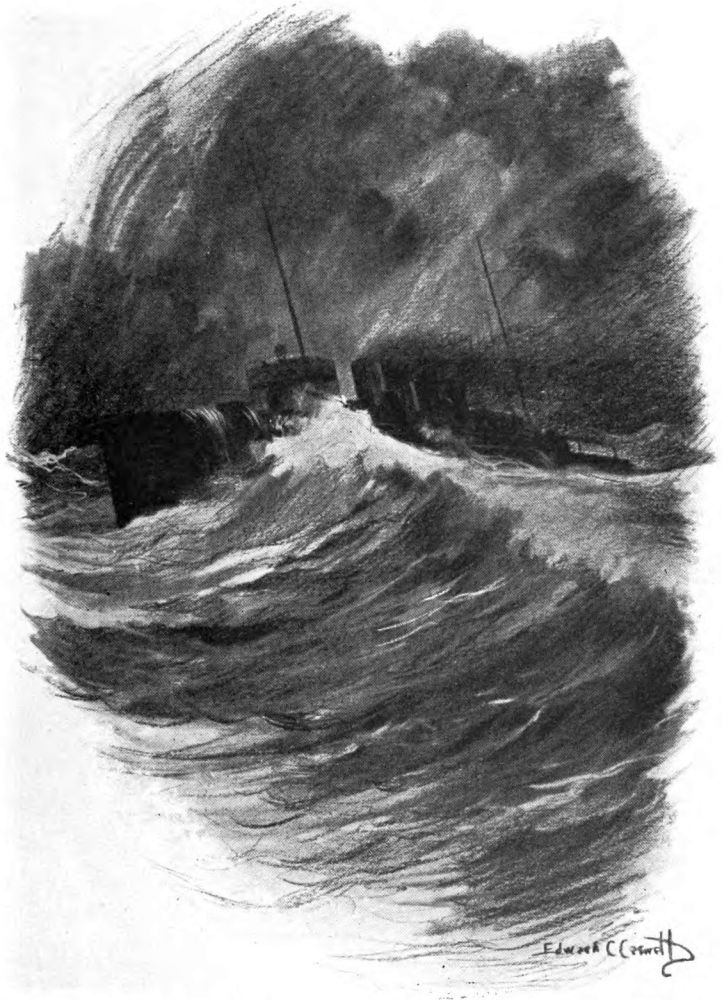
At midnight the first watch tumbled below, in dripping rain clothes, and the middle watch went on duty. Joe was glad of something to do to keep his mind off his troubles and forebodings. Climbing the ladder and squirming through the hatch was in itself an adventure tonight, while, once on deck, grasping the life-lines that had been strung and making one’s way forward or aft was a process that called for nerve and strength. He had been assigned to after main deck lookout and eventually gained his station, though not before he had been drenched from head to foot and tossed, clutching to the line, against every obstruction in his path. Pitch darkness was all about him. The sea was a tumbled thing that dropped below him, arose to towering heights above, threatened each moment to engulf him. Spotting under such circumstances was a veritable jest. One could only cling in his place and endure. The wind drove past in a frenzy, howling madly, chill from its far journey across the Atlantic. Joe tried to whistle once but the wind tore the sounds from his lips so quickly that he [181]couldn’t even hear them! Somewhere, a few yards away, another unfortunate was trying to peer over the mountainous tops of the waves, but so far as companionship was concerned he might as well have been on another hemisphere.
Joe pulled the tapes of his waterproof hat tighter and snuggled further into his jacket and prayed that the sickness wouldn’t come. So far he had miraculously escaped more than a few qualms, and out here in the fresh air—and it certainly was fresh, he thought grimly—it seemed that he might come through. He tried to follow Steve’s advice and not think about it, but sooner or later he always did. An hour passed and only another hour remained to be lived through out there. The chill was striking through his clothing now. He chafed his hands, one at a time, against the rough canvas of his life-preserver. The odd conception that the Warren was motionless came to him and he had to sniff for the smell of oil smoke and listen for the thud of the propellers before he could dispel the impression. He did his best to watch the tumbled surface of the ocean, but when you are one moment poised dizzily far above that surface and the next instant are wallowing far beneath it, keeping the [182]gaze on the horizon level is hard work! Joe told himself that a dozen U-boats could sneak up on the destroyer without his being a bit the wiser tonight. Then he wondered what would happen to him if a torpedo struck the stern. He was unpleasantly aware of those depth charges, generously loaded with “TNT,” stored a few yards forward!
Once he was almost certain that he saw a faint twinkle of light a few points to port, but at that moment the ship’s stern slid down into a trough, and when it was high again the light was not to be seen. He doubted his sight then and waited and watched. He didn’t see it again, if he ever had seen it, and that brief interest passed out of his vigil. The Warren was changing her course slightly now, for the wind struck him from a new angle and a spent wave came flopping over the side and washed his boots. The smother seemed worse than ever after that, but the stern held itself down better. His feet were frightfully cold and he tried stamping them on the wet deck. He tried to reckon time but had nothing to go by. His turn might be nearly over or might have half an hour to go. At least, he had escaped being sick so far, and that was something to be thankful for. A minute or two later something a trifle [183]darker than the darkness itself ranged alongside and a voice shouted:
“All right, matey! Seen anything?”
“No!” Joe had to hold his lips close to the other’s ear to make himself heard. “Once I thought I saw a light, but I couldn’t find it again.”
“Hold tight going back,” advised the relief. “They’re breaking right across by the third stack. This is a sweet job for a Christian, ain’t it?” The relief’s voice ended in a growl as Joe, clinging with chilled fingers, edged around to leeward.
“Good luck!” he called back, but the wind scattered his words over the torn sea. He found the life-line and pulled himself warily onward past the after gun turret, meeting there the full force of the gale and nearly losing his feet under it. He groped for the ladder and fell back against it and held tight, his body feeling as though flattened out under that mighty onslaught. The din of the tempest was deafening after the partial shelter he had enjoyed, and through it he could hear the rushing fall of water across the deck somewhere ahead. Above, dimly against the wrack of flying clouds, the nearer mast swayed and whipped. He took a breath and went on. [184]The hatch was only a little distance now. Then there was a sudden crash that brought his heart to his mouth, and an avalanche of water flung itself upon him. The force of it drove the breath from his body and wrested his chilled hands from the line. He felt himself tossed to the sloping deck, half-drowning, and instinctively groped for hand-hold. Then, turning over and over, like a log in a whirlpool, gasping, fear-stricken, he felt the deck go from beneath him. An icy coldness enveloped him, his ears were filled with a great hollow roaring and his lungs were bursting for air. He tried to cry out, but water strangled the scream in his throat. He thrashed his arms wildly, struggled against the terror that clutched him and felt the rush of air in his nostrils. And then, and not until then, he realised.
[185]
Sheer fright took possession of him in that first moment of realisation and he hurled his voice time and again into the tempest, shouted until his breath was gone and the knowledge that all his appeals were vain settled upon him. Aboard the destroyer they had not even known, and now she was far off in the darkness, and all help from her was past praying for. He could have fainted from terror and the numbing cold of the sea, but somehow he fought off the weakness. He was swimming mechanically as well as his cramped arms would let him, weighted down by heavy clothing and yet kept barely afloat by the life-preserver under his rain jacket. He tried to think calmly, to plan, and, gasping, shaking with the chill of the icy water and the fear that clutched his heart, he forced himself into a calmer state.
He could, he supposed, manage to keep afloat indefinitely, for sinking was impossible so long as that life-preserver remained strapped under his arms, but how long he would be able to stand the [186]chill of the icy water was another question. He recalled numerous stories of shipwrecks, but none supplied him information on the problem. There was, however, one thing certain, which was that he didn’t need that heavy waterproof jacket and trousers and hat. They made it more difficult for him to keep his head up and more difficult to swim, and swimming was the only thing to do if he was to keep his blood in circulation. After many attempts he kicked himself free from the trousers and removed the jacket and cap. It was no easy matter while battling with the waves and keeping his head above water.
But he did it somehow, and the effort restored his courage and drove some of the numbness from around his heart. Relieved of the stiff garments, swimming was far easier, although real swimming was out of the question. About all he could do was work arms and legs and shake the water from his eyes and do his best not to swallow it. He was a good swimmer and as much at home in the water as any American boy of his age, but no amount of swimming ability would have availed much here. He was swept up the long slope of a wave, poised helplessly for a moment on the high crest and then dropped down and down into the next seething hollow. He breathed when he could [187]and fought on, swimming as easily as he might to conserve his strength and finding to his joy that the chill was no longer intolerable. He longed intensely for daylight and tried to think how long it would be in coming. He had been relieved at two o’clock and it began to grow light about four. With daylight he might sight land or, at least, tell better in which direction to guide himself. Now it was only guesswork. And by day there was always the chance of rescue. He found what encouragement he could in these thoughts and struggled on, changing stroke from time to time as one set of muscles tired.
He recalled those first moments of panic and felt ashamed of them, and was glad that Steve hadn’t witnessed them. If one had to drown one could, he told himself, do it decently and not squeal like a kid. He didn’t want to drown a bit: life had never looked more desirable than it did at that moment. There was a lot to live for. Why, he couldn’t die until they had settled that war! That would be too horrible, never to know how it came out! Unless—well, he somehow doubted if they troubled themselves much with wars in Heaven! Of course, he might not get to Heaven, though. He reviewed a very blameless life in detail and was relieved to discover that, [188]after all, he hadn’t been desperately wicked. There were some things he preferred not to dwell on overlong, to be sure, but as a whole he seemed to stand a fair chance of getting by!
He was sorry that his mother and father would be so worried. The Warren would report him lost at sea, and, whether he was rescued or—well, wasn’t rescued, it would be a long time, he supposed, before he could reach them with the news of his safety. That troubled him a good deal. Then he wondered about Steve. Steve would feel pretty badly, he guessed. They were rather fond of each other, although they each took mighty good care not to let the other suspect it! Yes, Steve would be rather broken-up in the morning. And—why, it was morning—almost! From the dizzy summit of a wave his eyes, half-blinded with salt water, glimpsed a new greyness in the sky. After that he thought of morning and sunlight—he longed for sunlight—and watched the first signs of dawn creep up in the east until, presently, he could see about him. And, seeing, a touch of the old terror came back, for all that met his gaze was mile on mile of surging, stormy, wind-swept ocean, stretching off on every side to an empty horizon! The immensity of it frightened him and he closed his eyes and for a long [189]moment didn’t dare open them again. When he did the sea had taken on colour from the leaden dawn—there was to be no sunlight for him, after all—and he was floating in a green world flecked with white foam, a tiny, helpless, forgotten atom.
But presently the atom took courage again. The ocean was no bigger now than it had been last night, while his chance of rescue was a thousand times better. At least, he would keep on hoping until the very end. He wouldn’t be a quitter even if there was no one to know it. He stopped swimming and floated for a long while, swallowing more water than was pleasant, but managing to rest his tired lungs. Then the chill warned him and he went on. It was broad daylight now: probably five o’clock, or a little after. The wind seemed less violent, although the waves still ran as high as ever. He had been in the water fully three hours, he reckoned. He believed he could swim for an hour longer, by resting at times, but the chill of the icy element was gradually producing a kind of paralysis in his muscles. He had felt nothing approaching cramp, but that might, probably would, come later. He thought he would retain consciousness most of the day. After that—well, unless he had his senses [190]and could keep his head up the life-preserver wouldn’t deserve its name!
He experienced a trying ten or fifteen minutes when a fit of shivering and nausea attacked him, but after being slightly sick at his stomach he felt better. Thirst made itself felt, and he mentally predicted a day of discomfort, if not suffering, from that cause. His throat and mouth were parched with the salt and swallowing was difficult. He felt no interest in food.
At times the sky grew perceptibly lighter in the east, but the low, lead-hued clouds never actually parted. At those moments the giant waves became more translucent and he could look down for what seemed many fathoms into shadowed green depths. Only twice did he see any life about him. Once a large bird scudded down-wind, and once a ghostly, dully-gleaming denizen of the sea passed slowly beneath him as he was swept up the curving side of a wave. He thought the bird was probably an albatross, although he had never seen one to his knowledge. At least, it was much too large for a gull. The fish caused him to think unpleasantly of sharks, but common sense comforted him. No dangerous shark, he told himself, would be found in water of this temperature!
Time and again, suspended momentarily on [191]the crest of wave, he searched the ocean on all sides. But not even a bit of wreckage met his gaze. He had but scant idea of his whereabouts. He might be anywhere from fifty to a hundred and fifty miles west of the Scilly Islands, as to latitude, and somewhere in a general southerly direction from Cape Clear. But that was only guesswork. What did seem probable was that he was in the path of trans-Atlantic shipping. If, he told himself many times, he could fight off the cold and the thirst he would surely be picked up before night. But there were less hopeful moments when he realised that in such a tumbled sea so small a speck as he presented might never be seen.
Another hour went by: perhaps more: that, too, was only guesswork, for his watch had stopped at seven minutes to three. Then from the frothy, wind-tumbled summit of a wave his eyes received the fleeting impression of an object perhaps a quarter-mile away. The next instant he was plunging down into the lead-green trough. He swam hard to win the crest of the next hill of water, and when he had done so looked eagerly again. But only wind-hurled water met his gaze, and a keen disappointment took possession of him. He tried to bring back the picture of the small, [192]dark speck, but his glimpse had been so brief that memory failed him. Once more he was borne aloft and once more he swept the sea. And this time, just as his descent began again, the object sprang into sight. He swung his course and, fighting the forces of wind and water, swam desperately in the direction of the thing that might be an empty boat or a piece of wreckage, that, whatever it was, would be something to lay hand to.
He was soon tuckered, for he was struggling at an angle with the sweep of the seas, but he persevered, and presently the floating object appeared close ahead of him, something round and rusty-yellow seen momentarily against the grey horizon. It bobbed over the edge of a wave and went from sight. As he pursued it he speculated puzzledly. It had looked somehow like a buoy, but there were no buoys so far from shore; unless it had been torn from its moorings. Then he plunged breathlessly down a long glacis of green, foam-patterned water and at the same moment the object of his search topped the crest of the further summit, and he realised what it was. For an instant his disappointment was keen. Then reason told him that even a floating mine was better than nothing, and he struggled up the slope of a wave and, shaking the water from his eyes, [193]saw the thing almost above him. Two strokes and he had the fingers of one hand about a rusted ring-bolt and, relaxing, drew grateful breaths of air into his tired lungs.
Presently he had recovered sufficiently to examine his prize. It was just such a mine as he had seen a dozen times, a metal sphere some three feet in diameter, its lower and upper halves held together by bolts passing through flanges. Three ring-bolts were set at equal distances around the top, while at intervals “horns,” or firing pins, stuck out. Joe guessed there must be eight of these. That the mine had been in the water a good while was evidenced by the thick scales of rust around flanges and bolts and by a slimy deposit of greenish growth on the underwater half of it. There was nothing he could see to tell him whether the instrument of destruction was of Allied or German origin. He thought, however, he could detect a difference in the shape and length of the horns from those on the mines he had seen. Later he glimpsed a short length of wire cable depended from below and knew then that the mine had in some manner been parted from its anchor and swept away from a field. How long it had been bobbing around in the path of navigation he couldn’t guess.
[194]
At another time, under other circumstances, Joe might have smiled at the incongruity of making friends with a couple of hundred pounds of high explosive, but just now the thought didn’t occur to him. The big metal ball, harmless enough so long as it didn’t collide with anything hard enough to detonate it, seemed very friendly out there in that watery void. It was a rather erratic and unsteady friend, to be sure, for it nodded and bobbed and dipped and turned continually, but it was something a bit more stable than the waves and it offered help in keeping afloat. Joe tried holding to the rim, but the mine didn’t approve of that, apparently, for it slipped away several times. Then he again grasped a ring-bolt, which, while demanding a strained position of the arm, was far more secure. He began to talk to it presently: called it “old chap”: speculated on their chance of rescue: found a deal of comfort in the sound of his voice until his parched tongue ached and he had to stop. Up and down they went, mine and boy, lifted to the wind-topped summits, drawn to the deep hollows, dashed with spray, flung about like the two tiny atoms they were, while about them a grey-green desert of ocean stretched emptily to meet an empty leaden sky.
[195]
“Submarine broad off the starboard beam!” sang out the lookout at the bow. A tall, yellow-bearded Viking in a dirty blue uniform turned swiftly and followed the sailor’s pointing hand. Then he raised binoculars to his eyes and, steadying himself on the swaying bridge, focussed them on a tiny dark speck that danced into sight and out again two miles to the southward. A look of perplexity came over his face and he made a motion toward the engine-room telegraph beside him. Then he paused and again viewed the object. A second man joined him, a short, squat figure in the dress of a ship’s mate. He spoke in a language that was not English whatever it may have been.
“What do you make it?” he asked.
“A boat, I think, Carl,” replied the first man, in the same language, “and yet——”
“Let me look.” The man set the glasses above a red, tilted nose and for a moment gazed in silence. At last: “Not a sub, at all events,” he [196]decided. “Nor yet a small boat. Probably a piece of wreckage.”
The other accepted the glasses back and shrugged his broad shoulders. “I think we had better have a nearer look at it, however.”
The mate nodded, and presently the steamer, a small cargo boat bearing the legend SWEDEN and the Swedish flag along each side of her hull, slowly turned a blunt nose toward the puzzling object. Aloft, the lookout called again:
“Floating mine, I make it, sir, with something dragging.”
“Mine, you say?” The captain again raised the binoculars. “That is right,” he said, turning to the mate. “It is a floating mine. There is a piece of canvas, I think, or possibly seaweed attached. Shall we pick it up?”
“Why not, if it is of use to us? We can find a better place for it than this.” He smiled faintly.
And so it happened that at shortly after six bells that afternoon the steamer Sundsvall stopped her engines, lowered a gig and added to her possessions one rusty mine and to her complement one half-drowned American seaman.
The mine was lifted aboard by means of a small crane, the seaman came up lying in the bottom of the gig as she was swung to her davits. That the [197]seaman came at all was no foregone conclusion. The captain had spoken most discouragingly of the project of including the American in the salvage.
“Let him go,” he had advised. “He’s as good as dead already. If he comes around he will be in the way and eat our precious food. Better hit him on the head now and drop him back where he came from.”
But the mate demurred. “Give him a chance,” he suggested. “If he proves troublesome we can throw him over later. There’s life in him yet, and we can drop him in port tomorrow. He’s American, Flink,” he added. “I like to hear them talk. Besides, my wife’s sister is married to one of them and lives in a place called Chicago.”
“Have it so, then.” The captain shrugged and turned on his heel. “But see that he is kept in the fo’castle. He mustn’t see—anything.”
“He will be in no condition to see much,” replied the mate. “Take him for’ard and put him in a bunk, a couple of you, and tell Mr. Heilsberg to have a look at him.” He turned back to the captain. “A thing I never saw before,” he went on. “A man lashed to a mine in mid-ocean. What do you make of it?”
[198]
“Nothing. Who knows it is not some infernal Yankee trick?”
“Not likely. More probably the fellow fell overboard in the gale of yesterday and found the mine by luck. He had passed the cuff of one sleeve through the eye of a ring-bolt and held it so by his pocket-knife thrust through the cloth. He would have torn loose in another hour or so, I think.”
“Pity he didn’t,” growled the other. “Take the ship. I must look over that chart again. Pass the word to the lookouts to keep their eyes peeled.”
Below, in a smelly bunk in an even smellier forecastle, Joe, under the grunting administrations of a bewhiskered second mate who had a smattering of medicine, was opening his eyes.
“Where am I?” he muttered perplexedly.
“You are safe, my young friend,” replied the mate in fair English. “Swallow this. It will choke and burn you and do you much good.”
Joe obeyed, and the first part of the promise was fulfilled. “Water!” he gasped. “Water!”
“Ach, to be sure! You shall have it.” The mate disappeared muttering, while Joe, his salt-scorched throat smarting horribly, writhed and gasped. In the dim light clothing on hooks [199]swayed to and fro and the beat of the engines was deafening. The water, insipid and warm, was like nectar, and Joe let his head fall with a long sigh of relief.
“What ship is this?” he asked faintly.
“Sundsvall.”
“German?” he asked in quick dismay.
“Nein! No, no! It is Swedish.”
“But you—are German,” Joe persisted.
“No, I am, too, Swedish. We are all Swedish this ship hereon.”
“Oh!” Joe closed his eyes. “Thanks. I think—I’ll—go to sleep.”
“So! That is well. Sleep is good for you, my friend. I come again later. Sleep well.”
But Joe didn’t hear, for he was already slumbering.
When he awoke next it was night, for a dim electric light shed a wan glow overhead. A sailor was darning a woolen sock nearby and several others lolled in bunks or sat beside the table that stretched, knife-scarred, stained and littered, between two iron stanchions. They talked a language Joe could not understand, although it sounded throaty, like German. Some words held a close similarity to German, just as the men themselves, slow, phlegmatic, looked like Germans. [200]The Sundsvall was evidently running slowly, and her forecastle was a most uneasy place. Joe remained silent, his mind busy in a drowsy way with the events of the day.
That it was still less than twenty-four hours since he had been washed from the deck of the Warren was difficult to believe, and he was greatly inclined to suspect that he had floated around with that friendly mine for two days instead of one until he realised that had he done that he would not now be alive. The last he could recall was talking to a gull that had circled closely and inquisitively around him. That must have been just short of noon. That he had absolutely talked, he doubted, for he remembered how painfully swollen his tongue and lips were, but he recollected trying gravely to warn the gull that if it tried to peck one of the “horns” of the mine and explode it, he—Joe—would pull its tail-feathers out! Previous to that, unable to keep his wet, chilled fingers locked about the ring-bolt, he had laboured for what must have been the better part of a half-hour to get the cuff of his sleeve through the eyelet and secure it there by running his knife through it, and had finally succeeded. By that time he was raging with thirst and his legs had lost sensation. And, although [201]he didn’t know it, he had been slightly out of his head and had talked a great deal of nonsense—or tried to—to the mine. Now, stripped of his wet clothes and lying between soiled but gratefully warm blankets, he felt sleepily thankful for his rescue and, presently, hungry.
Later he was fed a sort of stew by a grinning, slant-eyed boy in a questionably white jacket who talked a strange patter of pidgin-English which Joe understood scarcely better than the Swedish he had listened to. The stew was greasy and somewhat tasteless, but Joe consumed it and felt better. Refusing a pannikin of something the boy called tea, he turned over and went to sleep again.
He awoke to the touch of a hand on his shoulder and looked confusedly up into the face of the squat first mate. The mate, speaking fair English, asked how he had happened to be floating around on a mine, and Joe told his story. The mate nodded from time to time, closing his eyes like a wise owl. Then he inquired: “The Varren, you said? Ah, and she iss an American ship, yes?”
“Yes, sir.”
“She iss perhaps on duty hereabouts?”
Joe nodded.
“If we could find the Varren we should give you [202]to her back.” The mate smiled genially. “Perhaps you could tell us where to look for her?”
“No, sir.” Joe shook his head. “We aren’t allowed to know her patrol district. I guess it will be all right if you’ll just land me somewhere or hand me over to one of the Allies’ ships.”
“Yes, but it would be so much better for you could we find your own ship. You do not know where she iss?”
“No, sir, I don’t.”
“She iss perhaps convoying?”
“I don’t believe so.”
“Or perhaps looking for something? A submarine or—or something?” The mate’s eyes closed slightly, although the grin remained. Joe, scenting danger, again shook his head. Then he replied carelessly:
“No, she isn’t looking for anything, sir. She’s just doing patrol.”
“Well——” The mate seemed slightly disappointed. “Then we will land you at the first port or perhaps put you aboard one of your own ships, my man. You live in America?”
“Yes, sir.”
“Where, please?”
“New York.”
[203]
“Ah, New York. And you perhaps have been to Chicago?”
“No, sir, I’ve never been there.”
“So? The sister of my wife is married to a man that lives in Chicago. She writes in letters that it iss a very big city. Some day I shall see your America and visit this Chicago. And your New York, too. Yes, maybe it will be before long, also.”
Again came the odd closing of the eyes, and Joe experienced a sudden antagonism. But he didn’t let the fact appear as he asked: “Where is this ship bound, sir?”
“Santander.”
“That’s in Spain?”
“Yes. We go in ballast but we return with much cargo for our starving country.”
“Oh, is Sweden starving, sir?”
“Sweden? Yes, Sweden has but little food now since the blockade. It is dreadful! My poor suffering country! But she does not complain. She remains at peace with all countries. It is the war.”
He took his departure. As he vanished the half-dozen occupants of the forecastle exchanged growling remarks, one of which produced a laugh that sounded extremely unpleasant to Joe. As [204]he closed his eyes again he said to himself: “You’re just about as much Swedish as I am, and I hope that if ever the Warren runs across this tub she’ll have a look at your papers. The Sundsvall may be Swedish, but her officers aren’t, and if she’s taking food to Sweden it doesn’t stay there. I guess it’s up to me to see what’s going on here.”
He lay with closed eyes for a long time, thinking it over. The clothes he had worn had been dried in the galley and were now lying across the bottom of his bunk. He decided to await his chance and put them on. But the chance didn’t come readily, for of the watch below someone was always awake. He heard four bells strike and was sorely tempted to yield to the demands of sleep. In fact, he had reached a condition on the borderland of slumber when he was awakened by a voice at the companion. The words it spoke were Greek to him, but the meaning was as clear as though they had been: “All hands on deck!” From the bunks here and there a grumbling figure appeared, stretched, yawned and stumbled away. After waiting a minute or two Joe sat up and peered around. So far as he could determine the forecastle was empty of occupants other than he. To make quite certain he waited another few [205]minutes, but then, fearing that someone might return before he had accomplished his object, he swung his feet over the edge of the bunk and, supporting himself against the side, for he felt pretty weak and wobbly and the ship’s motion, while much less than earlier in the evening, was still erratic, hurriedly drew on his clothes. There was, he told himself, no reason why he shouldn’t dress and go on deck, but nevertheless he knew that such a thing was not included in the officers’ plans for his conduct, and he realised that it would be just as well to keep out of sight.
From the forecastle a short central passage led to the companion-way, past the open door of the galley, on one side, and a second door, closed, on the other. The galley was deserted, and a single lamp burned above the simmering stove. Cautiously Joe climbed the ladder and peered out. The ship was in darkness. The bridge, however, showed against the sky, as did a figure which stood motionless at one end of it. Well up on the foremast what appeared to be a lookout made a blotch of darker black. Joe hesitated an instant and then slipped out on deck and, accommodating himself to the roll of the ship, scurried to the starboard rail. The Sundsvall was three-housed, cut low between forecastle and bridge and between [206]bridge and after-cabin. The sea had abated a good deal, but the ship still rolled and plunged. There was a faint light from the engine-room hatch and he could hear the engine slowed down to headway only turning slowly over below. He had wisely left off his shoes, which made progress more certain and more quiet. Half-way along the deck he heard voices and, his eyes accustoming themselves to the darkness, made out forms. He slipped into the shadow of a boat and listened.
Whatever was going on was enlisting the entire working force of the ship, since, excepting the man on the bridge and the lookout on the foremast, no one else was to be seen or heard forward of the after deck. The sound of chain and the muffled blow of a hammer came to him, and then the squeaking of a tackle-block. He left his hiding place and slipped nearer, keeping to the deeper gloom of the house. Overhead a few stars showed faintly, but gave no perceptible light. From his new position he could discern dimly many figures at work along the port rail and could hear low voices. The notion came to him then that they were lowering a boat, but presently, in the quick, tiny light of a hand torch, flashed on and off in the fraction of a second, he saw the boat still lying in her chocks. A dozen explanations [207]of the secrecy of the work came to him only to meet rejection. Then once more the hand torch gleamed and the mystery was a mystery no longer.
[208]
The momentary flash of the electric torch had shown a picture that remained stamped on Joe’s vision long after darkness had returned to the scene. A confusion of busy men, a small crane leaning over the side where a section of the rail had been removed, and, stretching from crane well toward the middle of the deck, a line of spherical shapes each lying beside a coil of cable and a smaller square object. Joe’s heart jumped into his throat as the truth came to him.
The Sundsvall was laying mines!
Then the recollection of Jack Higgins’ revelation in the forecastle of the Warren the night before flashed on him. New mine fields had been discovered and none knew how they had been planted, but suspicion rested on an unknown ship posing as a neutral! And Fate, he reflected awedly as he slipped back into the farther shadows, had tossed him into the sea, given him miraculous help in the shape of that floating mine [209]and at last had landed him on the very ship that was engaged in the nefarious work! Crouching there in the darkness, Joe tried to think calmly. There was nothing he could do to prevent the murderous work from going on. His only course was to return unseen and unsuspected to his bunk in the forecastle and wait until he was landed or transferred to another ship. Then, however, he told himself with a sudden gripping of his hands, the Sundsvall would need to look out for herself!
He wished there was some way of finding the present latitude and longitude so that he could locate the mines now being lowered into the sea, but there was no way of getting that information without having access to the chart or log, and that was far too dangerous. Once suspected of having witnessed the ship’s operations his life would be worth even less than it had been a dozen hours ago! They would simply knock him on the head, in all probability, and quietly drop him overboard: in which case he would not only be of no further use to himself but of no further use to his country and her allies. No, the only course was to wait and secure his release from the Sundsvall, and with that settled in his mind he began to retrace his steps toward the bow. He had reached a point midway between bridge and forecastle [210]when a gleam of light shot across the water. Startled, he stood in his tracks and turned.
A mile away, according to his reckoning, a searchlight was flashing the three dashes of the International Code that stood for O and signified “Who are you?” From the bridge came a sharp exclamation and as Joe dashed for the shelter of the companion, footsteps came running along the deck and shouted orders broke the silence of the night. Suddenly a sharp stream of white light shot from the bridge and the Sundsvall’s shutter clicked and clicked as she answered. Joe, ready to flee if anyone approached the companion, watched and read. The operator at the occulting light was slow, but he answered with painstaking care and a fine avoidance of abbreviation.
“Sundsvall, Sweden, Stavanger to Santander, in ballast,” replied the steamer.
Again the distant light twinkled. “Why are you off your course?”
“We have strained our propeller shaft and are making repairs,” answered the Sundsvall without hesitation. There was a long silence from the other ship, and then, finally, the laconic: “Right!” flicked over the sea.
Joe was already hurrying down the short companion-way, his thoughts racing fast through his [211]mind. The unseen questioner was undoubtedly a patrol ship. She was only a mile distant. If——
He stared eagerly about the forecastle. Overhead a single electric light burned pulsatingly and dimly. On each side were two ports, closed and carefully covered inside the glass by painted canvas. Joe stepped to the door of the passage, unhooked it, closed it and shot a rusty bolt. Then with trembling fingers he tore the covering from a port on the starboard bow and, unfastening the round frame containing the glass pulled it open. If only the lookouts aboard the patrol had sharp eyes!
With a jump he reached the table and his hand fumbled for the key at the electric lamp. To his dismay it had none. But in the next instant an expedient occurred to him and he quickly unscrewed the bulb until connection was barely severed and the forecastle was in darkness.
For as long as it took his heart to beat a half-dozen times he stood motionless in the gloom, one hand on the electric bulb. Then he turned it slightly to the right and the light came on. For a second it continued. Then darkness once more. Again light, but this time only a quick flash. Again darkness. And so, slowly and anxiously, he formed of dashes and dots the single letter [212]that is the “negative” of the British code. And when it was done he started again. And then, to make assurances doubly sure, he changed to the dash-dot-dash of the International. A long minute passed. In the brief moments of darkness between signals he strove to look through the port and find the patrol. But he was too high and the patrol was out of his range of vision. He tried the negative in the secret code of his own country then, and was half-way through with it when a glare of light swept through the port and made a shaft of white brilliancy across the forecastle. It glared for an instant and then passed away, but Joe knew that it was travelling slowly toward the vessel’s stern, wafting up and down, playing on deck and masts and bridge. And even as he leaped from the table heavy footsteps pounded in the passage, a body was hurled at the door and fists beat on the heavy woodwork.
But the door held firmly and only wild, guttural threats entered. Joe backed away and looked about him for a weapon. Nothing more deadly than a stool presented itself and he seized that and poised himself near the door. Fortunately, it opened toward the passage and those beyond could only tug and beat. As he stood there, awaiting what he felt must be the inevitable [213]so soon as one of his besiegers thought to fetch an axe, he found a grim pleasure in picturing the scene on deck. The patrol would have put her blinker on now and would be impatiently questioning. The throng at the Sundsvall’s rail would have scattered under the searching beams of the light. On the bridge the painstaking signal man would be spelling out lies. If only the patrol didn’t allow herself to be hoodwinked!
Suddenly he felt the jar of the engines, and his heart leaped. “The fools!” he muttered joyously. “They’re trying to run away! They can never do it and they’re showing their hand!”
The blows and imprecations outside the forecastle door ceased for a moment as though in response to an order from beyond. Then feet scuffled and a ship’s axe dug its blade deeply into the upper panel of the door. And simultaneously the white glare of the distant searchlight sprang in again at the open port. Again the axe crashed into the splintering wood. The steamer was fairly shaking now with the reverberations of her hurrying screws, and the seas were pounding against her nose and swishing past the open port. Joe, stool held aloft to greet the first head that appeared, watched in a horrid fascination as the axe blade bit and smashed at the panel. The disc [214]of white radiance travelled from the bunks to the forward partition, as the Sundsvall swung to port, and came to rest squarely on the yielding portal. A gaping hole appeared and the muzzle of a revolver was thrust through. Joe flattened himself against the bulkhead as the report rang out. Then the stool descended swiftly and the revolver clattered on the floor.
He reached out with his foot and drew the weapon toward him until he could reach it without placing his body in range. Beyond the door a howl of mingled pain and anger had followed the swift descent of the stool, and now several voices arose in threats and curses. The axe tore at the frame beyond the bolt and the blows drowned the sound of the throbbing engines. Joe spun the cylinder of the revolver. It was six-chambered and five cartridges remained. To hold the door after the bolt had given would be impossible. He thought swiftly. Well forward in the narrowing forecastle an upper bunk—they were built in tiers of three—was so draped with swaying garments that it was almost as if curtained. He appraised its possibilities and then listened in an effort to judge of the number beyond the portal. He thought there were four men there. Evidently he had gained possession of the only revolver [215]amongst them, which suggested that the force was composed of one officer and three men; possibly four. He could, he knew, shoot through the door and trust to luck, but cartridges were few, and, if truth were told, he had little stomach for it. The searchlight which for a full minute had lain on the door in a round disc now moved slowly aside and the place was left in darkness.
Stool in hand, Joe crept away toward the bunk. Then he was crouched up there in the unrelieved gloom, his eyes trying to pierce it in the direction of the door. What he knew would happen happened. In the darkness the besiegers could safely reach in and draw back the bolt, and this they did. Joe heard the door grate softly and then slam back as it was pulled quickly outward.
Lying face down on the upper bunk, with evil-smelling garments swaying past his face, the hand holding the revolver stretched out and down, he waited a brief instant. Then a footfall sounded and he pressed the trigger.
In the darkness the flame from the barrel made a quick flash of scarlet. There was a sharp cry of anguish, mutters and silence. Joe strained his ears, his heart beating faster than the rapid thump-thump of the racing engines. He knew they had located him by the flash of the revolver, [216]but they would have to climb to get him. A groan broke the silence that held above the sounds of the ship, and steps shuffled in the passage. Were they drawing off? He waited, finger trembling on trigger. Then a sound like a deeply-drawn breath came from beneath him and he pointed toward it and fired again.
The spouting flame lit up a snarling countenance just below the bunk. He swung the muzzle toward it, but at that instant a hand gripped his wrist. Instinctively he pulled the trigger. A bullet crashed downward toward the floor but the grasp on his wrist only tightened and strained. He could no longer hold the weapon and his fingers relaxed. He heard the revolver thud on the boards below. Struggling, he strove to beat off his assailant, but his blows fell harmlessly. He was being pulled over the edge of the bunk. He tried to find something to hold to, but couldn’t. His captor grunted a word, was answered from the darkness and in a moment other hands were about Joe’s legs and he was pulled into space.
He fell crashing to the forecastle deck, but the violence of the fall was in a measure broken by the men beneath him, for even in the darkness and confusion he was aware that one of the enemy had gone down with him. With his breath half driven [217]from his body, he could only lie there in a litter of garments pulled down in the struggle and gasp. And then they were on him.
Blows rained about him, and only the darkness and the fact that the enemy hindered each other, saved him for the moment. A giant fist grazed his forehead and crashed onto the boards. Joe wrested an arm free and struck blindly upward and got home under a bearded chin. The grunt that answered the blow filled him with savage joy. Kicking, thrashing, heaving under the weight of other bodies, he fought madly, regardless now of punishment. Hands groped at him, at his legs and arms, at his throat. He tore them aside. But the struggle was far too uneven to endure long. They had his legs helpless now, crushed under the weight of a great body. Then one arm was pinned to the floor and a big hand closed merciless fingers about his throat. He tried to tear them off, but it was no use. A knee settled on his free arm, the fingers tightened and tightened. He struggled until the perspiration stood on his forehead. Lights danced before his eyes crazily, a great sound of roaring filled his head and his straining muscles relaxed. A last wondering thought came to him on the verge of suffocation: this is the end!
[218]
And then, coincident with the thought, a great crashing sound beat on his brain, a sound that seemed to fill the world with its monstrous voice.
[219]
He came to himself in darkness. A great weight lay across his body. Wondering, striving to recollect, he put forth an aching hand and pushed at the weight. His fingers pressed against something that yielded slightly. Exploring, they sensed cloth and, beneath it flesh and bone. It was a man’s arm! And with that knowledge came recollection.
The first question he asked himself was: Am I dead? Then the painful throbbing of his bruised throat, the ache of his tired muscles answered with a decisive no. But what had happened? He recalled that devastating noise that had seemed to crash his very skull in with its violence. What had it meant? Painfully he struggled from beneath the body that lay across him, and as he did so he became aware of the wind that blew about him and of strange, tangled things that littered the floor. Groping to his feet, swaying dizzily, he looked about in the darkness. From somewhere came the sound of escaping steam. The Sundsvall’s [220]engines were still. Perplexed, he groped for a stanchion and found none, but saw instead a gaping, jagged hole in the ship’s side through which he could see dimly the waves and feel the rush of the night wind! As his eyes grew used to the darkness he made out the tangled, twisted stanchions, the splintered planks about him and knew then what had happened!
For the first time he viewed near-to the effect of a three-inch shell!
“They’ve got her!” He had meant to cry it aloud joyously, but all that came from him was a hoarse croak which so surprised him that he stood open-mouthed for a second in dismay. Then, grinning to himself in the dark, he started toward the door. Half-way to it he tripped over something that, with a shudder, he realised was the form of a man. He wondered how many there were in there and whether they were all killed: wondered, too, by what freak of fortune he had escaping the flying fragments of steel and iron and wood.
In the passage all was dark. Even the light in the galley had been turned out or wrecked by the exploding shell. He stumbled up the companion ladder. Before him stood three figures. A revolver gleamed dully.
[221]
“Halt!” said a voice sharply. “Put your hands up!”
Joe obeyed with fine alacrity.
“Advance! Halt! Search him!”
One of the figures stepped forward and went over him with swift fingers.
“I am unarmed,” said Joe, in a hoarse whisper.
“We’ll see,” was the dry response. Then, with evident surprise: “How do you happen to speak English so well?”
“I’m an American, sir.”
“What!” The petty officer stepped nearer. From the patrol ship lying a few fathoms away two paths of white light led from her searchlight platform to the Sundsvall’s deck, and though the nearer one did not encompass the group at the head of the companion it afforded enough light to enable the officer to see the braid and stars on Joe’s shirt collar.
“Hello!” said the officer in a very English tone. “American seaman? What are you doing aboard this ship?”
“I was washed off my ship, the destroyer Warren, and picked up by this ship yesterday afternoon.”
“Was it you who signalled to us?”
“Yes.”
[222]
“By Jove! What luck! Are there any more of the crew forward?”
“Several, but I think they’re either dead or badly injured. The shell came into the fo’c’sle where we were—were arguing.”
“Good! Have a look, men, and fetch ’em out if they’re worth it. You come with me, Yankee. What’s your name, eh?”
“Ingersoll.”
“Mine’s Cashell. We’re the Linnet, torpedo boat.”
“British?”
“Rather! Here’s the junior luff. Spin your yarn to him.” Joe’s companion saluted a young officer amidship near the starboard rail. “Here’s the man gave us the signal, sir.”
The lieutenant, turning from shouting orders to a small boat alongside, viewed Joe with swift appraisement as he returned the salutes. “American?” he demanded.
“Yes, sir.”
“What’s your ship?”
“Warren, destroyer.”
“Right-o! Drop into the boat. We’ll be going back in a minute.”
Joe climbed down the ladder and tumbled aboard the small boat.
[223]
“Hello, matey, where’d you drop from?” asked a voice from the bow. Joe, making out the figure of a sailor standing with boat-hook in hand, answered croakingly: “Out of the moon, Limie.”
“Ho! American, ain’t yer? What was you doing on this floatin’ lie?”
“Oh, I was in command,” said Joe.
“If you was you’ll be up agin a stone wall bloomin’ soon! Take my word for that, Yankee!”
“Stow the talk,” advised a voice from the stern, and from the deck above came the order: “Pass down the prisoners!”
They came, three of them in all, and sank onto the thwarts in listless silence. Then Joe’s acquaintance, the petty officer, followed and the boat pulled across to the Linnet. There the prisoners, amongst them the Viking-like captain, were marched aft, while Joe, conducted by Cashell, was taken to the presence of the Commander, a middle-aged, kindly-looking Lieutenant.
“Lieutenant Briggs’ compliments, sir,” said Cashell, “and we’ve fetched away the captain and two mates, sir. There’s sixteen left aboard, most of ’em Huns.”
“Mines?” asked the Commander.
[224]
“Ten of ’em, sir, all German. Lieutenant Briggs says if he can have five men he can manage her into Bordeaux.”
“Good! Ask Mr. Farnsworth to step here. And now, my man, who might you be?”
Joe explained. There was no time for a detailed story of his adventures then, for the Commander interrupted him to order a prize crew aboard the Sundsvall. “Instruct Mr. Briggs to watch those prisoners closely. He had better iron some of ’em. He won’t need them all to navigate. Tell him to make Bordeaux. We’ll keep with him as long as we can. Douse those lights up there! We’ll have the whole submarine fleet on us!” He turned to Joe again. “Report to me in the wardroom in twenty minutes. I want to hear more of this.”
“Yes, sir, but may I suggest that the Lieutenant should swing wide of the place the Sundsvall was lying when you first saw her? She was dropping mines, sir.”
“Quite right.” He bawled a warning through a megaphone to the other ship, and then, addressing Joe once more, said: “Find the surgeon and get him to look after those bruises.” He went briskly forward and climbed the ladder to the bridge, and Joe, seeking the lower deck hatch on [225]a boat that was strange to him, heard the Commander’s voice come crisply aft:
“All clear?”
“All clear, sir!”
Somewhere a bell tinkled, the Linnet quivered from stem to stern and there was a mighty splashing from the propellers. When Joe reached the lower deck he could hear the water swashing fast beyond the steel hull. An oiler led him to the surgeon, a mere slip of a lad scarcely older than Joe, it seemed, and again the latter had to croak out a brief outline of his story. The surgeon said “Dear me! Dear me!” when he came to an examination of Joe’s neck. “My word, the blighter nearly did for you! You can count all ten fingers on your throat. No, nine. He only registered one thumb! Arnica will help that. You stand steady a bit.”
Joe had his first glimpse of himself in the little mirror on the white wall above the washbowl as he waited. He looked pretty fairly disreputable. His neckerchief was frayed and pulled into a hard knot, his hair had not been brushed since the night before, a place the size of a half-dollar was minus skin over his left eye, his jaw was swollen on one side and at some time his nose had bled. His knuckles were puffed and scarred, as well. Add [226]to that that he was shoeless and hatless and that his shirt and trousers showed the results of long immersion in salt water followed by a hasty drying and you will understand that he was scarcely a model example of the United States seaman! But those things were all remedied in ten minutes. Some sort of very smelly liquid was applied to the raw places and soothed the smarting instantly, a bandage dipped in diluted arnica was placed around his throat, he enjoyed the wonderful privilege of washing face and hands and, finally, he was provided with a pair of shoes and a cap. And by that time he was due in the wardroom and, the surgeon conducting him, made his way to it.
The Commander and a Lieutenant were there when he entered, and these, with the surgeon, whose rank Joe judged to be that of ensign, were his audience when, having seated himself, by direction, at one end of the wardroom table, he told his story from the time of being washed from the deck of the Warren until he had been confronted at the head of the companion-way by Petty Officer Cashell. And he had an attentive audience. He told his story modestly enough and was listened to with no interruptions from the listeners. But when he had finished they had plenty of questions to ask.
[227]
“Did you know what the Sundsvall’s game was when you first got aboard?” inquired the Commander.
“No, sir, not until I crept out on deck and saw them slinging the mines over. But I suspected that something wasn’t right before that. The first mate was no more Swedish than—than I am, sir.”
“Not a bit,” replied the Lieutenant dryly. “His real name is Schmier and he’s a reservist. He was second in command of a submarine that went ashore on the coast of Holland two months back. He was interned and escaped. The captain claims to be really Swedish, and possibly he is. The crew are mostly Germans and Austrians.” He paused and looked questioningly at his superior. “It’s all right to tell this, sir? This—er—fellow is intelligent and won’t repeat what he shouldn’t, I’m sure.”
The Commander smiled and nodded. “No harm, I fancy. He deserves a bit of wardroom gossip for his service. You see, Ingersoll, we’ve all been after that ship for a month. We didn’t know what her name was or what she was like, but we knew she was doing her devilish work about here, and we wanted her. It’s a lesson to us, Farnsworth, not to take any ship’s innocence for granted these times. Ingersoll says, you see, [228]that they were planting mines the very moment we signalled her. In a way, I’m sorry we couldn’t have sunk her at it!”
“I, too,” said the Lieutenant heartily. “But with bottoms as valuable to us as they are today, I fancy it wouldn’t have done, eh?”
“Briggs’ll be lucky if she doesn’t sink before he makes port,” said the surgeon cheerfully. “I could see a ripping old hole where that shell went in.”
“It’s too high to flood her,” said the Lieutenant. “And Briggs’ll have it patched by now.” He smiled and then chuckled. “I’ve been wondering, sir, ever since whether that hit was an accident. The order was distinct enough to fire across the bow.”
The Commander shook his head gravely. “I prefer to think it an accident, Farnsworth. If I thought otherwise I’d have to deal very severely with that gun captain. By the way, was the ship armed?”
“The Sundsvall? I think not, sir.” The Lieutenant looked inquiringly at Joe, and the latter shook his head.
“I saw no guns, sir.”
“I doubt if she had any,” mused the Commander. “Relied on her appearance and a set of [229]false papers, I fancy. You heard nothing and saw nothing, my boy, to indicate the existence of other ‘neutral’ mine-layers in these waters?”
Joe answered no, and for the succeeding quarter of an hour he was kept busy replying to questions as to the ship’s course after she had picked him up, her speed and so on, the officers being anxious to learn where she had been the day before. But Joe could give little information on that subject, although he “guessed” that her speed after he had awakened in the forecastle had been about twelve knots. At last the Commander said:
“That’s all, Ingersoll. We’re very much obliged to you. That prize would have slipped out of our hands nicely had you not displayed such—ah—commendable ingenuity and bravery. I shall take pleasure in reporting your conduct to your Commander. If your pluckiness and quick thinking are to be found in the other men of your fleet I believe we’ll soon have these waters as quiet and well-behaved as Bond Street of a Sunday morning.” He reached his hand out as Joe, having arisen, now saluted and started past on his way to the door. “The thanks of the officers and men of the Linnet, my boy,” said the Commander, smiling.
[230]
Joe shook hands, saluted again and went out, picking his way carefully along a swaying deck to the hatch. Below he was taken in charge by a big boatswain with a fringe of red whiskers and a strong Scotch accent and introduced to the Linnet’s tiny forecastle where, amidst a strange medley of bunks, tables, ditty boxes and clothing, some twenty-odd men were crowded. There, fortified by hot coffee supplied by an admiring cook, he told his story once more. When he had finished the big boatswain remarked with much conviction: “Laddie, ye were ne’er meant to be drownded! I ken that fine!”
In the small hours Joe crawled into a bunk and, with a long, tired sigh, closed his eyes for sleep. The Linnet bobbed about like a cork and was filled with strange sounds, and Joe, thinking: “I believe I could be seasick if I wasn’t so sleepy,” passed into slumber.
[231]
Two days later, Joe, walking up from the landing in Portsmouth, descried a smart appearing officer of the United States Navy standing in front of a tiny shop and looking at the motley array of objects in the small-paned window. His sleeve bore the single stripe and star of an ensign. Joe stopped stock-still and stared. There was nothing surprising in the presence of an American officer in Portsmouth, since Joe had himself seen three separate American ships between Culver Cliff and the harbour, and the pier had been liberally sprinkled with United States marines. But to walk plump into this particular officer was a bit startling.
Now there are certain rules of the Navy defining the attitude and behaviour of an enlisted man toward his superior. For instance, it is not considered strictly proper for a seaman to thump an ensign on the back and call him “Old Scout.” Such familiarities are not encouraged by the General [232]Staff. Fortunately, Joe knew all this and so resisted his first impulse. Having approached to within a few yards of the ensign without that gentleman having turned from his rapt contemplation of dusty, faded food packages, Joe paused irresolutely. It would be a severe breach of discipline to yell “Hey, there!” or to even range himself alongside at the window, since the window was so small that the procedure would cause man and officer to fairly rub elbows. Nor did Joe care to remain there all the afternoon while the other recovered from his trance. He gave the problem careful consideration for a few seconds and then arrived at a solution. There is nothing in the rules prohibiting an enlisted man from whistling in the presence of an officer, petty, warrant or commissioned. So Joe fixed his eyes on the roof-line across the narrow thoroughfare and whistled softly. The tune he chose was known in a certain institution of learning in New England as “Mother of Our Youth.” In short, it was the school hymn of Dexter Academy. It was rather a slow and stately air, and had been known to induce drops of moisture from the tear ducts on such occasions as class days and reunions, or when, in the gathering darkness, hundreds of young voices sang it and soothed the bitterness [233]of a football defeat. Joe had reached the third line:
The straight-backed, wide-shouldered, slim-waisted officer turned quickly from the window, surprise on his countenance, gave one glance at the somewhat dilapidated looking seaman on the curb and then, with a roar of delight, hurled himself across space.
“Joe!” he cried. “Where’d you come from? Gee, but I’m glad to see you!”
“Hello, Han, you old duffer!” laughed Joe. “How’s the boy?”
They fairly fell into each other’s arms and then performed a brief and ecstatic dance over the uneven pavement to the evident but unnoted interest of the neighbouring populace. Then, releasing each other, they simultaneously and a bit sheepishly saluted!
They didn’t have much time together, since Joe was under orders to rejoin his ship at Queenstown, and railway and steamship travel in those days was slow and uncertain. But they managed, by talking very fast, to acquaint each other [234]with their histories to date. George Hanford was on liberty from the Carthage, undergoing engine repairs. The cruiser had been in British water nearly a month and had been on duty almost continuously until two days before, Han explained.
“We had a peachy scrap with a bunch of subs a week ago last Sunday. There was the Carthage and three American chasers and a Limie torpedo boat. They got home on one of the chasers early in the game and missed us with the next ‘fish.’ There were three of them, we think, but I only saw two. We got one, anyway, after about half an hour of it, and the Limie dropped three depth-bombs around another and signalled that they ‘fancied they’d got the blighter.’ Our gun crews had the times of their young lives and hit everything in sight except the U-boat we were after. Bet you anything that the bottom of part of the North Sea is a foot deep in shell fragments! It was great while it lasted, Joe. Wish you’d been there. What have you been up to? They say the Huns are keeping themselves pretty scarce down the coast these days.”
“Well, there’s one that’s awfully scarce just now,” answered Joe dryly, and told of the submarine they had sunk. After that he recounted [235]his voyage on a mine and Han’s eyes stood out of his head. When the story was ended he insisted on gravely shaking Joe’s hand. “Joe,” he said earnestly, “you’re a credit to my training and a credit to Dexter, to say nothing of the United States Navy! I’m proud of you, son! Shake again!”
Han saw Joe off on the train for Bristol and trotted alongside the carriage window until he couldn’t go any further. “Remember me to Steve,” he shouted. “And tell him if he isn’t careful you’ll beat him to it! We’re basing here now, so drop me a line now and then, like a good chap. So long, Joe, and good luck to you!”
Joe spent that night in Bristol and the next morning secured passage on a steamer for Queenstown. The boat didn’t sail until dark, however, and the day was pretty dull and monotonous since no one was allowed to return on shore after having once set foot abroad. St. George’s Channel was in an evil mood that night, the boat was far from seaworthy and Joe, to his horror, had a relapse. It wasn’t a bad one, and the worst of the trouble was over in half an hour, but he was rather discouraged since he had concluded that he was through with seasickness for all times. Afterwards, though, he found consolation [236]in the explanation that a tiresome train trip and much unfamiliar food had been at fault.
The Warren was not in port when he arrived and he found accommodations in a rather dirty little hotel on the water front and then, having exactly two shillings and a one-franc piece to his name, went shopping. Fortunately, two shillings in Queenstown go much further than a like amount of money in New York, and he was able to supply his immediate wants.
The Warren slid into harbour the next afternoon, looking rather rusty of hull and bearing marks of her recent encounter with the gale. Joe expected his mates to show surprise when he stepped on board, but they didn’t. They hailed him with an exaggerated respect that annoyed and embarrassed him until he discovered that his safety had been announced from the Linnet by wireless several days ago. After they had had their fun with him, however, his shipmates showed that they were both glad to see him and proud of his exploit. Steve only smiled and said: “Hello, you old fraud!” and gripped his hand very hard. And Joe grinned and said: “How’s the boy?” and gazed about the reeking, confined quarters of the ship with something very much like emotion. [237]Getting back to the little old Warren was quite like coming home, he thought!
The following morning he was summoned before the Old Man. The commander, it appeared, had received a letter from the commander of the Linnet, and he said some nice things to Joe and ended with: “I shall mention you in my report, Ingersoll, and I trust you will hear from it. And now—er—I’d like to hear just what happened.”
Three days after her arrival at the base the Warren put to sea again. It was convoy duty this time, and she picked up two companion destroyers off the Scilly Islands and the three kept in line for two days and nights and reached the rendezvous, some eight hundred miles west, at dawn of a foggy day. Five troop-ships and a cargo boat were waiting them and before they had taken their positions a fourth destroyer, a black hulled Limie three-stacker, joined their party. It was Bordeaux this time. There was the usual cheering from the transports as the destroyers raced past, the usual tumultuous waving of khaki-hued hats from the decks, and then, signals having been exchanged for the better part of an hour, the fog closed down between the destroyers and the transports and the bows pointed toward the distant Cordouan Light.
[238]
It was good to sit aloft again in the swaying canvas cage trying to pierce the fog, good to hear the wind playing in the wireless aerial with the sound of a high-pitched tuning-fork, thought Steve the next morning. While the ocean haze perhaps scarcely deserved the name of fog, it was thick enough to hide things a quarter of a mile away and sometimes shut down even closer. From the foretop, though, he could frequently see above it, and up there the world was a golden, misty, sea-scented world, haunted by gulls and tiny dark-hued birds that drove past in swarms, tweetering like mournful sparrows. When the breeze died for a moment—it was only a breath at most this morning—he could hear the sparking of the wireless below, the murmur of voices on the bridge, a song from some gay-hearted Jackie aft. And then, in the very heart of the peaceful morning, a sharp detonation came across the water from starboard and a sharp voice came up the tube.
“Did you see the flare of that gun?” demanded the executive.
Steve hadn’t, and said so. But it was of no moment, for a second later a destroyer’s siren screeched a message in Morse, and the Warren, picking up speed, slipped off at a tangent through [239]the fog, zig-zagging, her whistle yelping a warning to the transports. In the foretop Steve watched with tense gaze. Suddenly a monstrous form loomed ahead, there was a confused chorus of signals, a quick turn of the destroyer’s nose and the latter slipped past the steamship’s bows so close that Steve could, he thought, have jumped in safety to her foredeck. There was a brief glimpse of orderly haste on the transport: life-belted figures hurrying to boat stations, officers starting to starboard from the bridge, the crew of the bow gun swinging the five-inch around with an emotional deliberateness that deceived no one. From further back in the mist came the six blasts of another troop-ship’s whistle that spelled “Submarines!” to all on board. Still yelping, the Warren plunged ahead, raced through the second transport column without sight of a ship and swirled off on a wide circle. Then:
“Destroyer’s topmasts three points off the starboard bow,” sang Steve down the tube. “About half a mile, sir.”
“Right!”
The Warren veered to port. As she did so guns barked again in that direction. A siren, deeper and hoarser than the Warren’s, shrieked close astern and a long, fog-coloured ship, trailing black [240]smoke from her four funnels, crept slowly up. Cheers floated over and back again. Signals came and went. The bigger destroyer edged past into the fog and as her stern melted from sight a bow rifle began to talk. She went off, firing rapidly, and the Warren, cutting through her tumbled wake, reduced speed. They were firing from a transport now somewhere at the head of the column. It was easy enough to distinguish the five-inch guns from the destroyers’ three. Something that left a diverging wake behind swam into Steve’s vision for an instant. Then a swirl of mist hid it. Blank incredulity held him silent for the length of a heart-beat. Then he sent his voice down to the bridge:
“Torpedo, just submerged, running parallel about fifty yards to port!”
“We saw it! Watch for destroyer to starboard!”
Steve, his very finger-tips tingling with the excitement of the moment, watched, and presently she appeared, broke out of the yellow mist like a great black log. Queer violet-pink flares showed against the gloom of her hull as her guns spoke. And yet, up here in the Warren’s foretop cage, nothing was to be seen as, leaving the British destroyer astern, she sped roaring on into the fog. [241]Afar off two shots boomed, and were repeated. Minutes passed, the Warren circling and circling, boilers “lit up,” stacks spouting oily smoke, gun crews muttering wrathfully over the fate that was taking them through a battle without the chance to fire a shot. And then, somewhere to west of the Limie craft, that hoped-for and yet unexpected happened. Between wavering, low-hanging puffs of sea-mist, a periscope!
And then they, too, were in it! Shots barked from bow guns, propellers churned. Like a greyhound the Warren darted in pursuit. The fog settled and hid the target, lifted and showed it, sea-coloured, shortened, disappearing. Overhead a shadow flitted and Steve, glancing up for a wondering instant, saw a great seaplane skim along, the French colours painted on her wings. The sunlight melted through the varnished fabric and made her seem like a thing of carved amber. The whirring roar of her motors came down in a gust of sound and faded again. A second ghost-like form followed on its heels, and, further off to the east, a third. The Warren swerved to starboard, back to port, a cloud of smoke enveloped the cage. The guns were silent now, but there was activity at the stern. The attempt to ram the submarine had failed, for she was fathoms deep when the [242]destroyer shot across her position, but a depth bomb might do as well, and down they went, one, two, three, as the Warren almost spun above the spot. Behind her, to port, to starboard, the surface spouted like a geyser. The destroyer shook with the force of the quakes as she fled.
Then she was back again in a long turn and anxious, hopeful eyes watched the surface for oil streaks. But only foam topped the water. The junior luff shook a clenched fist over the bridge in rage and disappointment. Ahead, where the double column was zig-zagging on, whistles talked and talked, but guns were silent. An airplane came winging back out of the northwest, flying low, searching, hawk-like, for the under-surface shadows that mark the position of lurking “fish.” She disappeared in a roar of explosions, her pilot waving a hand in seeming benediction.
The Warren sped dejectedly back. Steve, in a slump of disappointment and resentment, stared the countenance out of the shrouding mist. Below, on the bridge, the executive gesticulated to the Old Man and the Old Man nodded and nodded sorrowfully. Despair held the Warren from Number One gun to Number Five, from foretop to stoke-hold.
[243]
“Ship dead ahead!” shouted Steve. “Smoke one point off——”
The Warren shook from stem to stern as her engines answered the order to reverse and she steered hard aport. Sirens shrieked. It was a close call. Steve wondered how far under he would go when he leaped. But the Warren slid by, shaking and shivering, close to the stern of a grey destroyer, and as she passed a shrill cheer went up, a cheer that Steve joined in wild elation and triumph. Beyond the destroyer that they had so narrowly avoided lay, like a green-grey whale on the surface, a German U-boat, the water still trickling from her deck, where, phlegmatic and seemingly unconcerned, a little group of uniformed officers and men stood and awaited their fate. The submarine’s stern was tilting skyward, her nose dipping, and there was havoc about her conning tower, and one periscope was missing. It was only a fleeting glimpse that those aboard the Warren had, for she picked up her feet again and poked on into the mist, but what it revealed made up to a great extent for her own ill-fortune, and long after the fog hid the two destroyers the men on the Warren sent their voices back in cheers.
[244]
So ended that battle in the fog, and two hours later, back in positions, the convoy steamed at full speed again, with French seaplanes hovering about like golden-winged birds, leading the way to safety. In the afternoon the bulletin told them all they could expect to know on the Warren. Four submarines had attacked. Of these one had been captured in a sinking condition, and her officers and crew, fifty-two in all, taken prisoner, and a second had been driven off in a crippled condition. Fog had defeated the efforts of the destroyer to determine her ultimate fate. One transport had been struck by a torpedo just under the bow and had escaped with slight damage. The British destroyer —— had been struck aft with the loss of four lives but was being towed by one of our ships. Much, it seemed to Steve and Joe, had happened considering the fact that at no time had the Warren so much as glimpsed an action save when she had pursued that elusive periscope! But they had brought their convoy [245]safely out of danger, which, after all, was the thing that counted.
The fog turned to rain as they approached the French coast, and it was not until they had entered the wide estuary of the Girondé that they really saw their companions again. The troop-ships went on up to Bordeaux, cheering the destroyers as they passed, while the latter, all save the Limie, turned seaward once more. The British ship, with a gaping, half-patched hole in her black hull aft of her fourth stack, and her deck messed with twisted plates and stanchions, went off in tow of a noisy tug in the wake of the transports, cheered to the echo by the rest of the ships.
Joe was inclined to be disgruntled over that engagement. “Why, hang it, Steve, we went messing around there just as though we were trying our hardest to keep out of trouble! Every time we heard guns in one direction the Old Man headed in another! Talk about your punk luck!”
“For a fellow who was a double-dyed pacifist three months ago,” laughed Steve, “you’re frightfully keen on a scrap!”
“Never mind what I was three months ago,” returned Joe warmly. “I’ve learned since then. And I’ve seen things, too,” he added darkly. “Why, let me tell you something, Steve. I believe [246]that if we made peace with Germany tomorrow I’d say ‘Nothing doing!’ and keep on fighting!”
“So would a lot of us, I guess,” answered the other grimly. “But don’t you worry, my boy. There won’t be any peace until we’ve got the Huns begging for mercy.”
“I know, but you’re always hearing about one country or another being ready for it, or talking about it. It makes me ill!”
“Me too! I wish they’d run rubber-neck wagons to the front trenches so a lot of these peace talkers could see what’s really going on. Even you and I don’t ever see the real awfulness of it, Joe.”
“No, fighting on sea is a sort of polite picnic compared to holding down a front-line trench, I guess. I mean we don’t see the suffering and all that sort of thing. We aren’t cold and dirty——”
“Well, if anyone is much colder than a foretop lookout in a northeast gale——”
“You know what I mean,” interrupted Joe impatiently. “Besides, we don’t get a chance to do anything, anyway, except about once a month. That’s the worst thing about the Navy, Steve. I thought we would be right in the thick of it all [247]the time, didn’t you? And here we’ve been scouting around for two months, more or less, and not a blessed thing has happened to us!”
“No, nothing except that we’ve been in a corking nice scrap and have sunk one U-boat all by ourselves and—Great Scott, Joe, didn’t you get any thrills the night you went overboard?”
“Thrills? Yes, cold thrills. Oh, that was sort of exciting, in a way. I wouldn’t have missed it for anything. But I want to be in a good stand-up fight with some of those Fritzes! I want to see the shots go home. I want——”
“You want to be killed, that’s the matter with you!” scoffed Steve. “Besides, you can’t get a Fritz to agree to a stand-up fight. He wants to sneak up in the dark or in a fog and let fly a moldie and then beat it. Fritz is—is what you might call prudent.”
“Prudent! He’s more than that! He’s yellow!”
“Well, I suppose there’s his side to it. A submarine’s of use only so long as it’s afloat, Joe, and his idea is to play the game safe. But it is riling, the way they pop up and strafe something and then pop down again before anyone can talk to them about it! I wish——” He stopped, with a shake of his head.
[248]
“So do I,” said Joe.
“What?”
“Why, that we’d join forces with the British and pay ’em a visit around the corner there, up north.”
Steve nodded. “Yes, I guess if you asked any sailor with either fleet what he wanted most he’d say just that. Well, it may come yet.”
“If it ever does,” said Joe longingly, “I hope I’ll be around. There’s just one thing that has me scared whenever I think of it, Steve. It’s that I might get mine before this thing’s ended, before we’ve beaten the Huns! That would be fierce!”
“Rot! You’ll live to bore folks for sixty years with the story of the time you were swept off a United States destroyer and captured a mine-layer single-handed. Why, ten years from now, Joe, folks’ll be running away whenever you turn the corner!”
Joe laughed. “That’ll be about all from you. Lend me your thimble, will you? I’ve lost mine somewhere. Say, did you ever think you’d be able to darn a pair of socks the way you can now?”
“No, and I never thought I’d be able to wear holes in ’em the way I can now, either,” replied Steve disgustedly.
[249]
Three days later, in Queenstown, they read all about that engagement with the German U-boats, or as much about it as the censors thought fit for the public to know, which wasn’t a great deal after all. But what the papers told them, told them something they hadn’t known at the time, which was that had the submarines had their way with the transports the Allied armies would have been poorer by some twelve thousand soldiers and a million dollars’ worth of ammunition. That, it seemed to them, was worth saving!
The Warren had her bottom scraped and a new coat of paint put on, and for that purpose was hauled out high and dry. It meant five days ashore instead of three and Steve and Joe obtained liberty and managed by much manœuvring to get across to Portsmouth. There, however, disappointment awaited them, for the Carthage, with Han aboard, was at sea. Not that they could get anyone to actually say so, though. They based their presumption on the fact that she was not in port, and the evidence seemed rather strong. There was nothing to do in Portsmouth for them, and, since they had all their last month’s wages in pocket, they went up to London.
Neither had ever been there before and all the [250]way up on the London and South-Western Railway they peered excitedly at stations whose names sounded familiar but which looked like no stations they had ever seen. Joe declared that Wimbledon was as well-known to him as New Rochelle, and Clapham Junction was like an old friend. But that didn’t keep them from being a little bit awed when they alighted at Waterloo Station. A train on a neighbouring track had just pulled in with a load of “blighties” and they stopped and watched the scene. Such wrecks of men as they saw emerge from those coaches! And yet scarcely a man failed to smile as he came painfully forth. Hundreds and hundreds of them there seemed to the boys, but, as Steve granted later, when you have tears in your eyes you’re likely to see double! Friends, relatives, nurses flocked about them and soon the platform was empty and the boys went their way, rather more sober than before. But there were so many “blighties” all over the city that they soon grew accustomed to the sight, and one can’t well stay sad for long on such an occasion as one’s first visit to London. It was mid-afternoon when they arrived and it was well on toward dark when they found themselves at Oxford Street and Edgware Road, quite lost and quite unconcerned [251]but decidedly weary. They sought direction and presently found a restaurant and had their first meal since early morning. Afterwards they walked again through the soft, lingering daylight of a star-sprinkled August evening, and, when the lights were twinkling subduedly—for London was dark in those days—they stumbled on a theatre and bought seats and entered.
The play was rather too serious for two American Jackies on liberty, but they sat it through, finding more of interest in the audience than on the stage. Uniforms dotted the pit and boxes, but save for that there was naught to show that this was London in war time. Afterwards they sought the Embankment and watched the darkened craft moving like shadows through the star-lit gloom. They still had lodgings to find and so, just before midnight, went in search of a small hotel that had been recommended to them at the restaurant. It was across the river, near Waterloo Station, and they made their way to the nearest bridge. But before they reached it a sudden strident alarm awoke the murmurous silence. They stopped short and viewed each other in surprise and something approaching apprehension. The air seemed to be filled with the shrill whistling.
[252]
“What the dickens is it?” demanded Steve anxiously.
“I don’t know, unless——” Joe stopped and turned his face toward the sky.
“By Jove!” cried Steve. “That’s it! It’s an air-raid, Joe! It’s Zeppelins! Beat it!”
“Wait! Let’s have a look. I don’t see anything, do you?”
“See anything! No, and I don’t want to! And, what’s more, I don’t want to feel anything! Come on and get under cover somewhere. They’ll arrest us if we don’t!”
“Well, but I want to see, hang it,” grumbled Joe, as he followed the other up a side street. The warning tocsin was still wailing, making Steve think of Banshees, as they came in sight of the dark bulk of Charing Cross Station. There the streets were filling with a silent and apparently unalarmed throng, all gazing skyward. Now into the blare of the whistles came other sounds, the distant popping of anti-aircraft guns, they guessed. A policeman, very matter-of-fact, was pressing the crowd toward the sidewalks.
“Under cover, if you please, ladies and gentlemen, under cover now! Don’t ’ave me askin’ yer over an’ over!”
Suddenly a murmur went up and the boys, following [253]the direction of the staring eyes of the throng, saw, far in the heavens, eastward, a ghostly, silver shape. Long streams of searchlights played upon it, converging from wide distances. It seemed to hang motionless there, thousands of feet above the darkened city, until the fact that they were gradually turning their heads convincing them that the Zeppelin was in reality travelling at a rapid pace. It was miles away from where they stood, but even had it been overhead it is doubtful if the sense of danger would have prevailed over the fascination they experienced. The thing seemed unreal to them, a clever mechanical effect such as one sees at a theatre. The element of danger never made itself felt for a moment. Wonder and admiration and a queer thrilling excitement was what they experienced as, in common with thousands of others all over the great city, they stood and watched spellbound.
Stars that were bursting shells from the guns broke around the silver ghost, but she appeared oblivious to them. With what seemed the speed of a floating thistledown the big balloon drew diagonally across the city from northeast to southwest. “She might be over Hornsey now,” said a voice at Steve’s elbow, but a second speaker [254]contradicted him. “Not ’arf so near, gov’ner, and more toward Hendon-way.”
“Isn’t it wonderful!” murmured Steve. “Do you suppose there are others?”
“Bound to be, I guess. Hello, look there! Great Scott, Steve!”
A great glare of yellow light enveloped the Zeppelin so that it seemed to stand out against the blue-black heavens like a monstrous elongated lamp. Then, amidst a murmurous sigh of awe from the watchers, a sheet of rosy light shot high from the balloon and dyed the whole city with its unearthly radiance, so that shadows played where there had been only darkness before. The throng stood hushed as the strange light rippled like flame high in the sky and, suddenly, the Zeppelin collapsed in the centre and began to float gently to the earth. And as she descended there appeared, above her, a smaller vision, an airplane gliding eastward and downward through the glowing heavens. Flames could be seen plainly about the Zeppelin as she settled faster and faster, and a cloud of black smoke billowed and trailed. Then, as she passed from the sight of the watchers, a lurid flare told of exploding gas-tanks, went out as suddenly and left the city in blackness again save for the beams of light that [255]crossed and recrossed, searching the sky. Silence held for a long moment, and then there arose from the throats of the watchers a cheer that grew and grew as it was taken up on all sides and spread across the vast immensity of London, a cheer of exultation that lasted for minutes and minutes. Even after it had ceased there at Charing Cross, the murmurous sound could still be heard, a dim roar of triumph. A group of Australian Tommies broke through the throng, shattering the air with long-drawn “coo-ees,” while about a lamp-post nearby four British Jackies danced, with joined hands, and sang themselves hoarse.
Steve and Joe turned back and found their way across a long-arching bridge through the star-lit darkness. The city was silent again save for an occasional belated cheer. They were too affected to talk much, and so reached the little hotel almost in silence.
[256]
They were back in Queenstown two mornings later, returning by way of Fishguard. The Warren was at anchor and waves of heat above her four grey stacks indicated that she was getting ready for business once more. That noon the starboard mess was entertained with a vivid first-hand account of a Zeppelin raid on London. There was a big batch of mail in the afternoon, and Joe and Steve each fared well. The home papers proved interesting reading, for they covered a period of nearly three weeks, during which much had happened back in what Steve called “the little old U. S. A.” The draft for the National Army had been made, the government had taken over all merchant ships of twenty-five hundred tons or more then building and the President had put his signature to a bill to control the country’s food supply. In Russia, too, events had transpired, for because of the disaffection of certain regiments the army was in general retreat in Galicia. But from Flanders came better news, for the British and French had smashed the German [257]lines over a twenty-mile front. Rumours of that success had reached them before, but experience had proved the advisability of discrediting most rumours. That advance made up for the disruption of the Russian defences in the east, in Steve’s opinion, but Joe refused to be placated by it and stated his opinion of the Russians in an earnest manner that carried conviction. There was no argument forthcoming, for although his audience consisted of half the starboard watch no one had the heart to disagree.
The Warren put in an eventful turn on patrol that lasted six days and nights, most of which were squally. The events, though, were neither novel nor exciting, but consisted of false alarms, unfruitful chases and frequent battles with the gales. Back in port Steve came down with a cold that put him ashore in the hospital for two days, but just before the destroyer weighed anchor again he came piling back, better but by no means well. Joe lectured him severely, but Steve only grinned.
The second morning out the wireless picked up a call for help from an American steamer which had just entered the danger zone on the eastward passage. The Warren was a good sixty-five miles off, but she kicked up her heels and started for the [258]scene. The boys will always remember that bit of steaming, for the destroyer ran straight into the seas at a gait just under thirty knots for more than two hours. The waves were high in consequence of the gales which had been lashing the Atlantic for more than a week and life on the bridge was no better than a prolonged shower bath. The seas washed the deck clean aft of the forecastle and every opening of the hatches brought buckets of water down to the lower deck. There were times when the Warren stuck her nose so far under that it seemed only a miracle could wrench it out again. But she always shook herself free and staggered on, leaping and bucking like a broncho. Even the foretop cage was a spray-drenched place during those wild hundred and forty minutes. But the Warren did herself proud, and every man-Jack aboard thrilled to the plucky struggle she made. In the radio hutch such messages as “Hold on, we’re coming!” “With you in forty minutes!” and “Stick it out!” were sent at intervals, but there came no reply from the steamer and it seemed that the destroyer was to be too late. But the Old Man was taking no chances and as the Warren drew near the scene the bow guns were manned and the little ship was in readiness.
[259]
It was just after six bells when the foretop spotter gave the word that smoke was ahead. Before that they had heard the sounds of gunfire and a cheer broke out when the submarine was sighted a mile or so away from the steamer which lay, evidently helpless, rolling in the seas. The Warren made straight for the U-boat, but the latter had apparently got wind of the destroyer’s approach, for she submerged quickly before the Warren could get within range. Circling repeatedly about the spot, the destroyer let go five depth-charges, but no signs of the enemy were seen again.
Later they got the steamer’s story. She had just entered the danger zone when a lookout reported a submarine on the port bow. Immediately the U-boat fired a shell which passed a few yards from the steamer’s stern. The captain then sent out his wireless appeal for help, since the location of the submarine was such that escape seemed impossible. A long range battle began between the two craft, the steamer firing at nine thousand yards and the submarine manœuvring to keep out of range and at the same time keeping up a running fire. The steamer’s shells fell short, but the U-boat made several hits, wounding four men. After the battle had gone on almost two [260]hours, during which the steamer’s gun crews fired two hundred and sixty shots and the submarine two hundred and thirty-four, the latter made a lucky hit, exploding a shell in the engine room and putting the vessel out of commission. The submarine had then approached nearer and had continued to rain shots, but for some reason, perhaps in the hope of taking the steamer afloat, had fired no torpedoes. The steamer’s wireless had been disabled shortly after the beginning of the engagement and the Warren’s messages had not reached her. Consequently the captain had been as surprised as delighted when he had seen a low streak of black smoke to the northeastward and, later, the destroyer ploughing toward him head-on. He had given up all hope of saving his vessel at the time of the destroyer’s unexpected appearance.
The surgeon and two assistants made a perilous trip across to the steamer and attended to the wounded, after which the Warren stood by while engine repairs were made with great difficulty. Toward night the two ships started for the French coast. They lost each other once but came together again soon after daylight and the Warren steamed within sight until the steamer was safely in-shore.
That incident was fairly typical of the sort of [261]work that fell to the Warren, although sometimes she arrived at the scene too late and sometimes, as on a later occasion, her services went for nought because of the pigheadedness of a skipper. That time the Warren was convoying a steamer with new engines which had never been properly worked in. Instead of keeping in column she kept up a series of zig-zag excursions to port and starboard that puzzled the Warren’s commander considerably. When she had crossed the destroyer’s bows the fourth time in less than an hour the Warren signalled and the reply came back that she couldn’t slow down to the destroyer’s pace. “You’ll have to,” replied the Warren. “Dangerous channel ahead. Keep astern and follow.” So said the destroyer’s blinker in the semi-darkness of early morning. Whether the cargo boat read the signal aright or, reading, couldn’t make up her mind to obey, wasn’t apparent just then. But the natural thing happened, for the steamer piled herself up on a reef and went down with three thousand tons of much needed coal. The Warren rescued the crew of thirty men and, metaphorically shrugging her shoulders, went off on her business.
There was another case of pigheadedness soon after which, however, did not end disastrously. [262]The convoy in that case was an American freighter, a rusty old junk of a ship that almost racked herself to pieces in the effort to keep her place in the column. The first night the Warren’s lookout observed, to his horror, that the tramp was showing a stern light that might easily have been seen twenty miles away.
“Dim that stern light!” ordered the destroyer’s captain.
“It’s only what we always carry,” was the response.
“Dim it,” was the prompt reply, “or I’ll blow it off you!”
It was dimmed.
The Warren picked up strange guests at times. One bright and blowy morning a trampish-looking steamer came close and signalled that she was under sealed orders from London and had on board survivors from the crew of a British steamer torpedoed at daylight. She asked if the Warren would take them aboard. The executive gestured despair, but a whaleboat was lowered from the tramp and the survivors of the Castle Something—no one there ever found out her exact name—were tumbled into it. They were a strange looking lot when they reached the Warren’s deck. Cingalese, they were, with black skins and [263]straight hair matted from hours in the water. Most were clad only in blankets and iodine-stained bandages. They were washed and freshly bandaged and fed hot coffee and stowed forward, fourteen philosophical Mohammedan castaways who expressed neither resentment at Fate nor gratitude for rescue. They ate and dozed and jabbered softly amongst themselves and were finally put ashore on the west coast of Ireland in a drizzly dusk.
And so life went with the “Suicide Fleet.” In three months of service the American flotilla had collectively steamed over five hundred thousand miles in British waters, and so far without the loss of a life or a serious mishap. Patrolling the sea lanes, convoying merchantmen and troop-ships, fighting the submarines, rescuing survivors of torpedoed craft: that was their duty and they performed it well. And meanwhile they gained by experience, officers and men. They learned new things constantly, such as smoke-screening, hardly more than a theory with them before, and the use of depth-charges. And gunnery improved day by day. The Warren in September had a record of a shattered periscope at two thousand yards. That was Number Four gun, and there was no living with that crew for days afterwards!
[264]
Steve and Joe became first-class seamen in due time, and, to get ahead of our story somewhat, in the Autumn Joe received his reward for the Sundsvall exploit when he was made a gunner’s mate of the second class and blossomed forth proudly in his rating badge of spread eagle, crossed guns and two chevrons. Steve was divided between pride in his chum and envy of his fortune, and secretly determined to win his petty officership too. Whether he did or did not does not belong to this narrative. Nor does the way in which he did it!
It was well toward the last of August and on a beautifully warm day that the Warren, skimming a leisurely path across a shining ocean with almost no swell, sighted a speck in the distance. They were some three hundred and forty miles off the Irish coast. Steve had just finished his turn aloft and was standing near the port torpedo tube in conversation with Jack Higgins when the word went down to the bridge and was answered by the straining of the steering cables as the Warren turned her nose to starboard.
“Wonder what it’ll be this time,” muttered Jack when they could see the object from the deck and had made her out a small boat. “Maybe [265]Chinese, eh! We haven’t had any Chinese yet. Awfully careless of the Old Man, too.”
Twenty minutes later eighteen chattering, half-starved men were helped over the side: seamen, firemen, a ship’s steward and two lads in the bedraggled uniform of the United States Naval Reserve. Of the latter one carried the mark of a gun-pointer and the other of a seaman gunner. Steve, watching curiously and sympathetically as the pale-faced throng came aboard, suddenly gave a startled exclamation.
“Phil!” he gasped.
The lad with the gun-pointer’s insignia on his sleeve turned and looked along the deck in the direction of the voice. Then his tired face lighted up and a tremulous smile flitted across it as he held up a hand in greeting. Steve, scarcely believing his eyes, edged nearer. The second Reserve gunner was looking, too, now, and he also grinned and formed words with his lips that Steve couldn’t read. Then they were all hustled below and Steve set excitedly forth to find Joe. He hadn’t far to go, for Joe was one of a group looking on from further aft. Steve grabbed him and pulled him around.
“Did you see?” he cried.
“See? See what?”
[266]
“See who came aboard!”
“Sure. A dozen and a half hungry——”
“No, but the fellows in Reserve uniforms! Did you recognise them!”
“Not a bit. Who were they? Say, what’s the big idea, Steve? You look all upset.”
“It’s Phil and Harry!” declared Steve in a breath.
“Finnan haddie? What’s Finnan haddie? Say, for the love of——”
“Oh, dry up and listen! Phil and Harry, I said! Phil ... and....”
“Never!”
“Honest!”
“Get out!”
“Cross my heart, Joe! What do you know about it, eh?”
“Where are they?” Joe started toward the hatch, but Steve seized him.
“Wait! No use going down now. The Old Man’ll have them, I guess. Wait till they’ve had some eats. They saw me. I yelped right out when I caught sight of Phil, and the junior luff looked daggers at me. Couldn’t help it. Say, honest, doesn’t it beat everything?”
“It sure does! Still, there’s no reason why [267]they shouldn’t be here, you know. I suppose they got strafed.”
“Do you really? Aren’t you the bright little laddie? What made you think that?” Steve was too excited to talk sense. “Just because they were in a life-boat a-floating around the ocean you jump at the conclusion that they’ve been strafed. Gee, but you’re a regular Sherlock W. Holmes, you are, Joe! Think of old Phil and Harry turning up like this! I wonder what happened.”
“So do I,” replied Joe resolutely, “and I mean to find out.” And, avoiding Steve’s grasp he strode to the hatch, squeezed through and tumbled down the ladder. Steve followed on his heels, but it wasn’t until a full hour later that the four members of the Adventure Club found themselves together in the lee of the stern gun and that Steve and Joe heard the story of the sinking of the Arapahoe.
[268]
Philip Street was a tall, dark complexioned lad of eighteen, rather serious looking, but with a pleasant if infrequent smile. His companion, Harry Corwin, was of like age, although his rounder, good-humoured countenance suggested a disparity in Phil’s favour. They had eaten their first meal in nearly sixty hours and showed an inclination to go to sleep, and it was only by resolute efforts that they kept their eyes open and told their tale. Phil was spokesman, but Harry, prodded into wakefulness at intervals by Steve’s elbow, threw in occasional interpolations or corrections. Here is the story as they told it.
“We’ve been over and back four times,” said Phil. “Twice on the Lake City, a Huron coal steamer, once on the North Easton——”
“The Huns got her off Belle Isle in July,” interjected Harry. “We never had a chance with the gun. One moldie did for us.”
“Then we were assigned to the Arapahoe. She was a small affair, but mighty seaworthy and a [269]comfortable ship, take her all around. We went over and back on her last month, Philadelphia to Plymouth, and never saw so much as a periscope. It was rather deadly. This time we had copper and steel rails and I heard that the insurance on our cargo was something like three hundred thousand dollars, so you can see that when the Huns got her they got something worth while. Well, we were due in Plymouth tomorrow and were about four hundred miles off—forty-eight–thirty north and twelve–twenty west—when the trouble began. It was just at sun-up. I was off duty when we got the alarm, which was in the shape of a bunch of bursting shrapnel about the top of our forward stack. Someone came down yelling ‘Submarine!’ and there was a lot of goings-on for about a minute. I piled out in what I had on, which wasn’t much, and added a life-preserver. When I got on deck there was Harry training the bow gun on every point of the compass and saying things that weren’t nice to hear from the lips of innocence.”
“So would you have,” grumbled Harry. “There they were shooting shrapnel at us every forty seconds and not a thing in sight!”
“What do you mean, nothing in sight?” demanded Joe.
[270]
“True as true, Joey. They were squarely between us and the sun, which was just half out of the ocean, do you see, and you couldn’t catch even a glimpse of them.”
“But we caught something else,” said Phil grimly. “Never tell me those Germans can’t shoot. They hit us somewhere about every puff of their gun, a four-inch it proved to be later. We were fairly peppered, and there was no come back. We couldn’t see them a little bit. Of course we knew where the shots came from and we aimed in a general way at the sun and tried various elevations. But you might as well hope to hit a—hit a——”
“Of course you might,” agreed Steve. “Then what?”
“They got Atkins, one of our gun crew, and two of the sailors. And they wounded about eight others. They kept it up a good fifteen minutes before we saw the folly of staying around there. The captain was crazy mad and kept shouting to us to ‘do something’ and swearing at us most—ah—reprehensibly.” Harry chuckled. “So we cut away two life-boats and abandoned the ship. We didn’t want to, I can tell you. In fact, the gun crews pretty nearly mutinied. But, after all, the captain was right. You couldn’t do anything [271]as long as that sub stayed right square in the eye of the sun, and there wasn’t any use waiting for the sun to get out of the way, because they were making about every shot a bullseye and by the time the sun had got up out of our way we wouldn’t have been there much! So we got off in two boats, thirty-two of us in all, leaving three dead aboard. Our boat was the first away and the first officer sent us off to lie by out of range. Somebody stopped to get the ship’s dog and the second boat was five minutes later than we were, I guess. Most everyone of any consequence was in her, including the officers and the rest of the two gun crews. Just what happened I don’t quite know, for we had pulled a half-mile away, but it looked as if a shell came through the hull and went plump into that life-boat on the further side. Our engines were banged to bits by then and the Arapahoe was drifting side on to the sub. We rowed back as quick as we could and picked up two men, a sailor and a stoker. That was all that ever showed up, although we laid around two or three minutes. The sub was still pegging away, just as though they were having target practice. The stoker died about half an hour afterward. He’d got a piece of shrapnel in his lung.”
[272]
“Were any of the officers in your boat, Phil?” asked Joe.
“Not one. The second mate was supposed to come off with us, but he didn’t.”
“Phil was in command of that life-boat,” said Harry, “and you want to believe he filled the bill, too.”
“How’d you get your glad rags on?” inquired Steve. “Go back for them?”
“I did,” said Phil. “Harry was dressed and on watch at the time. I thought I might as well have something on besides a life-preserver, which isn’t very warm. Well, we started off finally and pulled eastward, partly to keep out of the way of the sub and partly with the notion of making the French coast. We’d rowed about an hour, I suppose, and were thanking our lucky stars that we’d got off when suddenly there was a commotion and we saw that confounded U-boat coming straight for us. She was about three-quarters of a mile away, well out of water and doing about sixteen knots. As she came nearer we could see about a dozen men on her deck. There wasn’t any use in trying to run away, so we took it easy and waited. She proved to be one of the smaller class, about two hundred feet over all, but she looked brand new and had [273]‘3-U-9’ on her hull. There was a four-inch forward and a four-seven aft.”
“Nice guns they were, too,” said Harry sleepily. “Awfully—awfully intelligent looking beasties!”
“‘Who is captain?’ shouts a voice on the sub. I called back that the captain was not there. The sub ran up close to us and stopped and we saw that three of the men on the deck were officers: captain, lieutenant and a junior. The rest were seamen and gunners, I guess. Smart appearing they were, too. Lots of gold braid on the officers, and their uniforms looked as though they’d just been pressed. Maybe they had. Anyway, they had about everything you could think of on that sub, and if there wasn’t an electrical clothes-presser it isn’t my fault.”
“Did you go aboard her?” asked Steve eagerly.
“Yes. Wait a bit. I’m coming to it in my own peculiar way. Gee, but I am sleepy, fellows!” Phil yawned and stretched. “The captain refused to believe we weren’t hiding our officers somewhere for awhile, and when we’d convinced him he asked who was in charge and someone said I was. ‘Stand up,’ he shouted. I stood up. Then he pointed to Harry. ‘You stand up, too!’ So Harry stood up.”
[274]
“I stood up so quick,” chuckled Harry, “that I almost fell overboard.”
“It’s lucky you understood German and knew what he was saying to you,” said Joe.
“German nothing! He spoke as good English as you or I. He told Harry and me to come aboard. The rest were to stay in the boat and help get salvage from the steamer. We went onto the deck of the sub and four or five men and the junior officer got into the life-boat and pulled back to the Arapahoe. The captain, first lieutenant, Harry and I went below, all quite sociable and polite, although I wanted terribly to bash that captain in the eye! Down there he asked us a bunch of questions. First of all wanted to know our branch of the service. Guess the Reserve uniform had him beat. He seemed kind of annoyed when he found we weren’t officers, and I was afraid for a minute that he would shoot us or something. But he got over it and he and the luff, who didn’t talk the lingo, growled at each other in German. Then he asked the name of the steamer, what her tonnage was, who owned her and when and where she was built. I told him all I knew, which wasn’t so much, and blessed if he didn’t check me off in a Lloyd’s register! And afterwards, when they [275]brought back the ship’s papers—or some of them, anyway—with the first load in the life-boat he checked off again. ‘You see,’ he said, sort of grinning, ‘we get a bonus for tonnage over a certain amount that we sink, so it pays us to be accurate.’ What do you think of that? Aren’t they the—the——”
“S-sh,” said Harry soothingly. “You’ve said it all twenty times, Phil. It always excites you, you know.”
“It surely does! Well, when he said that I couldn’t help asking him if he’d had much luck. ‘Oh, several hundred thousand tons so far,’ he said, ‘and we’re still on our first month of duty. We take three months at a time.’ ‘Huh,’ said Harry, ‘it’s pretty profitable, isn’t it, so long as you don’t get caught!’ Well, the captain didn’t like that very much and he looked ugly for a minute. He growled something to the luff and then they both went topside again, leaving us down there with a sailor and a couple of mechanics. I’d noticed right along that the sailor was dying to speak and so, as soon as the officers were gone, he burst out:
“‘Profitable, eh?’ he said, pulling out a roll of bills. ‘Throw your eyes over that, feller. Some roll, eh?’ Well, it was. There must have [276]been three or four thousand dollars of all kinds of money in that wad. ‘Are you German?’ asked Harry. ‘Sure, but I lived in America fourteen years. I was an American citizen, too, feller: mate in the coastwise trade. When war broke out I beat it home. There’s another feller here just like me, good American citizen.’ He grinned and I wanted to punch his ugly face for him. I wanted to ask him what sort of an American citizen he considered himself, but I thought it was just as well not to. I had to kick Harry’s shins to keep him from saying something to get us in wrong.”
“I hope some day I’ll come across that chap again,” said Harry, wistfully. “Sometime when he hasn’t got his gang with him!”
“So do I,” said Phil. “He couldn’t seem to understand why the United States had entered the war and asked us to explain it to him. But what was the use? He wouldn’t have understood if we’d drawn him a diagram and thrown pictures on the screen! So we said we guessed it was principally to lick Germany. That didn’t seem to bother him a bit, for he just laughed and winked, and said, ‘Well, I should worry. We’ll have the lot of you licked in six months. Isn’t that what you think?’ I told him I guessed about [277]three years more of it was coming, and he looked as though he thought I was crazy. ‘Gee whiz!’ he said. ‘Three years! You’re just talking, aren’t you?’ We said no, and he looked a bit serious for a minute. Then he shrugged and said: ‘Well, I’ve been submarining two years and I’ve had them go down under me, so I guess I’ll worry through all right. But this three year business is new stuff to me. And I hope you’re wrong. I’m dead sick of it, in spite of the good money.’
“‘How did you escape drowning when your submarine went down?’ Harry asked him. So he pulled his coat open and showed us a life-belt underneath. It was deflated, but he said it only took a minute to blow it up, and he made fun of our bulky ones. Then he invited us to have a look over the boat and you can bet we were ready to. They had ten torpedoes in sight forward, small fourteen-inch ones they were, and a bunch of shells big enough to sink the British Navy. And then the instruments strewn around the bunks! Everyone seemed to have a passion for sextants and chronometers. I suppose they’d swiped them off various ships they’d sunk, and Harry guessed they were keeping them on account of brass being worth so much in Germany. [278]Anyway, they had about a thousand dollars’ worth of truck lying around loose. There were about thirty men in the crew, I think, and all looked pretty fit. I asked that ‘American citizen’ if submarine work didn’t get on the nerves and he said it didn’t. ‘Still,’ he added, ‘only a fool would pick a job on a submarine. We can’t help ourselves. We don’t have any say in the matter. I don’t mind it much, though.’ He took us all over the boat and explained everything beautifully. On the captain’s desk was the chart and I said that it didn’t look much different from any other ship’s chart.
“‘It isn’t,’ he said, ‘only we take our position every four hours.’ He spread it out for us and traced the sub’s course from Kiel into the North Sea and down around the Shetlands, past Ireland and into the transatlantic lanes. ‘Here’s where we are now,’ he said, pointing, ‘and here’s our North Atlantic ocean base.’ And blowed if he didn’t point out the very spot, or what he said was the very spot! Maybe he was lying. It looked to me about eighty or ninety miles northwest of where we were lying then. I told your captain and he made a note of it, but he didn’t say whether he took any stock in the yarn or not. The Huns are such frightful liars that they’ll [279]have to show me. Anyway, this crook said that they have big cargo subs, like the Deutschland that came over to see us once, lying at these ocean bases filled with oil and ammunition and supplies of all sorts. Every so often, or whenever necessary, I suppose, the subs make for a base and a mother boat and put off their sick men, give up their loot and take on fresh supplies. That’s how they can stay out for three months at a stretch sometimes.”
“Do you believe it?” asked Joe doubtfully.
Phil shook his head. “I believe some of it. I believe that what that thug told us was what they did in theory, but I don’t believe that it works out in practice.”
“Pipe-dream,” grunted Harry. “I wanted to tell him so. There was a bunch of things I wanted to tell that guy. The one thing I’m living for now is to run across him some day on some nice quiet street back home. If I ever do I hope I’ll have a United States flag with me.”
“What for?” asked Joe.
“So I can stuff it down his throat.”
“Why soil the flag?” inquired Phil gently. “Well, if I don’t finish this yarn I’ll go to sleep, fellows. Say, this packet of yours sort of rolls, don’t she?”
[280]
“Oh, in a sea she does. She’s steady enough today,” replied Steve.
“Is she? You call this steady? My head’s aching from wobbling back and forth.”
“I should think you’d call her the Parker House instead of the Warren,” suggested Harry, with a sort of ask-me-why intonation.
“I get you,” said Steve. “On account of the rolls. Give him a good heave, fellows, so the propellers won’t chop him!”
“They made four trips in all,” Phil went on, “and they cleaned the Arapahoe to the bone.”
“Five trips,” corrected Harry. “The last time the boat came back she was so low in the water that I never thought she’d make the sub!”
“They had the captain’s papers from the safe in his cabin, his sextants, chronometers, watch, clothes and, probably, money. They even carried off the photographs on the cabin wall. They swiped every mattress they could find, and every blanket and sheet and pillow. They had all the cooking things and enough brass and copper fittings to sink the sub. I suppose they would have taken the cargo if they could have stored it anywhere.”
“They took a bag of dog biscuits, too,” said [281]Harry. “I’ll bet they didn’t know what they were. Bet you the captain’s munching on ’em this minute.”
“Mighty suitable chuck for him, I’d say,” observed Joe.
“You’re dead right. Anyway, I’ve got to hand it to those Huns for salvaging. They’ve got a gang of Italian house-wreckers beaten at their own game. What I suspect is that when the war’s over and there aren’t any more murders to be done they’ll all reform and become burglars and safe-breakers! Well, they brought us up on deck again when they’d finished their neat little job and I give you my word there wasn’t room to set your foot because of the junk they had strewn over it! They told us to go back into the life-boat. Just as we were stepping in one of our men, a stoker named Hogan, saw a can of beef lying within reach on the sub’s deck and made a snatch at it, thinking he could get away with it. You see, we had only hard-tack and water in the boat, and that beef would have come in handy. But the junior luff saw him and snarled like a tiger. He had a hatchet in his hand that he’d been slashing things up with on the steamer and he came down on Hogan’s hand with it. That’s how Hogan hasn’t any fingers [282]to speak of on that hand now. The hatchet wasn’t very sharp, but it did the business.”
“Gee!” muttered Steve.
“We pulled off then and they waved good-bye to us, some of the crew did, and Harry got fresh and shook his fist.”
“Yes, and Phil wanted to yard-arm me. He couldn’t do that because we had no yards, so he cut me out of my allowance of grub all day, the brute!”
“You deserved to be pitched overboard,” said Phil, grimly. “It was a fool thing to do, Harry. If they’d seen it and resented it it’s a fair bet they’d have put a shell through the boat. Your little kid-trick put all our lives in danger, and you got off easy when you missed out on two meals.”
“All right. Don’t rub it in. It was a crazy thing to do, but I was so blamed mad——”
“There are times when you can’t afford to be mad,” said Phil. “We rowed all that day and all last night. It was pretty cold after sun-down. Yesterday afternoon we passed through a regular sea of wreckage: empty boats, life-belts, rigging, barrels, tubs—all sorts of stuff. I suppose a sub had been having a pleasant strafe thereabouts. Just before dark we struck through an oil pool [283]as big as the Polo Grounds. I guess they’d got a tanker there not very long ago. Well, that’s our yarn. To say that we were slightly tickled when we caught sight of your smoke this morning is hardly necessary. But you kept altering your course every little while and we were awfully afraid you wouldn’t spot us.”
“Did they sink the Arapahoe?” asked Steve.
“I guess so. One of the men said they placed time-bombs on her, but I can’t say. I know they were still firing at her the last we heard. They must have ammunition to burn, those chaps.”
“Well, it’s the strangest thing,” said Joe, “you fellows turning up like this out in the middle of the ocean! I couldn’t believe my eyes when I caught sight of Phil coming aboard.”
“Lots of queer things are happening these days,” responded Harry philosophically. “Nothing surprises me any more. After you’ve woke up at four G. M. and found yourself floating out of your bunk in the dark, as I did on the old North Easton, you—you sort of lose your ability to be surprised.”
“Was she torpedoed?” inquired Steve.
“She was. Shut up, Phil. This is my story. You’ve done all the talking so far, and now it’s [284]my turn. We were off Belle Isle, on our way to Nantes with a cargo of supplies for the Engineers: knocked-down houses and steam engines and a lot of truck. It was fine weather all the way, and we had only had about six U-boat scares, which was quite peaceful in those days. It was July, you know: the fifth, I think. No, the sixth, because we’d celebrated the Fourth two days before by knocking the tar out of a deck hatch that we took for a submarine. Both Phil and I were off duty. It was dark, not pitch dark, you know, but that sort of—seven-eighths dark that is worse to see in. There wasn’t any warning at all, we heard afterwards. The first thing anyone knew there was a muffled sound alongside, a spout of water went up above the deck and that was all. Then the pesky thing went off inside us and that was some noise. She got us square in the engines and there was a fine exhibition of escaping steam and water. I did the deck in one and four-fifths seconds, closely pursued by Phil and a couple of dozen others. The old hooker was already going down, stern first, and as there wasn’t a boat where there should have been one—the torpedo stove in three at once—we took headers into the water. My life-belt got down around my legs and I nearly drowned before I could pull it off [285]and put it where it belonged. A lot of us swam around and watched the ship sink and waited to be picked up by the other transport. There were two of us and two destroyers. It was one of the destroyers who fished us out, because the transports have orders to mind their own business and beat it for safety.
“Finally I got into a boat that was bobbing around about half-full and we all watched the old ship plunge. One thrilling thing was the exhibition of climbing and diving given by Neilsen, one of our lookouts. Neilsen was in the foremast cross-trees when the moldie struck and there wasn’t time to climb down. So as the ship sank and the bow came up higher and higher Neilsen kept on climbing. Finally the ship was standing almost straight up, about two-thirds submerged, and that foremast was almost parallel with the surface. And there was Neilsen, as cool as you like, perched on the mast with one hand steadying himself on a rope. Just as the water poured into the smokestacks Neilsen gathered himself together and made as pretty a high dive as I ever saw. He had to get distance, too, you see, to keep from being dragged under, and he did it. Swear to goodness, fellows, he made thirty yards straight out and struck the water head-first at [286]a mile a minute! We got him when he came up and pulled him out.”
“And what were you doing, Phil?” Joe asked.
“Just swimming around,” said Phil, smiling reminiscently. “The water wasn’t bad. I went over on the other side from Harry and swam so far off to keep from being drawn under with the ship that I had about given up hope of being found when someone ran a boat-hook through the shoulder of my best pair of pajamas and pulled me into a whaleboat.”
“The silly idiot was almost drowned when they got him,” said Harry. “Fact is, I thought he had been. I went all over the destroyer looking for him and couldn’t find him anywhere. They’d dumped him down on deck, thinking he was all right, and I found him rolling around and trying to butt a torpedo tube overboard and oozing salt water.”
“Did they find the U-boat?” asked Steve.
“Never even saw it. Did a lot of firing and dropped some depth bombs, but there was nothing doing. They landed us in Nantes the next day—or that day, it was—at noon.”
“Well,” said Joe, “I don’t see but what you fellows have seen a bit of life since you joined up.”
[287]
“Why, yes, that’s so, Joey. And we expect to see more before we’re through, don’t we, Phil? Hello, the beggar’s sound asleep! And I’m going to be in a minute.”
“Come down and pile into my bunk,” said Steve. “We’ll wake Phil and put him into Joe’s. Come on, Phil! Wake up! Moldie just blew the lid off the coffee-pot and the galley’s awash!”
“Set your sights,” muttered Phil. “Seven thousand five hundred yards.... Knots fifty-two....”
[288]
The Warren had two days more of sea duty to perform, but special orders were caught by the radio “sharks” that afternoon and the destroyer swung quickly about and stopped loafing. Just at twilight a blinker far off to the southeast said things and an hour later a second blinker twinkled further to the south. When morning came the Warren was bucking along through a heavy sea in company with two Limie destroyers, black, funereal looking sleuths with their funnels set at queer intervals along the wet decks as though the builder had been undecided until the final moment and had then stuck them up haphazard. High, stiff bows they had, too, those Britishers, but they looked their parts most convincingly. All day the trio pegged eastward to some far mid-ocean rendezvous, with only one incident to disturb the settled monotony of standard speed and cards in the tiny room far up in the nose. That was when a two-stack sloop, once somebody’s [289]pet and treasure but now a blackened, grimy, dishevelled but still lady-like U-boat chaser, came close and signalled, and then, with, somehow, the determined air of a school girl bent on caramels, streaked off westward just full of business.
Two decks down, in that tiny forward compartment, they played coon-can to the strains of “Spud” Doolan’s harmonica, while Browny gave an imitation of Pavlowa on the cocoa matting of Number Two gun. And they sang songs that were new on Broadway four months back and that were by now probably forgotten. And they sang newer ballads, too, things evolved in the forecastle to the slap of water and the wail of wind and the hum of Diesels:
[290]
Or:
Or, echo of the Spanish War, this:
But it wasn’t all fun and frolic in that forward cubby hole, for there was lookout work and a dozen other jobs calling at intervals, and there were letters to write, too, for if one doesn’t write one is likely not to receive, and, when all is said and done, it’s the little wrinkled envelope with the indistinct American post-mark on it that brings the biggest smile to the gob’s face.
Steve did his hour in the foretop and climbed down at four, chilled and stiff, and sought Phil and Harry who had found bunks and hospitality [291]with the port mess. But before he had located them a hurrying Q.M. passed the word that the transports had been sighted and Steve hustled on deck again. They didn’t reach the ships until sunset and it was almost dark when the commanders had finished talking things over and the destroyers were in position. The convoy consisted this time of but two troop-ships, but they were bigger than any Steve had seen so far and their decks were massed with troops.
“Them’s the boys can fight,” said a voice at his elbow as they raced under the bow of one of the monsters. Steve looked a question, and Hearn said briefly:
“Canadians.” Then he added, with a chuckle: “They say the Kaiser looks under his bed every night since the Canucks butted in.”
The Warren turned to her place to the sound of the cheering from the transports and the start was made. That evening they guessed Bordeaux and Brest and Nantes, but in the morning the bulletin told them Plymouth. The usual haze hid the ships half the time and made lookout work maddeningly uncertain, and to add to the pleasure of the occasion a warning came of a U-boat in their path a hundred miles ahead. That meant a change of course, although the destroyers, [292]could they have had their way, would not have altered their wheels an inch.
It was mid-afternoon of the next day when Livingstone, a snub-nosed youth whose round cheeks still held the freckles of the hayfield back in Vermont, sighted “something.” That’s what he reported it, for he had never reported anything before except smoke and he couldn’t lay his tongue to any word that seemed to fit it. But what it was was the last two feet of a submerging submarine away off to the east, and the Warren, signalling to the others, picked up her skirts and lit out with boilers roaring.
It was only the ghost of a chance that she had, for it was a thousand to one against that U-boat showing her periscope again unless she had other U-boats with her. But for once a Fritz didn’t run, or, at least, not until too late. A mile from her convoys the Warren again saw her. This time it was only an innocent looking steel tube that broke the sunlit water, but it was enough. Quarters had been sounded long ago, and, as luck would have it, that periscope had been seen the instant it popped its head out, so that the forward gun crew had a good seventeen seconds to sight and fire. And the first three-inch sped true to its mark and away went that [293]periscope at something over six hundred yards!
Having found the range made the rest easier, for Number Two gun elevated her muzzle and dropped a shell squarely on top of the submerged craft, and Number Four gun followed with a second and the U-boat came gently to the surface and men piled up through the hatch and opened fire with the deck guns. They managed to put a shell through the Warren’s second stack before Number Two put the submarine’s bow gun out of action and cleared away more than half the crew on her deck. That ended the affair, for an officer sprang to the deck with a white flag and held it fluttering from outstretched arms, and the Warren went mad with joy!
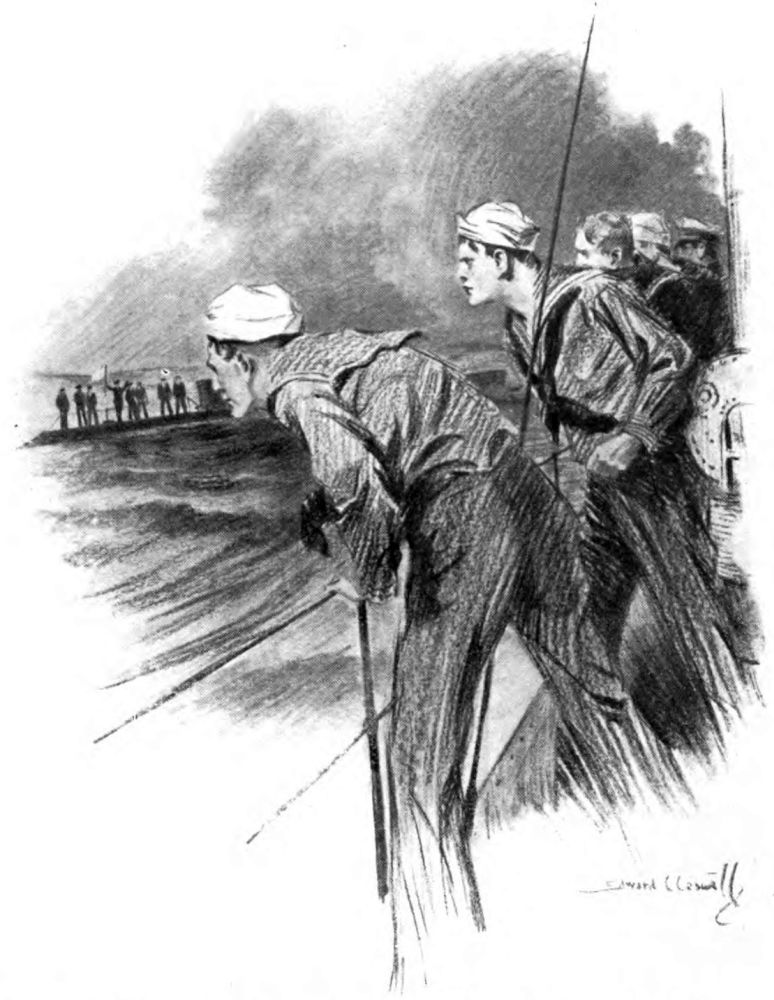
An officer sprang to the deck with a white flag and held it fluttering from outstretched arms
Behind, the first of the Limie destroyers was ploughing up, but she was too late for anything but the cheering. She stopped, panting like an exhausted runner, set signals, was answered, and swinging off again went back to her duty, a trifle envious it is to be supposed.
The Warren’s hope of capturing the U-boat was short-lived, for by the time the last of the crew had reached the deck she was settling fast. As quickly as possible the Germans were taken off to the destroyer and then Lieutenant Lyke and four men pulled across and examined her. [294]Their report was discouraging and the Warren chugged back, dropped a depth-charge gingerly into the sea and fled for safety. There was a geyser-like upheaval of water and the U-boat lifted her stern and went down like a turtle slipping from a log. And in the moment that she stood up-ended Steve and Harry, standing side by side on the Warren’s after deck, read the inscription painted there:
“3-U-9”!
“Got him!” cried Harry, and sprang away to find Phil.
Later they talked it over below, hearkened to by a circle of interested shipmates. They had seen the officers and recognised them beyond the shadow of a doubt, if the evidence of that “3-U-9” was not enough, and Harry had even had speech with that “American citizen” who had entertained them so affably aboard the submarine. What he had said to the German he would not relate, however.
“It was enough,” he growled, scowling fiercely.
But Phil laughed softly, and, in response to Harry’s frowning regard, said: “’Fess up, Harry. You took pity on him and offered him a ‘fag.’ Now didn’t you?”
“I did not,” replied Harry with emphasis, but [295]the disavowal somehow didn’t sound awfully convincing.
“Well, they got theirs,” said Phil, with intense satisfaction. “And I hope they’ll hang every mother’s son of them. But they won’t,” he added dejectedly. “They’ll just put them in a nice comfortable internment camp; the officers, I mean. The rest will have to work, and I hope that ‘American citizen’ has to break stones for the duration of the war!”
They were a proud lot aboard the Warren all the way in to Plymouth. It is much to sink a German U-boat, but it is infinitely more to bring off her officers and crew first. It is done so seldom, in fact, that there are no prescribed rules for behaviour, and the crew of the triumphant Warren debated long and seriously how best to celebrate the feat on arrival at port.
The news had, of course, preceded them and that morning when they passed Rame Head and entered Plymouth Sound they found their path strewn with congratulations. Hooters and sirens greeted them and all the way to anchorage they were kept busy replying to messages.
“If,” sighed Joe, “we could only have brought the sub in in tow!”
“Yes,” Phil agreed, “that would have been [296]great, but you’re a lot of unspeakable heroes already, and if you’d done that there’d have been no living with you. Say, look yonder. Isn’t that one of our cruisers?”
“Yes, I think so. What’s the name? Can you make it out?”
“N-no. It looks like Car—Car—something. There’s a T, I think——”
“It’s the Carthage!” cried Joe. “And Han’s on her! That’s great, isn’t it? Phil, this is going to be some reunion of the Adventure Club! You and I and Steve and Harry and now Han. Five out of the thirteen of us! Let’s tell Steve.”
“All right. But wait a minute, Joe. I’ve been thinking. Do you suppose Harry and I could get into this? Into the destroyer service, I mean.”
“By Jove! I wish you could! And—and I believe you can! Phil, do you know what I think? Well, I think that, now that we fellows have got together, the old Kaiser hasn’t the ghost of a show!”
“He never had,” answered Phil quietly.
With a deafening rattle of chains the Warren, momentary hero of the “Suicide Fleet,” dropped anchor in the blue waters of Plymouth Harbour.
Transcriber’s Notes:
Printer’s, punctuation, and spelling inaccuracies were silently corrected.
Archaic and variable spelling has been preserved.
Variations in hyphenation and compound words have been preserved.