
Title: Heather's mistress
Author: Amy Le Feuvre
Illustrator: J. Shaw Crompton
Release date: May 12, 2026 [eBook #78661]
Language: English
Original publication: London: The Religious Tract Society, 1901
Other information and formats: www.gutenberg.org/ebooks/78661
Transcriber's note: Unusual and inconsistent spelling is as printed.
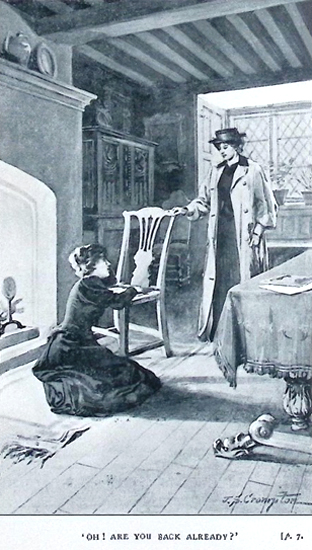
"OH! ARE YOU BACK ALREADY?"
BY
AMY LE FEUVRE
AUTHOR OF "PROBABLE SONS," "THE CARVED CUPBOARD,"
"DWELL DEEP," "ON THE EDGE OF A MOOR," ETC.
WITH FIFTEEN ILLUSTRATIONS BY J. S. CROMPTON
SECOND IMPRESSION
LONDON
THE RELIGIOUS TRACT SOCIETY
56, PATERNOSTER ROW AND 65, ST. PAUL'S CHURCHYARD
CONTENTS
CHAPTER
III. IN AN OLD-FASHIONED HOUSEHOLD
HEATHER'S MISTRESS
LEFT ALONE
"By the fireside there are youthful dreamers,
Building castles fair with stately stairways,
Asking blindly
Of the future what it cannot give them."
LONGFELLOW.
IT was a grey dreary afternoon. Steady rain, leaden skies, and a flat straight road bordered by leafless hedges did not provide a cheery outlook to the solitary walker. She stepped along bravely, a slim little figure in a grey ulster and a black straw hat. Her thoughts were far away from her surroundings, and it was not until she had reached a wooden gate leading up a drive that she roused herself with a start.
"How wet I am!" she murmured. "And here have I been carrying my umbrella unopened in my hand, and spoiling my new hat! What will Abigail say?"
She passed through the gate and up the drive edged by tall shrubberies, and then came out before an old-fashioned red-brick house which had something forbidding and grim in the look of its ivy-clad walls and tall narrow windows.
She paused in the porch and shook out her damp garments with a grimace of disgust. Then quietly opening a glass door, she entered a small square hall. It was dusk, and the dark oak walls and stone-flagged floor seemed cold and dreary. An old-fashioned oak staircase rose from the centre of it, and some oil portraits and a few antlers were dimly discernible on the walls.
The girl opened a door on the right, and shutting it behind her said in a quick clear voice—
"Bluebell, are you here?"
There was a bright wood fire in the wide open fireplace, and the contrast to the dull greyness of the atmosphere without was striking. It was a long low room, with casement windows in deep recesses facing east and west. The walls were covered with a deep crimson flock paper; all the furniture was oak, dark with age; and the flickering firelight played on some massive silver plate on a sideboard behind the door. A dark crimson cloth on the square centre table, and crimson curtains to the windows, gave a most cosy look to the room. And perhaps the pleasantest picture in it was that of a young girl seated on the hearthrug, her elbows on a leather chair, and a book before her in which she was engrossed.
She raised her head at her sister's entrance, then sprang to her feet.
"Oh, are you back already? I've been having a splendid time!"
Looking from one sister to the other, one would have had no difficulty in deciding that they were twins.
Each possessed the same bright brown hair which curled naturally round their broad white brows, and was fastened in a careless fashion of their own in loose coils on the top of their heads. Their eyes were grey, with long curling lashes, but whilst Bluebell's twinkled irrepressibly and continually, Heather's seemed to be looking out into the future with a soft dreaminess that was characteristic of her. Both had the same delicately cut features and clear pale skin, both the same determined little mouth and rounded chin. And the pair of them, in spite of country-made garments and a quaint old-fashioned air, were interesting in the extreme.
"I don't doubt you have," was Heather's reply, as, taking off her wet ulster, she came over to the fire and seated herself in an easy chair. "It is a dreadful day out. Look at my boots! They're soaked through. I am so glad to be home again."
"Why did you go? Rachael said she would go for you to-morrow."
"Yes, I know." And Heather gave a little sigh as she leant back and warmed her damp toes.
Then, after a minute, she added abruptly, "I went because I felt it would be right. Grandmother would have wished it. I have been thinking, Bluebell, that we have been wasting our time rather lately, and I think we ought not to read so much."
Bluebell laughed a little consciously, then she looked down at her black frock and shook her pretty head.
"It is just six weeks since grandmother died, and it seems a year. I don't think we could have lived through this time, Heather, if we had not found these books. It has made such a change in the house, hasn't it? No invalid to read to or amuse, no one to watch over our words and actions. Suddenly we find ourselves our own mistresses, and our daily round of occupation all swept away. For three weeks we haven't seen a soul to speak to—I mean outside the house. Every day is the same, and I suppose it always will be now. I am getting and enjoying fresh life in 'Ivanhoe,' so don't you say it is waste of time."
Heather glanced at the book in question, then spoke rather hesitatingly.
"Of course I know it is delicious. I am dying to get to the end of 'The Monastery' myself, but I think we're rather overdoing it. Sir Walter Scott won't run away from us; we have plenty of time before us, and—and I think it unsettles us for our daily life."
"No; it brings fresh thoughts into our heads, I allow, but I don't feel unsettled. I went over the store cupboard this morning with Abigail, made a fresh list for you to take into the town with you, then I mended some table-napkins, and fed the canaries. And I also put our myrtles out into the rain, and watered the greenhouse plants. After that, I settled myself with a good conscience to my reading, and, oh, how I wonder that grandmother never told us what treasures were in her bookcase!"
"Perhaps she did not think them suitable reading for us," said Heather, thoughtfully. "You see, we have not been brought up like other girls; she was so particular!"
"Well, we can do as we like now. There is no one in the wide world to give us any advice. How do you like the sensation of it?"
Bluebell looked across at her sister with a gleam of mischief in her eye.
Heather met her gaze gravely, then clasping her hands behind her neck, she rested her head against them, and said with much emphasis, "Oh, it is dreadfully and awfully lonely. I have been thinking of it out in the rain. You and I with youth and health, and just enough money to live comfortably here, and only Abigail and Rachael, not a friend or relative belonging to us. And I suppose we shall live on here all our lives, and will never see a bit more of the world than just this corner of it. We have each other, but we shall never have any one else. And we shall go on growing older and older, and our days will be just the same; and Abigail will order us about and manage us as if we were still children up to the very last."
Bluebell's laughing lips took serious curves. "I don't think we shall always live like this. I am looking for a benighted traveller, a prince in disguise to arrive one day, and then suddenly, we shall find our lives changed. Joking apart, don't you think we have a single relation in the world? Everybody has some relations, however distant; why should not we?"
"We will ask Abigail. Grandmother never would talk to us about our family, but I always understood from her we had none. Father was her only son, and mother was an only daughter."
There was a pause.
Then Bluebell said, "I don't think our lives will be empty. We have a lot of interests here—all the poor people that grandmother used to relieve. You have your old blind man to read to every week. I have my Band of Hope with the children, and—and when we want a little dissipation, we can pull up the river and have a picnic or spend a day in town, and I don't see why we shouldn't take an excursion by train now and then."
Heather gave a little impatient sigh.
"It is people I want to know—people in our own class of life, girls like ourselves, women and men."
"We never shall know people here," said Bluebell; "there are none to know. The doctor, the rector, and grandmother's lawyer from London are the only ones we have seen for years, and they're all over sixty."
Suddenly Heather started up, an inspiration having come to her. And her soft eyes sparkled as she said, "What is there to prevent us going up to see the sights of London? We have the money to do it."
"London!" exclaimed Bluebell, opening her eyes at her sister's audacity. "Grandmother said Paris and London were the most wicked cities in the world! Do you think Abigail would let us go? Never!"
A pink flush had come into Heather's cheeks, but her face fell at the thought of Abigail. Then she said recklessly, "If Abigail tried to prevent us, we could send her away. She is only a servant, after all, and we are not children. We are of age, and can please ourselves!"
Bluebell gave a little gasp. Life without Abigail as the controlling power seemed vague and impossible.
"We are our own mistresses," said Heather, with warmth, but she was stopped by the entrance of Abigail herself.
Abigail was a tall severe-looking woman, the personification of neatness and order; her white cap and apron proclaimed her position, otherwise the authority in her voice and demeanour would have led one to suppose she was the mistress of the house.
"Miss Heather, is this your wet ulster flung down on the chair? I did not hear you come in."
Heather's tone was meekness itself as she replied, "Yes, I was so tired that I have been resting."
"And you have not changed your damp boots?"
"No, I am going upstairs to do it now."
She slipped out of the room, and Abigail, taking up the ulster, followed her upstairs to the pretty bedroom that both girls shared together.
Everything was very simple, but the white dimity curtains and bed-hangings were spotless in their freshness. Two small beds, a toilet-table draped in snowy muslin, a round table with devotional books and writing materials upon it, and two old-fashioned wardrobes were the chief pieces of furniture in it. The floor was covered with an old Brussels carpet, and the casement windows, with their deep window-seats, were the facsimile of the dining-room ones below.
Abigail came up to her young mistress and felt the edge of her skirt.
"You must change your dress at once, miss. You are too old to be so careless. It is just the way to get a severe cold—coming in and sitting down in your damp things and letting them dry on you!"
"Oh, what does it matter?" Heather said, a little petulantly.
But she obeyed Abigail at once, watched her close the shutters and light the wax candles, and then detained her just as she was leaving the room.
"Abigail, you lived with grandmother before our father married, did you not?"
"I did," responded Abigail, grimly.
"Well, you ought to know. Have we not a relation in the world?"
Abigail's brows contracted.
"Why do you ask, miss?"
"Oh," said Heather, a little confusedly, "we have only been wondering, that is all."
"None that would improve your manners, or edify your souls," the old servant said dryly. Then after a pause she added, "Your grandmother had one niece, but she left the Society of Friends and went into the gay world and married a worldling. We heard she had one daughter, and later on, she died."
"Who? The daughter?"
"No, your grandmother's niece."
"And what became of the daughter? She would be about our age, would she not?"
"A good ten or twelve years older. We saw her marriage in the paper some years ago. She married a soldier, and you know what we think of them."
"I should like to find her out, and know her."
Abigail looked startled at the quiet determination in Heather's tone.
"Your grandmother would not wish it," she said sternly. "I promised that things should go on after her death as they had done in her life, and I am ashamed of your wishing otherwise."
Heather said nothing.
Abigail waited with her hand on the door-handle for some response. Finding there was none forthcoming, she went out.
But there was a look of care and perplexity on her face as she joined her fellow-servant in the kitchen. Rachael was a great contrast to Abigail. She was a short, stout little woman with a cheery face and manner, and though Abigail had a real and deep affection for the twins, Rachael showed hers by terms of endearment and an outward demonstrativeness that was very acceptable to the young girls.
Bluebell termed the two women "Sugar" and "Salt." Perhaps the terms were not inappropriate.
An hour later, and the two girls sat down to a solemn dinner; one at the head of the long dining-table, the other at the foot, and Abigail waited upon them in silence.
Neither of them felt at ease this evening. They had a consciousness that Abigail was criticizing every word and smile, and they were longing to be able to talk freely to each other, without her taciturn presence.
When at length she left them, and they were finishing their substantial meal with some grapes and nuts, they relapsed into easy and perhaps startling confidences.
It was a delicious sensation to be planning out audacious schemes for their future, and Heather talked with rapidity and animation of the possibility of a wider and fuller life before them.
They left the table at seven, for their dinner-hour was the old-fashioned one of six. And they demurely walked into the drawing-room to renew their talk over the fire.
The drawing-room might have been a pretty room. Every article in it was real and good of its kind, but for thirty years it had remained the same, and the handsome blue damask chairs and couches were shrouded in brown holland covers bound with blue braid. The orthodox round table, with photograph albums and a case of carved ivory chessmen upon it, stood in the centre of the room. Old china and valuable paintings hung upon the walls, which were adorned with gilt and white paper. The carpet and curtains were covered with large bouquets of impossible-looking flowers, but age had softened and mellowed their tints. Screens of wonderful wool-work stood about, depicting rosy-faced milkmaids and children disporting themselves under green trees with baskets of fruit; and white crochet antimacassars were placed in profusion on all the chairs. The two slight girls, in their black silk evening dresses heavily trimmed with crape, looked sadly out of keeping with their gaudy surroundings.
They laughed and talked in the firelight as only young girls can do, and then as the clock struck nine, Abigail wheeled in a small table, upon which tea, bread and butter, and cake were placed. Heather poured out tea. But after they had finished it, they took out their books and read on in silence till ten o'clock.
Abigail came in then, bearing a large Bible and Prayer-book in her hand, and Rachael followed her.
Bluebell sat up, and in her soft clear voice read and prayed. The twins divided their honours very evenly. Heather led the morning devotions, and this they had done for some time previous to their grandmother's death.
After prayers were over, Abigail went up to their room with them, and brushed and plaited their hair, after which the girls performed their private devotions in silence, and were soon enjoying a sweet and sound slumber in their white dimity beds.
A RELATION
"Her presence
Fell on their hearts like a ray of the sun on the walls of a
prison."
LONGFELLOW.
"HEATHER, is your religion real to you?"
This startling question was asked by Bluebell the next morning as she was conning over her morning chapter in the Bible, before going down to breakfast.
Heather was rolling up her curly hair in front of her glass, but her eyes were not on her reflected image. They were straying out of the window into the sunny meadows below. She turned round with a start. The sisters were peculiarly reserved about their deepest feelings. They never failed in performing their devotional duties, which had been prescribed and enforced by their Quaker grandmother from their earliest childhood. In fact, they would as soon have thought of omitting to brush their hair as to omit their daily Bible reading before breakfast.
"My religion!" said Heather. "Of course it is real. I am not a hypocrite!"
"How far does it go?"
Bluebell's merry eyes were soft and grave as she put the question.
"I don't know what you mean."
"I have just been reading this verse:
"'Love not the world, neither the things that are in the world.'
"We have been talking so much of seeing more of the world, that I have been wondering if our longing after it is not wrong!"
"I don't see that it is wrong," said Heather, slowly, "as long as we don't let it take the place of God Himself. Knowing it and seeing it is not loving it."
"But that may lead to our loving it!"
"I don't expect we shall ever have that chance," said Heather, carelessly.
Bluebell gazed at her verse thoughtfully.
"I think I want to be real," she said, "but we have never had our religion tested, Heather."
"No, that is true. Our lives are so even and monotonous. Do you remember our naughty days when we were children? How we used to escape Abigail's clutches, and knowing the punishment that would follow, how we would revel in wickedness till she caught us? We have steadied down now, she would tell us. But I don't know. This time of perfect freedom sets all the pulses in me throbbing and tingling for action. And I do not think our religion condemns us to this narrow, fettered life. I do not believe it is right for us two young girls to be shut away from all society and friendship, and have no one to talk to but our inferiors. It is not right; I feel it is not. I shall pray hard that we may be taken out of it."
Bluebell shut up her Bible, and said no more. She danced downstairs with as light a heart as if no serious thoughts had ever troubled her. She had the old-fashioned urn brought in, and made the tea, and when Heather came in, she chattered away as usual about her plans for the day.
"I shall do some gardening this morning. And now the spring is coming on, old Peter must come oftener than once a week, Heather. I think I had better walk over to the village this afternoon. I want to see some of my children, and I can see him at the same time, and tell him to come and bed out some seedlings."
"You might take some jelly to Mrs. Wick's little girl. Abigail says she is ill again, poor child. Why, here is old Watty coming up the drive! How exciting! Now, who can the letter be from?"
Bluebell darted out into the hall at once, and soon returned, holding a letter in her hand.
"It is addressed to Miss Fotheringay, and it is quite a strange hand. Let us open it."
They read it with their curly heads close together, and certainly the contents filled them with a dazed kind of wonder.
"Park Lane, W.
"MY DEAR COUSIN,—I am an unknown quantity to you, but Mr. Brody, your
grandmother's lawyer, has been to me, and has enlisted my sympathy
on your behalf. He tells me you and your sister are left all alone,
and are young enough to need a chaperon. I feel, as I am your second
cousin, that I ought to do something for you, so propose to come and
pay you a little visit. If we like each other, we may hit upon some
plan that will be agreeable to all of us. I feel sure that you will be
able to put me up, so hope to be with you on Friday afternoon. I shall
leave my maid behind, and come quite by myself, so do not make any
extra preparations for me. Your affectionate cousin,—
"IDA CARTER."
"Isn't it extraordinary," said Heather, "that while we were talking about having no relations, she should be writing to us? She must be the cousin, Abigail told me of yesterday. Coming here on Friday! I can't believe it."
"So our lives are going to widen out at once! I like her letter. How I hope we shall like her. And what will Abigail say?"
They had not much appetite for their breakfast. At half-past nine, Abigail, Rachael, and Johnnie, the small boy who cleaned the knives and boots and made himself generally useful, filed in to prayers. Heather read and prayed with an abstracted mind.
When it was over, Abigail began to remove the breakfast things.
Bluebell stood on the hearthrug with nervously clasped hands. She glanced at Heather, who sat down on the arm of a leather chair, and, assuming a careless attitude, hummed the air of an old song.
Abigail looked at them both a little sharply.
"Who has written to you?" she demanded.
Heather resolved to show a brave front.
"Oh, you saw the postman, did you, Abigail? We have heard from our cousin, Mrs. Carter, and she is coming to stay with us next Friday. The spare room must be got ready for her."
Her tone was dignified. Abigail was so startled at the news that she forgot her good manners, and, placing her arms akimbo, ejaculated, "Now may the good Lord deliver us from the wolf coming down upon the fold! Give me the letter, Miss Heather; let me see it. Who has told her about you, I should like to know?"
For a moment, Heather hesitated. She was longing to assert her authority, but the habits of a lifetime were too strong for her, and she meekly put the letter into Abigail's hand. That good woman whipped out her spectacles from her capacious pocket, read it and re-read it, and then gave a contemptuous sniff.
"I should like to give Mr. Brody a piece of my mind! 'Young enough to need—' what's this word? 'Chaper—chaperon!' some French nonsense, I suppose! You need nothing, and will need nothing as long as I am with you; and I will give Mrs. Carter my word for that as soon as she enters this house."
Rarely had the girls seen Abigail so moved.
Bluebell said timidly—
"It is very kind of her, Abigail, to think of us at all; we have been longing to know some of our relations, and it will be a great pleasure to see her."
"Oh, you poor little creatures!"
No one but Abigail could have put such contemptuous pity in her tone. She took up a covered dish, and went out of the room, as if she were afraid to trust herself further.
Heather's cheeks were scarlet, and her grey eyes flashed angrily.
"She treats us like babies! I am thankful we shall have some one who will make her remember her proper place. Since grandmother's death, she has got worse and worse. I should like to be free from her!"
"We shall be!" exclaimed Bluebell, dancing lightly round the room. "We shall go to London with Mrs. Carter, and see the world at last."
"I wonder if it is an answer to my prayer this morning," said Heather, thoughtfully, her ire dying away as suddenly as it came. "I have been longing so for something to happen, but I never expected the change to come so soon."
"Miss Heather," said Abigail, entering the room again, and speaking in her usually quiet, grave tone, "Rachael is waiting to have the stores given out, and there is some of last year's jam that needs to be freshly covered. Perhaps you can do that this morning."
Heather seized her housekeeping keys, and ran out to the kitchen.
It was a relief to hear Rachael's view of things.
"There, my dear Miss Heather, of course Abigail is a bit upset. The mistress was so anxious you should grow up steady, good young women, and keep out of all the world's temptations, but I've been sayin' the Lord will take care of His own. And if this Mrs. Carter be what we fears, a giddy, worldly woman, well, she won't be allowed to harm you, and you have a good head on your shoulders, and won't let your early training be all brought to nought. 'Tis dull for you two young girls, as I have been sayin' to Abigail, and any one belongin' to one's own flesh and blood is very welcome. We'll hope for the best, and I think I shall walk into town to-morrow, and order a few necessary additions to the list we made yesterday. I'll do the best for my dear departed mistress's credit to give the lady good meals while she is here, and I'll have a couple of the young spring chickens killed at once!"
The next two days were very busy and pleasant ones. The garden, the greenhouse, every room was looked over, and adorned afresh.
For the first time, the twins began to wonder if their country-made black dresses were correct in style. They were keenly anxious that their visitor should be favourably impressed.
When Friday came, they wandered up and down the house, longing for, yet dreading her advent. Dusk set in before she arrived. They went up to the spare bedroom, put flowers on the toilet-table, lit up the massive silver candlesticks, and looked round with a critical eye. It was a gloomy room, but the linen was of the finest, the green damask curtains round the four-post bed had all been freshly shaken and hung, and the bright wood fire that Abigail had grudgingly lighted shed its ruddy light over all the dark corners.
"I think she will be comfortable," said Bluebell. "Oh, I hope she will like it here."
"I don't want her to think us incompetent," said Heather, with a little toss of her head. "We have never had a guest before, but I shall make a point of seeing to her comfort. And now will be our time for shaking off Abigail's yoke. I mean to have a good try."
"You'll never—never succeed," said Bluebell, laughing. "Abigail is too old to become different. Oh, Heather, listen! There are wheels! I feel quite shy. Shall we go down?"
They reached the hall, and in another moment were face to face with their guest. Abigail stood in the background, and felt that her worst fears were realized.
Mrs. Carter was a pretty, vivacious little woman. She was clad in a scarlet jacket trimmed with astrakan, a toque with scarlet wings was set jauntily over a quantity of dark frizzy hair, her dress was covered with costly trimming, and an atmosphere of scent and perfumes was about her.
She looked at the two girlish figures in their unbecoming dresses of black silk and crape, then embraced them warmly.
"So delighted to make your acquaintance, dears. What an out of the way place this is! Four miles from a railway station, and not a house did we pass during the drive. I'm afraid I should die of the dumps if I lived here."
"Will you come up to your room now?" asked Heather, feeling quite bewildered at such an apparition in their Quaker household.
"If you like, or shall I come into the drawing-room first—I am longing for a cup of tea."
"We shall be dining in half an hour," said Heather, with an uneasy glance at Abigail, "but if you would like a cup of tea, I will send it up to you."
"Thank you. I think I should. I had a very early lunch. How like you two girls are to each other! I shall never know the difference between you. Come along, both of you, and show me my room."
She rustled up the stairs, Heather leading the way, and she sank into the easy chair by her fire with a little sigh of content.
Looking at the two girls in front of her, she said—
"Now tell me your names. I do not even know those, and yet I am a cousin."
"Our baptismal names are Drusilla and Priscilla," said Bluebell, quickly, "but our mother could not bear them. She was Scotch, and did not belong to the Friends. So she called us Heather and Bluebell, and even grandmother got to call us so too. We try and forget that we were called anything else!"
"Very wise of you," laughed Mrs. Carter. "And now may I ask what time you dine? Surely not yet?"
"At six o'clock," Heather replied.
Mrs. Carter raised her eyebrows, but said nothing, and at this moment, a knock was heard at the door.
Heather looked round, and saw Abigail with a face like thunder.
"Have you brought Mrs. Carter a cup of tea?" Heather asked, lifting her little head up proudly.
She felt sure that Abigail was determined to prevent any confidences being exchanged between them and their cousin, and she resented it accordingly.
Abigail looked at her charges with a glance that made them quail beneath it.
"You will please to go downstairs, young ladies," she said sternly, "and I will attend upon the lady myself. I have something to say to her."
Mrs. Carter looked up quickly, and was about to speak, but checked herself. She nodded brightly to the girls as she saw them slipping from the room.
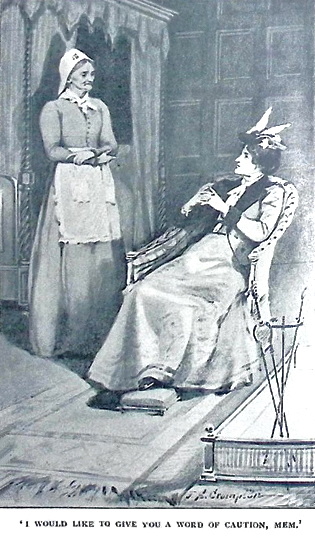
"I WOULD LIKE TO GIVE YOU A WORD
OF CAUTION, MEM."
"I shall see you downstairs presently," she called out after them. And then she turned to Abigail—"I was not going to trouble you," she said very sweetly, "but since you have offered to attend upon me, perhaps you will unlace my boots for me. I miss my maid when I am away from her."
This was more than Abigail was prepared to do. But she went down on her knees at once, and Mrs. Carter continued pleasantly—
"I want to have a good talk with you soon about your young ladies, but I am tired to-night, so we will put off our chat till to-morrow."
Abigail, struggling on her knees with a refractory lace, felt herself at a disadvantage. She said nothing till her task was done, then she rose to her feet.
"I would like to give you a word of caution, mem," she said grimly. "I have been in this family for years, before you were born. I knew your mother when she was a slip of a girl, and my late mistress has given me a trust that I will be faithful to, cost me what it may. The young ladies have been brought up apart from the world, and into it they shall not go with my consent. I promised her I would look after them as long as I lived. She did not wish me to communicate with you, or I would have done so. You never came near her as long as she lived, and there is no need now to come putting foolish and sinful ideas into the poor children's heads. Perhaps you do not know that my mistress wished them to live on here with me?"
Mrs. Carter leant back in her chair and smiled. "Yes, I do know it, and Mr. Brody is their guardian, and I am sure you have their best interests at heart. Now, do not let me keep you any longer. Perhaps you will kindly unstrap my trunk before you go. Thank you. We will have our chat to-morrow."
Abigail went downstairs shaking her head solemnly. She felt she had met her match, and difficult times were ahead for them all.
IN AN OLD-FASHIONED HOUSEHOLD
"Home-keeping hearts are happiest,
For those that wander they know not where
Are full of trouble and full of care—
To stay at home is best."
LONGFELLOW.
HEATHER'S cheeks were scarlet with mortified shame, when she and her sister were turned out of their cousin's room by Abigail.
"She—she almost makes me hate her," she said in a vehement whisper; "but I am sure Mrs. Carter will not stand much from her. I know it is wrong, but I hope she will be well snubbed; and I shall enjoy seeing it!"
Bluebell took the matter lightly. She was a happy-hearted girl with an affectionate sunshiny disposition, and viewed life at present through rose-coloured spectacles. She had also a keen sense of humour, and she laughed now at the remembrance of Abigail's face when Heather inquired for the cup of tea.
"Never mind," she said, "we must not expect Abigail to be different now from what she always is. She is too old to change. Did you see what a lot of luggage Mrs. Carter has brought? I think she is lovely, don't you?"
"Yes," assented Heather, warmly. "I have never seen any one like her. Now let us come into the drawing-room. I wish Abigail would have had the holland covers taken off. I can't bear them."
Mrs. Carter did not make her appearance till dinner was on the table. In fact, she was ten minutes behind time, and came down in a black satin dress with low neck and short sleeves, apologizing very prettily for keeping them waiting. The girls were too well-bred to show their feelings, but cast many a shy admiring glance at her through their long lashes. The pearls round her neck, the glittering bracelets on her white arms and sparkling rings upon her fingers, all appealed to their love of beauty.
She talked and chatted with them on the most trivial subjects through the meal. Abigail moved to and fro with a grim face, and an aching heart. When she had finally left the room, Mrs. Carter came to more personal matters.
"Have you girls ever been to school?"
"No."
"Then who has educated you?"
"Grandmother."
"I always heard her spoken of as a very clever and cultivated woman," Mrs. Carter said slowly. "I wonder what she taught you?"
"Everything," said Bluebell, rashly. "We used to work five hours every day, often six."
"Do you know anything of Algebra, Latin, or Mathematics?"
Bluebell's face fell.
"No."
"How many languages can you speak?"
"We know French fairly well, a little German and Italian."
"Can you sing and play?"
"Heather can play the harp. And I can sing a little. I am not very fond of music."
"Grandmother used to say," said Heather, thoughtfully, "that a woman should be thoroughly grounded in history and geography. She should have plenty of general knowledge, so that she could always be at ease in literary society and conversation. A little music was essential, but the main duties in her life would be housekeeping; and this I think Bluebell and I know to our finger ends."
"Tell me what you can do," said Mrs. Carter, looking kindly at them.
"We will tell you what we do do," said Bluebell, vivaciously. "Heather keeps the accounts, she is better at it than I am. She also looks after a small farm that belongs to us. We get our butter and milk from it, and every week the farmer comes up and does business with her in the study. He says she 'do have a wunnerful head.' She also has charge of the store cupboard, and orders dinner every day. I make all the jam, and potted meat, and pickles, and everything of that sort, and we have a tiny dispensary with simple remedies for the village people, which is my province. The linen cupboard is in my charge too, and I look after all the mending. Sometimes we make jellies and broth for the sick people in the village. Grandmother would have us both learn cooking. She said a woman ought to know it thoroughly, and we can do most things, can't we, Heather?"
Heather assented, adding, "You see, we are a small household, but the villagers look to us for everything. They come up once a week during the winter for soup, and there are always some old and sick who want special attention."
"I dare say your grandmother was more sensible than most people of the present day," said Mrs. Carter. "I do not hold with this college education for women, but times have changed. It is not every girl who is placed in such comfortable circumstances as you are. Now I should like to know if you are all Quakers here?"
"No, we have never been brought up so," said Heather. "There are no Friends about here. Abigail and Rachael used to attend a little meeting in the town, but it is too far for them to walk, and they generally go to chapel. Grandmother never left the house for seven years before she died. Bluebell and I walk over to church, which is two miles away. Mr. Monk is the rector. He is very old and very poor, and we don't see much of him. He comes to us when he wants any special relief for a parishioner."
"Have you no friends? Surely this is not the only big house in the neighbourhood?"
"Our squire lives eight miles off. We don't know him. Grandmother never visited. Our doctor is an old bachelor, and he lives six miles away. We never meet any one in our own station of life!"
"What a life!"
After this ejaculation, Mrs. Carter seemed lost in thought, and then they moved into the drawing-room. She made Heather play to her, and when she was seated at the harp, and Bluebell leant back in a low chair by the fire to listen, Mrs. Carter looked at her young cousins with greater interest than ever. Heather played some old Scotch airs, and then drifted into "Il Trovatore." Her touch was light and sweet, and Mrs. Carter was charmed with the grace and spirit with which she played.
"I feel," she said, when Heather had come to the fire, and taken a seat opposite hers, "that I am in a dream. I have gone back a generation. Do you know that you are utterly unlike most girls of your own age?"
"We have never seen any," said Heather, simply; "at least only the farmers' daughters, and the villagers."
"Did your grandmother expect you would live and die here in seclusion?"
"We thought, till your letter came, that we should have to do it," said Bluebell. Then she added, with a laughing light in her eyes, "Heather was meditating a bold stroke for freedom; may we tell you about it? You won't be shocked?"
"I do not think you two little Puritans will be likely to shock me," was the amused reply. "Tell me, by all means."
Then Heather spoke in hushed tones, with a backward glance at the door, for fear of Abigail's form appearing.
"It is Abigail. She rules us with a rod of iron. You saw how she sent us from your room before dinner. She has been worse than ever since grandmother died. She treats us like tiny children. And Bluebell and I are children no longer. We are mistresses here; we have our own money. Grandmother left everything to us. I know all about it, for I have been over it with Mr. Brody. We have quite enough money to live very comfortably, and—and to travel."
"Yes," put in Bluebell, "and we were going up to London by ourselves. We had hardly settled whether we should dismiss Abigail from our service, or run away without telling her. Of course she would never have allowed us to go to London, we knew that. It would have been more dignified to send her away, but it would have taken a lot of courage to do it, and she is—well—very awe-inspiring!"
"I think we should have been driven to do it," said Heather. "I could not have run away from our own home like a coward; and I have felt lately things were getting desperate. You have come and solved the difficulty. It will be all right now."
"By that you mean I am to do battle on your behalf? Well, we will see."
When tea was brought in by Abigail, she saw the new-comer on the best of terms with the two girls, who, with flushed cheeks and bright eyes, were listening to some of her London experiences. Abigail went out to Rachael, and in tones of despair exclaimed—
"She has bewitched them with her airs and graces. They didn't even so much as look at me when I went in! They're drinking in the poison, and it will be the ruin of their young lives. And I have to stand by and say nothin'!"
She wrung her hands, and Rachael looked aghast at the imperturbable Abigail being so deeply moved.
"We must trust them to the Lord," she said soothingly. "Maybe Mrs. Carter is only young and giddy. She will find this a dull place to linger in. She will come and go, and, when once in London, will forget all about them again. Don't you fret now, don't, for mercy's sake!"
Abigail shook her head, but said no more. She would not tell Rachael her worst fears.
Prayer-time came, and Bluebell very simply asked Mrs. Carter to lead the devotions. She laughed and declined, but watched her young cousin sit up and conduct them with an amused and yet softened look in her eyes.
"And now you are going to bed," she said afterwards. "Well, I will too; it is not much beauty sleep that I get in town!"
But when she was up in her bedroom, she did not retire to rest. Drawing up the writing-table to her fire, she wrote a long letter to her husband. And this was what she wrote:—
"DEAREST OLD HAL,—I think I have tumbled into one of the quaintest and
most out of the world households in existence. I have to pinch myself
sometimes to make sure that I am not dreaming. How I wish you were here
to enjoy it with me. For enjoying it I am, and that most thoroughly.
Where shall I begin? With the house itself, I think. It is one of those
thoroughly comfortable old-fashioned residences, with thick walls, and
picturesque corners and gables, casement windows and deep window-seats,
plenty of good old oak about it.
"I could make it simply sweet; but, oh, my dear boy! I think even
your inartistic soul would stand aghast at the colours and style of
the decorations within! I have been sitting in the drawing-room, and
inwardly shuddering all the time at my surroundings. I should think it
was furnished sixty or seventy years ago, in the most hideous fashion
of our grandmothers, and has never touched since—all gilt and white,
with the crudest colours all bunched together, a large long room with
four windows. Not a plant or flower in it. Chairs and sofas in brown
holland.
"Fancy worsted-work screens, and glass cases of flowers, stuffed birds,
and fruit. Well, you're a man; and I can't write to you as I should to
a woman, so I will stop. Every room is the same. And yet, with it all,
it is thoroughly comfortable, though so inharmonious. I have not seen
the grounds, but I believe the garden is not a large one. There are
dense shrubberies in all directions. The household goes by clockwork.
You never saw such old characters as the two Quaker servants. They and
a small boy do all the work of the house between them. How they manage
it, I don't know, for I can give them credit for keeping everything
in the most beautiful order. The linen and plate are the very
best—exquisite, in fact—but I always heard that Quakers were noted for
those two items in their households.
"And now I come to the girls. I wonder what you will think of them!
I foresee a bright future for them after a little training. Of course,
they are in the most hideous garbs imaginable, but it says much for
their natural grace that they draw attention to themselves, and not
to their dress. They hold themselves well, and are, as far as I have
seen them yet, without a trace of self-consciousness. Perfectly simple
and natural, but oh, so undeveloped! And yet, sometimes, when I say to
myself what babies they are, they will startle me with some words of
wisdom or depth of feeling that I feel I don't possess myself! They are
tall, slim maidens, with the most lovely eyes and hair, and delicate
features and complexions, as like as two peas. I don't yet know them
apart.
"They are guarded by a regular dragon, whom I am longing to fight
and subdue. She sees in me everything that is evil, and is fiercely
determined that I shall not carry off her nurselings. I don't yet
know what I shall do with them, but they are too pretty to waste
their sweetness on the desert air. Tell me what you advise. Can't you
run down from Saturday to Monday? Don't get into mischief while your
'missis' is away, and tell Cyril that if I find the slightest whiff of
tobacco in my drawing-room when I return, he shall receive his 'congé'
immediately. Don't go to too many theatres, and remember I may be at
home any day, so will catch you out before you know it! Your loving—
"IDA."
"P.S.—Imagine no afternoon tea, dinner at six o'clock, and an
old-fashioned tea-table with hot-buttered toast and cakes, wheeled
into the drawing-room at nine o'clock! Prayers at ten, and then to
bed; and if you could have seen the sweet gravity with which one of
these children conducted our devotions, and the calm air with which she
handed me a huge Bible, I think you would have longed to be good as I
did!"
The next morning Mrs. Carter begged to be shown over the house, and whilst Heather was attending to her housekeeping, Bluebell took her round. The study, which had been the girls' nursery and schoolroom in former years, was rather a gloomy-looking room, but opened into a small greenhouse, in which was a large cage of canaries filling the air with their songs. Bluebell's plants and flowers looked flourishing; she was a born gardener, and knew how to pot, plant, and graft to perfection. She took her cousin out into the garden, which had a long stretch of green turf edged with old elm trees, and a few flower beds; and a very small kitchen garden was beyond.
"We get most of our vegetables from the farm. Heather will take you over to see that. We sometimes go there, and make the butter. When Annie was ill—she is the farmer's wife; she used to help in the house, and married our gardener who is now the farmer—when she was ill, after her last baby was born, Heather and I went down and made the butter every day!"
"You are most industrious young people. I shall be quite afraid of you. I am sure you never do anything wrong—now, do you?"
Bluebell's laugh rang out merrily.
"Abigail would tell you how many scoldings we get in a day! But do you know," and the girl's eyes were almost serious as she turned them upon her cousin, "since we have been our own mistresses, we don't seem to have got into half so many scrapes. In fact, when we are left to do exactly as we like, we find that there is no temptation to do what we ought not to do."
"The moral is that you should be always left to yourselves, isn't it? I am afraid you will not be willing to hand yourselves over to my keeping for a little, will you?"
Bluebell looked up eagerly.
"Are you going to offer to take us away with you?"
"I haven't said so. We must talk over it with your sister."
A STRUGGLE FOR FREEDOM
"The soul, emancipated, unoppressed,
Free to prove all things, and hold fast the best,
Learns much."
COWPER.
MRS. CARTER seemed to adapt herself with the greatest ease to the quiet routine of her young cousins' home. She was always bright and pleasant, always ready for a chat with any one, from Rachael to little Johnnie and any of the villagers who came in her way. Abigail alone stoutly resisted her charms; and Abigail she had resolved to conquer by charms, or sheer strength of will.
She came down one morning braced for the conflict, looking, in her fresh tailor-made shirt and skirt, a dainty little person. Captain Carter had declined to come to her help, and she was longing to be back in town with him again.
It was a lovely spring morning. As she looked across at her little black-robed cousins, she said, "I long to put you two girls into fresh spring frocks. Don't look so shocked. I don't mean you should leave off your mourning, but you might have lost two parents from the depth of your crape!"
"Grandmother acted as a parent," said Heather, quietly.
"Yes, dear, I know, but such deep mourning is out of date. It is only a matter of custom. It does those who are gone no mortal good, and is only a burden to the wearers. Now I want to talk to you both very seriously. I must be going home in a few days. Would you like to come with me, and see some of the sights of London? Of course we shall be very quiet. Your recent loss would be quite sufficient excuse to prevent your going out much. But we could do a good deal in a quiet way, and I am sure the change of air and scene would do you both a great deal of good."
"We should like to," said Heather, thoughtfully, "but Abigail is so dreadfully set against it that she would never agree to it!"
"You told me a little time ago, you would give her notice to leave if she interfered with us," said Bluebell, mischievously.
"I know I did, but that was when the possibility of doing it seemed vague and uncertain."
"Well," said Mrs. Carter, a little impatiently; "I cannot force you to come against your wills, but, if you would like to come, I will manage Abigail."
"I don't know who would take up the—the things we do," said Heather. "The villagers will miss us going in and out, and we help a good deal in the house."
"My dear child, I am only asking for a short visit. Abigail could be quite well left in charge until you returned. I am not asking you to give up your home altogether."
"Of course we must come," said Bluebell, impetuously. "It will be our first chance of seeing more of life, which Heather is always longing for. Abigail is the stumbling-block. If you will manage her, we will come—gratefully and gladly, won't we, Heather?"
And Heather assented a little doubtfully, but in accents of relief at her sister's taking the decision into her own hands.
Mrs. Carter waited till the afternoon to broach the subject to Abigail. She sent the girls out for a walk, and when they were well out of the way, she asked Abigail to come and have a little chat with her.
She was sitting in the drawing-room, and Abigail entered with compressed lips and lowering brows. She had a presentiment of what was coming, and if Mrs. Carter had braced herself for the interview, so had she.
"Won't you sit down, Abigail? We shall not be interrupted, for I don't suppose you have one visitor in a twelvemonth here, do you?"
"I suppose we might have a good many, if we opened the doors to all who asked themselves without invitation," was the grim reply.
"It is only a cousin's privilege to do that," responded Mrs. Carter, gaily. "Now, we won't fence round the bush, but I will come at once to the point. I have asked your young ladies to come and pay me a visit, and they are coming to London with me the beginning of next week."
"That they are not," was the stern reply, "and you'll excuse me for contradicting you, mem. I've nursed those children since their birth, and being their rightful guardian now, I shall have my say in the matter."
"Now, look here, Abigail, listen to me. I admire your faithfulness and mistaken ideas of duty, but if you are as sensible a woman as I take you to be, you must know in your heart that the present state of things here cannot last. Miss Heather and Miss Bluebell are young, but they are of age. Their grandmother left them her money without any restrictions; and they have a perfect right to make their plans as they think best. Do you imagine that they could be kept in this isolated fashion for much longer? Did their grandmother wish to make nuns of them? If so, she might as well have sent them off to a convent at once. What do you think will happen to them when you and Rachael are taken from them? You are neither of you very young persons, and in all human probability, they will outlive you many years. Then two young girls would be left friendless and unprotected, too innocent of the world and its ways, to be able to defend themselves from any dangers that might beset them."
"Nothing will make me consent to them going away with you, if you please, mem. No amount of smooth-spoken words will make me do it. Perhaps I may have my say. My late mistress has trained the young ladies in the way that they should go, and I have helped her to do it. They are trained for heaven, and not for the pomps and vanities of this wicked world. They are leading happy, useful lives here, and until you came to instil sinful desires into their innocent minds, had no wish to do otherwise. My late mistress did not wish them to be acquainted with you at all. We have often talked it over together. Your husband is a soldier—that alone prejudiced her against you. You live a butterfly existence; your dress is such that no decent woman would wear. The young ladies have never been accustomed to see bare necks and arms of an evening, and such an amount of jewellery and flash! You wish to make them like yourself, to rob them of their piety, their innocence, and their maidenly modesty. You would take them to dances, to theatres, to all sorts of worldly pleasures, you would deck them in flowers and coloured silks and satins, you would have them spend their substance in riotous living. I know the ways of London, and I tell you, mem, I would rather see them in their graves than taken away to be under your roof and influence."
Abigail paused for breath.
Mrs. Carter looked as placid and smiling as ever. "I think you misunderstand me, Abigail. I am not going to take them away from you altogether. They have a sweet old home here, and have no intention of leaving it. But they tell me they have never slept a night away for the last three years. It is extremely bad for them. Change of air is necessary to us all, especially after the sad time they have lately gone through. I think you are letting your prejudice run away with your sound common sense. You are afraid I am going to steal your chicks from you, and so in the soreness of your heart, you give me the credit of all that is bad, and paint me as black as you can. I can promise you that their religion shall not suffer whilst with me. I go to church twice every Sunday, and once in the week all through Lent. I have only asked them for a month, and have told them that their deep mourning alone prevents them from taking part in any of the gaieties. London is very quiet now, and will be until after Easter. You will have them back with you then, more than ever in love with their sweet country home, after all the dust and glare of London streets."
"They shall never go with you," repeated Abigail, with determined lips. "Never shall they leave me, while I have health and strength to prevent it. You talk of your religion, mem, but it must be the religion of the Pharisees of old, a whitened sepulchre outside, and inside dead bones! Haven't I seen you stifling a yawn when we are in the midst of our morning devotions? Have you any real love for the Word of Life, and for the God who gave it to us? Ay, you may go to church, and think that church-going covers a multitude of sins. You may bend your head in worship, when your heart is full of disobedience and rebellion against your Maker. Do you live for His glory alone, mem? Do you know what it is to deny yourself, take up your cross daily, and follow the Master who was despised and rejected of men? If the summons came to you to-day—'This night thy soul shall be required of thee'—would you be ready to meet the Judge of all the earth? Folks talk about their religion! Religion, as you understand it, won't redeem your soul from destruction, won't blot out the sins and follies of a lifetime. It lulls your immortal soul to sleep, and gives you a false peace that will prove your ruin!"
"Come, come, Abigail, I did not call you in here to preach to me. It is beside the question altogether. If you will not see things in a reasonable light, I will reason with you no longer. The young ladies are coming home with me next week. There is nothing more to be said."
"And how will you send them back to me?" said Abigail, in the bitterness of her soul. "Having given them a taste of sinful pleasures, and drawn them into your net, do you think they'll come back as fresh and innocent as when they went?"
"They may come back engaged to be married," said Mrs. Carter, exasperatingly calm in tone. "I am going to try and get them good husbands. That is the best thing that could happen to them."
Abigail turned her back upon the speaker, and walked straight out of the room. With clenched hands she went upstairs to her bedroom, and there locking the door, she went down on her knees by her bedside in agony of supplication.
"Oh, God Almighty," she gasped, "I am weak and helpless by the side of this sinful woman. Thou knowest how I have prayed for these children. I have hoped they were in Thy fold. All things are possible to Thee! Frustrate the design of the evil one. Give them the desire to stay at home, and the strength to resist her persuasions. It is the thin edge of the wedge, Lord. Oh, help me in this hour of need. Do Thou send deliverance. All things are possible to Thee."
Her honest, rugged face was quivering with emotion. She rose from her knees more hopeful. Surely her influence was not at an end with the girls! She would appeal to them, and as soon as they came back from their walk, she would speak to them alone.
Mrs. Carter did not feel very comfortable after Abigail's departure; she got up and paced the room, her pretty brows contracted with thought. Was it true that her religion was merely an empty form? Abigail's words stung deeply, and she began to feel a little hesitation in taking away the girls. Then she laughed aloud:
"She is an ignorant, narrow-minded woman, and though I respect her motives, it is ridiculous and absurd to suppose that my influence will do the girls any harm."
She met the twins at the hall door, when they returned.
"Abigail and I have fought it out," she said laughingly. "She is sure to speak to you, but say as little as possible, and it will be all right."
The girls looked at each other, then ran up to their room to take their hats off.
"I hope Abigail won't make a great fuss," said Heather; "but I feel, I don't care if she does."
"No, we shall soon get away from her. She has really no power to prevent our going."
A knock at the door made them look at each other in dismay.
"Here she is, now for it!" said Bluebell, adding in a louder voice. "Come in."
Abigail appeared with a white and rigid face. Heather turned to her looking-glass, and began to hum a tune as she arranged the front of her hair. Her heart was beating violently, but she controlled her voice as she said carelessly, "Do you want anything, Abigail?"
For a moment Abigail did not speak. Then she turned to the door and locked it behind her, standing like a sentinel in front of it.
"It is well to prevent interruption," she said dryly; "for I have a few words to say to you both, and I wish to have time to say them."
"Now, Abigail, don't be cross," said Bluebell, plunging into the matter at once. "We know what you're going to say, but our minds are quite made up, and nothing you can say will alter our arrangements."
"And may I ask, Miss Bluebell, if the wishes of one who has nursed you from babyhood, and has your best welfare at heart, are to count for nothing? Is an irreligious and flighty stranger by her flatteries and temptations to beguile you from your home and your God? Are you and Miss Heather so weak and foolish as to believe all her deceiving words, and go astray like silly sheep from the true fold I was trusting you were in?"
Then Heather faced round with flushed cheeks and earnest eyes.
"One would think we were going to do a dreadfully wicked thing, from the way you talk, Abigail. We are going to London on a visit; our mother did the same thing when she was young, and so did grandmother, she told us so. You have no right to say we shall be acting wrongly."
"'Tis the company you're going with, and the company you'll meet with, you silly child, that is the sin. How can you serve God in such a worldly house as you'll be going to? It's enough to raise your grandmother's ghost, after all she has done and said to make you grow up into good and virtuous young women! How can you go down on your knees and ask God's blessing on such an enterprise? You're just a couple of silly moths fluttering round the light, and it will be your destruction in the end."
Abigail's vehement earnestness had the effect she desired on her charges. They looked at each other with troubled eyes. She continued in tones of entreaty—
"Now, be good children, and be advised by me. I would cut off my right hand to prevent you going! I know the wickedness of the world, and you do not. If you are tired of this place, you can go for a change to the seaside with me. The summer will be coming on. I will do all in my power to give you change and brightness. If you go with Mrs. Carter, your happiness and peace in religion will depart from you. 'No man can serve two masters. You cannot serve God and mammon!'"
"But we mean to serve God in London," said Heather, in hesitating tones. "There must be some good people there. We shall not do anything that grandmother would not have liked us to do."
Then Abigail took a false step. Seeing the girls were already wavering, she thought she would clench their decision.
"I forbid you to go!" she cried. "You were left in my charge, and I shall prevent it. Mrs. Carter shall go back alone, and I'll lock you in your rooms rather than you should go with her. You know how determined I can be, and if fair words shall not move you, force will. You can plan and plot as you like, but never as long as I'm alive shall I let you go with her."
If only Abigail had known how fatal these words were to her cause, she would have bitten her tongue out rather than have uttered them.
Heather's eyes flashed fire at once.
"I think you forget, Abigail, your position. Bluebell and I have a perfect right to make what plans we choose without consulting you in the least. And—and we mean to in future. We have arranged to go to London with Cousin Ida, and go we shall, and if you make any more fuss about it, I shall give you notice to leave us!"
Abigail was perfectly speechless. Never had she dreamt of such utter indifference to her authority. She could hardly believe it was Heather speaking. This was turning the tables upon her with a vengeance!
"You poor misguided young creatures!" she exclaimed, and the real love for them at the bottom of her heart seemed to come uppermost at once. With a little choke in her throat, she unlocked the door, and went out without another word.
And Heather, white and trembling at the thought of her audacity, sank down on a chair and burst into a flood of tears.
Bluebell put her arms around her, and cried too. "We have done it, we have done it!" she said. "And now we must go straight on, and never look back!"
"I wish," sobbed inconstant Heather, "that Cousin Ida had never found us out. I am sure we shall come to a bad end! We are going against grandmother and Abigail, and God won't give us His blessing!"
And so it was with tears and misgivings that the twins gained their independence.
IN PARK LANE
"This world is not worthy of your soul. Give it not a Good-day when
[Christ] cometh in competition with it."—RUTHERFORD.
THE fly from the neighbouring town was at the door. Rachael and Johnnie were assisting with the luggage. Abigail was nowhere to be seen. Heather and Bluebell looked dazed and uncomfortable, but the future had still its attractions for them. They had been into the kitchen early that morning to get a little comfort from Rachael.
"Do say you don't think us wicked, Rachael!" pleaded Heather. "It is so dreadful leaving home when Abigail is so angry. She has hardly spoken to us for the last three or four days."
"Bless you both!" exclaimed warm-hearted Rachael. "I'm trusting to the good Lord to take care of you, as I keep telling Abigail. She's not angry with you, but sore grieved about it. We learn wisdom by our mistakes sometimes. Ask the Lord's guidance, and He will give it to you, and if you get to love the world more than Him, give it up and come back. You'll want great judgment to discern, and separate yourselves from the right and wrong that is mixed up in gay society. But I'm trusting that we shall soon have you back again."
They went to find Abigail at the last moment. She was locked in her room.
"Say good-bye to us," Bluebell called out.
There was no answer for a moment, and then Abigail's stern old voice rang out, "'She that liveth in pleasure is dead while she liveth.'"
Not a word more could they get out of her.
"Oh, come on," exclaimed Heather, dragging Bluebell away. "She doesn't care a bit for us. I told you it was no good coming up to her."
When the fly drove away, Abigail leant out of her window, and with straining eyes followed it. Her heart was nearly broken. She could hardly realize that, after all these years of care and loving tyranny, her authority had been swept aside with such ease, and that her charges, in utter indifference to her threats and persuasions, had taken their future into their own hands, and had left their home in company with a comparative stranger.
When they had passed out of her sight, she wiped the tears away with her apron.
"They're gone for ever. If I see them again, they'll be no longer the innocent girls they are now."
And then she walked downstairs, and set about cleaning the house, and putting away all traces of the ones who had left her. From that time forward, she closed her lips, and would never discuss her young mistresses with Rachael or any one.
It was about five o'clock in the afternoon when the girls reached Paddington Station with their cousin. As they alighted on the platform, feeling bewildered with the bustle and confusion around them, a tall, soldier-like man came forward, and Mrs. Carter seized hold of his arms in delight.
"Hal, you old dear! I never thought you would come to meet us. Here are the girls. Let me introduce you. Now, will you see to our luggage?"
Captain Carter pulled his big moustache, and looked down upon his young wife with great affection. After the first glance at the girls, who were hardly looking their best in their country-made garments, he busied himself in carrying out his wife's directions, and he and she carried on an animated conversation during the drive home.
Heather and Bluebell were quietly enjoying all the fresh sights and sounds around them. When they came into Mrs. Carter's pretty drawing-room, full of hothouse plants and tasteful furniture, the contrast between it and their room at home struck them very forcibly.
Afternoon tea was brought in on a dainty little table, and then, just as Captain Carter was handing them a cup, the door opened, and a very tall, broad-shouldered man, bearing a great resemblance to the captain, strolled in. Mrs. Carter welcomed him warmly, to which he responded with a comical shrug of his shoulders.
"I feel I ought to do the welcoming, for Hal and I are quite at home here. We have had a most enjoyable time together during your absence. In fact, Hal has just come to the stage of believing that the house belongs to him. Imagine it!"
"You are as rude as ever, I see. Now, girls, let me introduce you to my brother-in-law, Mr. Cyril Carter. He has just been returned member for his county, and it has rather turned his head."
Cyril Carter smiled very pleasantly as he bowed to the twins.
"Your cousin is a martinet in her house. Did you know it? I hardly know now which chair I can safely sit down upon without outraging some delicate piece of work that has a trick of slipping down directly you touch it. I set to work the other day with a needle and cotton and sewed them on like grim death to the backs of the chairs to which they are supposed to belong, but one of the maids, I see, has carefully unpicked all my work. I expect she was afraid of her mistress."
"I have been wondering how many of my household gods would be destroyed," said Mrs. Carter, looking round the room as she spoke.
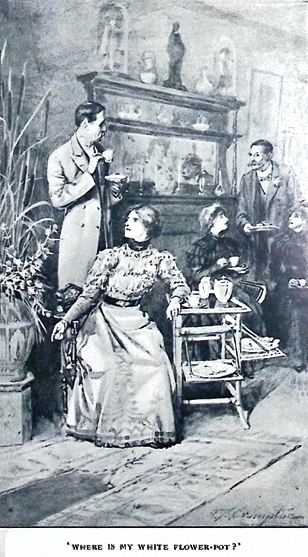
"WHERE IS MY WHITE FLOWER-POT?"
"I don't think I shall ever leave two men alone in the house again. I have lain awake at night thinking of the havoc I should find. Hal!"—And sitting upright in her chair, Mrs. Carter pointed severely to a small table in the window—"Where is my white flower-pot?"
Captain Carter looked in a guilty manner across at his brother, who leant back in his chair with a complacent smile.
"Don't look at me, my dear fellow. I am not your scapegoat."
Poor Captain Carter gulped down his cup of tea, and walked to the door.
"I'm just going to have a smoke," he said carelessly. "I'm very sorry, my dear, but it was when I heard that you were really coming home to-day. In the excess of joy, I was standing up to execute a 'pas seul', when my coat-tails caught the pot, and it fell—"
"'Oh, what a fall was there!'" quoted Cyril with tragic air. "'Then you and I and all the world fell down. Whilst—'"
Captain Carter had disappeared. His wife stopped her brother-in-law's quotation with a little vexed laugh.
"I might have known it! And I gave seven and sixpence for that pot! Girls, would you like to come upstairs? Don't think all members of Parliament are as frivolous as this specimen. Come along—this way!"
They had been listening to the conversation with amused faces, but followed her at once, and were charmed with their rooms, which led into one another, and were dainty in the extreme.
"My maid will come and help you to unpack. Take a good rest. We do not dine till eight."
She left them, and they looked at each other.
"Do you like it?" Heather asked.
Bluebell nodded.
"I think it seems delicious," she said; "every one is in such good spirits, and it is all so different from home. Doesn't it seem a year since this morning?"
Heather looked out of her window which faced Hyde Park, and said thoughtfully—
"I cannot get Abigail's verse out of my head. 'She that liveth in pleasure is dead while she liveth.' Where is that verse, Bluebell; do you know?"
"No. We will look when we do our reading to-night. We are not going to live in pleasure, so why should it worry you?"
"I think—we are," was Heather's slow reply.
Bluebell did not answer. She was diving into her trunk, and brought up her head with a flushed and anxious look.
"I wish our dresses were made more like Cousin Ida's," she said. "I never used to think of dress, but I am sure we look great frights. She said to-day that she would take us to her dressmaker as soon as she could. Do you like Captain Carter?"
"Yes, and his brother too. But they talk more like boys than men; don't you think so?"
"I like it. I don't feel a bit afraid of either of them."
Meanwhile, they were the subjects of discussion downstairs. Captain Carter could not stay away from his wife for very long, and he was back in the drawing-room.
"Well," he said, "you will have your hands full. I never saw such oddities. What are you going to make of them?"
"Humble imitations of your wife, sir," Mrs. Carter said, dropping him a mock curtsey. "You wait till I have got them some London frocks! I prophesy that next season they will be acknowledged beauties in society. I shall marry one to a foreign prince and the other to a duke—or shall I say a worthy millionaire? Dukes are all so poor nowadays. Well, Cyril, you old wiseacre! I saw you stealing covert glances at them through your half-closed lids. What do you think of them?"
"I think one of them is the ditto of the other," put in Captain Carter; "I don't see the object in having the two. One expects a little variety in one's guests."
"I know them apart already," said his brother. "What is the one called with the laughing eyes? They are the only bit of life about her staid little figure, but they're as merry as a cricket!"
"Oh, that is Bluebell. Isn't it a pretty name! And the graver-faced one is Heather. I think she is the more clever of the two, and she has a good bit of pride about her. I am going to give them dancing-lessons at once. Fancy their never having had any! They have been brought up in a Quaker household, and you must both be very careful not to shock them. I am going to bring them on by degrees. Oh, I must tell you of the she-dragon who has been fighting me!"
And forthwith Mrs. Carter gave a most vivid and laughable description of the quiet household in which she had been staying. Abigail's tone and manner were mimicked so successfully that her husband laughed till the tears rolled down his cheeks.
The girls made their appearance at dinner with flushed cheeks and bright eyes. Before the evening was over, they were on easy terms with Captain Carter and his brother. Many things puzzled them, especially the light badinage that flew backwards and forwards, but being perfectly natural and unconscious of self, they got on far better than they had feared.
"I would like to change places with you," said Cyril to Bluebell in the course of the evening; "it must be so delightful to be viewing London and society for the first time. You ought to keep a diary—I suppose you do, don't you?"
"No," said Bluebell, laughing. "I don't see the use of diaries, do you? Unless you are very very good, and leave them for people to publish after your death, when they write your biography."
"But aren't you very very good?"
Bluebell shook her little head in the negative.
"Oh dear no. Of course we try to be—everybody does, I suppose." Then in a graver tone she added, "Our old servant Abigail thinks us very wicked to come to London, but Heather and I don't agree with her. It doesn't say much for your religion if you can only be good in one place."
Cyril twisted his moustache in silence, looking at her with amused eyes. Then he said lightly, "Let me know when our London air takes effect, and you feel yourself turning wicked. Now, what sights are you going to see to-morrow?"
Bluebell looked across at Mrs. Carter.
"I don't know," she said hesitatingly. "You must ask Mrs. Carter."
"What do you want to see most? The shops, I suppose?"
"Oh, no indeed, we have shops at home. They are only three miles off."
Cyril's eyes twinkled, but he went on gravely, "There must be a good deal you are longing to see, isn't there?"
"Yes, we want to see Westminster Abbey, and the Tower, and the Zoological Gardens, and London Bridge, and—oh, ever so many places. The Houses of Parliament too; you speak there, don't you?"
"Not always," said Cyril, dryly.
"Ask him to rehearse his maiden speech," put in Captain Carter. "It is like a page or two of Chaucer that I learnt when a boy. It was so indelibly impressed upon my brain that I shall remember it to my dying day. Your cousin and I had a private hearing of it, Miss Fotheringay. It was about one a.m. We thought we heard murmured voices, and so prowled round the house expecting to find burglars gloating over our plate. We found the sounds proceeded from his room, and putting our ears to the keyhole, heard our member, with inflated chest and sonorous tones, addressing the House. It was grand. It saved us the trouble of going to hear him the next day. He learnt every word of it by heart, and he rolled it off with the fluency of a Paddy!"
So with chat and laughter the evening wore away.
The twins came upstairs to bed very tired, but very happy.
As they were doing their evening's reading, Heather said with a sigh—"Poor old Abigail! I don't feel quite comfortable at leaving without her blessing."
"I think she was really angry at our taking our own way instead of hers," said Bluebell, thoughtfully.
"Is it our own way? It ought to be God's way."
Heather sat down by the fire and clasped her hands round her knees as she uttered these words.
Bluebell looked up from her Bible quickly.
"I don't see why it shouldn't be God's way for us. You told me you were praying to have a fuller life. And then Cousin Ida came. I am thanking God she did, and I shall thank Him every day for all our pleasures."
There was almost a defiant note in her tones.
Heather looked at her with a smile.
"You always think everything is for the best."
Bluebell did not reply for a minute, then she raised her head from her Bible again.
"Here it is. In the First Epistle to Timothy. 'But she that liveth in pleasure is dead while she liveth.' It is about widows, I think."
"Well, never mind, I'm so sleepy. Let us go to bed."
But before Heather dropped off to sleep, she murmured, "Poor old Abigail! I hope her verse won't come true!"
A TASTE OF TOWN LIFE
"Every beginning is pleasant. The threshold is the place of
expectation."—GOETHE.
"BLUEBELL, do you know we have been here a month to-day? What shall I say about our coming home to Rachael? I am writing to her."
"Oh, you needn't say anything, need you? Cousin Ida has no intention of letting us go yet. Make haste with your letter, the dinner-bell will ring soon. Give my love to Rachael, and tell her to give the canaries a little saffron in their water. That is what they want when they don't seem well."
"Any message to Abigail?"
"I should think not, indeed. She has never sent us one, or written us one line since we left."
"Well, we haven't written to her."
"No, and we don't want to. Oh, Heather, aren't you longing for the concert to-morrow?"
The girls are sitting in their pretty bedrooms, and at first glance, they seem much altered. Their simple white evening dresses with black ribbons have a style about them that only a London dressmaker can give. Their hair is coiled up in the latest fashion, and their radiant, animated faces make them quite beautiful. They are getting accustomed to town life now. They have done a large amount of sight-seeing under the guidance of Cyril, whom they regard as a cousin. He seems to have a good deal of spare time on his hands, and is not at all averse to his position as mentor.
Mrs. Carter is very well satisfied with her charges. After a great deal of persuasion, she has begun to give them dancing-lessons, and the girls, though wondering what Abigail would say, are quick and apt pupils and thoroughly enjoy it. They have not been introduced into society yet, but Captain Carter, who is in the Grenadier Guards, is in the habit of bringing several of his brother officers in to dinner, and Mrs. Carter has a great many friends and acquaintances who avail themselves of her genial, pleasant hospitality. So that, altogether, they see a great deal of company, and the novelty attracts and delights them.
A few minutes later, and the girls had left their rooms and were going in to dinner.
"It seems quite nice to be alone for once," said Mrs. Carter. "I hope you have no engagement to-night, Hal?"
"Tell me how you're going to entertain me if I stay at home."
"We are going to have some music. You haven't heard Heather play on her harp. It arrived this morning. I don't know whether it's the thing for her to take up. Harp-playing has gone out of fashion."
"Then by all means play it," said Cyril, turning to Heather, with a little nod of approval. "There's nothing like novelty nowadays, and the girls must be conspicuous, or they'll die!"
"I don't mind being 'conspicuous,' as you call it, when we are alone," said Heather, spiritedly; "and I am not going to give up my harp for any one. I love it!"
"We'll arrange a programme. Minnehaha, you and I will sing that duet that we have been practising. The captain will recite a barrack-room ballad, and the missus will finish up with a waltz on the piano, and we'll foot it on the carpet. What? Is your precious carpet unable to bear the strain of our light feet? We'll exit into the hall, then. I have been yawning over County Council Bills all the day, and must stretch my limbs a little."
"I always say," said Captain Carter, meditatively, "that county members are the most narrow useless beings in the whole House. Their interest is only in agriculture and in game laws. Anything affecting the metropolis or the world at large is a matter of perfect indifference to them. They vote whichever way their party tells them. And as to matters concerning the Services or the Colonies they're as ignorant as a baby. They're sent to the House by a few hundreds of country yokels, and as long as they know what their constituents want, and try to get it for them, they think they have done their duty."
"I will not be drawn into talking shop," said Cyril, calmly. "When we are in ladies' society, let us suit the conversation to their capabilities."
"I never take interest in parliamentary affairs, unless there is a row of some sort," said Mrs. Carter, not at all offended by her brother-in-law's remark. "I like to read of the lords of creation losing their tempers, and slanging each other like a pack of schoolboys, but when they are all dull and prosy, they're no good at all. I think your maiden speech was the essence of dulness, Cyril!"
"Thank you. I know now what your taste is, and what style you prefer. What are you making big eyes at, Minnehaha?"
He had dubbed Bluebell this two days after her first arrival.
"I was thinking," she said, "how very seldom I have heard you speak seriously on any subject."
"He couldn't be serious," responded Mrs. Carter; "joking runs in the family. Even on my wedding-day, just before we took our places in church together, Hal whispered—
"'All the king's horses, and all the king's men,
Can't make me a happy bachelor again!'"
"She looked so exasperatingly superior and complacent," said Captain Carter, joining in the laugh. "I suppose it's the one day when women feel their power. The man is nowhere; people look upon him as a poor fool!"
"Power is a wonderful thing," said Cyril, fixing his eyes on Bluebell's laughing face opposite his. "There isn't a human being on earth who doesn't love power."
"I don't," said Bluebell, promptly.
"I do," said Mrs. Carter, nodding her head saucily across at her husband.
"And I think I do sometimes," said Heather, slowly.
"Allow me to continue. It is a subject upon which I can speak seriously. Power is an attribute that is in the breast of every human creature from infancy. Take a baby; why does it love shaking a rattle, ringing a handbell, seizing handfuls of its mother's hair? The love of power over all objects it can grasp. Watch a girl alternately nursing and slapping a doll, a boy beating a drum and whipping a top. Power over inanimate objects again. See the schoolboy bullying, making pets of anything he can control, and working havoc in all directions. Love of power prompts him. Ask an artist, a musician, a sculptor, an author, in what their chief enjoyment consists. They will allow, if they are truthful, that it is their sense of power over their pencils, their pens, their clay, and their instruments. Analyze your own feelings over your favourite occupations, you will find you never really like a thing unless you think you do it well."
"Such as hearing one's self talk, and reducing others to silence," murmured Captain Carter. "Pray go on."
"I don't think I agree with you," said Heather, turning to Cyril.
"You never do," said Mrs. Carter, laughing. "I think you two disagree on every point brought up."
Cyril raised his eyebrows.
Heather said a little confusedly, "I was thinking about enjoyment. I like playing on my harp, but I enjoy hearing others' music much the best. I think I like anything that takes me quite away from my surroundings."
"Highly complimentary to present company," murmured Captain Carter again, and Heather's fair young face was covered with blushes at once.
"You are only half developed yet, my child," said Cyril, with his grandfatherly air, stopping her confused apology. "Wait till you have had a season in town; your tastes will have altered by that time, I fancy."
"Lady Grace asked me to-day if they were going to be presented," said Mrs. Carter, looking across at her husband. "What do you male creatures think about it?"
"Folly and waste of money," said her husband tersely.
Bluebell and Heather looked up greatly excited.
"Presented to the queen!" they gasped. "Could we be?"
"Very easily. I was presented just after my marriage, and I could take you. If you stay a couple of months longer with me, I can manage it."
"Are they going back to the country, after such a taste of society?" queried Cyril, with a mocking light in his eyes.
Mrs. Carter rose.
"We need not discuss the matter further now," she said with great dignity. "Come, girls, we will leave them to their smoke."
But Heather and Bluebell were far too excited to let the matter drop. They pursued it in the drawing-room till the gentlemen came in, and when they retired to their rooms were still full of the subject.
"We must stay away longer now," said Heather. "Why, even Abigail would be proud to think we had been presented to the Queen! Isn't it almost like a fairy tale, Bluebell? Sometimes I fancy we shall wake up and find it all a dream."
"Yes," said Bluebell; "it seems as if every enjoyment has been kept away from us all our lives, and now they crowd upon us so thick and fast that it is quite overwhelming."
"And Abigail would have kept us out of it all."
"Heather, do you know, I cannot go back to our old life again. Is it wicked, I wonder, to feel so?"
Heather gave an impatient little sigh.
"Oh, don't keep asking if it is wicked," she said; "I'm going to enjoy the present as much as ever I can without thinking."
Bluebell drew her Bible to her, but she soon closed it.
"I feel I can't do anything but think about the Drawing-Room," she said. "Won't you be very frightened of making your curtsey, Heather? Cousin Ida says we can't be asked out to any really nice people's houses until we have been presented. I did not know that was so necessary."
"Our dresses will cost a lot of money," said Heather, meditatively. "I don't know how it is, but money seems to fly in London. We have spent more in this month than we should do in a whole year at home."
"Cousin Cyril said that was part of our education. To learn how to spend money! How dreadfully satirical he is! He always seems to consider women on such a much lower level than himself. And don't you object to his making fun of serious subjects as he does? I do dislike his asking us so often how our religion is getting on!"
"He seems to think we're losing it," said Heather, slowly, as she brushed out her curly hair and gazed at herself abstractedly in the glass as she did so. Then after a moment's pause she added, "And I am not sure that he isn't right."
"Speak for yourself, please," said Bluebell, lightly. "I'm not going to turn into a heathen because I am in London. It's ridiculous, and absurd."
"What is true religion?"
Heather breathed rather than spoke the words. Then she flashed forth a little excitedly—
"I wonder now if we ever had anything but a mere form of religion. We had nothing to tempt us, nothing to try us at home. I don't believe any girls were more shielded from evil than we were. And now when our lives are so utterly changed, it seems a test of it all. I cannot get Abigail's verse out of my head, 'She that liveth pleasure is dead while she liveth.' I don't know how you feel, but I want pleasure. I love it, and I seem to want more and more of it. I should be miserable if I went home now and left it all when we are only just beginning to enjoy ourselves. But I do not believe God wants us to be shut out of the world. Cousin Ida is religious and she loves London society. I mean to copy her. I believe there are two kinds of religion in the Bible; Abigail's is one kind and Cousin Ida's is the other, and which is right, I wonder! I know which is the brightest and happiest life."
"It's very puzzling," said Bluebell, a graver look stealing into her merry eyes. "But I think we're both of one mind about it. We will enjoy the present while we can. And don't let us philosophize too much about it. It puts one in the blues!"
DUTY'S CALL
"It is right to begin with the obligations of home—no other duties can
possibly be substituted for them."—DICKENS.
MORE than a year has passed.
Bluebell and Heather have not yet been home. They have travelled abroad with their cousin; they have passed a season in town; and the little simple country girls have developed into brilliant young women of fashion. Mrs. Carter is beginning to wonder when they will marry. Heather has had two or three offers, but has refused them all. She charms many by her little imperious queenly ways, her bright wits, and her quick changes of mood from grave to gay.
Bluebell is always saucy and bewitching; some wonder if she can ever be serious; some, if she has a heart at all. At present, she has a persistent and devoted suitor, Sir Herbert Mowbray by name. He is not a very young man, and is silent and reserved by nature. Bluebell alone can bring the grave smile to his eye and lips. But she holds him aloof, ignores his devotion, and treats him as she treats all others, with laughing indifference.
The sisters have very few grave conversations together now. Their Bible reading is short and hurried, often missed altogether. The late hours and rush of gaiety that they live in, have already left marks on their young faces. But they appear in the brightest spirits, and Mrs. Carter is more than satisfied with the success of her training. Captain Carter looks upon them as permanent inmates of his household, and will not hear of them taking their departure.
Cyril still chaffs and criticizes their actions. He makes his brother's house his home when Parliament is sitting, but is a good part of the year in the country managing his property.
"Girls, where shall we go this summer?" said Mrs. Carter one sunny morning in July, as they sat at breakfast. "It is too stifling for words in town. I am longing for a breath of country air."
"We have four invitations for August," said Heather a little languidly, "none of which we have accepted yet."
"One of them is to Lady Grace in Scotland. I always think Scotch houses are very dull except during the shooting. What are the others?" said Mrs. Carter.
"Mrs. Finch wants us to go on a house-boat with her."
"Without me. Yes, I remember, and I think she is too go-ahead! Who are her party?"
"Mr. Finch, Major Rankin, Mr. Greeson, and a young nephew."
Mrs. Carter pursed up her mouth and looked across at her brother-in-law.
"I am not prudish," she said; "but what did you tell me about Major Rankin, Cyril?"
Cyril stroked his moustache with a superior air.
"Something best not repeated," he said. "That invitation must be declined at once."
"That is for us to settle," said Heather, quickly, with a flash in her eyes that Cyril always called the "danger signal."
"What is number three?" asked Mrs. Carter, hastily. "We will talk about accepting or declining them later."
"Lady Mowbray's," put in Bluebell. "Sir Herbert has been pestering my life out, ever since I had the letter."
"And the fourth?"
"Oh, that doesn't really count," said Heather, looking out of the window as she spoke.
"Because it is the only one that is coming off," said Cyril, coolly. "Don't pretend you have forgotten, missus, that you are coming to entertain for me. I expect the whole lot of you for a good month."
"Oh, did we promise? I must say I like being entertained better than entertaining," said Mrs. Carter with a little grimace. "I get enough of that in my own house."
"We certainly shall not give you a month," said Bluebell. "We should all be bored to death. Heather and I will give you the last week in August if you like, after we have done our other visits."
"Speak for yourself, Minnehaha! Heather will come before that if you don't."
Both girls exclaimed—
"We have never been separated in our lives. As if we would sleep apart from each other for a single night!"
"Now, my dear children, that idea is quite exploded. It is a perfect fallacy to think twins ought not to be separated. I know two fellows—twins—who led a life of misery till they took my advice; one went towards the North Pole, the other towards the South, and they quietly and firmly decided that they would never come into contact with one another again. Their life was becoming a perfect bondage to them, and when they were once away from each other, they said it was a delicious sensation to realize their individuality apart and alone from any one else's. The sooner you assert your separate individuality, the better for both of you. Now, missus, put your oar in! You know I am speaking words of wisdom. How are the silly young creatures to get husbands if they will live in one another's pockets? There, I thought the missus would rise to that bait. I will leave you to fight it out together. Men are best out of the way when husbands are under discussion!"
Cyril sauntered out of the room after this speech.
Mrs. Carter began to improve the occasion.
"I think there is a certain amount of sense in what he says, girls. If you could make up your minds to do without each other sometimes, it would be much better for you. For instance, Lady Mowbray wants Bluebell, Lady Grace wants you, Heather."
Bluebell flushed a little, and laughed.
"I am not going to Lady Mowbray's by myself, Cousin Ida. Not if I know it! She is an irascible old lady, I have heard. Even her son says she is 'difficult,' and he is devoted to her."
"If you make up your mind to accept Sir Herbert, you must make the best of his mother," said Mrs. Carter, quietly. Then looking at Bluebell a little keenly, she said, "He spoke to me about you yesterday evening—I—I wished him success!"
Bluebell only laughed.
"Don't look like that at me, Cousin Ida! As if you are longing to congratulate me. It is premature, I assure you. If he doesn't take care, he'll find such haste will spoil his cause. I am not going to be tied or bound to any man yet. I love my liberty too much."
She danced out of the room, singing as she did so—
"I care for nobody, and somebody cares for me.
If somebody thinks he's nobody, I may care for he!"
Mrs. Carter looked a little worried.
"I hoped you would both be engaged by this time," she said to Heather, who sat gravely looking through her letters. "It isn't my fault that you are not."
"No indeed," said Heather, quickly looking up; "I am afraid we have sadly disappointed you. I had never realized till I had gone through a season what a solemn duty this business of marriage is. And sometimes, Cousin Ida, it sickens me. Life isn't all marrying and giving in marriage! You have been truly good to us, but I think Bluebell will soon do what you want. Don't worry her too much."
"And what about you?"
Heather got up from her seat, and walked over to the window. She drew her slight young figure up rather proudly.
"I would rather not discuss myself. Bluebell and I cannot part with each other yet. I think we must do our visits together. Shall we talk over them now?"
"There is one lesson I have to learn," said Mrs. Carter with a mock plaintive air. "If I can come the 'missus' over Hal and Cyril, I cannot over you two girls. Sometimes I think you look upon me as an old dowdy chaperon. I wonder if you do! It's the way of young girls nowadays."
"It will never be our way," said Heather, warmly; "Bluebell and I can never thank you enough for all the enjoyment you have given us."
Then the two sat down to earnest discussion over the forthcoming visits.
A month later, and the twins were at Rawton Cross, Cyril's property. They had visited Lady Mowbray, and had liked the hot-tempered, good-natured old lady. Bluebell was not yet formally engaged to Sir Herbert, but it was an understood thing, and Heather sometimes wondered why her sister seemed to hang back when matters had gone so far.
Cyril was a capital host. His house was a picturesque-looking Gothic building, and he filled it with pleasant guests.
Mrs. Carter was in her element at once. She said one day as she was dispensing afternoon tea on the lovely old lawn under the beech trees, "I think I would have made you a good wife, Cyril. What a pity you didn't ask me before Hal did!"
"The red coat did it," said her husband, lazily. "I felt her heart thump its admiration the first time we met, when I took her into supper at one of our regimental festivities!"
"How can you give me away so before these girls? You know you had to propose to me three times before I accepted you!"
"No," said Cyril, meditatively, as he leant back in his lounge chair and surveyed the company with lazy satisfaction, "I have found celibacy such a blessing that I have constantly congratulated myself that I have 'kept myself to myself' all these years."
"It is a shame of you," said young Mrs. Plowman, coquettishly. "Your house will never be truly comfortable till it has a mistress. And think how many single women would be only too thankful to take charge of you—"
"And my money!"
"Mercenary wretch! Whom are you saving it for?"
Heather, who had been listening to this silently, now got up and sauntered away. Sometimes the empty chit-chat of society disgusted her. She had never really become accustomed to it, and other, graver thoughts were now occupying her mind.
She turned her steps to a winding path that led into the woods close by. Walking along, she found herself soon between steep banks of moss and fern, and with a long-drawn breath of delight, she sprang up, and curling herself up amongst the ferns, she rested her head against an old tree, and proceeded to read and re-read a letter which seemed to cause her much anxious thought.
Time went on, and still she sat there. Bright-eyed rabbits, with startled ears, peeped over the high ferns to look at this intruder. A squirrel darted over the branches above her, and the wood-pigeons came and cooed in the top of some tall elms close by.
Heather did not heed them. She clasped and unclasped her hands nervously. Her brows were puckered, and her face looked harassed. Then she took out a pencil from her pocket, and began making rapid calculations on paper. A heavy sigh followed, and then her quiet was suddenly disturbed.
"Found at last, Regina!"
It was only Cyril who called her by this nickname, and he stood over her with an amused look in his eyes.
"Now what may I ask has suddenly driven you to solitude? In love at last?"
Heather looked up startled, and a little annoyed. "Do you never feel you would like to be alone?" she said, trying to speak carelessly.
"Oh yes, very often. But beautiful maidens must not be allowed to waste their sweetness on the desert air. Major Canning has been hunting for you. Jack Bedford is distrait at your absence, and each supposes you are having a 'tête-à-tête' with Frank Rushton, who has also disappeared."
Heather gave another sigh.
"I wish you could be serious," she said, "then I might confide in you. I would just as soon tell you as Cousin Ida, because you can keep things quiet, and she cannot."
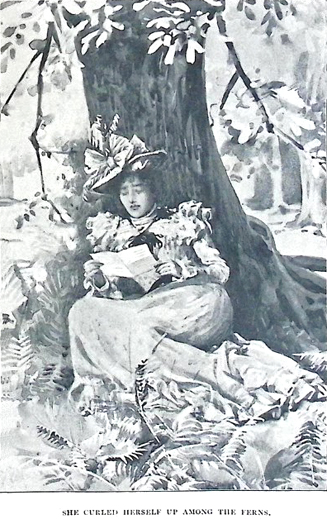
SHE CURLED HERSELF UP AMONG THE FERNS.
He threw himself down on the grass beside her.
"I am your elder brother. Now, child, tell it out!"
A pink flush rose to Heather's face. She hesitated, then plunged into her perplexity.
"Cousin Cyril, I have a letter here from one of our old servants, Rachael. It is not the first one I have received in such a strain. I used to think I was very good at money matters, but somehow or other now, Bluebell and I cannot keep within our incomes. Both these last two quarters, I am ashamed to say, we have overdrawn at our bank. There are things that must be seen to at once at home, repairs to our small farm. We have not the money to send. And worse than all, there are two or three old people to whom our grandmother always paid a small weekly pittance. Rachael asks me to send the amount for the next quarter, and—and I cannot do it."
"Hard up!" said Cyril with a quiet smile. "Borrow from me, till you get round the corner!"
Heather drew her head up proudly.
"Never," she said. "I will not go further into debt. I feel disgraced and ashamed when I think of the sums we have been lavishing on our amusements and dress, whilst our dear old people at home are actually in want."
She paused, then went on rapidly—
"I dare say you cannot understand, but the villagers have always looked to us for relief, and grandmother used to give a great deal away. I promised her before she died that we would continue to do the same. It is only lately that I have found it impossible to keep my promise. We are spending a good deal of money, and do not seem able to draw in."
"The only thing for you to do is to let or sell your old home. You will never go back to live there again, so why have the expense of keeping it all up for the sake of two old servants? Pension them off, let the farm go, and you will find yourself the richer."
Cyril spoke with easy indifference, but he was watching her very keenly the while.
Heather flashed round upon him impetuously. "Is pleasure before duty your only clue out of the difficulty?"
He smiled.
"I thought you had forgotten there was such a word as duty these past twelve months," he said; "we who follow fashion's fancy will have none of such an old-fashioned article!"
Heather looked straight before her with compressed lips and flashing eyes.
"There is one way out of the difficulty," she said determinedly, "and that is the way we must take."
"Into the Bankruptcy Court?"
"We must go home, and stay there!"
He looked at her curiously, then sprang to his feet.
"Away with such a dark thought! Let us return to lighter and brighter realities. Come and have a row on the river!"
Heather gave a sigh, put her letter in her pocket, and was her bright self again when she joined the others still on the lawn.
But she had made a resolve in her own heart, and that resolve she meant to keep.
SEPARATION
"He who has well considered his duty, will at once carry his conviction
into action."—S. SMILES.
"BLUEBELL, we must go home. That is the only solution to our difficulty."
The girls were talking it over a few nights later, when they had retired to their room for the night.
"We can't do that."
"When do you think of returning?"
"Oh, some day. Not yet awhile. Picture Abigail's greeting! When I have found life a failure, I will take refuge in her arms. She would welcome me then. Never, if I was finding it a joy and a success?"
"We cannot go on as we are doing. Bluebell, you are not a child—be serious! Do you like being in debt! Do you enjoy thinking of Mary Scrivens and old Ralph going without their little comforts, even necessaries, because we are spending the money that rightfully belongs to them? I cannot sleep at night for worrying over it. We must go back; there is no way out of it."
Bluebell leant back in an easy chair and clasped her hands behind her neck. Her saucy eyes took a grave look.
"I know we are in rather a fix. We mustn't be so extravagant in future. Money seems to fly in London. Oh dear! I wish we were really rich! Can't you borrow a little from Cousin Ida?"
"I shouldn't think of it. When could we pay it back? The more I think about it, the more convinced I am that it is our duty to go home and stay there quietly. I have spoken to Cousin Ida about it to-day. She was angry at first, but when I had talked to her for a little, she said that perhaps it would be wise. Her idea is that we should go home for a time, and come to her again next spring."
Bluebell looked annoyed.
"You needn't have spoken to her about it. I don't mean to go home. Captain and Mrs. Foster have asked us to go a yachting trip with them. Sir Herbert and Cousin Cyril are both going. And I have promised we shall go."
"I shall not go."
"I shall."
"Then I must go home alone!"
There was dead silence. Each girl had a strong will, but never in their lives had they clashed with each other before.
And before long Bluebell was in tears, and Heather with a strained white face was pacing the room.
Then Bluebell, from passionate protestations, began to coax and entreat.
Heather set her lips in hard lines, and listened without a word.
Duty was before her. She had been brought up from her infancy to consider it an important part of life, and not even the gay pleasures she had so delighted in could turn her steps aside. Her heart felt nearly breaking when she realized that Bluebell would prefer separation to taking up the quiet country life again. She did not look forward to it with pleasure herself. She was still enjoying her society life, and the possibility of going back alone to the two old servants seemed too dreadful to contemplate.
Bluebell was almost as miserable at the thought of separation. And yet the growing love for all that makes a society life pleasant perhaps helped her to bear it with more equanimity.
"Nothing will induce me to go back!" she sobbed. "I hate the idea of it! I should die if I were stifled in that silent house again without a soul to speak to from one year's end to another! I wish an earthquake would swallow the whole place up! Yes, I do! Don't look so shocked! I'll never go back there, never, never, never!"
She crept off to bed, sobbing.
Heather lay awake with tearless eyes, but with a sick pain at heart. All sunshine in her path seemed to have gone. Only dull heavy clouds hung above her. And when Bluebell had at last sobbed herself to sleep, Heather crept up to her, hung over her with a world of love in her grey eyes, and laying her cheek against hers, kissed her passionately.
"Our first quarrel, our first separation! How shall I be able to bear it!"
Bluebell stirred and smiled in her sleep. Then one word came softly between her lips—"Herbert!"
Heather turned away passionately.
"She does not care. She only thinks of him! It would have had to come sooner or later, so I must bear it."
And then, kneeling down by her bed, she took her trouble to One whom she but seldom approached now. As she bent her head, a rush of sorrow for her coldness and carelessness in her daily devotions came over her. And the tears, which up to now had been stayed, gushed freely.
When she crept into bed again, it was with a greater feeling of comfort and peace than she had experienced for some time.
The girls were very quiet the next morning. Cyril rallied them on their gravity. Mrs. Carter looked anxious; the other guests were a little puzzled, for the twins were acknowledged to be the life of every party they joined.
At last, the facts were known, and once known, Heather hastened to put her resolve into action. In two days' time her trunks were packed, and she was bidding good-bye to every one.
Cyril drove her to the station in his dog-cart. Bluebell had taken leave of her sister in private, and was now sobbing her heart out in her room.
Heather was very quiet and dignified; her feelings were too deep for words, but she had the sense of rest when alone with Cyril that she had sadly been needing before all the curious eyes and comments of her friends.
"You won't be able to do without us," said Cyril at last, quietly and meditatively.
Heather's spirit rose at once.
"I lived twenty-two years very happily without any of you," she said.
"Not without Minnehaha! But I was not thinking of her. How will you spend your time! You are like a bird that has been freed, returning to its cage. You will only beat your wings against the bars and stop your singing."
"Never! One would think my home was a prison."
"How long will you immure yourself? I won't repeat some lady's conjectures that I have heard. Your sex is very unmerciful."
"Oh, I can guess them," said Heather, with a hard little laugh. "They say I am disappointed in love, and am going into seclusion to hide my wounded heart. Or some say I am going to recruit my health and beauty, and flash out afresh the beginning of next season, remembering the old adage, 'absence makes the heart grow fonder.' You see I am well aware of what is said behind my back."
"It is a pity you haven't married," said Cyril, in his most fatherly tone. "Now, Minnehaha is doing well for herself. It would be a good way out of your difficulty."
Heather smiled. Then looking up into his face, she said frankly—
"Do you know, that is the one reason why I am glad I am going home. I shall hear nothing of the modern marriage market. I am so tired of it all."
"Have you made up your mind to choose a spinster's lot?"
"It is not one to be despised," she said.
He was silent.
When he had seen her into a comfortable carriage, tossed some picture-papers into her lap, and held out his hand for the final good-bye, he said, "You are a strong-minded young woman. But I admire the principle that is at the root of it! The missus says you will be back under her wings within a month. I give you two. Adieu!"
The train moved off, Heather waved a laughing farewell, but when once alone, great tears filled her eyes.
She leant back in her seat, feeling lonely, forlorn, and miserable. Not even the conviction that she was obeying the dictates of her conscience and had not faltered in the path of duty could comfort her now.
"I am so young," she murmured regretfully, "to leave it all, and to lead the life in front of me. It was fit for our grandmother. It is not fit for us. It is the best time of my life now, and it is wasting it to shut myself up with Abigail and Rachael."
So she mused, and then took herself to task for having such selfish views. She took up the papers, and tried to bury herself in the news of the day. The journey seemed never ending.
At last she reached the country town. No one was there to meet her, but she hardly expected it. Taking a fly, she was driven slowly through the country lanes she knew so well, and reached home about five o'clock. It was a lovely summer evening; the drive up to the house was bordered with bright flower beds, and masses of crimson roses and white clematis fell over the porch.
As she stepped out, a burst of song came from the canaries' cage in the greenhouse. And Heather lifted up her tired head, and with a bright smile came into the cool, dark hall.
Abigail stood like a sentinel inside; Rachael was fluttering about in the background. Heather did not wait for a welcome; she went straight into Abigail's arms, and was not repulsed.
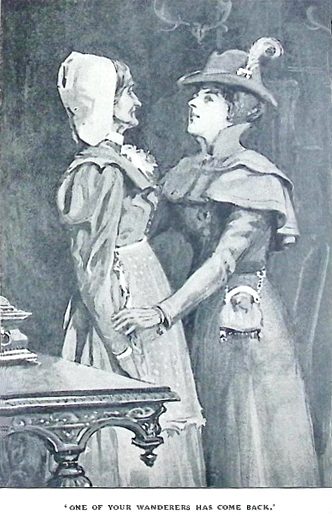
"ONE OF YOUR WANDERERS HAS COME BACK."
"One of your wanderers has come back," she whispered. And then, putting her arms round the old servant's neck with the simplicity of a child, she kissed her.
Abigail cleared her throat, tried to speak, and then Heather felt a hot tear touch her cheek.
With a little jerk, Abigail released herself from those clinging arms, and found her self-control again by scolding the driver for treading on the beeswaxed floor with his heavy nailed boots. Heather turned to Rachael, who laughed and cried in the same breath.
"Oh, my dear Miss Heather, we thought we had lost you altogether. It has been a long dreary time this past year. But eh!—how did you leave Miss Bluebell? Are we not going to see her down here? And how bonny you're looking, but not the same young lady that went from here! You are so grand—have such an air. Is it dress has done it?"
"I hope I am just the same," Heather said, laughing.
And resolving to preserve a brave front, she ran in and out of the rooms, looking at and praising all she could. The evening sunshine stealing in through the casement windows brightened up the dark corners. And though she found all exactly as she had left it, her heart sank at the bareness, the crude colouring, and the absence of the pretty details to which she had become accustomed in her cousin's house.
"If I had not come home to economize, I would improve and alter many things," was her thought as she stood in the drawing-room and surveyed the brown holland coverings with uneasy disapproval. "I can arrange the furniture a little differently, but what is the good of it when I am all by myself! Oh, how shall I be able to live alone! Bluebell might have come—she might have come!"
It was her inward cry all that evening. Abigail waited upon her in solemn silence at dinner. And afterwards, she wandered out into the garden. But though the soft stillness of the evening air soothed her, she could not feel content in her surroundings, and when later on Abigail brought the big Bible and took her seat with Rachael to take part in evening prayers, Heather had hard work to keep her self-control.
When Abigail, silver candlestick in hand, came up with her to her room, Heather put her hand on her arm wistfully.
"Come in and talk to me, Abigail. Tell me you have forgiven us for running away from you. And tell me all about the farm—and the old people. I—I feel lonely to-night."
Abigail's hard face softened.
"If you have seen the evil of your ways, Miss Heather, and are purposing to follow in your dear grandmother's footsteps, I will be the last one to cast up the past in your face."
"Don't scold me. I cannot stand scolding to-night. I don't know what I am going to do yet. But to-morrow morning, I am going to talk business with you and Rachael. I want the gossip of the neighbourhood, Abigail."
"You went away a sweet and simple maiden," said Abigail, with a sigh, "and you have come back a fashionable town lady. I hardly am liking to touch your hair. Maybe you would rather I did not take up the old ways again?"
Heather laughed, and throwing her dressing-gown round her, handed Abigail her brush.
"I shall love to have you attend me. Now talk, and brush away."
Abigail's next question brought a pink flush to Heather's cheeks.
"And how goes your soul's health, Miss Heather? That is what I am longing to know. Are you as near heaven as you were when you left this?"
"I would rather you told me first what I am longing to know."
Heather's tone was dignity itself.
Abigail gave a heavy sigh, but after a pause began telling her the village news.
And Heather did not give her an opportunity again of any personal questions. She chatted and laughed, and then wished her good night. But seeing the grieved look on the old woman's face as she was taking her departure, she said with one of her flashing smiles that were so rare—
"I am not quite so wicked as you think me, Abigail. You will see how good I mean to be now I am home again."
A little time later, and Heather's face was buried in her pillow, choking sobs escaping her.
"Oh, Bluebell, you cannot love me as I love you! Shall we never be together again? It is like death itself! How shall I be able to bear it?"
THE VILLAGERS
"Let it ever be thy pride
To linger by the labourer's side;
With words of sympathy or song
To cheer the dreary march along,
Of the great army of the poor."
LONGFELLOW.
THE old servants hardly knew what to make of their young mistress the next morning. She came downstairs apparently in the best of spirits, but full of plans and innovations that sorely perplexed and disconcerted them.
She told Rachael she would in future like afternoon tea in the drawing-room every afternoon at five o'clock, dinner not a minute sooner than half-past seven. She uncovered the drawing-room chairs and couches, and tossed the holland covers into the bottom of the linen cupboard. She brought in flowering plants from the greenhouse, and disposed of them in every corner of the room. Calling the small boy into her service, she wheeled out the round table into an empty bedroom, and by dint of banishing some articles of furniture and altering others, had soon completely transformed the drawing-room.
Abigail looked on in silent horror. This masterful young woman, with bright careless smile and quick peremptory tones, was not the same girl that had trembled at her voice in bygone days! Heather worked on indifferent to her frown, and directly after her lunch, walked down to the farm to see George Thatcher and his wife.
For a good two hours, she perambulated round the premises, talking business matters over with the farmer, and jotting down in her note-book the repairs that were absolutely necessary, those that could wait, and the respective cost of each.
"Be you comin' in to see the missus?" asked George, shyly, after their talk was done. "She do be expectin' to see you, miss."
"Yes; I will come."
And Heather followed him into a spotlessly clean kitchen.
Annie, a fair, gentle-faced young woman, rose up from some needlework with a blushing smile.
"Eh, miss, 'tis nice to see you here again."
"Yes," said Heather, brightly, as she shook hands, and then stooped to kiss a bonny child of two years old playing at his mother's feet. "I feel as if I haven't been away so long, after all. And yet, when I see Tommy, it does seem strange; he was a baby in arms when I left."
"How is Miss Bluebell? 'Tis a disappointment not to see her. Will she be coming home soon?"
"Not just yet. She is going to Norway with some friends in a yacht. Well, Annie, how do you think I look?"
"Beautiful, miss."
There was no mistaking the hearty admiration in Annie's face and tone.
Heather laughed lightly, and George, who had swung his little son upon his shoulder, now turned and looked at her.
"We were hearing you went to see the Queen," he said a little doubtfully.
"Yes, we had the honour of kissing her hand, and making our curtsey to her."
"There now," broke in Annie, "I knew it were true. Some said one thing and some another, and old Watty would have it that you must have a Lady before your name to go to Buckingham Palace. I says to him,—
"'Our young ladies are as high as any other ladies in the land, though they have kept theirselves so quiet.'
"And he was as obstinate as a donkey that the Queen's visitors were duchesses and countesses, and lords and ladies, and no plain misses could ever get near her. Did you have tea or dinner with her, miss? And how did she look? Did she ask you any questions?"
Heather tried to explain. And her experience at her first drawing-room greatly raised her in the estimation of the farmer and his wife, though it all seemed very unreal and puzzling to them.
She chatted on to them, and then, as milking-time came round, she took her leave and hastened homewards.
Poor Heather! She was making valiant struggles to so occupy her time that she would have no room for thought. But now as she was walking through the green meadows, it all came back with a rush.
"I don't know how I shall be able to bear it," she murmured to herself; "it seems so dreadful to be quite alone. Bluebell will be surrounded by friends; I am without a soul to speak to. I feel inclined to fly back to them all, and yet I will not. It is my duty to stay here, and I will. And I will try to be as cheerful as I can."
She returned to the house, found some pleasure in showing Abigail how to place tea in the drawing-room, and then took her solitary cup in state, thinking idly how much she would like to see the door open and some of her London friends and acquaintances appear.
Half an hour after, she was out again, this time wending her step towards the village. She stopped first at a very small thatched cottage with a bright flower garden in front. She lifted the latch of the door quietly, and went in.
For a moment, she thought that no one was in the tiny kitchen; then from behind an old settle popped a bright-eyed little woman. Very old and feeble she looked, and for a minute she peered up in alarm at her visitor. This young lady, in her dainty white dress and hat, seemed a stranger.
"Mary, don't you know me?"
"Ay, ay, bless your sweet voice; it can't be no other but Miss Heather!"
And here the old woman seized hold of the delicately gloved hands, and tears dropped fast upon them.
"I thought ye were swallowed up in the big town, and had forgotten us altogether. Ay, my dear, 'tis good to see you again. Abigail has come in with my bit o' money every Saturday, but she never seemed to have no tidings to tell of—leastways, not from you and Miss Bluebell. And 'twas only last Saturday she shakes her head and says,—
"'Ye mustn't be surprised, Mrs. Scrivens, if ye gets no more siller for a bit. The young ladies are badly off, and times is not what they were, and maybe this is the last I can bring ye!'
"To be sure, when she'd gone, ye could have knocked me down with a feather! For ye know my past, Miss Heather, dear, how with six children and a husband that died when the eldest were but seven, and one little one a cripple, and the other lost his sight through blastin', and one o' the girls takin' consummation and dwindlin' down to a skellikon, and me givin' of her a proper funeral, and then a helpin' my own sister who come to sad want, bein' one who couldn't help herself—well, I didn't put savin's by, 'tweren't to be expected, were it? And havin' had the help from your dear grandmother so many years, my faith was rather took aback, so to speak.
"I sat in the corner here, and I thinks o' 'Lijah and the ravens, and then I asks my Father not to let me come to want, and I casts about in my mind what I could do without, and how I could earn a few pence. All this week I've give up my ha'porth o' milk, and the bit o' meat I has on the Wednesday, and I've kept half the bit o' drippin' Mrs. Styles from next door gives me, to go towards nex' week. 'Tis hard to be eckycomical with so little, but 'twas harder to tell old Ralph he might come to-morrer bein' Saturday, and strip my bit o' garden of all my bits o' flowers and take 'em and sell 'em in the market. And then he tells me Abigail had brought him the same message, and he and me had a good weep together, and then he said the Lord 'ud provide, and went away with a solemn shake o' his head, and he's goin' to try his cabbages in the market, but they be a poor lot. Ralph never was a gardener; he allays were so took up wi' books an' such like."
Old Mary stopped for breath. She had poured out her story with smiles and tears, and Heather felt a little choke in her throat as she thought of the luxury in which she had been living, and the contrast of her life with this one.
"You shall not want the money, Mary. I have brought it to you myself this afternoon. I did not think Abigail had told you of our difficulties, but she did not know last Saturday that I was coming home."
"Praise the Lord! He has not failed me. Now, Miss Heather, just you kneel down and let us thank Him for His goodness. Ay, I have been mistrustin' of Him, and He just brought you back to us Hisself when He knew we couldn't a get on without you!"
Down on the uneven stone floor knelt Heather, with the little woman sniffing and ejaculating beside her. But it was not Heather's voice broke the silence that fell on them, she felt too humiliated and ashamed to utter a word. It was Mary who sobbed out her thanksgiving with many tears, and when they got up from their knees, and the old woman poured forth blessings on her head, Heather rather sadly hushed her.
"I am ashamed you should have had a day's anxiety about it, Mary. I must go and see Ralph. Good-bye."
She left her, after placing a little packet in her hand, and found the old man at his garden gate reading the local newspaper. Ralph was rather a character. He prided himself upon his knowledge of the world and its ways. He would quote noted politicians in his talk, and even crowned heads, as if they were intimate friends of his own. His geography was vague, his history and all general knowledge was taken from the papers. The more ignorant of the villagers gaped with open mouths at his utterances when he had his paper in his hand. Without it, he was as lost as a lame man without a stick, or a short-sighted man without his spectacles!
"Let us see now," he would say with a wise shake of his head, "what the young Emperor of Germany has been saying to his ministers last Friday. I misdoubted his wisdom in that affair in Chiny, but he allays has been too precipitous with his tongue. He reminds me of his gran'-feyther in that affair of the war with the Frenchies. And here's trouble again in Indy. Well, well, if there's fightin't here, 'twill have to be the sailors this time. There be all our soldiers wanted for Africa, Lord Salisbury says, and they can't be fightin' on two sides of our island at once!"
He looked up as Heather approached.
"Good arternoon, miss," he cried joyously. "Well, there! I have a bin concerned about you! Right glad to see ye back, miss; and ye be lookin' up foine too! Missis Abigail she be so close and mournful like at your Lunnon visit, that I has high words with her on the subjec' last time she were round. I sez to her,—
"'Missis,' I sez, 'the young birds allays leaves their nest. 'Tis the way of all nature; how else should they learn to fly?' I sez! 'And when they be took up by her gracious Majesty, and be brought to see her in the Palace,' I sez, 'they that knows 'em ought to be that joyful that they should have the honour of being invited, that they should be werry thankful they ever left their home.' I sez—
"But there, miss, my tongue do run on! I was a just calculatin' from the paper what my bits o' vegetables might fetch in the market."
"Yes," said Heather, hastily, "I have heard, Ralph, but you needn't be afraid your money will stop. Now I am home again I will see that it does not."
The old man looked at her.
"Then 'twas only Missis Abigail's croaks? Well, I do be truly thankful! I never gives in, for 'tis a long lane that has no turnin', and there's many a slip 'twix the cup and the lip, but this mornin' I had a heerd how Mrs. Scrivens were a scrapin' together, and I felt if the choice lay betwixt my paper and the house, well, it must be the house I goes to, for a man is little better than a beast if he don't know the news of the day!"
Heather laughed, and stayed chatting to the old man for some time. They discussed politics, and Heather gave him many bits of information about London and its ways. Before she went, he asked her gravely—
"And has Miss Bluebell got a husband? We heerd tell so. And haven't you a lover, miss? There allays are plenty dangling about town, they say."
"No, I haven't one yet, Ralph, neither has Miss Bluebell a husband! Now I must go. Good-bye."
One more old friend she met on the way home, and this was Watty Clark, the postman. He was striding along, his long white beard reaching to his waist, and the post-bag swinging to and fro. He looked the picture of health and activity, though he had passed his seventy-fifth year. His chief characteristic was a great belief in himself and utter disbelief in every one and everything else. It was he who had thrown a doubt on "our young ladies going to see the Queen," and now he stopped to look rather queerly at Heather as she greeted him.
"Well, Watty, did you think we were never coming back?"
"Never," he said with a shake of his head, "and there's only half of ye now without Miss Bluebell. I allays said she wouldn't never come back; she were too fond of excitement and such like."
"Did you think better of me?"
"Ah well, I've heard say the reason, and I gives ye the credit of meanin' well, but ye won't keep it up. 'Tisn't to be expected ye will, and ye'll be pinin' for city life before many weeks be out! Lasses are the same all the world over. They be no good for hard grindin' work and duty; they just flitter flutters by and takes the cream, and leaves the skim for them who ain't so flighty as theirselves."
"Now, if you are rude to me, I shall not come and see you, and bring you some medicine for your cough, as I used to do."
"Are you going to start yer medicine-shop agen, miss?"
The old man's tone was eager.
"Yes," said Heather. "Every Saturday morning I will see any one who comes up."
"Ah then, I'll bring up my wife's nephew, Fred. He's had gatherin' on his thumb, poor little chap, and maybe ye'll be able to do somethin'. He's bin cryin' out at nights latterly. Not that I has faith in doctorin'. Natur' is our best doctor, but the missus is whinin' over him, and I can't abear to see women's tears. I reckon she'll cheer up, if she thinks you'll take him in hand; she's such a one for believin' in everybody!"
He passed on chuckling and muttering to himself, and Heather, now that she was alone, lost her bright keen look, and wistful curves came to her lips.
"I must keep busy, that is the only thing; if only I need not think! But now I shall have a long lonely evening and no one to speak to. If I feel it like this to-day, when everything is so fresh, what shall I do in a few weeks' time! Watty says I shan't keep it up. Well, I am determined I shall. I shall brace myself for duty, and let pleasure go. After all, I have had a good turn of enjoying myself. Now I will live for others, and leave myself out of the question. I must try and imagine I never had a sister; lots of girls live lonely lives, why should not I be able to do it? Or just supposing Bluebell were dead, how much more dreadful it would be!"
Reasoning and philosophizing thus, Heather reached home, and filled up the rest of her time that evening by writing a long letter to her absent sister.
When she went to her room, she took up her Bible thoughtfully, and commenced reading it, as she had not done for a long time. She had an uneasy feeling that her religion had not stood the test it had been subjected to. As she looked back and remembered the days when she realized the love and nearness of God, she now seemed far away, and her heart was lifeless and cold. She read a chapter with difficulty. It seemed dreary and uninteresting; she knelt in prayer, but her thoughts wandered away to Bluebell.
Yet when she got up, she thought to herself, "I am sure I must be pleasing God by doing my duty and coming home."
And feeling rather virtuous, and very miserable, she crept into bed, sleep coming to her aid, and taking her into its embrace very soon.
A SUMMER LODGER
"A transient visit intervening,
And made almost without a meaning,
* *
* *
Produced a friendship, then begun,
That has cemented us in one."
COWPER.
THE next month dragged very heavily. Heather brought all her pride and pluck into requisition, and never betrayed to those around how bitterly she bewailed her lot in private. Abigail looked on and wondered. She saw her young mistress taking a keener interest in all that concerned the villagers than ever before. She was always ready with a laugh and jest, and her spirit and energy never seemed to flag.
Yet Abigail knew well that she was not really happy. The old servant had keen sight, and there were hard strained lines round the young girl's eyes that never used to be there. She watched her in silence. It had been a great shock to find how entirely her former rule was now cast lightly aside. Heather was always pleasant, but there was a reserve and dignity about her that forbade any familiarity on the part of Abigail. She was mistress of the household, and showed every one that she meant to be treated as such.
Abigail waited on her for the most part in silence, but her old heart was full of love and pity for the lonely girl. And as Heather seemed to increase rather than diminish the distance between them, so did Abigail's affection rise proportionately.
A few weeks after Heather's return, she had visitors.
A Lady Monteith, living about four miles off, came to call with her daughters. Heather had met some connections of theirs in town, and she found to her amusement that she and Bluebell could no longer be buried in oblivion. Their season in town had made a great difference in their social status, and the county families who had ignored them before, now intended to stretch out a welcome to the bright young beauties of fashion. Lady Monteith was followed by others, and Heather was not surprised to receive soon the following letter from her cousin:—
"MY DEAREST HEATHER,—I am getting distinctly anxious about you, and
though you have cast me off for a time, I will not yet disclaim all
responsibility of your actions. How long are you going to be in the
country? All the winter? Because, if so, I think you ought to have some
worthy duenna living with you. Lady Monteith is talking about you, and
you know what that means. If you weren't so good-looking, it would not
matter. But if the county is opening its arms to you, as I hear from
her it intends doing, you must have some one to go about with you. I
think I can find some one for you if you wish it, but I know of old
what a decided little person you are, so won't do anything till I hear
from you. I can't offer to come and stay with you myself, for your
worthy handmaiden is too much for my temper. Hal sends love. He expects
you back next spring, and says you will take London by storm. Cyril
has gone off to a Scotch moor with a new friend of his whom I fear and
dislike. He is deeply religious, and you don't suspect from his manners
at first what traps he is laying for you. I fell into his clutches
once, and keep a safe distance off now, I can assure you! I suppose you
hear from Bluebell? I don't, but I am told matters are proceeding very
smoothly between her and Sir Herbert.
"In haste, with love, your affectionate cousin,—
"IDA."
Her answer was brief and to the point:—
"My DEAR IDA,—Do not distress yourself about me. If I intended to
continue my gay life in the country, I should not have come. I may
return a few calls, but beyond that I shall not mix in society. I have
quite enough to do in attending to my home duties and the needs of our
poor people to keep me occupied. I came home to retrench my expenses.
That I am doing.
"With love, your affectionate cousin,—
"HEATHER."
"It sounds curt and cold," she mused, as she read it over before sending off. "But I fancy Cousin Ida is not so genial as she was. I can never forget what she has done for us, but I know she is vexed at my coming home, and disappointing some of her hopes. Her letter sounds uninterested. I have taken my choice, and she will soon forget me, I expect."
Perhaps Heather judged harshly, but she was not far from the truth. Mrs. Carter was getting a little tired of her chaperonage. Her views were that girls ought to become engaged in their first season. She had been gratified by her young cousins' favourable impression upon society when first introduced, and their growing popularity had been very pleasant to witness. But after a time, she grew a little tired of her responsibility regarding their movements. She found them more difficult to manage, and when Heather explained her motives for returning home, she resented them, and chose to consider they cast a reflection on her superintendence of dress and expenditure.
When she received Heather's letter, she tossed it across to her husband with a laugh.
"She is a cool young woman, isn't she? I cannot quite understand her. I think she has a puritanical vein in her nature—hereditary, I suppose."
"She took to town life very easily," said Captain Carter.
"As a duck takes to water! Well, I have relieved my conscience, and shall let her 'gang her ain gait.' I only wrote because I was smarting from Lady Monteith's scathing comments on 'girls of the present day, and the farce of chaperons.' I looked after her well as long as she was under my roof. She left it of her own accord, so I shall trouble no more about her."
A little later than this, Heather was one day asked by George Thatcher if she would object to his wife taking in lodgers for a month or so. It appeared that a sister of his in service had written to ask him if he knew of any rooms in the neighbourhood that would suit an invalid lady. Times were rather bad; Annie had two or three spare rooms, and would like to accommodate the lady.
"But we weren't certain if you'd like it, miss. 'Tis your farm, and we wouldn't do nothink to put you about."
Heather laughed.
"Of course I don't object. Why should I? I envy the invalid such cosy quarters. I will come down and see Annie, and find out if I can do anything to help her in this new venture." Which she accordingly did.
In her quiet, uneventful life, even the advent of a summer lodger brought interest and pleasure. And when the invalid finally arrived, Heather resolved to go and call upon her.
So, one bright afternoon, she set out for the farm. On the way, she passed Watty and old Ralph in the midst of an animated discourse. They were leaning over the old stone bridge which arched the river, and which was called by many "The Idler's Corner."
"Well, Watty," said Heather, as she came up to them, "aren't you supposed to be on your afternoon rounds? Have you any letters for me?"
"Didn't I bring you three this mornin', miss?" said Watty, not attempting to move. "You couldn't go for to expec' any more to-day. We be havin' an argiment, Ralph and me, and he be such a one with his tongue that I can't get my innin's."
"Ha, ha!" laughed Ralph, cheerily, as he spread out his beloved paper before him. "Well, Miss Heather, here be Watty shakin' his head over strangers a-comin' to lodge to your farm. I sez, the more we get, the better it be for trade; he sez, importation of any sort ruins our country. I sez, we want our village to grow; he sez, railways and telegraphs are a curse instead of a blessin'. I sez, they brings work to hundreds; he sez, increase o' poppylation means increase o' crime and taxes. I sez—"
"Oh, please stop," said Heather, laughingly putting her hands to her ears. "I never will discuss such questions. What does it matter? If you waste your time much longer, Watty, you will get into trouble. Good afternoon! I am too busy to stay gossiping here."
She left them, and as her light steps sped on their way, Watty shook his head after her.
"She have taken up grand airs since she have a bin in Lunnon; she rules as strong as a master, and it ought not to be! Women be sadly fallin' off, in these wicked days, and everything be turnin' topsy-turvy and inside out!"
Heather reached the farm, and paused just before she went up the garden to look around her. The orchard close by was full of ripe and rosy fruit, the virginian creeper over the old porch was in its scarlet mantle; everything around seemed united in glowing gold and crimson. The old-fashioned border that went right round the smooth grass-plot was full of bright dahlias, sunflowers, and hollyhocks, and the foliage of the woods in the distance would have delighted any artist's eye, for every shade from gold to deep copper quivered in the autumn sunshine. Heather drew a deep breath as she gazed.
"There is nothing in London like this," she said.
And then feeling soothed and comforted, she entered the house.
She was shown at once into the best parlour, a pretty old room with large bay window overlooking the orchard. In an easy chair drawn up to the window was the invalid, and Heather, who had quite expected to see a fragile old lady, almost started at the contrast to her expectation. Miss Vaughan was not a very young woman, but there was no sign of feebleness or of age about her, and Heather thought her face was the handsomest she had ever seen. Very dark eyes which flashed and glowed with intense feeling, rippling brown hair with hardly a streak of grey discernible, finely cut features, and a broad intellectual forehead, and, lastly, lips that parted in a most bewitching smile,—these were the points that Heather's quick glance took note of.
She introduced herself very simply, and laid an exquisite bunch of tea-roses on the small table by the invalid's side.
"I thought you might like a few roses," she said. "It may be vain of me, but I never think any roses smell like ours!"
Miss Vaughan looked delighted.
"You have indeed given me a treat. I have heard a great deal about you, Miss Fotheringay. Mrs. Thatcher has a great affection for you and your sister."
"She was one of our maids a few years ago. I hope she will make you comfortable."
"I am quite sure she will. This is such a delicious contrast to my London lodgings."
"Do you live in London?"
"No, but I have been staying there for the last six months. Not a very bright time, for I went up for treatment, and have been in the doctor's hands until now."
"I hope you are better," said Heather, sympathetically.
Miss Vaughan answered brightly, "I am not worse, and I know now that nothing more can be done. Certainty is always preferable to doubt."
Heather was silent. She did not like to appear too inquisitive.
But Miss Vaughan, after a glance at her, said frankly, "It is my spine. I hurt it two years ago out hunting, and I have been living in the hopes of getting about on my feet again. I have had the best advice, and know now that that can never be."
"How dreadful for you! How can you bear it?"
Such a glad light shone out of Miss Vaughan's speaking eyes.
"I don't think I could have borne it two years ago, but I have had great happiness since I have been laid aside, and nothing seems to matter much now."
Heather looked at her inquiringly, and Miss Vaughan responded to her look.
"I only thought of earth and its pleasures before," she said softly. "I have had my eyes and heart opened to so much more since."
Heather was silent, but there was a wistful look in her eyes that Miss Vaughan noticed at once.
"Do you know my receipt for happiness?" was the next question gently put.
"I ought to know it, Miss Vaughan. I thought I did once, but I don't know it now. It is all unreal and far away."
Encouraged by the sympathetic voice of the stranger, Heather was surprised afterwards to realize how fully she confided to her the events of her life for the past few years. She did not say much about her inner feelings, but what was omitted Miss Vaughan was able to fill in for herself. She had a very good idea of what the girl was passing through.
"And now," said Heather, trying to speak gaily, "I am settling into a quiet country life, and am trying to do my duty in every respect. If I had my sister with me, I think I should be quite happy."
Then, being a little afraid of Miss Vaughan's probing her too deeply, she deftly turned the subject.
"I am wondering how you get about. Don't you go out at all? Do you drive?"
"I am out a great deal. I have a wheelchair, and I have brought my little attendant with me. He is a small ugly boy with a shock of red hair, but with the warmest heart imaginable, and faithful to the last degree. I have sent him out to buy me some stamps. He wheels me out, and looks after me as an old nurse would. Can you tell me if there is good fishing in the neighbourhood?"
"Yes; our river is splendid for trout."
They talked a little longer, and then Heather took her leave, feeling keenly interested in this fresh-comer.
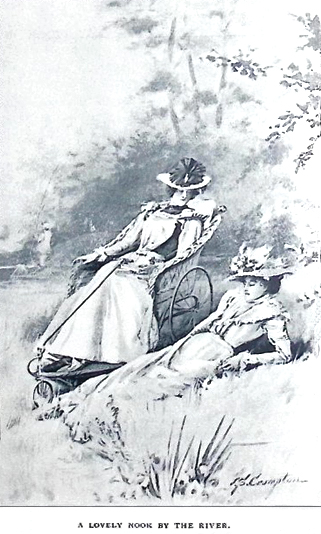
A LOVELY NOOK BY THE RIVER.
BROUGHT INTO LIGHT
"Another called, another brought, dear Master, to Thy feet!
Oh, where are words to tell the joy so wonderful and sweet!
* * *
* * *
Another heart will own Thee, Lord, and worship Thee as King,
And grateful love and glowing praise and willing service bring."
F. R. HAVERGAL.
AS days went on, Heather spent a good deal of her time at the farm, and before long had become fast friends with Miss Vaughan.
One afternoon, they were out-of-doors together in a lovely nook by the river. Dick, the red-haired boy, was farther down the river, trying to catch fish for his mistress's supper.
"I think," said Heather, laughing, "if I had been a man, I should have fallen in love with you at first sight, and by this time, I should have proposed to you. Would you have had me, I wonder?"
"I am certain I should not," was the amused reply. "Disparity of age would have been the chief obstacle."
"Oh, you are not so very very much older than I am."
Miss Vaughan rested her hand affectionately on Heather's shoulder, as she reclined on the grass at her side.
"I am years older in experience, dear."
"I feel I have had experience," said Heather, thoughtfully. "Society life in London makes one grow old very quickly. I learnt more in one year about the world, and—and people generally, than I would have done if I had lived on here for twenty years."
"And did the knowledge do you good?"
"Perhaps not; and yet how I did enjoy it! Miss Vaughan, don't think better of me than I deserve. I did not leave society because I was sick of it. I would go back to it to-morrow with joy, if I could with a clear conscience. If some one left me a fortune, I would. I am fretting and chafing my heart out here in this narrow groove."
"You conceal it very well."
Heather laughed.
"I try to, of course. I should despise myself if I went crawling about and whining to everybody about my hard fate. And I am fond of our poor people. There are compensations. Still one is dreadfully cramped and stifled in such a life."
"What must mine be, then?"
"Oh, you are different."
"My dear child, I had ten years of what you call 'society life.' I suppose I enjoyed it after my own fashion, but comparing it with my present one, I shiver at the narrowness, the paucity, the emptiness of it all! If you want width—breadth—depth—you will never have it in all that. It cramps and chokes the soul as nothing else does! I can breathe now, parts of me live that were lying dead or dormant, and isn't it a grand thing to be able to defy all circumstances to mar or disturb your happiness and peace! There! I must not talk so much of myself and my feelings! It is a way invalids have!"
Heather looked at the glowing eyes of her friend and sighed.
"I often wonder if my religion was real at all," she said. "I think Bluebell and I grew up in a Christian atmosphere, took everything for granted, and just went through a routine of it. Yet I cannot remember the time when I did not realize that God loved me, was watching over me, and that I belonged to Him."
"And when did you first lose the reality of it all?"
"I suppose in London. There seemed so little time for thinking about such things. We seemed in such a whirl. And I think, when we found the things we had been brought up to consider as wicked were what every nice person seemed to be doing, it shook our faith in what we had been taught. Abigail would tell you that we have 'fallen from grace.' I hardly know where I am now. I try not to think of it."
Miss Vaughan looked at Heather with much interest.
"We have had a very different experience. Now, I was brought up to be a success in society. I never had a serious thought till after my accident. Perhaps that is the reason why my happiness is so great now. I always had an uneasy feeling at the bottom of my heart that I was not ready to meet death. To look forward now, and to be able to say with calm assurance, 'I know whom I have believed, and am persuaded that He is able to keep that which I have committed unto Him against that day,' why, it does indeed bring one a peace that is not of this world!"
Heather sighed again, and said after a few minutes' silence—
"I have no love for God; I feel quite indifferent."
"No love for your Saviour?"
"I am afraid not much."
"Do you want to have love for Him?"
"I—I—don't know. Yes, I think I do, but I have—to put it frankly—a fear if I were to become a very earnest Christian, I should think it right to give up all enjoyments of any kind, and I don't want to do that."
"You feel you haven't had your fill yet of this world's pleasures?"
"Yes; Abigail's religion is such a hard and narrow one."
"Now, my dear Heather, don't take your religion from Abigail. She has naturally, I expect, an austere, severe nature. I find that since I have given myself to God as His servant, I have tenfold more pleasure in life. Grasp the fact that God loves you, and wants you to be happy. That He gives us this lovely country, the flowers, the birds, everything that sings His praises; that He is caring for us, shaping every circumstance for our good, and teaching and preparing us a little every day, for our glorious future by-and-by! If you can once believe this, will you be able to go about in gloom and depression? And add to this the wonderful fact of our redemption and the intense love of our Saviour for us, what ingrates we are, not to be bursting with praise all our lives long!"
"Oh, I wish I could feel as you do," said Heather, wistfully. "I think if I were really happy, I could be quite content not to go back to London again, but to live my life here. But I am restless and dissatisfied, and I find doing my duty every day is very irksome and disagreeable. Tell me how I can learn to love God as you do?"
Miss Vaughan was silent for a few minutes, her usually bright face softened into solemn reverence. Then she said quickly—
"Do you like me, Heather?"
"You know I do. I have never met any one before that I wanted so much to be my friend."
"When you first heard I was coming to lodge here, you didn't care about me?"
"I did not know you."
"I think, dear, that answer explains your lack of love for your Saviour; you do not know Him. Now, how did you get to know me?"
"I came over to see you, we had talks together, and every time I was with you, I liked you better."
"Exactly. Now, the oftener you talk to Christ, the oftener you read His Word, His Life, His Sayings, the better you will get to know Him, the more you will love Him. And the first step towards loving Him comes when we gaze at Him on the cross."
"Go on," said Heather, breathlessly; "tell me more!"
"Have you ever stood gazing up at the cross like Christian, with his burden on his back? Have you ever realized your sins nailed Him there? Have you heard His cry of agony when your sins were laid on Him, 'My God, My God, why hast Thou forsaken Me?' And then, have you heard the cry of triumph, 'It is finished'? And have you cast yourself at His feet, in humble gratitude for the pardon He obtained for you then?"
Miss Vaughan sank her voice to an impressive whisper.
Heather shaded her eyes with her hand, and looked across the rippling water in front of her to the blue sky beyond. Her heart was stirred; light was creeping in, as it had never done before. She was intensely still, and Miss Vaughan did not break the silence that fell on them both. She had the consciousness of a soul groping after its Redeemer, and would not by word or look thrust herself in between.
And then, after a long time, Heather turned round, and with misty eyes silently kissed her friend.
"I am going home," she said very quietly. "I shall hope to see you to-morrow."
Miss Vaughan let her go without a word, and sat in her chair silently praying for her, till Dick came up excitedly with a fair-sized trout, and claimed his mistress's interest and attention for the time.
Miss Vaughan was not surprised the next afternoon, when Heather met her with a happy face.
They talked long together of the subject uppermost in their minds.
"I never saw it so before," said Heather, softly. "I don't think I ever realized that I had part in the Crucifixion. I have been thinking of it so much. Of course, all my life I have believed that Christ died for the sins of the whole world, but it never came home to me personally. I grew up trying to be good, but I never definitely took Him for my Saviour. Miss Vaughan, you have brought me into close touch with God at last. How can I thank you! I think I hardly deserve to have come into the light so suddenly. I wasn't properly seeking. I was only wanting it in a half-hearted way."
"The Shepherd goes out to seek His sheep before they are conscious of seeking Him," responded Miss Vaughan. "You will find it make a great difference in your life, Heather."
"Indeed I shall. I seem almost overwhelmed with God's goodness. I feel I shall never be unhappy again."
It was not long before Abigail was aware of the change in her young mistress. She found her one evening with her Bible on her knees, marking some verses. Heather's first natural instinct was to close her Bible at once upon Abigail's approach. Though perfectly frank and open with Miss Vaughan, she could not conquer the reserve that had sprung up between herself and Abigail, but she thought better of it, and did not move her position.
"I'm glad to see you reading that blessed Book," was Abigail's comment.
Heather looked up gravely.
"Yes," she said, "I hope I shall never neglect it again."
"Are you back in the fold, Miss Heather?"
"I think I am, perhaps safer than I ever was before."
Abigail turned round and abruptly left the room, to Heather's great surprise.
She would have been still more surprised if she had seen that good woman hasten downstairs and with radiant smile and streaming eyes fling open the kitchen door.
"Rachael, give thanks with me. The Lord has answered my prayers. Miss Heather is restored to His favour!"
And Abigail's solemn, rugged face seemed a good ten years younger for the next few days.
Heather's friendship with Miss Vaughan, or "Ena," as she had learnt to call her, deepened day by day. Those days were intensely happy ones to her. She had been very lonely since she had left London. She could not even yet become reconciled to her separation from Bluebell, but her heart was satisfied as it had never been before, and the Christian life, instead of a monotonous round of duty, seemed to be one flooded with sunshine.
She said something of this sort to Ena one afternoon.
"Yes, I know," was the quick response. "It is good to bask in the sunshine of God's great love; but, Heather, do not think there will never be any clouds in your life again."
"Have you experienced any? You do not look as if you have."
Ena laughed a little, then she said earnestly—"My experience has been this. I, like you, felt at first my heart and life flooded with sunshine, and wondered if it were possible that anything on earth could trouble me again. Very soon clouds came. Physical weakness and depression with me. I lost heart, and then was led to realize that the sun was shining still, and always would shine, behind the cloud. So I waited, believing the cloud would pass. It did. I have had many ups and downs; and I think the lesson one gradually learns is that one will never find sunshine in one's self—only in our Master. He is always the same. Our feelings may rise and fall, but we can rest on His faithfulness and unchangeableness, and this brings the settled brightness and peace into our souls. I wonder if I have explained myself clearly? I am not a very experienced Christian, you know, but I seem to have learnt this."
"It must have been dreadful when the doctor told you that you would never walk again," said Heather, slowly, after a pause. "I don't think I could be as bright us you are, if I knew I was doomed to be a perpetual invalid."
"Yes, you could," replied Ena, smiling. "It was a black cloud at first, but I don't feel it now. Religion is not real if it does not help you to rise above your circumstances."
Then Heather changed the subject.
"I have been wanting to ask you, Ena, if you will take pity on my loneliness, and leave your lodgings for a week or two. It would be so delightful for me if you were my visitor. I could give you a bedroom on the ground floor, and Dick could come too. You don't know what miserable evenings I have. Of course, I have been happier lately, but I never shall get accustomed to living alone, it is dreadful! I generally spend my evenings in writing to Bluebell, and I cry over my letters, and go to bed in the depths of woe. It is very foolish of me, but I have never been away from her before. She is a bit of my life gone."
"I do not think you should be alone. You are too young."
"That is what Cousin Ida says. She says I want a chaperon. Oh, Ena, will you come and act as one? I should love to have you."
"And what about my brother?"
"I keep forgetting you have one. Isn't he always abroad?"
"No, indeed. He has been in Scotland for the last month, but I heard from him this morning, and he is coming down in a few days' time to see what my quarters are like, and how soon I shall return home."
Heather's face fell.
"He doesn't want you as much as I do. Do you always live together?"
"Always. I don't know what I should do without him. He has been so good, so patient with me since my accident. I should like you to know him, Heather. He is one of those people who say little but do much. His whole life has been one long sacrifice for others. I never talk about him much, for I cannot bear brothers and sisters singing each other's praises in public. But it is only since I have been lying on a sick bed that I seem to have had glimpses of what he has given up and missed for our sakes."
"I don't think that is the way of most men," said Heather, slowly.
"No. I will tell you a little of our family life, if you like. We were very well off as long as my father lived. When he died, my mother and I had hardly enough to live upon. Bertram was in the 9th Lancers. He was just made captain, and was going abroad. I must tell you my father had left him and my eldest brother Frank a very comfortable allowance, and this was rather a sore point with my mother. The fact was, the investment that my father hoped would bring in a good bit to my mother failed almost directly after his death. It was not his fault.
"Frank married at once, and went out to Australia. Bertram wrote to him to suggest that they should both make my mother a small allowance, and so enable her to have the same comforts she had always been accustomed to. He wrote back saying that as he was a married man, this was impossible. Then Bertram, after much thought, left his regiment, and exchanged into the Line. He felt this very keenly, but he did it without saying a word to us, for he could not afford to give my mother so much if he stayed on in the Cavalry.
"I was just leaving school then, and I am afraid, wishing to please me, and give me a good time, my mother moved to London, and we soon were in the midst of a lot of gaiety, and consequently spent a good deal of money. Bertram came to our rescue more than once, but the more he gave us, the easier it seemed to us to spend, and we had no idea how rigidly he was denying himself. I heard through a girl then that he had been very nearly engaged to the colonel's daughter in the 9th Lancers, but when he left the regiment, he lost her as well. I remember wondering why he had done it. Of course, I did not understand then what I do now.
"My mother died rather suddenly, when we were staying abroad, and then I wrote to Bertram asking him what I had better do. He came out and brought me back, and then told me that he could not bear the idea of barrack life for me, so he had resolved to leave the Service. If I would be content with a country life, and an occasional visit to town, he would take the offer he had had of an old priory that belonged to a cousin of ours, and farm his own land. It would give him occupation, and we could live very comfortably together. I was delighted at the idea, and we have lived there ever since. He gave me every comfort, and till I met with this accident, I used to hunt four days in every week in the season, and enjoyed myself immensely. But I see now how all my life I have been taking from him and giving nothing in return.
"Of course, I tell you this in the greatest confidence. I think we are very happy together. But he has still anxieties about money matters. My brother Frank seems in continual trouble. He helps him a great deal. Now, don't you see, dear, that I cannot leave him? Doesn't this make you understand how strongly I feel that my home is with him?"
"I suppose so," said Heather, with a sigh. "Still, you could come to me for a short visit, could you not?"
"Perhaps I could do that. I will talk it over when he comes."
A FISHERMAN
"He was a man of honour, of noble and generous nature."
LONGFELLOW.
HEATHER had been visiting in the village. She had just come out of Mary Scrivens's cottage, where she had been reading to her; for the poor old woman was confined to her bed with a bad cold. She was making her way across to the village post-office to get some stamps, when she was stopped by old Ralph, who was talking very eagerly to a stranger.
"Here be our young leddy, sir. She can tell you if she don't agree with me, for she's bin to Court herself, and knows the ways of royalty!"
Heather looked up amused, and met the glance of a tall man in fisherman's garb, his basket slung over his shoulder, and rod in his hand.
"What is it, Ralph?" asked Heather, lightly. "You are not going to draw me into a political discussion, are you?"
The stranger raised his hat, and Heather acknowledged it with a dignified little bow. She knew how little these old villagers stood on ceremony with any one. Strangers were few and far between; they saw no reason why "their young leddy" should not "pass the time of day" with a stranger, as well as with any of them. Ralph began at once—
"Me and this gent has been discussin' the clack and fightin' that is just goin' on in the French assembly. I sez it is all for want of a king to keep 'em in order. He sez a president be just as good, but I sticks to what I sez! The countries go to the dogs where there ain't no kings or queens! 'Tis natural, like. Every one for their selves, and all wantin' to climb over each other's heads! He sez Americky is a grand country. I sez it allays has the biggest calamities that ever befalls a nation! The earthquakes, and floods, and fires, all gives it a turn, as if God Almighty shows His disapproval. And, in course, He made the first king—He didn't make a president or a parliament. I b'lieve, now I come to think on't, He tried judges, but they turned out a bad sort, and 'tis kings and queens the Almighty ordains to reign."
"We are very loyal in this part of the country," said Heather, looking at the fisherman with a smile.
"So I perceive. I wonder if you can give me the information I was trying to obtain from our good friend here, before we touched on politics. I want to know if there is a cart track to Willow Pool, which, I am told, is the best spot for trout. They say there is no road, but would it be possible for a wheelchair to get there?"
A light came into Heather's eyes.
"I think you must be Captain Vaughan?" she said. And on receiving an assent, she added, "There is only one locked gate at the end of the large meadow, and I can get you the key of that, for it belongs to us. I hope Miss Vaughan may be able to go with you. Ralph, where is Ted Hind?"
Ralph folded up his paper leisurely, and put it in his pocket.
"Maybe he's gone to market. Maybe he's in the Dragon's Arms."
"Will you step across and ask his wife to give you the key of the water meadow gate? And then bring it to this gentleman."
"Maybe she's out in the fields."
Heather looked at the unwilling old man rather sternly.
"Ralph, you do nothing all day but read your paper, and gossip to everybody you see. Don't be disagreeable, but do what I ask you."
"Ay, Miss Heather, 'tis all very well, but you've interrupted an important discussion, and my old legs don't work so easy as my tongue!"
"It is a mercy they don't," said Heather, severely.
Captain Vaughan looked on with a twinkle in his eye. He was a good-looking man, with rather rugged features, his moustache and hair Just tinged with grey, and a humorous, kindly look in his blue eyes.
"I am much obliged to you," he said, turning to Heather, who was just moving away; "I will go myself to get the key. My sister, as you know, has not many opportunities of getting about, and it will be a great pleasure to her, if she can accompany me."
"I am sure it will," said Heather, warmly, "and I am so glad she has you to look after her. Please give her my love."
They parted, and Heather went into the post-office. Mrs. Carpenter, who kept it, was a busy, talkative little woman. She had been a widow for twenty years, and was supposed to have saved a good bit of money.
"Well, Miss Heather, and what may you think of the captin? I have seed you a-makin' acquaintance with one another. Have he come a long while to stay? 'Tis a new thing—visitors a-comin' to this part o' the world. But so long as they pays their way, they be welcome. Do you know anythin' of their fam'ly? They seem the gentry, judgin' from the quantity of letters that do come and go!"
"I don't think we need be alarmed, Mrs. Carpenter. They are most respectable, I believe. Now, I want half a crown's worth of stamps, please, for I am in a hurry."
"You're a good customer, Miss Heather. Time you was away, I was dreadful slack! But it seems to me you write more letters to Miss Bluebell than she do to you! When be she comin' back? That Norway that be on her letters be close to the North Pole, Ralph were tellin' me. She must be dreadful cold. Is it all Polar bears and ice?"
Heather could not get away from the old woman very quickly. But when she did, she found herself walking home with her thoughts full of Ena and her brother.
"He is not a bit as I thought he would be. I pictured a grave, sad man. Life does not seem to have gone hardly with him. He does not look like a self-sacrificing hero at all. I know Ena thinks him very good. He does not show it in his appearance. But, then, neither does she. And I much prefer people who are perfectly natural, and don't look as if they were always mourning for their sins. Poor Abigail does not recommend her Christianity, and yet I dare say if she were not a Christian, she would be ten times more severe. How I envy Ena going across to Willow Pool! I wish they had asked me. I shall miss my afternoon talks with her, but she won't want me while her brother is here."
A sigh followed, and Heather felt more than usually lonely for the rest of that day.
Captain Vaughan obtained the key, and hastened back to his sister.
"Now then, Dick!" he shouted. "Bring the chair round. We must be off at once."
Dick grinned in pleased anticipation of an outing, as he tenderly assisted his mistress into her chair. He was a little bit of a character in his small way. Like an old woman for thoughtfulness and patient devotion, he attended on Ena as well as any trained nurse could have done. His manner to outsiders was at all times a trifle supercilious. "My family, my lady, my sitivation," were quoted constantly, and no one's opinion's or wishes were consulted in the least before his mistress's.
He had not been two days at the farm before he marched into Annie's kitchen—
"Here, missis," he said, his small nose well in the air, "we can't stand this state o' things. Them filthy pigs are a-gruntin' and a-walkin' past my lady's window, and are distractin' her h'observation from the view. They must be got rid of, missis, at once. Pigs is meant to be kept out o' sight, and certingly not to be marched past a lady's window all the mornin'!"
Obliging Annie felt a great awe of this small boy, and promised that the pigs should be kept away. But when it came to the fowls being tabooed the orchard, she went to Ena in perturbation of mind, which was at once set at rest by that lady. Dick was called in, and admonished. But whenever he could get a chance of administering a snub to the farmer's wife, he quickly made use of it.
"I think I have seen your young friend, Ena," said Captain Vaughan, as he leisurely walked by her chair across the green meadows smoking his pipe.
"Have you? Where?"
"In the village. It was she who told me of the locked gate, and got me this key."
"And what did you think of her?"
"She seemed a nice little girl."
His tone was indifferent.
"She is a dear child," said Ena, warmly. "It is not many girls who would give up a society life in town, and come and live alone in the country because the poor people needed her care."
"A healthier life for her," said her brother. "I should not think there need be much self-denial in it!"
"Ah, but you don't know her circumstances. She has a twin sister from whom she has never been separated before. It was a terrible wrench. The sister would not come with her."
"I suppose it was a question of principle?"
"Yes—or, rather, of duty. She was spending too much money, she told me, and if she had not come home, their charities here would have had to be stopped. It was very noble of her, I think, for she had no better motive to assist her, and was enjoying her life immensely. She wants me to stay with her a short time before I leave. What do you think?"
"Just as you like. I expected you to return with me, but if you're happy and well here, it would be a pity to leave."
Ena looked at him a little wistfully, then she said with her bright laugh—
"I wish you would say sometimes that you miss me, Bertram. A woman loves to feel herself of importance. And though I am such a useless appendage to your household, I am company, am I not?"
"That you are," he said quietly.
There was silence for a few minutes. Then he said, with a humorous gleam in his eye that his sister so loved to see—
"You do not make such quick friendships as a rule. What is the fascination about this young person?"
"I can't tell you. I took an interest in her from the very first, before I saw her. My landlady was full of 'the young ladies,' and 'Miss Heather's wonderful business head.' She superintends all the business of the farm, and the farmer looks upon her decisions with the greatest respect. It is such a lonely life for a young girl. And she is so brave and natural about it. I like to see her little regal ways with the villagers; she comes to me like a sweet fresh sunbeam, and if you really get into deep conversation with her, you would be astonished at her powers of thought. Then, too, lately, well, I think I have helped her by my own experience these past two years. She was dazed and bewildered between the fashionable religion of London society and the austere and puritan belief of her two old servants, who are Quakers by persuasion."
"And how long do you propose to stay with her?"
"I thought perhaps a fortnight. This air seems to give me fresh life, after London."
"But the Priory is not London."
"No; and I am longing to be home again, and settle down quietly for the winter."
"Well, extend your stay to the fortnight. Then I have to go up to town, so it will suit me just as well to go now."
Heather was pleased the next day to receive a little note of invitation to tea at the farm. She went, and found that Captain Vaughan's being there did not diminish her enjoyment of her friend's society, though she had a feeling that he was only kindly tolerant of her presence.
"The natives of this part are a constant entertainment," Captain Vaughan said presently. "The old postman told me this morning that he had lived for fifty years in one house, and considered that the bulk of his neighbours had very little good in them at all, but that outside Thornlea Vale they were absolutely and entirely evil."
"That is Watty," said Heather, smiling. "He has had a sad life. He was brought up by a drunken stepmother, and was engaged to be married for ten years to a girl who jilted him in the end."
"Could not wait any longer?"
"Yes, and I hardly wonder; Watty will never hurry himself. However, he is married now to a very nice woman. He is a pessimist, and glories in it. He does not approve of your coming here at all, and told Mrs. Carpenter at the post-office that all diseases and crimes were introduced into country villages by wayside lodgers."
Ena's rippling laugh rang out.
"Dick came back from the post-office purple in the face yesterday. He said he had been 'giving information to ignorant folks as to the ways and h'ideas of their betters.' Can't you fancy him holding forth, Bertram?"
"I back him to hold his own anywhere, young scamp!"
"Of course, I know the narrowness and bigotry of our village strikes every outsider," said Heather, thoughtfully. "But, after life in town, it is very refreshing to return to. We are like one big family here. Our interests, our doings and sayings, are all important to every one. I am always sure of sympathy if my usual letter from Bluebell does not come, from at least three or four of the villagers. In London, it struck me when first I went there, how far divided the classes were. How uninterested everybody was. I think if I were to be doomed to a lonely life, I would live it in the country and not in the town."
"It is bad training," said Captain Vaughan, with a comical shake of his head. "We need to find our own level, and not be exalted into little popes, whose every word is of importance. Of all dogmatic, obstinate, narrow-minded beings on the face of the earth, give me a country squire!"
"No, no," cried Heather, "I will not have you abuse us country-folk. I found the men in town infinitely more self-satisfied and egotistical than any I had seen near home. Of course," she added truthfully, "I have not seen very many in this part, but everybody in town gets to look and talk as if it is too much trouble to breathe, and they are great martyrs because they have to do it."
"The best specimens of manhood do not frequent London drawing-rooms," said Captain Vaughan, dryly.
"Now, I will not have either of you begin running down our neighbours," said Ena, briskly. "We will change the conversation. Let us remember we are in the country, and choose a fresh and breezy topic."
Heather returned home that evening with a flush on her cheek and light in her eye. Ena had consented to come and pay her a visit.
BLUEBELL'S RETURN
"He is happiest, be he king or peasant, who finds peace in his
home."—GOETHE.
CAPTAIN VAUGHAN only stayed with his sister for a week. Heather was a little afraid of him. He was apt to be quietly sarcastic, and his eyes seemed to note everything—not a thing escaped his keen observation. Yet his sharpest speeches were always given with a kindly look in his eyes, and he had a fund of keen humour which made him a most entertaining companion. When he left, Ena, true to her promise, came to stay with Heather.
Abigail was rather doubtful of these newcomers, but Heather ruled the old servants now with fearless firmness, and after a few days, Abigail's stern heart was quite won by Ena's sweet good nature.
As the two old servants heard the merry talk and laughter proceeding from the drawing-room in the evening, Abigail, instead of shaking her head, would grimly smile—
"Ay, 'tis not the unholy mirth that Mrs. Carter brought with her. That was the crackling of thorns under the pot. Miss Vaughan is a Christian woman, and 'tis she I find that has helped Miss Heather so. One likes to hear voices about. I've felt sorry for the poor child. And as to Miss Bluebell, I fear she's entirely lost to us and to all that's right. She seems sucked into the giddy stream of worldly gaiety!"
The fortnight soon slipped away.
And one afternoon, Heather returned to her home after bidding farewell to her friend. She felt doubly lonely now, and needed all her spirit to keep her from being depressed. But she was daily learning lessons from a Master who was becoming very near and dear to her, and though not always able to see bright sunshine, was able to draw all the comfort and strength she needed for her daily life from above.
"It is a test now of how much I lean upon the Lord," she would say to herself. And the old servants never missed her bright smile and tones.
Quietly and steadily, Heather was seeking to influence the villagers she visited for good. It was no unusual thing for her to read a few verses from her little Bible that she carried about with her, or have a few words of prayer with those who were sick or in trouble. And she found that, in seeking to help and comfort others, she obtained help and comfort herself.
It was late autumn now; the days were drawing in, and the weather became damp and cold. Storms of wind and rain swept round the house, the leaves from the old elms lay on the ground sodden with the wet, and the canaries, instead of brightening the house with their song, crouched on their perches with ruffled feathers and disconsolate gaze.
Heather tried hard to keep cheerful. She had learnt the secret of being always busy when she felt particularly lonely. But one wet afternoon, she laid down a book she had been reading, and abandoned herself to her thoughts. She seemed to see again that wet afternoon when she came in from her walk and found Bluebell reading "Ivanhoe" by the dining-room fire. How long ago it seemed! How differently she viewed life now, since that first burst of longing to see the world and widen her circle! Wrapped in her thoughts, she did not hear a fly drive up to the door, nor steps and voices in the hall. But in a moment, the door opened, and Bluebell flung herself into her arms.
"I have come back, Heather! I can't live without you! I'm tired of them all, and have come home!"
The sisters embraced each other, divided between tears and laughter. And it was some time before Bluebell could calm herself sufficiently to tell her story.
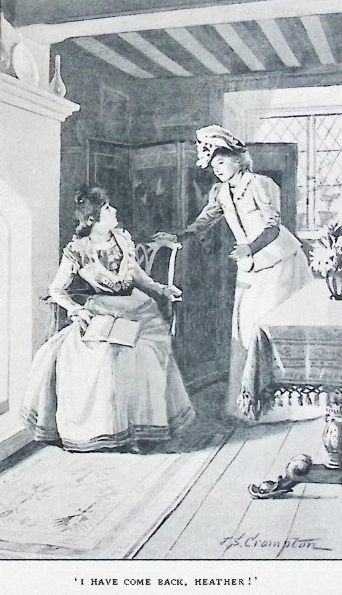
"I HAVE COME BACK, HEATHER!"
After a cup of tea, which Abigail brought in with a dazed, bewildered face, Bluebell began at once—
"Oh, how good it is to be with you again! I've longed to say things in my letters, and then I felt I couldn't. I am afraid Cousin Ida is awfully vexed with me. Her last words were,—
"'You have both thoroughly disappointed me!'
"The fact is, Heather, I can't stand Sir Herbert! I used to fancy I was in love with him, but I never was quite sure. And our yachting trip settled it. By the time we had had a month of it, I was perfectly sick of him! Bored to death with his prosiness! He is as dull as ditchwater, and it would be dreadful to live with a husband who could never see or make a joke! Now, wouldn't it? I've simply run away from him. I sent him a note last night to say how sorry I was, but that I was sure we should never suit each other. You know I've been with Cousin Ida for a fortnight. Well, he has come round to the house every single day after me. I couldn't really stand it. Cousin Hal said he would be a good antidote to me. I told him it takes a fool to be always content with his own jokes. Oh, may I never see another serious man as long as I live! I am tired to death with his dulness and gravity. And so I thought the best thing I could do was to come straight home to you. I will stay in seclusion till all unpleasantness is over, and people will have found something else to talk about. Do you think me heartless, Heather? I am sorry for him. I think I have treated him shamefully, but isn't it better to stop now than go on pretending I care for him till it is too late to draw back? Oh, do comfort me, for I'm perfectly miserable!"
Here Bluebell broke down and burst into floods of tears, and Heather was too glad and thankful to have her back again to scold her. She petted and caressed and sympathized with her. And by the time dinner came round, Bluebell had quite recovered her flow of high spirits, and was making Heather laugh at her naïve accounts of the yachting trip.
She tripped down to dinner in a pale-blue silk dress, looking as fresh as a rose, and when she caught Abigail's disapproving eye in the hall, she danced up to her.
"Well, Abigail, aren't you glad to see me back again? Have you no welcome for me? For shame! Heather is the only one who is really delighted to see me."
"What have you come back for, Miss Bluebell?" asked Abigail, severely.
"Why did Heather come back? Is that how you greeted her? What a dismal time she must have had! Now, Abigail, you must be nice. I'm going to alarm you with my goodness. I have seen the error of my ways. That is why I have come back, of course! Can't you give me a tiny smile? Don't you like the idea of having both of us in your power for a little while?"
"You have grown out of my power, Miss Bluebell, and you know it! More's the pity! I would fain see you in a more modest dress, and with a more sober demeanour!"
"What is the matter with my dress? Heather is in a white one. Oh, you don't like to see so much of my neck, do you? Well, don't look, then. And as to a sober demeanour, I wasn't born with one, Abigail, and you know I wasn't!"
She left her, and joined Heather in the dining-room with a radiant face.
"It is good to be at home again," she said; "and how you've improved the house, Heather! But there is a great deal more to be done. We must get some fresh carpets and chintz for the drawing-room, and have several of the rooms re-papered. I shall enjoy doing it. It will give me something to do."
"But, Bluebell, we have no money to spare for that kind of thing. I have hardly got things straight yet."
"Don't remind me of money. I shall have to borrow from you to pay my dressmaker's last bill. She is bothering me continually about it. Why can't every one have enough and to spare, I wonder!"
Heather looked at her sister gravely. She saw she was talking recklessly to conceal her true feelings, and was sorry that Abigail, who was in the room, should hear her talk so. But Bluebell did not care. She chatted on, as if she had not a care or thought beyond herself and her own concerns, and Abigail left them at their dessert with a sore and anxious heart.
"She has come back as frivolous and empty-headed as Mrs. Carter," she confided to Rachael. "Ay, 'tis sad to be her! I could sit down and weep. She'll be for trying to entice Miss Heather up to London soon again, that is what I fear. And she talks of her debts as gaily as if it was the usual thing to buy things and have no money to pay for them!"
The twins had much to talk over, but it was not until they were upstairs in their bedroom over their fire that Bluebell began to soften.
She looked at Heather's Bible dreamily.
"Have you really become good, Heather? I couldn't quite understand from your letters?"
"No," said Heather, smiling, "I am afraid I haven't. I should like to. I will tell you about it some other time. You look tired and sleepy. I have found that real religion makes you very happy. That is all I will say to-night."
"Do you remember Abigail's text?" said Bluebell, gazing into the fire thoughtfully. "'She that liveth in pleasure is dead while she liveth'? It has come true, in my case. I have lived in pleasure, and my soul is perfectly dead!"
"Oh, Bluebell, don't say such shocking things!"
"But it is true. I never read my Bible. Prayer is just an empty form to me. I have really no religion except going to church on Sunday. I went out for a walk with Cousin Cyril yesterday. He has been away, and came in for the first time. He asked me how my religion was getting on? He always asks that question, periodically, if you remember. I told him, it had left me entirely. He was silent for a whole minute! Then, what do you think he said?
"'I've been with a fellow lately who has the real article, and I'm more than half inclined to try for it myself!'"
"That does not sound like Cyril," said Heather, softly.
Bluebell looked at her quickly. Then she left her chair, and seating herself on the floor beside her sister, she leant her head against her knees. After a pause, she said quietly—
"Heather, tell me, has there ever been anything between Cyril and you?"
"Between Cyril and me!" Heather repeated in astonishment. "Why, of course not. I have always liked him, but I always bracket Cousin Hal and him together. He is like a brother, that is all. Why do you ask? I am sure neither he nor I ever did anything to set people talking!"
"Oh no; I never heard any one mention your names," said Bluebell, yawning slightly. "I only used to wonder, sometimes, if that was the reason you never seemed to fancy any one else!"
"Do you know," said Heather, and a faint flush came to her cheeks and a proud intonation into her voice, "that this is why I am thankful to be at home again? There is no question of marriage or of love. I got so tired of it. I feel I can breathe freely again. I don't think it is a nice atmosphere to spend one's life in. I never saw a single man that I would think twice about, and I always hated the chaff and talk about such things."
Bluebell sighed. "I have made a mess of my affair," she said, "but I was forced into it, and forced on. I think it was rather a shame." Then, almost under her breath, she added, "Why is it, that it is always the wrong man?"
Heather heard, but answered nothing. She only pondered as she lay in bed that night: Who, then, was the right man?
The sisters had much to talk over for the next few days. Bluebell was here, there, and everywhere, apparently as gay and light-hearted as ever. She bore the villagers' outspoken remarks with laughing equanimity. Watty told her that she "had aged considerable," Ralph that he "didn't expec' to see her without her bridegroom," Mrs. Carpenter that "folks were sayin' that Missis Abigail was shakin' her head over Miss Bluebell's carryin' on, and now she was to home agen, she meant to keep her there!"
Yet Heather was keenly conscious that Bluebell's apparent levity was only on the surface. She told her soon about her own experience, and finished up by saying wistfully—
"I wish you could see it as I do, Bluebell, or as we are meant to see it."
Bluebell shook her pretty head.
"No, no; I'm afraid I shall never feel religious again. I love the world too much. I could never settle down here as you have done. I can't think how you can stand it!"
"Don't I look happy? I am. I think happier than I have ever been in my life before!"
"Oh yes, you're radiant. 'Brilliant' is what you were called in town. Cousin Ida is rather disgusted with you quitting a fashionable life so soon. And, by-the-by, she knows of a poor lady that she wants us to have here as a chaperon. I told her I didn't intend to bury myself here very long, but she is uneasy about you. She says this Mrs.—now what is her name?—Fish—Fisher, that's it—Mrs. Fisher would be glad of a home, and wouldn't require any salary, so you need not refuse her on that score. What do you think about it? We might have people to stay if she were here."
"We have not the means to entertain at present, Bluebell. It is out of the question. Does Cousin Ida think I am settled here for good and all?"
"She is afraid so."
"I did not intend to be here altogether, when I first came back," said Heather, slowly, "but I think now that I shall be."
"Well, then, you must have Mrs. Fisher. I will write and tell Cousin Ida to send her down."
"Oh, Bluebell! And we shall never be alone together again. It will be dreadful having a third person always with us. I cannot understand your wishing it."
"I think it will be expedient; I want to have a little gaiety even here this winter. We can do nothing till she comes."
Impetuous Bluebell had her way, and before another fortnight had elapsed, Mrs. Fisher arrived, and was soon a settled inmate of their home. She was a quiet, unpretentious little widow. "An ideal chaperon" she was called by girls whom she had taken about. She was the wife of a naval officer who had lately died, and had seen a good bit of life in her young days.
She adapted herself to her vocation with easy complacency, and even Abigail found nothing to say against her.
The twins did not find her in the way. They walked, and talked, and planned out their days together in the old style. But Heather felt that there was a chasm between them that could not be bridged over, and her heart ached over her bright young sister when she saw how uninterested she was in spiritual things. She did not say much, but she prayed night and morning for her, and dimly began to understand a little of the stern Abigail's sentiments about a society life for her nurslings.
Bluebell seemed entirely swallowed up in it. She was restless and discontented at the narrow sphere in which she found herself. She did not care to visit in the village; her talk, her aspirations, her hopes, were all in the gay world which she had left. Yet at times, she would sit looking at Heather with a sweet gravity that was out of keeping with her reckless chatter. And one evening, by their bedroom fire, she startled Heather by saying—
"I think, when I am thirty, if I am not married, I will try to be good."
Heather smiled at the childish sentence, then she said earnestly—
"Bluebell, do you remember telling me before we went to London that you wanted your religion to be real, but that you had never had it tested?"
"Yes; it didn't stand the test, Heather, it failed me."
"It wasn't the right sort. Oh, Bluebell, how I wish you knew the Lord as your personal Friend! It makes such a difference. We went through our religion like machines; I don't think either of us had ever come into close touch with God. We had never accepted Christ's death for us, and come to Him as guilty sinners for forgiveness, and received the pardon He obtained for us."
"You are getting out of my depth. I don't understand that kind of thing. It is mere words to me."
"But you must think seriously sometimes. You say you will wait till you are thirty. You may not live so long."
Bluebell shivered.
"Don't put me in the blues. I should like to feel as you do, but I can't. I tell you again, I think my soul is dead."
"That is an awful thing to say. Do you realize what it means? Death of the soul means separation from God for ever. Can you look forward to an eternity spent without Him?"
"Now you're talking like Abigail. Well, I won't say it is dead. It is asleep for the present, and I would rather leave it so; it is more comfortable. Don't look shocked at me. I am getting very sleepy, so shall turn into bed."
This was how all such discussions ended. But Heather did not lose heart, and she believed her prayers would be answered before long.
"THE RIGHT MAN"
"Maid choosing man, remember this:
You take his nature with his name;
Ask, too, what his religion is,
For you will soon be of the same."
COVENTRY PATMORE.
IT was a bright frosty morning in December. Heather and Bluebell had just returned from a walk, and were standing over the study fire chatting to Mrs. Fisher, who, with her inevitable knitting, was seated in her easy chair.
Bluebell was just giving a laughable account of the village shop being thrown into the utmost confusion by her request for a reel of red silk, when the door opened, and Abigail said in tones of severity—
"A gentleman has called, and is in the drawing-room. Here is his card."
Heather took it, and she exclaimed in tones of delight, "It is Cyril! Ask him to come in here, Abigail; it is so much more cosy."
Abigail's face was a study, but she withdrew in silence.
And a moment after, Cyril was ushered in.
"Aren't you surprised to see me?" he said, after the first greetings had been exchanged. "The fact is, I remembered your station, and as I have to go twenty miles beyond it on business, I thought I would have a break, and come and see how you were getting on. Why, Minnehaha, you look perfectly blooming, and not a bit conscience-stricken for your—ahem—shall I say discreet retreat!"
"The past is past, if you please," said Bluebell, trying to copy Heather's dignified air, but failing to impress her audience. "We only live in the present. That was what I was taught in good society."
Cyril looked at her quizzically, then turned to Heather.
"Well, Regina, don't you think it was time for her to return to you? How have you been occupying your time in this secluded spot? I must tell you, I have walked from the station. It's a good three miles, I suppose, but I wanted to stretch my legs. And on the way, I overtook your country postman. We began to compare notes upon our boots, and agreed that leather and humanity were sadly deteriorating. When he heard whither I was bound, he became most interested, asked me some searching questions, and took stock of me from head to foot. Then he began to give me his views upon 'our young leddies.' I can tell you, I've heard more about your ways and doings from his lips than I should ever have learnt from your own!"
"Watty doesn't think much of us," said Heather, laughing. "In fact, he has a very poor idea of the world in general."
"So I gathered; but he holds one person in great esteem!"
"Himself? Yes, one soon discovers that."
Cyril stayed to lunch, and it was a cheery, pleasant meal, in spite of Abigail's increased severity of face and tone as she moved in and out.
Afterwards, the girls took him round the garden, which, in spite of its wintry appearance, charmed the critical visitor.
"It has an old-world atmosphere, and so has your house. I understand you both better, now I have seen the home in which you have been brought up."
"I always thought our home had none of the picturesque beauty of most old-fashioned places," said Bluebell, slowly. "But now I have been away from it, in spite of much that is hideous, I like it better than I did."
"You think you could be reconciled to a country life?" said Cyril, with a quick glance at her.
"No," said Bluebell, laughing and tossing her head; "I can't vegetate. It wants great minds or little minds to live contented in the country, and I have just a medium commonplace one, which must be taken out of itself, and amused and interested by external circumstances. There! I am talking like an old wiseacre! Come down to our farm. It will be a nice walk before tea."
"I must write letters," said Heather, hesitatingly; "I'm afraid I shall not have time to do both."
"We shall be back for a cup of tea," said Bluebell.
And she walked off with Cyril, talking and laughing with him in the freest and most careless way.
For a minute, Heather stood at the garden gate and watched them. Then she resolutely hastened to the house, and tackled some business letters with a divided mind.
Mrs. Fisher had retired to her room for her usual afternoon nap. An hour passed, and Heather rose from her writing-table, her business done. She took a seat by the study window, which overlooked the meadows. Something in Bluebell's manner, since Cyril had arrived, gave her uneasiness. Was it only from seeing an old friend again that gave her eyes such brightness, and brought such soft flushes to her checks? She remembered how Cyril and she had always chaffed and laughed with one another; how more than usually reckless and audacious Bluebell had always been in his company; and she laughed at herself for imagining anything different now.
Presently, from the window she saw two figures crossing the meadows, and she watched them as they came nearer.
There was a little droop and softness in the poise of Bluebell's figure that again awoke misgiving in Heather's heart. She saw her stop and pick something from a hedge, she saw Cyril spring eagerly to her assistance, two heads very close together, and a pause in the gathering. Then she turned away, ashamed of overlooking them, and wondering if this was for her sister's good.
Half an hour later, and she heard voices in the hall. Still, she did not go to meet them. And when the door opened and Bluebell came in search of her, she did not move from her seat.
Was this the right man, after all?
A moment later, and she was told. With arms clinging round her neck, her soft cheeks pressed against hers, Bluebell told her story. And it was enough to look at her softened, radiant face to know that she was happy.
"He came on purpose, Heather. I never thought he cared, and he never thought I did. And when Sir Herbert was pestering me, he kept back. And if I had married him, I should never have known what I had missed! Aren't men stupid! I used to think you were fond of him, and so I wouldn't let myself think of him. But it is all right now, and oh, isn't it delicious to have a right to let your feelings go, instead of bottling them all up, and thinking them wicked!"
Bluebell rattled this off incoherently, then subsided into tears.
"I want to be good, Heather. He has been talking quite differently from what he did. He says he never really scoffed at real religion, only at shams, and he has been with some friend who has made him see things quite differently. I told him I was a butterfly, but he seems to think I shall steady down. Do you think I shall? Oh! Here is Abigail—what a nuisance! Tea is in, I suppose."
Bluebell dashed away to her room, and Heather went into the drawing-room, feeling almost bewildered at this sudden confirmation of her fears.
She found Cyril alone, standing on the hearthrug, his back to the fire.
He looked at her with a queer smile. "Well, Regina?"
"I can't congratulate either of you yet," said Heather, trying to speak calmly. "It has been such a surprise to me that I cannot get accustomed to the thought of it. It never entered my head till I saw you together to-day."
"Are you averse to me as a brother-in-law?"
There was a silence, then Heather spoke with kindling eyes—
"I would rather have you as a brother-in-law—than—than many others in town. But, Cyril, frankly I tell you, I see things differently now from what I did. And I long for Bluebell to have some one to help her on the upward path. Not to drag her down to a dead level of stagnation, and—and mere pleasure-seeking!"
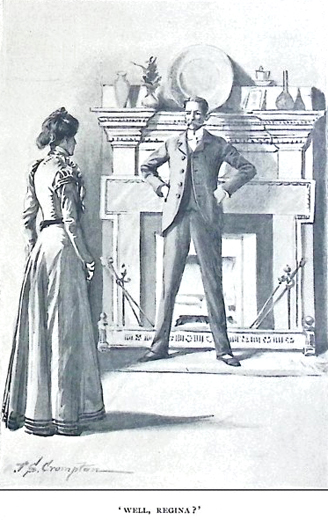
"WELL, REGINA?"
"Is that my life?"
"It was ours in London."
Cyril looked at her with his keen eyes, in silence, for a minute.
"The old influences have been at work with you, then, and have prejudiced you against society life?"
"No; I think it is quite a new influence that has crept into my life," said Heather, smiling—"an influence that has brought me real happiness at last."
There was another pause, then Cyril said—
"You know that I never consider myself a society man, as you term it. I have too much to do when in town, and Minnehaha is quite willing to spend most of the year in the country. We shall not be butterflies of fashion."
Heather was silent, then he said in a lighter tone, "Your venture back here has been a success, then? You do not regret it? Won't you be pining for more life soon?"
"I have got as much as I can hold here," said Heather, turning upon him such a radiant look of happiness that Cyril wondered, and said no more.
He had to leave very soon, but promised to come down again before long. His last words to Heather were—
"I will try and be to Minnehaha what you desire. I, too, like yourself, have had a new influence creeping into my life. It has made a great difference to me."
Bluebell insisted upon Heather accompanying her to the station to see Cyril off. As the two girls were walking back, they met Watty, who was generally to be found loitering along the high-road. His wife was a good laundress, and was always well supplied with work, so he did not see any necessity for doing anything besides his letter-carrying.
"Ah," he said, with a knowing look, as the girls stopped to speak to him, "and which is it of you he be after?"
"Which do you think?" asked Bluebell, with twinkling eyes.
Watty rubbed his left ear reflectively.
"I said to him, as we be a-joggin' along this mornin',—
"'And what be your business in these parts? 'Tis to be hoped ye're an honest man if ye be after the young leddies, for them Londoners are mostly thieves and vagabonds, and the gentry a wild lot, I've heerd tell!'
"And he were bound to agree, for he wished me to think well of 'un. I sez to him,—
"'If 'tis Miss Bluebell ye've come after, ye can have 'en, and welcome, I sez, but she'll lead a sober man a dance, and want tight reins and a strong hand wi' 'er. But if 'tis Miss Heather,' I sez, 'well, there be several parties in this 'ere village that will have a word to say on that p'int. And ye won't earn their goodwill by carryin' of her off; not but what she be rather a haughty-headed young wiman with a will o' her own, and needs a deal o' managin', but her heart and purse goes well together, and she have a care for the poor and destitoot.'"
"And what did he say?" asked Bluebell, quite unabashed by the old man's speech.
"Well, he appeared to be a-considerin', and I gave 'un a bit more profitable talk, for which he thanked me, and us went our ways. I sez,—
"'I wish you well, sir, but b'lieve me, a maid is a risky treasure, and 'tis them that is single that is blest!'"
"You ought to be ashamed of yourself, Watty," said Heather, severely, "with such a good wife at home, to speak so! Where would you be without her?"
Watty chuckled dryly.
"Ah, well. Her does her best. And I will allow she might be worse, but I have 'er well in hand. Which be it, young leddies, which be it?"
"You had the honour, Watty," said Bluebell, drawing herself up with great assumption of dignity, "to speak to my affianced husband this morning. Miss Heather is still going to remain amongst you to manage you all. I don't wish her joy of it; good afternoon."
They passed rapidly on, and Watty gazed after them for a moment in silence.
"Well, my reckonin' were not far out! So there 'll be weddin'-bells soon, and a good hearty supper after, if Miss Heather does her part well. I must just step into the office and tell Mrs. Carpenter. She allays thinks she's first hand for news, but this 'll take the feather out o' her cap, I reckon!"
Abigail received the news in grim silence.
Bluebell was content to have her silent, and she did not ask her for congratulations.
But when Heather happened to go into the kitchen late in the evening, Abigail came forward.
"Is this match to your likin', Miss Heather?" she asked sternly.
"My opinion has not been asked, Abigail," Heather answered gently. "Bluebell must please herself. She will not stand dictation from me. Mr. Carter is an upright, honourable gentleman; we have known him intimately for a long time, and he will make a good husband."
"And is this all you can say? Have you no thought for their immortal souls? Is he a servant of the Lord, Miss Heather? One that my late departed mistress would have approved of? Will he be for following righteousness, or the wicked ways of the world? Is Miss Bluebell to be allowed to yoke herself to an unbeliever, I ask you?"
Heather looked a little troubled.
"I know all you feel, Abigail, and wish I could reassure you. You must remember, Bluebell does not see things in the light that we do. But from what I know of Mr. Carter, I feel sure he will lead her right, and not wrong. This is in confidence to you. Some time ago, Mrs. Carter wrote to me saying that Mr. Carter was in Scotland with a friend who was very religious. I am sure he must have influenced him, for Mr. Carter seems graver, and talks differently about serious things now. In fact, he told me as much when I spoke to him, and I am hoping very much that he will lead Bluebell to think differently too. We must pray for them both."
She left the kitchen, and Abigail said no more. Just before going to bed, Heather put her arm round her twin sister affectionately.
"And are you perfectly happy now, Bluebell?"
"Perfectly!" said Bluebell, with emphasis. "Oh," she added impetuously, "I can't tell what a nightmare Sir Herbert was to me! The feeling that he could not and would not see a joke, the heavy stolid conversation he tried to make, and the awful oppression I always felt in his company! Now, with Cyril, it is all sunshine; I always felt I could go to the wilds of Africa and be happy with him. You need have no fears about us, Heather. We shall be a well-matched couple, without being a too sentimental one!"
"And what do you intend your married life to be?"
"To be? I don't quite understand you. We shall be up in town a good part of the year, so I shall see plenty of society, and the rest of the year, we shall be in the country, and I shall have nice people staying with us. And if I feel very good, I shall visit our tenants and look after their welfare."
"It sounds delightful," said Heather, earnestly. "But, Bluebell dear, you can never be really happy living only for your own pleasure and amusement. Don't start a married life without God. You will only drift farther away. I don't say much to you, but I do long that you should know what real religion is!"
"I don't want Abigail's religion!" said Bluebell, flippantly.
"No one wants you to have her religion. Your nature is quite a different one from hers. I don't want you to have any one's religion but Christ's."
Bluebell sighed.
"Well, I will some day," she said, "when I get tired of life. But I want to enjoy it at present."
"You will never, never enjoy it until you are a true Christian," said Heather, with kindling eyes. "I couldn't have believed the difference it makes in one's heart. Do I seem unhappy, Bluebell?"
"No, I can't say you do; I've never seen you so bright. But don't worry me any more. I told you my soul was asleep, and I want it to stay asleep for a little. I hate feeling uncomfortable. I mean to be really good later on, but not just now."
She changed the subject as she always did, and Heather only prayed the more.
THE OLD PRIORY
"The thread of our life would be dark, Heaven knows,
If it were not with friendship and love intertwined."
MOORE.
SPRING again. We find Heather still in her country home. But Bluebell has married, and is travelling abroad with her husband. The wedding was a quiet one. Mrs. Carter wished it to be in town, but both girls decided that it must be in their old home. And so Captain and Mrs. Carter, and a few friends, came to be present at it, and Mrs. Carter enjoyed a battle of words again with the inexorable Abigail.
"Miss Heather must marry next, and if she is not quick about it, I shall carry her off to London again. She is not going to be an old maid, if I can help it!"
"She is going to be what the Lord means her to be, mem," retorted Abigail. "He is her Keeper, and not those that tempted her astray from His paths for a time! Miss Heather has thoughts above marryin' and givin' in marriage!"
"Her time hasn't come yet. Wait till the right man turns up, and then away she will go like all the rest of us! She is very much admired in town, Abigail. A certain major in my husband's battalion has not forgotten her yet. I think I shall give him a hint to follow Mr. Carter's example, and come and see how the land lies now. She would make a good soldier's wife!"
"A soldier, mem! A paid murderer, we would consider him! And Miss Heather has not been nurtured and brought up by a member of the Society of Friends, to fling herself away on one with the lowest calling in our nation!"
The wedding over, Heather settled down to her quiet life, having Mrs. Fisher to enliven her solitude, and her poor people to interest her. She steadfastly refused Mrs. Carter's invitation to pay her a visit, and, though missing her sister daily, preserved a bright and sunshiny spirit.
One morning, she received a letter from Ena Vaughan, in which she asked her to come and stay with her for a short time.
She sat with this letter in her hand for some time considering, and then consulted Mrs. Fisher.
The thought of seeing her friend again filled her with delight. It was a visit that would not only give her intense pleasure, but would, she felt sure, be beneficial to her in many ways. And when Mrs. Fisher and Abigail both said that a change would do her good, Heather wrote off, and joyfully accepted the invitation.
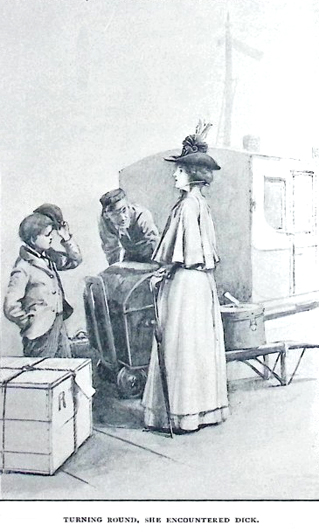
TURNING ROUND, SHE ENCOUNTERED DICK.
It was a lovely spring evening when she reached the small country station that was her destination. She alighted on the platform, and looked about her. There were very few passengers by the same train, and the old porter seemed half asleep. She was trying to make him understand where she wanted to go, when turning round, she encountered Dick, who had arrived rather warm and breathless after a sharp run.
"If you please, miss, the missus said as I were to take charge of your luggage and see it packed in the trap. Mr. Spike, he can't leave the horse, and I were kept waiting on a message or I should have been here before, and the master, he is away on business or he would have come to meet you himself. The trap is this way, if you please, miss."
Dick was struggling with his dignity and breathlessness, but Heather smiled, and understood. She followed him out, and found the trap waiting for her. In a few minutes, she was being driven swiftly through sweet-smelling lanes, eventually stopping at an old stone gateway with a rustic lodge at one side. Then up a rhododendron drive, where the flowers were in masses of bloom. They eventually drew up before an ivy-clad turreted stone house with old-fashioned casement windows, and a weather-beaten porch, over which was sculptured in stone the Latin device, "Sic vos non vobis."
Heather looked around her with a keen sense of pleasure and refreshment in everything she saw. Just inside the door, waiting in her wheelchair to receive her, was Ena. Great bowls of golden daffodils stood on the old oak sideboards in the square wainscoted hall. The stairs with their crimson carpets wound round and upwards, past a richly stained window, and all inside the house seemed to give an atmosphere of warmth and comfort, which contrasted delightfully with the dark oak panelling and dusky corners that abounded in the old Priory.
The first greetings over, Dick gently wheeled his mistress into the drawing-room, and Heather followed her. It was a quaint low room, panelled in oak; old china and beautiful paintings adorned the walls, thick oriental rugs covered the polished floor; books, music, spring flowers in abundance, and a dozen other nameless trifles, showed that it was a room for use and comfort, and not for show.
A bright wood fire was burning in the grate; the evening sun shone in, and played upon the silver tea-service and flowers that were on the afternoon tea-table drawn up to Ena's couch. Dick assisted his mistress there, then noiselessly left the room, and Heather sank into an easy chair feeling that her lines had fallen in pleasant places.
"It is delicious to be here," she said. "I feel rather tired of being mistress, and managing every one."
"You are looking tired and pale," said Ena, affectionately. "I have felt so sorry for you since your sister's marriage."
"Yes," Heather said, with a little sigh, "it is a dreadful experience to go through, for I feel that she will never be quite the same again. But I was prepared for it when she was away from me before. That was the worst wrench, I think, for it was our first parting."
"Now I am going to give you some tea, and then you would like to go to your room. I hope you will be comfortable, but I can trust my maid to see after you. It is one of my trials that I cannot look to my visitors' comfort, but I never go upstairs at all. I have my bedroom on the ground floor. What do you think of our home?"
"I think it is sweet," said Heather, enthusiastically. "It must be very old, isn't it?"
"Very old. The monks lived here in the time of Henry VIII., but were turned out by the king, who gave it to one of his court favourites—a certain baron, Sir Bertram Havish. The Havishes were ancestors of my mothers, and the Priory has belonged to them ever since. A cousin of ours lived here up to the time we came into it. He handed it over to my brother because he wanted to go off to the Colonies. I think I told you about it. Of course the best part of the Priory is in ruins; this is quite a small bit of it, but it is the only part of it that has always been lived in, and it is quite large enough for us. Did you notice the doorway as you came in?"
"Yes, I did, and the carved motto above. What is the exact meaning of it? Something about labour or work, isn't it?"
"'Thus you do not labour for yourselves.' Rather nice, isn't it? A gentle reminder to all who live here that selfishness and indolence will not be tolerated. I like to put with it that verse, 'that they which live should not henceforth live unto themselves, but unto Him which died for them.'"
Heather's eyes shone.
"Yes," she said; "it isn't only living and labouring for other people, but for Him!"
Ena nodded smilingly.
They drank their tea and chatted together, and then Heather was taken upstairs to her room. It was as quaint as the rest of the house, with its deep recesses and low window-seat, overlooking a range of wooded hills and a winding river. All the rooms were panelled in oak, but light chintz curtains and hangings relieved the bedrooms of any gloom. A small wood fire was burning in her grate, and bowls of daffodils and primroses stood on her dressing-table.
Heather felt as she sat down on her cushioned window-seat, and surveyed the scene within and without, that her room would be a pleasant resort for rest and enjoyment.
Later on, she came down to the drawing-room in her dinner-dress, and found Ena and her brother together.
Captain Vaughan apologized, as he shook hands with her, for not meeting her at the station.
"My sister and I have so few guests now that I feel we ought to welcome warmly any who do come to us. But I was obliged to attend a committee meeting at the very hour your train arrived."
"I did not mind at all," Heather responded. "We have been so used to manage for ourselves lately that I feel quite independent. At home, no one ever meets us. You see, we have no trap, so we always take a fly and drive straight back with no difficulty."
"Bertram thinks that no woman ought to be able to do anything for herself," said Ena, laughing. "He can't understand the up-to-date girls, who are so well accustomed to take care of themselves."
Heather laughed as she turned frankly to Captain Vaughan.
"It is pleasant to be taken care of," she said, "but if you have no father or brothers, it naturally makes you independent."
"Oh yes," he said, with a little smile; "and the independence is very pleasant, is it not?"
"Perhaps it is. I know Bluebell and I gloried in it a year ago, but I fancy after a time, one tires of it."
There was unconscious wistfulness in her eyes. Ena said quickly—
"You have left all leadership and responsibility behind you now, and have sunk into a commonplace country visitor. I am going to treat you as such, and I am sure you are longing for some dinner. There is the gong, so let us go in. Do congratulate me upon my improvement. I can join you at dinner in my wheelchair. I have only managed this for the last month, so am still proud of my achievement."
Dinner was a pleasant meal. Heather thoroughly enjoyed the cheerful, cultivated society of her friends. Captain Vaughan had a good deal of quiet humour, but he was also a well-read and well-informed man with literary tastes. And both he and his sister took a keen interest in the current literature of the day.
"I feel very ignorant when I hear you and your brother talk," Heather said to Ena as they sat in the drawing-room afterwards, leaving Captain Vaughan to his smoke. "But you don't know how I like hearing you! We are so shut up at home to our housekeeping, and the wants of the village, that I sometimes forget the great world outside us."
"I don't know what I should do without outside interests," said Ena, thoughtfully. "It takes one out of one's self so, and I dread falling into an invalid's self-centred life. Bertram is such a help in that way. I always think men are like a fresh breeze through a house, especially those who are out-of-doors a good deal, and are in the way of meeting other men. Bertram is a keen sportsman, though he looks upon sport only as a recreation. And then he very often goes up to town, and I hear the latest news in that way."
"I should like to have had a brother," said Heather, as she gazed into the fire, making a pretty picture as she sat in an old oak chair, her slender little figure, in its white dress, thrown into full relief by the dark wood background.
Ena looked at her and smiled.
"Perhaps you will be given a husband instead," she said playfully.
Heather shook her head, and changed the subject.
Captain Vaughan soon came in, and Ena asked him what engagements he had for the next day?
"I want you to show Heather the church, and the dripping well. I cannot manage it because of the steps."
"I shall be busy all the morning," he said, "but after luncheon, I can take Miss Fotheringay anywhere. We can do the church and well and go on to St. Margaret's. I think those are all the antiquities to be seen. Are you fond of ruins, Miss Fotheringay?"
"Yes, if they're picturesque," said Heather, smiling. "It reminds me of old Ralph at home, who met a wandering artist one day. He asked if there were any ruins to be seen, and Ralph led him off with alacrity to a half-burnt pigstye of Farmer White's.
"'There,' he said, ''tis a newer ruin than those old ruins at Rome my paper tells me of, for 'twas only burnt last Toosday week, so you've come to the right man for showin' the right sort!'"
"One never quite understands whether it is simplicity or shrewdness in many of these rustics," said Captain Vaughan. "I always feel they're having a quiet laugh at my expense when I talk with them. Well, St. Margaret's is worth seeing. It used to be an old convent, and the good people in those days knew how to pitch their retreats in the most exquisite parts of our country."
"I suppose it solaced them for what they had forsaken," said Heather. "And after all, there is nothing like Nature to soothe and calm, and help meditation."
"For the tired and weary spirits," put in Ena, "but hardly for the young restless ones. There must have been many who, like caged birds, beat their wings against their prison walls, and pined away in the narrow sphere in which they found themselves. Their energies must have been cramped, their lives dwarfed, and their tempers soured by the constant restrictions and supervision over them."
"Yet I fancy it was easier in those days to act, when contrasts were so strongly defined," said Heather, thoughtfully. "If one wanted to be good, there was always the convent. You weren't supposed to be half in the world and half out of it; it was one thing or the other."
"Not taken out of the world, but kept from the evil. In the world, but not of it."
Ena spoke softly, and Heather looked up with a smile.
"I think the world has always approved of Christians taking themselves right out of the way so as not to be objectionable and give offence," said Captain Vaughan, strolling to the window and looking out on the dusky garden. "It always has been fashionable to enter convents and sisterhoods, but not fashionable to be introducing one's religious opinions to society in general."
"No," said Heather, "and I suppose if a Christian bottles up his religion, he becomes like a stagnant pool. He must be a worker of some sort. So there is nothing for it but to separate himself at once."
"But he need not hide himself away in a monastery," said Ena, brightly. "Do you think so, Bertram?"
Captain Vaughan turned round from the window with a smile.
"I consider if ever we are in doubt about the kind of life we should lead, whether we should mix with our fellows in society to show them that Christians are not narrow and bigoted, and are able to take part in all their pleasures, we have our guidance in Nehemiah, and a very good reason given for our withdrawal from much of it."
"What do you mean?" asked Heather, with interest.
"I suppose each one of us is helping to build the walls of the church. If we are, this is Nehemiah's excuse:
"'I am doing a great work, so that I cannot come down. Why should the
work cease whilst I leave it, and come down to you?'"
"I like that," exclaimed Heather, with a flash of gladness in her eye. "But of course it can only apply to busy Christians."
"Ought we not all to be busy about our Father's business?"
There was a little silence, broken by Dick's appearance with a message.
But Heather had enough for plenty of thought that evening, and she lay her head on her pillow a little later with a happy, restful heart.
A CALAMITY
"Little minds are tamed and subdued by misfortune; but great minds rise
above it."—WASHINGTON IRVING.
THE days slipped by very quickly to Heather. She enjoyed the walks with Captain Vaughan, the talks with Ena, and the wonderful beauty of her picturesque surroundings.
She lost a little of her imperious manner; she was no longer the mistress of house and farm, "the young leddy" of the village. There was no one to keep in order, no business matters to be taken in hand, and the relaxation of her life brought out all the light-hearted gaiety of her nature, and made her gain in girlish grace what she lost in dignity.
Ena watched her flitting about with a happy ringing laugh, and listened to her bright humorous speeches with delight.
"I am making you younger," she said to her, laughingly, one morning, as they sat in the sunshine under the old stone porch.
"I believe you are," Heather replied, with twinkling eyes. "I feel very old at home, especially when I am trying to manage Abigail. And since Bluebell has married, I have been lonely. It isn't good to live alone, now, is it? What would you feel like if you had no brother in and out?"
Ena shook her head.
"I fail to imagine. And yet, of course, he may marry, and I may have to seek a home elsewhere."
"Then you could come and live with me. That would be delightful."
Ena laughed.
Heather went on more seriously. "It is a great comfort to feel that one's future is already planned by God, and out of our own hands. I like to think of it. I wish I had realized it before; it would have saved me from a good deal of fret. I don't think I should have tried to change our lives so. I often think now that it has not been good for Bluebell. She seems to love nothing better than a whirl of excitement. I hope she will be different now that she is married, but I don't know."
A little sigh followed her words.
"I wish I knew your sister. I have never seen her."
"Yes, I should like you to know her. She always has taken life brightly, much more so than I. I used to be much more discontented with our quiet life than she was. I incited her to want a change, and it seems strange that it should be I who have been brought back to the quiet life again, and she who is away from it."
"But I think you must be the happier of the two."
"I really think I am. But, Ena, I am wondering if I ought to do more definite work for God."
"What do you do? I mean outside your home duties."
"I visit the villagers, and since I have—well, since I have seen the reality of it all, I have tried to speak to them about it. I have started a little working-party amongst the mothers, it is a kind of a mothers' meeting. And then I have Bluebell's Band of Hope, and I have my Sunday class on Sunday. I don't think I do anything else. I go to the Union once a week, that is four miles away. But in a small village, there is not much to be done. I have been wondering, as I have no home-ties, whether I ought not to go into some distinct work, perhaps abroad as a missionary. I feel I should like to give my life right up for God."
"That we can do at home as well as abroad," said Ena, quietly. "I know when first I became a true Christian I thought the same, and grumbled a little because my accident prevented all such ideas. But I have come to see that a Christian's work is close to them, all round them, and that a soul is worth winning, whether it is a fashionable member of society, or a cannibal in heathen lands. If we each did our part in soul-winning from our own home-centre, the world would be a different place.
"Of course, I know the needs of missions are great, and many are right to obey the call and go. For myself, I have been placed here, and my brother and I both try to quietly influence our neighbours. You have not seen many of our friends yet. There are one or two that, judging from appearances and life, would have been the last persons you would imagine had any religious cravings. Yet three of them come to me for real downright earnest talk; and one has quite lately seen with us, that life is not life till one gets linked on to the Living One. I am only telling you this to encourage you. Get to know young girls in your neighbourhood and try to influence them. Ask them to stay with you—oh, there is a great deal of work close to one's hand always, if we would only see it."
"But," said Heather, hesitating a little, "I can speak to the poor people about these things, but not to those in my own class. It would be so difficult."
"Why? Is our Lord's service only for the poor? Are the rich to be excluded from it? Don't their very temptations and difficulties appeal to us from having known them ourselves?"
"I suppose it is cowardice," said Heather. "One knows the poor do not sneer at one or shrug their shoulders at 'such fanaticism' as it is termed. There is no cross to bear when working among the poor. But I am afraid of girls of my own class. And the fact is, there are very few about our neighbourhood. We have never had any girl-friends. I met a good many when staying with Cousin Ida in town, but they would be bored to death if I asked them to stay with me."
"I know a good many here," said Ena, thoughtfully. "I think I must have some of them over to tea, and let you get acquainted with them."
But this plan was not carried into action.
The very next morning, Heather received a letter from her lawyer, Mr. Brody, asking her for an immediate interview.
"It is something disagreeable about our money affairs, I know," said Heather, with a perplexed face.
It was after breakfast. Captain Vaughan had just brought his sister some early tomatoes from the greenhouse, and he stood in the French window of his sister's morning-room.
"Cannot he come and see you here?" asked Ena. "You have only been with us a fortnight, and you promised me a month."
"I am afraid I must go home. Mr. Brody has written me several long letters lately. Some of our dividends have not come in, and grandmother left us nearly all her money in shares that are very shaky now, I am afraid. I cannot quite follow his letters, but I must see him, and I think I would rather see him at home."
"When do you want to go?" asked Captain Vaughan, quietly.
"He wants to see me to-morrow. I ought to leave this afternoon. Would it be possible?"
"Certainly, if you wish it. I will drive you to the station myself. There is a train leaving at three, which will get you home before dark. Will that do?"
"Yes, thank you, very nicely."
Captain Vaughan walked away without another word, and Heather turned to her friend.
"Oh, Ena, I am so sorry. I have been enjoying myself so!"
The tears were in Heather's eyes as she stooped to kiss her friend.
"I sometimes think," she went on, trying to speak bravely, "that I am not meant to have much pleasure in my life; duty is always stepping in and spoiling it. Aren't there some plants that thrive best in the shade and not in the sunshine? I think I must be one of them."
"No, no," said Ena, shaking her head, "my dear child, that is a gloomy theory. This is a great disappointment to both of us, but I hope after your interview, you will come back to us and finish your visit. Don't you think that could be managed?"
"I should like to," said Heather, somewhat wistfully, "but I don't feel as if I shall."
Then, brightening up a little, she added, "It is ungrateful of me to talk so. I shall have enough pleasant memories of this dear old Priory to last me till I come again. And you have promised me a visit later on, so I shall look forward to that. I must go to pack my trunk now. I shall not be long."
And for the rest of the time before she went, Heather was her bright, brave self. She talked cheerily to Captain Vaughan on the way to the station, and asked his advice about one or two things connected with the farm.
Though perfectly at ease with him, she felt a strange shyness sometimes when in his company. He was an extremely reticent and undemonstrative man, and though always courteous and pleasant to her, and occasionally humorous, he never seemed to invite any one's confidence, and had an absent distrait manner that was not flattering to the one with whom he was conversing.
Just before they came to the station, Heather asked him, a little diffidently, "Do you know anything about these shares of ours, Captain Vaughan? Do you think I need be uneasy?"
"Have you most of your income from them?"
"Yes, nearly all of it."
Captain Vaughan was silent, then he said, "I expect your lawyer can give you better information about them than I can. Sometimes the tide turns, and things look up when they've been about as bad as they can be."
"I can see you think badly of them."
"If you want the truth, I do. But do not worry yourself unnecessarily. Wait until you have had a good talk with your lawyer. Are you coming back to us?"
"If—if things are satisfactory," said Heather, with knitted brow.
They were at the station. Captain Vaughan saw to her comforts, and, as she shook hands the last thing, said—
"My best wishes, Miss Fotheringay. And, after all, remember money is not happiness. There are other things left."
"It is an anxiety," said Heather, with a smile.
And as she was borne away by the express, her thoughts went back to the day she had first separated from Bluebell, nearly a twelvemonth ago.
"Then it was want of money took me home. Now it is the same thing. I almost wish I had none to lose!"
A week after, Ena received the following letter from Heather:—
"DEAREST ENA,—I sent you such a hasty line, telling you of my safe
arrival, that I am ashamed I have not written since. Truth to tell, I
have been so worried and uncertain about our affairs, that I felt I
could tell you nothing. I have had several interviews with Mr. Brody,
and now I can tell you definitely that Bluebell and I have lost nearly
the whole of our income. I can hardly realize it, even as I write it.
This house must be sold. I shall have barely forty pounds a year to
live upon, but I must be thankful for that.
"Of course, Bluebell wants me to go and live with her, but I feel I
cannot do it—Abigail and Rachael have been so kind—so has everybody. I
think I feel most for our poor people. How I should love to have you to
talk to about things! At first, I thought I could live on in our farm,
but it is not paying as it ought, and we shall have to sell that too.
I have no light at present upon my future. I lie awake at night and
wonder, and try to believe that it is all right.
"Don't you think this may be God's way of preparing me for some special
work? He has taken my home away from me. I am trying to discover what I
am fit for. My education has not been a modern one. A governess is out
of the question. A companion or mother's help may be more in my line,
but I don't know. Can you give me any advice? Remember, I must earn my
living. I cannot help telling you of an interview I have just had with
Watty.
"'Ay, well, Miss Heather, 'tis a proper breakdown to ye, but us will
hope some un will come along and patch ye up a bit. Some of your fine
Lunnon folks might do somethin' for ye!'
"'Thank you, Watty,' I said, with all the dignity I could assume, 'but
I don't feel at all broken down. I have health and strength, and hands
and feet to work, and I shall soon be earning my living like most of
you.'
"'Well, to be sure!' he ejaculated. 'And what may you be thinkin'
of?' Then, with a burst of generosity, he added, 'Tell you what, Miss
Heather—ye can't be spared from this 'ere village. If ye'll put up
with my wife's tantrums, and like a humble lodgin' wi' us, I'll let
you do turn-about with me of a carryin' them letters, for since this
'ere Lunnon post-master has given the public leave to send such vollims
of their trashy writin's for a penny, my old back just cracks wi' the
weight on 'em! Turn-about wi' the carryin'—turn-about wi' the pay! And
it'll keep you from the Union, Miss Heather, so let us settle it right
away!'
"I think I hurt him by my laughter, but I was very near tears! No more
for now. Cyril is so good. He is coming down to see about the sale of
everything for me, and I am going to lodge at the farm for the present,
for I think Annie and her husband will be allowed to keep it on under
their fresh landlord. Sir Thomas Black is going to buy it. Much love,
and kind regards to Captain Vaughan.
"Your loving—
"HEATHER."
"This is a dull letter, but don't think I am perfectly hopeless. I feel
any troubles that come now will be light compared with what they would
have been a year ago."
"She is a dear child," said Ena to her brother, after she had told him the contents of the letter. "I always think happiness will come to her; she tries to do her duty so bravely. It does seem as if her sister has had all the sunshine and she the shade. She is such a lonely little thing with no relatives to look after her. What would you say, Bertram, to her coming to live with us?"
Captain Vaughan looked at his sister gravely. "I scarcely think she would do it," he said.
"Why not? I should love to have her. She makes me forget my helplessness so. She has such a quick, quiet way of seeing what I want, and doing it before I have time to express the wish."
"You would ask her as a paid companion?"
"Now, Bertram, do you think I would? She is too proud, I fear, for that. I should like her to come back to finish her visit, and then drift on into staying with us altogether. You are so silent. Would you dislike her here?"
Captain Vaughan gave a short laugh that seemed to his sister rather constrained.
"My dear Ena, if you would like her, that is quite enough. I am out so much that her presence really hardly affects me. You can ask her if you like, but I am of the opinion that she will decline the invitation."
Captain Vaughan was right. Ena begged Heather to come to them directly the sale was over, but she wrote saying it was impossible.
"I promise to come to you before I start my independent life," she wrote, "but I must settle my future before paying any visits."
And with this, Ena had to be content.
A month passed, and then Heather wrote again:—
"You will be glad to hear that, through the exertions of Cousin Ida,
I have found a berth. An old lady, a friend of hers, is going abroad
for the winter in September, and wants a companion. I have been up to
London to see her, and she has approved of me. She is a thorough woman
of the world, and a little irascible in temper. Do you think I am right
in accepting this post? I shall not be plunged into society, for she
told me she liked her companions to keep themselves in the background!
"But I cannot help hoping I may be a comfort to her, and perhaps may be
given opportunities of work amongst those in my own class, as you have
so often suggested. Bluebell is a little vexed about it, but I cannot
be dependent upon any one. I do not feel at my age that it is right. I
am going to stay with Bluebell for a month now, and then, if you will
have me, I should like to come to you before going abroad."
"Well," remarked Ena, as she folded up the letter, "I suppose she is right to go, but I cannot bear to think of her in such a position. She is too young, too pretty, and too refined, to be turned into an old woman's slave."
Her brother made no reply. He seemed absorbed in his newspaper.
IN THE OLD GARDEN
"My poverty, but not my will, consents."
SHAKESPEARE.
IT was Heather's last day in her native village. She stood in the deserted garden of her home, and her heart ached at the thought of leaving it all. The sale was over. Straw and paper littered the gravel paths, the shutters were closed, and the house lay in the shadows of the old elms, dark and silent, having finished a long chapter of its life. The family that had moved within its walls for over sixty years had left it for ever, and a new era had already begun.
Heather had been saying good-bye to the villagers, and it was hard work preserving her bright demeanour. Now she felt she could let herself go, and leaning her head down on the old sun-dial, she sobbed as if her heart would break.
The sun shone down, the blackbird in the laurels sang as sweetly as in days gone by, the bees hummed lazily over the roses and peonies, and Nature seemed supremely indifferent to the grief in its vicinity. Heather was not the only one in her sorrow that afternoon.
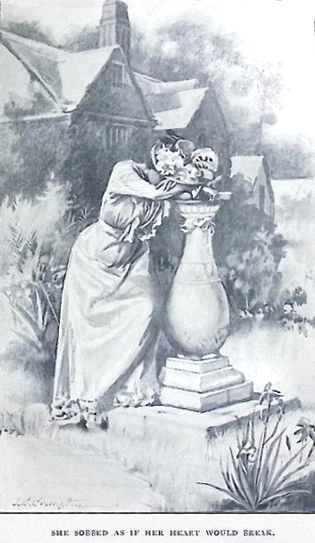
SHE SOBBED AS IF HER HEART WOULD BREAK.
Along the narrow cinder path that led through the kitchen garden walked Abigail. She was picking bits of lavender and sweet herbs with many a sniff, and muttering to herself in an audible undertone—
"The Lord will comfort His own. 'Tis good to be afflicted, and He will care for her. My life is nearly over. I could not have gone on in service much longer. Me and Rachael have saved, and we will make our home together, please God. But my heart aches over that child. 'Twas here she used to run, and Miss Bluebell with her, when they were little trots, and liked to pick the parsley for Rachael. I can see them now, and the mistress watchin' them from the window. Ay well, she would be sorely grieved if she were to see us now, and 'tis to be hoped she does not. But she would be glad to see Miss Heather growin' into a good and sober woman. I daren't think of Miss Bluebell. She has chosen the broad road, and her heart is full of vanity. May the Lord in His mercy bring her to a right mind and show her her sins and wickedness!"
Heather's thoughts were with Bluebell, too. She felt it keenly that her sister had left her to break up their home alone. Cyril had indeed been a help, but he had only stayed a couple of days, and the bulk of the work had fallen on Heather's shoulders. Bluebell had written sympathizingly, but said she would be in town the week of the sale, or she would have tried to go to her.
"I am sure," she wrote, "it can be no grief to you to shut up that
house. It never has had happy associations to me, though of course it
has been our home. My only memories are of always being pounced upon by
Abigail, and lectured, if ever we were trying to enjoy ourselves. You
will be far happier away from it. You must come and live with me, and
perhaps after another season in town, you will meet your fate. I am not
at all anxious about your future, so don't worry about it."
Wise advice, perhaps, but Heather felt her sister understood her less than ever since her marriage. Even Cyril seemed to guess at her feelings better. Just before he left, he said—
"I wish you would come right away with me instead of staying on here. It is not fit work for you."
"I cannot leave it. It is impossible."
"Why have you all the grit, I wonder, and Minnehaha none? She takes life as easily as you do seriously."
"Don't spoil her, Cyril," Heather said rather earnestly. "Bluebell has depths in her that can only be stirred by emergencies or trouble, and I hope she will not have that. She has not a butterfly heart, whatever her manner may lead you to believe. I sometimes wish life had not been made so easy to her."
"'Wayward as the Minnehaha,
With her moods of shade and sunshine,
Eyes that smiled and frowned alternate,
Feet as rapid as the river,
Tresses flowing like the water
And as musical a laughter.'
"I find she bears out that description exactly, and I am very well satisfied with my wife as she is."
"That is only as you ought to be," said Heather, smiling. "But if you want her to show more grit, as you express it, you must let her share some of your responsibility."
"Ah, well, that will come in time." Then with change of tone he added, "I hope things may turn out better than you expect. You are very plucky over it. I suppose you hardly realize your misfortune with so much to do and to see to."
"I don't think I can ever forget it," said Heather, with gravity. Then she added with a smile, "You must remember earthly comforts are not so much to me as they used to be. I have something now that I cannot lose."
"Ah yes, I know. Well, I thought some months ago I had got hold of life differently, but it was a passing emotion, I fancy. We are impressionable creatures sometimes, even we men."
Then Heather looked him straight in the face.
"Will you tell me how you saw life differently, Cyril? Did you come into real touch with God? Did you take Christ to be your Saviour and Master?"
Cyril stroked his moustache consideringly.
"Well, you put it so crudely. I hardly got to those lengths. But I seemed to see we were not meant to live mere animal lives, and ought to bring glory to our Creator."
"And you never got any further?"
"I think I meant to look into the matter, but Minnehaha came into my life, and we—well, we haven't the time, you know, for quiet meditation. Are you going to preach to me, Regina?"
"No, but I pray a good deal that you and Bluebell may be out and out for Christ. You will never bring glory to your Creator till you accept the work of His Son, and own Him as your Saviour, and take Him to be your King. It is dishonouring to God to refuse allegiance to the One He sent into the world to be our King. Forgive my plain speaking, but you do not know how I long that those I care for should experience the peace and happiness in their souls that have been given to me."
She said no more, but Cyril Carter went away more impressed by her words than he would care to allow.
Now, as Heather, with tearful eyes, raised her head from the dial and looked at the empty, deserted house for the last time, her thoughts were still with Bluebell.
"She and I will never be the same again to each other as we have been in this old garden. Our girlhood seems a thing of the past. I feel a woman now in experience, and I dread seeing how changed she is, when I stay with her. Oh, why need changes come so fast? Nothing will ever be the same to me again now I have lost my home!"
She started when Abigail touched her elbow.
"Miss Heather, don't take on so. 'Tis the Lord's doin', and ye'll be givin' Him praise one day for this very trouble."
"Shall I?"
Heather looked up with a tearful smile.
"Don't be hard on me," she added. "I came here to have my cry out alone. I did not know you would be here, Abigail."
"Ah well, I was havin' a look round, and the old times had come up and near overwhelmed me. Miss Heather, my words may have been hard to you at times, but my heart has always held you tight, and it will to my dyin' day!"
A choke in her voice made Heather glance at her astonished, and then in a moment, the faithful old servant had gathered her into her arms like a little child, and was sobbing her heart out over her.
At last, ashamed of her display of feeling, she turned gruffly away. But Heather kissed the worn old cheek very tenderly before she let her go.
"I shall never have another faithful friend like you, Abigail," she said; "it is nice to feel you care so. There are times lately when I have felt that there is no one left to care what becomes of me."
A few days afterwards, and Heather was in Bluebell's country home. The sisters were glad to be together, but the house was so full of guests that they had little opportunity for talk alone. Heather watched her sister dispensing her hospitality and entertaining all her husband's friends with her pretty graciousness, and wondered if she had ever a thought beyond the present. Sometimes she fancied Bluebell eluded close talk with her, and she could only pray, and try not to withhold her testimony if opportunity favoured it.
One evening after dinner, as the ladies were in the drawing-room by themselves, conversation turned upon old Mrs. Macintyre, with whom Heather was going abroad.
"I am told she is an awful old tartar," said Lady Robertson, a vivacious young bride, who seemed to carry with her plenty of society gossip, "and she gambles dreadfully. I knew a girl who lived with her for a time. She gives her companions a handsome allowance, but compels them to play cards with her every evening; she always manages to win, and the poor creatures find their salary making its way back into the old lady's pockets. I am told she meditates going to Monte Carlo this year. I pity the slavey who goes with her."
Bluebell gave a little sign to Heather not to speak, but she ignored it, and said frankly—
"Thank you for your pity, Lady Robertson. I am going with her, I believe."
"Good gracious! You don't say so! But not as her companion?"
"Yes. You know we have lost a good bit of our money."
"It is a freak of hers," said Bluebell, a little crossly. "I want her to stay with me, but she will be independent. I am sure a month of old Mrs. Macintyre will send her back to us."
"Well, if you take my advice, you will get out of that card-playing," said Lady Robertson.
"I don't think there is any fear of her doing that," said Bluebell, laughing; "is there, Heather?"
"No, certainly not. If such a thing had been mentioned to me, I should have declined going with her," said Heather, with decision.
"Why? Do you object to card-playing?"
"Oh, Heather is a good person," said Bluebell, laughing; "of course she does. I think she considers all amusements wrong. I should enjoy seeing her tackle Mrs. Macintyre on the subject."
"Are you good?" asked a girl, Laura Kent by name. "I remember you were not at all prudish in your first season?"
"I hope I am not prudish now," said Heather, with a rising colour. "I don't feel so."
"You don't look it," said Lady Robertson, good naturedly. "I have an aunt who is dreadfully good. She drags religion into every sentence, until she sickens every one with it. Now, I am not against religion myself, but it is not a thing to be talked about."
"I think there are times," said Heather, "when it is desirable to mention it. But it depends upon circumstances. I used to think all mention of religion was out of place, but if it is the most real thing in our lives, why should it be?"
"It's a very shadowy thing to me," said Laura, thoughtfully.
"It wouldn't be, if you got hold of the real thing," said Heather, quietly.
"But what is the real thing? Nothing seems real nowadays. Everything is just a mere hobby, which gets ridden to death, until a fresh one comes along."
"I suppose real Christianity is living our lives in touch with Christ, and having the consciousness of His presence in everything that we do or say."
"No one could live like that, unless you were always in church or retired to a convent," said Lady Robertson, with a slight yawn.
"And how can any one arrive at such a stage, even then?" queried Laura, turning her honest grey eyes upon Heather with interest.
But at this moment, the gentlemen entered, and Bluebell gave a sigh of relief.
"Come along," she said gaily; "we were just forgetting that we were a set of frivolous women whose after dinner talk always consists in picking one another to pieces. We were actually getting into deep theology. Let us have some music."
That short conversation brought Heather into close contact with Laura Kent. She came to her bedroom afterwards, and had a long talk with her. And before Heather left her sister's, one restless, dissatisfied soul had found its way into the true path of peace.
She began to see now that even in society there are many who need a helping hand and word.
WITH FRIENDS AGAIN
"Friendship! Mysterious cement of the soul!
Sweet'ner of life, and solder of society,
I owe thee much."
BLAIR.
AGAIN Heather found herself at the Priory, for a farewell visit before she went abroad. It was autumn, and the roses and dahlias brightened the old house with their rich colouring. As she stood on the lawn by Ena's side the first morning after her arrival, she gave a little sigh of happiness.
"It is good to be here," she said, "and I am going to enjoy my time with you to the full, so that I shall look back with pleasure to this visit when I am abroad this coming winter."
"I wish you were not going," said Ena.
"Please don't make me dissatisfied. I have decided that it is right to go, so we will not talk about it."
"That is Regina's tone," said Ena, laughing, for she had heard of Cyril's nickname, and sometimes used it herself.
Heather laughed with her, then said a little wistfully—
"Don't think me headstrong. I have had to decide things myself, and no one else can judge for me. I think I am being taught more and more that I must stand alone."
"Never alone, Heather."
"No," said Heather, colouring, "not in the sense you mean, and that is my greatest comfort."
She changed the subject, and began asking Ena about her friends. Presently Captain Vaughan came up.
"I am off on a fishing expedition, Miss Fotheringay. Won't you bring Ena out this afternoon, and meet me at the pool below St. Margaret's? I shall work down the river that way."
"I should like to very much, if you feel up to it, Ena."
"Yes, I shall manage very well, and we will take the kettle in the bottom of my chair, and have tea down there. It is an exquisite day."
So it was settled, and soon after lunch they started, Dick in high feather at having the "charge of the h'expedition," as he expressed it.
St. Margaret's was a ruined convent beneath a wooded hillside, and in a most exquisite hollow close to the river, which dashed over grey boulders of rock, arched in by overhanging trees. Ferns of the rarest kind grew in profusion along its banks, and Ena's chair was drawn up into a mossy glade, a little way from the rush of the water. There was no sign of Captain Vaughan when they got there, and Heather flitted about, gathering fir cones and dry sticks to kindle the fire, with girlish delight. Jack helped her with his usual dignity, and amused her with his remarks:
"It h'appears too damp a h'atmosphere to h'ignite as it should," he said, watching her unavailing efforts to create the flame.
But Heather persevered, and soon had the satisfaction of seeing the flames curl and crackle round the kettle.
"Isn't it delicious here?" she said presently, throwing herself down on the grass by Ena's side. "It makes one feel at peace with all mankind."
Ena was busy with her sketching block. She was a clever artist, and was rapidly filling in the nook in front of her.
"Now, Heather dear, go a little farther away, and I will put you in. There—just so! I will not trouble you long."
"You must give it to me as a memento, only I should like your figure in it, not mine."
Just as the sketch was being finished, Captain Vaughan appeared. He had had a successful day, and turned out his fish with some pride before his sister's eyes. Then, lounging on the grass by her side, he looked at her sketch, and Heather, springing up, busied herself about the tea.
"I have told Ena," she said to Captain Vaughan, "that if I am to keep that sketch I would rather she figured in it than I. Her own position and background is quite a picture, and I long to sketch it myself."
"Don't you sketch at all?" asked Captain Vaughan, a little lazily.
"No; I have no talents—except, perhaps, music. But I got disheartened when I was in town over that. Bluebell and I were brought up in the old-fashioned style, and my harp-playing seemed to most very extraordinary, I know."
"I will try my hand at a sketch," said Captain Vaughan, taking block and pencil out of his sister's possession, in his slow deliberate way.
And by the time tea was served round, he had sketched Ena in her chair, with the background of rocks and overhanging green, with such a true and skilful touch that Heather was delighted.
"It is you exactly, isn't it, Ena? It is for me? Oh, thank you. When I am on the Mediterranean with my old lady I shall often look at it."
A little sigh escaped her, but she changed it into a laugh as she went on—
"Bluebell advises me to keep a diary, and call it 'Views of Riviera Life by one in the Background.' She says if I was very racy in my description of people and things, I could get it printed, and Mudie would take it. I am afraid it would be a strong temptation to present my charge in a ludicrous light. Her very appearance is awe-inspiring. She is a conglomeration of colour and scent, and always wears white kid gloves."
"I want you to have some people to dinner this week, Ena," said Captain Vaughan, rather abruptly.
Heather often fancied her friends and interests bored him, and she was always sorry when she became communicative in his presence.
"Who are they?" asked Ena.
"He is a friend I met in Rome some years ago. He is a dabbler in archaeology and antiquities, and he married a Miss Phillips. Her father is the noted sculptor. They are staying with the Gregorys; of course you must ask them too."
"Very well. How would Friday suit you? Or is it too short notice?"
As brother and sister were discussing the subject, Heather wandered off by herself along the river-side. She had a keen love of all that was beautiful in nature, and this quiet, peaceful spot seemed to soothe and quiet her anxious spirit. For though outwardly brave over her future, she had many qualms and fears about it. She could not forget the conversation at her sister's over the eccentric old lady who was to give her a home, and she viewed her gambling propensity with the greatest horror. Would she be able to stand her ground and refuse to participate in the nightly play? Ought she to acquaint the old lady with her principles, and let her know she could not oblige her on this point? Yet, as nothing had been said to her about it when she was engaged, it might after all be merely exaggerated gossip. Weighing the matter to and fro in her mind, Heather walked on.
She crossed the river by a slender plank, and then climbed up into the fir-woods above, thinking she would catch sight of the others below. But she had miscalculated the distance, and when she turned to retrace her steps, the many winding paths in the wood confused her, and she missed her bearings altogether. For some time she struggled to reach the river, but the dense foliage below prevented her from seeing it, and she at last stopped in despair.
"It is ridiculous to think that I am lost," she said, half laughing, half vexed; "they will wonder where I am. I shall not trust to these paths any longer. If I clamber straight down, I must come to the river, and then I shall find my way."
With this resolve, she started her downward path through brambles and undergrowth, and then suddenly, without a warning, the slippery soil below her feet gave way, and down she rolled, over and over, with increased force and swiftness, till unconsciousness came to her aid, and she knew no more. When she at length opened her eyes, she found herself lying against a fallen tree about twenty feet above the river, which dashed along as merrily as ever. Her head felt bruised and aching, and, when she tried to raise herself, she found her left arm doubled under her, and giving her exquisite pain when she moved it. After several struggles, she succeeded in getting to her feet, and then she found she had cut her forehead in her fall.
With one hand she tried to stop the bleeding and bandage it, but she became so faint that she was obliged to reseat herself on the ground and wait for assistance. She tried to call out, but she was still too dazed with her fall to put much energy into her cries.
It was a happy moment when in the distance she heard the sound of footsteps, and the crackling of the dead twigs underfoot told her that some one was approaching. And when she saw the brown fishing-suit of Captain Vaughan through the trees, she called out for help with fresh vigour.
In another moment he was by her side. "I have been scouring the wood for you," he said cheerily. "Have you lost yourself? Ena has gone on. I persuaded her to go, though she was loth to do it; but it was getting late. Not hurt, are you?"
He was leaning over her now.
And weak and unnerved, Heather was struggling against tears. "I've had a tumble," she said with quivering lip, "and I've hurt my arm. I almost think it must be broken."
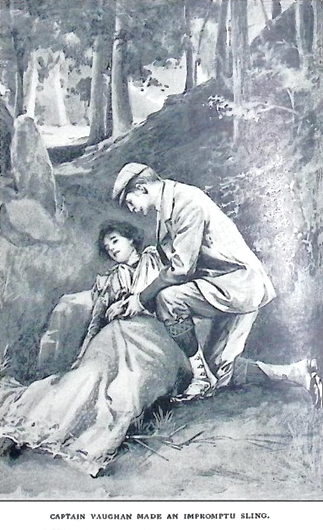
CAPTAIN VAUGHAN MADE AN IMPROMPTU SLING.
"Let me see it. Ah! Don't move. We must put it in a sling till it can be seen to."
Captain Vaughan was not easily nonplussed. He slipped out of his pocket a large silk handkerchief, and in two minutes had made an impromptu sling. Then, as deftly and quietly as a woman, he took her own handkerchief and bound up her forehead.
"Now sit still," he said quietly, "and drink this. And then we will see about getting home."
He produced his flask, and Heather did as she was told, and the colour crept back into her lips and cheeks.
In a short time she was able to walk, though in great pain. Captain Vaughan took good care of her, and though talking cheerily all the time, made her take his arm, and led her as gently as possible along the river bank.
Heather strove to be cheerful, and when they at last reached the Priory, she turned to him with tears in her eyes.
"I can't thank you, Captain Vaughan. You have been so good to me."
"Oh, nonsense," he said, laughing; "it is not much I have been able to do. Come in and lie down. I will send that young scamp Dick for the doctor. Here, Ena, we have a patient on our hands, but I hope it is nothing serious."
It was not serious. She was bruised and shaken by the fall, and had broken a small bone in her arm; but quiet and complete rest for a few days did wonders, and she was almost herself again in ten days' time.
"You are too good to me, Ena," she said to her friend one afternoon, when she insisted upon her resting on the sofa in her morning-room, and brought her some grapes and a book to amuse herself with. "Think how I shall miss all this attention soon."
"The more reason you should have a little of it now," said Ena, playfully. Then she added seriously, "I would give anything to have you here altogether. I have become so dependent on your society, that when you are away I feel inexpressibly lonely."
"But you have your brother."
"He is out a great deal. Oh, I know I ought not to complain, and I am never unhappy, only I think having you about me has made me feel not quite such a hopeless and incurable invalid."
It was seldom Ena touched upon her infirmity. Heather looked wistfully at her.
"If I come back with my old lady next spring, perhaps you would let me come to you for another visit."
"You know how delighted I shall be. Oh, Heather dear, why don't you throw it all up and be my companion instead?"
Heather smiled and shook her head.
"We have argued that out many times. I am afraid I am too proud, for one thing. I must and will be independent of my friends, even of my sister, who is only too anxious I should make my home with her."
"I don't believe we were brought together to be separated so soon," Ena went on, leaning back in her chair and looking out upon the lawn with dreamy eyes.
"We were brought together that you might be the means of bringing me a big blessing," said Heather, stretching out her hand to her friend. "If we drift apart on earth, we shall have eternity together."
"Yes; but I have a strong feeling that we shall not be allowed to drift apart," was the quick response.
"We will hope not. At all events, we can write to each other. I often think how good God has been to me, Ena. Just at the time when I was missing Bluebell so intensely, He sent you into our neighbourhood. It does look as if you were meant to take her place. I don't think I could have borne her being gradually taken away from me if I had not found a friend in you. I feel Bluebell will never be the same to me again now as she was before she married."
"Yes," repeated Ena, smiling, "and I still believe we are meant to live together, and I am waiting God's time for that pleasure to come."
Heather shook her head, and changed the subject.
AN UNEXPECTED OFFER
"Whither my heart has gone, there follows
My hand, and not elsewhere."
LONGFELLOW.
IT was a stormy day. Wind and rain fought for predominance, and lashed the old trees on the lawn in their fury. The casement windows rattled, and the wind howled down the chimneys, making even Ena shiver. It was very near the end of Heather's visit, and she had just received instructions from Mrs. Macintyre as to where and when she was to meet her.
Ena listened and advised, but soon after breakfast got such a violent headache that she was forced to go to her room to lie down.
"Storms always affect me," she said; "if I can manage to get to sleep, I shall be better. Make yourself comfortable over the fire, Heather. I think you will hear the wind less in the drawing-room."
So to the drawing-room Heather went, trying to battle with her depression of spirits. She took out Mrs. Macintyre's letter and re-read it, trying to imagine herself in familiar and friendly relations with that good lady. The postscript did not reassure her.
"Do not bring fancy work of any sort with you. I have found it engrosses the thoughts too much, and your time is mine whilst you are with me. I wish you from the first to understand this."
"It will be slavery," was Heather's thought, as, leaning back in an easy chair, she looked into the glowing coals in front of her, and tried to banish the sounds of the storm without.
She remained there deep in thought until, with a start, she was roused by Captain Vaughan's voice.
"Are you in a brown study?"
Heather laughed a little unsteadily.
Captain Vaughan came and leant against the old oak mantel-piece, looking down upon her, and pulling out the ends of his moustache thoughtfully.
"This kind of day always seems to send you women into the blues. Ena has collapsed, and you—excuse me for the remark—look as if you are going to drown yourself!"
"I have no thoughts in that direction," said Heather, looking up at him with a little laugh. "I think I was dreaming. I am sorry to be leaving Ena. I have enjoyed my visit so much here, and only regret that it is coming to an end."
"Why do you go?"
"I must."
There was silence. Captain Vaughan walked to the window and looked out, then came back to the fire and took up his former position.
"I don't see why you need go," he persisted. "Ena enjoys having you with her, and you do her a world of good."
"I could not stay on with her indefinitely," said Heather, quietly.
"I think you could."
Something in his tone made Heather look up. There was purpose and determination in it, such as she had never heard him use before.
"Would you not like to make this your home?" was his next question.
Heather felt a little puzzled.
"I suppose I might," she said, "if I felt it right to do so. But I see my way lies differently."
"I want you to reconsider your decision. It is not too late. I want you to stay here altogether, and stay here as my wife!"
If a thunderbolt had dropped at Heather's feet, she could not have felt more astonished. She had been accustomed to a great deal of attention and admiration when in London, and the very quietness and polite indifference with which Captain Vaughan had treated her made her regard him entirely as her friend's brother, and in no other light.
She looked at him now in complete bewilderment, and his quiet, steady gaze did not help her.
"Are you joking?" she asked, trying to smile.
"No," he said; "I am in sober earnest."
Heather's head felt in a whirl.
"Is this for your sister's sake?" she asked.
"For my own as well."
And then mustering courage, Heather rose to her feet.
"I am so utterly unprepared for this, Captain Vaughan, that I feel I cannot give you an answer at present. Forgive me, but even now I am wondering if you are in earnest."
"I cannot do more than give you my word as a gentleman that I am."
His tone was a little stiff. He added more gently—
"Don't act in a hurry. Think it over. I believe you would be happy with us. We would try to make you so. I know I am much older than yourself, but you like our home, and are sorry to leave us. Isn't this a way out of your difficulty?"
Then Heather looked up, and as simply as a child placed her hand in his.
"I believe in your kindness of heart," she said. "Let me think it over."
She left the room softly, and after she had gone, Captain Vaughan paced up and down with knitted brows.
Heather fled to her room, locked the door, and with a tumult of feeling threw herself into the easy chair by the window. Her thoughts were these.
"Not a word of love! It was like offering me another situation. What does he mean by it? If I did not know his past history, and how self-sacrificing and unselfish he is, I would not fear so much. It must be pity for me, love for his sister, that is making him act so! Oh, I couldn't, I couldn't! If I am not wanted for my own sake, I will not give myself away. He does not seem to reckon love or liking at all in the question, nor care to know if I like him well enough to link my life to his for good and all. And do I like him? Oh, I don't know. I honour and respect him immensely, but I don't feel I know him. He has depths that he will reveal to no one. He has seemed so calmly indifferent to all I do or say, that I can't believe he means what he says.
"Of course I could be happy, oh, I know I could, if—if he really cared for me. If he was even as tender and gentle as I have sometimes seen him with Ena. Yet he was that the other day when he found me down by the river after my accident. I felt then how good it was to have some one to take care of one. He seemed so strong, so reliable. Oh, what shall I do? It is such a temptation. The right to stay on here in this dear old place, the right to make it my home and be shielded and cared for all my life. He could not make an unkind husband. Need all marriages be love ones? And how happy Ena would be! I know she would be pleased. I could look after her and make her life a brighter one, I am sure I could.
"If only he seemed to care a little. If it is simply his unselfish kindness in taking pity on my homeless condition, if it is done entirely for his sister's sake, how could I place myself in such a humiliating position? Oh, I don't know what to do! I wish I had a mother to talk it over with. I cannot argue it out with Ena. I wonder if she knows. I don't believe she has any idea of it."
Poor Heather soon got on her knees to ask for the guidance and help which she felt she so much needed at this crisis.
It was a great temptation to her. She felt unutterably lonely when away from her friend, and the prospect of the winter before her was not cheering. Yet marriage had not lost its sacredness to her; she knew too well what misery so many marriages "de convenance" brought, and her pride recoiled from giving herself away unloved.
The luncheon bell rang, and she reluctantly left her room, hoping that she would not be condemned to a "tête-à-tête" meal with the one so much in her thoughts. This was spared her. Ena's head was better, and she was able to come to the table. Captain Vaughan was out, the maid told them, and would not return till dinner-time.
"Where can he have gone in this storm?" said Ena. "He told me he would be indoors most of the day."
"I think it is going to clear," Heather said, looking out of the window, where great masses of dark clouds rolled by, and gleams of light appeared on the horizon.
"Perhaps it is. We must hope so. You look pale and worried, Heather dear. What have you been doing with yourself?"
"I have been in my room most of the morning."
"Not packing?"
"No, not yet. I have still two days before me."
Ena saw she was troubled, but thought it was at the idea of her near departure, and Heather still felt her mind in such chaos that she could not mention what had passed.
"He is the person to tell her, not I," she thought.
The afternoon passed. Ena was at all times a pleasant companion, and Heather was enough versed in self-control to set her feelings aside and enter into her friend's interests.
Captain Vaughan made his appearance just as they were finishing afternoon tea, and Heather slipped quietly out of the room, leaving him telling his sister where he had been.
When she had closed the door behind her, Captain Vaughan said abruptly—
"Have you been told anything, Ena?"
"No; what?"
He did not answer for a moment, then he said slowly—
"I asked your little friend to stay on with us indefinitely."
"Did you really? I'm afraid you did not succeed in persuading her to do so."
"I don't know."
Something in his voice made his sister look up.
"Now, Bertram, what is it? You're keeping something back."
"I offered her an extra inducement to stay," was the dry response.
Ena caught her breath. Her woman's quick wit guessed the truth at once.
"Oh, Bertram!" she exclaimed. "If you care for her, I shall have obtained my heart's desire!"
"How about her side?"
"Oh, she must, she will say Yes. I have secretly longed to be a match-maker. You don't know how I have wished to bring you together. But you are so silent, and have been particularly so in reference to her, that I hardly dared to hope it. What did she say?"
"She has postponed her reply."
"No wonder she has looked so absorbed. Why didn't she confide in me? I must see her at once. Oh, Bertram, I can't tell you what I feel about it! It is more than I hoped, and now this dreadful visit abroad must be put an end to. But why have you left it so late in the day? It might have been too late altogether. Will you ring for Dick?"
Ena was quite excited.
Her brother listened to her apparently quite unmoved, then, with his hand upon the bell, he said quietly—
"I must ask you, as a special favour, not to allude to this matter until after dinner. It will be an awkward time for all of us if you do. I am going out afterwards, so you will have the whole evening to talk over it."
Ena's face fell, but she saw the wisdom of her brother's words.
As it was, there was a certain constraint upon them all when they met in the dining-room. Captain Vaughan was perhaps the least discomposed, and Heather talked away to Ena rather more rapidly than usual, as if she dreaded any pauses in the conversation.
It was afterwards in the drawing-room that Ena touched upon the subject, and her intense delight in the possibility of the engagement made it very difficult for Heather to express her real sentiments.
She could not let his sister know that she doubted his reality of feeling about it. And she sighed to think that at such a time as this, her friend could not give her an unbiassed opinion, for Ena felt that no one could refuse her brother. And Heather wondered, if she were to refuse him, whether it would bring a break in her friendship with his sister.
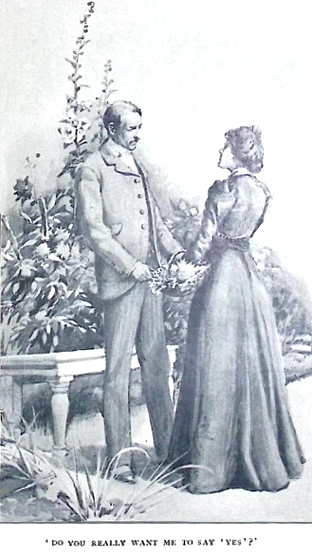
"DO YOU REALLY WANT ME TO SAY 'YES'?"
She went to bed that night still restless and undecided, wondering if the dictates of her heart would play her false.
For by this time she had come to this conclusion. Life with Captain Vaughan at her side wore a very roseate hue; without him, it would be a blank. And if she had been convinced that he reciprocated these sentiments, there would have been no cloud upon her horizon. There was little or no sleep for her. The storm that still swept on its wild way outside was a picture of the storm within her soul, but at length, as another day dawned soft and fair, with no signs of the wild weather that had preceded it, Heather's resolve was made. The dawning of a love which now surprised herself overcame the pride that had battled fiercely for predominance.
It was after breakfast in the garden that Heather gave her answer. She was gathering dahlias in an old-fashioned winding walk that led round the outskirts of the grounds, when a step behind her sent a quick flush to her cheek.
It was Captain Vaughan, and he spoke with his usual simple directness.
"I have come for my answer, Miss Fotheringay."
Then Heather faced him, and her eyes held his for a moment as she tried to read him through and through.
"Do you really want me to say Yes?" she asked, a little unsteadily.
"I do, indeed," was the grave reply.
Her eyes dropped. With a pretty grace, she put both her hands in his.
"Then I say it."
"God bless you."
That was all, but it was enough.
ABROAD
"Let nothing disturb thee,
Nothing affright thee;
All things are passing,
God never changeth,
Patient endurance
Attaineth to all things."
LONGFELLOW.
"SEND her a telegram, and tell her a letter will follow."
"I could not do it."
"What do you propose, then?"
Captain Vaughan and Heather were speaking, and they were out on the lawn after breakfast the next morning. Ena was there, too, in her chair, superintending a little gardening done by Dick. Captain Vaughan was going to his farm, but stayed to discuss Heather's intended trip abroad.
"It would not be right to throw her over at the last minute," said Heather, looking at Captain Vaughan rather pleadingly.
He had a little frown between his eyes, for he was strongly averse to her keeping to her engagement, and Heather still felt strangely shy of him. She turned to Ena.
"Oh, Ena, help me; you know I could not do it. What would she say, when all her preparations are made, and she is relying upon me to join her to-morrow at Victoria Station?"
"I don't know what to say," said Ena, with a smile. The future of the two she loved best in the world looked so bright to her that nothing else seemed to matter. "I am sure," she went on, "we shall not consent to your being abroad with her till next spring. But I confess it is very late now for you to refuse to go to her."
"Well," said Captain Vaughan, with a shrug of his shoulders, "you must talk it over together, and settle it your own way, as you will not have my advice. My proposal is that she should be written to at once. She could very soon find another companion; it would only delay her trip for a week or two."
He walked off. Heather looked after him for a minute, then with light steps rejoined him before he reached the garden gate.
"You won't be vexed with me if I go?" she asked.
He stopped, and laid his hand on her shoulder. His tone was grave, but his eyes had that kindly humour in them that was one of his attractions to women.
"You won't take care of yourself," he said, "and now I consider I have the right to take care of you."
"You would not like me to do anything dishonourable?"
Heather was smiling now, but she watched his face a little anxiously.
"I don't think you could," was the reply; "but settle it as you will with Ena."
"I think the best way for me to act is to go with Mrs. Macintyre, and stay with her until she finds some one else to take my place. I will tell her what you wish. And a month abroad will not hurt me. Please say you approve of this."
"I don't approve, but I will try and be content with it."
He went off, and Heather returned to Ena, feeling lighter hearted at his consent.
Both he and his sister wished to prolong her stay with them, but Heather never flinched where she saw her duty lay.
Accordingly, the next day found her making her departure, but not with the sad heart-sinkings that she had anticipated a short time before.
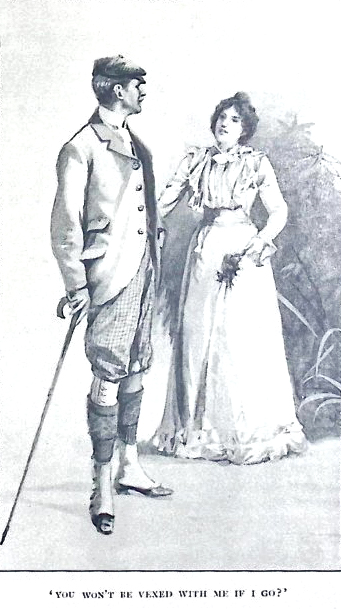
"YOU WON'T BE VEXED WITH ME IF I GO?"
As she looked round the old Priory, and gazed at it lying still and peaceful in the autumn sunshine, as she mounted the trap and let her eyes rest on the old stone porch with its quaint inscription, now almost hidden under the flaming creepers surrounding it, and waved a misty farewell to Ena in her wheeled chair, and her important attendant standing by her side, her heart was throbbing with bright hope and gladness.
"I shall come back to it again, and it will be my home."
And if a little shadow lay on her path, if a little doubt of the strong figure by her side seemed to rise in her heart, she stifled and stilled it instantly.
"He is a good, a noble man; an unselfish son and brother; and he will be as good to me as he has been to every one else."
Captain Vaughan was very silent during the drive, and Heather was quite content to follow his example. He looked after her comforts, and when the train was just moving off gave her a warm hand-grip.
"God bless and keep you! Write to us soon. And remember that we expect you back before Christmas."
Heather leant back in her seat, and wondered if any girl had such an undemonstrative lover as she. Yet she assured herself that she would rather have one such hand-grip from him than dozens of flattering protestations of admiration and love from any one else, and for the rest of her journey she lived in a dream.
She met Mrs. Macintyre, as arranged, at Victoria Station, and then, indeed, she had her hands full. An exacting, nervous, and irritable companion on a long railway journey is always a trial. It was doubly so to Heather in her present position, and before three or four days had elapsed, she felt nearly worn out.
Yet her patience and good nature never flagged, and even Mrs. Macintyre owned after a fortnight's time that she suited her very well.
But Heather could not leave her long in ignorance of her own plans, and when, as gently as possible, she told her that her circumstances had changed, and that her friends wished her to return to them as soon as she could be spared, there was trouble at once. Mrs. Macintyre was a woman who had never controlled her temper or restrained her tongue, and she was furious at this change of purpose.
"You have deliberately deceived me; I engaged you for the winter, and you are trying to leave me stranded in a foreign place amongst strangers. But I will not have it. You are bound to me, and stay with me you shall, for the time we agreed upon! Have I not given way to your nasty narrow cranks? When you told me you never played for money on principle, did I not generously concede to your request that you should be allowed to read to me instead? Have I not denied myself the pleasure of my usual recreation in order to gratify your Pharisaical nature? It is only the pious people like yourself who can stoop to such mean actions, and you are with the wrong person, let me tell you, Miss Fotheringay, if you think you can act so! There would have been hundreds only too glad and thankful to step into your shoes!"
"I would not leave you, Mrs. Macintyre, until you have some one to take my place. I think you will not find it difficult, as you say, to find some one else. I am truly sorry. It would have been better not to come with you at all, but I could not bear to put you off at the last minute!"
"I will not hear a word more from you," and Mrs. Macintyre literally stamped her foot. "I forbid you to mention the subject again. You dare not break your agreement with me, for I should simply take it into the law courts rather than give way. Pack our trunks to-night for Monte Carlo, and not another word!"
So to Monte Carlo they went, and the old lady solaced herself for the want of a congenial companion, by frequenting the gaming tables day by day. It was a time of unspeakable wretchedness to Heather, for though she never took part, she was dragged there against her will; and the very atmosphere seemed degrading.
But the end came in an unexpected way.
Ena received a letter a fortnight after, which made her cheeks blanch. She handed it to her brother without a word.
And he sat for a moment after reading, as if considering his course of action.
"DEAREST ENA,—I write to you because I feel I can give you fuller
details than Captain Vaughan. I have gone through such a dreadful
time this last twenty-four hours that I hardly know how to describe
it. I told you how infatuated poor Mrs. Macintyre has been over these
dreadful tables. She first won a great deal, but this last week has
been losing steadily every day. The night before last she came to my
room and implored me to lend her some money. She told me she had lost
everything she possessed, and must win it back. I did not know whether
to believe her or not, but we had a dreadful scene. I steadily refused
to lend her one franc, and then—I could not help it—I think she wrought
upon my feelings so that I felt I must speak plainly. And I spoke
straight to her about her soul and the life she was leading.
"I am thankful I did now, but I shall never forget her look of
astonishment when I first began. Of course, she was very angry, but I
begged her to listen to me. I told her I knew I was only a young girl,
with not a quarter of her experience of the world, but that I had seen
a little of it, and compared with my present life it was as chaff to
wheat. And at last she grew calmer, and finally, to my perplexity and
distress, she burst into tears, and said that there was no one in the
wide world who cared for her. She was a ruined woman, and would die
in the workhouse, and life was a tangle and hideous disappointment
from beginning to end. She let me talk to her for over an hour. I felt
utterly inexperienced and helpless, and yet when I got my Bible, and
she let me give her a verse or two, I felt quite at rest about it.
She said no one had ever spoken to her about such things before. I
think she was utterly crushed by her losings, and so was more ready to
listen. Then I begged her to come away from Monte Carlo, and when she
said she had no ready money, I told her I would willingly lend her some
for that purpose.
"So the next morning we left, and came straight on to Nice. We were
nearly there, when there was the most awful shock I have ever felt in
my life. I shall never forget the horror of it. It was a collision. You
will perhaps see it in the papers before this reaches you. I remember
nothing after the first shock. When I came to myself, I found myself
with a number of others on the railway bank, doctors and officials
rushing frantically about, and gesticulating and chattering as only
Frenchmen can. I felt dreadfully queer and shaken, but found I was not
injured in any way, and my first thought was for Mrs. Macintyre. I
can't tell you what a shock it was to come across her poor body. She
had been killed instantaneously, the doctors said, her skull fractured.
"I cannot tell you all I have been through. They seem abroad as if
their one idea is to bury their dead instantaneously, and they hardly
gave me time to telegraph to her lawyer before they were making
arrangements for the burial. I am staying at this quiet hotel, and have
just received a telegram from her lawyer saying he and a cousin of hers
will be with me to-night. I feel almost as if it were my doing that we
were in the accident. If I had not hurried her away from Monte Carlo
she might have been alive and well now; and yet, would you not have
acted in the same way if you had been in my place? I can't believe she
is really gone, it seems so awful. Pray for me, won't you? I am quite
unnerved. Your loving—
"HEATHER."
"I shall go out to her and fetch her back at once," he said briefly.
"She may have started home before you can reach her."
"I shall wire."
"Poor dear child. What an awful experience! How little we thought by what means she would be brought back to us!"
Captain Vaughan sent his telegram, but received one before he could start.
"Cyril here. Am returning with him."
And so, a few days after, Heather found herself with her sister in her London house. Bluebell received her affectionately. She was pleased with her engagement, and begged Captain Vaughan to come up and stay with them for a short time. This he was unable to do, and Heather almost felt it a relief when she heard he was not coming.
She had suffered more than she at first thought in the collision, and for days she did not leave her room. The doctor said it had been a great shock to her nerves, and she must be kept very quiet.
Poor Heather felt that in such a gay house, and with the roar and bustle of the London streets so close to her, this was a difficult prescription to follow. But Bluebell was not very well herself, and determined to spend a quiet Christmas in the country, so in a few weeks' time, they went to their country house, and Heather's health and spirits began to improve at once.
It was in the middle of February that Bluebell became the happy mother of a little son, and her joy and pride in her baby was intense.
"Oh, Heather," she said one evening, as they were in the nursery seeing him put into his little cot, "I never thought I should be so foolish over a child. I think he will be my idol now. If anything could wean me from society and the gay life you condemn, he will. I believe I could be happy in a cottage with him in my arms."
"He has been sent to you in love," responded Heather, gravely; "let him draw you to the One who has given him to you."
"Yes. I really mean to be a good mother. He is such a charge to train. I should never like him to grow up and find anything in his mother to condemn. I mean to be everything that is good and noble now that I am a mother."
She spoke in the full joy and confidence of her mother's love, and for a time was very softened. Yet when her vigorous health and spirits returned to her, she plunged afresh into gaiety, and laughed at her sister's pleadings.
Her love for her child seemed almost a passion, and Cyril shared in the adoration. But, like many others, Bluebell cast all serious thoughts away from her, and refused to recognize that the gift was from God, and that she might be called upon to relinquish it.
About this time Captain Vaughan came to pay his long-promised visit.
Heather met him with mingled feelings of shyness and delight. She had not seen him since she had been abroad, and her correspondence with him was rather constrained. She still had the feeling that she did not know him, and that his heart was not hers.
She was alone in her sister's sunny drawing-room when he arrived. He came in with his kindly smile and cheery voice, and, for the first time since they had been engaged, stooped and kissed her. It brought the blood with a rush to her cheeks, and almost overpowered her, but asking after Ena and hearing the Priory news soon put her at ease.
"And when are you coming back to us for good?" he asked presently. "There is no need to wait much longer, is there?"
Heather looked at him with startled eyes, and he did not press the question.
But before many days passed Bluebell asked Heather the same question.
"Do you want to get rid of me?" Heather asked with a smile.
"I want you to be happy in a home of your own like I am. Why should you wait? I always think long engagements are a mistake. When you have once made up your mind to marry a man, the sooner it is done the better. I suppose your mind is made up?"
"Of course it is. Why do you ask?"
"Oh, sometimes I think you are a queer couple, so dreadfully matter-of-fact and undemonstrative! And then there is the sister. I wish you were not going to be saddled with her. An invalid sister-in-law is rather trying. I think she ought to live elsewhere."
"If Ena were not there, I wouldn't marry at all," said Heather, with some heat.
Bluebell leant back in her chair and looked at her sister, half amused, half perplexed.
"It is the sister you are going to marry, then, not him? I thought so."
"Oh, Bluebell, don't tease so. You know I wouldn't marry a man if I did not care for him."
And Heather walked away, with her head a little bit uplifted, whilst Bluebell called after her mischievously—
"He ought to take you to a desert island for your honeymoon, to find out whether it is he or his sister who has won your affections."
A TREASURE TAKEN
"Her little child hath gone to sleep,
Why should a mother watch and weep?
Earth's ills were gathering round his nest.
He crept into a Father's breast."
ANOTHER lovely spring afternoon, reminding Heather strangely of the first day she saw the Priory. But now she was coming to it as a bride, and as she entered the old stone porch, leaning on her husband's arm, she looked up with a happy smile. "'Sic vos non vobis,'" she repeated; "you must remind me of that, sometimes, Bertram. I hope I shall not be tempted to forget it."
Captain Vaughan knew his young wife too well to think that would be possible, and later in the evening, when they stood together watching the sun set in all its golden beauty, he drew her gently to him.
"Will an old man make you happy?" he asked.
Heather's doubts and fears had long gone now. She raised her face trustingly to his.
"I never thought I could be so happy," she said.
And then he laughed.
"Your sister had her doubts of me. She told me I was too undemonstrative. But I cannot wear my heart on my sleeve. From the first day that you set your foot inside this house, I knew that if I were to have a wife at all, it must be you. I was afraid our life would be too quiet for you, and the disparity in our ages made me waver."
"But you ventured at last," Heather said, laughingly, "and I think I was never so astonished in my life. If you ever do such a thing again, let me advise you to show a little more warmth of feeling before you propose; you were always like an iceberg to me."
"I think one venture will be enough," Captain Vaughan replied humorously. "I will see how this one turns out first."
And then, secure in each other's trust and love, they settled down as husband and wife, and Ena's cup of happiness was full.
One evening towards the end of June, they were again in the garden. Heather was picking some roses; Captain Vaughan resting in a lounge chair under one of the old elms, for he had been away from home on business all day, and had returned very tired; and Ena reading an article in the "Times" by his side. Heather hovered about, occasionally putting in a remark, and presently her husband called her.
"Come here," he said, for he was watching her every movement; "you are looking quite pale; why are you so restless? Leave the roses in peace, and listen to this article."
She came and stood over him, with her hand lightly resting on his shoulder.
"I am listening," she said; "but I don't care for the subject. I am afraid I am too insular to care about quarrels in the French senate."
Captain Vaughan drew another chair to his side, and made her sit down. But directly Ena had finished, she got up, and wandered away by herself again.
This time Captain Vaughan followed her, and found her leaning over a stone wall at the end of the flower garden, which overlooked the valley and river below.
When she turned round and saw him, she smiled, but the creases in her forehead did not disappear.
"Well," he said, taking out his pipe, and leaning against the wall rather lazily, "what is the matter with you this evening? Why are you so perturbed?"
"I don't think I am perturbed," Heather replied evasively; "it is very close to-night. Do you think we are going to have a storm?"
"I should not say so."
There was silence for a minute, then he said lightly, watching her keenly the while—
"I am not to be honoured with your confidence then?"
Heather flushed up at once. Then turning round in her pretty, graceful way, she laid her hand on his arm.
"You won't laugh at me?"
"Do I ever?"
"Yes, with your eyes, if not with your mouth."
"I will shut them."
"I don't think I will tell you."
Captain Vaughan was a wise man. He said nothing, only waited.
And then, with a little sigh, Heather looked away to some dark grey clouds rolling by in the distance.
"I feel oppressed," she said. "I have felt so all day. I can't describe it to you, but I'm sure there's trouble coming, and—and Bluebell's in it!"
Captain Vaughan did not laugh, but he raised his eyebrows.
Heather went on with knitted brow—
"I dreamt of her all last night, and I haven't had her out of my thoughts all day. I feel as if she is in trouble, and it makes me uneasy."
Captain Vaughan put his arm round her, and drew her to him gently.
"You mustn't get fanciful, little woman. I thought you were too sensible to be so swayed by your imagination."
"I am sure I shall hear some bad news," Heather said, in a troubled voice, as she tightened her hold of his coat-sleeve. "We are twins, Bertram. People may laugh at it, but I remember, when we were quite children, I always knew if Bluebell were in trouble, even when she was quite away from me."
"Don't get into the way of anticipating trouble. You will make yourself more miserable than you are intended to be."
"You don't believe in it? Do you think I am mistaken?"
Heather raised her face so wistfully that her husband had not the heart to laugh at her.
"My dear child," he said gently, "if you are anxious about her, pray for her and leave it. What do you think could happen to her? She was quite well when you heard last, was she not?"
"Yes; she is in town. I will try and think it fancy. Talk to me about other things to take my mind off."
Captain Vaughan did his best to comply with this request, but Heather was not at all herself that evening.
And she had unconsciously so impressed her husband with her sense of impending trouble that he was not in the least surprised the next morning when a telegram was brought up to the house for her. Its contents were brief.
"Come to me at once."
"BLUEBELL."
Yes, after eighteen months of happy married life, Bluebell was called to go through her first crushing trouble.
She had come up for the season in town, without a shadow on her path. Her boy was growing into a most lovely and engaging child, and when she was not enjoying the society of her friends, she was always to be found in his nursery. She had been fortunate enough to secure the services of a very trustworthy and experienced nurse, so had no anxiety about his welfare.
One afternoon, her husband came into the drawing-room, and found mother and son in the midst of a regular gambol on the hearthrug. He remonstrated with a smile on his wife's undignified position, and she rose to her feet, tossing her boy in the air with all a mother's pride in his bonny beauty.
"Isn't he a kill-joy, my sweet! Your mother shall crawl on all fours with you if she pleases, and you shall satisfy her craving for a romp, as her cynical old husband never can!"
Baby Percival chuckled with delight at this thrust at his father, and diving amongst his mother's curly tresses, wrought such havoc there with his chubby fingers that Cyril had to come to the rescue. And then, with wife on one knee and son on the other, he proceeded to deliver a mild harangue on a time and season for all things.
It was a pretty family scene, and one that lingered in the parents' memories for long afterwards.
Only the next day, the nurse remarked on baby's listlessness. It was the heat, his mother said.
"We shall be going out of town soon. He is looking pale; the country will soon set him up again."
She went out to dinner that night, and when she and her husband returned, were met on their door-step by their doctor.
"Your nurse has called me in," he said gravely; "I think the child has had a touch of the sun—"
Bluebell's cheeks blanched at once.
"Nothing serious, is it?" asked her husband, quickly.
"We will hope not. I will come again to-morrow early. I have given your nurse all necessary instructions."
Bluebell had dashed upstairs with her usual impetuosity, and her husband found her a few minutes later leaning over her child's cot with agonized anxiety, the nurse trying in vain to soothe her.
She turned her eyes up to her husband's face as he drew near, and her expression was like that of some wounded animal brought to bay.
"She won't let me touch him, Cyril! I'm his mother. He is ill; and he shall be ill in his mother's arms!"
With difficulty, she was persuaded to let her child alone. But an hour after, her husband came again into the nursery, and found her in a low rocking-chair, with her baby in her arms.
"I have him fast," she said, "and—" lowering her voice to one of intense determination—"I shall let no one—no, not death itself, take him from me!"
Cyril wondered if she were losing her senses. He noted the fever spots on her cheeks, the dark circles round her eyes, and the anguish that shone out of them.
"You are exciting yourself needlessly, darling," he said. "Dr. Hope did not say he was in danger."
Bluebell looked at her husband, then at her child.
"Dr. Hope is not a mother," she said. "I know! I can tell! He hardly knows his mother, my bonny baby boy!"
And all through the silent hours of the night, she sat with her child in her lap, prepared to wrestle with the unseen foe, so close at hand.
At early dawn the doctor was sent for, and he came in haste, but a look at the baby's figure, with his curly golden head hanging like a dead weight upon his mother's arm, told him the truth.
He shook his head sadly. "I am afraid it is only a question of time."
"You 'must' save him, doctor; you 'must.' He shall not be taken from me. He hasn't yet learnt to call me mother; his life is only beginning; it is all in front of him. I tell you, he 'shall' not die!"
Dr. Hope stood silently by. He had witnessed too many of these scenes to be very deeply moved; and yet something in the pitiable defiance of this young mother, the hopeless fight against a power that was going to crush her in spite of all her struggles, brought a huskiness into his voice as he replied—
"Life and death are in higher hands than mine. God alone can save your child."
"Then pray, oh, Cyril, pray, all of you pray!"
Bluebell's voice rang out, and it was shrill and metallic in tone. Her husband stood by her side, working his moustache up and down fiercely to hide his emotion. The nurse stood behind her mistress's chair, and the doctor on his knees felt the tiny pulse that was beating so fitfully, so feebly.
There was no response to Bluebell's appeal, only silence.
She talked recklessly on, hardly knowing what she said. "Only God can save him. Well, He will, He 'must,' He gave him to me. I used to love God once; He remembers; He won't be so cruel as to take him. If He takes him, I shall go too, I shall! I will not live without him. Oh, pray, Cyril, pray! Be quick, the minutes are flying! I am like a stone; I can't do it; some one must. Will you see him die for want of a prayer?"
A sob rose in Cyril's throat. He turned despairing eyes towards the doctor.
And he did not fail them.
"O God Almighty, we beseech Thee to save this child's life, for
Christ's sake. Amen."
There was stillness. The angel of death hovered above as if awaiting God's command.
But in love and pity the word was given, and the angel softly descended.
Baby opened his blue eyes, and the sweetest smile hovered over his lips. But his look and smile were not at his mother, and she saw and understood.
Only the ticking of the doctor's watch in his hand was heard, and then a little child's tired sigh and a sharp agonizing cry from a mother's breaking heart.
One more baby spirit gathered in all its fresh innocence and beauty above, one more empty cot and childless home.
An hour after, the telegram was sent to Heather, and she reached her sister that same evening. She was met in the hall by Cyril.
"It's the boy," he said huskily; "he has been taken from us. Go to his mother, and get her to eat something if you can; she has touched nothing for twenty-four hours."
Without a word, Heather sped up the stairs, and was shown into her sister's darkened bedroom. She found her seated in her easy chair, her hands locked tightly together, but lying listlessly upon her lap. She looked up, and Heather almost started. Could this white-strained face, with vacant, hard stare and grim-set mouth, belong to her bright and sunny sister? She seemed to have aged ten years.
And then in a moment Heather had her arms round her, and was sobbing out—
"My darling, I knew of your trouble yesterday. I would have come to you, even if I had received no telegram, for I felt you would need me. How did it happen? Can you tell me?"
"Yes," said Bluebell, in an unmoved tone. "I can tell you every detail. God has struck hard at last. He couldn't have sent me a worse punishment, could He? He knew better than you can, what my baby was to me. I suppose He gave me my chance of serving Him in my prosperity, and as I didn't do it, has begun to take away from me! Begun! He has taken my all, and it will not draw me heavenwards. Cruelty will not draw me!"
"Oh, hush, hush, dear. God is never cruel. He only wounds to heal. Tell me about your darling."
Bluebell gave her all the details in a hard, dry voice.
"Come and see him," she said; "I have only just come away. Nurse won't let me stay longer."
She led the way into the nursery, and the sight of the little clothes, the toys, and all the child's belongings, brought the tears with another rush to Heather's eyes. The mother drew aside the curtains of the little cot, and gazed with tearless eyes upon her boy.
Like a little waxen image he lay, nestled in a bed of white flowers. His little hands were clasped across his breast, and the long lashes, resting on his cheek, looked as if they ought to lift and show his mischievous blue eyes beneath them.
Heather bent and kissed the white, fair brow, and softly stroked the golden curls.
"Happy baby," she murmured. "He will never give you a heartache now—an anxious thought."
"He never would have done that had he lived," said Bluebell, coldly.
"How can you tell? You would have brought him up for the world, and think of some of the men we have met, who have had just such careful love from their mothers as you would have given him."
"I would have taught him to be good," said Bluebell, gazing with thoughtfulness on the silent little form. "I think I might have been given another chance."
"I suppose God felt He could train him better Himself," said Heather, softly. "Don't think of him as dead, darling; he has been moved into God's garden. You will thank God one day that He took him before he knew either sorrow or sin."
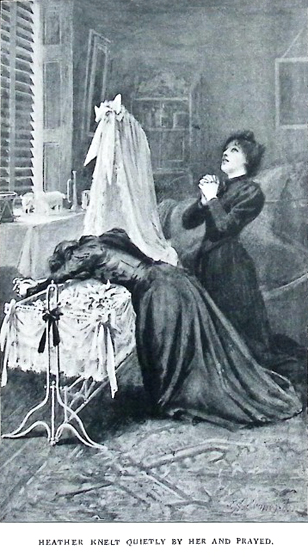
HEATHER KNELT QUIETLY BY HER AND PRAYED.
Bluebell made no reply, she continued to gaze upon her child with stony eyes.
"I keep thinking he may wake up," she said drearily; "it's the awful stillness that appals one so. And yet I wish I could be lying dead beside him. I have nothing to live for now."
"Oh, Bluebell, not your husband?"
"I am sick of everybody and everything. Oh, my boy, my boy!" She flung herself on her knees by the cot, and bowed her head upon the little form.
Heather knelt quietly by her and prayed. She felt it was the only thing she could do. Who could comfort a mother but the Comforter Himself?
"O God, have pity upon us. Thou hast done it in love, let Bluebell feel
this. Comfort her; draw her to Thyself, and let her realize that the
same arm that is round her child is round her. And comfort Cyril too,
and make this heavy trial into a real blessing to them both. For Jesus
Christ's sake. Amen."
Then sobs shook Bluebell's frame—dry, choking sobs at first, but soon the tears came, and proved a real relief to her heated brain. And then, by the side of her dead child, Bluebell crept back to the feet of that Saviour whom she had left.
"Have pity on me!" she sobbed. "I want him to be mine still, though
Thou hast taken him. Help me to meet him again. Forgive my worldliness,
my love of everything but Thee. Take me back, receive me, pardon me.
Make me believe Thou hast done it in love. Keep me from getting more
hardened."
DUTY A GOOD MISTRESS
"Calmly we look behind us, on joys and sorrows past,
We know that all is mercy now, and shall be well at last.
Calmly we look before us—we fear no future ill:
Enough for safety and for peace, if Thou art with us still."
H. L. L.
HEATHER stayed with her sister till after the funeral. And Bluebell, after the first violence of her grief was over, was strangely calm and self-controlled. Only once, when her husband called her by his pet name, "Minnehaha," did she turn upon him almost fiercely—
"Never call me that again, for there will be no more laughter for me."
Heather was urged to stay with them longer, but she felt that husband and wife would draw the closer together after she left.
"I have my husband to think of," she said to Bluebell, as they were talking in Heather's room one evening.
"Oh, I always think you are only half married," said Bluebell, with a little of her old impetuosity; "he has his sister."
"But his sister is not his wife."
And Heather's tone was regal.
"Do you really love him?" asked Bluebell.
But when she saw the light that sparkled in Heather's eyes, she sighed.
"Well, we must part. Cyril wants to take me abroad; I suppose I must go. Do you know, I have been thinking about our two selves a great deal. I suppose we were children of many prayers. We never had a temptation to speak of, until we forsook our quiet nest and plunged into gaiety. I think I had more qualms about it at first than you had, but it was strange how we drifted apart. I suppose God was calling us both back; you listened, and I shut my ears."
"No," said Heather; "I often wonder at it myself. I only went home because I thought it was my duty, not because I thought our gay life was wrong."
"Well, I shut my eyes to duty. I tell you honestly, Heather, I have been quietly fighting against God ever since our first season in town. I knew in my heart, before that year was over, that the world was swallowing up all my ambitions, my desires, and my affections. I knew I could not serve two masters, and I deliberately chose the world. When I was going to be married, you impressed me tremendously. I felt I ought to be different, but I put it off. When my darling came to me, I almost prayed I might be given the strength to change my life. But I still clung on to everything that made life pleasant to me. And I have found out this for myself, Heather, I am not judging any one else. I suppose I am too impetuous. I must throw myself heart and soul into everything I do. But—I cannot live a society life and be at peace with God. The two things don't go together. Some people say they can. I think they must be satisfied with a very little religion, not the sort that goes deep down into your soul, and affects every fibre of your being. I have been fighting, as I say, against God all this time, and I knew it."
"I think your religion must have been more than a mere form in our girlish days," said Heather, looking at her sister thoughtfully.
"It was. I often used to wonder if you felt it as deeply as I did."
"No; it seemed to come upon me quite as a fresh revelation."
"I was watching yesterday morning a few sheep being turned into an enclosure in the Park," said Bluebell, gently. "I noticed the ones who had to be driven and beaten before they would enter, and those who ran in without any trouble."
There was silence.
Then Heather said—"You think I have run in without any trouble?"
"Yes; and I have had to be driven. I am seeing the love of it dimly. Prosperity would never have drawn me, I am afraid."
Tears filled Heather's eyes at the quiet pathos of it. She kissed her sister, saying in a whisper—
"Thank God we are both inside. May we keep there."
The next day, Captain Vaughan came to fetch his wife.
They were at Paddington Station, just starting, when he asked her rather abruptly—
"Would you like to go round and have a look at your old home again? It would be a little trip, and would not take us much out of our way."
"I should love it," she exclaimed enthusiastically, "I should like to call at the farm and see Annie and her husband."
"And some of the old village characters, eh?"
"Yes," Heather said, a pink colour coming into her cheeks; "I should like to have Watty's opinion of my husband."
So, that afternoon, in the sweet summer sunshine, Heather and her husband walked up the old village street.
"It seems one of the strangest things in life," said Heather, thoughtfully, "that if you go away from a place for ages, you come back to it and find the people doing exactly the same things at the same time with a clockwork regularity that makes you almost start. You wonder if all your life since has been a dream. Look, there are Watty and Ralph gossiping on the old bridge. Watty has still got his letter-bag, and Ralph his paper."
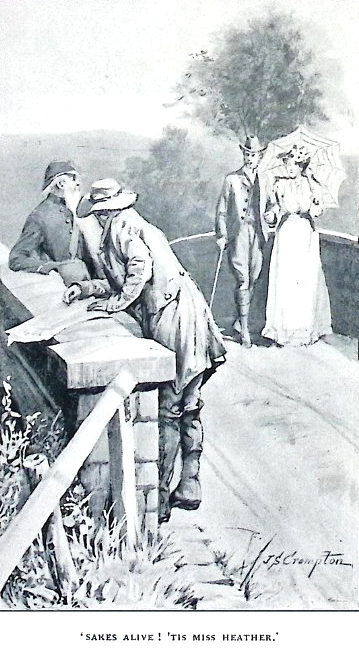
"SAKE'S ALIVE! 'TIS MISS HEATHER."
They walked up to them, and much disturbed their equanimity.
"Sakes alive!" ejaculated Ralph. "'Tis Miss Heather and her man! Well, to be sure, what a sight!"
"Yes, here we are," said Heather, in her old bright tone, and with the little imperious toss of her head; "and what do you think of us?"
"Do you remember me?" asked Captain Vaughan, with his cheery smile. "The wayside lodger who came down to fish one summer?"
"Ay, ay," said Watty, shaking his head knowingly, "us knowed ye was after a bigger fish nor ye could drag out o' this 'ere bit o' river! An I sez to Ralph here, when you was a-gone, that ye had the looks of a adventurer after matrimony!"
How they laughed! And then Watty seized his bag, more eager to spread the news of Heather's appearance than to stay and see her himself.
"Time is flyin'. 'Tis only folks like Ralph here that can afford to dawdle with leisurable people holiday makin'. Good arternoon to ye, sir. Good arternoon, Miss Heather."
He lounged off, his bag swinging from side to side.
And after a little chat with Ralph, Heather made her way to the farm.
Annie and George were delighted to see them, and insisted upon their having a cup of tea before they left.
Then they went to the old house, which was still empty, looking more desolate and forsaken than ever.
Heather's thoughts went back to that dreadful day when she had sobbed out her heart upon the old dial, and Captain Vaughan guessed a little what was passing through her mind.
"We mustn't let this be a sad day," he said.
Heather looked up at him with misty eyes.
"No," she said, smiling, "it is not going to be. God has been too good to me for me to be sad."
"I wonder if you will love the Priory as much as you do this?"
"I think I do more. The associations with this one are not altogether happy ones. We used to look upon it almost like a prison when Abigail was cross. Now let us come and see her."
So to the cosy little thatched cottage they went, and Abigail opened the door herself. Rachael was away visiting a friend. Abigail was delighted and tearful, which made Heather wonder if she were getting softer with increasing age. She had heard of Bluebell's trouble, and turned to Captain Vaughan with fervour—
"Ay, sir, you have the best of the two, but I'm thankful Miss Bluebell has seen the error of her ways. I never forget to pray for them, both night and morn. And Miss Heather has chosen well, for we've heard you are on the Lord's side yourself, sir. We always hoped—Rachael and me—that Miss Heather would meet with a sober, God-fearing man. She always from a child had a stern idea of duty, and would go straight on without a falter, as I hope she will to the end of her life. The only crooked turn she took was when her poor, misguided cousin persuaded her to go to London. But she saw her mistake, and came back to us, and I wish her and yourself happiness, sir, with all my heart!"
When they had said good-bye to the faithful old servant, and were walking through the quiet lanes to the station, Captain Vaughan turned to his wife and drew her hand through his arm.
"Did you take your husband from a sense of duty, little woman?"
"I was once afraid duty had led you to propose to me," said Heather, laughing.
"Well, duty is a good mistress."
"But love is better," urged Heather.
"We will have a combination of them in our life. It was your following duty so conscientiously that first made me wish to have you always by my side. I have found the old saying true—
"'Duty only frowns when you flee from it.
Follow it, and it smiles upon you.'"
They walked on. The evening sun was setting across the meadows in front of them, and presently they stood still and watched it slowly fade away. Heather's face was soft and wistful as she watched its glowing rays. Then her eyes met her husband's, and she smiled in perfect trust.
"I suppose all earthly joys fade sooner or later," she said.
"And then we shall be gathered into the land where our sun shall rise to set no more."
THE END
——————————————————————————————————————————
LONDON: PRINTED BY WILLIAM CLOWES AND SONS, LIMITED
DUKE STREET, STAMFORD STREET, S.E., AND GREAT WINDMILL STREET, W.